Cambridge IGCSE Sciences - Co-ordinated (Double) 0654 — 2022 Oct/Nov Paper 4 · Variant 2
0654/42/O/N/22 · 12 questions · 120 marks · ≈135 min
The question paper and its mark scheme, free to read here and free to download. This is Cambridge’s own paper, exactly as it was sat.
Question paper28 pages

Mark scheme13 pages
Answers below. Sit the paper first if you are practising.
Questions as text
Q1 · The total number of new HIV infections in the world is monitored
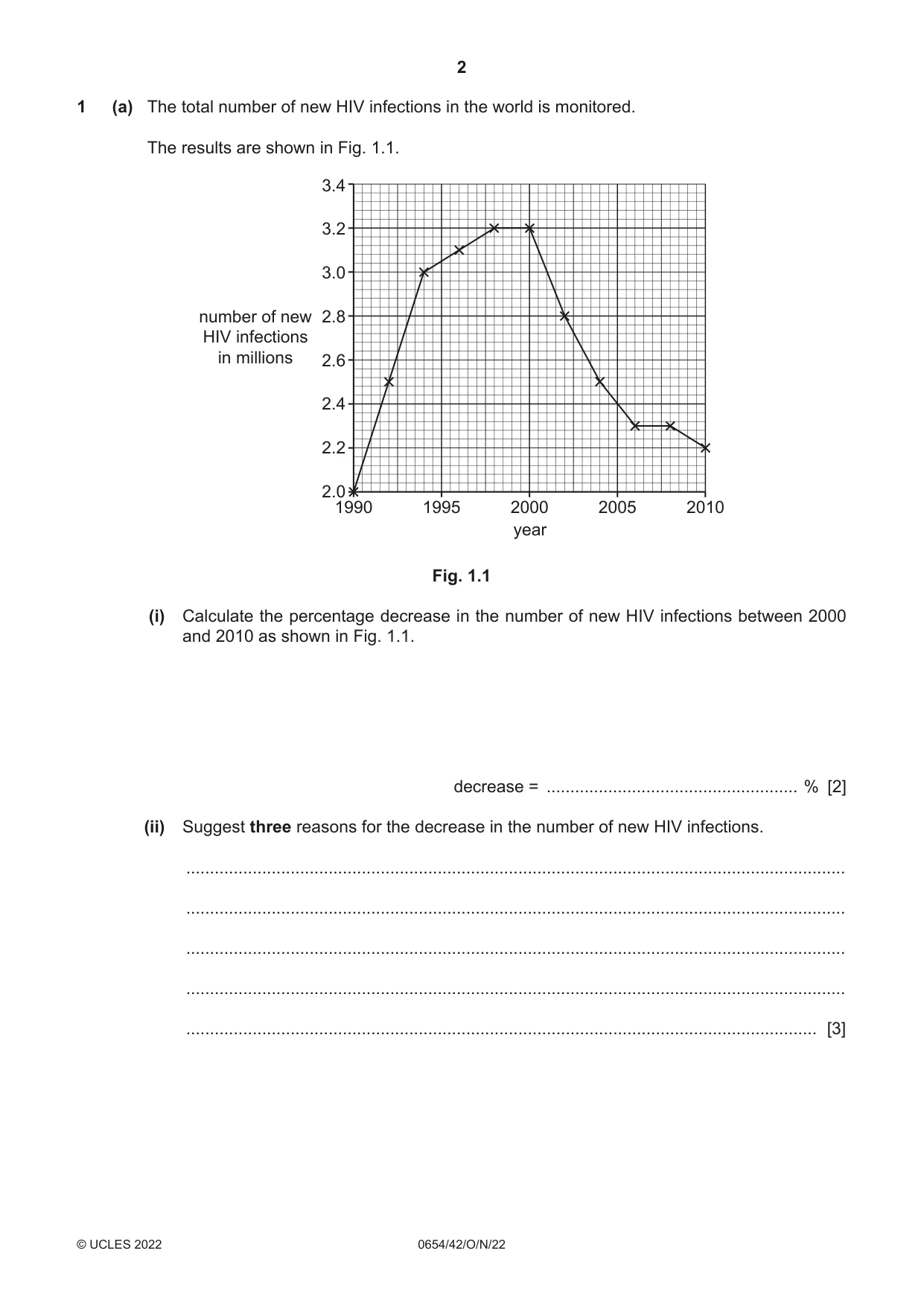
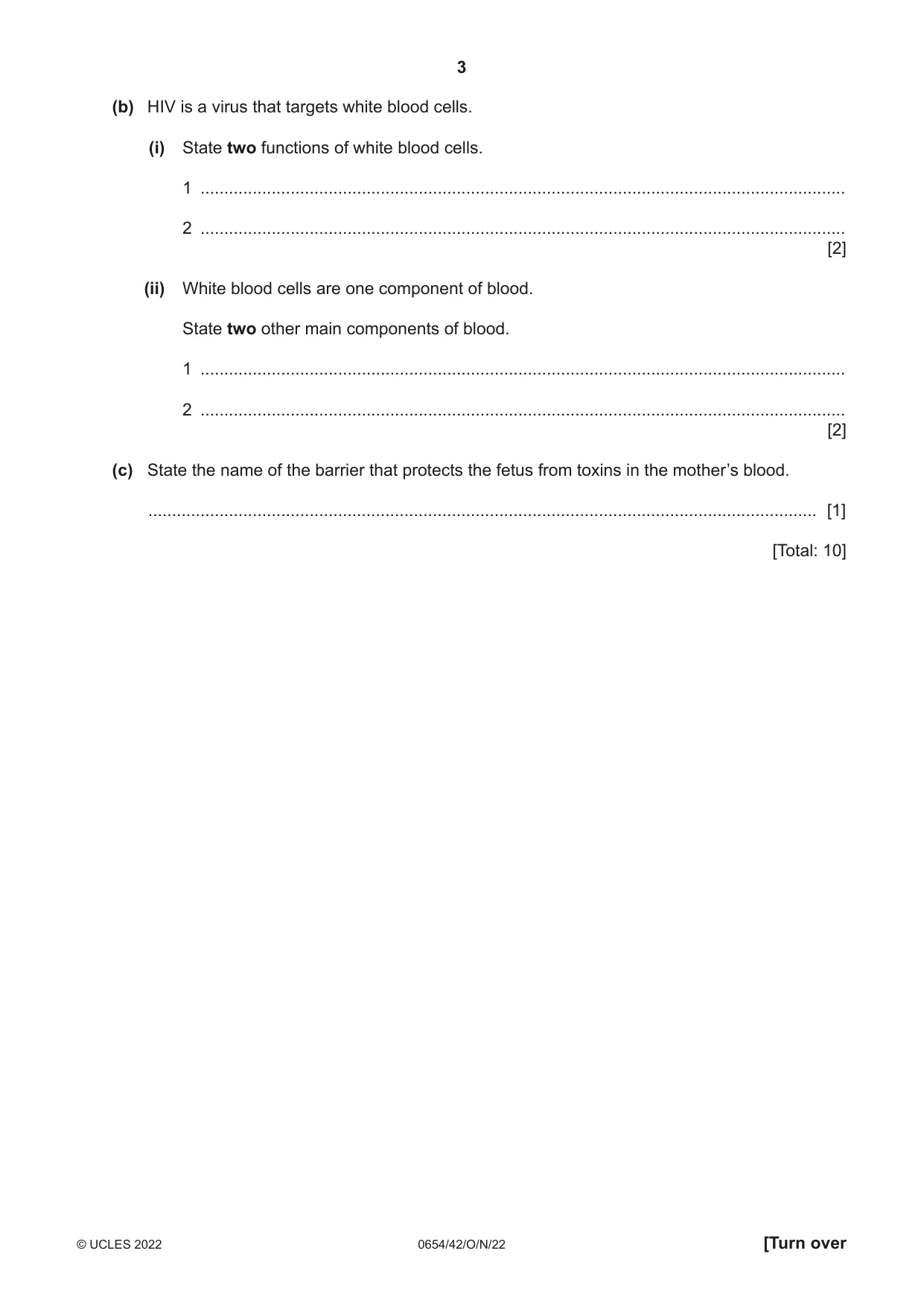
1 (a) The total number of new HIV infections in the world is monitored. The results are shown in Fig. 1.1. 3.4 3.2 3.0 number of new 2.8 HIV infections in millions 2.6 2.4 2.2 2.0 1990 1995 2000 2005 2010 year Fig. 1.1 (i) Calculate the percentage decrease in the number of new HIV infections between 2000 and 2010 as shown in Fig. 1.1. decrease = ..................................................... % [2] (ii) Suggest three reasons for the decrease in the number of new HIV infections. ........................................................................................................................................... ........................................................................................................................................... ........................................................................................................................................... ........................................................................................................................................... ..................................................................................................................................... [3] (b) HIV is a virus that targets white blood cells. (i) State two functions of white blood cells. 1 ........................................................................................................................................ 2 ........................................................................................................................................ [2] (ii) White blood cells are one component of blood. State two other main components of blood. 1 ........................................................................................................................................ 2 ........................................................................................................................................ [2] (c) State the name of the barrier that protects the fetus from toxins in the mother’s blood. ............................................................................................................................................. [1] [Total: 10]
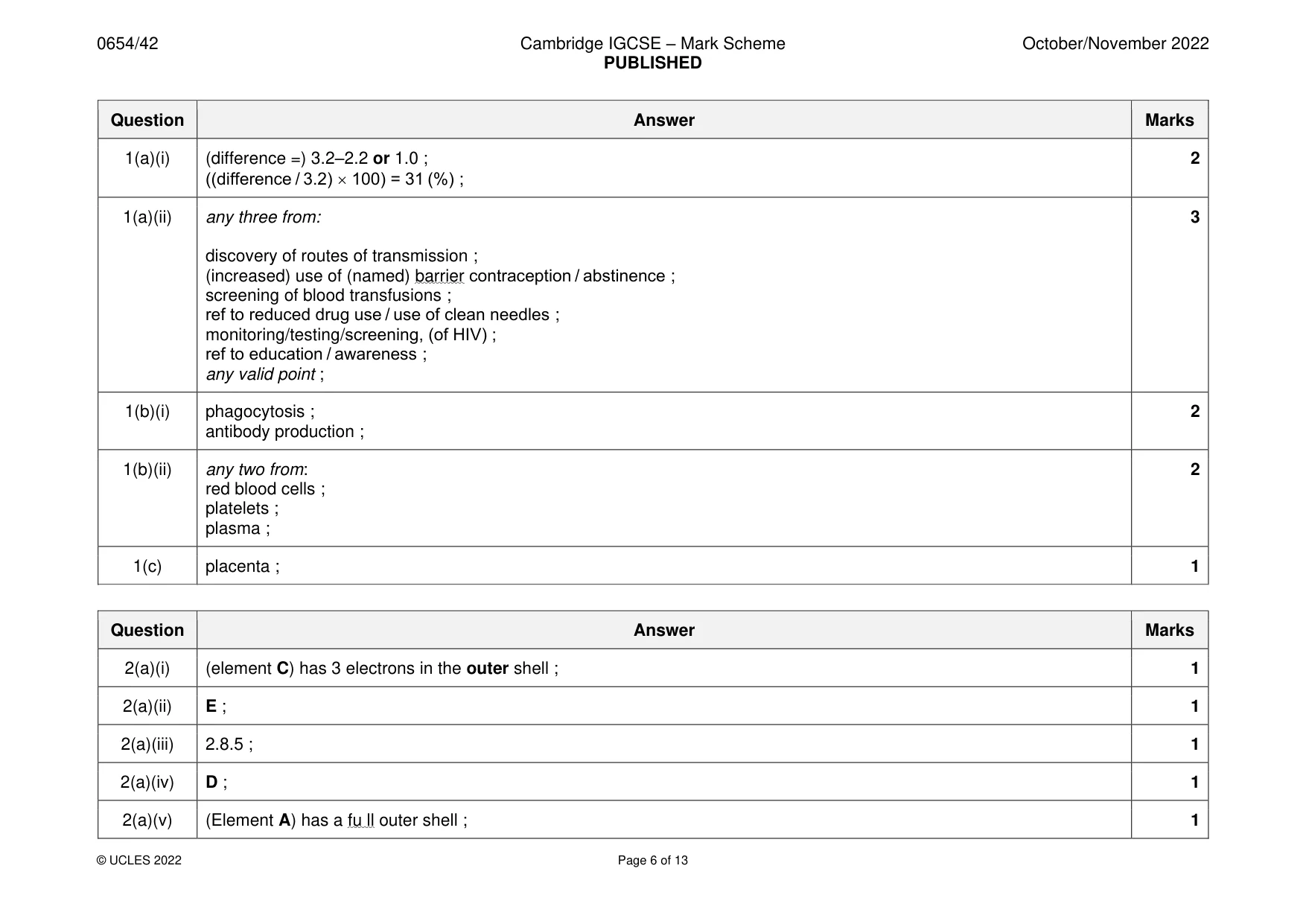
Mark scheme: Question Answer Marks 1(a)(i) (difference =) 3.2–2.2 or 1.0 ; 2 ((difference / 3.2) 100) = 31 (%) ; 1(a)(ii) any three from: 3 discovery of routes of transmission ; (increased) use of (named) barrier contraception / abstinence ; screening of blood transfusions ; ref to reduced drug use / use of clean needles ; monitoring/testing/screening, (of HIV) ; ref to education / awareness ; any valid point ; 1(b)(i) phagocytosis ; 2 antibody production ; 1(b)(ii) any two from: 2 red blood cells ; platelets ; plasma ; 1(c) placenta ; 1
Q2 · The atoms of some elements
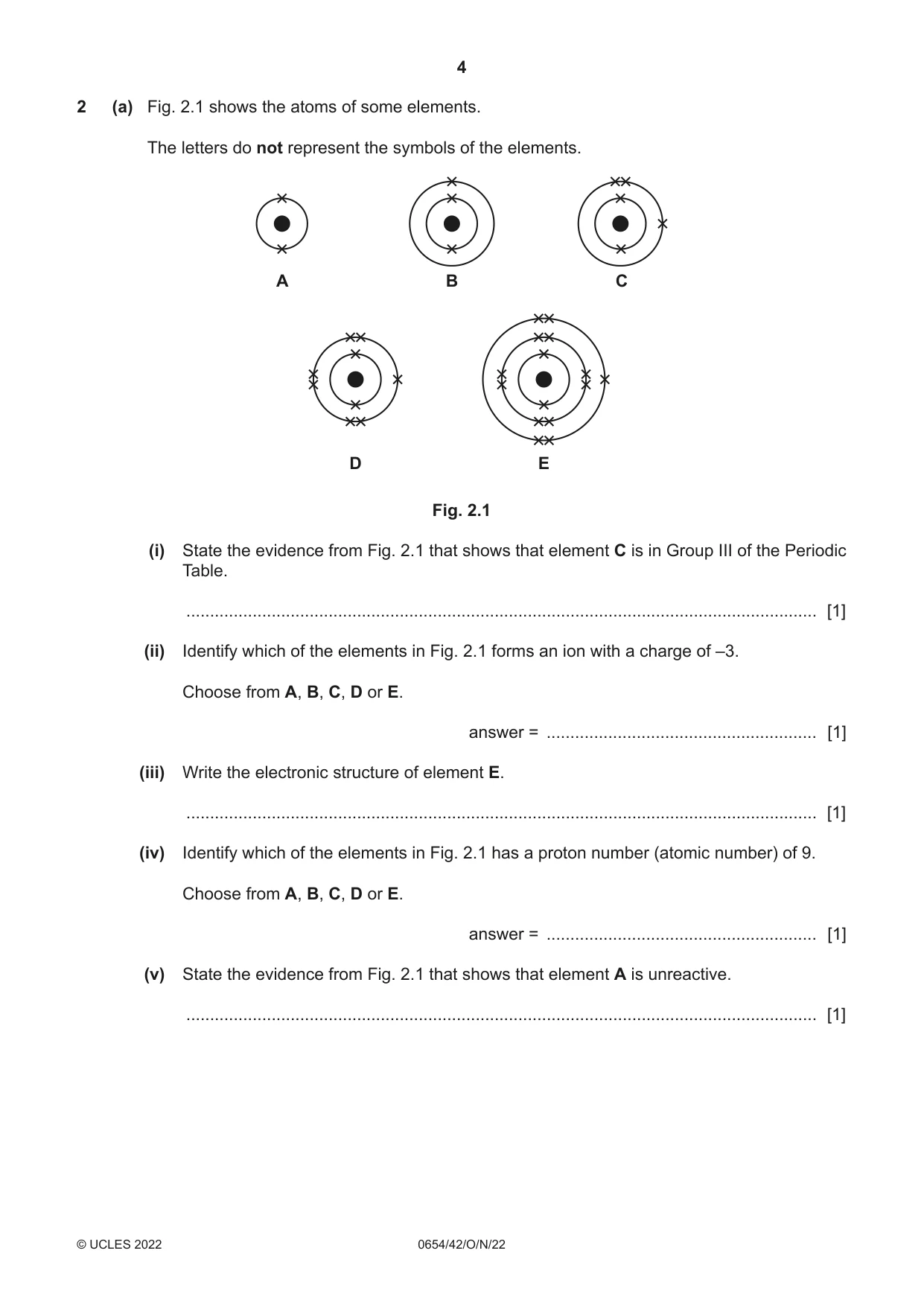
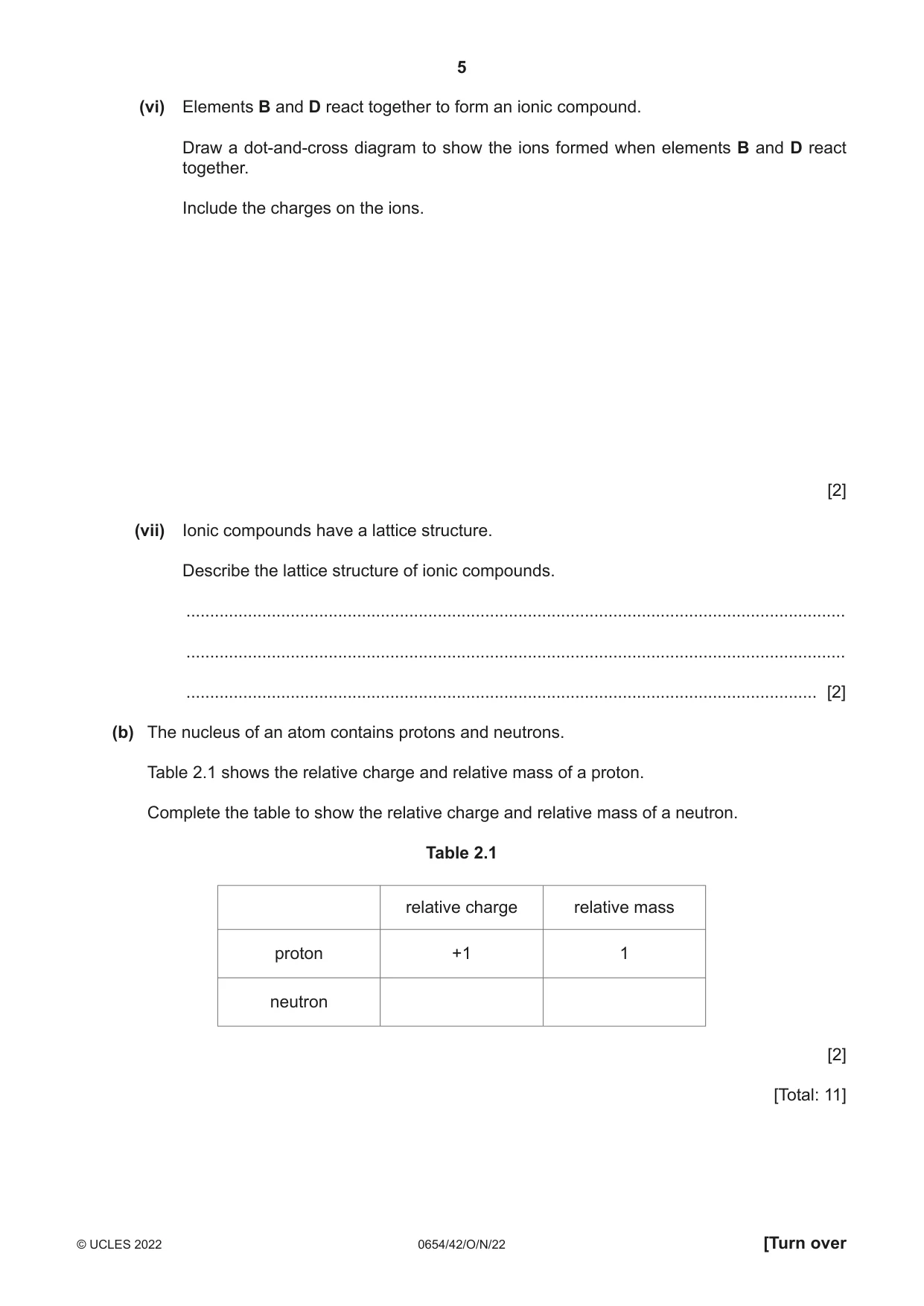
2 (a) Fig. 2.1 shows the atoms of some elements. The letters do not represent the symbols of the elements. A B C D E Fig. 2.1 (i) State the evidence from Fig. 2.1 that shows that element C is in Group III of the Periodic Table. ..................................................................................................................................... [1] (ii) Identify which of the elements in Fig. 2.1 forms an ion with a charge of –3. Choose from A, B, C, D or E. answer = ......................................................... [1] (iii) Write the electronic structure of element E. ..................................................................................................................................... [1] (iv) Identify which of the elements in Fig. 2.1 has a proton number (atomic number) of 9. Choose from A, B, C, D or E. answer = ......................................................... [1] (v) State the evidence from Fig. 2.1 that shows that element A is unreactive. ..................................................................................................................................... [1] (vi) Elements B and D react together to form an ionic compound. Draw a dot-and-cross diagram to show the ions formed when elements B and D react together. Include the charges on the ions. [2] (vii) Ionic compounds have a lattice structure. Describe the lattice structure of ionic compounds. ........................................................................................................................................... ........................................................................................................................................... ..................................................................................................................................... [2] (b) The nucleus of an atom contains protons and neutrons. Table 2.1 shows the relative charge and relative mass of a proton. Complete the table to show the relative charge and relative mass of a neutron. Table 2.1 relative charge relative mass proton +1 1 neutron [2] [Total: 11]
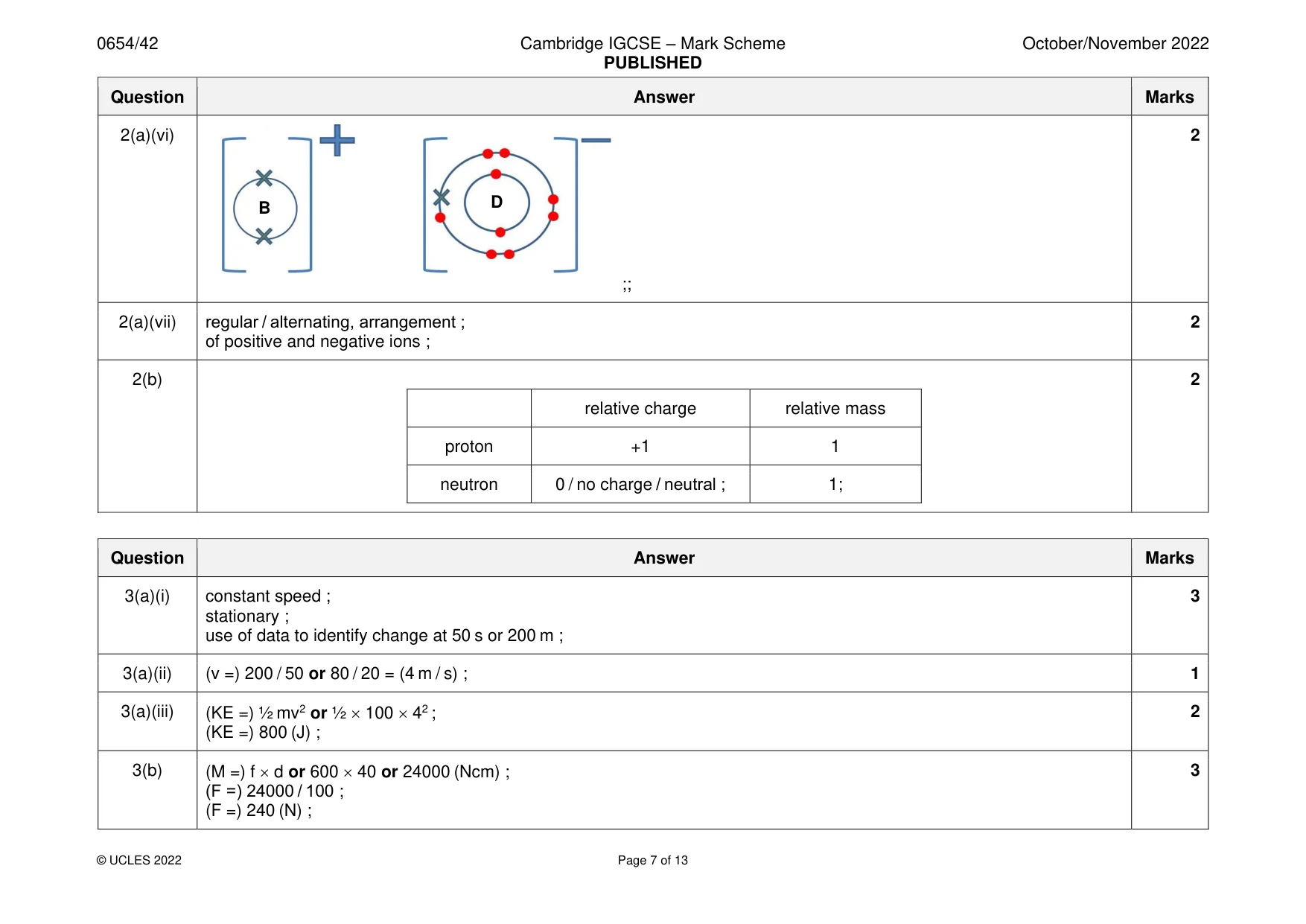
Mark scheme: 2(a)(i) (element C) has 3 electrons in the outer shell ; 1 2(a)(ii) E ; 1 2(a)(iii) 2.8.5 ; 1 2(a)(iv) D ; 1 2(a)(v) (Element A) has a fu ll outer shell ; 1 2(a)(vi) 2 D B ;; 2(a)(vii) regular / alternating, arrangement ; 2 of positive and negative ions ; 2(b) 2 relative charge relative mass proton +1 1 neutron 0 / no charge / neutral ; 1;
Q3 · A man transporting some luggage in a small boat
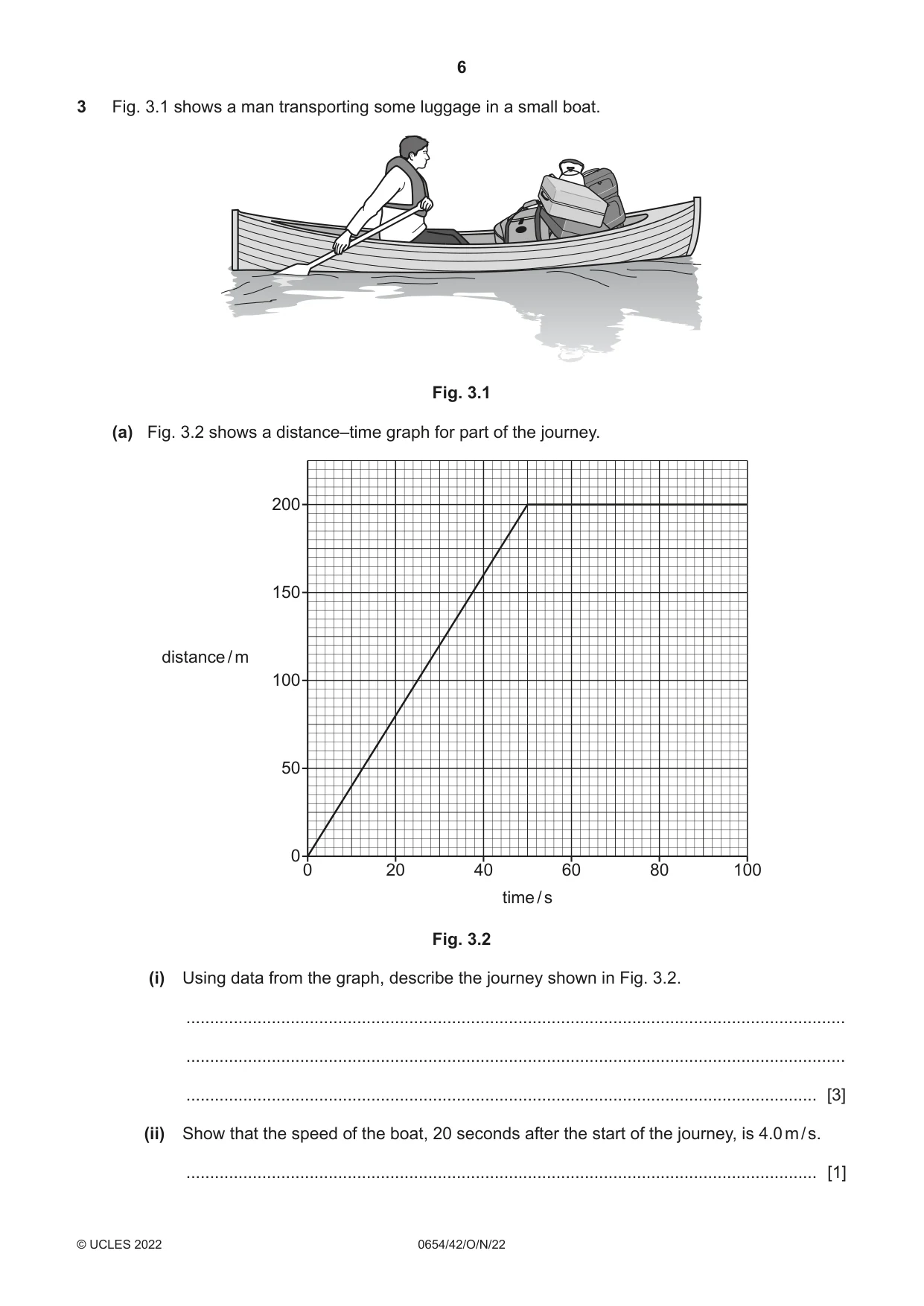
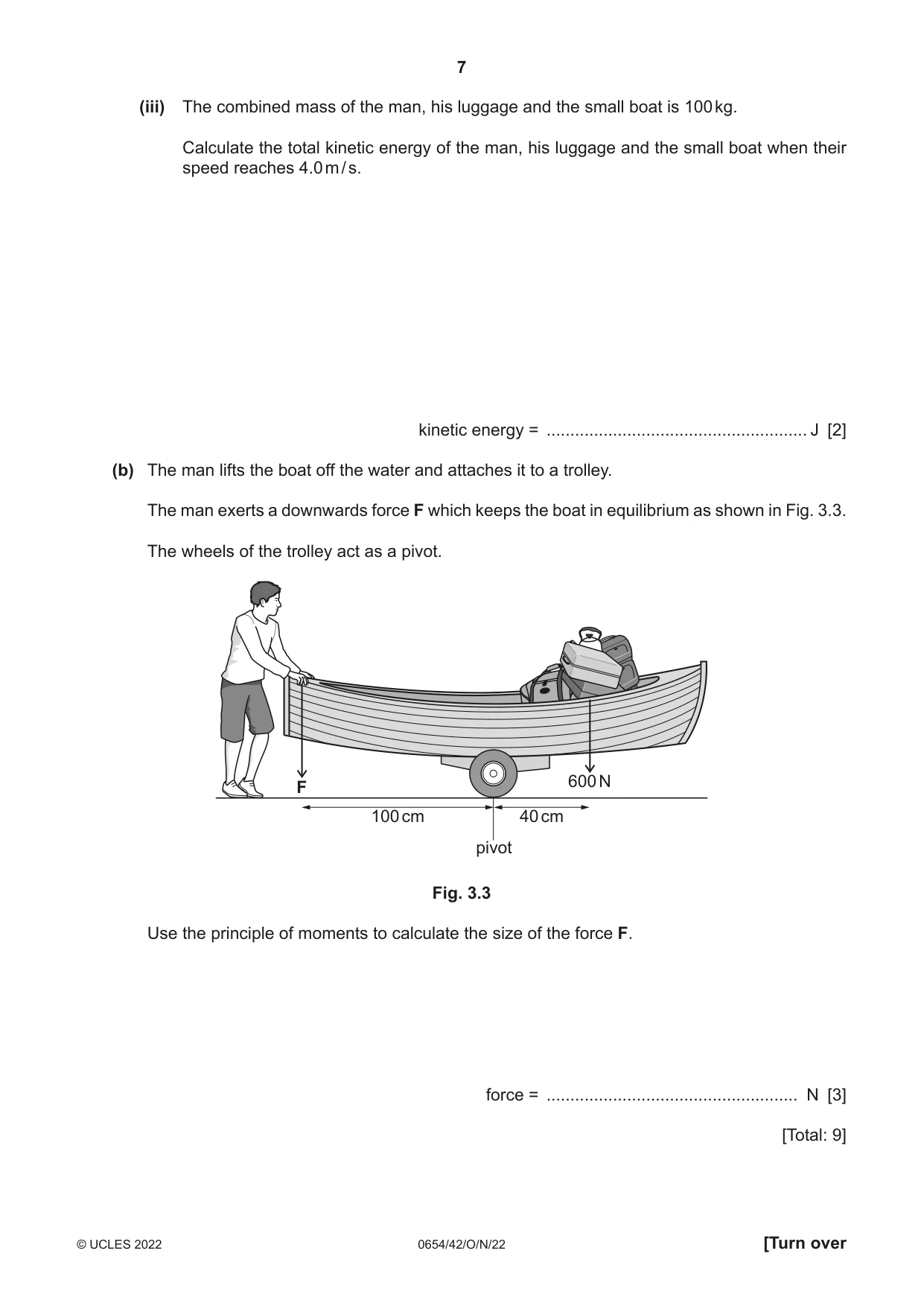
3 Fig. 3.1 shows a man transporting some luggage in a small boat. Fig. 3.1 (a) Fig. 3.2 shows a distance–time graph for part of the journey. 200 150 distance / m 100 50 0 0 20 40 60 80 100 time / s Fig. 3.2 (i) Using data from the graph, describe the journey shown in Fig. 3.2. ........................................................................................................................................... ........................................................................................................................................... ..................................................................................................................................... [3] (ii) Show that the speed of the boat, 20 seconds after the start of the journey, is 4.0 m / s. ..................................................................................................................................... [1] (iii) The combined mass of the man, his luggage and the small boat is 100 kg. Calculate the total kinetic energy of the man, his luggage and the small boat when their speed reaches 4.0 m / s. kinetic energy = ....................................................... J [2] (b) The man lifts the boat off the water and attaches it to a trolley. The man exerts a downwards force F which keeps the boat in equilibrium as shown in Fig. 3.3. The wheels of the trolley act as a pivot. 600 N F 100 cm 40 cm pivot Fig. 3.3 Use the principle of moments to calculate the size of the force F. force = ..................................................... N [3] [Total: 9]
Mark scheme: 3(a)(i) constant speed ; 3 stationary ; use of data to identify change at 50 s or 200 m ; 3(a)(ii) (v =) 200 / 50 or 80 / 20 = (4 m / s) ; 1 3(a)(iii) (KE =) ½ mv2 or ½ 100 42 ; 2 (KE =) 800 (J) ; 3(b) (M =) f d or 600 40 or 24000 (Ncm) ; 3 (F =) 24000 / 100 ; (F =) 240 (N) ;
Q4 · A scientist tests the resistance of one strain of bacteria, to four different…
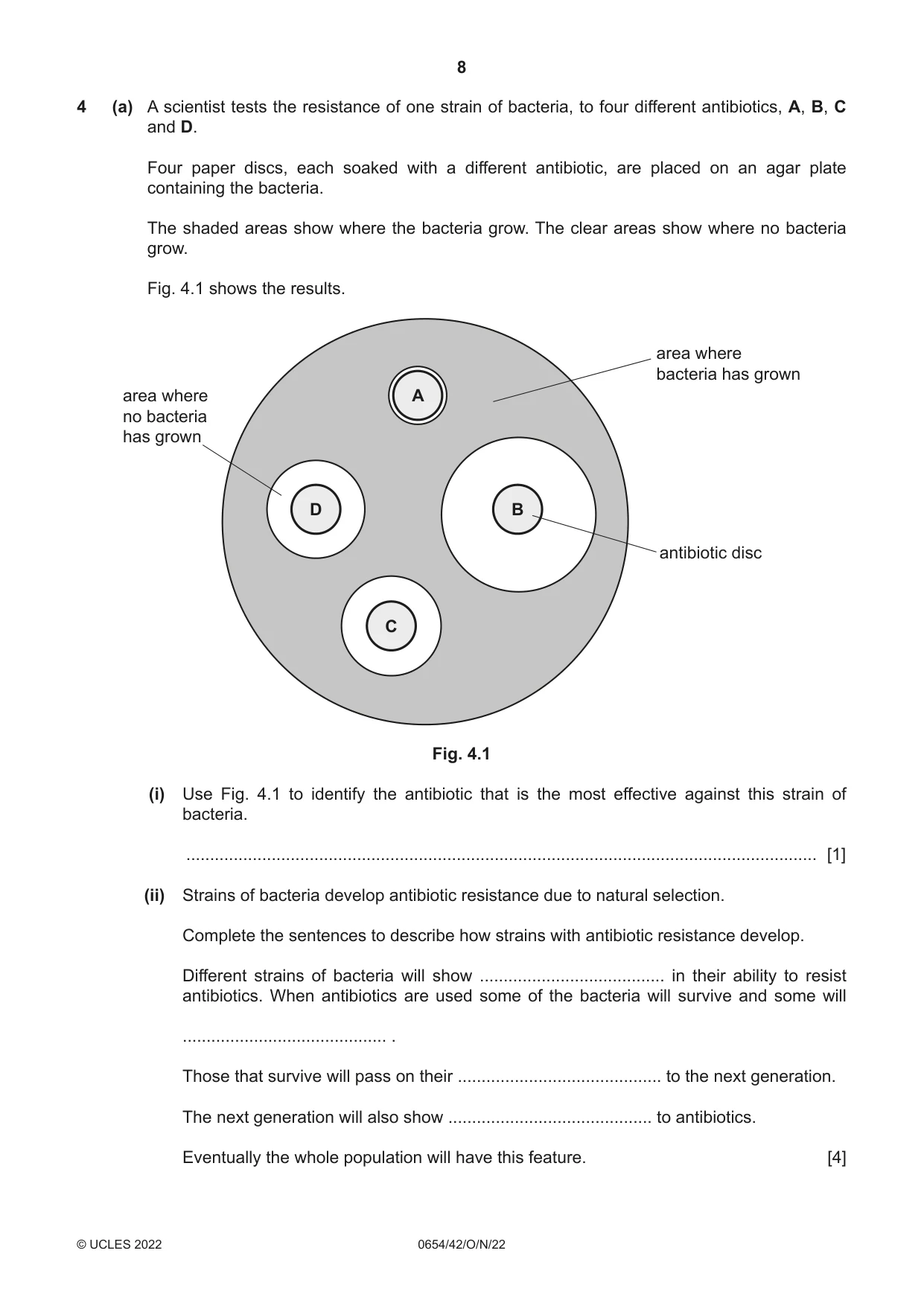
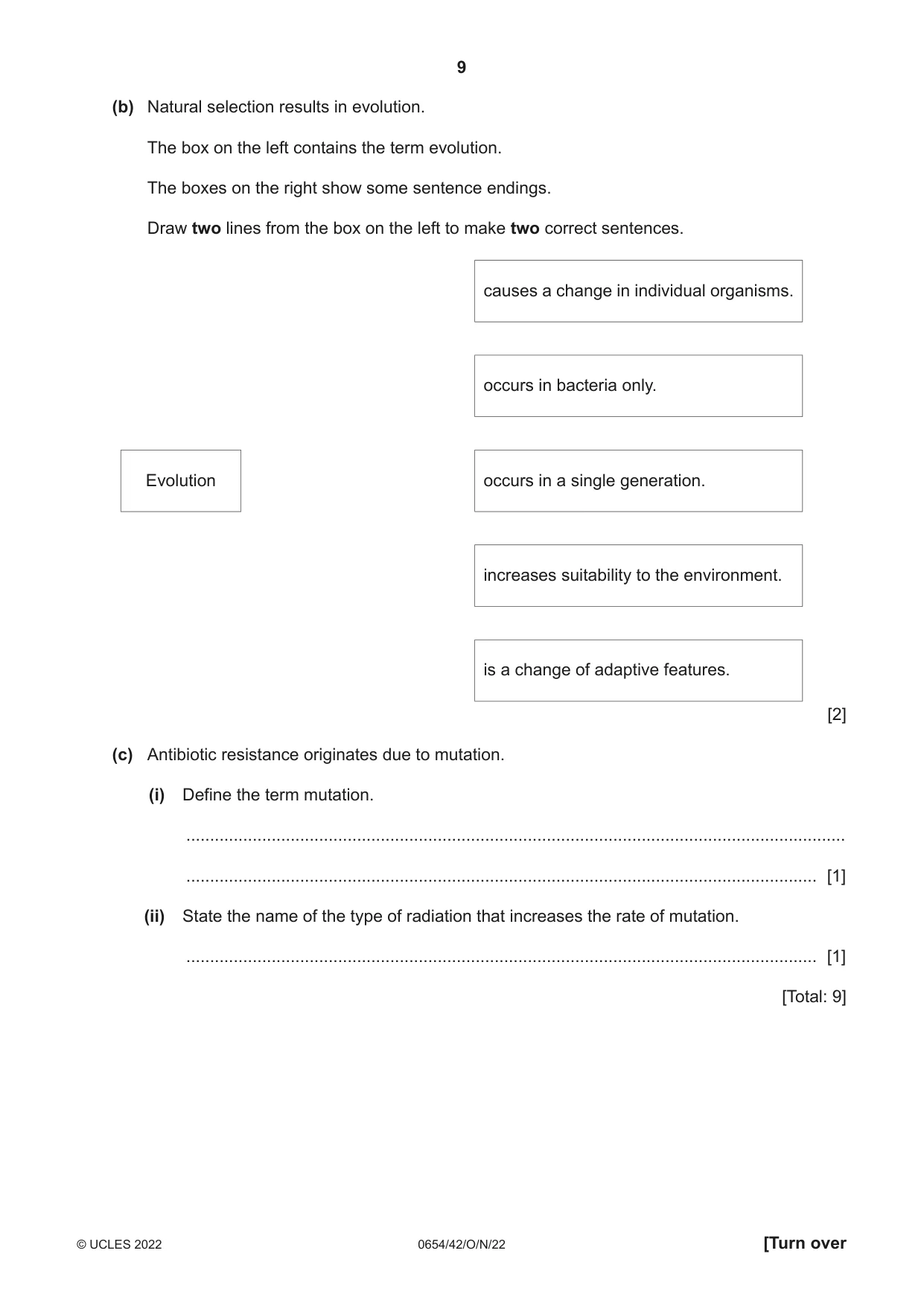
4 (a) A scientist tests the resistance of one strain of bacteria, to four different antibiotics, A, B, C and D. Four paper discs, each soaked with a different antibiotic, are placed on an agar plate containing the bacteria. The shaded areas show where the bacteria grow. The clear areas show where no bacteria grow. Fig. 4.1 shows the results. area where bacteria has grown area where A no bacteria has grown D B antibiotic disc C Fig. 4.1 (i) Use Fig. 4.1 to identify the antibiotic that is the most effective against this strain of bacteria. ..................................................................................................................................... [1] (ii) Strains of bacteria develop antibiotic resistance due to natural selection. Complete the sentences to describe how strains with antibiotic resistance develop. Different strains of bacteria will show ....................................... in their ability to resist antibiotics. When antibiotics are used some of the bacteria will survive and some will ........................................... . Those that survive will pass on their ........................................... to the next generation. The next generation will also show ........................................... to antibiotics. Eventually the whole population will have this feature. [4] (b) Natural selection results in evolution. The box on the left contains the term evolution. The boxes on the right show some sentence endings. Draw two lines from the box on the left to make two correct sentences. causes a change in individual organisms. occurs in bacteria only. Evolution occurs in a single generation. increases suitability to the environment. is a change of adaptive features. [2] (c) Antibiotic resistance originates due to mutation. (i) Define the term mutation. ........................................................................................................................................... ..................................................................................................................................... [1] (ii) State the name of the type of radiation that increases the rate of mutation. ..................................................................................................................................... [1] [Total: 9]
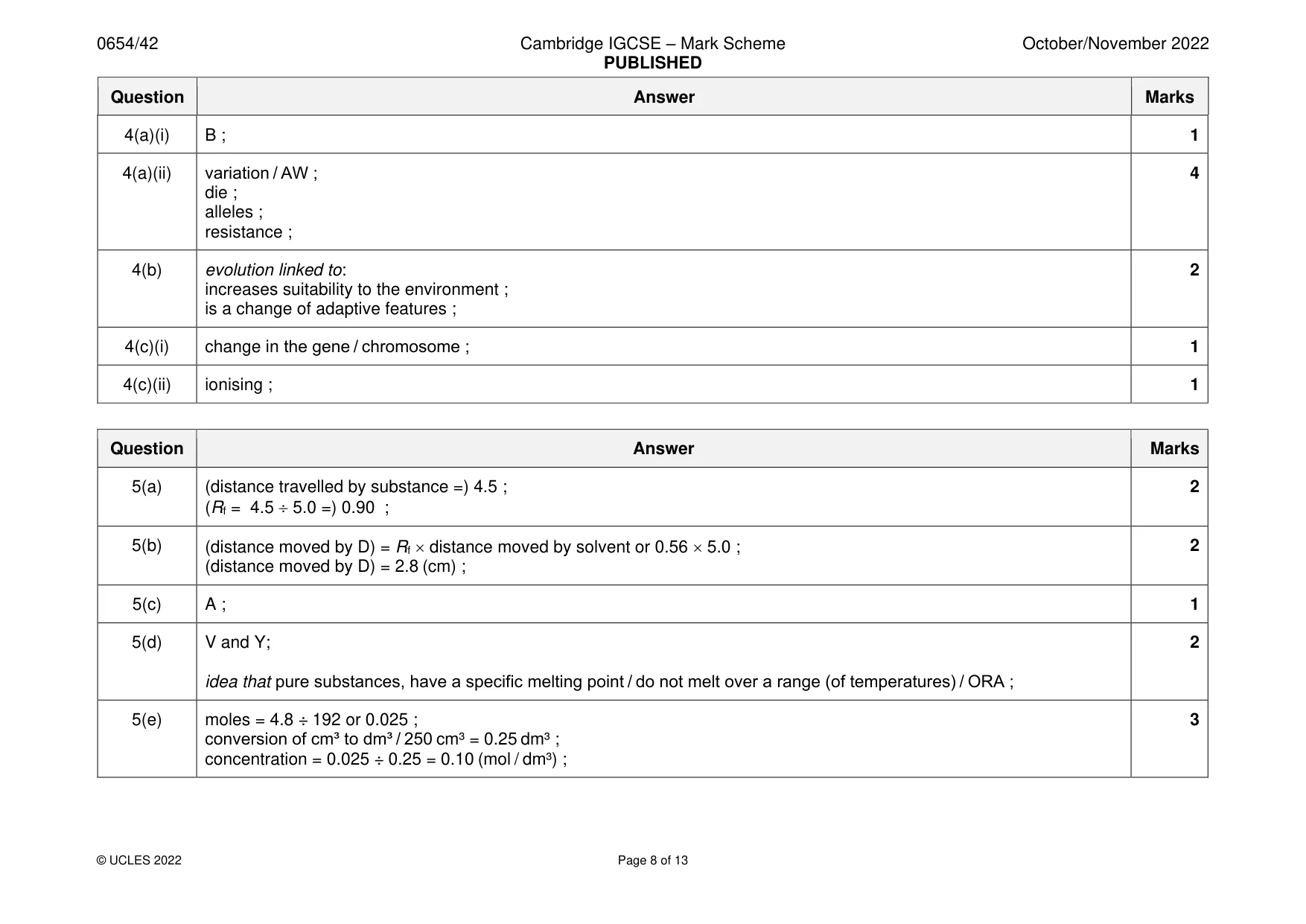
Mark scheme: 4(a)(i) B ; 1 4(a)(ii) variation / AW ; 4 die ; alleles ; resistance ; 4(b) evolution linked to: 2 increases suitability to the environment ; is a change of adaptive features ; 4(c)(i) change in the gene / chromosome ; 1 4(c)(ii) ionising ; 1
Q5 · A scientist investigates a food colouring, X, using chromatography
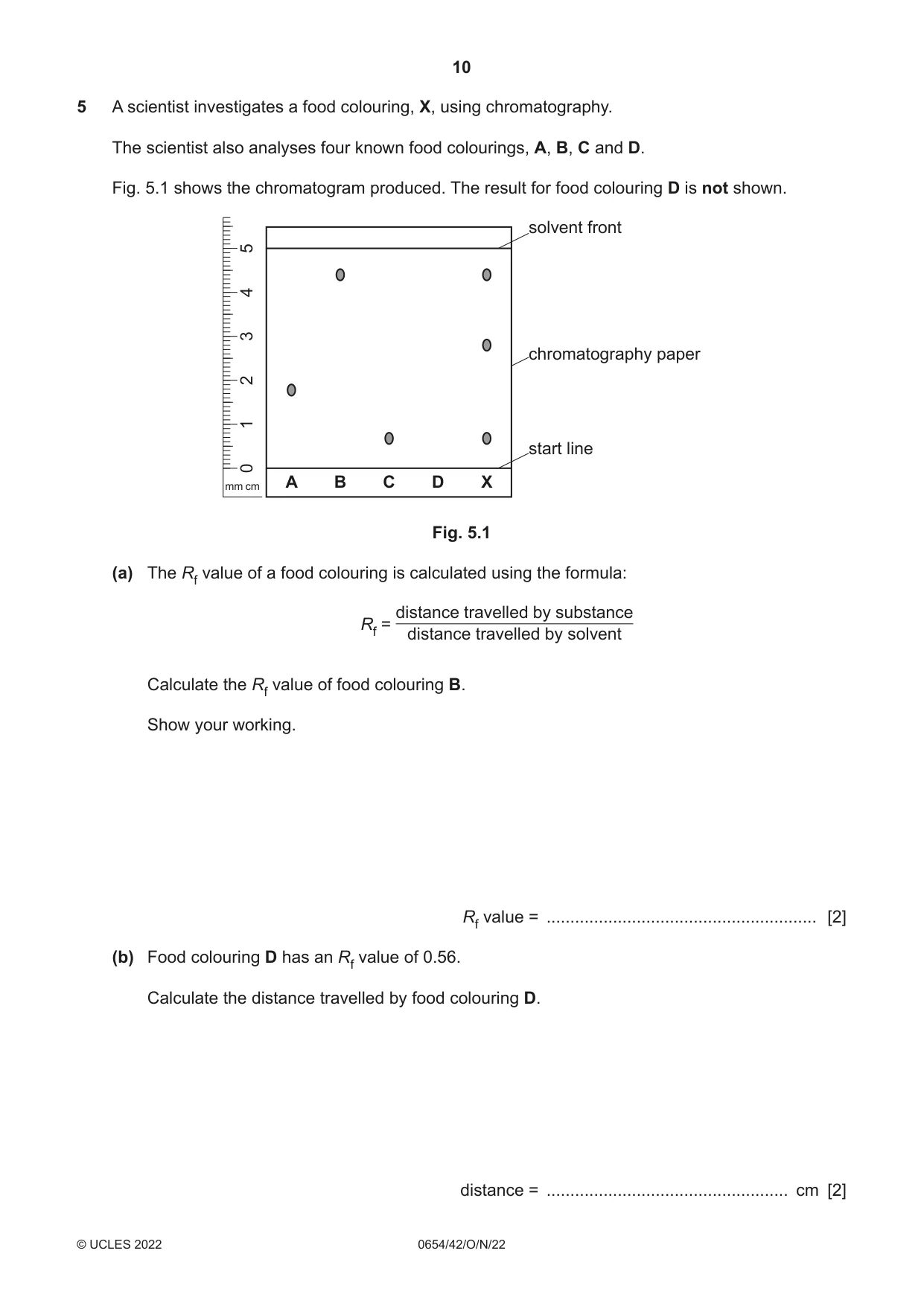
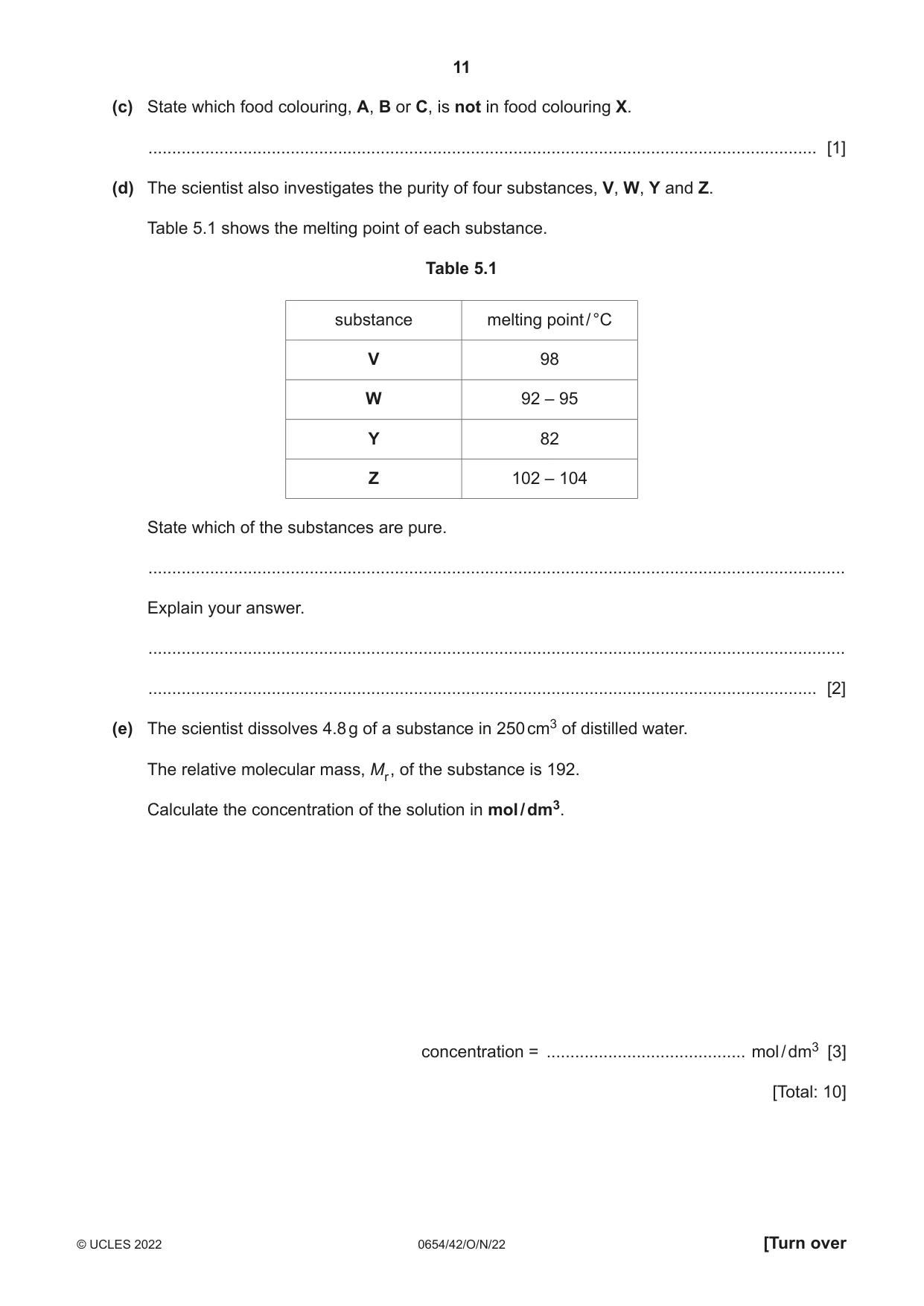
5 A scientist investigates a food colouring, X, using chromatography. The scientist also analyses four known food colourings, A, B, C and D. Fig. 5.1 shows the chromatogram produced. The result for food colouring D is not shown. solvent front 5 4 3 chromatography paper 2 1 start line 0 mm cm A B C D X Fig. 5.1 (a) The Rf value of a food colouring is calculated using the formula: distance travelled by substance Rf = distance travelled by solvent Calculate the Rf value of food colouring B. Show your working. Rf value = ......................................................... [2] (b) Food colouring D has an Rf value of 0.56. Calculate the distance travelled by food colouring D. distance = ................................................... cm [2] (c) State which food colouring, A, B or C, is not in food colouring X. ............................................................................................................................................. [1] (d) The scientist also investigates the purity of four substances, V, W, Y and Z. Table 5.1 shows the melting point of each substance. Table 5.1 substance melting point / °C V 98 W 92 – 95 Y 82 Z 102 – 104 State which of the substances are pure. ................................................................................................................................................... Explain your answer. ................................................................................................................................................... ............................................................................................................................................. [2] (e) The scientist dissolves 4.8 g of a substance in 250 cm3 of distilled water. The relative molecular mass, Mr , of the substance is 192. Calculate the concentration of the solution in mol / dm3. concentration = .......................................... mol / dm3 [3] [Total: 10]
Mark scheme: 5(a) (distance travelled by substance =) 4.5 ; 2 (Rf = 4.5 5.0 =) 0.90 ; 5(b) (distance moved by D) = Rf distance moved by solvent or 0.56 5.0 ; 2 (distance moved by D) = 2.8 (cm) ; 5(c) A ; 1 5(d) V and Y; 2 idea that pure substances, have a specific melting point / do not melt over a range (of temperatures) / ORA ; 5(e) moles = 4.8 ÷ 192 or 0.025 ; 3 conversion of cm³ to dm³ / 250 cm³ = 0.25 dm³ ; concentration = 0.025 ÷ 0.25 = 0.10 (mol / dm³) ;
Q6 · A temporary zebra enclosure in a wildlife conservation park
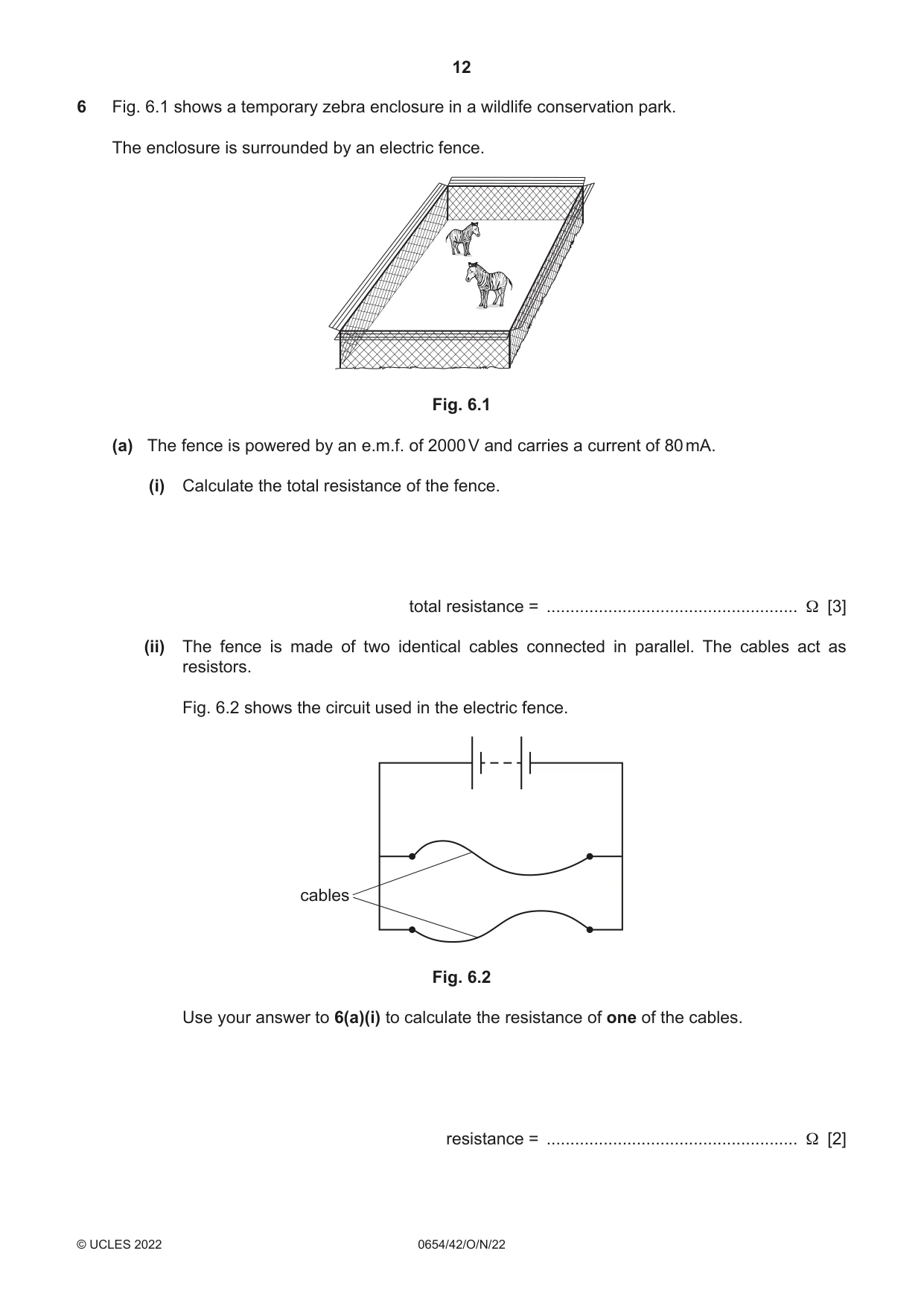
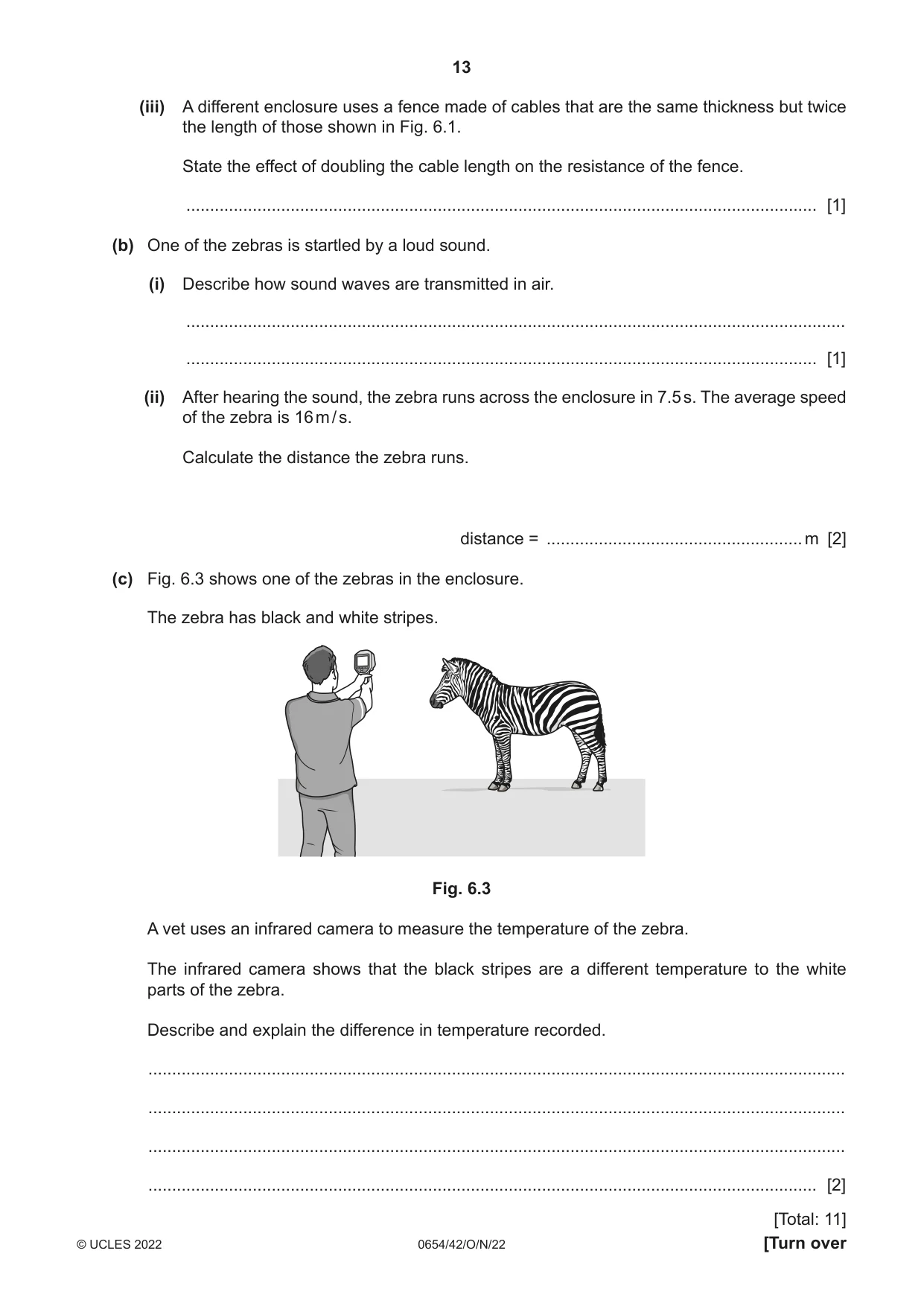
6 Fig. 6.1 shows a temporary zebra enclosure in a wildlife conservation park. The enclosure is surrounded by an electric fence. Fig. 6.1 (a) The fence is powered by an e.m.f. of 2000 V and carries a current of 80 mA. (i) Calculate the total resistance of the fence. total resistance = ..................................................... Ω [3] (ii) The fence is made of two identical cables connected in parallel. The cables act as resistors. Fig. 6.2 shows the circuit used in the electric fence. cables Fig. 6.2 Use your answer to 6(a)(i) to calculate the resistance of one of the cables. resistance = ..................................................... Ω [2] (iii) A different enclosure uses a fence made of cables that are the same thickness but twice the length of those shown in Fig. 6.1. State the effect of doubling the cable length on the resistance of the fence. ..................................................................................................................................... [1] (b) One of the zebras is startled by a loud sound. (i) Describe how sound waves are transmitted in air. ........................................................................................................................................... ..................................................................................................................................... [1] (ii) After hearing the sound, the zebra runs across the enclosure in 7.5 s. The average speed of the zebra is 16 m / s. Calculate the distance the zebra runs. distance = ......................................................m [2] (c) Fig. 6.3 shows one of the zebras in the enclosure. The zebra has black and white stripes. Fig. 6.3 A vet uses an infrared camera to measure the temperature of the zebra. The infrared camera shows that the black stripes are a different temperature to the white parts of the zebra. Describe and explain the difference in temperature recorded. ................................................................................................................................................... ................................................................................................................................................... ................................................................................................................................................... ............................................................................................................................................. [2] [Total: 11]
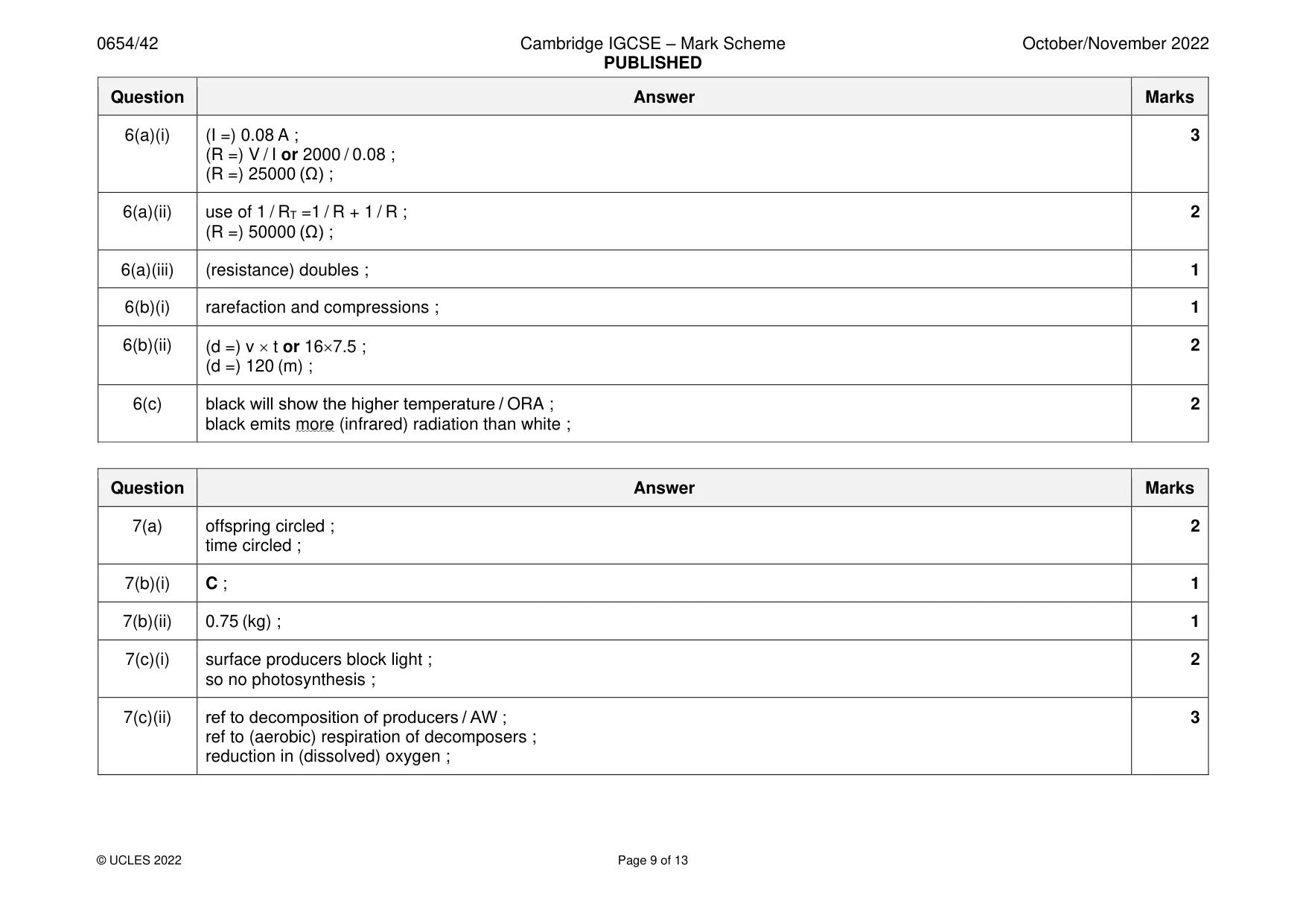
Mark scheme: 6(a)(i) (I =) 0.08 A ; 3 (R =) V / I or 2000 / 0.08 ; (R =) 25000 (Ω) ; 6(a)(ii) use of 1 / RT =1 / R + 1 / R ; 2 (R =) 50000 (Ω) ; 6(a)(iii) (resistance) doubles ; 1 6(b)(i) rarefaction and compressions ; 1 6(b)(ii) (d =) v t or 167.5 ; 2 (d =) 120 (m) ; 6(c) black will show the higher temperature / ORA ; 2 black emits more (infrared) radiation than white ;
Q7 · Discarded rubbish pollutes ecosystems such as oceans and rivers
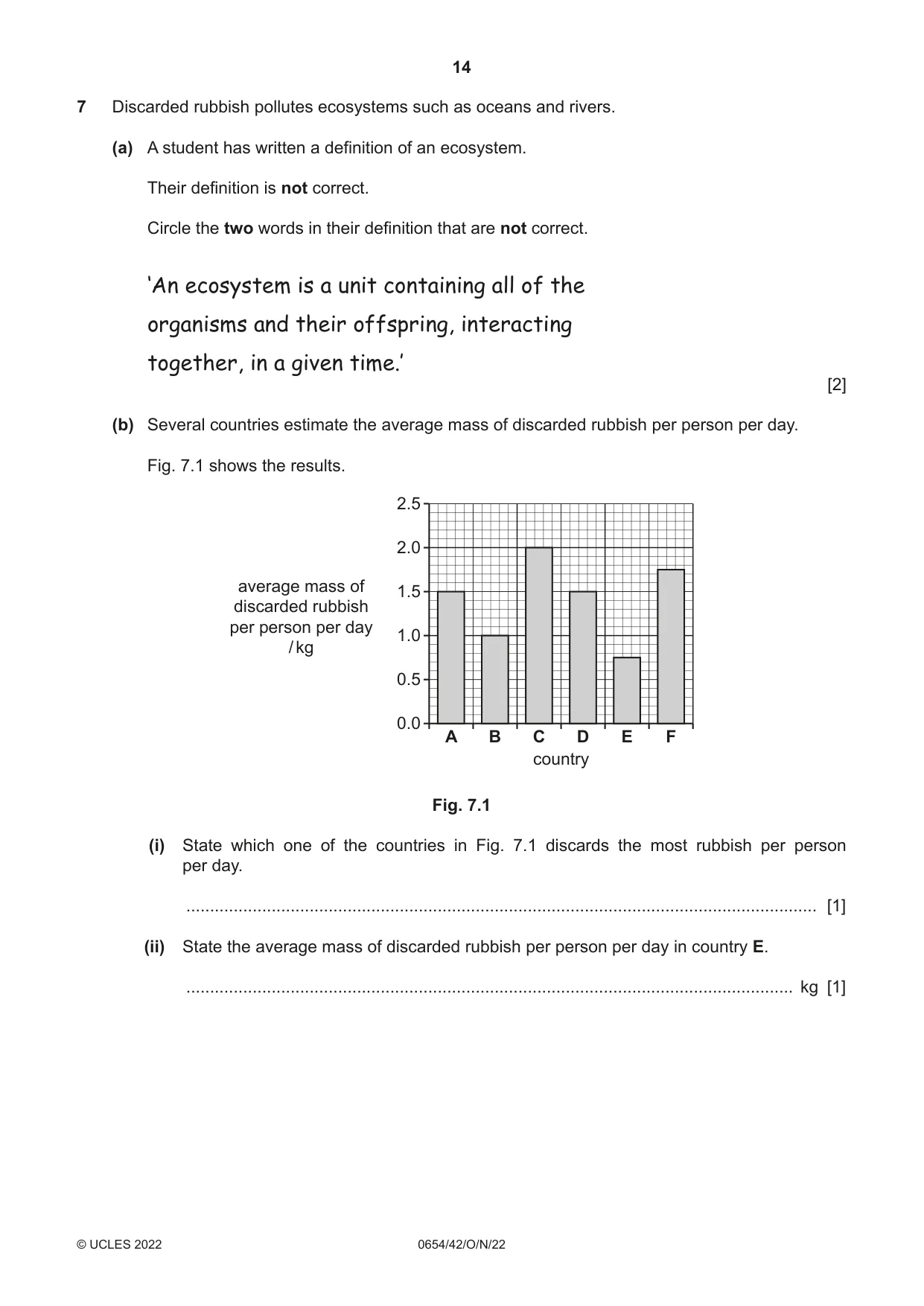
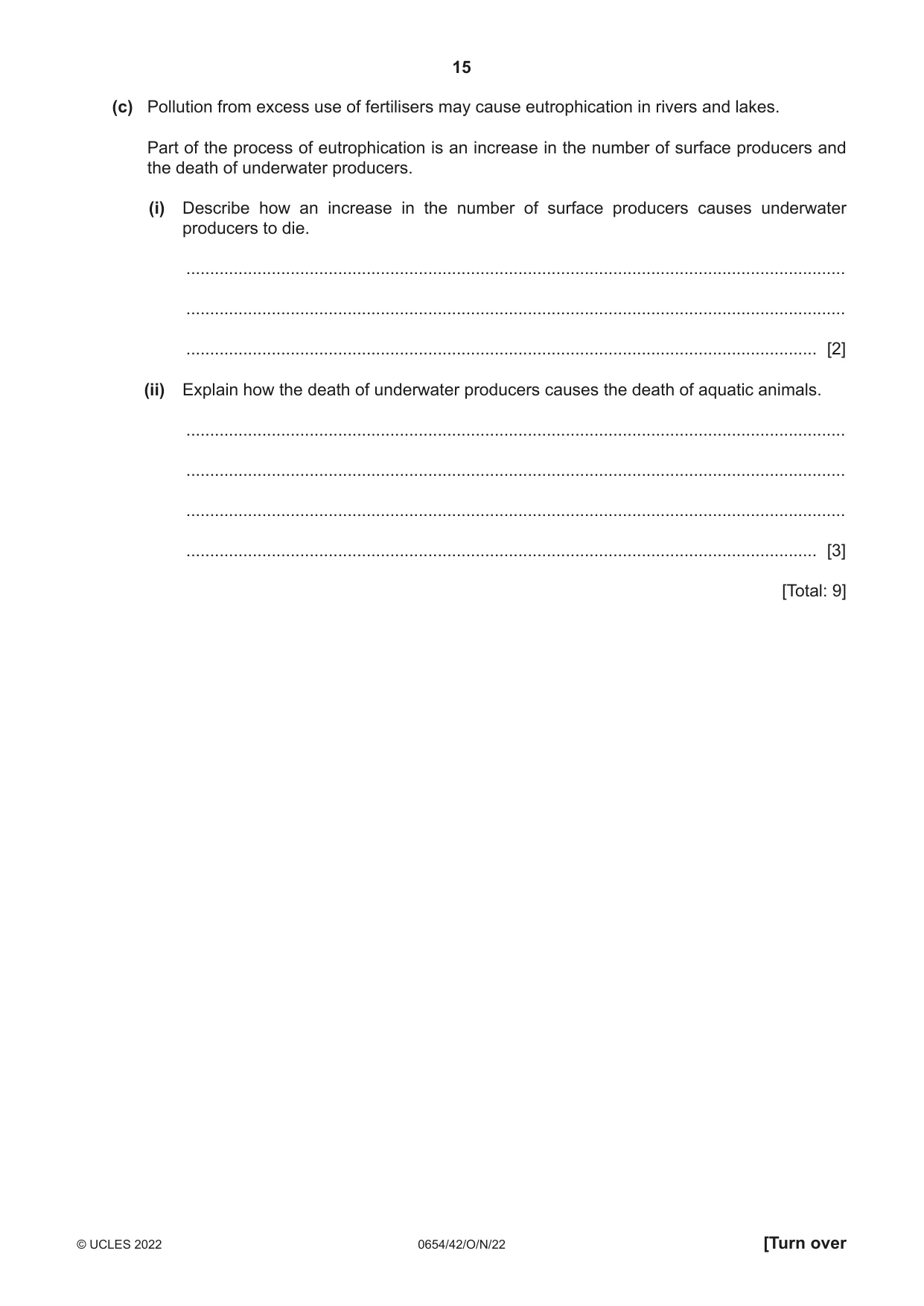
7 Discarded rubbish pollutes ecosystems such as oceans and rivers. (a) A student has written a definition of an ecosystem. Their definition is not correct. Circle the two words in their definition that are not correct. ‘An ecosystem is a unit containing all of the organisms and their offspring, interacting together, in a given time.’ [2] (b) Several countries estimate the average mass of discarded rubbish per person per day. Fig. 7.1 shows the results. 2.5 2.0 average mass of 1.5 discarded rubbish per person per day 1.0 / kg 0.5 0.0 A B C D E F country Fig. 7.1 (i) State which one of the countries in Fig. 7.1 discards the most rubbish per person per day. ..................................................................................................................................... [1] (ii) State the average mass of discarded rubbish per person per day in country E. ................................................................................................................................ kg [1] (c) Pollution from excess use of fertilisers may cause eutrophication in rivers and lakes. Part of the process of eutrophication is an increase in the number of surface producers and the death of underwater producers. (i) Describe how an increase in the number of surface producers causes underwater producers to die. ........................................................................................................................................... ........................................................................................................................................... ..................................................................................................................................... [2] (ii) Explain how the death of underwater producers causes the death of aquatic animals. ........................................................................................................................................... ........................................................................................................................................... ........................................................................................................................................... ..................................................................................................................................... [3] [Total: 9]
Mark scheme: 7(a) offspring circled ; 2 time circled ; 7(b)(i) C ; 1 7(b)(ii) 0.75 (kg) ; 1 7(c)(i) surface producers block light ; 2 so no photosynthesis ; 7(c)(ii) ref to decomposition of producers / AW ; 3 ref to (aerobic) respiration of decomposers ; reduction in (dissolved) oxygen ;
Q8 · A student investigates acids and bases
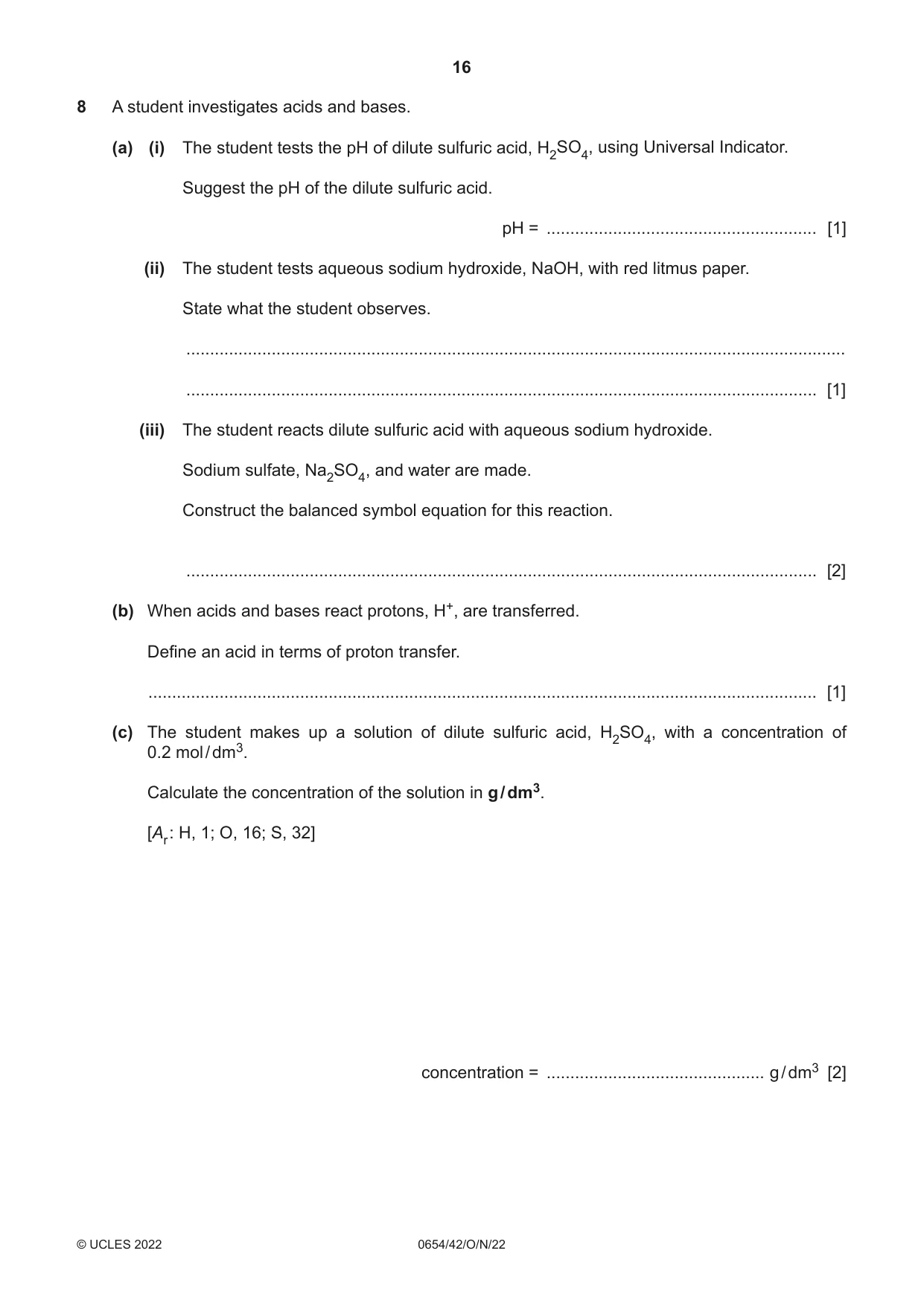
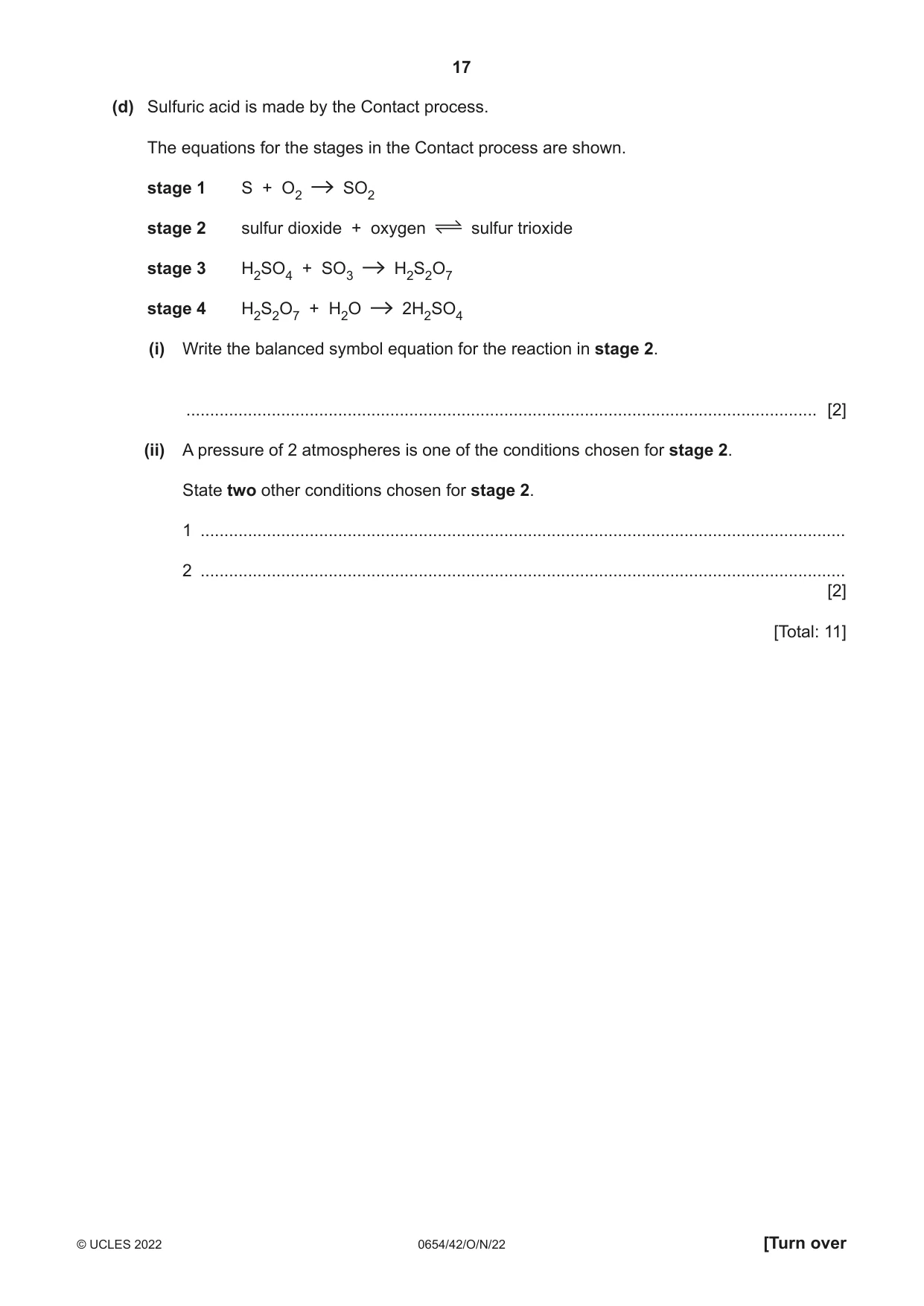
8 A student investigates acids and bases. (a) (i) The student tests the pH of dilute sulfuric acid, H2SO4, using Universal Indicator. Suggest the pH of the dilute sulfuric acid. pH = ......................................................... [1] (ii) The student tests aqueous sodium hydroxide, NaOH, with red litmus paper. State what the student observes. ........................................................................................................................................... ..................................................................................................................................... [1] (iii) The student reacts dilute sulfuric acid with aqueous sodium hydroxide. Sodium sulfate, Na2SO4, and water are made. Construct the balanced symbol equation for this reaction. ..................................................................................................................................... [2] (b) When acids and bases react protons, H+, are transferred. Define an acid in terms of proton transfer. ............................................................................................................................................. [1] (c) The student makes up a solution of dilute sulfuric acid, H2SO4, with a concentration of 0.2 mol / dm3. Calculate the concentration of the solution in g / dm3. [Ar : H, 1; O, 16; S, 32] concentration = .............................................. g / dm3 [2] (d) Sulfuric acid is made by the Contact process. The equations for the stages in the Contact process are shown. stage 1 S + O2 SO2 stage 2 sulfur dioxide + oxygen sulfur trioxide stage 3 H2SO4 + SO3 H2S2O7 stage 4 H2S2O7 + H2O 2H2SO4 (i) Write the balanced symbol equation for the reaction in stage 2. ..................................................................................................................................... [2] (ii) A pressure of 2 atmospheres is one of the conditions chosen for stage 2. State two other conditions chosen for stage 2. 1 ........................................................................................................................................ 2 ........................................................................................................................................ [2] [Total: 11]
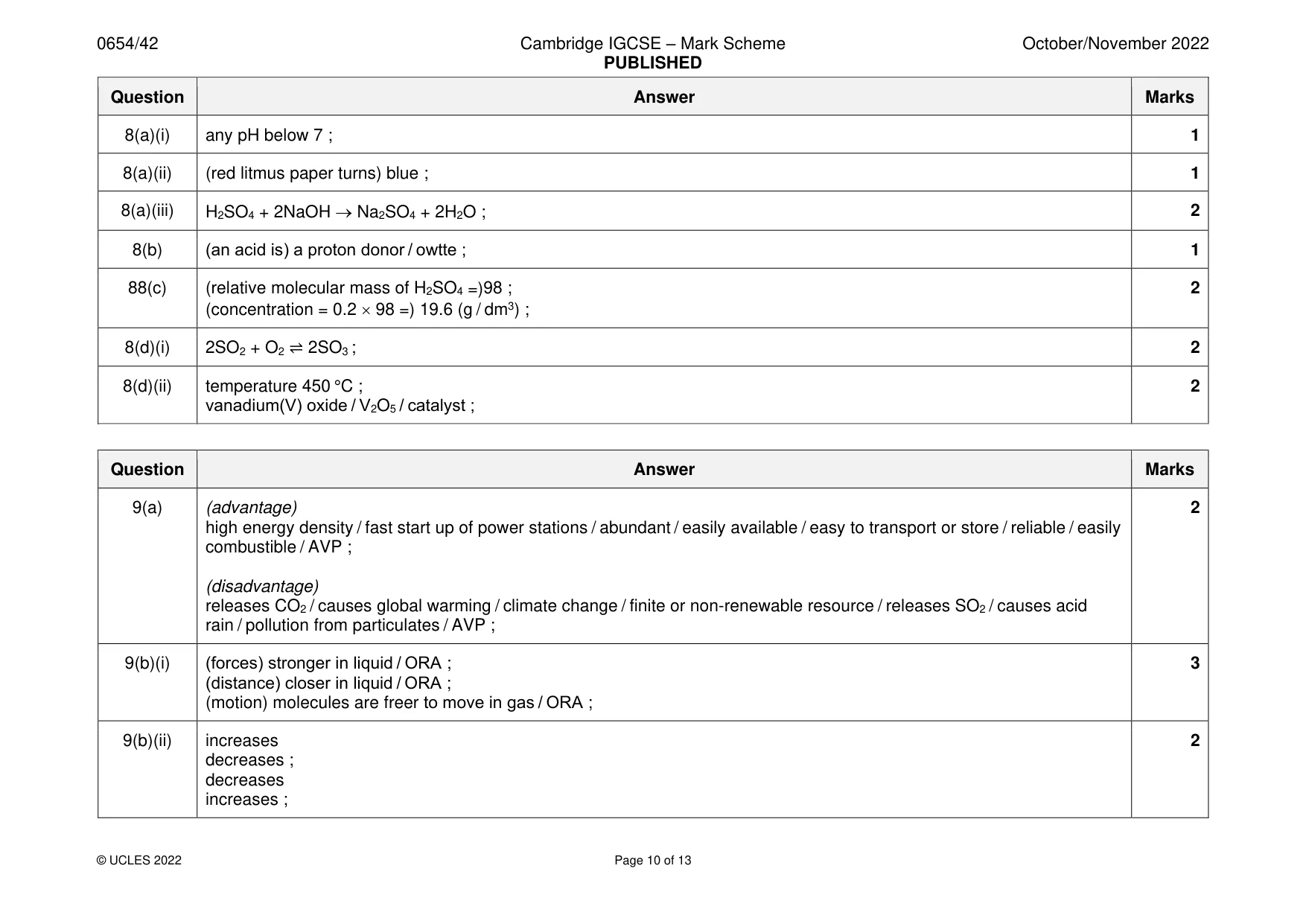
Mark scheme: 8(a)(i) any pH below 7 ; 1 8(a)(ii) (red litmus paper turns) blue ; 1 8(a)(iii) H2SO4 + 2NaOH → Na2SO4 + 2H2O ; 2 8(b) (an acid is) a proton donor / owtte ; 1
More questions on The characteristic properties of acids and bases
Q9 · Burning coal can be used to generate electricity
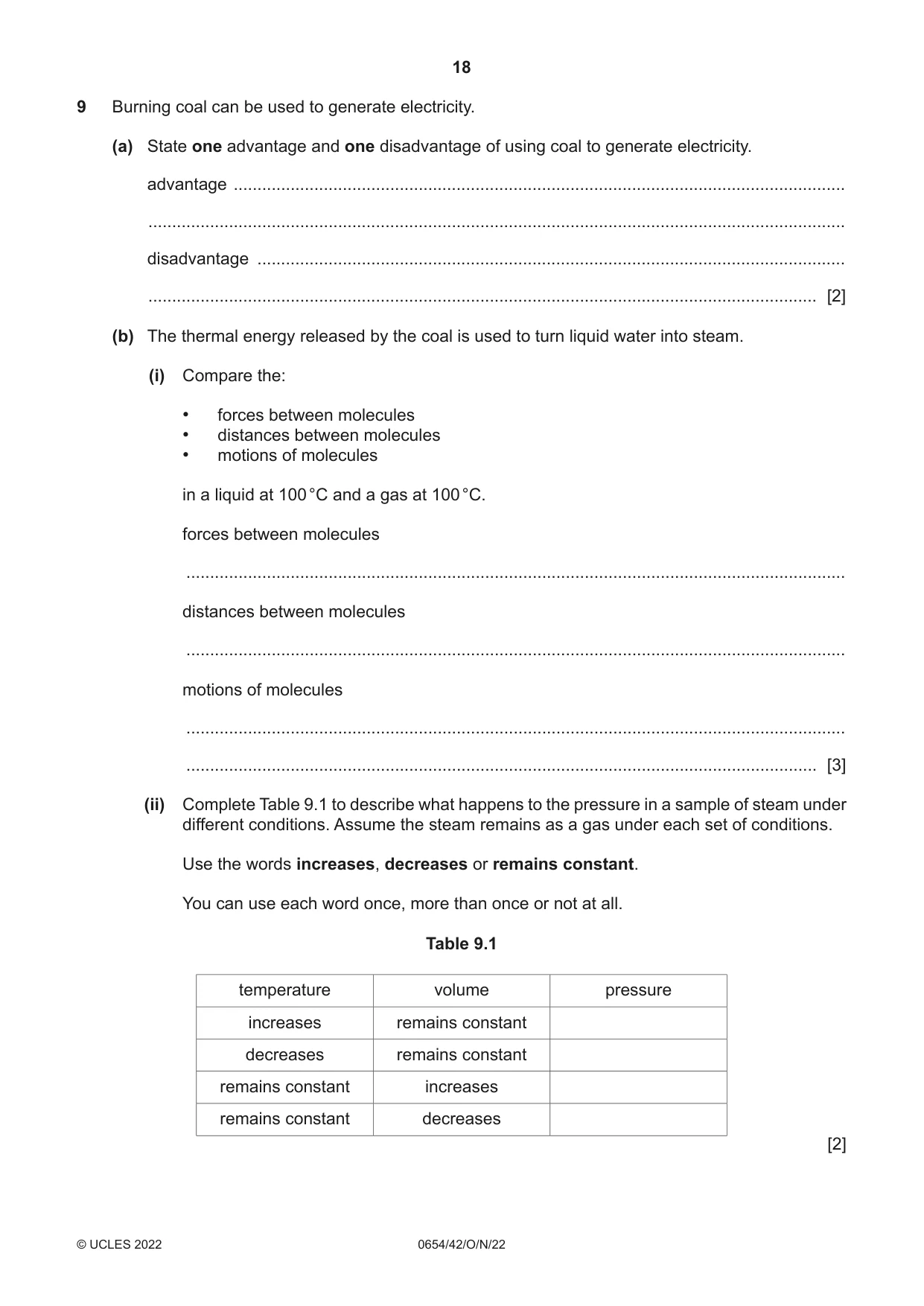
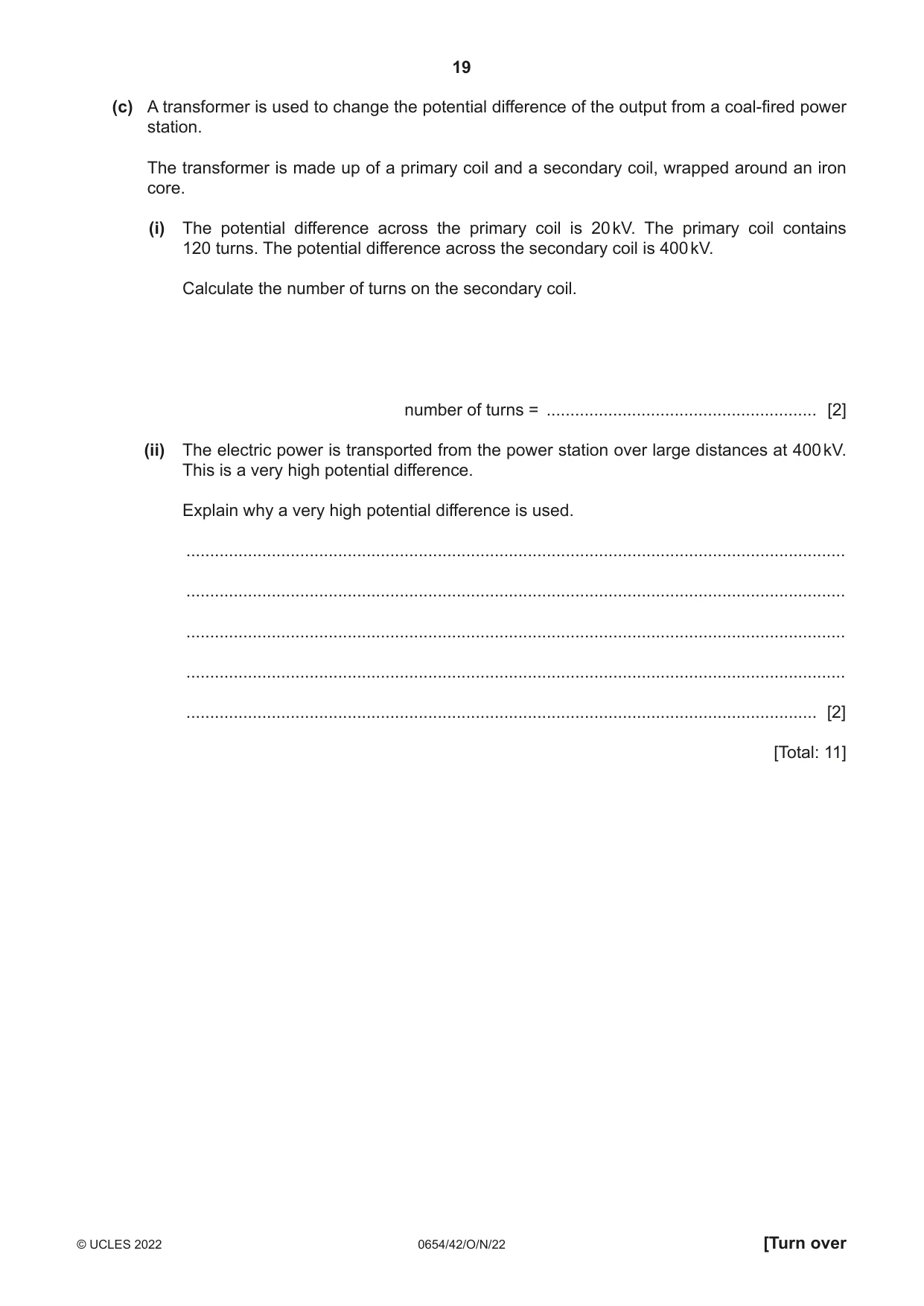
9 Burning coal can be used to generate electricity. (a) State one advantage and one disadvantage of using coal to generate electricity. advantage ................................................................................................................................. ................................................................................................................................................... disadvantage ............................................................................................................................ ............................................................................................................................................. [2] (b) The thermal energy released by the coal is used to turn liquid water into steam. (i) Compare the: • forces between molecules • distances between molecules • motions of molecules in a liquid at 100 °C and a gas at 100 °C. forces between molecules ........................................................................................................................................... distances between molecules ........................................................................................................................................... motions of molecules ........................................................................................................................................... ..................................................................................................................................... [3] (ii) Complete Table 9.1 to describe what happens to the pressure in a sample of steam under different conditions. Assume the steam remains as a gas under each set of conditions. Use the words increases, decreases or remains constant. You can use each word once, more than once or not at all. Table 9.1 temperature volume pressure increases remains constant decreases remains constant remains constant increases remains constant decreases [2] (c) A transformer is used to change the potential difference of the output from a coal-fired power station. The transformer is made up of a primary coil and a secondary coil, wrapped around an iron core. (i) The potential difference across the primary coil is 20 kV. The primary coil contains 120 turns. The potential difference across the secondary coil is 400 kV. Calculate the number of turns on the secondary coil. number of turns = ......................................................... [2] (ii) The electric power is transported from the power station over large distances at 400 kV. This is a very high potential difference. Explain why a very high potential difference is used. ........................................................................................................................................... ........................................................................................................................................... ........................................................................................................................................... ........................................................................................................................................... ..................................................................................................................................... [2] [Total: 11]
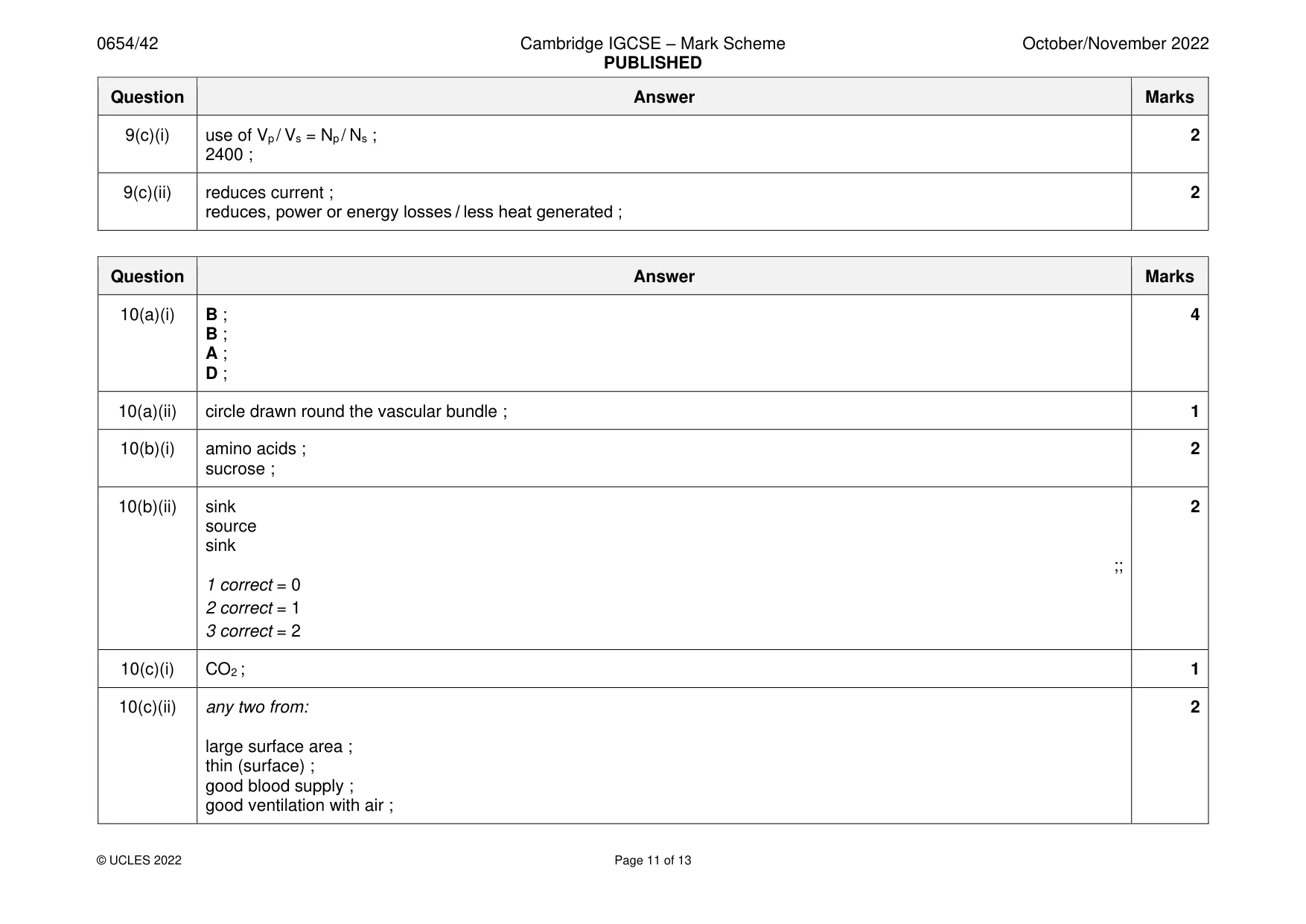
Mark scheme: 9(a) (advantage) 2 high energy density / fast start up of power stations / abundant / easily available / easy to transport or store / reliable / easily combustible / AVP ; (disadvantage) releases CO2 / causes global warming / climate change / finite or non-renewable resource / releases SO2 / causes acid rain / pollution from particulates / AVP ; 9(b)(i) (forces) stronger in liquid / ORA ; 3 (distance) closer in liquid / ORA ; (motion) molecules are freer to move in gas / ORA ; 9(b)(ii) increases 2 decreases ; decreases increases ; 9(c)(i) use of Vp / Vs = Np / Ns ; 2 2400 ; 9(c)(ii) reduces current ; 2 reduces, power or energy losses / less heat generated ;
Q10 · A diagram of a cross-section through a leaf
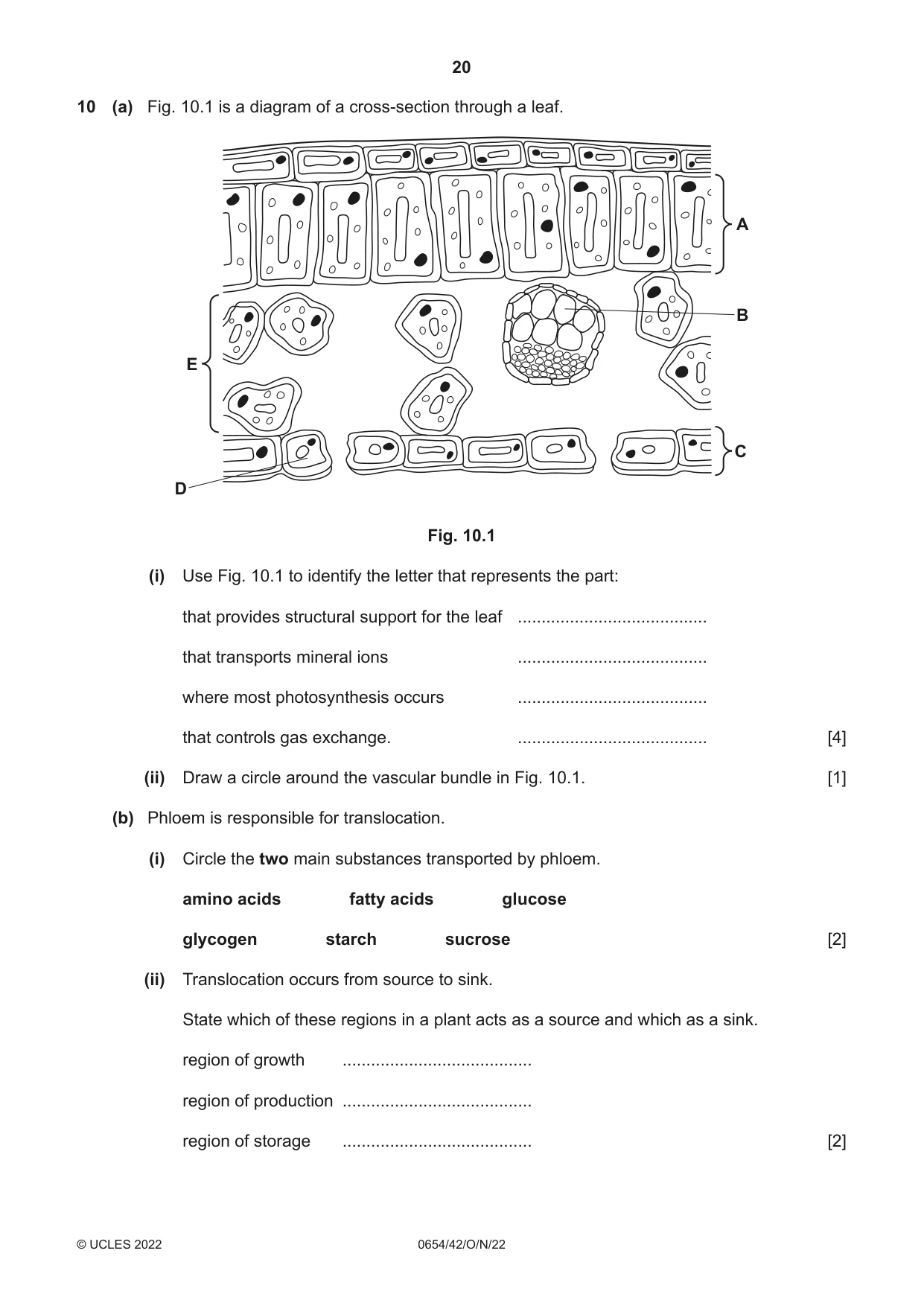
10 (a) Fig. 10.1 is a diagram of a cross-section through a leaf. A B E C D Fig. 10.1 (i) Use Fig. 10.1 to identify the letter that represents the part: that provides structural support for the leaf ........................................ that transports mineral ions ........................................ where most photosynthesis occurs ........................................ that controls gas exchange. ........................................ [4] (ii) Draw a circle around the vascular bundle in Fig. 10.1. [1] (b) Phloem is responsible for translocation. (i) Circle the two main substances transported by phloem. amino acids fatty acids glucose glycogen starch sucrose [2] (ii) Translocation occurs from source to sink. State which of these regions in a plant acts as a source and which as a sink. region of growth ........................................ region of production ........................................ region of storage ........................................ [2] (c) Gas exchange occurs in both plants and animals. (i) State the chemical formula of the gas that is required for photosynthesis. ..................................................................................................................................... [1] (ii) State two features of gas exchange surfaces in humans. 1 ........................................................................................................................................ 2 ........................................................................................................................................ [2] [Total: 12]
Mark scheme: 10(a)(i) B ; 4 B ; A ; D ; 10(a)(ii) circle drawn round the vascular bundle ; 1 10(b)(i) amino acids ; 2 sucrose ; 10(b)(ii) sink 2 source sink ;; 1 correct = 0 2 correct = 1 3 correct = 2 10(c)(i) CO2 ; 1 10(c)(ii) any two from: 2 large surface area ; thin (surface) ; good blood supply ; good ventilation with air ;
Q11 · Ethane and ethene are members of two different homologous series
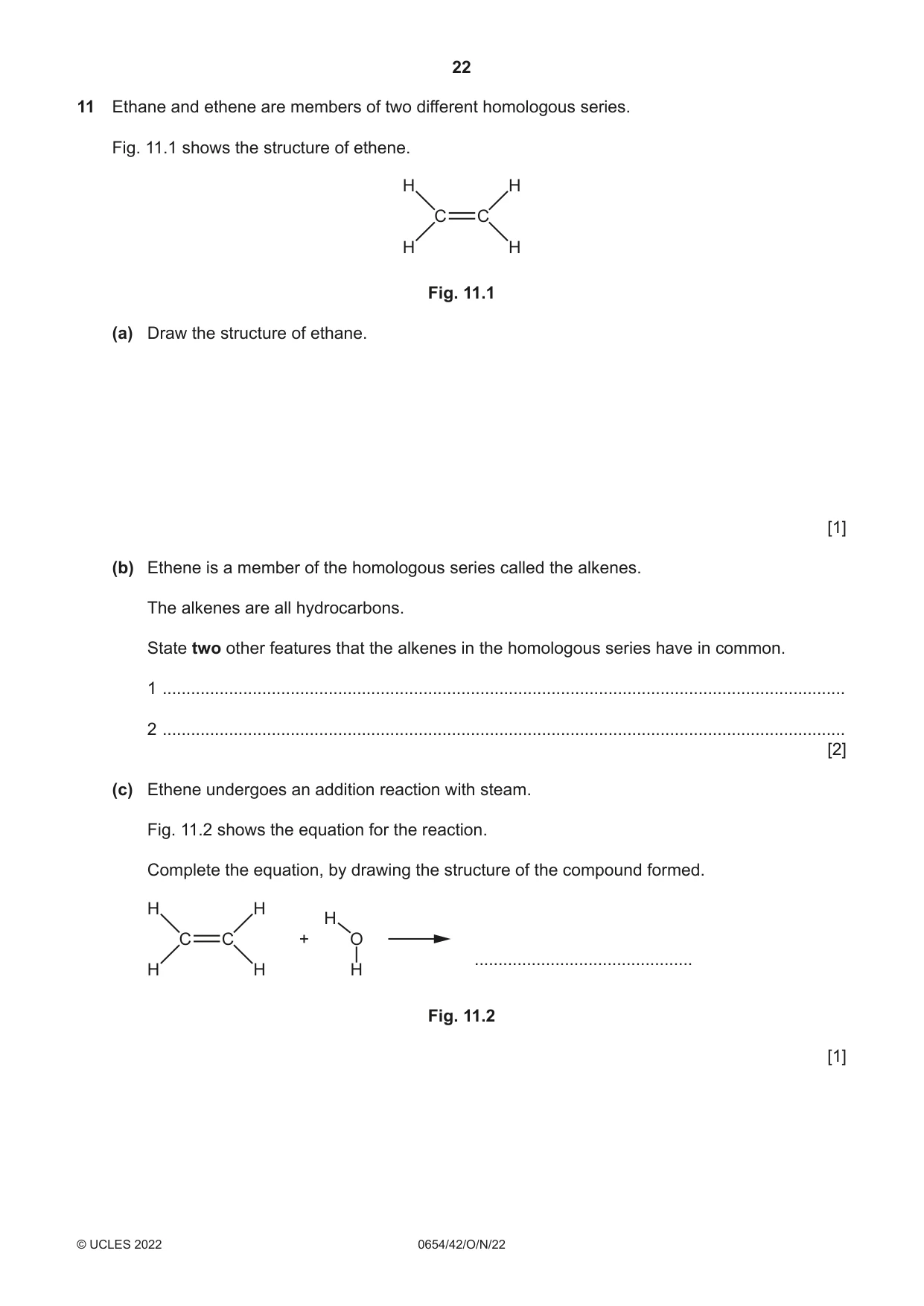
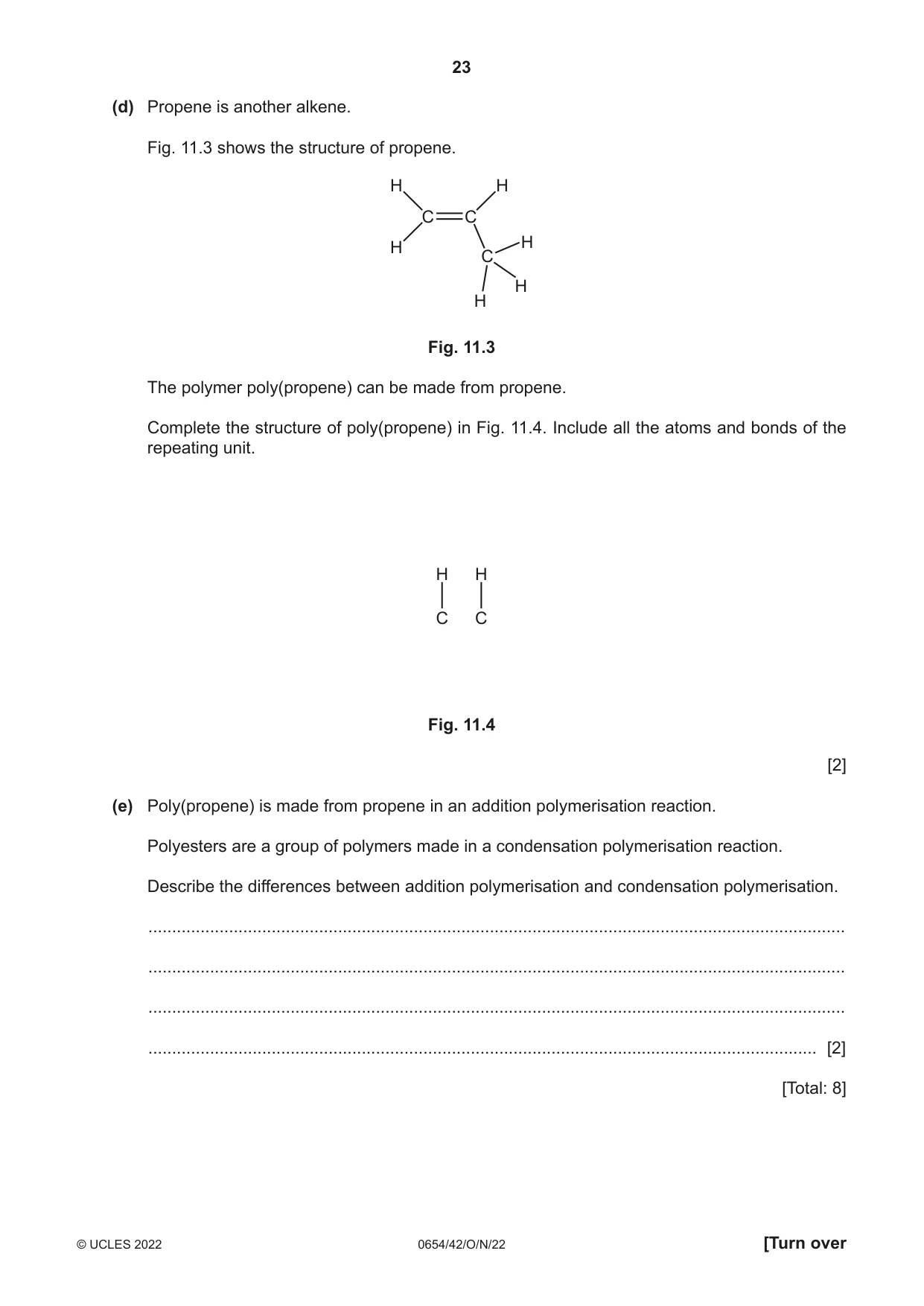
11 Ethane and ethene are members of two different homologous series. Fig. 11.1 shows the structure of ethene. H H C C H H Fig. 11.1 (a) Draw the structure of ethane. [1] (b) Ethene is a member of the homologous series called the alkenes. The alkenes are all hydrocarbons. State two other features that the alkenes in the homologous series have in common. 1 ................................................................................................................................................ 2 ................................................................................................................................................ [2] (c) Ethene undergoes an addition reaction with steam. Fig. 11.2 shows the equation for the reaction. Complete the equation, by drawing the structure of the compound formed. H H H C C + O .............................................. H H H Fig. 11.2 [1] (d) Propene is another alkene. Fig. 11.3 shows the structure of propene. H H C C H H C H H Fig. 11.3 The polymer poly(propene) can be made from propene. Complete the structure of poly(propene) in Fig. 11.4. Include all the atoms and bonds of the repeating unit. H H C C Fig. 11.4 [2] (e) Poly(propene) is made from propene in an addition polymerisation reaction. Polyesters are a group of polymers made in a condensation polymerisation reaction. Describe the differences between addition polymerisation and condensation polymerisation. ................................................................................................................................................... ................................................................................................................................................... ................................................................................................................................................... ............................................................................................................................................. [2] [Total: 8]
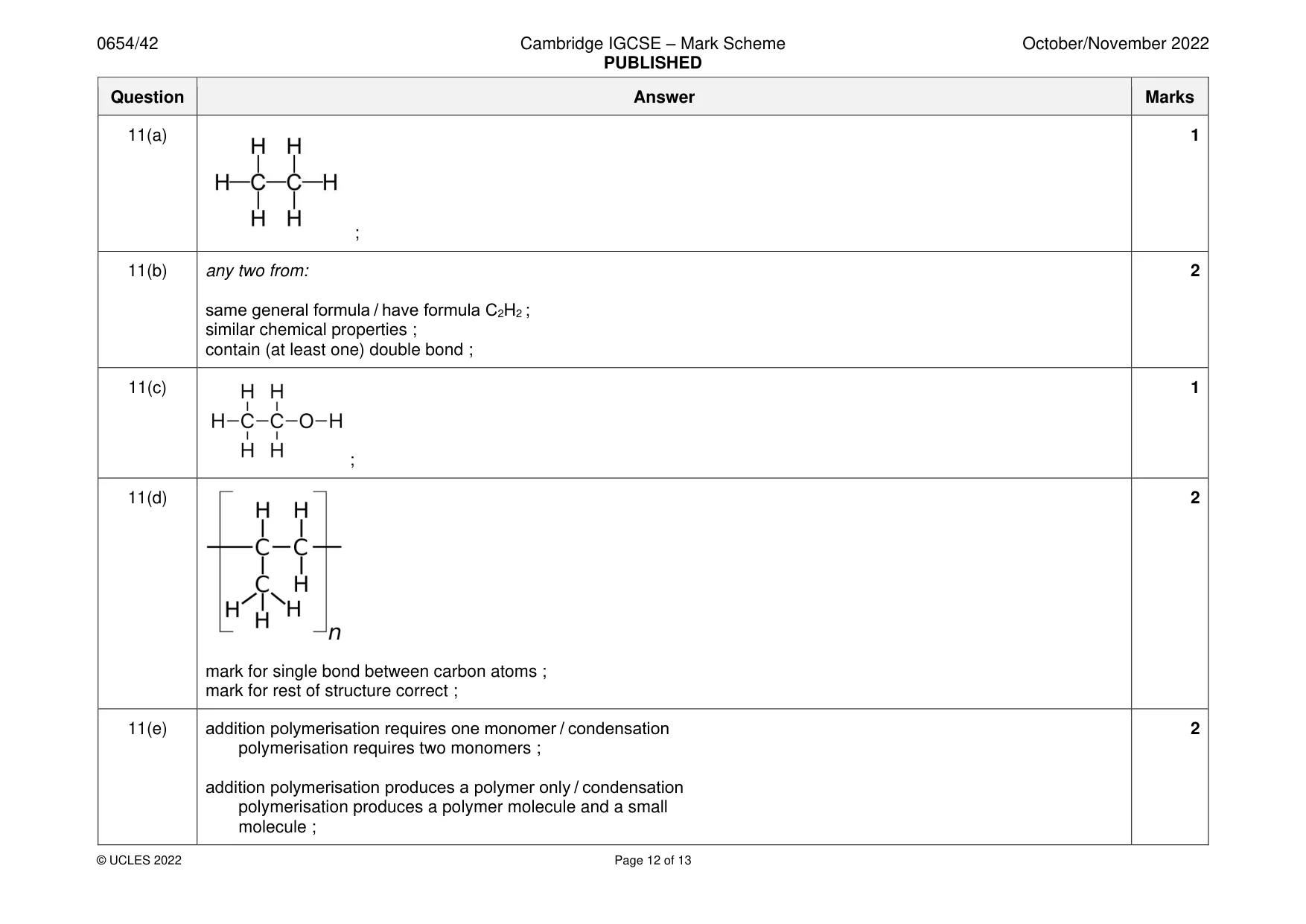
Mark scheme: 11(a) 1 ; 11(b) any two from: 2 same general formula / have formula C2H2 ; similar chemical properties ; contain (at least one) double bond ; 11(c) 1 ; 11(d) 2 mark for single bond between carbon atoms ; mark for rest of structure correct ; 11(e) addition polymerisation requires one monomer / condensation 2 polymerisation requires two monomers ; addition polymerisation produces a polymer only / condensation polymerisation produces a polymer molecule and a small molecule ;
Q12 · The equipment used by a teacher to demonstrate the properties of ionising radiation
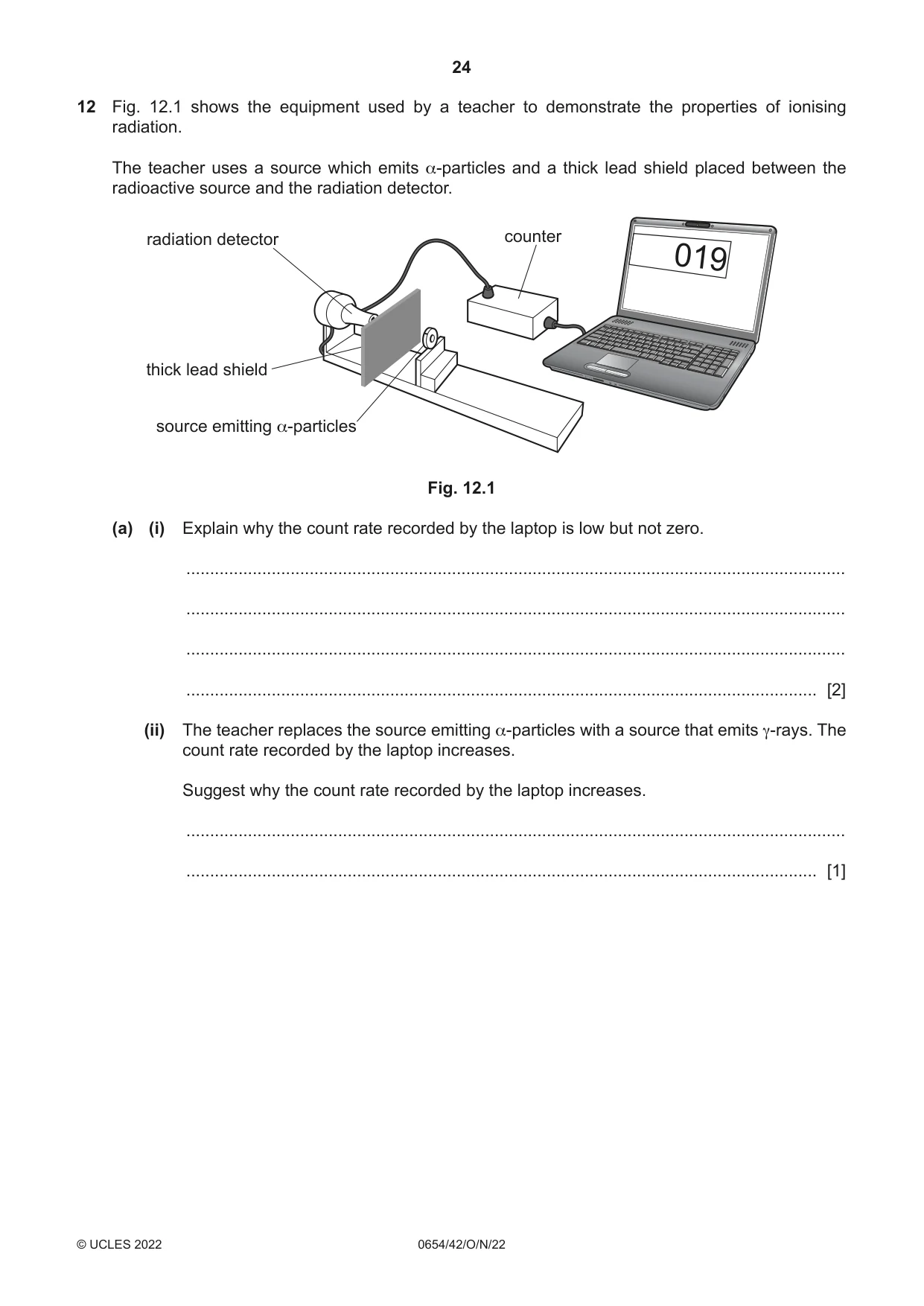
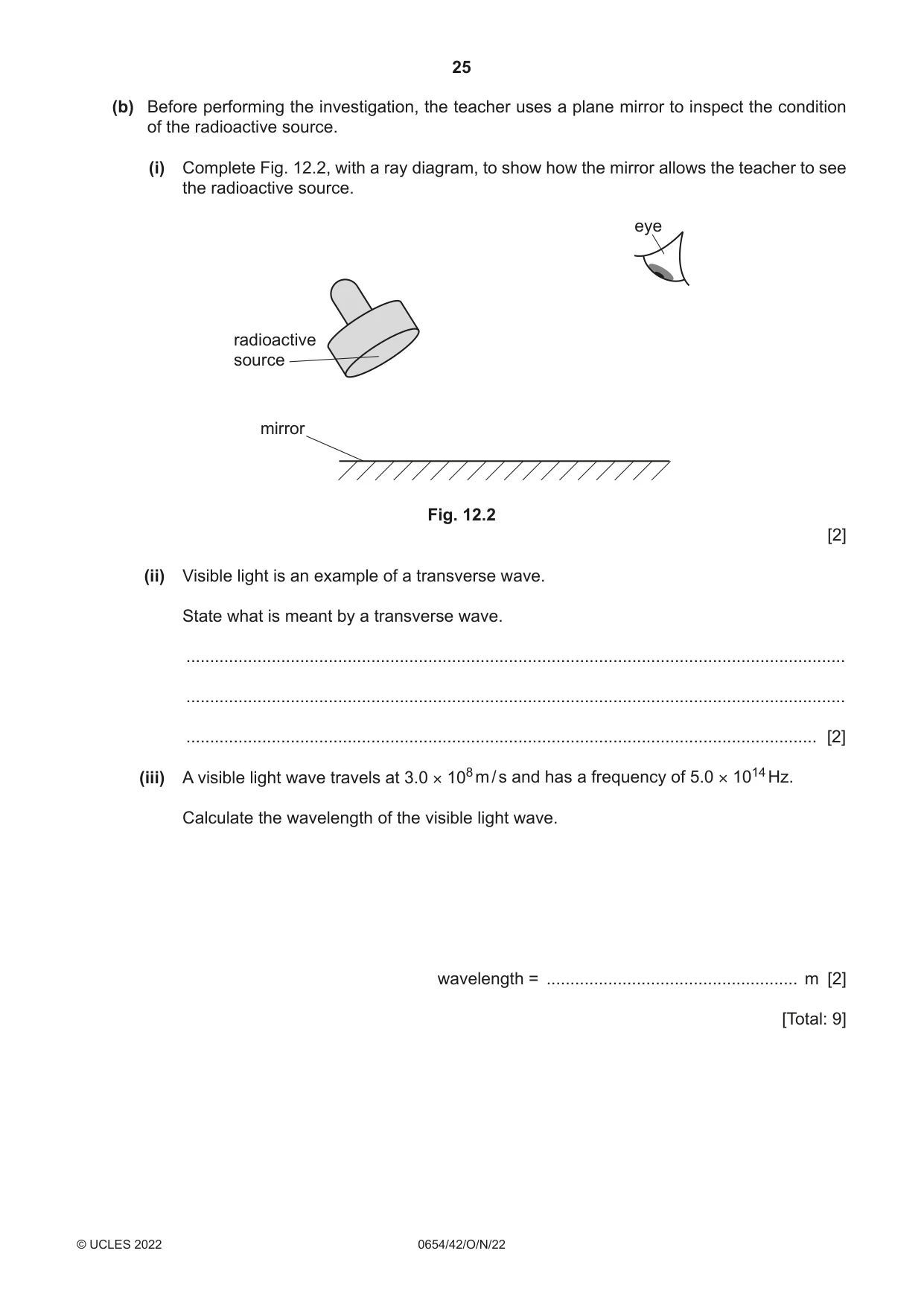
12 Fig. 12.1 shows the equipment used by a teacher to demonstrate the properties of ionising radiation. The teacher uses a source which emits α-particles and a thick lead shield placed between the radioactive source and the radiation detector. radiation detector counter 019 thick lead shield source emitting α-particles Fig. 12.1 (a) (i) Explain why the count rate recorded by the laptop is low but not zero. ........................................................................................................................................... ........................................................................................................................................... ........................................................................................................................................... ..................................................................................................................................... [2] (ii) The teacher replaces the source emitting α-particles with a source that emits γ-rays. The count rate recorded by the laptop increases. Suggest why the count rate recorded by the laptop increases. ........................................................................................................................................... ..................................................................................................................................... [1] (b) Before performing the investigation, the teacher uses a plane mirror to inspect the condition of the radioactive source. (i) Complete Fig. 12.2, with a ray diagram, to show how the mirror allows the teacher to see the radioactive source. eye radioactive source mirror Fig. 12.2 [2] (ii) Visible light is an example of a transverse wave. State what is meant by a transverse wave. ........................................................................................................................................... ........................................................................................................................................... ..................................................................................................................................... [2] (iii) A visible light wave travels at 3.0 × 10⁸ m / s and has a frequency of 5.0 × 10¹⁴ Hz. Calculate the wavelength of the visible light wave. wavelength = ..................................................... m [2] [Total: 9]
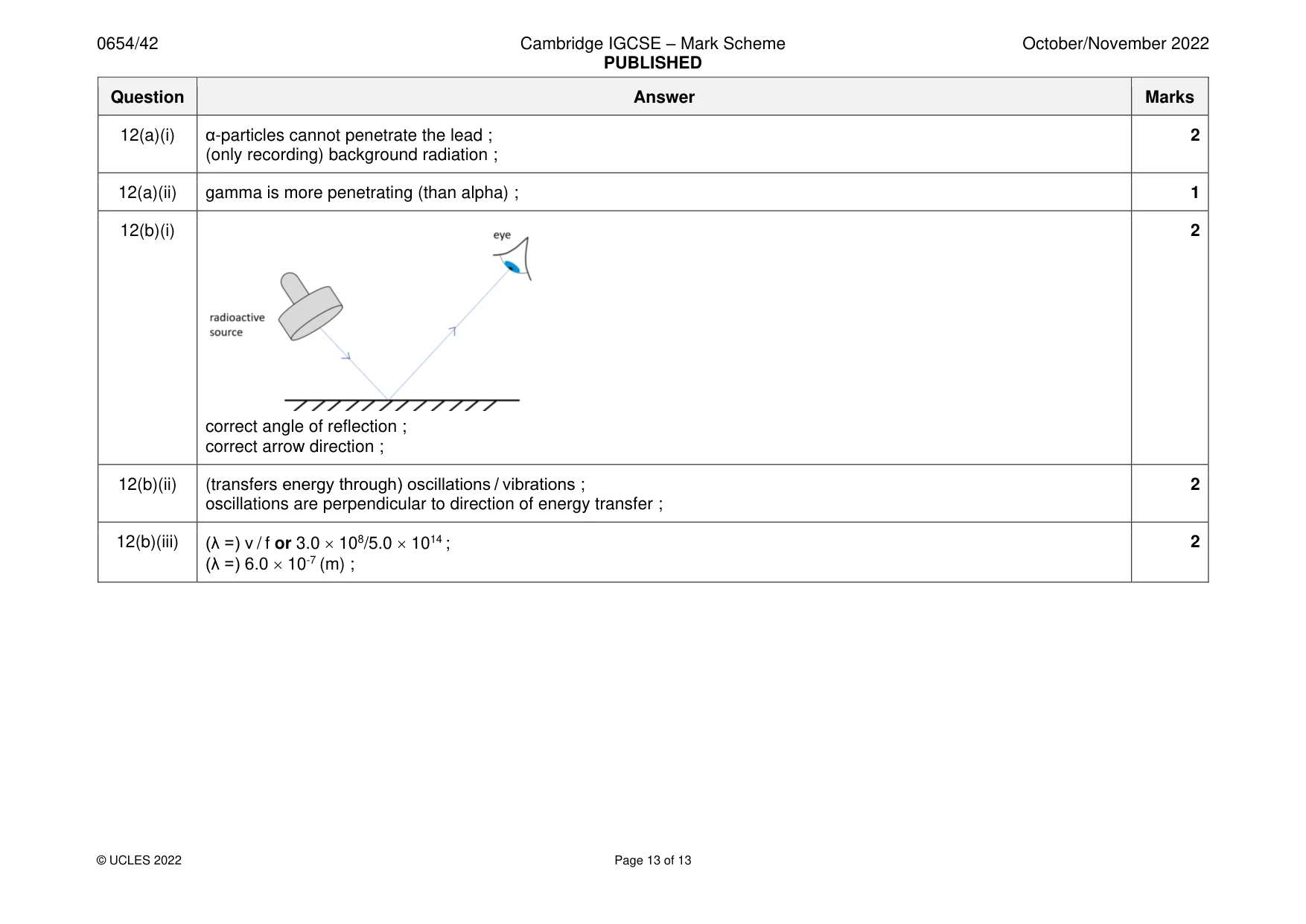
Mark scheme: 12(a)(i) α-particles cannot penetrate the lead ; 2 (only recording) background radiation ; 12(a)(ii) gamma is more penetrating (than alpha) ; 1 12(b)(i) 2 correct angle of reflection ; correct arrow direction ; 12(b)(ii) (transfers energy through) oscillations / vibrations ; 2 oscillations are perpendicular to direction of energy transfer ; 12(b)(iii) (λ =) v / f or 3.0 108/5.0 1014 ; 2 (λ =) 6.0 10-7 (m) ;
What was in this paper
The subtopics covered by these 12 questions, and how many questions each got. Open one in a new tab to see every Cambridge question on it.
What you needed in this session
Cambridge’s own grade thresholds for 2022 Oct/Nov, Paper 4 · Variant 2. A higher threshold means an easier paper — the bar moves with how the cohort did.