Questions as text
Q1 · A newton is a unit of force 0653/11 Oct/Nov 2006
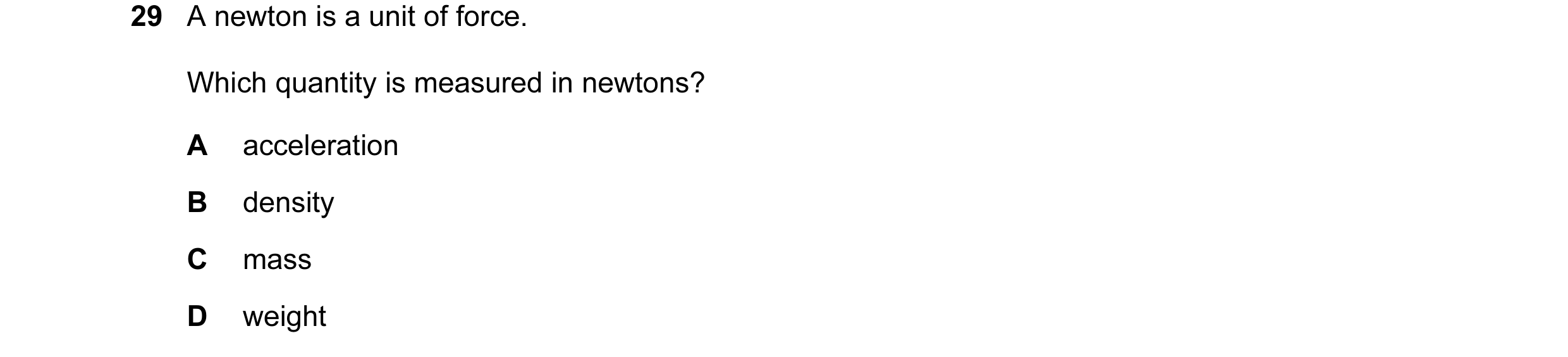
29 A newton is a unit of force. Which quantity is measured in newtons? A acceleration B density C mass D weight
1 marks
Answer: D
This question in 0653/11 Oct/Nov 2006
Q2 · The diagram shows a bird in flight 0653/11 May/June 2007
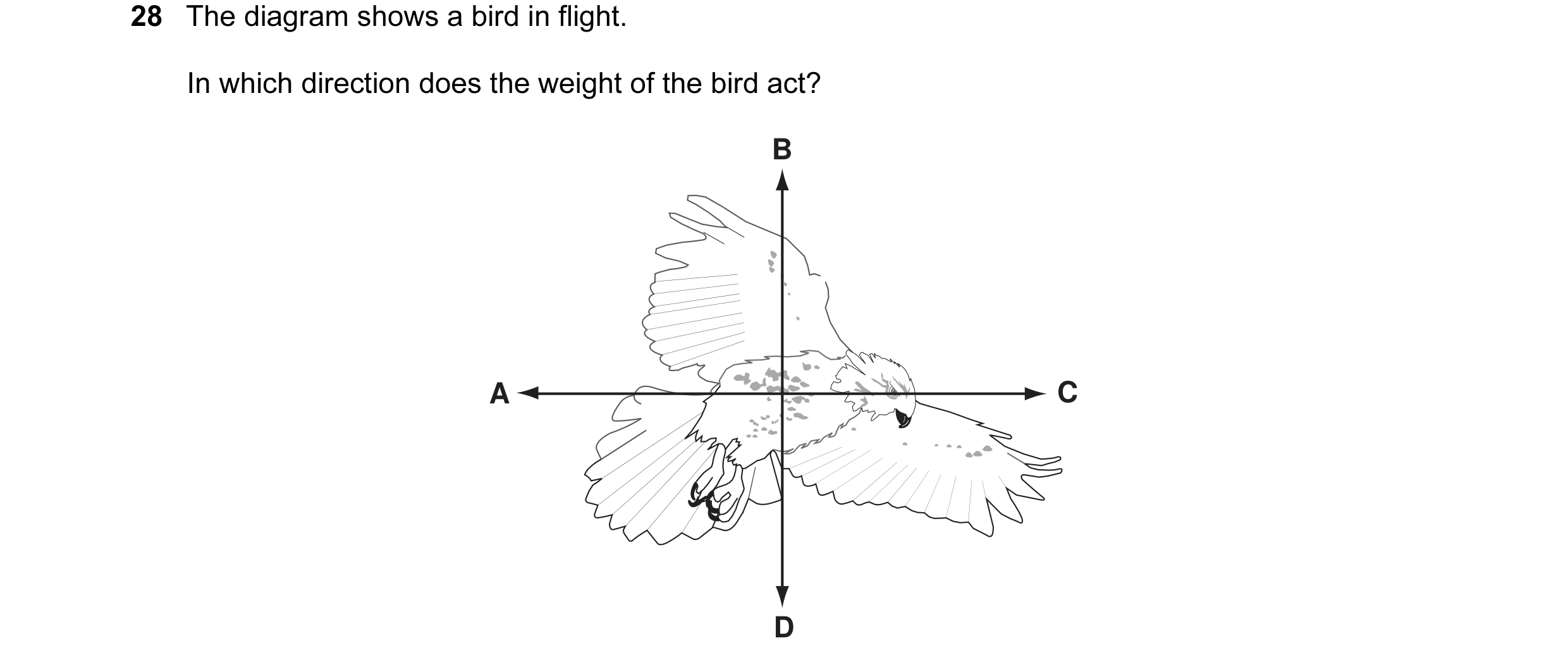
28 The diagram shows a bird in flight. In which direction does the weight of the bird act? B A C D
1 marks
Answer: D
This question in 0653/11 May/June 2007
Q3 · What are the correct units for force and for weight? 0653/11 Oct/Nov 2007
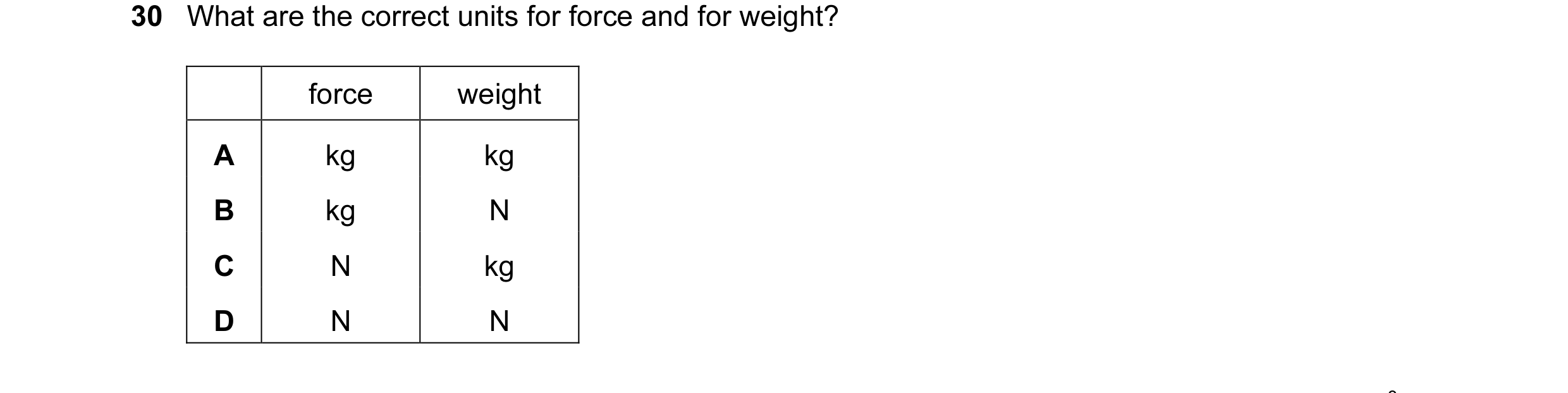
30 What are the correct units for force and for weight? force weight A kg kg B kg N C N kg D N N
1 marks
Answer: D
This question in 0653/11 Oct/Nov 2007
Q4 · Which property of an object cannot be changed by a force? 0653/11 May/June 2009
30 Which property of an object cannot be changed by a force? A its mass B its motion C its shape D its size
1 marks
Answer: A
This question in 0653/11 May/June 2009
Q5 · Which statement is correct? 0653/11 May/June 2010
29 Which statement is correct? A Mass is a force. B Mass is measured in newtons. C Weight is a force. D Weight is measured in kilograms.
1 marks
Answer: C
This question in 0653/11 May/June 2010
Q6 · Which statement is correct? 0653/12 May/June 2010
36 Which statement is correct? A Mass is a force. B Mass is measured in newtons. C Weight is a force. D Weight is measured in kilograms.
1 marks
Answer: C
This question in 0653/12 May/June 2010
Q7 · Which statement is correct? 0653/13 May/June 2010
36 Which statement is correct? A Mass is a force. B Mass is measured in newtons. C Weight is a force. D Weight is measured in kilograms.
1 marks
Answer: C
This question in 0653/13 May/June 2010
Q8 · Which statement is correct? 0653/11 Oct/Nov 2010
29 Which statement is correct? A The mass of a bottle of water at the North Pole is different from its mass at the Equator. B The mass of a bottle of water is measured in newtons. C The weight of a bottle of water and its mass are both measured in kilograms. D The weight of a bottle of water is one of the forces acting on the bottle.
1 marks
Answer: D
This question in 0653/11 Oct/Nov 2010
Q9 · Which statement is correct? 0653/12 Oct/Nov 2010
30 Which statement is correct? A The mass of a bottle of water at the North Pole is different from its mass at the Equator. B The mass of a bottle of water is measured in newtons. C The weight of a bottle of water and its mass are both measured in kilograms. D The weight of a bottle of water is one of the forces acting on the bottle.
1 marks
Answer: D
This question in 0653/12 Oct/Nov 2010
Q10 · Which statement is correct? 0653/13 Oct/Nov 2010
28 Which statement is correct? A The mass of a bottle of water at the North Pole is different from its mass at the Equator. B The mass of a bottle of water is measured in newtons. C The weight of a bottle of water and its mass are both measured in kilograms. D The weight of a bottle of water is one of the forces acting on the bottle.
1 marks
Answer: D
This question in 0653/13 Oct/Nov 2010
Q11 · Which is the unit for force and which is the unit for weight? 0653/11 May/June 2011
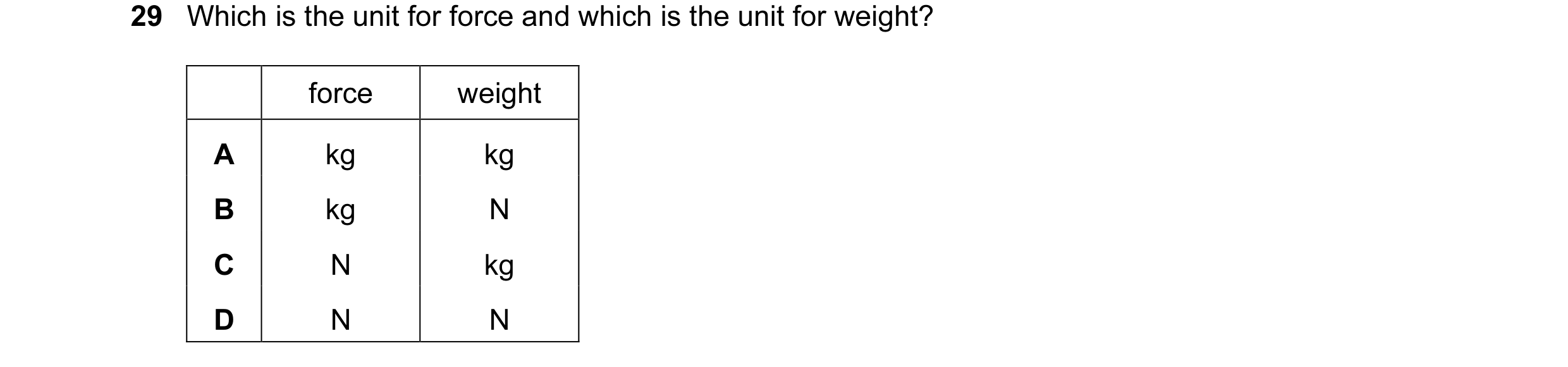
29 Which is the unit for force and which is the unit for weight? force weight A kg kg B kg N C N kg D N N
1 marks
Answer: D
This question in 0653/11 May/June 2011
Q12 · Which is the unit for force and which is the unit for weight? 0653/12 May/June 2011
28 Which is the unit for force and which is the unit for weight? force weight A kg kg B kg N C N kg D N N
1 marks
Answer: D
This question in 0653/12 May/June 2011
Q13 · What is the meaning of the weight of an object? 0653/11 Oct/Nov 2011
29 What is the meaning of the weight of an object? A the density of the material from which it is made B the force exerted on it by gravity C the mass of the matter it contains D the pressure it exerts on the ground
1 marks
Answer: B
This question in 0653/11 Oct/Nov 2011
Q14 · What is the meaning of the weight of an object? 0653/12 Oct/Nov 2011
30 What is the meaning of the weight of an object? A the density of the material from which it is made B the force exerted on it by gravity C the mass of the matter it contains D the pressure it exerts on the ground
1 marks
Answer: B
This question in 0653/12 Oct/Nov 2011
Q15 · What is the meaning of the weight of an object? 0653/13 Oct/Nov 2011
28 What is the meaning of the weight of an object? A the density of the material from which it is made B the force exerted on it by gravity C the mass of the matter it contains D the pressure it exerts on the ground
1 marks
Answer: B
This question in 0653/13 Oct/Nov 2011
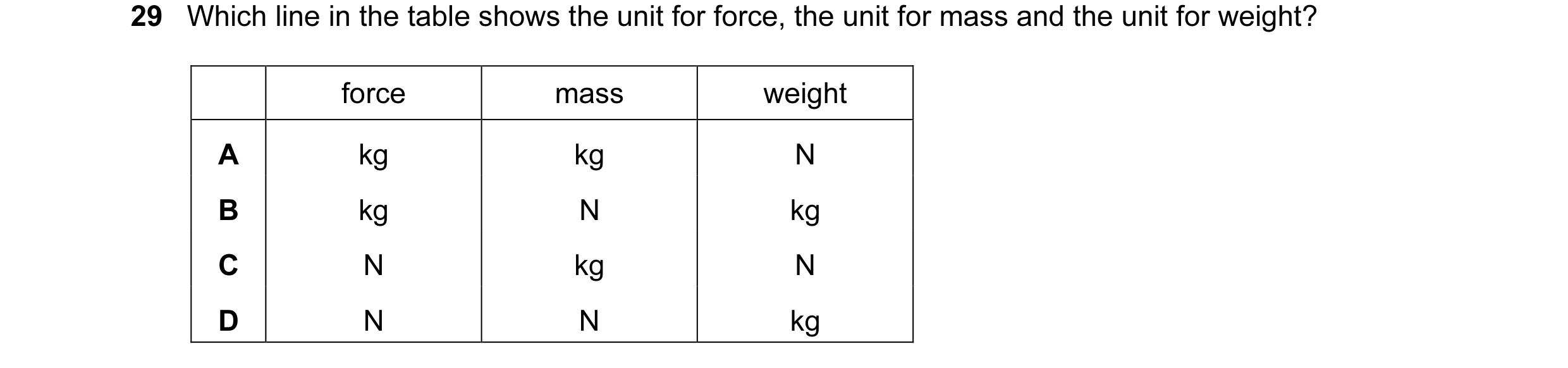
Q16 · Which line in the table shows the unit for force, the unit for mass and the unit for… 0653/11 Oct/Nov 2014
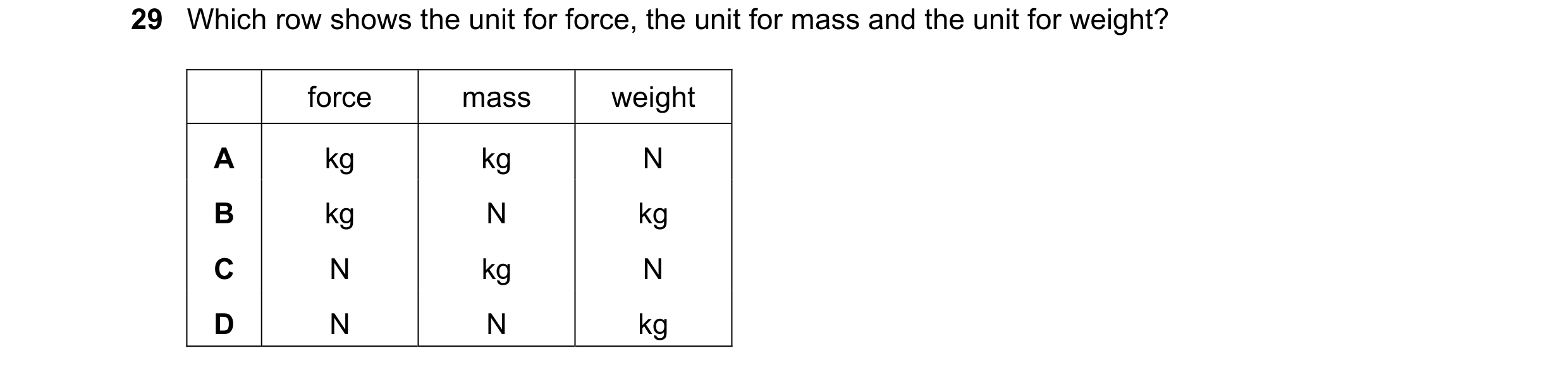
29 Which line in the table shows the unit for force, the unit for mass and the unit for weight? force mass weight A kg kg N B kg N kg C N kg N D N N kg
1 marks
Answer: C
This question in 0653/11 Oct/Nov 2014
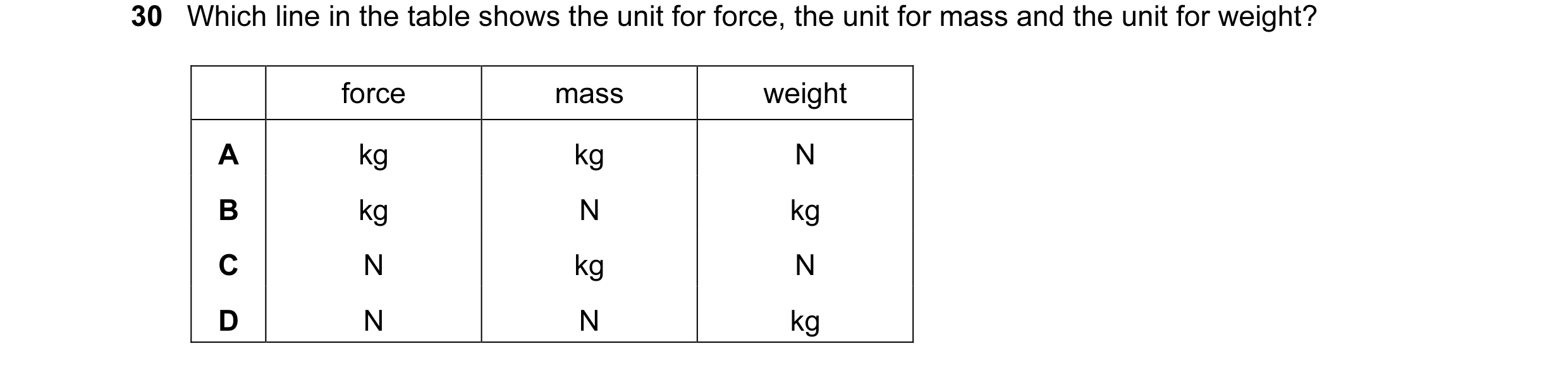
Q17 · Which line in the table shows the unit for force, the unit for mass and the unit for… 0653/12 Oct/Nov 2014
30 Which line in the table shows the unit for force, the unit for mass and the unit for weight? force mass weight A kg kg N B kg N kg C N kg N D N N kg
1 marks
Answer: C
This question in 0653/12 Oct/Nov 2014
Q18 · Which statement about mass and weight is correct? 0653/11 Oct/Nov 2015
29 Which statement about mass and weight is correct? A Mass and weight are both forces. B Mass is a force and weight is not. C Neither mass nor weight is a force. D Weight is a force and mass is not.
1 marks
Answer: D
This question in 0653/11 Oct/Nov 2015
Q19 · Which quantity is measured in newtons? 0653/12 Oct/Nov 2015
29 Which quantity is measured in newtons? A density B energy C potential difference D weight
1 marks
Answer: D
This question in 0653/12 Oct/Nov 2015
Q20 · Which of the following has the same unit as weight? 0653/13 Oct/Nov 2015
29 Which of the following has the same unit as weight? A density B energy C force D mass
1 marks
Answer: C
This question in 0653/13 Oct/Nov 2015
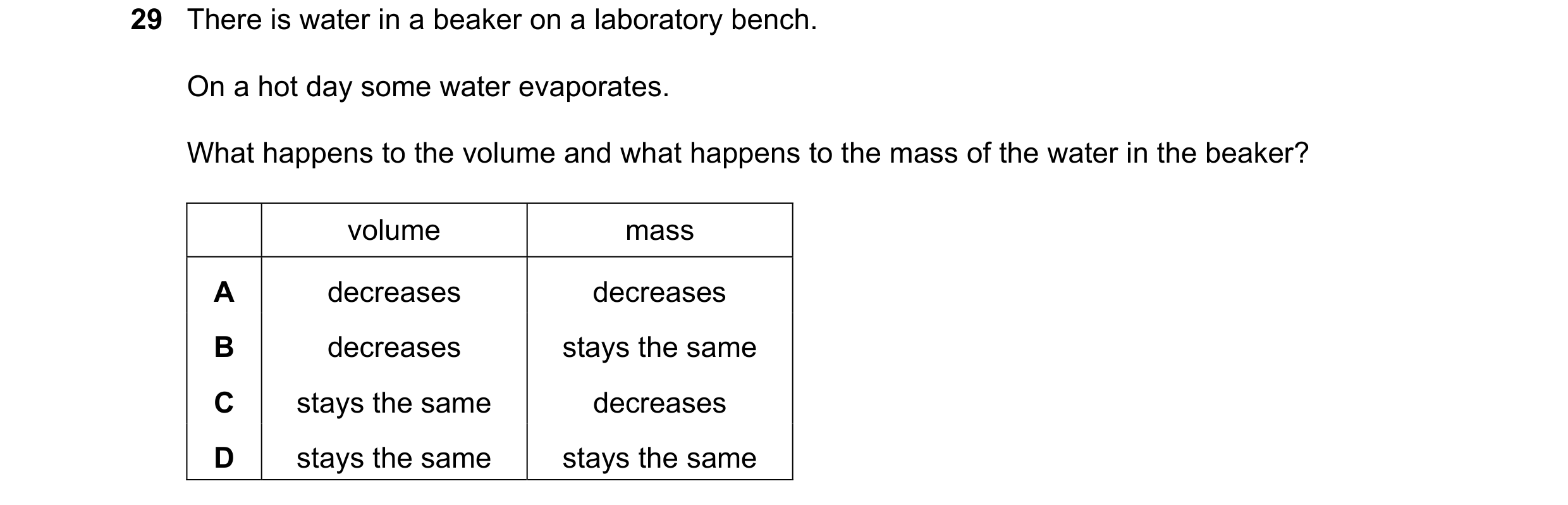
Q21 · There is water in a beaker on a laboratory bench 0653/11 Oct/Nov 2016
29 There is water in a beaker on a laboratory bench. On a hot day some water evaporates. What happens to the volume and what happens to the mass of the water in the beaker? volume mass A decreases decreases B decreases stays the same C stays the same decreases D stays the same stays the same
1 marks
Answer: A
This question in 0653/11 Oct/Nov 2016
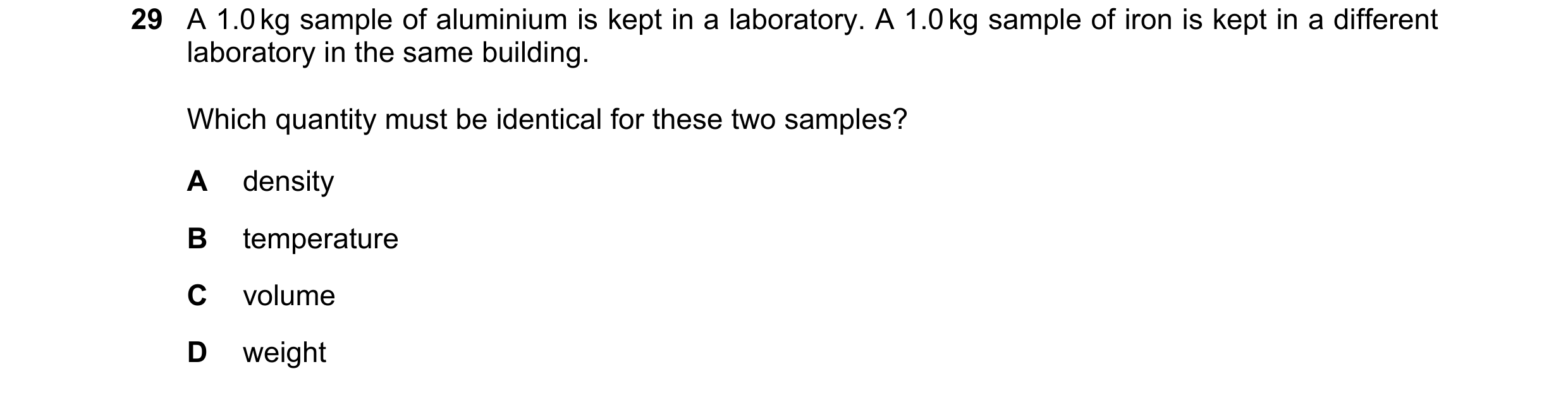
Q22 · A 1.0 kg sample of aluminium is kept in a laboratory 0653/12 Oct/Nov 2016
29 A 1.0 kg sample of aluminium is kept in a laboratory. A 1.0 kg sample of iron is kept in a different laboratory in the same building. Which quantity must be identical for these two samples? A density B temperature C volume D weight
1 marks
Answer: D
This question in 0653/12 Oct/Nov 2016
Q23 · Which statement is always correct? 0653/13 Oct/Nov 2016
29 Which statement is always correct? A Smaller objects have less mass than larger objects. B The mass of an object can change from one place to another. C Weight and mass are both examples of a force. D Weight on Earth is caused by the Earth’s gravitational field.
1 marks
Answer: D
This question in 0653/13 Oct/Nov 2016
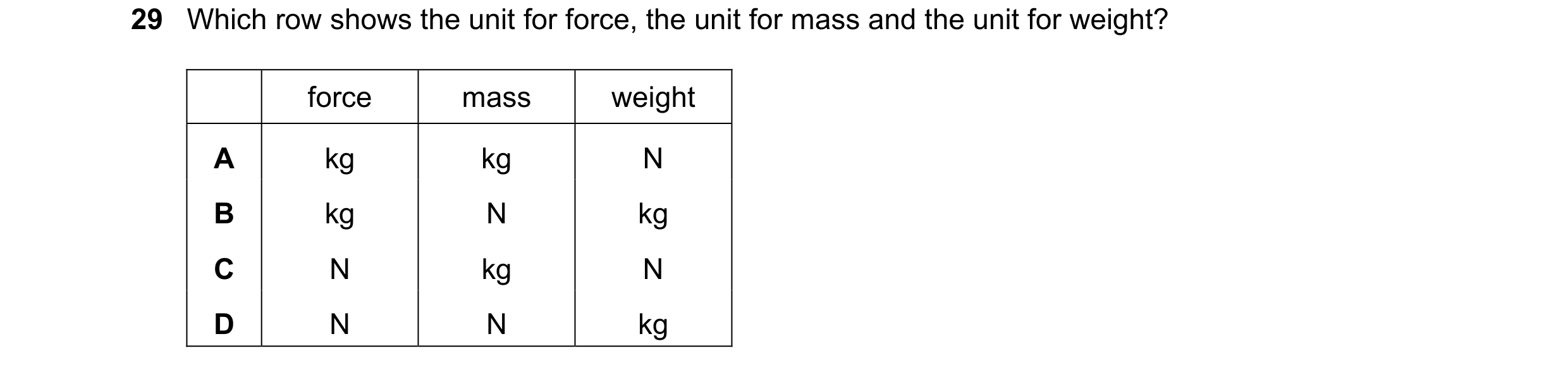
Q24 · Which row shows the unit for force, the unit for mass and the unit for weight? 0653/11 May/June 2017
29 Which row shows the unit for force, the unit for mass and the unit for weight? force mass weight A kg kg N B kg N kg C N kg N D N N kg
1 marks
Answer: C
This question in 0653/11 May/June 2017
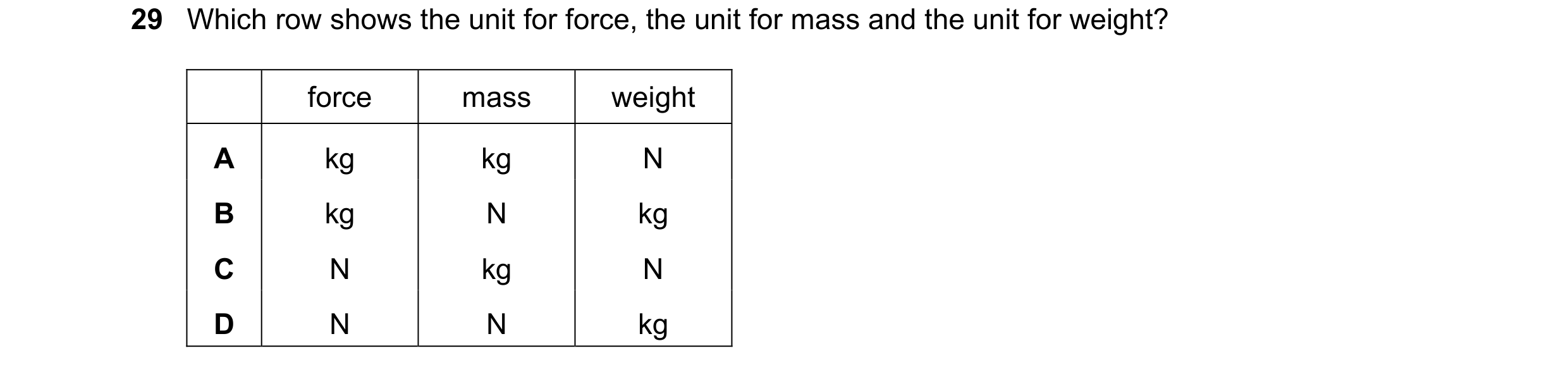
Q25 · Which row shows the unit for force, the unit for mass and the unit for weight? 0653/12 May/June 2017
29 Which row shows the unit for force, the unit for mass and the unit for weight? force mass weight A kg kg N B kg N kg C N kg N D N N kg
1 marks
Answer: C
This question in 0653/12 May/June 2017
Q26 · Which row shows the unit for force, the unit for mass and the unit for weight? 0653/13 May/June 2017
29 Which row shows the unit for force, the unit for mass and the unit for weight? force mass weight A kg kg N B kg N kg C N kg N D N N kg
1 marks
Answer: C
This question in 0653/13 May/June 2017
Q27 · A piece of scientific equipment is taken on a space ship from Earth to a distant planet 0653/11 Oct/Nov 2017
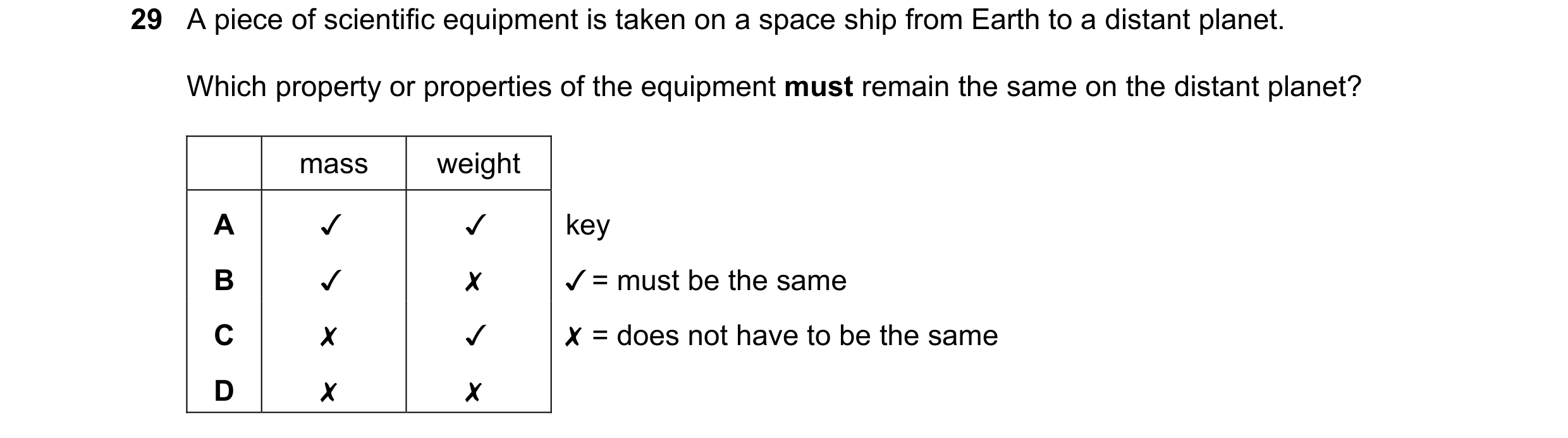
29 A piece of scientific equipment is taken on a space ship from Earth to a distant planet.
Which property or properties of the equipment must remain the same on the distant planet?
key
J/ = must be the same
X = does not have to be the same
1 marks
Answer: B
This question in 0653/11 Oct/Nov 2017
Q28 · The mass of an astronaut on the Moon is 70 kg 0653/13 Oct/Nov 2017
29 The mass of an astronaut on the Moon is 70 kg. What is the mass of the astronaut on the Earth? A 7 kg B 70 kg C 80 kg D 700 kg
1 marks
Answer: B
This question in 0653/13 Oct/Nov 2017
Q29 · What is the weight of an object? 0653/11 May/June 2018
29 What is the weight of an object? A the acceleration of the object due to gravity B the energy of the object due to its position C the force acting on the object due to gravity D the quantity of matter in the object
1 marks
Answer: C
This question in 0653/11 May/June 2018
Q30 · An object of known mass on Earth is taken to another planet 0653/12 Oct/Nov 2018
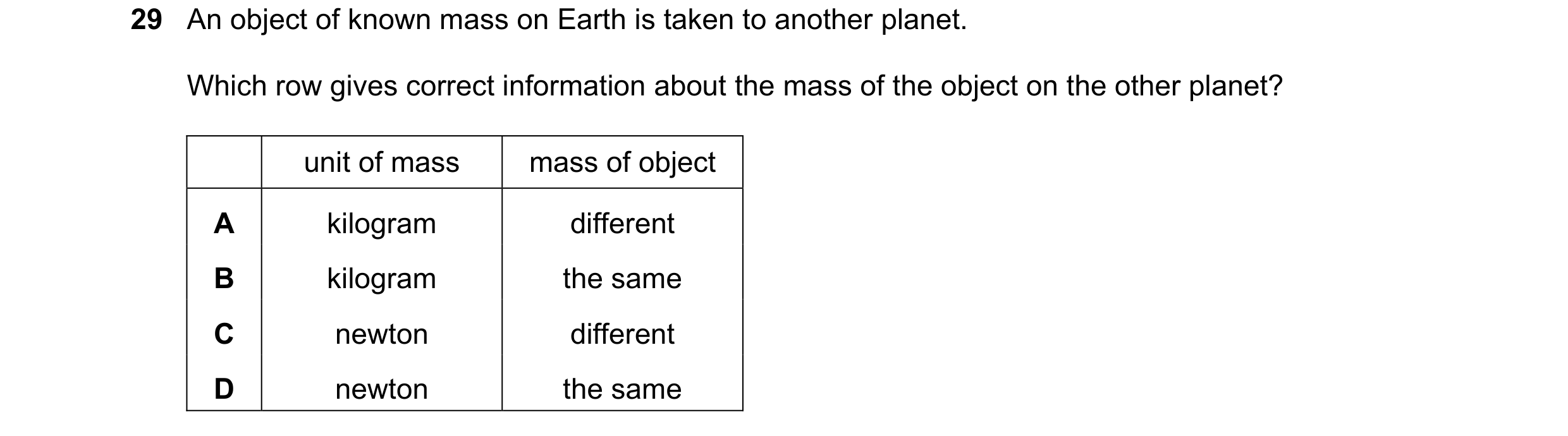
29 An object of known mass on Earth is taken to another planet. Which row gives correct information about the mass of the object on the other planet? unit of mass mass of object A kilogram different B kilogram the same C newton different D newton the same
1 marks
Answer: B
This question in 0653/12 Oct/Nov 2018
Q31 · An object with mass 5.0 kg is dropped 0653/12 Feb/March 2019
28 An object with mass 5.0 kg is dropped. The acceleration of free fall is 10 m / s2. What is the weight of the object? A 0.50 N B 2.0 N C 5.0 N D 50 N
1 marks
Answer: D
This question in 0653/12 Feb/March 2019
Q32 · A vehicle is taken from the Earth to the Moon where the gravitational field strength is… 0653/12 May/June 2019
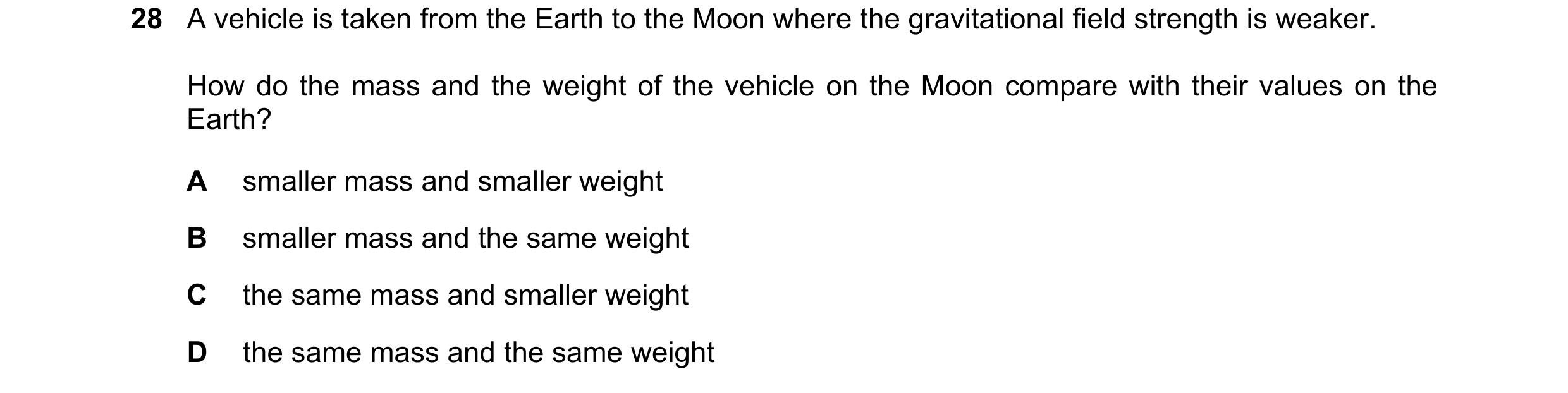
28 A vehicle is taken from the Earth to the Moon where the gravitational field strength is weaker. How do the mass and the weight of the vehicle on the Moon compare with their values on the Earth? A smaller mass and smaller weight B smaller mass and the same weight C the same mass and smaller weight D the same mass and the same weight
1 marks
Answer: C
This question in 0653/12 May/June 2019
Q33 · A bag of flour has a mass of 540 g 0653/13 May/June 2019
28 A bag of flour has a mass of 540 g. The acceleration of free fall is 10 m / s2. What is the weight of the bag of flour? A 5.4 N B 54 N C 540 N D 5400 N
1 marks
Answer: A
This question in 0653/13 May/June 2019
Q34 · A body has mass and is in a gravitational field 0653/11 Oct/Nov 2019
29 A body has mass and is in a gravitational field. What property does the body possess because it is in a gravitational field? A density B resistance C volume D weight
1 marks
Answer: D
This question in 0653/11 Oct/Nov 2019
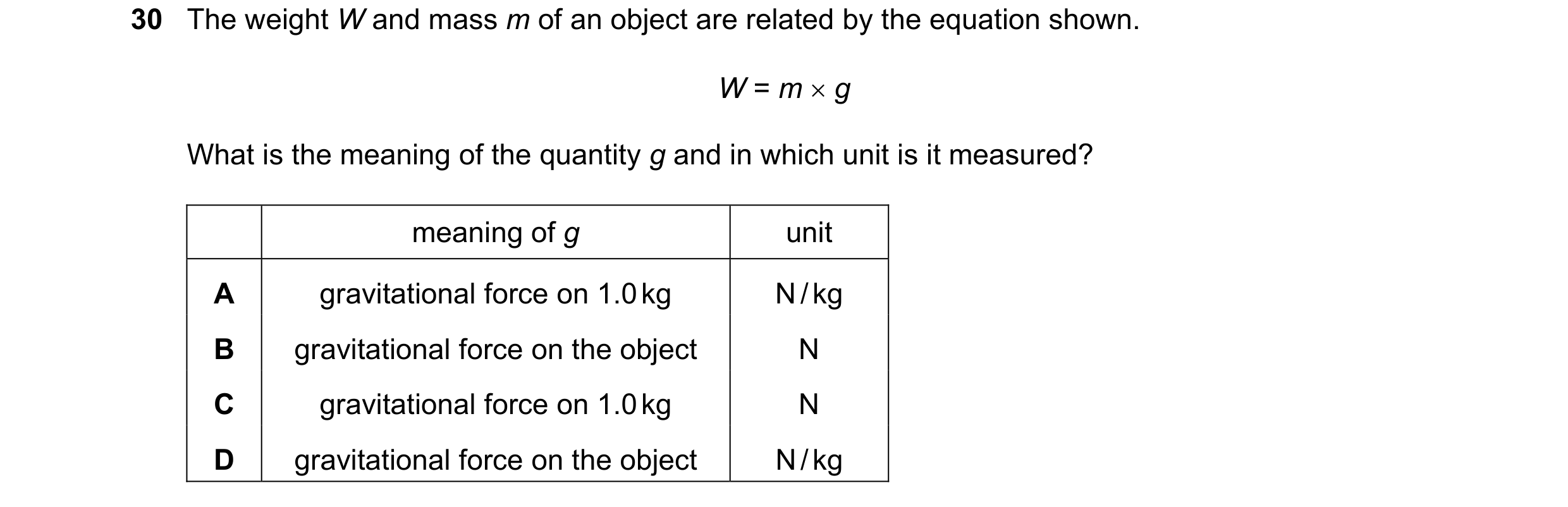
Q35 · The weight W and mass m of an object are related by the equation shown 0653/12 Feb/March 2020
30 The weight W and mass m of an object are related by the equation shown. W = m × g What is the meaning of the quantity g and in which unit is it measured? meaning of g unit A gravitational force on 1.0 kg N / kg B gravitational force on the object N C gravitational force on 1.0 kg N D gravitational force on the object N / kg
1 marks
Answer: A
This question in 0653/12 Feb/March 2020
Q36 · The gravitational field strength is 10 N / kg 0653/13 Oct/Nov 2020
29 The gravitational field strength is 10 N / kg. What is the mass of an object that has a weight of 5.0 N? A 0.50 kg B 2.0 kg C 5.0 kg D 50 kg
1 marks
Answer: A
This question in 0653/13 Oct/Nov 2020
Q37 · The gravitational field strength g on the surface of the Earth is 10 N / kg 0653/12 May/June 2021
29 The gravitational field strength g on the surface of the Earth is 10 N / kg. What is the weight of a 500 g mass on the surface of the Earth? A 5.0 kg B 5.0 N C 5000 kg D 5000 N
1 marks
Answer: B
This question in 0653/12 May/June 2021
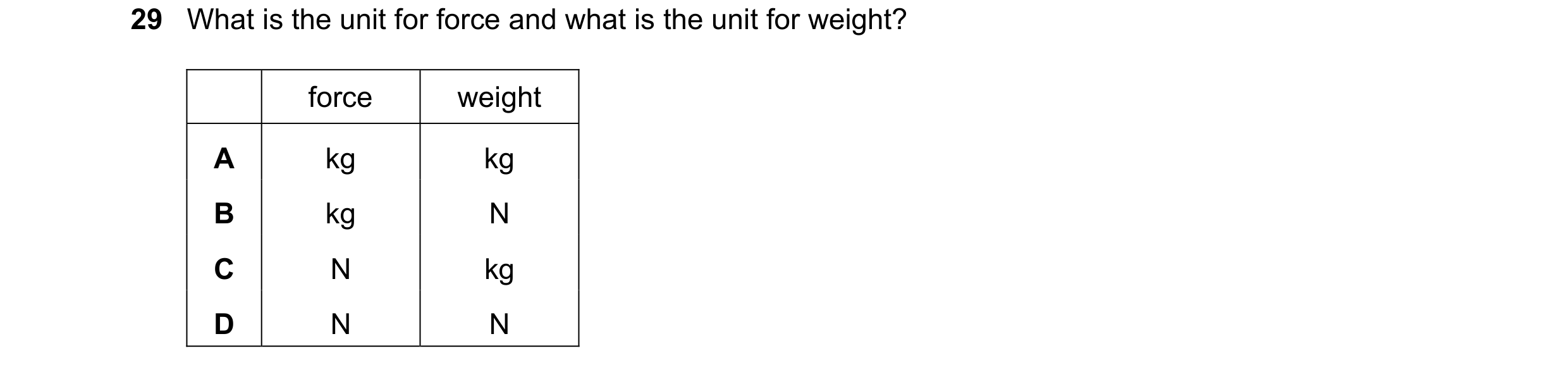
Q38 · What is the unit for force and what is the unit for weight? 0653/11 Oct/Nov 2021
29 What is the unit for force and what is the unit for weight? force weight A kg kg B kg N C N kg D N N
1 marks
Answer: D
This question in 0653/11 Oct/Nov 2021
Q39 · A metre rule has a mass of 120 g 0653/12 May/June 2022
29 A metre rule has a mass of 120 g. The gravitational field strength g is 10 N / kg. What is the weight of the metre rule? A 1.2 N B 1.2 kg C 1200 N D 1200 kg
1 marks
Answer: A
This question in 0653/12 May/June 2022
Q40 · The table shows the masses and the weights of four different objects 0653/11 Oct/Nov 2022
30 The table shows the masses and the weights of four different objects. The gravitational field strength g is 10 N / kg. Which row shows the mass of an object and its weight? mass / kg weight / N A 2.4 12.4 B 3.2 0.32 C 25 25 D 36 360
1 marks
Answer: D
This question in 0653/11 Oct/Nov 2022
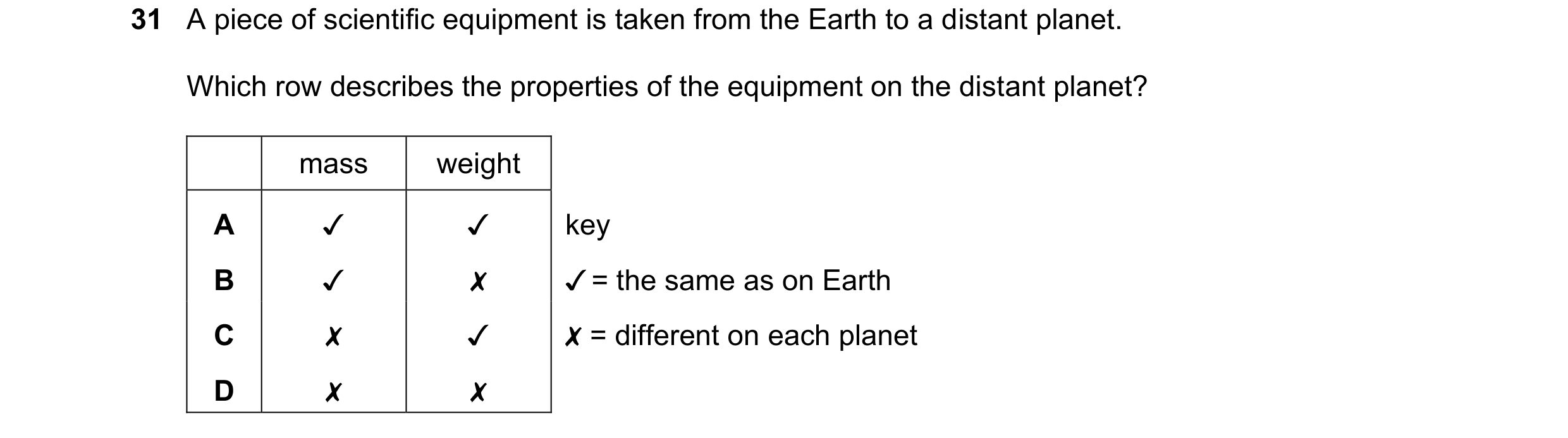
Q41 · A piece of scientific equipment is taken from the Earth to a distant planet 0653/11 Oct/Nov 2022
31 A piece of scientific equipment is taken from the Earth to a distant planet.
Which row describes the properties of the equipment on the distant planet?
key
/ =the same as on Earth
X = different on each planet
1 marks
Answer: B
This question in 0653/11 Oct/Nov 2022
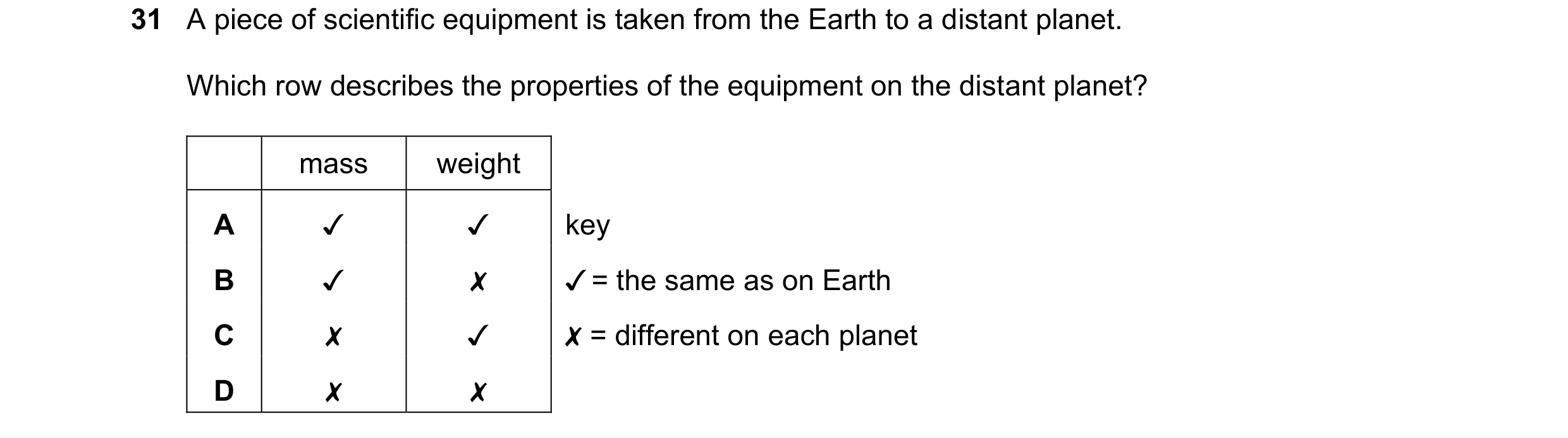
Q42 · A piece of scientific equipment is taken from the Earth to a distant planet 0653/12 Oct/Nov 2022
31 A piece of scientific equipment is taken from the Earth to a distant planet.
Which row describes the properties of the equipment on the distant planet?
mass weight
Jv v key
/ =the same as on Earth
X = different on each planet
00QW D>
~ «eX
x \ x
1 marks
Answer: B
This question in 0653/12 Oct/Nov 2022
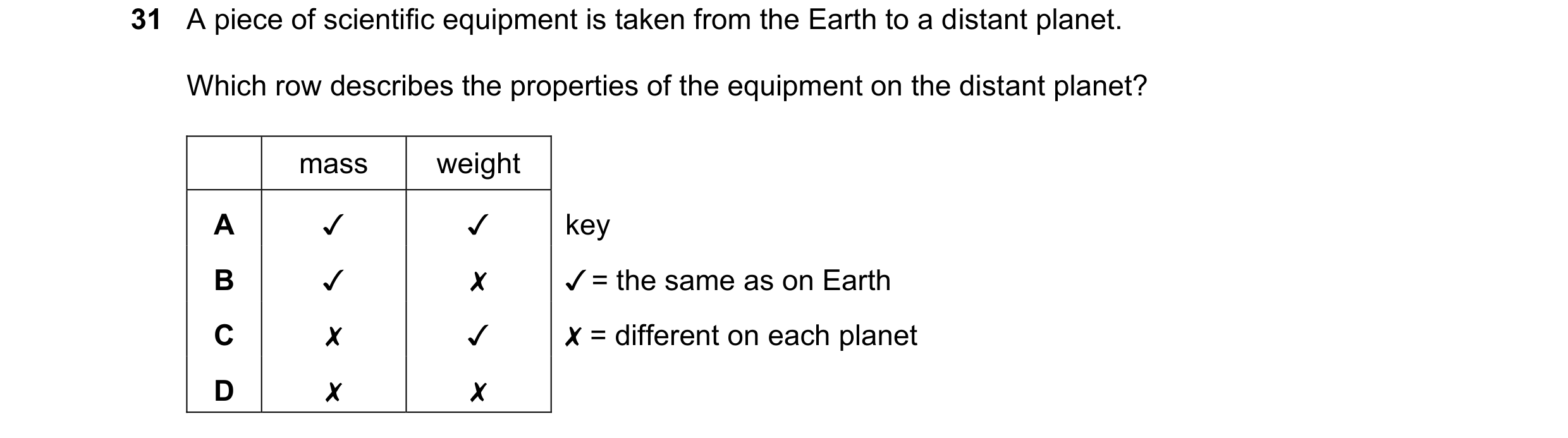
Q43 · A piece of scientific equipment is taken from the Earth to a distant planet 0653/13 Oct/Nov 2022
31 A piece of scientific equipment is taken from the Earth to a distant planet.
Which row describes the properties of the equipment on the distant planet?
mass weight
Jv v key
/ =the same as on Earth
X = different on each planet
00QW D>
~ «eX
x \ x
1 marks
Answer: B
This question in 0653/13 Oct/Nov 2022
Q44 · A vehicle is taken from the Earth to the Moon where the gravitational field strength is… 0653/12 May/June 2023
29 A vehicle is taken from the Earth to the Moon where the gravitational field strength is smaller. How do the mass and the weight of the vehicle on the Moon compare with their values on the Earth? A smaller mass and smaller weight B smaller mass and the same weight C the same mass and smaller weight D the same mass and the same weight
1 marks
Answer: C
This question in 0653/12 May/June 2023
Q45 · Which statement about mass and weight is correct? 0653/13 May/June 2023
29 Which statement about mass and weight is correct? A Mass and weight are different types of force. B The mass of an object depends on the strength of the gravitational field in which it is placed. C The mass of an object is the same on the Moon as it is on the Earth. D The unit of weight is the kilogram.
1 marks
Answer: C
This question in 0653/13 May/June 2023
Q46 · Which property of an object cannot be changed by a force? 0653/11 Oct/Nov 2023
30 Which property of an object cannot be changed by a force? A mass B motion C shape D size
1 marks
Answer: A
This question in 0653/11 Oct/Nov 2023
Q47 · The gravitational field strength on the planet Mercury is 3.7 N / kg 0653/12 Oct/Nov 2023
30 The gravitational field strength on the planet Mercury is 3.7 N / kg. What is the weight of a 10 kg rock on Mercury? A 0.37 N B 3.7 N C 10 N D 37 N
1 marks
Answer: D
This question in 0653/12 Oct/Nov 2023
Q48 · The gravitational field strength on the planet Mercury is 3.7 N / kg 0653/13 Oct/Nov 2023
30 The gravitational field strength on the planet Mercury is 3.7 N / kg. What is the weight of a 10 kg rock on Mercury? A 0.37 N B 3.7 N C 10 N D 37 N
1 marks
Answer: D
This question in 0653/13 Oct/Nov 2023
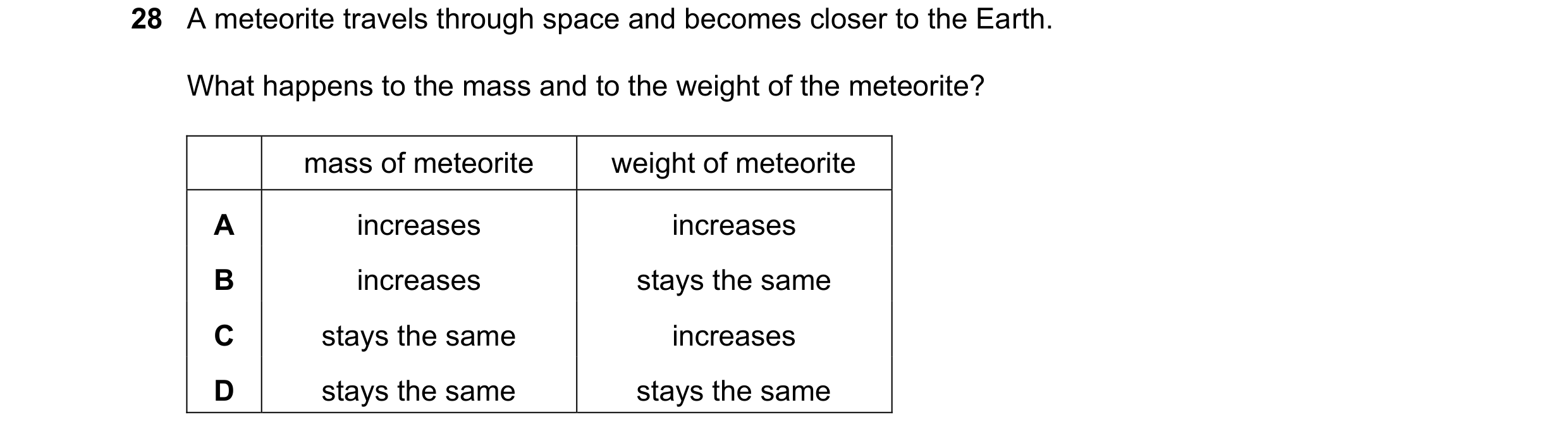
Q49 · A meteorite travels through space and becomes closer to the Earth 0653/12 Feb/March 2024
28 A meteorite travels through space and becomes closer to the Earth. What happens to the mass and to the weight of the meteorite? mass of meteorite weight of meteorite A increases increases B increases stays the same C stays the same increases D stays the same stays the same
1 marks
Answer: C
This question in 0653/12 Feb/March 2024
Q50 · The gravitational field strength, g, on the Moon is 1.6 N / kg 0653/12 Feb/March 2025
28 The gravitational field strength, g, on the Moon is 1.6 N / kg. An object has a mass of 4.0 kg on the Earth. Which row shows the mass and the weight of the object on the Moon? mass on the weight on the Moon / kg Moon / N A 4.0 2.5 B 4.0 6.4 C 6.4 2.5 D 6.4 4.0
1 marks
Answer: B
This question in 0653/12 Feb/March 2025
Q51 · The gravitational field strength g on the Moon is 1.6 N / kg 0653/11 Oct/Nov 2025
29 The gravitational field strength g on the Moon is 1.6 N / kg. A rock has a mass of 2.0 kg. What is the weight of the rock on the Moon? A 0 N B 0.80 N C 1.6 N D 3.2 N
1 marks
Answer: D
This question in 0653/11 Oct/Nov 2025

 1 / 10




 2 / 10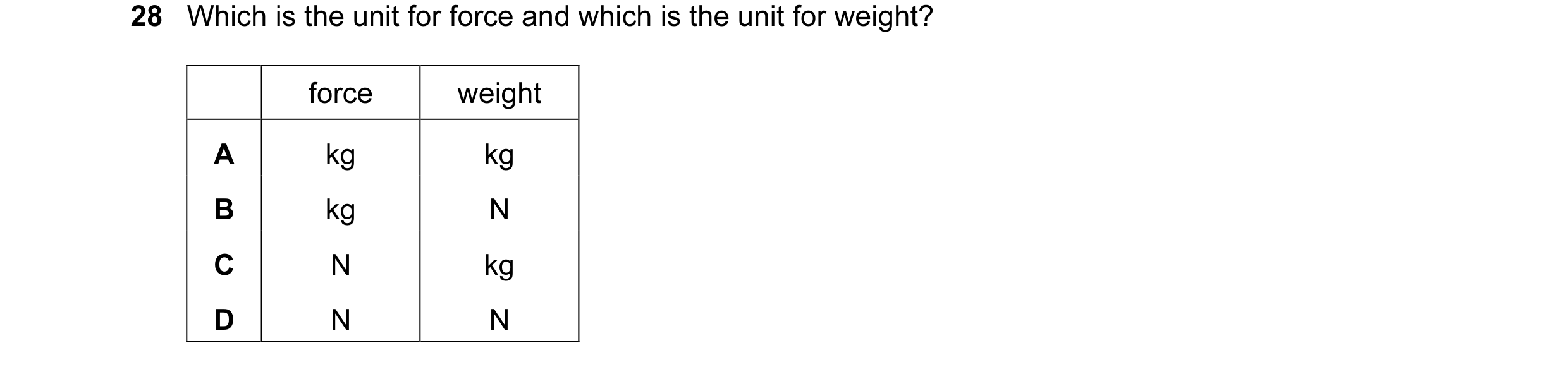



 3 / 10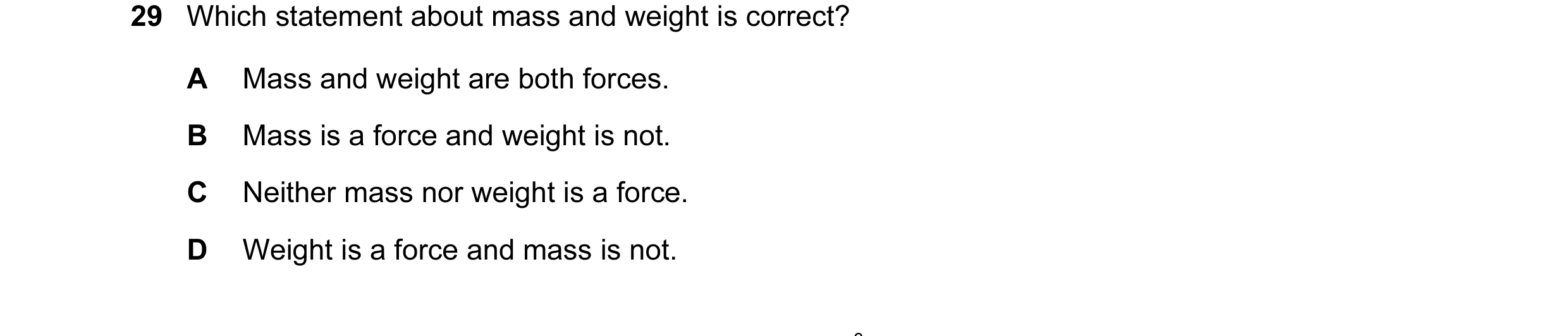


 4 / 10
 5 / 10


 6 / 10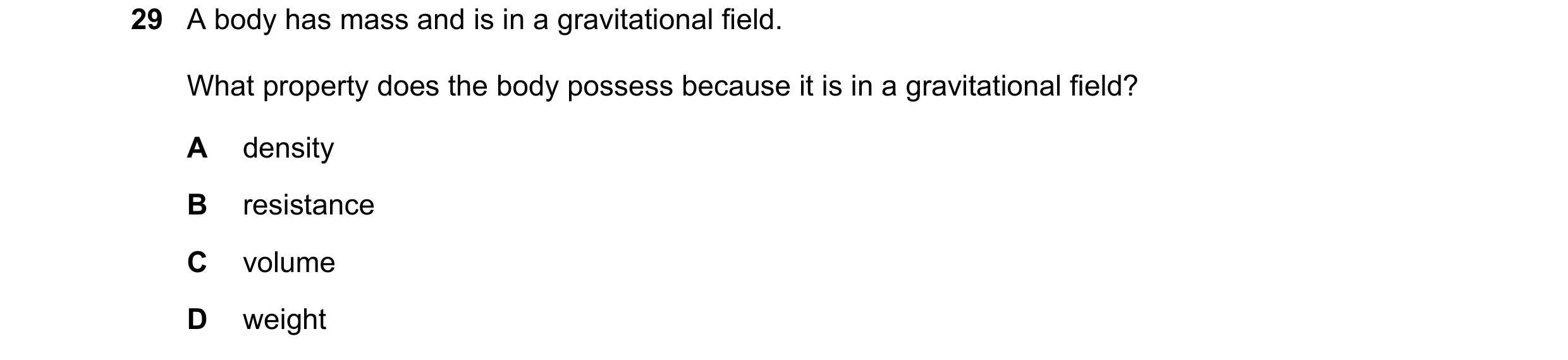


 7 / 10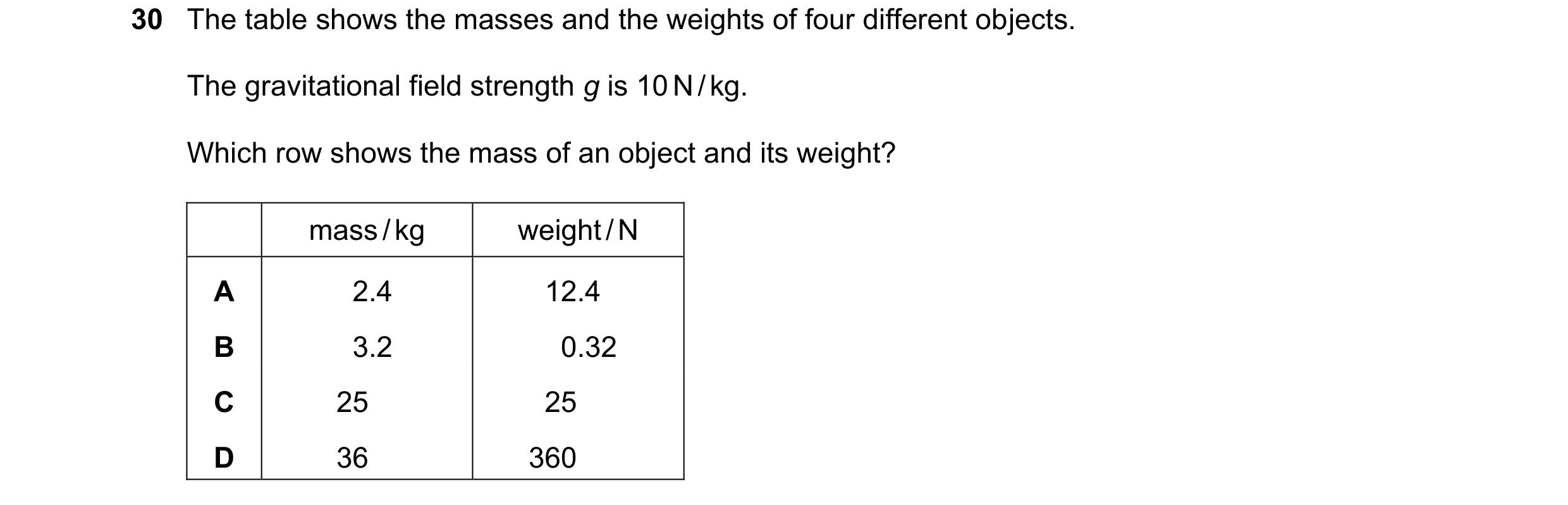
 8 / 10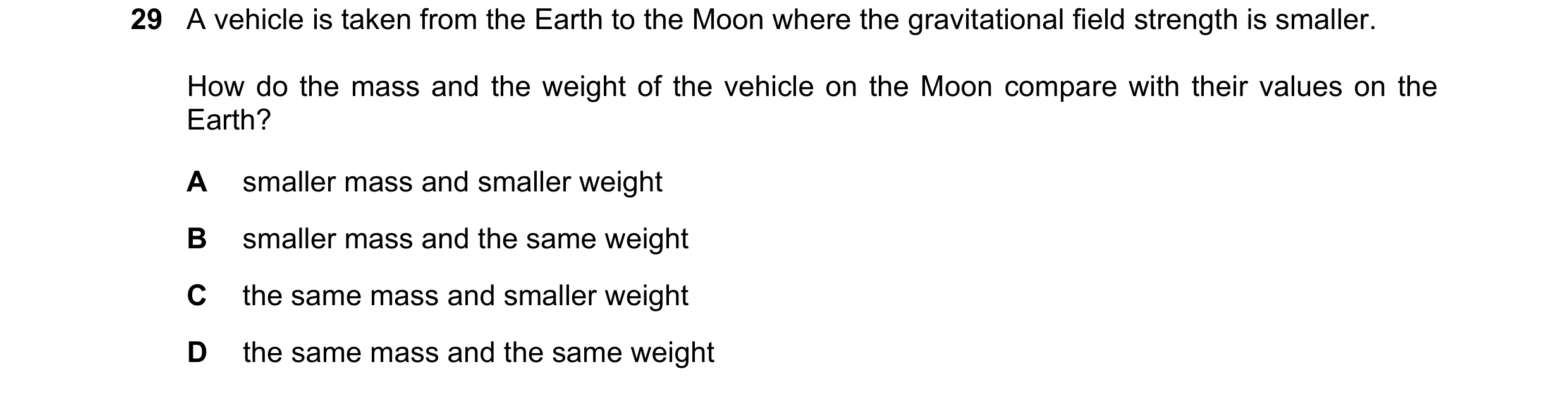




 9 / 10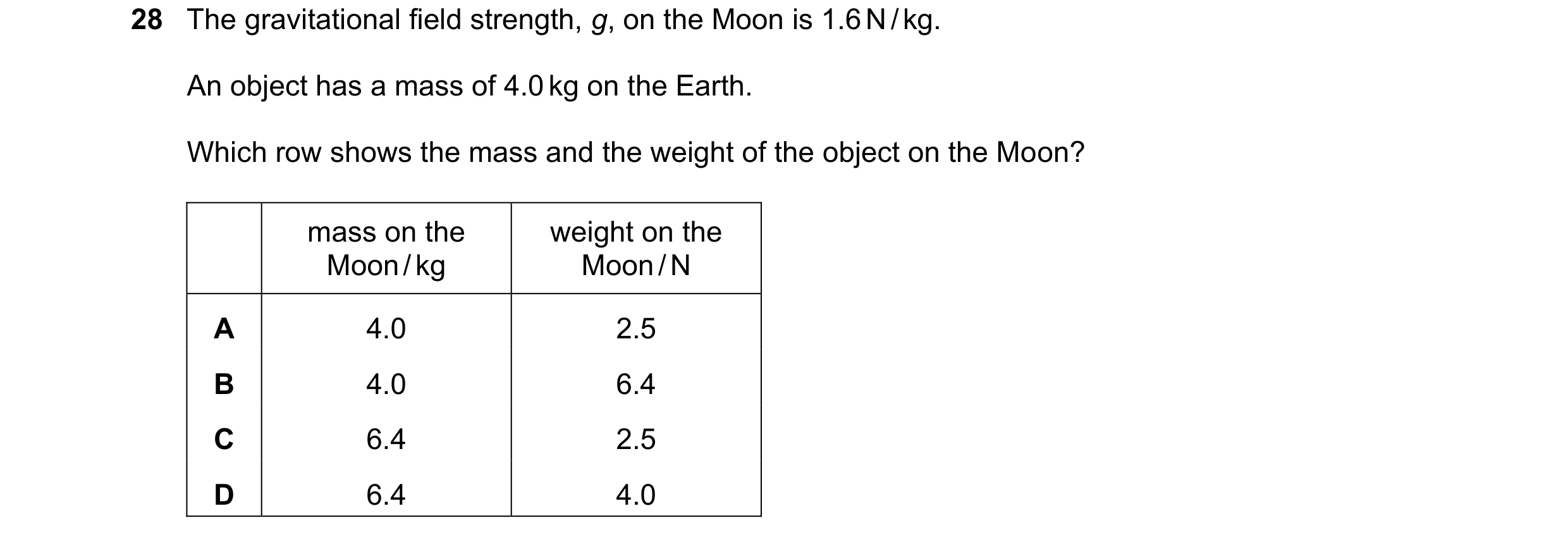
 10 / 10