Questions as text
Q1 · A farm tractor pulling a trailer 0653/32 Oct/Nov 2018
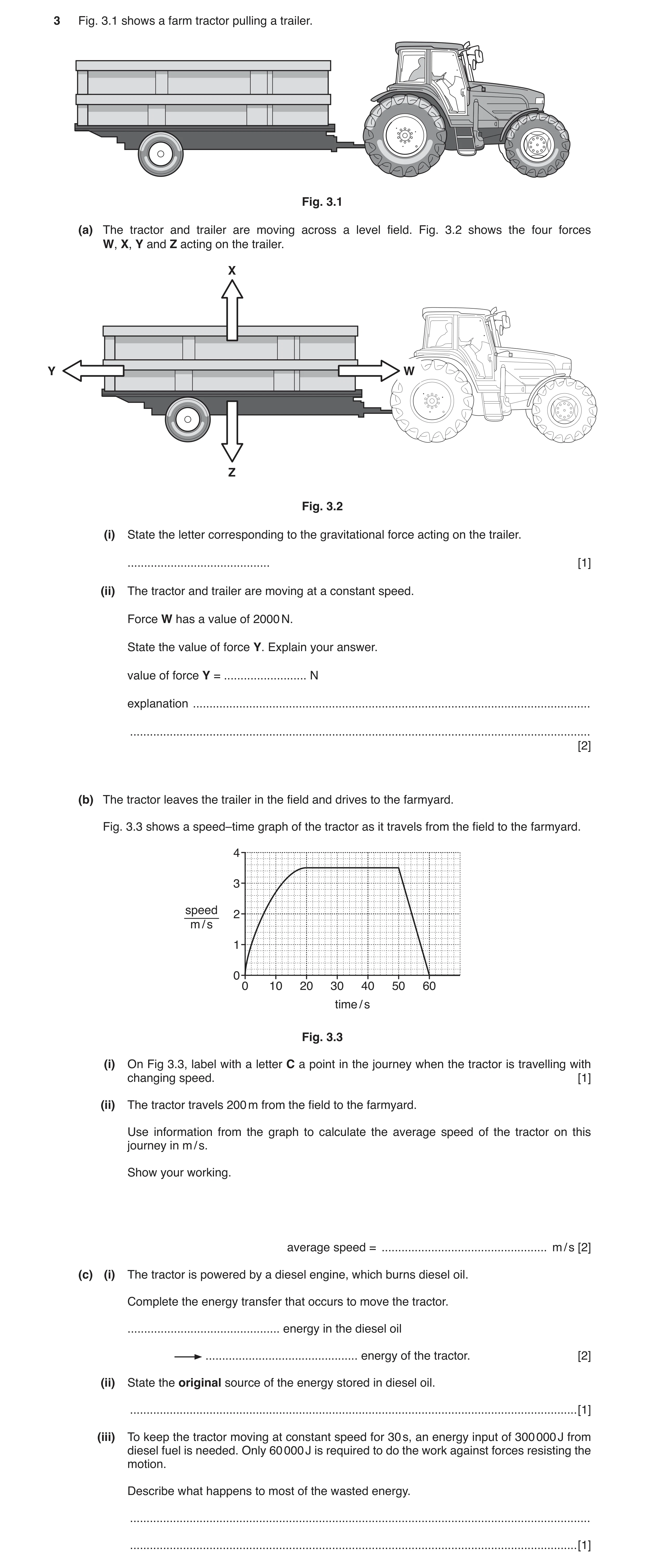
3 Fig. 3.1 shows a farm tractor pulling a trailer. Fig. 3.1 (a) The tractor and trailer are moving across a level field. Fig. 3.2 shows the four forces W, X, Y and Z acting on the trailer. X Y W Z Fig. 3.2 (i) State the letter corresponding to the gravitational force acting on the trailer. … [1] (ii) The tractor and trailer are moving at a constant speed. Force W has a value of 2000 N. State the value of force Y. Explain your answer. value of force Y = … N explanation … … [2] (b) The tractor leaves the trailer in the field and drives to the farmyard. Fig. 3.3 shows a speed–time graph of the tractor as it travels from the field to the farmyard. 4 3 speed 2 m / s 1 0 0 10 20 30 40 50 60 time / s Fig. 3.3 (i) On Fig 3.3, label with a letter C a point in the journey when the tractor is travelling with changing speed. [1] (ii) The tractor travels 200 m from the field to the farmyard. Use information from the graph to calculate the average speed of the tractor on this journey in m / s. Show your working. average speed = … m / s [2] (c) (i) The tractor is powered by a diesel engine, which burns diesel oil. Complete the energy transfer that occurs to move the tractor. … energy in the diesel oil … energy of the tractor. [2] (ii) State the original source of the energy stored in diesel oil. … [1] (iii) To keep the tractor moving at constant speed for 30 s, an energy input of 300 000 J from diesel fuel is needed. Only 60 000 J is required to do the work against forces resisting the motion. Describe what happens to most of the wasted energy. … … [1]
10 marks
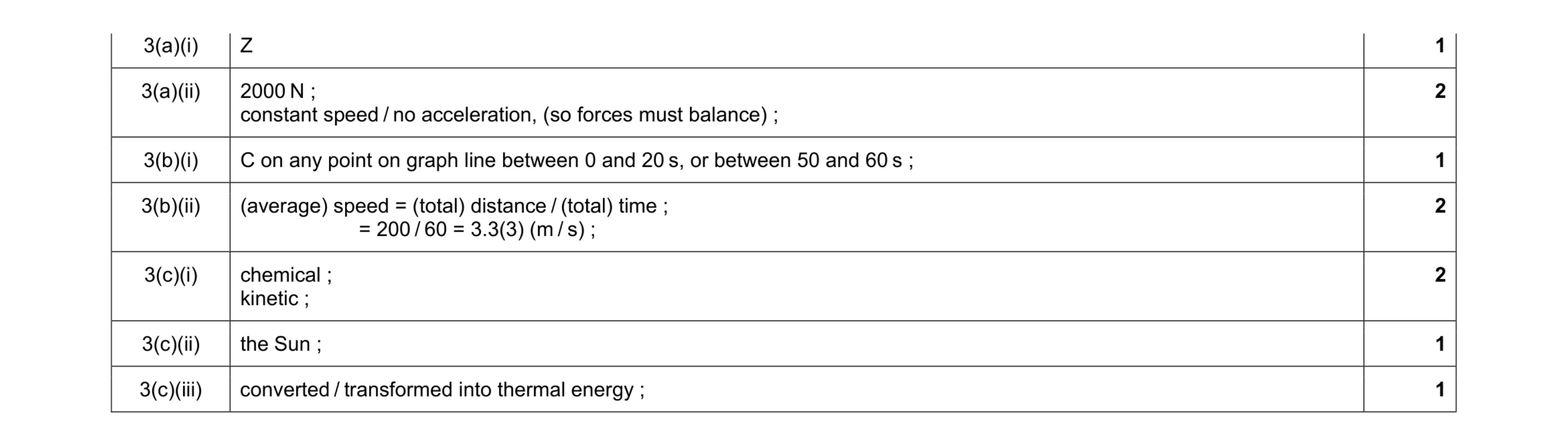
Mark scheme: 3(a)(i) Z 1 3(a)(ii) 2000 N ; constant speed / no acceleration, (so forces must balance) ; 2 3(b)(i) C on any point on graph line between 0 and 20 s, or between 50 and 60 s ; 1 3(b)(ii) (average) speed = (total) distance / (total) time ; = 200 / 60 = 3.3(3) (m / s) ; 2 3(c)(i) chemical ; kinetic ; 2 3(c)(ii) the Sun ; 1 3(c)(iii) converted / transformed into thermal energy ; 1
This question in 0653/32 Oct/Nov 2018
Q2 · A man pushing a shopping trolley 0653/33 Oct/Nov 2018
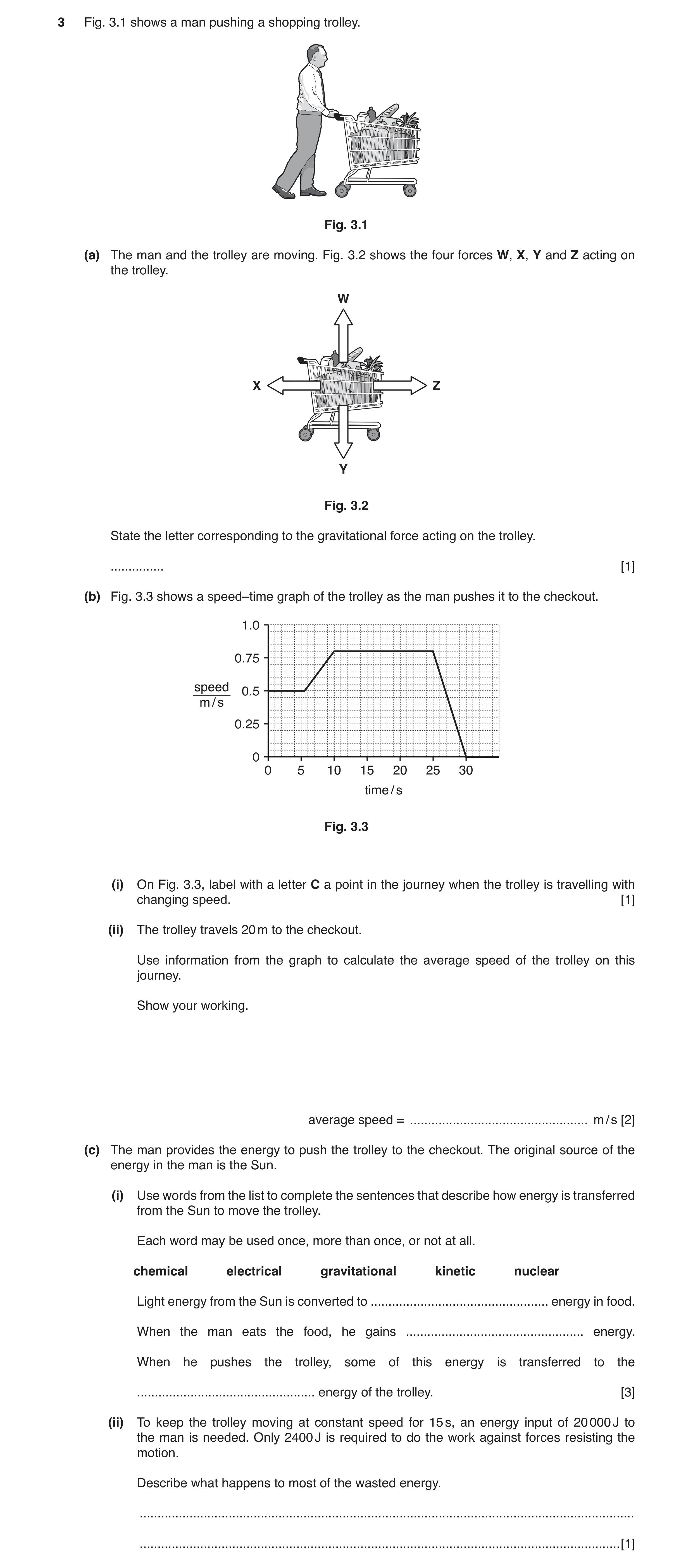
3 Fig. 3.1 shows a man pushing a shopping trolley. Fig. 3.1 (a) The man and the trolley are moving. Fig. 3.2 shows the four forces W, X, Y and Z acting on the trolley. W X Z Y Fig. 3.2 State the letter corresponding to the gravitational force acting on the trolley. … [1] (b) Fig. 3.3 shows a speed–time graph of the trolley as the man pushes it to the checkout. 1.0 0.75 speed 0.5 m / s 0.25 0 0 5 10 15 20 25 30 time / s Fig. 3.3 (i) On Fig. 3.3, label with a letter C a point in the journey when the trolley is travelling with changing speed. [1] (ii) The trolley travels 20 m to the checkout. Use information from the graph to calculate the average speed of the trolley on this journey. Show your working. average speed = … m / s [2] (c) The man provides the energy to push the trolley to the checkout. The original source of the energy in the man is the Sun. (i) Use words from the list to complete the sentences that describe how energy is transferred from the Sun to move the trolley. Each word may be used once, more than once, or not at all. chemical electrical gravitational kinetic nuclear Light energy from the Sun is converted to … energy in food. When the man eats the food, he gains … energy. When he pushes the trolley, some of this energy is transferred to the … energy of the trolley. [3] (ii) To keep the trolley moving at constant speed for 15 s, an energy input of 20 000 J to the man is needed. Only 2400 J is required to do the work against forces resisting the motion. Describe what happens to most of the wasted energy. … … [1]
8 marks
Mark scheme: 3(a) Y ; 1 3(b)(i) C at any point on graph line between 5 and 10 s, or between 25 and 30 s ; 1 3(b)(ii) (average) speed = (total) distance / (total) time or 20 / 30 ; = 0.67 (m / s) ; 2 3(c)(i) chemical ; chemical ; kinetic ; 3 3(c)(ii) converted / transformed into thermal energy; 1
This question in 0653/33 Oct/Nov 2018
Q3 · A boy throwing a ball up in the air 0653/32 Feb/March 2019
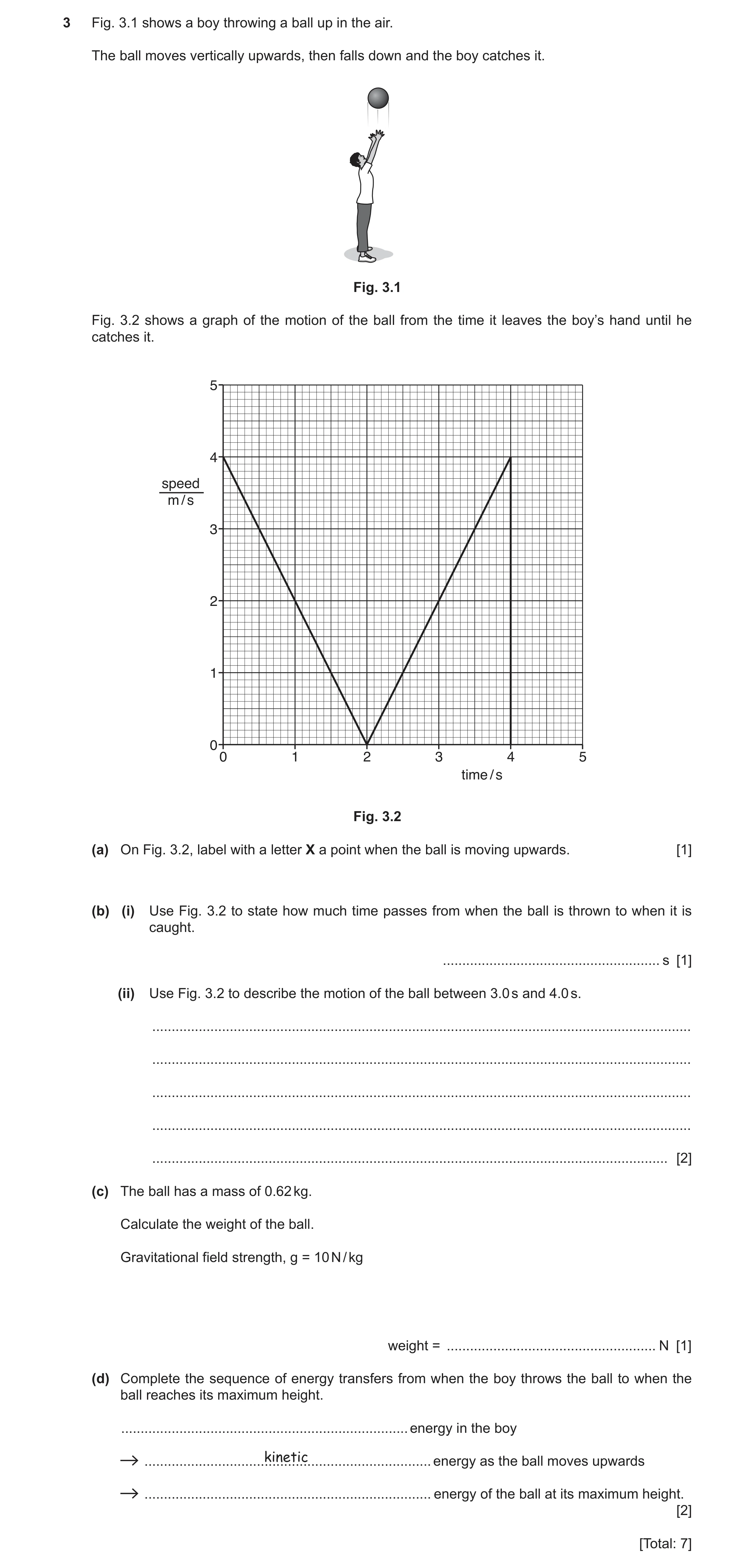
3 Fig. 3.1 shows a boy throwing a ball up in the air. The ball moves vertically upwards, then falls down and the boy catches it. Fig. 3.1 Fig. 3.2 shows a graph of the motion of the ball from the time it leaves the boy’s hand until he catches it. 5 4 speed m / s 3 2 1 0 0 1 2 3 4 5 time / s Fig. 3.2 (a) On Fig. 3.2, label with a letter X a point when the ball is moving upwards. [1] (b) (i) Use Fig. 3.2 to state how much time passes from when the ball is thrown to when it is caught. … s [1] (ii) Use Fig. 3.2 to describe the motion of the ball between 3.0 s and 4.0 s. … … … … … [2] (c) The ball has a mass of 0.62 kg. Calculate the weight of the ball. Gravitational field strength, g = 10 N / kg weight = … N [1] (d) Complete the sequence of energy transfers from when the boy throws the ball to when the ball reaches its maximum height. … energy in the boy kinetic … energy as the ball moves upwards … energy of the ball at its maximum height. [2] [Total: 7]
7 marks
Mark scheme: 3(a) X at any point on graph from t = 0 to t = 2 ; 1 3(b)(i) 4 (s) ; 1 3(b)(ii) accelerating / changing speed / increasing speed ; (moving) downwards ; 2 3(c) (0.62 × 10) = 6.2 (N) ; 1 3(d) chemical : gravitational potential ; 2
This question in 0653/32 Feb/March 2019
Q4 · A rocket about to transport a large mirror into orbit around the Earth 0653/31 May/June 2020
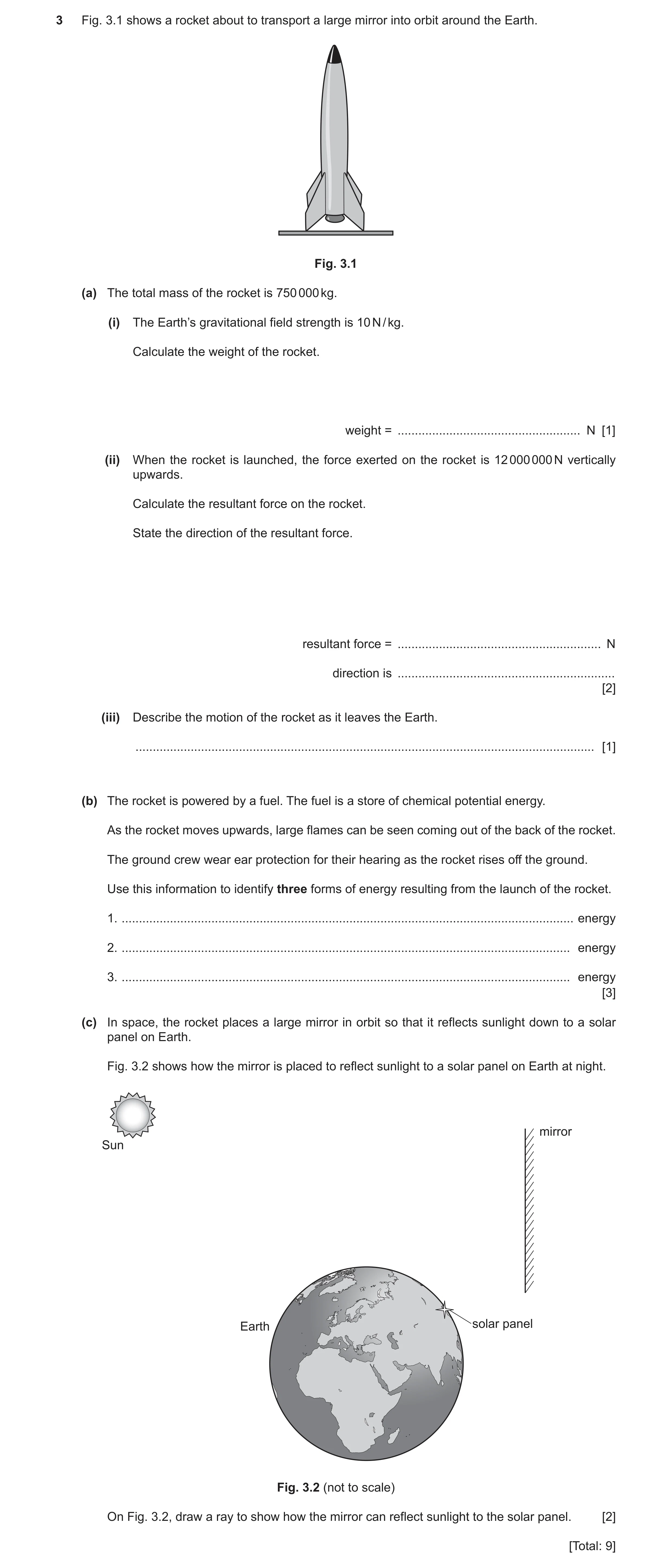
3 Fig. 3.1 shows a rocket about to transport a large mirror into orbit around the Earth. Fig. 3.1 (a) The total mass of the rocket is 750 000 kg. (i) The Earth’s gravitational field strength is 10 N / kg. Calculate the weight of the rocket. weight = … N [1] (ii) When the rocket is launched, the force exerted on the rocket is 12 000 000 N vertically upwards. Calculate the resultant force on the rocket. State the direction of the resultant force. resultant force = … N direction is … [2] (iii) Describe the motion of the rocket as it leaves the Earth. … [1] (b) The rocket is powered by a fuel. The fuel is a store of chemical potential energy. As the rocket moves upwards, large flames can be seen coming out of the back of the rocket. The ground crew wear ear protection for their hearing as the rocket rises off the ground. Use this information to identify three forms of energy resulting from the launch of the rocket. 1. … energy 2. … energy 3. … energy [3] (c) In space, the rocket places a large mirror in orbit so that it reflects sunlight down to a solar panel on Earth. Fig. 3.2 shows how the mirror is placed to reflect sunlight to a solar panel on Earth at night. mirror Sun Earth solar panel Fig. 3.2 (not to scale) On Fig. 3.2, draw a ray to show how the mirror can reflect sunlight to the solar panel. [2] [Total: 9]
9 marks
Mark scheme: 3(a)(i) (weight = 750000 × 10 =) 7500000 (N) ; 1 3(a)(ii) (resultant force = 12 000 000 – 7 500 000 =) 4 500 000 (N) ; (vertically) upwards ; 2 3(a)(iii) accelerating / increasing speed ; 1 3(b) any three from: gravitational potential ; kinetic ; light ; sound ; thermal / heat ; max 3 3(c) ray from Sun to mirror reflected to solar panel ; angle of incidence equal to angle of reflection by visual inspection ; 2
This question in 0653/31 May/June 2020
Q5 · A climber moving up a rock face 0653/33 Oct/Nov 2020
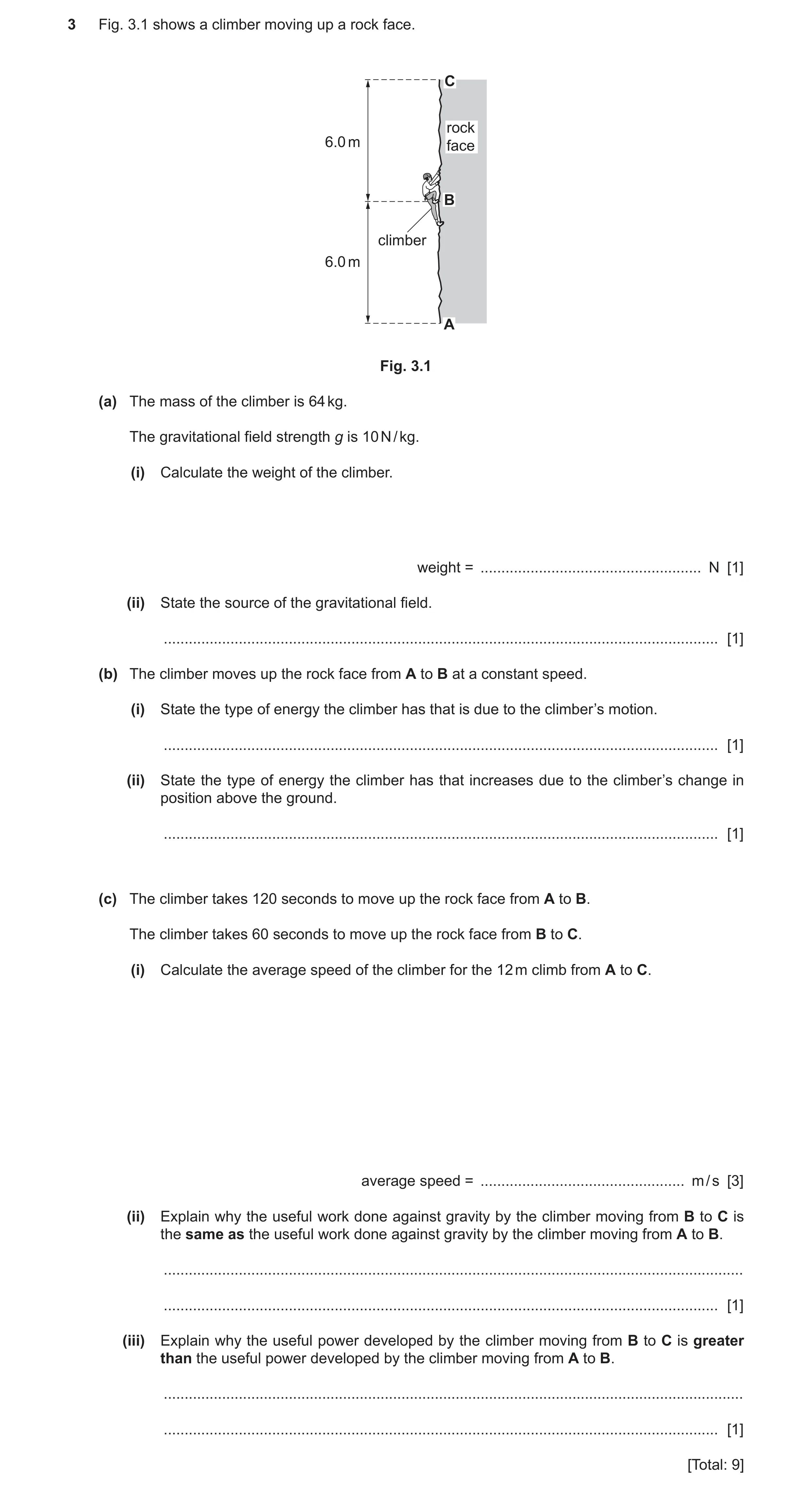
3 Fig. 3.1 shows a climber moving up a rock face. C rock 6.0 m face B climber 6.0 m A Fig. 3.1 (a) The mass of the climber is 64 kg. The gravitational field strength g is 10 N / kg. (i) Calculate the weight of the climber. weight = … N [1] (ii) State the source of the gravitational field. … [1] (b) The climber moves up the rock face from A to B at a constant speed. (i) State the type of energy the climber has that is due to the climber’s motion. … [1] (ii) State the type of energy the climber has that increases due to the climber’s change in position above the ground. … [1] (c) The climber takes 120 seconds to move up the rock face from A to B. The climber takes 60 seconds to move up the rock face from B to C. (i) Calculate the average speed of the climber for the 12 m climb from A to C. average speed = … m / s [3] (ii) Explain why the useful work done against gravity by the climber moving from B to C is the same as the useful work done against gravity by the climber moving from A to B. … … [1] (iii) Explain why the useful power developed by the climber moving from B to C is greater than the useful power developed by the climber moving from A to B. … … [1] [Total: 9]
9 marks
Mark scheme: 3(a)(i) 640 (N) ; 1 3(a)(ii) (the) Earth ; 1 3(b)(i) kinetic ; 1 3(b)(ii) gravitational (potential energy) ; 1 3(c)(i) total time = 120 + 60 = 180 s ; speed = distance ÷ time / 12 ÷ 180 ; 0.067 (m / s) ; 3 3(c)(ii) the distance moved (and the force / climber’s weight) is the same ; 1 3(c)(iii) (the climber does the same work in a) shorter time taken ; 1
This question in 0653/33 Oct/Nov 2020
Q6 · A man lying down on a sandy beach on a sunny day 0653/33 May/June 2021
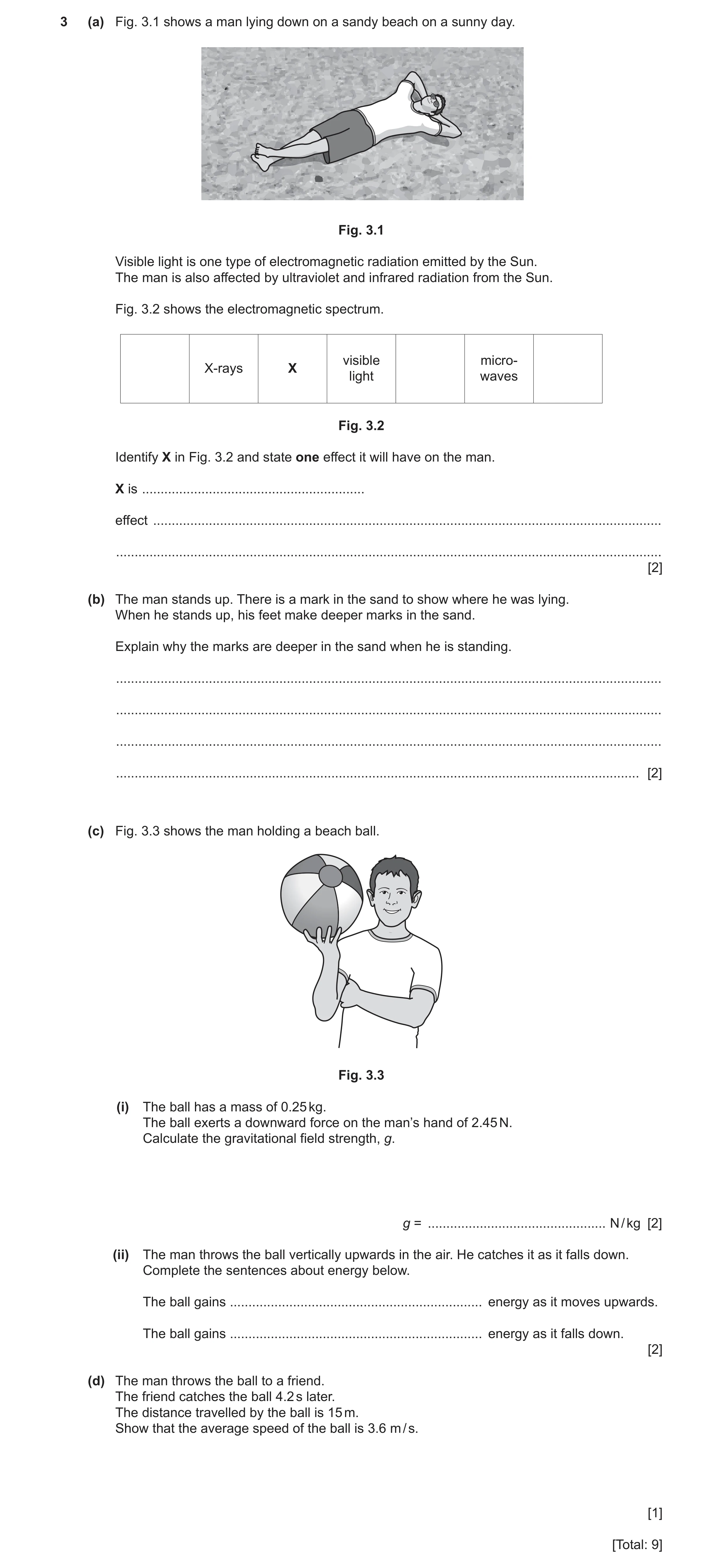
3 (a) Fig. 3.1 shows a man lying down on a sandy beach on a sunny day. Fig. 3.1 Visible light is one type of electromagnetic radiation emitted by the Sun. The man is also affected by ultraviolet and infrared radiation from the Sun. Fig. 3.2 shows the electromagnetic spectrum. visible micro- X-rays X light waves Fig. 3.2 Identify X in Fig. 3.2 and state one effect it will have on the man. X is … effect … … [2] (b) The man stands up. There is a mark in the sand to show where he was lying. When he stands up, his feet make deeper marks in the sand. Explain why the marks are deeper in the sand when he is standing. … … … … [2] (c) Fig. 3.3 shows the man holding a beach ball. Fig. 3.3 (i) The ball has a mass of 0.25 kg. The ball exerts a downward force on the man’s hand of 2.45 N. Calculate the gravitational field strength, g. g = … N / kg [2] (ii) The man throws the ball vertically upwards in the air. He catches it as it falls down. Complete the sentences about energy below. The ball gains … energy as it moves upwards. The ball gains … energy as it falls down. [2] (d) The man throws the ball to a friend. The friend catches the ball 4.2 s later. The distance travelled by the ball is 15 m. Show that the average speed of the ball is 3.6 m / s. [1] [Total: 9]
9 marks
Mark scheme: 3(a) X is: ultraviolet ; effect: sunburn ; 2 3(b) pressure due to weight ; over smaller area on feet / over larger area lying down ; 2 3(c)(i) W = mg (in any form) / g = 2.45 / 0.25 ; (g =) 9.8 (N / kg) ; 2 3(c)(ii) gravitational potential ; kinetic ; in this order 2 3(d) 15 / 4.2 (= 3.6 m / s) ; 1
This question in 0653/33 May/June 2021
Q7 · A man pushing a shopping trolley forwards 0653/31 May/June 2022
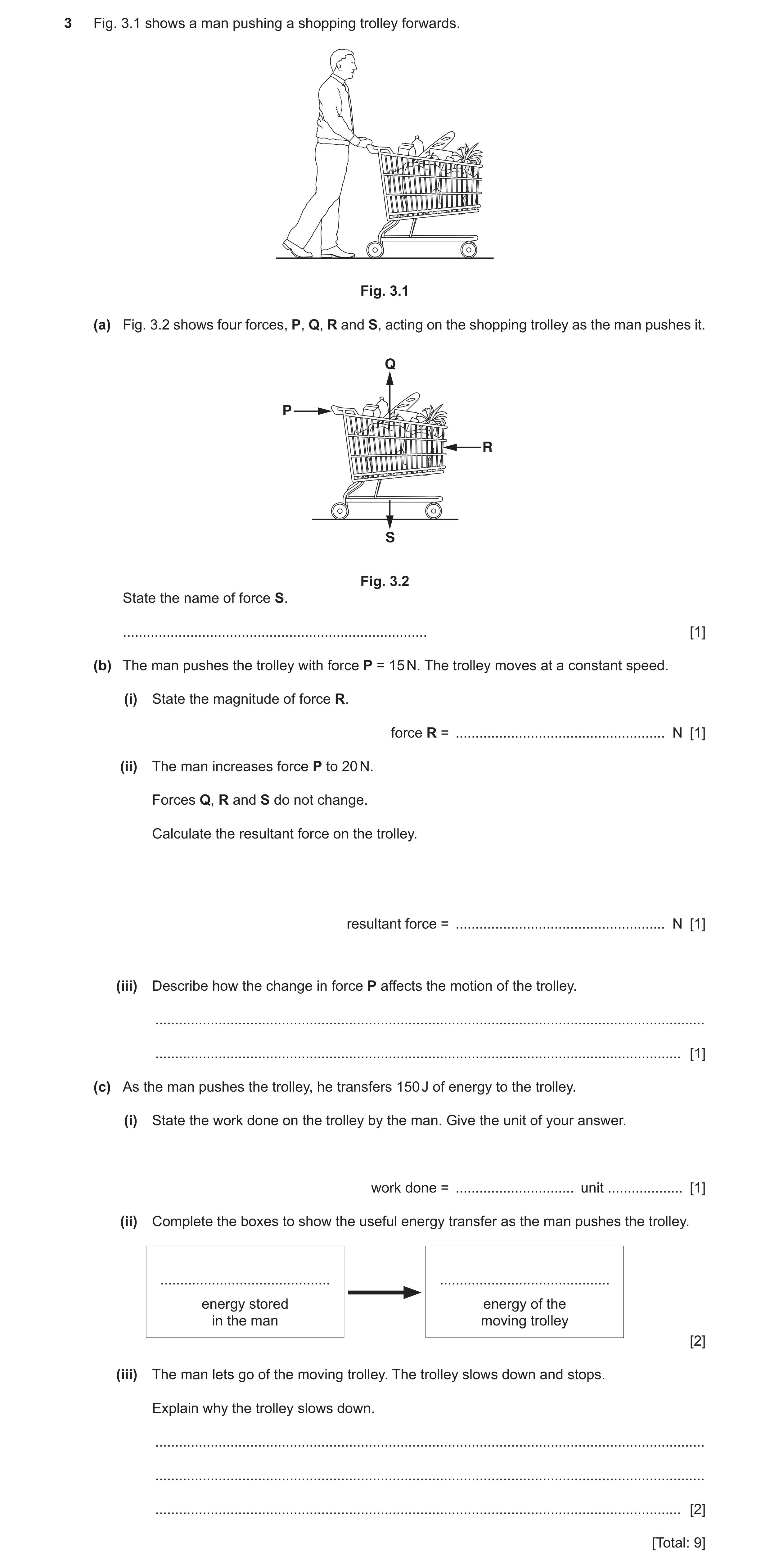
3 Fig. 3.1 shows a man pushing a shopping trolley forwards. Fig. 3.1 (a) Fig. 3.2 shows four forces, P, Q, R and S, acting on the shopping trolley as the man pushes it. Q P R S Fig. 3.2 State the name of force S. … [1] (b) The man pushes the trolley with force P = 15 N. The trolley moves at a constant speed. (i) State the magnitude of force R. force R = … N [1] (ii) The man increases force P to 20 N. Forces Q, R and S do not change. Calculate the resultant force on the trolley. resultant force = … N [1] (iii) Describe how the change in force P affects the motion of the trolley. … … [1] (c) As the man pushes the trolley, he transfers 150 J of energy to the trolley. (i) State the work done on the trolley by the man. Give the unit of your answer. work done = … unit … [1] (ii) Complete the boxes to show the useful energy transfer as the man pushes the trolley. … … energy stored energy of the in the man moving trolley [2] (iii) The man lets go of the moving trolley. The trolley slows down and stops. Explain why the trolley slows down. … … … [2] [Total: 9]
9 marks
Mark scheme: 3(a) weight ; 1 3(b)(i) 15 (N) ; 1 3(b)(ii) (resultant force = 20 – 15 =) 5 (N) ; 1 3(b)(iii) (trolley) increases speed / accelerates ; 1 3(c)(i) 150 AND J ; 1 3(c)(ii) (from) chemical (potential) ; (to) kinetic ; 2 3(c)(iii) force P now zero ; friction (causes trolley to slow down) ; 2
This question in 0653/31 May/June 2022
Q8 · The forces acting as a student rides on a moving scooter 0653/32 May/June 2022
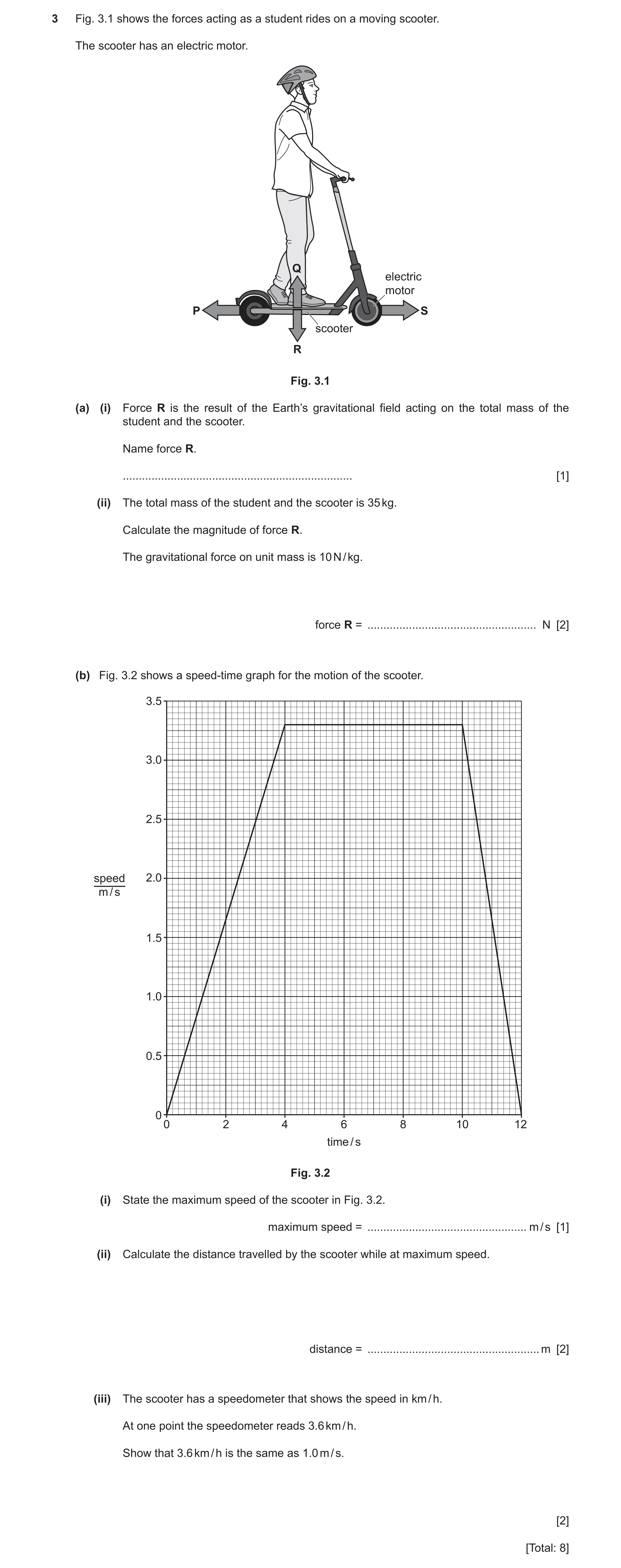
3 Fig. 3.1 shows the forces acting as a student rides on a moving scooter. The scooter has an electric motor. Q electric motor P S scooter R Fig. 3.1 (a) (i) Force R is the result of the Earth’s gravitational field acting on the total mass of the student and the scooter. Name force R. … [1] (ii) The total mass of the student and the scooter is 35 kg. Calculate the magnitude of force R. The gravitational force on unit mass is 10 N / kg. force R = … N [2] (b) Fig. 3.2 shows a speed-time graph for the motion of the scooter. 3.5 3.0 2.5 speed 2.0 m / s 1.5 1.0 0.5 00 2 4 6 8 10 12 time / s Fig. 3.2 (i) State the maximum speed of the scooter in Fig. 3.2. maximum speed = … m / s [1] (ii) Calculate the distance travelled by the scooter while at maximum speed. distance = … m [2] (iii) The scooter has a speedometer that shows the speed in km / h. At one point the speedometer reads 3.6 km / h. Show that 3.6 km / h is the same as 1.0 m / s. [2] [Total: 8]
8 marks
Mark scheme: 3(a)(i) weight ; 1 3(a)(ii) W = mg (in any form) / 35 10 ; 350 (N) ; 2 3(b)(i) 3.3 (m / s) ; 1 3(b)(ii) distance = speed time (in any form) / 3.3 6.0 ; 19.8 (m / s) ; 2 3(b)(iii) 1.0 3600 (= 3600 m / h) ; 3600 / 1000 (km / h) ; OR 3.6 1000 (= 3600 m / h) ; 3600 / 3600 (=1.0 m / s) ; 2
This question in 0653/32 May/June 2022
Q9 · Forces P, Q, R and S acting on an airplane moving forward along a runway 0653/31 Oct/Nov 2022
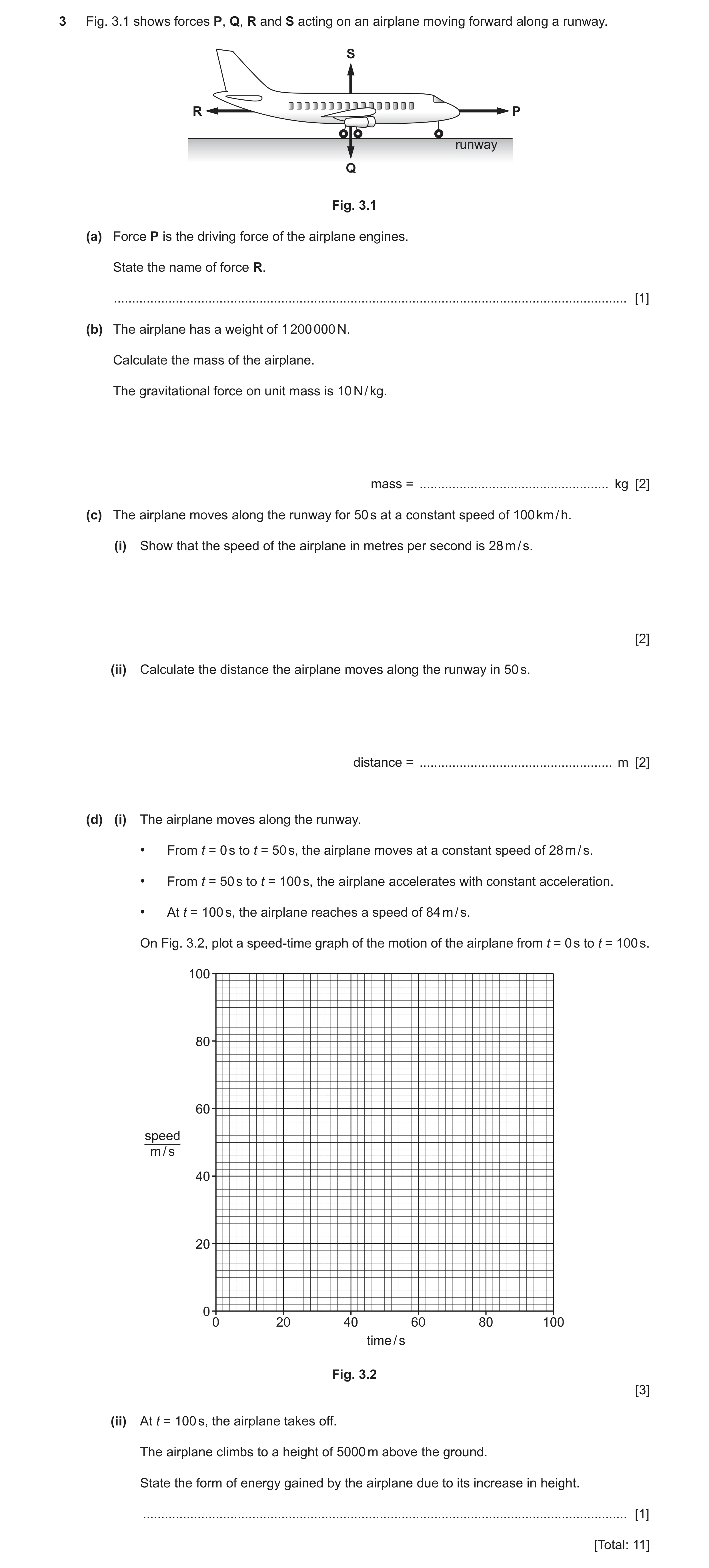
3 Fig. 3.1 shows forces P, Q, R and S acting on an airplane moving forward along a runway. S R P runway Q Fig. 3.1 (a) Force P is the driving force of the airplane engines. State the name of force R. … [1] (b) The airplane has a weight of 1 200 000 N. Calculate the mass of the airplane. The gravitational force on unit mass is 10 N / kg. mass = … kg [2] (c) The airplane moves along the runway for 50 s at a constant speed of 100 km / h. (i) Show that the speed of the airplane in metres per second is 28 m / s. [2] (ii) Calculate the distance the airplane moves along the runway in 50 s. distance = … m [2] (d) (i) The airplane moves along the runway. • From t = 0 s to t = 50 s, the airplane moves at a constant speed of 28 m / s. • From t = 50 s to t = 100 s, the airplane accelerates with constant acceleration. • At t = 100 s, the airplane reaches a speed of 84 m / s. On Fig. 3.2, plot a speed-time graph of the motion of the airplane from t = 0 s to t = 100 s. 100 80 60 speed m / s 40 20 0 0 20 40 60 80 100 time / s Fig. 3.2 [3] (ii) At t = 100 s, the airplane takes off. The airplane climbs to a height of 5000 m above the ground. State the form of energy gained by the airplane due to its increase in height. … [1] [Total: 11]
11 marks
Mark scheme: 3(a) friction ; 1 3(b) evidence of, W = mg / 1 200 000 ÷ 10 ; 2 120 000 (kg) ; 3(c)(i) one unit conversion correct (1 km = 1000 m / 1 hour = 3600 s) ; 2 speed conversion shown (= 27.8 or 28) (m / s) ; 3(c)(ii) evidence of, speed = distance ÷ time / 28 50 ; 2 1400 (m) ; 3(d)(i) horizontal line from t = 0 s to t = 50 s ; 3 straight diagonal line from t = 50 s to t = 100 s ; horizontal line at 28 m / s AND diagonal line finishes at 84 m / s ; 3(d)(ii) gravitational (potential) ; 1
This question in 0653/31 Oct/Nov 2022
Q10 · A moving conveyor belt carrying a box from the ground up to an aircraft 0653/31 May/June 2023
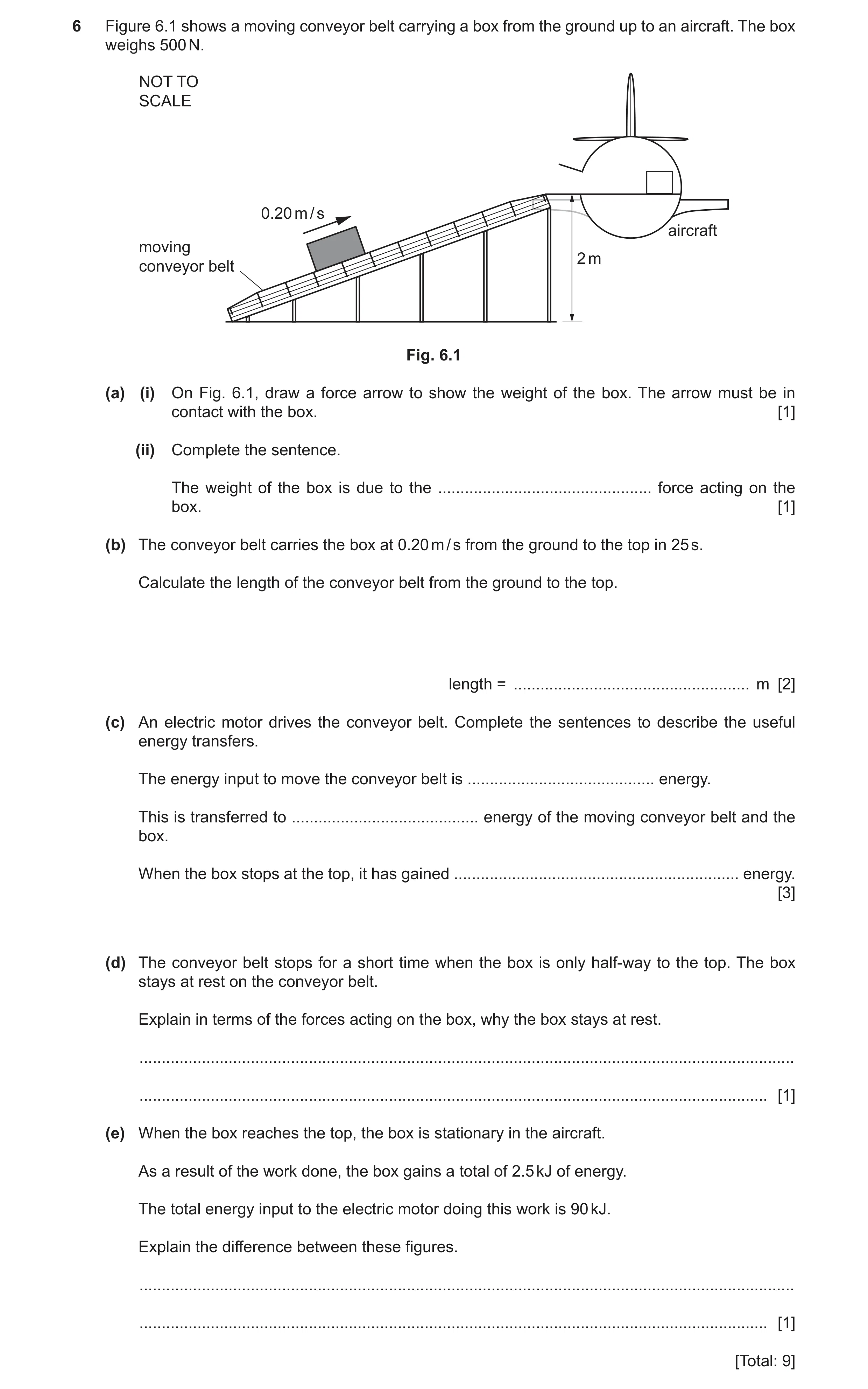
6 Figure 6.1 shows a moving conveyor belt carrying a box from the ground up to an aircraft. The box weighs 500 N. NOT TO SCALE 0.20 m / s aircraft moving 2 m conveyor belt Fig. 6.1 (a) (i) On Fig. 6.1, draw a force arrow to show the weight of the box. The arrow must be in contact with the box. [1] (ii) Complete the sentence. The weight of the box is due to the … force acting on the box. [1] (b) The conveyor belt carries the box at 0.20 m / s from the ground to the top in 25 s. Calculate the length of the conveyor belt from the ground to the top. length = … m [2] (c) An electric motor drives the conveyor belt. Complete the sentences to describe the useful energy transfers. The energy input to move the conveyor belt is … energy. This is transferred to … energy of the moving conveyor belt and the box. When the box stops at the top, it has gained … energy. [3] (d) The conveyor belt stops for a short time when the box is only half-way to the top. The box stays at rest on the conveyor belt. Explain in terms of the forces acting on the box, why the box stays at rest. … … [1] (e) When the box reaches the top, the box is stationary in the aircraft. As a result of the work done, the box gains a total of 2.5 kJ of energy. The total energy input to the electric motor doing this work is 90 kJ. Explain the difference between these figures. … … [1] [Total: 9]
9 marks
Mark scheme: 6(a)(i) arrow in contact with box pointing vertically downwards ; 1 6(a)(ii) gravitational ; 1 6(b) speed = distance time (in any form) OR distance = 25 0.2 ; 5 (m) ; 2 6(c) electrical ; kinetic ; gravitational potential ; 3 6(d) all forces balanced / no resultant force ; 1 6(e) energy lost / wasted, as thermal energy / energy needed to move, belt / motor ; 1
This question in 0653/31 May/June 2023
Q11 · The forces acting on an aircraft in flight 0653/31 Oct/Nov 2023
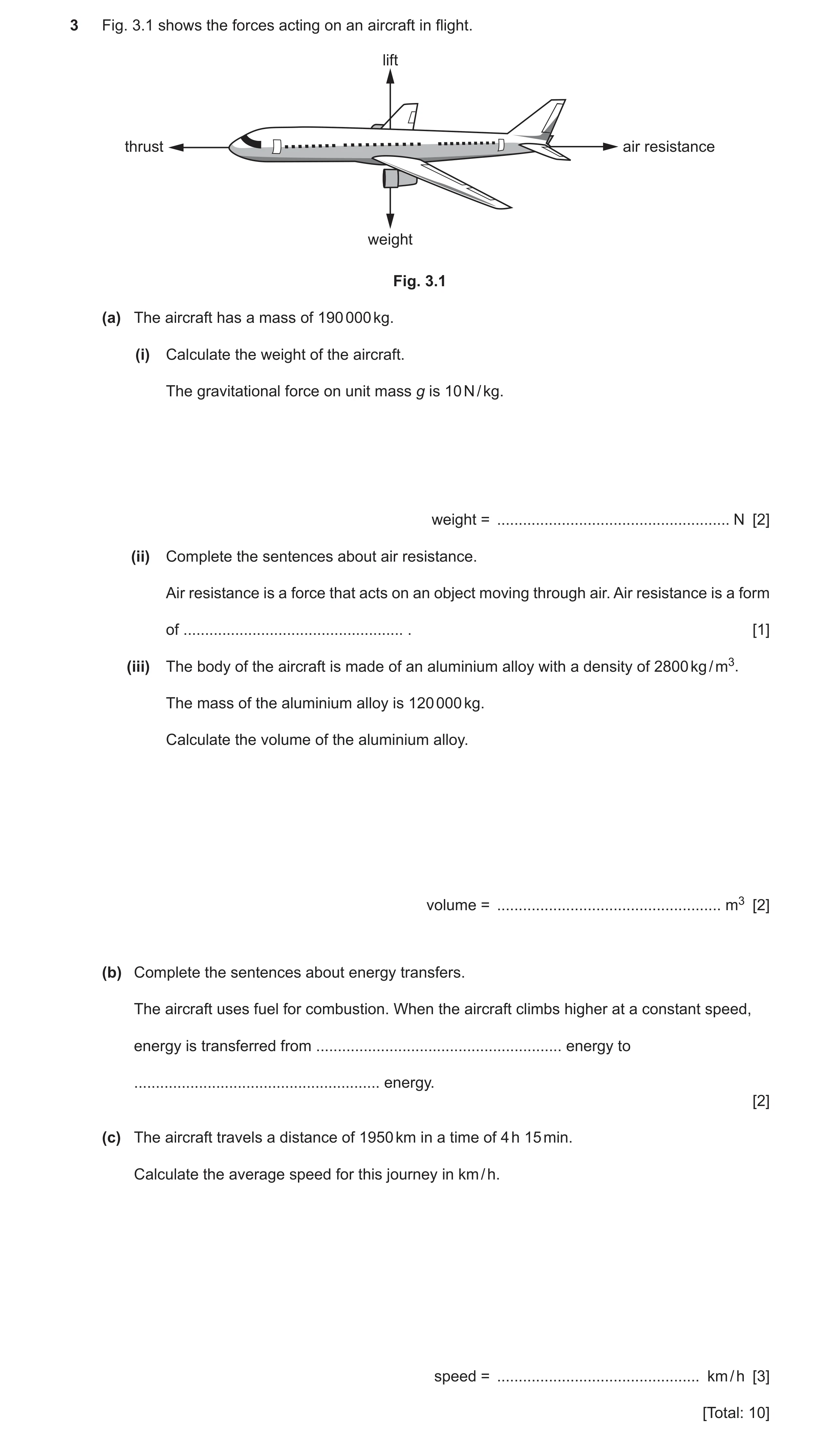
3 Fig. 3.1 shows the forces acting on an aircraft in flight. lift thrust air resistance weight Fig. 3.1 (a) The aircraft has a mass of 190 000 kg. (i) Calculate the weight of the aircraft. The gravitational force on unit mass g is 10 N / kg. weight = … N [2] (ii) Complete the sentences about air resistance. Air resistance is a force that acts on an object moving through air. Air resistance is a form of … . [1] (iii) The body of the aircraft is made of an aluminium alloy with a density of 2800 kg / m3. The mass of the aluminium alloy is 120 000 kg. Calculate the volume of the aluminium alloy. volume = … m3 [2] (b) Complete the sentences about energy transfers. The aircraft uses fuel for combustion. When the aircraft climbs higher at a constant speed, energy is transferred from … energy to … energy. [2] (c) The aircraft travels a distance of 1950 km in a time of 4 h 15 min. Calculate the average speed for this journey in km / h. speed = … km / h [3] [Total: 10]
10 marks
Mark scheme: 3(a)(i) evidence of, W = mg / 190 000 10 ; 2 1 900 000 (N) ; 3(a)(ii) friction ; 1 3(a)(iii) m 2 evidence of, = / 120 000 ÷ 2800 ; V 43 (m3) ; 3(b) chemical (potential) ; 2 gravitational potential ; 3(c) evidence of, speed = distance ÷ time / 1950 ÷ 4.25 ; 3 unit conversion of 15 mins to 0.25 hour ; 459 (km / h) ;
This question in 0653/31 Oct/Nov 2023
Q12 · A truck carrying a load moving horizontally along a flat level road 0653/32 Oct/Nov 2023
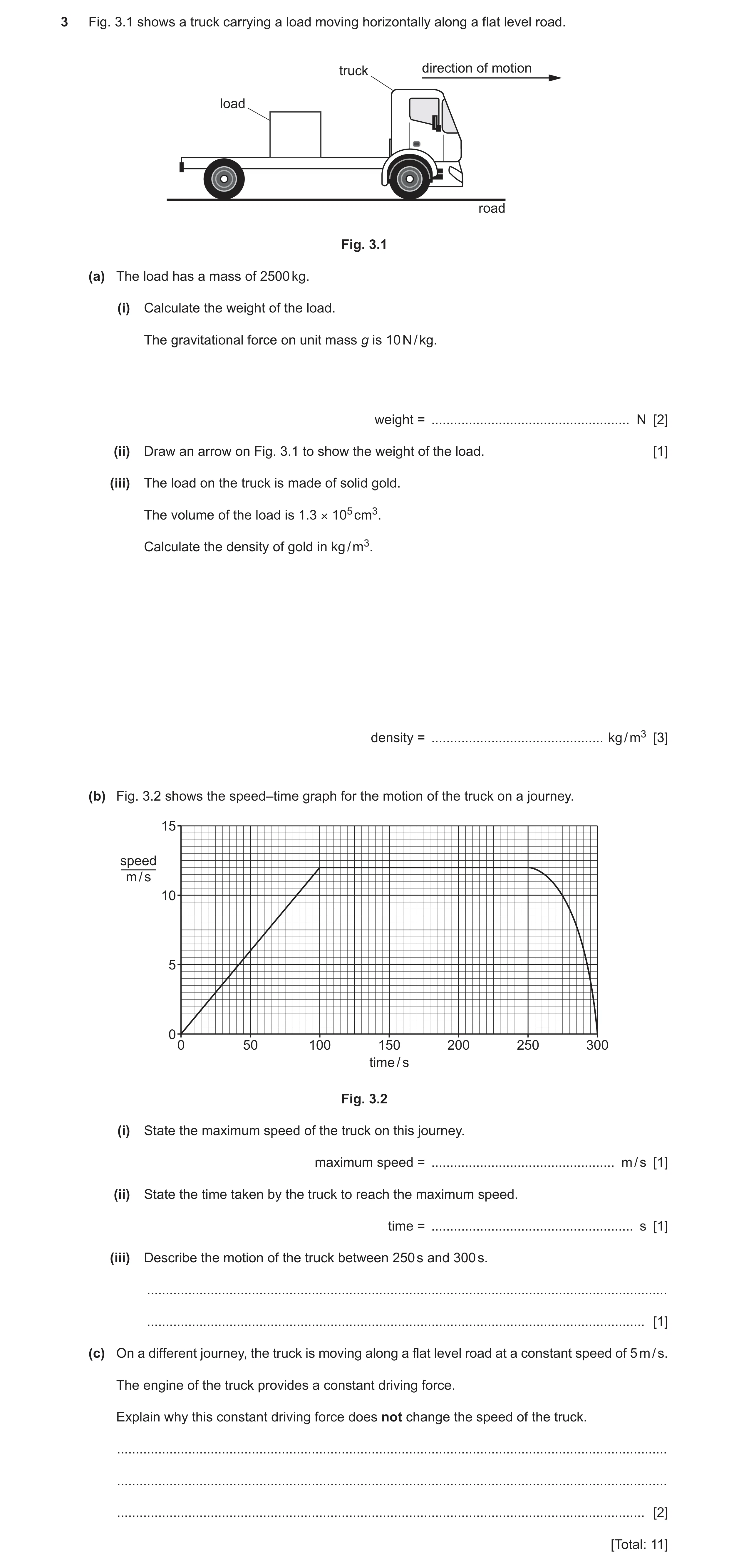
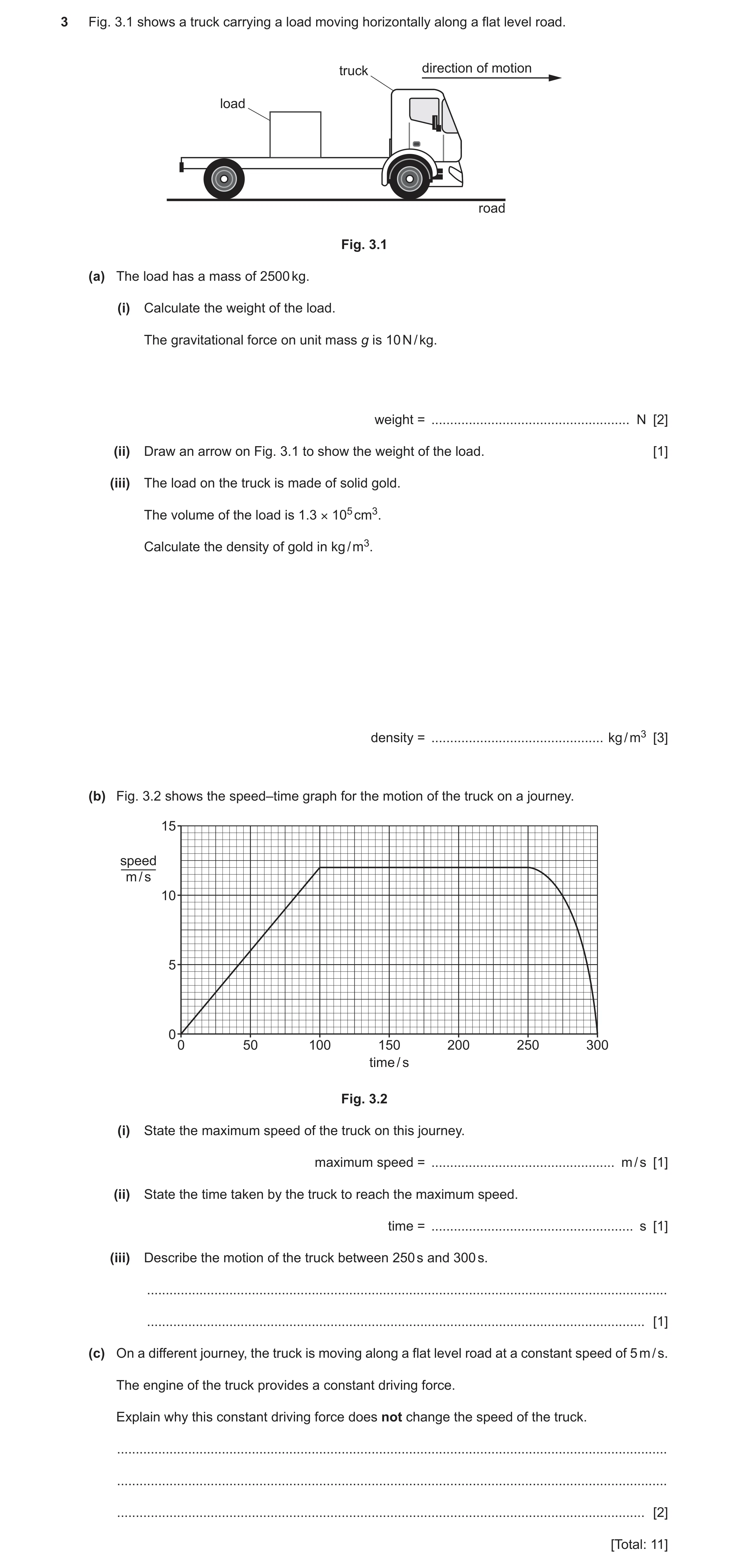
3 Fig. 3.1 shows a truck carrying a load moving horizontally along a flat level road. truck direction of motion load road Fig. 3.1 (a) The load has a mass of 2500 kg. (i) Calculate the weight of the load. The gravitational force on unit mass g is 10 N / kg. weight = … N [2] (ii) Draw an arrow on Fig. 3.1 to show the weight of the load. [1] (iii) The load on the truck is made of solid gold. The volume of the load is 1.3 × 105 cm3. Calculate the density of gold in kg / m3. density = … kg / m3 [3] (b) Fig. 3.2 shows the speed–time graph for the motion of the truck on a journey. 15 speed m / s 10 5 0 0 50 100 150 200 250 300 time / s Fig. 3.2 (i) State the maximum speed of the truck on this journey. maximum speed = … m / s [1] (ii) State the time taken by the truck to reach the maximum speed. time = … s [1] (iii) Describe the motion of the truck between 250 s and 300 s. … … [1] (c) On a different journey, the truck is moving along a flat level road at a constant speed of 5 m / s. The engine of the truck provides a constant driving force. Explain why this constant driving force does not change the speed of the truck. … … … [2] [Total: 11]
11 marks
Mark scheme: 3(a)(i) evidence of, W = mg / 2500 10 ; 2 25 000 (N) ; 3(a)(ii) arrow touching load and vertically downwards ; 1 3(a)(iii) conversion of volume to m3 correct / 1.3 105 ÷ 106 = 0.13 m3 ; 3 m evidence of, = / 2500 ÷ 0.13 ; V 19 000 (kg / m3) ; 3(b)(i) 12 (m / s) ; 1 3(b)(ii) 100 (s) ; 1 3(b)(iii) (non-constant) deceleration / decreasing in speed ; 1 3(c) idea of, frictional / resistive / opposing, force(s) ; 2 no resultant force ;
This question in 0653/32 Oct/Nov 2023
Q13 · A truck carrying a load moving horizontally along a flat level road 0653/33 Oct/Nov 2023
3 Fig. 3.1 shows a truck carrying a load moving horizontally along a flat level road. truck direction of motion load road Fig. 3.1 (a) The load has a mass of 2500 kg. (i) Calculate the weight of the load. The gravitational force on unit mass g is 10 N / kg. weight = … N [2] (ii) Draw an arrow on Fig. 3.1 to show the weight of the load. [1] (iii) The load on the truck is made of solid gold. The volume of the load is 1.3 × 105 cm3. Calculate the density of gold in kg / m3. density = … kg / m3 [3] (b) Fig. 3.2 shows the speed–time graph for the motion of the truck on a journey. 15 speed m / s 10 5 0 0 50 100 150 200 250 300 time / s Fig. 3.2 (i) State the maximum speed of the truck on this journey. maximum speed = … m / s [1] (ii) State the time taken by the truck to reach the maximum speed. time = … s [1] (iii) Describe the motion of the truck between 250 s and 300 s. … … [1] (c) On a different journey, the truck is moving along a flat level road at a constant speed of 5 m / s. The engine of the truck provides a constant driving force. Explain why this constant driving force does not change the speed of the truck. … … … [2] [Total: 11]
11 marks
Mark scheme: 3(a)(i) evidence of, W = mg / 2500 10 ; 2 25 000 (N) ; 3(a)(ii) arrow touching load and vertically downwards ; 1 3(a)(iii) conversion of volume to m3 correct / 1.3 105 ÷ 106 = 0.13 m3 ; 3 m evidence of, = / 2500 ÷ 0.13 ; V 19 000 (kg / m3) ; 3(b)(i) 12 (m / s) ; 1 3(b)(ii) 100 (s) ; 1 3(b)(iii) (non-constant) deceleration / decreasing in speed ; 1 3(c) idea of, frictional / resistive / opposing, force(s) ; 2 no resultant force ;
This question in 0653/33 Oct/Nov 2023
Q14 · Three forces, Q, R and S, acting on a bus moving along a level road at constant speed 0653/33 May/June 2024
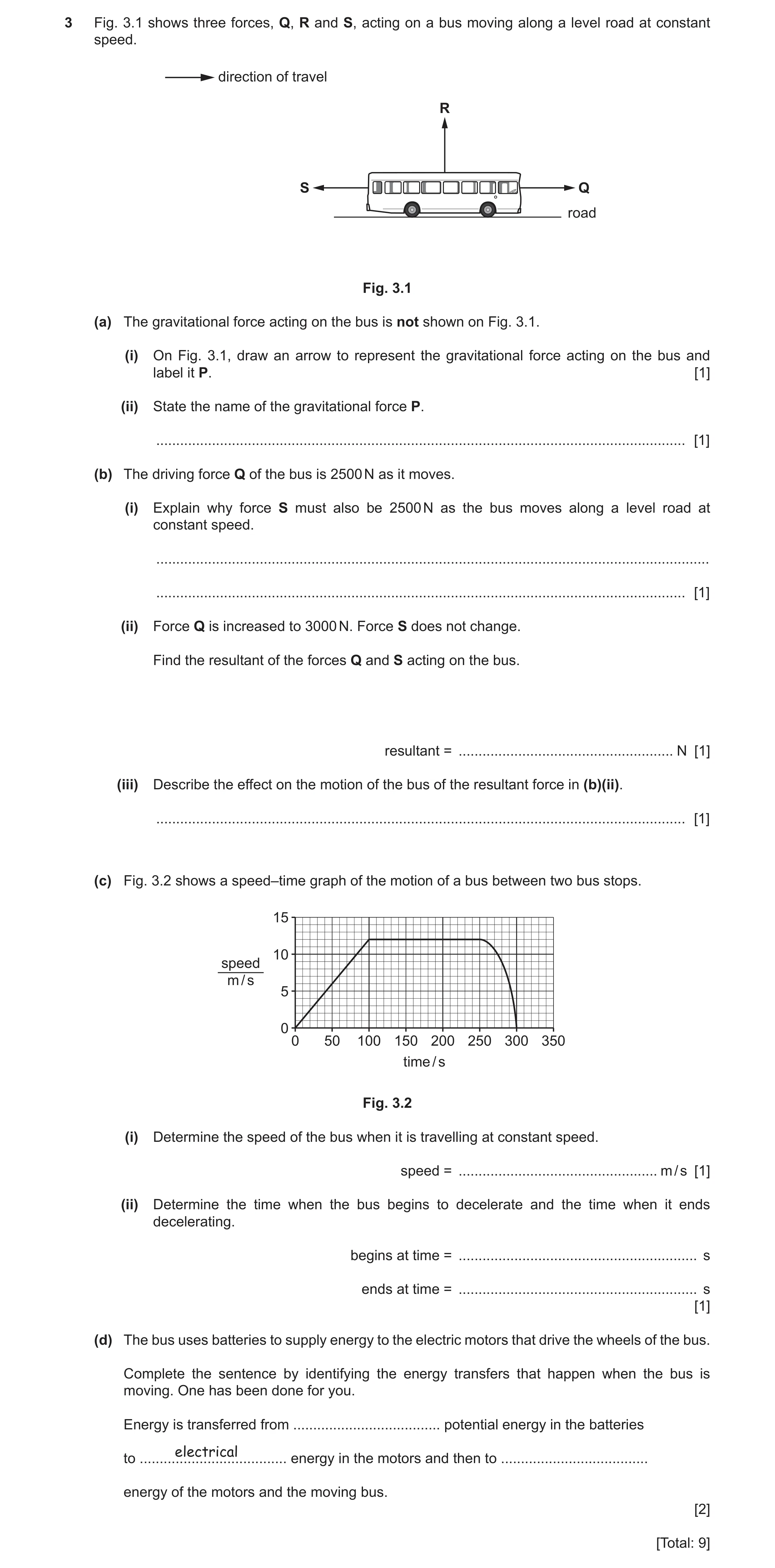
3 Fig. 3.1 shows three forces, Q, R and S, acting on a bus moving along a level road at constant speed. direction of travel R S Q road Fig. 3.1 (a) The gravitational force acting on the bus is not shown on Fig. 3.1. (i) On Fig. 3.1, draw an arrow to represent the gravitational force acting on the bus and label it P. [1] (ii) State the name of the gravitational force P. … [1] (b) The driving force Q of the bus is 2500 N as it moves. (i) Explain why force S must also be 2500 N as the bus moves along a level road at constant speed. … … [1] (ii) Force Q is increased to 3000 N. Force S does not change. Find the resultant of the forces Q and S acting on the bus. resultant = … N [1] (iii) Describe the effect on the motion of the bus of the resultant force in (b)(ii). … [1] (c) Fig. 3.2 shows a speed–time graph of the motion of a bus between two bus stops. 15 10 speed m / s 5 0 0 50 100 150 200 250 300 350 time / s Fig. 3.2 (i) Determine the speed of the bus when it is travelling at constant speed. speed = … m / s [1] (ii) Determine the time when the bus begins to decelerate and the time when it ends decelerating. begins at time = … s ends at time = … s [1] (d) The bus uses batteries to supply energy to the electric motors that drive the wheels of the bus. Complete the sentence by identifying the energy transfers that happen when the bus is moving. One has been done for you. Energy is transferred from … potential energy in the batteries electrical to … energy in the motors and then to … energy of the motors and the moving bus. [2] [Total: 9]
9 marks
Mark scheme: 3(a)(i) arrow vertically down, touching bus ; 1 3(a)(ii) weight ; 1 3(b)(i) no resultant force / (driving) force Q must equal (friction) force S / forces are equal and opposite ; 1 Question Answer Marks 3(b)(ii) (resultant force = 3000 – 2500 =) 500 (N) ; 1 3(b)(iii) acceleration ; 1 3(c)(i) 12 (m / s) ; 1 3(c)(ii) (begins at time) 250 (s) (ends at time) 300 (s) ; 1 3(d) chemical ; kinetic ; in this order 2
This question in 0653/33 May/June 2024
Q15 · A block of wood 0653/31 Oct/Nov 2024
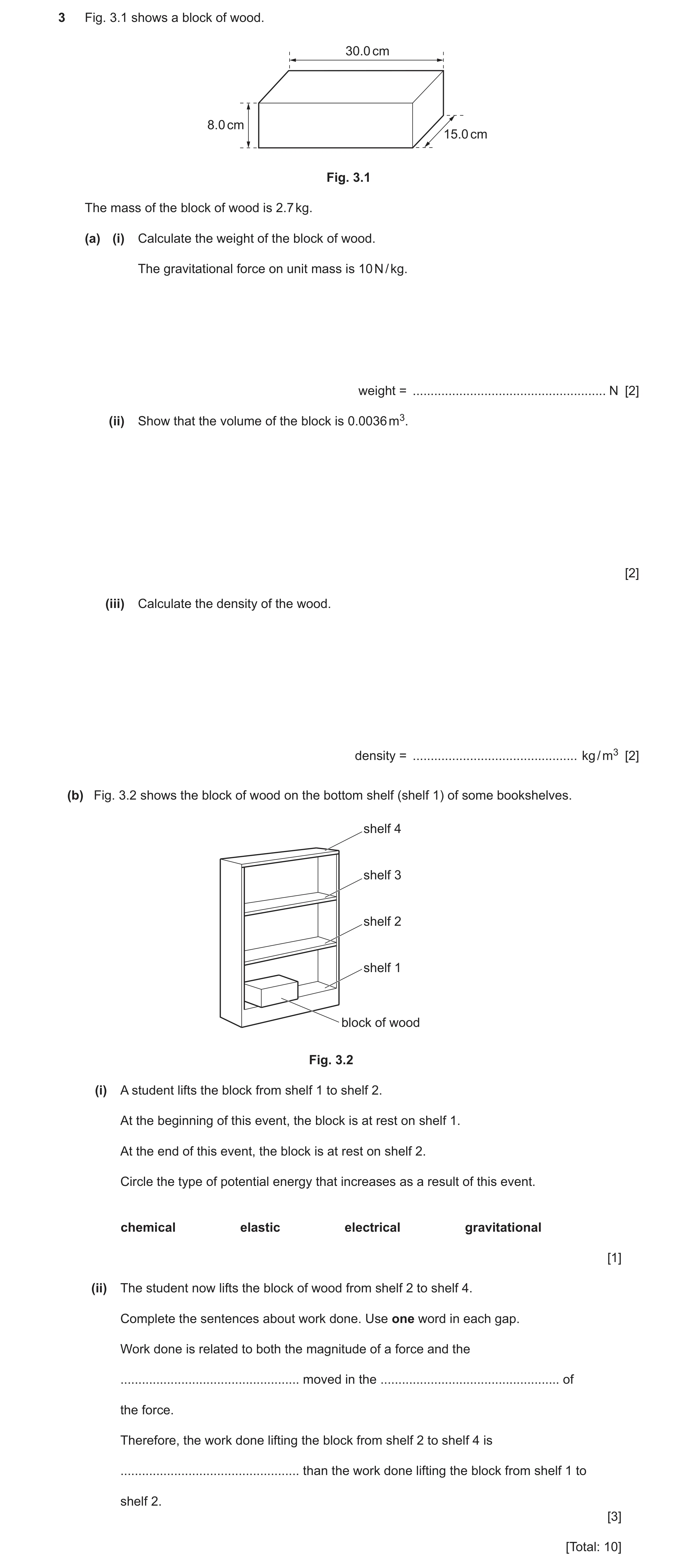
3 Fig. 3.1 shows a block of wood. 30.0 cm 8.0 cm 15.0 cm Fig. 3.1 The mass of the block of wood is 2.7 kg. (a) (i) Calculate the weight of the block of wood. The gravitational force on unit mass is 10 N / kg. weight = … N [2] (ii) Show that the volume of the block is 0.0036 m3. [2] (iii) Calculate the density of the wood. density = … kg / m3 [2] (b) Fig. 3.2 shows the block of wood on the bottom shelf (shelf 1) of some bookshelves. shelf 4 shelf 3 shelf 2 shelf 1 block of wood Fig. 3.2 (i) A student lifts the block from shelf 1 to shelf 2. At the beginning of this event, the block is at rest on shelf 1. At the end of this event, the block is at rest on shelf 2. Circle the type of potential energy that increases as a result of this event. chemical elastic electrical gravitational [1] (ii) The student now lifts the block of wood from shelf 2 to shelf 4. Complete the sentences about work done. Use one word in each gap. Work done is related to both the magnitude of a force and the … moved in the … of the force. Therefore, the work done lifting the block from shelf 2 to shelf 4 is … than the work done lifting the block from shelf 1 to shelf 2. [3] [Total: 10]
10 marks
Mark scheme: 3(a)(i) evidence of W = mg / 2.7 10 ; 2 27 (N) ; 3(a)(ii) evidence of volume = width length depth / 8.0 30.0 15.0 ; 2 ÷ 1 000 000 / 106 ; (= 0.0036 m3) 3(a)(iii) evidence of = m ÷ V / 2.7 ÷ 0.0036 ; 2 750 (kg / m3) ; 3(b)(i) gravitational ; 1 3(b)(ii) distance ; 3 direction ; greater / more / AW ;
This question in 0653/31 Oct/Nov 2024
Q16 · A candle made of wax 0653/32 Oct/Nov 2024
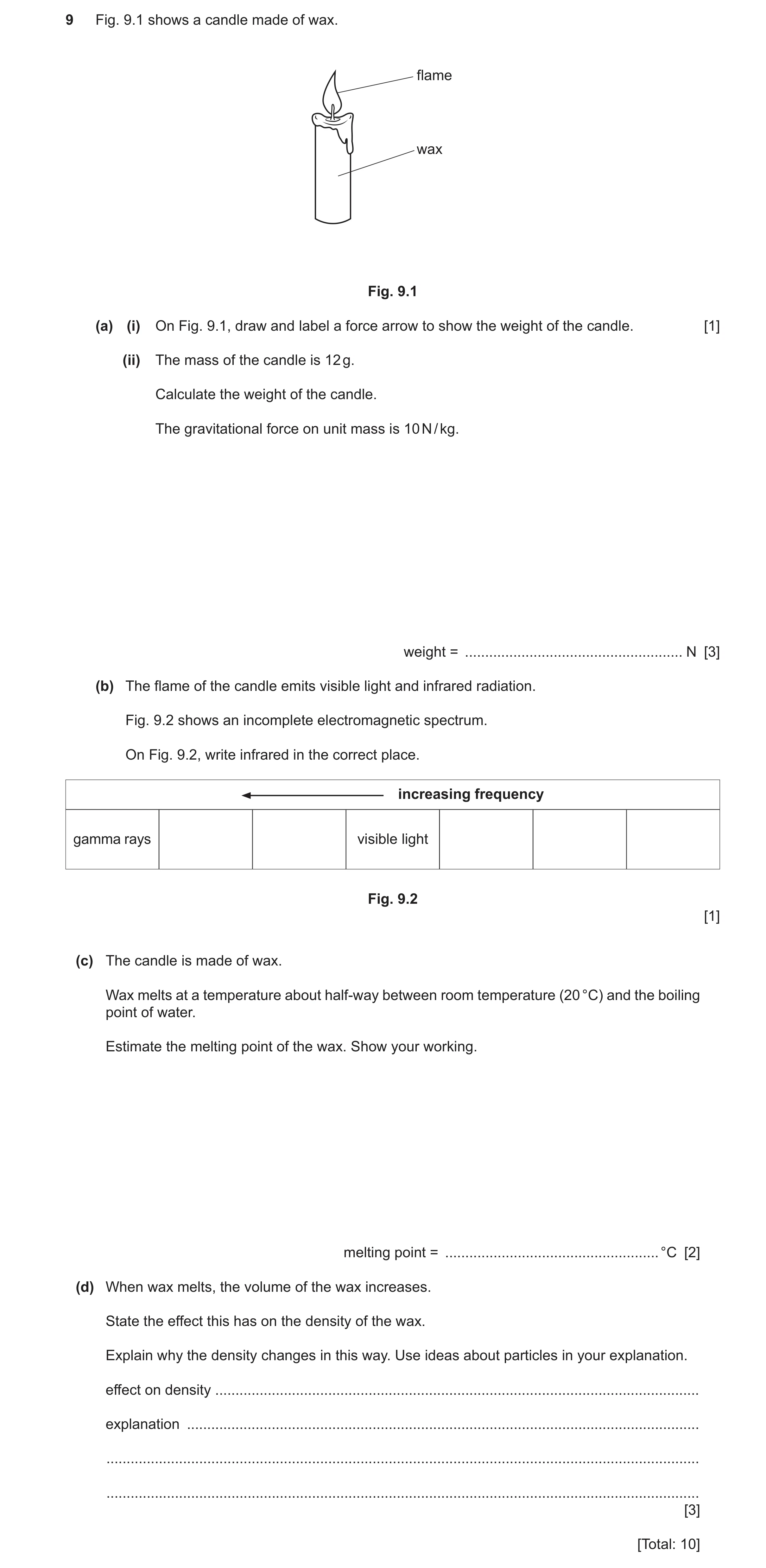
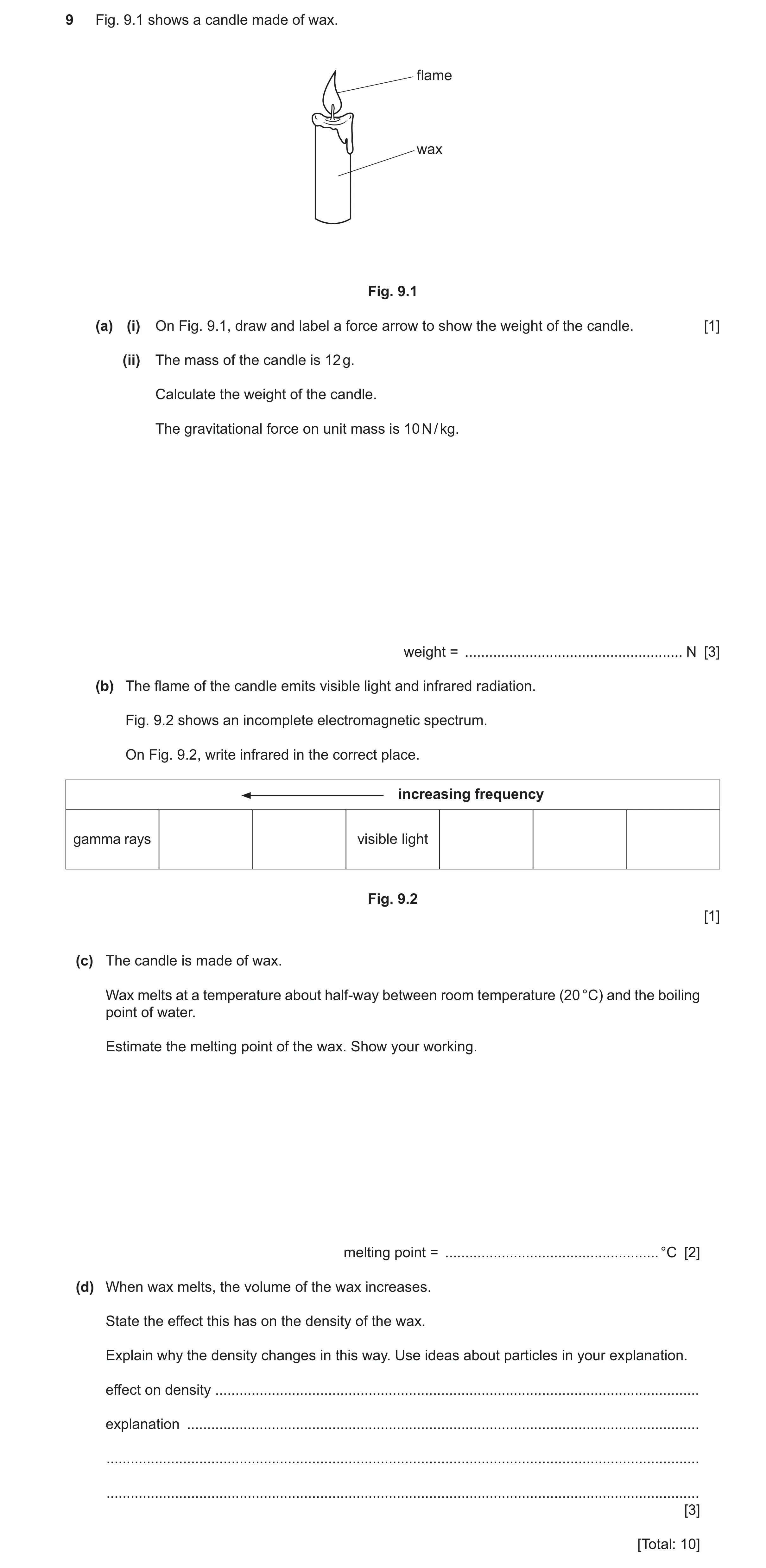
9 Fig. 9.1 shows a candle made of wax. flame wax Fig. 9.1 (a) (i) On Fig. 9.1, draw and label a force arrow to show the weight of the candle. [1] (ii) The mass of the candle is 12 g. Calculate the weight of the candle. The gravitational force on unit mass is 10 N / kg. weight = … N [3] (b) The flame of the candle emits visible light and infrared radiation. Fig. 9.2 shows an incomplete electromagnetic spectrum. On Fig. 9.2, write infrared in the correct place. increasing frequency gamma rays visible light Fig. 9.2 [1] (c) The candle is made of wax. Wax melts at a temperature about half-way between room temperature (20 °C) and the boiling point of water. Estimate the melting point of the wax. Show your working. melting point = … °C [2] (d) When wax melts, the volume of the wax increases. State the effect this has on the density of the wax. Explain why the density changes in this way. Use ideas about particles in your explanation. effect on density … explanation … … … [3] [Total: 10]
10 marks
Mark scheme: 9(a)(i) arrow labelled weight in contact with candle and pointing straight down; 1 9(a)(ii) correct unit conversion of g to kg seen ; 3 evidence of W = mg / 0.012 10 ; 0.12 (N) ; 9(b) 1 9(c) boiling point of water stated as 100 C ; 2 half-way between 20 and 100 C is 60 C ; 9(d) (density) decreases ; 3 particles, further apart in liquid (so volume increases) / AW ; mass is constant / reference to density = mass volume ;
This question in 0653/32 Oct/Nov 2024
Q17 · A candle made of wax 0653/33 Oct/Nov 2024
9 Fig. 9.1 shows a candle made of wax. flame wax Fig. 9.1 (a) (i) On Fig. 9.1, draw and label a force arrow to show the weight of the candle. [1] (ii) The mass of the candle is 12 g. Calculate the weight of the candle. The gravitational force on unit mass is 10 N / kg. weight = … N [3] (b) The flame of the candle emits visible light and infrared radiation. Fig. 9.2 shows an incomplete electromagnetic spectrum. On Fig. 9.2, write infrared in the correct place. increasing frequency gamma rays visible light Fig. 9.2 [1] (c) The candle is made of wax. Wax melts at a temperature about half-way between room temperature (20 °C) and the boiling point of water. Estimate the melting point of the wax. Show your working. melting point = … °C [2] (d) When wax melts, the volume of the wax increases. State the effect this has on the density of the wax. Explain why the density changes in this way. Use ideas about particles in your explanation. effect on density … explanation … … … [3] [Total: 10]
10 marks
Mark scheme: 9(a)(i) arrow labelled weight in contact with candle and pointing straight down; 1 9(a)(ii) correct unit conversion of g to kg seen ; 3 evidence of W = mg / 0.012 10 ; 0.12 (N) ; 9(b) 1 9(c) boiling point of water stated as 100 C ; 2 half-way between 20 and 100 C is 60 C ; 9(d) (density) decreases ; 3 particles, further apart in liquid (so volume increases) / AW ; mass is constant / reference to density = mass volume ;
This question in 0653/33 Oct/Nov 2024
Q18 · A tram powered by electricity supplied through overhead cables 0653/32 May/June 2025
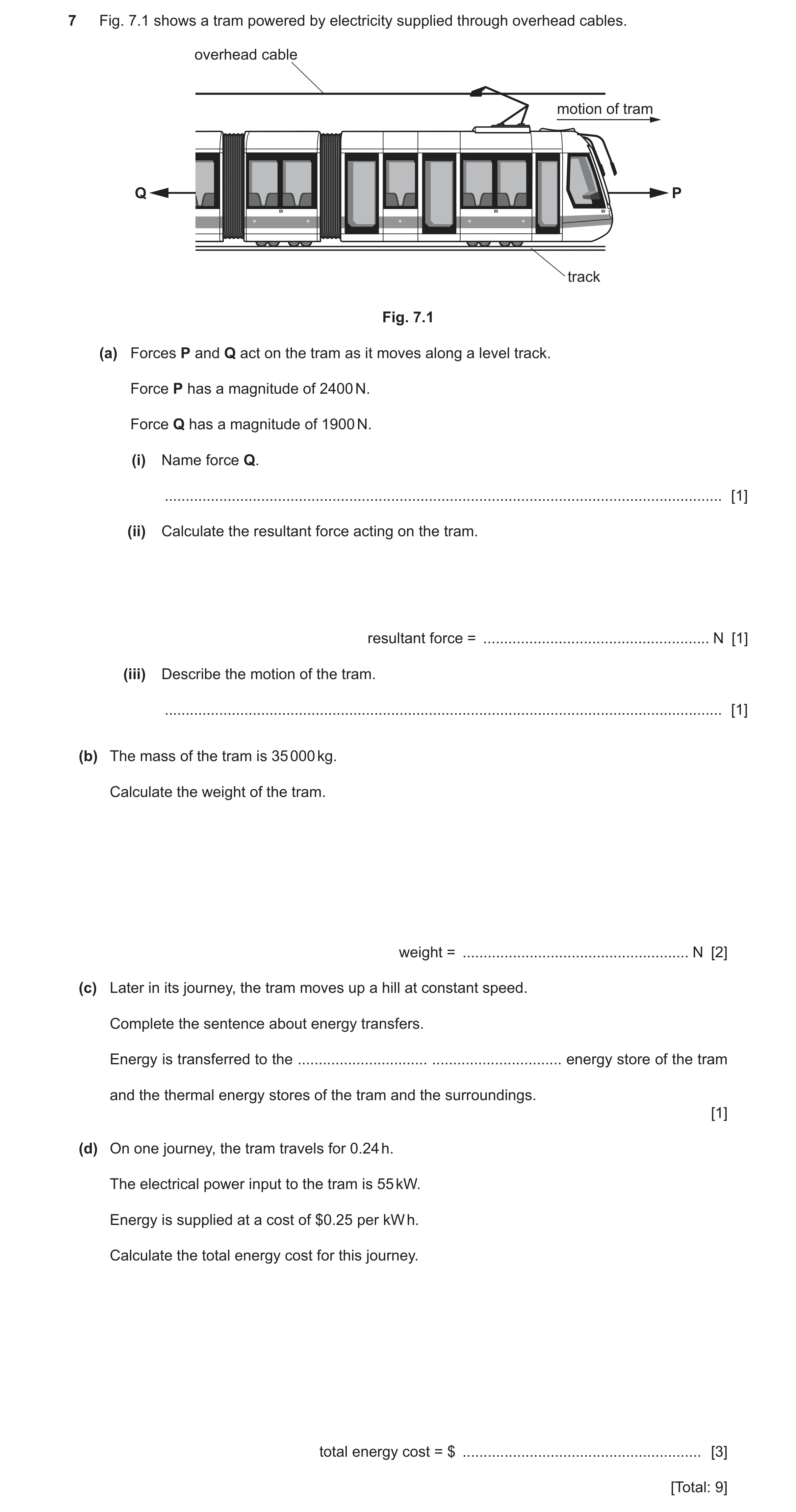
7 Fig. 7.1 shows a tram powered by electricity supplied through overhead cables. overhead cable motion of tram Q P track Fig. 7.1 (a) Forces P and Q act on the tram as it moves along a level track. Force P has a magnitude of 2400 N. Force Q has a magnitude of 1900 N. (i) Name force Q. … [1] (ii) Calculate the resultant force acting on the tram. resultant force = … N [1] (iii) Describe the motion of the tram. … [1] (b) The mass of the tram is 35 000 kg. Calculate the weight of the tram. weight = … N [2] (c) Later in its journey, the tram moves up a hill at constant speed. Complete the sentence about energy transfers. Energy is transferred to the … … energy store of the tram and the thermal energy stores of the tram and the surroundings. [1] (d) On one journey, the tram travels for 0.24 h. The electrical power input to the tram is 55 kW. Energy is supplied at a cost of $0.25 per kW h. Calculate the total energy cost for this journey. total energy cost = $ … [3] [Total: 9]
9 marks
Mark scheme: 7(a)(i) friction / air resistance / drag ; 1 7(a)(ii) (2400 – 1900 =) 500 (N) ; 1 7(a)(iii) accelerating ; 1 7(b) W = m g / 35 000 9.8 ; 2 343 000 / 340 000 (N) ; 7(c) gravitational potential ; 1 7(d) energy = P t / 55 0.24 / = 13.2 ; 3 cost = 13.2 0.25 ; (= $) 3.3 ;
This question in 0653/32 May/June 2025
Q19 · A toy car, powered by a battery 0653/33 May/June 2025
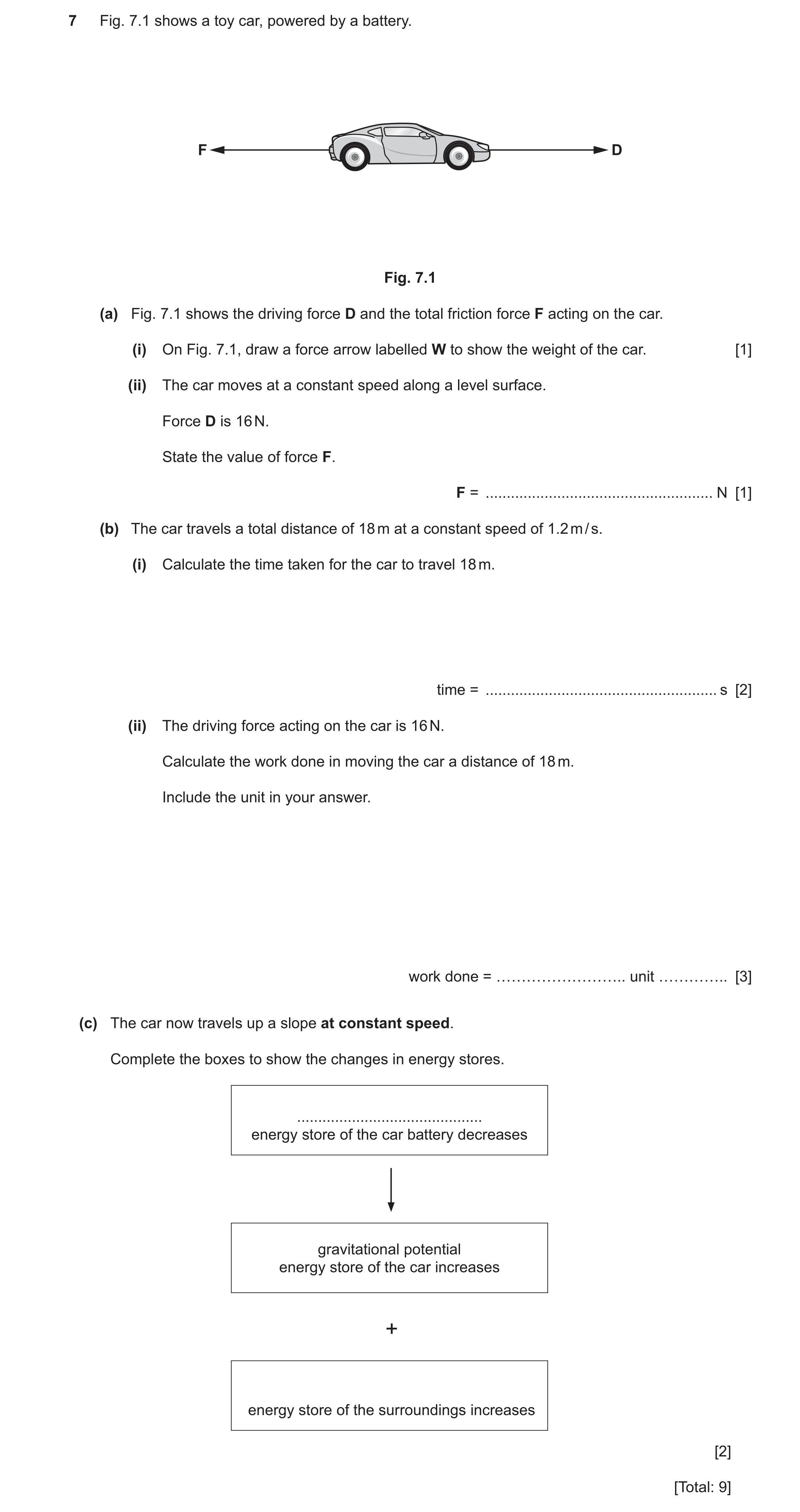
7 Fig. 7.1 shows a toy car, powered by a battery. F D Fig. 7.1 (a) Fig. 7.1 shows the driving force D and the total friction force F acting on the car. (i) On Fig. 7.1, draw a force arrow labelled W to show the weight of the car. [1] (ii) The car moves at a constant speed along a level surface. Force D is 16 N. State the value of force F. F = … N [1] (b) The car travels a total distance of 18 m at a constant speed of 1.2 m / s. (i) Calculate the time taken for the car to travel 18 m. time = … s [2] (ii) The driving force acting on the car is 16 N. Calculate the work done in moving the car a distance of 18 m. Include the unit in your answer. work done = …………………….. unit ………….. [3] (c) The car now travels up a slope at constant speed. Complete the boxes to show the changes in energy stores. … energy store of the car battery decreases gravitational potential energy store of the car increases + energy store of the surroundings increases [2] [Total: 9]
9 marks
Mark scheme: 7(a)(i) arrow pointing vertically downwards, touching car, labelled W ; 1 7(a)(ii) 16 (N) ; 1 7(b)(i) speed = total distance ÷ total time in any form / 18 ÷ 1.2 ; 2 15 (s) ; 7(b)(ii) W = F × d / work done = force × distance / 16 × 18 ; 3 288 / 290 ; J ; 7(c) chemical ; 2 thermal ;
This question in 0653/33 May/June 2025
 10
10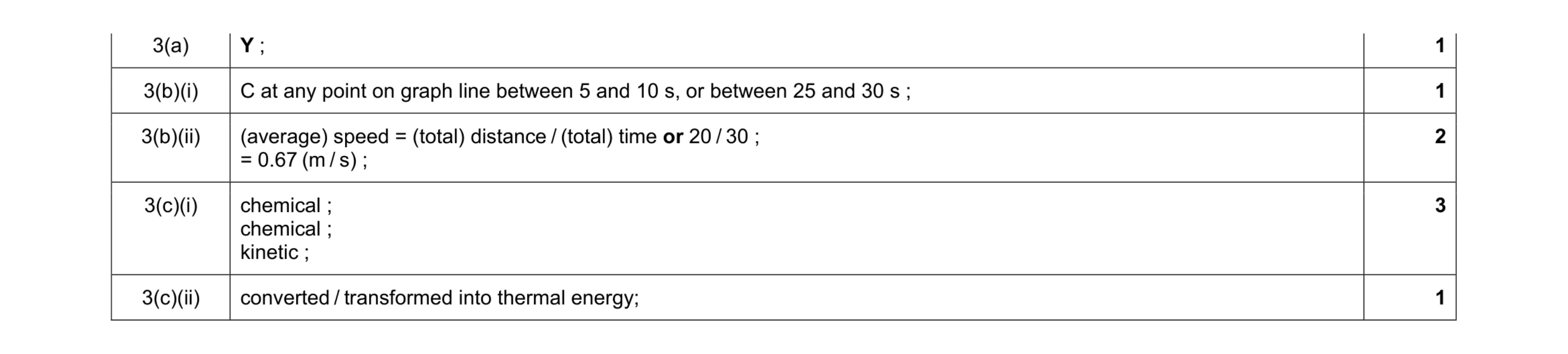 8
8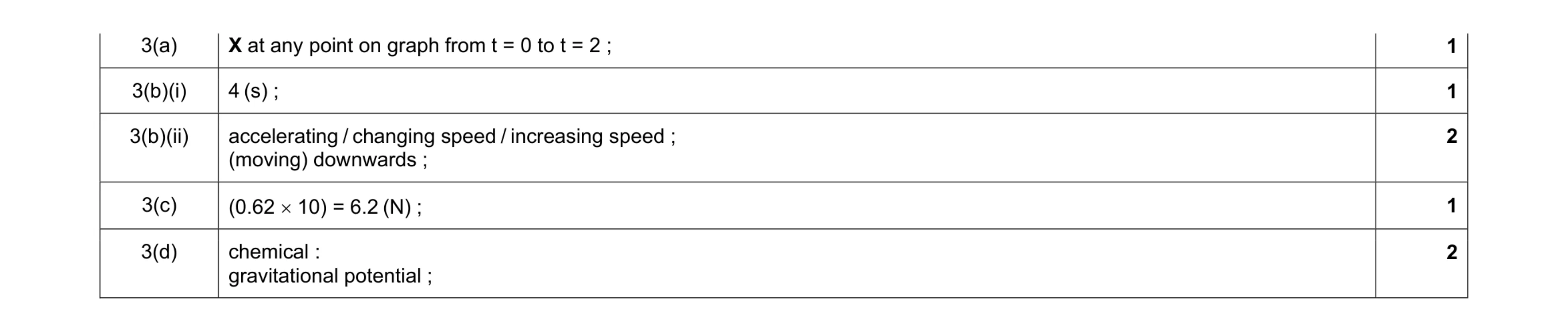 7
7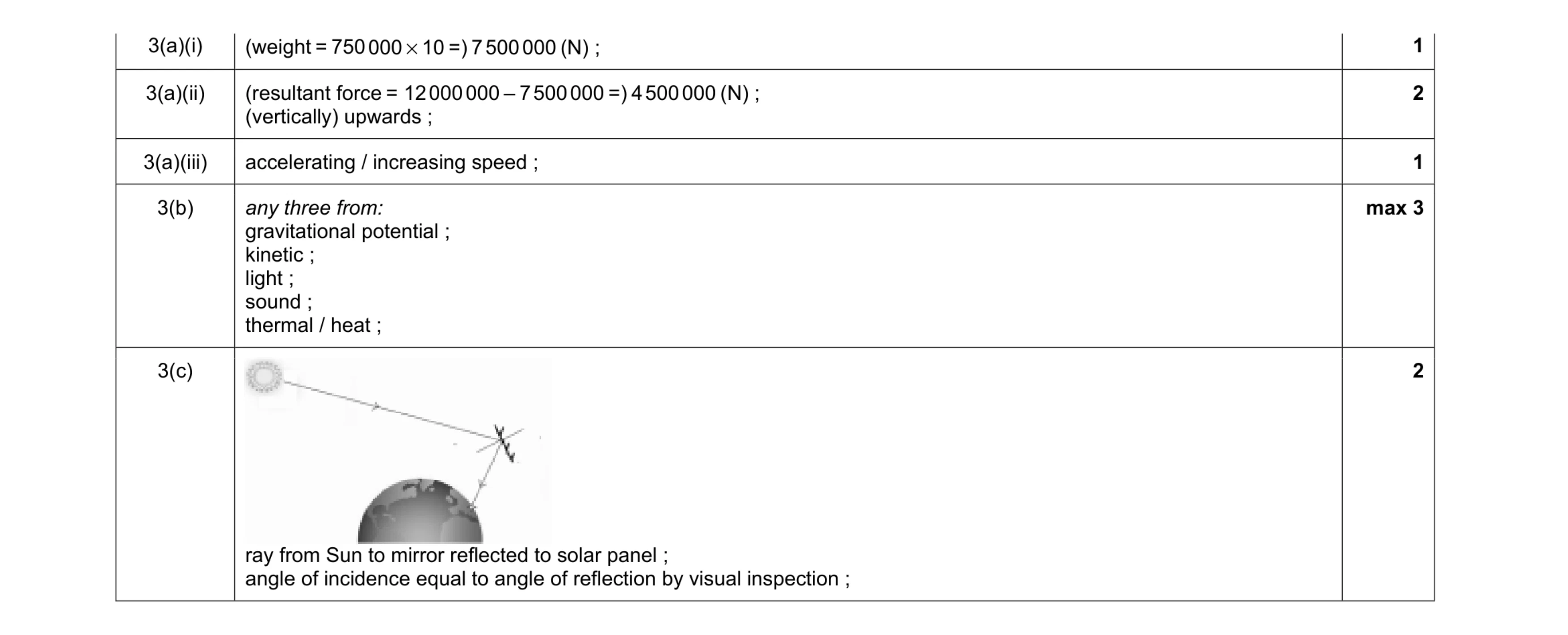 9
9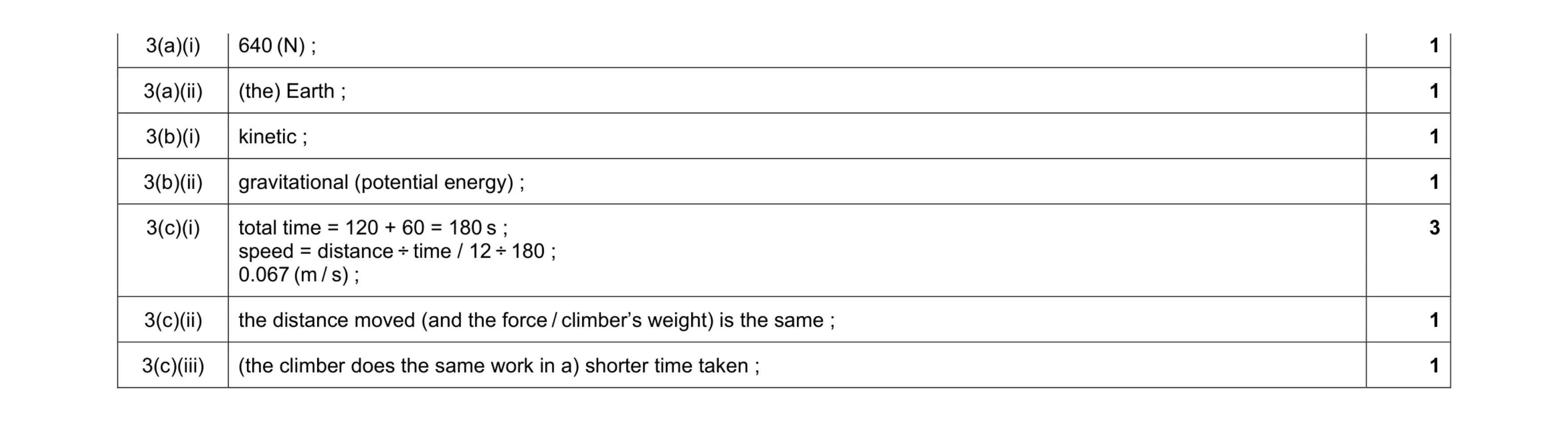 9
9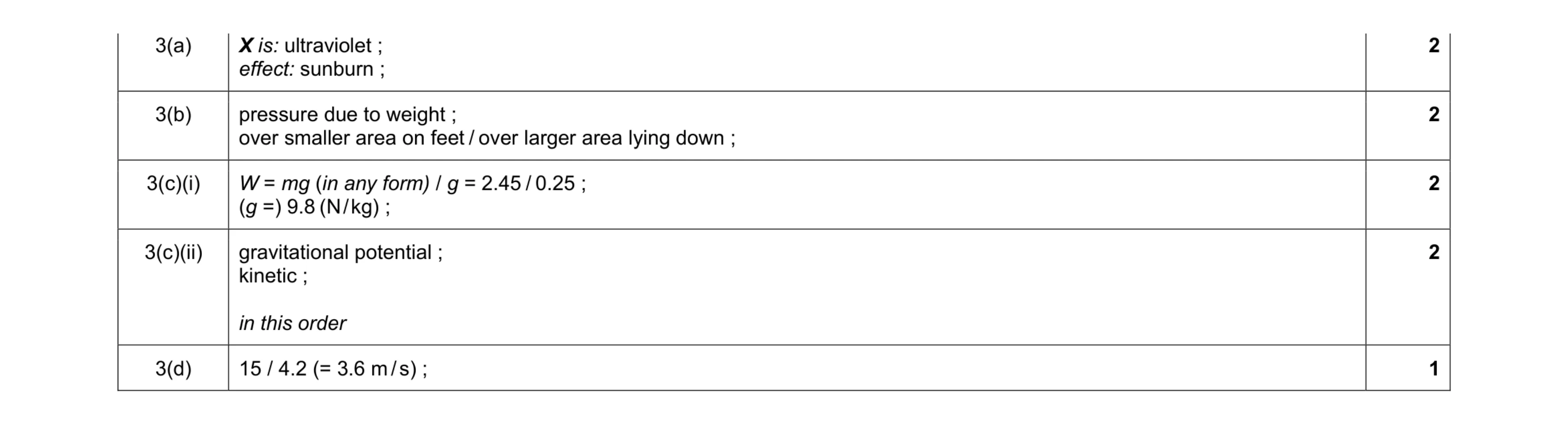 9
9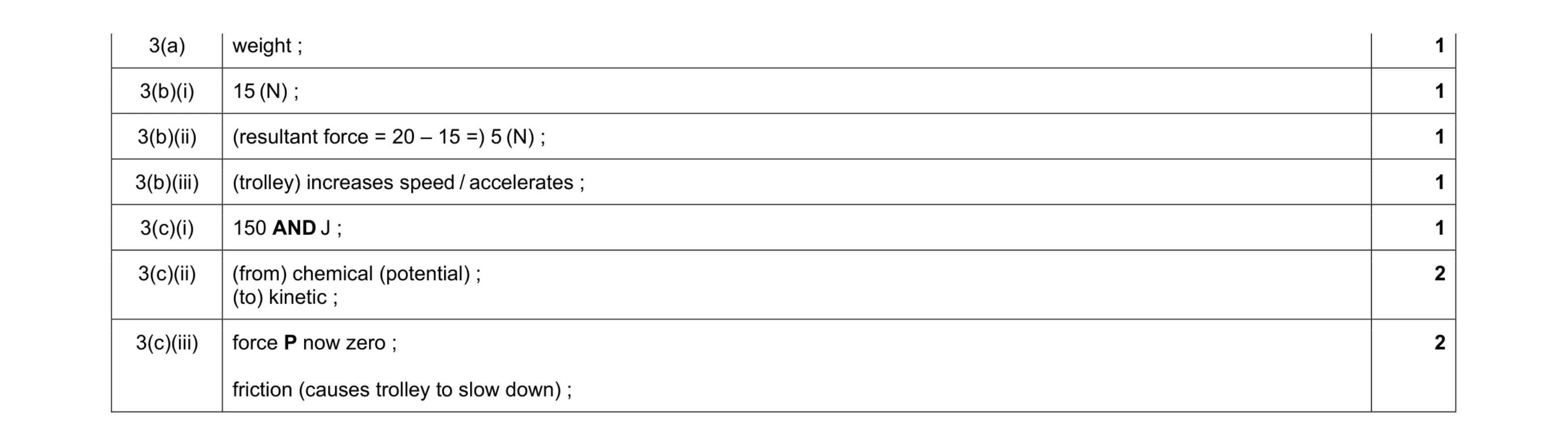 9
9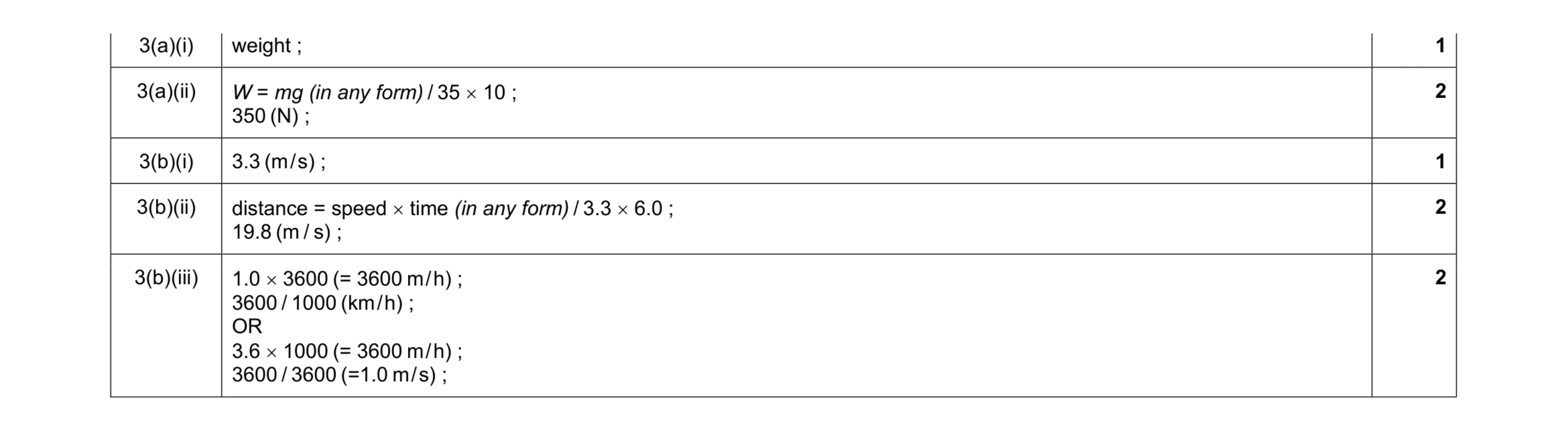 8
8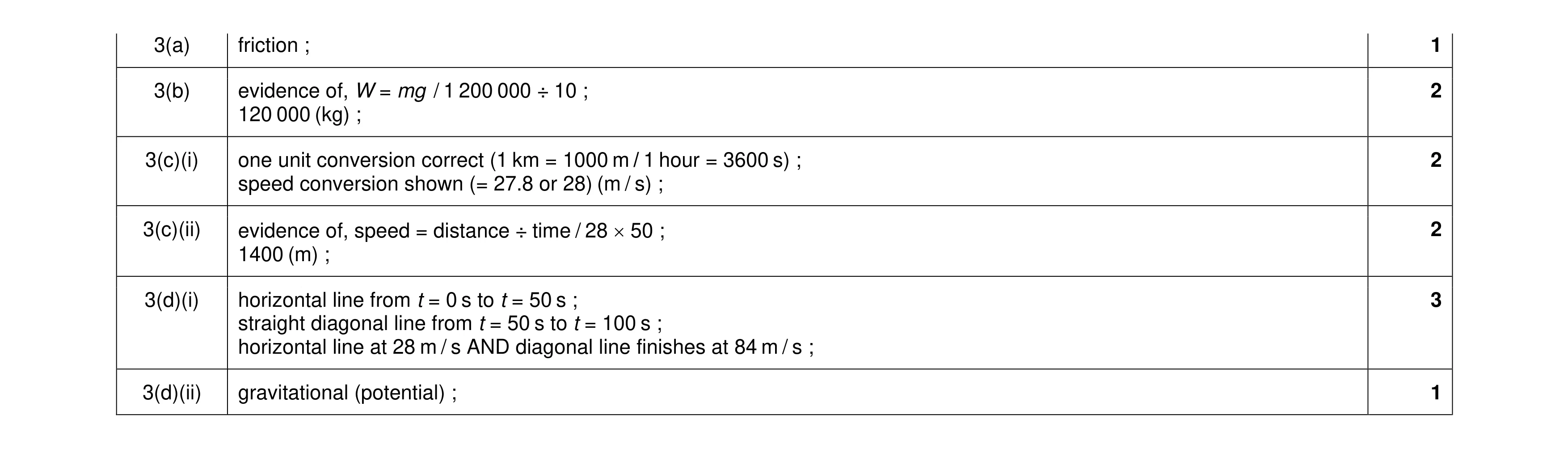 11
11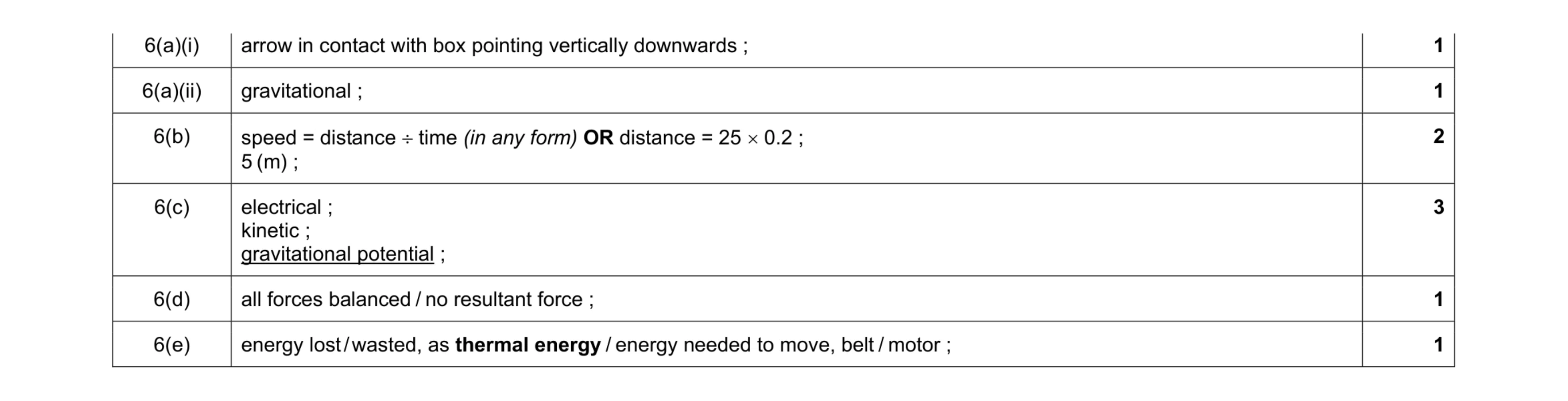 9
9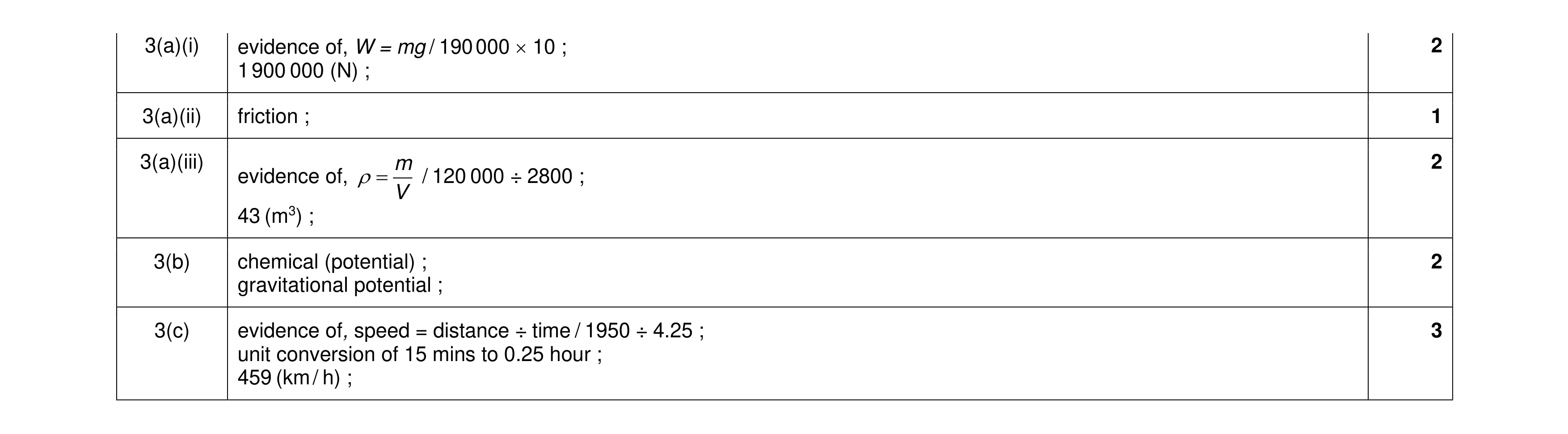 10
10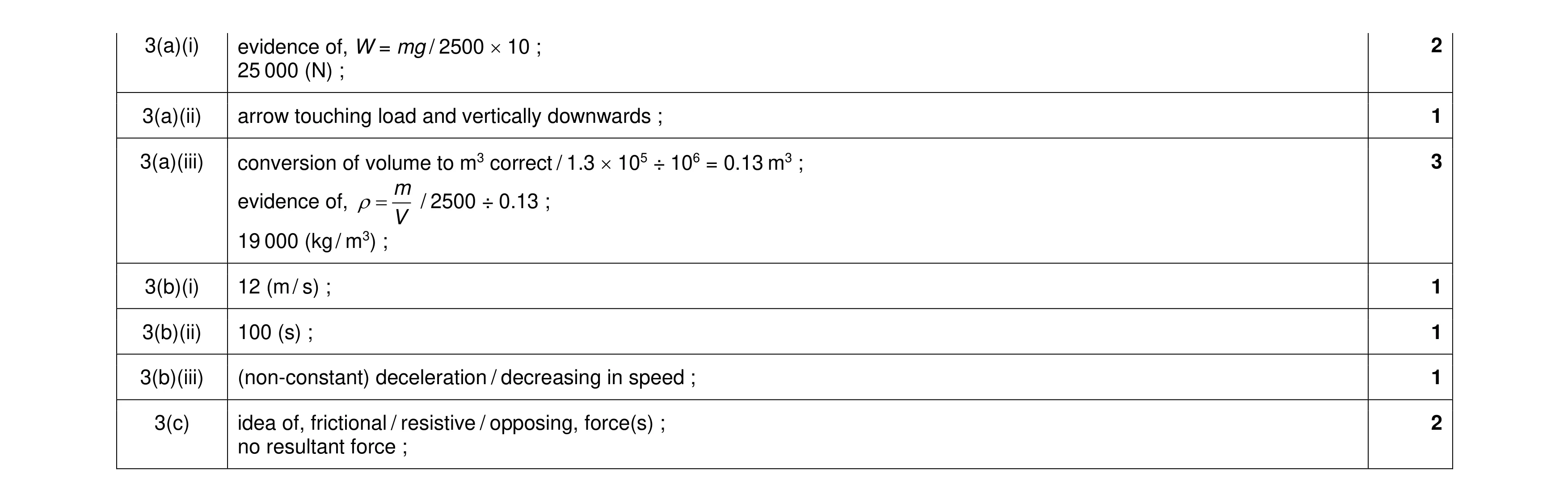 11
11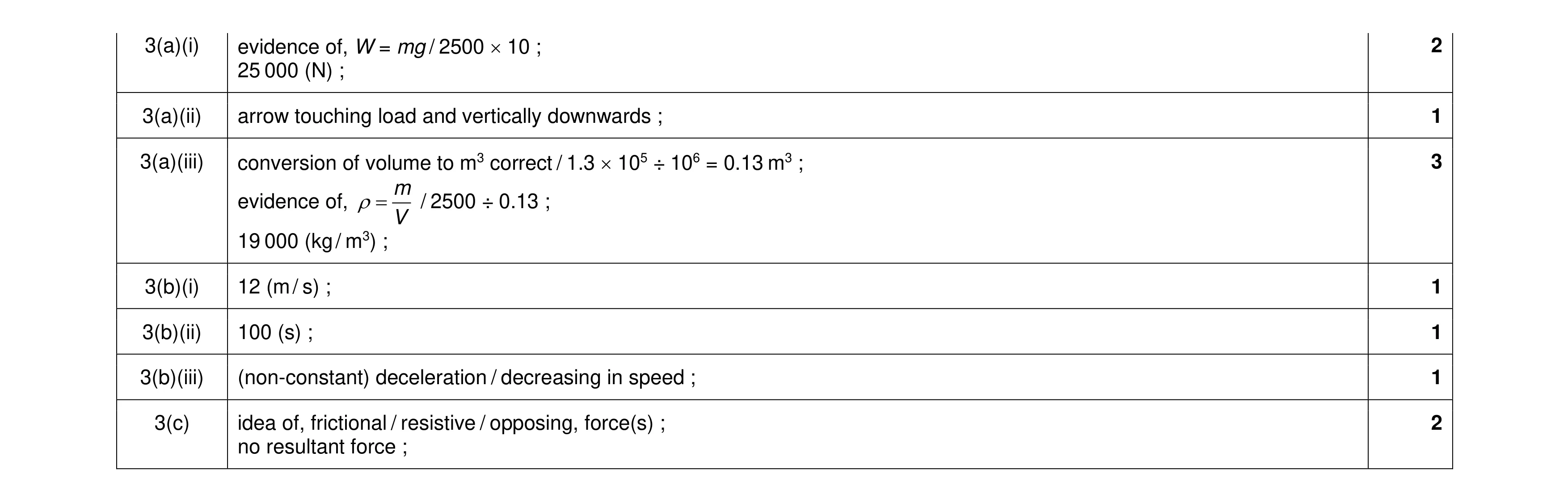 11
11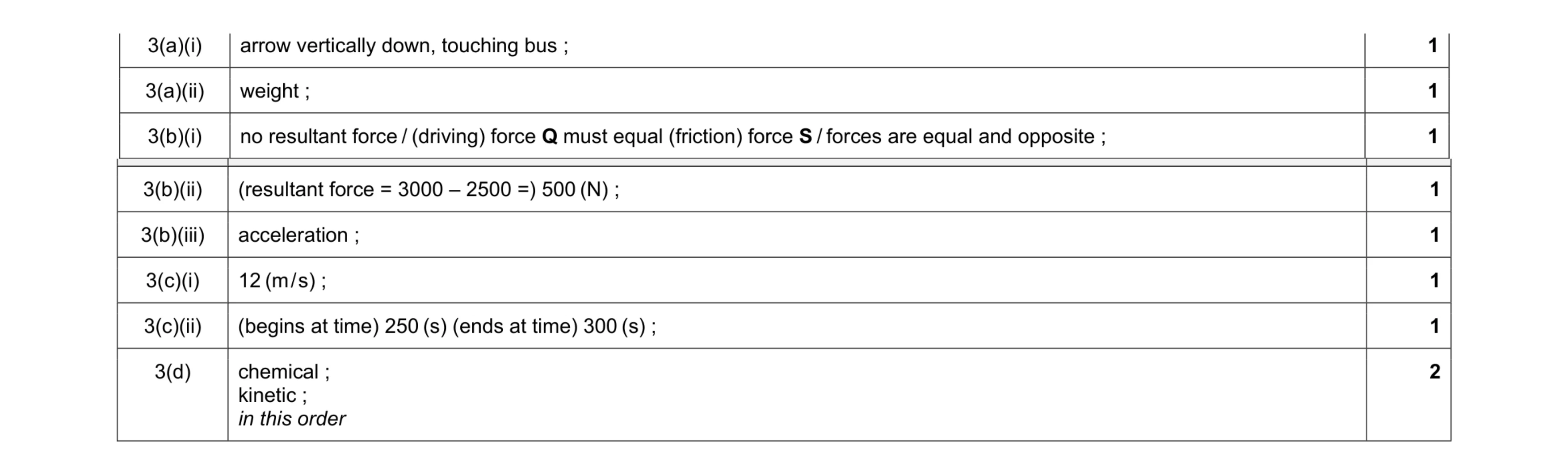 9
9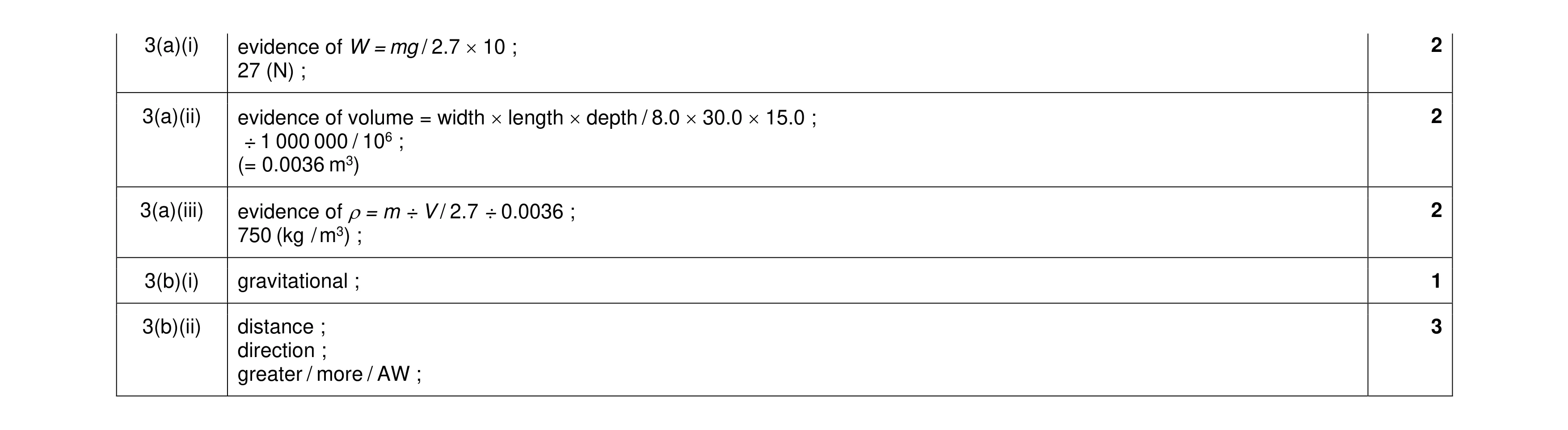 10
10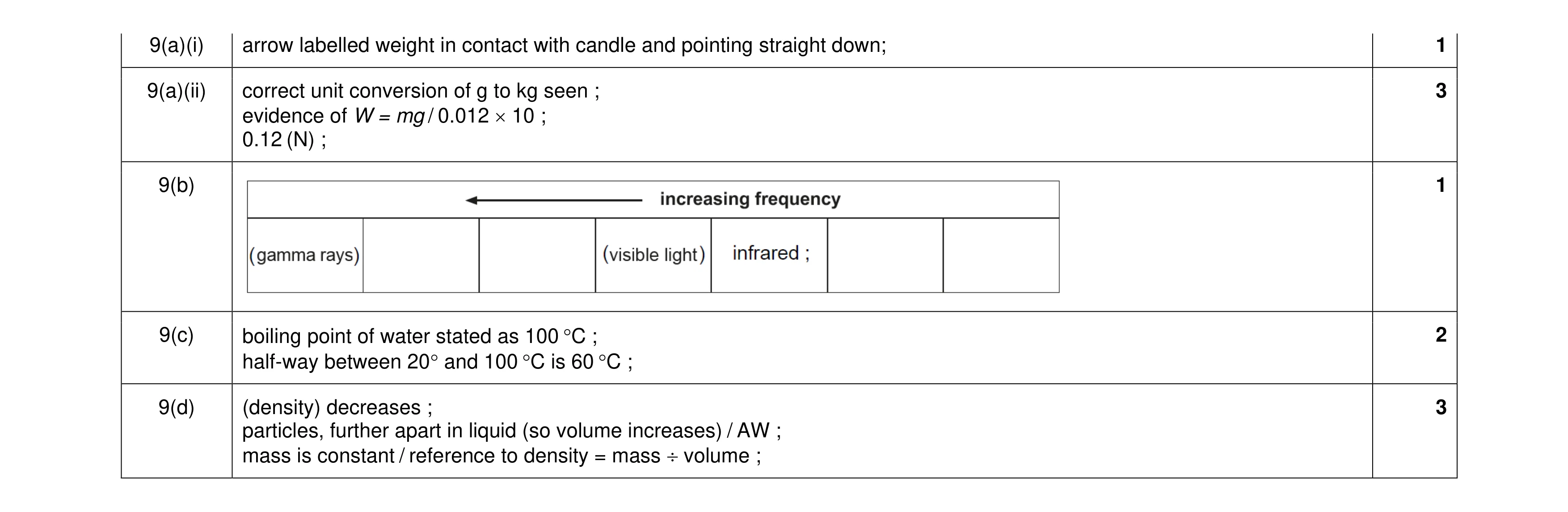 10
10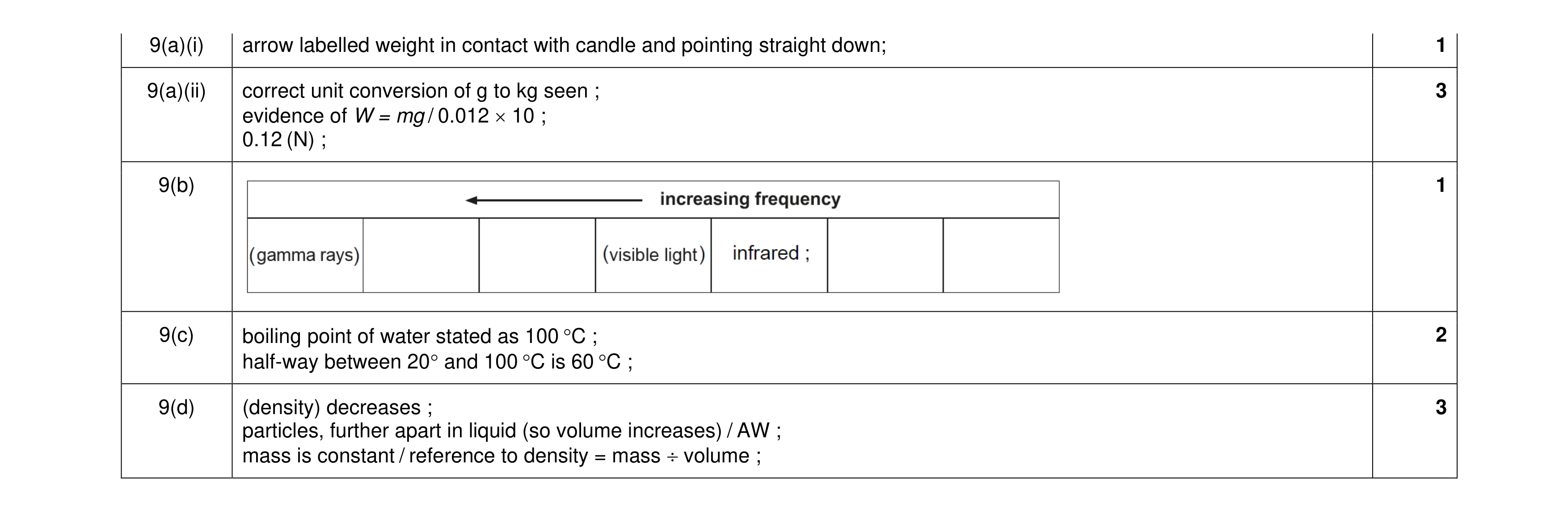 10
10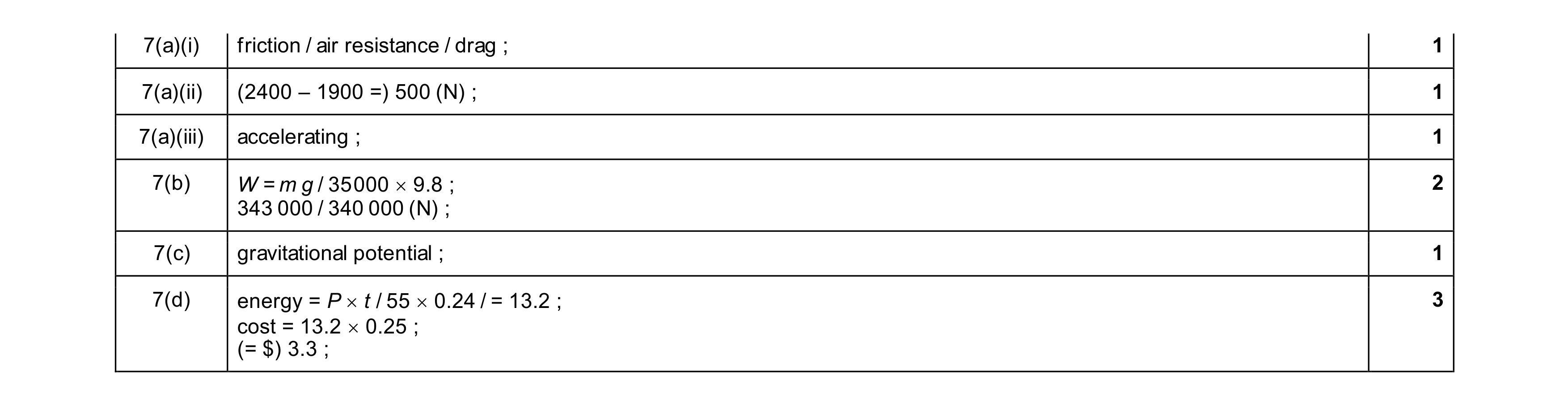 9
9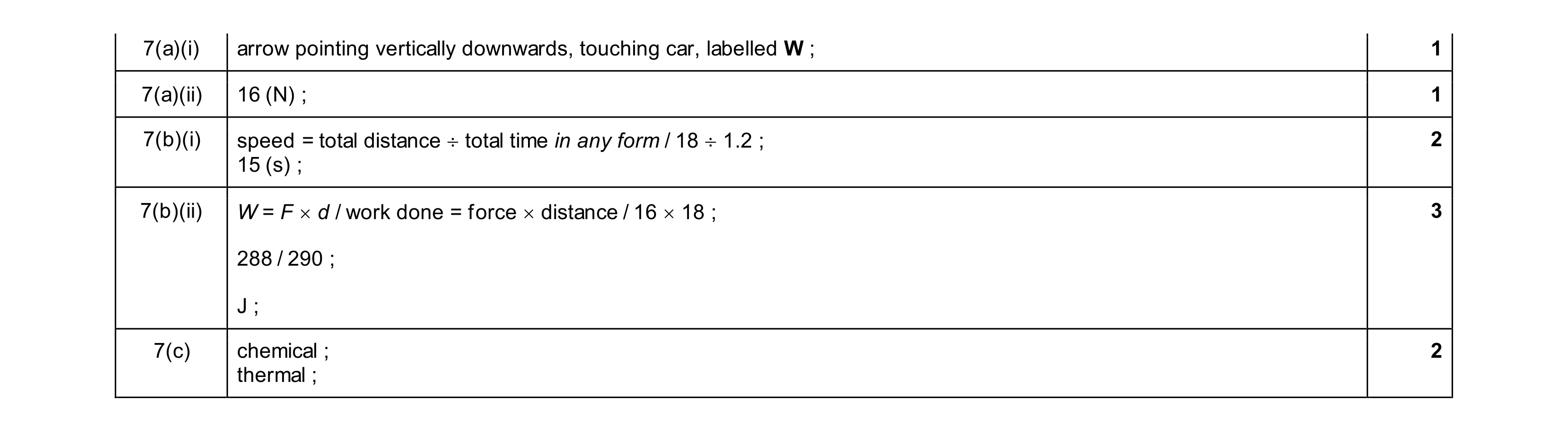 9
9