Questions as text
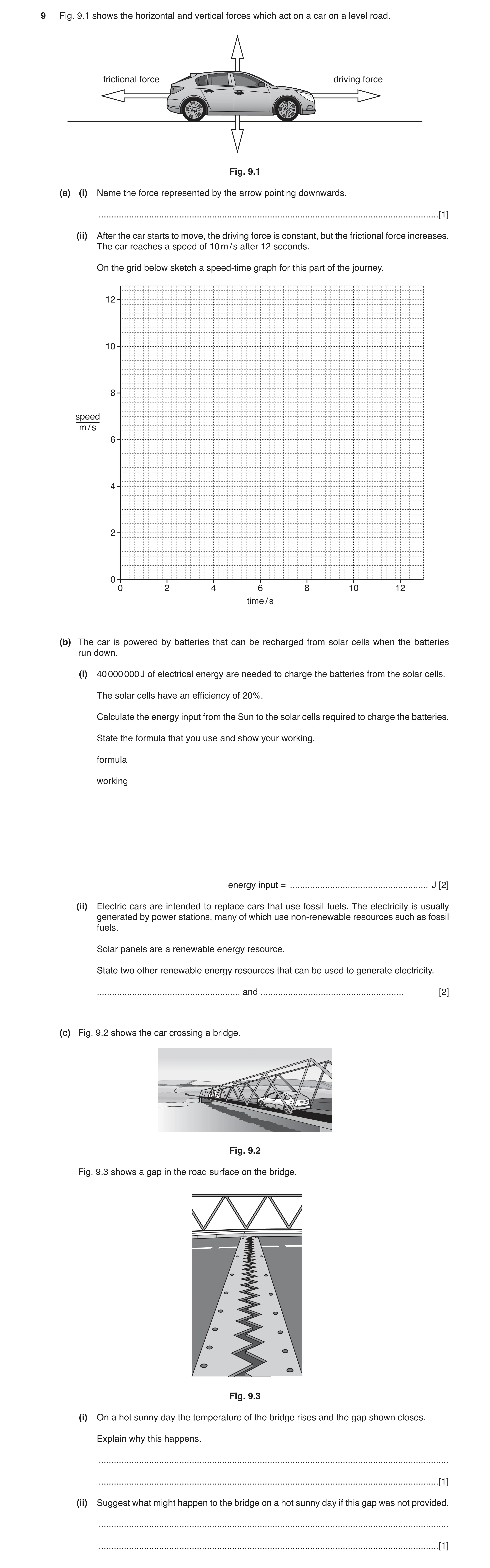
Q1 · The horizontal and vertical forces which act on a car on a level road 0653/41 Oct/Nov 2017
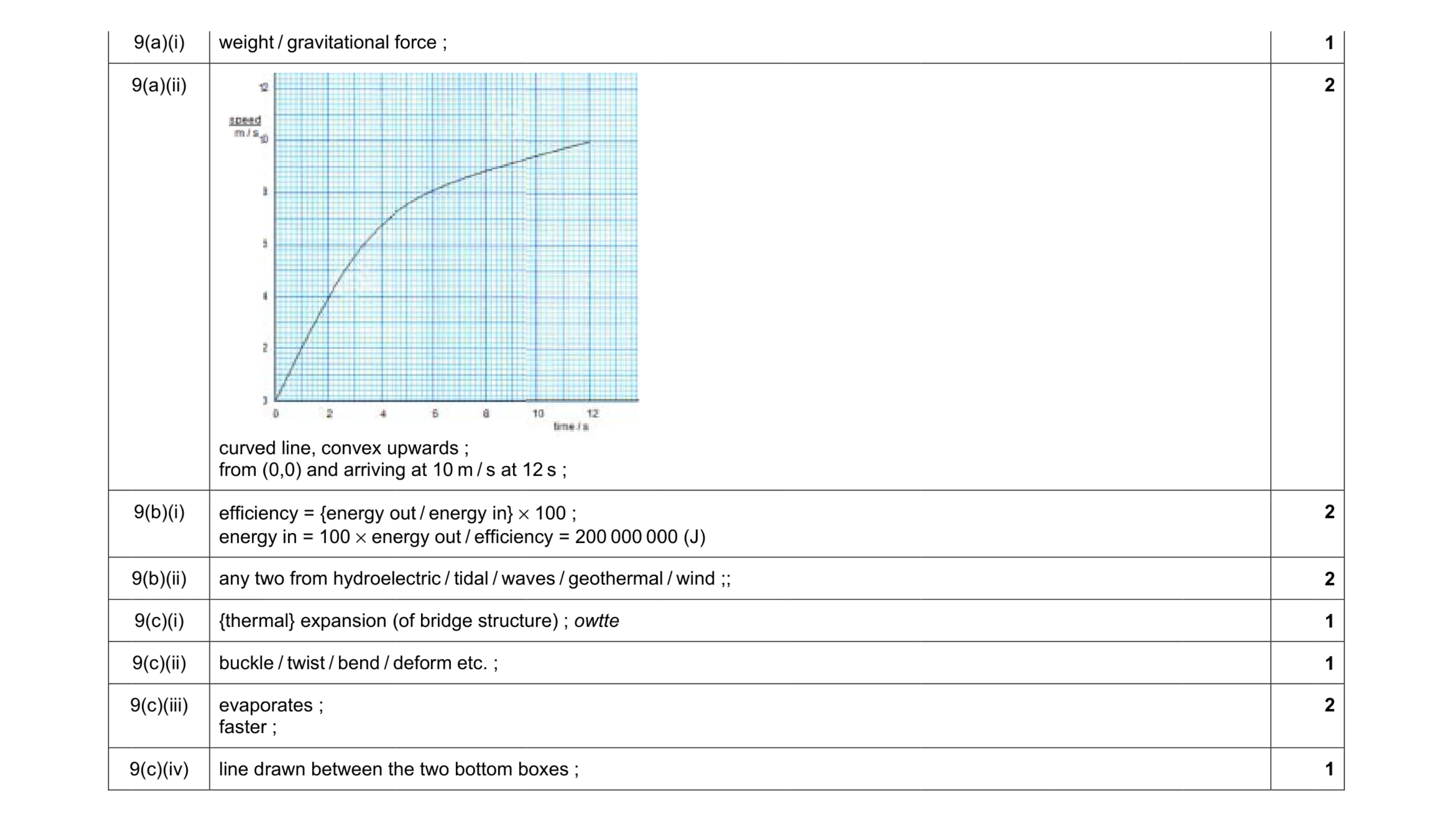
9 Fig. 9.1 shows the horizontal and vertical forces which act on a car on a level road. frictional force driving force Fig. 9.1 (a) (i) Name the force represented by the arrow pointing downwards. … [1] (ii) After the car starts to move, the driving force is constant, but the frictional force increases. The car reaches a speed of 10 m / s after 12 seconds. On the grid below sketch a speed-time graph for this part of the journey. 12 10 8 speed m / s 6 4 2 0 0 2 4 6 8 10 12 time / s (b) The car is powered by batteries that can be recharged from solar cells when the batteries run down. (i) 40 000 000 J of electrical energy are needed to charge the batteries from the solar cells. The solar cells have an efficiency of 20%. Calculate the energy input from the Sun to the solar cells required to charge the batteries. State the formula that you use and show your working. formula working energy input = … J [2] (ii) Electric cars are intended to replace cars that use fossil fuels. The electricity is usually generated by power stations, many of which use non-renewable resources such as fossil fuels. Solar panels are a renewable energy resource. State two other renewable energy resources that can be used to generate electricity. … and … [2] (c) Fig. 9.2 shows the car crossing a bridge. Fig. 9.2 Fig. 9.3 shows a gap in the road surface on the bridge. Fig. 9.3 (i) On a hot sunny day the temperature of the bridge rises and the gap shown closes. Explain why this happens. … … [1] (ii) Suggest what might happen to the bridge on a hot sunny day if this gap was not provided. … … [1]
9 marks
Mark scheme: 9 9 9 9 9(a)(i) weigh 9(a)(ii) curve from ( 9(b)(i) efficie energ 9(b)(ii) any tw 9(c)(i) {therm 9(c)(ii) buckl 9(c)(iii) evapo faster 9(c)(iv) line d ht / gravitational f ed line, convex u (0,0) and arrivin ency = {energy o gy in = 100 × ene wo from hydroel mal} expansion ( e / twist / bend / d orates ; r ; rawn between th force ; upwards ; g at 10 m / s at 1 out / energy in} × ergy out / efficien ectric / tidal / wav (of bridge structu deform etc. ; he two bottom b 12 s ; × 100 ; ncy = 200 000 00 ves / geotherma ure) ; owtte boxes ; 00 (J) al / wind ;; 1 2 2 2 1 1 2 1
This question in 0653/41 Oct/Nov 2017
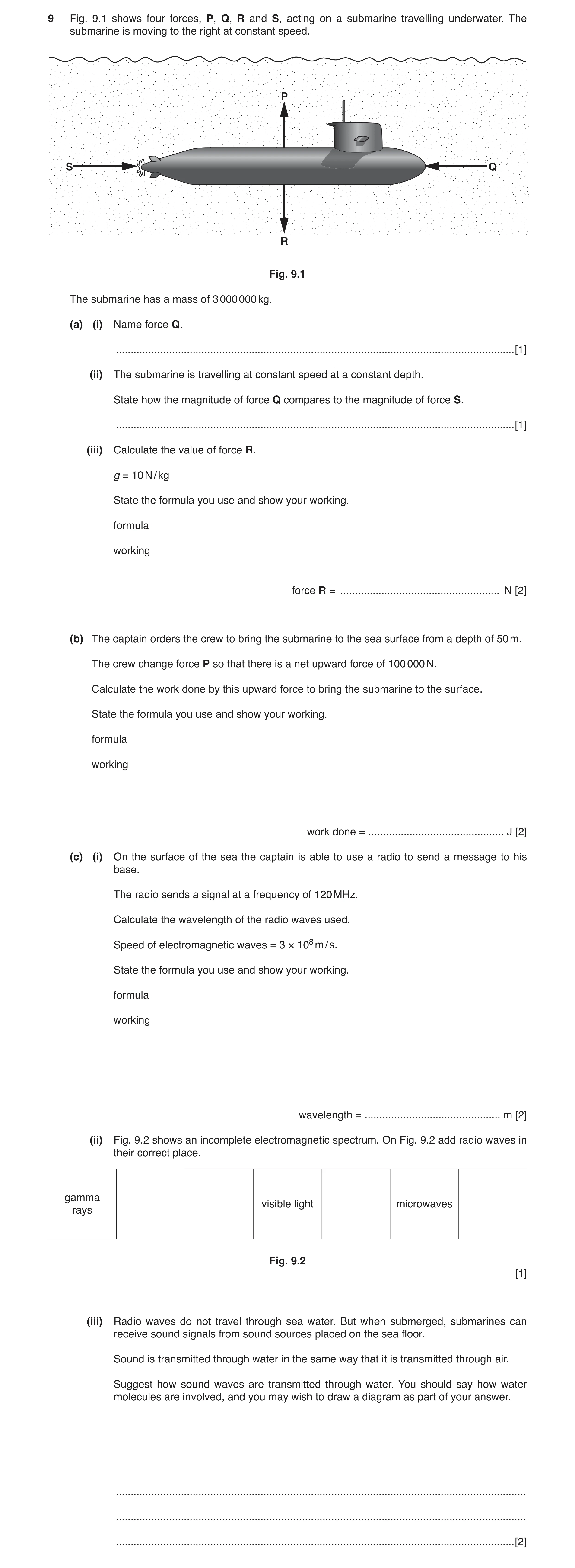
Q2 · Four forces, P, Q, R and S, acting on a submarine travelling underwater 0653/43 Oct/Nov 2017
9 Fig. 9.1 shows four forces, P, Q, R and S, acting on a submarine travelling underwater. The submarine is moving to the right at constant speed. P S Q R Fig. 9.1 The submarine has a mass of 3 000 000 kg. (a) (i) Name force Q. … [1] (ii) The submarine is travelling at constant speed at a constant depth. State how the magnitude of force Q compares to the magnitude of force S. … [1] (iii) Calculate the value of force R. g = 10 N / kg State the formula you use and show your working. formula working force R = … N [2] (b) The captain orders the crew to bring the submarine to the sea surface from a depth of 50 m. The crew change force P so that there is a net upward force of 100 000 N. Calculate the work done by this upward force to bring the submarine to the surface. State the formula you use and show your working. formula working work done = … J [2] (c) (i) On the surface of the sea the captain is able to use a radio to send a message to his base. The radio sends a signal at a frequency of 120 MHz. Calculate the wavelength of the radio waves used. Speed of electromagnetic waves = 3 × 10⁸ m / s. State the formula you use and show your working. formula working wavelength = … m [2] (ii) Fig. 9.2 shows an incomplete electromagnetic spectrum. On Fig. 9.2 add radio waves in their correct place. gamma visible light microwaves rays Fig. 9.2 [1] (iii) Radio waves do not travel through sea water. But when submerged, submarines can receive sound signals from sound sources placed on the sea floor. Sound is transmitted through water in the same way that it is transmitted through air. Suggest how sound waves are transmitted through water. You should say how water molecules are involved, and you may wish to draw a diagram as part of your answer. … … … [2]
11 marks
Mark scheme: 9(a)(i) (Q =) friction / (water) resistance ; 1 9(a)(ii) (force Q cf force S) equal / balanced ; 1 9(a)(iii) W = mg = 3 000 000 × 10 ; = 30 000 000 (N) ; 2 9(b) work done = force × distance / F × d = 100 000 × 50 ; = 5 000 000 (J) ; 2 9(c)(i) v = f λ and λ = 3 × 10⁸ / 120 × 106 ; = 2.5 (m) ; 2 9(c)(ii) gamma visible light micro- waves radio waves ; 1 9(c)(iii) any two from longitudinal (wave / vibration) / compressions and rarefactions ; (water) molecules / particles vibrate / oscillate ; pass on vibration / energy (through water) ; max2
This question in 0653/43 Oct/Nov 2017
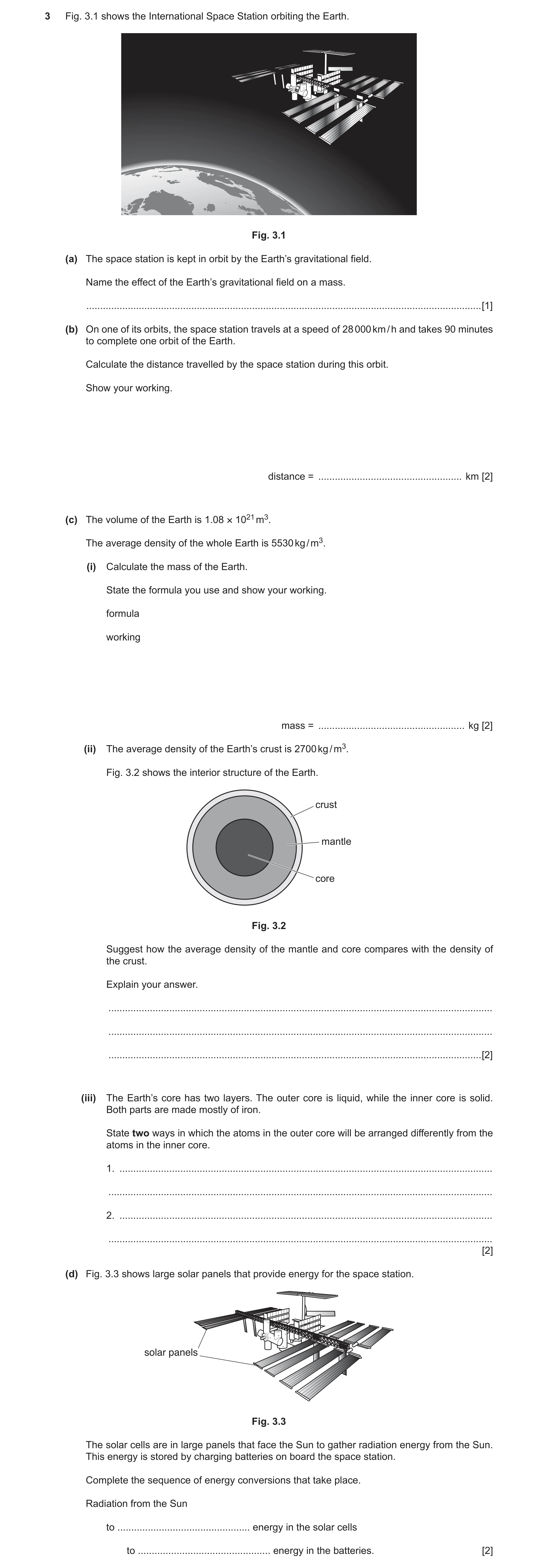
Q3 · The International Space Station orbiting the Earth 0653/42 Feb/March 2018
3 Fig. 3.1 shows the International Space Station orbiting the Earth. Fig. 3.1 (a) The space station is kept in orbit by the Earth’s gravitational field. Name the effect of the Earth’s gravitational field on a mass. … [1] (b) On one of its orbits, the space station travels at a speed of 28 000 km / h and takes 90 minutes to complete one orbit of the Earth. Calculate the distance travelled by the space station during this orbit. Show your working. distance = … km [2] (c) The volume of the Earth is 1.08 × 10²¹ m3. The average density of the whole Earth is 5530 kg / m3. (i) Calculate the mass of the Earth. State the formula you use and show your working. formula working mass = … kg [2] (ii) The average density of the Earth’s crust is 2700 kg / m3. Fig. 3.2 shows the interior structure of the Earth. crust mantle core Fig. 3.2 Suggest how the average density of the mantle and core compares with the density of the crust. Explain your answer. … … … [2] (iii) The Earth’s core has two layers. The outer core is liquid, while the inner core is solid. Both parts are made mostly of iron. State two ways in which the atoms in the outer core will be arranged differently from the atoms in the inner core. 1. … … 2. … … [2] (d) Fig. 3.3 shows large solar panels that provide energy for the space station. solar panels Fig. 3.3 The solar cells are in large panels that face the Sun to gather radiation energy from the Sun. This energy is stored by charging batteries on board the space station. Complete the sequence of energy conversions that take place. Radiation from the Sun to … energy in the solar cells to … energy in the batteries. [2]
11 marks
Mark scheme: 3(a) weight ; 1 3(b) speed = distance / time (or rearranged) ; distance (= speed × time) = 28 000 × 90 / 60 = 42 000 (km) ; 2 3(c)(i) density = mass / volume (or rearranged) ; mass (= volume × density) = 1.08 × 1021 × 5530 = 5.97 × 1024 (kg) ; 2 3(c)(ii) (average) density of mantle and core is higher (than 2700 kg / m3) ; in order to give an average density higher than the density of the crust / owtte ; 2 3(c)(iii) atoms in outer core randomly arranged / inner core regular arrangement / owtte ; atoms in outer core able to move freely / inner core fixed positions / orderly pattern / owtte ; 2 3(d) electrical ; chemical (potential) ; 2
This question in 0653/42 Feb/March 2018
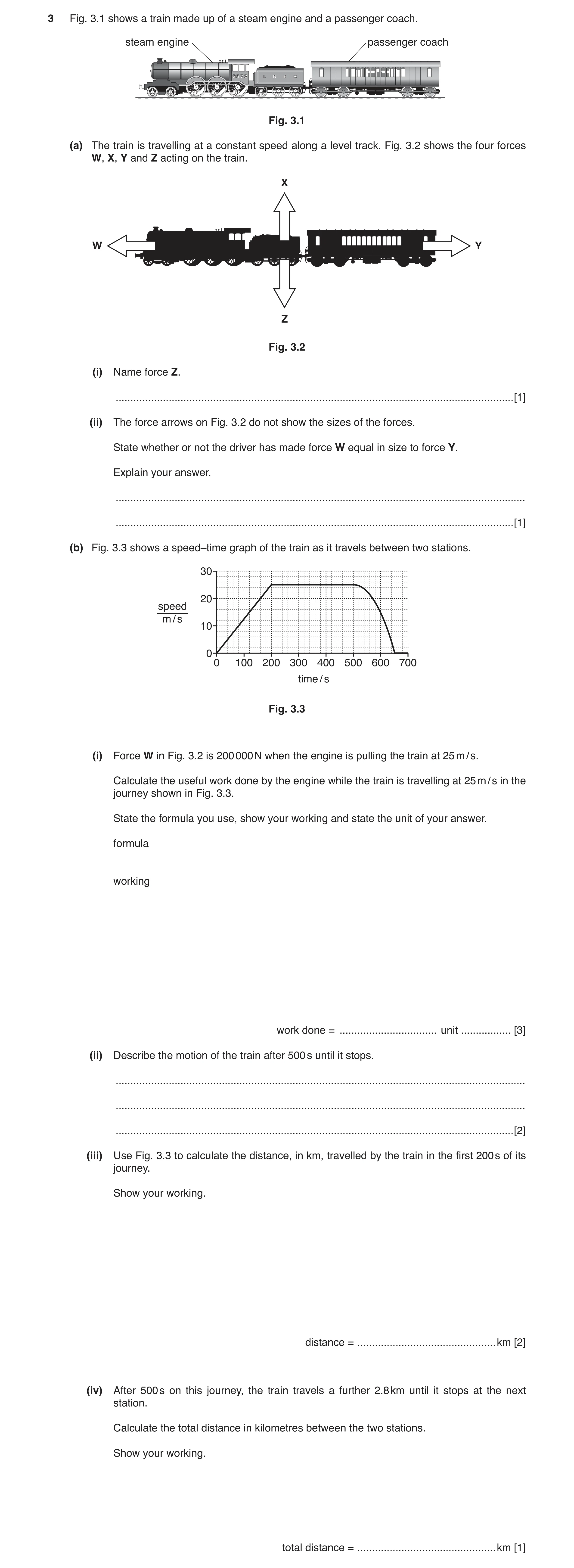
Q4 · A train made up of a steam engine and a passenger coach 0653/41 Oct/Nov 2018
3 Fig. 3.1 shows a train made up of a steam engine and a passenger coach. steam engine passenger coach Fig. 3.1 (a) The train is travelling at a constant speed along a level track. Fig. 3.2 shows the four forces W, X, Y and Z acting on the train. X W Y Z Fig. 3.2 (i) Name force Z. … [1] (ii) The force arrows on Fig. 3.2 do not show the sizes of the forces. State whether or not the driver has made force W equal in size to force Y. Explain your answer. … … [1] (b) Fig. 3.3 shows a speed–time graph of the train as it travels between two stations. 30 20 speed m / s 10 0 0 100 200 300 400 500 600 700 time / s Fig. 3.3 (i) Force W in Fig. 3.2 is 200 000 N when the engine is pulling the train at 25 m / s. Calculate the useful work done by the engine while the train is travelling at 25 m / s in the journey shown in Fig. 3.3. State the formula you use, show your working and state the unit of your answer. formula working work done = … unit … [3] (ii) Describe the motion of the train after 500 s until it stops. … … … [2] (iii) Use Fig. 3.3 to calculate the distance, in km, travelled by the train in the first 200 s of its journey. Show your working. distance = … km [2] (iv) After 500 s on this journey, the train travels a further 2.8 km until it stops at the next station. Calculate the total distance in kilometres between the two stations. Show your working. total distance = … km [1]
10 marks
Mark scheme: 3(a)(i) weight / gravitational (force) ; 1 3(a)(ii) yes (no mark) constant speed / no acceleration, (so forces must balance) ; 1 Question Answer Marks 3(b)(i) distance = speed × time and / or work done = force × distance or d = s × t and / or w = F × d or 200 000 × 25 × (500 – 200) ; = 1 500 000 000 ; J / joules ; 3 3(b)(ii) (negative) acceleration / deceleration ; not constant (deceleration) / increasing deceleration (becoming constant deceleration) ; 2 3(b)(iii) evidence of area under graph calculated up to 200 s / 1 2 × 200 × 25 ; 2.5 km ; 2 3(b)(iv) total distance = 2.5 + (500–200) × 0.025 + 2.8 = 12.8 km ; 1
This question in 0653/41 Oct/Nov 2018
Q5 · A whale swimming underwater 0653/41 May/June 2019
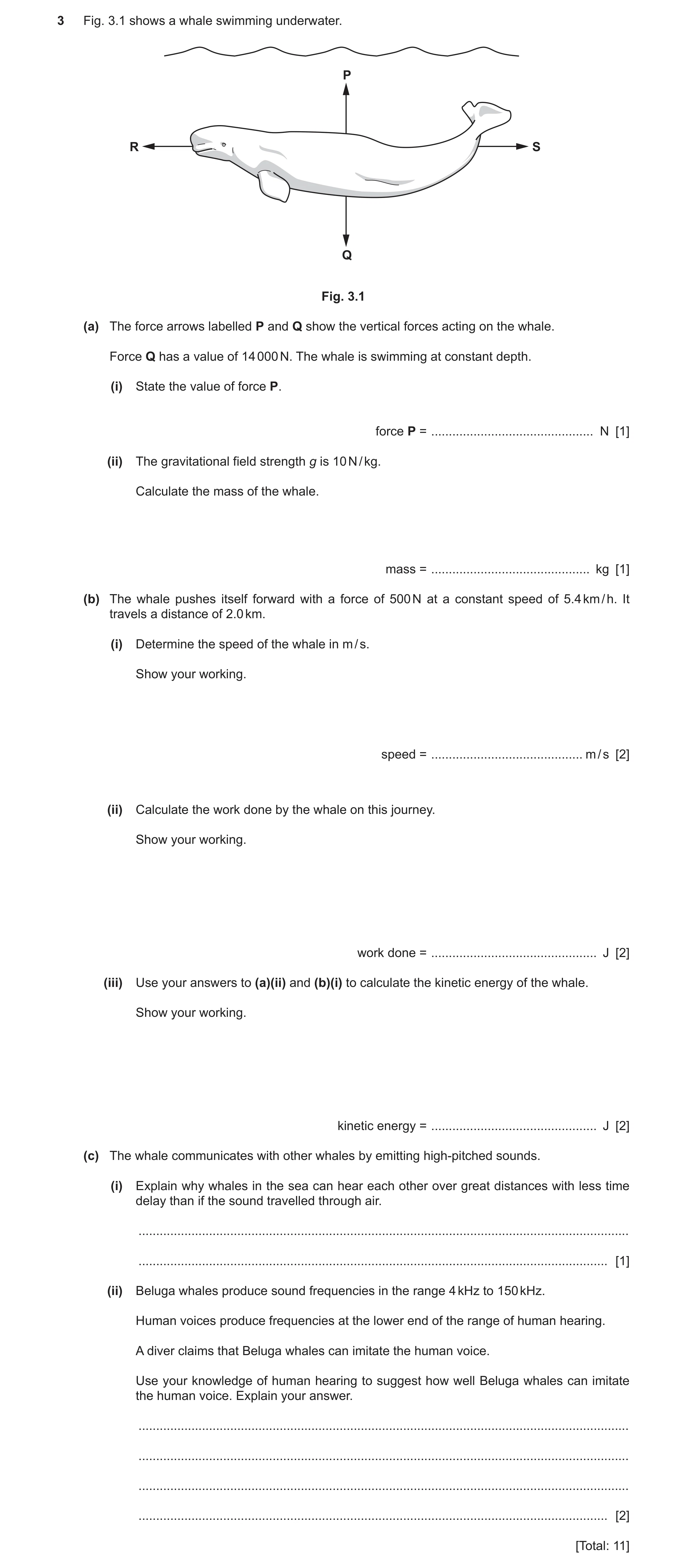
3 Fig. 3.1 shows a whale swimming underwater. P R S Q Fig. 3.1 (a) The force arrows labelled P and Q show the vertical forces acting on the whale. Force Q has a value of 14 000 N. The whale is swimming at constant depth. (i) State the value of force P. force P = … N [1] (ii) The gravitational field strength g is 10 N / kg. Calculate the mass of the whale. mass = … kg [1] (b) The whale pushes itself forward with a force of 500 N at a constant speed of 5.4 km / h. It travels a distance of 2.0 km. (i) Determine the speed of the whale in m / s. Show your working. speed = … m / s [2] (ii) Calculate the work done by the whale on this journey. Show your working. work done = … J [2] (iii) Use your answers to (a)(ii) and (b)(i) to calculate the kinetic energy of the whale. Show your working. kinetic energy = … J [2] (c) The whale communicates with other whales by emitting high-pitched sounds. (i) Explain why whales in the sea can hear each other over great distances with less time delay than if the sound travelled through air. … … [1] (ii) Beluga whales produce sound frequencies in the range 4 kHz to 150 kHz. Human voices produce frequencies at the lower end of the range of human hearing. A diver claims that Beluga whales can imitate the human voice. Use your knowledge of human hearing to suggest how well Beluga whales can imitate the human voice. Explain your answer. … … … … [2] [Total: 11]
11 marks
Mark scheme: 3(a)(i) 14 000 (N) ; 1 3(a)(ii) 1400 (kg) ; 1 3(b)(i) (speed =) distance / time or 5400 / 3600 ; = 1.5 (m/s) ; 2 Question Answer Marks 3(b)(ii) (work done =) force × distance / W = F × d = 500 × 2000 ; = 1 000 000 (J) ; 2 3(b)(iii) (KE =) ½ mv2 ; = ½ × 1400 × (1.5)2 = 1575 (J) ; 2 3(c)(i) speed of sound in liquid / water faster than in gas / air ; 1 3(c)(ii) range of human hearing = 20 to 20 000Hz ; so beluga can produce sound that lies within the range of human hearing ; beluga sounds very high-pitched (to humans) ; max 2
This question in 0653/41 May/June 2019
Q6 · A spacecraft taking off from the Moon 0653/41 May/June 2020
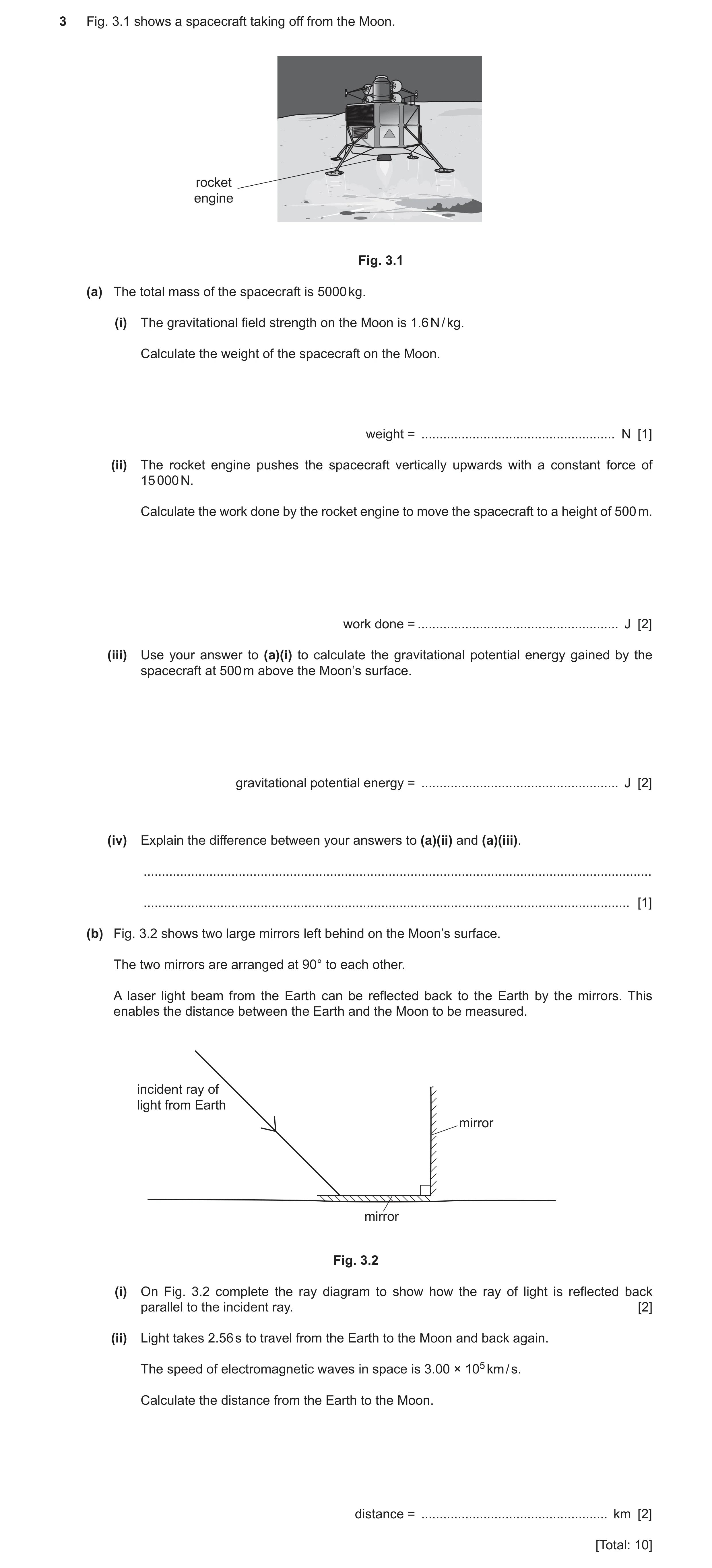
3 Fig. 3.1 shows a spacecraft taking off from the Moon. rocket engine Fig. 3.1 (a) The total mass of the spacecraft is 5000 kg. (i) The gravitational field strength on the Moon is 1.6 N / kg. Calculate the weight of the spacecraft on the Moon. weight = … N [1] (ii) The rocket engine pushes the spacecraft vertically upwards with a constant force of 15 000 N. Calculate the work done by the rocket engine to move the spacecraft to a height of 500 m. work done = … J [2] (iii) Use your answer to (a)(i) to calculate the gravitational potential energy gained by the spacecraft at 500 m above the Moon’s surface. gravitational potential energy = … J [2] (iv) Explain the difference between your answers to (a)(ii) and (a)(iii). … … [1] (b) Fig. 3.2 shows two large mirrors left behind on the Moon’s surface. The two mirrors are arranged at 90° to each other. A laser light beam from the Earth can be reflected back to the Earth by the mirrors. This enables the distance between the Earth and the Moon to be measured. incident ray of light from Earth mirror mirror Fig. 3.2 (i) On Fig. 3.2 complete the ray diagram to show how the ray of light is reflected back parallel to the incident ray. [2] (ii) Light takes 2.56 s to travel from the Earth to the Moon and back again. The speed of electromagnetic waves in space is 3.00 × 10⁵ km / s. Calculate the distance from the Earth to the Moon. distance = … km [2] [Total: 10]
10 marks
Mark scheme: 3(a)(i) (weight = 5000 × 1.6 =) 8000 (N) ; 1 3(a)(ii) (work done =) force × distance = 15 000 × 500 ; = 7500000 (J) ; 2 3(a)(iii) (gravitational PE gained =) weight × height = 8000 × 500 ; = 4000000 (J) ; 2 3(a)(iv) difference (7 500 000J – 4 000 000J = 3 500 000 J) = kinetic energy of the spacecraft ; 1 3(b)(i) 2 reflections at first and second mirrors ; angles of reflection roughly 45° for both reflections, and emergent ray parallel to incident ray ; Question Answer Marks 3(b)(ii) distance travelled in 2.56 s = 3.00 × 105 × 2.56 (= 7.68 × 10⁵ km for there and back again) ; (distance from the Earth to the Moon (= 1 2 × 7.68 × 105) = 3.84 × 10⁵ km / 384 000 km ; 2
This question in 0653/41 May/June 2020
Q7 · The forces acting on a truck full of sand as it is pulled along level ground at constant… 0653/42 Oct/Nov 2020
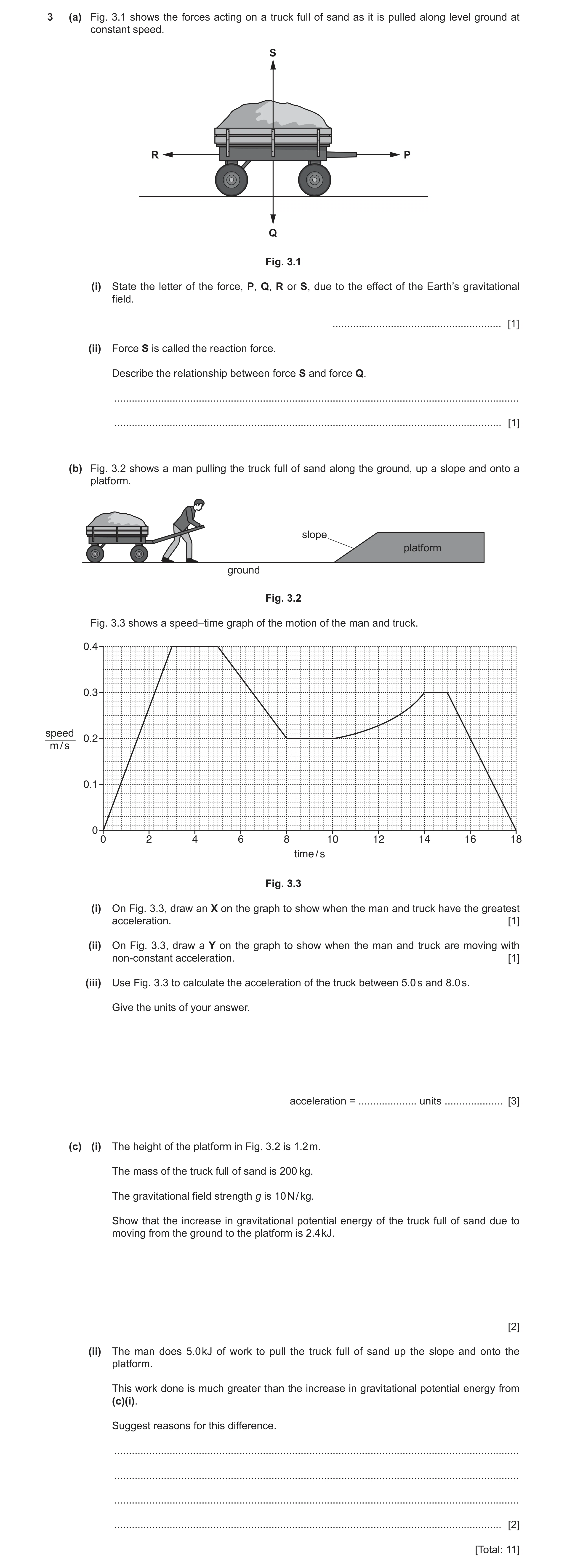
3 (a) Fig. 3.1 shows the forces acting on a truck full of sand as it is pulled along level ground at constant speed. S R P Q Fig. 3.1 (i) State the letter of the force, P, Q, R or S, due to the effect of the Earth’s gravitational field. … [1] (ii) Force S is called the reaction force. Describe the relationship between force S and force Q. … … [1] (b) Fig. 3.2 shows a man pulling the truck full of sand along the ground, up a slope and onto a platform. slope platform ground Fig. 3.2 Fig. 3.3 shows a speed–time graph of the motion of the man and truck. 0.4 0.3 speed 0.2 m / s 0.1 0 0 2 4 6 8 10 12 14 16 18 time / s Fig. 3.3 (i) On Fig. 3.3, draw an X on the graph to show when the man and truck have the greatest acceleration. [1] (ii) On Fig. 3.3, draw a Y on the graph to show when the man and truck are moving with non-constant acceleration. [1] (iii) Use Fig. 3.3 to calculate the acceleration of the truck between 5.0 s and 8.0 s. Give the units of your answer. acceleration = … units … [3] (c) (i) The height of the platform in Fig. 3.2 is 1.2 m. The mass of the truck full of sand is 200 kg. The gravitational field strength g is 10 N / kg. Show that the increase in gravitational potential energy of the truck full of sand due to moving from the ground to the platform is 2.4 kJ. [2] (ii) The man does 5.0 kJ of work to pull the truck full of sand up the slope and onto the platform. This work done is much greater than the increase in gravitational potential energy from (c)(i). Suggest reasons for this difference. … … … … [2] [Total: 11]
11 marks
Mark scheme: 3(a)(i) Q ; 1 3(a)(ii) equal (magnitude) AND opposite (direction) ; 1 3(b)(i) X drawn to show region between (0,0) and (3,0.4) ; 1 3(b)(ii) Y drawn to show region between (10,0.2) and (14,0.3) ; 1 3(b)(iii) acceleration = change of speed ÷ time / –0.2 ÷ 3 ; –0.07 ; m / s2 ; 3 3(c)(i) ΔG.P.E. = mgΔh in any form / 200 × 10 × 1.2 ; 2400 J (= 2.4 kJ) ; 2 3(c)(ii) any two from: thermal energy lost to surroundings / work done against friction ; man also has to gain PE going up onto the platform ; kinetic energy transferred / work also done in moving the man (and load) forward ; 2
This question in 0653/42 Oct/Nov 2020
Q8 · A climber using a safety rope to climb a rock face 0653/43 Oct/Nov 2020
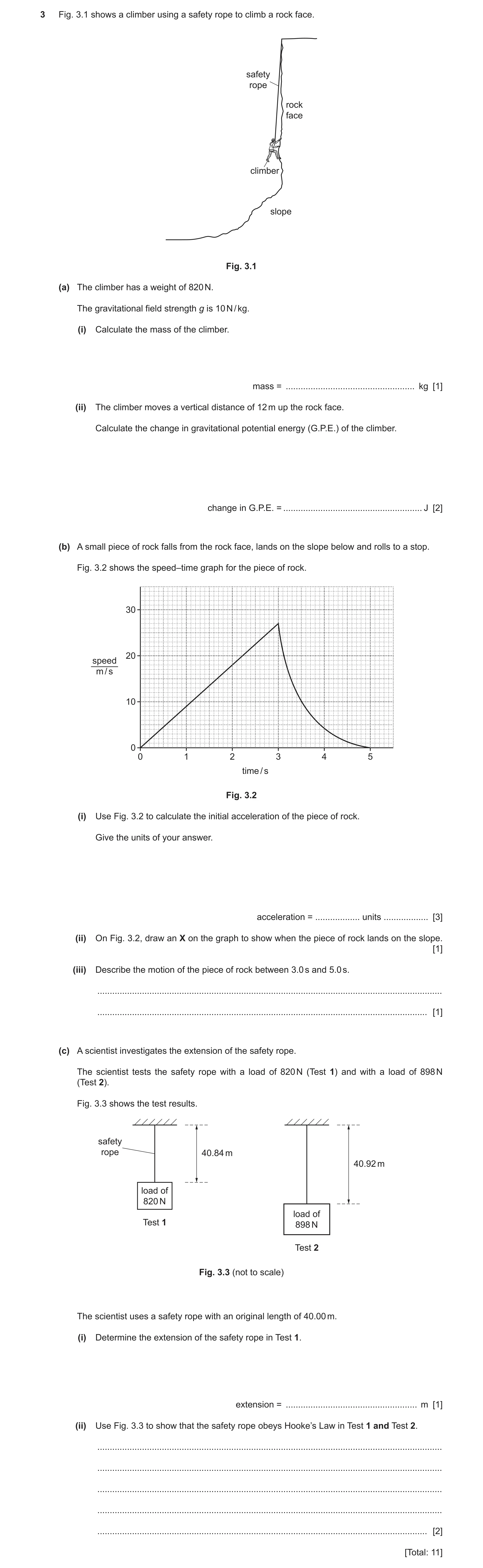
3 Fig. 3.1 shows a climber using a safety rope to climb a rock face. safety rope rock face climber slope Fig. 3.1 (a) The climber has a weight of 820 N. The gravitational field strength g is 10 N / kg. (i) Calculate the mass of the climber. mass = … kg [1] (ii) The climber moves a vertical distance of 12 m up the rock face. Calculate the change in gravitational potential energy (G.P.E.) of the climber. change in G.P.E. = … J [2] (b) A small piece of rock falls from the rock face, lands on the slope below and rolls to a stop. Fig. 3.2 shows the speed–time graph for the piece of rock. 30 20 speed m / s 10 0 0 1 2 3 4 5 time / s Fig. 3.2 (i) Use Fig. 3.2 to calculate the initial acceleration of the piece of rock. Give the units of your answer. acceleration = … units … [3] (ii) On Fig. 3.2, draw an X on the graph to show when the piece of rock lands on the slope. [1] (iii) Describe the motion of the piece of rock between 3.0 s and 5.0 s. … … [1] (c) A scientist investigates the extension of the safety rope. The scientist tests the safety rope with a load of 820 N (Test 1) and with a load of 898 N (Test 2). Fig. 3.3 shows the test results. safety rope 40.84 m 40.92 m load of 820 N load of Test 1 898 N Test 2 Fig. 3.3 (not to scale) The scientist uses a safety rope with an original length of 40.00 m. (i) Determine the extension of the safety rope in Test 1. extension = … m [1] (ii) Use Fig. 3.3 to show that the safety rope obeys Hooke’s Law in Test 1 and Test 2. … … … … … [2] [Total: 11]
11 marks
Mark scheme: 3(a)(i) (m = W ÷ g = 820 ÷ 10 =) 82 (kg) ; 1 3(a)(ii) ΔG.P.E. = mgΔh / ΔG.P.E. = wΔh / 82 × 10 × 12 ; 9840 (J) ; 2 3(b)(i) use of acceleration = change in speed ÷ time / 27 ÷ 3.0 ; 9.0 ; m / s2 ; 3 3(b)(ii) X marked at time = 3 s ; 1 3(b)(iii) non-constant, deceleration / acceleration (until it comes to rest) ; 1 3(c)(i) (extension = 40.84 – 40.00 =) 0.84 (m) ; 1 3(c)(ii) calculation of k OR 1 / k for one test ; calculation of k OR 1 / k for second test AND shown to be the same ; 2
This question in 0653/43 Oct/Nov 2020
Q9 · A man standing still and holding a bucket filled with water 0653/43 May/June 2022
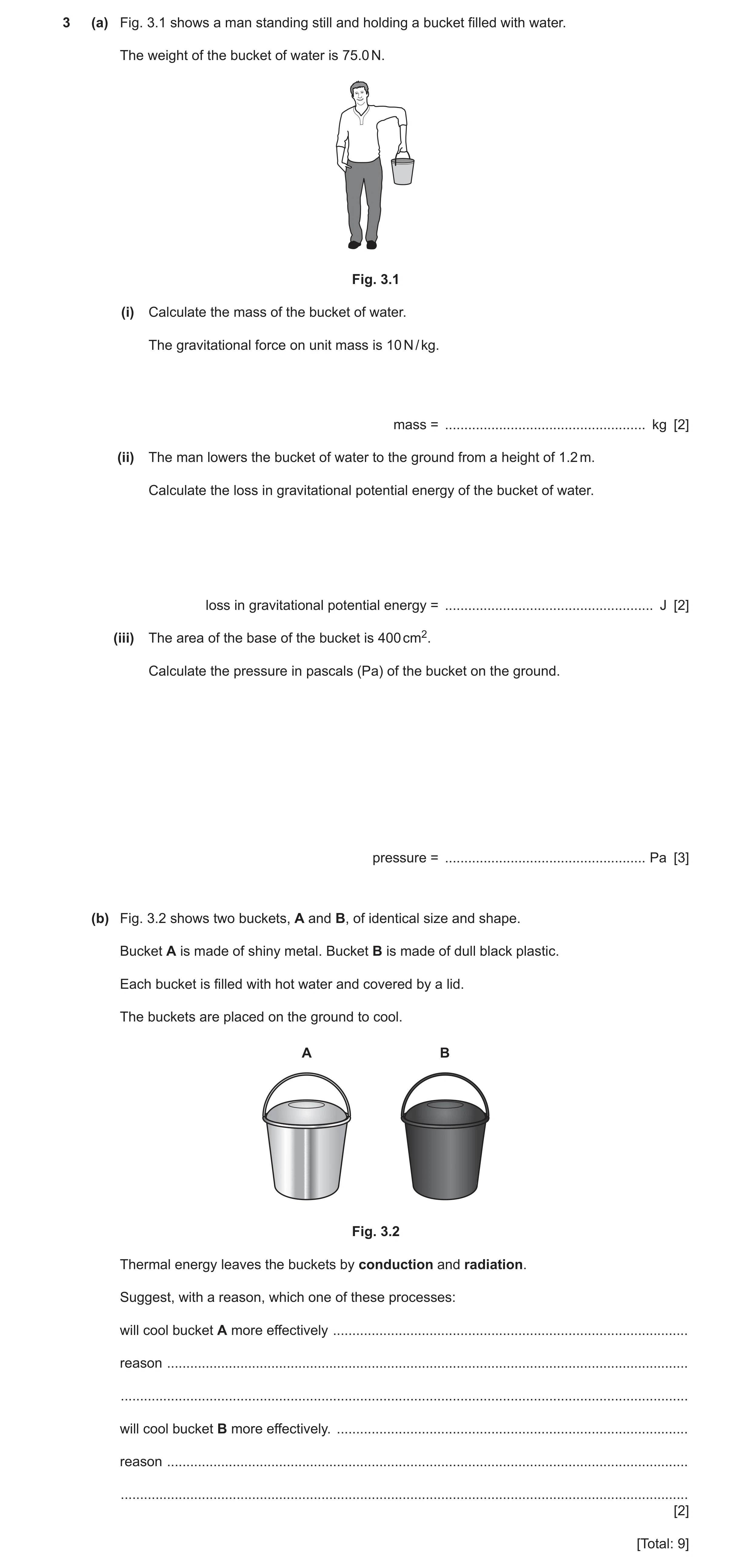
3 (a) Fig. 3.1 shows a man standing still and holding a bucket filled with water. The weight of the bucket of water is 75.0 N. Fig. 3.1 (i) Calculate the mass of the bucket of water. The gravitational force on unit mass is 10 N / kg. mass = … kg [2] (ii) The man lowers the bucket of water to the ground from a height of 1.2 m. Calculate the loss in gravitational potential energy of the bucket of water. loss in gravitational potential energy = … J [2] (iii) The area of the base of the bucket is 400 cm2. Calculate the pressure in pascals (Pa) of the bucket on the ground. pressure = … Pa [3] (b) Fig. 3.2 shows two buckets, A and B, of identical size and shape. Bucket A is made of shiny metal. Bucket B is made of dull black plastic. Each bucket is filled with hot water and covered by a lid. The buckets are placed on the ground to cool. A B Fig. 3.2 Thermal energy leaves the buckets by conduction and radiation. Suggest, with a reason, which one of these processes: will cool bucket A more effectively … reason … … will cool bucket B more effectively. … reason … … [2] [Total: 9]
9 marks
Mark scheme: 3(a)(i) W = mg (in any form) OR (m =) 75 ÷ 10 ; = 7.5 (kg) ; 2 3(a)(ii) PE = mgh OR = W distance (in any form) OR = 75 1.2 ; = 90 (J) ; 2 3(a)(iii) pressure = force ÷ area (in any form) ; pascals is N / m2 so area of 400 cm2 is 0.04 m2 ; (p = 75 ÷ 0.04 =) 1875 OR 1880 (Pa) ; 3 3(b) will cool bucket A more effectively: conduction AND reason: because metal is a good conductor / shiny metal is not a good radiator ; will cool bucket B more effectively: radiation AND reason: dull black is good radiator / plastic is not a good conductor ; 2
This question in 0653/43 May/June 2022
Q10 · Forces P, Q, R and S acting on an airplane moving forward along a runway 0653/41 Oct/Nov 2022
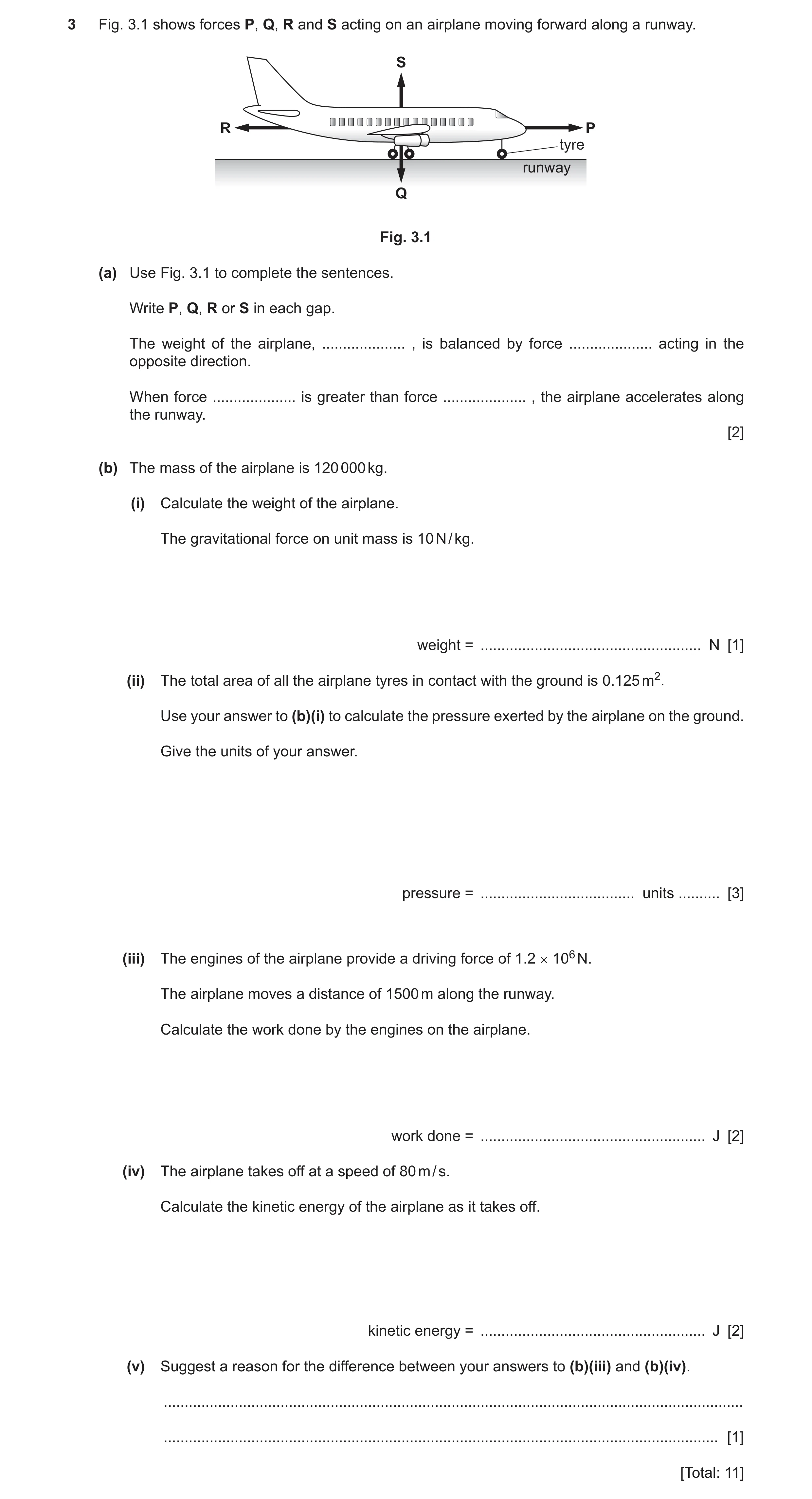
3 Fig. 3.1 shows forces P, Q, R and S acting on an airplane moving forward along a runway. S R P tyre runway Q Fig. 3.1 (a) Use Fig. 3.1 to complete the sentences. Write P, Q, R or S in each gap. The weight of the airplane, … , is balanced by force … acting in the opposite direction. When force … is greater than force … , the airplane accelerates along the runway. [2] (b) The mass of the airplane is 120 000 kg. (i) Calculate the weight of the airplane. The gravitational force on unit mass is 10 N / kg. weight = … N [1] (ii) The total area of all the airplane tyres in contact with the ground is 0.125 m2. Use your answer to (b)(i) to calculate the pressure exerted by the airplane on the ground. Give the units of your answer. pressure = … units … [3] (iii) The engines of the airplane provide a driving force of 1.2 × 10⁶ N. The airplane moves a distance of 1500 m along the runway. Calculate the work done by the engines on the airplane. work done = … J [2] (iv) The airplane takes off at a speed of 80 m / s. Calculate the kinetic energy of the airplane as it takes off. kinetic energy = … J [2] (v) Suggest a reason for the difference between your answers to (b)(iii) and (b)(iv). … … [1] [Total: 11]
11 marks
Mark scheme: 3(a) Q, S ; 2 P, R ; 3(b)(i) 1 200 000 (N) ; 1 3(b)(ii) evidence of, p = F ÷ A / 1 200 000 ÷ 0.125 ; 3 9 600 000 ; Pa OR N / m2 ; 3(b)(iii) evidence of, W = F d / 1.2 106 1500 ; 2 1.8 109 / 1 800 000 000 (J) ; 3(b)(iv) evidence of, KE = ½ m v2 / ½ 120 000 802 ; 2 3.8(4) 108 / 380 000 000 (J) ; 3(b)(v) (work done against) friction / air resistance ; 1
This question in 0653/41 Oct/Nov 2022
Q11 · In 1997, the Thrust Supersonic Car set a world land speed record 0653/42 Oct/Nov 2022
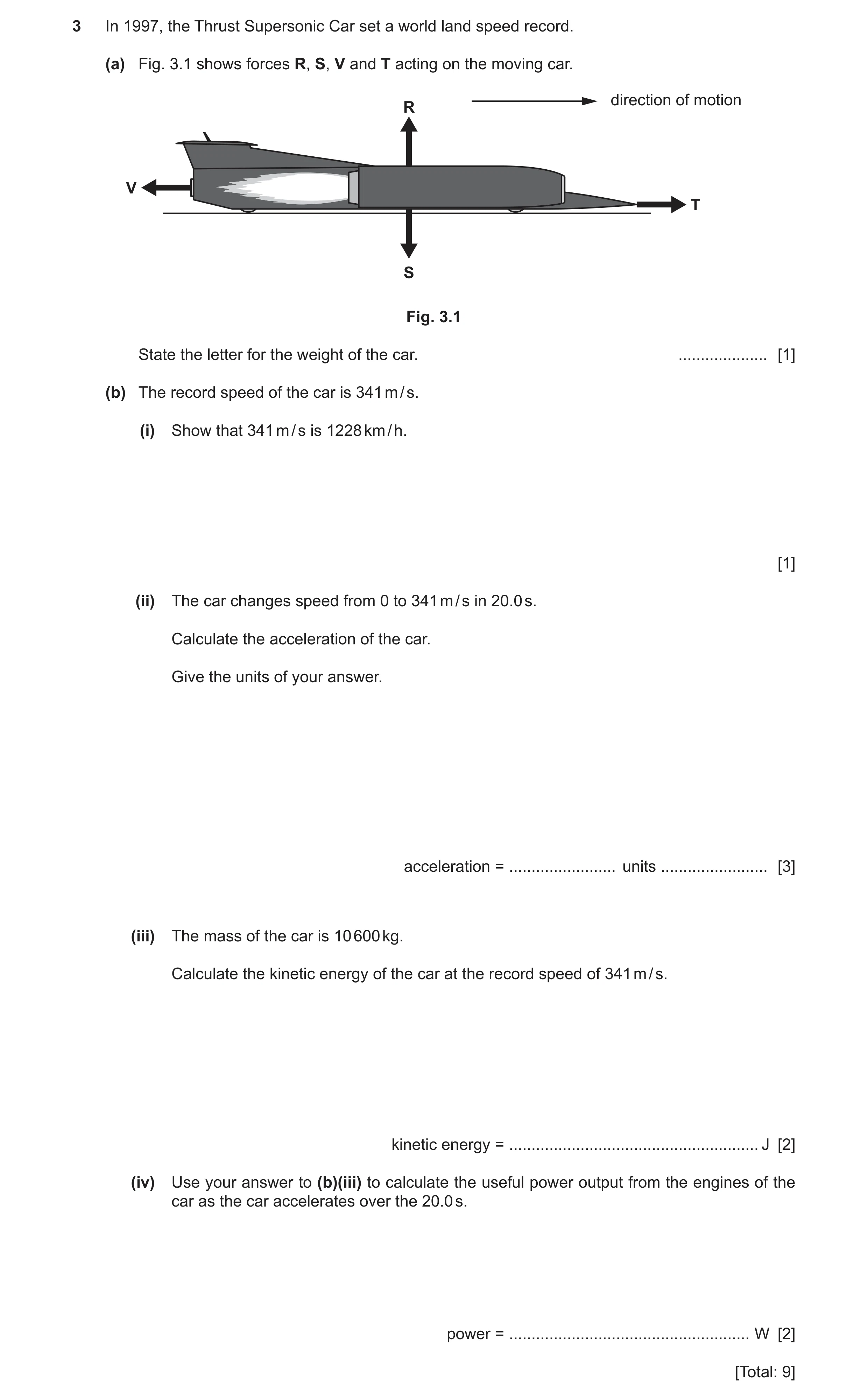
3 In 1997, the Thrust Supersonic Car set a world land speed record. (a) Fig. 3.1 shows forces R, S, V and T acting on the moving car. direction of motion R V T S Fig. 3.1 State the letter for the weight of the car. … [1] (b) The record speed of the car is 341 m / s. (i) Show that 341 m / s is 1228 km / h. [1] (ii) The car changes speed from 0 to 341 m / s in 20.0 s. Calculate the acceleration of the car. Give the units of your answer. acceleration = … units … [3] (iii) The mass of the car is 10 600 kg. Calculate the kinetic energy of the car at the record speed of 341 m / s. kinetic energy = … J [2] (iv) Use your answer to (b)(iii) to calculate the useful power output from the engines of the car as the car accelerates over the 20.0 s. power = … W [2] [Total: 9]
9 marks
Mark scheme: 3(a)(i) S ; 1 3(b)(i) 341 3600 ÷ 1000 (= 1228 km / h) ; 1 3(b)(ii) evidence of, acceleration = change in speed ÷ time / 341 ÷ 20.0 ; 3 17.1 ; m / s2 ; 3(b)(iii) evidence of, KE = ½ m v2 / ½ 10600 341 341 ; 2 6.16 x 10⁸ (J) ; 3(b)(iv) evidence of, P = E ÷ t / 6.16 108 ÷ 20.0 ; 2 3.08 107 (W) ;
This question in 0653/42 Oct/Nov 2022
Q12 · A moving conveyor belt carrying a box from the ground up to an aircraft 0653/41 May/June 2023
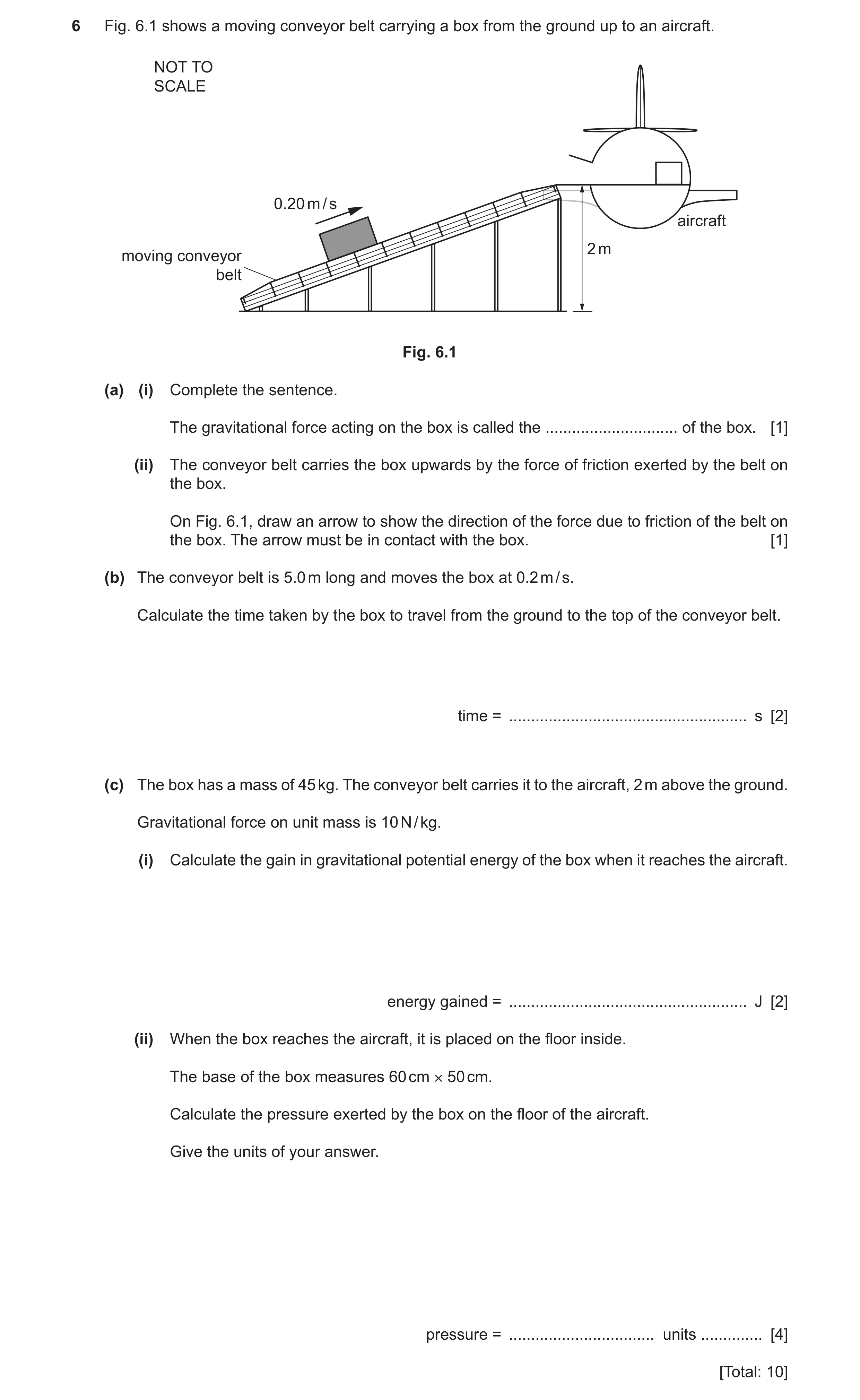
6 Fig. 6.1 shows a moving conveyor belt carrying a box from the ground up to an aircraft. NOT TO SCALE 0.20 m / s aircraft 2 m moving conveyor belt Fig. 6.1 (a) (i) Complete the sentence. The gravitational force acting on the box is called the … of the box. [1] (ii) The conveyor belt carries the box upwards by the force of friction exerted by the belt on the box. On Fig. 6.1, draw an arrow to show the direction of the force due to friction of the belt on the box. The arrow must be in contact with the box. [1] (b) The conveyor belt is 5.0 m long and moves the box at 0.2 m / s. Calculate the time taken by the box to travel from the ground to the top of the conveyor belt. time = … s [2] (c) The box has a mass of 45 kg. The conveyor belt carries it to the aircraft, 2 m above the ground. Gravitational force on unit mass is 10 N / kg. (i) Calculate the gain in gravitational potential energy of the box when it reaches the aircraft. energy gained = … J [2] (ii) When the box reaches the aircraft, it is placed on the floor inside. The base of the box measures 60 cm × 50 cm. Calculate the pressure exerted by the box on the floor of the aircraft. Give the units of your answer. pressure = … units … [4] [Total: 10]
10 marks
Mark scheme: 6(a)(i) weight ; 1 6(a)(ii) force arrow parallel to belt in contact with box pointing up the belt ; 1 6(b) time = distance speed (stated or evidence of use) / (time = ) 5 0.2 ; 25 (s) ; 2 6(c)(i) (gain in GPE = ) mgh (stated or evidence of use) / 45 10 2 ; 900 (J) ; 2 6(c)(ii) pressure = force area (in any form) ; = 450 ÷ 3 000 OR 450 ÷ 0.3 ; (pressure = ) 0.15 (N / cm2) OR 1 500 (N / m2 or Pa) ; N / cm2 OR N / m2 OR Pa (to match numerical answer) ; 4
This question in 0653/41 May/June 2023
Q13 · A mechanical crane using force P to lift a box from the ground to the top of a building 0653/41 May/June 2024
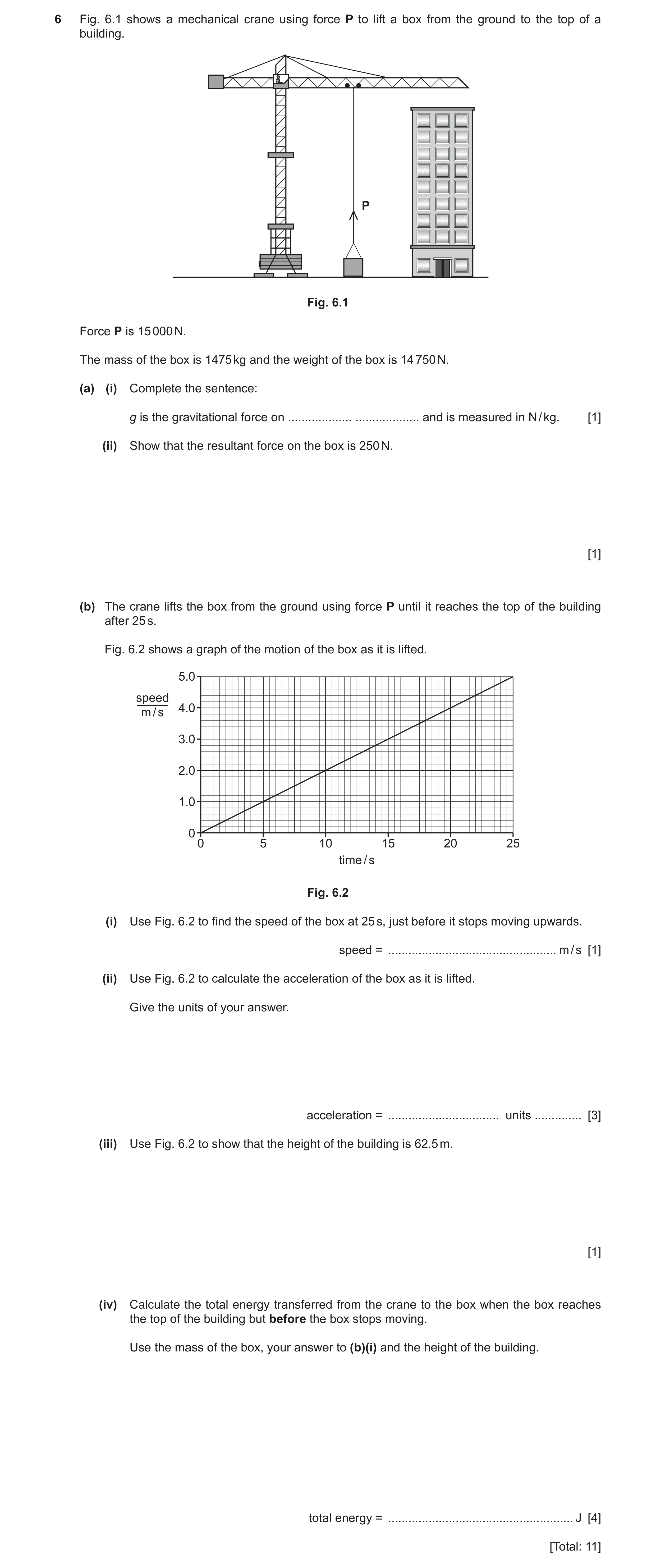
6 Fig. 6.1 shows a mechanical crane using force P to lift a box from the ground to the top of a building. P Fig. 6.1 Force P is 15 000 N. The mass of the box is 1475 kg and the weight of the box is 14 750 N. (a) (i) Complete the sentence: g is the gravitational force on … … and is measured in N / kg. [1] (ii) Show that the resultant force on the box is 250 N. [1] (b) The crane lifts the box from the ground using force P until it reaches the top of the building after 25 s. Fig. 6.2 shows a graph of the motion of the box as it is lifted. 5.0 speed 4.0 m / s 3.0 2.0 1.0 0 0 5 10 15 20 25 time / s Fig. 6.2 (i) Use Fig. 6.2 to find the speed of the box at 25 s, just before it stops moving upwards. speed = … m / s [1] (ii) Use Fig. 6.2 to calculate the acceleration of the box as it is lifted. Give the units of your answer. acceleration = … units … [3] (iii) Use Fig. 6.2 to show that the height of the building is 62.5 m. [1] (iv) Calculate the total energy transferred from the crane to the box when the box reaches the top of the building but before the box stops moving. Use the mass of the box, your answer to (b)(i) and the height of the building. total energy = … J [4] [Total: 11]
11 marks
Mark scheme: 6(a)(i) unit mass / 1 kg ; 1 6(a)(ii) (resultant force) = 15 000 – 14 750 (= 250 N) ; 1 6(b)(i) 5.0 (m / s) ; 1 6(b)(ii) a = v t / evidence of use of formula ; = 0.20 ; m / s2 ; 3 6(b)(iii) use of area under graph seen, i.e. ½ 25 5 ; (= 62.5 m) 1 6(b)(iv) (increase in KE =) ½ mv 2 OR ½ 1475 5 5 OR 18437.5 ; (increase in PE =) mgh OR 1475 10 62.5 OR 921875 ; 18437.5 AND 921875 ; 940 000 (J) ; 4
This question in 0653/41 May/June 2024
Q14 · A block of wood has a weight of 24.1 N 0653/41 Oct/Nov 2024
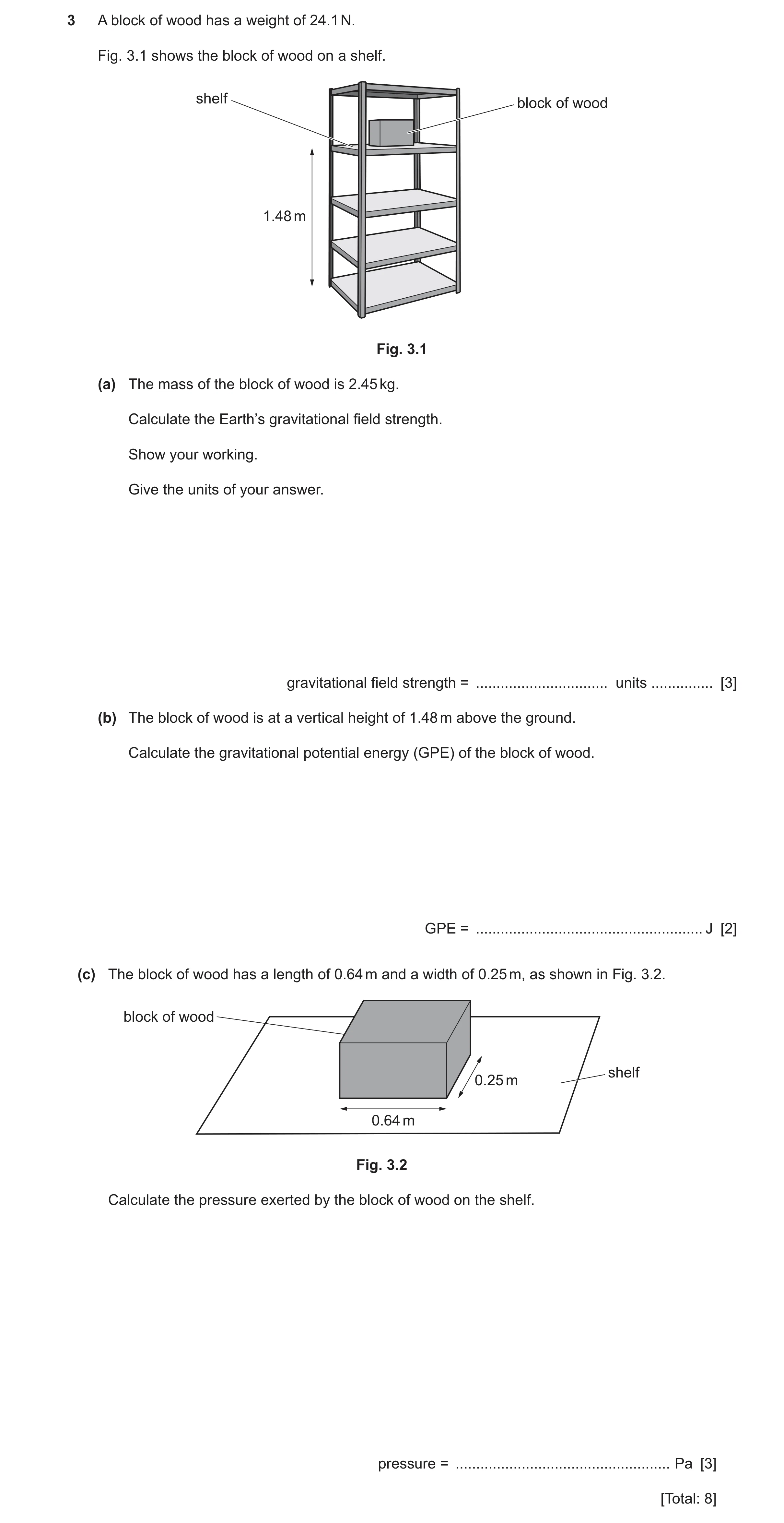
3 A block of wood has a weight of 24.1 N. Fig. 3.1 shows the block of wood on a shelf. shelf block of wood 1.48 m Fig. 3.1 (a) The mass of the block of wood is 2.45 kg. Calculate the Earth’s gravitational field strength. Show your working. Give the units of your answer. gravitational field strength = … units … [3] (b) The block of wood is at a vertical height of 1.48 m above the ground. Calculate the gravitational potential energy (GPE) of the block of wood. GPE = … J [2] (c) The block of wood has a length of 0.64 m and a width of 0.25 m, as shown in Fig. 3.2. block of wood shelf 0.25 m 0.64 m Fig. 3.2 Calculate the pressure exerted by the block of wood on the shelf. pressure = … Pa [3] [Total: 8]
8 marks
Mark scheme: 3(a) evidence of, W = mg ; 3 24.1 ÷ 2.45 = 9.84 ; N / kg ; 3(b) evidence of, GPE = mgh / W d / 24.1 1.48 ; 2 35.7 / 36 (J) ; 3(c) (calculation of area A =) 0.64 0.25 / 0.16 (m2) ; 3 evidence of, p = F ÷ A / 24.1 ÷ 0.16 ; 150 / 151 (Pa) ;
This question in 0653/41 Oct/Nov 2024
Q15 · A toy car, powered by a battery 0653/43 May/June 2025
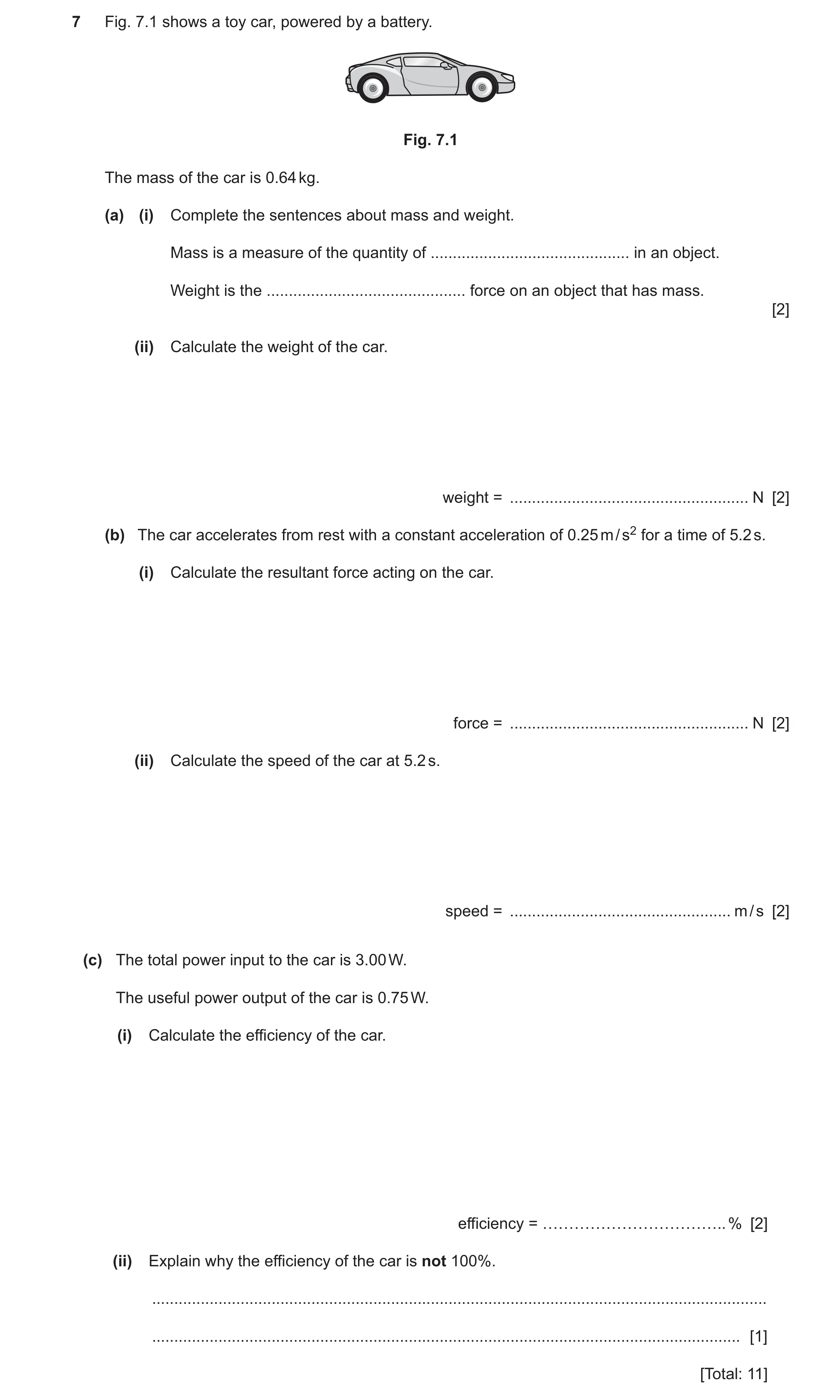
7 Fig. 7.1 shows a toy car, powered by a battery. Fig. 7.1 The mass of the car is 0.64 kg. (a) (i) Complete the sentences about mass and weight. Mass is a measure of the quantity of … in an object. Weight is the … force on an object that has mass. [2] (ii) Calculate the weight of the car. weight = … N [2] (b) The car accelerates from rest with a constant acceleration of 0.25 m / s2 for a time of 5.2 s. (i) Calculate the resultant force acting on the car. force = … N [2] (ii) Calculate the speed of the car at 5.2 s. speed = … m / s [2] (c) The total power input to the car is 3.00 W. The useful power output of the car is 0.75 W. (i) Calculate the efficiency of the car. efficiency = …………………………….. % [2] (ii) Explain why the efficiency of the car is not 100%. … … [1] [Total: 11]
11 marks
Mark scheme: 7(a)(i) matter; 2 gravitational ; 7(a)(ii) W = mg / 0.64 × 9.8 ; 2 6.3 (N) ; 7(b)(i) F = ma / 0.64 × 0.25 ; 2 0.16 (N) ; 7(b)(ii) (v =) a × t or 0.25 × 5.2 ; 2 1.3 (m / s) ; 7(c)(i) 2 power output 0.75 efficiency = 100 OR ×100 ; power input 3.00 25 (%) ; 7(c)(ii) energy transfer, to surroundings / internal energy of car / thermal energy of tyres, etc. 1 or (by) work done against, friction / air resistance ;
This question in 0653/43 May/June 2025
Q16 · A motor and an object at rest on the ground 0653/43 Oct/Nov 2025
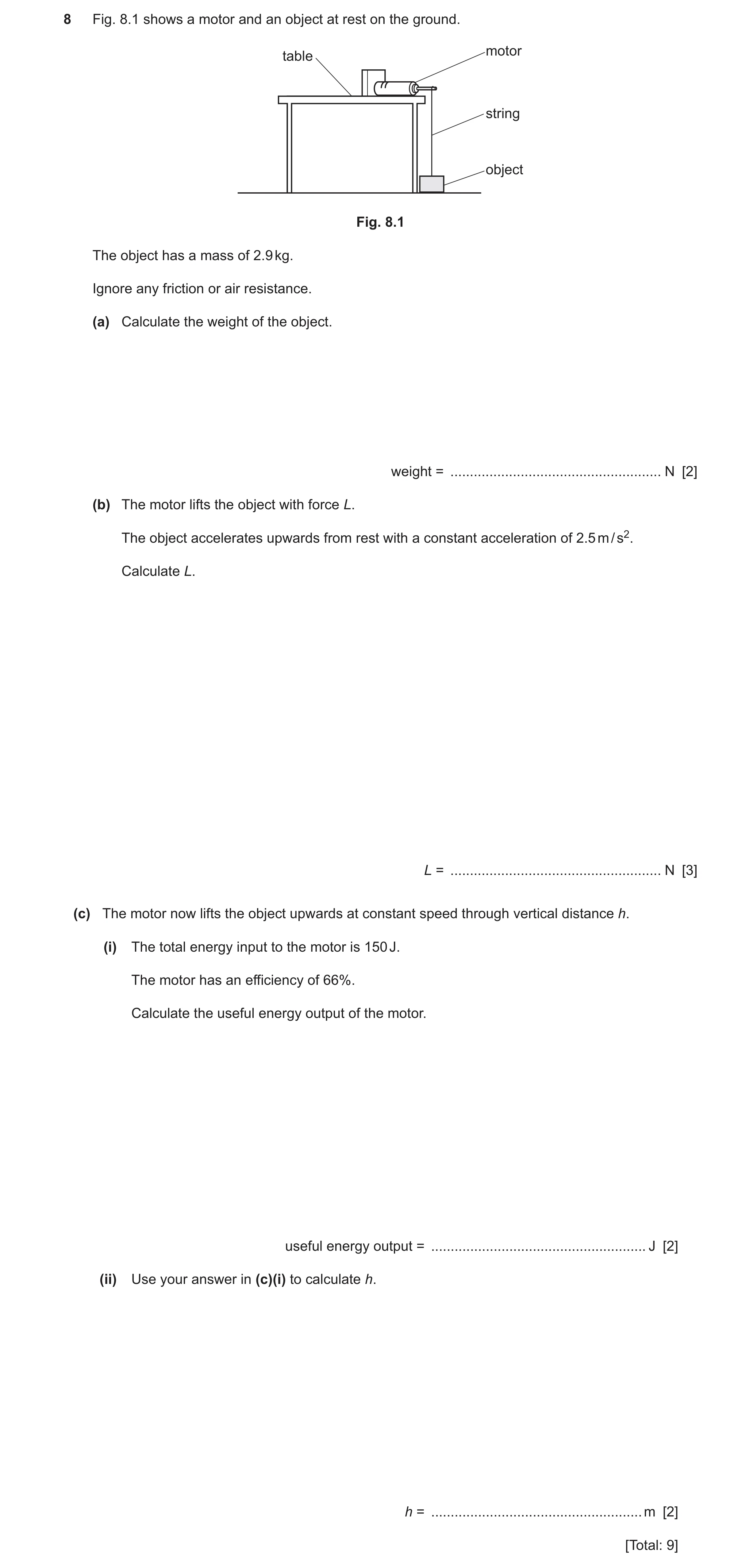
8 Fig. 8.1 shows a motor and an object at rest on the ground. motor table string object Fig. 8.1 The object has a mass of 2.9 kg. Ignore any friction or air resistance. (a) Calculate the weight of the object. weight = … N [2] (b) The motor lifts the object with force L. The object accelerates upwards from rest with a constant acceleration of 2.5 m / s2. Calculate L. L = … N [3] (c) The motor now lifts the object upwards at constant speed through vertical distance h. (i) The total energy input to the motor is 150 J. The motor has an efficiency of 66%. Calculate the useful energy output of the motor. useful energy output = … J [2] (ii) Use your answer in (c)(i) to calculate h. h = … m [2] [Total: 9]
9 marks
Mark scheme: 8(a) W = mg / 2.9 9.8 ; 2 28 (N) ; 8(b) F = ma / 2.9 2.5 / 7.25 ; 3 L = F + W / (L = ) 28.42 + 7.25 / (L = ) 35.67 ; 36 (N) ; 8(c)(i) useful energy output = efficiency total energy input / 0.66 150 ; 2 99 (J) ; 8(c)(ii) ΔEp = mgΔh 2 or 99 = 2.9 9.8 h or 99 = 28.42 h 99 or h = ; 2.9 9.8 3.5 (m) ;
This question in 0653/43 Oct/Nov 2025
 9
9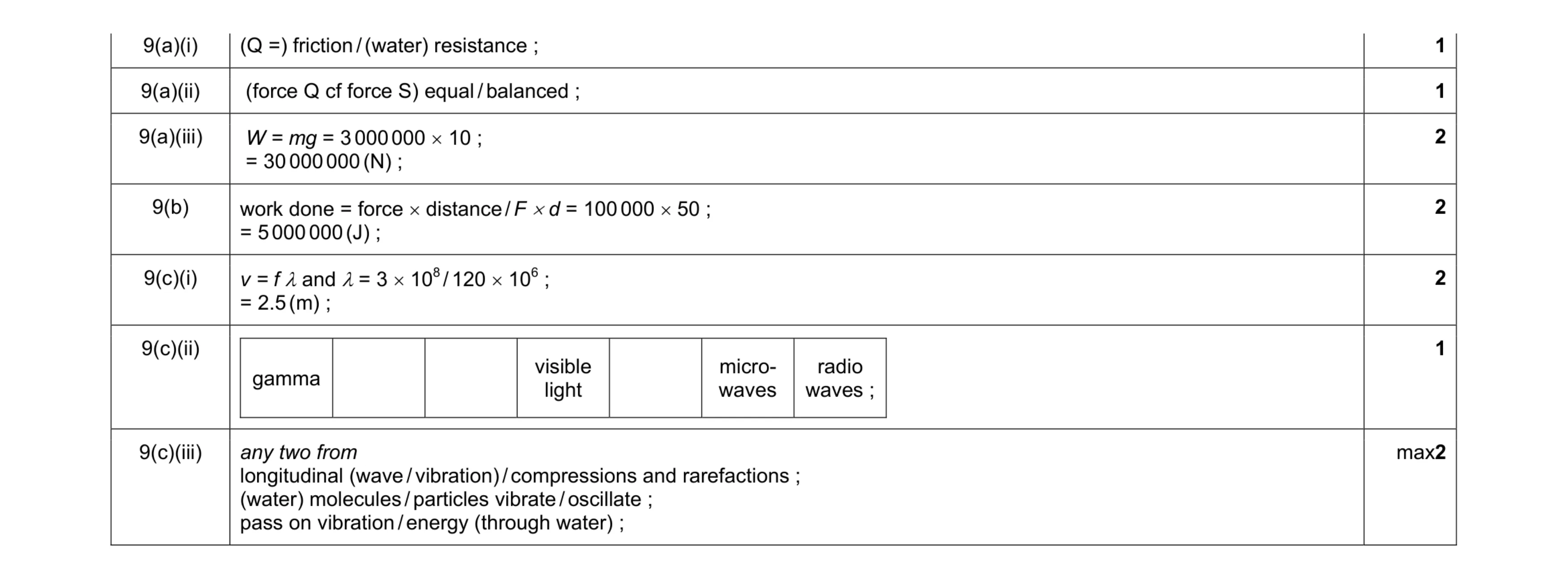 11
11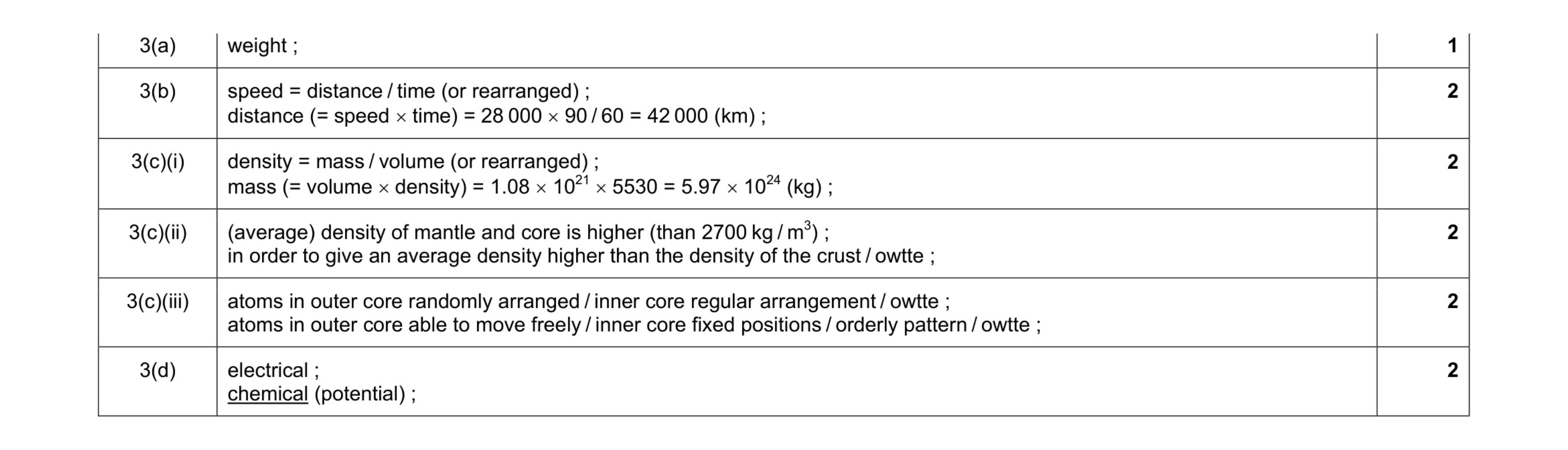 11
11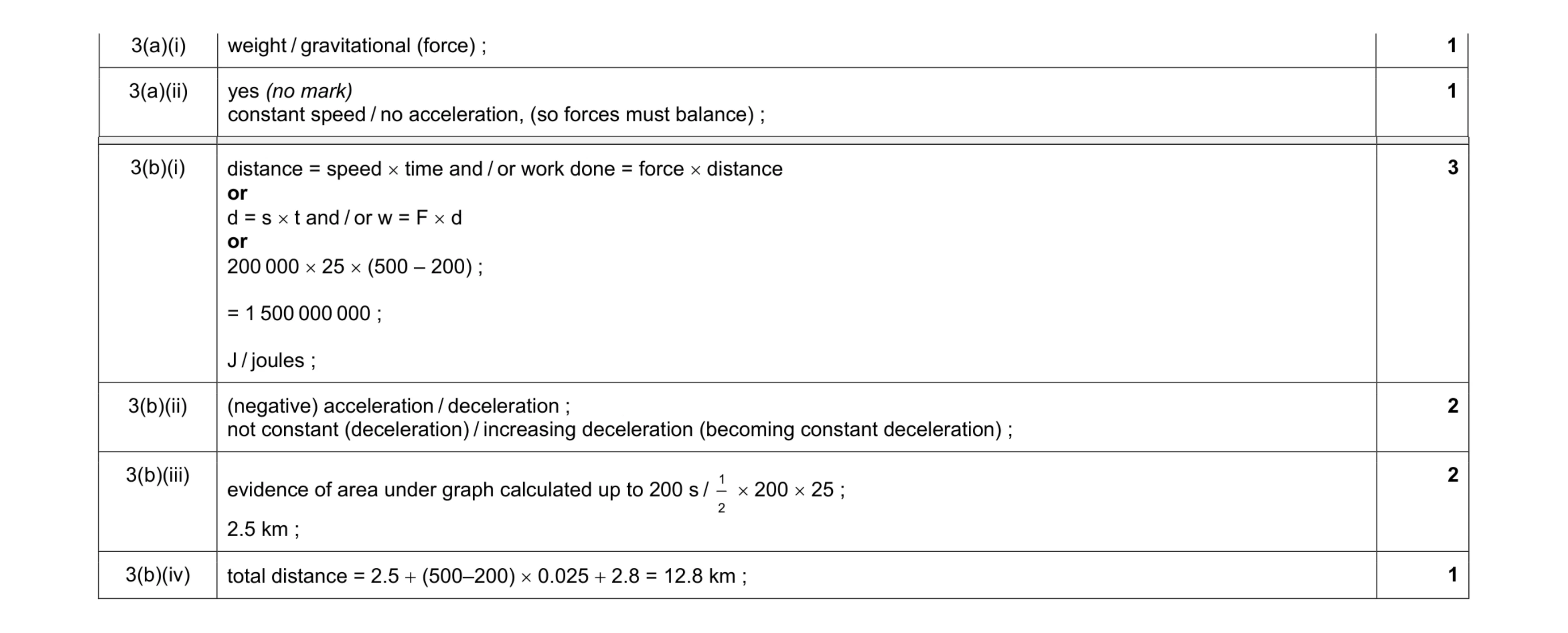 10
10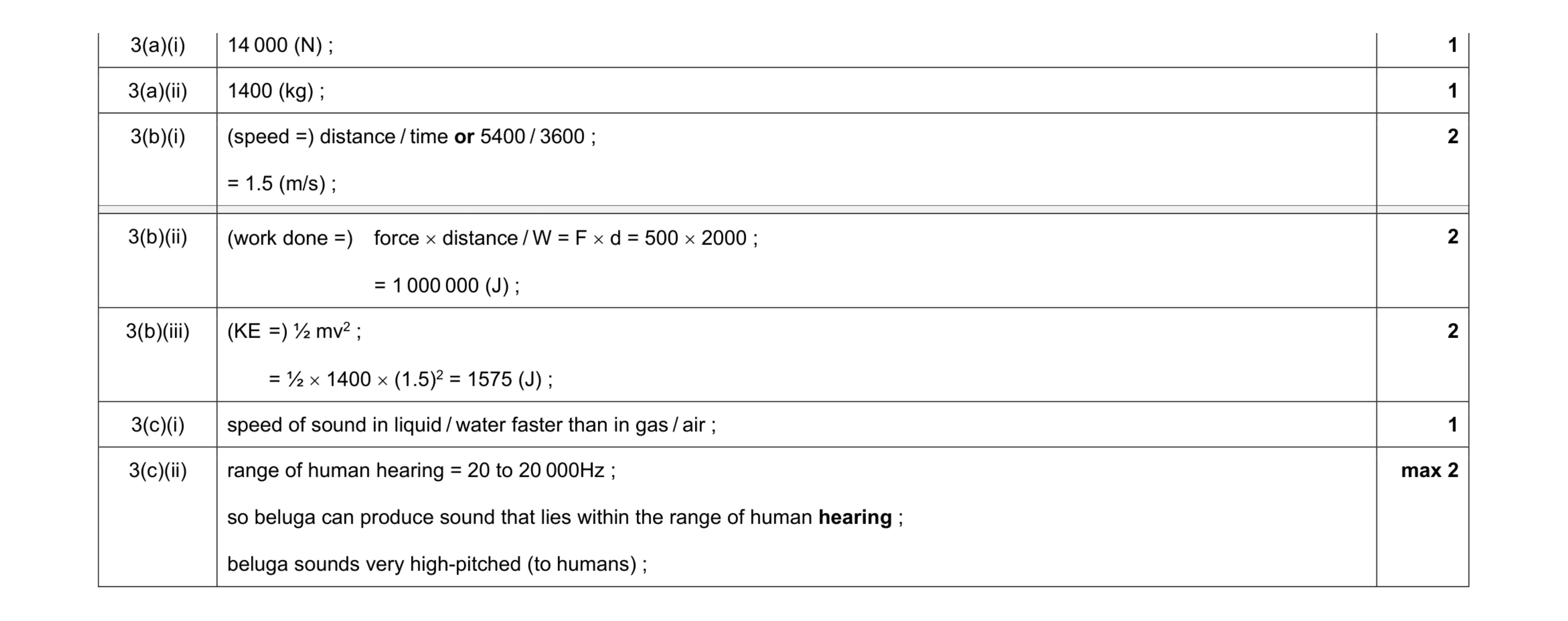 11
11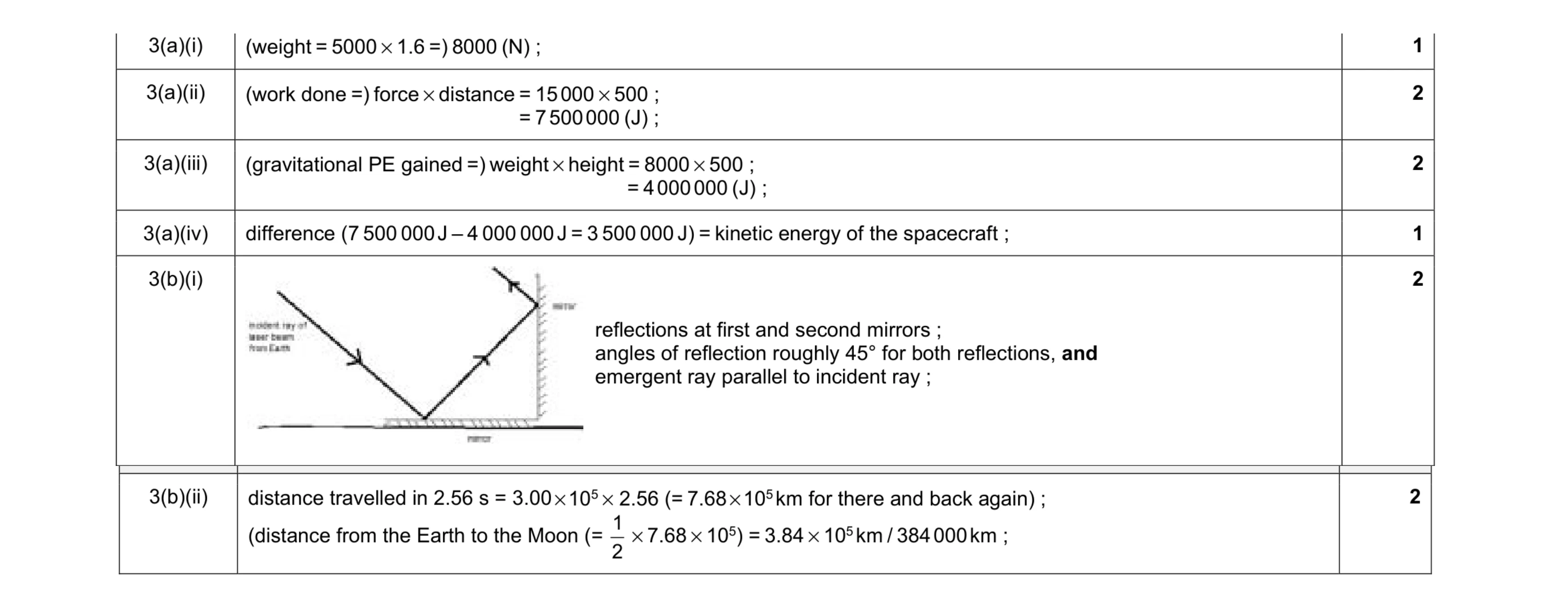 10
10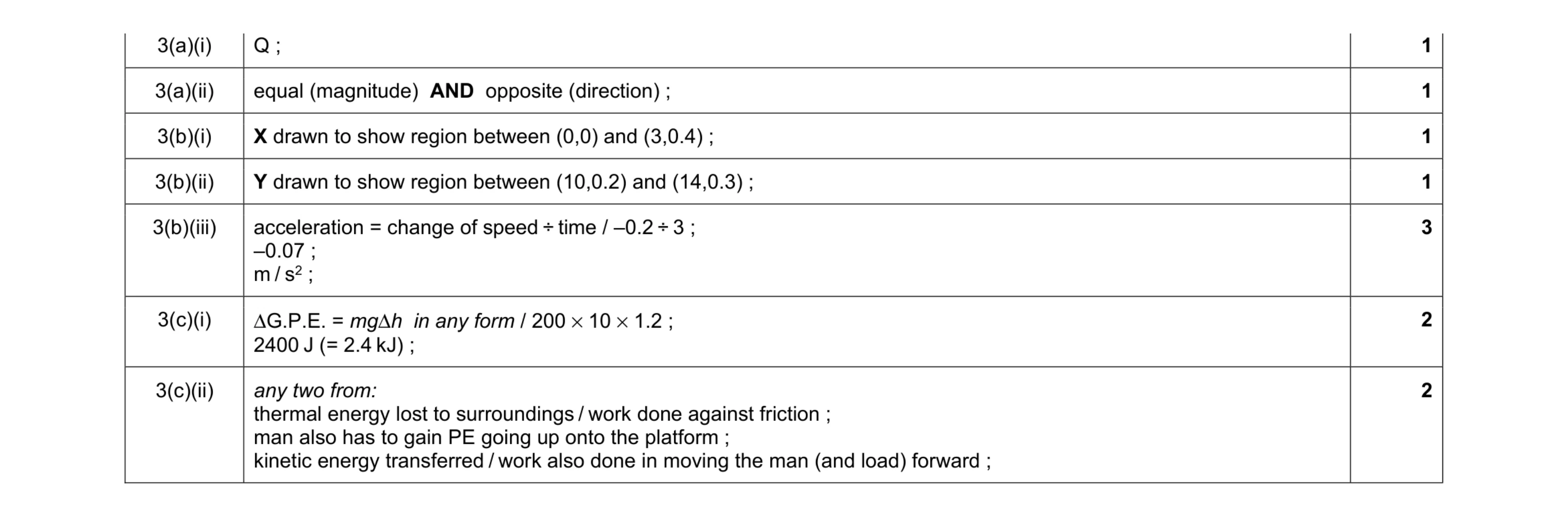 11
11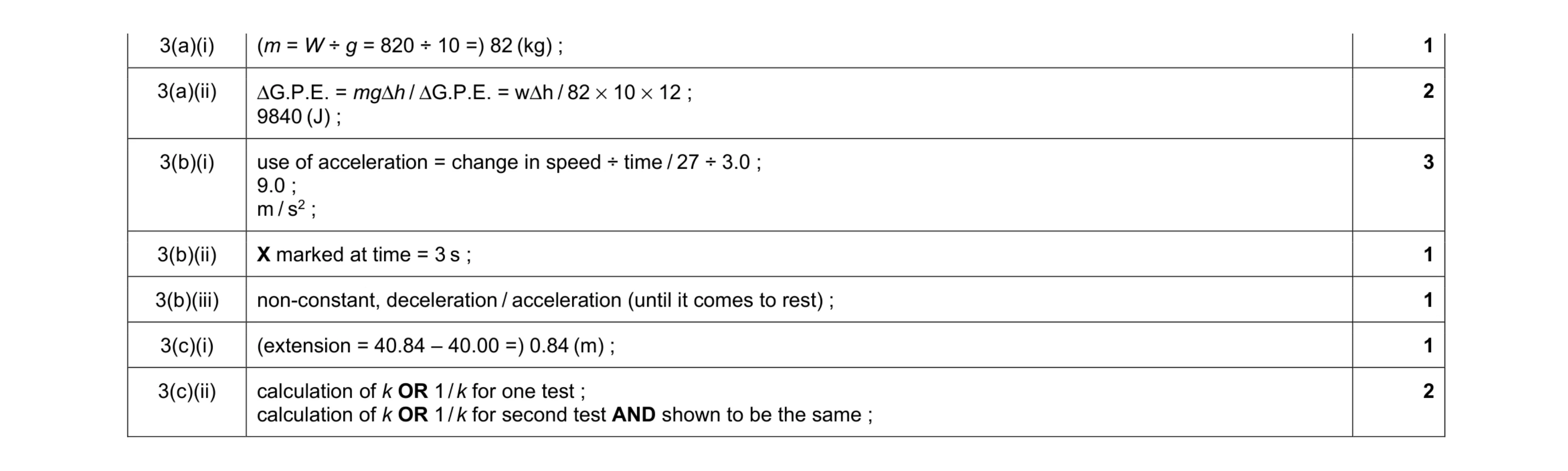 11
11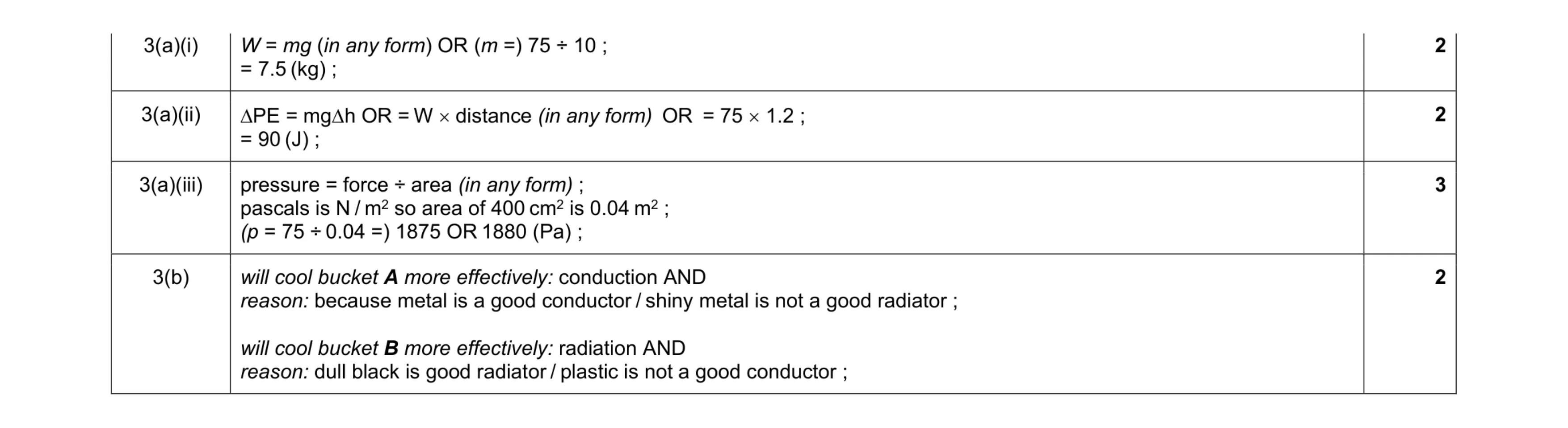 9
9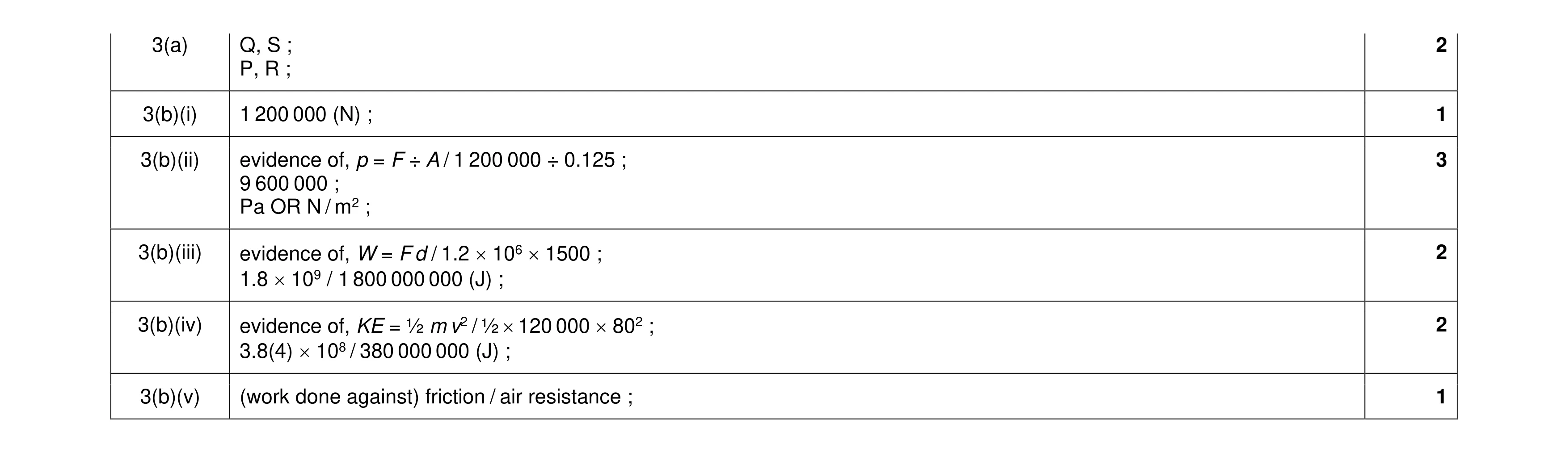 11
11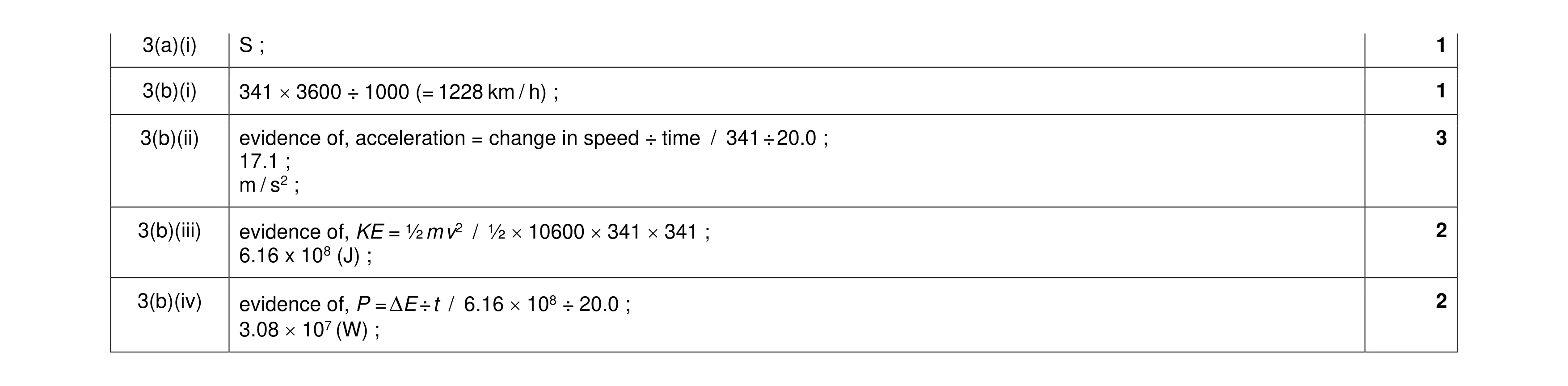 9
9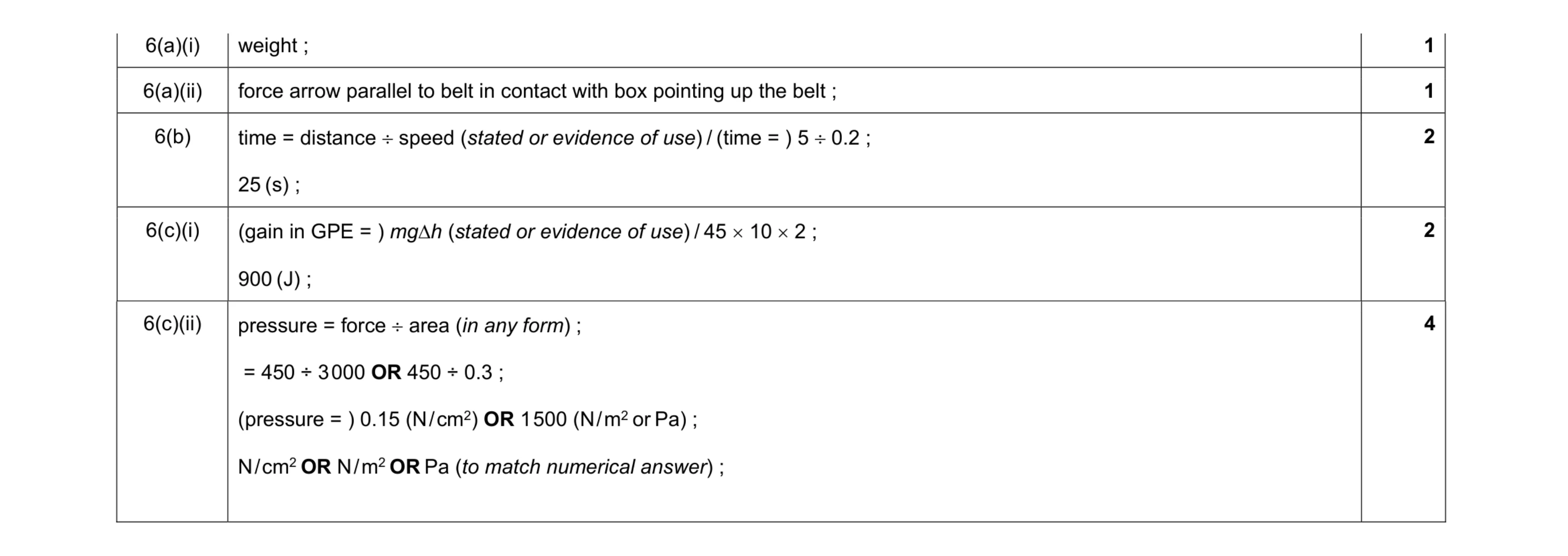 10
10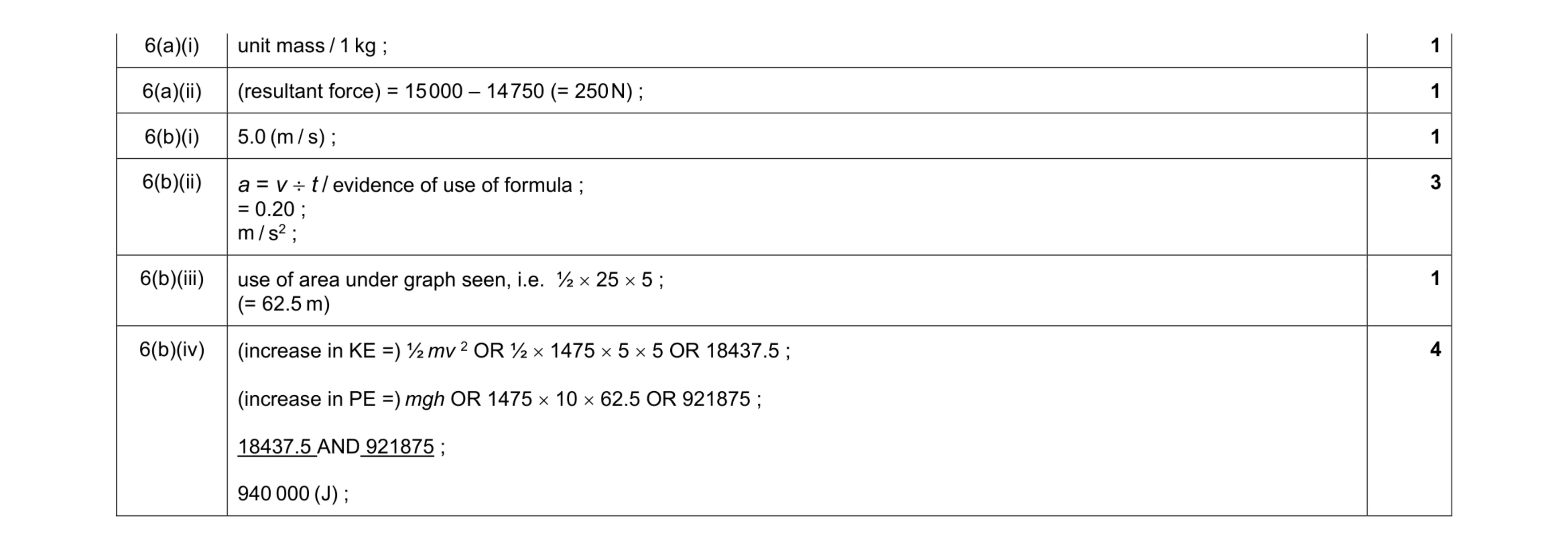 11
11 8
8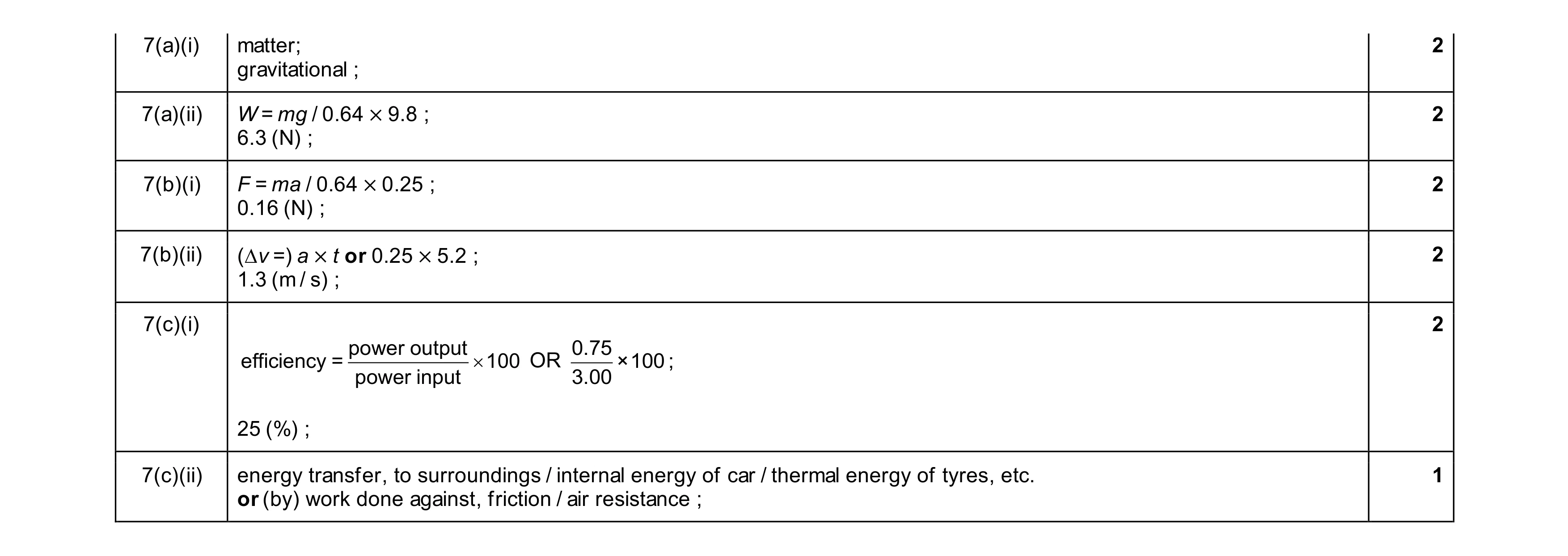 11
11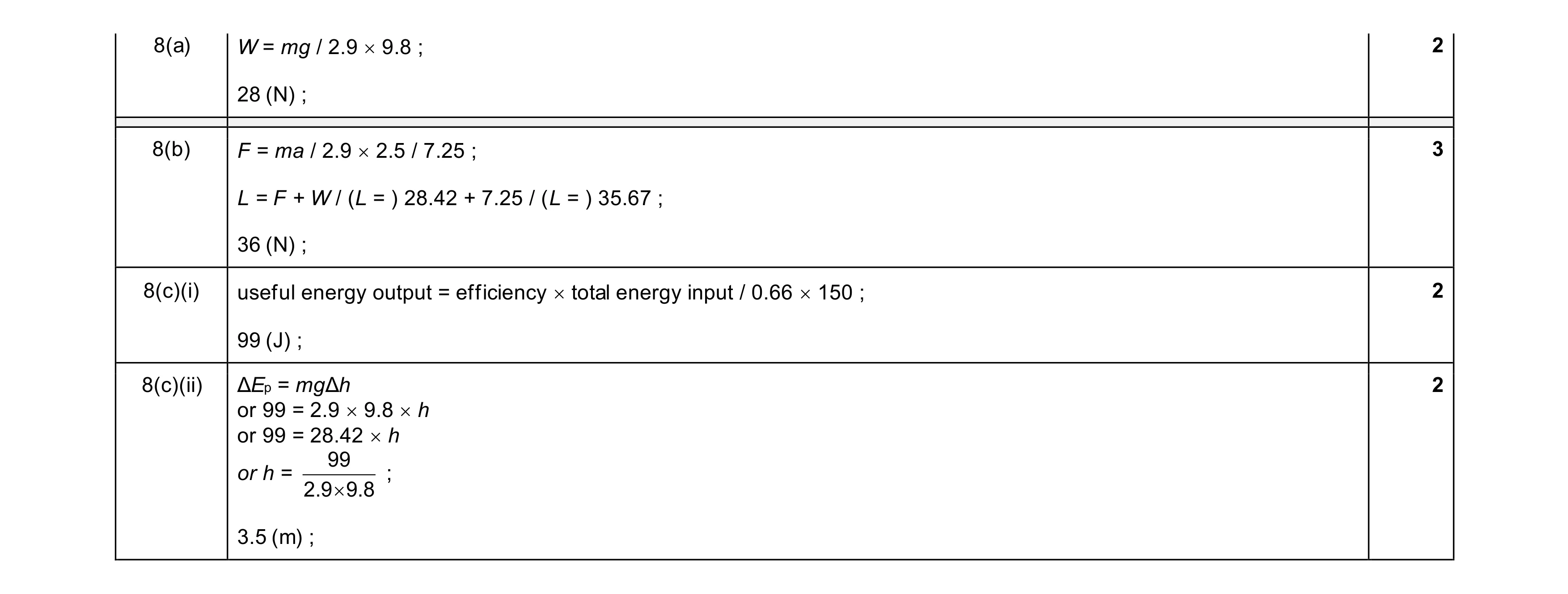 9
9