Questions as text
Q1 · An elevator (lift) which takes people to different floors in a tall building 0653/42 Feb/March 2017
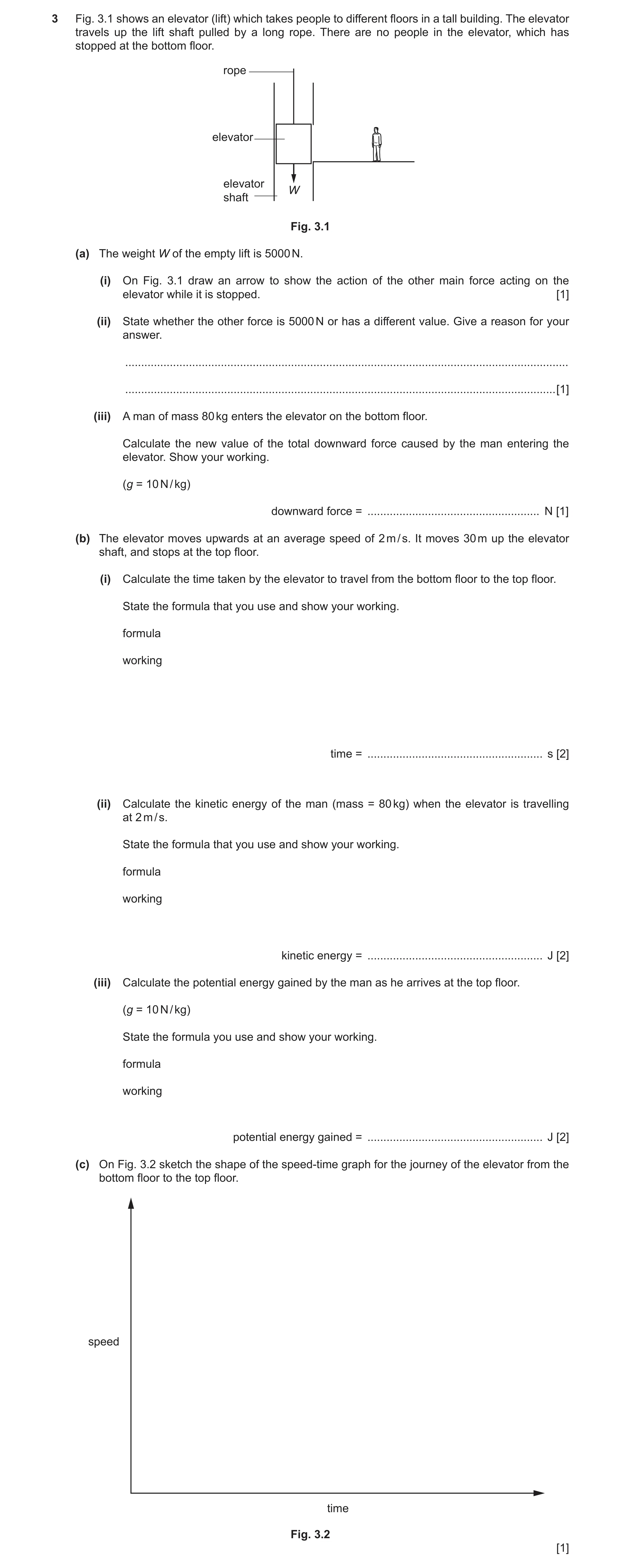
3 Fig. 3.1 shows an elevator (lift) which takes people to different floors in a tall building. The elevator travels up the lift shaft pulled by a long rope. There are no people in the elevator, which has stopped at the bottom floor. rope elevator elevator W shaft Fig. 3.1 (a) The weight W of the empty lift is 5000 N. (i) On Fig. 3.1 draw an arrow to show the action of the other main force acting on the elevator while it is stopped. [1] (ii) State whether the other force is 5000 N or has a different value. Give a reason for your answer. … … [1] (iii) A man of mass 80 kg enters the elevator on the bottom floor. Calculate the new value of the total downward force caused by the man entering the elevator. Show your working. (g = 10 N / kg) downward force = … N [1] (b) The elevator moves upwards at an average speed of 2 m / s. It moves 30 m up the elevator shaft, and stops at the top floor. (i) Calculate the time taken by the elevator to travel from the bottom floor to the top floor. State the formula that you use and show your working. formula working time = … s [2] (ii) Calculate the kinetic energy of the man (mass = 80 kg) when the elevator is travelling at 2 m / s. State the formula that you use and show your working. formula working kinetic energy = … J [2] (iii) Calculate the potential energy gained by the man as he arrives at the top floor. (g = 10 N / kg) State the formula you use and show your working. formula working potential energy gained = … J [2] (c) On Fig. 3.2 sketch the shape of the speed-time graph for the journey of the elevator from the bottom floor to the top floor. speed time Fig. 3.2 [1]
10 marks
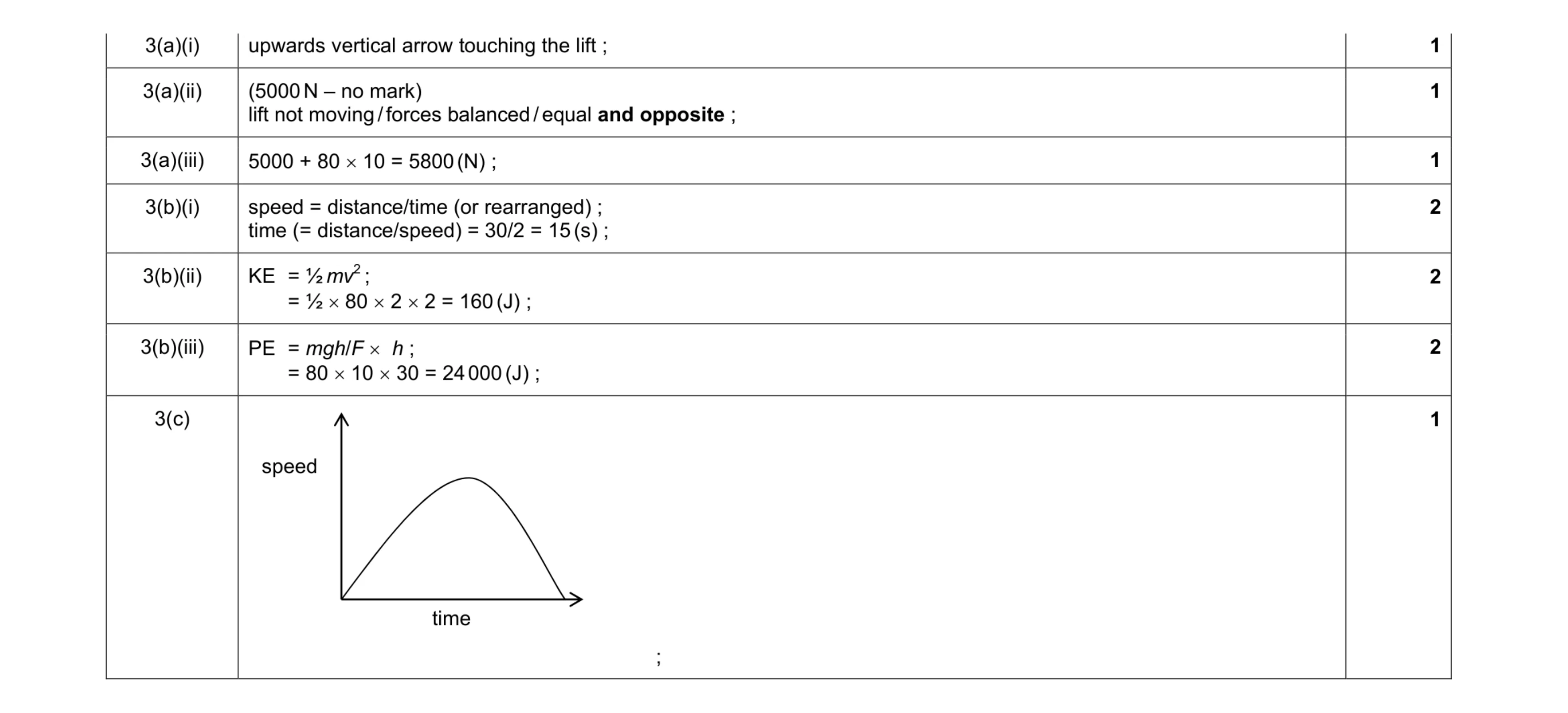
Mark scheme: 3(a)(i) upwards vertical arrow touching the lift ; 1 3(a)(ii) (5000 N – no mark) lift not moving / forces balanced / equal and opposite ; 1 3(a)(iii) 5000 + 80 × 10 = 5800 (N) ; 1 3(b)(i) speed = distance/time (or rearranged) ; time (= distance/speed) = 30/2 = 15 (s) ; 2 3(b)(ii) KE = ½ mv2 ; = ½ × 80 × 2 × 2 = 160 (J) ; 2 3(b)(iii) PE = mgh/F × h ; = 80 × 10 × 30 = 24 000 (J) ; 2 3(c) ; 1 time speed
This question in 0653/42 Feb/March 2017
Q2 · A wind surfer on a surf board, driven by the wind, sailing at a constant speed across the… 0653/41 May/June 2017
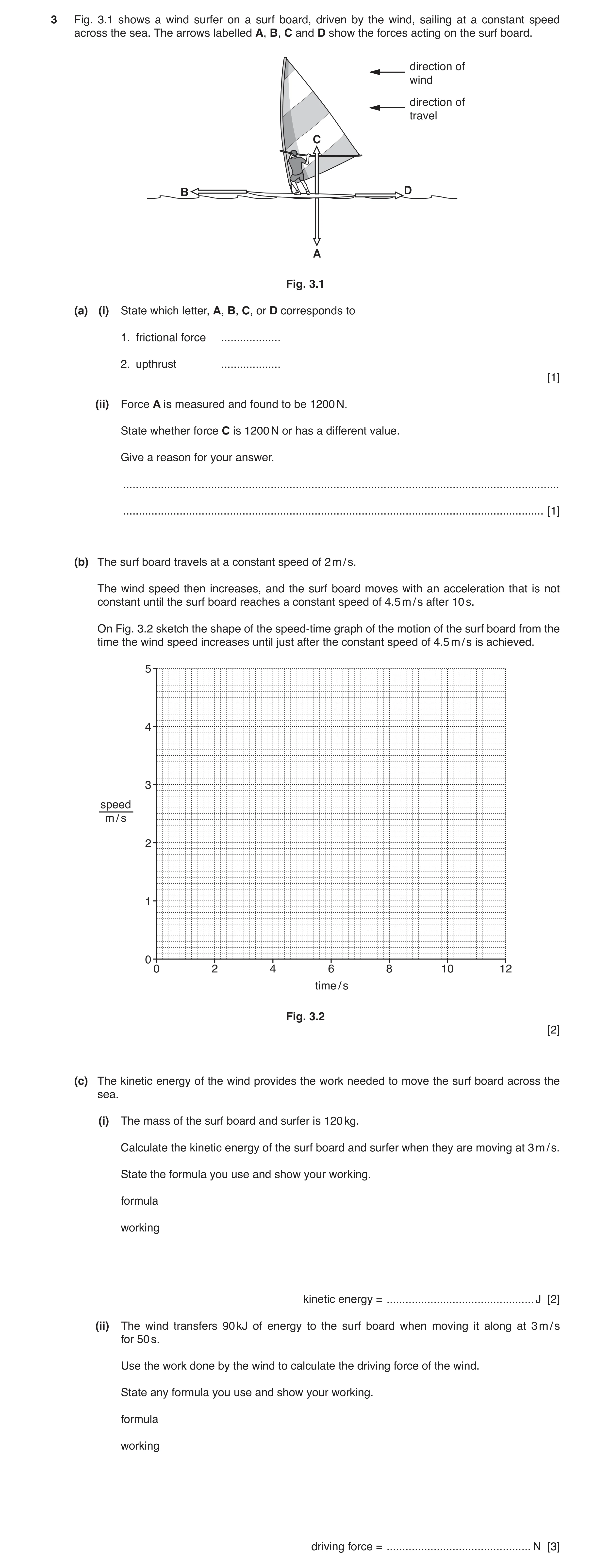
3 Fig. 3.1 shows a wind surfer on a surf board, driven by the wind, sailing at a constant speed across the sea. The arrows labelled A, B, C and D show the forces acting on the surf board. direction of wind direction of travel C B D A Fig. 3.1 (a) (i) State which letter, A, B, C, or D corresponds to 1. frictional force … 2. upthrust … [1] (ii) Force A is measured and found to be 1200 N. State whether force C is 1200 N or has a different value. Give a reason for your answer. … … [1] (b) The surf board travels at a constant speed of 2 m / s. The wind speed then increases, and the surf board moves with an acceleration that is not constant until the surf board reaches a constant speed of 4.5 m / s after 10 s. On Fig. 3.2 sketch the shape of the speed-time graph of the motion of the surf board from the time the wind speed increases until just after the constant speed of 4.5 m / s is achieved. 5 4 3 speed m / s 2 1 0 0 2 4 6 8 10 12 time / s Fig. 3.2 [2] (c) The kinetic energy of the wind provides the work needed to move the surf board across the sea. (i) The mass of the surf board and surfer is 120 kg. Calculate the kinetic energy of the surf board and surfer when they are moving at 3 m / s. State the formula you use and show your working. formula working kinetic energy = … J [2] (ii) The wind transfers 90 kJ of energy to the surf board when moving it along at 3 m / s for 50 s. Use the work done by the wind to calculate the driving force of the wind. State any formula you use and show your working. formula working driving force = … N [3]
9 marks
Mark scheme: 3(a)(i) D C 1 3(a)(ii) (Force C is 1200 N) no mark no vertical motion / forces (A and C) are balanced ; 1 3(b) line starts along the speed = 2 m / s horizontal, levelling off at speed = 4.5 m / s and 10 mins ; any curved line between these points, then level after (10,4.5) ; 2 3(c)(i) KE = ½ m v2 / ½ × 120 × 3 × 3 ; = 540 (J) ; 2 3(c)(ii) (90 kJ =) 90 000 J (= work done = energy transferred) ; distance moved = 3 (m / s) × 50 (s) = 150 m ; force = work done ÷ distance / 90 000 ÷ 150 / = 600 (N) ; 3
This question in 0653/41 May/June 2017
Q3 · A cyclist riding her bicycle at a constant speed along a road 0653/43 May/June 2017
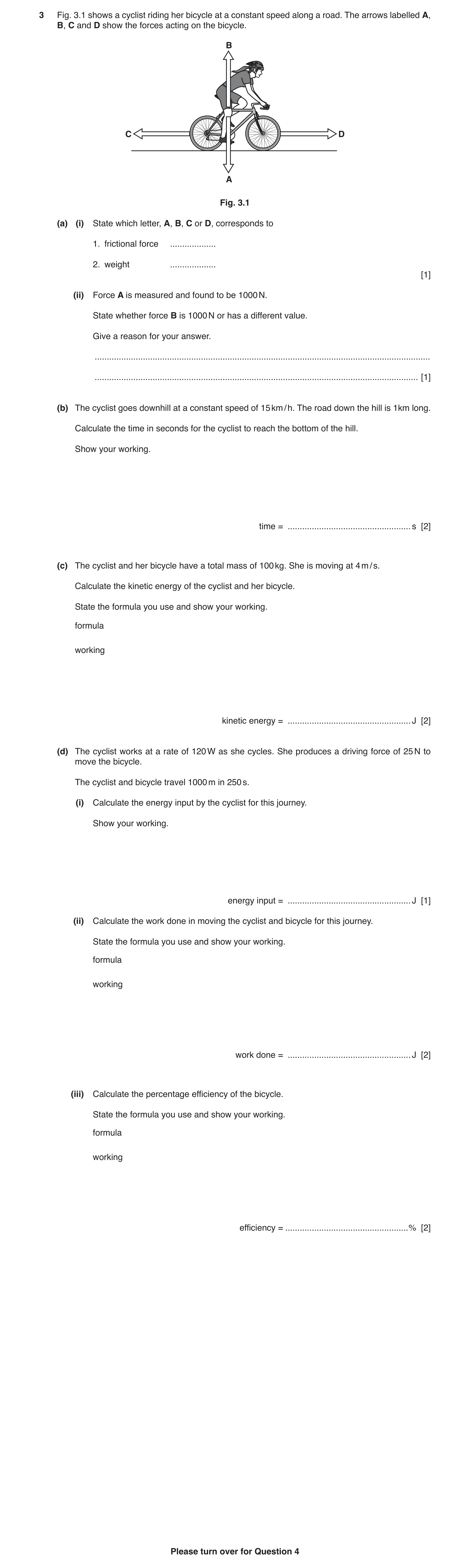
3 Fig. 3.1 shows a cyclist riding her bicycle at a constant speed along a road. The arrows labelled A, B, C and D show the forces acting on the bicycle. B C D A Fig. 3.1 (a) (i) State which letter, A, B, C or D, corresponds to 1. frictional force … 2. weight … [1] (ii) Force A is measured and found to be 1000 N. State whether force B is 1000 N or has a different value. Give a reason for your answer. … … [1] (b) The cyclist goes downhill at a constant speed of 15 km / h. The road down the hill is 1 km long. Calculate the time in seconds for the cyclist to reach the bottom of the hill. Show your working. time = … s [2] (c) The cyclist and her bicycle have a total mass of 100 kg. She is moving at 4 m / s. Calculate the kinetic energy of the cyclist and her bicycle. State the formula you use and show your working. formula working kinetic energy = … J [2] (d) The cyclist works at a rate of 120 W as she cycles. She produces a driving force of 25 N to move the bicycle. The cyclist and bicycle travel 1000 m in 250 s. (i) Calculate the energy input by the cyclist for this journey. Show your working. energy input = … J [1] (ii) Calculate the work done in moving the cyclist and bicycle for this journey. State the formula you use and show your working. formula working work done = … J [2] (iii) Calculate the percentage efficiency of the bicycle. State the formula you use and show your working. formula working efficiency = … % [2] Please turn over for Question 4
11 marks
Mark scheme: 3(a)(i) C A 1 3(a)(ii) (Force B is 1000 N) no vertical motion / forces (A and B) are balanced ; 1 3(b) 1 km at 15 km / h Æ 1 / 15 h / 0.067 h ; 1 / 15 h = 3 600 × 1 / 15 = 240 (s) ; 2 3(c) KE = ½ mv2 = ½ × 100 × 4 × 4 = 800 (J) ; 2 3(d)(i) energy input = 120 × 250 = 30 000 (J) ; 1 3(d)(ii) work done = force × distance (moved) / F × d ; = 25 × 1 000 = 25 000 (J) ; 2 3(d)(iii) efficiency (%) = (work got out ÷ work put in) × 100 / (equivalent wording ) ; = (25 000 / 30 000) × 100 = 83.3 (%) ; 2
This question in 0653/43 May/June 2017
Q4 · A helicopter hovering above the ground 0653/42 Oct/Nov 2017
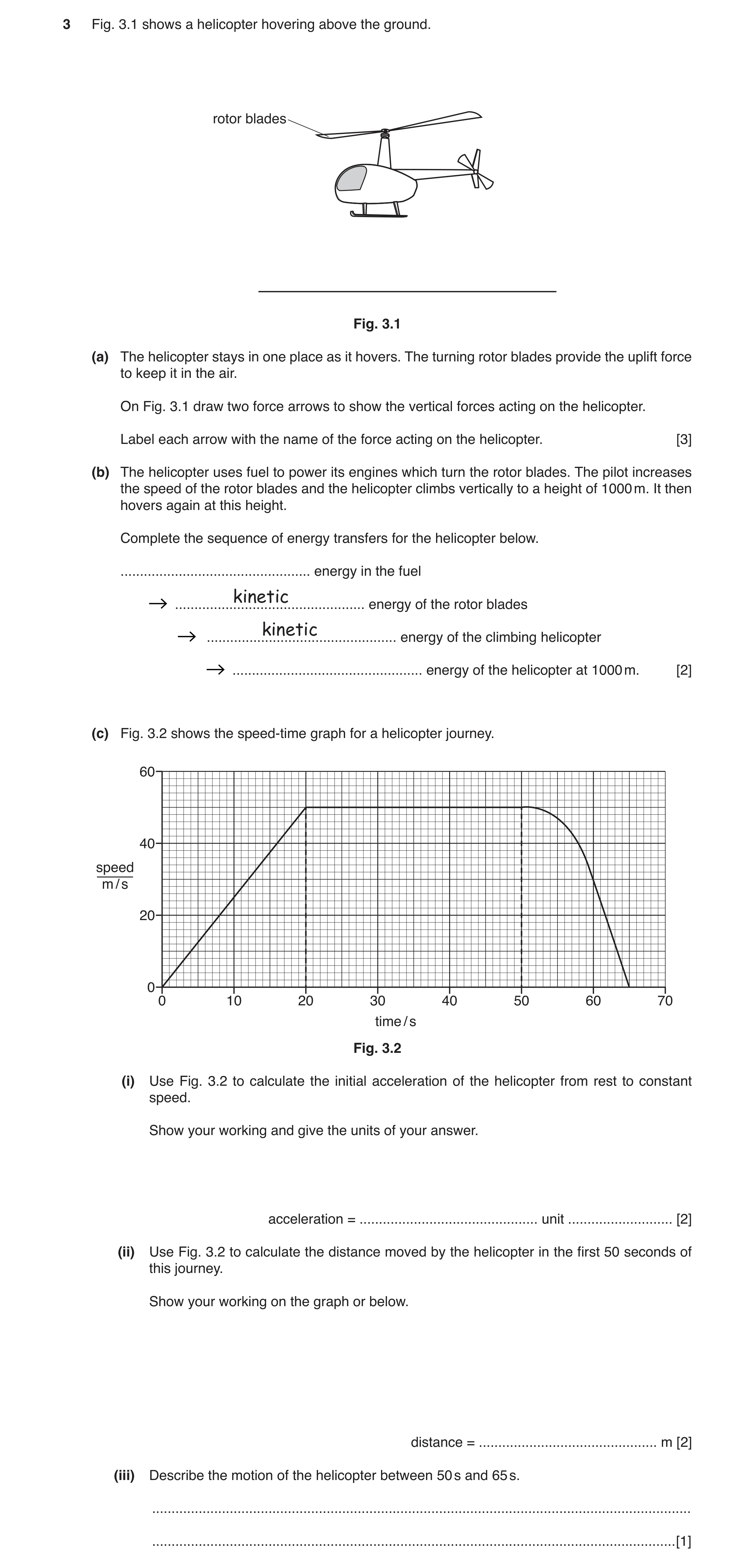
3 Fig. 3.1 shows a helicopter hovering above the ground. rotor blades Fig. 3.1 (a) The helicopter stays in one place as it hovers. The turning rotor blades provide the uplift force to keep it in the air. On Fig. 3.1 draw two force arrows to show the vertical forces acting on the helicopter. Label each arrow with the name of the force acting on the helicopter. [3] (b) The helicopter uses fuel to power its engines which turn the rotor blades. The pilot increases the speed of the rotor blades and the helicopter climbs vertically to a height of 1000 m. It then hovers again at this height. Complete the sequence of energy transfers for the helicopter below. … energy in the fuel kinetic … energy of the rotor blades kinetic … energy of the climbing helicopter … energy of the helicopter at 1000 m. [2] (c) Fig. 3.2 shows the speed-time graph for a helicopter journey. 60 40 speed m / s 20 0 0 10 20 30 40 50 60 70 time / s Fig. 3.2 (i) Use Fig. 3.2 to calculate the initial acceleration of the helicopter from rest to constant speed. Show your working and give the units of your answer. acceleration = … unit … [2] (ii) Use Fig. 3.2 to calculate the distance moved by the helicopter in the first 50 seconds of this journey. Show your working on the graph or below. distance = … m [2] (iii) Describe the motion of the helicopter between 50 s and 65 s. … … [1]
10 marks
Mark scheme: 3(a) force arrow vertically upward labelled ‘uplift’ ; force arrow vertically downward labelled weight / gravitational force / gravity ; the two vertical force arrows in contact with helicopter / or the vertical arrows of approximately equal length by inspection ; 3 3(b) chemical ; gravitational / potential ; 2 3(c)(i) acceleration = (change of speed / time = 50 / 20 ) = 2.5 ; m / s2 ; 2 3(c)(ii) ½ × 50 × 20 / 500 (m) / 50 × (50 – 20) / 1500 (m) seen ; = 2000 (m) ; (also by using the formula for the area of the trapezium, ½ (30 + 50) × 50 ) 2 3(c)(iii) non-constant deceleration / acceleration owtte ; 1
This question in 0653/42 Oct/Nov 2017
Q5 · A toy car powered by batteries 0653/43 Oct/Nov 2017
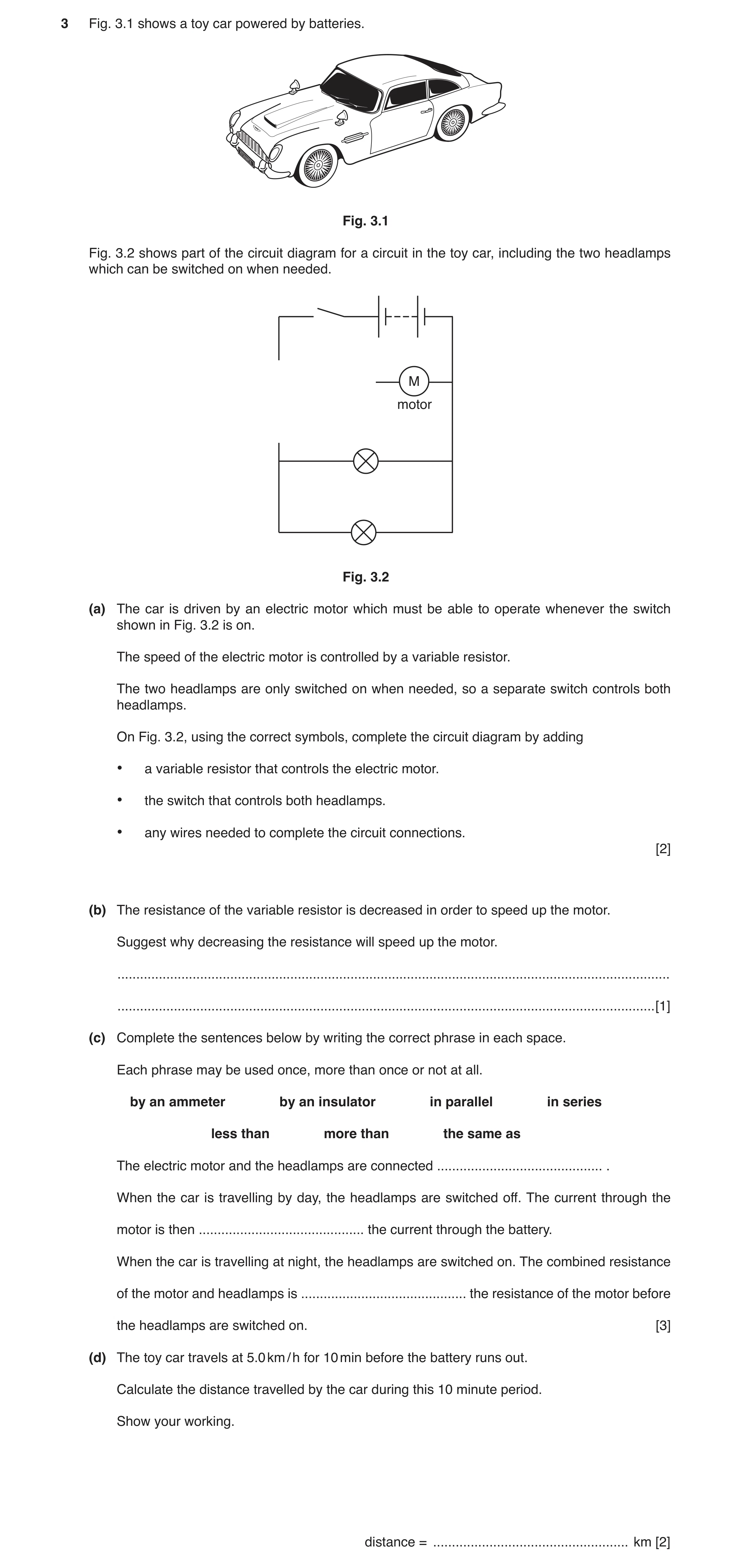
3 Fig. 3.1 shows a toy car powered by batteries. Fig. 3.1 Fig. 3.2 shows part of the circuit diagram for a circuit in the toy car, including the two headlamps which can be switched on when needed. M motor Fig. 3.2 (a) The car is driven by an electric motor which must be able to operate whenever the switch shown in Fig. 3.2 is on. The speed of the electric motor is controlled by a variable resistor. The two headlamps are only switched on when needed, so a separate switch controls both headlamps. On Fig. 3.2, using the correct symbols, complete the circuit diagram by adding • a variable resistor that controls the electric motor. • the switch that controls both headlamps. • any wires needed to complete the circuit connections. [2] (b) The resistance of the variable resistor is decreased in order to speed up the motor. Suggest why decreasing the resistance will speed up the motor. … … [1] (c) Complete the sentences below by writing the correct phrase in each space. Each phrase may be used once, more than once or not at all. by an ammeter by an insulator in parallel in series less than more than the same as The electric motor and the headlamps are connected … . When the car is travelling by day, the headlamps are switched off. The current through the motor is then … the current through the battery. When the car is travelling at night, the headlamps are switched on. The combined resistance of the motor and headlamps is … the resistance of the motor before the headlamps are switched on. [3] (d) The toy car travels at 5.0 km / h for 10 min before the battery runs out. Calculate the distance travelled by the car during this 10 minute period. Show your working. distance = … km [2]
8 marks
Mark scheme: 3(a) variable resistor in motor branch, correct symbol ; switch for headlamps after motor branch, before first headlamp branch ; 2 3(b) (decreasing resistance) increases current, (so faster motor) ; 1 3(c) in parallel ; the same as ; less than ; 3 3(d) 10 min = 1 / 6 h / 5 / 60 = 0.083 (km / min) ; distance = speed × time = 5 × 1 / 6 = 0.83 km / distance = speed × time = 0.083 × 10 = 0.83 km ; 2
This question in 0653/43 Oct/Nov 2017
Q6 · The International Space Station orbiting the Earth 0653/42 Feb/March 2018
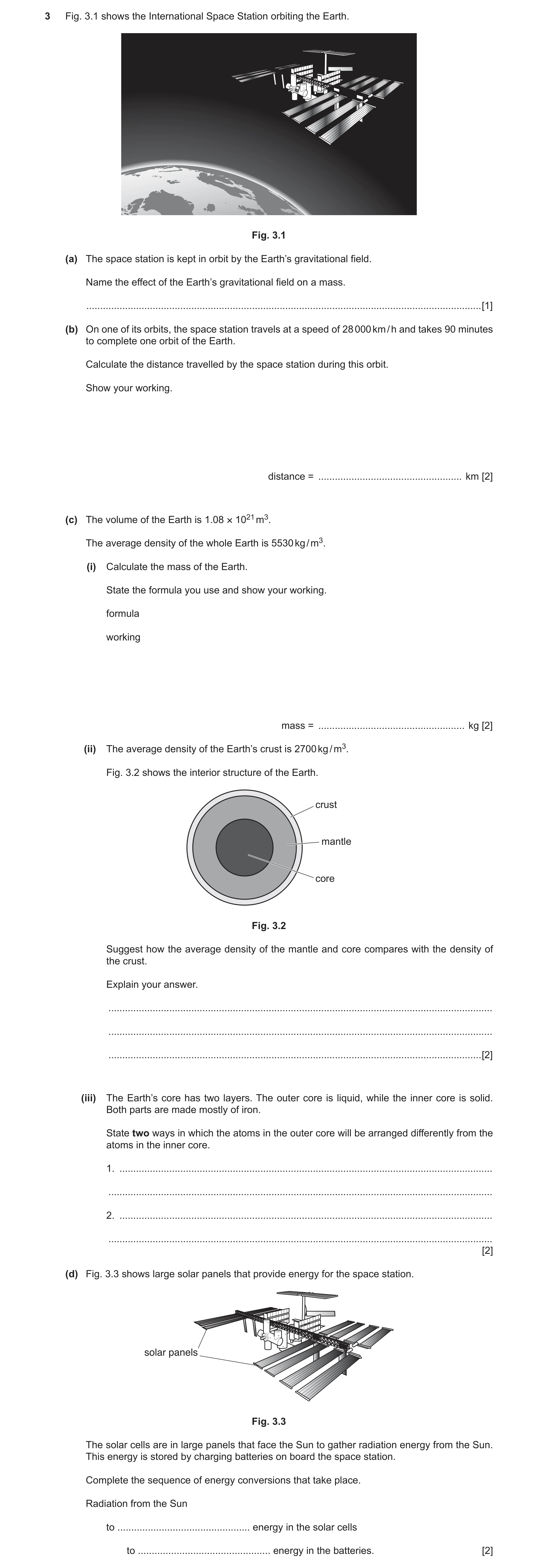
3 Fig. 3.1 shows the International Space Station orbiting the Earth. Fig. 3.1 (a) The space station is kept in orbit by the Earth’s gravitational field. Name the effect of the Earth’s gravitational field on a mass. … [1] (b) On one of its orbits, the space station travels at a speed of 28 000 km / h and takes 90 minutes to complete one orbit of the Earth. Calculate the distance travelled by the space station during this orbit. Show your working. distance = … km [2] (c) The volume of the Earth is 1.08 × 10²¹ m3. The average density of the whole Earth is 5530 kg / m3. (i) Calculate the mass of the Earth. State the formula you use and show your working. formula working mass = … kg [2] (ii) The average density of the Earth’s crust is 2700 kg / m3. Fig. 3.2 shows the interior structure of the Earth. crust mantle core Fig. 3.2 Suggest how the average density of the mantle and core compares with the density of the crust. Explain your answer. … … … [2] (iii) The Earth’s core has two layers. The outer core is liquid, while the inner core is solid. Both parts are made mostly of iron. State two ways in which the atoms in the outer core will be arranged differently from the atoms in the inner core. 1. … … 2. … … [2] (d) Fig. 3.3 shows large solar panels that provide energy for the space station. solar panels Fig. 3.3 The solar cells are in large panels that face the Sun to gather radiation energy from the Sun. This energy is stored by charging batteries on board the space station. Complete the sequence of energy conversions that take place. Radiation from the Sun to … energy in the solar cells to … energy in the batteries. [2]
11 marks
Mark scheme: 3(a) weight ; 1 3(b) speed = distance / time (or rearranged) ; distance (= speed × time) = 28 000 × 90 / 60 = 42 000 (km) ; 2 3(c)(i) density = mass / volume (or rearranged) ; mass (= volume × density) = 1.08 × 1021 × 5530 = 5.97 × 1024 (kg) ; 2 3(c)(ii) (average) density of mantle and core is higher (than 2700 kg / m3) ; in order to give an average density higher than the density of the crust / owtte ; 2 3(c)(iii) atoms in outer core randomly arranged / inner core regular arrangement / owtte ; atoms in outer core able to move freely / inner core fixed positions / orderly pattern / owtte ; 2 3(d) electrical ; chemical (potential) ; 2
This question in 0653/42 Feb/March 2018
Q7 · An airship carrying a load of weight W 0653/41 May/June 2018
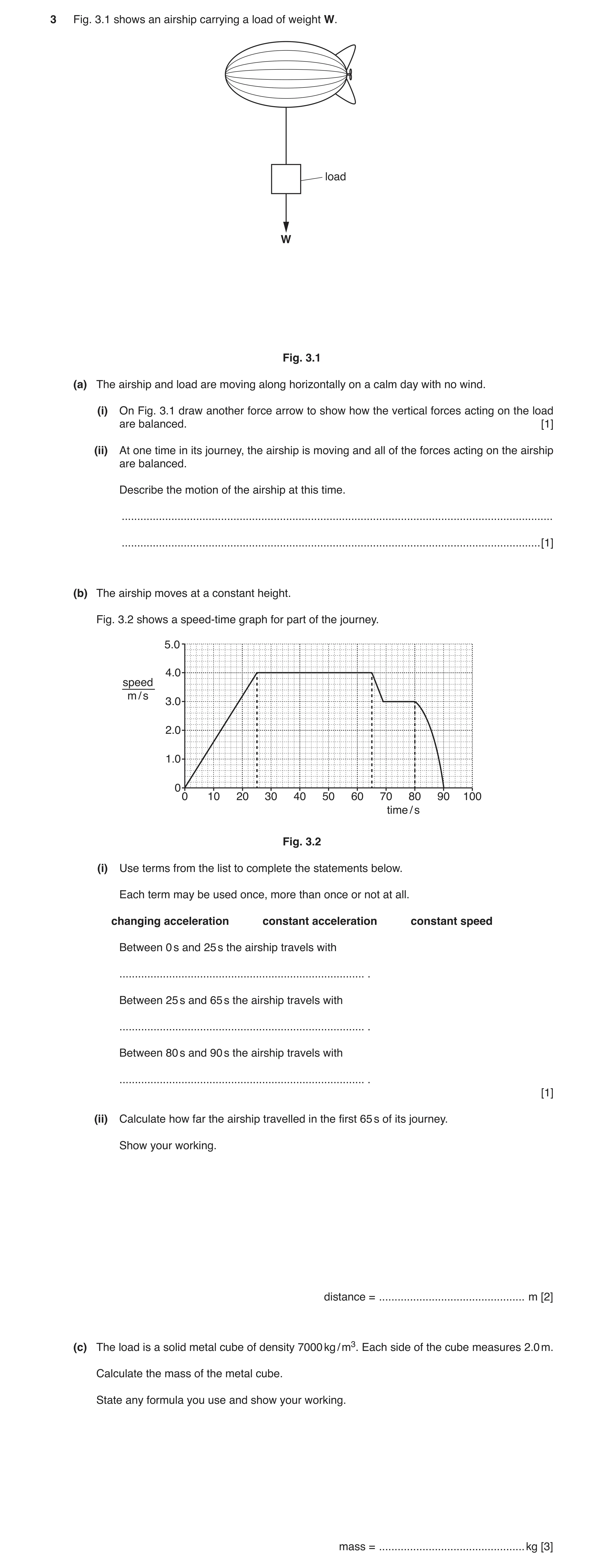
3 Fig. 3.1 shows an airship carrying a load of weight W. load W Fig. 3.1 (a) The airship and load are moving along horizontally on a calm day with no wind. (i) On Fig. 3.1 draw another force arrow to show how the vertical forces acting on the load are balanced. [1] (ii) At one time in its journey, the airship is moving and all of the forces acting on the airship are balanced. Describe the motion of the airship at this time. … … [1] (b) The airship moves at a constant height. Fig. 3.2 shows a speed-time graph for part of the journey. 5.0 4.0 speed m / s 3.0 2.0 1.0 00 10 20 30 40 50 60 70 80 90 100 time / s Fig. 3.2 (i) Use terms from the list to complete the statements below. Each term may be used once, more than once or not at all. changing acceleration constant acceleration constant speed Between 0 s and 25 s the airship travels with … . Between 25 s and 65 s the airship travels with … . Between 80 s and 90 s the airship travels with … . [1] (ii) Calculate how far the airship travelled in the first 65 s of its journey. Show your working. distance = … m [2] (c) The load is a solid metal cube of density 7000 kg / m3. Each side of the cube measures 2.0 m. Calculate the mass of the metal cube. State any formula you use and show your working. mass = … kg [3]
8 marks
Mark scheme: 3(a)(i) arrow vertically upwards acting from the load ; 1 3(a)(ii) (moving at) constant speed ; 1 3(b)(i) constant acceleration constant speed changing acceleration ; 1 3(b)(ii) Distance (= area under graph) = ½ × 4 × 25 + 4 × (65 – 25) ; = 210 (m) ; 2 3(c) volume of cube = 2.0 × 2.0 × 2.0 = 8.0 m3 ; density = mass / volume or d = m / V or m = V × d = 8.0 × 7000 ; = 56 000 (kg) ; 3
This question in 0653/41 May/June 2018
Q8 · A crane carrying a load 0653/42 May/June 2018
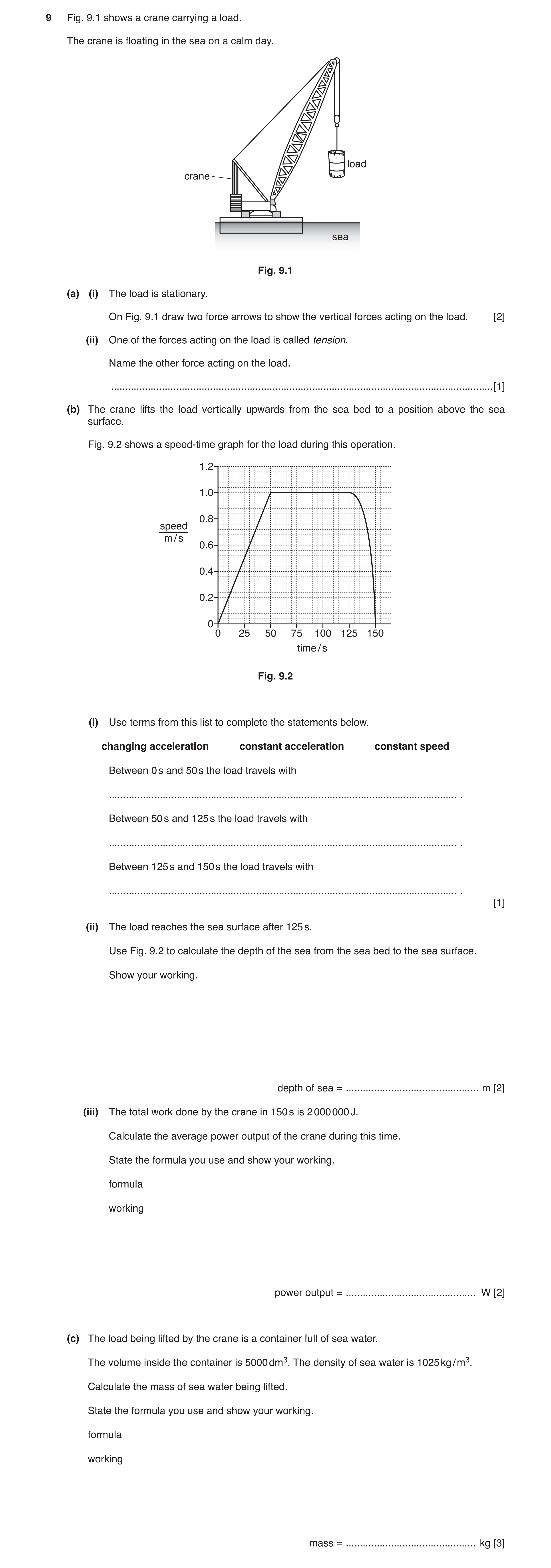
9 Fig. 9.1 shows a crane carrying a load. The crane is floating in the sea on a calm day. load crane sea Fig. 9.1 (a) (i) The load is stationary. On Fig. 9.1 draw two force arrows to show the vertical forces acting on the load. [2] (ii) One of the forces acting on the load is called tension. Name the other force acting on the load. … [1] (b) The crane lifts the load vertically upwards from the sea bed to a position above the sea surface. Fig. 9.2 shows a speed-time graph for the load during this operation. 1.2 1.0 0.8 speed m / s 0.6 0.4 0.2 0 0 25 50 75 100 125 150 time / s Fig. 9.2 (i) Use terms from this list to complete the statements below. changing acceleration constant acceleration constant speed Between 0 s and 50 s the load travels with … . Between 50 s and 125 s the load travels with … . Between 125 s and 150 s the load travels with … . [1] (ii) The load reaches the sea surface after 125 s. Use Fig. 9.2 to calculate the depth of the sea from the sea bed to the sea surface. Show your working. depth of sea = … m [2] (iii) The total work done by the crane in 150 s is 2 000 000 J. Calculate the average power output of the crane during this time. State the formula you use and show your working. formula working power output = … W [2] (c) The load being lifted by the crane is a container full of sea water. The volume inside the container is 5000 dm3. The density of sea water is 1025 kg / m3. Calculate the mass of sea water being lifted. State the formula you use and show your working. formula working mass = … kg [3]
11 marks
Mark scheme: 9(a)(i) two opposite vertical force arrows ; both arrows from the load ; 2 9(a)(ii) weight / gravitational force ; 1 9(b)(i) constant acceleration constant speed changing acceleration (in this order) ; 1 9(b)(ii) selection of area under graph as method ; calculation of area: ½ × 50 × 1 + (125 – 50) × 1 = 100 m ; 2 9(b)(iii) (P =) E / t or W / t or (P =) 2 000 000 ÷ 150 ; = 13 300 (W) / 13 000 (W) ; 2 9(c) density = mass / volume ; unit change noted: 5000 dm3 = 5 m3 ; mass (= volume x density) = 5 × 1025 = 5125 (kg) ; 3
This question in 0653/42 May/June 2018
Q9 · A farm tractor pulling a trailer 0653/42 Oct/Nov 2018
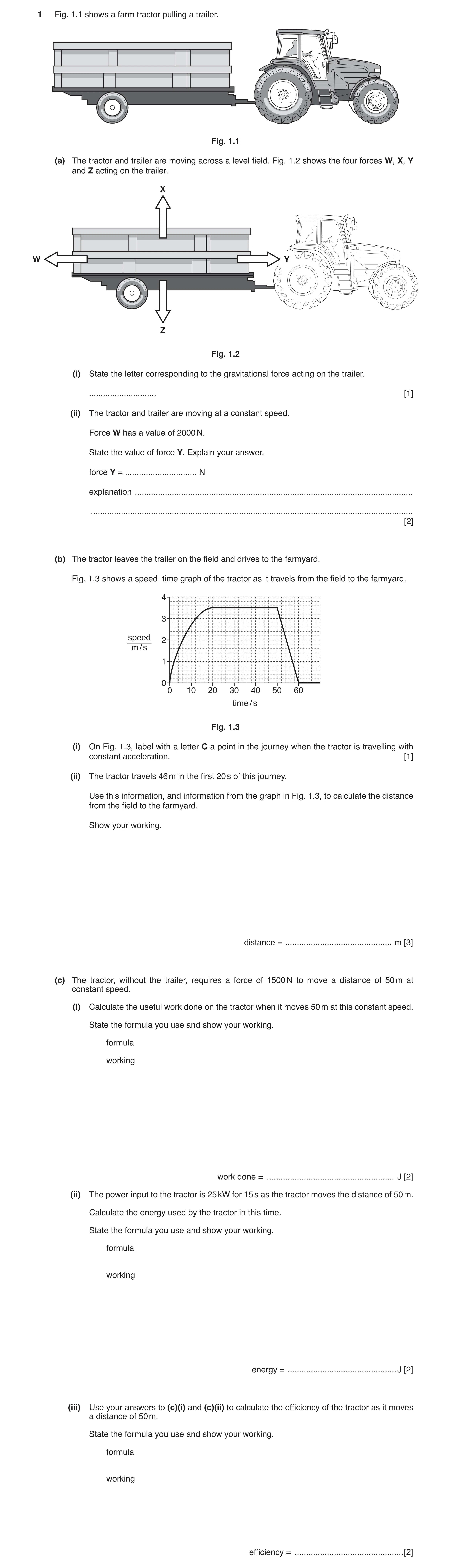
1 Fig. 1.1 shows a farm tractor pulling a trailer. Fig. 1.1 (a) The tractor and trailer are moving across a level field. Fig. 1.2 shows the four forces W, X, Y and Z acting on the trailer. X W Y Z Fig. 1.2 (i) State the letter corresponding to the gravitational force acting on the trailer. … [1] (ii) The tractor and trailer are moving at a constant speed. Force W has a value of 2000 N. State the value of force Y. Explain your answer. force Y = … N explanation … … [2] (b) The tractor leaves the trailer on the field and drives to the farmyard. Fig. 1.3 shows a speed–time graph of the tractor as it travels from the field to the farmyard. 4 3 speed 2 m / s 1 0 0 10 20 30 40 50 60 time / s Fig. 1.3 (i) On Fig. 1.3, label with a letter C a point in the journey when the tractor is travelling with constant acceleration. [1] (ii) The tractor travels 46 m in the first 20 s of this journey. Use this information, and information from the graph in Fig. 1.3, to calculate the distance from the field to the farmyard. Show your working. distance = … m [3] (c) The tractor, without the trailer, requires a force of 1500 N to move a distance of 50 m at constant speed. (i) Calculate the useful work done on the tractor when it moves 50 m at this constant speed. State the formula you use and show your working. formula working work done = … J [2] (ii) The power input to the tractor is 25 kW for 15 s as the tractor moves the distance of 50 m. Calculate the energy used by the tractor in this time. State the formula you use and show your working. formula working energy = … J [2] (iii) Use your answers to (c)(i) and (c)(ii) to calculate the efficiency of the tractor as it moves a distance of 50 m. State the formula you use and show your working. formula working efficiency = … [2]
13 marks
Mark scheme: 1(a)(i) Z 1 1(a)(ii) 2000 (N) ; constant speed / no acceleration, (so forces must balance) ; 2 1(b)(i) C on any point on graph line between 50 and 60 s ; 1 1(b)(ii) distance travelled 20–50 s = speed × time = 30 × 3.5 = 105 m ; distance travelled 50–60 s = ½ × 10 × 3.5 = 17.5 m ; total distance = 46 + 105 + 17.5 = 168.5 m ; 3 1(c)(i) work done = force × distance / F × d ; = 1500 × 50 = 75 000 (J) ; 2 1(c)(ii) E = Pt / E = 25 000 × 15 ; = 375 000 (J) ; 2 1(c)(iii) efficiency = work out / work in (× 100 to give %) / 75 000 ÷ 375 000 = 0.20 / 20% ; 2
This question in 0653/42 Oct/Nov 2018
Q10 · A man pushing a shopping trolley 0653/43 Oct/Nov 2018
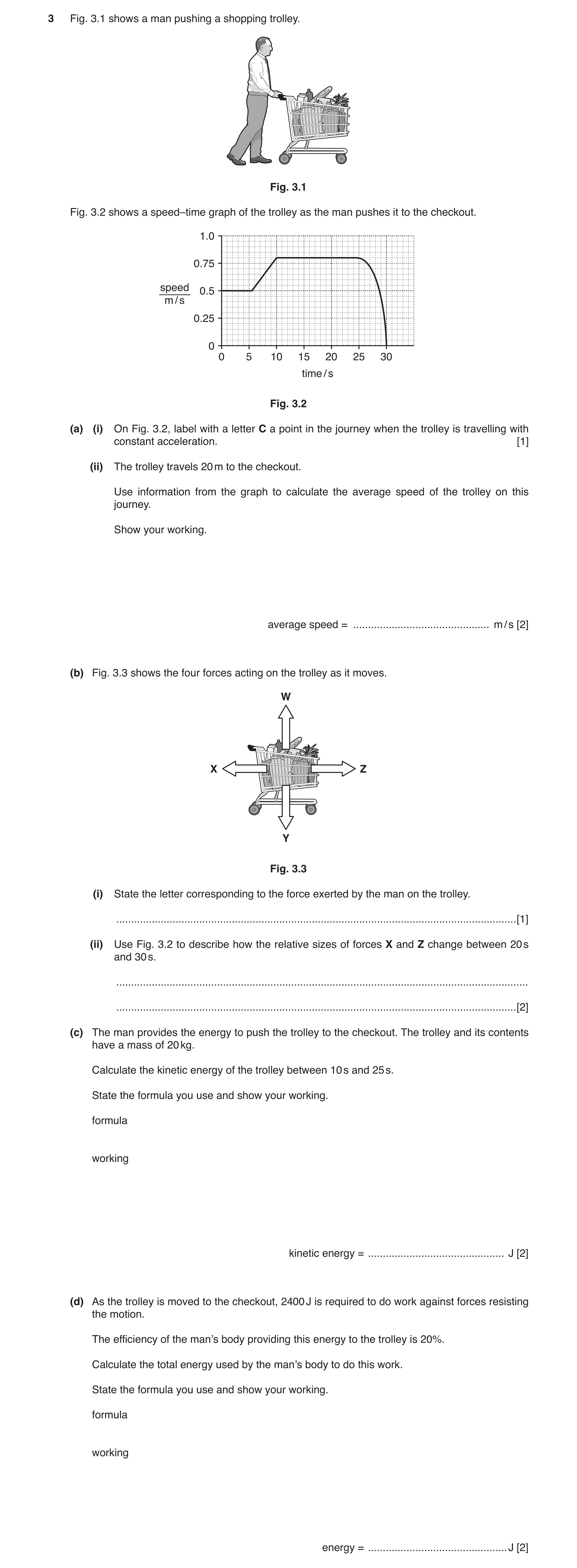
3 Fig. 3.1 shows a man pushing a shopping trolley. Fig. 3.1 Fig. 3.2 shows a speed–time graph of the trolley as the man pushes it to the checkout. 1.0 0.75 speed 0.5 m / s 0.25 0 0 5 10 15 20 25 30 time / s Fig. 3.2 (a) (i) On Fig. 3.2, label with a letter C a point in the journey when the trolley is travelling with constant acceleration. [1] (ii) The trolley travels 20 m to the checkout. Use information from the graph to calculate the average speed of the trolley on this journey. Show your working. average speed = … m / s [2] (b) Fig. 3.3 shows the four forces acting on the trolley as it moves. W X Z Y Fig. 3.3 (i) State the letter corresponding to the force exerted by the man on the trolley. … [1] (ii) Use Fig. 3.2 to describe how the relative sizes of forces X and Z change between 20 s and 30 s. … … [2] (c) The man provides the energy to push the trolley to the checkout. The trolley and its contents have a mass of 20 kg. Calculate the kinetic energy of the trolley between 10 s and 25 s. State the formula you use and show your working. formula working kinetic energy = … J [2] (d) As the trolley is moved to the checkout, 2400 J is required to do work against forces resisting the motion. The efficiency of the man’s body providing this energy to the trolley is 20%. Calculate the total energy used by the man’s body to do this work. State the formula you use and show your working. formula working energy = … J [2]
10 marks
Mark scheme: 3(a)(i) C at any point on graph line between 5.7 and 10 s ; 1 3(a)(ii) average speed = total distance / total time = 20 / 30 ; = 0.67 (m / s) ; 2 3(b)(i) Z ; 1 3(b)(ii) X and Z equal / same (20–25) s ; X > Z for (25–30) s ; 2 3(c) KE = ½ mv2 / ½ × 20 × 0.82 ; = 6.4 J ; 2 3(d) efficiency = [energy out / energy in] (× 100%) or energy in = energy out / 0.2 or 2400 / 0.2 / energy in = 2400 × 100 / 20 ; = 12 000 (J) ; 2
This question in 0653/43 Oct/Nov 2018
Q11 · A girl throwing a beach ball up in the air 0653/42 Feb/March 2019
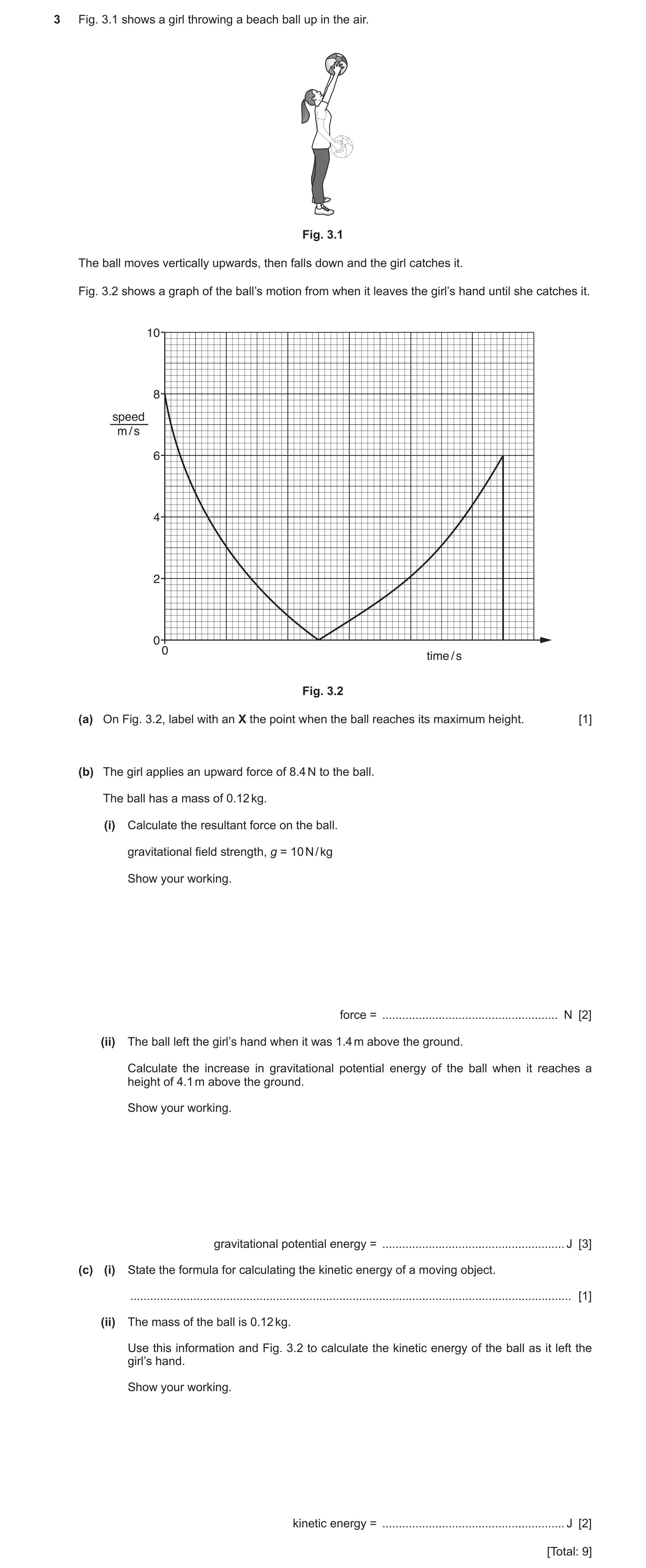
3 Fig. 3.1 shows a girl throwing a beach ball up in the air. Fig. 3.1 The ball moves vertically upwards, then falls down and the girl catches it. Fig. 3.2 shows a graph of the ball’s motion from when it leaves the girl’s hand until she catches it. 10 8 speed m / s 6 4 2 0 0 time / s Fig. 3.2 (a) On Fig. 3.2, label with an X the point when the ball reaches its maximum height. [1] (b) The girl applies an upward force of 8.4 N to the ball. The ball has a mass of 0.12 kg. (i) Calculate the resultant force on the ball. gravitational field strength, g = 10 N / kg Show your working. force = … N [2] (ii) The ball left the girl’s hand when it was 1.4 m above the ground. Calculate the increase in gravitational potential energy of the ball when it reaches a height of 4.1 m above the ground. Show your working. gravitational potential energy = … J [3] (c) (i) State the formula for calculating the kinetic energy of a moving object. … [1] (ii) The mass of the ball is 0.12 kg. Use this information and Fig. 3.2 to calculate the kinetic energy of the ball as it left the girl’s hand. Show your working. kinetic energy = … J [2] [Total: 9]
9 marks
Mark scheme: 3(a) X at point where curve touches x axis the first time ; 1 3(b)(i) weight of ball = force downwards = 0.12 × 10 = 1.2 N ; resultant force = 8.4 – 1.2 = 7.2 N ; 2 3(b)(ii) gain in height by ball = 4.1 – 1.4 = 2.7 m ; gain in PE = mgh = 0.12 × 10 × 2.7 ; = 3.24 (J) ; 3 3(c)(i) ½ mv2 ; 1 3(c)(ii) (½ mv2) = ½ × 0.12 × 82; = 3.84 (J) ; 2
This question in 0653/42 Feb/March 2019
Q12 · A forklift truck moving a large heavy box towards a shelf 0653/42 May/June 2019
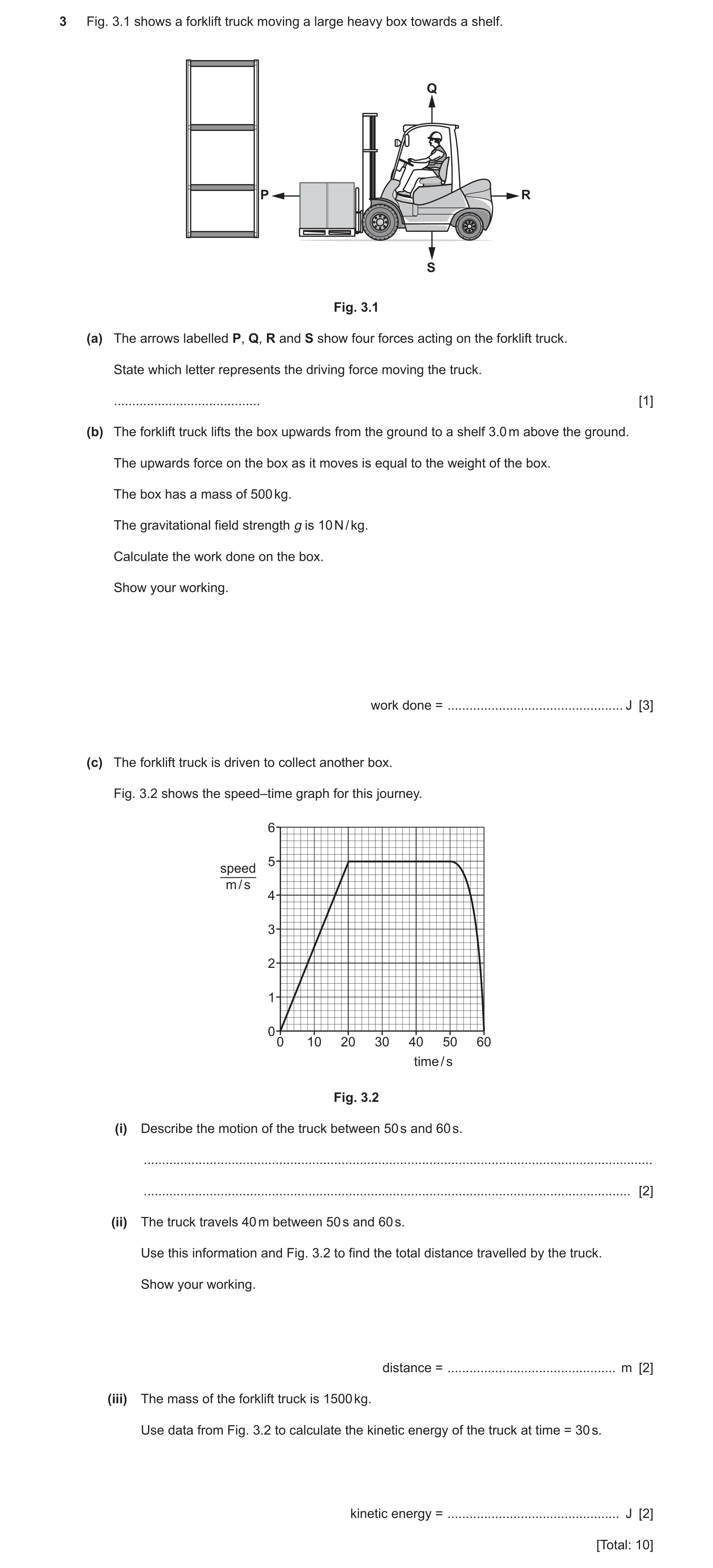
3 Fig. 3.1 shows a forklift truck moving a large heavy box towards a shelf. Q P R S Fig. 3.1 (a) The arrows labelled P, Q, R and S show four forces acting on the forklift truck. State which letter represents the driving force moving the truck. … [1] (b) The forklift truck lifts the box upwards from the ground to a shelf 3.0 m above the ground. The upwards force on the box as it moves is equal to the weight of the box. The box has a mass of 500 kg. The gravitational field strength g is 10 N / kg. Calculate the work done on the box. Show your working. work done = … J [3] (c) The forklift truck is driven to collect another box. Fig. 3.2 shows the speed–time graph for this journey. 6 5 speed m / s 4 3 2 1 0 0 10 20 30 40 50 60 time / s Fig. 3.2 (i) Describe the motion of the truck between 50 s and 60 s. … … [2] (ii) The truck travels 40 m between 50 s and 60 s. Use this information and Fig. 3.2 to find the total distance travelled by the truck. Show your working. distance = … m [2] (iii) The mass of the forklift truck is 1500 kg. Use data from Fig. 3.2 to calculate the kinetic energy of the truck at time = 30 s. kinetic energy = … J [2] [Total: 10]
10 marks
Mark scheme: 3(a) P ; 1 3(b) weight of box = 500 × 10 = 5000 (N) ; work done = force × distance moved / F × d ; = 5000 × 3 = 15 000 (J) ; 3 3(c)(i) decelerating / slowing down to a stop ; deceleration changing / not constant ; 2 3(c)(ii) distance = area under graph or 0.5 × 20 × 5 + (50 – 20) × 5 (+ 40) or (0.5 × (50 + (50 – 20)) × 5)(+ 40) ; = 240 (m) ; 2 3(c)(iii) KE = 2 1 2 mv or KE = 0.5 × 1500 × 52 ; = 18 750 J 2
This question in 0653/42 May/June 2019
Q13 · The Sun is made of very hot gases 0653/42 May/June 2019
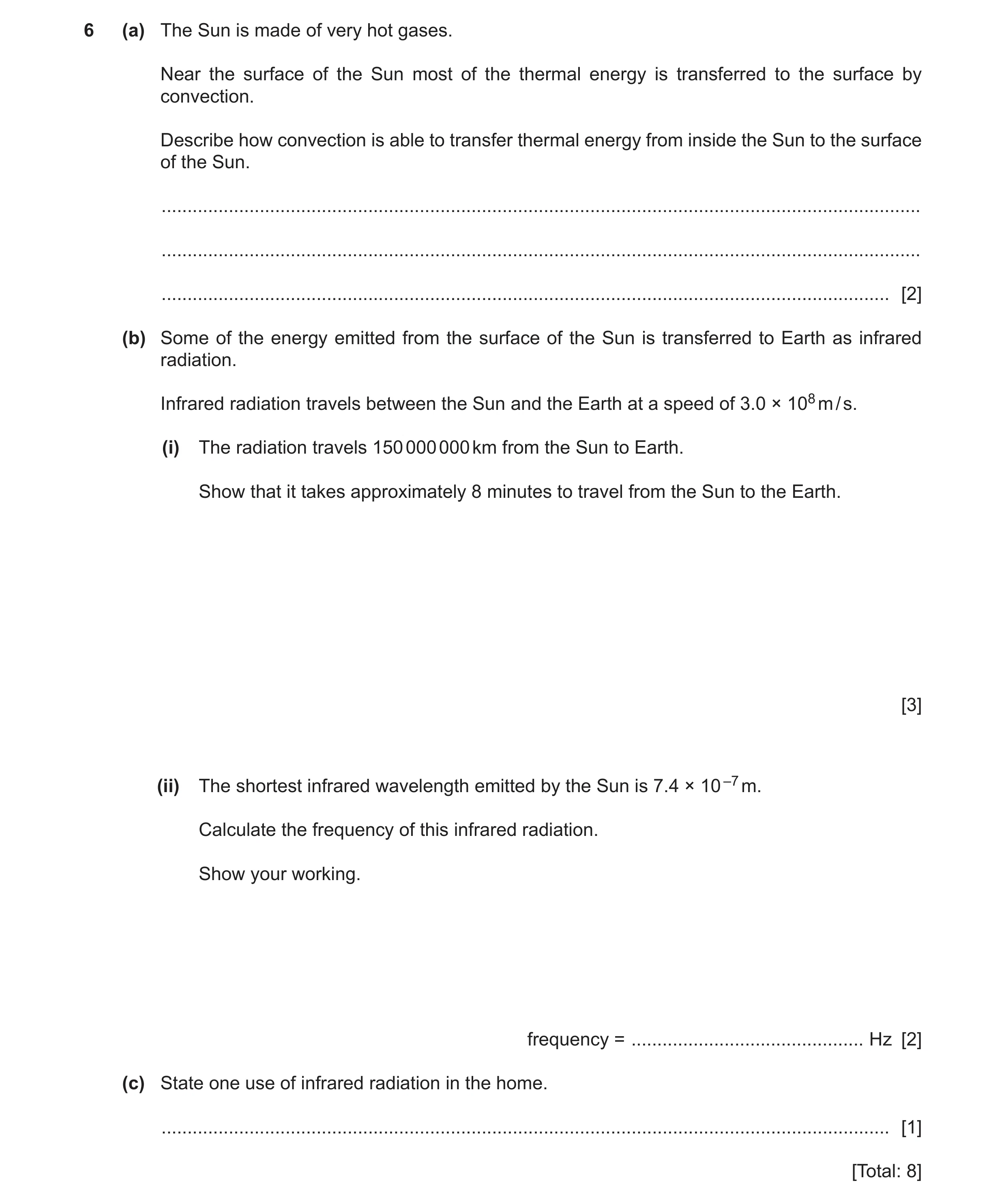
6 (a) The Sun is made of very hot gases. Near the surface of the Sun most of the thermal energy is transferred to the surface by convection. Describe how convection is able to transfer thermal energy from inside the Sun to the surface of the Sun. … … … [2] (b) Some of the energy emitted from the surface of the Sun is transferred to Earth as infrared radiation. Infrared radiation travels between the Sun and the Earth at a speed of 3.0 × 10⁸ m / s. (i) The radiation travels 150 000 000 km from the Sun to Earth. Show that it takes approximately 8 minutes to travel from the Sun to the Earth. [3] (ii) The shortest infrared wavelength emitted by the Sun is 7.4 × 10 –7 m. Calculate the frequency of this infrared radiation. Show your working. frequency = … Hz [2] (c) State one use of infrared radiation in the home. … [1] [Total: 8]
8 marks
Mark scheme: 6(a) hot gases less dense (than cooler gases) / owtte ; less dense / hotter gases rise (and cooler gases fall) / owtte ; 2 6(b)(i) ( ) distance time = speed ; ( ) = = 150000000000 500 s 300000000 ; = = 500 8.3min 60 ; 3 6(b)(ii) v = fλ or λ = v f or f = 3.0 × 10⁸ / 7.4 × 10⁻⁷; = 4.1 × 10¹⁴ (Hz) ; 2 6(c) remote control / movement detector / intruder alarm / heat lamps / other correct use ; 1
This question in 0653/42 May/June 2019
Q14 · A lightning bolt, which is a form of electrostatic discharge 0653/42 Oct/Nov 2019
9 Fig. 9.1 shows a lightning bolt, which is a form of electrostatic discharge. thundercloud lightning bolt Fig. 9.1 (a) Fig. 9.2 shows the range of wavelengths of different parts of the electromagnetic spectrum. < 0.001 0.001–1 1–450 400–750 750 × 10–9 m 0.001– > 1.0 m × 10–9 m × 10–9 m × 10–9 m × 10–9 m – 0.001 m 1.0 m gamma X-rays microwaves rays Fig. 9.2 A lightning bolt emits a range of wavelengths between 390 nm and 590 nm. (1 nm = 1 × 10⁻⁹ m). Identify the two parts of the electromagnetic spectrum emitted by lightning. On Fig. 9.2 fill in the missing names of these parts in the correct places. [2] (b) A person hears the thunder from a distant lightning bolt 10.0 s after the lightning is seen. Sound travels in air at 330 m / s. Calculate the distance of the person from the lightning bolt. distance = … m [2] (c) Lightning bolts occur when clouds become highly charged and a very high voltage exists between the thundercloud and the ground. The current in a lightning bolt is 30 000 A, and flows for 0.000050 s Calculate the electric charge that passes to Earth from this lightning bolt. Show your working, and give the unit of your answer. charge = … unit … [3] (d) (i) The thundercloud consists mainly of water droplets. The droplets at the bottom are negatively charged and at the top are positively charged. Name the type of particle exchanged between the droplets to produce the charges on them. … [1] (ii) Just before a thunderstorm, some people find that their hair is standing on end. Suggest a reason for this. Explain your answer. reason … explanation … … [2] [Total: 10]
10 marks
Mark scheme: 9(a) visible light in correct position ; ultraviolet in correct position ; 2 9(b) use of distance = speed × time ; (330 × 10) = 3300 m ; 2 9(c) use of Q = I t ; (30 000 × 0.00005) = 1.5 ; coulombs / C ; 3 9(d)(i) electron(s) ; 1 9(d)(ii) hair becomes (electrostatically) charged (due to transfer of electrons) ; like charges repel (causing hair to stand on end) ; 2
This question in 0653/42 Oct/Nov 2019
Q15 · Children using a magnifying glass to view a butterfly 0653/43 Oct/Nov 2019
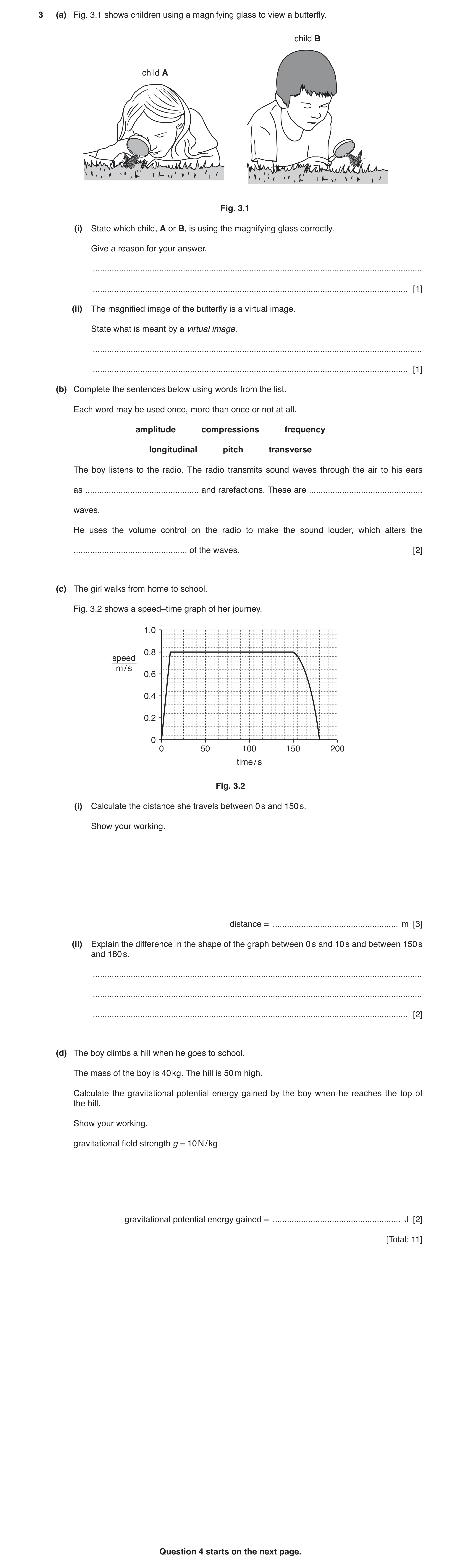
3 (a) Fig. 3.1 shows children using a magnifying glass to view a butterfly. child B child A Fig. 3.1 (i) State which child, A or B, is using the magnifying glass correctly. Give a reason for your answer. … … [1] (ii) The magnified image of the butterfly is a virtual image. State what is meant by a virtual image. … … [1] (b) Complete the sentences below using words from the list. Each word may be used once, more than once or not at all. amplitude compressions frequency longitudinal pitch transverse The boy listens to the radio. The radio transmits sound waves through the air to his ears as … and rarefactions. These are … waves. He uses the volume control on the radio to make the sound louder, which alters the … of the waves. [2] (c) The girl walks from home to school. Fig. 3.2 shows a speed–time graph of her journey. 1.0 0.8 speed m / s 0.6 0.4 0.2 0 0 50 100 150 200 time / s Fig. 3.2 (i) Calculate the distance she travels between 0 s and 150 s. Show your working. distance = … m [3] (ii) Explain the difference in the shape of the graph between 0 s and 10 s and between 150 s and 180 s. … … … [2] (d) The boy climbs a hill when he goes to school. The mass of the boy is 40 kg. The hill is 50 m high. Calculate the gravitational potential energy gained by the boy when he reaches the top of the hill. Show your working. gravitational field strength g = 10 N / kg gravitational potential energy gained = … J [2] [Total: 11] Question 4 starts on the next page.
11 marks
Mark scheme: 3(a)(i) (child A because) child A holding close(r) to eye / child B eye is too far from the lens ; 1 3(a)(ii) image that cannot be projected onto a screen ; 1 3(b) compressions longitudinal amplitude any 2 correct = 1 mark all 3 correct = 2 marks 2 3(c)(i) use of area under graph or d = s × t ; correct use of data from graph ; = 116 ; 3 3(c)(ii) constant acceleration (0–10 s) ; non-constant deceleration (150–180 s) ; 2 3(d) use of gravitational PE gained = mgh ; (= 40 × 10 × 50) = 20 000 (J) ; 2
This question in 0653/43 Oct/Nov 2019
Q16 · A crane lifting a load to the top of a building 0653/42 Feb/March 2020
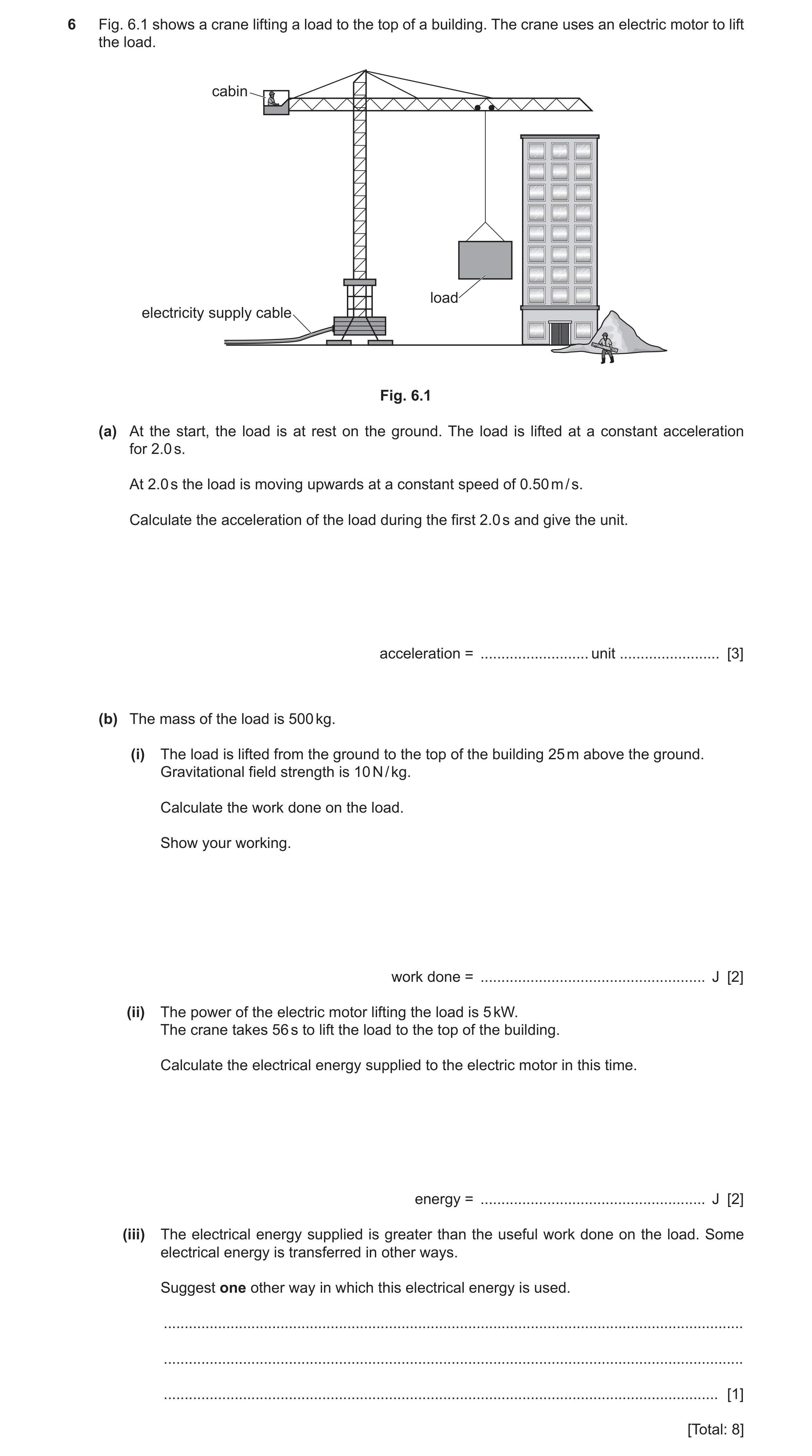
6 Fig. 6.1 shows a crane lifting a load to the top of a building. The crane uses an electric motor to lift the load. cabin load electricity supply cable Fig. 6.1 (a) At the start, the load is at rest on the ground. The load is lifted at a constant acceleration for 2.0 s. At 2.0 s the load is moving upwards at a constant speed of 0.50 m / s. Calculate the acceleration of the load during the first 2.0 s and give the unit. acceleration = … unit … [3] (b) The mass of the load is 500 kg. (i) The load is lifted from the ground to the top of the building 25 m above the ground. Gravitational field strength is 10 N / kg. Calculate the work done on the load. Show your working. work done = … J [2] (ii) The power of the electric motor lifting the load is 5 kW. The crane takes 56 s to lift the load to the top of the building. Calculate the electrical energy supplied to the electric motor in this time. energy = … J [2] (iii) The electrical energy supplied is greater than the useful work done on the load. Some electrical energy is transferred in other ways. Suggest one other way in which this electrical energy is used. … … … [1] [Total: 8]
8 marks
Mark scheme: 6(a) acceleration = change of speed ÷ time / 0.5 ÷ 2 ; = 0.25 ; m / s2 ; 3 Question Answer Marks 6(b)(i) work done = force × distance / 500 × 10 × 25 ; = 125 000 (J) ; 2 6(b)(ii) electrical energy = power × time / 5000 × 56 ; = 280 000 (J) ; 2 6(b)(iii) any one from: transferred / lost as, thermal / sound energy ; used to do work against friction (in machinery) ; used to do work against air resistance ; other correct way in which electrical energy is used, e.g. moving the crane ; max 1
This question in 0653/42 Feb/March 2020
Q17 · A woman travelling on an escalator (a moving staircase) 0653/41 Oct/Nov 2020
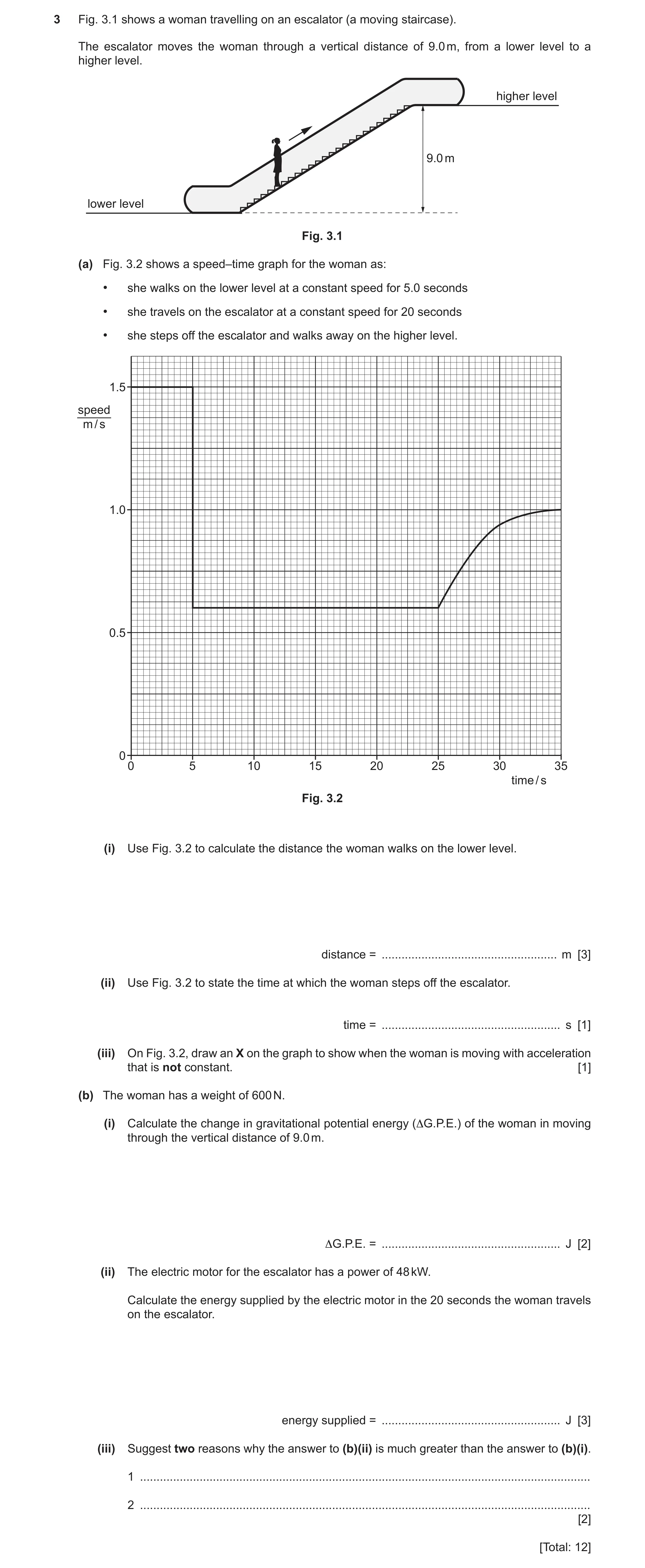
3 Fig. 3.1 shows a woman travelling on an escalator (a moving staircase). The escalator moves the woman through a vertical distance of 9.0 m, from a lower level to a higher level. higher level 9.0 m lower level Fig. 3.1 (a) Fig. 3.2 shows a speed–time graph for the woman as: • she walks on the lower level at a constant speed for 5.0 seconds • she travels on the escalator at a constant speed for 20 seconds • she steps off the escalator and walks away on the higher level. 1.5 speed m / s 1.0 0.5 0 0 5 10 15 20 25 30 35 time / s Fig. 3.2 (i) Use Fig. 3.2 to calculate the distance the woman walks on the lower level. distance = … m [3] (ii) Use Fig. 3.2 to state the time at which the woman steps off the escalator. time = … s [1] (iii) On Fig. 3.2, draw an X on the graph to show when the woman is moving with acceleration that is not constant. [1] (b) The woman has a weight of 600 N. (i) Calculate the change in gravitational potential energy (ΔG.P.E.) of the woman in moving through the vertical distance of 9.0 m. ΔG.P.E. = … J [2] (ii) The electric motor for the escalator has a power of 48 kW. Calculate the energy supplied by the electric motor in the 20 seconds the woman travels on the escalator. energy supplied = … J [3] (iii) Suggest two reasons why the answer to (b)(ii) is much greater than the answer to (b)(i). 1 … 2 … [2] [Total: 12]
12 marks
Mark scheme: 3(a)(i) use of area under graph OR distance = speed × time ; correct area identified / 1.5 × 5.0 ; 7.5 (m) ; 3 3(a)(ii) 25 (s) ; 1 3(a)(iii) X anywhere on curved section between 25 s and 35 s ; 1 3(b)(i) ΔG.P.E = mgΔh / ΔG.P.E = WΔh / 600 × 9.0 ; 5 400 (J) ; 2 3(b)(ii) conversion of 48 kW to 48 000 W; energy = power × time / 48 000 × 20 ; 960 000 (J) ; 3 3(b)(iii) any two from: work is done moving the woman forward horizontally / KE of woman ; work is done moving the escalator / KE of escalator ; work is done against friction / thermal energy produced / heat produced ; 2
This question in 0653/41 Oct/Nov 2020
Q18 · A car moving forward along a level road before the road goes over a hill 0653/42 Feb/March 2021
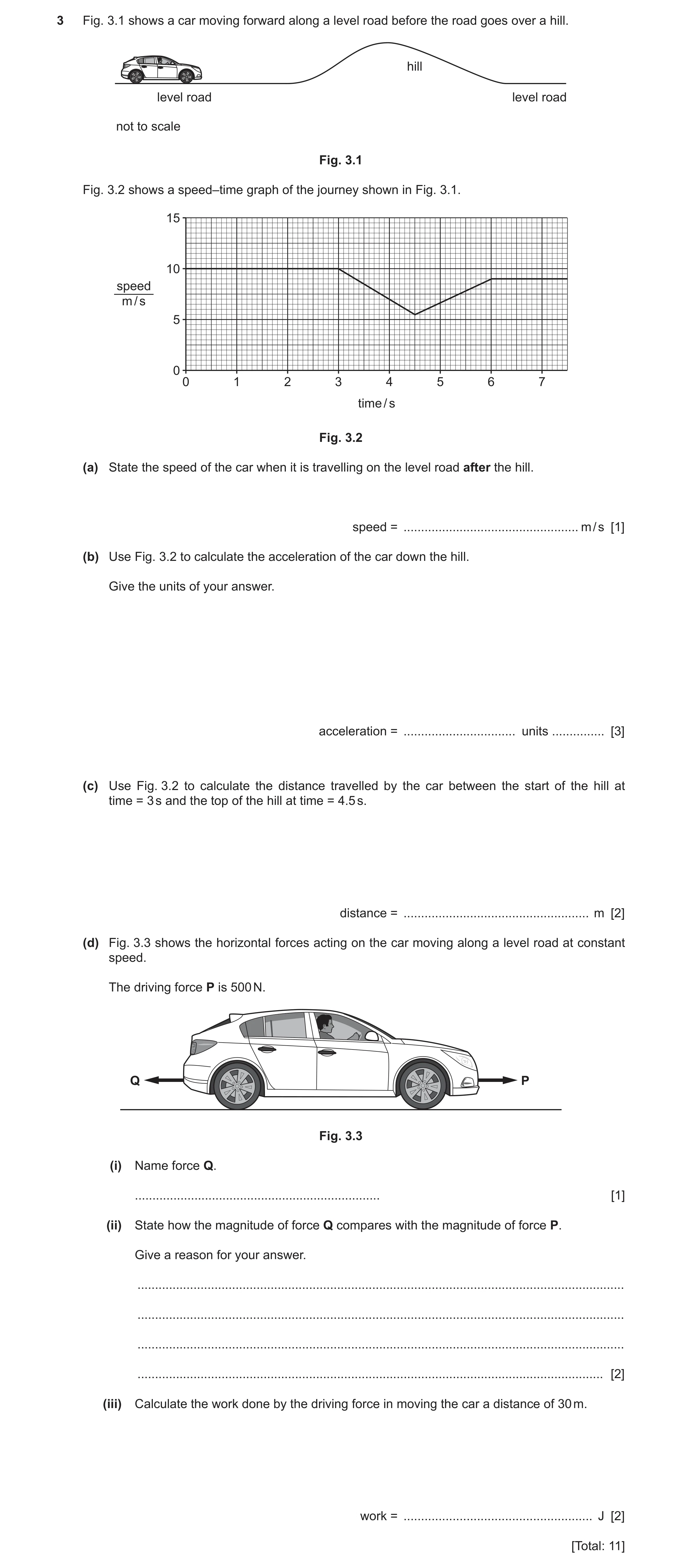
3 Fig. 3.1 shows a car moving forward along a level road before the road goes over a hill. hill level road level road not to scale Fig. 3.1 Fig. 3.2 shows a speed–time graph of the journey shown in Fig. 3.1. 15 10 speed m / s 5 0 0 1 2 3 4 5 6 7 time / s Fig. 3.2 (a) State the speed of the car when it is travelling on the level road after the hill. speed = … m / s [1] (b) Use Fig. 3.2 to calculate the acceleration of the car down the hill. Give the units of your answer. acceleration = … units … [3] (c) Use Fig. 3.2 to calculate the distance travelled by the car between the start of the hill at time = 3 s and the top of the hill at time = 4.5 s. distance = … m [2] (d) Fig. 3.3 shows the horizontal forces acting on the car moving along a level road at constant speed. The driving force P is 500 N. Q P Fig. 3.3 (i) Name force Q. … [1] (ii) State how the magnitude of force Q compares with the magnitude of force P. Give a reason for your answer. … … … … [2] (iii) Calculate the work done by the driving force in moving the car a distance of 30 m. work = … J [2] [Total: 11]
11 marks
Mark scheme: 3(a) 9 (m / s) ; 1 3(b) use of gradient of line / use of v = u + at ; (9.0 – 5.5) ÷ (6.0 – 4.5) = 2.3(3) ; m / s2 ; 3 3(c) use of area under graph / 5.5 × (4.5 – 3.0) + ½ × (10.0 – 5.5) × (4.5 – 3.0) ; = 11.6(25) (m) ; 2 3(d)(i) air resistance / friction / AVP, e.g. drag ; 1 3(d)(ii) 500 N / equal (and opposite so balanced) ; (because) speed is constant / there is no resultant force ; 2 3(d)(iii) work done = force × distance / W = F × d / 500 × 30 ; = 15 000 (J) ; 2
This question in 0653/42 Feb/March 2021
Q19 · A man lying down on a sandy beach on a sunny day 0653/43 May/June 2021
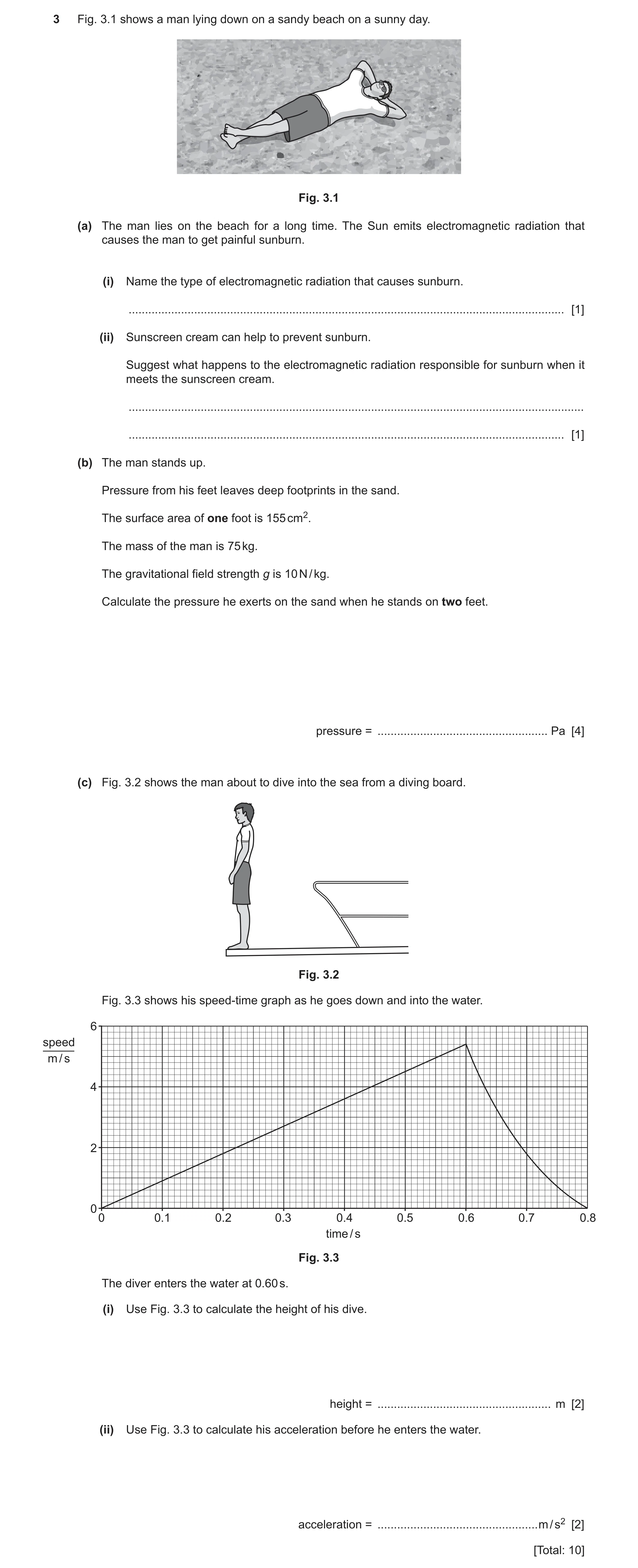
3 Fig. 3.1 shows a man lying down on a sandy beach on a sunny day. Fig. 3.1 (a) The man lies on the beach for a long time. The Sun emits electromagnetic radiation that causes the man to get painful sunburn. (i) Name the type of electromagnetic radiation that causes sunburn. … [1] (ii) Sunscreen cream can help to prevent sunburn. Suggest what happens to the electromagnetic radiation responsible for sunburn when it meets the sunscreen cream. … … [1] (b) The man stands up. Pressure from his feet leaves deep footprints in the sand. The surface area of one foot is 155 cm2. The mass of the man is 75 kg. The gravitational field strength g is 10 N / kg. Calculate the pressure he exerts on the sand when he stands on two feet. pressure = … Pa [4] (c) Fig. 3.2 shows the man about to dive into the sea from a diving board. Fig. 3.2 Fig. 3.3 shows his speed-time graph as he goes down and into the water. 6 speed m / s 4 2 0 0 0.1 0.2 0.3 0.4 0.5 0.6 0.7 0.8 time / s Fig. 3.3 The diver enters the water at 0.60 s. (i) Use Fig. 3.3 to calculate the height of his dive. height = … m [2] (ii) Use Fig. 3.3 to calculate his acceleration before he enters the water. acceleration = … m / s2 [2] [Total: 10]
10 marks
Mark scheme: 3(a)(i) ultraviolet ; 1 3(a)(ii) reflected / absorbed (by sunscreen) ; 1 3(b) p = F / A ; A = 2 ×155 (= 310) cm2 = 0.031 m2 ; F = mg = 75 × 10 = 750 N ; p = 750 / 0.031 = 24 194 / 24 200 (Pa) ; 4 3(c)(i) height = area under graph = ½ × 0.60 × 5.4 ; = 1.6(2) (m) ; 2 3(c)(ii) acceleration = change in speed / time = 5.4 / 0.60 ; = 9.0 (m / s2) ; 2
This question in 0653/43 May/June 2021
Q20 · A dog accelerates from rest to a maximum constant speed 0653/41 Oct/Nov 2021
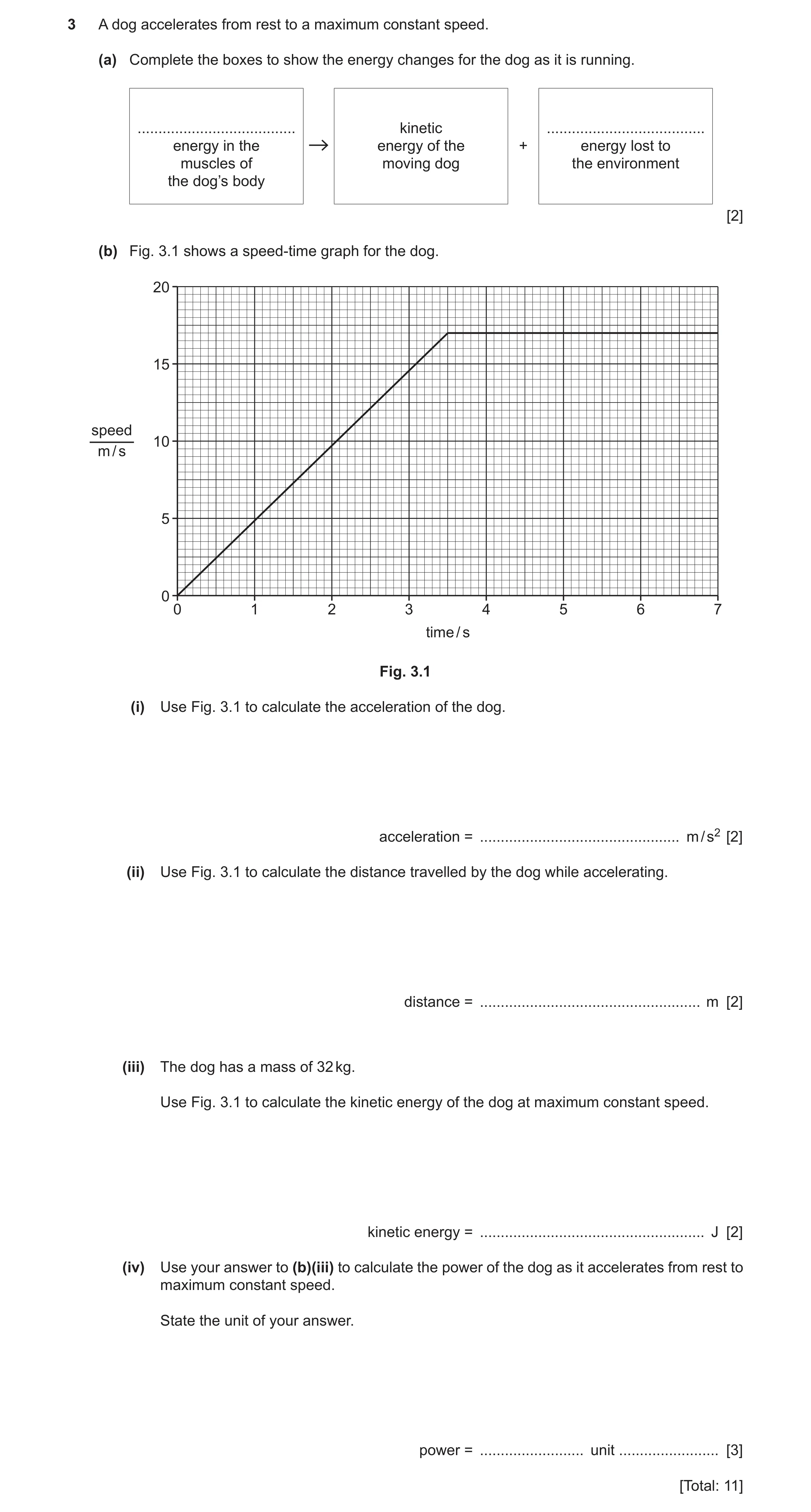
3 A dog accelerates from rest to a maximum constant speed. (a) Complete the boxes to show the energy changes for the dog as it is running. … kinetic … energy in the energy of the + energy lost to muscles of moving dog the environment the dog’s body [2] (b) Fig. 3.1 shows a speed-time graph for the dog. 20 15 speed 10 m / s 5 0 0 1 2 3 4 5 6 7 time / s Fig. 3.1 (i) Use Fig. 3.1 to calculate the acceleration of the dog. acceleration = … m / s2 [2] (ii) Use Fig. 3.1 to calculate the distance travelled by the dog while accelerating. distance = … m [2] (iii) The dog has a mass of 32 kg. Use Fig. 3.1 to calculate the kinetic energy of the dog at maximum constant speed. kinetic energy = … J [2] (iv) Use your answer to (b)(iii) to calculate the power of the dog as it accelerates from rest to maximum constant speed. State the unit of your answer. power = … unit … [3] [Total: 11]
11 marks
Mark scheme: 3(a) chemical (potential) ; thermal / heat ; 2 3(b)(i) acceleration = change in speed ÷ time in any form / 17 ÷ 3.5 ; 4.9 (m / s2) ; 2 3(b)(ii) use of area under graph / ½ × 3.5 × 17 ; 30 (m) ; 2 3(b)(iii) KE = ½ m v2 in any form / ½ × 32 × 17 × 17 ; 4600 (J) ; 2 3(b)(iv) P = E ÷ t in any form / 4600 ÷ 3.5 ; 1300 ; watt(s) / W ; 3
This question in 0653/41 Oct/Nov 2021
Q21 · A dinosaur called Tyrannosaurus Rex (T-Rex) 0653/43 Oct/Nov 2021
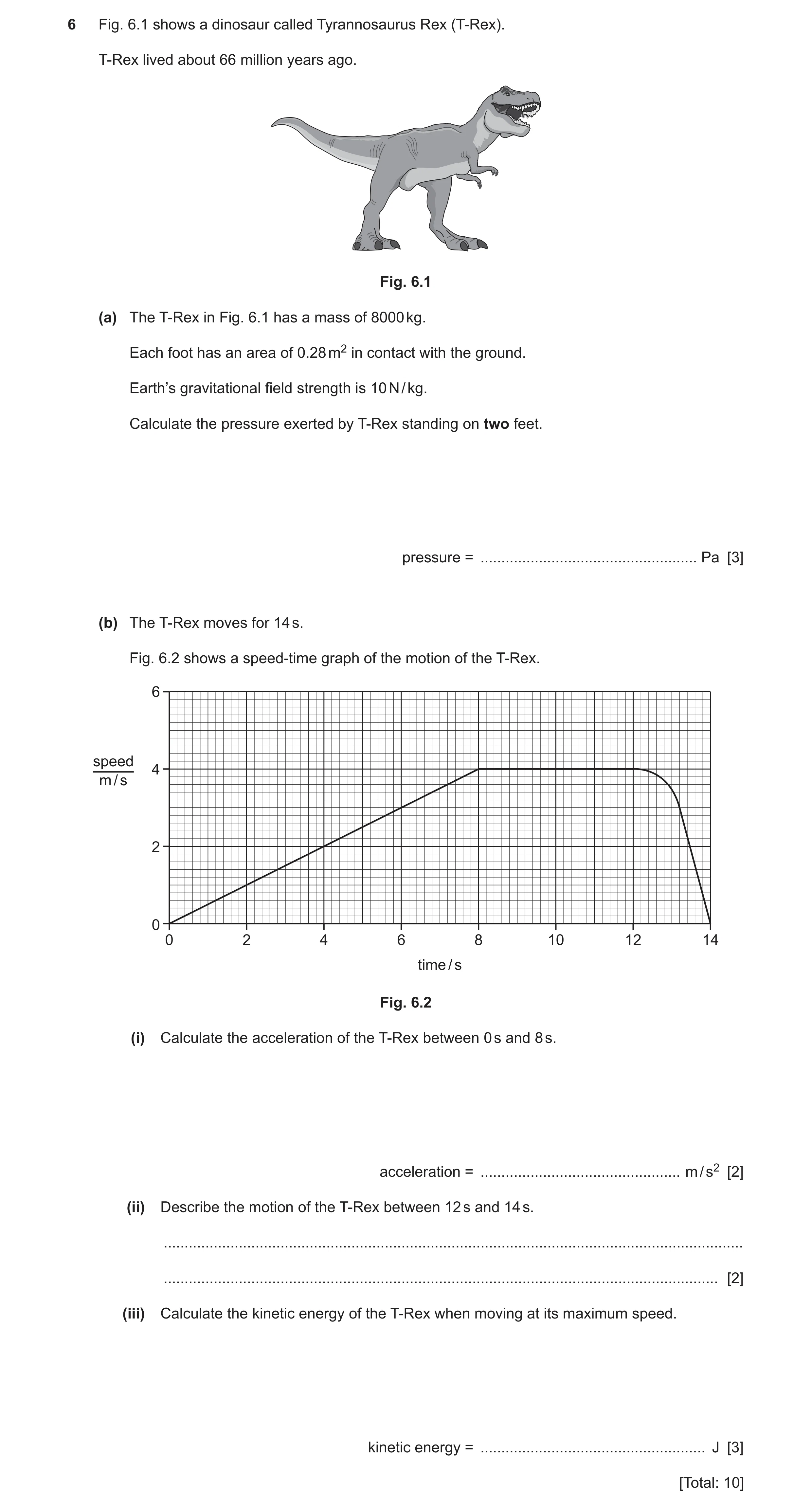
6 Fig. 6.1 shows a dinosaur called Tyrannosaurus Rex (T-Rex). T-Rex lived about 66 million years ago. Fig. 6.1 (a) The T-Rex in Fig. 6.1 has a mass of 8000 kg. Each foot has an area of 0.28 m2 in contact with the ground. Earth’s gravitational field strength is 10 N / kg. Calculate the pressure exerted by T-Rex standing on two feet. pressure = … Pa [3] (b) The T-Rex moves for 14 s. Fig. 6.2 shows a speed-time graph of the motion of the T-Rex. 6 speed 4 m / s 2 0 0 2 4 6 8 10 12 14 time / s Fig. 6.2 (i) Calculate the acceleration of the T-Rex between 0 s and 8 s. acceleration = … m / s2 [2] (ii) Describe the motion of the T-Rex between 12 s and 14 s. … … [2] (iii) Calculate the kinetic energy of the T-Rex when moving at its maximum speed. kinetic energy = … J [3] [Total: 10]
10 marks
Mark scheme: 6(a) (total surface area = 2 × 0.28 =) 0.56 (m2) ; pressure = force ÷ area in any form / 8000 × 10 ÷ 0.56 ; 1.4 x 10⁵ (Pa) ; 3 6(b)(i) acceleration = change in speed ÷ time / 4 ÷ 8 ; 0.5 (m / s2) ; 2 6(b)(ii) deceleration ; not constant ; 2 6(b)(iii) maximum speed identified as 4 m / s ; KE = ½mv2 in any form / ½ × 8000 × 42 ; 64 000 (J) ; 3
This question in 0653/43 Oct/Nov 2021
Q22 · A child in a toy car moves forward at a constant speed of 0.7 m / s 0653/42 Feb/March 2022
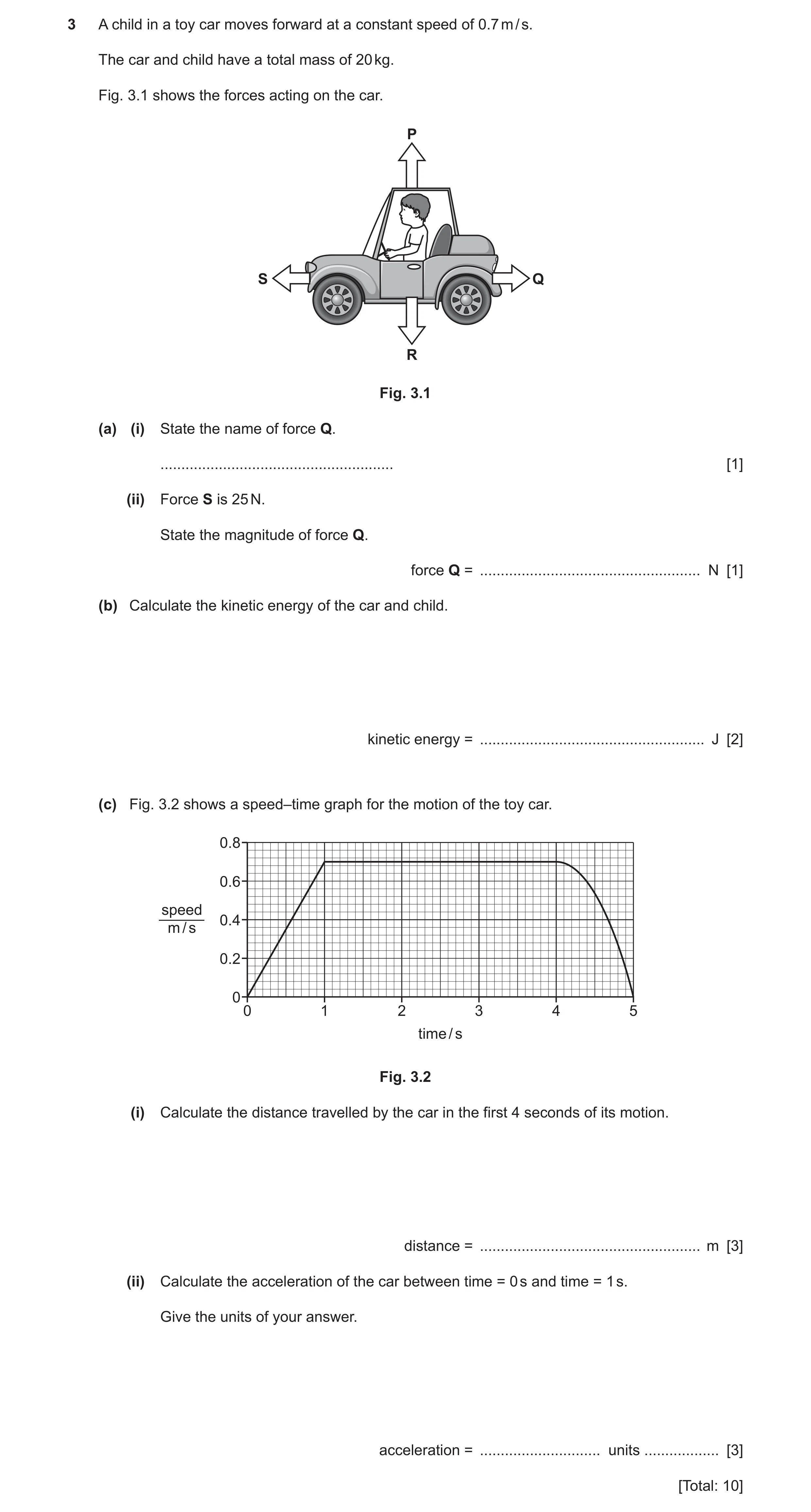
3 A child in a toy car moves forward at a constant speed of 0.7 m / s. The car and child have a total mass of 20 kg. Fig. 3.1 shows the forces acting on the car. P S Q R Fig. 3.1 (a) (i) State the name of force Q. … [1] (ii) Force S is 25 N. State the magnitude of force Q. force Q = … N [1] (b) Calculate the kinetic energy of the car and child. kinetic energy = … J [2] (c) Fig. 3.2 shows a speed–time graph for the motion of the toy car. 0.8 0.6 speed 0.4 m / s 0.2 0 0 1 2 3 4 5 time / s Fig. 3.2 (i) Calculate the distance travelled by the car in the first 4 seconds of its motion. distance = … m [3] (ii) Calculate the acceleration of the car between time = 0 s and time = 1 s. Give the units of your answer. acceleration = … units … [3] [Total: 10]
10 marks
Mark scheme: 3(a)(i) friction ; 1 3(a)(ii) 25 (N) ; 1 Question Answer Marks 3(b) KE = ½mv2 (in any form) / ½ × 20 × 0.7 × 0.7 ; 4.9 (J) ; 2 3(c)(i) use of area under curve ; calculation of one area e.g., distance = (½ × 1 × 0.7 = 0.35) / (3 × 0.7 = 2.1) ; (= 0.35 + 2.1 =) 2.45 (m) ; 3 3(c)(ii) acceleration = change in speed ÷ time (in any form) / 0.7 ÷ 1 ; 0.7 ; m / s2 ; 3
This question in 0653/42 Feb/March 2022
Q23 · A new world water speed record was set in 1978 by a specially designed speed boat 0653/43 Oct/Nov 2022
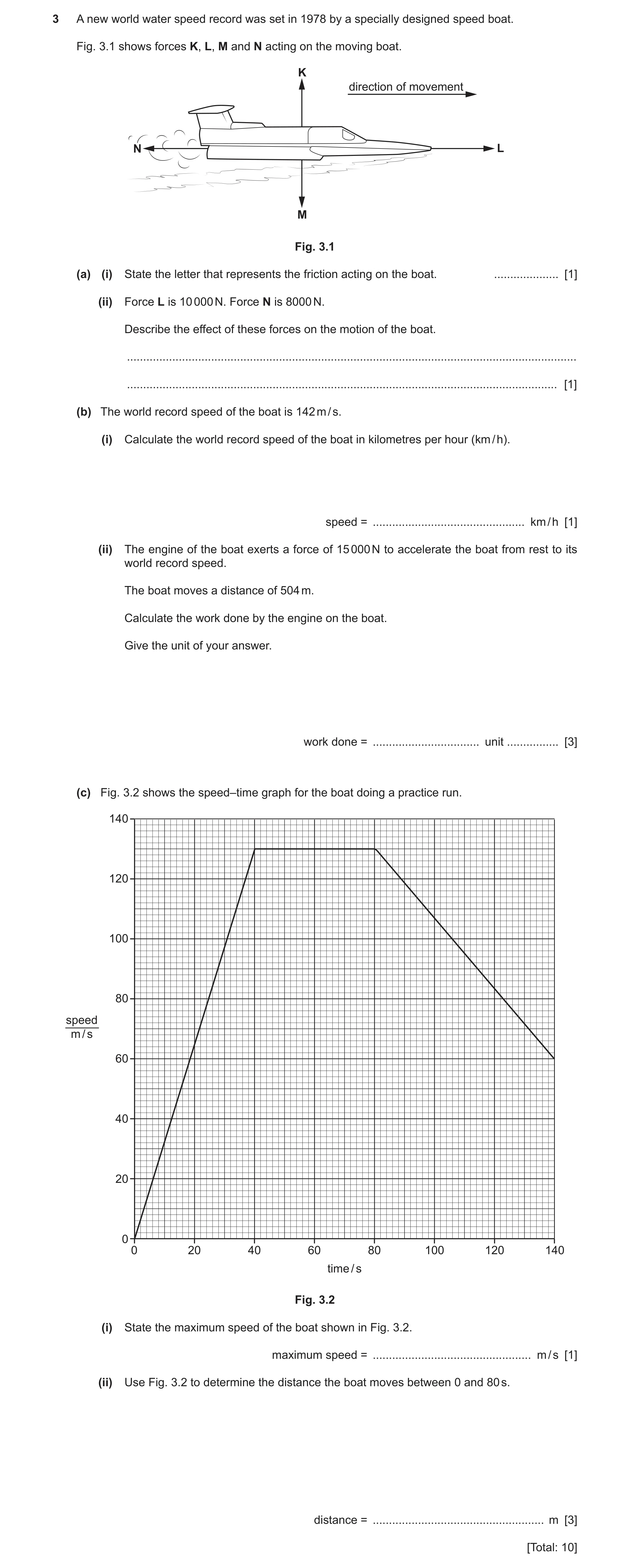
3 A new world water speed record was set in 1978 by a specially designed speed boat. Fig. 3.1 shows forces K, L, M and N acting on the moving boat. K direction of movement N L M Fig. 3.1 (a) (i) State the letter that represents the friction acting on the boat. … [1] (ii) Force L is 10 000 N. Force N is 8000 N. Describe the effect of these forces on the motion of the boat. … … [1] (b) The world record speed of the boat is 142 m / s. (i) Calculate the world record speed of the boat in kilometres per hour (km / h). speed = … km / h [1] (ii) The engine of the boat exerts a force of 15 000 N to accelerate the boat from rest to its world record speed. The boat moves a distance of 504 m. Calculate the work done by the engine on the boat. Give the unit of your answer. work done = … unit … [3] (c) Fig. 3.2 shows the speed–time graph for the boat doing a practice run. 140 120 100 80 speed m / s 60 40 20 0 0 20 40 60 80 100 120 140 time / s Fig. 3.2 (i) State the maximum speed of the boat shown in Fig. 3.2. maximum speed = … m / s [1] (ii) Use Fig. 3.2 to determine the distance the boat moves between 0 and 80 s. distance = … m [3] [Total: 10]
10 marks
Mark scheme: 3(a)(i) N ; 1 3(a)(ii) resultant force (to right) means boat, accelerates / goes faster / speed increases ; 1 3(b)(i) (142 3600 ÷ 1000 =) 511 (km / h) ; 1 3(b)(ii) evidence of, W = F d / 15 000 504 ; 3 7 600 000 ; J ; 3(c)(i) 130 (m / s) ; 1 3(c)(ii) recognition that area under graph is used to calculate distance ; 3 correct calculation of an area, e.g. ½ x 40 130 = 2600 OR (80 – 40) 130 = 5200 ; 7800 (m) ;
This question in 0653/43 Oct/Nov 2022
Q24 · A speed–time graph for a student riding a bicycle 0653/42 Feb/March 2023
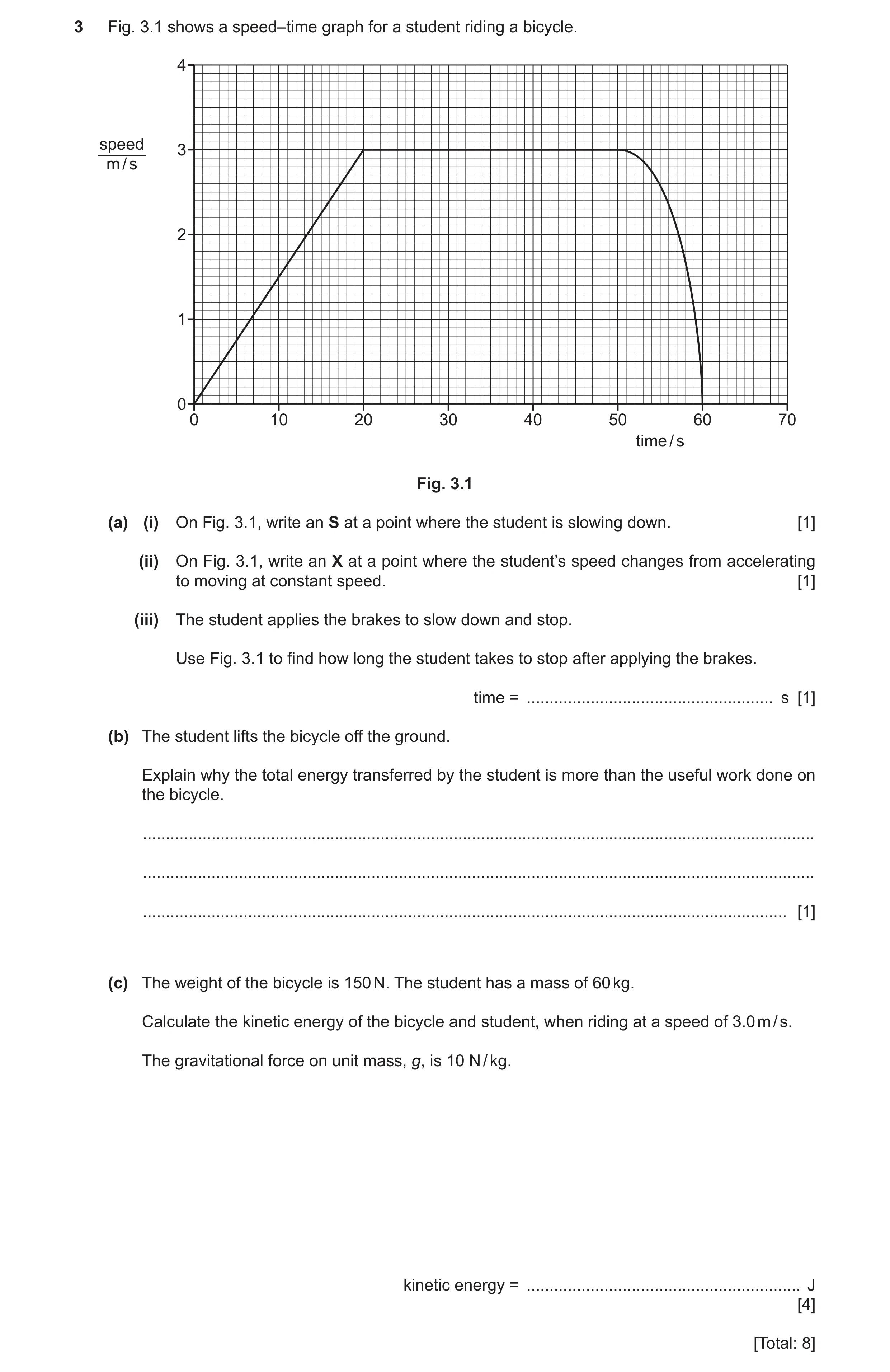
3 Fig. 3.1 shows a speed–time graph for a student riding a bicycle. 4 speed 3 m / s 2 1 0 0 10 20 30 40 50 60 70 time / s Fig. 3.1 (a) (i) On Fig. 3.1, write an S at a point where the student is slowing down. [1] (ii) On Fig. 3.1, write an X at a point where the student’s speed changes from accelerating to moving at constant speed. [1] (iii) The student applies the brakes to slow down and stop. Use Fig. 3.1 to find how long the student takes to stop after applying the brakes. time = … s [1] (b) The student lifts the bicycle off the ground. Explain why the total energy transferred by the student is more than the useful work done on the bicycle. … … … [1] (c) The weight of the bicycle is 150 N. The student has a mass of 60 kg. Calculate the kinetic energy of the bicycle and student, when riding at a speed of 3.0 m / s. The gravitational force on unit mass, g, is 10 N / kg. kinetic energy = … J [4] [Total: 8]
8 marks
Mark scheme: 3(a)(i) S on any point on curved section of graph ; 1 3(a)(ii) X reasonable accurately marked at t = 20 s and s = 3 m / s ; 1 3(a)(iii) 10 (s) ; 1 3(b) energy lost / wasted as, thermal energy / heat ; 1 3(c) mass of bicycle = weight g / m = 150 10 = 15 (kg) ; 4 total mass of rider + bicycle = 60 + 15 = 75 (kg) ; (KE =) ½ mv2 ; ½ x 75 9 = 338 (337.5) (J) ;
This question in 0653/42 Feb/March 2023
Q25 · A speed–time graph for a car on a journey along a road 0653/42 May/June 2023
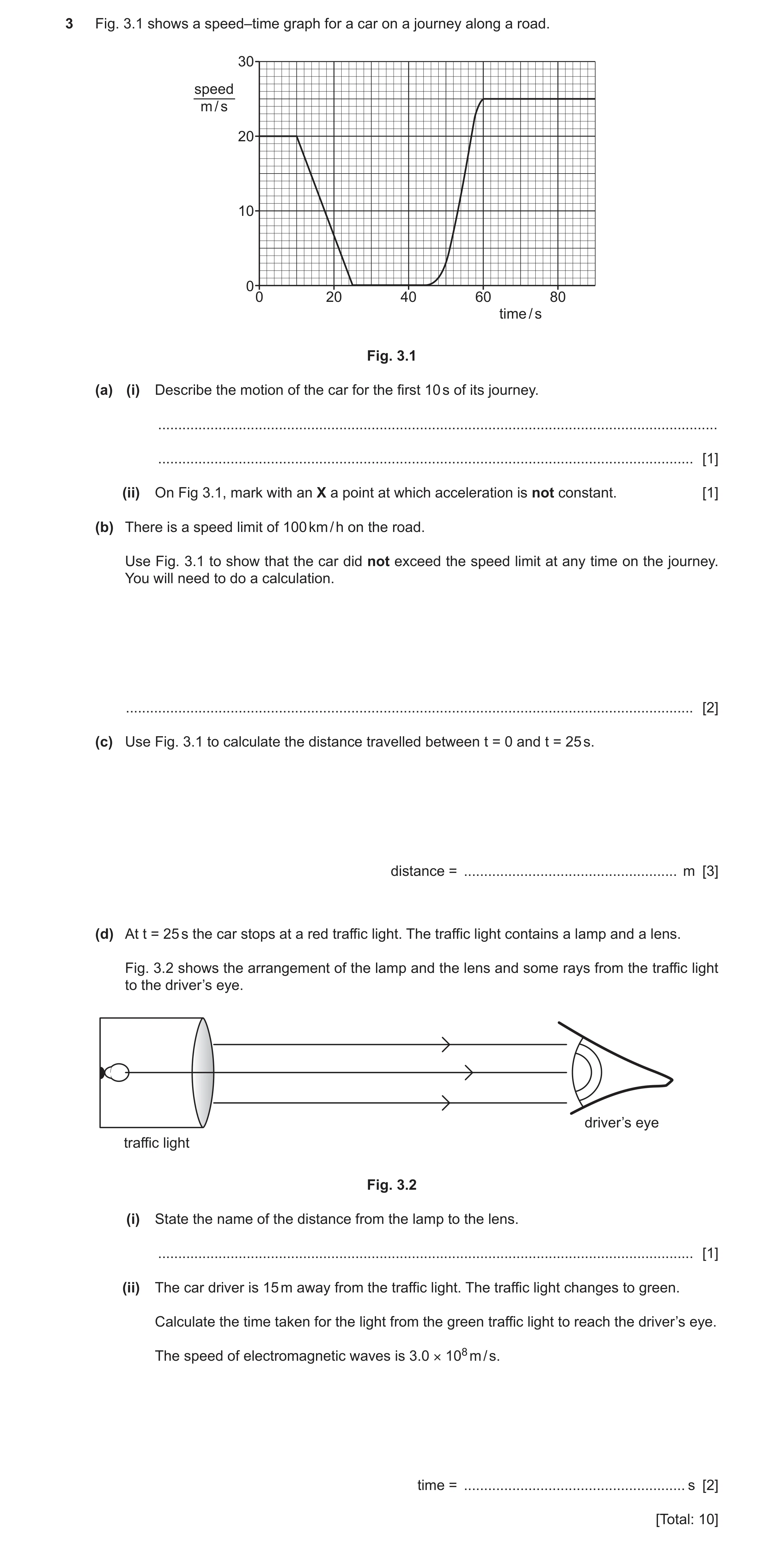
3 Fig. 3.1 shows a speed–time graph for a car on a journey along a road. 30 speed m / s 20 10 00 20 40 60 80 time / s Fig. 3.1 (a) (i) Describe the motion of the car for the first 10 s of its journey. … … [1] (ii) On Fig 3.1, mark with an X a point at which acceleration is not constant. [1] (b) There is a speed limit of 100 km / h on the road. Use Fig. 3.1 to show that the car did not exceed the speed limit at any time on the journey. You will need to do a calculation. … [2] (c) Use Fig. 3.1 to calculate the distance travelled between t = 0 and t = 25 s. distance = … m [3] (d) At t = 25 s the car stops at a red traffic light. The traffic light contains a lamp and a lens. Fig. 3.2 shows the arrangement of the lamp and the lens and some rays from the traffic light to the driver’s eye. driver’s eye traffic light Fig. 3.2 (i) State the name of the distance from the lamp to the lens. … [1] (ii) The car driver is 15 m away from the traffic light. The traffic light changes to green. Calculate the time taken for the light from the green traffic light to reach the driver’s eye. The speed of electromagnetic waves is 3.0 × 10⁸ m / s. time = … s [2] [Total: 10]
10 marks
Mark scheme: 3(a)(i) at constant speed / at 20 m / s ; 1 3(a)(ii) X at top / bottom of line between t = 45 s and t = 50 s / between t = 58 s and t = 60 s ; 1 3(b) max speed of car = 25 m / s ; (unit conversions) 100 1000 3600 / 27.8 m / s (so limit not broken) ; OR max speed of car = 25 m / s ; (unit conversions) 25 3600 1000 / 90 km / h (less than 100 km / h (so limit not broken) ; 2 3(c) use of area under graph (stated or evidence) ; (implementation): 20 10 ½ 20 15 ; 350 (m) ; 3 3(d)(i) focal length ; 1 3(d)(ii) speed = distance time (stated or evidence of use) / t = 15 3 108 ; 5(.0) 10-8 (s) ; 2
This question in 0653/42 May/June 2023
Q26 · A football player kicking a football 0653/43 May/June 2023
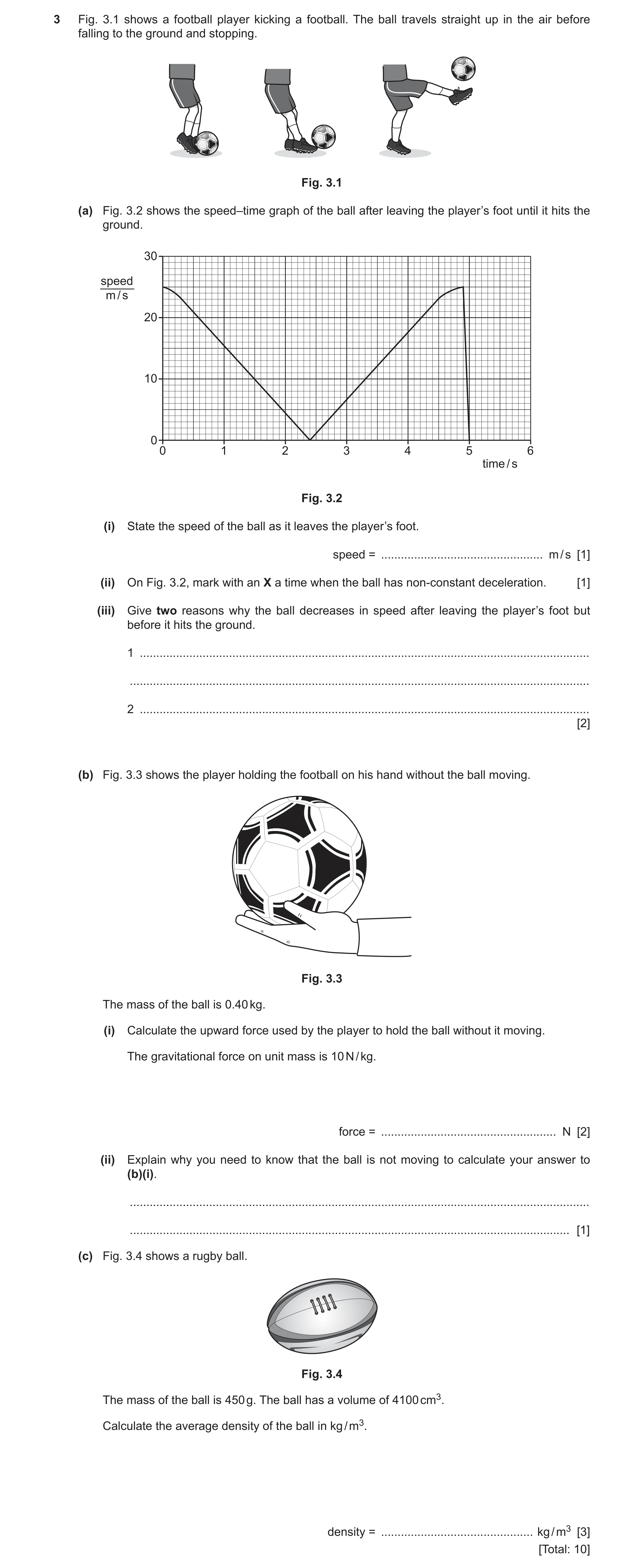
3 Fig. 3.1 shows a football player kicking a football. The ball travels straight up in the air before falling to the ground and stopping. Fig. 3.1 (a) Fig. 3.2 shows the speed–time graph of the ball after leaving the player’s foot until it hits the ground. 30 speed m / s 20 10 0 0 1 2 3 4 5 6 time / s Fig. 3.2 (i) State the speed of the ball as it leaves the player’s foot. speed = … m / s [1] (ii) On Fig. 3.2, mark with an X a time when the ball has non-constant deceleration. [1] (iii) Give two reasons why the ball decreases in speed after leaving the player’s foot but before it hits the ground. 1 … … 2 … [2] (b) Fig. 3.3 shows the player holding the football on his hand without the ball moving. Fig. 3.3 The mass of the ball is 0.40 kg. (i) Calculate the upward force used by the player to hold the ball without it moving. The gravitational force on unit mass is 10 N / kg. force = … N [2] (ii) Explain why you need to know that the ball is not moving to calculate your answer to (b)(i). … … [1] (c) Fig. 3.4 shows a rugby ball. Fig. 3.4 The mass of the ball is 450 g. The ball has a volume of 4100 cm3. Calculate the average density of the ball in kg / m3. density = … kg / m3 [3] [Total: 10]
10 marks
Mark scheme: 3(a)(i) 25 (m / s) ; 1 3(a)(ii) X marked at any point between t = 0 s and t = 0.3 s ; 1 3(a)(iii) any two from: air resistance ; kinetic energy is transferred into gravitational potential energy ; reference to gravitational force (downwards as ball is going upwards) ; 2 3(b)(i) gravitational force on ball / weight of ball = mg / 0.4 10 ; 4(.0) (N) ; 2 3(b)(ii) forces are balanced / no resultant force (when ball is not moving) ; 1 3(c) unit conversions: 0.45 kg or 0.0041 m3 ; (density =) mass volume / (=) 0.45 0.0041 ; 110 (kg / m3) ; 3
This question in 0653/43 May/June 2023
Question 27 0653/42 Oct/Nov 2023
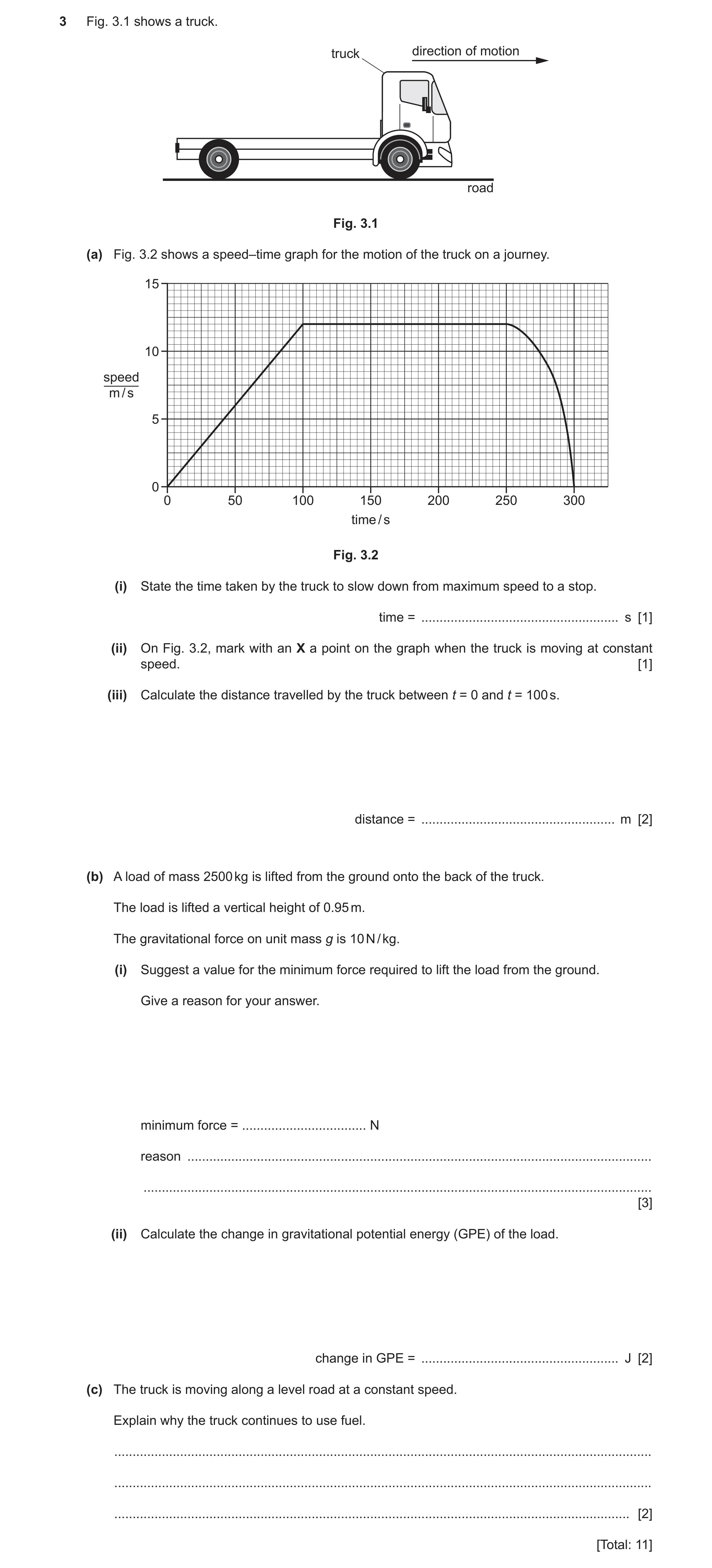
3 Fig. 3.1 shows a truck. truck direction of motion road Fig. 3.1 (a) Fig. 3.2 shows a speed–time graph for the motion of the truck on a journey. 15 10 speed m / s 5 0 0 50 100 150 200 250 300 time / s Fig. 3.2 (i) State the time taken by the truck to slow down from maximum speed to a stop. time = … s [1] (ii) On Fig. 3.2, mark with an X a point on the graph when the truck is moving at constant speed. [1] (iii) Calculate the distance travelled by the truck between t = 0 and t = 100 s. distance = … m [2] (b) A load of mass 2500 kg is lifted from the ground onto the back of the truck. The load is lifted a vertical height of 0.95 m. The gravitational force on unit mass g is 10 N / kg. (i) Suggest a value for the minimum force required to lift the load from the ground. Give a reason for your answer. minimum force = … N reason … … [3] (ii) Calculate the change in gravitational potential energy (GPE) of the load. change in GPE = … J [2] (c) The truck is moving along a level road at a constant speed. Explain why the truck continues to use fuel. … … … [2] [Total: 11]
11 marks
Mark scheme: 3(a)(i) 50 (s) ; 1 3(a)(ii) X anywhere on the horizontal line of the graph ; 1 3(a)(iii) evidence of, use of area under graph / ½ 100 12 ; 2 600 (m) ; 3(b)(i) evidence of, W = mg / 2500 10 OR 25 000 ; 3 any value greater than 25 000 (N) ; a resultant force is needed ; 3(b)(ii) evidence of, change in GPE = mgh / 2500 10 0.95 ; 2 24 000 (J) ; 3(c) (the truck needs the) energy in fuel / energy transfer from fuel ; 2 work done against friction OR energy is transferred to thermal energy (of surroundings) ;
This question in 0653/42 Oct/Nov 2023
Q28 · The Parker Solar Probe is a spacecraft designed to study the Sun and the planet Venus 0653/42 Feb/March 2024
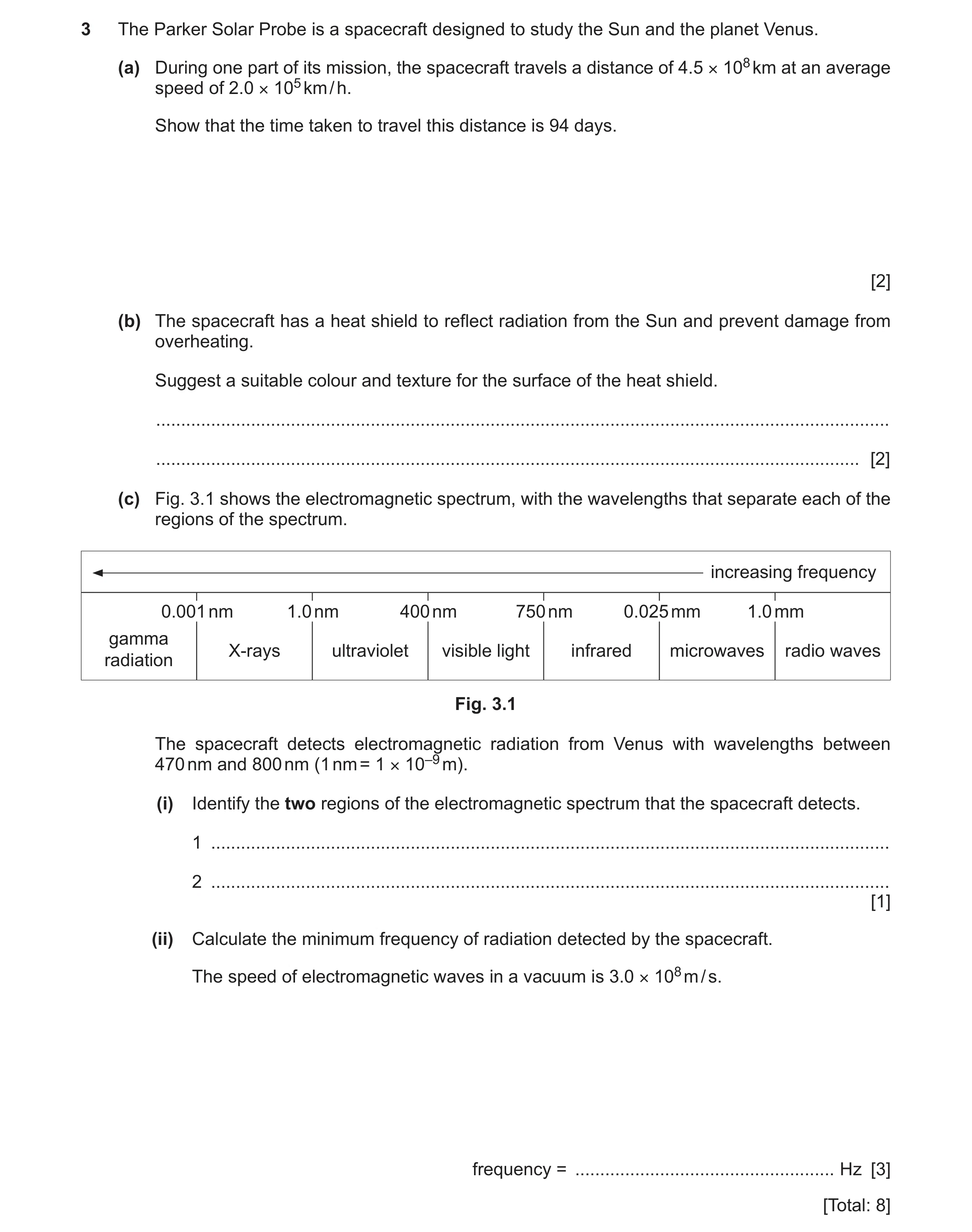
3 The Parker Solar Probe is a spacecraft designed to study the Sun and the planet Venus. (a) During one part of its mission, the spacecraft travels a distance of 4.5 × 10⁸ km at an average speed of 2.0 × 10⁵ km / h. Show that the time taken to travel this distance is 94 days. [2] (b) The spacecraft has a heat shield to reflect radiation from the Sun and prevent damage from overheating. Suggest a suitable colour and texture for the surface of the heat shield. … … [2] (c) Fig. 3.1 shows the electromagnetic spectrum, with the wavelengths that separate each of the regions of the spectrum. increasing frequency 0.001 nm 1.0 nm 400 nm 750 nm 0.025 mm 1.0 mm gamma X-rays ultraviolet visible light infrared microwaves radio waves radiation Fig. 3.1 The spacecraft detects electromagnetic radiation from Venus with wavelengths between 470 nm and 800 nm (1 nm = 1 × 10⁻⁹ m). (i) Identify the two regions of the electromagnetic spectrum that the spacecraft detects. 1 … 2 … [1] (ii) Calculate the minimum frequency of radiation detected by the spacecraft. The speed of electromagnetic waves in a vacuum is 3.0 × 10⁸ m / s. frequency = … Hz [3] [Total: 8]
8 marks
Mark scheme: 3(a) speed = distance ÷ time / 4.5 108 ÷ 2.0 105 ; 2 (conversion hours to days) 2250 ÷ 24 ; (= 94 / 93.8 / 93.75 days) 3(b) white ; 2 shiny ; 3(c)(i) visible (light) and infrared ; 1 3(c)(ii) 800 nm seen / states idea that minimum frequency has longest wavelength ; 3 f = 3.0 108 ÷ (800 10-9) ; = 3.8 1014 (Hz) ;
This question in 0653/42 Feb/March 2024
Q29 · The forces P, Q, R and S acting on a boat at sea 0653/42 Feb/March 2024
9 Fig. 9.1 shows the forces P, Q, R and S acting on a boat at sea. P S Q R Fig. 9.1 (a) The boat is moving forward due to the force of the engine pushing from the back. (i) State which letter, P, Q, R or S, labels the force due to the resistance of air and water on the boat. … [1] (ii) Complete the sentence with one word from this list. density pressure speed temperature When the boat decelerates, its … decreases. [1] (b) Fig. 9.2 shows a speed–time graph of the motion of the boat. 6 speed m / s 4 2 0 0 50 100 150 200 250 300 time / s Fig. 9.2 (i) The distance travelled between time = 250 s and 290 s is half the distance travelled between time = 0 and 100 s. Calculate the total distance travelled by the boat as shown in Fig. 9.2. distance = … m [3] (ii) The engine of the boat supplies an output power of 2.0 kW to drive the boat forward at its maximum speed. Show that the total energy supplied to drive the boat forward while it is travelling at the maximum speed shown in Fig. 9.2 is 300 kJ. [2] (iii) The mass of the boat is 450 kg. Calculate the kinetic energy (KE) of the boat when it is travelling at the maximum speed in Fig. 9.2. KE = … kJ [2] [Total: 9]
9 marks
Mark scheme: 9(a)(i) S ; 1 9(a)(ii) speed ; 1 9(b)(i) reference to the need to calculate the area under graph OR one area calculated ; 3 (calculation of area under graph t = 0 to t = 250 s) ½ 100 4.8 + 150 4.8 / 960 ; (add in ½ (½ 100 4.8) / 120 for area under curve) total = 1100 / 1080 (m) ; 9(b)(ii) time at max. speed of 4.8 m / s = 150 s ; 2 and E = 2.0 150 ; (300 kJ) 9(b)(iii) KE of boat = ½ mv2 in any form ; 2 KE = ½ 450 4.82 = 5200 (J) = 5.2 (kJ) ;
This question in 0653/42 Feb/March 2024
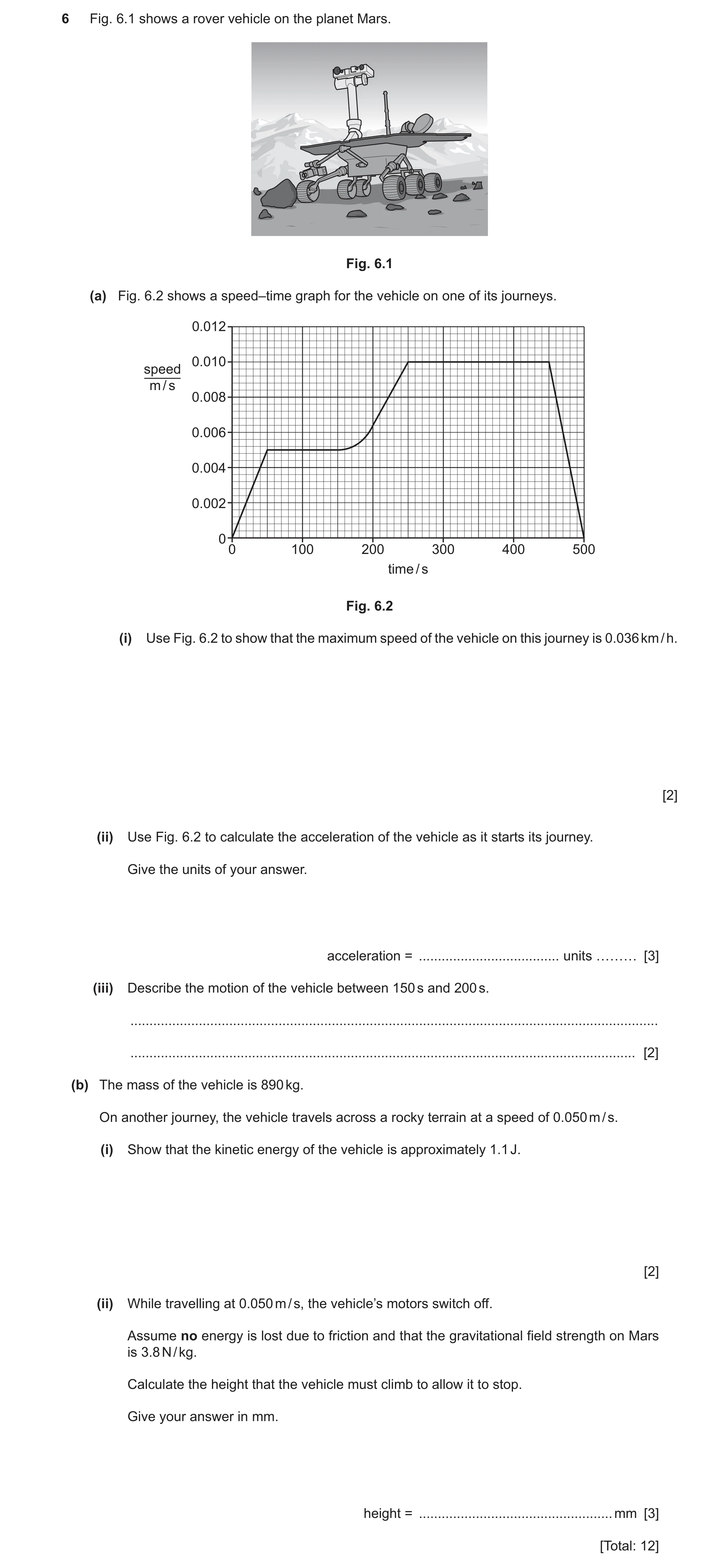
Q30 · A rover vehicle on the planet Mars 0653/42 May/June 2024
6 Fig. 6.1 shows a rover vehicle on the planet Mars. Fig. 6.1 (a) Fig. 6.2 shows a speed–time graph for the vehicle on one of its journeys. 0.012 0.010 speed m / s 0.008 0.006 0.004 0.002 0 0 100 200 300 400 500 time / s Fig. 6.2 (i) Use Fig. 6.2 to show that the maximum speed of the vehicle on this journey is 0.036 km / h. [2] (ii) Use Fig. 6.2 to calculate the acceleration of the vehicle as it starts its journey. Give the units of your answer. acceleration = … units ……… [3] (iii) Describe the motion of the vehicle between 150 s and 200 s. … … [2] (b) The mass of the vehicle is 890 kg. On another journey, the vehicle travels across a rocky terrain at a speed of 0.050 m / s. (i) Show that the kinetic energy of the vehicle is approximately 1.1 J. [2] (ii) While travelling at 0.050 m / s, the vehicle’s motors switch off. Assume no energy is lost due to friction and that the gravitational field strength on Mars is 3.8 N / kg. Calculate the height that the vehicle must climb to allow it to stop. Give your answer in mm. height = … mm [3] [Total: 12]
12 marks
Mark scheme: 6(a)(i) max. speed = 0.010 m / s OR 3600 OR 1000 ; both conversions seen 3600 (s) and 1000 (m) and correct substitution ; 2 6(a)(ii) (a =) v t or 0.005 50 ; 0.0001(0) / 1 10–4 ; m / s2 ; 3 6(a)(iii) acceleration ; acceleration is not constant ; 2 6(b)(i) KE = ½ mv2 (in any form) or ½ 890 0.05 0.05 ; = 1.1125 ; (≈ 1.1) 2 6(b)(ii) GPE (gained) = 1.1 J ; (GPE =) mgh or 890 3.8 h or h = 1.1 (890 3.8) ; 0.33 mm ; 3
This question in 0653/42 May/June 2024
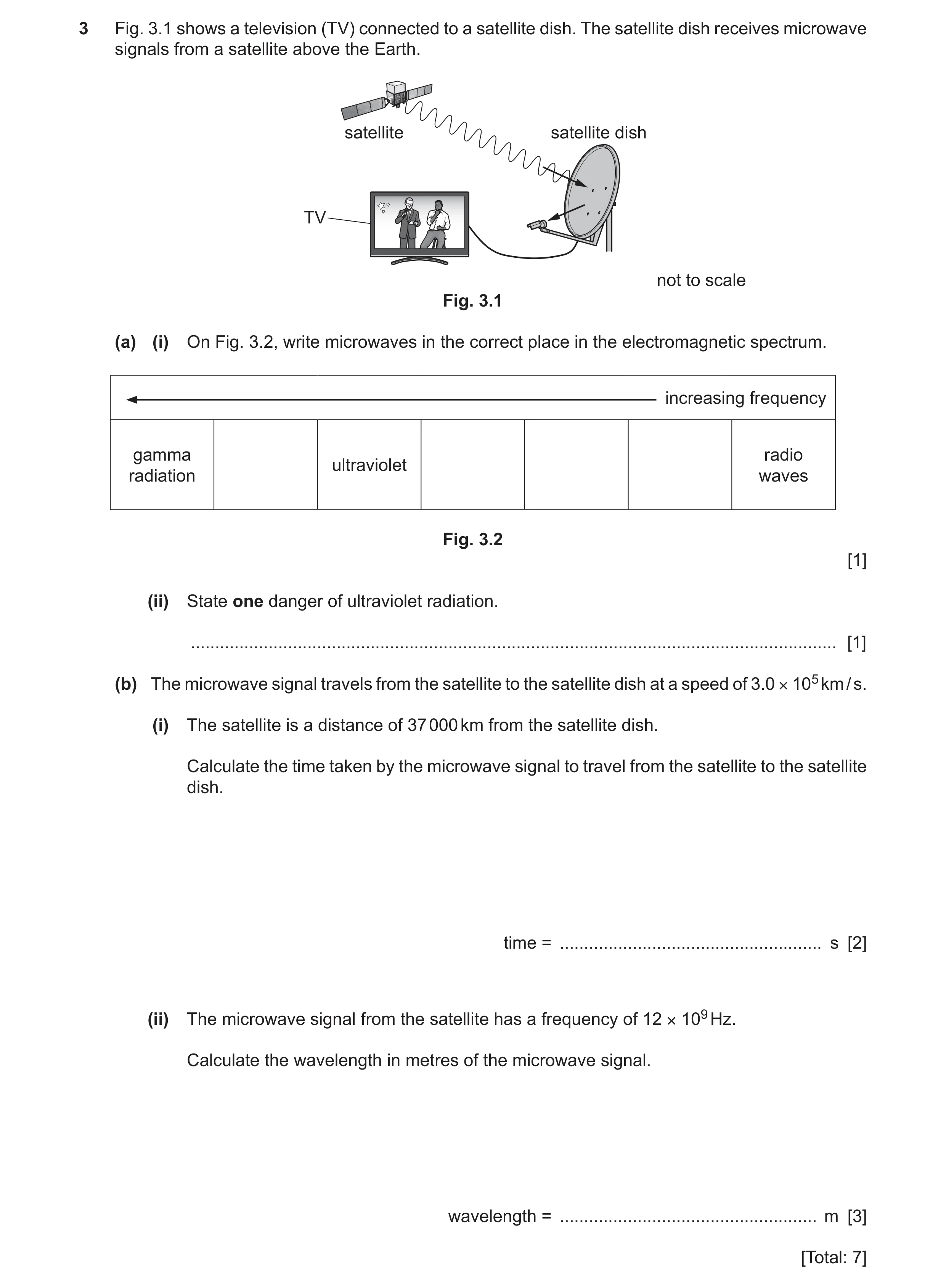
Q31 · A television (TV) connected to a satellite dish 0653/43 May/June 2024
3 Fig. 3.1 shows a television (TV) connected to a satellite dish. The satellite dish receives microwave signals from a satellite above the Earth. satellite satellite dish TV not to scale Fig. 3.1 (a) (i) On Fig. 3.2, write microwaves in the correct place in the electromagnetic spectrum. increasing frequency gamma radio ultraviolet radiation waves Fig. 3.2 [1] (ii) State one danger of ultraviolet radiation. … [1] (b) The microwave signal travels from the satellite to the satellite dish at a speed of 3.0 × 10⁵ km / s. (i) The satellite is a distance of 37 000 km from the satellite dish. Calculate the time taken by the microwave signal to travel from the satellite to the satellite dish. time = … s [2] (ii) The microwave signal from the satellite has a frequency of 12 × 109 Hz. Calculate the wavelength in metres of the microwave signal. wavelength = … m [3] [Total: 7]
7 marks
Mark scheme: 3(a)(i) gamma radiation ultraviolet microwaves ; radio waves 1 3(a)(ii) sunburn / skin cancer / skin damage / eye damage ; 1 3(b)(i) speed = distance time in any form OR 37 000 3.0 105 ; 12(.3) 10–2 OR 0.12 (s) ; 2 Question Answer Marks 3(b)(ii) conversion km to m seen ; v = f in any form / 3 108 12 109 ; 0.025 (m) ; 3
This question in 0653/43 May/June 2024
Q32 · Three forces, Q, R and P, acting on a bus moving along a level road at constant speed 0653/43 May/June 2024
6 Fig. 6.1 shows three forces, Q, R and P, acting on a bus moving along a level road at constant speed. direction of moving bus R Q road P Fig. 6.1 (a) The driving force acting on the bus is not shown on Fig. 6.1. (i) On Fig. 6.1, draw an arrow labelled S to represent the driving force acting on the bus. [1] (ii) State the cause of the force labelled Q. … [1] (b) The mass of the bus is 7500 kg. The gravitational force on unit mass is 10 N / kg. Explain why the force labelled R must be 75 000 N. … … … [2] (c) Fig. 6.2 shows a speed–time graph of the motion of a bus on a journey between two bus stops. 15 10 speed m / s 5 0 0 50 100 150 200 250 300 time / s Fig. 6.2 (i) Calculate the acceleration of the bus as it starts the journey. Give the units of your answer. acceleration = … units … [3] (ii) Use Fig. 6.2 to calculate the distance in metres travelled by the bus before it begins to slow down. distance = … m [3] (iii) The total distance between the bus stops is 2.65 km. Use your answer to (c)(ii) to find the distance in metres travelled by the bus while it is decelerating. distance = … m [1] [Total: 11]
11 marks
Mark scheme: 6(a)(i) arrow pointing to right, touching bus and same length as arrow Q ; 1 6(a)(ii) friction / air resistance ; 1 6(b) force P = 75 000 N or weight of bus = 75 000 N ; no vertical motion / arrow R is same length as arrow P / no resultant force / R and P are balanced forces ; 2 6(c)(i) acceleration = initial slope of graph OR 12 / 100 ; 0.12 ; m / s2 ; 3 6(c)(ii) distance while accelerating = ½ 100 12 OR 600 (m) ; distance at constant speed = 150 12 OR 1800 (m) ; total distance = (1800 + 600) = 2400 (m) ; 3 6(c)(iii) (distance = 2650 – 2400 =) 250 (m) ; 1
This question in 0653/43 May/June 2024
Q33 · An electric car with solar cells on its roof 0653/42 Oct/Nov 2024
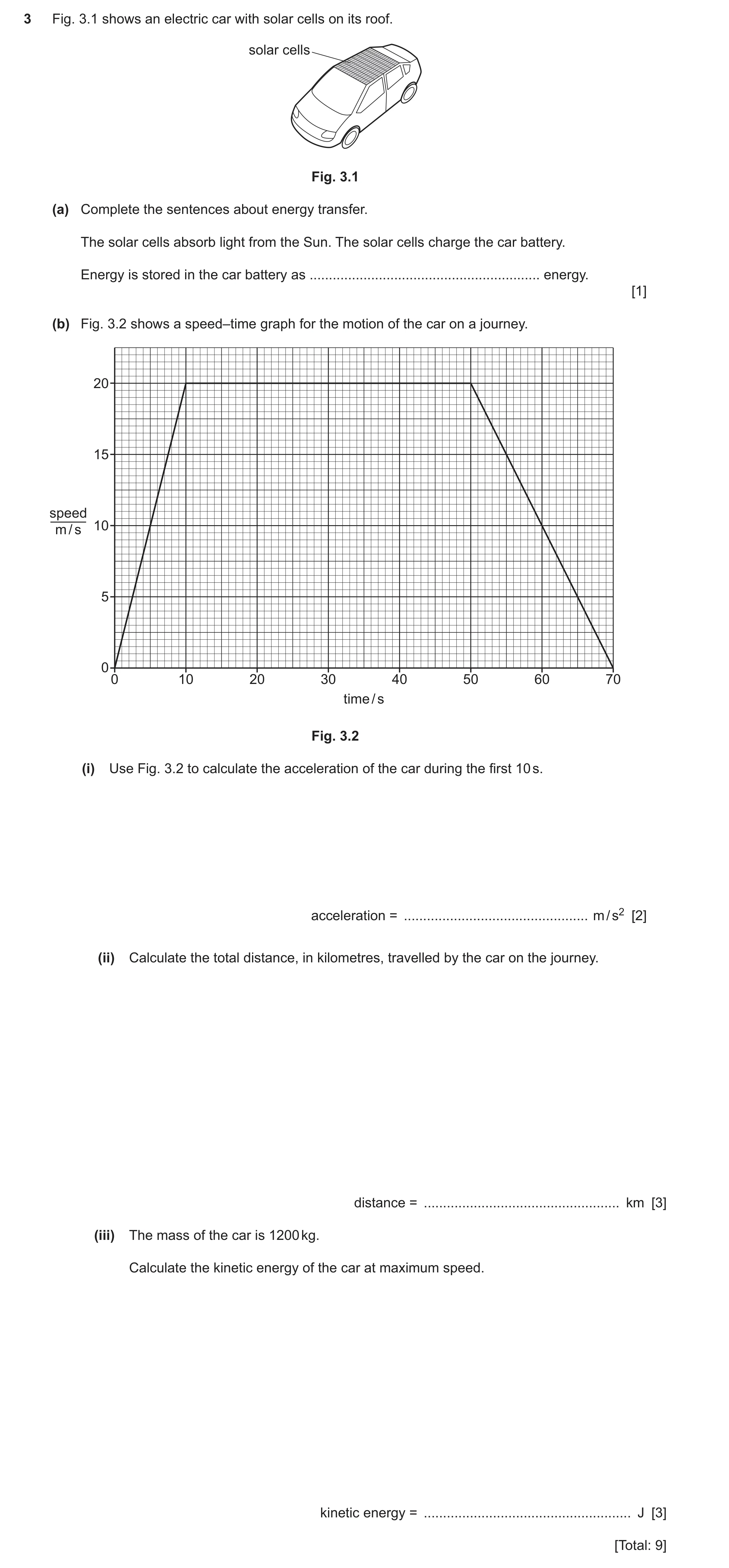
3 Fig. 3.1 shows an electric car with solar cells on its roof. solar cells Fig. 3.1 (a) Complete the sentences about energy transfer. The solar cells absorb light from the Sun. The solar cells charge the car battery. Energy is stored in the car battery as … energy. [1] (b) Fig. 3.2 shows a speed–time graph for the motion of the car on a journey. 20 15 speed 10 m / s 5 0 0 10 20 30 40 50 60 70 time / s Fig. 3.2 (i) Use Fig. 3.2 to calculate the acceleration of the car during the first 10 s. acceleration = … m / s2 [2] (ii) Calculate the total distance, in kilometres, travelled by the car on the journey. distance = … km [3] (iii) The mass of the car is 1200 kg. Calculate the kinetic energy of the car at maximum speed. kinetic energy = … J [3] [Total: 9]
9 marks
Mark scheme: 3(a) chemical (potential) ; 1 3(b)(i) acceleration = gradient of graph / 20 ÷ 10 / change in speed ÷ time ; 2 2 (m / s2) ; 3(b)(ii) (any relevant area) 100 / 800 / 200 ; 3 (all three relevant areas) 100 + 800 + 200 / 1100 ; (unit conversion) 1.1 km ; 3(b)(iii) recognition that maximum speed is 20 m / s ; 3 evidence of, KE = ½ m v2 / ½ 1200 202 ; 240 000 (J) ;
This question in 0653/42 Oct/Nov 2024
Q34 · An ox pulling a plough along horizontal ground 0653/43 Oct/Nov 2024
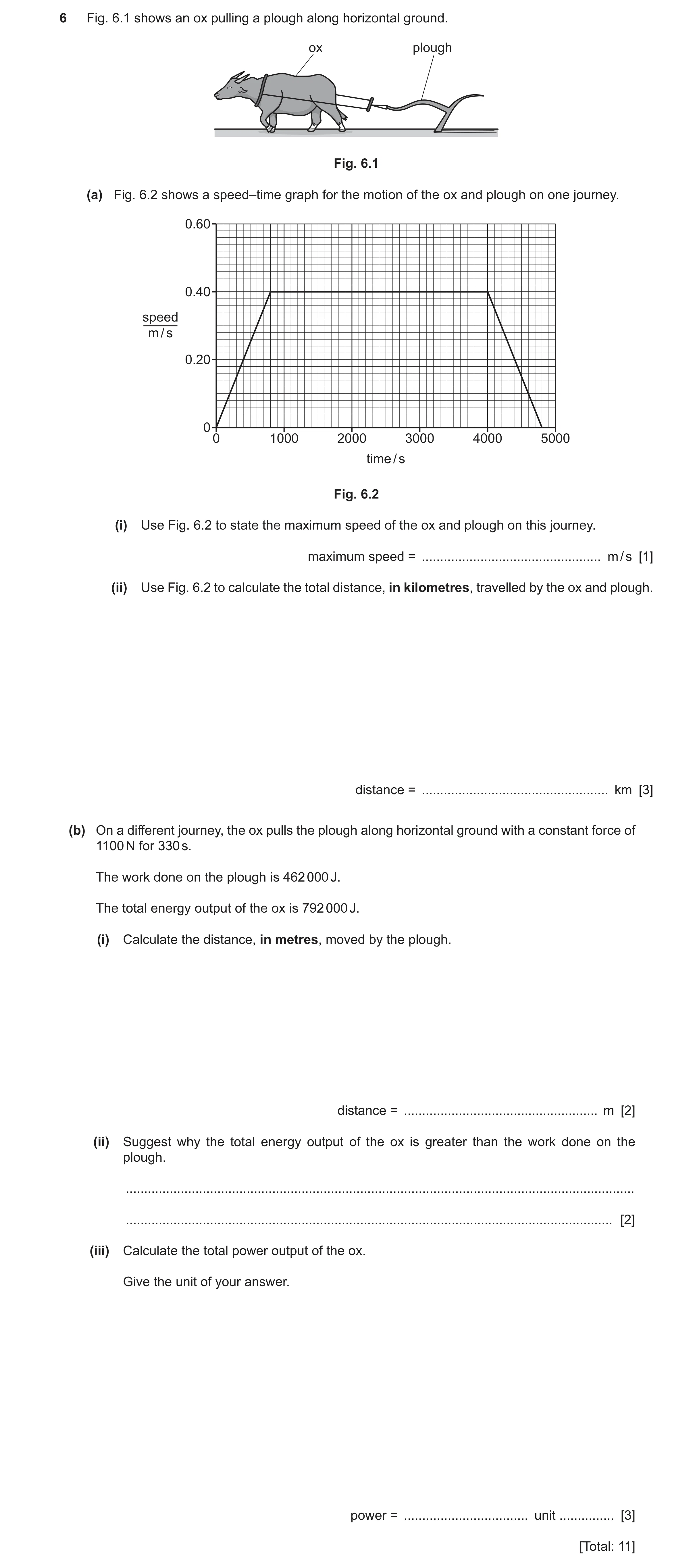
6 Fig. 6.1 shows an ox pulling a plough along horizontal ground. ox plough Fig. 6.1 (a) Fig. 6.2 shows a speed–time graph for the motion of the ox and plough on one journey. 0.60 0.40 speed m / s 0.20 0 0 1000 2000 3000 4000 5000 time / s Fig. 6.2 (i) Use Fig. 6.2 to state the maximum speed of the ox and plough on this journey. maximum speed = … m / s [1] (ii) Use Fig. 6.2 to calculate the total distance, in kilometres, travelled by the ox and plough. distance = … km [3] (b) On a different journey, the ox pulls the plough along horizontal ground with a constant force of 1100 N for 330 s. The work done on the plough is 462 000 J. The total energy output of the ox is 792 000 J. (i) Calculate the distance, in metres, moved by the plough. distance = … m [2] (ii) Suggest why the total energy output of the ox is greater than the work done on the plough. … … [2] (iii) Calculate the total power output of the ox. Give the unit of your answer. power = … unit … [3] [Total: 11]
11 marks
Mark scheme: 6(a)(i) 0.40 (m / s) ; 1 6(a)(ii) (calculation of any relevant area) 160 / 1280; 3 (all three relevant areas) 160 + 1280 + 160 / 1600 (m) ; 1.6 (km) ; 6(b)(i) evidence of, W = Fd / 462 000 ÷ 1100 ; 2 420 (m) ; 6(b)(ii) idea that some energy is also transferred to the surroundings ; 2 as, thermal / sound / AVP ; 6(b)(iii) evidence of, P = W ÷ t / 792 000 ÷ 330 ; 3 2400 ; W / watt(s) ;
This question in 0653/43 Oct/Nov 2024
Q35 · An electric motor is connected to a battery 0653/42 Feb/March 2025
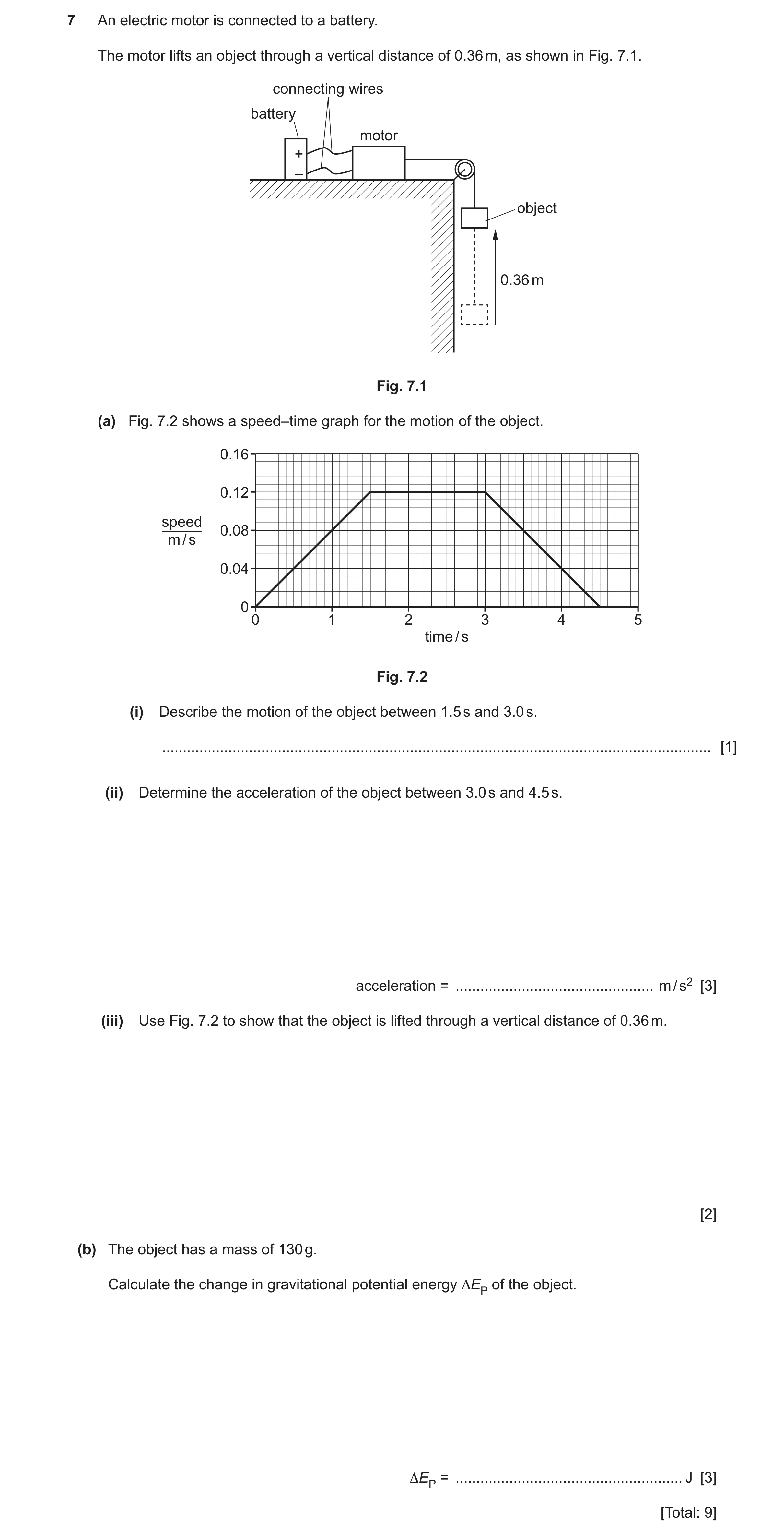
7 An electric motor is connected to a battery. The motor lifts an object through a vertical distance of 0.36 m, as shown in Fig. 7.1. connecting wires battery motor + – object 0.36 m Fig. 7.1 (a) Fig. 7.2 shows a speed–time graph for the motion of the object. 0.16 0.12 speed 0.08 m / s 0.04 0 0 1 2 3 4 5 time / s Fig. 7.2 (i) Describe the motion of the object between 1.5 s and 3.0 s. … [1] (ii) Determine the acceleration of the object between 3.0 s and 4.5 s. acceleration = … m / s2 [3] (iii) Use Fig. 7.2 to show that the object is lifted through a vertical distance of 0.36 m. [2] (b) The object has a mass of 130 g. Calculate the change in gravitational potential energy ΔEP of the object. ΔEP = … J [3] [Total: 9]
9 marks
Mark scheme: 7(a)(i) (moving with) constant speed ; 1 7(a)(ii) a = v ÷ t / 0.12 ÷ 1.5 ; 3 0.080 (m / s2) ; negative sign ; 7(a)(iii) use of area under the graph ; 2 correct calculation shown, (½ 0.12 1.5) + (0.12 1.5) + (½ 0.12 1.5) (= 0.36) / or equivalent ; 7(b) unit conversion of g to kg / 0.13 seen ; 3 ΔEP = mgh / 0.13 9.8 0.36 ; = 0.46 (J) ;
This question in 0653/42 Feb/March 2025
Q36 · A helicopter hovering above the ground 0653/42 Feb/March 2025
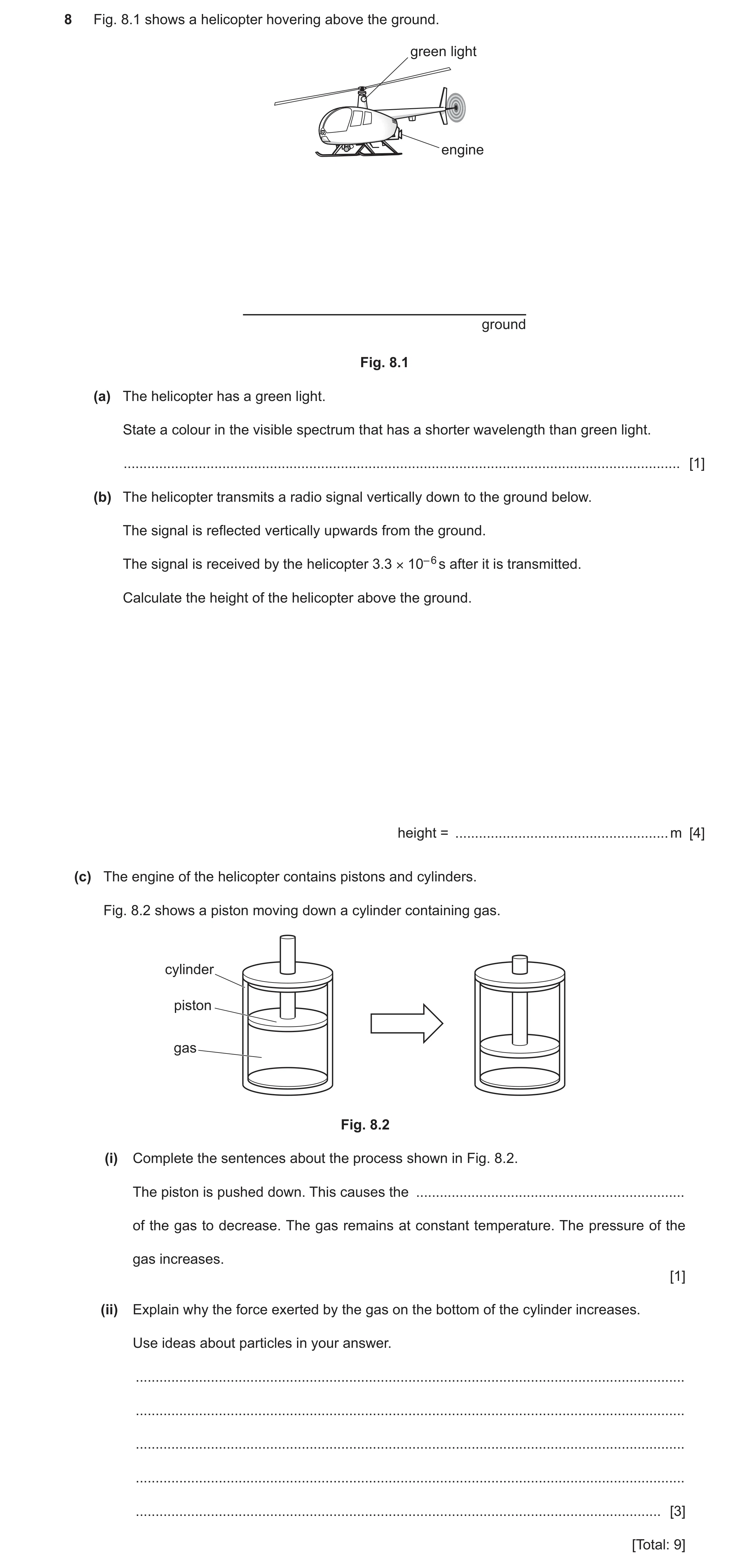
8 Fig. 8.1 shows a helicopter hovering above the ground. green light engine ground Fig. 8.1 (a) The helicopter has a green light. State a colour in the visible spectrum that has a shorter wavelength than green light. … [1] (b) The helicopter transmits a radio signal vertically down to the ground below. The signal is reflected vertically upwards from the ground. The signal is received by the helicopter 3.3 × 10– 6 s after it is transmitted. Calculate the height of the helicopter above the ground. height = … m [4] (c) The engine of the helicopter contains pistons and cylinders. Fig. 8.2 shows a piston moving down a cylinder containing gas. cylinder piston gas Fig. 8.2 (i) Complete the sentences about the process shown in Fig. 8.2. The piston is pushed down. This causes the … of the gas to decrease. The gas remains at constant temperature. The pressure of the gas increases. [1] (ii) Explain why the force exerted by the gas on the bottom of the cylinder increases. Use ideas about particles in your answer. … … … … … [3] [Total: 9]
9 marks
Mark scheme: 8(a) blue / indigo / violet ; 1 8(b) speed of radio waves stated as 3.0 108 m / s ; 4 recognition that radio signal travels down and back (i.e. divide time or distance by 2) ; v = s ÷ t / 3.0 108 1.65 10–6 ; 495 (m) ; 8(c)(i) volume ; 1 8(c)(ii) three from: 3 mp1 idea that force = P A / higher pressure causes higher force (on bottom) ; mp2 reference to force / pressure, created by collisions between particles and wall ; mp3 (when piston moves / volume decreases) the number of wall particle collisions increases / frequency of wall particle collisions increases ; mp4 (if mp3 is awarded) (reason for more collisions / higher collision rate) the idea that particle concentration increases / idea of more particles in smaller volume / particles are closer together ;
This question in 0653/42 Feb/March 2025
Question 37 0653/41 May/June 2025
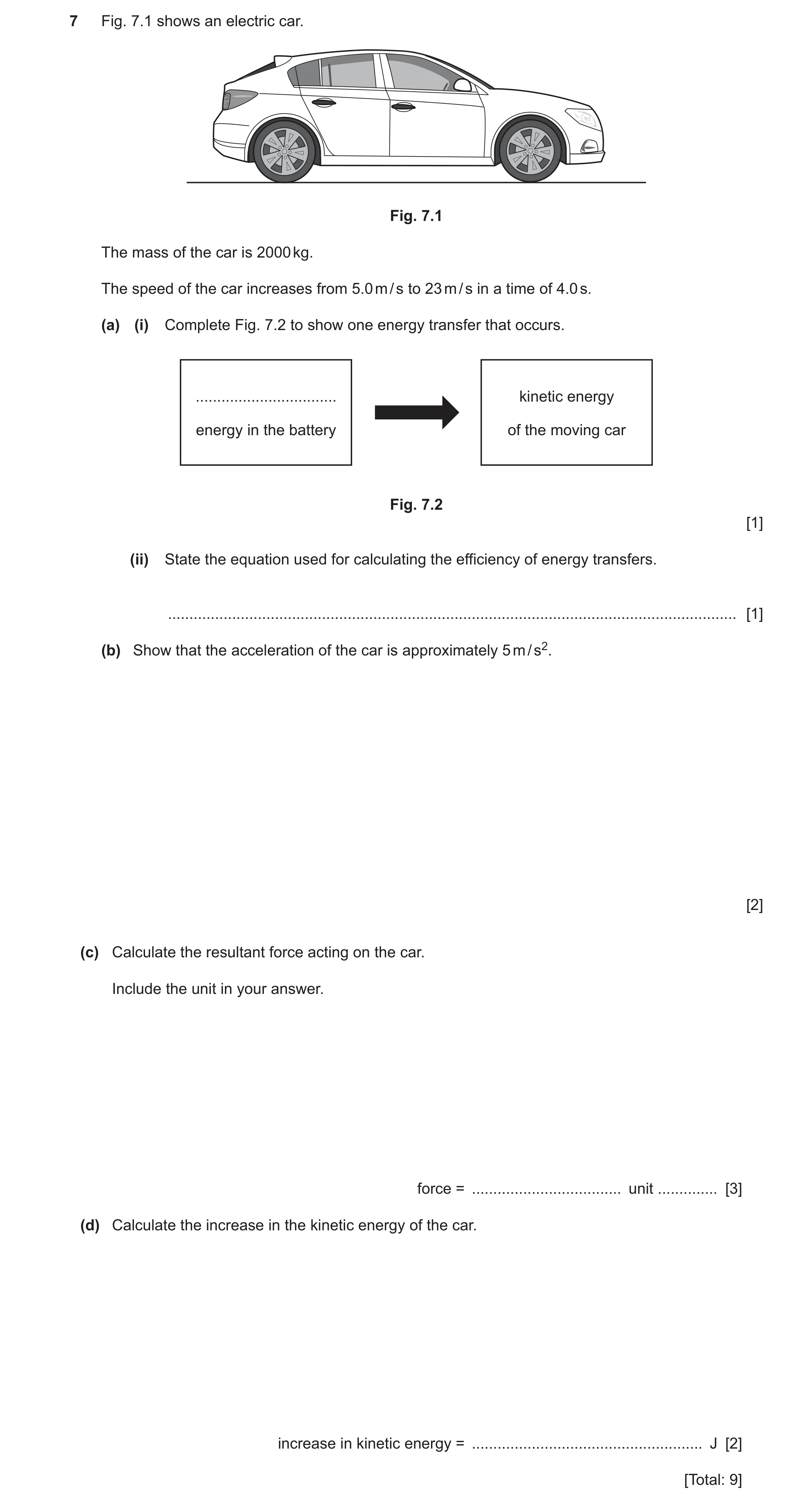
7 Fig. 7.1 shows an electric car. Fig. 7.1 The mass of the car is 2000 kg. The speed of the car increases from 5.0 m / s to 23 m / s in a time of 4.0 s. (a) (i) Complete Fig. 7.2 to show one energy transfer that occurs. … kinetic energy energy in the battery of the moving car Fig. 7.2 [1] (ii) State the equation used for calculating the efficiency of energy transfers. … [1] (b) Show that the acceleration of the car is approximately 5 m / s2. [2] (c) Calculate the resultant force acting on the car. Include the unit in your answer. force = … unit … [3] (d) Calculate the increase in the kinetic energy of the car. increase in kinetic energy = … J [2] [Total: 9]
9 marks
Mark scheme: 7(a)(i) chemical ; 1 7(a)(ii) useful (energy) output 1 efficiency =) ( 100%) total (energy) input ; 7(b) a = v ÷ t / 18 ÷ 4.0 ; 2 4.5 (= ~5 m / s2)_; 7(c) F = ma / 2000 4.5 ; 3 9000 ; N ; 7(d) EK = ½ mv2 / ½ 2000 (232 – 5.02) / 529 000 or 25 000 (evidence of use of formula) ; 2 504 000 (J) ;
This question in 0653/41 May/June 2025
Q38 · A student rides a bicycle along a straight, level road 0653/41 Oct/Nov 2025
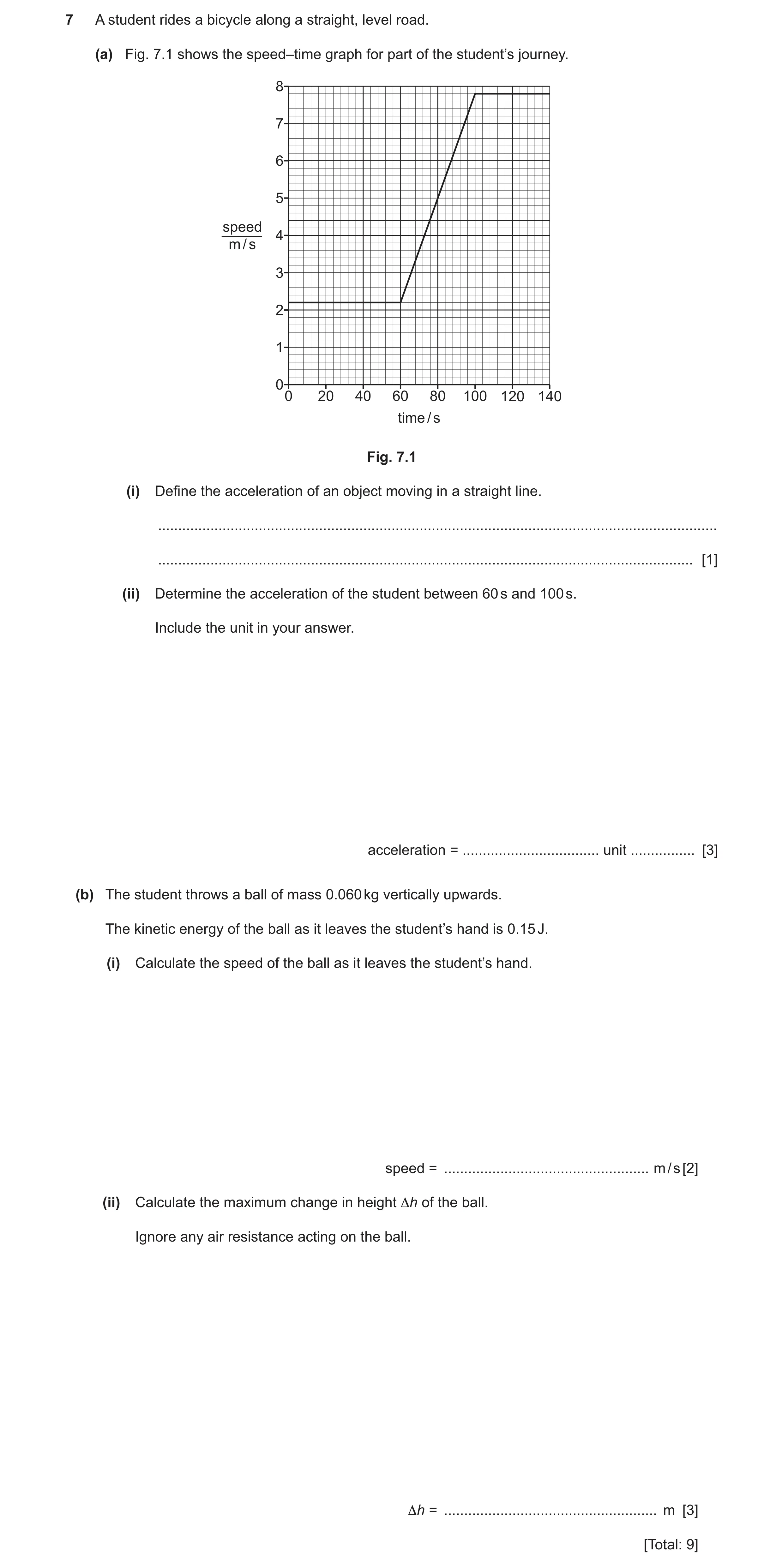
7 A student rides a bicycle along a straight, level road. (a) Fig. 7.1 shows the speed–time graph for part of the student’s journey. 8 7 6 5 speed 4 m / s 3 2 1 0 0 20 40 60 80 100 120 140 time / s Fig. 7.1 (i) Define the acceleration of an object moving in a straight line. … … [1] (ii) Determine the acceleration of the student between 60 s and 100 s. Include the unit in your answer. acceleration = … unit … [3] (b) The student throws a ball of mass 0.060 kg vertically upwards. The kinetic energy of the ball as it leaves the student’s hand is 0.15 J. (i) Calculate the speed of the ball as it leaves the student’s hand. speed = … m / s [2] (ii) Calculate the maximum change in height Δh of the ball. Ignore any air resistance acting on the ball. Δh = … m [3] [Total: 9]
9 marks
Mark scheme: 7(a)(i) change in speed per unit time; 1 7(a)(ii) v 3 (acceleration =) ;t 7.8 − 2.2 OR (a =) ; 40 5.6 OR (a =) ; 40 0.14 ; m / s2 ; 7(b)(i) (KE =) ½ m v2 2 OR 0.15 = ½ 0.060 x v2 2 0.15 OR v = ; 0.060 2.2 (m / s) ; 7(b)(ii) M1 KE = GPE 3 OR GPE = 0.15 (J) ; M2 (GPE =) mgh But if M1 and M2 combined is seen give two marks 0.15 = 0.060 9.8 h OR 0.15 h = ;; 0.060 9.8 0.26 (m) ;
This question in 0653/41 Oct/Nov 2025
 26 / 67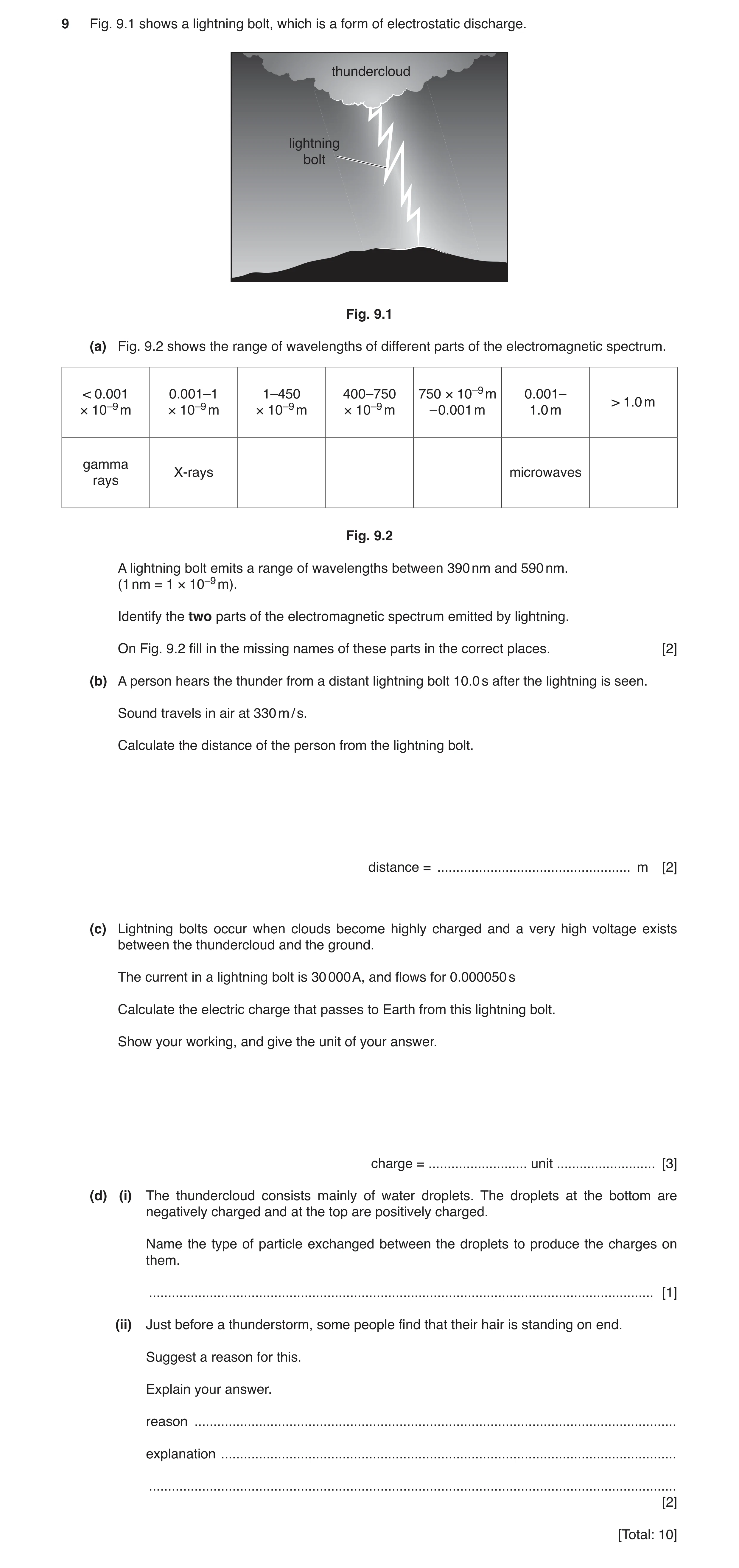
 51 / 67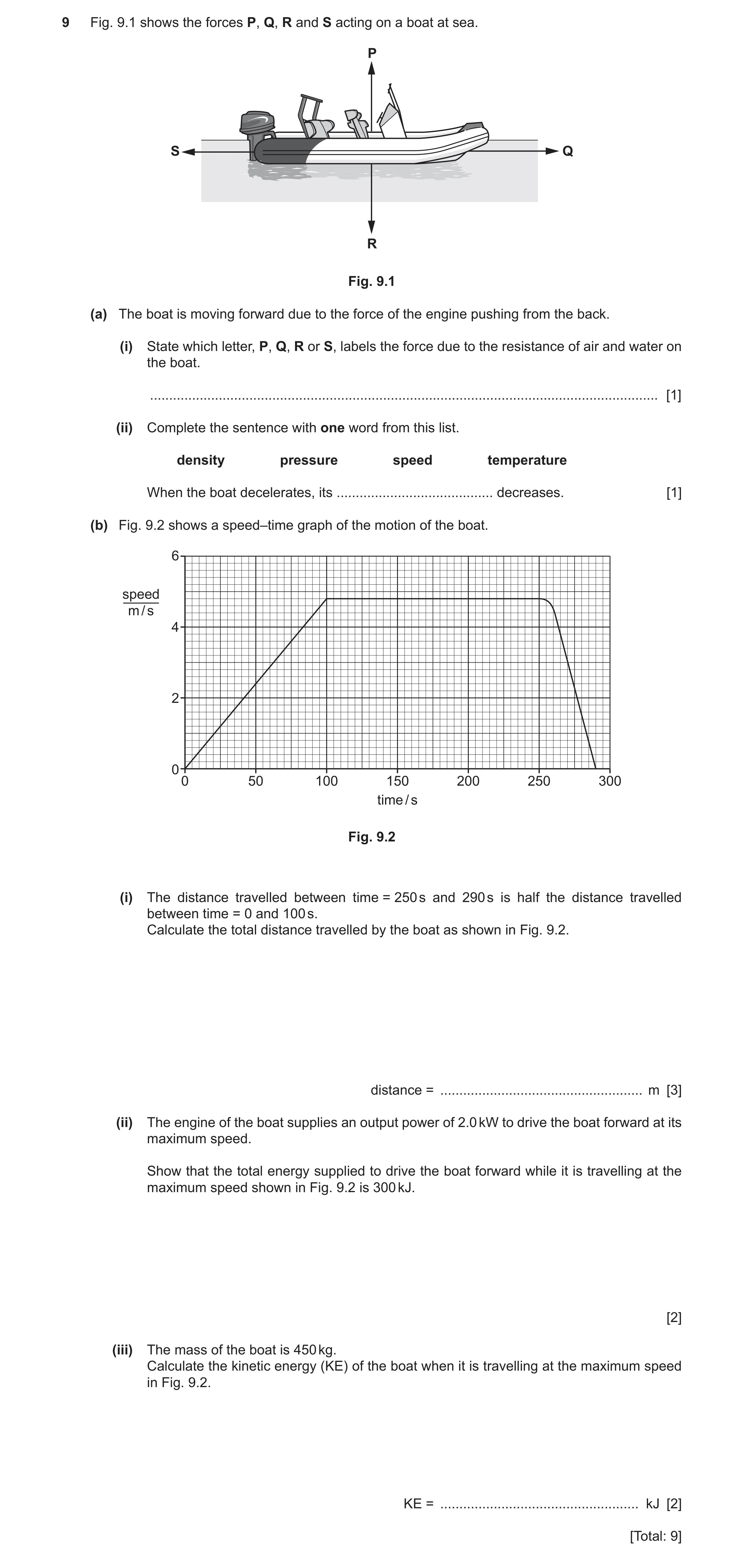
 56 / 67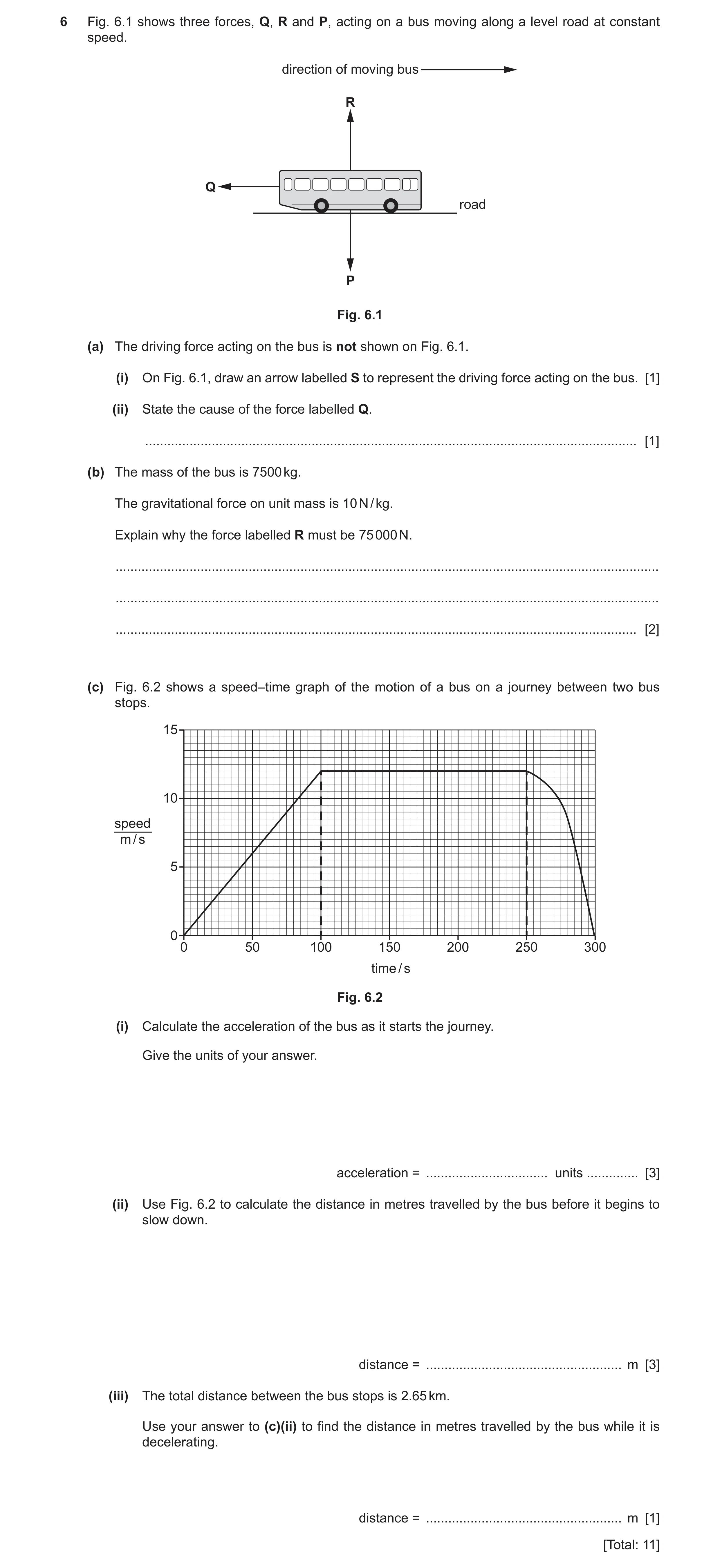
 10
10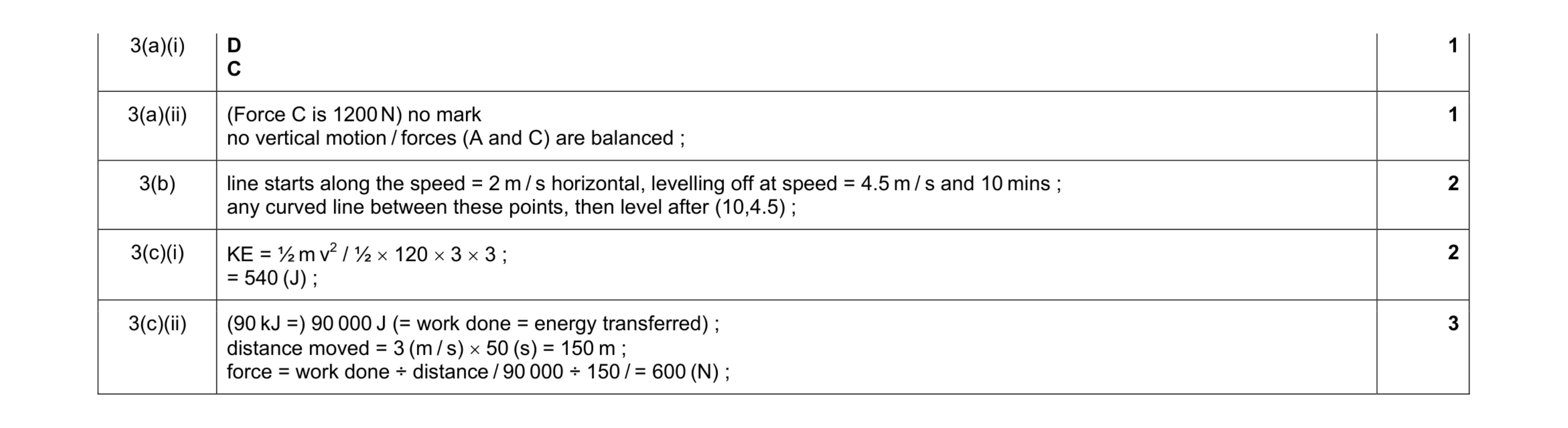 9
9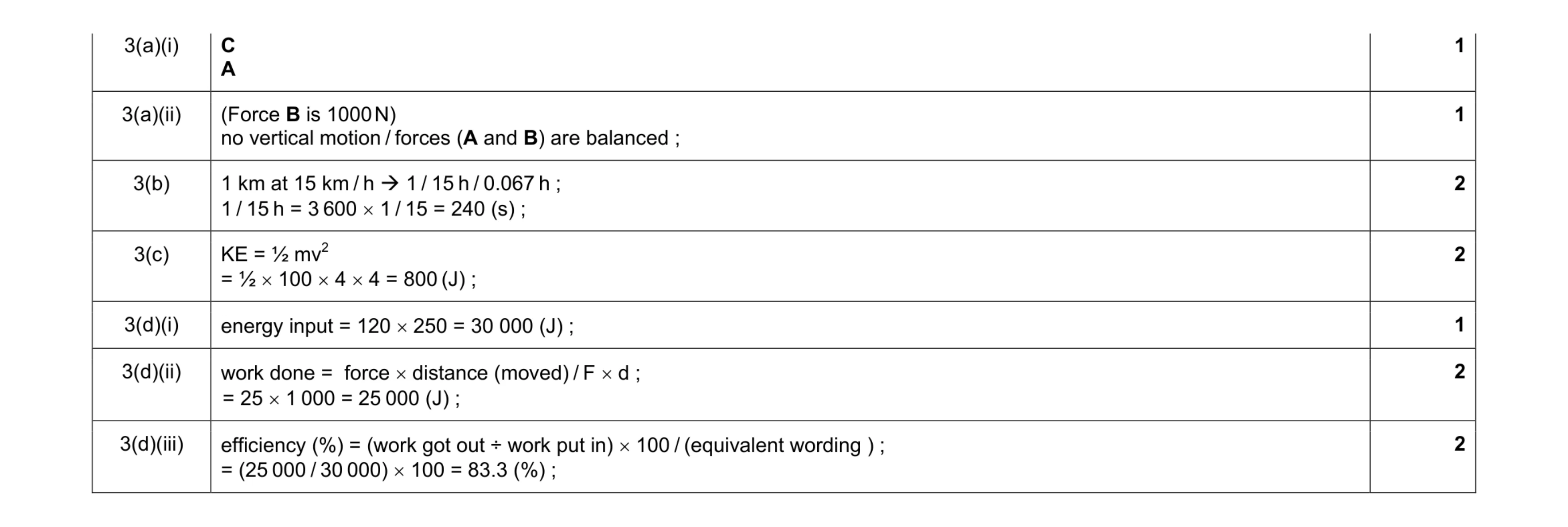 11
11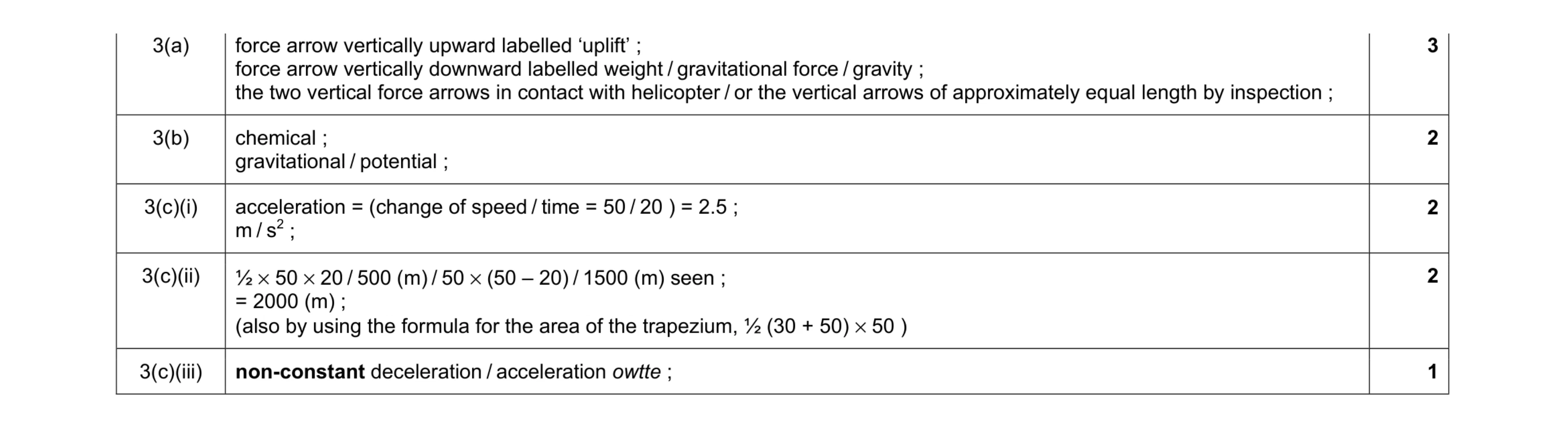 10
10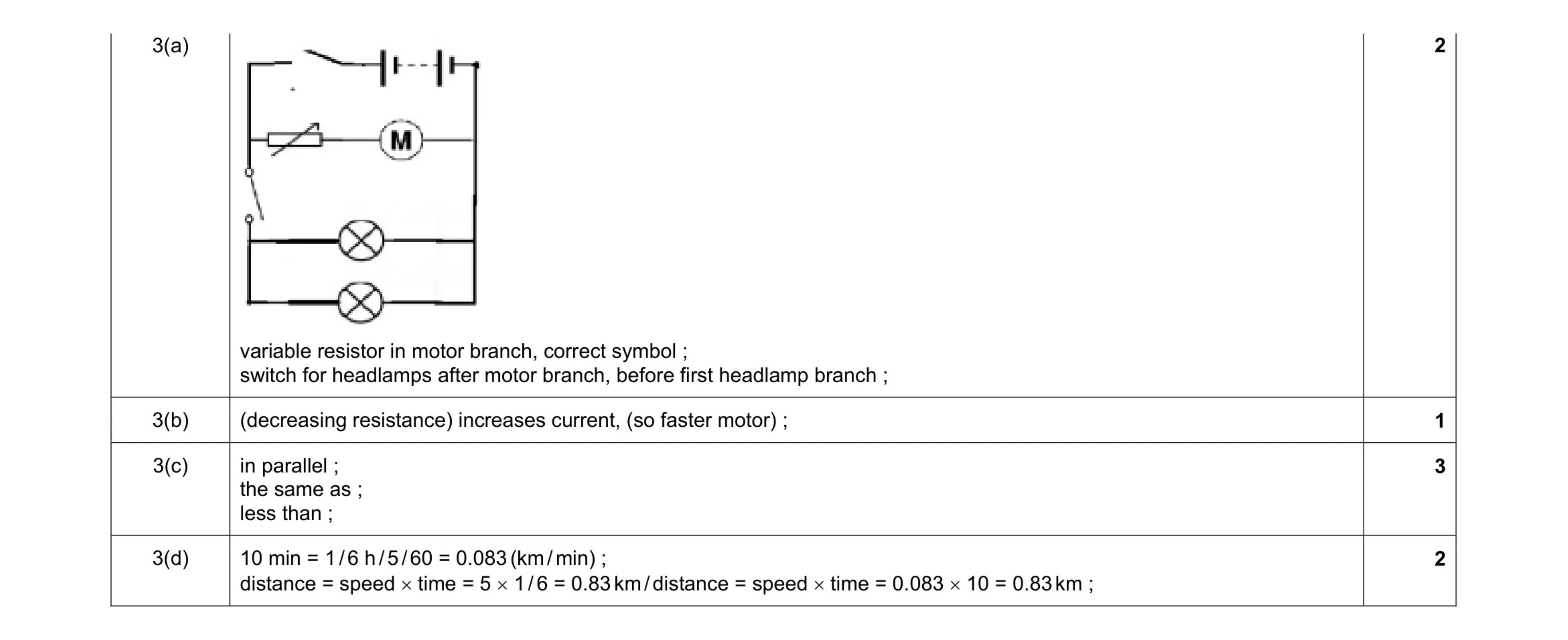 8
8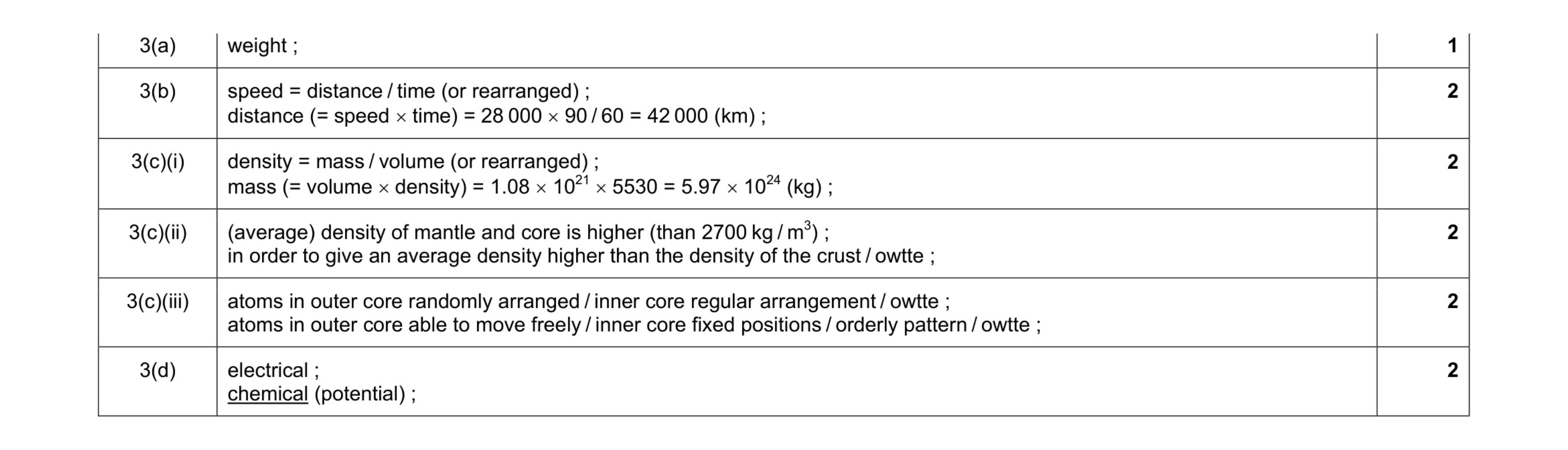 11
11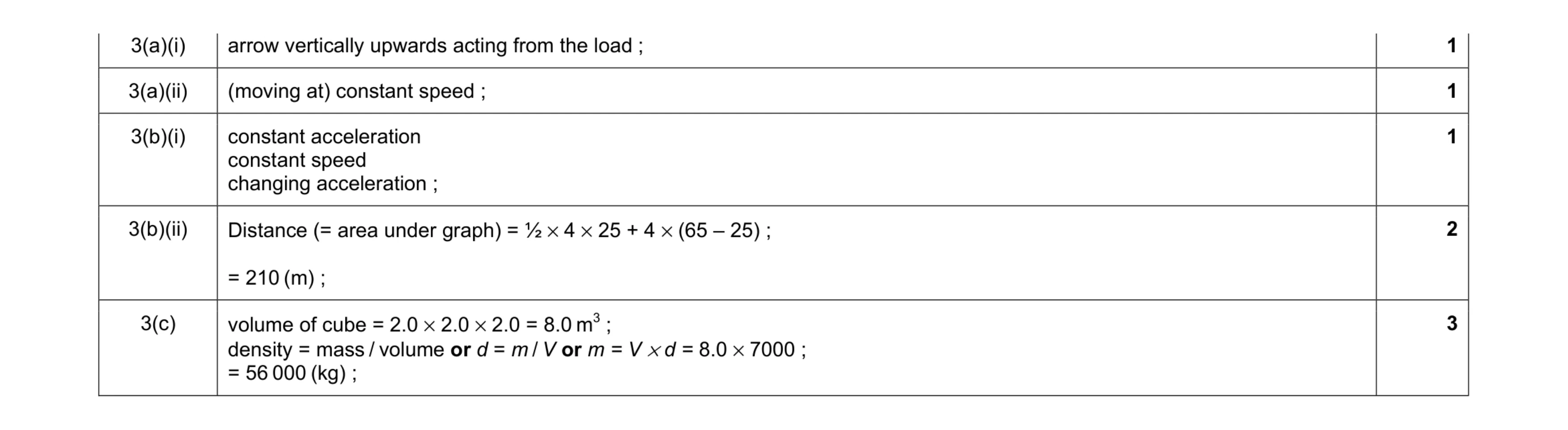 8
8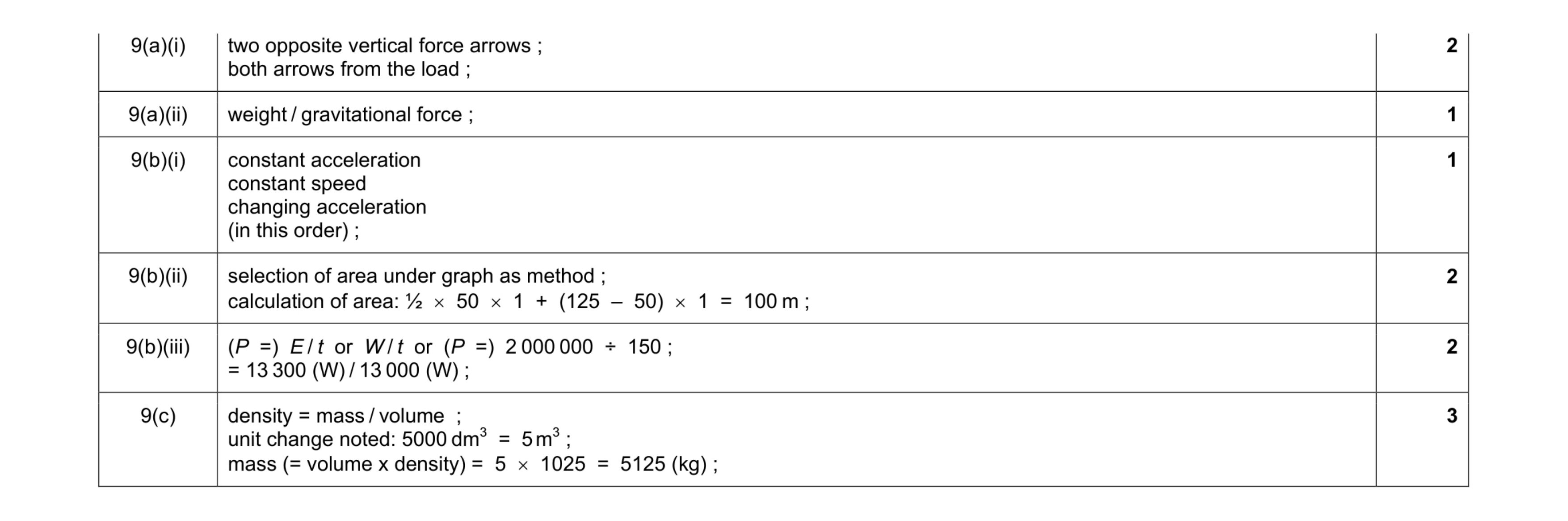 11
11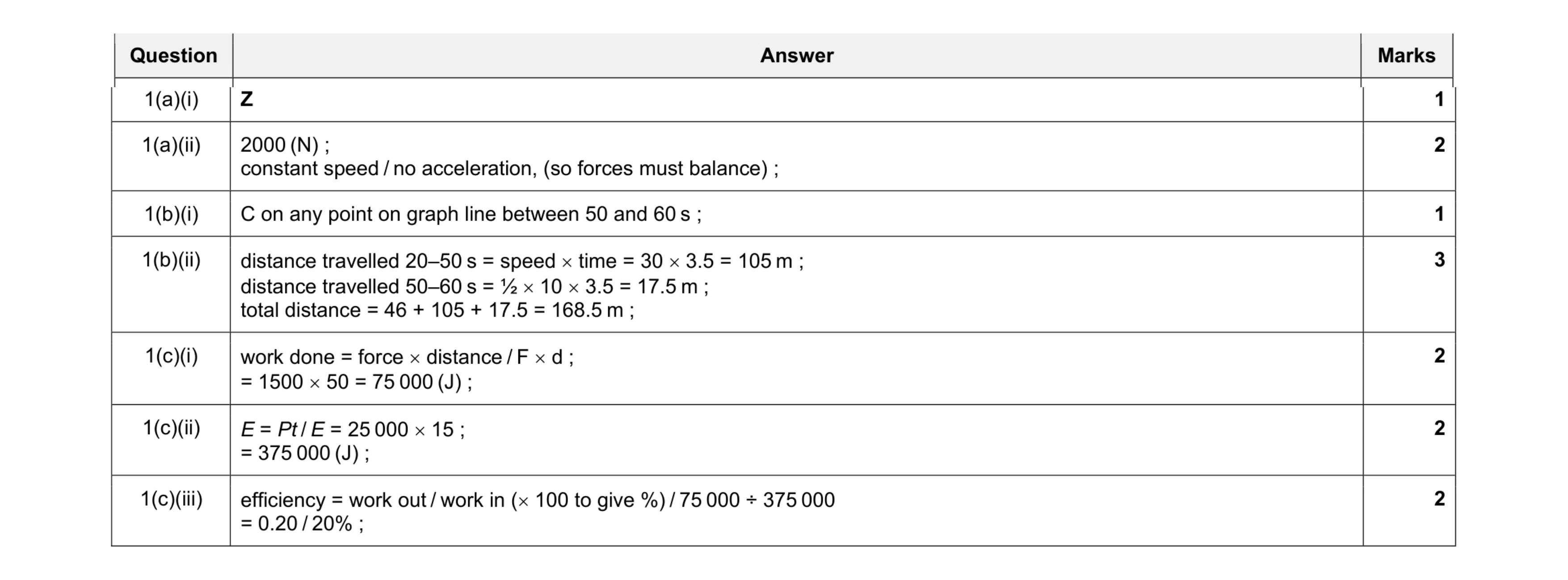 13
13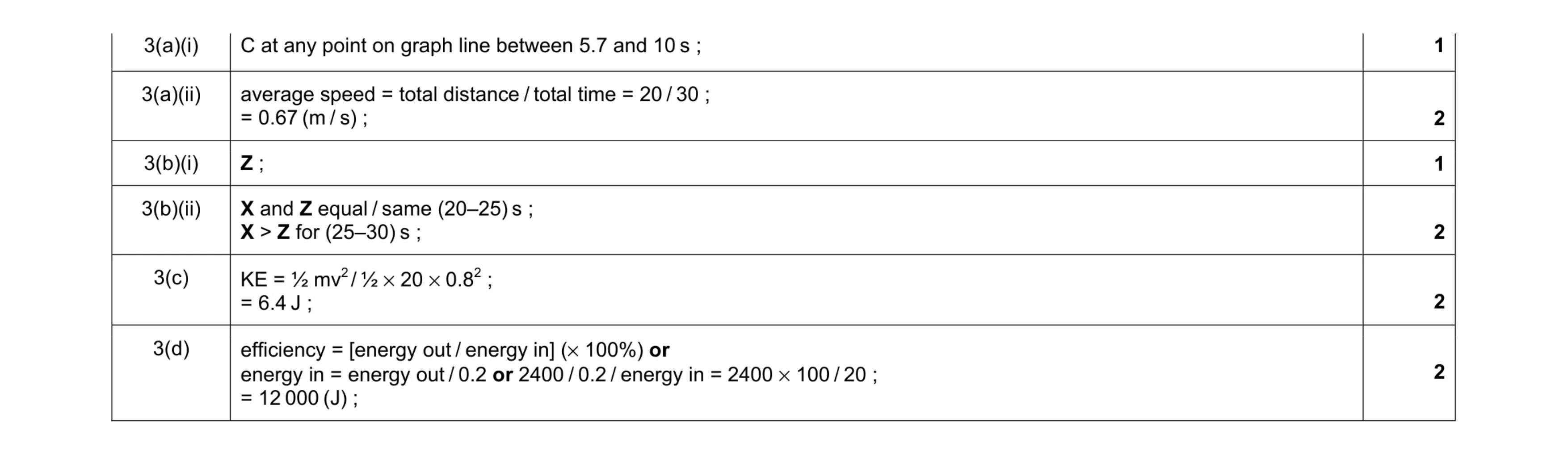 10
10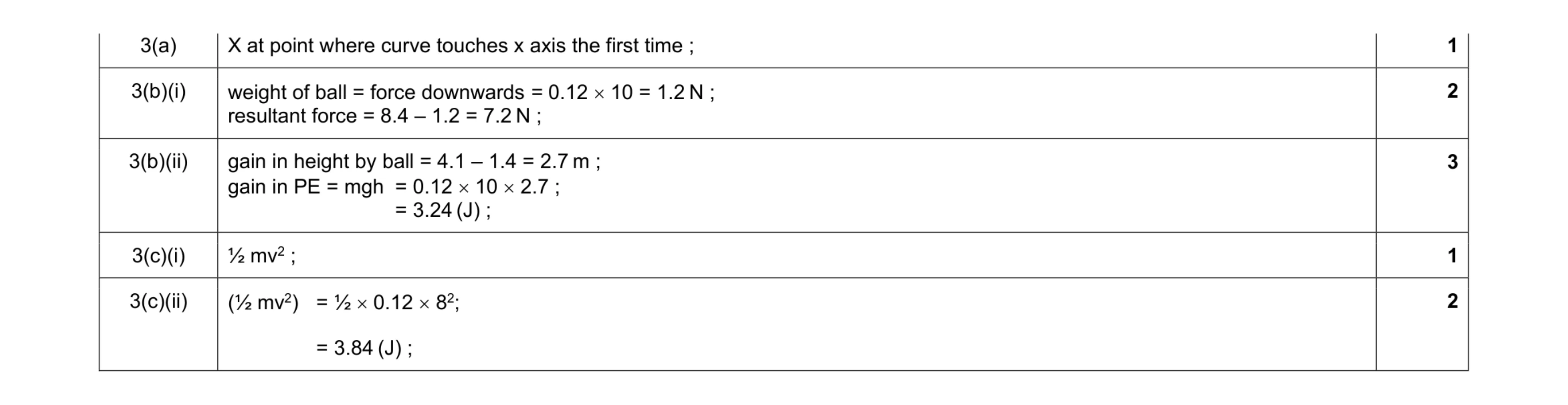 9
9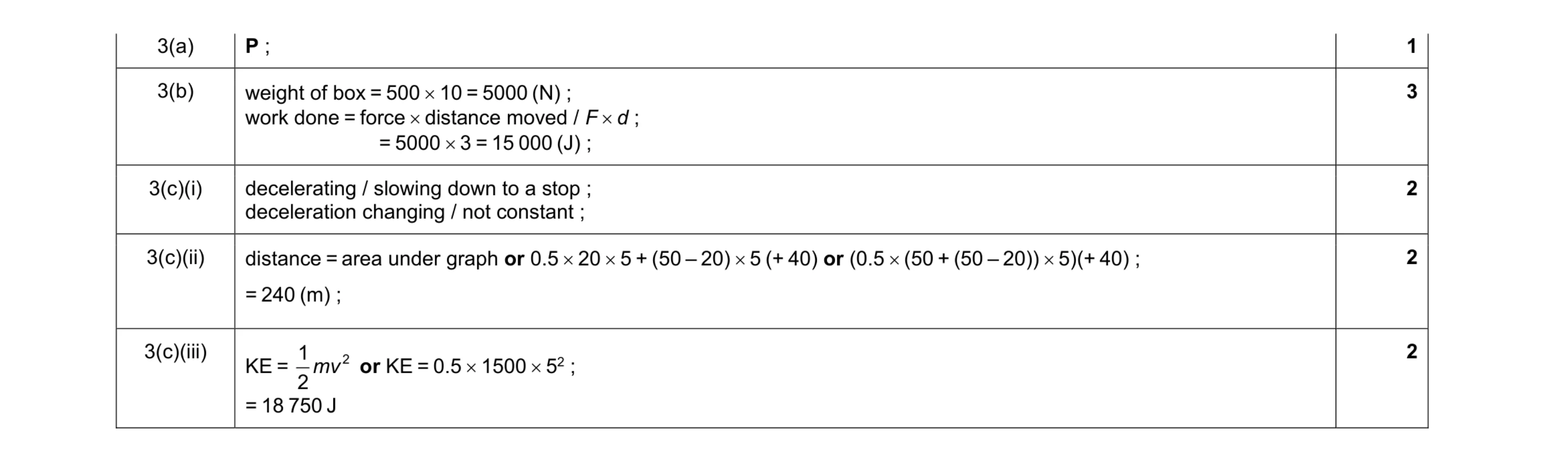 10
10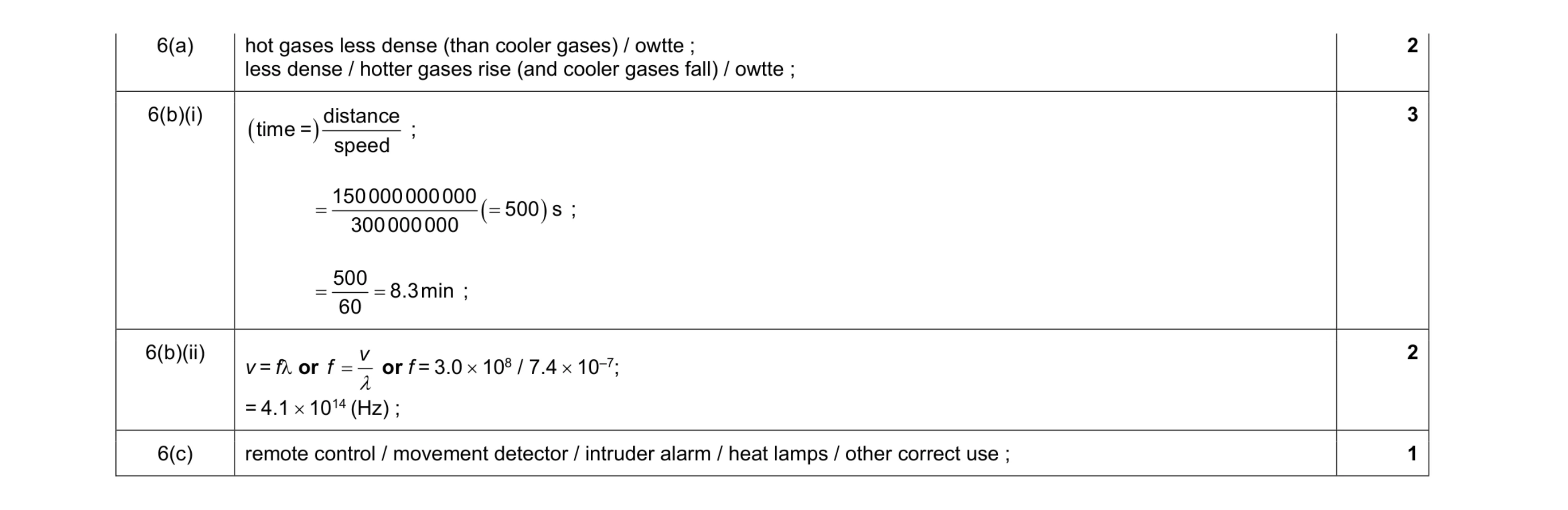 8
8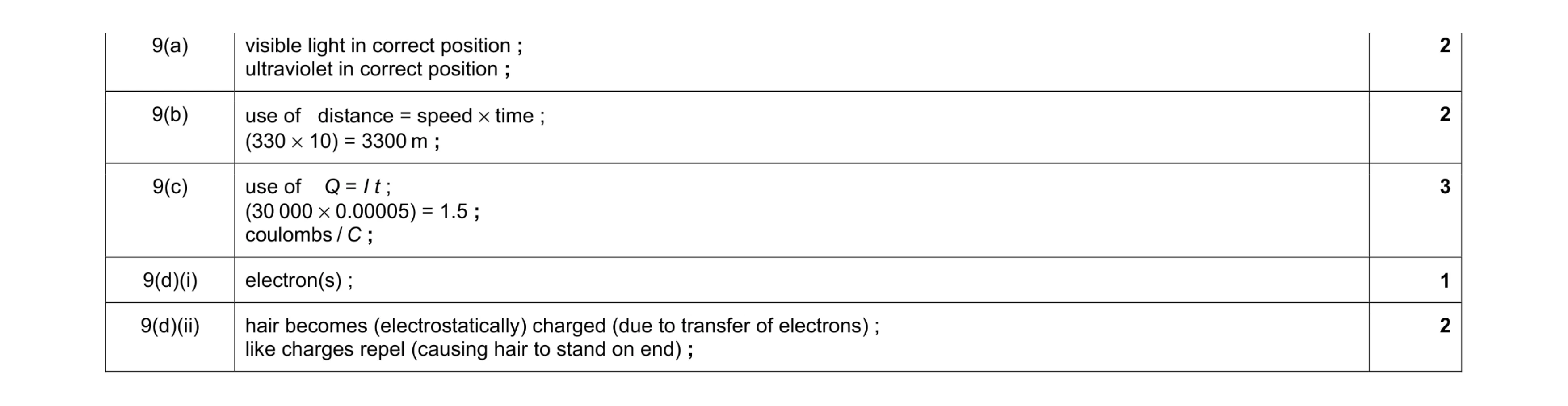 10
10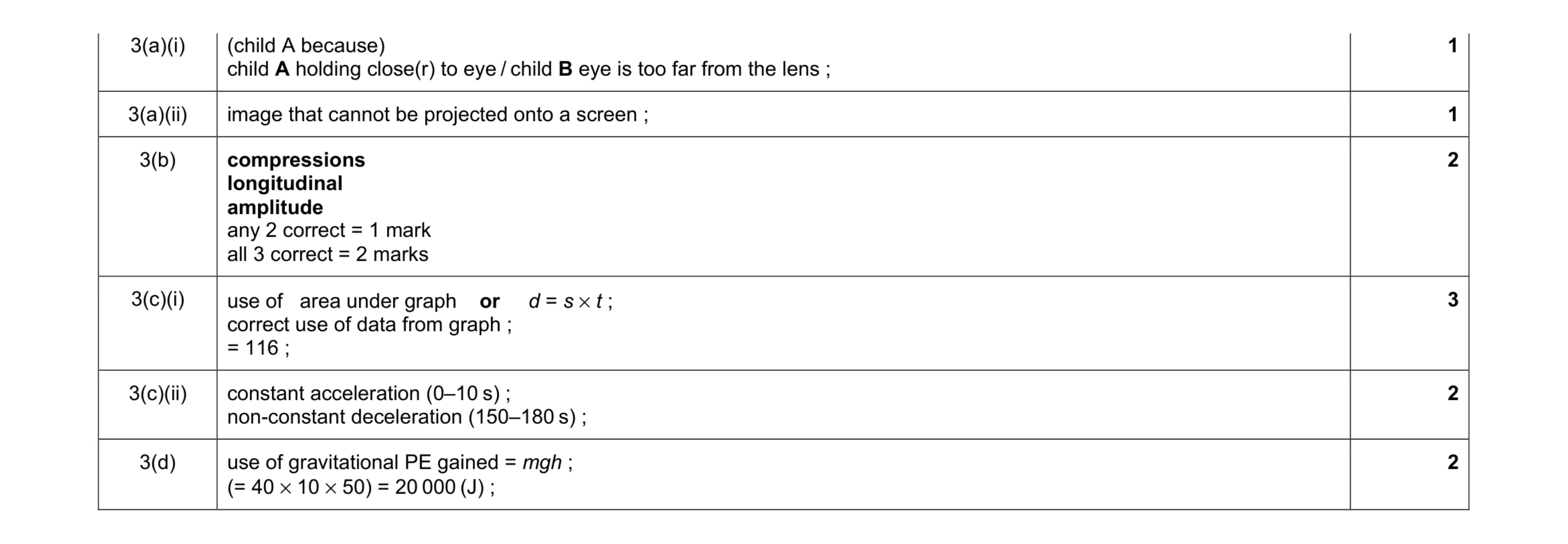 11
11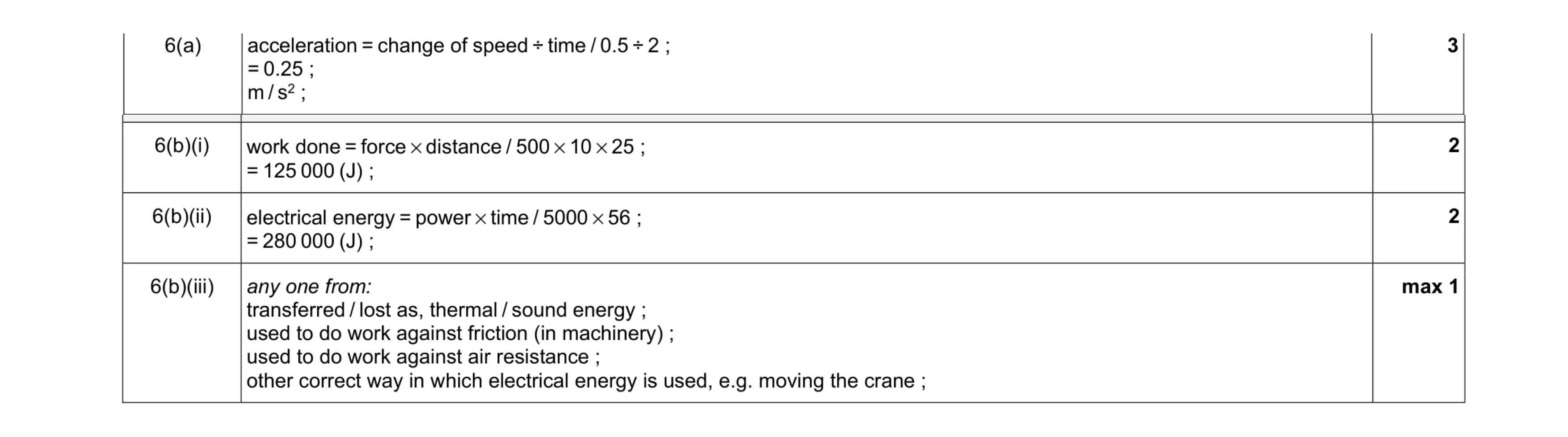 8
8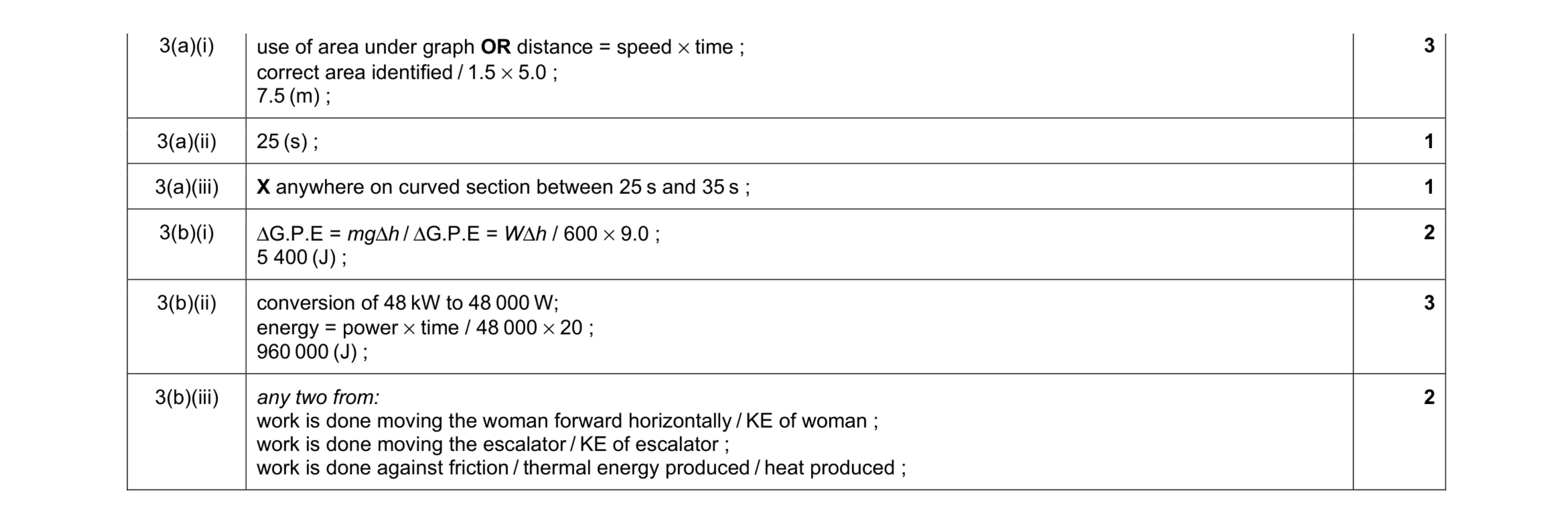 12
12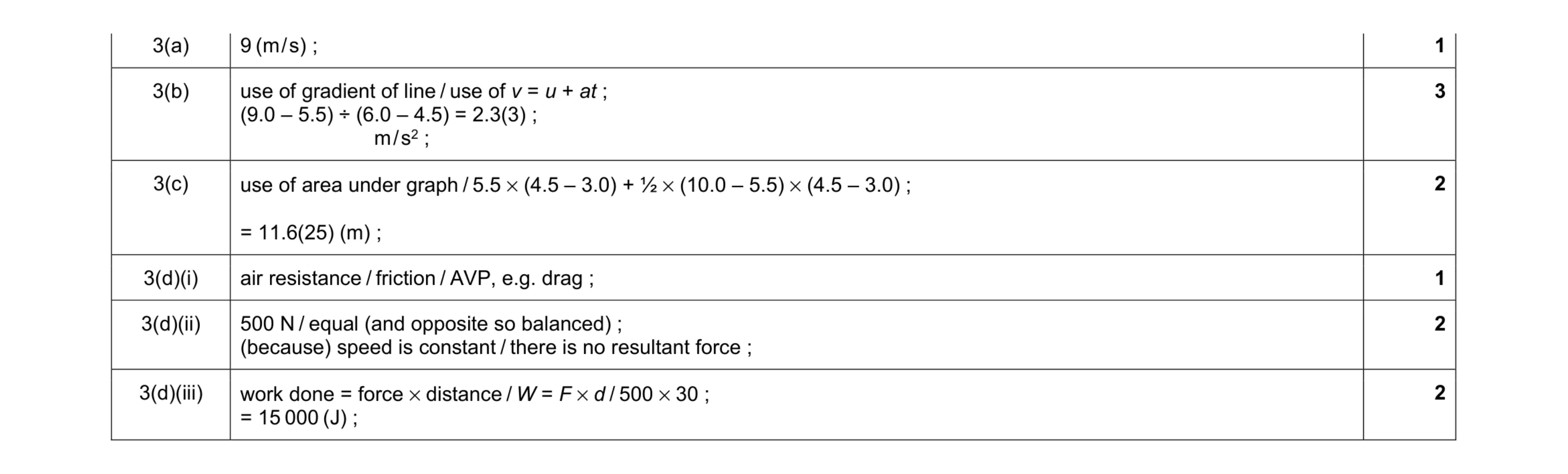 11
11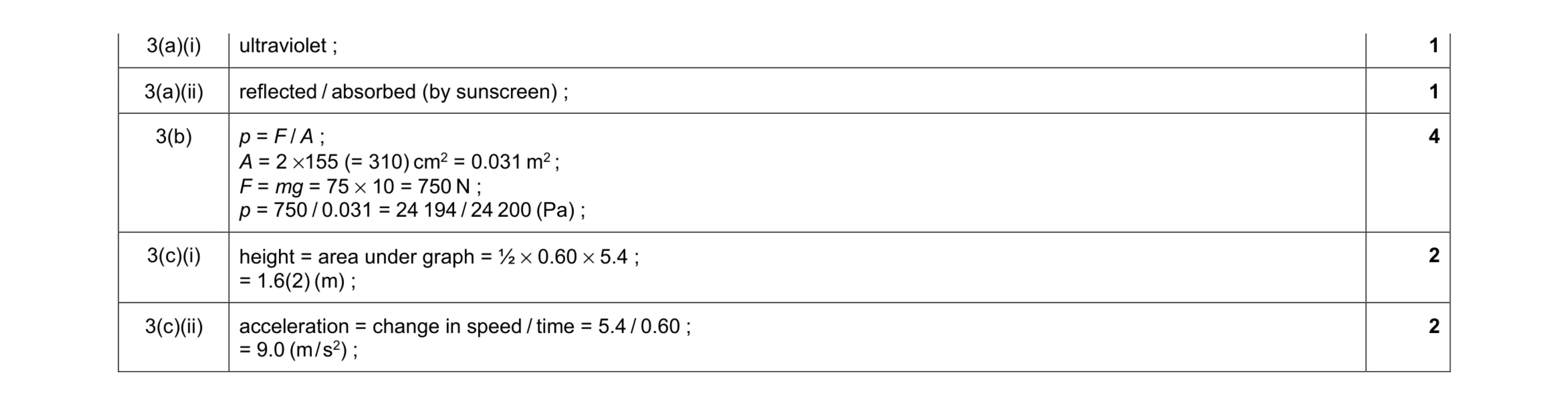 10
10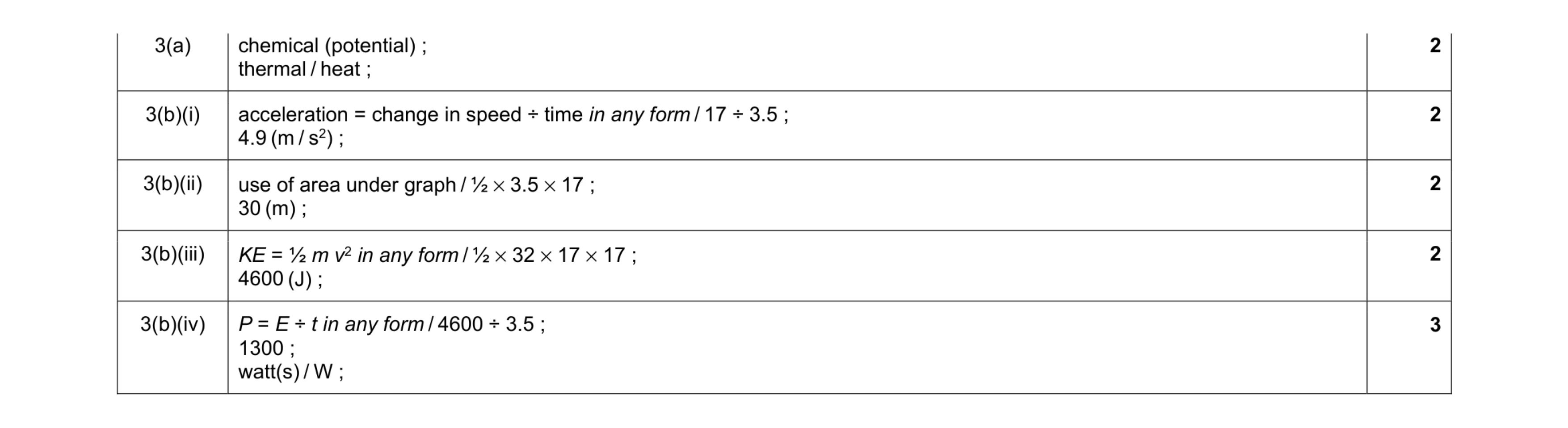 11
11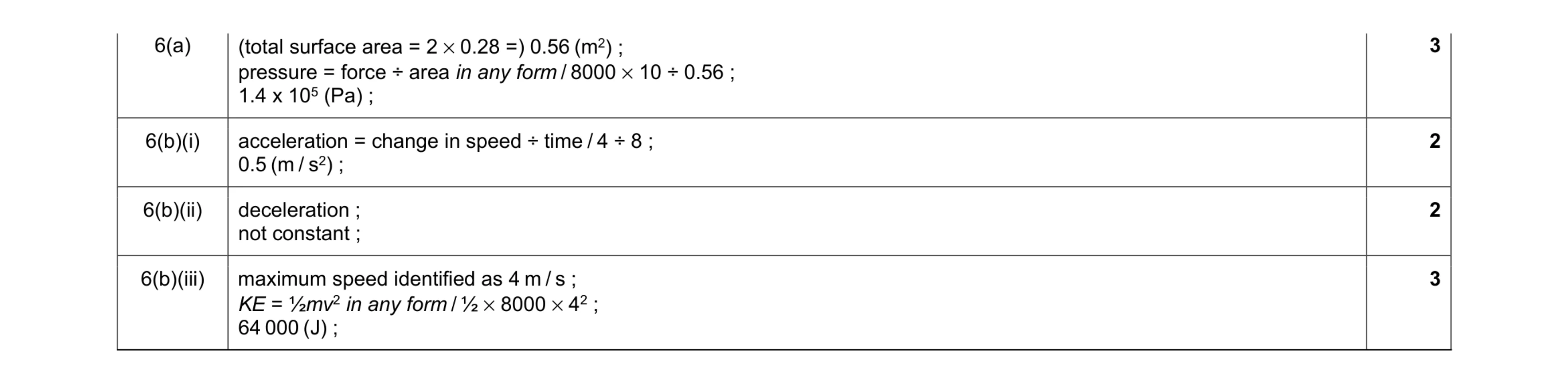 10
10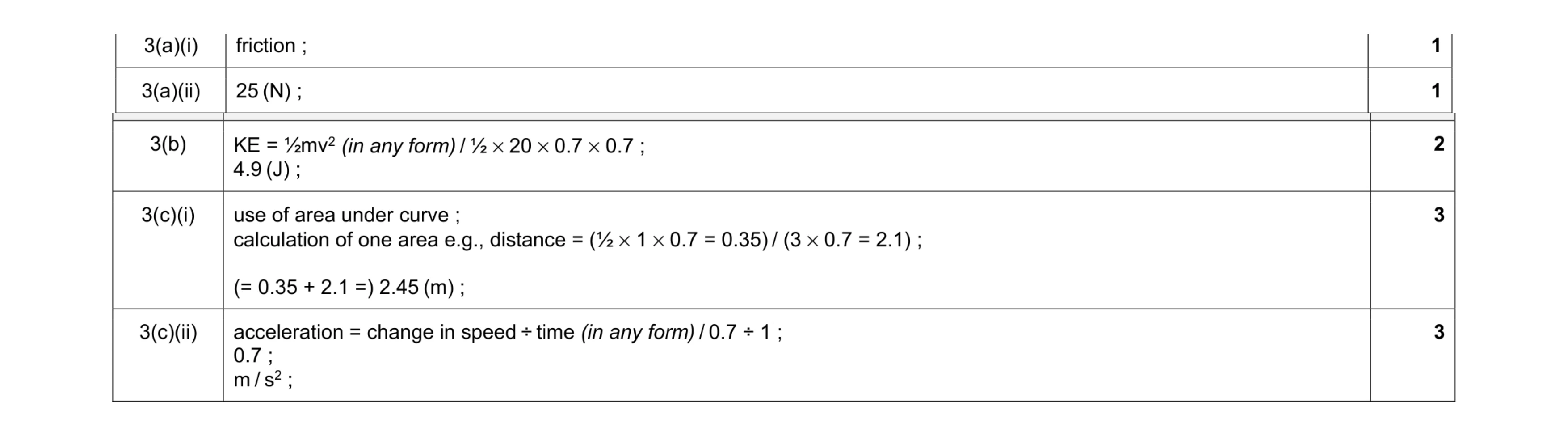 10
10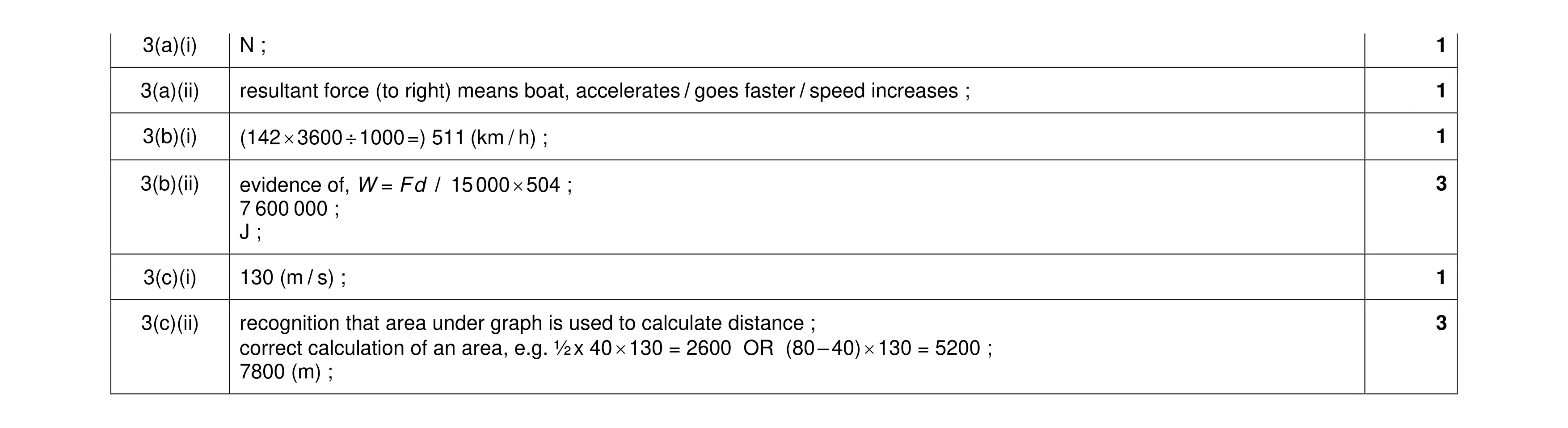 10
10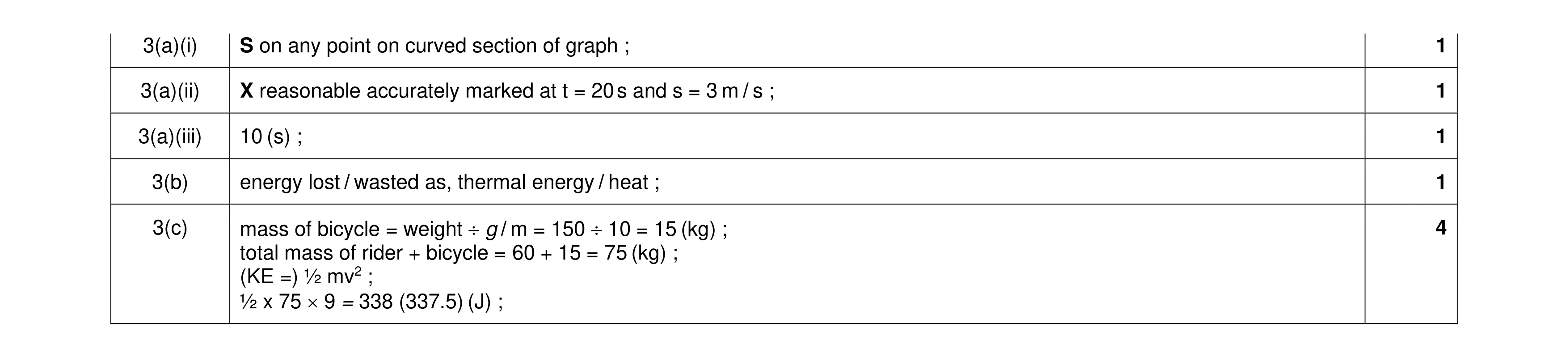 8
8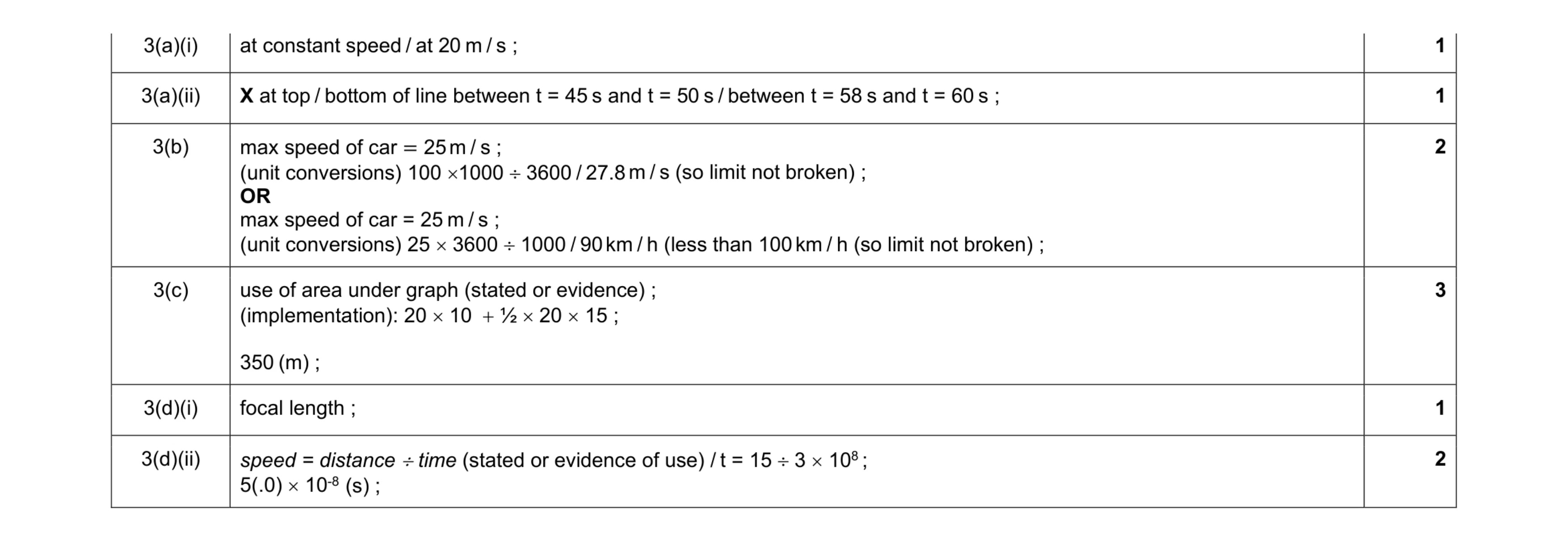 10
10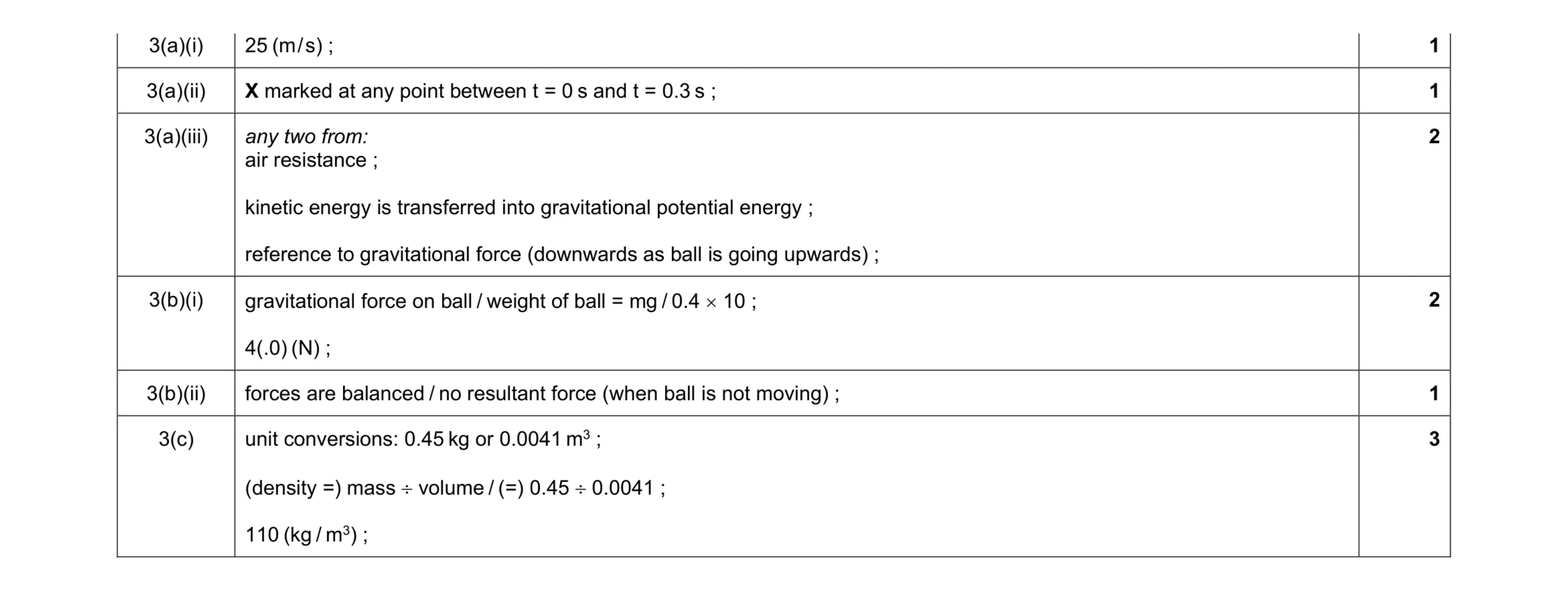 10
10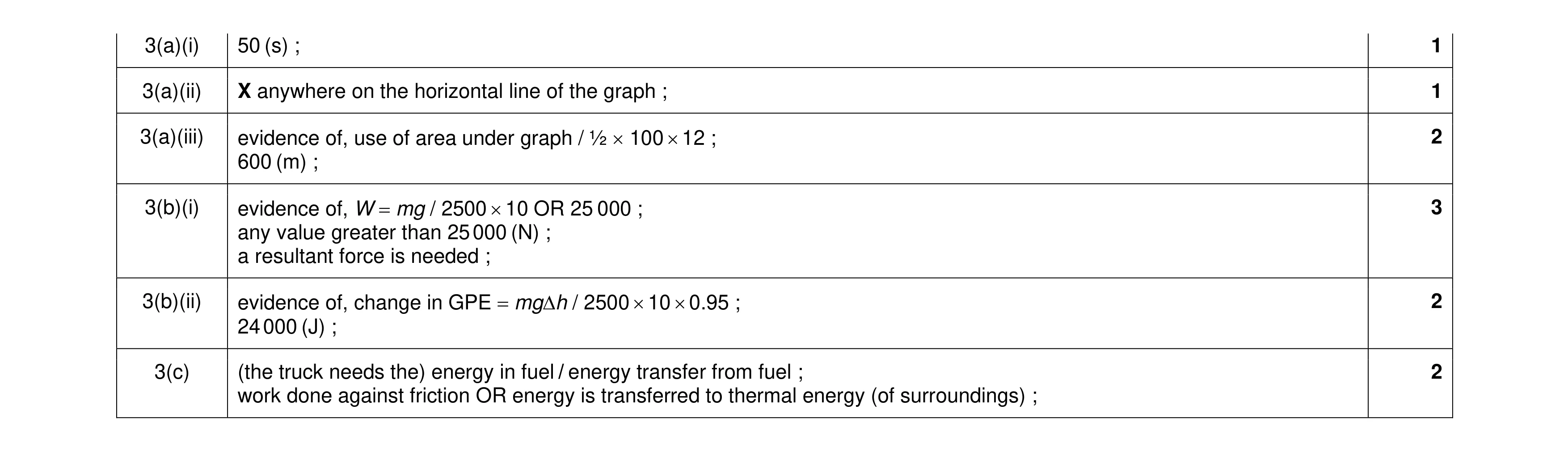 11
11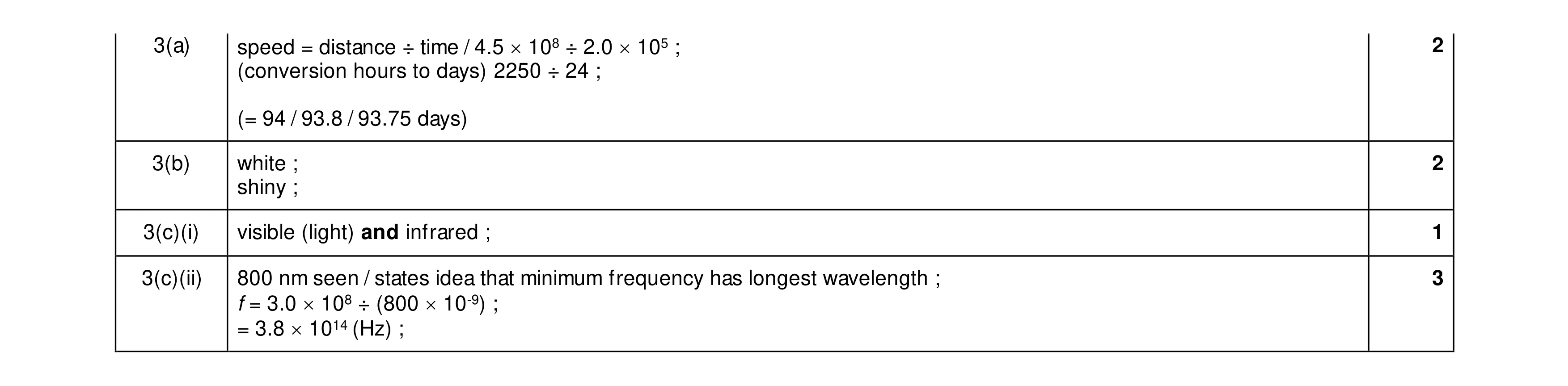 8
8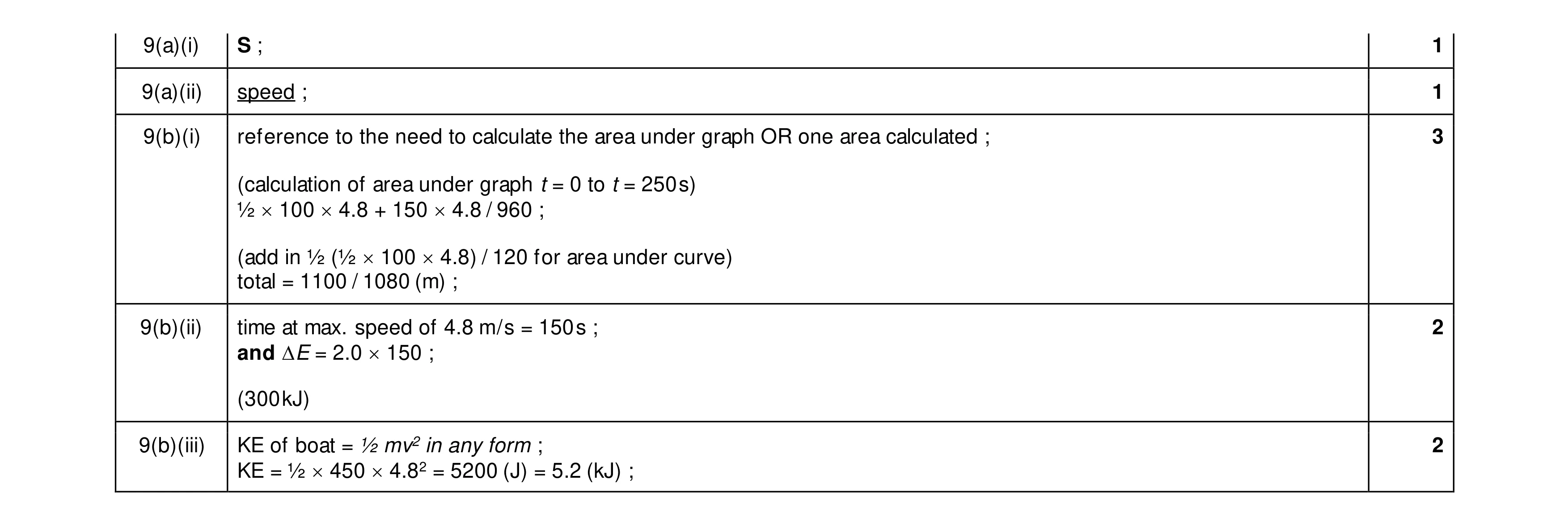 9
9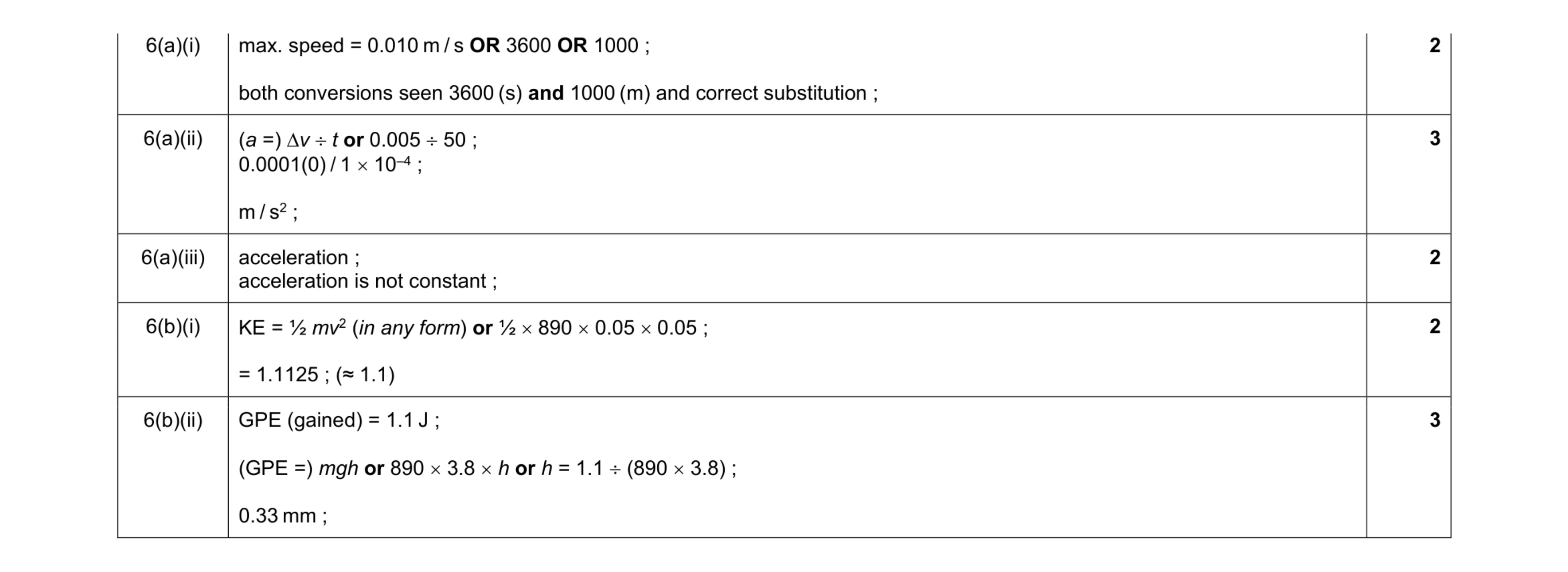 12
12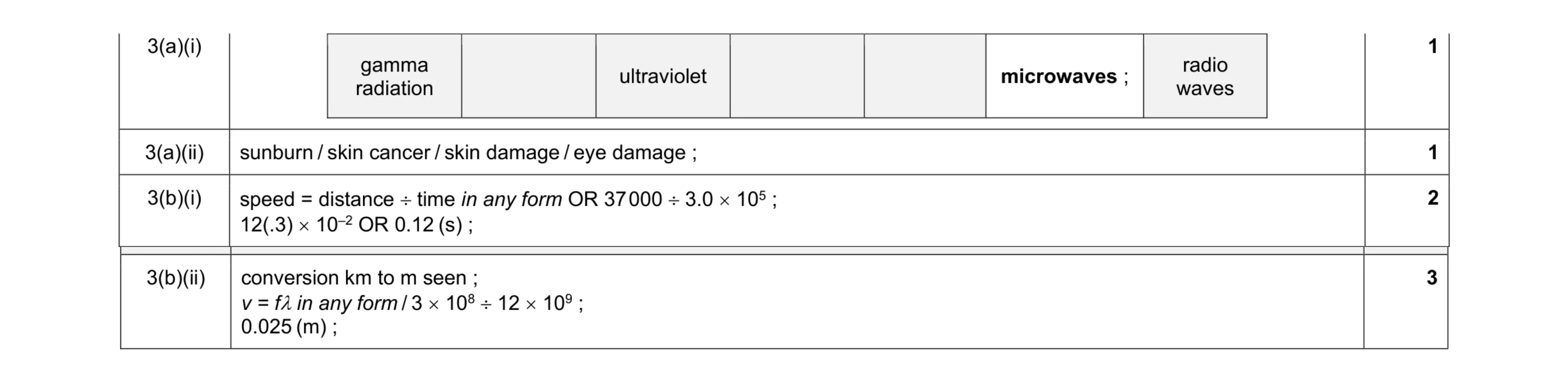 7
7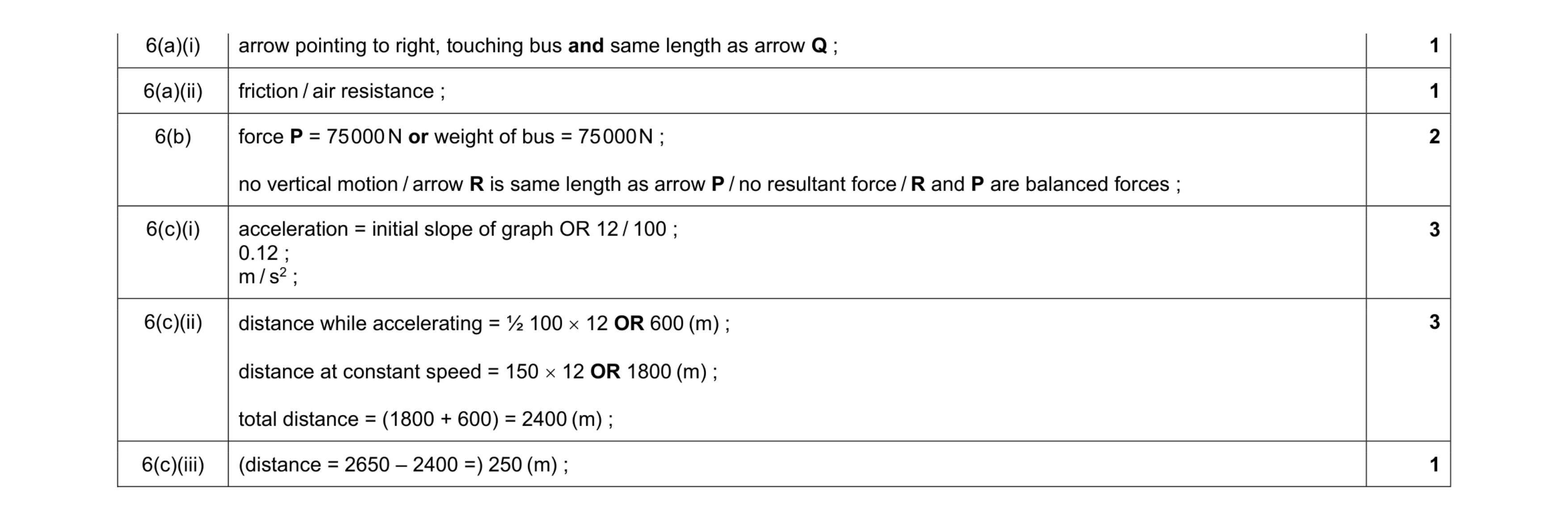 11
11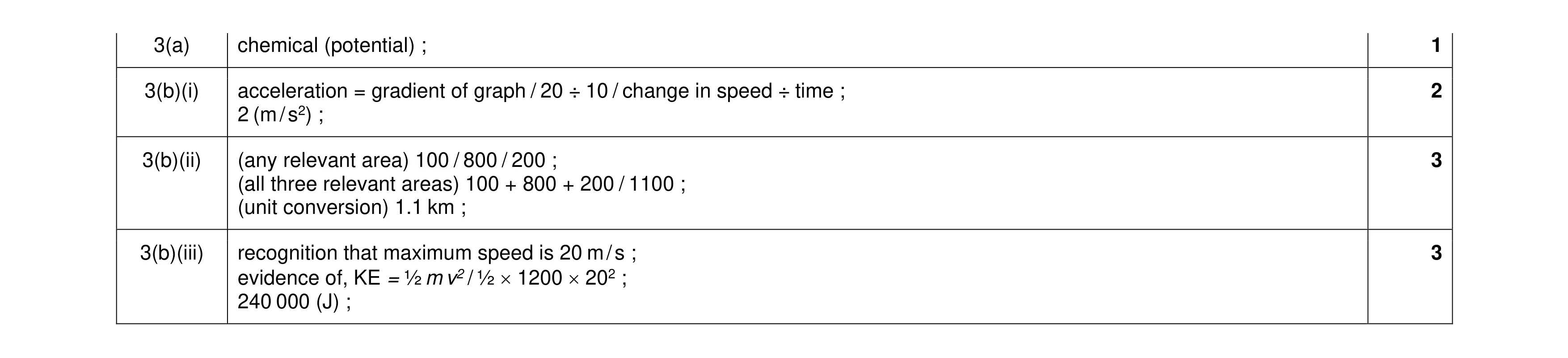 9
9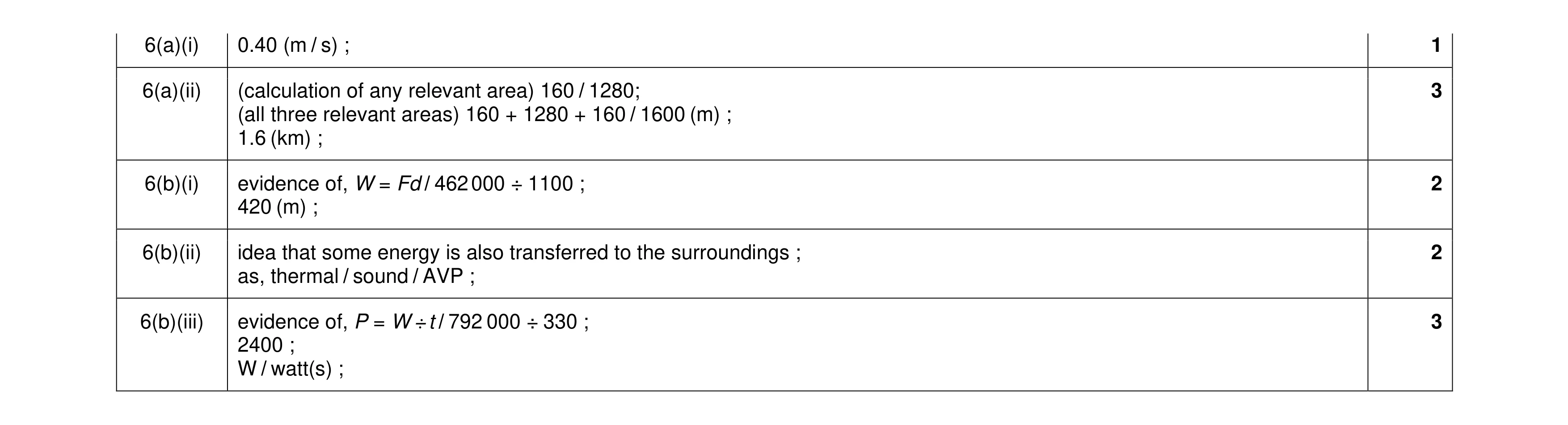 11
11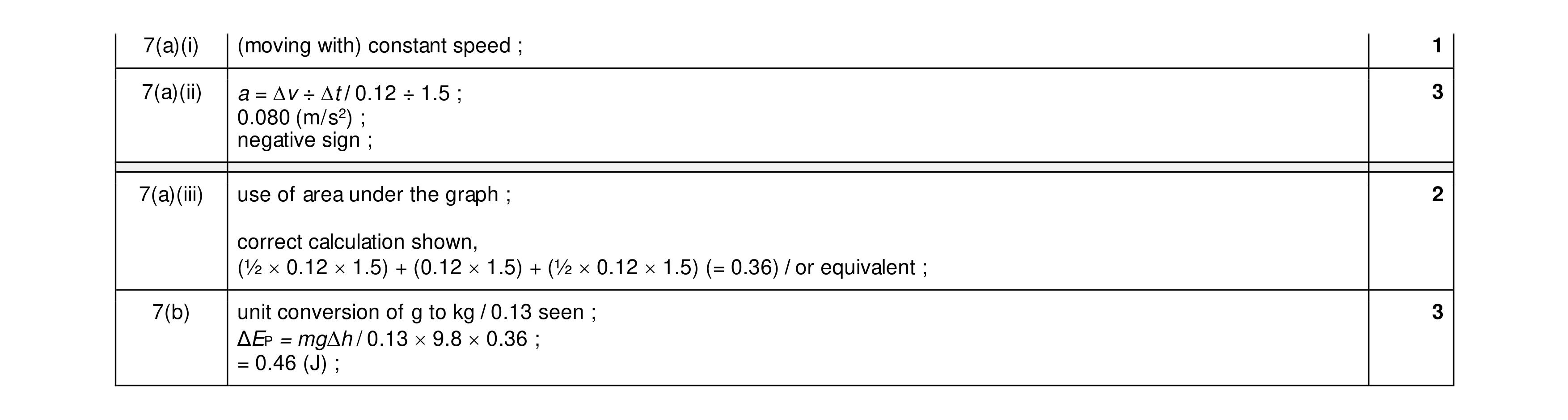 9
9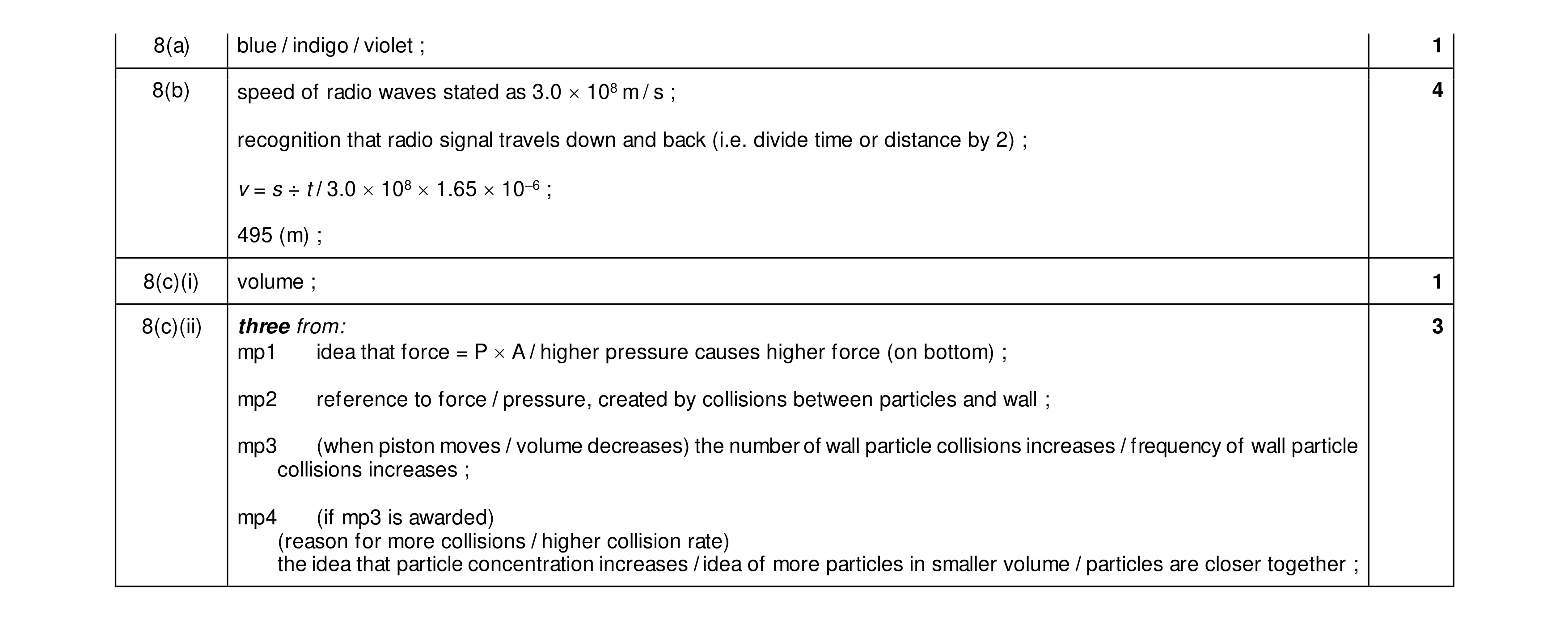 9
9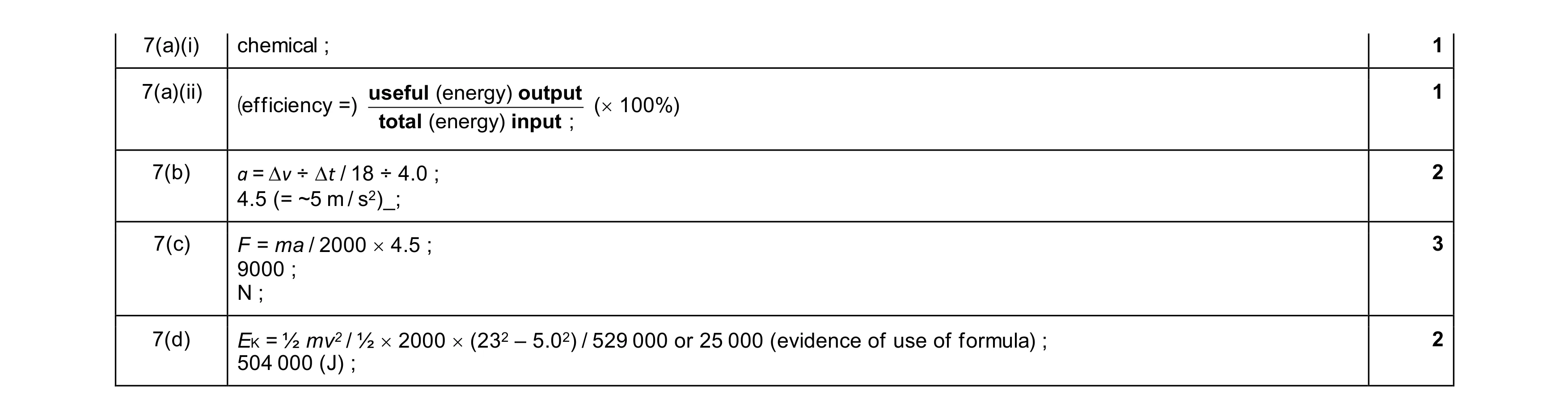 9
9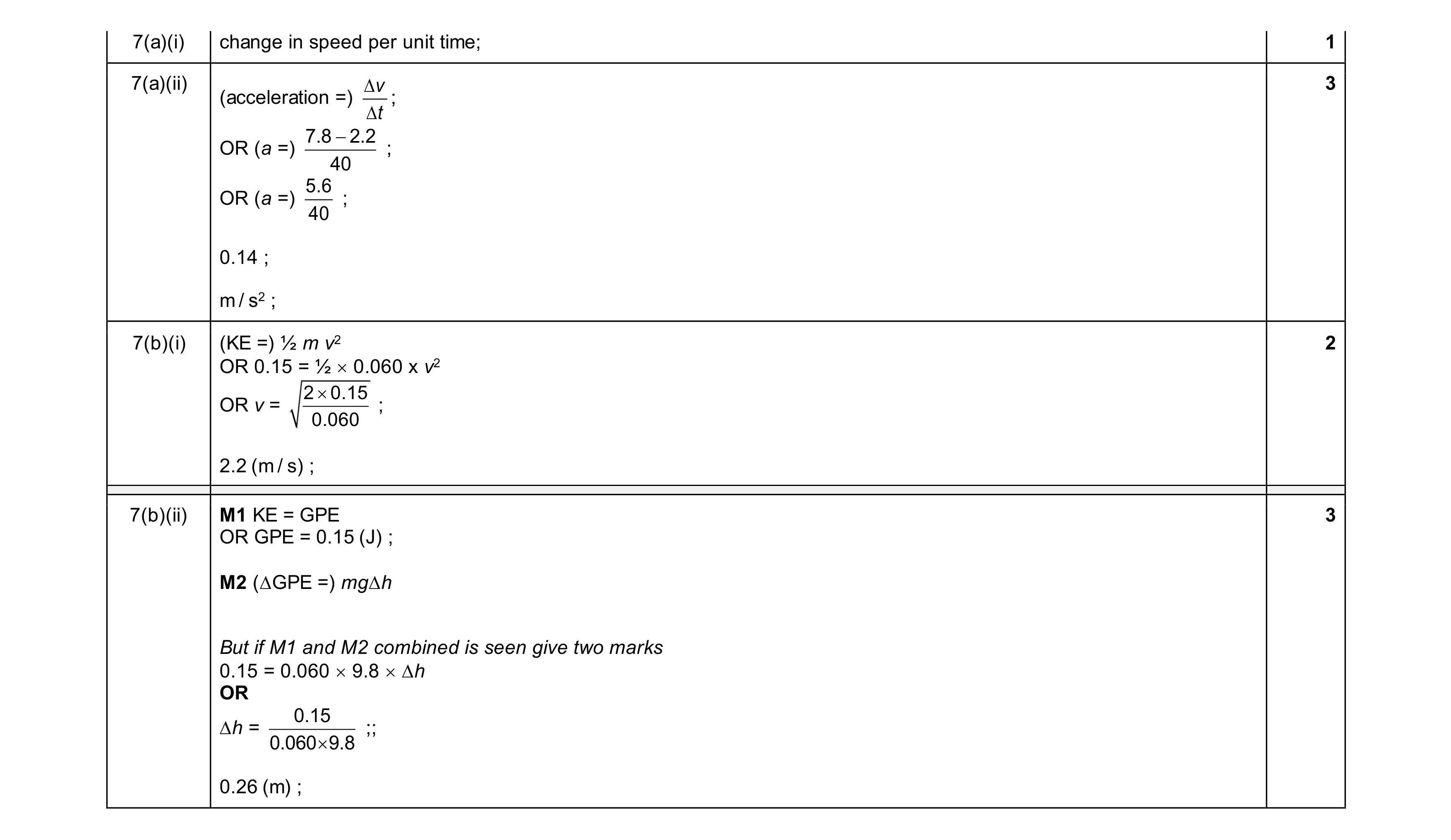 9
9