Questions as text
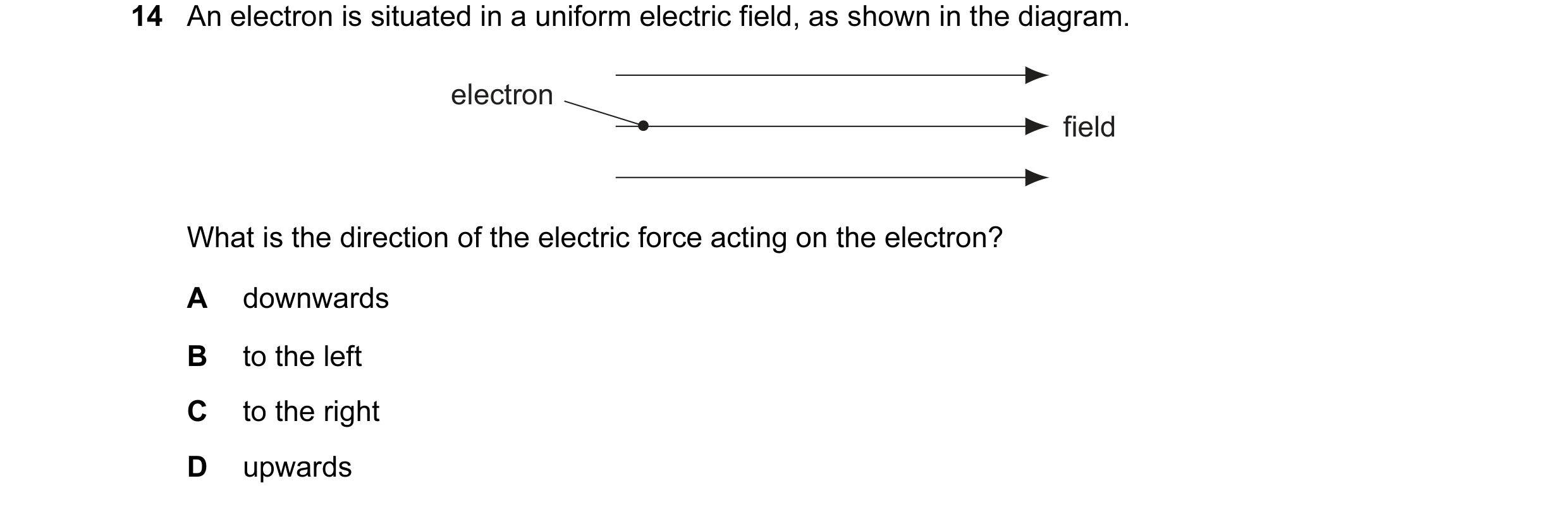
Q1 · An electron is situated in a uniform electric field, as shown in the diagram 9702/11 Oct/Nov 2004
14 An electron is situated in a uniform electric field, as shown in the diagram. electron field What is the direction of the electric force acting on the electron? A downwards B to the left C to the right D upwards
1 marks
Answer: B
This question in 9702/11 Oct/Nov 2004
Q2 · In a uniform electric field, which statement is correct? 9702/11 Oct/Nov 2004
30 In a uniform electric field, which statement is correct? A All charged particles experience the same force. B All charged particles move with the same velocity. C All electric field lines are directed towards positive charges. D All electric field lines are parallel.
1 marks
Answer: D
This question in 9702/11 Oct/Nov 2004
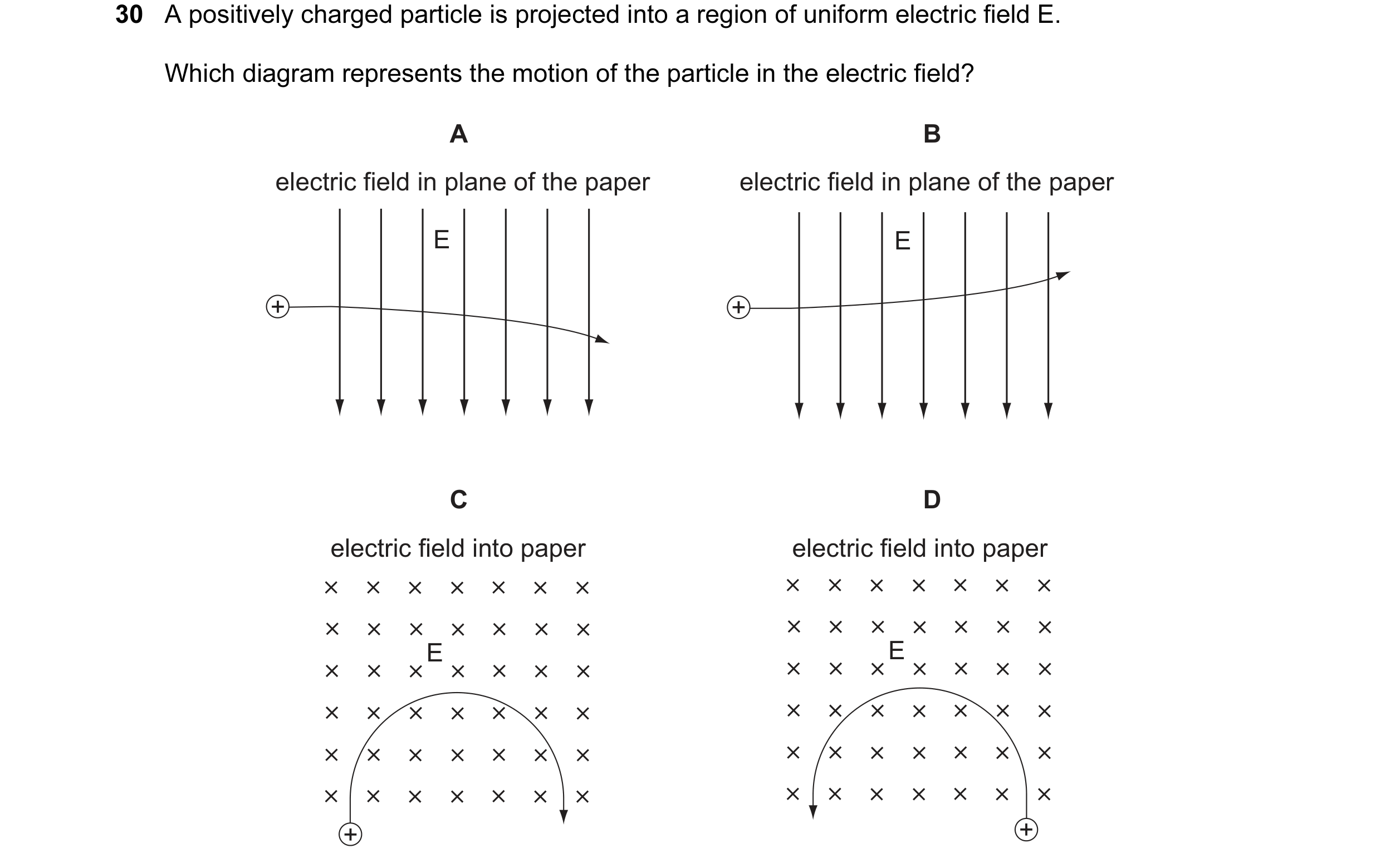
Q3 · A positively charged particle is projected into a region of uniform electric field E 9702/11 Oct/Nov 2005
30 A positively charged particle is projected into a region of uniform electric field E. Which diagram represents the motion of the particle in the electric field? A B electric field in plane of the paper electric field in plane of the paper E E + + C D electric field into paper electric field into paper E E + +
1 marks
Answer: A
This question in 9702/11 Oct/Nov 2005
Q4 · Two large parallel plates X and Z are placed 5.0 mm apart and connected as shown to the… 9702/11 Oct/Nov 2005
31 Two large parallel plates X and Z are placed 5.0 mm apart and connected as shown to the terminals of a 200 volt d.c. supply. X Z P 200 V A small oil drop at P carries one excess electron. What is the magnitude of the electrostatic force acting on the oil drop due to the electric field between the plates? A 6.4 x 10⁻¹⁵ N B 6.4 x 10⁻¹⁸ N C 1.6 x 10⁻¹⁹ N D 4.0 x 10⁻²⁴ N
1 marks
Answer: A
This question in 9702/11 Oct/Nov 2005
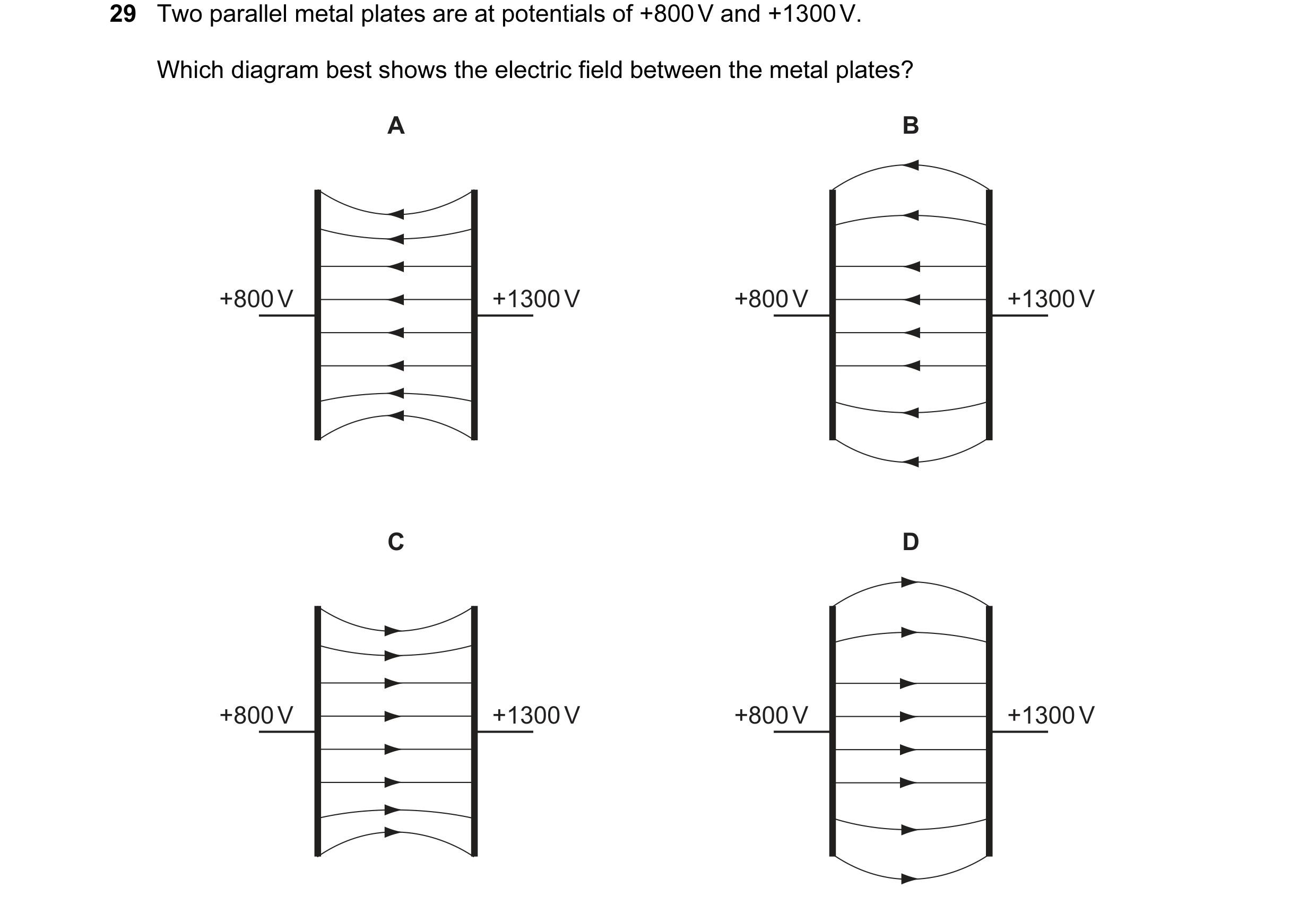
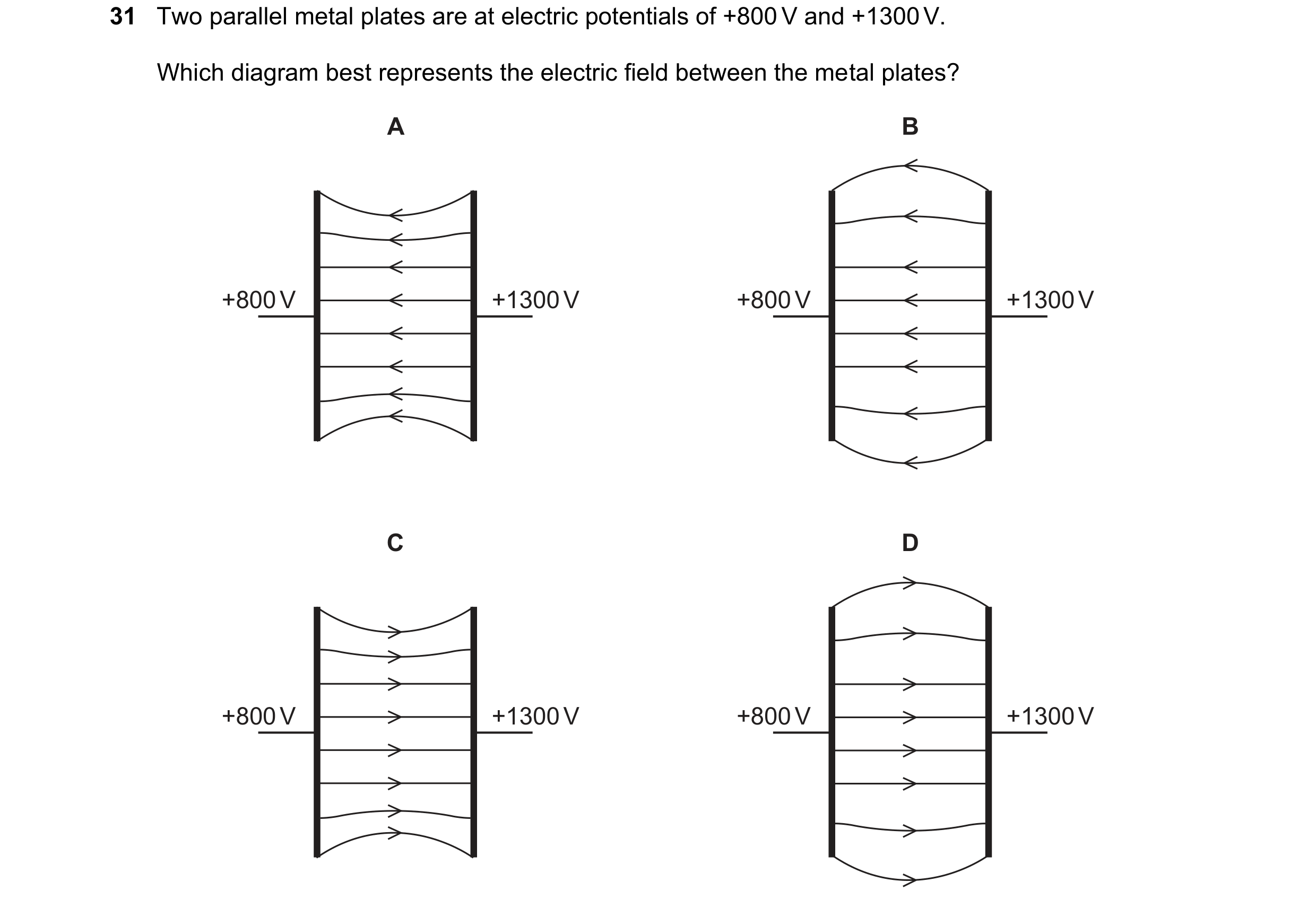
Q5 · Two parallel metal plates are at potentials of +800 V and +1300 V 9702/11 May/June 2006
29 Two parallel metal plates are at potentials of +800 V and +1300 V. Which diagram best shows the electric field between the metal plates? A B +800 V +1300 V +800 V +1300 V C D +800 V +1300 V +800 V +1300 V
1 marks
Answer: B
This question in 9702/11 May/June 2006
Q6 · An electron of charge e is introduced between two metal plates a distance d apart 9702/11 May/June 2006
30 An electron of charge e is introduced between two metal plates a distance d apart. A potential difference V is applied to the plates as shown in the diagram. F d electron V Which expression gives the electric force F on the electron? eV V dV A B eVd C D d ed e
1 marks
Answer: A
This question in 9702/11 May/June 2006
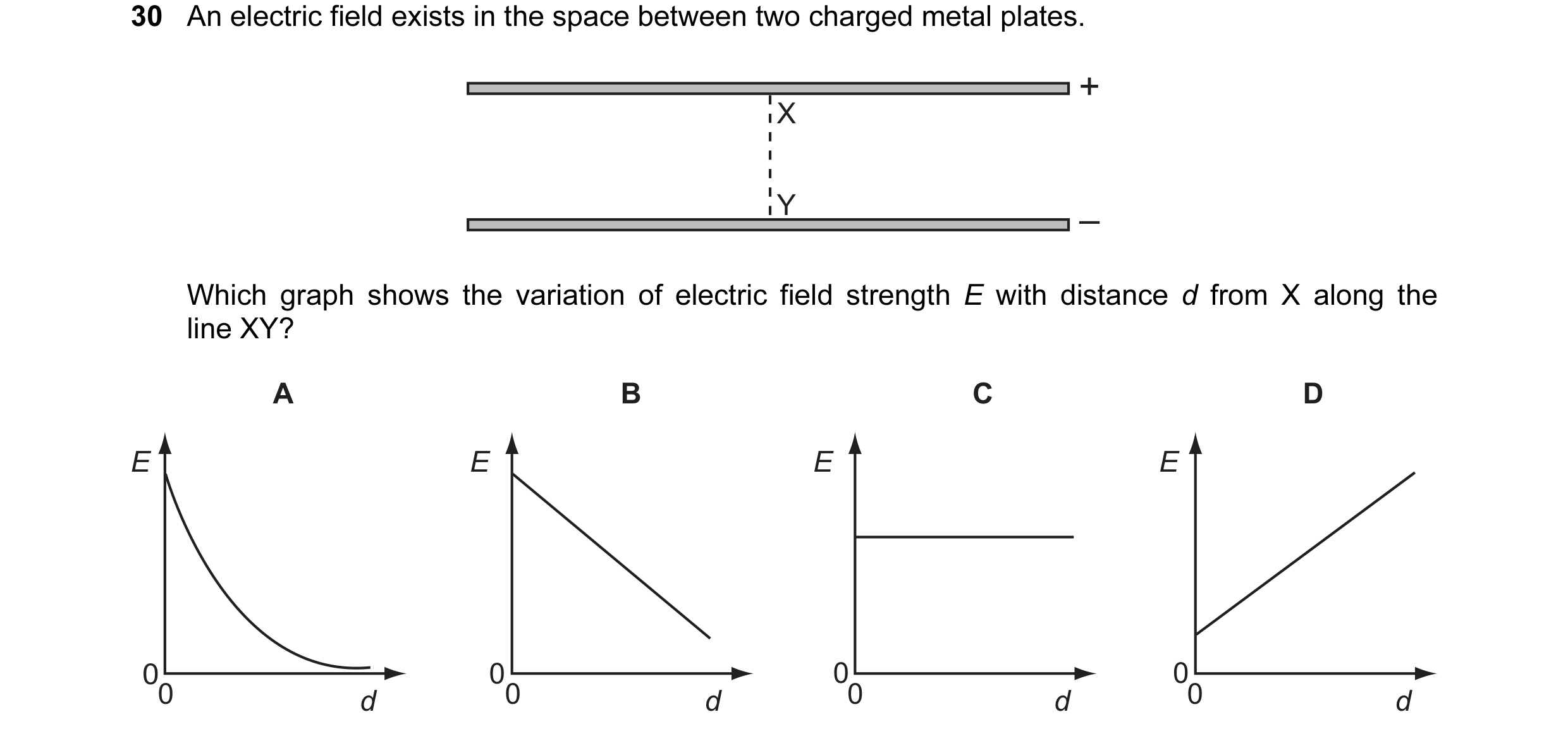
Q7 · An electric field exists in the space between two charged metal plates 9702/11 Oct/Nov 2006
30 An electric field exists in the space between two charged metal plates. + X Y – Which graph shows the variation of electric field strength E with distance d from X along the line XY? A B C D E E E E 00 00 00 00 d d d d
1 marks
Answer: C
This question in 9702/11 Oct/Nov 2006
Q8 · An electron, travelling horizontally at constant speed in a vacuum, enters a vertical… 9702/11 May/June 2007
29 An electron, travelling horizontally at constant speed in a vacuum, enters a vertical electric field between two charged parallel plates as shown. + + + + + electron electric field – – – – – What are the horizontal and vertical components of the motion of this electron when it is in the field? horizontal component of vertical component of motion motion A constant speed acceleration upwards B constant speed acceleration downwards C acceleration to the right acceleration downwards D acceleration to the right acceleration upwards
1 marks
Answer: A
This question in 9702/11 May/June 2007
Q9 · The electric field strength between a pair of parallel plates is E 9702/11 May/June 2007
30 The electric field strength between a pair of parallel plates is E. The separation of the plates is doubled and the potential difference between the plates is increased by a factor of four. What is the new electric field strength? A E B 2E C 4E D 8E
1 marks
Answer: B
This question in 9702/11 May/June 2007
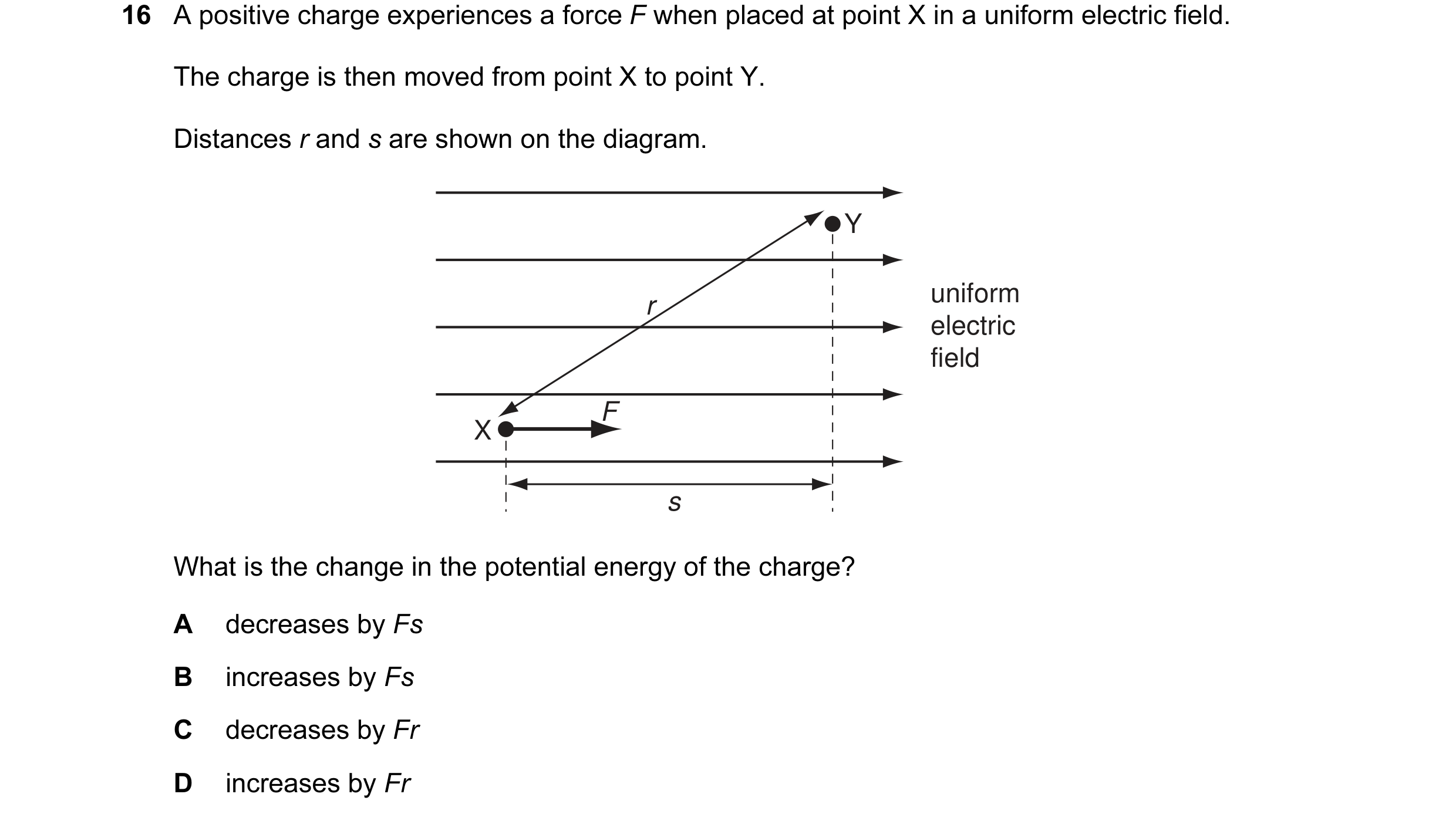
Q10 · A positive charge experiences a force F when placed at point X in a uniform electric field 9702/11 May/June 2008
16 A positive charge experiences a force F when placed at point X in a uniform electric field. The charge is then moved from point X to point Y. Distances r and s are shown on the diagram. Y r uniform electric field F X s What is the change in the potential energy of the charge? A decreases by Fs B increases by Fs C decreases by Fr D increases by Fr
1 marks
Answer: A
This question in 9702/11 May/June 2008
Q11 · An electron enters the space between two parallel charged plates with an initial velocity… 9702/11 May/June 2008
30 An electron enters the space between two parallel charged plates with an initial velocity u. + v e θ e u – While in the electric field, its direction changes by θ and it emerges with a velocity v. What is the relation between v and u? A v = u B v = u cosθ C v = u D v = u sinθ cos θ sin θ
1 marks
Answer: A
This question in 9702/11 May/June 2008
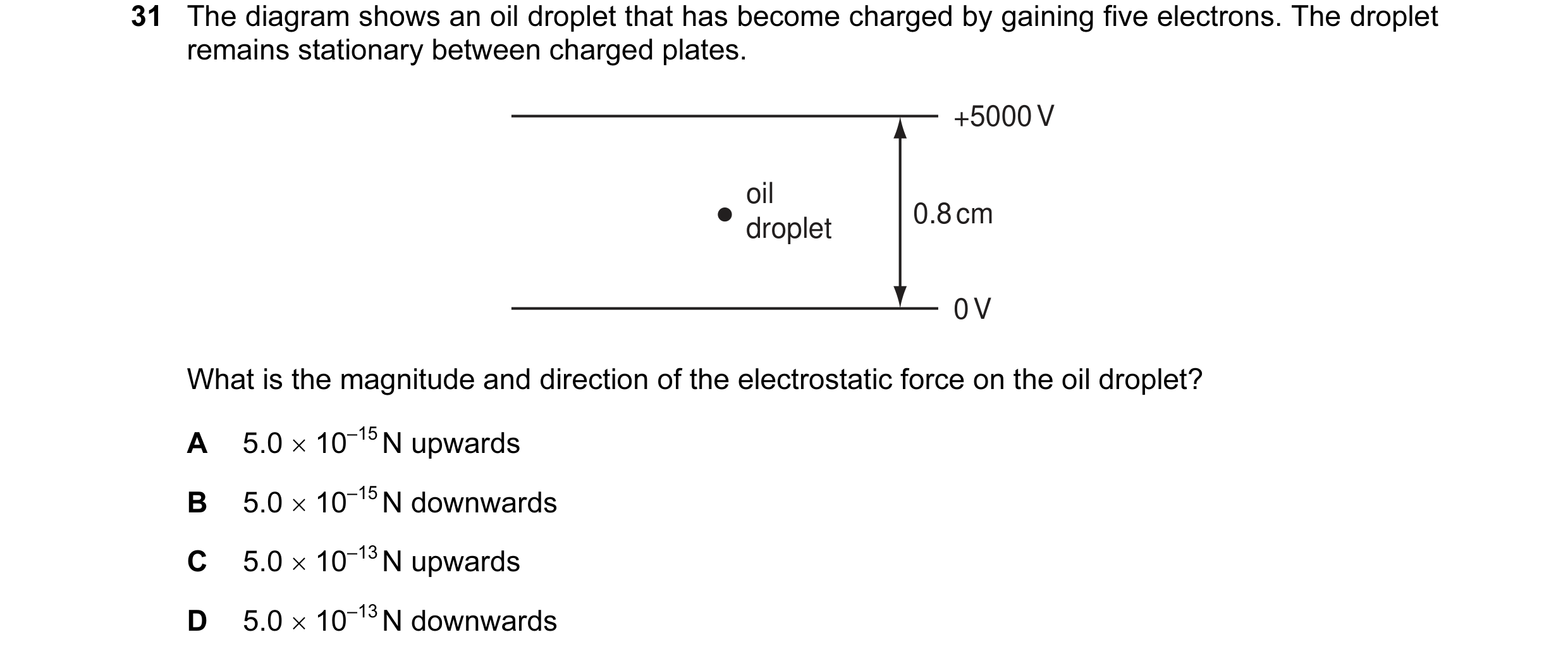
Q12 · The diagram shows an oil droplet that has become charged by gaining five electrons 9702/11 May/June 2008
31 The diagram shows an oil droplet that has become charged by gaining five electrons. The droplet remains stationary between charged plates. +5000 V oil 0.8 cm droplet 0 V What is the magnitude and direction of the electrostatic force on the oil droplet? A 5.0 × 10⁻¹⁵ N upwards B 5.0 × 10⁻¹⁵ N downwards C 5.0 × 10⁻¹³ N upwards D 5.0 × 10⁻¹³ N downwards
1 marks
Answer: C
This question in 9702/11 May/June 2008
Q13 · A particle has a charge of 4.8 × 10⁻¹⁹ C 9702/11 Oct/Nov 2008
30 A particle has a charge of 4.8 × 10⁻¹⁹ C. The particle remains at rest between a pair of horizontal, parallel plates having a separation of 15 mm. The potential difference between the plates is 660 V. What is the weight of the particle? A 2.1 × 10⁻¹⁴ N B 2.1 × 10⁻¹⁵ N C 2.1 × 10⁻¹⁷ N D 1.1 × 10⁻²³ N
1 marks
Answer: A
This question in 9702/11 Oct/Nov 2008
Q14 · The diagram shows the paths of two charged particles, X and Y, during their passage… 9702/11 May/June 2009
27 The diagram shows the paths of two charged particles, X and Y, during their passage between a pair of oppositely charged metal plates, P and Q. P X Y Q The plates are charged such that the electric field between them is directed from Q to P. Which charges on X and Y will produce the observed paths? X Y A – – B – + C + – D + +
1 marks
Answer: A
This question in 9702/11 May/June 2009
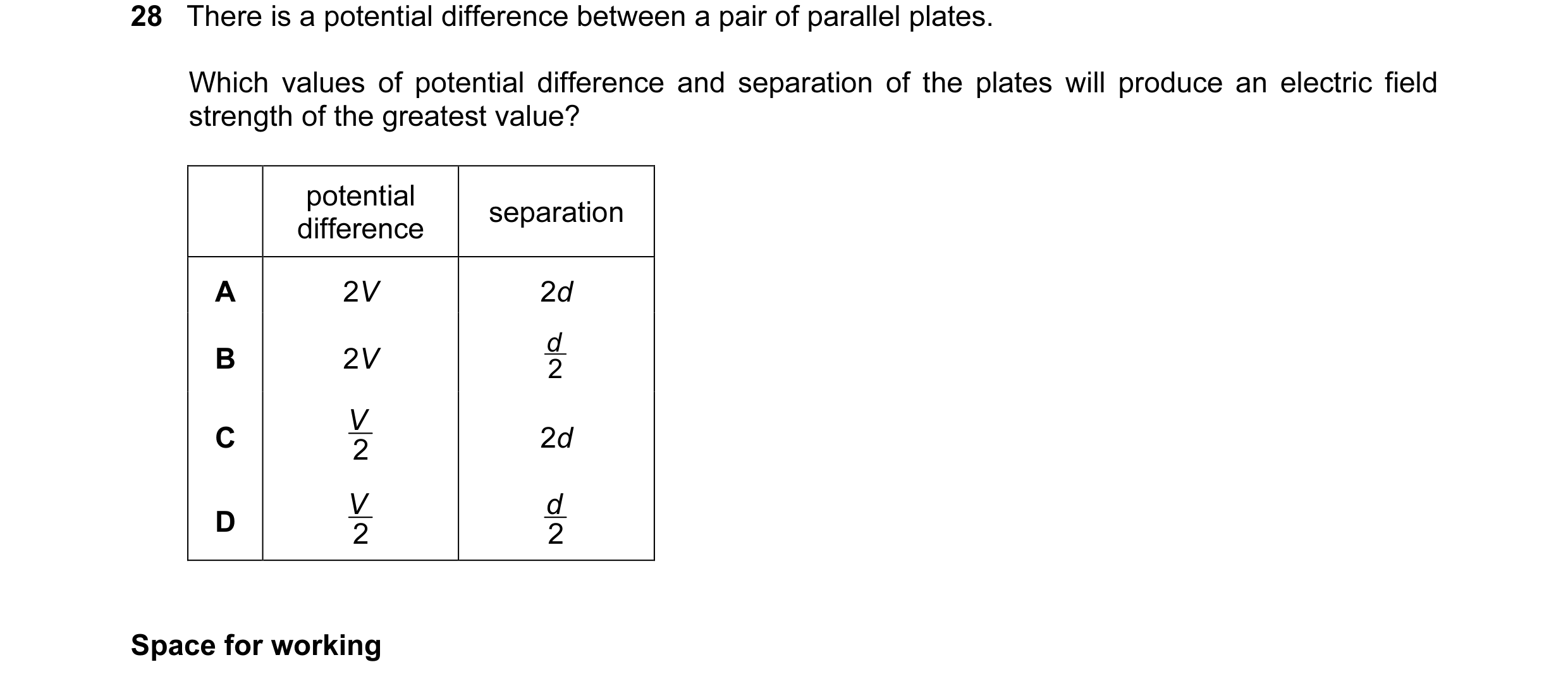
Q15 · There is a potential difference between a pair of parallel plates 9702/11 May/June 2009
28 There is a potential difference between a pair of parallel plates. Which values of potential difference and separation of the plates will produce an electric field strength of the greatest value? potential separation difference A 2V 2d d B 2V 2 V C 2 2d V d D 2 2 Space for working
1 marks
Answer: B
This question in 9702/11 May/June 2009
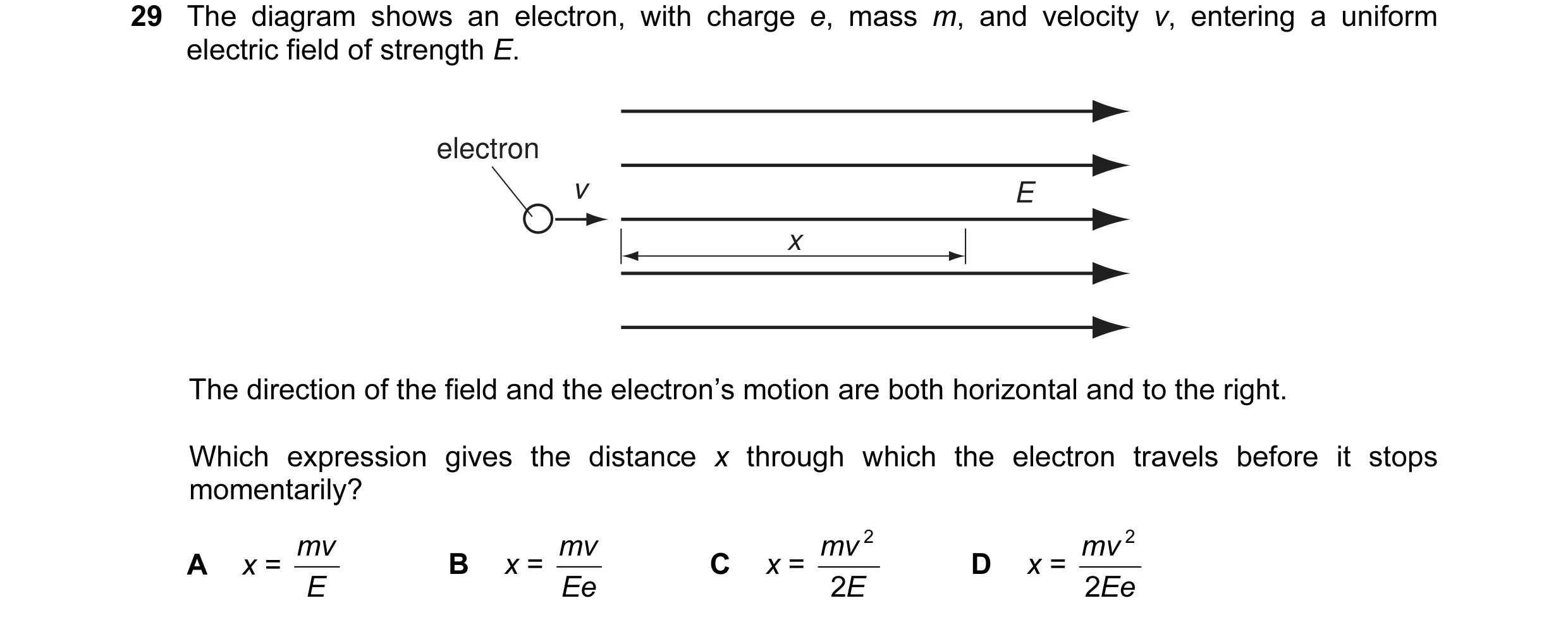
Q16 · The diagram shows an electron, with charge e, mass m, and velocity v, entering a uniform… 9702/11 May/June 2009
29 The diagram shows an electron, with charge e, mass m, and velocity v, entering a uniform electric field of strength E. electron v E x The direction of the field and the electron’s motion are both horizontal and to the right. Which expression gives the distance x through which the electron travels before it stops momentarily? mv mv mv 2 mv 2 A x = E B x = Ee C x = D x = 2 E 2 Ee
1 marks
Answer: D
This question in 9702/11 May/June 2009
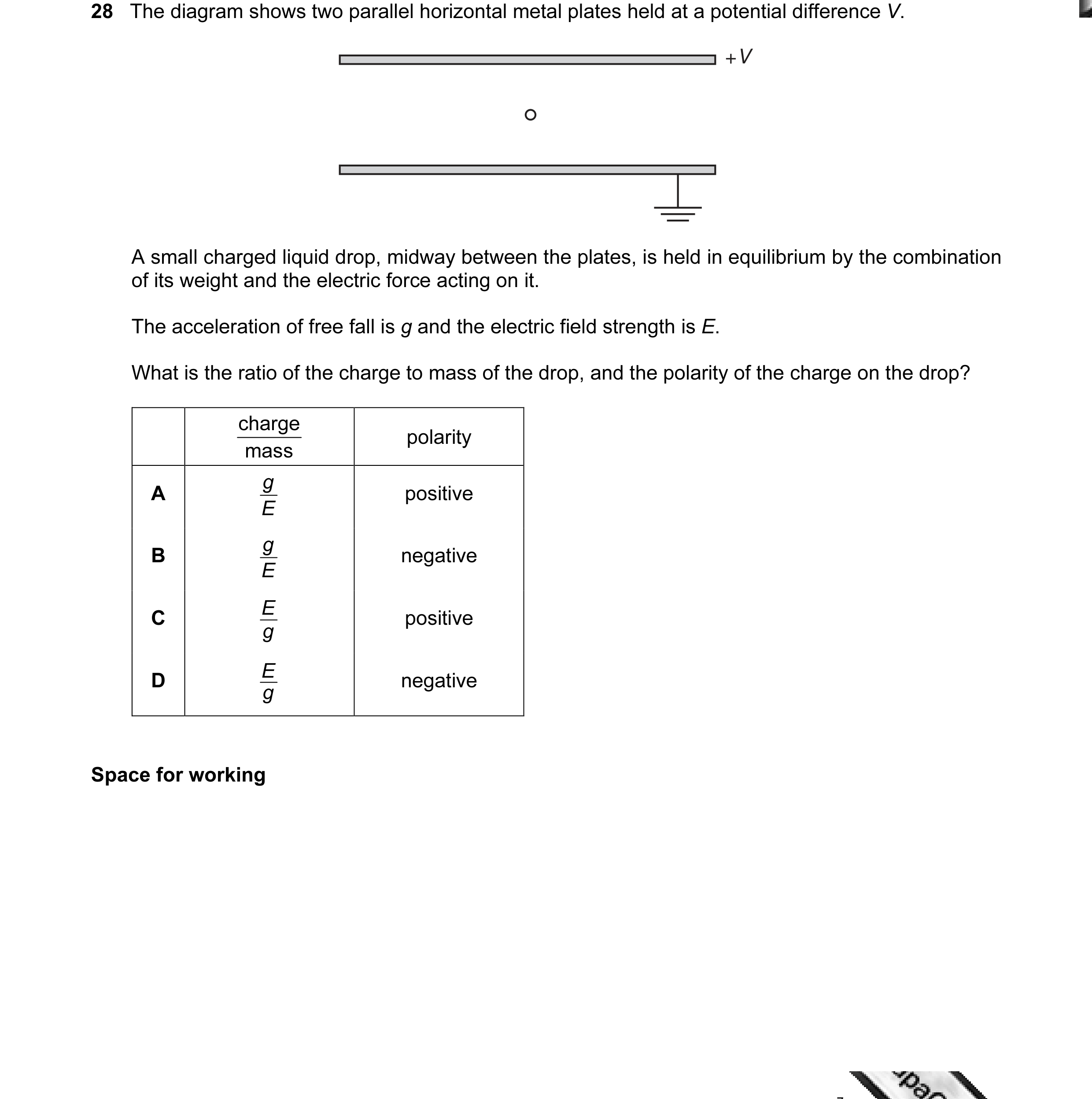
Q17 · The diagram shows two parallel horizontal metal plates held at a potential difference V 9702/11 Oct/Nov 2009
28 The diagram shows two parallel horizontal metal plates held at a potential difference V. +V A small charged liquid drop, midway between the plates, is held in equilibrium by the combination of its weight and the electric force acting on it. The acceleration of free fall is g and the electric field strength is E. What is the ratio of the charge to mass of the drop, and the polarity of the charge on the drop? charge polarity mass g A positive E g B negative E E C positive g E D negative g Space for working
1 marks
Answer: B
This question in 9702/11 Oct/Nov 2009
Q18 · The diagram shows two parallel horizontal metal plates held at a potential difference V 9702/12 Oct/Nov 2009
27 The diagram shows two parallel horizontal metal plates held at a potential difference V. +V A small charged liquid drop, midway between the plates, is held in equilibrium by the combination of its weight and the electric force acting on it. The acceleration of free fall is g and the electric field strength is E. What is the ratio of the charge to mass of the drop, and the polarity of the charge on the drop? charge polarity mass g A positive E g B negative E E C positive g E D negative g Space for working
1 marks
Answer: B
This question in 9702/12 Oct/Nov 2009
Q19 · Which row describes the circumstances under which forces act on a charged particle in a… 9702/11 May/June 2010
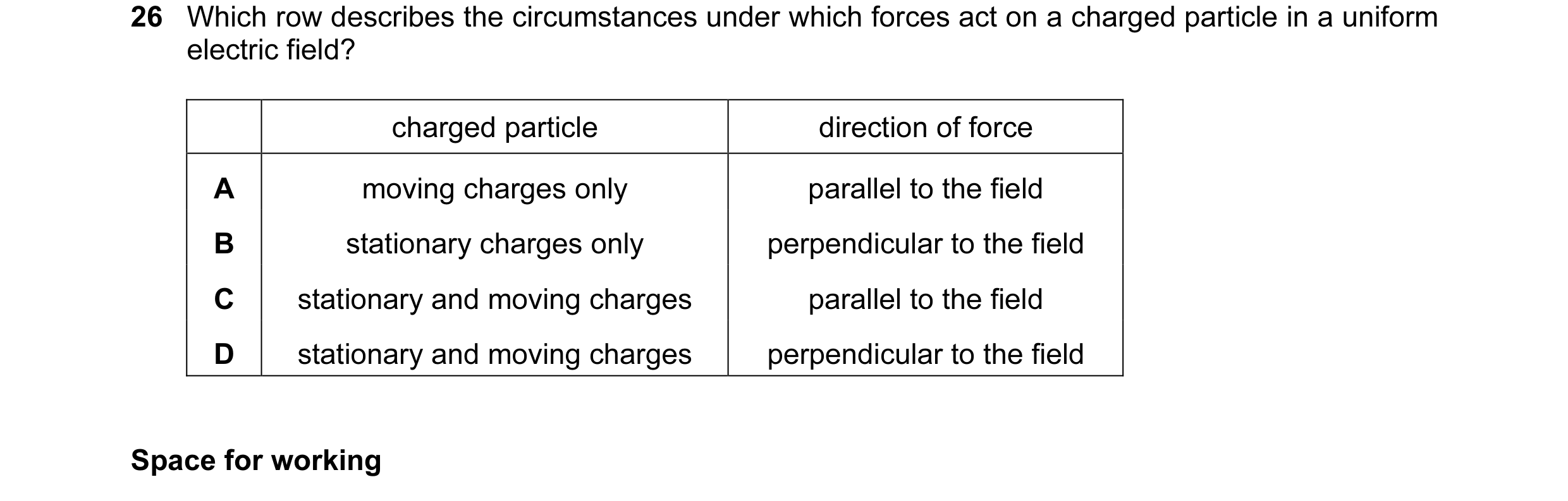
26 Which row describes the circumstances under which forces act on a charged particle in a uniform electric field? charged particle direction of force A moving charges only parallel to the field B stationary charges only perpendicular to the field C stationary and moving charges parallel to the field D stationary and moving charges perpendicular to the field Space for working
1 marks
Answer: C
This question in 9702/11 May/June 2010
Q20 · Two oppositely-charged parallel plates are arranged as shown 9702/11 May/June 2010
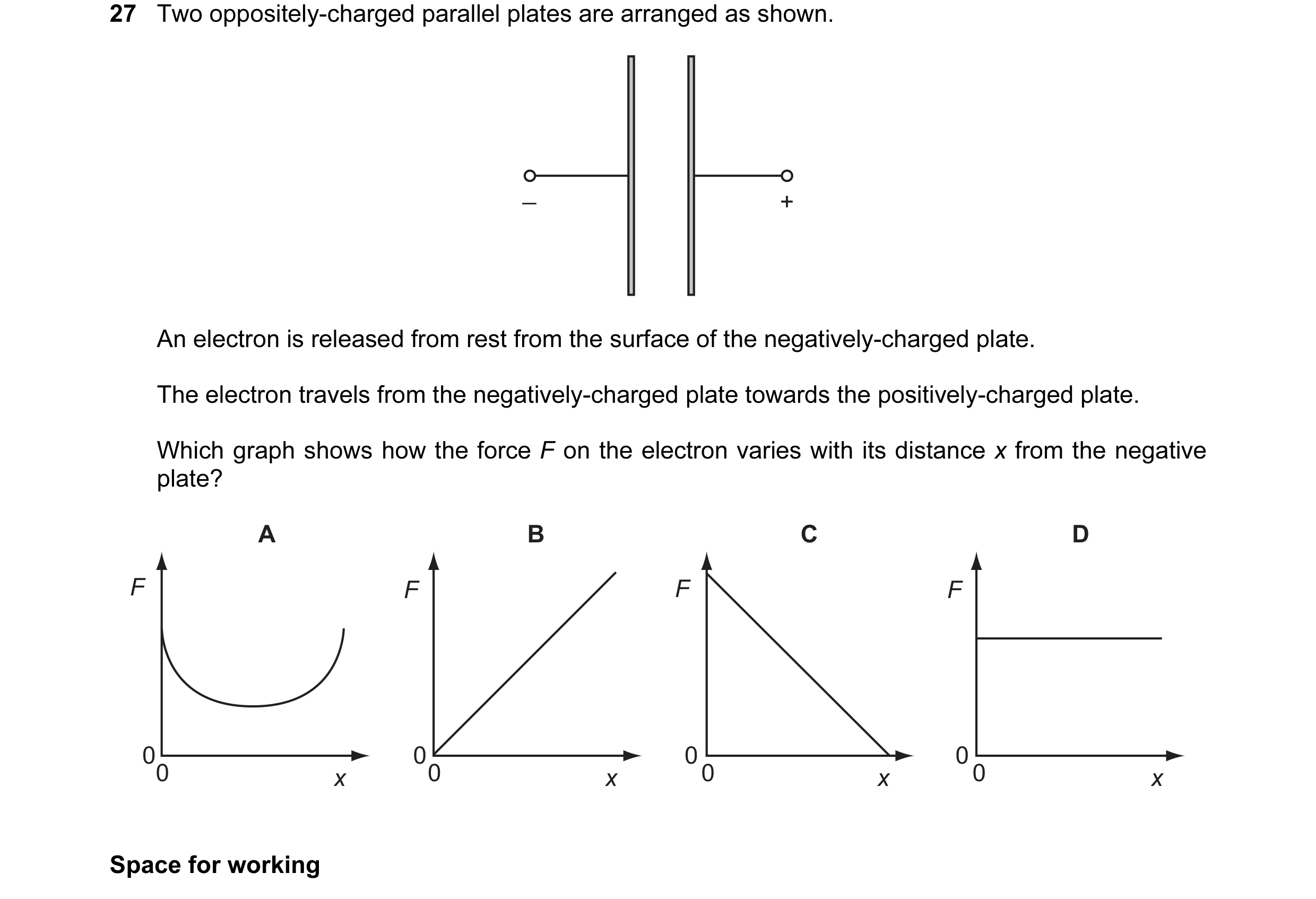
28 Two oppositely-charged parallel plates are arranged as shown. _ + An electron is released from rest from the surface of the negatively-charged plate. The electron travels from the negatively-charged plate towards the positively-charged plate. Which graph shows how the force F on the electron varies with its distance x from the negative plate? A B C D F F F F 00 00 00 00 x x x x Space for working
1 marks
Answer: D
This question in 9702/11 May/June 2010
Q21 · Two oppositely-charged parallel plates are arranged as shown 9702/13 May/June 2010
27 Two oppositely-charged parallel plates are arranged as shown. _ + An electron is released from rest from the surface of the negatively-charged plate. The electron travels from the negatively-charged plate towards the positively-charged plate. Which graph shows how the force F on the electron varies with its distance x from the negative plate? A B C D F F F F 00 00 00 00 x x x x Space for working
1 marks
Answer: D
This question in 9702/13 May/June 2010
Q22 · Which row describes the circumstances under which forces act on a charged particle in a… 9702/13 May/June 2010
28 Which row describes the circumstances under which forces act on a charged particle in a uniform electric field? charged particle direction of force A moving charges only parallel to the field B stationary charges only perpendicular to the field C stationary and moving charges parallel to the field D stationary and moving charges perpendicular to the field
1 marks
Answer: C
This question in 9702/13 May/June 2010
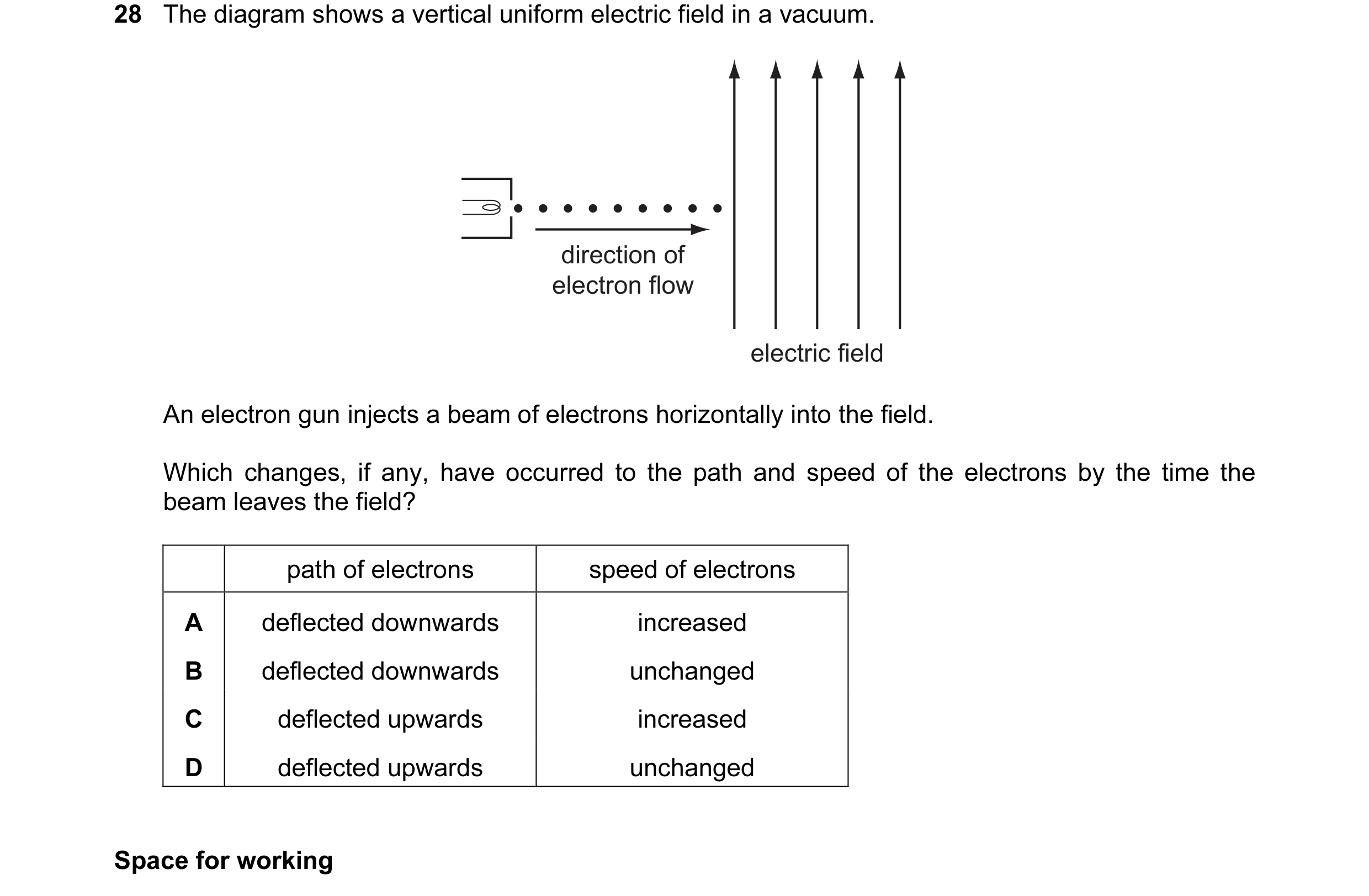
Q23 · The diagram shows a vertical uniform electric field in a vacuum 9702/12 Oct/Nov 2010
28 The diagram shows a vertical uniform electric field in a vacuum. direction of electron flow electric field An electron gun injects a beam of electrons horizontally into the field. Which changes, if any, have occurred to the path and speed of the electrons by the time the beam leaves the field? path of electrons speed of electrons A deflected downwards increased B deflected downwards unchanged C deflected upwards increased D deflected upwards unchanged Space for working
1 marks
Answer: A
This question in 9702/12 Oct/Nov 2010
Q24 · A very small oil drop of mass m carries a charge +q 9702/12 Oct/Nov 2010
29 A very small oil drop of mass m carries a charge +q. – – – – – – – – oil drop + + + + + + + + The potential difference across the plates is V and the separation is d. The weight of the drop is balanced by the electric force. (Buoyancy forces may be considered to be negligible.) Which formula gives the charge on the drop? mgd mgV Vd V A q = B q = C q = mg D q = mgd V d
1 marks
Answer: A
This question in 9702/12 Oct/Nov 2010
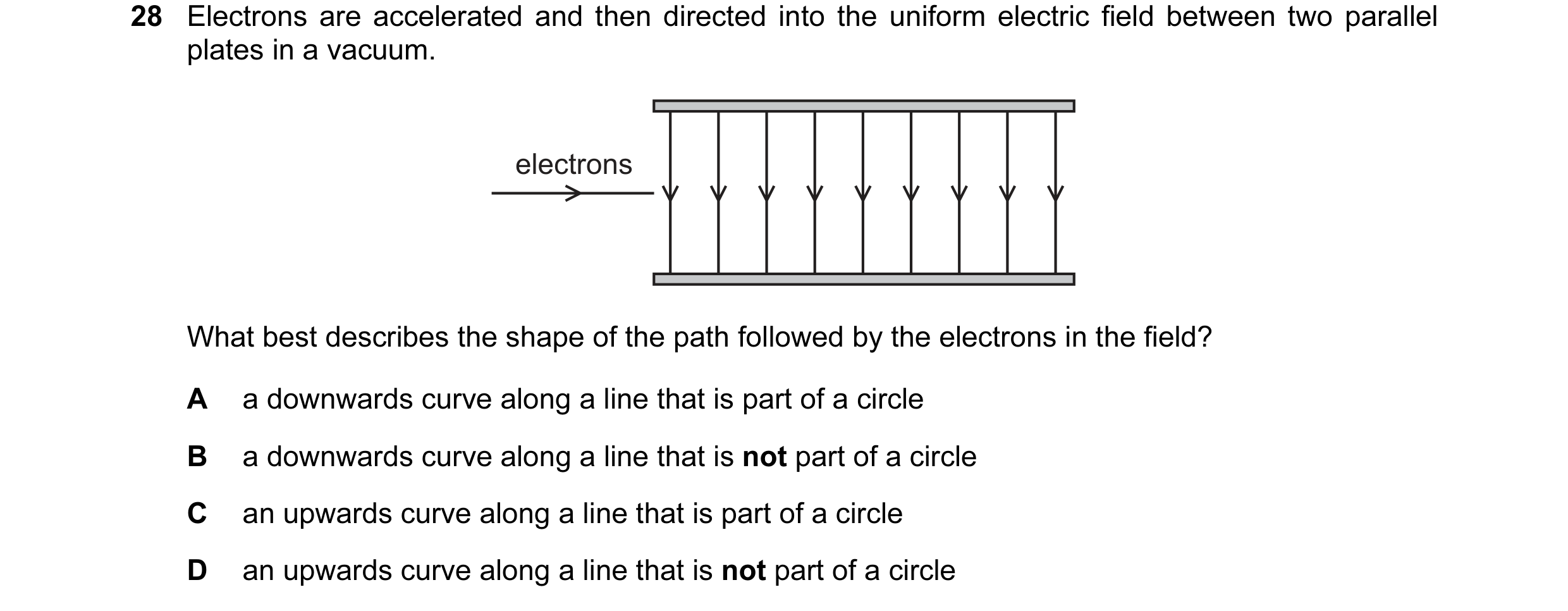
Q25 · Electrons are accelerated and then directed into the uniform electric field between two… 9702/13 Oct/Nov 2010
28 Electrons are accelerated and then directed into the uniform electric field between two parallel plates in a vacuum. electrons What best describes the shape of the path followed by the electrons in the field? A a downwards curve along a line that is part of a circle B a downwards curve along a line that is not part of a circle C an upwards curve along a line that is part of a circle D an upwards curve along a line that is not part of a circle
1 marks
Answer: D
This question in 9702/13 Oct/Nov 2010
Q26 · A charged particle is in the electric field between two horizontal metal plates connected… 9702/13 Oct/Nov 2010
29 A charged particle is in the electric field between two horizontal metal plates connected to a source of constant potential difference, as shown. There is a force F on the particle due to the electric field. charged particle The separation of the plates is doubled. What will be the new force on the particle? F F A B C F D 2F 4 2 Space for working
1 marks
Answer: B
This question in 9702/13 Oct/Nov 2010
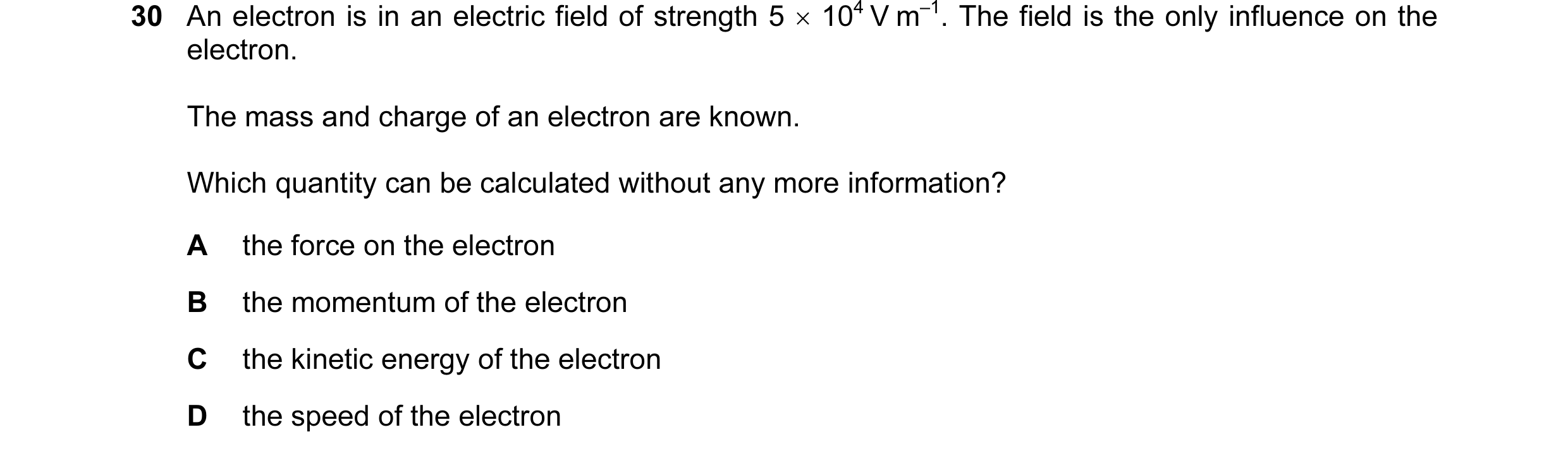
Q27 · An electron is in an electric field of strength 5 × 10⁴ V m–1 9702/13 Oct/Nov 2010
30 An electron is in an electric field of strength 5 × 10⁴ V m–1. The field is the only influence on the electron. The mass and charge of an electron are known. Which quantity can be calculated without any more information? A the force on the electron B the momentum of the electron C the kinetic energy of the electron D the speed of the electron
1 marks
Answer: A
This question in 9702/13 Oct/Nov 2010
Q28 · The diagram shows a charged particle as it approaches a pair of charged parallel plates… 9702/11 May/June 2011
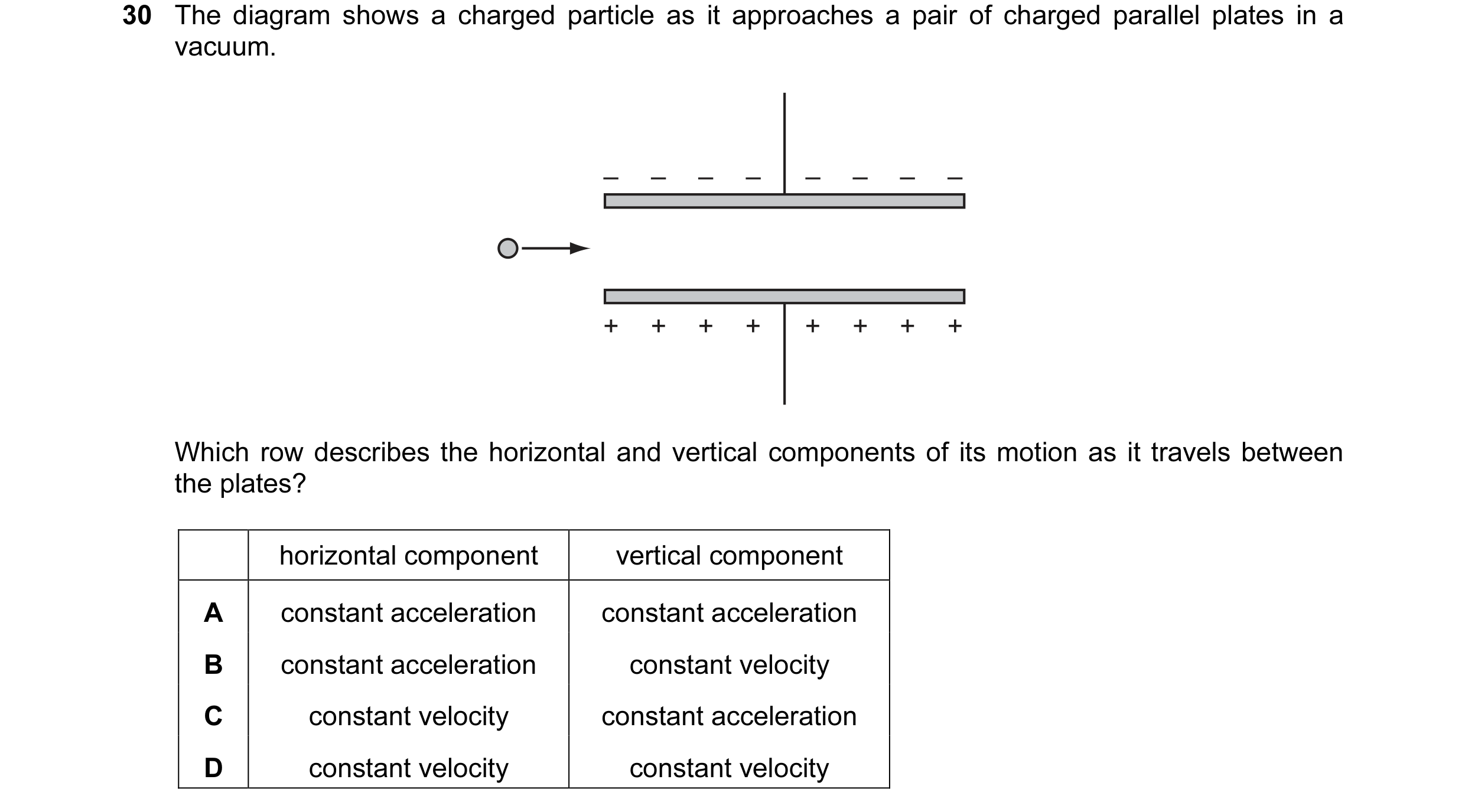
29 The diagram shows a charged particle as it approaches a pair of charged parallel plates in a vacuum. – – – – – – – – + + + + + + + + Which row describes the horizontal and vertical components of its motion as it travels between the plates? horizontal component vertical component A constant acceleration constant acceleration B constant acceleration constant velocity C constant velocity constant acceleration D constant velocity constant velocity
1 marks
Answer: C
This question in 9702/11 May/June 2011
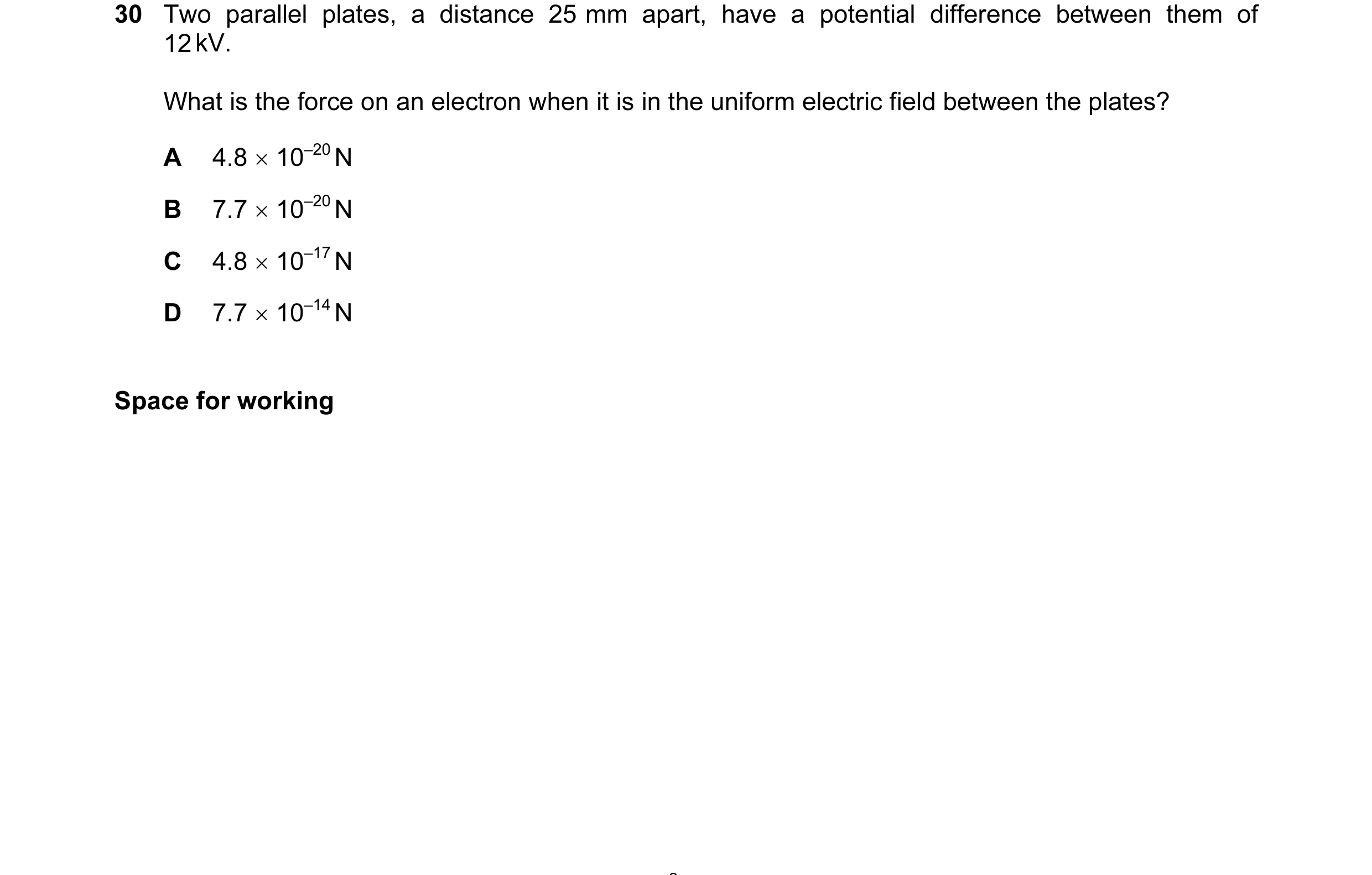
Q29 · Two parallel plates, a distance 25 mm apart, have a potential difference between them of… 9702/11 May/June 2011
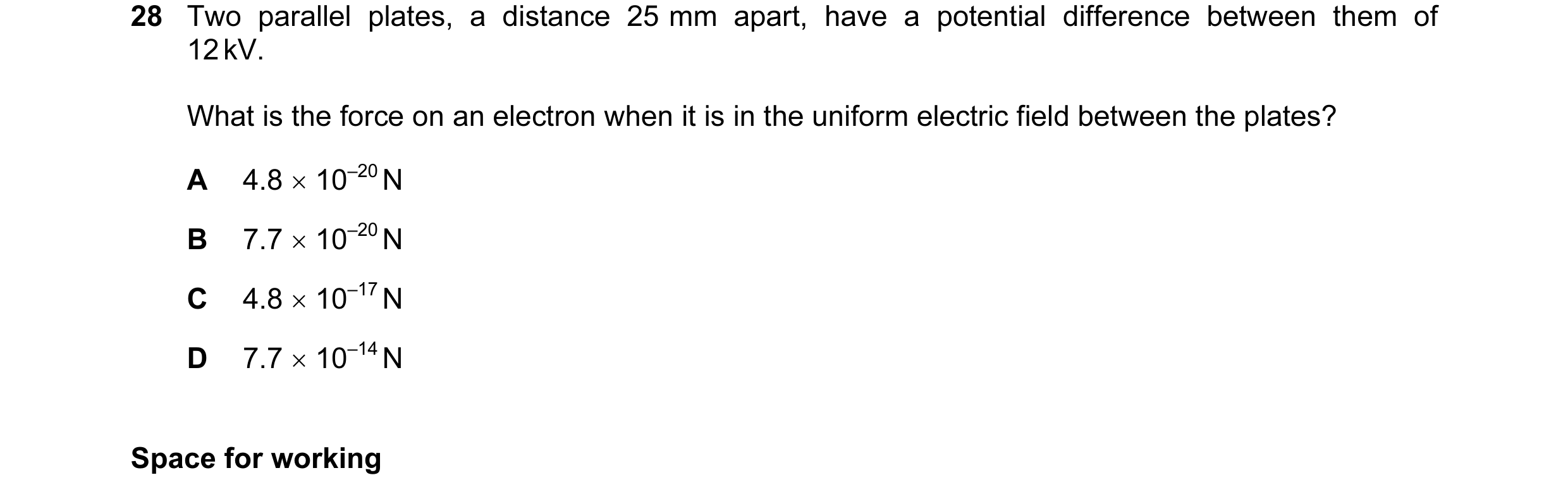
30 Two parallel plates, a distance 25 mm apart, have a potential difference between them of 12 kV. What is the force on an electron when it is in the uniform electric field between the plates? A 4.8 × 10⁻²⁰ N B 7.7 × 10⁻²⁰ N C 4.8 × 10⁻¹⁷ N D 7.7 × 10⁻¹⁴ N Space for working
1 marks
Answer: D
This question in 9702/11 May/June 2011
Q30 · The diagram shows two parallel metal plates connected to a d.c 9702/12 May/June 2011
30 The diagram shows two parallel metal plates connected to a d.c. power supply through a resistor. + – There is a uniform electric field in the region between the plates. Which change would cause a decrease in the strength of the electric field? A a small increase in the distance between the plates B a small increase in the potential difference between the plates C a small increase in the value of the resistor D a small increase to the area of both plates Space for working
1 marks
Answer: A
This question in 9702/12 May/June 2011
Q31 · Two parallel plates, a distance 25 mm apart, have a potential difference between them of… 9702/13 May/June 2011
28 Two parallel plates, a distance 25 mm apart, have a potential difference between them of 12 kV. What is the force on an electron when it is in the uniform electric field between the plates? A 4.8 × 10⁻²⁰ N B 7.7 × 10⁻²⁰ N C 4.8 × 10⁻¹⁷ N D 7.7 × 10⁻¹⁴ N Space for working
1 marks
Answer: D
This question in 9702/13 May/June 2011
Q32 · The diagram shows a charged particle as it approaches a pair of charged parallel plates… 9702/13 May/June 2011
30 The diagram shows a charged particle as it approaches a pair of charged parallel plates in a vacuum. – – – – – – – – + + + + + + + + Which row describes the horizontal and vertical components of its motion as it travels between the plates? horizontal component vertical component A constant acceleration constant acceleration B constant acceleration constant velocity C constant velocity constant acceleration D constant velocity constant velocity
1 marks
Answer: C
This question in 9702/13 May/June 2011
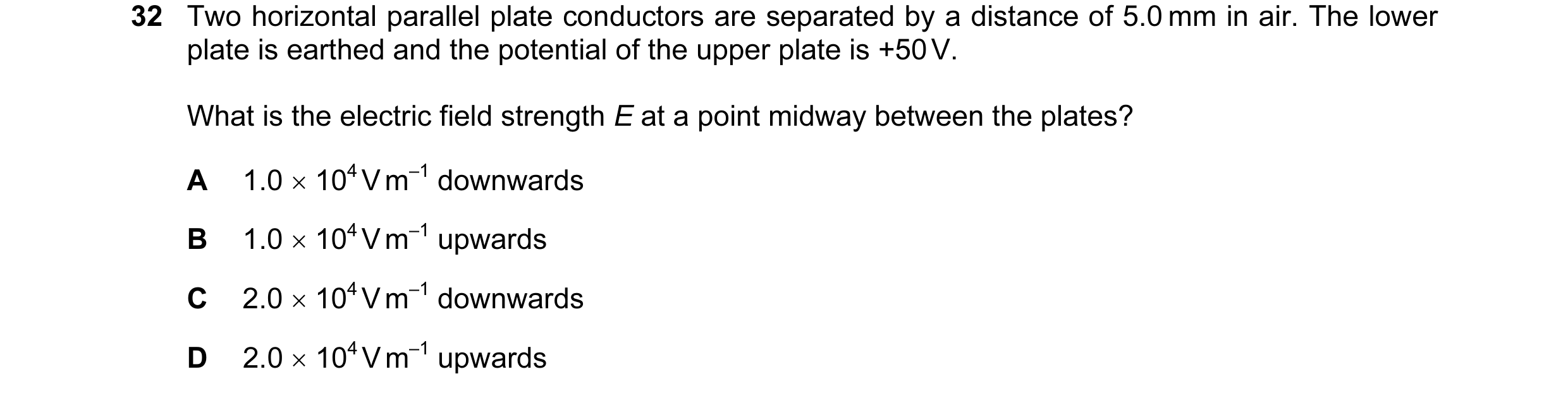
Q33 · Two horizontal parallel plate conductors are separated by a distance of 5.0 mm in air 9702/11 Oct/Nov 2011
31 Two horizontal parallel plate conductors are separated by a distance of 5.0 mm in air. The lower plate is earthed and the potential of the upper plate is +50 V. What is the electric field strength E at a point midway between the plates? A 1.0 × 10⁴ V m–1 downwards B 1.0 × 10⁴ V m–1 upwards C 2.0 × 10⁴ V m–1 downwards D 2.0 × 10⁴ V m–1 upwards Space for working
1 marks
Answer: A
This question in 9702/11 Oct/Nov 2011
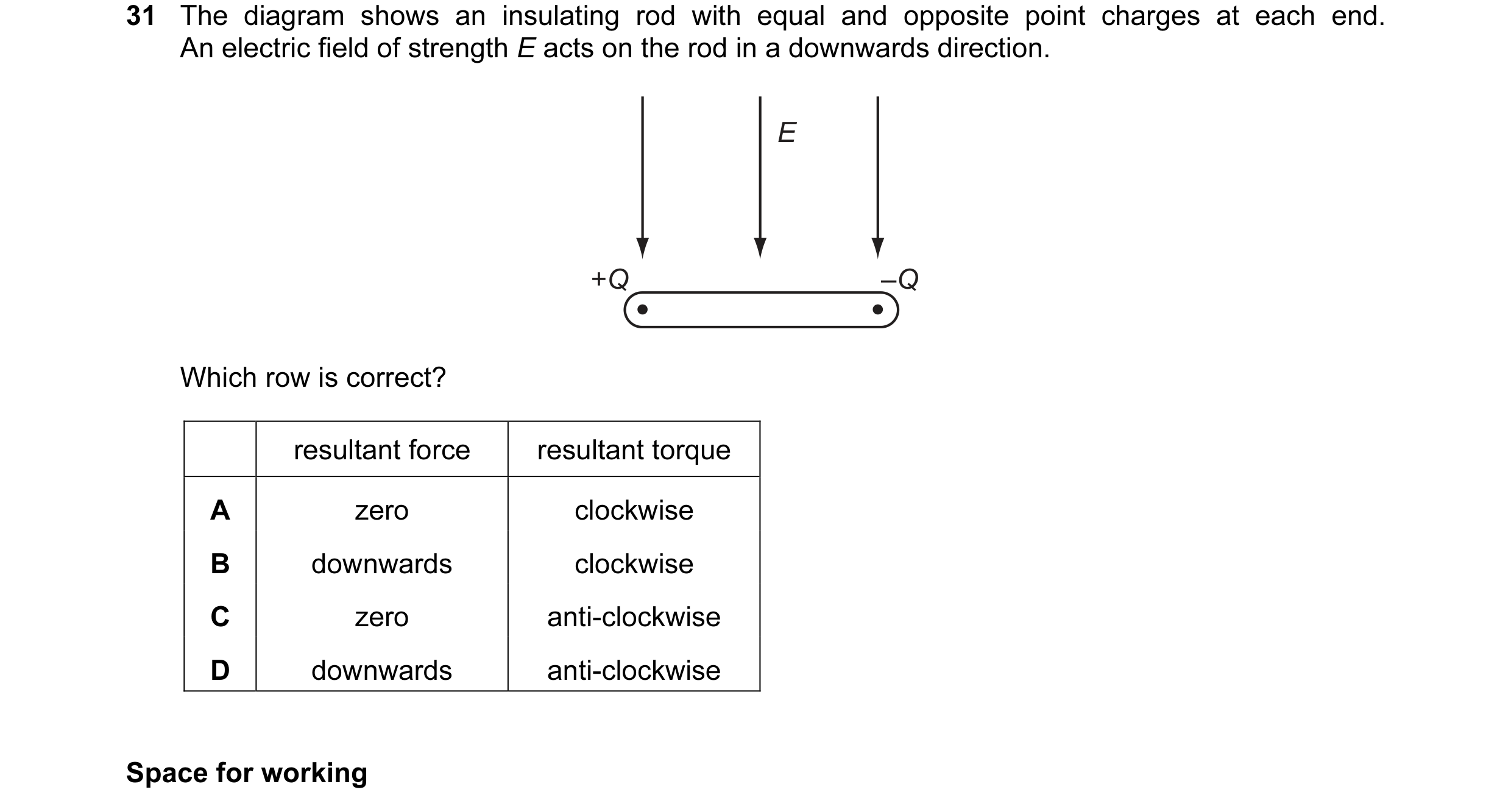
Q34 · The diagram shows an insulating rod with equal and opposite point charges at each end 9702/11 Oct/Nov 2011
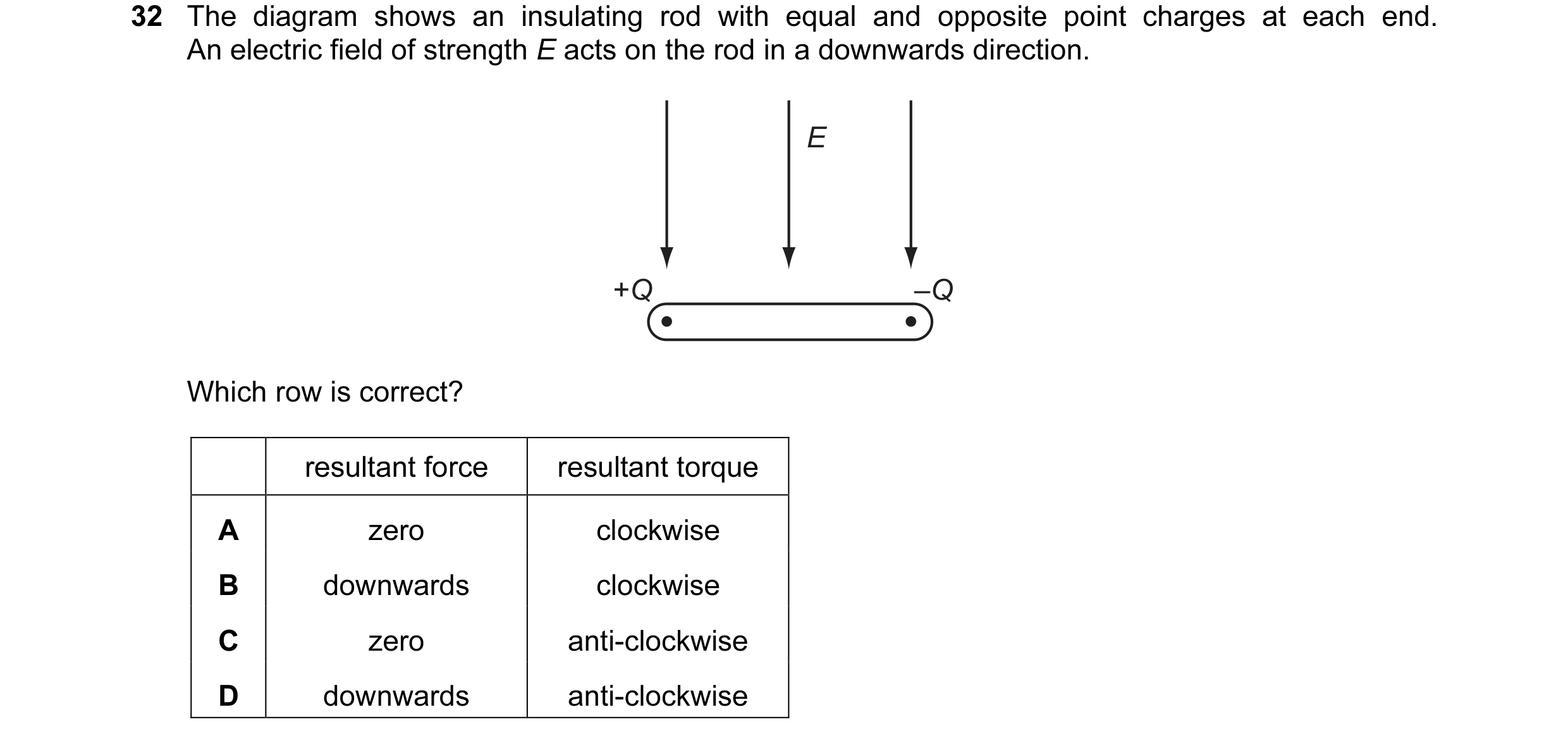
32 The diagram shows an insulating rod with equal and opposite point charges at each end. An electric field of strength E acts on the rod in a downwards direction. E +Q –Q Which row is correct? resultant force resultant torque A zero clockwise B downwards clockwise C zero anti-clockwise D downwards anti-clockwise
1 marks
Answer: C
This question in 9702/11 Oct/Nov 2011
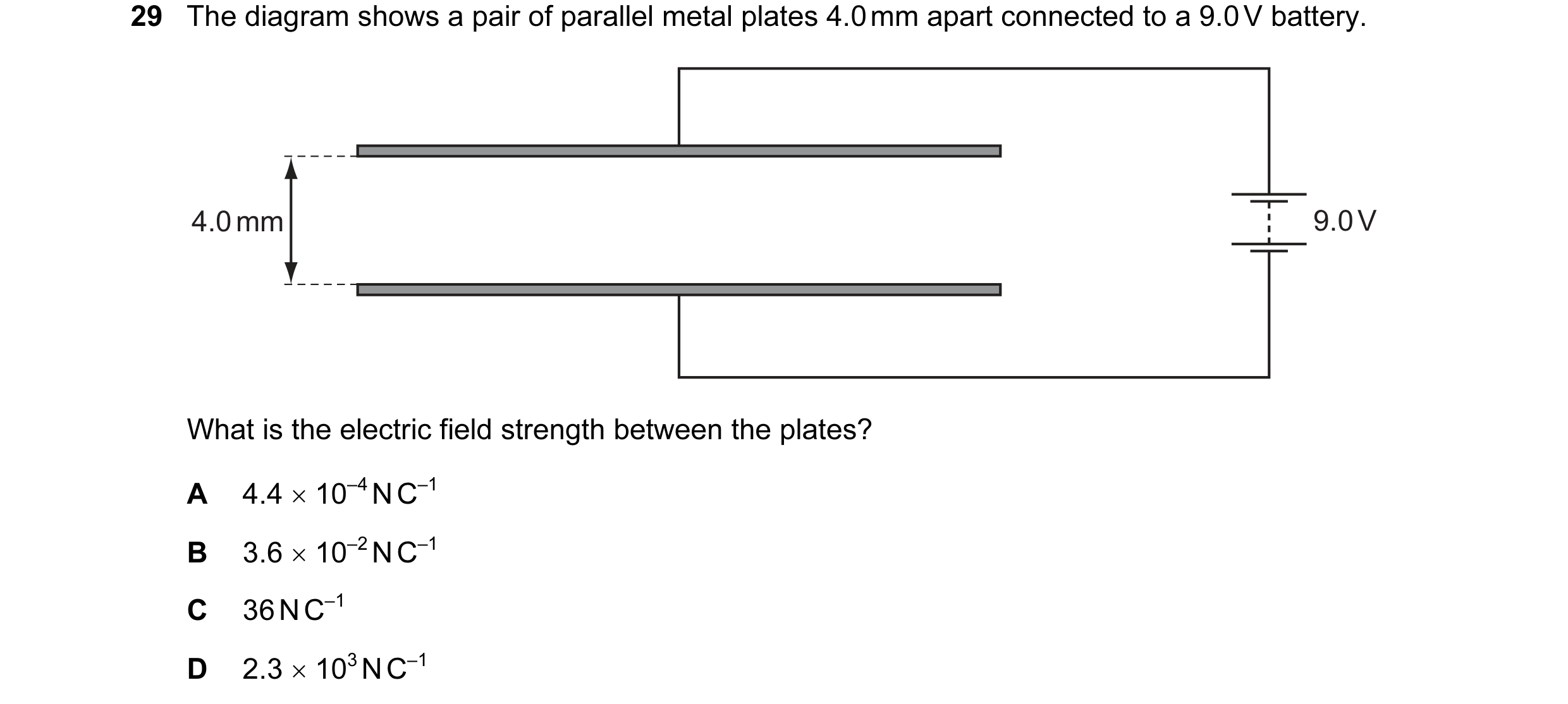
Q35 · The diagram shows a pair of parallel metal plates 4.0 mm apart connected to a 9.0 V… 9702/12 Oct/Nov 2011
29 The diagram shows a pair of parallel metal plates 4.0 mm apart connected to a 9.0 V battery. 4.0 mm 9.0 V What is the electric field strength between the plates? A 4.4 × 10⁻⁴ N C–1 B 3.6 × 10⁻² N C–1 C 36 N C–1 D 2.3 × 10³ N C–1
1 marks
Answer: D
This question in 9702/12 Oct/Nov 2011
Q36 · Which path shows a possible movement of an electron in the electric field shown? 9702/12 Oct/Nov 2011
30 Which path shows a possible movement of an electron in the electric field shown? A B electron beam D C Space for working
1 marks
Answer: A
This question in 9702/12 Oct/Nov 2011
Q37 · The diagram shows an insulating rod with equal and opposite point charges at each end 9702/13 Oct/Nov 2011
31 The diagram shows an insulating rod with equal and opposite point charges at each end. An electric field of strength E acts on the rod in a downwards direction. E +Q –Q Which row is correct? resultant force resultant torque A zero clockwise B downwards clockwise C zero anti-clockwise D downwards anti-clockwise Space for working
1 marks
Answer: C
This question in 9702/13 Oct/Nov 2011
Q38 · Two horizontal parallel plate conductors are separated by a distance of 5.0 mm in air 9702/13 Oct/Nov 2011
32 Two horizontal parallel plate conductors are separated by a distance of 5.0 mm in air. The lower plate is earthed and the potential of the upper plate is +50 V. What is the electric field strength E at a point midway between the plates? A 1.0 × 10⁴ V m–1 downwards B 1.0 × 10⁴ V m–1 upwards C 2.0 × 10⁴ V m–1 downwards D 2.0 × 10⁴ V m–1 upwards
1 marks
Answer: A
This question in 9702/13 Oct/Nov 2011
Q39 · An electric field exists in the space between two charged metal plates 9702/12 May/June 2012
31 An electric field exists in the space between two charged metal plates. + X Y – Which graph shows the variation of electric field strength E with distance d from X along the line XY? A B C D E E E E 0 0 0 0 0 0 0 0 d d d d
1 marks
Answer: C
This question in 9702/12 May/June 2012
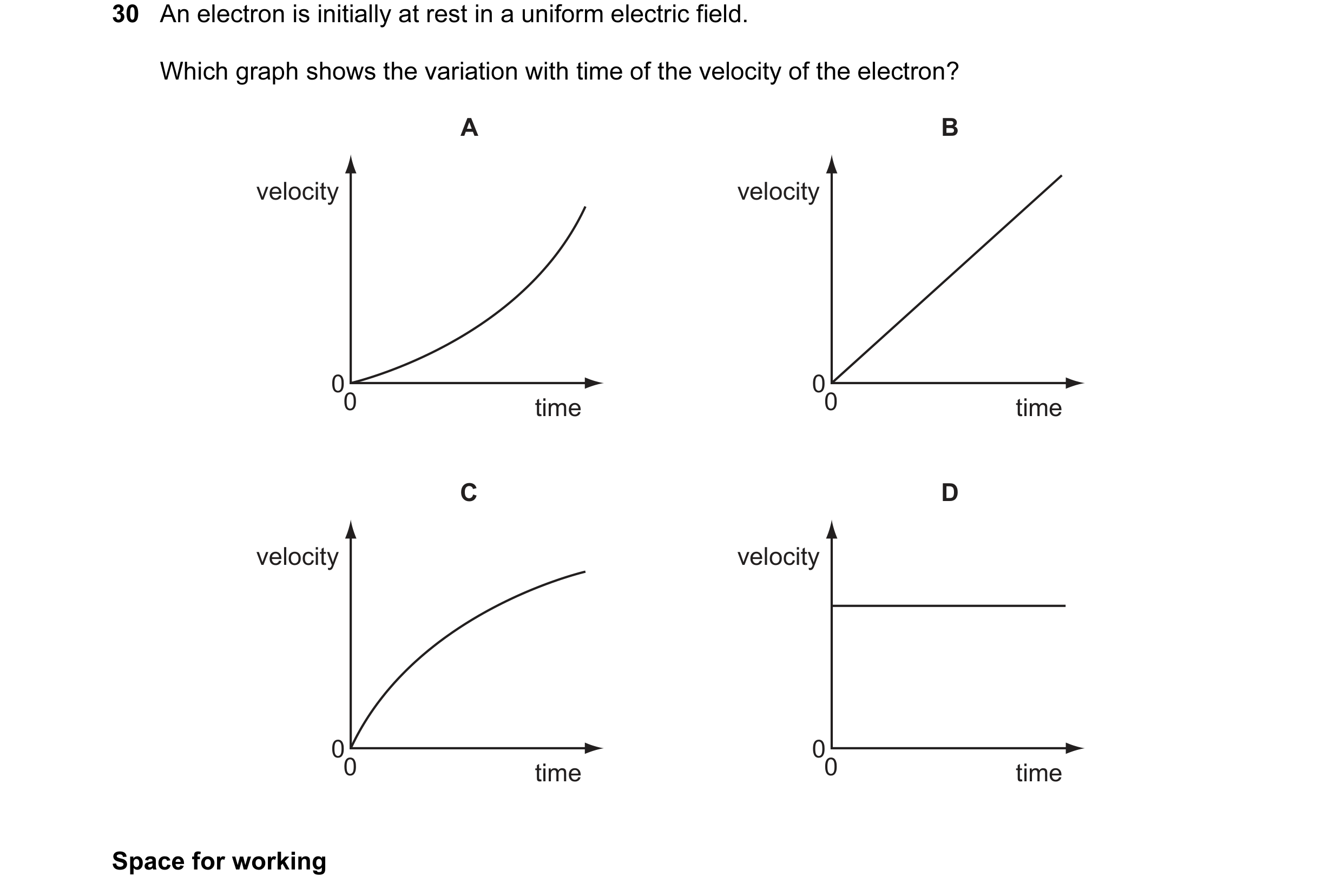
Q40 · An electron is initially at rest in a uniform electric field 9702/11 Oct/Nov 2012
30 An electron is initially at rest in a uniform electric field. Which graph shows the variation with time of the velocity of the electron? A B velocity velocity 00 00 time time C D velocity velocity 00 00 time time Space for working
1 marks
Answer: B
This question in 9702/11 Oct/Nov 2012
Q41 · A charged particle is in the electric field between two horizontal metal plates connected… 9702/11 Oct/Nov 2012
31 A charged particle is in the electric field between two horizontal metal plates connected to a source of constant potential difference, as shown. charged particle There is a force F on the particle due to the electric field. The separation of the plates is doubled. What will be the new force on the particle? A F B F C F D 2F 4 2
1 marks
Answer: B
This question in 9702/11 Oct/Nov 2012
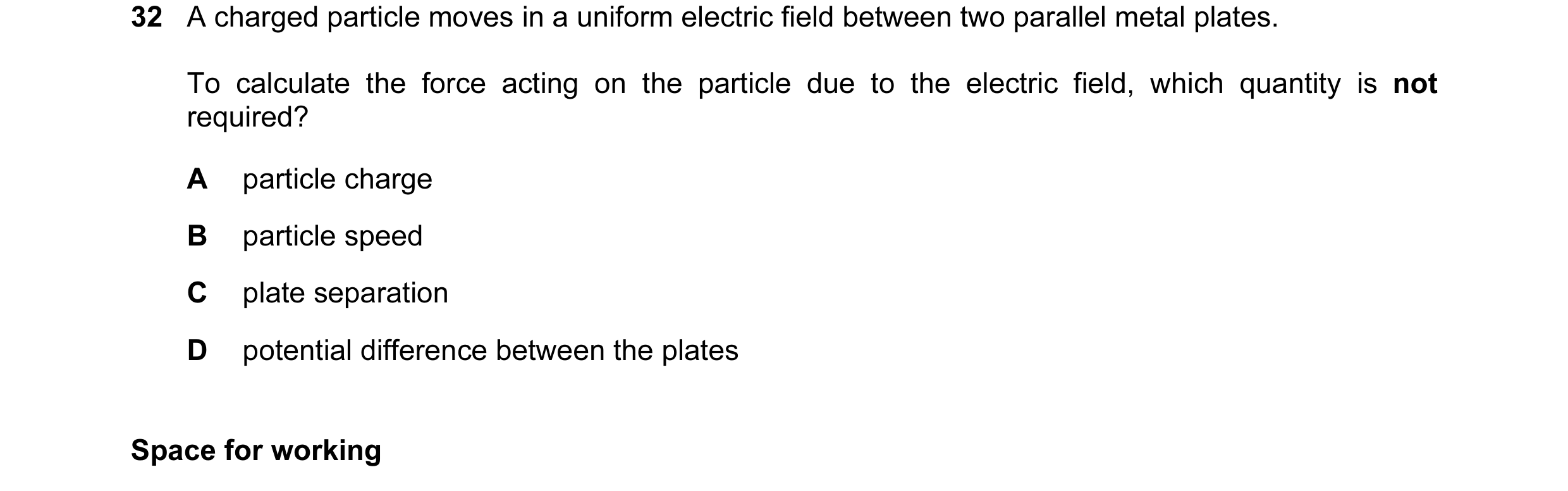
Q42 · A charged particle moves in a uniform electric field between two parallel metal plates 9702/12 Oct/Nov 2012
32 A charged particle moves in a uniform electric field between two parallel metal plates. To calculate the force acting on the particle due to the electric field, which quantity is not required? A particle charge B particle speed C plate separation D potential difference between the plates Space for working
1 marks
Answer: B
This question in 9702/12 Oct/Nov 2012
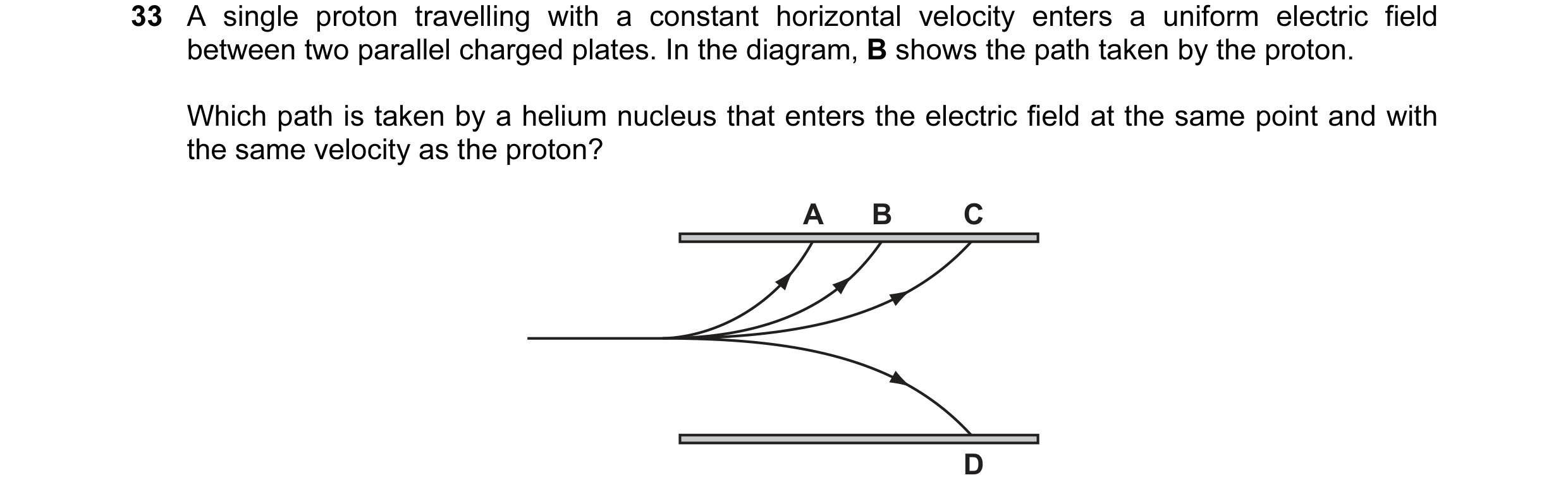
Q43 · A single proton travelling with a constant horizontal velocity enters a uniform electric… 9702/12 Oct/Nov 2012
33 A single proton travelling with a constant horizontal velocity enters a uniform electric field between two parallel charged plates. In the diagram, B shows the path taken by the proton. Which path is taken by a helium nucleus that enters the electric field at the same point and with the same velocity as the proton? A B C D
1 marks
Answer: C
This question in 9702/12 Oct/Nov 2012
Q44 · The diagram shows two parallel plates 9702/13 Oct/Nov 2012
30 The diagram shows two parallel plates. The plates are charged so that there is an electric field between them. P, Q and R are points which are 4 1 , 2 1 and 4 3 of the distance from the top plate to the bottom plate. P Q R What is the electric field strength at point P? A the same as that at point Q B twice that at point R C half that at point R D one third that at point Q
1 marks
Answer: A
This question in 9702/13 Oct/Nov 2012
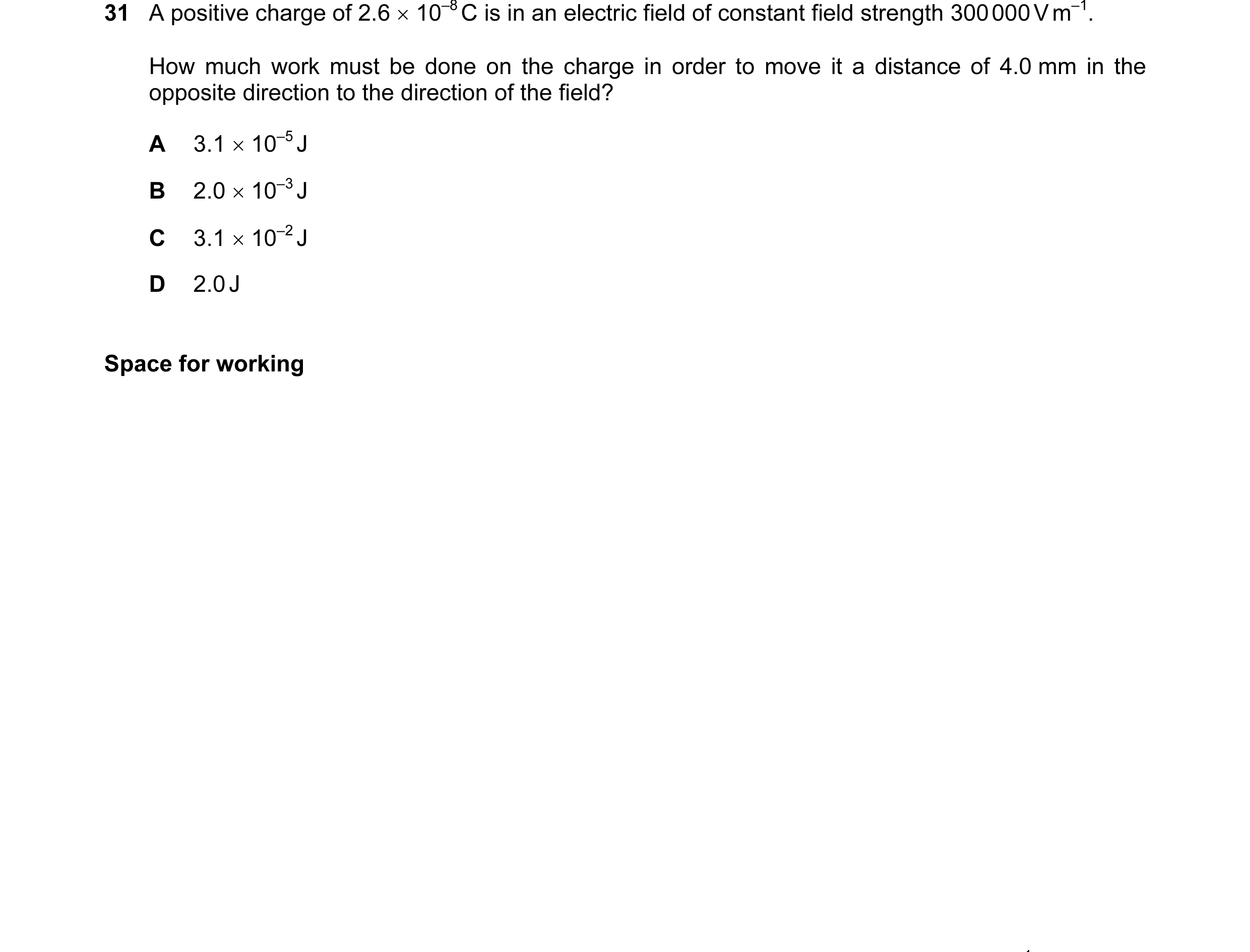
Q45 · A positive charge of 2.6 × 10⁻⁸ C is in an electric field of constant field strength 300… 9702/13 Oct/Nov 2012
31 A positive charge of 2.6 × 10⁻⁸ C is in an electric field of constant field strength 300 000 V m–1. How much work must be done on the charge in order to move it a distance of 4.0 mm in the opposite direction to the direction of the field? A 3.1 × 10⁻⁵ J B 2.0 × 10⁻³ J C 3.1 × 10⁻² J D 2.0 J Space for working
1 marks
Answer: A
This question in 9702/13 Oct/Nov 2012
Q46 · A small water droplet of mass 3.0 µg carries a charge of –6.0 × 10⁻¹¹ C 9702/11 May/June 2013
13 A small water droplet of mass 3.0 µg carries a charge of –6.0 × 10⁻¹¹ C. The droplet is situated in the Earth’s gravitational field between two horizontal metal plates. The potential of the upper plate is +500 V and the potential of the lower plate is –500 V. +500 V water droplet – 2.0 mm with negative charge –500 V What is the motion of the droplet? A It accelerates downwards. B It remains stationary. C It accelerates upwards. D It moves upwards at a constant velocity.
1 marks
Answer: C
This question in 9702/11 May/June 2013
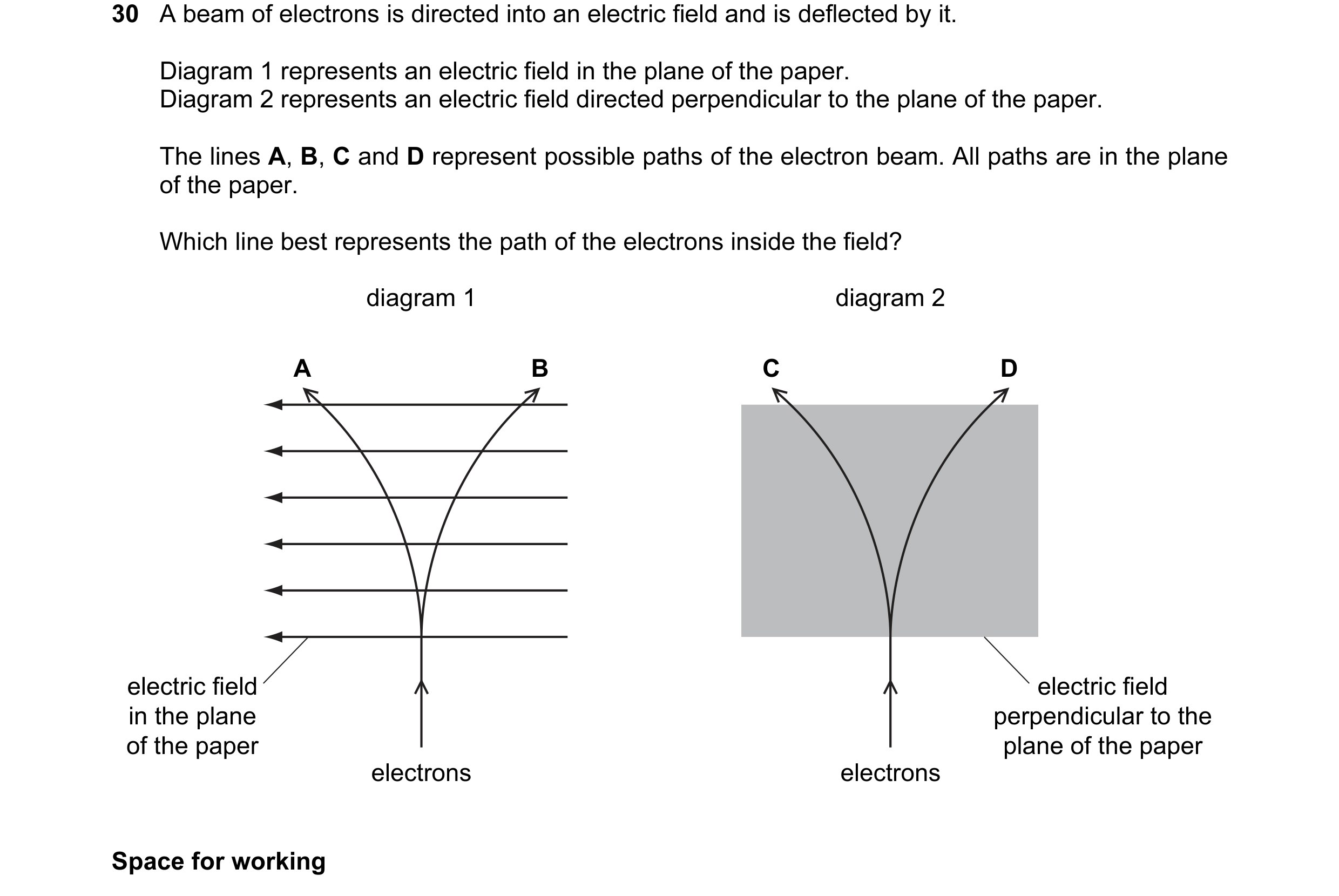
Q47 · A beam of electrons is directed into an electric field and is deflected by it 9702/11 May/June 2013
30 A beam of electrons is directed into an electric field and is deflected by it. Diagram 1 represents an electric field in the plane of the paper. Diagram 2 represents an electric field directed perpendicular to the plane of the paper. The lines A, B, C and D represent possible paths of the electron beam. All paths are in the plane of the paper. Which line best represents the path of the electrons inside the field? diagram 1 diagram 2 A B C D electric field electric field in the plane perpendicular to the of the paper plane of the paper electrons electrons Space for working
1 marks
Answer: B
This question in 9702/11 May/June 2013
Q48 · Two oppositely-charged parallel plates are arranged as shown 9702/11 May/June 2013
31 Two oppositely-charged parallel plates are arranged as shown. _ + An electron is released from rest from the surface of the negatively-charged plate. The electron travels from the negatively-charged plate towards the positively-charged plate. Which graph shows how the force F on the electron varies with its distance x from the negative plate? A B C D F F F F 0 0 0 0 0 0 0 0 x x x x
1 marks
Answer: D
This question in 9702/11 May/June 2013
Q49 · Two conducting layers of a liquid crystal display of a calculator are 8 µm apart 9702/12 May/June 2013
30 Two conducting layers of a liquid crystal display of a calculator are 8 µm apart. A 1.5 V cell is connected across the conducting layers when the calculator is switched on. What is the electric field strength between the layers? A 1.2 × 10⁻⁵ V m–1 B 0.19 V m–1 C 12 V m–1 D 1.9 × 10⁵ V m–1 Space for working
1 marks
Answer: D
This question in 9702/12 May/June 2013
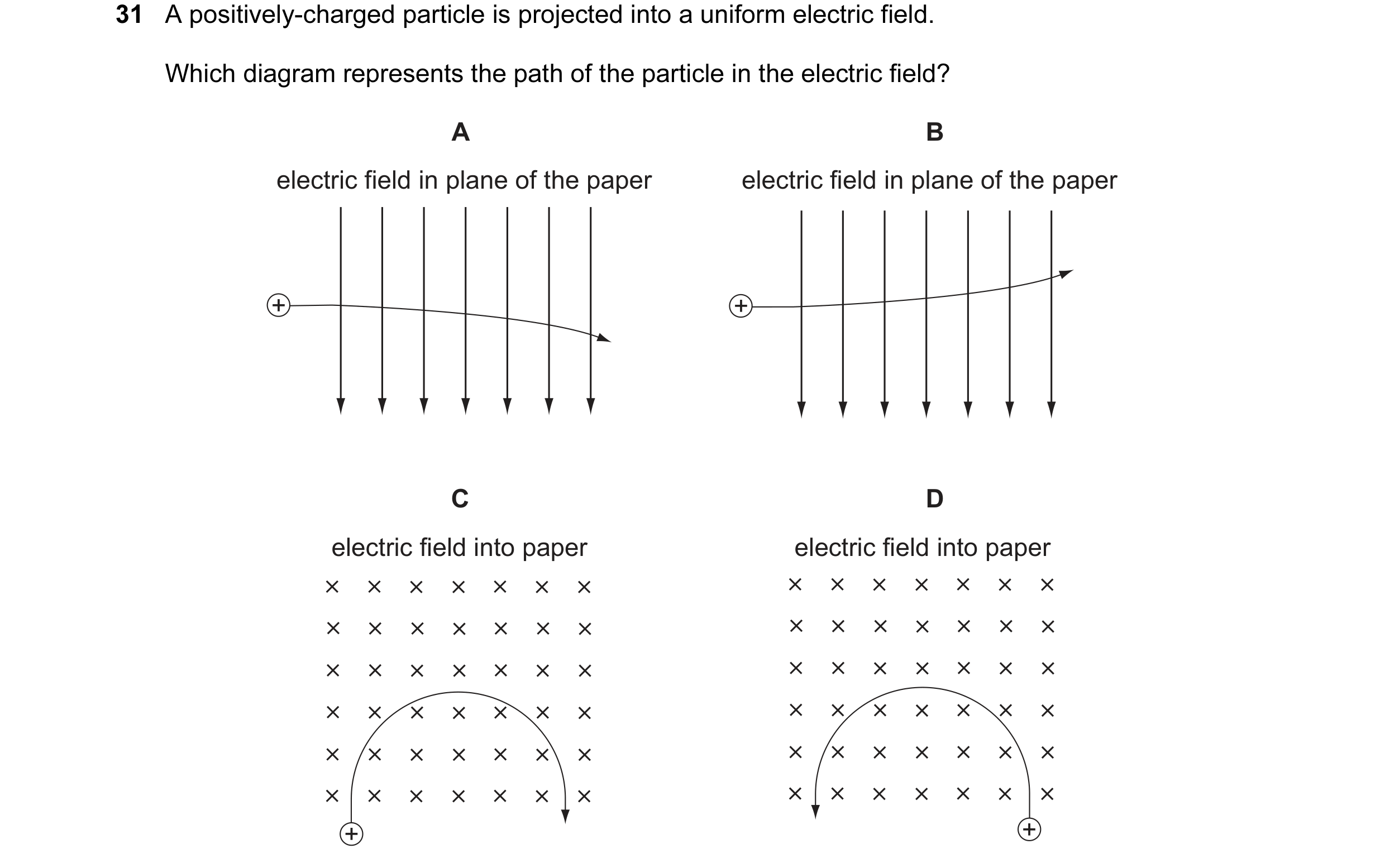
Q50 · A positively-charged particle is projected into a uniform electric field 9702/12 May/June 2013
31 A positively-charged particle is projected into a uniform electric field. Which diagram represents the path of the particle in the electric field? A B electric field in plane of the paper electric field in plane of the paper + + C D electric field into paper electric field into paper + +
1 marks
Answer: A
This question in 9702/12 May/June 2013
Q51 · The diagrams show a negative electric charge situated in a uniform electric field and a… 9702/13 May/June 2013
12 The diagrams show a negative electric charge situated in a uniform electric field and a mass situated in a uniform gravitational field. – charge mass uniform electric field uniform gravitational field Which row shows the directions of the forces acting on the charge and on the mass? charge mass A – B – C – D – Space for working
1 marks
Answer: B
This question in 9702/13 May/June 2013
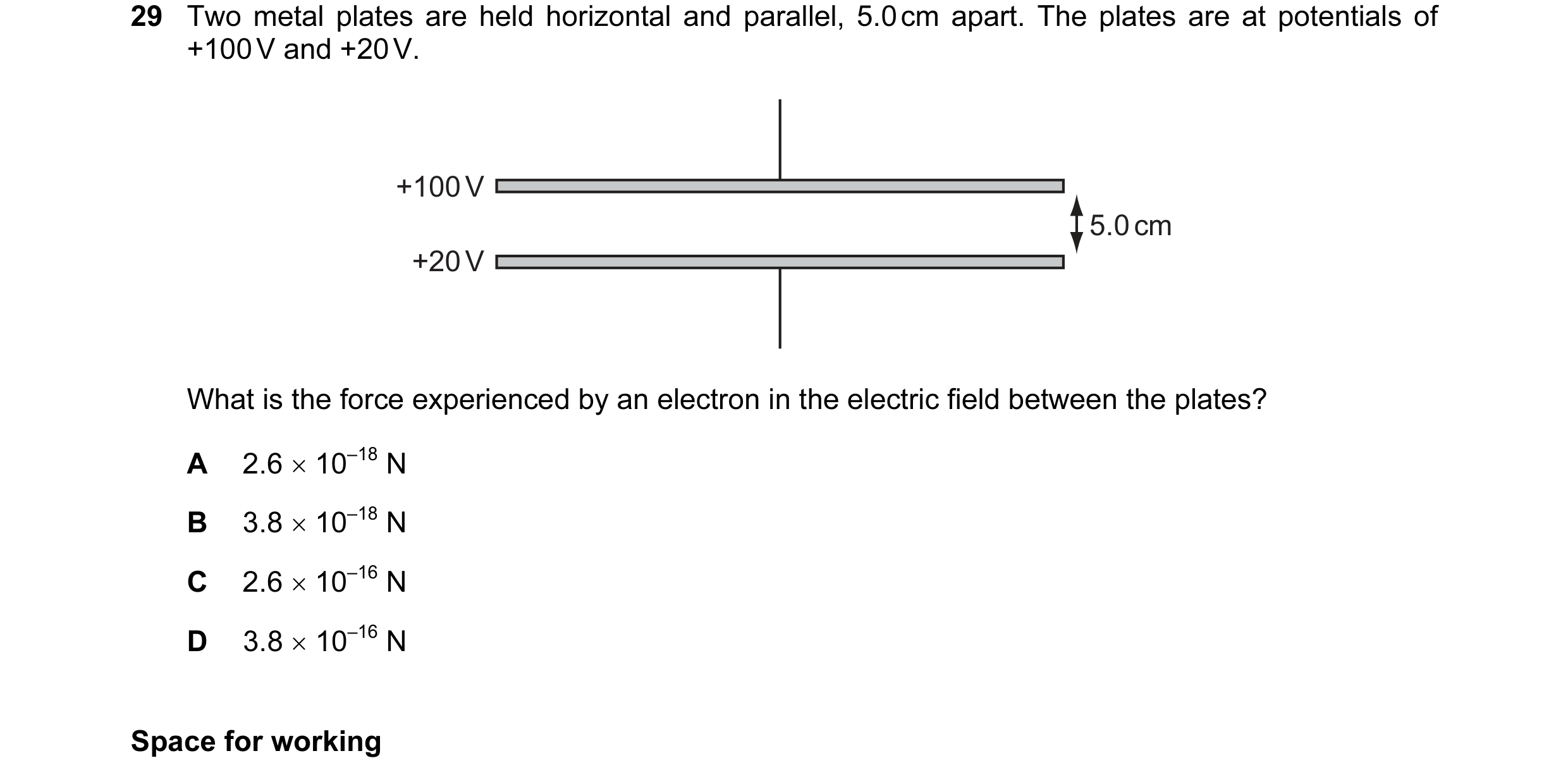
Q52 · Two metal plates are held horizontal and parallel, 5.0 cm apart 9702/13 May/June 2013
29 Two metal plates are held horizontal and parallel, 5.0 cm apart. The plates are at potentials of +100 V and +20 V. +100 V 5.0 cm +20 V What is the force experienced by an electron in the electric field between the plates? A 2.6 × 10⁻¹⁸ N B 3.8 × 10⁻¹⁸ N C 2.6 × 10⁻¹⁶ N D 3.8 × 10⁻¹⁶ N Space for working
1 marks
Answer: C
This question in 9702/13 May/June 2013
Q53 · The diagram shows the path of a charged particle through a uniform electric field, having… 9702/13 May/June 2013
30 The diagram shows the path of a charged particle through a uniform electric field, having vertical field lines. electric path of field lines particle What could give a path of this shape? A a positive charge travelling left to right in a field directed downwards B a positive charge travelling right to left in a field directed downwards C a negative charge travelling right to left in a field directed upwards D a negative charge travelling left to right in a field directed downwards
1 marks
Answer: D
This question in 9702/13 May/June 2013
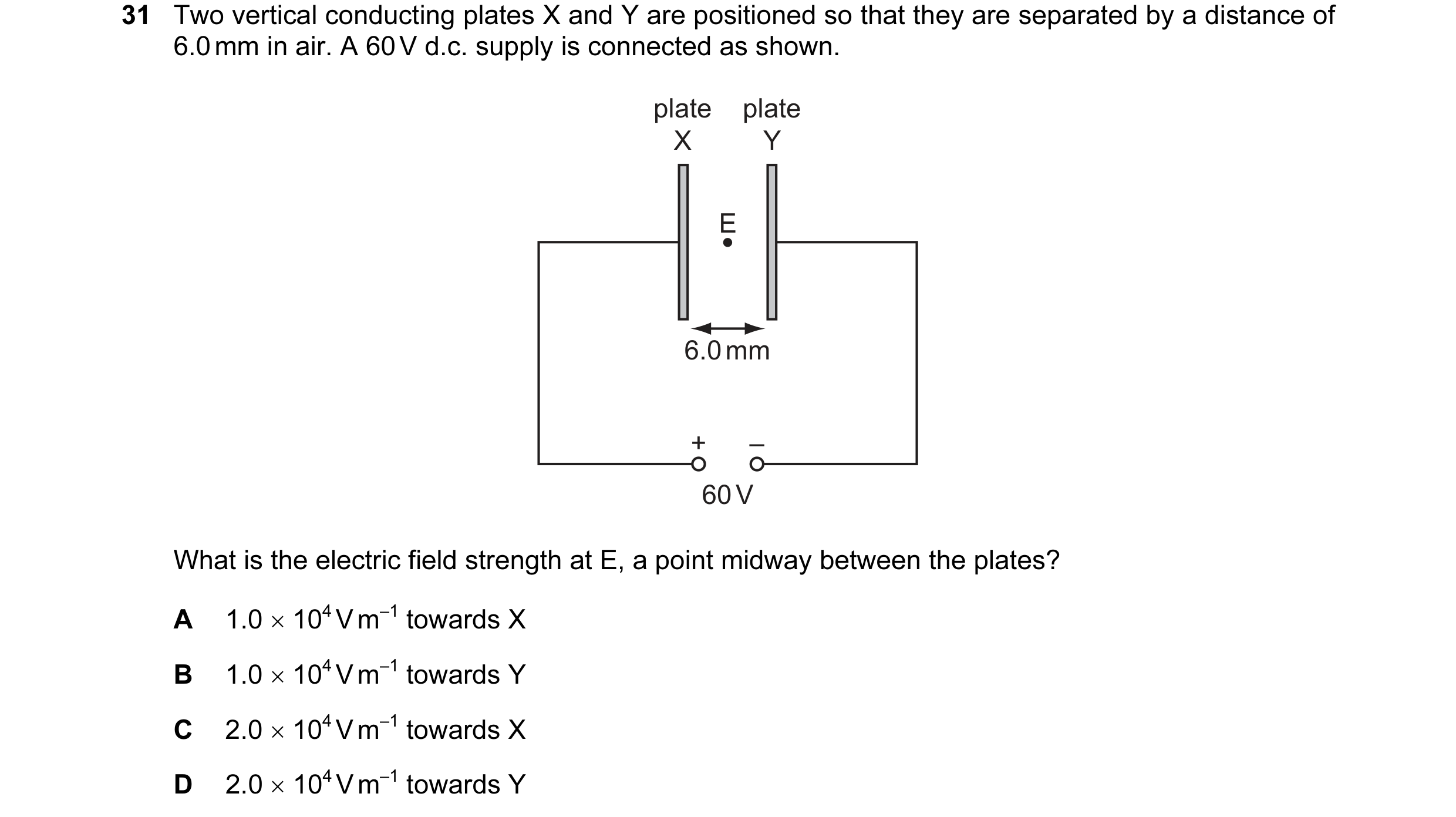
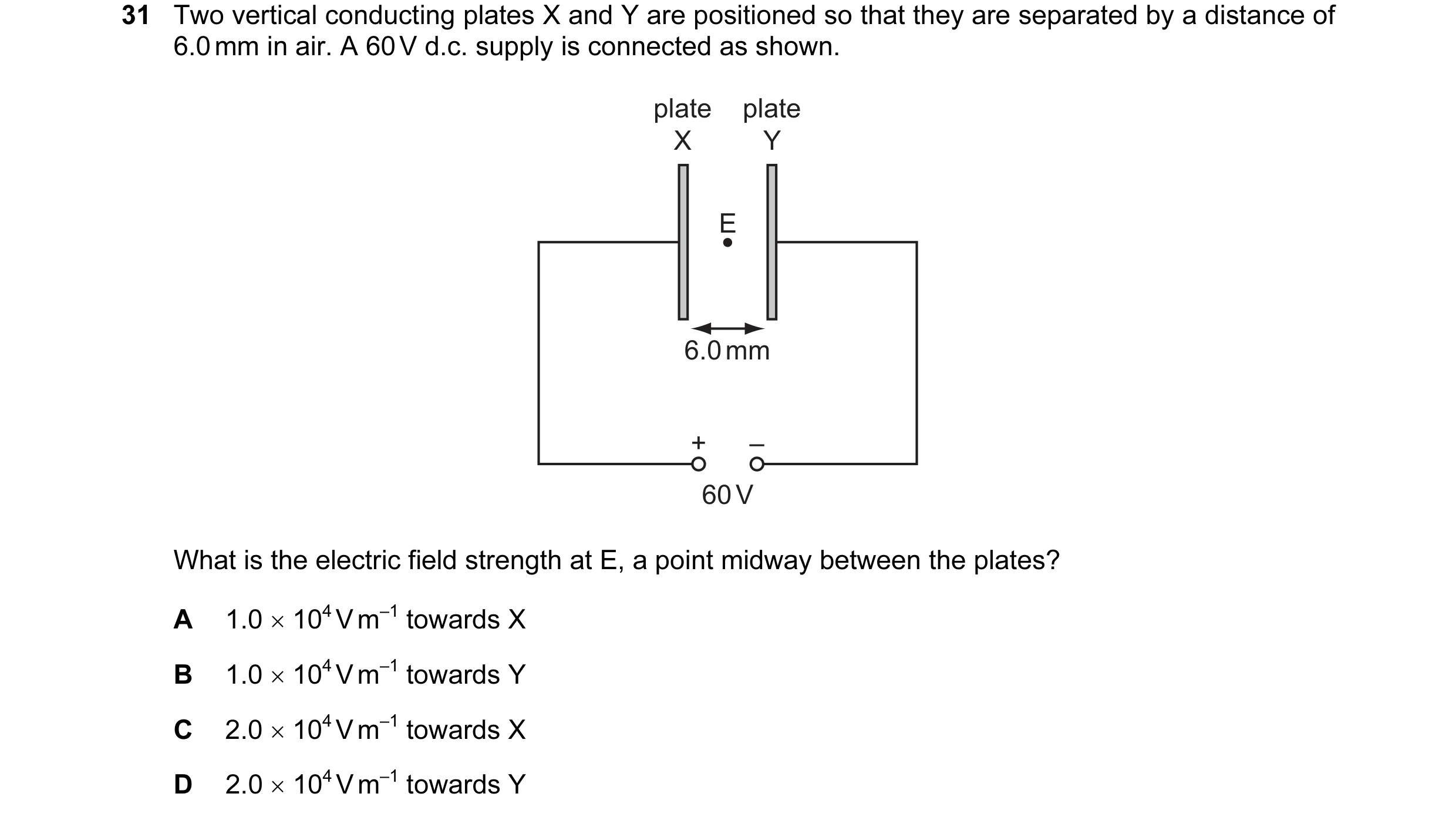
Q54 · Two vertical conducting plates X and Y are positioned so that they are separated by a… 9702/11 Oct/Nov 2013
31 Two vertical conducting plates X and Y are positioned so that they are separated by a distance of 6.0 mm in air. A 60 V d.c. supply is connected as shown. plate plate X Y E 6.0 mm + – 60 V What is the electric field strength at E, a point midway between the plates? A 1.0 × 10⁴ V m–1 towards X B 1.0 × 10⁴ V m–1 towards Y C 2.0 × 10⁴ V m–1 towards X D 2.0 × 10⁴ V m–1 towards Y
1 marks
Answer: B
This question in 9702/11 Oct/Nov 2013
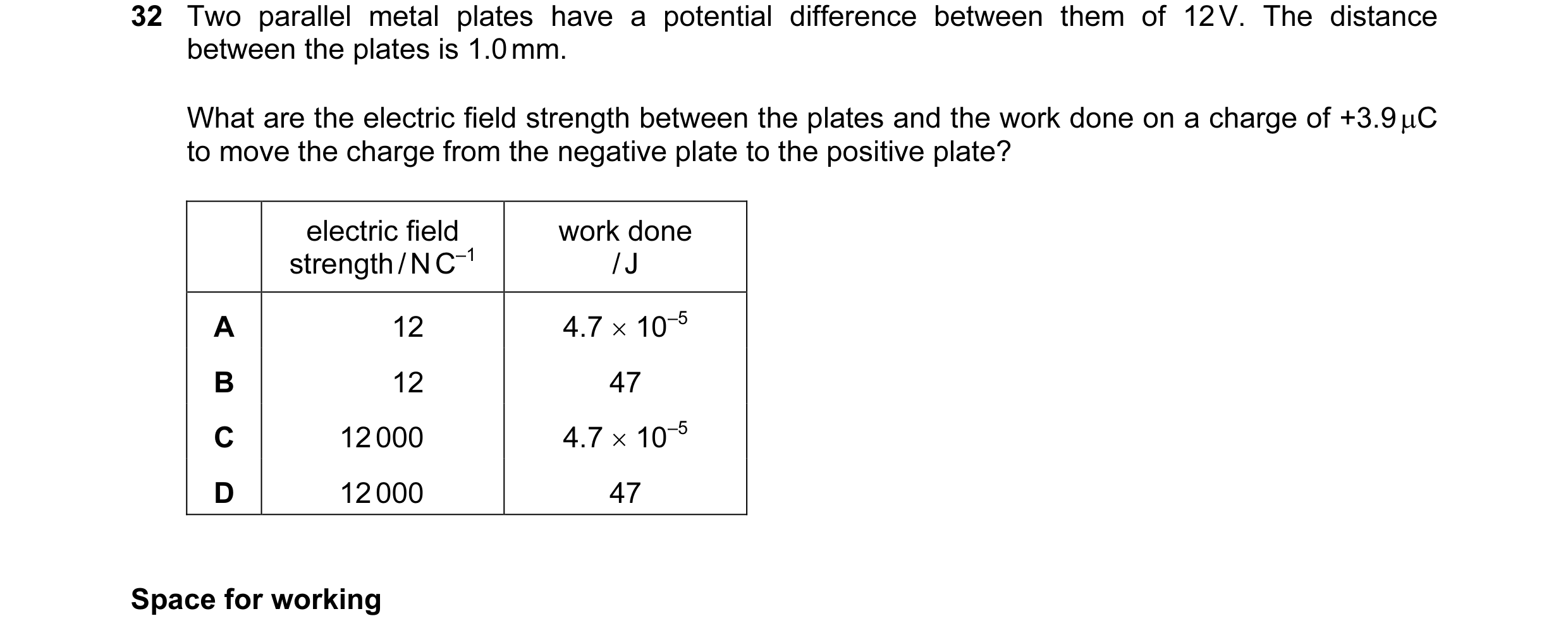
Q55 · Two parallel metal plates have a potential difference between them of 12 V 9702/11 Oct/Nov 2013
32 Two parallel metal plates have a potential difference between them of 12 V. The distance between the plates is 1.0 mm. What are the electric field strength between the plates and the work done on a charge of +3.9 µC to move the charge from the negative plate to the positive plate? electric field work done strength / N C–1 / J A 12 4.7 × 10⁻⁵ B 12 47 C 12 000 4.7 × 10⁻⁵ D 12 000 47 Space for working
1 marks
Answer: C
This question in 9702/11 Oct/Nov 2013
Q56 · Two vertical conducting plates X and Y are positioned so that they are separated by a… 9702/12 Oct/Nov 2013
31 Two vertical conducting plates X and Y are positioned so that they are separated by a distance of 6.0 mm in air. A 60 V d.c. supply is connected as shown. plate plate X Y E 6.0 mm + – 60 V What is the electric field strength at E, a point midway between the plates? A 1.0 × 10⁴ V m–1 towards X B 1.0 × 10⁴ V m–1 towards Y C 2.0 × 10⁴ V m–1 towards X D 2.0 × 10⁴ V m–1 towards Y
1 marks
Answer: B
This question in 9702/12 Oct/Nov 2013
Q57 · Two parallel metal plates have a potential difference between them of 12 V 9702/12 Oct/Nov 2013
32 Two parallel metal plates have a potential difference between them of 12 V. The distance between the plates is 1.0 mm. What are the electric field strength between the plates and the work done on a charge of +3.9 µC to move the charge from the negative plate to the positive plate? electric field work done strength / N C–1 / J A 12 4.7 × 10⁻⁵ B 12 47 C 12 000 4.7 × 10⁻⁵ D 12 000 47 Space for working
1 marks
Answer: C
This question in 9702/12 Oct/Nov 2013
Q58 · Two charged parallel metal plates produce an electric field 9702/13 Oct/Nov 2013
30 Two charged parallel metal plates produce an electric field. + Y X – A charged particle moves from X to Y. Which graph shows the variation of the force on the particle with distance from X along the line XY? A B C D force force force force 00 00 00 00 distance distance distance distance
1 marks
Answer: C
This question in 9702/13 Oct/Nov 2013
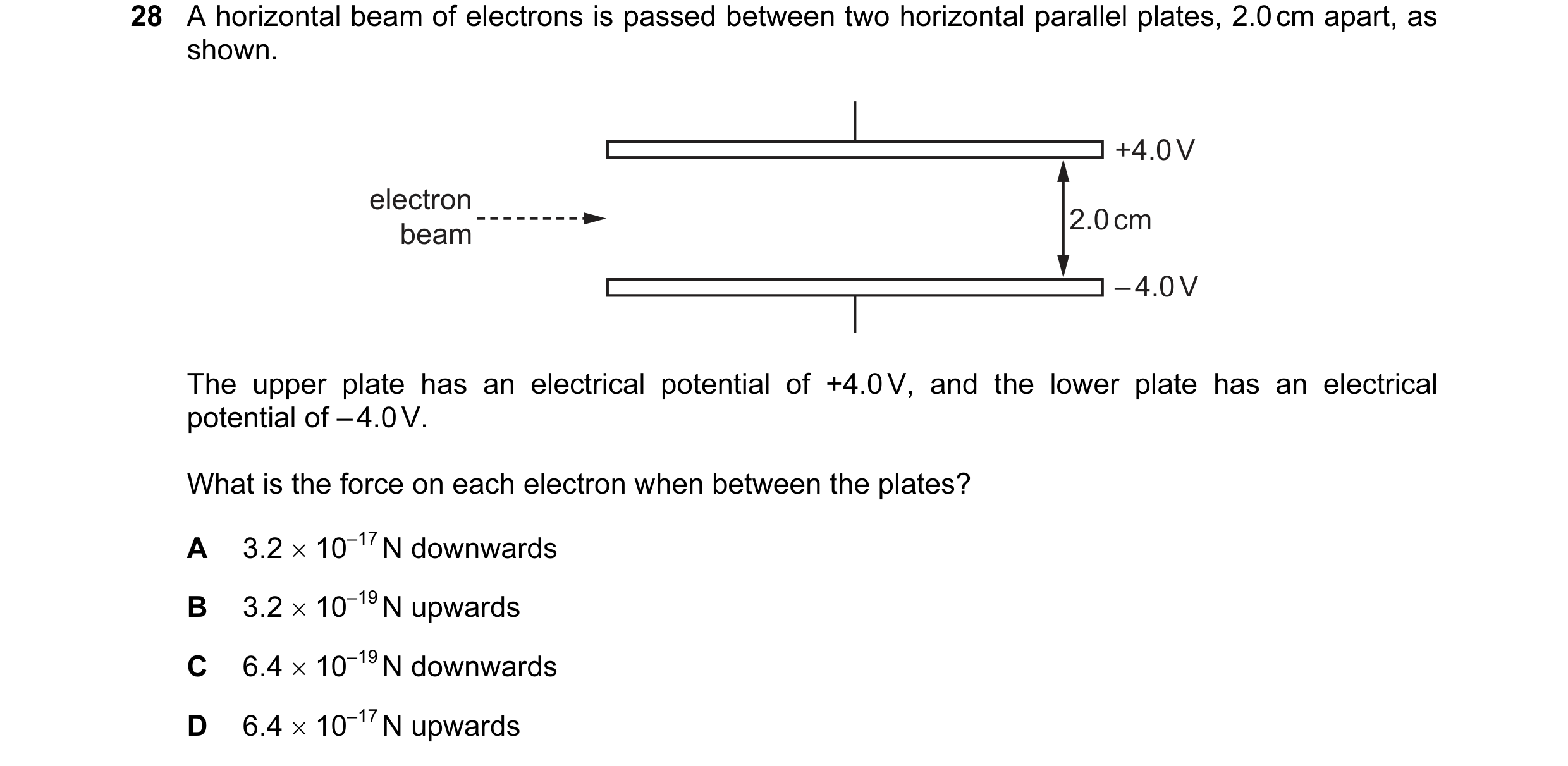
Q59 · A horizontal beam of electrons is passed between two horizontal parallel plates, 2.0 cm… 9702/11 May/June 2014
28 A horizontal beam of electrons is passed between two horizontal parallel plates, 2.0 cm apart, as shown. +4.0 V electron 2.0 cm beam – 4.0 V The upper plate has an electrical potential of +4.0 V, and the lower plate has an electrical potential of – 4.0 V. What is the force on each electron when between the plates? A 3.2 × 10⁻¹⁷ N downwards B 3.2 × 10⁻¹⁹ N upwards C 6.4 × 10⁻¹⁹ N downwards D 6.4 × 10⁻¹⁷ N upwards
1 marks
Answer: D
This question in 9702/11 May/June 2014
Q60 · A tiny oil droplet with mass 6.9 × 10⁻¹³ kg is at rest in an electric field of electric… 9702/12 May/June 2014
12 A tiny oil droplet with mass 6.9 × 10⁻¹³ kg is at rest in an electric field of electric field strength 2.1 × 10⁷ N C–1, as shown. horizontal plate oil droplet The weight of the droplet is exactly balanced by the electrical force on the droplet. What is the charge on the droplet? A 3.3 × 10⁻²⁰ C B –3.3 × 10⁻²⁰ C C 3.2 × 10⁻¹⁹ C D –3.2 × 10⁻¹⁹ C Space for working
1 marks
Answer: D
This question in 9702/12 May/June 2014
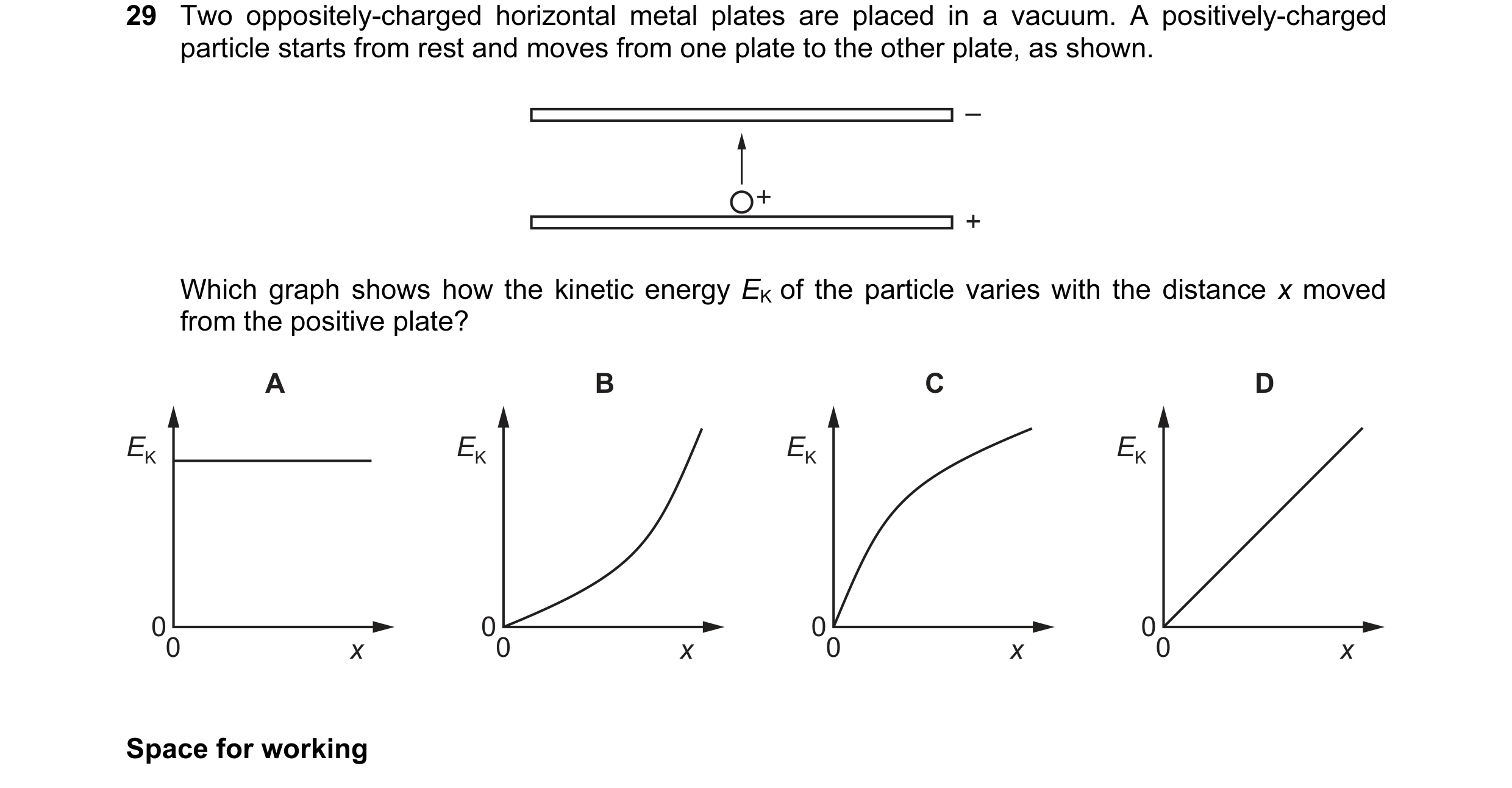
Q61 · Two oppositely-charged horizontal metal plates are placed in a vacuum 9702/12 May/June 2014
29 Two oppositely-charged horizontal metal plates are placed in a vacuum. A positively-charged particle starts from rest and moves from one plate to the other plate, as shown. – + + Which graph shows how the kinetic energy EK of the particle varies with the distance x moved from the positive plate? A B C D EK EK EK EK 00 00 00 00 x x x x Space for working
1 marks
Answer: D
This question in 9702/12 May/June 2014
Q62 · An electron enters a region of space where there is a uniform electric field E as shown 9702/13 May/June 2014
31 An electron enters a region of space where there is a uniform electric field E as shown. path of E electron Initially, the electron is moving parallel to, and in the direction of, the electric field. What is the subsequent path and change of speed of the electron? path of electron speed of electron A linear decreases B linear increases C parabolic decreases D parabolic increases Space for working
1 marks
Answer: A
This question in 9702/13 May/June 2014
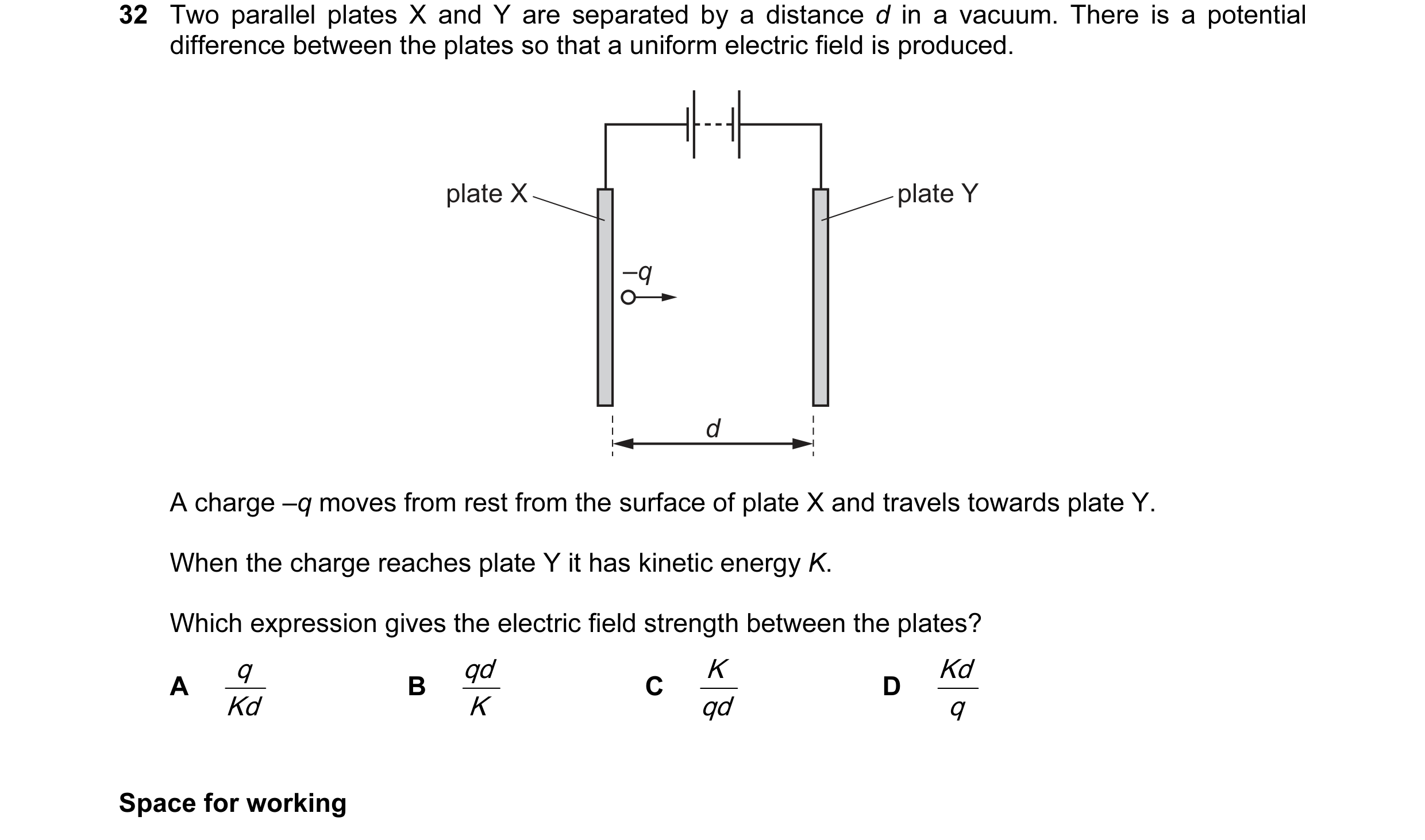
Q63 · Two parallel plates X and Y are separated by a distance d in a vacuum 9702/13 May/June 2014
32 Two parallel plates X and Y are separated by a distance d in a vacuum. There is a potential difference between the plates so that a uniform electric field is produced. plate X plate Y –q d A charge –q moves from rest from the surface of plate X and travels towards plate Y. When the charge reaches plate Y it has kinetic energy K. Which expression gives the electric field strength between the plates? q qd K Kd A B C D Kd K qd q Space for working
1 marks
Answer: C
This question in 9702/13 May/June 2014
Q64 · The diagram shows two parallel horizontal metal plates 9702/11 Oct/Nov 2014
28 The diagram shows two parallel horizontal metal plates. There is a potential difference V between the plates. +V liquid drop A small charged liquid drop, midway between the plates, is held in equilibrium by the combination of its weight and the electric force acting on it. The acceleration of free fall is g and the electric field strength is E. What is the polarity of the charge on the drop, and the ratio of charge to mass of the drop? charge polarity mass E A negative g g B negative E E C positive g g D positive E Space for working
1 marks
Answer: B
This question in 9702/11 Oct/Nov 2014
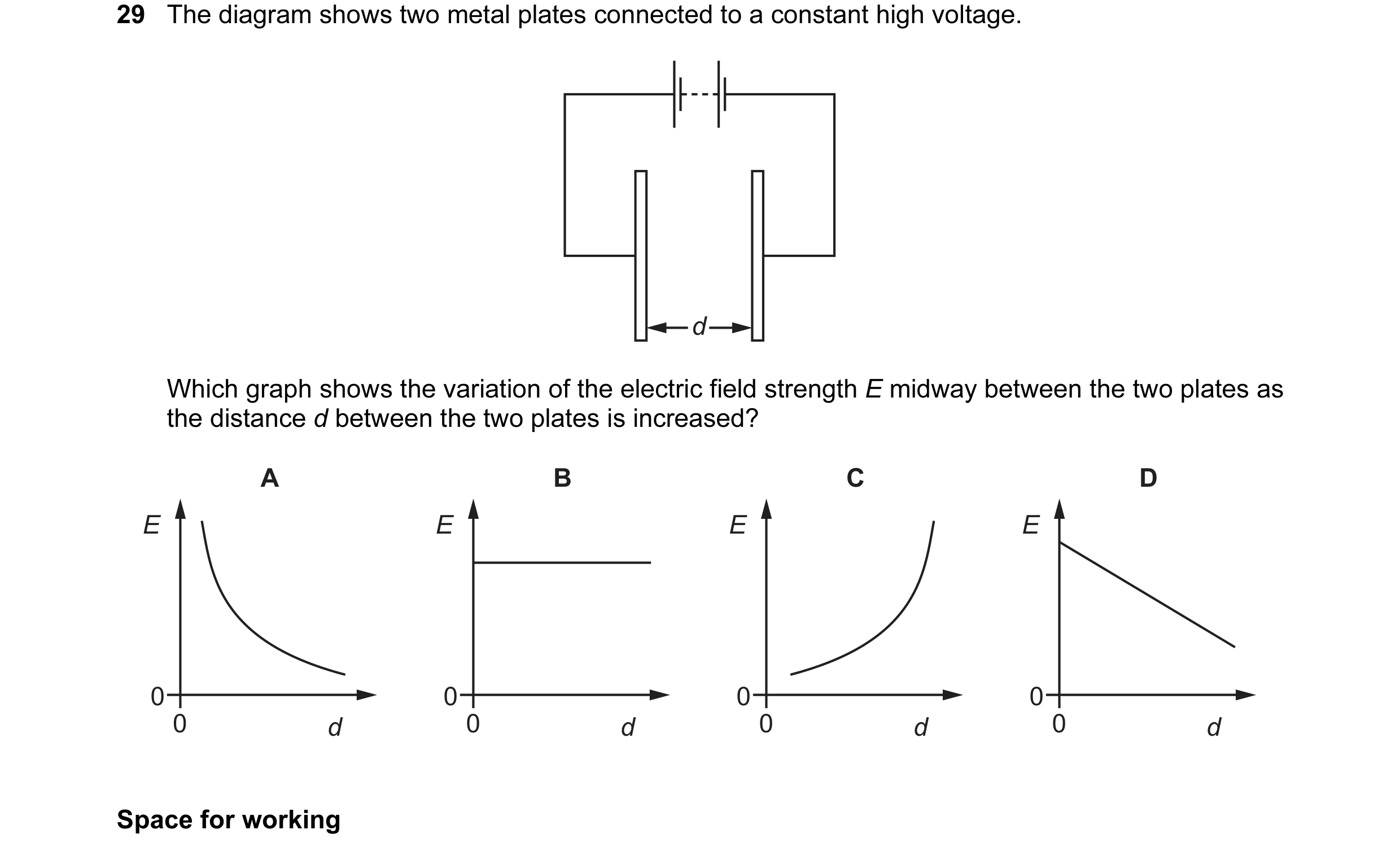
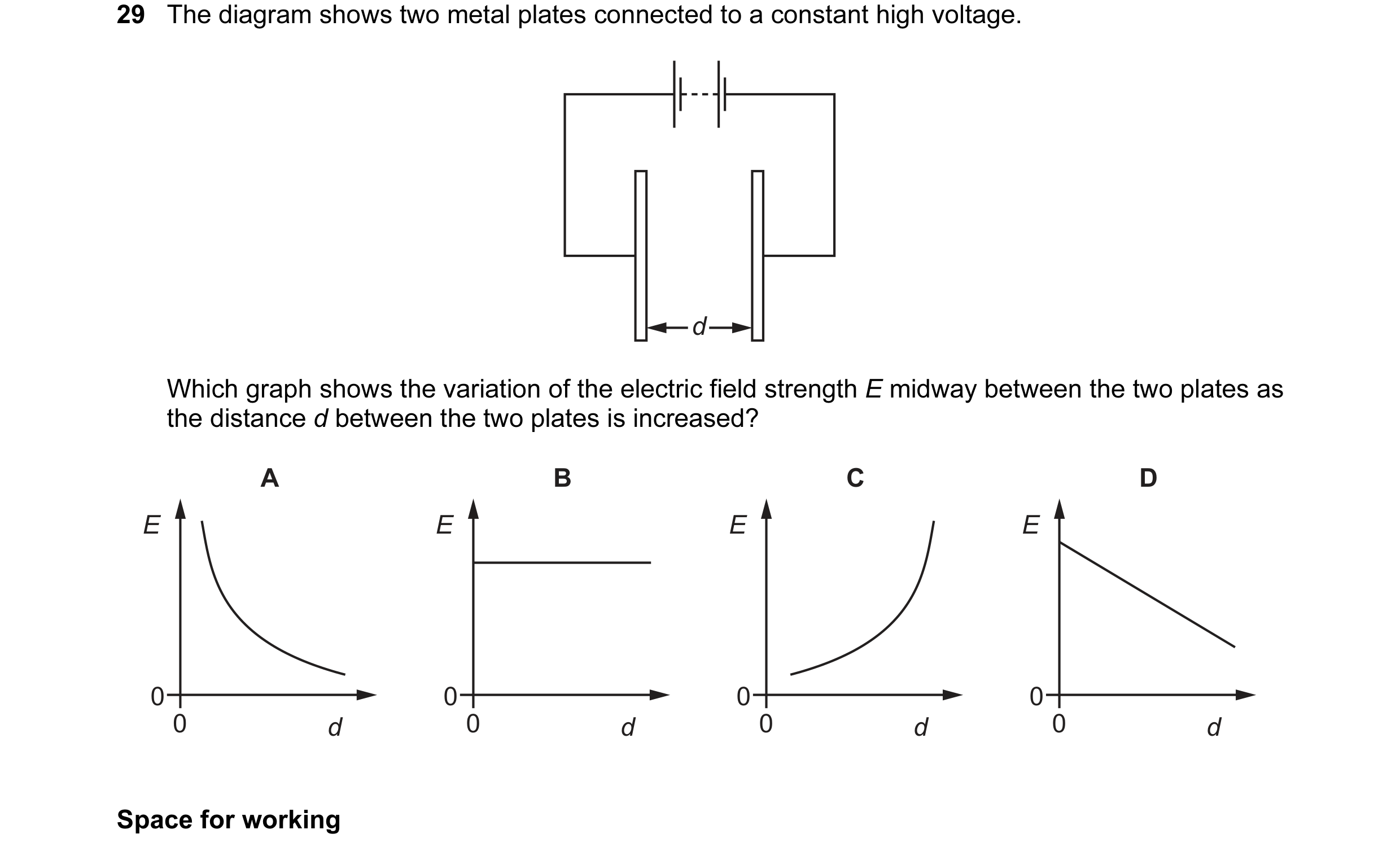
Q65 · The diagram shows two metal plates connected to a constant high voltage 9702/11 Oct/Nov 2014
29 The diagram shows two metal plates connected to a constant high voltage. d Which graph shows the variation of the electric field strength E midway between the two plates as the distance d between the two plates is increased? A B C D E E E E 0 0 0 0 0 d 0 d 0 d 0 d Space for working
1 marks
Answer: A
This question in 9702/11 Oct/Nov 2014
Q66 · The diagram shows two parallel horizontal metal plates 9702/12 Oct/Nov 2014
28 The diagram shows two parallel horizontal metal plates. There is a potential difference V between the plates. +V liquid drop A small charged liquid drop, midway between the plates, is held in equilibrium by the combination of its weight and the electric force acting on it. The acceleration of free fall is g and the electric field strength is E. What is the polarity of the charge on the drop, and the ratio of charge to mass of the drop? charge polarity mass E A negative g g B negative E E C positive g g D positive E Space for working
1 marks
Answer: B
This question in 9702/12 Oct/Nov 2014
Q67 · The diagram shows two metal plates connected to a constant high voltage 9702/12 Oct/Nov 2014
29 The diagram shows two metal plates connected to a constant high voltage. d Which graph shows the variation of the electric field strength E midway between the two plates as the distance d between the two plates is increased? A B C D E E E E 0 0 0 0 0 d 0 d 0 d 0 d Space for working
1 marks
Answer: A
This question in 9702/12 Oct/Nov 2014
Q68 · A positive charge experiences a force F when placed at point X in a uniform electric field 9702/13 Oct/Nov 2014
18 A positive charge experiences a force F when placed at point X in a uniform electric field. The charge is then moved from point X to point Y. Distances r and s are shown on the diagram. Y r uniform electric field F X s What is the change in the potential energy of the charge? A decreases by Fs B increases by Fs C decreases by Fr D increases by Fr Space for working
1 marks
Answer: A
This question in 9702/13 Oct/Nov 2014
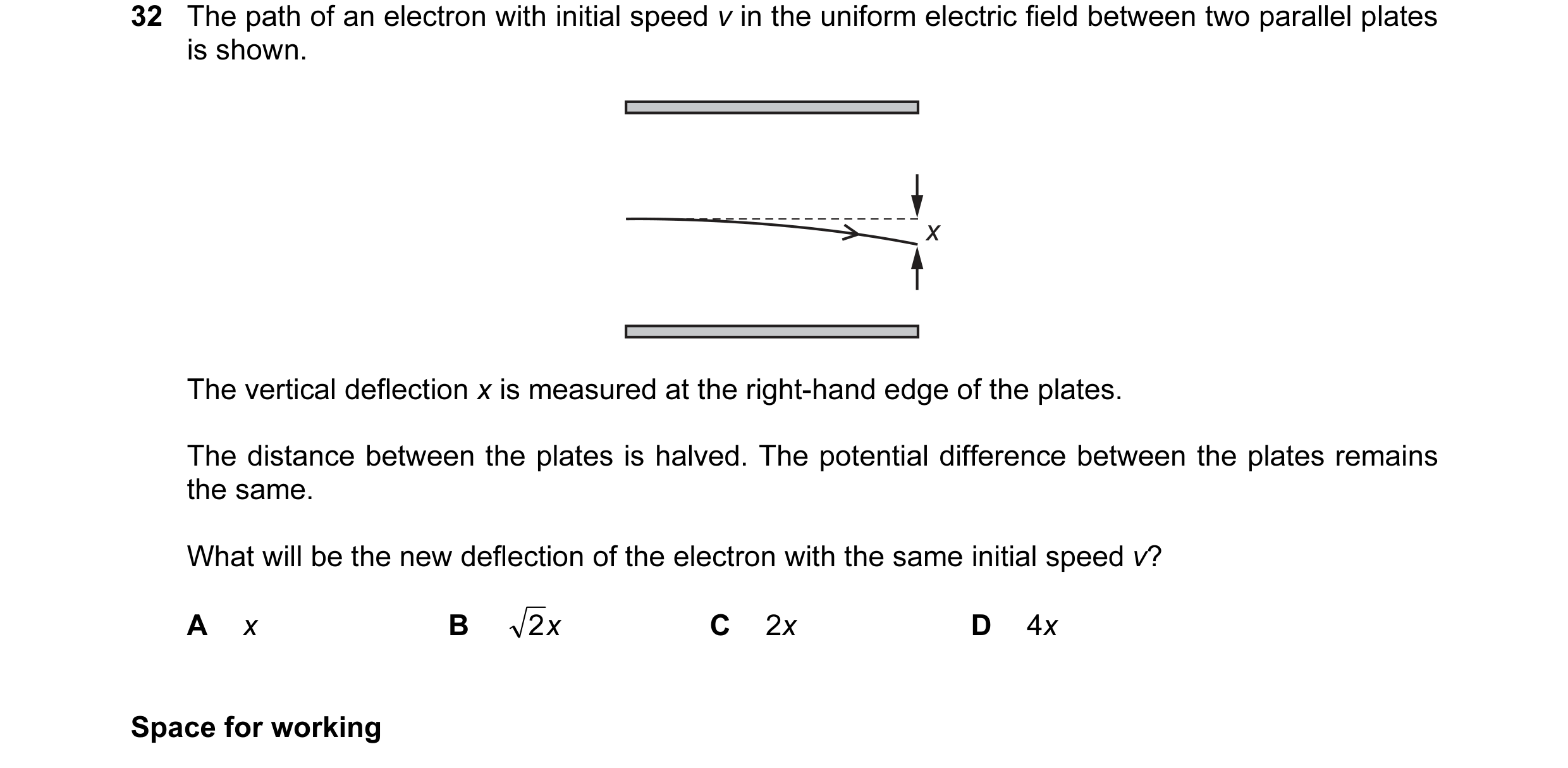
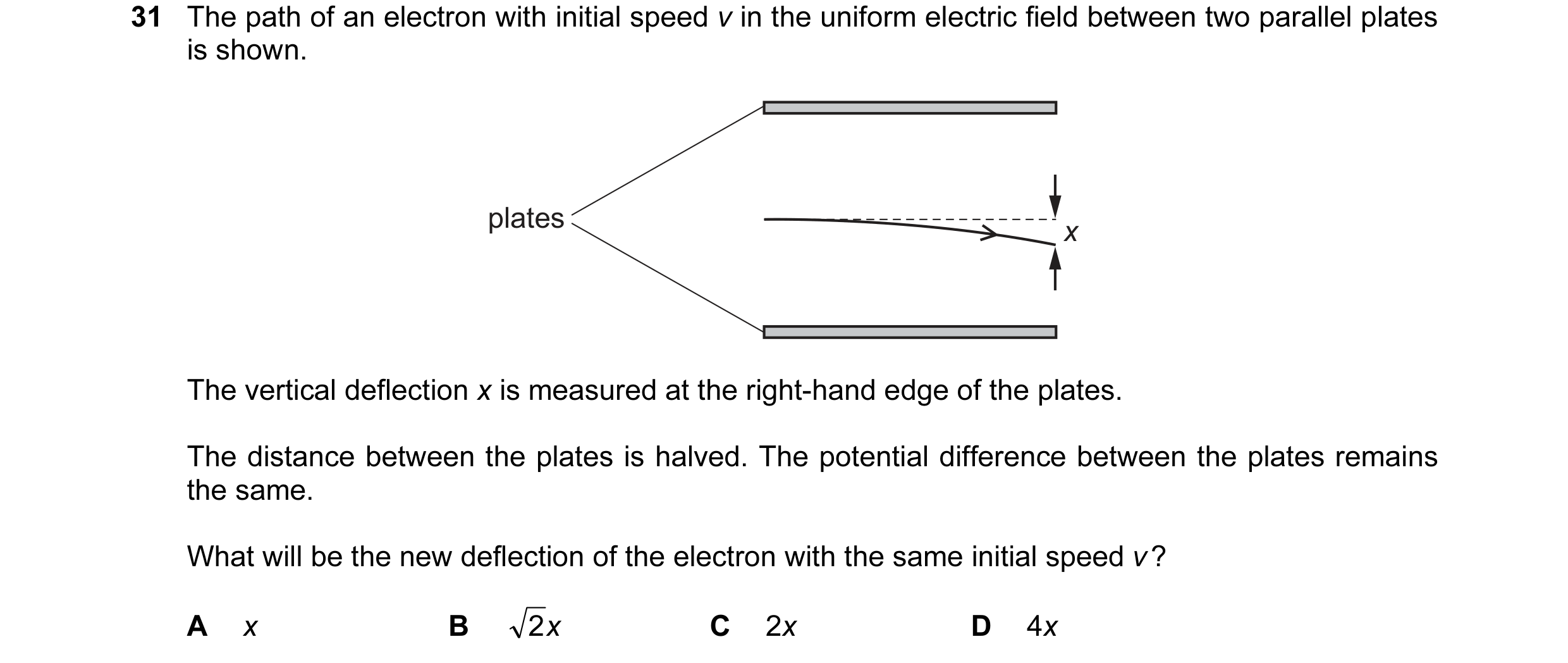
Q69 · The path of an electron with initial speed v in the uniform electric field between two… 9702/13 Oct/Nov 2014
32 The path of an electron with initial speed v in the uniform electric field between two parallel plates is shown. x The vertical deflection x is measured at the right-hand edge of the plates. The distance between the plates is halved. The potential difference between the plates remains the same. What will be the new deflection of the electron with the same initial speed v? A x B 2 x C 2x D 4x Space for working
1 marks
Answer: C
This question in 9702/13 Oct/Nov 2014
Q70 · Two parallel metal plates, a distance of 2 mm apart, have a potential difference of 1000… 9702/11 May/June 2015
31 Two parallel metal plates, a distance of 2 mm apart, have a potential difference of 1000 V across them. What is the electric field strength between the plates? A 500 V m–1 B 50 000 V m–1 C 50 000 N C–1 D 500 000 N C–1
1 marks
Answer: D
This question in 9702/11 May/June 2015
Q71 · An oil droplet has charge –q and is situated between two horizontal metal plates as shown… 9702/11 May/June 2015
32 An oil droplet has charge –q and is situated between two horizontal metal plates as shown in the diagram. +V d –q –V The separation of the plates is d. The droplet is observed to be stationary when the upper plate is at potential +V and the lower plate is at potential –V. For this to occur, what is the weight of the droplet? Vq 2 Vq Vd 2 Vd A B C D d d q q
1 marks
Answer: B
This question in 9702/11 May/June 2015
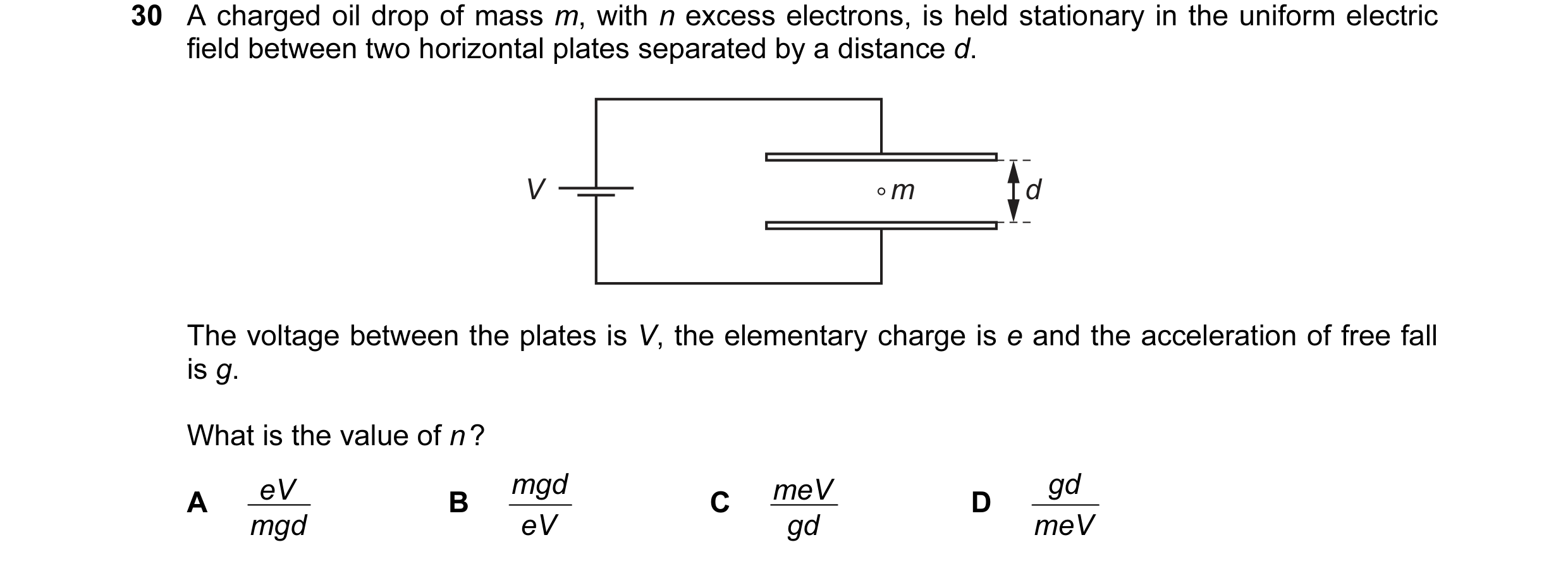
Q72 · A charged oil drop of mass m, with n excess electrons, is held stationary in the uniform… 9702/12 May/June 2015
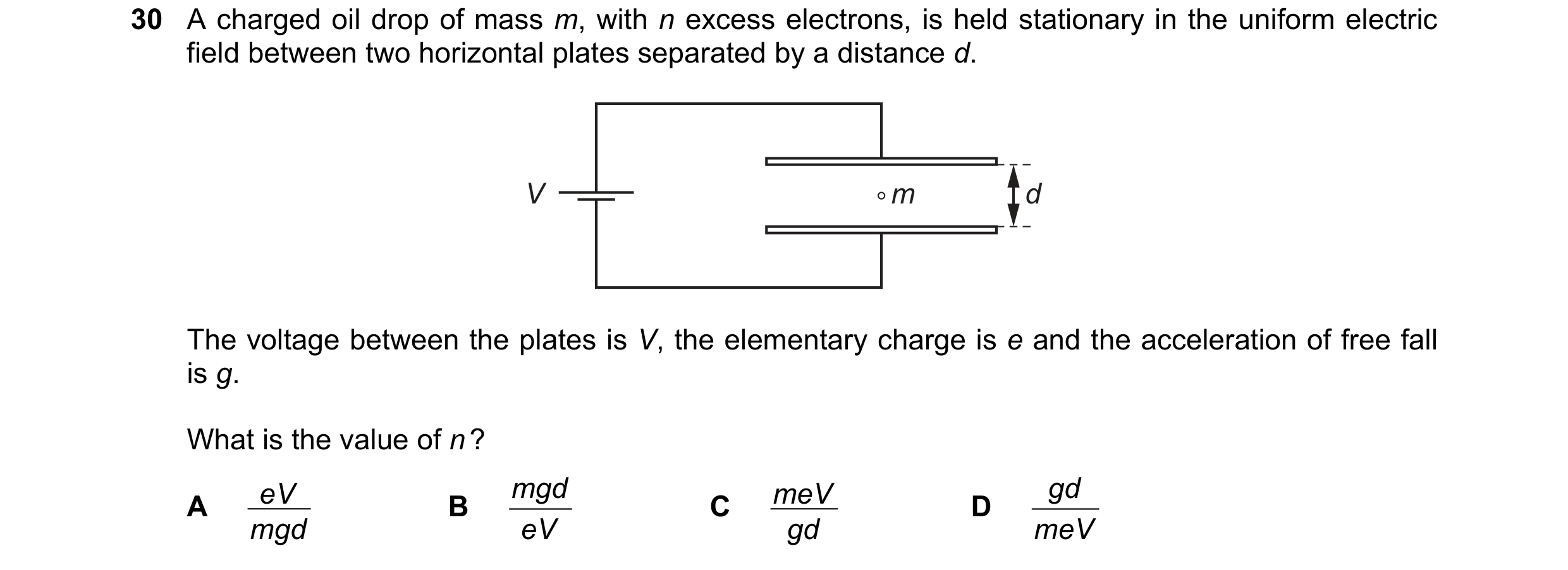
30 A charged oil drop of mass m, with n excess electrons, is held stationary in the uniform electric field between two horizontal plates separated by a distance d. V m d The voltage between the plates is V, the elementary charge is e and the acceleration of free fall is g. What is the value of n ? eV mgd meV gd A B C D mgd eV gd meV
1 marks
Answer: B
This question in 9702/12 May/June 2015
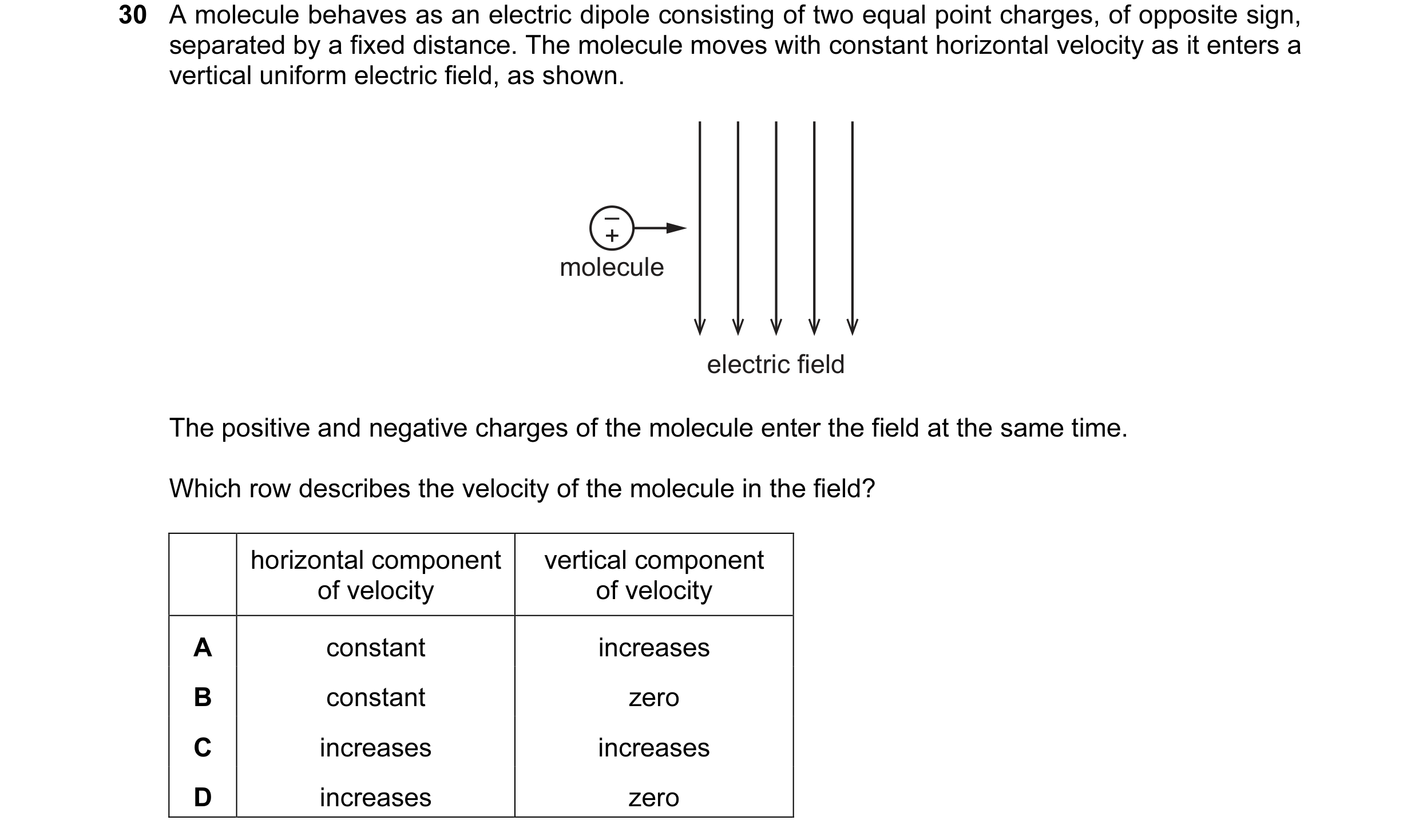
Q73 · A molecule behaves as an electric dipole consisting of two equal point charges, of… 9702/13 May/June 2015
30 A molecule behaves as an electric dipole consisting of two equal point charges, of opposite sign, separated by a fixed distance. The molecule moves with constant horizontal velocity as it enters a vertical uniform electric field, as shown. +– molecule electric field The positive and negative charges of the molecule enter the field at the same time. Which row describes the velocity of the molecule in the field? horizontal component vertical component of velocity of velocity A constant increases B constant zero C increases increases D increases zero
1 marks
Answer: B
This question in 9702/13 May/June 2015
Q74 · Two horizontal parallel plate conductors are separated by a distance of 20 mm in air 9702/11 Oct/Nov 2015
29 Two horizontal parallel plate conductors are separated by a distance of 20 mm in air. The upper plate is earthed and the potential of the lower plate is +100 V. 0 V P 20 mm +100 V What is the electric field strength at point P midway between the plates? A 5000 V m–1 downwards B 5000 V m–1 upwards C 10 000 V m–1 downwards D 10 000 V m–1 upwards
1 marks
Answer: B
This question in 9702/11 Oct/Nov 2015
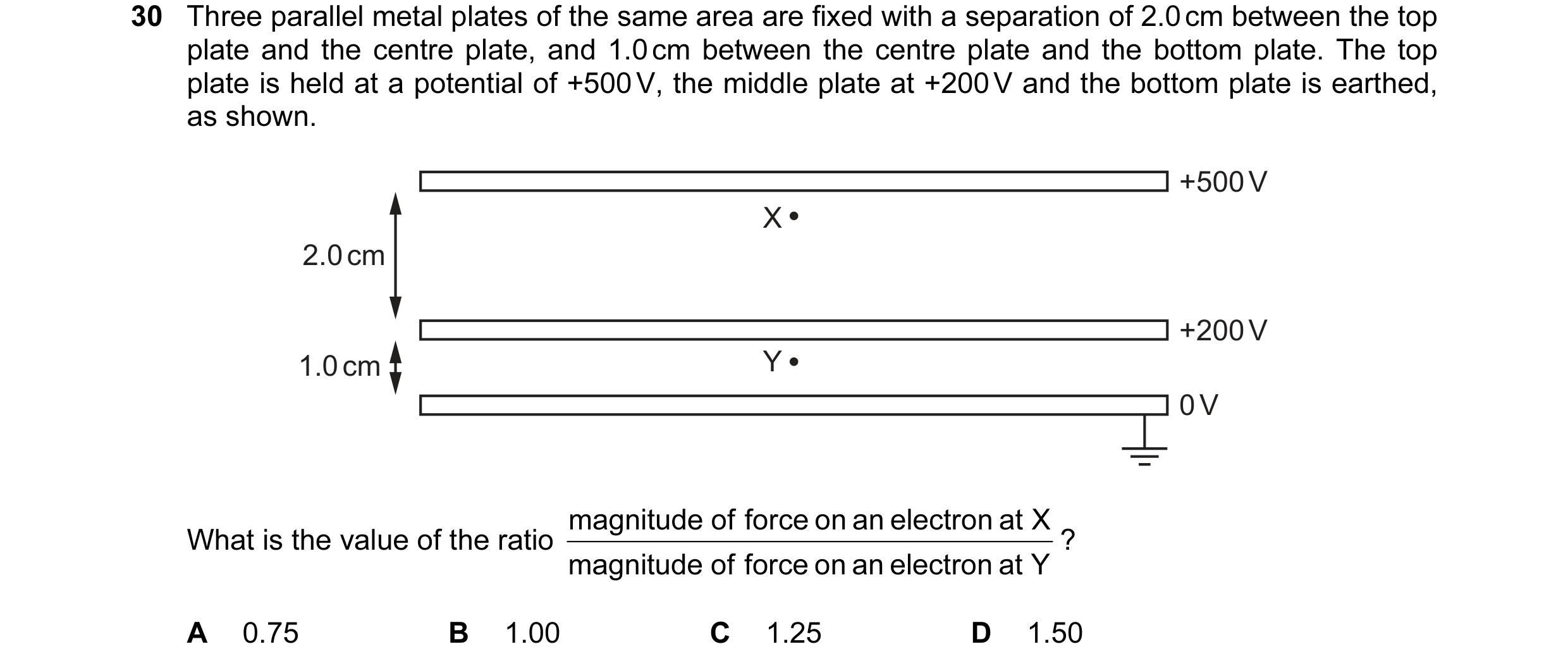
Q75 · Three parallel metal plates of the same area are fixed with a separation of 2.0 cm… 9702/11 Oct/Nov 2015
30 Three parallel metal plates of the same area are fixed with a separation of 2.0 cm between the top plate and the centre plate, and 1.0 cm between the centre plate and the bottom plate. The top plate is held at a potential of +500 V, the middle plate at +200 V and the bottom plate is earthed, as shown. +500 V X 2.0 cm +200 V 1.0 cm Y 0 V magnitude of force on an electron at X What is the value of the ratio ? magnitude of force on an electron at Y A 0.75 B 1.00 C 1.25 D 1.50
1 marks
Answer: A
This question in 9702/11 Oct/Nov 2015
Q76 · A particle situated between two parallel metal plates carries a charge of 8 × 10–19 C 9702/12 Oct/Nov 2015
32 A particle situated between two parallel metal plates carries a charge of 8 × 10–19 C. The potential difference (p.d.) between the plates is 2000 V. A force of 3.2 × 10⁻¹³ N due to the electric field acts on the particle. What is the distance between the plates? A 5 mm B 8 mm C 5 cm D 8 cm
1 marks
Answer: A
This question in 9702/12 Oct/Nov 2015
Q77 · Two parallel plates R and S are 2 mm apart in a vacuum 9702/13 Oct/Nov 2015
29 Two parallel plates R and S are 2 mm apart in a vacuum. An electron with charge –1.6 × 10⁻¹⁹ C moves along a straight line in the electric field between the plates. The graph shows how the potential energy of the electron varies with its distance from plate R. +4.8 × 10⁻¹⁹ potential energy / J 0 0 1 2 distance / mm Which deduction is not correct? A The electric field between R and S is uniform. B The electric field strength is 3000 N C–1. C The force on the electron is constant. D The magnitude of the potential difference between R and S is 3 V.
1 marks
Answer: B
This question in 9702/13 Oct/Nov 2015
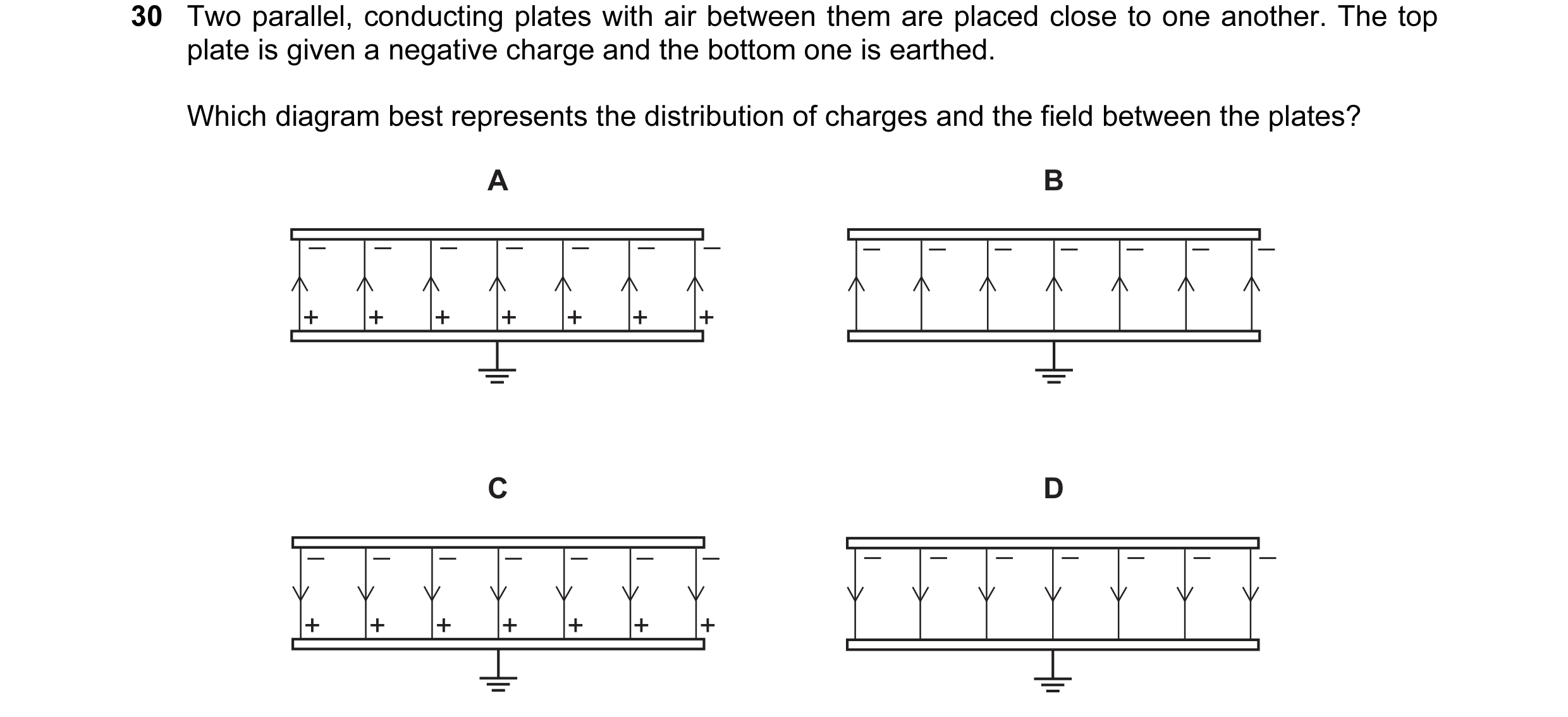
Q78 · Two parallel, conducting plates with air between them are placed close to one another 9702/13 Oct/Nov 2015
30 Two parallel, conducting plates with air between them are placed close to one another. The top plate is given a negative charge and the bottom one is earthed. Which diagram best represents the distribution of charges and the field between the plates? A B _ _ _ _ _ _ _ _ _ _ _ _ _ _ + + + + + + + C D _ _ _ _ _ _ _ _ _ _ _ _ _ _ + + + + + + +
1 marks
Answer: A
This question in 9702/13 Oct/Nov 2015
Q79 · The diagram shows an electron in a uniform electric field 9702/12 Feb/March 2016
27 The diagram shows an electron in a uniform electric field. In which direction will the field accelerate the electron? electron A electric D B field C
1 marks
Answer: D
This question in 9702/12 Feb/March 2016
Q80 · Two large parallel plates X and Y are placed a distance of 5.0 mm apart and connected to… 9702/12 Feb/March 2016
29 Two large parallel plates X and Y are placed a distance of 5.0 mm apart and connected to the terminals of a 200 V d.c. supply, as shown. X Y P 5.0 mm 200 V A small oil drop at P carries one excess electron. What is the magnitude of the electrostatic force acting on the oil drop due to the electric field between the plates? A 6.4 × 10⁻¹⁵ N B 6.4 × 10⁻¹⁸ N C 1.6 × 10⁻¹⁹ N D 4.0 × 10⁻²⁴ N
1 marks
Answer: A
This question in 9702/12 Feb/March 2016
Q81 · A charged particle is moving in a uniform electric field 9702/11 May/June 2016
28 A charged particle is moving in a uniform electric field. For the motion of the particle due to the field, which quantity has a constant non-zero value? A acceleration B displacement C rate of change of acceleration D velocity
1 marks
Answer: A
This question in 9702/11 May/June 2016
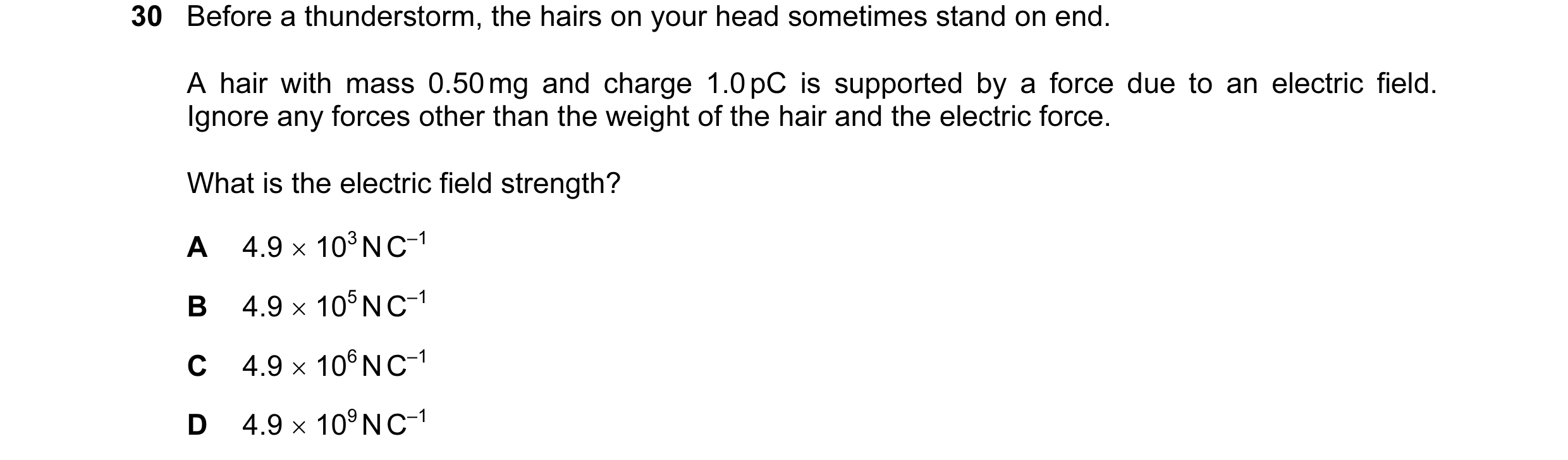
Q82 · Before a thunderstorm, the hairs on your head sometimes stand on end 9702/12 May/June 2016
30 Before a thunderstorm, the hairs on your head sometimes stand on end. A hair with mass 0.50 mg and charge 1.0 pC is supported by a force due to an electric field. Ignore any forces other than the weight of the hair and the electric force. What is the electric field strength? A 4.9 × 10³ N C–1 B 4.9 × 10⁵ N C–1 C 4.9 × 10⁶ N C–1 D 4.9 × 10⁹ N C–1
1 marks
Answer: C
This question in 9702/12 May/June 2016
Q83 · Two parallel metal plates, 4.0 cm apart, are at electric potentials of 800 V and 2000 V 9702/12 May/June 2016
31 Two parallel metal plates, 4.0 cm apart, are at electric potentials of 800 V and 2000 V. Points X, Y and Z are situated in the space between the plates at distances of 1.0 cm, 2.0 cm and 3.0 cm from the lower plate. 2000 V Z 3.0 cm metal 4.0 cm Y plates 2.0 cm X 1.0 cm 800 V What is the electric field strength, in V m–1, at X, Y and Z? X Y Z A 300 600 900 B 1100 1400 1700 C 3.0 × 10⁴ 3.0 × 10⁴ 3.0 × 10⁴ D 5.0 × 10⁴ 5.0 × 10⁴ 5.0 × 10⁴
1 marks
Answer: C
This question in 9702/12 May/June 2016
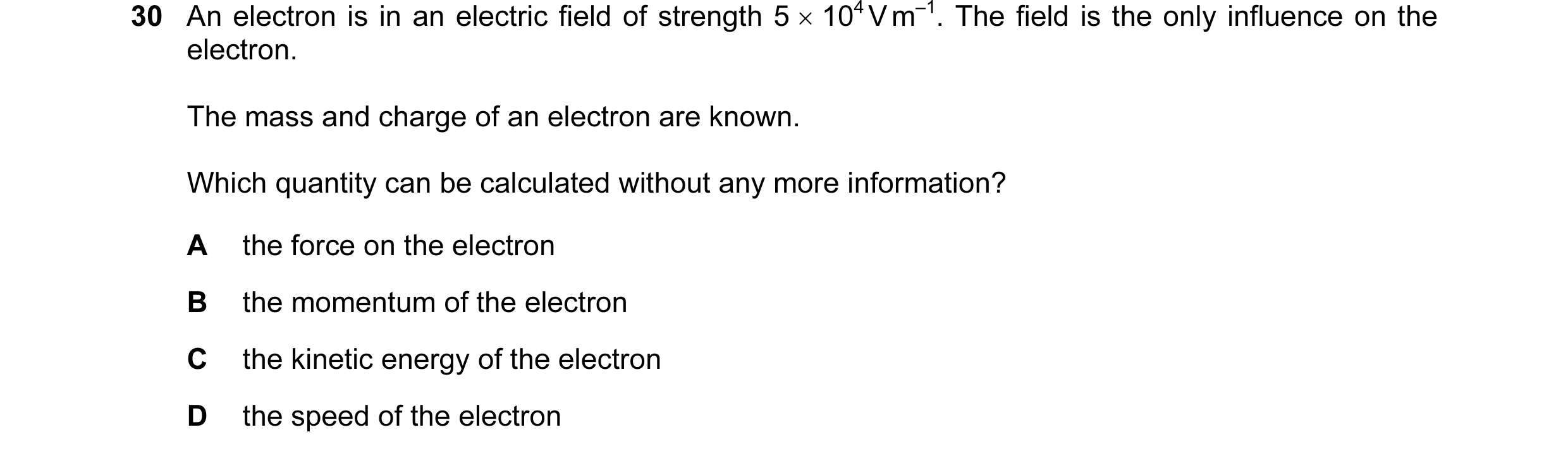
Q84 · An electron is in an electric field of strength 5 × 10⁴ V m–1 9702/13 May/June 2016
30 An electron is in an electric field of strength 5 × 10⁴ V m–1. The field is the only influence on the electron. The mass and charge of an electron are known. Which quantity can be calculated without any more information? A the force on the electron B the momentum of the electron C the kinetic energy of the electron D the speed of the electron
1 marks
Answer: A
This question in 9702/13 May/June 2016
Q85 · Which path shows a possible movement of an electron in the electric field shown? 9702/11 Oct/Nov 2016
30 Which path shows a possible movement of an electron in the electric field shown? A B path of electron D C
1 marks
Answer: A
This question in 9702/11 Oct/Nov 2016
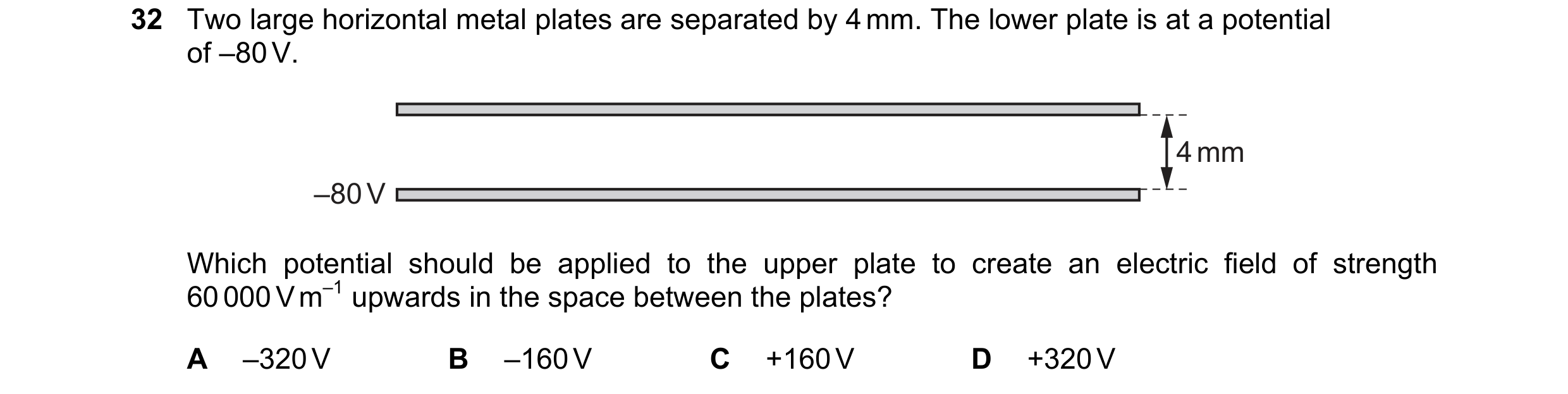
Q86 · Two large horizontal metal plates are separated by 4 mm 9702/11 Oct/Nov 2016
32 Two large horizontal metal plates are separated by 4 mm. The lower plate is at a potential of –80 V. 4 mm –80 V Which potential should be applied to the upper plate to create an electric field of strength 60 000 V m–1 upwards in the space between the plates? A –320 V B –160 V C +160 V D +320 V
1 marks
Answer: A
This question in 9702/11 Oct/Nov 2016
Q87 · Two large horizontal metal plates are separated by 4 mm 9702/13 Oct/Nov 2016
32 Two large horizontal metal plates are separated by 4 mm. The lower plate is at a potential of –80 V. 4 mm –80 V Which potential should be applied to the upper plate to create an electric field of strength 60 000 V m–1 upwards in the space between the plates? A –320 V B –160 V C +160 V D +320 V
1 marks
Answer: A
This question in 9702/13 Oct/Nov 2016
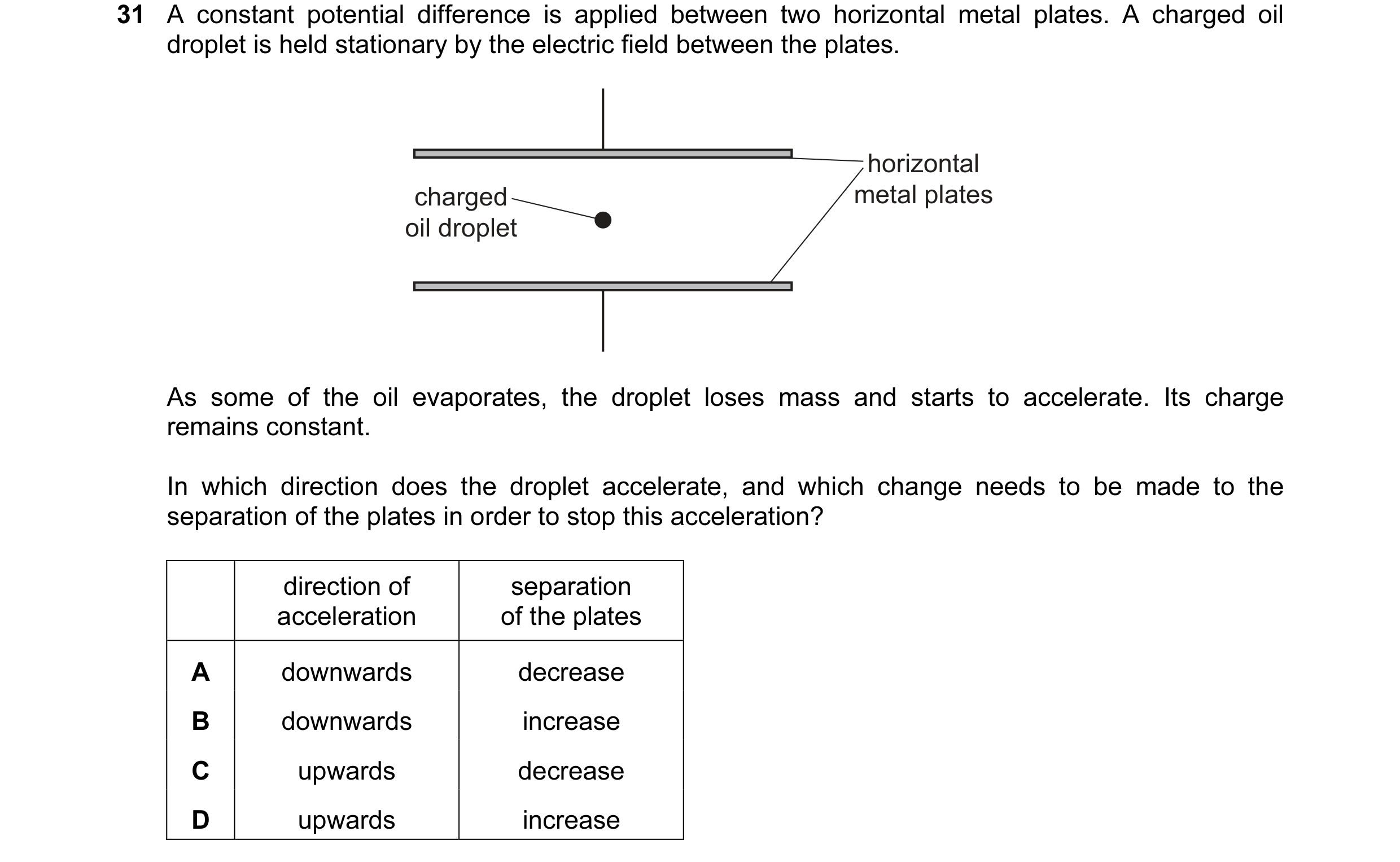
Q88 · A constant potential difference is applied between two horizontal metal plates 9702/12 Feb/March 2017
31 A constant potential difference is applied between two horizontal metal plates. A charged oil droplet is held stationary by the electric field between the plates. horizontal charged metal plates oil droplet As some of the oil evaporates, the droplet loses mass and starts to accelerate. Its charge remains constant. In which direction does the droplet accelerate, and which change needs to be made to the separation of the plates in order to stop this acceleration? direction of separation acceleration of the plates A downwards decrease B downwards increase C upwards decrease D upwards increase
1 marks
Answer: D
This question in 9702/12 Feb/March 2017
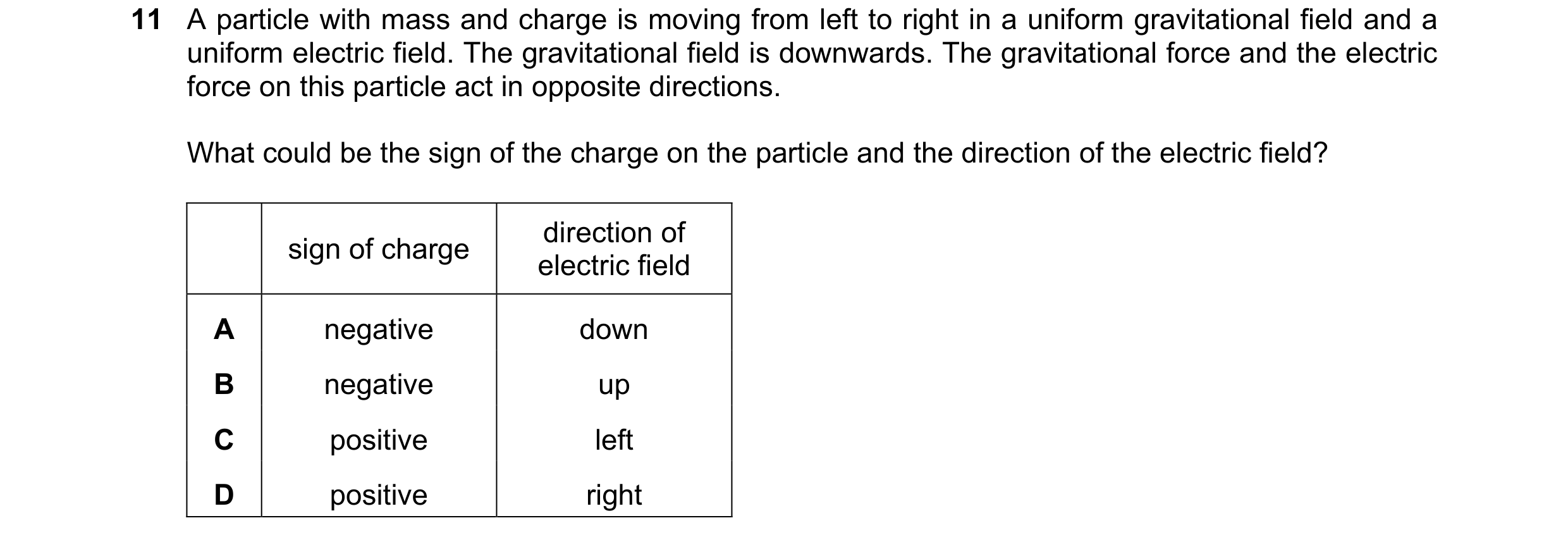
Q89 · A particle with mass and charge is moving from left to right in a uniform gravitational… 9702/11 May/June 2017
11 A particle with mass and charge is moving from left to right in a uniform gravitational field and a uniform electric field. The gravitational field is downwards. The gravitational force and the electric force on this particle act in opposite directions. What could be the sign of the charge on the particle and the direction of the electric field? direction of sign of charge electric field A negative down B negative up C positive left D positive right
1 marks
Answer: A
This question in 9702/11 May/June 2017
Q90 · The diagram shows two parallel horizontal metal plates 9702/11 May/June 2017
31 The diagram shows two parallel horizontal metal plates. The top plate is positively charged and the bottom plate is earthed. + liquid drop plates A small charged liquid drop, midway between the plates, is held in equilibrium by the combination of its weight and the electric force acting on it. The acceleration of free fall is g and the electric field strength is E. What is the polarity of the charge on the drop, and the ratio of charge to mass of the drop? charge polarity mass E A negative g g B negative E E C positive g g D positive E
1 marks
Answer: B
This question in 9702/11 May/June 2017
Q91 · The path of an electron with initial speed v in the uniform electric field between two… 9702/12 May/June 2017
31 The path of an electron with initial speed v in the uniform electric field between two parallel plates is shown. plates x The vertical deflection x is measured at the right-hand edge of the plates. The distance between the plates is halved. The potential difference between the plates remains the same. What will be the new deflection of the electron with the same initial speed v ? A x B 2 x C 2x D 4x
1 marks
Answer: C
This question in 9702/12 May/June 2017
Q92 · In a uniform electric field, which statement is correct? 9702/13 May/June 2017
30 In a uniform electric field, which statement is correct? A All charged particles experience the same force. B All charged particles move with the same velocity. C All electric field lines are directed towards positive charges. D All electric field lines are parallel.
1 marks
Answer: D
This question in 9702/13 May/June 2017
Q93 · A small charged sphere of mass 0.80 g hangs from a light thread inside a vertical uniform… 9702/11 Oct/Nov 2017
31 A small charged sphere of mass 0.80 g hangs from a light thread inside a vertical uniform electric field of strength 2000 V m–1. The thread passes over two frictionless pulleys and a mass of 2.00 g hangs on the other end. pulleys + + + + + + 2.00 g mass electric field of charged sphere 2000 V m–1 of mass 0.80 g _ _ _ _ _ _ The sphere is in equilibrium. What is the charge on the sphere? A –5.9 µC B +0.60 µC C +5.9 µC D +9.8 µC
1 marks
Answer: C
This question in 9702/11 Oct/Nov 2017
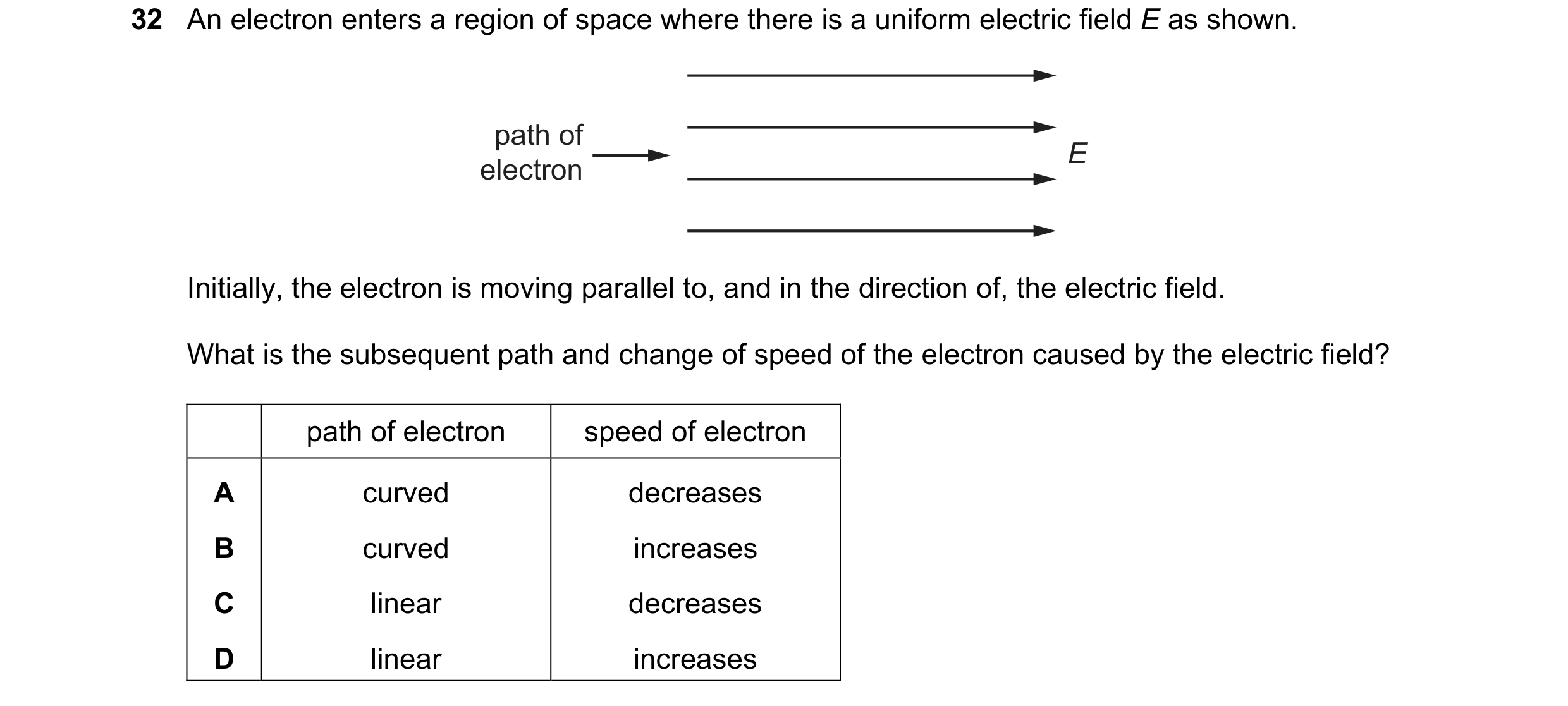
Q94 · An electron enters a region of space where there is a uniform electric field E as shown 9702/11 Oct/Nov 2017
32 An electron enters a region of space where there is a uniform electric field E as shown. path of E electron Initially, the electron is moving parallel to, and in the direction of, the electric field. What is the subsequent path and change of speed of the electron caused by the electric field? path of electron speed of electron A curved decreases B curved increases C linear decreases D linear increases
1 marks
Answer: C
This question in 9702/11 Oct/Nov 2017
Q95 · The diagram shows two metal plates connected to a constant high voltage 9702/12 Oct/Nov 2017
31 The diagram shows two metal plates connected to a constant high voltage. d Which graph shows the variation of the electric field strength E midway between the two plates as the distance d between the two plates is increased? A B C D E E E E 0 0 0 0 0 d 0 d 0 d 0 d
1 marks
Answer: A
This question in 9702/12 Oct/Nov 2017
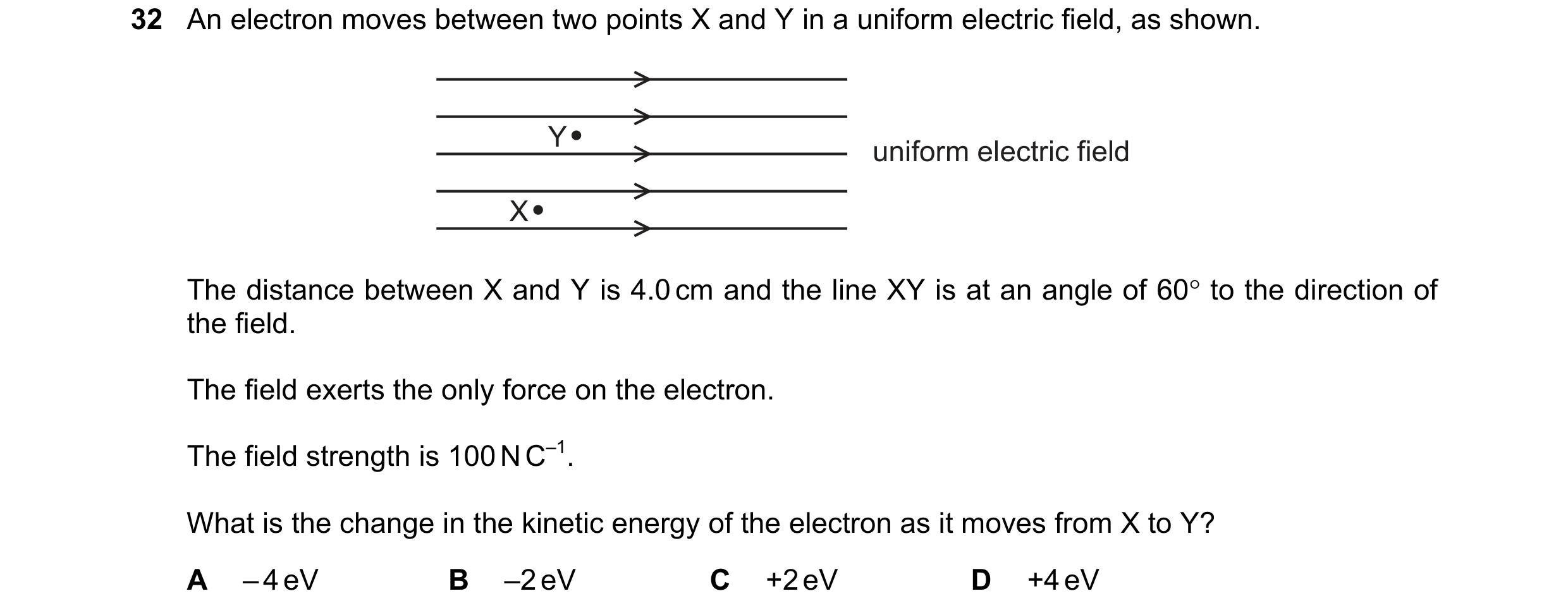
Q96 · An electron moves between two points X and Y in a uniform electric field, as shown 9702/12 Oct/Nov 2017
32 An electron moves between two points X and Y in a uniform electric field, as shown. Y uniform electric field X The distance between X and Y is 4.0 cm and the line XY is at an angle of 60° to the direction of the field. The field exerts the only force on the electron. The field strength is 100 N C–1. What is the change in the kinetic energy of the electron as it moves from X to Y? A – 4 eV B –2 eV C +2 eV D +4 eV
1 marks
Answer: B
This question in 9702/12 Oct/Nov 2017
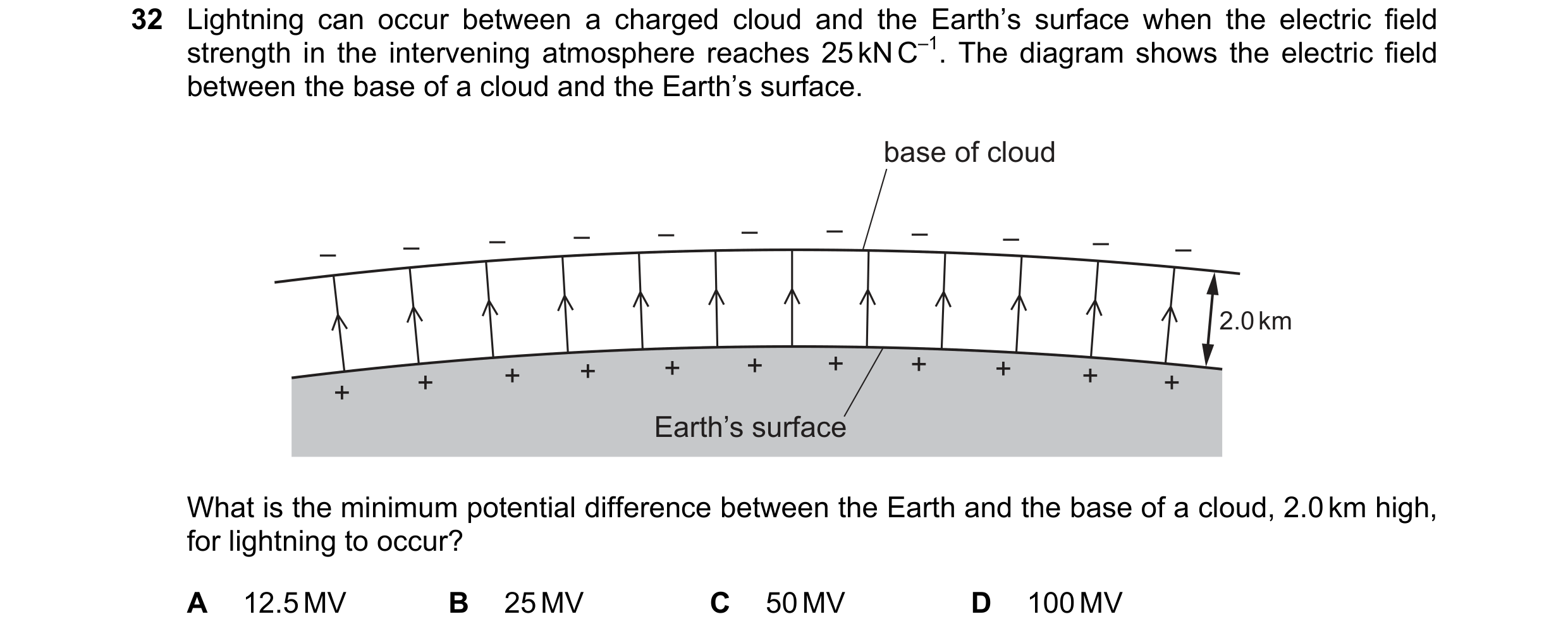
Q97 · Lightning can occur between a charged cloud and the Earth’s surface when the electric… 9702/13 Oct/Nov 2017
32 Lightning can occur between a charged cloud and the Earth’s surface when the electric field strength in the intervening atmosphere reaches 25 kN C–1. The diagram shows the electric field between the base of a cloud and the Earth’s surface. base of cloud – – – – – – – – – – – 2.0 km + + + + + + + + + + + Earth’s surface What is the minimum potential difference between the Earth and the base of a cloud, 2.0 km high, for lightning to occur? A 12.5 MV B 25 MV C 50 MV D 100 MV
1 marks
Answer: C
This question in 9702/13 Oct/Nov 2017
Q98 · A charged oil drop is held stationary between two charged parallel plates 9702/12 Feb/March 2018
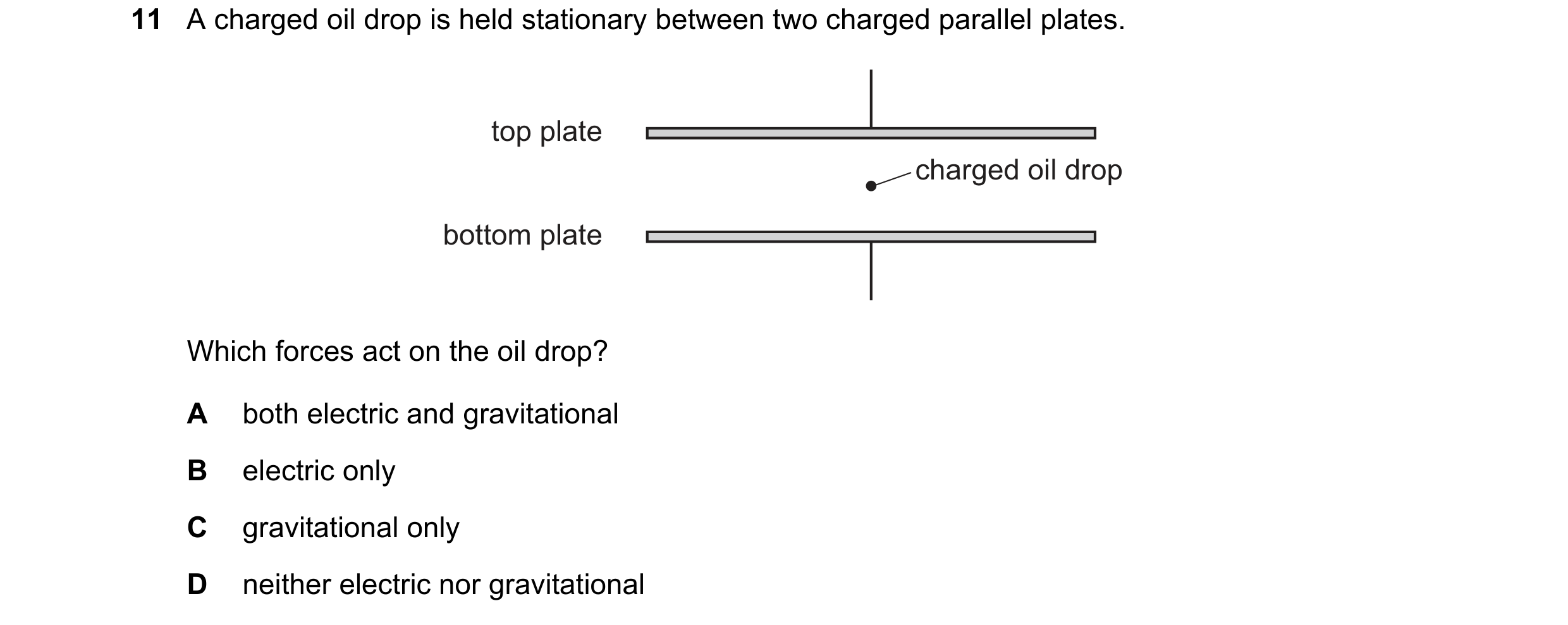
12 A charged oil drop is held stationary between two charged parallel plates. top plate charged oil drop bottom plate Which forces act on the oil drop? A both electric and gravitational B electric only C gravitational only D neither electric nor gravitational
1 marks
Answer: A
This question in 9702/12 Feb/March 2018
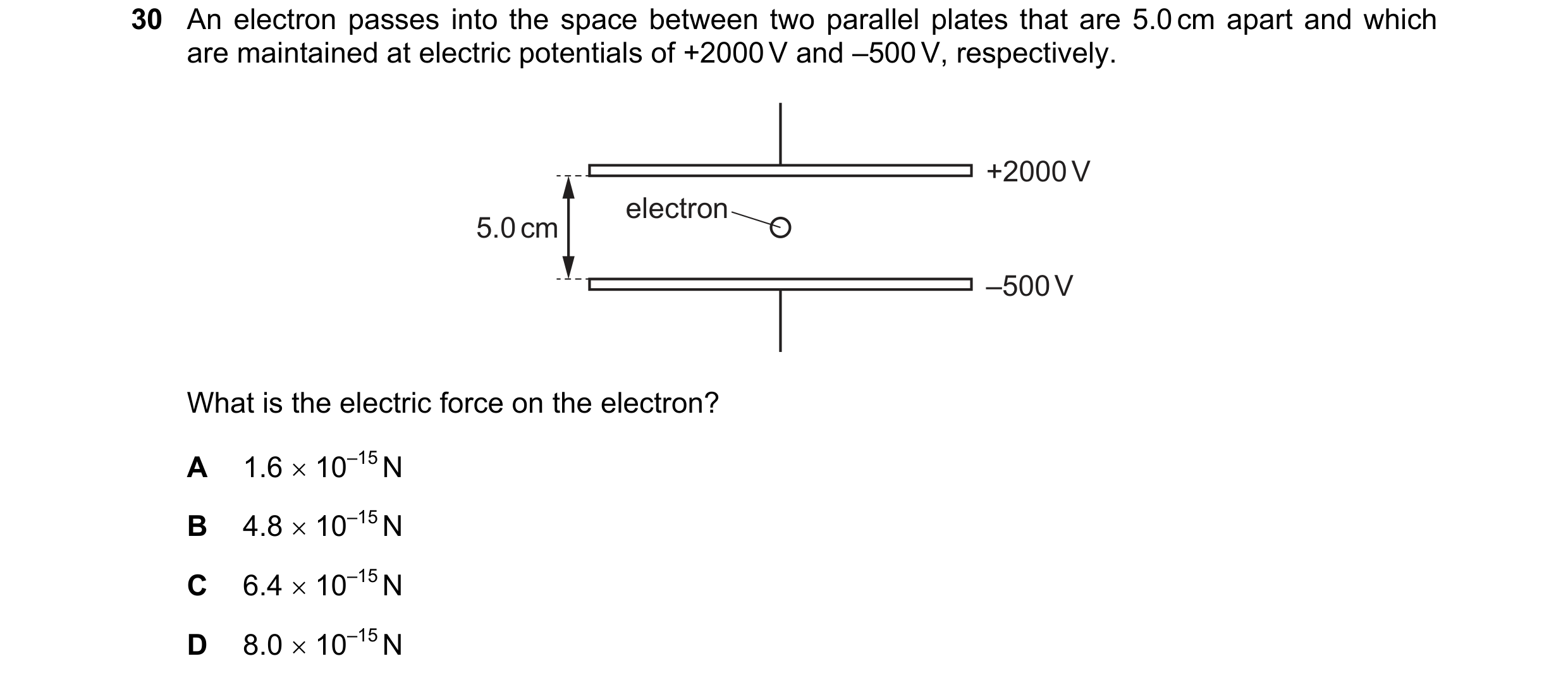
Q99 · An electron passes into the space between two parallel plates that are 5.0 cm apart and… 9702/12 Feb/March 2018
30 An electron passes into the space between two parallel plates that are 5.0 cm apart and which are maintained at electric potentials of +2000 V and –500 V, respectively. +2000 V electron 5.0 cm –500 V What is the electric force on the electron? A 1.6 × 10⁻¹⁵ N B 4.8 × 10⁻¹⁵ N C 6.4 × 10⁻¹⁵ N D 8.0 × 10⁻¹⁵ N
1 marks
Answer: D
This question in 9702/12 Feb/March 2018
Q100 · Which statement about electric charges in a uniform electric field is not correct? 9702/12 Feb/March 2018
31 Which statement about electric charges in a uniform electric field is not correct? A Electric charges of the same magnitude, whether positive or negative, experience the same magnitude of force when placed in the same uniform electric field. B The direction of the force on a positive charge placed in a uniform electric field is independent of the magnitude of the charge. C The magnitude of the force on a positive charge placed in a uniform electric field is proportional to the magnitude of the electric field strength. D The work done to move a positive charge a certain distance in a uniform electric field is independent of the direction of the movement.
1 marks
Answer: D
This question in 9702/12 Feb/March 2018
Q101 · A particle has a charge of +2.0 mC and is in a vertical uniform electric field 9702/11 May/June 2018
28 A particle has a charge of +2.0 mC and is in a vertical uniform electric field. An electric force of 1.0 × 10⁻² N acts upwards on the particle. What is the electric field strength? A 0.20 V m–1 downwards B 0.20 V m–1 upwards C 5.0 V m–1 downwards D 5.0 V m–1 upwards
1 marks
Answer: D
This question in 9702/11 May/June 2018
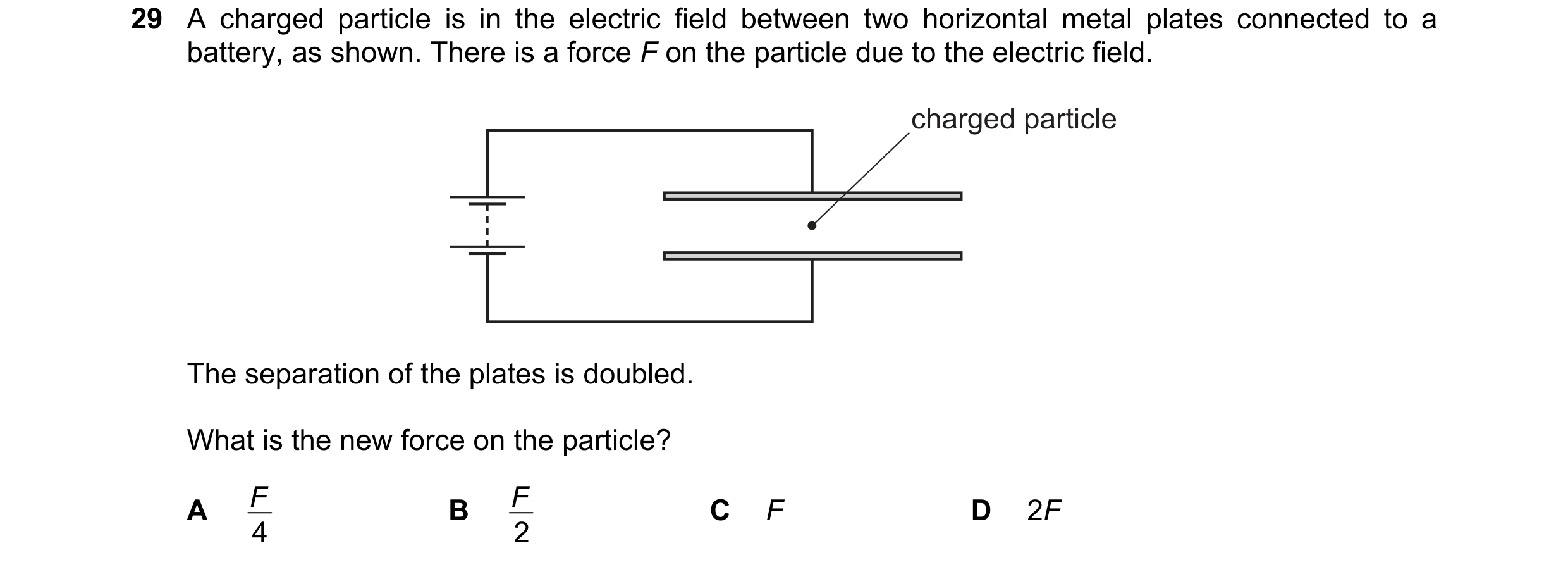
Q102 · A charged particle is in the electric field between two horizontal metal plates connected… 9702/11 May/June 2018
29 A charged particle is in the electric field between two horizontal metal plates connected to a battery, as shown. There is a force F on the particle due to the electric field. charged particle The separation of the plates is doubled. What is the new force on the particle? A F B F C F D 2F 4 2
1 marks
Answer: B
This question in 9702/11 May/June 2018
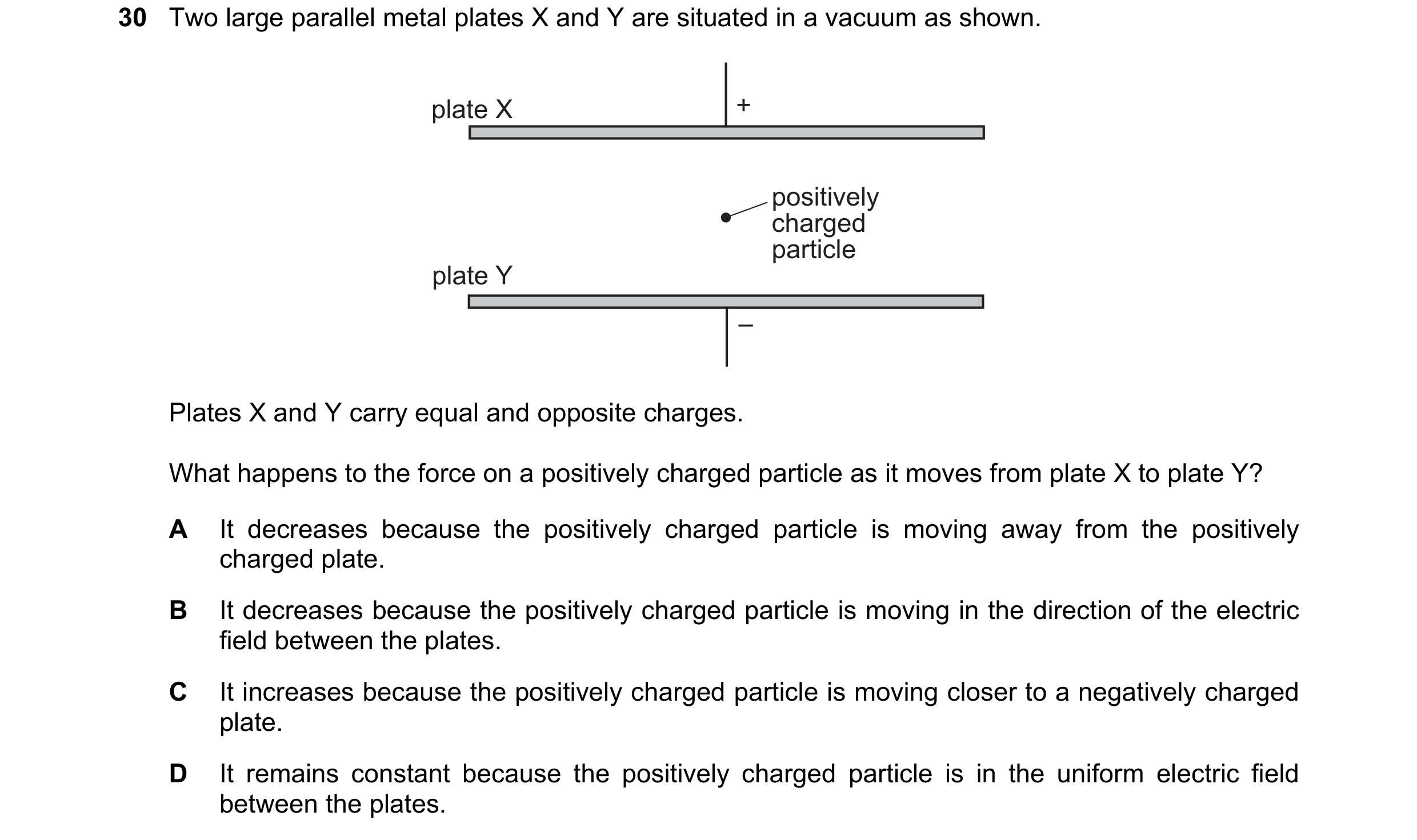
Q103 · Two large parallel metal plates X and Y are situated in a vacuum as shown 9702/12 May/June 2018
30 Two large parallel metal plates X and Y are situated in a vacuum as shown. plate X + positively charged particle plate Y – Plates X and Y carry equal and opposite charges. What happens to the force on a positively charged particle as it moves from plate X to plate Y? A It decreases because the positively charged particle is moving away from the positively charged plate. B It decreases because the positively charged particle is moving in the direction of the electric field between the plates. C It increases because the positively charged particle is moving closer to a negatively charged plate. D It remains constant because the positively charged particle is in the uniform electric field between the plates.
1 marks
Answer: D
This question in 9702/12 May/June 2018
Q104 · Two parallel metal plates are situated 20 cm apart in a vacuum 9702/13 May/June 2018
27 Two parallel metal plates are situated 20 cm apart in a vacuum. They are connected to two sources of potential difference as shown. proton 20 cm + + 800 V 300 V – – A proton is released in the space between the plates. What is the magnitude and direction of the acceleration of the proton? A 2.4 × 10¹¹ m s–2 downwards B 2.4 × 10¹¹ m s–2 upwards C 5.3 × 10¹¹ m s–2 downwards D 5.3 × 10¹¹ m s–2 upwards
1 marks
Answer: A
This question in 9702/13 May/June 2018
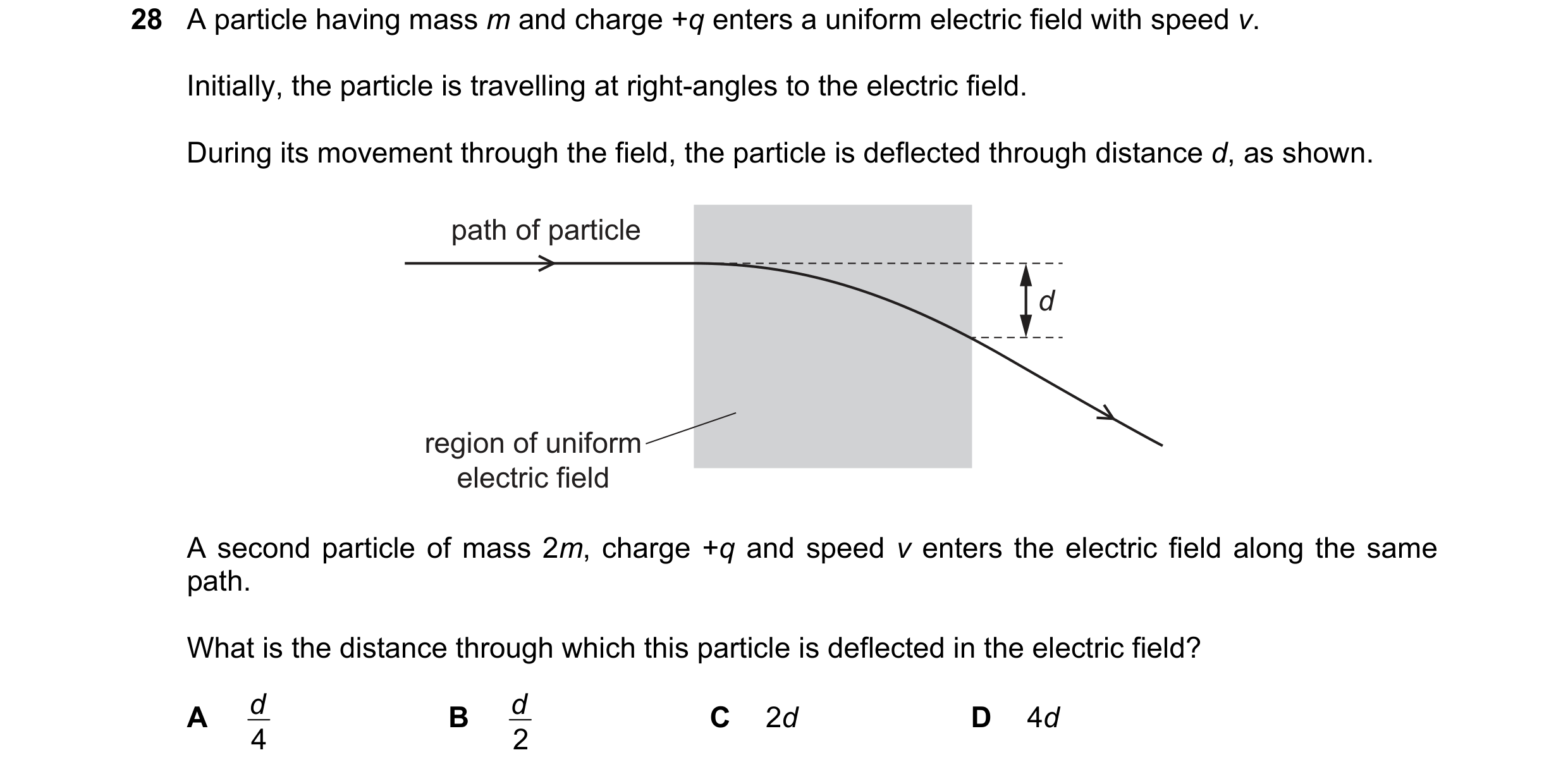
Q105 · A particle having mass m and charge +q enters a uniform electric field with speed v 9702/13 May/June 2018
28 A particle having mass m and charge +q enters a uniform electric field with speed v. Initially, the particle is travelling at right-angles to the electric field. During its movement through the field, the particle is deflected through distance d, as shown. path of particle d region of uniform electric field A second particle of mass 2m, charge +q and speed v enters the electric field along the same path. What is the distance through which this particle is deflected in the electric field? d d A B C 2d D 4d 4 2
1 marks
Answer: B
This question in 9702/13 May/June 2018
Q106 · A beam of electrons is directed into an electric field and is deflected by it 9702/11 Oct/Nov 2018
31 A beam of electrons is directed into an electric field and is deflected by it. Diagram 1 represents an electric field in the plane of the paper. Diagram 2 represents an electric field directed perpendicular to the plane of the paper. The lines A, B, C and D represent possible paths of the electron beam. All paths are in the plane of the paper. Which line best represents the path of the electrons inside the field? diagram 1 diagram 2 A B C D electric field electric field into the paper in the plane and perpendicular to the of the paper plane of the paper electrons electrons
1 marks
Answer: B
This question in 9702/11 Oct/Nov 2018
Q107 · A charged particle of charge q and mass m is initially at rest in a uniform electric field 9702/11 Oct/Nov 2018
32 A charged particle of charge q and mass m is initially at rest in a uniform electric field. The field is produced by parallel metal plates separated by a distance d and having a potential difference V between them. What is an expression for the acceleration of the charged particle? md mV qd qV A B C D qV qd mV md
1 marks
Answer: D
This question in 9702/11 Oct/Nov 2018
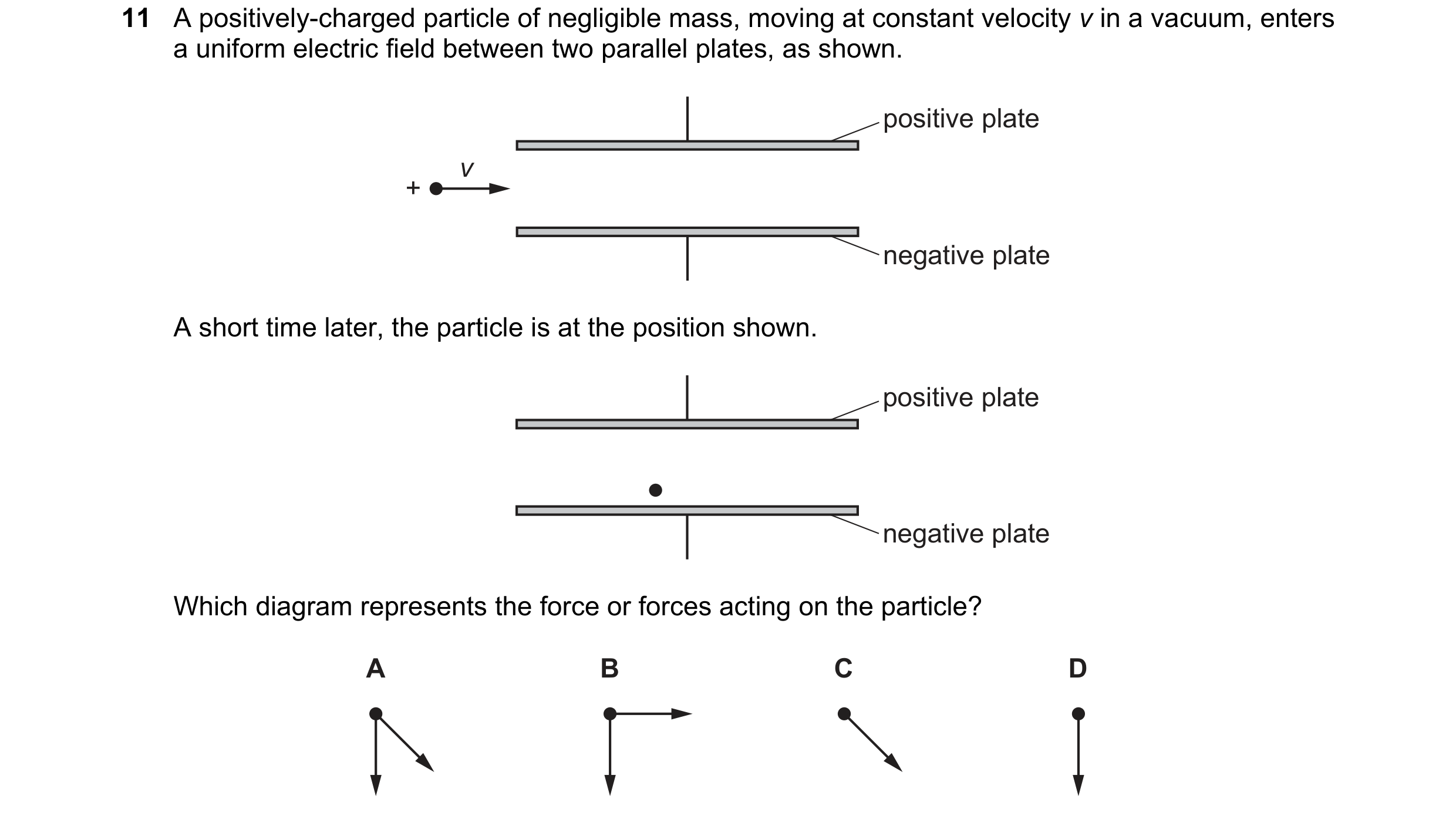
Q108 · A positively-charged particle of negligible mass, moving at constant velocity v in a… 9702/12 Oct/Nov 2018
11 A positively-charged particle of negligible mass, moving at constant velocity v in a vacuum, enters a uniform electric field between two parallel plates, as shown. positive plate v + negative plate A short time later, the particle is at the position shown. positive plate negative plate Which diagram represents the force or forces acting on the particle? A B C D
1 marks
Answer: D
This question in 9702/12 Oct/Nov 2018
Q109 · Two parallel metal plates are connected to a d.c 9702/12 Oct/Nov 2018
32 Two parallel metal plates are connected to a d.c. supply, as shown. P The two plates are moved towards each other at constant speed. It may be assumed that the electric field between the plates is uniform. Point P is mid-way between the two plates. Which graph shows the variation with time t of the electric field strength E at point P? A B C D E E E E 0 0 0 0 0 t 0 t 0 t 0 t
1 marks
Answer: D
This question in 9702/12 Oct/Nov 2018
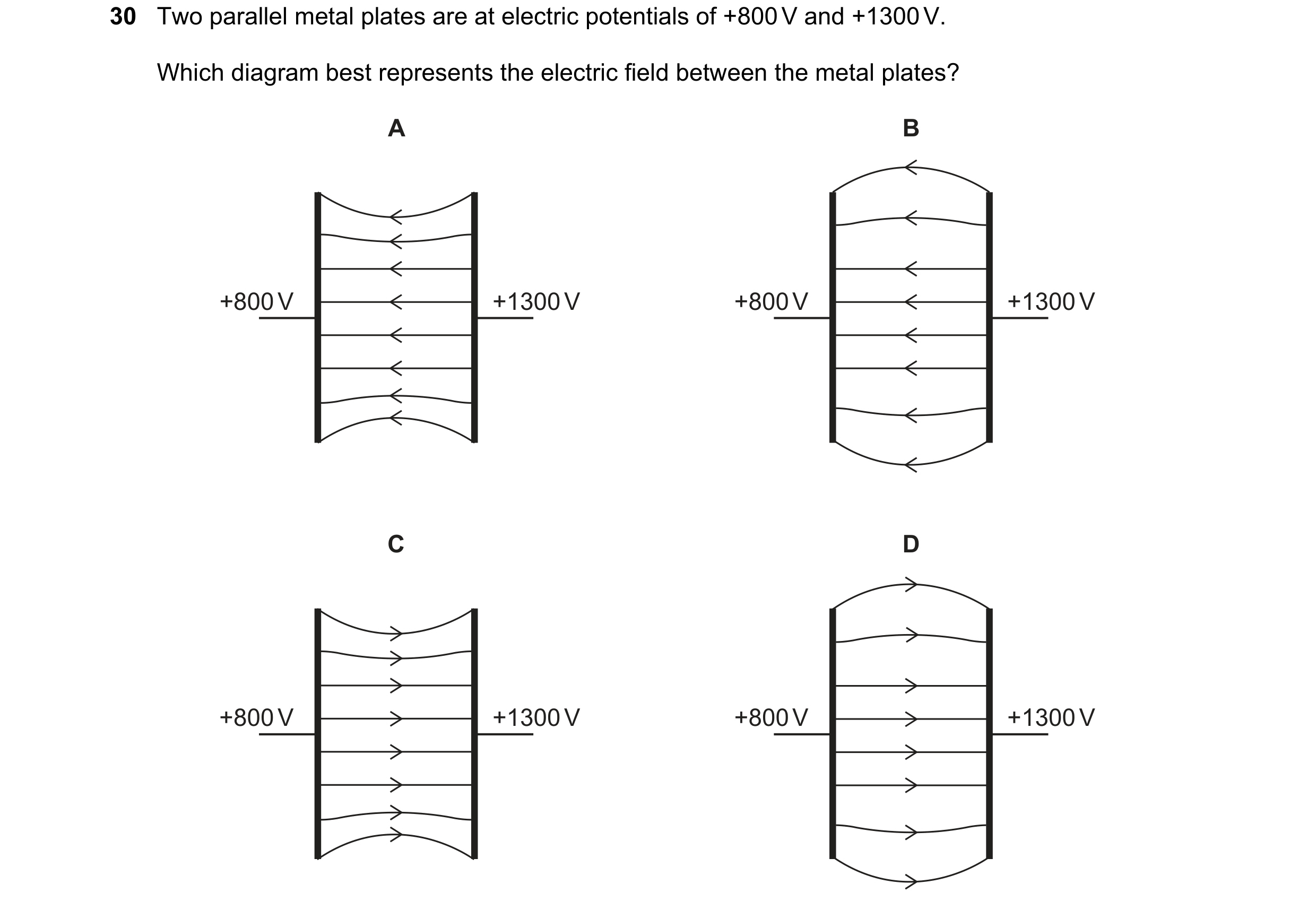
Q110 · Two parallel metal plates are at electric potentials of +800 V and +1300 V 9702/13 Oct/Nov 2018
30 Two parallel metal plates are at electric potentials of +800 V and +1300 V. Which diagram best represents the electric field between the metal plates? A B +800 V +1300 V +800 V +1300 V C D +800 V +1300 V +800 V +1300 V
1 marks
Answer: B
This question in 9702/13 Oct/Nov 2018
Q111 · The diagram shows two metal plates P and Q 9702/13 Oct/Nov 2018
31 The diagram shows two metal plates P and Q. There is a potential difference of 700 V between the plates. Plate Q is earthed. –700 V plate P 5.0 mm R plate Q 0 V What is the magnitude and direction of the electric field at point R? A 1.4 × 10² N C–1 from P towards Q B 1.4 × 10² N C–1 from Q towards P C 1.4 × 10⁵ N C–1 from P towards Q D 1.4 × 10⁵ N C–1 from Q towards P
1 marks
Answer: D
This question in 9702/13 Oct/Nov 2018
Q112 · Two horizontal parallel plate conductors are separated by a distance of 5.0 mm in air 9702/12 Feb/March 2019
30 Two horizontal parallel plate conductors are separated by a distance of 5.0 mm in air. The lower plate is earthed and the potential of the upper plate is +50 V. What is the electric field strength E at a point midway between the plates? A 1.0 × 10⁴ V m–1 downwards B 1.0 × 10⁴ V m–1 upwards C 2.0 × 10⁴ V m–1 downwards D 2.0 × 10⁴ V m–1 upwards
1 marks
Answer: A
This question in 9702/12 Feb/March 2019
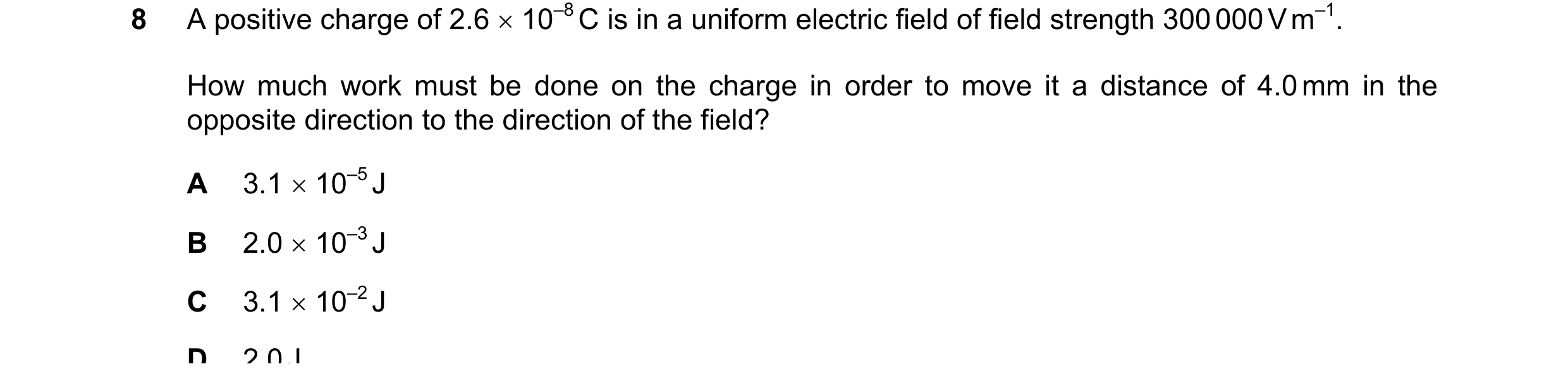
Q113 · A positive charge of 2.6 × 10⁻⁸ C is in a uniform electric field of field strength 300… 9702/11 May/June 2019
8 A positive charge of 2.6 × 10⁻⁸ C is in a uniform electric field of field strength 300 000 V m–1. How much work must be done on the charge in order to move it a distance of 4.0 mm in the opposite direction to the direction of the field? A 3.1 × 10⁻⁵ J B 2.0 × 10⁻³ J C 3.1 × 10⁻² J D 2.0 J
1 marks
Answer: A
This question in 9702/11 May/June 2019
Q114 · An electron is situated in a vacuum between two charged plates, as shown 9702/12 May/June 2019
32 An electron is situated in a vacuum between two charged plates, as shown. – – – – – – – – electron + + + + + + + + Which statement describes the motion of the electron due to the uniform electric field? A It moves downwards with a constant acceleration. B It moves downwards with zero acceleration. C It moves upwards with a constant acceleration. D It moves upwards with a decreasing acceleration.
1 marks
Answer: A
This question in 9702/12 May/June 2019
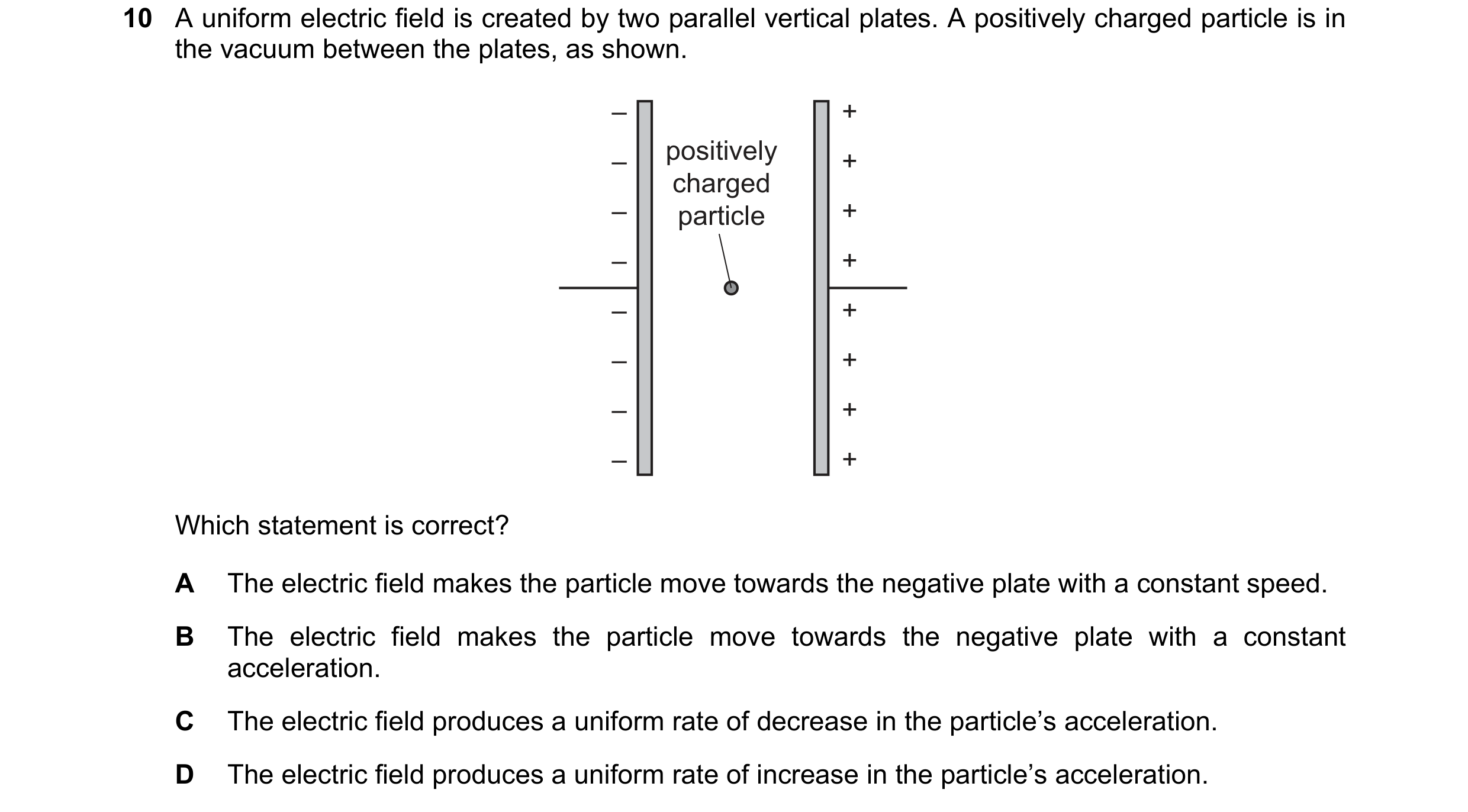
Q115 · A uniform electric field is created by two parallel vertical plates 9702/13 May/June 2019
10 A uniform electric field is created by two parallel vertical plates. A positively charged particle is in the vacuum between the plates, as shown. – + – positively + charged – particle + – + – + – + – + – + Which statement is correct? A The electric field makes the particle move towards the negative plate with a constant speed. B The electric field makes the particle move towards the negative plate with a constant acceleration. C The electric field produces a uniform rate of decrease in the particle’s acceleration. D The electric field produces a uniform rate of increase in the particle’s acceleration.
1 marks
Answer: B
This question in 9702/13 May/June 2019
Q116 · A positively charged oil droplet falls in air in a uniform electric field that is… 9702/12 Oct/Nov 2019
10 A positively charged oil droplet falls in air in a uniform electric field that is vertically upwards. The droplet has a constant terminal speed v0 and the electric field strength is E. The magnitude of the force due to air resistance acting on the droplet is proportional to the speed of the droplet. Which graph shows the variation with E of v0? A B C D v0 v0 v0 v0 0 0 0 0 0 E 0 E 0 E 0 E
1 marks
Answer: A
This question in 9702/12 Oct/Nov 2019
Q117 · A charged oil drop of mass m, with n excess electrons, is held stationary in the uniform… 9702/12 Oct/Nov 2019
30 A charged oil drop of mass m, with n excess electrons, is held stationary in the uniform electric field between two horizontal plates separated by a distance d. V m d The voltage between the plates is V, the elementary charge is e and the acceleration of free fall is g. What is the value of n ? eV mgd meV gd A B C D mgd eV gd meV
1 marks
Answer: B
This question in 9702/12 Oct/Nov 2019
Q118 · A uniform electric field is represented by five horizontal field lines 9702/13 Oct/Nov 2019
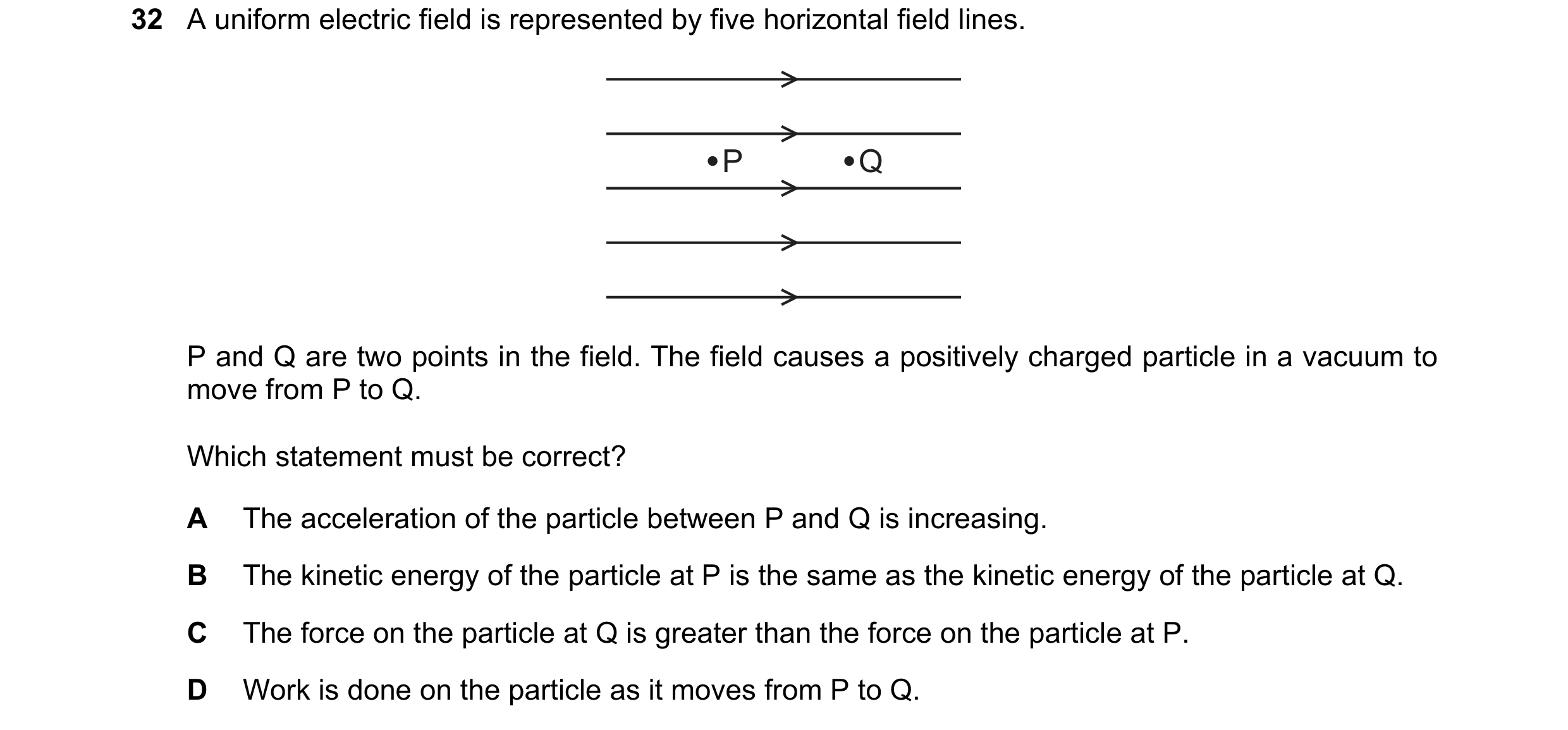
32 A uniform electric field is represented by five horizontal field lines. P Q P and Q are two points in the field. The field causes a positively charged particle in a vacuum to move from P to Q. Which statement must be correct? A The acceleration of the particle between P and Q is increasing. B The kinetic energy of the particle at P is the same as the kinetic energy of the particle at Q. C The force on the particle at Q is greater than the force on the particle at P. D Work is done on the particle as it moves from P to Q.
1 marks
Answer: D
This question in 9702/13 Oct/Nov 2019
Q119 · A negatively charged oil drop is held stationary, equidistant between two plates… 9702/12 Feb/March 2020
31 A negatively charged oil drop is held stationary, equidistant between two plates connected to a high voltage supply, as shown. + oil drop – Which change would not increase the upward electrical force on the drop? A decreasing the distance between the plates whilst keeping the drop equidistant from them B increasing the amount of negative charge on the drop C increasing the supply voltage D moving the drop closer to the positive plate
1 marks
Answer: D
This question in 9702/12 Feb/March 2020
Q120 · A charged particle is in a vacuum between two horizontal metal plates as shown 9702/11 May/June 2020
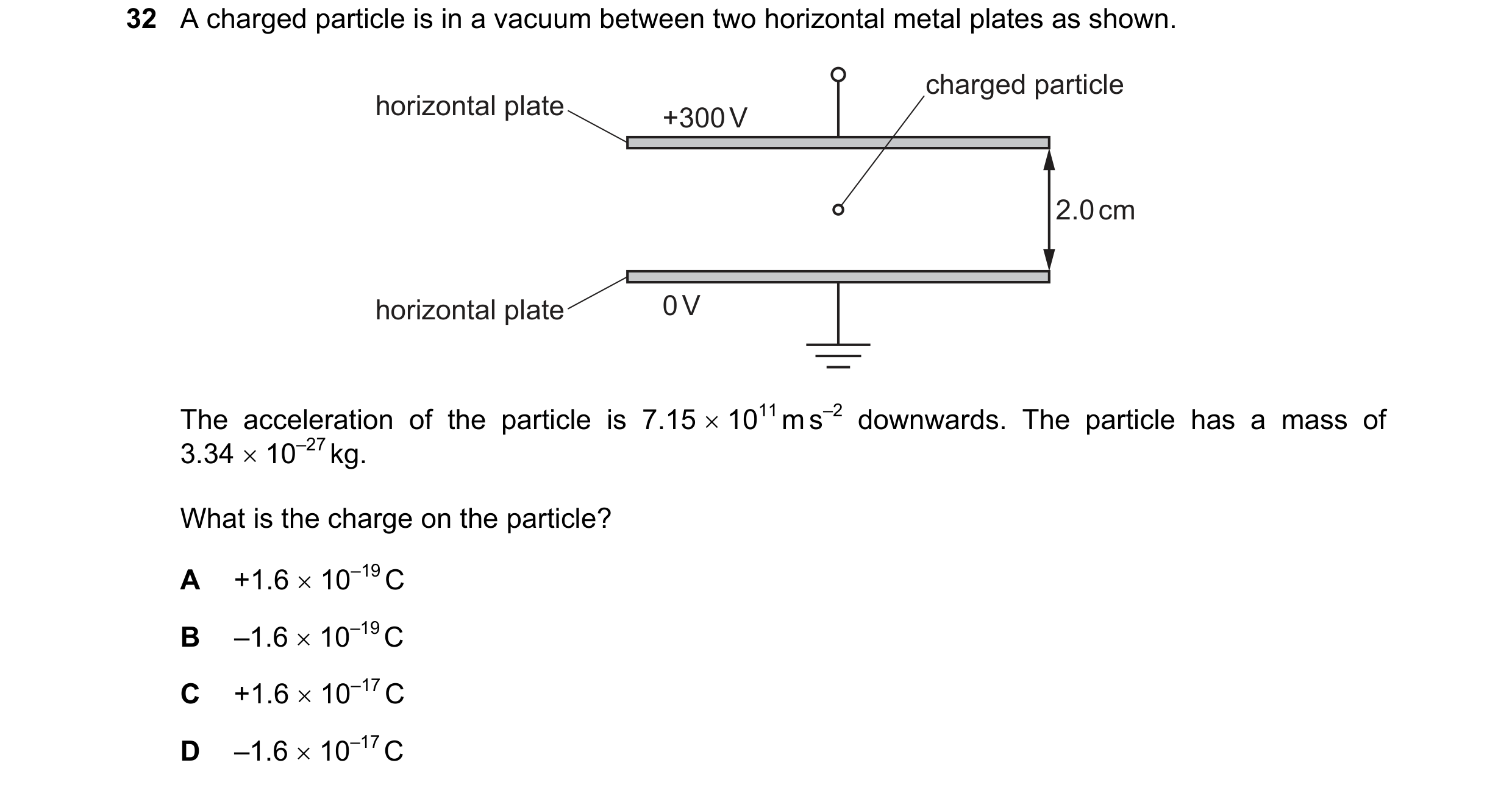
32 A charged particle is in a vacuum between two horizontal metal plates as shown. charged particle horizontal plate +300 V 2.0 cm horizontal plate 0 V The acceleration of the particle is 7.15 × 10¹¹ m s–2 downwards. The particle has a mass of 3.34 × 10⁻²⁷ kg. What is the charge on the particle? A +1.6 × 10⁻¹⁹ C B –1.6 × 10⁻¹⁹ C C +1.6 × 10⁻¹⁷ C D –1.6 × 10⁻¹⁷ C
1 marks
Answer: A
This question in 9702/11 May/June 2020
Q121 · The diagrams show a negative electric charge situated in a uniform electric field and a… 9702/12 May/June 2020
10 The diagrams show a negative electric charge situated in a uniform electric field and a mass situated in a uniform gravitational field. – charge mass uniform electric field uniform gravitational field Which row shows the directions of the forces acting on the charge and on the mass? charge mass A – B – C – D –
1 marks
Answer: B
This question in 9702/12 May/June 2020
Q122 · A charged oil droplet of mass m is falling, initially freely, in a vacuum between two… 9702/12 May/June 2020
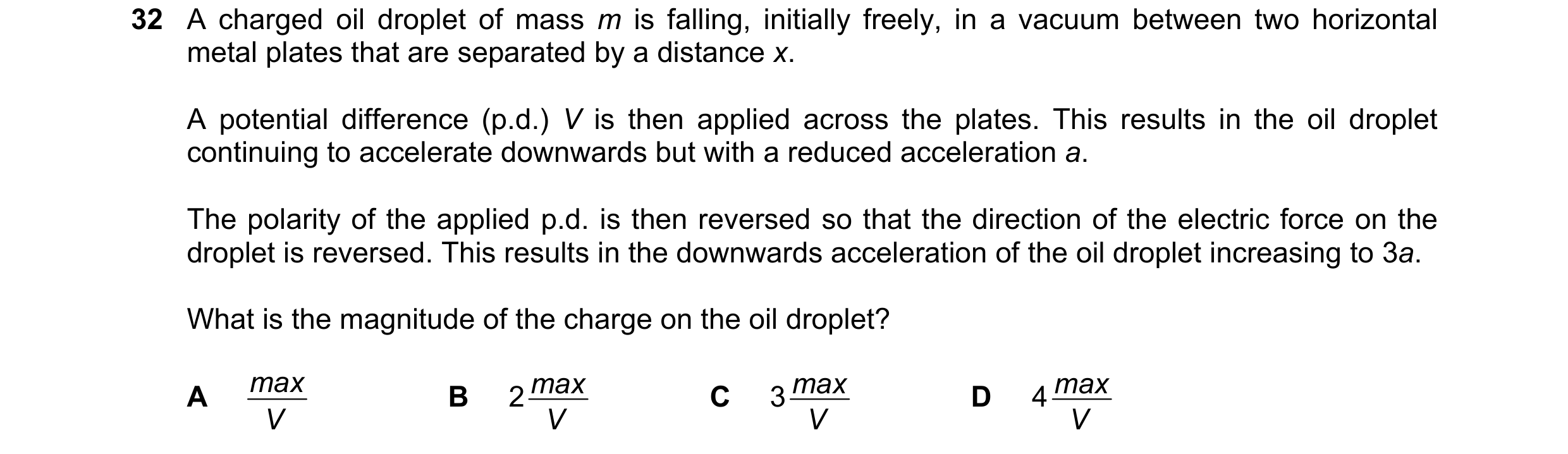
32 A charged oil droplet of mass m is falling, initially freely, in a vacuum between two horizontal metal plates that are separated by a distance x. A potential difference (p.d.) V is then applied across the plates. This results in the oil droplet continuing to accelerate downwards but with a reduced acceleration a. The polarity of the applied p.d. is then reversed so that the direction of the electric force on the droplet is reversed. This results in the downwards acceleration of the oil droplet increasing to 3a. What is the magnitude of the charge on the oil droplet? max 2 max 3 max 4 max A B C D V V V V
1 marks
Answer: A
This question in 9702/12 May/June 2020
Q123 · A negatively charged oil drop of mass m is between two horizontal parallel metal plates a… 9702/13 May/June 2020
32 A negatively charged oil drop of mass m is between two horizontal parallel metal plates a distance d apart. oil drop mass m horizontal + metal plates d – When the potential difference (p.d.) between the plates is V1 the oil drop rises at a constant speed. When the p.d. is decreased to a value V2 the oil drop falls at the same constant speed. Air resistance acts on the drop when it is moving. The upthrust on the drop is negligible. The acceleration of free fall is g. What is the charge on the oil drop? mdg mdg 2 mdg 2 mdg A B C D V – V V + V V – V V + V 1 2 1 2 1 2 1 2
1 marks
Answer: D
This question in 9702/13 May/June 2020
Q124 · A particle is situated at rest between two metal plates X and Y 9702/11 Oct/Nov 2020
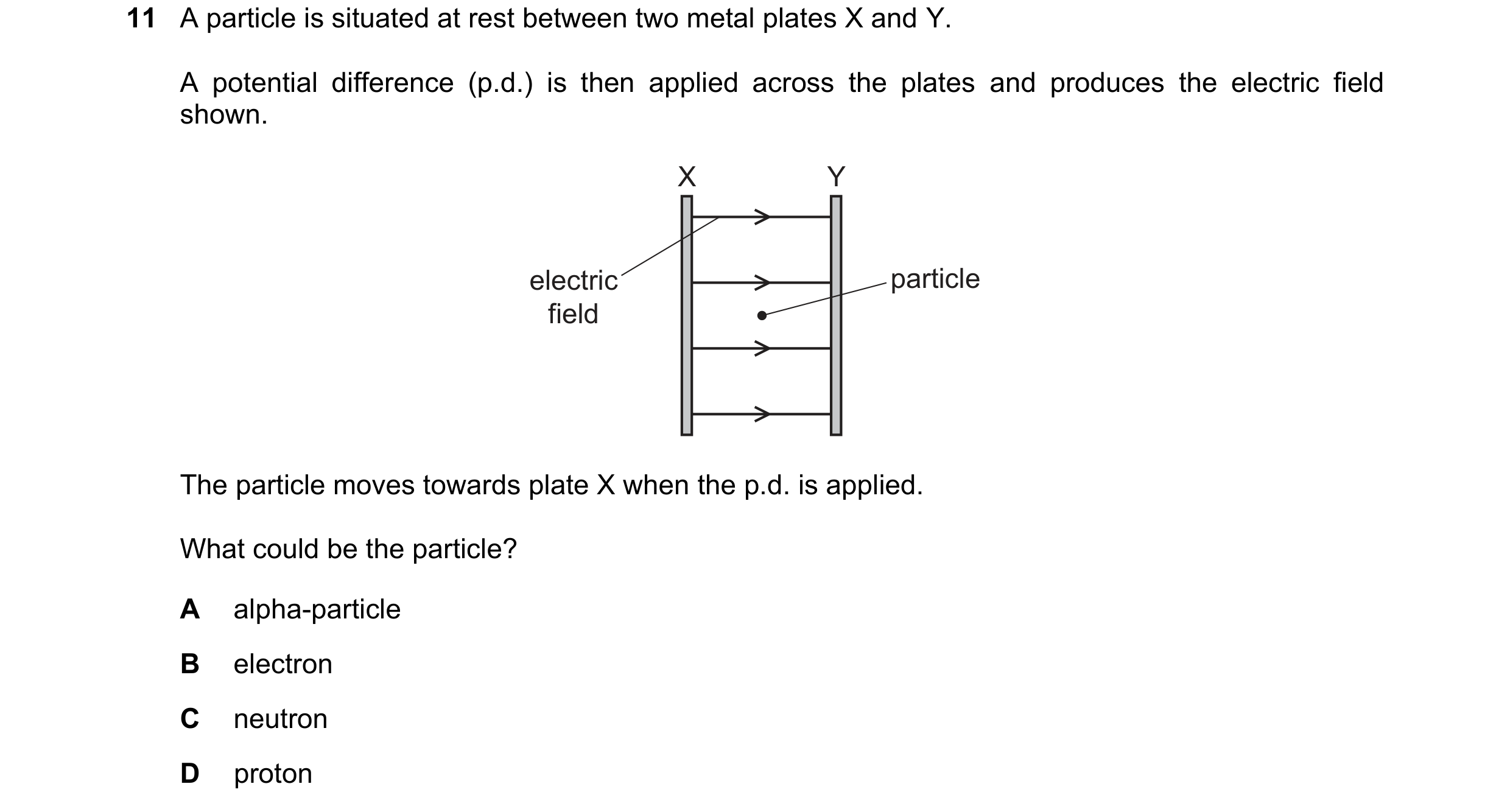
11 A particle is situated at rest between two metal plates X and Y. A potential difference (p.d.) is then applied across the plates and produces the electric field shown. X Y electric particle field The particle moves towards plate X when the p.d. is applied. What could be the particle? A alpha-particle B electron C neutron D proton
1 marks
Answer: B
This question in 9702/11 Oct/Nov 2020
Q125 · An oil drop has mass m and charge q 9702/11 Oct/Nov 2020
31 An oil drop has mass m and charge q. The drop is held stationary in an electric field between two parallel horizontal plates, a distance d apart, as shown. oil drop V d The potential difference between the plates is V and the acceleration of free fall is g. q of the oil drop? What is the charge-to-mass ratio m gd V gV d A B C D V dg d Vg
1 marks
Answer: A
This question in 9702/11 Oct/Nov 2020
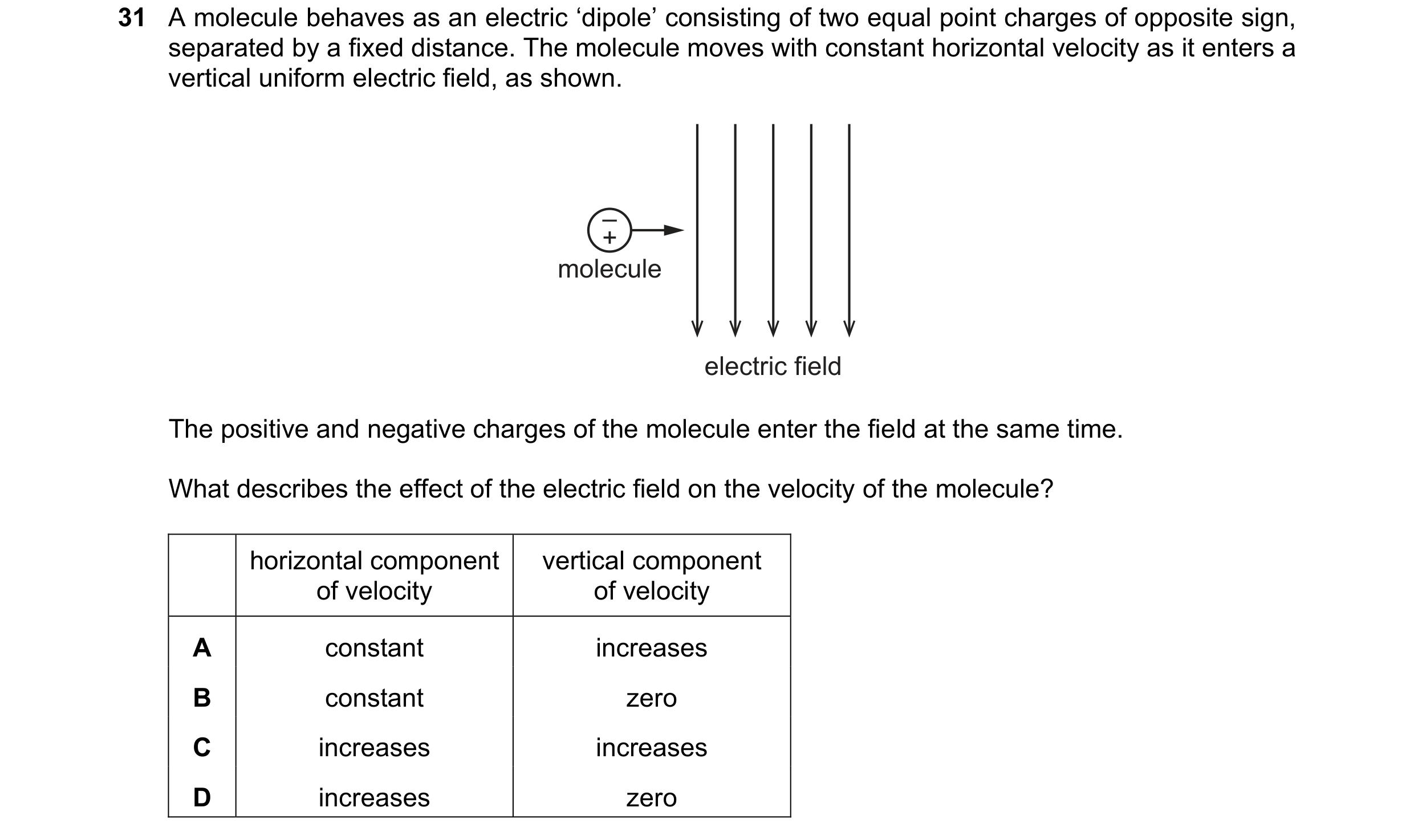
Q126 · A molecule behaves as an electric ‘dipole’ consisting of two equal point charges of… 9702/12 Oct/Nov 2020
31 A molecule behaves as an electric ‘dipole’ consisting of two equal point charges of opposite sign, separated by a fixed distance. The molecule moves with constant horizontal velocity as it enters a vertical uniform electric field, as shown. +– molecule electric field The positive and negative charges of the molecule enter the field at the same time. What describes the effect of the electric field on the velocity of the molecule? horizontal component vertical component of velocity of velocity A constant increases B constant zero C increases increases D increases zero
1 marks
Answer: B
This question in 9702/12 Oct/Nov 2020
Q127 · Two parallel metal plates are connected to a battery of negligible internal resistance 9702/12 Oct/Nov 2020
32 Two parallel metal plates are connected to a battery of negligible internal resistance. metal plates One of the plates is slowly moved towards the other. Which row is correct? electric field strength potential difference between the plates between the plates A decreases constant B increases constant C decreases increases D increases increases
1 marks
Answer: B
This question in 9702/12 Oct/Nov 2020
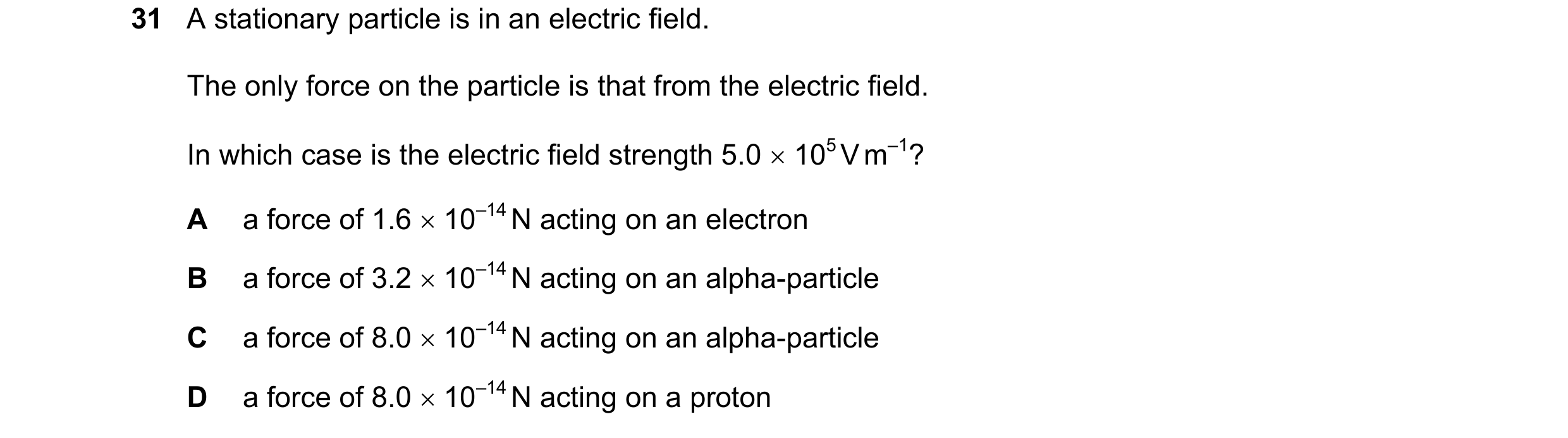
Q128 · A stationary particle is in an electric field 9702/13 Oct/Nov 2020
31 A stationary particle is in an electric field. The only force on the particle is that from the electric field. In which case is the electric field strength 5.0 105 V m–1? A a force of 1.6 10–14 N acting on an electron B a force of 3.2 10–14 N acting on an alpha-particle C a force of 8.0 10–14 N acting on an alpha-particle D a force of 8.0 10–14 N acting on a proton
1 marks
Answer: D
This question in 9702/13 Oct/Nov 2020
Q129 · A constant potential difference is applied between two horizontal metal plates 9702/13 Oct/Nov 2020
32 A constant potential difference is applied between two horizontal metal plates. A charged oil droplet is held stationary by the electric field between the plates. horizontal charged metal plates oil droplet As some of the oil evaporates, the droplet loses mass and starts to accelerate. Its charge remains constant. In which direction does the droplet accelerate, and which change needs to be made to the separation of the plates in order to stop this acceleration? direction of separation acceleration of the plates A downwards decrease B downwards increase C upwards decrease D upwards increase
1 marks
Answer: D
This question in 9702/13 Oct/Nov 2020
Q130 · A particle with mass moves in a horizontal straight line through a uniform electric field… 9702/12 Feb/March 2021
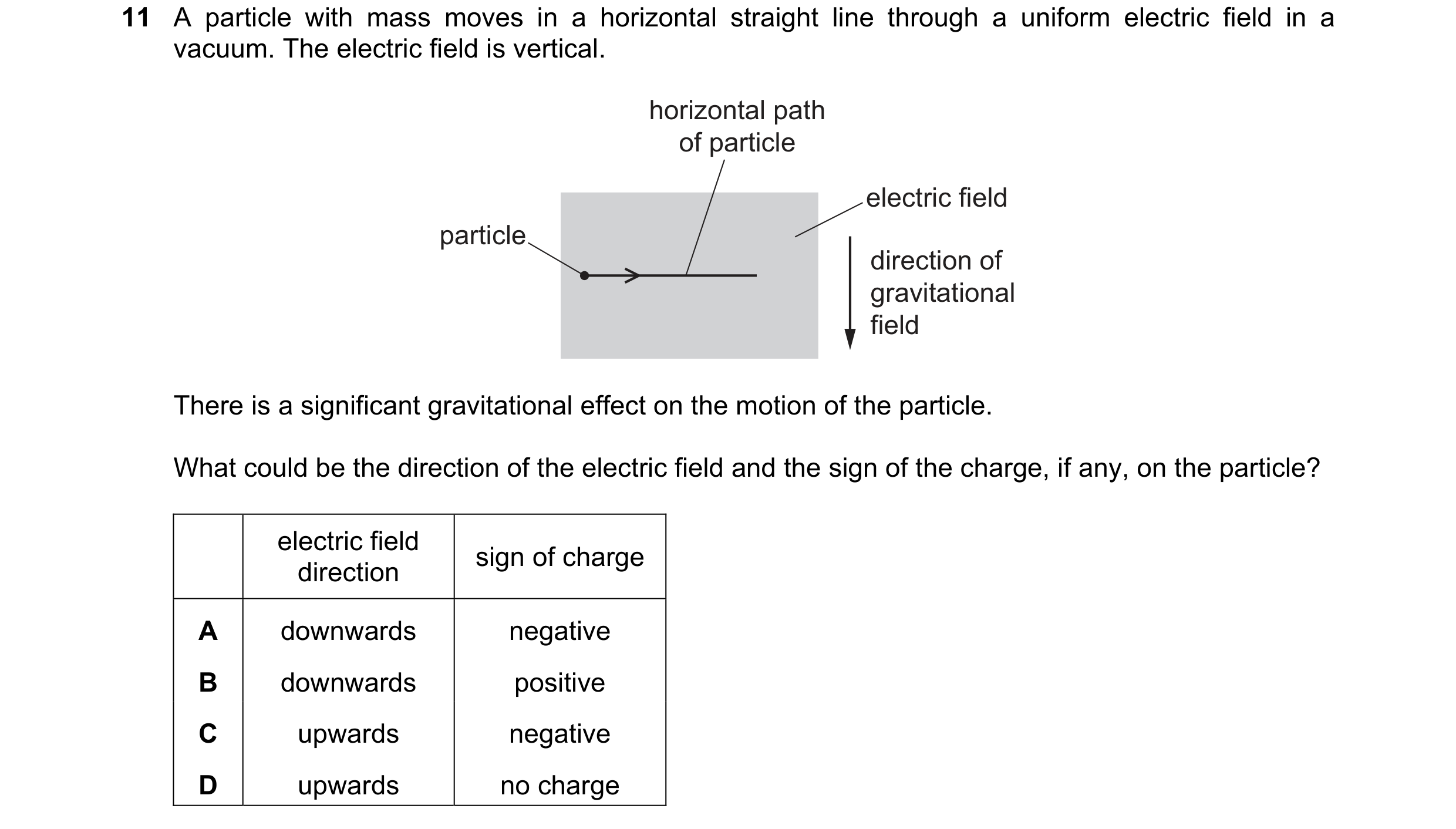
11 A particle with mass moves in a horizontal straight line through a uniform electric field in a vacuum. The electric field is vertical. horizontal path of particle electric field particle direction of gravitational field There is a significant gravitational effect on the motion of the particle. What could be the direction of the electric field and the sign of the charge, if any, on the particle? electric field sign of charge direction A downwards negative B downwards positive C upwards negative D upwards no charge
1 marks
Answer: A
This question in 9702/12 Feb/March 2021
Q131 · The diagram shows a thundercloud whose base is 500 m above the ground 9702/12 Feb/March 2021
31 The diagram shows a thundercloud whose base is 500 m above the ground. 500 m The potential difference between the base of the cloud and the ground is 200 MV. A raindrop with a charge of 4.0 × 10⁻¹² C is in the region between the cloud and the ground. What is the electrical force on the raindrop? A 1.6 × 10⁻⁶ N B 8.0 × 10⁻⁴ N C 1.6 × 10⁻³ N D 0.40 N
1 marks
Answer: A
This question in 9702/12 Feb/March 2021
Q132 · A charged oil drop is held stationary between two charged parallel plates 9702/11 May/June 2021
11 A charged oil drop is held stationary between two charged parallel plates. top plate charged oil drop bottom plate Which forces act on the oil drop? A both electric and gravitational B electric only C gravitational only D neither electric nor gravitational
1 marks
Answer: A
This question in 9702/11 May/June 2021
Q133 · What is the electric field strength in a region where a proton accelerates at 2.00 m s–2… 9702/11 May/June 2021
30 What is the electric field strength in a region where a proton accelerates at 2.00 m s–2 due to the field? A 11.4 pV m–1 B 5.22 nV m–1 C 10.4 nV m–1 D 20.9 nV m–1
1 marks
Answer: D
This question in 9702/11 May/June 2021
Q134 · An oil drop of mass 2.6 10–15 kg and with a charge of – 4.8 10–19 C is in a vacuum… 9702/11 May/June 2021
31 An oil drop of mass 2.6 10–15 kg and with a charge of – 4.8 10–19 C is in a vacuum between two horizontal plates. The plates have a separation of 2.0 cm and a potential difference (p.d.) between them of 1200 V, as shown. +1200 V oil drop plates 2.0 cm 0 V Which statement describes the motion of the oil drop? A It is stationary. B It has a downward acceleration of 9.7 m s–2. C It has an upward acceleration of 1.3 m s–2. D It has an upward acceleration of 11 m s–2.
1 marks
Answer: C
This question in 9702/11 May/June 2021
Q135 · A particle has a charge of +2.0 mC and is in a vertical uniform electric field 9702/13 May/June 2021
31 A particle has a charge of +2.0 mC and is in a vertical uniform electric field. An electric force of 1.0 10–2 N acts upwards on the particle. What is the electric field strength? A 0.20 V m–1 downwards B 0.20 V m–1 upwards C 5.0 V m–1 downwards D 5.0 V m–1 upwards
1 marks
Answer: D
This question in 9702/13 May/June 2021
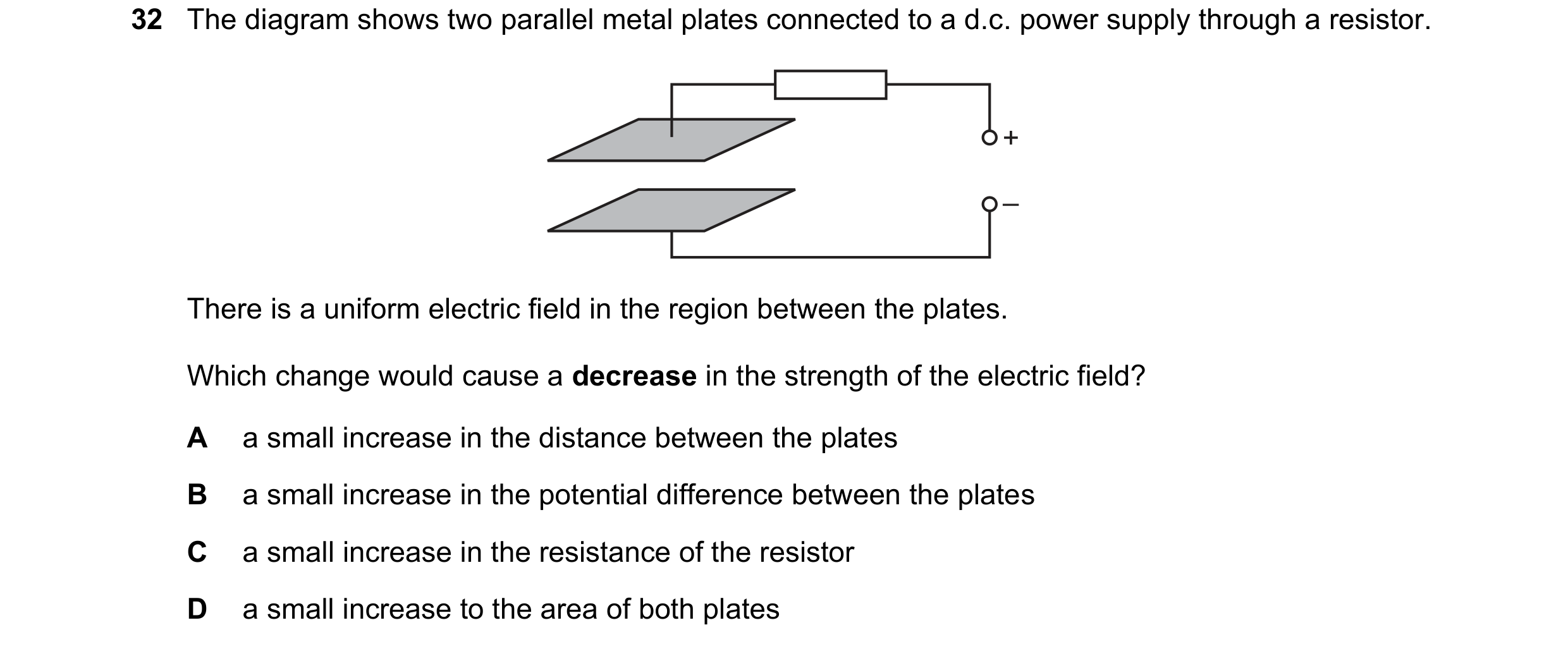
Q136 · The diagram shows two parallel metal plates connected to a d.c 9702/13 May/June 2021
32 The diagram shows two parallel metal plates connected to a d.c. power supply through a resistor. + – There is a uniform electric field in the region between the plates. Which change would cause a decrease in the strength of the electric field? A a small increase in the distance between the plates B a small increase in the potential difference between the plates C a small increase in the resistance of the resistor D a small increase to the area of both plates
1 marks
Answer: A
This question in 9702/13 May/June 2021
Q137 · Three parallel metal plates of the same area are fixed with a separation of 2.0 cm… 9702/11 Oct/Nov 2021
31 Three parallel metal plates of the same area are fixed with a separation of 2.0 cm between the top plate and the middle plate, and 1.0 cm between the middle plate and the bottom plate. The top plate is held at a potential of +500 V, the middle plate at +200 V and the bottom plate is earthed, as shown. +500 V X 2.0 cm +200 V 1.0 cm Y 0 V magnitude of force on an electron at X What is the value of the ratio ? magnitude of force on an electron at Y A 0.75 B 1.00 C 1.25 D 1.50
1 marks
Answer: A
This question in 9702/11 Oct/Nov 2021
Q138 · Two parallel metal plates are at electric potentials of +800 V and +1300 V 9702/13 Oct/Nov 2021
31 Two parallel metal plates are at electric potentials of +800 V and +1300 V. Which diagram best represents the electric field between the metal plates? A B +800 V +1300 V +800 V +1300 V C D +800 V +1300 V +800 V +1300 V
1 marks
Answer: B
This question in 9702/13 Oct/Nov 2021
Q139 · An electron is in a uniform electric field of field strength 1500 V m–1 9702/13 Oct/Nov 2021
32 An electron is in a uniform electric field of field strength 1500 V m–1. What is the acceleration of the electron due to the electric field? A 8.5 10–9 m s–2 B 1.6 10–5 m s–2 C 1.4 1011 m s–2 D 2.6 1014 m s–2
1 marks
Answer: D
This question in 9702/13 Oct/Nov 2021

 1 / 57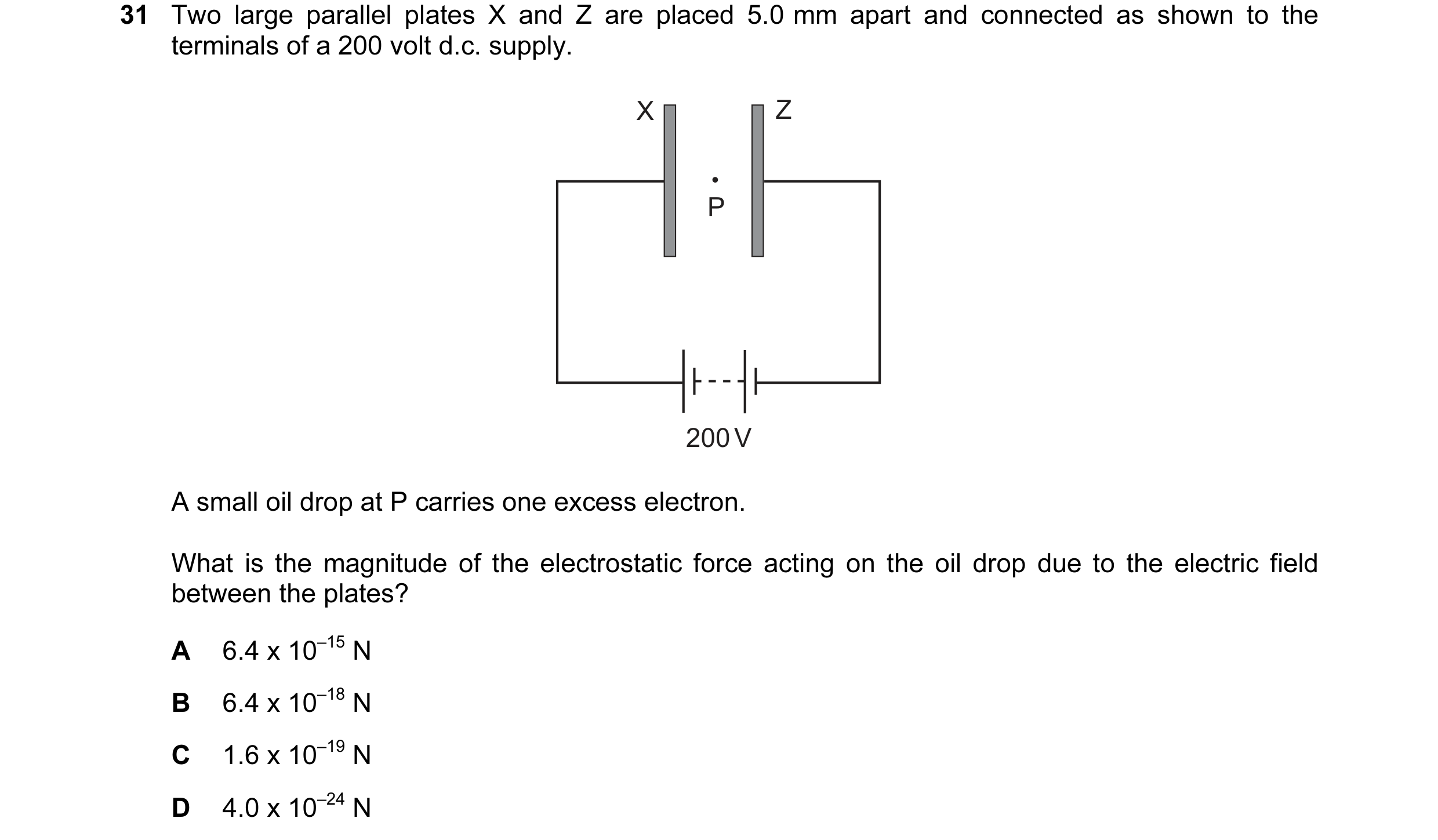
 2 / 57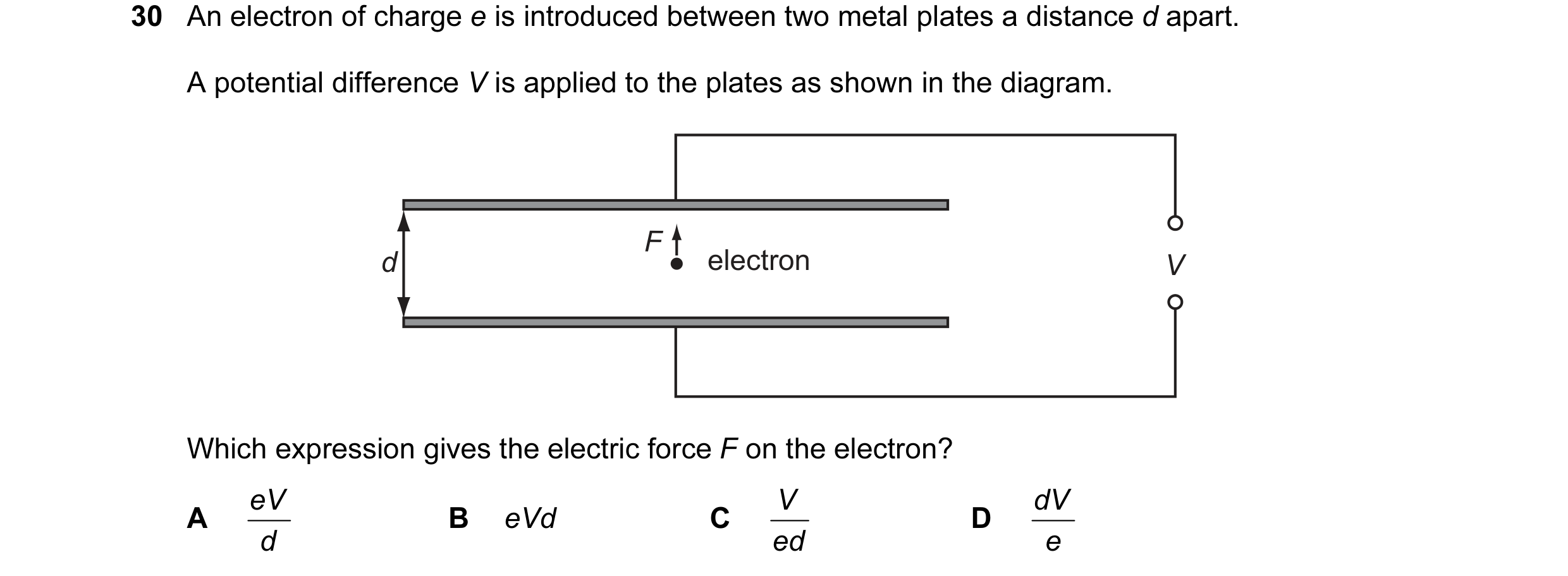
 3 / 57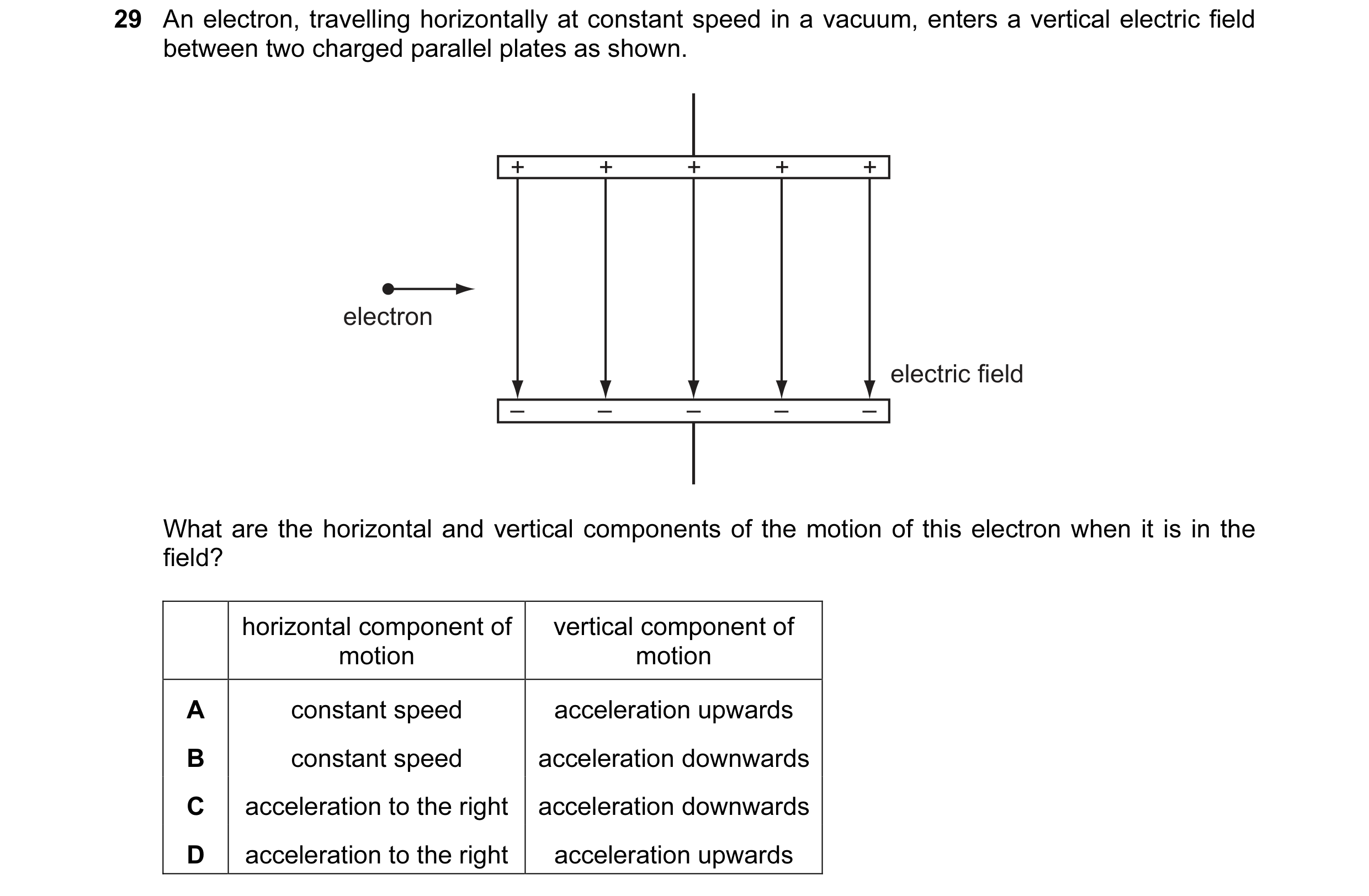

 4 / 57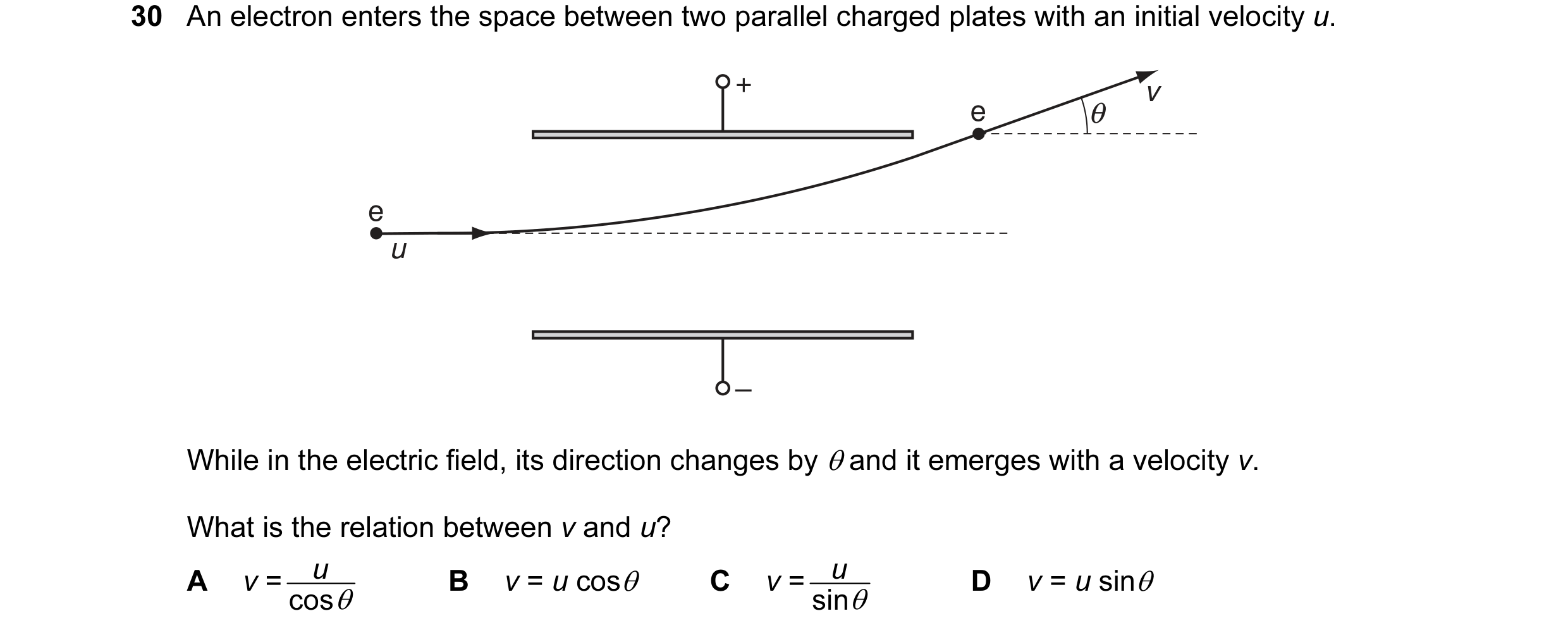
 5 / 57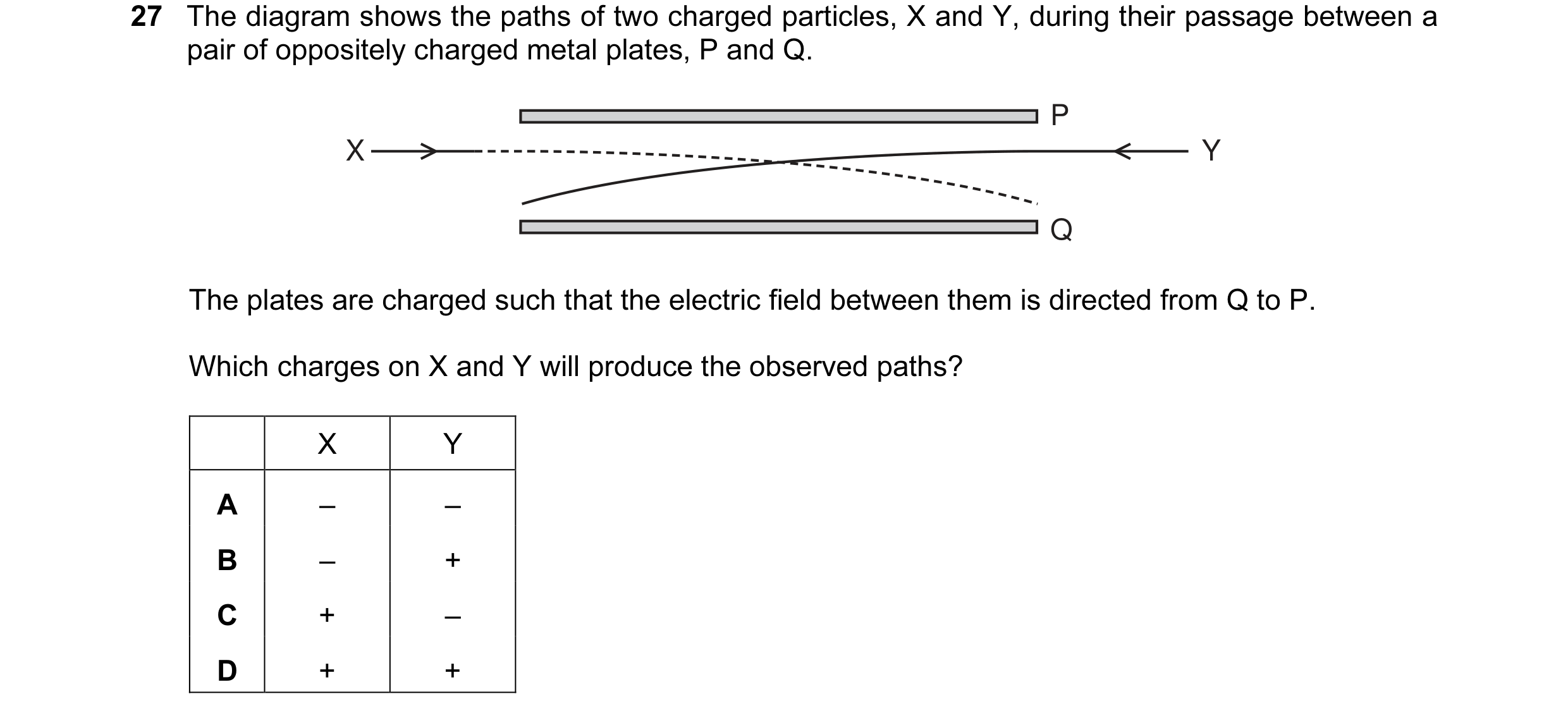
 6 / 57
 7 / 57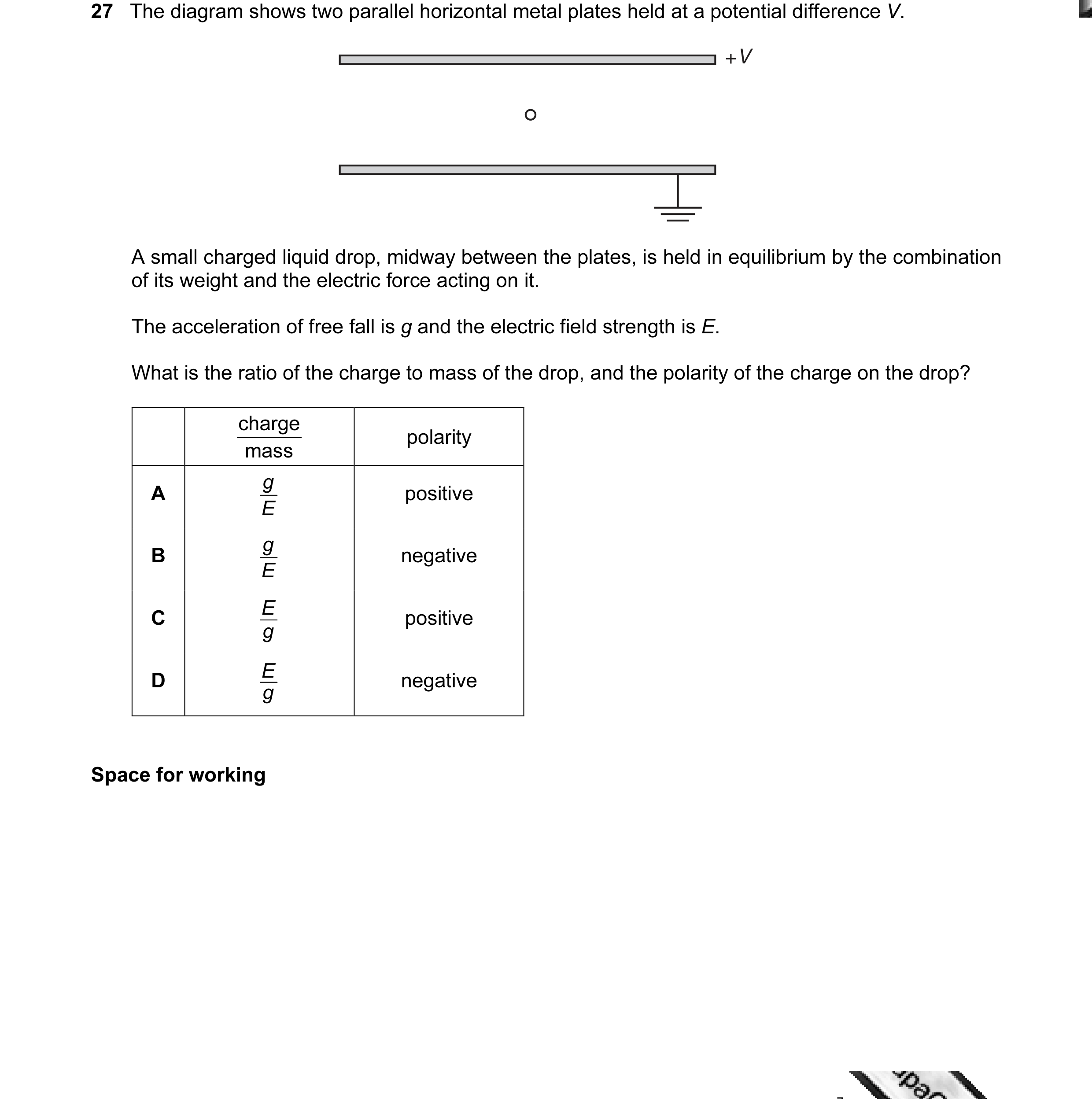
 8 / 57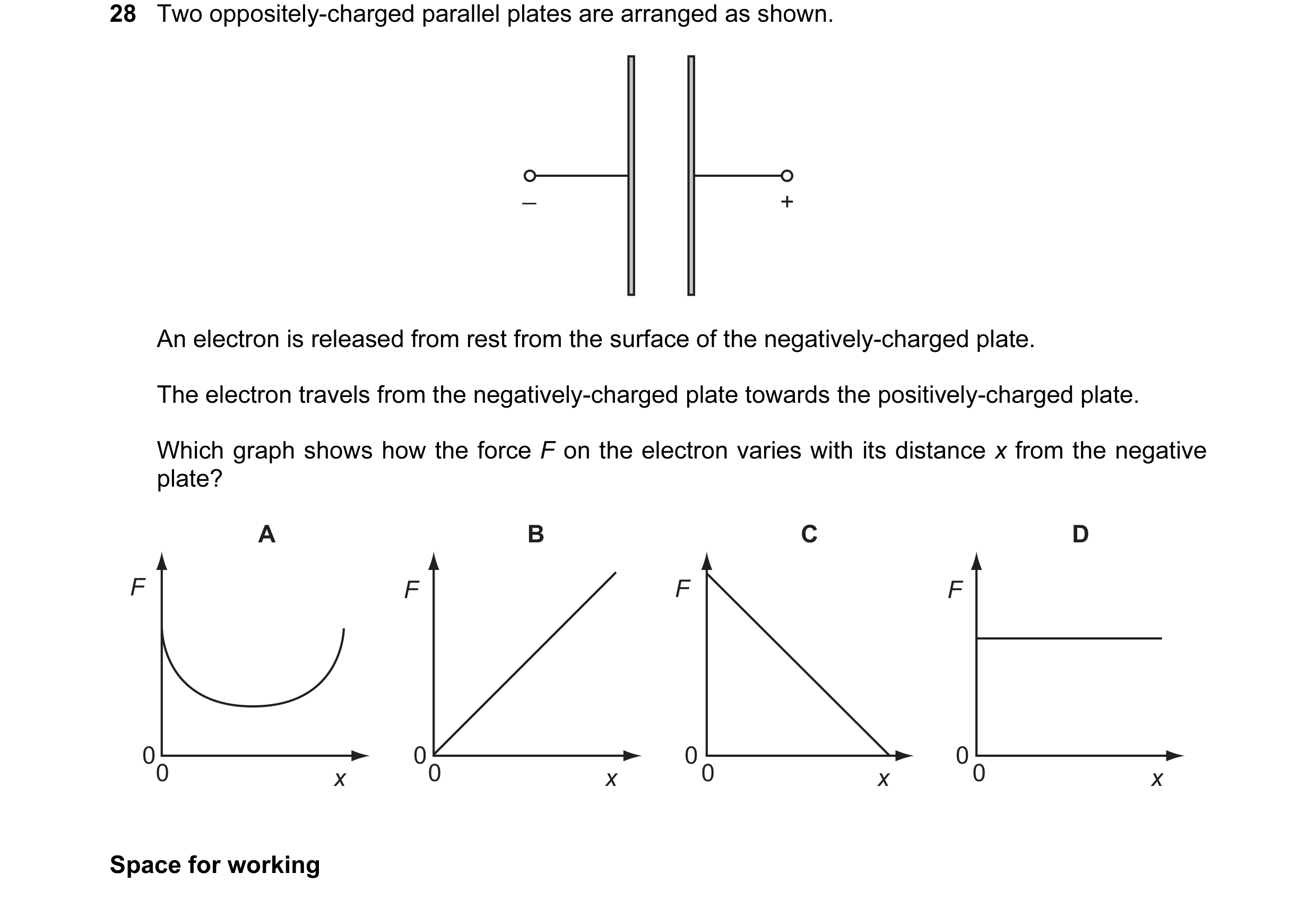
 9 / 57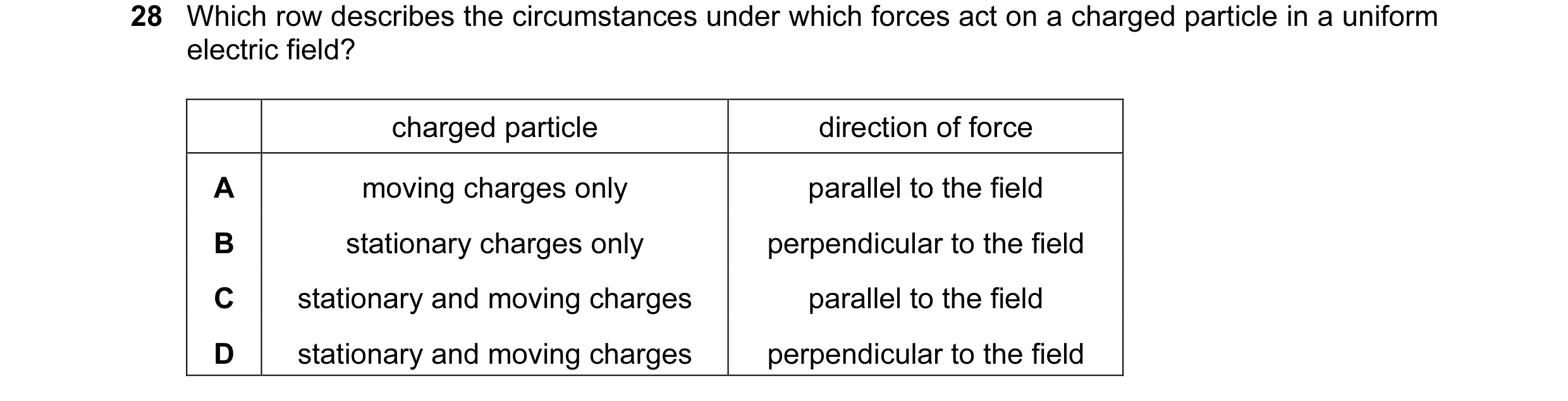
 10 / 57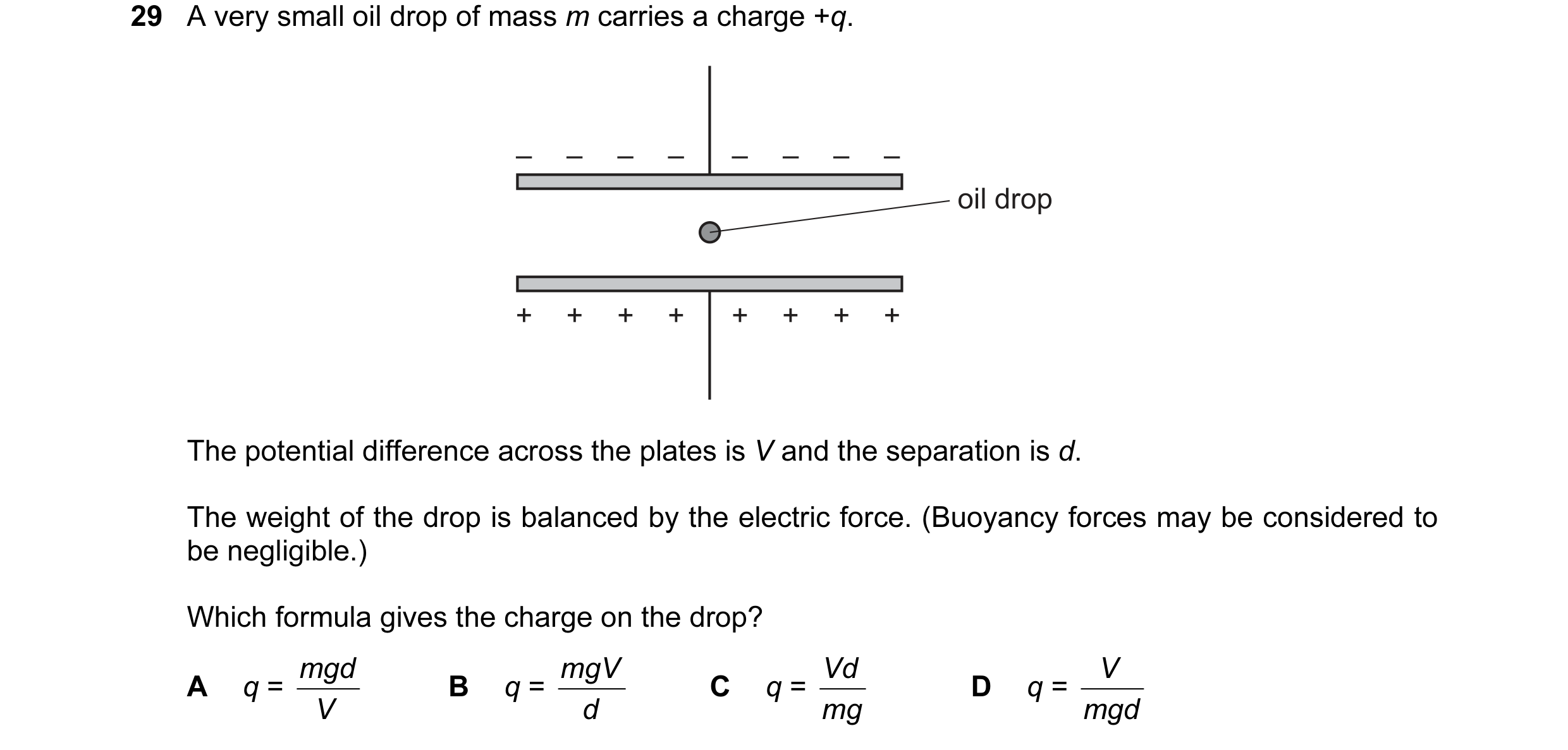
 11 / 57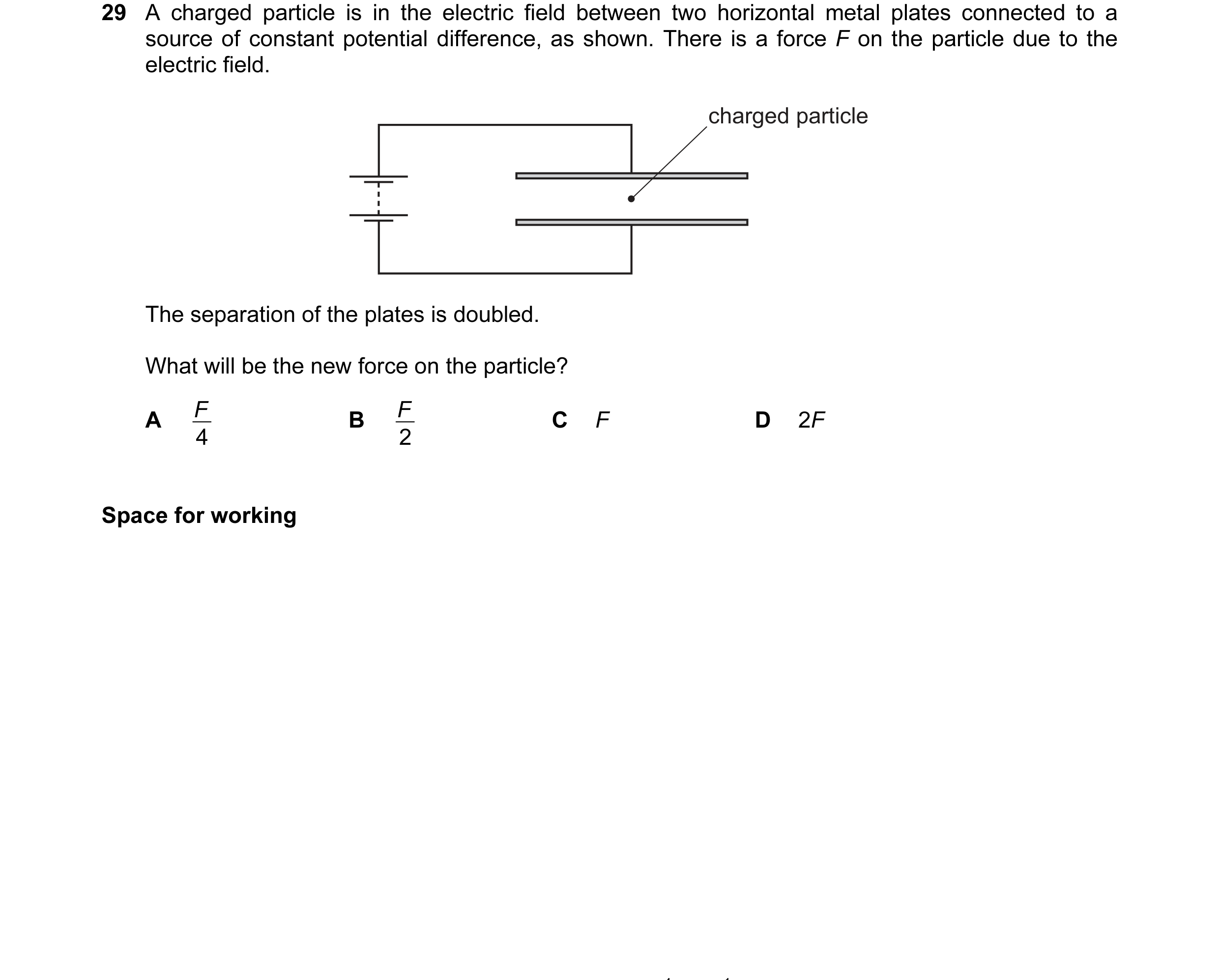
 12 / 57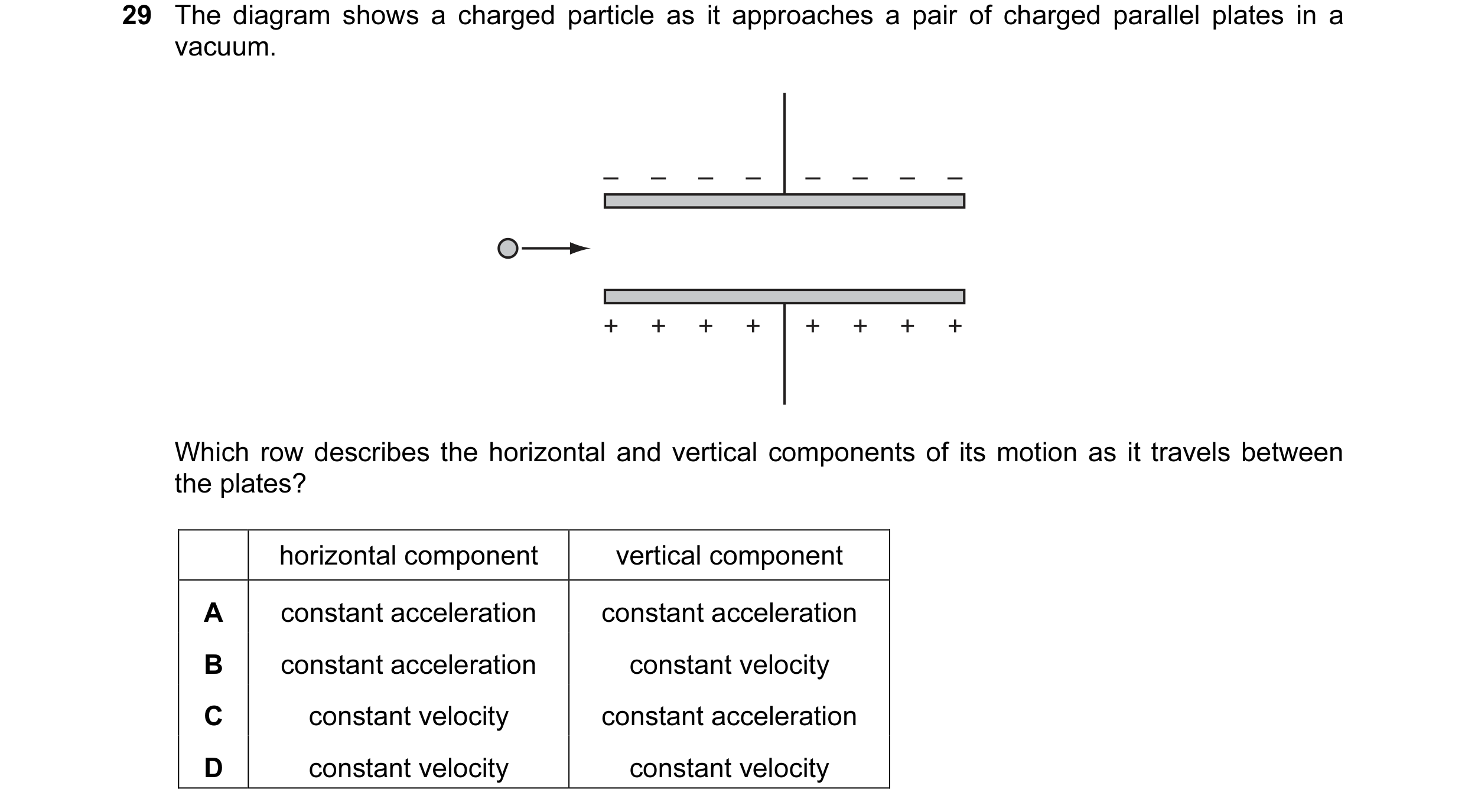
 13 / 57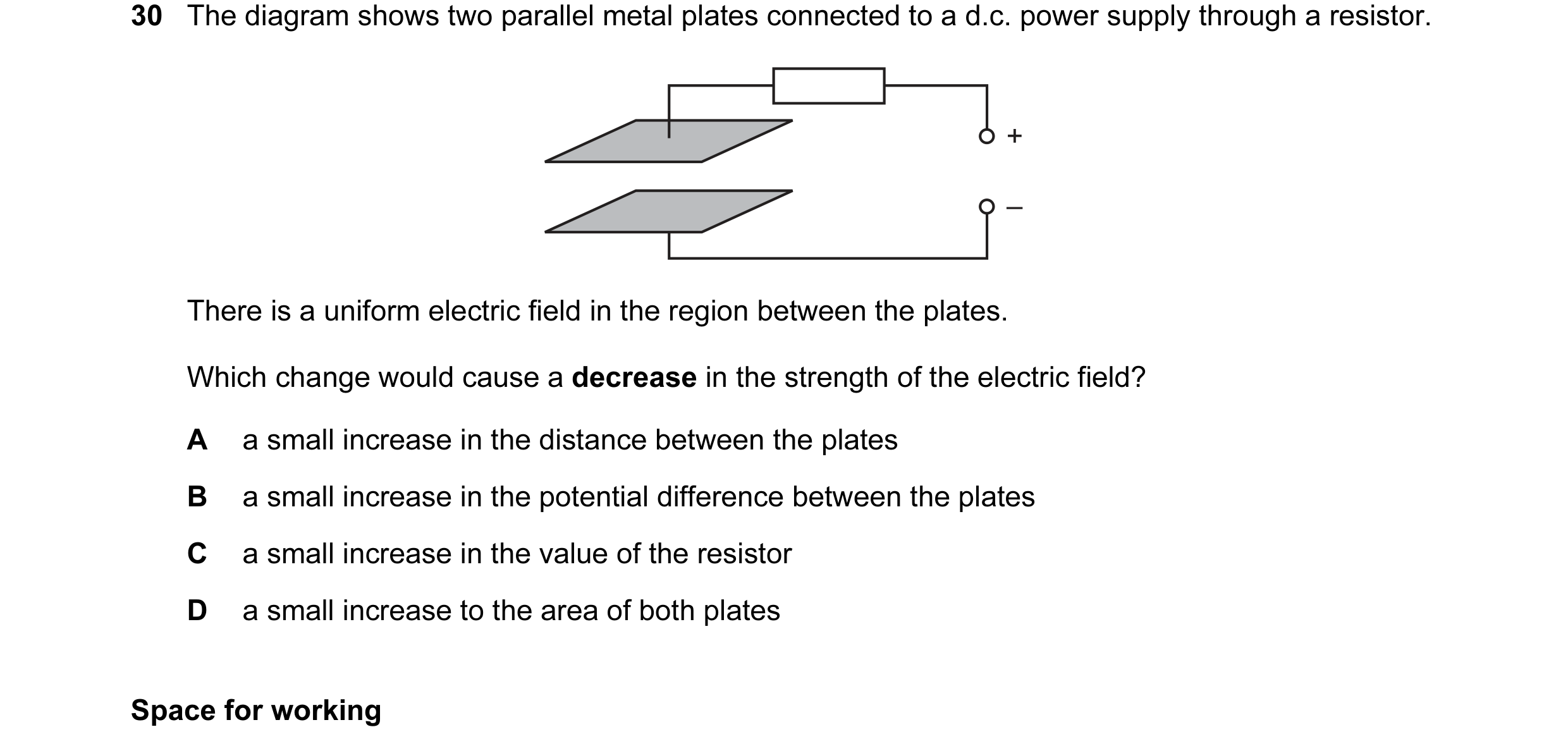
 14 / 57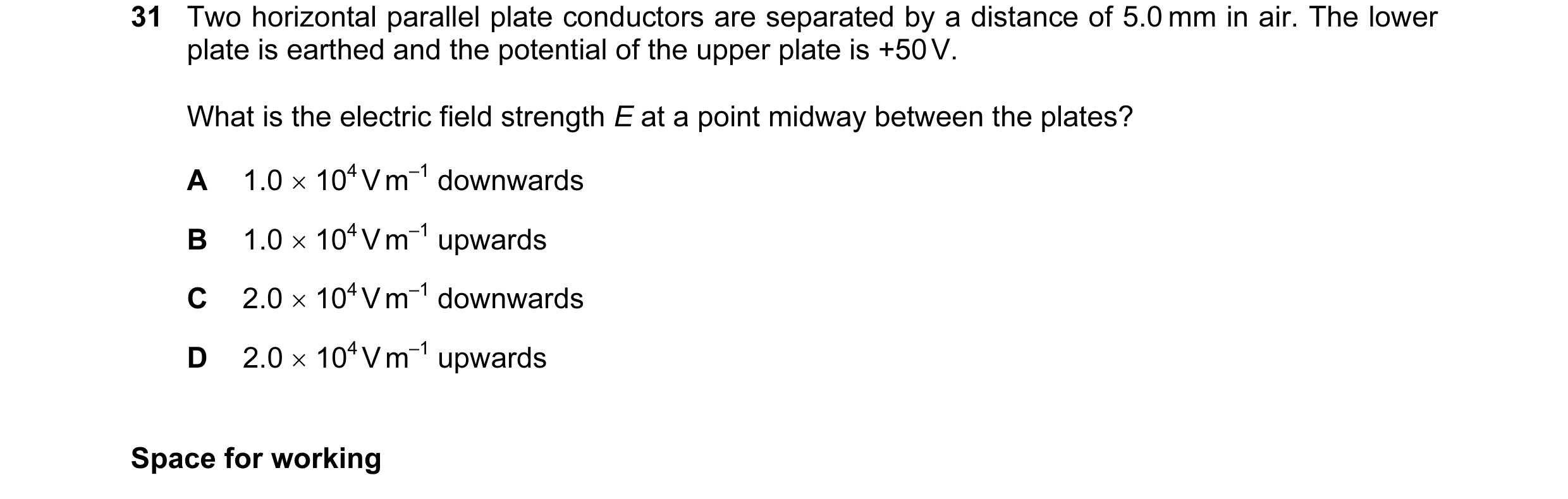
 15 / 57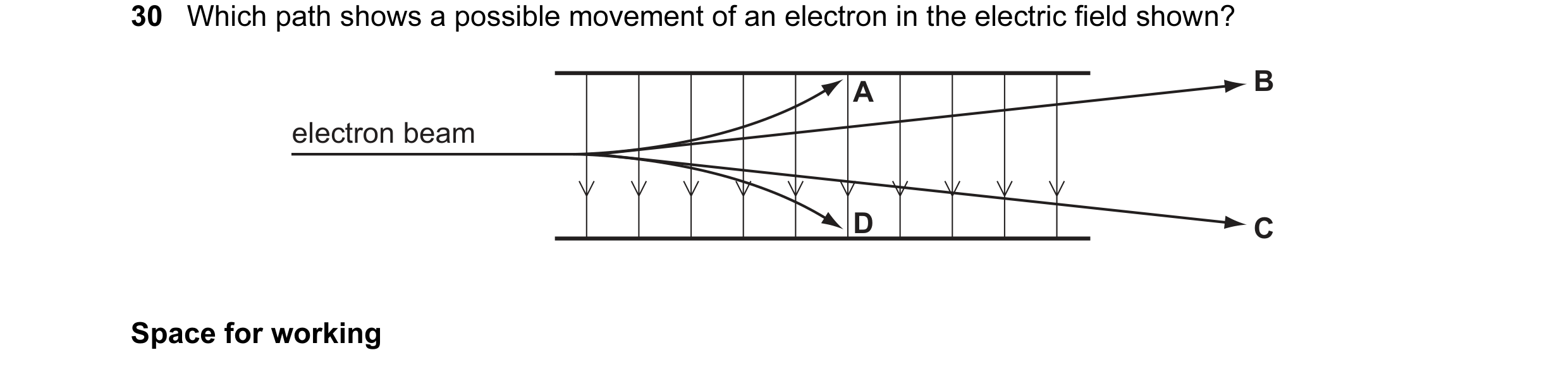
 16 / 57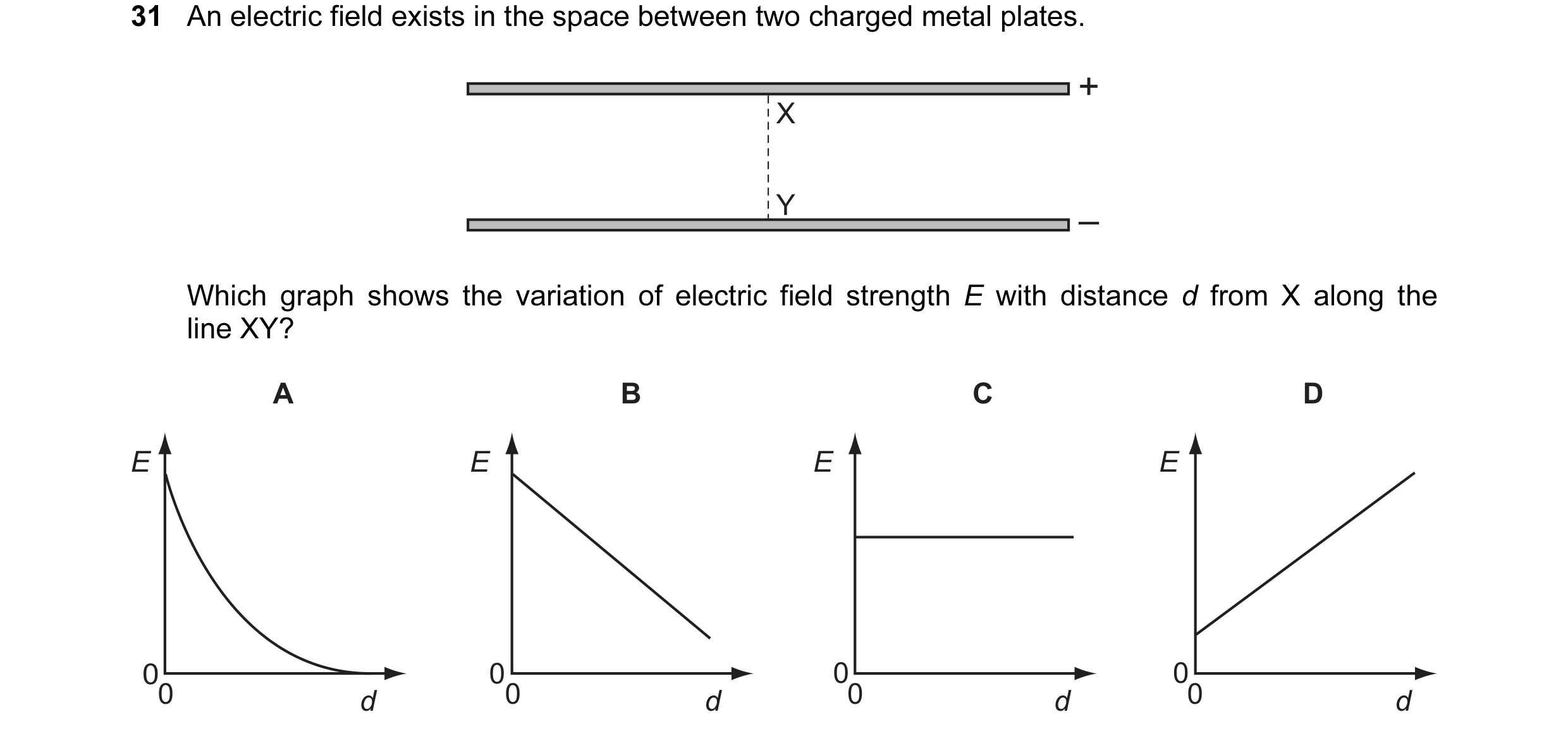
 17 / 57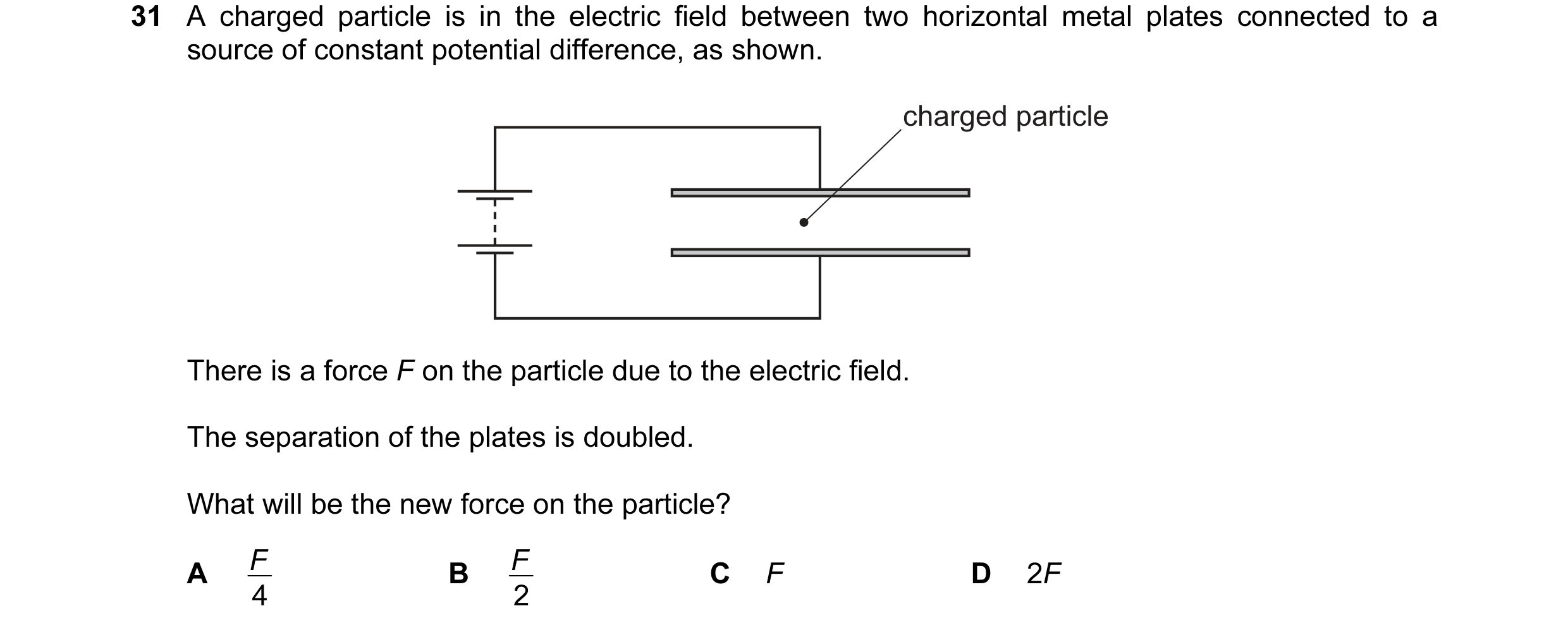
 18 / 57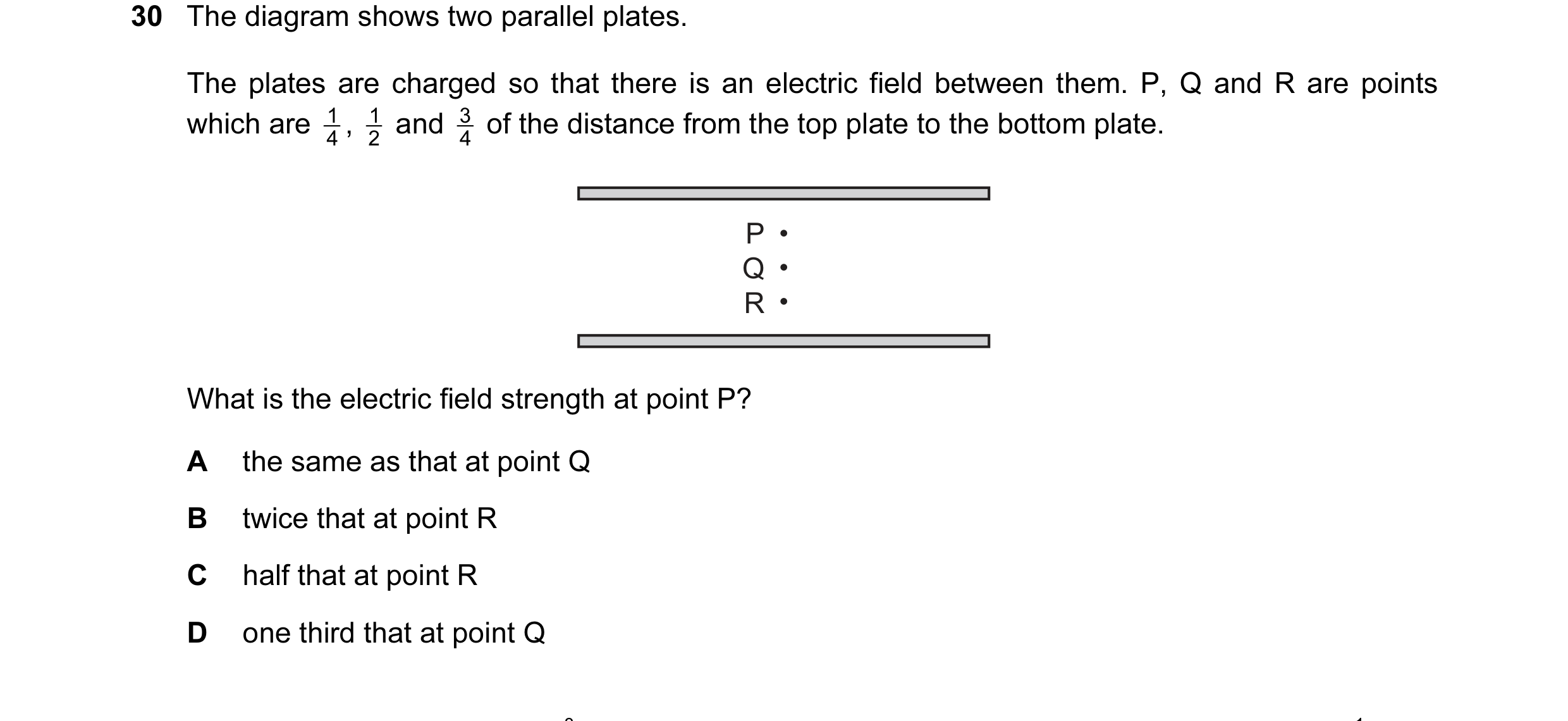
 19 / 57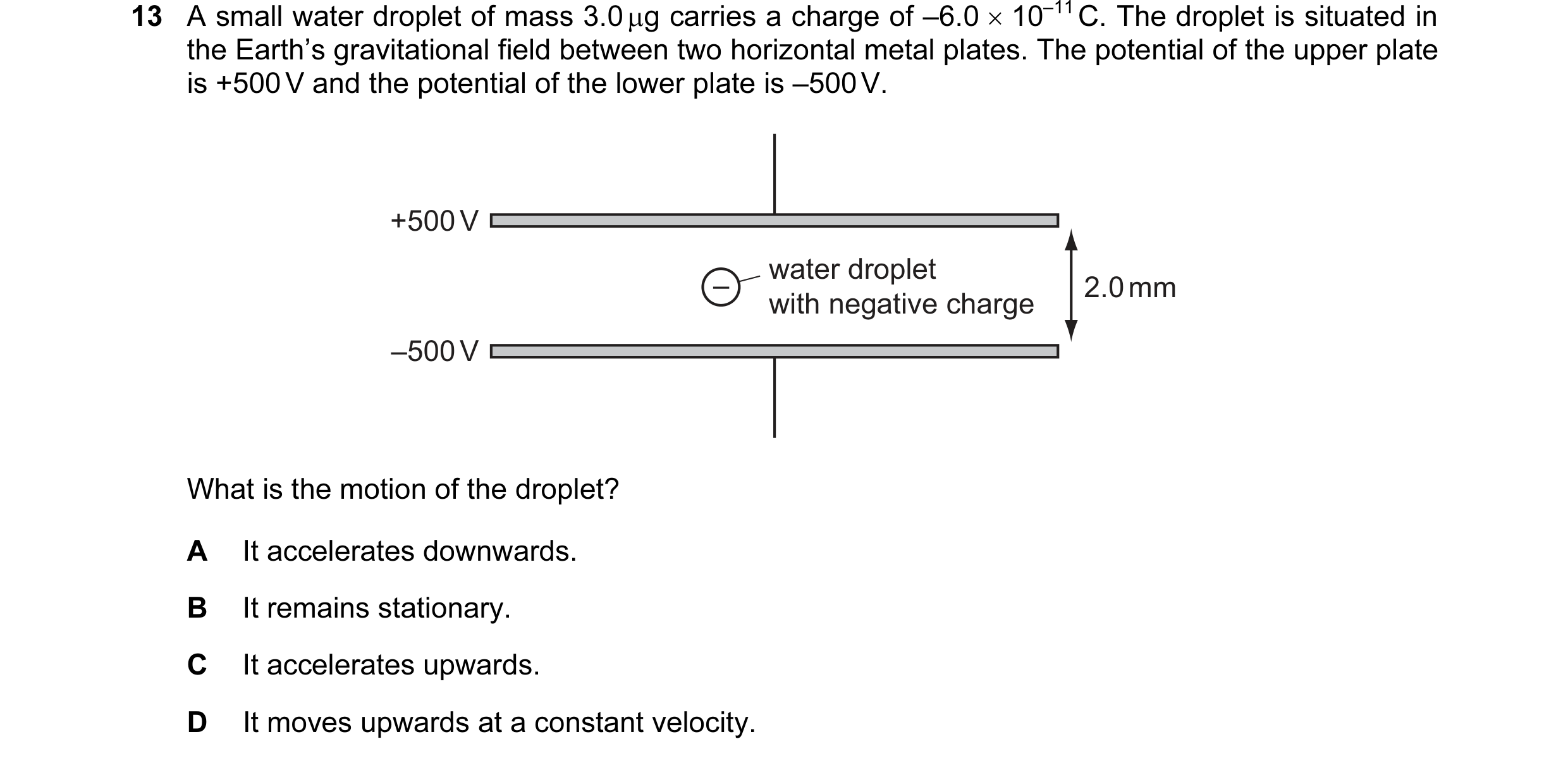
 20 / 57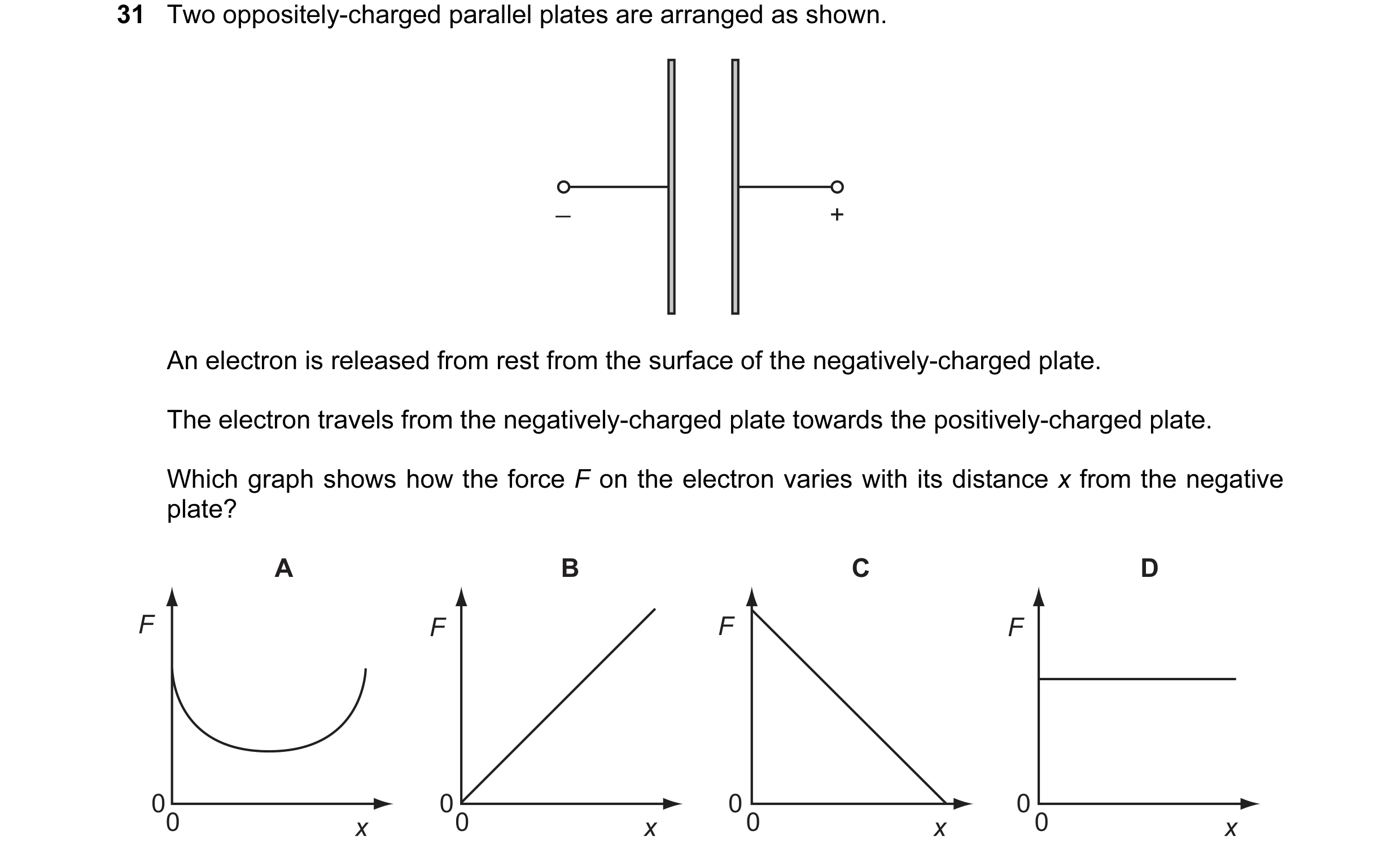
 21 / 57
 22 / 57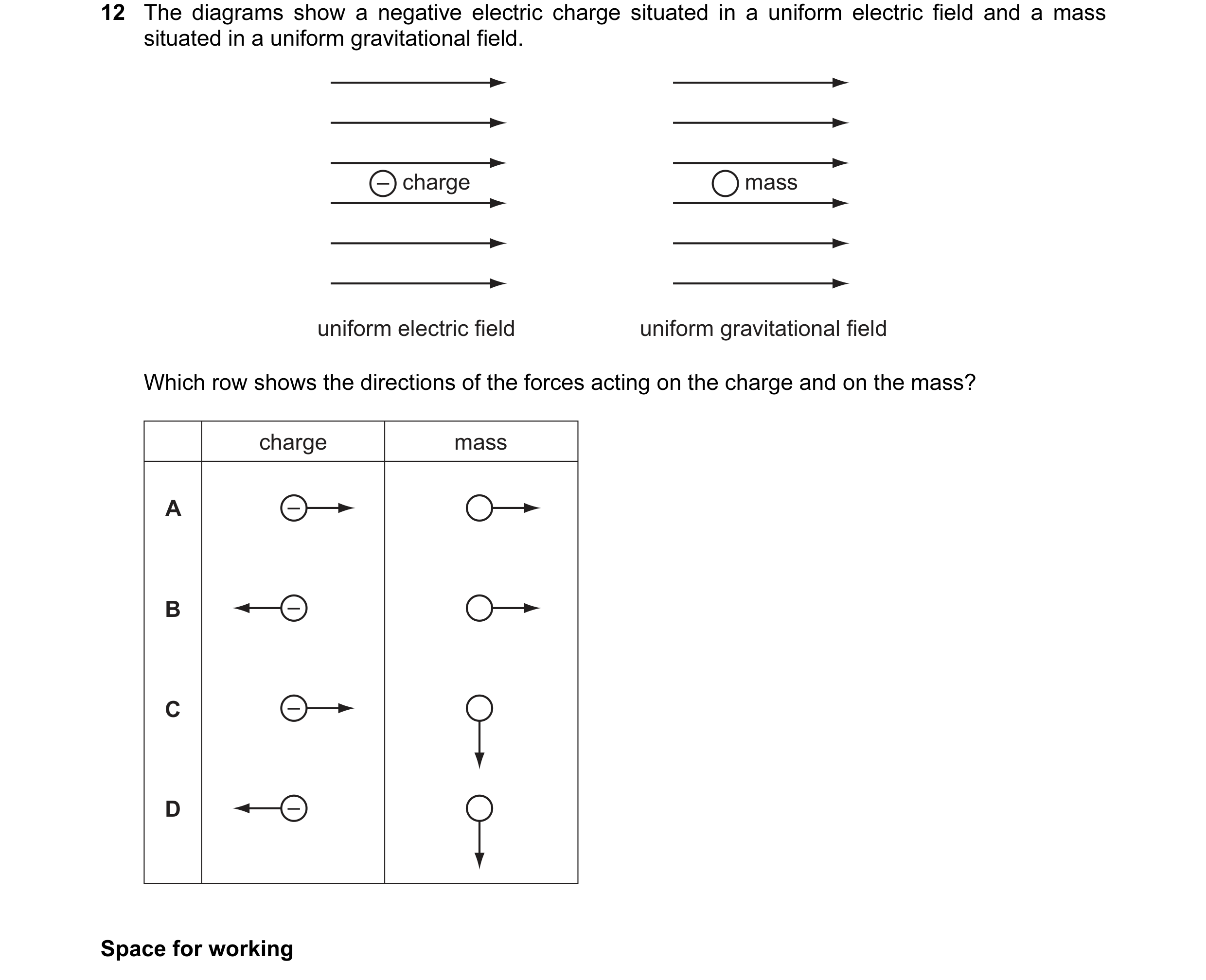
 23 / 57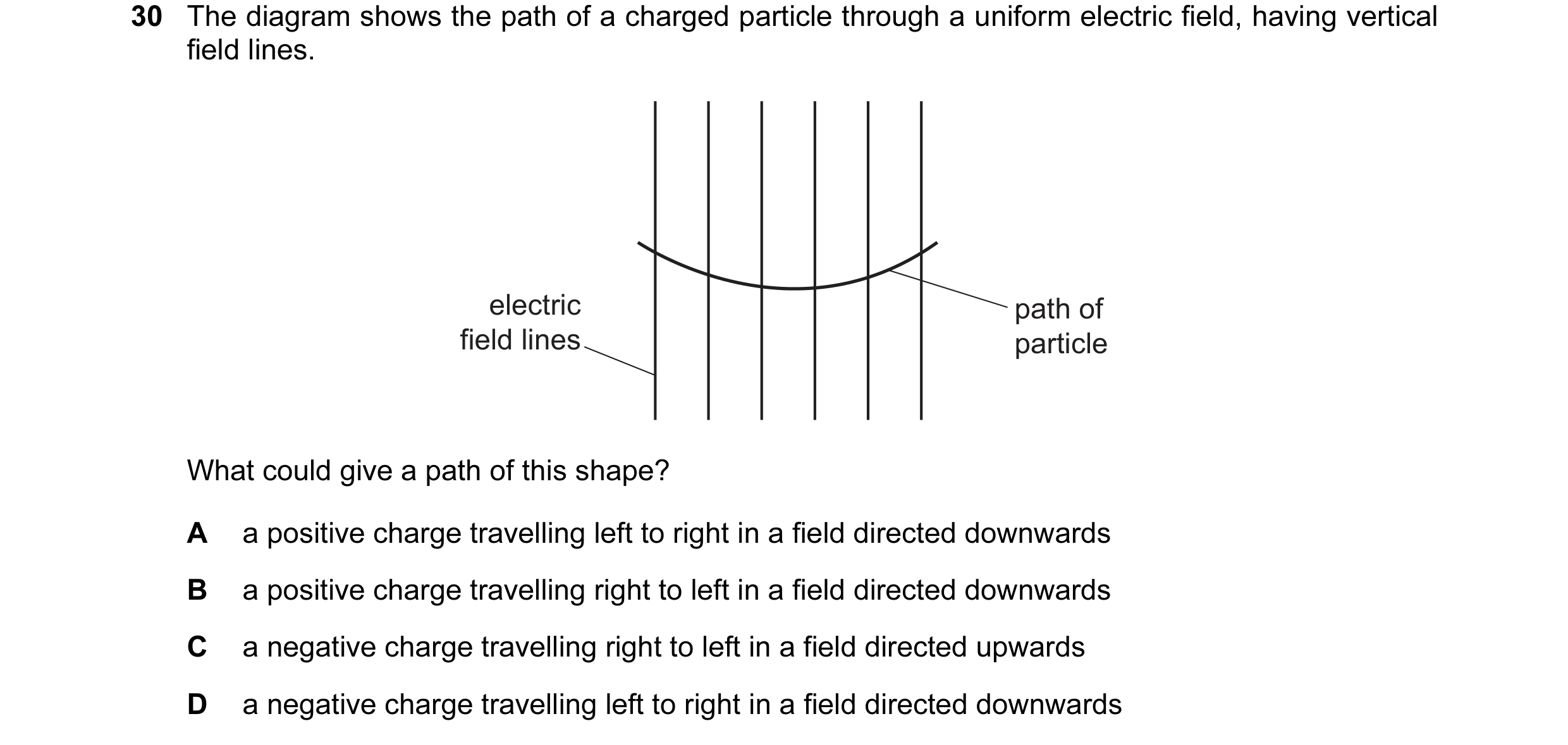
 24 / 57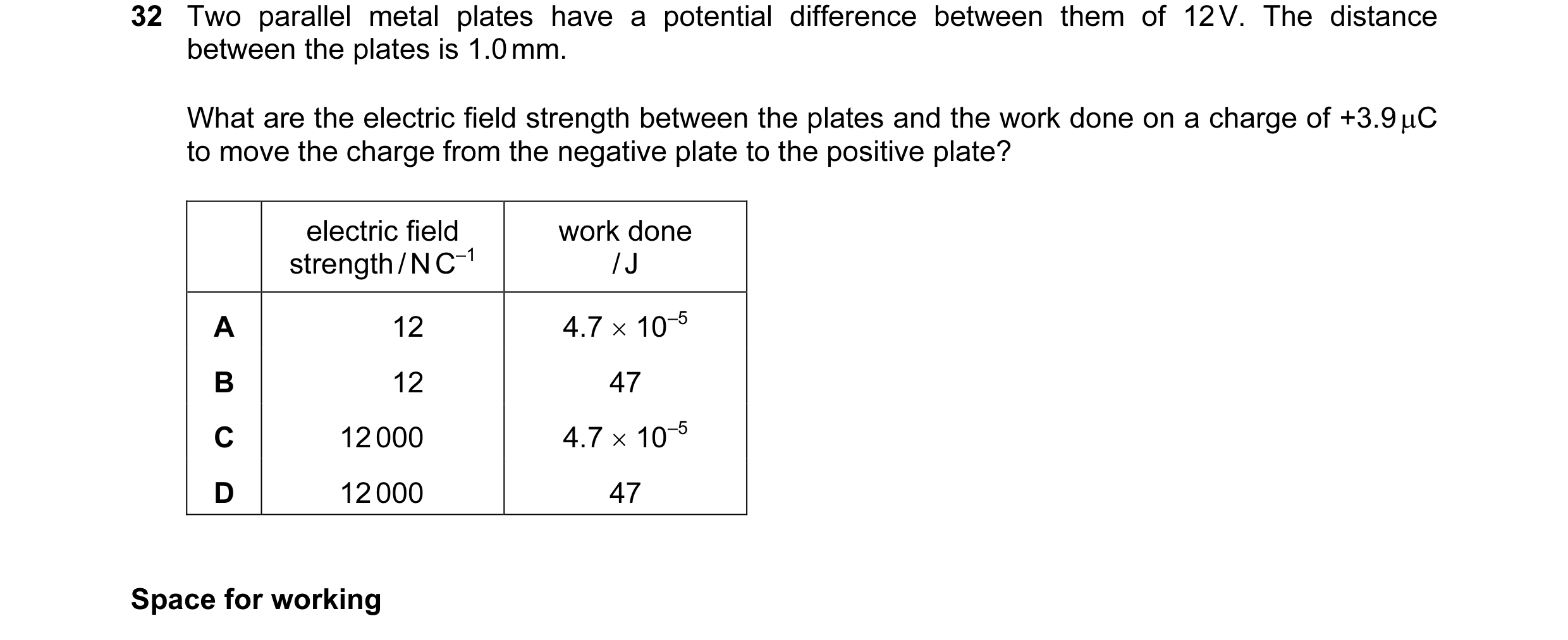
 25 / 57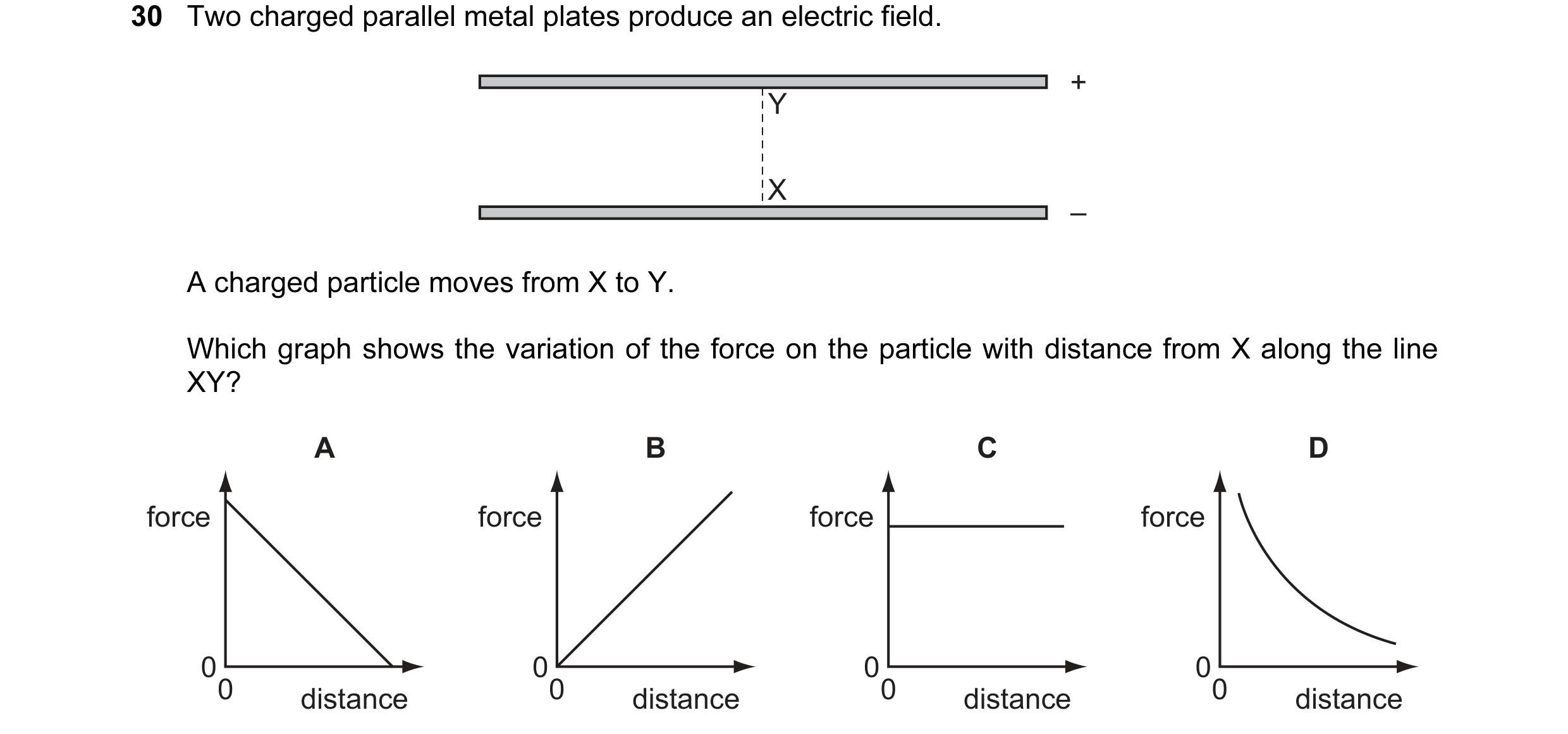
 26 / 57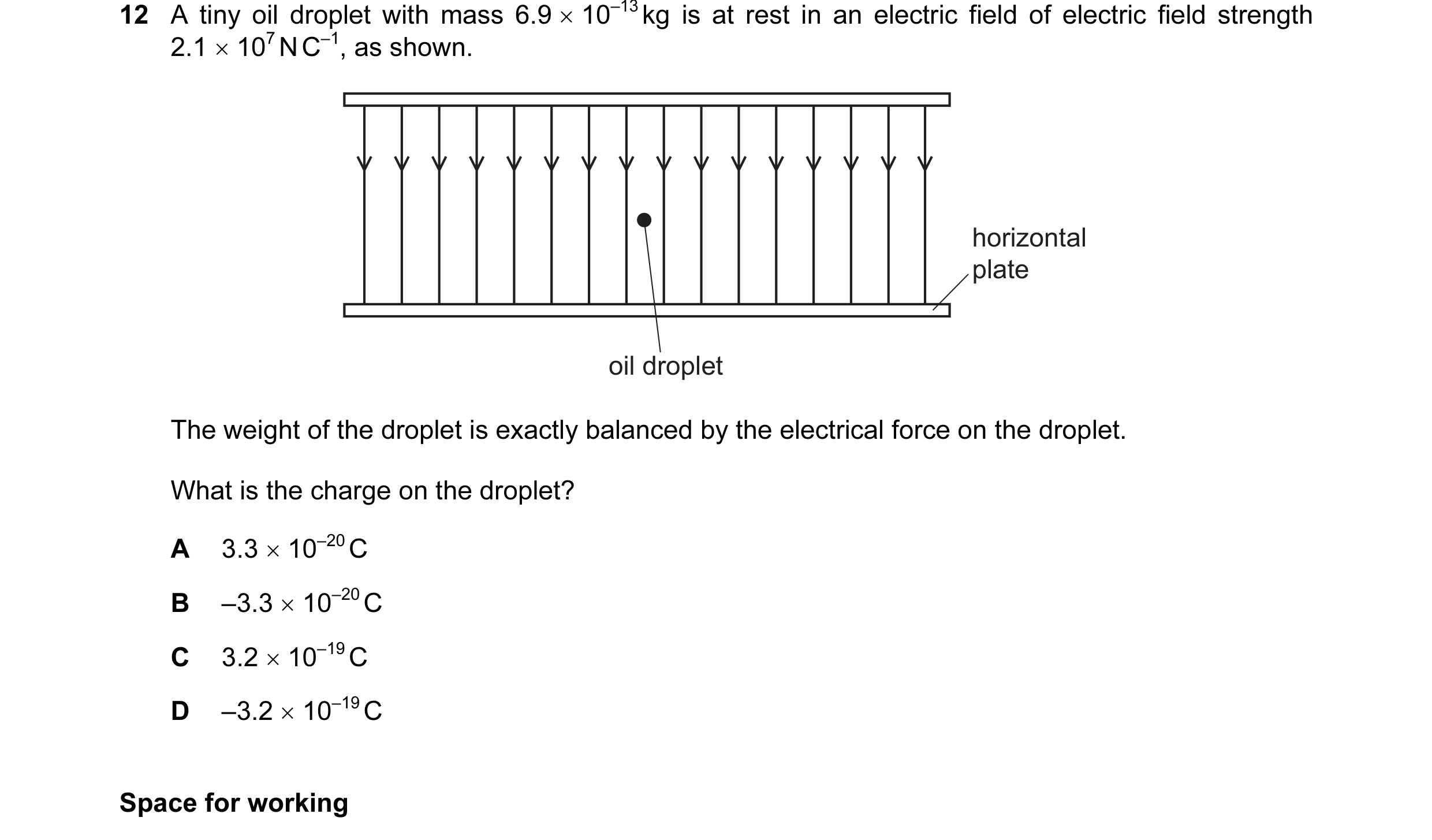
 27 / 57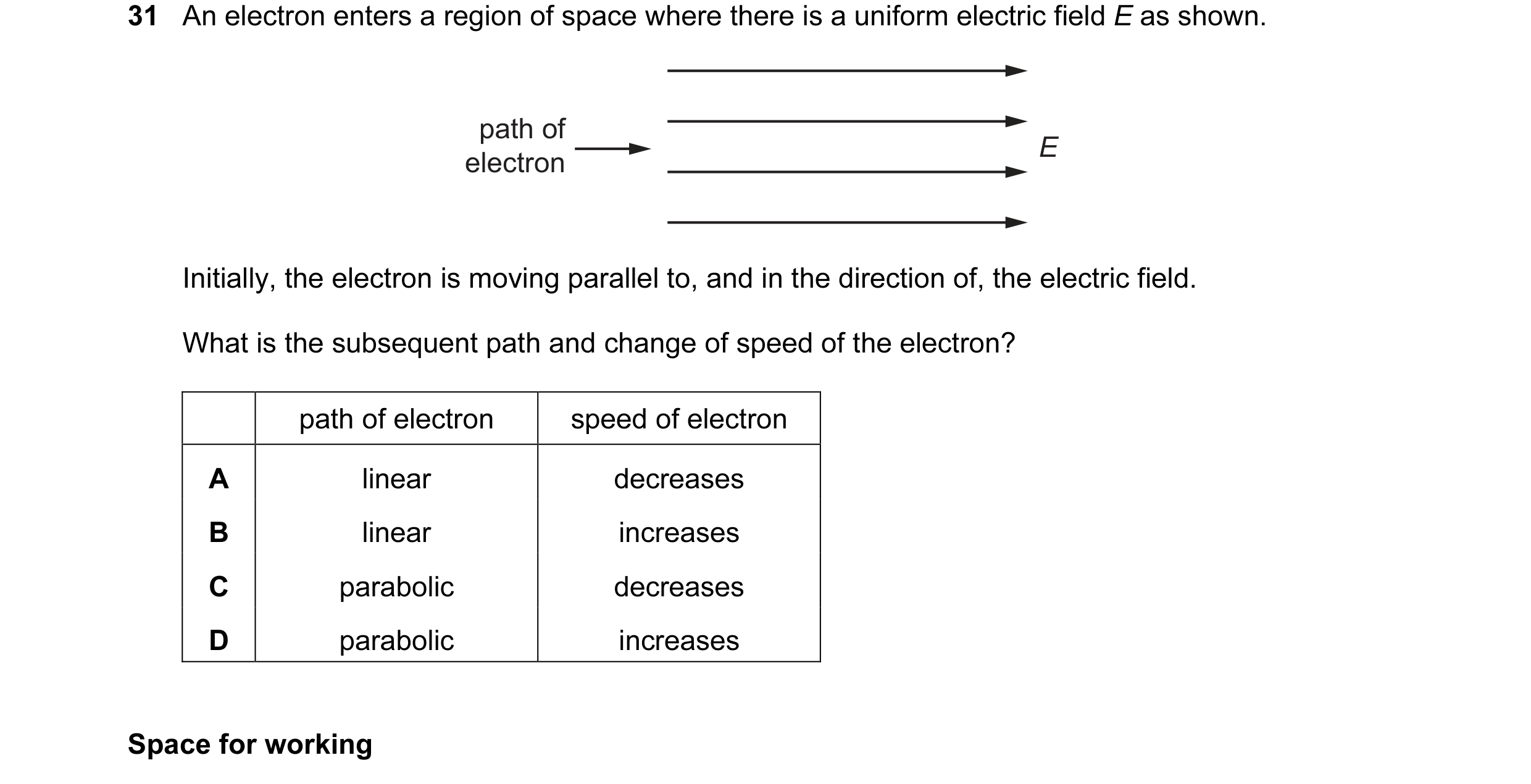
 28 / 57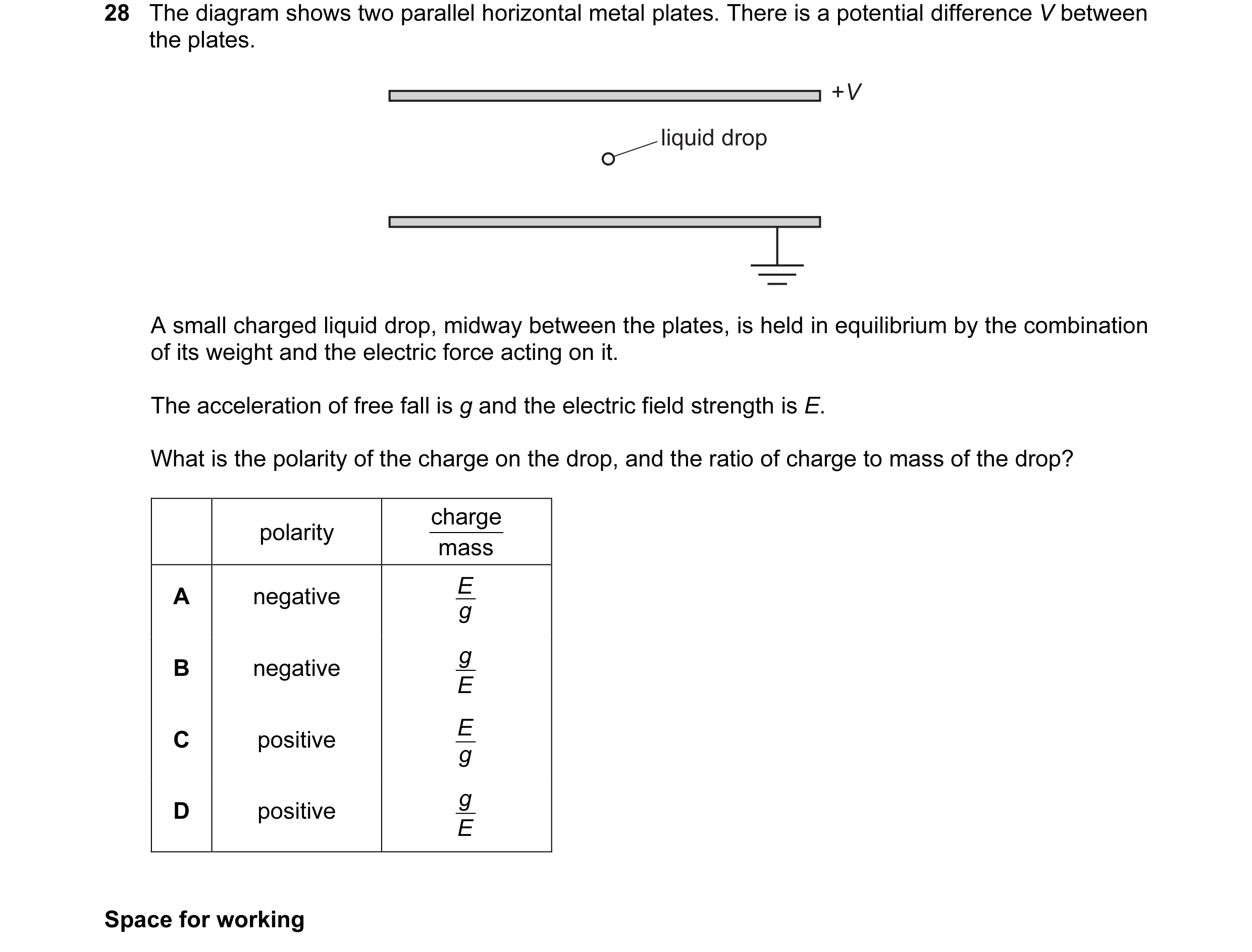
 29 / 57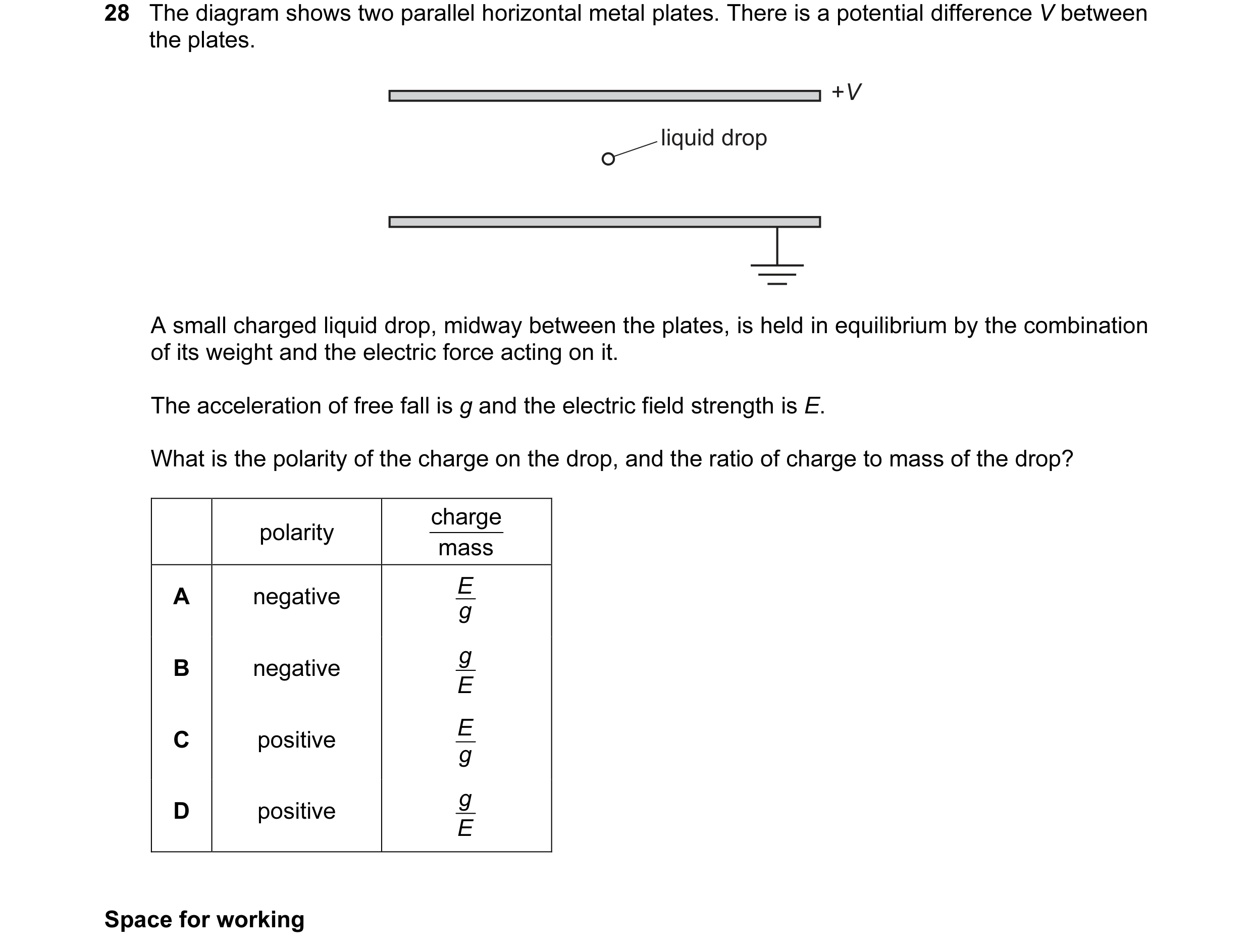
 30 / 57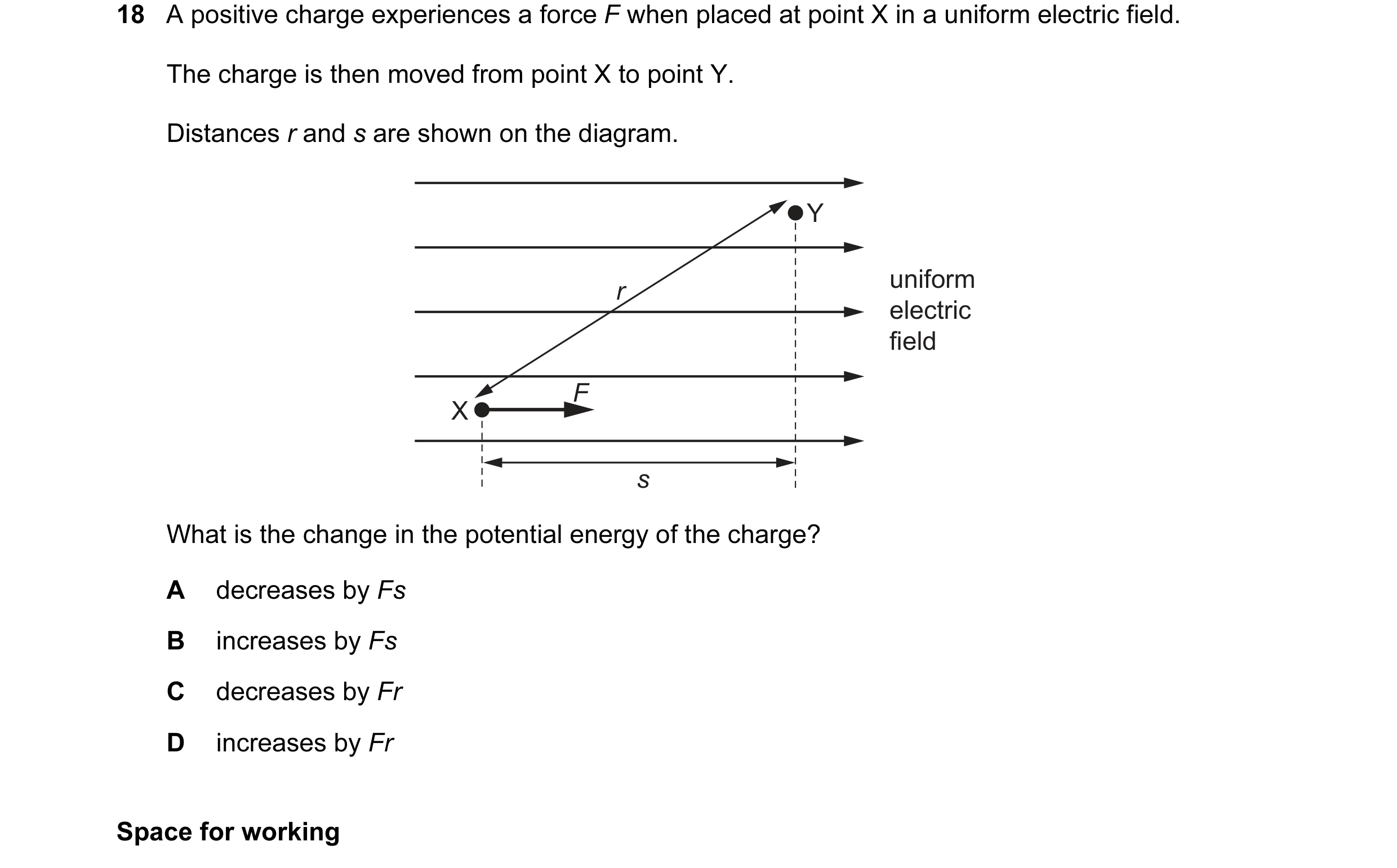
 31 / 57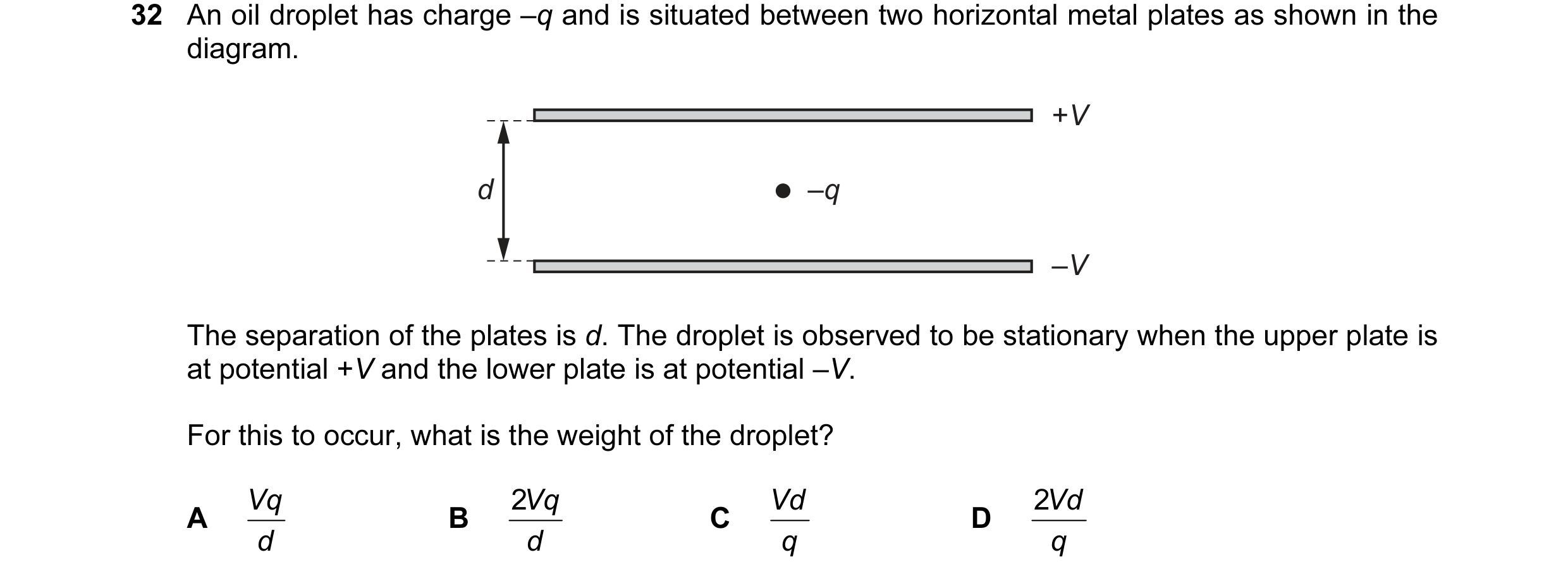
 32 / 57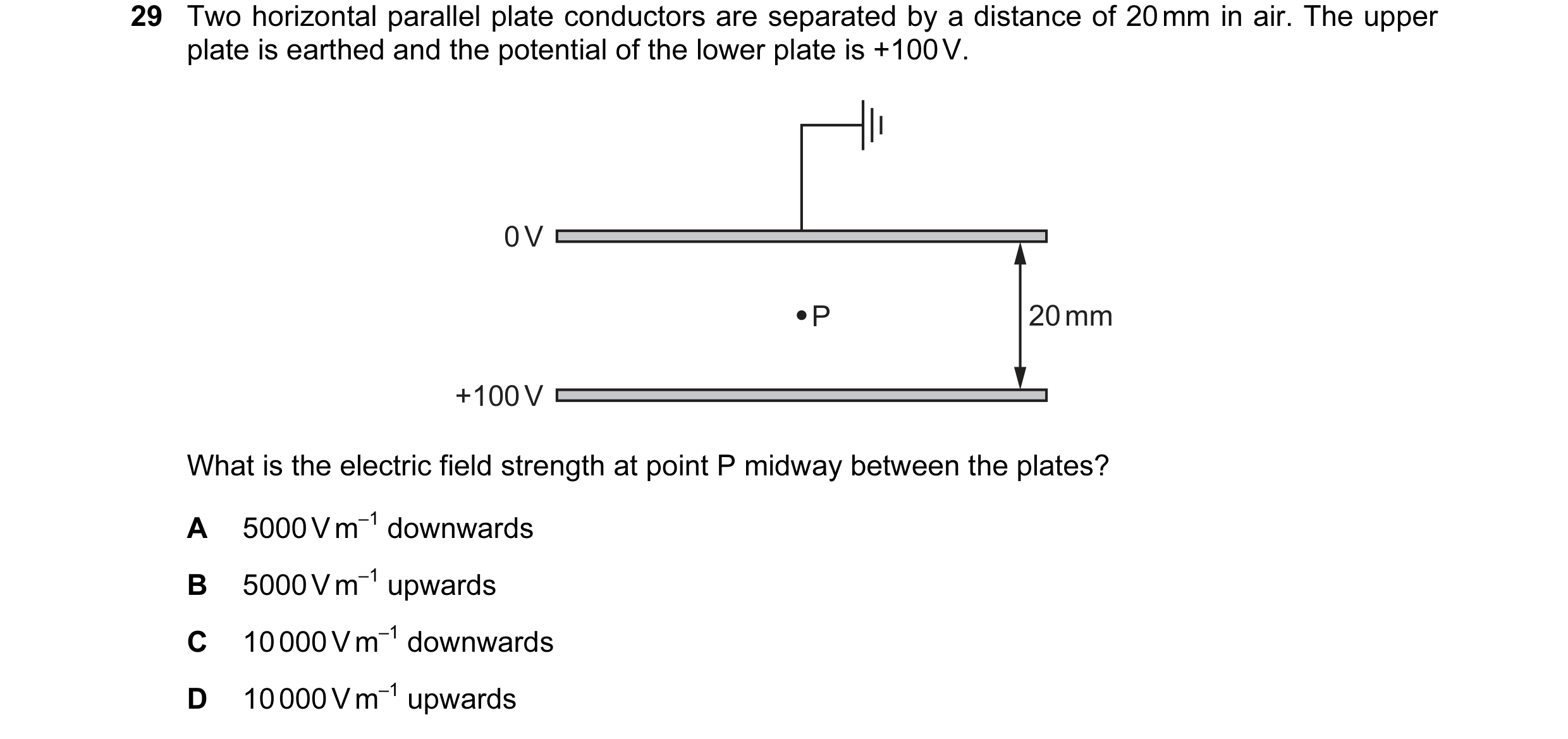
 33 / 57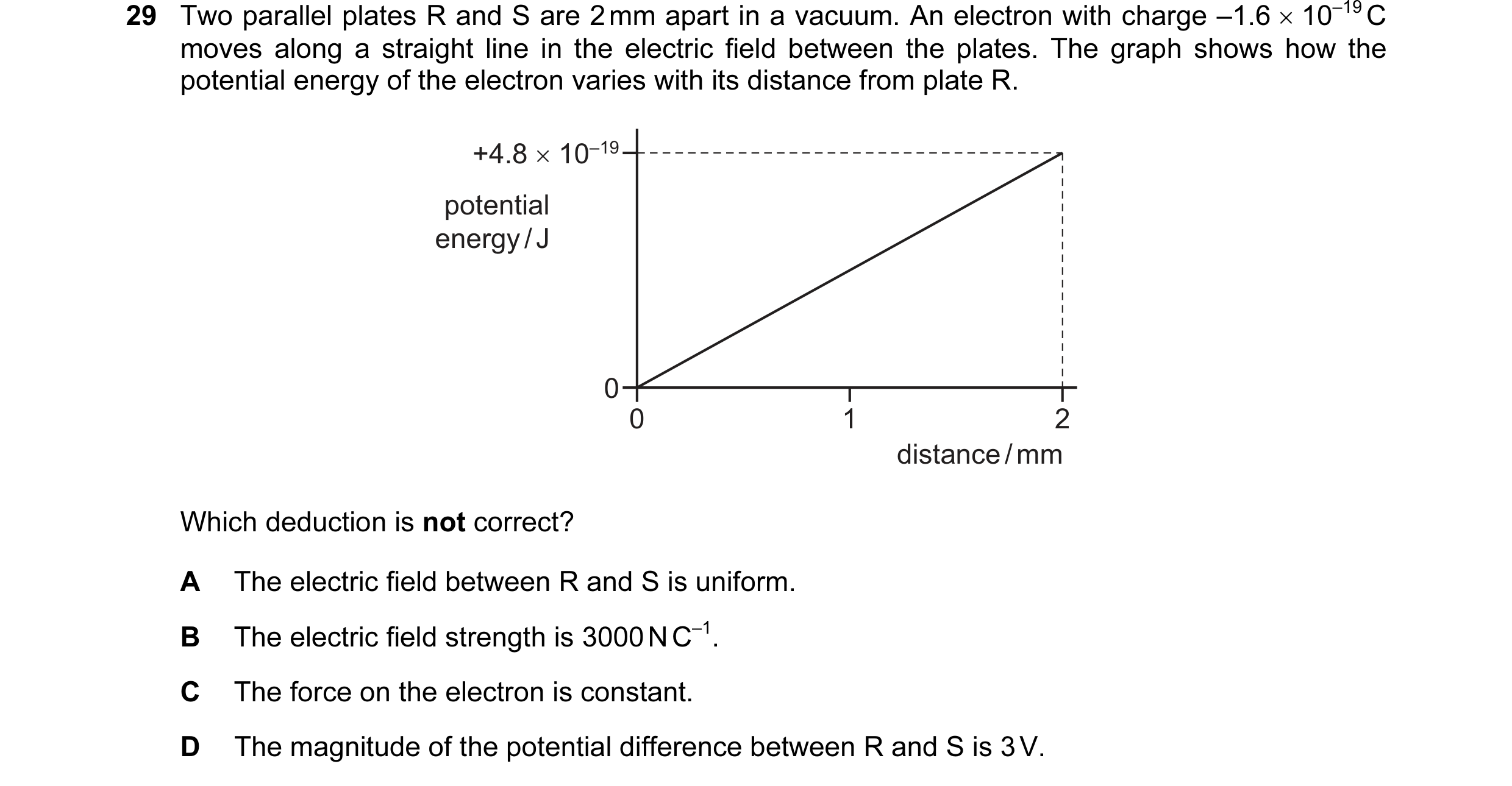
 34 / 57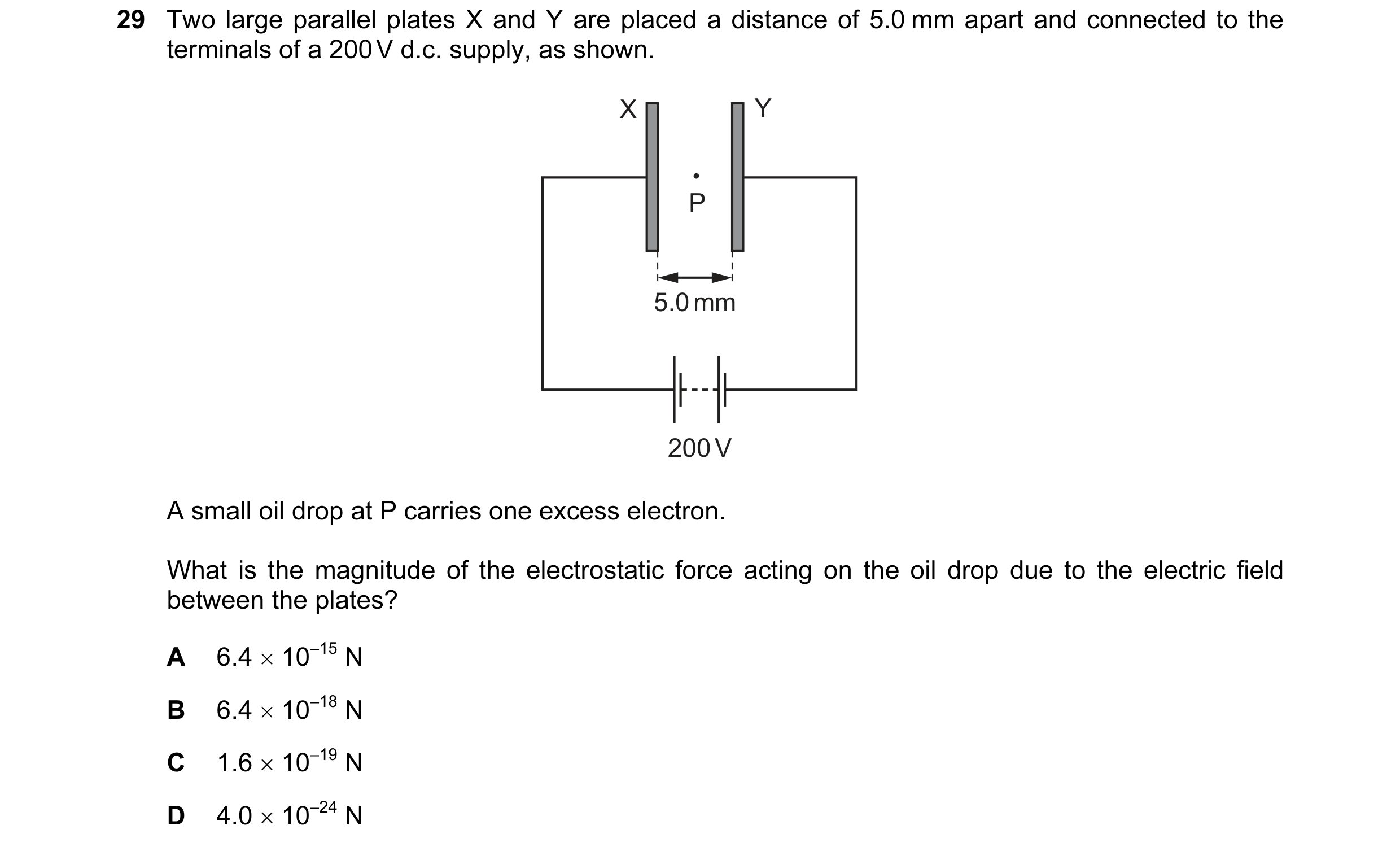
 35 / 57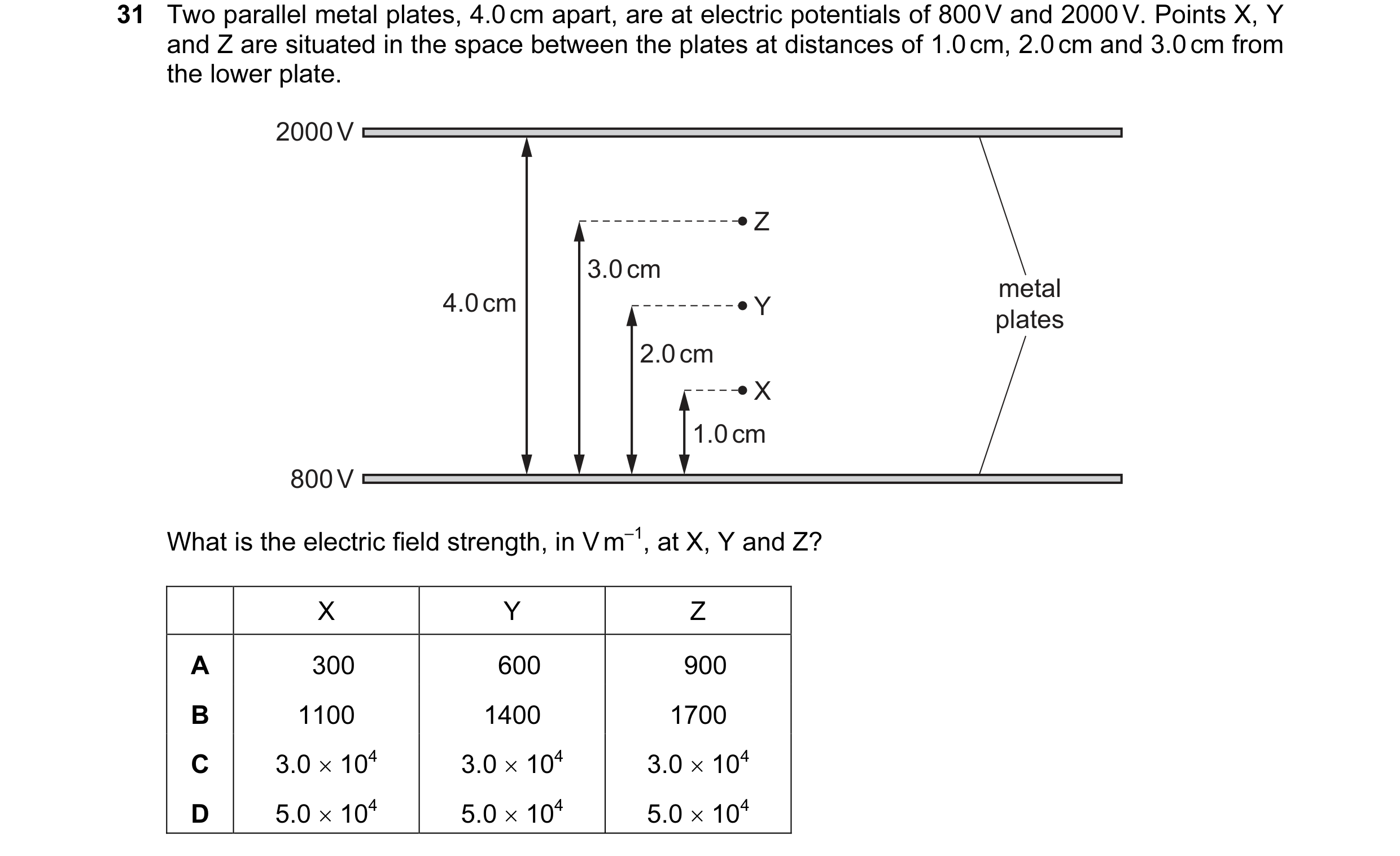

 36 / 57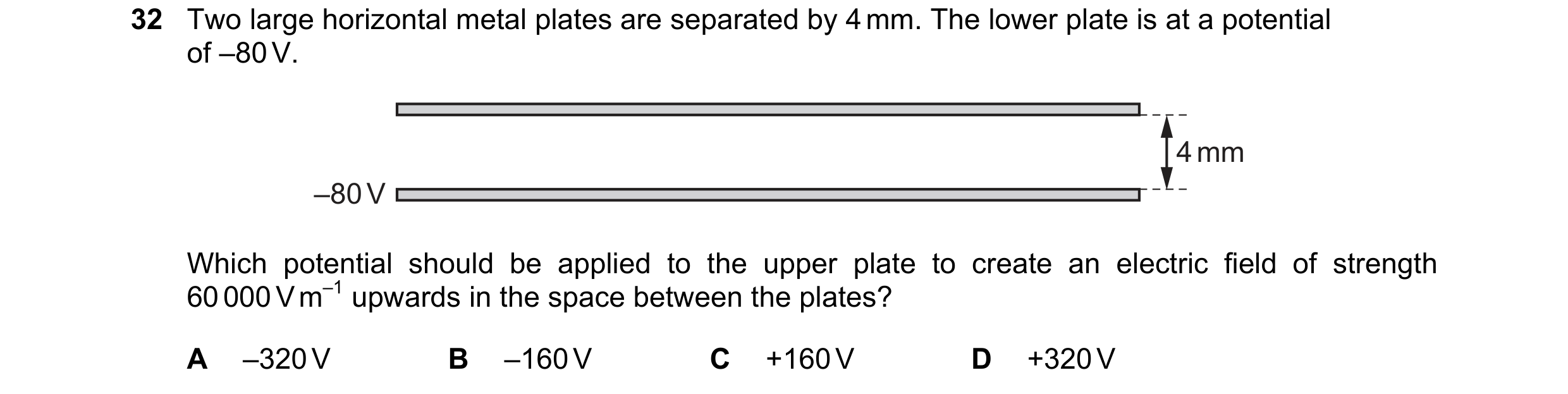
 37 / 57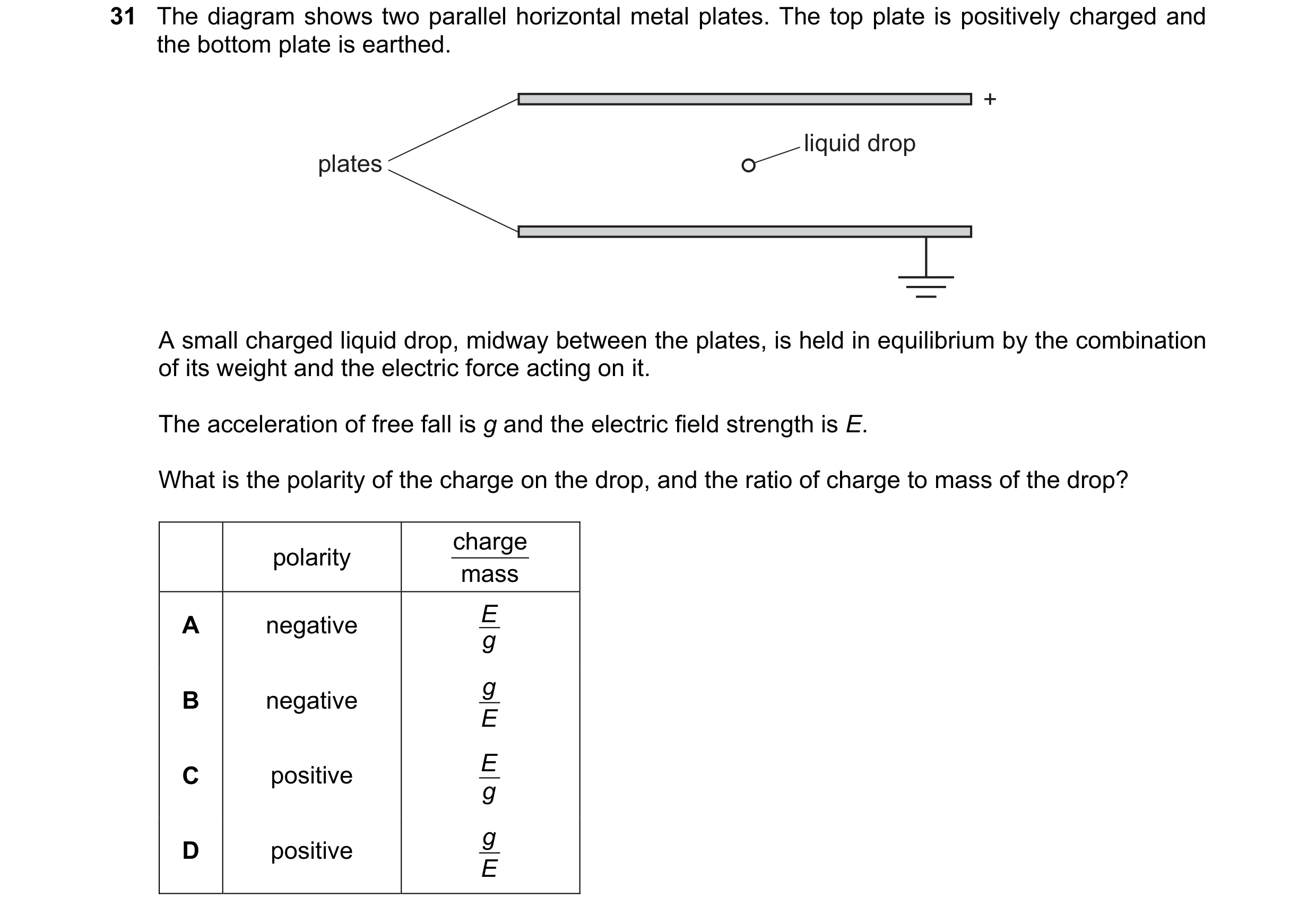
 38 / 57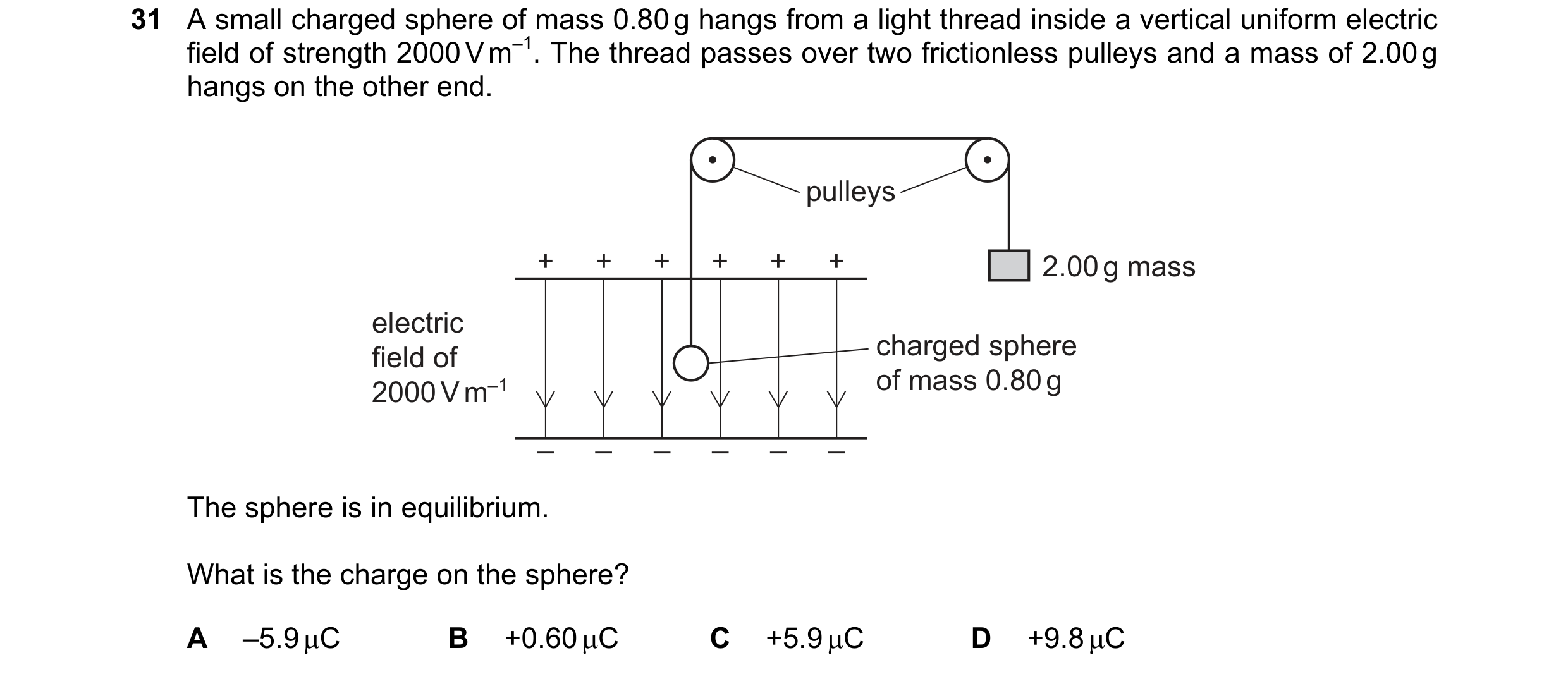
 39 / 57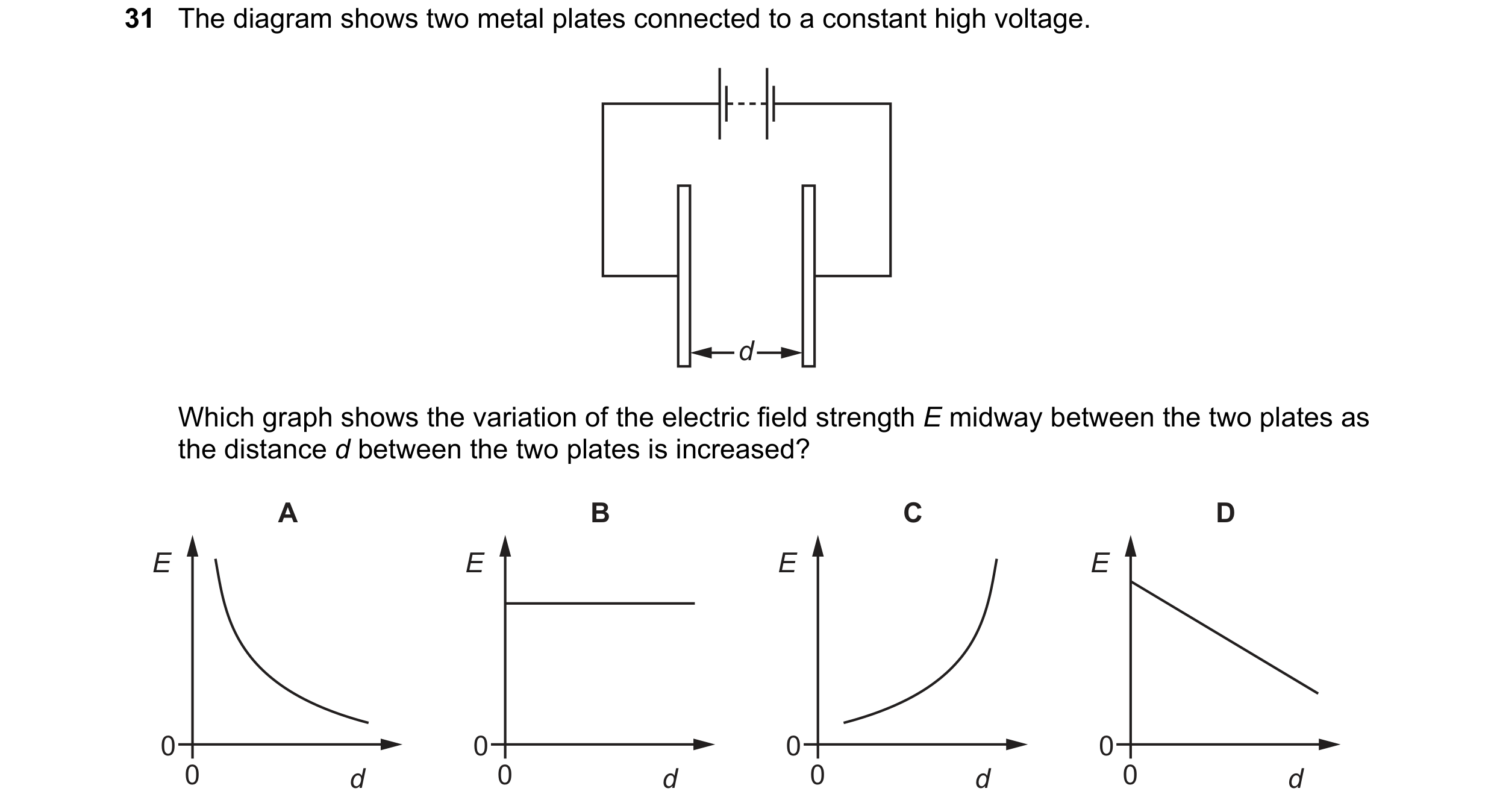
 40 / 57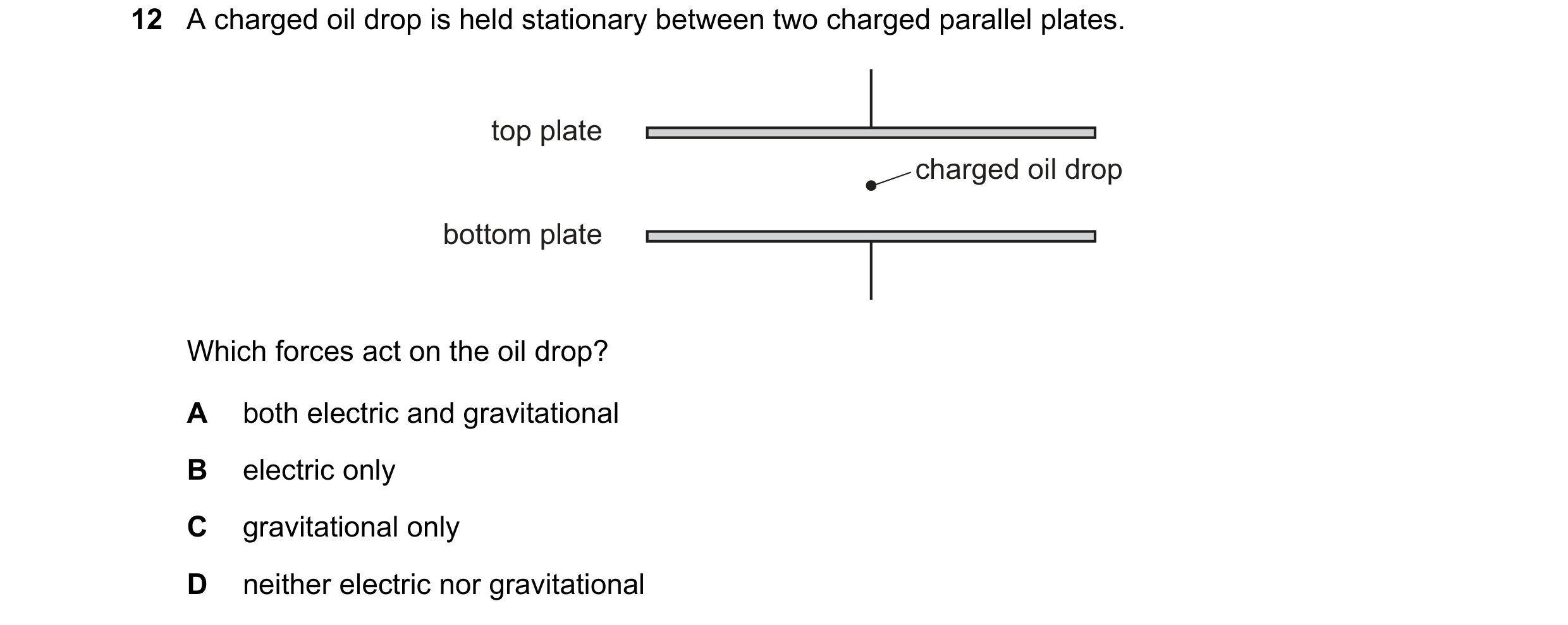
 41 / 57
 42 / 57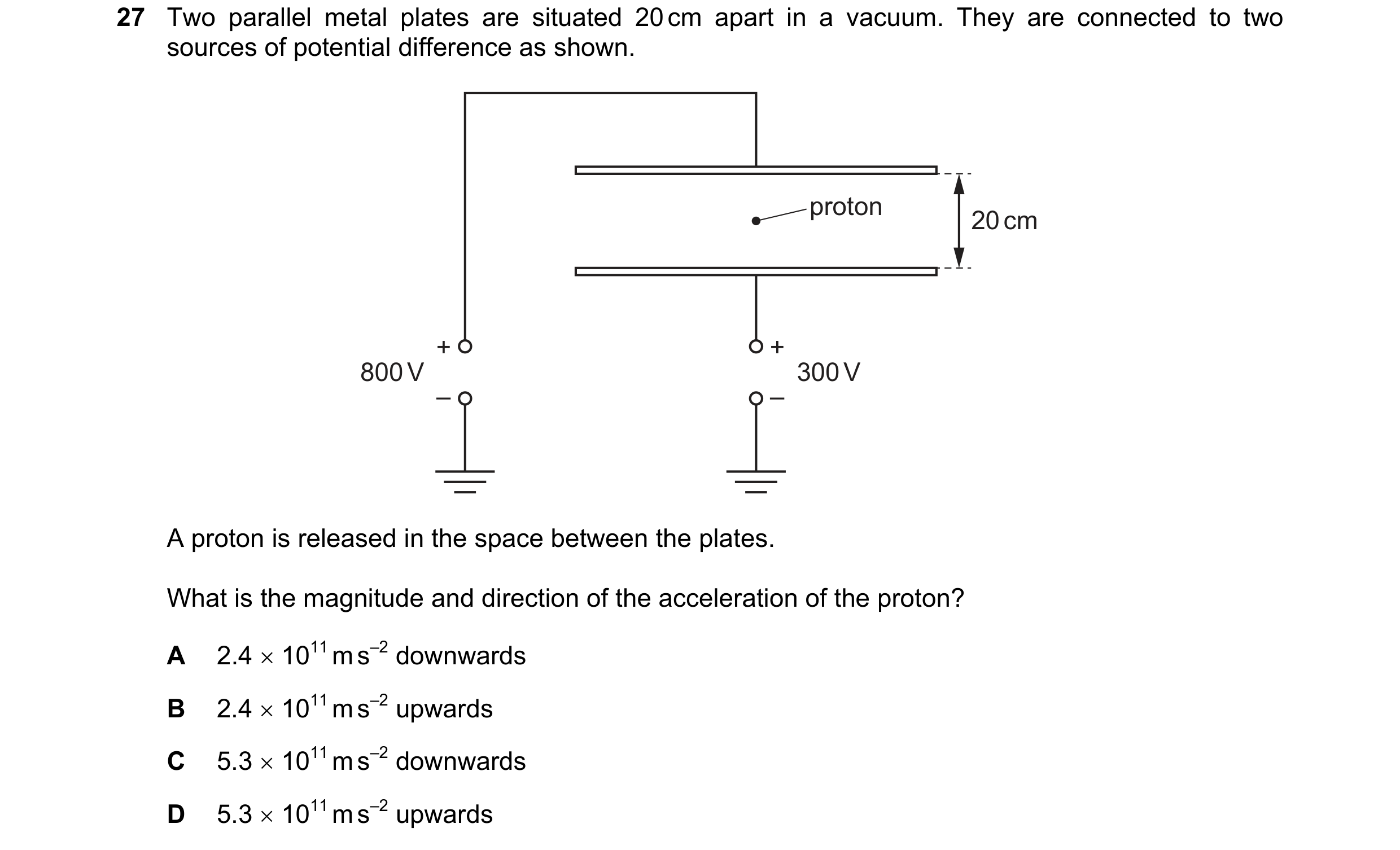
 43 / 57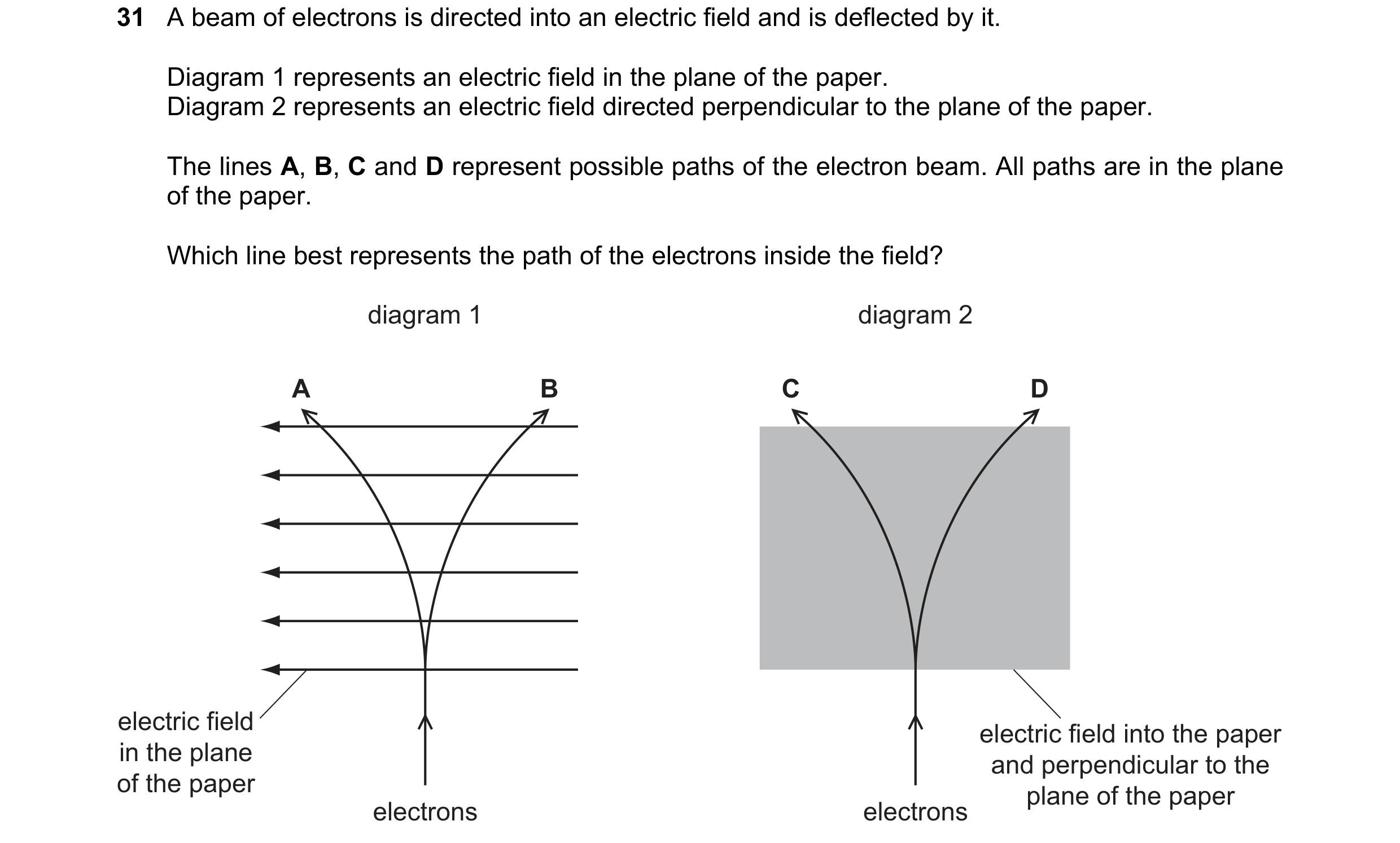

 44 / 57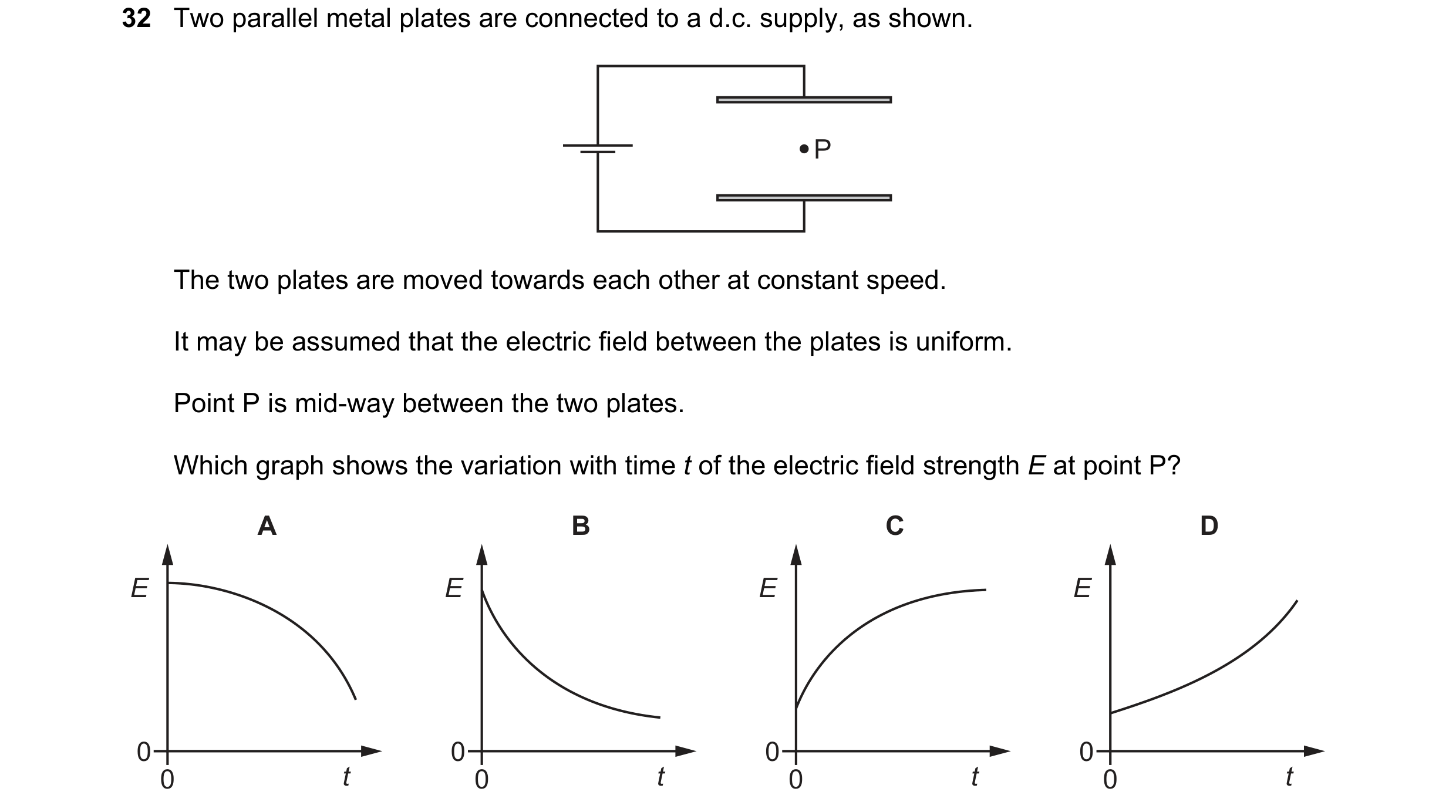
 45 / 57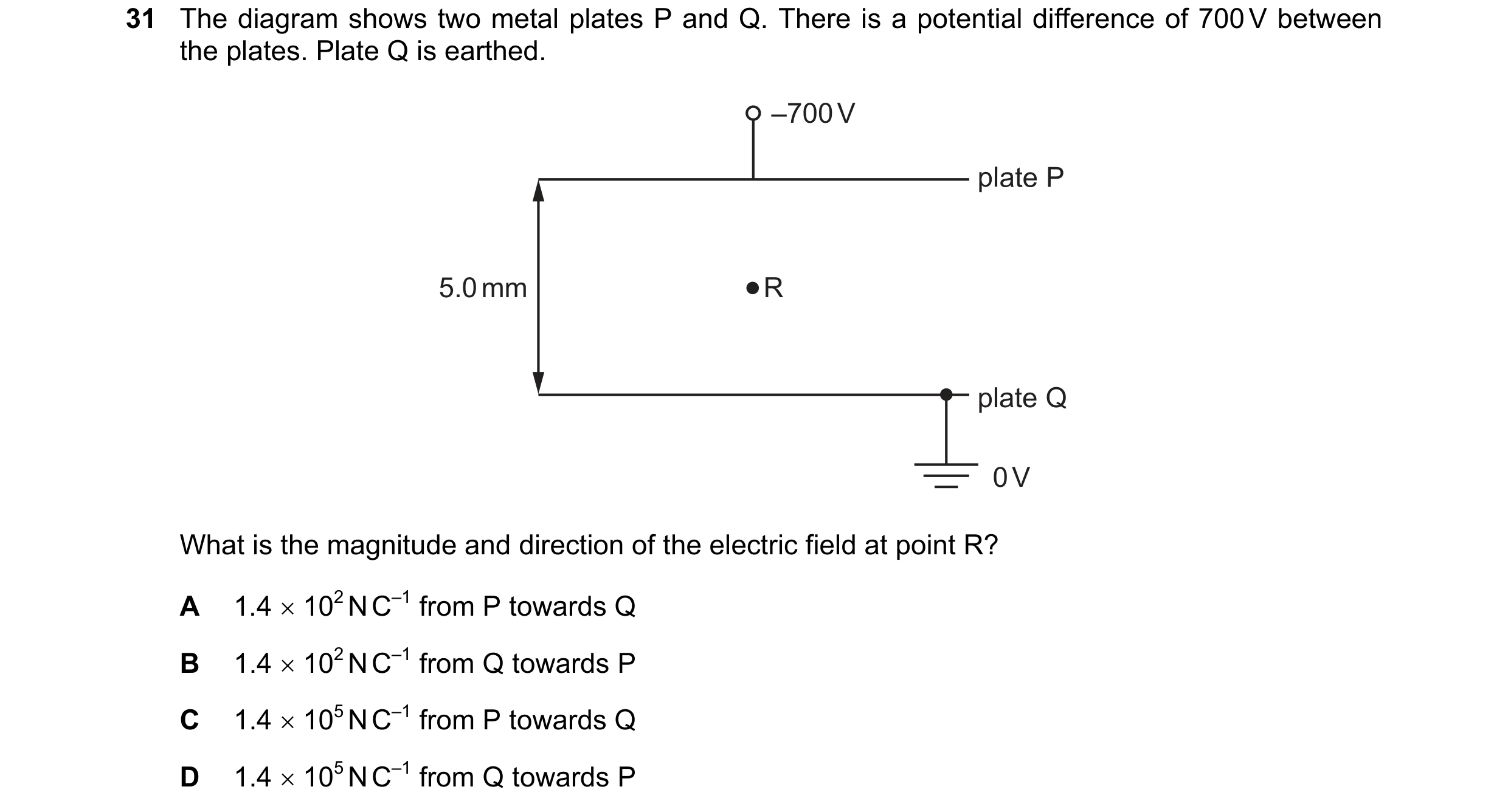
 46 / 57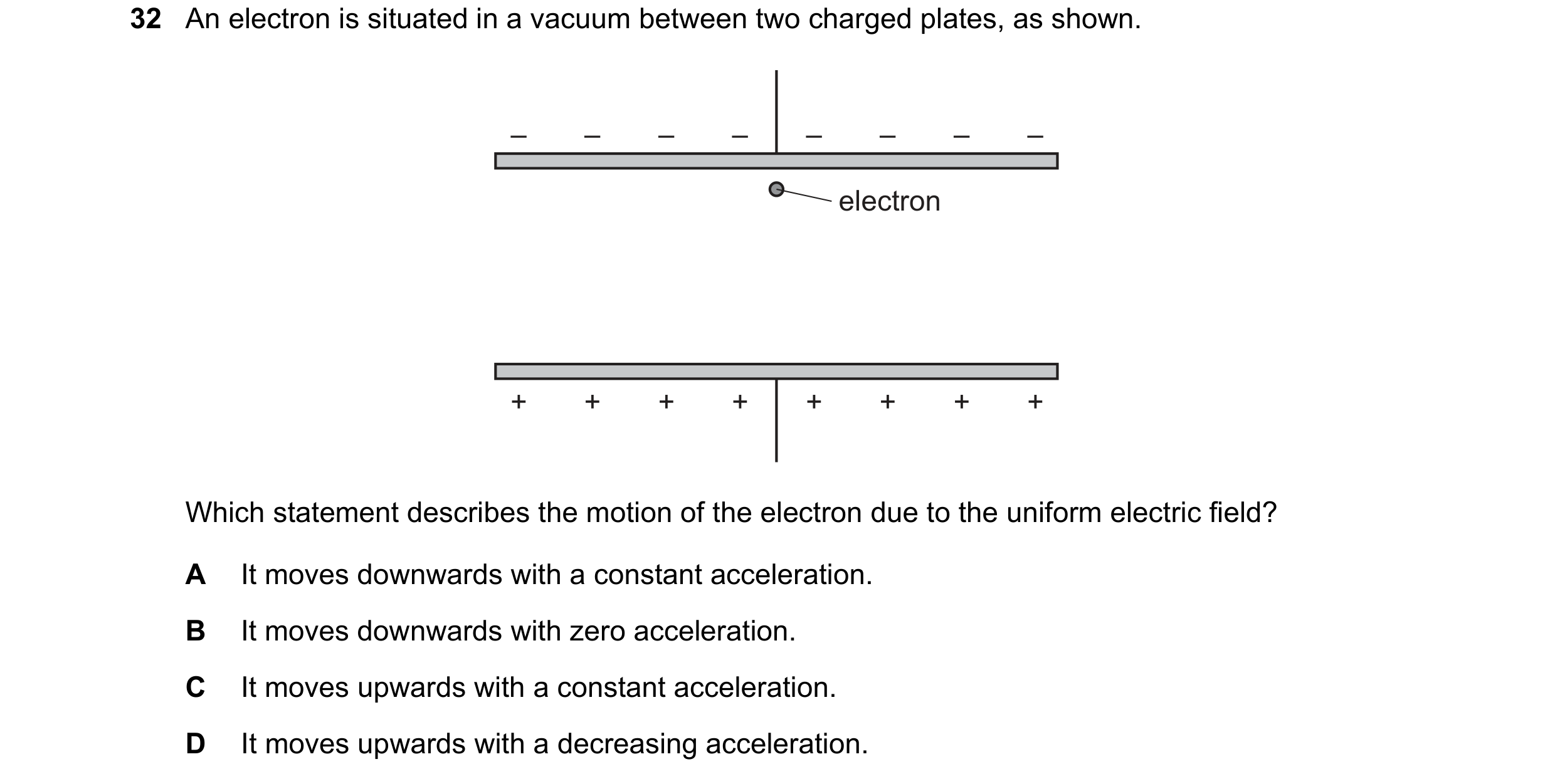
 47 / 57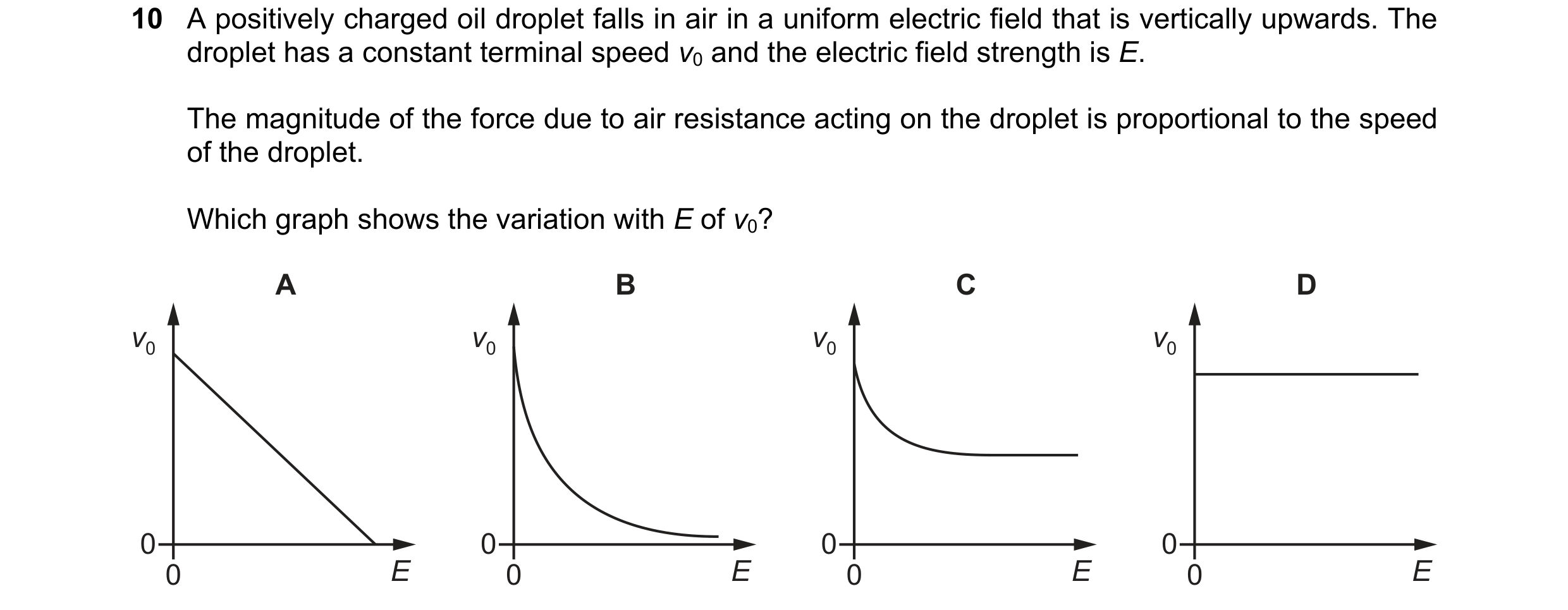
 48 / 57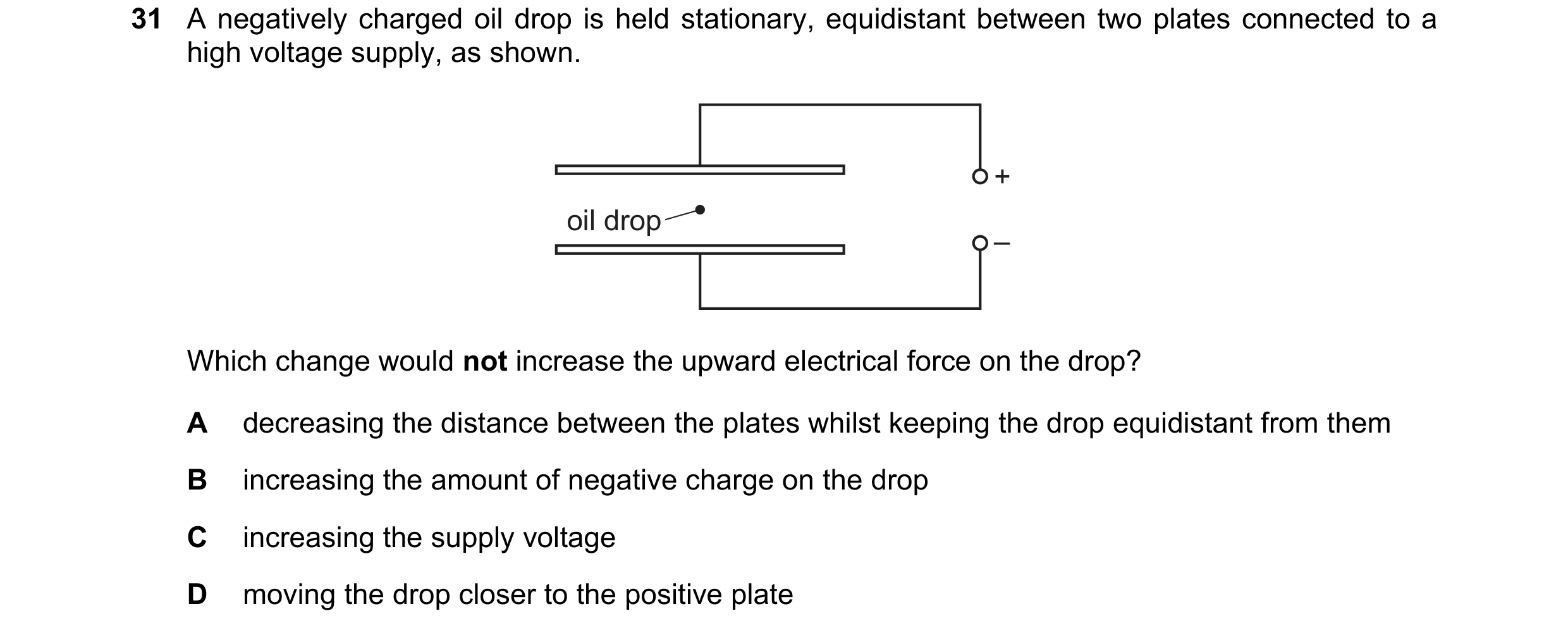
 49 / 57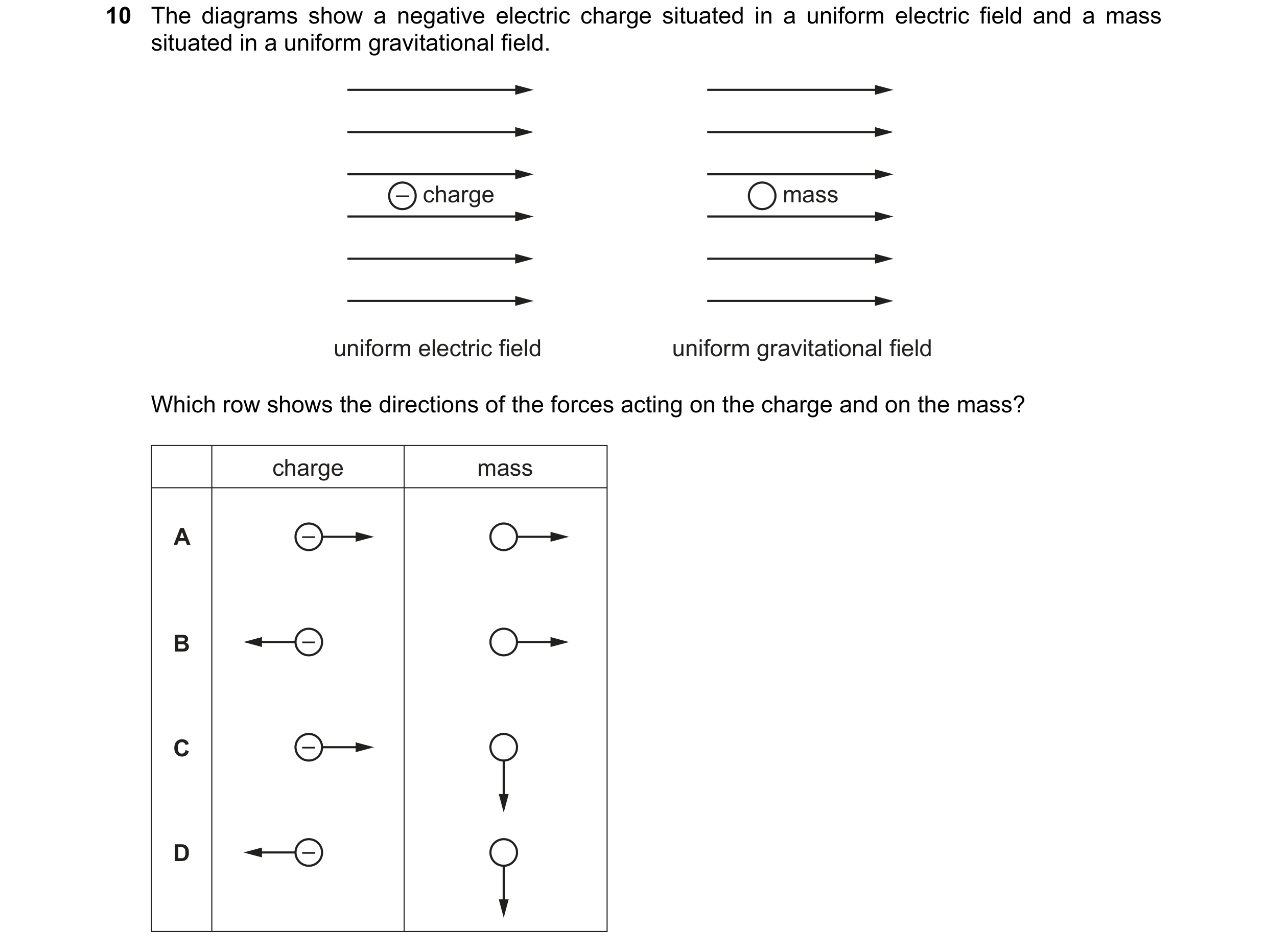
 50 / 57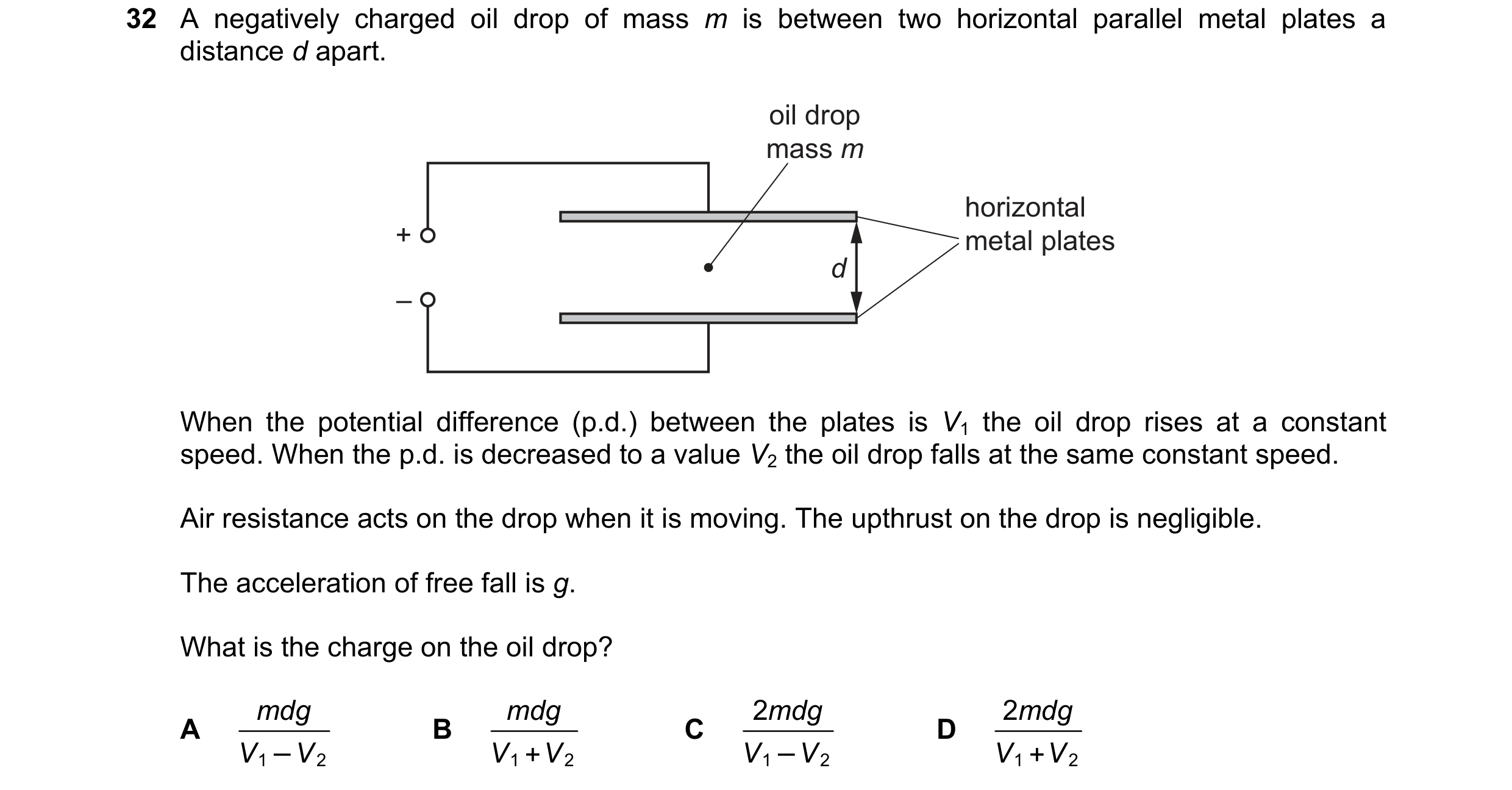
 51 / 57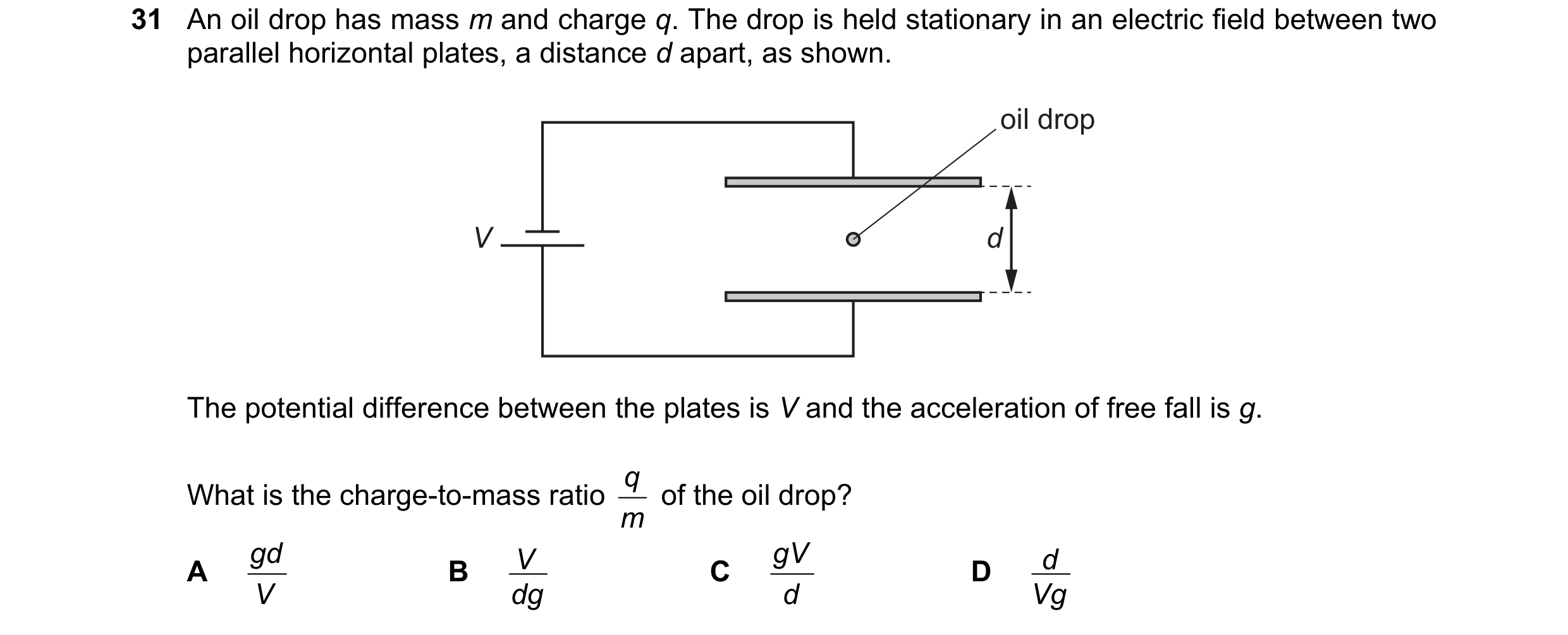
 52 / 57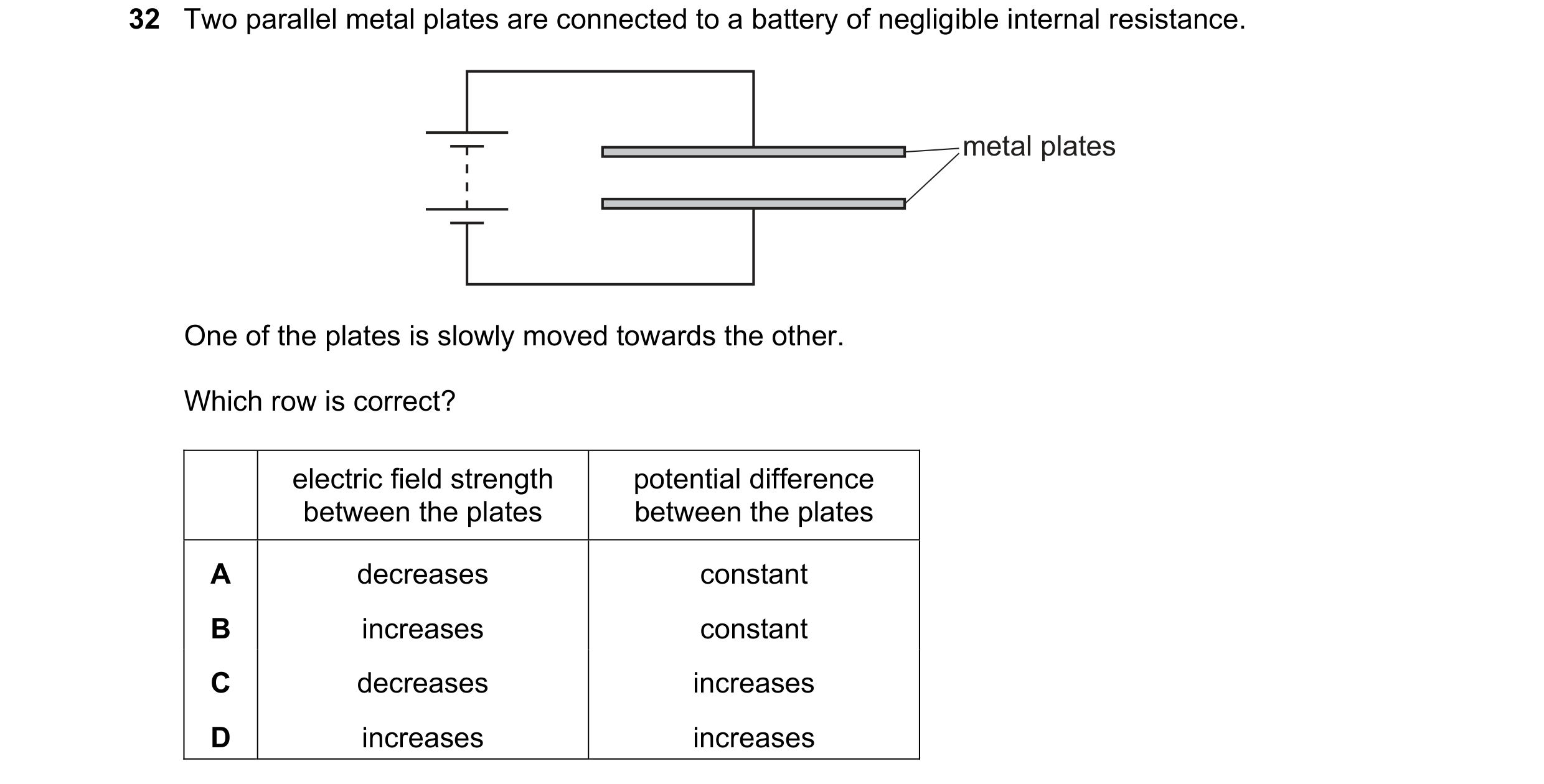
 53 / 57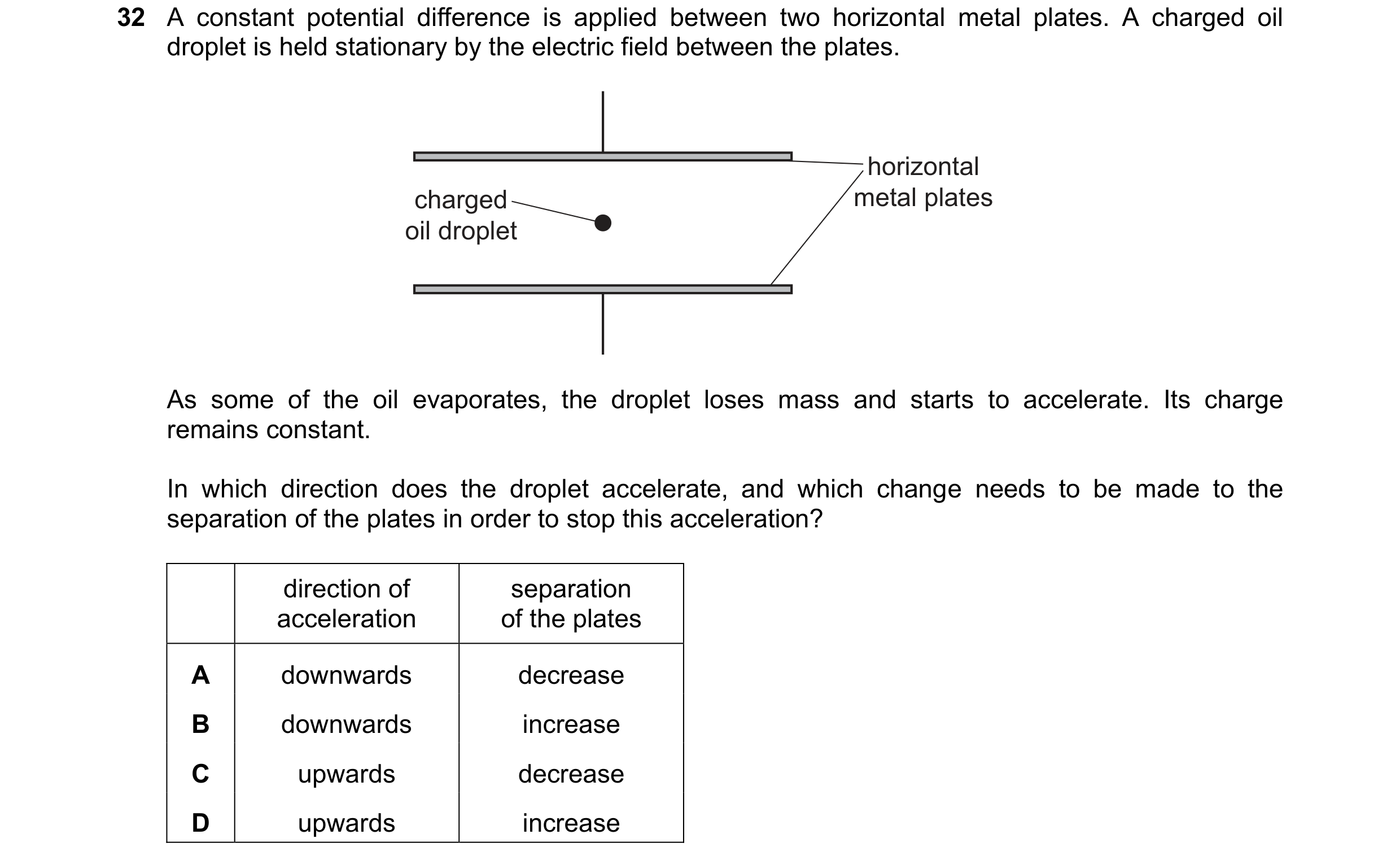
 54 / 57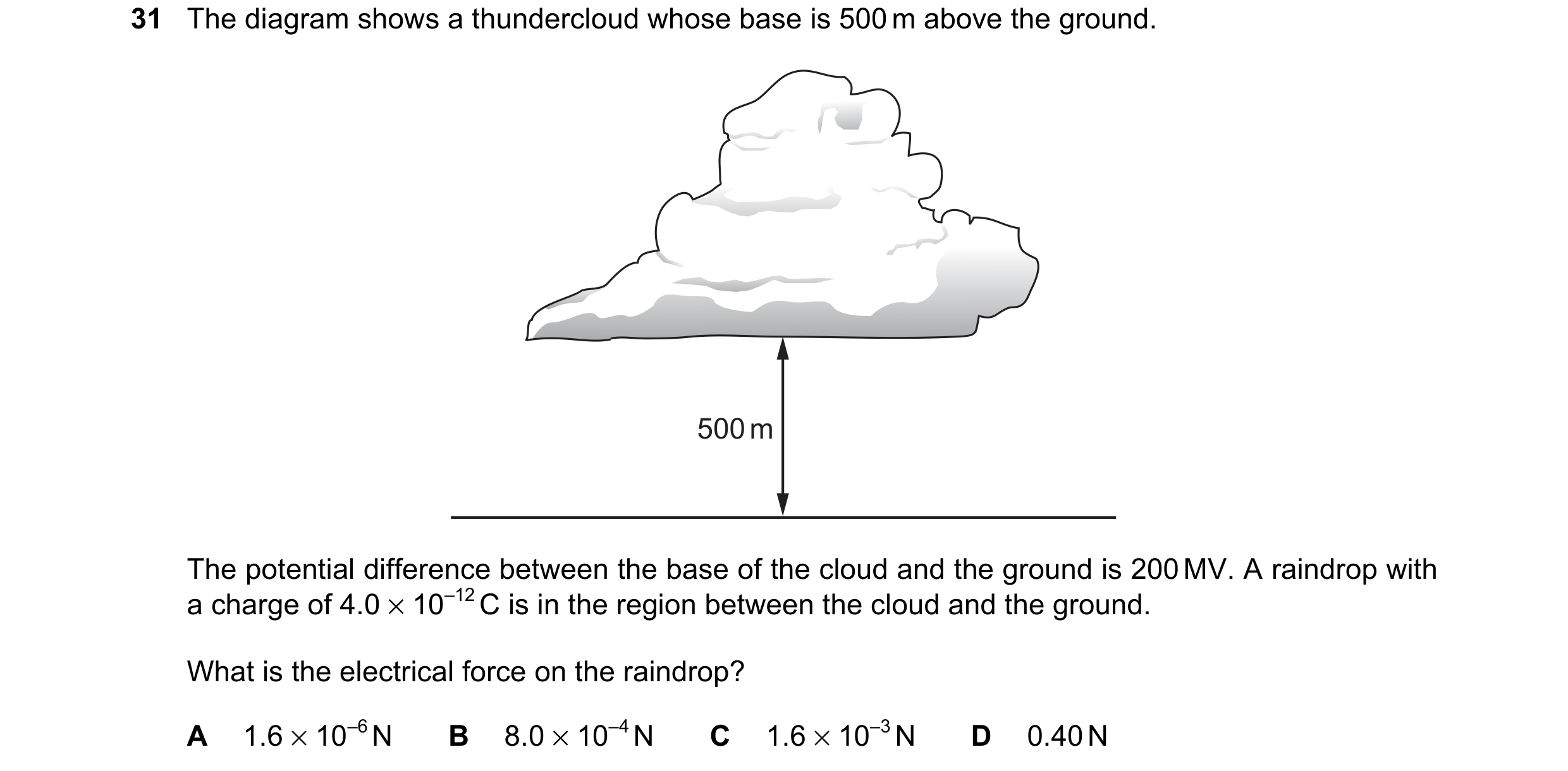
 55 / 57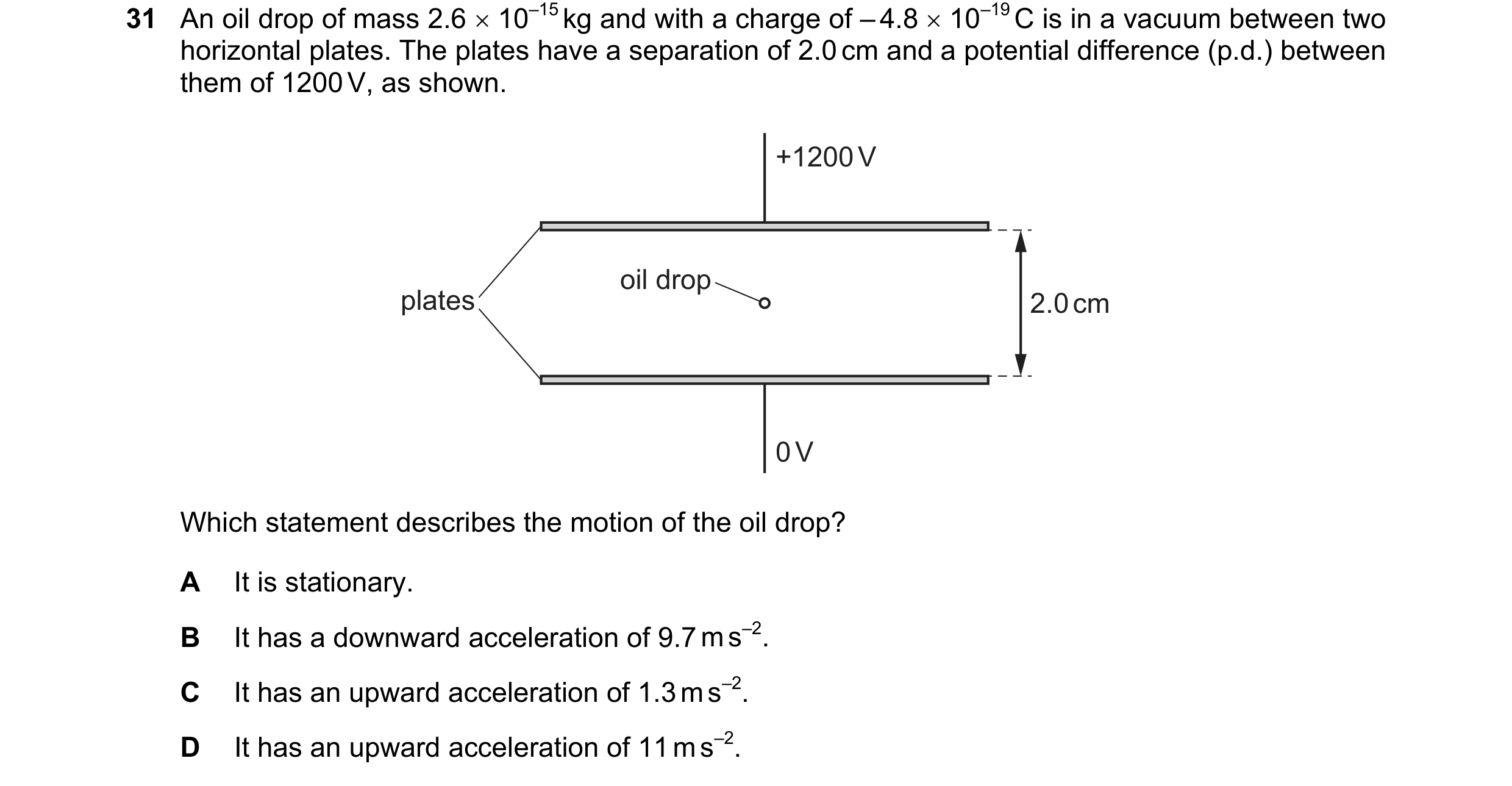
 56 / 57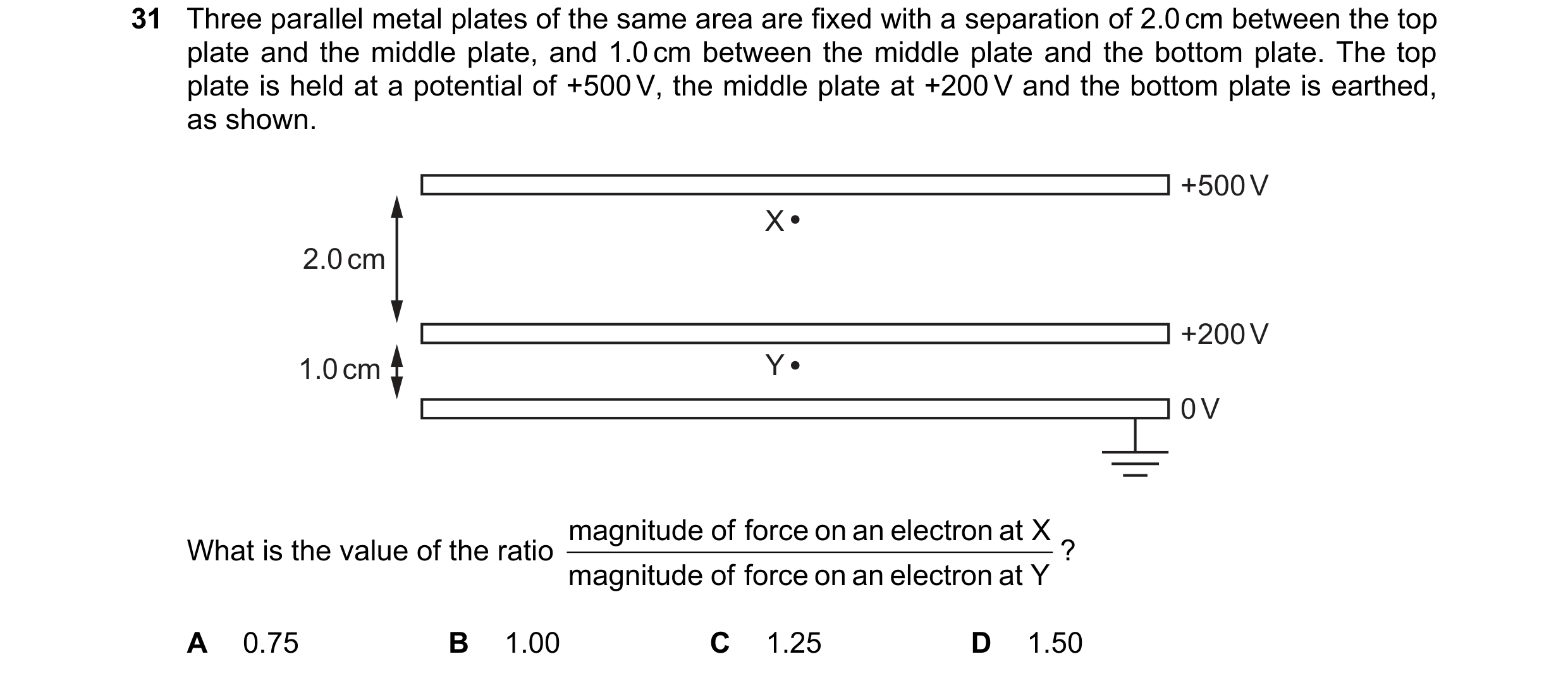
 57 / 57