Questions as text
Q1 · Define electric potential at a point 9702/41 Oct/Nov 2018
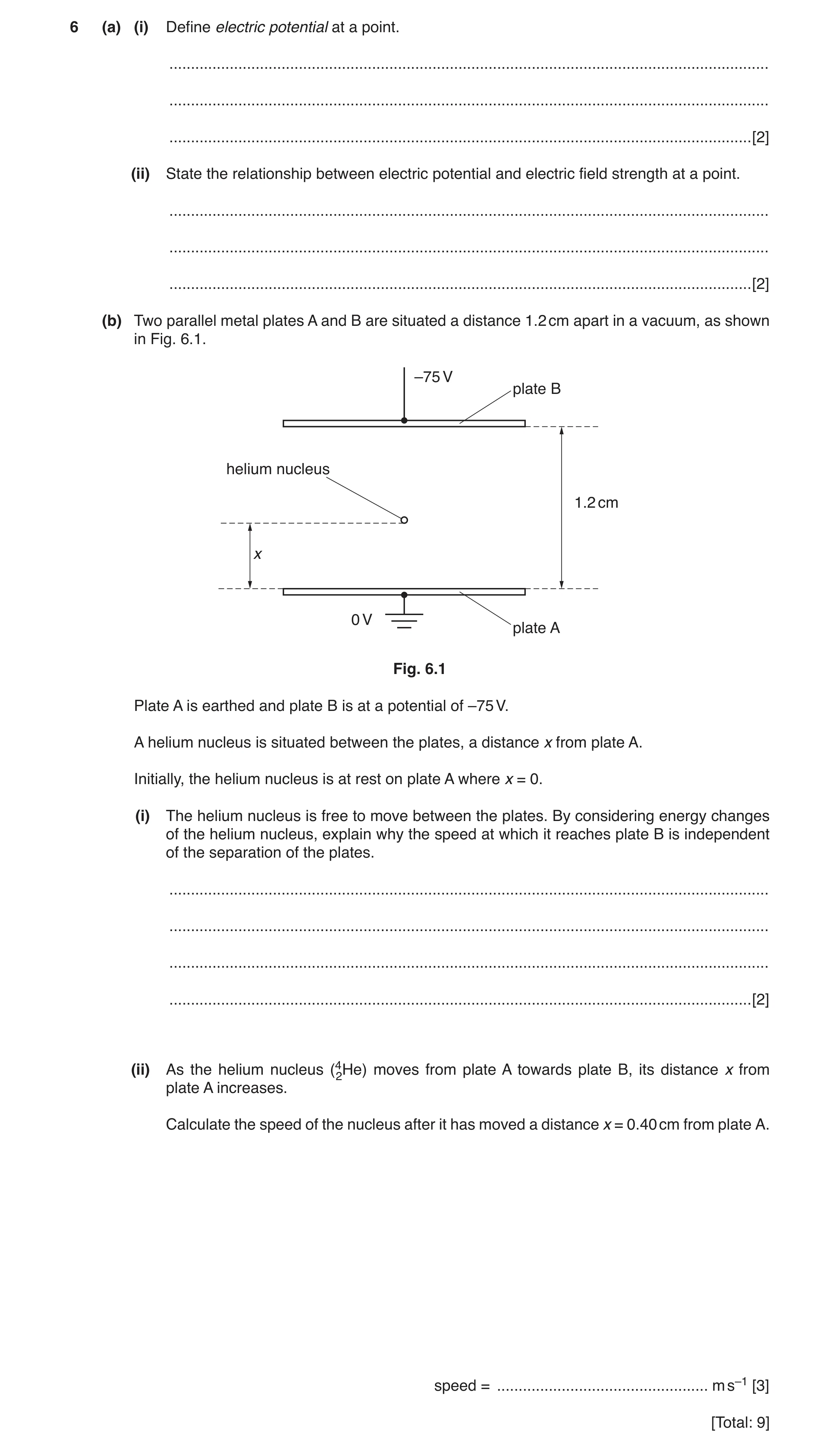
6 (a) (i) Define electric potential at a point. … … … [2] (ii) State the relationship between electric potential and electric field strength at a point. … … … [2] (b) Two parallel metal plates A and B are situated a distance 1.2 cm apart in a vacuum, as shown in Fig. 6.1. –75 V plate B helium nucleus 1.2 cm x 0 V plate A Fig. 6.1 Plate A is earthed and plate B is at a potential of –75 V. A helium nucleus is situated between the plates, a distance x from plate A. Initially, the helium nucleus is at rest on plate A where x = 0. (i) The helium nucleus is free to move between the plates. By considering energy changes of the helium nucleus, explain why the speed at which it reaches plate B is independent of the separation of the plates. … … … … [2] (ii) As the helium nucleus (42He) moves from plate A towards plate B, its distance x from plate A increases. Calculate the speed of the nucleus after it has moved a distance x = 0.40 cm from plate A. speed = … m s–1 [3] [Total: 9]
9 marks
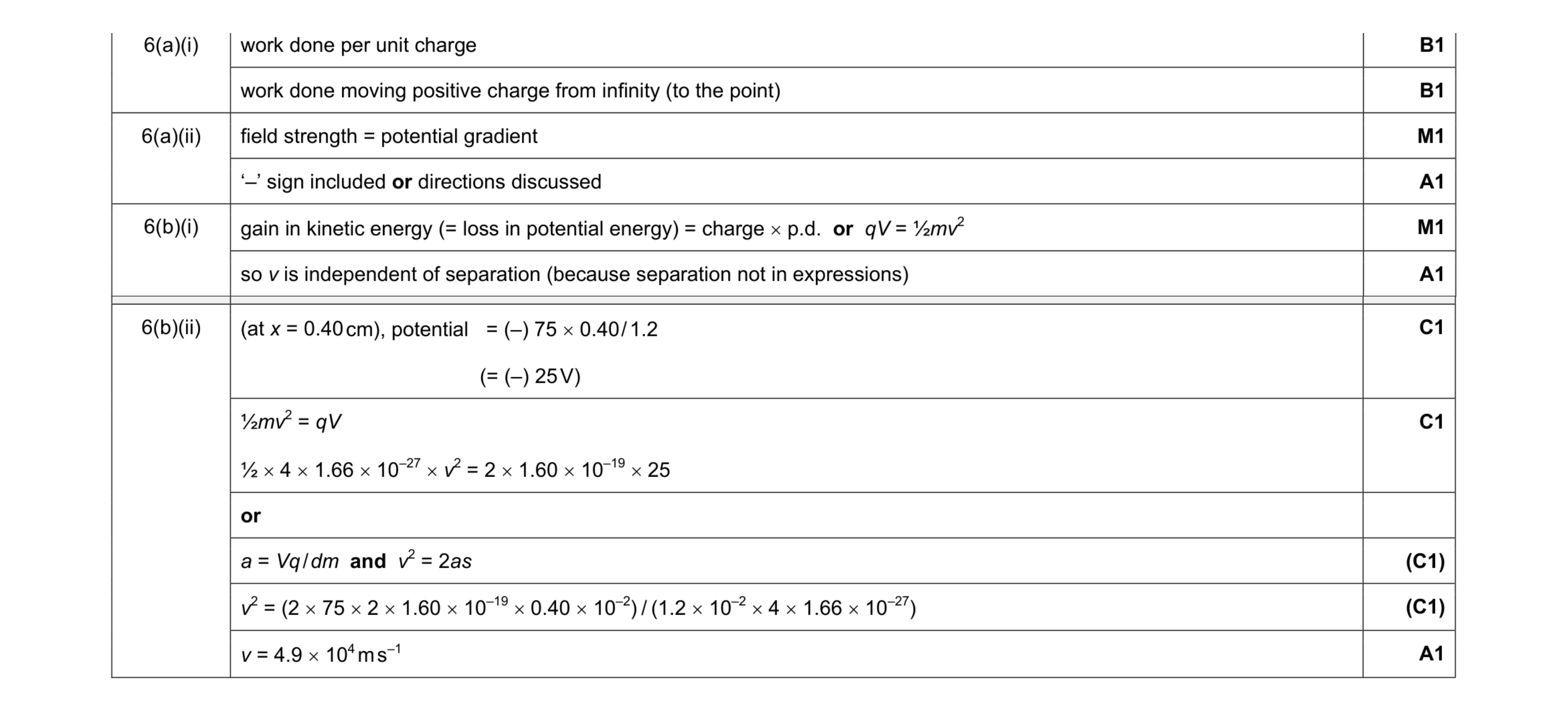
Mark scheme: 6(a)(i) work done per unit charge B1 work done moving positive charge from infinity (to the point) B1 6(a)(ii) field strength = potential gradient M1 ‘–’ sign included or directions discussed A1 6(b)(i) gain in kinetic energy (= loss in potential energy) = charge × p.d. or qV = ½mv2 M1 so v is independent of separation (because separation not in expressions) A1 Question Answer Marks 6(b)(ii) (at x = 0.40 cm), potential = (–) 75 × 0.40 / 1.2 (= (–) 25 V) C1 ½mv2 = qV ½ × 4 × 1.66 × 10–27 × v2 = 2 × 1.60 × 10–19 × 25 C1 or a = Vq / dm and v2 = 2as (C1) v2 = (2 × 75 × 2 × 1.60 × 10–19 × 0.40 × 10–2) / (1.2 × 10–2 × 4 × 1.66 × 10–27) (C1) v = 4.9 × 10⁴ m s–1 A1
This question in 9702/41 Oct/Nov 2018
Q2 · Define electric potential at a point 9702/43 Oct/Nov 2018
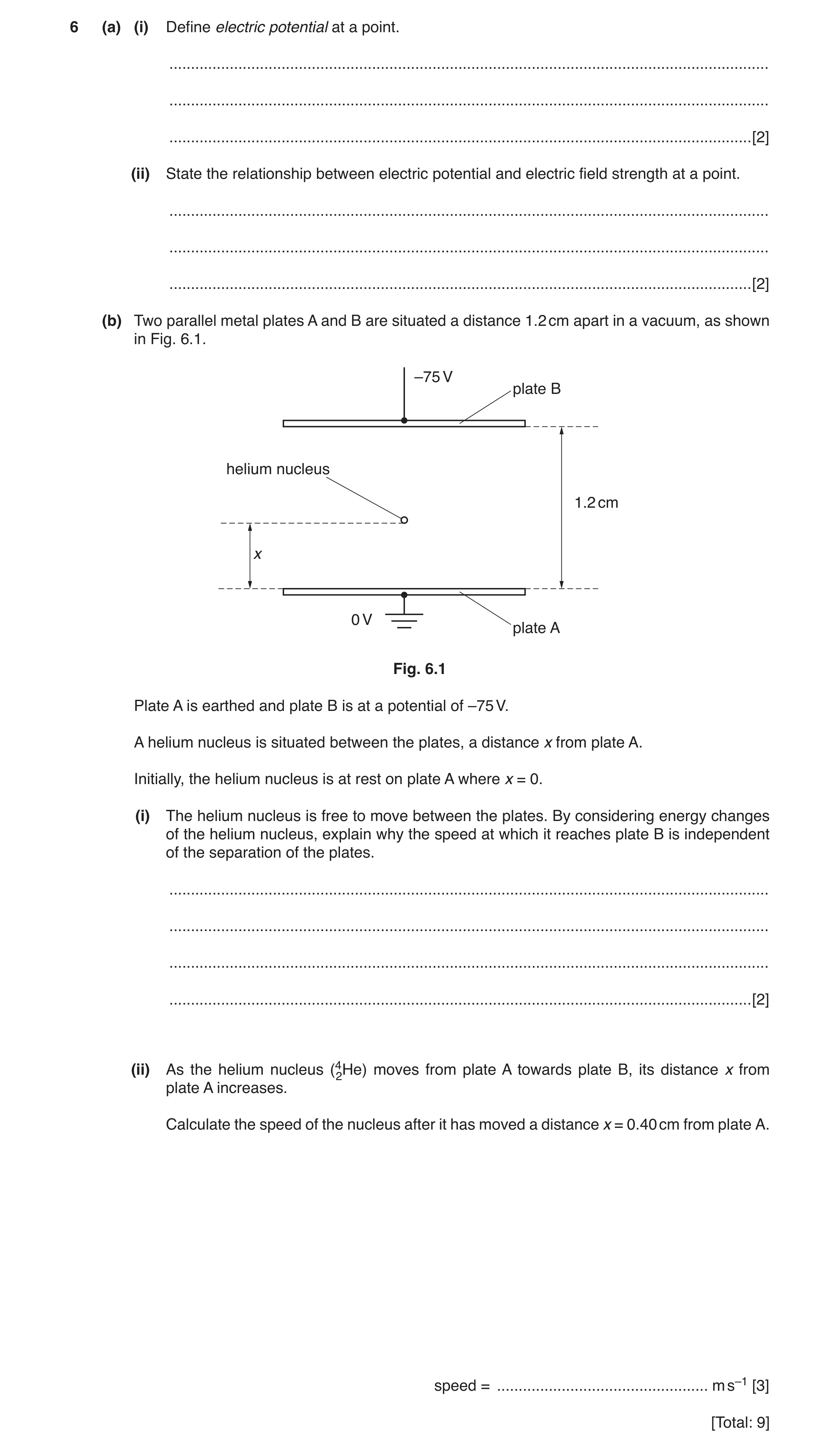
6 (a) (i) Define electric potential at a point. … … … [2] (ii) State the relationship between electric potential and electric field strength at a point. … … … [2] (b) Two parallel metal plates A and B are situated a distance 1.2 cm apart in a vacuum, as shown in Fig. 6.1. –75 V plate B helium nucleus 1.2 cm x 0 V plate A Fig. 6.1 Plate A is earthed and plate B is at a potential of –75 V. A helium nucleus is situated between the plates, a distance x from plate A. Initially, the helium nucleus is at rest on plate A where x = 0. (i) The helium nucleus is free to move between the plates. By considering energy changes of the helium nucleus, explain why the speed at which it reaches plate B is independent of the separation of the plates. … … … … [2] (ii) As the helium nucleus (42He) moves from plate A towards plate B, its distance x from plate A increases. Calculate the speed of the nucleus after it has moved a distance x = 0.40 cm from plate A. speed = … m s–1 [3] [Total: 9]
9 marks
Mark scheme: 6(a)(i) work done per unit charge B1 work done moving positive charge from infinity (to the point) B1 6(a)(ii) field strength = potential gradient M1 ‘–’ sign included or directions discussed A1 6(b)(i) gain in kinetic energy (= loss in potential energy) = charge × p.d. or qV = ½mv2 M1 so v is independent of separation (because separation not in expressions) A1 Question Answer Marks 6(b)(ii) (at x = 0.40 cm), potential = (–) 75 × 0.40 / 1.2 (= (–) 25 V) C1 ½mv2 = qV ½ × 4 × 1.66 × 10–27 × v2 = 2 × 1.60 × 10–19 × 25 C1 or a = Vq / dm and v2 = 2as (C1) v2 = (2 × 75 × 2 × 1.60 × 10–19 × 0.40 × 10–2) / (1.2 × 10–2 × 4 × 1.66 × 10–27) (C1) v = 4.9 × 10⁴ m s–1 A1
This question in 9702/43 Oct/Nov 2018
Q3 · State what is meant by electric potential at a point 9702/42 May/June 2019
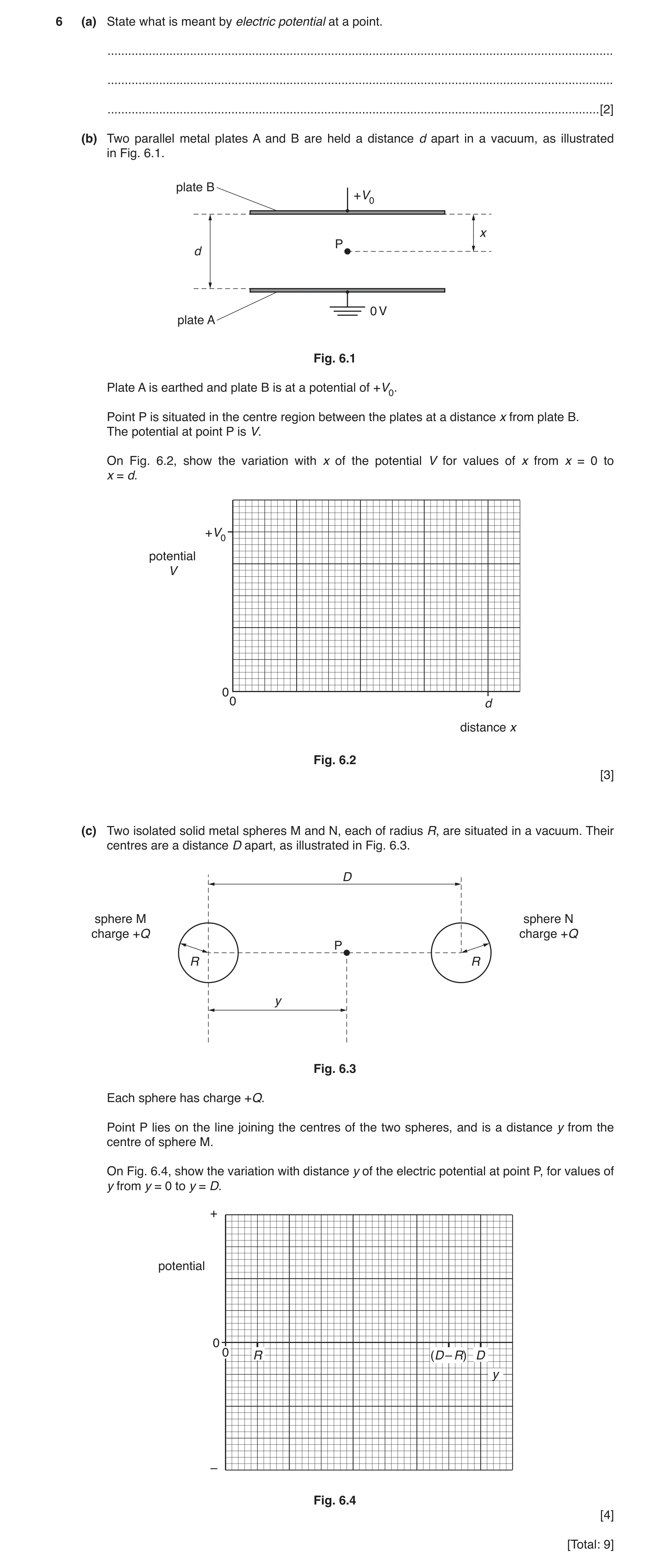
6 (a) State what is meant by electric potential at a point. … … … [2] (b) Two parallel metal plates A and B are held a distance d apart in a vacuum, as illustrated in Fig. 6.1. plate B +V0 x P d 0 V plate A Fig. 6.1 Plate A is earthed and plate B is at a potential of +V0. Point P is situated in the centre region between the plates at a distance x from plate B. The potential at point P is V. On Fig. 6.2, show the variation with x of the potential V for values of x from x = 0 to x = d. +V0 potential V 00 d distance x Fig. 6.2 [3] (c) Two isolated solid metal spheres M and N, each of radius R, are situated in a vacuum. Their centres are a distance D apart, as illustrated in Fig. 6.3. D sphere M sphere N charge +Q charge +Q P R R y Fig. 6.3 Each sphere has charge +Q. Point P lies on the line joining the centres of the two spheres, and is a distance y from the centre of sphere M. On Fig. 6.4, show the variation with distance y of the electric potential at point P, for values of y from y = 0 to y = D. + potential 0 0 R (D – R) D y – Fig. 6.4 [4] [Total: 9]
9 marks
Mark scheme: 6(a) work done per unit charge B1 (work done) moving positive charge from infinity B1 6(b) straight line with non-zero gradient from x = 0 to x = d B1 line with gradient of constant sign and end-points between which ∆V = V0 and ∆x = d B1 line passes through (d, 0) and (0, +V0) with negative gradient throughout B1 6(c) V constant (and non-zero) from 0 → R and from (D – R) → D B1 equal (non-zero) values of (magnitude of) V at R and (D – R). B1 curve (with a minimum) from R to (D – R) with V always positive B1 minimum at mid-point of curve B1
This question in 9702/42 May/June 2019
Q4 · State an expression for the electric field strength E at a distance r from a point charge… 9702/41 Oct/Nov 2019
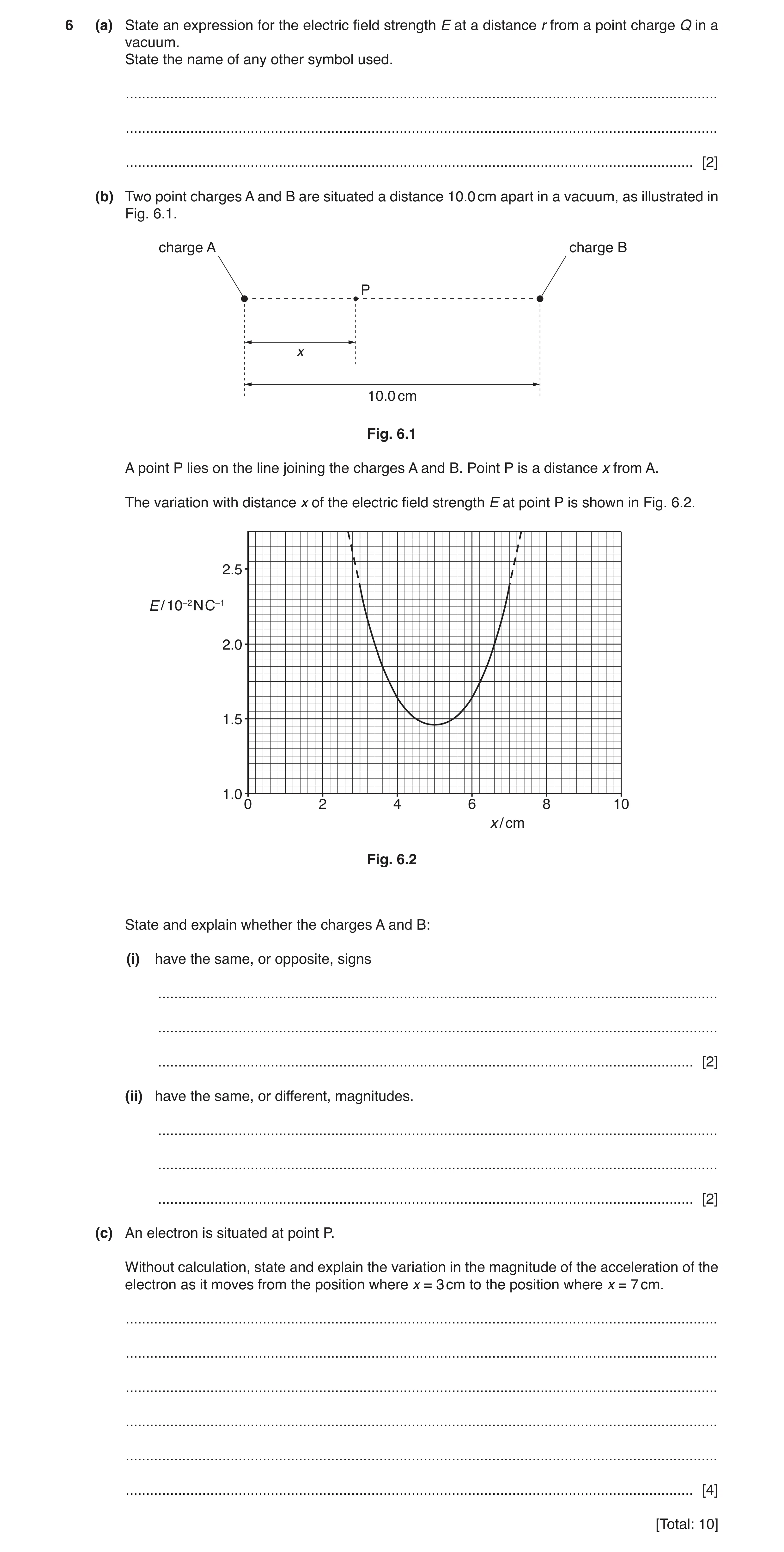
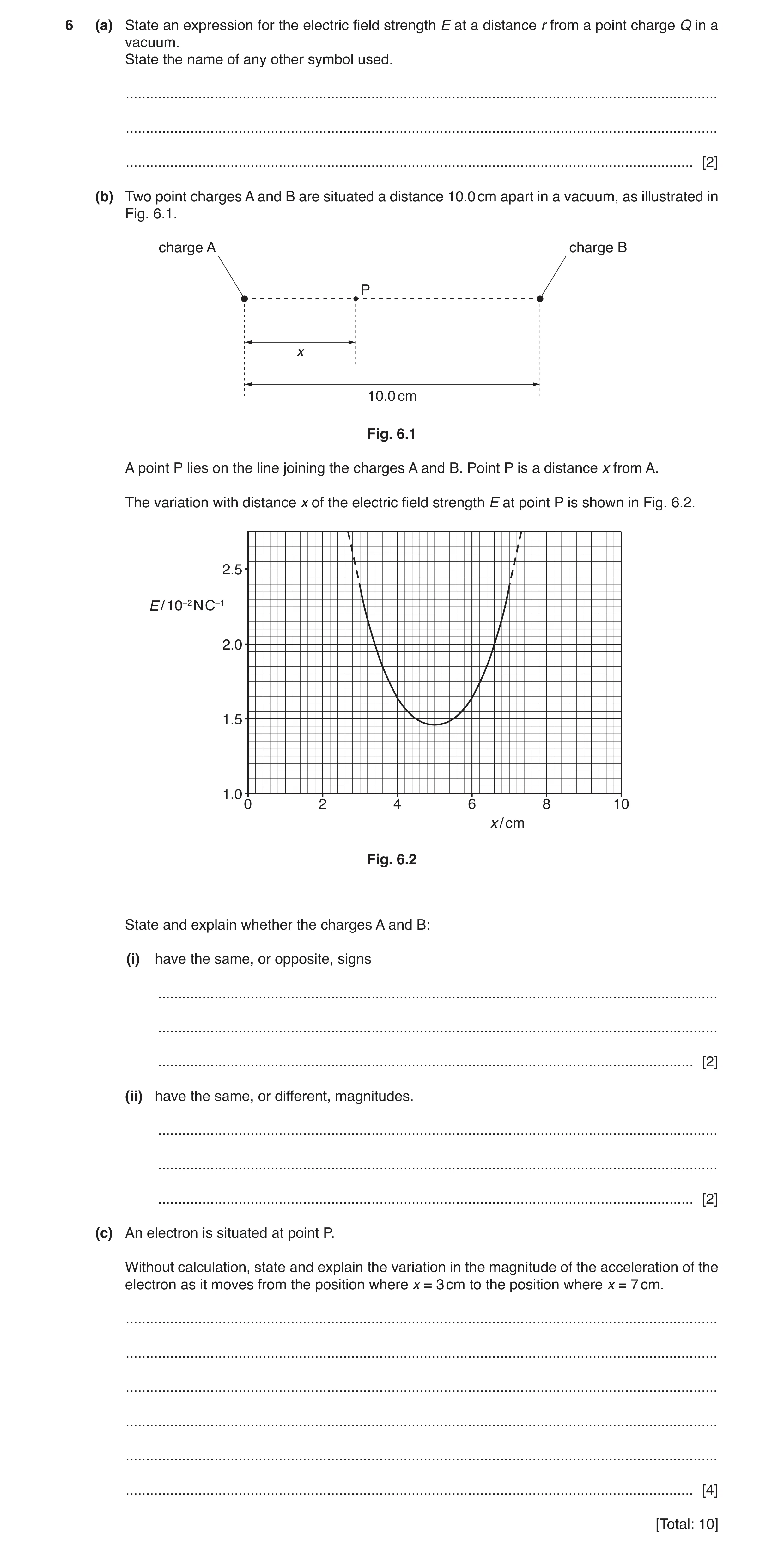
6 (a) State an expression for the electric field strength E at a distance r from a point charge Q in a vacuum. State the name of any other symbol used. … … … [2] (b) Two point charges A and B are situated a distance 10.0 cm apart in a vacuum, as illustrated in Fig. 6.1. charge A charge B P x 10.0 cm Fig. 6.1 A point P lies on the line joining the charges A and B. Point P is a distance x from A. The variation with distance x of the electric field strength E at point P is shown in Fig. 6.2. 2.5 E / 10–2 N C–1 2.0 1.5 1.0 0 2 4 6 8 10 x / cm Fig. 6.2 State and explain whether the charges A and B: (i) have the same, or opposite, signs … … … [2] (ii) have the same, or different, magnitudes. … … … [2] (c) An electron is situated at point P. Without calculation, state and explain the variation in the magnitude of the acceleration of the electron as it moves from the position where x = 3 cm to the position where x = 7 cm. … … … … … … [4] [Total: 10]
10 marks
Mark scheme: 6(a) M1 where ε0 is permittivity (of free space) A1 6(b)(i) field does not change direction/field does not become zero M1 so (charges have) opposite (sign) A1 6(b)(ii) minimum is at the midpoint (between the charges) M1 so (magnitudes are the) same A1 6(c) force = field strength × charge and force = mass × acceleration or acceleration is proportional to field strength B1 (from x = 3.0 cm) to x = 5.0 cm: acceleration decreases B1 at x = 5.0 cm: acceleration is a minimum B1 from x = 5.0 cm (to x = 7.0 cm): acceleration increases B1
This question in 9702/41 Oct/Nov 2019
Q5 · State an expression for the electric field strength E at a distance r from a point charge… 9702/43 Oct/Nov 2019
6 (a) State an expression for the electric field strength E at a distance r from a point charge Q in a vacuum. State the name of any other symbol used. … … … [2] (b) Two point charges A and B are situated a distance 10.0 cm apart in a vacuum, as illustrated in Fig. 6.1. charge A charge B P x 10.0 cm Fig. 6.1 A point P lies on the line joining the charges A and B. Point P is a distance x from A. The variation with distance x of the electric field strength E at point P is shown in Fig. 6.2. 2.5 E / 10–2 N C–1 2.0 1.5 1.0 0 2 4 6 8 10 x / cm Fig. 6.2 State and explain whether the charges A and B: (i) have the same, or opposite, signs … … … [2] (ii) have the same, or different, magnitudes. … … … [2] (c) An electron is situated at point P. Without calculation, state and explain the variation in the magnitude of the acceleration of the electron as it moves from the position where x = 3 cm to the position where x = 7 cm. … … … … … … [4] [Total: 10]
10 marks
Mark scheme: 6(a) M1 where ε0 is permittivity (of free space) A1 6(b)(i) field does not change direction/field does not become zero M1 so (charges have) opposite (sign) A1 6(b)(ii) minimum is at the midpoint (between the charges) M1 so (magnitudes are the) same A1 6(c) force = field strength × charge and force = mass × acceleration or acceleration is proportional to field strength B1 (from x = 3.0 cm) to x = 5.0 cm: acceleration decreases B1 at x = 5.0 cm: acceleration is a minimum B1 from x = 5.0 cm (to x = 7.0 cm): acceleration increases B1
This question in 9702/43 Oct/Nov 2019
Q6 · A sphere of mass 1.6 × 10⁻¹⁰ kg has a charge of +0.27 nC 9702/41 May/June 2022
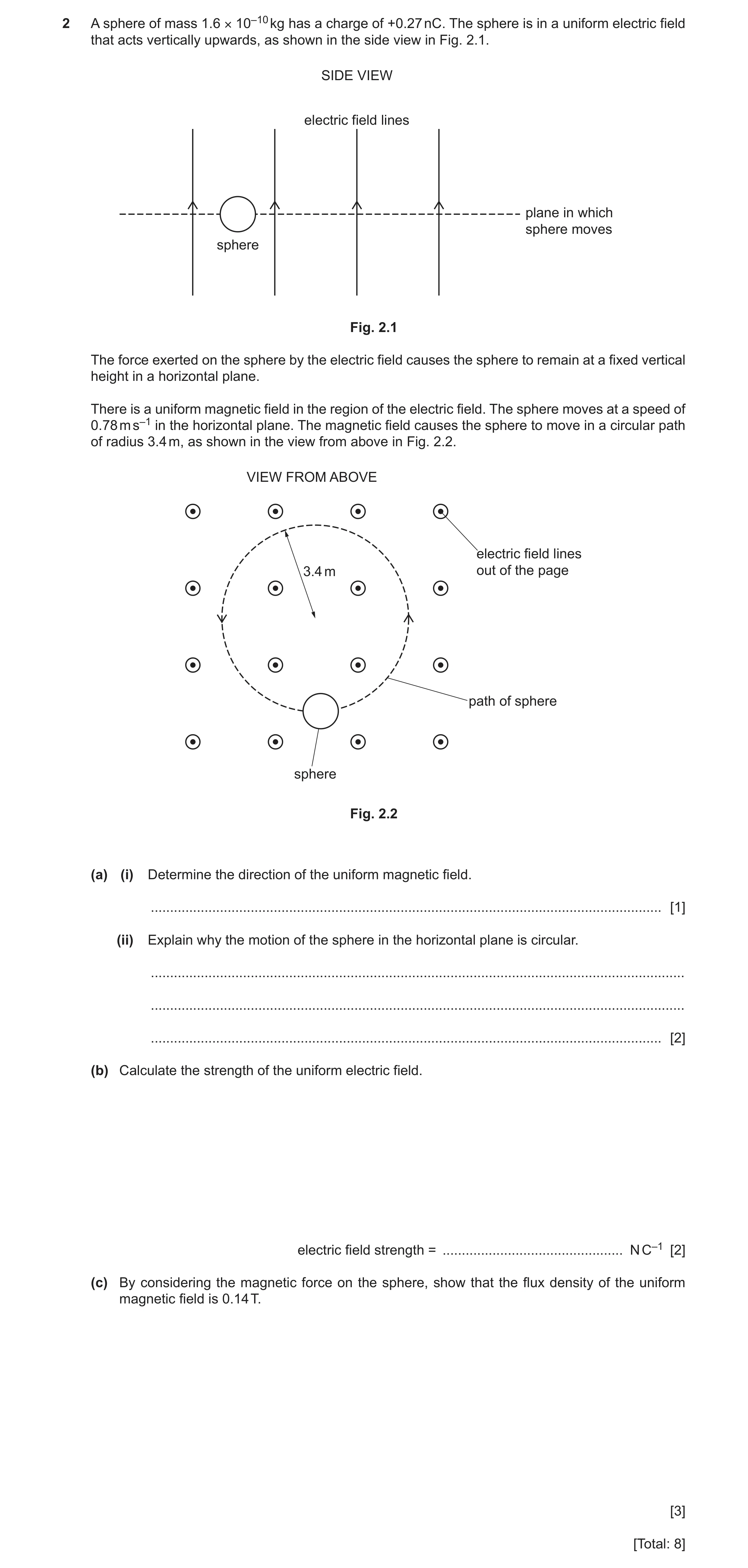
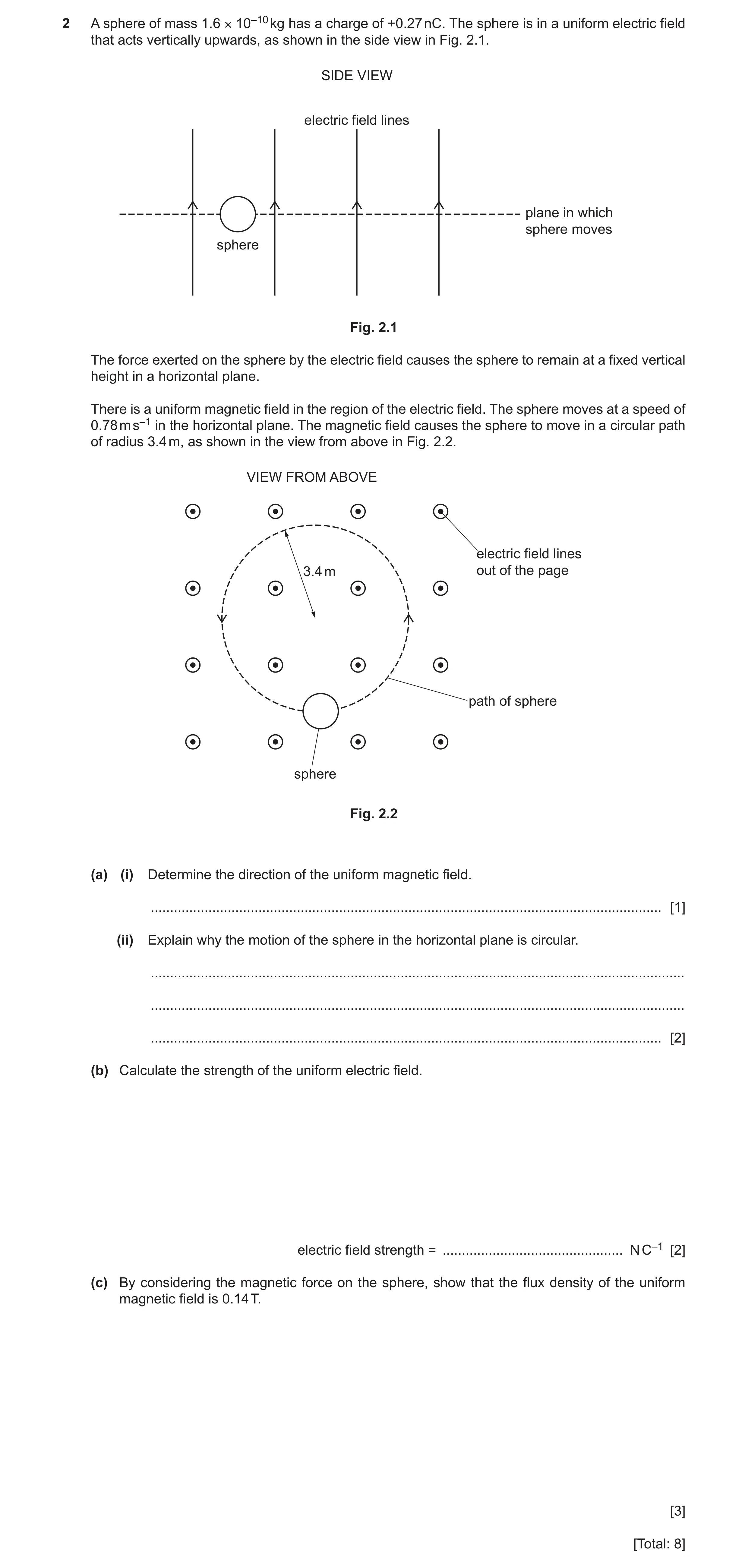
2 A sphere of mass 1.6 × 10⁻¹⁰ kg has a charge of +0.27 nC. The sphere is in a uniform electric field that acts vertically upwards, as shown in the side view in Fig. 2.1. SIDE VIEW electric field lines plane in which sphere moves sphere Fig. 2.1 The force exerted on the sphere by the electric field causes the sphere to remain at a fixed vertical height in a horizontal plane. There is a uniform magnetic field in the region of the electric field. The sphere moves at a speed of 0.78 m s–1 in the horizontal plane. The magnetic field causes the sphere to move in a circular path of radius 3.4 m, as shown in the view from above in Fig. 2.2. VIEW FROM ABOVE electric field lines 3.4 m out of the page path of sphere sphere Fig. 2.2 (a) (i) Determine the direction of the uniform magnetic field. … [1] (ii) Explain why the motion of the sphere in the horizontal plane is circular. … … … [2] (b) Calculate the strength of the uniform electric field. electric field strength = … N C–1 [2] (c) By considering the magnetic force on the sphere, show that the flux density of the uniform magnetic field is 0.14 T. [3] [Total: 8]
8 marks
Mark scheme: 2(a)(i) (vertically) downwards B1 2(a)(ii) magnetic force (on sphere) is perpendicular to its velocity B1 magnetic force perpendicular to velocity is the centripetal force or magnetic force perpendicular to velocity causes centripetal acceleration or acceleration perpendicular to velocity is centripetal (acceleration) or magnetic force does not change the speed of the sphere or magnetic force has constant magnitude B1 2(b) mg = Eq C1 E = (1.6 10–10 9.81) / (0.27 10–9) = 5.8 N C–1 A1 2(c) centripetal force = magnetic force or Bqv = mv2 / r B1 B = mv / qr C1 = (1.6 10–10 0.78) / (0.27 10–9 3.4) = 0.14 T A1
This question in 9702/41 May/June 2022
Q7 · A sphere of mass 1.6 × 10⁻¹⁰ kg has a charge of +0.27 nC 9702/43 May/June 2022
2 A sphere of mass 1.6 × 10⁻¹⁰ kg has a charge of +0.27 nC. The sphere is in a uniform electric field that acts vertically upwards, as shown in the side view in Fig. 2.1. SIDE VIEW electric field lines plane in which sphere moves sphere Fig. 2.1 The force exerted on the sphere by the electric field causes the sphere to remain at a fixed vertical height in a horizontal plane. There is a uniform magnetic field in the region of the electric field. The sphere moves at a speed of 0.78 m s–1 in the horizontal plane. The magnetic field causes the sphere to move in a circular path of radius 3.4 m, as shown in the view from above in Fig. 2.2. VIEW FROM ABOVE electric field lines 3.4 m out of the page path of sphere sphere Fig. 2.2 (a) (i) Determine the direction of the uniform magnetic field. … [1] (ii) Explain why the motion of the sphere in the horizontal plane is circular. … … … [2] (b) Calculate the strength of the uniform electric field. electric field strength = … N C–1 [2] (c) By considering the magnetic force on the sphere, show that the flux density of the uniform magnetic field is 0.14 T. [3] [Total: 8]
8 marks
Mark scheme: 2(a)(i) (vertically) downwards B1 2(a)(ii) magnetic force (on sphere) is perpendicular to its velocity B1 magnetic force perpendicular to velocity is the centripetal force or magnetic force perpendicular to velocity causes centripetal acceleration or acceleration perpendicular to velocity is centripetal (acceleration) or magnetic force does not change the speed of the sphere or magnetic force has constant magnitude B1 2(b) mg = Eq C1 E = (1.6 10–10 9.81) / (0.27 10–9) = 5.8 N C–1 A1 2(c) centripetal force = magnetic force or Bqv = mv2 / r B1 B = mv / qr C1 = (1.6 10–10 0.78) / (0.27 10–9 3.4) = 0.14 T A1
This question in 9702/43 May/June 2022
Q8 · State what is indicated by the direction of an electric field line 9702/41 Oct/Nov 2022
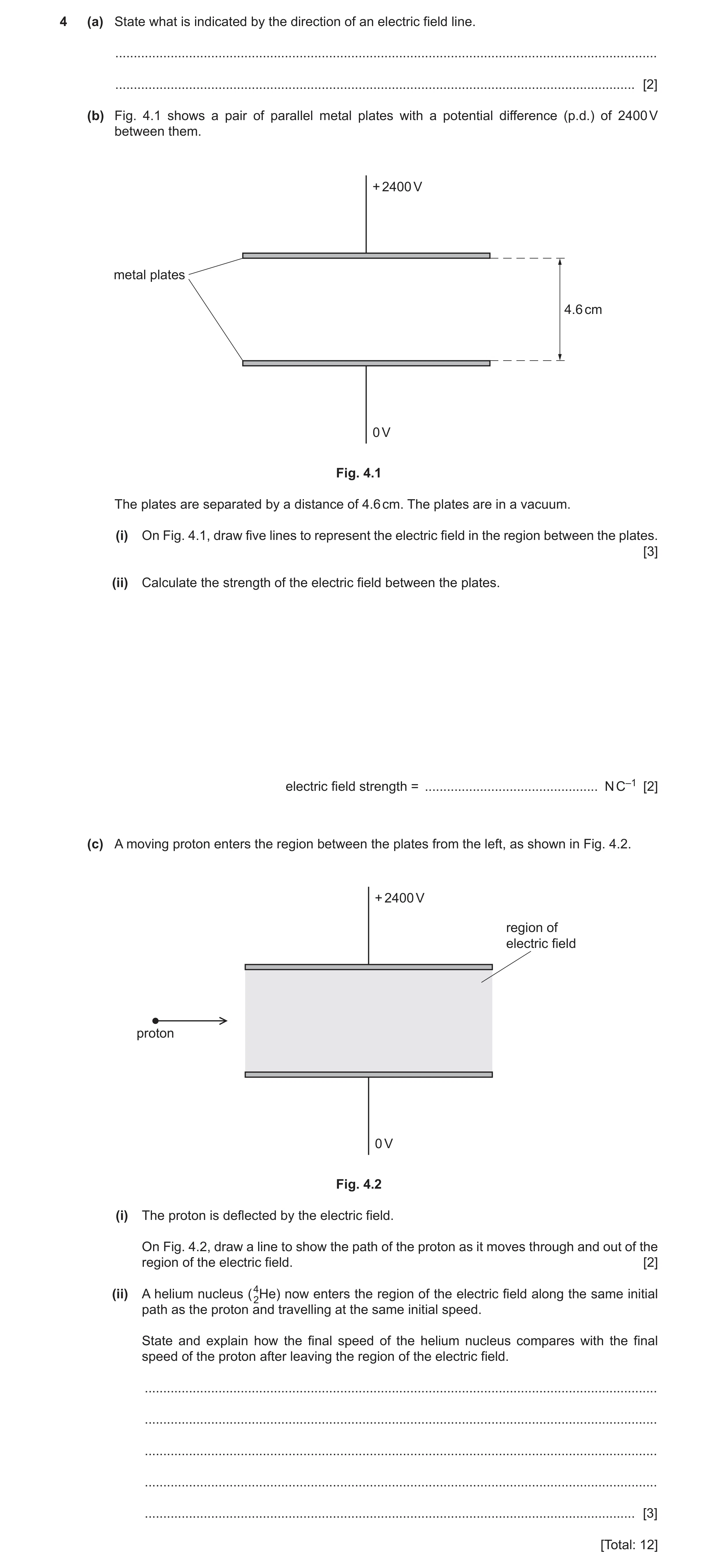
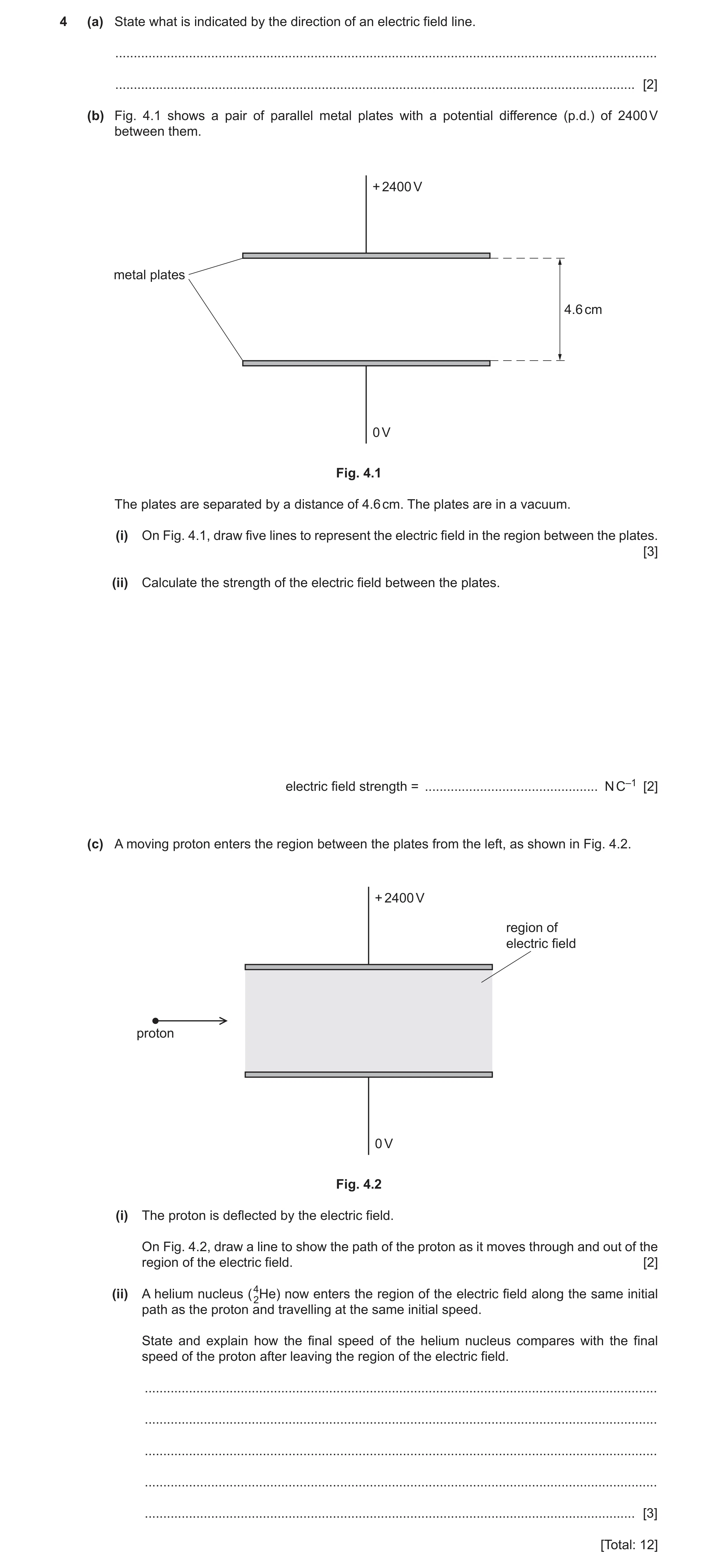
4 (a) State what is indicated by the direction of an electric field line. … … [2] (b) Fig. 4.1 shows a pair of parallel metal plates with a potential difference (p.d.) of 2400 V between them. + 2400 V metal plates 4.6 cm 0 V Fig. 4.1 The plates are separated by a distance of 4.6 cm. The plates are in a vacuum. (i) On Fig. 4.1, draw five lines to represent the electric field in the region between the plates. [3] (ii) Calculate the strength of the electric field between the plates. electric field strength = … N C–1 [2] (c) A moving proton enters the region between the plates from the left, as shown in Fig. 4.2. + 2400 V region of electric field proton 0 V Fig. 4.2 (i) The proton is deflected by the electric field. On Fig. 4.2, draw a line to show the path of the proton as it moves through and out of the region of the electric field. [2] (ii) A helium nucleus (42He) now enters the region of the electric field along the same initial path as the proton and travelling at the same initial speed. State and explain how the final speed of the helium nucleus compares with the final speed of the proton after leaving the region of the electric field. … … … … … [3] [Total: 12]
12 marks
Mark scheme: 4(a) (field line indicates) direction of force B1 force on a positive charge B1 4(b)(i) one straight line perpendicular to plates, starting on one plate and finishing on the other B1 five straight lines perpendicular to plates between the plates, uniformly spaced B1 downwards arrows on lines B1 4(b)(ii) E = V / d C1 = 2400 / 0.046 A1 = 5.2 104 N C–1 4(c)(i) smooth curve in region of field and straight line outside field B1 direction of deflection shown as downwards in region of field B1 4(c)(ii) helium nucleus has double the charge but four times the mass B1 velocity parallel to plates same and acceleration perpendicular to plates smaller (for helium) B1 final speed is lower (for helium) B1
This question in 9702/41 Oct/Nov 2022
Q9 · State what is indicated by the direction of an electric field line 9702/43 Oct/Nov 2022
4 (a) State what is indicated by the direction of an electric field line. … … [2] (b) Fig. 4.1 shows a pair of parallel metal plates with a potential difference (p.d.) of 2400 V between them. + 2400 V metal plates 4.6 cm 0 V Fig. 4.1 The plates are separated by a distance of 4.6 cm. The plates are in a vacuum. (i) On Fig. 4.1, draw five lines to represent the electric field in the region between the plates. [3] (ii) Calculate the strength of the electric field between the plates. electric field strength = … N C–1 [2] (c) A moving proton enters the region between the plates from the left, as shown in Fig. 4.2. + 2400 V region of electric field proton 0 V Fig. 4.2 (i) The proton is deflected by the electric field. On Fig. 4.2, draw a line to show the path of the proton as it moves through and out of the region of the electric field. [2] (ii) A helium nucleus (42He) now enters the region of the electric field along the same initial path as the proton and travelling at the same initial speed. State and explain how the final speed of the helium nucleus compares with the final speed of the proton after leaving the region of the electric field. … … … … … [3] [Total: 12]
12 marks
Mark scheme: 4(a) (field line indicates) direction of force B1 force on a positive charge B1 4(b)(i) one straight line perpendicular to plates, starting on one plate and finishing on the other B1 five straight lines perpendicular to plates between the plates, uniformly spaced B1 downwards arrows on lines B1 4(b)(ii) E = V / d C1 = 2400 / 0.046 A1 = 5.2 104 N C–1 4(c)(i) smooth curve in region of field and straight line outside field B1 direction of deflection shown as downwards in region of field B1 4(c)(ii) helium nucleus has double the charge but four times the mass B1 velocity parallel to plates same and acceleration perpendicular to plates smaller (for helium) B1 final speed is lower (for helium) B1
This question in 9702/43 Oct/Nov 2022
Question 10 9702/42 Feb/March 2023
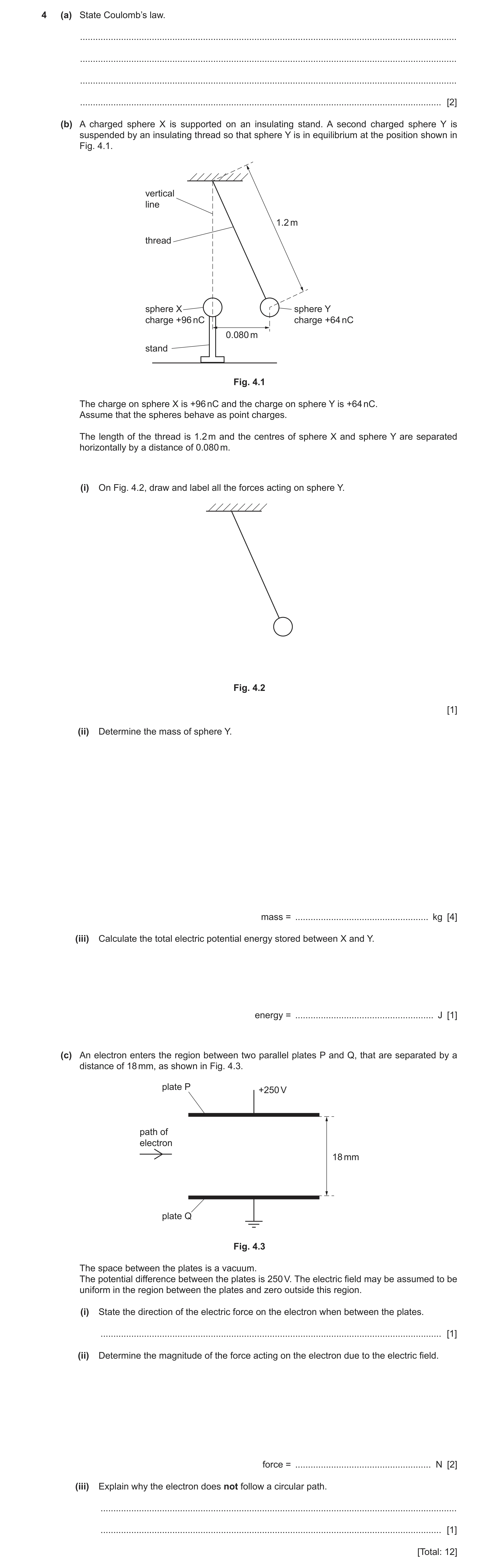
4 (a) State Coulomb’s law. … … … … [2] (b) A charged sphere X is supported on an insulating stand. A second charged sphere Y is suspended by an insulating thread so that sphere Y is in equilibrium at the position shown in Fig. 4.1. vertical line 1.2 m thread sphere X sphere Y charge +96 nC charge +64 nC 0.080 m stand Fig. 4.1 The charge on sphere X is +96 nC and the charge on sphere Y is +64 nC. Assume that the spheres behave as point charges. The length of the thread is 1.2 m and the centres of sphere X and sphere Y are separated horizontally by a distance of 0.080 m. (i) On Fig. 4.2, draw and label all the forces acting on sphere Y. Fig. 4.2 [1] (ii) Determine the mass of sphere Y. mass = … kg [4] (iii) Calculate the total electric potential energy stored between X and Y. energy = … J [1] (c) An electron enters the region between two parallel plates P and Q, that are separated by a distance of 18 mm, as shown in Fig. 4.3. plate P +250 V path of electron 18 mm plate Q Fig. 4.3 The space between the plates is a vacuum. The potential difference between the plates is 250 V. The electric field may be assumed to be uniform in the region between the plates and zero outside this region. (i) State the direction of the electric force on the electron when between the plates. … [1] (ii) Determine the magnitude of the force acting on the electron due to the electric field. force = … N [2] (iii) Explain why the electron does not follow a circular path. … … [1] [Total: 12]
12 marks
Mark scheme: 4(a) (electric) force is (directly) proportional to product of charges B1 force (between point charges) is inversely proportional to the square of their separation B1 4(b)(i) arrows showing tension upwards in direction of string, electric force horizontally to the right and weight vertically B1 downwards and all three labelled 4(b)(ii) 96 10 −9 64 10 −9 C1 FE = 4 8.85 10 −12 0.080 2 ( = 8.63 10–3 N) either angle to vertical = sin–1 0.080 / 1.2 C1 ( = 3.82°) weight = FE / tan 3.82 = 8.63 10–3 / tan 3.82 C1 ( = 0.129 N) mass = 0.129 / 9.81 A1 = 0.013 kg or T sin = mg and T cos = FE or tan = mg / FE (C1) tan = 1.2 / 0.080 (C1) m = (1.2 8.63 10–3) / (0.080 9.81) (A1) = 0.013 kg 4(b)(iii) QQ1 2 96 10 −9 64 10 −9 A1 E p = = −12 4o r 4 8.85 10 0.080 = 6.9 10–4 J 4(c)(i) towards the top of the page / towards plate P B1 4(c)(ii) F = QE and E = V / d C1 F = 1.6 10–19 250 / 0.018 A1 = 2.2 10–15 N 4(c)(iii) either the force is not (always) perpendicular to the velocity B1 or the force is always in the same direction
This question in 9702/42 Feb/March 2023
Question 11 9702/42 Oct/Nov 2023
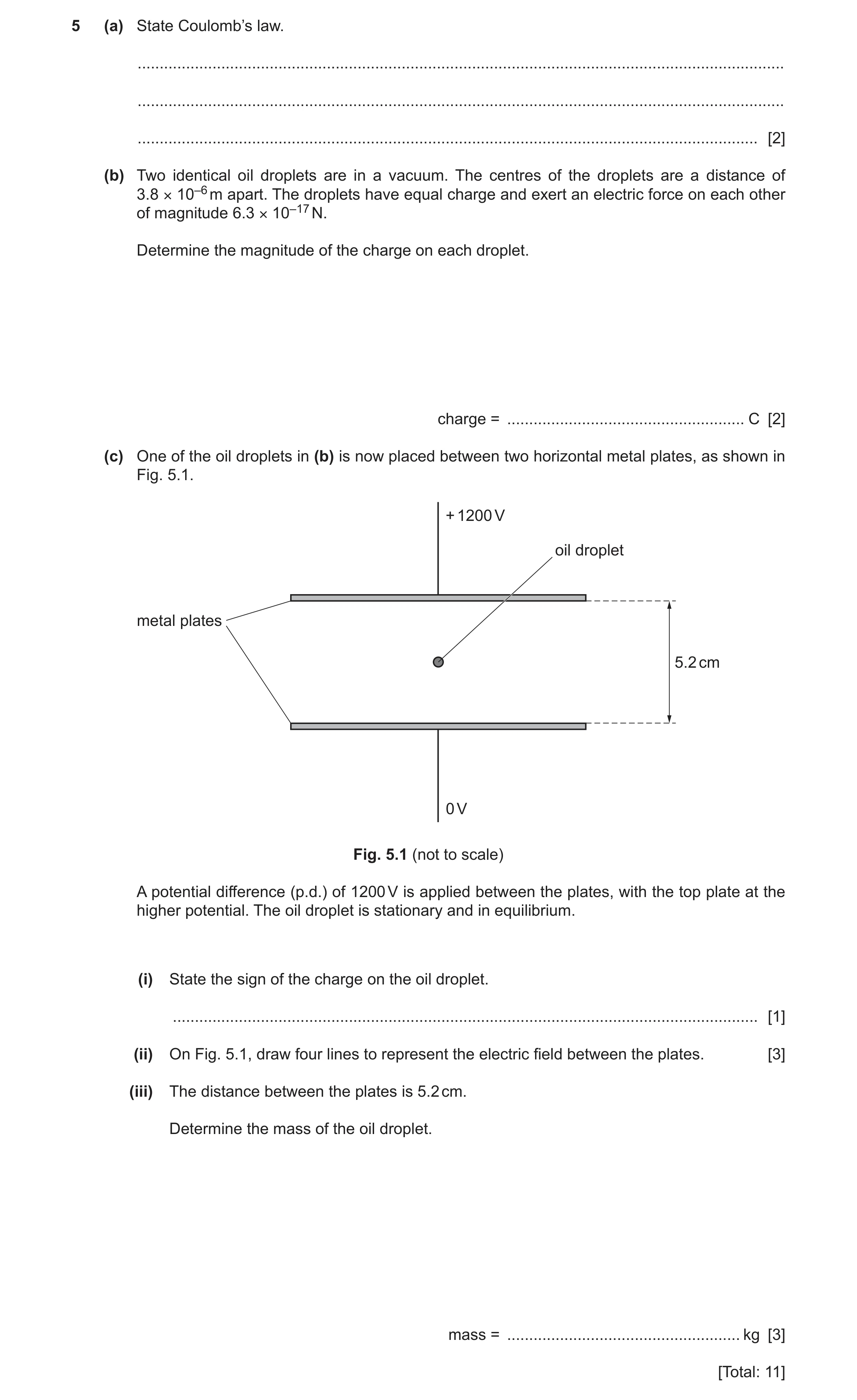
5 (a) State Coulomb’s law. … … … [2] (b) Two identical oil droplets are in a vacuum. The centres of the droplets are a distance of 3.8 × 10⁻⁶ m apart. The droplets have equal charge and exert an electric force on each other of magnitude 6.3 × 10⁻¹⁷ N. Determine the magnitude of the charge on each droplet. charge = … C [2] (c) One of the oil droplets in (b) is now placed between two horizontal metal plates, as shown in Fig. 5.1. + 1200 V oil droplet metal plates 5.2 cm 0 V Fig. 5.1 (not to scale) A potential difference (p.d.) of 1200 V is applied between the plates, with the top plate at the higher potential. The oil droplet is stationary and in equilibrium. (i) State the sign of the charge on the oil droplet. … [1] (ii) On Fig. 5.1, draw four lines to represent the electric field between the plates. [3] (iii) The distance between the plates is 5.2 cm. Determine the mass of the oil droplet. mass = … kg [3] [Total: 11]
11 marks
Mark scheme: 5(a) (electric) force is (directly) proportional to product of charges B1 (electric) force (between point charges) is inversely proportional to the square of their separation B1 5(b) F = Q2 / 40x2 C1 6.3 10–17 = Q2 / [4 8.85 10–12 (3.8 10–6)2] charge = 3.2 10–19 C A1 5(c)(i) negative B1 5(c)(ii) four straight lines perpendicular to the plates, starting on one plate and finishing on the other B1 lines equally spaced B1 arrows indicating direction downwards B1 5(c)(iii) E = V / d C1 mg = EQ C1 mass = (1200 3.2 10–19) / (9.81 0.052) A1 = 7.5 10–16 kg
This question in 9702/42 Oct/Nov 2023
Question 12 9702/41 May/June 2024
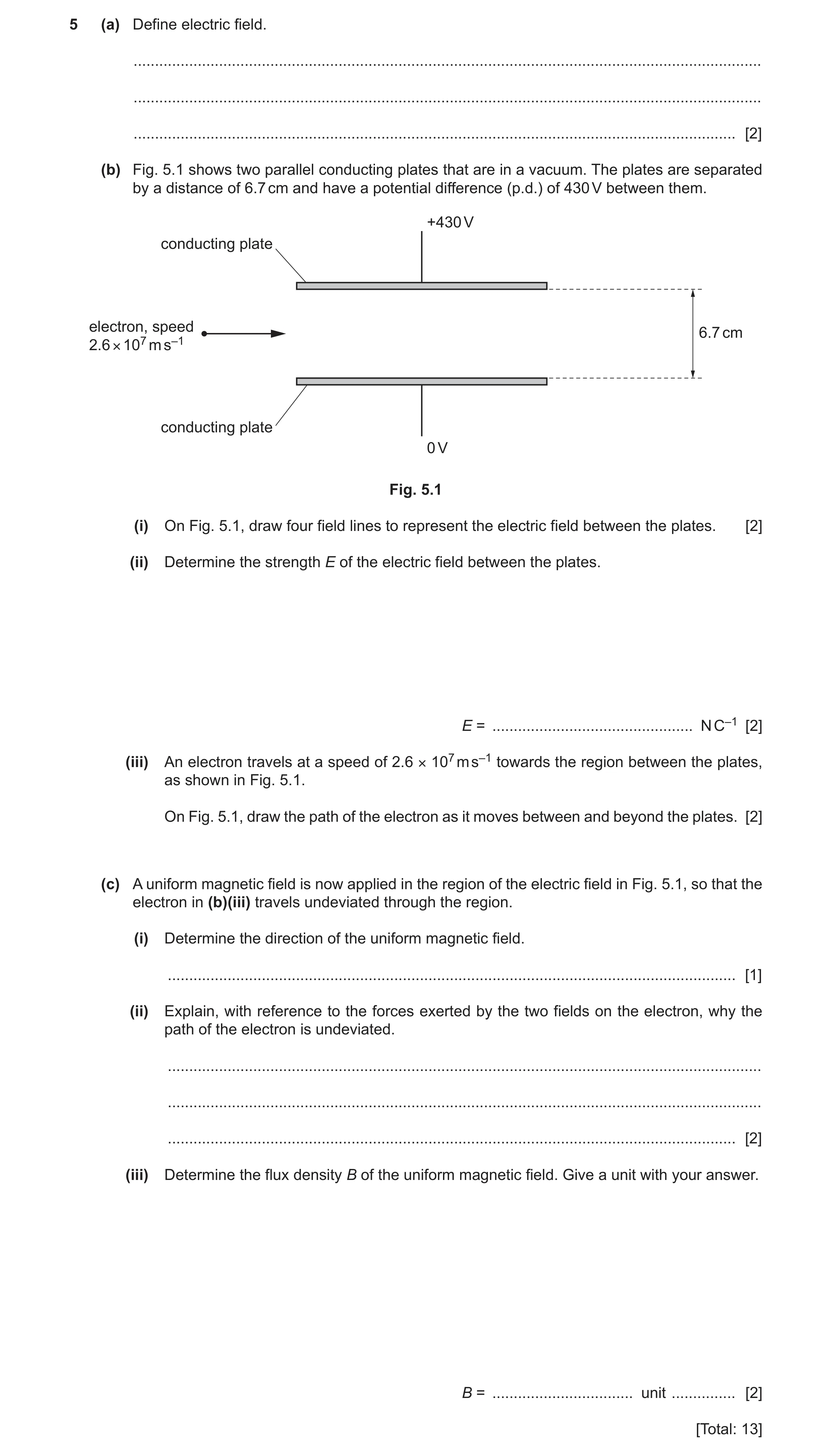
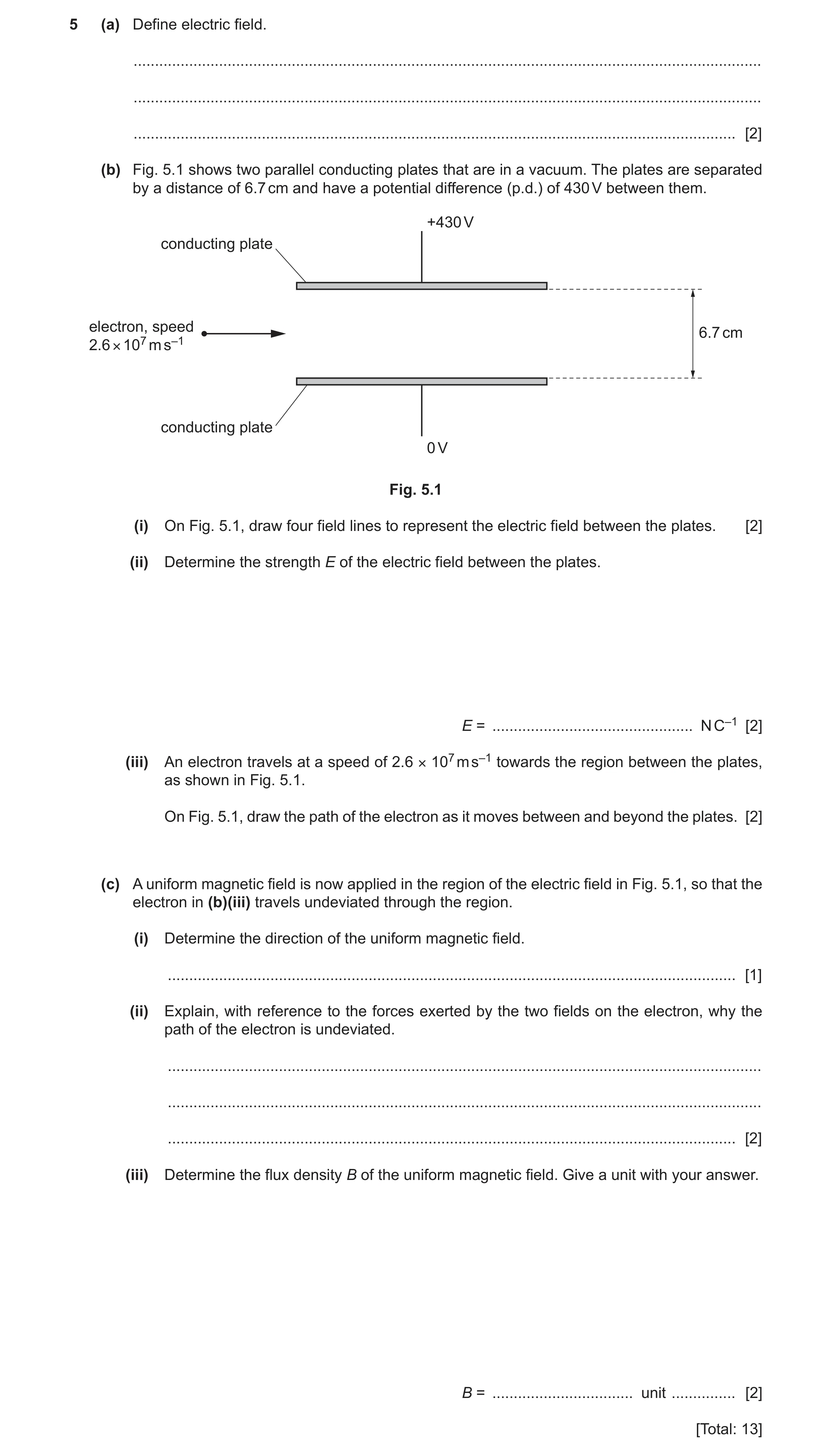
5 (a) Define electric field. … … … [2] (b) Fig. 5.1 shows two parallel conducting plates that are in a vacuum. The plates are separated by a distance of 6.7 cm and have a potential difference (p.d.) of 430 V between them. +430 V conducting plate electron, speed 6.7 cm 2.6 × 10⁷ m s–1 conducting plate 0 V Fig. 5.1 (i) On Fig. 5.1, draw four field lines to represent the electric field between the plates. [2] (ii) Determine the strength E of the electric field between the plates. E = … N C–1 [2] (iii) An electron travels at a speed of 2.6 × 10⁷ m s–1 towards the region between the plates, as shown in Fig. 5.1. On Fig. 5.1, draw the path of the electron as it moves between and beyond the plates. [2] (c) A uniform magnetic field is now applied in the region of the electric field in Fig. 5.1, so that the electron in (b)(iii) travels undeviated through the region. (i) Determine the direction of the uniform magnetic field. … [1] (ii) Explain, with reference to the forces exerted by the two fields on the electron, why the path of the electron is undeviated. … … … [2] (iii) Determine the flux density B of the uniform magnetic field. Give a unit with your answer. B = … unit … [2] [Total: 13]
13 marks
Mark scheme: 5(a) force per unit charge B1 force on positive charge B1 5(b)(i) four straight vertical parallel lines, approximately evenly spaced B1 arrows downwards B1 5(b)(ii) E = V / d C1 E = 430 / 0.067 = 6.4 103 N C–1 A1 5(b)(iii) smooth curve within plates and straight lines outside plates B1 direction of deflection shown as upwards B1 5(c)(i) into the page B1 5(c)(ii) forces are in opposite directions B1 (undeviated) when (magnitudes of) forces are equal B1 5(c)(iii) Eq = Bqv C1 B = E / v = (6.4 103) / (2.6 107) = 2.5 10–4 T A1
This question in 9702/41 May/June 2024
Question 13 9702/43 May/June 2024
5 (a) Define electric field. … … … [2] (b) Fig. 5.1 shows two parallel conducting plates that are in a vacuum. The plates are separated by a distance of 6.7 cm and have a potential difference (p.d.) of 430 V between them. +430 V conducting plate electron, speed 6.7 cm 2.6 × 10⁷ m s–1 conducting plate 0 V Fig. 5.1 (i) On Fig. 5.1, draw four field lines to represent the electric field between the plates. [2] (ii) Determine the strength E of the electric field between the plates. E = … N C–1 [2] (iii) An electron travels at a speed of 2.6 × 10⁷ m s–1 towards the region between the plates, as shown in Fig. 5.1. On Fig. 5.1, draw the path of the electron as it moves between and beyond the plates. [2] (c) A uniform magnetic field is now applied in the region of the electric field in Fig. 5.1, so that the electron in (b)(iii) travels undeviated through the region. (i) Determine the direction of the uniform magnetic field. … [1] (ii) Explain, with reference to the forces exerted by the two fields on the electron, why the path of the electron is undeviated. … … … [2] (iii) Determine the flux density B of the uniform magnetic field. Give a unit with your answer. B = … unit … [2] [Total: 13]
13 marks
Mark scheme: 5(a) force per unit charge B1 force on positive charge B1 5(b)(i) four straight vertical parallel lines, approximately evenly spaced B1 arrows downwards B1 5(b)(ii) E = V / d C1 E = 430 / 0.067 = 6.4 103 N C–1 A1 5(b)(iii) smooth curve within plates and straight lines outside plates B1 direction of deflection shown as upwards B1 5(c)(i) into the page B1 5(c)(ii) forces are in opposite directions B1 (undeviated) when (magnitudes of) forces are equal B1 5(c)(iii) Eq = Bqv C1 B = E / v = (6.4 103) / (2.6 107) = 2.5 10–4 T A1
This question in 9702/43 May/June 2024
Q14 · The magnitude of the gravitational potential on the surface of a planet of radius R is φ 9702/42 Feb/March 2025
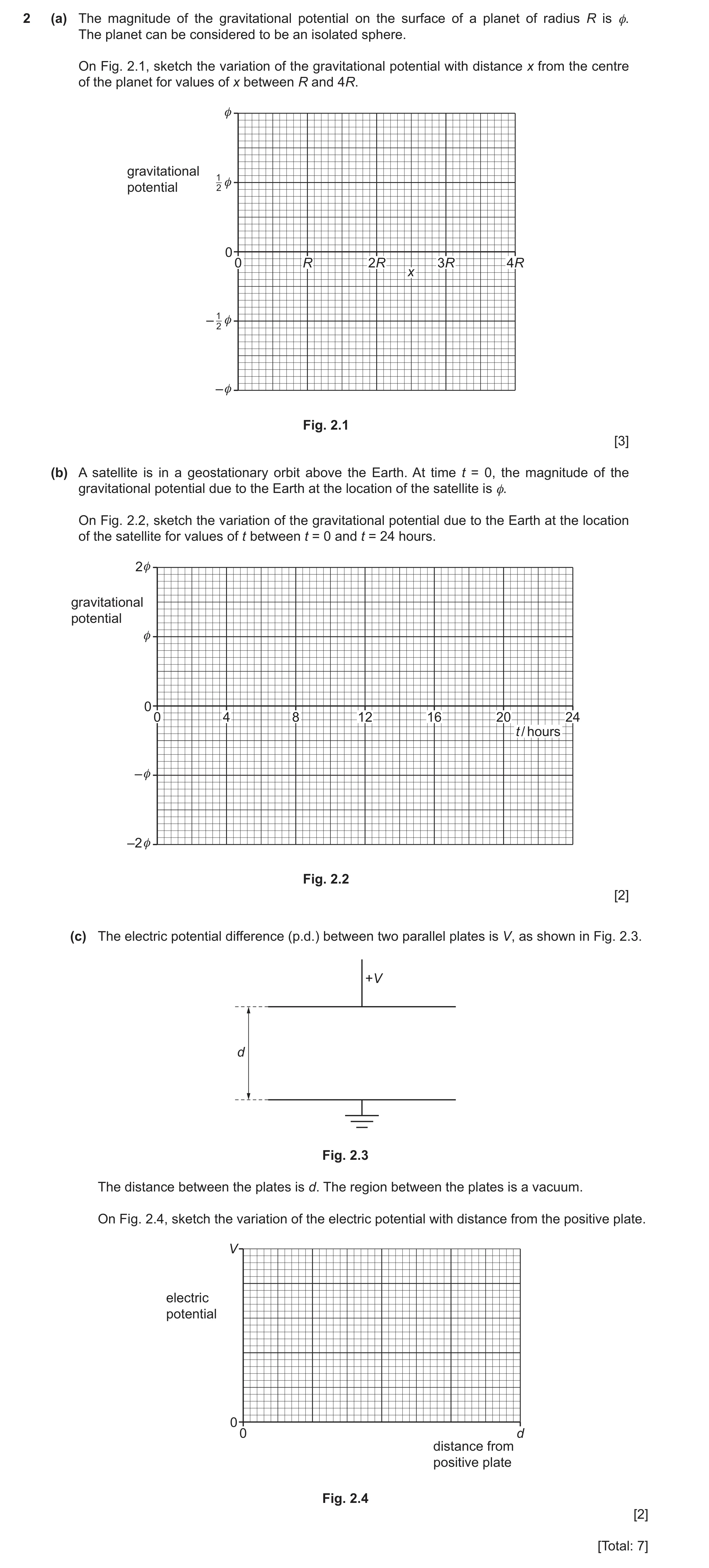
2 (a) The magnitude of the gravitational potential on the surface of a planet of radius R is φ. The planet can be considered to be an isolated sphere. On Fig. 2.1, sketch the variation of the gravitational potential with distance x from the centre of the planet for values of x between R and 4R. φ gravitational 1 φ potential 2 0 0 R 2R 3R 4R x – 1 φ 2 – φ Fig. 2.1 [3] (b) A satellite is in a geostationary orbit above the Earth. At time t = 0, the magnitude of the gravitational potential due to the Earth at the location of the satellite is φ. On Fig. 2.2, sketch the variation of the gravitational potential due to the Earth at the location of the satellite for values of t between t = 0 and t = 24 hours. 2φ gravitational potential φ 0 0 4 8 12 16 20 24 t / hours – φ –2 φ Fig. 2.2 [2] (c) The electric potential difference (p.d.) between two parallel plates is V, as shown in Fig. 2.3. +V d Fig. 2.3 The distance between the plates is d. The region between the plates is a vacuum. On Fig. 2.4, sketch the variation of the electric potential with distance from the positive plate. V electric potential 0 0 d distance from positive plate Fig. 2.4 [2] [Total: 7]
7 marks
Mark scheme: 2(a) sketch: B1 line from x = R to x = 4R entirely in the negative region curve with continuously decreasing magnitude and with gradient of continuously decreasing magnitude, starting at (R, ) B1 line passing through (2R, ½) and (4R, ¼) B1 2(b) horizontal straight line from t = 0 to t = 24 hours B1 line starting at (0, –) B1 2(c) straight line with non-zero gradient from 0 to d B1 line with negative gradient from (0, V) to (d, 0) B1
This question in 9702/42 Feb/March 2025
Q15 · Two parallel metal plates X and Y are separated by a distance of 0.041 m, as shown in Fig 9702/42 May/June 2025
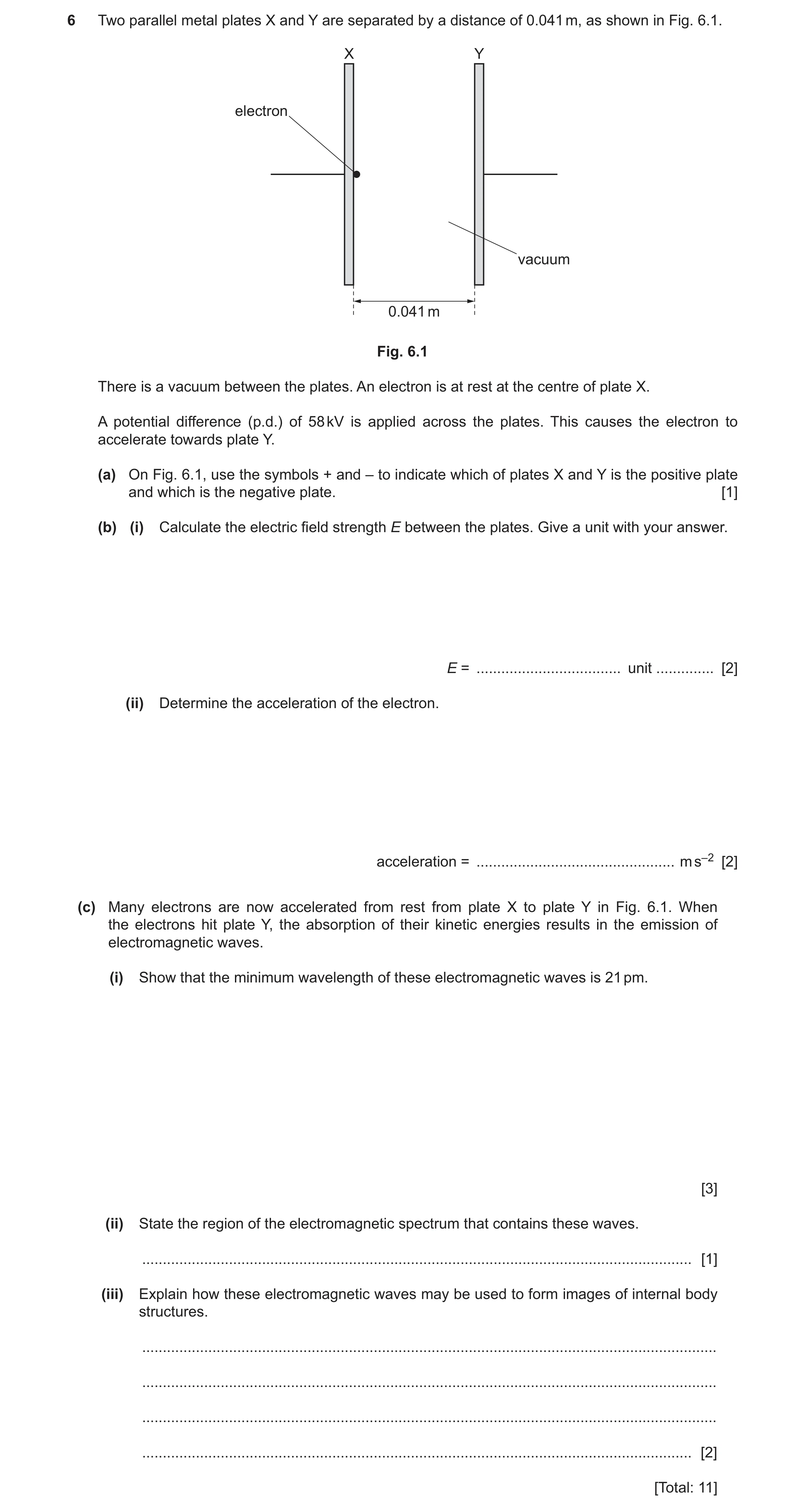
6 Two parallel metal plates X and Y are separated by a distance of 0.041 m, as shown in Fig. 6.1. X Y electron vacuum 0.041 m Fig. 6.1 There is a vacuum between the plates. An electron is at rest at the centre of plate X. A potential difference (p.d.) of 58 kV is applied across the plates. This causes the electron to accelerate towards plate Y. (a) On Fig. 6.1, use the symbols + and – to indicate which of plates X and Y is the positive plate and which is the negative plate. [1] (b) (i) Calculate the electric field strength E between the plates. Give a unit with your answer. E = … unit … [2] (ii) Determine the acceleration of the electron. acceleration = … m s–2 [2] (c) Many electrons are now accelerated from rest from plate X to plate Y in Fig. 6.1. When the electrons hit plate Y, the absorption of their kinetic energies results in the emission of electromagnetic waves. (i) Show that the minimum wavelength of these electromagnetic waves is 21 pm. [3] (ii) State the region of the electromagnetic spectrum that contains these waves. … [1] (iii) Explain how these electromagnetic waves may be used to form images of internal body structures. … … … … [2] [Total: 11]
11 marks
Mark scheme: 6(a) plate X marked as negative and plate Y marked as positive B1 6(b)(i) E = V / x C1 = (58 × 103) / 0.041 A1 = 1.4 × 10⁶ N C–1 6(b)(ii) ma = eE C1 a = (1.60 × 10–19 × 1.41 × 106) / (9.11 × 10⁻³¹) A1 = 2.5 × 10¹⁷ m s–2 6(c)(i) eV = hc / C1 or eV = hf and f = c / (1.60 × 10–19 × 58 × 103) = (6.63 × 10–34 × 3.00 × 108) / M1 clear conversion from m to pm leading to = 21 pm A1 6(c)(ii) X-rays B1 6(c)(iii) Any two points from: B2 • waves are passed into structure and transmitted waves detected • different parts of the structure absorb different fractions of energy • difference in detected / transmitted intensities used (to form image)
This question in 9702/42 May/June 2025
 9
9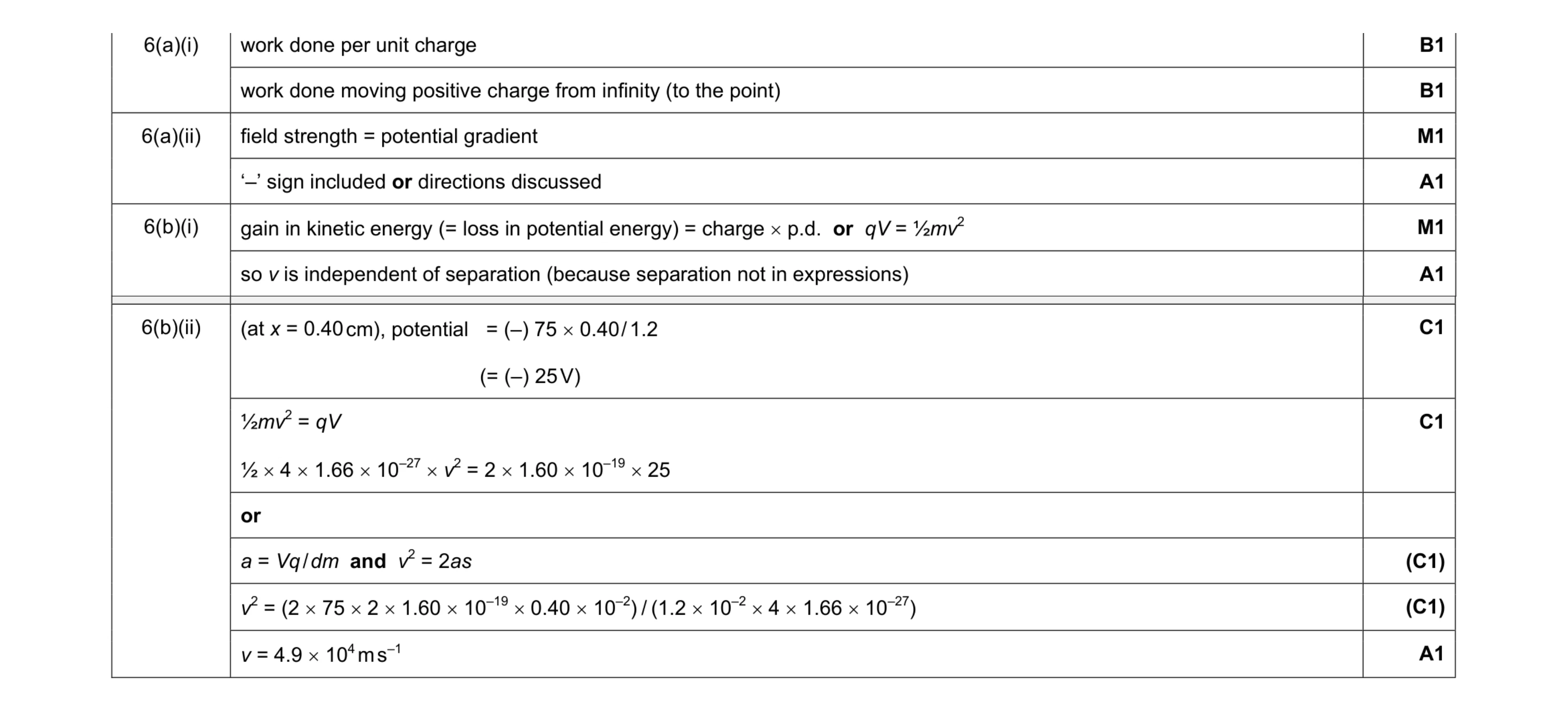 9
9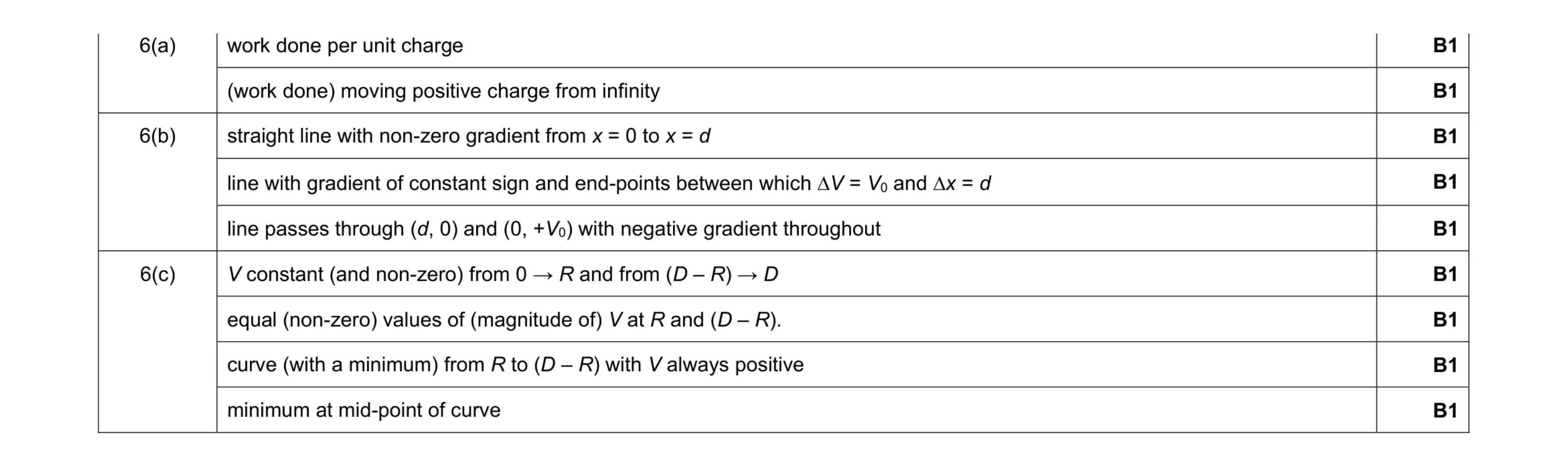 9
9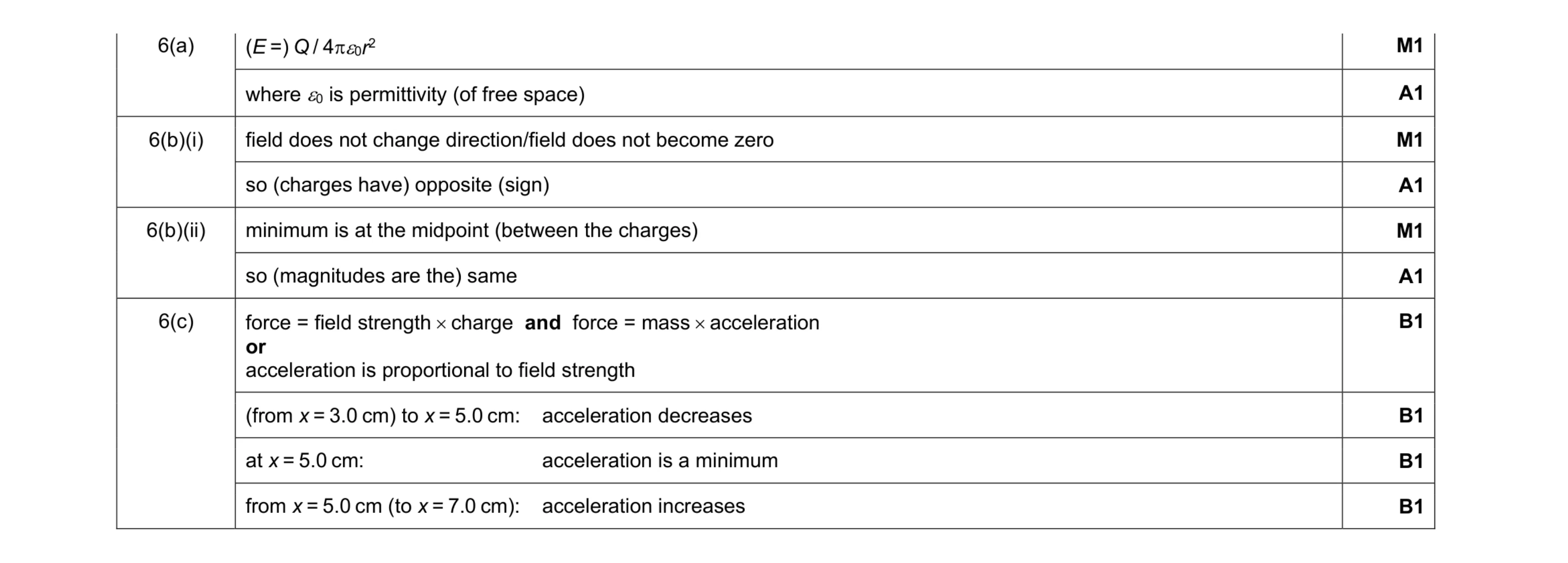 10
10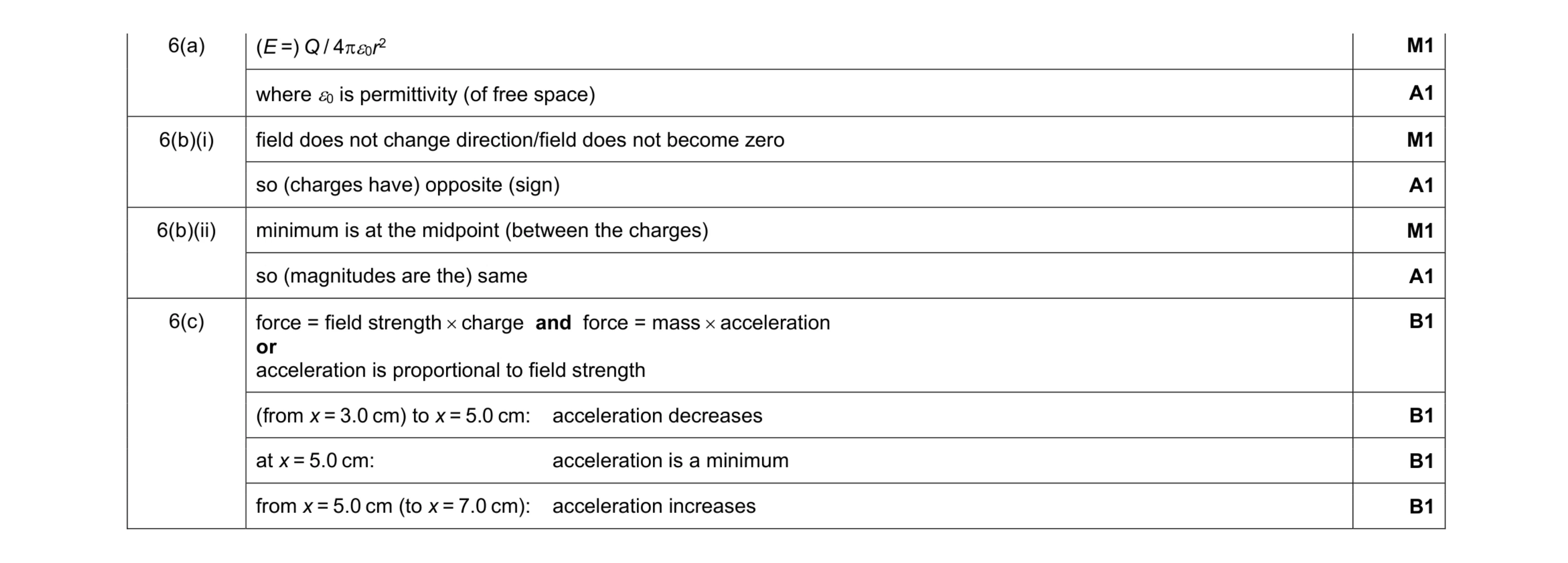 10
10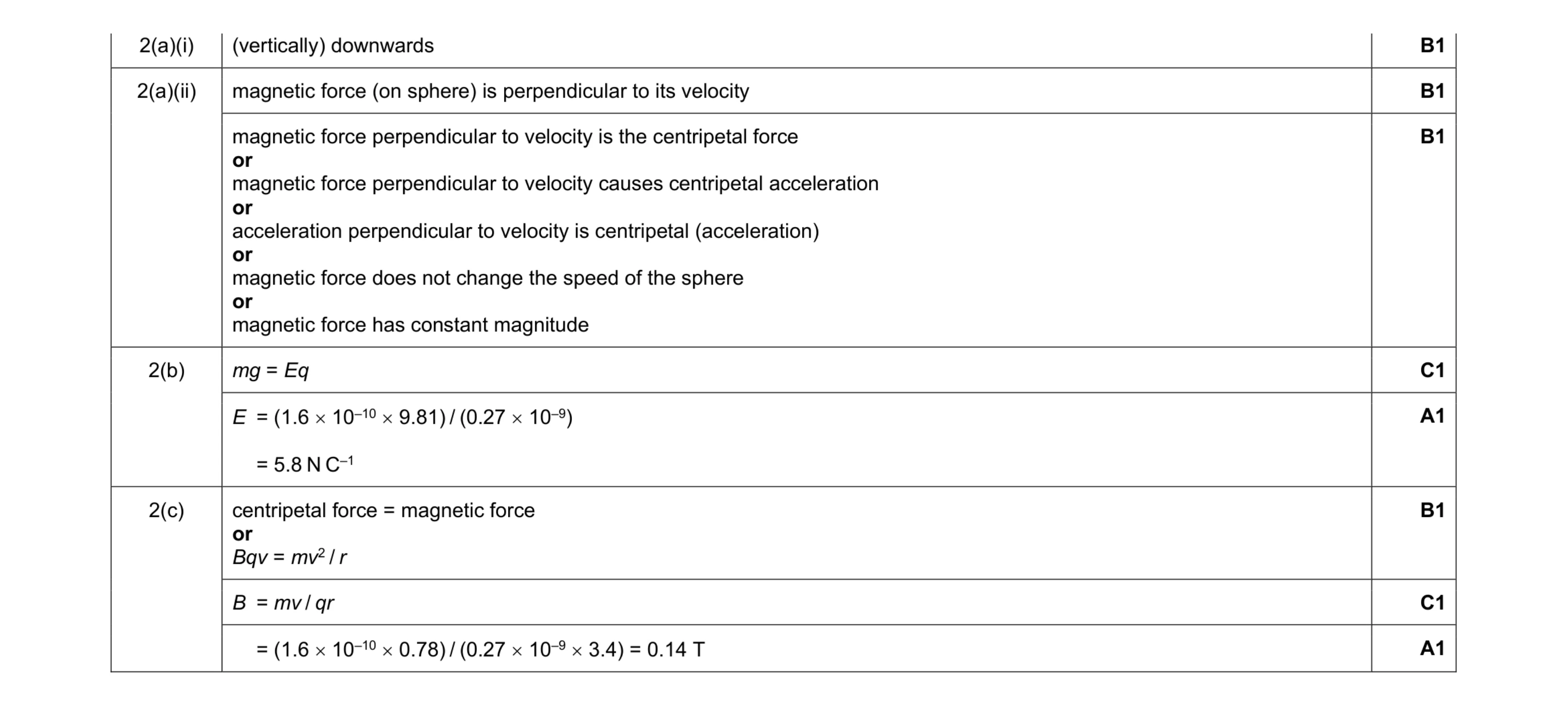 8
8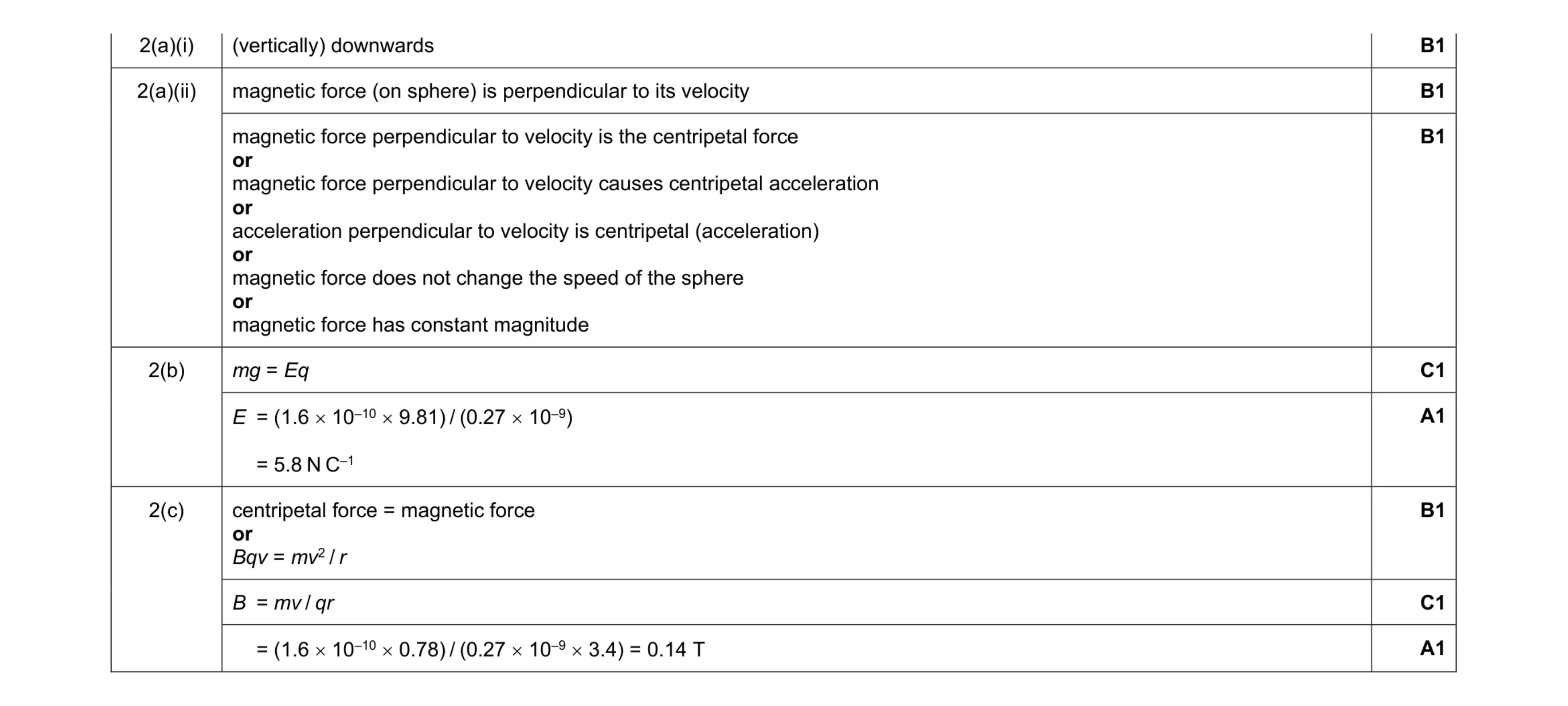 8
8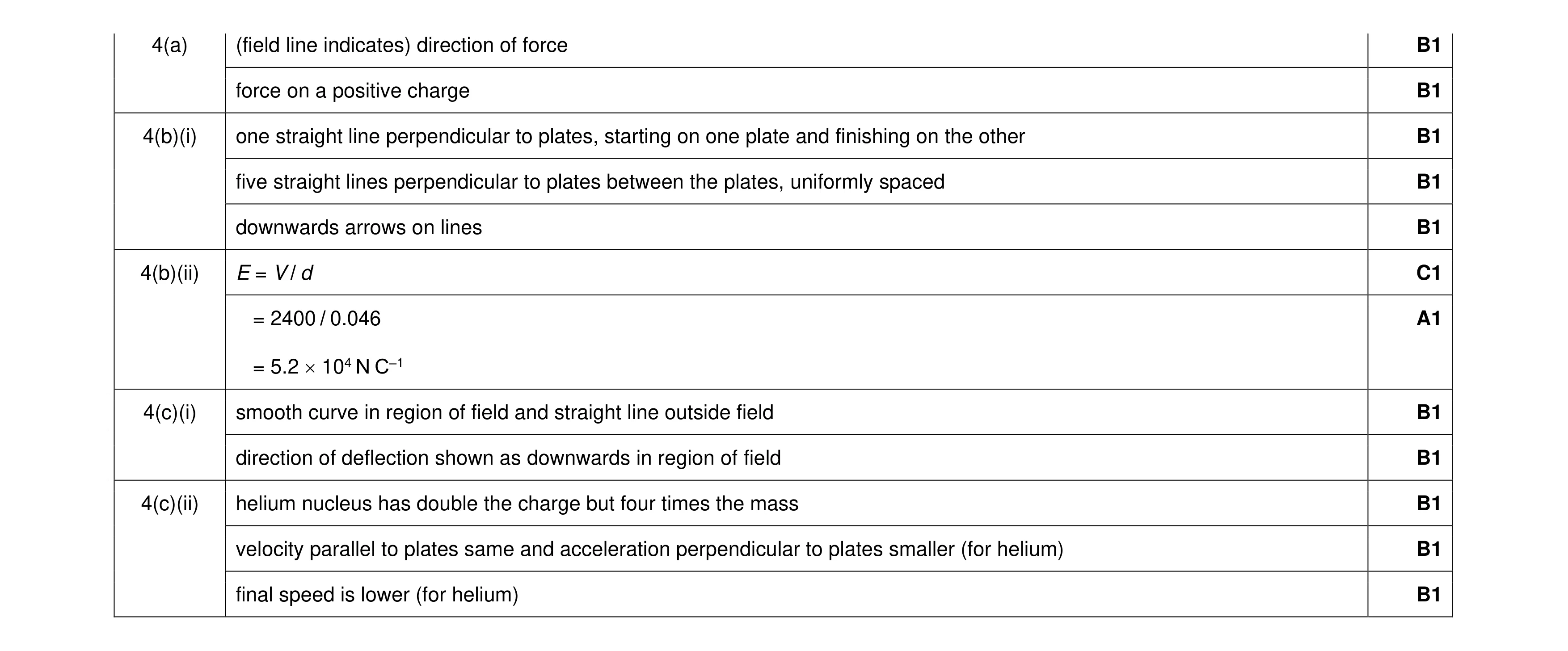 12
12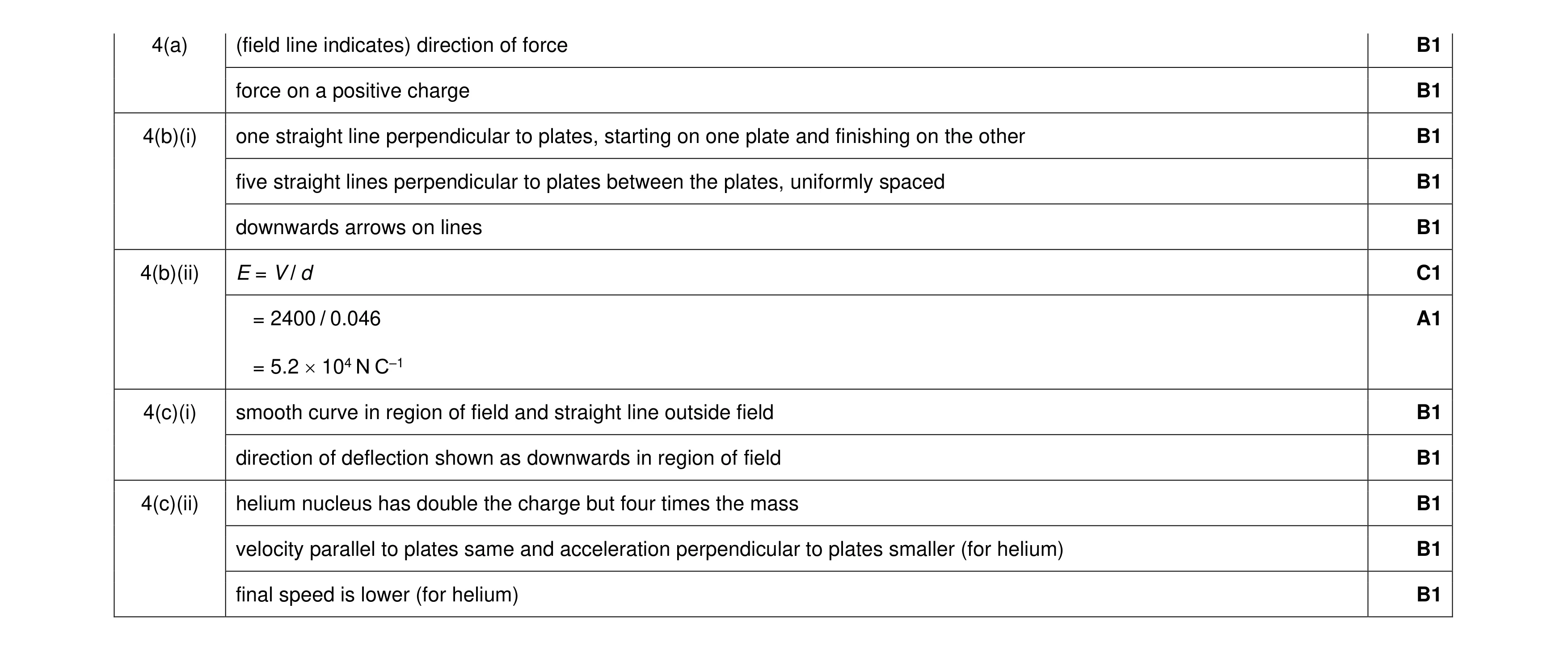 12
12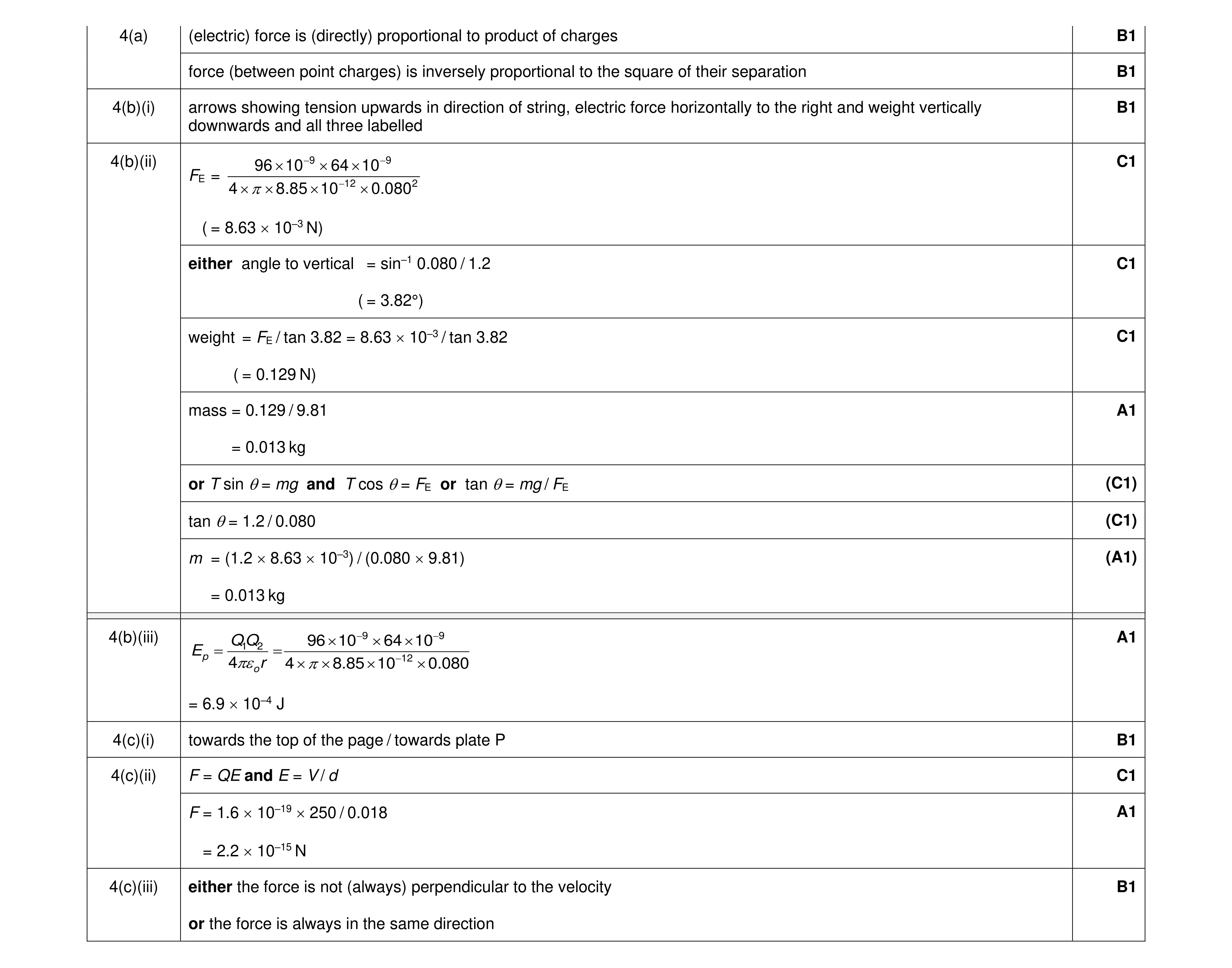 12
12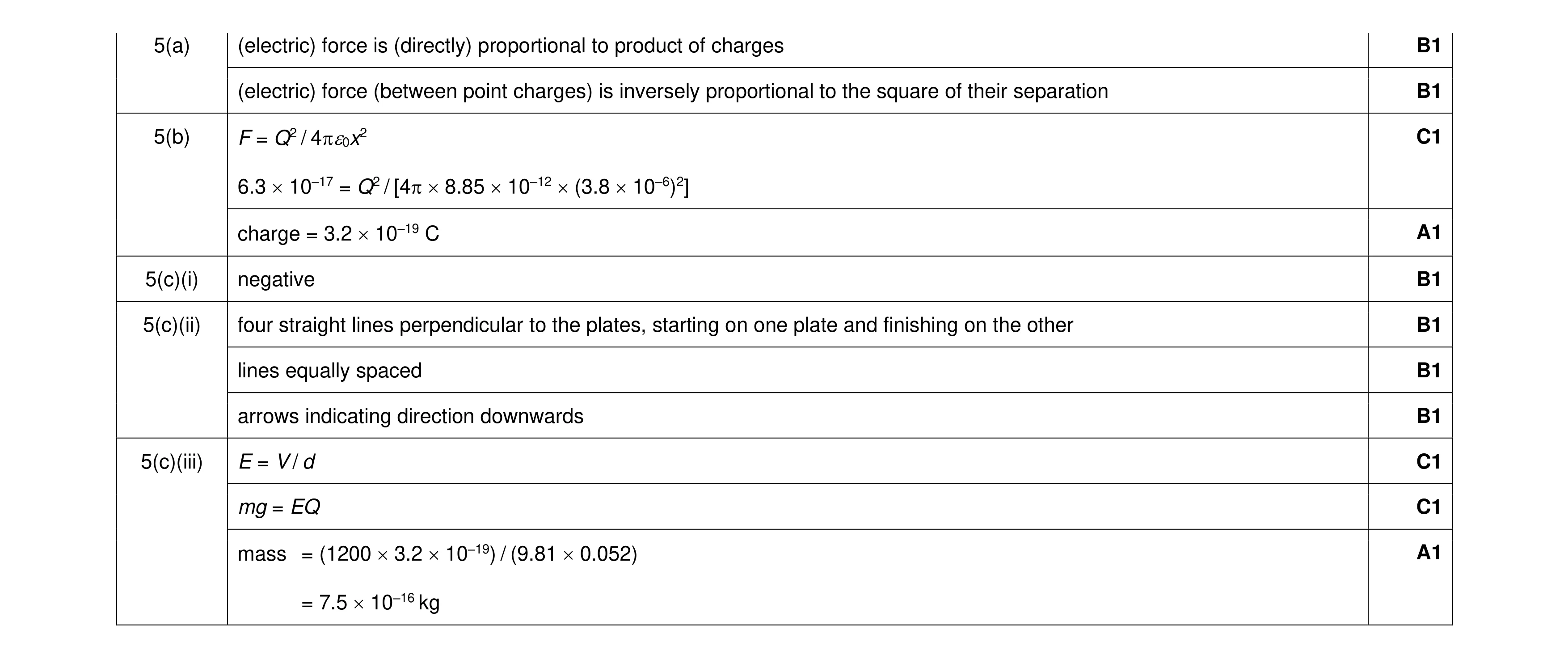 11
11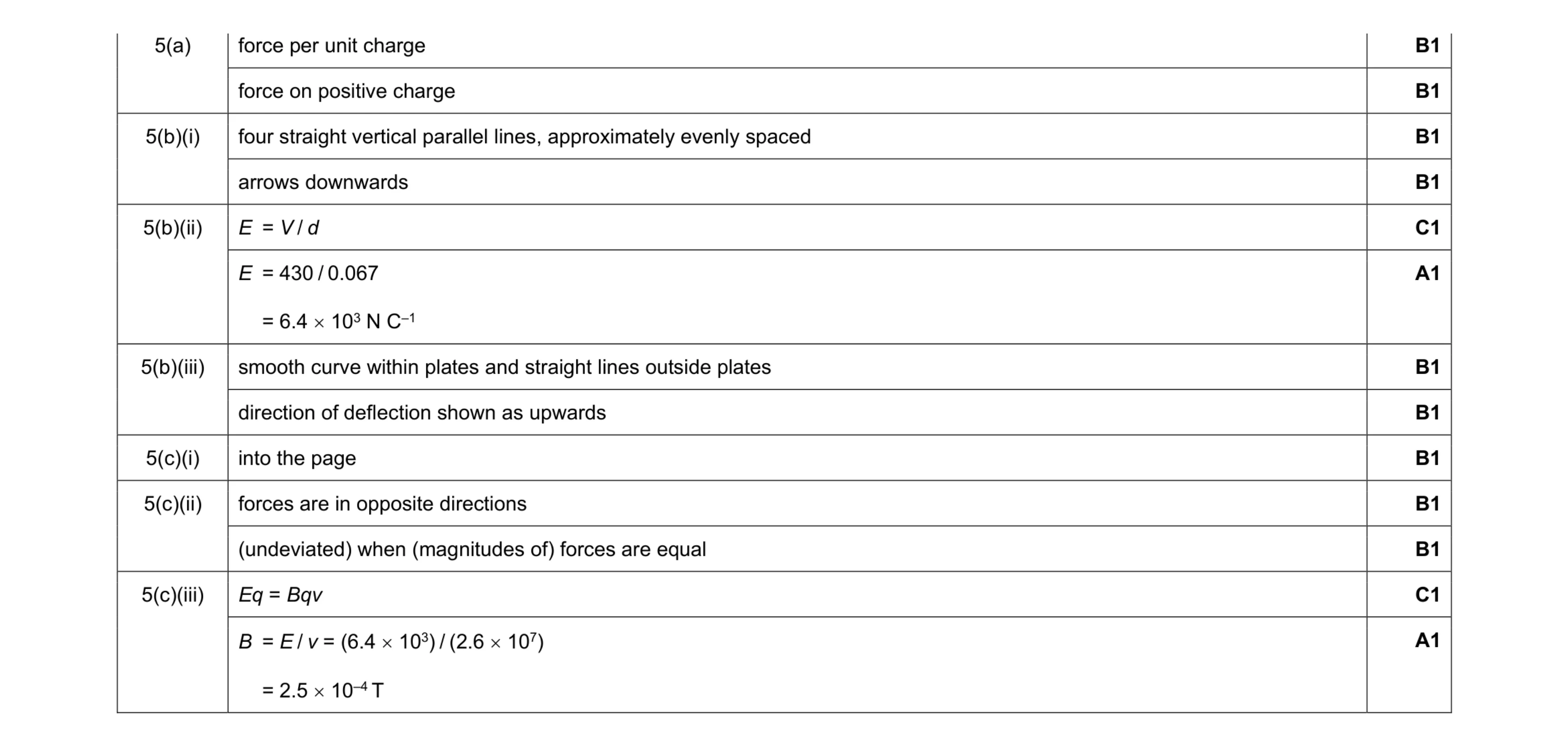 13
13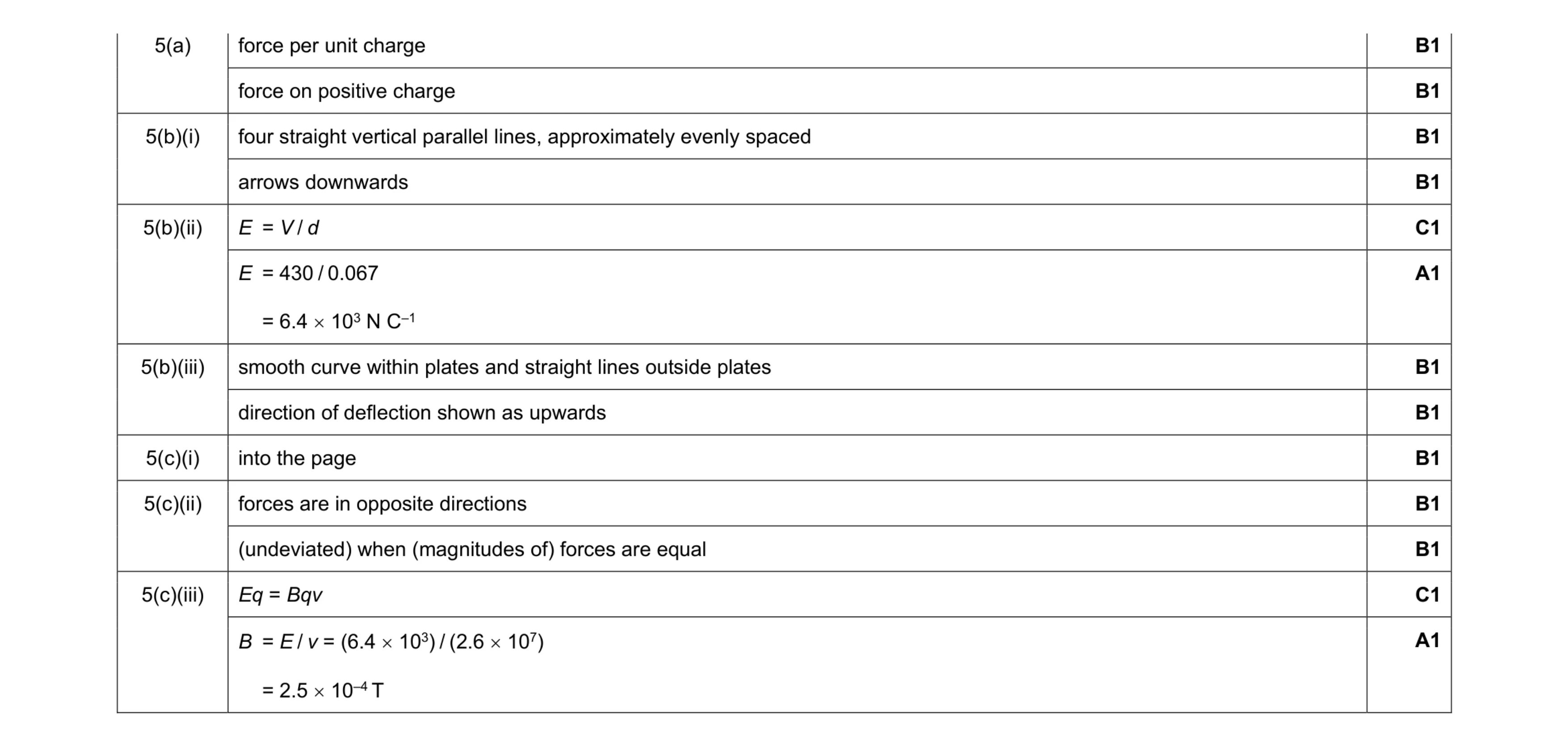 13
13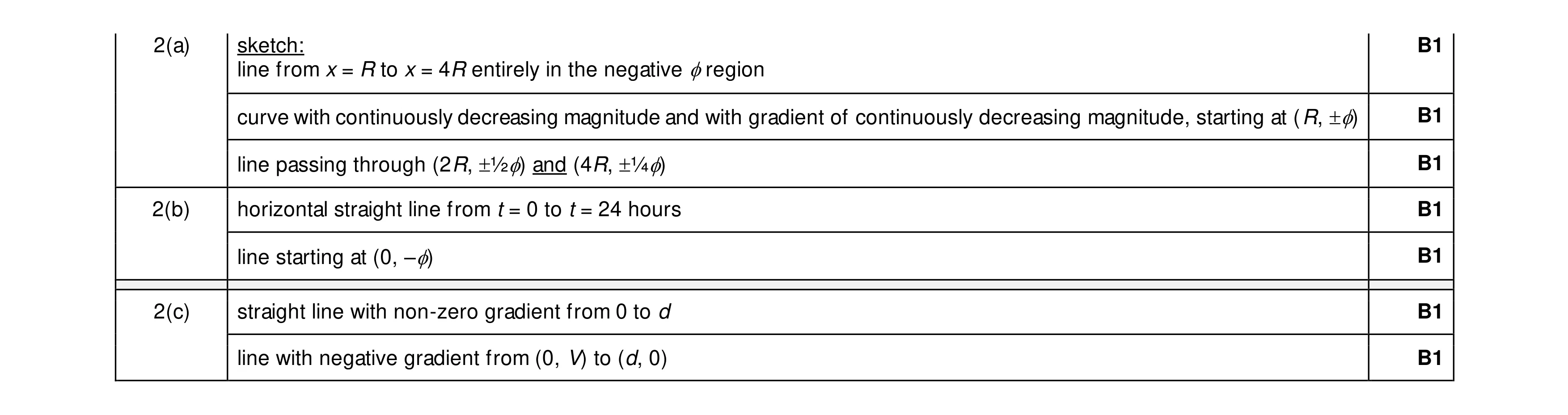 7
7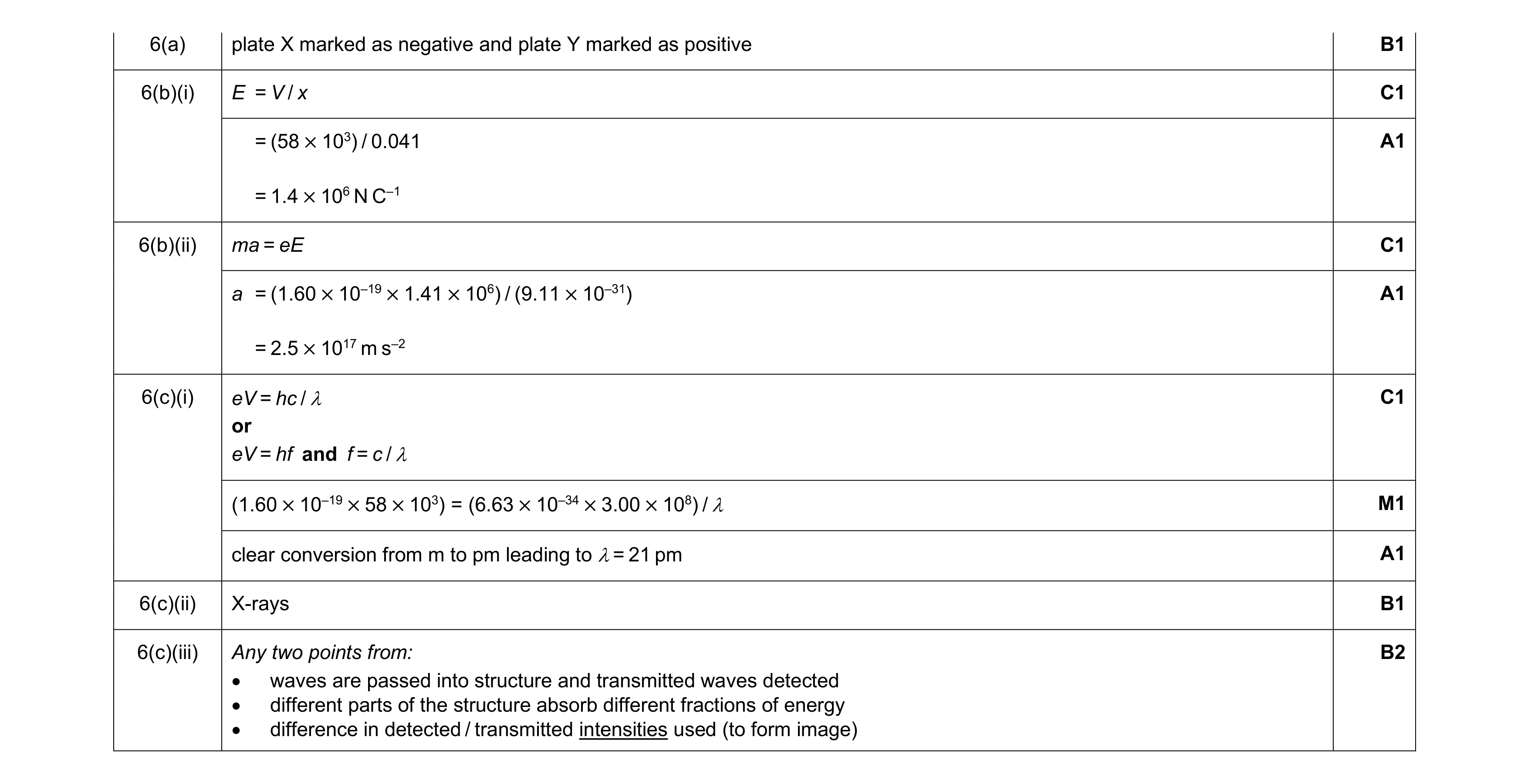 11
11