Questions as text
Q1 · An electron is travelling in a straight line through a vacuum with a constant speed of… 9702/22 Feb/March 2017
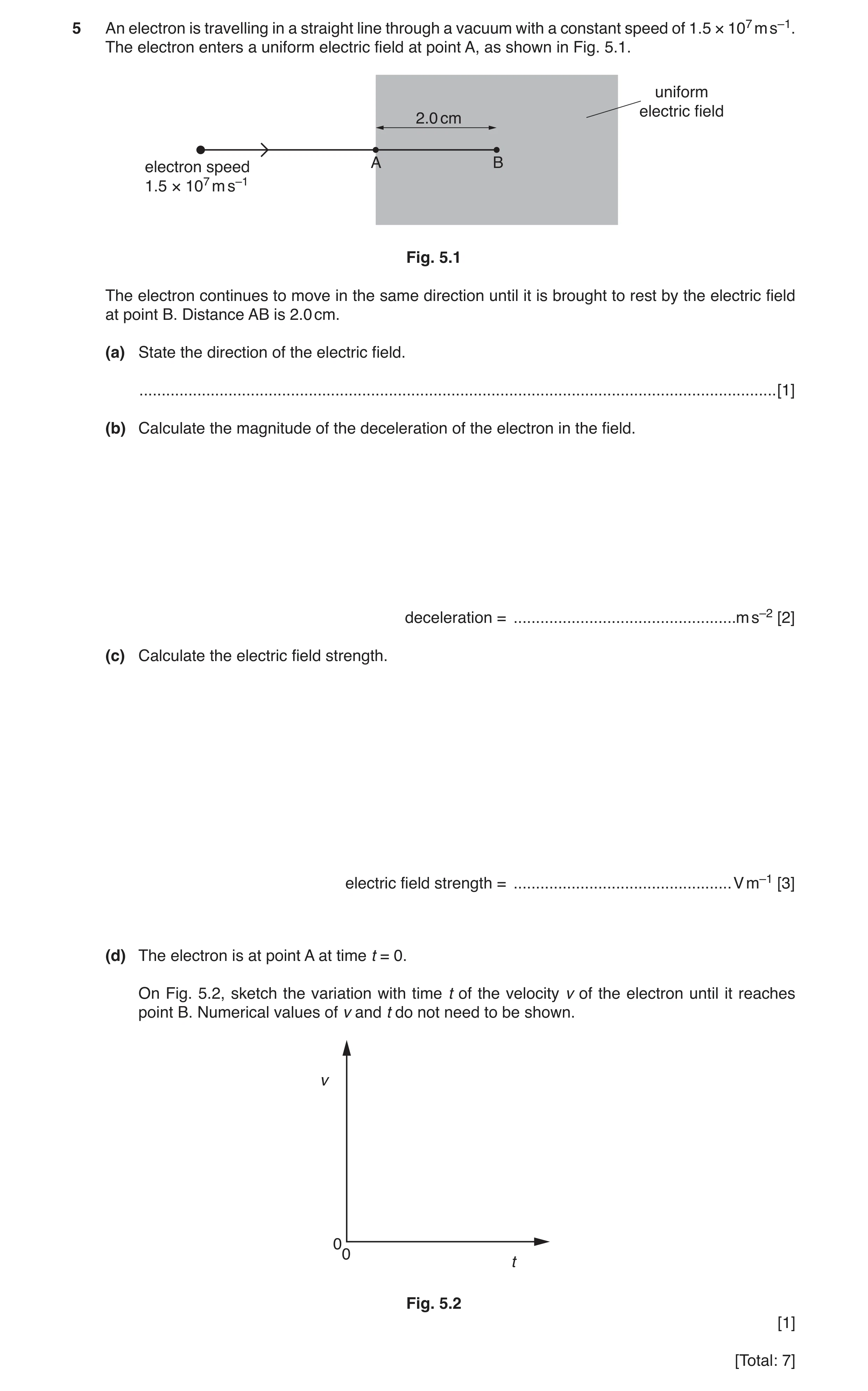
5 An electron is travelling in a straight line through a vacuum with a constant speed of 1.5 × 10⁷ m s–1. The electron enters a uniform electric field at point A, as shown in Fig. 5.1. uniform electric field 2.0 cm electron speed A B 1.5 × 10⁷ m s–1 Fig. 5.1 The electron continues to move in the same direction until it is brought to rest by the electric field at point B. Distance AB is 2.0 cm. (a) State the direction of the electric field. … [1] (b) Calculate the magnitude of the deceleration of the electron in the field. deceleration = … m s–2 [2] (c) Calculate the electric field strength. electric field strength = … V m–1 [3] (d) The electron is at point A at time t = 0. On Fig. 5.2, sketch the variation with time t of the velocity v of the electron until it reaches point B. Numerical values of v and t do not need to be shown. v 0 0 t Fig. 5.2 [1] [Total: 7]
7 marks
Mark scheme: 5(a) to the right / from the left / from A to B / in the same direction as electron velocity B1 5(b) v 2 = u 2 + 2as a = (1.5 × 10⁷)2 / (2 × 2.0 × 10–2) Other alternative calculations for the C1 mark: e.g. a = 1.5×10⁷ / 2.67×10⁻⁹ e.g. a = [(1.5×107 × 2.67×10–9) – 2.0×10–2] × [2 / (2.67×10⁻⁹)2] e.g. a = (2.0×10–2 × 2) / (2.67×10⁻⁹)2 C1 = 5.6 × 10¹⁵ m s–2 A1 5(c) E = F / Q C1 = (9.1 × 10–31 × 5.6 × 1015) / 1.6 × 10⁻¹⁹ C1 = 3.2 × 10⁴ V m–1 A1 5(d) straight line with negative gradient starting at an intercept on the v-axis and ending at an intercept on the t-axis. B1
This question in 9702/22 Feb/March 2017
Q2 · Define electric field strength 9702/23 May/June 2017
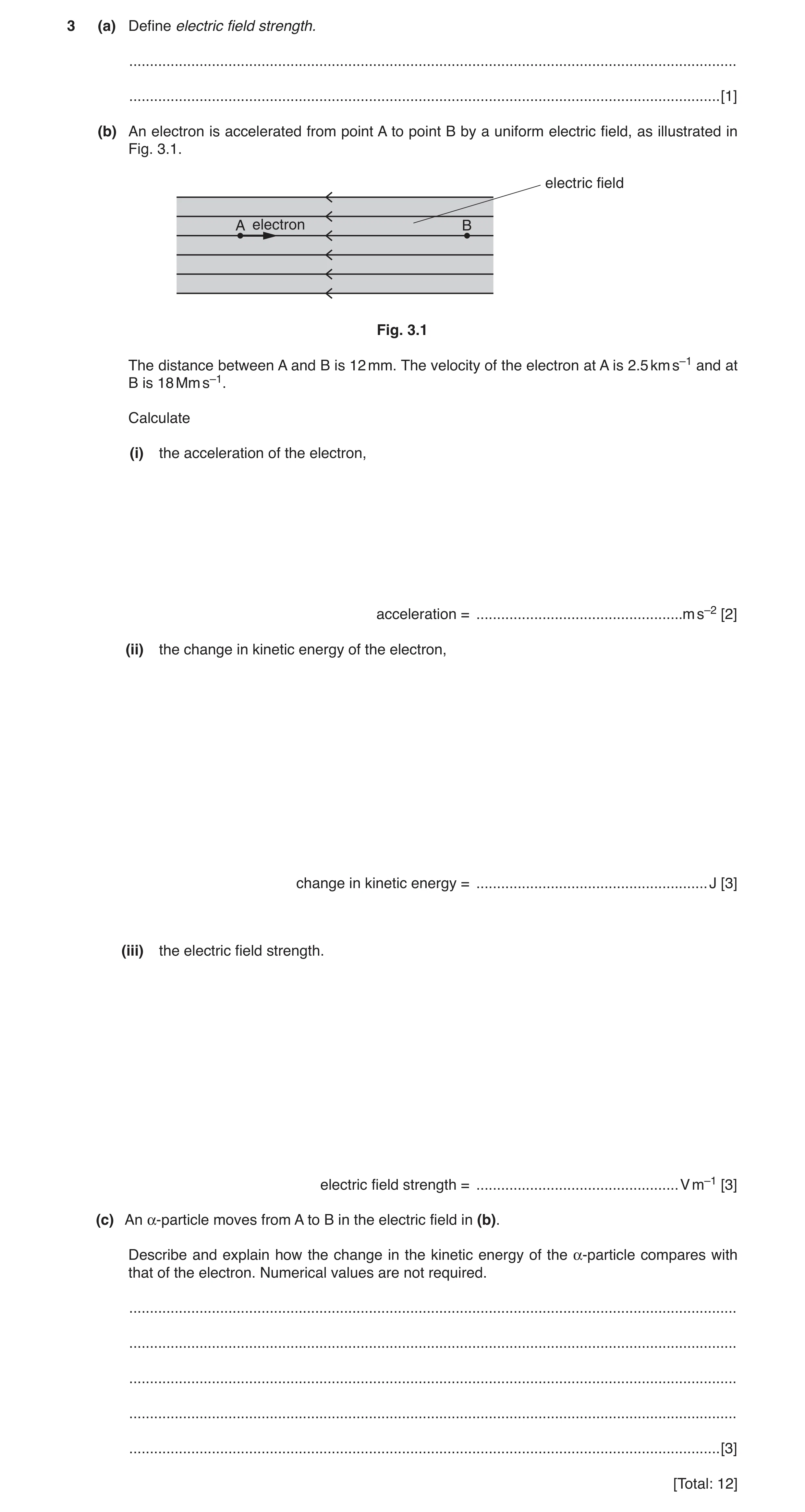
3 (a) Define electric field strength. … … [1] (b) An electron is accelerated from point A to point B by a uniform electric field, as illustrated in Fig. 3.1. electric field A electron B Fig. 3.1 The distance between A and B is 12 mm. The velocity of the electron at A is 2.5 km s–1 and at B is 18 Mm s–1. Calculate (i) the acceleration of the electron, acceleration = … m s–2 [2] (ii) the change in kinetic energy of the electron, change in kinetic energy = … J [3] (iii) the electric field strength. electric field strength = … V m–1 [3] (c) An α-particle moves from A to B in the electric field in (b). Describe and explain how the change in the kinetic energy of the α-particle compares with that of the electron. Numerical values are not required. … … … … … [3] [Total: 12]
12 marks
Mark scheme: 3(a) force per unit (positive) charge B1 3(b)(i) a = (v 2 − u 2) / 2s = [(18 × 106)2 − (2.5 × 10³)2] / (2 × 12 × 10–3) B1 = 1.3 (1.35) × 1016 m s–2 A1 3(b)(ii) KE = ½ mv 2 or ½ m(v2 – u2) C1 change in KE = 0.5 × 9.11 × 10–31 × [(18 × 106)2 − (2.5 × 10³)2] B1 = 1.5 (1.48) × 10–16J A1 3(b)(iii) E = F / e = ma / e or eV = ∆KE so E = ∆KE / (e × d) C1 E = (9.11 × 10–31 × 1.35 × 1016) / 1.60 × 10⁻¹⁹ or E = (1.48 × 10⁻¹⁶) / (12 × 10–3 × 1.60 × 10–19) C1 = 7.7 (7.69) × 104 V m–1 A1 3(c) charge on α opposite to electron/charge on α is positive B1 ∆KE is negative/KE reduced B1 charge of α greater/twice that of electron causes larger/twice ∆KE (in magnitude) B1
This question in 9702/23 May/June 2017
Q3 · Define electric field strength 9702/21 Oct/Nov 2017
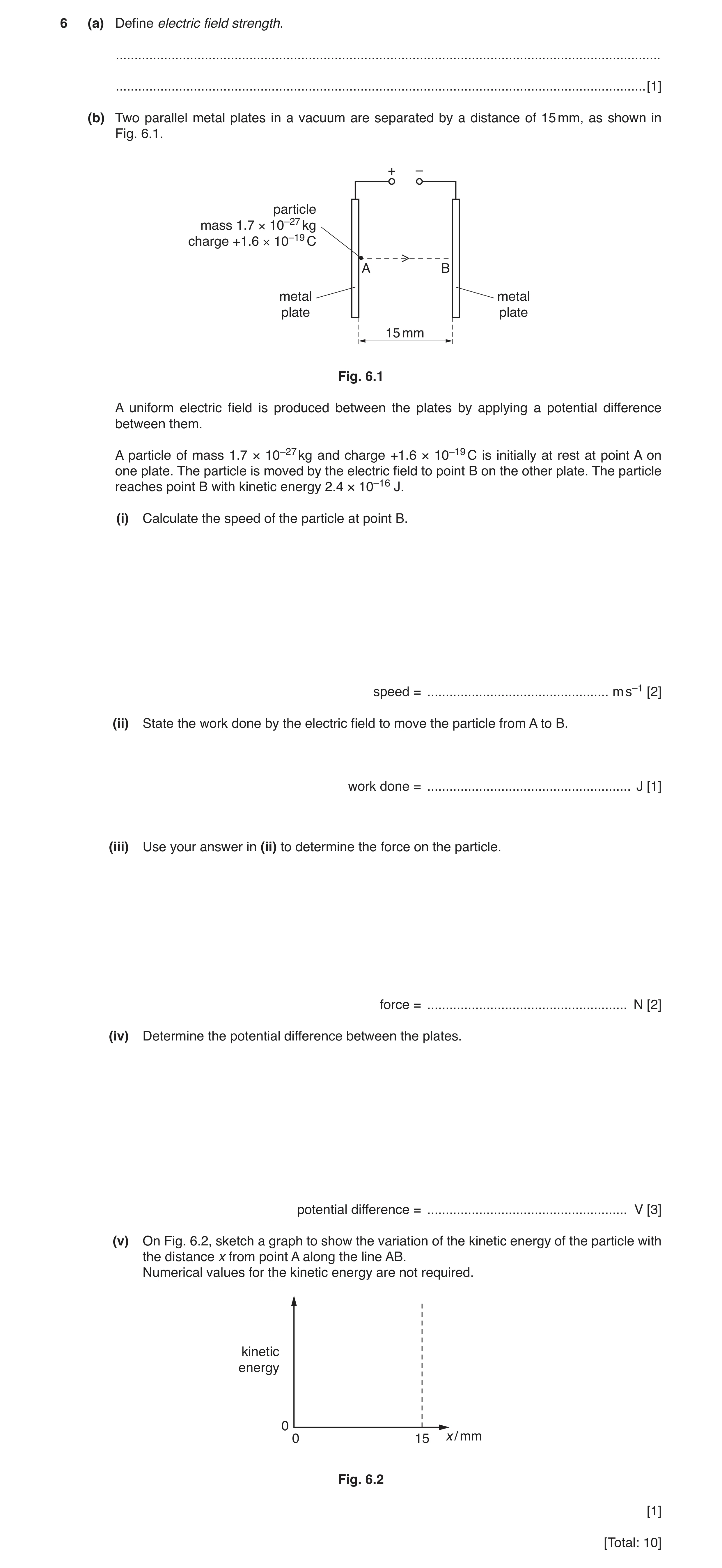
6 (a) Define electric field strength. … … [1] (b) Two parallel metal plates in a vacuum are separated by a distance of 15 mm, as shown in Fig. 6.1. + – particle mass 1.7 × 10⁻²⁷ kg charge +1.6 × 10⁻¹⁹ C A B metal metal plate plate 15 mm Fig. 6.1 A uniform electric field is produced between the plates by applying a potential difference between them. A particle of mass 1.7 × 10⁻²⁷ kg and charge +1.6 × 10⁻¹⁹ C is initially at rest at point A on one plate. The particle is moved by the electric field to point B on the other plate. The particle reaches point B with kinetic energy 2.4 × 10⁻¹⁶ J. (i) Calculate the speed of the particle at point B. speed = … m s–1 [2] (ii) State the work done by the electric field to move the particle from A to B. work done = … J [1] (iii) Use your answer in (ii) to determine the force on the particle. force = … N [2] (iv) Determine the potential difference between the plates. potential difference = … V [3] (v) On Fig. 6.2, sketch a graph to show the variation of the kinetic energy of the particle with the distance x from point A along the line AB. Numerical values for the kinetic energy are not required. kinetic energy 0 0 15 x / mm Fig. 6.2 [1] [Total: 10]
10 marks
Mark scheme: 6(a) force per unit positive charge B1 6(b)(i) EK = ½mv 2 C1 2.4 × 10–16 = ½ × 1.7 × 10⁻²⁷ × v 2 v = 5.3 × 10⁵ m s–1 A1 6(b)(ii) work done = 2.4 × 10⁻¹⁶ J A1 6(b)(iii) W = Fs C1 F = 2.4 × 10⁻¹⁶ / 15 × 10–3 = 1.6 × 10⁻¹⁴ N A1 6(b)(iv) V = Fd / Q or V = W / Q or E = V / d and E = F / Q C1 V = (1.6 × 10–14 × 15 × 10–3) / 1.6 × 10⁻¹⁹ or 2.4 × 10⁻¹⁶ / 1.6 × 10⁻¹⁹ C1 = 1500 V A1 6(b)(v) straight line with positive gradient starting at the origin and going as far as x = 15 mm B1
This question in 9702/21 Oct/Nov 2017
Question 4 9702/22 Oct/Nov 2017
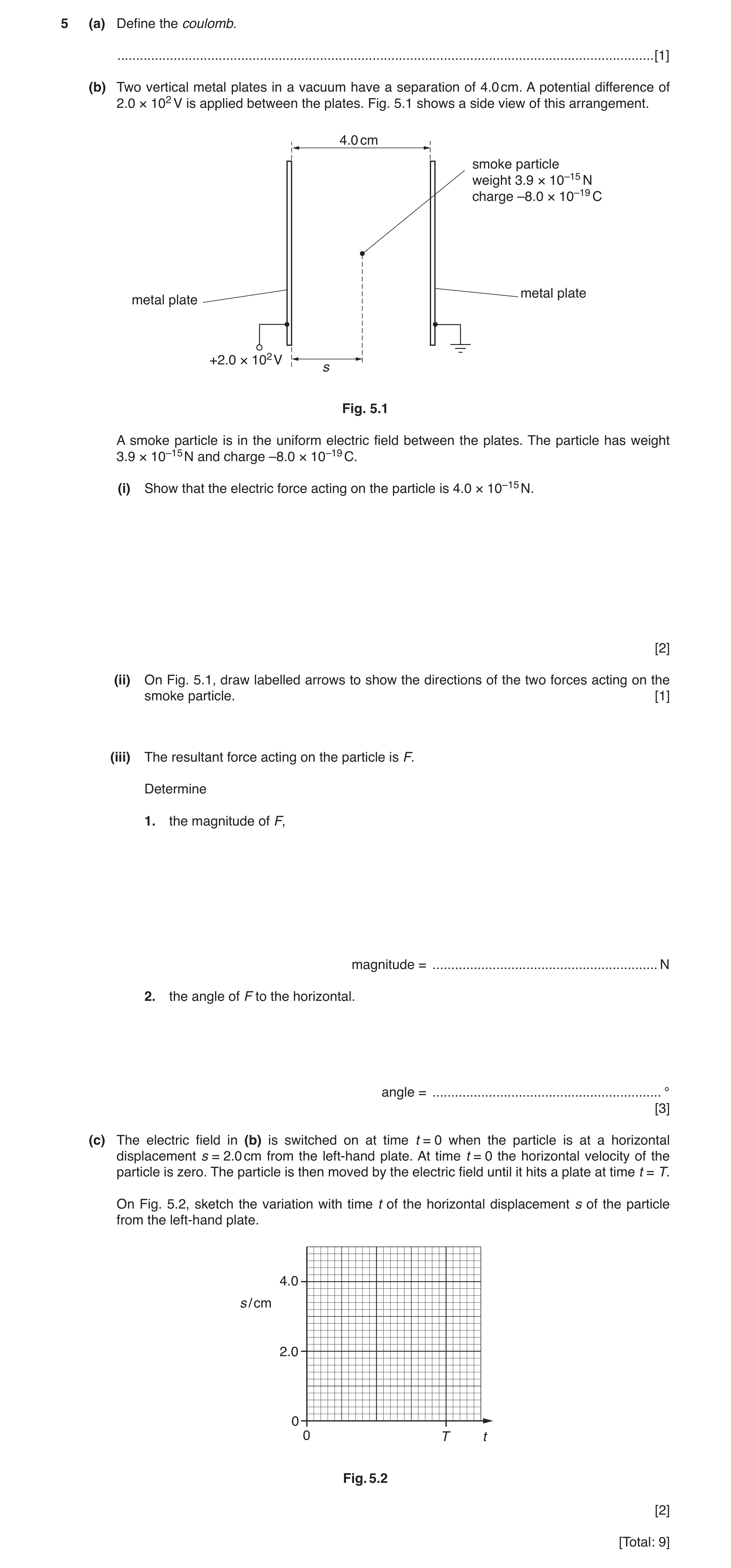
5 (a) Define the coulomb. … [1] (b) Two vertical metal plates in a vacuum have a separation of 4.0 cm. A potential difference of 2.0 × 10² V is applied between the plates. Fig. 5.1 shows a side view of this arrangement. 4.0 cm smoke particle weight 3.9 × 10⁻¹⁵ N charge –8.0 × 10⁻¹⁹ C metal plate metal plate +2.0 × 10² V s Fig. 5.1 A smoke particle is in the uniform electric field between the plates. The particle has weight 3.9 × 10⁻¹⁵ N and charge –8.0 × 10⁻¹⁹ C. (i) Show that the electric force acting on the particle is 4.0 × 10⁻¹⁵ N. [2] (ii) On Fig. 5.1, draw labelled arrows to show the directions of the two forces acting on the smoke particle. [1] (iii) The resultant force acting on the particle is F. Determine 1. the magnitude of F, magnitude = … N 2. the angle of F to the horizontal. angle = … ° [3] (c) The electric field in (b) is switched on at time t = 0 when the particle is at a horizontal displacement s = 2.0 cm from the left-hand plate. At time t = 0 the horizontal velocity of the particle is zero. The particle is then moved by the electric field until it hits a plate at time t = T. On Fig. 5.2, sketch the variation with time t of the horizontal displacement s of the particle from the left-hand plate. 4.0 s / cm 2.0 0 0 T t Fig. 5.2 [2] [Total: 9]
9 marks
Mark scheme: 5(a) (coulomb is) ampere second B1 5(b)(i) E = V / d or E = F / Q C1 F = VQ / d F = (2.0 × 102 × 8.0 × 10–19) / 4.0 × 10–2 = 4.0 × 10⁻¹⁵ N A1 5(b)(ii) arrow pointing to the left labelled ‘electric force’ and arrow pointing downwards labelled ‘weight’ B1 5(b)(iii) 1. resultant force = √ [(3.9 × 10⁻¹⁵)2 + (4.0 × 10⁻¹⁵)2] C1 = 5.6 × 10⁻¹⁵ N A1 2. angle = tan–1 (3.9 × 10⁻¹⁵ / 4.0 × 10⁻¹⁵) = 44° A1 5(c) downward sloping line from (0, 2.0) M1 magnitude of gradient of line increases with time and line ends at (T, 0) A1
This question in 9702/22 Oct/Nov 2017
Q5 · A β– particle from a radioactive source is travelling in a vacuum with kinetic energy 460… 9702/21 May/June 2018
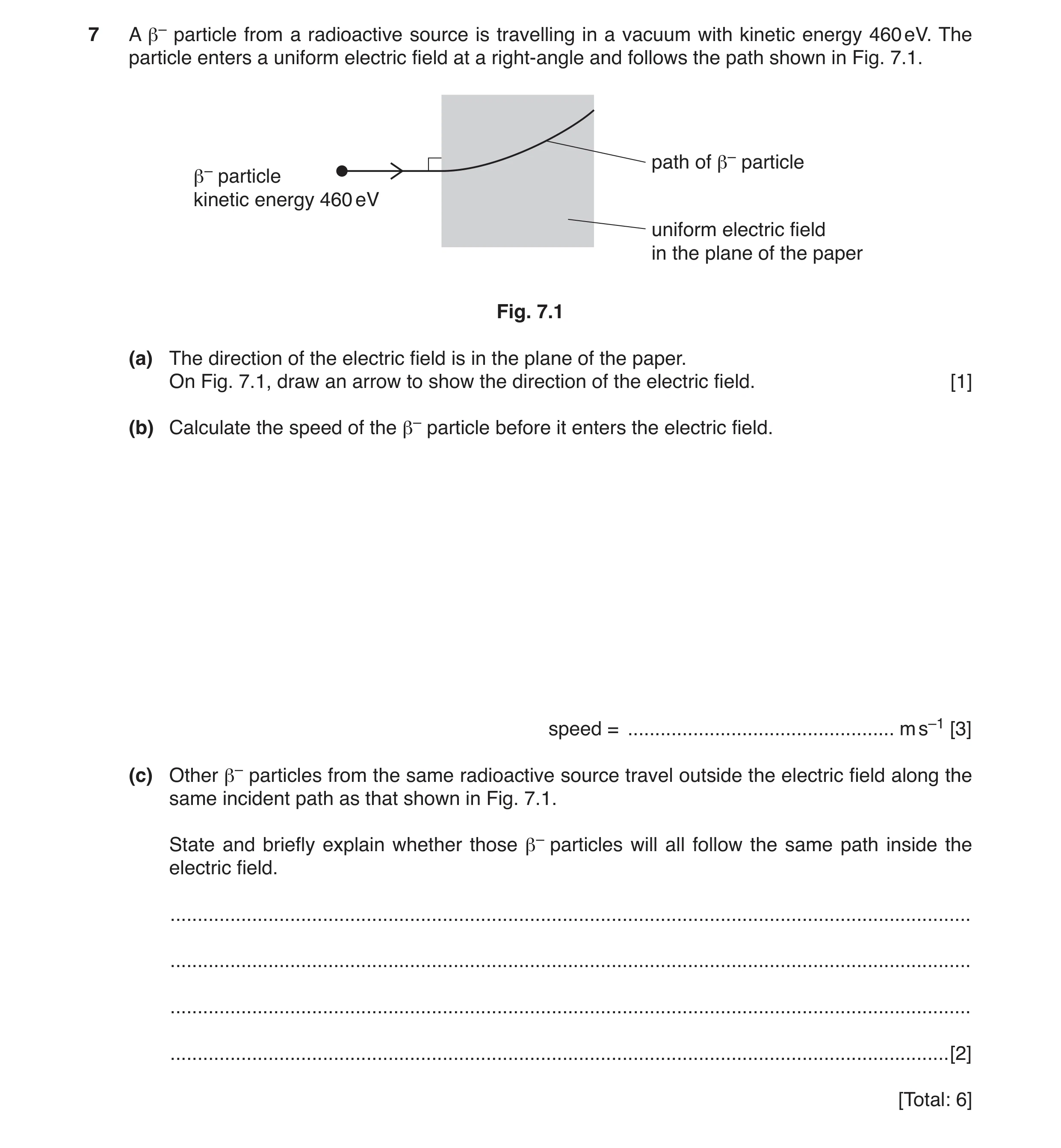
7 A β– particle from a radioactive source is travelling in a vacuum with kinetic energy 460 eV. The particle enters a uniform electric field at a right-angle and follows the path shown in Fig. 7.1. path of β– particle β– particle kinetic energy 460 eV uniform electric field in the plane of the paper Fig. 7.1 (a) The direction of the electric field is in the plane of the paper. On Fig. 7.1, draw an arrow to show the direction of the electric field. [1] (b) Calculate the speed of the β– particle before it enters the electric field. speed = … m s–1 [3] (c) Other β– particles from the same radioactive source travel outside the electric field along the same incident path as that shown in Fig. 7.1. State and briefly explain whether those β– particles will all follow the same path inside the electric field. … … … … [2] [Total: 6]
6 marks
Mark scheme: 7(a) arrow pointing vertically down the page B1 7(b) E = ½mv2 C1 E = 460 × 1.60 × 10–19 (= 7.36 × 10⁻¹⁷ (J)) C1 v = [(2 × 460 × 1.60 × 10–19) / (9.11 × 10⁻³¹)]½ = 1.3 × 10⁷ m s–1 A1 7(c) β– particles have range of/different/various speeds/velocities/momenta/energies M1 so they follow different paths A1
This question in 9702/21 May/June 2018
Q6 · State what is meant by an electric field 9702/21 Oct/Nov 2018
5 (a) State what is meant by an electric field. … … [1] (b) A particle of mass m and charge q is in a uniform electric field of strength E. The particle has acceleration a due to the field. Show that Eq a = . m [2] (c) A stationary nucleus X decays by emitting an α-particle to form a nucleus of plutonium, 24094 Pu, as shown. α X 24094 Pu + (i) Determine the number of protons and the number of neutrons in nucleus X. number of protons = … number of neutrons = … [2] (ii) The total mass of the plutonium nucleus and the α-particle is less than that of nucleus X. Explain this difference in mass. … … … … [2] (iii) The plutonium nucleus and the α-particle are both accelerated by the same uniform electric field. Use the expression in (b) to determine the ratio acceleration of the α-particle . acceleration of the plutonium nucleus ratio = … [2] [Total: 9]
9 marks
Mark scheme: 5(a) region (of space) where a force acts on a (stationary) charge B1 5(b) E = F / Q B1 F = ma and (so) Eq a m = A1 5(c)(i) protons = 96 A1 neutrons = 148 A1 5(c)(ii) mass-energy is conserved/mass change is ‘seen’ as energy B1 energy released as gamma (radiation)/KE of α/KE of Pu B1 5(c)(iii) 9 4 2 4 0 × = 4 2 ratio or 1 9 2 7 2 7 1 9 1 0 6 0 . 1 9 4 1 0 6 6 . 1 2 4 0 1 0 6 6 . 1 4 − − − − × × × × × × × × × = 10 1.60 2 ratio C1 ratio = 1.3 A1
This question in 9702/21 Oct/Nov 2018
Q7 · A particle of mass m and charge q is in a uniform electric field of strength E 9702/23 Oct/Nov 2018
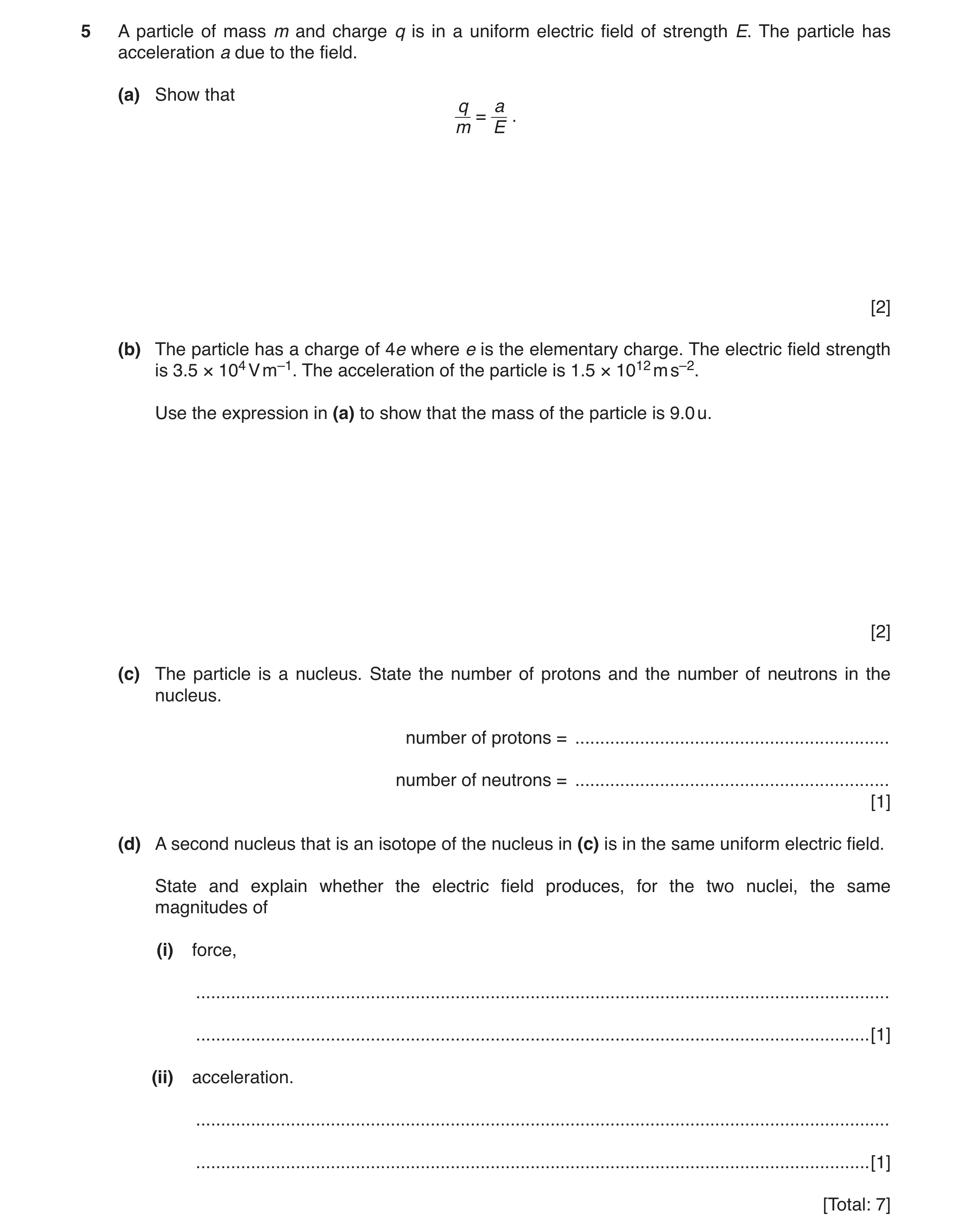
5 A particle of mass m and charge q is in a uniform electric field of strength E. The particle has acceleration a due to the field. (a) Show that q a = . m E [2] (b) The particle has a charge of 4e where e is the elementary charge. The electric field strength is 3.5 × 10⁴ V m–1. The acceleration of the particle is 1.5 × 10¹² m s–2. Use the expression in (a) to show that the mass of the particle is 9.0 u. [2] (c) The particle is a nucleus. State the number of protons and the number of neutrons in the nucleus. number of protons = … number of neutrons = … [1] (d) A second nucleus that is an isotope of the nucleus in (c) is in the same uniform electric field. State and explain whether the electric field produces, for the two nuclei, the same magnitudes of (i) force, … … [1] (ii) acceleration. … … [1] [Total: 7]
7 marks
Mark scheme: 5(a) E = F / Q M1 F = ma and (so) q / m = a / E A1 5(b) m = (4 × 1.60 × 10–19 × 3.5 × 104) / 1.5 × 10¹² (= 1.49 × 10⁻²⁶kg) B1 = 1.49 × 10⁻²⁶ / 1.66 × 10–27 = 9.0 (u) A1 5(c) protons: 4 and neutrons: 5 A1 5(d)(i) nuclei have the same charge and so same (magnitudes of) force B1 5(d)(ii) nuclei have different masses and same force and so different (magnitudes of) acceleration B1
This question in 9702/23 Oct/Nov 2018
Q8 · Define electric field strength 9702/22 Feb/March 2019
4 (a) Define electric field strength. … … [1] (b) Two very small metal spheres X and Y are connected by an insulating rod of length 72 mm. A side view of this arrangement is shown in Fig. 4.1. +3e uniform electric field, X field strength 5.0 × 10⁴ V m–1 72 mm in vertically upwards direction θ horizontal Z θ SIDE rod VIEW Y –3e Fig. 4.1 (not to scale) Sphere X has a charge of +3e and sphere Y has a charge of –3e, where e is the elementary charge. The rod is held at its mid point Z at an angle θ to the horizontal. The rod and spheres have negligible mass and are in a uniform electric field. The electric field strength is 5.0 × 10⁴ V m–1. The direction of this field is vertically upwards. (i) The electric field is produced by applying a potential difference of 4.0 kV between two charged parallel metal plates. 1. Calculate the separation between the plates. separation = … m [2] 2. Describe the arrangement of the two plates. Include in your answer a statement of the sign of the charge on each plate. You may draw on Fig. 4.1. … … … … [2] (ii) Determine the magnitude and direction of the force on sphere Y. magnitude = … N direction … [2] (iii) The electric forces acting on the two spheres form a couple. This couple acts on the rod with a torque of 6.2 × 10⁻¹⁶ N m. Calculate the angle θ of the rod to the horizontal. θ = … ° [2] [Total: 9]
9 marks
Mark scheme: 4(a) force per unit positive charge B1 4(b)(i) 1 E = V / d or E = ∆V / ∆d d = 4.0 × 10³ / 5.0 × 10⁴ C1 = 8.0 × 10⁻² m A1 2 plates are (in) horizontal (plane) (above and below the rod) B1 top (plate) negative and bottom (plate) positive B1 4(b)(ii) magnitude = 5.0 × 104 × 3 × 1.6 × 10–19 = 2.4 × 10⁻¹⁴ N A1 direction is (vertically) downwards / down B1 Question Answer Marks 4(b)(iii) 6.2 × 10–16 = 2.4 × 10–14 × 72 × 10–3 × cosθ C1 θ = 69° A1
This question in 9702/22 Feb/March 2019
Q9 · Two vertical metal plates in a vacuum are separated by a distance of 0.12 m 9702/23 May/June 2019
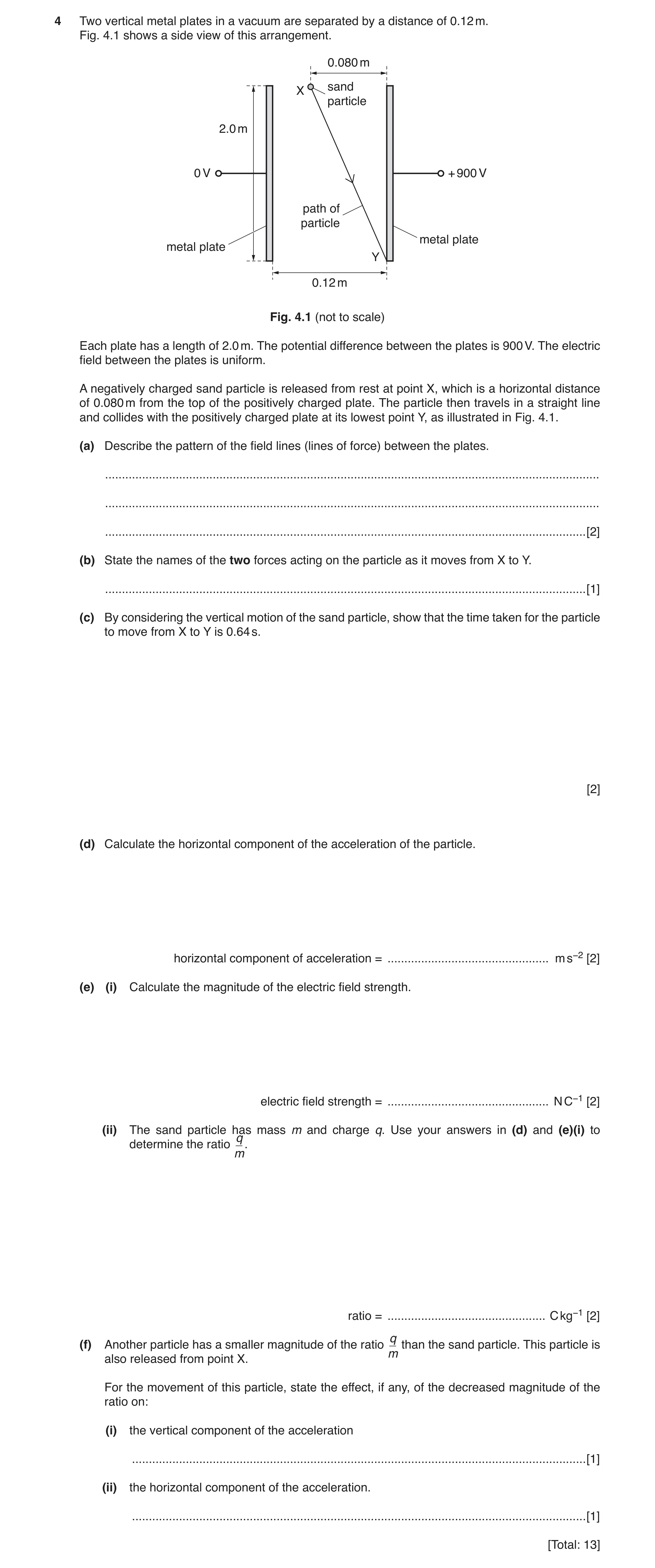
4 Two vertical metal plates in a vacuum are separated by a distance of 0.12 m. Fig. 4.1 shows a side view of this arrangement. 0.080 m sand X particle 2.0 m 0 V + 900 V path of particle metal plate metal plate Y 0.12 m Fig. 4.1 (not to scale) Each plate has a length of 2.0 m. The potential difference between the plates is 900 V. The electric field between the plates is uniform. A negatively charged sand particle is released from rest at point X, which is a horizontal distance of 0.080 m from the top of the positively charged plate. The particle then travels in a straight line and collides with the positively charged plate at its lowest point Y, as illustrated in Fig. 4.1. (a) Describe the pattern of the field lines (lines of force) between the plates. … … … [2] (b) State the names of the two forces acting on the particle as it moves from X to Y. … [1] (c) By considering the vertical motion of the sand particle, show that the time taken for the particle to move from X to Y is 0.64 s. [2] (d) Calculate the horizontal component of the acceleration of the particle. horizontal component of acceleration = … m s−2 [2] (e) (i) Calculate the magnitude of the electric field strength. electric field strength = … N C−1 [2] (ii) The sand particle has mass m and charge q. Use your answers in (d) and (e)(i) to q determine the ratio m. ratio = … C kg−1 [2] q(f) Another particle has a smaller magnitude of the ratio than the sand particle. This particle is m also released from point X. For the movement of this particle, state the effect, if any, of the decreased magnitude of the ratio on: (i) the vertical component of the acceleration … [1] (ii) the horizontal component of the acceleration. … [1] [Total: 13]
13 marks
Mark scheme: 4(a) straight (horizontal) lines and from the +0.90 kV plate/to the 0 V plate B1 (lines are) equally spaced B1 4(b) weight/gravitational force and electric force B1 4(c) s = ½ at 2 or s = ut + ½at 2 and u = 0 C1 2.0 = ½ × 9.81 × t 2 so t = 0.64 s A1 4(d) 0.080 = ½ × a × 0.642 C1 a = 0.39 m s–2 A1 4(e)(i) E = (∆)V / (∆)d C1 E = 0.90 × 10³ / 0.12 = 7.5 × 10³ N C–1 A1 4(e)(ii) ma = Eq or F = ma and F = Eq C1 q / m = 0.39 / 7.5 × 103 = 5.2 × 10⁻⁵ C kg–1 A1 4(f)(i) no effect B1 4(f)(ii) decreases/smaller B1
This question in 9702/23 May/June 2019
Q10 · A small charged glass bead of weight 5.4 × 10⁻⁵ N is initially at rest at point A in a… 9702/21 Oct/Nov 2019
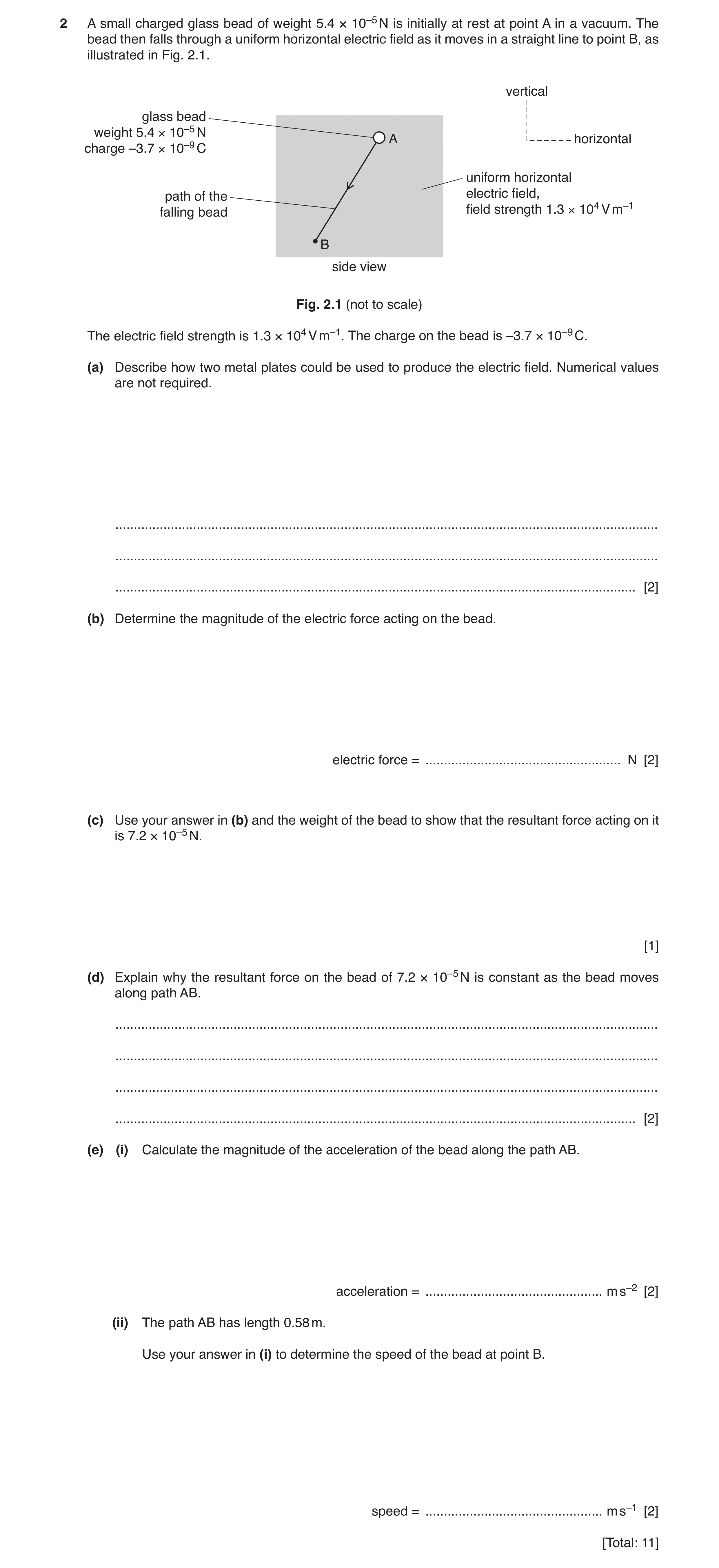
2 A small charged glass bead of weight 5.4 × 10⁻⁵ N is initially at rest at point A in a vacuum. The bead then falls through a uniform horizontal electric field as it moves in a straight line to point B, as illustrated in Fig. 2.1. vertical glass bead weight 5.4 × 10⁻⁵ N A horizontal charge –3.7 × 10⁻⁹ C uniform horizontal path of the electric field, × 104 V m–1 falling bead field strength 1.3 B side view Fig. 2.1 (not to scale) The electric field strength is 1.3 × 10⁴ V m–1. The charge on the bead is –3.7 × 10⁻⁹ C. (a) Describe how two metal plates could be used to produce the electric field. Numerical values are not required. … … … [2] (b) Determine the magnitude of the electric force acting on the bead. electric force = … N [2] (c) Use your answer in (b) and the weight of the bead to show that the resultant force acting on it is 7.2 × 10⁻⁵ N. [1] (d) Explain why the resultant force on the bead of 7.2 × 10⁻⁵ N is constant as the bead moves along path AB. … … … … [2] (e) (i) Calculate the magnitude of the acceleration of the bead along the path AB. acceleration = … m s–2 [2] (ii) The path AB has length 0.58 m. Use your answer in (i) to determine the speed of the bead at point B. speed = … m s–1 [2] [Total: 11]
11 marks
Mark scheme: 2(a) the (two) plates are vertical (and separated) B1 left plate positively charged and right plate negatively charged/earthed or right plate negatively charged and left plate positively charged/earthed B1 2(b) F = Eq C1 = 1.3 × 104 × 3.7 × 10–9 = 4.8 × 10⁻⁵ N A1 2(c) F2 = (4.8 × 10⁻⁵)2 + (5.4 × 10⁻⁵)2 so F = 7.2 × 10⁻⁵ N or F = [(4.8 × 10⁻⁵)2 + (5.4 × 10⁻⁵)2]0.5 so F = 7.2 × 10⁻⁵ N A1 2(d) electric force is constant (because field strength/E is constant) B1 weight is constant (and so resultant force constant) B1 2(e)(i) m = 5.4 × 10⁻⁵ / 9.81 (= 5.5 × 10⁻⁶) C1 a = 7.2 × 10⁻⁵ / (5.5 × 10⁻⁶) =13 m s–2 A1 2(e)(ii) v2 = u2 + 2as v2 = 2 × 13 × 0.58 C1 v = 3.9 m s–1 A1
This question in 9702/21 Oct/Nov 2019
Q11 · State the property of an object that experiences a force when the object is placed in… 9702/23 Oct/Nov 2019
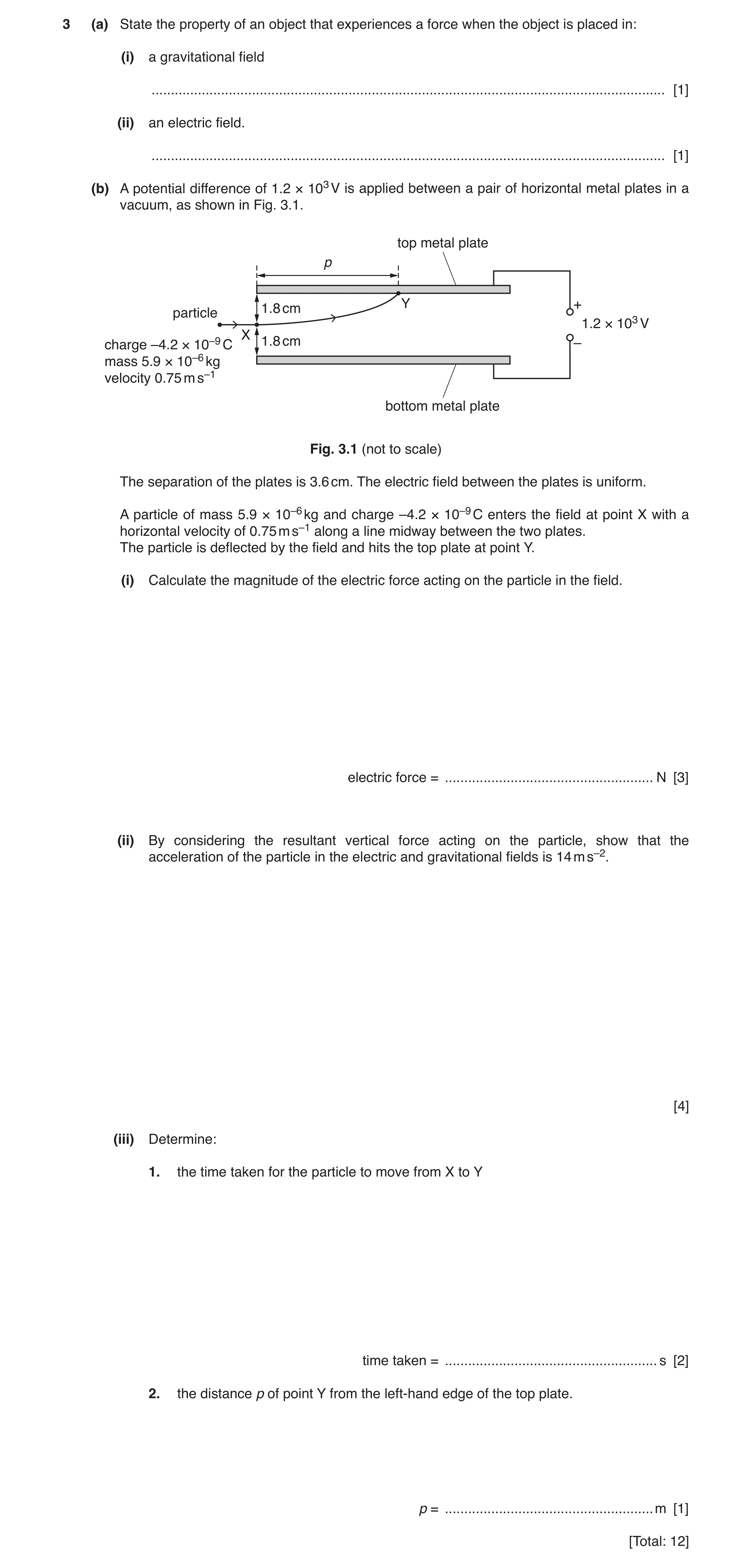
3 (a) State the property of an object that experiences a force when the object is placed in: (i) a gravitational field … [1] (ii) an electric field. … [1] (b) A potential difference of 1.2 × 10³ V is applied between a pair of horizontal metal plates in a vacuum, as shown in Fig. 3.1. top metal plate p Y + 1.8 cm particle 1.2 × 10³ V X charge –4.2 × 10⁻⁹ C 1.8 cm – mass 5.9 × 10⁻⁶ kg velocity 0.75 m s–1 bottom metal plate Fig. 3.1 (not to scale) The separation of the plates is 3.6 cm. The electric field between the plates is uniform. A particle of mass 5.9 × 10⁻⁶ kg and charge –4.2 × 10⁻⁹ C enters the field at point X with a horizontal velocity of 0.75 m s–1 along a line midway between the two plates. The particle is deflected by the field and hits the top plate at point Y. (i) Calculate the magnitude of the electric force acting on the particle in the field. electric force = … N [3] (ii) By considering the resultant vertical force acting on the particle, show that the acceleration of the particle in the electric and gravitational fields is 14 m s–2. [4] (iii) Determine: 1. the time taken for the particle to move from X to Y time taken = … s [2] 2. the distance p of point Y from the left-hand edge of the top plate. p = … m [1] [Total: 12]
12 marks
Mark scheme: 3(a)(i) mass B1 3(a)(ii) charge B1 3(b)(i) E = V / d or E = F / q C1 F = (1.2 × 103 × 4.2 × 10–9) / 3.6 × 10⁻² C1 = 1.4 × 10⁻⁴ N A1 3(b)(ii) W = mg C1 = 5.9 × 10–6 × 9.81 resultant force = 1.4 × 10⁻⁴ – (5.9 × 10–6 × 9.81) C1 a = F / m C1 a = [1.4 × 10⁻⁴ – (5.9 × 10–6 × 9.81)] / [5.9 × 10⁻⁶] = 14 m s–2 A1 3(b)(iii) 1. s = ut + ½at 2 1.8 × 10–2 = ½ × 14 × t 2 C1 t = 0.051 s A1 2. p = 0.75 × 0.051 = 0.038 m A1
This question in 9702/23 Oct/Nov 2019
Q12 · A uniform electric field is produced between two parallel metal plates 9702/22 Feb/March 2020
6 A uniform electric field is produced between two parallel metal plates. The electric field strength is 1.4 × 10⁴ N C–1. The potential difference between the plates is 350 V. (a) Calculate the separation of the plates. separation = … m [2] (b) A nucleus of mass 8.3 × 10⁻²⁷ kg is now placed in the electric field. The electric force acting on the nucleus is 6.7 × 10⁻¹⁵ N. (i) Calculate the charge on the nucleus in terms of e, where e is the elementary charge. charge = … e [3] (ii) Calculate the mass, in u, of the nucleus. mass = … u [1] (iii) Use your answers in (b)(i) and (b)(ii) to determine the number of neutrons in the nucleus. number = … [1] [Total: 7]
7 marks
Mark scheme: 6(a) E = V / d d = 350 / 1.4 × 10⁴ C1 = 0.025 m A1 6(b)(i) E = F / Q C1 Q = 6.7 × 10⁻¹⁵ / 1.4 × 10⁴ (= 4.8 × 10⁻¹⁹ C) = (4.8 × 10⁻¹⁹ / 1.6 × 10⁻¹⁹) e C1 = 3.0 e A1 6(b)(ii) mass = 8.3 × 10⁻²⁷ / 1.66 × 10–27 = 5.0 u A1 6(b)(iii) number = 5 – 3 = 2 A1
This question in 9702/22 Feb/March 2020
Q13 · Two horizontal metal plates are separated by a distance of 2.0 cm in a vacuum, as shown… 9702/21 May/June 2020
6 (a) Two horizontal metal plates are separated by a distance of 2.0 cm in a vacuum, as shown in Fig. 6.1. horizontal plate +180 V 2.0 cm –120 V horizontal plate Fig. 6.1 The top plate has an electric potential of +180 V and the bottom plate has an electric potential of –120 V. (i) Determine the magnitude of the electric field strength between the plates. electric field strength = … N C–1 [2] (ii) State the direction of the electric field. … [1] (b) An uncharged atom of uranium-238 (23892U) has a change made to its number of orbital electrons. This causes the atom to change into a new particle (ion) X that has an overall charge of +2e, where e is the elementary charge. (i) Determine the number of protons, neutrons and electrons in the particle (ion) X. number of protons = … number of neutrons = … number of electrons = … [3] (ii) The particle (ion) X is in the electric field in (a) at a point midway between the plates. Determine the magnitude of the electric force acting on X. force = … N [2] (iii) The nucleus of uranium-238 (23892U) decays in stages, by emitting α-particles and β– particles, to form a nucleus of thorium-230 (23090Th). Calculate the total number of α-particles and the total number of β– particles that are emitted during the decay of uranium-238 to thorium-230. number of α-particles = … number of β– particles = … [2] [Total: 10]
10 marks
Mark scheme: 6(a)(i) E = ΔV / Δd C1 E = (180 + 120) / (2.0 × 10⁻²) = 1.5 × 10⁴ N C–1 A1 6(a)(ii) vertically downwards B1 6(b)(i) number of protons = 92 A1 number of neutrons = 146 A1 number of electrons = 90 A1 6(b)(ii) F = EQ C1 = 1.5 × 104 × 2 × 1.60 × 10–19 = 4.8 × 10⁻¹⁵ N A1 6(b)(iii) number of α-particles = 2 A1 number of β– particles = 2 A1
This question in 9702/21 May/June 2020
Q14 · A potential difference is applied between two horizontal metal plates that are a distance… 9702/23 May/June 2020
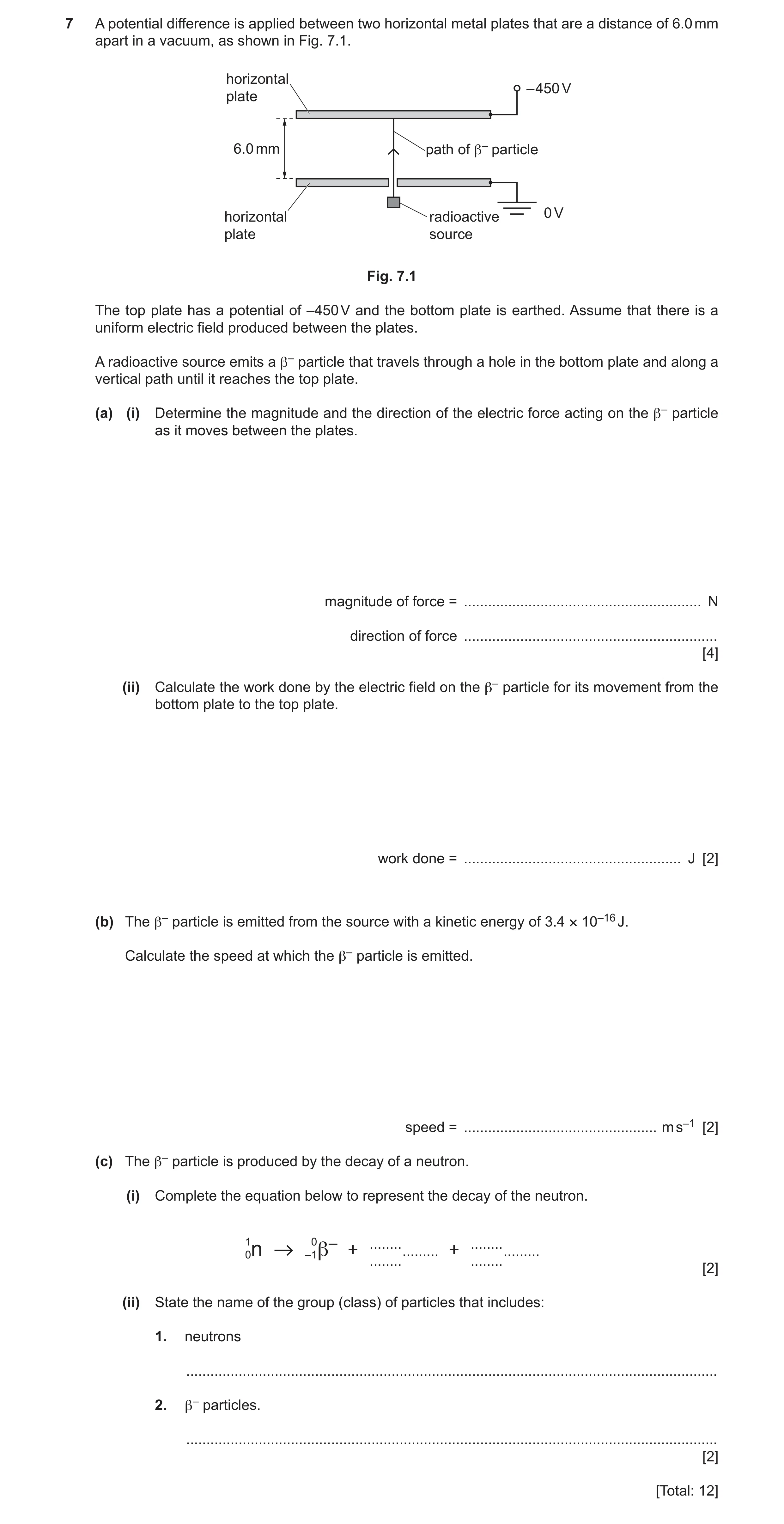
7 A potential difference is applied between two horizontal metal plates that are a distance of 6.0 mm apart in a vacuum, as shown in Fig. 7.1. horizontal – 450 V plate 6.0 mm path of β– particle horizontal radioactive 0 V plate source Fig. 7.1 The top plate has a potential of –450 V and the bottom plate is earthed. Assume that there is a uniform electric field produced between the plates. A radioactive source emits a β– particle that travels through a hole in the bottom plate and along a vertical path until it reaches the top plate. (a) (i) Determine the magnitude and the direction of the electric force acting on the β– particle as it moves between the plates. magnitude of force = … N direction of force … [4] (ii) Calculate the work done by the electric field on the β– particle for its movement from the bottom plate to the top plate. work done = … J [2] (b) The β– particle is emitted from the source with a kinetic energy of 3.4 × 10⁻¹⁶ J. Calculate the speed at which the β– particle is emitted. speed = … m s–1 [2] (c) The β– particle is produced by the decay of a neutron. (i) Complete the equation below to represent the decay of the neutron. 10n –1β–0 + … + … … … [2] (ii) State the name of the group (class) of particles that includes: 1. neutrons … 2. β– particles. … [2] [Total: 12]
12 marks
Mark scheme: 7(a)(i) E = V / d or E = F / Q C1 F = (450 × 1.60 × 10–19) / 6.0 × 10⁻³ C1 = 1.2 × 10⁻¹⁴ N A1 direction: vertically downwards B1 Question Answer Marks 7(a)(ii) work done = Fs or Fd or EQd C1 = (–)1.2 × 10–14 × 6.0 × 10–3 = (–)7.2 × 10⁻¹⁷ J A1 or work done = VQ (C1) = (–)450 × 1.60 × 10–19 = (–)7.2 × 10⁻¹⁷ J (A1) 7(b) E = ½mv2 C1 3.4 × 10–16 = ½ × 9.11 × 10⁻³¹ × v2 v = 2.7 × 10⁷ m s–1 A1 7(c)(i) 1 1p A1 0 0 (e) ν A1 7(c)(ii) 1. hadrons B1 2. leptons B1
This question in 9702/23 May/June 2020
Q15 · State a similarity and a difference between a down quark and a down antiquark 9702/21 Oct/Nov 2020
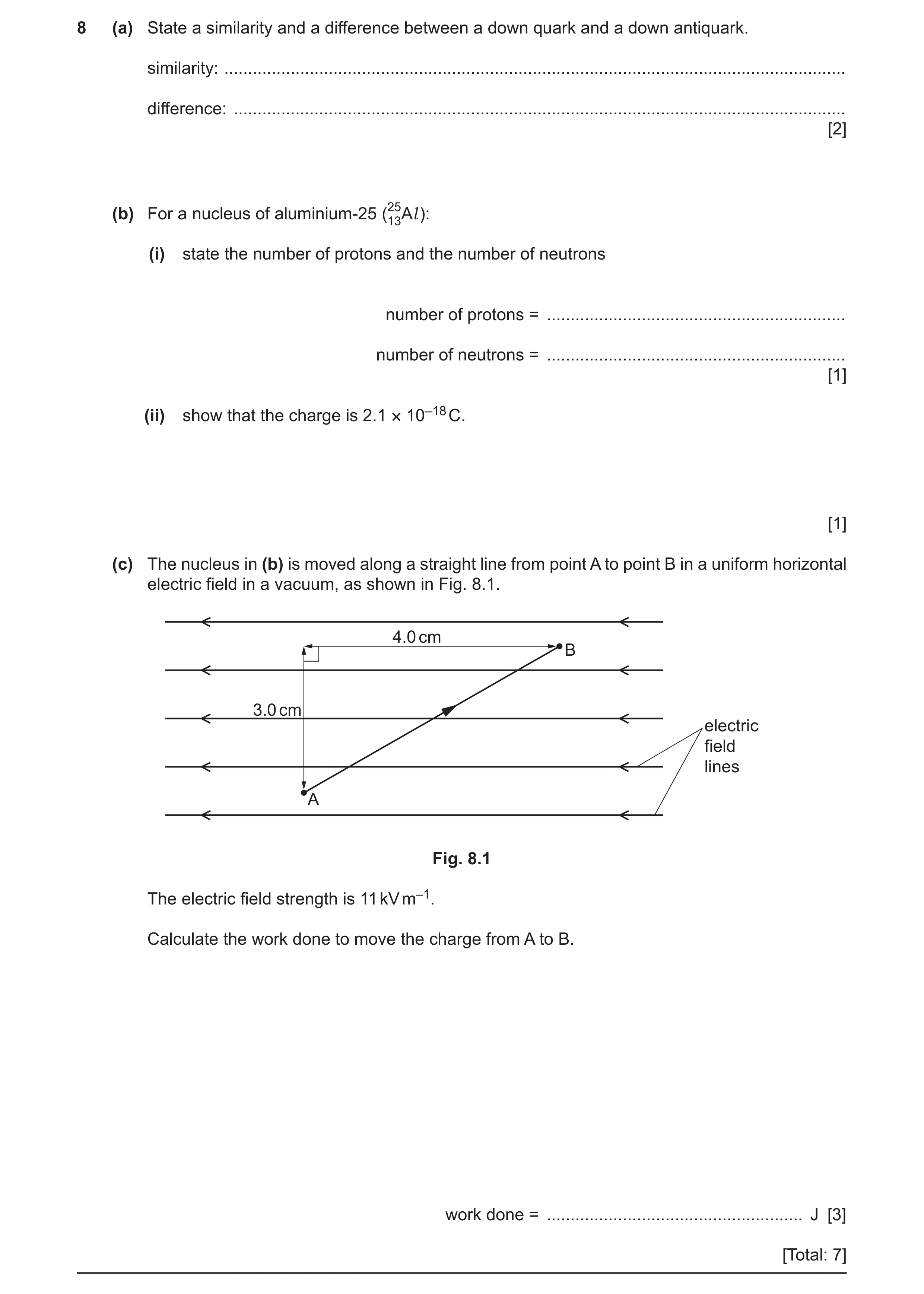
8 (a) State a similarity and a difference between a down quark and a down antiquark. similarity: … difference: … [2] (b) For a nucleus of aluminium-25 (2513Al ): (i) state the number of protons and the number of neutrons number of protons = … number of neutrons = … [1] (ii) show that the charge is 2.1 × 10⁻¹⁸ C. [1] (c) The nucleus in (b) is moved along a straight line from point A to point B in a uniform horizontal electric field in a vacuum, as shown in Fig. 8.1. 4.0 cm B 3.0 cm electric field lines A Fig. 8.1 The electric field strength is 11 kV m–1. Calculate the work done to move the charge from A to B. work done = … J [3] [Total: 7]
7 marks
Mark scheme: 8(a) similarity: same/equal mass or same/equal (magnitude of) charge or both fundamental (particles) B1 difference: opposite (sign of) charge or one is matter and the other is antimatter B1 8(b)(i) number of protons = 13 and number of neutrons = 12 A1 8(b)(ii) (charge =) 13 × 1.60 × 10–19 (C) = 2.1 × 10⁻¹⁸ (C) A1 8(c) force = 11 × 103 × 2.1 × 10–18 C1 work done = 11 × 103 × 2.1 × 10–18 × 0.04 C1 = 9.2 × 10⁻¹⁶ J A1
This question in 9702/21 Oct/Nov 2020
Q16 · Two vertical metal plates are separated by a distance d in a vacuum, as shown in Fig 9702/23 Oct/Nov 2020
7 Two vertical metal plates are separated by a distance d in a vacuum, as shown in Fig. 7.1. plate X nucleus plate Y with charge +q path +V d Fig. 7.1 (not to scale) The potential difference (p.d.) between the plates is V. A nucleus with charge +q is initially at rest on plate X. The nucleus is accelerated by the uniform electric field from plate X along a horizontal path to plate Y. (a) State expressions, in terms of some or all of d, q and V, for: (i) the magnitude of the electric field strength electric field strength = … [1] (ii) the magnitude of the electric force acting on the nucleus force = … [1] (iii) the kinetic energy of the nucleus when it reaches plate Y. kinetic energy = … [1] (b) State the change, if any, in the kinetic energy of the nucleus on reaching plate Y when the following separate changes are made. (i) The distance d is halved, but the p.d. V remains the same. … [1] (ii) The nucleus is replaced by a different nucleus that is an isotope of the original nucleus with fewer neutrons. … [1] (c) The nucleus is carbon-14 (146C). This nucleus decays to form a new nucleus by releasing a β– particle and only one other particle of negligible mass. (i) Calculate the nucleon number and the proton number of the new nucleus. nucleon number = … proton number = … [1] (ii) State the name of the particle of negligible mass. … [1] [Total: 7]
7 marks
Mark scheme: 7(a)(i) electric field strength = V / d B1 7(a)(ii) force = Vq / d B1 7(a)(iii) kinetic energy = Vq B1 7(b)(i) no change B1 7(b)(ii) no change B1 7(c)(i) nucleon number = 14 and proton number = 7 A1 7(c)(ii) (electron) antineutrino B1
This question in 9702/23 Oct/Nov 2020
Q17 · One of the results of the α-particle scattering experiment is that a very small minority… 9702/22 May/June 2021
6 (a) One of the results of the α-particle scattering experiment is that a very small minority of the α-particles are scattered through angles greater than 90°. State what may be inferred about the structure of the atom from this result. … … … … [2] (b) An α-particle is made up of other particles. One of these particles is a proton. State and explain whether a proton is a fundamental particle. … … [1] (c) A radioactive source produces a beam of α-particles in a vacuum. The average current produced by the beam is 6.9 × 10⁻⁹ A. Calculate the average number of α-particles passing a fixed point in the beam in a time of 1.0 minute. number = … [3] (d) The α-particles in the vacuum in (c) enter a uniform electric field. The α-particles enter the field with their velocity in the same direction as the field. State and explain whether the magnitude of the acceleration of an α-particle due to the field decreases, increases or stays constant as the α-particle moves through the field. … … … [2] (e) A nucleus X is an isotope of a nucleus Y. The mass of nucleus X is greater than that of Y. Both of the nuclei are in the same uniform electric field. State and explain whether the magnitude of the electric force acting on nucleus X is greater than, less than or the same as that acting on nucleus Y. … … … [2] [Total: 10]
10 marks
Mark scheme: 6(a) the nucleus is charged B1 the majority of the mass (of atom) is in the nucleus B1 6(b) made up of quarks (so) not a fundamental particle B1 6(c) (Q =) 6.9 × 10–9 × 60 C1 number = (6.9 × 10–9 × 60) / (2 × 1.60 × 10–19) C1 = 1.3 × 10¹² A1 6(d) (magnitude of electric) force is constant B1 (so magnitude of) acceleration is constant B1 6(e) (nuclei have) same charge/same number of protons B1 (so) same (magnitude of) force B1
This question in 9702/22 May/June 2021
Q18 · State the quark composition of: (i) a proton … [1] (ii) a neutron … [1] (iii) an… 9702/23 May/June 2021
6 (a) State the quark composition of: (i) a proton … [1] (ii) a neutron … [1] (iii) an alpha-particle. … … [2] (b) In the alpha-particle scattering experiment, alpha-particles were directed at a thin gold foil. State what may be inferred from: (i) the observation that most alpha-particles pass through the foil … [1] (ii) the observation that some alpha-particles are scattered through angles greater than 90°. … … … [2] (c) A proton and an alpha-particle are moving in the same uniform electric field. Determine the ratio acceleration of proton due to the electric field . acceleration of alpha-particle due to the electric field ratio = … [2] [Total: 9]
9 marks
Mark scheme: 6(a)(i) up up down B1 6(a)(ii) up down down B1 6(a)(iii) (alpha-particle is) 2 protons and 2 neutrons C1 6 up, 6 down A1 6(b)(i) most of an atom is empty space or the nucleus (volume) is (very) small compared with the atom B1 6(b)(ii) the nucleus is charged B1 the majority of the mass of atom is in the nucleus B1 6(c) F = Eq and a = F / m C1 a = Eq / m ratio = (e / m) / (2e / 4m) = 2 A1
This question in 9702/23 May/June 2021
Q19 · A charged oil drop is in a vacuum between two horizontal metal plates 9702/22 Oct/Nov 2021
2 A charged oil drop is in a vacuum between two horizontal metal plates. A uniform electric field is produced between the plates by applying a potential difference of 1340 V across them, as shown in Fig. 2.1. top metal plate + 1340 V oil drop, 1.4 × 10⁻² m weight 4.6 × 10⁻¹⁴ N uniform electric field bottom metal plate 0 V Fig. 2.1 The separation of the plates is 1.4 × 10⁻² m. The oil drop of weight 4.6 × 10⁻¹⁴ N remains stationary at a point mid-way between the plates. (a) (i) Calculate the magnitude of the electric field strength. electric field strength = … N C–1 [2] (ii) Determine the magnitude and the sign of the charge on the oil drop. magnitude of charge = … C sign of charge … [3] (b) The electric potentials of the plates are instantaneously reversed so that the top plate is at a potential of 0 V and the bottom plate is at a potential of +1340 V. This change causes the oil drop to start moving downwards. (i) Compare the new pattern of the electric field lines between the plates with the original pattern. … … [2] (ii) Determine the magnitude of the resultant force acting on the oil drop. resultant force = … N [1] (iii) Show that the magnitude of the acceleration of the oil drop is 20 m s–2. [2] (iv) Assume that the radius of the oil drop is negligible. Use the information in (b)(iii) to calculate the time taken for the oil drop to move to the bottom metal plate from its initial position mid-way between the plates. time = … s [2] (c) The oil drop in (b) starts to move at time t = 0. The distance of the oil drop from the bottom plate is x. On Fig. 2.2, sketch the variation with time t of distance x for the movement of the drop from its initial position until it hits the surface of the bottom plate. Numerical values of t are not required. 0.7 x / 10–2 m 0 0 t Fig. 2.2 [2] [Total: 14]
14 marks
Mark scheme: 2(a)(i) E = (Δ)V / (Δ)d C1 = 1340 / 1.4 × 10–2 = 9.6 × 10⁴ N C–1 A1 2(a)(ii) F = Eq or q(Δ)V / (Δ)d C1 q = 4.6 × 10⁻¹⁴ / 9.6 × 10⁴ or 4.6 × 10–14 × 1.4 × 10–2 / 1340 = 4.8 × 10⁻¹⁹ C A1 sign of charge: negative B1 2(b)(i) (adjacent field) lines have same separation (for both patterns) B1 (direction of lines changes from) downwards to upwards B1 Question Answer Marks 2(b)(ii) resultant force = 4.6 × 10⁻¹⁴ + (9.6 × 104 × 4.8 × 10–19) = 4.6 × 10⁻¹⁴ + 4.6 × 10–14 = 9.2 × 10⁻¹⁴ N A1 2(b)(iii) (a =) F / m or 2W / m or 2g B1 a = 9.2 × 10⁻¹⁴ / (4.6 × 10⁻¹⁴ / 9.81) = 20 (m s–2) or a = 2 × 9.81 = 20 (m s–2) A1 2(b)(iv) s = ut + ½at2 (1.4 × 10⁻² / 2) = ½ × 20 × t2 C1 t = 2.6 × 10⁻² s A1 2(c) line from (0, 0.7 × 10⁻²) to a non-zero point on the t-axis M1 magnitude of gradient of line increases A1
This question in 9702/22 Oct/Nov 2021
 8 / 29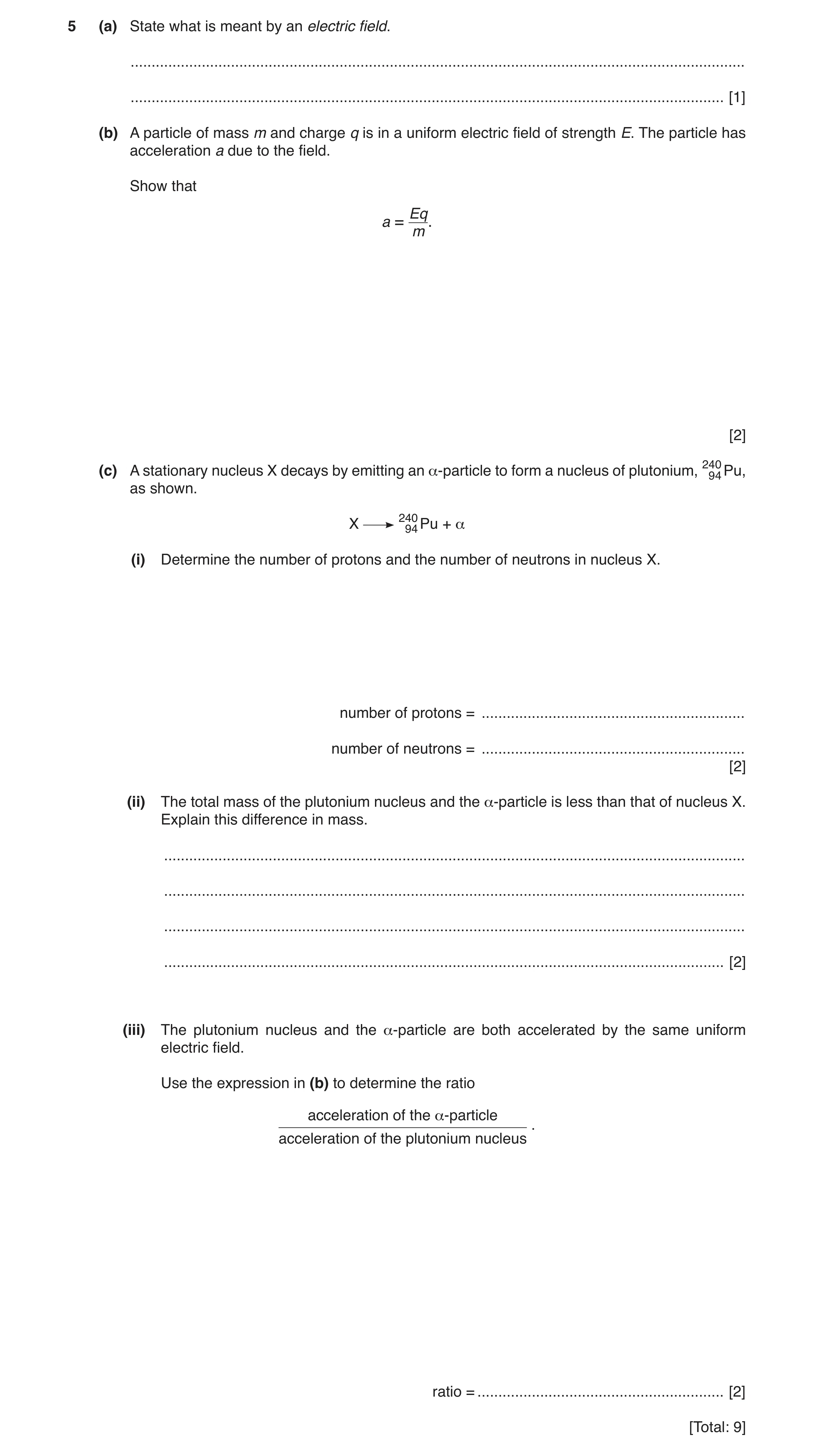
 11 / 29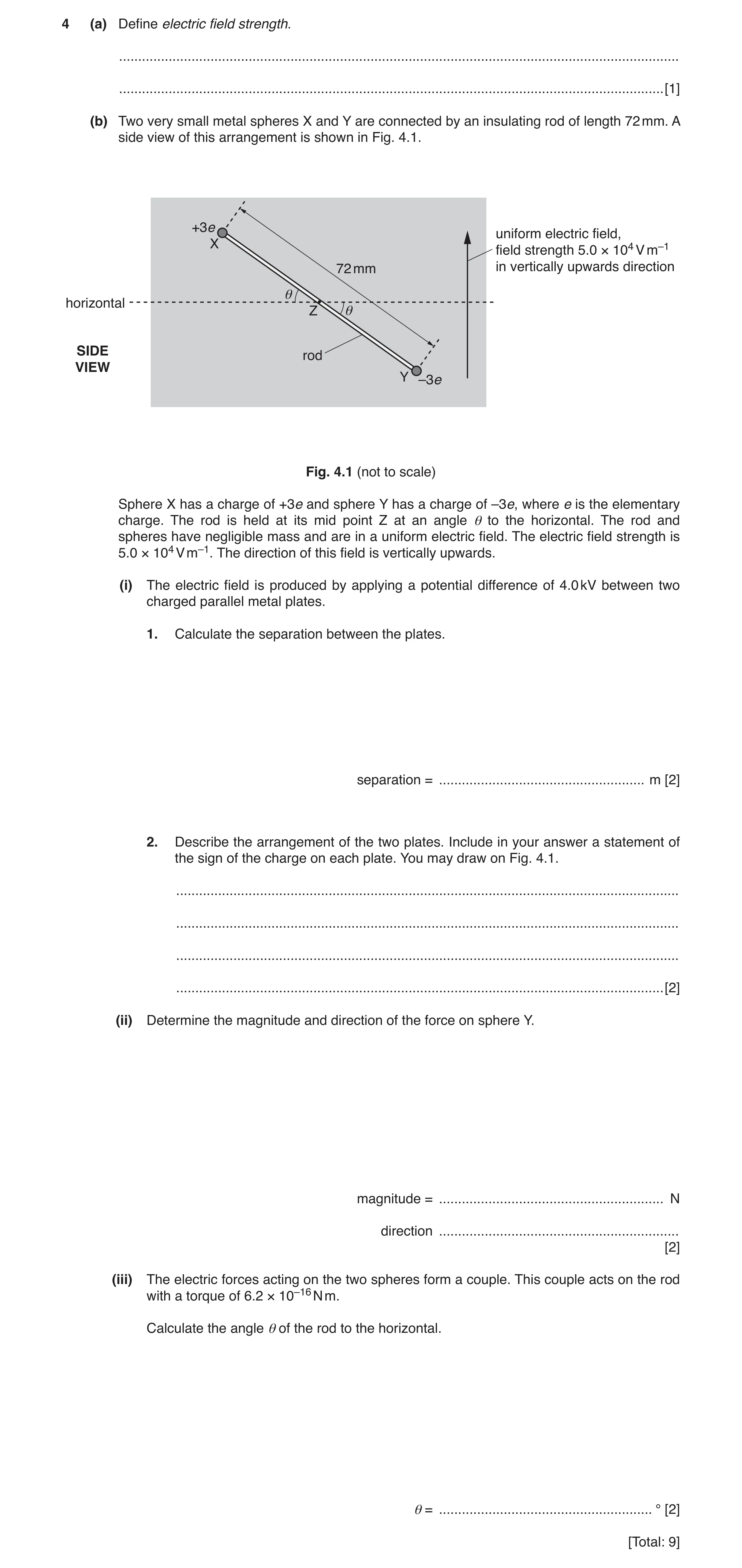
 19 / 29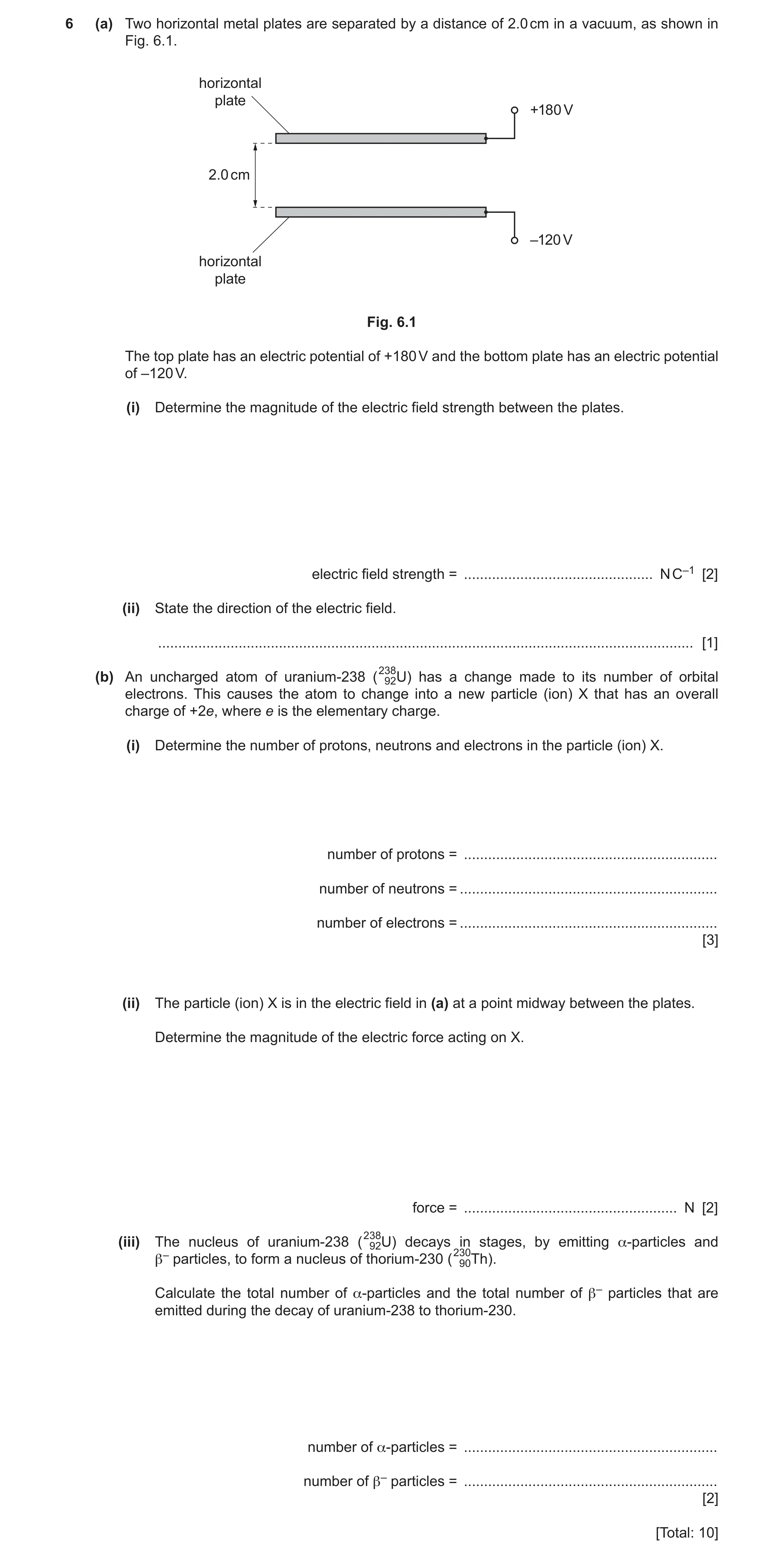
 23 / 29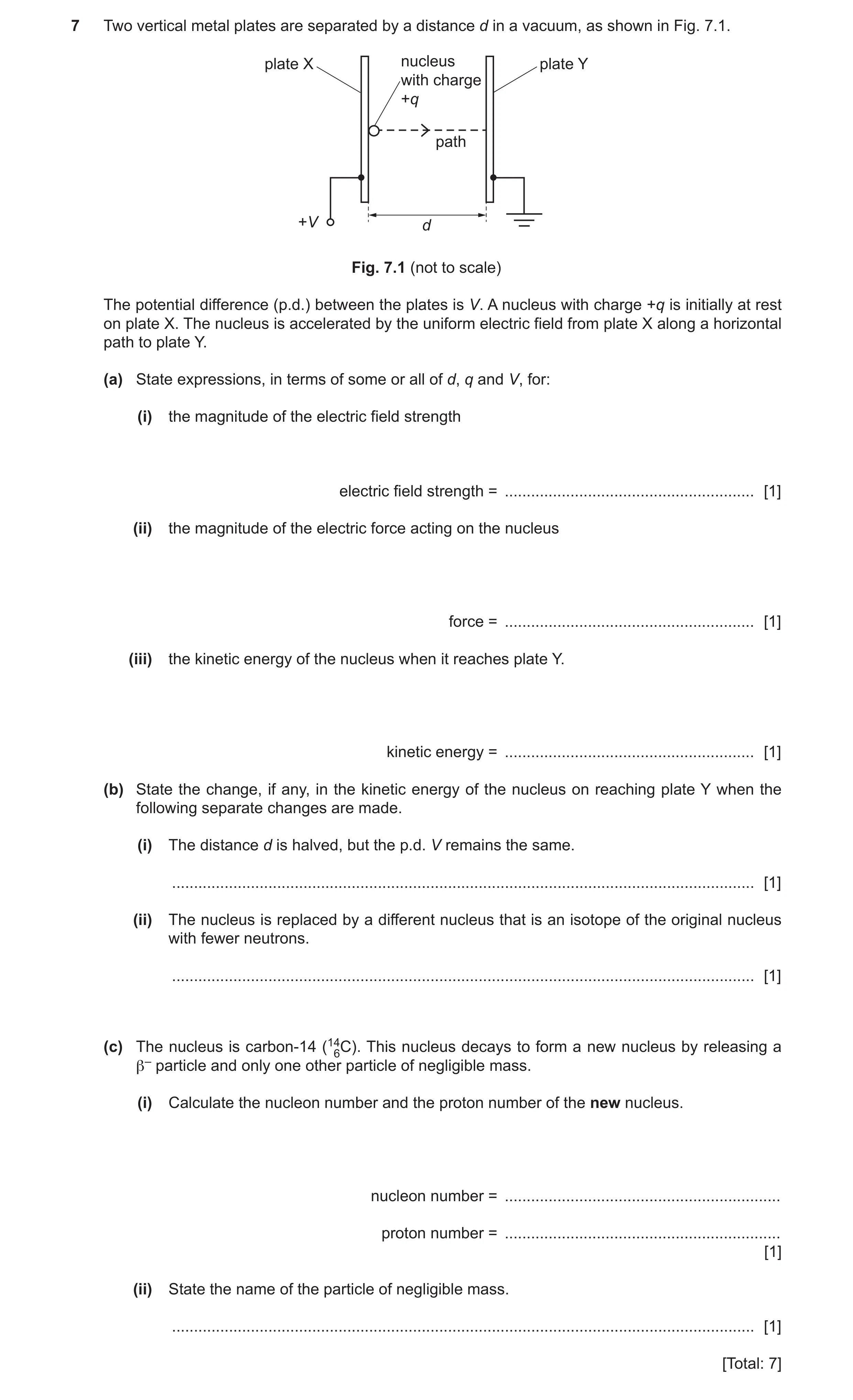
 27 / 29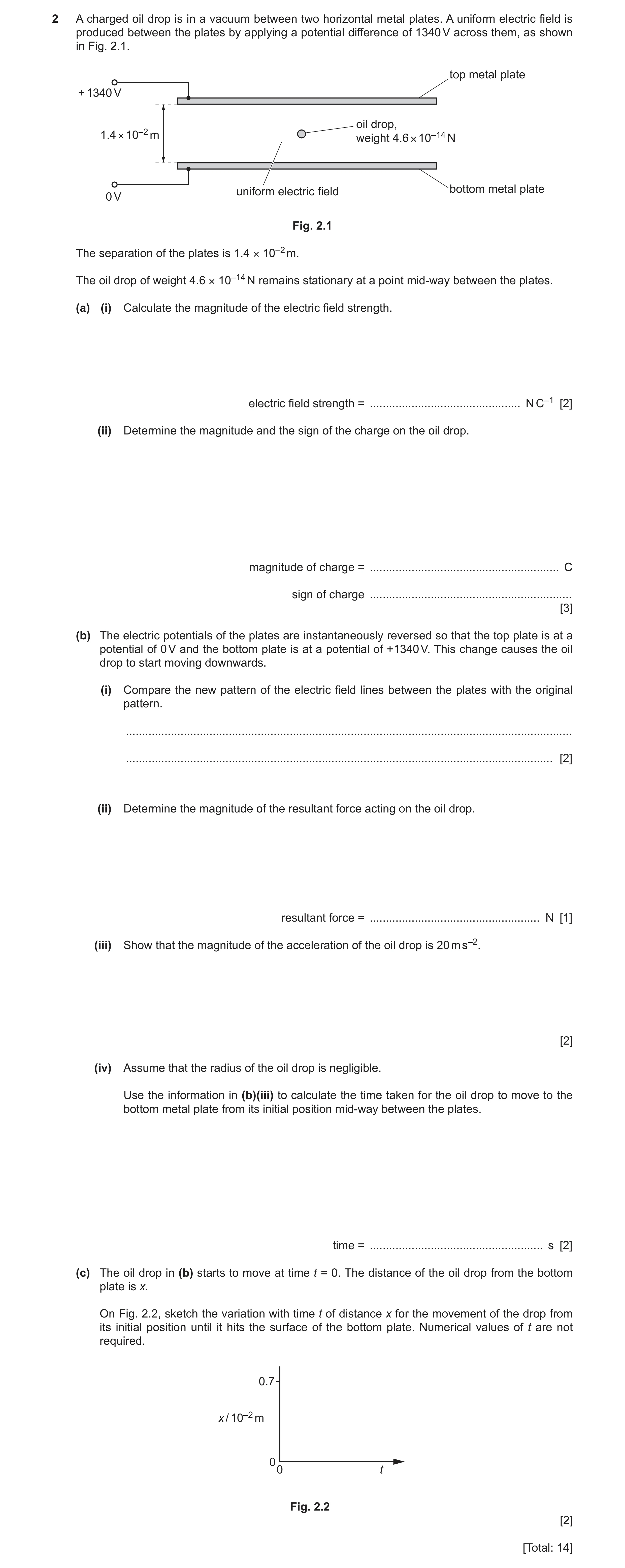
 7
7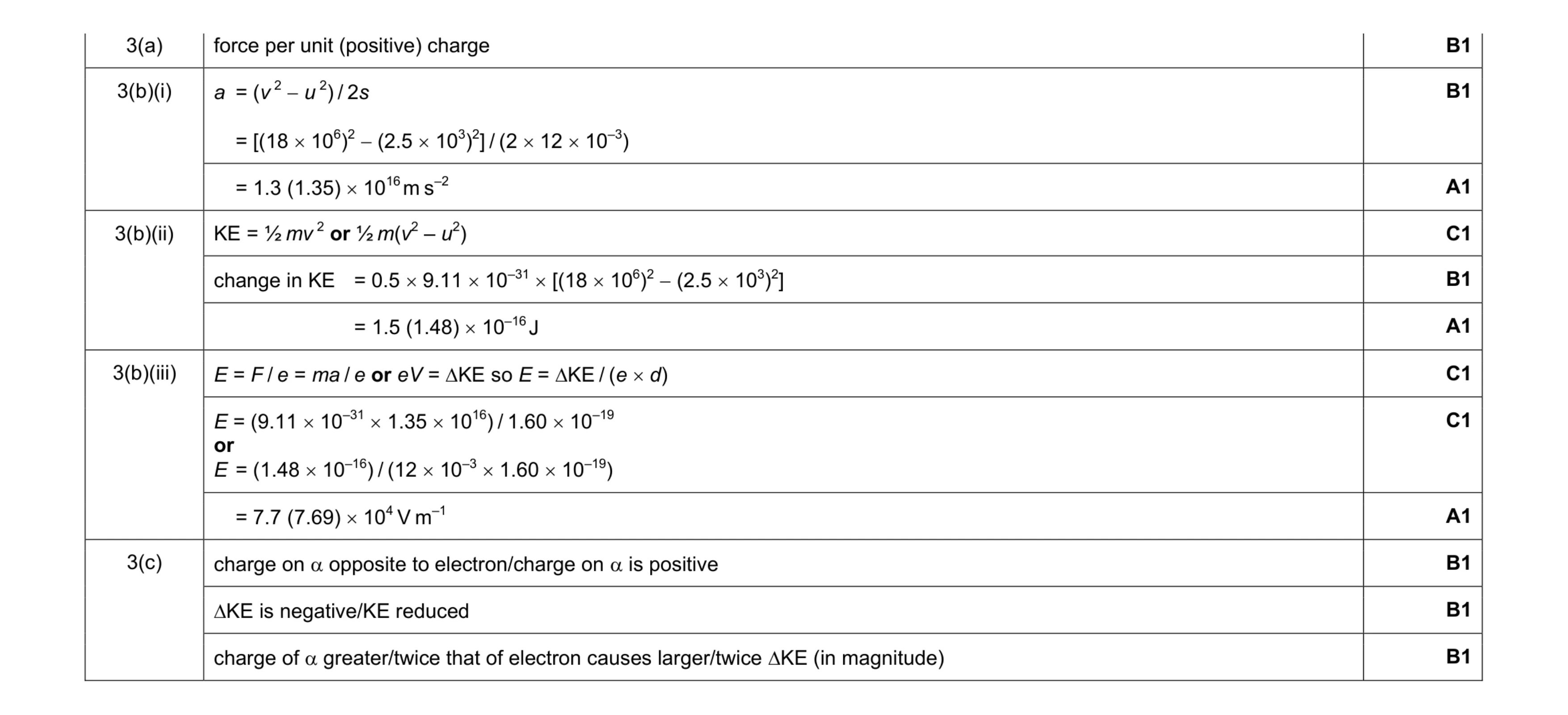 12
12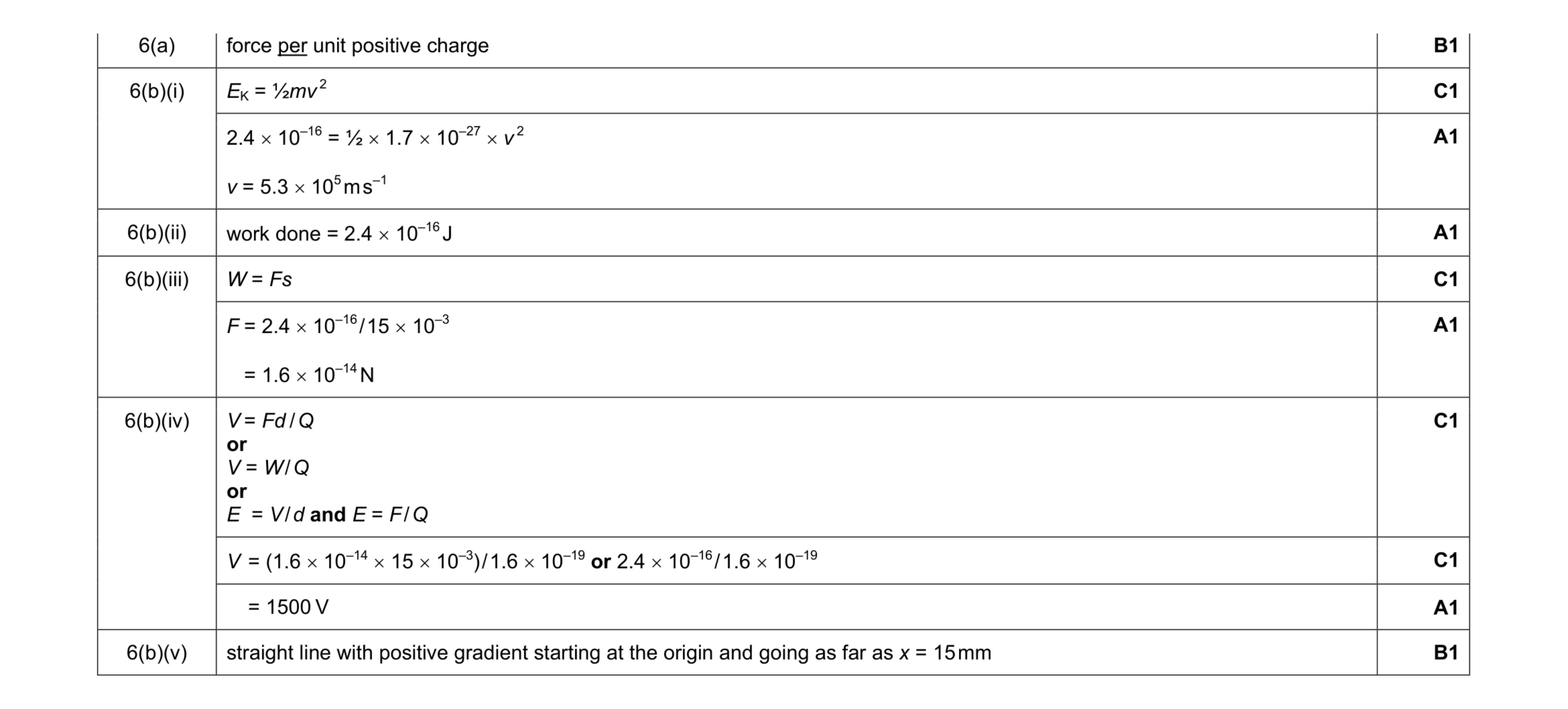 10
10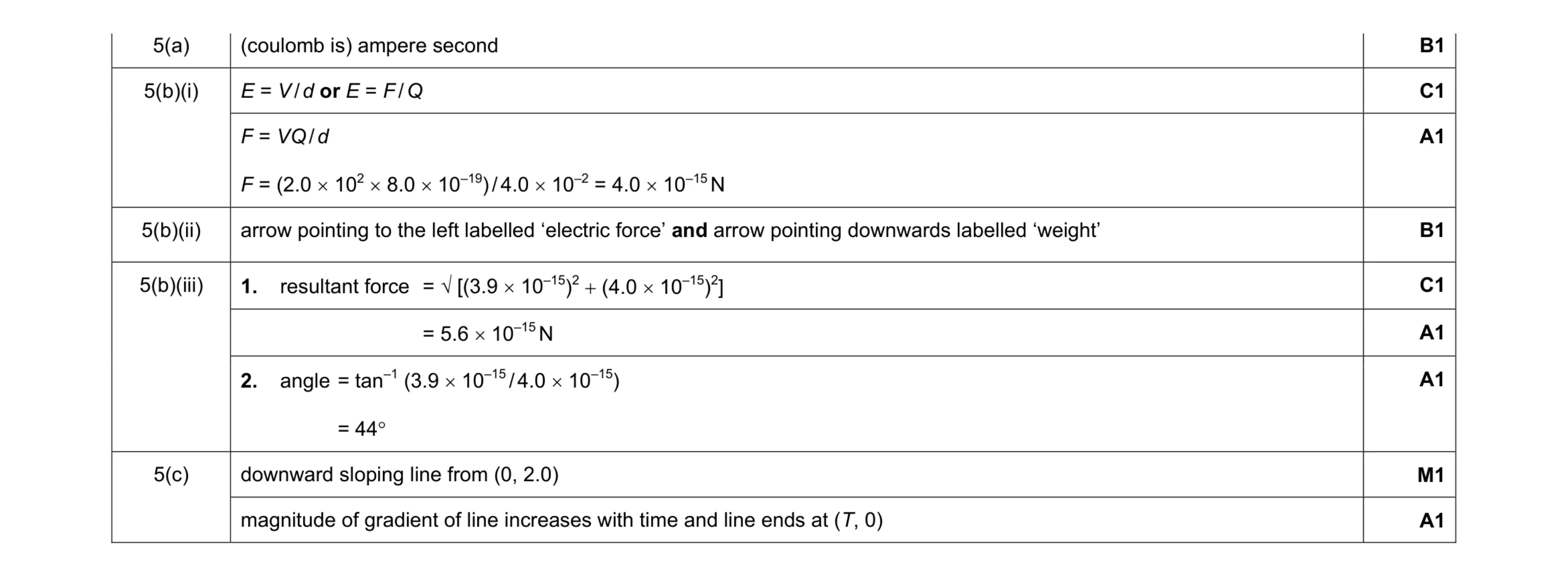 9
9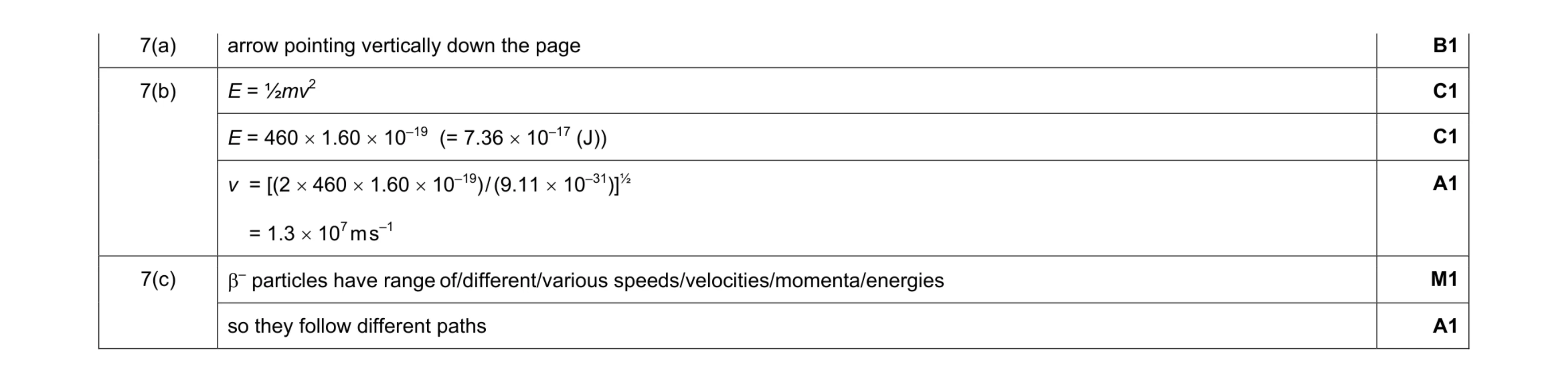 6
6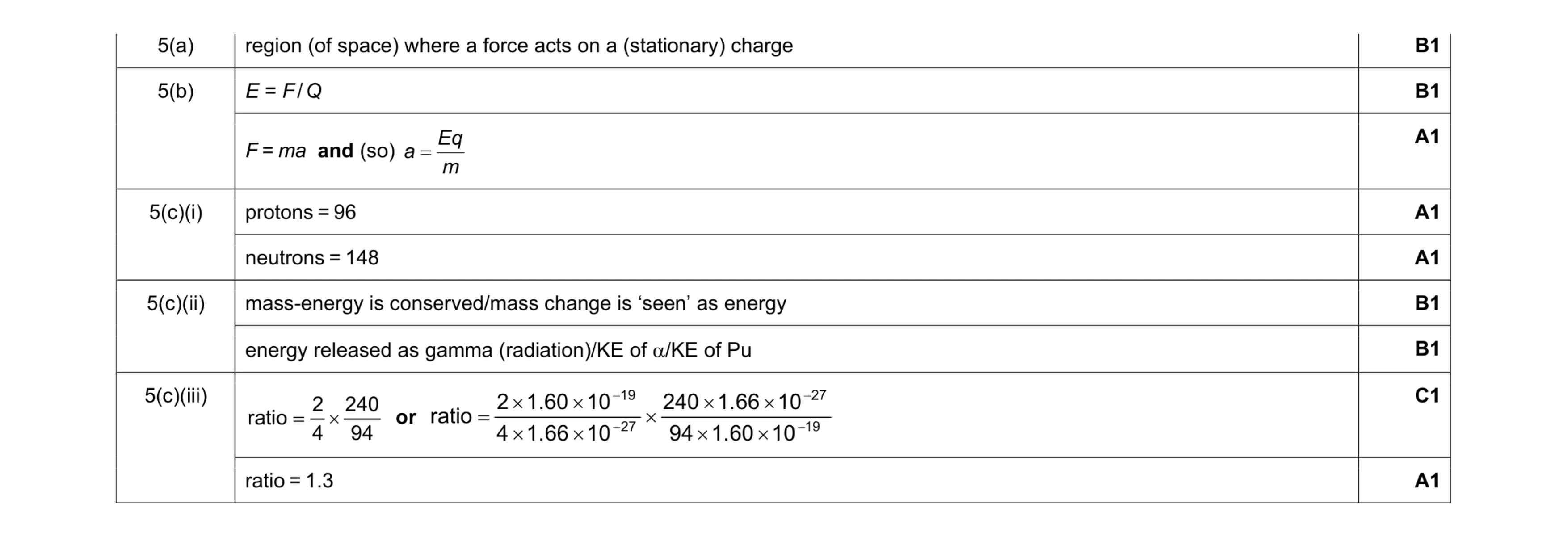 9
9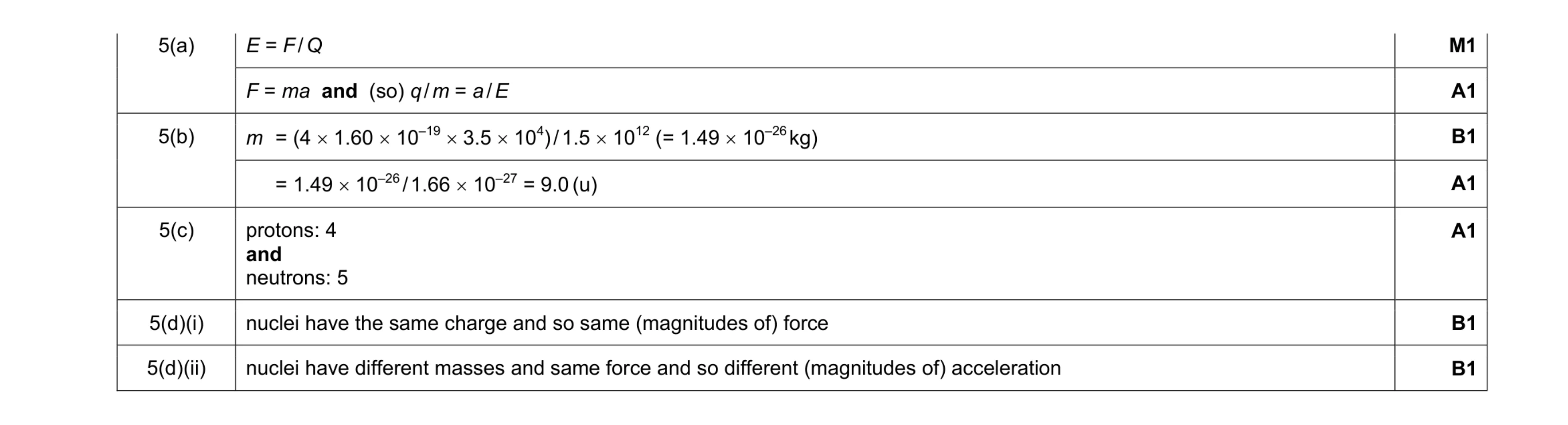 7
7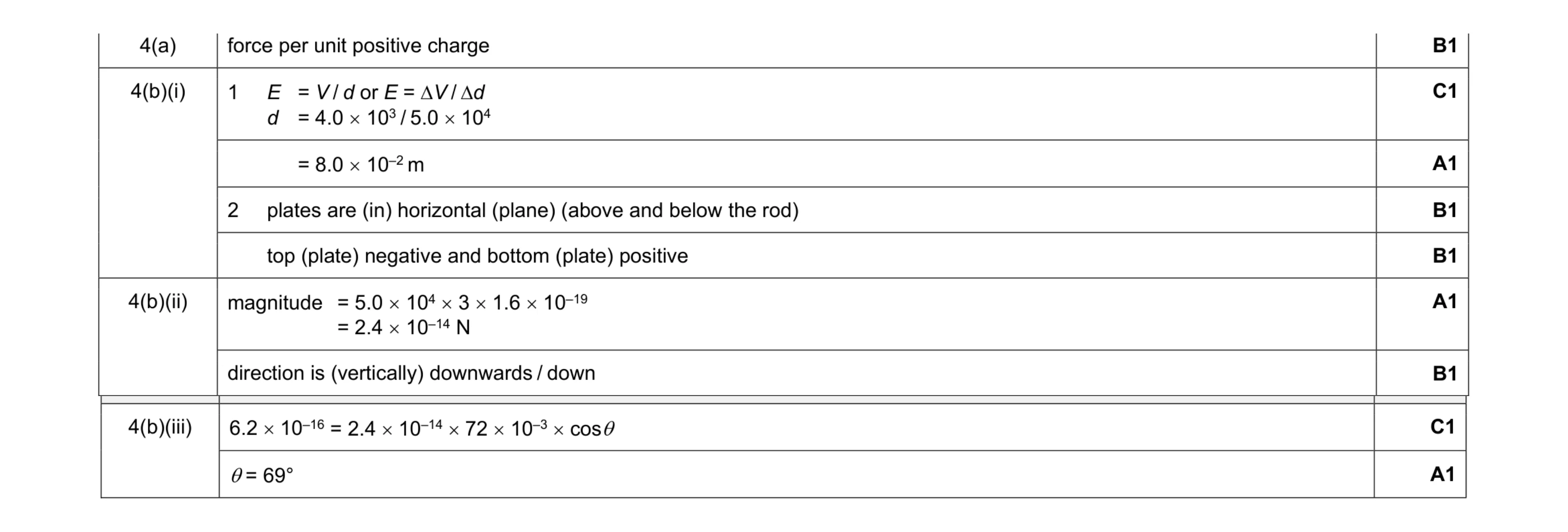 9
9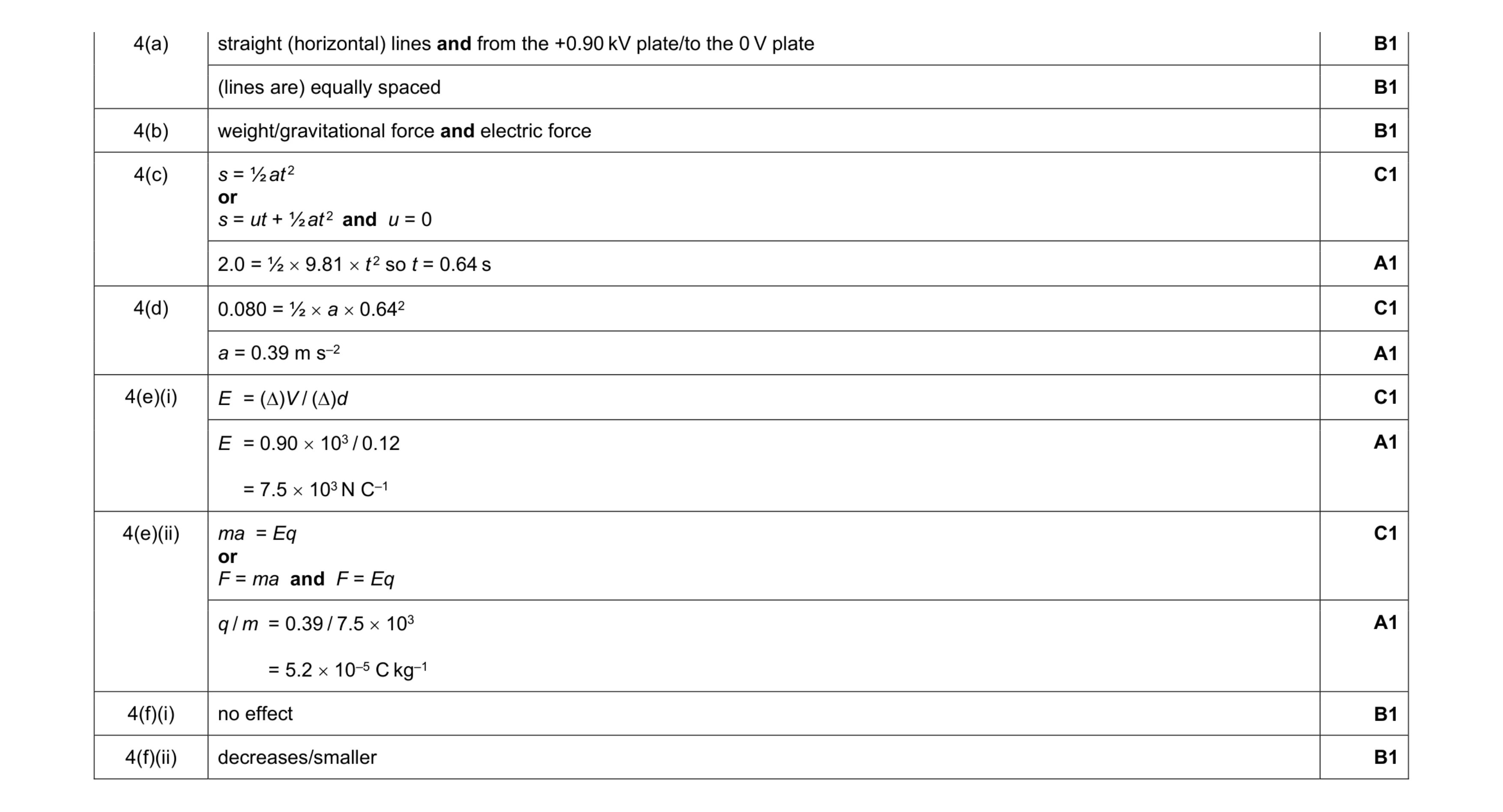 13
13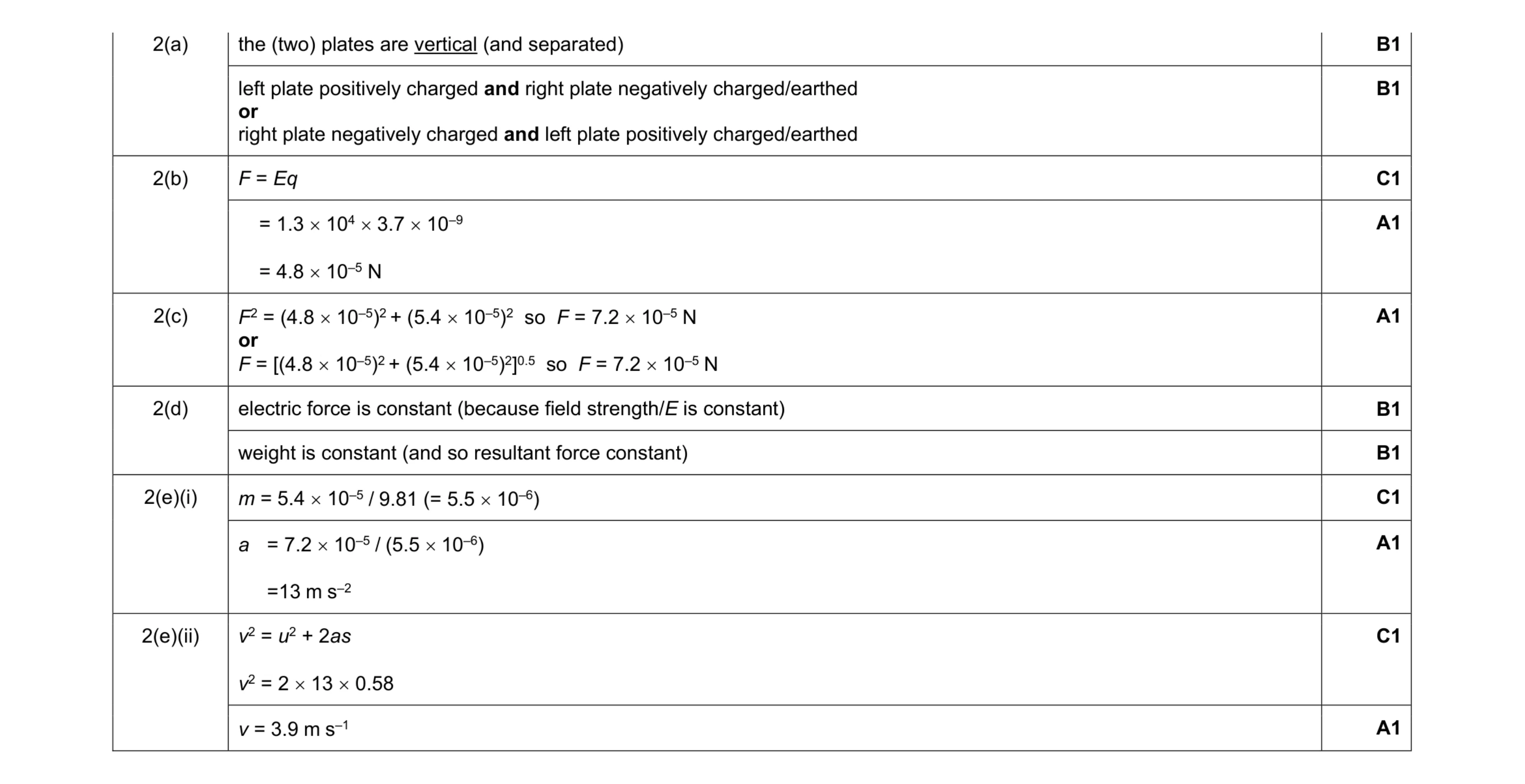 11
11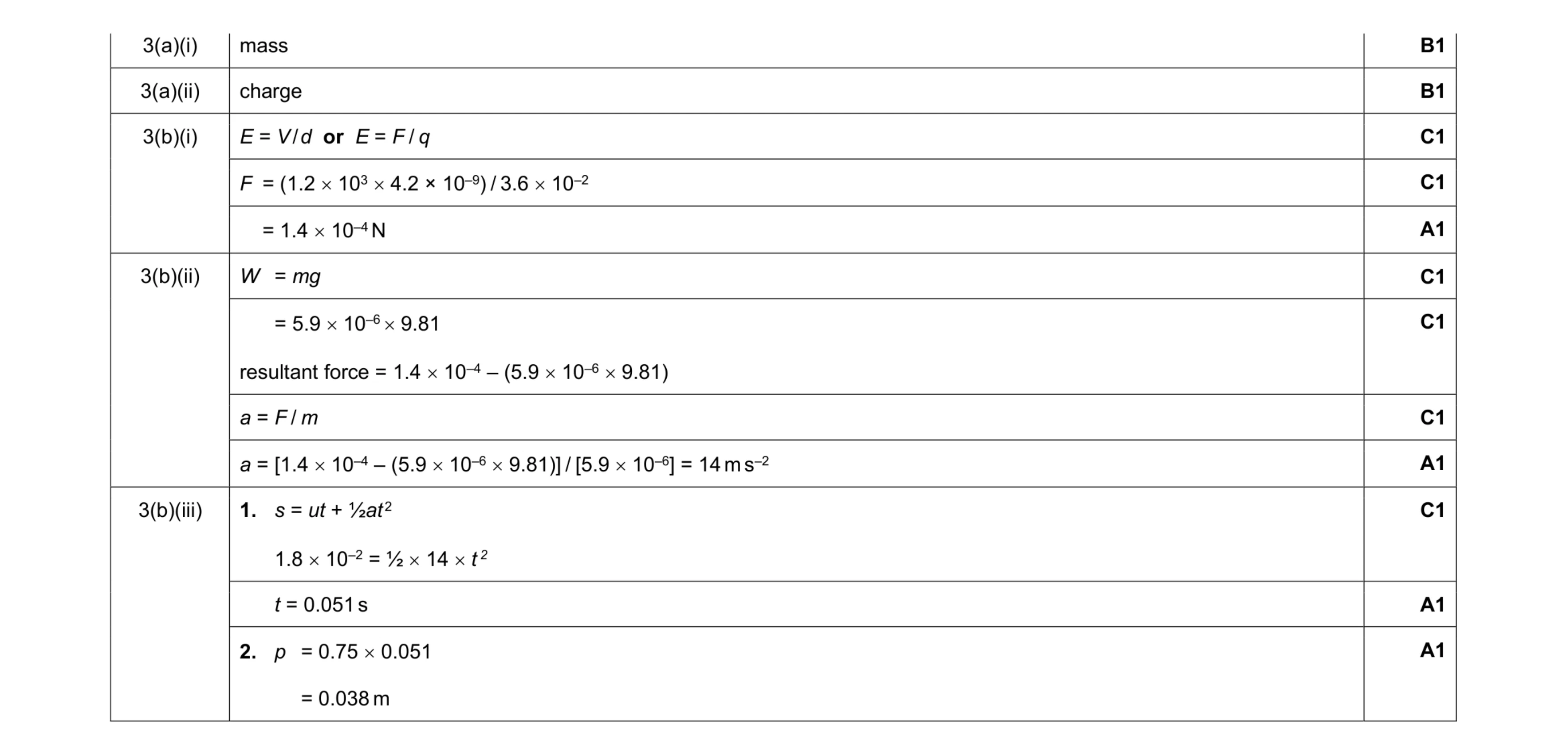 12
12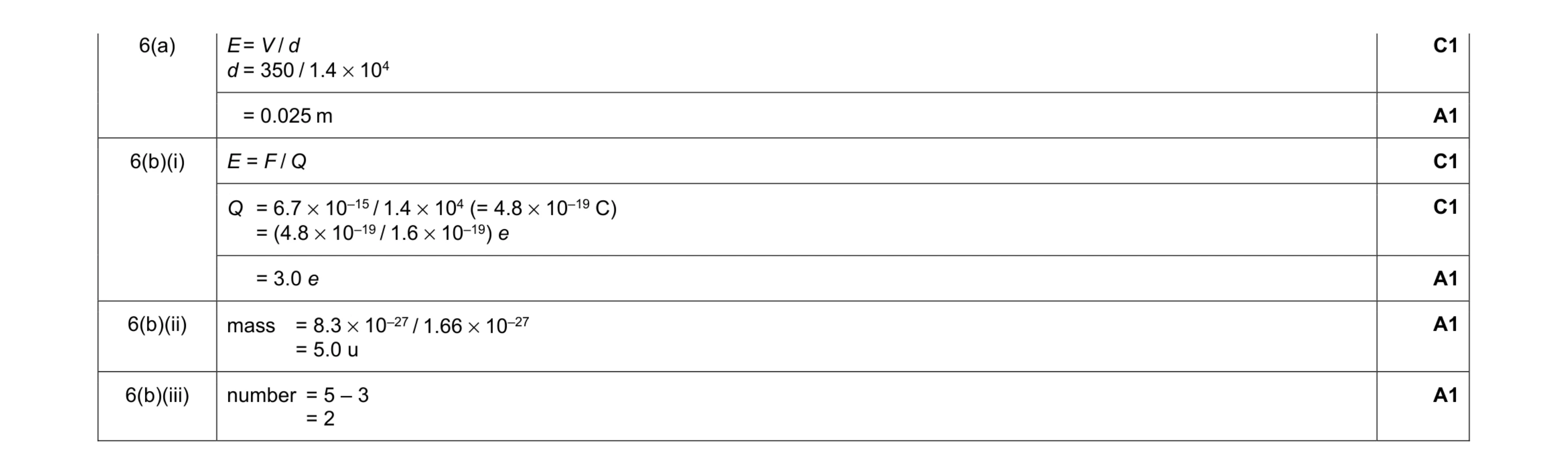 7
7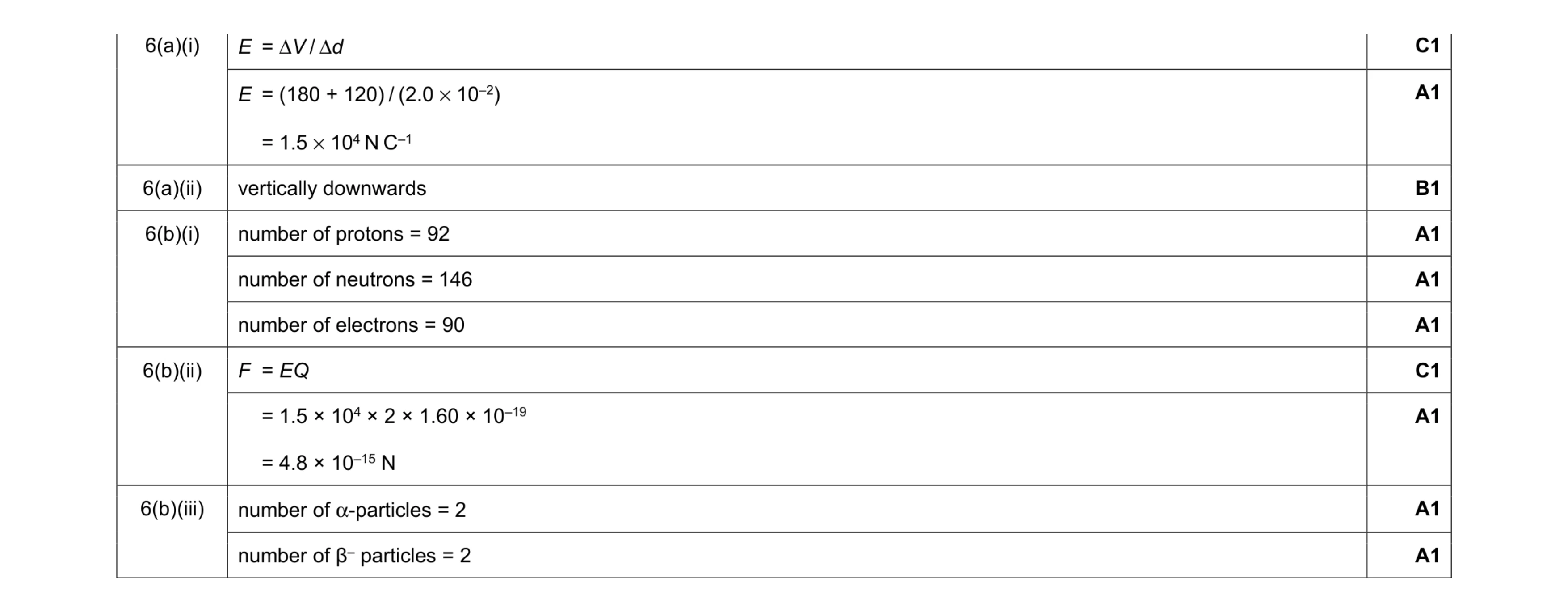 10
10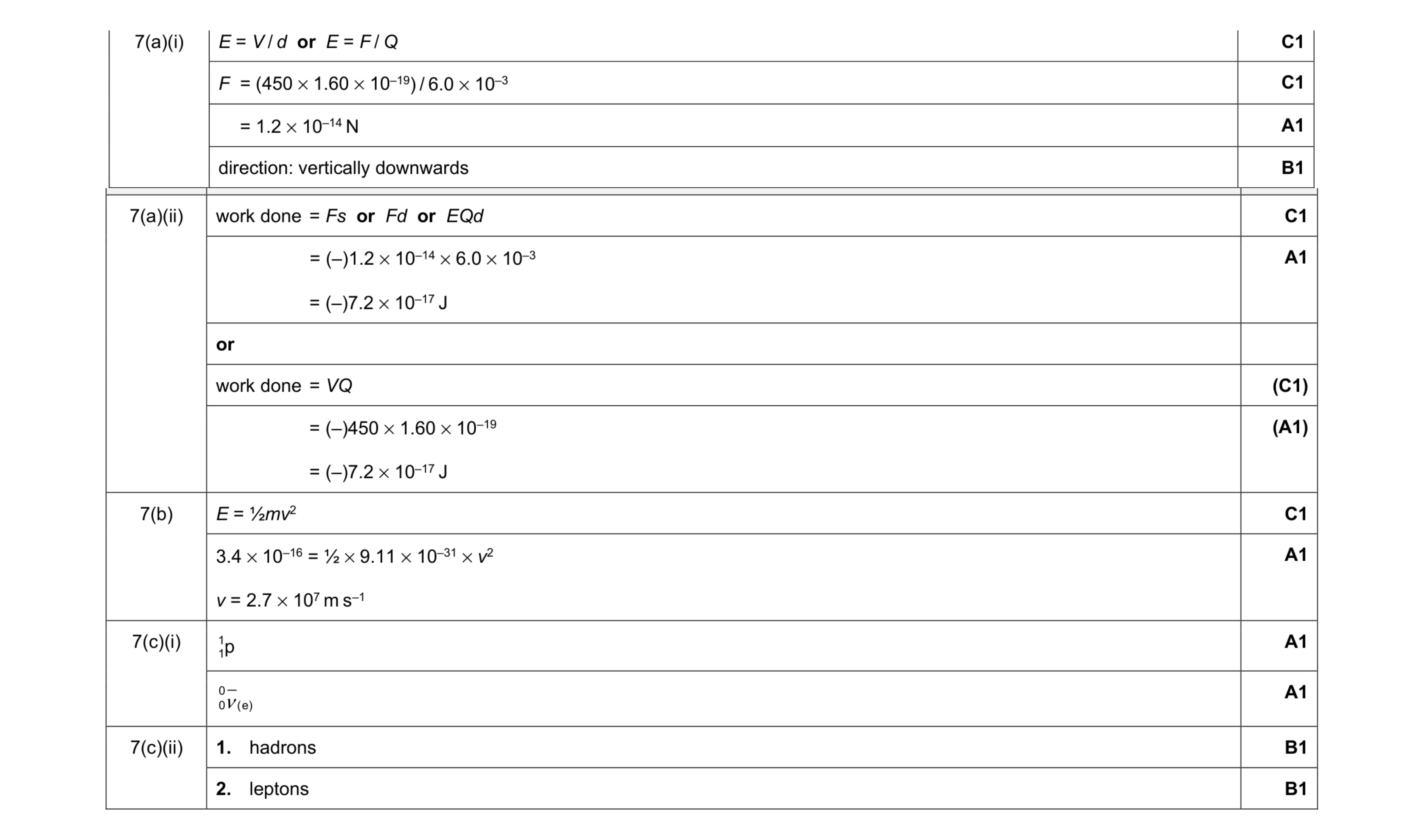 12
12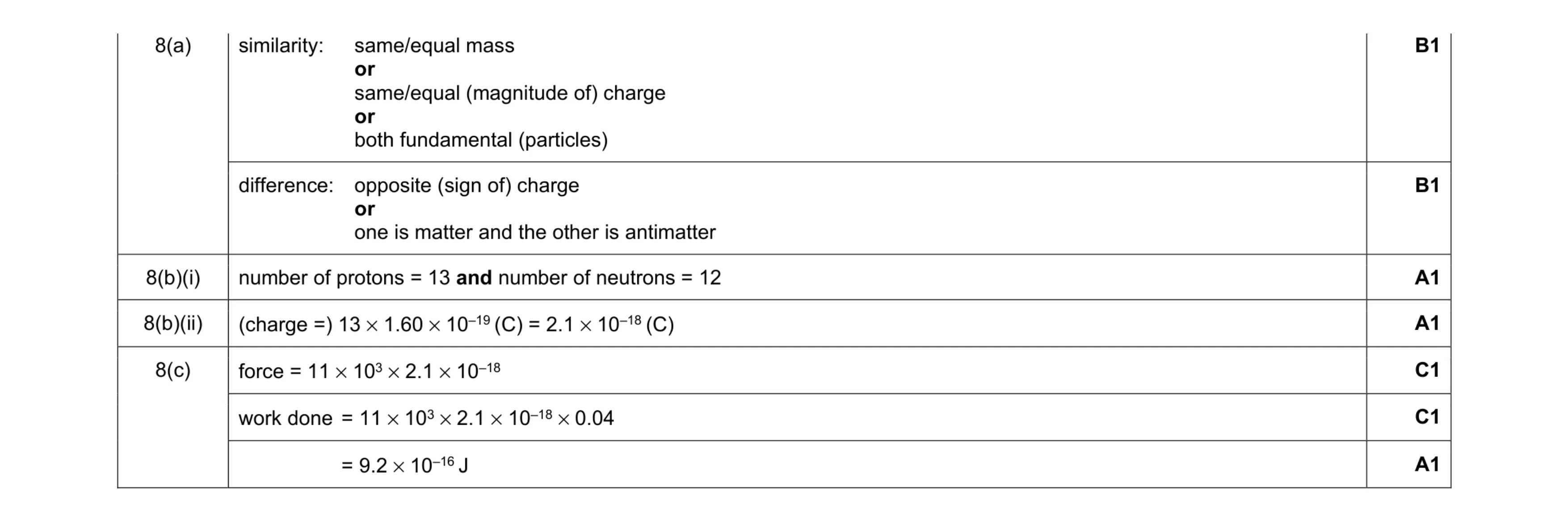 7
7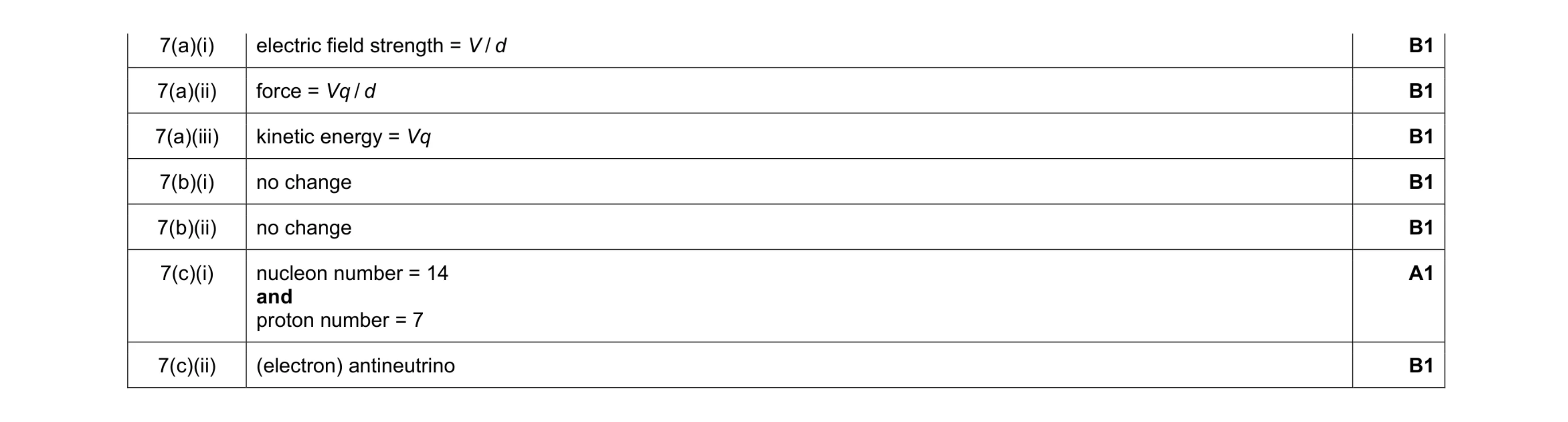 7
7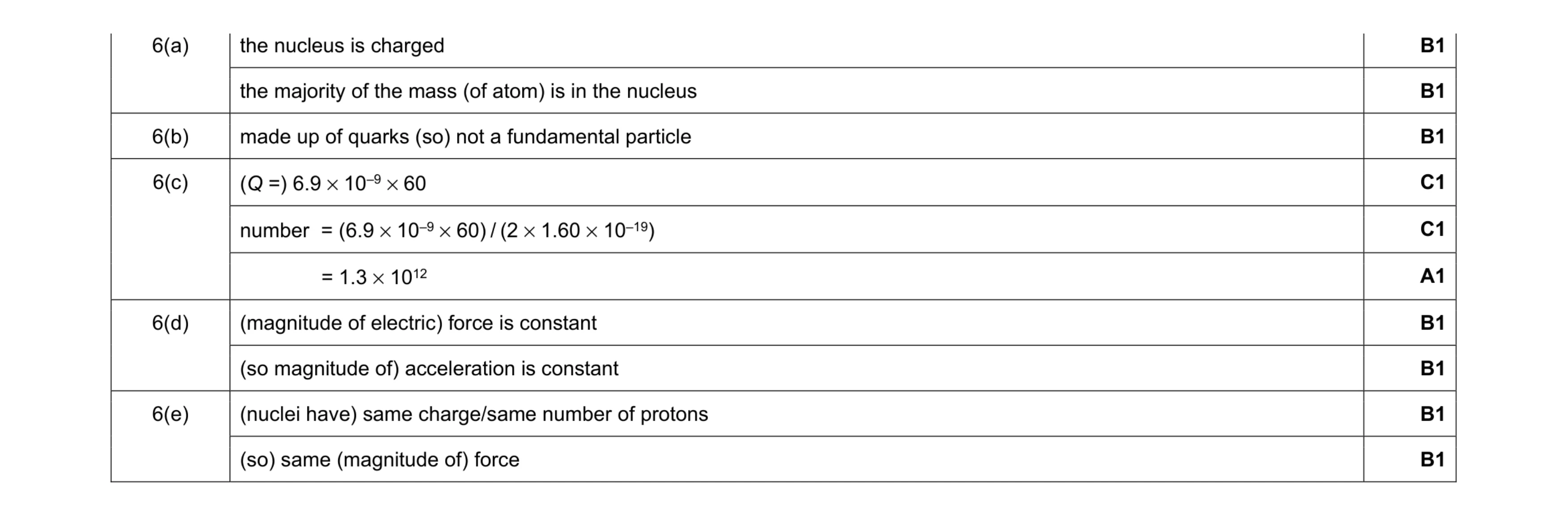 10
10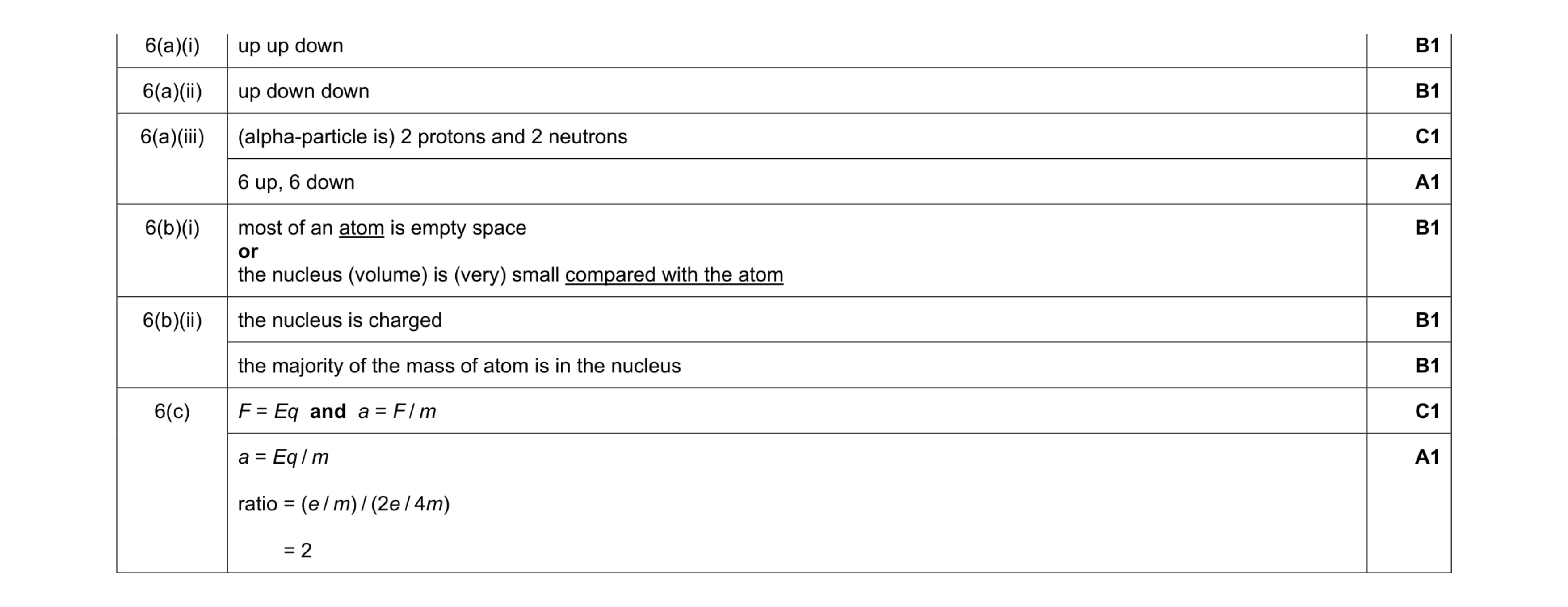 9
9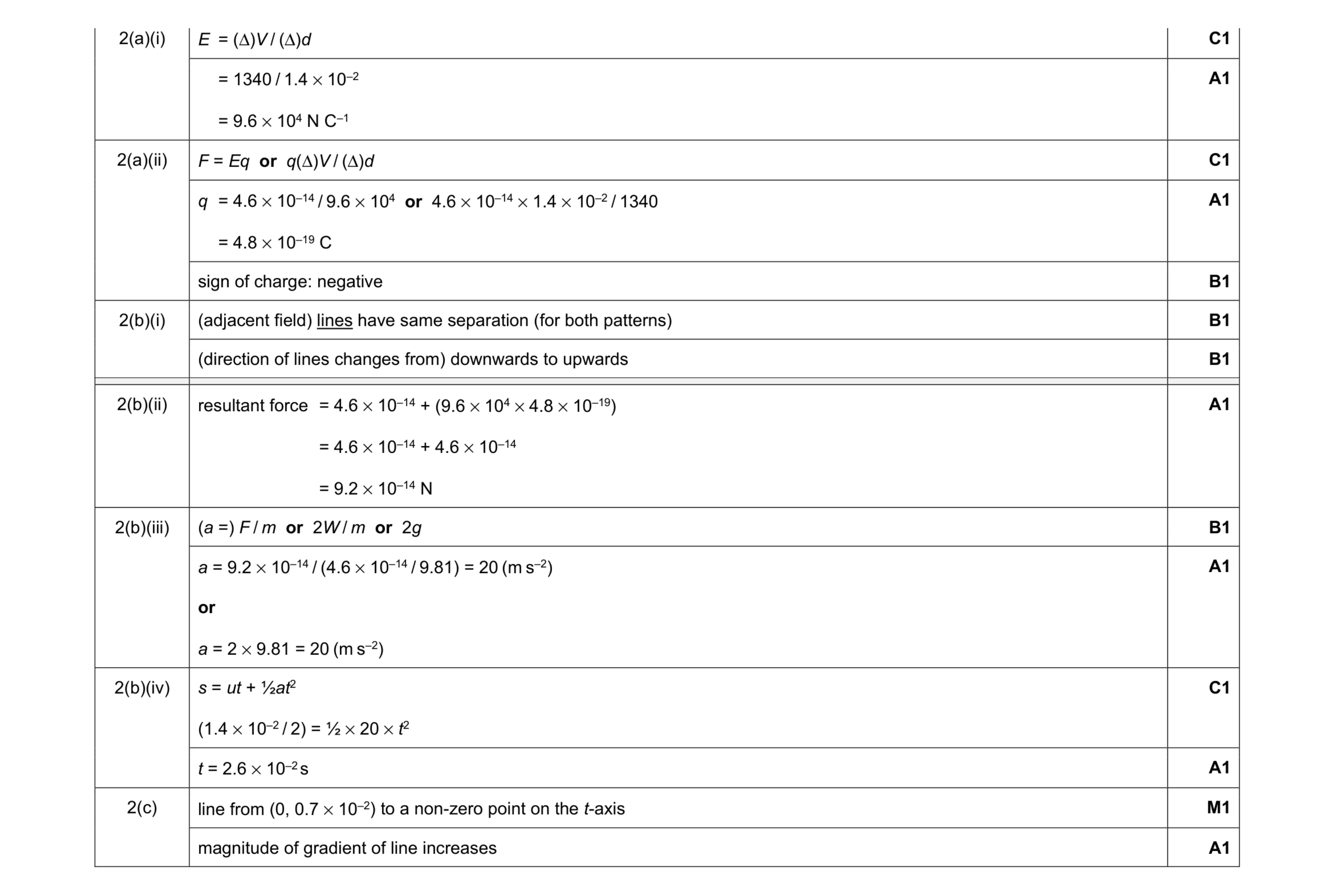 14
14