Questions as text
Q1 · Which of the following will increase a country’s protection against imports? 9708/11 Oct/Nov 2005
20 Which of the following will increase a country’s protection against imports? A an appreciation of its exchange rate B an increase in its inflation rate C a reduction in the size of existing import quotas D a reduction in subsidies to domestic producers
1 marks
Answer: C
This question in 9708/11 Oct/Nov 2005
Q2 · Assume the price elasticity of demand for best-quality French wine is zero 9708/11 May/June 2006
11 Assume the price elasticity of demand for best-quality French wine is zero. What would be the effect in New Zealand if the New Zealand government imposed a tariff on such wine? A The price of the wine would rise by an amount less than the tariff. B Demand for the wine would fall. C Expenditure on the wine would rise. D Sales of the wine would cease.
1 marks
Answer: C
This question in 9708/11 May/June 2006
Q3 · The supply of an imported good is shown by curve S 9708/11 May/June 2006
20 The supply of an imported good is shown by curve S. What will be the new supply curve if an ad valorem (percentage) tariff is imposed on the good? A B S C D price O quantity
1 marks
Answer: A
This question in 9708/11 May/June 2006
Q4 · What would reduce an economy’s protection against the import of cars? 9708/11 Oct/Nov 2006
20 What would reduce an economy’s protection against the import of cars? A a lower exchange rate B a higher quota of imported cars C a higher tariff on imported cars D a higher subsidy for domestic car producers
1 marks
Answer: B
This question in 9708/11 Oct/Nov 2006
Q5 · Which method of protection would a government be most likely to use to increase the… 9708/11 May/June 2007
20 Which method of protection would a government be most likely to use to increase the country’s exports? A exchange control B quotas C subsidies D tariffs
1 marks
Answer: C
This question in 9708/11 May/June 2007
Q6 · What would be an economic benefit to a country of imposing a tariff on imported goods? 9708/11 Oct/Nov 2007
20 What would be an economic benefit to a country of imposing a tariff on imported goods? A It would increase global productivity. B It would make the country’s exports more competitive. C It would put pressure on foreign suppliers to reduce their prices. D It would reduce the prices paid by consumers for imported goods.
1 marks
Answer: C
This question in 9708/11 Oct/Nov 2007
Q7 · When would the sale of cheap exports definitely be classed as dumping? 9708/11 May/June 2008
20 When would the sale of cheap exports definitely be classed as dumping? A if the exports were produced profitably at a low price in the exporting country B if the exports were the result of a surplus caused by favourable weather conditions C if the exports were the result of improved technology that led to capital-intensive production D if the exports were the result of government subsidies to producers that made loss-making sales profitable
1 marks
Answer: D
This question in 9708/11 May/June 2008
Q8 · A government removes the tariff on a product 9708/11 May/June 2008
21 A government removes the tariff on a product. What will be the change in domestic production? D domestic supply P price P1 world supply with tariff P2 world supply without tariff S domestic demand O V W X Y Z quantity A a reduction of WV B a reduction of XV C a reduction of XW D a reduction of ZY
1 marks
Answer: A
This question in 9708/11 May/June 2008
Q9 · What will be the immediate effect of the removal of tariffs on imported consumer goods? 9708/11 Oct/Nov 2008
20 What will be the immediate effect of the removal of tariffs on imported consumer goods? A a decrease in the cost of living B a decrease in free trade C an increase in customs revenues received by the government D an increase in the level of domestic employment
1 marks
Answer: A
This question in 9708/11 Oct/Nov 2008
Q10 · Which feature is found in both a customs union and a free trade area? 9708/11 Oct/Nov 2008
21 Which feature is found in both a customs union and a free trade area? A a common currency B a common external tariff C freedom from internal trade barriers D uniform tax rates
1 marks
Answer: C
This question in 9708/11 Oct/Nov 2008
Q11 · Japan introduces import quotas on consumer durables imported from Malaysia 9708/11 May/June 2009
20 Japan introduces import quotas on consumer durables imported from Malaysia. These goods have a high price elasticity of demand. What effect is this likely to have on the prices paid for these goods by Japanese consumers and on the revenues received by Malaysian producers? change in prices paid change in revenues by Japanese received by Malaysian consumers producers A decrease uncertain B decrease increase C increase decrease D increase uncertain
1 marks
Answer: C
This question in 9708/11 May/June 2009
Q12 · Which statement about economic integration is correct? 9708/11 May/June 2009
21 Which statement about economic integration is correct? A A customs union has a common currency. B A customs union has a common external tariff. C A free trade area has internal trade barriers. D A free trade area has no external trade barriers.
1 marks
Answer: B
This question in 9708/11 May/June 2009
Q13 · A government has been protecting its domestic car industry with a quota on imported cars 9708/11 Oct/Nov 2009
20 A government has been protecting its domestic car industry with a quota on imported cars. It then removes the quota and replaces it with a subsidy to domestic car producers. How will this change affect the price of cars and the level of consumer choice? price of cars level of choice A decrease decrease B decrease increase C increase decrease D increase increase
1 marks
Answer: B
This question in 9708/11 Oct/Nov 2009
Q14 · A government has been protecting its domestic car industry with a quota on imported cars 9708/12 Oct/Nov 2009
19 A government has been protecting its domestic car industry with a quota on imported cars. It then removes the quota and replaces it with a subsidy to domestic car producers. How will this change affect the price of cars and the level of consumer choice? price of cars level of choice A decrease decrease B decrease increase C increase decrease D increase increase
1 marks
Answer: B
This question in 9708/12 Oct/Nov 2009
Q15 · A group of countries decides to change from being a customs union to being an economic… 9708/12 May/June 2010
20 A group of countries decides to change from being a customs union to being an economic union. What additional feature will this give the group? A a common external quota on imports from non-members B a common external tariff on imports from non-members C the removal of restrictions on the movement of capital and labour between members D the removal of tariffs and quotas on products exchanged between members
1 marks
Answer: C
This question in 9708/12 May/June 2010
Q16 · Steel is produced in a number of countries, including China, Japan and the US 9708/11 Oct/Nov 2010
19 Steel is produced in a number of countries, including China, Japan and the US. It is used in the manufacture of cars. The US protects its domestic steel industry by imposing high tariffs on foreign steel imports. Which two groups would benefit from the removal of the US tariffs? A Chinese steel producers and Japanese car manufacturers B Japanese steel producers and US car manufacturers C US steel producers and Chinese steel workers D the US government and Japanese steel workers
1 marks
Answer: B
This question in 9708/11 Oct/Nov 2010
Q17 · The supply of an imported good is shown by curve S 9708/11 Oct/Nov 2010
20 The supply of an imported good is shown by curve S. What will be the new supply curve if an ad valorem (percentage) tariff is imposed on the good? A B S C price D O quantity
1 marks
Answer: A
This question in 9708/11 Oct/Nov 2010
Q18 · What is found in a customs union but not a free trade area? 9708/11 Oct/Nov 2010
21 What is found in a customs union but not a free trade area? A a common currency B a common external tariff C fixed exchange rates D free movement of labour
1 marks
Answer: B
This question in 9708/11 Oct/Nov 2010
Q19 · In 2008 the Chinese government was under pressure from other countries to reduce its… 9708/11 Oct/Nov 2010
30 In 2008 the Chinese government was under pressure from other countries to reduce its current account surplus on its balance of payments. Which combination of Chinese measures would help to reduce China’s current account surplus? Chinese subsidies to Chinese rate of tariffs the country’s exporters A decrease decrease B decrease increase C increase decrease D increase increase
1 marks
Answer: A
This question in 9708/11 Oct/Nov 2010
Q20 · Steel is produced in a number of countries, including China, Japan and the US 9708/12 Oct/Nov 2010
19 Steel is produced in a number of countries, including China, Japan and the US. It is used in the manufacture of cars. The US protects its domestic steel industry by imposing high tariffs on foreign steel imports. Which two groups would benefit from the removal of the US tariffs? A Chinese steel producers and Japanese car manufacturers B Japanese steel producers and US car manufacturers C US steel producers and Chinese steel workers D the US government and Japanese steel workers
1 marks
Answer: B
This question in 9708/12 Oct/Nov 2010
Q21 · The supply of an imported good is shown by curve S 9708/12 Oct/Nov 2010
20 The supply of an imported good is shown by curve S. What will be the new supply curve if an ad valorem (percentage) tariff is imposed on the good? A B S C price D O quantity
1 marks
Answer: A
This question in 9708/12 Oct/Nov 2010
Q22 · What is found in a customs union but not a free trade area? 9708/12 Oct/Nov 2010
21 What is found in a customs union but not a free trade area? A a common currency B a common external tariff C fixed exchange rates D free movement of labour
1 marks
Answer: B
This question in 9708/12 Oct/Nov 2010
Q23 · In 2008 the Chinese government was under pressure from other countries to reduce its… 9708/12 Oct/Nov 2010
30 In 2008 the Chinese government was under pressure from other countries to reduce its current account surplus on its balance of payments. Which combination of Chinese measures would help to reduce China’s current account surplus? Chinese subsidies to Chinese rate of tariffs the country’s exporters A decrease decrease B decrease increase C increase decrease D increase increase
1 marks
Answer: A
This question in 9708/12 Oct/Nov 2010
Q24 · Steel is produced in a number of countries, including China, Japan and the US 9708/13 Oct/Nov 2010
18 Steel is produced in a number of countries, including China, Japan and the US. It is used in the manufacture of cars. The US protects its domestic steel industry by imposing high tariffs on foreign steel imports. Which two groups would benefit from the removal of the US tariffs? A Chinese steel producers and Japanese car manufacturers B Japanese steel producers and US car manufacturers C US steel producers and Chinese steel workers D the US government and Japanese steel workers
1 marks
Answer: B
This question in 9708/13 Oct/Nov 2010
Q25 · The supply of an imported good is shown by curve S 9708/13 Oct/Nov 2010
19 The supply of an imported good is shown by curve S. What will be the new supply curve if an ad valorem (percentage) tariff is imposed on the good? A B S C price D O quantity
1 marks
Answer: A
This question in 9708/13 Oct/Nov 2010
Q26 · What is found in a customs union but not a free trade area? 9708/13 Oct/Nov 2010
20 What is found in a customs union but not a free trade area? A a common currency B a common external tariff C fixed exchange rates D free movement of labour
1 marks
Answer: B
This question in 9708/13 Oct/Nov 2010
Q27 · In 2008 the Chinese government was under pressure from other countries to reduce its… 9708/13 Oct/Nov 2010
29 In 2008 the Chinese government was under pressure from other countries to reduce its current account surplus on its balance of payments. Which combination of Chinese measures would help to reduce China’s current account surplus? Chinese subsidies to Chinese rate of tariffs the country’s exporters A decrease decrease B decrease increase C increase decrease D increase increase
1 marks
Answer: A
This question in 9708/13 Oct/Nov 2010
Q28 · An argument against trade protection is that it will increase A competition for domestic… 9708/11 May/June 2011
20 An argument against trade protection is that it will increase A competition for domestic industries. B domestic price levels. C opportunities for domestic infant industries. D the current account deficit.
1 marks
Answer: B
This question in 9708/11 May/June 2011
Q29 · An argument against trade protection is that it will increase A competition for domestic… 9708/12 May/June 2011
19 An argument against trade protection is that it will increase A competition for domestic industries. B domestic price levels. C opportunities for domestic infant industries. D the current account deficit.
1 marks
Answer: B
This question in 9708/12 May/June 2011
Q30 · An argument against trade protection is that it will increase A competition for domestic… 9708/13 May/June 2011
18 An argument against trade protection is that it will increase A competition for domestic industries. B domestic price levels. C opportunities for domestic infant industries. D the current account deficit.
1 marks
Answer: B
This question in 9708/13 May/June 2011
Q31 · Which measure would encourage domestic production? 9708/11 Oct/Nov 2011
20 Which measure would encourage domestic production? A reduction in A the safety standards for imports. B the size of import quotas. C the subsidies on home produced goods. D the time taken to process import paperwork.
1 marks
Answer: B
This question in 9708/11 Oct/Nov 2011
Q32 · A government removes the tariff on a product as shown in the diagram 9708/12 Oct/Nov 2011
19 A government removes the tariff on a product as shown in the diagram. D domestic supply P price P1 world supply with tariff P2 world supply without tariff S domestic demand O V W X Y Z quantity What will be the change in domestic production? A a reduction of WV B a reduction of XV C a reduction of XW D a reduction of ZY
1 marks
Answer: A
This question in 9708/12 Oct/Nov 2011
Q33 · Country X joins an existing customs union comprising countries Y and Z 9708/12 Oct/Nov 2011
20 Country X joins an existing customs union comprising countries Y and Z. Country W remains outside the customs union. Both X’s initial tariff and W’s tariff are at the same level as the customs union’s common external tariff. What is likely to be the effect on trade flows when X joins the customs union? trade between X and W trade between Y and Z A unchanged decrease B decrease decrease C unchanged increase D decrease increase
1 marks
Answer: B
This question in 9708/12 Oct/Nov 2011
Q34 · Which measure would encourage domestic production? 9708/13 Oct/Nov 2011
18 Which measure would encourage domestic production? A reduction in A the safety standards for imports. B the size of import quotas. C the subsidies on home produced goods. D the time taken to process import paperwork.
1 marks
Answer: B
This question in 9708/13 Oct/Nov 2011
Q35 · The diagram shows that the imposition of a tariff raises price from $10 to $14 9708/11 May/June 2012
21 The diagram shows that the imposition of a tariff raises price from $10 to $14. domestic supply D price $ 14 10 domestic demand S 0 20 30 70 100 quantity (millions) What is the value of tax revenue raised? A $80 million B $160 million C $320 million D $400 million
1 marks
Answer: B
This question in 9708/11 May/June 2012
Q36 · A government decides to reduce the quota on imported cars from 2000 to 1000 per year 9708/11 May/June 2012
27 A government decides to reduce the quota on imported cars from 2000 to 1000 per year. What is likely to happen? A The balance of trade may improve. B The demand for the good will increase. C The good will become cheaper. D The government’s revenue will decline.
1 marks
Answer: A
This question in 9708/11 May/June 2012
Q37 · Which statement about the impact of a tariff and a quota is correct? 9708/12 May/June 2012
21 Which statement about the impact of a tariff and a quota is correct? A A tariff leaves the quantity of imports unchanged while a quota decreases the quantity of imports. B A tariff raises government revenue while a quota benefits the seller of the imports. C A tariff raises the price of imports while a quota leaves import prices unchanged. D A tariff shifts the supply curve of imports while a quota shifts the demand curve for imports.
1 marks
Answer: B
This question in 9708/12 May/June 2012
Q38 · A government decides to reduce the quota on imported cars from 2000 to 1000 per year 9708/12 May/June 2012
27 A government decides to reduce the quota on imported cars from 2000 to 1000 per year. What is likely to happen? A The balance of trade may improve. B The demand for the good will increase. C The good will become cheaper. D The government’s revenue will decline.
1 marks
Answer: A
This question in 9708/12 May/June 2012
Q39 · Which argument supports trade protection? 9708/13 May/June 2012
20 Which argument supports trade protection? A It might decrease domestic prices. B It might help new industries. C It might increase competition. D It might increase specialisation.
1 marks
Answer: B
This question in 9708/13 May/June 2012
Q40 · The diagram shows that the imposition of a tariff raises price from $10 to $14 9708/13 May/June 2012
21 The diagram shows that the imposition of a tariff raises price from $10 to $14. domestic supply D price $ 14 10 domestic demand S 0 20 30 70 100 quantity (millions) What is the value of tax revenue raised? A $80 million B $160 million C $320 million D $400 million
1 marks
Answer: B
This question in 9708/13 May/June 2012
Q41 · Russia is a significant exporter of wheat 9708/11 Oct/Nov 2012
21 Russia is a significant exporter of wheat. In 2010 there was a poor harvest and the Russian government stopped all exports of wheat to ensure enough supplies for domestic use. Which statement about Russia’s policy is correct? A It is an embargo and will worsen Russia’s balance of trade. B It is a market approach to resource allocation to prevent price rises in Russia. C It is a quota and will improve the importing country’s balance of payments. D It is a tariff and will increase the price of wheat.
1 marks
Answer: A
This question in 9708/11 Oct/Nov 2012
Q42 · Why might a government decide to reduce tariffs on agricultural imports? 9708/12 Oct/Nov 2012
19 Why might a government decide to reduce tariffs on agricultural imports? A to develop greater specialisation B to increase government revenue C to promote job creation in rural areas D to protect small businesses
1 marks
Answer: A
This question in 9708/12 Oct/Nov 2012
Q43 · A government believes that it can reduce its trade deficit by the introduction of a tax… 9708/12 Oct/Nov 2012
20 A government believes that it can reduce its trade deficit by the introduction of a tax on its main export. When is this likely to be most effective? A when demand for the export is price elastic B when the exporting country is a member of a customs union C when the exporting country is the major world supplier of the product D when the terms of trade of the exporting country are favourable
1 marks
Answer: C
This question in 9708/12 Oct/Nov 2012
Q44 · When is the imposition of a tariff on a good most likely to reduce a trade deficit? 9708/12 Oct/Nov 2012
30 When is the imposition of a tariff on a good most likely to reduce a trade deficit? A when the country has a potential comparative advantage in producing that good B when the country is a member of an economic union C when the elasticity of supply of the good domestically is zero D when the price elasticity of demand for the good is zero
1 marks
Answer: A
This question in 9708/12 Oct/Nov 2012
Q45 · Which statement about the impact of a quota and a tariff is correct? 9708/13 Oct/Nov 2012
21 Which statement about the impact of a quota and a tariff is correct? A A quota benefits the seller of the imports while a tariff raises government revenue. B A quota decreases the quantity of imports while a tariff leaves the quantity of imports unchanged. C A quota leaves import prices unchanged while a tariff raises the price of imports. D A quota shifts the demand curve for imports while a tariff shifts the supply curve of imports.
1 marks
Answer: A
This question in 9708/13 Oct/Nov 2012
Q46 · The diagram shows the effects of introducing an import tariff on wheat in a country 9708/11 May/June 2013
20 The diagram shows the effects of introducing an import tariff on wheat in a country. R domestic supply price of S wheat PT world supply + tariff T U world supply P domestic demand O Q1 Q2 quantity of wheat Which area represents the loss of consumer surplus from the tariff? A PTSR B PTSUP C STU D SUQ2Q1
1 marks
Answer: B
This question in 9708/11 May/June 2013
Q47 · What is a feature of a customs union? 9708/11 May/June 2013
21 What is a feature of a customs union? A the fixing of quotas for its members B the introduction of a common currency C the joint setting of prices D the removal of tariff barriers between its members
1 marks
Answer: D
This question in 9708/11 May/June 2013
Q48 · What is the most likely aim of a government that increases the level of tariffs on… 9708/12 May/June 2013
20 What is the most likely aim of a government that increases the level of tariffs on imported manufactured goods? A a fall in interest rates B a fall in the exchange rate C a rise in domestic employment D a rise in the general price level
1 marks
Answer: C
This question in 9708/12 May/June 2013
Q49 · What is a characteristic of a customs union but is not of a free trade area? 9708/12 May/June 2013
21 What is a characteristic of a customs union but is not of a free trade area? A abolition of import quotas B abolition of tariffs between member countries C a common currency D a common external tariff
1 marks
Answer: D
This question in 9708/12 May/June 2013
Q50 · What would be least likely to restrict international trade? 9708/13 May/June 2013
20 What would be least likely to restrict international trade? A increasing shipping charges B more complex customs procedures C rising levels of global income D rising unemployment in developed countries
1 marks
Answer: C
This question in 9708/13 May/June 2013
Q51 · The diagram shows a market for a good which is supplied partly from domestic production… 9708/11 Oct/Nov 2013
11 The diagram shows a market for a good which is supplied partly from domestic production and partly from imports. Sh shows domestic supply and Sw shows world supply. Domestic supply then shifts to Sh1. Sh Sh1 price Sw D O R T U V quantity What will be the level of consumption and the associated volume of imports after the supply shift? consumption volume of imports A OU TU B OU UV C OV TV D OV UV
1 marks
Answer: C
This question in 9708/11 Oct/Nov 2013
Q52 · The diagram shows a country’s domestic supply of, and demand for, a commodity that it… 9708/12 Oct/Nov 2013
10 The diagram shows a country’s domestic supply of, and demand for, a commodity that it both consumes and exports. S WP2 WP1 price D O W Y X Z quantity The world price changes from WP1 to WP2. What are the resulting changes in domestic consumption and exports? domestic consumption quantity of exports A OX to OZ OY to OX B OX to OZ OY to OZ C OY to OW YX to WZ D OY to OW YX to OZ
1 marks
Answer: C
This question in 9708/12 Oct/Nov 2013
Q53 · Which two groups within a country are likely to benefit from the introduction of tariffs? 9708/13 Oct/Nov 2013
19 Which two groups within a country are likely to benefit from the introduction of tariffs? A consumers and shareholders B declining industries and importers C exporters and monopolies D growing industries and the government
1 marks
Answer: D
This question in 9708/13 Oct/Nov 2013
Q54 · A country is a major producer of cotton 9708/11 May/June 2014
21 A country is a major producer of cotton. Its government imposes a tax on exports of its cotton. What effect will this have on the price of cotton in the domestic and world markets? domestic price world price A decrease decrease B decrease increase C increase decrease D increase increase
1 marks
Answer: B
This question in 9708/11 May/June 2014
Q55 · A country produces washing machines 9708/12 May/June 2014
20 A country produces washing machines. The government lowered both the tax on washing machines produced in its country and the quota on imports of foreign washing machines. What is the likely result? A Government revenue increased. B Home production decreased. C Prices of foreign washing machines fell. D The balance of trade in goods improved.
1 marks
Answer: D
This question in 9708/12 May/June 2014
Q56 · The diagram shows the effect on the quantity of an import to the domestic market of the… 9708/12 May/June 2014
21 The diagram shows the effect on the quantity of an import to the domestic market of the removal of a tariff that reduces the import’s price to P1. S (domestic) P S (world with tariff) price P1 S (world no tariff) D (domestic) O 15 30 40 48 quantity (000s) By how much will the quantity of imports increase? A 8000 tonnes B 10 000 tonnes C 23 000 tonnes D 33 000 tonnes
1 marks
Answer: C
This question in 9708/12 May/June 2014
Q57 · In their transition to market economies some former command economies have adopted a… 9708/13 May/June 2014
2 In their transition to market economies some former command economies have adopted a gradual approach. This has meant continuing with some of the features of their command system. What is not a valid, short-run reason for continuing with the feature shown? feature reason for continuation A inconvertible currency to attract foreign direct investment B price controls on foodstuffs to protect the real value of workers’ incomes C state ownership of banks to avoid large-scale bankruptcies D tariffs on imported manufactures to allow comparative advantage to develop
1 marks
Answer: A
This question in 9708/13 May/June 2014
Q58 · What would not be a reason for a government to impose a quota on imports? 9708/13 May/June 2014
21 What would not be a reason for a government to impose a quota on imports? A to prevent dumping B to raise tax revenue C to reduce a balance of trade deficit D to support an important industry
1 marks
Answer: B
This question in 9708/13 May/June 2014
Q59 · The European Union imposes a quota on the volume of garments imported from China 9708/13 May/June 2014
22 The European Union imposes a quota on the volume of garments imported from China. What is likely to be the effect on the prices received by Chinese garment producers and on the prices paid by the consumers of Chinese garments in Europe and the United States (US)? prices received prices paid by prices paid by by Chinese European US consumers producers consumers A decrease decrease decrease B decrease increase increase C increase decrease increase D increase increase decrease
1 marks
Answer: D
This question in 9708/13 May/June 2014
Q60 · The diagram shows the effect of removing a tariff on imports of sugar into a country 9708/11 Oct/Nov 2014
20 The diagram shows the effect of removing a tariff on imports of sugar into a country. domestic supply price of sugar T Y PT world supply + tariff U V W X P world supply domestic demand O Q1 Q2 Q3 Q4 quantity of sugar Which area represents the loss of producer surplus for domestic producers of sugar in the country? A PTTUP B PTTVP C PTYXP D TYWV
1 marks
This question in 9708/11 Oct/Nov 2014
Q61 · The diagram shows the demand for and supply of a foreign-made mobile (cell) phone 9708/12 Oct/Nov 2014
17 The diagram shows the demand for and supply of a foreign-made mobile (cell) phone. The initial position in the domestic market is X. S E S1 F price G X D1 D O quantity Importers increased the supply of the phone and there was an increase in demand for the phone. The government considered whether to protect domestic manufacturers with a limit on imports which would keep the supply at the initial quantity. How would the price change between the new equilibrium without a limit on imports and the equilibrium with a limit on imports? A a movement from E to F B a movement from F to G C a movement from G to E D a movement from G to F
1 marks
Answer: C
This question in 9708/12 Oct/Nov 2014
Q62 · What is meant by dumping in international trade? 9708/12 Oct/Nov 2014
20 What is meant by dumping in international trade? A selling products in a foreign market at a price below cost B selling products in a foreign market at a price below that of other firms C selling products in a foreign market that are of a lower quality than those of domestic firms D selling products in a foreign market that are of a lower quality than those of other foreign firms
1 marks
Answer: A
This question in 9708/12 Oct/Nov 2014
Q63 · As a result of a trade agreement, toys produced in Africa can be supplied to European… 9708/12 Oct/Nov 2014
21 As a result of a trade agreement, toys produced in Africa can be supplied to European markets. These toys are much cheaper than similar toys produced in Europe but are not of such good quality. What will happen in Europe to expenditure on toys, employment in European toy companies and imports from Africa? expenditure employment imports A decrease decrease decrease B increase decrease uncertain C increase uncertain increase D uncertain uncertain increase
1 marks
Answer: D
This question in 9708/12 Oct/Nov 2014
Q64 · To reduce a deficit on the current account of the balance of payments, a government… 9708/12 Oct/Nov 2014
30 To reduce a deficit on the current account of the balance of payments, a government imposes a limit on the foreign exchange its people and firms can purchase. Why may this increase the country’s inflation rate? A Firms may have to purchase more expensive, domestically-produced raw materials. B Firms may have to sell more of their output on the domestic market. C The change in demand for foreign currency on the foreign exchange market may lead to an appreciation in the exchange rate. D The change in supply of the domestic currency on the foreign exchange market may reduce the money supply in the domestic economy.
1 marks
Answer: A
This question in 9708/12 Oct/Nov 2014
Q65 · What is not usually a motive for a country to use protection in international trade? 9708/13 Oct/Nov 2014
20 What is not usually a motive for a country to use protection in international trade? A to increase global economic welfare B to prevent the dumping of products by another country C to prevent unemployment within the country D to shelter an infant industry within the country
1 marks
Answer: A
This question in 9708/13 Oct/Nov 2014
Q66 · A government decides to increase a quota on an imported good 9708/13 Oct/Nov 2014
21 A government decides to increase a quota on an imported good. What is likely to happen? A The demand for the good will fall. B The good will become more expensive. C The government’s revenue will decline. D There will be more of the good imported.
1 marks
Answer: D
This question in 9708/13 Oct/Nov 2014
Q67 · In the diagram, D is a country’s demand curve for an imported good 9708/11 May/June 2015
20 In the diagram, D is a country’s demand curve for an imported good. The country’s government imposes an import tariff equal to PWPC on the good. PC price x y PW z D O quantity Which areas measure the resulting loss in consumer surplus and the resulting gain in government revenue? loss in gain in consumer government surplus revenue A x + y x B x + y z C y x D y z
1 marks
Answer: A
This question in 9708/11 May/June 2015
Q68 · How might trade protection reduce a country’s ability to compete in export markets? 9708/12 May/June 2015
20 How might trade protection reduce a country’s ability to compete in export markets? A by increasing firms’ profit margins on goods supplied to the domestic market B by increasing the cost to the country’s manufacturers of imported components C by increasing the real disposable income of the country’s consumers D by making the country more attractive to inward investors
1 marks
Answer: B
This question in 9708/12 May/June 2015
Q69 · What is found in an economic union but not in a customs union? 9708/12 May/June 2015
21 What is found in an economic union but not in a customs union? A a common external tariff on trade with non-member countries B an absence of quotas on trade between member countries C an absence of tariffs on trade between member countries D free movement of labour and capital between member countries
1 marks
Answer: D
This question in 9708/12 May/June 2015
Q70 · What will rise as a consequence of removing a tariff? 9708/13 May/June 2015
20 What will rise as a consequence of removing a tariff? A domestic consumer surplus B domestic price C domestic producer surplus D government revenue
1 marks
Answer: A
This question in 9708/13 May/June 2015
Q71 · A group of people in a country start a campaign for free trade because they believe that… 9708/11 Oct/Nov 2015
20 A group of people in a country start a campaign for free trade because they believe that it will benefit the economy. Which argument in favour of free trade is not likely to appear in their campaign? A It encourages competition between producers in different countries. B It encourages global specialisation and better product quality. C It gives consumers a greater choice of products from other countries. D It lets countries dump cheap surplus products in other countries.
1 marks
Answer: D
This question in 9708/11 Oct/Nov 2015
Q72 · A particular good in the Barbados market could be supplied by domestic producers, or… 9708/12 Oct/Nov 2015
21 A particular good in the Barbados market could be supplied by domestic producers, or producers in Trinidad & Tobago, or producers in the USA, at the prices shown in US dollars. origin of production price Barbados $1.00 Trinidad & Tobago $0.85 USA $0.75 Originally, Barbados had a 20% ad valorem duty on imports from Trinidad & Tobago and the USA. Barbados then formed a customs union with Trinidad & Tobago, with a common external tariff, also of 20%. From which countries would Barbados import the good, before the formation of the customs union and after the formation of the customs union? before after A neither Trinidad & Tobago B neither USA C USA Trinidad & Tobago D USA USA
1 marks
Answer: C
This question in 9708/12 Oct/Nov 2015
Q73 · The supply of an imported good is shown by curve S 9708/13 Oct/Nov 2015
21 The supply of an imported good is shown by curve S. What will be the new supply curve if an ad valorem (percentage) tariff is imposed on the good? A B S C price D O quantity
1 marks
Answer: A
This question in 9708/13 Oct/Nov 2015
Q74 · Trade relations between two countries have gone through four stages 9708/13 Oct/Nov 2015
22 Trade relations between two countries have gone through four stages. At which stage was a customs union established? A The countries removed tariffs on selected goods from each other. B The countries removed tariffs on all goods from each other. C The countries set up a common external tariff towards other countries. D The countries introduced a single currency for use by both countries.
1 marks
Answer: C
This question in 9708/13 Oct/Nov 2015
Q75 · A government removes the tariff on a product as shown in the diagram 9708/12 Feb/March 2016
27 A government removes the tariff on a product as shown in the diagram. D domestic supply P price P1 world supply with tariff P2 world supply without tariff S domestic demand O V W X Y Z quantity What will be the change in domestic production? A a reduction of W V B a reduction of XV C a reduction of XW D a reduction of ZY
1 marks
Answer: A
This question in 9708/12 Feb/March 2016
Q76 · What is the main argument a government of a small country might use in times of a… 9708/11 May/June 2016
27 What is the main argument a government of a small country might use in times of a worsening worldwide recession to justify an increase in import tariffs and other trade protectionist policies? A to protect the country from a rise in domestic unemployment B to protect the country’s terms of trade C to protect the domestic economy from increasing prices D to protect the domestic economy from the import of poor quality goods
1 marks
Answer: A
This question in 9708/11 May/June 2016
Q77 · What is not associated with greater economic integration between countries? 9708/12 May/June 2016
26 What is not associated with greater economic integration between countries? A increased financial flows B increased quotas C increased trade creation D increased trade diversion
1 marks
Answer: B
This question in 9708/12 May/June 2016
Q78 · Which statement is not a valid justification for an import tariff? 9708/12 May/June 2016
27 Which statement is not a valid justification for an import tariff? A A tariff will prevent imported inflation. B A tariff will prevent unfair foreign competition. C A tariff will protect a developing industry. D A tariff will protect an industry in decline.
1 marks
Answer: A
This question in 9708/12 May/June 2016
Q79 · The diagram shows a market for a good which is supplied partly from domestic production… 9708/13 May/June 2016
12 The diagram shows a market for a good which is supplied partly from domestic production and partly from imports. Sh1 shows domestic supply and Sw shows world supply. Domestic supply then shifts to Sh2. Sh1 Sh2 price Sw D O R T U V quantity What will be the level of consumption and the associated volume of imports after the supply shift? volume consumption of imports A OU TU B OU UV C OV TV D OV UV
1 marks
Answer: C
This question in 9708/13 May/June 2016
Q80 · Why might a government decide to increase the quota set on imports? 9708/13 May/June 2016
27 Why might a government decide to increase the quota set on imports? A to cut a deficit on the trade balance in goods and services B to encourage diversification in home industry C to lower domestic unemployment D to raise the level of international trade
1 marks
Answer: D
This question in 9708/13 May/June 2016
Q81 · The diagram shows the market for coffee in a small coffee-producing country 9708/11 Oct/Nov 2016
11 The diagram shows the market for coffee in a small coffee-producing country. The domestic supply of coffee is represented by Sd. The supply curve of imports was initially Sm1. A bad harvest that affects only other coffee-producing countries shifts the supply curve of imports to Sm2. Sd Sm2 price Sm1 D O T V W quantity How will consumption and imports be affected by the supply change? A Consumption falls by VW and imports fall to OT. B Consumption falls by VW and imports fall to zero. C Consumption is unchanged and imports fall to OT. D Consumption is unchanged and imports fall to zero.
1 marks
Answer: B
This question in 9708/11 Oct/Nov 2016
Q82 · A government wants to use trade protection both to improve its trade performance and to… 9708/12 Oct/Nov 2016
27 A government wants to use trade protection both to improve its trade performance and to raise government revenue. Which policy will help it to achieve this? A raising quotas on imported goods B raising subsidies on exported goods C raising tariffs on exported goods D raising tariffs on imported goods
1 marks
Answer: D
This question in 9708/12 Oct/Nov 2016
Q83 · An economy with a long history of extensive barriers to trade decides to switch to… 9708/13 Oct/Nov 2016
27 An economy with a long history of extensive barriers to trade decides to switch to totally free trade. What is most likely to increase in the short term? A consumer surplus B government revenue C inflationary pressure D profits of all domestic companies
1 marks
Answer: A
This question in 9708/13 Oct/Nov 2016
Q84 · The US President signed a trade agreement which allowed more duty-free access to the US… 9708/12 Feb/March 2017
26 The US President signed a trade agreement which allowed more duty-free access to the US market for Latin American and Caribbean countries. Who might benefit in the short run from this agreement? A Caribbean countries, because they may export to Latin America. B Latin American businesses, because they may be able to sell more in the US. C Latin American governments, because they will not have to pay so much duty. D The US, because it may export more to Latin America.
1 marks
Answer: B
This question in 9708/12 Feb/March 2017
Q85 · Which statement is not a valid reason why a country may impose protectionist measures? 9708/12 Feb/March 2017
27 Which statement is not a valid reason why a country may impose protectionist measures? A to allow a newly developed domestic industry to grow to a viable size B to enable a country to retain control of an industry it regards as being of strategic importance C to give consumers a wider choice of goods and services D to give time for workers in a declining domestic industry to find alternative employment
1 marks
Answer: C
This question in 9708/12 Feb/March 2017
Q86 · Four countries, A, B, C and D, trade internationally 9708/11 May/June 2017
26 Four countries, A, B, C and D, trade internationally. Each circle in the diagram represents a free trade area between the countries within the circle. A country can belong to more than one free trade area. Countries outside of a circle face trade barriers. Which country has the greatest opportunity to benefit from free international trade? A C B D
1 marks
Answer: B
This question in 9708/11 May/June 2017
Q87 · A small trading country decides on a policy of import substitution by producing for itself 9708/11 May/June 2017
27 A small trading country decides on a policy of import substitution by producing for itself. What is the most likely reason for this policy? A to follow the principle of absolute advantage B to influence world prices in international markets C to protect local industries from foreign competition D to substitute imported machines for local labour
1 marks
Answer: C
This question in 9708/11 May/June 2017
Q88 · Which government policy could be considered as a protectionist policy? 9708/12 May/June 2017
27 Which government policy could be considered as a protectionist policy? A an imposition of controls on capital outflows from the economy B foreign exchange intervention to prevent a devaluation of the country’s currency C pollution charges imposed on domestic producers D subsidies paid to domestic producers of a tradeable good
1 marks
Answer: D
This question in 9708/12 May/June 2017
Q89 · The diagram shows that the imposition of a tariff raises a good’s world price from $10 to… 9708/13 May/June 2017
26 The diagram shows that the imposition of a tariff raises a good’s world price from $10 to $14. domestic supply price D $ 14 10 domestic demand S 0 20 30 70 100 quantity (millions) What was the effect on total expenditure on the good? A It fell by $20 million B It fell by $160 million C It rose by $220 million D It rose by $560 million
1 marks
Answer: A
This question in 9708/13 May/June 2017
Q90 · Which government measure would reduce protectionism? 9708/13 May/June 2017
27 Which government measure would reduce protectionism? A an increase in product safety standards B an increase in subsidies to domestic firms C an increase in the level of import quotas D an increase in the rate of import duties
1 marks
Answer: C
This question in 9708/13 May/June 2017
Q91 · What is not an example of protectionism? 9708/11 Oct/Nov 2017
27 What is not an example of protectionism? A a ban on the imports of chicken products B import tariffs on agricultural products C maximum supermarket food prices D strict health and safety requirements
1 marks
Answer: C
This question in 9708/11 Oct/Nov 2017
Q92 · Country X forms a customs union with country Y 9708/12 Oct/Nov 2017
25 Country X forms a customs union with country Y. X then ceases to produce its own cars and instead imports cars from Y. Country Y diverts some of its car exports to X from country Z. How is this likely to affect car prices in X and Z? country X country Z A decrease decrease B decrease increase C increase decrease D increase increase
1 marks
Answer: B
This question in 9708/12 Oct/Nov 2017
Q93 · In 2014, Poland was the world’s largest exporter of apples 9708/12 Oct/Nov 2017
27 In 2014, Poland was the world’s largest exporter of apples. 55% of the crop went to Russia. Then Russia banned the imports. What would not have prevented the revenue of the Polish apple farmers falling dramatically? A The apple farmers found new markets in other countries. B The apple farmers were able to store the harvest for sale later. C The Polish Government placed a ban on imports of food from Russia. D The Polish Government established a scheme to buy apples and supply them to charities.
1 marks
Answer: C
This question in 9708/12 Oct/Nov 2017
Q94 · The diagram shows that the imposition of a tariff raises a product’s world price from $10… 9708/13 Oct/Nov 2017
26 The diagram shows that the imposition of a tariff raises a product’s world price from $10 to $14. domestic supply price D $ 14 10 domestic demand S 0 20 30 70 100 quantity (millions) What was the change in domestic producers’ income as a result of the tariff? A It rose by $120 million. B It rose by $160 million. C It rose by $220 million. D It rose by $280 million.
1 marks
Answer: C
This question in 9708/13 Oct/Nov 2017
Q95 · What is a disadvantage when a quota replaces a tariff to reduce imports? 9708/13 Oct/Nov 2017
27 What is a disadvantage when a quota replaces a tariff to reduce imports? A It is harder to anticipate its impact. B It is less effective at raising revenue for the government. C It is less effective when imports are necessities. D It prevents any involvement of market forces.
1 marks
Answer: B
This question in 9708/13 Oct/Nov 2017
Q96 · What is present in a customs union but not in a free trade area? 9708/12 Feb/March 2018
26 What is present in a customs union but not in a free trade area? A a common external tariff with the rest of the world B a common monetary system C a common system of taxation D the free movement of all goods, services and factors of production
1 marks
Answer: A
This question in 9708/12 Feb/March 2018
Q97 · Which argument in favour of protectionism is not generally regarded as economically valid? 9708/12 Feb/March 2018
27 Which argument in favour of protectionism is not generally regarded as economically valid? A It increases the standard of living of the population in general. B It prevents heavily-subsidised imports from competing unfairly against domestic goods. C It provides time for the protected industry’s workers to be retrained for other work. D Once the protected industry becomes established, it will produce efficiently.
1 marks
Answer: A
This question in 9708/12 Feb/March 2018
Q98 · In the diagram, D is a country’s demand curve for an imported good 9708/11 May/June 2018
26 In the diagram, D is a country’s demand curve for an imported good. The country’s government imposes an import tariff equal to PWPC on the good. price PC x y PW z D O quantity Which areas measure the resulting loss in consumer surplus and the resulting gain in government revenue? loss in gain in consumer government surplus revenue A x + y x B x + y z C y x D y z
1 marks
Answer: A
This question in 9708/11 May/June 2018
Q99 · Which policy is not likely to help reduce a balance of payments deficit? 9708/11 May/June 2018
29 Which policy is not likely to help reduce a balance of payments deficit? A an increase in expenditure promoting locally produced goods B an increase in the quota on cheap imports C an increase in the restrictions on foreign exchange D an increase in the subsidies to exporting industries
1 marks
Answer: B
This question in 9708/11 May/June 2018
Q100 · In the diagram, D and S represent the domestic demand and supply curves for a product 9708/12 May/June 2018
13 In the diagram, D and S represent the domestic demand and supply curves for a product. Sw represents world supply of the product at a world price of Pw. The initial domestic market equilibrium of the product is at E1. If foreign trade were to be banned completely, the domestic market equilibrium would be at E2. X S price E2 Y E1 Pw Sw Z D O Q1 quantity of products What would be the loss of consumer surplus if all foreign trade were banned? A PwXE1 B PwYE2E1 C YXE2 D ZYE2
1 marks
Answer: B
This question in 9708/12 May/June 2018
Q101 · What is the difference between a customs union and a free trade area? 9708/12 May/June 2018
26 What is the difference between a customs union and a free trade area? A Only the customs union has a common external tariff with the rest of the world. B Only the customs union requires fixed exchange rates between member countries. C Only the free trade area needs to eliminate tariffs between member countries. D Only the free trade area requires freedom of movement for labour and capital between member countries.
1 marks
Answer: A
This question in 9708/12 May/June 2018
Q102 · Which statement about trade protection is correct? 9708/12 May/June 2018
27 Which statement about trade protection is correct? A A tariff will result in a greater decrease in demand for an import the lower its price elasticity of demand is. B Embargoes are only an effective trade barrier against imports in price-elastic demand. C Export subsidies to domestic firms will prevent the dumping of foreign products in the domestic market. D Quotas are less effective than tariffs for raising government revenue.
1 marks
Answer: D
This question in 9708/12 May/June 2018
Q103 · A particular good in the Barbados market could be supplied by domestic producers, or… 9708/13 May/June 2018
25 A particular good in the Barbados market could be supplied by domestic producers, or producers in Trinidad and Tobago, or producers in the United States (US), at the prices shown in US dollars. origin of production price Barbados $1.00 Trinidad and Tobago $0.85 US $0.75 Originally, Barbados had a 20% ad valorem duty on imports from Trinidad and Tobago and the US. Barbados then formed a customs union with Trinidad and Tobago, with a common external tariff, also of 20%. From which countries would Barbados import the good, before the formation of the customs union and after the formation of the customs union? before after A neither Trinidad and Tobago B neither US C US Trinidad and Tobago D US US
1 marks
Answer: C
This question in 9708/13 May/June 2018
Q104 · What would reduce an economy’s protection against the import of cars? 9708/13 May/June 2018
26 What would reduce an economy’s protection against the import of cars? A a higher quota of imported cars B a higher subsidy for domestic car producers C a higher tariff on imported cars D a lower exchange rate
1 marks
Answer: A
This question in 9708/13 May/June 2018
Q105 · If an economy experiences a persistent balance of trade deficit, it may choose to place… 9708/13 May/June 2018
29 If an economy experiences a persistent balance of trade deficit, it may choose to place tariffs on imports of manufactured goods. When might the use of tariffs solve a balance of trade deficit in the long term? A when an economy imports a sustainable amount of raw materials B when an economy is experiencing a high rate of inflation C when the demand for imports is inelastic D when the supply of domestically produced goods is elastic
1 marks
Answer: D
This question in 9708/13 May/June 2018
Q106 · Which action increases and which action decreases the level of protectionism? 9708/11 Oct/Nov 2018
26 Which action increases and which action decreases the level of protectionism? increases protectionism decreases protectionism A imposing an embargo reducing subsidies to domestic producers B imposing exchange controls lowering quota levels C introducing voluntary increasing subsidies to export agreements domestic producers D removing quotas introducing embargos
1 marks
Answer: A
This question in 9708/11 Oct/Nov 2018
Q107 · Country M imposes a tariff on imports of steel 9708/11 Oct/Nov 2018
27 Country M imposes a tariff on imports of steel. Which price elasticity values will result in the smallest reduction in steel imports into M? price elasticity of price elasticity of supply of domestic demand for steel in steel producers in country M country M A 0.2 0.4 B 1.0 0.8 C 1.5 1.0 D 2.0 1.2
1 marks
Answer: A
This question in 9708/11 Oct/Nov 2018
Q108 · The diagram shows the domestic and world demand and supply for a good 9708/12 Oct/Nov 2018
27 The diagram shows the domestic and world demand and supply for a good. S (domestic) price P3 P2 world supply + tariff P1 world supply D (domestic) O Q1 Q2 Q3 Q4 Q5 quantity The government imposes a tariff on imports of the good. What will happen to the quantity imported? A It will fall from Q1Q3 to Q2Q3. B It will fall from Q1Q5 to Q2Q4. C It will fall from Q2Q5 to Q3Q4. D It will fall from OQ5 to OQ4.
1 marks
Answer: B
This question in 9708/12 Oct/Nov 2018
Q109 · What is a characteristic of a customs union but not of a free trade area? 9708/13 Oct/Nov 2018
26 What is a characteristic of a customs union but not of a free trade area? A a common external tariff B a common tariff between member countries C fixed exchange rates between member countries D the abolition of all tariffs between member countries
1 marks
Answer: A
This question in 9708/13 Oct/Nov 2018
Q110 · In the diagram, Dd and Sd represent the domestic demand and supply curves for a product 9708/13 Oct/Nov 2018
27 In the diagram, Dd and Sd represent the domestic demand and supply curves for a product. Sw represents world supply of the product when there is free trade, at a world price of Pw. The initial domestic market equilibrium level of consumption of the product is at E. If a tariff of t were to be imposed, world supply would now be represented by Sw + tariff, at a price of Pw + t. X Sd price K J Pw + t Sw + tariff Pw Sw L M N E Dd O Q1 Q2 Q3 Q4 quantity of product What would be the level of domestic production and the total of government revenue from tariffs after the tariff of t were imposed? level of total level of domestic production revenue from tariffs A OQ2 JKMN B OQ2 OQ2MPw C Q1Q2 EJKL D Q2Q3 KLM + JNE
1 marks
Answer: A
This question in 9708/13 Oct/Nov 2018
Q111 · In the diagram Sd is the domestic supply of a product, Sw is the world supply and Dd is… 9708/12 Feb/March 2019
20 In the diagram Sd is the domestic supply of a product, Sw is the world supply and Dd is the domestic demand for the product. Sd price ($) 20 10 Sw Dd 0 0 4 8 13 quantity (m) After operating a free trade system the country bans all imports. What will be the effect on the revenue of domestic producers and world producers of the ban? domestic producers world producers $m $m A gain 120 lose 50 B gain 120 lose 90 C gain 160 lose 50 D gain 160 lose 90
1 marks
Answer: B
This question in 9708/12 Feb/March 2019
Q112 · Two countries trade with one another without any forms of protection 9708/12 Feb/March 2019
24 Two countries trade with one another without any forms of protection. They also impose a common external tariff on the imports from all other countries. What have these two countries formed? A a customs union B a free trade area C a monetary union D an economic union
1 marks
Answer: A
This question in 9708/12 Feb/March 2019
Q113 · Which type of import control allows a country to develop a potential comparative… 9708/12 Feb/March 2019
26 Which type of import control allows a country to develop a potential comparative advantage in a particular good? A a quota that protects jobs in a depressed region B a short-term tariff that protects an infant industry C a tariff that improves an industry’s terms of trade D an embargo on goods with negative externalities
1 marks
Answer: B
This question in 9708/12 Feb/March 2019
Q114 · The tariff on Indian goods entering the US falls from 10% to 5% 9708/11 May/June 2019
5 The tariff on Indian goods entering the US falls from 10% to 5%. What will be the most likely effect on the producer and consumer surplus in the US? US producer US consumer surplus surplus A decrease increase B decrease no change C increase increase D increase no change
1 marks
Answer: A
This question in 9708/11 May/June 2019
Q115 · Industrialised countries X and Y trade with each other 9708/11 May/June 2019
23 Industrialised countries X and Y trade with each other. Country X imposes a general tariff of 20% on imports from country Y. In which circumstances would the imposition of the tariff be unfavourable to country X? A if country X is seeking to protect its infant industries B if country X lacks the capacity to produce import substitutes C if imports from country Y have been dumped in country X D if imports of manufactured goods from country Y are price elastic
1 marks
Answer: B
This question in 9708/11 May/June 2019
Q116 · The diagram shows the imposition of an import tariff 9708/12 May/June 2019
24 The diagram shows the imposition of an import tariff. SW is world supply. SW + tax is world supply after the tariff is imposed. Sdomestic price SW + tax SW D O q1 q2 q3 q4 quantity Which statement is not correct? A Domestic demand will fall from q4 to q3. B Imports will change from q1q4 to q2q3. C Imports will fall from q4 to q3. D Supply of domestic goods will increase from q1 to q2.
1 marks
Answer: C
This question in 9708/12 May/June 2019
Q117 · The diagram shows the effect of introducing an import quota on the market for good X 9708/13 May/June 2019
23 The diagram shows the effect of introducing an import quota on the market for good X. Sdomestic Sdomestic + quota price of X pQ p Sworld Ddomestic O q1 q2 q3 q4 quantity of X What is the change in domestic supply and the size of the import quota? change in size of domestic supply import quota A q1q2 q2q3 B q1q3 q1q4 C q1q4 q1q2 D q2q3 q3q4
1 marks
Answer: A
This question in 9708/13 May/June 2019
Q118 · Country X joins a customs union with country Y and will remove the tariff on its imports… 9708/13 May/June 2019
24 Country X joins a customs union with country Y and will remove the tariff on its imports of good M from country Y. Under which conditions will trade creation in country X be the smallest? existing size of price elasticity country X’s tariff on of demand for imports of good M good M in country X A large –0.8 B large –1.4 C small –0.8 D small –1.4
1 marks
Answer: C
This question in 9708/13 May/June 2019
Q119 · When will the imposition of a tariff by a country on the goods and services of its major… 9708/11 Oct/Nov 2019
19 When will the imposition of a tariff by a country on the goods and services of its major trading partners reduce the country’s expenditure on imports? A when the income elasticity of demand for imports is greater than 1 B when the price elasticity of demand for imports is greater than 1 C when the price elasticity of demand for imports is less than 1 D when the price elasticity of supply of imports is greater than 1
1 marks
Answer: B
This question in 9708/11 Oct/Nov 2019
Q120 · What is not an example of protectionism? 9708/12 Oct/Nov 2019
21 What is not an example of protectionism? A the European Union (EU) requiring goods imported into member states to meet safety standards B the Pakistan government increasing the rate of goods and services tax, GST, on some exported goods from 2% to 5% C the Nigeria government banning the import of packaged sugar D the US imposing a 35% tariff on tyres imported from China
1 marks
Answer: B
This question in 9708/12 Oct/Nov 2019
Q121 · The diagram shows the effect of a tariff on a product 9708/13 Oct/Nov 2019
22 The diagram shows the effect of a tariff on a product. price domestic supply P2 world supply plus tariff P1 world supply domestic demand O quantity From this diagram, what determines the gain the tariff generates for domestic producers? A the price elasticities of domestic supply and demand B the tariff rate and the price elasticities of both domestic demand and supply C the tariff rate and the price elasticity of domestic demand D the tariff rate and the price elasticity of domestic supply
1 marks
Answer: D
This question in 9708/13 Oct/Nov 2019
Q122 · The European Union consists of a group of countries with free trade between its members… 9708/13 Oct/Nov 2019
23 The European Union consists of a group of countries with free trade between its members and a common external tariff on trade with non-members. What would weaken the operation of this customs union? A devaluation of any member’s currency B differences in wage costs between members C entry tests for seasonal migrant workers D one member country agreeing a trade deal with a non-member country
1 marks
Answer: D
This question in 9708/13 Oct/Nov 2019
Q123 · What is not an example of protectionism? 9708/11 May/June 2020
24 What is not an example of protectionism? A export subsidies B import subsidies C quotas D tariffs
1 marks
Answer: B
This question in 9708/11 May/June 2020
Q124 · Which measure would not be part of a government subsidy to protect domestic producers… 9708/12 May/June 2020
17 Which measure would not be part of a government subsidy to protect domestic producers from competition? A import quotas B interest-free loans provided by the government C reductions in profits (business) taxes D transfer payments
1 marks
Answer: A
This question in 9708/12 May/June 2020
Q125 · In 2018 the United States (US) government introduced tariffs on a wide range of imports… 9708/12 May/June 2020
29 In 2018 the United States (US) government introduced tariffs on a wide range of imports from China. Which type of policy was the US government adopting? A expenditure-reducing B expenditure-switching C monetary D supply-side
1 marks
Answer: B
This question in 9708/12 May/June 2020
Q126 · The diagram shows the imposition of a tariff on imports 9708/11 Oct/Nov 2020
25 The diagram shows the imposition of a tariff on imports. domestic supply price U T world supply after tariff P2 P1 world supply before tariff P Q R S domestic demand O Q1 Q2 Q3 Q4 output Which set of values is correct? imports imports tax revenue before tariff after tariff A OQ4 OQ3 PUTS B OQ4 OQ3 QUTR C Q1Q4 Q2Q3 PUTS D Q1Q4 Q2Q3 QUTR
1 marks
Answer: D
This question in 9708/11 Oct/Nov 2020
Q127 · In which economic context is the term ‘protectionism’ usually applied? 9708/12 Oct/Nov 2020
20 In which economic context is the term ‘protectionism’ usually applied? A the protection of consumers against excessive prices B the protection of employees against exploitation by multinational companies C the protection of local producers against foreign competitors D the protection of the foreign exchange rate against currency speculators
1 marks
Answer: C
This question in 9708/12 Oct/Nov 2020
Q128 · The diagram shows the effect of removing a tariff on imports of good X into country Y 9708/12 Feb/March 2021
24 The diagram shows the effect of removing a tariff on imports of good X into country Y. SX domestic price of X (US$) 20 SX world + tariff 10 SX world DX domestic 0 8 10 17 20 quantity of X (millions) What is the volume, in million units, of the extra international trade created by removing the tariff? A 3 B 5 C 10 D 12
1 marks
Answer: B
This question in 9708/12 Feb/March 2021
Q129 · As part of its trade policy, a government subsidises the cost of machinery used to… 9708/12 May/June 2021
21 As part of its trade policy, a government subsidises the cost of machinery used to manufacture goods for export. How will this affect the balance of payments? A decrease the deficit on the capital account B decrease the deficit on the current account C increase the deficit on the capital account D increase the deficit on the current account
1 marks
Answer: B
This question in 9708/12 May/June 2021
Q130 · The diagram shows the effect of the introduction of a tariff on good X by country Y 9708/12 May/June 2021
25 The diagram shows the effect of the introduction of a tariff on good X by country Y. SX domestic price of X (US$) 20 SX world + tariff 10 SX world DX domestic 0 80 100 170 200 quantity of X (millions) What is the revenue, in US$ million, received by producers of good X in country Y after the tariff is introduced? A 400 B 800 C 1000 D 2000
1 marks
Answer: D
This question in 9708/12 May/June 2021
Q131 · What is not an aim of protectionism? 9708/13 May/June 2021
20 What is not an aim of protectionism? A to improve balance of trade B to increase price of exports C to protect infant industries D to reduce the volume of imports
1 marks
Answer: B
This question in 9708/13 May/June 2021
Q132 · The world trade price of cars in country Y is US$10 000 9708/13 May/June 2021
24 The world trade price of cars in country Y is US$10 000. At this price domestic car producers supply 100 000 cars to the market and domestic consumers purchase 200 000 cars. The government of country Y imposes a 10% tariff on imported cars. Under which conditions will this tariff raise the most revenue for the government? price elasticity price elasticity of of supply of car demand for cars producers in in country Y country Y A +0.5 –0.5 B +0.5 –1.5 C +1.5 –0.5 D +1.5 –1.5
1 marks
Answer: A
This question in 9708/13 May/June 2021
Q133 · Which statement about trade protection is correct? 9708/13 May/June 2021
26 Which statement about trade protection is correct? A A tariff results in a greater decrease in demand for an import the lower is its price elasticity of demand. B Embargoes are only an effective trade barrier when the demand for imports is price-elastic. C Export subsidies to domestic firms will prevent the dumping of foreign products in the domestic market. D Quotas are less effective than tariffs for raising government revenue.
1 marks
Answer: D
This question in 9708/13 May/June 2021
Q134 · Which argument for protection would be most relevant if the government of country X… 9708/12 Oct/Nov 2021
22 Which argument for protection would be most relevant if the government of country X decided to exercise voluntary export restraint in its trade with country Y? A Voluntary export restraint would achieve an immediate correction for X’s balance of trade deficit. B Voluntary export restraint would cause the level of GDP to increase in country X. C Voluntary export restraint would help to negotiate improved trading conditions between X and Y. D Voluntary export restraint would help to reduce the level of unemployment in country X.
1 marks
Answer: C
This question in 9708/12 Oct/Nov 2021
Q135 · The diagram shows the effect of the United States (US) imposing a tariff on the import of… 9708/12 Oct/Nov 2021
27 The diagram shows the effect of the United States (US) imposing a tariff on the import of steel in 2018. Z domestic supply of steel price of steel T Y P1 world supply of steel plus tariff U V W X P world supply of steel domestic demand for steel O Q1 Q2 Q3 Q4 quantity of steel Which statement about the impact of the tariff is correct? A Consumer surplus falls from P1TO to PUO. B Domestic output increases from OQ1 to OQ3. C Imports fall from Q1Q4 to Q2Q3. D The tax revenue raised on imports is P1YWP.
1 marks
Answer: C
This question in 9708/12 Oct/Nov 2021
Q136 · A government decides to increase a quota on an imported good 9708/13 Oct/Nov 2021
22 A government decides to increase a quota on an imported good. What is likely to happen? A The demand for the good will fall. B The good will become more expensive. C The government’s revenue will decline. D There will be more of the good imported.
1 marks
Answer: D
This question in 9708/13 Oct/Nov 2021
Q137 · Country X places a tariff of 20% on steel products imported from country Y 9708/13 Oct/Nov 2021
24 Country X places a tariff of 20% on steel products imported from country Y. Country Y retaliates with a 20% tariff on computers imported from country X. What is a certain economic consequence of these actions? A The balance of payments of country X and country Y will remain unchanged. B The exchange rate value on which trade between the two countries is based will be maintained. C The profits and employment of domestic firms in both countries will be preserved. D The volume of bilateral trade between country X and country Y will be reduced.
1 marks
Answer: D
This question in 9708/13 Oct/Nov 2021
Q138 · The diagram shows the effects of the imposition of a tariff on an internationally-traded… 9708/13 Oct/Nov 2021
26 The diagram shows the effects of the imposition of a tariff on an internationally-traded good. Sdom is the supply and D the demand in country R. Sw is the world supply curve of the product and Swt is the world supply curve after the imposition of a tariff by country R. Sdom price Swt Sw D O Q1 Q2 Q3 Q4 quantity Which combination describes the effect on domestic supply of and demand for the good in country R after the imposition of the tariff? domestic demand supply A falls falls B falls rises C rises falls D rises rises
1 marks
Answer: B
This question in 9708/13 Oct/Nov 2021
Q139 · Which policy would be likely to increase inflation? 9708/13 Oct/Nov 2021
29 Which policy would be likely to increase inflation? A an increase in income tax B an increase in interest rates C limiting the amount banks can lend D raising the level of import tariffs
1 marks
Answer: D
This question in 9708/13 Oct/Nov 2021
Q140 · A government removes its quota on imported laptops 9708/12 Feb/March 2022
20 A government removes its quota on imported laptops. Assuming a normal demand curve and upward-sloping supply curve for laptops, what are the likely effects on domestic laptop manufacturers? change in price change in income received by domestic received by domestic manufacturers manufacturers A decrease decrease B increase increase C decrease uncertain D increase uncertain
1 marks
Answer: A
This question in 9708/12 Feb/March 2022
Q141 · What is not a form of protectionism? 9708/12 Feb/March 2022
26 What is not a form of protectionism? A embargoes B increase in sales tax (VAT) C subsidies on goods for export D voluntary export restraints
1 marks
Answer: B
This question in 9708/12 Feb/March 2022
Q142 · The diagram shows the change in the supply curve of imports, S–S1 to curve S–S2, after… 9708/11 May/June 2022
21 The diagram shows the change in the supply curve of imports, S–S1 to curve S–S2, after the introduction by the government of a trade protection measure. S2 price of imports S S1 O quantity of imports What is the form of protection? A an ad valorem tariff B an embargo C a quota D a specific tariff
1 marks
Answer: C
This question in 9708/11 May/June 2022
Q143 · Why might a country’s government impose a tax on fuel exports? 9708/11 May/June 2022
23 Why might a country’s government impose a tax on fuel exports? A to encourage domestic refineries to increase production B to improve the country’s trade balance C to reduce fuel prices for domestic consumers D to reduce the government’s budget surplus
1 marks
Answer: C
This question in 9708/11 May/June 2022
Q144 · A small country imposes no tariffs and has a perfectly elastic supply of smartphones from… 9708/12 May/June 2022
25 A small country imposes no tariffs and has a perfectly elastic supply of smartphones from the rest of the world. Which statement is correct after the imposition of a tariff? A The domestic demand for smartphones will rise. B The domestic price of smartphones will rise. C The government will lose tax revenue. D The supply of imports will increase.
1 marks
Answer: B
This question in 9708/12 May/June 2022
Q145 · In a recent year, Japanese car manufacturers agreed to limit exports of cars to the USA 9708/12 May/June 2022
26 In a recent year, Japanese car manufacturers agreed to limit exports of cars to the USA. Which form of protectionism is this? A an embargo B an export subsidy C a quota D voluntary export restraint
1 marks
Answer: D
This question in 9708/12 May/June 2022
Q146 · Which statement correctly describes how an import quota works? 9708/14 May/June 2022
20 Which statement correctly describes how an import quota works? A It is a ban on the import of demerit goods. B It imposes strict product regulations on imports. C It is a unit tax that raises the price of imported goods. D It limits the quantity of certain imported goods.
1 marks
Answer: D
This question in 9708/14 May/June 2022
Q147 · The diagram shows the demand and supply curves for solar panels in the US 9708/11 Oct/Nov 2022
21 The diagram shows the demand and supply curves for solar panels in the US. In 2018, the US put a tariff on imported solar panels. price of solar domestic supply panels Pt world supply and tariff Pe world supply domestic demand O M N X P R quantity of solar panels What is the quantity of imported solar panels after the imposition of the tariff? A MN B MX C NP D XP
1 marks
Answer: C
This question in 9708/11 Oct/Nov 2022
Q148 · Country X joins a customs union with country Y and will remove the tariff on its imports… 9708/12 Oct/Nov 2022
23 Country X joins a customs union with country Y and will remove the tariff on its imports of good M from country Y. Under which conditions will trade creation in country X be the largest? existing size of price elasticity country X’s tariff on of demand for imports of good M good M in country X A large –0.8 B large –1.4 C small –0.8 D small –1.4
1 marks
Answer: B
This question in 9708/12 Oct/Nov 2022
Q149 · The diagram shows the effect of introducing a tariff on a product 9708/12 Oct/Nov 2022
27 The diagram shows the effect of introducing a tariff on a product. price domestic supply P2 world supply plus tariff P1 world supply domestic demand O quantity What determines the producer surplus that the tariff generates for domestic producers? A the price elasticities of domestic supply and demand B the tariff rate and the price elasticities of both domestic demand and supply C the tariff rate and the price elasticity of domestic demand D the tariff rate and the price elasticity of domestic supply
1 marks
Answer: D
This question in 9708/12 Oct/Nov 2022
Q150 · Which government policy is most likely to cause expenditure switching that will benefit a… 9708/12 Oct/Nov 2022
28 Which government policy is most likely to cause expenditure switching that will benefit a country’s current account? A increasing import quotas B increasing income tax allowances C increasing spending on unemployment benefits D increasing subsidies to domestic firms
1 marks
Answer: D
This question in 9708/12 Oct/Nov 2022
Q151 · A government removes the tariff on a product, as shown 9708/13 Oct/Nov 2022
20 A government removes the tariff on a product, as shown. D domestic supply price P P1 world supply with tariff P2 world supply without tariff S domestic demand O V W X Y Z quantity What will be the change in domestic production? A a reduction of W V B a reduction of XV C a reduction of XW D a reduction of ZY
1 marks
Answer: A
This question in 9708/13 Oct/Nov 2022
Q152 · Which measure is aimed directly at promoting international trade? 9708/11 May/June 2023
26 Which measure is aimed directly at promoting international trade? A decreasing existing quotas B increasing interest rates C subsidies paid to export industries D wage subsidy schemes during recessions
1 marks
Answer: C
This question in 9708/11 May/June 2023
Q153 · The diagram shows that the imposition of a tariff raises a product’s world price from $10… 9708/13 May/June 2023
29 The diagram shows that the imposition of a tariff raises a product’s world price from $10 to $14. domestic supply price $ 14 10 domestic demand 0 0 20 30 70 100 quantity (millions) By how much did domestic producers’ income increase as a result of the tariff? A $120 million B $160 million C $220 million D $280 million
1 marks
Answer: C
This question in 9708/13 May/June 2023
Q154 · The diagram shows the market for both domestic and imported computers for an economy 9708/12 Feb/March 2024
29 The diagram shows the market for both domestic and imported computers for an economy. The world price is p1. price Sdom S2 Sdom + imp p2 p1 D O q2 q1 quantity Which government policy would lead to a price of p2? A an embargo on imports B an exchange rate appreciation C a subsidy to domestic producers D a tariff on imports
1 marks
Answer: D
This question in 9708/12 Feb/March 2024
Q155 · What is not an example of protectionism? 9708/11 May/June 2024
25 What is not an example of protectionism? A export subsidies B import subsidies C quotas D tariffs
1 marks
Answer: B
This question in 9708/11 May/June 2024
Q156 · Which policy would not be an argument for the use of import tariffs? 9708/11 May/June 2024
30 Which policy would not be an argument for the use of import tariffs? A They are an effective way of raising revenue. B They improve the balance of payments on a current account. C They improve a nation’s terms of trade in a bilateral agreement. D They may lead to retaliation by trading partners.
1 marks
Answer: D
This question in 9708/11 May/June 2024
Q157 · A government wants to protect its textile industry from imports 9708/12 May/June 2024
25 A government wants to protect its textile industry from imports. Which policy is likely to have the least impact on the import of textiles? A a ban on the import of textiles B a sales tax on all textiles sold in the country C a tariff on the import of textiles D all textiles sold in the country are required to meet minimum quality standards
1 marks
Answer: B
This question in 9708/12 May/June 2024
Q158 · What is an unintended consequence of the US government restricting imports of cheap… 9708/13 May/June 2024
25 What is an unintended consequence of the US government restricting imports of cheap Chinese steel? A US importers of steel pay lower prices for steel. B US manufacturers become less competitive. C US steel makers increase steel production. D US steel workers receive higher incomes.
1 marks
Answer: B
This question in 9708/13 May/June 2024
Q159 · A country imports natural gas for which it has price-inelastic demand 9708/13 May/June 2024
27 A country imports natural gas for which it has price-inelastic demand. What is the effect if that country imposes an import duty on the gas? A Consumers in the importing country will suffer a loss of consumer surplus. B The exporting country will gain export revenue. C The importing country’s primary income will increase. D The price of natural gas will rise in other importing countries.
1 marks
Answer: A
This question in 9708/13 May/June 2024
Q160 · A government decides to place a tariff on imports of raw materials 9708/11 Oct/Nov 2024
29 A government decides to place a tariff on imports of raw materials. Which statement about the impact of the tariff is correct? A It will increase costs of production for domestic firms. B It will increase consumer surplus for domestic consumers. C It will reduce government revenue. D There will be a fall in the price of imports and a rise in the demand.
1 marks
Answer: A
This question in 9708/11 Oct/Nov 2024
Q161 · Which policy is most likely to reduce a balance of payments deficit without causing… 9708/12 Oct/Nov 2024
26 Which policy is most likely to reduce a balance of payments deficit without causing inflation? A decreased import quotas B depreciation of currency C higher interest rates D decreased import tariffs
1 marks
Answer: C
This question in 9708/12 Oct/Nov 2024
Q162 · What is not an example of protectionism? 9708/12 Oct/Nov 2024
28 What is not an example of protectionism? A the European Union (EU) requiring goods imported into member states to meet safety standards B the Pakistan government increasing the rate of goods and services tax (GST) on some exported goods from 2% to 5% C the Nigeria government banning the import of packaged sugar D the US imposing a 35% tariff on tyres imported from China
1 marks
Answer: B
This question in 9708/12 Oct/Nov 2024
Q163 · A country subsidises domestic production of manufactured goods 9708/13 Oct/Nov 2024
24 A country subsidises domestic production of manufactured goods. What is the most likely outcome? A a rise in economic growth B a rise in imports of manufactured goods C a rise in the rate of inflation D a rise in unemployment
1 marks
Answer: A
This question in 9708/13 Oct/Nov 2024
Q164 · Two statements describing forms of protectionism a government can use are listed 9708/13 Oct/Nov 2024
28 Two statements describing forms of protectionism a government can use are listed. 1 There is a total ban on imports. 2 All imported goods have to be of a specified standard. Which combination correctly describes these two statements? statement 1 statement 2 A administrative barrier import quota B administrative barrier embargo C embargo administrative barrier D embargo import quota
1 marks
Answer: C
This question in 9708/13 Oct/Nov 2024
Q165 · The diagram shows the impact of a government introducing an export subsidy for its… 9708/12 Feb/March 2025
30 The diagram shows the impact of a government introducing an export subsidy for its domestic producers of oil. domestic supply domestic supply + export subsidy price 70 $ 50 42 world supply domestic demand 0 0 20 35 45 50 60 quantity / millions What will be the effect of this export subsidy on the operation of the domestic market? A domestic output of oil will increase by 15 million units B imports of oil will decrease by 25 million units C the domestic price of oil will decrease by $28 D the domestic price of oil will increase by $8
1 marks
Answer: B
This question in 9708/12 Feb/March 2025
Q166 · Which statement correctly describes a tariff? 9708/11 May/June 2025
27 Which statement correctly describes a tariff? A It is a complete ban on imports. B It is a minimum price for domestic producers. C It is a payment to exporters. D It is a tax imposed on imports.
1 marks
Answer: D
This question in 9708/11 May/June 2025
Q167 · A country increases its spending on education and training 9708/12 May/June 2025
4 A country increases its spending on education and training. It pays for this by reducing unemployment benefit payments and increasing taxes on imports of machinery. What is the likely effect of these changes? human capital physical capital A decreases decreases B decreases increases C increases decreases D increases increases
1 marks
Answer: C
This question in 9708/12 May/June 2025
Q168 · Which statement is not a valid reason why a country may impose protectionist measures? 9708/12 May/June 2025
26 Which statement is not a valid reason why a country may impose protectionist measures? A to allow a newly developed domestic industry to grow to a viable size B to enable a country to retain control of an industry it regards as being of strategic importance C to give consumers a wider choice of goods and services D to give time for workers in a declining domestic industry to find alternative employment
1 marks
Answer: C
This question in 9708/12 May/June 2025
Q169 · A country is experiencing a deficit on the current account of its balance of payments 9708/12 May/June 2025
29 A country is experiencing a deficit on the current account of its balance of payments. Which policy decision could reduce the deficit? A decrease in income tax rates B increase in exchange rates C increase in government spending D increase in import tariffs
1 marks
Answer: D
This question in 9708/12 May/June 2025
Q170 · Which argument in favour of protectionism is not generally regarded as economically valid? 9708/13 May/June 2025
26 Which argument in favour of protectionism is not generally regarded as economically valid? A Once the protected industry becomes established, it will produce efficiently. B It prevents heavily subsidised imports from competing unfairly against domestic goods. C It provides time for the protected industry’s workers to be retrained for other work. D It increases the standard of living of the population in general.
1 marks
Answer: D
This question in 9708/13 May/June 2025
Q171 · A government increases the import quota of cars 9708/13 May/June 2025
28 A government increases the import quota of cars. What is the likely effect of this? A jobs will be created in the domestic car industry B prices of cars will fall for domestic consumers C specialisation is reduced D trading partners will retaliate
1 marks
Answer: B
This question in 9708/13 May/June 2025
Q172 · The diagram shows the effect of a government removing the tariff on imports of rice into… 9708/12 Oct/Nov 2025
30 The diagram shows the effect of a government removing the tariff on imports of rice into its country. Sdomestic price of rice W V P1 Sworld + tariff P2 Sworld R X T U Ddomestic O Q1 Q2 Q3 Q4 quantity of rice How would the removal of this tariff affect the consumer surplus and the government's revenue? consumer surplus government revenue A increases by VUT decreases by WVTX B increases by VUT decreases by WVQ3Q2 C increases by P1VUP2 decreases by WVTX D increases by P1VUP2 decreases by WVQ3Q2
1 marks
Answer: C
This question in 9708/12 Oct/Nov 2025

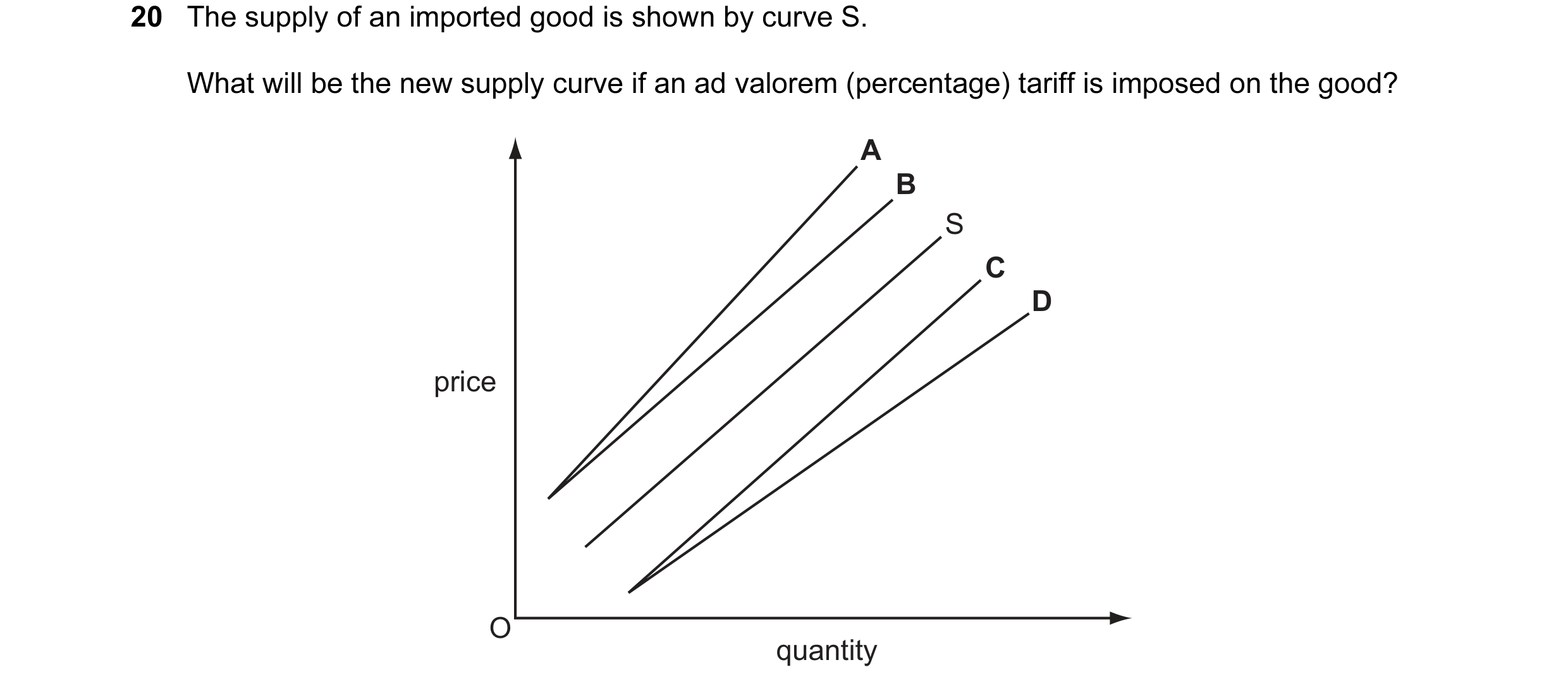

 1 / 47
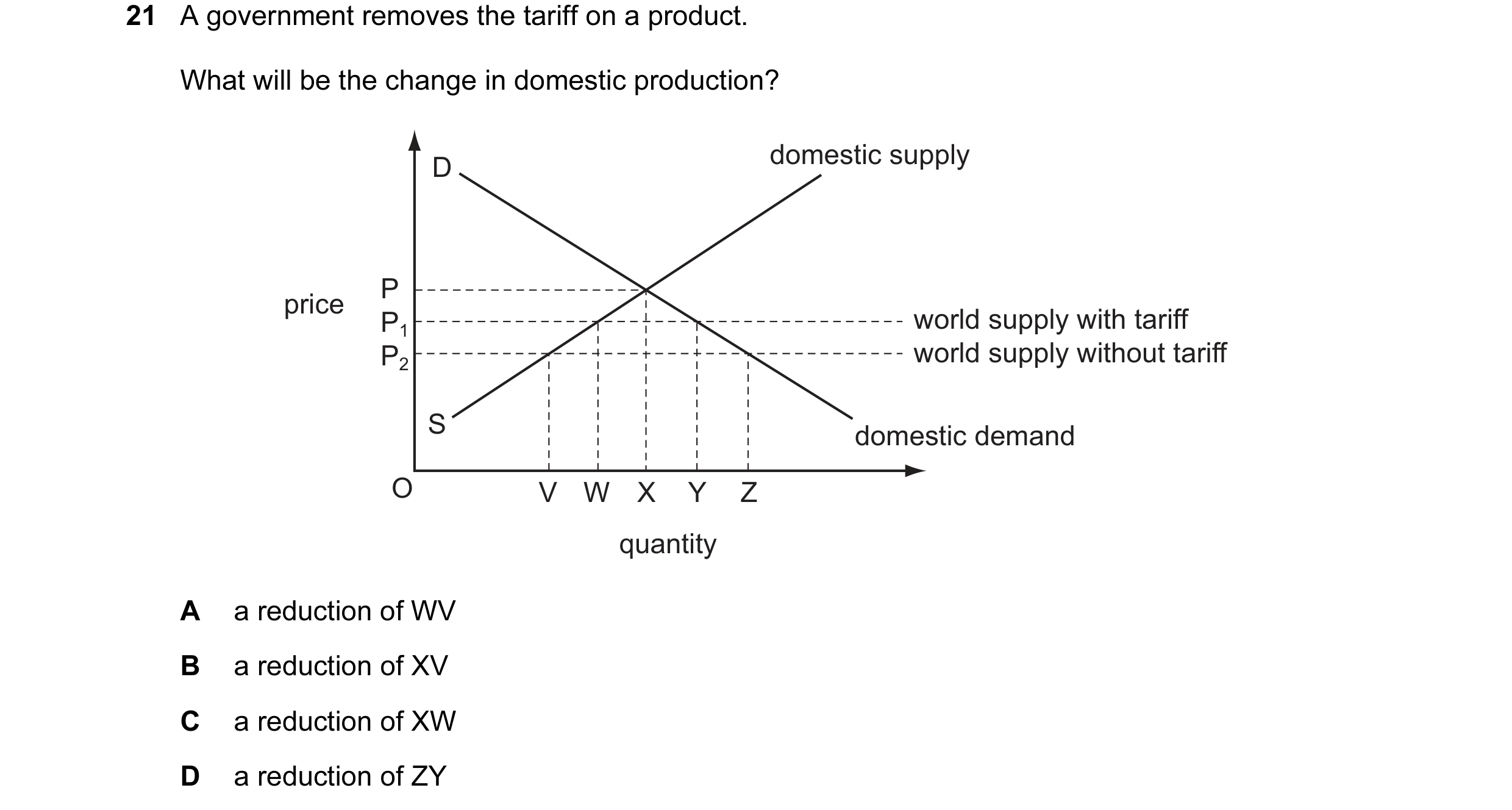

 2 / 47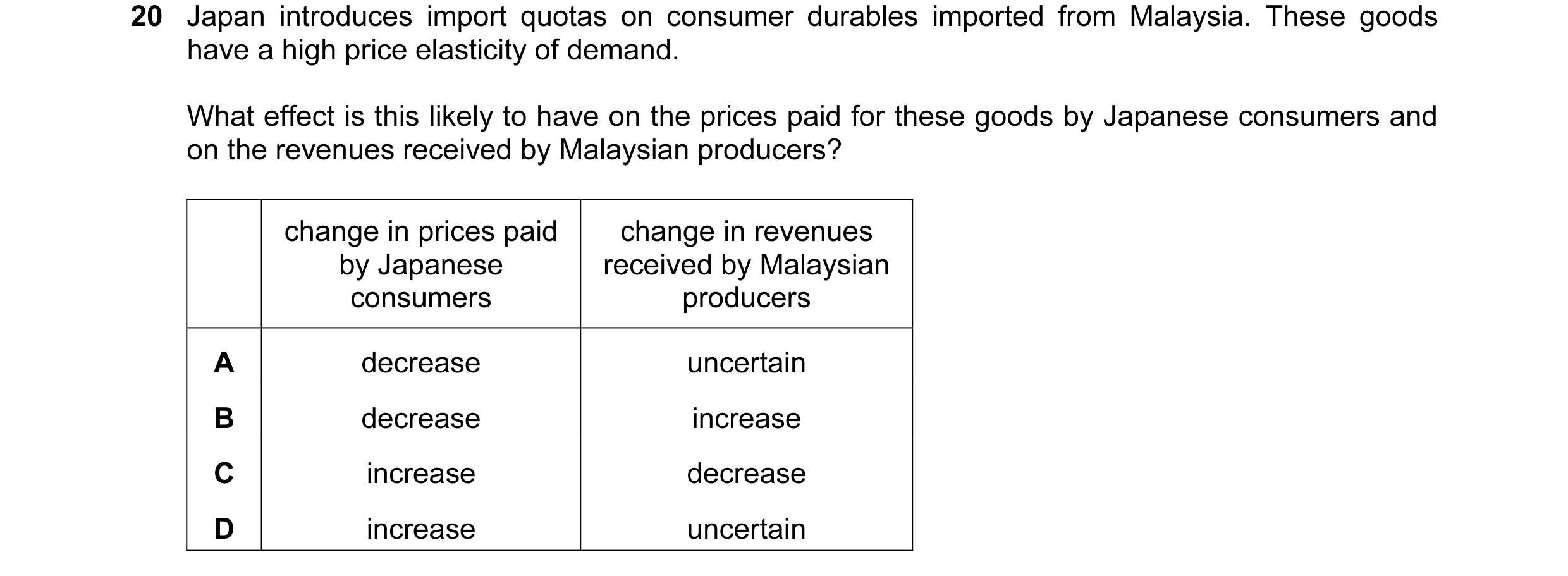

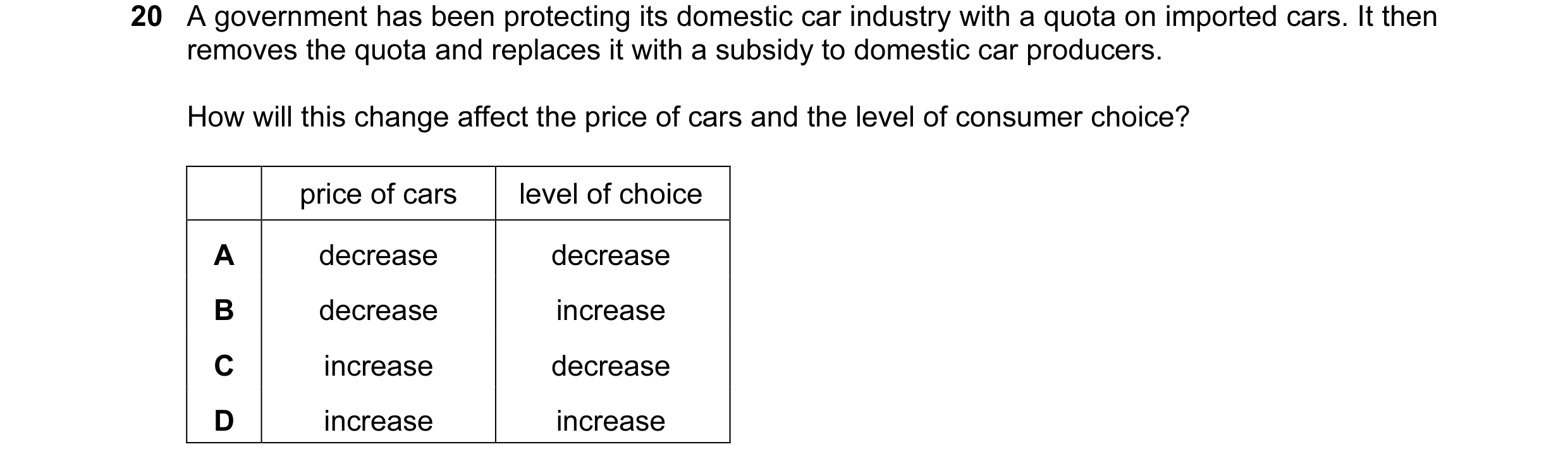
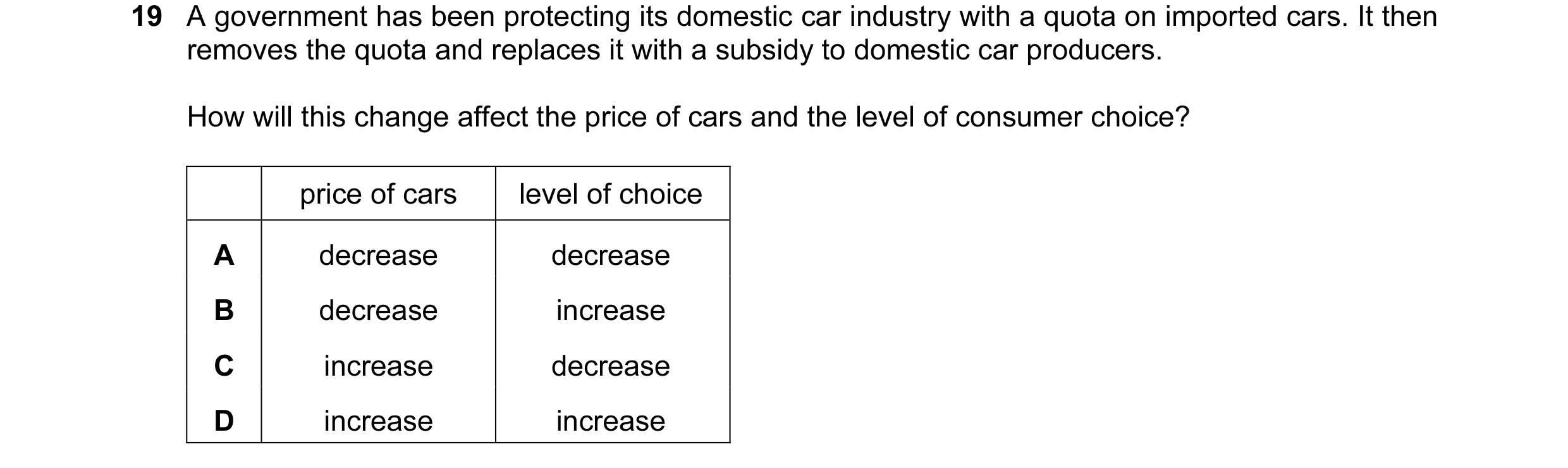 3 / 47
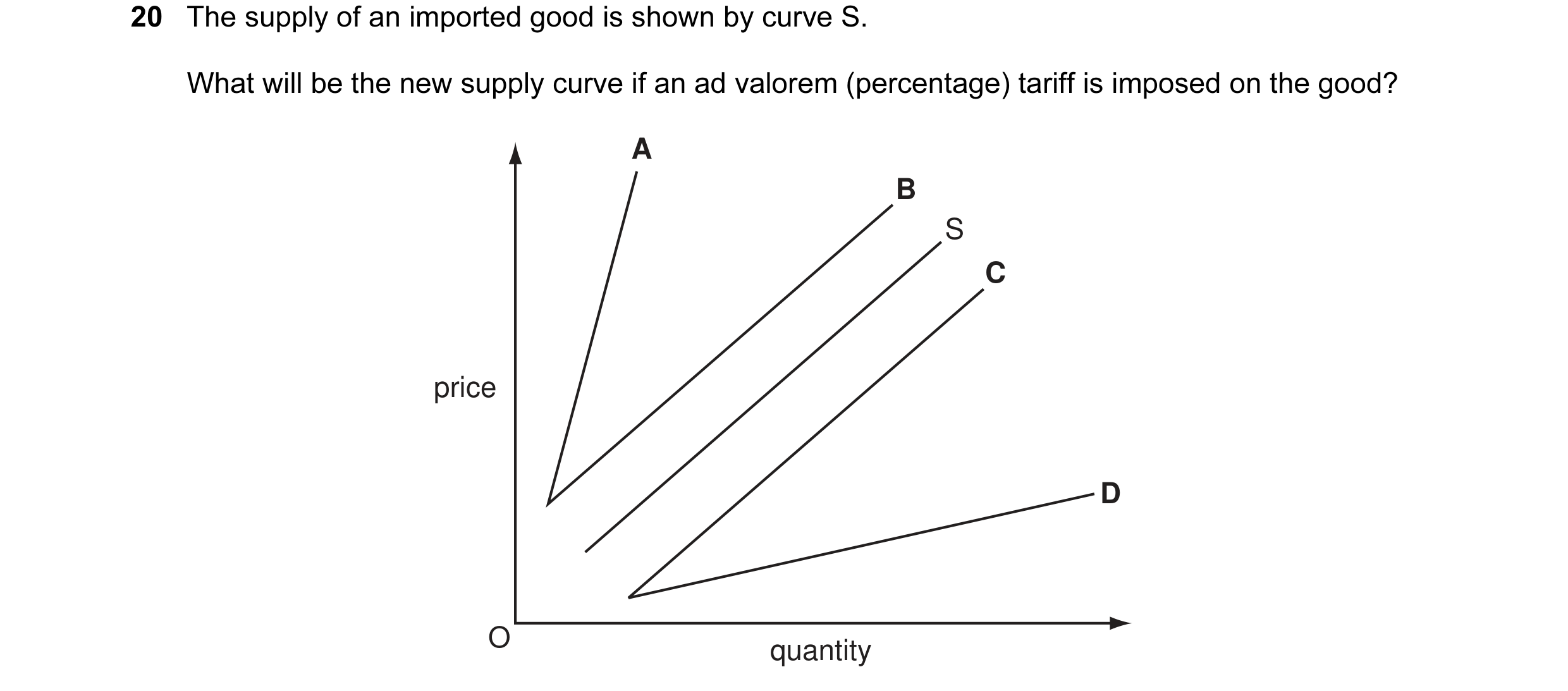
 4 / 47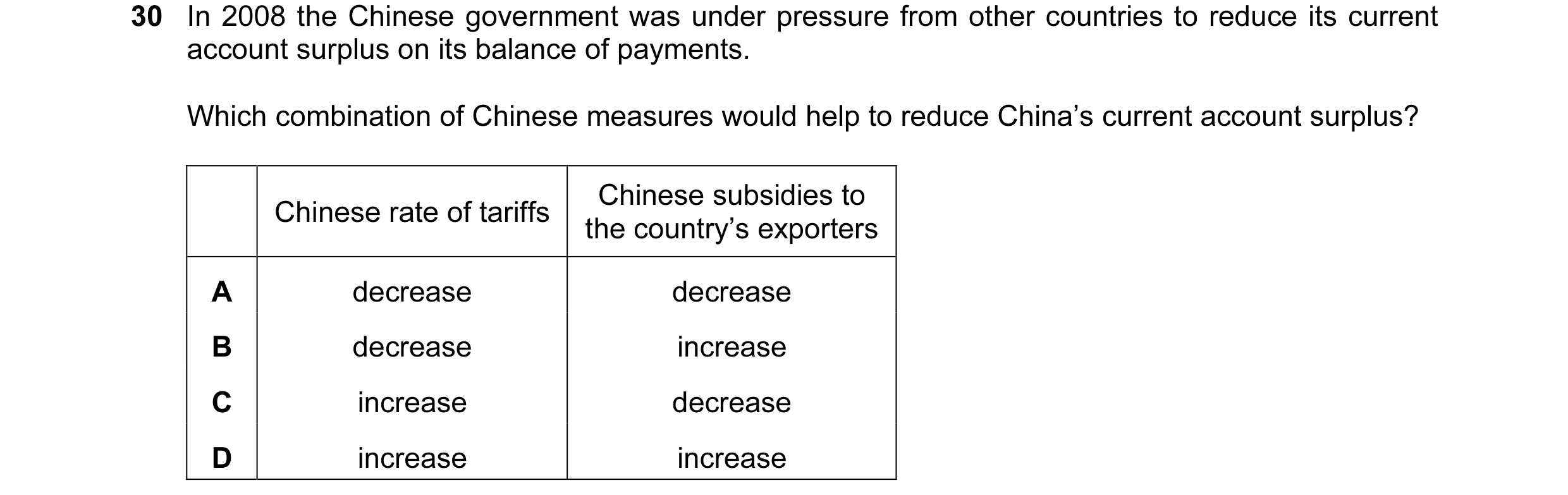
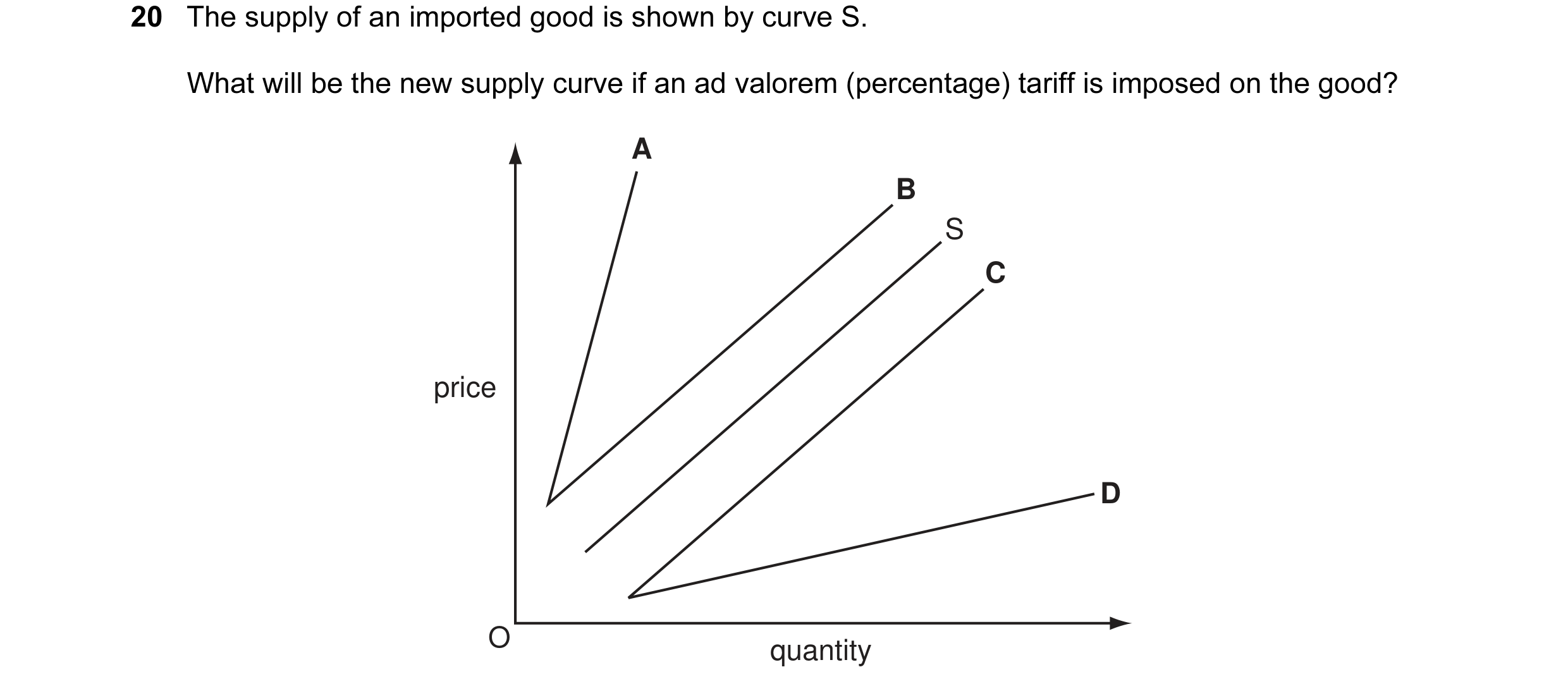
 5 / 47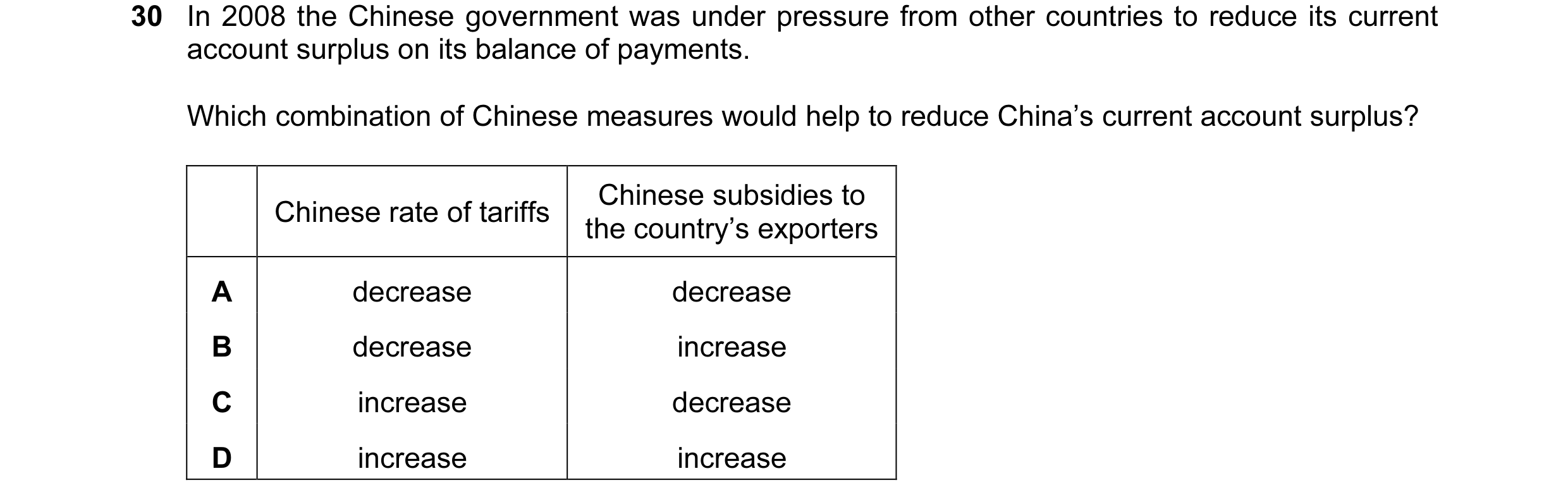
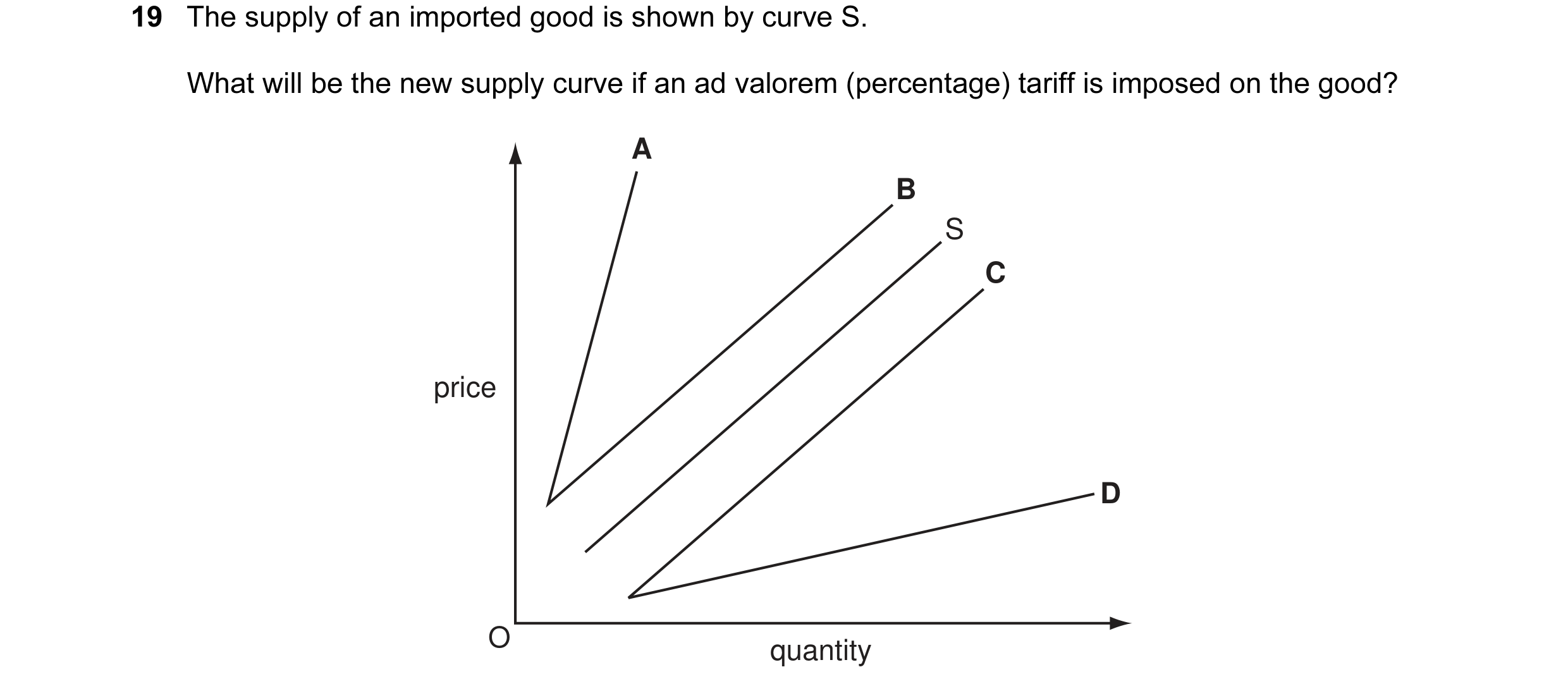
 6 / 47



 7 / 47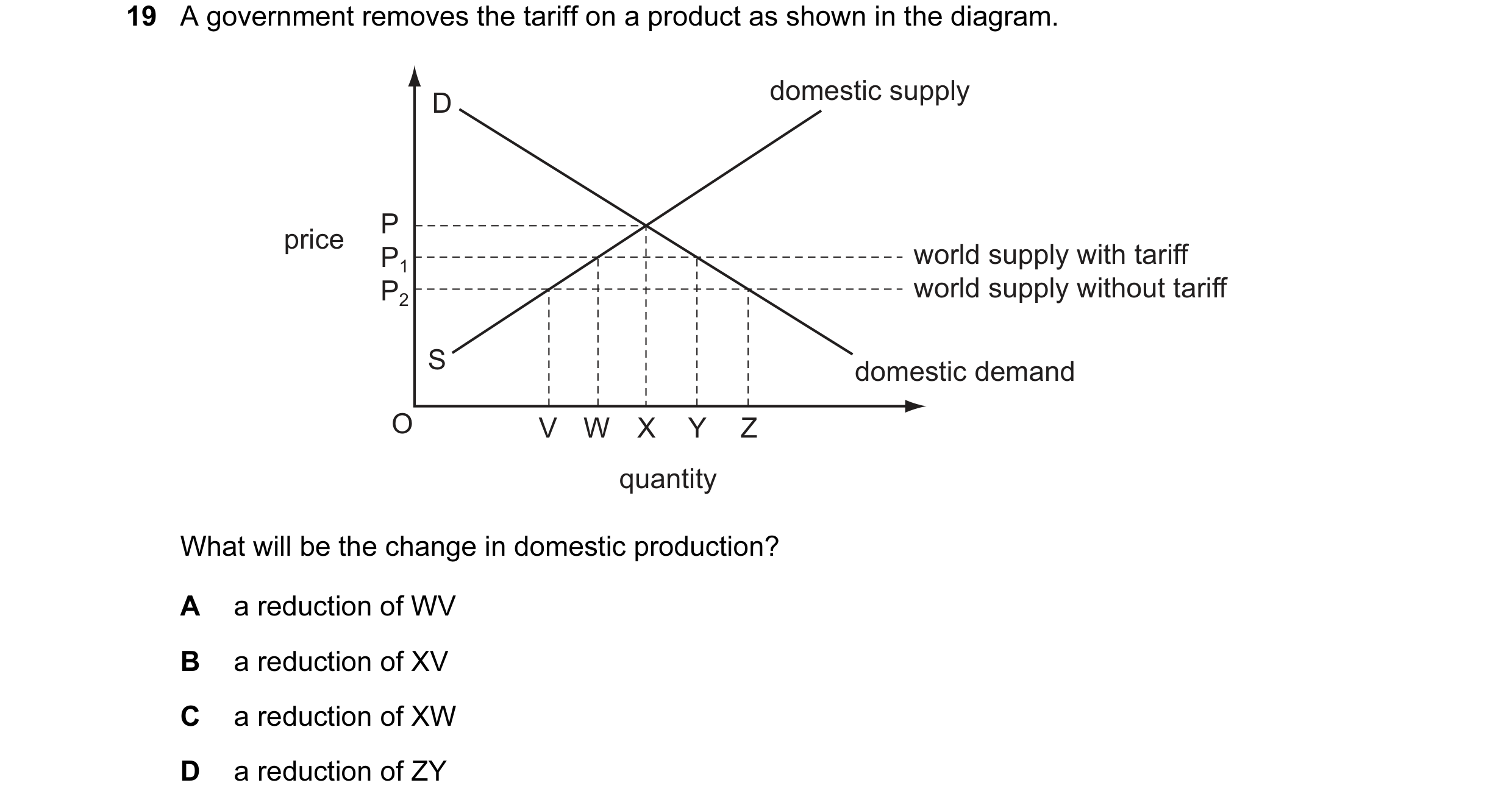
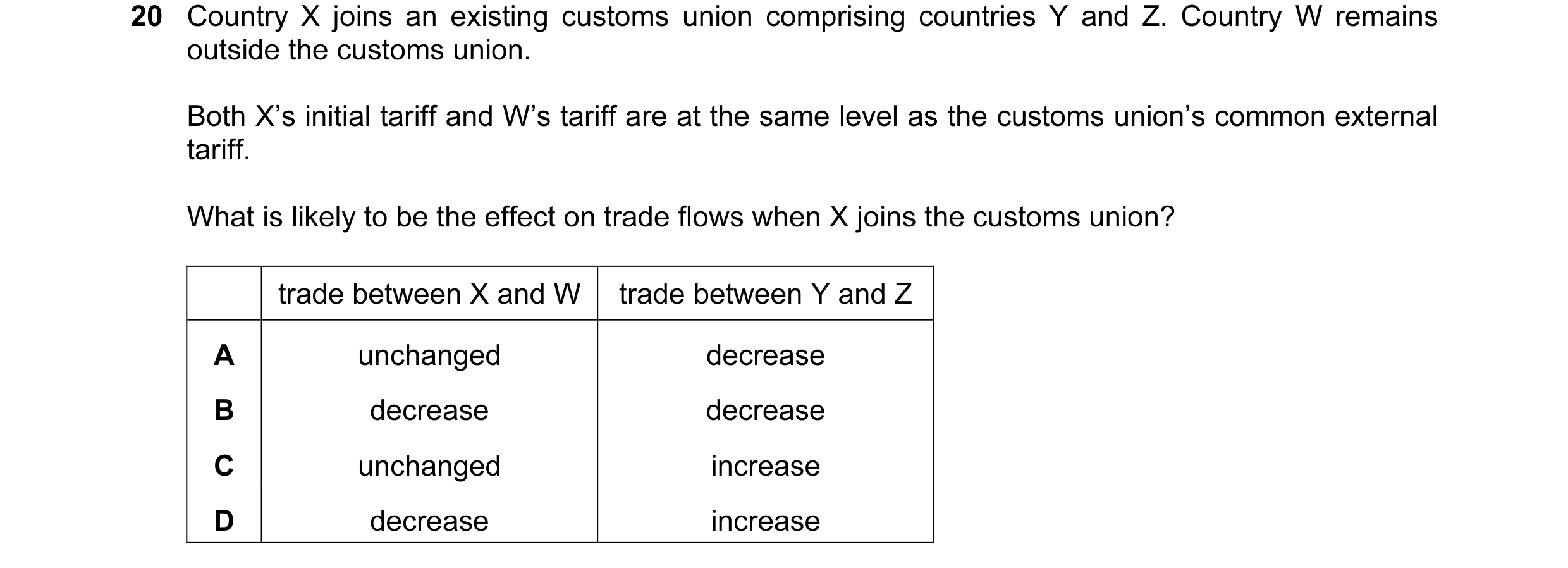
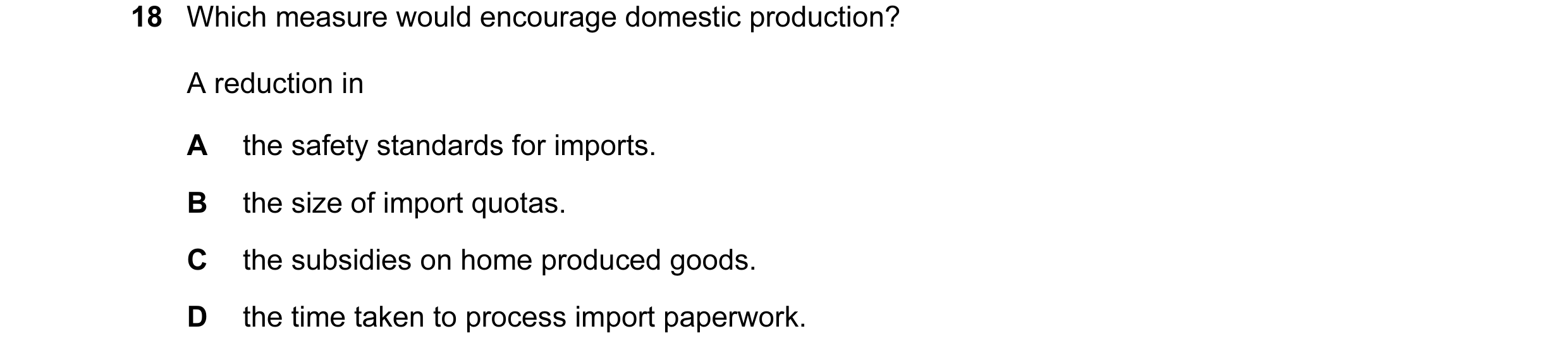 8 / 47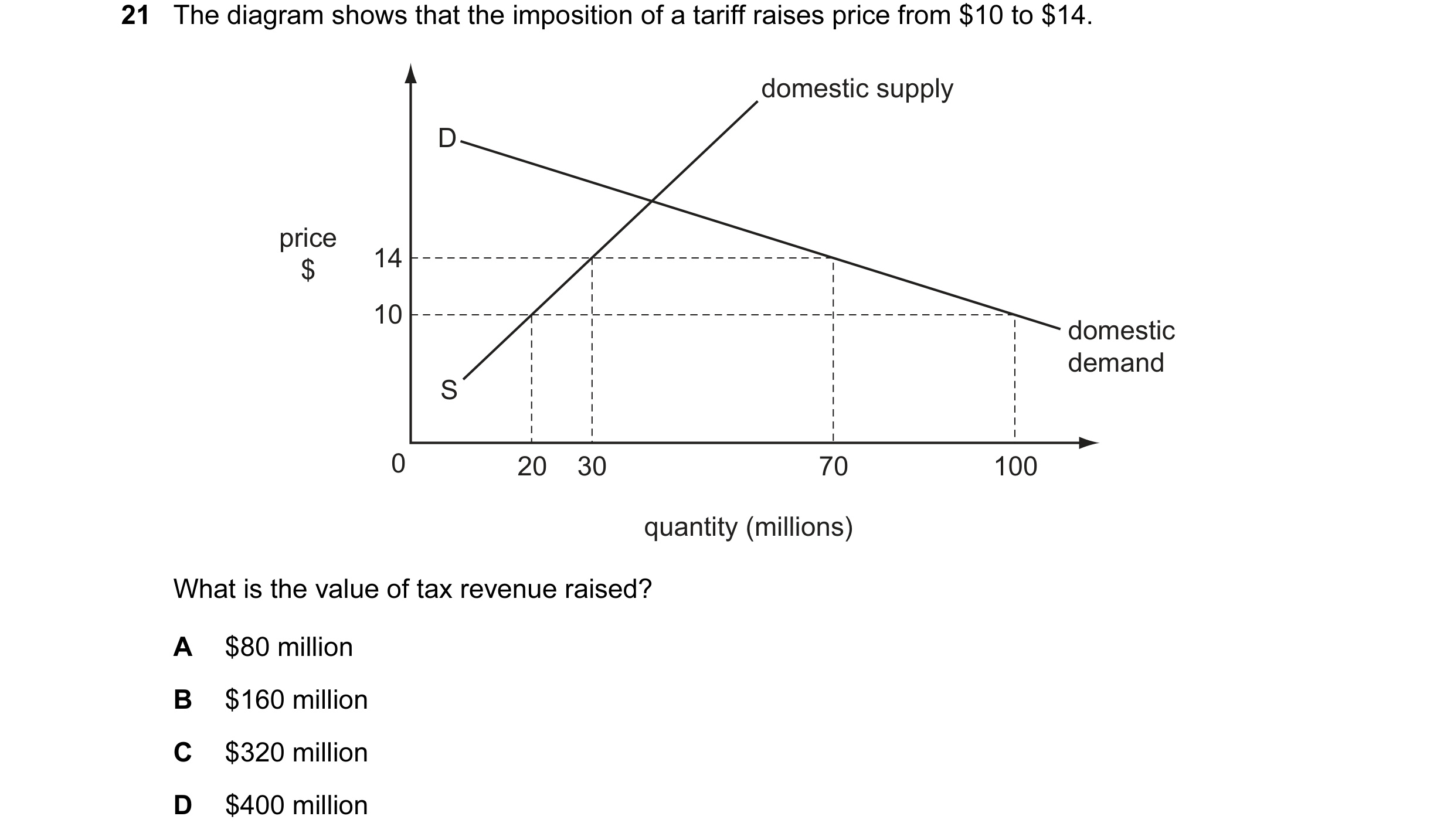
 9 / 47
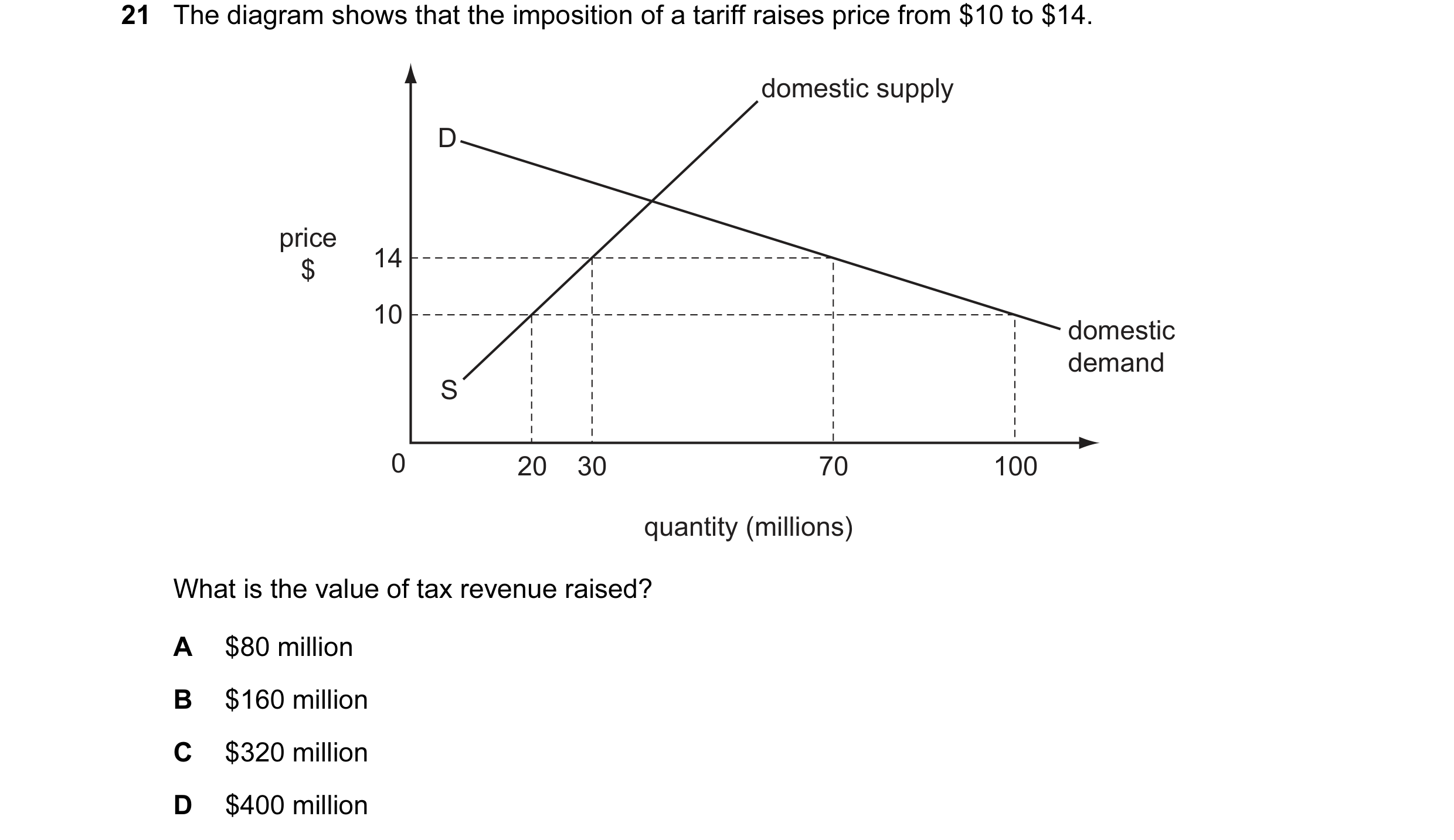
 10 / 47

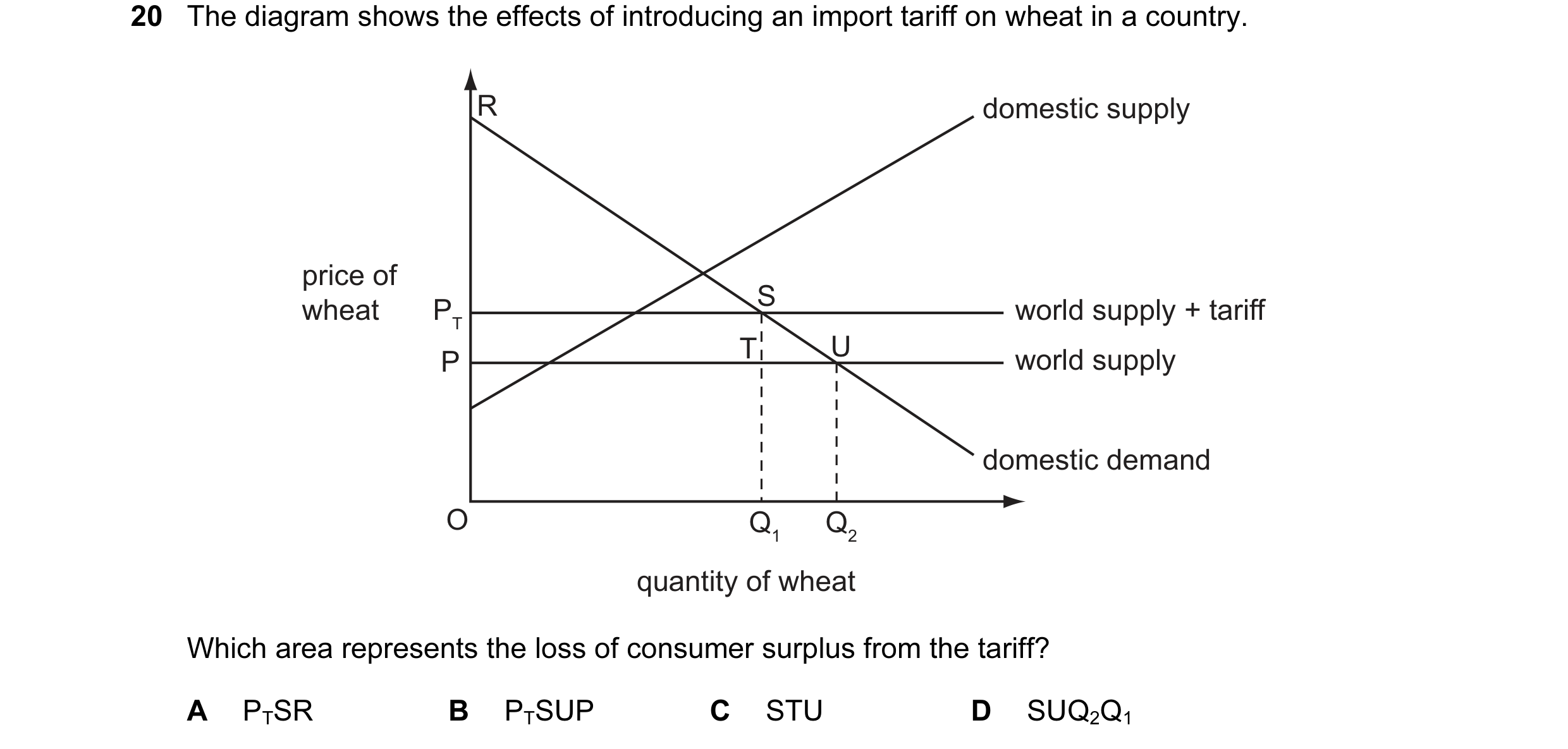
 11 / 47


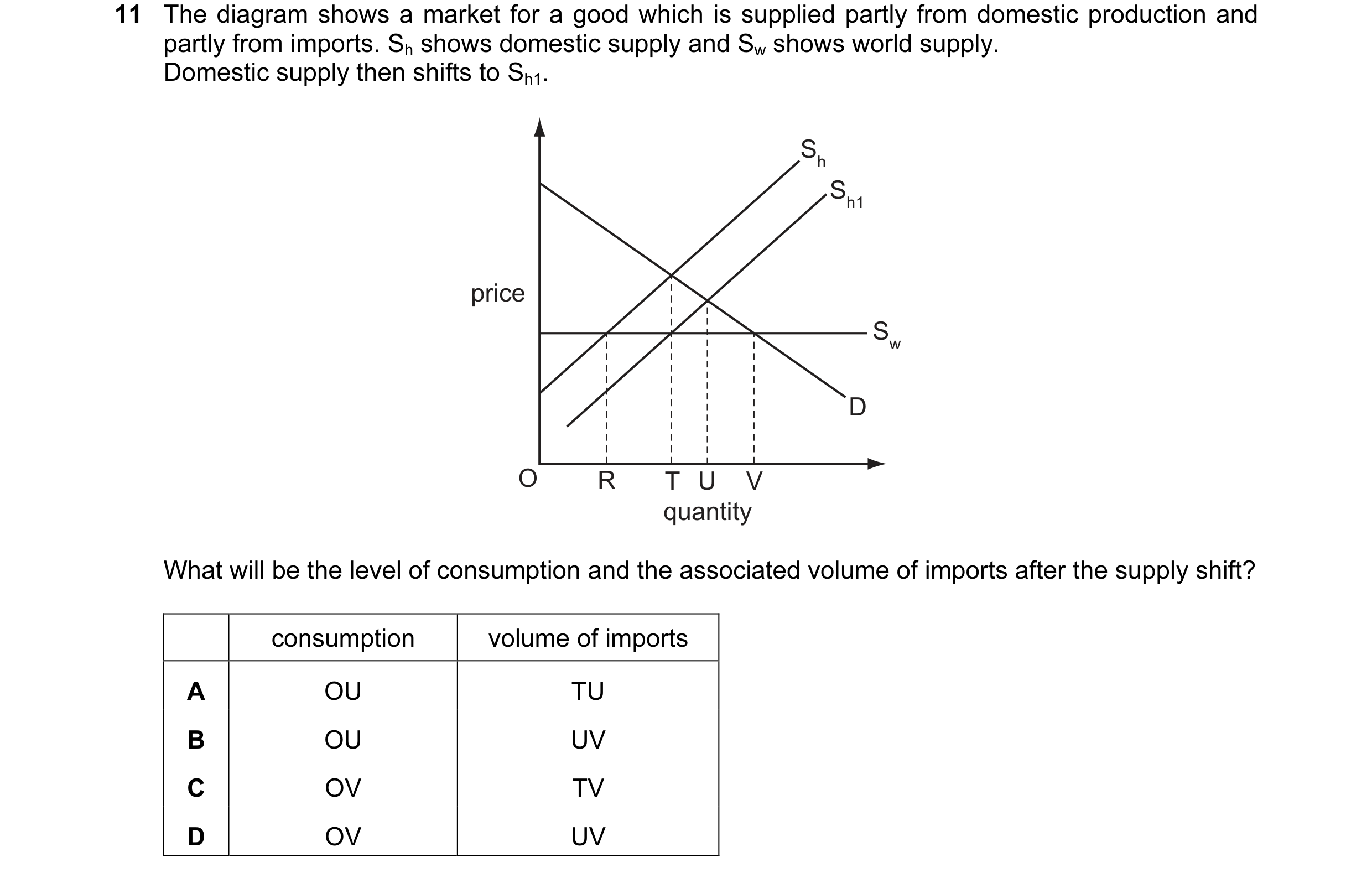 12 / 47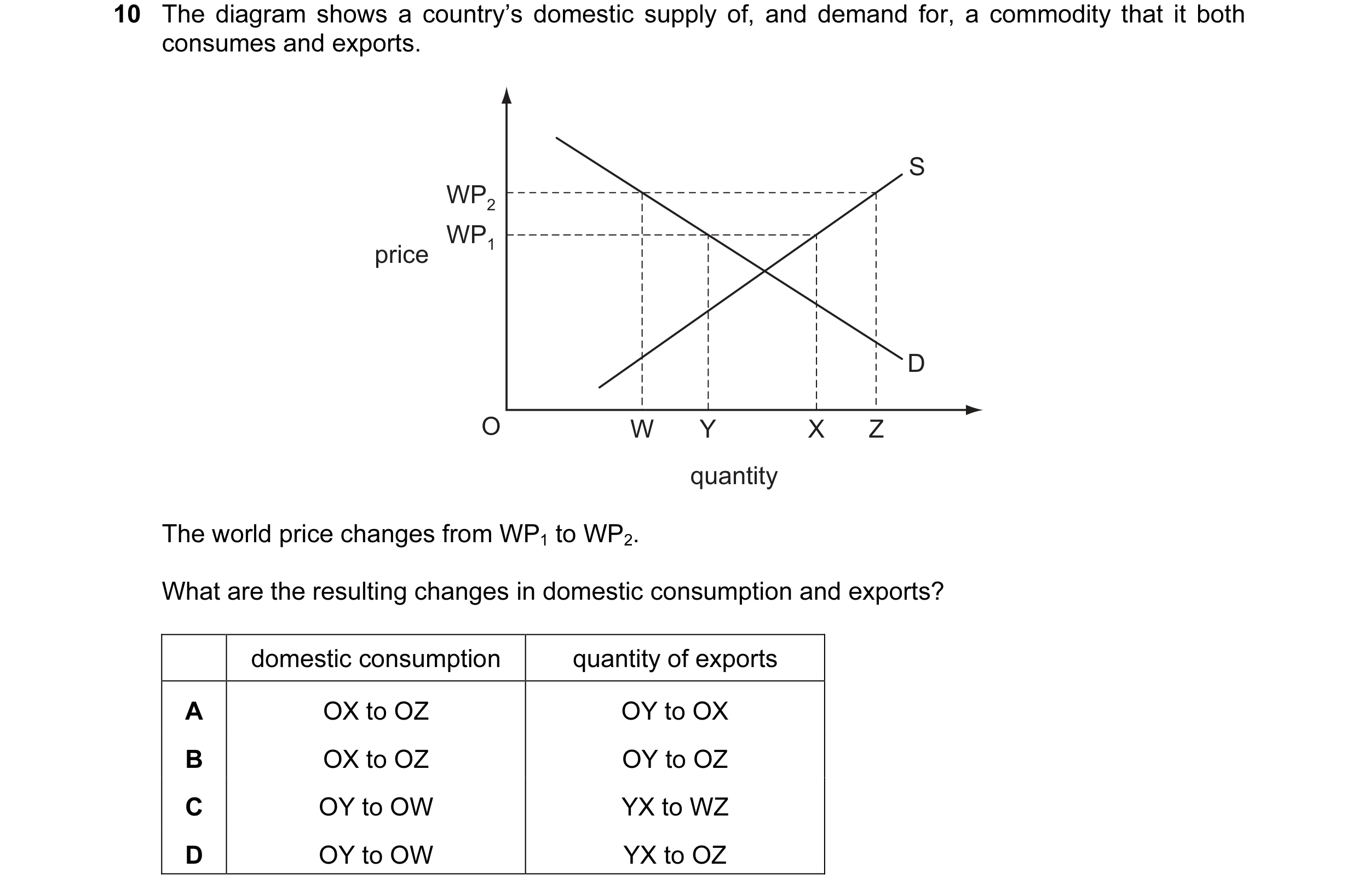

 13 / 47
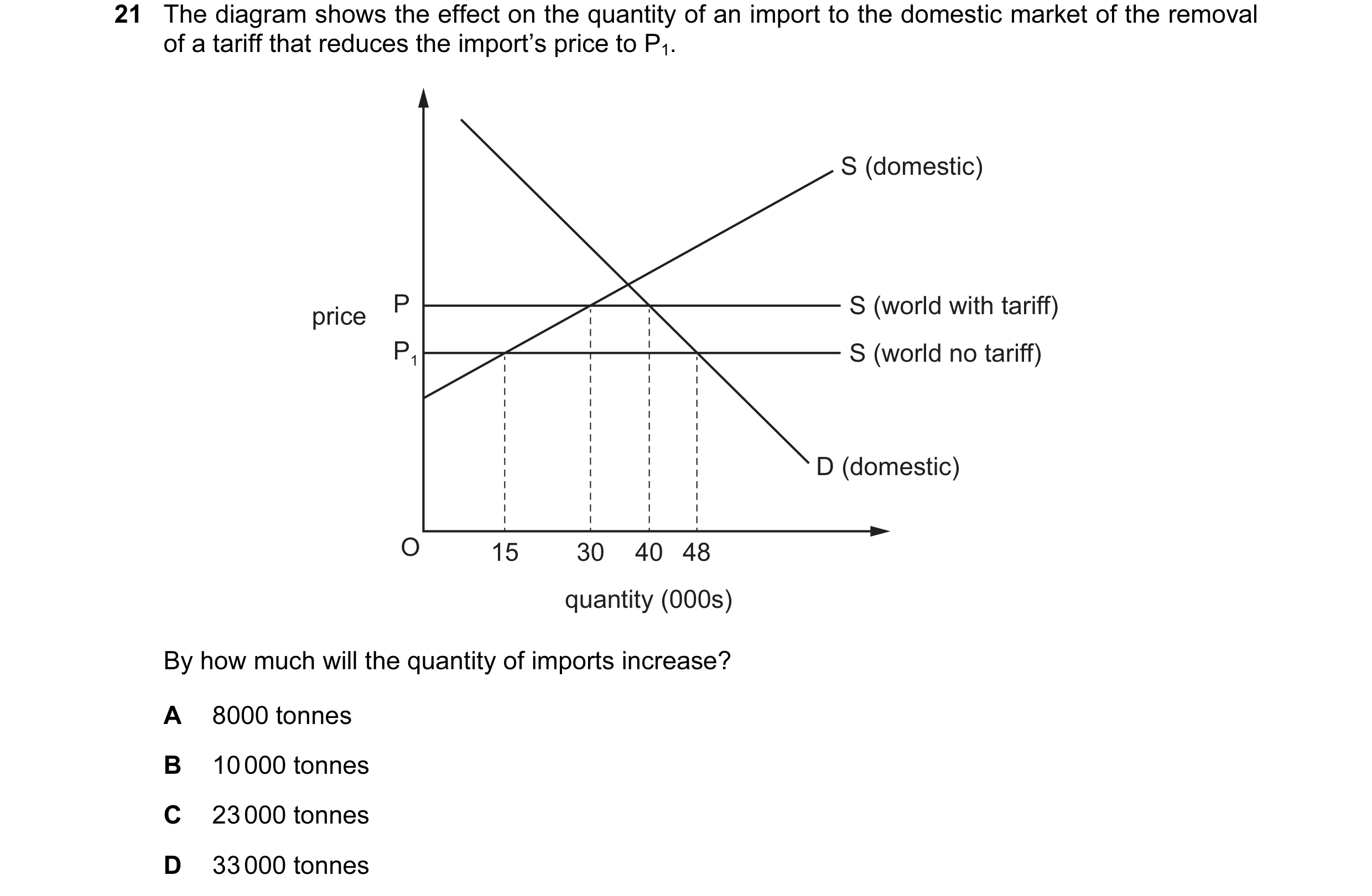
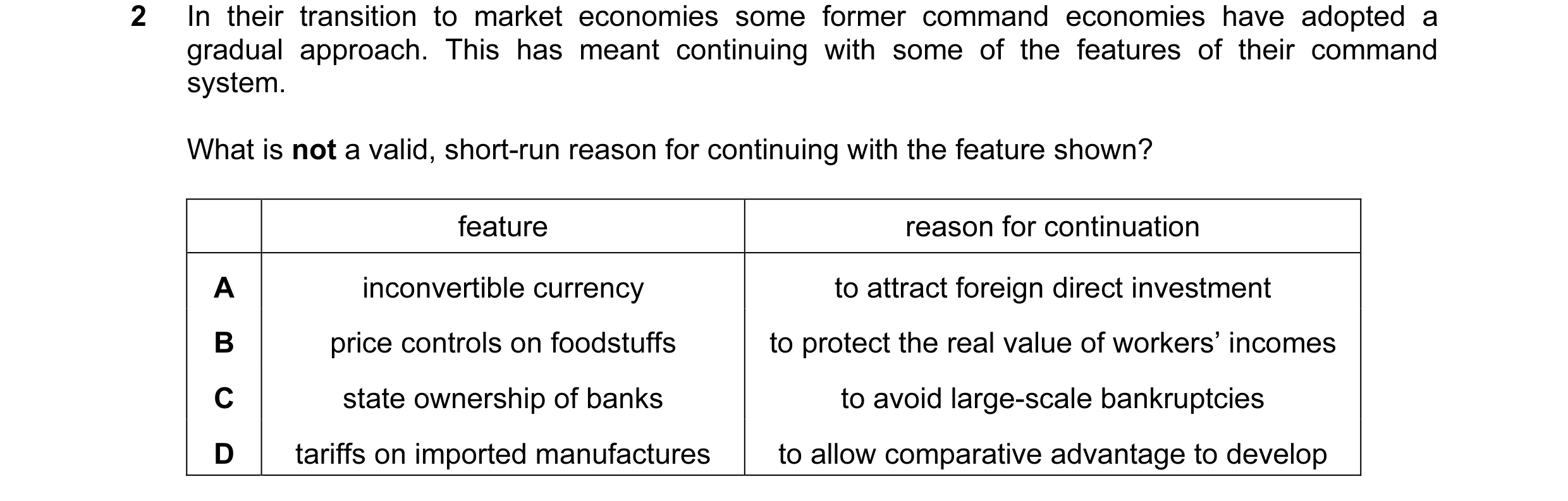 14 / 47
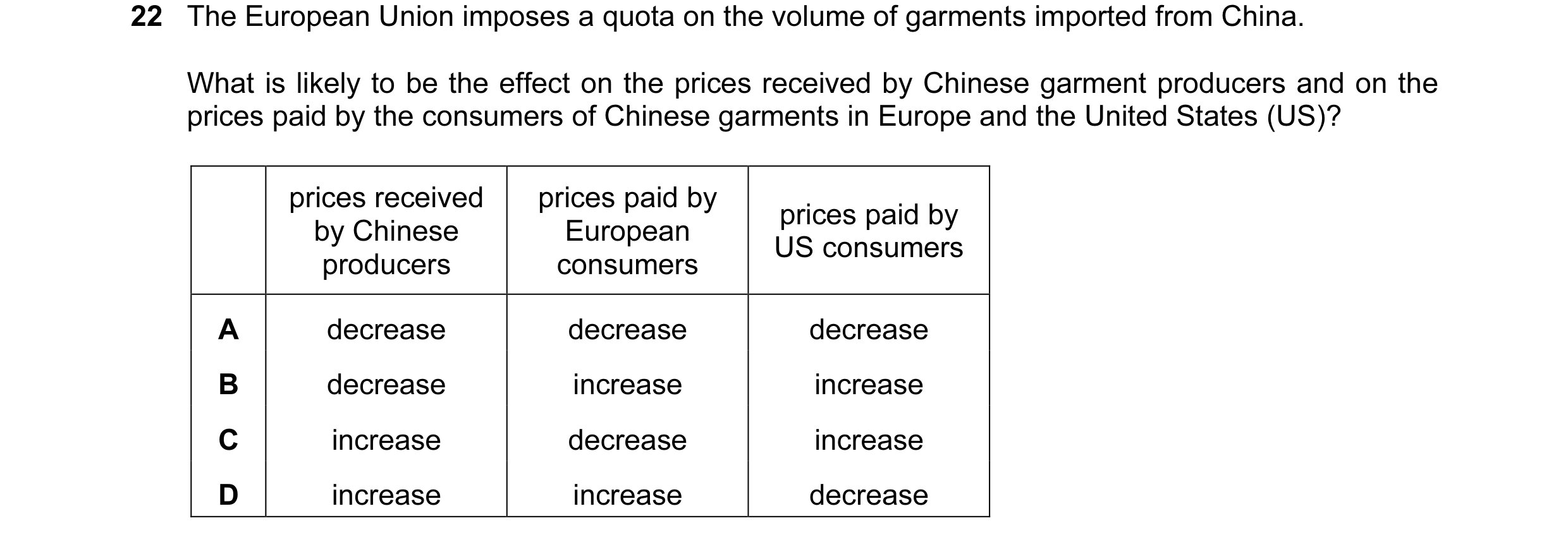
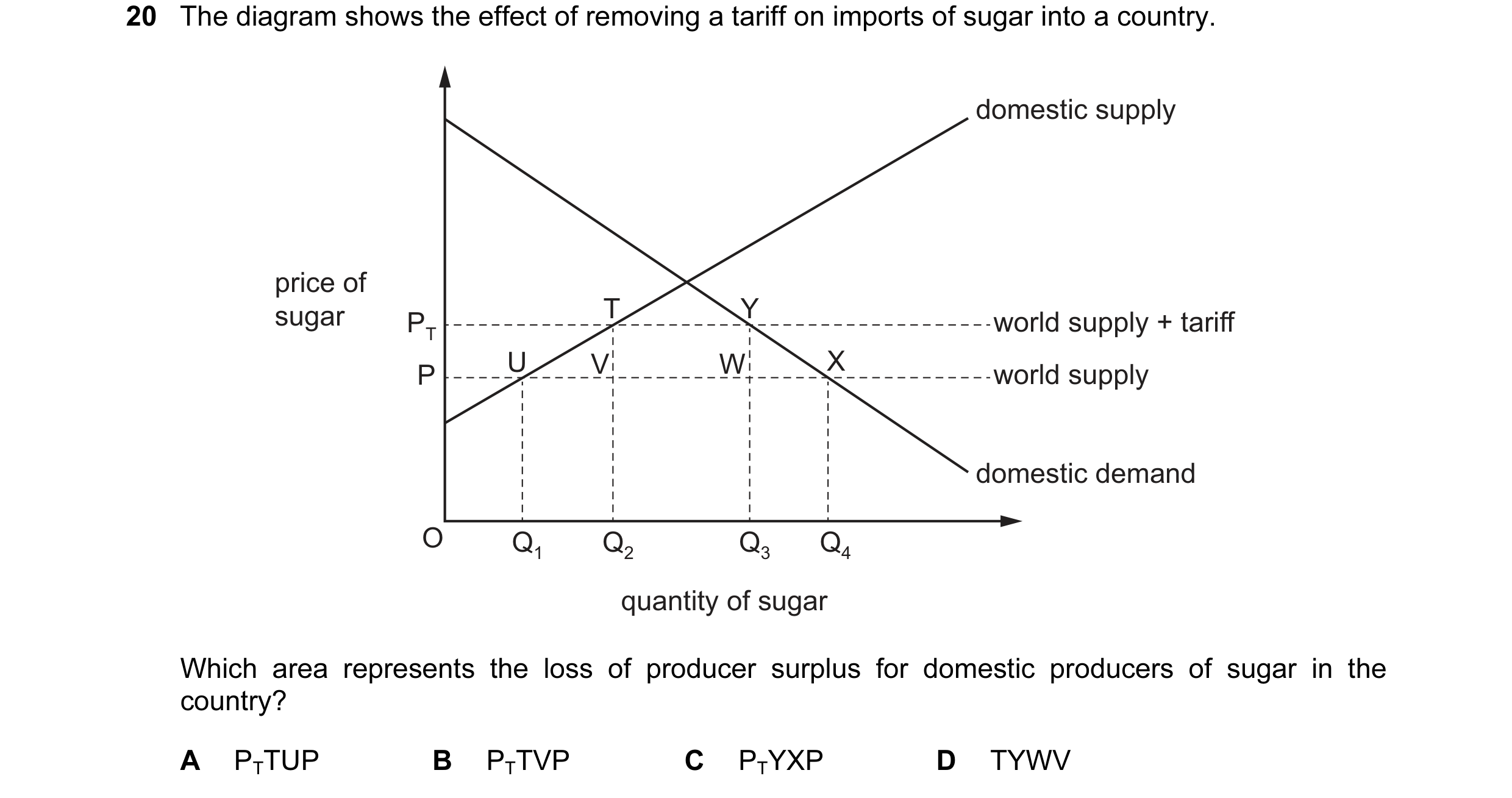 15 / 47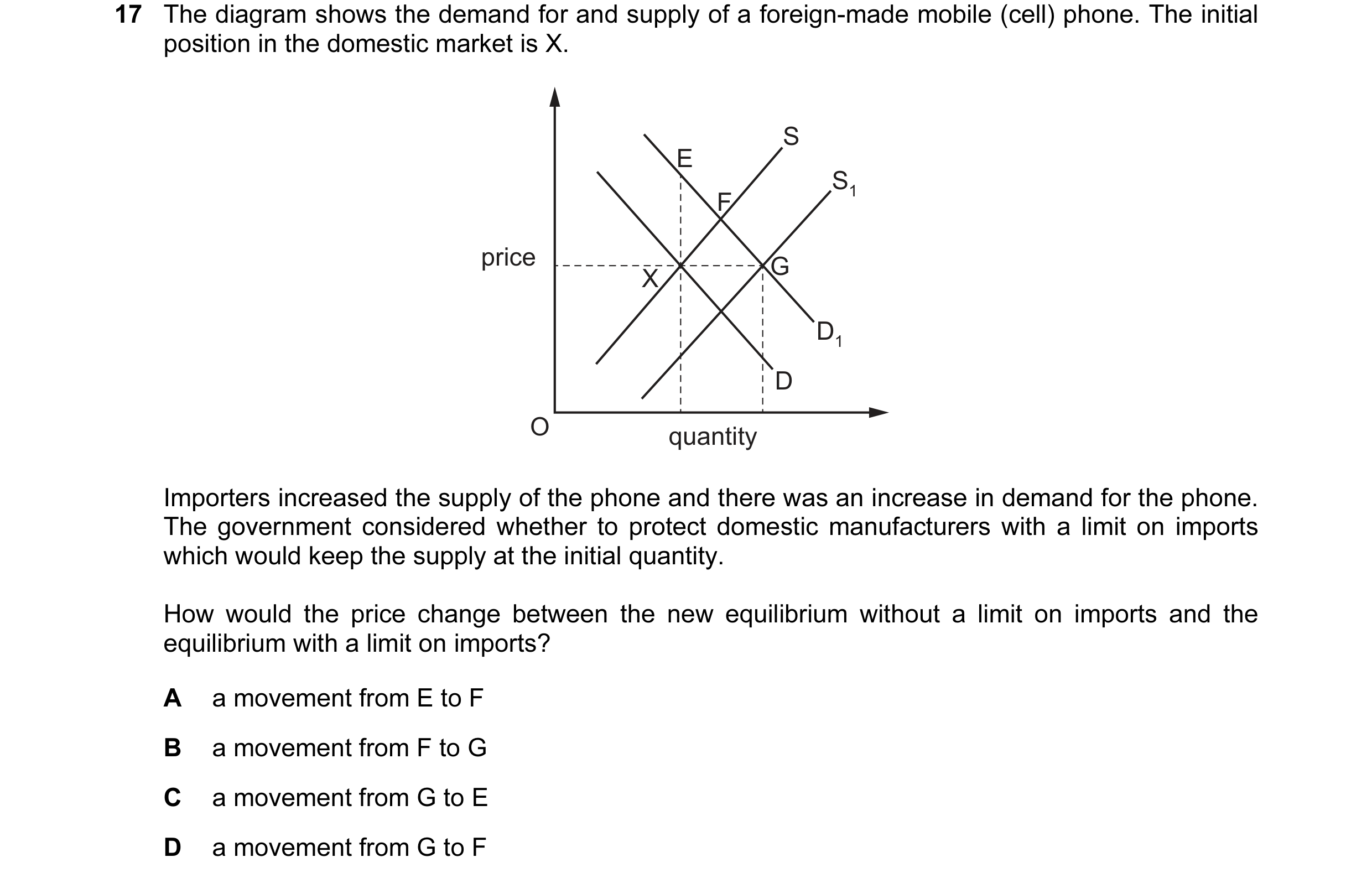
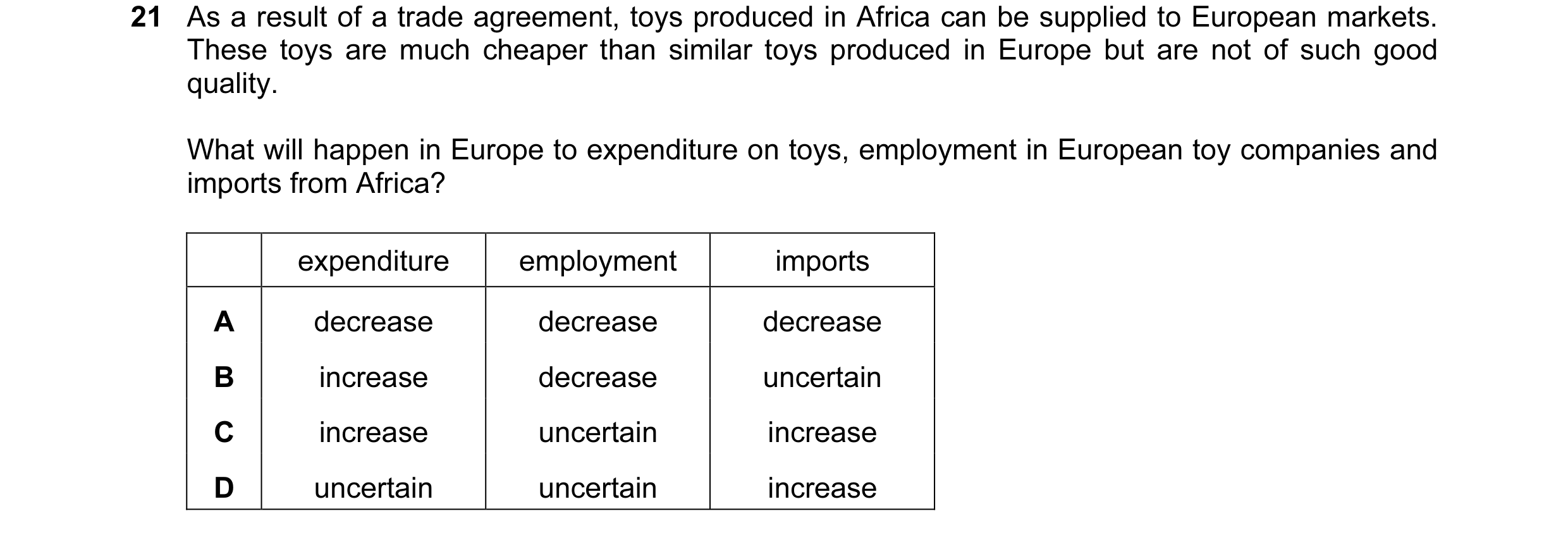 16 / 47

 17 / 47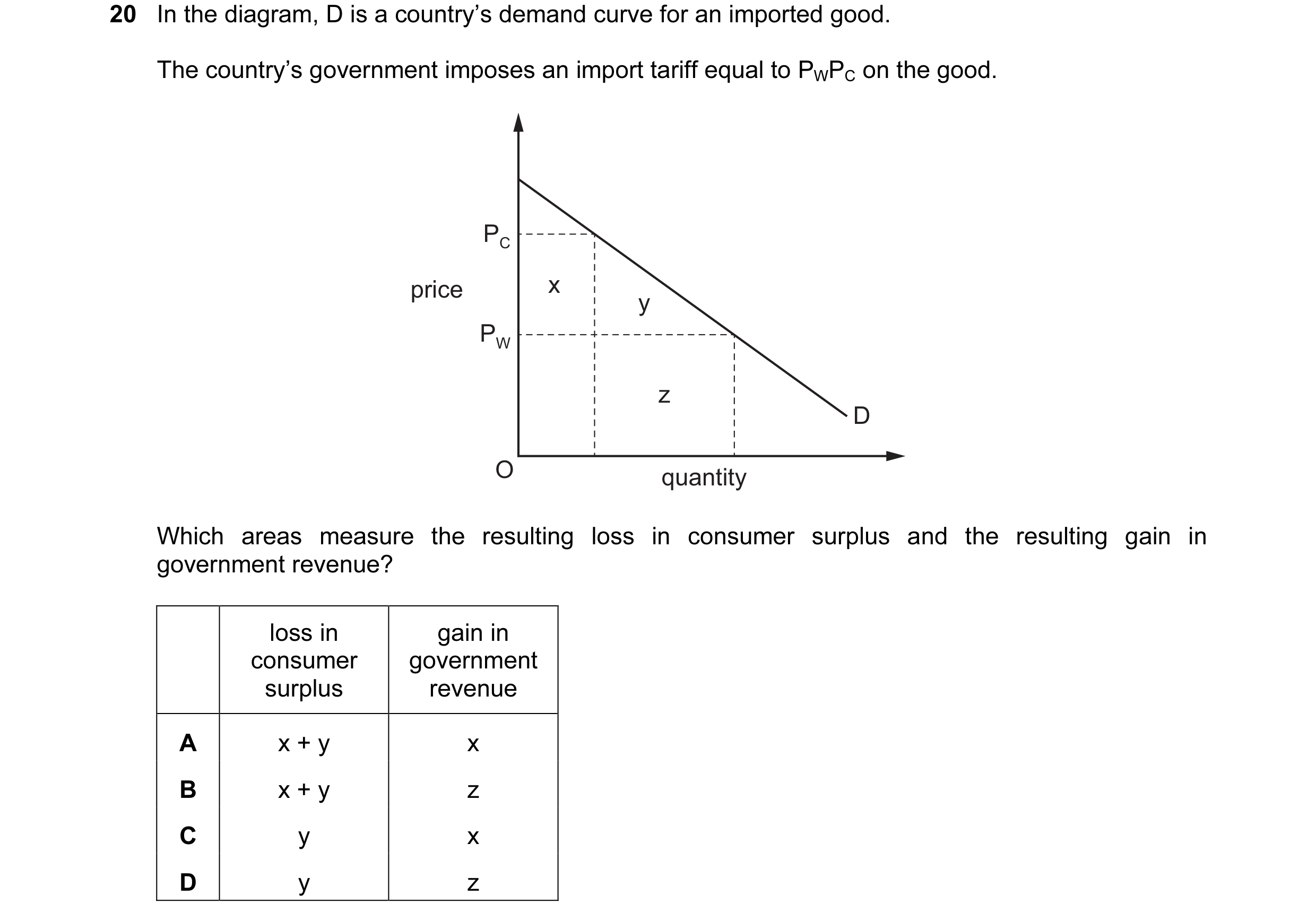


 18 / 47
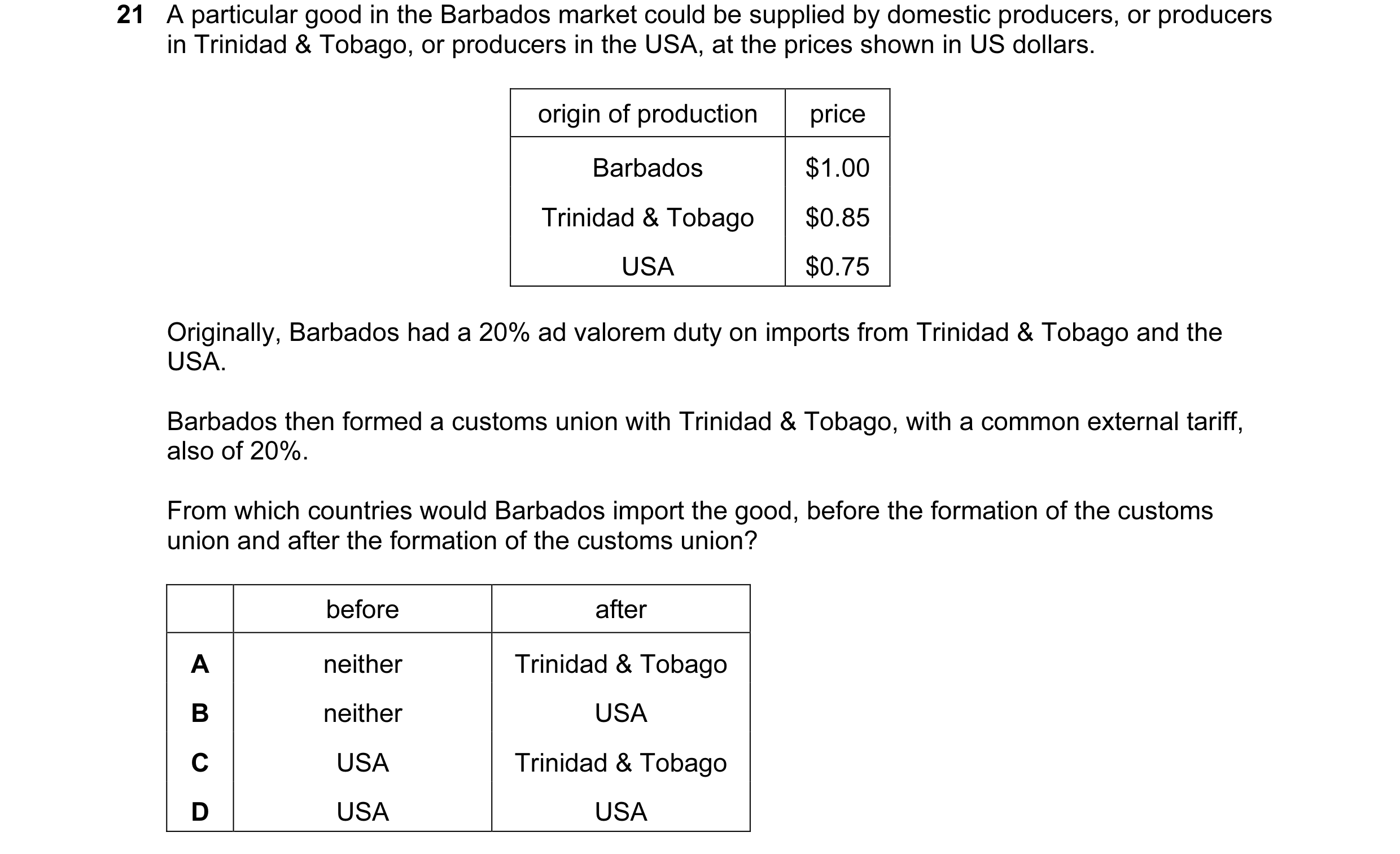
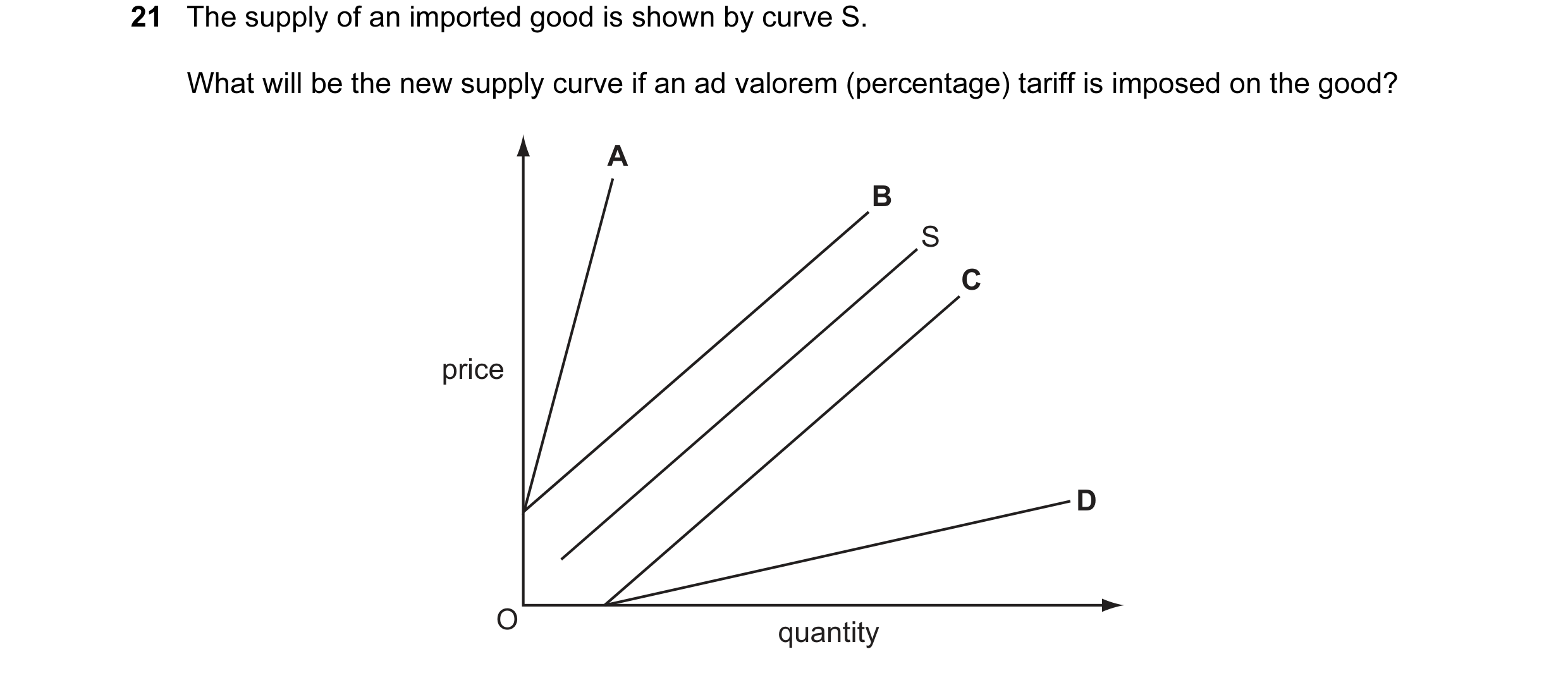 19 / 47
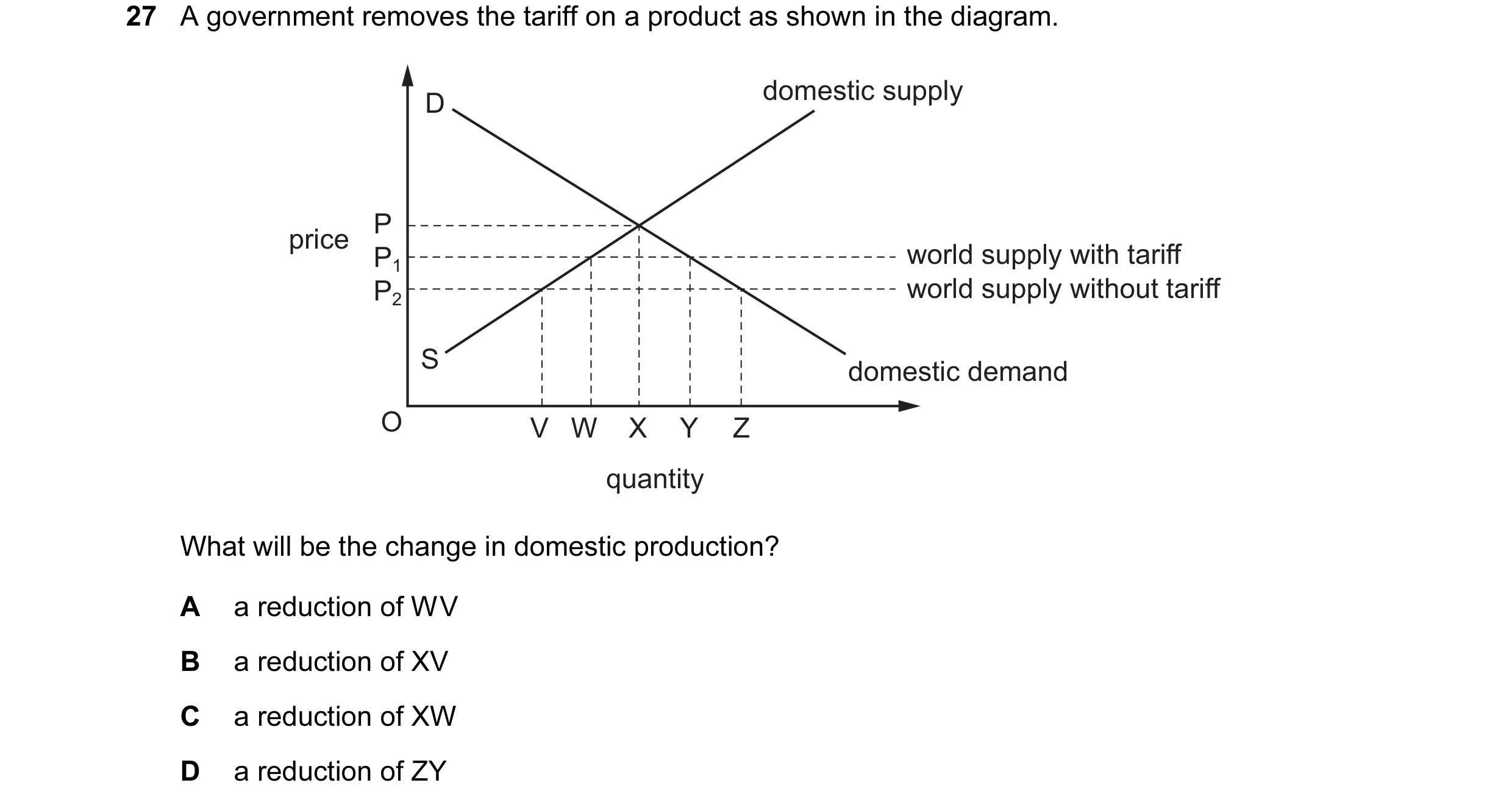
 20 / 47
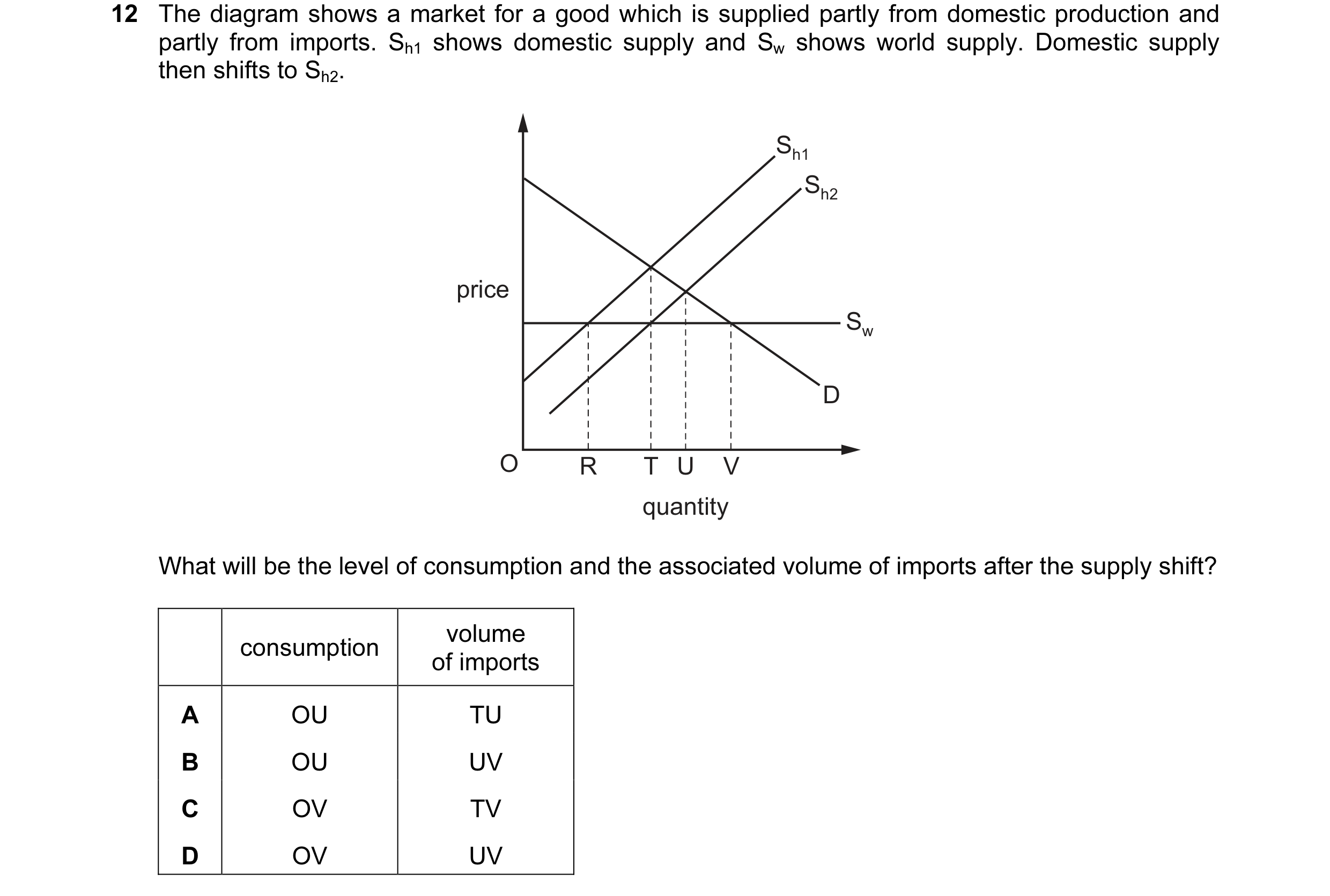
 21 / 47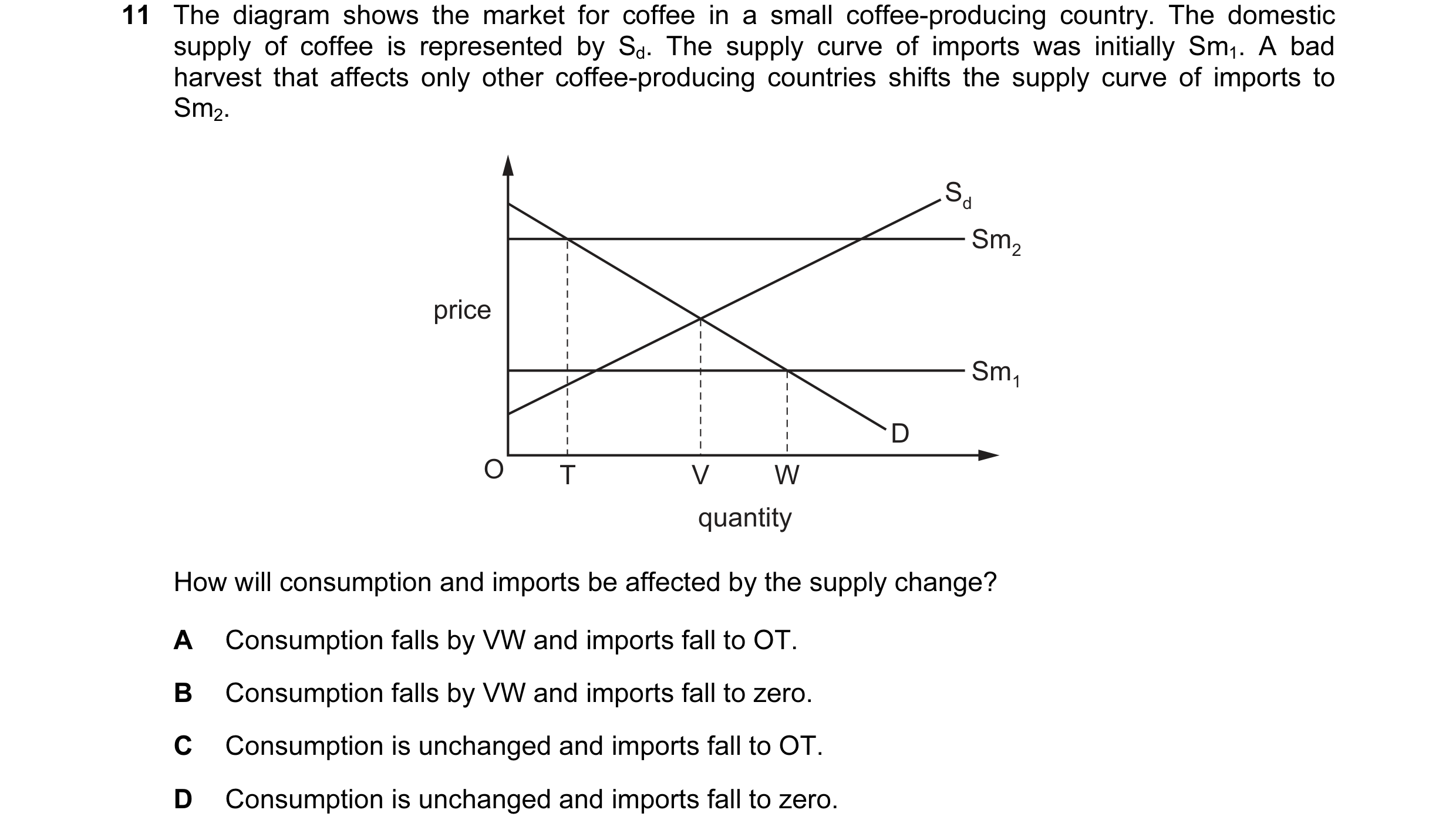
 22 / 47
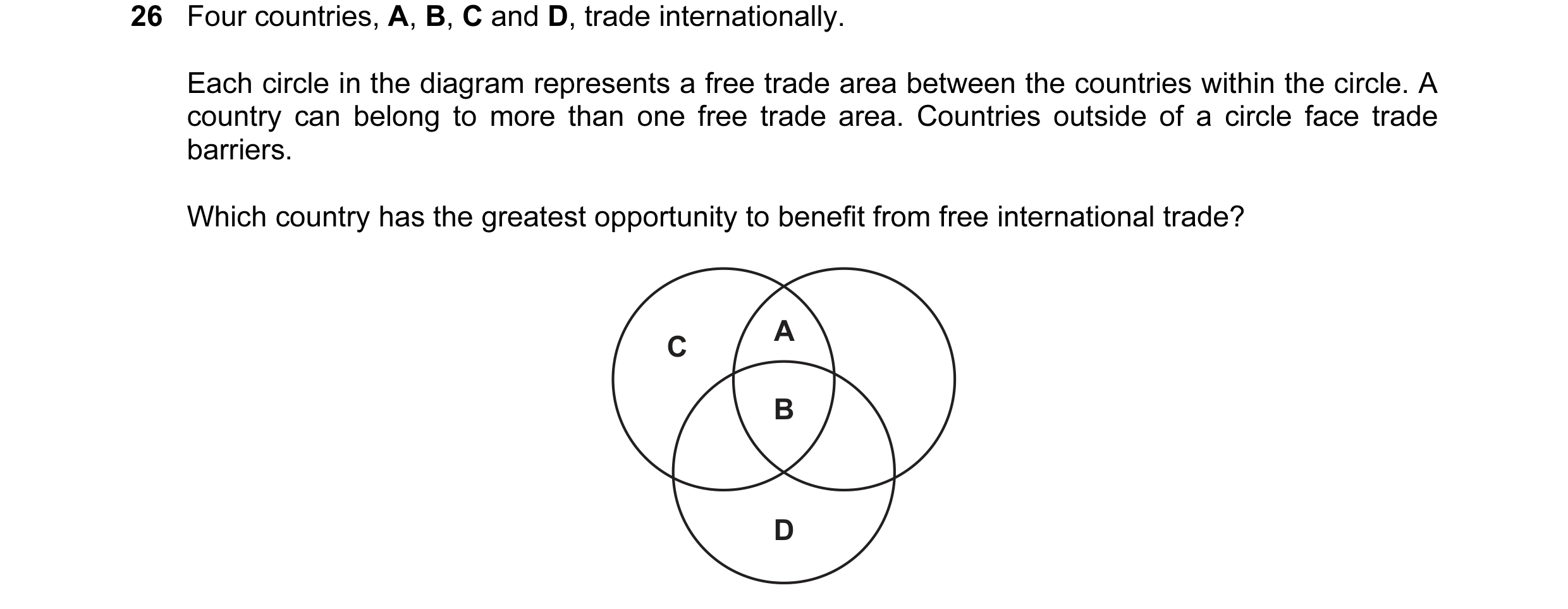
 23 / 47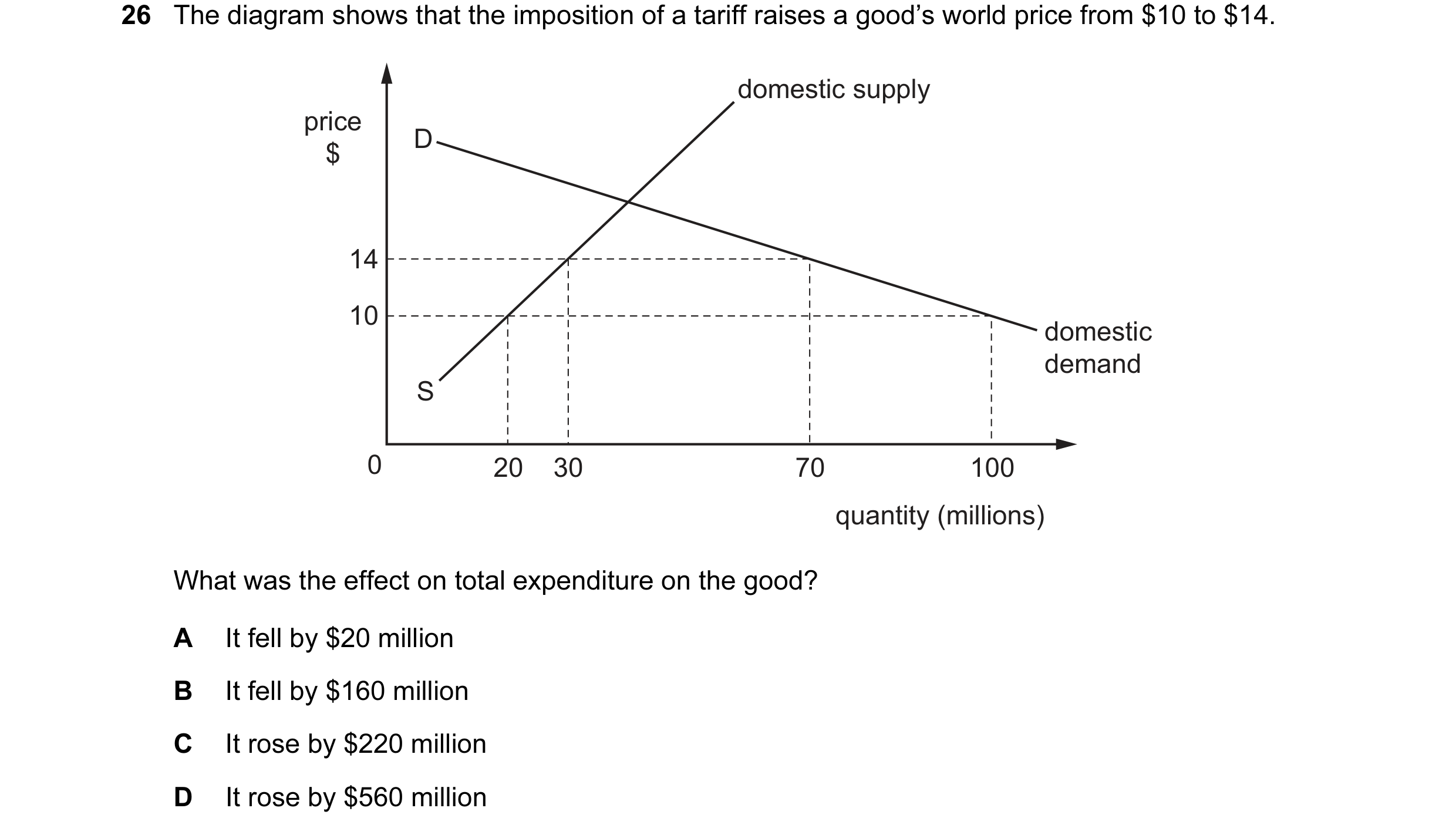


 24 / 47
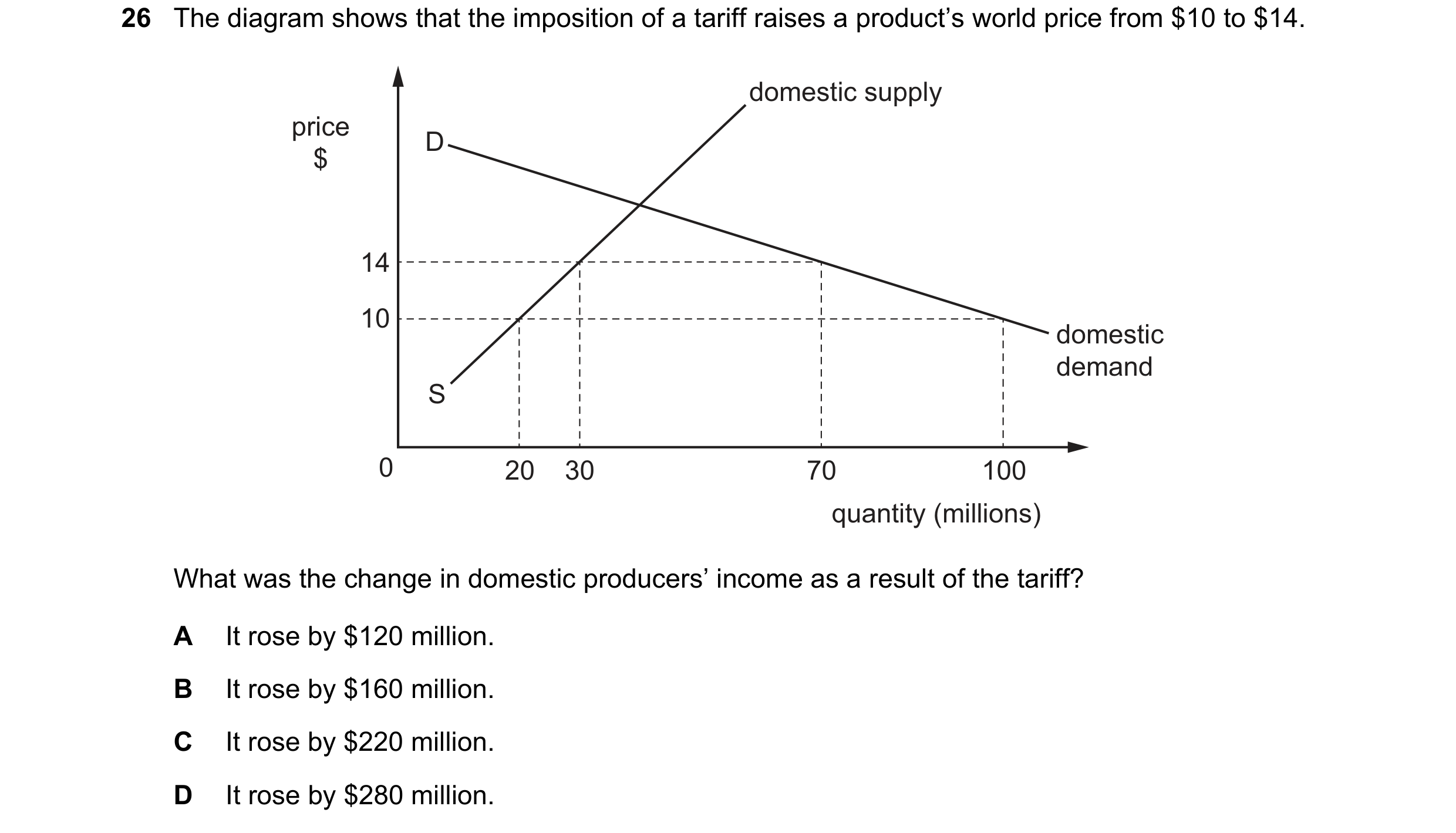

 25 / 47
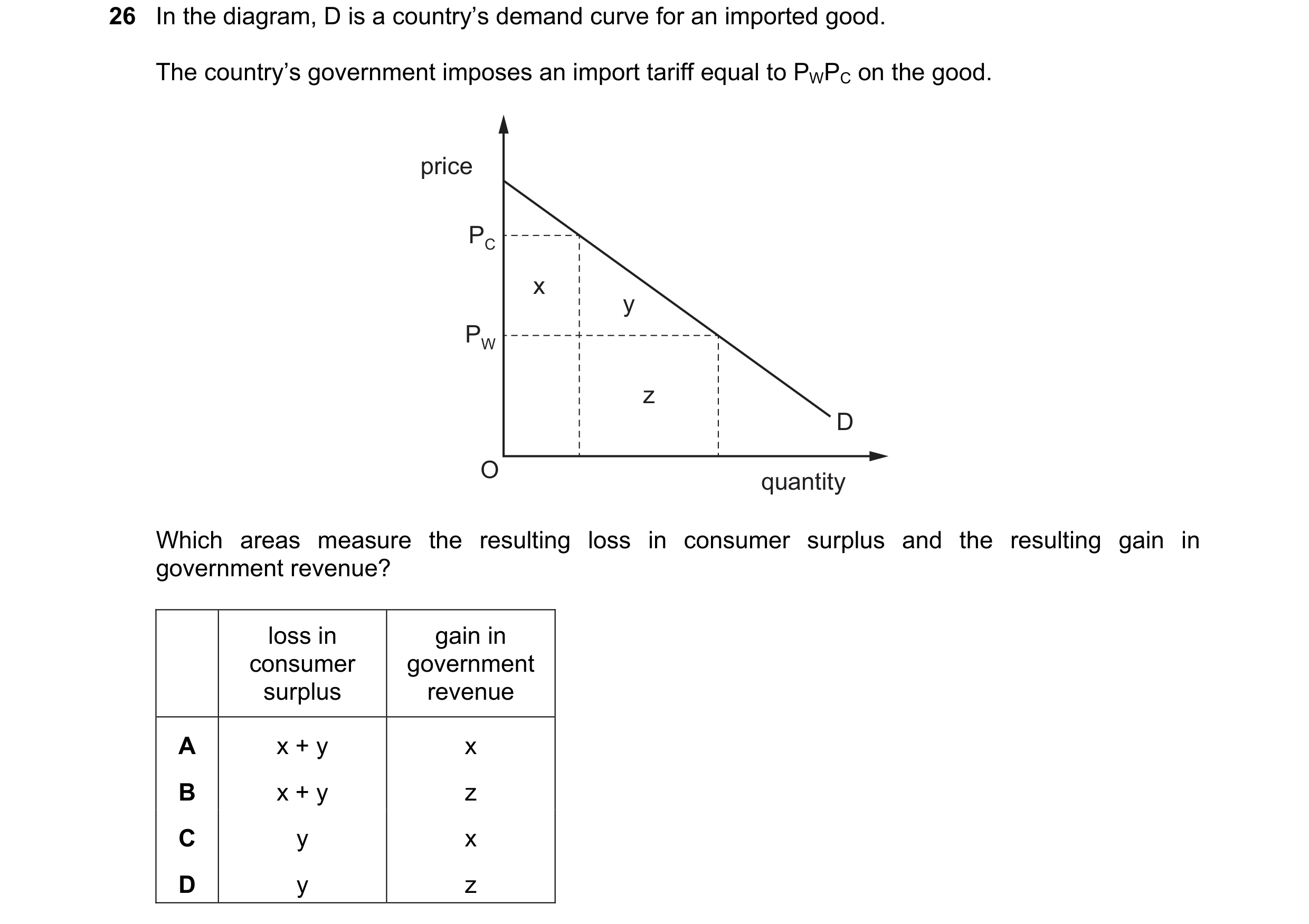
 26 / 47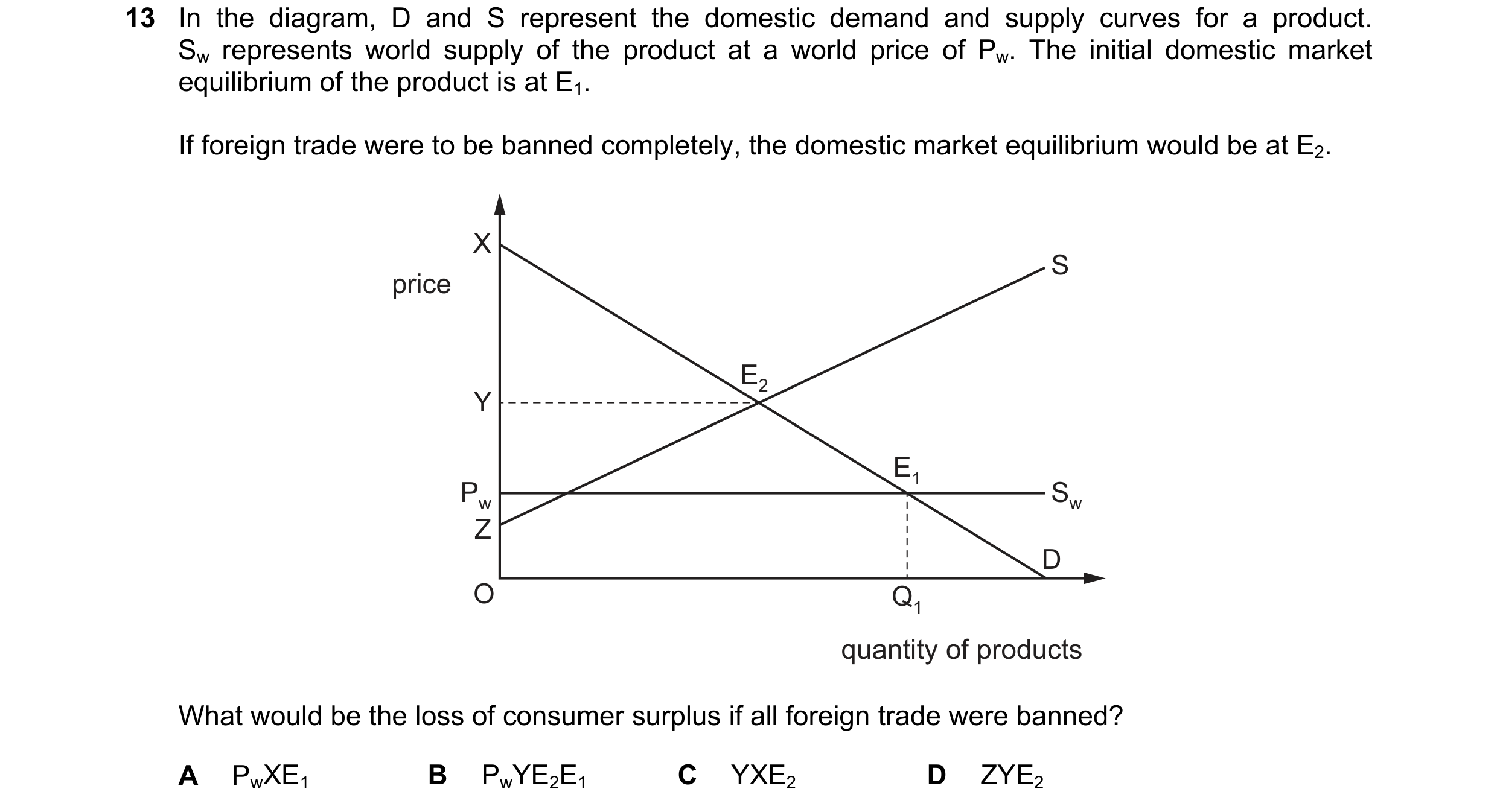
 27 / 47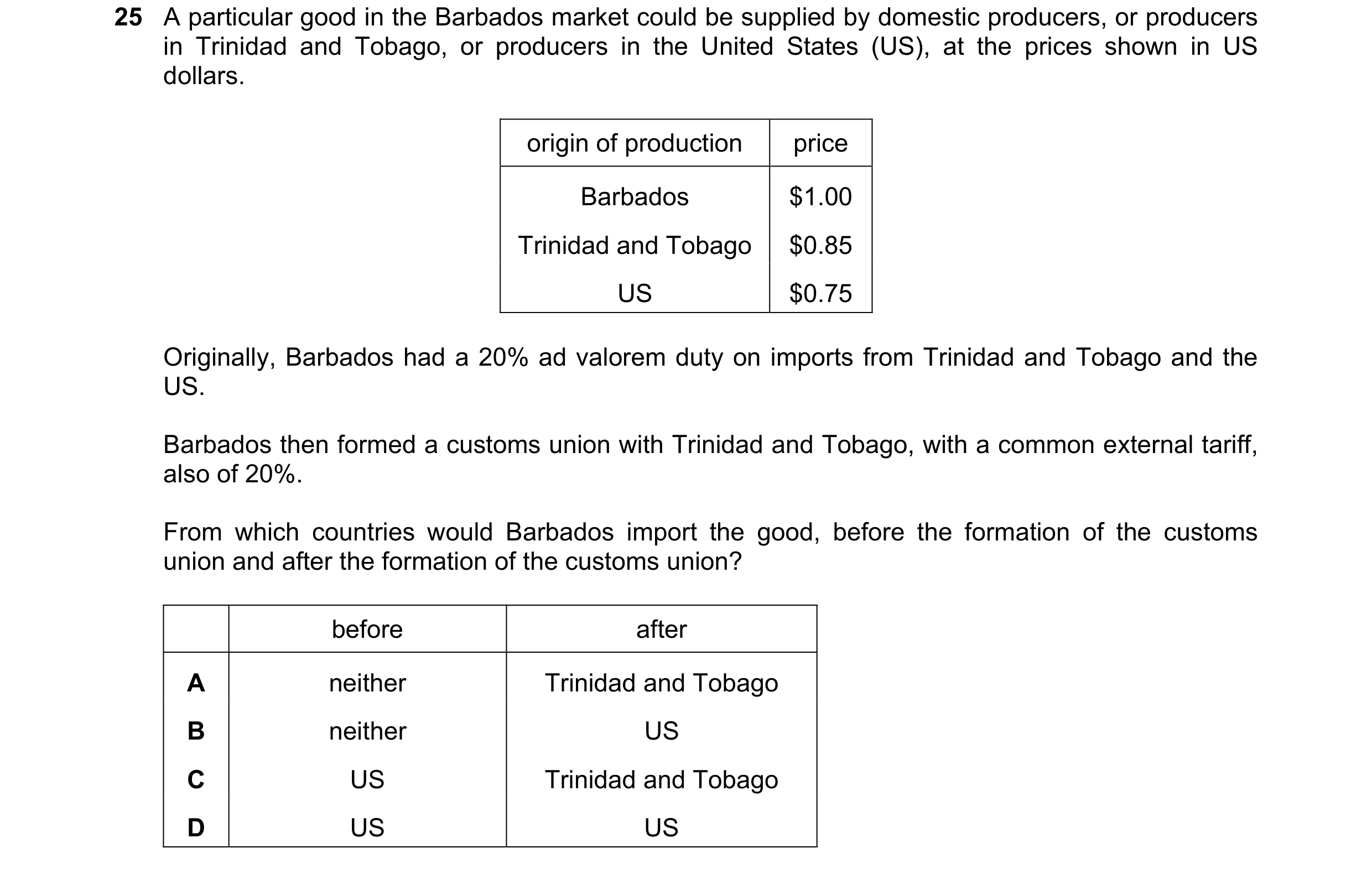

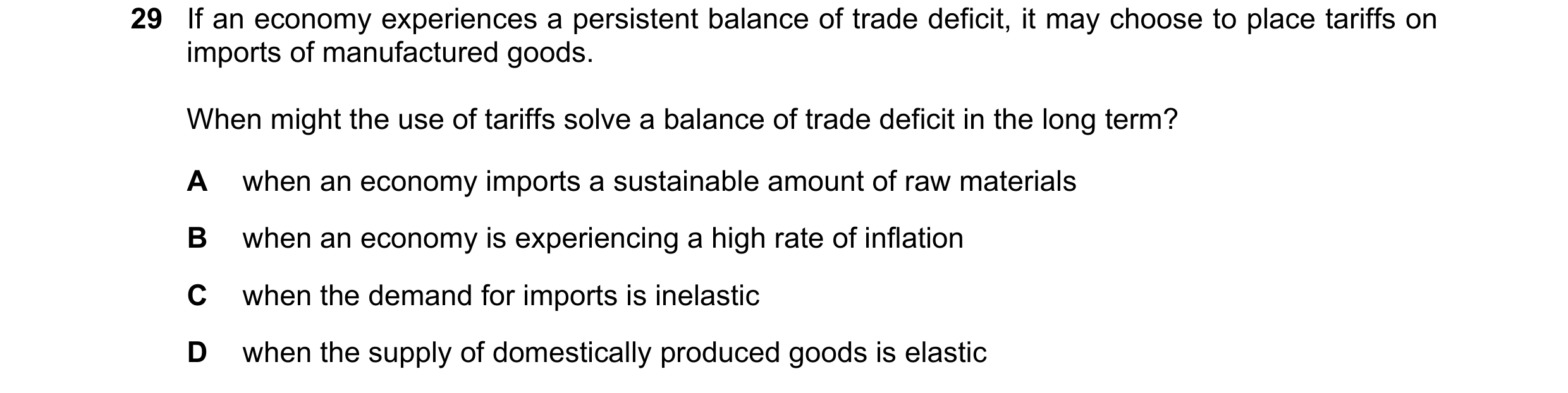
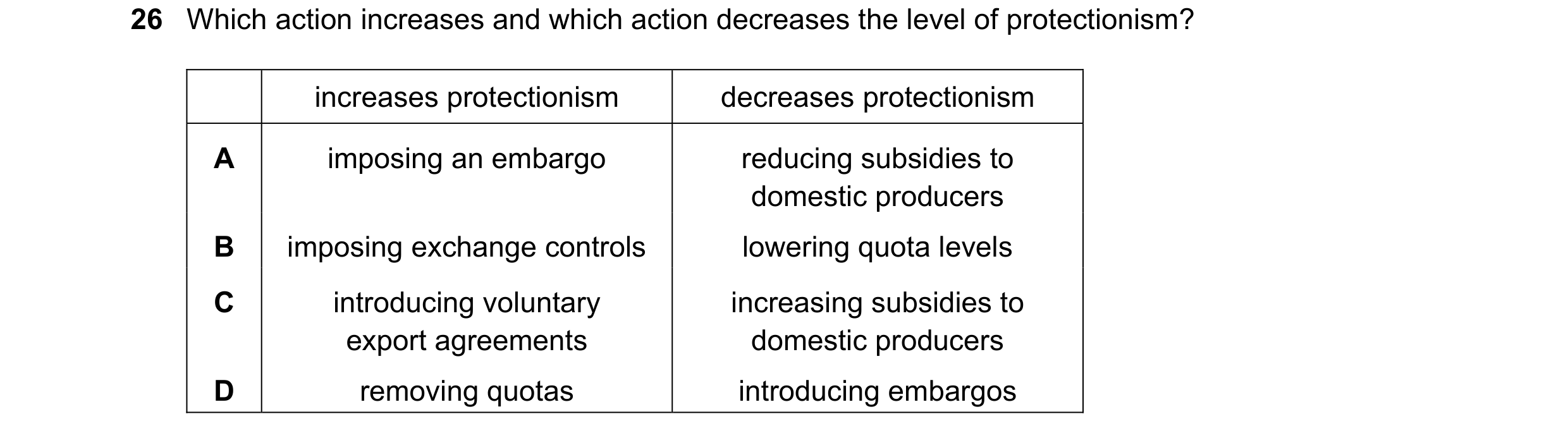 28 / 47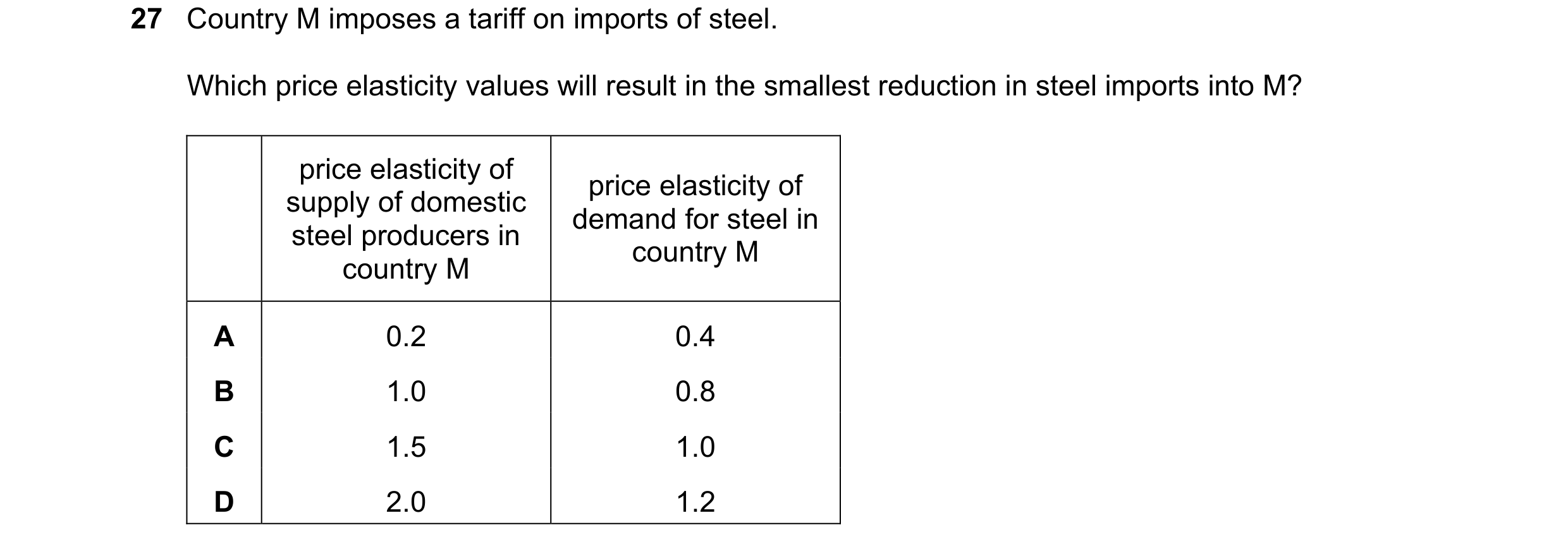
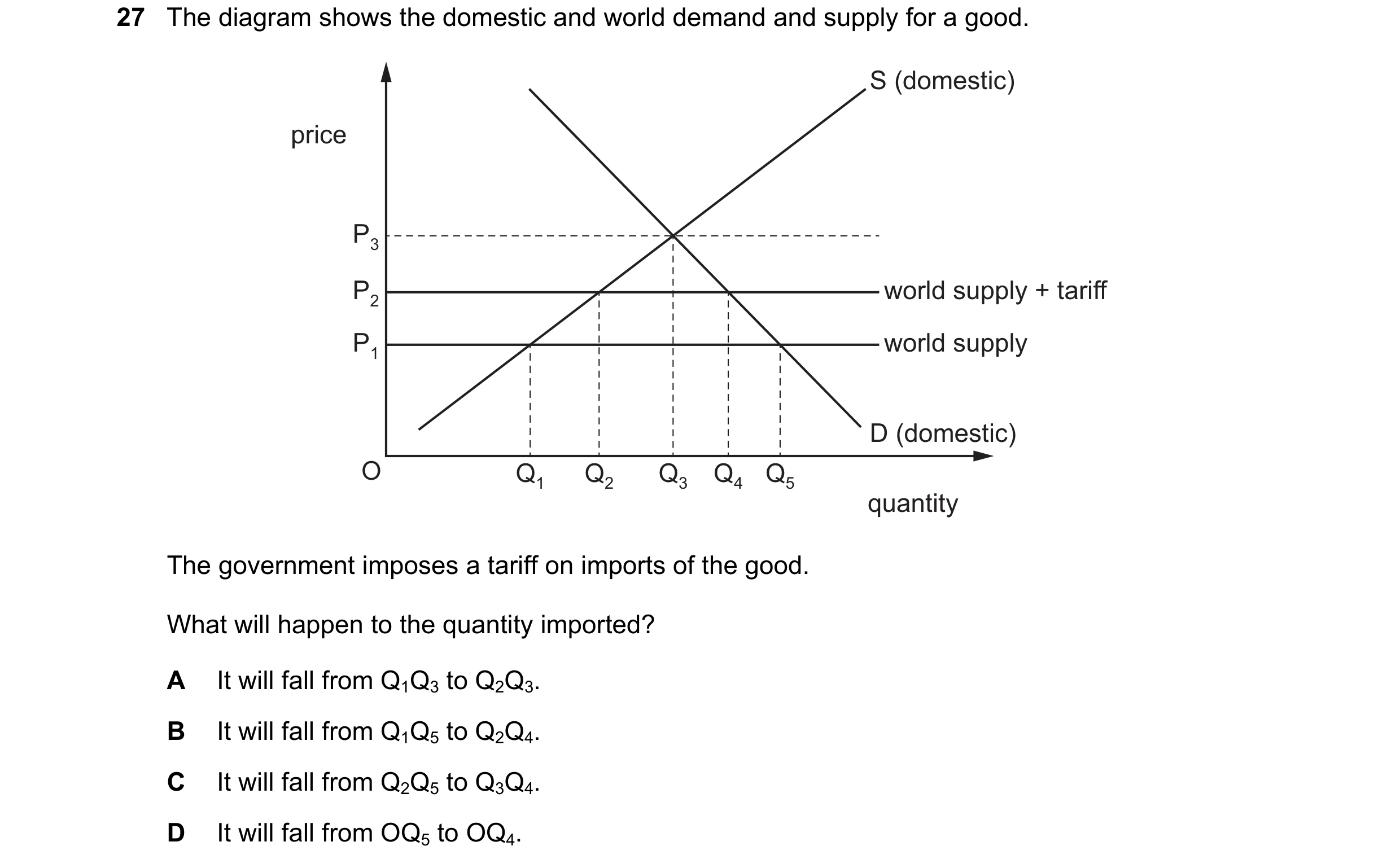
 29 / 47
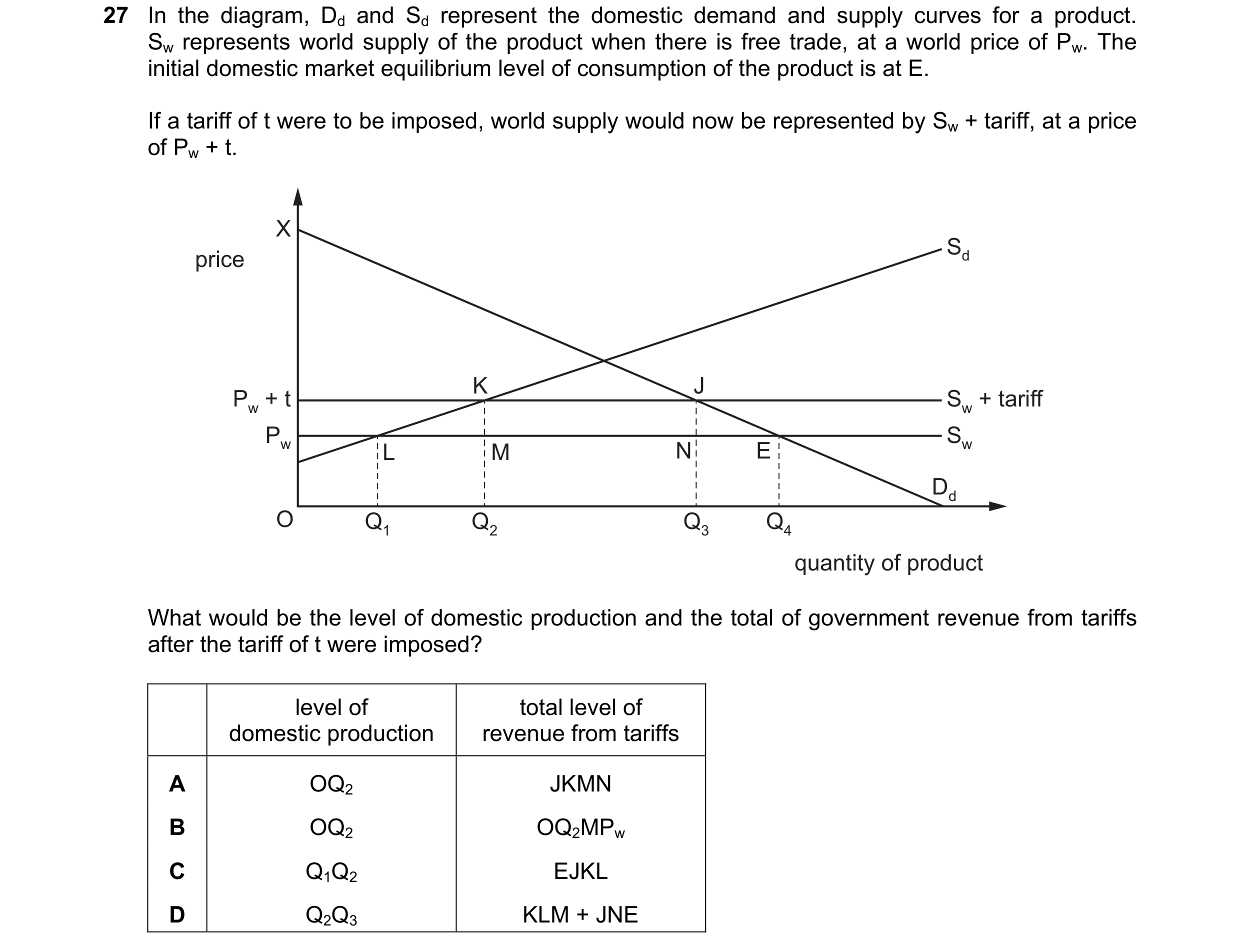 30 / 47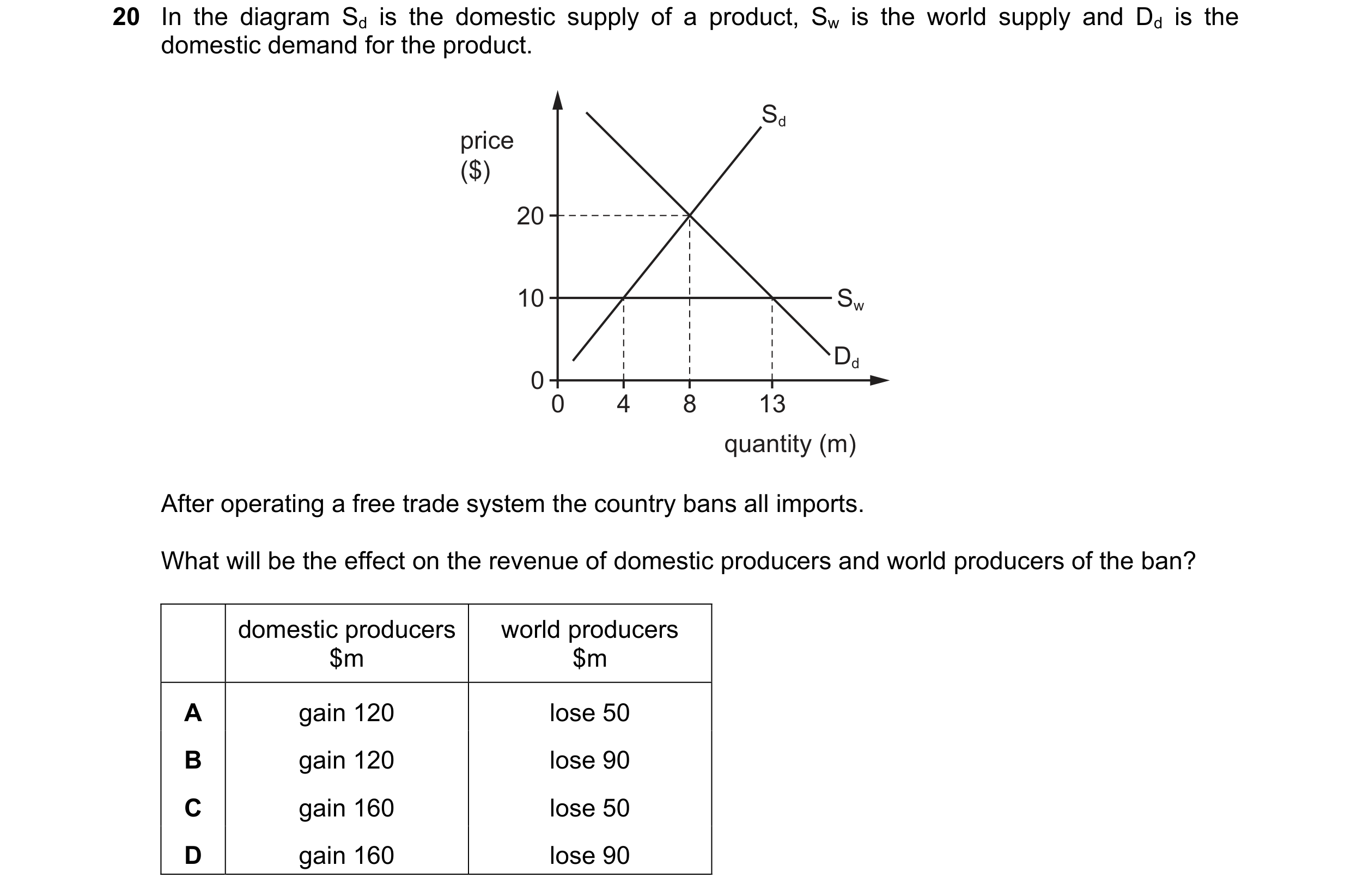
 31 / 47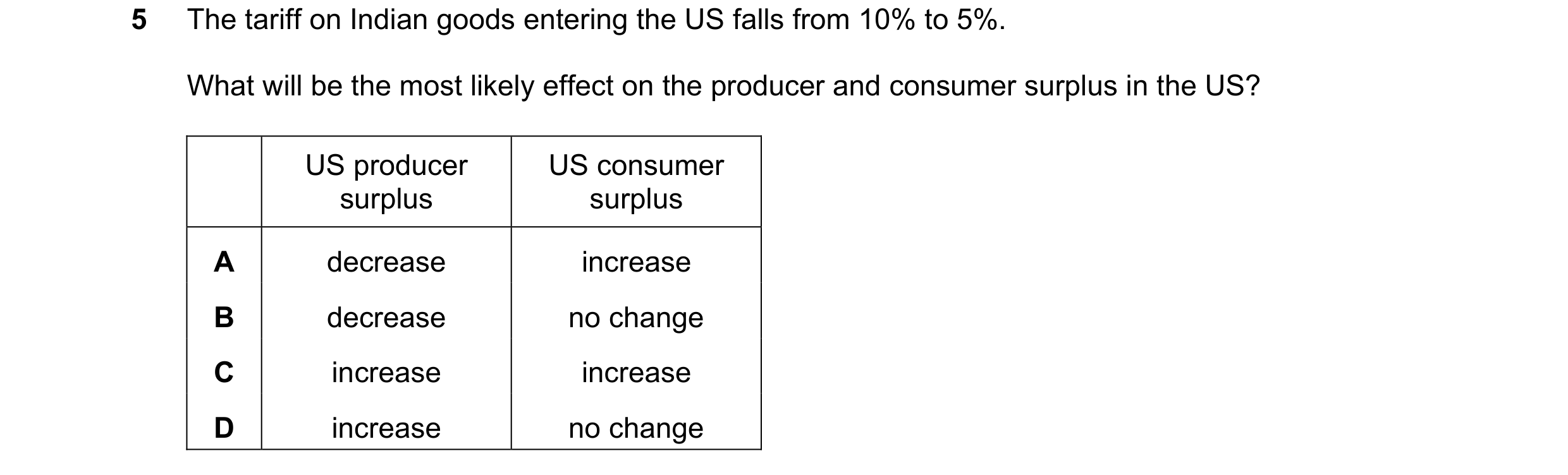
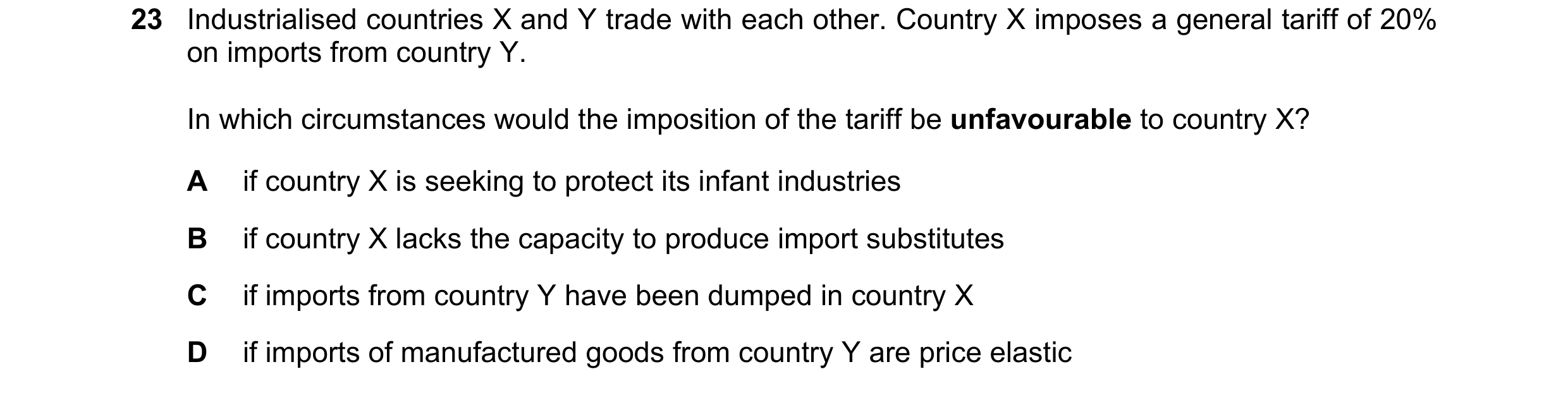
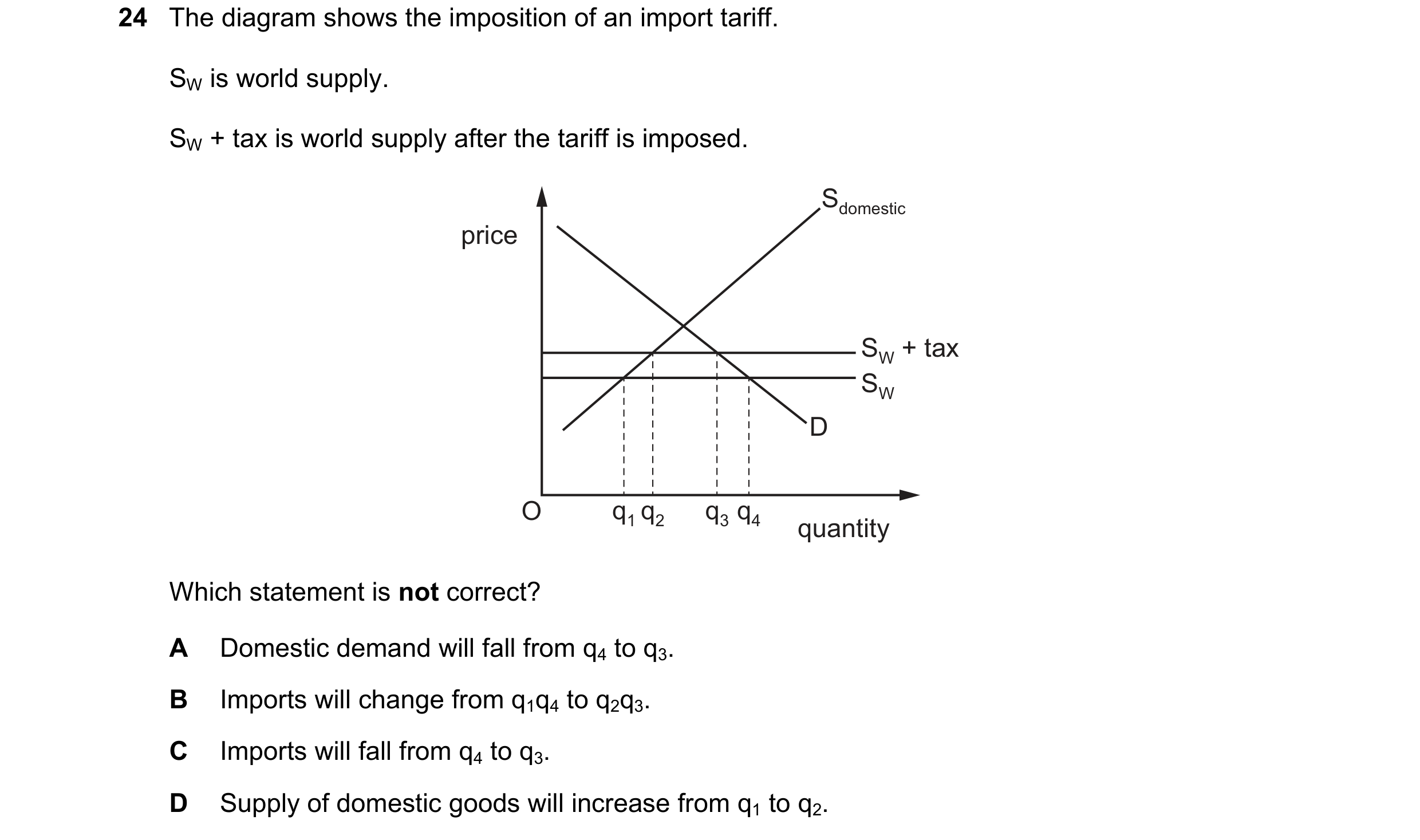 32 / 47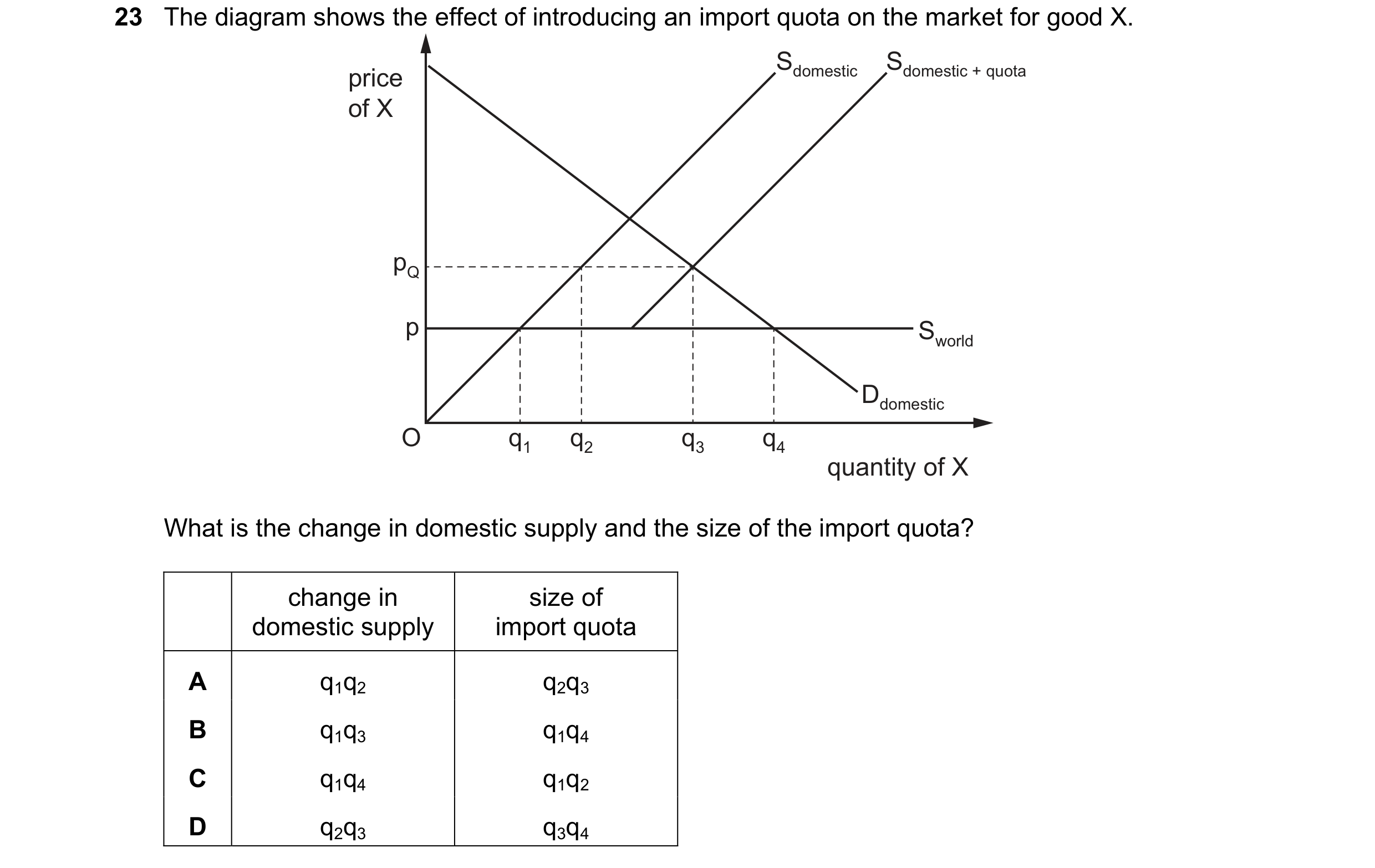
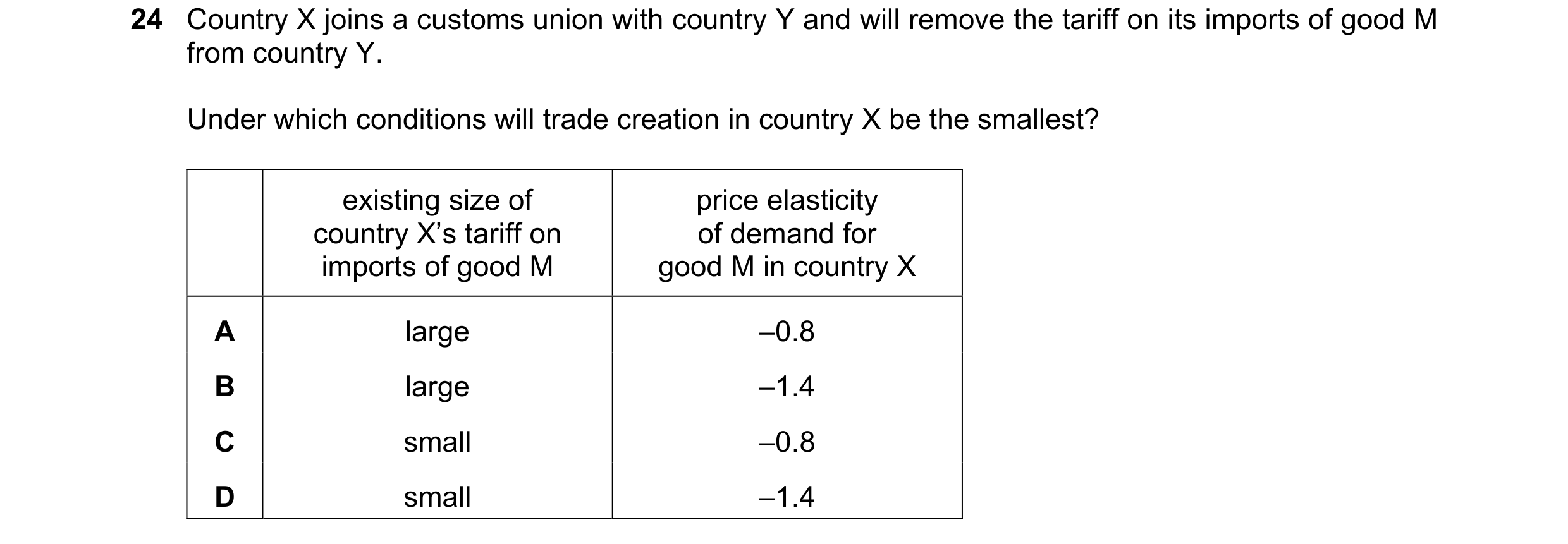
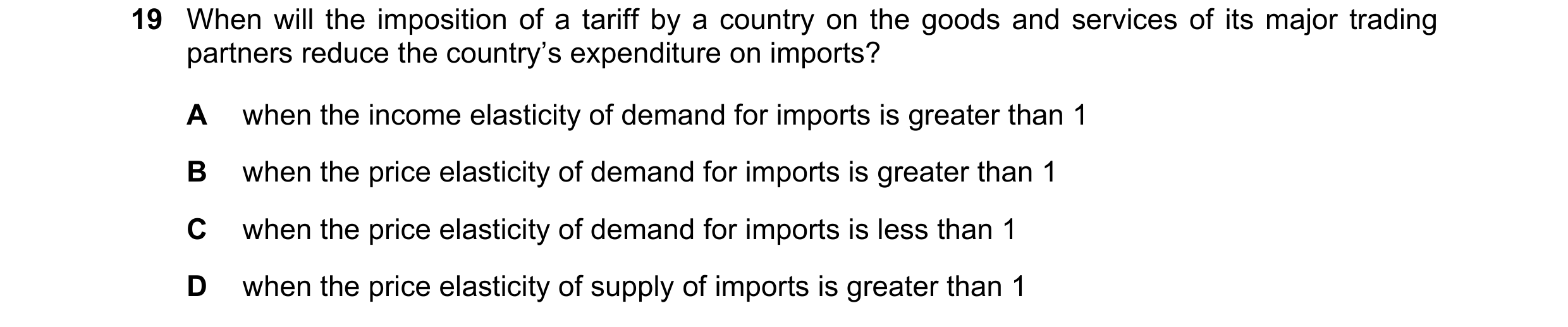 33 / 47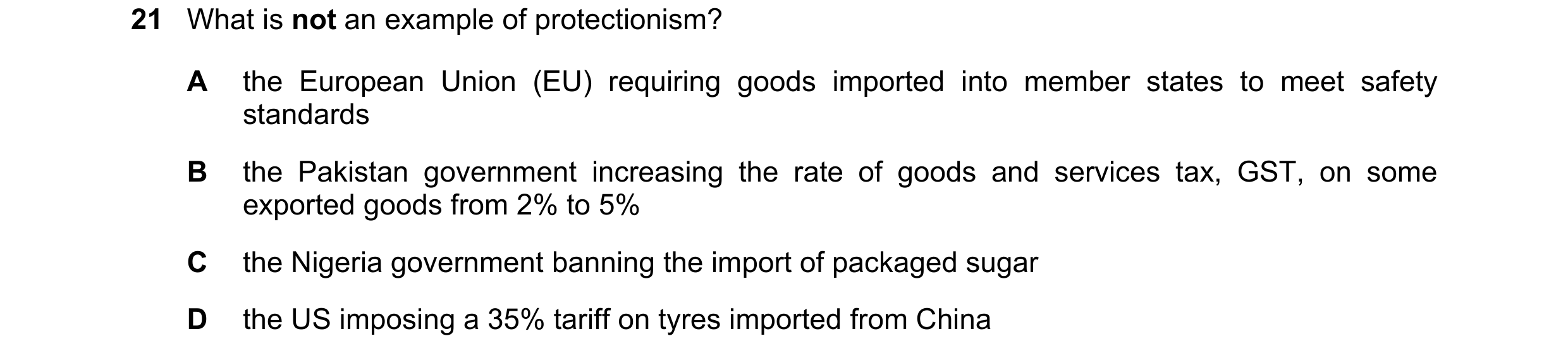
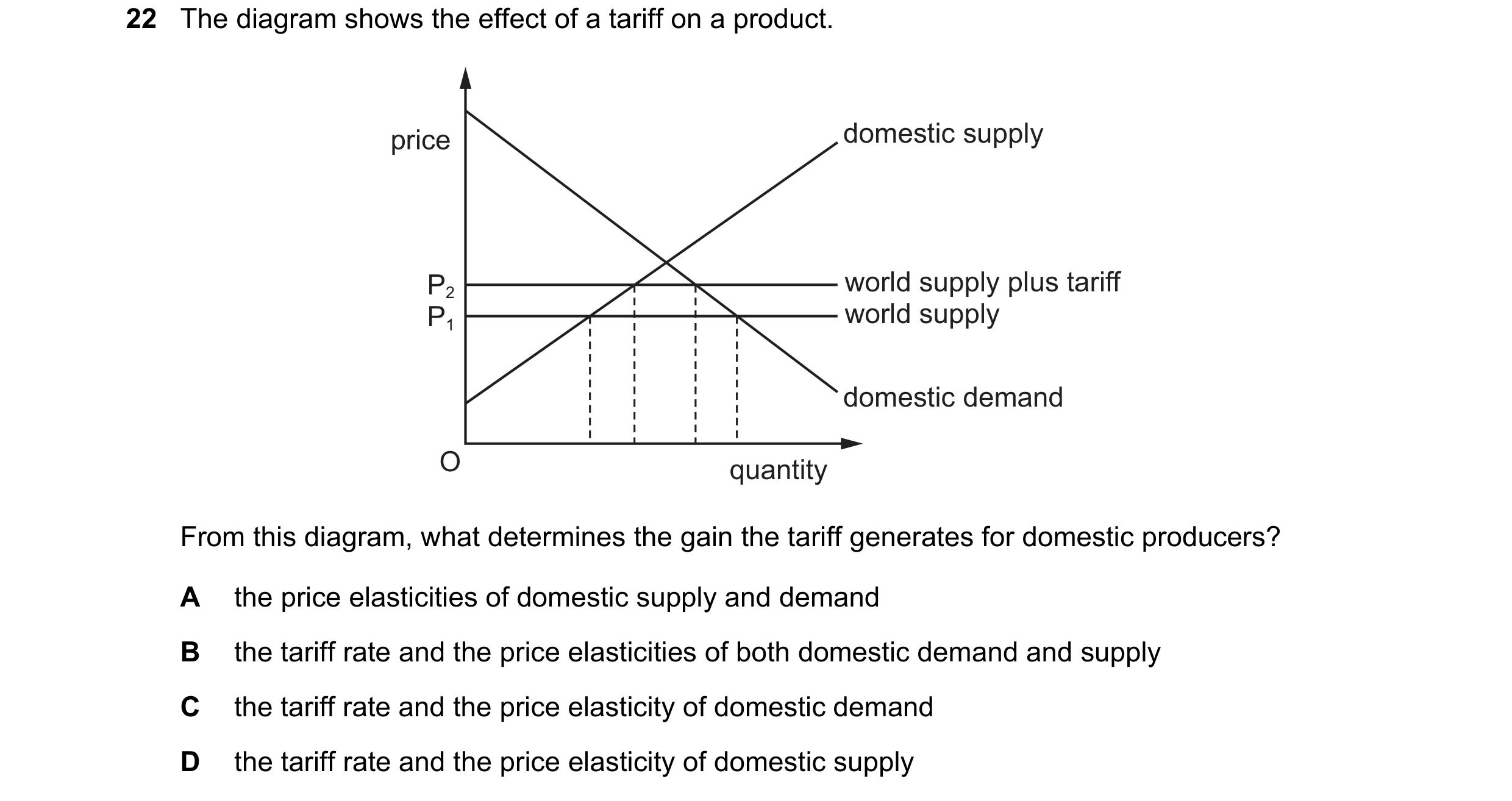
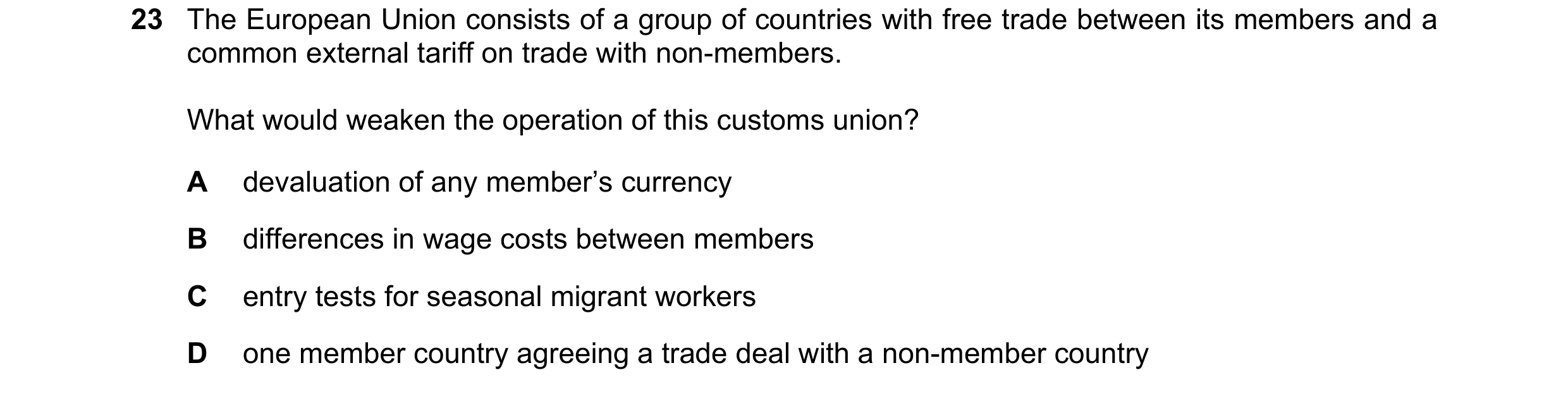
 34 / 47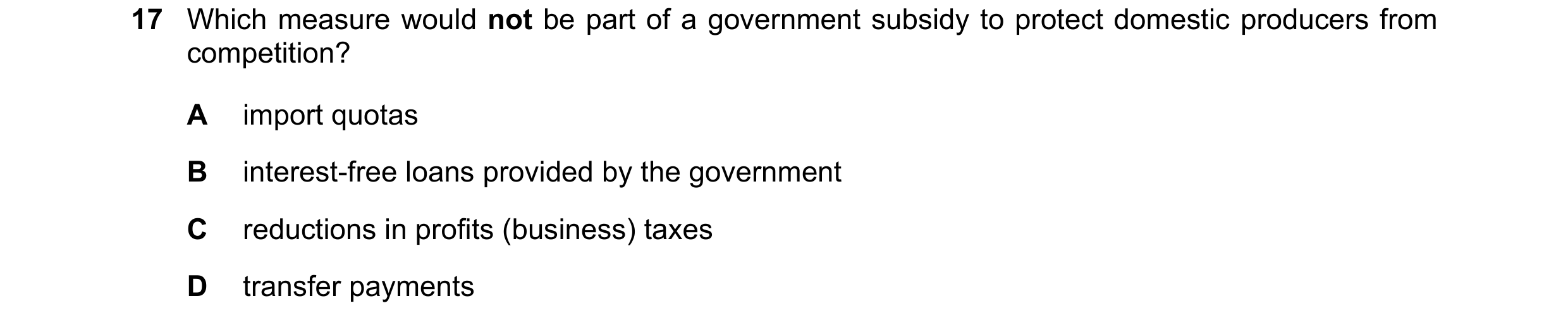
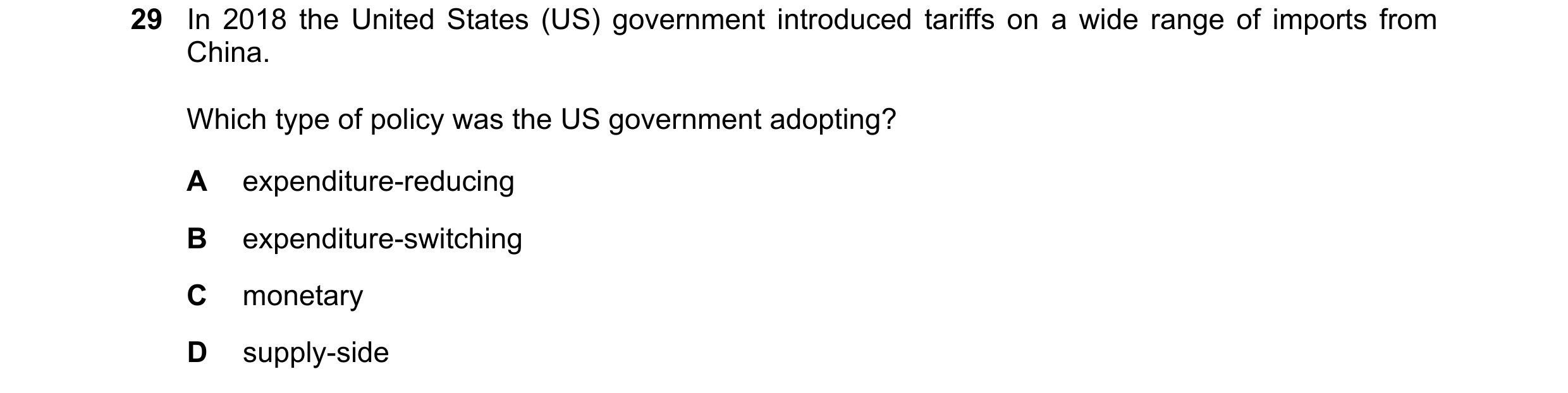
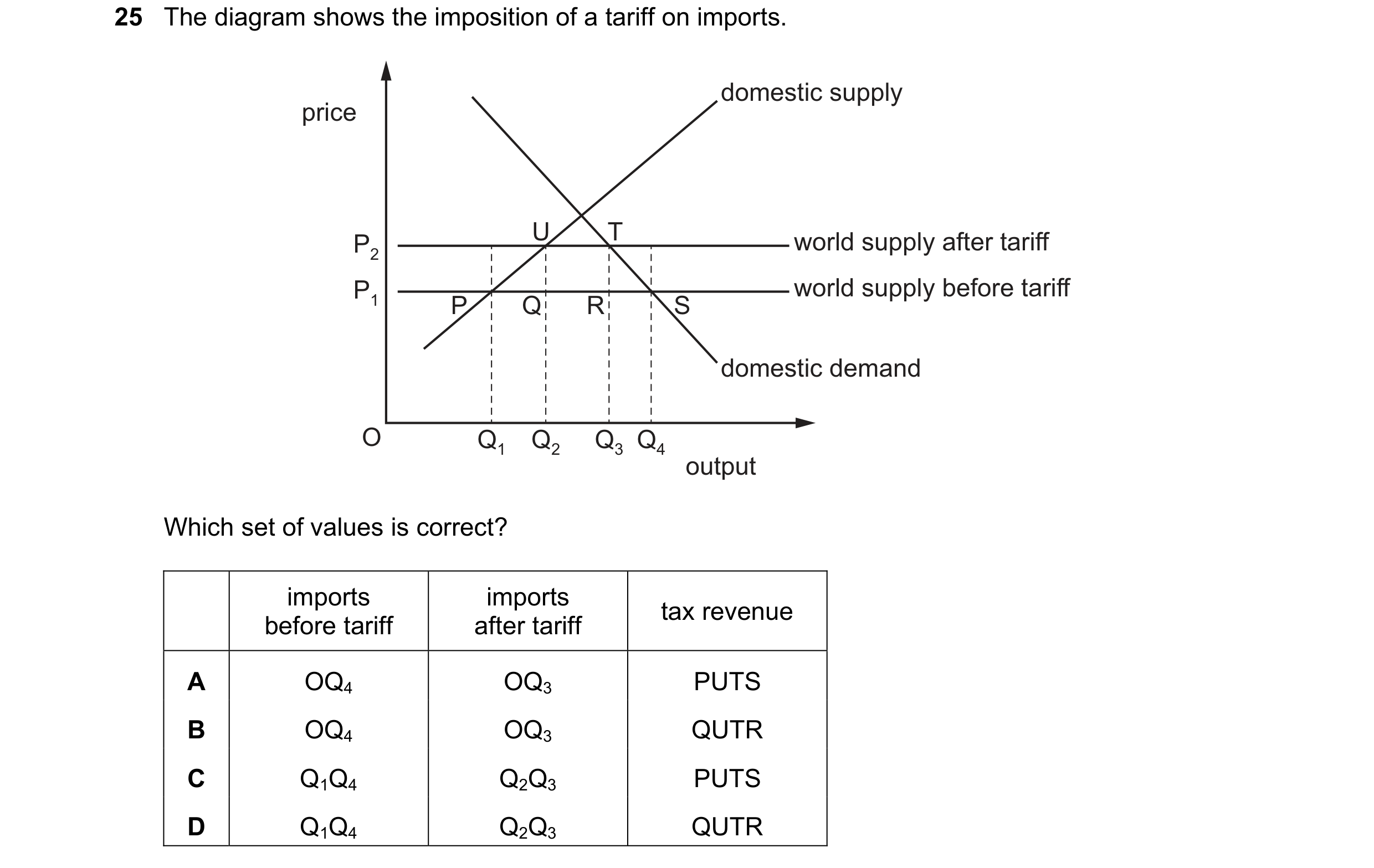
 35 / 47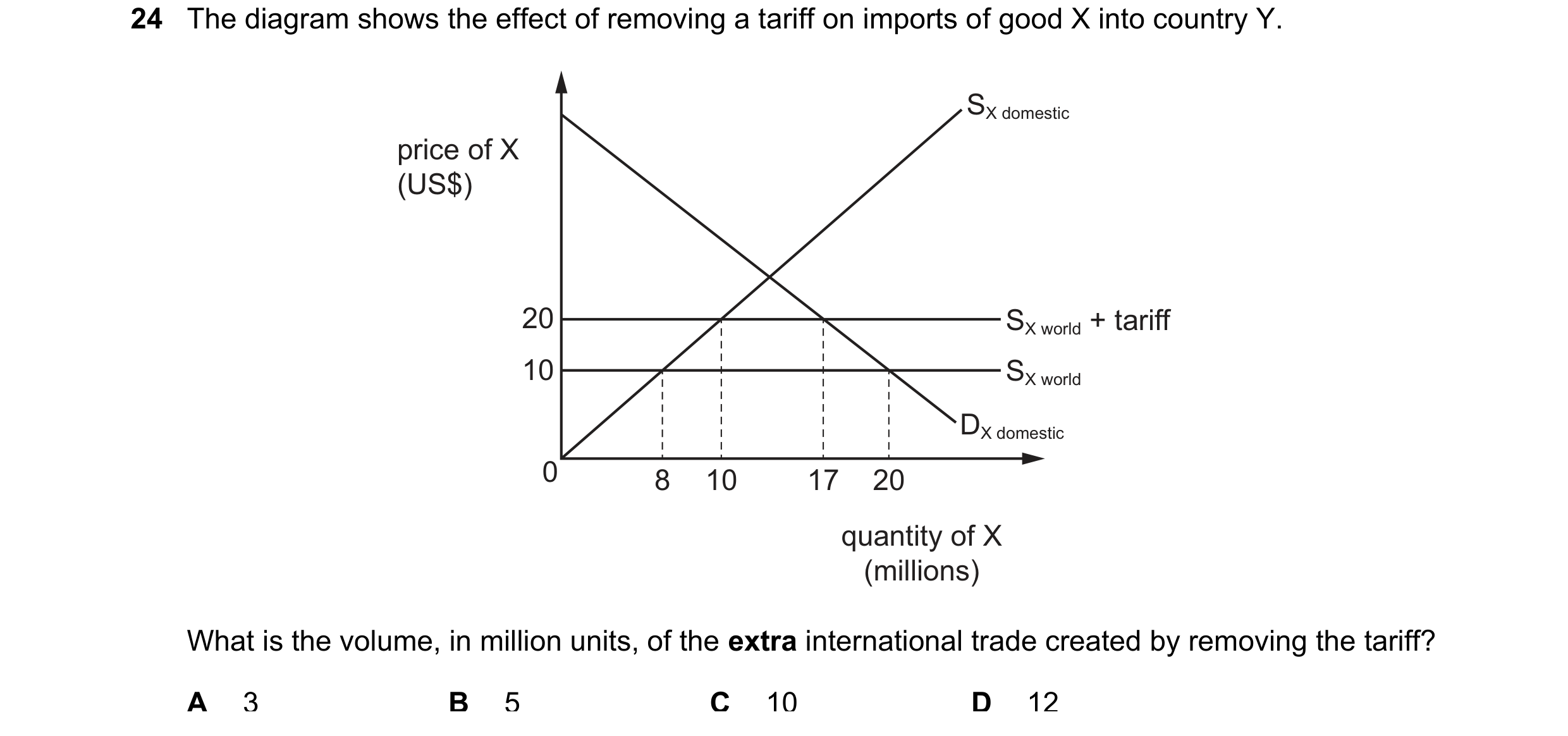
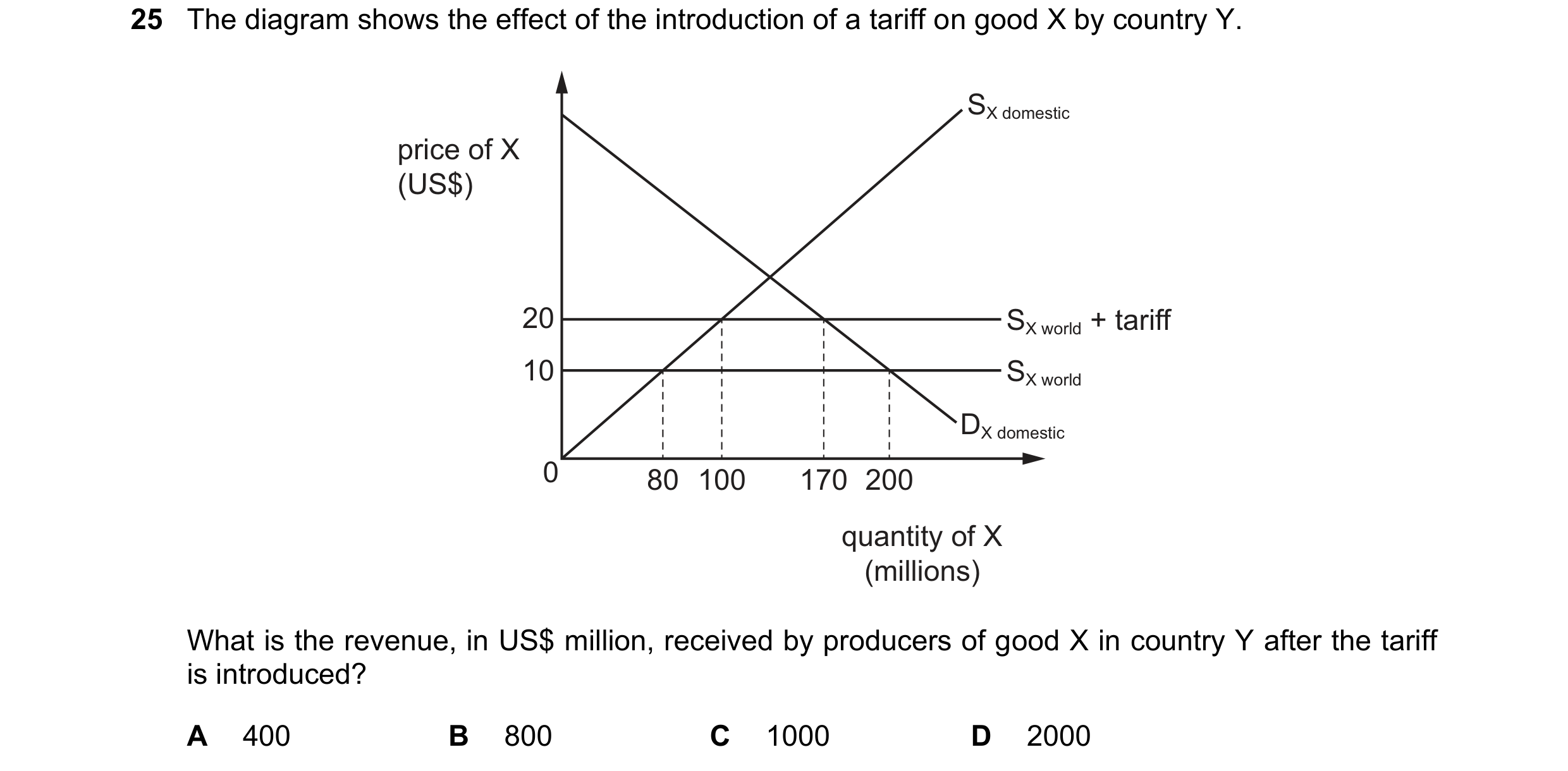 36 / 47
 37 / 47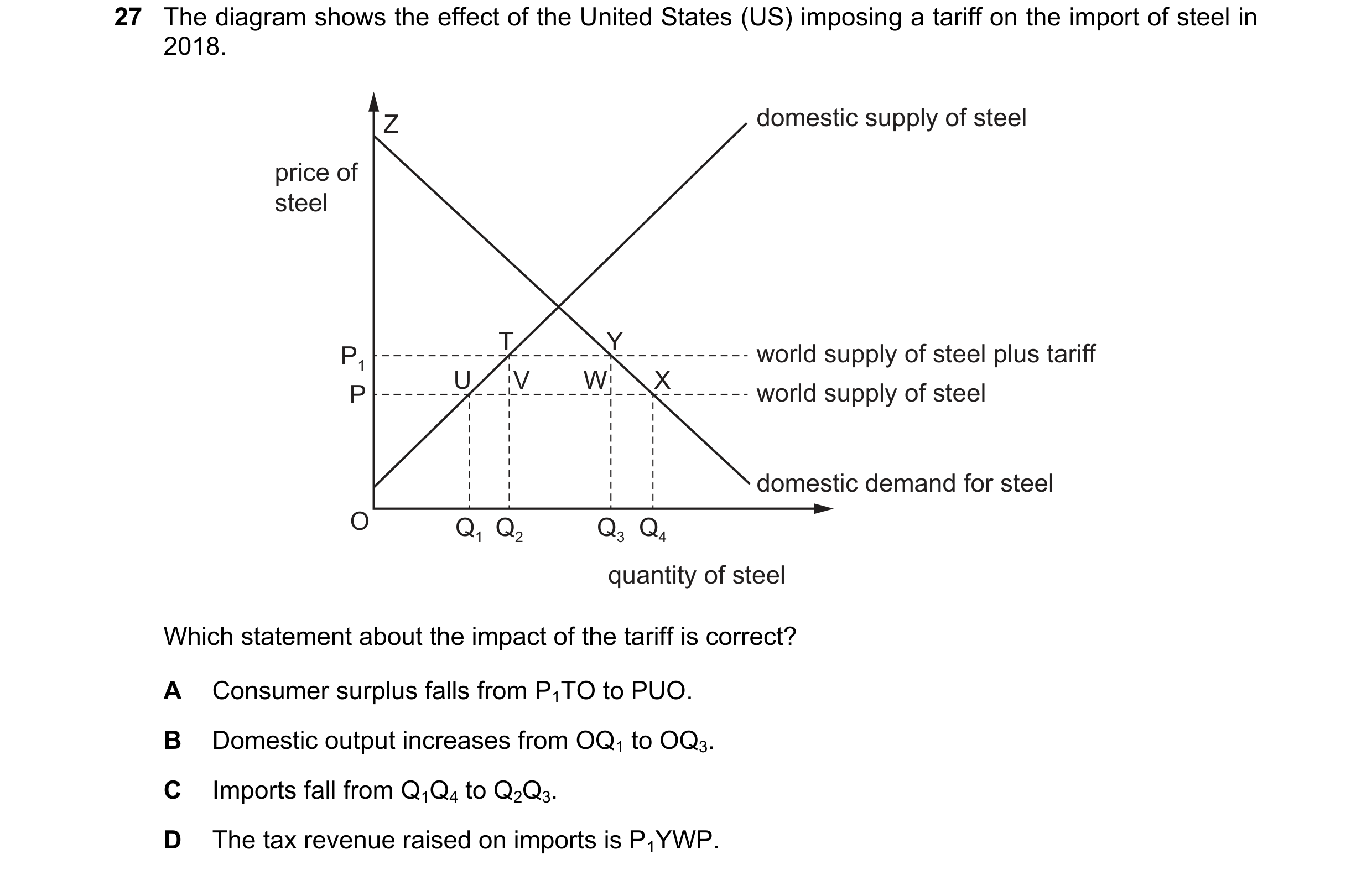
 38 / 47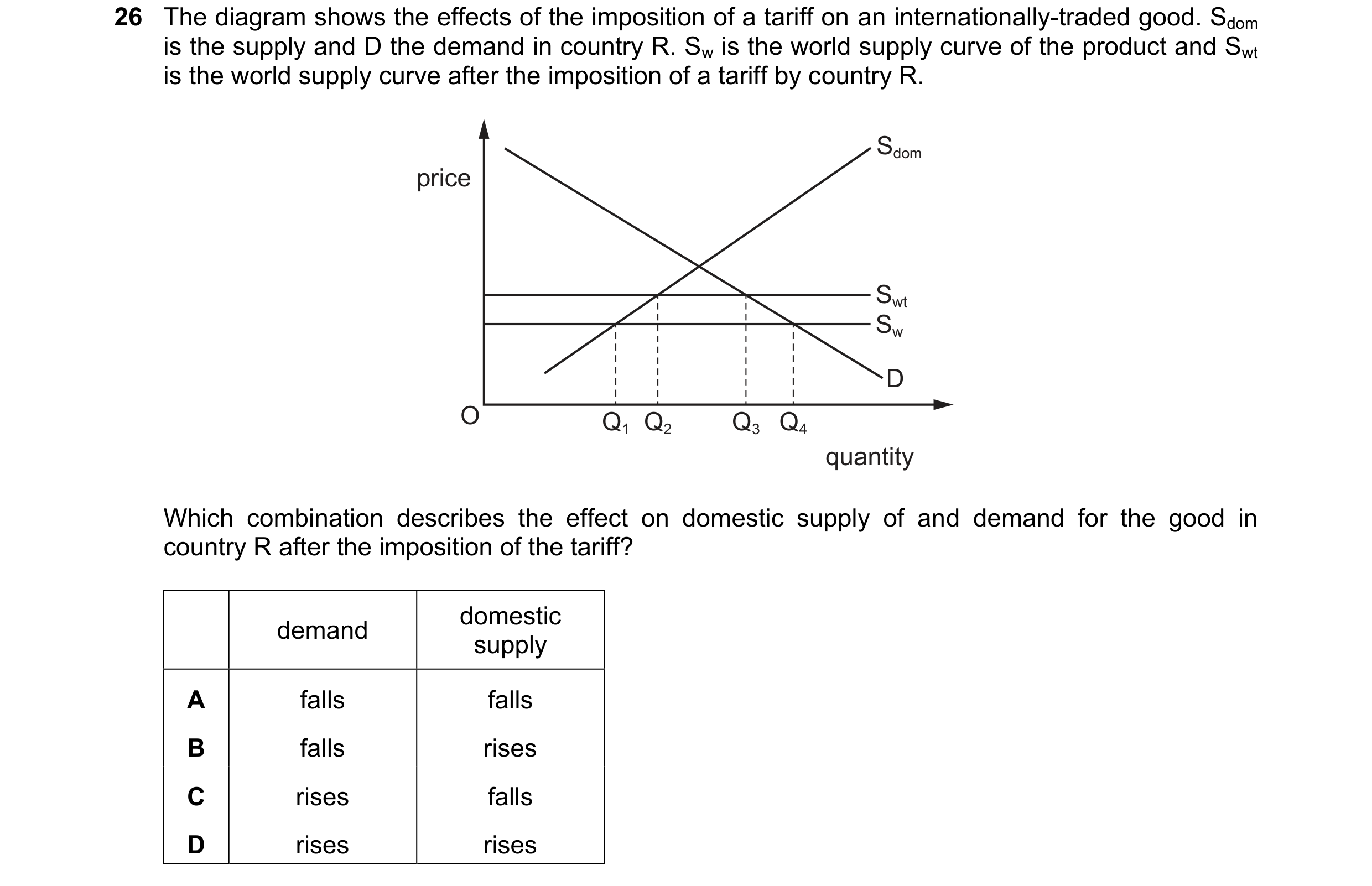

 39 / 47
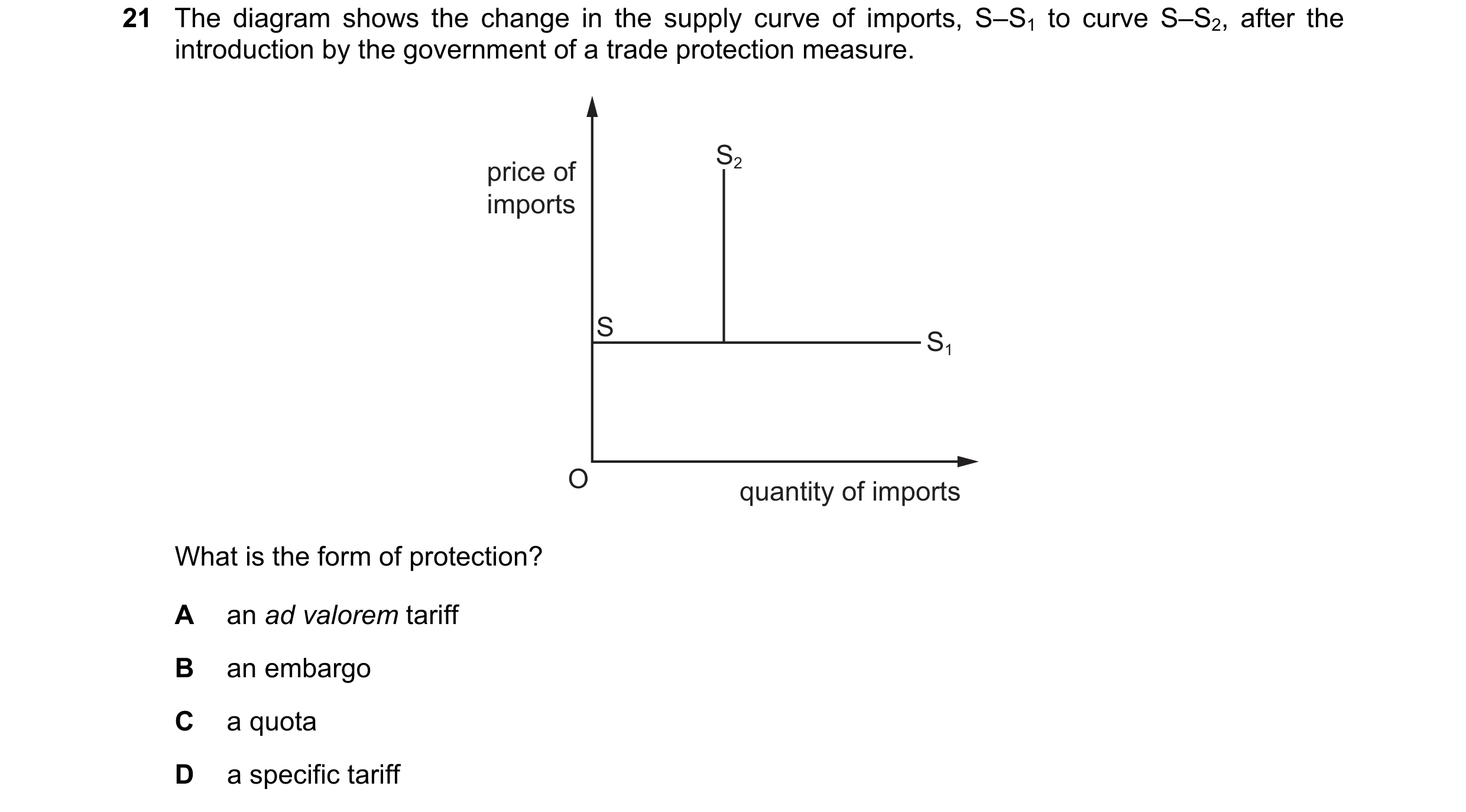

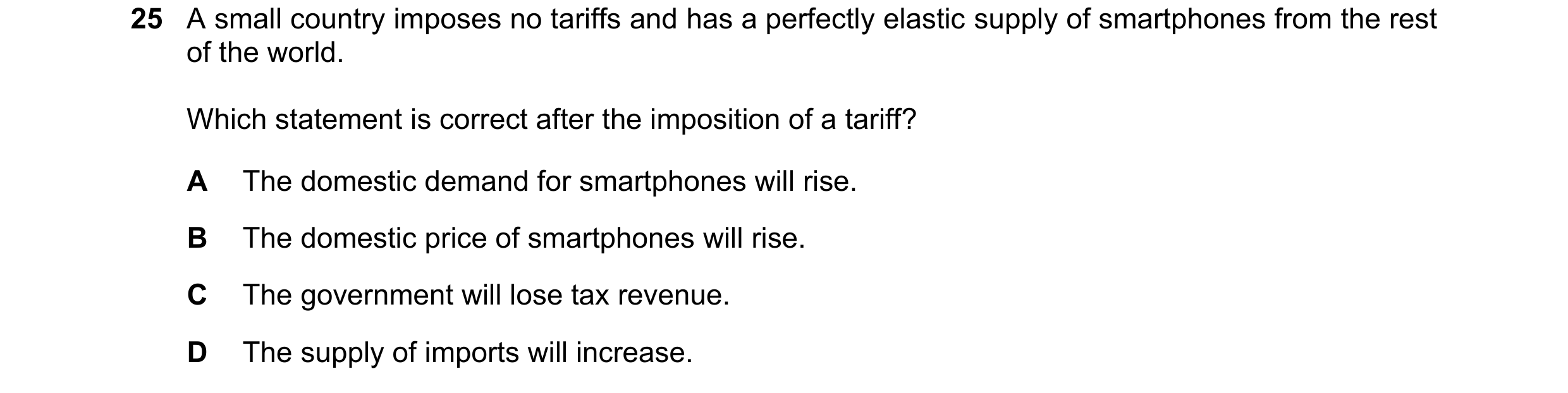 40 / 47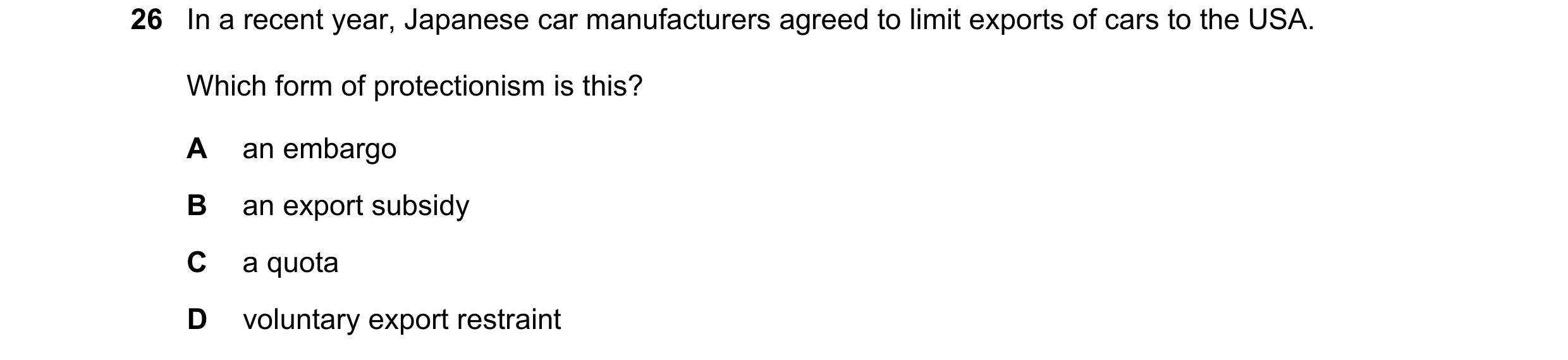

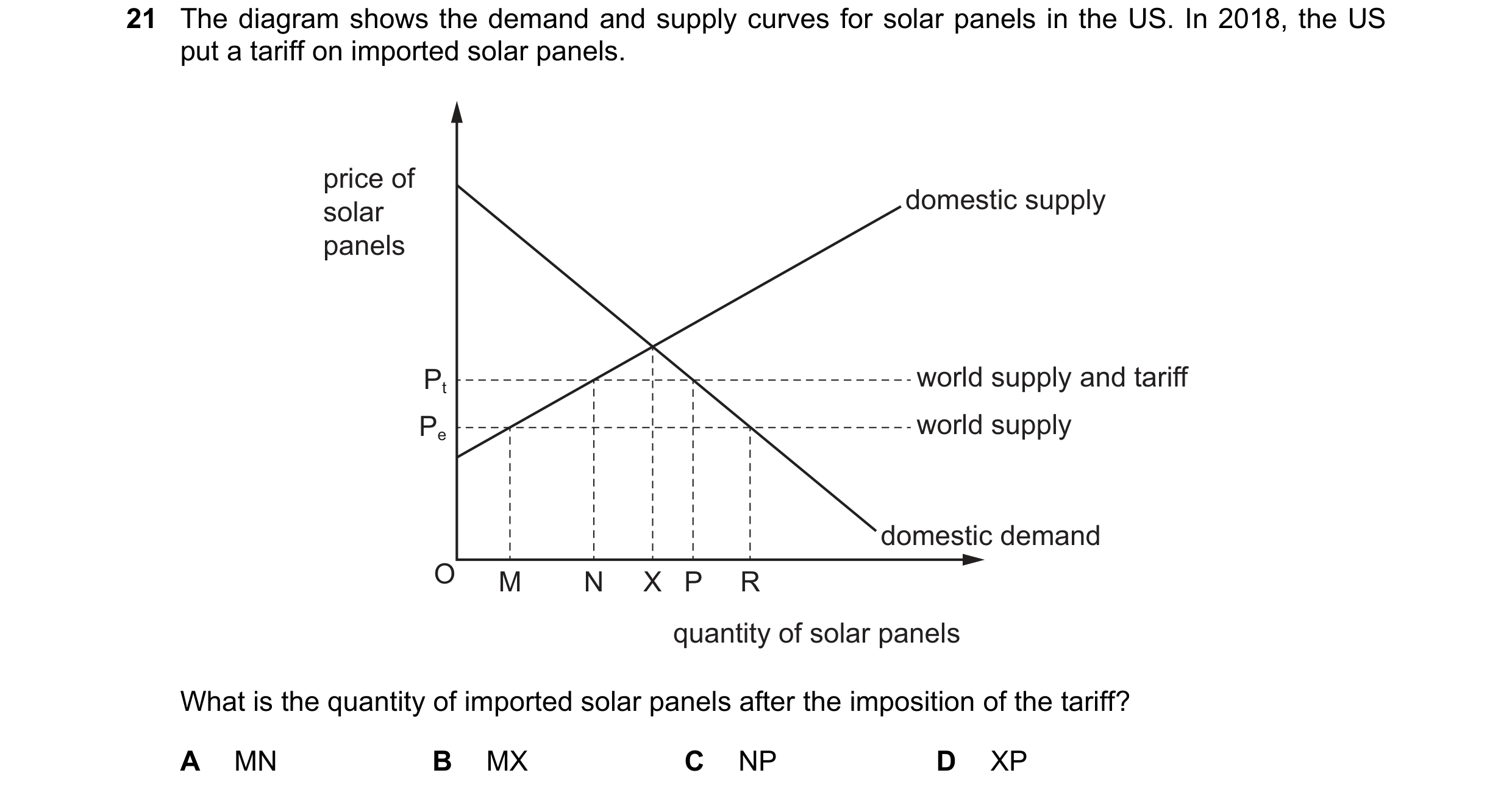
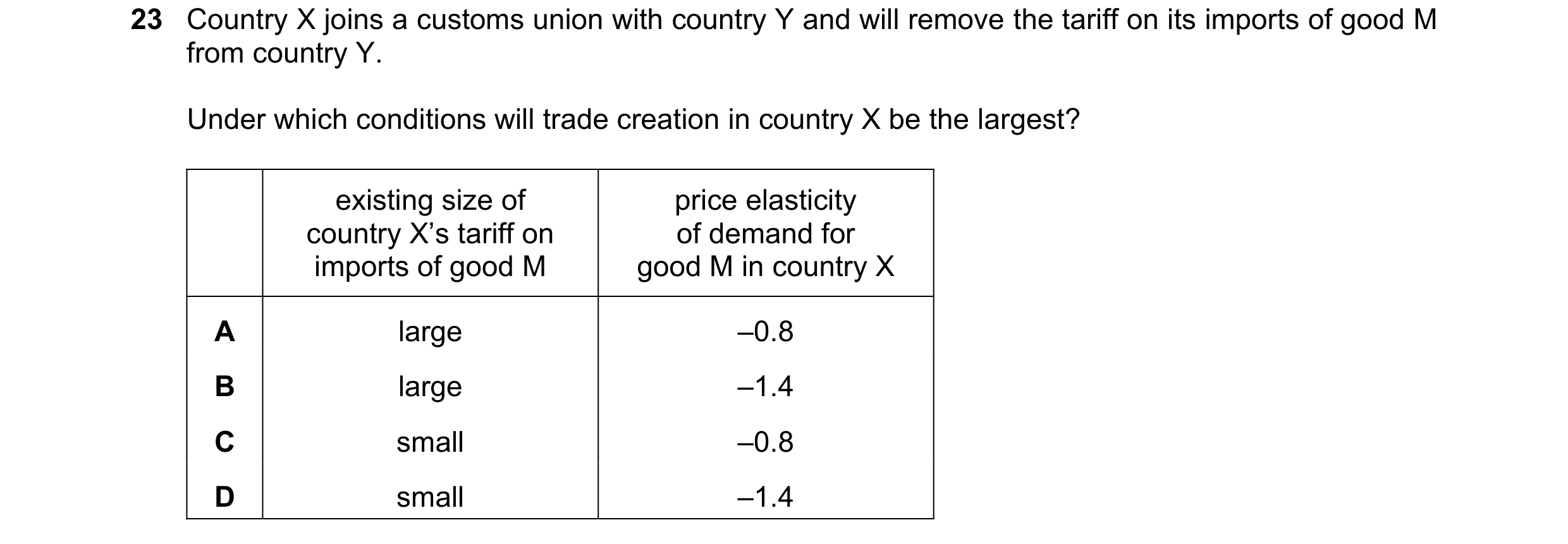 41 / 47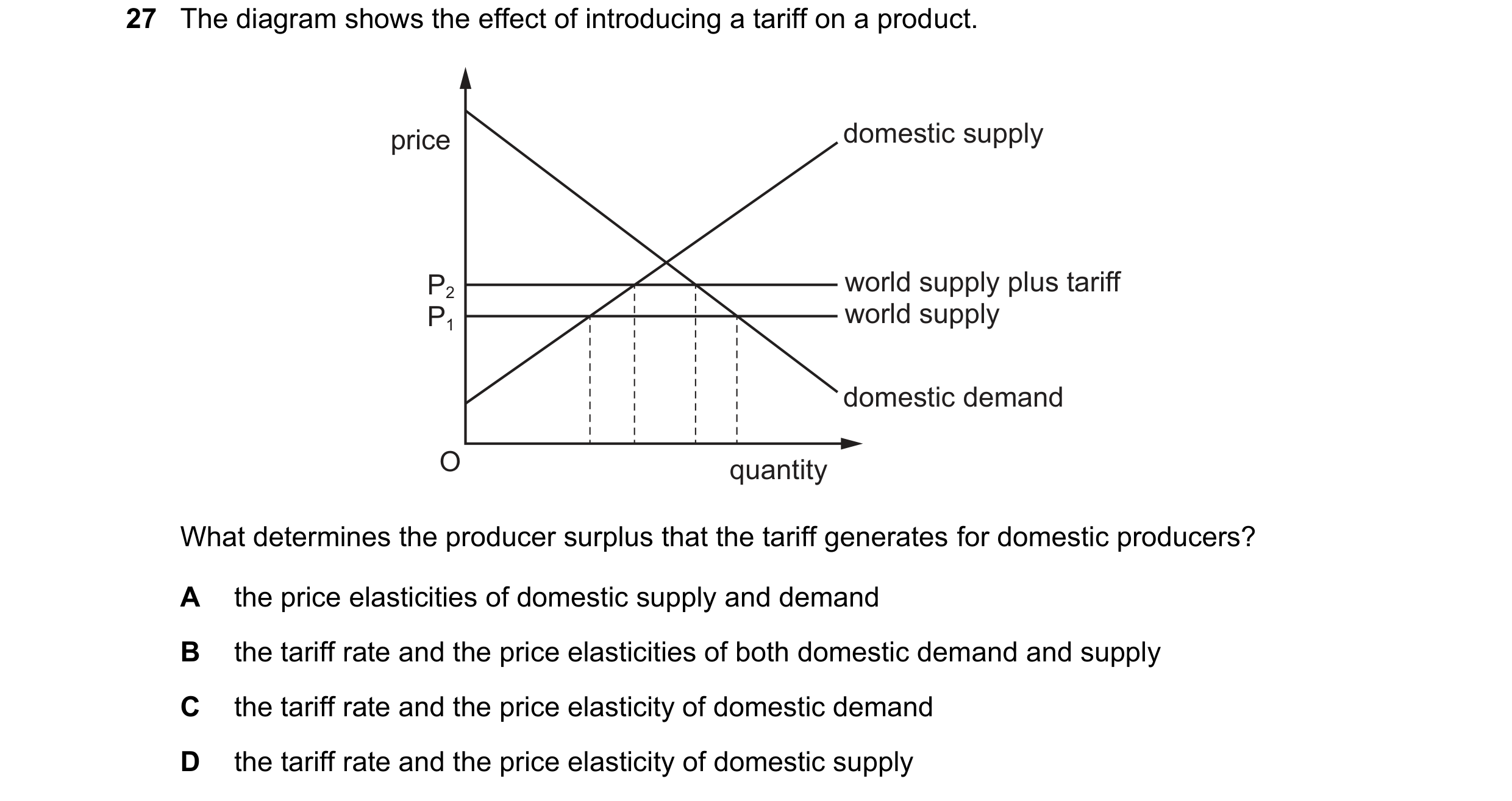
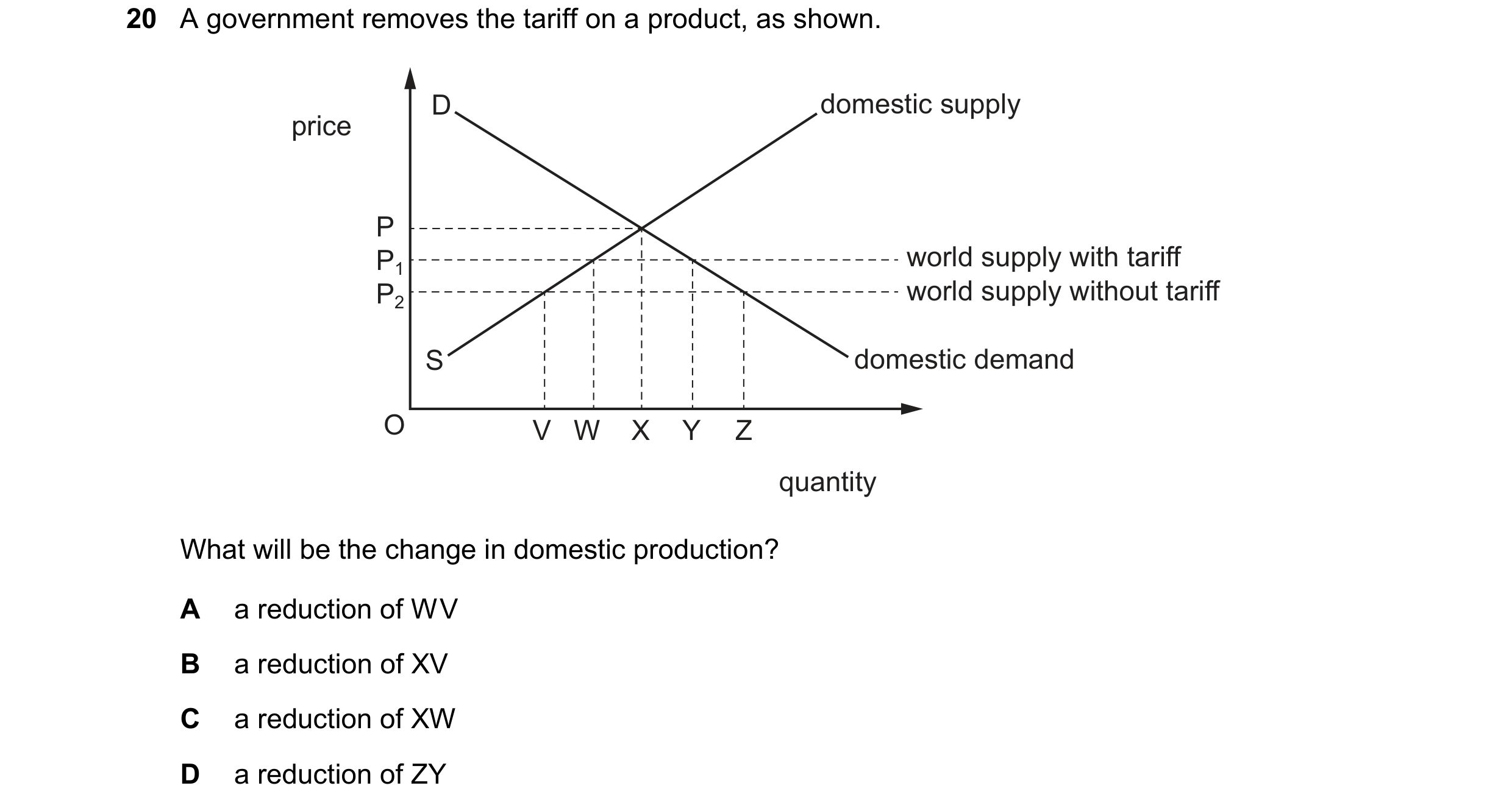 42 / 47
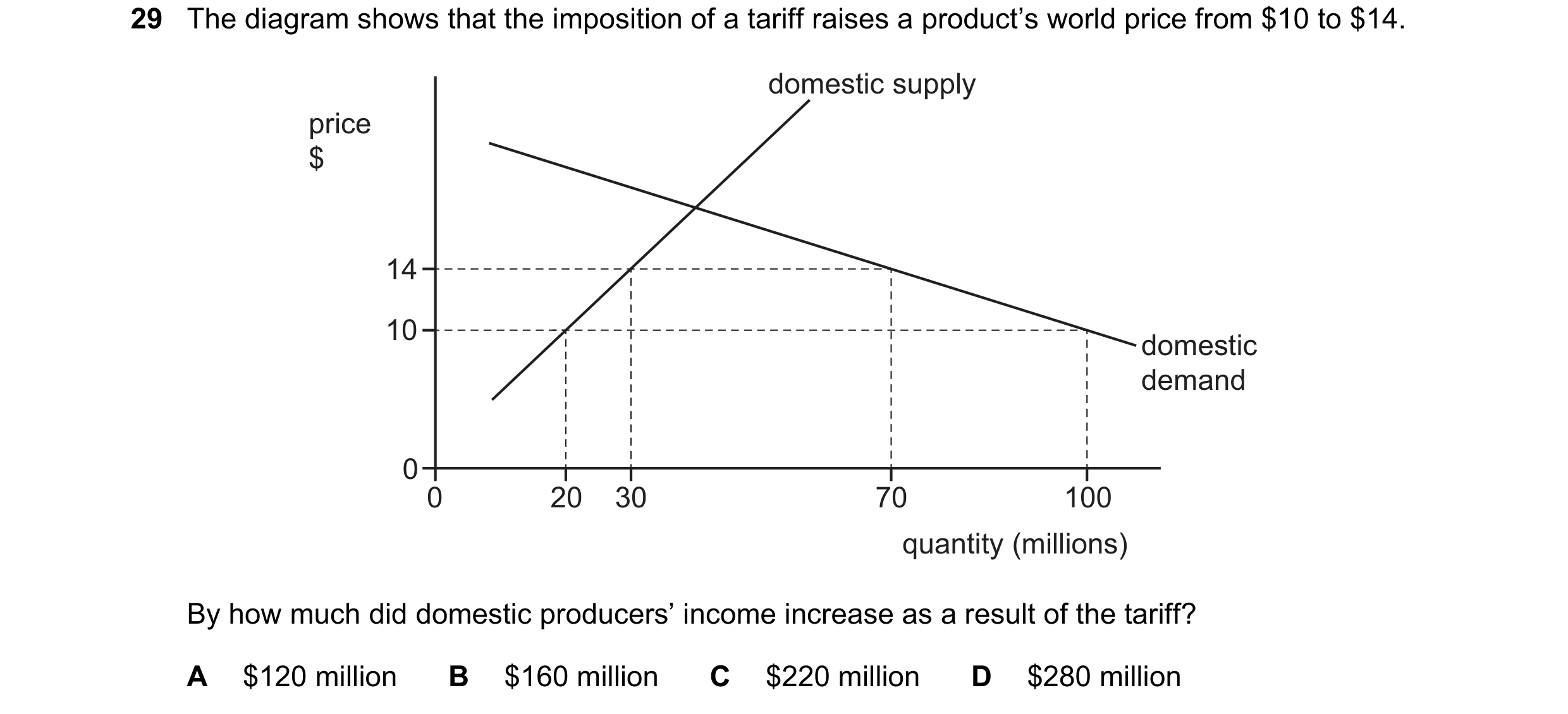
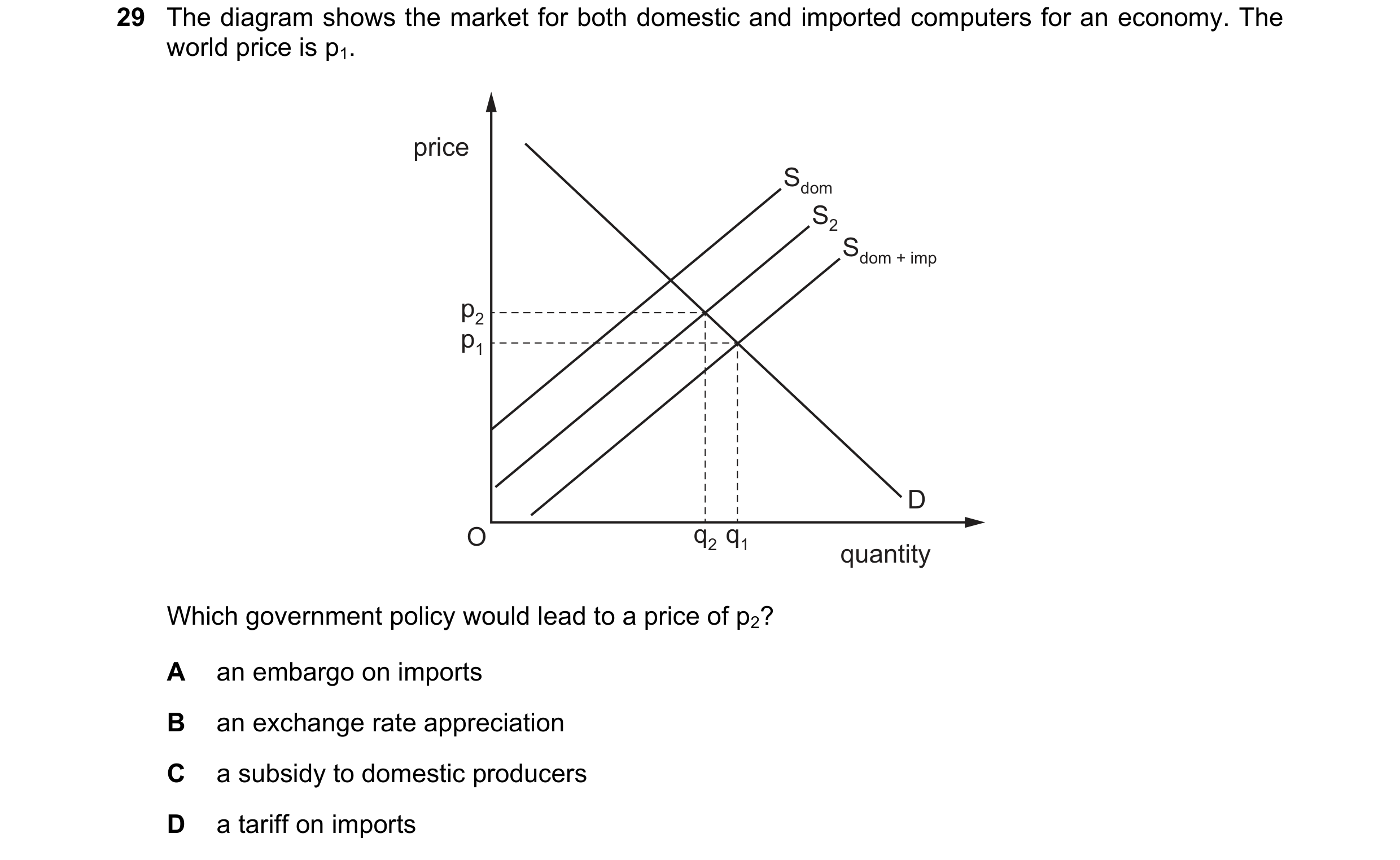 43 / 47

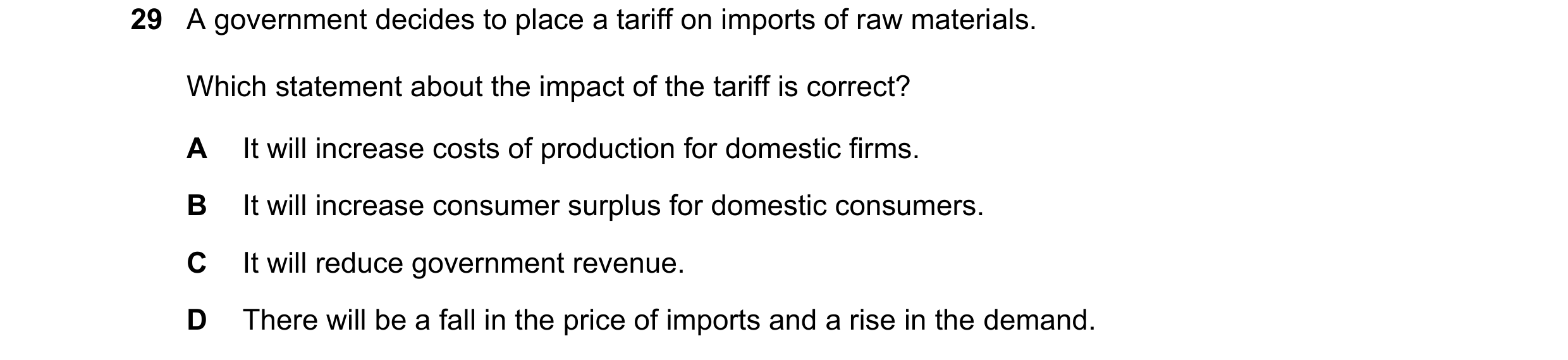 44 / 47
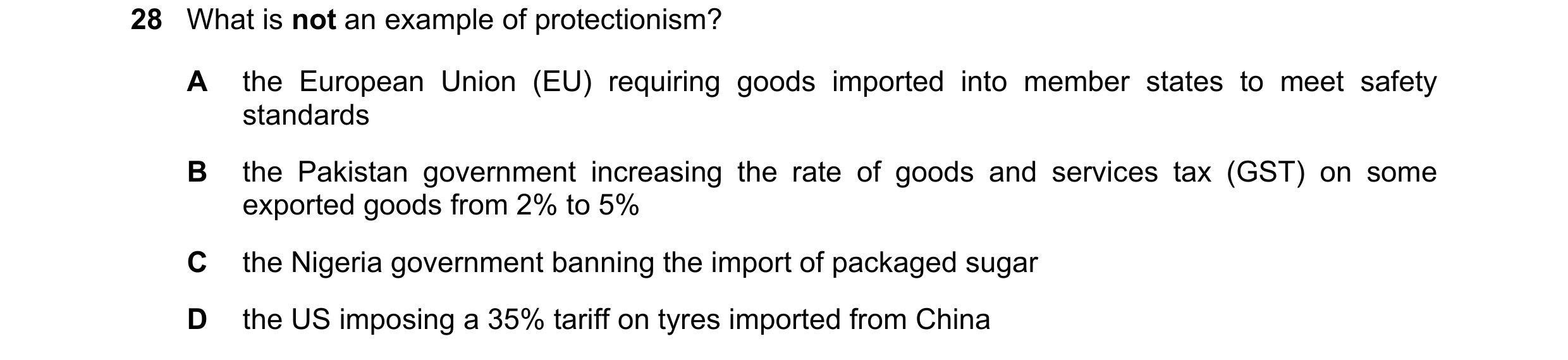
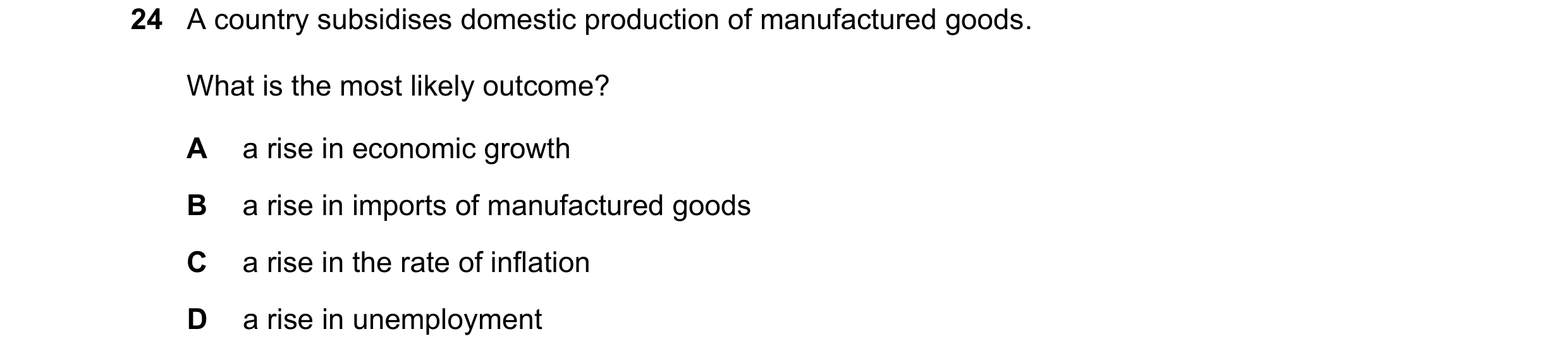
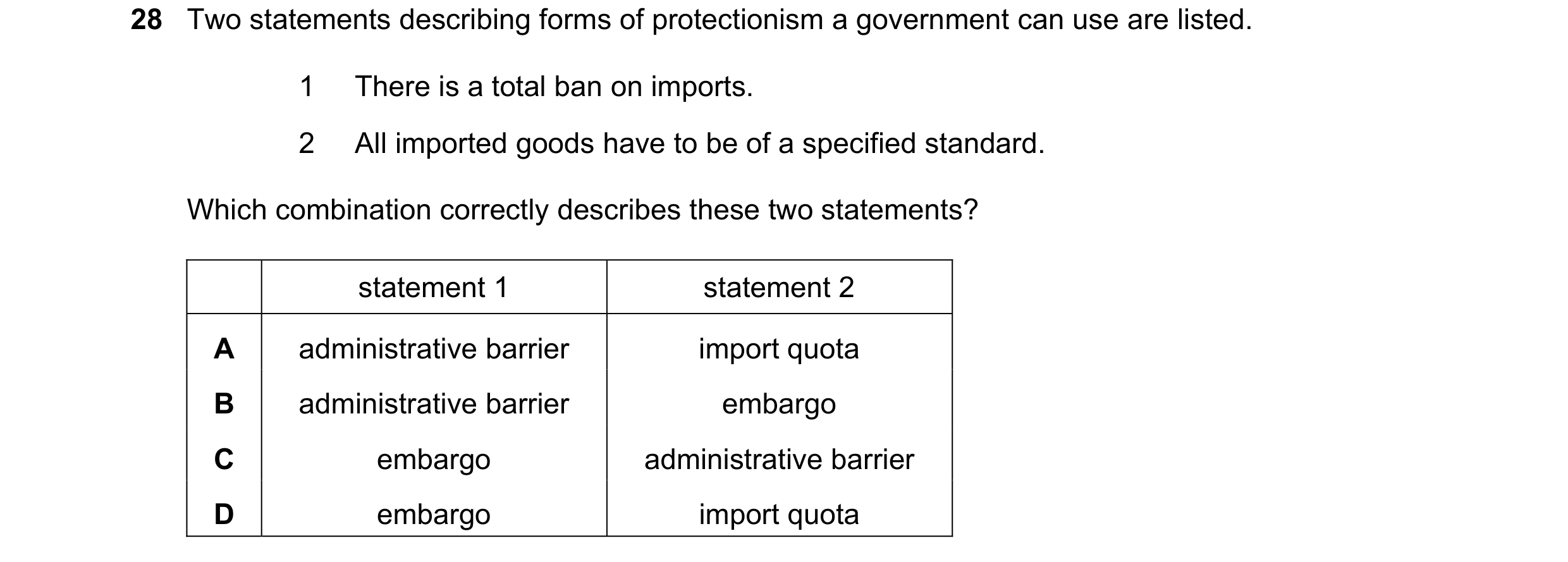 45 / 47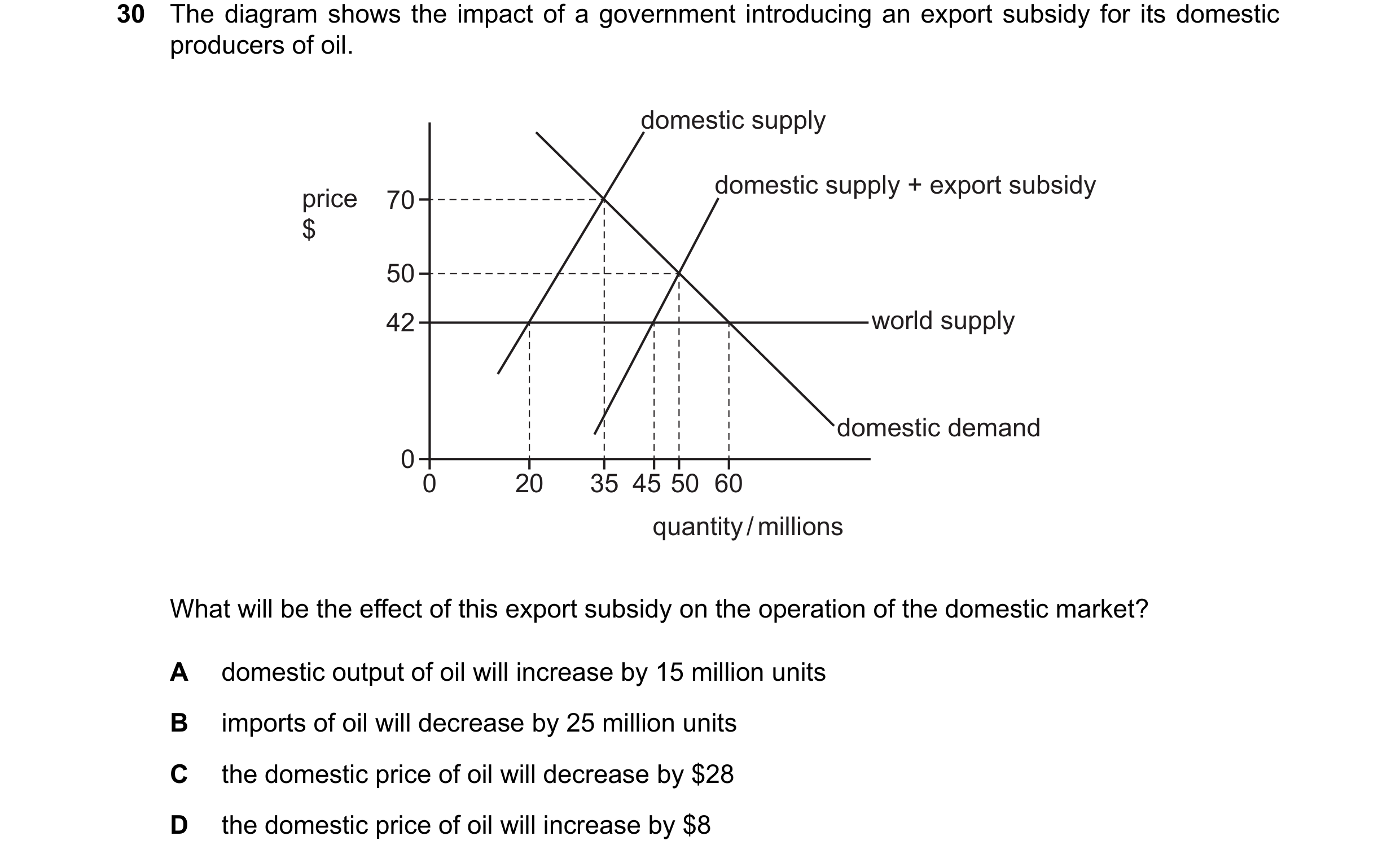

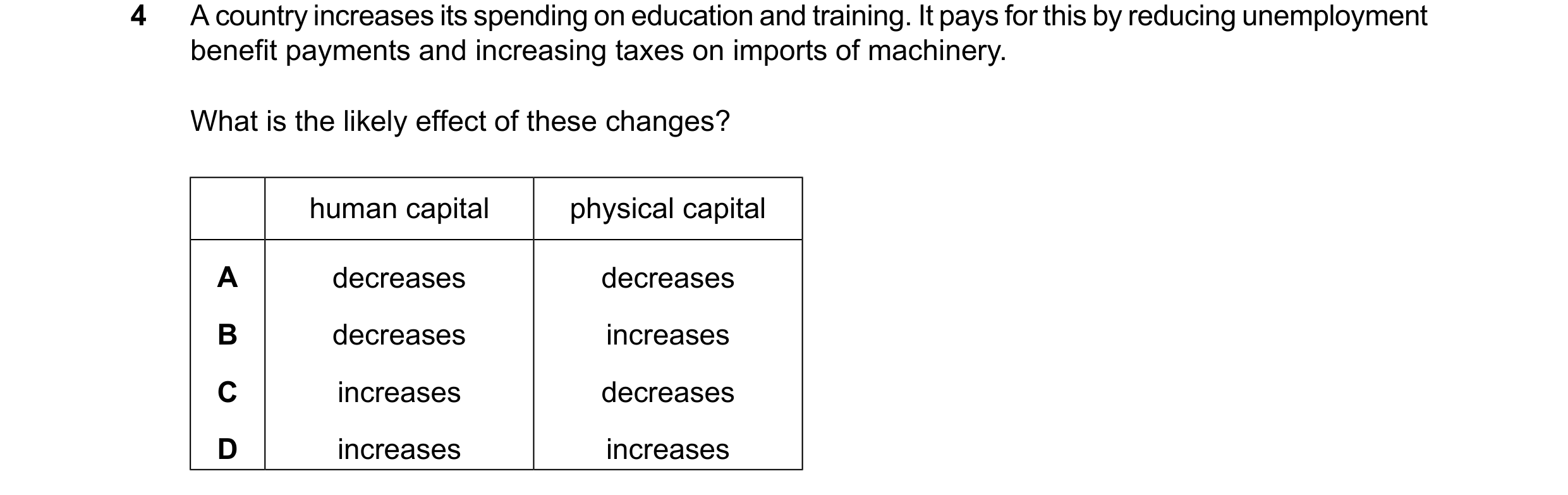
 46 / 47

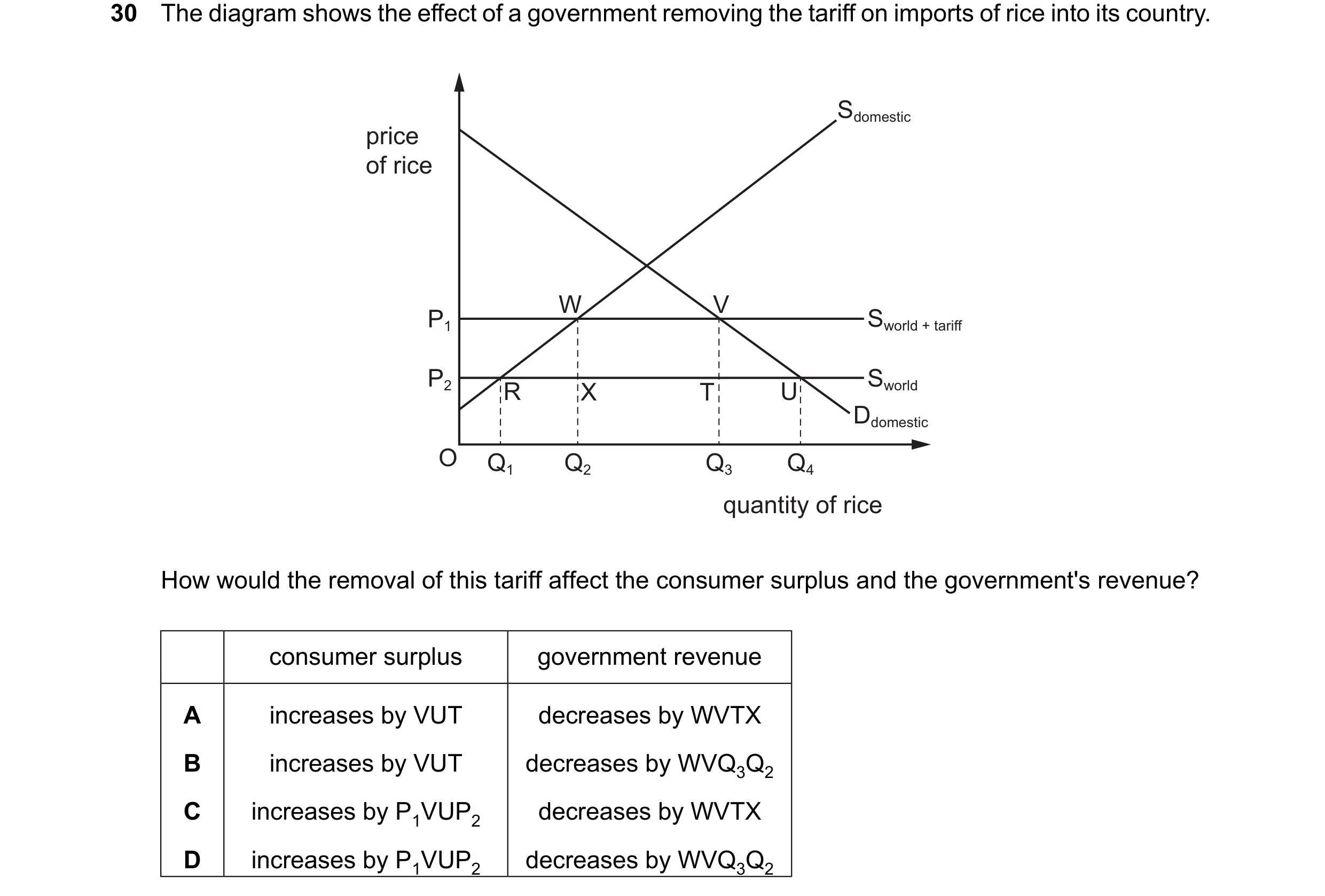 47 / 47