Questions as text
Q1 · A country introduces import quotas 9708/31 Oct/Nov 2010
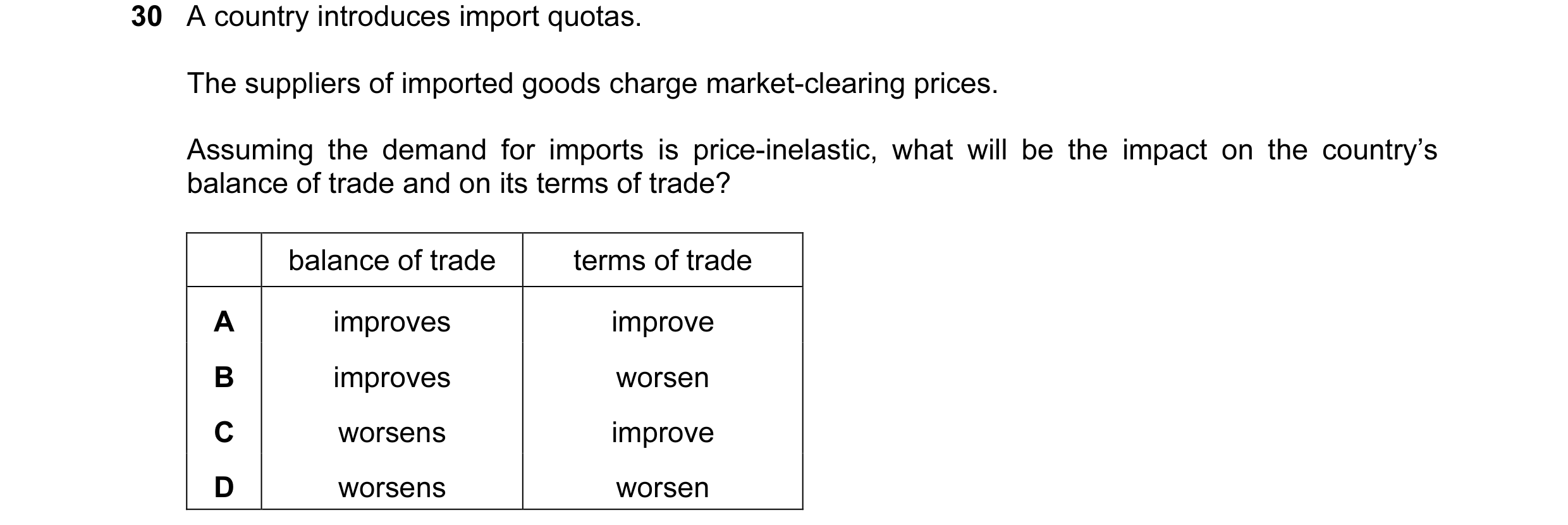
30 A country introduces import quotas. The suppliers of imported goods charge market-clearing prices. Assuming the demand for imports is price-inelastic, what will be the impact on the country’s balance of trade and on its terms of trade? balance of trade terms of trade A improves improve B improves worsen C worsens improve D worsens worsen
1 marks
Answer: D
This question in 9708/31 Oct/Nov 2010
Q2 · A country introduces import quotas 9708/32 Oct/Nov 2010
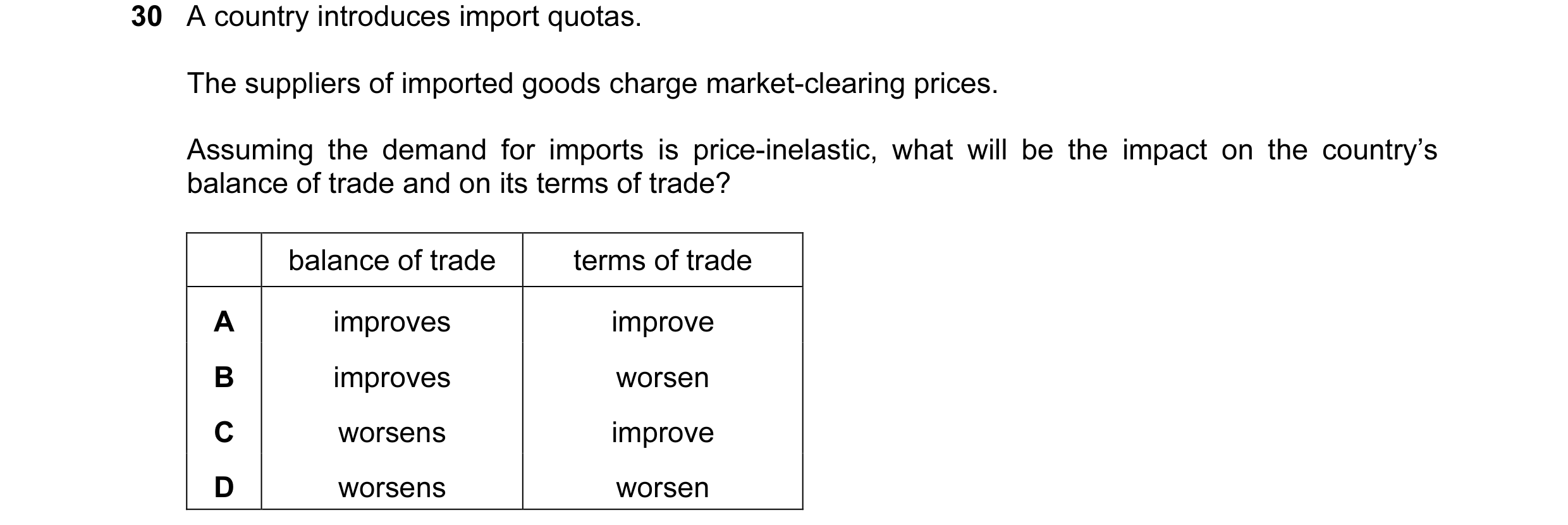
30 A country introduces import quotas. The suppliers of imported goods charge market-clearing prices. Assuming the demand for imports is price-inelastic, what will be the impact on the country’s balance of trade and on its terms of trade? balance of trade terms of trade A improves improve B improves worsen C worsens improve D worsens worsen
1 marks
Answer: D
This question in 9708/32 Oct/Nov 2010
Q3 · What could be expected to increase the pressure of demand-pull inflation in an open… 9708/33 Oct/Nov 2010
26 What could be expected to increase the pressure of demand-pull inflation in an open economy? A an appreciation of the foreign exchange rate B an increase in indirect taxes C an increase in interest rates D the imposition of import controls
1 marks
Answer: D
This question in 9708/33 Oct/Nov 2010
Q4 · A country introduces import quotas 9708/33 Oct/Nov 2010
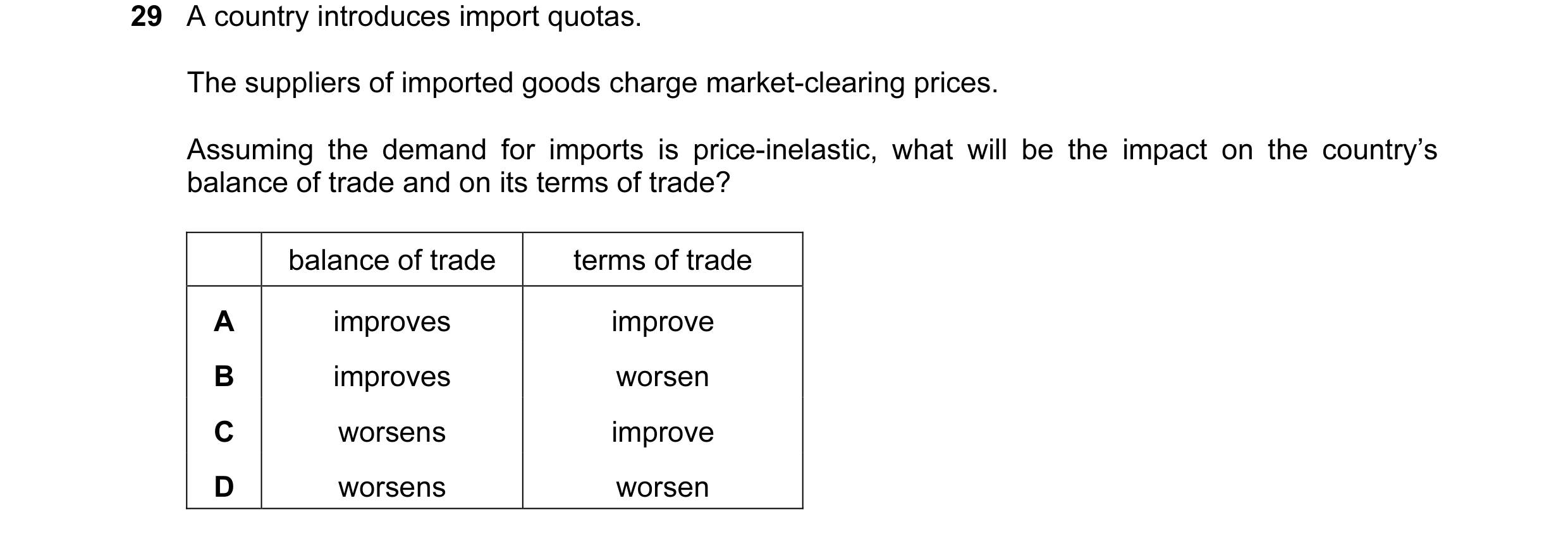
29 A country introduces import quotas. The suppliers of imported goods charge market-clearing prices. Assuming the demand for imports is price-inelastic, what will be the impact on the country’s balance of trade and on its terms of trade? balance of trade terms of trade A improves improve B improves worsen C worsens improve D worsens worsen
1 marks
Answer: D
This question in 9708/33 Oct/Nov 2010
Q5 · What would be an economic benefit to a major economy of imposing a tariff on imported… 9708/31 May/June 2011
30 What would be an economic benefit to a major economy of imposing a tariff on imported goods? A It would increase labour productivity. B It would increase pressure on foreign suppliers to reduce their prices. C It would make the country’s exports more competitive. D It would reduce the prices paid by consumers for imported goods.
1 marks
Answer: B
This question in 9708/31 May/June 2011
Q6 · What would be an economic benefit to a major economy of imposing a tariff on imported… 9708/32 May/June 2011
29 What would be an economic benefit to a major economy of imposing a tariff on imported goods? A It would increase labour productivity. B It would increase pressure on foreign suppliers to reduce their prices. C It would make the country’s exports more competitive. D It would reduce the prices paid by consumers for imported goods.
1 marks
Answer: B
This question in 9708/32 May/June 2011
Q7 · What would be an economic benefit to a major economy of imposing a tariff on imported… 9708/33 May/June 2011
29 What would be an economic benefit to a major economy of imposing a tariff on imported goods? A It would increase labour productivity. B It would increase pressure on foreign suppliers to reduce their prices. C It would make the country’s exports more competitive. D It would reduce the prices paid by consumers for imported goods.
1 marks
Answer: B
This question in 9708/33 May/June 2011
Q8 · What is not a valid economic argument for developing economies to pursue a policy of… 9708/32 Oct/Nov 2011
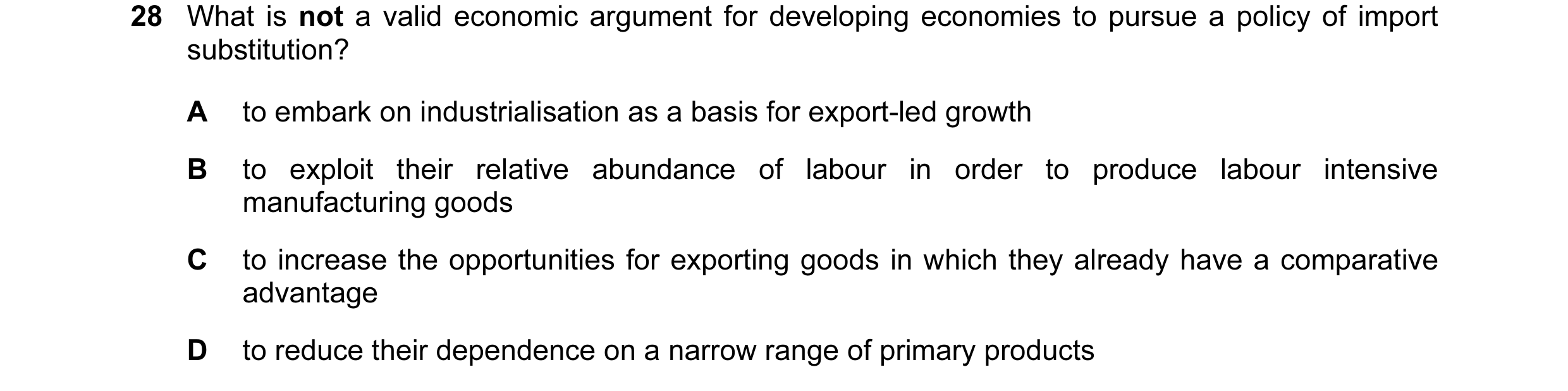
28 What is not a valid economic argument for developing economies to pursue a policy of import substitution? A to embark on industrialisation as a basis for export-led growth B to exploit their relative abundance of labour in order to produce labour intensive manufacturing goods C to increase the opportunities for exporting goods in which they already have a comparative advantage D to reduce their dependence on a narrow range of primary products
1 marks
Answer: C
This question in 9708/32 Oct/Nov 2011
Q9 · The European Union imposes a quota on the volume of garments imported from China 9708/31 May/June 2012
29 The European Union imposes a quota on the volume of garments imported from China. What is likely to be a consequence? A an increase in the prices received by Chinese textile firms B a reduction in the prices paid by EU consumers C a switch to producing lower-value garments by Chinese textile firms D a reduction in the volume of garments exported from China to non-EU markets
1 marks
Answer: A
This question in 9708/31 May/June 2012
Q10 · In the diagram, D is a country’s demand curve for an imported good 9708/33 May/June 2012
14 In the diagram, D is a country’s demand curve for an imported good. The world price of the good is OPW. Pc price x y Pw z D O quantity Which area measures the deadweight loss to the country of imposing an import tariff equal to PW PC on the good? A x B y C z D x + y
1 marks
Answer: B
This question in 9708/33 May/June 2012
Q11 · The European Union imposes a quota on the volume of garments imported from China 9708/33 May/June 2012
29 The European Union imposes a quota on the volume of garments imported from China. What is likely to be a consequence? A an increase in the prices received by Chinese textile firms B a reduction in the prices paid by EU consumers C a switch to producing lower-value garments by Chinese textile firms D a reduction in the volume of garments exported from China to non-EU markets
1 marks
Answer: A
This question in 9708/33 May/June 2012
Q12 · How might a developing economy gain from a multilateral reduction in import tariffs and… 9708/32 Oct/Nov 2012
27 How might a developing economy gain from a multilateral reduction in import tariffs and the removal by developed economies of subsidies on food exports? A through increased specialisation leading to higher productivity B through increased ability to protect infant industries C through a reduction in the cost to the economy of imported food D through increased tariff revenues
1 marks
Answer: A
This question in 9708/32 Oct/Nov 2012
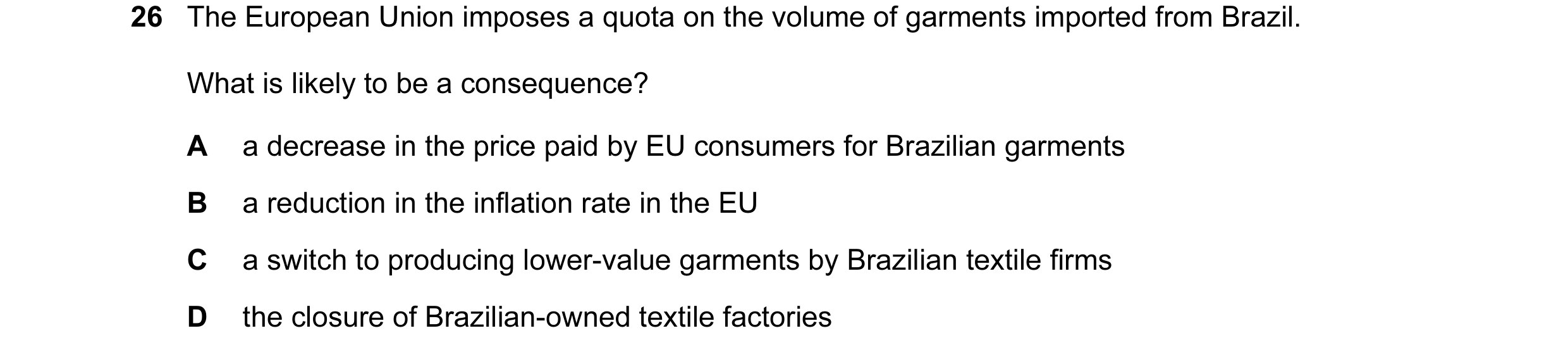
Q13 · The European Union imposes a quota on the volume of garments imported from Brazil 9708/32 May/June 2013
26 The European Union imposes a quota on the volume of garments imported from Brazil. What is likely to be a consequence? A a decrease in the price paid by EU consumers for Brazilian garments B a reduction in the inflation rate in the EU C a switch to producing lower-value garments by Brazilian textile firms D the closure of Brazilian-owned textile factories
1 marks
Answer: D
This question in 9708/32 May/June 2013
Q14 · The government of a major trading country imposes a tariff on imported goods 9708/31 Oct/Nov 2014
28 The government of a major trading country imposes a tariff on imported goods. What is likely to be the impact on the prices paid to the foreign producers of the goods and on the prices paid for the goods by domestic consumers? prices paid to prices paid by foreign domestic producers consumers A decrease decrease B decrease increase C increase decrease D increase increase
1 marks
Answer: B
This question in 9708/31 Oct/Nov 2014
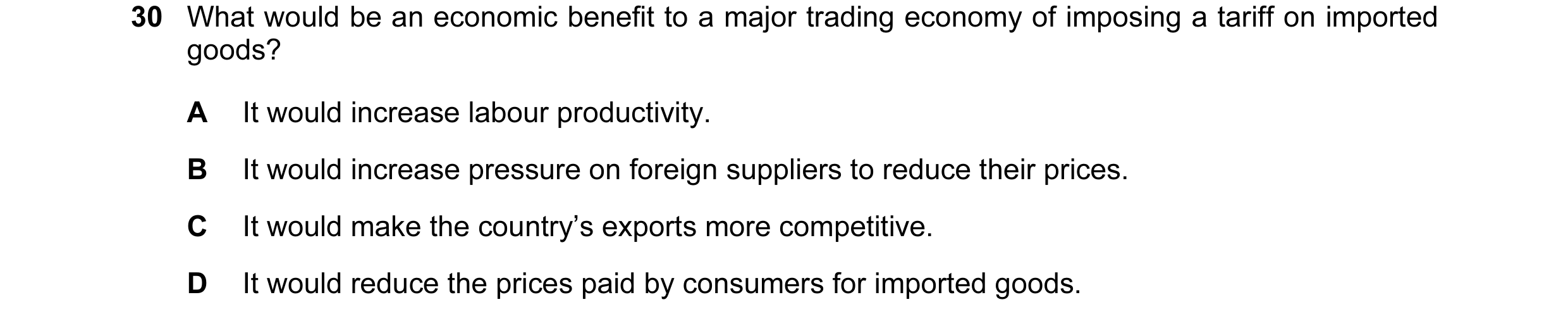
Q15 · What would be an economic benefit to a major trading economy of imposing a tariff on… 9708/33 Oct/Nov 2014
30 What would be an economic benefit to a major trading economy of imposing a tariff on imported goods? A It would increase labour productivity. B It would increase pressure on foreign suppliers to reduce their prices. C It would make the country’s exports more competitive. D It would reduce the prices paid by consumers for imported goods.
1 marks
Answer: B
This question in 9708/33 Oct/Nov 2014
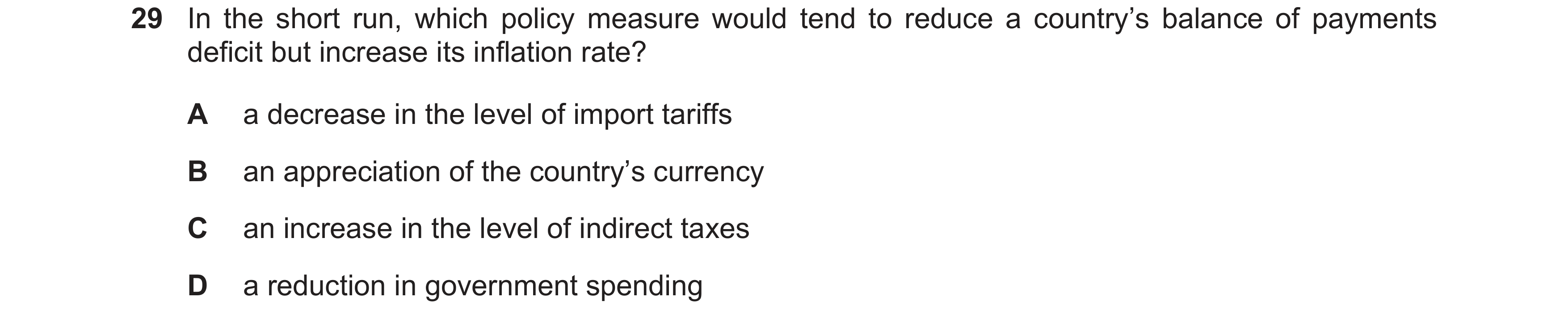
Q16 · In the short run, which policy measure would tend to reduce a country’s balance of… 9708/32 May/June 2017
29 In the short run, which policy measure would tend to reduce a country’s balance of payments deficit but increase its inflation rate? A a decrease in the level of import tariffs B an appreciation of the country’s currency C an increase in the level of indirect taxes D a reduction in government spending
1 marks
Answer: C
This question in 9708/32 May/June 2017
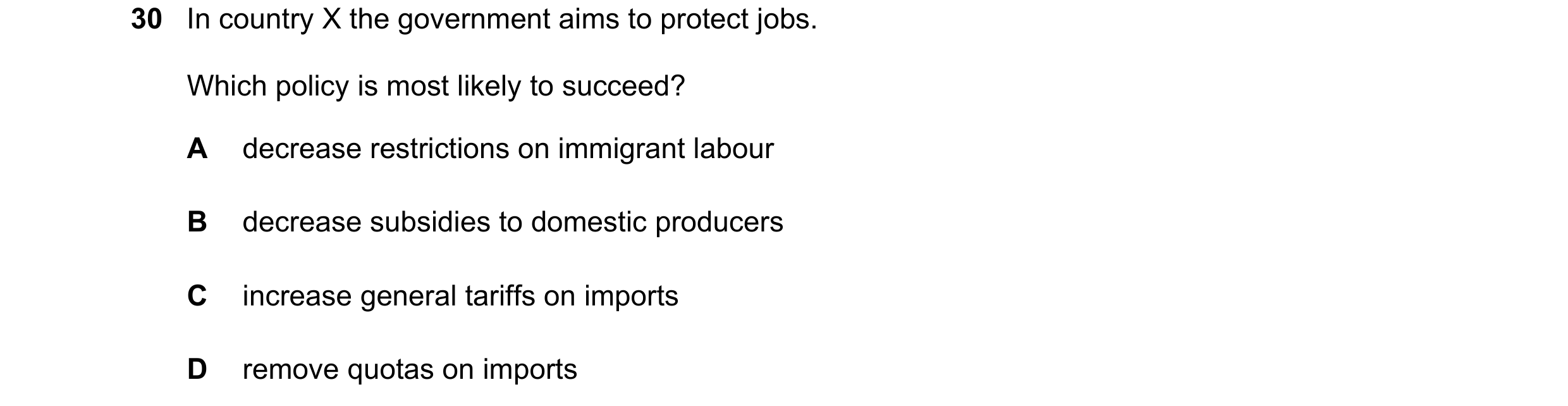
Q17 · In country X the government aims to protect jobs 9708/32 Feb/March 2019
30 In country X the government aims to protect jobs. Which policy is most likely to succeed? A decrease restrictions on immigrant labour B decrease subsidies to domestic producers C increase general tariffs on imports D remove quotas on imports
1 marks
Answer: C
This question in 9708/32 Feb/March 2019
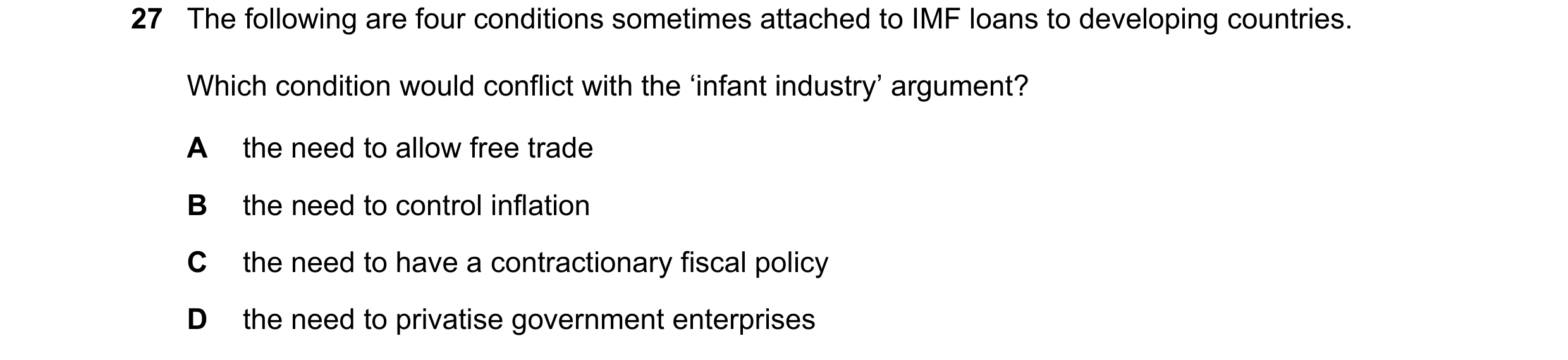
Q18 · The following are four conditions sometimes attached to IMF loans to developing countries 9708/32 Oct/Nov 2019
27 The following are four conditions sometimes attached to IMF loans to developing countries. Which condition would conflict with the ‘infant industry’ argument? A the need to allow free trade B the need to control inflation C the need to have a contractionary fiscal policy D the need to privatise government enterprises
1 marks
Answer: A
This question in 9708/32 Oct/Nov 2019
Q19 · An economy requires large inputs of steel for its building programmes 9708/32 Oct/Nov 2021
15 An economy requires large inputs of steel for its building programmes. After political pressure, the government imposes a minimum price on imported foreign steel. When would this intervention lead to economic inefficiency? A when it encourages domestic steel producers to achieve economies of scale B when it prevents dumping of low-grade steel C when it protects jobs of highly productive steel workers D when it reduces competition for steel workers
1 marks
Answer: D
This question in 9708/32 Oct/Nov 2021
Q20 · What is an example of an expenditure-switching policy? 9708/32 Feb/March 2023
29 What is an example of an expenditure-switching policy? A an increase in income tax rates B an increase in interest rates C an increase in tariff rates D an increase in the supply of money
1 marks
Answer: C
This question in 9708/32 Feb/March 2023
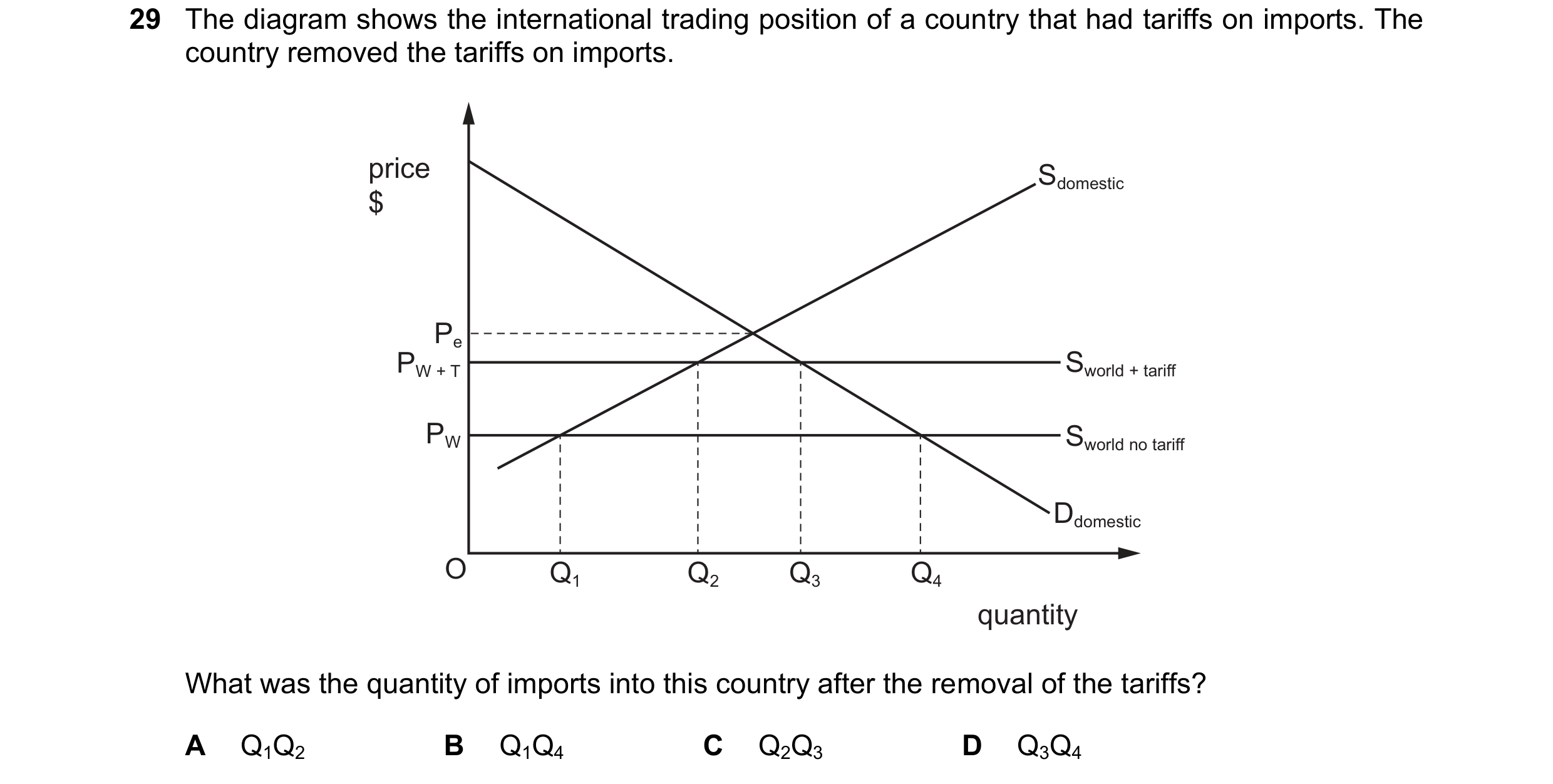
Q21 · The diagram shows the international trading position of a country that had tariffs on… 9708/33 Oct/Nov 2023
29 The diagram shows the international trading position of a country that had tariffs on imports. The country removed the tariffs on imports. price Sdomestic $ Pe PW + T Sworld + tariff PW Sworld no tariff Ddomestic O Q1 Q2 Q3 Q4 quantity What was the quantity of imports into this country after the removal of the tariffs? A Q1Q2 B Q1Q4 C Q2Q3 D Q3Q4
1 marks
Answer: B
This question in 9708/33 Oct/Nov 2023

 1 / 5
1 / 5


 2 / 5
2 / 5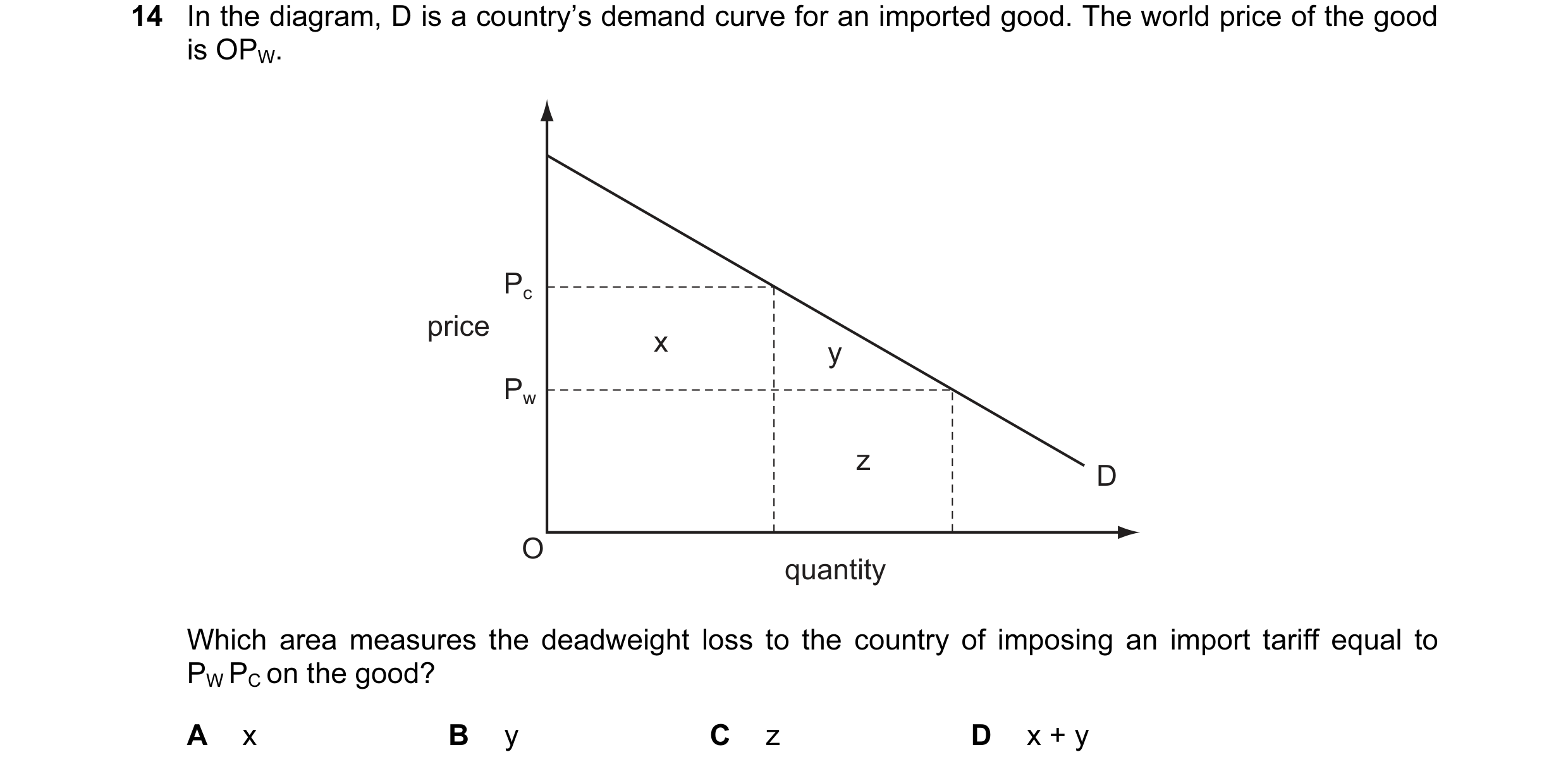
 3 / 5
3 / 5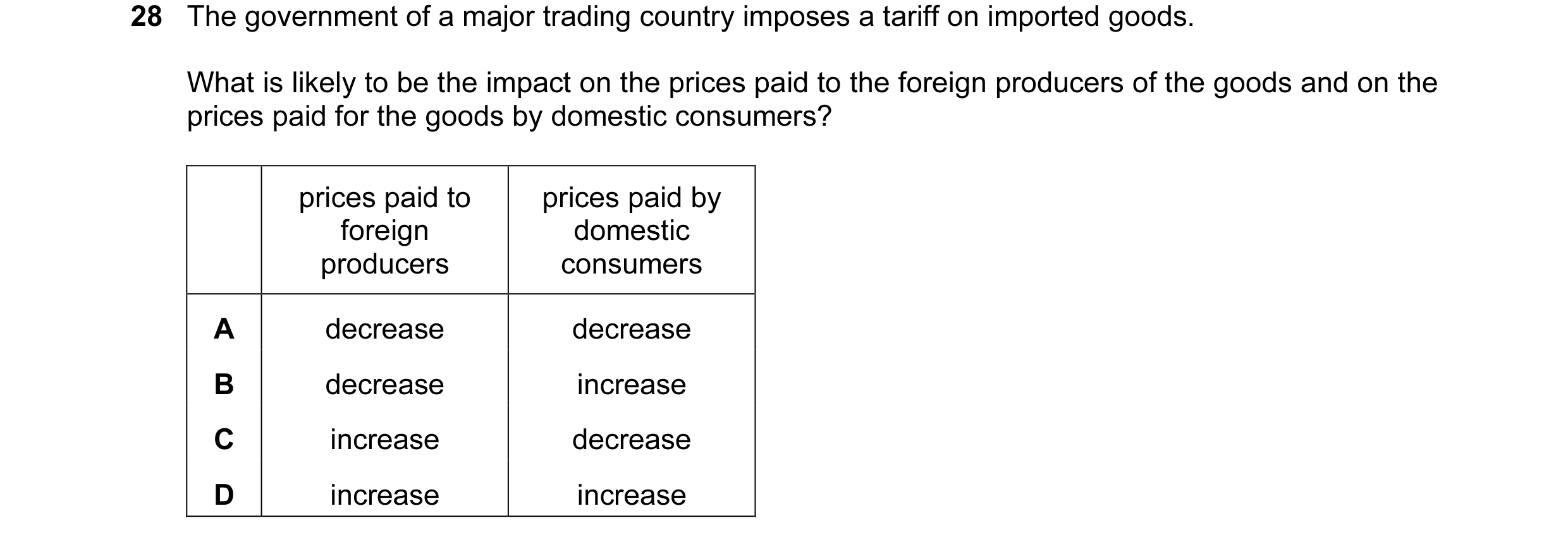
 4 / 5
4 / 5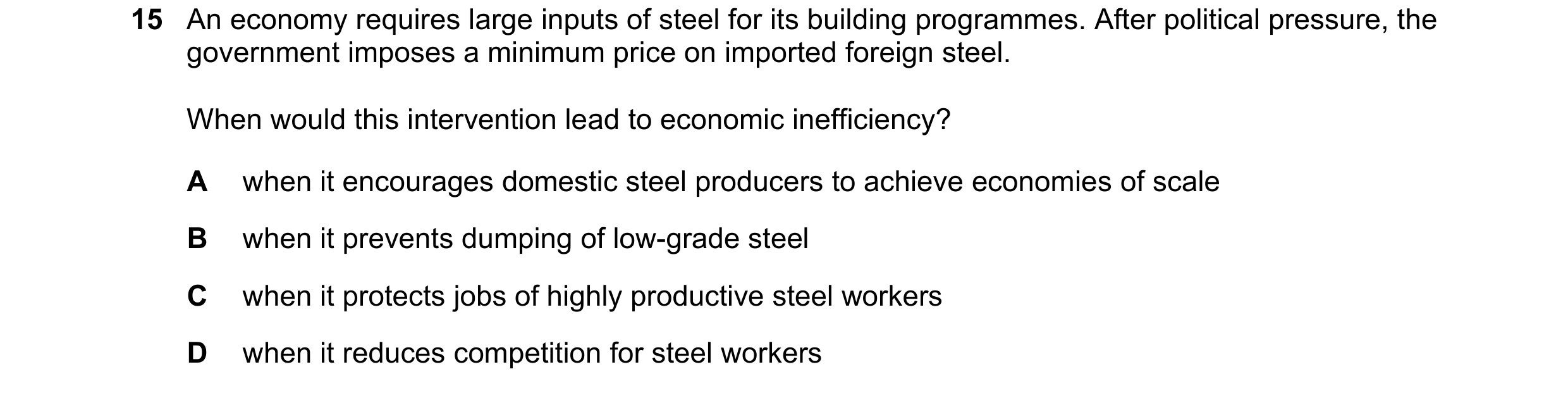

 5 / 5
5 / 5