Questions as text
Q1 · Electricity from a power station is to be transmitted over a large distance 0654/21 May/June 2017
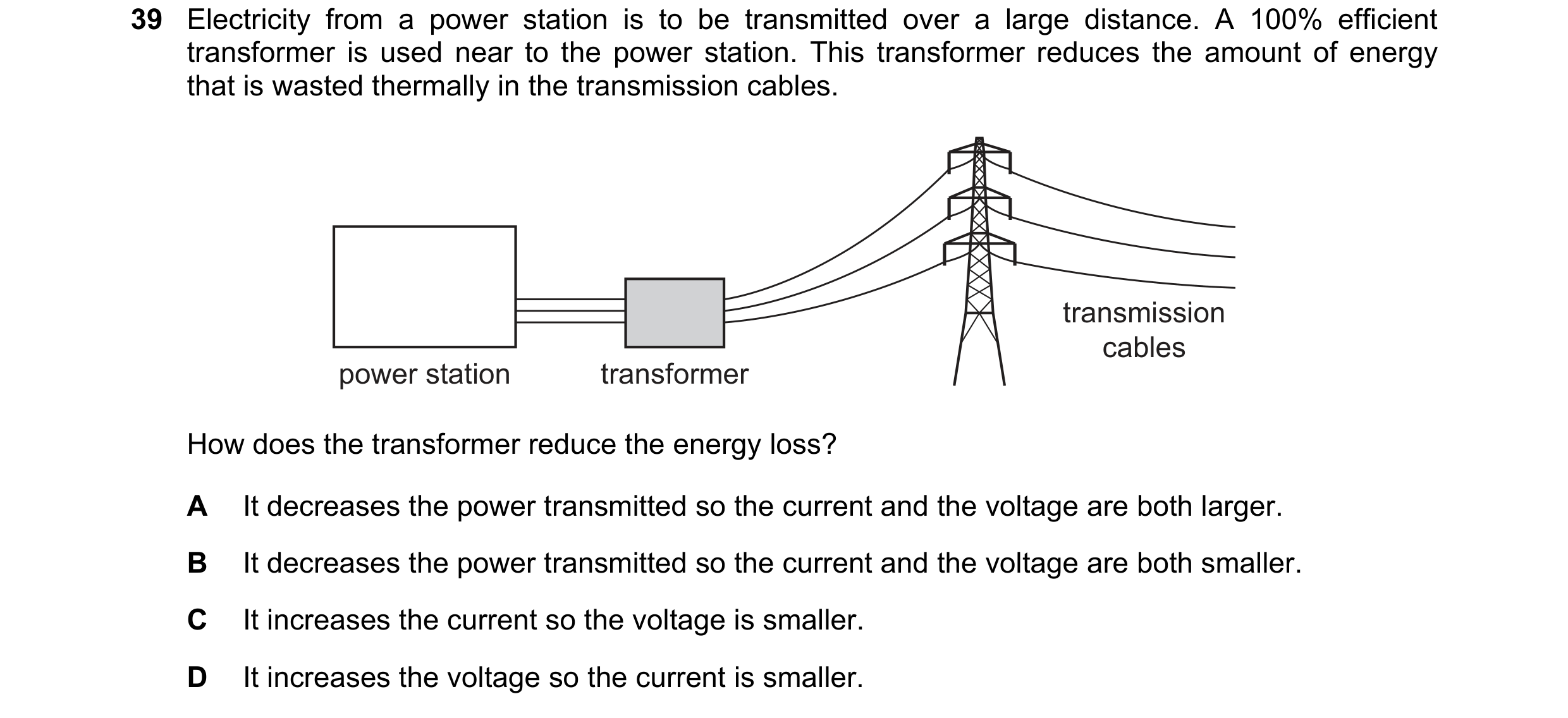
39 Electricity from a power station is to be transmitted over a large distance. A 100% efficient transformer is used near to the power station. This transformer reduces the amount of energy that is wasted thermally in the transmission cables. transmission cables power station transformer How does the transformer reduce the energy loss? A It decreases the power transmitted so the current and the voltage are both larger. B It decreases the power transmitted so the current and the voltage are both smaller. C It increases the current so the voltage is smaller. D It increases the voltage so the current is smaller.
1 marks
Answer: D
This question in 0654/21 May/June 2017
Q2 · The diagram shows a wire carrying an electric current in the direction shown 0654/22 May/June 2017
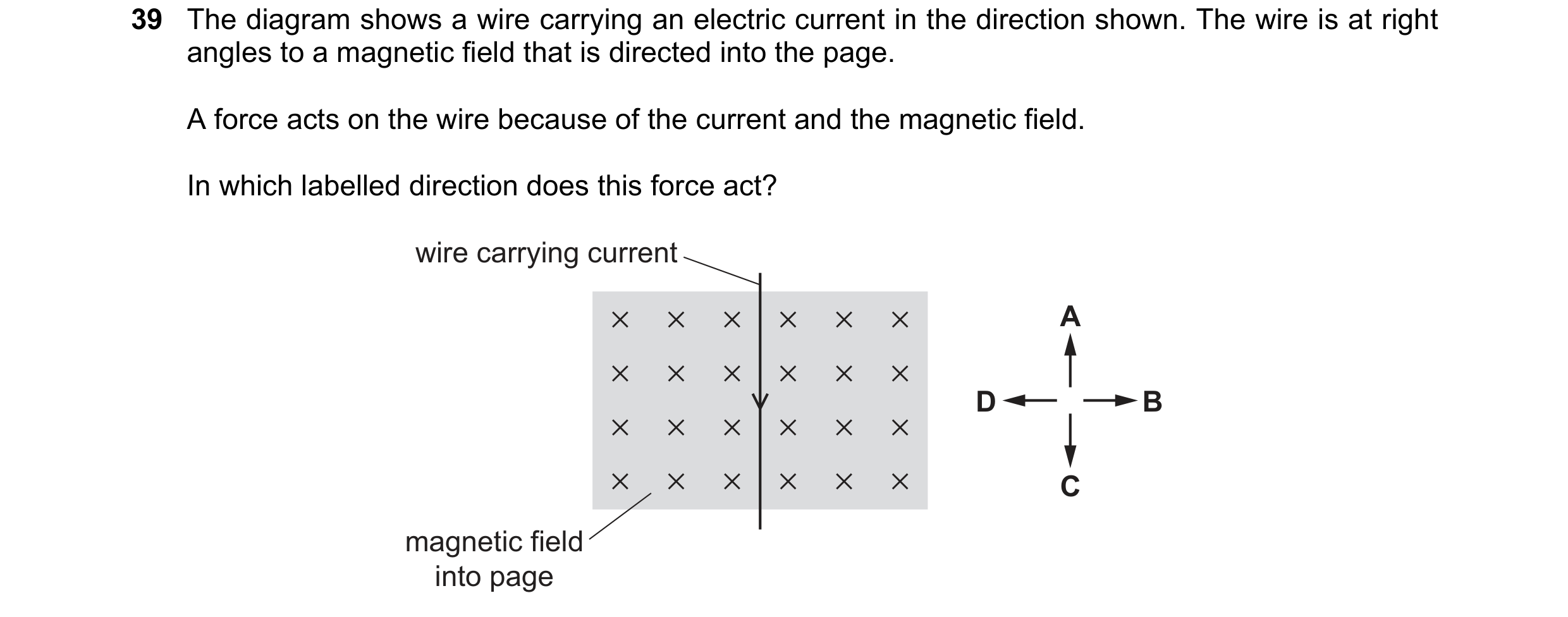
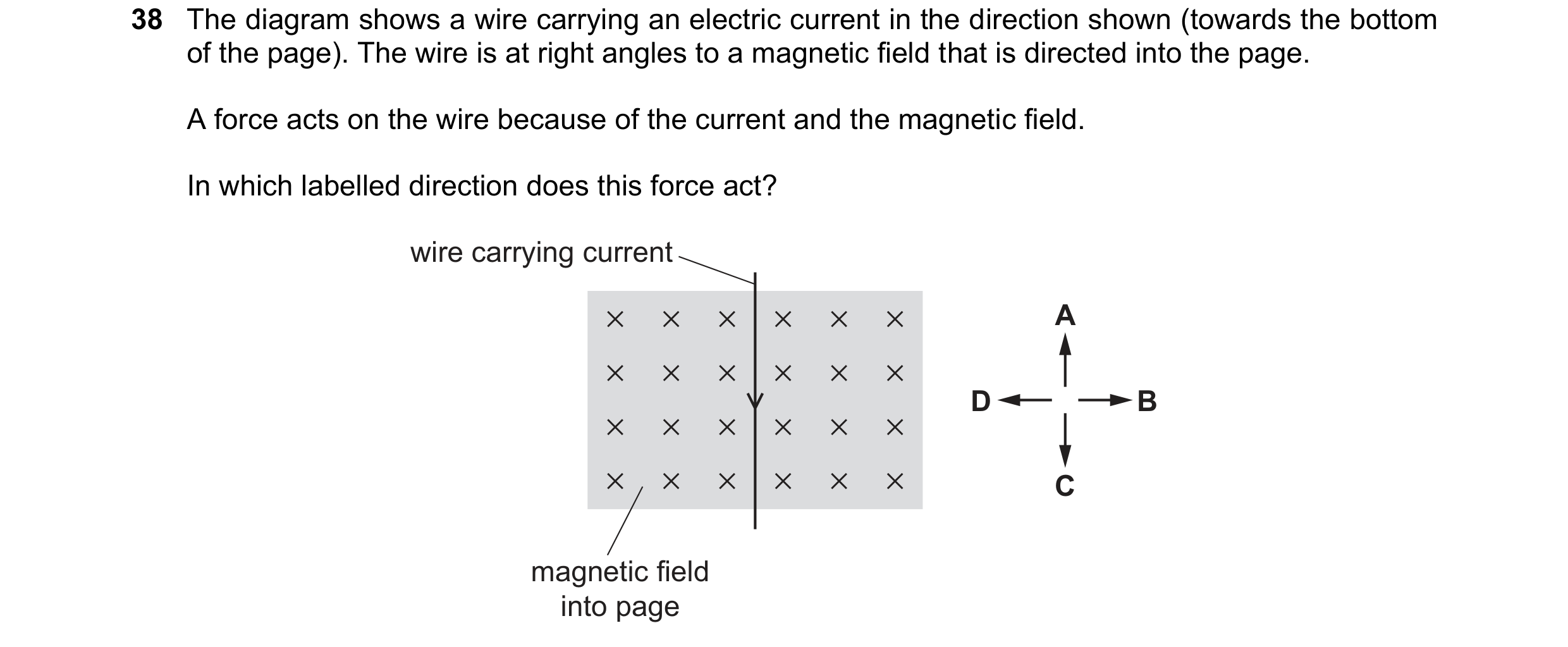
39 The diagram shows a wire carrying an electric current in the direction shown. The wire is at right angles to a magnetic field that is directed into the page. A force acts on the wire because of the current and the magnetic field. In which labelled direction does this force act? wire carrying current A D B C magnetic field into page
1 marks
Answer: B
This question in 0654/22 May/June 2017
Q3 · A current-carrying conductor is placed in a magnetic field that is directed into the page 0654/23 May/June 2017
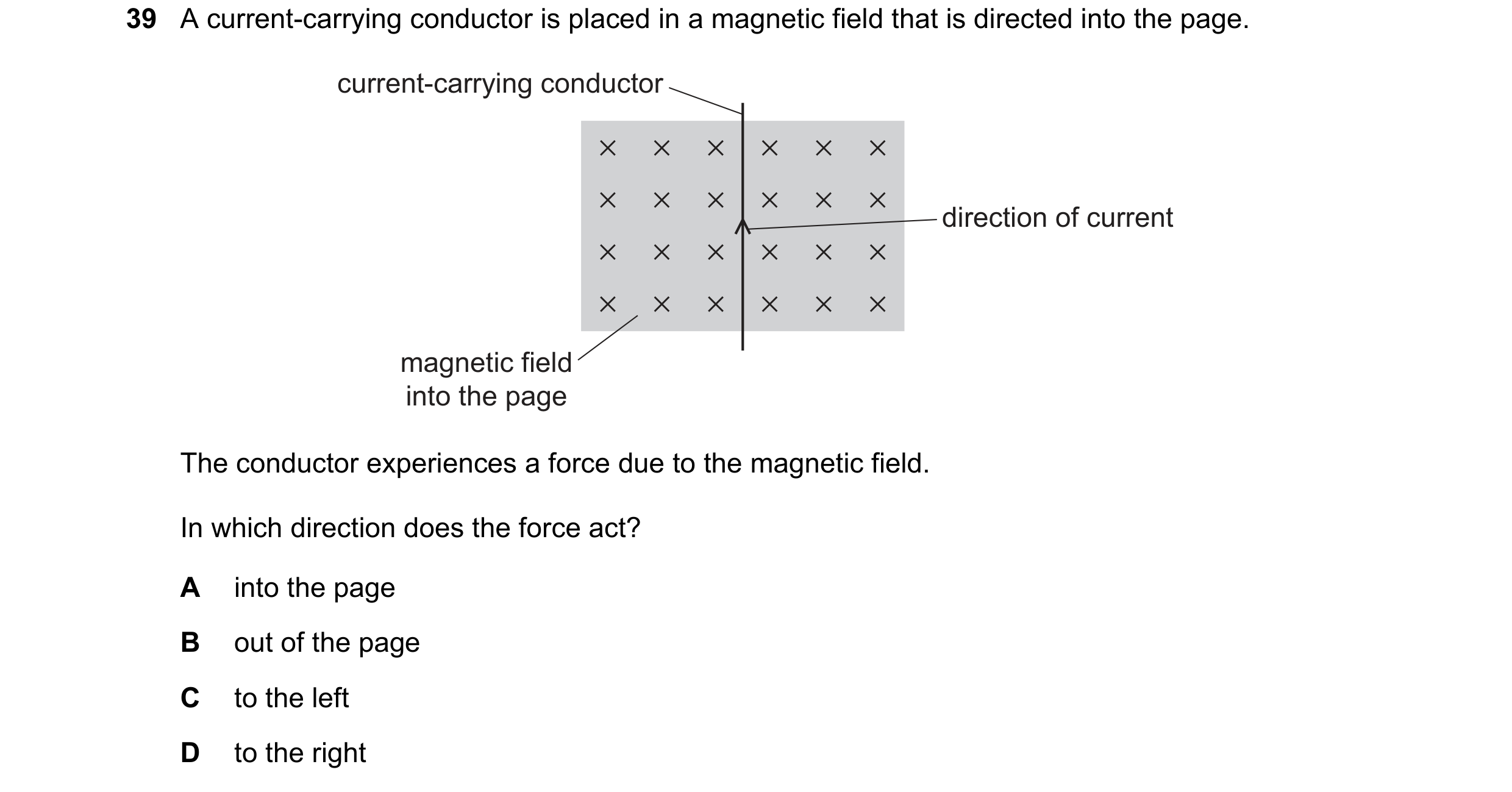
39 A current-carrying conductor is placed in a magnetic field that is directed into the page. current-carrying conductor direction of current magnetic field into the page The conductor experiences a force due to the magnetic field. In which direction does the force act? A into the page B out of the page C to the left D to the right
1 marks
Answer: C
This question in 0654/23 May/June 2017
Q4 · Which diagram shows the voltage output of a rotating-coil generator with slip rings? 0654/21 Oct/Nov 2018
40 Which diagram shows the voltage output of a rotating-coil generator with slip rings? A B voltage voltage 0 0 time time C D voltage voltage 0 0 time time
1 marks
Answer: D
This question in 0654/21 Oct/Nov 2018
Q5 · A current-carrying conductor is in a magnetic field 0654/22 Oct/Nov 2018
39 A current-carrying conductor is in a magnetic field. The current is switched on and a force acts on the conductor. The current is doubled and the magnetic field is reversed. How does the force on the conductor change, if at all? A The force is greater and in the opposite direction. B The force is greater and in the same direction. C The force is the same and in the same direction. D The force is the same but in the opposite direction.
1 marks
Answer: A
This question in 0654/22 Oct/Nov 2018
Q6 · The diagram shows a d.c 0654/23 Oct/Nov 2018
40 The diagram shows a d.c. motor. The switch is open. coil magnet magnet N S Four statements, P, Q, R and S, each partly explain what happens when the switch closes. P A current is produced in the coil. Q The coil begins to rotate. R The coil experiences a force. S The battery produces a potential difference across the coil. What is the correct order for these statements to explain how the motor works? A P → S → Q → R B P → S → R → Q C S → P → Q → R D S → P → R → Q
1 marks
Answer: D
This question in 0654/23 Oct/Nov 2018
Q7 · Which graph shows how the output voltage of an a.c 0654/21 May/June 2019
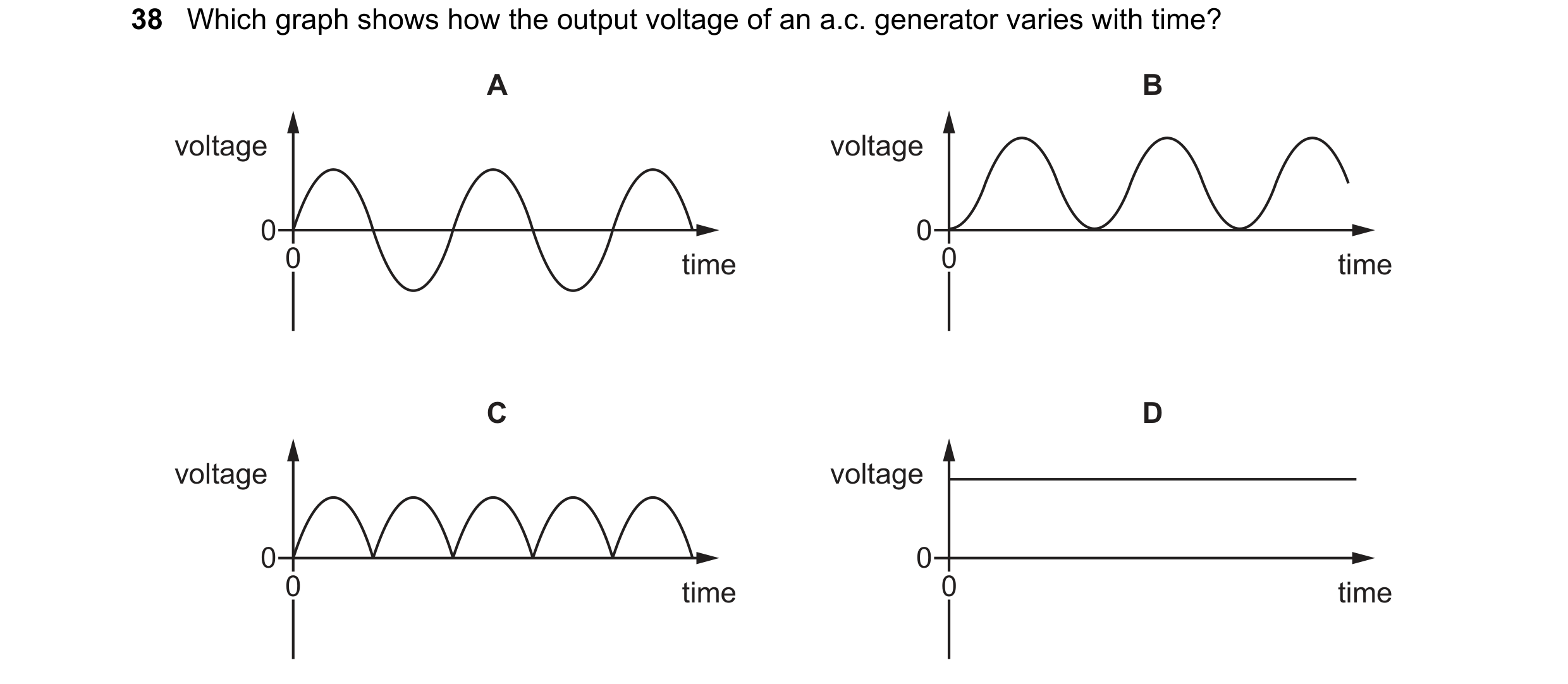
38 Which graph shows how the output voltage of an a.c. generator varies with time? A B voltage voltage 0 0 0 time 0 time C D voltage voltage 0 0 0 time 0 time
1 marks
Answer: A
This question in 0654/21 May/June 2019
Q8 · A transformer increases the voltage from a power station in order to transfer electricity… 0654/21 May/June 2019
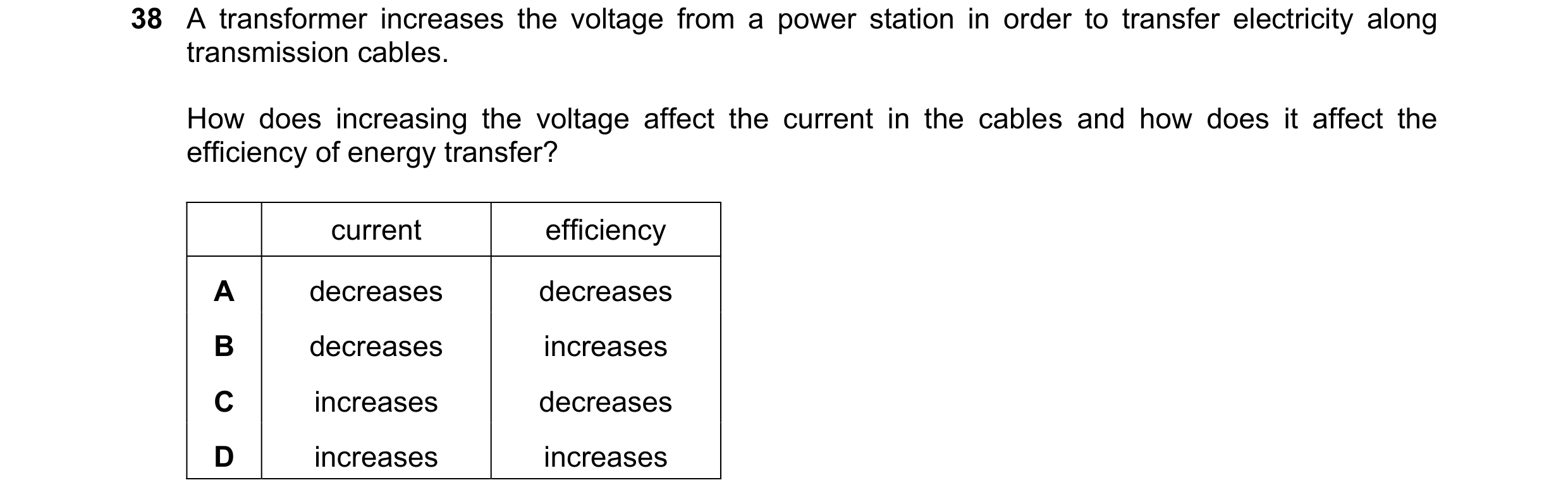
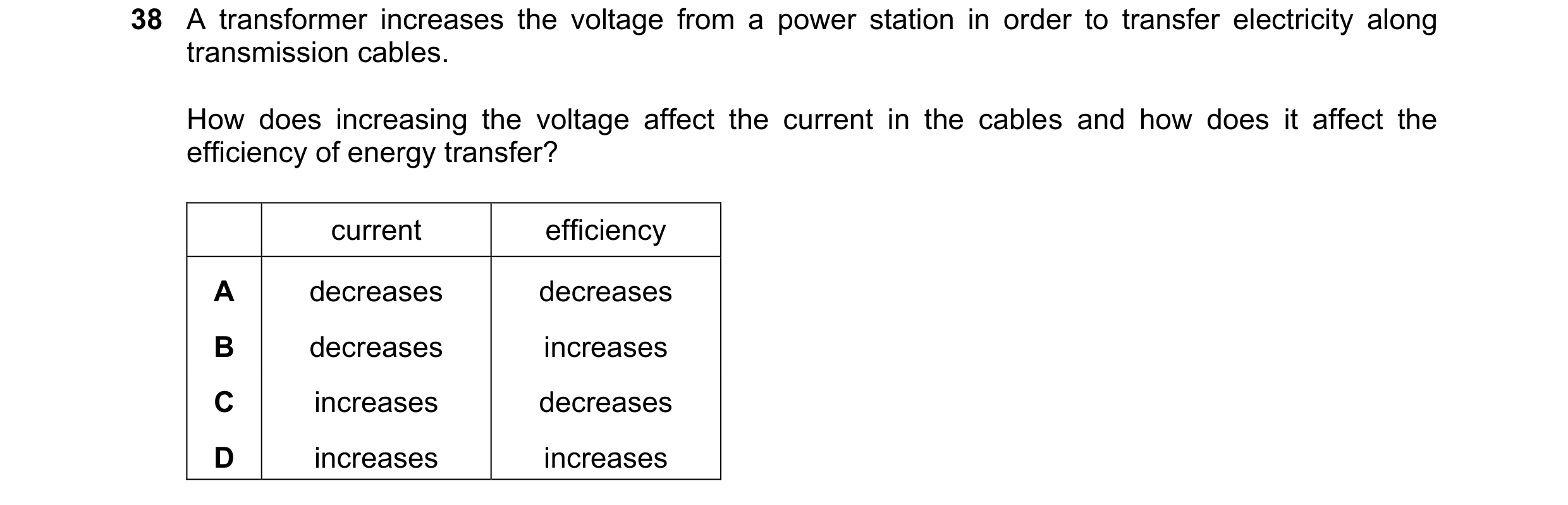
39 A transformer increases the voltage from a power station in order to transfer electricity along the transmission cables. How does increasing the voltage affect the current in the cables and how does it affect the efficiency of energy transfer? current efficiency A decreases decreases B decreases increases C increases decreases D increases increases
1 marks
Answer: B
This question in 0654/21 May/June 2019
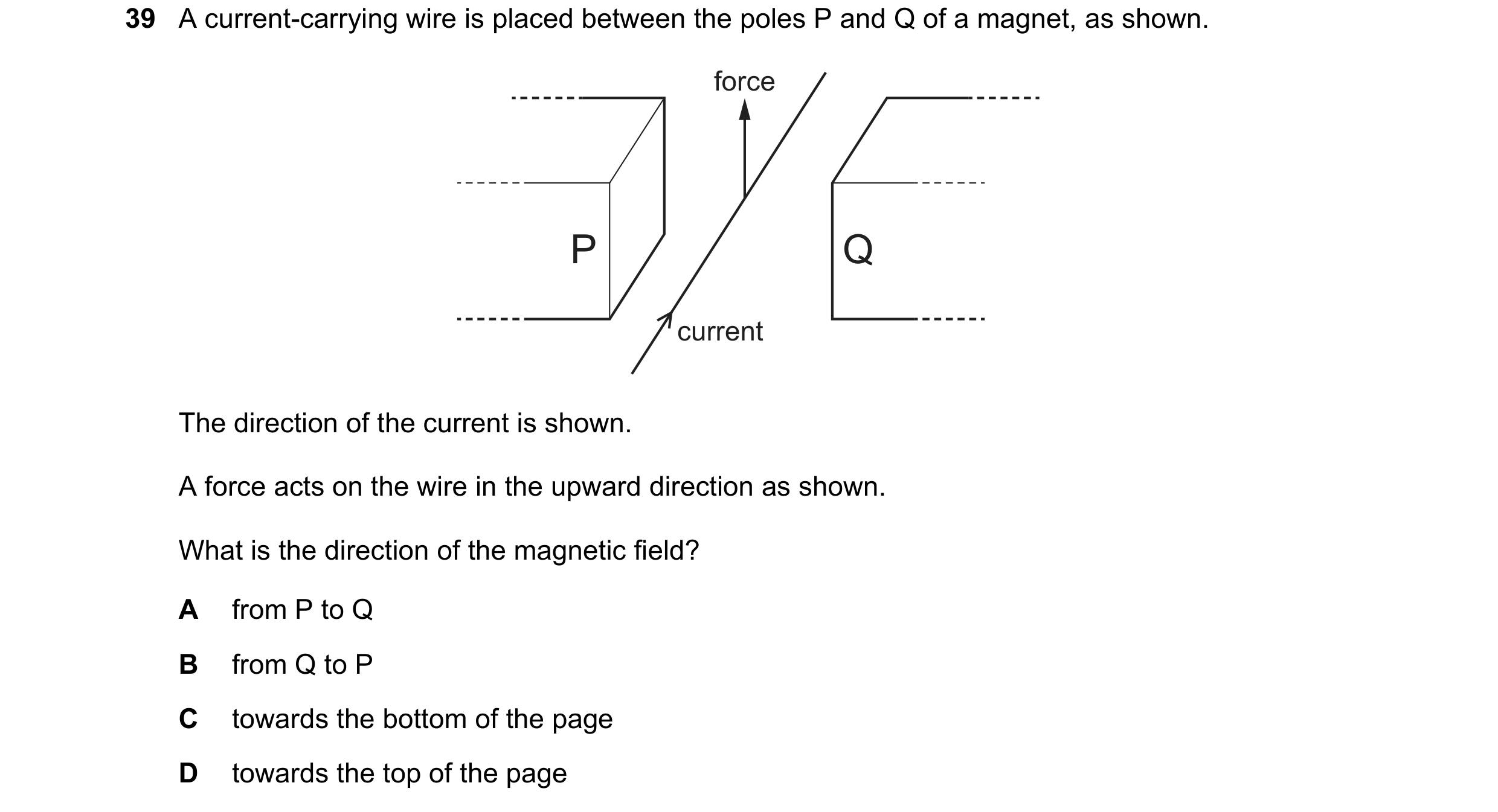
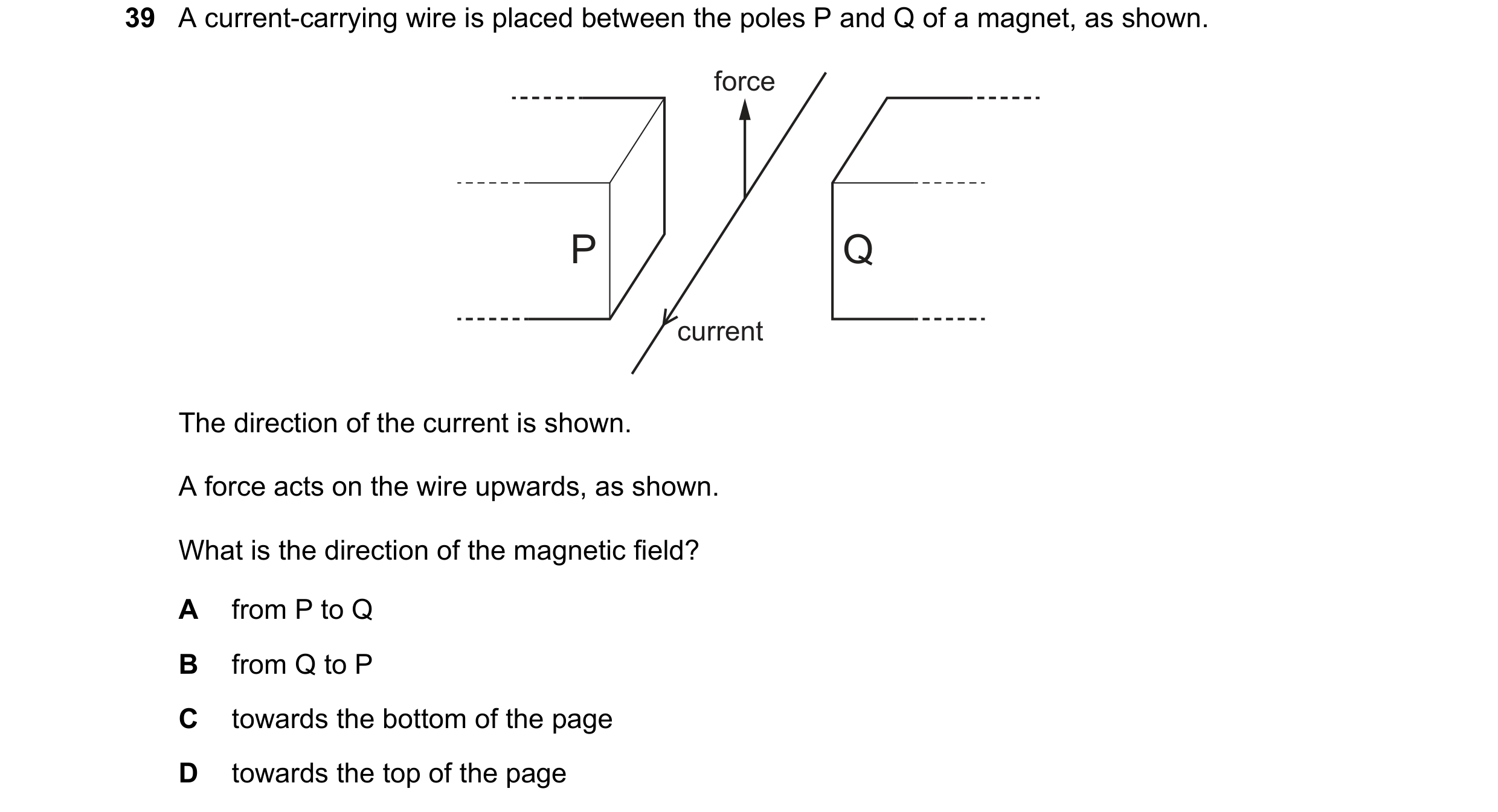
Q9 · A current-carrying wire is placed between the poles P and Q of a magnet, as shown 0654/22 May/June 2019
39 A current-carrying wire is placed between the poles P and Q of a magnet, as shown. force P Q current The direction of the current is shown. A force acts on the wire in the upward direction as shown. What is the direction of the magnetic field? A from P to Q B from Q to P C towards the bottom of the page D towards the top of the page
1 marks
Answer: B
This question in 0654/22 May/June 2019
Q10 · The output from the generator in a power station is connected to a transformer before… 0654/22 May/June 2019
40 The output from the generator in a power station is connected to a transformer before electricity is sent along a transmission cable. Why is a transformer used? A to decrease the voltage and decrease the current B to decrease the voltage and increase the current C to increase the voltage and decrease the current D to increase the voltage and increase the current
1 marks
Answer: C
This question in 0654/22 May/June 2019
Q11 · A current-carrying wire is placed between the poles of a magnet, as shown 0654/23 May/June 2019
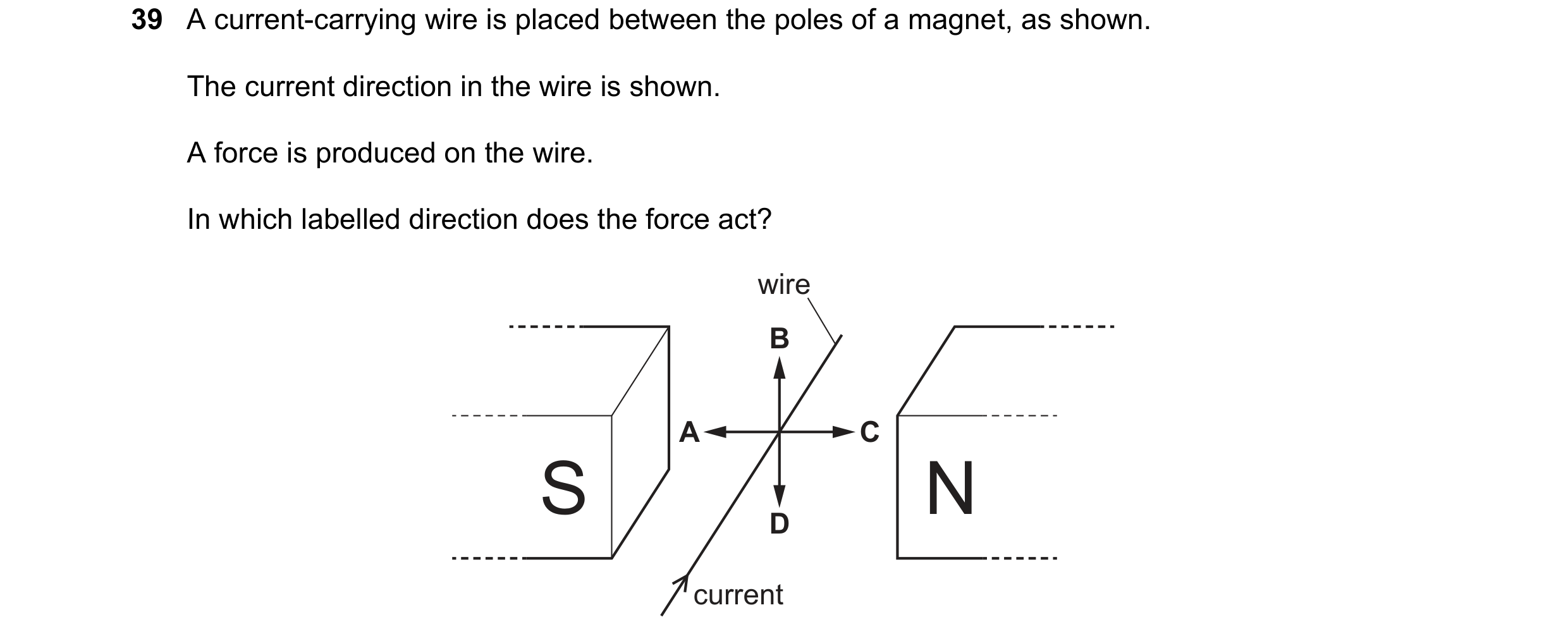
39 A current-carrying wire is placed between the poles of a magnet, as shown. The current direction in the wire is shown. A force is produced on the wire. In which labelled direction does the force act? wire B A C S N D current
1 marks
Answer: B
This question in 0654/23 May/June 2019
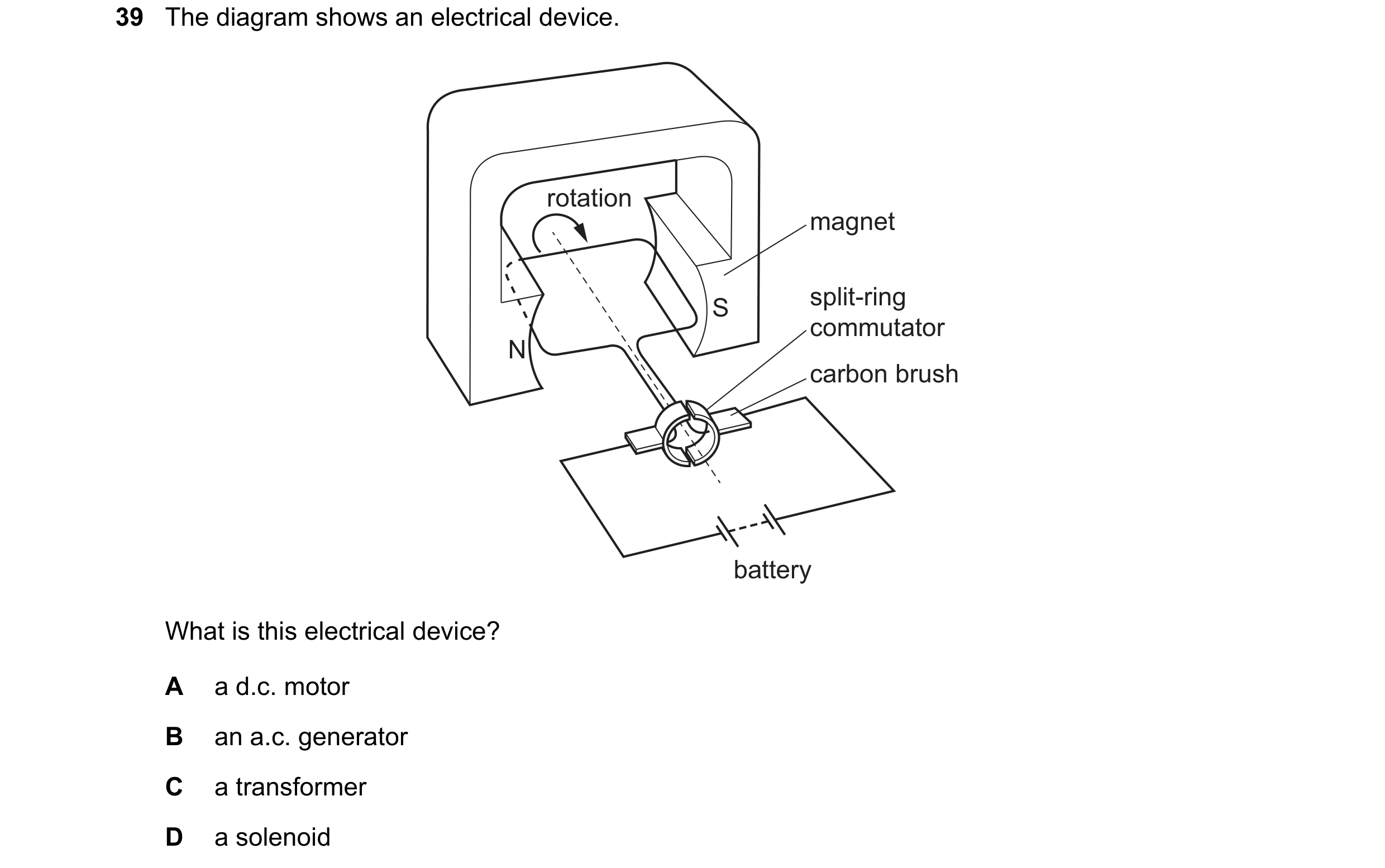
Q12 · The diagram shows an electrical device 0654/21 Oct/Nov 2019
39 The diagram shows an electrical device. rotation magnet S split-ring commutator N carbon brush battery What is this electrical device? A a d.c. motor B an a.c. generator C a transformer D a solenoid
1 marks
Answer: A
This question in 0654/21 Oct/Nov 2019
Q13 · A transformer with an efficiency of 100% has an input current of 10 A 0654/22 Oct/Nov 2019
39 A transformer with an efficiency of 100% has an input current of 10 A. The input voltage is 100 V and the output voltage is 20 V. What is the output current? A 2.0 A B 10 A C 50 A D 200 A
1 marks
Answer: C
This question in 0654/22 Oct/Nov 2019
Q14 · The diagram shows a current-carrying conductor between the poles of a magnet 0654/23 Oct/Nov 2019
38 The diagram shows a current-carrying conductor between the poles of a magnet. The direction of the current is shown. current S N In which direction is the force that acts on the wire? A into the page B out of the page C to the left D to the right
1 marks
Answer: A
This question in 0654/23 Oct/Nov 2019
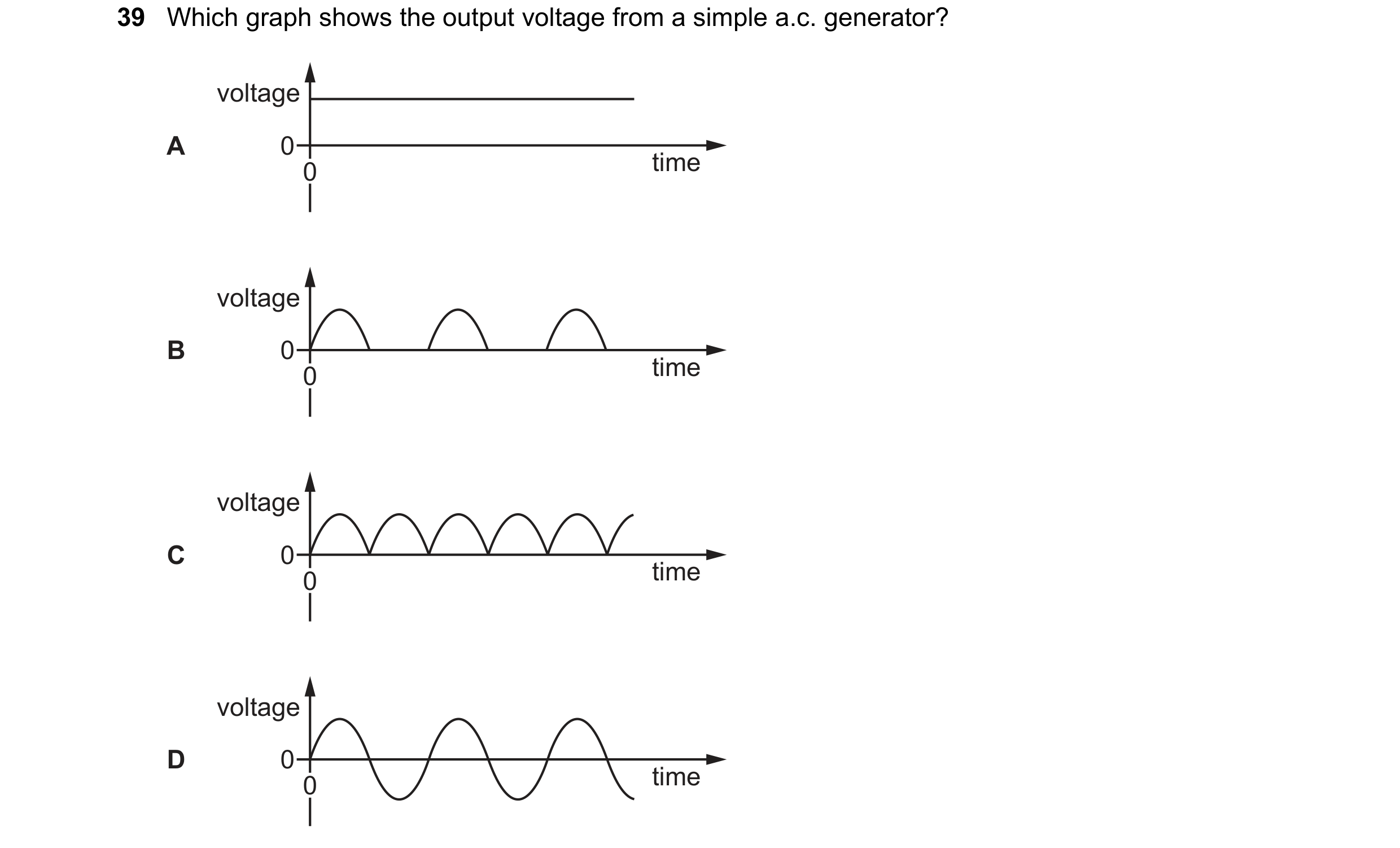
Q15 · Which graph shows the output voltage from a simple a.c 0654/23 Oct/Nov 2019
39 Which graph shows the output voltage from a simple a.c. generator? voltage A 0 0 time voltage B 0 0 time voltage C 0 0 time voltage D 0 0 time
1 marks
Answer: D
This question in 0654/23 Oct/Nov 2019
Q16 · Which graph shows the voltage output of an alternating current (a.c.) generator? 0654/21 May/June 2020
38 Which graph shows the voltage output of an alternating current (a.c.) generator? A B + + voltage voltage 0 0 0 time 0 time – – C D + + voltage voltage 0 0 0 time 0 time – –
1 marks
Answer: D
This question in 0654/21 May/June 2020
Q17 · What is the purpose of the slip rings in an alternating current (a.c.) generator? 0654/22 May/June 2020
39 What is the purpose of the slip rings in an alternating current (a.c.) generator? A to allow each end of the coil to contact each carbon brush alternately B to allow each end of the coil to remain in contact with the same carbon brush at all times C to maintain a constant voltage in the output circuit while the coil is rotating D to remain stationary while the coil rotates between them
1 marks
Answer: B
This question in 0654/22 May/June 2020
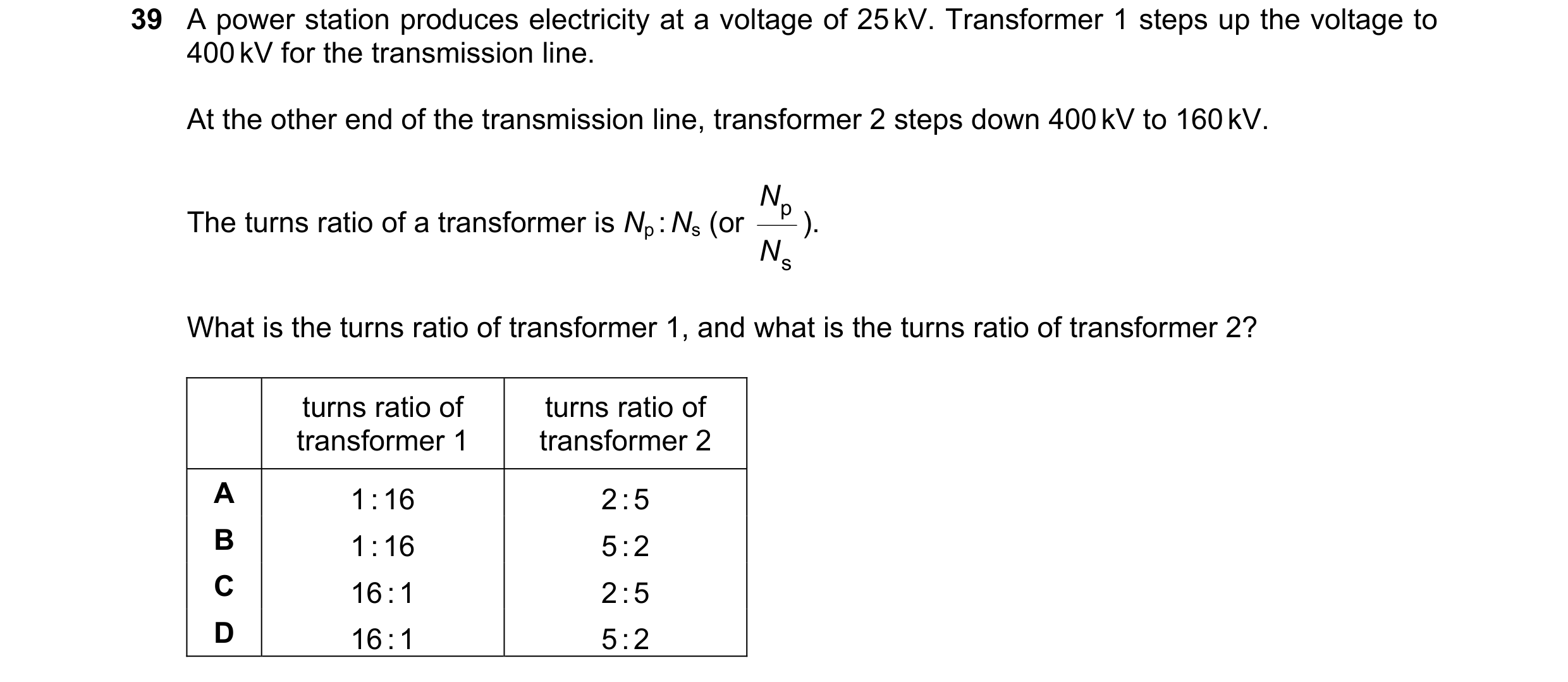
Q18 · A power station produces electricity at a voltage of 25 kV 0654/23 May/June 2020
39 A power station produces electricity at a voltage of 25 kV. Transformer 1 steps up the voltage to 400 kV for the transmission line. At the other end of the transmission line, transformer 2 steps down 400 kV to 160 kV. N The turns ratio of a transformer is Np : Ns (or p ). N s What is the turns ratio of transformer 1, and what is the turns ratio of transformer 2? turns ratio of turns ratio of transformer 1 transformer 2 A 1 : 16 2 : 5 B 1 : 16 5 : 2 C 16 : 1 2 : 5 D 16 : 1 5 : 2
1 marks
Answer: B
This question in 0654/23 May/June 2020
Q19 · A solenoid carrying a current produces a magnetic field 0654/23 Oct/Nov 2020
39 A solenoid carrying a current produces a magnetic field. Which diagram shows the magnetic field pattern? A B current current C D current current
1 marks
Answer: D
This question in 0654/23 Oct/Nov 2020
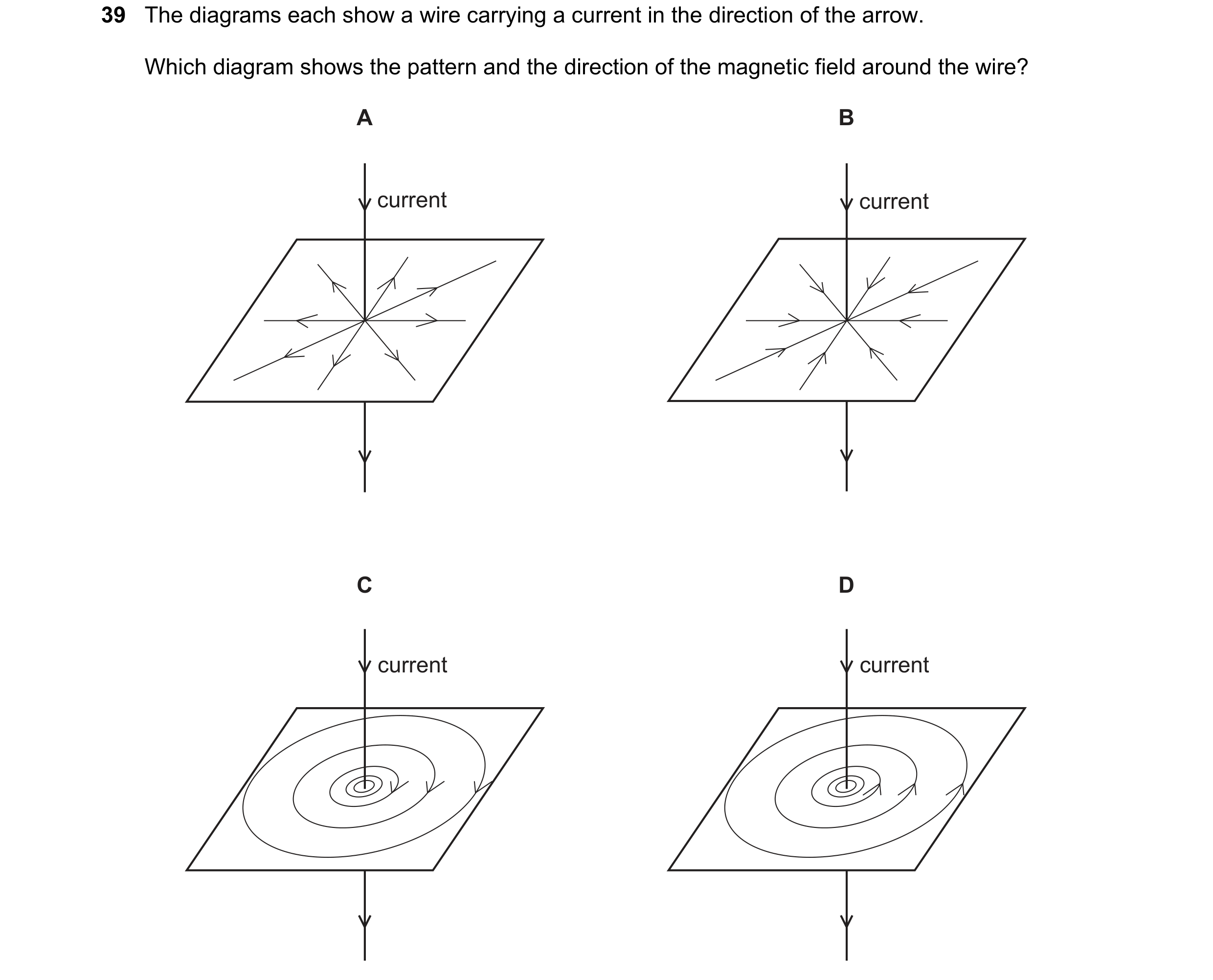
Q20 · The diagrams each show a wire carrying a current in the direction of the arrow 0654/21 May/June 2021
39 The diagrams each show a wire carrying a current in the direction of the arrow. Which diagram shows the pattern and the direction of the magnetic field around the wire? A B current current C D current current
1 marks
Answer: C
This question in 0654/21 May/June 2021
Q21 · A magnet is moved in and out of a coil and an electromotive force (e.m.f.) is induced 0654/22 May/June 2021
39 A magnet is moved in and out of a coil and an electromotive force (e.m.f.) is induced. How can the size of the induced e.m.f. be decreased? A Add more turns to the coil. B Move the magnet more quickly. C Move the magnet more slowly. D Turn the magnet around before moving it in and out.
1 marks
Answer: C
This question in 0654/22 May/June 2021
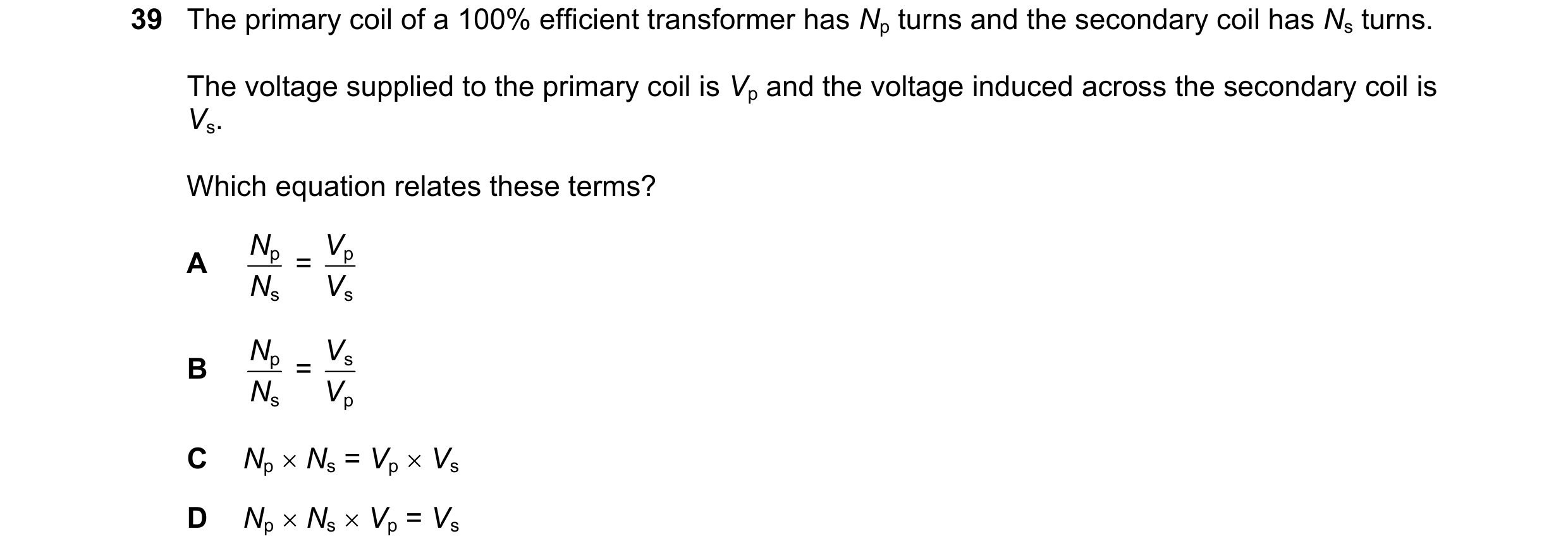
Q22 · The primary coil of a 100% efficient transformer has Np turns and the secondary coil has… 0654/23 May/June 2021
39 The primary coil of a 100% efficient transformer has Np turns and the secondary coil has Ns turns. The voltage supplied to the primary coil is Vp and the voltage induced across the secondary coil is Vs. Which equation relates these terms? N V A N = p V p s s N V B N = p V s s p C Np Ns = Vp Vs D Np Ns Vp = Vs
1 marks
Answer: A
This question in 0654/23 May/June 2021
Q23 · The diagram shows a wire carrying an electric current in the direction shown 0654/21 Oct/Nov 2021
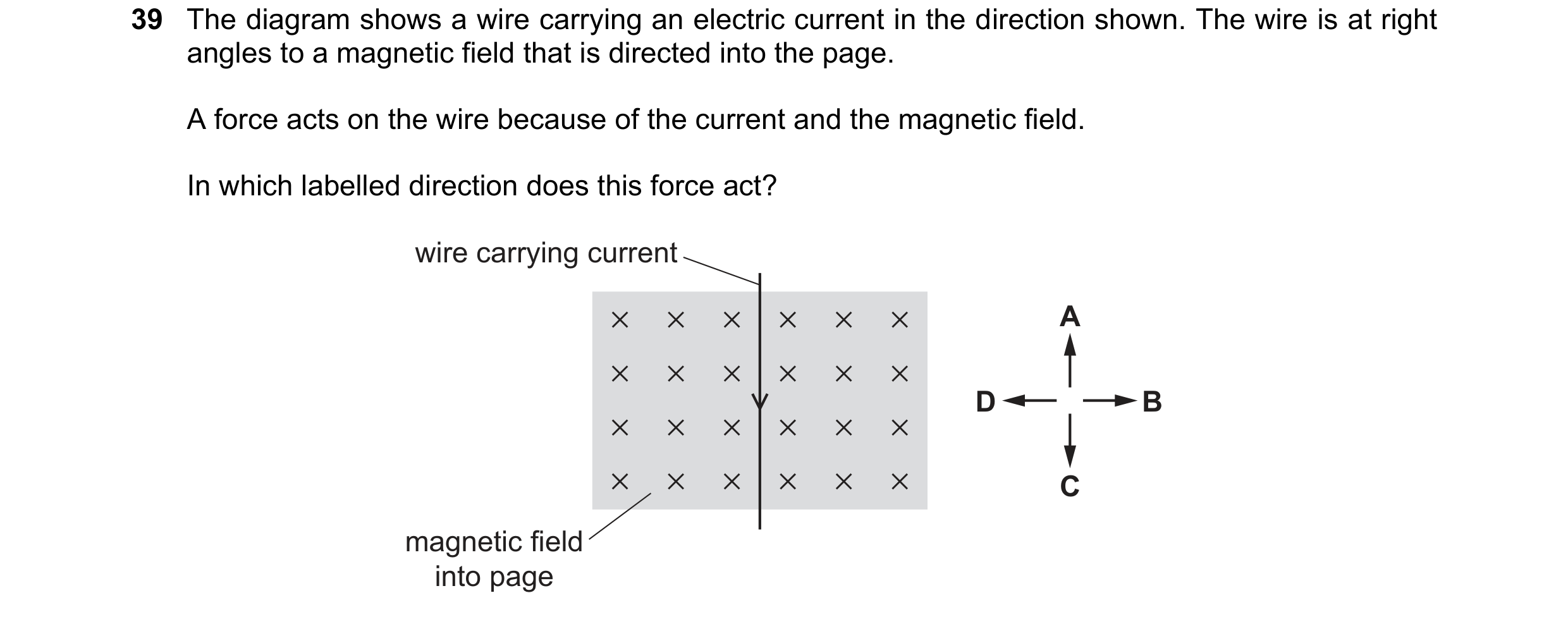
39 The diagram shows a wire carrying an electric current in the direction shown. The wire is at right angles to a magnetic field that is directed into the page. A force acts on the wire because of the current and the magnetic field. In which labelled direction does this force act? wire carrying current A D B C magnetic field into page
1 marks
Answer: B
This question in 0654/21 Oct/Nov 2021
Q24 · The diagram shows a wire carrying an electric current in the direction shown 0654/22 Oct/Nov 2021
39 The diagram shows a wire carrying an electric current in the direction shown. The wire is at right angles to a magnetic field that is directed into the page. A force acts on the wire because of the current and the magnetic field. In which labelled direction does this force act? wire carrying current A D B C magnetic field into page
1 marks
Answer: B
This question in 0654/22 Oct/Nov 2021
Q25 · The diagram shows a wire carrying an electric current in the direction shown 0654/23 Oct/Nov 2021
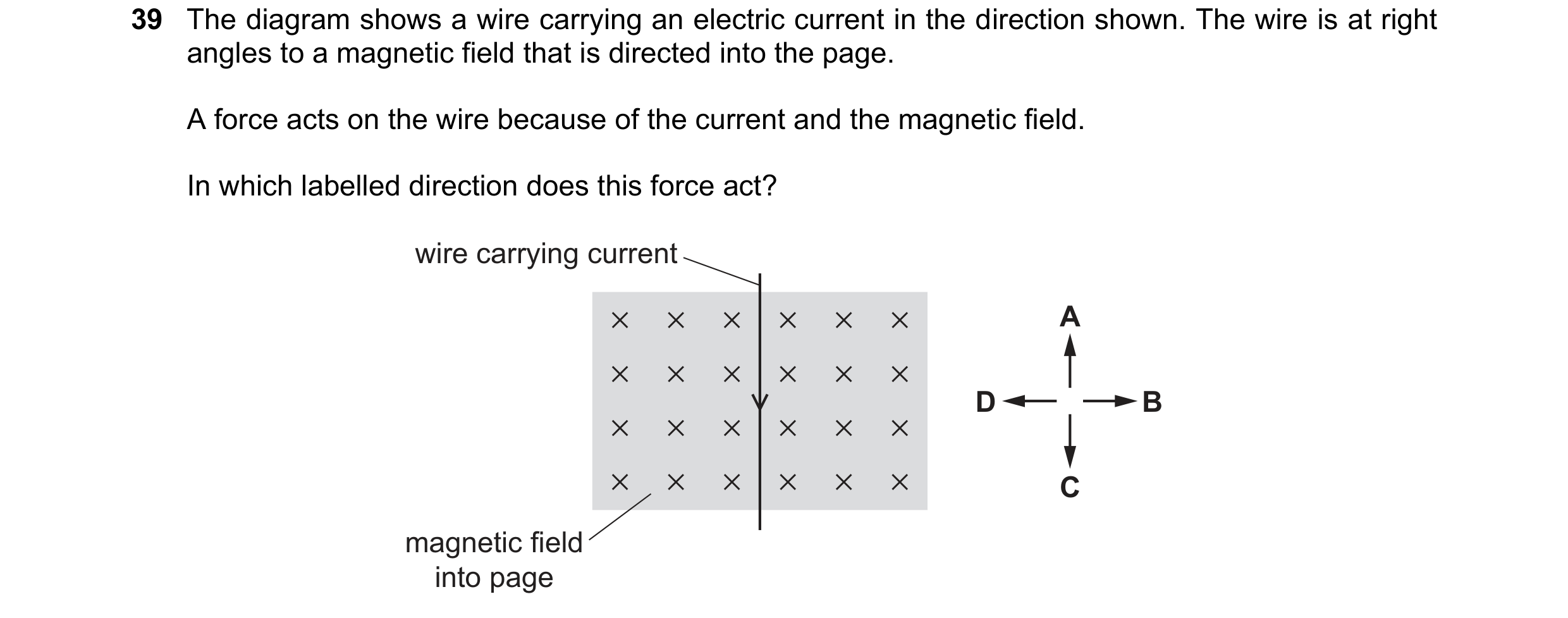
39 The diagram shows a wire carrying an electric current in the direction shown. The wire is at right angles to a magnetic field that is directed into the page. A force acts on the wire because of the current and the magnetic field. In which labelled direction does this force act? wire carrying current A D B C magnetic field into page
1 marks
Answer: B
This question in 0654/23 Oct/Nov 2021
Q26 · The diagram shows a wire in a magnetic field 0654/22 Feb/March 2022
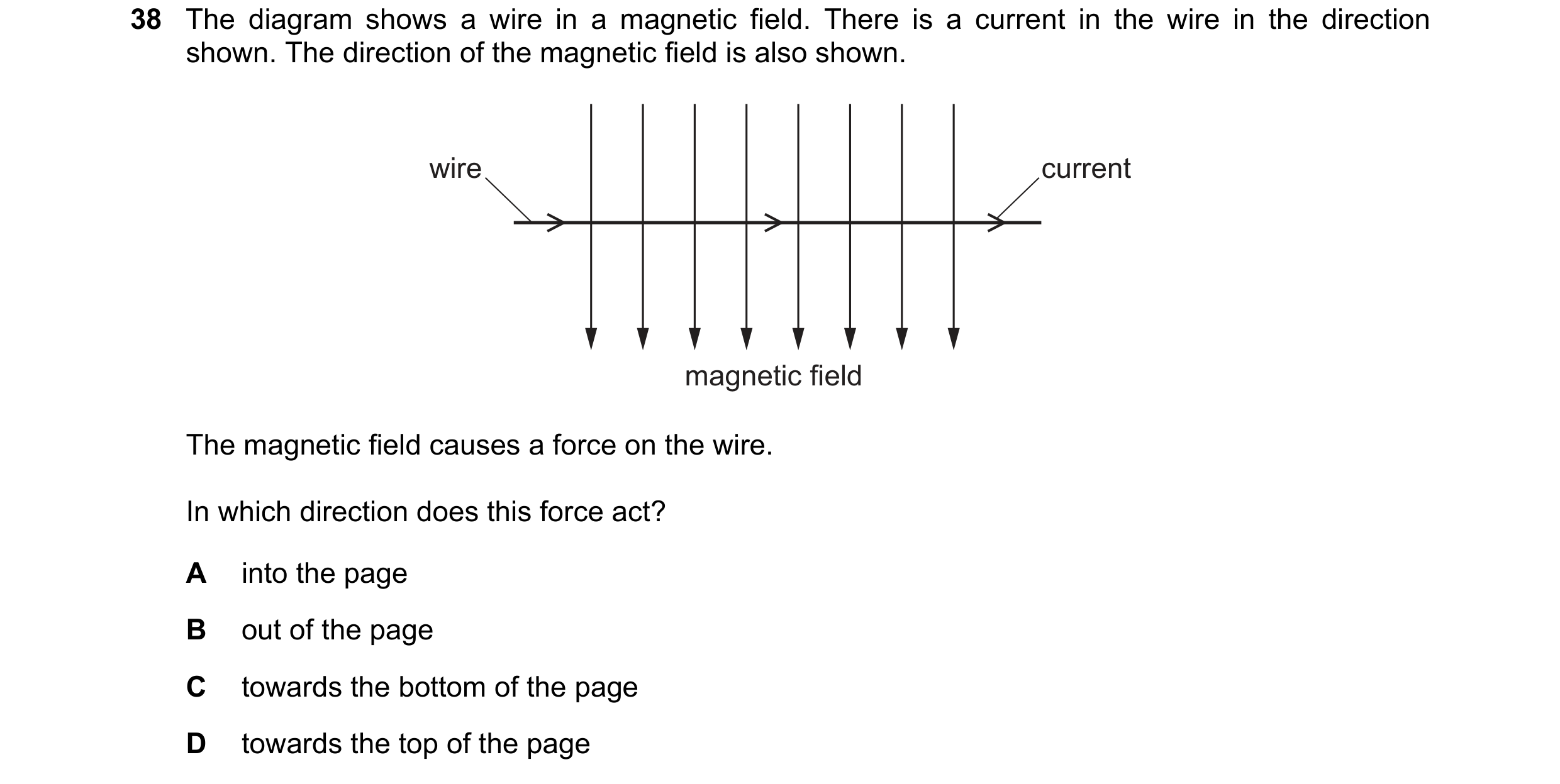
38 The diagram shows a wire in a magnetic field. There is a current in the wire in the direction shown. The direction of the magnetic field is also shown. wire current magnetic field The magnetic field causes a force on the wire. In which direction does this force act? A into the page B out of the page C towards the bottom of the page D towards the top of the page
1 marks
Answer: A
This question in 0654/22 Feb/March 2022
Q27 · A transformer increases the voltage from a power station in order to transfer electricity… 0654/21 May/June 2022
38 A transformer increases the voltage from a power station in order to transfer electricity along transmission cables. How does increasing the voltage affect the current in the cables and how does it affect the efficiency of energy transfer? current efficiency A decreases decreases B decreases increases C increases decreases D increases increases
1 marks
Answer: B
This question in 0654/21 May/June 2022
Q28 · A transformer increases the voltage from a power station in order to transfer electricity… 0654/22 May/June 2022
38 A transformer increases the voltage from a power station in order to transfer electricity along transmission cables. How does increasing the voltage affect the current in the cables and how does it affect the efficiency of energy transfer? current efficiency A decreases decreases B decreases increases C increases decreases D increases increases
1 marks
Answer: B
This question in 0654/22 May/June 2022
Q29 · A transformer increases the voltage from a power station in order to transfer electricity… 0654/23 May/June 2022
38 A transformer increases the voltage from a power station in order to transfer electricity along transmission cables. How does increasing the voltage affect the current in the cables and how does it affect the efficiency of energy transfer? current efficiency A decreases decreases B decreases increases C increases decreases D increases increases
1 marks
Answer: B
This question in 0654/23 May/June 2022
Q30 · A current-carrying wire is placed between the poles of a magnet, as shown 0654/21 Oct/Nov 2022
39 A current-carrying wire is placed between the poles of a magnet, as shown. The current direction in the wire is shown. A force is produced on the wire. In which labelled direction does the force act? wire B A C S N D current
1 marks
Answer: B
This question in 0654/21 Oct/Nov 2022
Q31 · A current-carrying wire is placed between the poles of a magnet, as shown 0654/22 Oct/Nov 2022
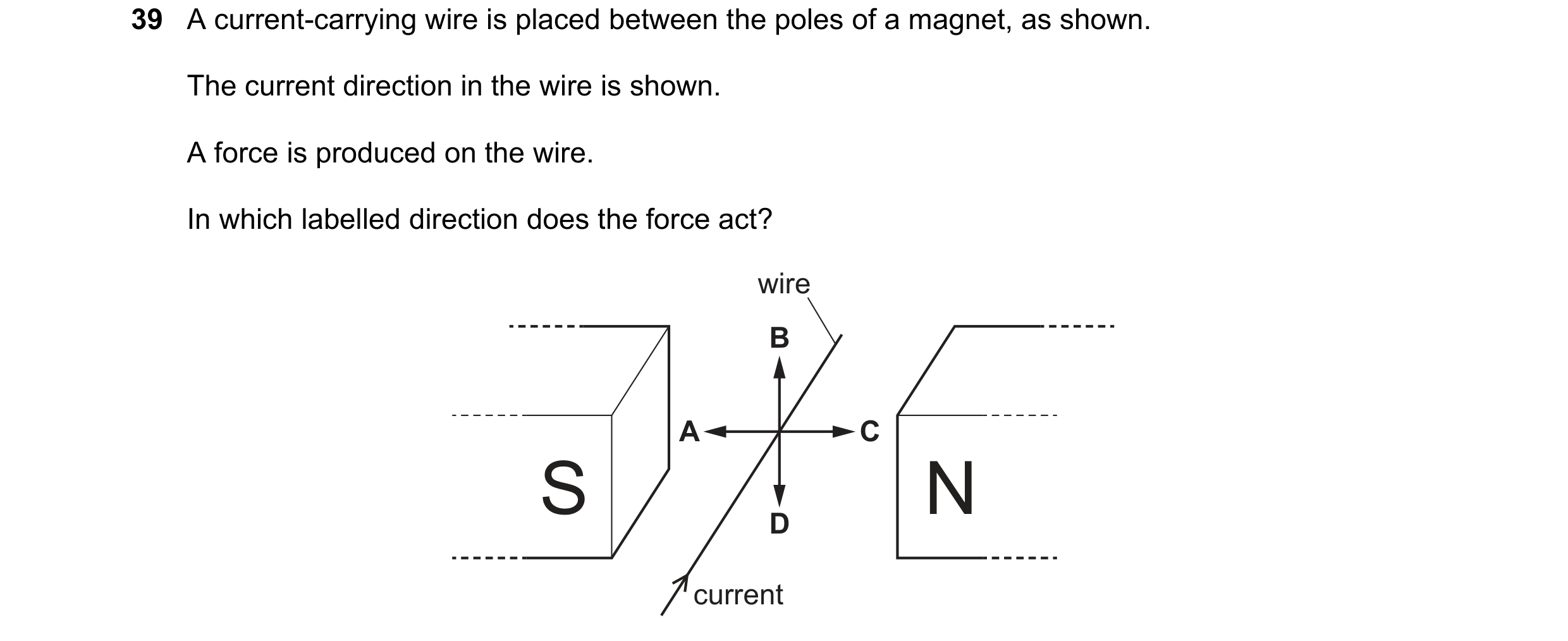
39 A current-carrying wire is placed between the poles of a magnet, as shown. The current direction in the wire is shown. A force is produced on the wire. In which labelled direction does the force act? wire B A C S N D current
1 marks
Answer: B
This question in 0654/22 Oct/Nov 2022
Q32 · A current-carrying wire is placed between the poles of a magnet, as shown 0654/23 Oct/Nov 2022
39 A current-carrying wire is placed between the poles of a magnet, as shown. The current direction in the wire is shown. A force is produced on the wire. In which labelled direction does the force act? wire B A C S N D current
1 marks
Answer: B
This question in 0654/23 Oct/Nov 2022
Q33 · The diagram shows a wire carrying a current 0654/22 Feb/March 2023
39 The diagram shows a wire carrying a current. The direction of the current is shown by the arrow. The wire lies in the magnetic field between two magnetic poles. wire carrying current N S What is the direction of the magnetic field and what is the direction of the force on the wire? magnetic field force on wire A to the left downwards B to the left upwards C to the right downwards D to the right upwards
1 marks
Answer: C
This question in 0654/22 Feb/March 2023
Q34 · When a straight conductor moves through a magnetic field, an electromotive force (e.m.f.)… 0654/22 May/June 2023
38 When a straight conductor moves through a magnetic field, an electromotive force (e.m.f.) is induced between the ends of the conductor. Which factor does not affect the magnitude of the induced e.m.f.? A the length of conductor in the field B the resistance of the conductor C the speed at which the conductor moves D the strength of the magnetic field
1 marks
Answer: B
This question in 0654/22 May/June 2023
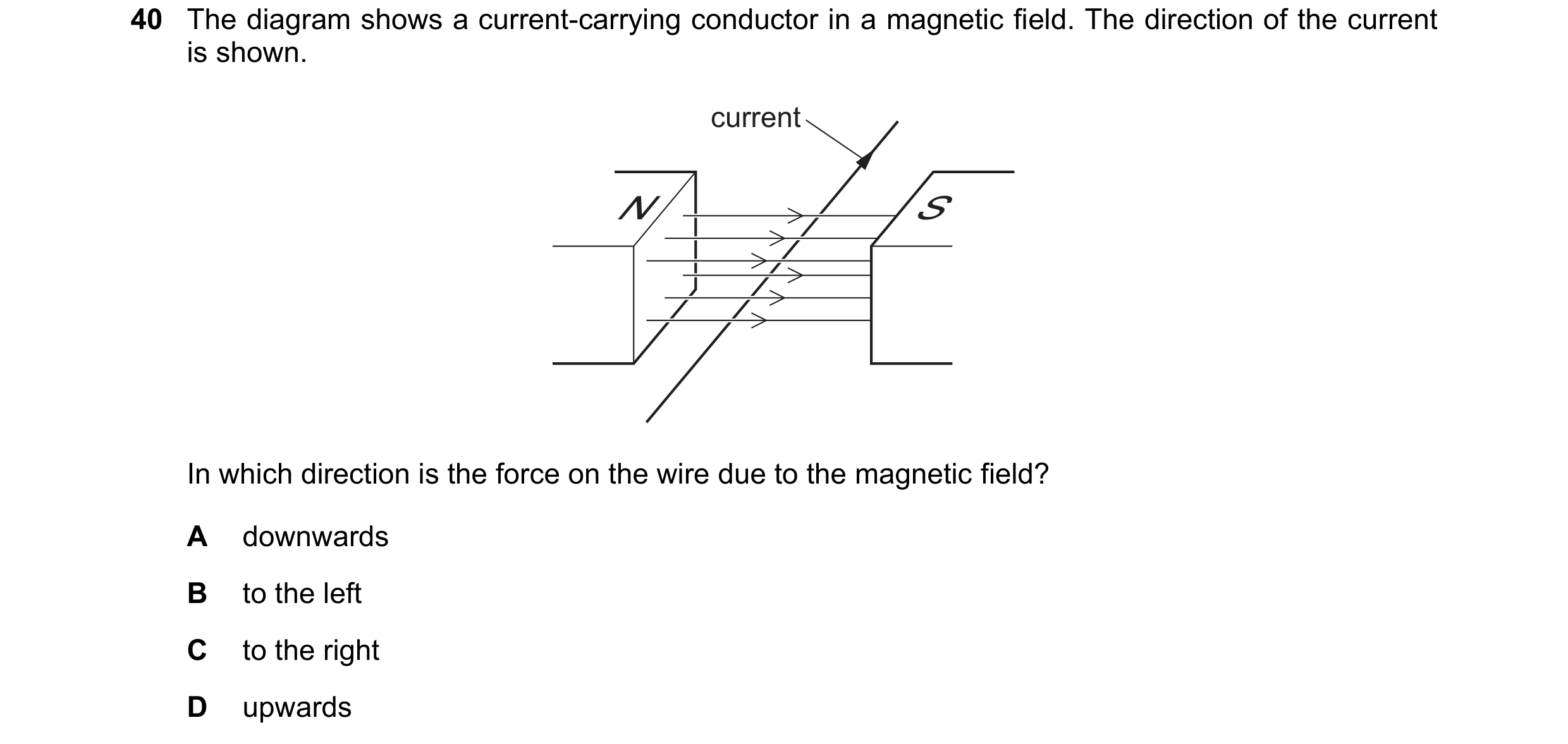
Q35 · The diagram shows a current-carrying conductor in a magnetic field 0654/22 May/June 2023
40 The diagram shows a current-carrying conductor in a magnetic field. The direction of the current is shown. current N S In which direction is the force on the wire due to the magnetic field? A downwards B to the left C to the right D upwards
1 marks
Answer: A
This question in 0654/22 May/June 2023
Q36 · The diagram shows a motor 0654/23 May/June 2023
39 The diagram shows a motor. One part of the motor is labelled X. N S brush contact X What is the name of part X and how does it help the motor to work? how X helps the name of part X motor to work A split-ring commutator reduces the current so the coil does not overheat B split-ring commutator reverses the current in the coil every half turn C step-down transformer reduces the current so the coil does not overheat D step-down transformer reverses the current in the coil every half turn
1 marks
Answer: B
This question in 0654/23 May/June 2023
Q37 · A current-carrying wire is placed between the poles P and Q of a magnet, as shown 0654/23 Oct/Nov 2023
39 A current-carrying wire is placed between the poles P and Q of a magnet, as shown. force P Q current The direction of the current is shown. A force acts on the wire upwards, as shown. What is the direction of the magnetic field? A from P to Q B from Q to P C towards the bottom of the page D towards the top of the page
1 marks
Answer: A
This question in 0654/23 Oct/Nov 2023
Q38 · A magnet is moved in and out of a coil and an electromotive force (e.m.f.) is induced 0654/22 Feb/March 2024
39 A magnet is moved in and out of a coil and an electromotive force (e.m.f.) is induced. How can the size of the induced e.m.f. be decreased? A Add more turns to the coil. B Move the magnet more quickly. C Move the magnet more slowly. D Turn the magnet around before moving it in and out.
1 marks
Answer: C
This question in 0654/22 Feb/March 2024
Q39 · A 100% efficient step-down transformer has 120 turns on its primary coil and 10 turns on… 0654/21 May/June 2024
39 A 100% efficient step-down transformer has 120 turns on its primary coil and 10 turns on its secondary coil. A 240 V supply provides 48 W of power to the primary coil. What is the current in the secondary coil? A 0.017 A B 0.2 A C 2.4 A D 20 A
1 marks
Answer: C
This question in 0654/21 May/June 2024
Q40 · What is the purpose of the commutator in a direct current (d.c.) motor? 0654/22 May/June 2024
39 What is the purpose of the commutator in a direct current (d.c.) motor? A It reverses the direction of the current in the coil every half turn. B It reverses the direction of rotation of the coil every complete turn. C It reverses the direction of rotation of the coil every half turn. D It reverses the magnetic field due to the permanent magnet every complete turn.
1 marks
Answer: A
This question in 0654/22 May/June 2024
Q41 · The diagram shows a wire carrying an electric current in the direction shown (towards the… 0654/23 May/June 2024
38 The diagram shows a wire carrying an electric current in the direction shown (towards the bottom of the page). The wire is at right angles to a magnetic field that is directed into the page. A force acts on the wire because of the current and the magnetic field. In which labelled direction does this force act? wire carrying current A D B C magnetic field into page
1 marks
Answer: B
This question in 0654/23 May/June 2024
Q42 · Which voltage–time graph shows the output voltage of a simple a.c 0654/23 May/June 2024
39 Which voltage–time graph shows the output voltage of a simple a.c. generator? A B voltage voltage 0 0 0 time 0 time C D voltage voltage 0 0 0 time 0 time
1 marks
Answer: B
This question in 0654/23 May/June 2024
Q43 · A transformer with an efficiency of 100% has an input current of 10 A 0654/21 Oct/Nov 2024
39 A transformer with an efficiency of 100% has an input current of 10 A. The input voltage is 100 V and the output voltage is 20 V. What is the output current? A 2.0 A B 10 A C 50 A D 200 A
1 marks
Answer: C
This question in 0654/21 Oct/Nov 2024
Q44 · Electrical energy from a power station is transmitted over a large distance 0654/22 Oct/Nov 2024
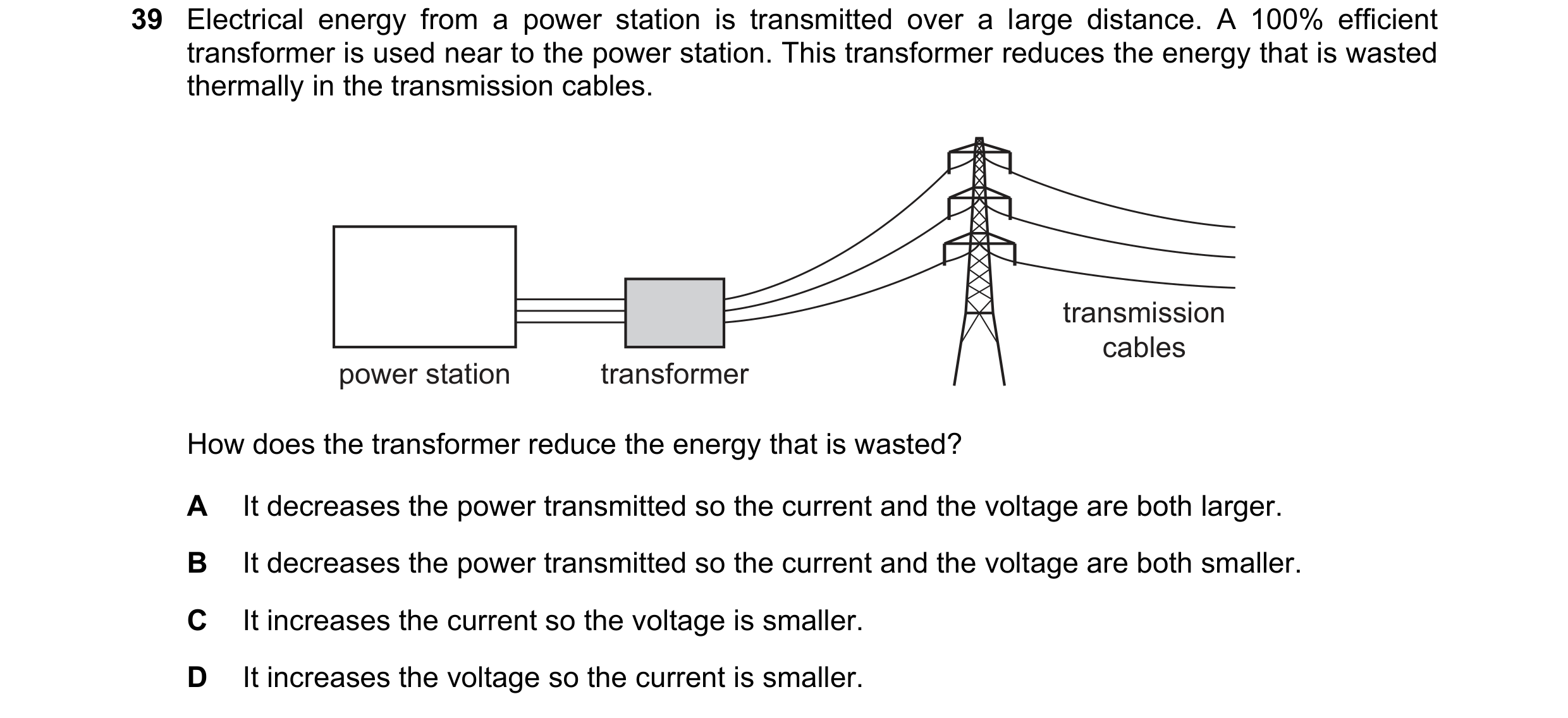
39 Electrical energy from a power station is transmitted over a large distance. A 100% efficient transformer is used near to the power station. This transformer reduces the energy that is wasted thermally in the transmission cables. transmission cables power station transformer How does the transformer reduce the energy that is wasted? A It decreases the power transmitted so the current and the voltage are both larger. B It decreases the power transmitted so the current and the voltage are both smaller. C It increases the current so the voltage is smaller. D It increases the voltage so the current is smaller.
1 marks
Answer: D
This question in 0654/22 Oct/Nov 2024
Q45 · What is the purpose of the slip rings in an alternating current (a.c.) generator? 0654/23 Oct/Nov 2024
39 What is the purpose of the slip rings in an alternating current (a.c.) generator? A to allow each end of the coil to contact each carbon brush alternately B to allow each end of the coil to remain in contact with the same carbon brush at all times C to maintain a constant voltage in the output circuit while the coil is rotating D to remain stationary while the coil rotates between them
1 marks
Answer: B
This question in 0654/23 Oct/Nov 2024
Q46 · When electricity is generated in a power station, a step-up transformer is used before it… 0654/22 Feb/March 2025
38 When electricity is generated in a power station, a step-up transformer is used before it is transmitted around the country. Which statement explains why a step-up transformer is used? A The current decreases, the voltage increases so more energy is transferred by heating in the transmission cables. B The current increases, the voltage decreases so less energy is transferred by heating in the transmission cables. C The voltage decreases, the current increases so more energy is transferred by heating in the transmission cables. D The voltage increases, the current decreases so less energy is transferred by heating in the transmission cables.
1 marks
Answer: D
This question in 0654/22 Feb/March 2025
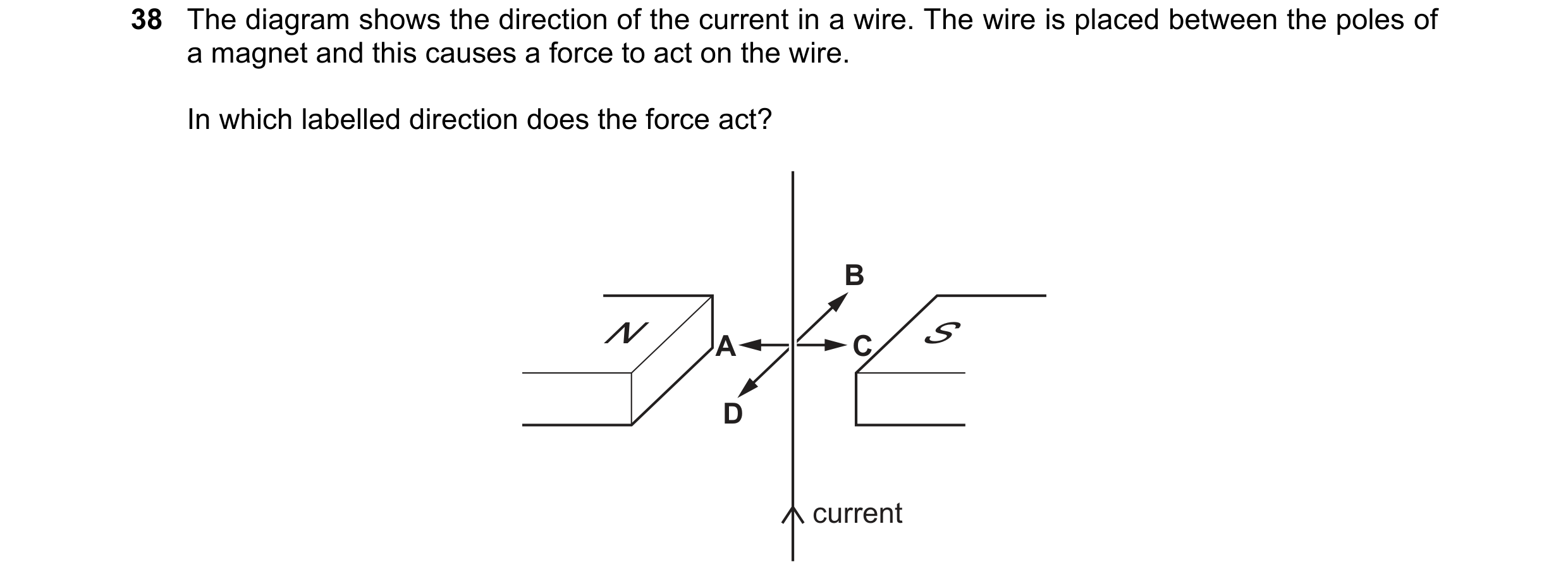
Q47 · The diagram shows the direction of the current in a wire 0654/21 May/June 2025
38 The diagram shows the direction of the current in a wire. The wire is placed between the poles of a magnet and this causes a force to act on the wire. In which labelled direction does the force act? B N A C S D current
1 marks
Answer: B
This question in 0654/21 May/June 2025
Q48 · The output from the generator in a power station is connected to a transformer before… 0654/21 Oct/Nov 2025
38 The output from the generator in a power station is connected to a transformer before electricity is sent along a transmission cable. What is a reason for using this transformer? A to decrease the voltage and decrease the current B to decrease the voltage and increase the current C to increase the voltage and decrease the current D to increase the voltage and increase the current
1 marks
Answer: C
This question in 0654/21 Oct/Nov 2025
Q49 · The diagram shows the magnetic field due to a current in a solenoid 0654/22 Oct/Nov 2025
37 The diagram shows the magnetic field due to a current in a solenoid. solenoid current Which change reverses the direction of the magnetic field? A Change the current direction. B Decrease the current. C Increase the current. D Switch off the current.
1 marks
Answer: A
This question in 0654/22 Oct/Nov 2025
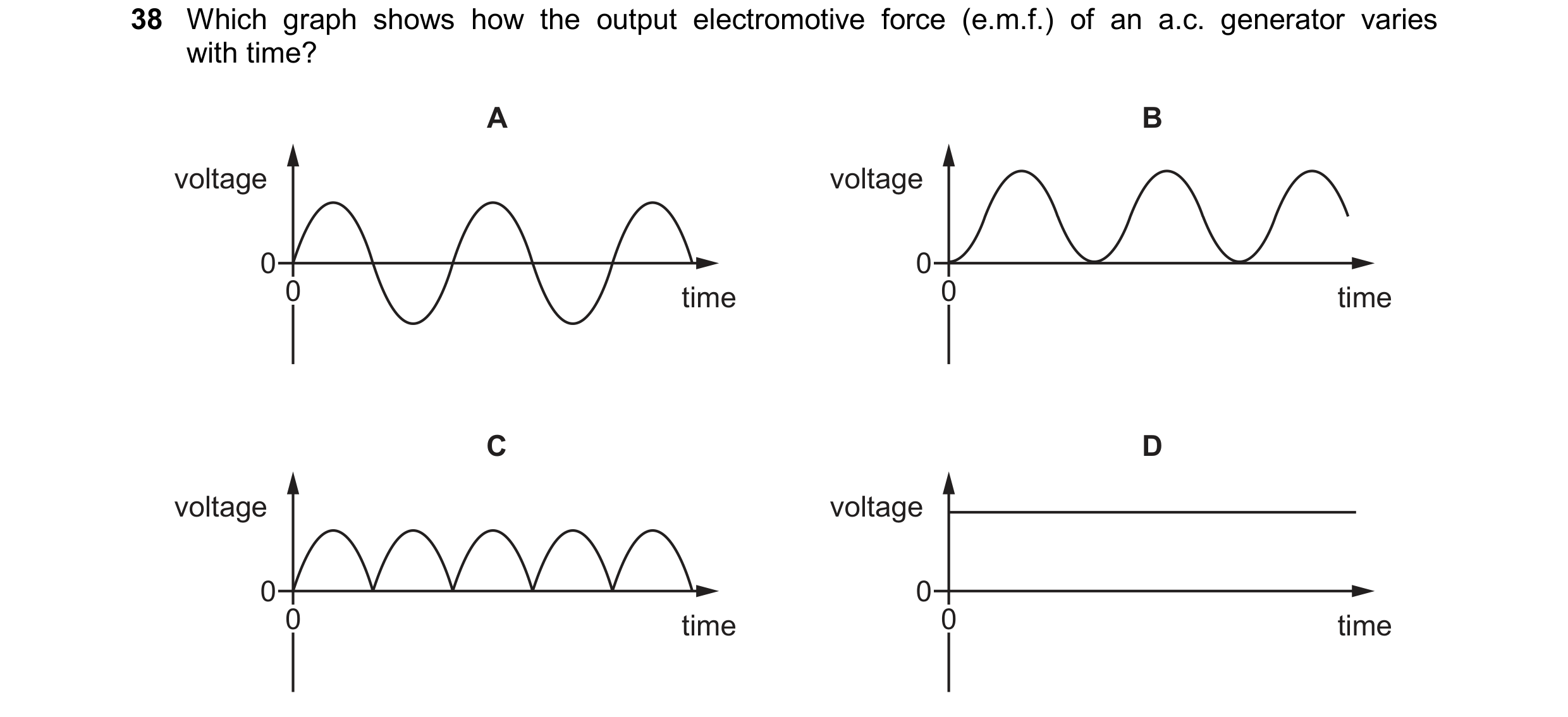
Q50 · Which graph shows how the output electromotive force (e.m.f.) of an a.c 0654/22 Oct/Nov 2025
38 Which graph shows how the output electromotive force (e.m.f.) of an a.c. generator varies with time? A B voltage voltage 0 0 0 time 0 time C D voltage voltage 0 0 0 time 0 time
1 marks
Answer: A
This question in 0654/22 Oct/Nov 2025
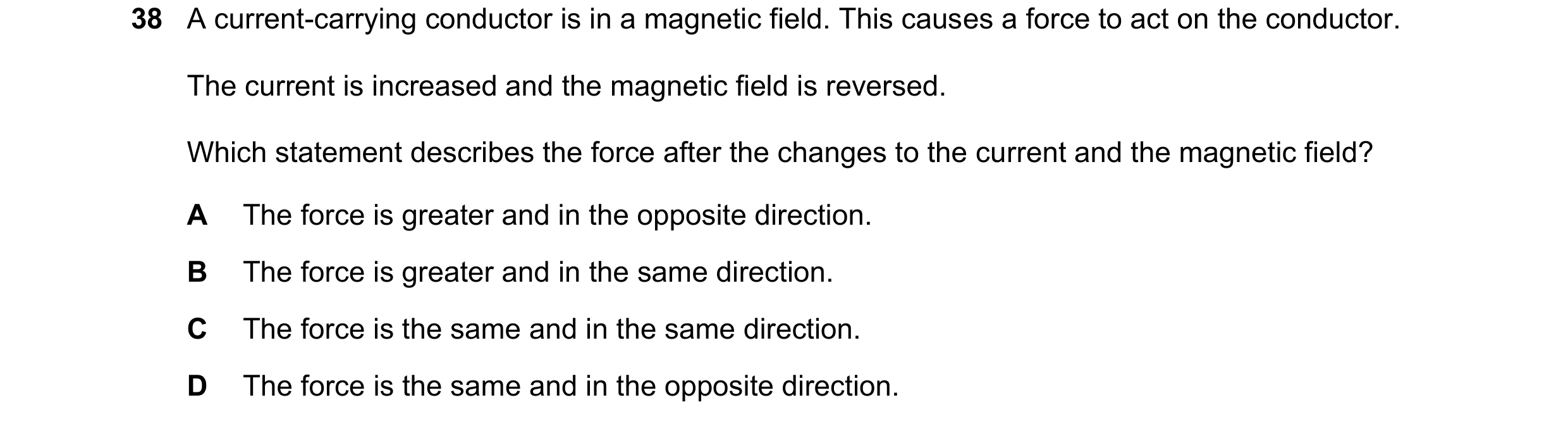
Q51 · A current-carrying conductor is in a magnetic field 0654/23 Oct/Nov 2025
38 A current-carrying conductor is in a magnetic field. This causes a force to act on the conductor. The current is increased and the magnetic field is reversed. Which statement describes the force after the changes to the current and the magnetic field? A The force is greater and in the opposite direction. B The force is greater and in the same direction. C The force is the same and in the same direction. D The force is the same and in the opposite direction.
1 marks
Answer: A
This question in 0654/23 Oct/Nov 2025
 1 / 18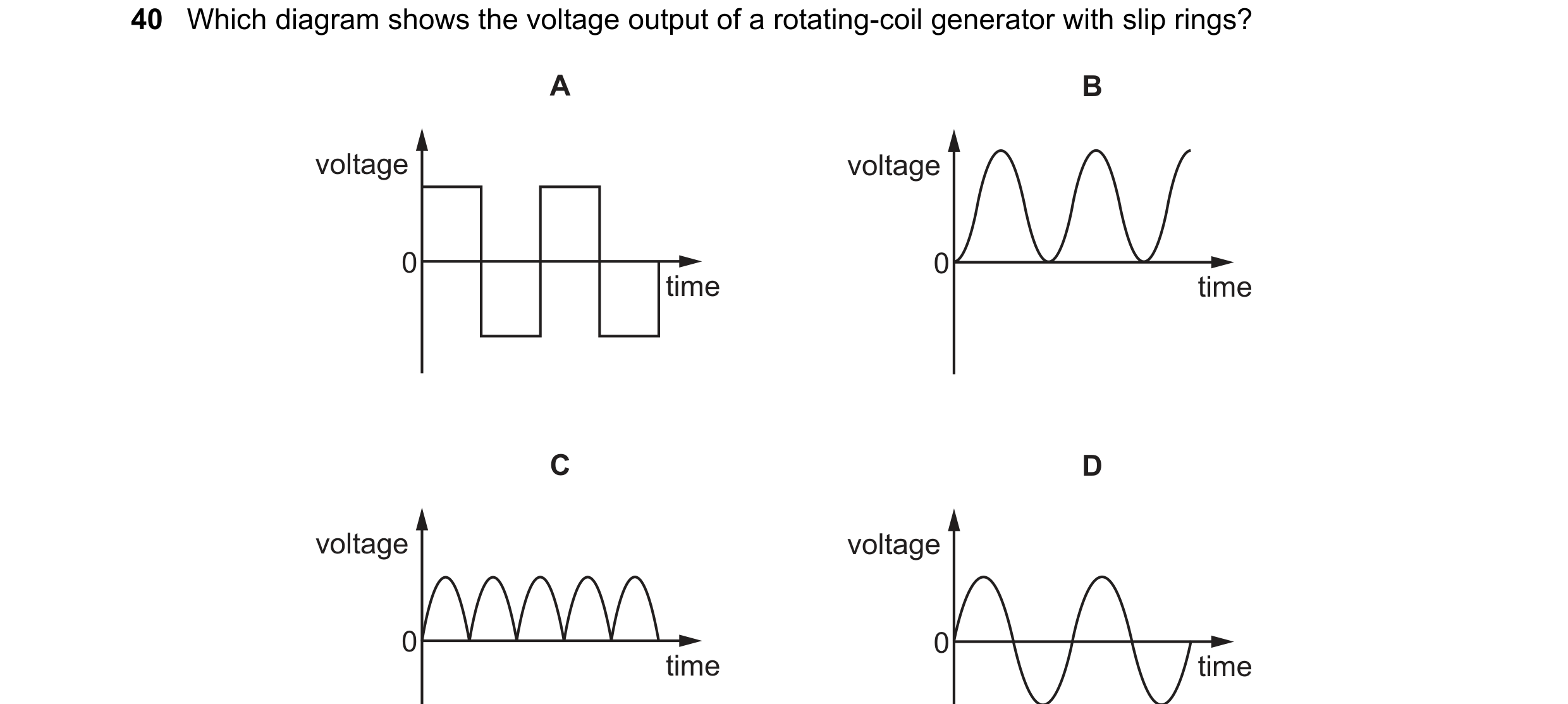
 2 / 18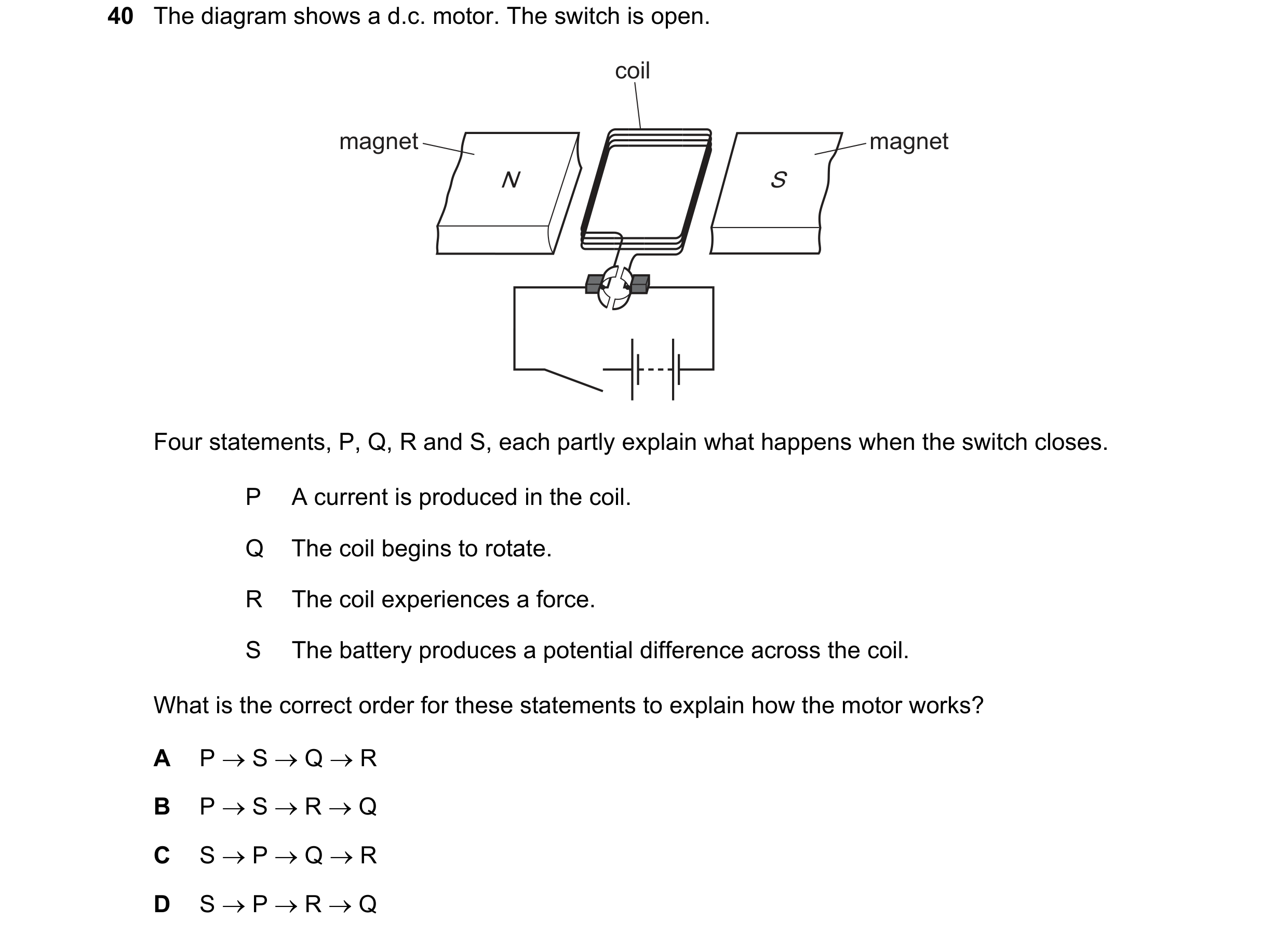
 3 / 18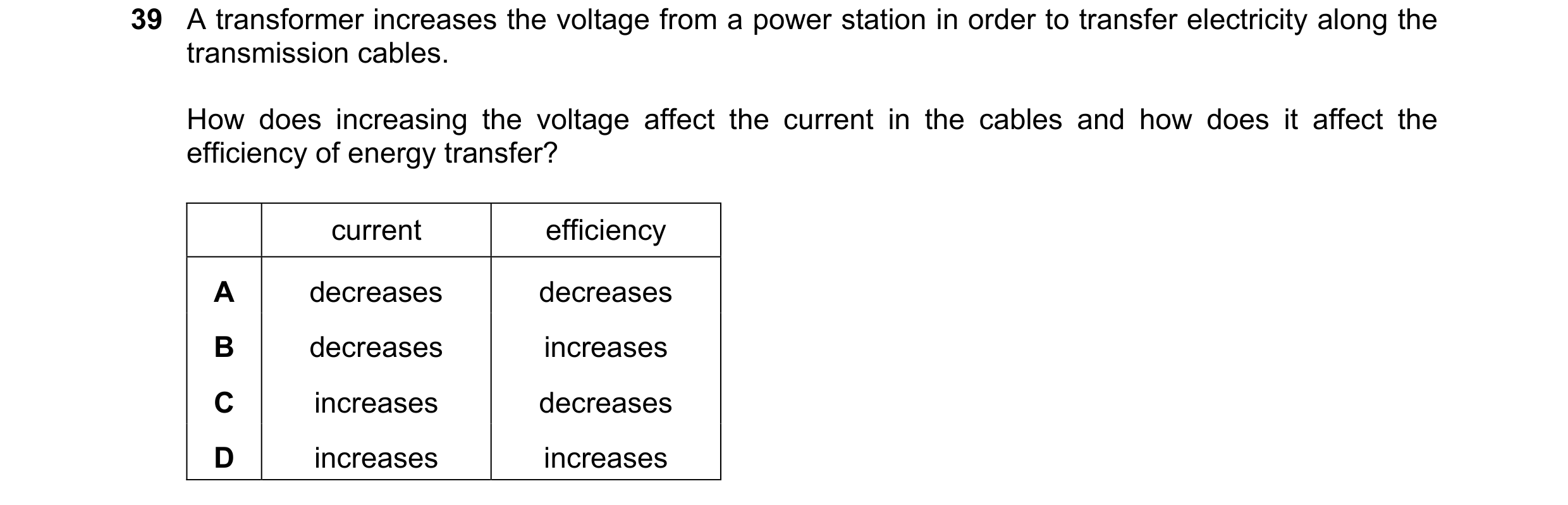
 4 / 18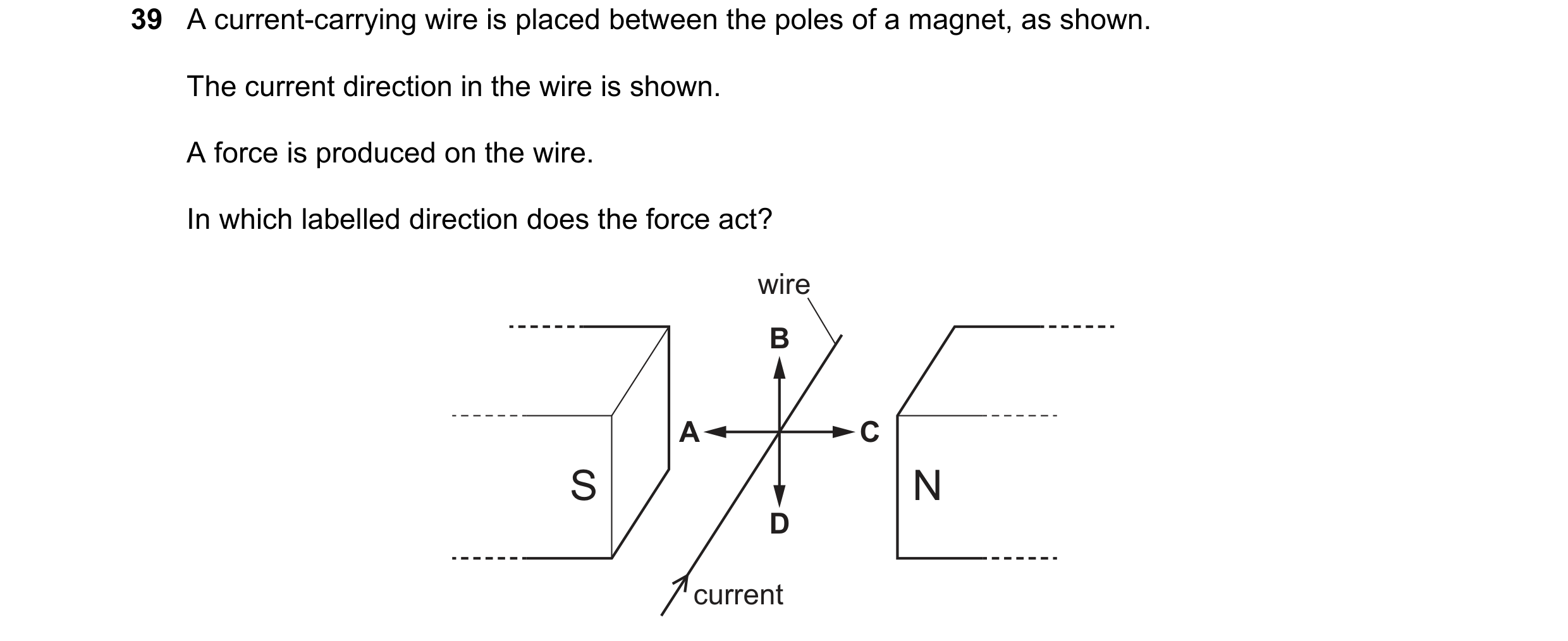
 5 / 18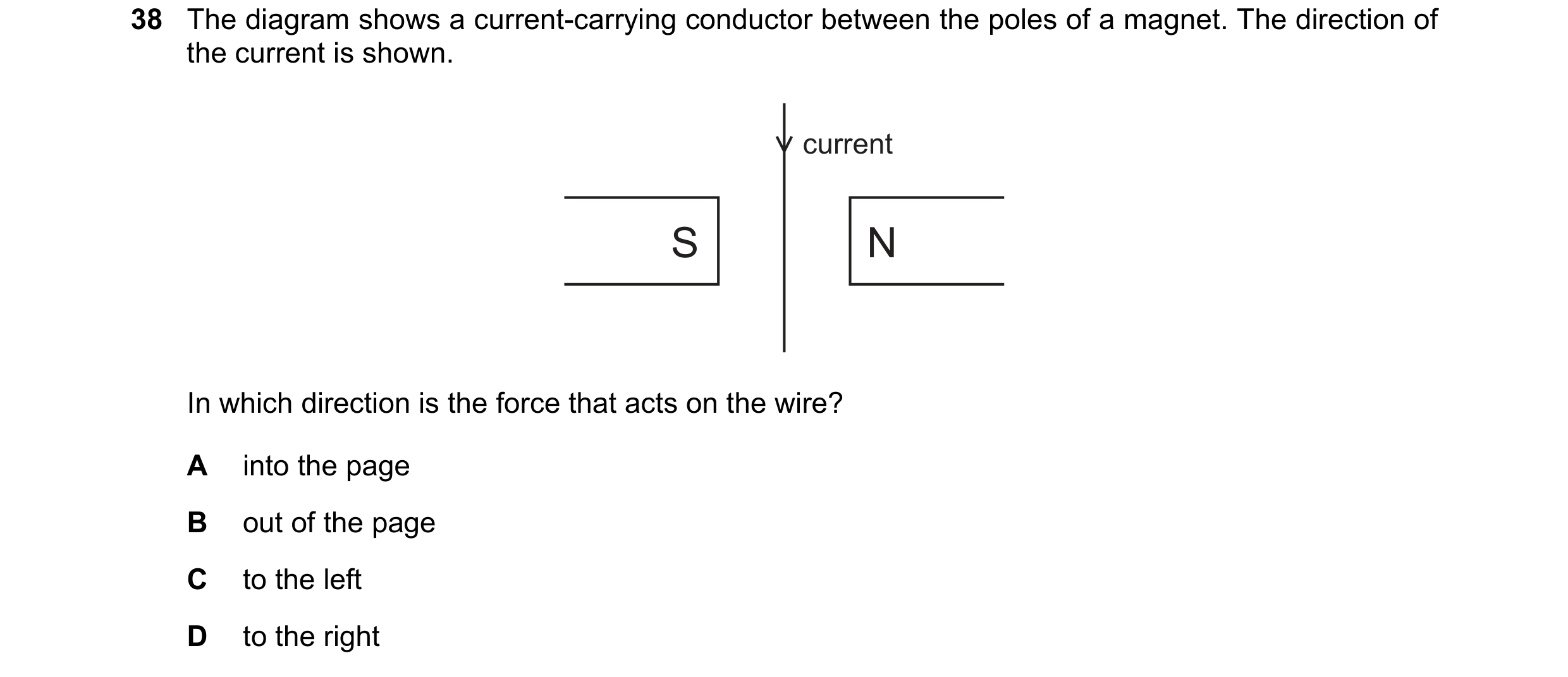
 6 / 18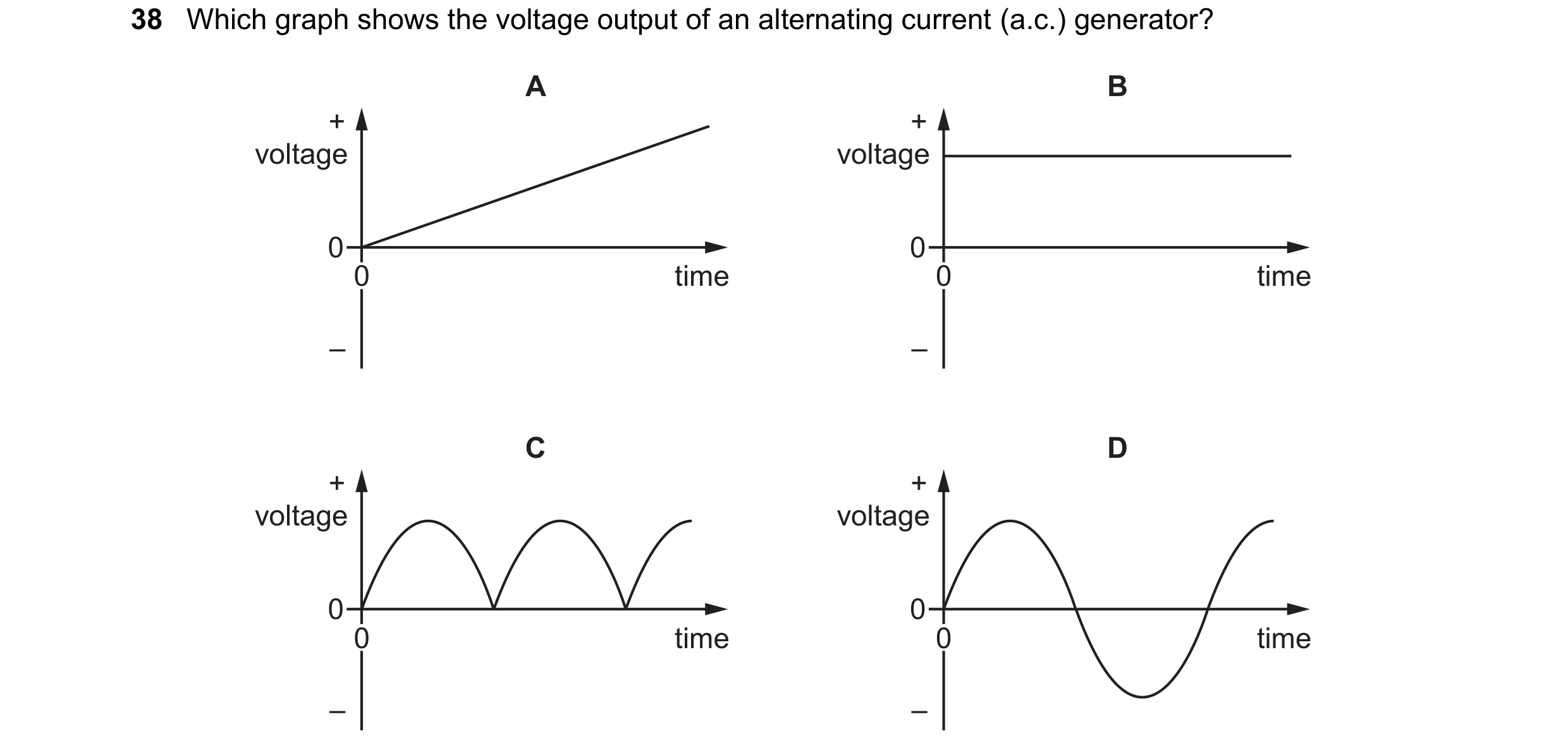

 7 / 18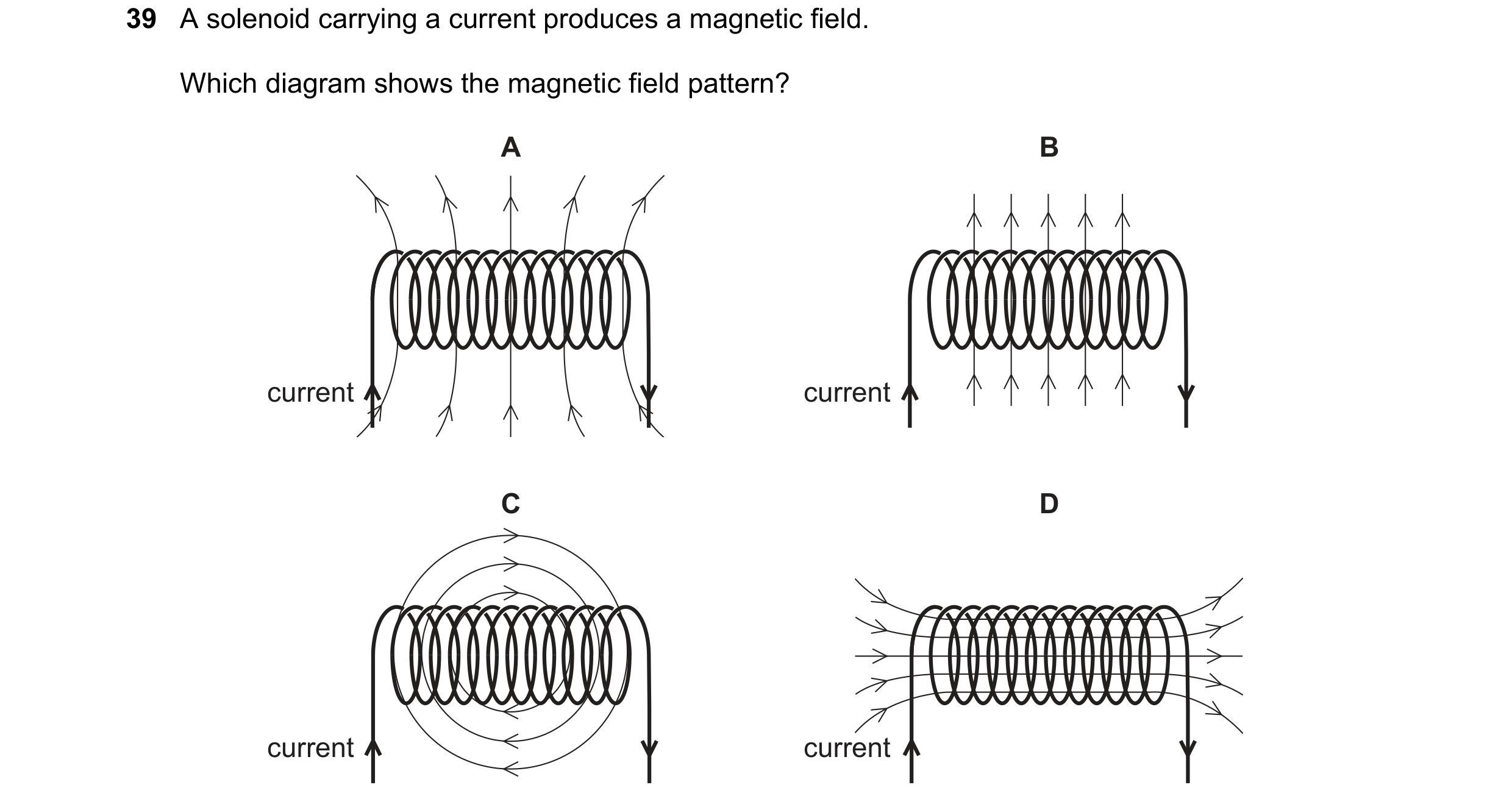
 8 / 18
 9 / 18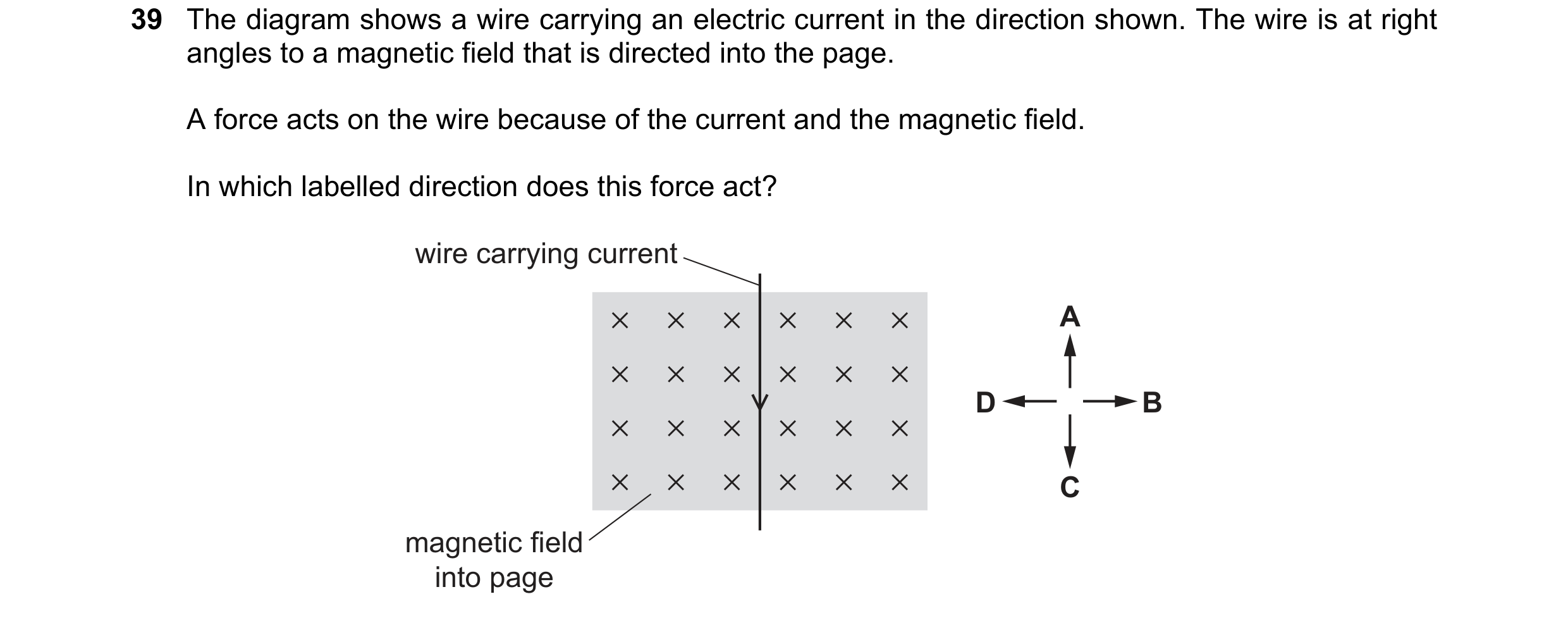
 10 / 18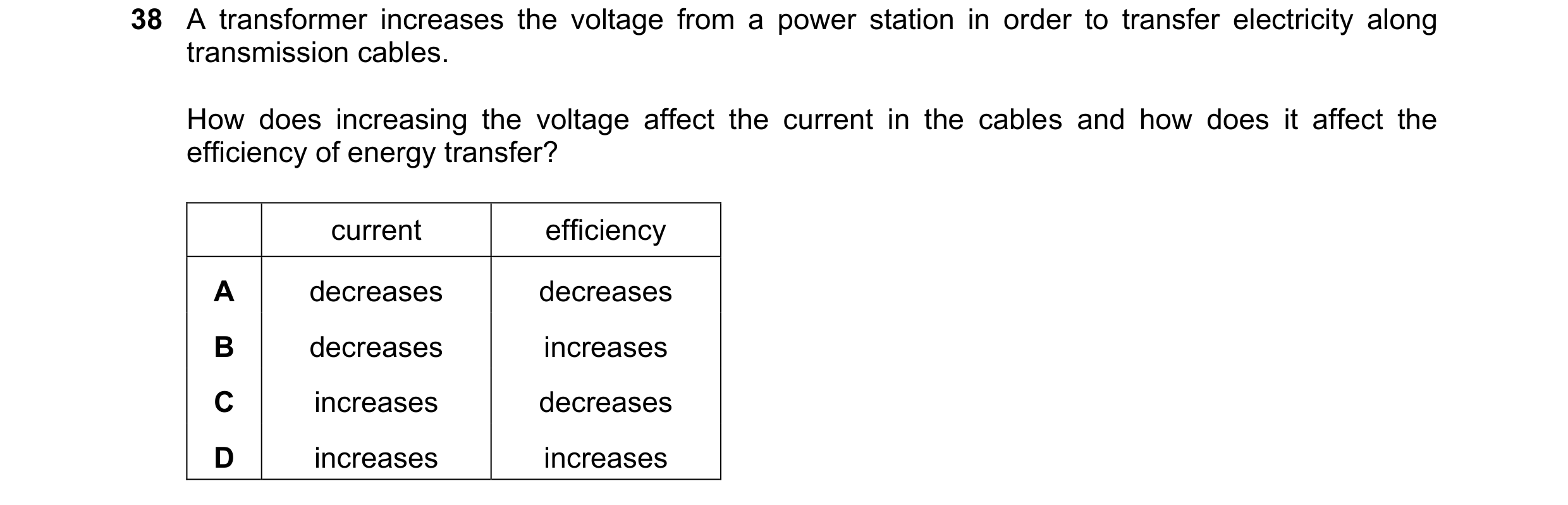
 11 / 18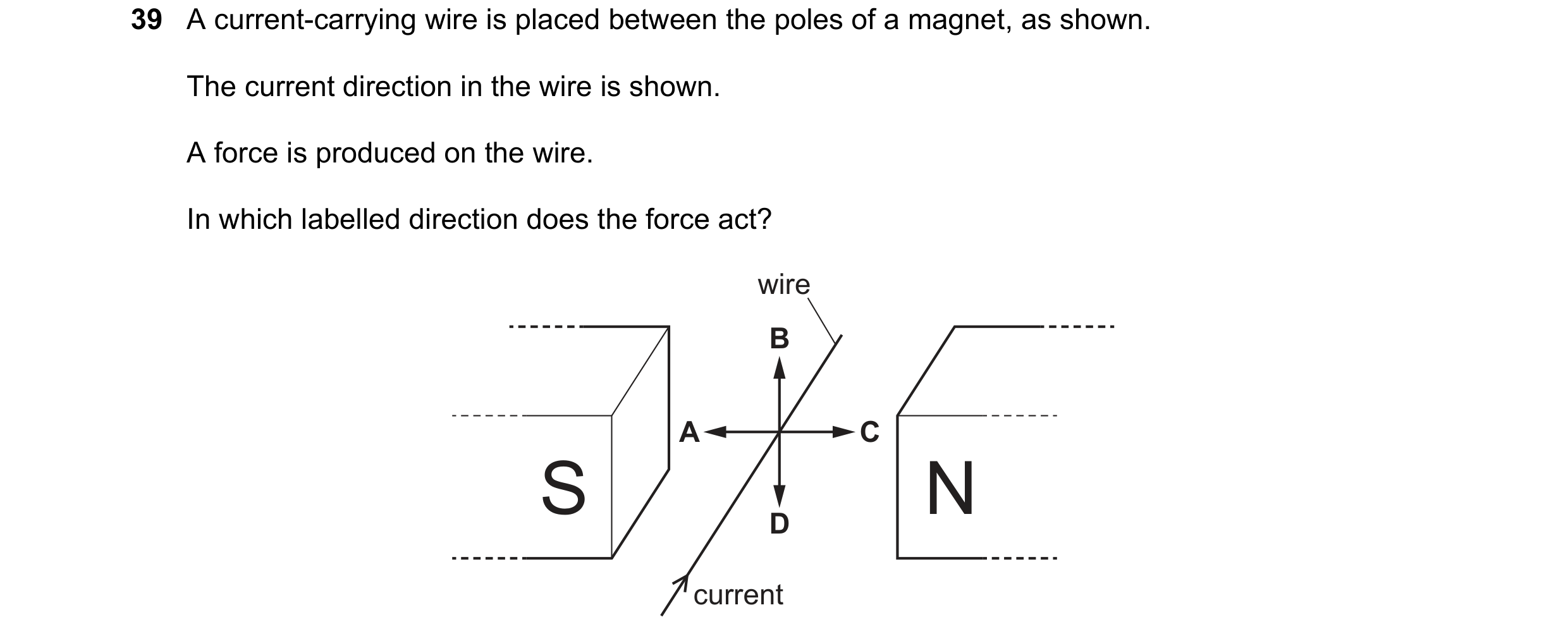
 12 / 18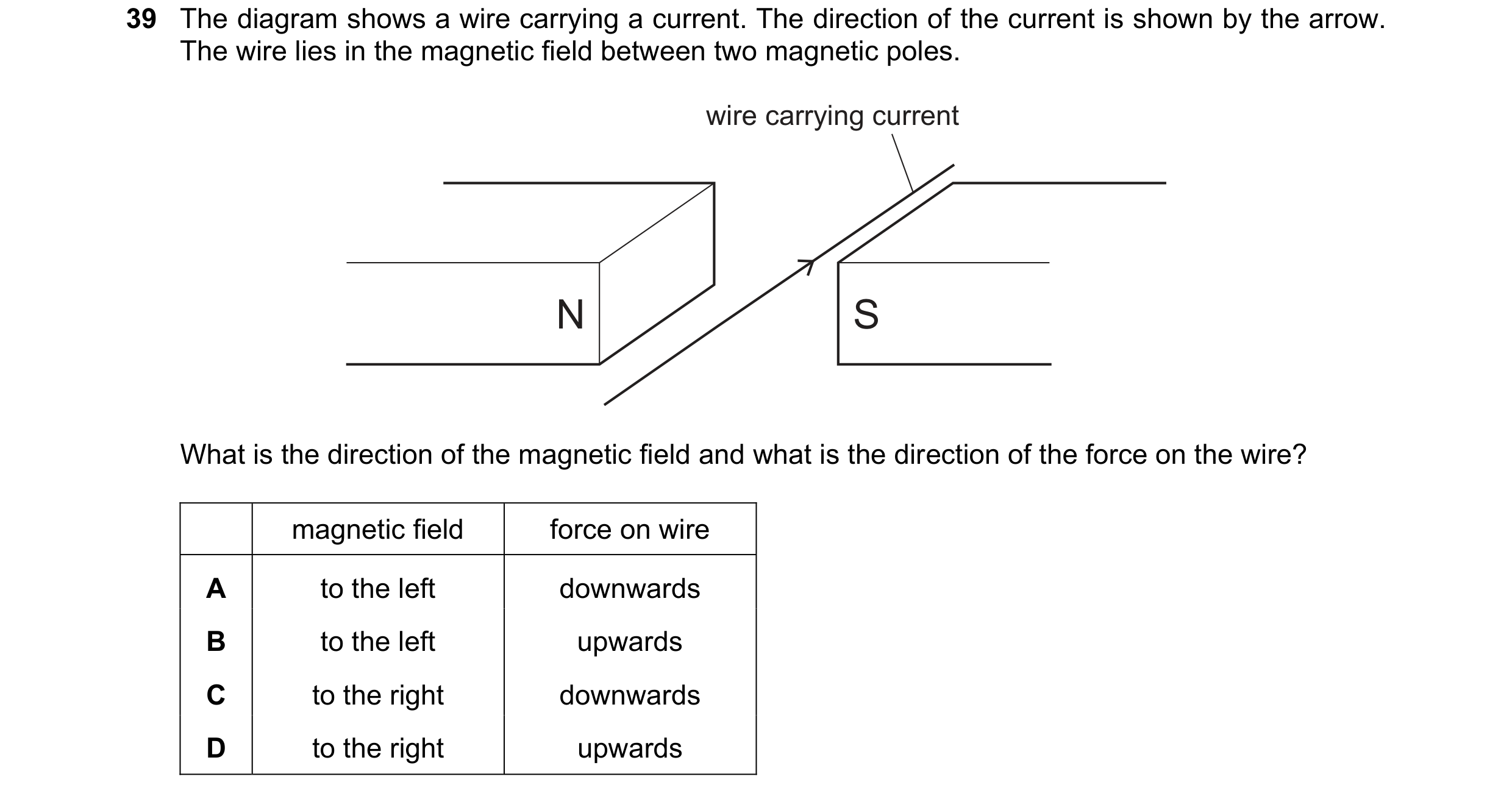
 13 / 18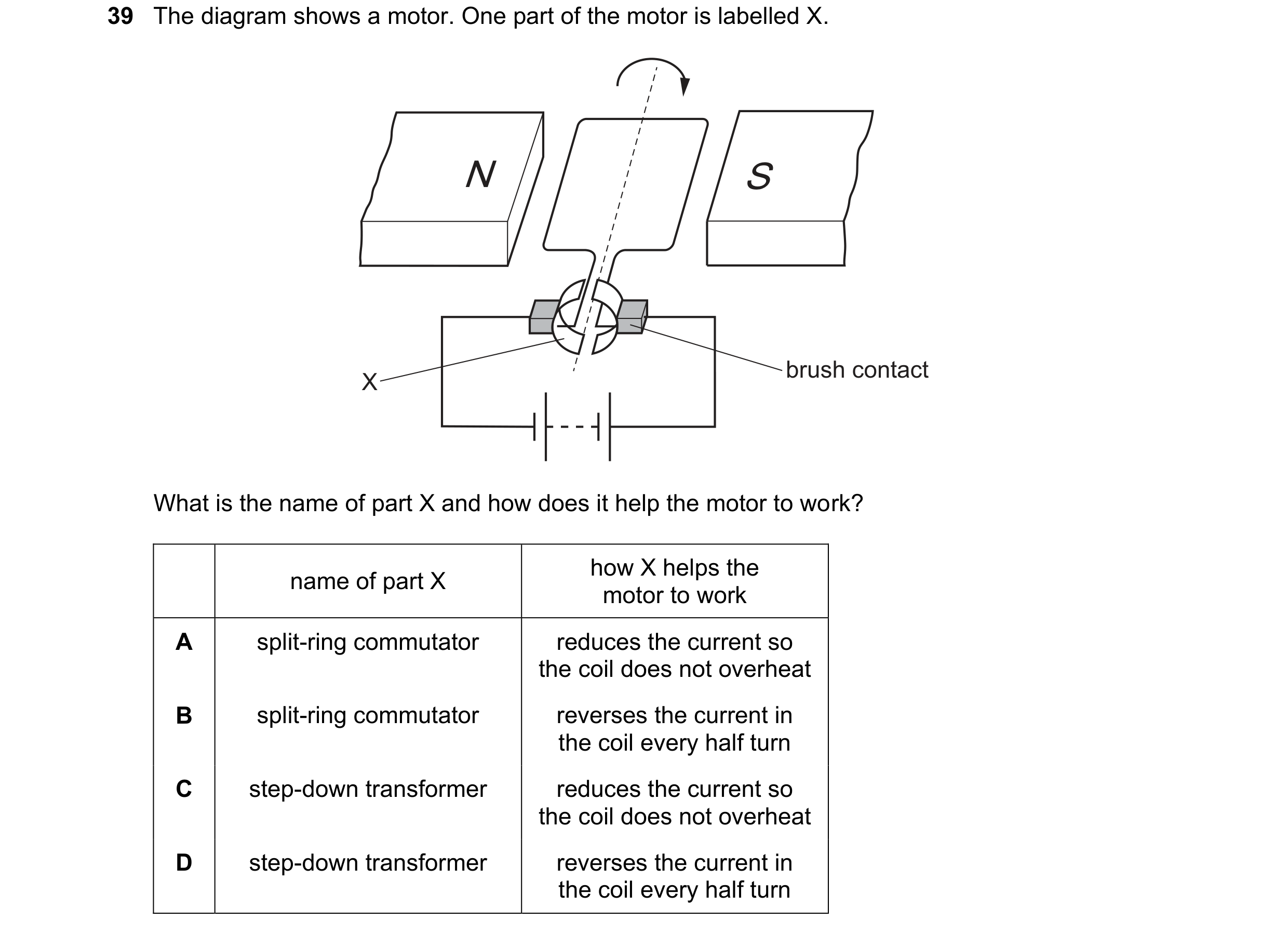
 14 / 18


 15 / 18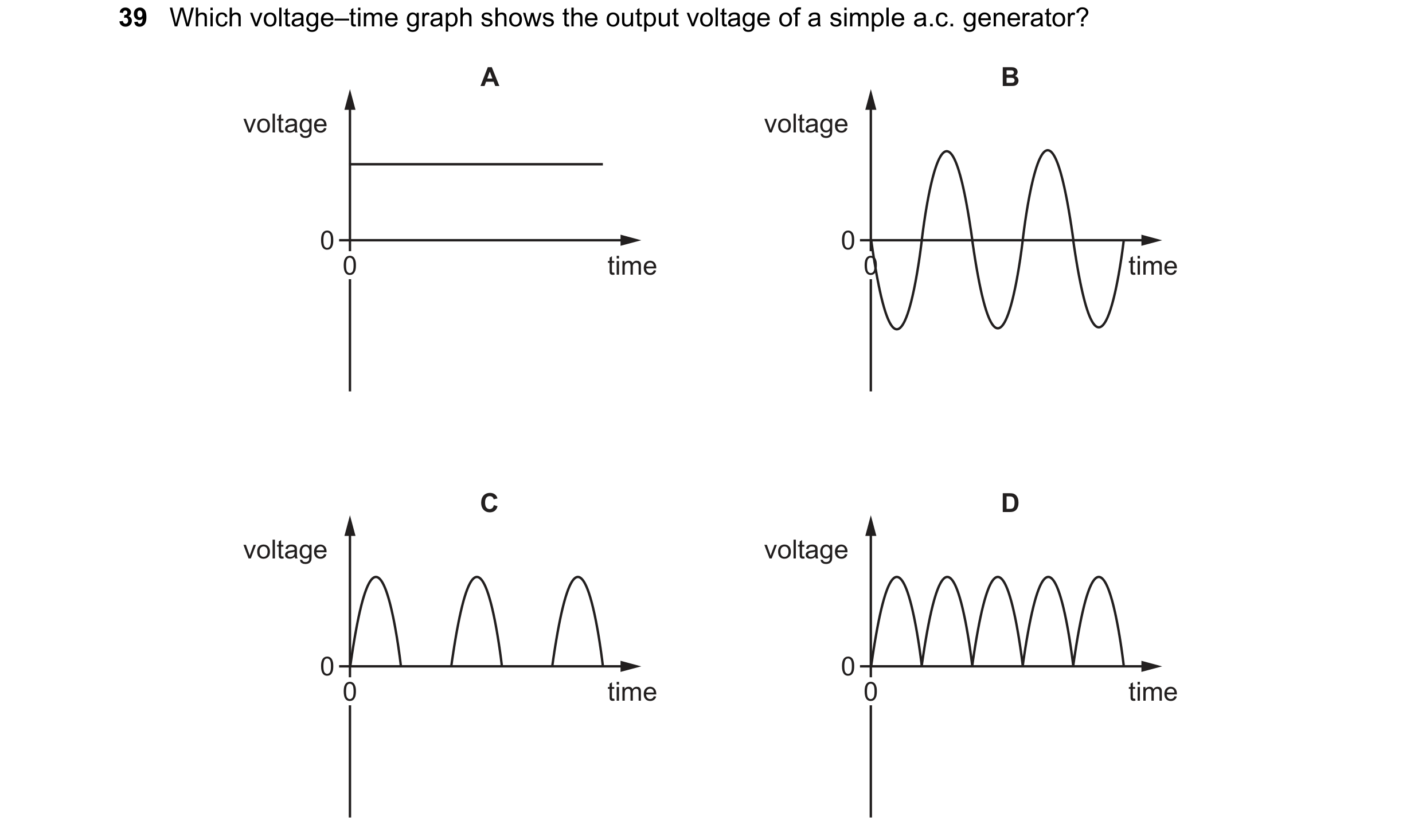

 16 / 18
 17 / 18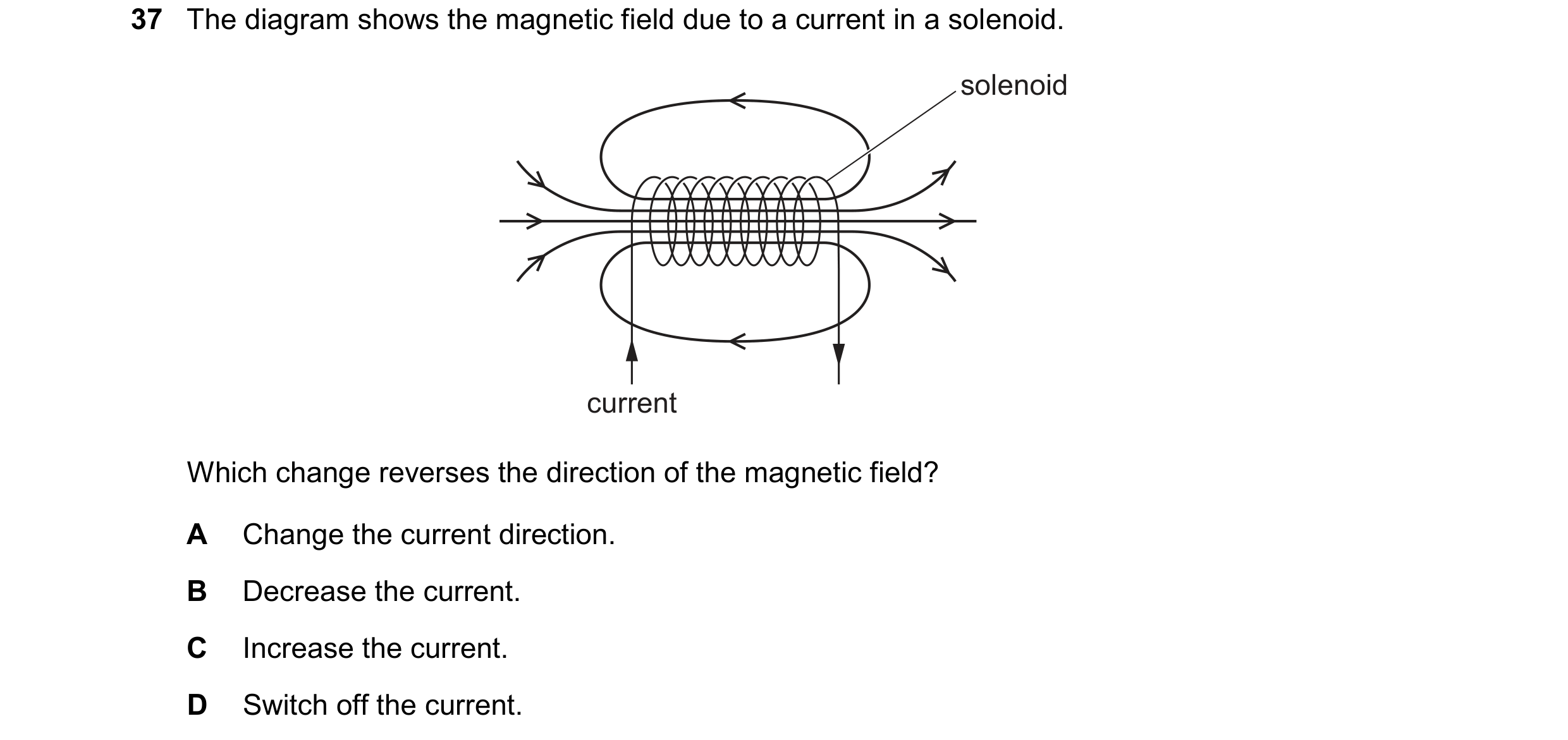
 18 / 18