Questions as text
Q1 · A man drives a car 0654/32 Oct/Nov 2017
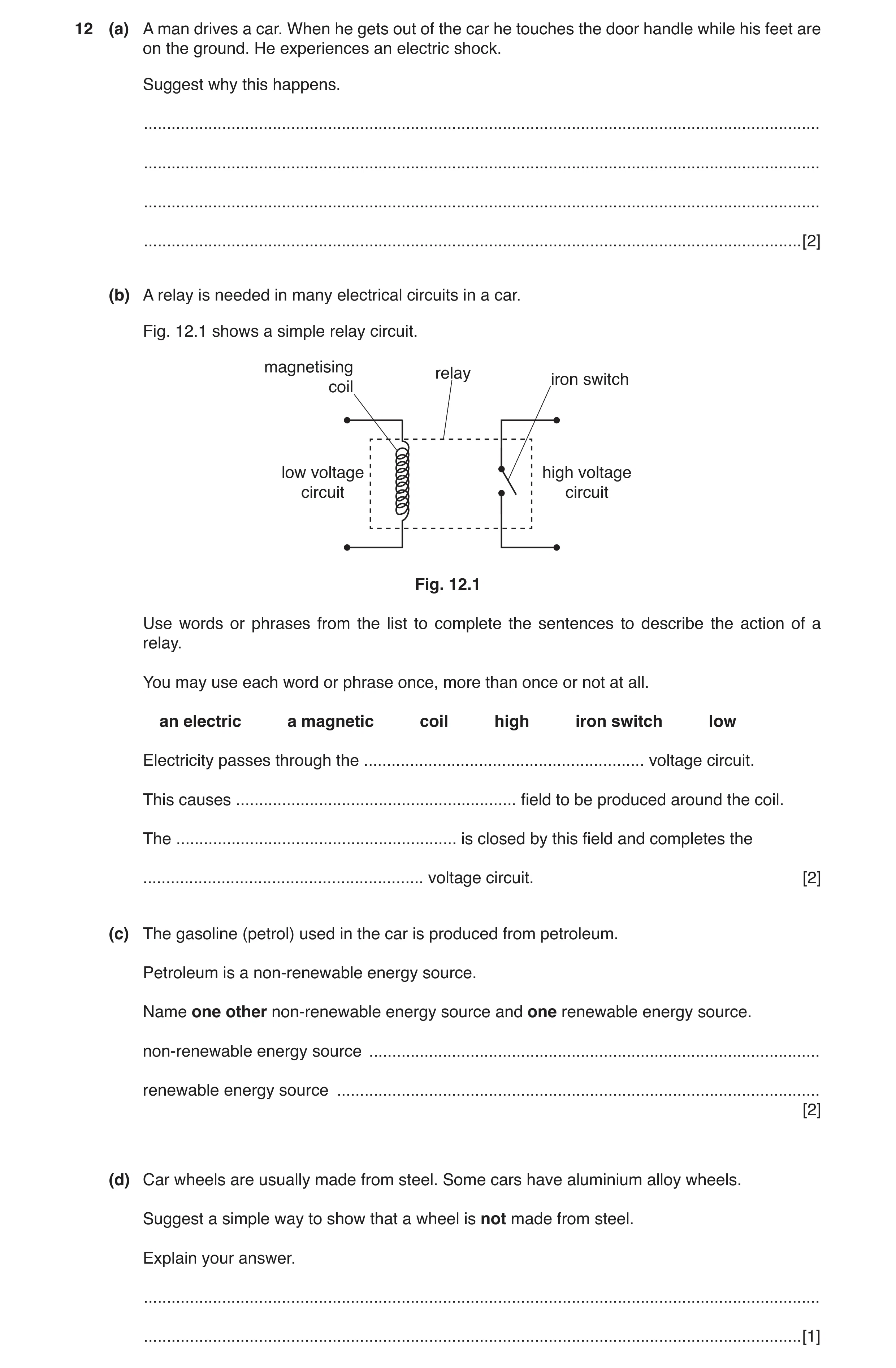
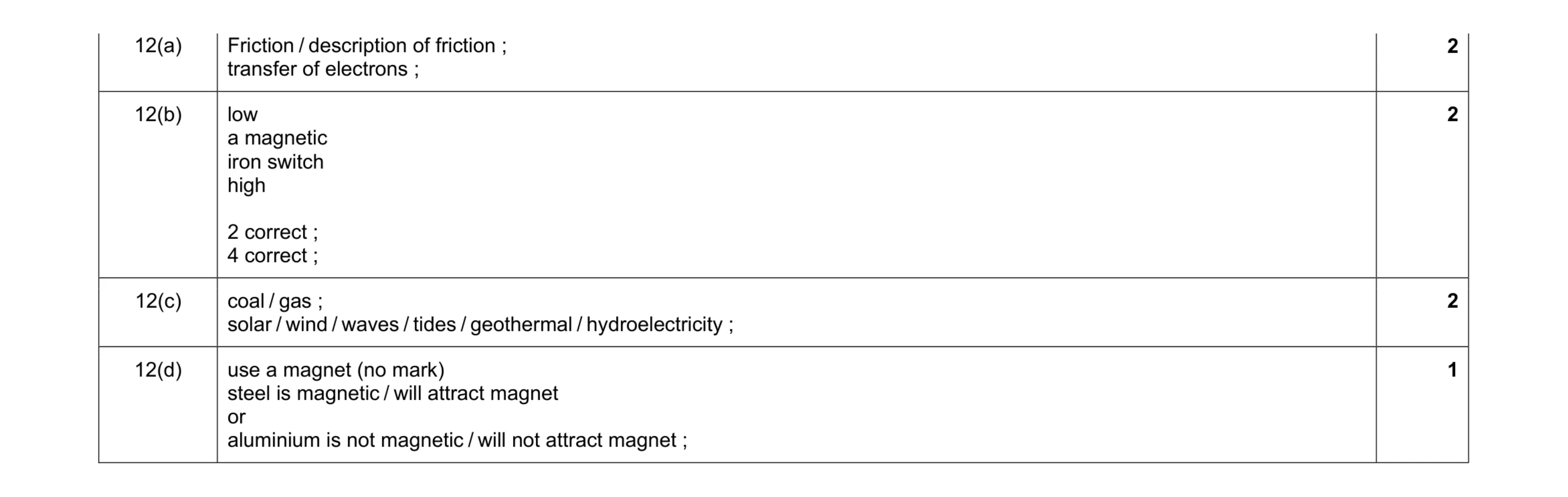
12 (a) A man drives a car. When he gets out of the car he touches the door handle while his feet are on the ground. He experiences an electric shock. Suggest why this happens. … … … … [2] (b) A relay is needed in many electrical circuits in a car. Fig. 12.1 shows a simple relay circuit. magnetising relay iron switch coil low voltage high voltage circuit circuit Fig. 12.1 Use words or phrases from the list to complete the sentences to describe the action of a relay. You may use each word or phrase once, more than once or not at all. an electric a magnetic coil high iron switch low Electricity passes through the … voltage circuit. This causes … field to be produced around the coil. The … is closed by this field and completes the … voltage circuit. [2] (c) The gasoline (petrol) used in the car is produced from petroleum. Petroleum is a non-renewable energy source. Name one other non-renewable energy source and one renewable energy source. non-renewable energy source … renewable energy source … [2] (d) Car wheels are usually made from steel. Some cars have aluminium alloy wheels. Suggest a simple way to show that a wheel is not made from steel. Explain your answer. … … [1]
7 marks
Mark scheme: 12(a) Friction / description of friction ; transfer of electrons ; 2 12(b) low a magnetic iron switch high 2 correct ; 4 correct ; 2 12(c) coal / gas ; solar / wind / waves / tides / geothermal / hydroelectricity ; 2 12(d) use a magnet (no mark) steel is magnetic / will attract magnet or aluminium is not magnetic / will not attract magnet ; 1
This question in 0654/32 Oct/Nov 2017
Question 2 0654/32 May/June 2020
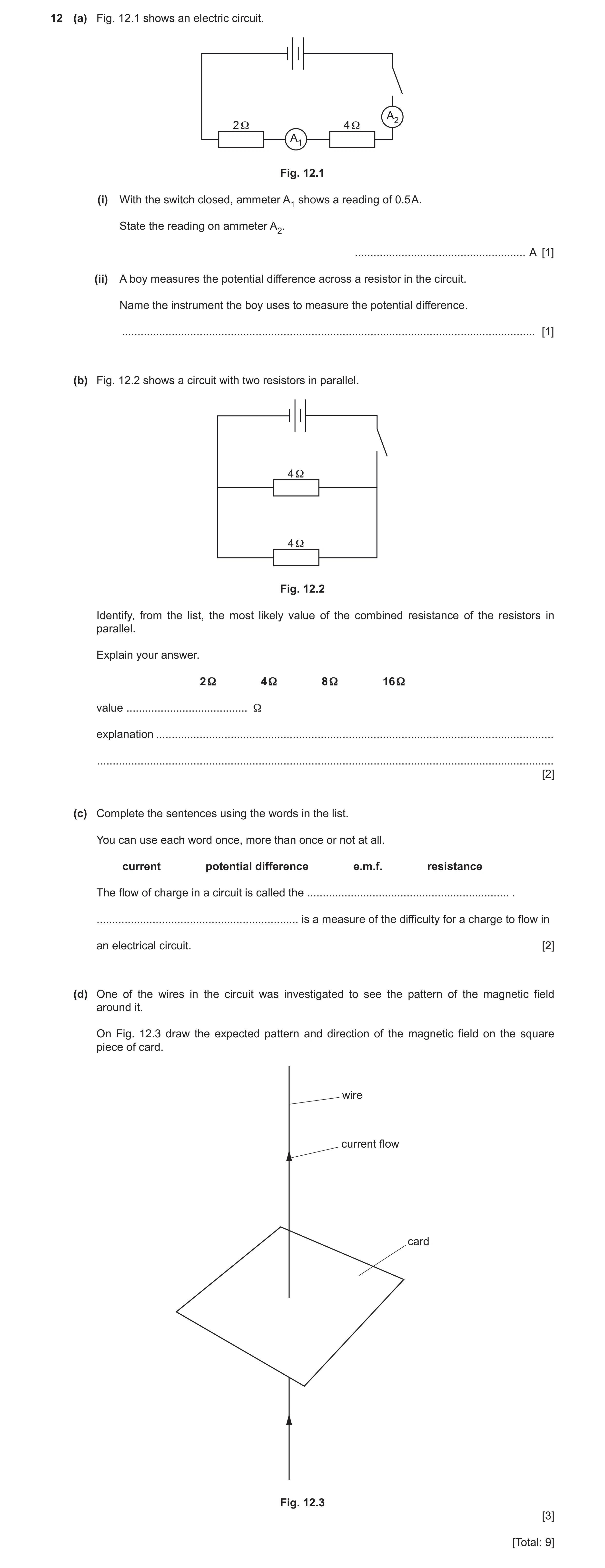
12 (a) Fig. 12.1 shows an electric circuit. A2 2 Ω 4 Ω A1 Fig. 12.1 (i) With the switch closed, ammeter A1 shows a reading of 0.5 A. State the reading on ammeter A2. … A [1] (ii) A boy measures the potential difference across a resistor in the circuit. Name the instrument the boy uses to measure the potential difference. … [1] (b) Fig. 12.2 shows a circuit with two resistors in parallel. 4 Ω 4 Ω Fig. 12.2 Identify, from the list, the most likely value of the combined resistance of the resistors in parallel. Explain your answer. 2 Ω 4 Ω 8 Ω 16 Ω value … Ω explanation … … [2] (c) Complete the sentences using the words in the list. You can use each word once, more than once or not at all. current potential difference e.m.f. resistance The flow of charge in a circuit is called the … . … is a measure of the difficulty for a charge to flow in an electrical circuit. [2] (d) One of the wires in the circuit was investigated to see the pattern of the magnetic field around it. On Fig. 12.3 draw the expected pattern and direction of the magnetic field on the square piece of card. wire current flow card Fig. 12.3 [3] [Total: 9]
9 marks
Mark scheme: 12(a)(i) 0.5 (A); 1 12(a)(ii) voltmeter; 1 12(b) 2 (Ω); the combined resistance of two resistors in parallel is less than that of either resistor by itself; 2 12(c) current; resistance; 2 12(d) concentric circles around the wire; correct ‘spacing’ of circles; correct direction ; 3
This question in 0654/32 May/June 2020
Question 3 0654/33 May/June 2020
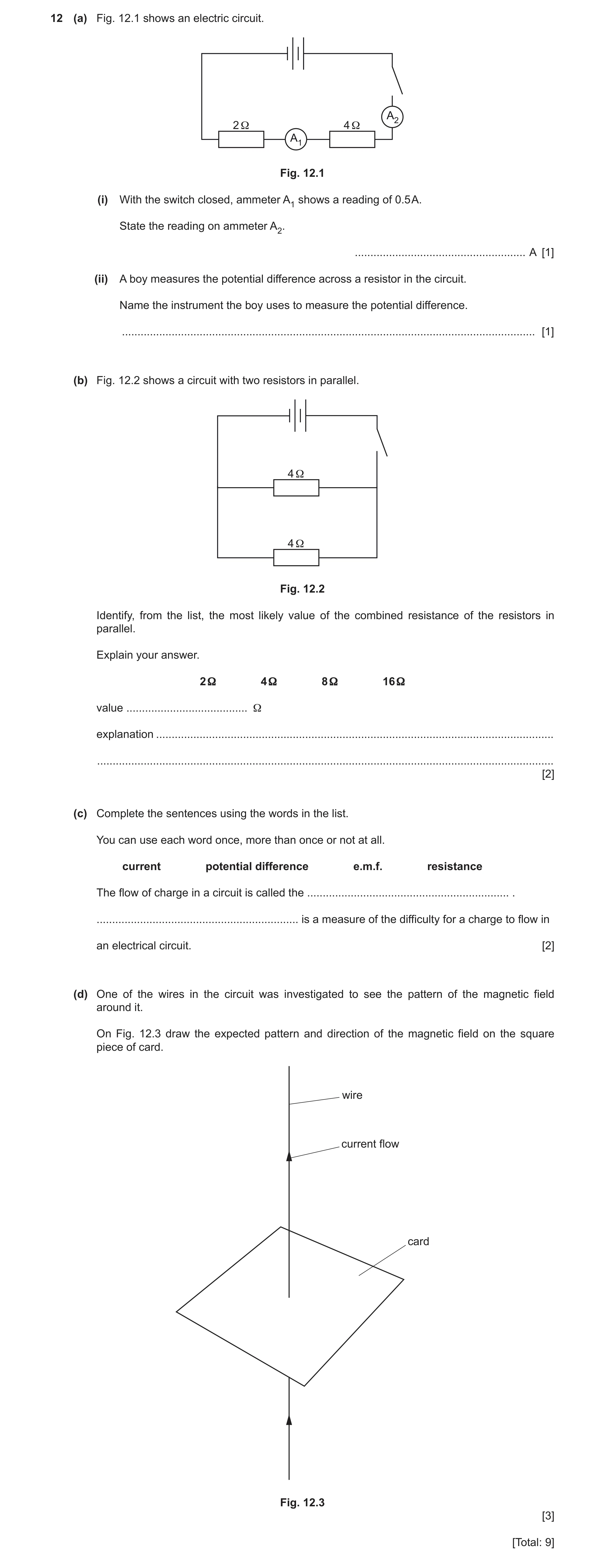
12 (a) Fig. 12.1 shows an electric circuit. A2 2 Ω 4 Ω A1 Fig. 12.1 (i) With the switch closed, ammeter A1 shows a reading of 0.5 A. State the reading on ammeter A2. … A [1] (ii) A boy measures the potential difference across a resistor in the circuit. Name the instrument the boy uses to measure the potential difference. … [1] (b) Fig. 12.2 shows a circuit with two resistors in parallel. 4 Ω 4 Ω Fig. 12.2 Identify, from the list, the most likely value of the combined resistance of the resistors in parallel. Explain your answer. 2 Ω 4 Ω 8 Ω 16 Ω value … Ω explanation … … [2] (c) Complete the sentences using the words in the list. You can use each word once, more than once or not at all. current potential difference e.m.f. resistance The flow of charge in a circuit is called the … . … is a measure of the difficulty for a charge to flow in an electrical circuit. [2] (d) One of the wires in the circuit was investigated to see the pattern of the magnetic field around it. On Fig. 12.3 draw the expected pattern and direction of the magnetic field on the square piece of card. wire current flow card Fig. 12.3 [3] [Total: 9]
9 marks
Mark scheme: 12(a)(i) 0.5 (A); 1 12(a)(ii) voltmeter; 1 12(b) 2 (Ω); the combined resistance of two resistors in parallel is less than that of either resistor by itself; 2 12(c) current; resistance; 2 12(d) concentric circles around the wire; correct ‘spacing’ of circles; correct direction ; 3
This question in 0654/33 May/June 2020
Q4 · A block of glass with a ray of light passing through it 0654/32 Oct/Nov 2020
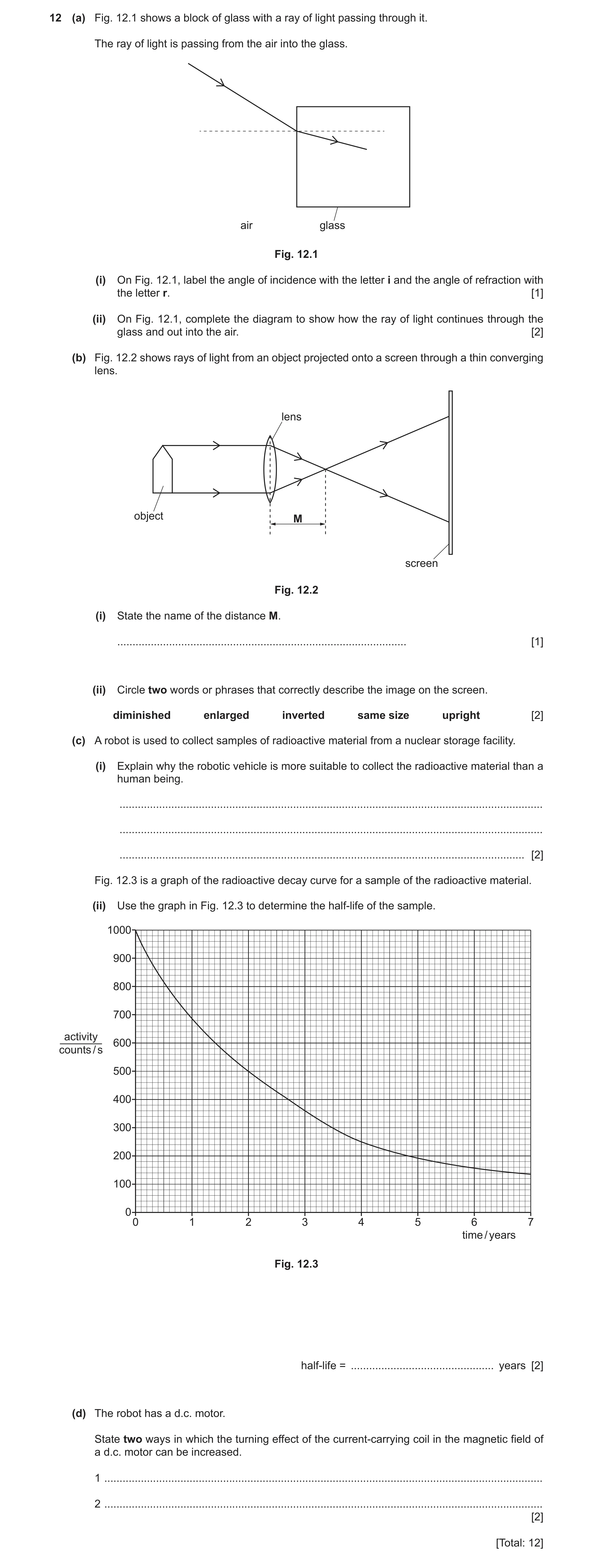
12 (a) Fig. 12.1 shows a block of glass with a ray of light passing through it. The ray of light is passing from the air into the glass. air glass Fig. 12.1 (i) On Fig. 12.1, label the angle of incidence with the letter i and the angle of refraction with the letter r. [1] (ii) On Fig. 12.1, complete the diagram to show how the ray of light continues through the glass and out into the air. [2] (b) Fig. 12.2 shows rays of light from an object projected onto a screen through a thin converging lens. lens object M screen Fig. 12.2 (i) State the name of the distance M. … [1] (ii) Circle two words or phrases that correctly describe the image on the screen. diminished enlarged inverted same size upright [2] (c) A robot is used to collect samples of radioactive material from a nuclear storage facility. (i) Explain why the robotic vehicle is more suitable to collect the radioactive material than a human being. … … … [2] Fig. 12.3 is a graph of the radioactive decay curve for a sample of the radioactive material. (ii) Use the graph in Fig. 12.3 to determine the half-life of the sample. 1000 900 800 700 activity 600counts / s 500 400 300 200 100 0 0 1 2 3 4 5 6 7 time / years Fig. 12.3 half-life = … years [2] (d) The robot has a d.c. motor. State two ways in which the turning effect of the current-carrying coil in the magnetic field of a d.c. motor can be increased. 1 … 2 … [2] [Total: 12]
12 marks
Mark scheme: 12(a)(i) correct angles labelled with i and r; 1 12(a)(ii) ray drawn in same direction to edge of glass and then out of glass; parallel to incident ray; 2 12(b)(i) focal length; 1 12(b)(ii) enlarged; inverted; 2 12(c)(i) radiation is ionising; human cells can be damaged / cancer; 2 12(c)(ii) evidence of working (on graph) / count divided by two; 2 ; 2 12(d) any 2 of: increasing the current, increase the number of turns on the coil, increase the strength of the magnet;; 2
This question in 0654/32 Oct/Nov 2020
Q5 · An information booklet about an electric oven states that the weight of the oven is 50 kg 0654/32 Feb/March 2021
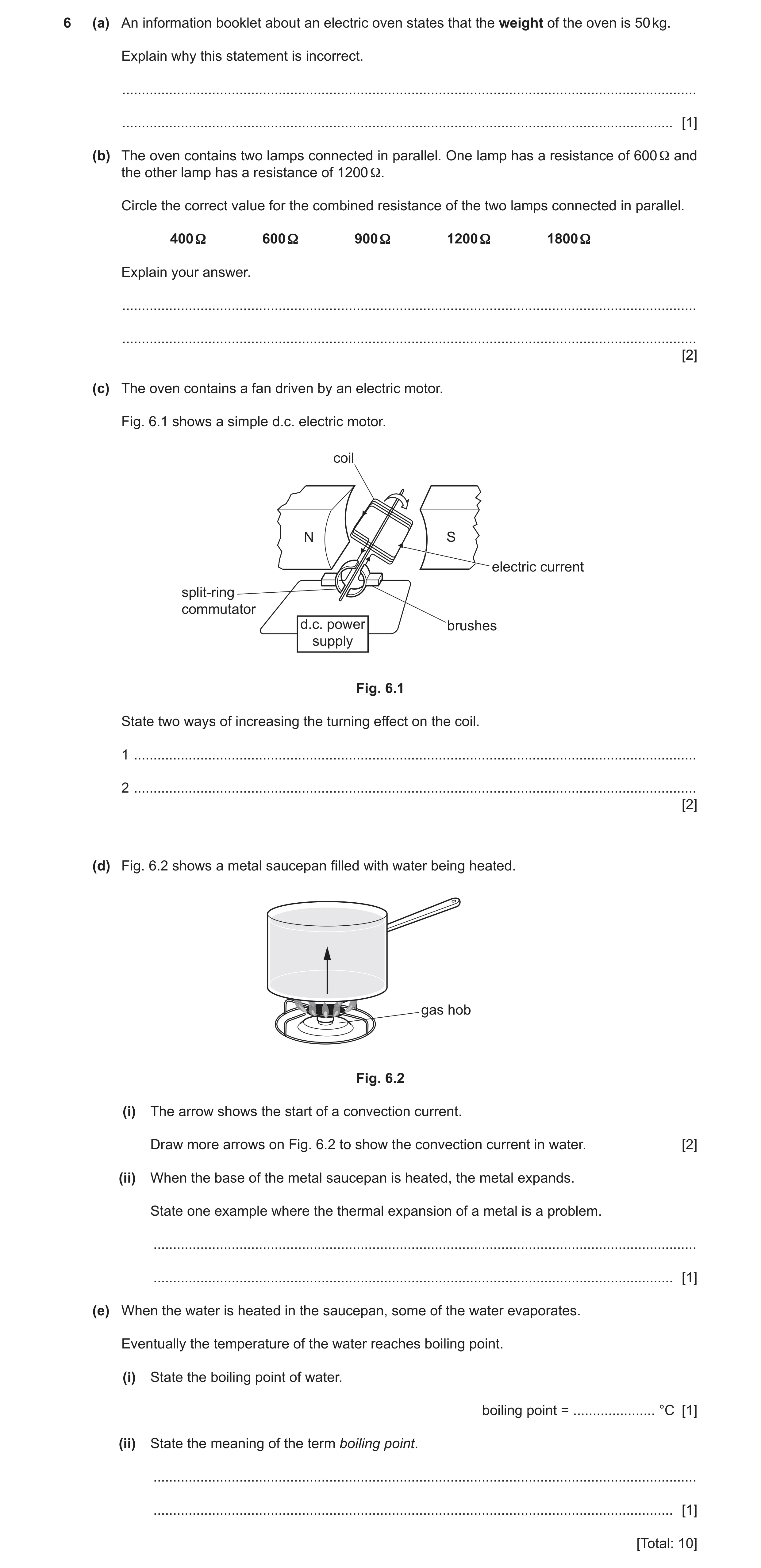
6 (a) An information booklet about an electric oven states that the weight of the oven is 50 kg. Explain why this statement is incorrect. … … [1] (b) The oven contains two lamps connected in parallel. One lamp has a resistance of 600 Ω and the other lamp has a resistance of 1200 Ω. Circle the correct value for the combined resistance of the two lamps connected in parallel. 400 Ω 600 Ω 900 Ω 1200 Ω 1800 Ω Explain your answer. … … [2] (c) The oven contains a fan driven by an electric motor. Fig. 6.1 shows a simple d.c. electric motor. coil N S electric current split-ring commutator d.c. power brushes supply Fig. 6.1 State two ways of increasing the turning effect on the coil. 1 … 2 … [2] (d) Fig. 6.2 shows a metal saucepan filled with water being heated. gas hob Fig. 6.2 (i) The arrow shows the start of a convection current. Draw more arrows on Fig. 6.2 to show the convection current in water. [2] (ii) When the base of the metal saucepan is heated, the metal expands. State one example where the thermal expansion of a metal is a problem. … … [1] (e) When the water is heated in the saucepan, some of the water evaporates. Eventually the temperature of the water reaches boiling point. (i) State the boiling point of water. boiling point = … °C [1] (ii) State the meaning of the term boiling point. … … [1] [Total: 10]
10 marks
Mark scheme: 6(a) mass is measured in kg / weight is measured in Newtons ; 1 6(b) 400 Ω; combined resistances of two resistors in parallel is less than the resistance of either of them; 2 6(c) larger current through coil; greater magnetic field; more turns; max 2 2 6(d)(i) arrow(s) to the right and or left; arrow(s) moving downwards ; 2 6(d)(ii) railway tracks / bridges; 1 6(e)(i) 100 (°C) ; 1 6(e)(ii) the temperature at which a liquid changes into a gas ; 1
This question in 0654/32 Feb/March 2021
Q6 · Describe how to show that a radioactive isotope is releasing γ‑rays but not α‑particles… 0654/31 May/June 2021
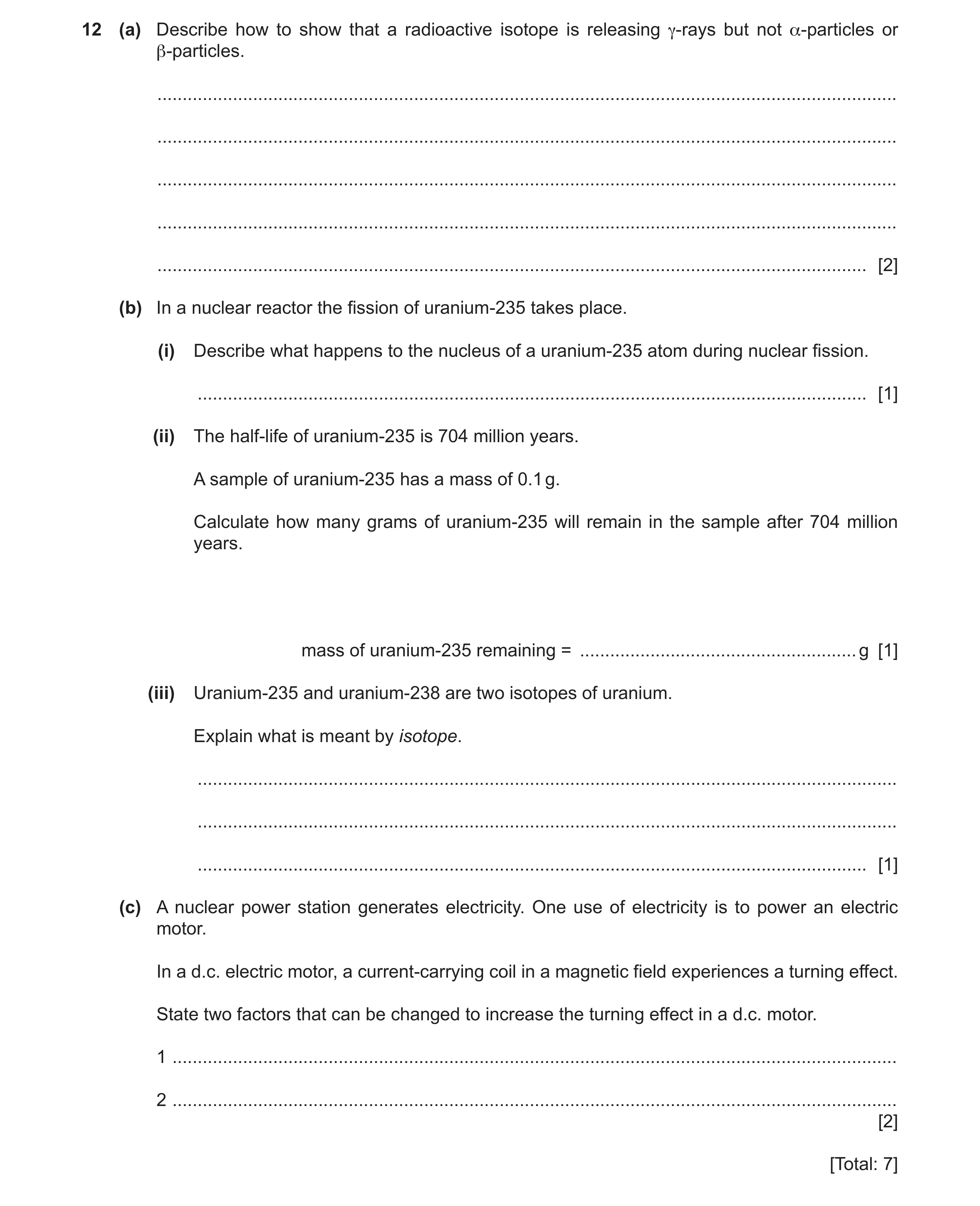
12 (a) Describe how to show that a radioactive isotope is releasing γ‑rays but not α‑particles or β‑particles. … … … … … [2] (b) In a nuclear reactor the fission of uranium‑235 takes place. (i) Describe what happens to the nucleus of a uranium‑235 atom during nuclear fission. … [1] (ii) The half‑life of uranium‑235 is 704 million years. A sample of uranium‑235 has a mass of 0.1 g. Calculate how many grams of uranium‑235 will remain in the sample after 704 million years. mass of uranium‑235 remaining = … g [1] (iii) Uranium‑235 and uranium‑238 are two isotopes of uranium. Explain what is meant by isotope. … … … [1] (c) A nuclear power station generates electricity. One use of electricity is to power an electric motor. In a d.c. electric motor, a current‑carrying coil in a magnetic field experiences a turning effect. State two factors that can be changed to increase the turning effect in a d.c. motor. 1 … 2 … [2] [Total: 7]
7 marks
Mark scheme: 12(a) ref to penetration ; γ-rays will penetrate lead (α and β will not) ; 2 12(b)(i) splits ; 1 12(b)(ii) 0.05 (g) ; 1 12(b)(iii) two atoms that contain the same number of protons but different number of neutrons ; 1 12(c) (increase) (strength of) magnetic field ; (increase) current ; (increase) no of turns / coils ; max 2 2
This question in 0654/31 May/June 2021
Q7 · A copper wire connected to a battery and placed between the poles of a strong magnet 0654/31 Oct/Nov 2021
6 (a) Fig. 6.1 shows a copper wire connected to a battery and placed between the poles of a strong magnet. N S Fig. 6.1 When the switch is closed the wire moves upwards. (i) Describe two ways to change the apparatus so that the wire moves downwards when the switch is closed. 1 … 2 … [2] (ii) State the term that describes a flow of electrons in a metal conductor. … [1] (b) A β-particle is an electron. α-particles and β-particles are radioactive emissions released during the radioactive decay of isotopes. (i) State the meaning of the terms: radioactive decay … … isotopes … … [3] (ii) Complete the sentences below using the symbols α and β. … particles are less ionising than … particles. … particles are less penetrating than … particles. [1] (c) A plastic ruler and a piece of cloth are both uncharged. A student rubs the plastic ruler with the cloth. The plastic ruler becomes positively charged. (i) Describe in terms of electrons how the plastic ruler becomes positively charged. … … [1] (ii) State which row from Table 6.1 shows the charge on the cloth compared to the charge on the plastic ruler. Table 6.1 row sign of charge magnitude of charge 1 positive equal 2 positive bigger 3 positive smaller 4 negative equal 5 negative bigger 6 negative smaller row no … [1] [Total: 9]
9 marks
Mark scheme: 6(a)(i) reverse battery polarity / current ; reverse magnet polarity ; 2 6(a)(ii) current ; 1 6(b)(i) (radioactive decay is the process by which) an unstable (atomic ) nucleus ; loses energy / emits radiation ; (isotopes are) – atoms of the same element that have same proton number and different nucleon number ; 3 6(b)(ii) β particles are less ionising than α particles and α particles are less penetrating than β particles ; 1 6(c)(i) loses electrons ; 1 6(c)(ii) row 4 ; 1
This question in 0654/31 Oct/Nov 2021
Q8 · Table 9.1 contains descriptions of a solid, a liquid and a gas 0654/32 May/June 2022
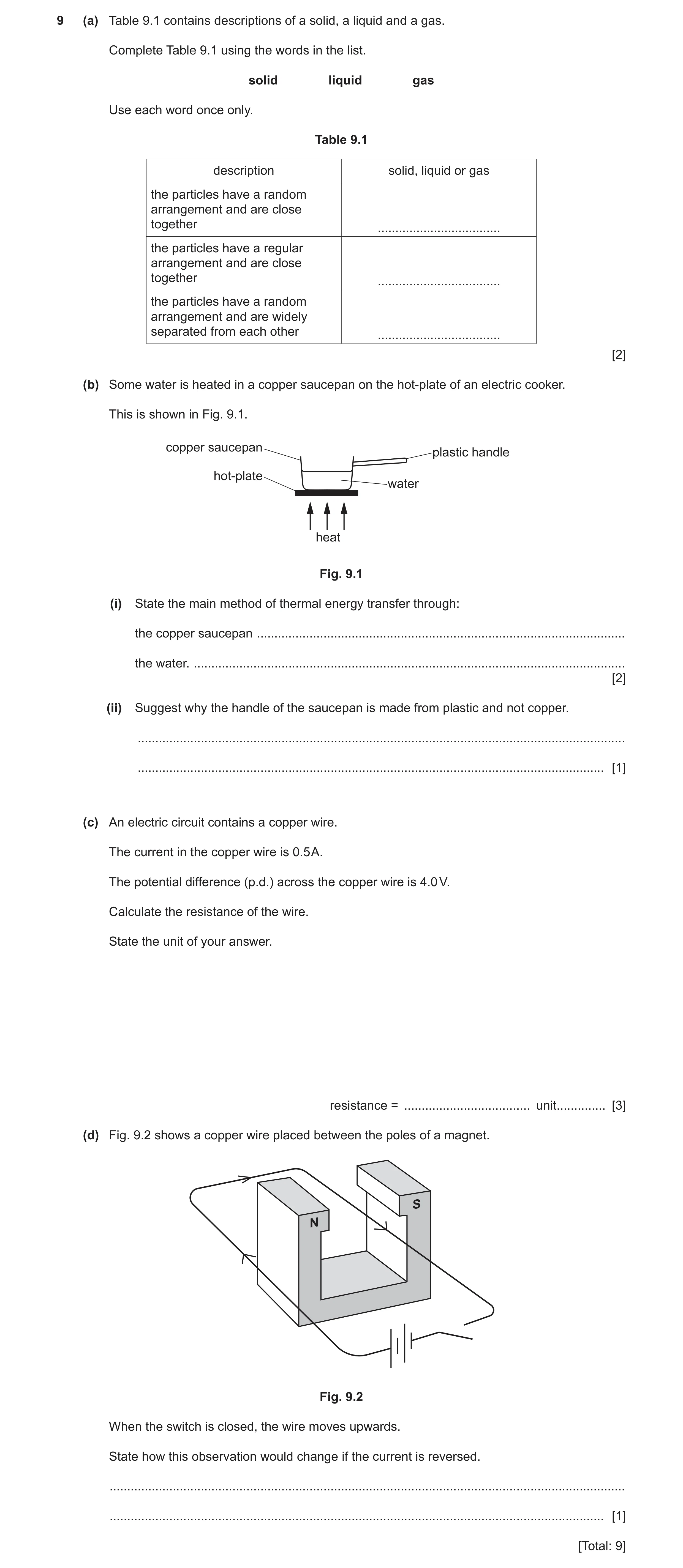
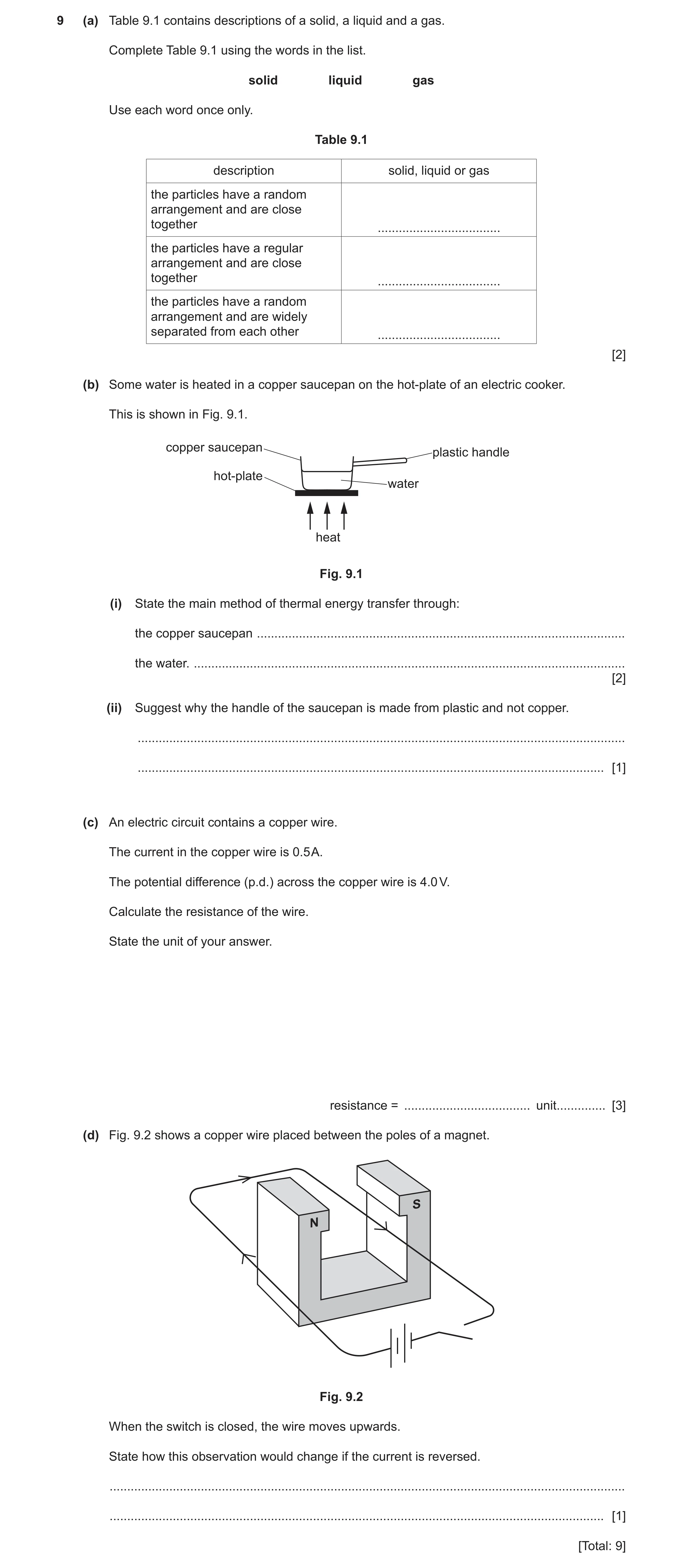
9 (a) Table 9.1 contains descriptions of a solid, a liquid and a gas. Complete Table 9.1 using the words in the list. solid liquid gas Use each word once only. Table 9.1 description solid, liquid or gas the particles have a random arrangement and are close together … the particles have a regular arrangement and are close together … the particles have a random arrangement and are widely separated from each other … [2] (b) Some water is heated in a copper saucepan on the hot-plate of an electric cooker. This is shown in Fig. 9.1. copper saucepan plastic handle hot-plate water heat Fig. 9.1 (i) State the main method of thermal energy transfer through: the copper saucepan … the water. … [2] (ii) Suggest why the handle of the saucepan is made from plastic and not copper. … … [1] (c) An electric circuit contains a copper wire. The current in the copper wire is 0.5 A. The potential difference (p.d.) across the copper wire is 4.0 V. Calculate the resistance of the wire. State the unit of your answer. resistance = … unit … [3] (d) Fig. 9.2 shows a copper wire placed between the poles of a magnet. S N Fig. 9.2 When the switch is closed, the wire moves upwards. State how this observation would change if the current is reversed. … … [1] [Total: 9]
9 marks
Mark scheme: 9(a) the particles have a random arrangement and are close together = liquid the particles have a regular arrangement and are close together = solid the particles are widely separated from each other = gas 2 9(b)(i) conduction; convection; 2 9(b)(ii) plastic is an insulator (so you don’t burn your hand); 1 Question Answer Marks 9(c) R = V / I (in any form) or 4.0 / 0.5; resistance = 8; ; 3 9(d) wire moves down / opposite way; 1
This question in 0654/32 May/June 2022
Q9 · Table 9.1 contains descriptions of a solid, a liquid and a gas 0654/33 May/June 2022
9 (a) Table 9.1 contains descriptions of a solid, a liquid and a gas. Complete Table 9.1 using the words in the list. solid liquid gas Use each word once only. Table 9.1 description solid, liquid or gas the particles have a random arrangement and are close together … the particles have a regular arrangement and are close together … the particles have a random arrangement and are widely separated from each other … [2] (b) Some water is heated in a copper saucepan on the hot-plate of an electric cooker. This is shown in Fig. 9.1. copper saucepan plastic handle hot-plate water heat Fig. 9.1 (i) State the main method of thermal energy transfer through: the copper saucepan … the water. … [2] (ii) Suggest why the handle of the saucepan is made from plastic and not copper. … … [1] (c) An electric circuit contains a copper wire. The current in the copper wire is 0.5 A. The potential difference (p.d.) across the copper wire is 4.0 V. Calculate the resistance of the wire. State the unit of your answer. resistance = … unit … [3] (d) Fig. 9.2 shows a copper wire placed between the poles of a magnet. S N Fig. 9.2 When the switch is closed, the wire moves upwards. State how this observation would change if the current is reversed. … … [1] [Total: 9]
9 marks
Mark scheme: 9(a) the particles have a random arrangement and are close together = liquid the particles have a regular arrangement and are close together = solid the particles are widely separated from each other = gas 2 9(b)(i) conduction; convection; 2 9(b)(ii) plastic is an insulator (so you don’t burn your hand); 1 Question Answer Marks 9(c) R = V / I (in any form) or 4.0 / 0.5; resistance = 8; ; 3 9(d) wire moves down / opposite way; 1
This question in 0654/33 May/June 2022
Question 10 0654/32 Oct/Nov 2023
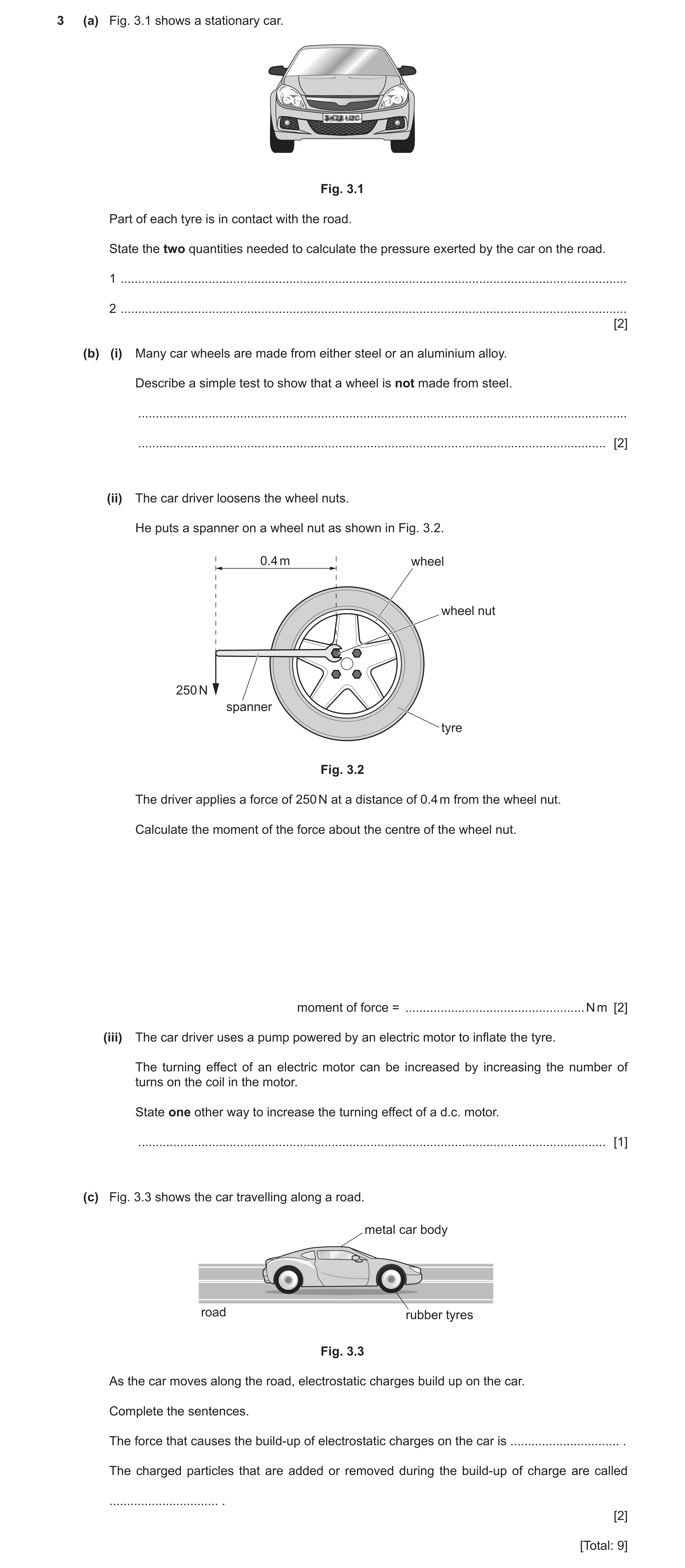
3 (a) Fig. 3.1 shows a stationary car. Fig. 3.1 Part of each tyre is in contact with the road. State the two quantities needed to calculate the pressure exerted by the car on the road. 1 … 2 … [2] (b) (i) Many car wheels are made from either steel or an aluminium alloy. Describe a simple test to show that a wheel is not made from steel. … … [2] (ii) The car driver loosens the wheel nuts. He puts a spanner on a wheel nut as shown in Fig. 3.2. 0.4 m wheel wheel nut 250 N spanner tyre Fig. 3.2 The driver applies a force of 250 N at a distance of 0.4 m from the wheel nut. Calculate the moment of the force about the centre of the wheel nut. moment of force = … N m [2] (iii) The car driver uses a pump powered by an electric motor to inflate the tyre. The turning effect of an electric motor can be increased by increasing the number of turns on the coil in the motor. State one other way to increase the turning effect of a d.c. motor. … [1] (c) Fig. 3.3 shows the car travelling along a road. metal car body road rubber tyres Fig. 3.3 As the car moves along the road, electrostatic charges build up on the car. Complete the sentences. The force that causes the build-up of electrostatic charges on the car is … . The charged particles that are added or removed during the build-up of charge are called … . [2] [Total: 9]
9 marks
Mark scheme: 3(a) weight of car ; 2 surface area of tyres in contact with the road ; 3(b)(i) use a magnet ; 2 wheel is not attracted ; ORA 3(b)(ii) moment = force perpendicular distance (in any form) / 250 0.4 ; 2 = 100 (N m) ; 3(b)(iii) one from: 1 increase current / voltage ; increase the strength of the magnetic field ; 3(c) friction ; 2 electrons ;
This question in 0654/32 Oct/Nov 2023
Q11 · The driver of a car fills the fuel tank with gasoline (petrol) 0654/31 May/June 2024
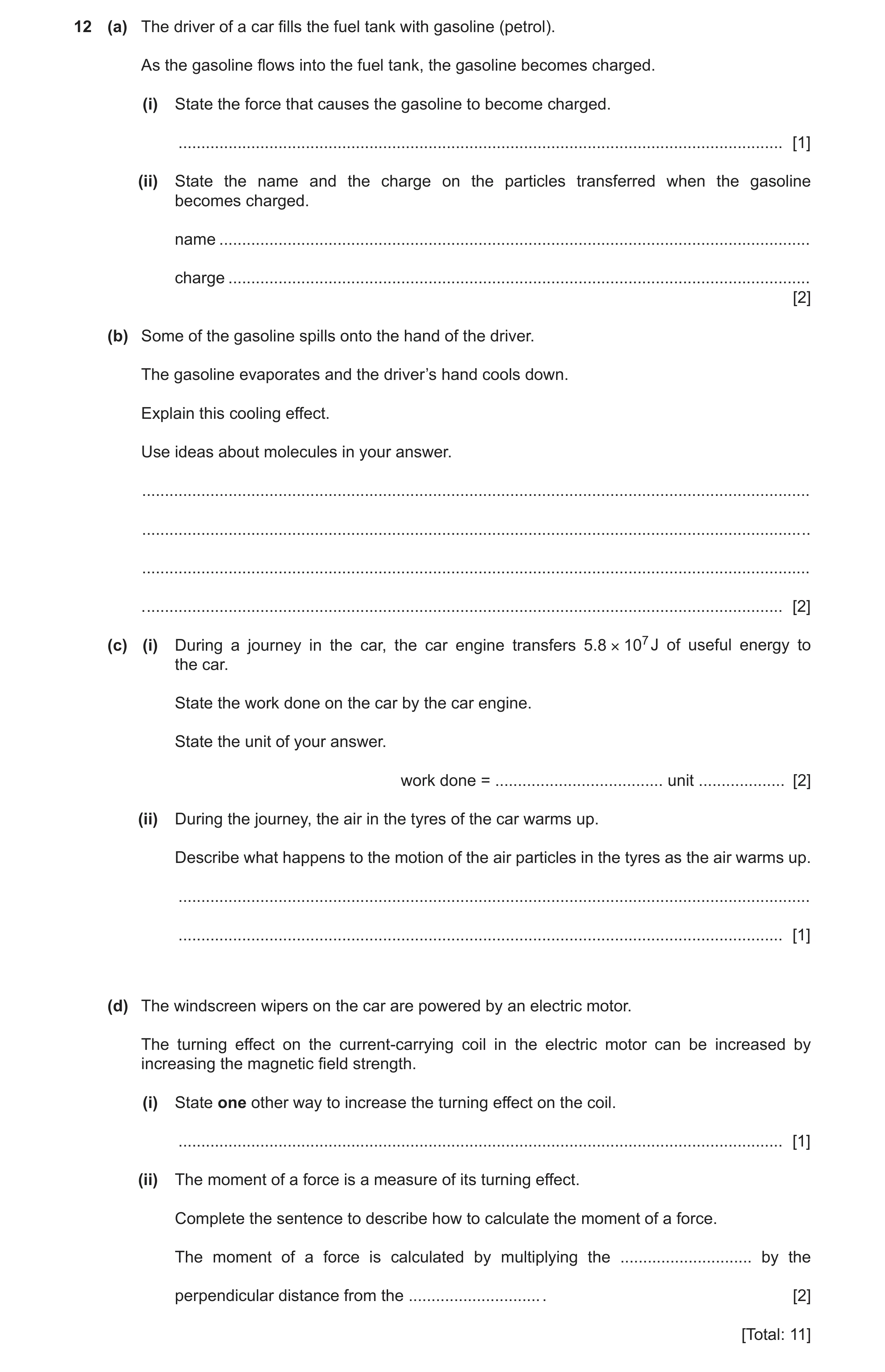
12 (a) The driver of a car fills the fuel tank with gasoline (petrol). As the gasoline flows into the fuel tank, the gasoline becomes charged. (i) State the force that causes the gasoline to become charged. … [1] (ii) State the name and the charge on the particles transferred when the gasoline becomes charged. name … charge … [2] (b) Some of the gasoline spills onto the hand of the driver. The gasoline evaporates and the driver’s hand cools down. Explain this cooling effect. Use ideas about molecules in your answer. … … … . … [2] (c) (i) During a journey in the car, the car engine transfers 5.8 × 10⁷ J of useful energy to the car. State the work done on the car by the car engine. State the unit of your answer. work done = … unit … [2] (ii) During the journey, the air in the tyres of the car warms up. Describe what happens to the motion of the air particles in the tyres as the air warms up. … … [1] (d) The windscreen wipers on the car are powered by an electric motor. The turning effect on the current‑carrying coil in the electric motor can be increased by increasing the magnetic field strength. (i) State one other way to increase the turning effect on the coil. … [1] (ii) The moment of a force is a measure of its turning effect. Complete the sentence to describe how to calculate the moment of a force. The moment of a force is calculated by multiplying the … by the perpendicular distance from the … . [2] [Total: 11]
11 marks
Mark scheme: 12(a)(i) friction ; 1 12(a)(ii) electron ; negative ; 2 12(b) the most energetic molecules escape ; average speed / energy of remaining molecules is lower ; 2 12(c)(i) 5.8 107 ; J ; 2 12(c)(ii) move faster ; 1 12(d)(i) increase current / voltage or increase number of turns ; 1 12(d)(ii) force ; pivot ; 2
This question in 0654/31 May/June 2024
 10 / 18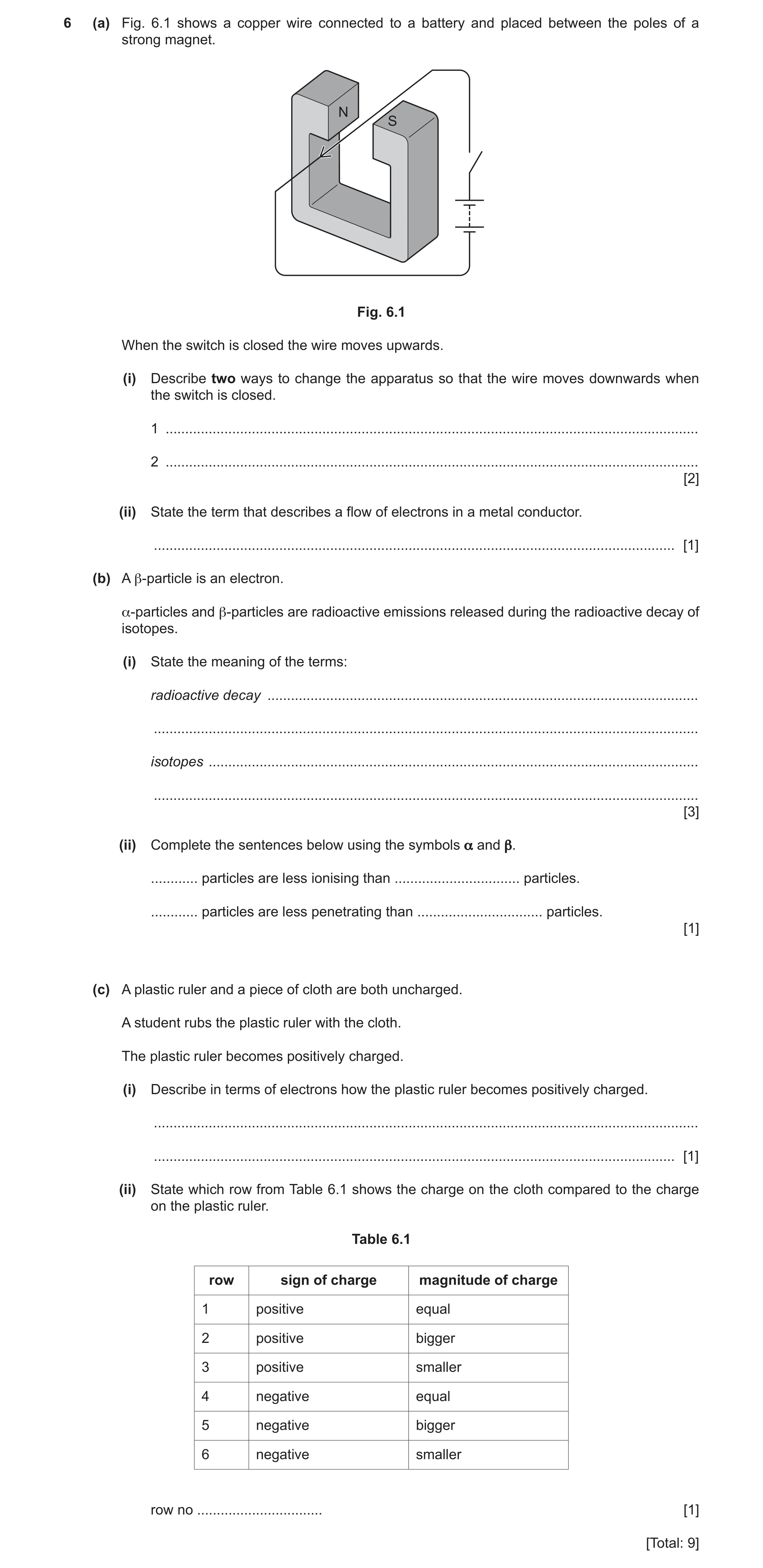
 7
7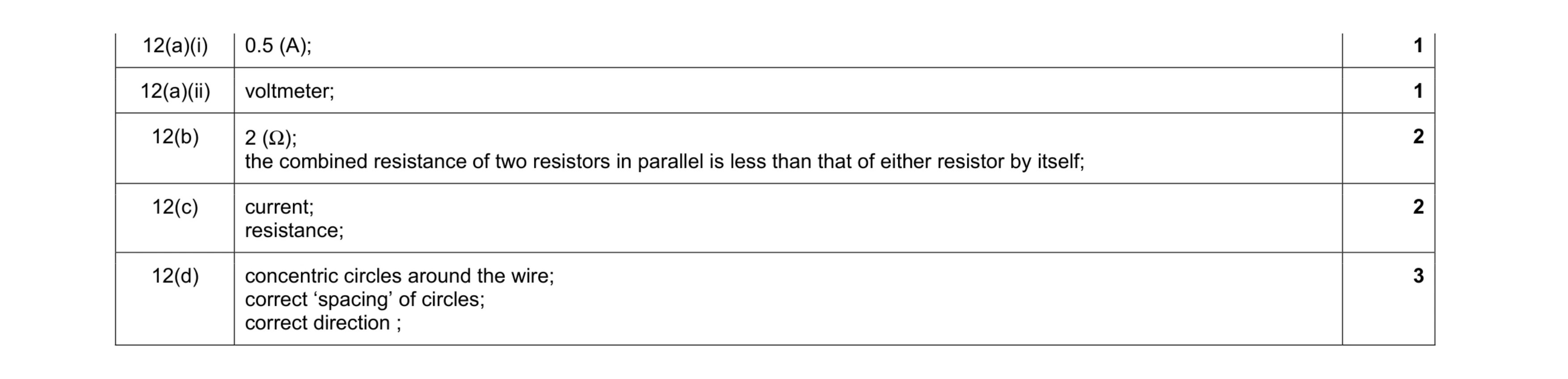 9
9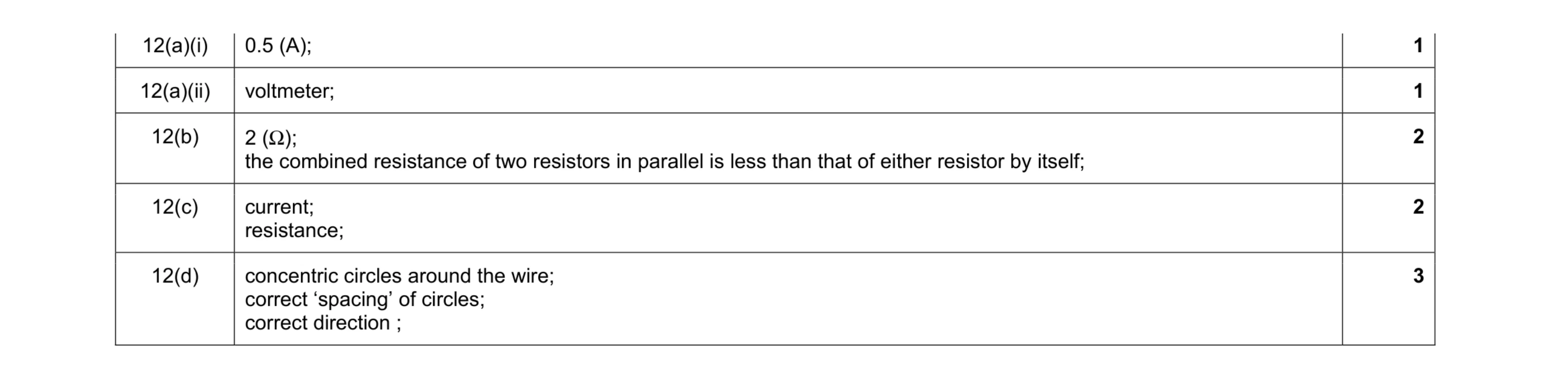 9
9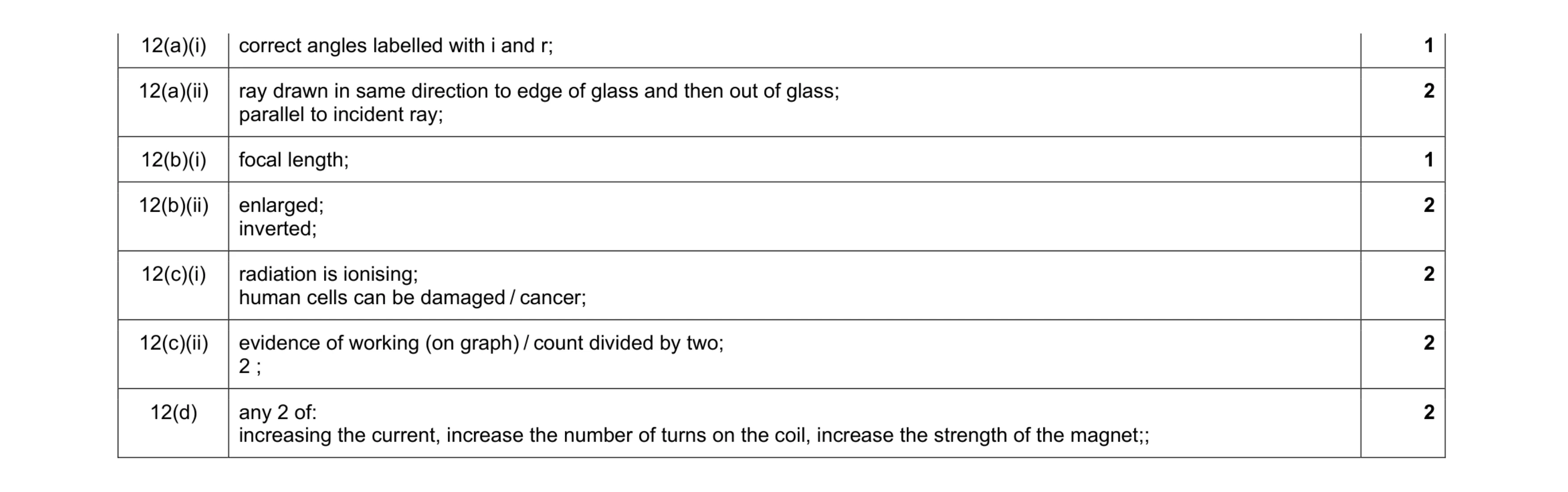 12
12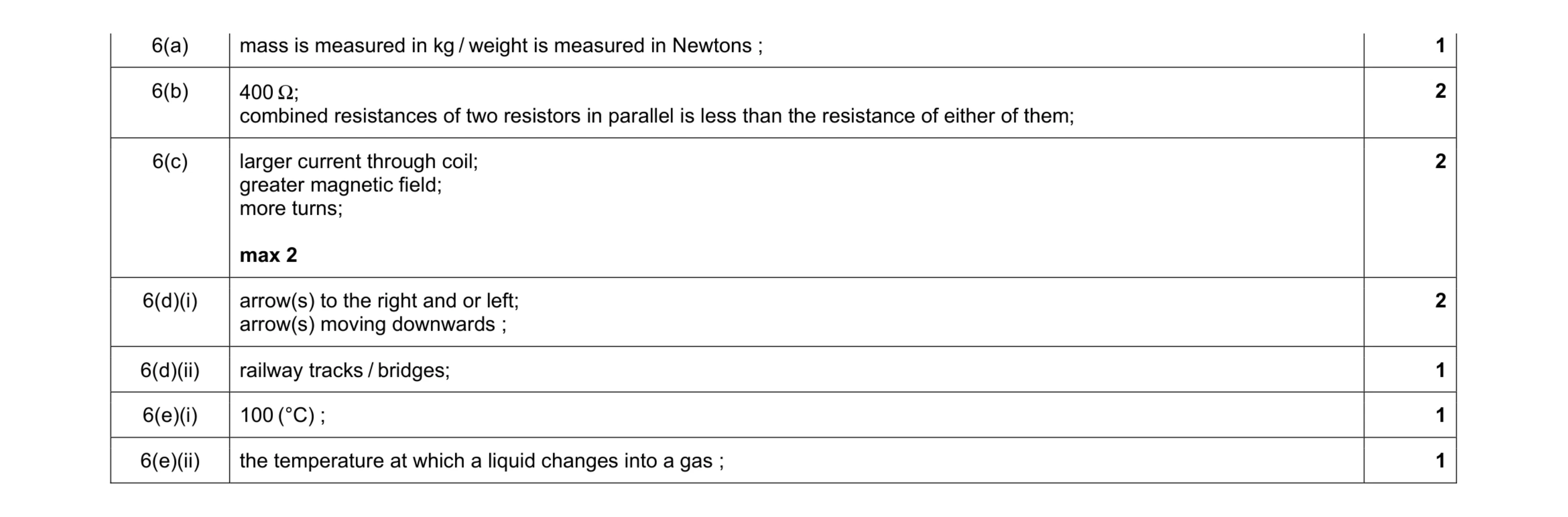 10
10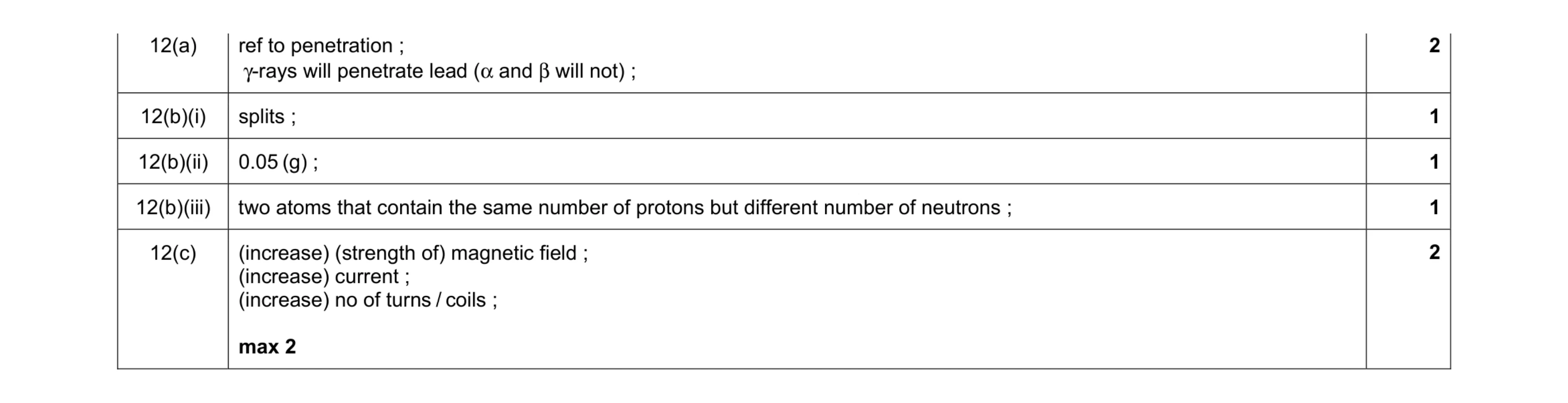 7
7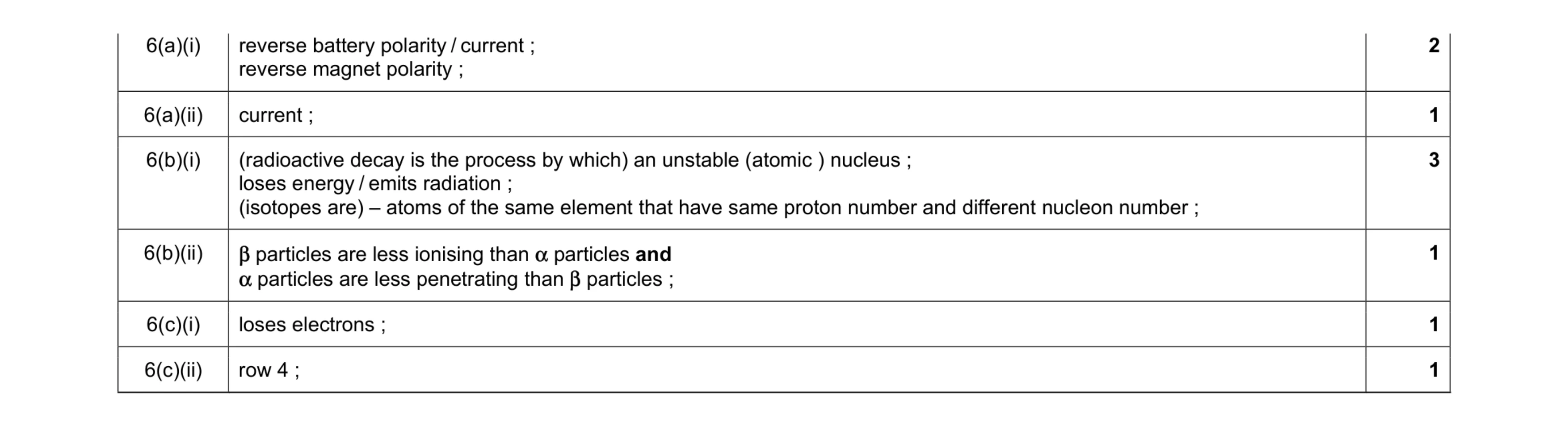 9
9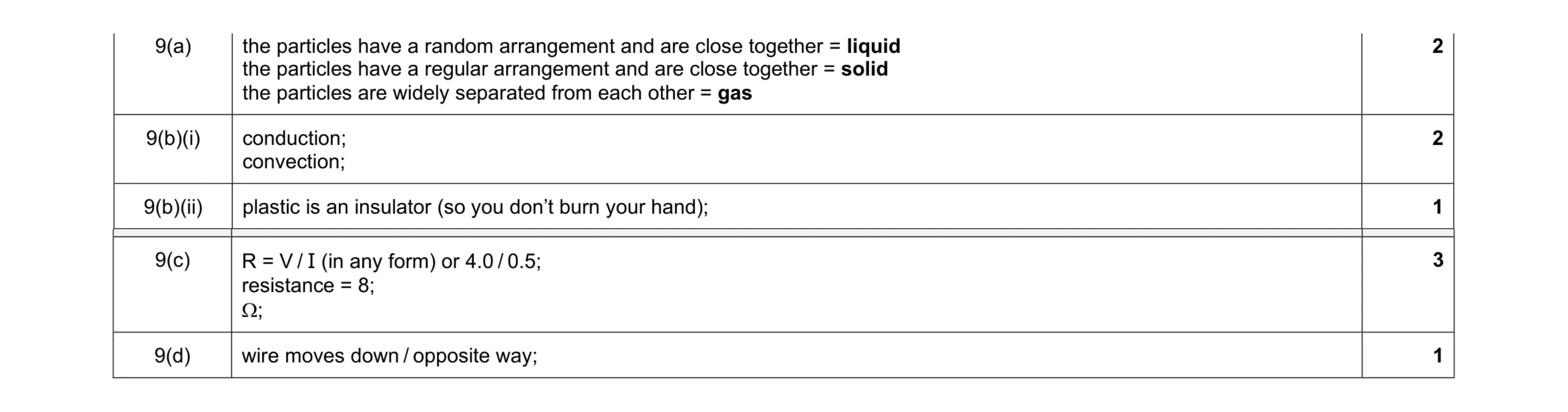 9
9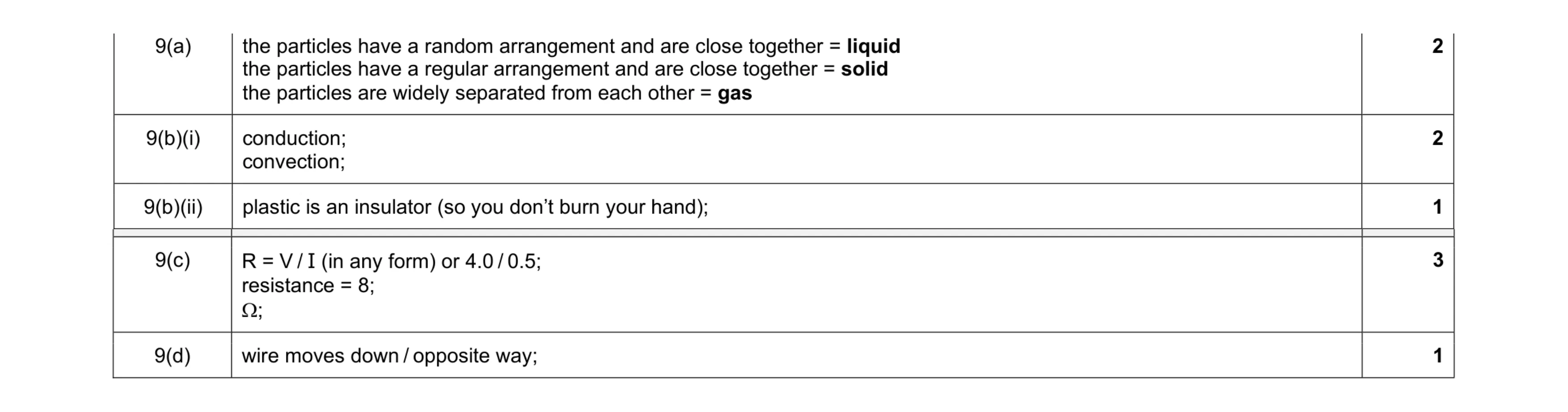 9
9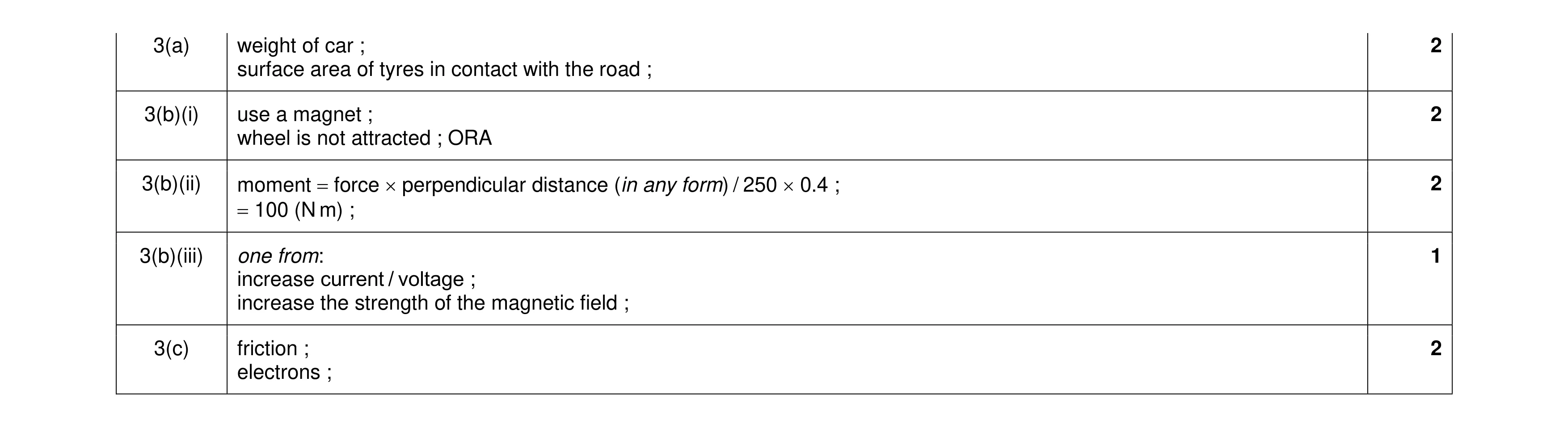 9
9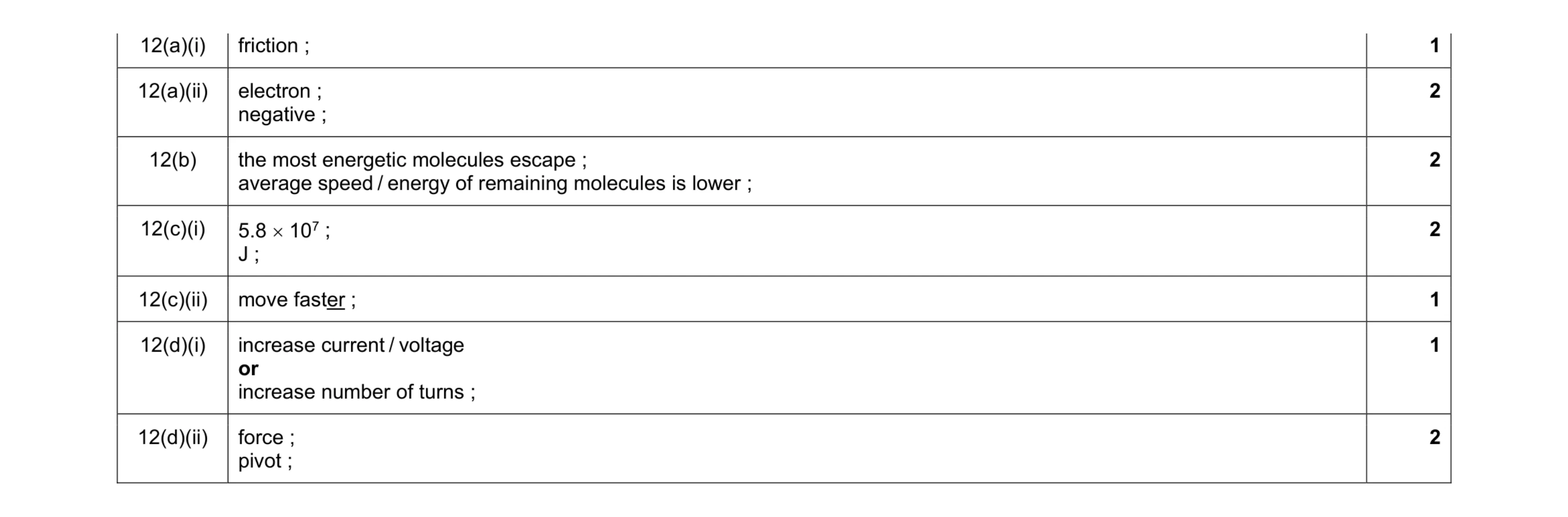 11
11