Questions as text
Q1 · Magnesium reacts with sulfur, to form magnesium sulfide 0653/22 Feb/March 2017
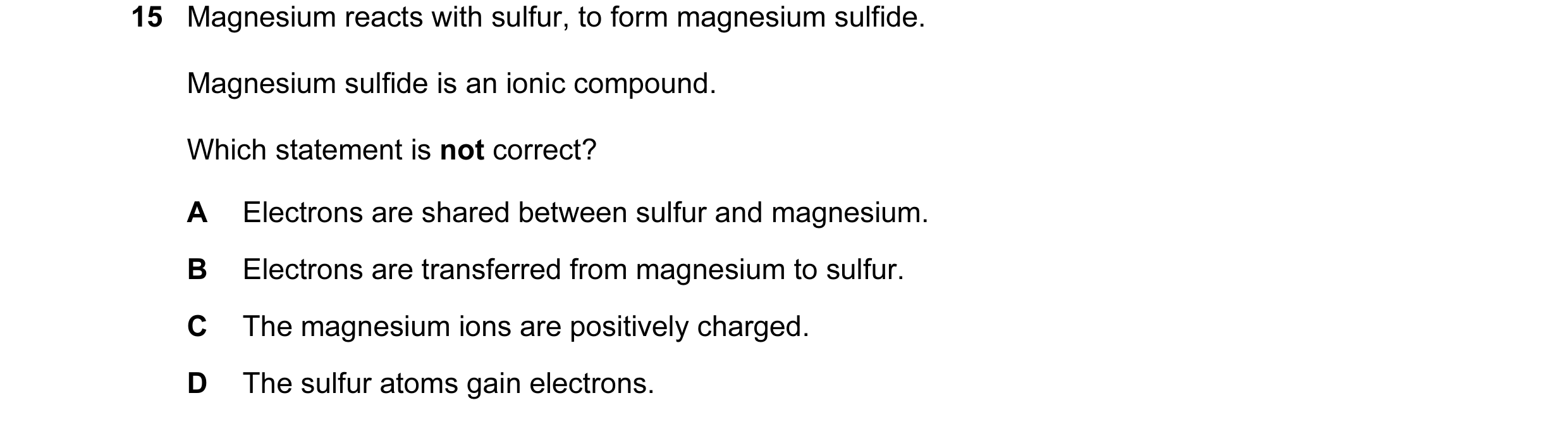
15 Magnesium reacts with sulfur, to form magnesium sulfide. Magnesium sulfide is an ionic compound. Which statement is not correct? A Electrons are shared between sulfur and magnesium. B Electrons are transferred from magnesium to sulfur. C The magnesium ions are positively charged. D The sulfur atoms gain electrons.
1 marks
Answer: A
This question in 0653/22 Feb/March 2017
Q2 · Which statements about elements in the Periodic Table are correct? 0653/22 Feb/March 2017
22 Which statements about elements in the Periodic Table are correct? 1 The higher the group number, the more metallic an element is. 2 The group number is equal to the number of electrons in the outer shell. 3 Elements on the left of the Periodic Table form ions by losing electrons. A 1 only B 1 and 2 C 1 and 3 D 2 and 3
1 marks
Answer: D
This question in 0653/22 Feb/March 2017
Q3 · Aluminium ions have the formula Al 3+ 0653/21 May/June 2017
17 Aluminium ions have the formula Al 3+. Oxide ions have the formula O2–. What is the formula of aluminium oxide? A Al O B Al O2 C Al 2O3 D Al 3O2
1 marks
Answer: C
This question in 0653/21 May/June 2017
Q4 · Which row describes the electronic structures of a chlorine atom and of a sodium ion? 0653/22 May/June 2017
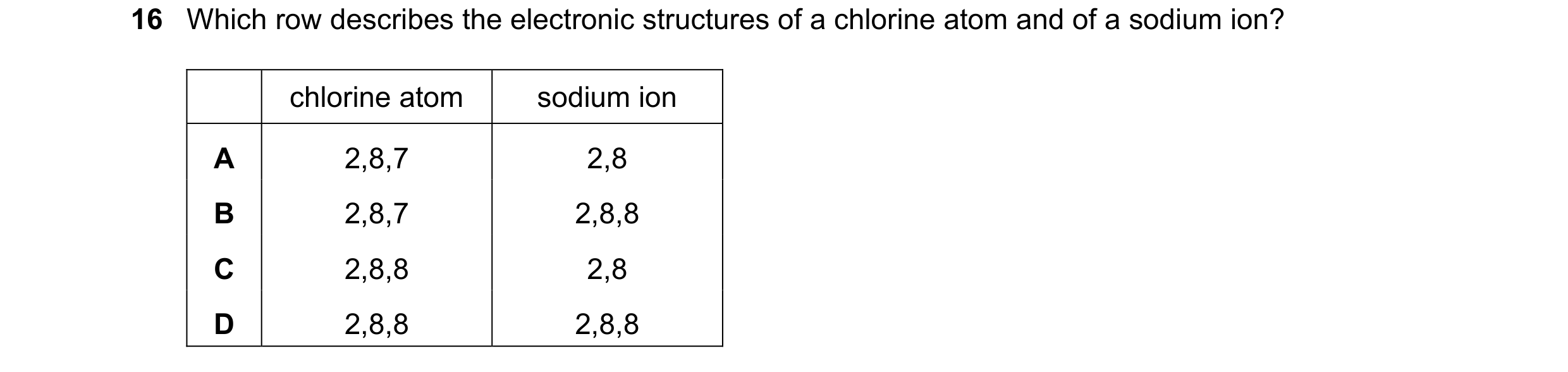
16 Which row describes the electronic structures of a chlorine atom and of a sodium ion? chlorine atom sodium ion A 2,8,7 2,8 B 2,8,7 2,8,8 C 2,8,8 2,8 D 2,8,8 2,8,8
1 marks
Answer: A
This question in 0653/22 May/June 2017
Q5 · Aluminium ions have the formula Al 3+ 0653/22 May/June 2017
17 Aluminium ions have the formula Al 3+. Oxide ions have the formula O2–. What is the formula of aluminium oxide? A Al O B Al O2 C Al 2O3 D Al 3O2
1 marks
Answer: C
This question in 0653/22 May/June 2017
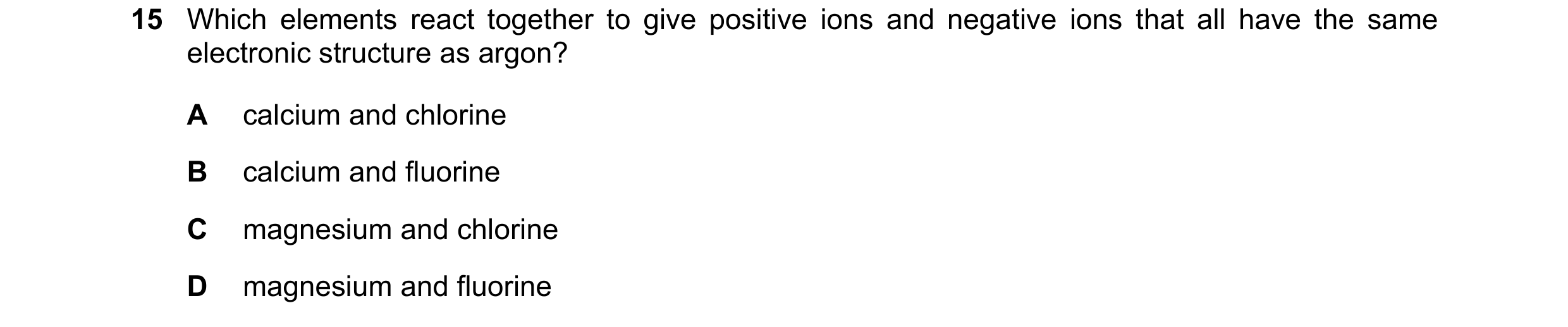
Q6 · Which elements react together to give positive ions and negative ions that have the same… 0653/23 May/June 2017
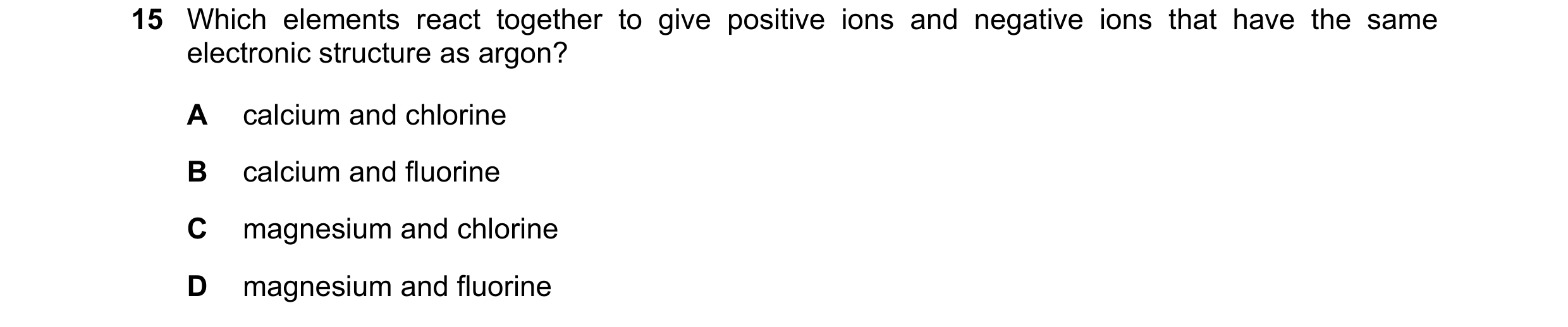
15 Which elements react together to give positive ions and negative ions that have the same electronic structure as argon? A calcium and chlorine B calcium and fluorine C magnesium and chlorine D magnesium and fluorine
1 marks
Answer: A
This question in 0653/23 May/June 2017
Q7 · What is the electronic structure of a chlorine atom, Cl, and of a chloride ion, Cl –? 0653/21 Oct/Nov 2017
16 What is the electronic structure of a chlorine atom, Cl, and of a chloride ion, Cl –? chlorine atom chloride ion A 2,8,6 2,8,8 B 2,8,7 2,8,6 C 2,8,7 2,8,8 D 2,8,8 2,8,7
1 marks
Answer: C
This question in 0653/21 Oct/Nov 2017
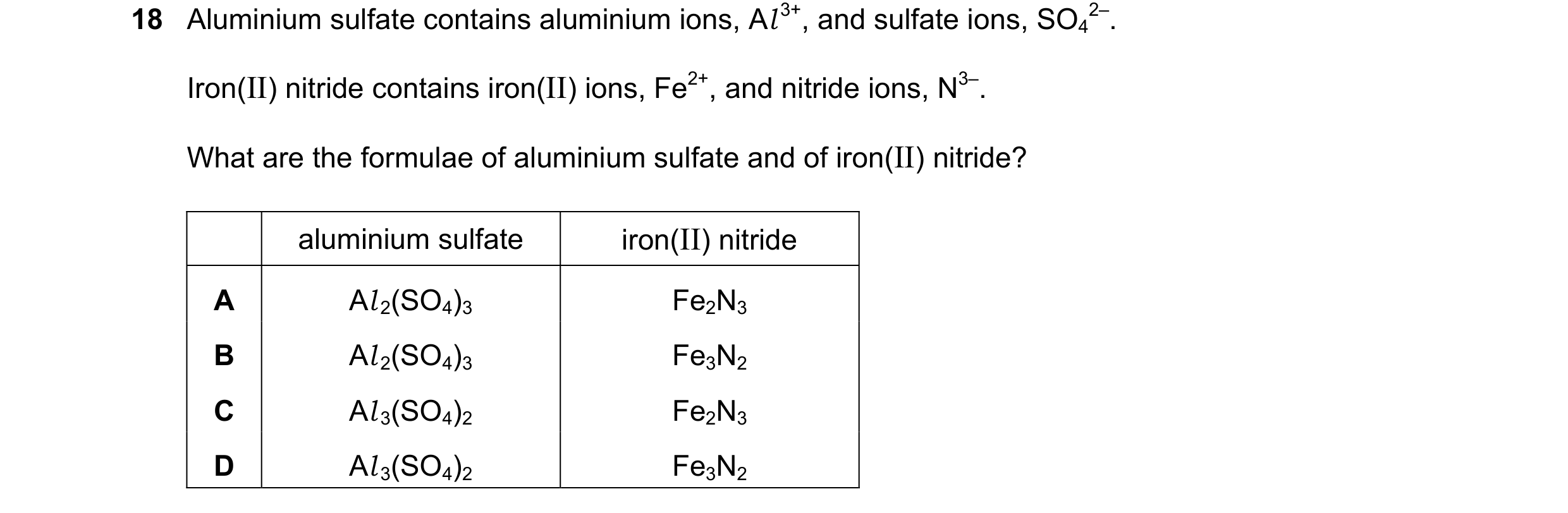
Q8 · Aluminium sulfate contains aluminium ions, Al 3+, and sulfate ions, SO4 2– 0653/21 Oct/Nov 2017
18 Aluminium sulfate contains aluminium ions, Al 3+, and sulfate ions, SO4 2–. Iron(II) nitride contains iron(II) ions, Fe2+, and nitride ions, N3–. What are the formulae of aluminium sulfate and of iron(II) nitride? aluminium sulfate iron(II) nitride A Al 2(SO4)3 Fe2N3 B Al 2(SO4)3 Fe3N2 C Al 3(SO4)2 Fe2N3 D Al 3(SO4)2 Fe3N2
1 marks
Answer: B
This question in 0653/21 Oct/Nov 2017
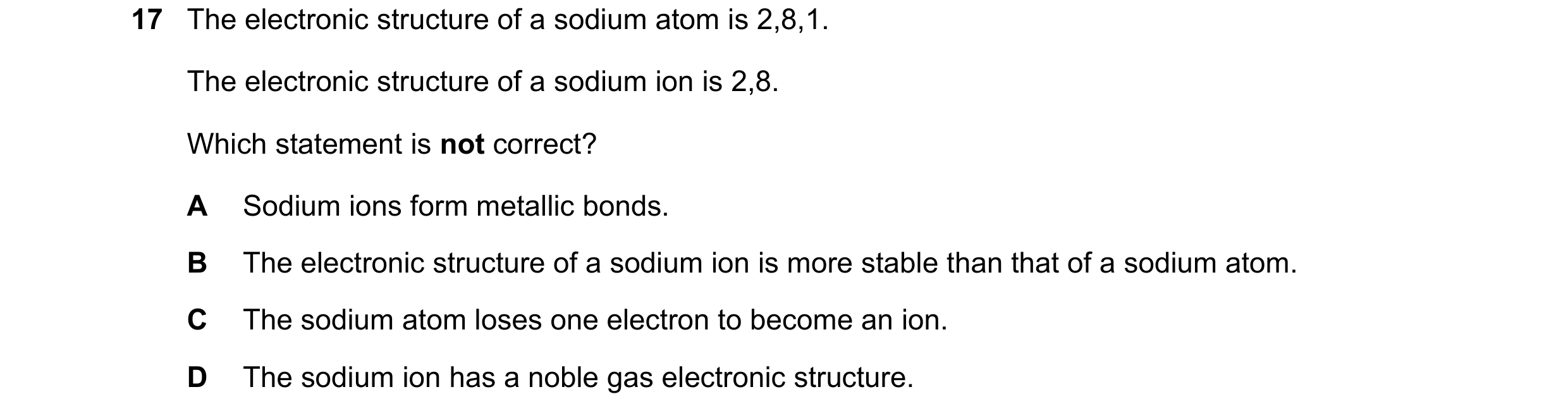
Q9 · The electronic structure of a sodium atom is 2,8,1 0653/22 Oct/Nov 2017
17 The electronic structure of a sodium atom is 2,8,1. The electronic structure of a sodium ion is 2,8. Which statement is not correct? A Sodium ions form metallic bonds. B The electronic structure of a sodium ion is more stable than that of a sodium atom. C The sodium atom loses one electron to become an ion. D The sodium ion has a noble gas electronic structure.
1 marks
Answer: A
This question in 0653/22 Oct/Nov 2017
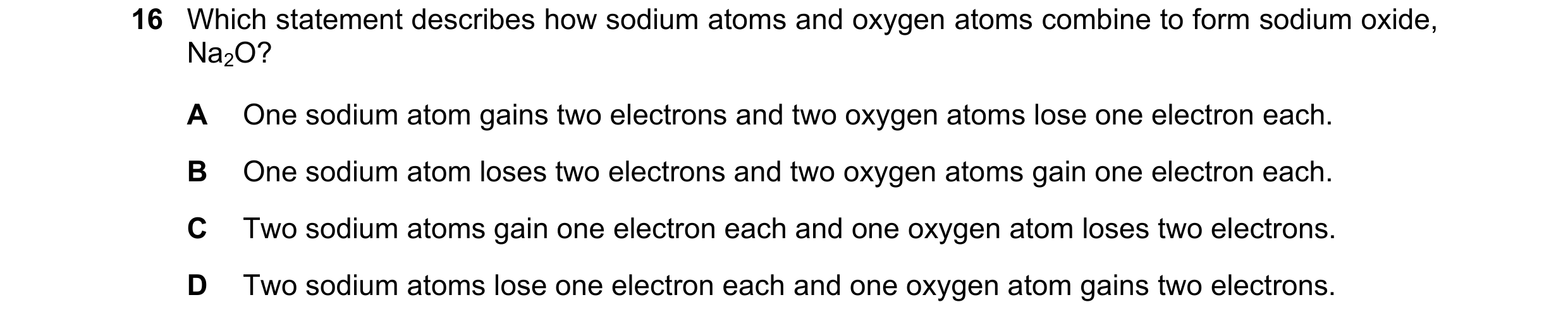
Q10 · Which statement describes how sodium atoms and oxygen atoms combine to form sodium oxide… 0653/23 Oct/Nov 2017
16 Which statement describes how sodium atoms and oxygen atoms combine to form sodium oxide, Na2O? A One sodium atom gains two electrons and two oxygen atoms lose one electron each. B One sodium atom loses two electrons and two oxygen atoms gain one electron each. C Two sodium atoms gain one electron each and one oxygen atom loses two electrons. D Two sodium atoms lose one electron each and one oxygen atom gains two electrons.
1 marks
Answer: D
This question in 0653/23 Oct/Nov 2017
Q11 · The formulae of some ions are shown 0653/23 Oct/Nov 2017
18 The formulae of some ions are shown. ● ammonium, NH4 + ● calcium, Ca2+ ● nitrate, NO3 – ● phosphate, PO4 3– What is the formula of calcium nitrate and of ammonium phosphate? calcium nitrate ammonium phosphate A Ca(NO3)2 NH4(PO4)3 B Ca(NO3)2 (NH4)3PO4 C Ca2NO3 NH4(PO4)3 D Ca2NO3 (NH4)3PO4
1 marks
Answer: B
This question in 0653/23 Oct/Nov 2017
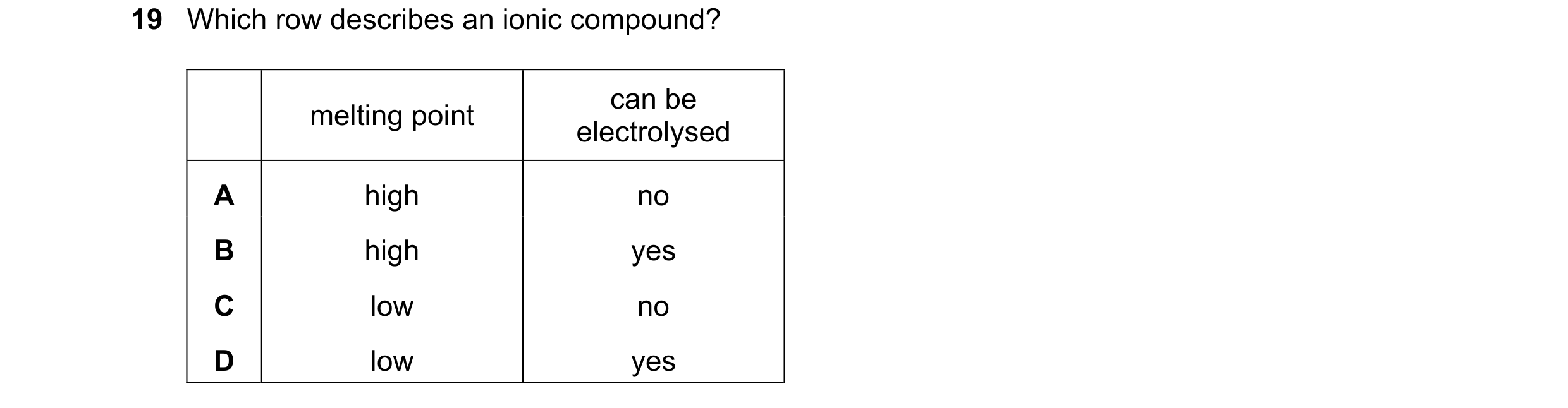
Q12 · Which row describes an ionic compound? 0653/23 Oct/Nov 2017
19 Which row describes an ionic compound? can be melting point electrolysed A high no B high yes C low no D low yes
1 marks
Answer: B
This question in 0653/23 Oct/Nov 2017
Q13 · Which statement about atoms and ions is not correct? 0653/22 Feb/March 2018
16 Which statement about atoms and ions is not correct? A A chlorine atom loses one electron to obtain a noble gas electronic structure. B A magnesium atom has two valency electrons. C A sodium ion, Na+, has eight electrons in its outer shell. D Oxygen atoms and oxide ions each have two occupied electron shells.
1 marks
Answer: A
This question in 0653/22 Feb/March 2018
Q14 · The formula of a sodium ion is Na+ 0653/21 May/June 2018
17 The formula of a sodium ion is Na+. The formula of an oxide ion is O2–. What is the formula of sodium oxide? A NaO B NaO2 C Na2O D Na2O3
1 marks
Answer: C
This question in 0653/21 May/June 2018
Q15 · An ion of element X has 8 protons, 8 neutrons and 10 electrons 0653/22 May/June 2018
17 An ion of element X has 8 protons, 8 neutrons and 10 electrons. An ion of element Y has 11 protons, 12 neutrons and 10 electrons. What is the formula of the ionic compound formed between X and Y? A XY B XY2 C X2Y D X2Y2
1 marks
Answer: B
This question in 0653/22 May/June 2018
Q16 · Part of the Periodic Table is shown 0653/22 May/June 2018
24 Part of the Periodic Table is shown. I II III IV V VI VII VIII V W X Which element forms an anion and which element forms a cation? forms an anion forms a cation A V W B V X C W V D X W
1 marks
Answer: C
This question in 0653/22 May/June 2018
Q17 · Chromium oxide contains chromium ions, Cr3+, and oxide ions, O2– 0653/23 May/June 2018
17 Chromium oxide contains chromium ions, Cr3+, and oxide ions, O2–. What is the formula of chromium oxide? A CrO B CrO2 C Cr2O3 D Cr3O2
1 marks
Answer: C
This question in 0653/23 May/June 2018
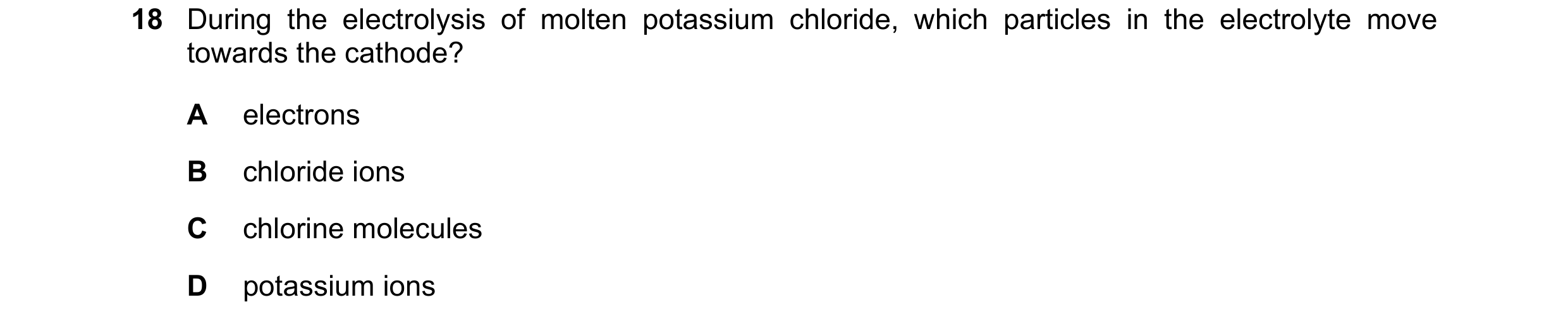
Q18 · During the electrolysis of molten potassium chloride, which particles in the electrolyte… 0653/23 Oct/Nov 2018
18 During the electrolysis of molten potassium chloride, which particles in the electrolyte move towards the cathode? A electrons B chloride ions C chlorine molecules D potassium ions
1 marks
Answer: D
This question in 0653/23 Oct/Nov 2018
Q19 · Which statement about the compound formed between a metal and a non-metal is correct? 0653/22 Feb/March 2019
16 Which statement about the compound formed between a metal and a non-metal is correct? A It forms strong bonds by sharing electrons. B It has strong bonds between its atoms. C It has strong bonds between metal ions and delocalised electrons. D It has strong bonds between oppositely charged ions.
1 marks
Answer: D
This question in 0653/22 Feb/March 2019
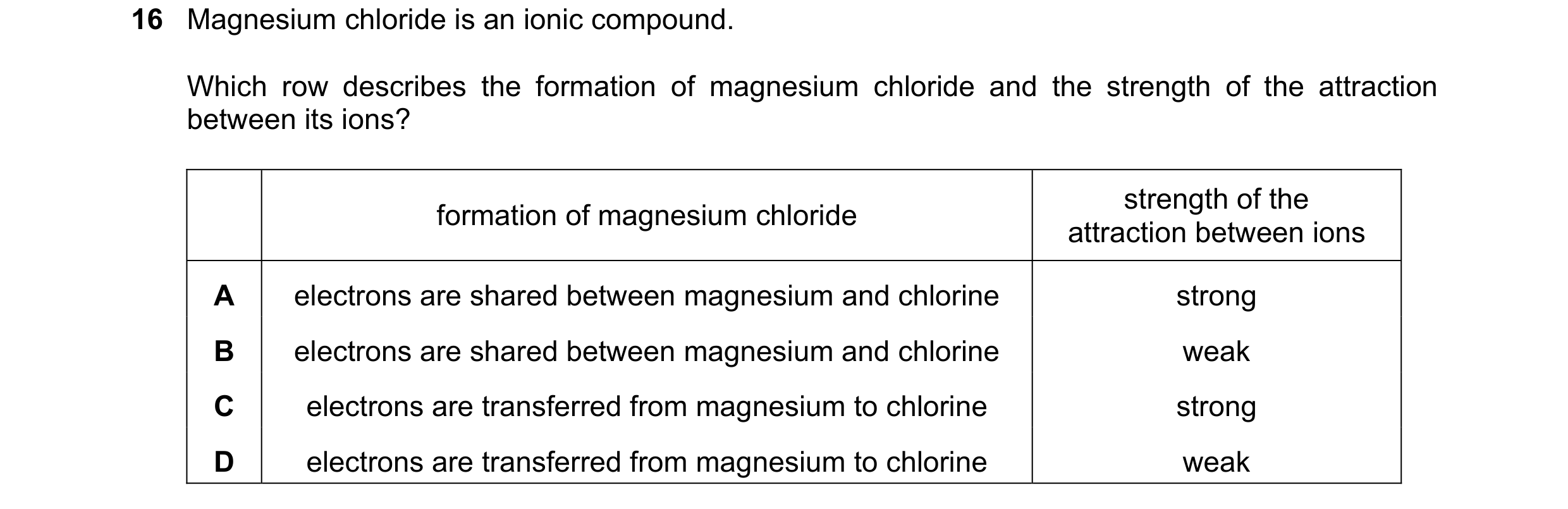
Q20 · Magnesium chloride is an ionic compound 0653/21 May/June 2019
16 Magnesium chloride is an ionic compound. Which row describes the formation of magnesium chloride and the strength of the attraction between its ions? strength of the formation of magnesium chloride attraction between ions A electrons are shared between magnesium and chlorine strong B electrons are shared between magnesium and chlorine weak C electrons are transferred from magnesium to chlorine strong D electrons are transferred from magnesium to chlorine weak
1 marks
Answer: C
This question in 0653/21 May/June 2019
Q21 · Which statement about sodium ions and chloride ions in sodium chloride is not correct? 0653/22 May/June 2019
17 Which statement about sodium ions and chloride ions in sodium chloride is not correct? A They are strongly attracted to each other. B They both have noble gas electronic structures. C They are arranged in a regular lattice. D They share pairs of electrons.
1 marks
Answer: D
This question in 0653/22 May/June 2019
Q22 · Which statement explains why sodium chloride has a much higher melting point than carbon… 0653/23 May/June 2019
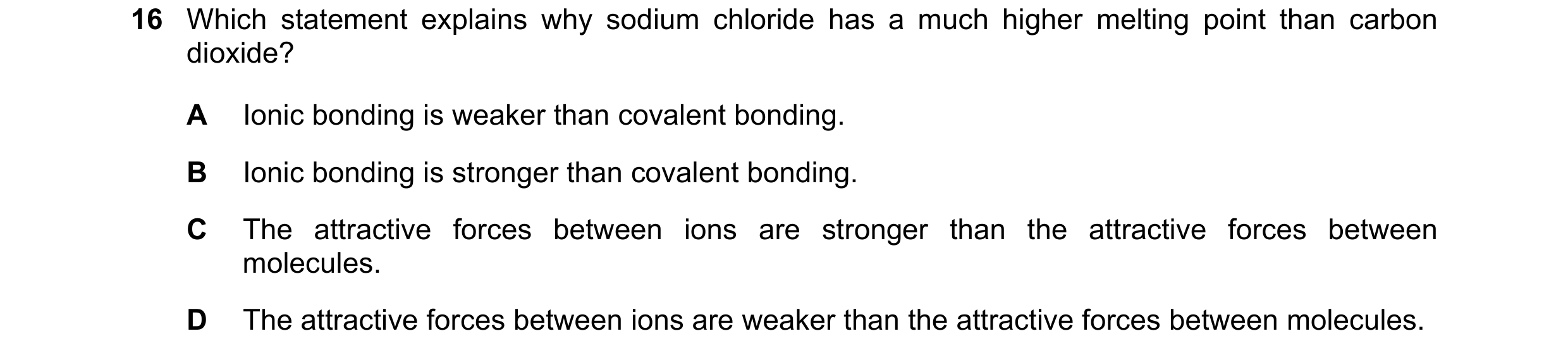
16 Which statement explains why sodium chloride has a much higher melting point than carbon dioxide? A Ionic bonding is weaker than covalent bonding. B Ionic bonding is stronger than covalent bonding. C The attractive forces between ions are stronger than the attractive forces between molecules. D The attractive forces between ions are weaker than the attractive forces between molecules.
1 marks
Answer: C
This question in 0653/23 May/June 2019
Q23 · Some information about a sodium ion is shown 0653/22 Feb/March 2020
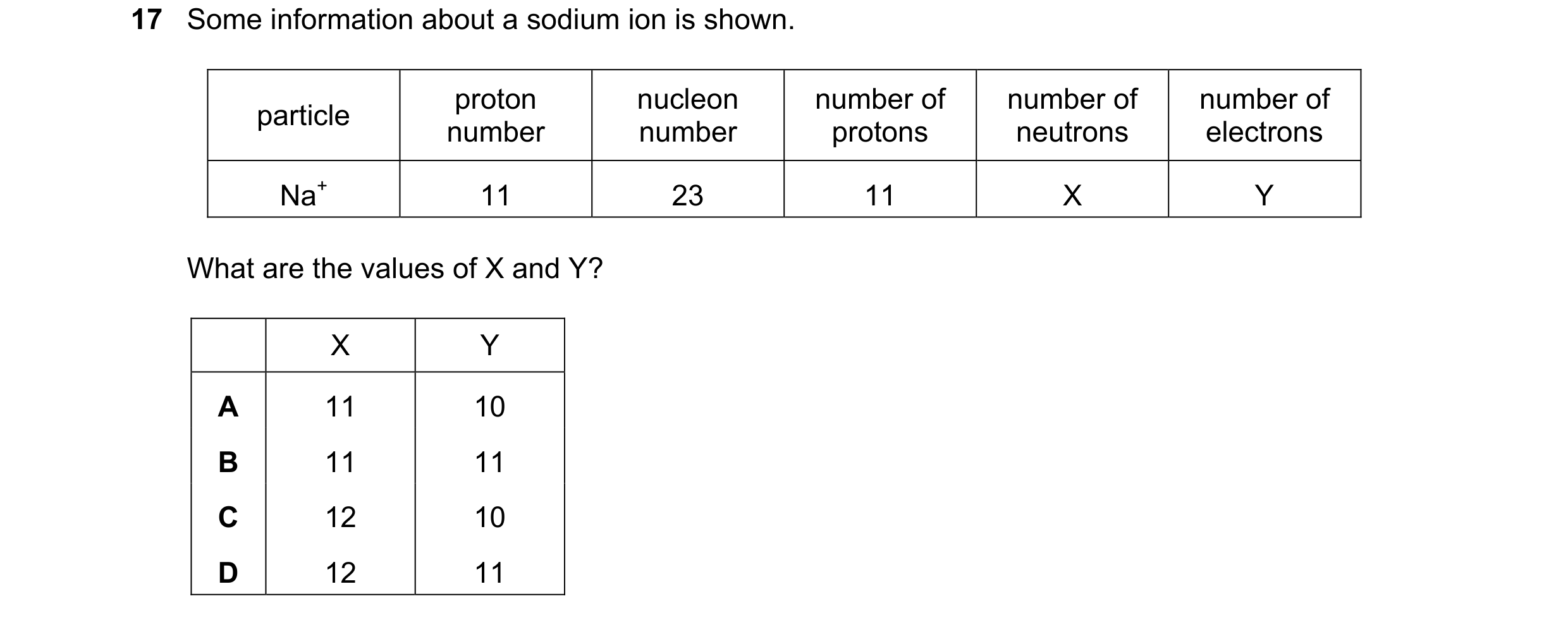
17 Some information about a sodium ion is shown. proton nucleon number of number of number of particle number number protons neutrons electrons Na+ 11 23 11 X Y What are the values of X and Y? X Y A 11 10 B 11 11 C 12 10 D 12 11
1 marks
Answer: C
This question in 0653/22 Feb/March 2020
Q24 · Which statement describes the structure of sodium chloride? 0653/22 Feb/March 2020
26 Which statement describes the structure of sodium chloride? A It is composed of a regular arrangement of alternating positive and negative ions. B It is composed of negatively charged sodium ions joined to positively charged chloride ions. C It is composed of oppositely charged ions held together by strong covalent bonds. D It is composed of sodium atoms joined to chlorine atoms by shared pairs of electrons.
1 marks
Answer: A
This question in 0653/22 Feb/March 2020
Q25 · Which ion is formed from a metal? 0653/21 May/June 2020
16 Which ion is formed from a metal? A Cl – B H+ C Na+ D NH4 +
1 marks
Answer: C
This question in 0653/21 May/June 2020
Q26 · A magnesium ion, Mg2+, is formed from a magnesium atom, Mg 0653/22 May/June 2020
16 A magnesium ion, Mg2+, is formed from a magnesium atom, Mg. Which row about the numbers of protons and neutrons in the magnesium ion and in the magnesium atom is correct? number of protons number of neutrons A larger in Mg2+ than in Mg same in Mg and Mg2+ B same in Mg and Mg2+ same in Mg and Mg2+ C same in Mg and Mg2+ smaller in Mg2+ than in Mg D smaller in Mg2+ than in Mg larger in Mg2+ than in Mg
1 marks
Answer: B
This question in 0653/22 May/June 2020
Q27 · Which statement about the formation of ions is correct? 0653/22 Oct/Nov 2020
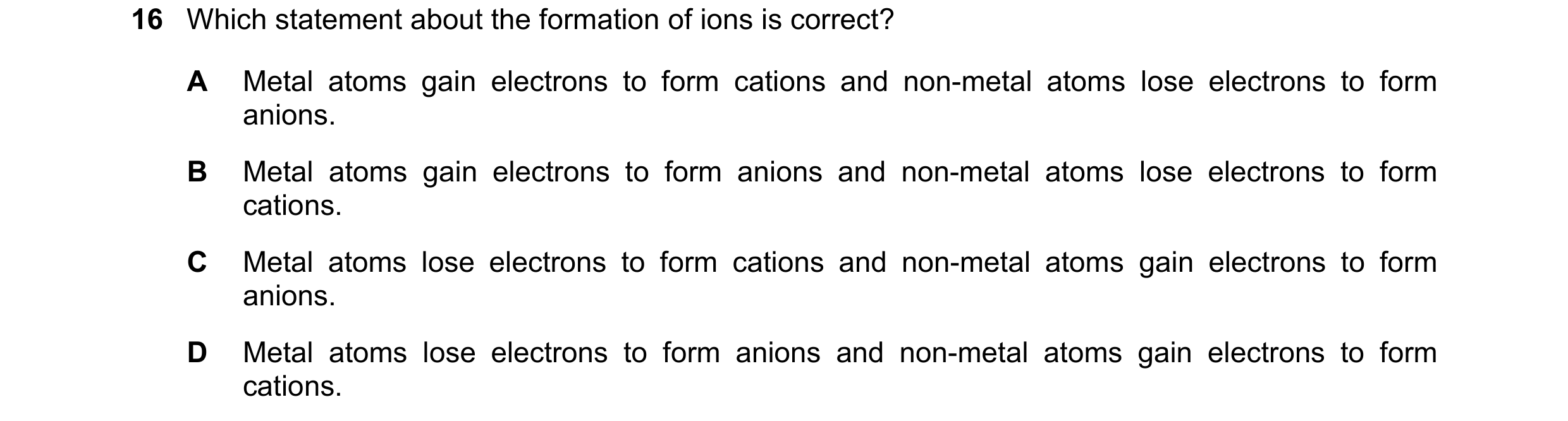
16 Which statement about the formation of ions is correct? A Metal atoms gain electrons to form cations and non-metal atoms lose electrons to form anions. B Metal atoms gain electrons to form anions and non-metal atoms lose electrons to form cations. C Metal atoms lose electrons to form cations and non-metal atoms gain electrons to form anions. D Metal atoms lose electrons to form anions and non-metal atoms gain electrons to form cations.
1 marks
Answer: C
This question in 0653/22 Oct/Nov 2020
Q28 · The formula of a magnesium ion is Mg2+ 0653/22 Oct/Nov 2020
17 The formula of a magnesium ion is Mg2+. The formula of a nitride ion is N3–. What is the formula of magnesium nitride? A MgN B Mg2N2 C Mg2N3 D Mg3N2
1 marks
Answer: D
This question in 0653/22 Oct/Nov 2020
Q29 · Potassium chloride is a solid 0653/22 Feb/March 2021
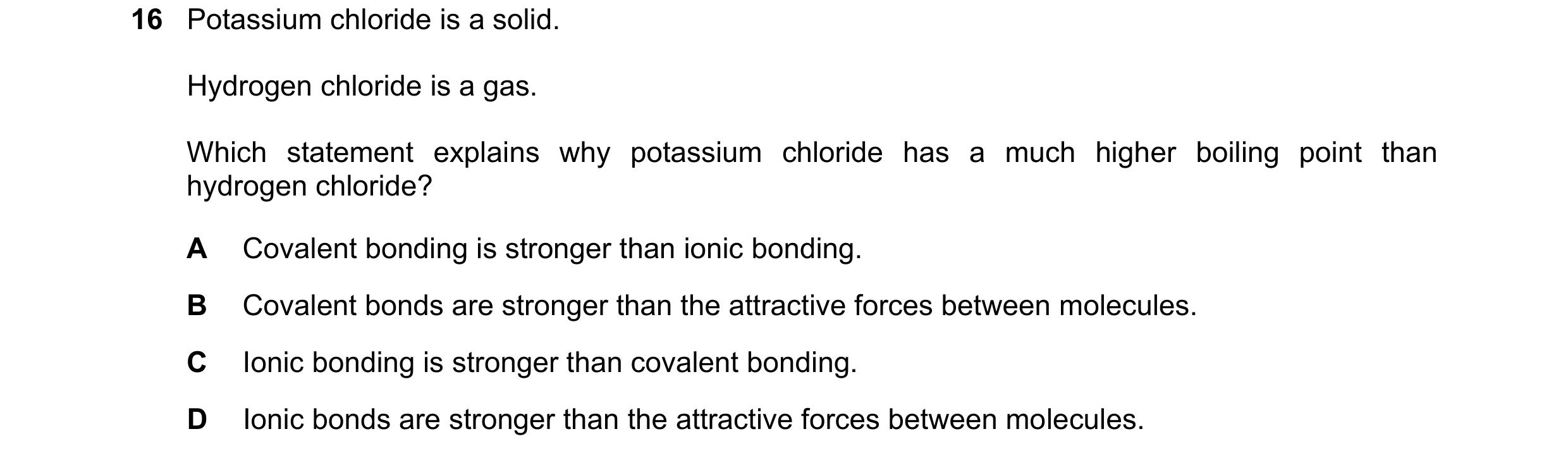
16 Potassium chloride is a solid. Hydrogen chloride is a gas. Which statement explains why potassium chloride has a much higher boiling point than hydrogen chloride? A Covalent bonding is stronger than ionic bonding. B Covalent bonds are stronger than the attractive forces between molecules. C Ionic bonding is stronger than covalent bonding. D Ionic bonds are stronger than the attractive forces between molecules.
1 marks
Answer: D
This question in 0653/22 Feb/March 2021
Q30 · Ammonium phosphate has the formula (NH4)3PO4 0653/22 Feb/March 2021
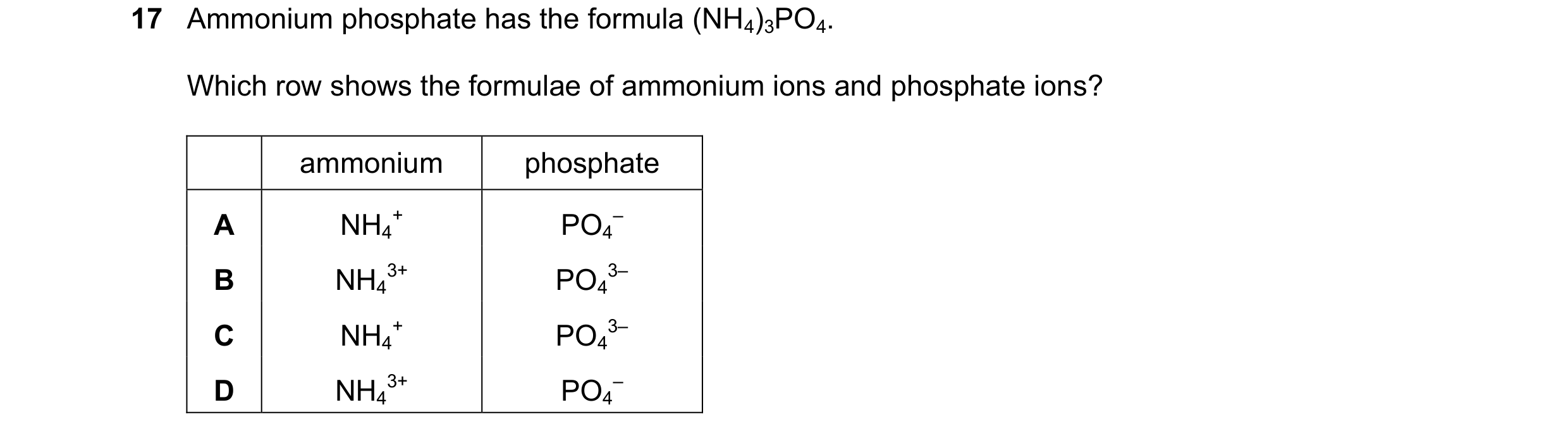
17 Ammonium phosphate has the formula (NH4)3PO4. Which row shows the formulae of ammonium ions and phosphate ions? ammonium phosphate A NH4 + PO4 – B NH4 3+ PO4 3– C NH4 + PO4 3– D NH4 3+ PO4 –
1 marks
Answer: C
This question in 0653/22 Feb/March 2021
Q31 · The symbols and charges of some ions are shown 0653/21 May/June 2021
17 The symbols and charges of some ions are shown. ● aluminium, Al 3+ ● phosphate, PO4 3– ● sodium, Na+ ● sulfate, SO4 2– What are the formulae of aluminium sulfate and sodium phosphate? aluminium sodium sulfate phosphate A Al 2(SO4)3 Na3PO4 B Al 2(SO4)3 Na(PO4)3 C Al 3(SO4)2 Na3PO4 D Al 3(SO4)2 Na(PO4)3
1 marks
Answer: A
This question in 0653/21 May/June 2021
Q32 · Which statement explains why ionic compounds have higher melting points than covalent… 0653/21 Oct/Nov 2021
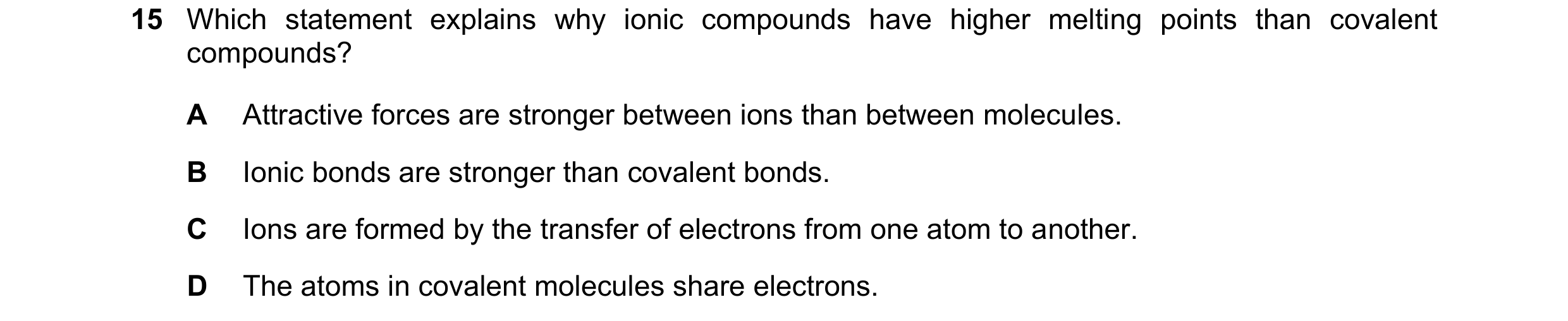
15 Which statement explains why ionic compounds have higher melting points than covalent compounds? A Attractive forces are stronger between ions than between molecules. B Ionic bonds are stronger than covalent bonds. C Ions are formed by the transfer of electrons from one atom to another. D The atoms in covalent molecules share electrons.
1 marks
Answer: A
This question in 0653/21 Oct/Nov 2021
Q33 · The formula of magnesium chloride is MgCl 2 0653/23 Oct/Nov 2021
15 The formula of magnesium chloride is MgCl 2. The formula of sodium phosphide is Na3P. What is the formula of magnesium phosphide? A MgP B MgP2 C Mg2P3 D Mg3P2
1 marks
Answer: D
This question in 0653/23 Oct/Nov 2021
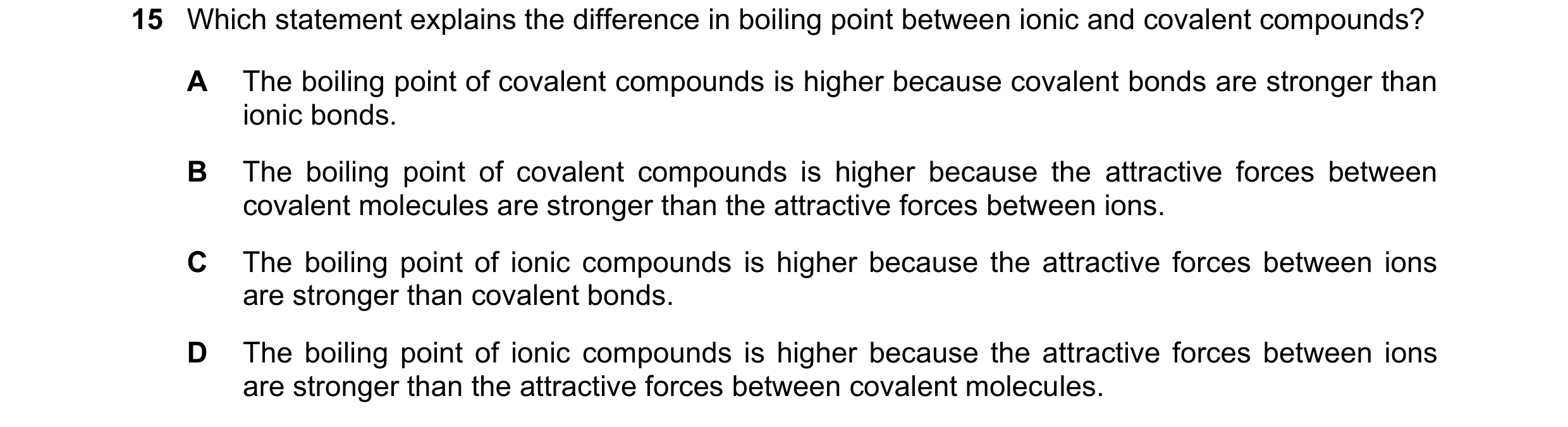
Q34 · Which statement explains the difference in boiling point between ionic and covalent… 0653/21 Oct/Nov 2022
15 Which statement explains the difference in boiling point between ionic and covalent compounds? A The boiling point of covalent compounds is higher because covalent bonds are stronger than ionic bonds. B The boiling point of covalent compounds is higher because the attractive forces between covalent molecules are stronger than the attractive forces between ions. C The boiling point of ionic compounds is higher because the attractive forces between ions are stronger than covalent bonds. D The boiling point of ionic compounds is higher because the attractive forces between ions are stronger than the attractive forces between covalent molecules.
1 marks
Answer: D
This question in 0653/21 Oct/Nov 2022
Q35 · Which row describes and explains the difference in melting points between ionic and… 0653/22 Oct/Nov 2022
15 Which row describes and explains the difference in melting points between ionic and covalent compounds? melting point reason A ionic compounds have ionic bonds are stronger higher melting points than covalent bonds B ionic compounds have attractive forces between ions are stronger higher melting points than attractive forces between molecules C ionic compounds have ionic bonds are weaker lower melting points than covalent bonds D ionic compounds have attractive forces between ions are weaker lower melting points than attractive forces between molecules
1 marks
Answer: B
This question in 0653/22 Oct/Nov 2022
Q36 · Potassium phosphate is an ionic compound used in fertilisers 0653/22 Oct/Nov 2022
16 Potassium phosphate is an ionic compound used in fertilisers. Phosphate ions have the symbol PO4 3–. What is the formula for potassium phosphate? A KPO4 B K(PO4)3 C K2PO4 D K3PO4
1 marks
Answer: D
This question in 0653/22 Oct/Nov 2022
Q37 · Which elements react together to give positive ions and negative ions that all have the… 0653/22 Feb/March 2023
15 Which elements react together to give positive ions and negative ions that all have the same electronic structure as argon? A calcium and chlorine B calcium and fluorine C magnesium and chlorine D magnesium and fluorine
1 marks
Answer: A
This question in 0653/22 Feb/March 2023
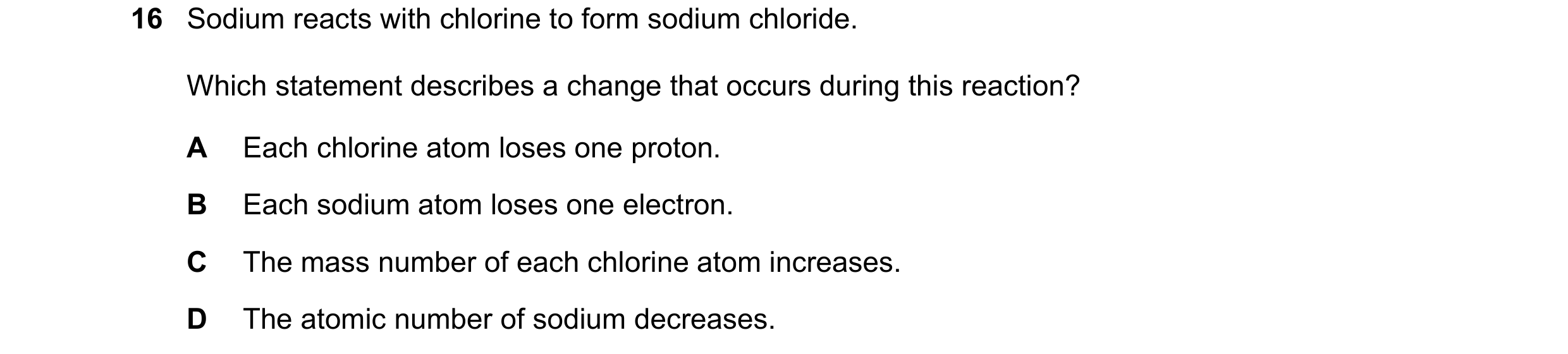
Q38 · Sodium reacts with chlorine to form sodium chloride 0653/21 May/June 2023
16 Sodium reacts with chlorine to form sodium chloride. Which statement describes a change that occurs during this reaction? A Each chlorine atom loses one proton. B Each sodium atom loses one electron. C The mass number of each chlorine atom increases. D The atomic number of sodium decreases.
1 marks
Answer: B
This question in 0653/21 May/June 2023
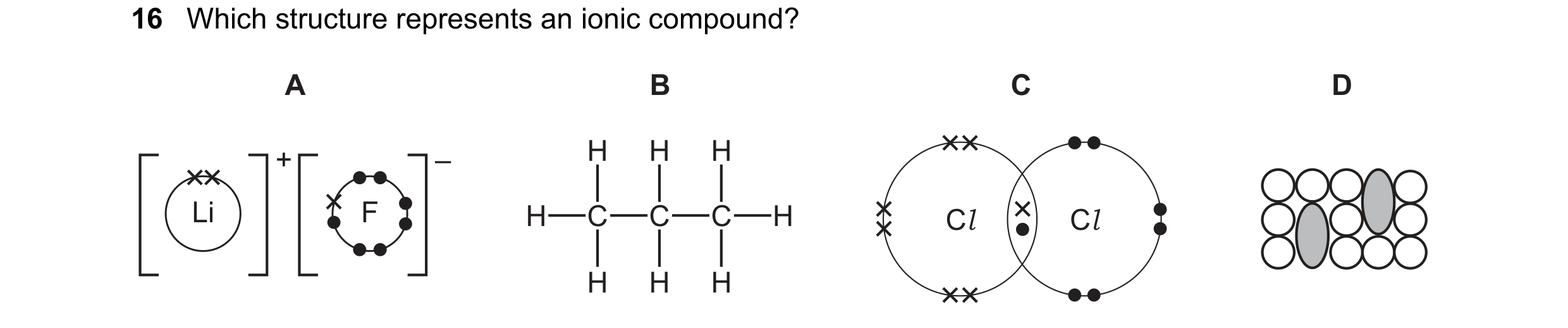
Q39 · Which structure represents an ionic compound? 0653/22 May/June 2023
16 Which structure represents an ionic compound? A B C D + – H H H Li F H C C C H Cl Cl H H H
1 marks
Answer: A
This question in 0653/22 May/June 2023
Q40 · Which dot-and-cross diagram represents lithium fluoride, LiF? 0653/23 May/June 2023
16 Which dot-and-cross diagram represents lithium fluoride, LiF? A B + – Li F Li F C D + – Li F Li F
1 marks
Answer: B
This question in 0653/23 May/June 2023
Q41 · Iron(III) sulfate contains Fe3+ ions and SO4 2– ions 0653/21 Oct/Nov 2023
17 Iron(III) sulfate contains Fe3+ ions and SO4 2– ions. What is the formula of iron(III) sulfate? A FeSO4 B Fe3SO4 C Fe2(SO4)3 D Fe3(SO4)2
1 marks
Answer: C
This question in 0653/21 Oct/Nov 2023
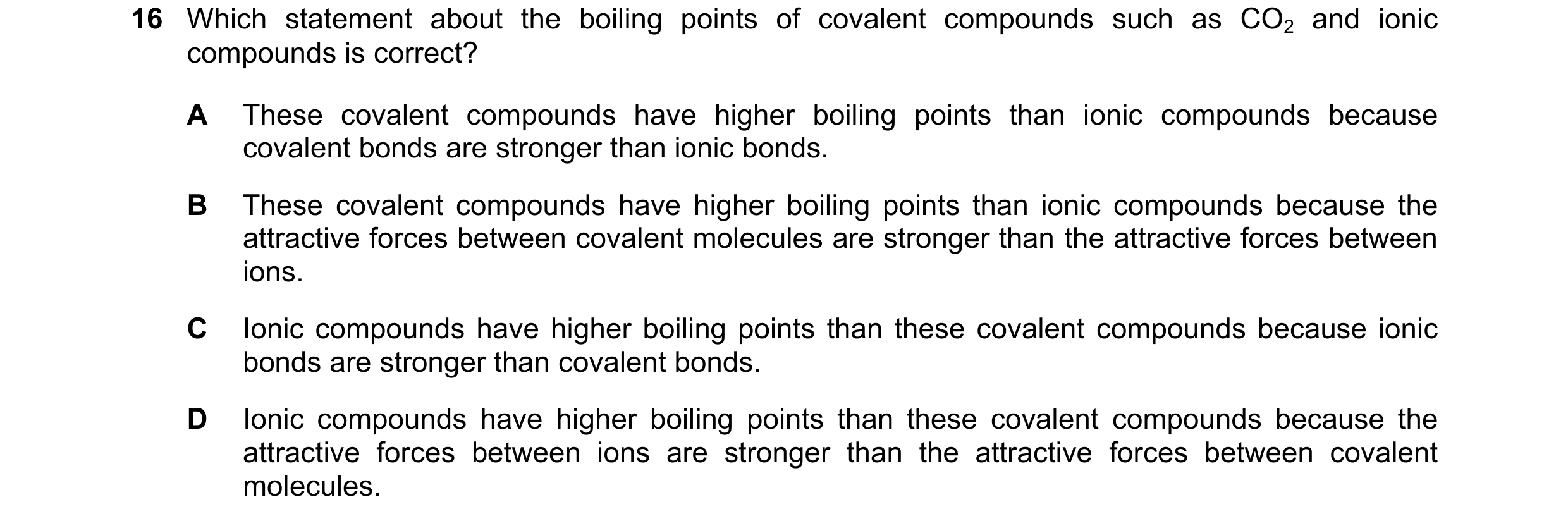
Q42 · Which statement about the boiling points of covalent compounds such as CO2 and ionic… 0653/22 Oct/Nov 2023
16 Which statement about the boiling points of covalent compounds such as CO2 and ionic compounds is correct? A These covalent compounds have higher boiling points than ionic compounds because covalent bonds are stronger than ionic bonds. B These covalent compounds have higher boiling points than ionic compounds because the attractive forces between covalent molecules are stronger than the attractive forces between ions. C Ionic compounds have higher boiling points than these covalent compounds because ionic bonds are stronger than covalent bonds. D Ionic compounds have higher boiling points than these covalent compounds because the attractive forces between ions are stronger than the attractive forces between covalent molecules.
1 marks
Answer: D
This question in 0653/22 Oct/Nov 2023
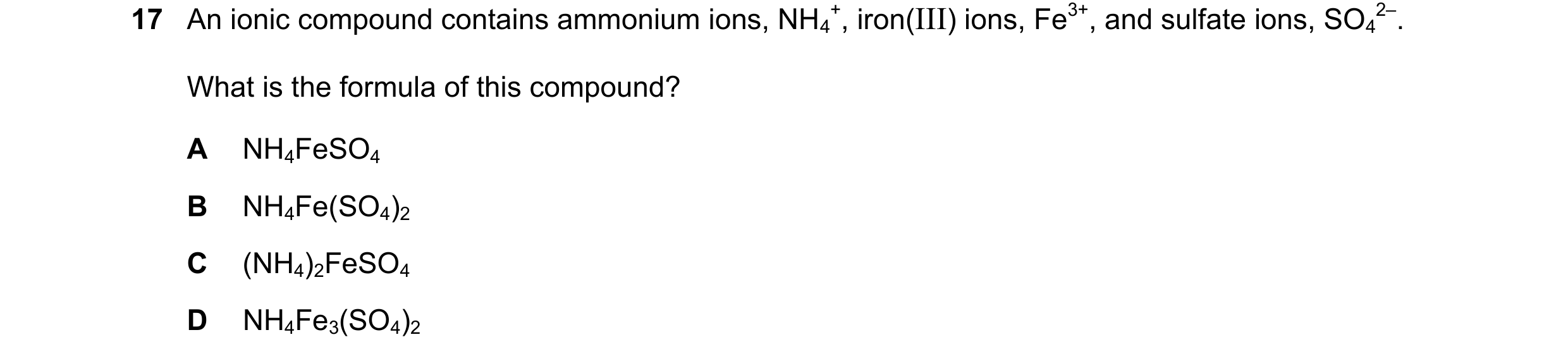
Q43 · An ionic compound contains ammonium ions, NH4 +, iron(III) ions, Fe3+, and sulfate ions… 0653/22 Oct/Nov 2023
17 An ionic compound contains ammonium ions, NH4 +, iron(III) ions, Fe3+, and sulfate ions, SO4 2–. What is the formula of this compound? A NH4FeSO4 B NH4Fe(SO4)2 C (NH4)2FeSO4 D NH4Fe3(SO4)2
1 marks
Answer: B
This question in 0653/22 Oct/Nov 2023
Q44 · Which statement about the melting points of aluminium oxide, Al 2O3, and methanol, CH3OH… 0653/23 Oct/Nov 2023
16 Which statement about the melting points of aluminium oxide, Al 2O3, and methanol, CH3OH, is correct? A Aluminium oxide has a higher melting point than methanol because ionic bonding is stronger than covalent bonding. B Aluminium oxide has a higher melting point than methanol because the attraction between ions is stronger than the attraction between molecules. C Methanol has a higher melting point than aluminium oxide because covalent bonding is stronger than ionic bonding. D Methanol has a higher melting point than aluminium oxide because the attraction between molecules is stronger than the attraction between ions.
1 marks
Answer: B
This question in 0653/23 Oct/Nov 2023
Q45 · Which statement about the structure of solid sodium chloride is correct? 0653/22 Feb/March 2024
16 Which statement about the structure of solid sodium chloride is correct? A It contains chloride ions formed when chlorine atoms lose electrons. B It contains metallic atoms sharing electrons with non-metallic atoms. C Opposite electrical charges result in the formation of a giant ionic lattice. D There is strong electrostatic attraction between sodium atoms and chlorine atoms.
1 marks
Answer: C
This question in 0653/22 Feb/March 2024
Q46 · An ionic compound contains the ions NH4 + and S2O3 2– 0653/22 Feb/March 2024
17 An ionic compound contains the ions NH4 + and S2O3 2–. What is the formula of this compound? A NH4S2O3 B NH4(S2O3)2 C (NH4)2S2O3 D 2NH4S2O3
1 marks
Answer: C
This question in 0653/22 Feb/March 2024
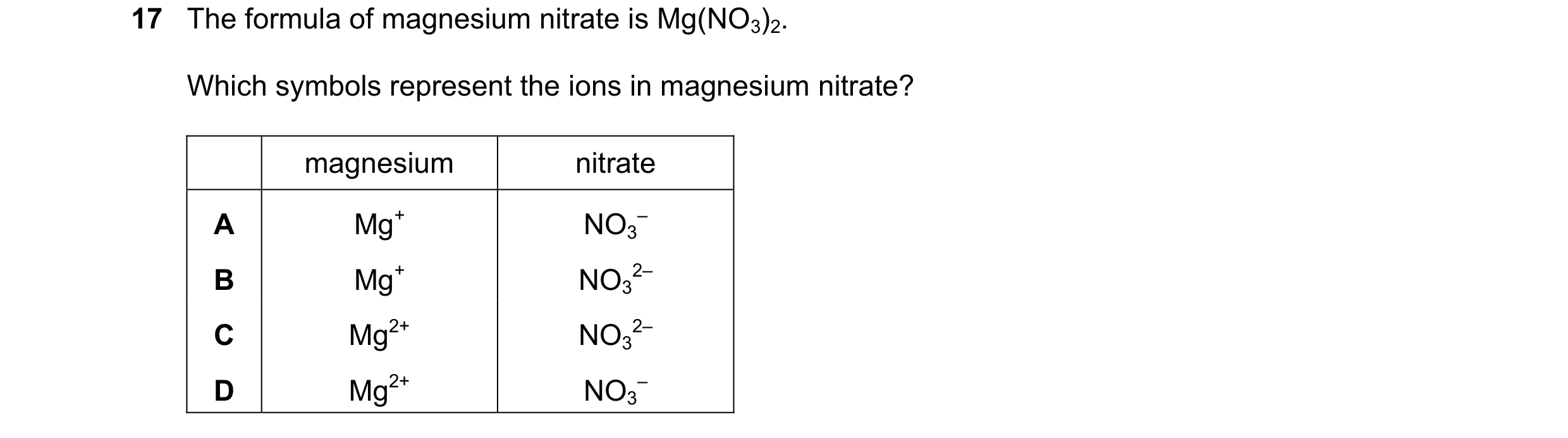
Q47 · The formula of magnesium nitrate is Mg(NO3)2 0653/21 May/June 2024
17 The formula of magnesium nitrate is Mg(NO3)2. Which symbols represent the ions in magnesium nitrate? magnesium nitrate A Mg+ NO3 – B Mg+ NO3 2– C Mg2+ NO3 2– D Mg2+ NO3 –
1 marks
Answer: D
This question in 0653/21 May/June 2024
Q48 · Which statement describes the formation of ions when two different atoms combine? 0653/22 May/June 2024
16 Which statement describes the formation of ions when two different atoms combine? A The two atoms share a pair of electrons. B Both atoms lose electrons. C Both atoms gain electrons. D One atom gains electrons and one loses electrons.
1 marks
Answer: D
This question in 0653/22 May/June 2024
Q49 · Magnesium chloride is an ionic compound 0653/21 Oct/Nov 2024
16 Magnesium chloride is an ionic compound. Which row describes the formation of magnesium chloride and the strength of the attraction between its ions? strength of the formation of magnesium chloride attraction between ions A Electrons are shared between magnesium and chlorine. strong B Electrons are shared between magnesium and chlorine. weak C Electrons are transferred from magnesium to chlorine. strong D Electrons are transferred from magnesium to chlorine. weak
1 marks
Answer: C
This question in 0653/21 Oct/Nov 2024
Q50 · Which statement about sodium ions and chloride ions in sodium chloride is not correct? 0653/22 Feb/March 2025
16 Which statement about sodium ions and chloride ions in sodium chloride is not correct? A They are strongly attracted to each other. B They both have noble gas electronic configurations. C They are arranged in a regular lattice. D They share pairs of electrons.
1 marks
Answer: D
This question in 0653/22 Feb/March 2025
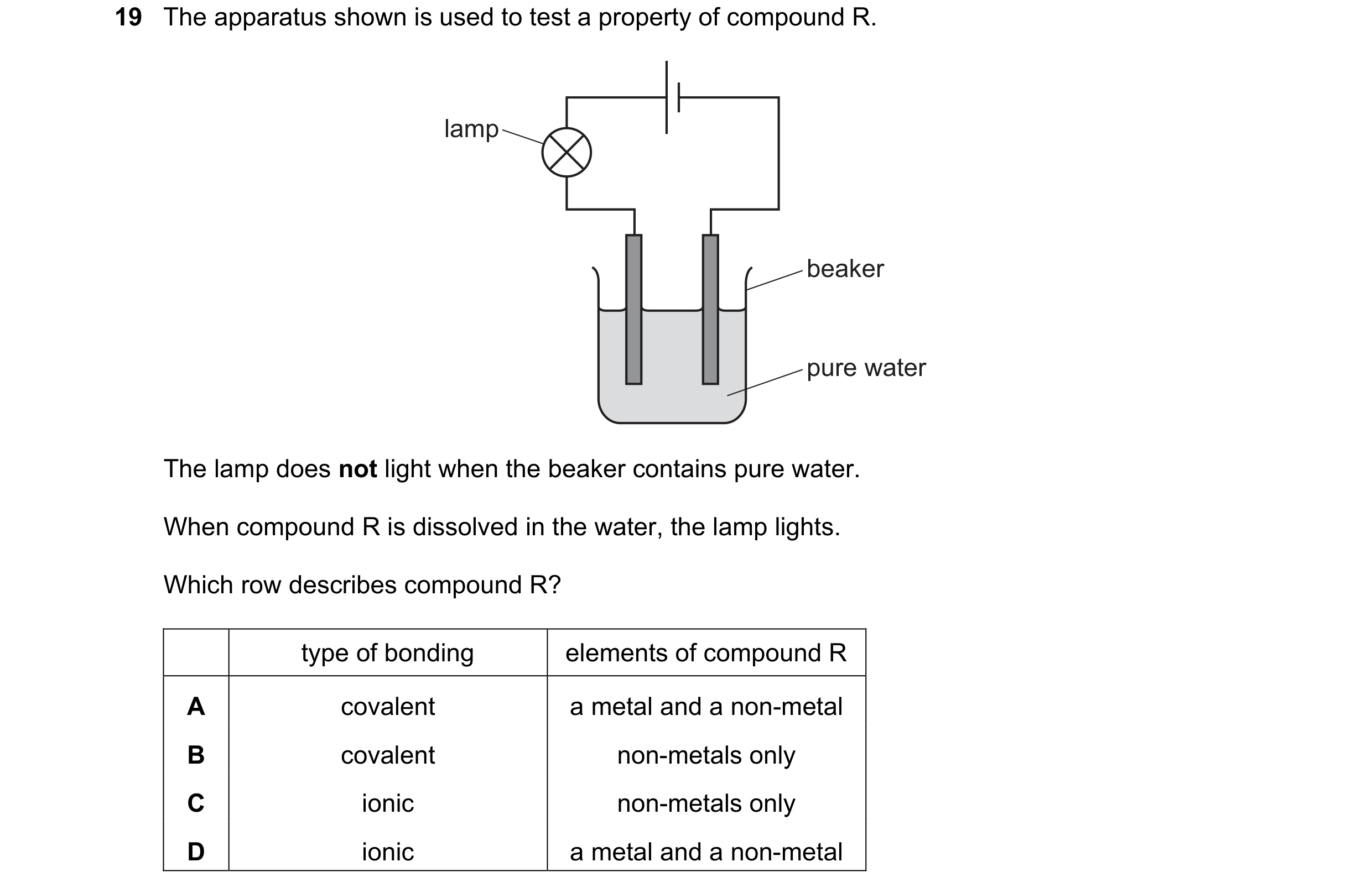
Q51 · The apparatus shown is used to test a property of compound R 0653/22 Feb/March 2025
19 The apparatus shown is used to test a property of compound R. lamp beaker pure water The lamp does not light when the beaker contains pure water. When compound R is dissolved in the water, the lamp lights. Which row describes compound R? type of bonding elements of compound R A covalent a metal and a non-metal B covalent non-metals only C ionic non-metals only D ionic a metal and a non-metal
1 marks
Answer: D
This question in 0653/22 Feb/March 2025
Q52 · Which statement describes the formation of ions? 0653/21 May/June 2025
17 Which statement describes the formation of ions? A Metal atoms gain electrons to form cations and non-metal atoms lose electrons to form anions. B Metal atoms gain electrons to form anions and non-metal atoms lose electrons to form cations. C Metal atoms lose electrons to form cations and non-metal atoms gain electrons to form anions. D Metal atoms lose electrons to form anions and non-metal atoms gain electrons to form cations.
1 marks
Answer: C
This question in 0653/21 May/June 2025
Q53 · Which statement about ions is correct? 0653/23 May/June 2025
15 Which statement about ions is correct? A Atoms lose or gain electrons to form ions. B Ions are held together by strong attraction between negative ions. C Ions form when atoms share electrons. D Metal ions are attracted to each other.
1 marks
Answer: A
This question in 0653/23 May/June 2025
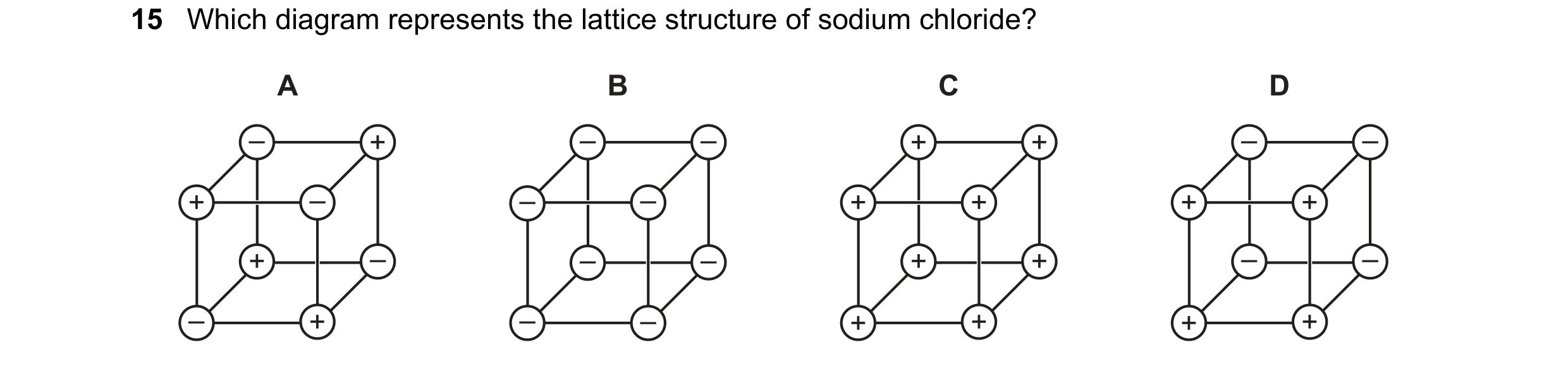
Q54 · Which diagram represents the lattice structure of sodium chloride? 0653/22 Oct/Nov 2025
15 Which diagram represents the lattice structure of sodium chloride? A B C D – + – – + + – – + – – – + + + + + – – – + + – – – + – – + + + +
1 marks
Answer: A
This question in 0653/22 Oct/Nov 2025
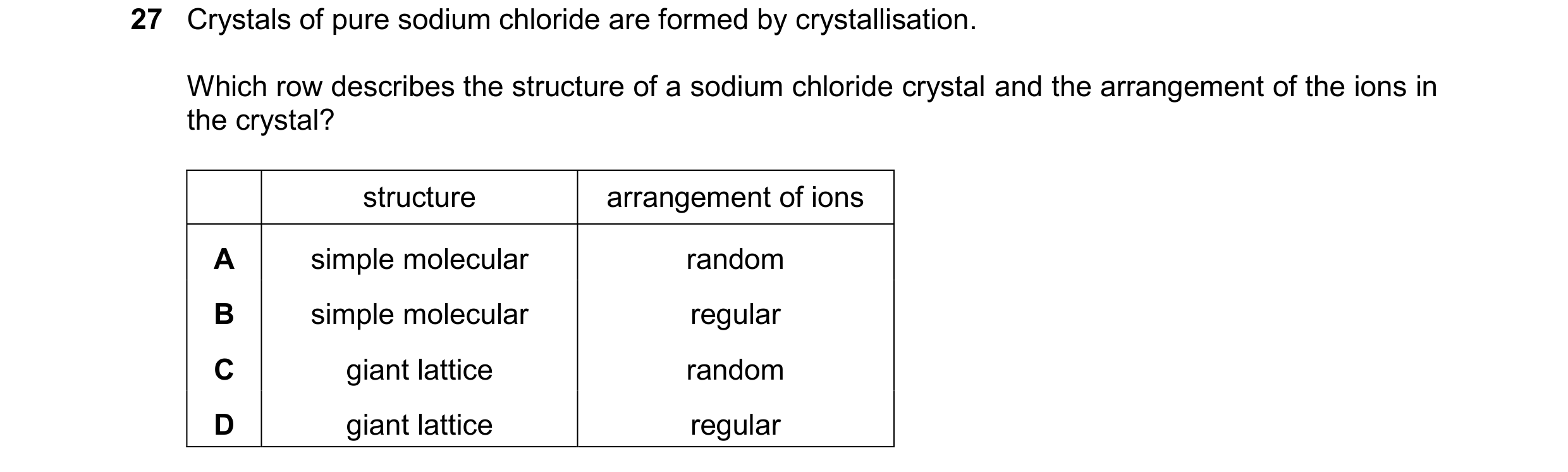
Q55 · Crystals of pure sodium chloride are formed by crystallisation 0653/23 Oct/Nov 2025
27 Crystals of pure sodium chloride are formed by crystallisation. Which row describes the structure of a sodium chloride crystal and the arrangement of the ions in the crystal? structure arrangement of ions A simple molecular random B simple molecular regular C giant lattice random D giant lattice regular
1 marks
Answer: D
This question in 0653/23 Oct/Nov 2025



 1 / 12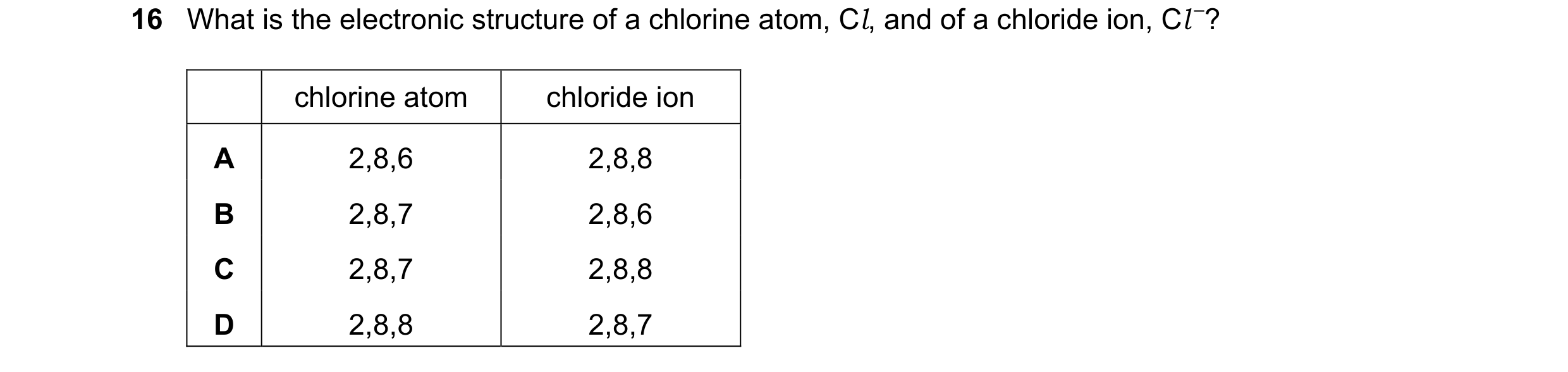
 2 / 12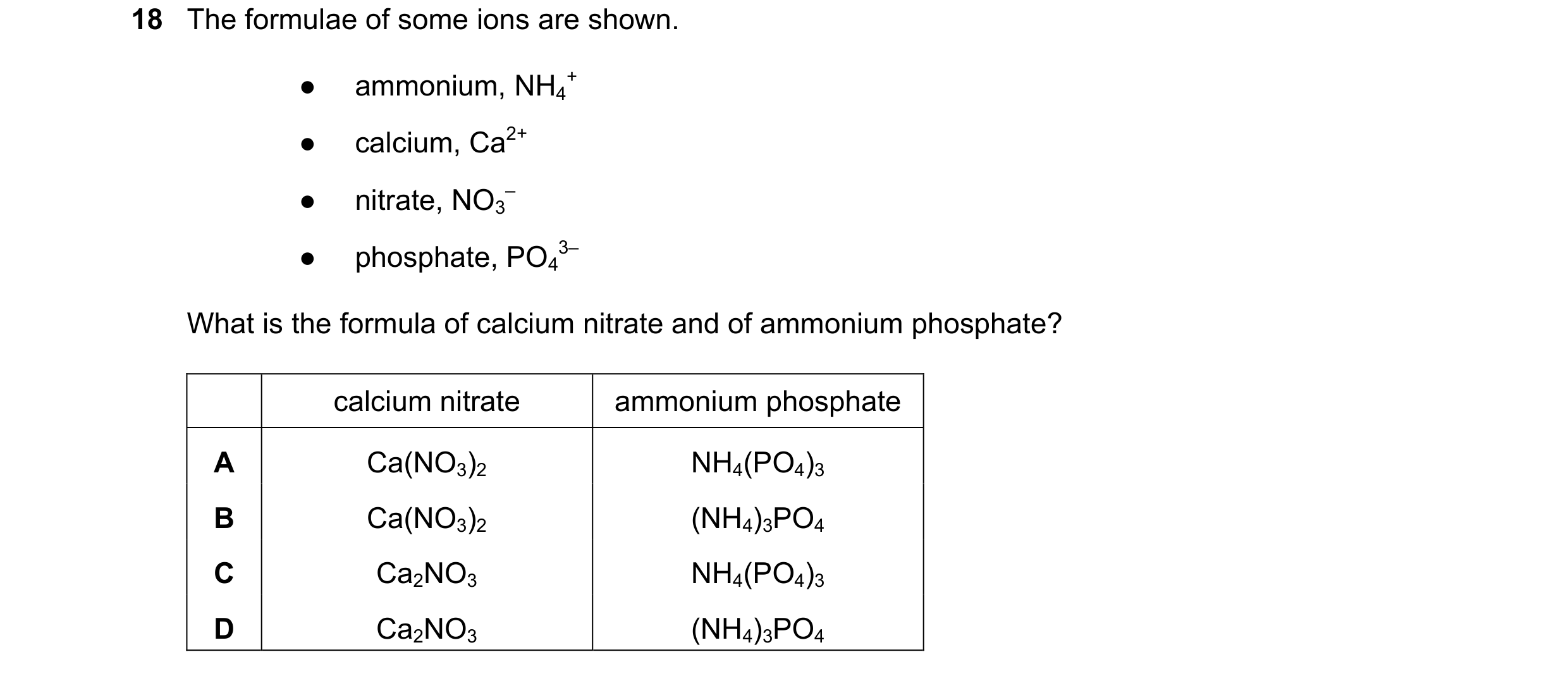


 3 / 12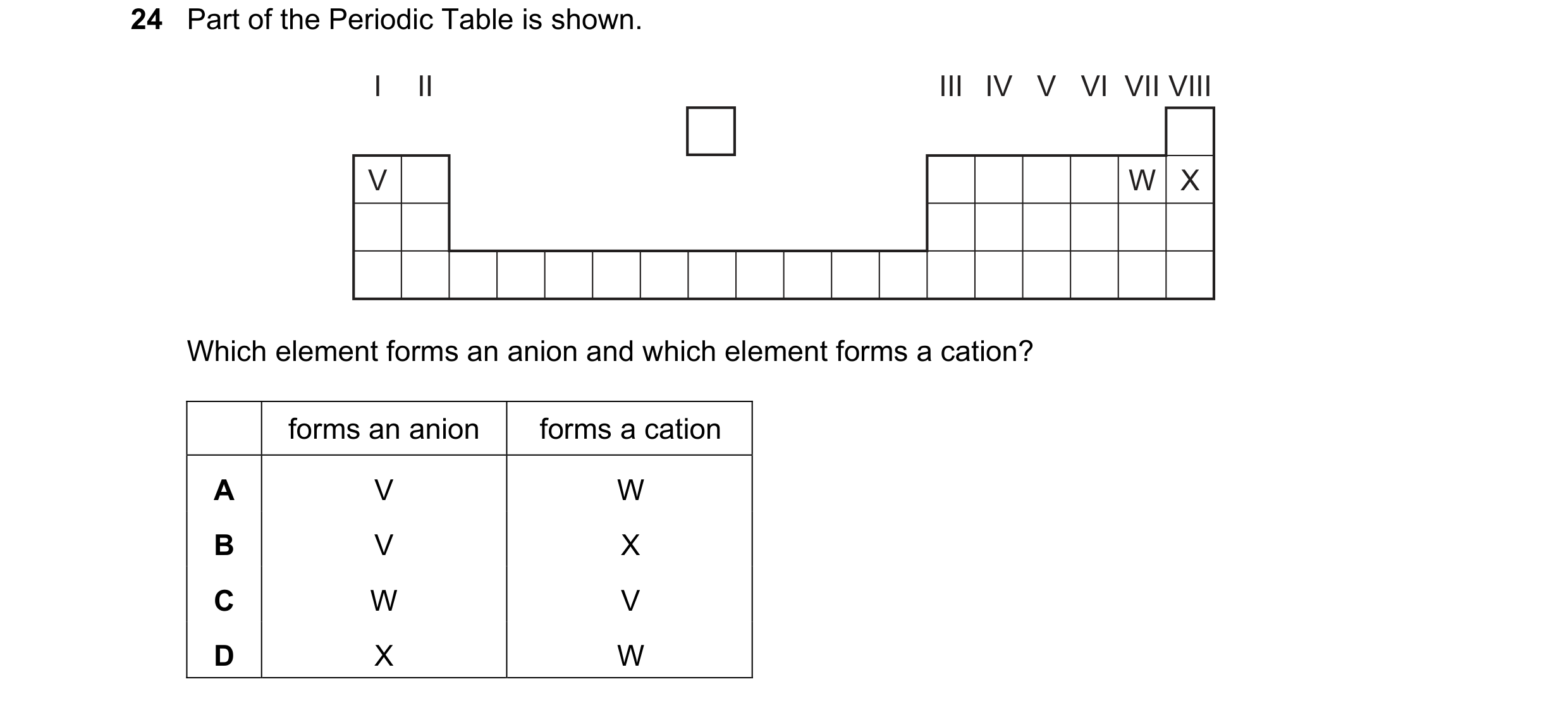


 4 / 12

 5 / 12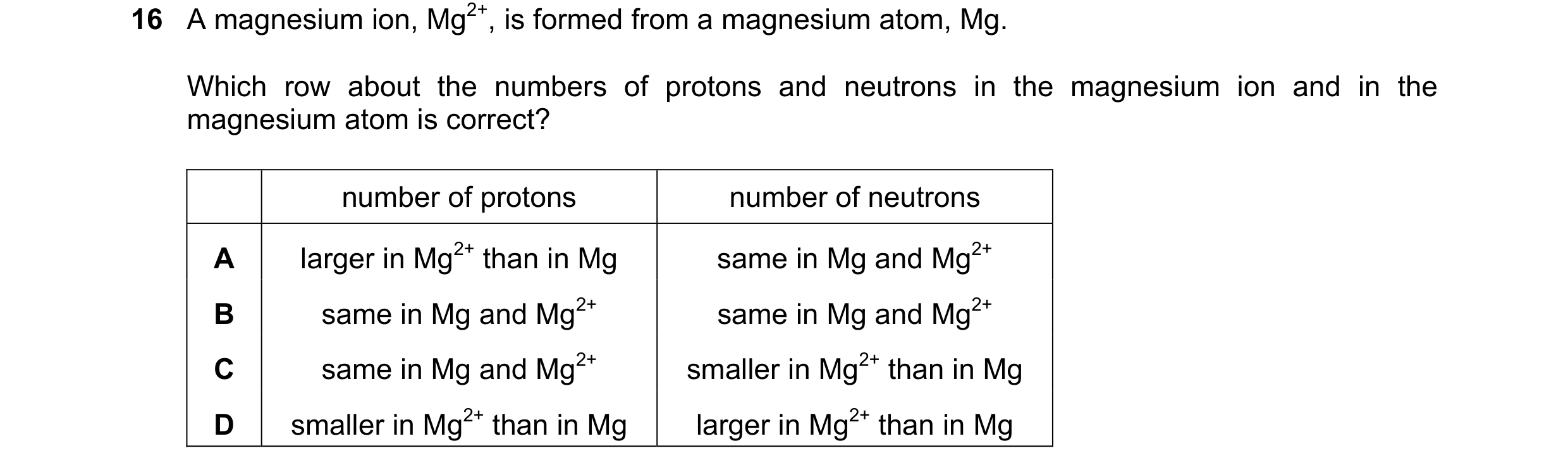

 6 / 12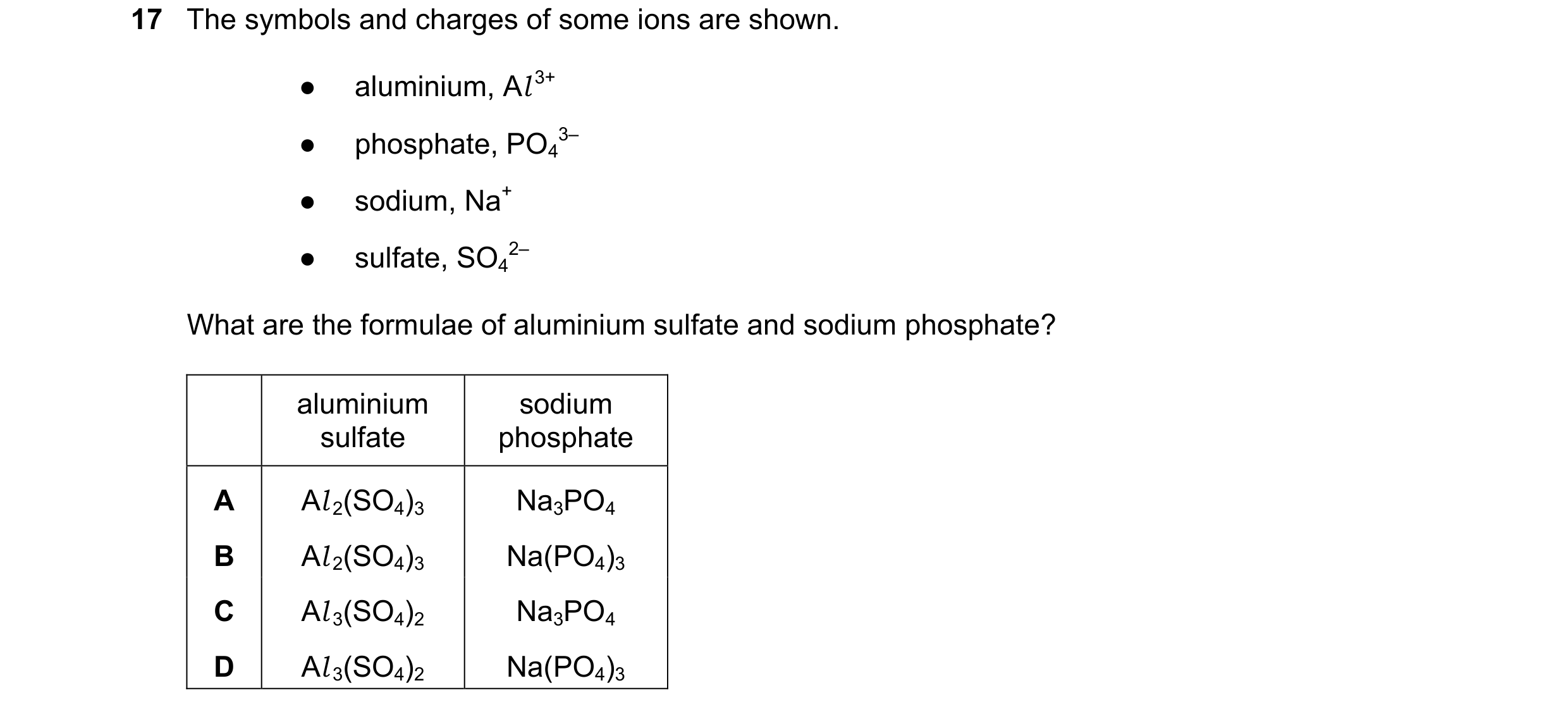

 7 / 12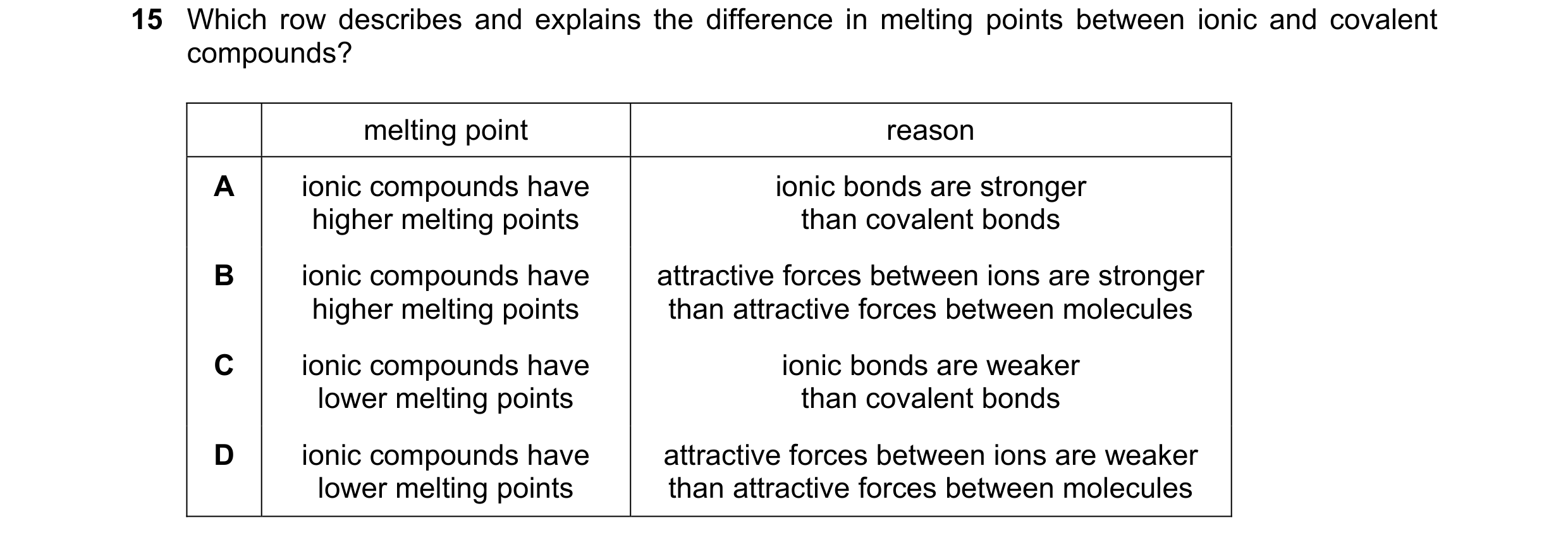

 8 / 12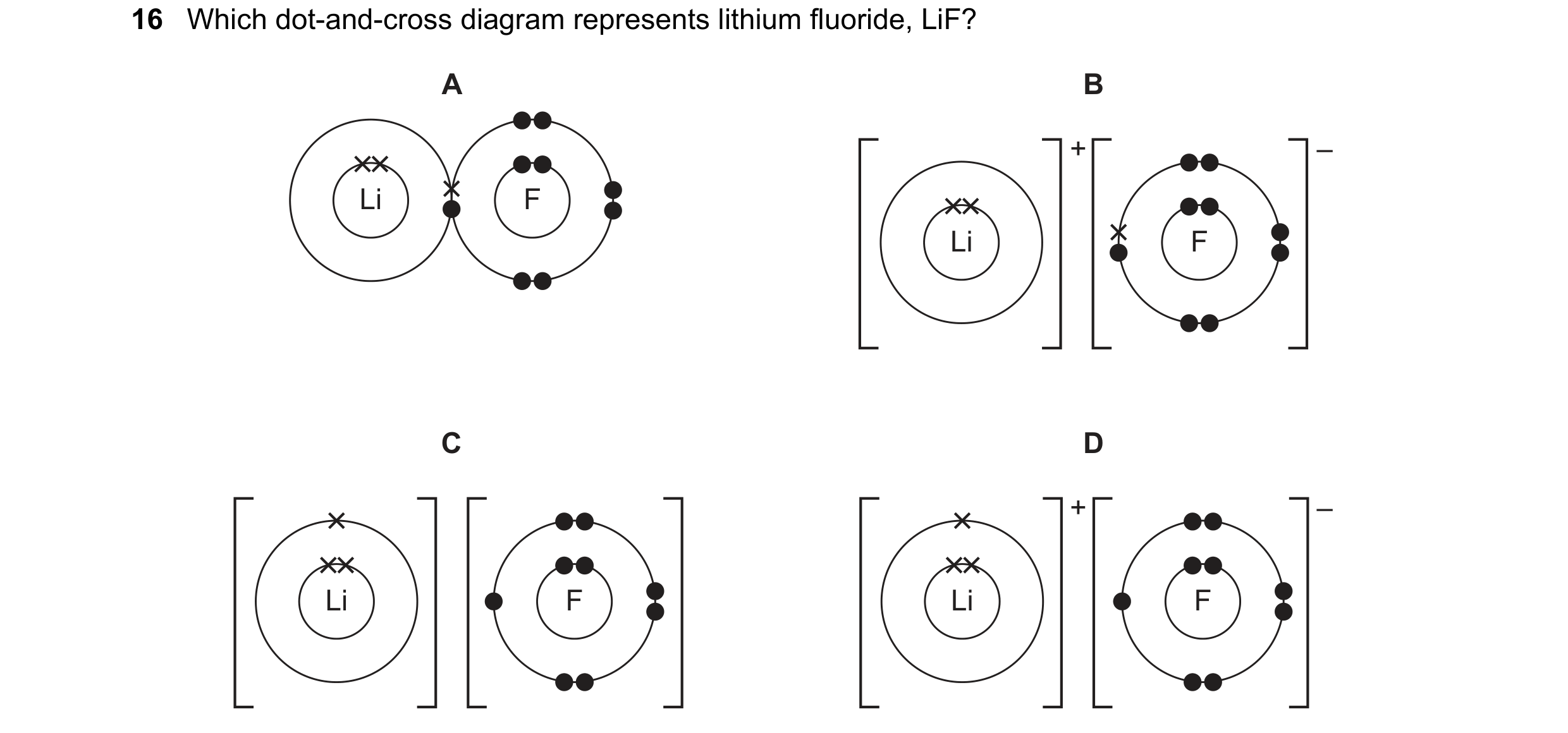

 9 / 12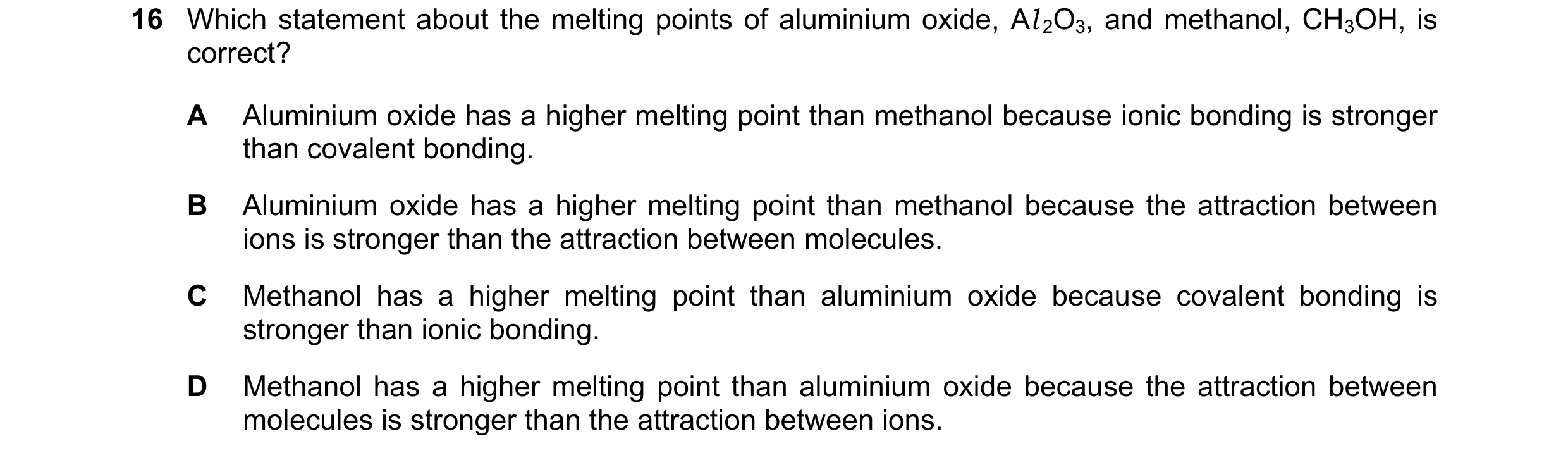


 10 / 12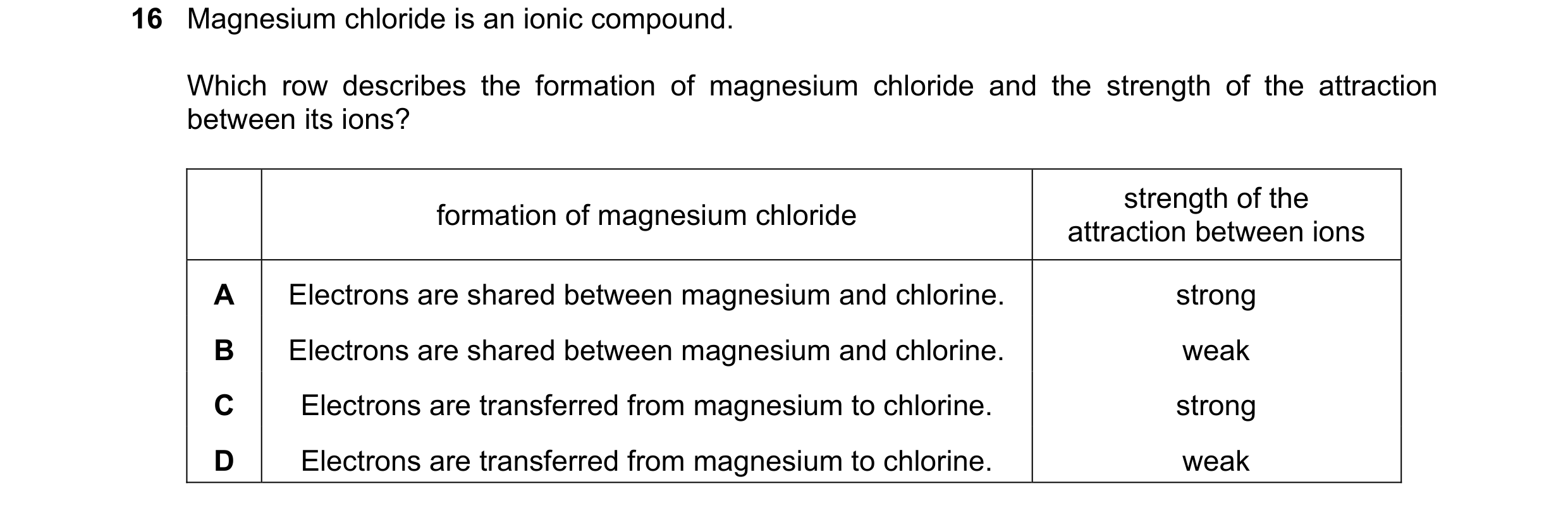

 11 / 12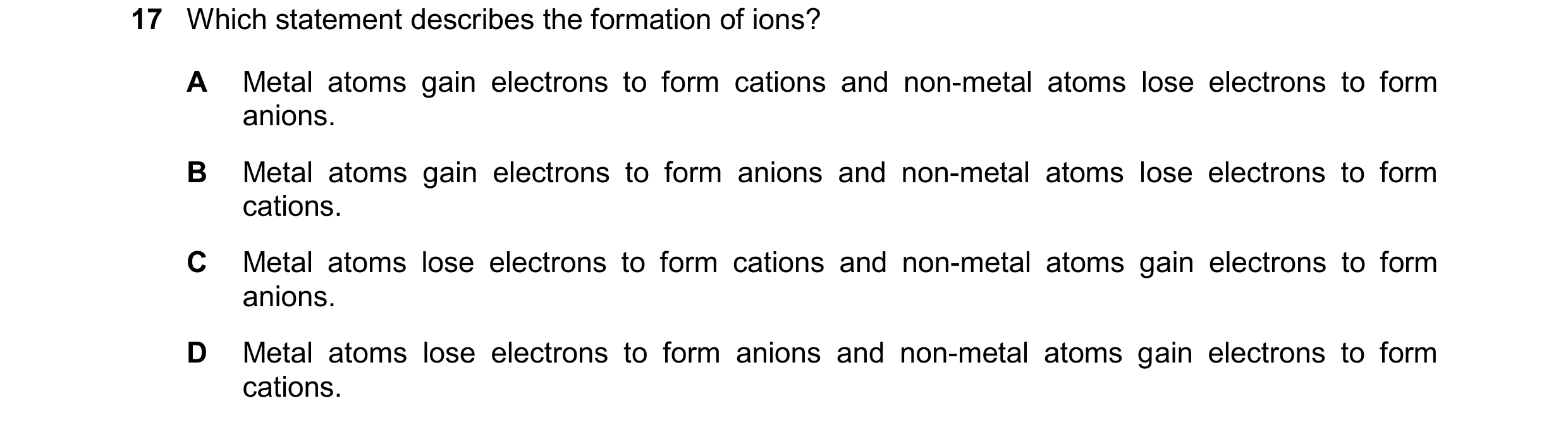

 12 / 12