Questions as text
Q1 · A solid is ionic 0653/11 Oct/Nov 2005
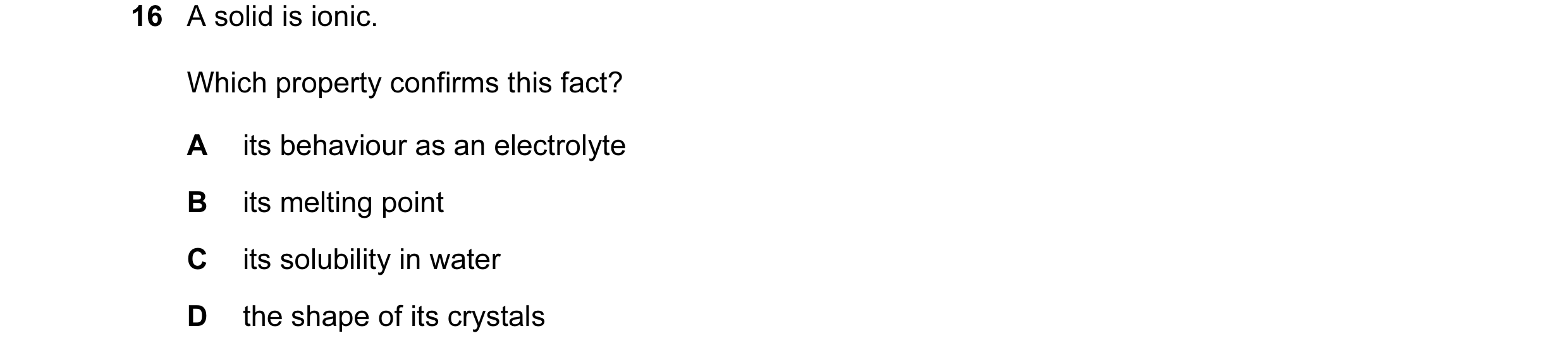
16 A solid is ionic. Which property confirms this fact? A its behaviour as an electrolyte B its melting point C its solubility in water D the shape of its crystals
1 marks
Answer: A
This question in 0653/11 Oct/Nov 2005
Q2 · Metals and non-metals can each form ions 0653/11 May/June 2006
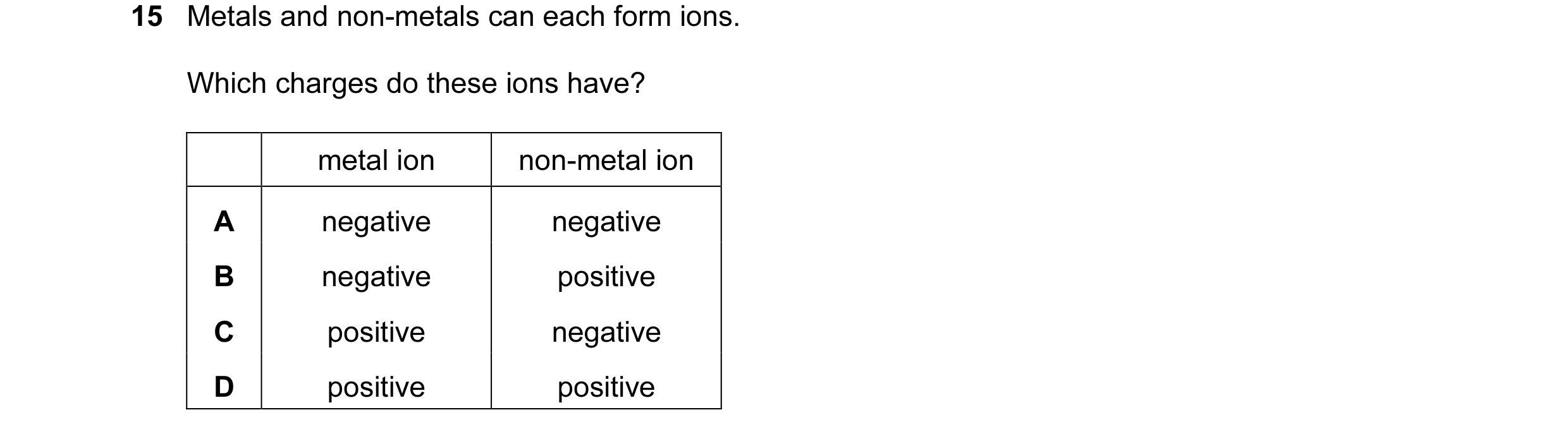
15 Metals and non-metals can each form ions. Which charges do these ions have? metal ion non-metal ion A negative negative B negative positive C positive negative D positive positive
1 marks
Answer: C
This question in 0653/11 May/June 2006
Q3 · Molten lead(II) bromide conducts electricity and the bulb lights up in the experiment… 0653/11 May/June 2006
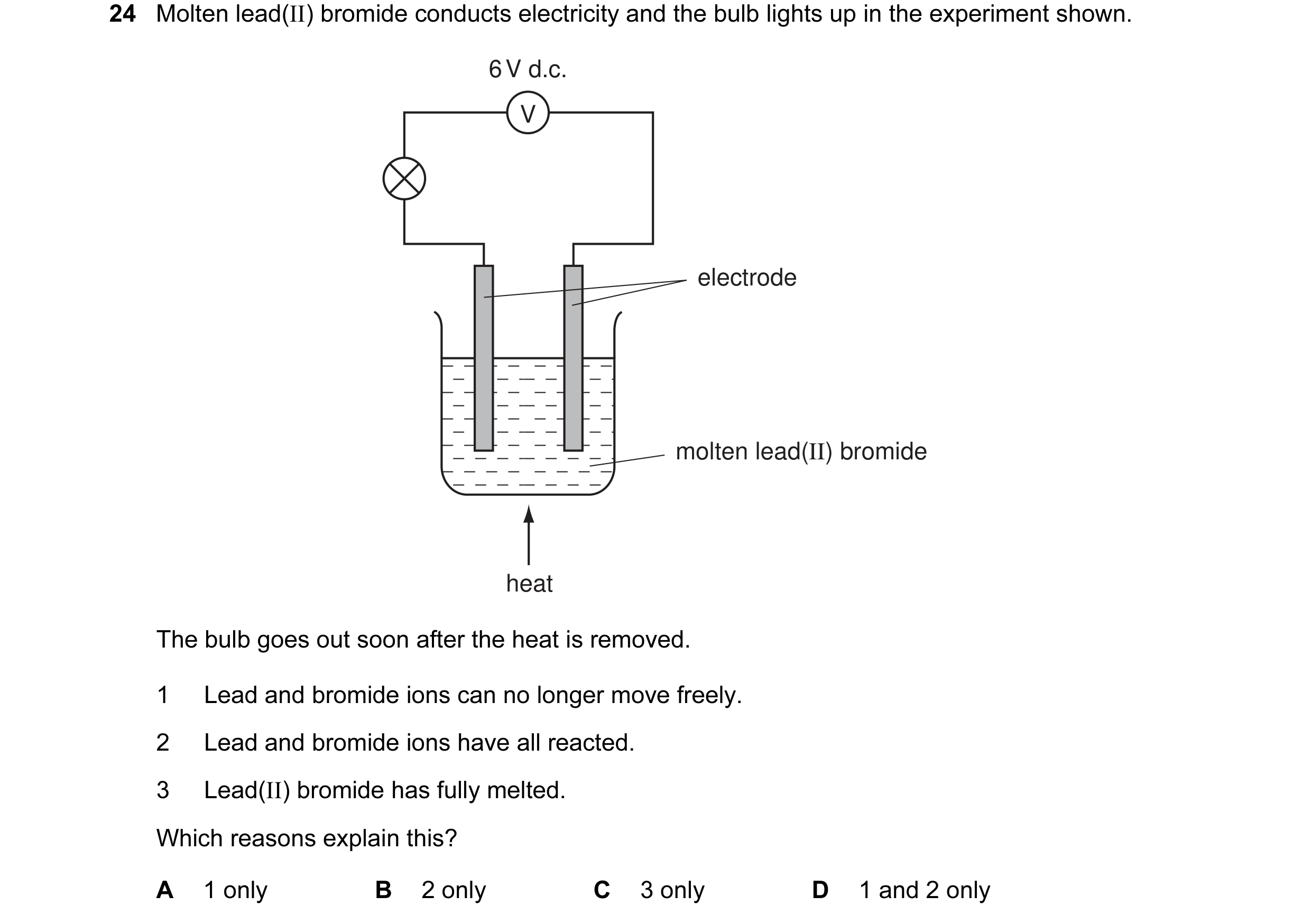
24 Molten lead(II) bromide conducts electricity and the bulb lights up in the experiment shown. 6 V d.c. V electrode molten lead(II) bromide heat The bulb goes out soon after the heat is removed. 1 Lead and bromide ions can no longer move freely. 2 Lead and bromide ions have all reacted. 3 Lead(II) bromide has fully melted. Which reasons explain this? A 1 only B 2 only C 3 only D 1 and 2 only
1 marks
Answer: A
This question in 0653/11 May/June 2006
Q4 · Which substance is an ionic compound? 0653/11 Oct/Nov 2006
16 Which substance is an ionic compound? electrical conductivity melting point when melted A high high B high low C low high D low low
1 marks
Answer: A
This question in 0653/11 Oct/Nov 2006
Q5 · Sodium chloride is an ionic salt that is used industrially as an electrolyte 0653/11 Oct/Nov 2006
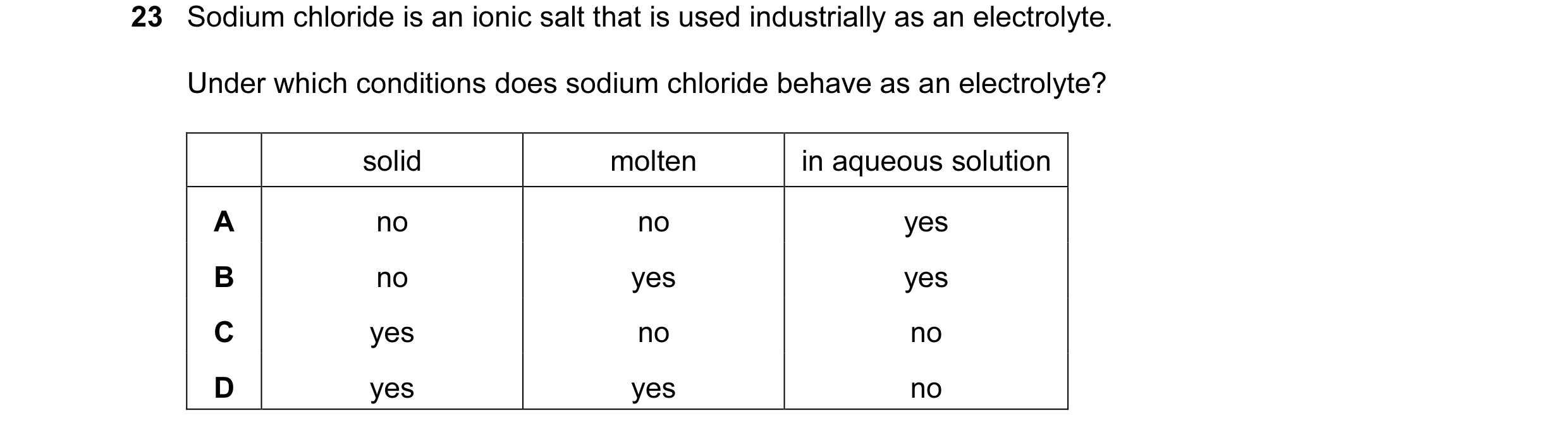
23 Sodium chloride is an ionic salt that is used industrially as an electrolyte. Under which conditions does sodium chloride behave as an electrolyte? solid molten in aqueous solution A no no yes B no yes yes C yes no no D yes yes no
1 marks
Answer: B
This question in 0653/11 Oct/Nov 2006
Q6 · When a metal X is added to water, it reacts and two ions are formed 0653/11 Oct/Nov 2007
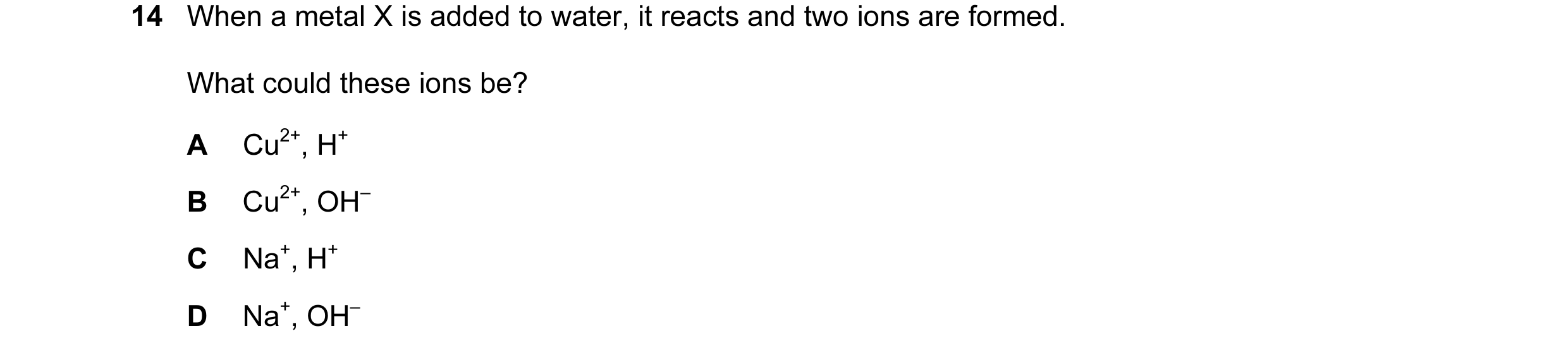
14 When a metal X is added to water, it reacts and two ions are formed. What could these ions be? A Cu2+, H+ B Cu2+, OH– C Na+, H+ D Na+, OH–
1 marks
Answer: D
This question in 0653/11 Oct/Nov 2007
Q7 · Which two elements combine to form an ionic compound? 0653/11 Oct/Nov 2007
15 Which two elements combine to form an ionic compound? A carbon and oxygen B chlorine and magnesium C copper and zinc D hydrogen and oxygen
1 marks
Answer: B
This question in 0653/11 Oct/Nov 2007
Q8 · Two atoms have the symbols 40 X and 40 Y 0653/11 May/June 2009
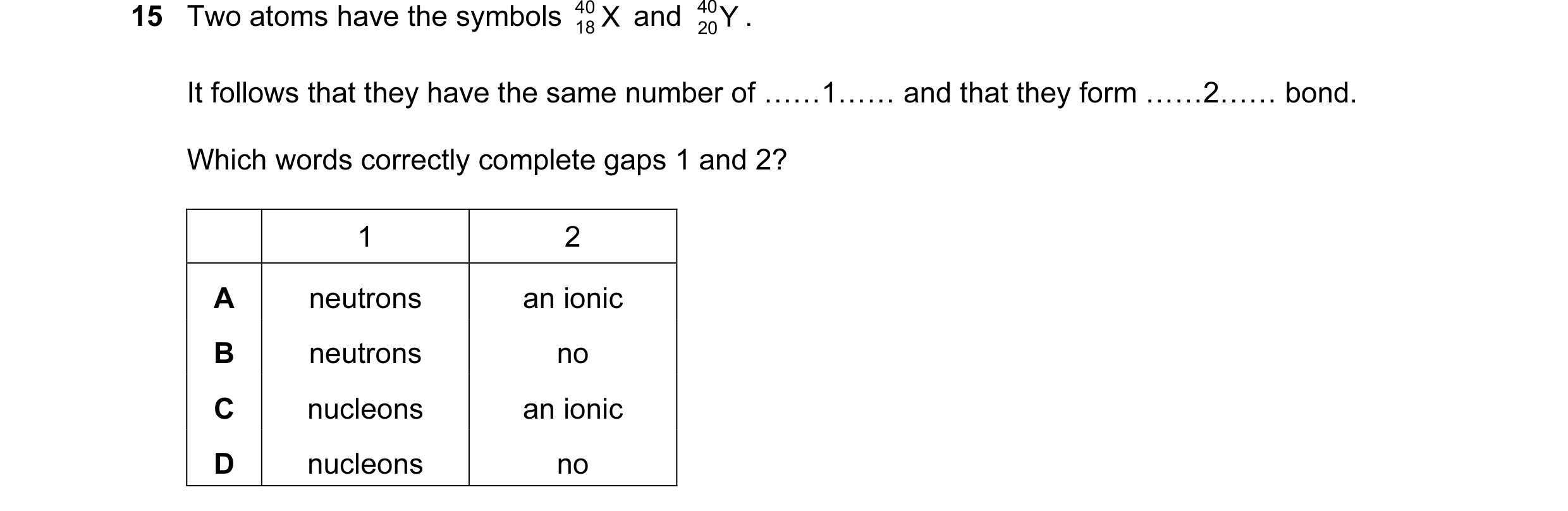
15 Two atoms have the symbols 40 X and 40 Y . 18 20 It follows that they have the same number of ……1…… and that they form ……2…… bond. Which words correctly complete gaps 1 and 2? 1 2 A neutrons an ionic B neutrons no C nucleons an ionic D nucleons no
1 marks
Answer: D
This question in 0653/11 May/June 2009
Q9 · A solid is ionic 0653/11 May/June 2010
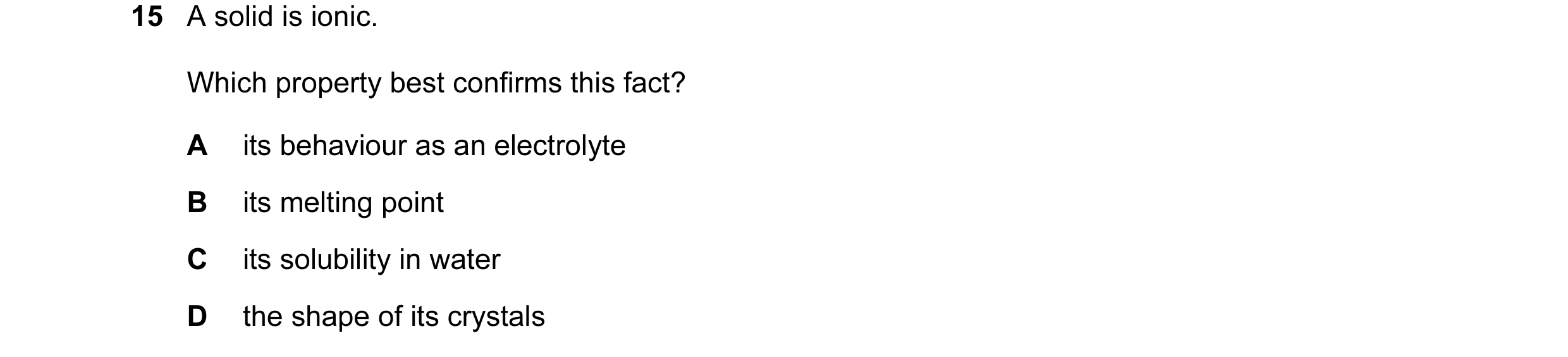
15 A solid is ionic. Which property best confirms this fact? A its behaviour as an electrolyte B its melting point C its solubility in water D the shape of its crystals
1 marks
Answer: A
This question in 0653/11 May/June 2010
Q10 · A solid is ionic 0653/12 May/June 2010
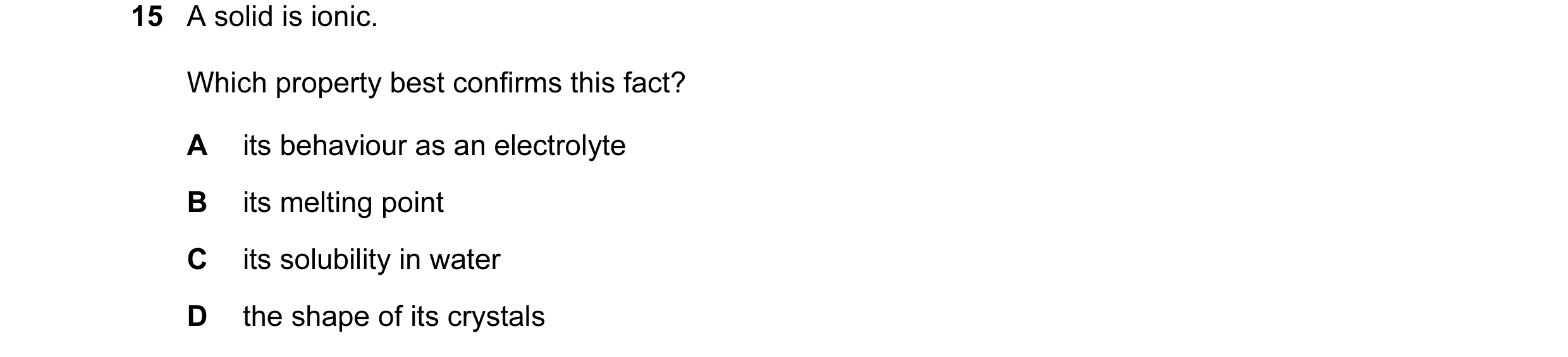
15 A solid is ionic. Which property best confirms this fact? A its behaviour as an electrolyte B its melting point C its solubility in water D the shape of its crystals
1 marks
Answer: A
This question in 0653/12 May/June 2010
Q11 · A solid is ionic 0653/13 May/June 2010
15 A solid is ionic. Which property best confirms this fact? A its behaviour as an electrolyte B its melting point C its solubility in water D the shape of its crystals
1 marks
Answer: A
This question in 0653/13 May/June 2010
Q12 · The table shows information about four different compounds 0653/11 Oct/Nov 2010
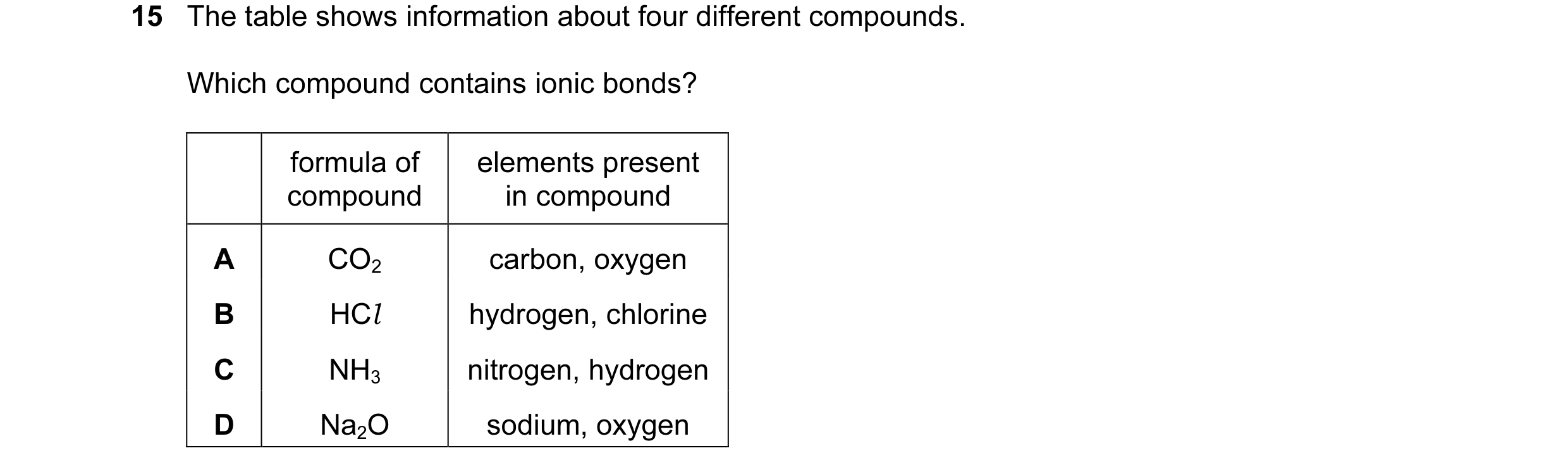
15 The table shows information about four different compounds. Which compound contains ionic bonds? formula of elements present compound in compound A CO2 carbon, oxygen B HCl hydrogen, chlorine C NH3 nitrogen, hydrogen D Na2O sodium, oxygen
1 marks
Answer: D
This question in 0653/11 Oct/Nov 2010
Q13 · The table shows information about four different compounds 0653/12 Oct/Nov 2010
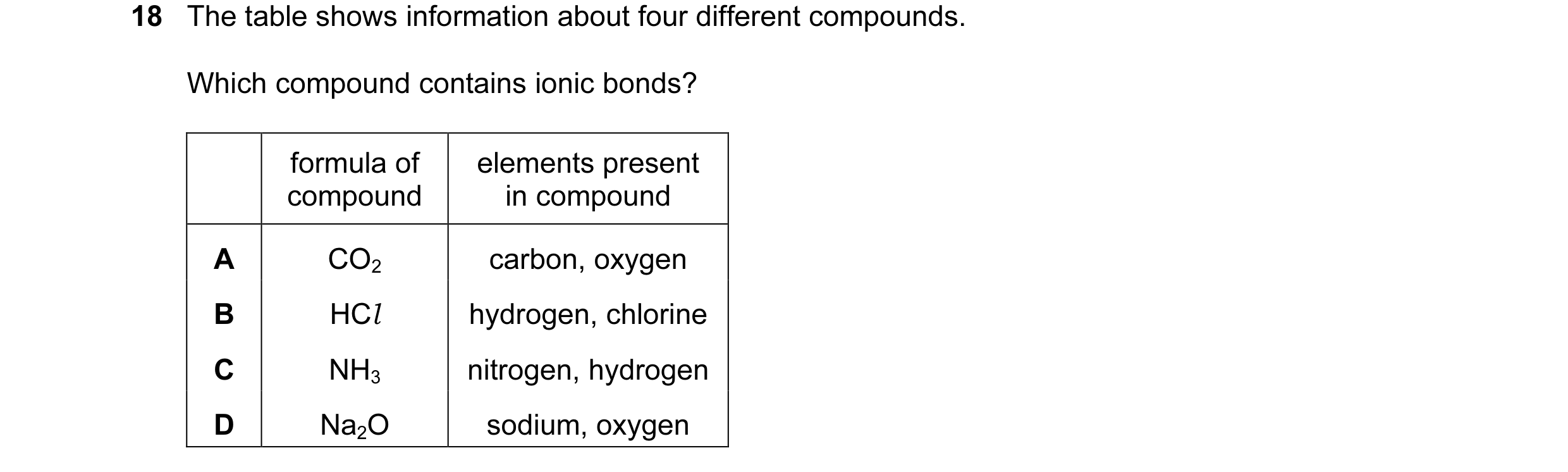
18 The table shows information about four different compounds. Which compound contains ionic bonds? formula of elements present compound in compound A CO2 carbon, oxygen B HCl hydrogen, chlorine C NH3 nitrogen, hydrogen D Na2O sodium, oxygen
1 marks
Answer: D
This question in 0653/12 Oct/Nov 2010
Q14 · The table shows information about four different compounds 0653/13 Oct/Nov 2010
17 The table shows information about four different compounds. Which compound contains ionic bonds? formula of elements present compound in compound A CO2 carbon, oxygen B HCl hydrogen, chlorine C NH3 nitrogen, hydrogen D Na2O sodium, oxygen
1 marks
Answer: D
This question in 0653/13 Oct/Nov 2010
Q15 · Element X reacts with element Y to form compound XY 0653/11 May/June 2011
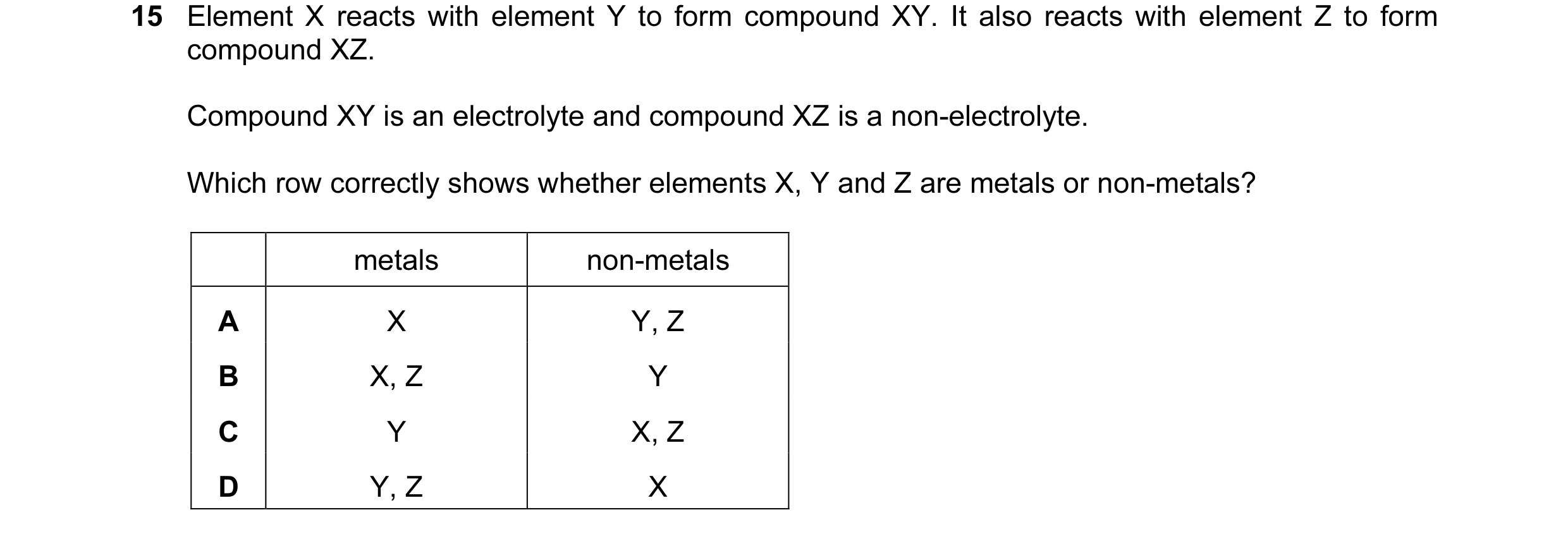
15 Element X reacts with element Y to form compound XY. It also reacts with element Z to form compound XZ. Compound XY is an electrolyte and compound XZ is a non-electrolyte. Which row correctly shows whether elements X, Y and Z are metals or non-metals? metals non-metals A X Y, Z B X, Z Y C Y X, Z D Y, Z X
1 marks
Answer: C
This question in 0653/11 May/June 2011
Q16 · Element X reacts with element Y to form compound XY 0653/12 May/June 2011
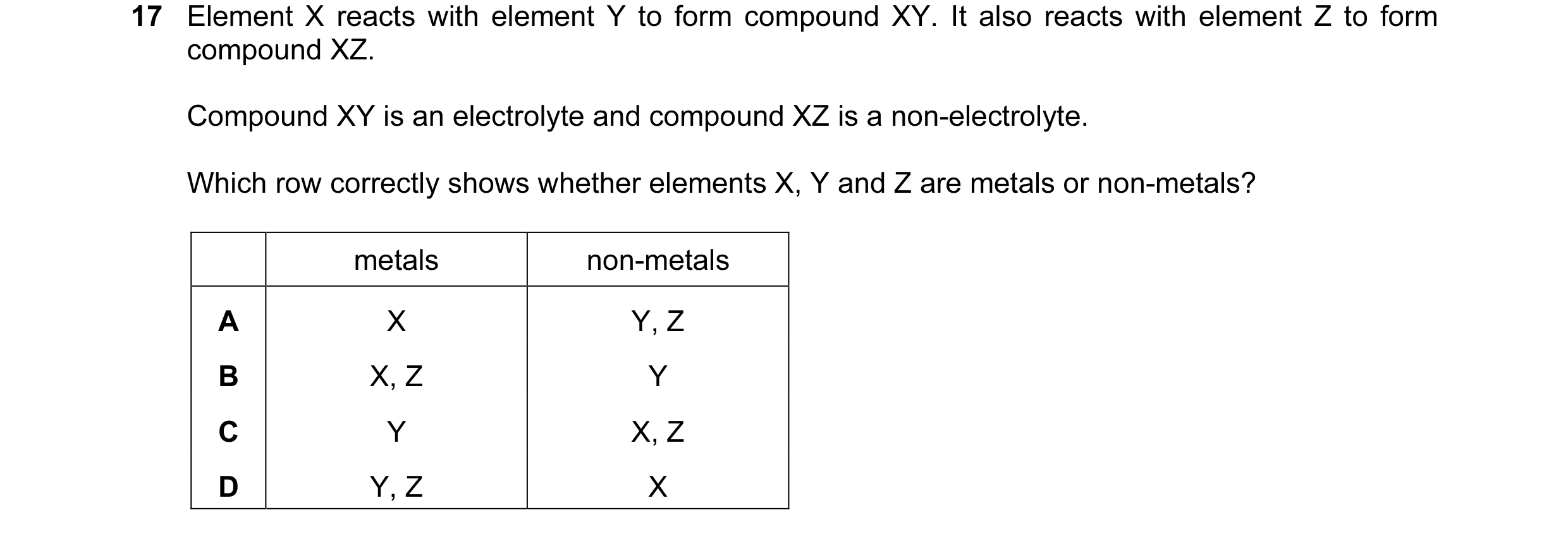
17 Element X reacts with element Y to form compound XY. It also reacts with element Z to form compound XZ. Compound XY is an electrolyte and compound XZ is a non-electrolyte. Which row correctly shows whether elements X, Y and Z are metals or non-metals? metals non-metals A X Y, Z B X, Z Y C Y X, Z D Y, Z X
1 marks
Answer: C
This question in 0653/12 May/June 2011
Q17 · Two oxides have the formulae CaO and NO 0653/11 May/June 2012
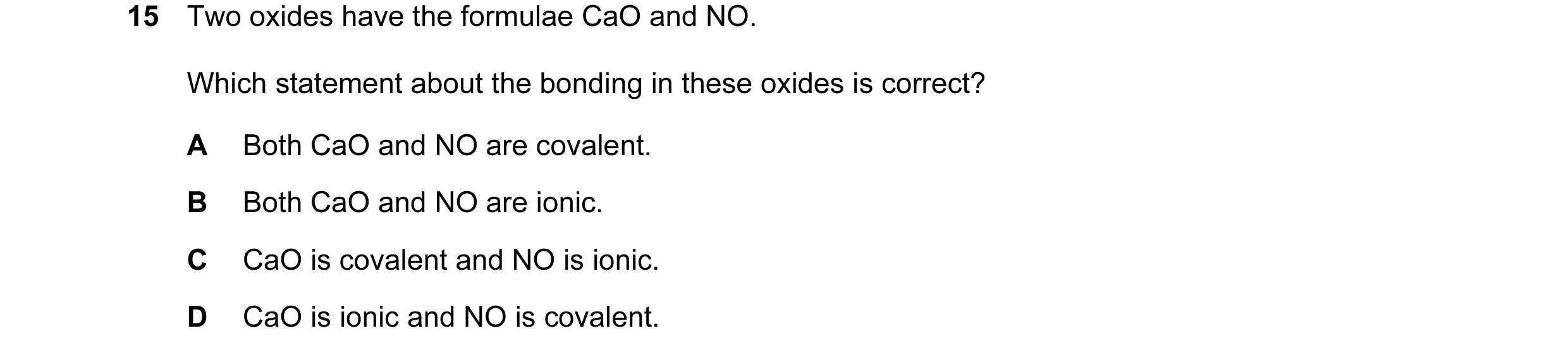
15 Two oxides have the formulae CaO and NO. Which statement about the bonding in these oxides is correct? A Both CaO and NO are covalent. B Both CaO and NO are ionic. C CaO is covalent and NO is ionic. D CaO is ionic and NO is covalent.
1 marks
This question in 0653/11 May/June 2012
Q18 · Which statement correctly describes the bonding in compounds? 0653/12 May/June 2012
15 Which statement correctly describes the bonding in compounds? A An ionic compound contains two metallic elements. B In a compound formed between a metal and a non-metal, the metal has a negative charge. C When a metal combines with a non-metal, electrons are shared between the elements. D When two non-metals combine, molecules are formed.
1 marks
Answer: D
This question in 0653/12 May/June 2012
Q19 · Which statement correctly describes the bonding in compounds? 0653/13 May/June 2012
15 Which statement correctly describes the bonding in compounds? A An ionic compound contains two metallic elements. B In a compound formed between a metal and a non-metal, the metal has a negative charge. C When a metal combines with a non-metal, electrons are shared between the elements. D When two non-metals combine, molecules are formed.
1 marks
Answer: D
This question in 0653/13 May/June 2012
Q20 · Which substance conducts electricity? 0653/13 May/June 2013
22 Which substance conducts electricity? A CO2(g) B NaCl (s) C NaOH(aq) D S(s)
1 marks
Answer: C
This question in 0653/13 May/June 2013
Q21 · The positions of elements P, Q, R, S and T in the Periodic Table are shown 0653/11 Oct/Nov 2013
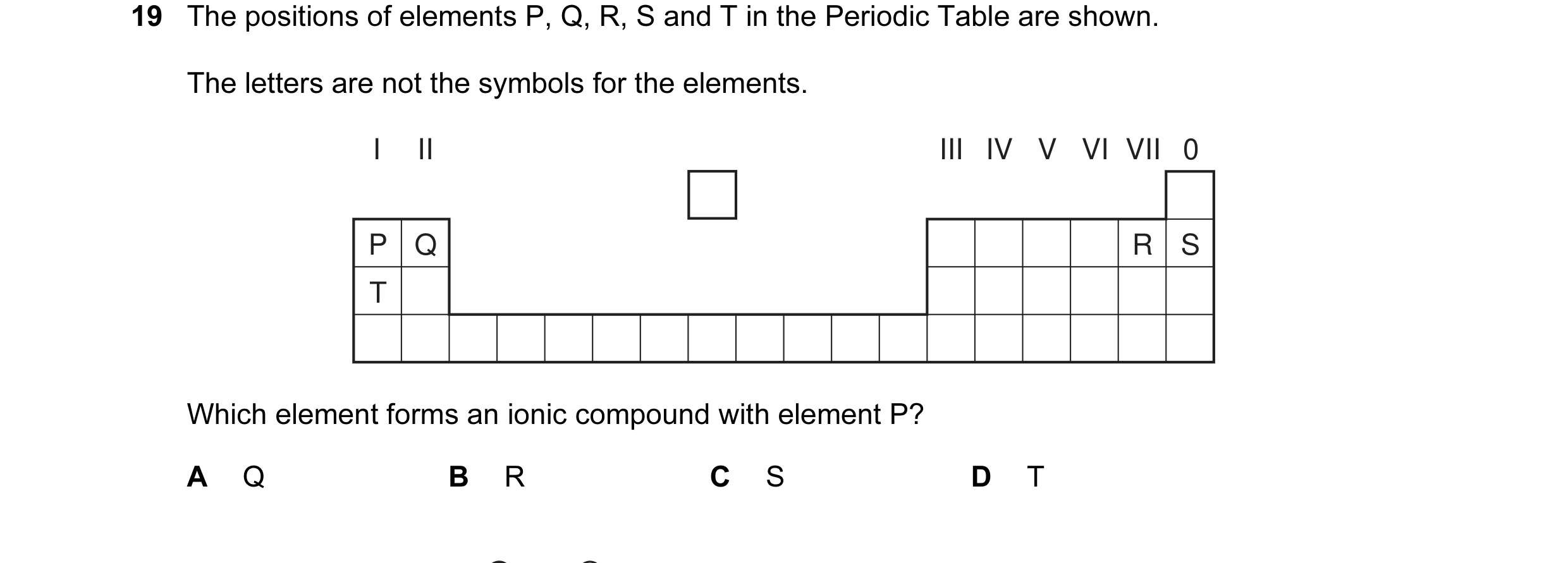
19 The positions of elements P, Q, R, S and T in the Periodic Table are shown. The letters are not the symbols for the elements. I II III IV V VI VII 0 P Q R S T Which element forms an ionic compound with element P? A Q B R C S D T
1 marks
Answer: B
This question in 0653/11 Oct/Nov 2013
Q22 · The positions of elements P, Q, R, S and T in the Periodic Table are shown 0653/12 Oct/Nov 2013
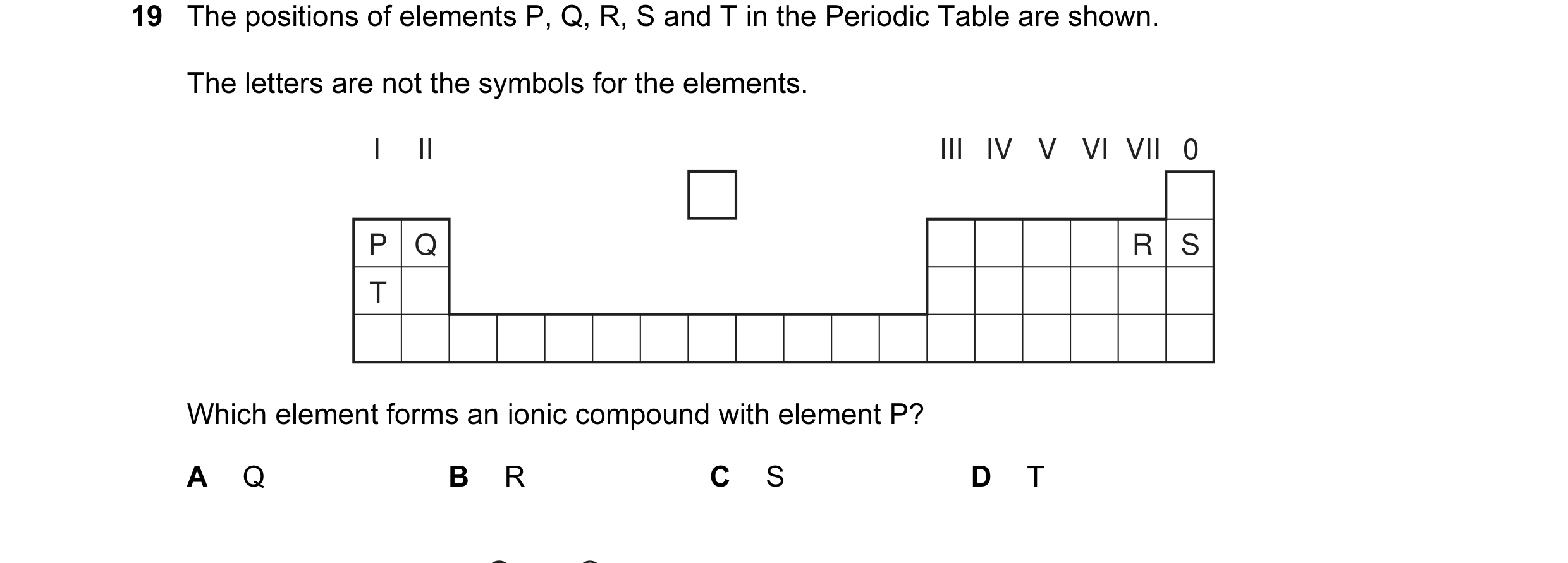
19 The positions of elements P, Q, R, S and T in the Periodic Table are shown. The letters are not the symbols for the elements. I II III IV V VI VII 0 P Q R S T Which element forms an ionic compound with element P? A Q B R C S D T
1 marks
Answer: B
This question in 0653/12 Oct/Nov 2013
Q23 · Sodium and fluorine react together violently to form sodium fluoride 0653/11 May/June 2014
17 Sodium and fluorine react together violently to form sodium fluoride. 2Na + F2 → 2NaF Which changes occur to each atom when sodium and fluorine react together? sodium atom fluorine atom A gains one electron loses two electrons B gains two electrons loses one electron C loses one electron gains one electron D loses two electrons gains two electrons
1 marks
Answer: C
This question in 0653/11 May/June 2014
Q24 · The apparatus shown is used to test a property of compound R 0653/11 May/June 2014
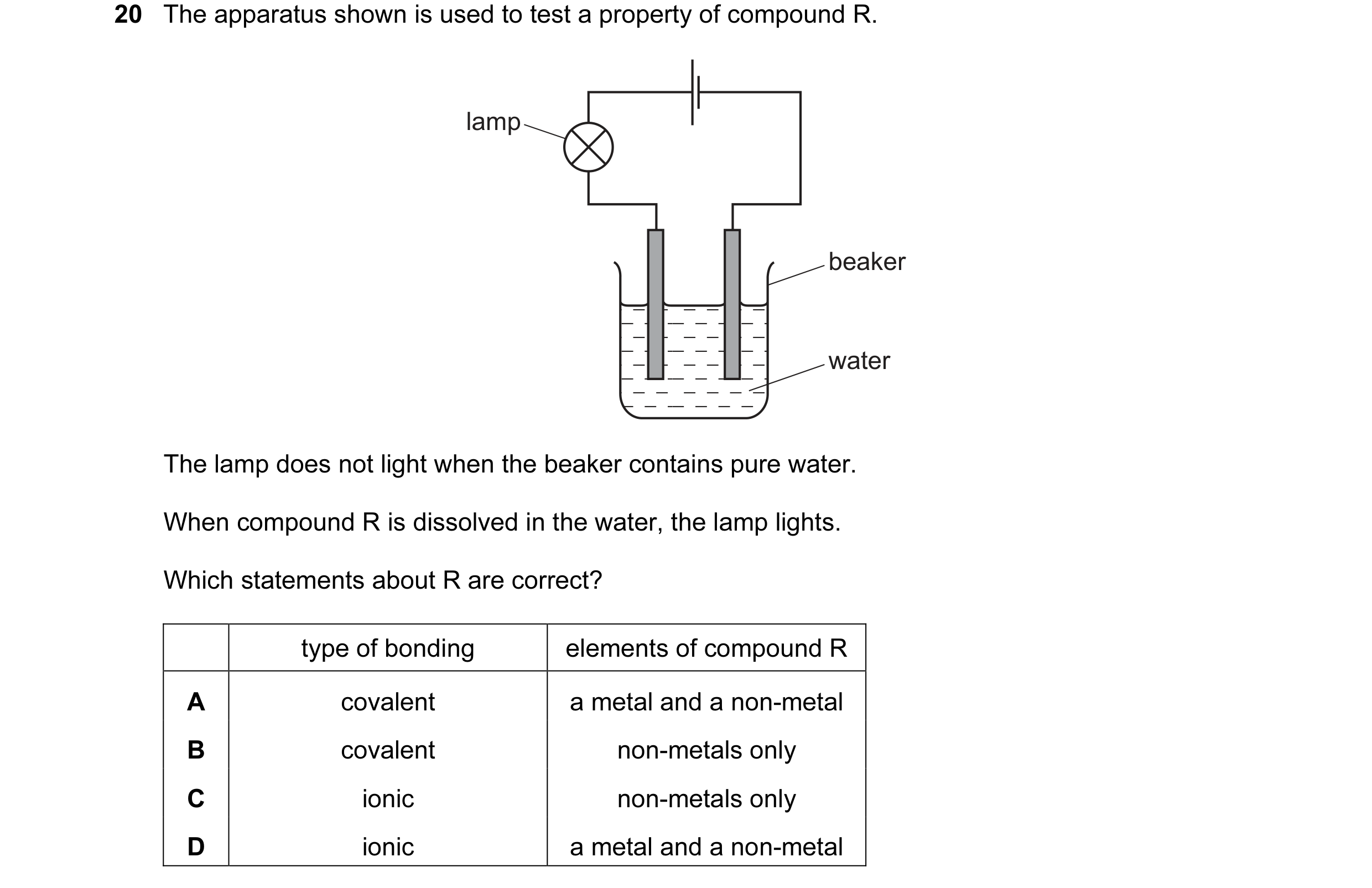
20 The apparatus shown is used to test a property of compound R. lamp beaker water The lamp does not light when the beaker contains pure water. When compound R is dissolved in the water, the lamp lights. Which statements about R are correct? type of bonding elements of compound R A covalent a metal and a non-metal B covalent non-metals only C ionic non-metals only D ionic a metal and a non-metal
1 marks
Answer: D
This question in 0653/11 May/June 2014
Q25 · Sodium is in Group I of the Periodic Table 0653/12 May/June 2014
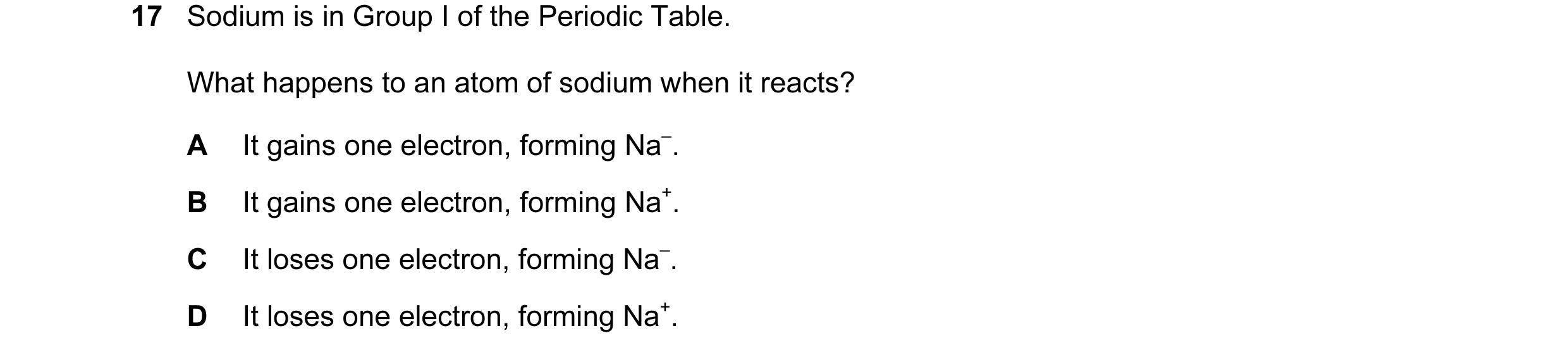
17 Sodium is in Group I of the Periodic Table. What happens to an atom of sodium when it reacts? A It gains one electron, forming Na–. B It gains one electron, forming Na+. C It loses one electron, forming Na–. D It loses one electron, forming Na+.
1 marks
Answer: D
This question in 0653/12 May/June 2014
Q26 · The apparatus shown is used to test a property of compound R 0653/12 May/June 2014
21 The apparatus shown is used to test a property of compound R. lamp beaker water The lamp does not light when the beaker contains pure water. When compound R is dissolved in the water, the lamp lights. Which statements about R are correct? type of bonding elements of compound R A covalent a metal and a non-metal B covalent non-metals only C ionic non-metals only D ionic a metal and a non-metal
1 marks
Answer: D
This question in 0653/12 May/June 2014
Q27 · Sodium and fluorine react together violently to form sodium fluoride 0653/13 May/June 2014
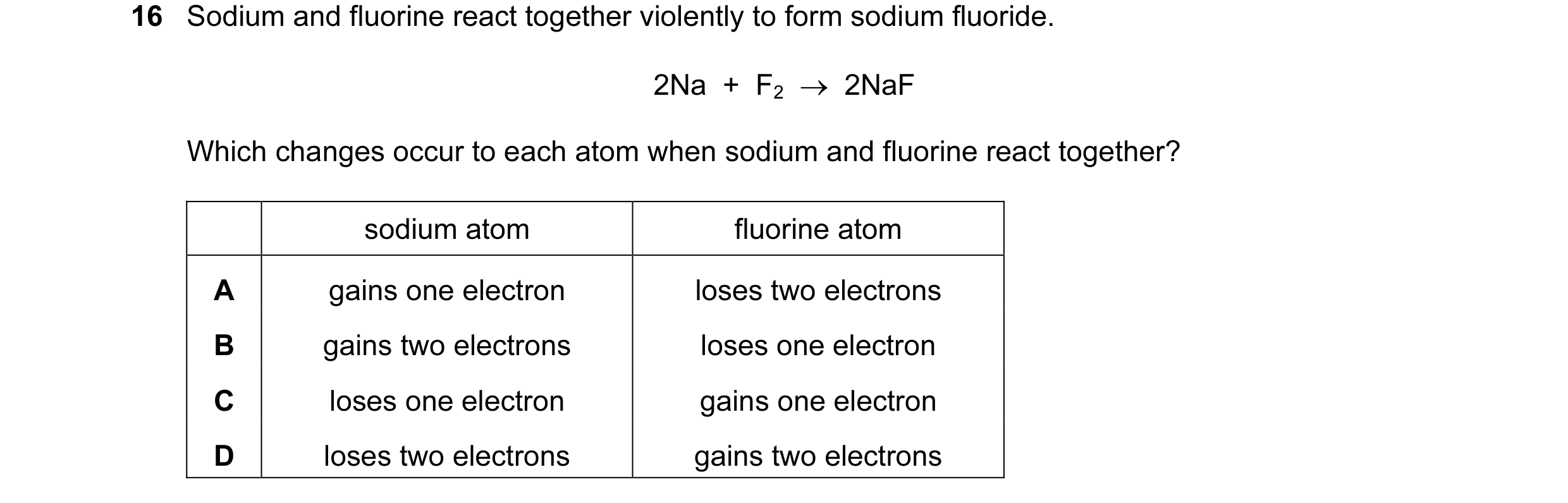
16 Sodium and fluorine react together violently to form sodium fluoride. 2Na + F2 → 2NaF Which changes occur to each atom when sodium and fluorine react together? sodium atom fluorine atom A gains one electron loses two electrons B gains two electrons loses one electron C loses one electron gains one electron D loses two electrons gains two electrons
1 marks
Answer: C
This question in 0653/13 May/June 2014
Q28 · The apparatus shown is used to test a property of compound R 0653/13 May/June 2014
21 The apparatus shown is used to test a property of compound R. lamp beaker water The lamp does not light when the beaker contains pure water. When compound R is dissolved in the water, the lamp lights. Which statements about R are correct? type of bonding elements of compound R A covalent a metal and a non-metal B covalent non-metals only C ionic non-metals only D ionic a metal and a non-metal
1 marks
Answer: D
This question in 0653/13 May/June 2014
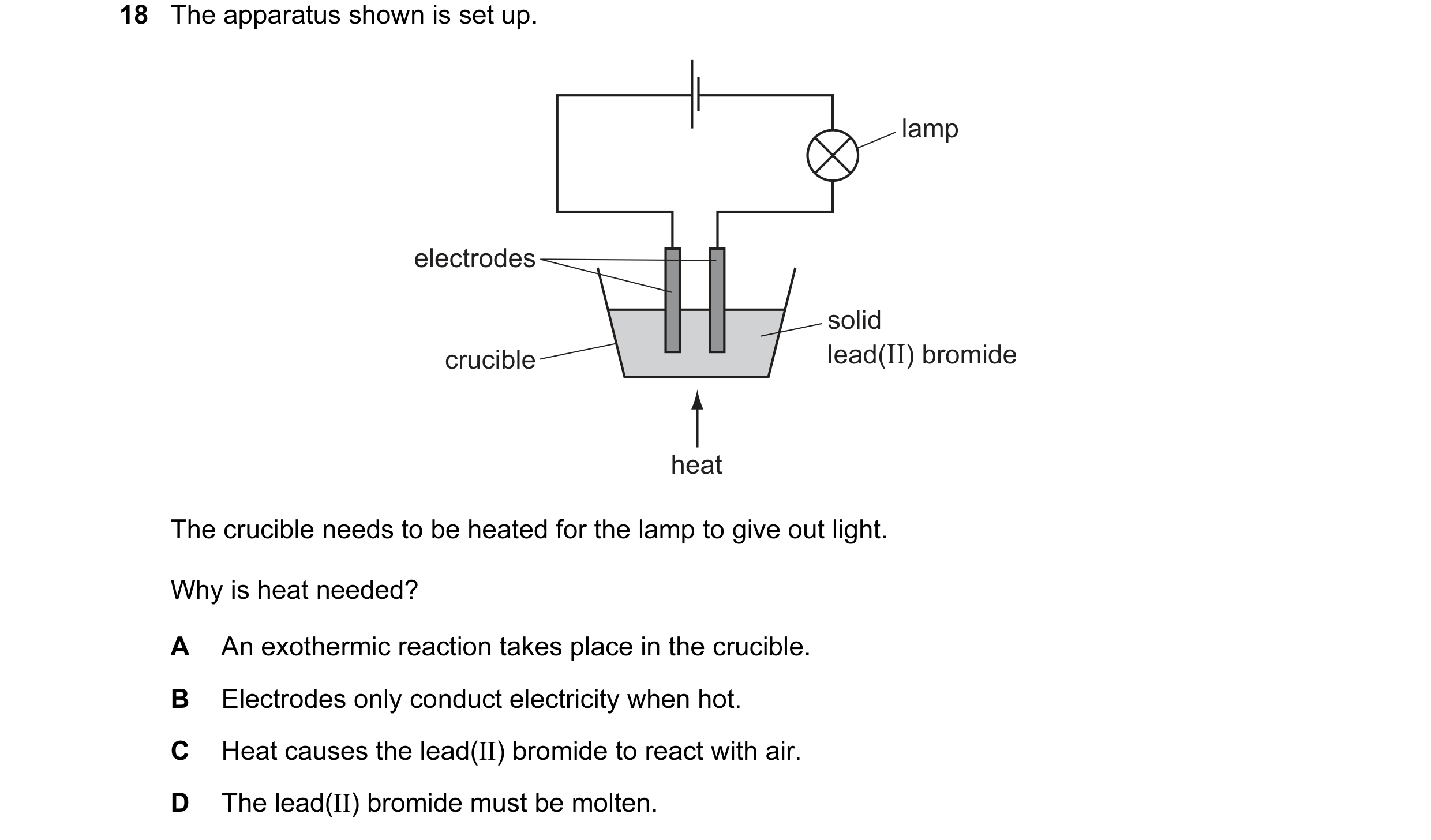
Q29 · The apparatus shown is set up 0653/11 Oct/Nov 2015
18 The apparatus shown is set up. lamp electrodes solid crucible lead(II) bromide heat The crucible needs to be heated for the lamp to give out light. Why is heat needed? A An exothermic reaction takes place in the crucible. B Electrodes only conduct electricity when hot. C Heat causes the lead(II) bromide to react with air. D The lead(II) bromide must be molten.
1 marks
Answer: D
This question in 0653/11 Oct/Nov 2015
Q30 · The apparatus shown is set up 0653/12 Oct/Nov 2015
18 The apparatus shown is set up. lamp electrodes solid crucible lead(II) bromide heat The crucible needs to be heated for the lamp to give out light. Why is heat needed? A An exothermic reaction takes place in the crucible. B Electrodes only conduct electricity when hot. C Heat causes the lead(II) bromide to react with air. D The lead(II) bromide must be molten.
1 marks
Answer: D
This question in 0653/12 Oct/Nov 2015
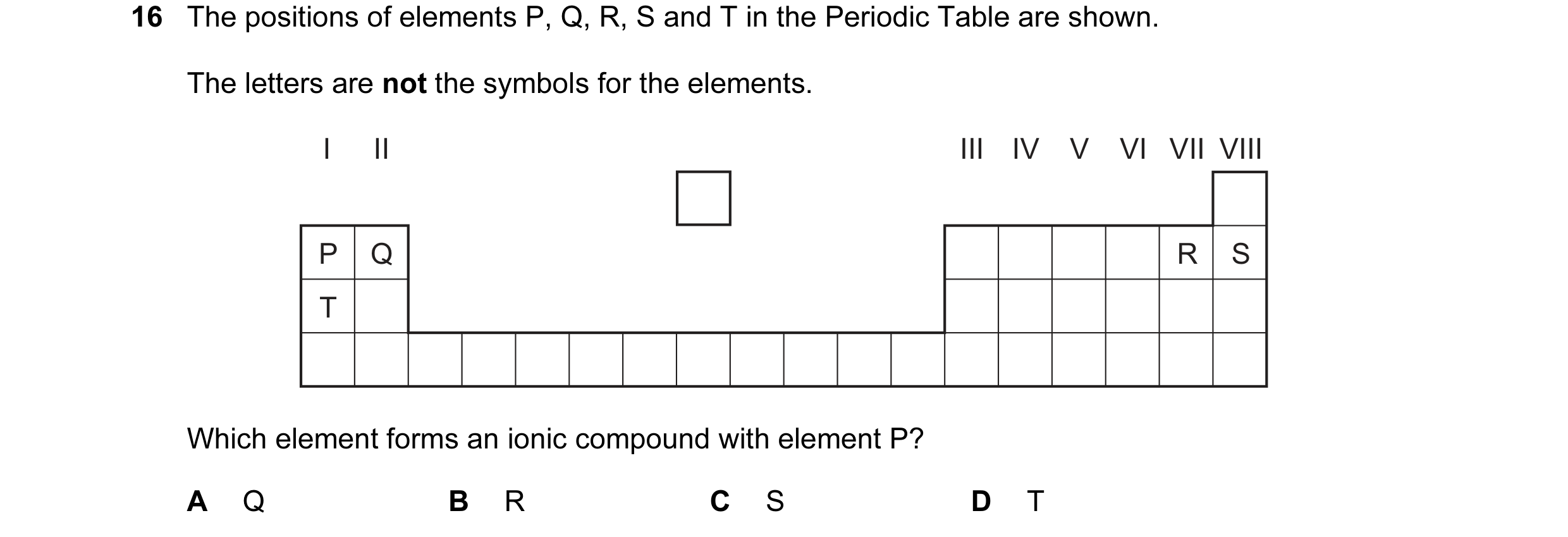
Q31 · The positions of elements P, Q, R, S and T in the Periodic Table are shown 0653/11 May/June 2016
16 The positions of elements P, Q, R, S and T in the Periodic Table are shown. The letters are not the symbols for the elements. I II III IV V VI VII VIII P Q R S T Which element forms an ionic compound with element P? A Q B R C S D T
1 marks
Answer: B
This question in 0653/11 May/June 2016
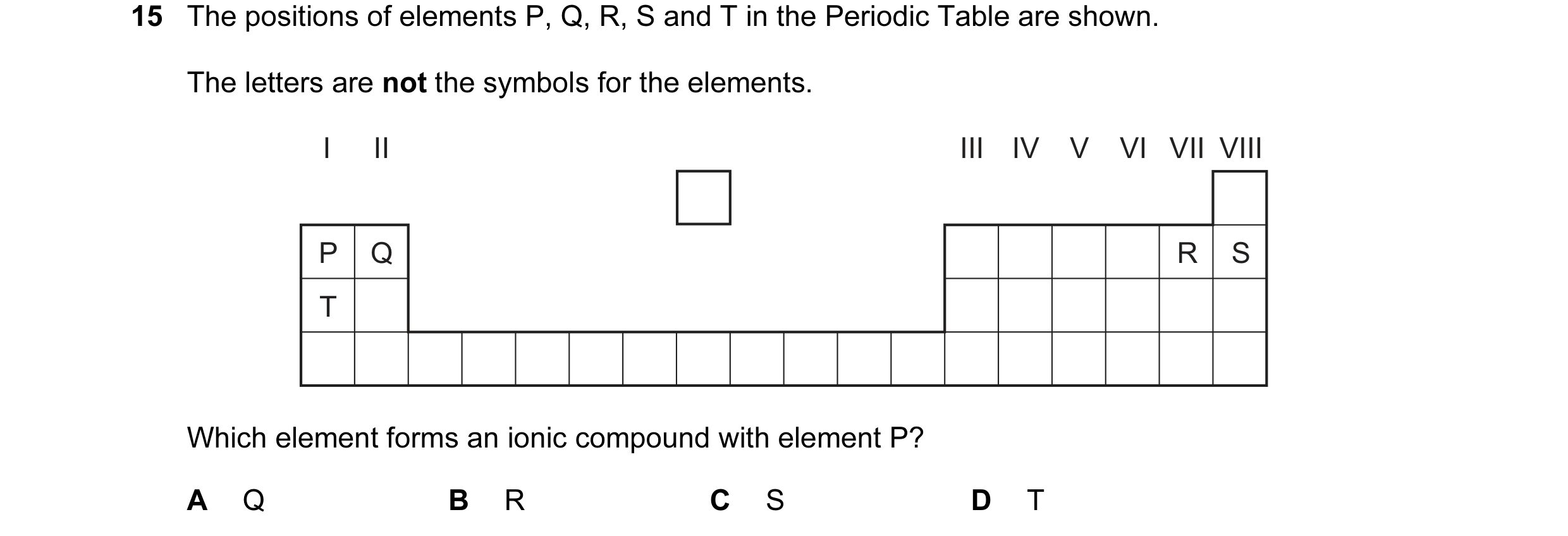
Q32 · The positions of elements P, Q, R, S and T in the Periodic Table are shown 0653/12 May/June 2016
15 The positions of elements P, Q, R, S and T in the Periodic Table are shown. The letters are not the symbols for the elements. I II III IV V VI VII VIII P Q R S T Which element forms an ionic compound with element P? A Q B R C S D T
1 marks
Answer: B
This question in 0653/12 May/June 2016
Q33 · The positions of elements P, Q, R, S and T in the Periodic Table are shown 0653/13 May/June 2016
16 The positions of elements P, Q, R, S and T in the Periodic Table are shown. The letters are not the symbols for the elements. I II III IV V VI VII VIII P Q R S T Which element forms an ionic compound with element P? A Q B R C S D T
1 marks
Answer: B
This question in 0653/13 May/June 2016
Q34 · Which statement about compounds is correct? 0653/11 Oct/Nov 2016
17 Which statement about compounds is correct? A An ionic compound contains two metallic elements bonded together. B In an ionic compound, metal ions are negatively charged. C When metals combine with non-metals, electrons are shared between the atoms. D When two non-metals combine, molecules are formed.
1 marks
Answer: D
This question in 0653/11 Oct/Nov 2016
Q35 · Which statement about compounds is correct? 0653/12 Oct/Nov 2016
17 Which statement about compounds is correct? A An ionic compound contains two metallic elements bonded together. B In an ionic compound, metal ions are negatively charged. C When metals combine with non-metals, electrons are shared between the atoms. D When two non-metals combine, molecules are formed.
1 marks
Answer: D
This question in 0653/12 Oct/Nov 2016
Q36 · Which statement about compounds is correct? 0653/13 Oct/Nov 2016
17 Which statement about compounds is correct? A An ionic compound contains two metallic elements bonded together. B In an ionic compound, metal ions are negatively charged. C When metals combine with non-metals, electrons are shared between the atoms. D When two non-metals combine, molecules are formed.
1 marks
Answer: D
This question in 0653/13 Oct/Nov 2016
Q37 · Which row describes an ionic compound? 0653/13 Oct/Nov 2017
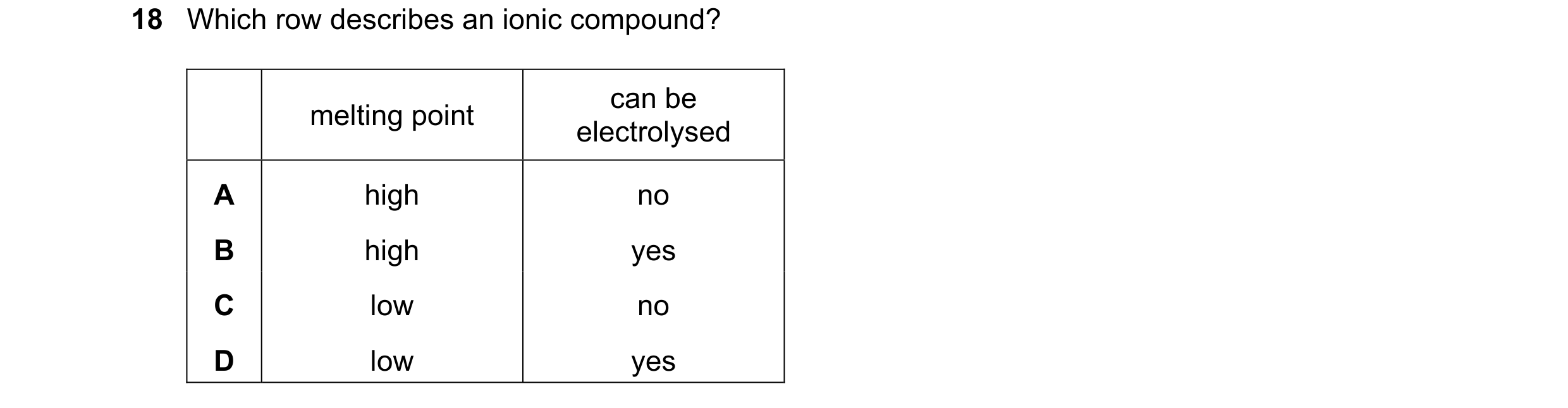
18 Which row describes an ionic compound? can be melting point electrolysed A high no B high yes C low no D low yes
1 marks
Answer: B
This question in 0653/13 Oct/Nov 2017
Q38 · Lithium, a Group I element, reacts with fluorine, a Group VII element, to form lithium… 0653/11 May/June 2018
17 Lithium, a Group I element, reacts with fluorine, a Group VII element, to form lithium fluoride. Lithium fluoride is an ionic substance. Which row describes how the ions are formed from the atoms? lithium atom fluorine atom A gains an electron gains an electron B gains an electron loses an electron C loses an electron gains an electron D loses an electron loses an electron
1 marks
Answer: C
This question in 0653/11 May/June 2018
Q39 · Which statement about the formation of ions is correct? 0653/12 May/June 2018
17 Which statement about the formation of ions is correct? A Anions are formed when atoms gain electrons. B Anions are formed when atoms lose electrons. C Cations are formed when atoms gain protons. D Cations are formed when atoms lose protons.
1 marks
Answer: A
This question in 0653/12 May/June 2018
Q40 · Part of the Periodic Table is shown 0653/12 May/June 2018
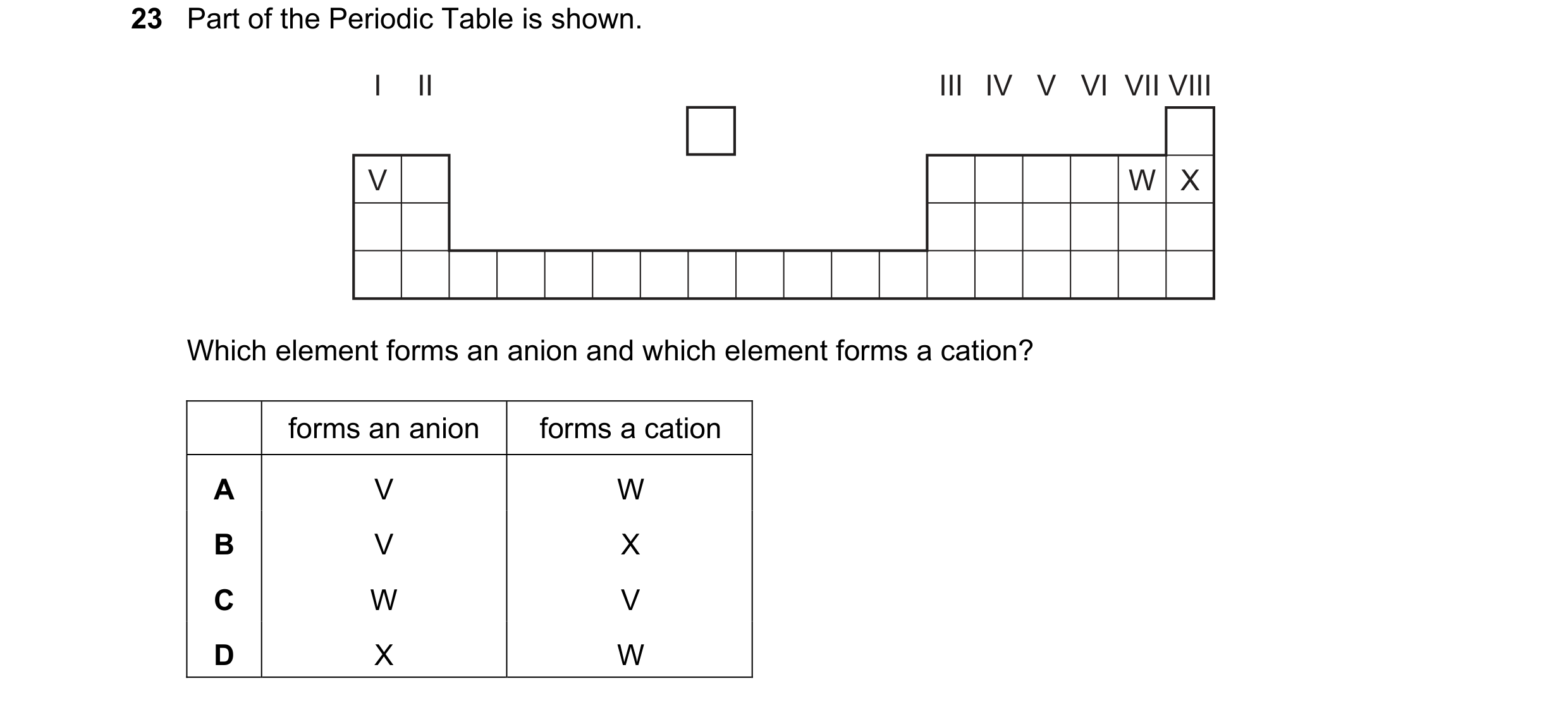
23 Part of the Periodic Table is shown. I II III IV V VI VII VIII V W X Which element forms an anion and which element forms a cation? forms an anion forms a cation A V W B V X C W V D X W
1 marks
Answer: C
This question in 0653/12 May/June 2018
Q41 · Which statement about the formation of ions is correct? 0653/13 May/June 2018
17 Which statement about the formation of ions is correct? A Anions are formed when atoms gain electrons. B Anions are formed when atoms lose electrons. C Cations are formed when atoms gain protons. D Cations are formed when atoms lose protons.
1 marks
Answer: A
This question in 0653/13 May/June 2018
Q42 · Part of the Periodic Table is shown 0653/13 May/June 2018
23 Part of the Periodic Table is shown. I II III IV V VI VII VIII V W X Which element forms an anion and which element forms a cation? forms an anion forms a cation A V W B V X C W V D X W
1 marks
Answer: C
This question in 0653/13 May/June 2018
Q43 · Which row describes an ionic compound? 0653/11 May/June 2019
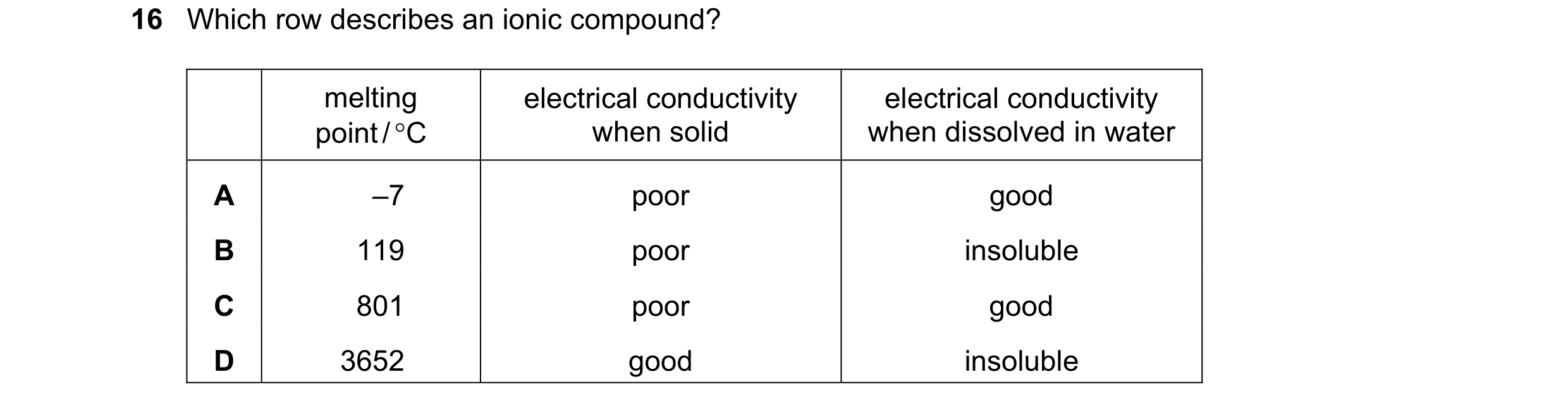
16 Which row describes an ionic compound? melting electrical conductivity electrical conductivity point / °C when solid when dissolved in water A –7 poor good B 119 poor insoluble C 801 poor good D 3652 good insoluble
1 marks
Answer: C
This question in 0653/11 May/June 2019
Q44 · Which row about each substance is correct? 0653/12 May/June 2019
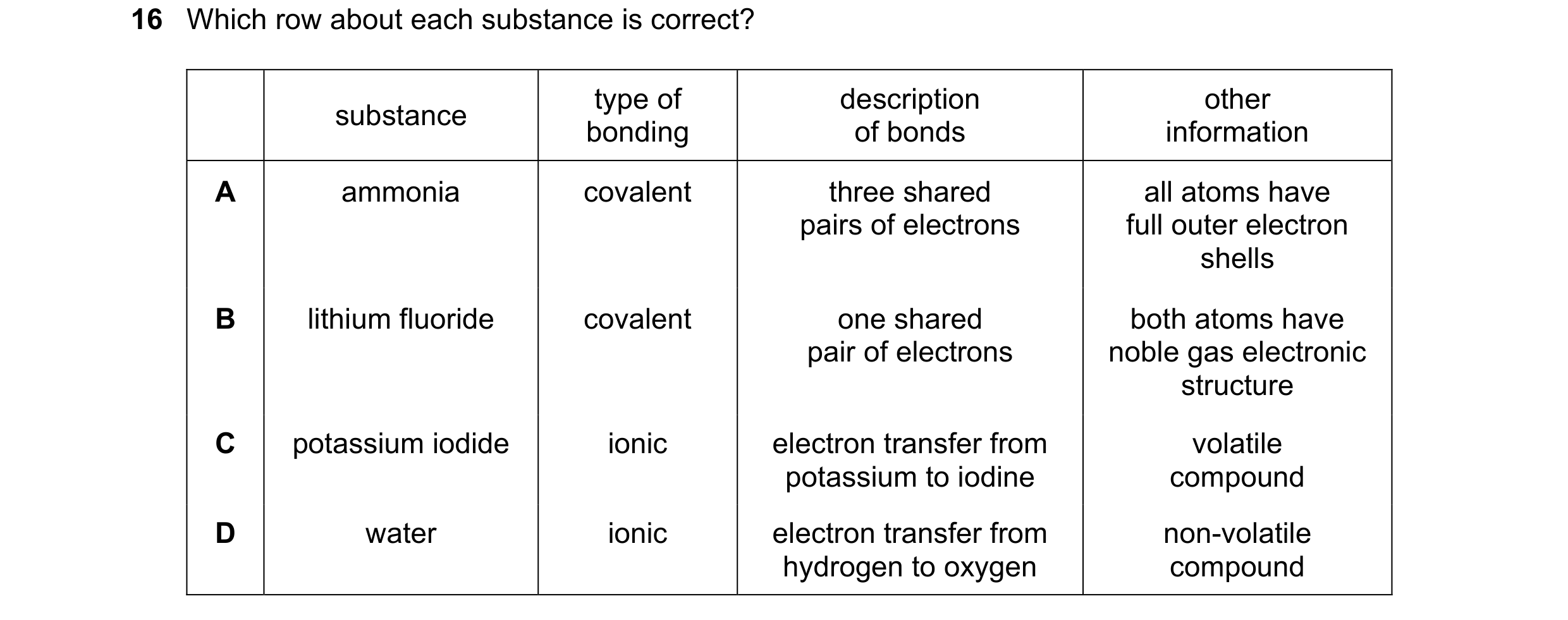
16 Which row about each substance is correct? type of description other substance bonding of bonds information A ammonia covalent three shared all atoms have pairs of electrons full outer electron shells B lithium fluoride covalent one shared both atoms have pair of electrons noble gas electronic structure C potassium iodide ionic electron transfer from volatile potassium to iodine compound D water ionic electron transfer from non-volatile hydrogen to oxygen compound
1 marks
Answer: A
This question in 0653/12 May/June 2019
Q45 · P, Q and R are three particles 0653/11 Oct/Nov 2019
16 P, Q and R are three particles. Particle P contains 6 protons, 6 neutrons and 6 electrons. Particle Q contains 1 proton, 2 neutrons and no electrons. Particle R contains 11 protons, 12 neutrons and 10 electrons. Which row about P, Q and R is correct? P Q R A has atomic number 6 has a mass number of 2 has a positive charge B has no overall electrical charge has an atomic number of 1 has a mass number of 23 C is a carbon atom is a nucleus has a negative charge D is a carbon nucleus has a positive charge is a particle of sodium
1 marks
Answer: B
This question in 0653/11 Oct/Nov 2019
Q46 · Which ion is formed from a metal? 0653/11 May/June 2020
17 Which ion is formed from a metal? A Cl – B H+ C Na+ D NH4 +
1 marks
Answer: C
This question in 0653/11 May/June 2020
Q47 · Which substances conduct electricity when molten? 0653/11 May/June 2021
24 Which substances conduct electricity when molten? 1 sodium chloride 2 naphtha 3 brass A 1 and 2 only B 1 and 3 only C 2 and 3 only D 1, 2 and 3
1 marks
Answer: B
This question in 0653/11 May/June 2021
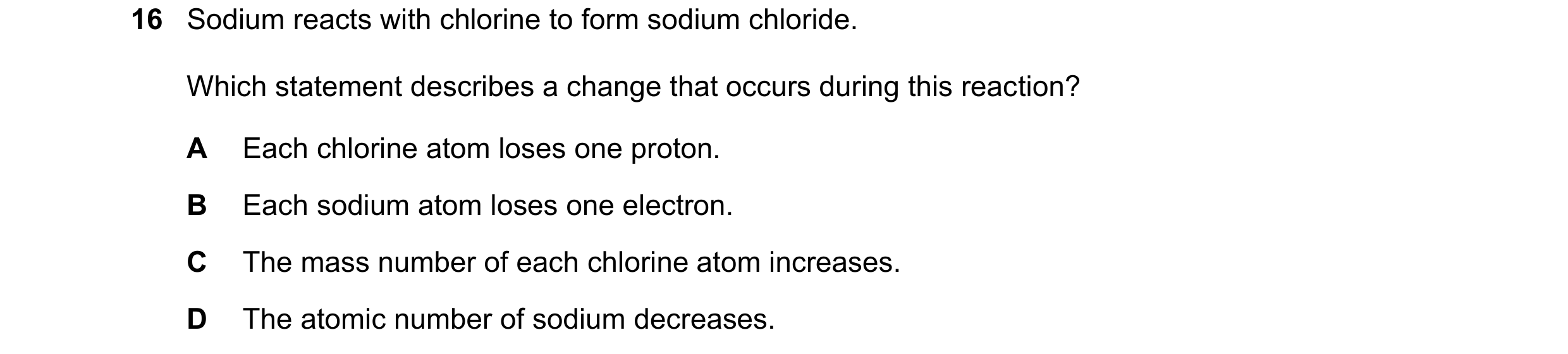
Q48 · Sodium reacts with chlorine to form sodium chloride 0653/11 May/June 2023
16 Sodium reacts with chlorine to form sodium chloride. Which statement describes a change that occurs during this reaction? A Each chlorine atom loses one proton. B Each sodium atom loses one electron. C The mass number of each chlorine atom increases. D The atomic number of sodium decreases.
1 marks
Answer: B
This question in 0653/11 May/June 2023
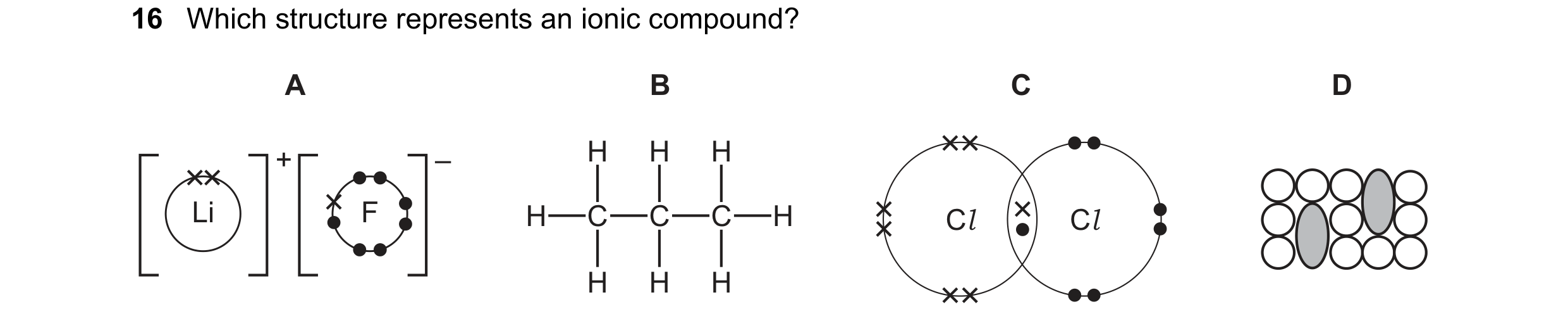
Q49 · Which structure represents an ionic compound? 0653/12 May/June 2023
16 Which structure represents an ionic compound? A B C D + – H H H Li F H C C C H Cl Cl H H H
1 marks
Answer: A
This question in 0653/12 May/June 2023
Q50 · Which dot-and-cross diagram represents lithium fluoride, LiF? 0653/13 May/June 2023
16 Which dot-and-cross diagram represents lithium fluoride, LiF? A B + – Li F Li F C D + – Li F Li F
1 marks
Answer: B
This question in 0653/13 May/June 2023
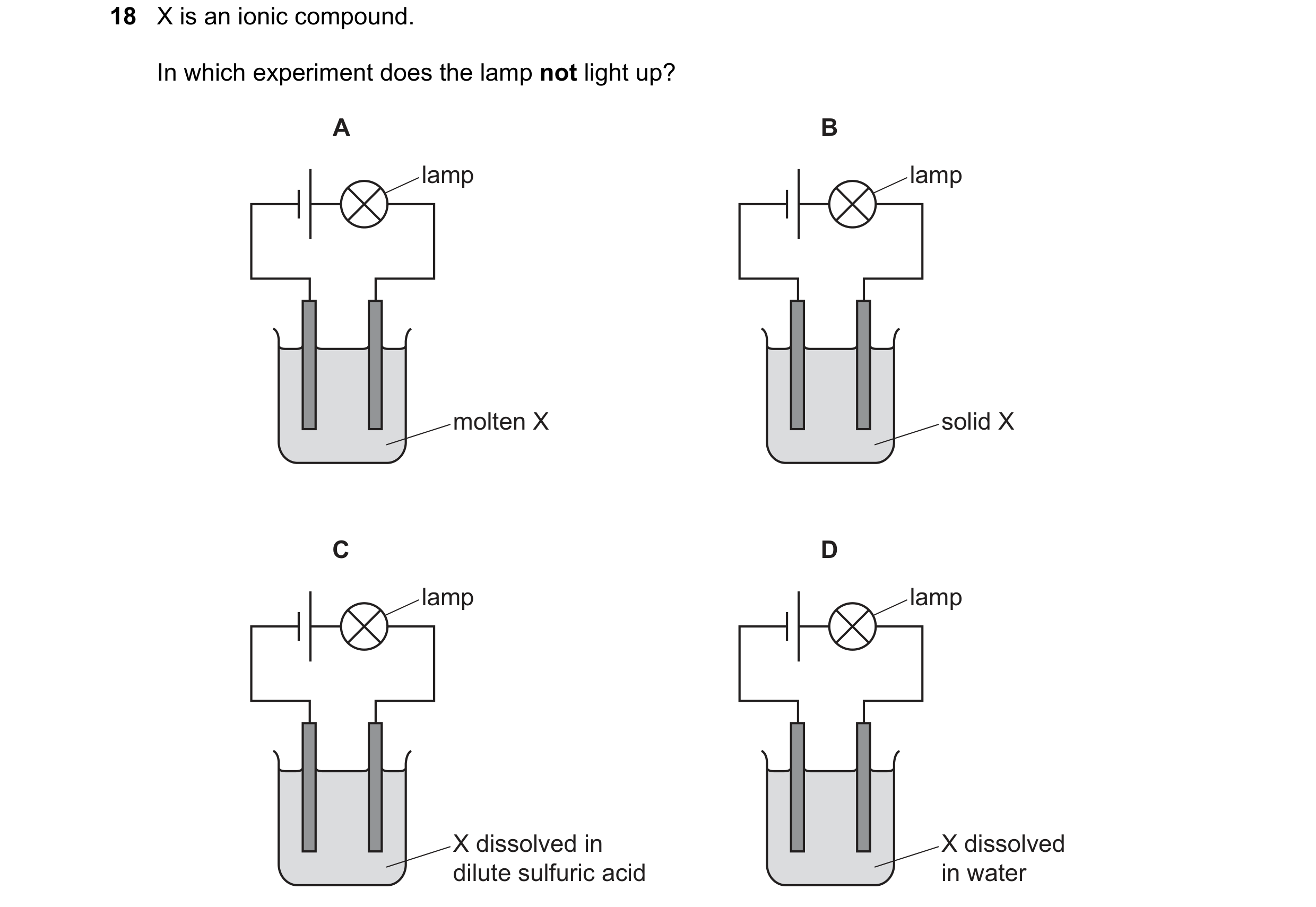
Q51 · X is an ionic compound 0653/13 May/June 2023
18 X is an ionic compound. In which experiment does the lamp not light up? A B lamp lamp molten X solid X C D lamp lamp X dissolved in X dissolved dilute sulfuric acid in water
1 marks
Answer: B
This question in 0653/13 May/June 2023
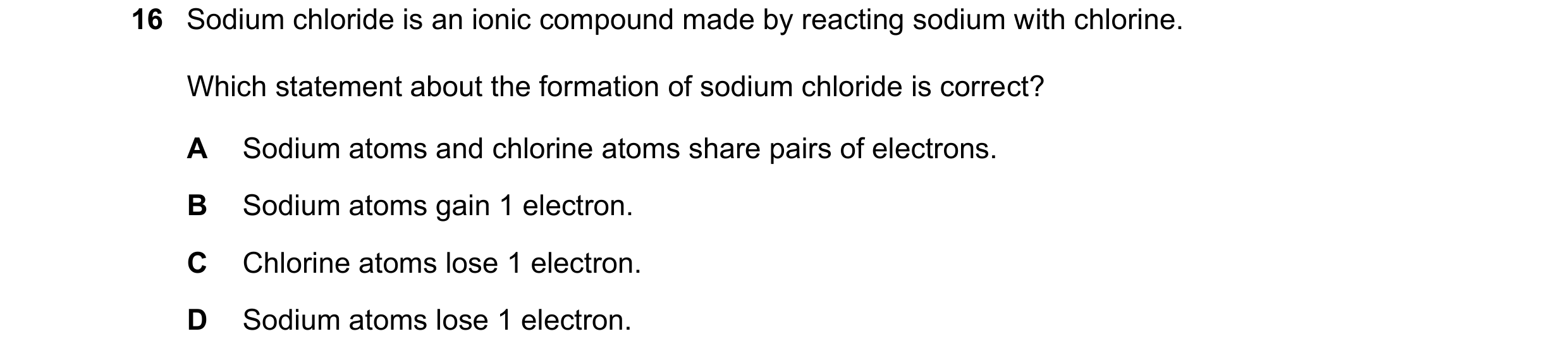
Q52 · Sodium chloride is an ionic compound made by reacting sodium with chlorine 0653/12 May/June 2024
16 Sodium chloride is an ionic compound made by reacting sodium with chlorine. Which statement about the formation of sodium chloride is correct? A Sodium atoms and chlorine atoms share pairs of electrons. B Sodium atoms gain 1 electron. C Chlorine atoms lose 1 electron. D Sodium atoms lose 1 electron.
1 marks
Answer: D
This question in 0653/12 May/June 2024
Q53 · Which two elements combine to form an ionic compound? 0653/12 Oct/Nov 2024
17 Which two elements combine to form an ionic compound? A carbon and oxygen B copper and zinc C hydrogen and oxygen D magnesium and chlorine
1 marks
Answer: D
This question in 0653/12 Oct/Nov 2024
Q54 · Which two elements combine to form an ionic compound? 0653/13 Oct/Nov 2024
17 Which two elements combine to form an ionic compound? A carbon and oxygen B copper and zinc C hydrogen and oxygen D magnesium and chlorine
1 marks
Answer: D
This question in 0653/13 Oct/Nov 2024
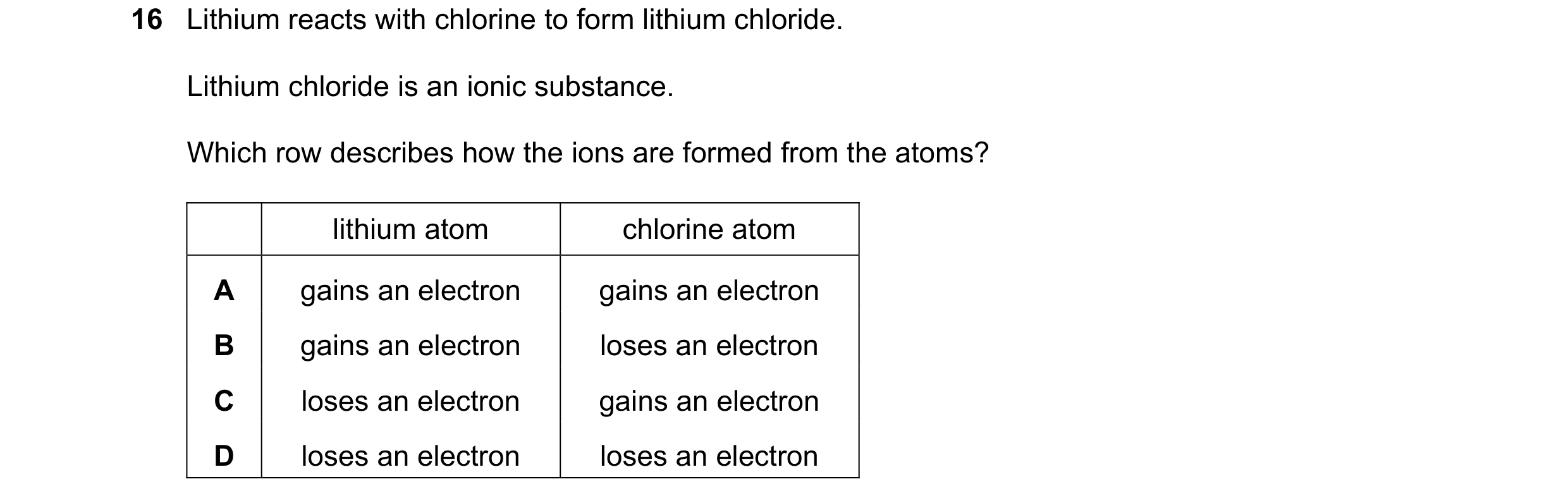
Q55 · Lithium reacts with chlorine to form lithium chloride 0653/12 Feb/March 2025
16 Lithium reacts with chlorine to form lithium chloride. Lithium chloride is an ionic substance. Which row describes how the ions are formed from the atoms? lithium atom chlorine atom A gains an electron gains an electron B gains an electron loses an electron C loses an electron gains an electron D loses an electron loses an electron
1 marks
Answer: C
This question in 0653/12 Feb/March 2025
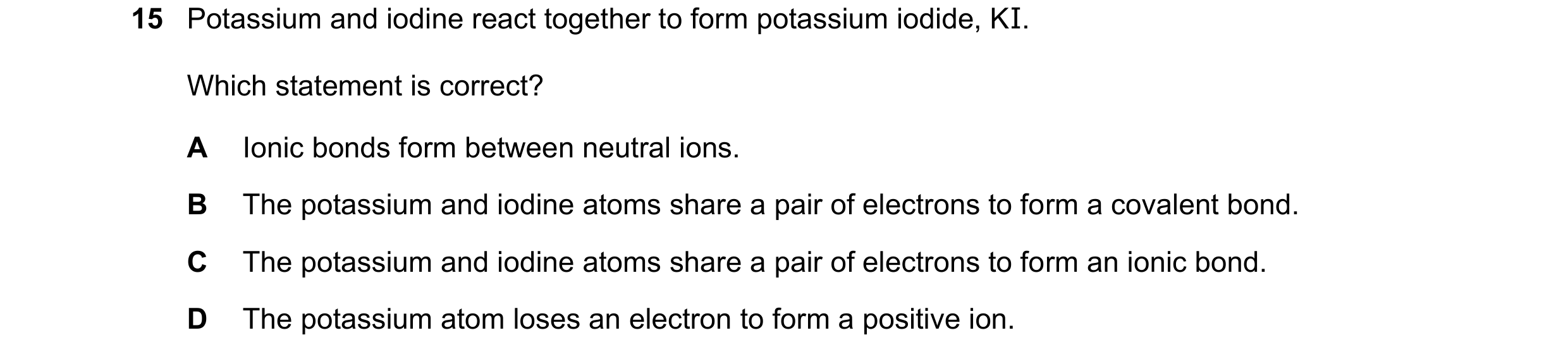
Q56 · Potassium and iodine react together to form potassium iodide, KI 0653/11 May/June 2025
15 Potassium and iodine react together to form potassium iodide, KI. Which statement is correct? A Ionic bonds form between neutral ions. B The potassium and iodine atoms share a pair of electrons to form a covalent bond. C The potassium and iodine atoms share a pair of electrons to form an ionic bond. D The potassium atom loses an electron to form a positive ion.
1 marks
Answer: D
This question in 0653/11 May/June 2025
Q57 · Which statement describes how an atom forms an ion with a 1+ charge? 0653/12 May/June 2025
14 Which statement describes how an atom forms an ion with a 1+ charge? A The atom gains 1 electron. B The atom gains 7 electrons. C The atom loses 1 electron. D The atom loses 7 electrons.
1 marks
Answer: C
This question in 0653/12 May/June 2025
Q58 · What happens when a sodium atom reacts with a chlorine atom? 0653/13 May/June 2025
15 What happens when a sodium atom reacts with a chlorine atom? A The sodium atom and chlorine atom lose electrons. B The sodium atom gains an electron and the chlorine atom loses an electron. C The sodium atom loses an electron and the chlorine atom gains an electron. D The sodium atom shares electrons with the chlorine atom.
1 marks
Answer: C
This question in 0653/13 May/June 2025
 1 / 15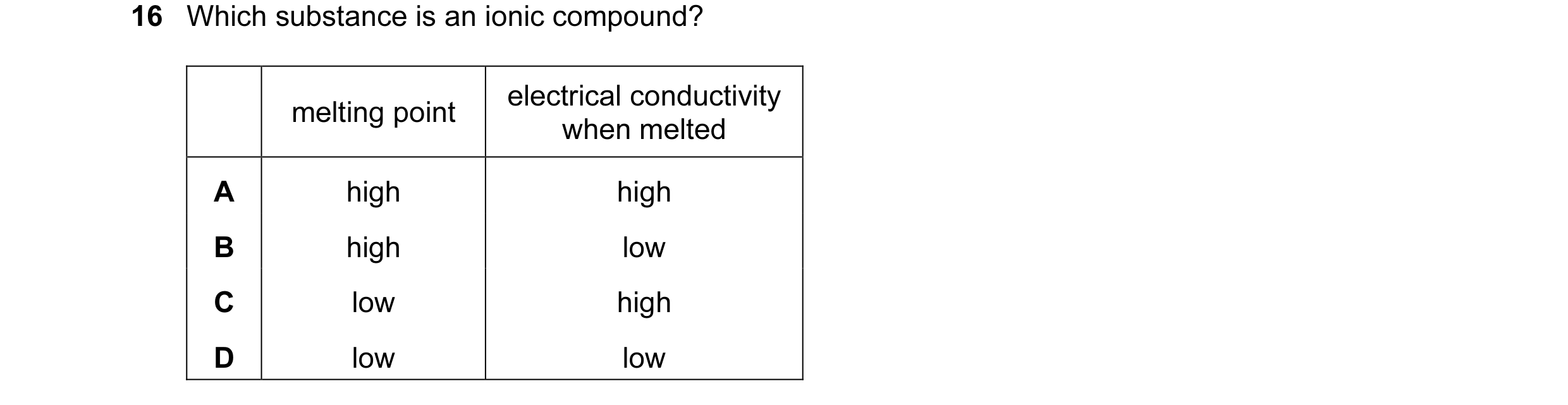

 2 / 15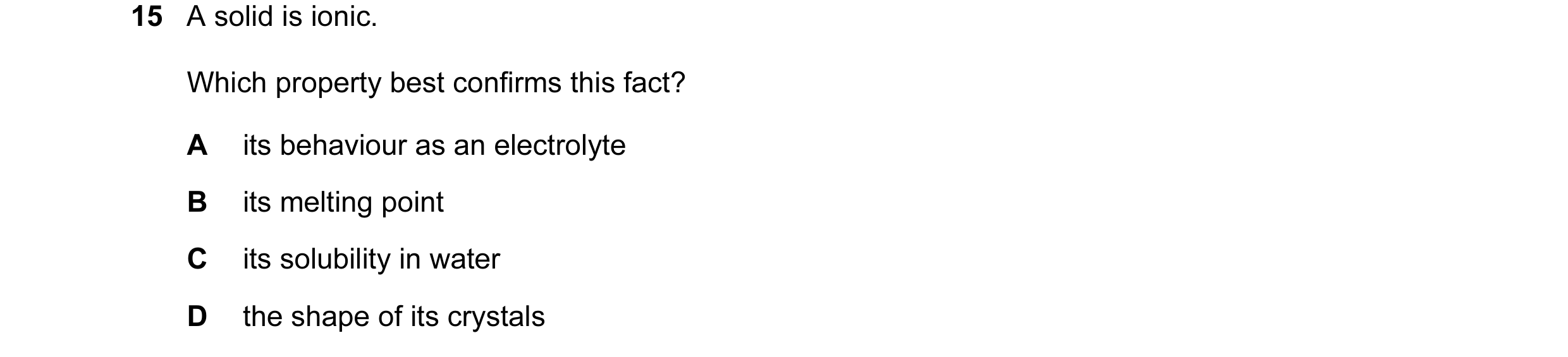
 3 / 15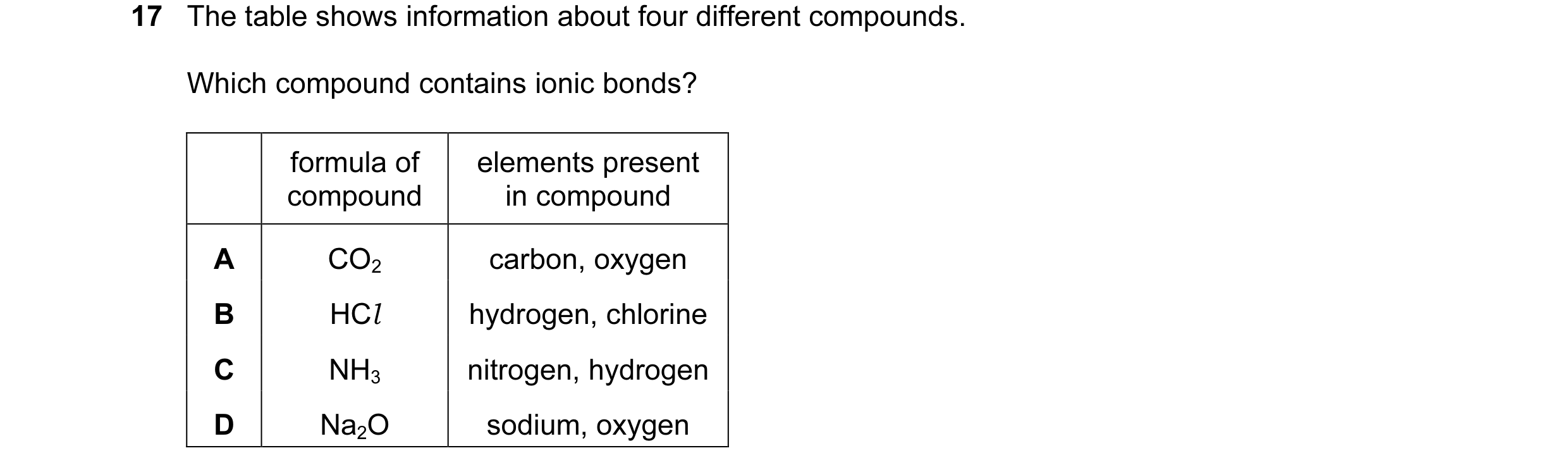
 4 / 15


 5 / 15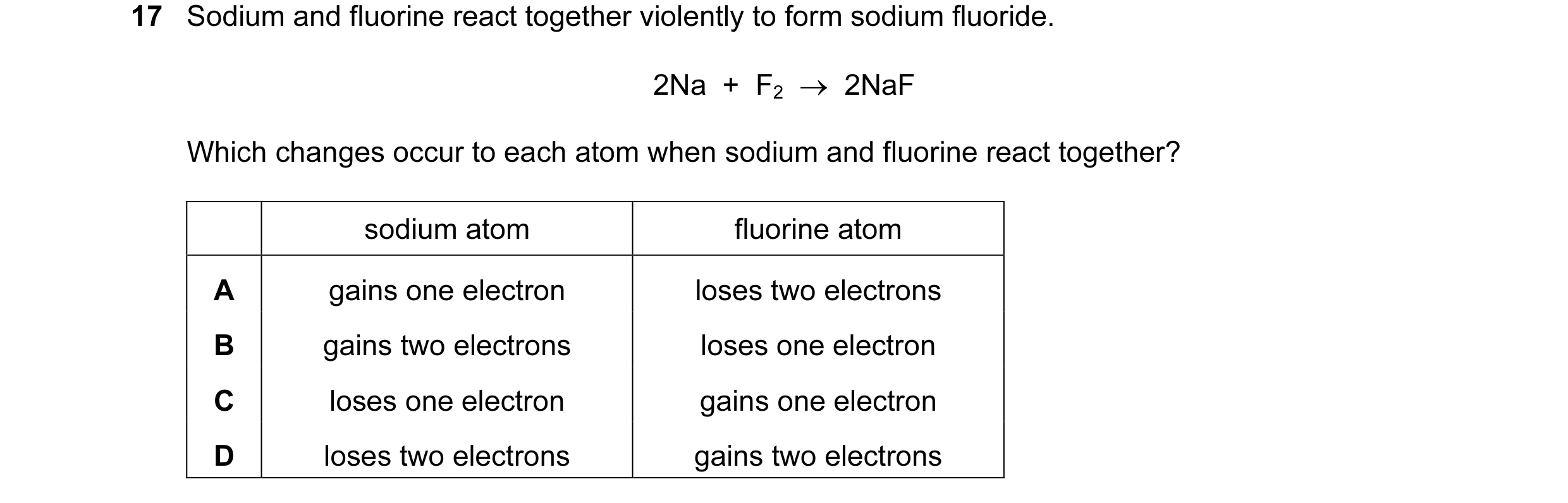
 6 / 15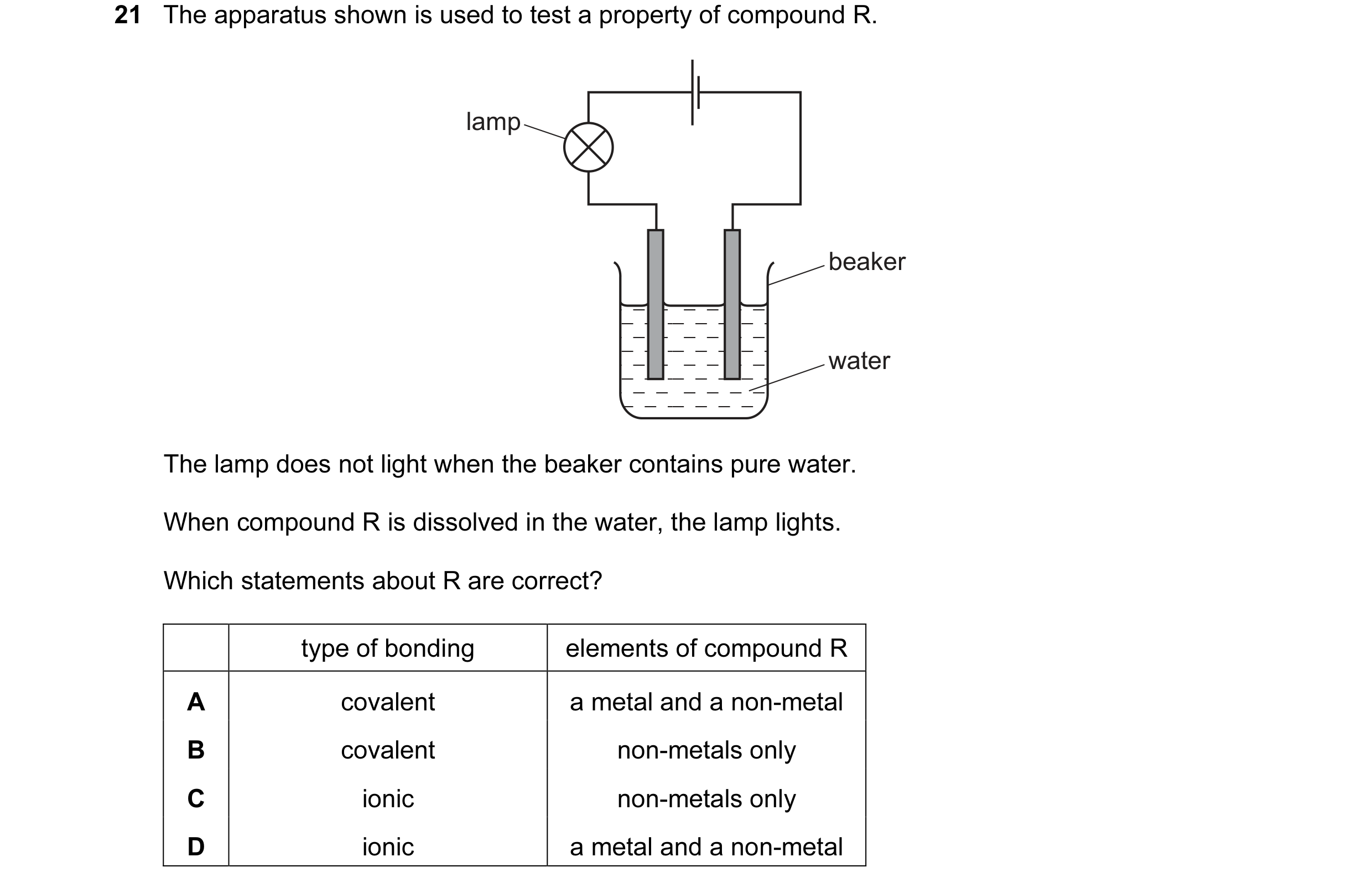
 7 / 15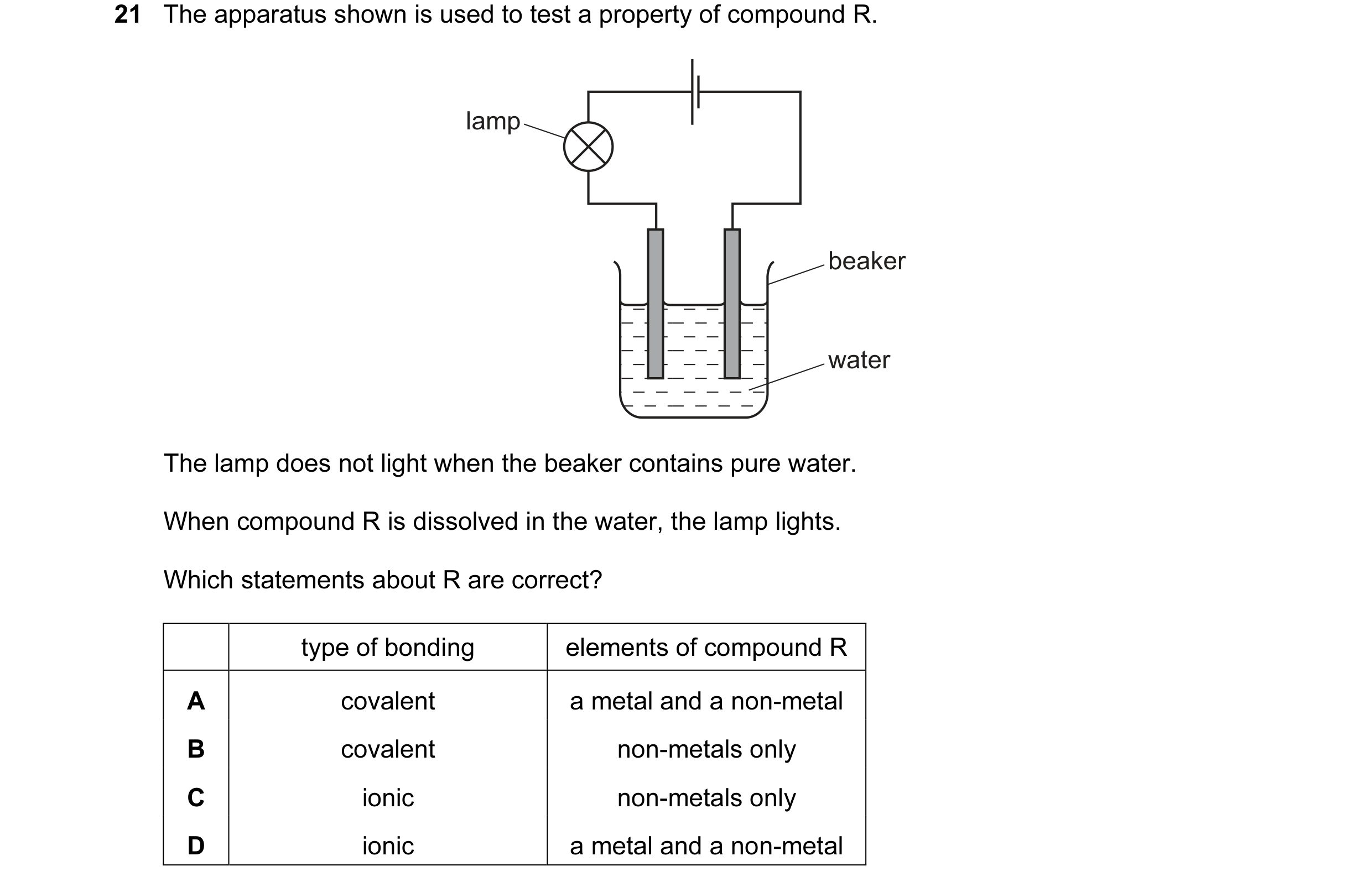
 8 / 15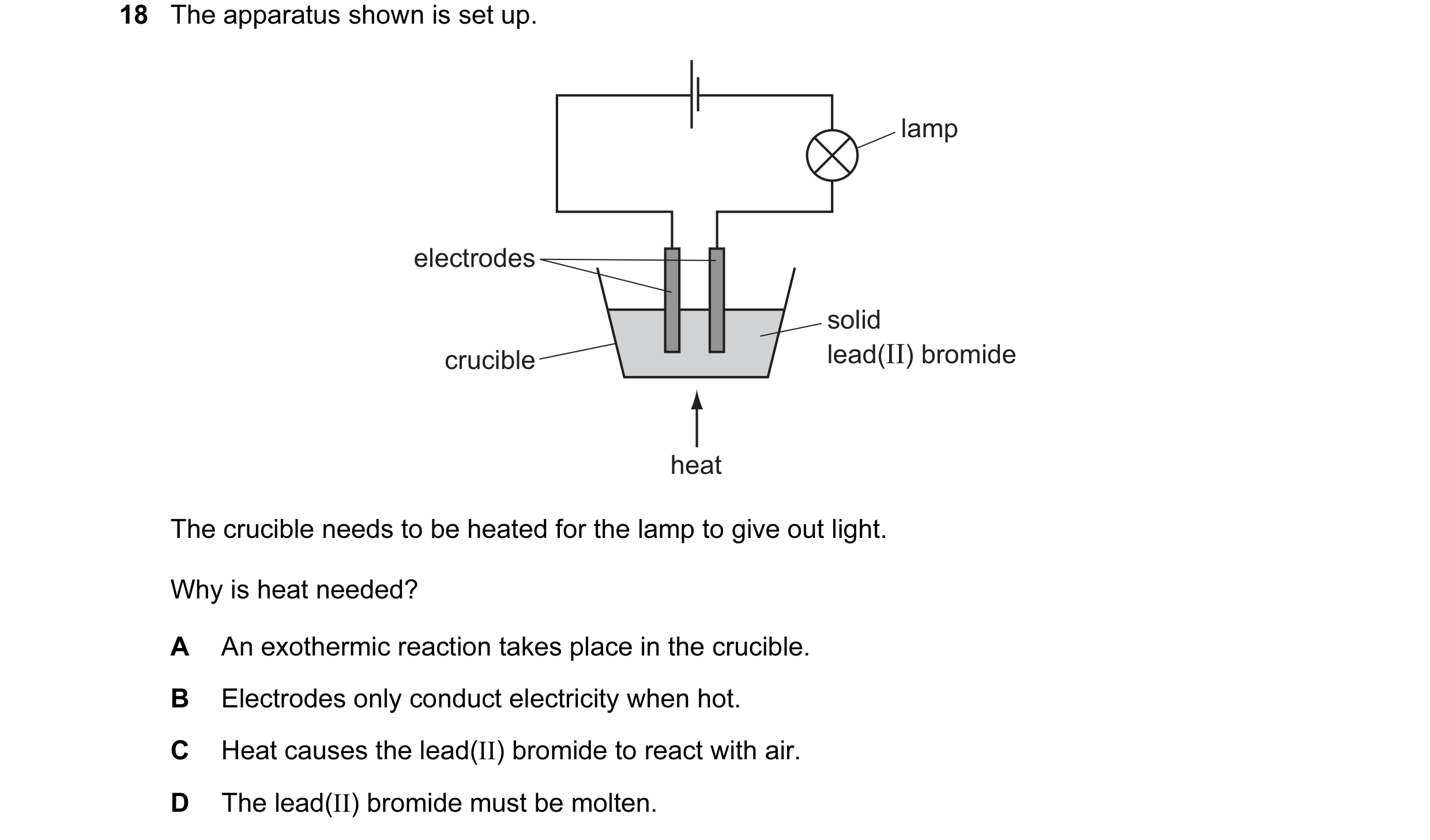
 9 / 15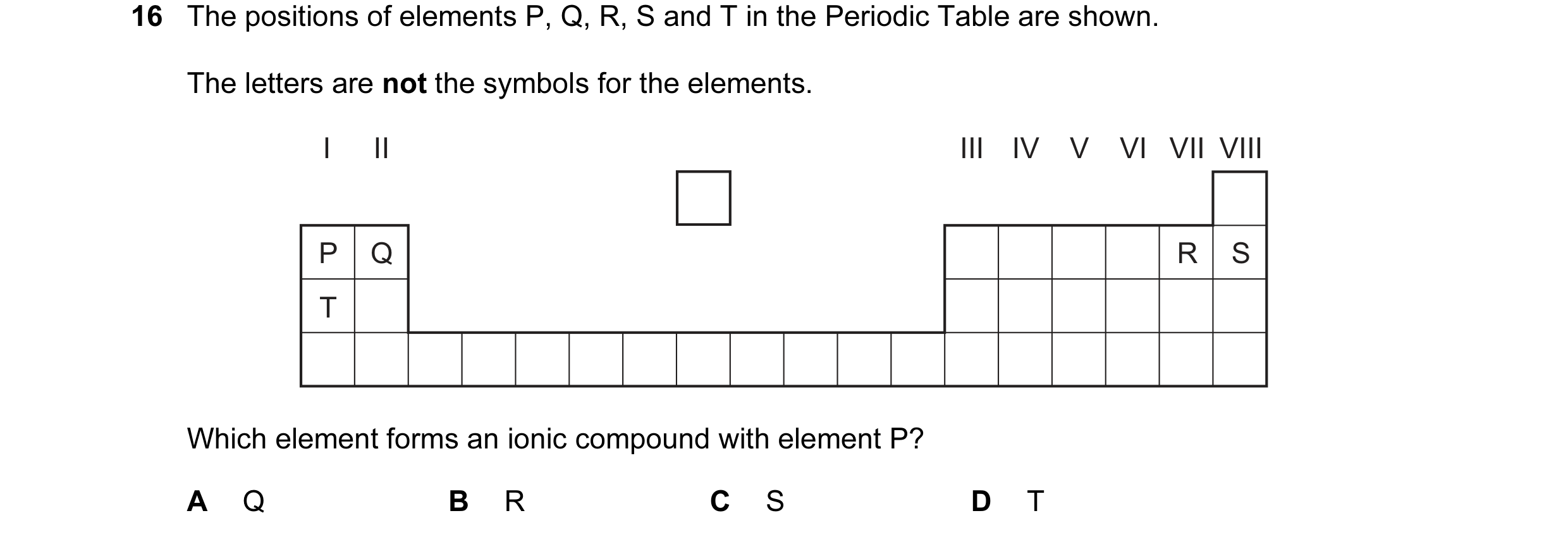



 10 / 15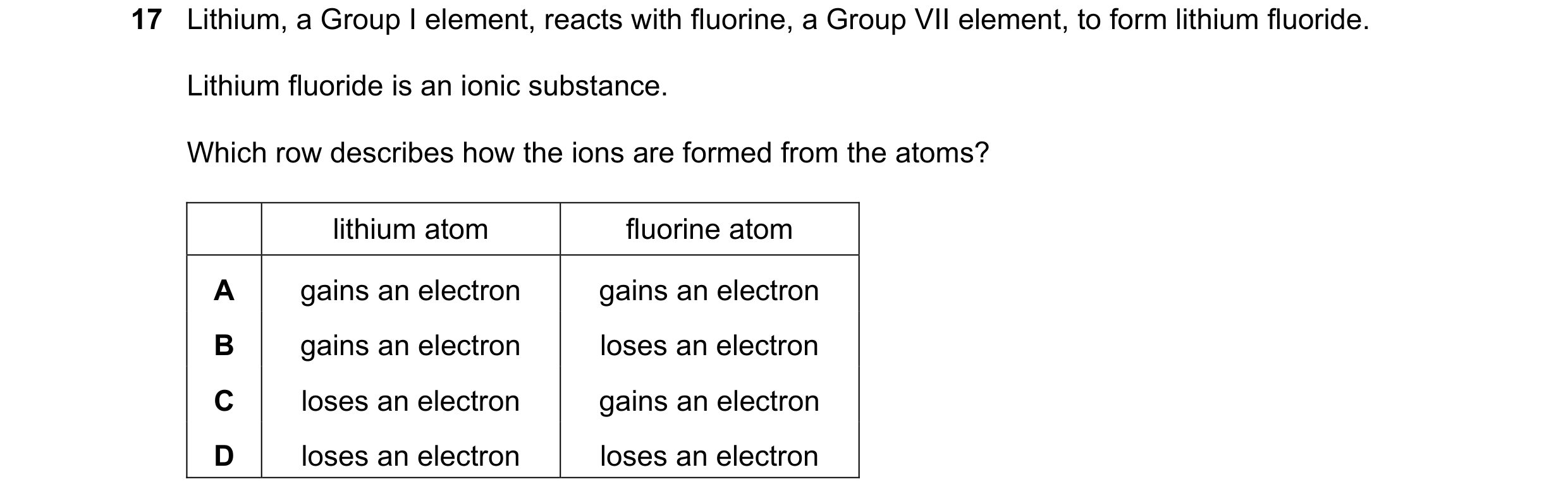

 11 / 15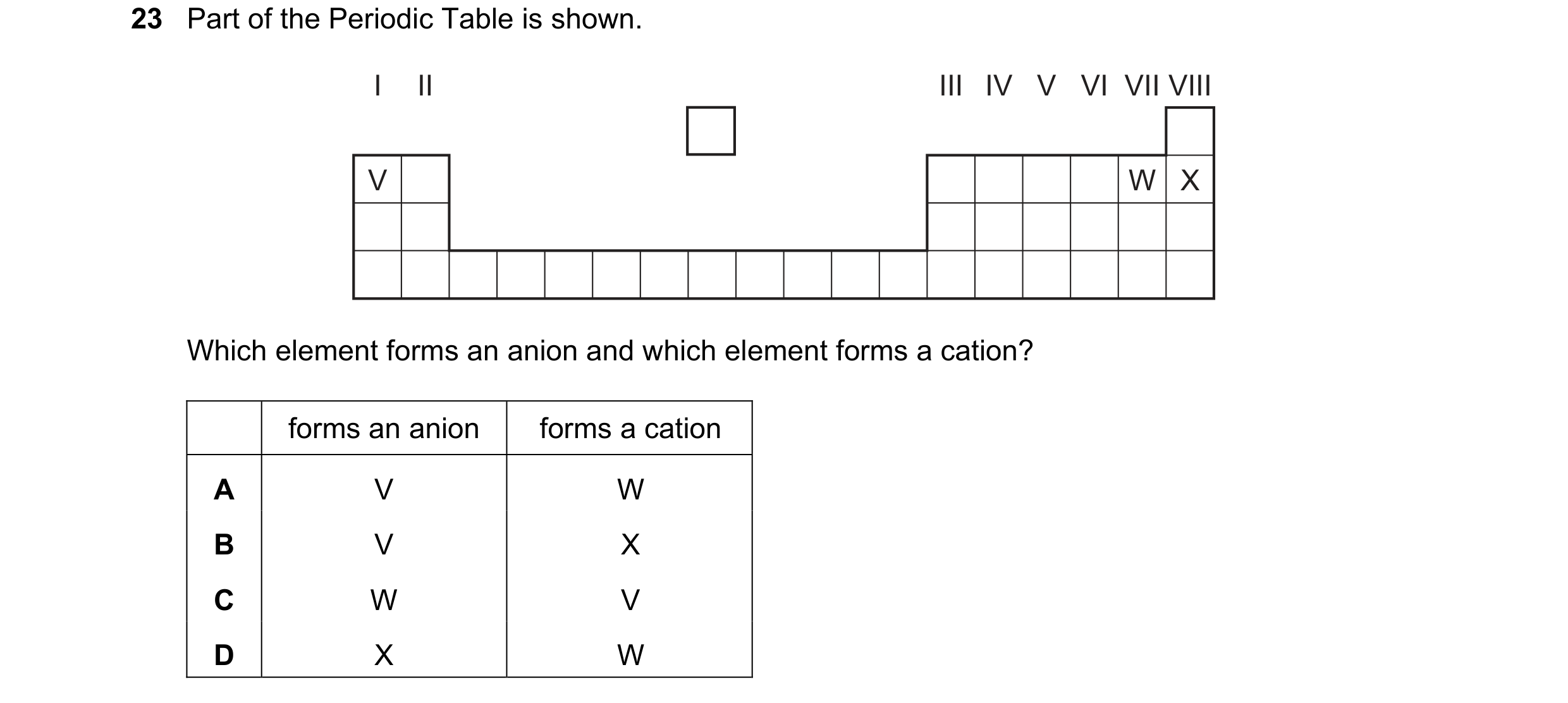
 12 / 15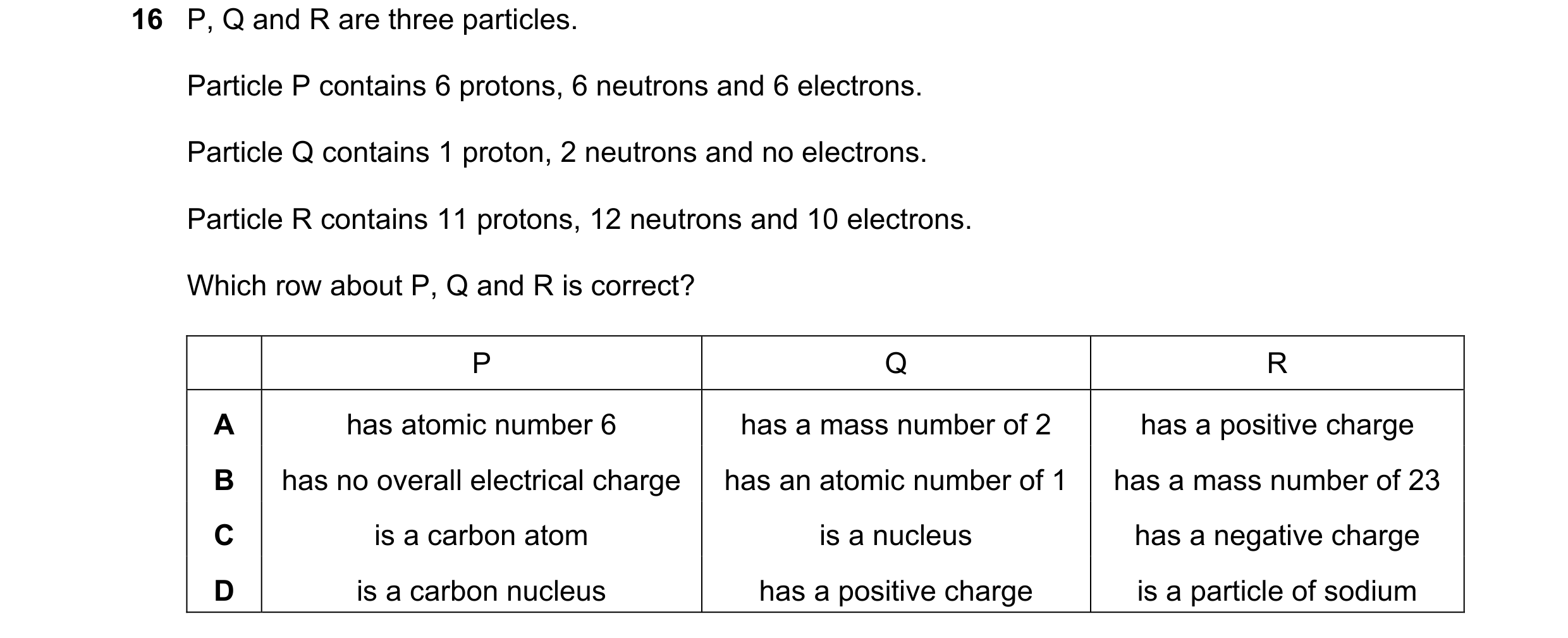


 13 / 15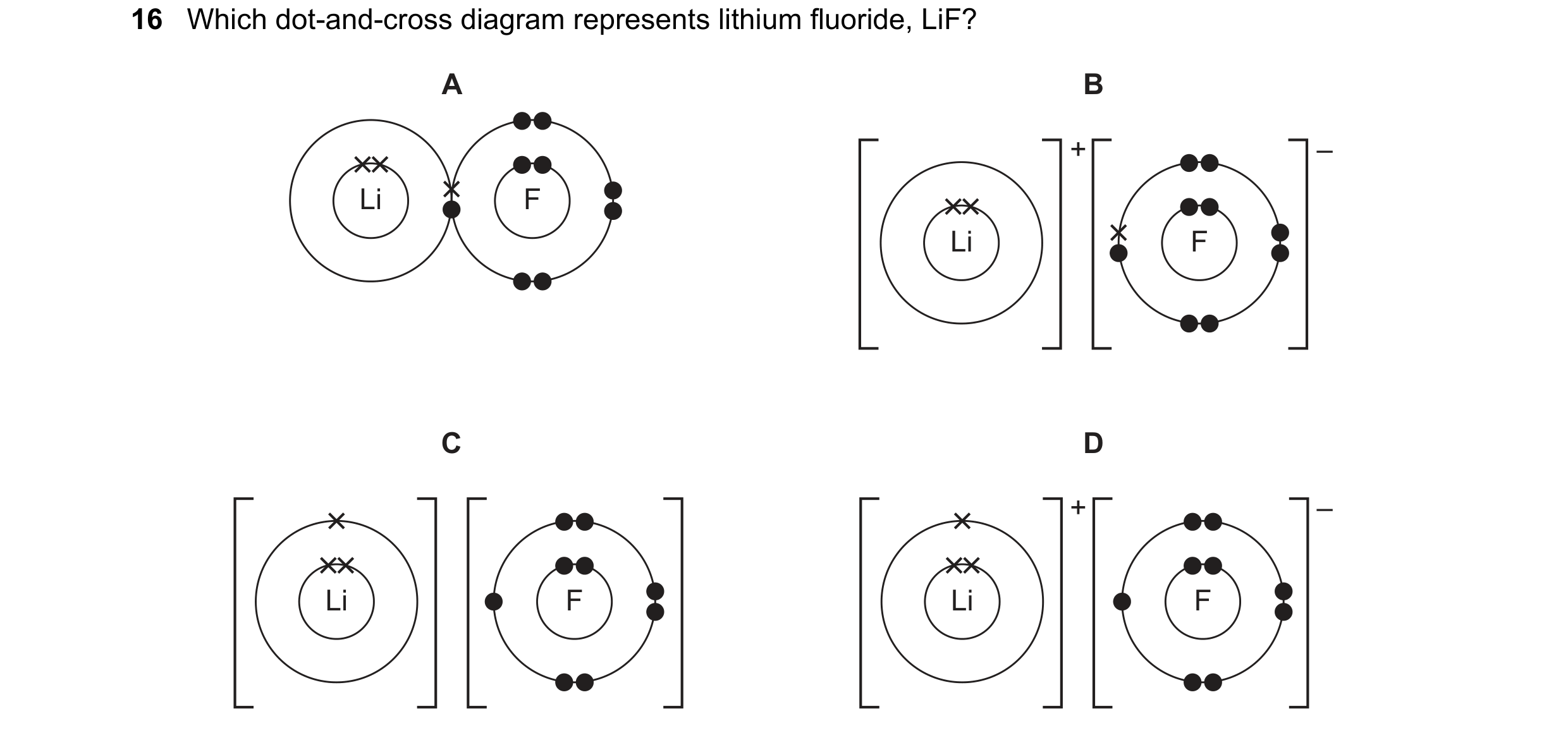
 14 / 15


 15 / 15