Questions as text
Q1 · Methane, CH4, and butane, C4H10, are both alkanes 0653/42 Feb/March 2017
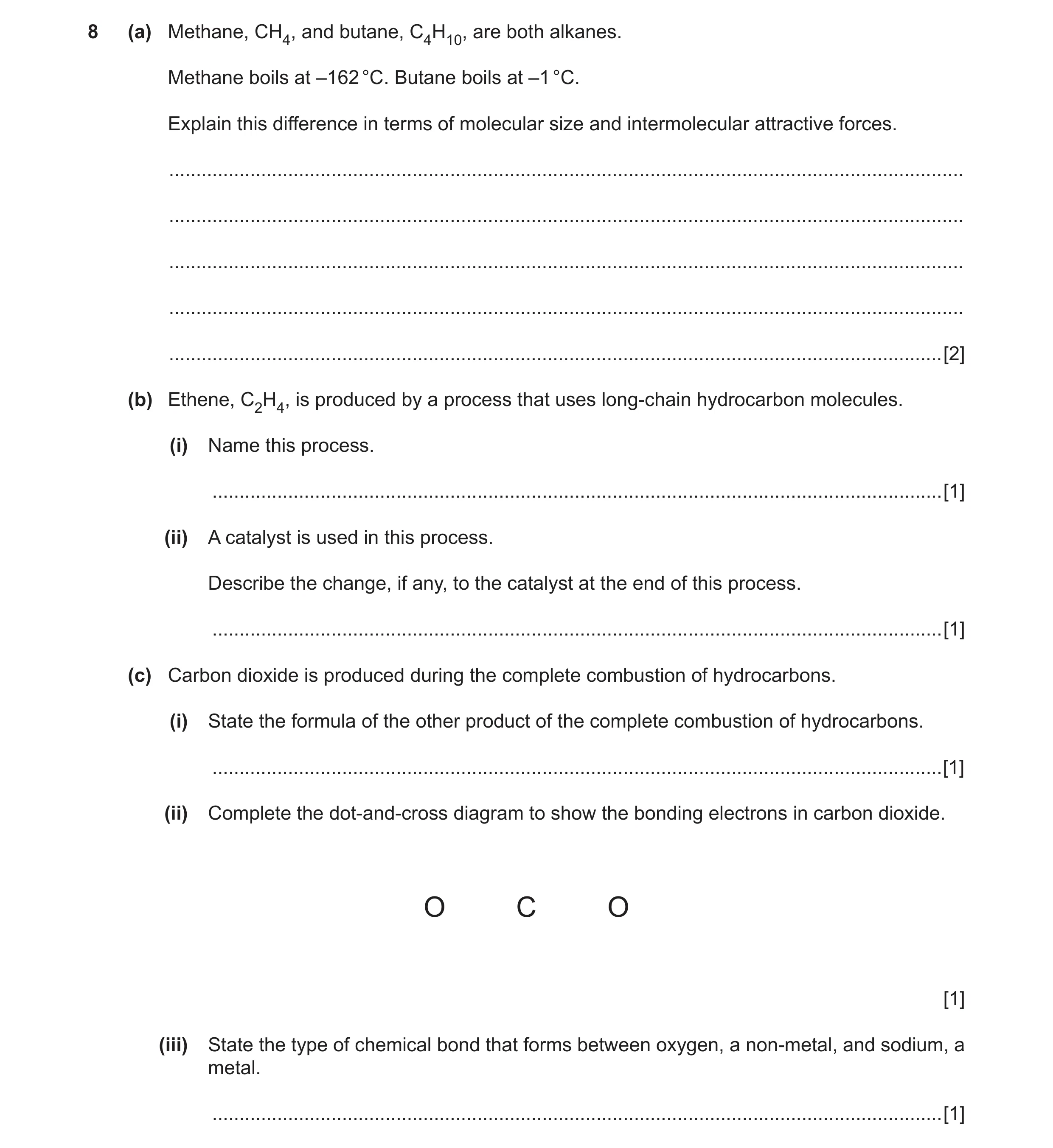
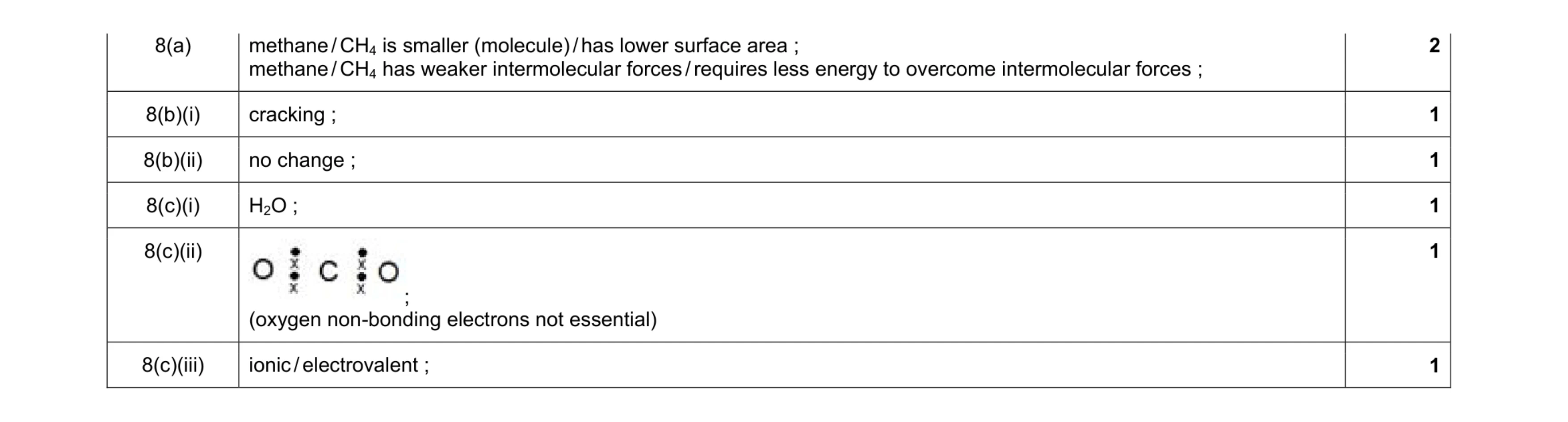
8 (a) Methane, CH4, and butane, C4H10, are both alkanes. Methane boils at –162 °C. Butane boils at –1 °C. Explain this difference in terms of molecular size and intermolecular attractive forces. … … … … … [2] (b) Ethene, C2H4, is produced by a process that uses long-chain hydrocarbon molecules. (i) Name this process. … [1] (ii) A catalyst is used in this process. Describe the change, if any, to the catalyst at the end of this process. … [1] (c) Carbon dioxide is produced during the complete combustion of hydrocarbons. (i) State the formula of the other product of the complete combustion of hydrocarbons. … [1] (ii) Complete the dot-and-cross diagram to show the bonding electrons in carbon dioxide. O C O [1] (iii) State the type of chemical bond that forms between oxygen, a non-metal, and sodium, a metal. … [1]
7 marks
Mark scheme: 8(a) methane / CH4 is smaller (molecule) / has lower surface area ; methane / CH4 has weaker intermolecular forces / requires less energy to overcome intermolecular forces ; 2 8(b)(i) cracking ; 1 8(b)(ii) no change ; 1 8(c)(i) H2O ; 1 8(c)(ii) ; (oxygen non-bonding electrons not essential) 1 8(c)(iii) ionic / electrovalent ; 1
This question in 0653/42 Feb/March 2017
Q2 · An atom of bromine is represented by the symbol 3579Br (i) State the number of electrons… 0653/42 Feb/March 2018
5 (a) An atom of bromine is represented by the symbol 3579Br (i) State the number of electrons, neutrons and protons in this atom. electrons … neutrons … protons … [2] (ii) Complete Table 5.1 to show the relative charges and approximate relative masses of electrons, neutrons and protons. Table 5.1 particle relative charges approximate relative masses electrons neutrons protons [2] (b) Bromine is a non-metallic element. State the types of bond that form when bromine reacts with sodium and with hydrogen. Explain your answers in terms of electrons. sodium and bromine … explanation … … hydrogen and bromine … explanation … … [3] (c) The Periodic Table on page 20 shows the positions of bromine and the other elements in Group VII. Predict one Group VII element that is displaced from its salts by bromine. … [1] (d) Argon is a noble gas. The noble gases are in Group VIII of the Periodic Table. (i) State the electronic structure of an atom of argon. … [1] (ii) State one use of argon. … [1]
10 marks
Mark scheme: 5(a)(i) (electrons) 35 (neutrons) 44 (protons) 35 ;; all three correct (2) one or two correct (1) 2 5(a)(ii) (particle) (relative charges) (approximate relative masses) (electrons) –1 / negative / –ve negligible / 1 / 2000 (neutrons) 0 / none / neutral 1 (protons) +1 / positive / +ve 1 each column correct ;; 2 5(b) (sodium) ionic / electrovalent and (hydrogen) covalent ; (ionic) idea of gain / loss / transfer of electrons ; (covalent) electrons are shared ; 3 5(c) iodine / astatine ; 1 5(d)(i) 2, 8, 8 ; 1 5(d)(ii) lamps / inert atmosphere / other valid answers ; 1
This question in 0653/42 Feb/March 2018
Q3 · Sodium burns in oxygen to produce sodium oxide, an ionic compound 0653/41 May/June 2019
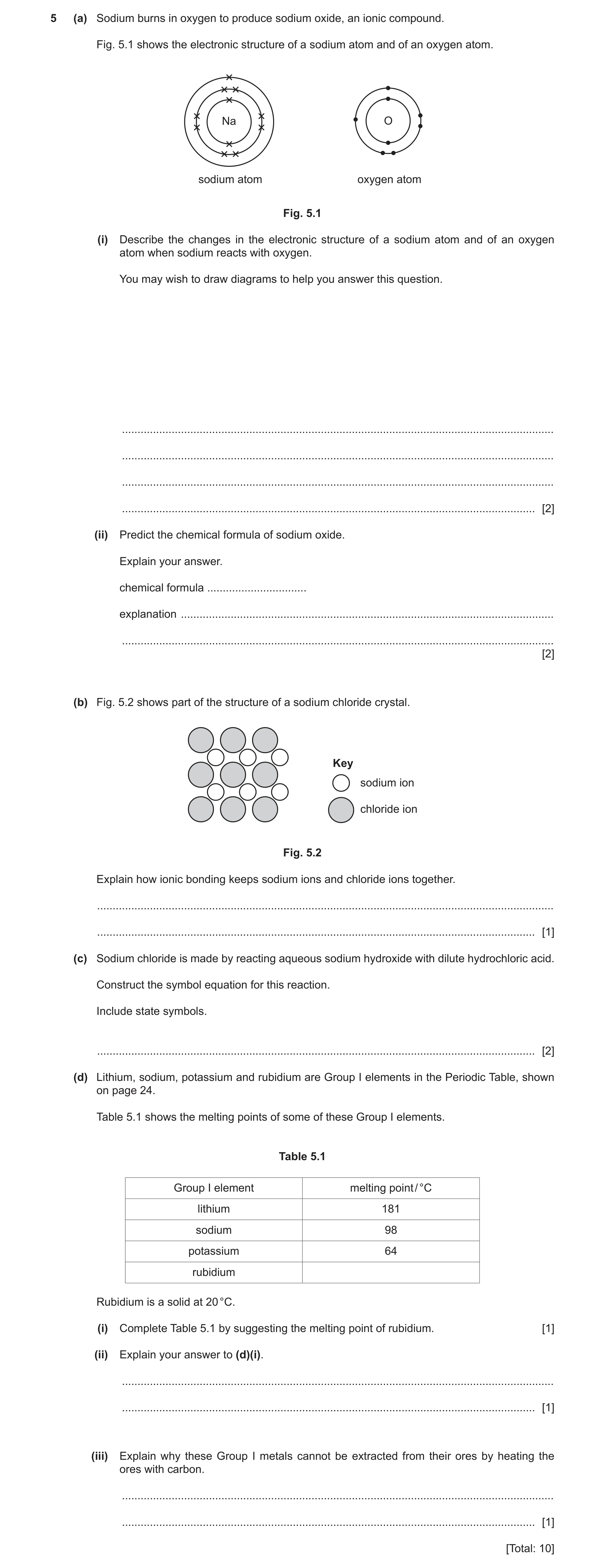
5 (a) Sodium burns in oxygen to produce sodium oxide, an ionic compound. Fig. 5.1 shows the electronic structure of a sodium atom and of an oxygen atom. Na O sodium atom oxygen atom Fig. 5.1 (i) Describe the changes in the electronic structure of a sodium atom and of an oxygen atom when sodium reacts with oxygen. You may wish to draw diagrams to help you answer this question. … … … … [2] (ii) Predict the chemical formula of sodium oxide. Explain your answer. chemical formula … explanation … … [2] (b) Fig. 5.2 shows part of the structure of a sodium chloride crystal. Key sodium ion chloride ion Fig. 5.2 Explain how ionic bonding keeps sodium ions and chloride ions together. … … [1] (c) Sodium chloride is made by reacting aqueous sodium hydroxide with dilute hydrochloric acid. Construct the symbol equation for this reaction. Include state symbols. … [2] (d) Lithium, sodium, potassium and rubidium are Group I elements in the Periodic Table, shown on page 24. Table 5.1 shows the melting points of some of these Group I elements. Table 5.1 Group I element melting point / °C lithium 181 sodium 98 potassium 64 rubidium Rubidium is a solid at 20 °C. (i) Complete Table 5.1 by suggesting the melting point of rubidium. [1] (ii) Explain your answer to (d)(i). … … [1] (iii) Explain why these Group I metals cannot be extracted from their ores by heating the ores with carbon. … … [1] [Total: 10]
10 marks
Mark scheme: 5(a)(i) sodium atom loses one electron ; oxygen atom gains two electrons / oxygen atom achieves filled outer shell by gaining electrons ; 2 5(a)(ii) Na2O ; explanation in terms of balanced charges / implication that charges need to balance ; 2 5(b) opposite / unlike charges (attract) ; 1 5(c) NaOH (aq) + HCl (aq) → NaCl (aq) + H2O (l) all formulae correct ; balanced and at least three correct state symbols ; 2 5(d)(i) in the range 25 °C to 55 °C (inclusive) ; 1 5(d)(ii) melting point decreases down Group 1 ; 1 5(d)(iii) metals are above carbon in reactivity series ; 1
This question in 0653/41 May/June 2019
Q4 · The melting points of some Group I elements 0653/42 May/June 2019
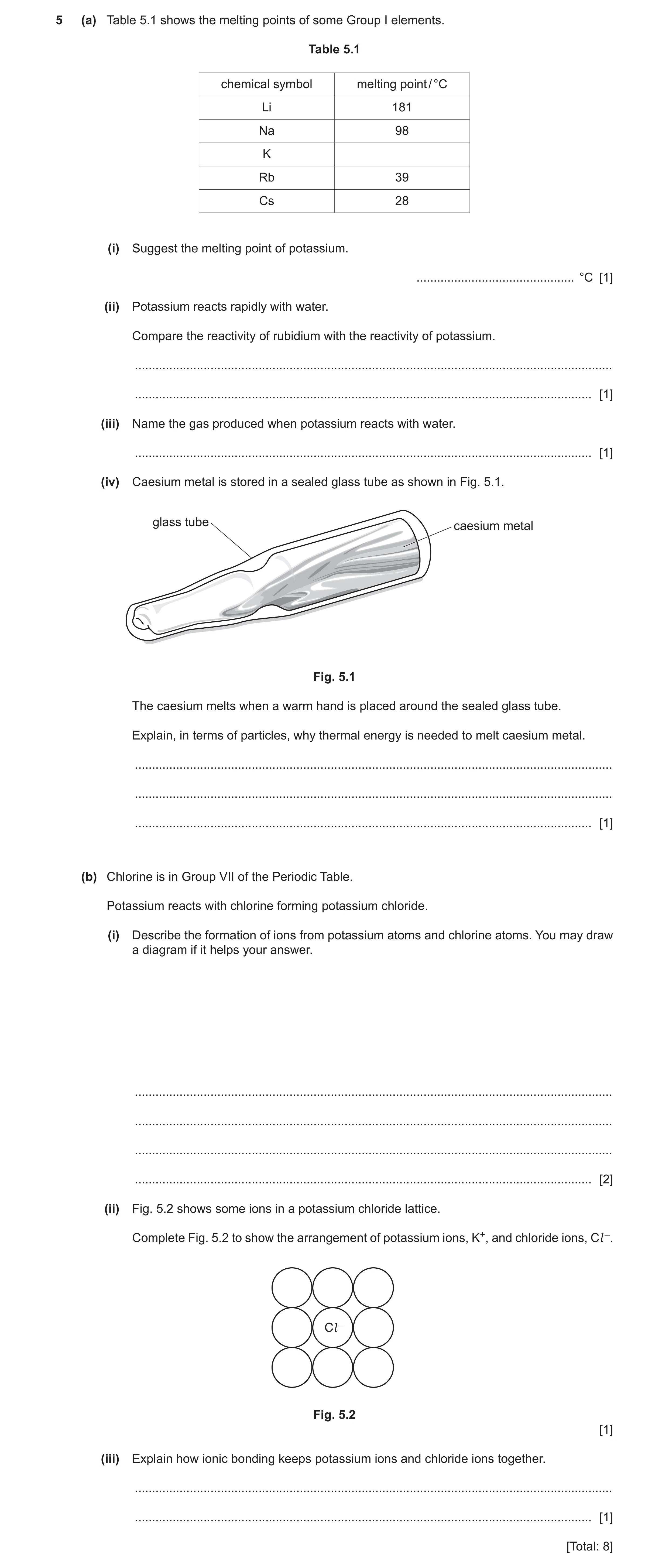
5 (a) Table 5.1 shows the melting points of some Group I elements. Table 5.1 chemical symbol melting point / °C Li 181 Na 98 K Rb 39 Cs 28 (i) Suggest the melting point of potassium. … °C [1] (ii) Potassium reacts rapidly with water. Compare the reactivity of rubidium with the reactivity of potassium. … … [1] (iii) Name the gas produced when potassium reacts with water. … [1] (iv) Caesium metal is stored in a sealed glass tube as shown in Fig. 5.1. glass tube caesium metal Fig. 5.1 The caesium melts when a warm hand is placed around the sealed glass tube. Explain, in terms of particles, why thermal energy is needed to melt caesium metal. … … … [1] (b) Chlorine is in Group VII of the Periodic Table. Potassium reacts with chlorine forming potassium chloride. (i) Describe the formation of ions from potassium atoms and chlorine atoms. You may draw a diagram if it helps your answer. … … … … [2] (ii) Fig. 5.2 shows some ions in a potassium chloride lattice. Complete Fig. 5.2 to show the arrangement of potassium ions, K+, and chloride ions, Cl –. Cl – Fig. 5.2 [1] (iii) Explain how ionic bonding keeps potassium ions and chloride ions together. … … [1] [Total: 8]
8 marks
Mark scheme: 5(a)(i) any suggestion in the range 50–75°C (inclusive) ; 1 5(a)(ii) rubidium is more reactive than potassium; 1 5(a)(iii) hydrogen; 1 5(a)(iv) the idea that attractive forces between particles have to be broken down / decreased / atoms gain speed / KE so they move further apart / owtte ; 1 5(b)(i) outer shell / one electron lost from K atom; outer shell of chlorine gains one electron / outer shell of chlorine atom is filled / completed ; 2 5(b)(ii) alternating K+ and Cl– ions ; 1 5(b)(iii) opposite / unlike charges (attract) ; 1
This question in 0653/42 May/June 2019
Q5 · Chlorine and astatine are two Group VII elements 0653/42 Oct/Nov 2019
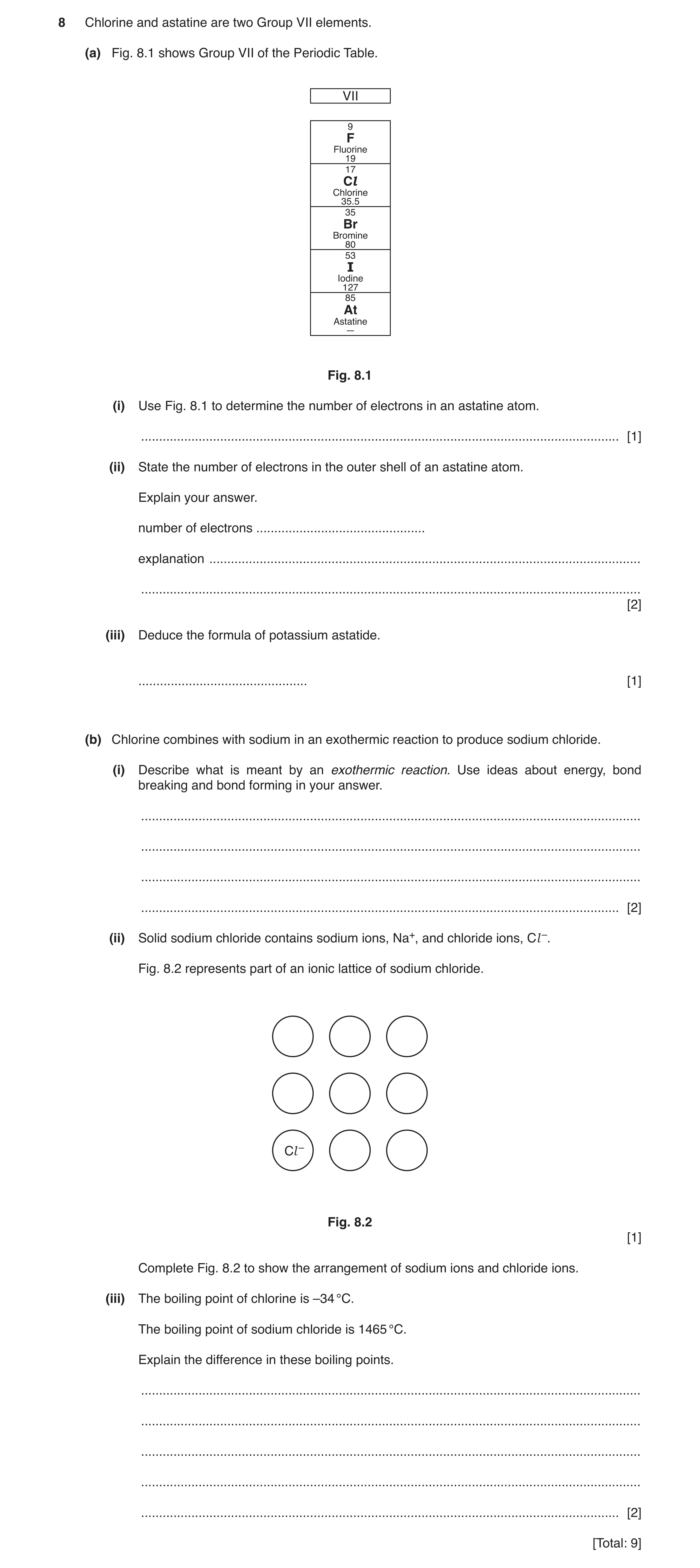
8 Chlorine and astatine are two Group VII elements. (a) Fig. 8.1 shows Group VII of the Periodic Table. VII 9 F Fluorine 19 17 Cl Chlorine 35.5 35 Br Bromine 80 53 I Iodine 127 85 At Astatine — Fig. 8.1 (i) Use Fig. 8.1 to determine the number of electrons in an astatine atom. … [1] (ii) State the number of electrons in the outer shell of an astatine atom. Explain your answer. number of electrons … explanation … … [2] (iii) Deduce the formula of potassium astatide. … [1] (b) Chlorine combines with sodium in an exothermic reaction to produce sodium chloride. (i) Describe what is meant by an exothermic reaction. Use ideas about energy, bond breaking and bond forming in your answer. … … … … [2] (ii) Solid sodium chloride contains sodium ions, Na+, and chloride ions, Cl –. Fig. 8.2 represents part of an ionic lattice of sodium chloride. Cl – Fig. 8.2 [1] Complete Fig. 8.2 to show the arrangement of sodium ions and chloride ions. (iii) The boiling point of chlorine is –34 °C. The boiling point of sodium chloride is 1465 °C. Explain the difference in these boiling points. … … … … … [2] [Total: 9]
9 marks
Mark scheme: 8(a)(i) 85 ; 1 8(a)(ii) 7 ; group VII element / halogen ; 2 8(a)(iii) KAt ; 1 8(b)(i) thermal energy released / temperature increased / chemical energy converted to thermal energy ; more energy released during bond formation than energy required for bond breaking ; 2 8(b)(ii) alternating Cl – and Na+ ions ; 1 8(b)(iii) (NaCl) or (chlorine) ionic so attractive forces between ions are strong covalent so attractive forces between molecules are weak ; more thermal energy (heat) needed to separate ions less thermal energy (heat) needed to separate molecules ; 2
This question in 0653/42 Oct/Nov 2019
Q6 · Copper is a transition metal 0653/42 May/June 2020
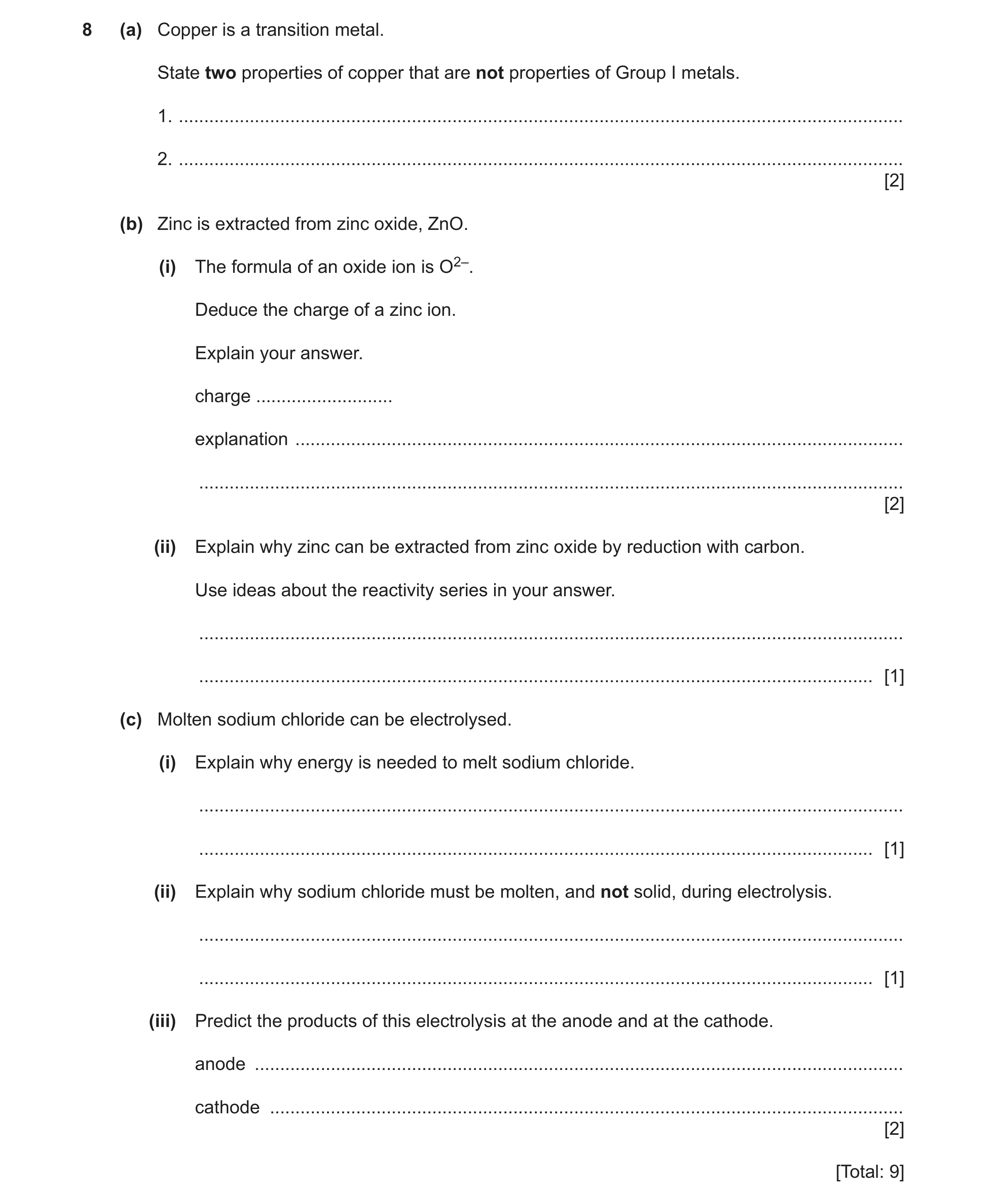
8 (a) Copper is a transition metal. State two properties of copper that are not properties of Group I metals. 1. … 2. … [2] (b) Zinc is extracted from zinc oxide, ZnO. (i) The formula of an oxide ion is O2–. Deduce the charge of a zinc ion. Explain your answer. charge … explanation … … [2] (ii) Explain why zinc can be extracted from zinc oxide by reduction with carbon. Use ideas about the reactivity series in your answer. … … [1] (c) Molten sodium chloride can be electrolysed. (i) Explain why energy is needed to melt sodium chloride. … … [1] (ii) Explain why sodium chloride must be molten, and not solid, during electrolysis. … … [1] (iii) Predict the products of this electrolysis at the anode and at the cathode. anode … cathode … [2] [Total: 9]
9 marks
Mark scheme: 8(a) forms coloured compounds ; has high melting point ; has high density ; 2 8(b)(i) (charge) 2+ ; (explanation) 2+ to balance 2– on oxide ion ; 2 8(b)(ii) carbon, above zinc in reactivity series / more reactive than zinc ; 1 8(c)(i) energy needed, for work to be done against attractive forces / to break interatomic ‘bonds’ / for particles to break free, from solid state ; 1 8(c)(ii) ions must be mobile ; 1 8(c)(iii) (anode) chlorine ; (cathode) sodium ; 2
This question in 0653/42 May/June 2020
Q7 · Bromine, chlorine and iodine are in Group VII of the Periodic Table 0653/41 May/June 2021
8 Bromine, chlorine and iodine are in Group VII of the Periodic Table. Table 8.1 shows some information about these elements at room temperature and pressure. Table 8.1 element formula state colour bromine Br2 liquid red chlorine Cl2 iodine I grey 2 (a) (i) Complete Table 8.1. [3] (ii) Molecules of bromine, chlorine and iodine are diatomic. Explain the meaning of the term diatomic. … … … … [2] (b) Explain why bromine, chlorine and iodine are in Group VII of the Periodic Table. Use ideas about electrons in your answer. … … [1] (c) Some Group VII elements are mixed with some aqueous potassium salts. The word equations show what happens. bromine + potassium chloride no reaction bromine + potassium iodide iodine + potassium bromide chlorine + potassium bromide bromine + potassium chloride iodine + potassium bromide no reaction Use this information to place bromine, chlorine and iodine in order of reactivity. Explain your answer. most reactive … … least reactive … explanation … … [2] (d) Potassium reacts with chlorine to form potassium chloride. (i) State the type of bonding in potassium chloride. … [1] (ii) Explain why potassium chloride has a high melting point. … … [1] [Total: 10]
10 marks
Mark scheme: 8(a)(i) element formula state colour bromine Br2 liquid red chlorine Cl2 gas green iodine I2 solid grey ;;; chlorine: (state) gas ; (colour) green ; iodine: (state) solid ; 8(a)(ii) (diatomic means) only two atoms ; (atoms) joined / combined / bonded together, (in a molecule) ; 2 8(b) they have 7 electrons in the outer shell ; 1 8(c) order of reactivity: chlorine, bromine, iodine ; explanation: a more reactive element can displace a less reactive element / a more reactive element can react with a salt of a less reactive element ; 2 8(d)(i) ionic ; 1 8(d)(ii) attraction (between ions) is very strong ; 1
This question in 0653/41 May/June 2021
Q8 · Calcium chloride, CaCl2, is an ionic compound 0653/42 May/June 2021
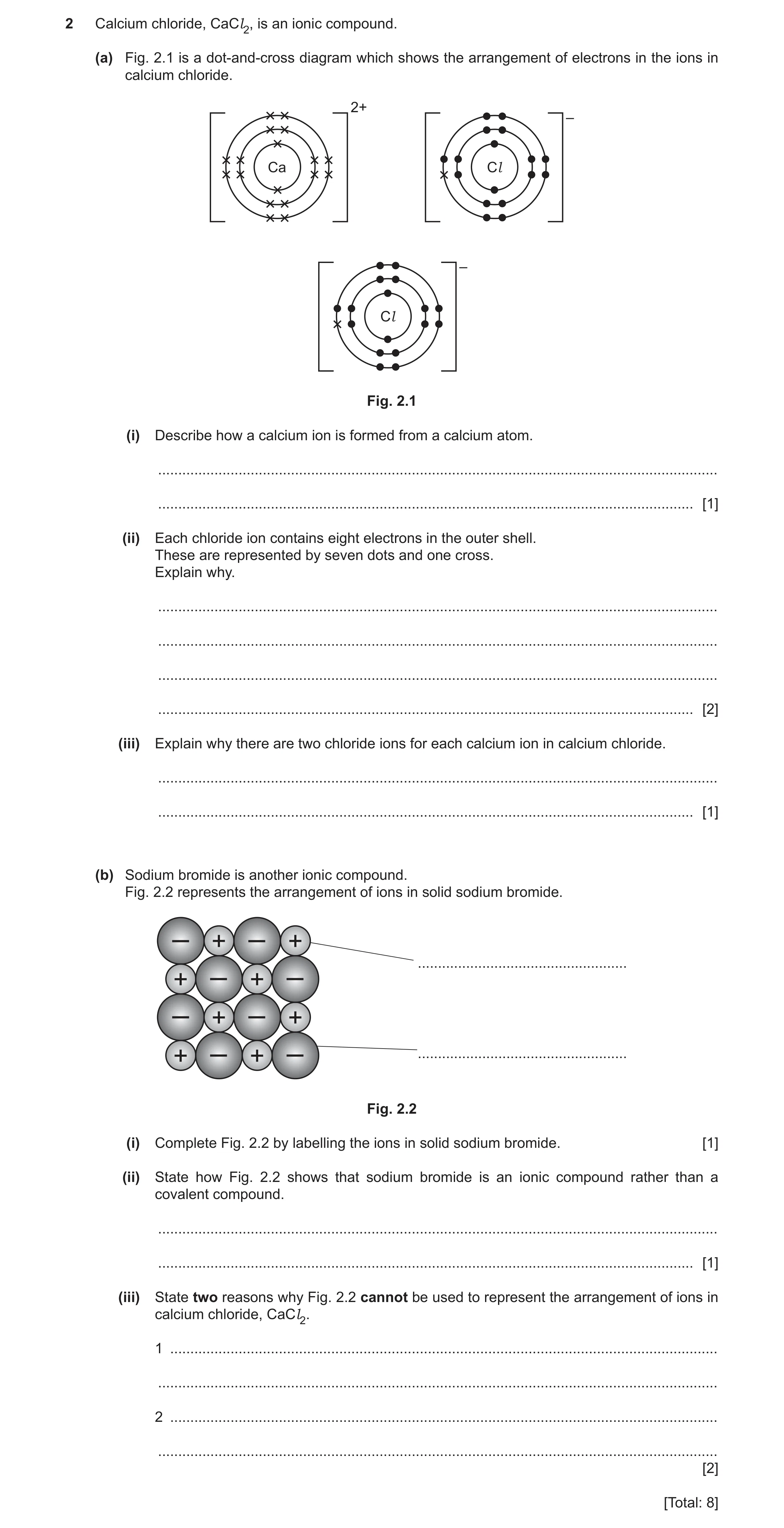
2 Calcium chloride, CaCl2, is an ionic compound. (a) Fig. 2.1 is a dot-and-cross diagram which shows the arrangement of electrons in the ions in calcium chloride. 2+ – Ca Cl – Cl Fig. 2.1 (i) Describe how a calcium ion is formed from a calcium atom. … … [1] (ii) Each chloride ion contains eight electrons in the outer shell. These are represented by seven dots and one cross. Explain why. … … … … [2] (iii) Explain why there are two chloride ions for each calcium ion in calcium chloride. … … [1] (b) Sodium bromide is another ionic compound. Fig. 2.2 represents the arrangement of ions in solid sodium bromide. – + – + … + – + – – + – + … + – + – Fig. 2.2 (i) Complete Fig. 2.2 by labelling the ions in solid sodium bromide. [1] (ii) State how Fig. 2.2 shows that sodium bromide is an ionic compound rather than a covalent compound. … … [1] (iii) State two reasons why Fig. 2.2 cannot be used to represent the arrangement of ions in calcium chloride, CaCl2. 1 … … 2 … … [2] [Total: 8]
8 marks
Mark scheme: 2(a)(i) it loses (2) electrons ; 1 2(a)(ii) chlorine atoms have seven electrons in the outer shell ; they gain an electron to, complete the outer shell / become stable ; 2 2(a)(iii) calcium ions have +2 charge and need two chloride ions at –1 / each calcium atoms loses 2 electrons / each chlorine atom gains 1 electron ; 1 2(b)(i) (positive ion) represents a sodium ion AND (negative ion) represents a bromide ion ; 1 2(b)(ii) contains positive and negative ions / contains oppositely charged ions ; 1 2(b)(iii) there are two chloride ions to each calcium ion / ions are not in a 1 : 1 ratio ; each calcium ion has a +2 charge ; 2
This question in 0653/42 May/June 2021
Q9 · The energy and state changes for water when it is heated from –10 °C to 120 °C 0653/41 Oct/Nov 2021
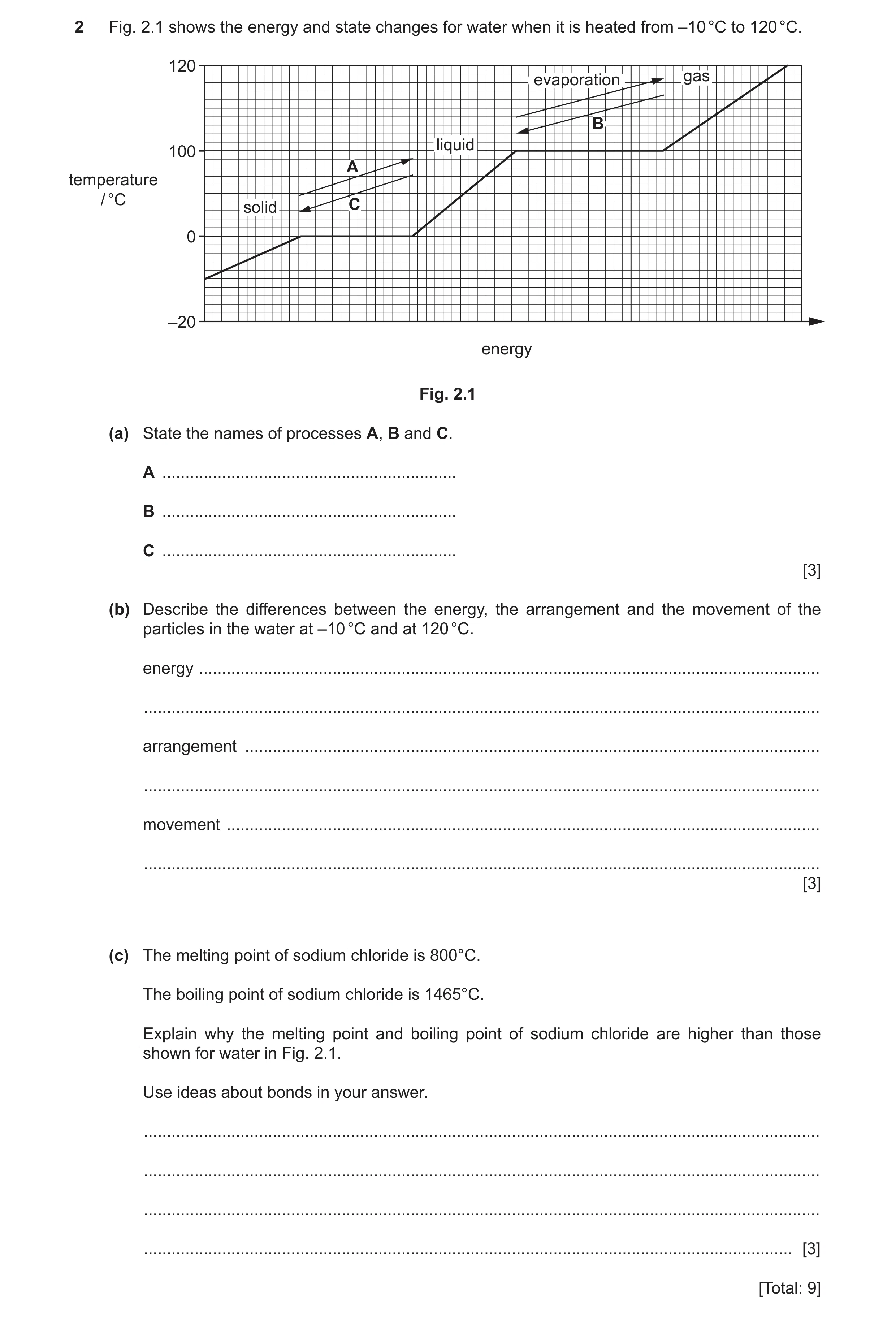
2 Fig. 2.1 shows the energy and state changes for water when it is heated from –10 °C to 120 °C. 120 evaporation gas B liquid 100 A temperature / °C solid C 0 –20 energy Fig. 2.1 (a) State the names of processes A, B and C. A … B … C … [3] (b) Describe the differences between the energy, the arrangement and the movement of the particles in the water at –10 °C and at 120 °C. energy … … arrangement … … movement … … [3] (c) The melting point of sodium chloride is 800°C. The boiling point of sodium chloride is 1465°C. Explain why the melting point and boiling point of sodium chloride are higher than those shown for water in Fig. 2.1. Use ideas about bonds in your answer. … … … … [3] [Total: 9]
9 marks
Mark scheme: 2(a) A melting ; B condensation ; C freezing ; 3 2(b) energy: particles have more (kinetic) energy at 120 °C ; arrangement: particles close / regular / lattice at –10 °C but random / spread out at 120 °C ; movement: particles (vibrate) in fixed positions at –10 °C but move around freely at 120 °C ; 3 2(c) any three from: more (thermal) energy needed to break bonds (in sodium chloride) ; sodium chloride, contains ionic bonds / is ionic ; the bonds between ions are stronger than between (water) molecules ; attraction between ions is high due to opposite electrical charges / strong electrostatic attraction between ions ; 3
This question in 0653/41 Oct/Nov 2021
Q10 · How molten iron is used to join railway tracks together 0653/43 Oct/Nov 2021
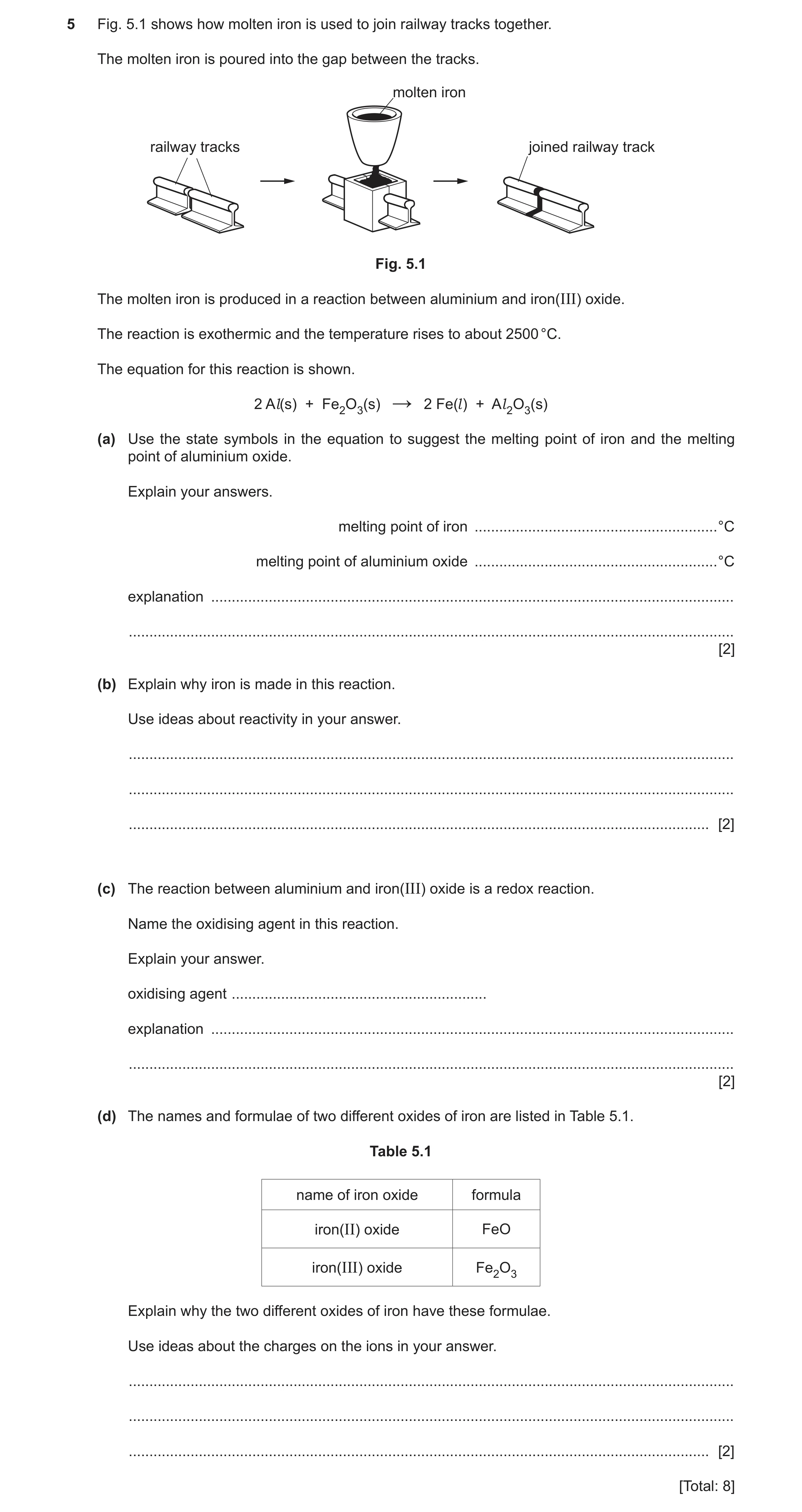
5 Fig. 5.1 shows how molten iron is used to join railway tracks together. The molten iron is poured into the gap between the tracks. molten iron railway tracks joined railway track Fig. 5.1 The molten iron is produced in a reaction between aluminium and iron(III) oxide. The reaction is exothermic and the temperature rises to about 2500 °C. The equation for this reaction is shown. 2 Al(s) + Fe2O3(s) 2 Fe(l) + Al2O3(s) → (a) Use the state symbols in the equation to suggest the melting point of iron and the melting point of aluminium oxide. Explain your answers. melting point of iron … °C melting point of aluminium oxide … °C explanation … … [2] (b) Explain why iron is made in this reaction. Use ideas about reactivity in your answer. … … … [2] (c) The reaction between aluminium and iron(III) oxide is a redox reaction. Name the oxidising agent in this reaction. Explain your answer. oxidising agent … explanation … … [2] (d) The names and formulae of two different oxides of iron are listed in Table 5.1. Table 5.1 name of iron oxide formula iron(II) oxide FeO iron(III) oxide Fe2O3 Explain why the two different oxides of iron have these formulae. Use ideas about the charges on the ions in your answer. … … … [2] [Total: 8]
8 marks
Mark scheme: 5(a) iron: <= 2500 oC AND aluminium oxide: > 2500 oC ; at 2500 oC, iron is a liquid and aluminium oxide is a solid ; 2 5(b) aluminium displaces iron / aluminium removes oxygen from iron ; because aluminium is more reactive than iron ; 2 5(c) iron(III) oxide / Fe3+ ; causes aluminium to gain oxygen ; 2 5(d) charge on, iron(II) is 2+ AND iron(III) is 3+ ; total positive charge needs to match total negative charge ; 2
This question in 0653/43 Oct/Nov 2021
Q11 · The outer shell electrons in atoms of elements X, Y and Z are shown in Fig 0653/41 May/June 2022
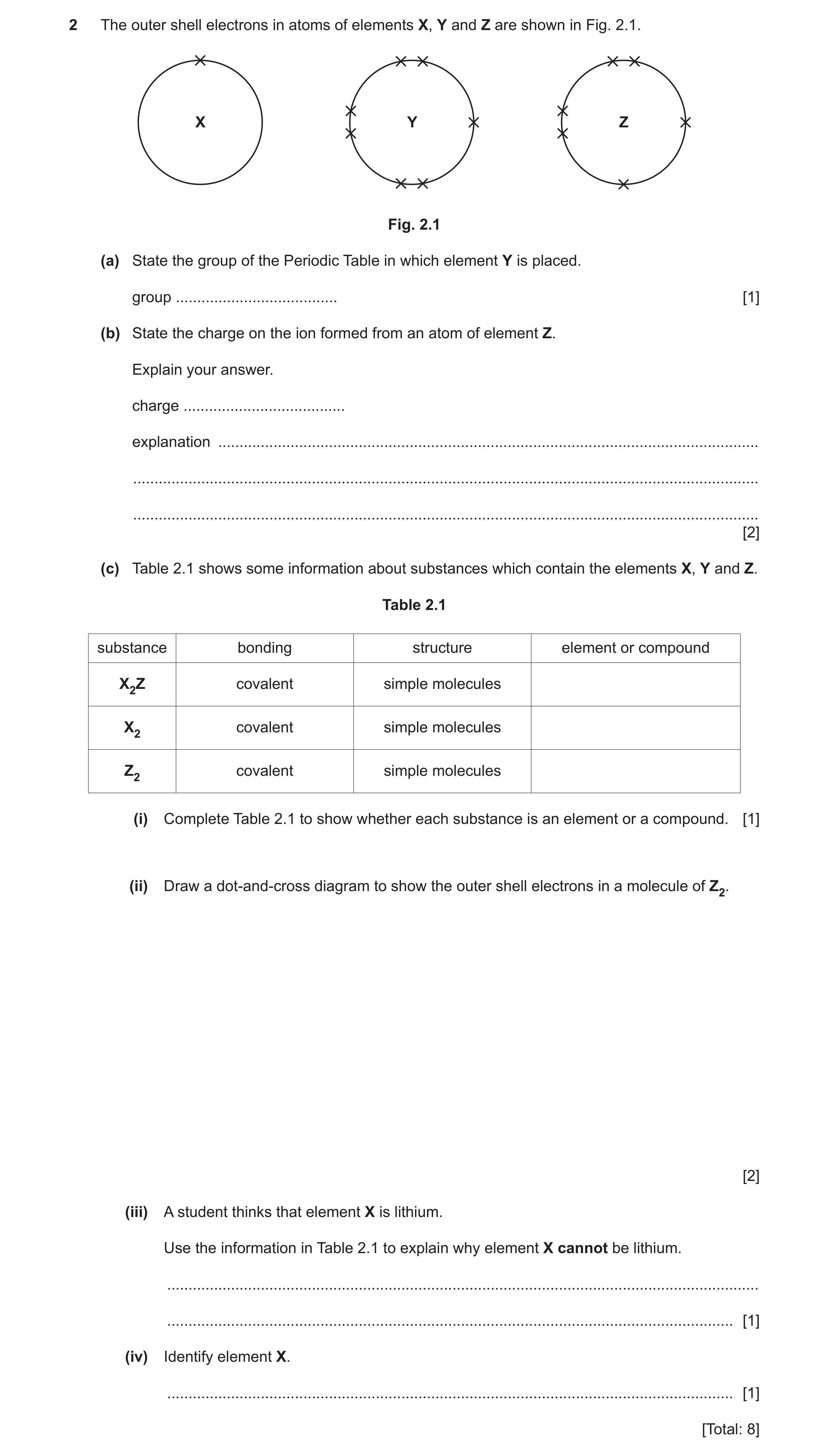
2 The outer shell electrons in atoms of elements X, Y and Z are shown in Fig. 2.1. X Y Z Fig. 2.1 (a) State the group of the Periodic Table in which element Y is placed. group … [1] (b) State the charge on the ion formed from an atom of element Z. Explain your answer. charge … explanation … … … [2] (c) Table 2.1 shows some information about substances which contain the elements X, Y and Z. Table 2.1 substance bonding structure element or compound X2Z covalent simple molecules X2 covalent simple molecules Z2 covalent simple molecules (i) Complete Table 2.1 to show whether each substance is an element or a compound. [1] (ii) Draw a dot-and-cross diagram to show the outer shell electrons in a molecule of Z2. [2] (iii) A student thinks that element X is lithium. Use the information in Table 2.1 to explain why element X cannot be lithium. … … [1] (iv) Identify element X. … [1] [Total: 8]
8 marks
Mark scheme: 2(a) 7 / VII / halogens ; 1 2(b) –2 ; gains (two) electrons to give a full outer shell ; 2 Question Answer Marks 2(c)(i) Formula Type of structure Element or compound? X2Z simple covalent molecules compound X2 simple covalent molecules element Z2 simple covalent molecules element ; ; 1 2(c)(ii) fully correct (2) double bond correct (1) 2 2(c)(iii) X2 has a covalent bond ; 1 2(c)(iv) hydrogen ; 1
This question in 0653/41 May/June 2022
Q12 · Period 3 of the Periodic Table is shown in Fig 0653/41 Oct/Nov 2022
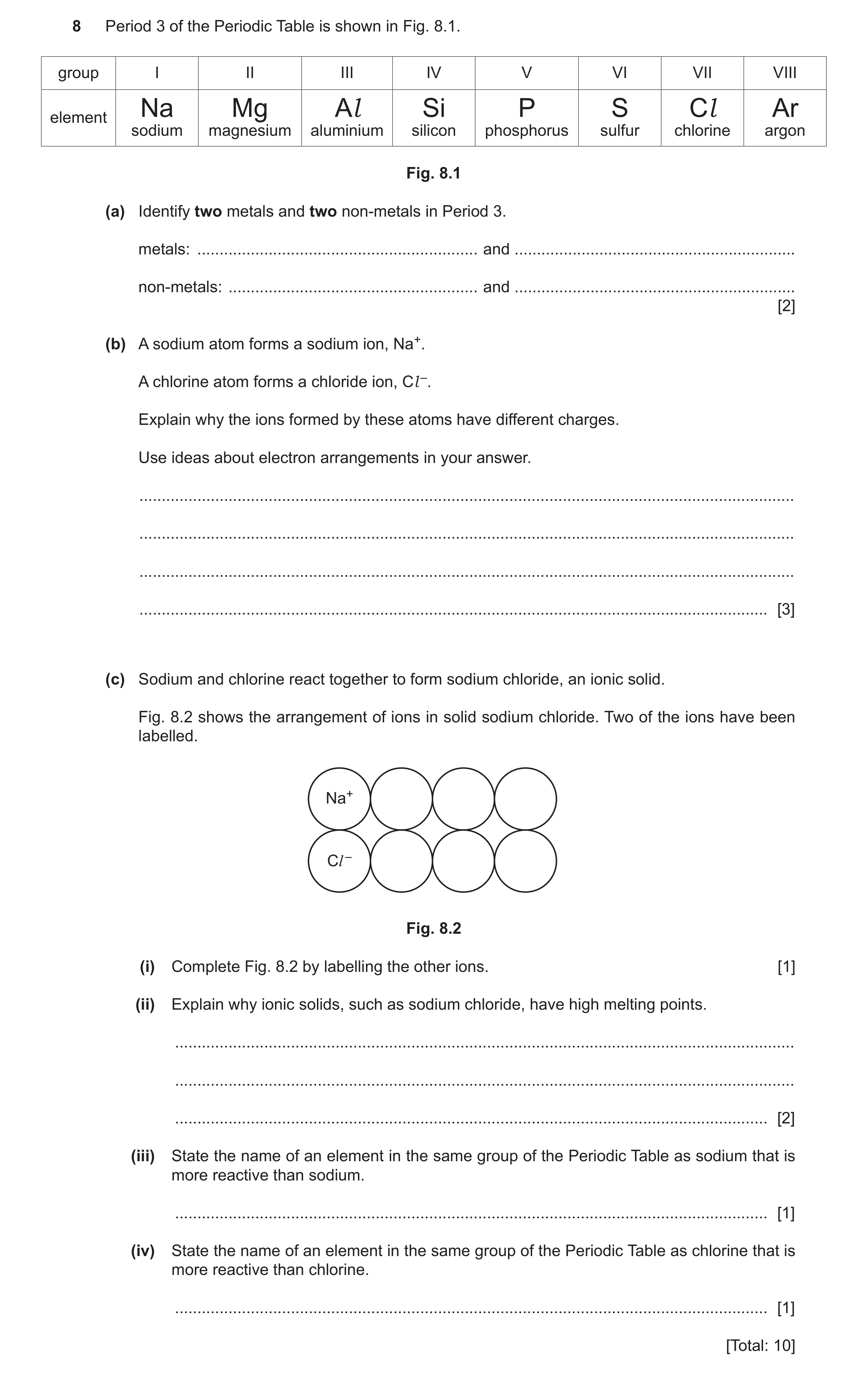
8 Period 3 of the Periodic Table is shown in Fig. 8.1. group I II III IV V VI VII VIII element Na Mg Al Si P S Cl Ar sodium magnesium aluminium silicon phosphorus sulfur chlorine argon Fig. 8.1 (a) Identify two metals and two non-metals in Period 3. metals: … and … non-metals: … and … [2] (b) A sodium atom forms a sodium ion, Na+. A chlorine atom forms a chloride ion, Cl –. Explain why the ions formed by these atoms have different charges. Use ideas about electron arrangements in your answer. … … … … [3] (c) Sodium and chlorine react together to form sodium chloride, an ionic solid. Fig. 8.2 shows the arrangement of ions in solid sodium chloride. Two of the ions have been labelled. Na+ Cl – Fig. 8.2 (i) Complete Fig. 8.2 by labelling the other ions. [1] (ii) Explain why ionic solids, such as sodium chloride, have high melting points. … … … [2] (iii) State the name of an element in the same group of the Periodic Table as sodium that is more reactive than sodium. … [1] (iv) State the name of an element in the same group of the Periodic Table as chlorine that is more reactive than chlorine. … [1] [Total: 10]
10 marks
Mark scheme: 8(a) any two metals from: sodium, magnesium, aluminium ; 2 any two non-metals from: silicon, phosphorus, sulfur, chlorine, argon ; 8(b) idea of achieving a full outer shell (for stability) ; 3 sodium atom has one outer electron and chlorine atom has seven ; sodium atom loses one electron and chlorine atom gains one electron ; 8(c)(i) 1 alternating arrangement as shown ; 8(c)(ii) any two from: 2 ions, have opposite charges / are positive and negative ; strong attraction (between ions) ; so high energy needed to break bonds ; 8(c)(iii) potassium / rubidium / caesium / francium ; 1 8(c)(iv) fluorine ; 1
This question in 0653/41 Oct/Nov 2022
Q13 · The electronic structures of a chlorine atom and a chloride ion are shown in Fig 0653/43 Oct/Nov 2022
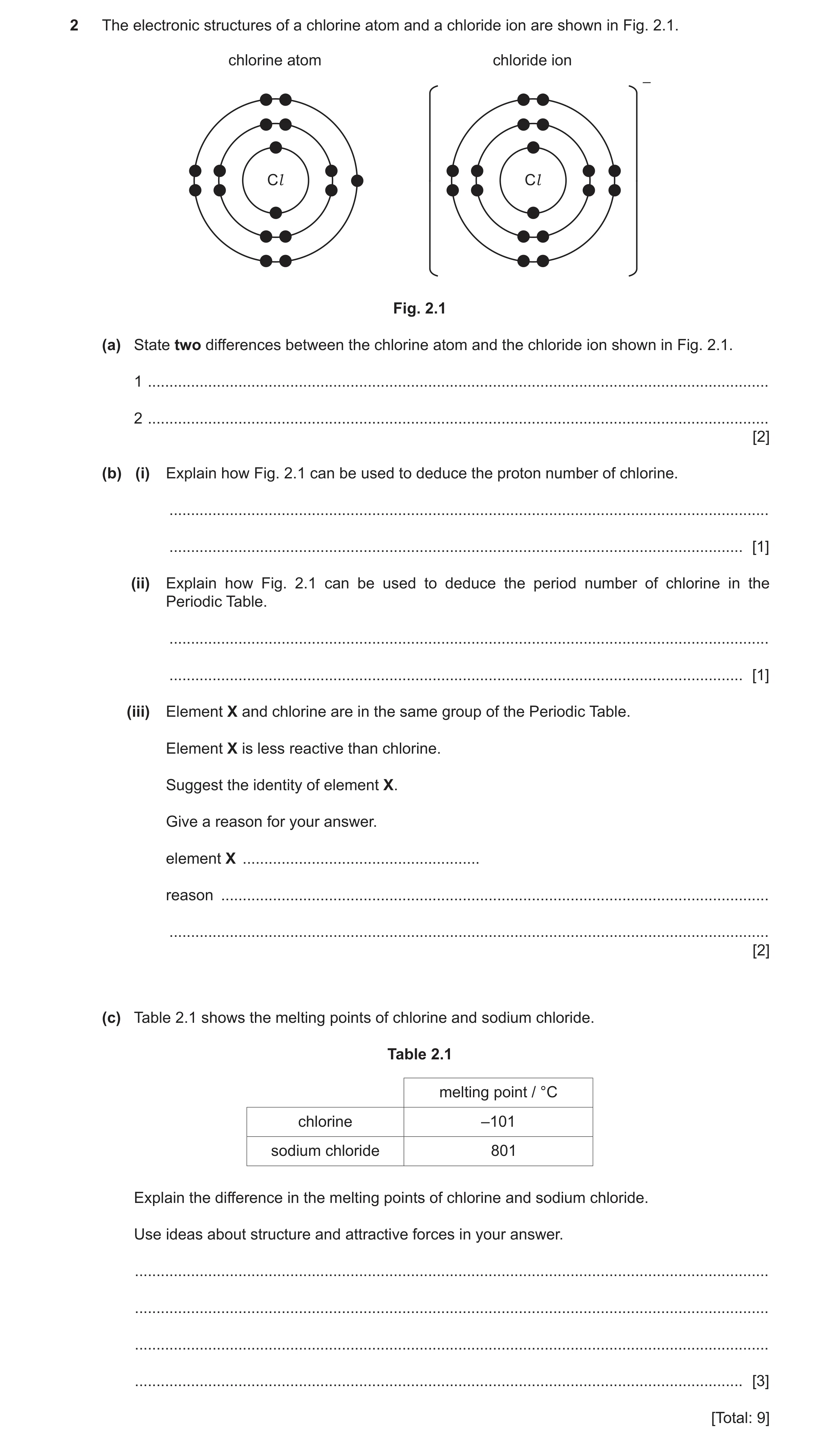
2 The electronic structures of a chlorine atom and a chloride ion are shown in Fig. 2.1. chlorine atom chloride ion – Cl Cl Fig. 2.1 (a) State two differences between the chlorine atom and the chloride ion shown in Fig. 2.1. 1 … 2 … [2] (b) (i) Explain how Fig. 2.1 can be used to deduce the proton number of chlorine. … … [1] (ii) Explain how Fig. 2.1 can be used to deduce the period number of chlorine in the Periodic Table. … … [1] (iii) Element X and chlorine are in the same group of the Periodic Table. Element X is less reactive than chlorine. Suggest the identity of element X. Give a reason for your answer. element X … reason … … [2] (c) Table 2.1 shows the melting points of chlorine and sodium chloride. Table 2.1 melting point / °C chlorine –101 sodium chloride 801 Explain the difference in the melting points of chlorine and sodium chloride. Use ideas about structure and attractive forces in your answer. … … … … [3] [Total: 9]
9 marks
Mark scheme: 2(a) chloride ion has: (ORA chloride atom) 2 (one) more electron / a full (outer) shell of electrons / 8 electrons in outer shell / 18 electrons ; a negative (charge) / charge of –1 ; 2(b)(i) the number of electrons in the atom (17) is the same as the proton number ; 1 2(b)(ii) the number of shells is the same as the period / AW ; 1 2(b)(iii) element X bromine / iodine / astatine ; 2 reason further down the group (so less reactive) ; 2(c) chlorine has simple, molecules / covalent structure OR sodium chloride has, (giant) ionic structure / ionic lattice ; 3 attractive forces between ions in sodium chloride are strong(er) than (attractive forces between) molecules in chlorine / attraction between ions is high due to opposite electrical charges / strong electrostatic attraction between ions ; more energy is required to separate ions in sodium chloride (hence higher melting point) / ORA ;
This question in 0653/43 Oct/Nov 2022
Q14 · Different methods of separation are used for different types of mixtures 0653/41 May/June 2024
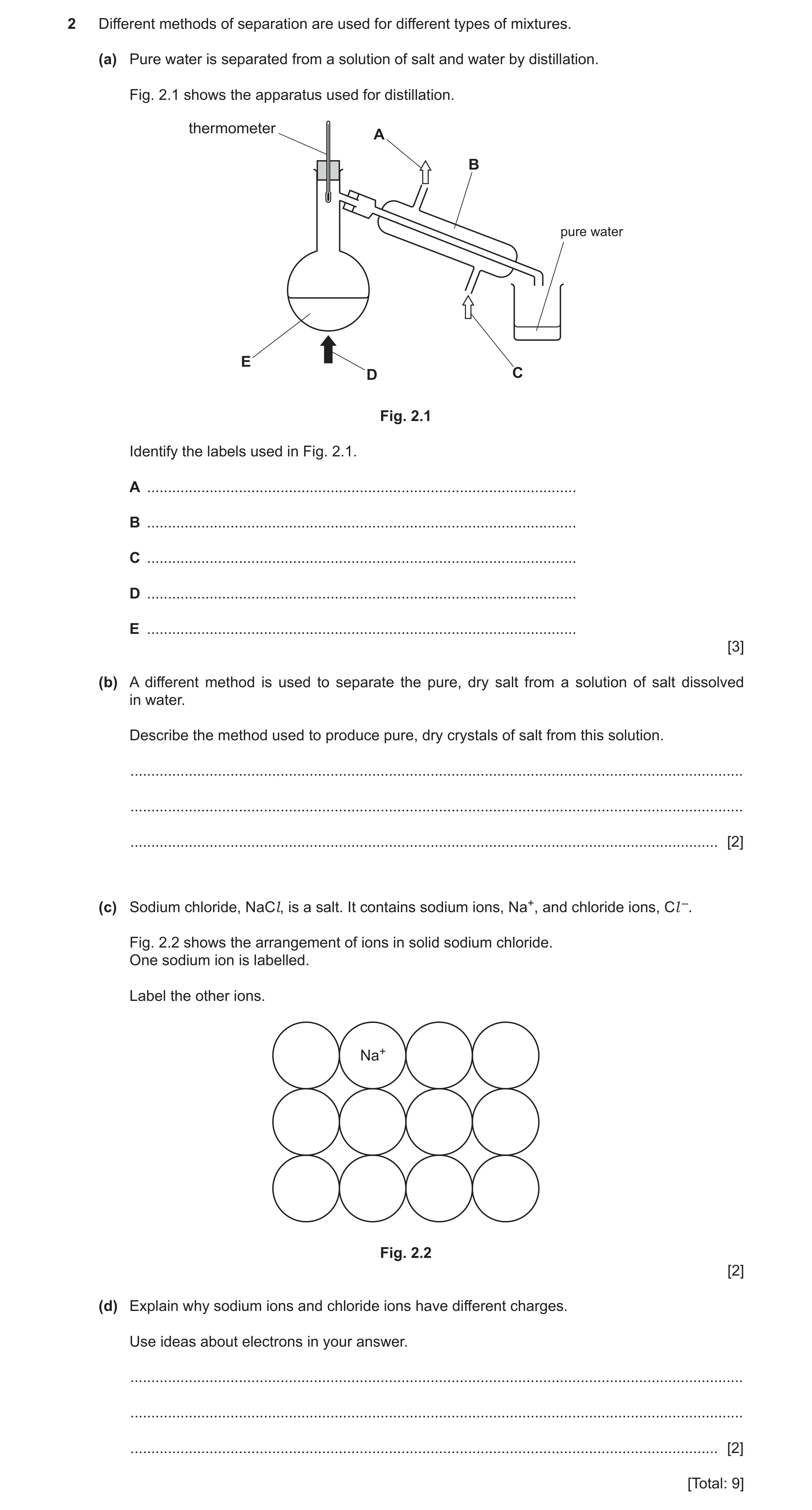
2 Different methods of separation are used for different types of mixtures. (a) Pure water is separated from a solution of salt and water by distillation. Fig. 2.1 shows the apparatus used for distillation. thermometer A B pure water E D C Fig. 2.1 Identify the labels used in Fig. 2.1. A … B … C … D … E … [3] (b) A different method is used to separate the pure, dry salt from a solution of salt dissolved in water. Describe the method used to produce pure, dry crystals of salt from this solution. … … … [2] (c) Sodium chloride, NaCl, is a salt. It contains sodium ions, Na+, and chloride ions, Cl –. Fig. 2.2 shows the arrangement of ions in solid sodium chloride. One sodium ion is labelled. Label the other ions. Na+ Fig. 2.2 [2] (d) Explain why sodium ions and chloride ions have different charges. Use ideas about electrons in your answer. … … … [2] [Total: 9]
9 marks
Mark scheme: 2(a) A (cold) water (out) (at top) B condenser C (cold) water (in) (at bottom of condenser) D heat/(Bunsen) burner E salt and water / mixture / solution ;;; 5 correct = (3) 3–4 correct = (2) 1–2 correct = (1) 2(b) heat (the solution) ; to remove the water ; 2 Question Answer Marks 2(c) 6 Na and 6 Cl ; alternating Na+ and Cl – both horizontally and vertically ; 2 2(d) sodium (atom) loses an / one electron (to give +1 charge) OR sodium (ion) has one electron fewer than the proton number ; chlorine (atom) gains an / one electron (to give –1 charge) OR chloride (ion) has one electron more than the proton number ; 2
This question in 0653/41 May/June 2024
Q15 · Different types of mixtures need different separation processes to isolate the pure… 0653/42 May/June 2024
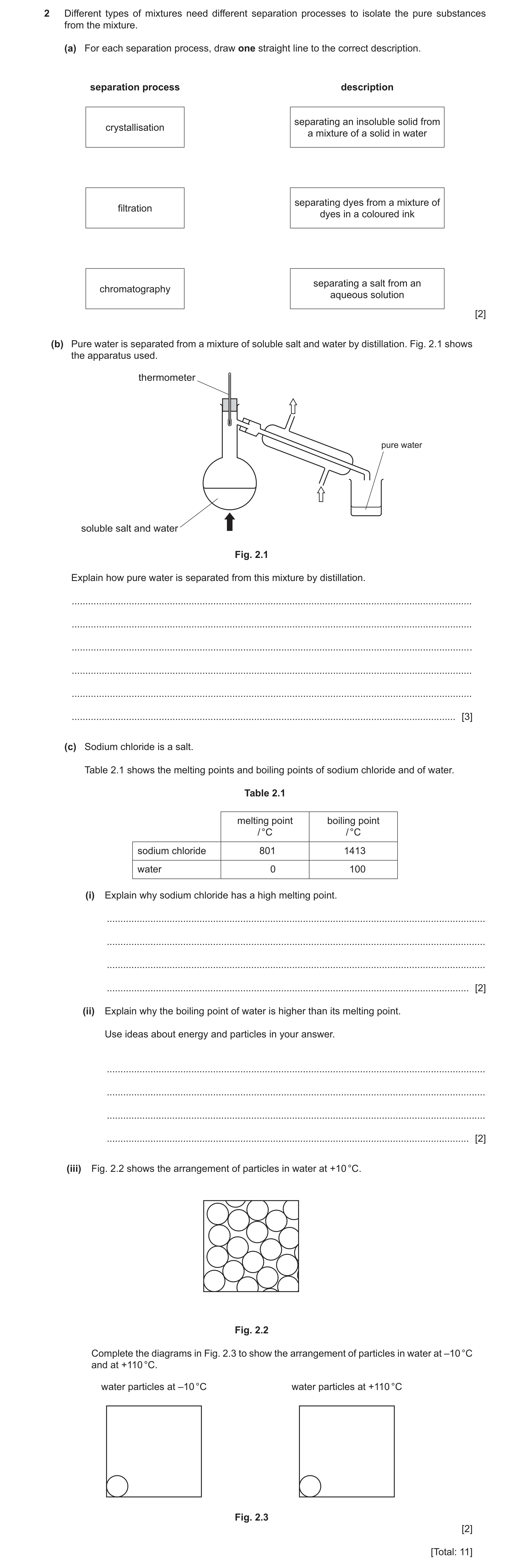
2 Different types of mixtures need different separation processes to isolate the pure substances from the mixture. (a) For each separation process, draw one straight line to the correct description. separation process description separating an insoluble solid from crystallisation a mixture of a solid in water separating dyes from a mixture of filtration dyes in a coloured ink separating a salt from an chromatography aqueous solution [2] (b) Pure water is separated from a mixture of soluble salt and water by distillation. Fig. 2.1 shows the apparatus used. thermometer pure water soluble salt and water Fig. 2.1 Explain how pure water is separated from this mixture by distillation. … … … … … … [3] (c) Sodium chloride is a salt. Table 2.1 shows the melting points and boiling points of sodium chloride and of water. Table 2.1 melting point boiling point / °C / °C sodium chloride 801 1413 water 0 100 (i) Explain why sodium chloride has a high melting point. … … … … [2] (ii) Explain why the boiling point of water is higher than its melting point. Use ideas about energy and particles in your answer. … … … … [2] (iii) Fig. 2.2 shows the arrangement of particles in water at +10 °C. Fig. 2.2 Complete the diagrams in Fig. 2.3 to show the arrangement of particles in water at –10 °C and at +110 °C. water particles at –10 °C water particles at +110 °C Fig. 2.3 [2] [Total: 11]
11 marks
Mark scheme: 2(a) separation process description crystallisation separating an insoluble solid from a mixture of a solid in water filtration separating dyes from a mixture of dyes in a coloured ink chromatography separating a salt from an aqueous solution ;; all three correct = (2) one or two correct = (1) 2 2(b) water, boils / is heated and evaporates / becomes steam / becomes water vapour / leaves the flask ; steam / vapour / it is, cooled in the condenser OR steam / vapour / it, condenses ; salt is left behind / salt does not evaporate (with the water) / only water evaporates ; 3 2(c)(i) any two from: is ionic / has ionic bonds ; strong attraction / force, between ions (in ionic lattice) ; due to opposite charges / ions have opposite charges ; need lots of energy to, break bonds / separate the ions / separate the particles (therefore high mp) ; 2 Question Answer Marks 2(c)(ii) energy is needed to, change state / make particles move (more) ; more energy needed to, overcome forces between / separate particles when, changing from liquid to gas than from solid to liquid ; 2 2(c)(iii) particles in solid (–10 °C) in regular arrangement, consistent size and touching ; fewer particles in gas (+110 °C), consistent size and not touching ; 2
This question in 0653/42 May/June 2024
Q16 · Lithium, sodium, potassium and rubidium are elements in Group I of the Periodic Table 0653/42 Oct/Nov 2024
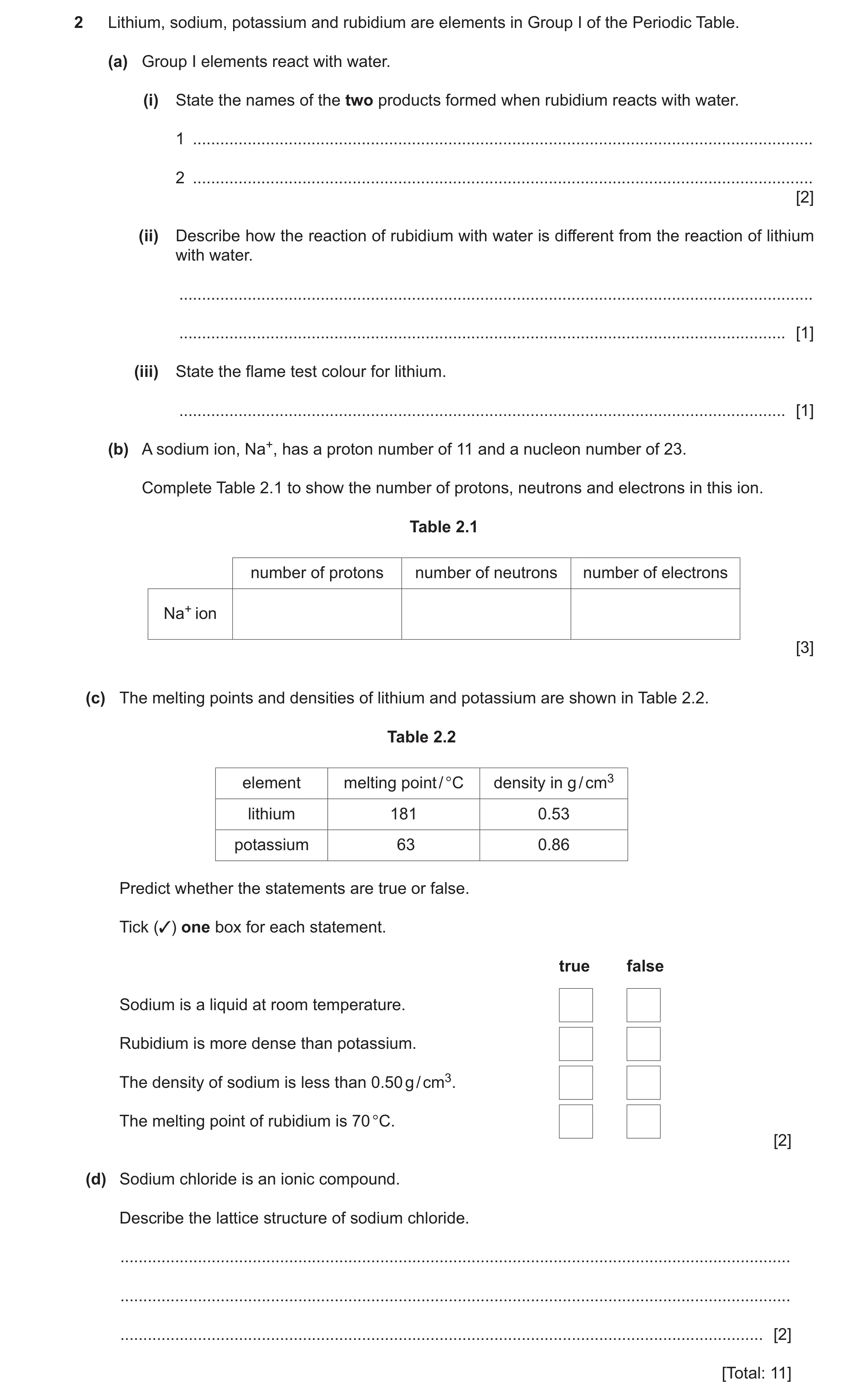
2 Lithium, sodium, potassium and rubidium are elements in Group I of the Periodic Table. (a) Group I elements react with water. (i) State the names of the two products formed when rubidium reacts with water. 1 … 2 … [2] (ii) Describe how the reaction of rubidium with water is different from the reaction of lithium with water. … … [1] (iii) State the flame test colour for lithium. … [1] (b) A sodium ion, Na+, has a proton number of 11 and a nucleon number of 23. Complete Table 2.1 to show the number of protons, neutrons and electrons in this ion. Table 2.1 number of protons number of neutrons number of electrons Na+ ion [3] (c) The melting points and densities of lithium and potassium are shown in Table 2.2. Table 2.2 element melting point / °C density in g / cm3 lithium 181 0.53 potassium 63 0.86 Predict whether the statements are true or false. Tick (✓) one box for each statement. true false Sodium is a liquid at room temperature. Rubidium is more dense than potassium. The density of sodium is less than 0.50 g / cm3. The melting point of rubidium is 70 °C. [2] (d) Sodium chloride is an ionic compound. Describe the lattice structure of sodium chloride. … … … [2] [Total: 11]
11 marks
Mark scheme: 2(a)(i) hydrogen; 2 rubidium hydroxide ; 2(a)(ii) idea that rubidium is more reactive / faster / more vigorous ORA ; 1 2(a)(iii) red ; 1 2(b) 11 ; 3 12 ; 10 ; 2(c) 2 any two correct ; all correct ; 2(d) positive and negative ions ; 2 alternating / regular (arrangement) ;
This question in 0653/42 Oct/Nov 2024
Q17 · Excess solid zinc is added to dilute hydrochloric acid in a conical flask 0653/43 Oct/Nov 2024
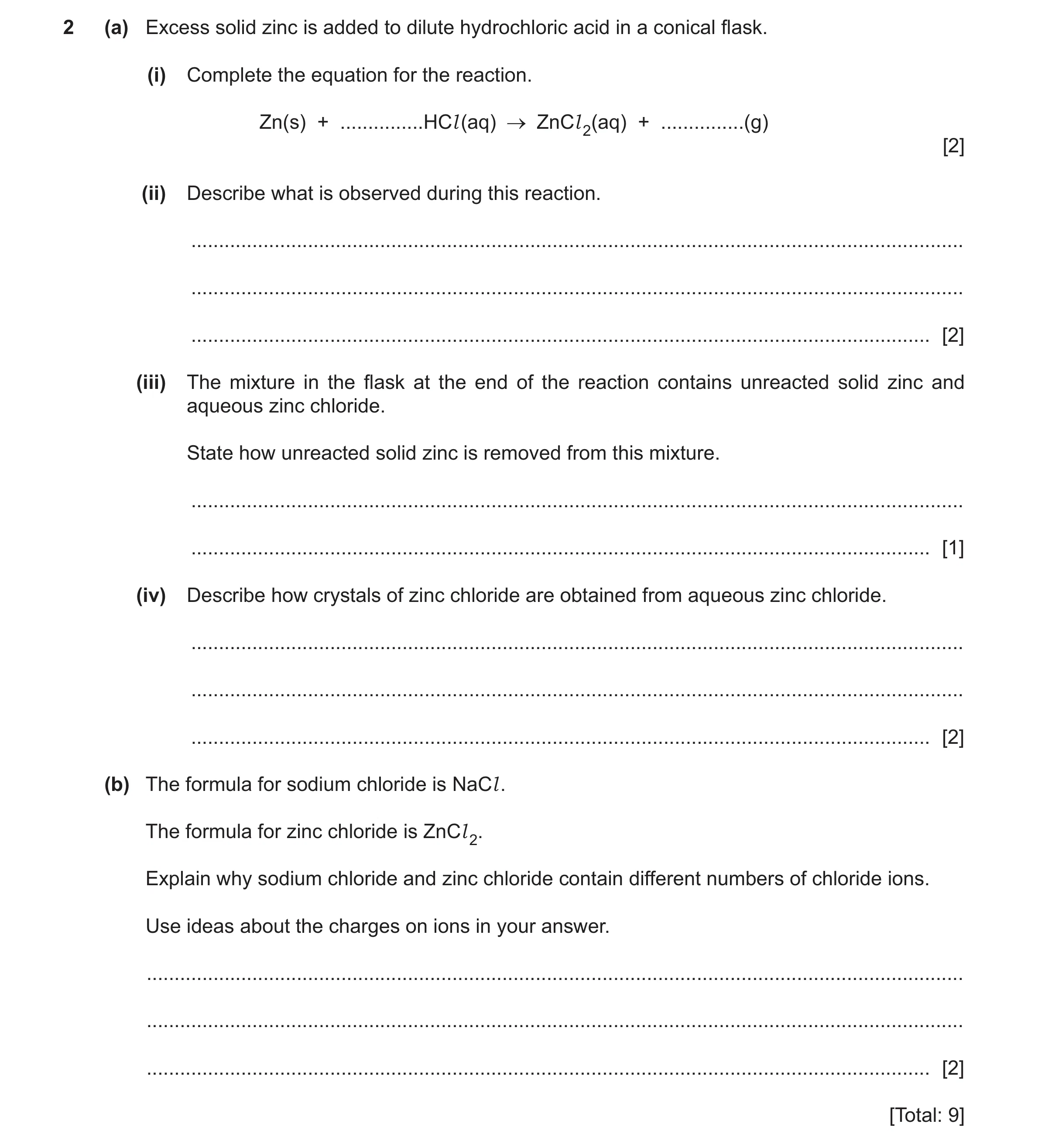
2 (a) Excess solid zinc is added to dilute hydrochloric acid in a conical flask. (i) Complete the equation for the reaction. Zn(s) + … HCl (aq) ZnCl 2(aq) + … (g) [2] (ii) Describe what is observed during this reaction. … … … [2] (iii) The mixture in the flask at the end of the reaction contains unreacted solid zinc and aqueous zinc chloride. State how unreacted solid zinc is removed from this mixture. … … [1] (iv) Describe how crystals of zinc chloride are obtained from aqueous zinc chloride. … … … [2] (b) The formula for sodium chloride is NaCl . The formula for zinc chloride is ZnCl 2. Explain why sodium chloride and zinc chloride contain different numbers of chloride ions. Use ideas about the charges on ions in your answer. … … … [2] [Total: 9]
9 marks
Mark scheme: 2(a)(i) Zn(s) + ...2...HCl (aq) → ZnCl (aq) + 2 2 ...H2...(g) 2 added for balancing ; H2 as product ; 2(a)(ii) any two from: 2 solid zinc reduces in size / AW ; fizzing / bubbles (of gas) ; AVP ; 2(a)(iii) by filtration ; 1 2(a)(iv) heat ; 2 evaporate / remove water ; 2(b) sodium has a +1 charge AND zinc has a +2 charge ; 2 chloride ions have a -1 charge AND idea that charges must balance ;
This question in 0653/43 Oct/Nov 2024
Q18 · This question is about ionic compounds 0653/41 May/June 2025
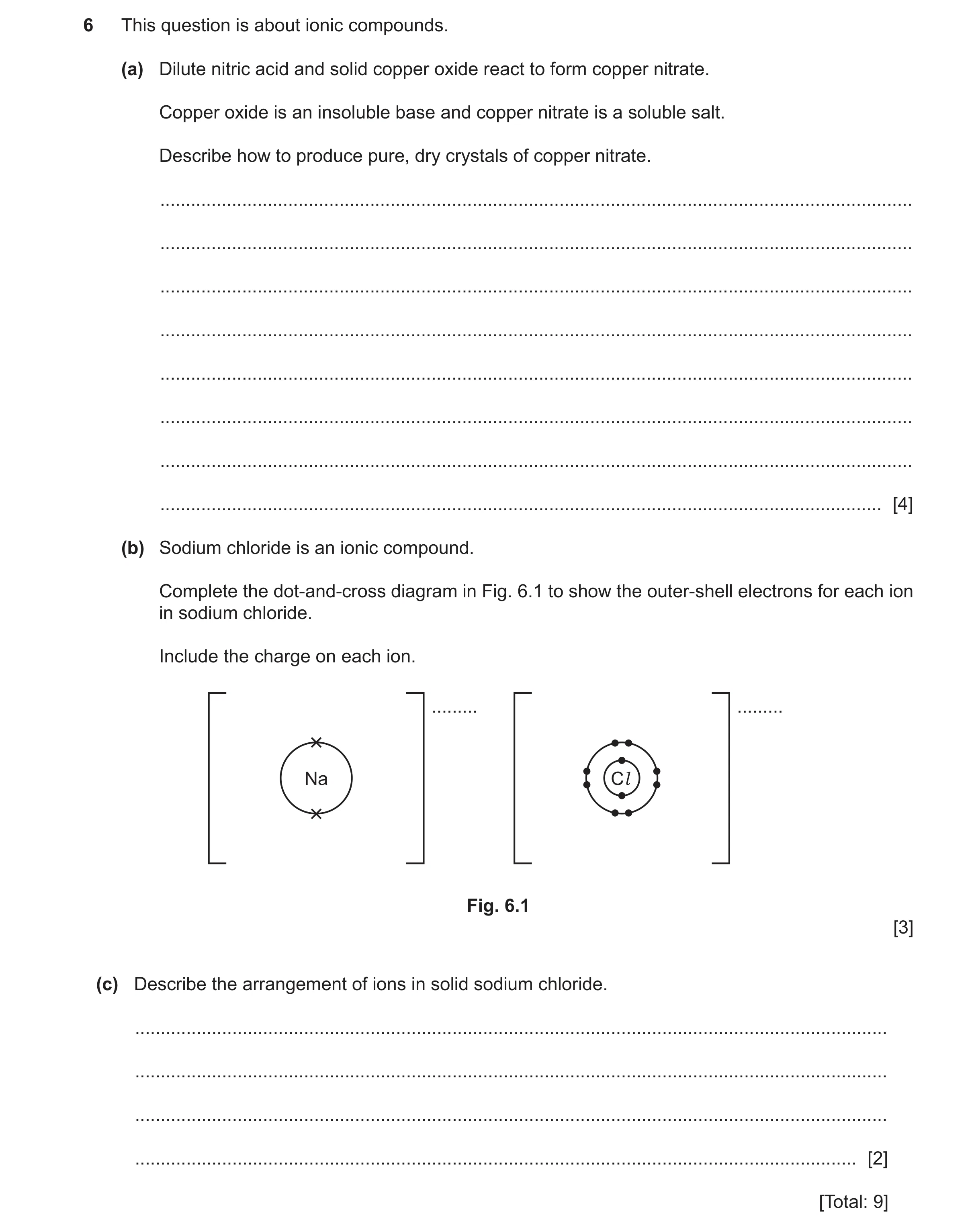
6 This question is about ionic compounds. (a) Dilute nitric acid and solid copper oxide react to form copper nitrate. Copper oxide is an insoluble base and copper nitrate is a soluble salt. Describe how to produce pure, dry crystals of copper nitrate. … … … … … … … … [4] (b) Sodium chloride is an ionic compound. Complete the dot‑and‑cross diagram in Fig. 6.1 to show the outer‑shell electrons for each ion in sodium chloride. Include the charge on each ion. … … Na Cl Fig. 6.1 [3] (c) Describe the arrangement of ions in solid sodium chloride. … … … … [2] [Total: 9]
9 marks
Mark scheme: 6(a) add excess copper oxide (to the acid) ; 4 filter (to remove the excess copper oxide) ; evaporate (some) water ; filter crystals / separate crystals / method of drying crystals slowly (e.g. warm oven / between filter paper / leave in an open space) ; 6(b) sodium with 8 crosses in outer shell ; 3 chloride with 7 dots and 1 cross in outer shell ; (1)+ and (1)− charges ; 6(c) (giant) lattice / regular ; 2 (ions are) alternating ;
This question in 0653/41 May/June 2025
Q19 · Sodium fluoride, NaF, is an ionic compound 0653/42 May/June 2025
4 Sodium fluoride, NaF, is an ionic compound. (a) Tick (3) all the boxes that are properties of sodium fluoride. high boiling point insoluble in water conducts electricity when solid [1] (b) Complete the dot-and-cross diagram in Fig. 4.1 to show the outer-shell electrons for each ion in sodium fluoride. Include the charge on each ion. … … Na F Fig. 4.1 [3] (c) Fig. 4.2 shows equipment used in the electrolysis of molten sodium fluoride. power supply inert electrodes + – molten sodium fluoride Fig. 4.2 (i) Define electrolysis. … … … … [2] (ii) Predict the product formed at the: • positive electrode … • negative electrode. … [2] (d) Aqueous sodium fluoride reacts with aqueous silver nitrate, AgNO3, to form aqueous sodium nitrate, NaNO3, and one other product. Write the balanced symbol equation for this reaction. … [1] [Total: 9]
9 marks
Mark scheme: 4(a) high boiling point ; 1 4(b) sodium with 8 crosses in outer shell ; 3 fluoride with 7 dots and 1 cross in outer shell ; (1)+ and (1)− charges ; 4(c)(i) decomposition of an ionic compound (when molten or in aqueous solution) ; 2 by (the passage of an electric) current ; 4(c)(ii) positive electrode: fluorine / F2 ; 2 negative electrode: sodium / Na ; 4(d) NaF + AgNO3 → NaNO3 + AgF ; 1
This question in 0653/42 May/June 2025
Q20 · Chlorine is in Group VII of the Periodic Table 0653/43 May/June 2025
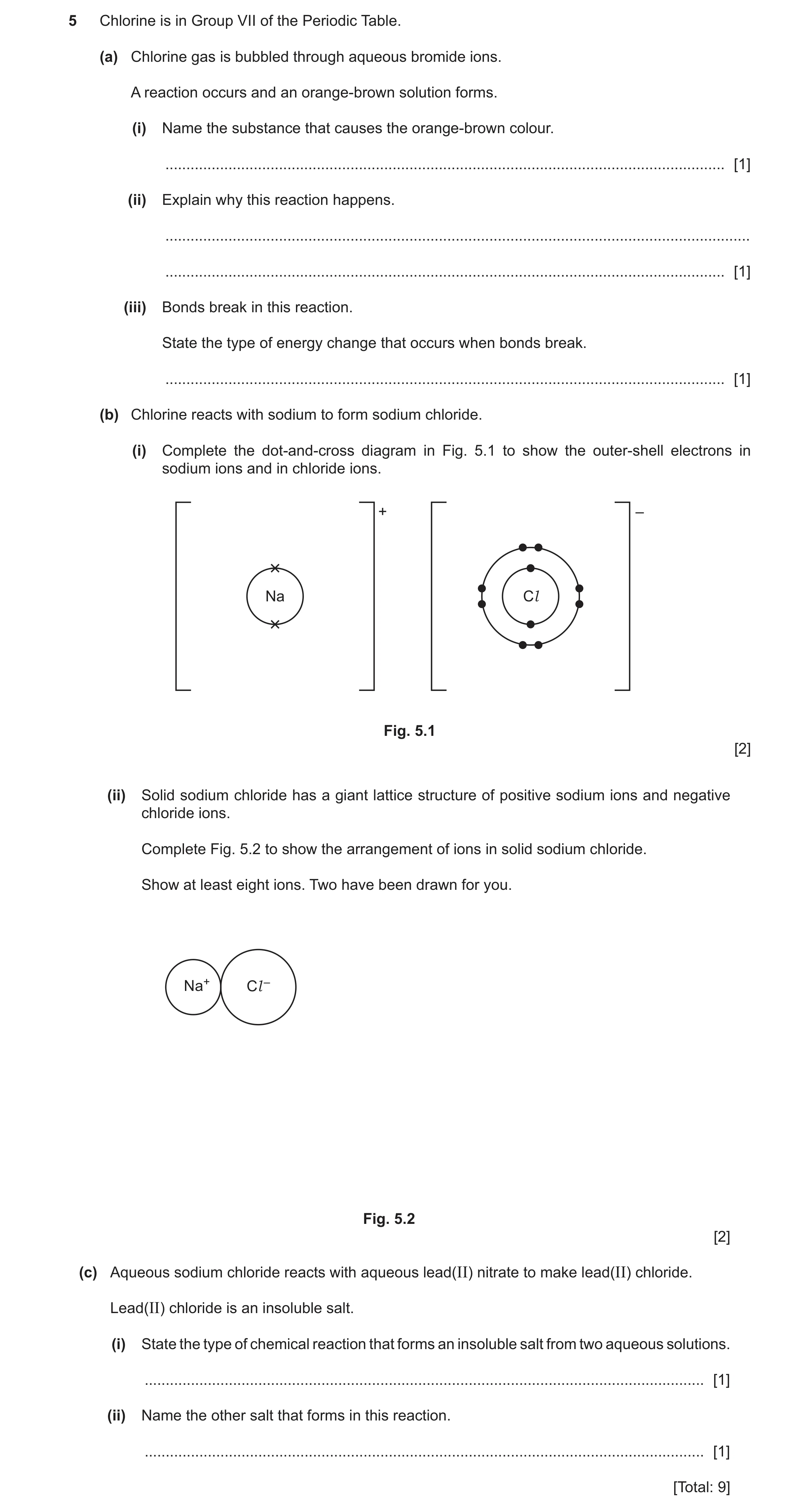
5 Chlorine is in Group VII of the Periodic Table. (a) Chlorine gas is bubbled through aqueous bromide ions. A reaction occurs and an orange-brown solution forms. (i) Name the substance that causes the orange-brown colour. … [1] (ii) Explain why this reaction happens. … … [1] (iii) Bonds break in this reaction. State the type of energy change that occurs when bonds break. … [1] (b) Chlorine reacts with sodium to form sodium chloride. (i) Complete the dot-and-cross diagram in Fig. 5.1 to show the outer-shell electrons in sodium ions and in chloride ions. + – Na Cl Fig. 5.1 [2] (ii) Solid sodium chloride has a giant lattice structure of positive sodium ions and negative chloride ions. Complete Fig. 5.2 to show the arrangement of ions in solid sodium chloride. Show at least eight ions. Two have been drawn for you. Na+ Cl – Fig. 5.2 [2] (c) Aqueous sodium chloride reacts with aqueous lead(II) nitrate to make lead(II) chloride. Lead(II) chloride is an insoluble salt. (i) State the type of chemical reaction that forms an insoluble salt from two aqueous solutions. … [1] (ii) Name the other salt that forms in this reaction. … [1] [Total: 9]
9 marks
Mark scheme: 5(a)(i) bromine ; 1 5(a)(ii) chlorine is more reactive than bromine ORA ; 1 5(a)(iii) endothermic ; 1 5(b)(i) sodium with 8 crosses in outer shell ; 2 chloride with 7 dots and 1 cross in outer shell ; 5(b)(ii) + and – ions alternate along a row or down a column ; 2 an adjacent row or column of correspondingly opposite ions ; 5(c)(i) precipitation ; 1 5(c)(ii) sodium nitrate ; 1 Question Answer Marks
This question in 0653/43 May/June 2025
Q21 · A student investigates the rate of reaction between large pieces of magnesium carbonate… 0653/43 Oct/Nov 2025
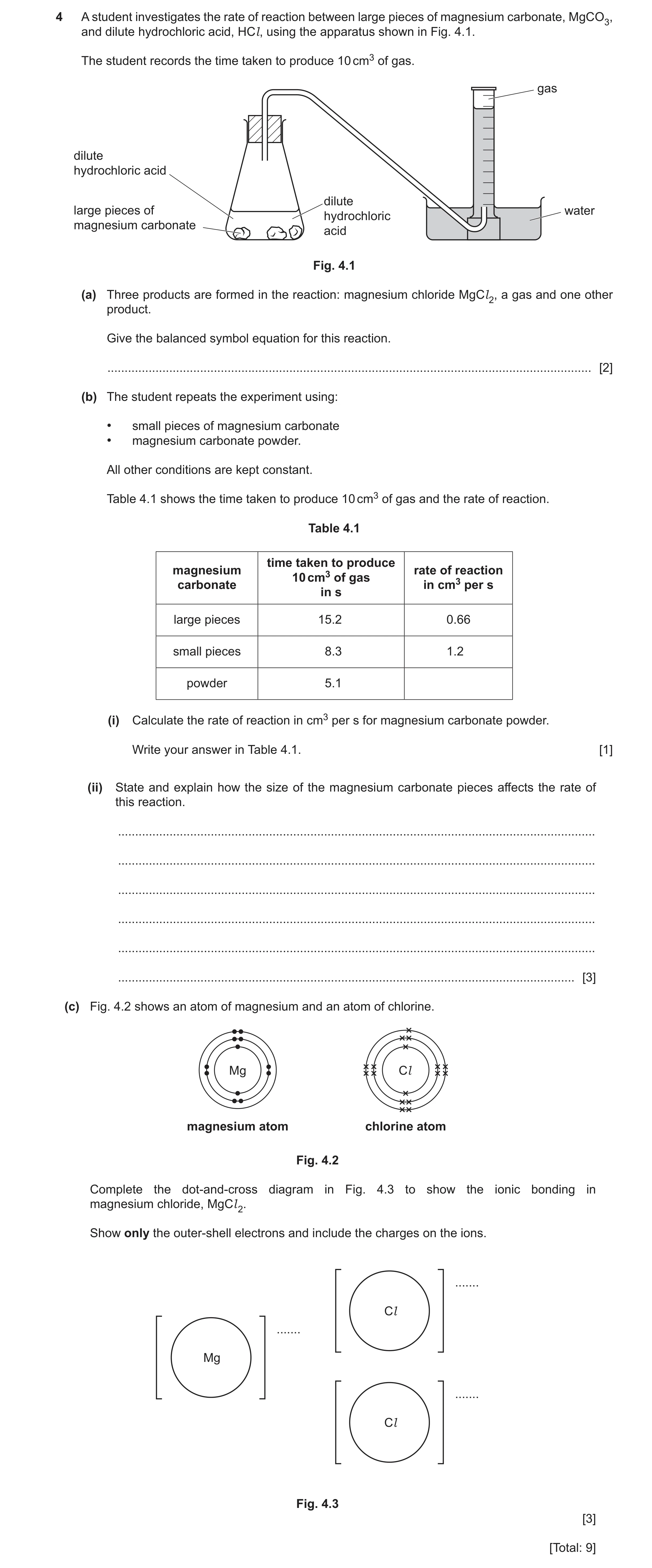
4 A student investigates the rate of reaction between large pieces of magnesium carbonate, MgCO3, and dilute hydrochloric acid, HCl , using the apparatus shown in Fig. 4.1. The student records the time taken to produce 10 cm3 of gas. gas dilute hydrochloric acid dilute large pieces of water hydrochloric magnesium carbonate acid Fig. 4.1 (a) Three products are formed in the reaction: magnesium chloride MgCl 2, a gas and one other product. Give the balanced symbol equation for this reaction. … [2] (b) The student repeats the experiment using: • small pieces of magnesium carbonate • magnesium carbonate powder. All other conditions are kept constant. Table 4.1 shows the time taken to produce 10 cm3 of gas and the rate of reaction. Table 4.1 time taken to produce magnesium rate of reaction 10 cm3 of gas carbonate in cm3 per s in s large pieces 15.2 0.66 small pieces 8.3 1.2 powder 5.1 (i) Calculate the rate of reaction in cm3 per s for magnesium carbonate powder. Write your answer in Table 4.1. [1] (ii) State and explain how the size of the magnesium carbonate pieces affects the rate of this reaction. … … … … … … [3] (c) Fig. 4.2 shows an atom of magnesium and an atom of chlorine. Mg Cl magnesium atom chlorine atom Fig. 4.2 Complete the dot-and-cross diagram in Fig. 4.3 to show the ionic bonding in magnesium chloride, MgCl 2. Show only the outer-shell electrons and include the charges on the ions. … Cl … Mg … Cl Fig. 4.3 [3] [Total: 9]
9 marks
Mark scheme: 4(a) MgCO3 + 2HCl → MgCl2 + H2O + CO2 2 correct formulae ; correct balancing ; 4(b)(i) 2.0 ; 1 4(b)(ii) smaller the pieces the faster the reaction / ora ; 3 (smaller pieces) surface area higher / greater exposure to acid with smaller pieces/powder ; (so) more collisions per second / more frequent collision / more (chance of) successful collisions ; 4(c) 8 dot electrons on outer shell of magnesium ion ; 3 7 X electrons on outer shell of both chloride ions and 1 dot electron ; correct charges on all ions ;
This question in 0653/43 Oct/Nov 2025
 1 / 30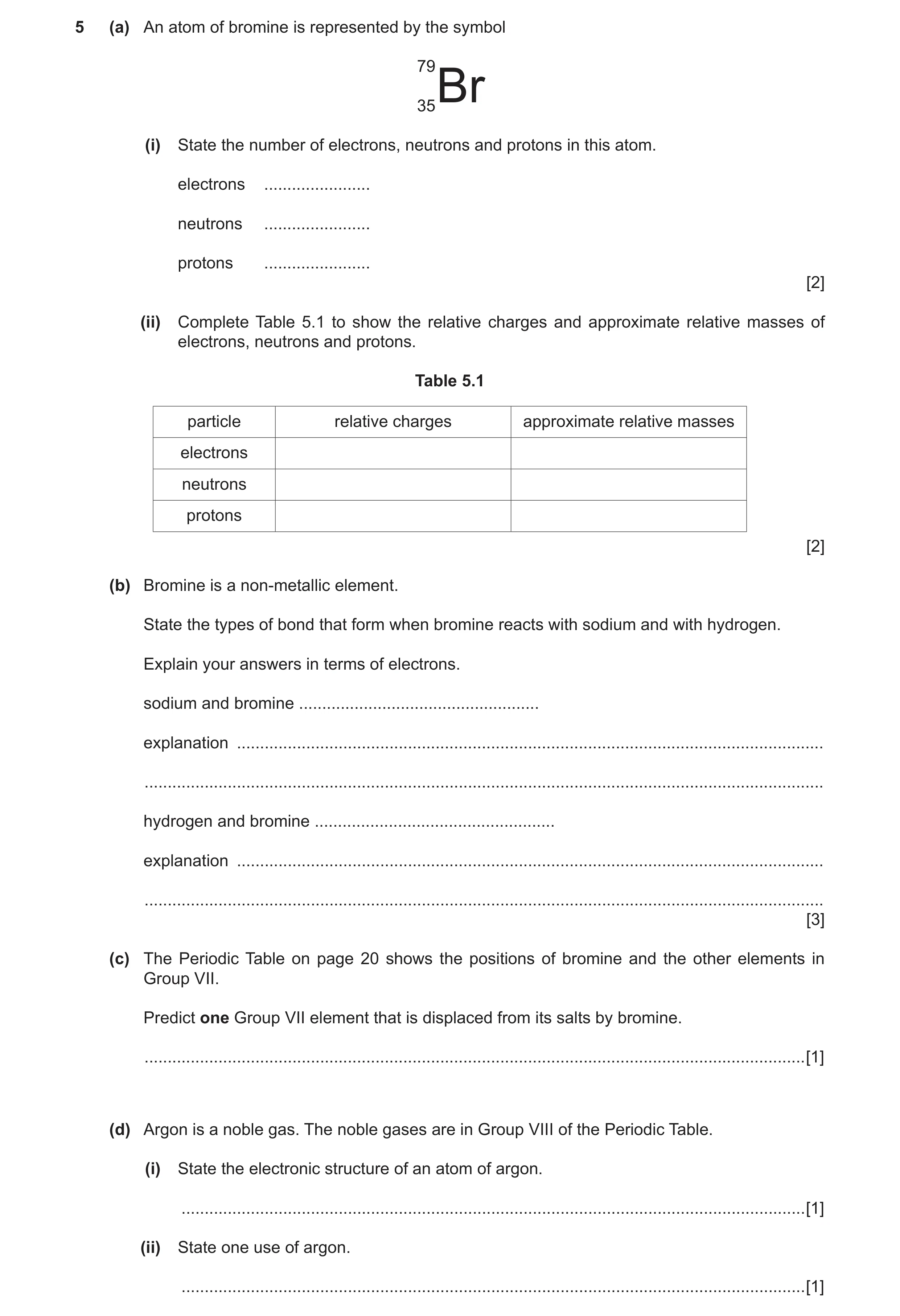
 9 / 30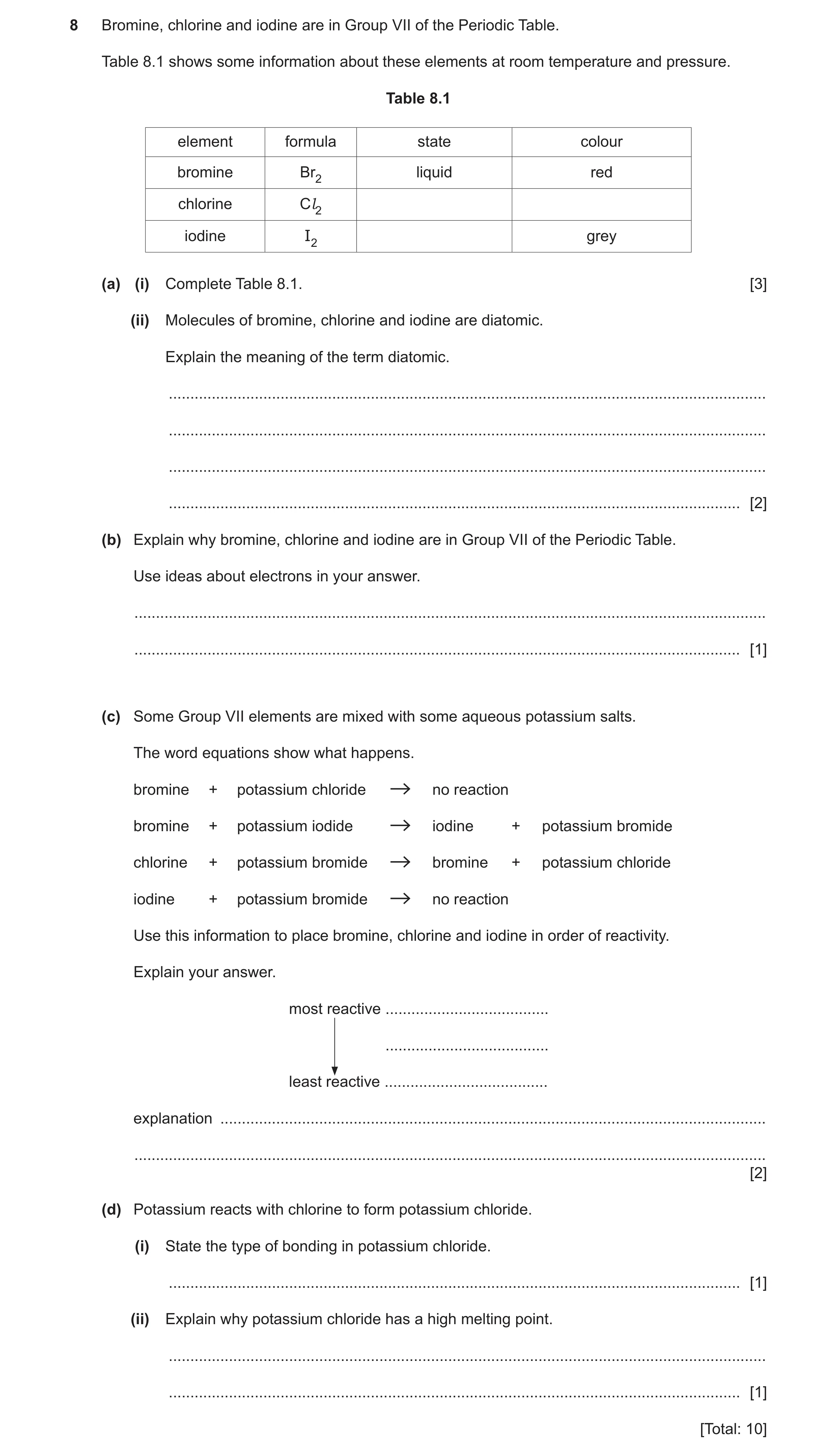
 24 / 30
 25 / 30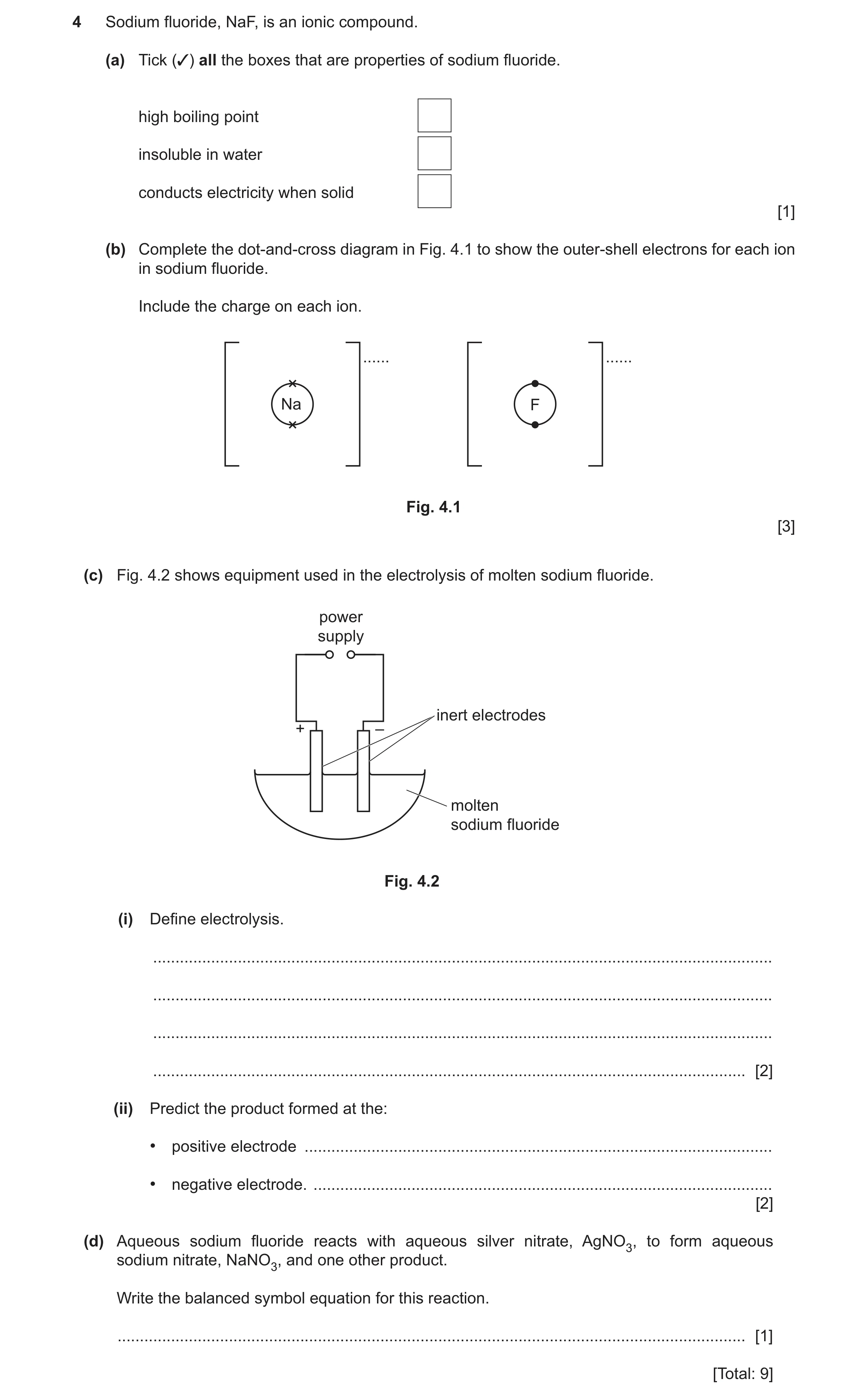
 7
7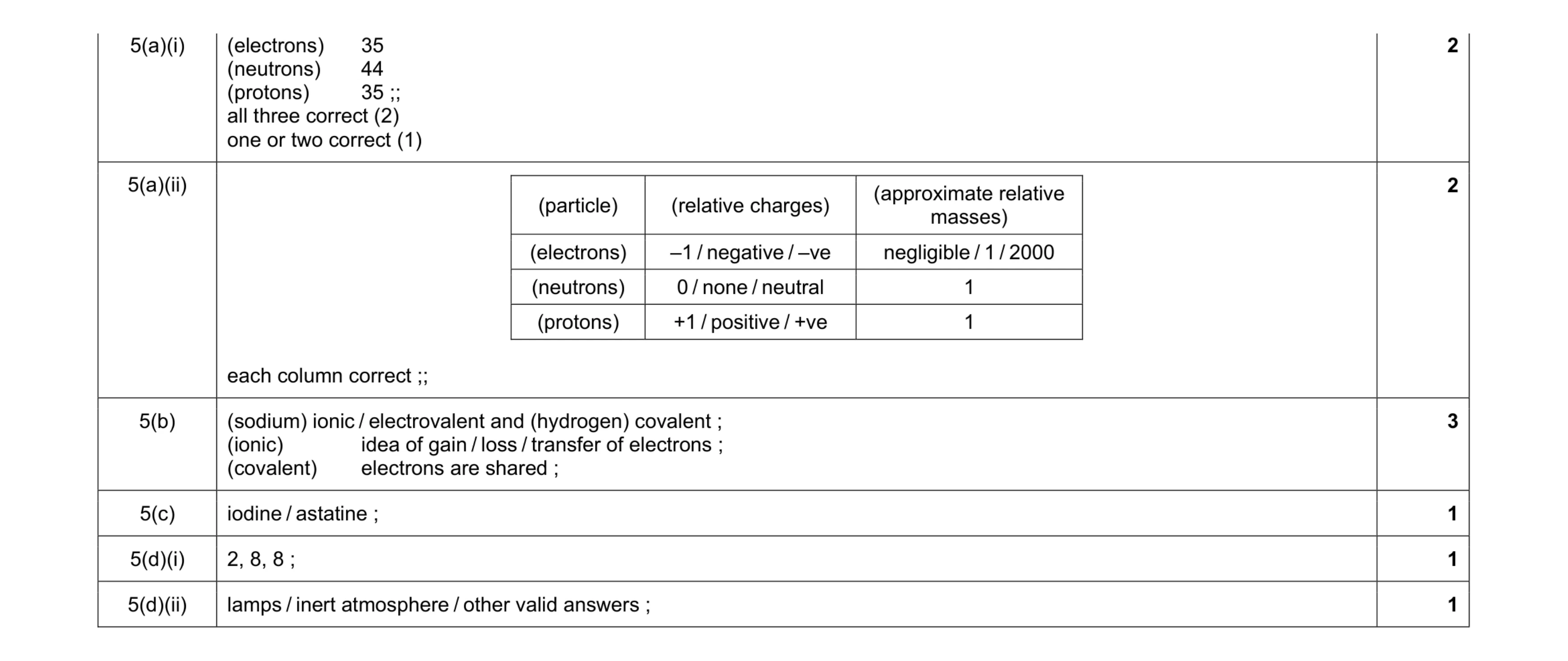 10
10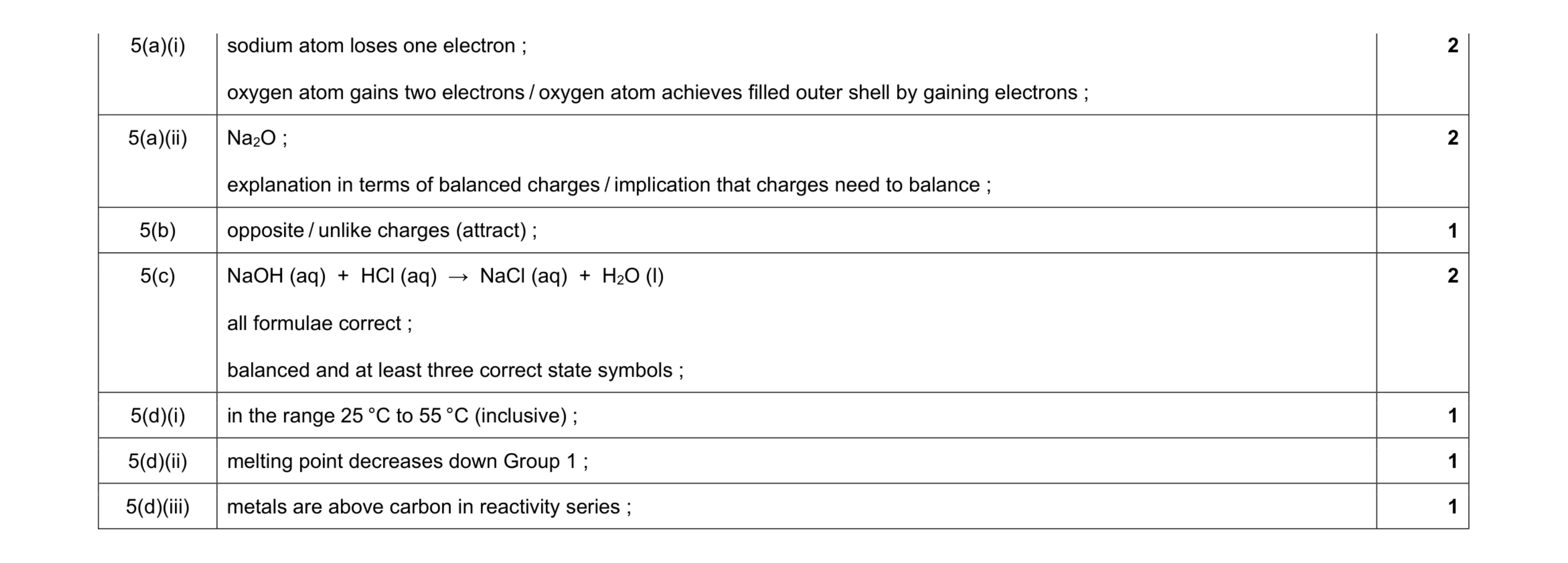 10
10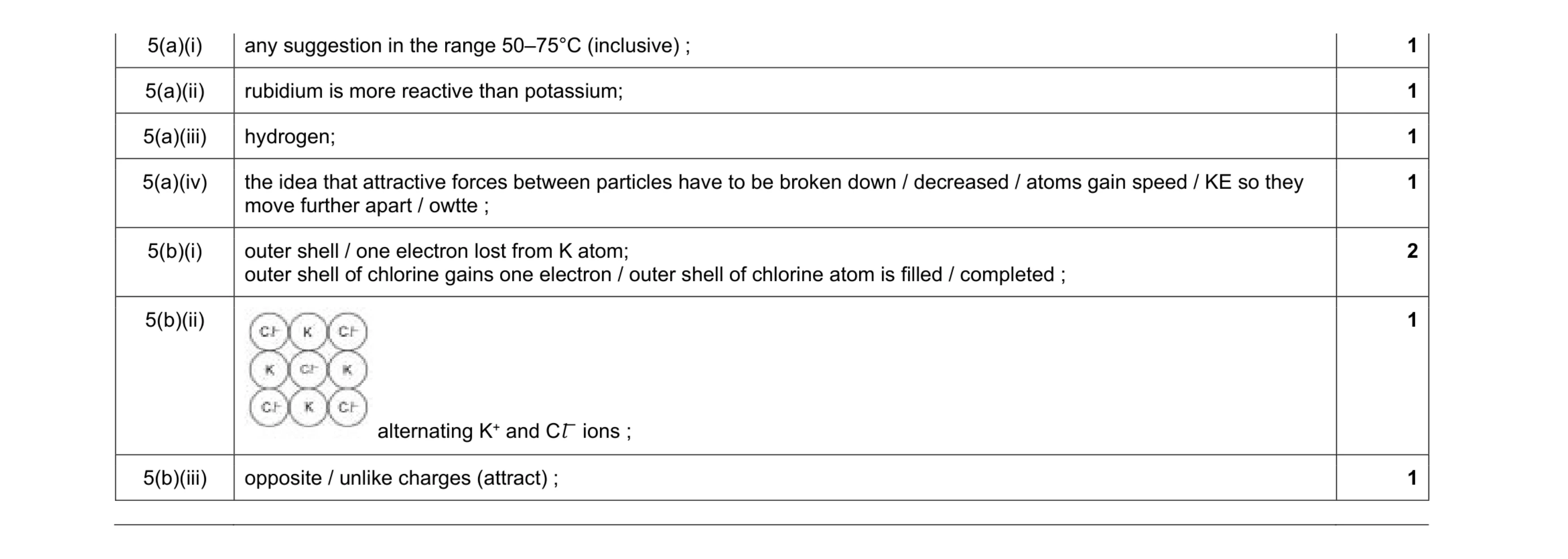 8
8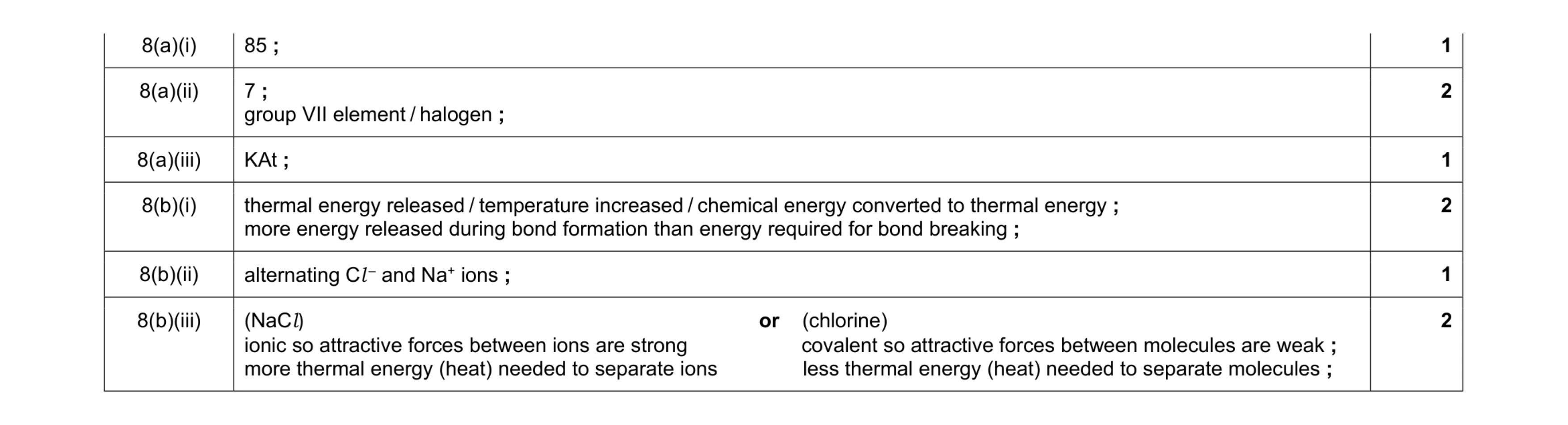 9
9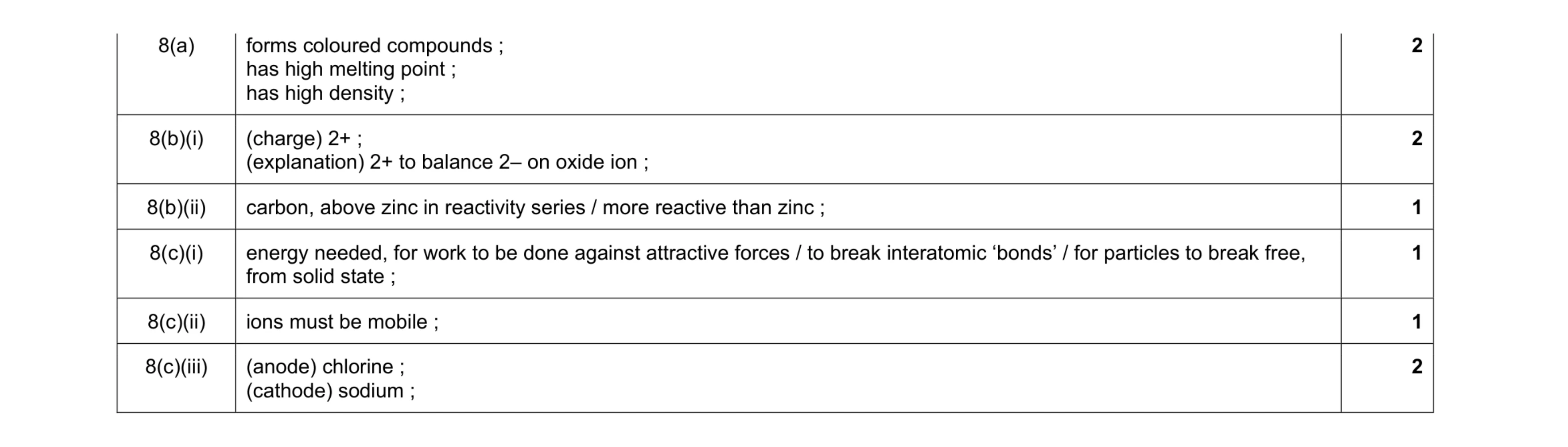 9
9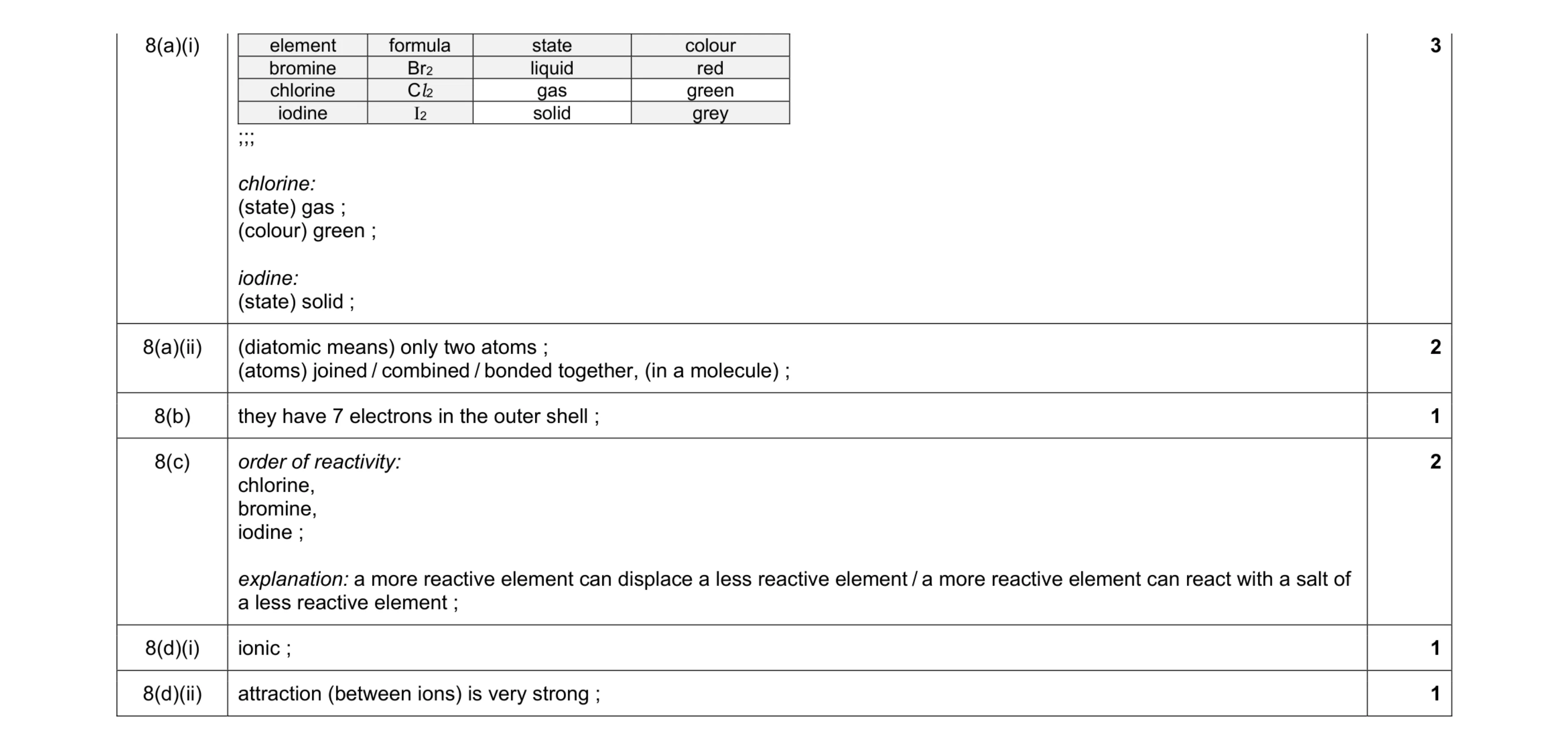 10
10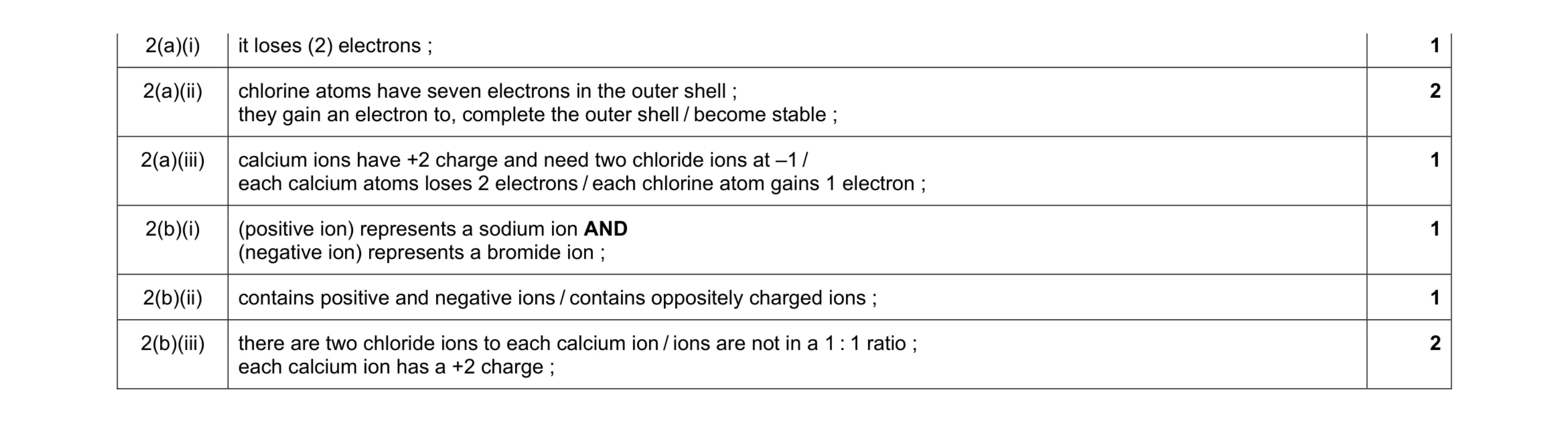 8
8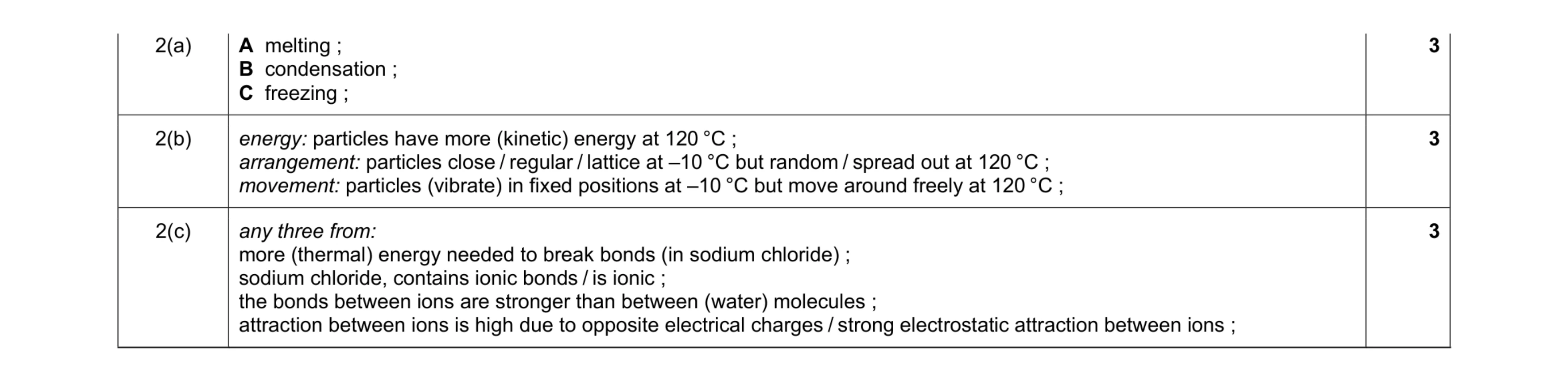 9
9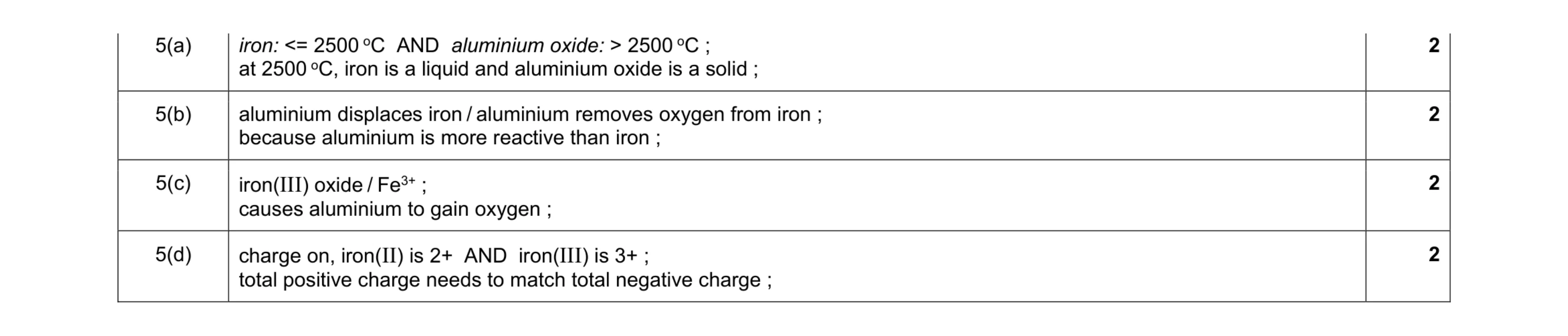 8
8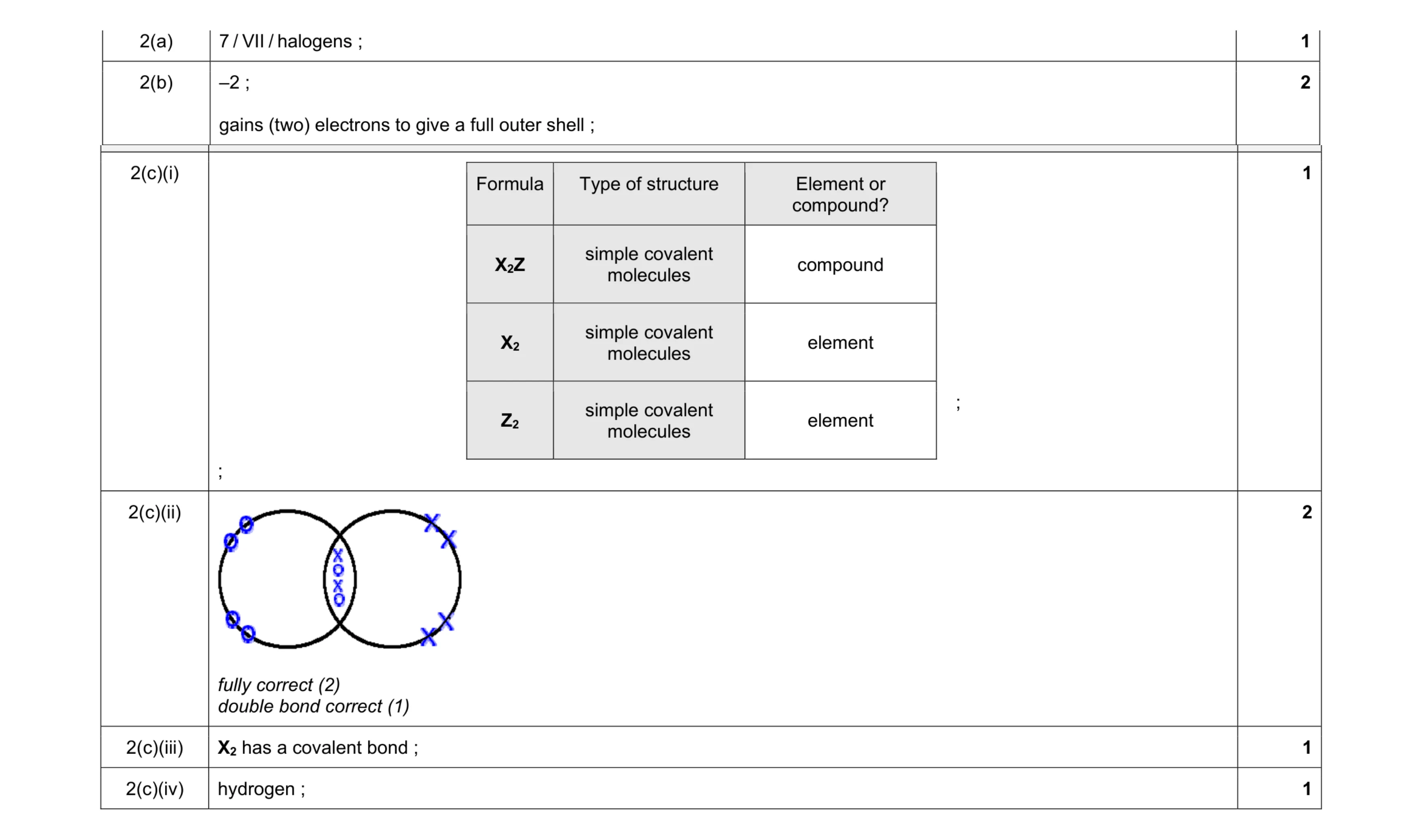 8
8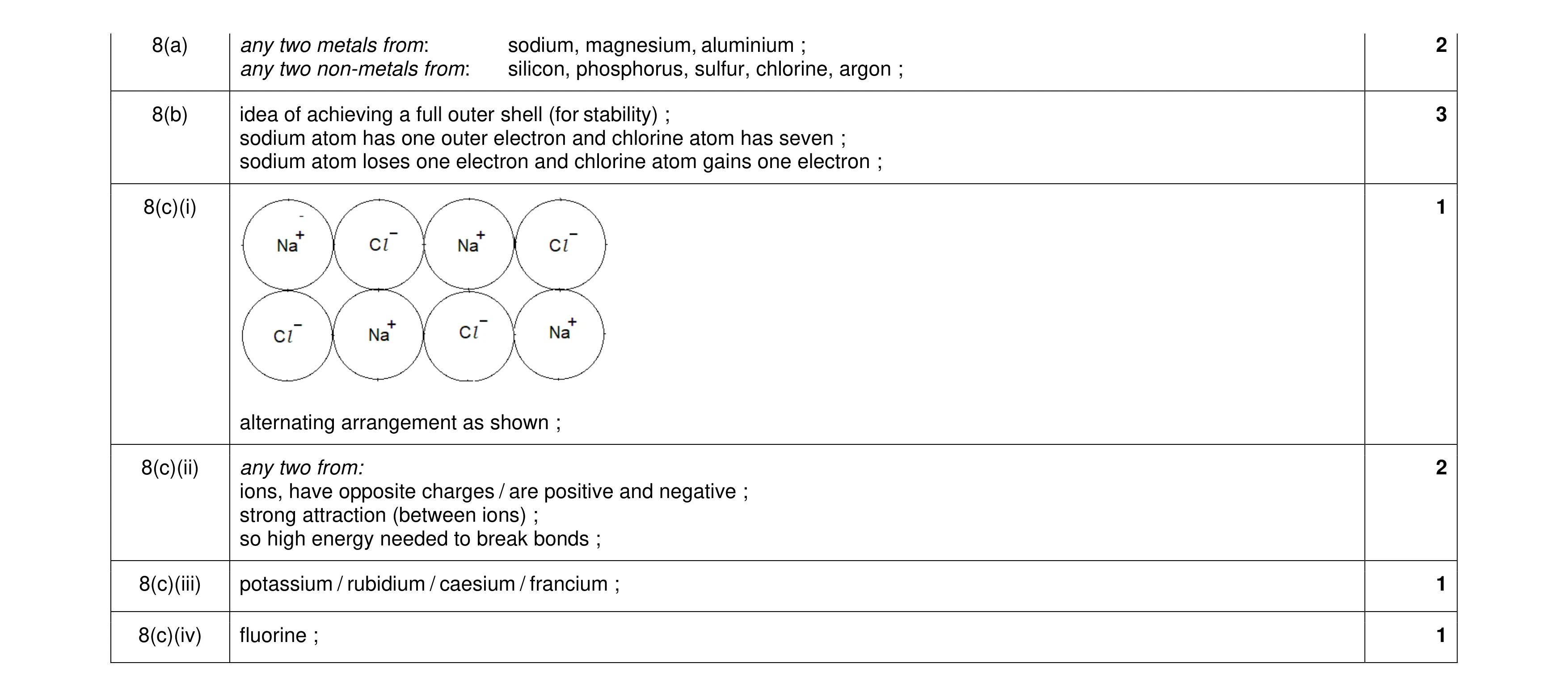 10
10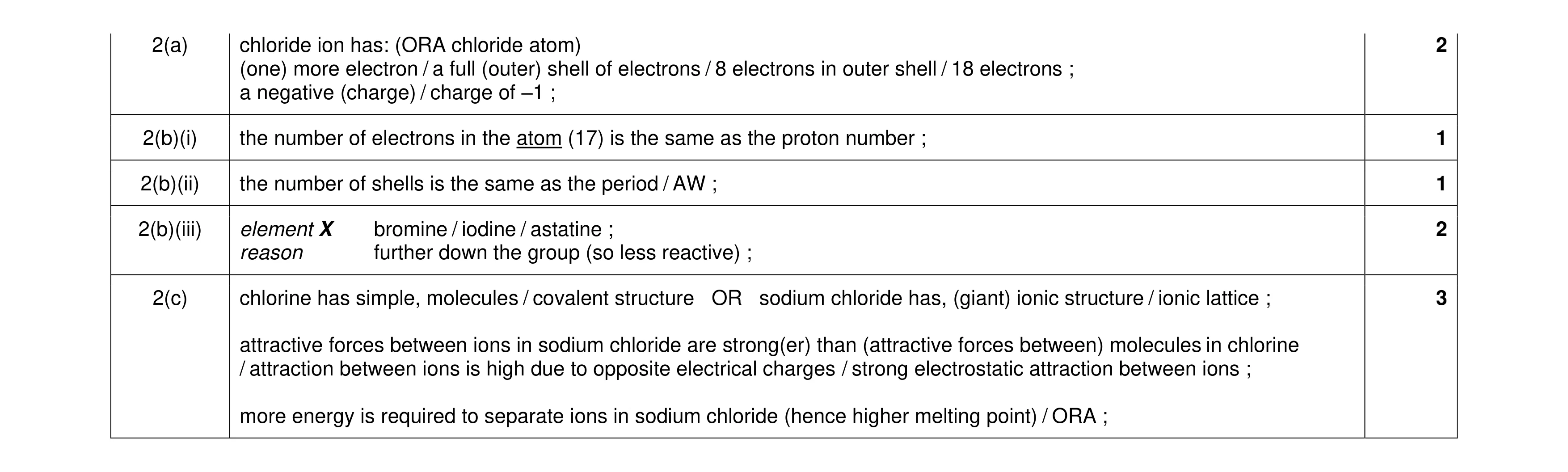 9
9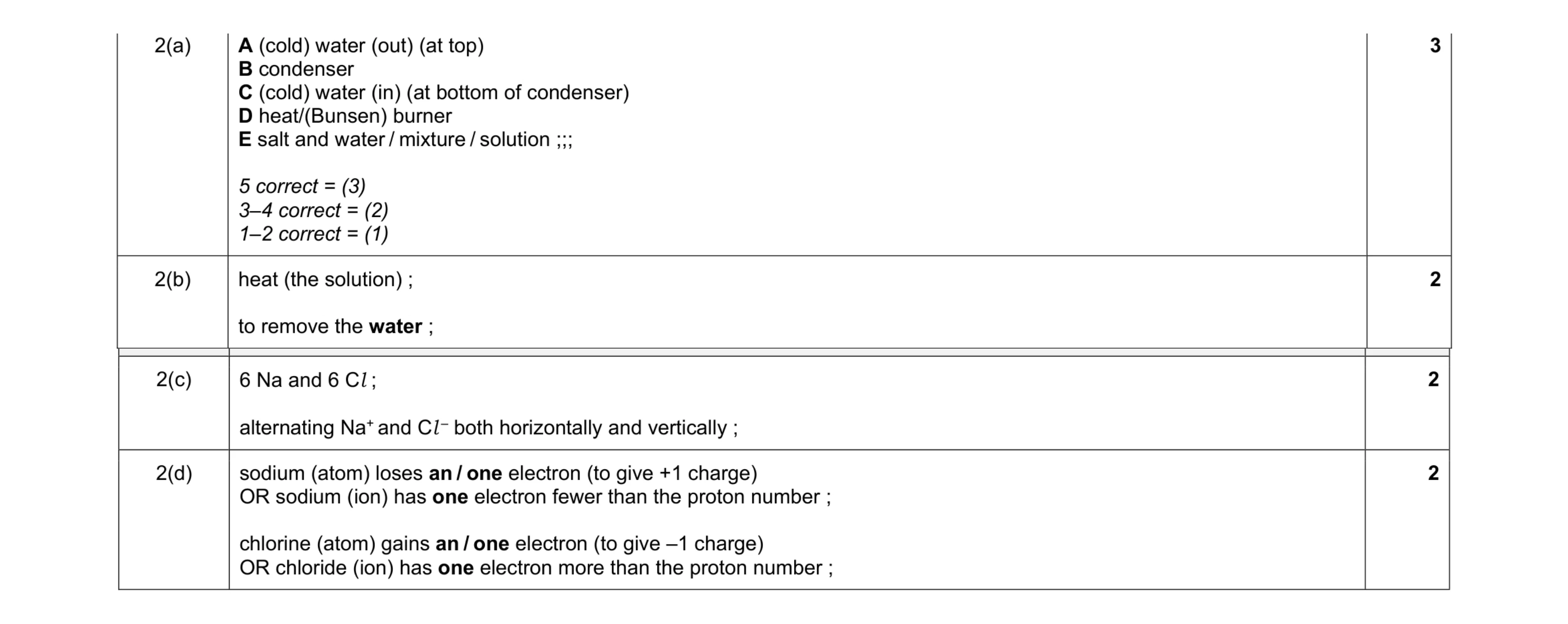 9
9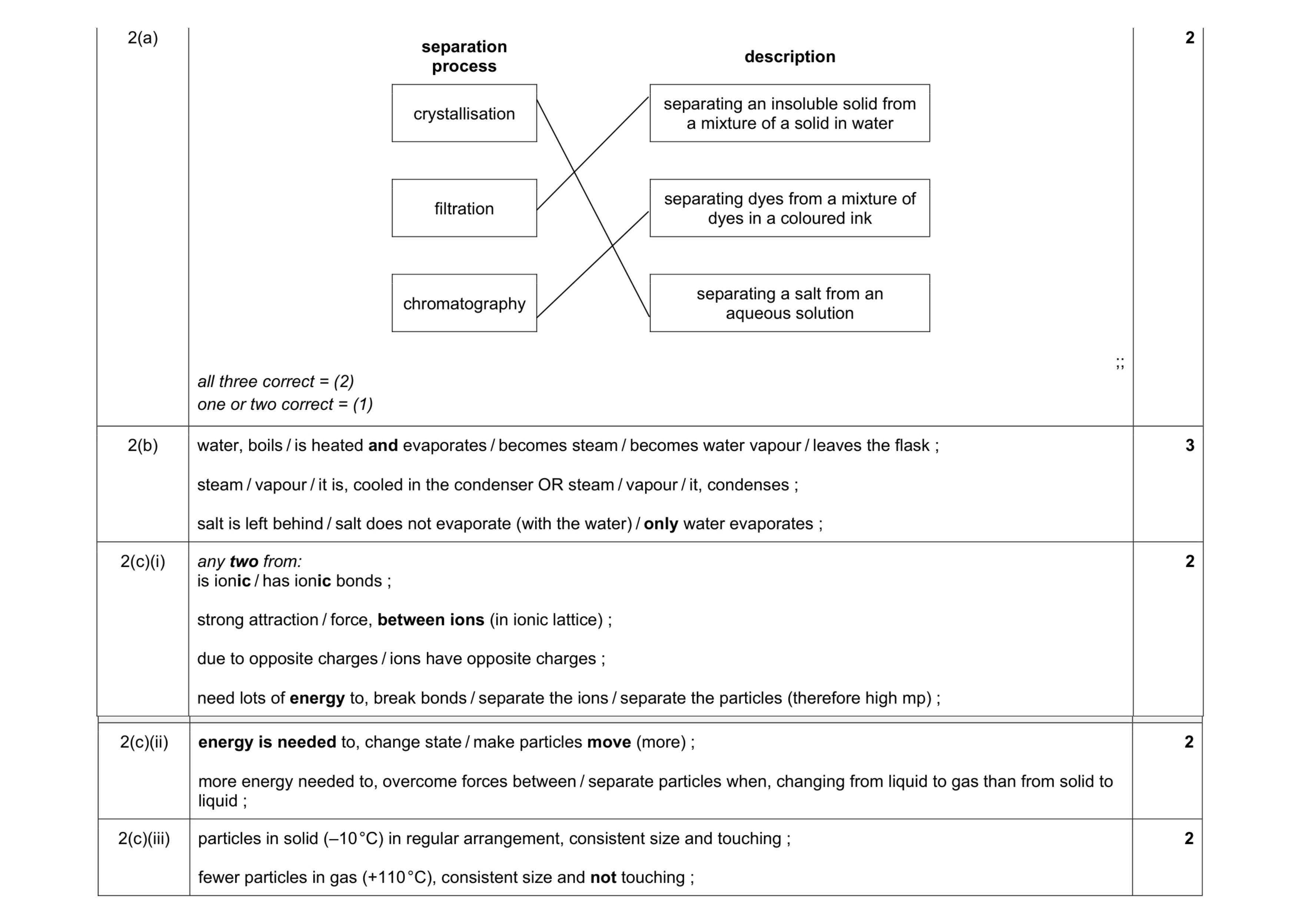 11
11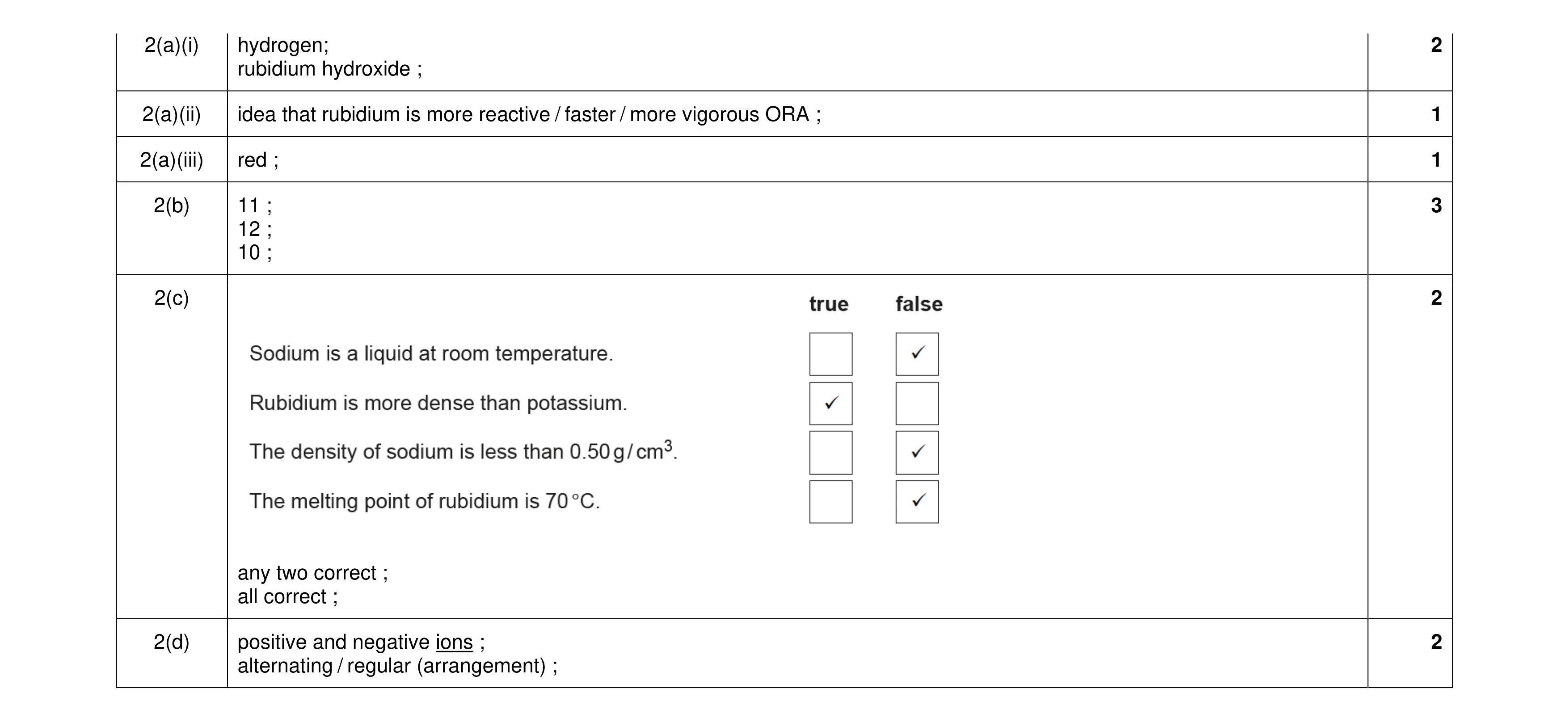 11
11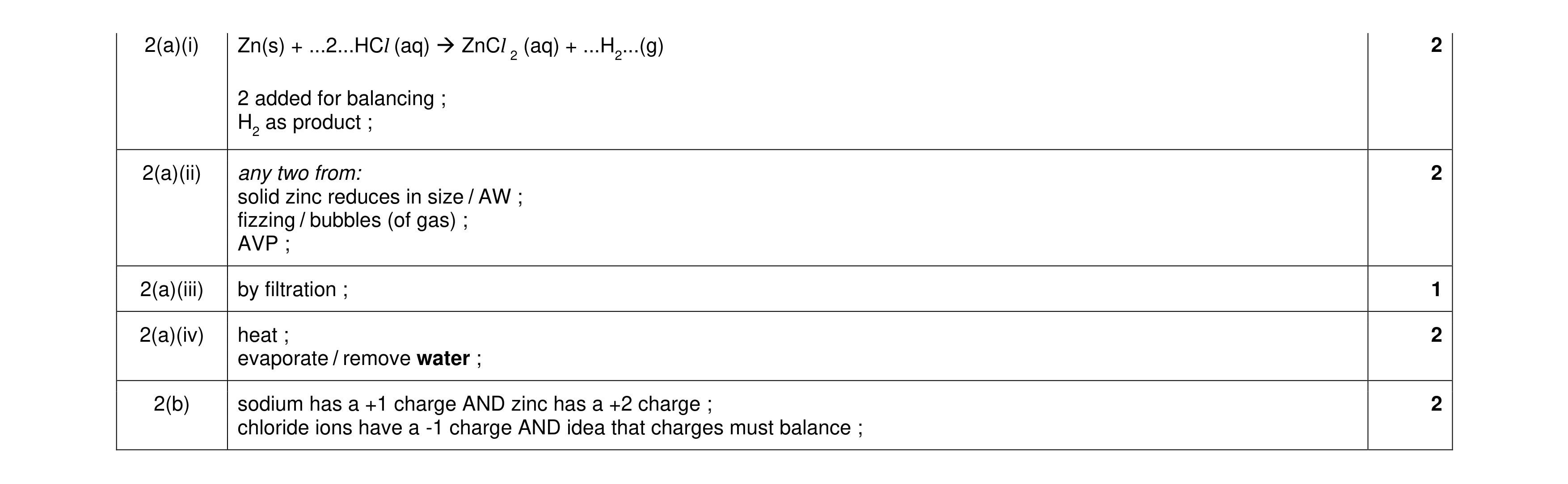 9
9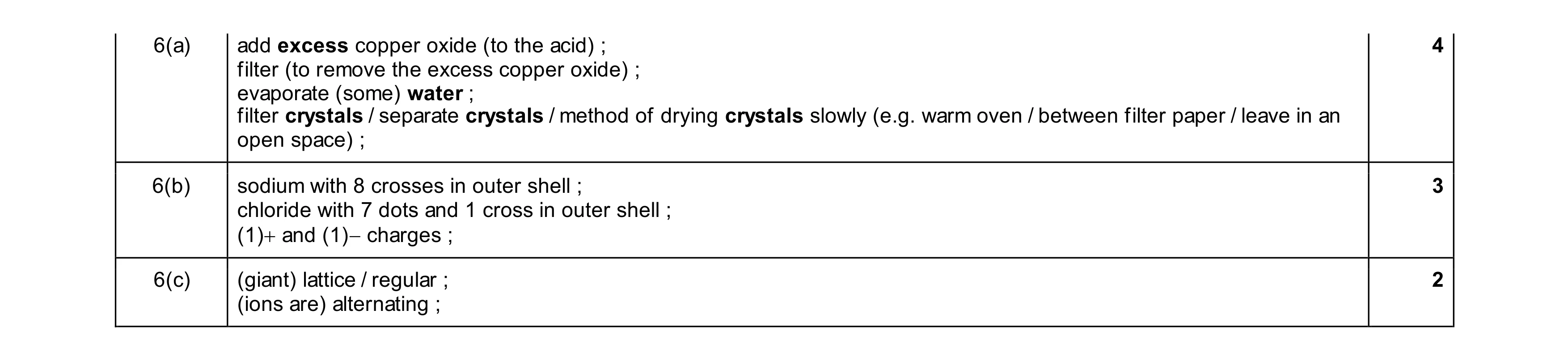 9
9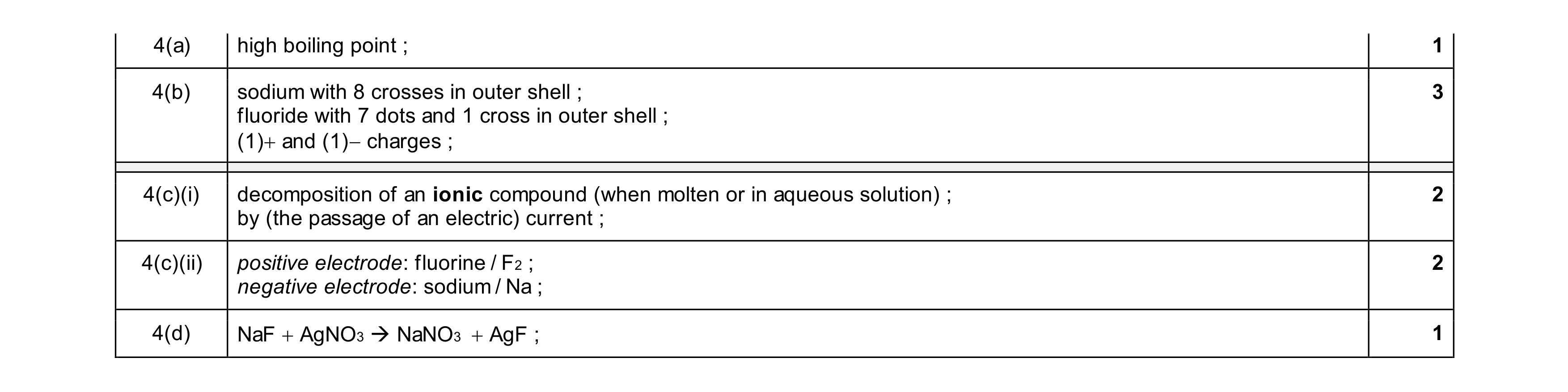 9
9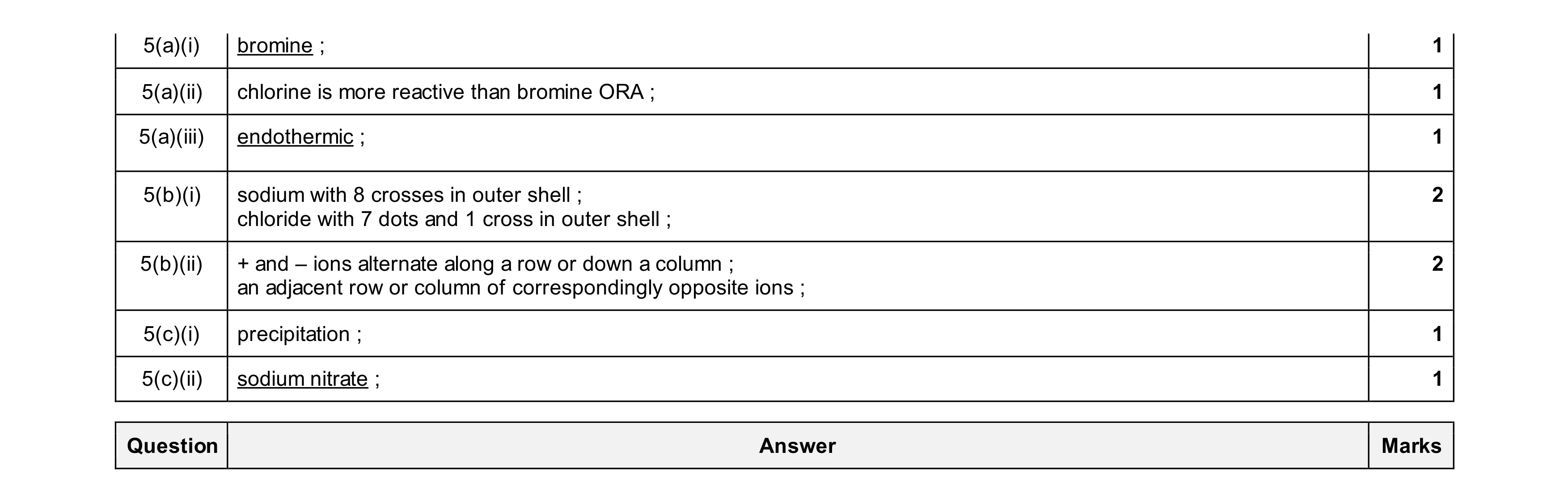 9
9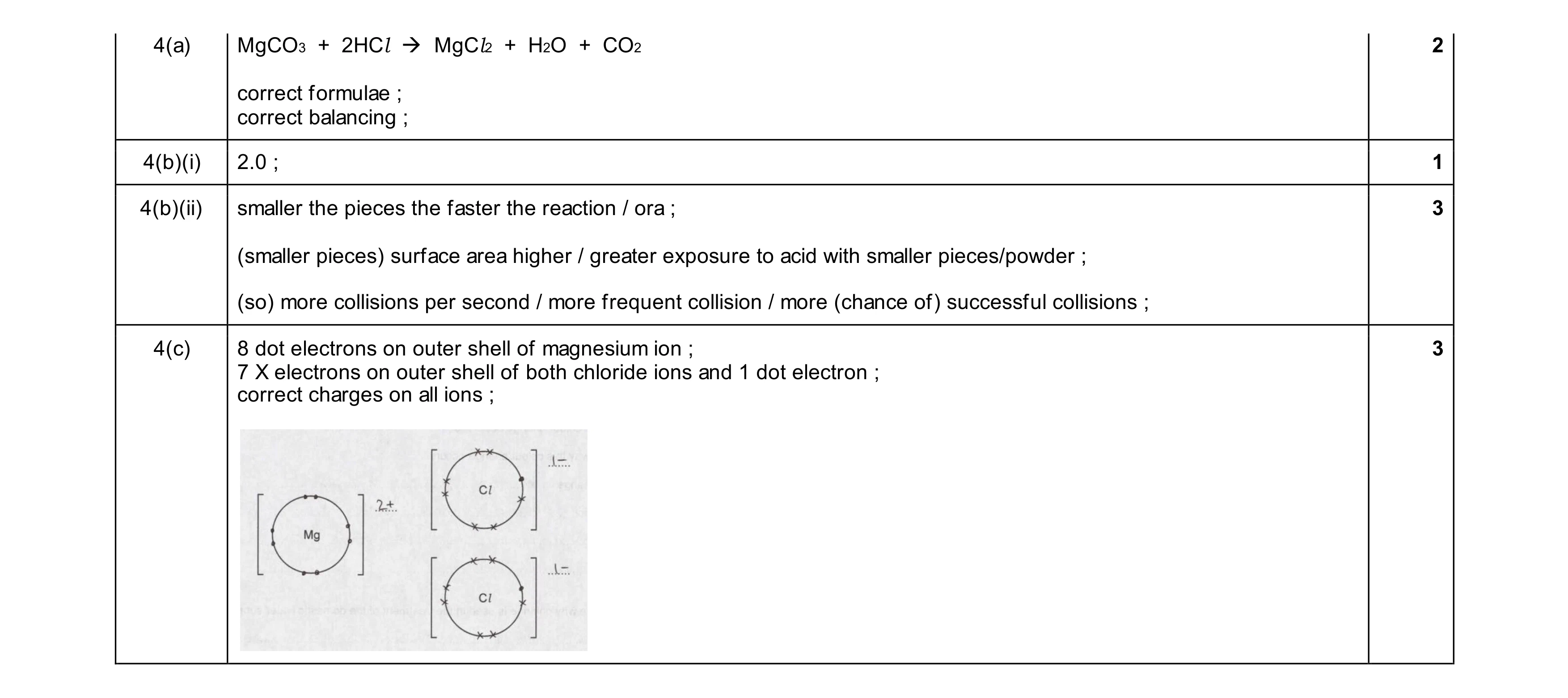 9
9