Questions as text
Q1 · The bucket at the front of a tractor is used to push fence posts down into the ground, as… 0625/32 Feb/March 2017
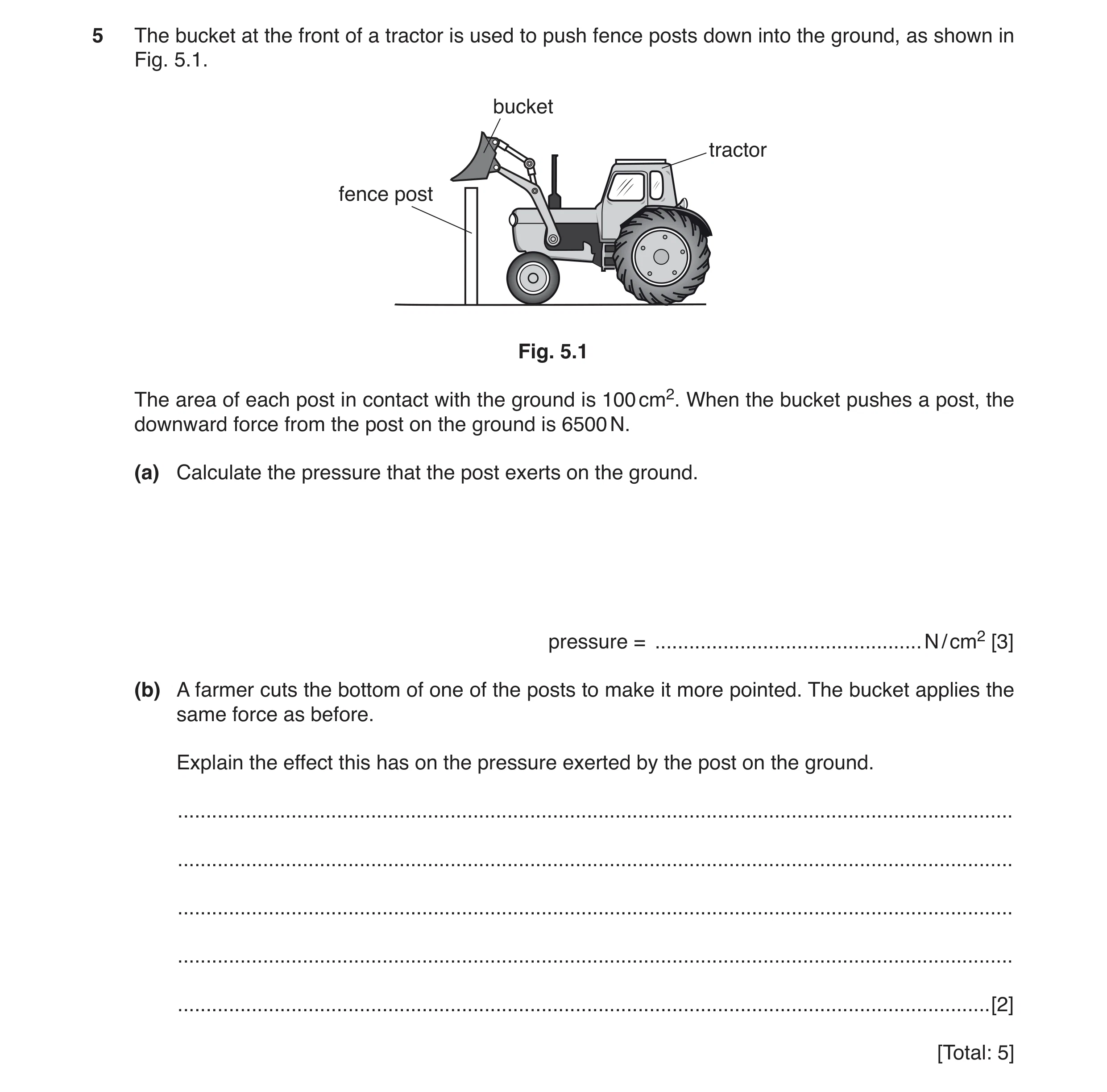
5 The bucket at the front of a tractor is used to push fence posts down into the ground, as shown in Fig. 5.1. bucket tractor fence post Fig. 5.1 The area of each post in contact with the ground is 100 cm2. When the bucket pushes a post, the downward force from the post on the ground is 6500 N. (a) Calculate the pressure that the post exerts on the ground. pressure = … N / cm2 [3] (b) A farmer cuts the bottom of one of the posts to make it more pointed. The bucket applies the same force as before. Explain the effect this has on the pressure exerted by the post on the ground. … … … … … [2] [Total: 5]
5 marks
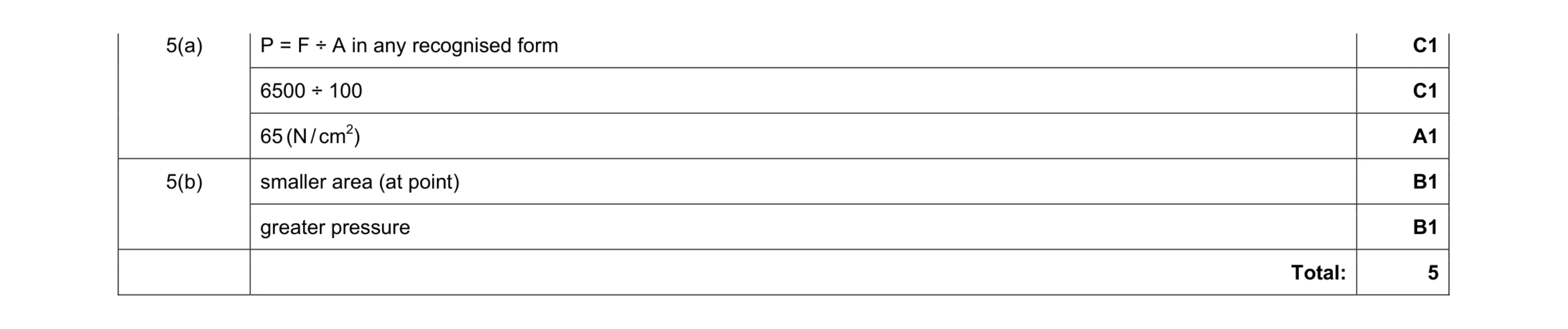
Mark scheme: 5(a) P = F ÷ A in any recognised form C1 6500 ÷ 100 C1 65 (N / cm2) A1 5(b) smaller area (at point) B1 greater pressure B1 Total: 5
This question in 0625/32 Feb/March 2017
Q2 · A laboratory floor has a surface that prevents people from slipping when the floor is wet 0625/31 May/June 2017
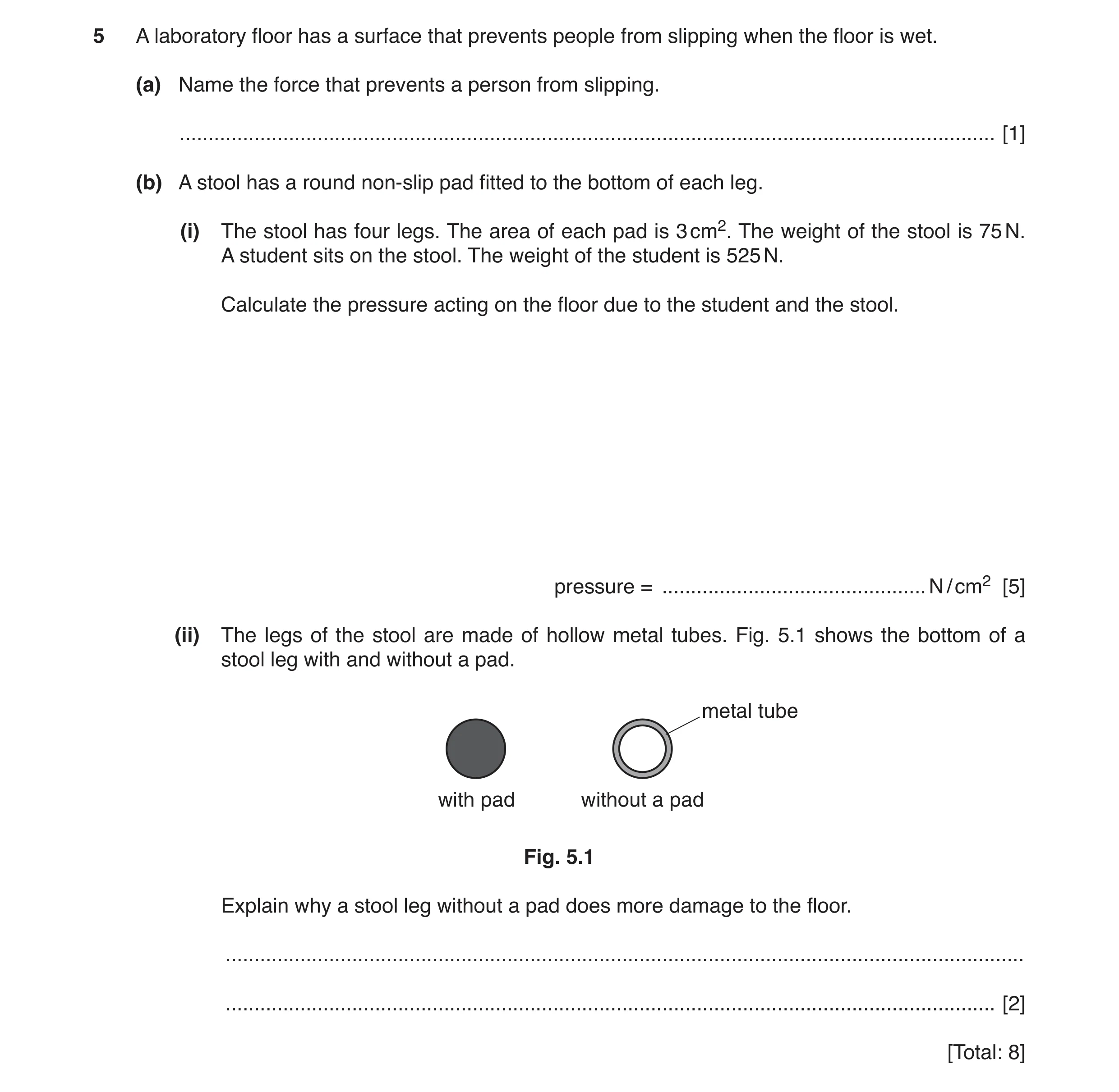
5 A laboratory floor has a surface that prevents people from slipping when the floor is wet. (a) Name the force that prevents a person from slipping. … [1] (b) A stool has a round non-slip pad fitted to the bottom of each leg. (i) The stool has four legs. The area of each pad is 3 cm2. The weight of the stool is 75 N. A student sits on the stool. The weight of the student is 525 N. Calculate the pressure acting on the floor due to the student and the stool. pressure = … N / cm2 [5] (ii) The legs of the stool are made of hollow metal tubes. Fig. 5.1 shows the bottom of a stool leg with and without a pad. metal tube with pad without a pad Fig. 5.1 Explain why a stool leg without a pad does more damage to the floor. … … [2] [Total: 8]
8 marks
Mark scheme: 5(a) friction B1 5(b)(i) total area = 3 × 4 = 12 (cm2) C1 total weight = 525 + 75 N = 600(N) C1 P = F ÷ A in any form C1 600 ÷ 12 C1 50 (N / cm2) A1 5(b)(ii) less (surface) area (in contact with the ground) owtte B1 more pressure (results in more damage to the surface) B1 Total: 8
This question in 0625/31 May/June 2017
Q3 · A potato snack packet is taken onto an aeroplane 0625/32 May/June 2017
5 (a) A potato snack packet is taken onto an aeroplane. During the flight the pressure inside the aeroplane changes and the potato snack packet changes shape, as shown in Fig. 5.1. potato snack packet before flight potato snack packet during flight OO OO KK K TT ATATK CC TT OOACAC TATAAA PPSNSN OONN PP SS Fig. 5.1 Explain why the packet changes shape. Use ideas about the gas molecules inside and outside the packet in your answer. … … … … … … [2] (b) A deep-sea diver on a diving-boat experiences atmospheric pressure. When she is working underwater, she experiences an increased pressure. State two factors that affect the size of the increased pressure. 1. … 2. … [2] (c) Fig. 5.2 shows a device used for measuring atmospheric pressure. mercury Fig. 5.2 (i) State the name of the device shown in Fig. 5.2. … [1] (ii) Fig. 5.3 shows a manometer connected to a gas supply. The pressure of the gas supply is greater than atmospheric pressure. Atmospheric pressure is equal to 1033.6 cm of water. gas 4 supply 3 2 1 water cm Fig. 5.3 Determine the pressure of the gas supply. pressure = … cm of water [3] [Total: 8]
8 marks
Mark scheme: 5(a) any two from: more collide with walls more often so pressure is greater (inside bag) B2 5(b) density (of sea water) depth (of sea water) (in either order) B2 5(c)(i) barometer B1 5(c)(ii) 3.4 or 1.3 seen C1 2.1 C1 1035.7 A1 Total: 8
This question in 0625/32 May/June 2017
Q4 · A car tyre in contact with the road 0625/33 May/June 2017
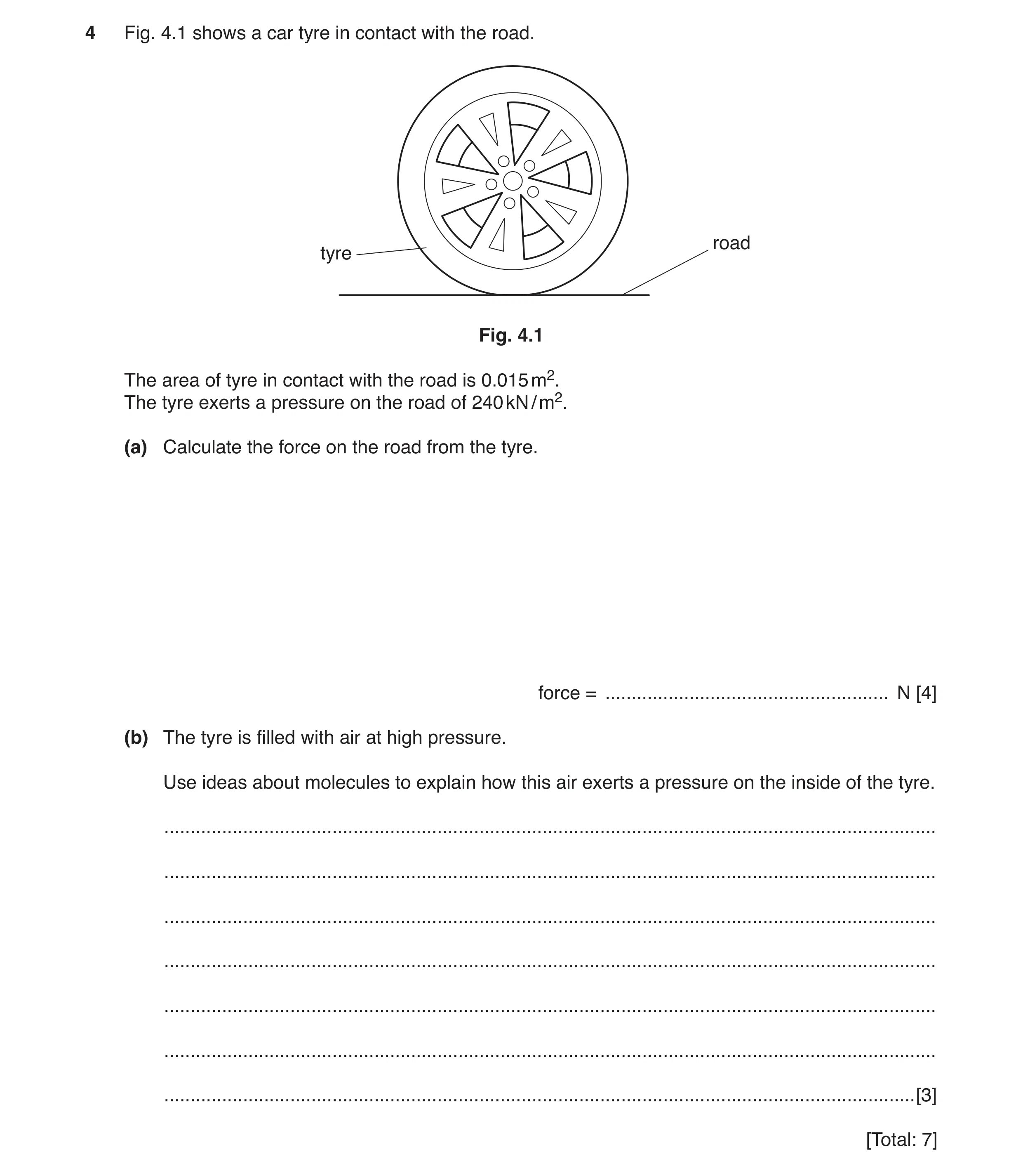
4 Fig. 4.1 shows a car tyre in contact with the road. road tyre Fig. 4.1 The area of tyre in contact with the road is 0.015 m2. The tyre exerts a pressure on the road of 240 kN / m2. (a) Calculate the force on the road from the tyre. force = … N [4] (b) The tyre is filled with air at high pressure. Use ideas about molecules to explain how this air exerts a pressure on the inside of the tyre. … … … … … … … [3] [Total: 7]
7 marks
Mark scheme: 4(a) B1 pressure = force ÷ area C1 transformation force = pressure × area C1 3600 (N) A1 4(b) any 3 from: molecules move about (randomly) collisions impacts with walls/surfaces (of tyre) idea of force produced (by bombarding molecules) idea of pressure as force on an area B3 Total: 7
This question in 0625/33 May/June 2017
Q5 · A glass vase used for displaying flowers 0625/32 Oct/Nov 2017
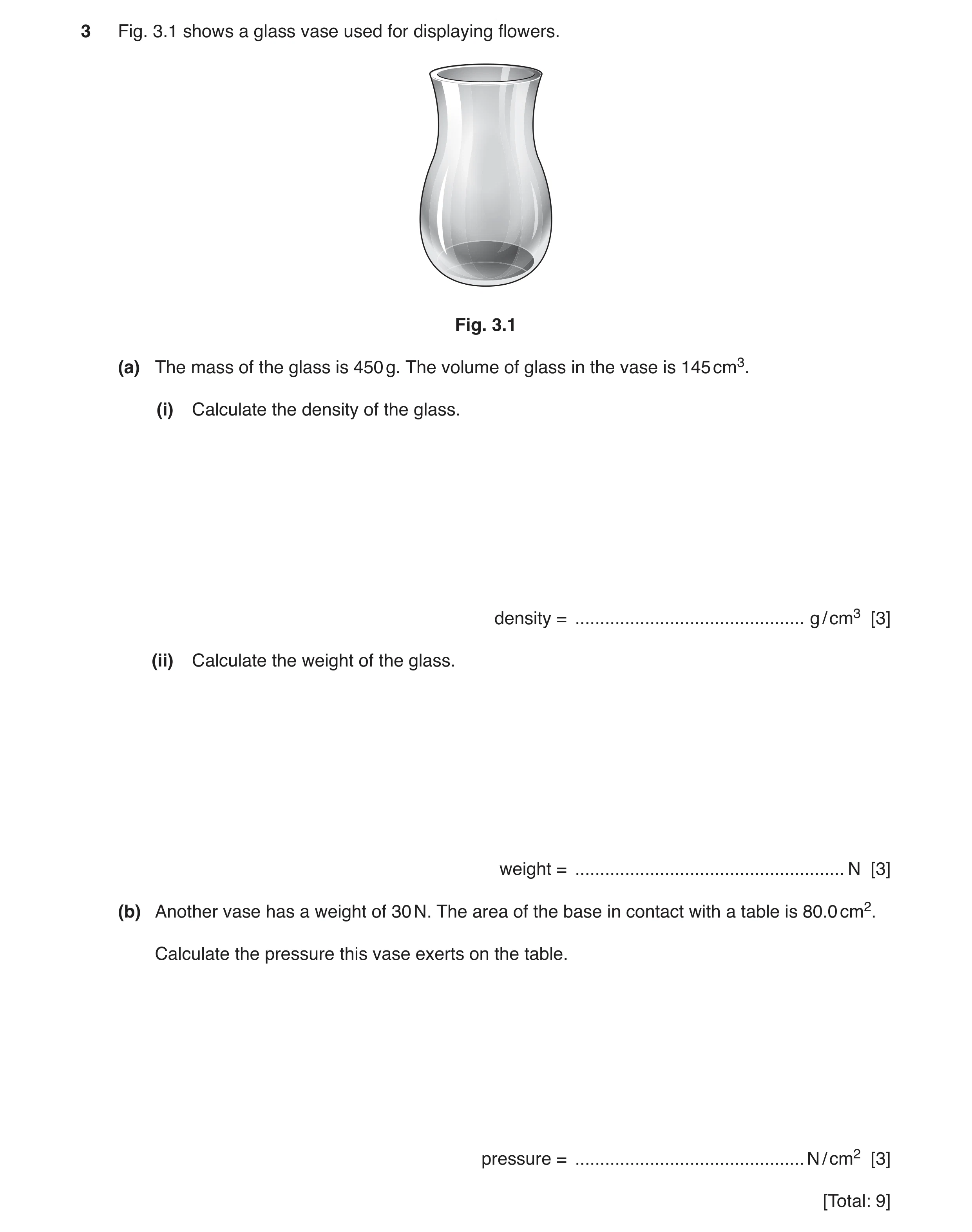
3 Fig. 3.1 shows a glass vase used for displaying flowers. Fig. 3.1 (a) The mass of the glass is 450 g. The volume of glass in the vase is 145 cm3. (i) Calculate the density of the glass. density = … g / cm3 [3] (ii) Calculate the weight of the glass. weight = … N [3] (b) Another vase has a weight of 30 N. The area of the base in contact with a table is 80.0 cm2. Calculate the pressure this vase exerts on the table. pressure = … N / cm2 [3] [Total: 9]
9 marks
Mark scheme: 3(a)(i) D = M / V C1 450 / 145 C1 3.1 (g / cm3) A1 3(a)(ii) W = m × g in any form C1 0.45 × 10 C1 4.5 (N) A1 3(b) P = F / A in any form C1 30 / 80 C1 0.375 (N / cm2) OR 0.38 (N / cm2) A1
This question in 0625/32 Oct/Nov 2017
Q6 · A vehicle may have tyres of type A or type B, as shown in Fig 0625/33 Oct/Nov 2017
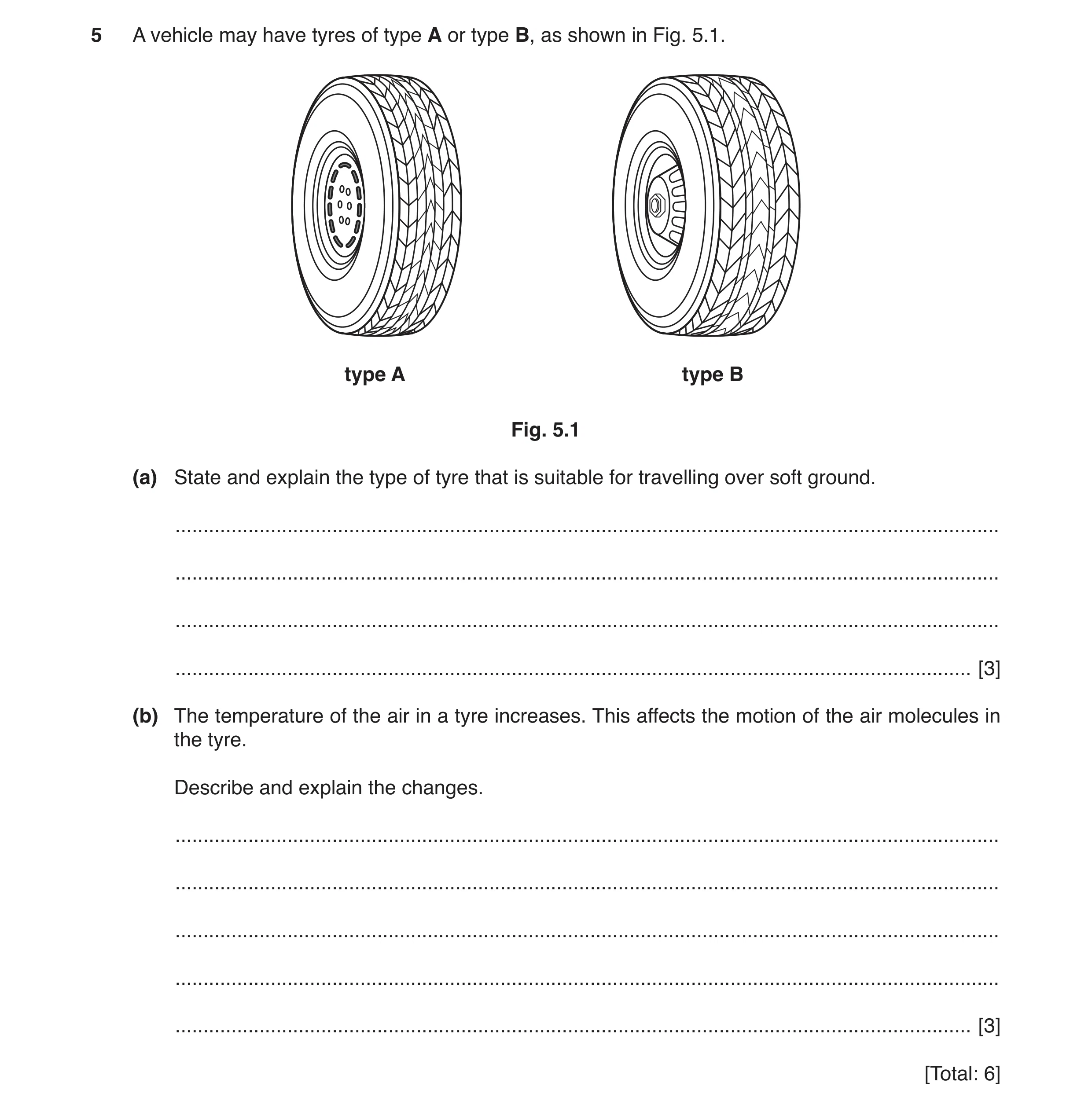
5 A vehicle may have tyres of type A or type B, as shown in Fig. 5.1. type A type B Fig. 5.1 (a) State and explain the type of tyre that is suitable for travelling over soft ground. … … … … [3] (b) The temperature of the air in a tyre increases. This affects the motion of the air molecules in the tyre. Describe and explain the changes. … … … … … [3] [Total: 6]
6 marks
Mark scheme: 5(a) Tyre B B1 larger / bigger surface area B1 less pressure (on ground) / weight distributed B1 5(b) molecules gain kinetic energy / move faster B1 more (frequent) / harder collisions (with tyre) B1 Increased / greater pressure (on tyre) B1
This question in 0625/33 Oct/Nov 2017
Q7 · A metal can containing air 0625/33 May/June 2018
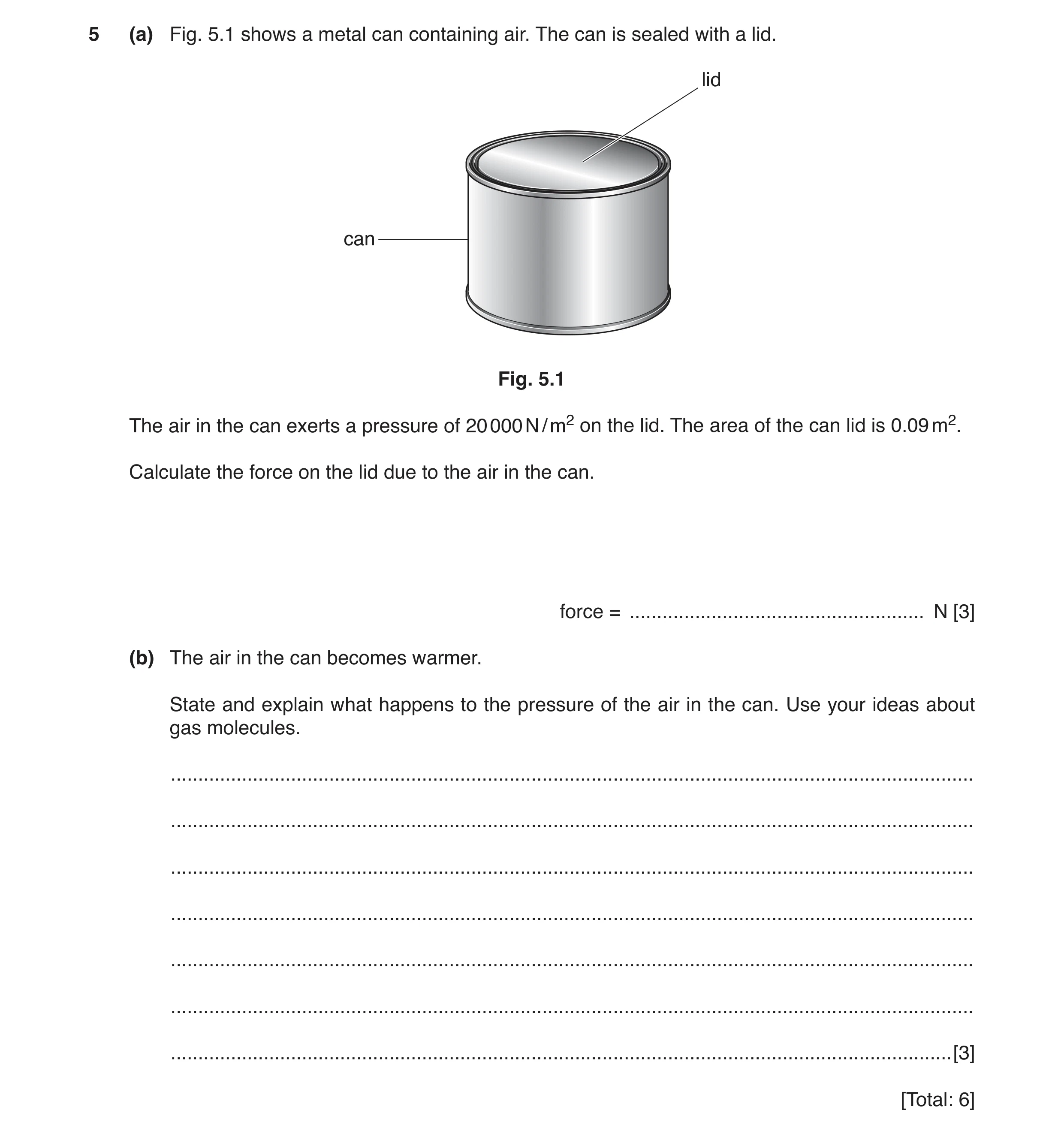
5 (a) Fig. 5.1 shows a metal can containing air. The can is sealed with a lid. lid can Fig. 5.1 The air in the can exerts a pressure of 20 000 N / m2 on the lid. The area of the can lid is 0.09 m2. Calculate the force on the lid due to the air in the can. force = … N [3] (b) The air in the can becomes warmer. State and explain what happens to the pressure of the air in the can. Use your ideas about gas molecules. … … … … … … … [3] [Total: 6]
6 marks
Mark scheme: 5(a) 1 20 000 × 0.009 1 1800 (N) 1 5(b) pressure increases 1 any two from: molecules move faster/have more ke collide harder/more often (with walls of can) (change in momentum due to) collisions impart(s) force on can walls 2
This question in 0625/33 May/June 2018
Q8 · A student is studying elephants 0625/32 Oct/Nov 2018
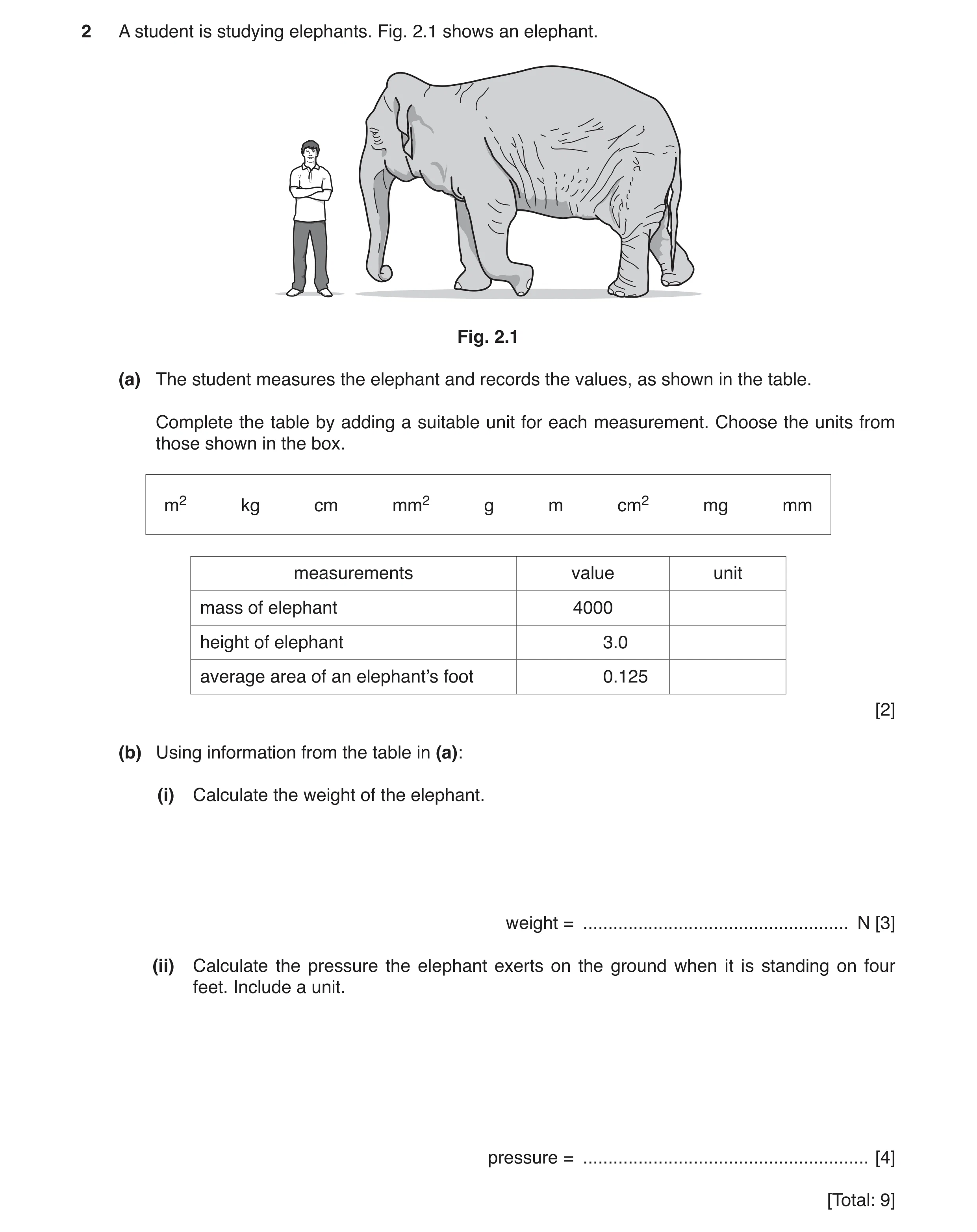
2 A student is studying elephants. Fig. 2.1 shows an elephant. Fig. 2.1 (a) The student measures the elephant and records the values, as shown in the table. Complete the table by adding a suitable unit for each measurement. Choose the units from those shown in the box. m2 kg cm mm2 g m cm2 mg mm measurements value unit mass of elephant 4000 height of elephant 3.0 average area of an elephant’s foot 0.125 [2] (b) Using information from the table in (a): (i) Calculate the weight of the elephant. weight = … N [3] (ii) Calculate the pressure the elephant exerts on the ground when it is standing on four feet. Include a unit. pressure = … [4] [Total: 9]
9 marks
Mark scheme: 2(a) mass in kg AND height in m B1 area in m2 B1 2(b)(i) W = m × g C1 4000 × 10 C1 40 000 (N) A1 2(b)(ii) P = F ÷ A in any recognisable form C1 (area = ) 0.125 × 4 = 0.50 (m2) B1 b(i) ÷ 5000 OR 40 000 ÷ 0.500 C1 80 000 N / m2 OR 80 000 Pa A1
This question in 0625/32 Oct/Nov 2018
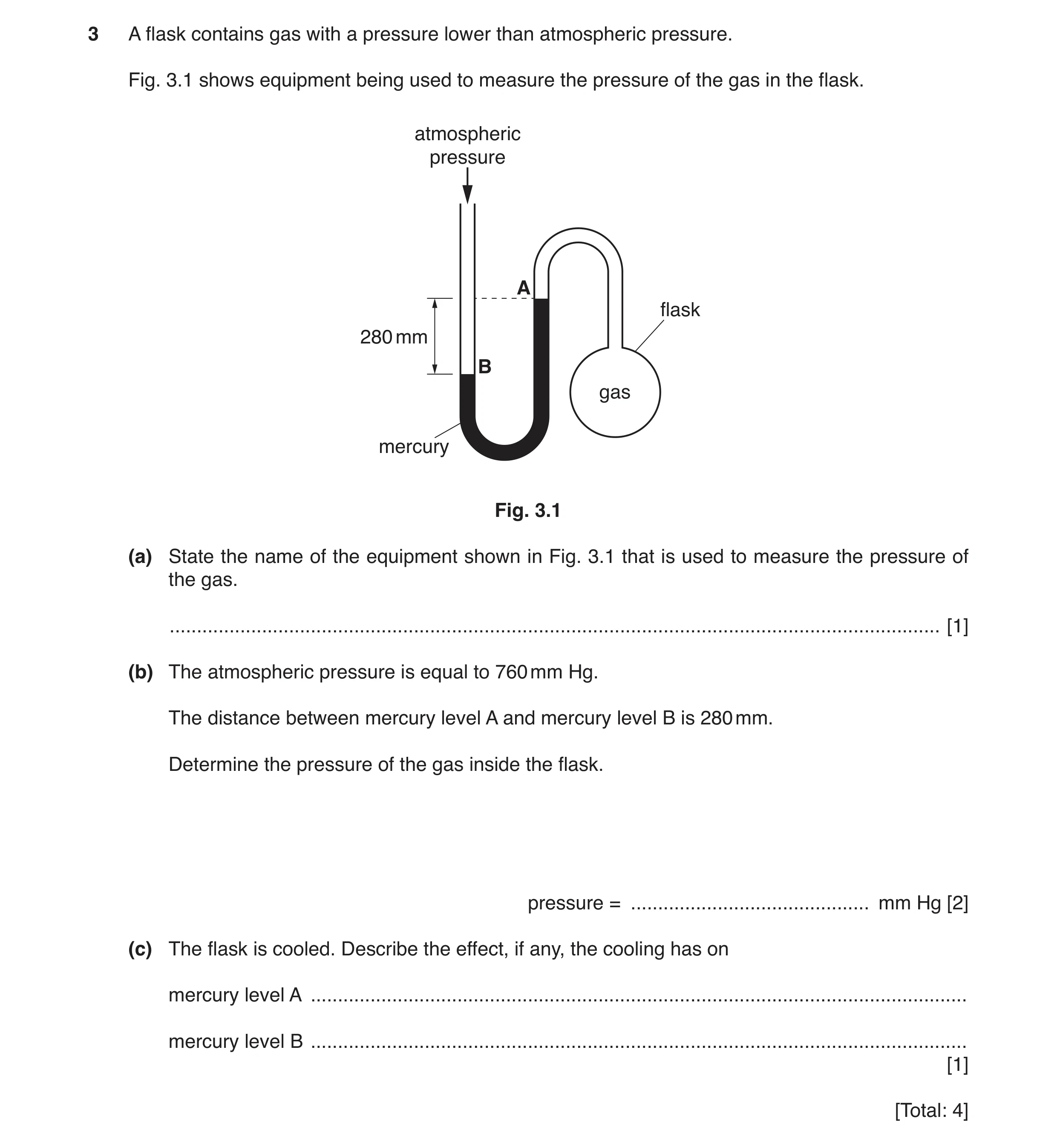
Q9 · A flask contains gas with a pressure lower than atmospheric pressure 0625/32 Oct/Nov 2018
3 A flask contains gas with a pressure lower than atmospheric pressure. Fig. 3.1 shows equipment being used to measure the pressure of the gas in the flask. atmospheric pressure A flask 280 mm B gas mercury Fig. 3.1 (a) State the name of the equipment shown in Fig. 3.1 that is used to measure the pressure of the gas. … [1] (b) The atmospheric pressure is equal to 760 mm Hg. The distance between mercury level A and mercury level B is 280 mm. Determine the pressure of the gas inside the flask. pressure = … mm Hg [2] (c) The flask is cooled. Describe the effect, if any, the cooling has on mercury level A … mercury level B … [1] [Total: 4]
4 marks
Mark scheme: 3(a) manometer B1 3(b) 760–280 C1 480 (mm Hg) A1 3(c) (level A) up (level B) down B1
This question in 0625/32 Oct/Nov 2018
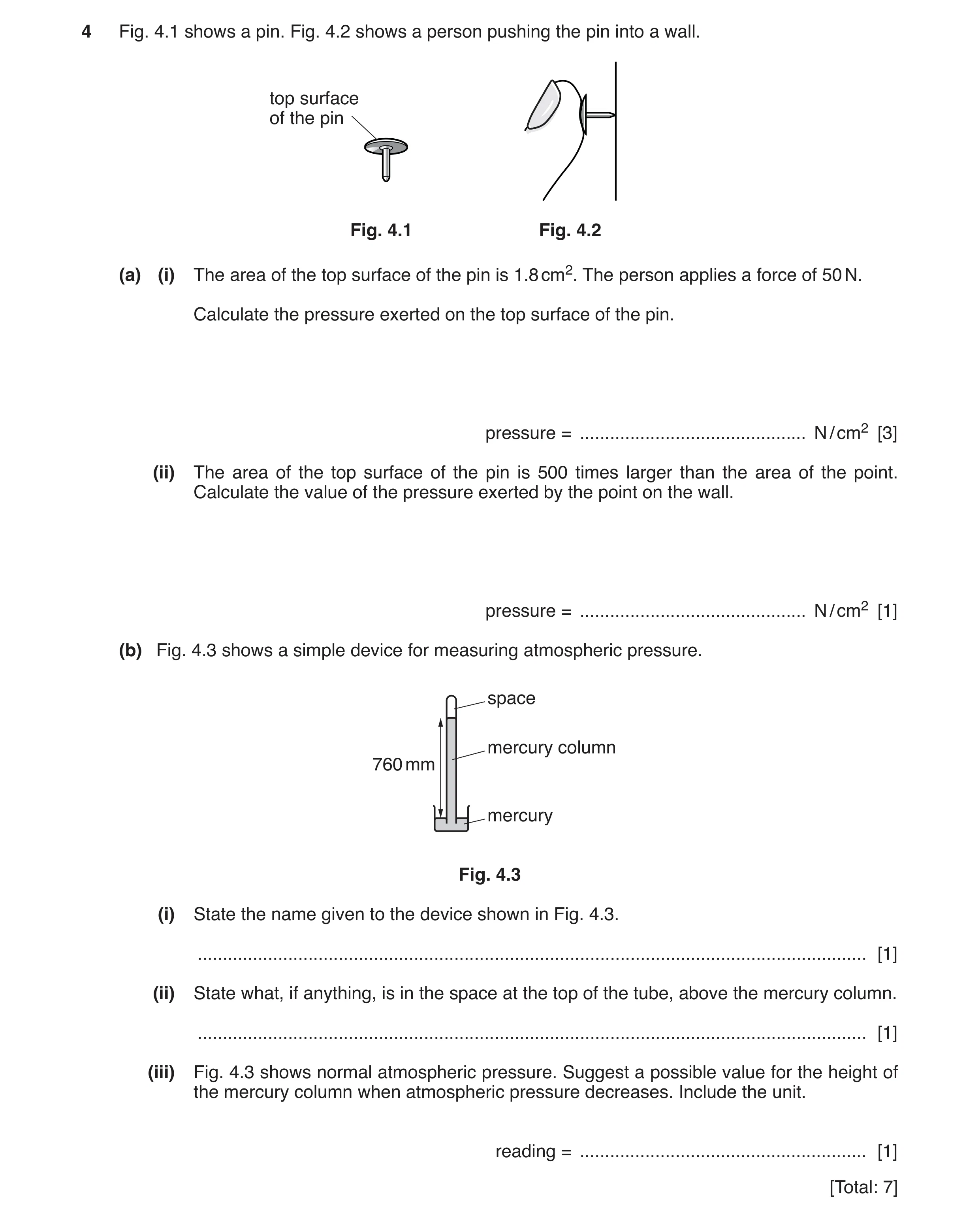
Question 10 0625/31 May/June 2019
4 Fig. 4.1 shows a pin. Fig. 4.2 shows a person pushing the pin into a wall. top surface of the pin Fig. 4.1 Fig. 4.2 (a) (i) The area of the top surface of the pin is 1.8 cm2. The person applies a force of 50 N. Calculate the pressure exerted on the top surface of the pin. pressure = … N / cm2 [3] (ii) The area of the top surface of the pin is 500 times larger than the area of the point. Calculate the value of the pressure exerted by the point on the wall. pressure = … N / cm2 [1] (b) Fig. 4.3 shows a simple device for measuring atmospheric pressure. space mercury column 760 mm mercury Fig. 4.3 (i) State the name given to the device shown in Fig. 4.3. … [1] (ii) State what, if anything, is in the space at the top of the tube, above the mercury column. … [1] (iii) Fig. 4.3 shows normal atmospheric pressure. Suggest a possible value for the height of the mercury column when atmospheric pressure decreases. Include the unit. reading = … [1] [Total: 7]
7 marks
Mark scheme: 4(a)(i) Pressure = force ÷ area in any form C1 50 ÷ 1.8 C1 28 (N / cm2) A1 4(a)(ii) In range 13 500 to 15 000 (N / cm2) B1 4(b)(i) (mercury) barometer B1 4(b)(ii) vacuum OR nothing B1 4(b)(iii) a value less than 760 mm (Hg ) and > 0 mm (Hg) B1
This question in 0625/31 May/June 2019
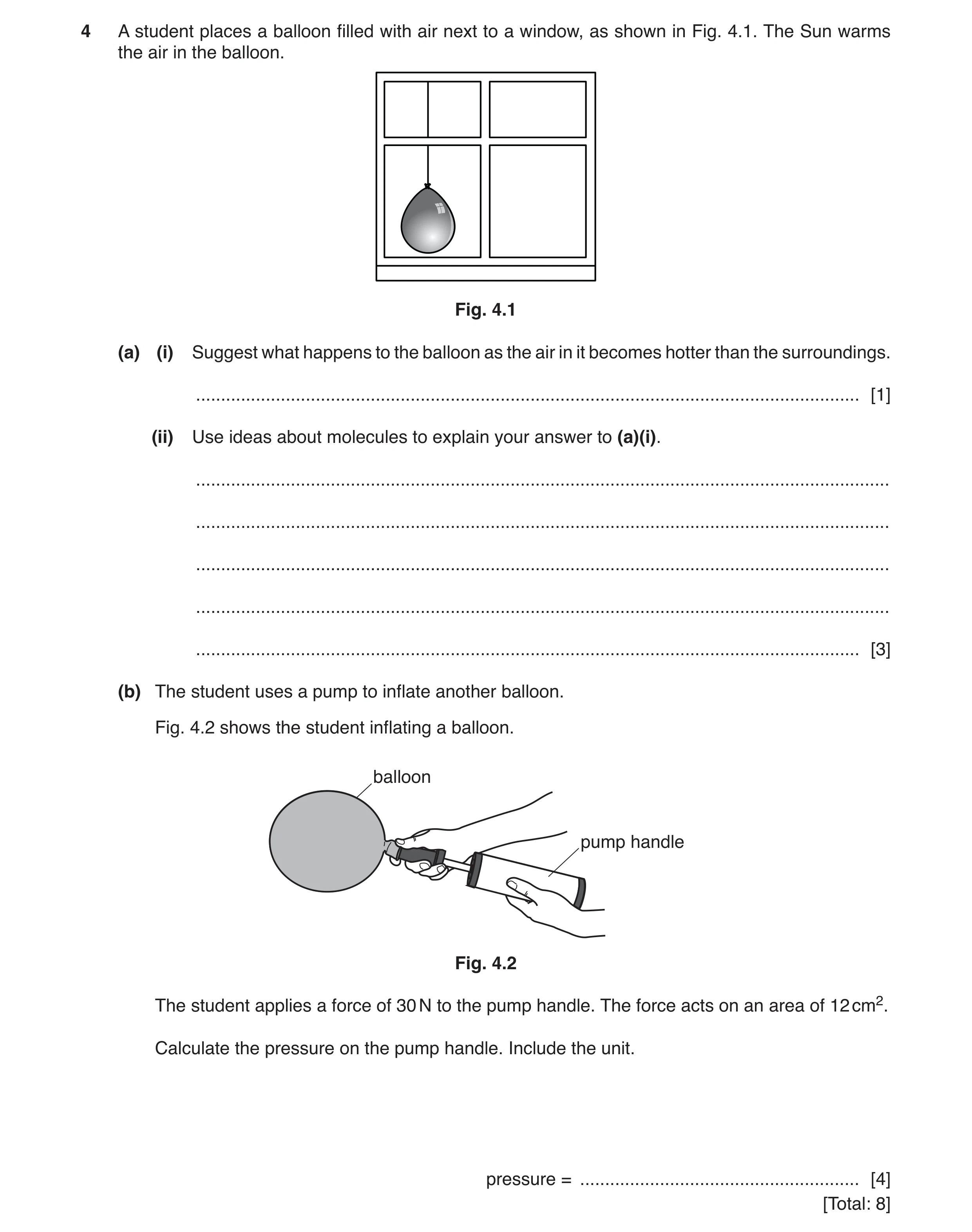
Q11 · A student places a balloon filled with air next to a window, as shown in Fig 0625/32 May/June 2019
4 A student places a balloon filled with air next to a window, as shown in Fig. 4.1. The Sun warms the air in the balloon. Fig. 4.1 (a) (i) Suggest what happens to the balloon as the air in it becomes hotter than the surroundings. … [1] (ii) Use ideas about molecules to explain your answer to (a)(i). … … … … … [3] (b) The student uses a pump to inflate another balloon. Fig. 4.2 shows the student inflating a balloon. balloon pump handle Fig. 4.2 The student applies a force of 30 N to the pump handle. The force acts on an area of 12 cm2. Calculate the pressure on the pump handle. Include the unit. pressure = … [4] [Total: 8]
8 marks
Mark scheme: 4(a)(i) expand or increase in size/volume increase in pressure decrease in density B1 4(a)(ii) any 3 from: density (of air) is less molecules move faster/have more (kinetic) energy more collisions ( per second) collisions with surface OR balloon (owtte) more force (in collisions) molecules move (further) apart B3 Question Answer Marks 4(b) P = F/A in any form C1 30 ÷ 12 C1 2.5 A1 N/cm2 B1
This question in 0625/32 May/June 2019
Q12 · A tractor fitted with a device for breaking up soil in a field 0625/31 Oct/Nov 2019
4 Fig. 4.1 shows a tractor fitted with a device for breaking up soil in a field. tractor device heavy weight pivot point soil Fig. 4.1 (a) (i) The tractor has a heavy weight at the front. Explain why the heavy weight is needed. … … [1] (ii) Fig. 4.2 represents the weight of the device and its distance from the pivot. pivot 2.1 m 6000 N Fig. 4.2 Calculate the moment of the weight of the device about the pivot. State the unit. moment = … [4] (b) Fig. 4.3 shows a tractor fitted with narrow tyres and the same tractor fitted with wide tyres. narrow tyre wide tyre tractor fitted with same tractor fitted with narrow tyres wide tyres Fig. 4.3 (view from the front) Explain why wide tyres are more suitable for the tractor on soft soil. … … … … [3] [Total: 8]
8 marks
Mark scheme: 4(a)(i) stop the tractor tipping up/keep tractor level owtte B1 4(a)(ii) moment = force × (perp.) distance from pivot in any form C1 6000 × 2.1 C1 12 600 A1 Nm B1 4(b) Any three from: (wide tyres have) greater area (in contact with ground) pressure = force ÷ area in any form the bigger the area the smaller the pressure so tractor less likely to sink/become stuck (in soft ground) B3
This question in 0625/31 Oct/Nov 2019
Q13 · During part of a race, a skier travels a distance of 200 m in a time of 6.4 s 0625/31 May/June 2020
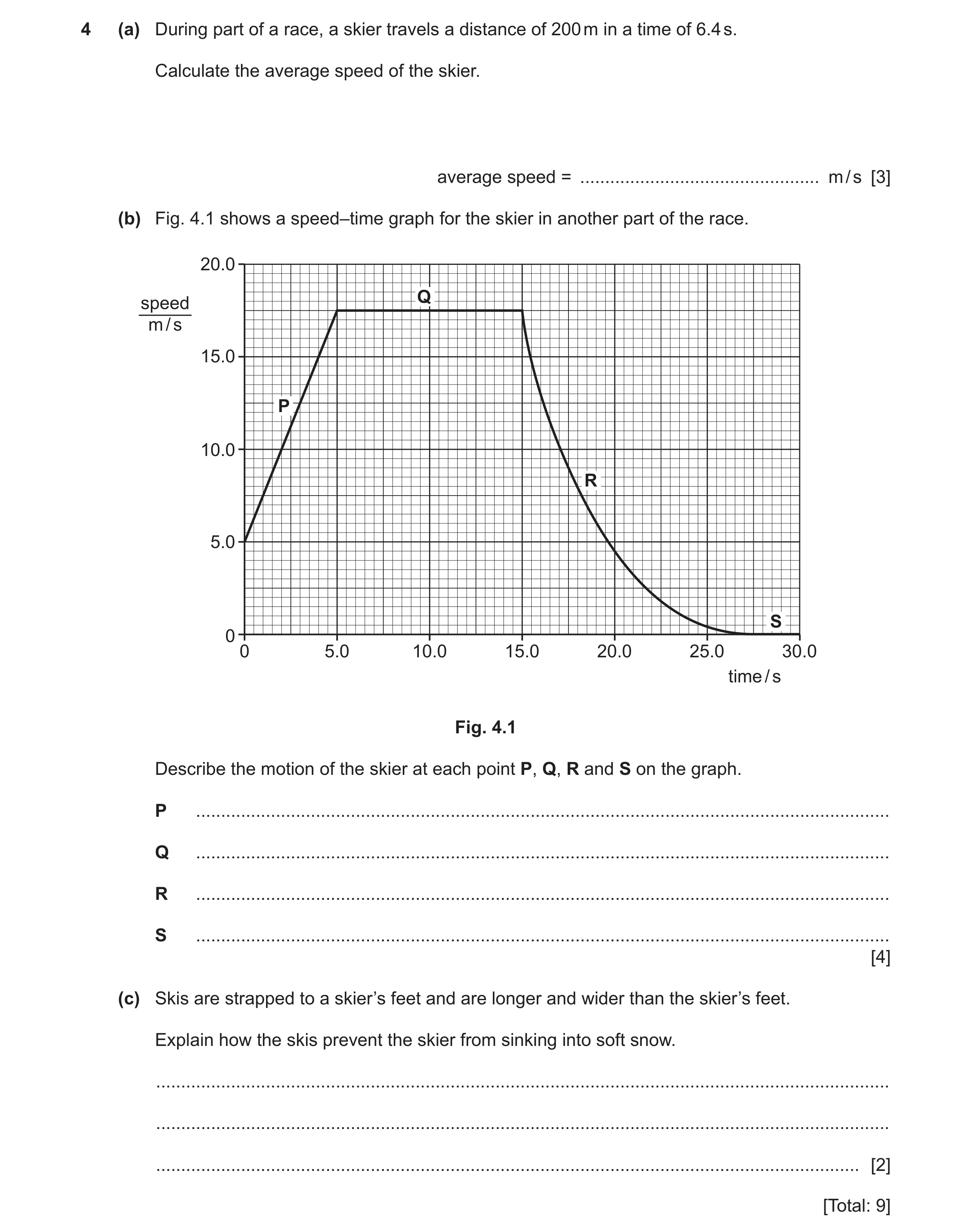
4 (a) During part of a race, a skier travels a distance of 200 m in a time of 6.4 s. Calculate the average speed of the skier. average speed = … m / s [3] (b) Fig. 4.1 shows a speed–time graph for the skier in another part of the race. 20.0 Q speed m / s 15.0 P 10.0 R 5.0 S 0 0 5.0 10.0 15.0 20.0 25.0 30.0 time / s Fig. 4.1 Describe the motion of the skier at each point P, Q, R and S on the graph. P … Q … R … S … [4] (c) Skis are strapped to a skier’s feet and are longer and wider than the skier’s feet. Explain how the skis prevent the skier from sinking into soft snow. … … … [2] [Total: 9]
9 marks
Mark scheme: 4(a) C1 (s =) 200 ÷ 6.4 C1 (s =) 31 (m / s) A1 4(b) P – (constantly) accelerates (from 5 m / s) B1 Q – constant speed (of 17.5 m / s) B1 R – (non-constant) decelerates (from 17.5 m / s to rest) B1 S – at rest or stationary B1 4(c) (skis have) large (surface) area B1 (so) less pressure (on snow / ground) B1
This question in 0625/31 May/June 2020
Q14 · An archer pulling the string of a bow 0625/32 May/June 2020
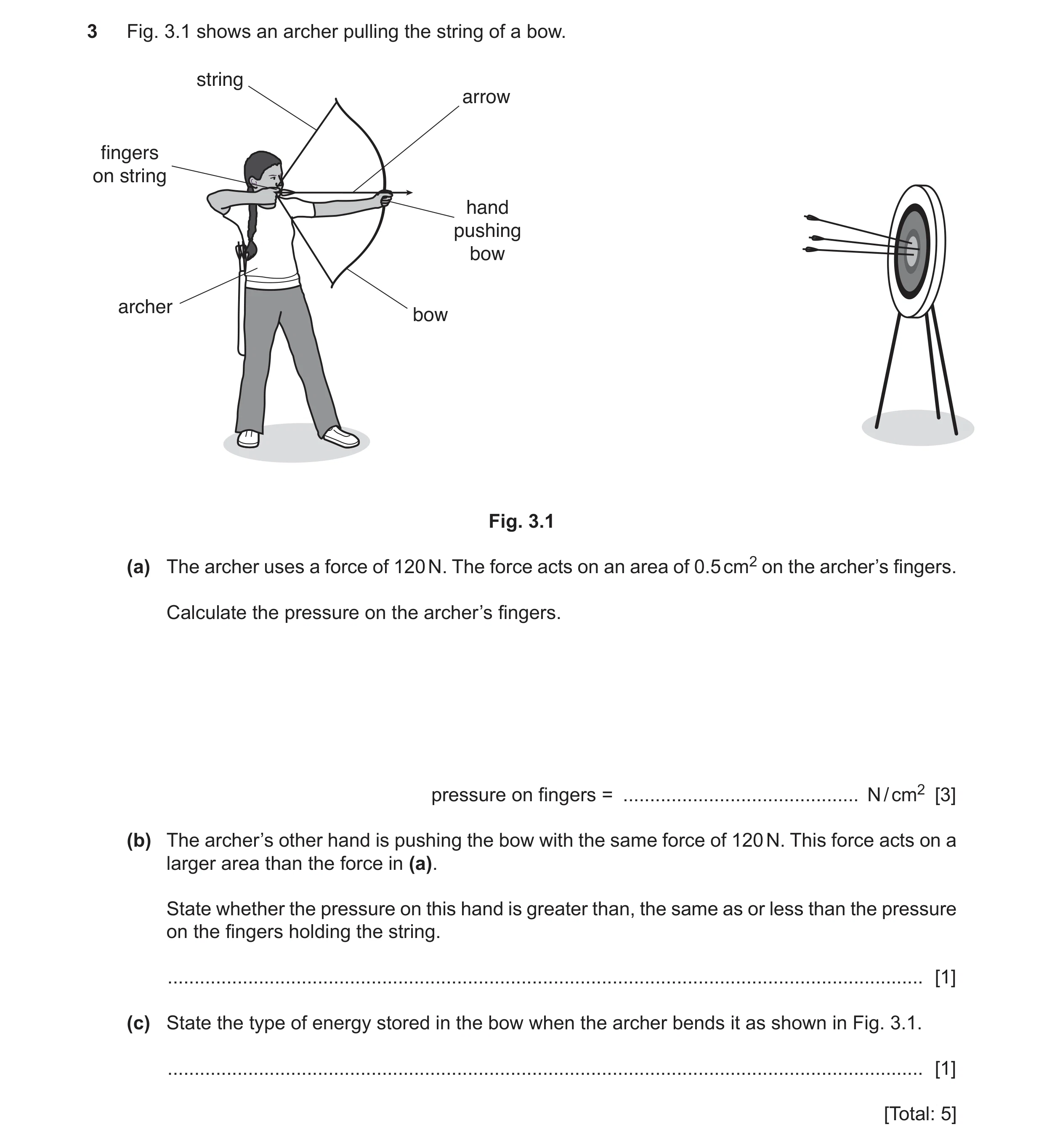
3 Fig. 3.1 shows an archer pulling the string of a bow. string arrow fingers on string hand pushing bow archer bow Fig. 3.1 (a) The archer uses a force of 120 N. The force acts on an area of 0.5 cm2 on the archer’s fingers. Calculate the pressure on the archer’s fingers. pressure on fingers = … N / cm2 [3] (b) The archer’s other hand is pushing the bow with the same force of 120 N. This force acts on a larger area than the force in (a). State whether the pressure on this hand is greater than, the same as or less than the pressure on the fingers holding the string. … [1] (c) State the type of energy stored in the bow when the archer bends it as shown in Fig. 3.1. … [1] [Total: 5]
5 marks
Mark scheme: 3(a) P = F ÷ A in any form C1 120 ÷ 0.5 C1 240 (N / cm2) A1 3(b) Less (than) B1 3(c) elastic OR strain OR potential B1
This question in 0625/32 May/June 2020
Q15 · A steel container fitted with a liquid manometer 0625/31 Oct/Nov 2020
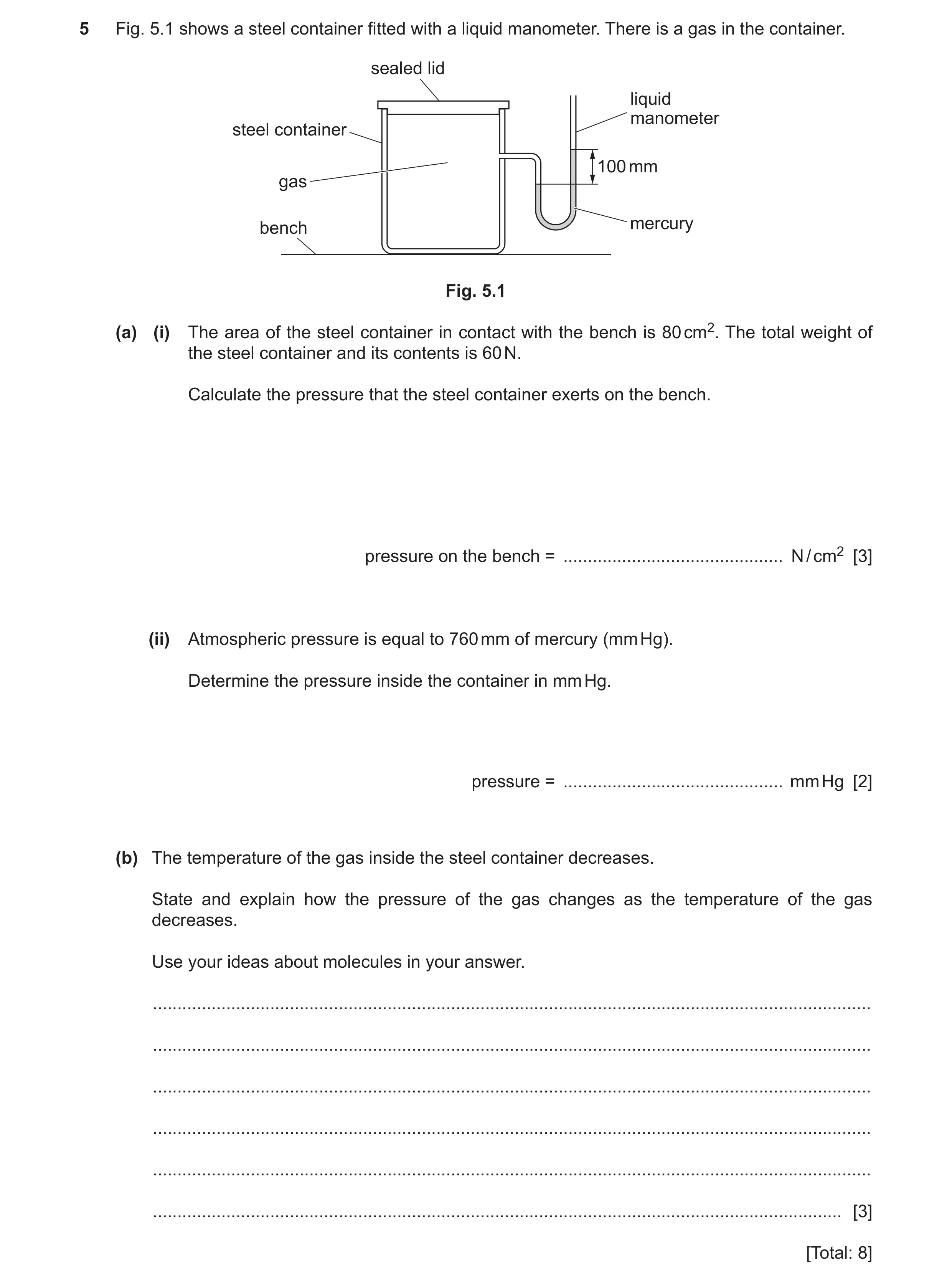
5 Fig. 5.1 shows a steel container fitted with a liquid manometer. There is a gas in the container. sealed lid liquid manometer steel container 100 mm gas bench mercury Fig. 5.1 (a) (i) The area of the steel container in contact with the bench is 80 cm2. The total weight of the steel container and its contents is 60 N. Calculate the pressure that the steel container exerts on the bench. pressure on the bench = … N / cm2 [3] (ii) Atmospheric pressure is equal to 760 mm of mercury (mm Hg). Determine the pressure inside the container in mm Hg. pressure = … mm Hg [2] (b) The temperature of the gas inside the steel container decreases. State and explain how the pressure of the gas changes as the temperature of the gas decreases. Use your ideas about molecules in your answer. … … … … … … [3] [Total: 8]
8 marks
Mark scheme: 5(a)(i) (P =) F ÷ A in any form C1 (P =) 60 ÷ 80 C1 (P =) 0.75 (N / cm2) A1 5(a)(ii) 760(.0) + OR – 100(.0) C1 860 (mm of Hg) A1 5(b) pressure decreases B1 Any two from: (because) molecules slower speed or less kinetic energy fewer collisions OR molecules collide less often (with walls of container) collides with less force (with walls of container) B2
This question in 0625/31 Oct/Nov 2020
Question 16 0625/32 Oct/Nov 2020
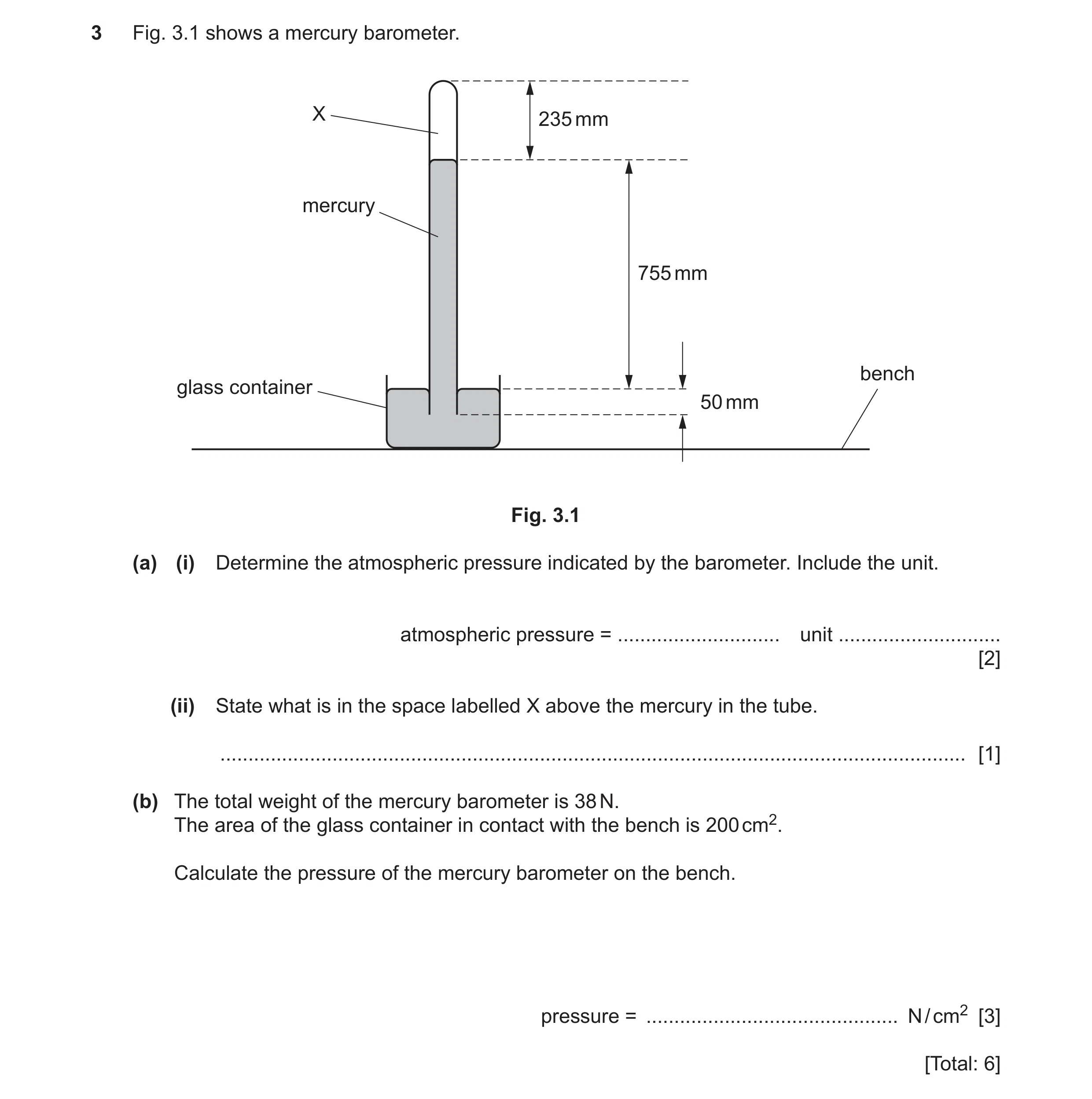
3 Fig. 3.1 shows a mercury barometer. X 235 mm mercury 755 mm bench glass container 50 mm Fig. 3.1 (a) (i) Determine the atmospheric pressure indicated by the barometer. Include the unit. atmospheric pressure = … unit … [2] (ii) State what is in the space labelled X above the mercury in the tube. … [1] (b) The total weight of the mercury barometer is 38 N. The area of the glass container in contact with the bench is 200 cm2. Calculate the pressure of the mercury barometer on the bench. pressure = … N / cm2 [3] [Total: 6]
6 marks
Mark scheme: 3(a)(i) 755 B1 mm Hg B1 3(a)(ii) vacuum B1 3(b) (P = ) F ÷ A C1 38 ÷ 200 C1 0.19 (N / cm2) A1
This question in 0625/32 Oct/Nov 2020
Q17 · Some vehicles have wide tyres so that they can drive over soft mud 0625/33 Oct/Nov 2020
4 (a) Some vehicles have wide tyres so that they can drive over soft mud. Explain why the wide tyres enable these vehicles to drive over soft mud. … … … … [3] (b) Fig. 4.1 shows a mercury barometer. Y mercury glass tube container Fig. 4.1 (i) State what is in the space at Y above the mercury. … [1] (ii) Complete the following statement to describe the use of a mercury barometer. A mercury barometer measures … … [2] (c) The diagram in Fig. 4.2 shows a tall can containing water. The can has three identical holes 1, 2 and 3 on one side, one above the other in a vertical line, as shown in Fig. 4.2. Water is shown flowing out of hole 2 and hole 3. can 1 stream of water from hole 2 2 water stream of water 3 from hole 3 bench container Fig. 4.2 (i) State how the pressure of the water at hole 2 compares with the pressure of the water at hole 3. … [1] (ii) Draw on Fig. 4.2 to show the stream of water flowing from hole 1. [1] [Total: 8]
8 marks
Mark scheme: 4(a) any three from: pressure = force ÷ area weight or force distributed / spread or wtte (over) larger area (so) lower pressure (on the ground) (vehicle) doesn’t sink into the mud owtte 4(b)(i) vacuum B1 4(b)(ii) atmospheric / air B1 pressure B1 4(c)(i) (pressure at hole 2 is) less (than that at hole 3) ora B1 4(c)(ii) water from top hole not travelling further than from middle hole B1
This question in 0625/33 Oct/Nov 2020
Q18 · A man starts pulling his suitcase across the floor 0625/31 May/June 2021
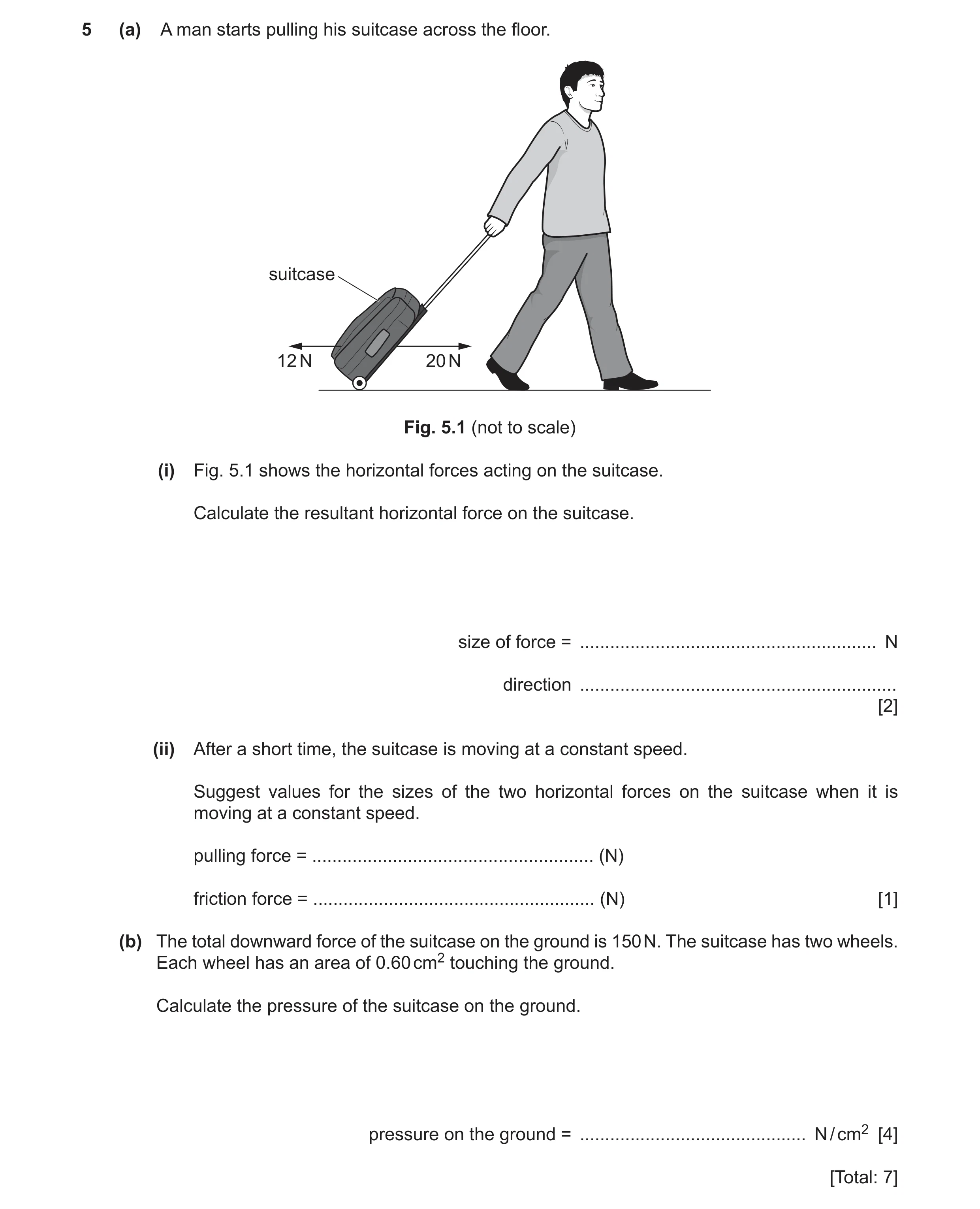
5 (a) A man starts pulling his suitcase across the floor. suitcase 12 N 20 N Fig. 5.1 (not to scale) (i) Fig. 5.1 shows the horizontal forces acting on the suitcase. Calculate the resultant horizontal force on the suitcase. size of force = … N direction … [2] (ii) After a short time, the suitcase is moving at a constant speed. Suggest values for the sizes of the two horizontal forces on the suitcase when it is moving at a constant speed. pulling force = … (N) friction force = … (N) [1] (b) The total downward force of the suitcase on the ground is 150 N. The suitcase has two wheels. Each wheel has an area of 0.60 cm2 touching the ground. Calculate the pressure of the suitcase on the ground. pressure on the ground = … N / cm2 [4] [Total: 7]
7 marks
Mark scheme: 5(a)(i) 8 (N) B1 forwards B1 5(a)(ii) same non-zero values for pulling and friction force B1 5(b) (area = 2 × 0.60) = 1.2 (cm2) B1 (P =) F ÷ A C1 150 ÷ 1.2 OR 150 ÷ 0.60 C1 125 (N / cm2) A1
This question in 0625/31 May/June 2021
Q19 · A device connected to a gas cylinder 0625/32 May/June 2021
5 Fig. 5.1 shows a device connected to a gas cylinder. The device is used to measure the pressure of the gas inside the cylinder. gas from 7.0 cm cylinder 7.0 cm mercury Fig. 5.1 (a) (i) State the name of the device shown in Fig. 5.1. … [1] (ii) The atmospheric pressure is equal to 75 cm of mercury. Determine the pressure of the gas in the cylinder. Use information from Fig. 5.1. pressure of gas = … cm of mercury [2] (b) Fig. 5.2 shows two identical heavy stone tiles placed on soft ground. One is vertical and the other is horizontal. vertical tile horizontal tile soft ground Fig. 5.2 One of the tiles sinks into the soft ground. State and explain which tile sinks into the soft ground. … … … … … … [4] [Total: 7]
7 marks
Mark scheme: 5(a)(i) 5(a)(ii) (pressure of gas in cylinder) is 14 cm of mercury (different to atmospheric pressure) owtte C1 (75 + 14 =) 89 (cm of mercury) A1 5(b) vertical tile (is more likely to sink) B1 any three from: • (because) tiles have same weight • pressure = force ÷ area • small(er) area (in contact with ground) for vertical tile ora • (so) greater/big pressure (exerted on ground) ora B3
This question in 0625/32 May/June 2021
Q20 · A tractor and a car of the same weight 0625/33 May/June 2021
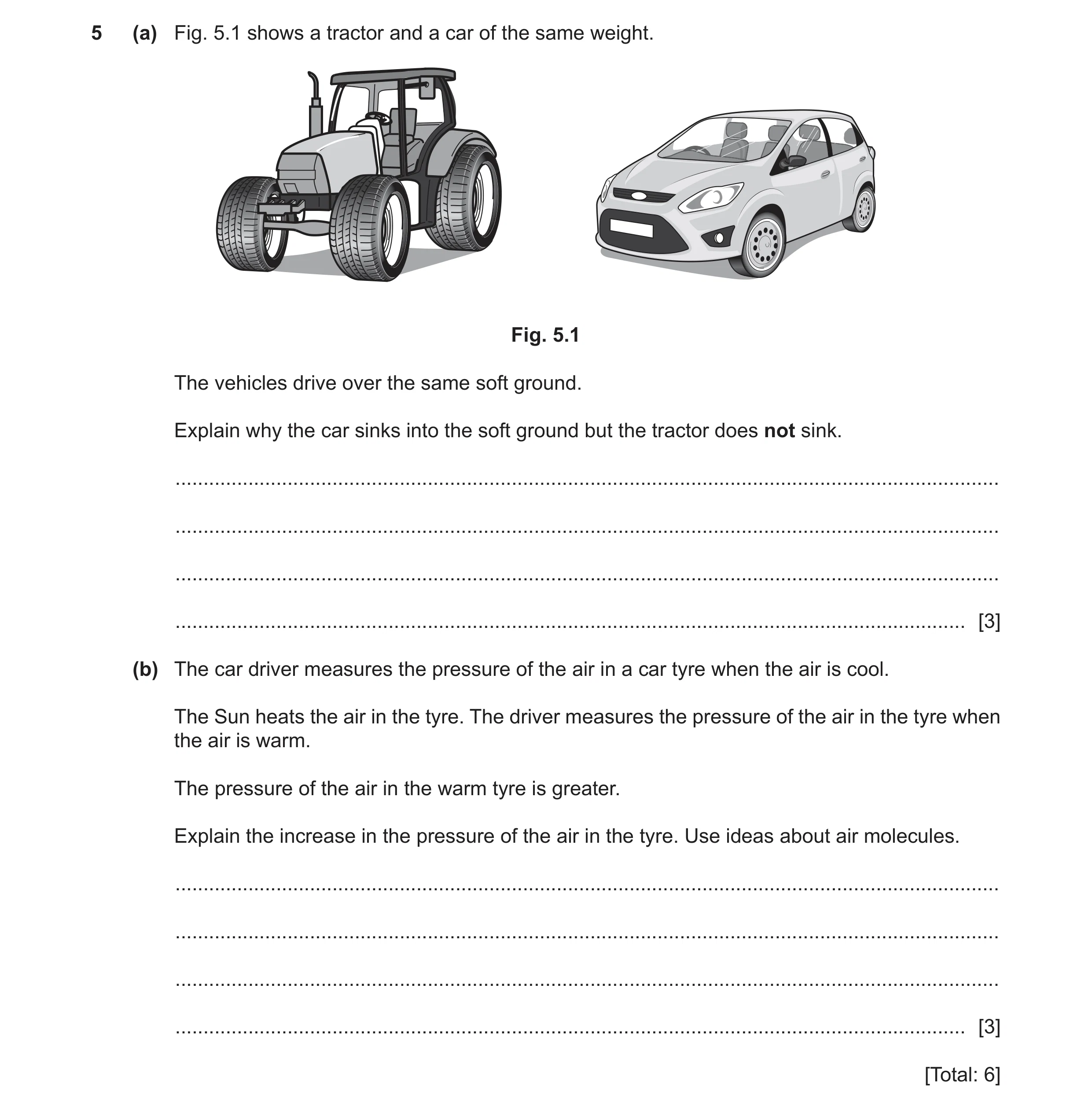
5 (a) Fig. 5.1 shows a tractor and a car of the same weight. Fig. 5.1 The vehicles drive over the same soft ground. Explain why the car sinks into the soft ground but the tractor does not sink. … … … … [3] (b) The car driver measures the pressure of the air in a car tyre when the air is cool. The Sun heats the air in the tyre. The driver measures the pressure of the air in the tyre when the air is warm. The pressure of the air in the warm tyre is greater. Explain the increase in the pressure of the air in the tyre. Use ideas about air molecules. … … … … [3] [Total: 6]
6 marks
Mark scheme: 5(a) P = F ÷ A in any form B1 tractor has larger area (of tyre(s) in contact with ground) / ora B1 so (tractor) pressure is less (on the ground) / ora B1 5(b) kinetic energy of molecules increases / speed of molecules increases B1 hit (tyre walls) more often / greater rate B1 hit (tyre walls) with greater force / harder B1
This question in 0625/33 May/June 2021
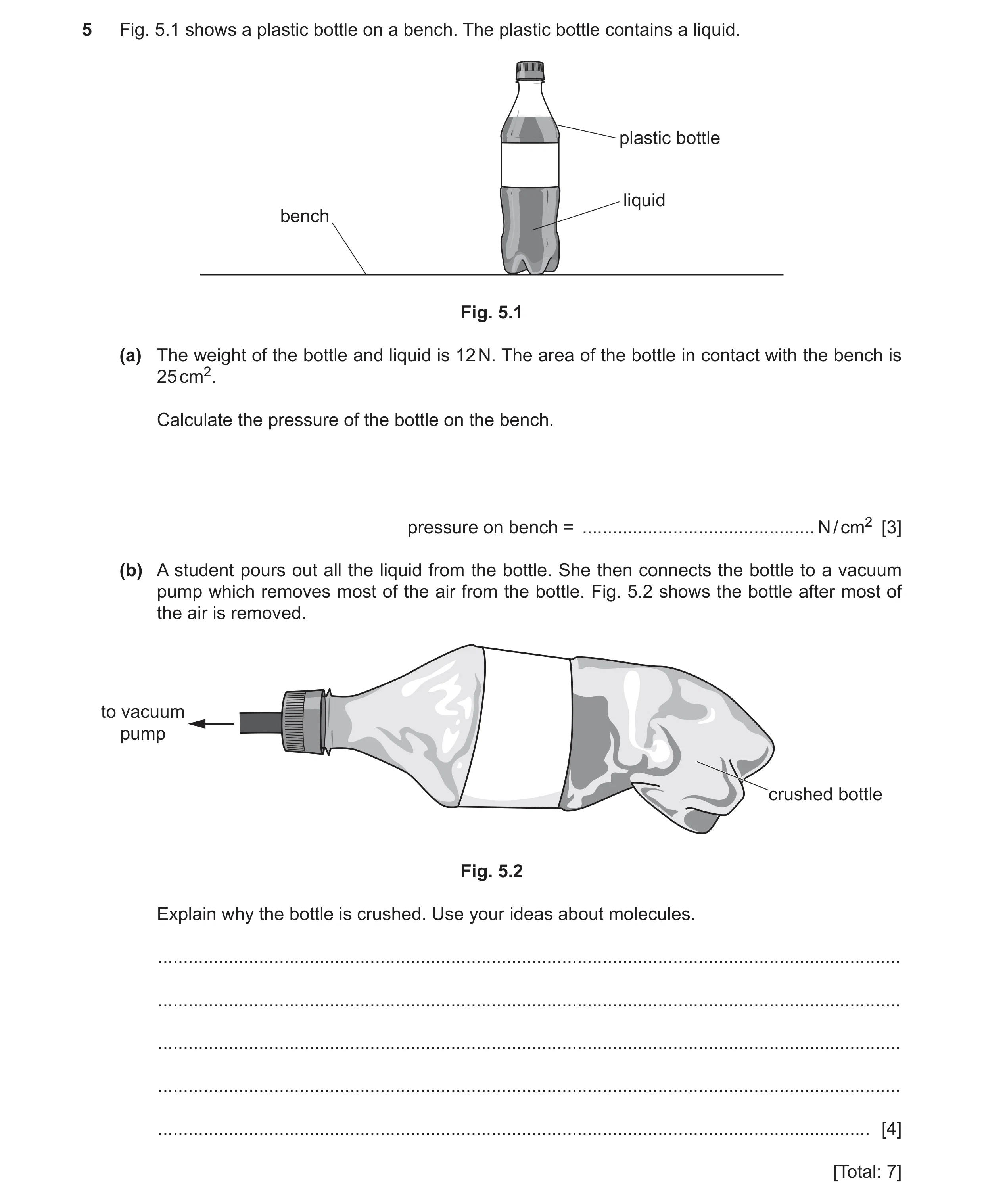
Q21 · A plastic bottle on a bench 0625/31 Oct/Nov 2021
5 Fig. 5.1 shows a plastic bottle on a bench. The plastic bottle contains a liquid. plastic bottle liquid bench Fig. 5.1 (a) The weight of the bottle and liquid is 12 N. The area of the bottle in contact with the bench is 25 cm2. Calculate the pressure of the bottle on the bench. pressure on bench = … N / cm2 [3] (b) A student pours out all the liquid from the bottle. She then connects the bottle to a vacuum pump which removes most of the air from the bottle. Fig. 5.2 shows the bottle after most of the air is removed. to vacuum pump crushed bottle Fig. 5.2 Explain why the bottle is crushed. Use your ideas about molecules. … … … … … [4] [Total: 7]
7 marks
Mark scheme: 5(a) (P =) F ÷ A OR (pressure = ) force ÷ area in any form C1 12 ÷ 25 C1 0.48 (N / cm2) A1 5(b) Any four from: molecules in air moving at high speed / kinetic energy molecules collide with (plastic) bottle OR wall (of bottle) force of collisions (per unit area) cause pressure fewer air molecules or collisions on inside(compared to outside) (and so) greater force OR pressure on outside (than inside) B4
This question in 0625/31 Oct/Nov 2021
Q22 · A teacher wants to measure the mass of a block of metal 0625/32 Oct/Nov 2021
4 (a) A teacher wants to measure the mass of a block of metal. She also wants to measure the length, width and height of the block. Fig. 4.1 shows the block of metal. length width height Fig. 4.1 Complete each sentence using a word from the list. balance barometer protractor ruler voltmeter (i) To find the mass of the metal block, the teacher uses a … [1] (ii) To measure the length, width and height of the metal block, she uses a … [1] (b) The mass of the block is 5000 g. Calculate the weight of the block. weight = … N [3] (c) Fig. 4.2 shows another block of metal on a solid surface. 20 cm 12 cm solid surface 2.0 cm Fig. 4.2 (not to scale) (i) Calculate the area of the block of metal in contact with the solid surface. area = … cm2 [1] (ii) The weight of the block of metal in Fig. 4.2 is 60 N. Calculate the pressure of the block of metal on the solid surface. pressure = … N / cm2 [3] [Total: 9]
9 marks
Mark scheme: 4(a)(i) balance B1 4(a)(ii) ruler B1 4(b) mass = 5(.0) kg B1 (W =) m × g OR 5(.0) × 10 C1 50 (N) A1 4(c)(i) 240 (cm2) B1 4(c)(ii) (P =) F ÷ A in any form C1 60 ÷ (20 × 12) OR 60 ÷ 240 C1 0.25 (N / cm2) A1
This question in 0625/32 Oct/Nov 2021
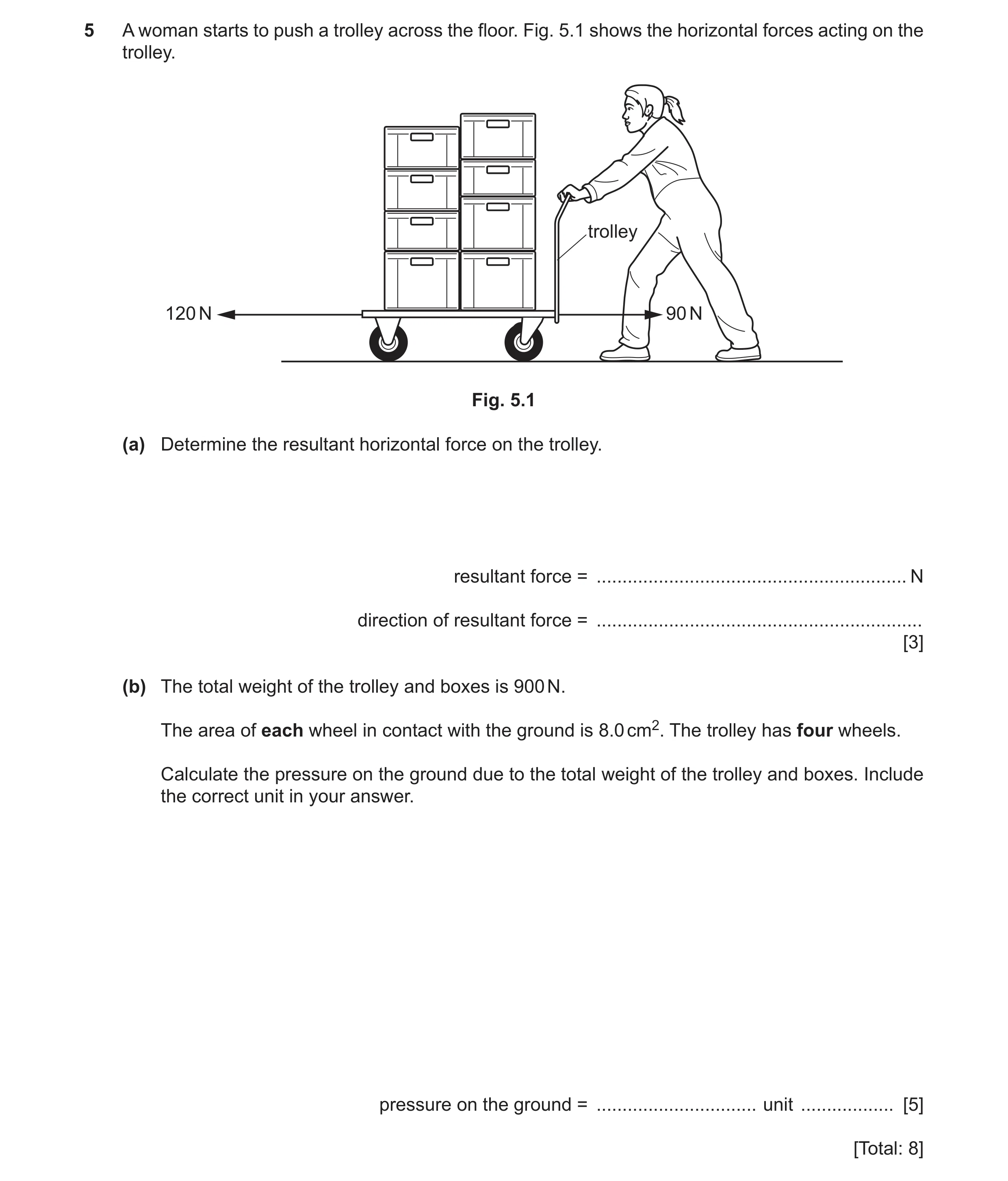
Q23 · A woman starts to push a trolley across the floor 0625/32 Feb/March 2022
5 A woman starts to push a trolley across the floor. Fig. 5.1 shows the horizontal forces acting on the trolley. trolley 120 N 90 N Fig. 5.1 (a) Determine the resultant horizontal force on the trolley. resultant force = … N direction of resultant force = … [3] (b) The total weight of the trolley and boxes is 900 N. The area of each wheel in contact with the ground is 8.0 cm2. The trolley has four wheels. Calculate the pressure on the ground due to the total weight of the trolley and boxes. Include the correct unit in your answer. pressure on the ground = … unit … [5] [Total: 8]
8 marks
Mark scheme: 5(a) (resultant force =) 30 (N) A2 (resultant force =) 120 – 90 (A1) to the left OR forwards B1 5(b) (pressure =) 28 A4 (pressure =) 900 ÷ 32 (C3) (total area =) (4 × 8 =) 32 (cm2) (B1) (pressure =) force ÷ area (C1) N / cm2 B1
This question in 0625/32 Feb/March 2022
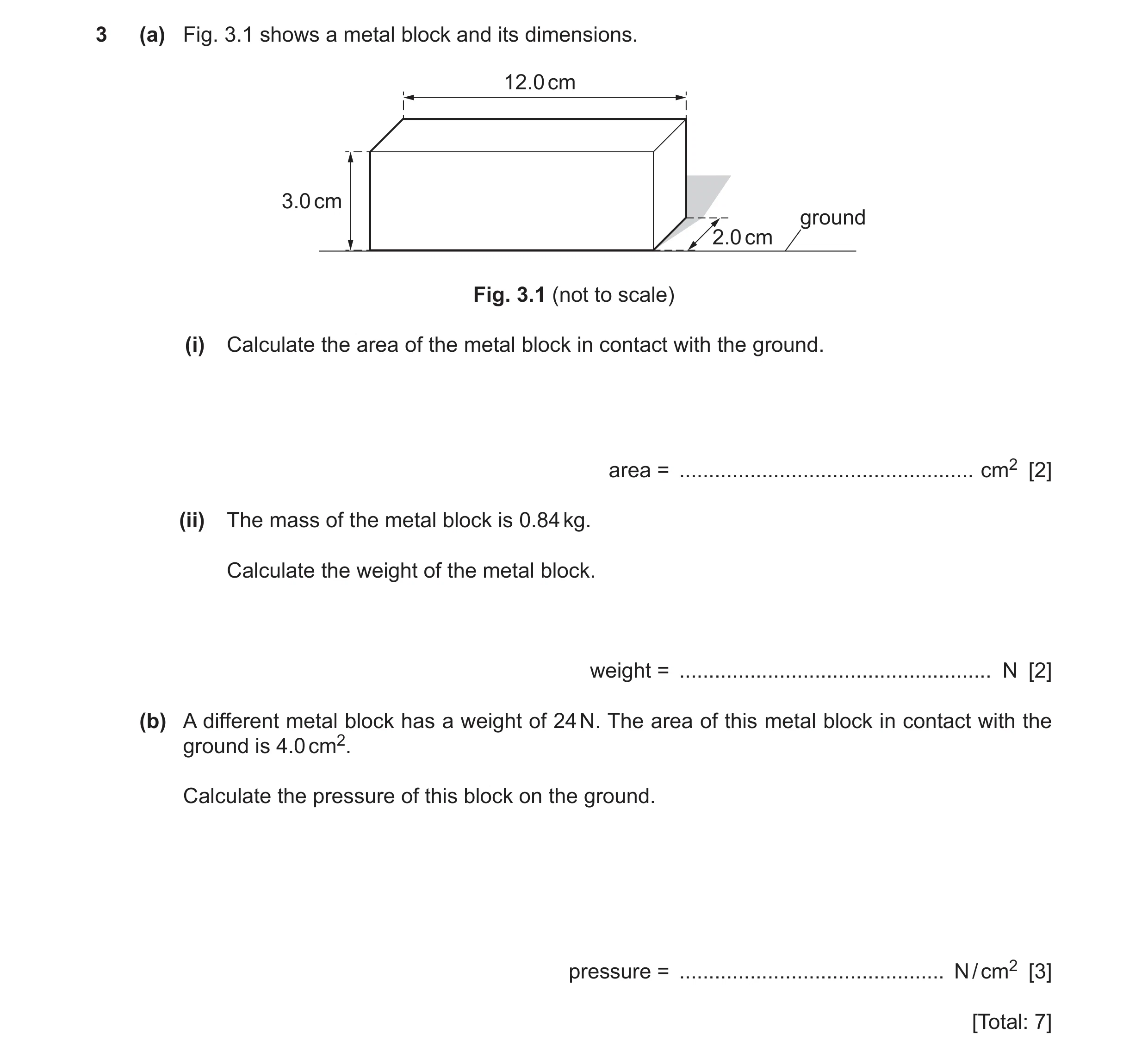
Q24 · A metal block and its dimensions 0625/31 May/June 2022
3 (a) Fig. 3.1 shows a metal block and its dimensions. 12.0 cm 3.0 cm ground 2.0 cm Fig. 3.1 (not to scale) (i) Calculate the area of the metal block in contact with the ground. area = … cm2 [2] (ii) The mass of the metal block is 0.84 kg. Calculate the weight of the metal block. weight = … N [2] (b) A different metal block has a weight of 24 N. The area of this metal block in contact with the ground is 4.0 cm2. Calculate the pressure of this block on the ground. pressure = … N / cm2 [3] [Total: 7]
7 marks
Mark scheme: 3(a)(i) 24 (cm2) A2 (area in contact with ground) =length width OR 12 2(.0) (C1) 3(a)(ii) (weight =) 8.4 (N) A2 (weight =) mass g OR 0.84 10 (C1) 3(b) (pressure =) 6(.0) (N / cm2) A3 (pressure =) 24 ÷ 4(.0) (C2) (pressure =) force ÷ area (C1)
This question in 0625/31 May/June 2022
Q25 · A vehicle that is designed to travel on snow 0625/33 May/June 2022
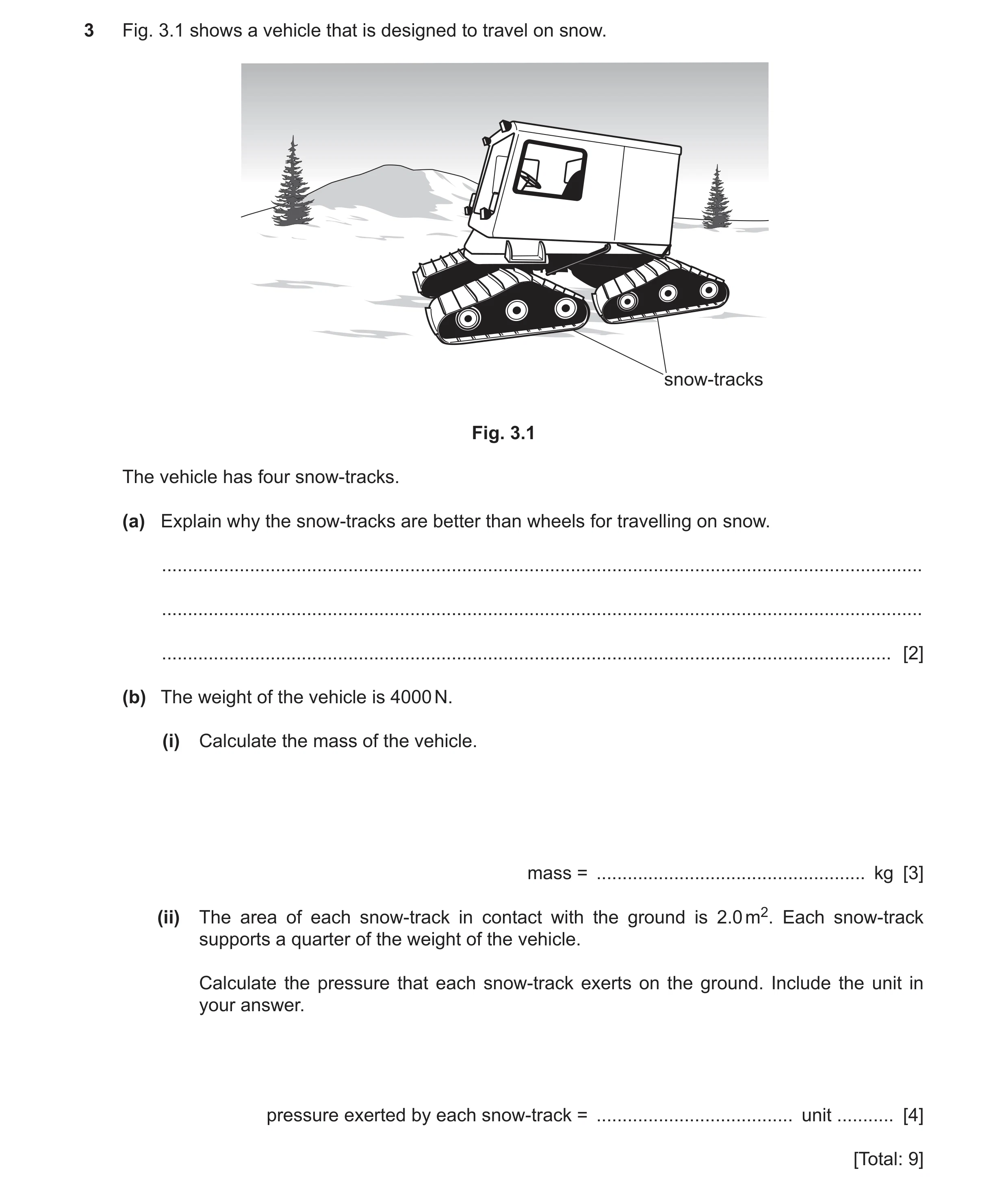
3 Fig. 3.1 shows a vehicle that is designed to travel on snow. snow-tracks Fig. 3.1 The vehicle has four snow-tracks. (a) Explain why the snow-tracks are better than wheels for travelling on snow. … … … [2] (b) The weight of the vehicle is 4000 N. (i) Calculate the mass of the vehicle. mass = … kg [3] (ii) The area of each snow-track in contact with the ground is 2.0 m2. Each snow-track supports a quarter of the weight of the vehicle. Calculate the pressure that each snow-track exerts on the ground. Include the unit in your answer. pressure exerted by each snow-track = … unit … [4] [Total: 9]
9 marks
Mark scheme: 3(a) any two from larger area lower pressure (on ground) does not sink in 3(b)(i) 400 A3 4000 ÷ 10 OR 4000 ÷ 9.8 (C2) (mass =) weight ÷ g OR weight ÷ 10 weight ÷ 9.8 in any form (C1) 3(b)(ii) 500 A3 1000 ÷ 2.0 OR 4000 ÷ (4 2.0) (C2) (pressure = ) force ÷ area in any form (C1) N / m2 OR Pa B1
This question in 0625/33 May/June 2022
Q26 · A student has an object with a mass of 5.0 kg 0625/31 Oct/Nov 2022
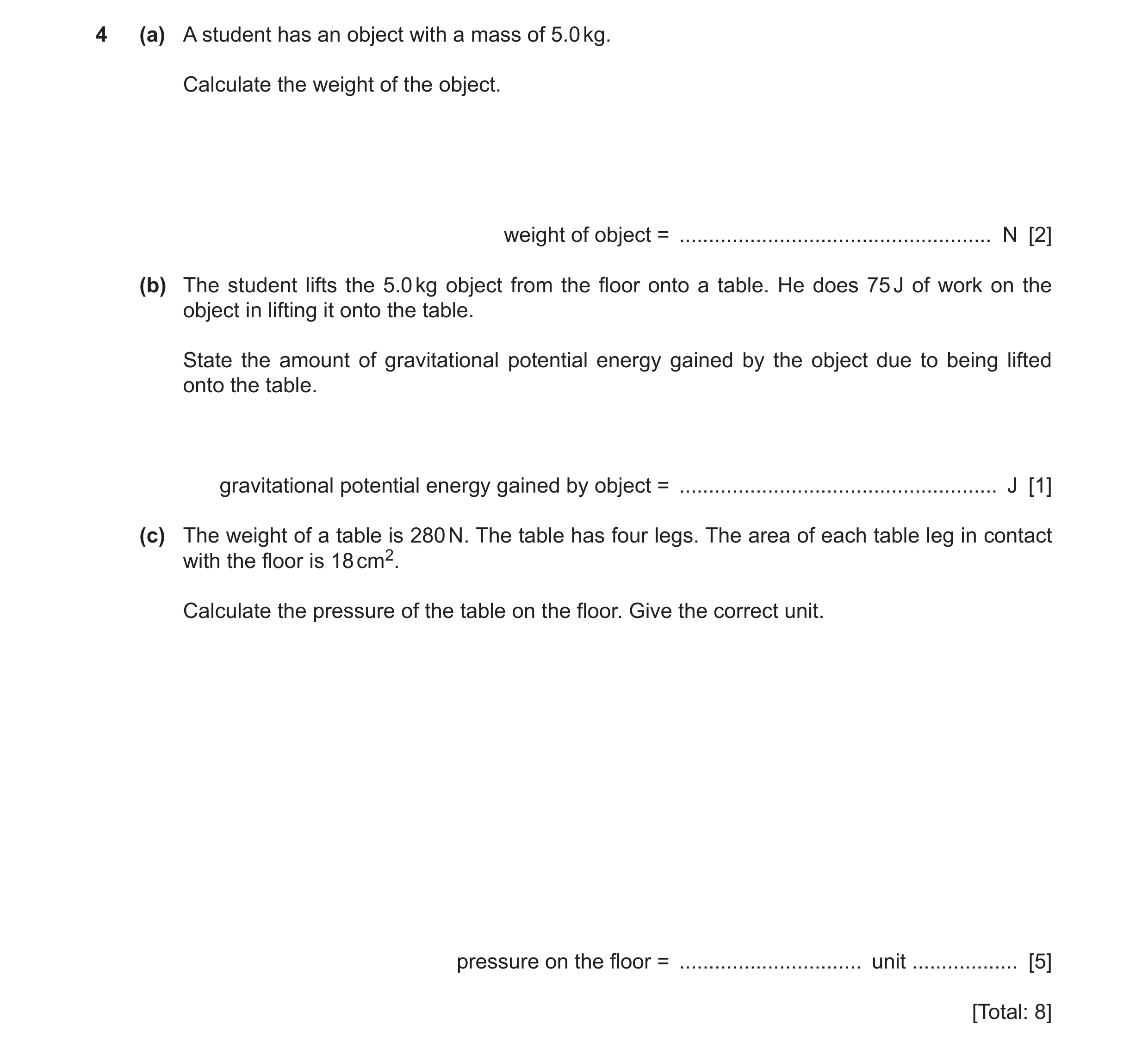
4 (a) A student has an object with a mass of 5.0 kg. Calculate the weight of the object. weight of object = … N [2] (b) The student lifts the 5.0 kg object from the floor onto a table. He does 75 J of work on the object in lifting it onto the table. State the amount of gravitational potential energy gained by the object due to being lifted onto the table. gravitational potential energy gained by object = … J [1] (c) The weight of a table is 280 N. The table has four legs. The area of each table leg in contact with the floor is 18 cm2. Calculate the pressure of the table on the floor. Give the correct unit. pressure on the floor = … unit … [5] [Total: 8]
8 marks
Mark scheme: 4(a) (weight =) 50 (N) A2 (weight =) mass g OR 5 10 C1 4(b) 75 (J) B1 4(c) 3.9 A4 280 / 72 C3 (P =) F / A OR (pressure =) force / area C1 (area = 4 18 =) 72 (cm2) C1 N / cm2 B1
This question in 0625/31 Oct/Nov 2022
Q27 · An engineer measures the pressure of the gas in a gas bottle 0625/31 Oct/Nov 2022
5 An engineer measures the pressure of the gas in a gas bottle. Fig. 5.1 shows the measuring device he uses, connected to the gas bottle. mm 300 glass tube 250 from a gas bottle 200 150 100 50 mercury 0 Fig. 5.1 (a) (i) Atmospheric pressure is 756 mm of mercury. Calculate the pressure of the gas in the gas bottle. pressure of gas = … mm of mercury [3] (ii) State the name of the measuring device shown in Fig. 5.1. … [1] (b) Some gas is trapped in a cylinder fitted with a moveable piston. Fig. 5.2 shows the arrangement. gas cylinder moveable piston Fig. 5.2 (i) Describe how the gas exerts a pressure on the cylinder. Use your ideas about molecules. … … [2] (ii) The piston moves and increases the volume occupied by the gas. The temperature of the gas remains constant. Fig. 5.3 shows the new position of the piston. moveable gas piston cylinder Fig. 5.3 State and explain what happens to the pressure of the gas on the cylinder. … … [2] [Total: 8]
8 marks
Mark scheme: 5(a)(i) 880 (mm Hg) A3 (180 – 60 =) 120 (mm Hg) C2 (left tube =) 60 (mm Hg) AND (right tube =) 180 (mm Hg) seen C1 5(a)(ii) (U-tube) manometer B1 5(b)(i) any two from: B2 • molecules in air moving at high speed / kinetic energy • molecules collide with cylinder OR wall (of cylinder) OR piston • force of collisions (per unit area) cause pressure. 5(b)(ii) smaller / lower pressure (on cylinder) B1 (because) reduced rate of collisions OR fewer collisions with cylinder OR wall (of cylinder) OR piston (per unit area) B1
This question in 0625/31 Oct/Nov 2022
Q28 · A device for measuring gas pressure is connected to a gas supply as shown in Fig 0625/32 Oct/Nov 2022
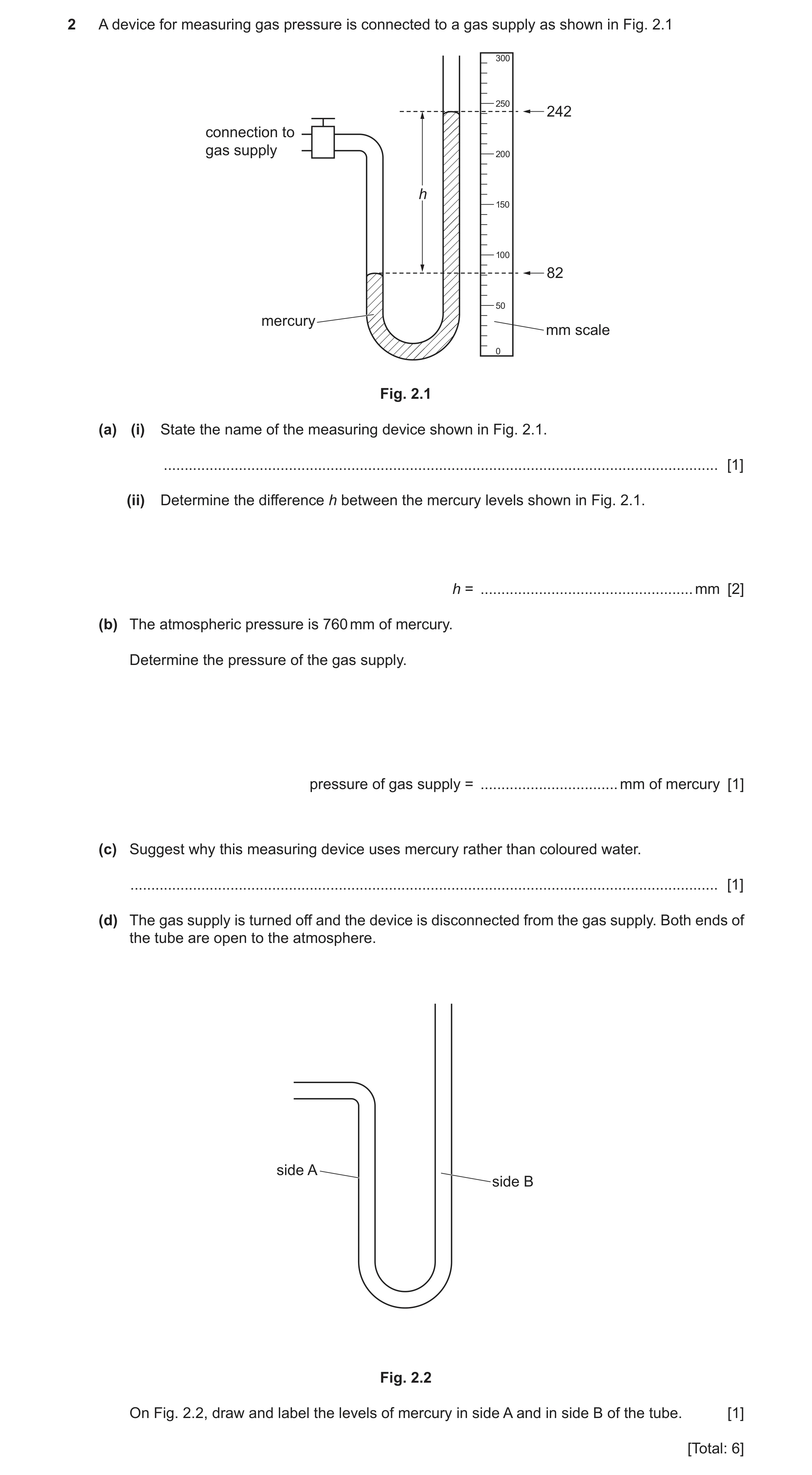
2 A device for measuring gas pressure is connected to a gas supply as shown in Fig. 2.1 300 250 242 connection to gas supply 200 h 150 100 82 50 mercury mm scale 0 Fig. 2.1 (a) (i) State the name of the measuring device shown in Fig. 2.1. … [1] (ii) Determine the difference h between the mercury levels shown in Fig. 2.1. h = … mm [2] (b) The atmospheric pressure is 760 mm of mercury. Determine the pressure of the gas supply. pressure of gas supply = … mm of mercury [1] (c) Suggest why this measuring device uses mercury rather than coloured water. … [1] (d) The gas supply is turned off and the device is disconnected from the gas supply. Both ends of the tube are open to the atmosphere. side A side B Fig. 2.2 On Fig. 2.2, draw and label the levels of mercury in side A and in side B of the tube. [1] [Total: 6]
6 marks
Mark scheme: 2(a)(i) (mercury / U-tube) manometer B1 2(a)(ii) 160 (mm) A2 242 – 82 (C1) 2(b) 920 (mm of mercury) B1 2(c) density (of water) too small / manometer would be too high / big owtte B1 2(d) levels at same height B1
This question in 0625/32 Oct/Nov 2022
Q29 · The distance-time graph for a cyclist 0625/32 Feb/March 2023
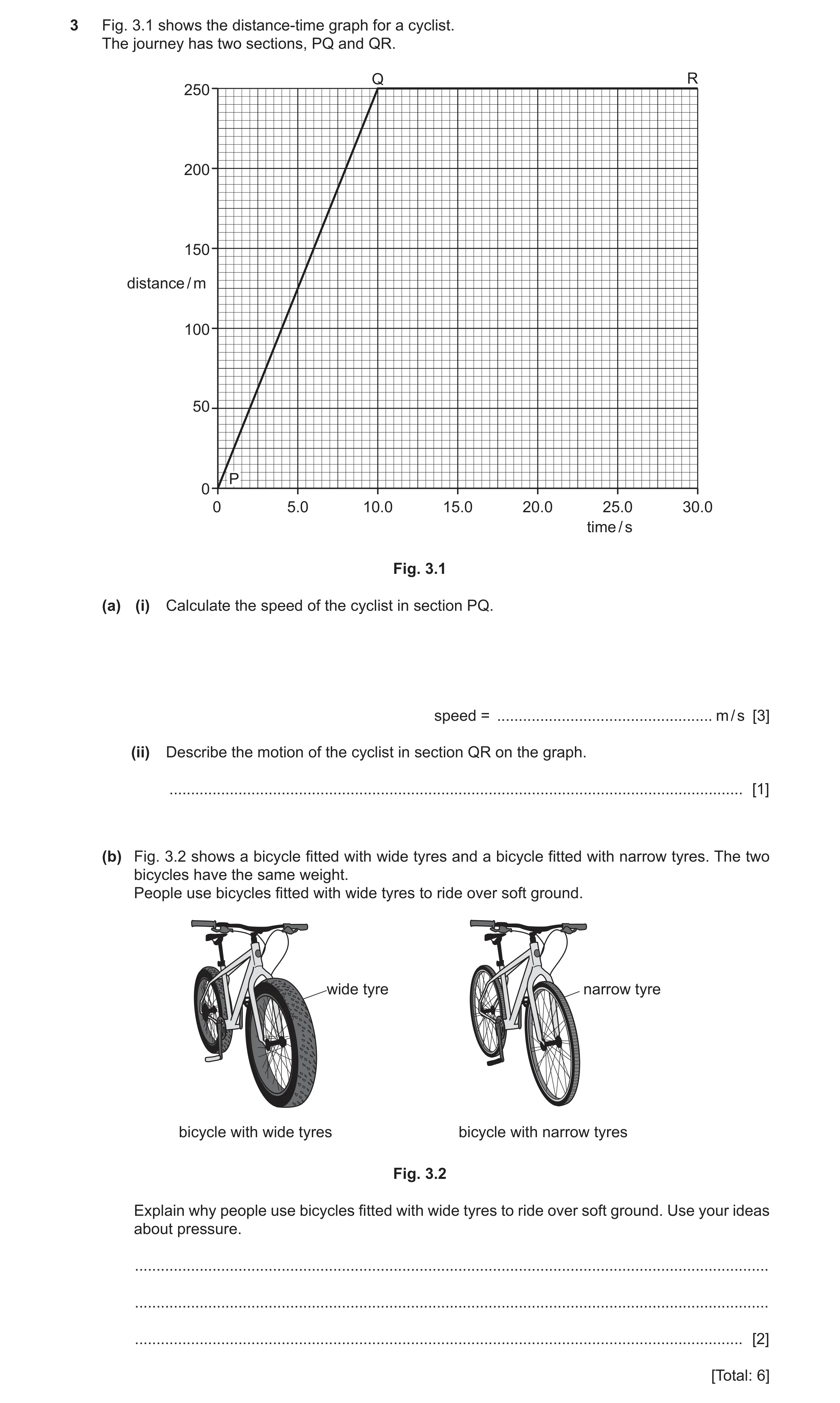
3 Fig. 3.1 shows the distance-time graph for a cyclist. The journey has two sections, PQ and QR. Q R 250 200 150 distance / m 100 50 P 0 0 5.0 10.0 15.0 20.0 25.0 30.0 time / s Fig. 3.1 (a) (i) Calculate the speed of the cyclist in section PQ. speed = … m / s [3] (ii) Describe the motion of the cyclist in section QR on the graph. … [1] (b) Fig. 3.2 shows a bicycle fitted with wide tyres and a bicycle fitted with narrow tyres. The two bicycles have the same weight. People use bicycles fitted with wide tyres to ride over soft ground. wide tyre narrow tyre bicycle with wide tyres bicycle with narrow tyres Fig. 3.2 Explain why people use bicycles fitted with wide tyres to ride over soft ground. Use your ideas about pressure. … … … [2] [Total: 6]
6 marks
Mark scheme: 3(a)(i) (speed =) 25 (m / s) A3 (speed =) 250 ÷ 10 (C2) (speed =) gradient of d-t graph OR d ÷ t in any form (C1) 3(a)(ii) (QR –) at rest or stationary B1 3(b) any two from B2 (wide tyres have) large (contact) area (so) less pressure (on ground) so less likely to sink (into soft ground)
This question in 0625/32 Feb/March 2023
Q30 · A concrete beam resting on the ground 0625/31 May/June 2023
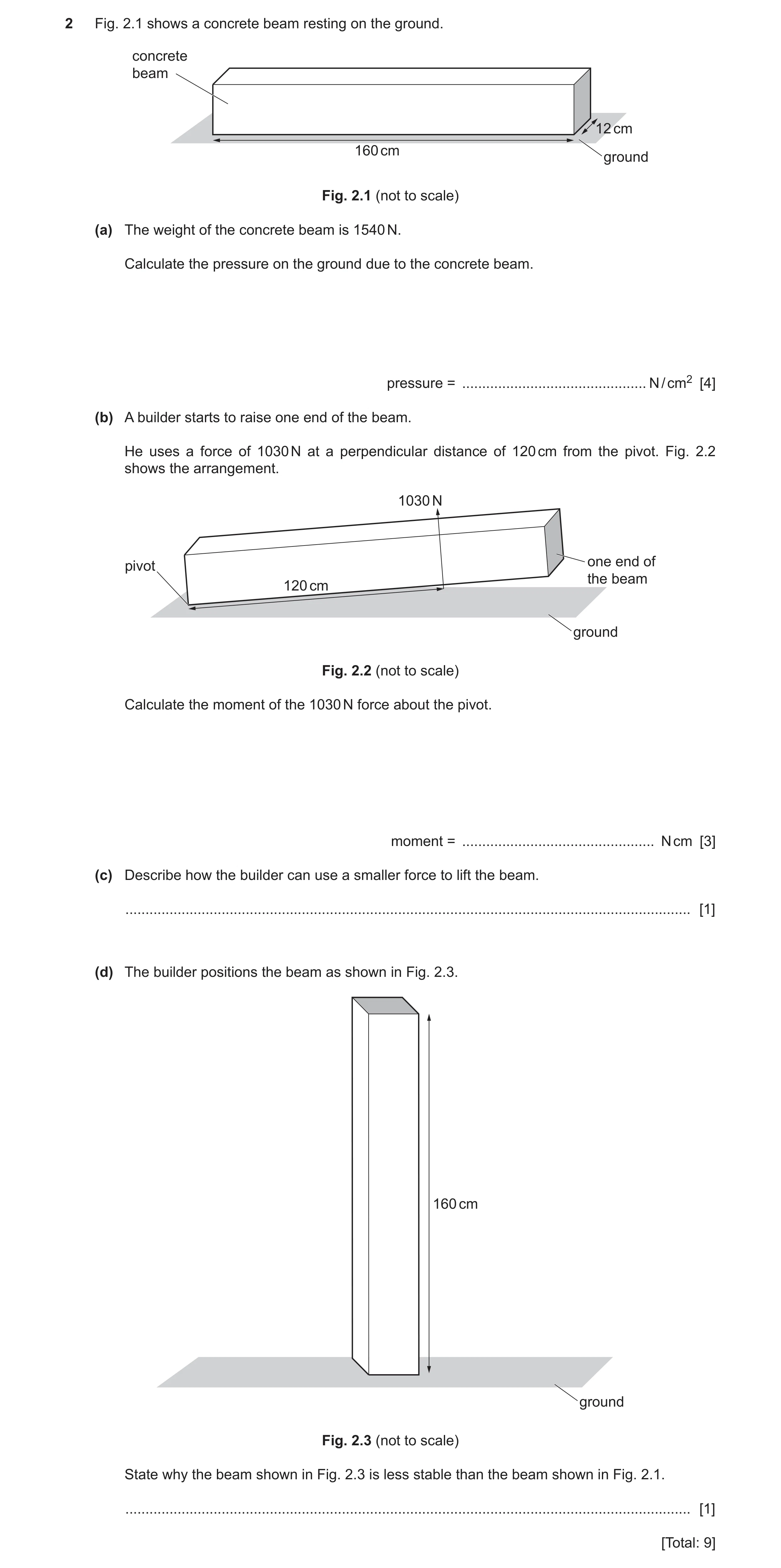
2 Fig. 2.1 shows a concrete beam resting on the ground. concrete beam 12 cm 160 cm ground Fig. 2.1 (not to scale) (a) The weight of the concrete beam is 1540 N. Calculate the pressure on the ground due to the concrete beam. pressure = … N / cm2 [4] (b) A builder starts to raise one end of the beam. He uses a force of 1030 N at a perpendicular distance of 120 cm from the pivot. Fig. 2.2 shows the arrangement. 1030 N one end of pivot the beam 120 cm ground Fig. 2.2 (not to scale) Calculate the moment of the 1030 N force about the pivot. moment = … N cm [3] (c) Describe how the builder can use a smaller force to lift the beam. … [1] (d) The builder positions the beam as shown in Fig. 2.3. 160 cm ground Fig. 2.3 (not to scale) State why the beam shown in Fig. 2.3 is less stable than the beam shown in Fig. 2.1. … [1] [Total: 9]
9 marks
Mark scheme: 2(a) (pressure =) 0.8(0) (N / cm2) A4 (pressure =) 1540 1920 OR 1540 (160 12) (C3) (pressure =) force area (C1) (area in contact with ground =) 12 160 = 1920 (cm2) (C1) 2(b) (moment =) 120 000 (N cm) OR 1.2 105 (N cm) A3 (moment =) 1030 120 (C2) (moment =) force (perpendicular) distance from pivot (C1) 2(c) move (lifting) force further from pivot owtte B1 2(d) centre of gravity / mass is high(er) OR idea that area of base is small(er) B1
This question in 0625/31 May/June 2023
Q31 · A student has a battery-powered torch 0625/32 May/June 2023
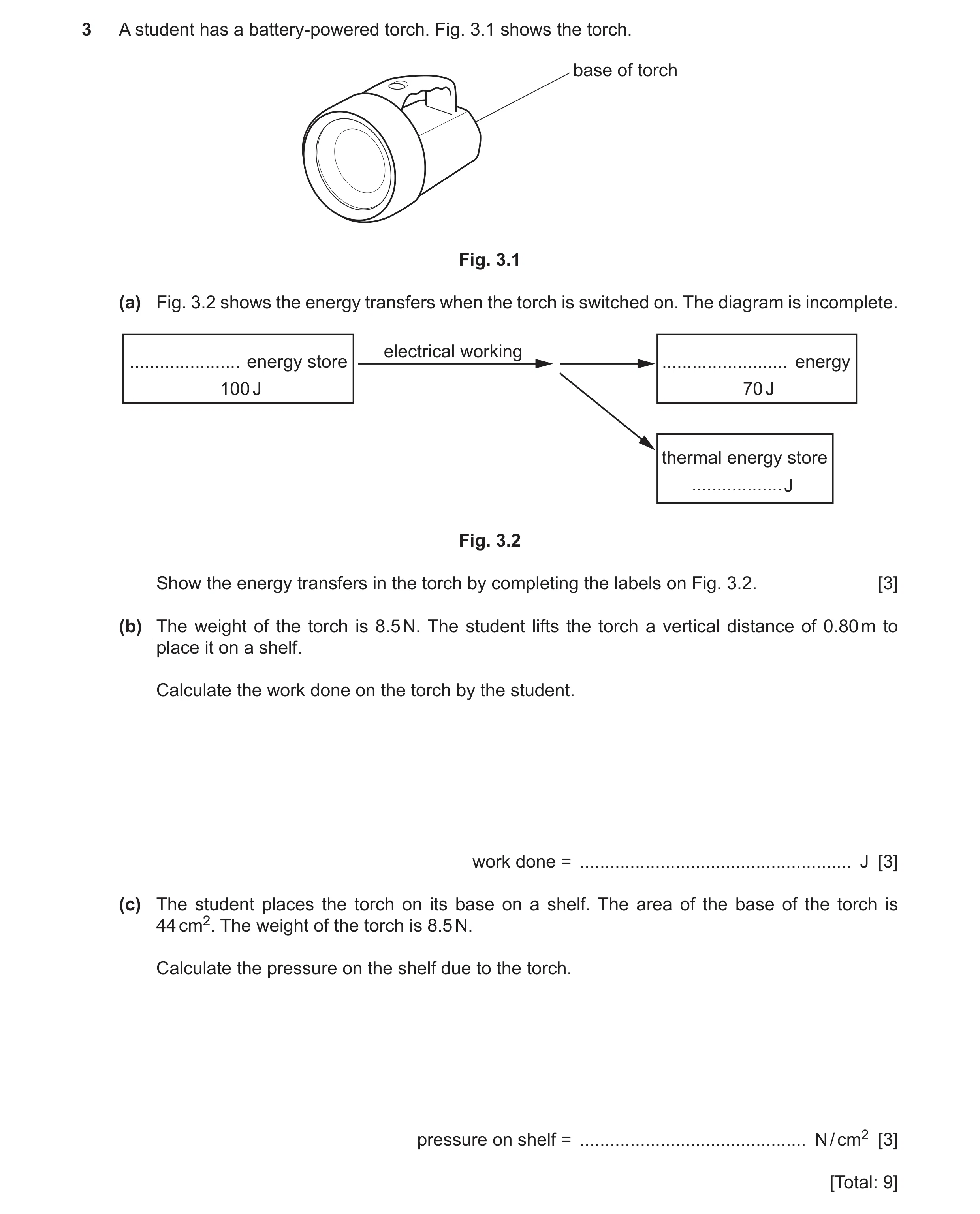
3 A student has a battery-powered torch. Fig. 3.1 shows the torch. base of torch Fig. 3.1 (a) Fig. 3.2 shows the energy transfers when the torch is switched on. The diagram is incomplete. electrical working … energy store … energy 100 J 70 J thermal energy store … J Fig. 3.2 Show the energy transfers in the torch by completing the labels on Fig. 3.2. [3] (b) The weight of the torch is 8.5 N. The student lifts the torch a vertical distance of 0.80 m to place it on a shelf. Calculate the work done on the torch by the student. work done = … J [3] (c) The student places the torch on its base on a shelf. The area of the base of the torch is 44 cm2. The weight of the torch is 8.5 N. Calculate the pressure on the shelf due to the torch. pressure on shelf = … N / cm2 [3] [Total: 9]
9 marks
Mark scheme: 3(a) chemical (energy) B1 light (energy) B1 30 (J) B1 3(b) 6.8 (J) A3 (work done =) 8.5 0.8(0) (C2) (work done =) force distance (moved) (C1) 3(c) 0.19 (N / cm2) A3 (P =) 8.5 ÷ 44 (C2) (P =) F ÷ A in any form (C1)
This question in 0625/32 May/June 2023
Q32 · A tight-fitting lid keeps air inside a metal can 0625/33 May/June 2023
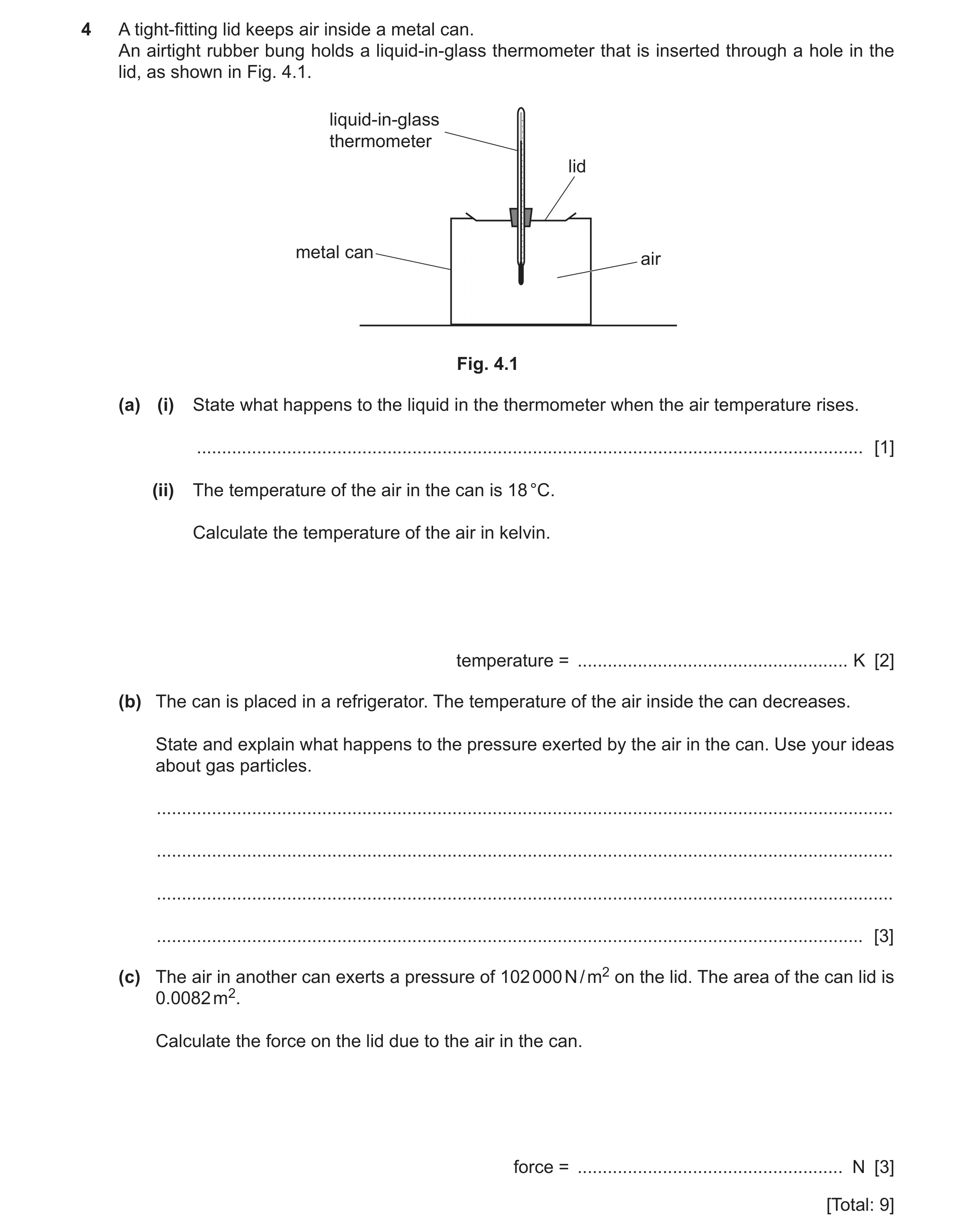
4 A tight-fitting lid keeps air inside a metal can. An airtight rubber bung holds a liquid-in-glass thermometer that is inserted through a hole in the lid, as shown in Fig. 4.1. liquid-in-glass thermometer lid metal can air Fig. 4.1 (a) (i) State what happens to the liquid in the thermometer when the air temperature rises. … [1] (ii) The temperature of the air in the can is 18 °C. Calculate the temperature of the air in kelvin. temperature = … K [2] (b) The can is placed in a refrigerator. The temperature of the air inside the can decreases. State and explain what happens to the pressure exerted by the air in the can. Use your ideas about gas particles. … … … … [3] (c) The air in another can exerts a pressure of 102 000 N / m2 on the lid. The area of the can lid is 0.0082 m2. Calculate the force on the lid due to the air in the can. force = … N [3] [Total: 9]
9 marks
Mark scheme: 4(a)(i) (liquid / it) expands B1 4(a)(ii) 273 + 18 C1 291 (K) A1 4(b) pressure decreases B1 any two from: particles slower / less kinetic energy collisions (with wall) less frequent collide (with wall) with less force B2 4(c) (F =) P A in any form C1 102 000 0.0082 C1 840 (N) A1
This question in 0625/33 May/June 2023
Q33 · A computer on the surface of a desk 0625/32 Feb/March 2024
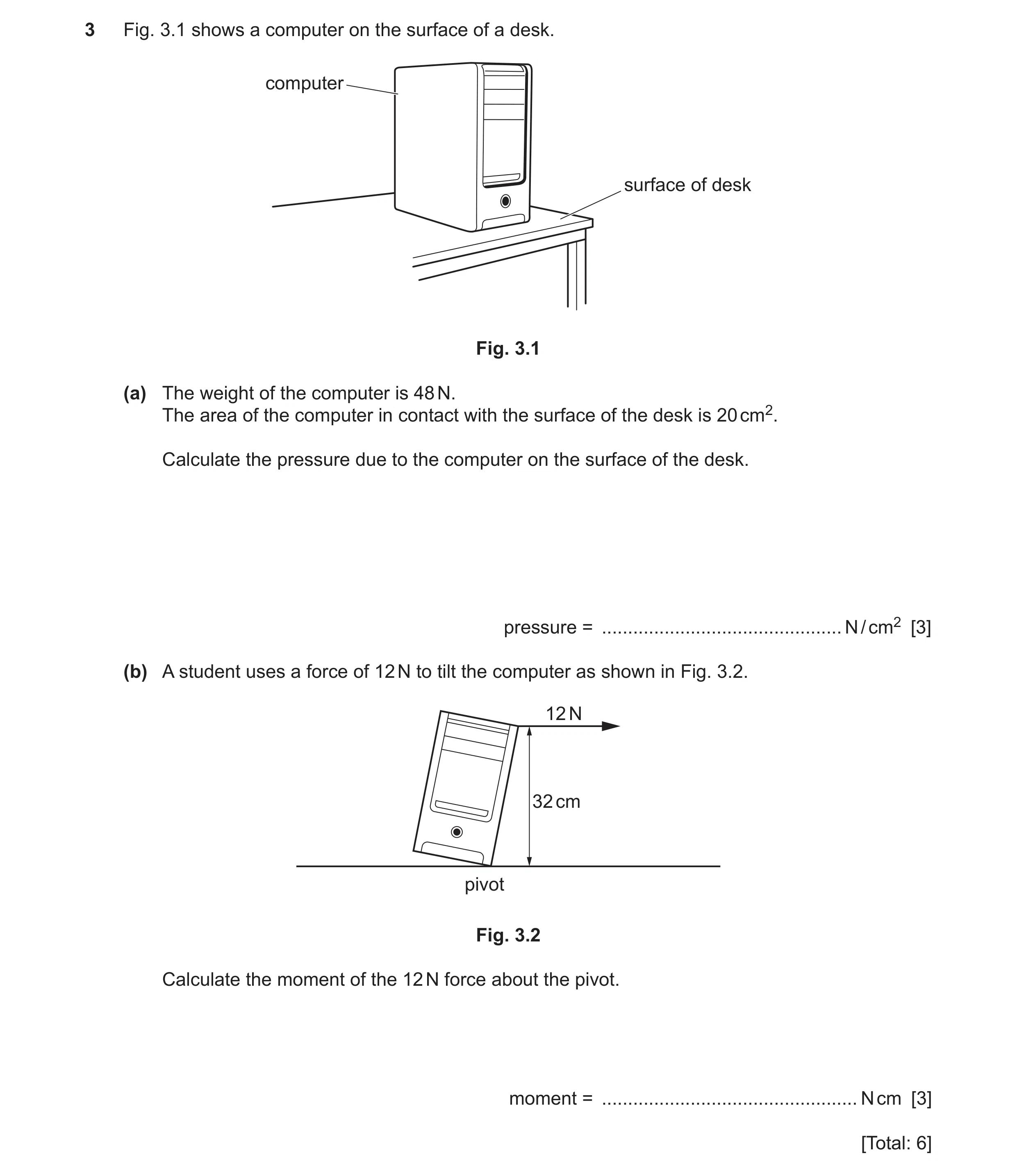
3 Fig. 3.1 shows a computer on the surface of a desk. computer surface of desk Fig. 3.1 (a) The weight of the computer is 48 N. The area of the computer in contact with the surface of the desk is 20 cm2. Calculate the pressure due to the computer on the surface of the desk. pressure = … N / cm2 [3] (b) A student uses a force of 12 N to tilt the computer as shown in Fig. 3.2. 12 N 32 cm pivot Fig. 3.2 Calculate the moment of the 12 N force about the pivot. moment = … N cm [3] [Total: 6]
6 marks
Mark scheme: 3(a) (P =) 2.4 (N / cm2) A3 (P =) 48 ÷ 20 (C2) (P =) F ÷ A (C1) 3(b) (moment = ) 380 (N cm) A3 (moment = ) 12 32 (C2) moment = force (perp.) distance from pivot (C1)
This question in 0625/32 Feb/March 2024
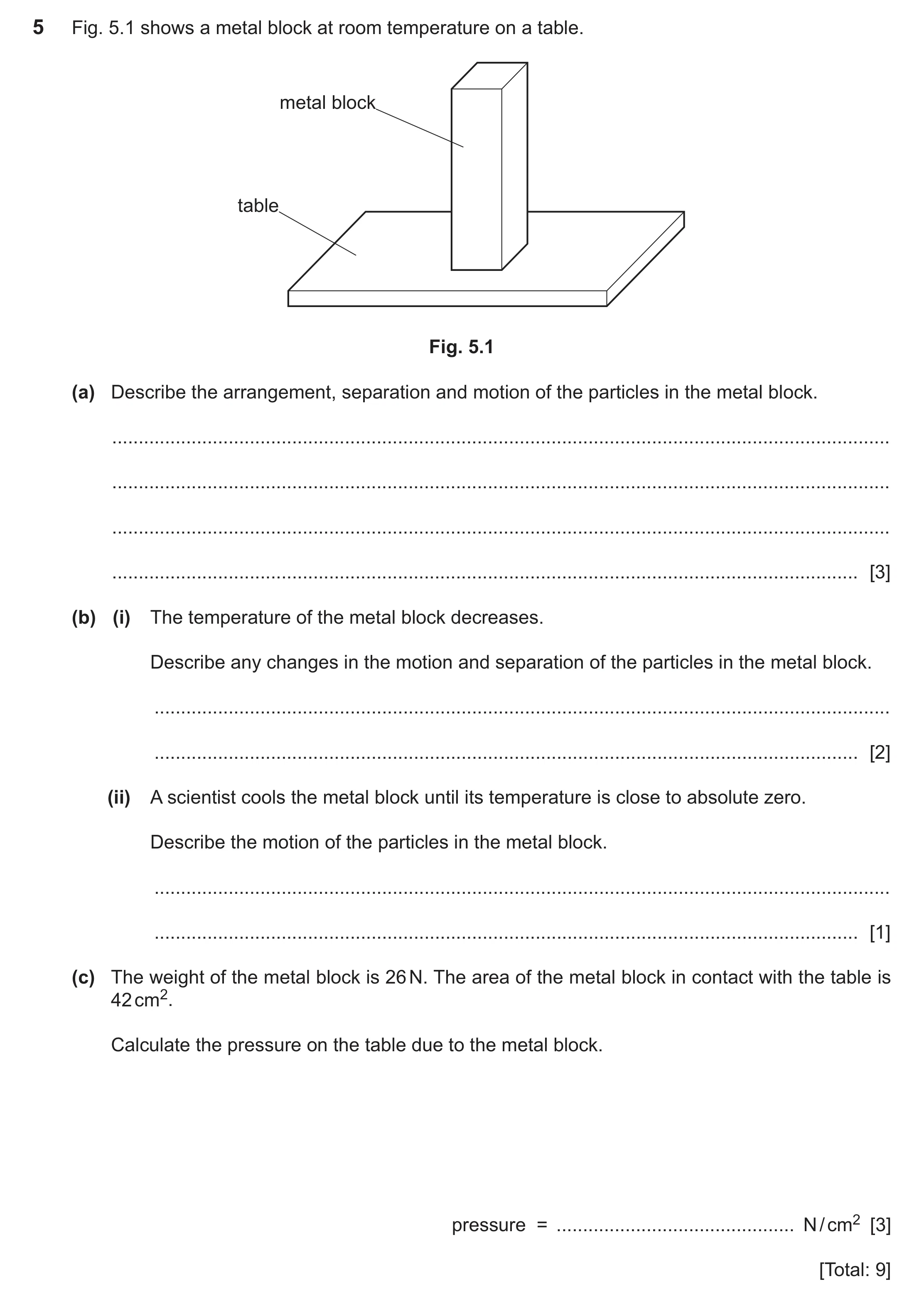
Q34 · A metal block at room temperature on a table 0625/32 May/June 2024
5 Fig. 5.1 shows a metal block at room temperature on a table. metal block table Fig. 5.1 (a) Describe the arrangement, separation and motion of the particles in the metal block. … … … … [3] (b) (i) The temperature of the metal block decreases. Describe any changes in the motion and separation of the particles in the metal block. … … [2] (ii) A scientist cools the metal block until its temperature is close to absolute zero. Describe the motion of the particles in the metal block. … … [1] (c) The weight of the metal block is 26 N. The area of the metal block in contact with the table is 42 cm2. Calculate the pressure on the table due to the metal block. pressure = … N / cm2 [3] [Total: 9]
9 marks
Mark scheme: 5(a) (particles are) fixed in position / in lattice OR regular / fixed arrangement / pattern B1 can only vibrate / no translational KE B1 close / closer (than in liquids or gases) B1 5(b)(i) (particles move) closer (as temperature decreases) B1 particles vibrate slower / less OR have smaller vibrations B1 5(b)(ii) (at absolute zero particles have) least / smallest vibrations B1 5(c) (P =) 0.62 (N / cm2) A3 (P =) 26 ÷ 42 (C2) (P =) F ÷ A (C1)
This question in 0625/32 May/June 2024
Q35 · A person pushes a pushchair 0625/31 Oct/Nov 2024
2 A person pushes a pushchair. A young child rides in the pushchair. Fig. 2.1 shows horizontal forces acting on the front wheel of the pushchair. 30 N 10 N Fig. 2.1 (not to scale) (a) Calculate the resultant of the horizontal forces shown in Fig. 2.1. resultant force = … N direction = … [2] (b) (i) Another person pushes a shopping trolley with a force of 40 N. The shopping trolley moves at a constant speed along a horizontal path. Calculate the work done by the 40 N force to move the shopping trolley a distance of 50 m. work done = … J [3] (ii) The work done on the shopping trolley as it starts moving is transferred into other energy stores. State two such energy stores. 1 … 2 … [2] (c) In (a), the weight of the pushchair and child is 240 N. The total area of contact with the ground is 38 cm2. Calculate the pressure on the ground due to the pushchair and child. pressure on ground = … N / cm2 [3] [Total: 10]
10 marks
Mark scheme: 2(a) (30 – 10 =) 20 (N) B1 forwards OR in direction of 30 N force B1 2(b)(i) (work done =) 2000 (J) A3 (work done =) 40 50 (C2) (work done =) force distance (moved in direction of force) OR (W) = F × d (C1) 2(b)(ii) internal OR thermal energy (of surroundings / tyres) B1 kinetic energy B1 2(c) (pressure =) 6.3 (N / cm2) A3 (pressure =) 240 38 (C2) (pressure =) force area OR (p) = F A (C1)
This question in 0625/31 Oct/Nov 2024
Q36 · A boy weighs 620 N 0625/33 Oct/Nov 2024
3 (a) A boy weighs 620 N. Calculate the mass of the boy. mass of boy = … kg [3] (b) Fig. 3.1 shows another boy sitting on a solid block of wood. block of wood ground Fig. 3.1 The total weight of the boy and the block is 1200 N. The area of the block of wood in contact with the ground is 0.16 m2. Calculate the pressure exerted on the ground. pressure = … N / m2 [3] [Total: 6]
6 marks
Mark scheme: 3(a) 63 (kg) A3 620 9.8 (C2) weight = mass gravitation field strength OR (m = ) W g (C1) 3(b) 7500 A3 1200 0.16 (C2) (p =) F A (C1)
This question in 0625/33 Oct/Nov 2024
Q37 · A cross-section through the centre of a solid cone and a cross-section through the centre… 0625/32 Feb/March 2025
3 Fig. 3.1 shows a cross-section through the centre of a solid cone and a cross-section through the centre of a solid cuboid. The cone and the cuboid are placed on the ground as shown in Fig. 3.1. The solid cone is more stable than the solid cuboid. The symbol × indicates the position of the centre of gravity of each object. cone cuboid ground Fig. 3.1 (a) Explain why the solid cone in Fig. 3.1 is more stable than the solid cuboid. … … [1] (b) The weight of the solid cuboid is 48 N. The area of the solid cuboid in contact with the ground is 32 cm2. Calculate the pressure exerted by the solid cuboid on the ground. pressure on ground = … N / cm2 [3] (c) A horizontal force of 15 N tilts the solid cone, as shown in Fig. 3.2. 15 N 18 cm pivot Fig. 3.2 Calculate the moment of the 15 N force about the pivot. moment = … N cm [3] [Total: 7]
7 marks
Mark scheme: 3(a) (has) lower centre of gravity owtte B1 3(b) (P =) 1.5 (N / cm2) A3 (P =) 48 ÷ 32 (C2) (P =) F ÷ A (C1) 3(c) (moment =) 270 (Ncm) A3 (moment =) 15 18 (C2) moment = force (perp.) distance (from pivot) (C1)
This question in 0625/32 Feb/March 2025
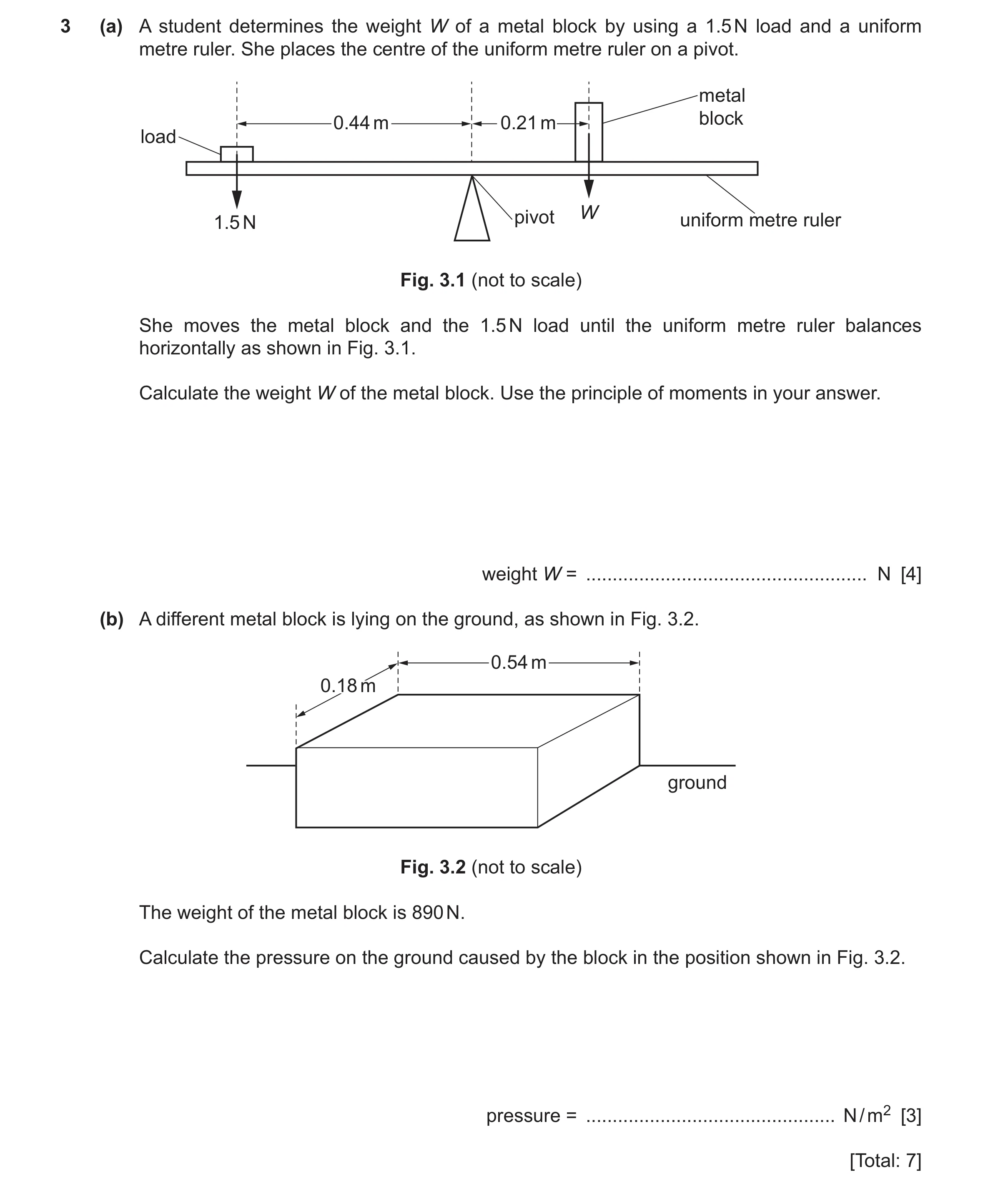
Q38 · A student determines the weight W of a metal block by using a 1.5 N load and a uniform… 0625/32 May/June 2025
3 (a) A student determines the weight W of a metal block by using a 1.5 N load and a uniform metre ruler. She places the centre of the uniform metre ruler on a pivot. metal 0.44 m 0.21 m block load 1.5 N pivot W uniform metre ruler Fig. 3.1 (not to scale) She moves the metal block and the 1.5 N load until the uniform metre ruler balances horizontally as shown in Fig. 3.1. Calculate the weight W of the metal block. Use the principle of moments in your answer. weight W = … N [4] (b) A different metal block is lying on the ground, as shown in Fig. 3.2. 0.54 m 0.18 m ground Fig. 3.2 (not to scale) The weight of the metal block is 890 N. Calculate the pressure on the ground caused by the block in the position shown in Fig. 3.2. pressure = … N / m2 [3] [Total: 7]
7 marks
Mark scheme: 3(a) 3.1 (N) A4 1.5 0.44 = W 0.21 OR (W =) (1.5 0.44) ÷ 0.21 C3 OR (W =) 0.66 ÷ 0.21 (anticlockwise moment =) 1.5 0.44 OR 0.66 seen C1 (sum of) anticlockwise moment = (sum of) clockwise moment C1 3(b) 9200 (N / m2) A3 890 ÷ (0.54 0.18) OR 890 ÷ 0.0972 C2 (pressure =) force ÷ area C1
This question in 0625/32 May/June 2025
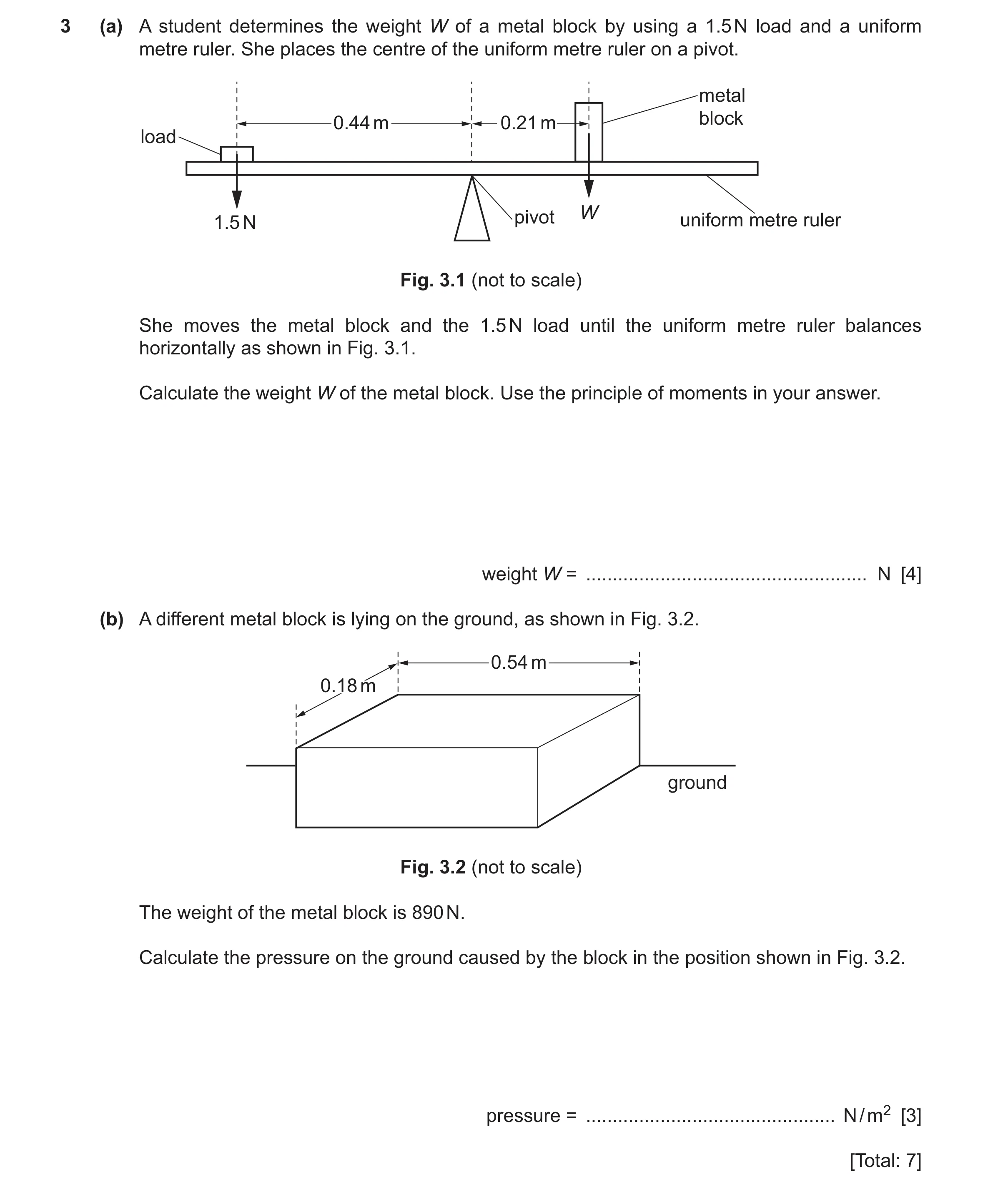
Q39 · A student determines the weight W of a metal block by using a 1.5 N load and a uniform… 0625/33 May/June 2025
3 (a) A student determines the weight W of a metal block by using a 1.5 N load and a uniform metre ruler. She places the centre of the uniform metre ruler on a pivot. metal 0.44 m 0.21 m block load 1.5 N pivot W uniform metre ruler Fig. 3.1 (not to scale) She moves the metal block and the 1.5 N load until the uniform metre ruler balances horizontally as shown in Fig. 3.1. Calculate the weight W of the metal block. Use the principle of moments in your answer. weight W = … N [4] (b) A different metal block is lying on the ground, as shown in Fig. 3.2. 0.54 m 0.18 m ground Fig. 3.2 (not to scale) The weight of the metal block is 890 N. Calculate the pressure on the ground caused by the block in the position shown in Fig. 3.2. pressure = … N / m2 [3] [Total: 7]
7 marks
Mark scheme: 3(a) 3.1 (N) A4 1.5 0.44 = W 0.21 OR (W =) (1.5 0.44) ÷ 0.21 C3 OR (W =) 0.66 ÷ 0.21 (anticlockwise moment =) 1.5 0.44 OR 0.66 seen C1 (sum of) anticlockwise moment = (sum of) clockwise moment C1 3(b) 9200 (N / m2) A3 890 ÷ (0.54 0.18) OR 890 ÷ 0.0972 C2 (pressure =) force ÷ area C1
This question in 0625/33 May/June 2025
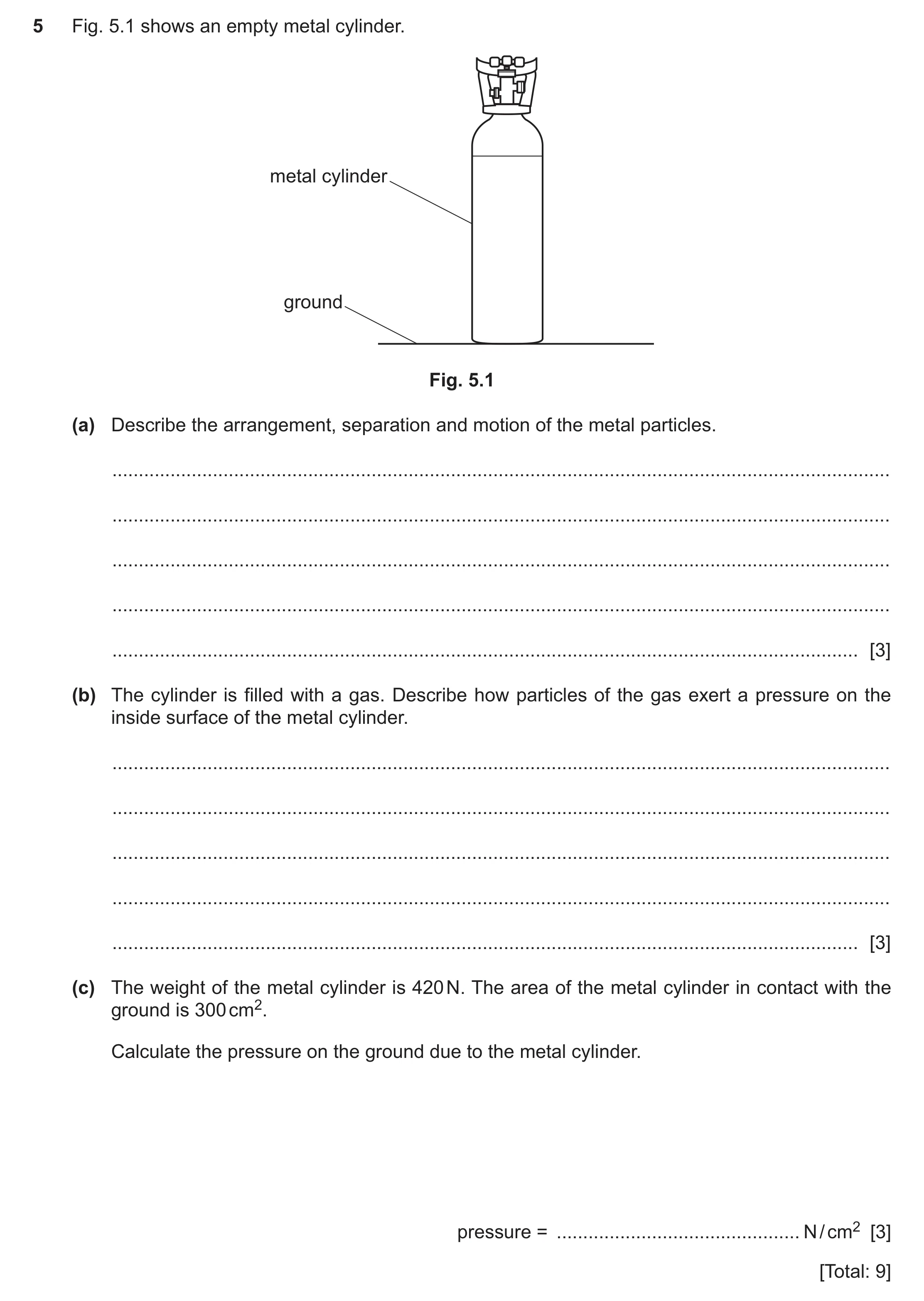
Q40 · An empty metal cylinder 0625/31 Oct/Nov 2025
5 Fig. 5.1 shows an empty metal cylinder. metal cylinder ground Fig. 5.1 (a) Describe the arrangement, separation and motion of the metal particles. … … … … … [3] (b) The cylinder is filled with a gas. Describe how particles of the gas exert a pressure on the inside surface of the metal cylinder. … … … … … [3] (c) The weight of the metal cylinder is 420 N. The area of the metal cylinder in contact with the ground is 300 cm2. Calculate the pressure on the ground due to the metal cylinder. pressure = … N / cm2 [3] [Total: 9]
9 marks
Mark scheme: 5(a) (particles are;) fixed in position/ in lattice/regular pattern B1 (can only) vibrate / no translational KE B1 close(r than in liquids or gases) B1 5(b) any THREE from: B3 (particles/they) move at high speed OR have high/large KE move randomly (particles/they) collide with it/surface/walls (collisions) create a force (on cylinder wall) idea of P = F / A 5(c) (P = ) 1.4 (N/cm2) A3 (P = ) 420 ÷ 300 (C2) (P = ) F ÷ A (C1)
This question in 0625/31 Oct/Nov 2025
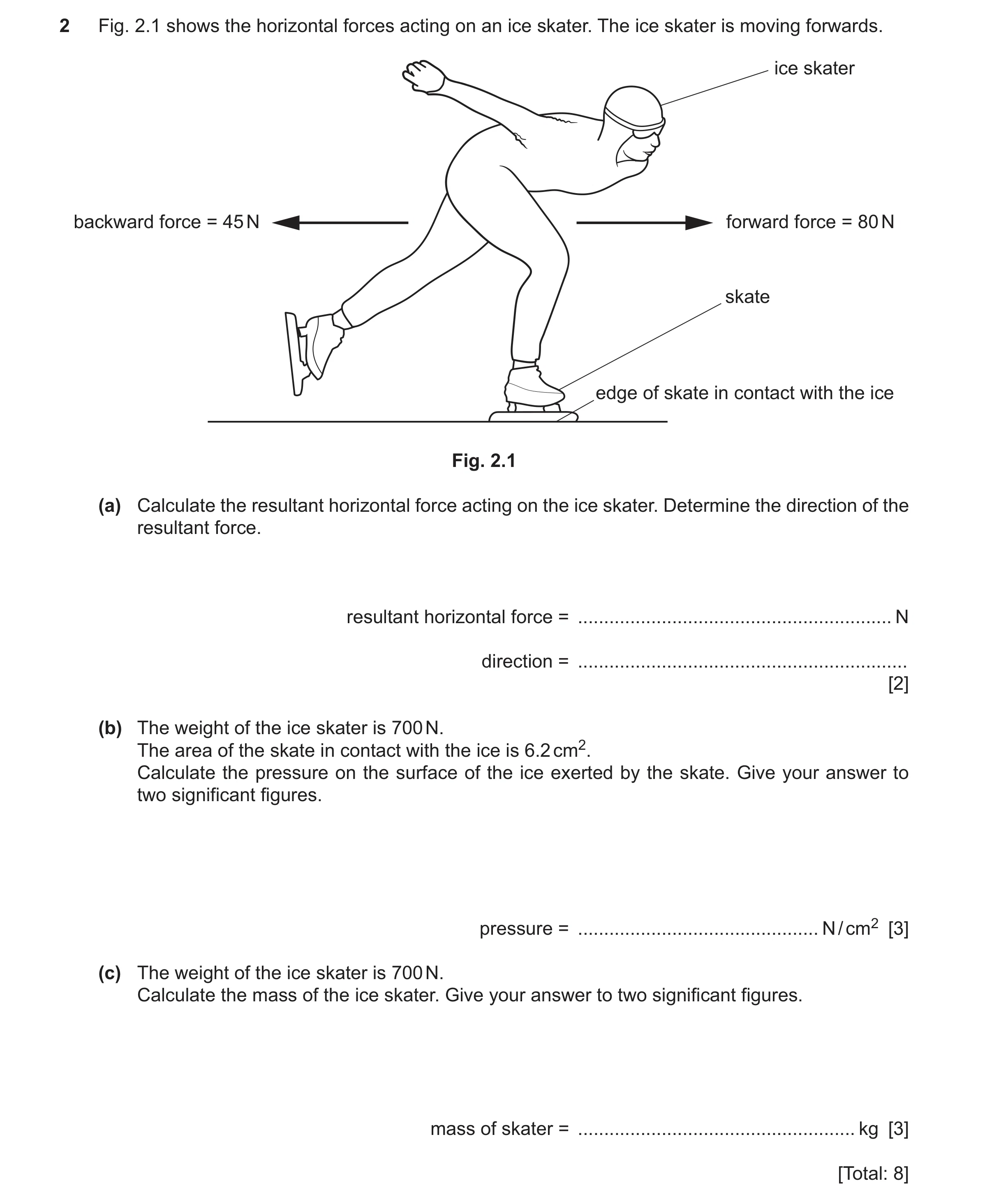
Q41 · The horizontal forces acting on an ice skater 0625/32 Oct/Nov 2025
2 Fig. 2.1 shows the horizontal forces acting on an ice skater. The ice skater is moving forwards. ice skater backward force = 45 N forward force = 80 N skate edge of skate in contact with the ice Fig. 2.1 (a) Calculate the resultant horizontal force acting on the ice skater. Determine the direction of the resultant force. resultant horizontal force = … N direction = … [2] (b) The weight of the ice skater is 700 N. The area of the skate in contact with the ice is 6.2 cm2. Calculate the pressure on the surface of the ice exerted by the skate. Give your answer to two significant figures. pressure = … N / cm2 [3] (c) The weight of the ice skater is 700 N. Calculate the mass of the ice skater. Give your answer to two significant figures. mass of skater = … kg [3] [Total: 8]
8 marks
Mark scheme: 2(a) 35 (N) B1 forwards / to the right B1 2(b) 110 (N / cm2) A3 700 ÷ 6.2 C2 (pressure =) force / area C1 2(c) 71 (kg) A3 700 ÷ 9.8 C2 (mass =) weight / gravitational field strength or W / g or W / 9.8 C1
This question in 0625/32 Oct/Nov 2025
 1 / 46
 2 / 46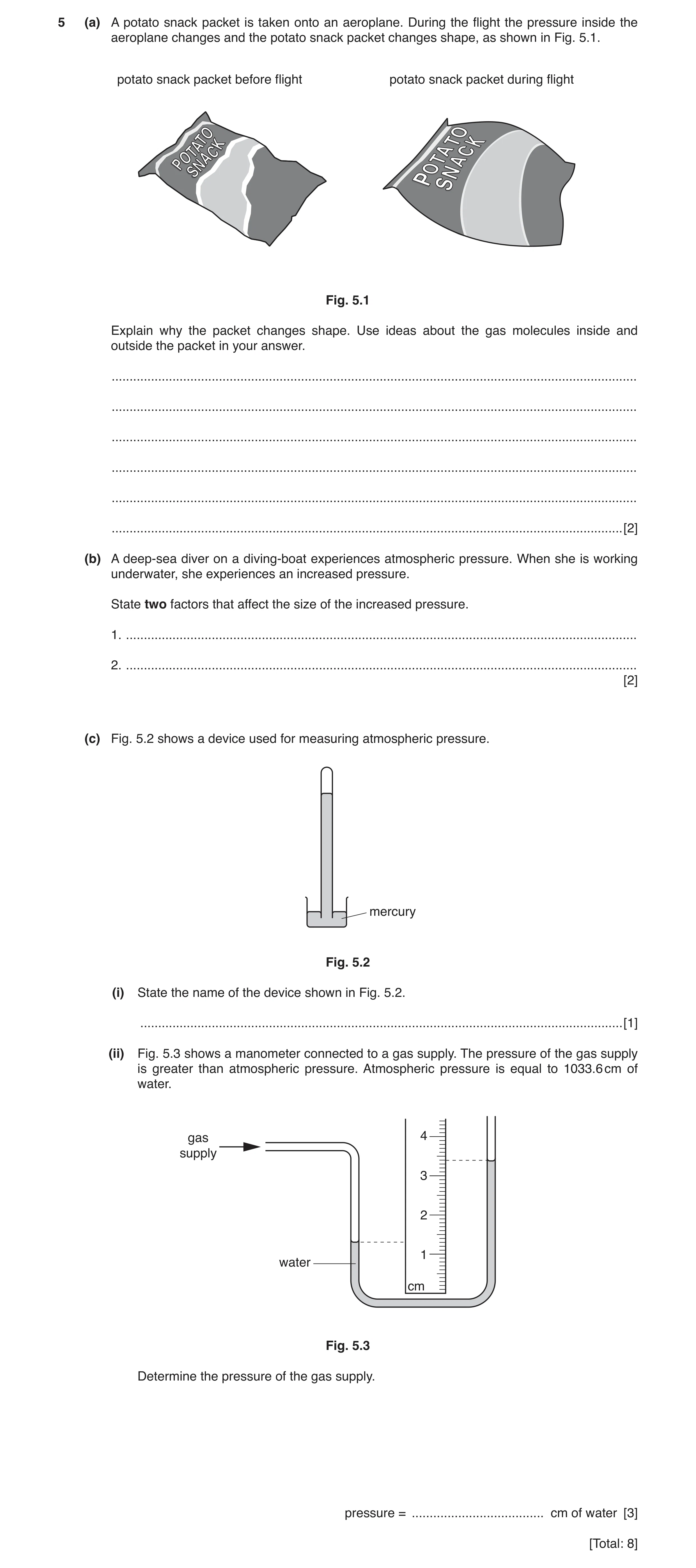
 5 / 46
 6 / 46
 7 / 46
 8 / 46
 9 / 46
 10 / 46
 11 / 46
 12 / 46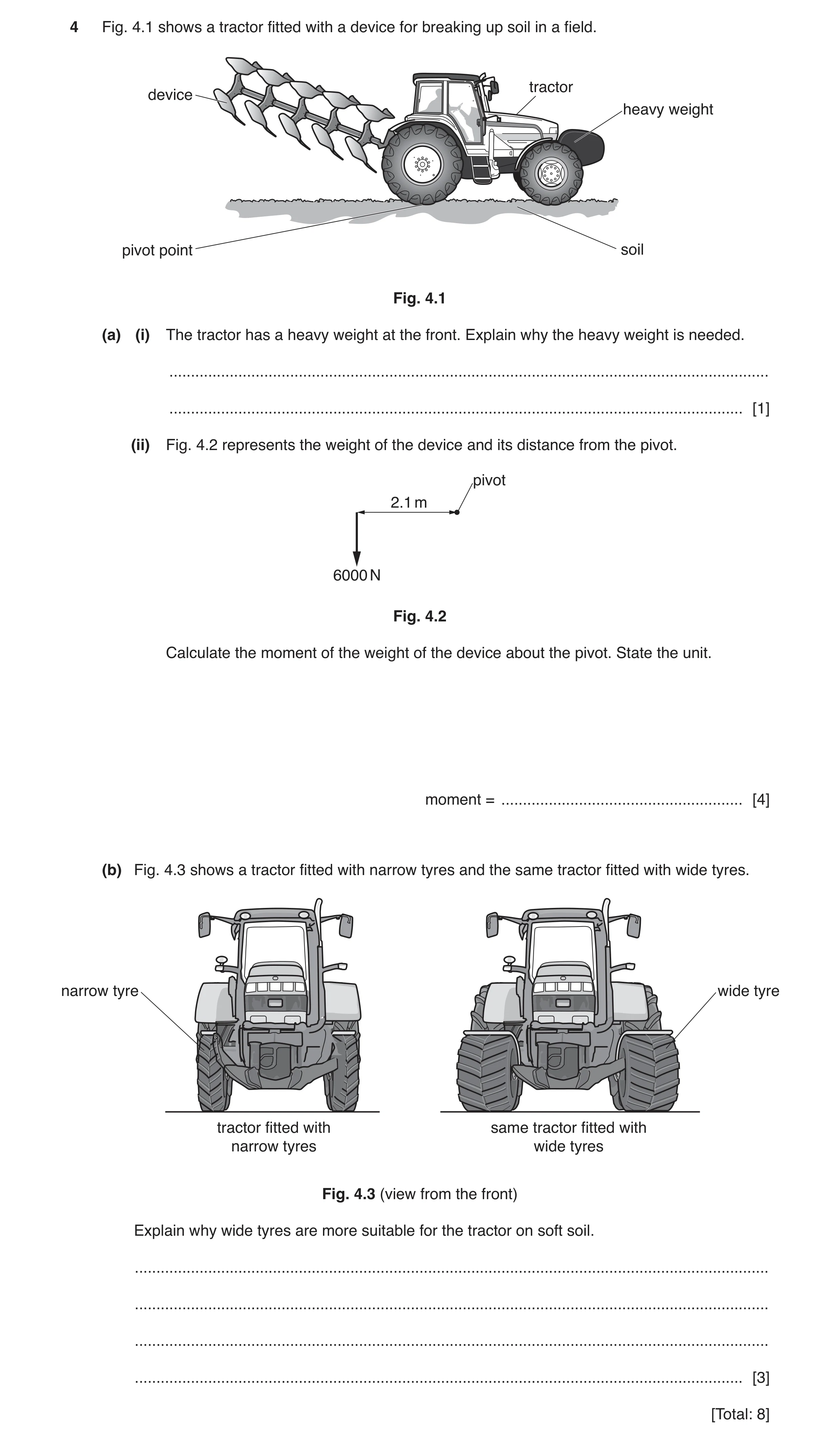
 15 / 46
 16 / 46
 17 / 46
 18 / 46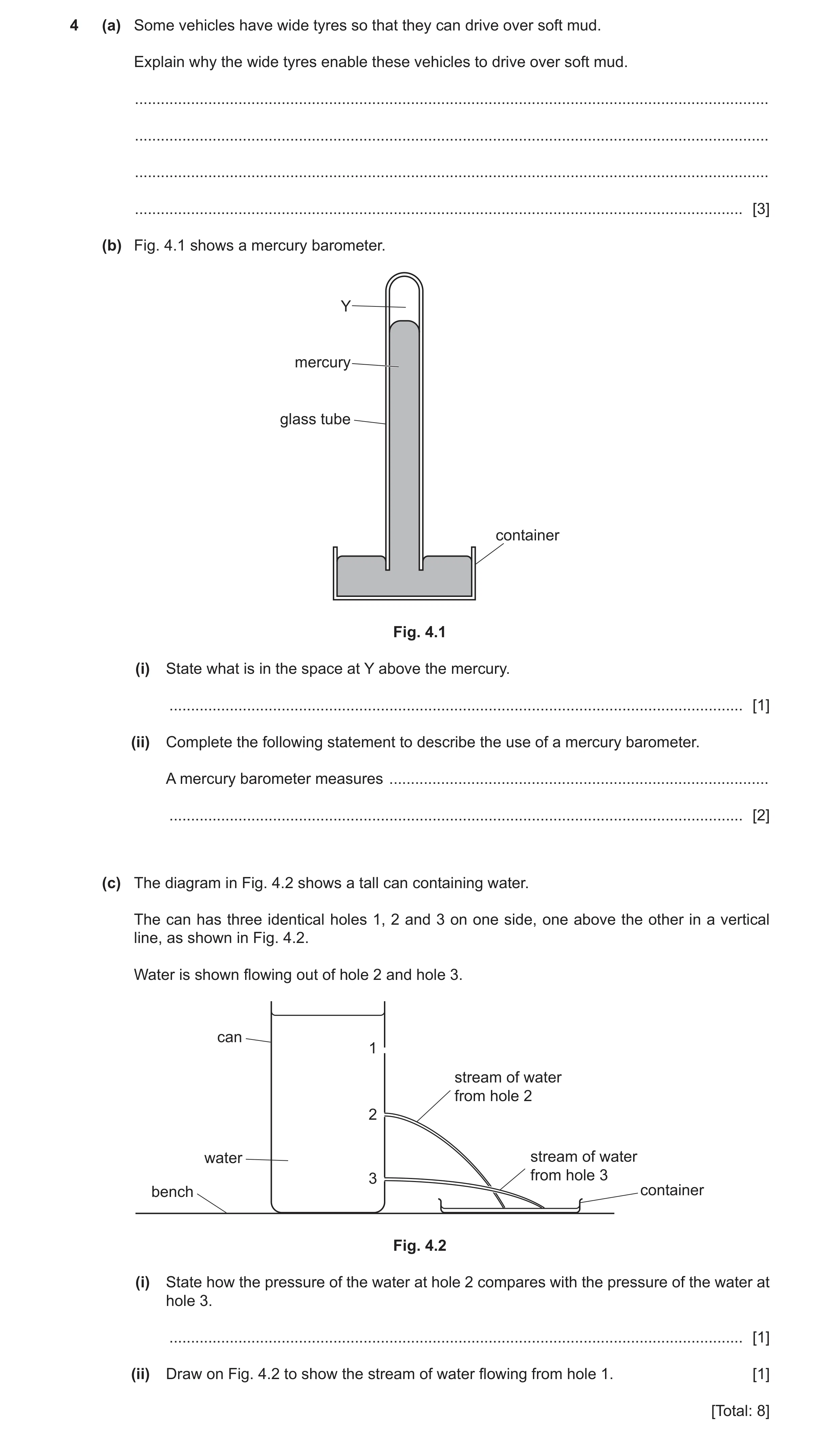
 20 / 46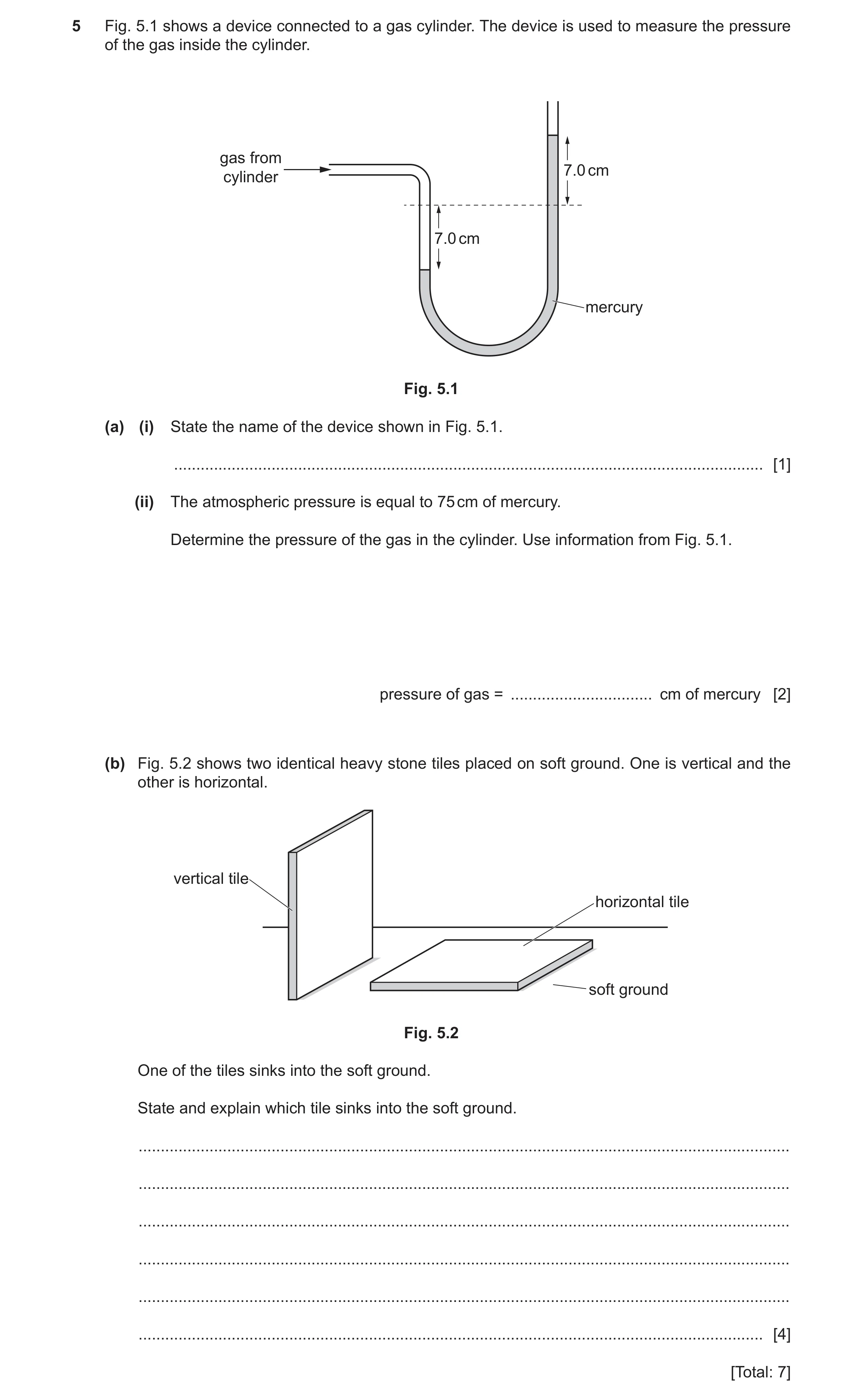
 22 / 46
 23 / 46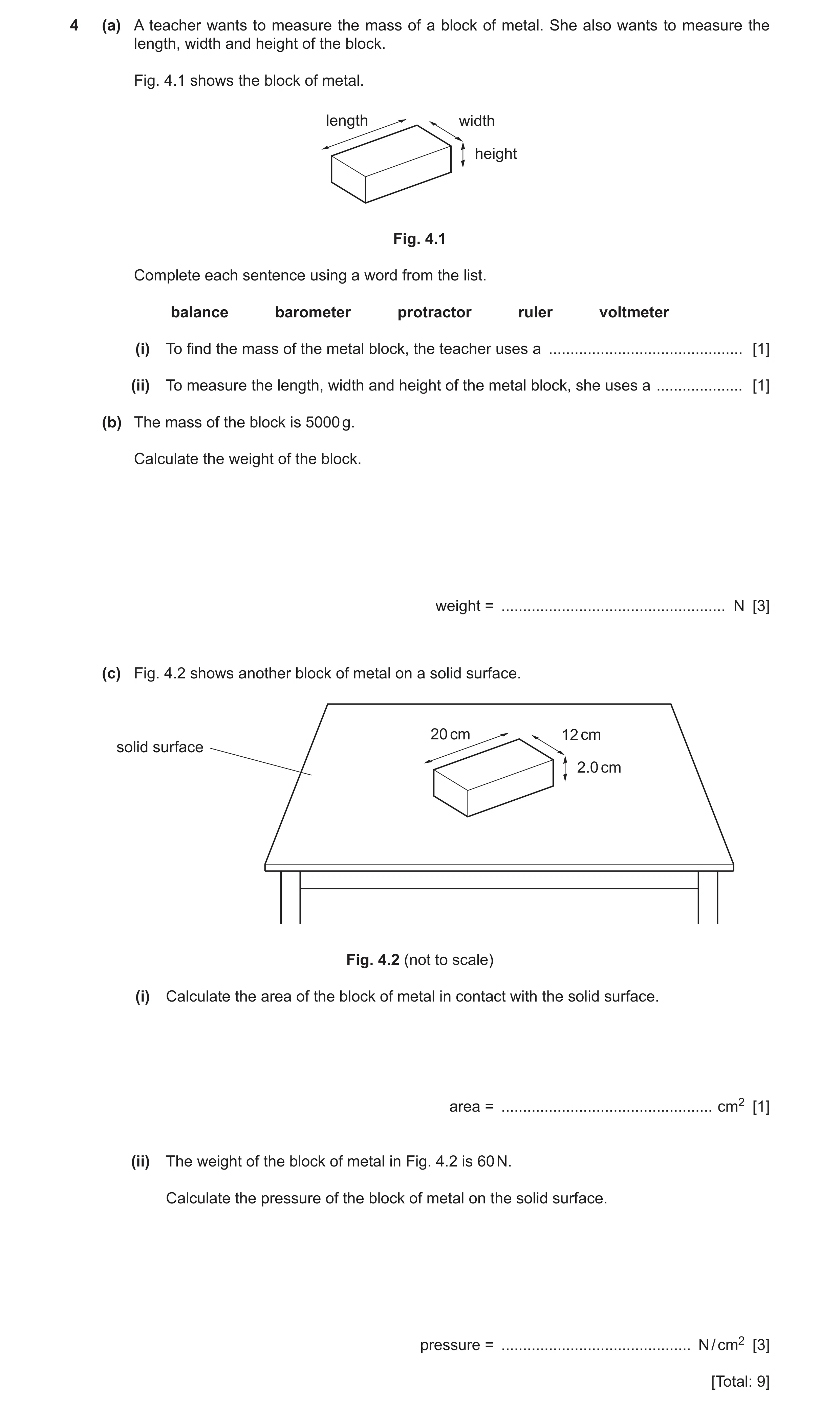
 26 / 46
 27 / 46
 28 / 46
 29 / 46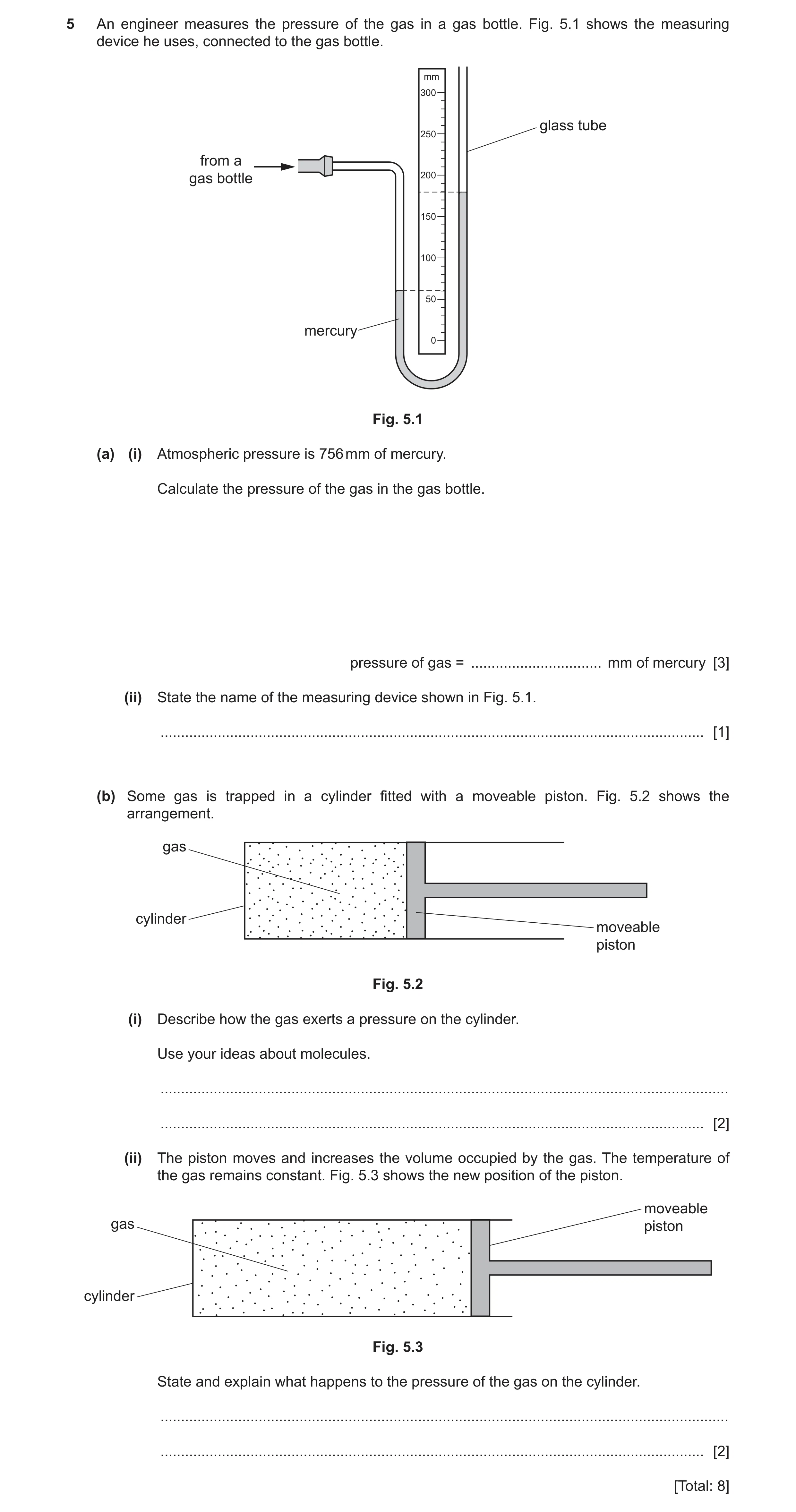
 36 / 46
 37 / 46
 38 / 46
 39 / 46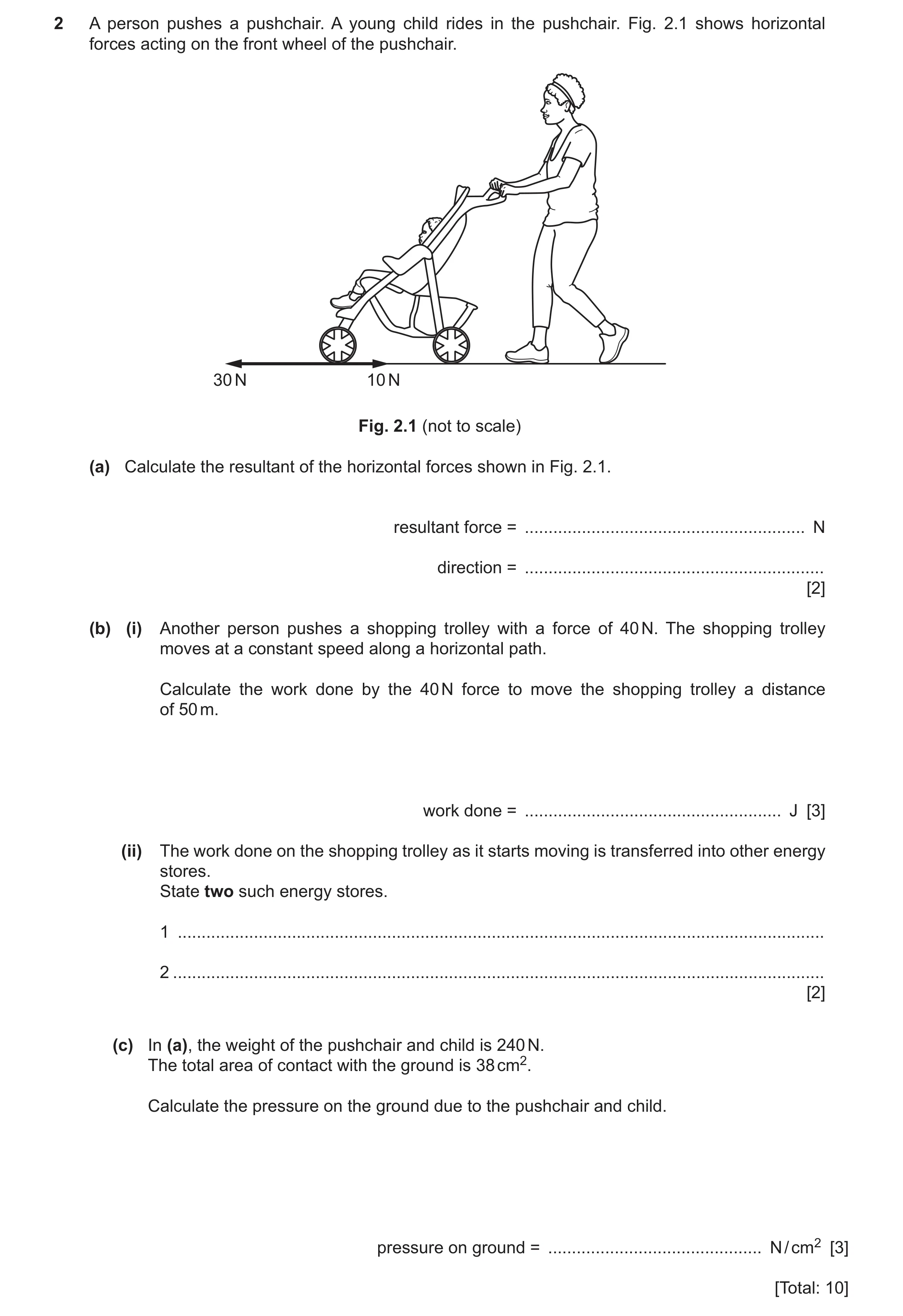
![Question 36: (a) A boy weighs 620 N. Calculate the mass of the boy. mass of boy = ..................................................... kg [3] (b) Fig. …](https://img.pastlit.com/crops/4e707ada-bb02-4b01-9e87-6d5dcaf9ae31/q3.webp) 41 / 46
41 / 46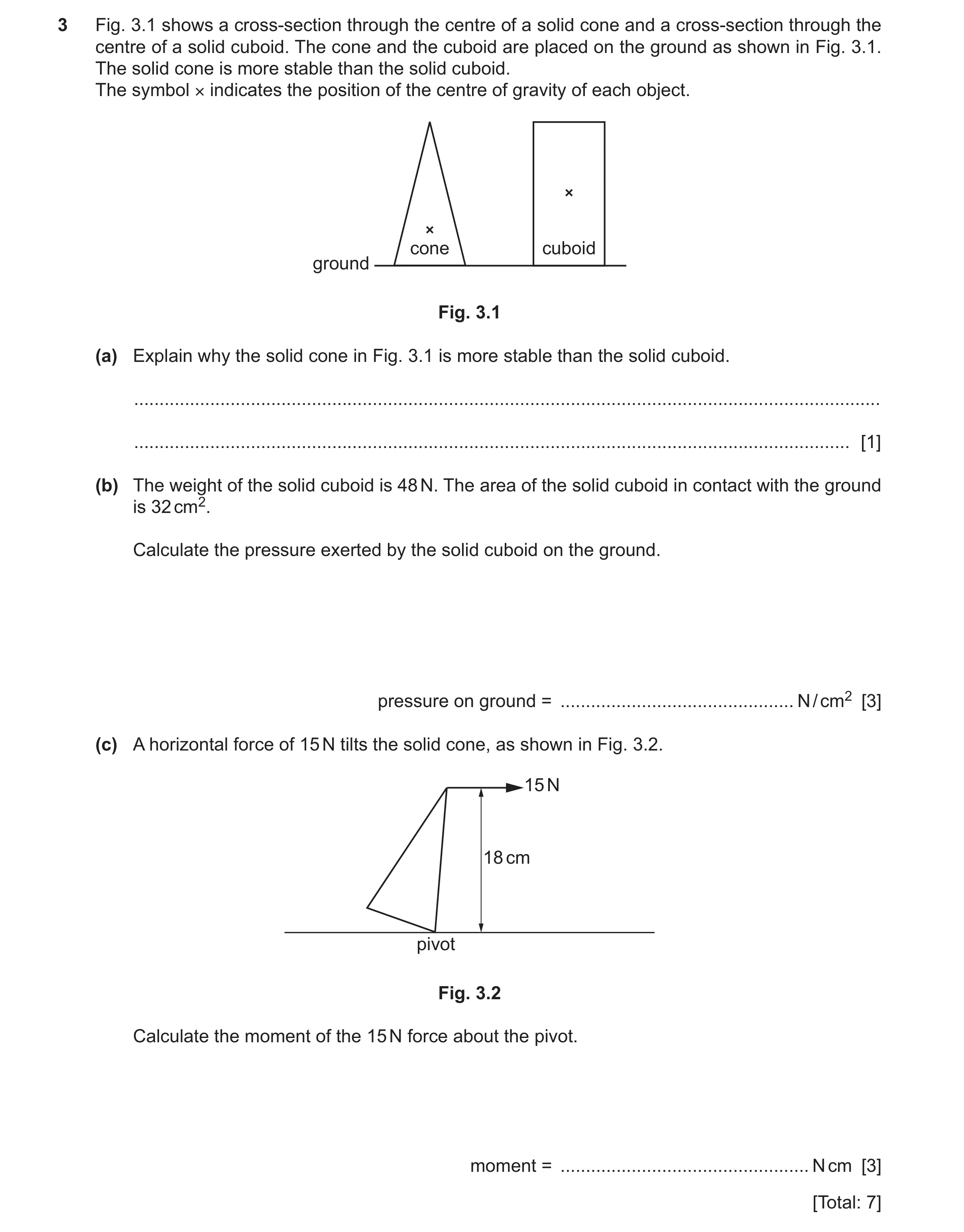 42 / 46
 43 / 46
 44 / 46
 45 / 46
 46 / 46
 5
5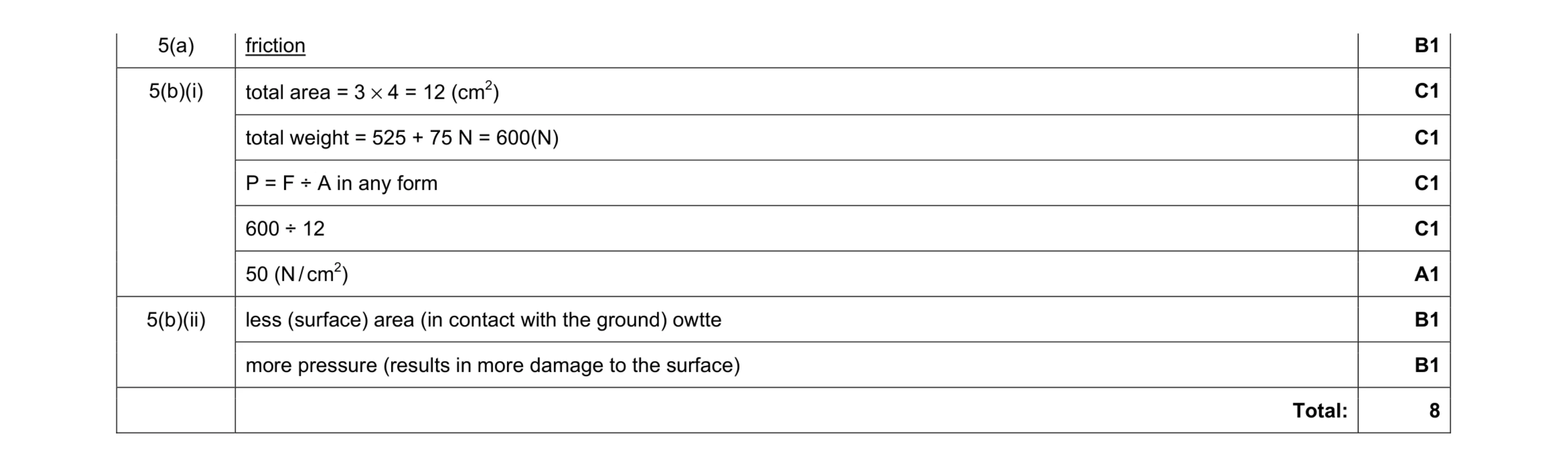 8
8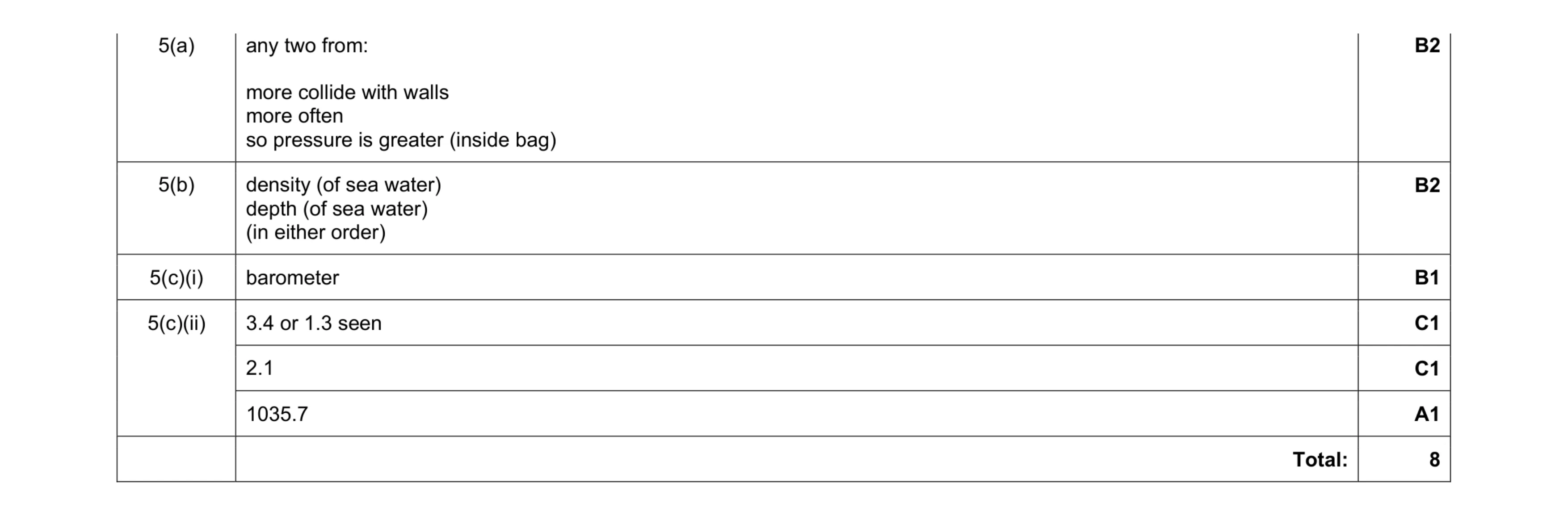 8
8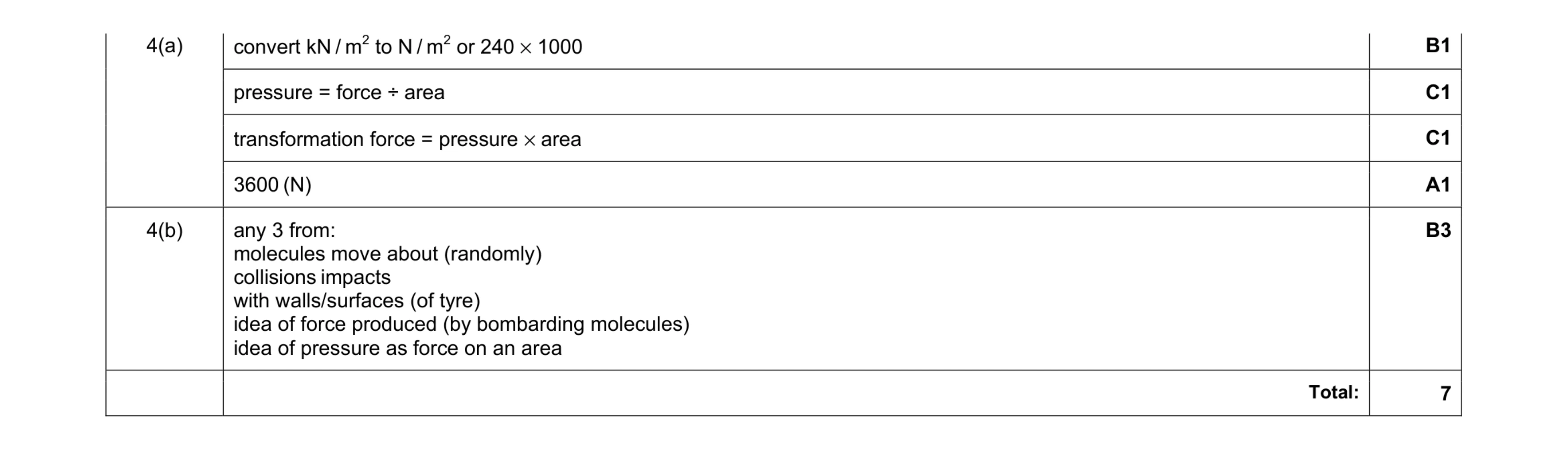 7
7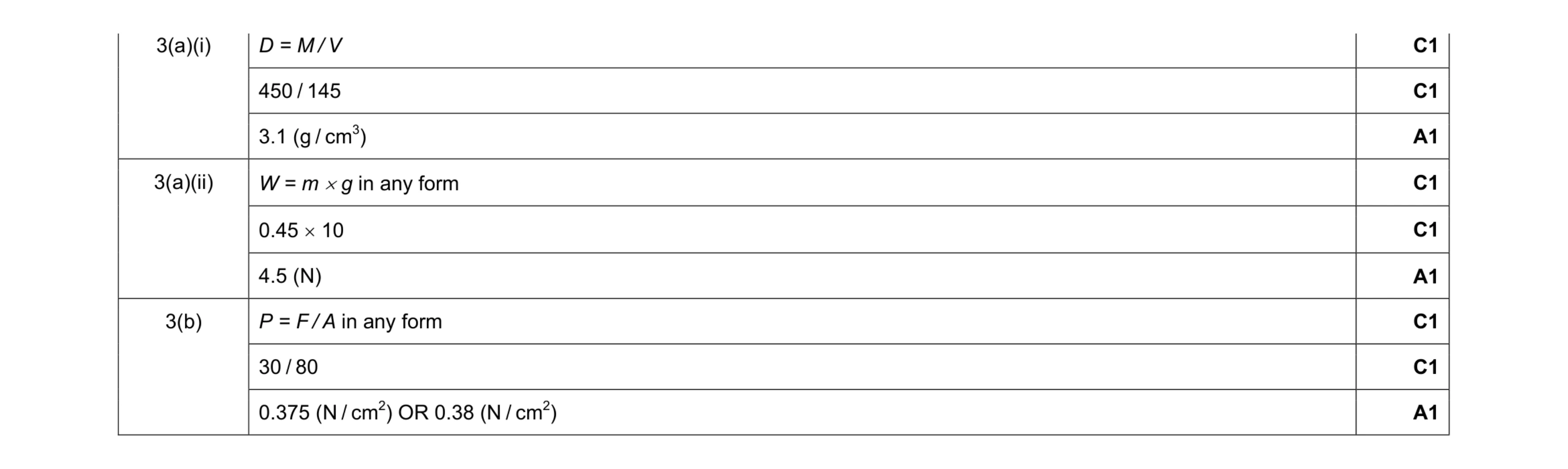 9
9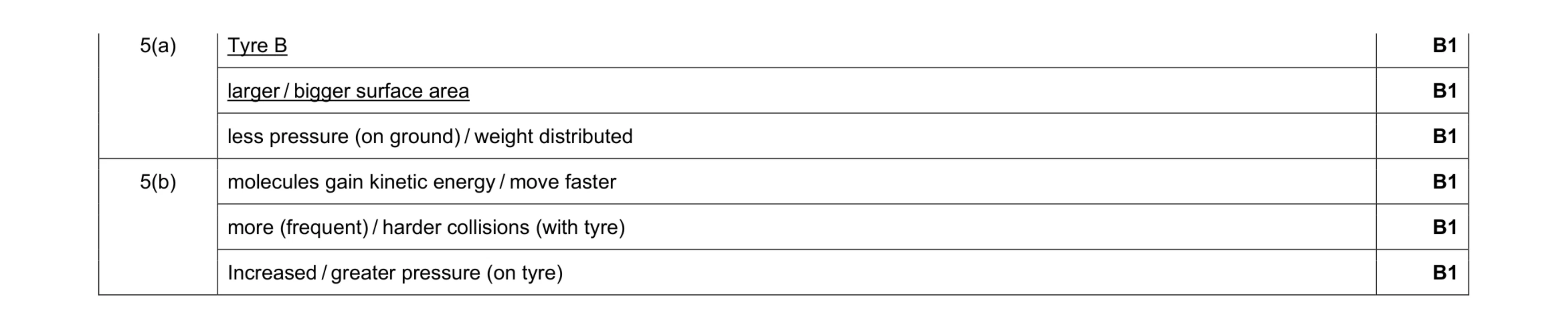 6
6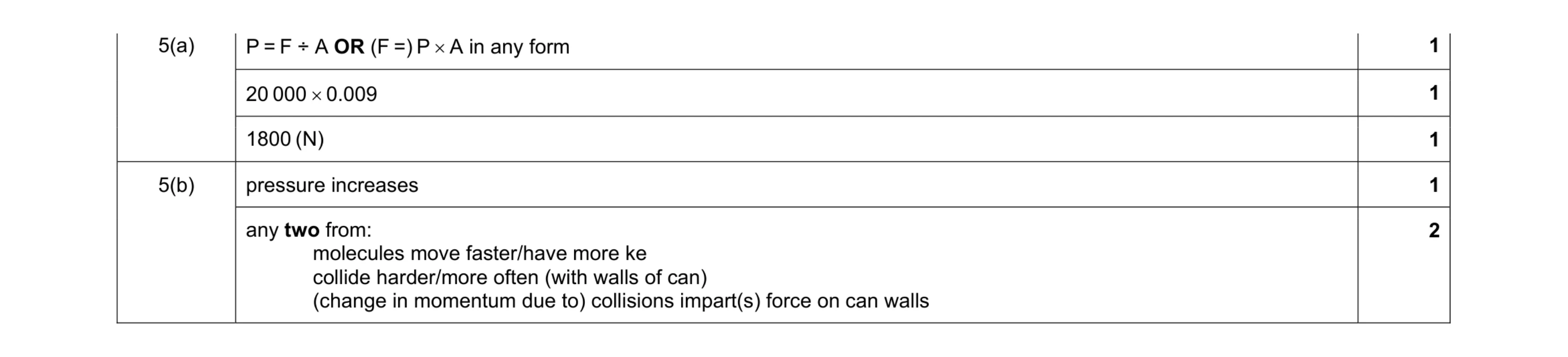 6
6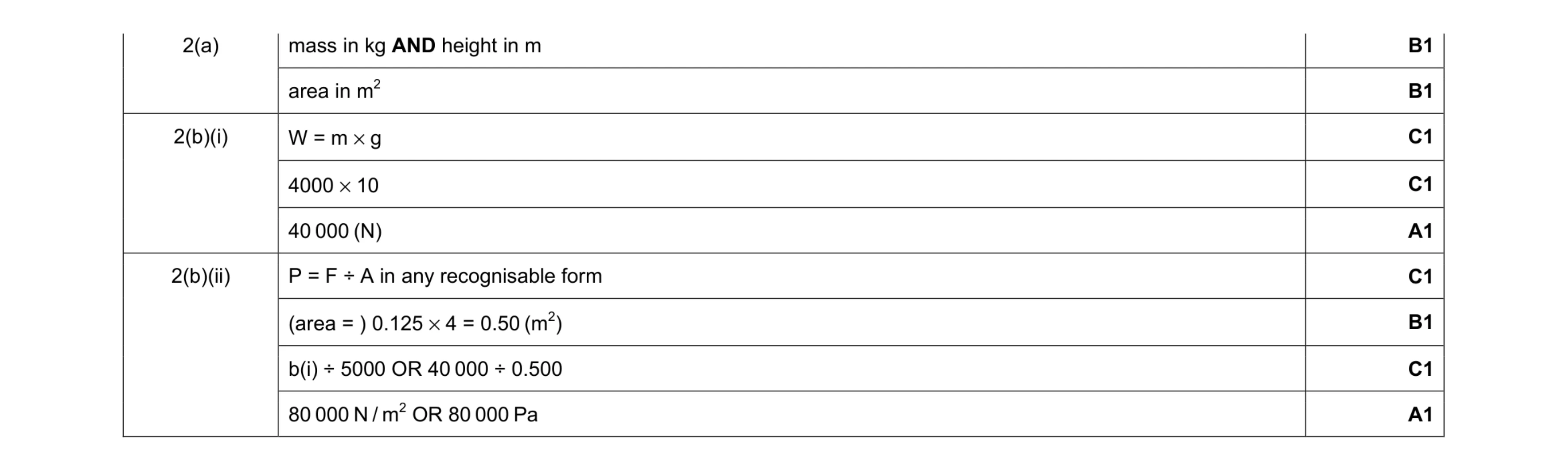 9
9 4
4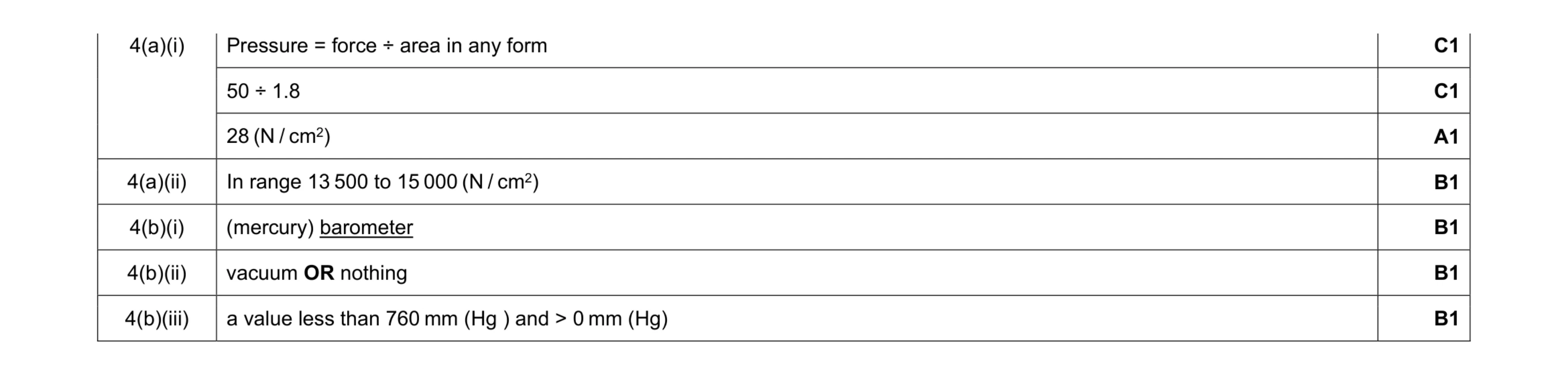 7
7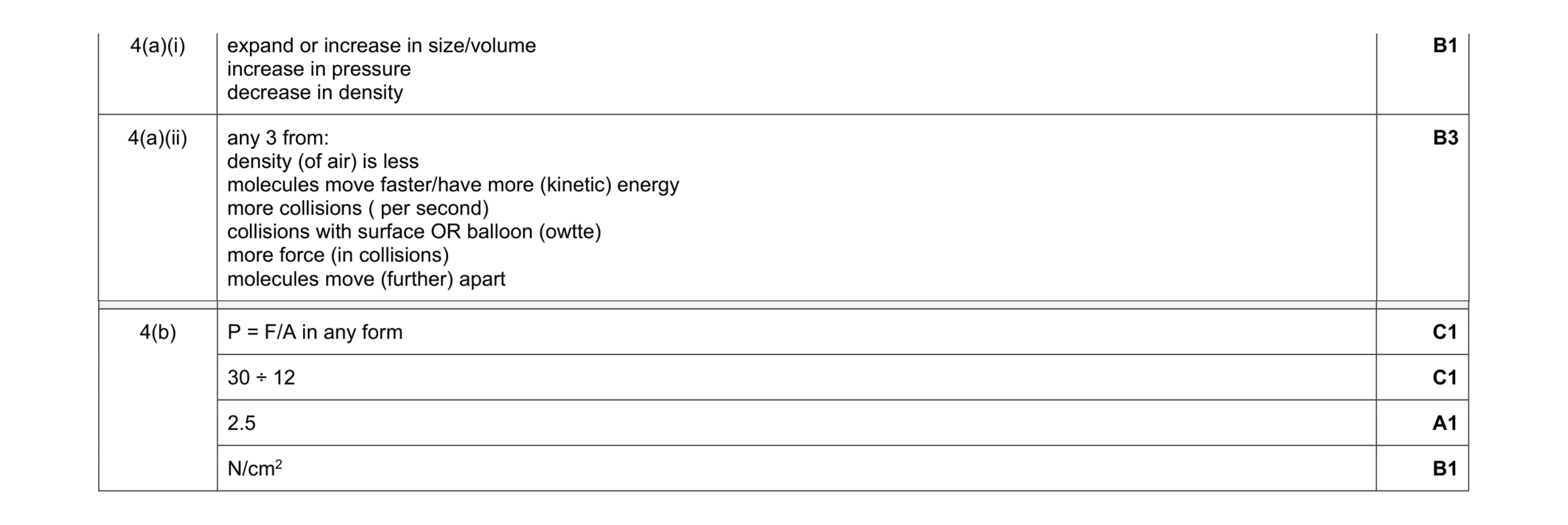 8
8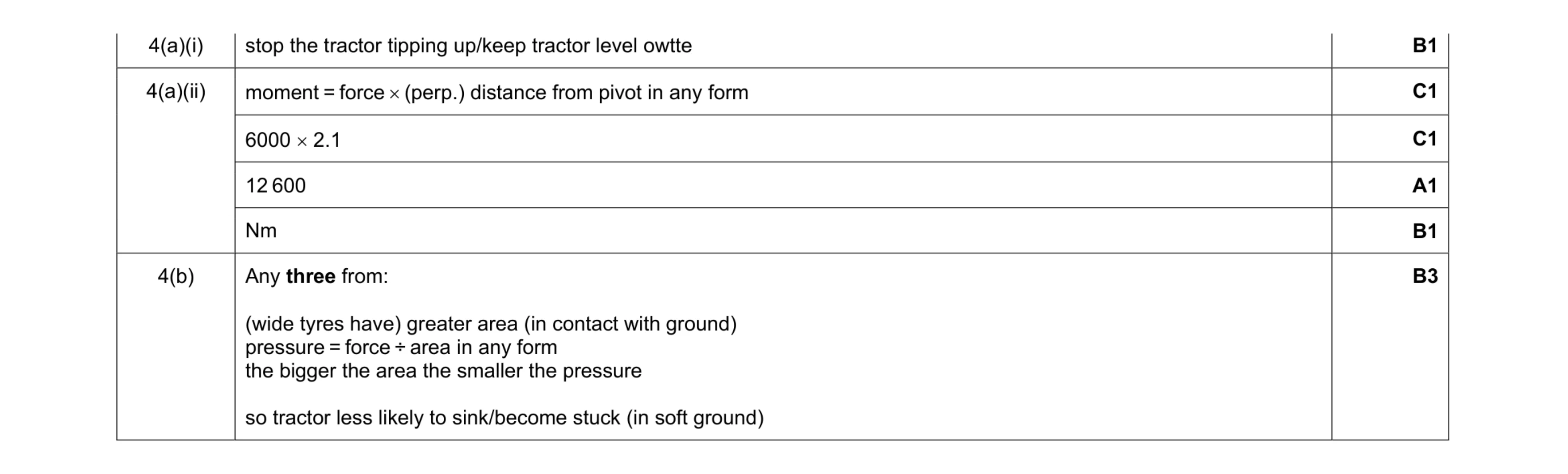 8
8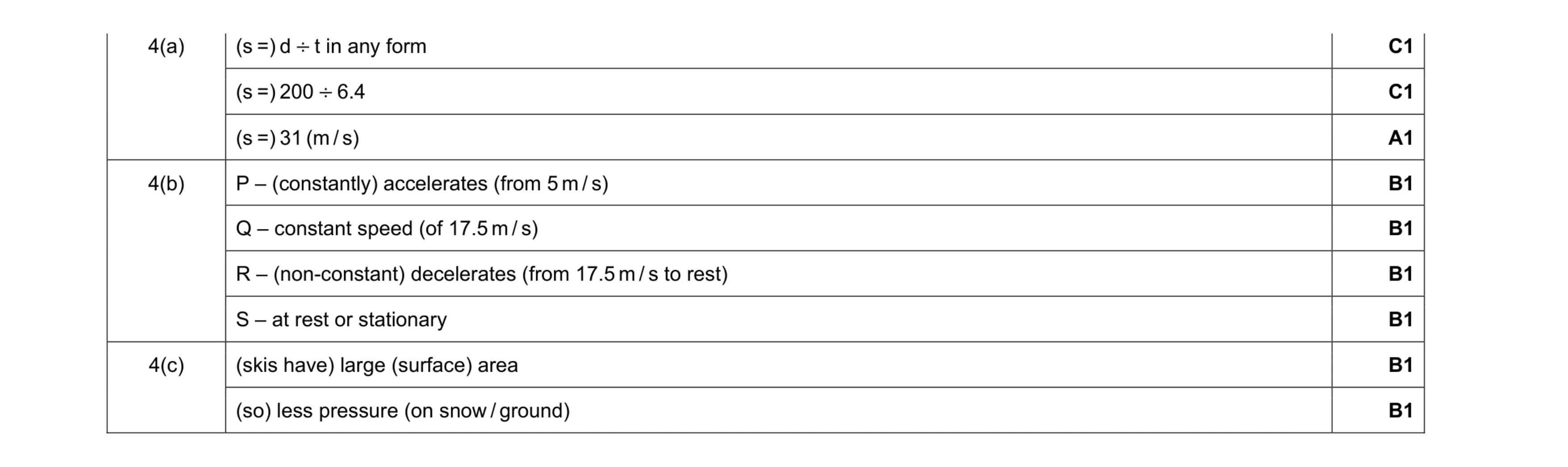 9
9 5
5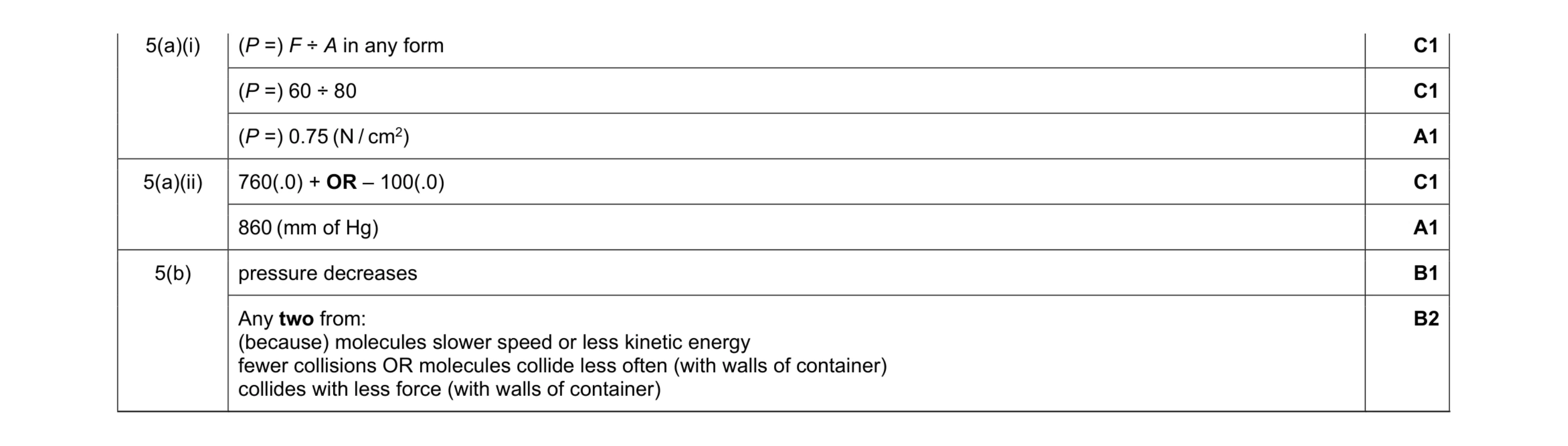 8
8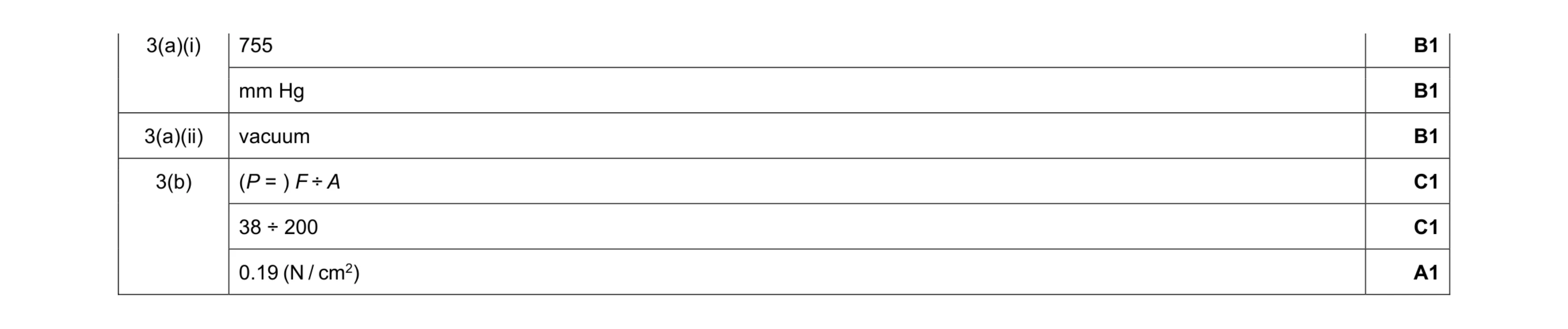 6
6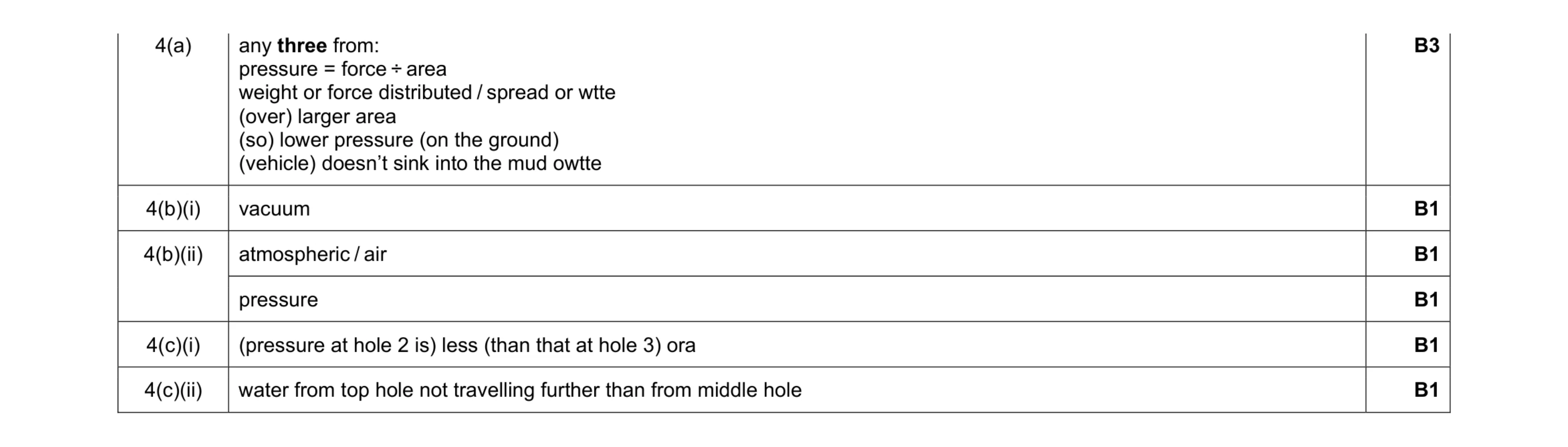 8
8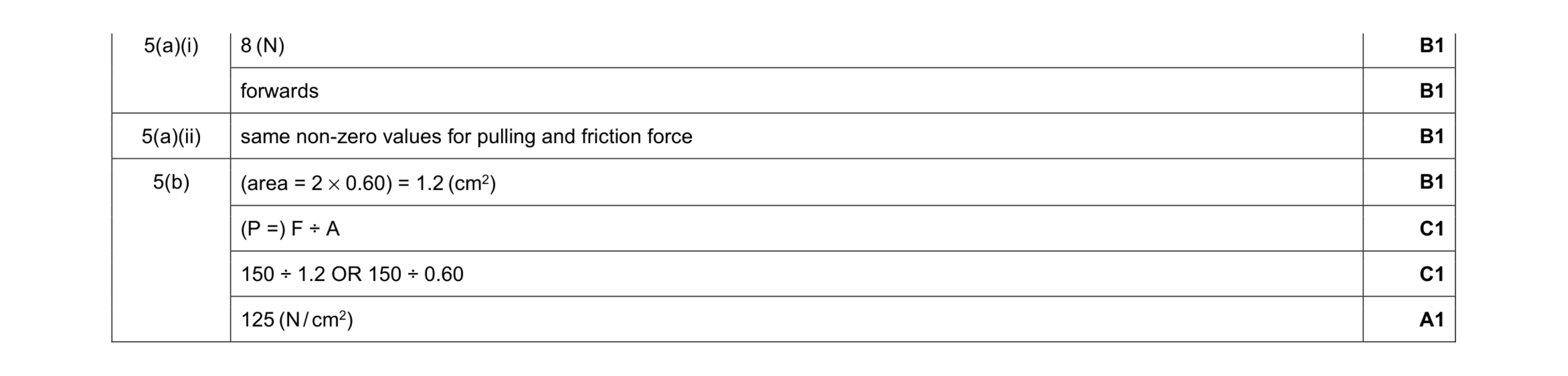 7
7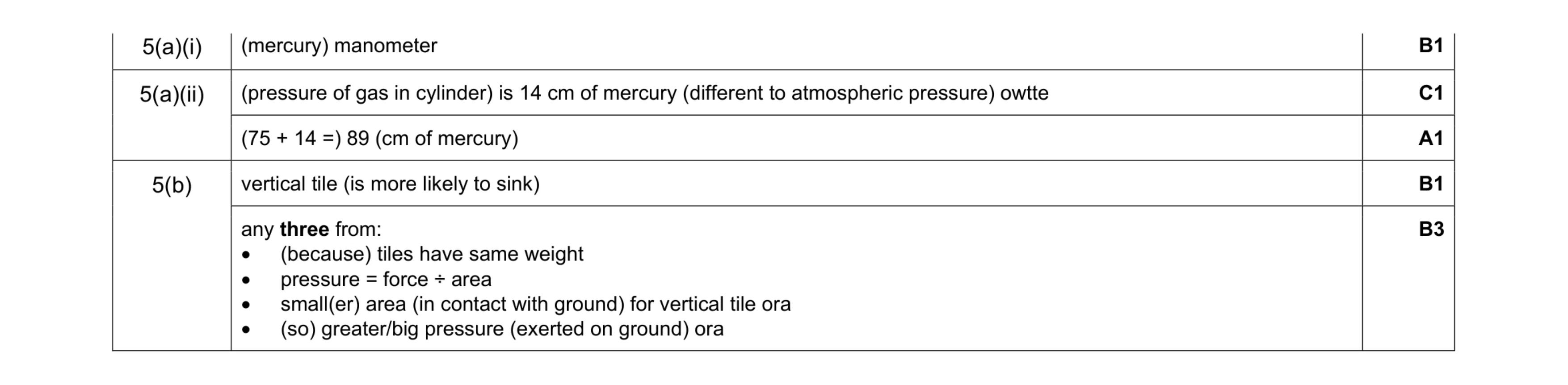 7
7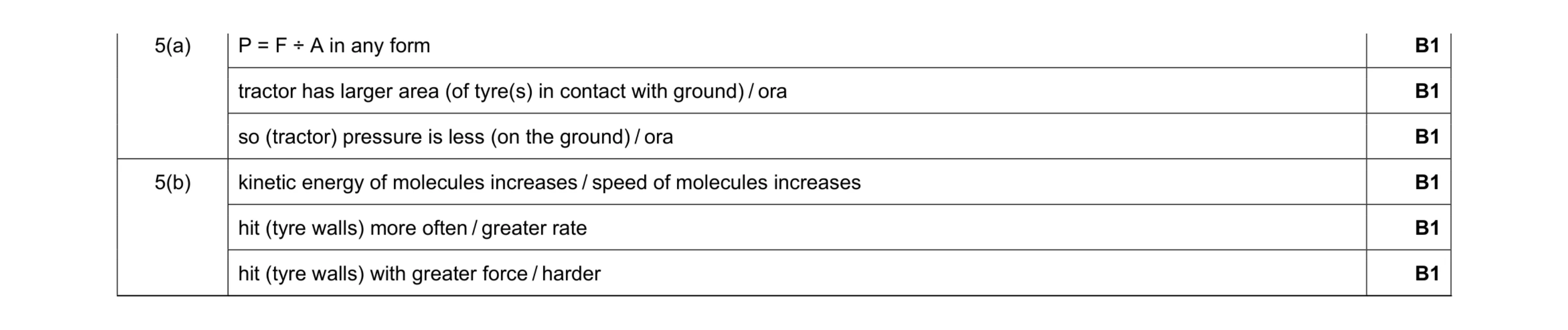 6
6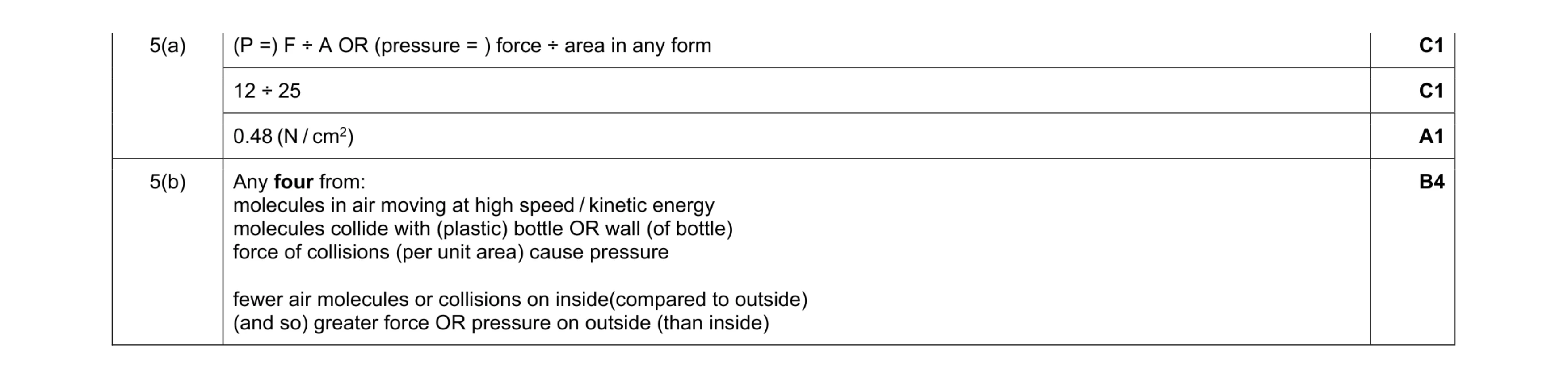 7
7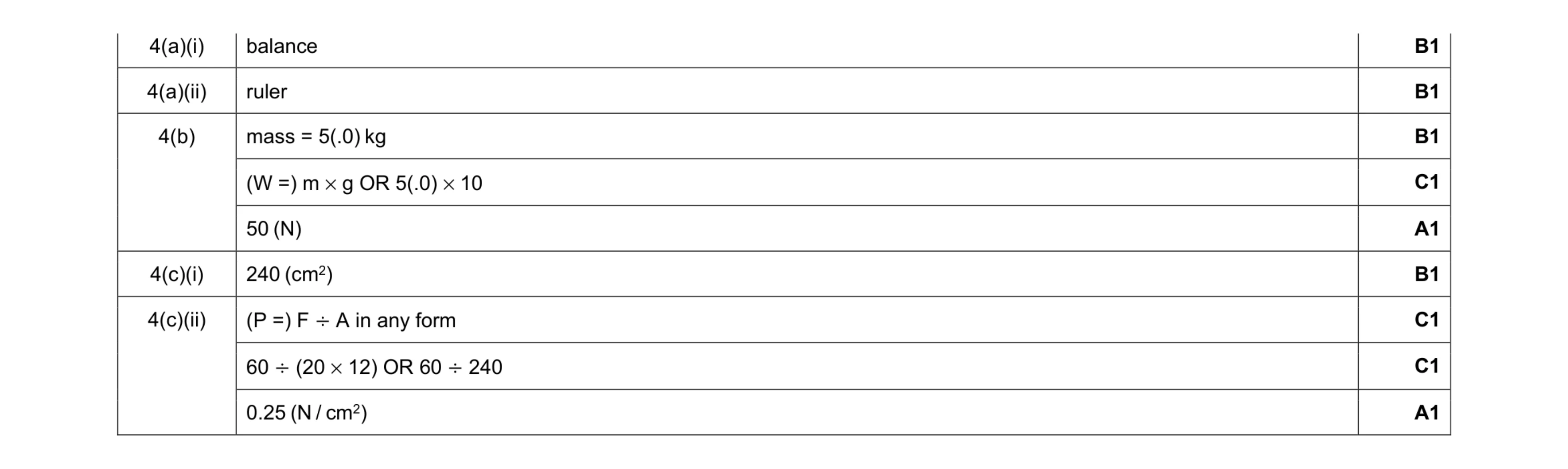 9
9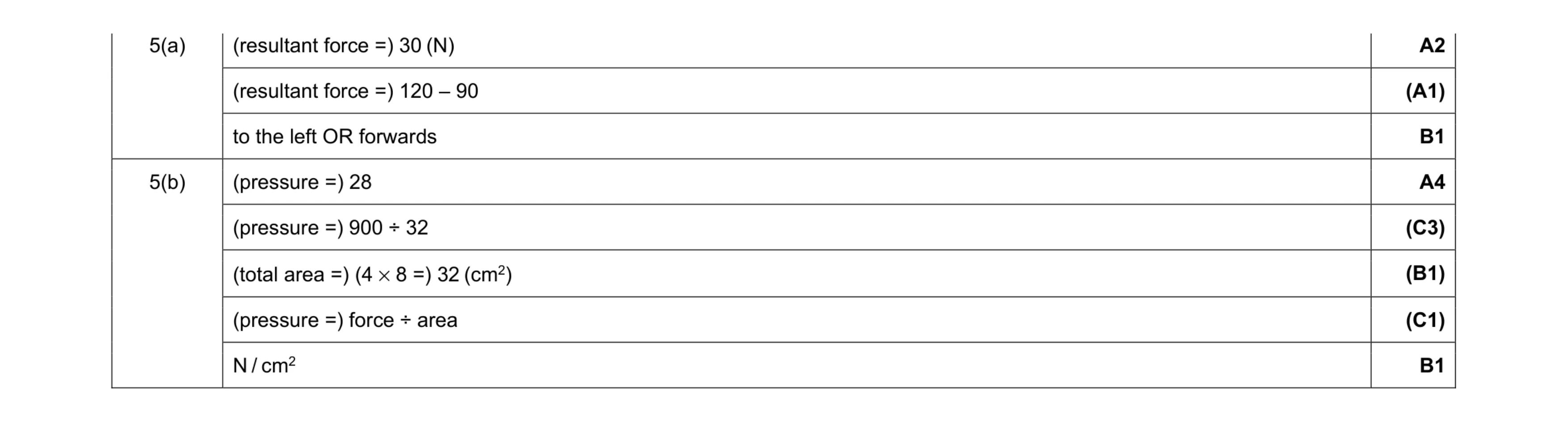 8
8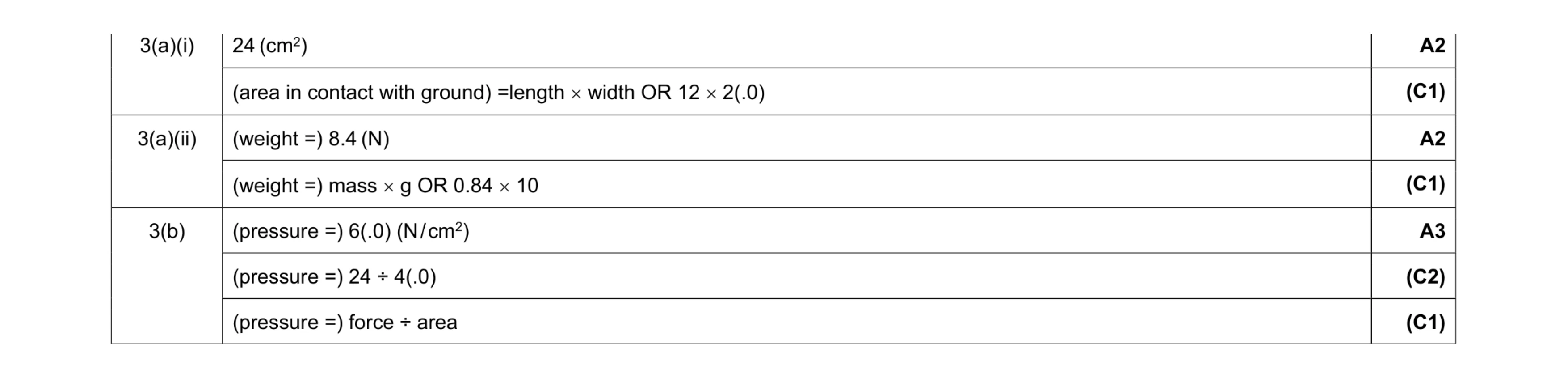 7
7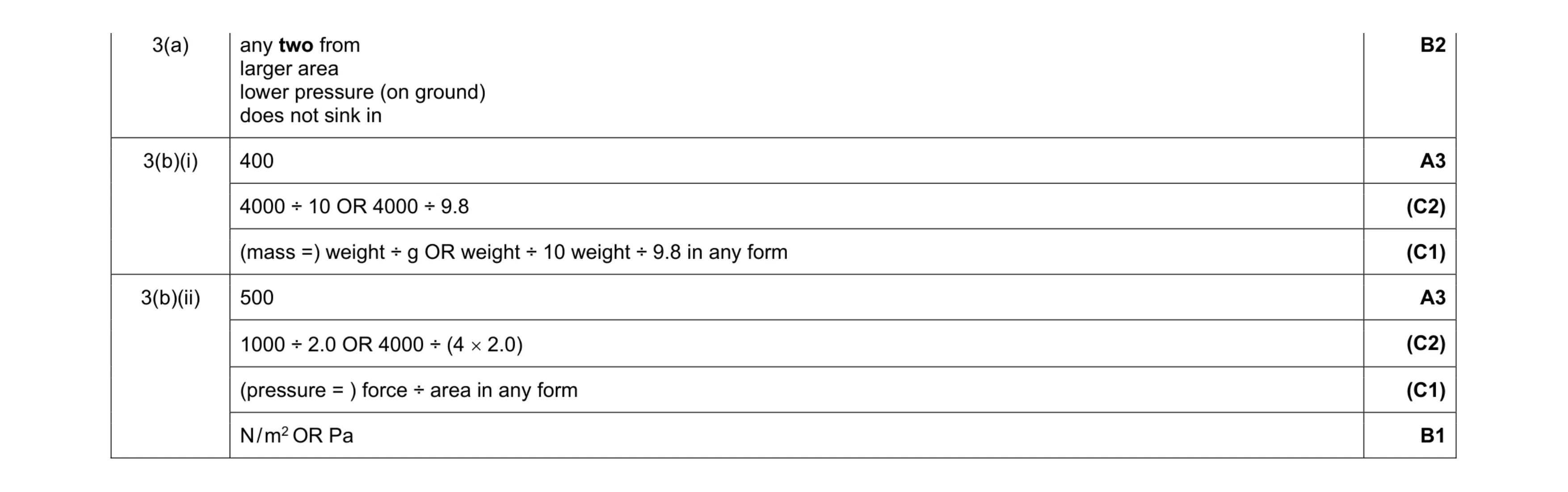 9
9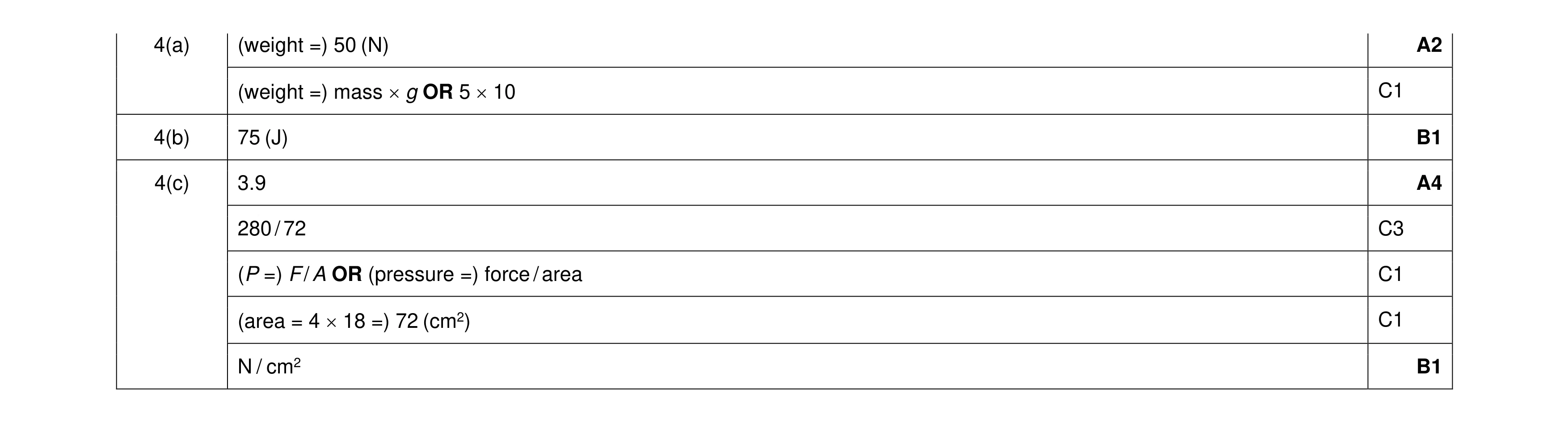 8
8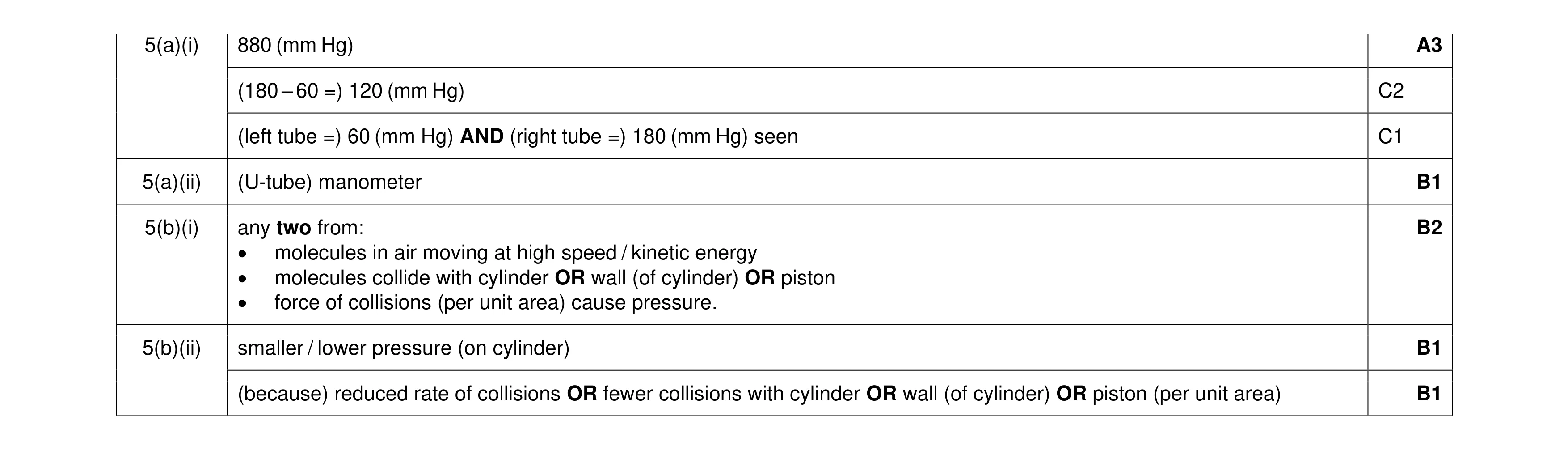 8
8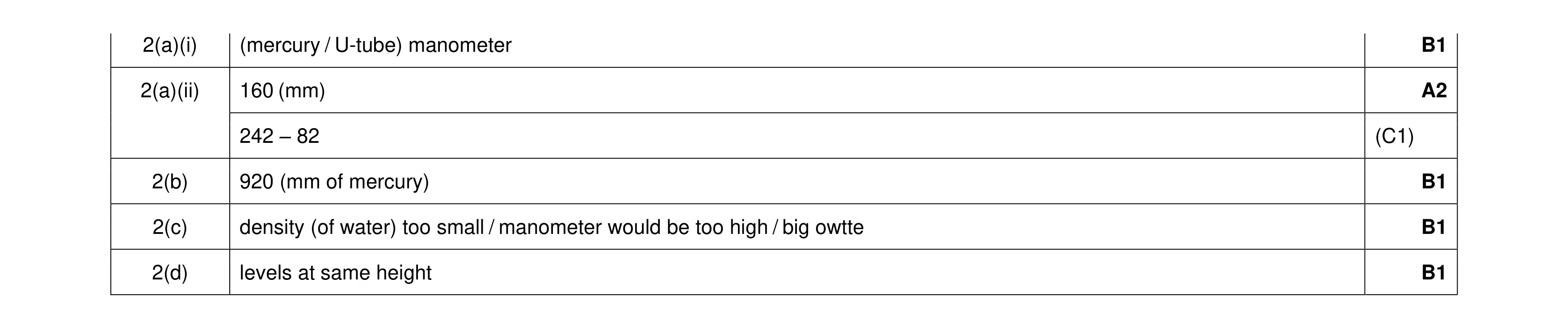 6
6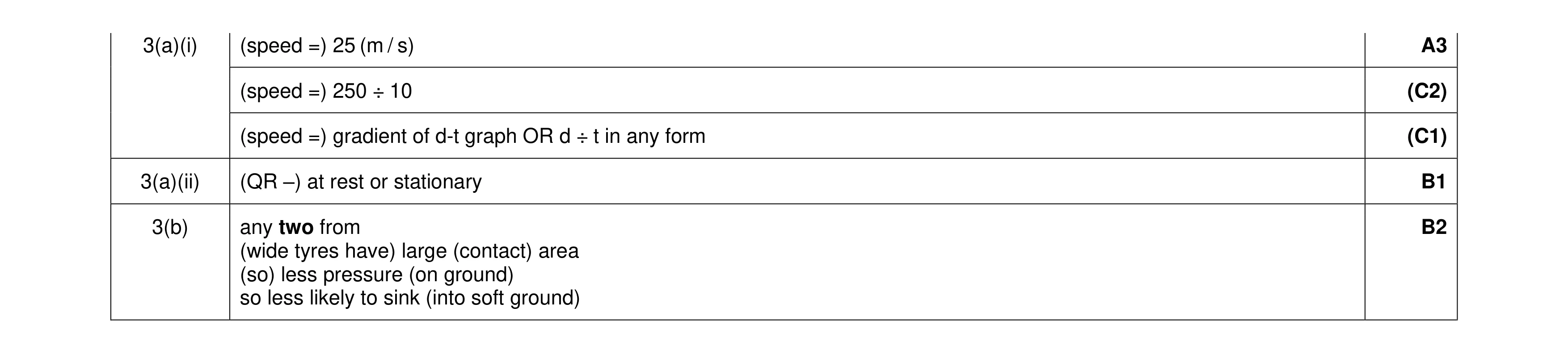 6
6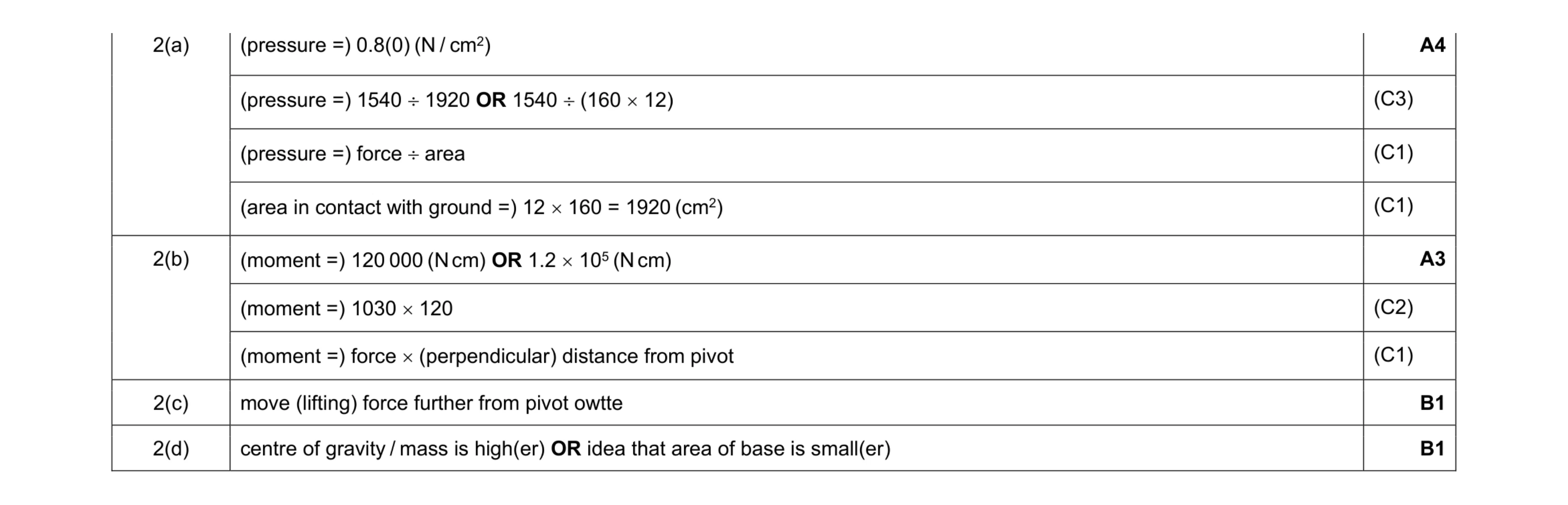 9
9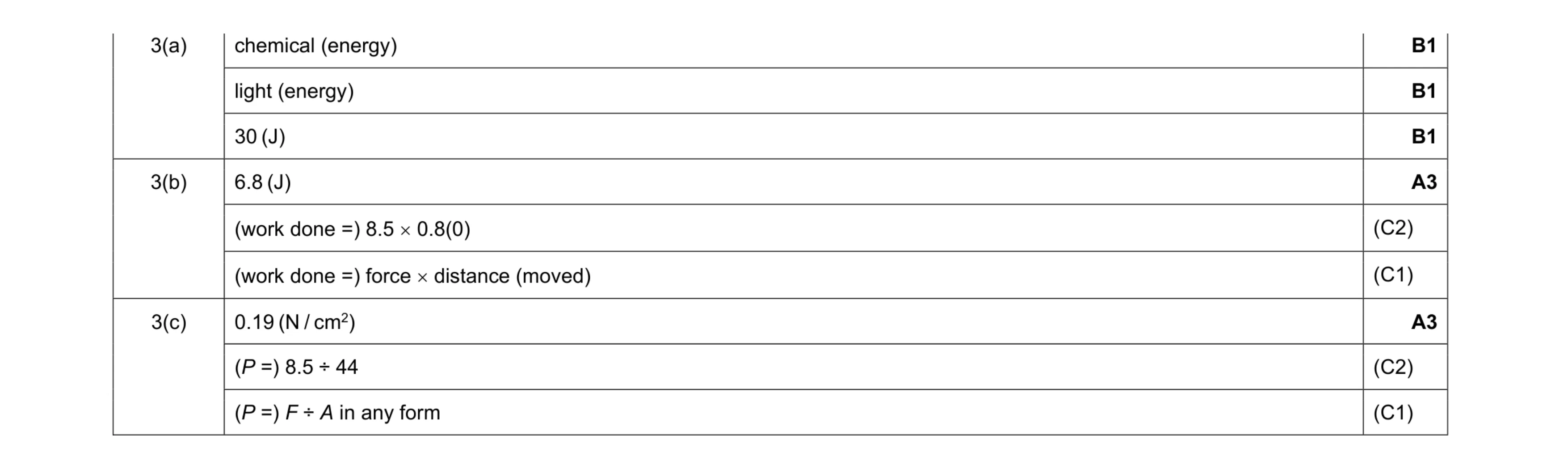 9
9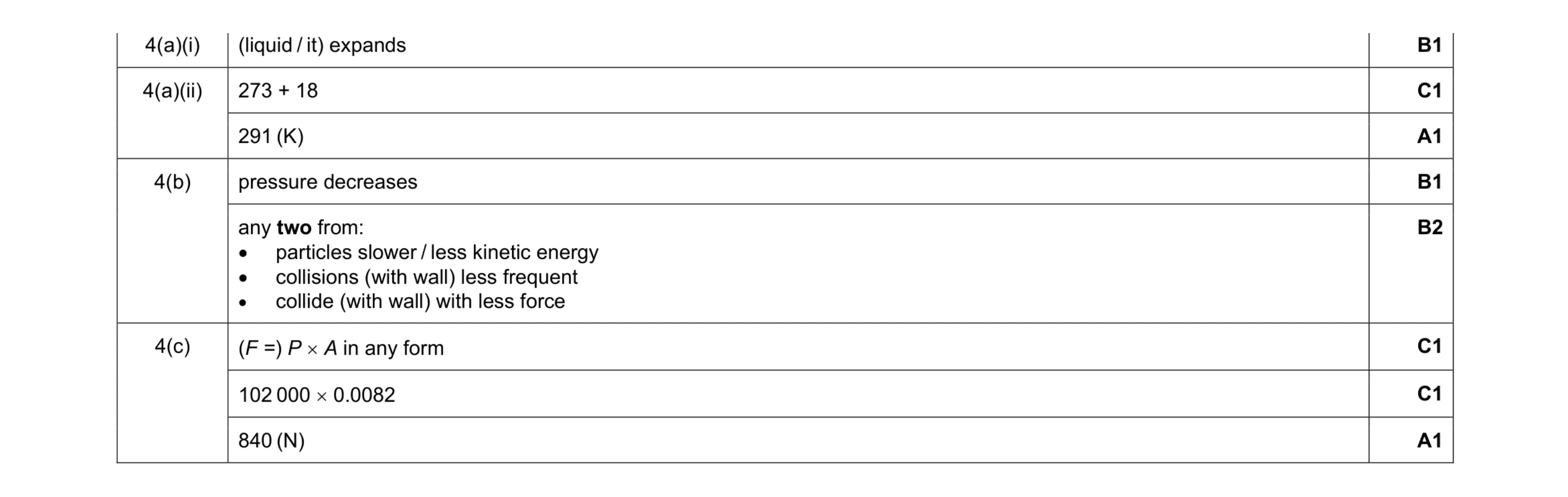 9
9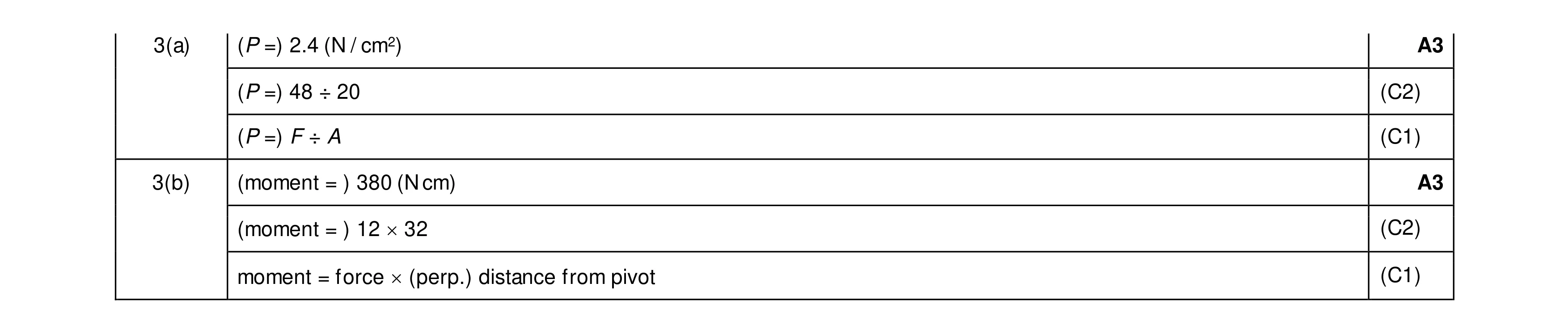 6
6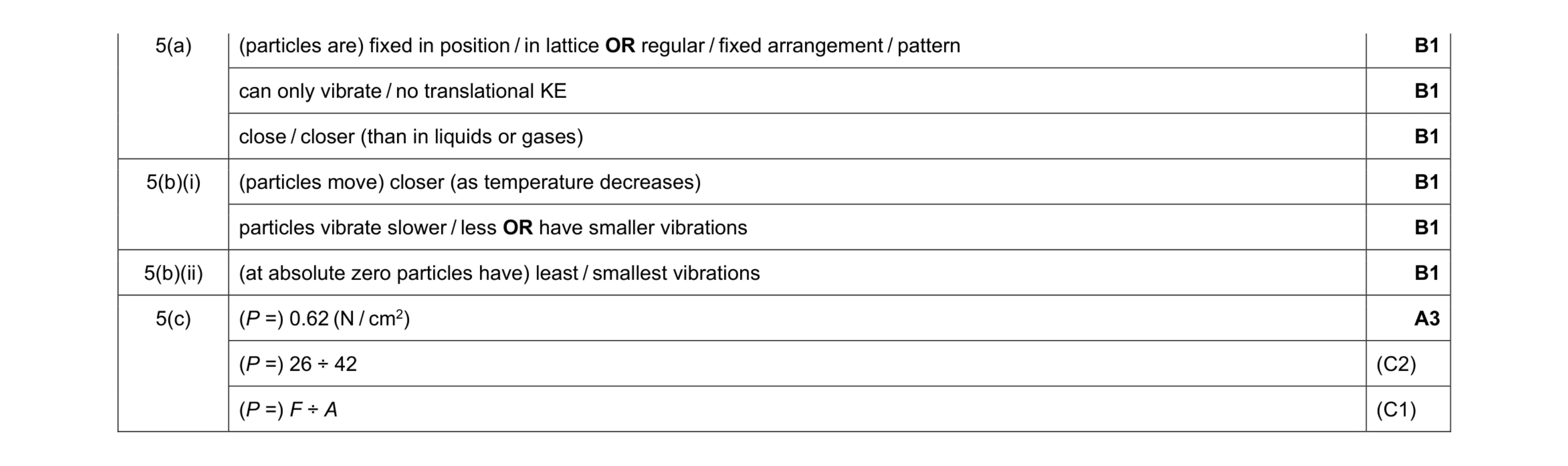 9
9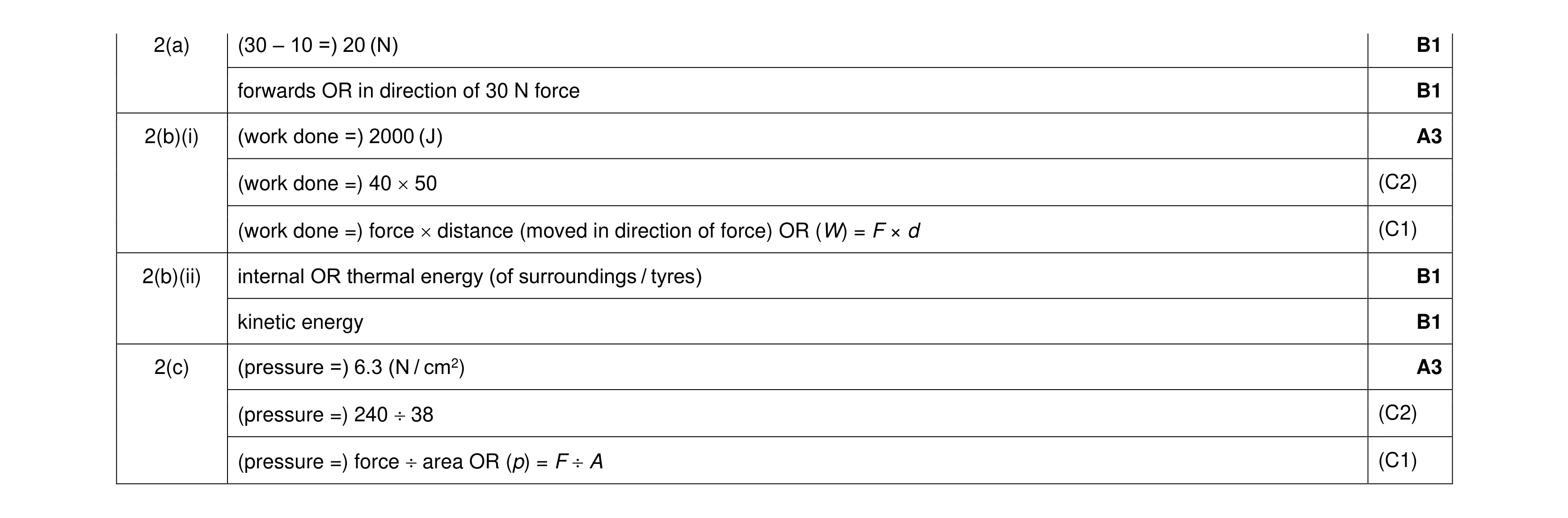 10
10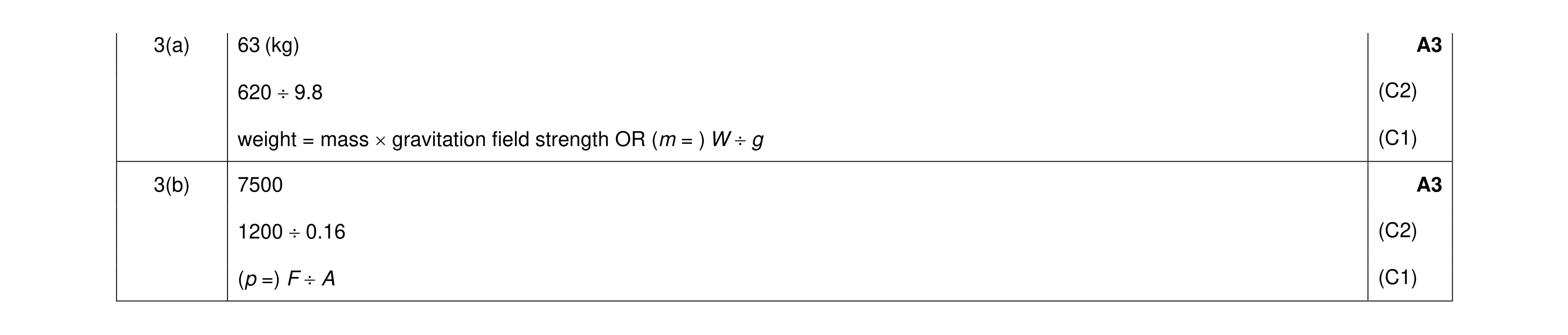 6
6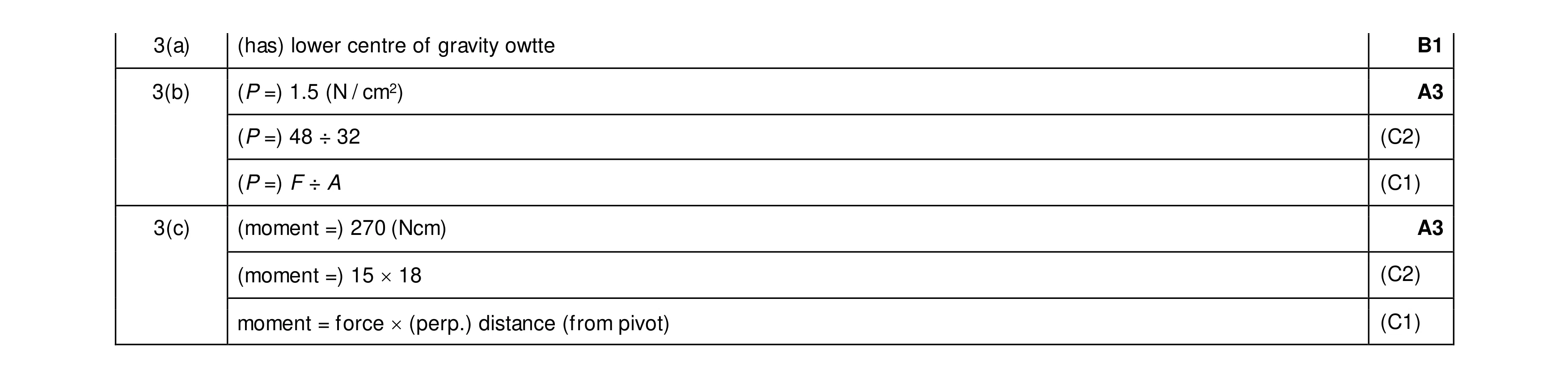 7
7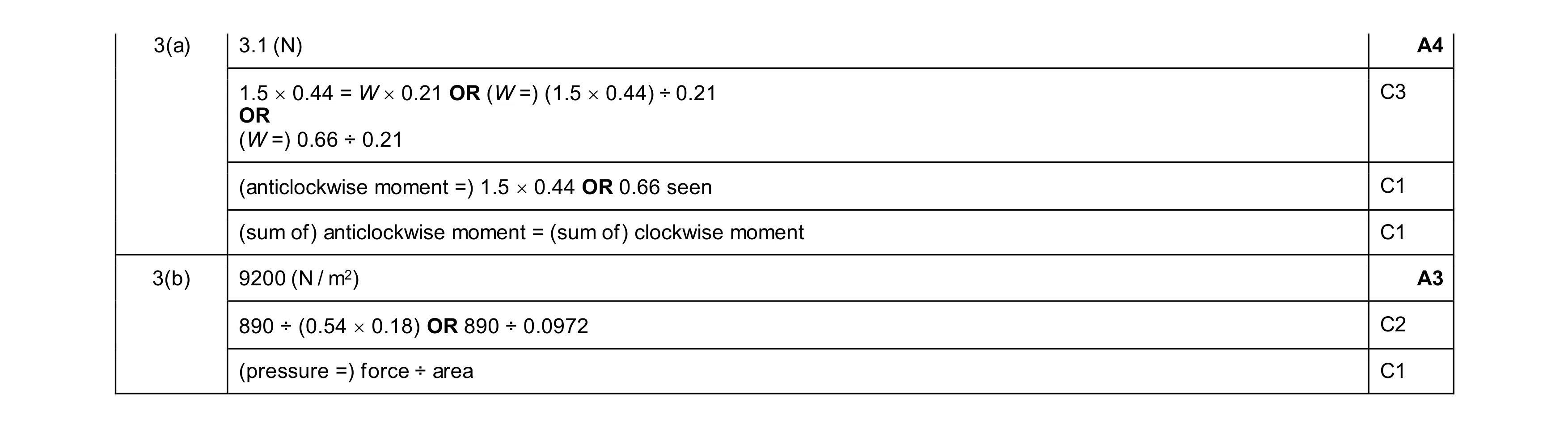 7
7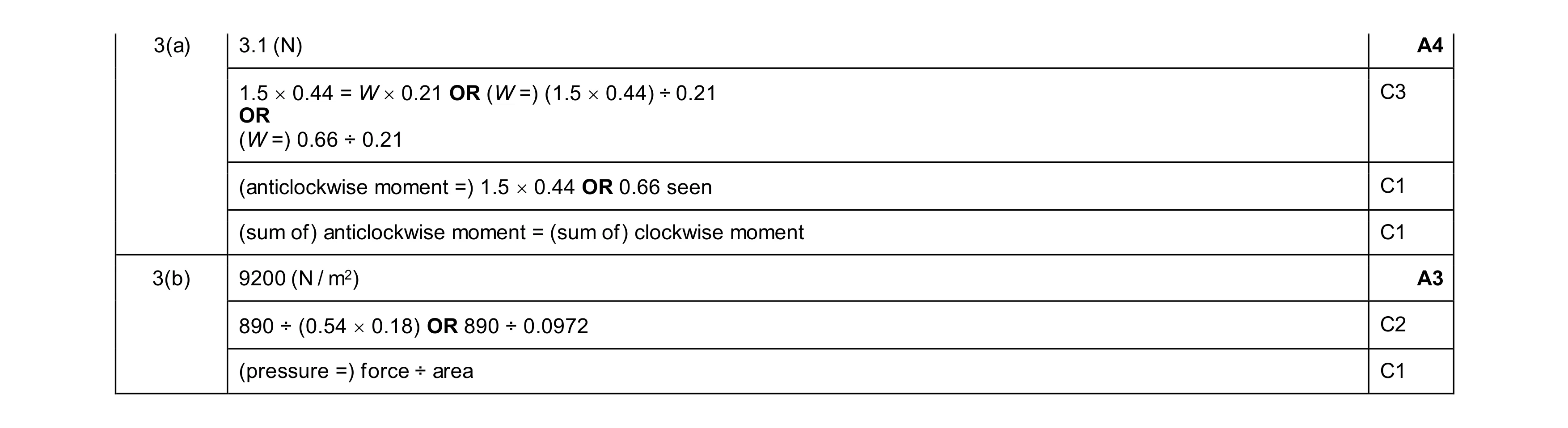 7
7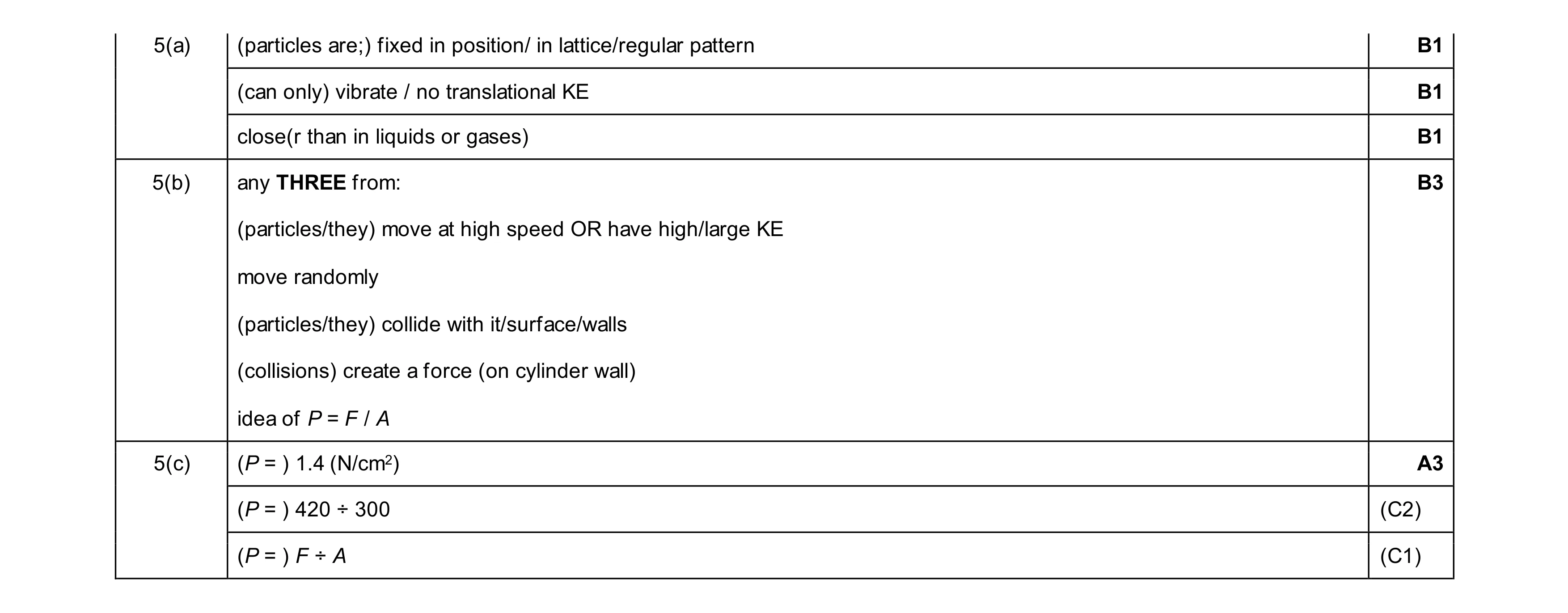 9
9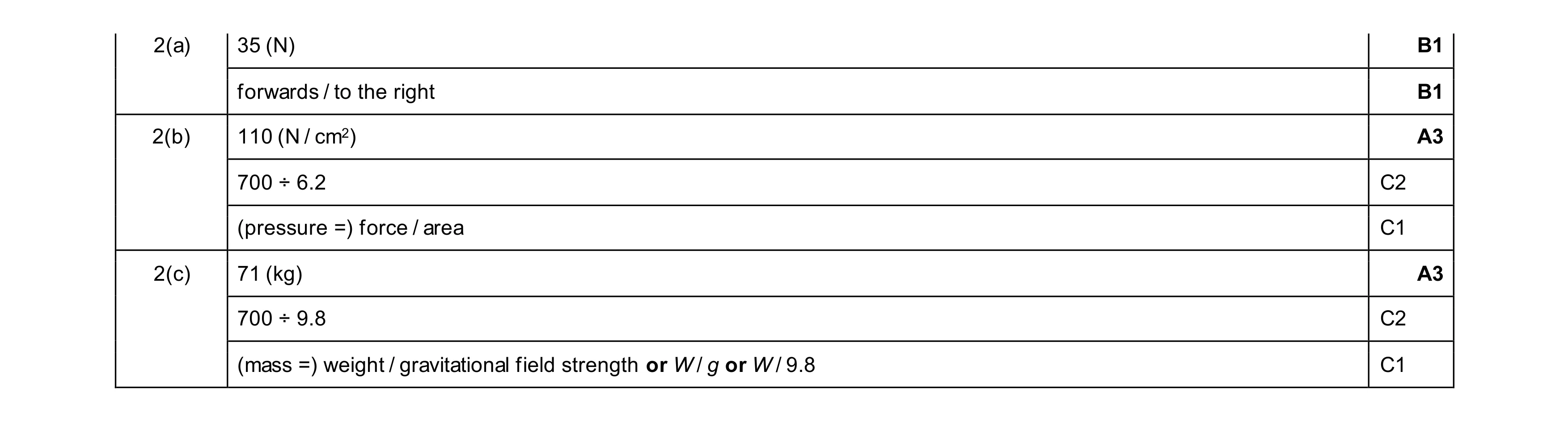 8
8