Questions as text
Q1 · In the braking system of a car, the brake pedal rotates about a pivot when the pedal is… 0625/43 May/June 2017
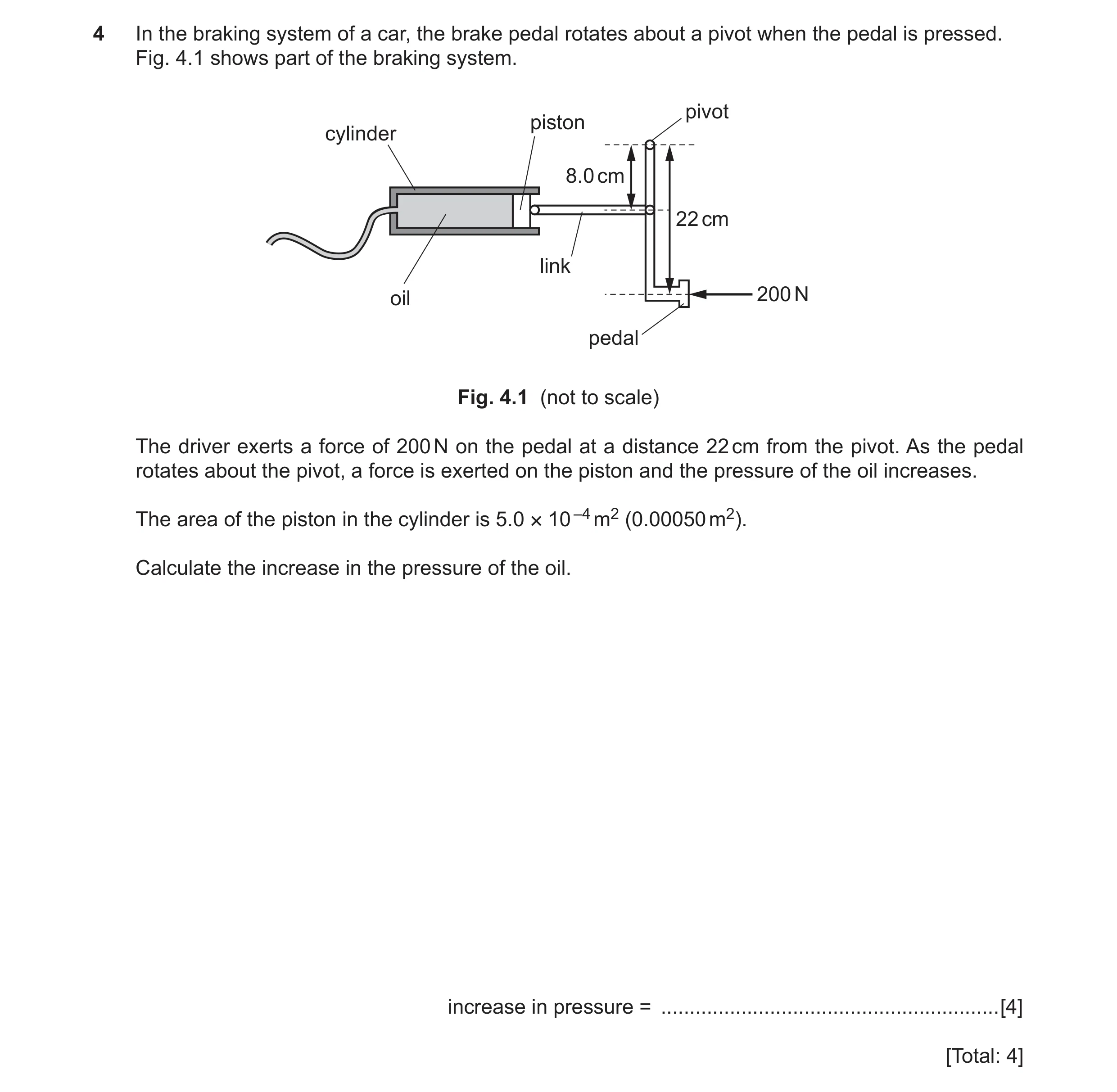
4 In the braking system of a car, the brake pedal rotates about a pivot when the pedal is pressed. Fig. 4.1 shows part of the braking system. pivot piston cylinder 8.0 cm 22 cm link oil 200 N pedal Fig. 4.1 (not to scale) The driver exerts a force of 200 N on the pedal at a distance 22 cm from the pivot. As the pedal rotates about the pivot, a force is exerted on the piston and the pressure of the oil increases. The area of the piston in the cylinder is 5.0 × 10 –4 m2 (0.00050 m2). Calculate the increase in the pressure of the oil. increase in pressure = … [4] [Total: 4]
4 marks
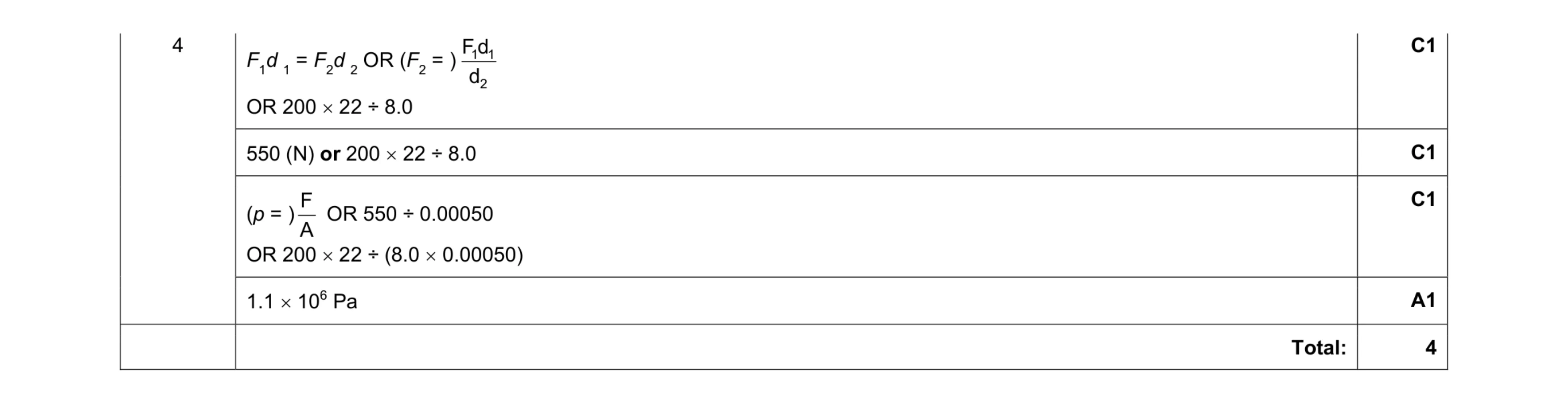
Mark scheme: 4 F1d 1 = F2d 2 OR (F2 = ) 1 1 2 Fd d OR 200 × 22 ÷ 8.0 C1 550 (N) or 200 × 22 ÷ 8.0 C1 (p = ) F A OR 550 ÷ 0.00050 OR 200 × 22 ÷ (8.0 × 0.00050) C1 1.1 × 10⁶ Pa A1 Total: 4
This question in 0625/43 May/June 2017
Q2 · A cylinder made from copper of density 9000 kg / m3 0625/42 Oct/Nov 2017
1 Fig. 1.1 shows a cylinder made from copper of density 9000 kg / m3. Fig. 1.1 The volume of the cylinder is 75 cm3. (a) Calculate the mass of the cylinder. mass = … [2] (b) The gravitational field strength is 10 N / kg. (i) Calculate the weight of the cylinder. weight = … [2] (ii) State one way in which weight differs from mass. … … … [1] (c) Fig. 1.2 shows the cylinder immersed in a liquid. liquid 2.7 cm cylinder Fig. 1.2 (not to scale) The upper face of the cylinder is at a depth of 2.7 cm below the surface of the liquid. The pressure due to the liquid at the upper face of the cylinder is 560 Pa. (i) Calculate the density of the liquid. density = … [2] (ii) Explain why the cylinder does not float in this liquid. … … [1] [Total: 8]
8 marks
Mark scheme: 1(a) OR (m =) 9000 × 7.5 × 10–5 C1 (m =) 0.68 kg accept 680 g A1 1(b)(i) W = m g in any form or (W = ) m g OR (W =) 0. 68 × 10 C1 (W =) 6.8 N A1 1(b)(ii) any one of: weight has direction / mass does not weight is a vector / mass is not weight varies / mass does not mass is amount of matter weight is a force / mass is not B1 1(c)(i) ρ = h ρ g in any form OR (ρ = ) ρ / h g OR (ρ =) 560 / (0.027 × 10) C1 (ρ =) 2.1 × 10³ kg / m3 A1 1(c)(ii) explains why there is a resultant downward force B1
This question in 0625/42 Oct/Nov 2017
Q3 · A measuring cylinder that contains a coloured liquid 0625/43 Oct/Nov 2017
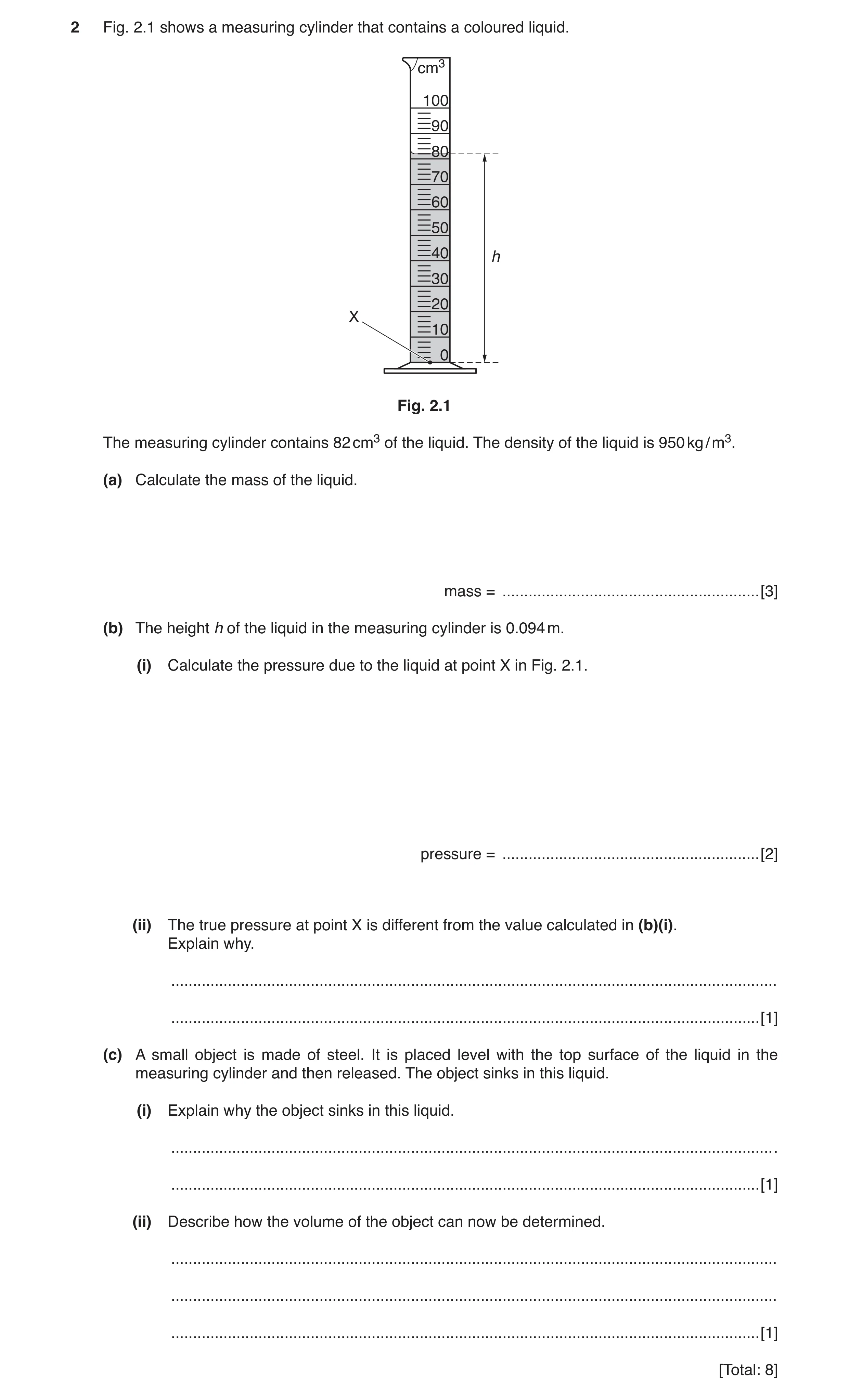
2 Fig. 2.1 shows a measuring cylinder that contains a coloured liquid. cm3 100 90 80 70 60 50 40 h 30 20 X 10 0 Fig. 2.1 The measuring cylinder contains 82 cm3 of the liquid. The density of the liquid is 950 kg / m3. (a) Calculate the mass of the liquid. mass = … [3] (b) The height h of the liquid in the measuring cylinder is 0.094 m. (i) Calculate the pressure due to the liquid at point X in Fig. 2.1. pressure = … [2] (ii) The true pressure at point X is different from the value calculated in (b)(i). Explain why. … … [1] (c) A small object is made of steel. It is placed level with the top surface of the liquid in the measuring cylinder and then released. The object sinks in this liquid. (i) Explain why the object sinks in this liquid. … … [1] (ii) Describe how the volume of the object can now be determined. … … … [1] [Total: 8]
8 marks
Mark scheme: 2(a) C1 7.8 / 7.79 × 10N (where N is a integer) C1 0.078 / 0.0779 kg or 78 / 77.9 g A1 2(b)(i) (p = )hρ g or 0.094 × 950 × 10 C1 890 / 893 Pa A1 2(b)(ii) atmospheric pressure (is acting) B1 2(c)(i) steel is denser (than liquid) or denser than 950 kg / m3 B1 2(c)(ii) take new reading and subtract 82 (cm3) / original reading B1
This question in 0625/43 Oct/Nov 2017
Q4 · A rectangular container has a base of dimensions 0.12 m × 0.16 m 0625/41 May/June 2018
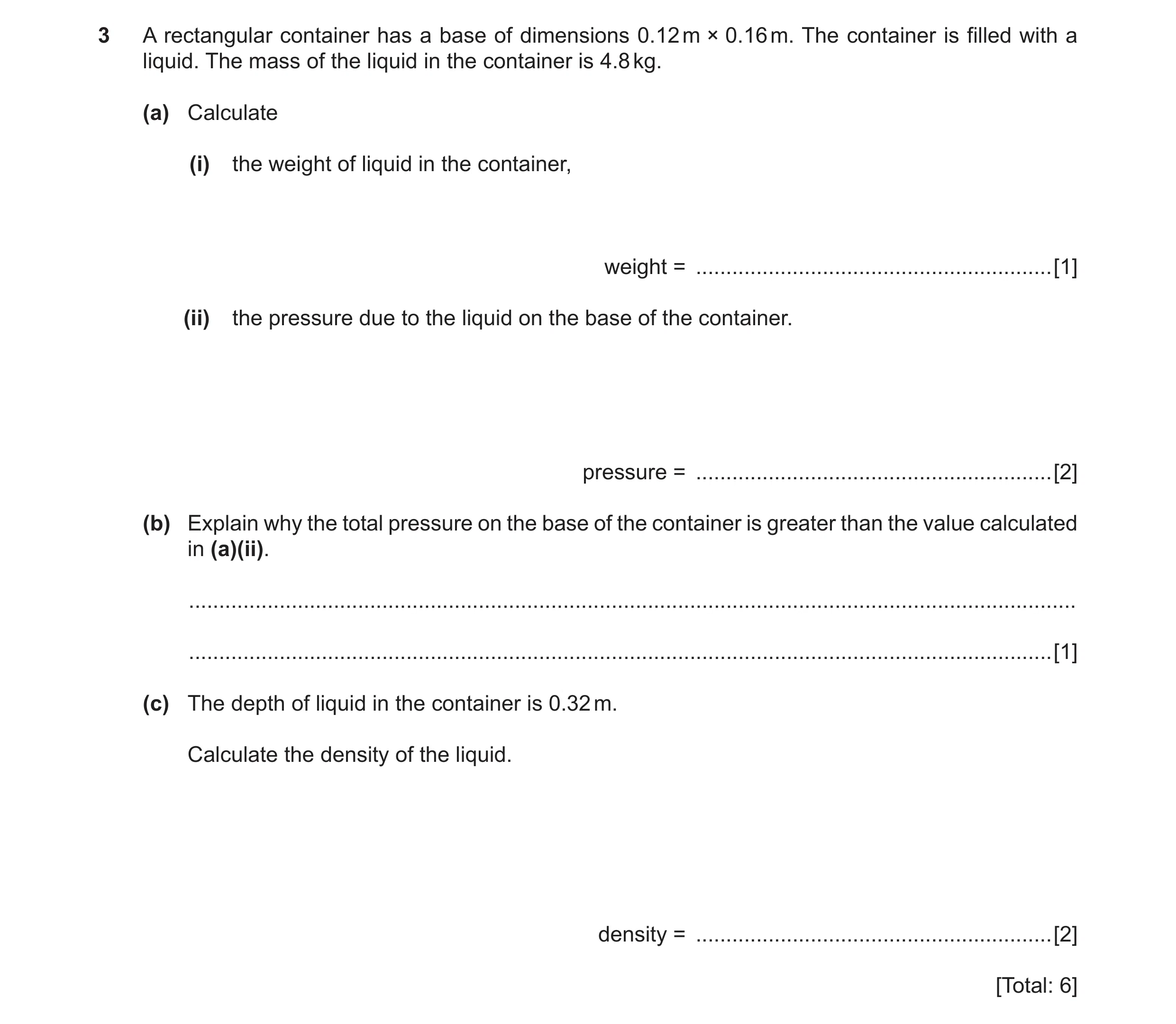
3 A rectangular container has a base of dimensions 0.12 m × 0.16 m. The container is filled with a liquid. The mass of the liquid in the container is 4.8 kg. (a) Calculate (i) the weight of liquid in the container, weight = … [1] (ii) the pressure due to the liquid on the base of the container. pressure = … [2] (b) Explain why the total pressure on the base of the container is greater than the value calculated in (a)(ii). … … [1] (c) The depth of liquid in the container is 0.32 m. Calculate the density of the liquid. density = … [2] [Total: 6]
6 marks
Mark scheme: 3(a)(i) 1 3(a)(ii) (P = ) F ÷ A OR 48 ÷ (0.12 × 0.16) 1 2500 Pa 1 3(b) Atmospheric pressure (in addition to liquid pressure) 1 3(c) P = hdg or in words OR (d =) P ÷ hg OR 2500 ÷ (0.32 × 10) 1 780 kg / m3 1 OR d = M ÷ V = 4.8 ÷ (0.12 × 0.16 × 0.32) (1) 780 kg / m3 (1)
This question in 0625/41 May/June 2018
Q5 · A hollow metal cylinder containing air, floating in the sea 0625/42 May/June 2018
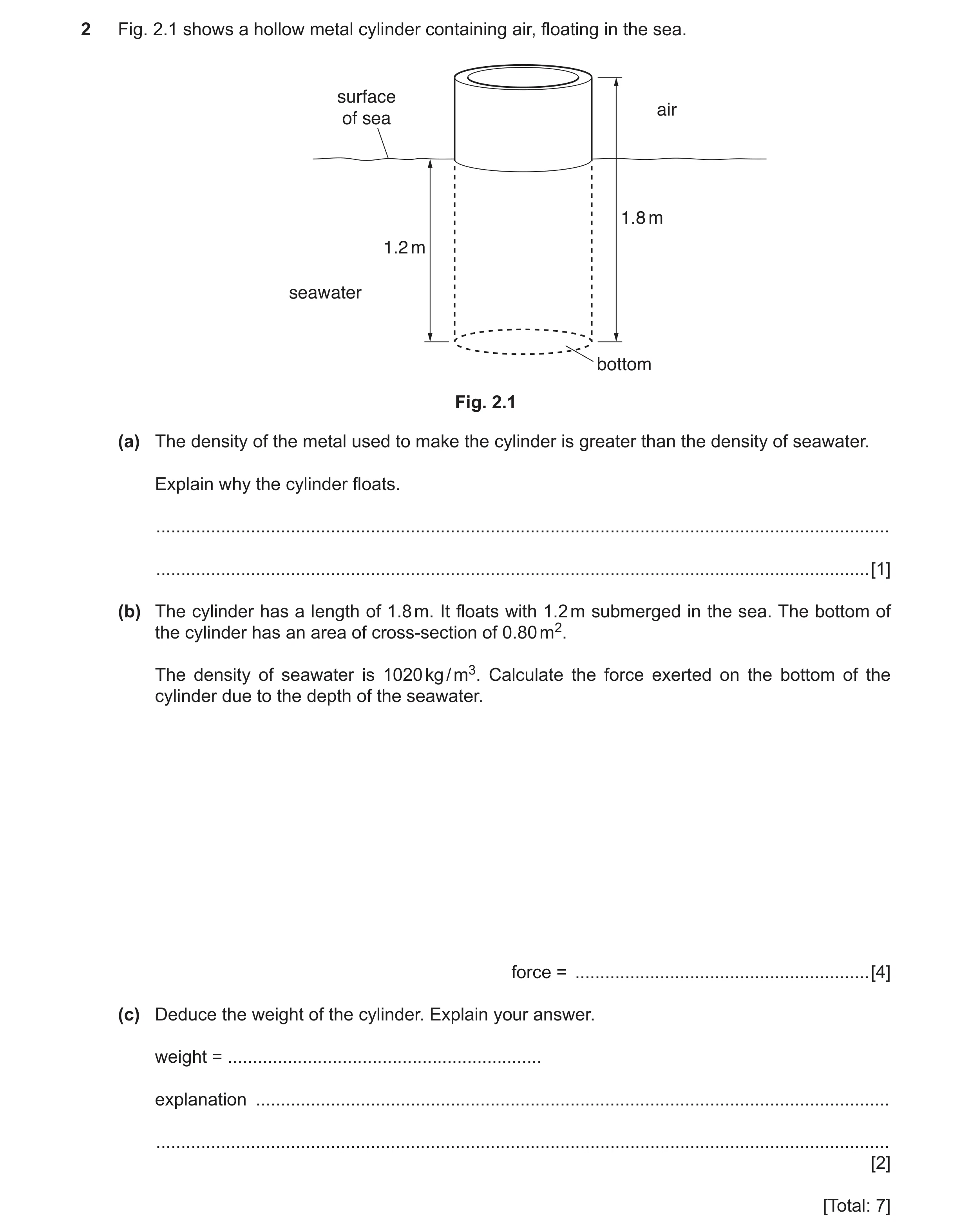
2 Fig. 2.1 shows a hollow metal cylinder containing air, floating in the sea. surface air of sea 1.8 m 1.2 m seawater bottom Fig. 2.1 (a) The density of the metal used to make the cylinder is greater than the density of seawater. Explain why the cylinder floats. … … [1] (b) The cylinder has a length of 1.8 m. It floats with 1.2 m submerged in the sea. The bottom of the cylinder has an area of cross-section of 0.80 m2. The density of seawater is 1020 kg / m3. Calculate the force exerted on the bottom of the cylinder due to the depth of the seawater. force = … [4] (c) Deduce the weight of the cylinder. Explain your answer. weight = … explanation … … [2] [Total: 7]
7 marks
Mark scheme: 2(a) average/overall/combined density (of the metal and air contained) less (than density of sea water) 1 2(b) (P =) h × ρ × g OR (V=) A × l in any form 1 (P= 1.2 × 1020 × 10 =) 12 000 (Pa) OR (V= 0.8 × 1.2 = ) 0.96 (m3) 1 P = F ÷ A OR (F =) P × A OR (W =) V × ρ × g 1 (F = 12240 × 0.80 =) 9800 N OR (F = W = ) 9800 N 1 2(c) same numerical answer as (b) 1 resultant/net (vertical) force = 0 OR downward force = upward force OR forces are balanced 1
This question in 0625/42 May/June 2018
Q6 · On a particular day, the atmospheric pressure is 1.0 × 10⁵ Pa 0625/43 May/June 2018
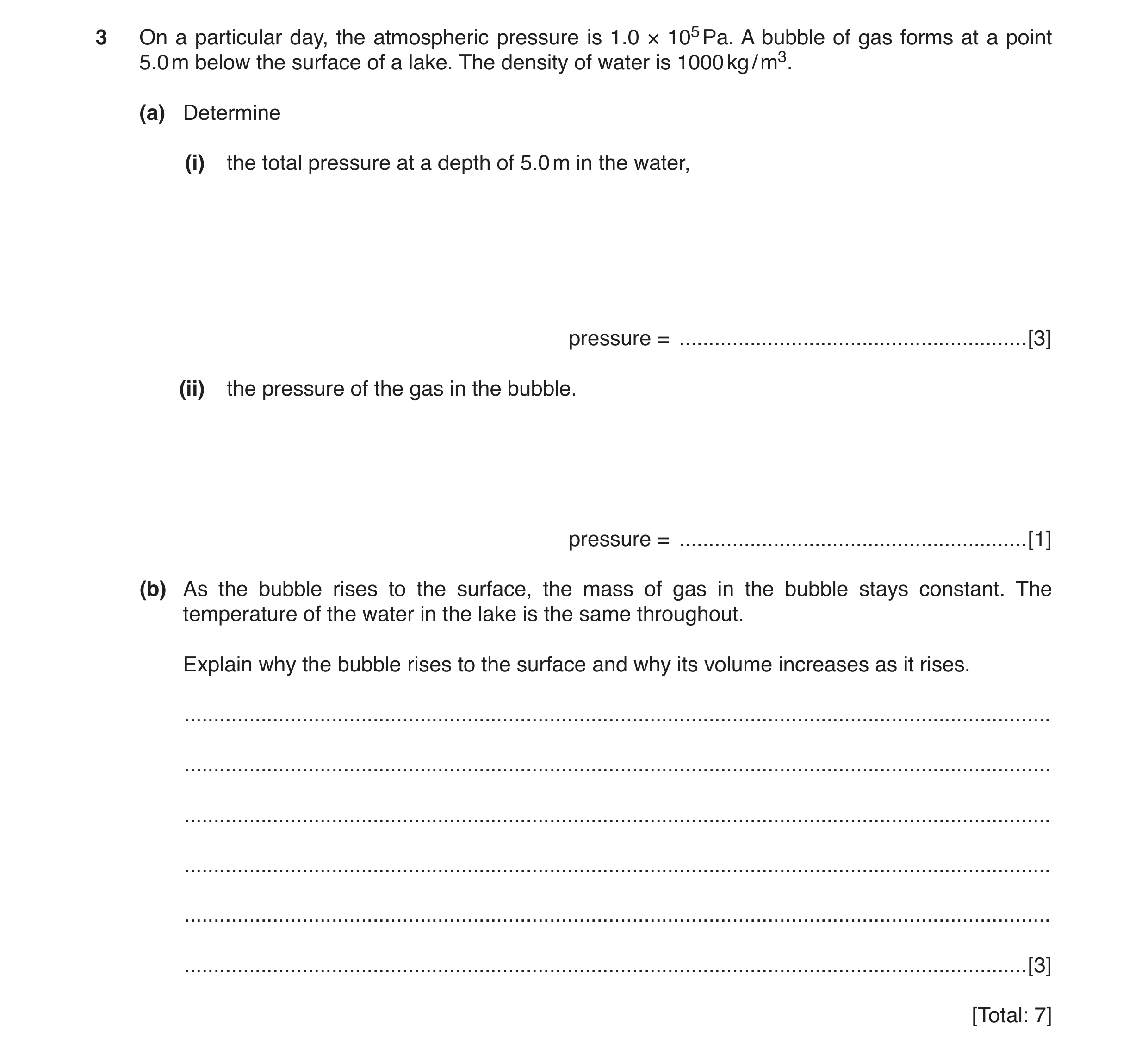
3 On a particular day, the atmospheric pressure is 1.0 × 10⁵ Pa. A bubble of gas forms at a point 5.0 m below the surface of a lake. The density of water is 1000 kg / m3. (a) Determine (i) the total pressure at a depth of 5.0 m in the water, pressure = … [3] (ii) the pressure of the gas in the bubble. pressure = … [1] (b) As the bubble rises to the surface, the mass of gas in the bubble stays constant. The temperature of the water in the lake is the same throughout. Explain why the bubble rises to the surface and why its volume increases as it rises. … … … … … … [3] [Total: 7]
7 marks
Mark scheme: 3(a)(i) C1 50 000 (Pa) C1 (total pressure = 50 000 + 1.0 × 105 =) 1.5 × 10⁵Pa A1 3(a)(ii) 1.5 × 10⁵ Pa B1 3(b) (rises because) density of gas is less than density of OR resultant upward force on bubble B1 (as bubble rises) pressure (of gas in bubble) decreases B1 (volume of bubble increases because) p × V = constant OR V∝ 1 ÷ p B1
This question in 0625/43 May/June 2018
Q7 · Liquid in a cylinder 0625/41 Oct/Nov 2018
4 (a) Fig. 4.1 shows liquid in a cylinder. cylinder liquid Fig. 4.1 The depth of the liquid is 10 cm and the radius of the cylinder is 3.0 cm. The weight of the liquid in the cylinder is 2.5 N. Calculate the density of the liquid. density = … [3] (b) Fig. 4.2 shows a device that measures the pressure of a gas supply. gas supply h liquid Fig. 4.2 (i) State the name of the device. … [1] (ii) The difference h between the two liquid levels is 2.0 cm. The density of the liquid is 800 kg / m3. Calculate the difference between the pressure of the gas and atmospheric pressure. pressure difference = … [2] (iii) A similar device with a tube of smaller cross-sectional area is connected to a gas supply at the same pressure. State and explain any effect on the value of h. … … … [2] [Total: 8]
8 marks
Mark scheme: 4(a) C1 volume = (π × 0.032 × 0.1 = 2.8 × 10⁻⁴ (m3)) C1 density = (0.25 / 2.8 × 10⁻⁴) = 890 kg / m3 A1 OR mass = 250 (g) OR ρ = m / V volume = (π × 32 × 10 =) 280 cm3 density = (250 / 280 =) 0.89 g / cm3 OR ρ = F / A = hρg ρ = F / Ahg OR 2.5 / π × 0.032 × 0.1 × 10 = 890 kg / m3 4(b)(i) manometer B1 4(b)(ii) (P =) hdg OR 0.02 × 800 × 10 C1 160 Pa A1 4(b)(iii) Value of h stays the same M1 Difference in height not dependent on cross-sectional area of tube OR Pressure of a liquid column depends only on values of h, d and g A1
This question in 0625/41 Oct/Nov 2018
Q8 · Liquid in a cylinder 0625/42 Oct/Nov 2018
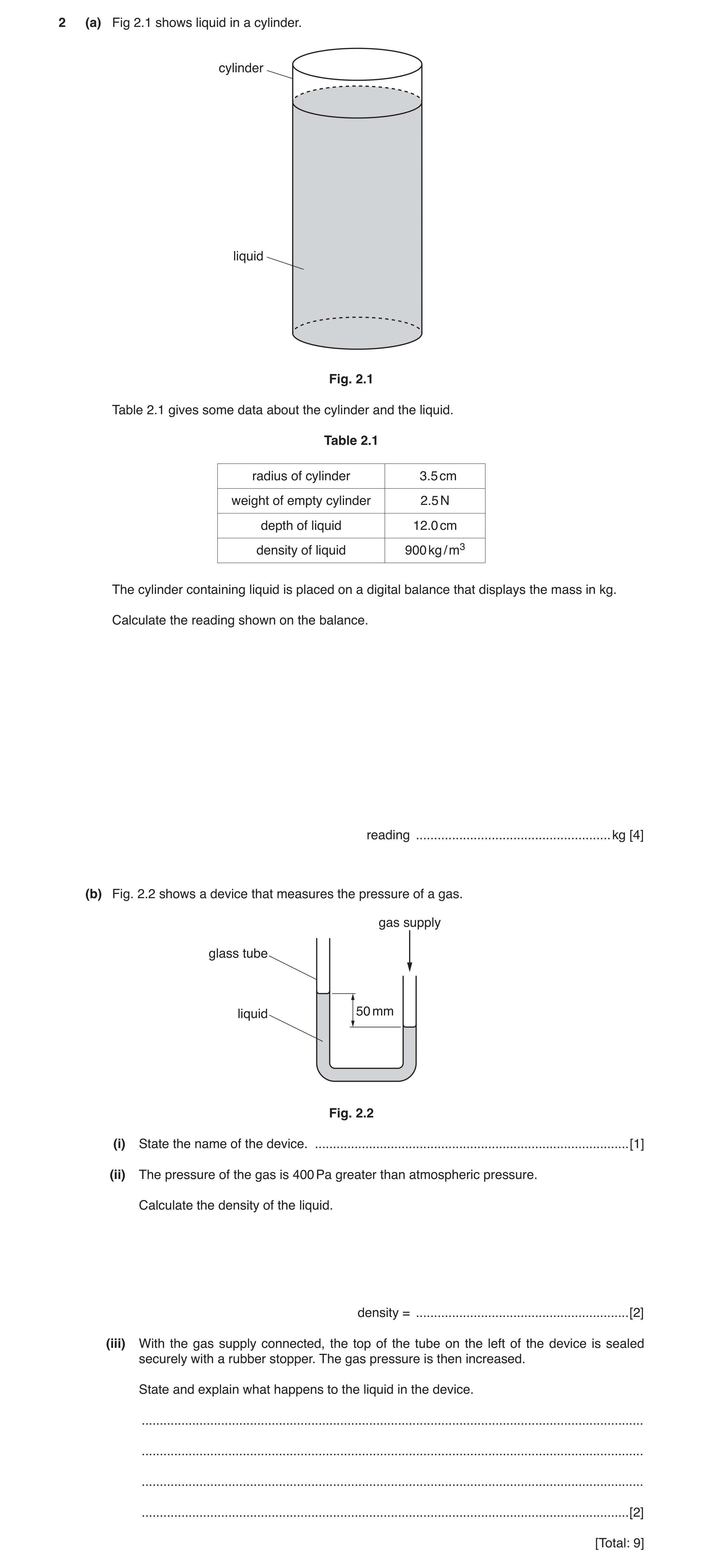
2 (a) Fig 2.1 shows liquid in a cylinder. cylinder liquid Fig. 2.1 Table 2.1 gives some data about the cylinder and the liquid. Table 2.1 radius of cylinder 3.5 cm weight of empty cylinder 2.5 N depth of liquid 12.0 cm density of liquid 900 kg / m3 The cylinder containing liquid is placed on a digital balance that displays the mass in kg. Calculate the reading shown on the balance. reading … kg [4] (b) Fig. 2.2 shows a device that measures the pressure of a gas. gas supply glass tube liquid 50 mm Fig. 2.2 (i) State the name of the device. … [1] (ii) The pressure of the gas is 400 Pa greater than atmospheric pressure. Calculate the density of the liquid. density = … [2] (iii) With the gas supply connected, the top of the tube on the left of the device is sealed securely with a rubber stopper. The gas pressure is then increased. State and explain what happens to the liquid in the device. … … … … [2] [Total: 9]
9 marks
Mark scheme: 2(a) C1 ρ = m / V in any form OR (m =) ρV C1 (mass = 900 × 4.62 × 10–4 = ) 0.41 (kg) A1 0.66 kg or 250 g or 0.25 kg correctly added to previous result B1 2(b)(i) manometer B1 2(b)(ii) P = ρgh in any form or (ρ =) P / gh C1 (ρ = 400 / (10 × 0.05) = ) 800 kg / m3 A1 2(b)(iii) liquid on left goes further up tube B1 pressure of gas greater than air pressure + pressure from liquid column B1
This question in 0625/42 Oct/Nov 2018
Q9 · The density of mercury is 1.4 × 10⁴ kg / m3 0625/43 Oct/Nov 2018
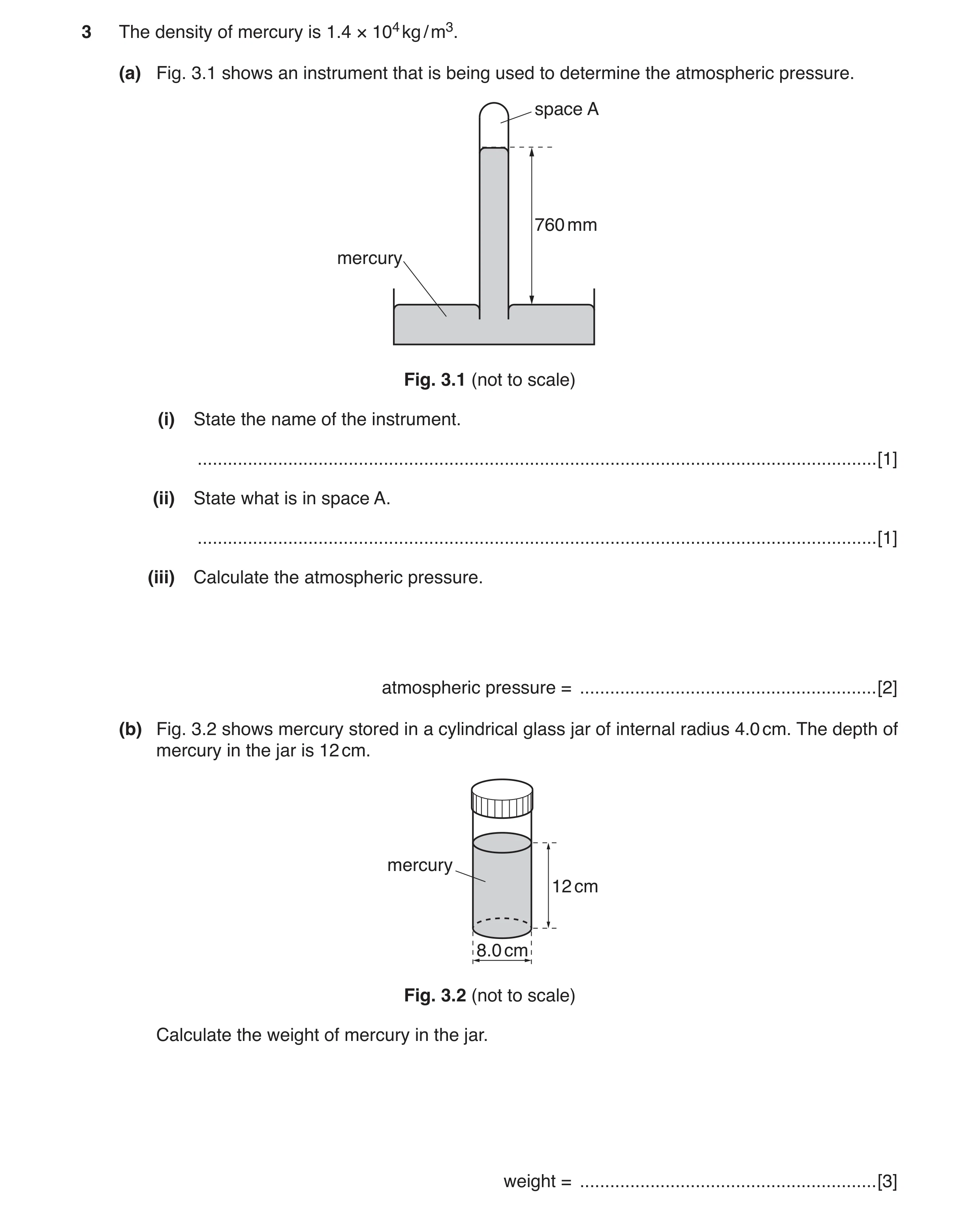
3 The density of mercury is 1.4 × 10⁴ kg / m3. (a) Fig. 3.1 shows an instrument that is being used to determine the atmospheric pressure. space A 760 mm mercury Fig. 3.1 (not to scale) (i) State the name of the instrument. … [1] (ii) State what is in space A. … [1] (iii) Calculate the atmospheric pressure. atmospheric pressure = … [2] (b) Fig. 3.2 shows mercury stored in a cylindrical glass jar of internal radius 4.0 cm. The depth of mercury in the jar is 12 cm. mercury 12 cm 8.0 cm Fig. 3.2 (not to scale) Calculate the weight of mercury in the jar. weight = … [3]
7 marks
Mark scheme: 3(a)(i) (mercury) barometer B1 3(a)(ii) vacuum or nothing or (low pressure) mercury vapour B1 3(a)(iii) (p) = hρ g or 0.76 × 1.4 × 104 × 10 C1 1.1 × 10⁵ Pa A1 3(b) (m =)ρ V or ρ πr 2l or ρ πd2l / 4 or in numbers C1 (W =)ρ Vg or ρ πr 2l g or ρ πd 2l g / 4 or in numbers C1 84 N A1
This question in 0625/43 Oct/Nov 2018
Question 10 0625/42 Feb/March 2019
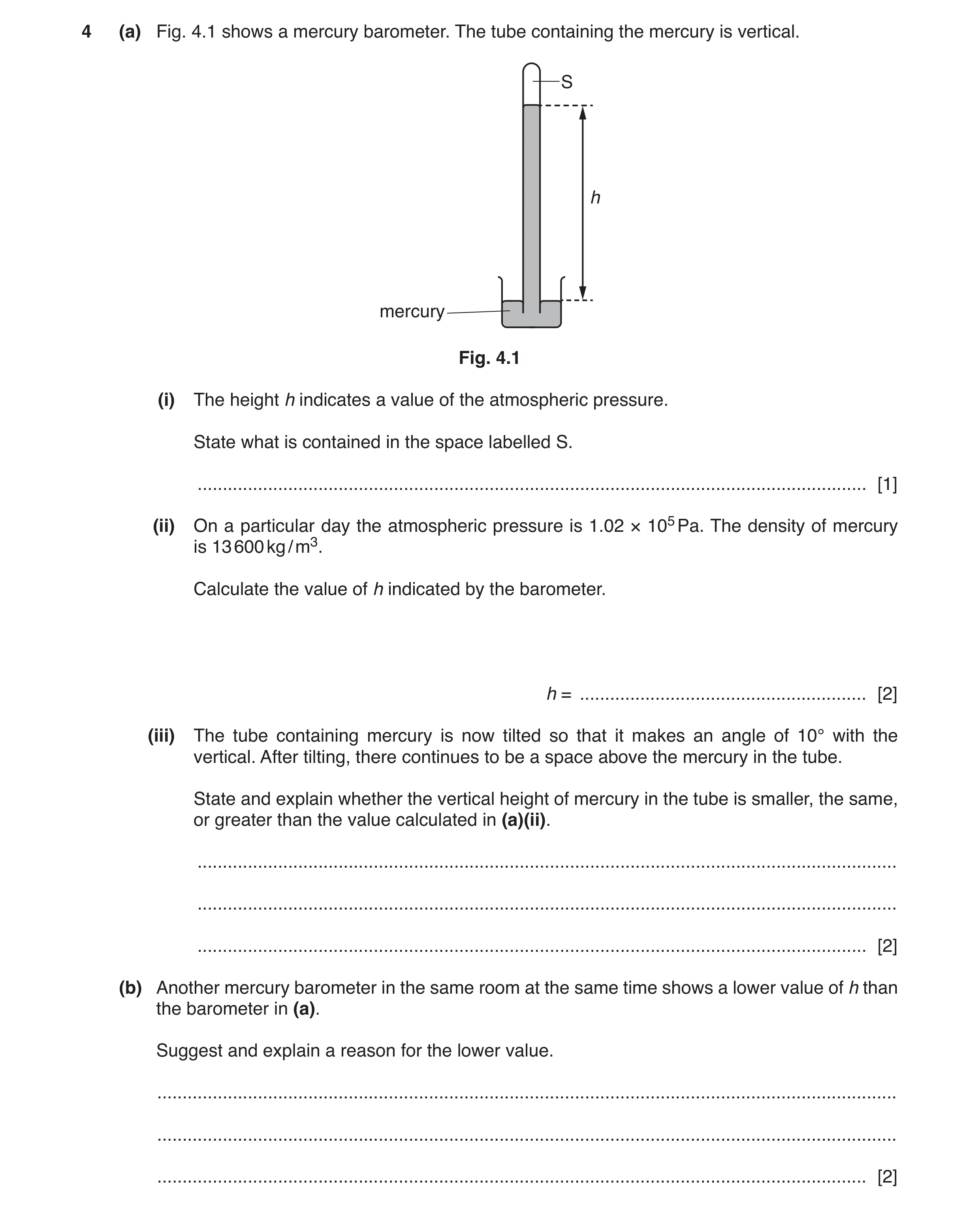
4 (a) Fig. 4.1 shows a mercury barometer. The tube containing the mercury is vertical. S h mercury Fig. 4.1 (i) The height h indicates a value of the atmospheric pressure. State what is contained in the space labelled S. … [1] (ii) On a particular day the atmospheric pressure is 1.02 × 10⁵ Pa. The density of mercury is 13 600 kg / m3. Calculate the value of h indicated by the barometer. h = … [2] (iii) The tube containing mercury is now tilted so that it makes an angle of 10° with the vertical. After tilting, there continues to be a space above the mercury in the tube. State and explain whether the vertical height of mercury in the tube is smaller, the same, or greater than the value calculated in (a)(ii). … … … [2] (b) Another mercury barometer in the same room at the same time shows a lower value of h than the barometer in (a). Suggest and explain a reason for the lower value. … … … [2]
7 marks
Mark scheme: 4(a)(i) Vacuum OR nothing OR mercury vapour B1 4(a)(ii) P = hρg in any form OR (h =) P / ρg OR 1.02 × 10⁵ / (13 600 × 10) C1 0.75 m A1 Question Answer Marks 4(a)(iii) Same vertical height (of mercury) M1 Pressure due to column of liquid depends on vertical height OR in formula P = hρg, h is vertical height OR the pressure remains constant because ρ and g don’t change, nor does h. A1 4(b) Air is present in the space labelled S OR above the mercury in the tube M1 This air exerts a (downward) pressure on the mercury A1
This question in 0625/42 Feb/March 2019
Question 11 0625/42 Feb/March 2019
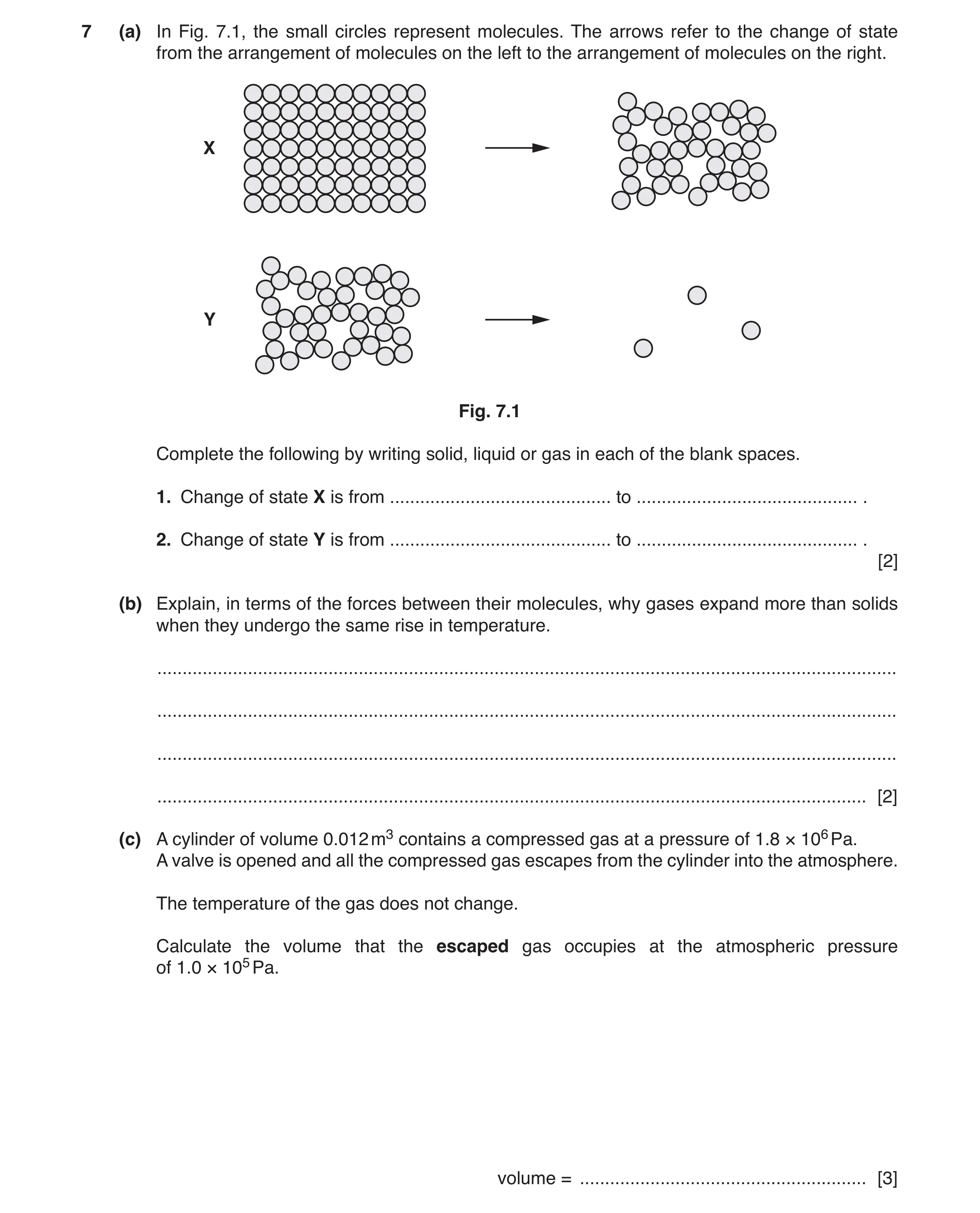
7 (a) In Fig. 7.1, the small circles represent molecules. The arrows refer to the change of state from the arrangement of molecules on the left to the arrangement of molecules on the right. X Y Fig. 7.1 Complete the following by writing solid, liquid or gas in each of the blank spaces. 1. Change of state X is from … to … . 2. Change of state Y is from … to … . [2] (b) Explain, in terms of the forces between their molecules, why gases expand more than solids when they undergo the same rise in temperature. … … … … [2] (c) A cylinder of volume 0.012 m3 contains a compressed gas at a pressure of 1.8 × 10⁶ Pa. A valve is opened and all the compressed gas escapes from the cylinder into the atmosphere. The temperature of the gas does not change. Calculate the volume that the escaped gas occupies at the atmospheric pressure of 1.0 × 10⁵ Pa. volume = … [3]
7 marks
Mark scheme: 7(a) 1. Solid to liquid B1 2. Liquid to gas / vapour B1 7(b) (Neighbouring) molecules of solid have (strong) forces of attraction between them OR Gas molecules have no / weak forces of attraction between them B1 Easier to increase separation of gas molecules (than solid molecules) (gas expands more easily so) gas molecules move farther apart B1 7(c) PV = constant OR P1V1= P2V2 OR 0.012 × 1.8 × 106 = V2 × 1.0 × 105 C1 V2 = 0.216 m3 OR 0.22 m3 A1 (Volume of escaped gas = 0.22 – 0.012 =) 0.21 m3 B1
This question in 0625/42 Feb/March 2019
Q12 · A cube of side 0.040 m is floating in a container of liquid 0625/41 May/June 2019
3 A cube of side 0.040 m is floating in a container of liquid. Fig. 3.1 shows that the surface of the liquid is 0.028 m above the level of the bottom face of the cube. air 0.040 m cube liquid 0.028 m valve pump Fig. 3.1 The pressure of the air above the cube exerts a force on the top face of the cube. The valve is closed. (a) Explain, in terms of air molecules, how the force due to the pressure of the air is produced. … … … … [3] (b) The density of the liquid in the container is 1500 kg / m3. Calculate: (i) the pressure due to the liquid at a depth of 0.028 m pressure = … [2] (ii) the force on the bottom face of the cube caused by the pressure due to the liquid. force = … [2] (c) The valve is opened and liquid is pumped into the container. The surface of the liquid rises a distance of 0.034 m. The cube remains floating in the liquid with its bottom face 0.028 m below the surface of the liquid. (i) Calculate the work done on the cube by the force in (b)(ii). work done = … [2] (ii) Suggest one reason why this is not an efficient method of lifting up the cube. … … [1] [Total: 10]
10 marks
Mark scheme: 3(a) (air) molecules / they move / collide B1 (air) molecules / they collide with cube / (upper) surface (of cube) / wall B1 impulse exerted (on surface) OR momentum change (of molecules) B1 3(b)(i) p = hρ g in any form OR (p =) hρ g OR 0.028 × 1500 × 10 C1 420 Pa A1 3(b)(ii) F = pA in any form words, symbols or numbers OR (F =) pA OR 420 × 4.02 OR 420 × 0.0402 OR 420 × 16 OR 420 × 1.6 × 10–3 C1 0.67 N A1 3(c)(i) W = Fd in any form words, symbols or numbers OR (W =) Fd OR 0.67 × 0.034 C1 0.023 A1 3(c)(ii) lifting liquid as well OR friction between liquid and container / pipe B1
This question in 0625/41 May/June 2019
Q13 · A small submarine submerged below the surface of the sea 0625/43 May/June 2019
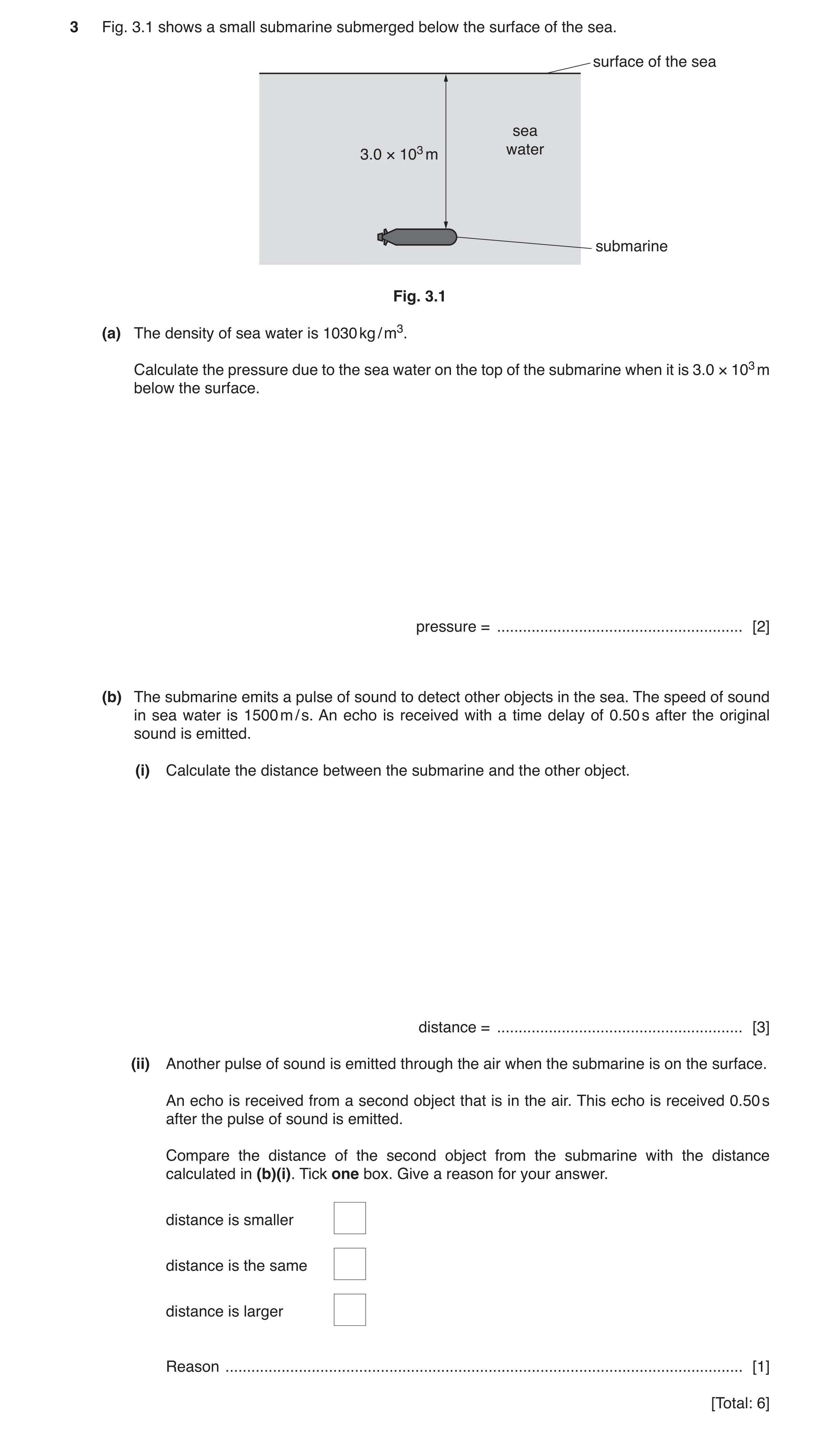
3 Fig. 3.1 shows a small submarine submerged below the surface of the sea. surface of the sea sea water 3.0 × 10³ m submarine Fig. 3.1 (a) The density of sea water is 1030 kg / m3. Calculate the pressure due to the sea water on the top of the submarine when it is 3.0 × 10³ m below the surface. pressure = … [2] (b) The submarine emits a pulse of sound to detect other objects in the sea. The speed of sound in sea water is 1500 m / s. An echo is received with a time delay of 0.50 s after the original sound is emitted. (i) Calculate the distance between the submarine and the other object. distance = … [3] (ii) Another pulse of sound is emitted through the air when the submarine is on the surface. An echo is received from a second object that is in the air. This echo is received 0.50 s after the pulse of sound is emitted. Compare the distance of the second object from the submarine with the distance calculated in (b)(i). Tick one box. Give a reason for your answer. distance is smaller distance is the same distance is larger Reason … [1] [Total: 6]
6 marks
Mark scheme: 3(a) (p) = ρgh in any form OR (p=) 1030 × 10 × 3.0 × 103 C1 3.1 × 10⁷ Pa A1 3(b)(i) v = d/t OR v = 2d/t in any form C1 1500 = 2 0.50 d OR 2d = 1500 × 0.50 C1 380 m A1 3(b)(ii) distance smaller (first box ticked) AND speed of sound lower (in air than liquid) B1
This question in 0625/43 May/June 2019
Q14 · The top view of a tank in an aquarium 0625/43 Oct/Nov 2019
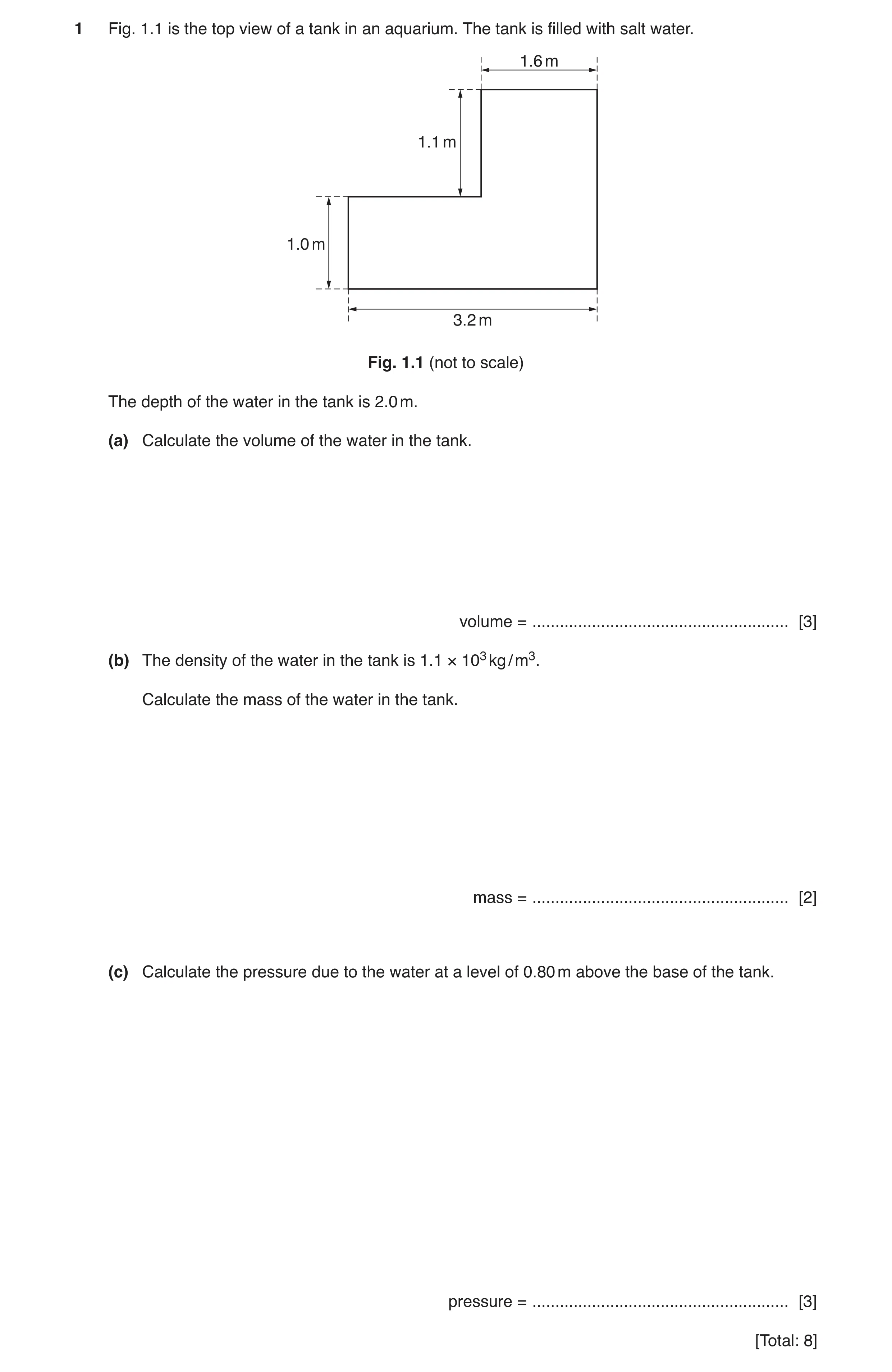
1 Fig. 1.1 is the top view of a tank in an aquarium. The tank is filled with salt water. 1.6 m 1.1 m 1.0 m 3.2 m Fig. 1.1 (not to scale) The depth of the water in the tank is 2.0 m. (a) Calculate the volume of the water in the tank. volume = … [3] (b) The density of the water in the tank is 1.1 × 10³ kg / m3. Calculate the mass of the water in the tank. mass = … [2] (c) Calculate the pressure due to the water at a level of 0.80 m above the base of the tank. pressure = … [3] [Total: 8]
8 marks
Mark scheme: 1(a) attempt to use 2 rectangles for A C1 A = ((1 × 3.2) + (1.1 × 1.6) = 3.2 + 1.76 =) 4.96 (m2) C1 9.9 m3 A1 1(b) ρ = m / V OR m = ρV OR (m =) 9.9 × 1.1 × 103 C1 (m =) 1.1 × 10⁴ kg A1 1(c) depth of water = 1.2 m C1 (P =) ρgh OR (P = 1.1 × 103 × 10 × 1.2) C1 (P =) 1.3 × 10⁴ Pa A1
This question in 0625/43 Oct/Nov 2019
Q15 · Gas trapped in the sealed end of a tube by a dense liquid 0625/41 May/June 2020
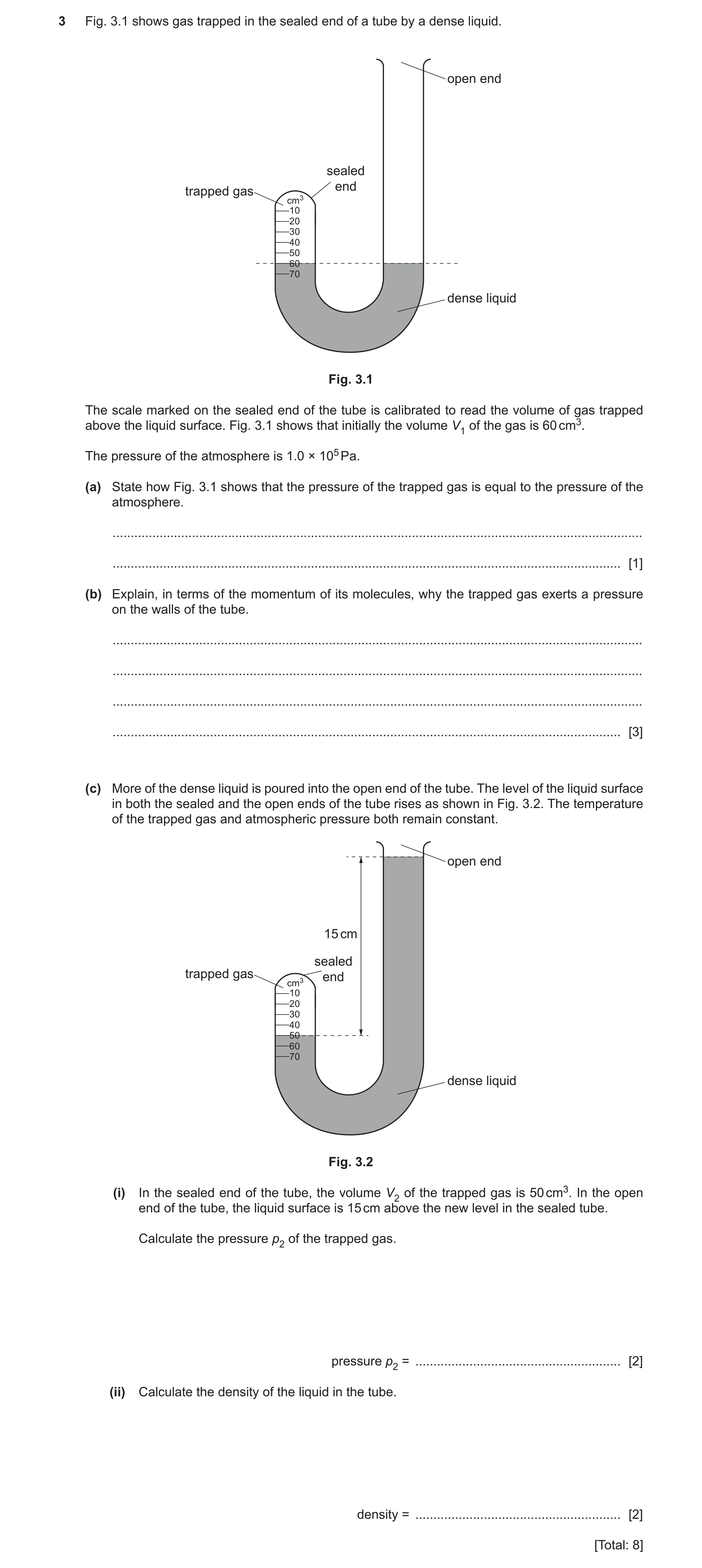
3 Fig. 3.1 shows gas trapped in the sealed end of a tube by a dense liquid. open end sealed end trapped gas cm3 10 20 30 40 50 60 70 dense liquid Fig. 3.1 The scale marked on the sealed end of the tube is calibrated to read the volume of gas trapped above the liquid surface. Fig. 3.1 shows that initially the volume V1 of the gas is 60 cm3. The pressure of the atmosphere is 1.0 × 10⁵ Pa. (a) State how Fig. 3.1 shows that the pressure of the trapped gas is equal to the pressure of the atmosphere. … … [1] (b) Explain, in terms of the momentum of its molecules, why the trapped gas exerts a pressure on the walls of the tube. … … … … [3] (c) More of the dense liquid is poured into the open end of the tube. The level of the liquid surface in both the sealed and the open ends of the tube rises as shown in Fig. 3.2. The temperature of the trapped gas and atmospheric pressure both remain constant. open end 15 cm sealed trapped gas end cm3 10 20 30 40 50 60 70 dense liquid Fig. 3.2 (i) In the sealed end of the tube, the volume V2 of the trapped gas is 50 cm3. In the open end of the tube, the liquid surface is 15 cm above the new level in the sealed tube. Calculate the pressure p2 of the trapped gas. pressure p2 = … [2] (ii) Calculate the density of the liquid in the tube. density = … [2] [Total: 8]
8 marks
Mark scheme: 3(a) liquid levels in the two limbs of the tube are equal B1 3(b) molecules collide with the walls (of the container) B1 momentum of molecules changes (reverses) B1 this causes a force AND force spread out (over area of walls) B1 3(c)(i) (p2 =) p1V1 / V2 = 1.0 × 105 × 60 / 50 C1 1.2 × 10⁵ Pa A1 3(c)(ii) p2 = patm + hρg OR 1.2 × 10⁵ – 1.0 × 10⁵ OR 2.0 × 10⁴ OR (ρ =) 2.0 × 10⁴ / (0.15 × 10) C1 1.3 × 10⁴ kg m–3 A1
This question in 0625/41 May/June 2020
Q16 · A scientist fills a container with sea water 0625/43 May/June 2020
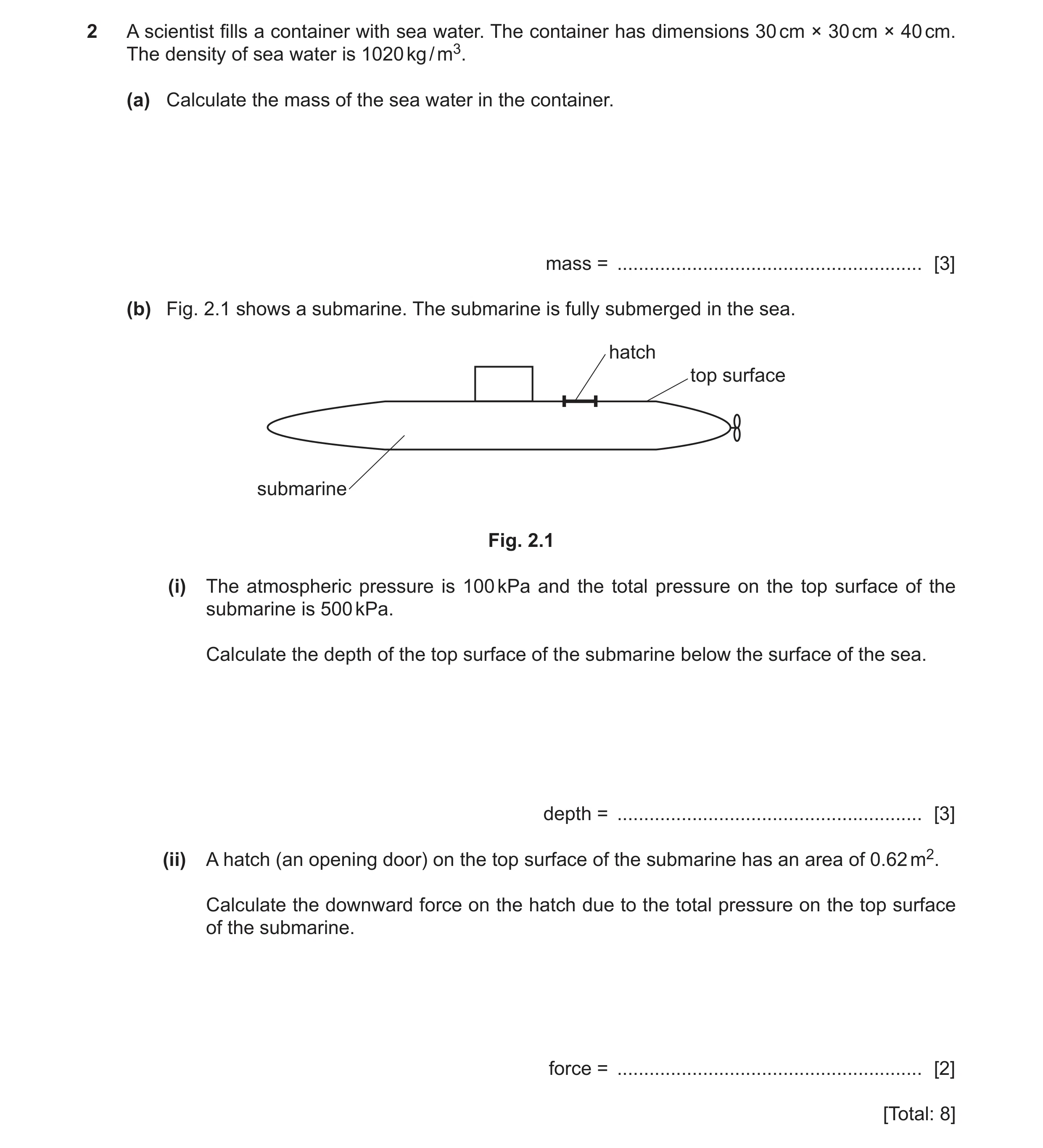
2 A scientist fills a container with sea water. The container has dimensions 30 cm × 30 cm × 40 cm. The density of sea water is 1020 kg / m3. (a) Calculate the mass of the sea water in the container. mass = … [3] (b) Fig. 2.1 shows a submarine. The submarine is fully submerged in the sea. hatch top surface submarine Fig. 2.1 (i) The atmospheric pressure is 100 kPa and the total pressure on the top surface of the submarine is 500 kPa. Calculate the depth of the top surface of the submarine below the surface of the sea. depth = … [3] (ii) A hatch (an opening door) on the top surface of the submarine has an area of 0.62 m2. Calculate the downward force on the hatch due to the total pressure on the top surface of the submarine. force = … [2] [Total: 8]
8 marks
Mark scheme: 2(a) V (= 0.3 × 0.3 × 0.4) = 0.036 (m3) C1 ρ = m / V in any form OR (m =) ρV OR 1020 × 0.036 C1 (m =) 37 kg A1 2(b)(i) P = ρgh in any form C1 (h =) 400 × 103 / (1020 × 10) C1 (h =) 39 m A1 2(b)(ii) P = F / A OR (F =) PA OR 500 × 103 × 0.62 C1 (F =) 310 000 N OR 310 kN A1
This question in 0625/43 May/June 2020
Q17 · A U-shaped tube of constant cross-sectional area contains water of density 1000 kg / m3 0625/41 Oct/Nov 2020
3 A U-shaped tube of constant cross-sectional area contains water of density 1000 kg / m3. Both sides of the U-tube are open to the atmosphere. Fig. 3.1 shows that the water levels in the two sides of the tube are equal. rubber tubing connected to gas supply stopper 0.200 m Fig. 3.1 Fig. 3.2 The atmospheric pressure is 1.00 × 10⁵ Pa. The left-hand side of the tube is now connected to a gas supply using a length of rubber tubing. This causes the level of the water in the left-hand side of the tube to drop by 0.200 m, as shown in Fig. 3.2. (a) Calculate the pressure of the gas supply. Give your answer to 3 significant figures. pressure = … [3] (b) Fig. 3.3 shows that the gas supply is now connected to a cylinder that contains a piston. cylinder open to the rubber tubing atmosphere connected to gas supply piston Fig. 3.3 The pressure of the gas moves the piston to the right. (i) The area of the piston in contact with the gas is 0.025 m2. Calculate the resultant force on the piston. resultant force = … [2] (ii) The pressure of the gas causes the piston to move a distance of 0.50 m to the right. Calculate the work done by the gas from the supply on the piston. work done = … [2] [Total: 7]
7 marks
Mark scheme: 3(a) (pliq =) hρg (in any form) or 0.400 × 1000 × 10 or 2000 or 4000 or 1.02 × 10⁵ (Pa) C1 (p =) patm + hρg (in any form) or 1.00 × 10⁵ + 0.400 × 1000 × 10 or 4000 or 1.02 × 10⁵ (Pa) C1 1.04 × 10⁵ Pa A1 3(b)(i) (F =) pA (in any form) or 4000 × 0.025 C1 100 N A1 3(b)(ii) (W.D. =) F × x (in any form) or 1.04 × 105 × 0.025 × 0.50 or 4000 × 0.025 × 0.50 or 50 (J) C1 1300 J A1
This question in 0625/41 Oct/Nov 2020
Q18 · Explain, in terms of molecules, why liquids are very difficult to compress 0625/41 May/June 2021
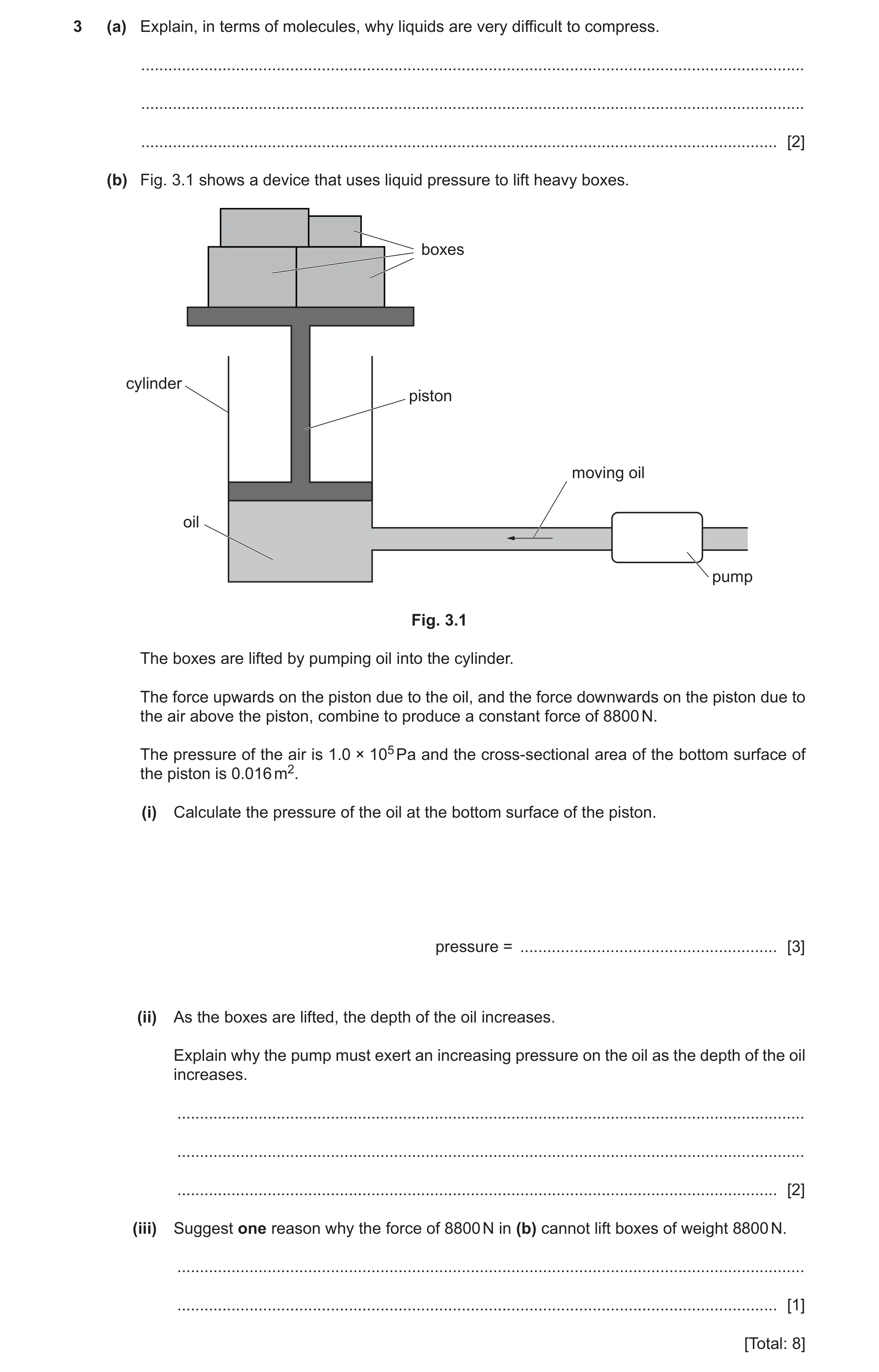
3 (a) Explain, in terms of molecules, why liquids are very difficult to compress. … … … [2] (b) Fig. 3.1 shows a device that uses liquid pressure to lift heavy boxes. boxes cylinder piston moving oil oil pump Fig. 3.1 The boxes are lifted by pumping oil into the cylinder. The force upwards on the piston due to the oil, and the force downwards on the piston due to the air above the piston, combine to produce a constant force of 8800 N. The pressure of the air is 1.0 × 10⁵ Pa and the cross-sectional area of the bottom surface of the piston is 0.016 m2. (i) Calculate the pressure of the oil at the bottom surface of the piston. pressure = … [3] (ii) As the boxes are lifted, the depth of the oil increases. Explain why the pump must exert an increasing pressure on the oil as the depth of the oil increases. … … … [2] (iii) Suggest one reason why the force of 8800 N in (b) cannot lift boxes of weight 8800 N. … … [1] [Total: 8]
8 marks
Mark scheme: 3(a) molecules (already very) close / touching B1 (repulsive) forces (very) large B1 3(b)(i) 6.5 × 10⁵ Pa A3 (p =) F / A in any form or 8800 / 0.016 or (Fair =)1.0 × 105 × 0.016 C1 5.5 × 10⁵ or 5.5 × 10⁵ (+ 1.0 × 10⁵) or (1600 + 8800) / 0.016 C1 3(b)(ii) pressure due to (increased height of) oil in cylinder mentioned or pressure (in liquid) increases as depth increases B1 to keep the upwards force constant or to lift the (extra) oil or to counteract / oppose the increased pressure / force / weight of the oil B1 3(b)(iii) (initial) force has to be greater than 8800 N to start the motion or the upwards force (just) balances the weight (so no movement) or piston / oil has weight or friction (between moving parts) B1
This question in 0625/41 May/June 2021
Q19 · A bookshelf with two groups of books A and B on it 0625/43 May/June 2021
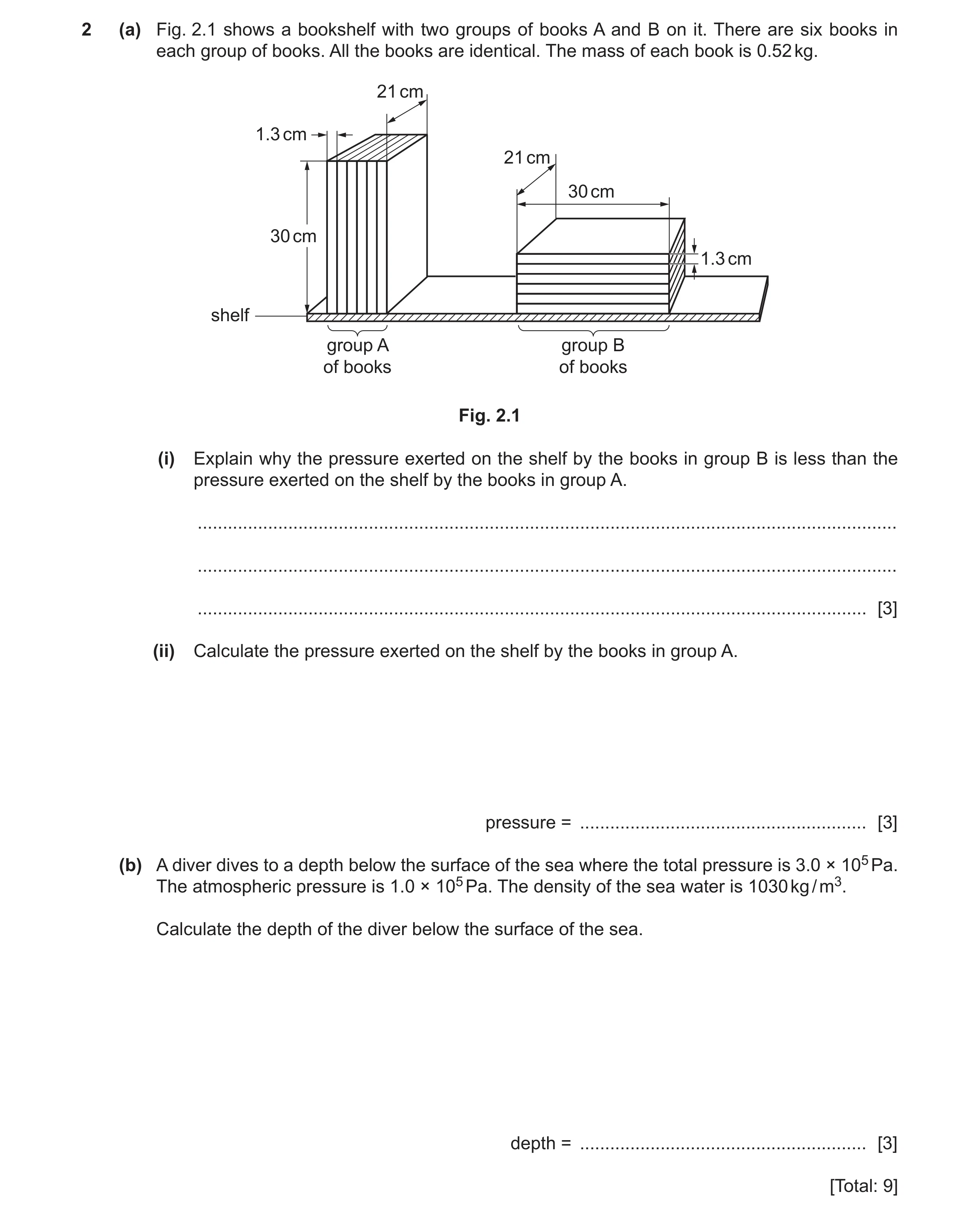
2 (a) Fig. 2.1 shows a bookshelf with two groups of books A and B on it. There are six books in each group of books. All the books are identical. The mass of each book is 0.52 kg. 21 cm 1.3 cm 21 cm 30 cm 30 cm 1.3 cm shelf group A group B of books of books Fig. 2.1 (i) Explain why the pressure exerted on the shelf by the books in group B is less than the pressure exerted on the shelf by the books in group A. … … … [3] (ii) Calculate the pressure exerted on the shelf by the books in group A. pressure = … [3] (b) A diver dives to a depth below the surface of the sea where the total pressure is 3.0 × 10⁵ Pa. The atmospheric pressure is 1.0 × 10⁵ Pa. The density of the sea water is 1030 kg / m3. Calculate the depth of the diver below the surface of the sea. depth = … [3] [Total: 9]
9 marks
Mark scheme: 2(a)(i) pressure = force/area accept P inversely proportional to area B1 same force exerted by each group of books B1 area (in contact with bookshelf) in group B is greater OR area (in contact with bookshelf) in group A is smaller B1 2(a)(ii) (pressure =) 1900 Pa A3 force = 6 × 0.52 × 10 OR 31(.2) seen C1 area = 6 × 0.013 × 0.21 OR 0.016(38) seen OR 163.8 (cm2) C1 Question Answer Marks 2(b) (depth =) 19 m A3 p = ρ gh OR (3.0 – 1.0) × 105 = 1030 × 10 × h in any form C1 h = (3.0 – 1.0) × 105/1030 × 10 OR h = 2.0 × 10⁵/1030 × 10 C1
This question in 0625/43 May/June 2021
Q20 · A gas bubble is released at the bottom of a lake 0625/43 Oct/Nov 2021
3 (a) A gas bubble is released at the bottom of a lake. Atmospheric pressure is 1.0 × 10⁵ Pa. The density of water is 1000 kg / m3. The temperature of the water in the lake is constant. (i) The gas bubble rises to the surface. The volume of the gas bubble increases as it rises higher in the water. Explain why the volume of the bubble increases. … … … [2] (ii) The volume of the gas bubble is 0.40 cm3 when it is 3.0 m below the surface of the lake. Calculate the volume of the gas bubble when it is 0.50 m below the surface of the lake. volume = … [4] (b) Fig. 3.1 shows a diagram of a hydraulic press used to compress paper for recycling. force applied paper to be compressed piston A piston B oil Fig. 3.1 When a force is applied to piston A, it causes a pressure in the oil. This pressure produces an upwards force on piston B. As piston B moves, it compresses the paper. A small quantity of air leaks into the oil. Suggest and explain the effect the air has on the operation of the hydraulic press. … … … … [2] [Total: 8]
8 marks
Mark scheme: 3(a)(i) B2 pressure in a liquid increases with depth OR pressure decreases (as bubble rises) B1 pressure (of gas) is inversely proportional to volume OR internal pressure greater than external pressure (momentarily) OR (air) molecules do not have to hit surface of bubble as frequently (to stop the bubble collapsing) OR the bubble is not as strongly compressed B1 3(a)(ii) 0.50 cm3 A4 PV = constant, in any form C1 P (due to water) = ρgh, in any form C1 [1.0 × 10⁵ + (1000 × 10 × 3.0)] × 0.40 = [1.0 × 10⁵ + (1000 × 10 × 0.5)] × V2 C1 3(b) B2 paper is not compressed as much / less force on piston B B1 air can be compressed OR some of the energy is used to compress the air (instead of the paper) B1
This question in 0625/43 Oct/Nov 2021
Q21 · Water stored in a reservoir behind a hydroelectric dam 0625/41 May/June 2022
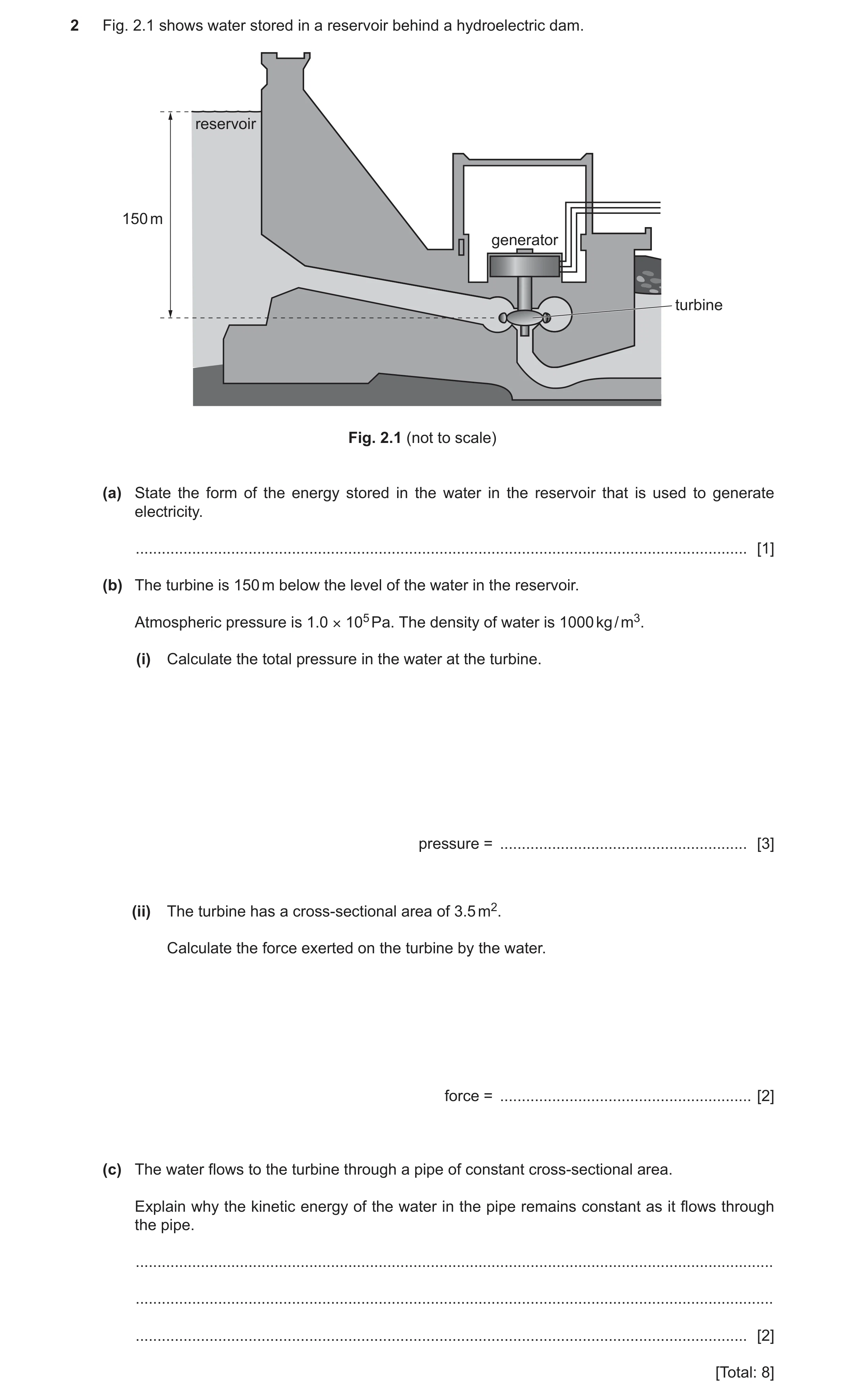
2 Fig. 2.1 shows water stored in a reservoir behind a hydroelectric dam. reservoir 150 m generator turbine Fig. 2.1 (not to scale) (a) State the form of the energy stored in the water in the reservoir that is used to generate electricity. … [1] (b) The turbine is 150 m below the level of the water in the reservoir. Atmospheric pressure is 1.0 × 10⁵ Pa. The density of water is 1000 kg / m3. (i) Calculate the total pressure in the water at the turbine. pressure = … [3] (ii) The turbine has a cross-sectional area of 3.5 m2. Calculate the force exerted on the turbine by the water. force = … [2] (c) The water flows to the turbine through a pipe of constant cross-sectional area. Explain why the kinetic energy of the water in the pipe remains constant as it flows through the pipe. … … … [2] [Total: 8]
8 marks
Mark scheme: 2(a) gravitational potential energy B1 2(b)(i) 1.6 106 Pa A3 (p =) h g (in any form) or 150 1000 10 or 1.5 106 C1 1.5 106 or 1.0 105 + {150 1000 10} or 1.0 105 + 1.5 106 or 1.6 10N C1 2(b)(ii) 5.6 106 N A2 (F =) pA (in any form) or 1.6 106 3.5 C1 Question Answer Marks 2(c) speed (of water) remains constant B1 otherwise density would decrease or gaps would appear in the water or volume / density does not change or liquids incompressible or water enters / leaves at constant rate or quantity of water remains constant B1
This question in 0625/41 May/June 2022
Q22 · A quantity of gas is trapped by a piston in a cylinder with thin metal walls 0625/41 Oct/Nov 2022
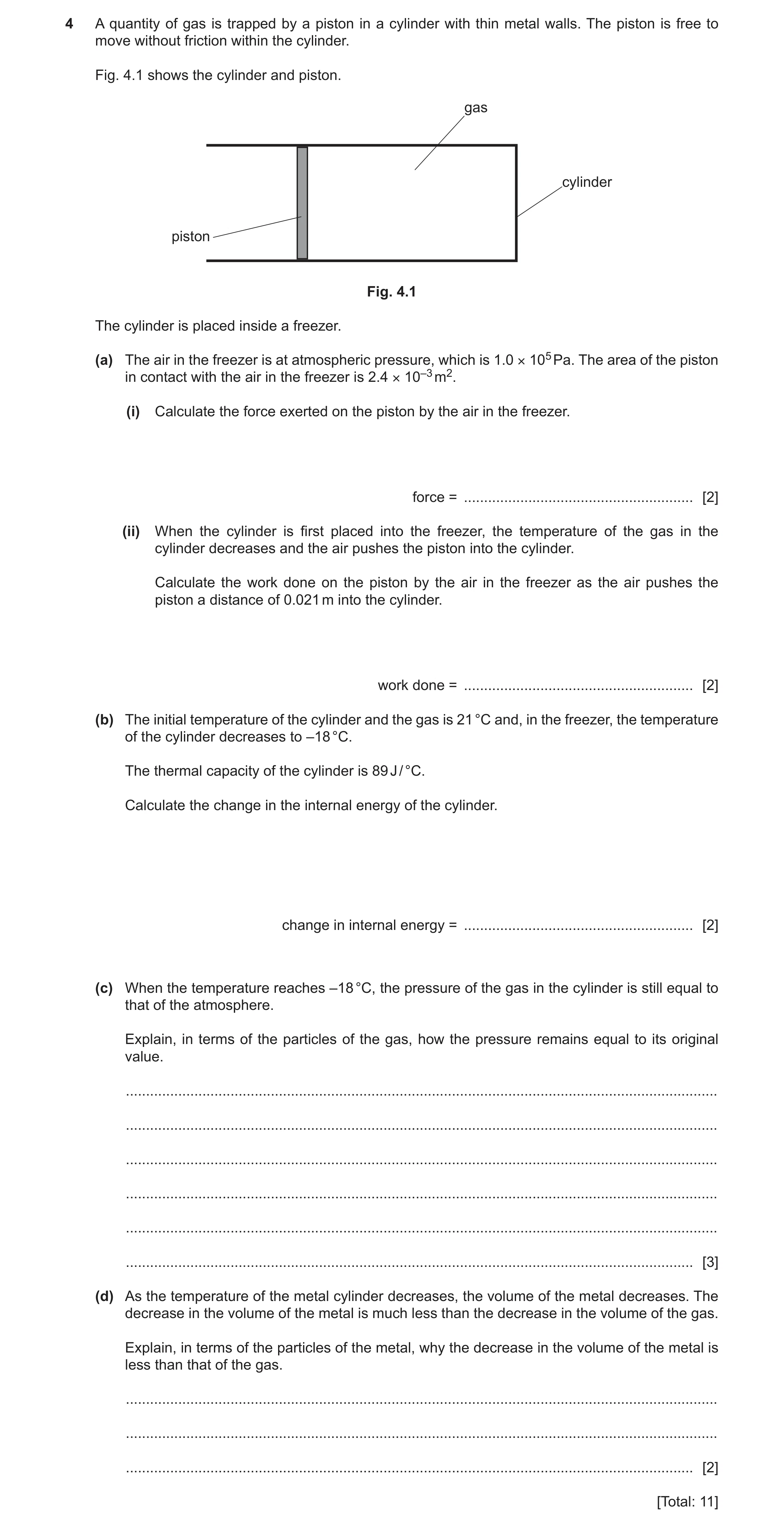
4 A quantity of gas is trapped by a piston in a cylinder with thin metal walls. The piston is free to move without friction within the cylinder. Fig. 4.1 shows the cylinder and piston. gas cylinder piston Fig. 4.1 The cylinder is placed inside a freezer. (a) The air in the freezer is at atmospheric pressure, which is 1.0 × 10⁵ Pa. The area of the piston in contact with the air in the freezer is 2.4 × 10⁻³ m2. (i) Calculate the force exerted on the piston by the air in the freezer. force = … [2] (ii) When the cylinder is first placed into the freezer, the temperature of the gas in the cylinder decreases and the air pushes the piston into the cylinder. Calculate the work done on the piston by the air in the freezer as the air pushes the piston a distance of 0.021 m into the cylinder. work done = … [2] (b) The initial temperature of the cylinder and the gas is 21 °C and, in the freezer, the temperature of the cylinder decreases to –18 °C. The thermal capacity of the cylinder is 89 J / °C. Calculate the change in the internal energy of the cylinder. change in internal energy = … [2] (c) When the temperature reaches –18 °C, the pressure of the gas in the cylinder is still equal to that of the atmosphere. Explain, in terms of the particles of the gas, how the pressure remains equal to its original value. … … … … … … [3] (d) As the temperature of the metal cylinder decreases, the volume of the metal decreases. The decrease in the volume of the metal is much less than the decrease in the volume of the gas. Explain, in terms of the particles of the metal, why the decrease in the volume of the metal is less than that of the gas. … … … [2] [Total: 11]
11 marks
Mark scheme: 4(a)(i) 240 N A2 F = pA in any form or 1.0 105 2.4 10–3 C1 4(a)(ii) 5.0 J A2 WD = Fx‖ or 240 0.021 C1 4(b) (–)3.5 103 J A2 E = CDT in any form or 89 (21 – (–18) or 89 (3) or 89 39 C1 4(c) B3 (as the volume decreases) the particles collide more often B1 (as the temperature decreases) the particles collide less violently B1 two effects cancel (to leave the pressure unchanged) or particles collide with walls / piston / cylinder B1 4(d) B2 (attractive) forces between (any two) particles large(r than in gases) B1 particles close(r) together (than gas particles) or particles already touching B1
This question in 0625/41 Oct/Nov 2022
Q23 · A person moving across an ice-covered pond to reach a ball on the ice 0625/42 May/June 2023
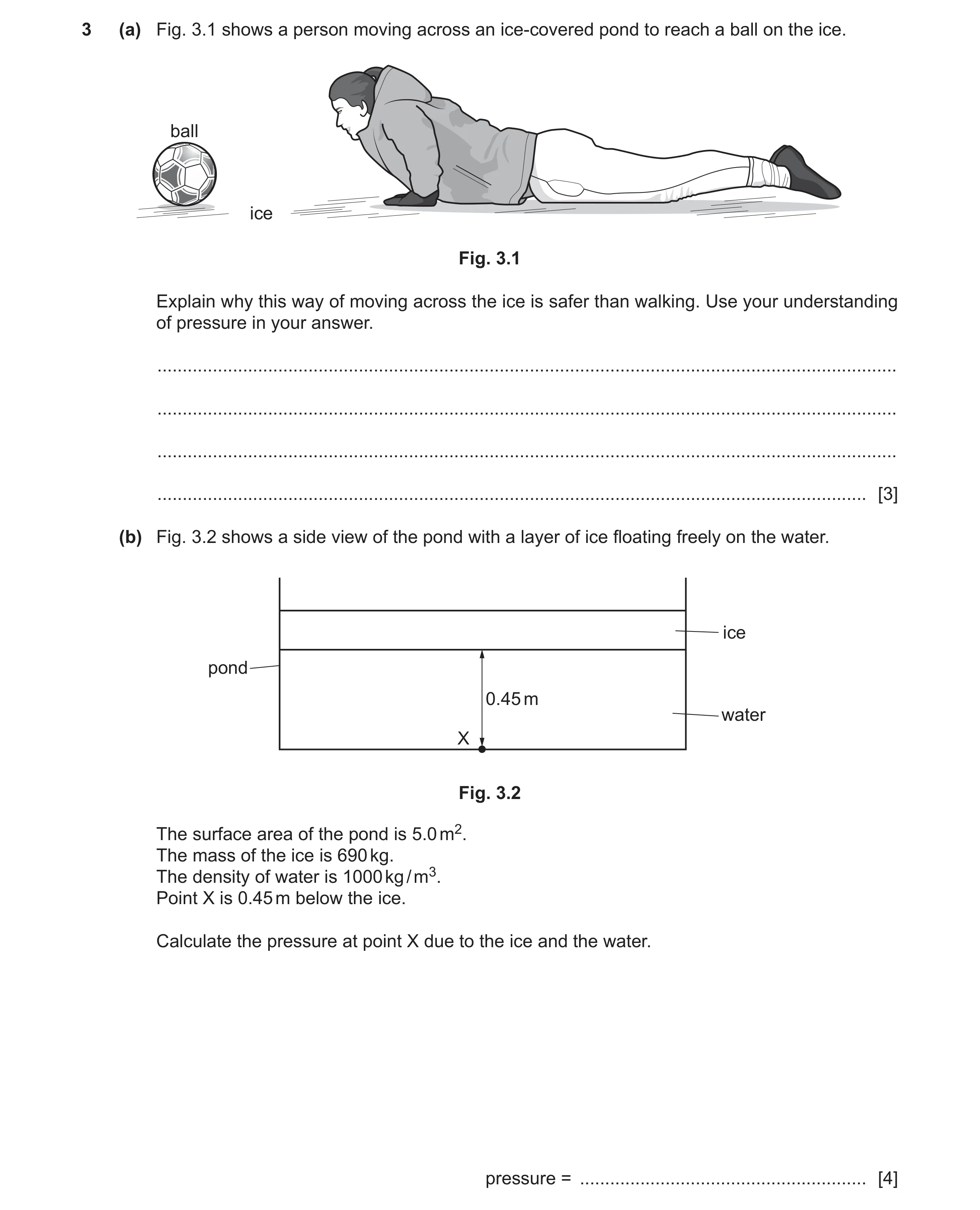
3 (a) Fig. 3.1 shows a person moving across an ice-covered pond to reach a ball on the ice. ball ice Fig. 3.1 Explain why this way of moving across the ice is safer than walking. Use your understanding of pressure in your answer. … … … … [3] (b) Fig. 3.2 shows a side view of the pond with a layer of ice floating freely on the water. ice pond 0.45 m water X Fig. 3.2 The surface area of the pond is 5.0 m2. The mass of the ice is 690 kg. The density of water is 1000 kg / m3. Point X is 0.45 m below the ice. Calculate the pressure at point X due to the ice and the water. pressure = … [4]
7 marks
Mark scheme: 3(a) (force of gravity / weight of person is spread over a much) greater area B1 p = F/A OR p ∝ 1/A B1 (force is same so) pressure is lower (so ice is less likely to crack) B1 3(b) 5.8 103 Pa A4 p (due to water) = gh OR (p =) gh OR (p =) 1000 9.8 0.45 OR (p =) 4410 C1 W = mg OR (W =) mg OR (W =) (690 9.8) OR (W =) 6762 OR (p (due to ice) =) 1352.4 C1 (pressure =) candidate’s calculated pressure due to water + candidate’s calculated pressure due to ice OR total pressure = [1000 9.8 0.45] + [(690 9.8) / 5.0] OR total pressure = 4410 + 1352.4 C1
This question in 0625/42 May/June 2023
Q24 · Liquids are difficult to compress whereas gases can be compressed easily 0625/41 Oct/Nov 2023
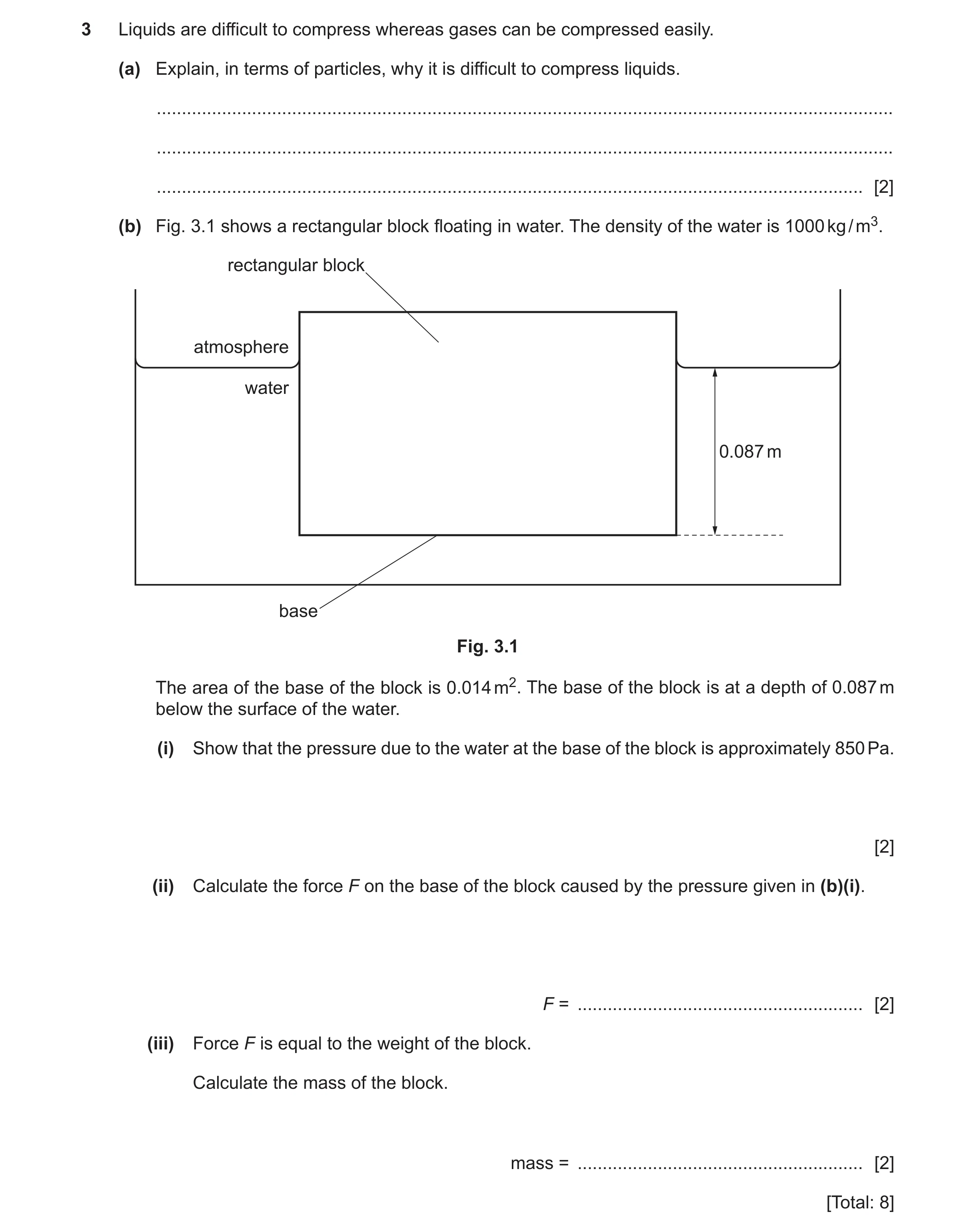
3 Liquids are difficult to compress whereas gases can be compressed easily. (a) Explain, in terms of particles, why it is difficult to compress liquids. … … … [2] (b) Fig. 3.1 shows a rectangular block floating in water. The density of the water is 1000 kg / m3. rectangular block atmosphere water 0.087 m base Fig. 3.1 The area of the base of the block is 0.014 m2. The base of the block is at a depth of 0.087 m below the surface of the water. (i) Show that the pressure due to the water at the base of the block is approximately 850 Pa. [2] (ii) Calculate the force F on the base of the block caused by the pressure given in (b)(i). F = … [2] (iii) Force F is equal to the weight of the block. Calculate the mass of the block. mass = … [2] [Total: 8]
8 marks
Mark scheme: 3(a) particles (of liquid) are touching / close to each other B1 forces (of repulsion) between particles (of liquid) are large B1 3(b)(i) (p =) g()h B1 1000 9.8 0.087 OR (p =) 852.6 (Pa) B1 3(b)(ii) 12 N A2 p = F / A OR (F =) pA OR 850 0.014 C1 3(b)(iii) 1.2 kg A2 g = W / m OR (m =) F / g OR 12 / 9.8 C1
This question in 0625/41 Oct/Nov 2023
Q25 · A bottle part-filled with water 0625/42 Oct/Nov 2023
4 Fig. 4.1 shows a bottle part-filled with water. The air inside the bottle is at the same pressure as the air outside the bottle. The bottle and its contents are at room temperature. bottle air water Fig. 4.1 (a) The temperature of the bottle and its contents are increased. (i) Explain, in terms of particles, how the air pressure inside the bottle changes as the temperature increases. … … … … [3] (ii) The lid is removed from the bottle. State and explain how the air pressure inside the bottle changes. statement … explanation … … [2] (b) The mass of water in the bottle is 0.18 kg. The specific heat capacity of water is 4200 J / (kg °C). Calculate the thermal energy needed to increase the temperature of the water by 20 °C. thermal energy = … [2] (c) Another plastic bottle is filled to the top with water. The height of the bottle is 40.0 cm. The density of water is 1.0 × 10³ kg / m3. Calculate the pressure difference between the top and bottom of the water. pressure difference = … [2] [Total: 9]
9 marks
Mark scheme: 4(a)(i) any three from: B3 • increase in the (average) KE / speed of air particles • more frequent collisions of (air) particles (with bottle) • more forceful collisions of (air) particles (with bottle) • greater force per unit area gives greater pressure • volume unchanged and so pressure increases 4(a)(ii) (pressure decreases as) B1 air (particles) escape from the bottle / into the air until pressure (inside the bottle) is same as (air) pressure outside the bottle OR until pressure (inside the bottle) is same as B1 atmospheric pressure 4(b) 1.5 104 J A2 c = (∆)E / m∆𝜃 (∆E =) mc∆𝜃 OR (∆E =) 0.18 4200 20 C1 4(c) 3900 Pa A2 (∆p =) ρg(∆)h OR (∆p =) 1.0 103 9.8 0.4 OR C1 (∆p =) 1.0 103 9.8 40 OR (∆p =) 3.9 10N
This question in 0625/42 Oct/Nov 2023
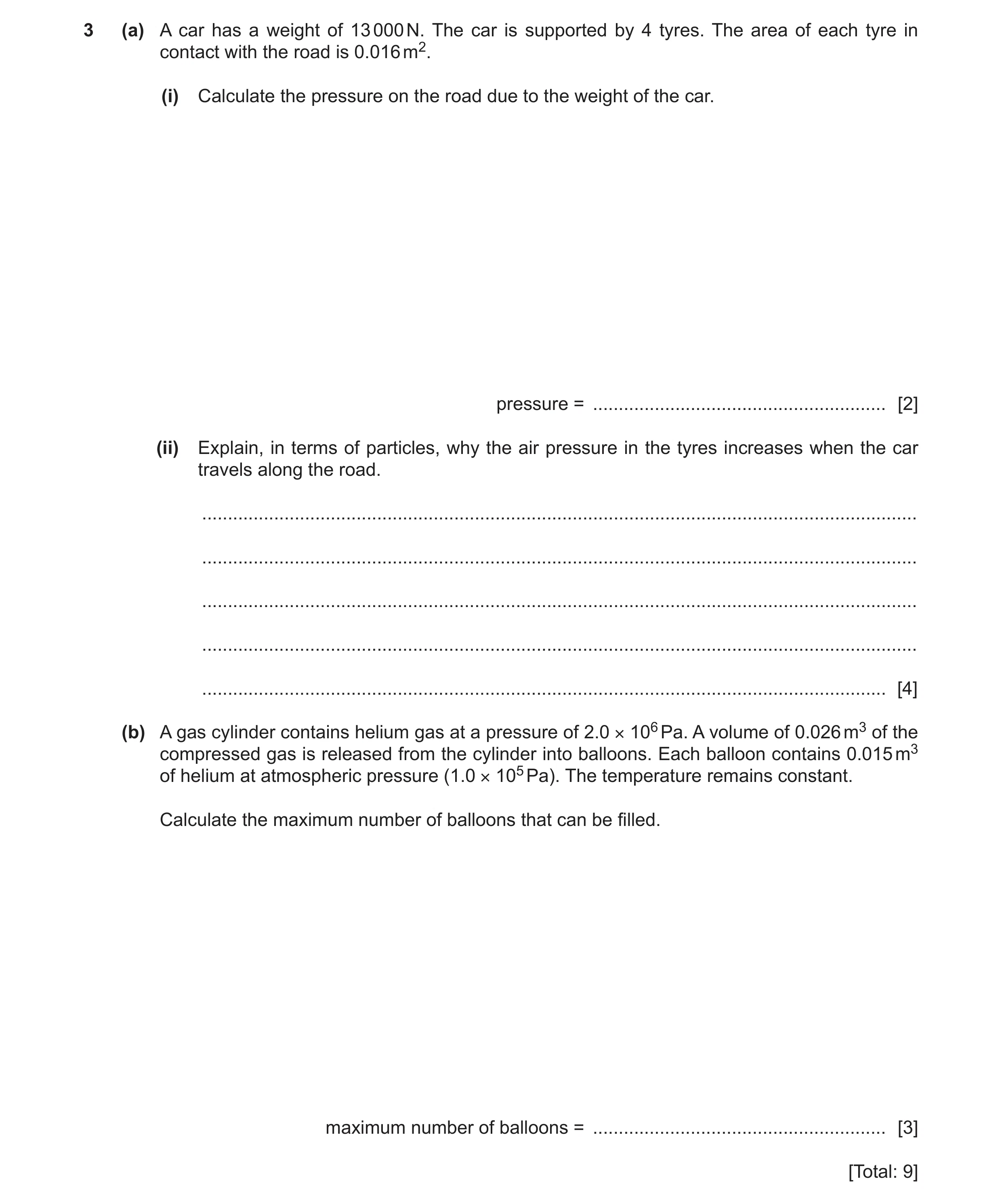
Q26 · A car has a weight of 13 000 N 0625/42 Feb/March 2024
3 (a) A car has a weight of 13 000 N. The car is supported by 4 tyres. The area of each tyre in contact with the road is 0.016 m2. (i) Calculate the pressure on the road due to the weight of the car. pressure = … [2] (ii) Explain, in terms of particles, why the air pressure in the tyres increases when the car travels along the road. … … … … … [4] (b) A gas cylinder contains helium gas at a pressure of 2.0 × 10⁶ Pa. A volume of 0.026 m3 of the compressed gas is released from the cylinder into balloons. Each balloon contains 0.015 m3 of helium at atmospheric pressure (1.0 × 10⁵ Pa). The temperature remains constant. Calculate the maximum number of balloons that can be filled. maximum number of balloons = … [3] [Total: 9]
9 marks
Mark scheme: 3(a)(i) 2.0 105 Pa OR 200 000 Pa OR 200 kPa A2 (P =) F / A OR 13 000 / (0.016 4) (C1) 3(a)(ii) Any four from: B4 • friction between road and tyre • temperature of air / tyre increases • particles (of air in tyre) move faster • particles (of air) collide harder with the walls (of the tyre) OR particles (of air) collide more frequently with the walls (of the tyre) • force (on the tyre wall) increases, AND area (of tyre) is constant (so tyre pressure increases) 3(b) (maximum number = ) 34 A3 pV = constant OR {2.0 106 0.026} = 1.0 105 V2 (C1) V2 = 0.52 (m3) OR (V2 =) {2.0 106 0.026} / 1.0 105 (C1) OR (number of balloons =) {2.0 106 0.026} / {1.0 105 0.015}
This question in 0625/42 Feb/March 2024
Q27 · Gas trapped in a cylinder by a piston 0625/42 Oct/Nov 2025
4 Fig. 4.1 shows gas trapped in a cylinder by a piston. gas cylinder piston Fig. 4.1 (a) The volume of gas is 240 cm3. The piston is pushed to the left and is held in its new position. (i) The pressure of the gas increases from 1.0 × 10⁵ Pa to 1.4 × 10⁵ Pa. The temperature of the gas remains constant. Calculate the volume of the gas when the piston is in its new position. volume = … cm3 [3] (ii) The area of the piston in contact with the gas is 1.9 × 10⁻³ m2. Calculate the force exerted on the piston by the gas when the piston is held in its new position. force = … [2] (iii) The distance moved by the piston is 0.036 m. The average force exerted by the piston as it moves is 220 N. Calculate the mechanical work done by the piston. State the equation you use. work done = … [2] (b) Explain, in terms of particles, why gases can be compressed but liquids cannot. … … … [1] [Total: 8]
8 marks
Mark scheme: 4(a)(i) 170 (cm3) A3 pV = constant OR 1.0 105 240 = 1.4 105 V2 C1 (V2 =) {1.0 105 240} / 1.4 105 OR 1.7 10N C1 4(a)(ii) 270 N A2 (F =) pA OR (F =) 1.4 105 1.9 10-3 C1 4(a)(iii) (W =) Fd in words or symbols M1 7.9 J A1 4(b) distance between gas particles is much larger (than distance between liquid particles) B1 OR particles in liquid are touching AND particles in gas are far apart owtte
This question in 0625/42 Oct/Nov 2025
 1 / 34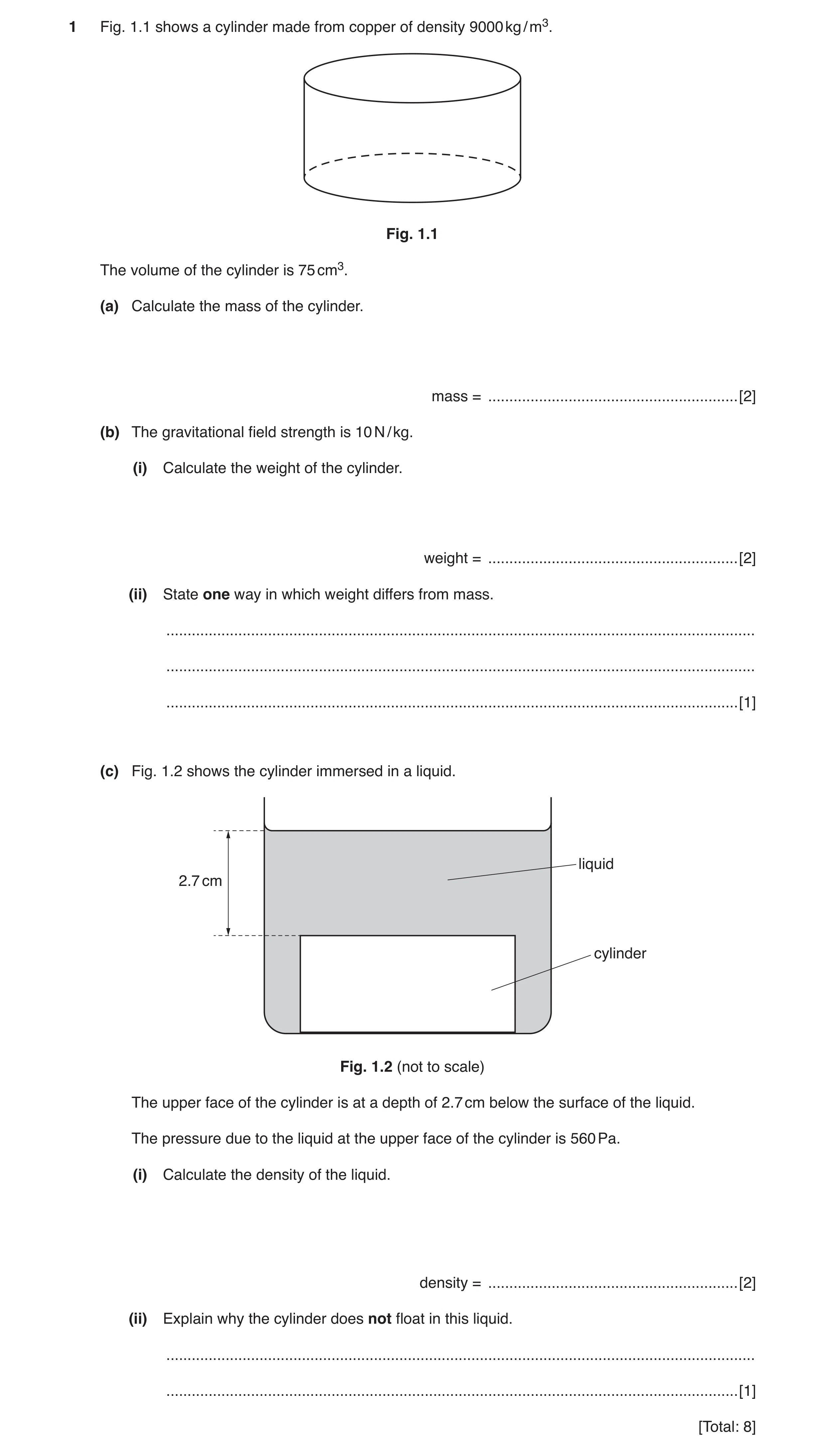
 4 / 34
 5 / 34
 6 / 34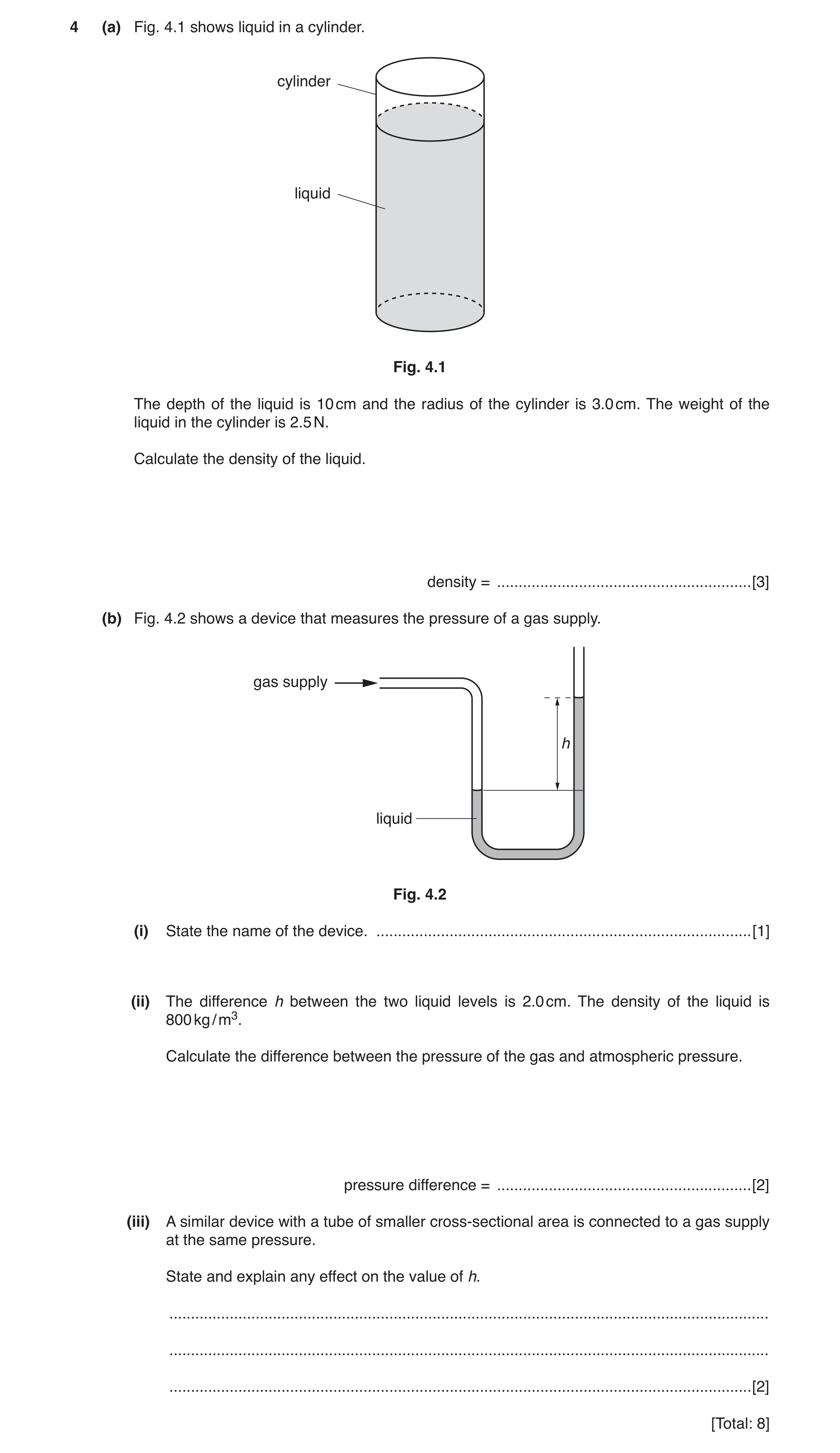
 10 / 34
 11 / 34
 12 / 34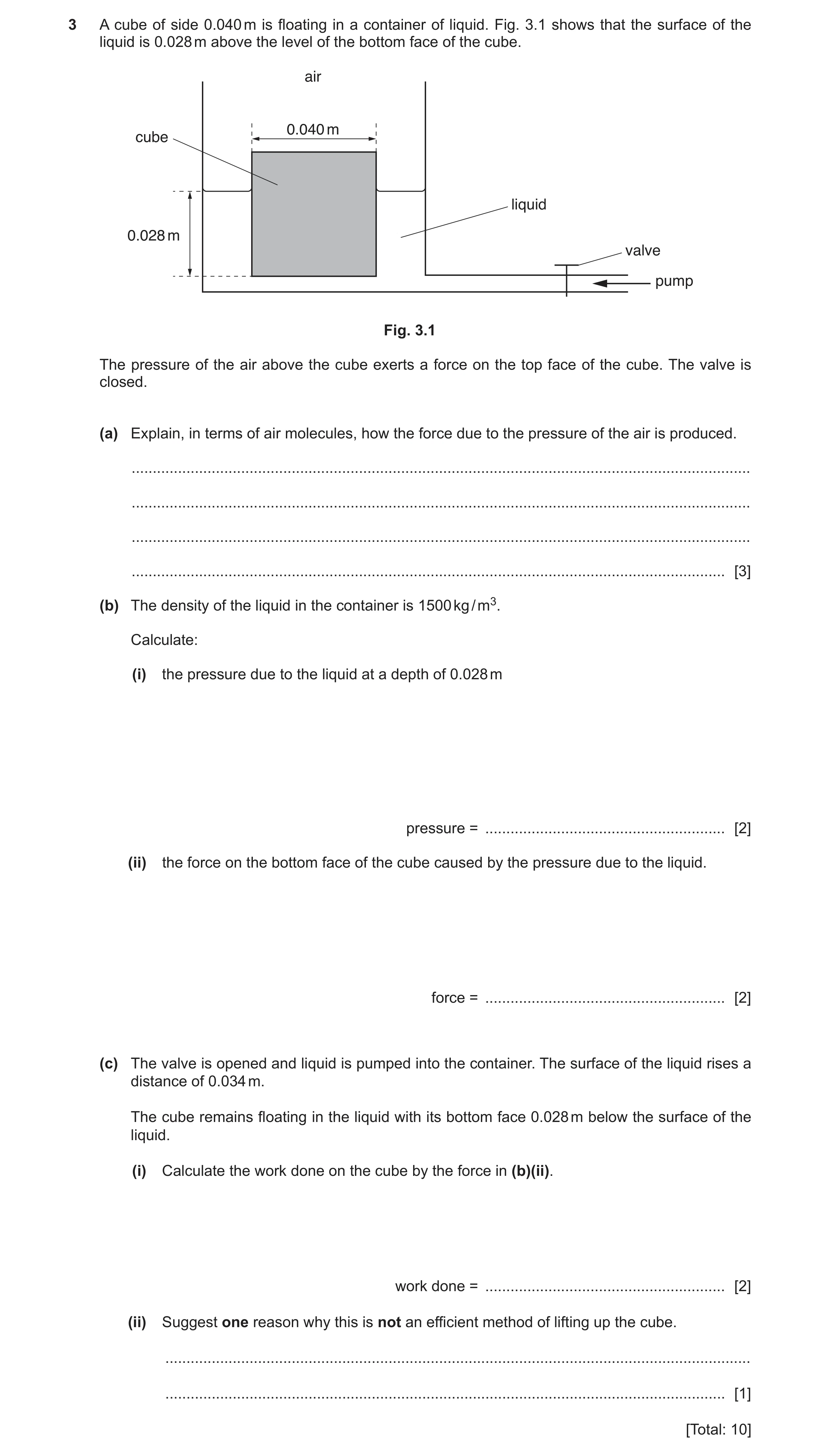
 19 / 34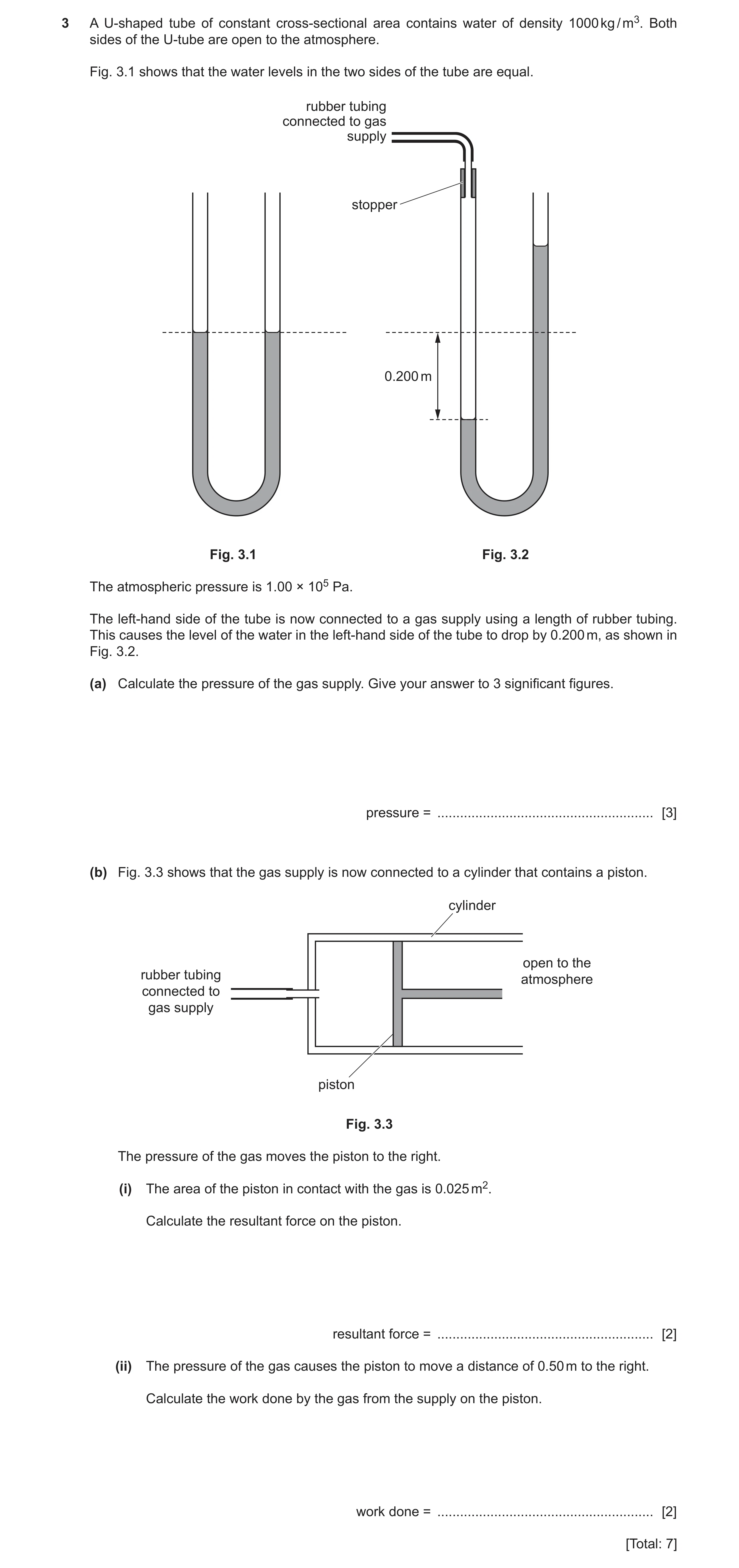
 23 / 34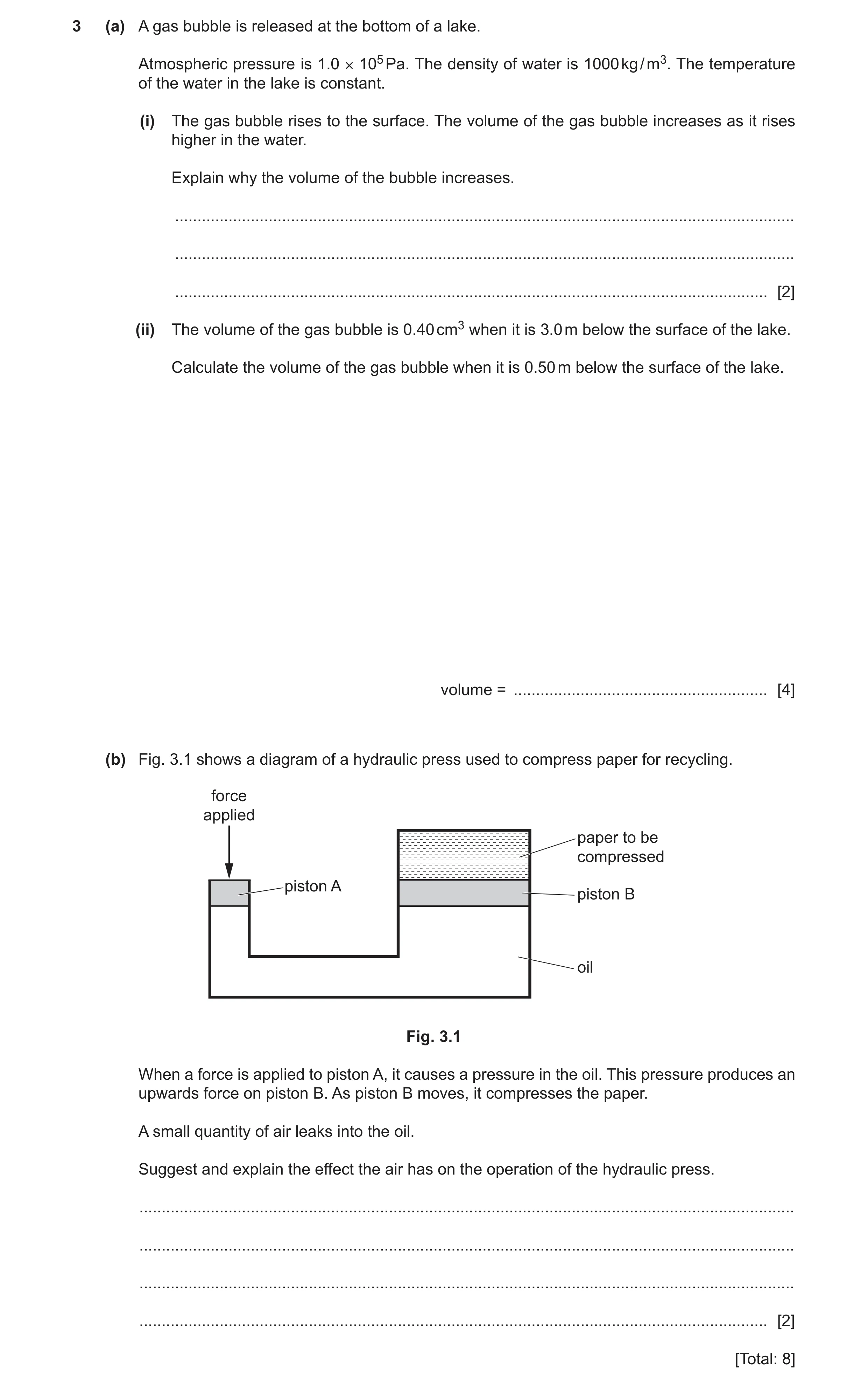
 28 / 34
 29 / 34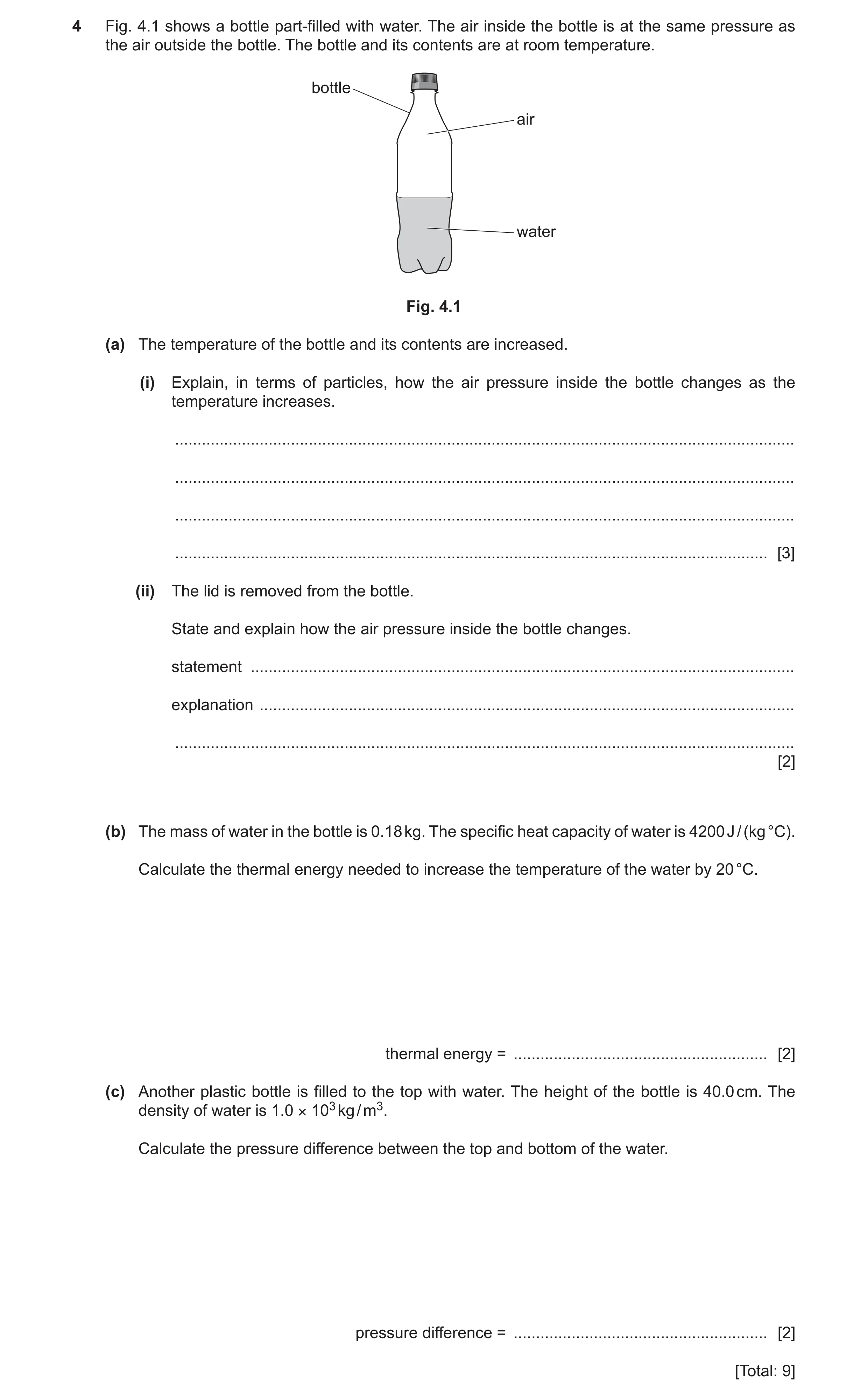
 32 / 34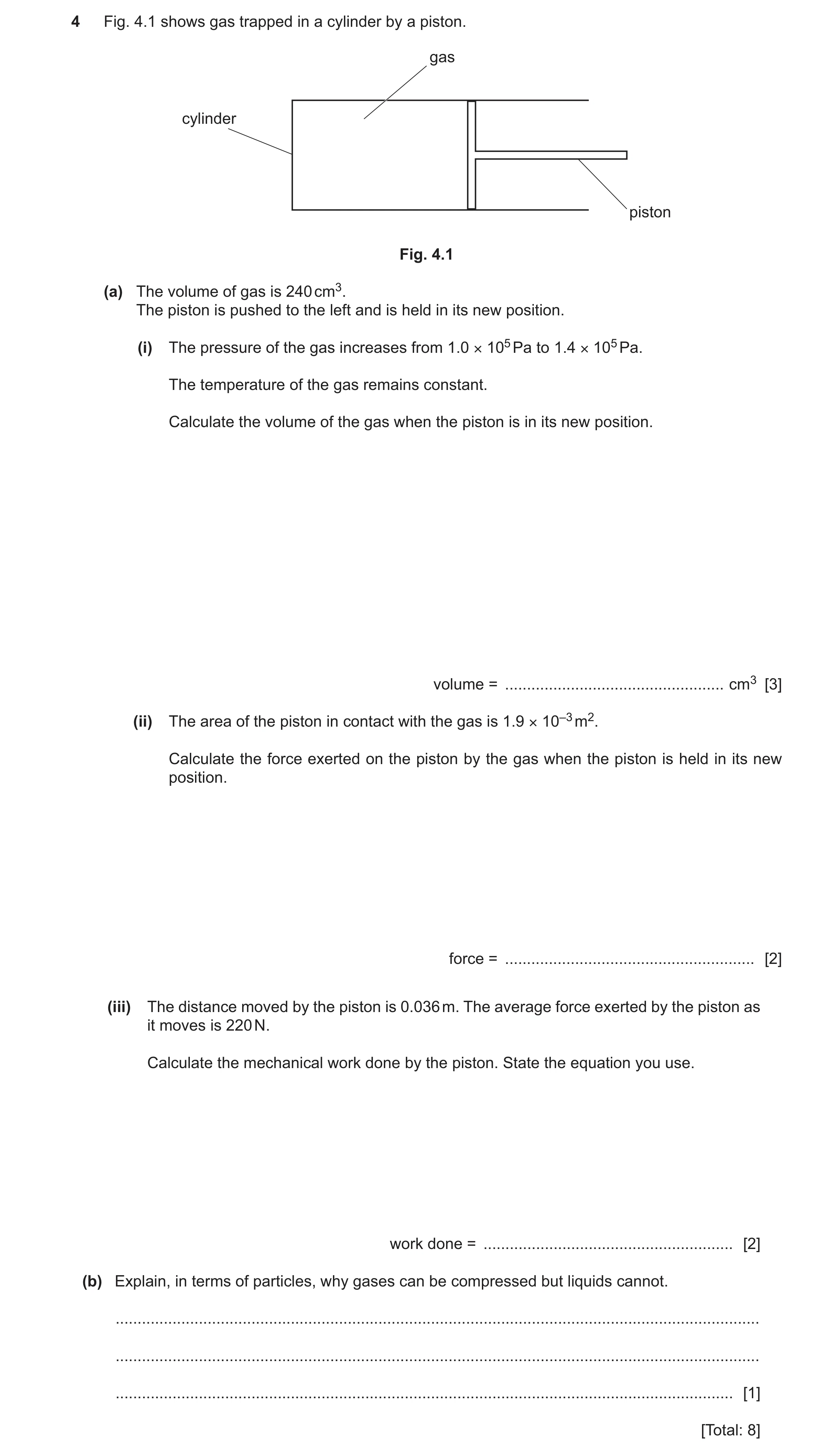
 4
4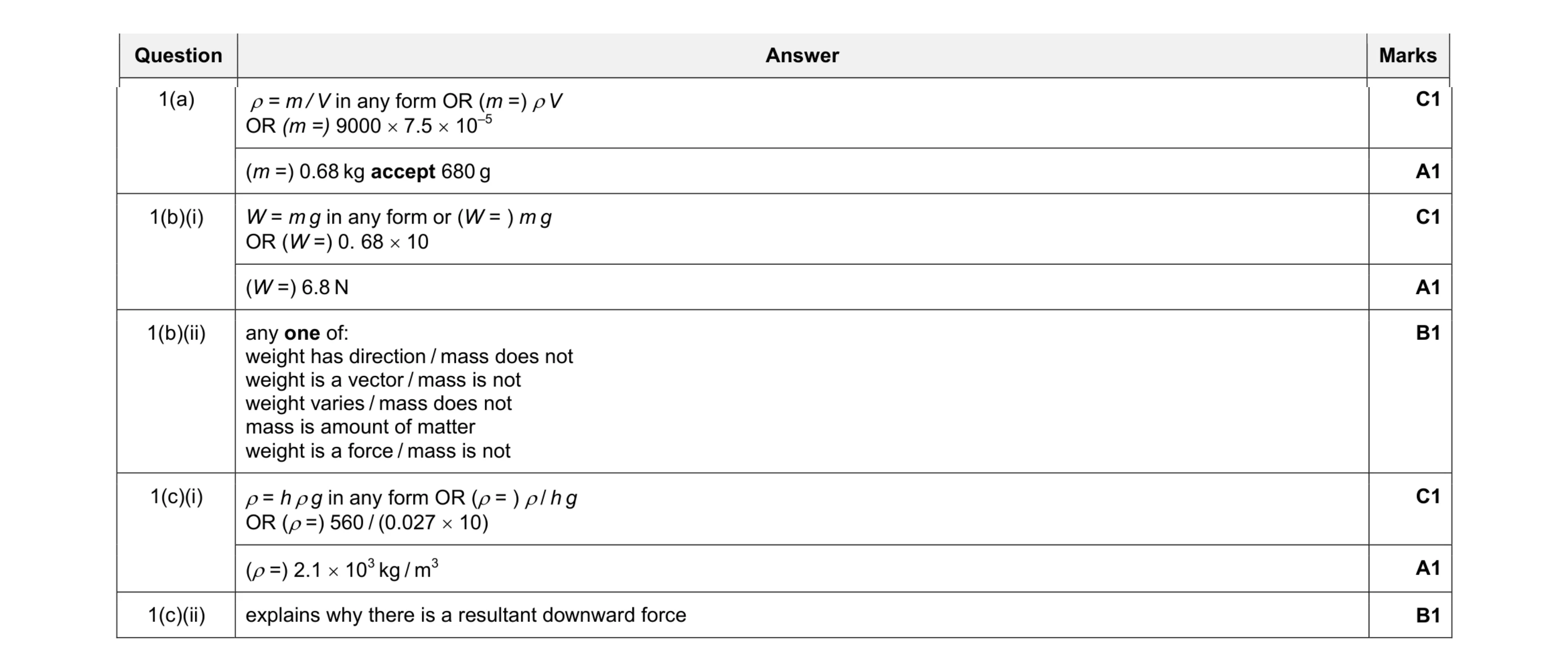 8
8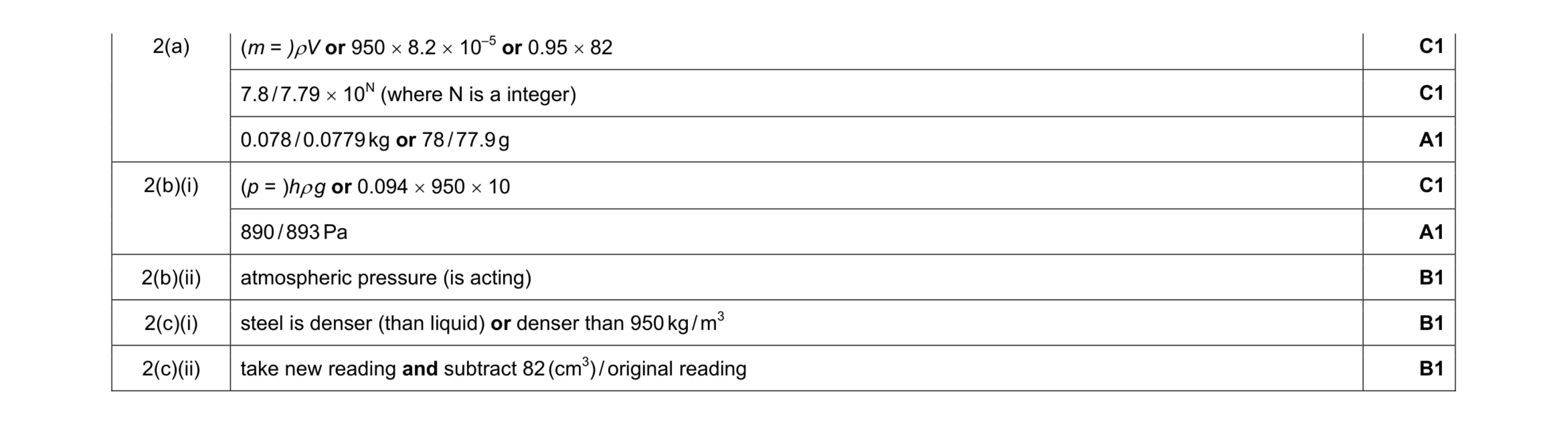 8
8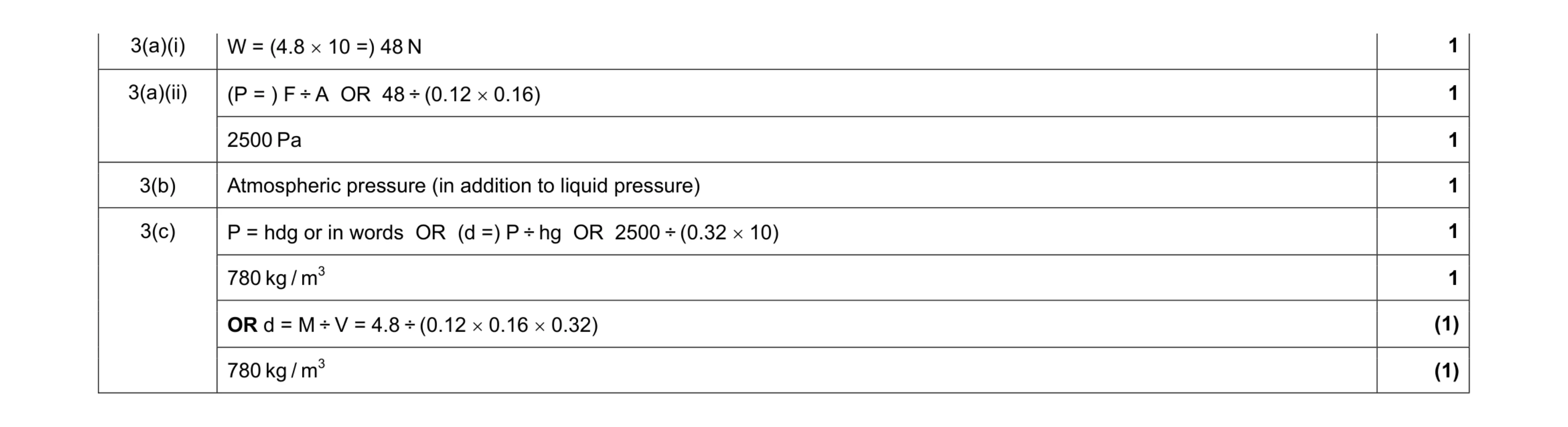 6
6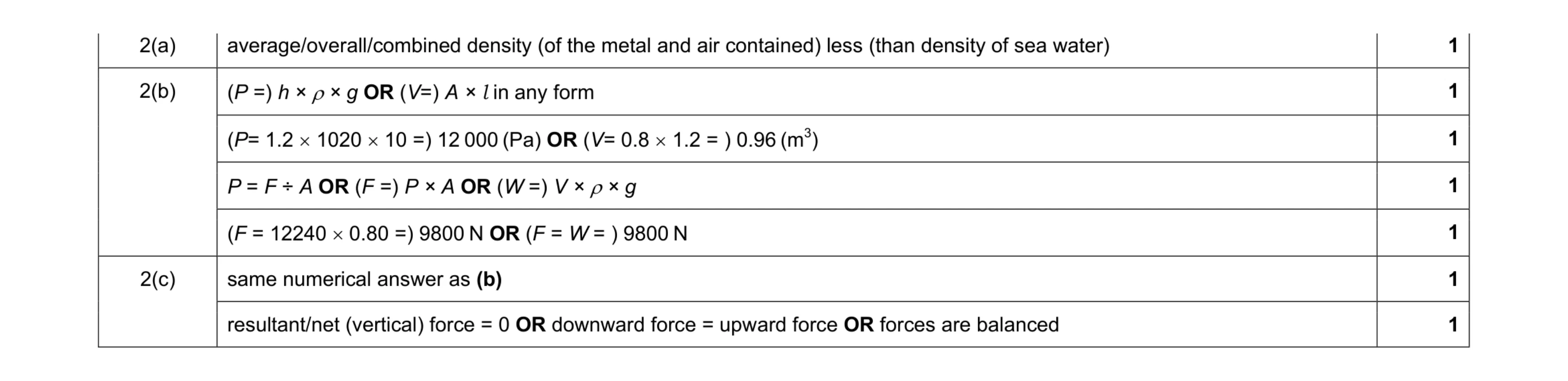 7
7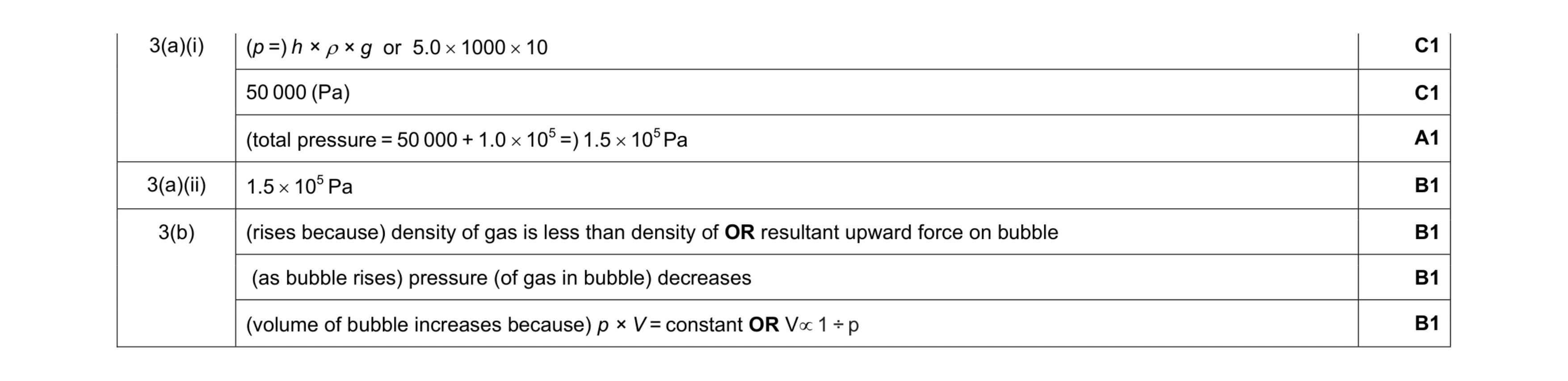 7
7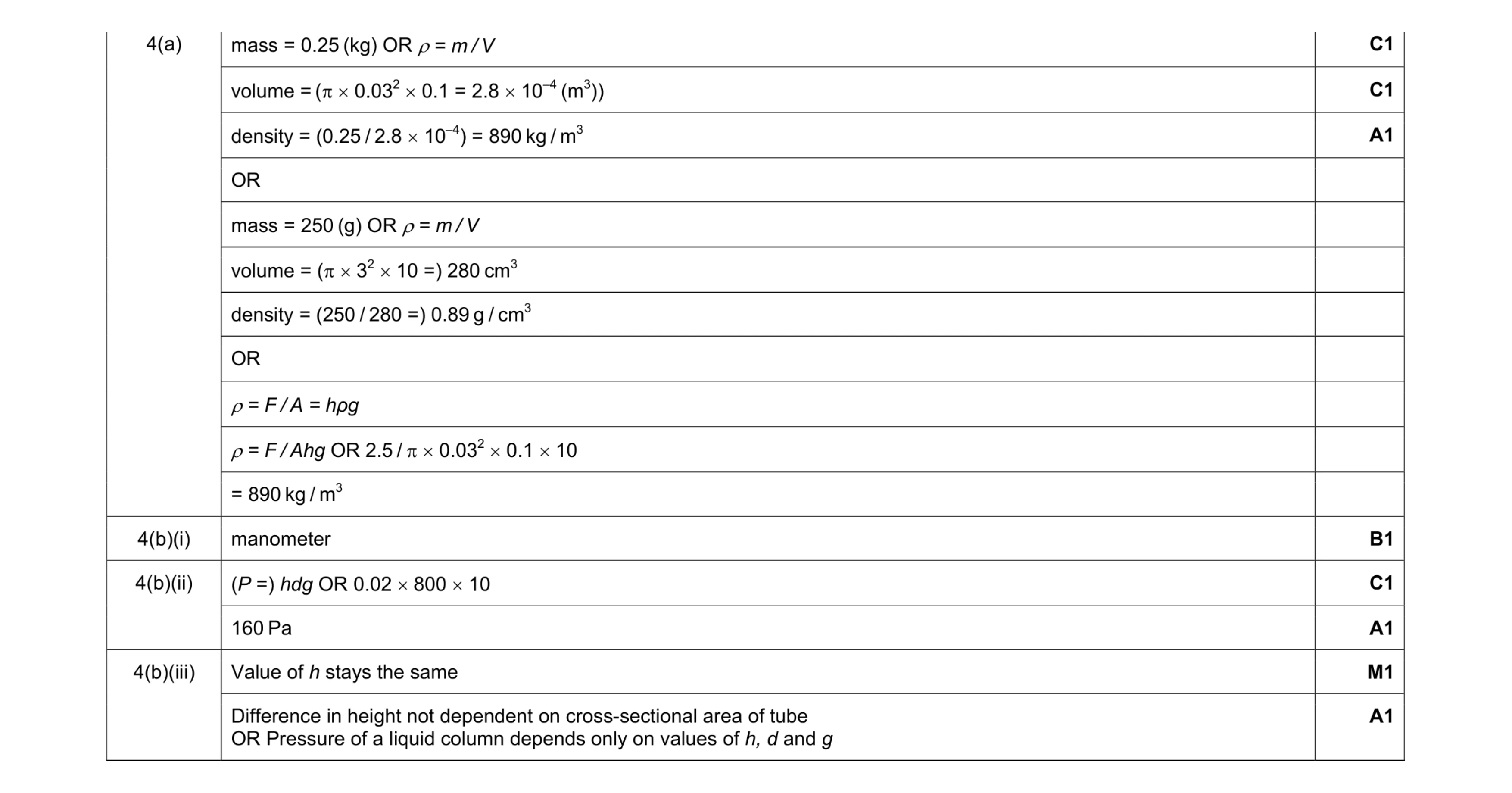 8
8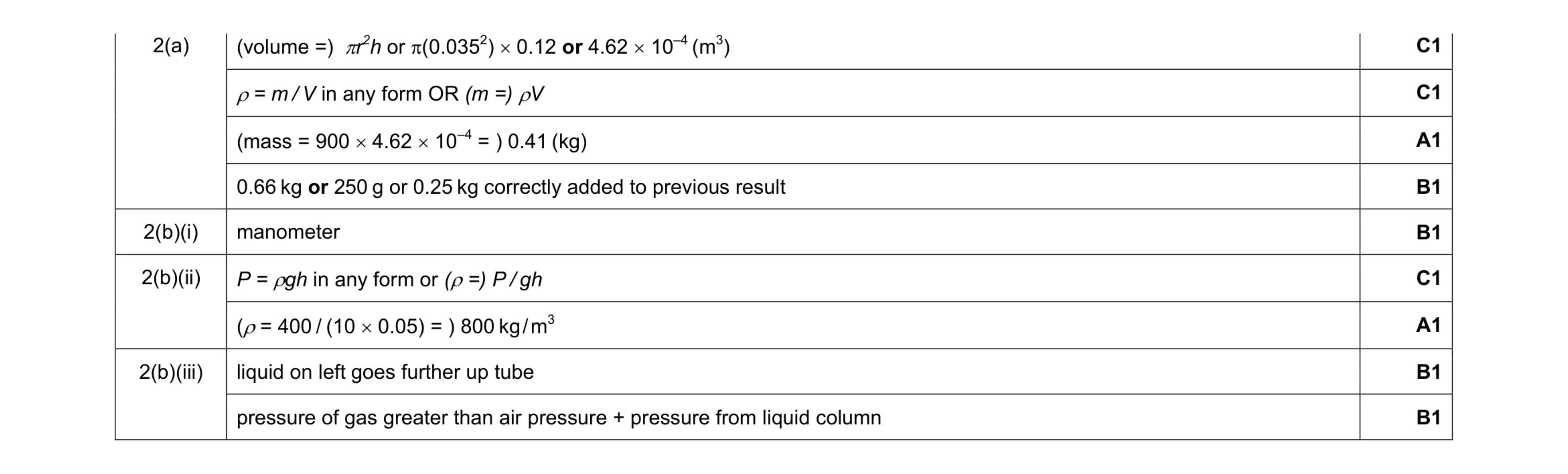 9
9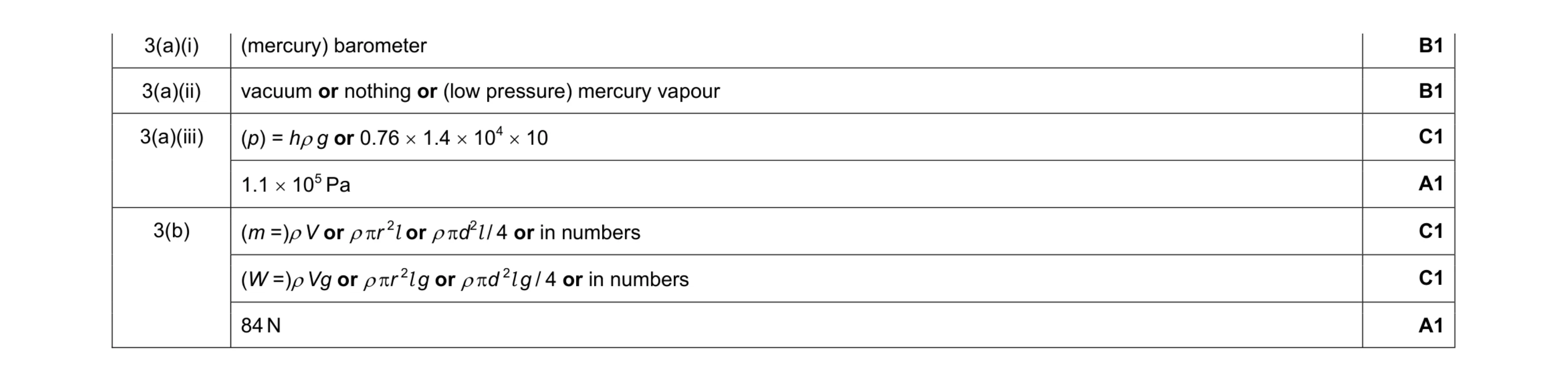 7
7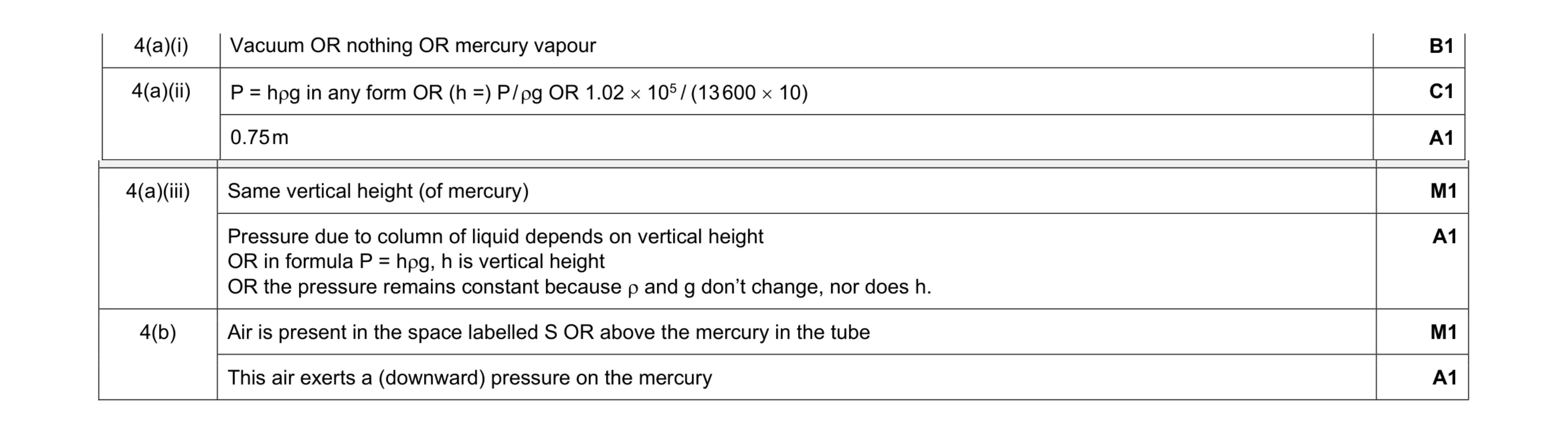 7
7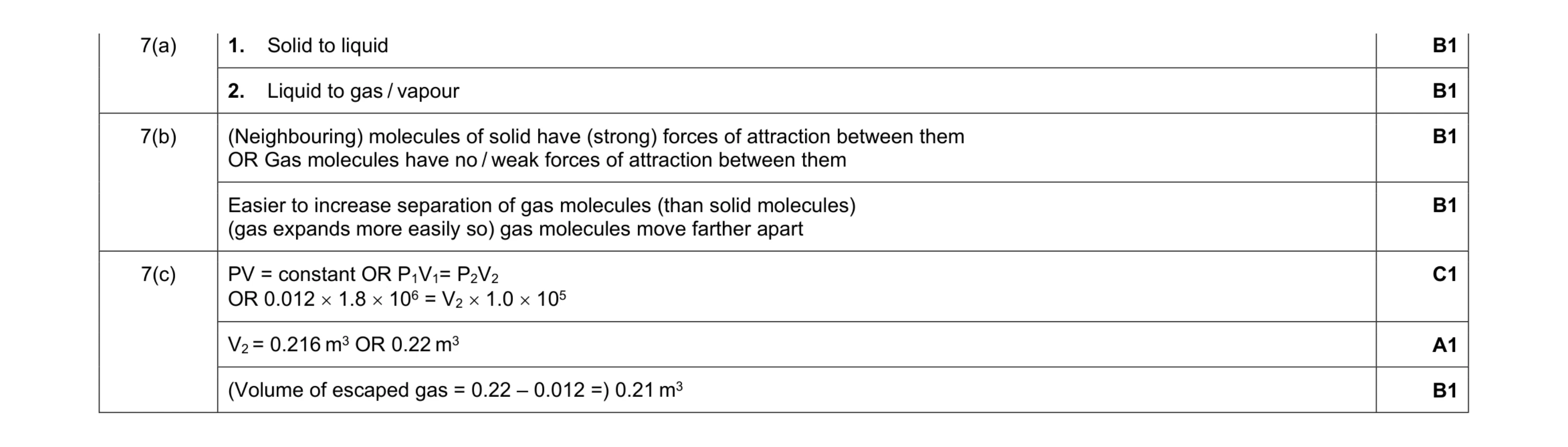 7
7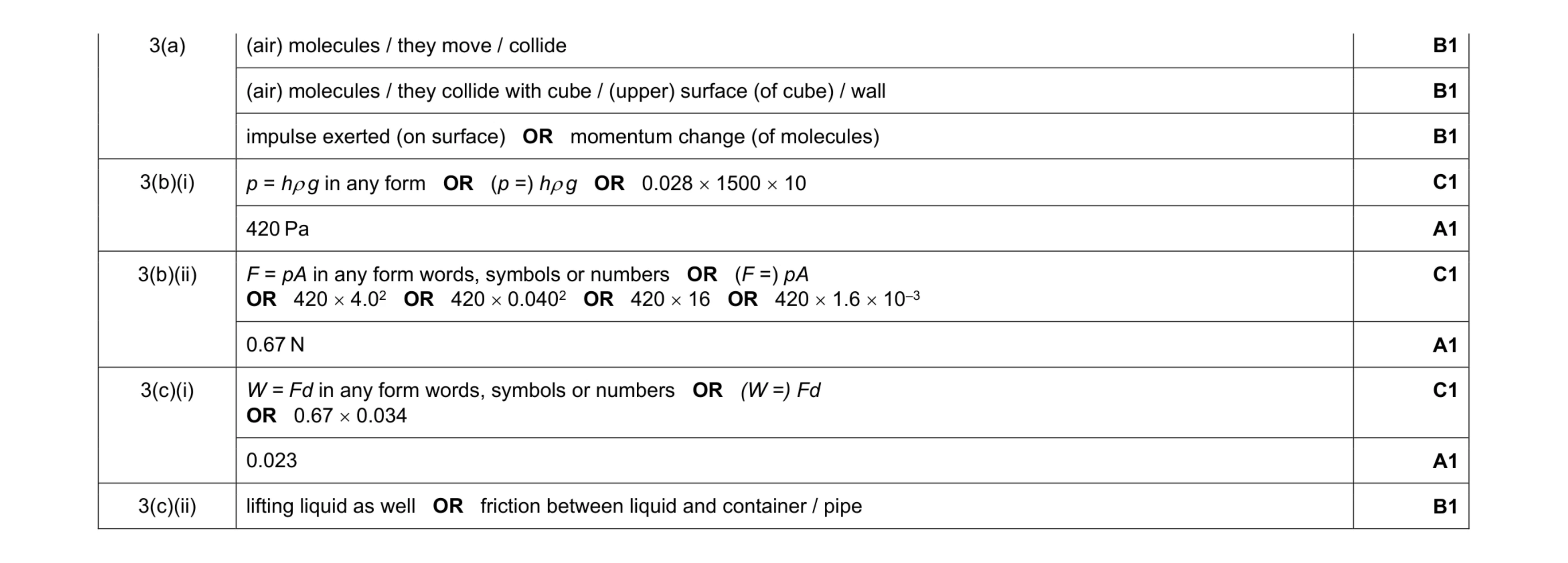 10
10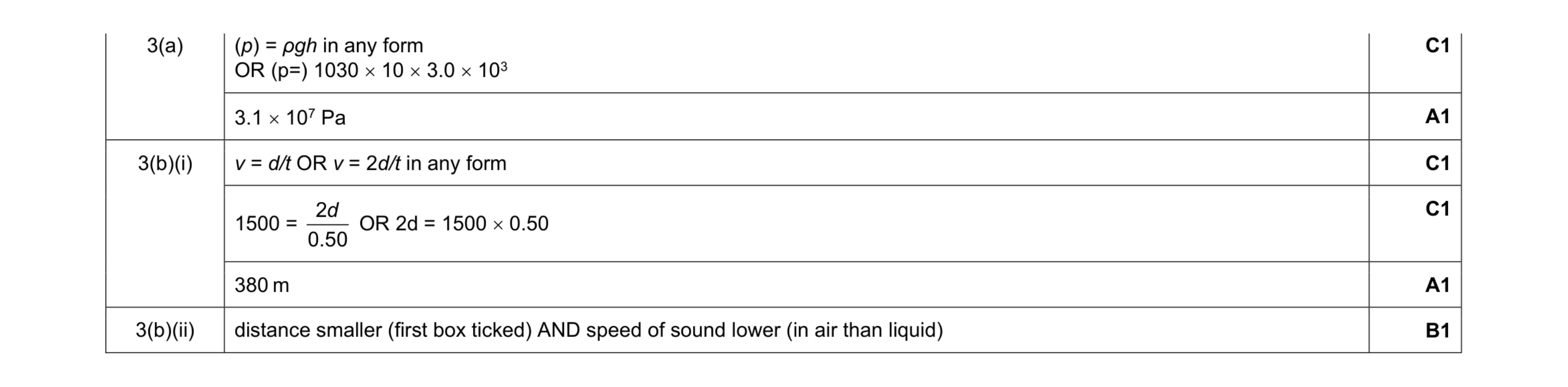 6
6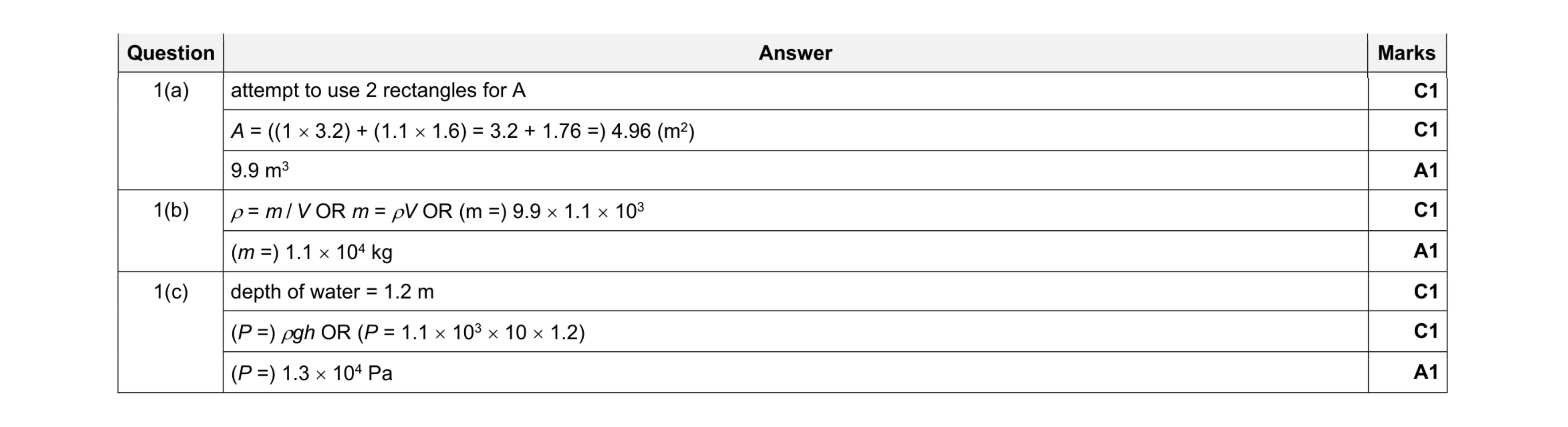 8
8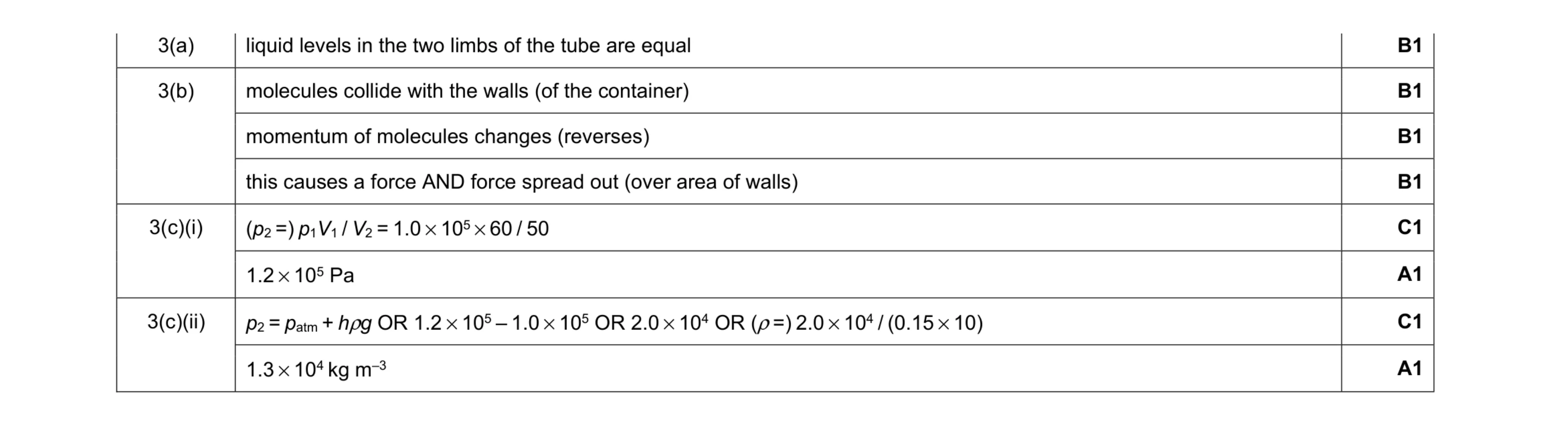 8
8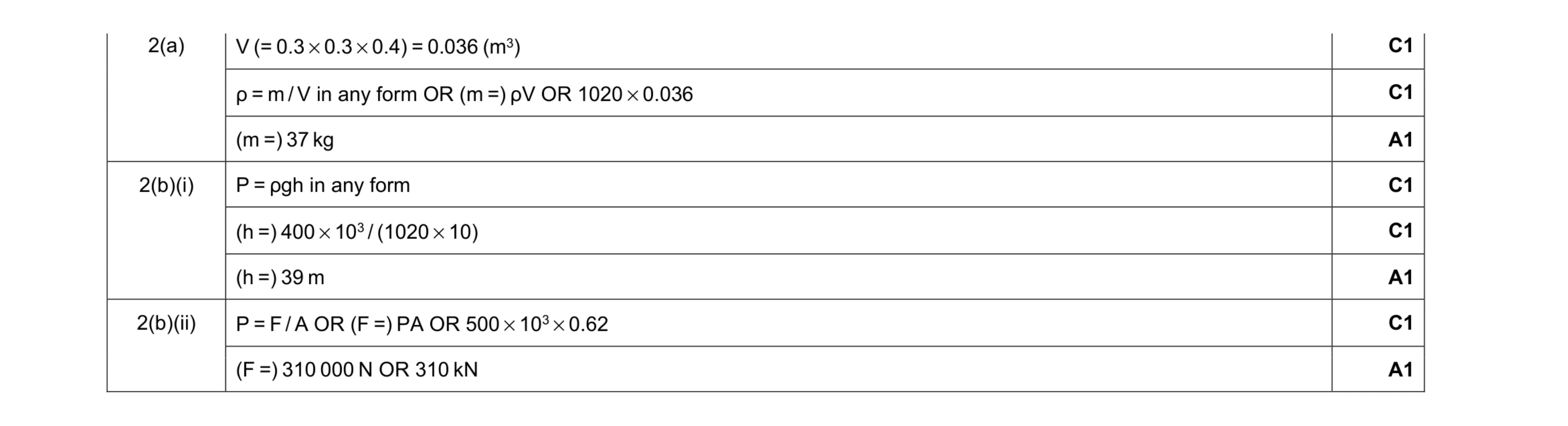 8
8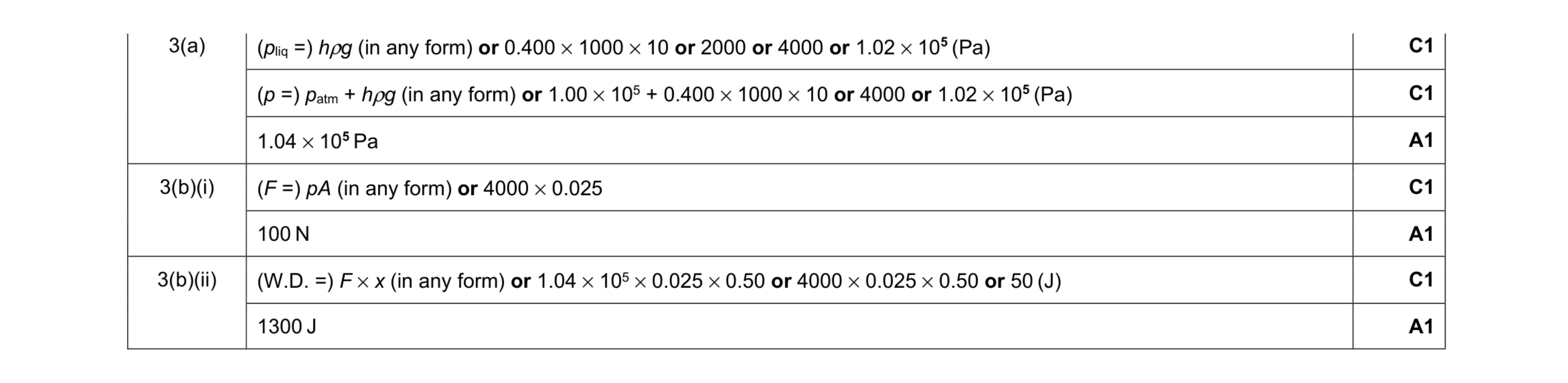 7
7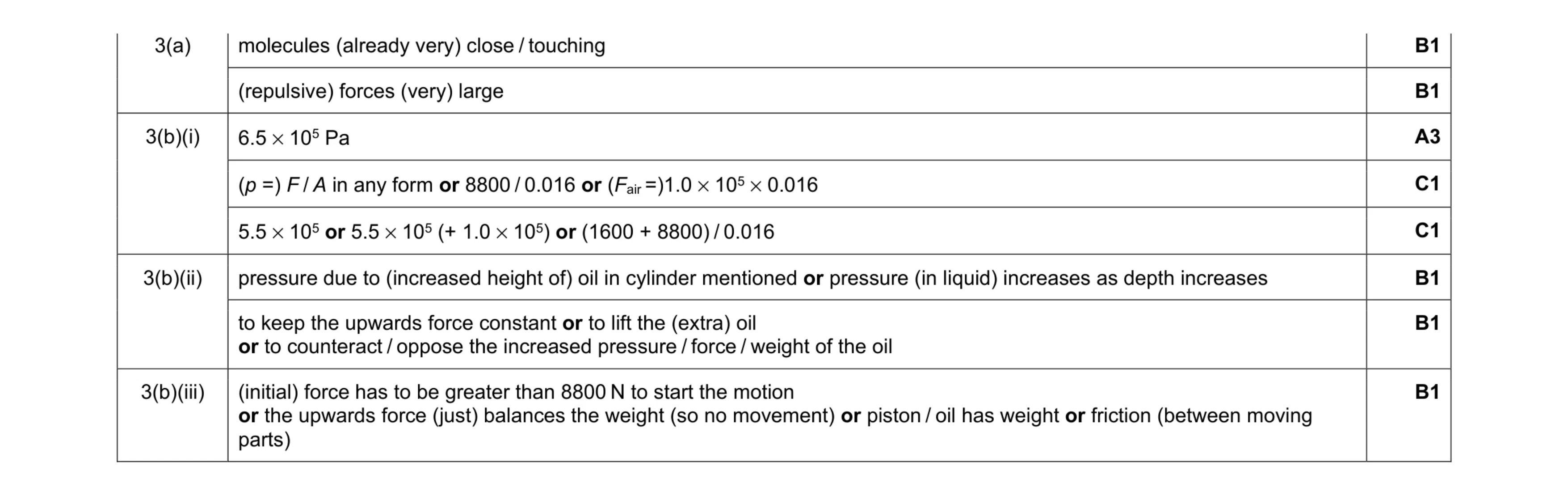 8
8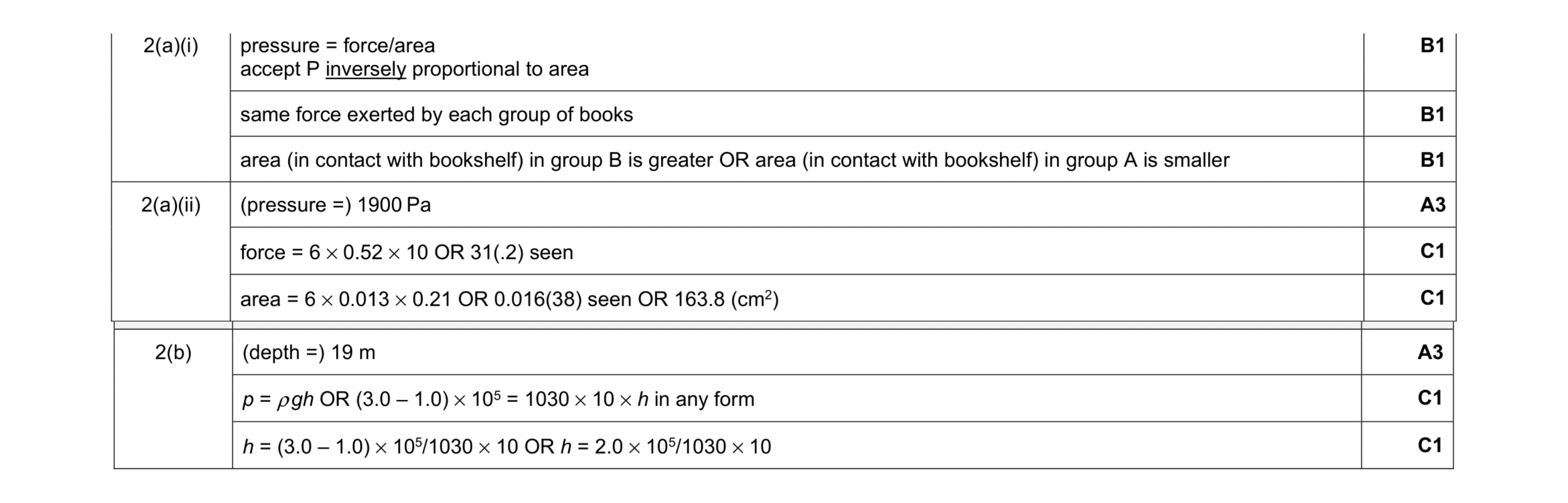 9
9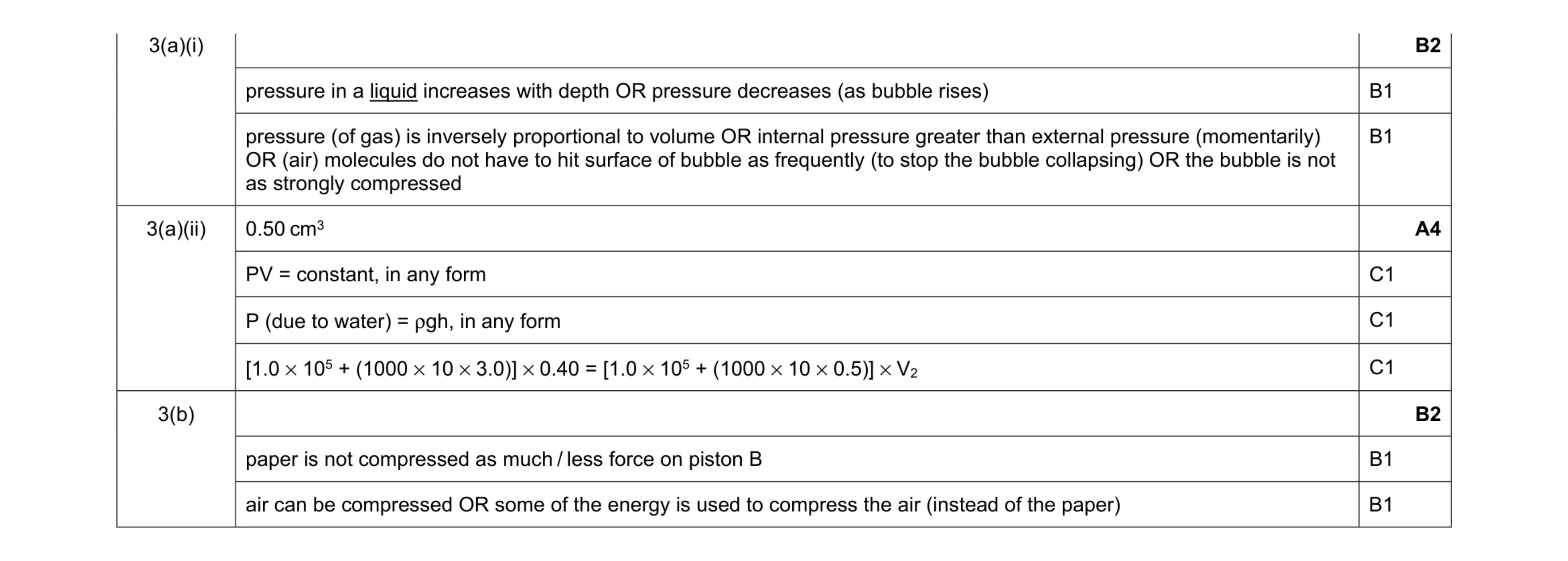 8
8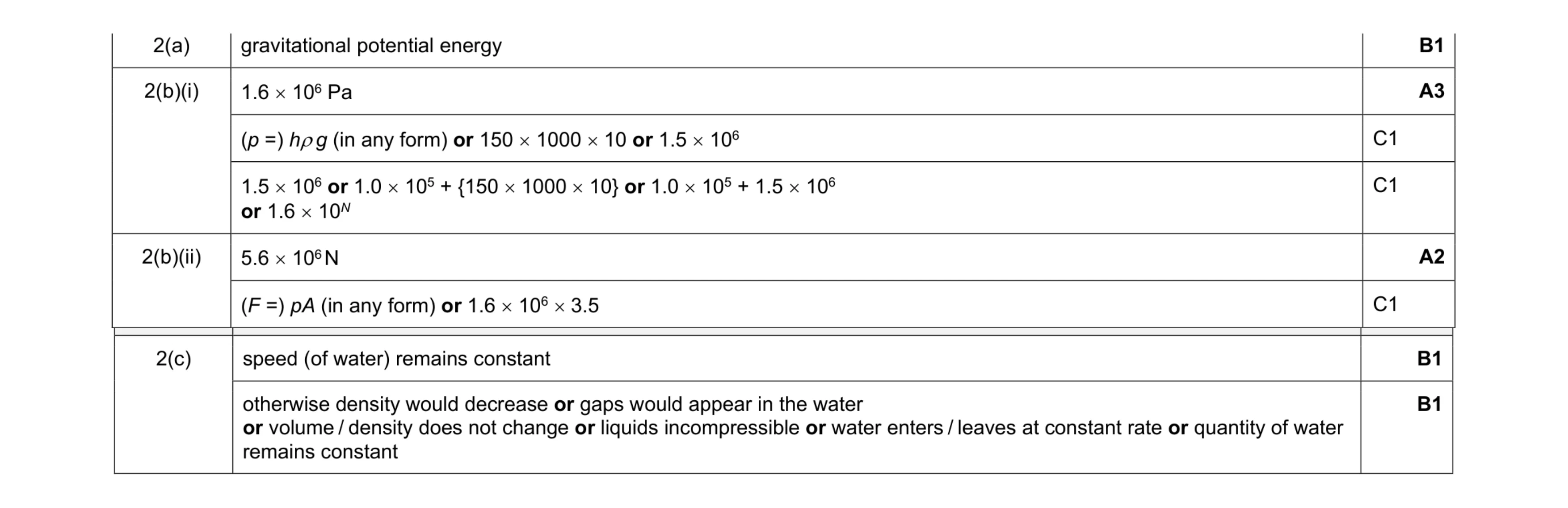 8
8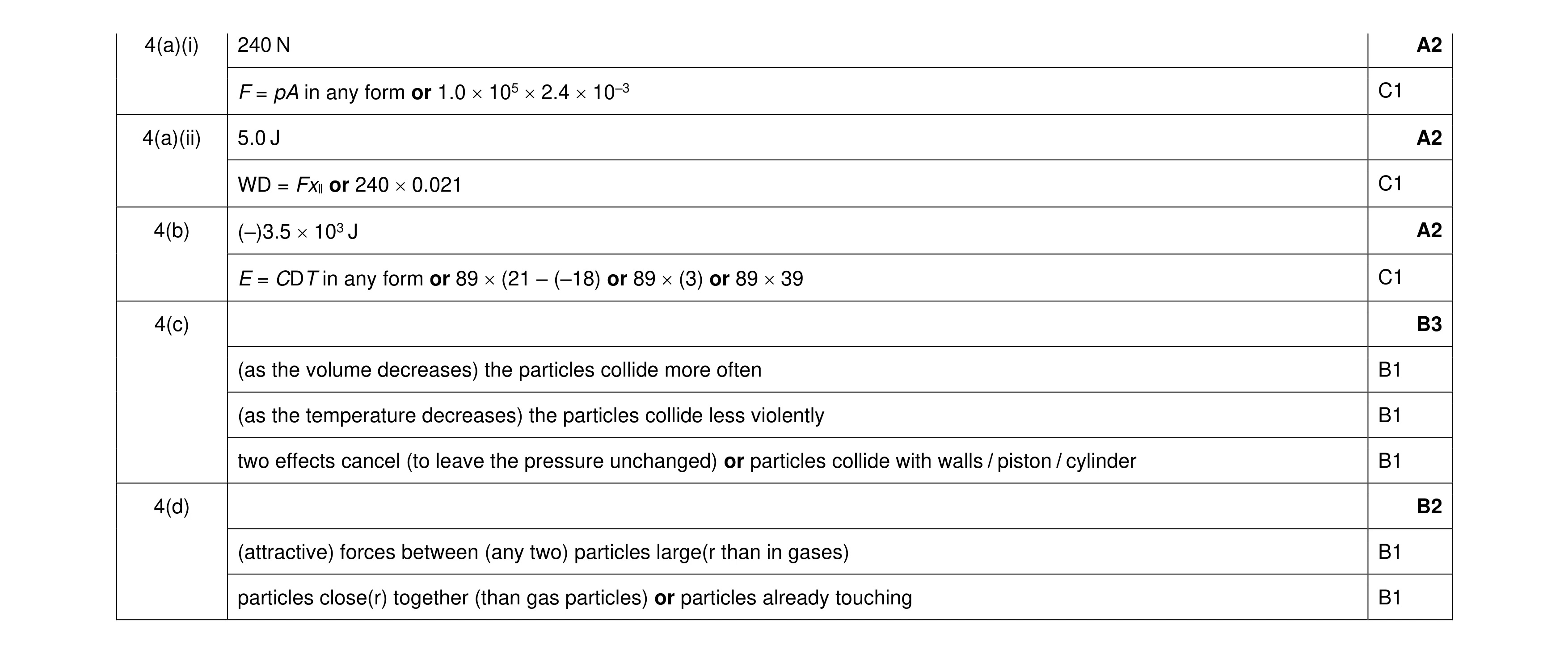 11
11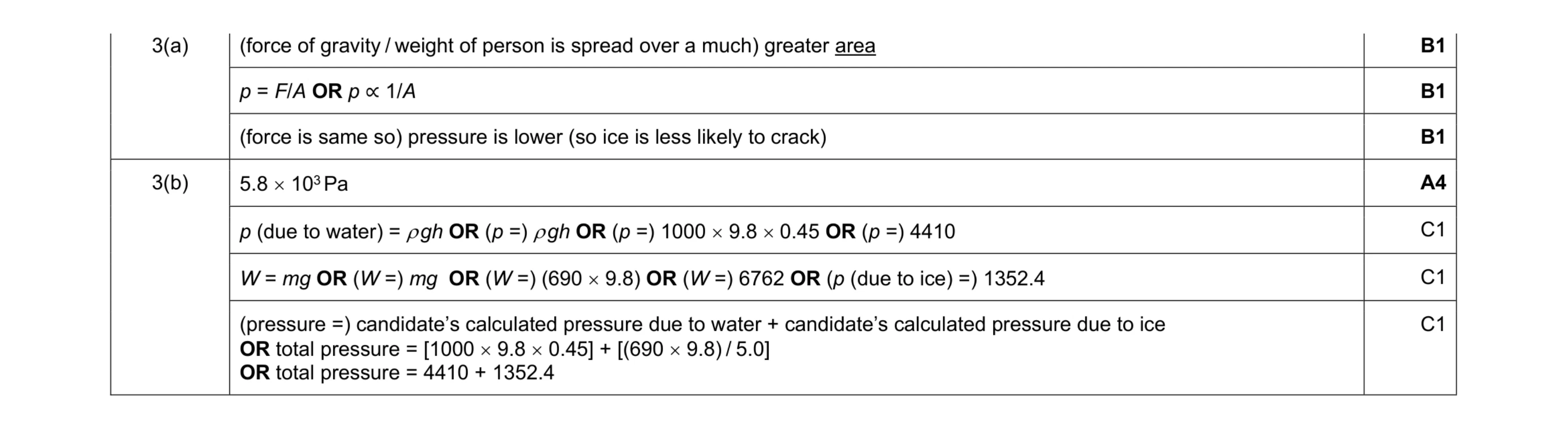 7
7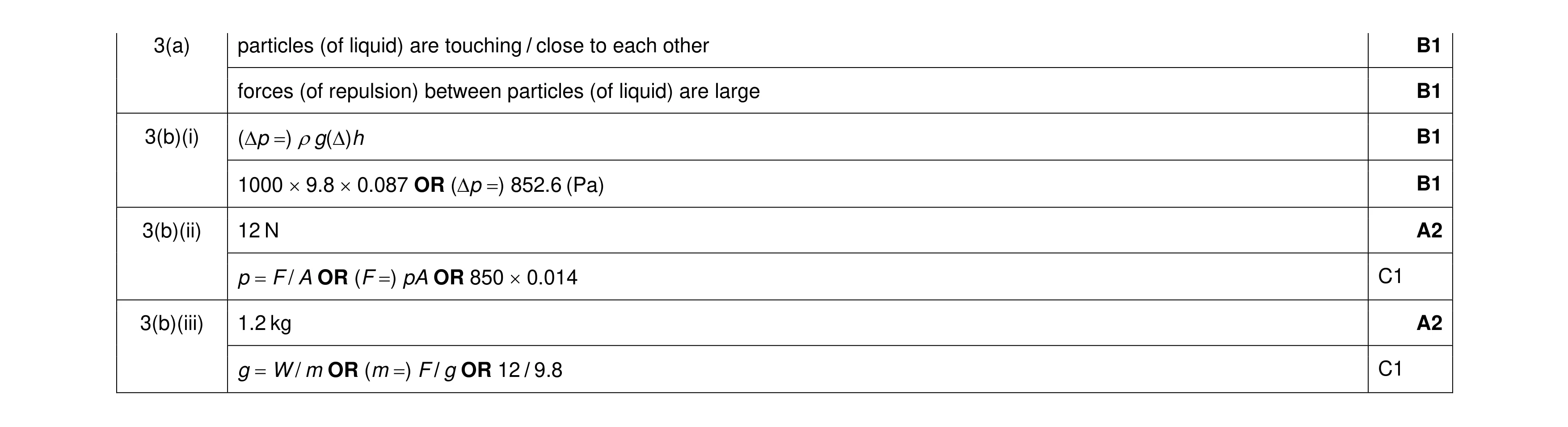 8
8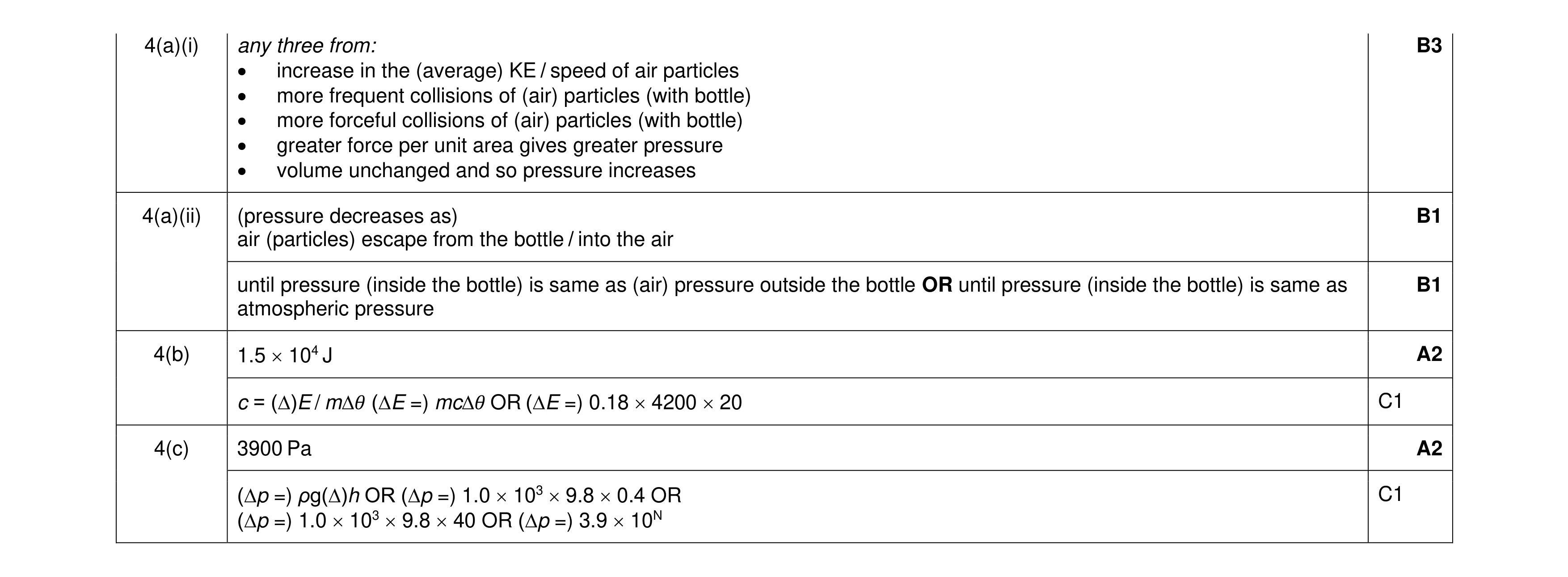 9
9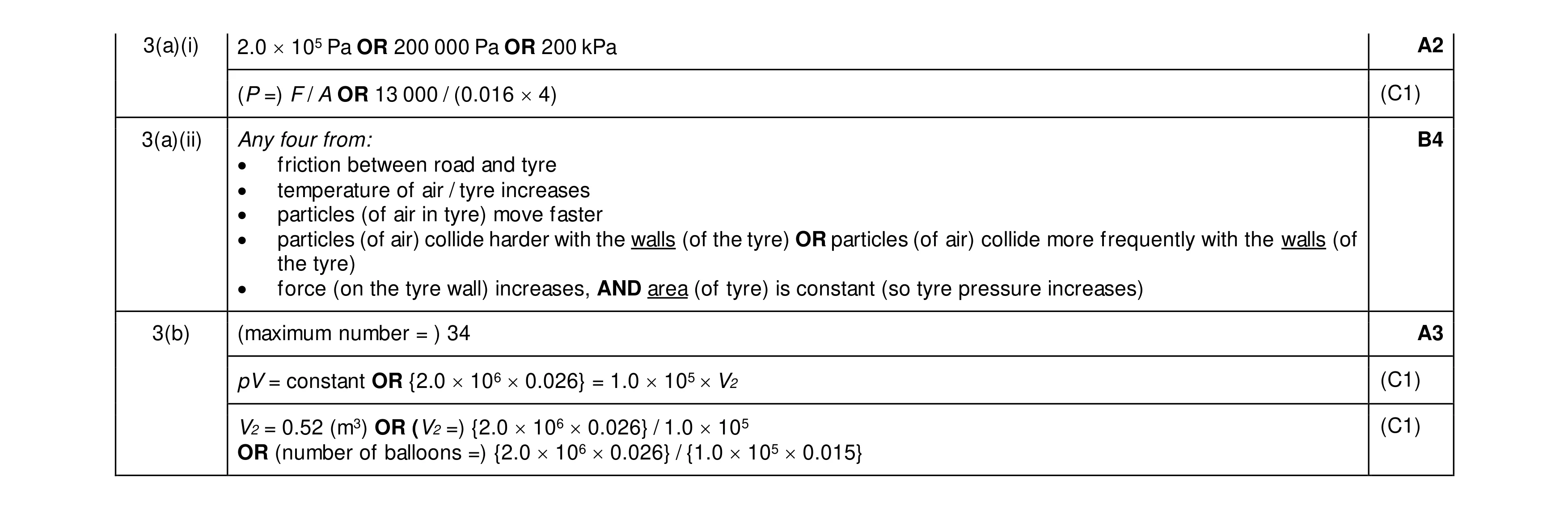 9
9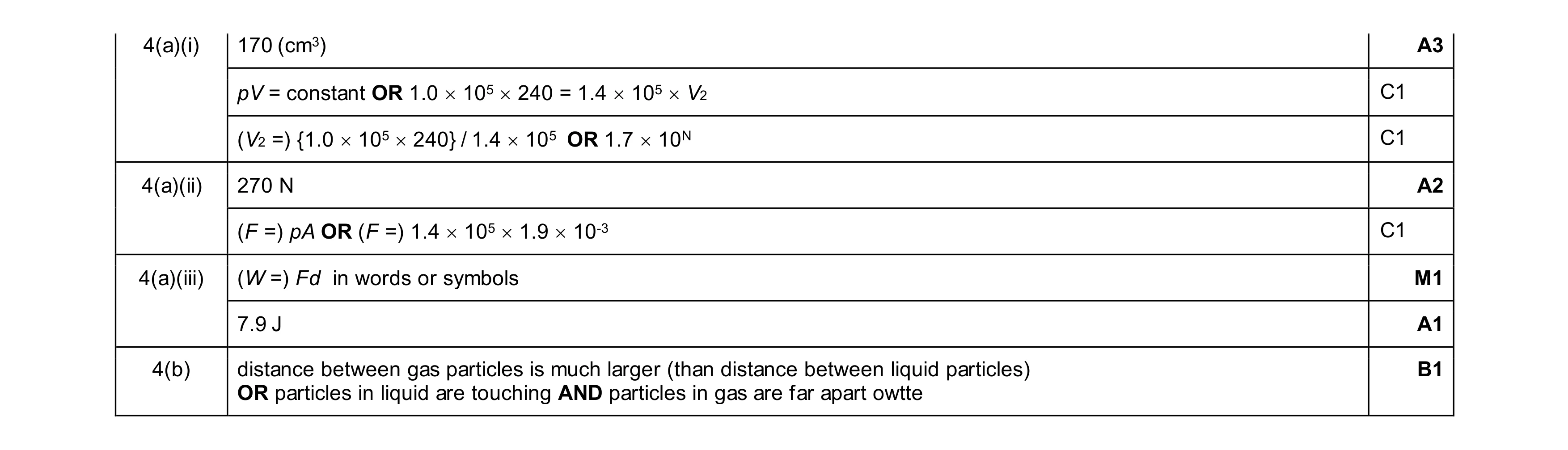 8
8