Questions as text
Q1 · Which policy would be most likely to reduce a balance of payments current account deficit? 9708/11 Oct/Nov 2005
30 Which policy would be most likely to reduce a balance of payments current account deficit? A reducing income tax rates B reducing subsidies to domestic industries C reducing the external value of the currency D reducing the level of tariffs
1 marks
Answer: C
This question in 9708/11 Oct/Nov 2005
Q2 · In an attempt to correct a balance of trade deficit the government of Indonesia has… 9708/11 May/June 2006
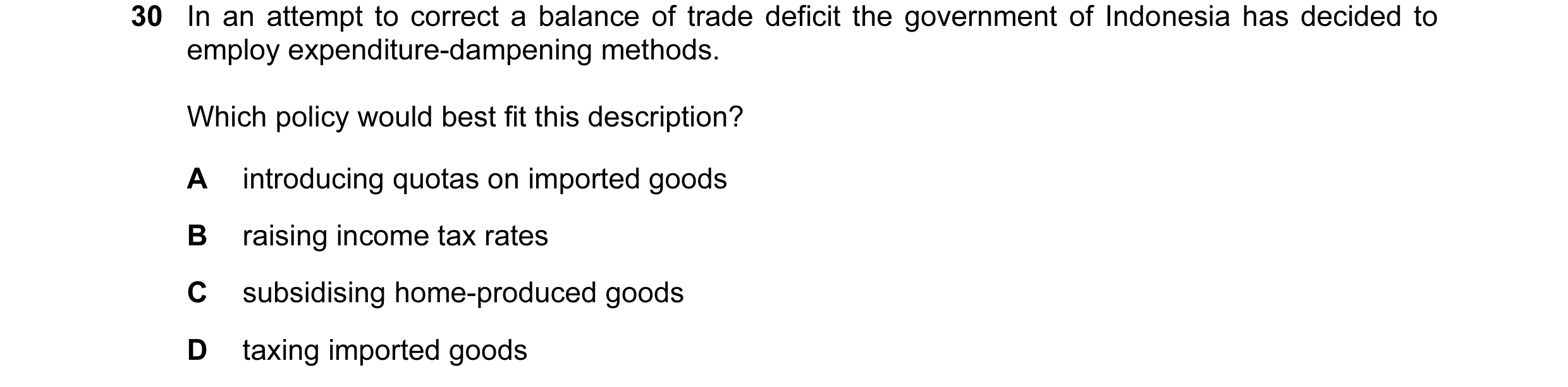
30 In an attempt to correct a balance of trade deficit the government of Indonesia has decided to employ expenditure-dampening methods. Which policy would best fit this description? A introducing quotas on imported goods B raising income tax rates C subsidising home-produced goods D taxing imported goods
1 marks
Answer: B
This question in 9708/11 May/June 2006
Q3 · In which of the following circumstances will devaluation of the external value of a… 9708/11 Oct/Nov 2006
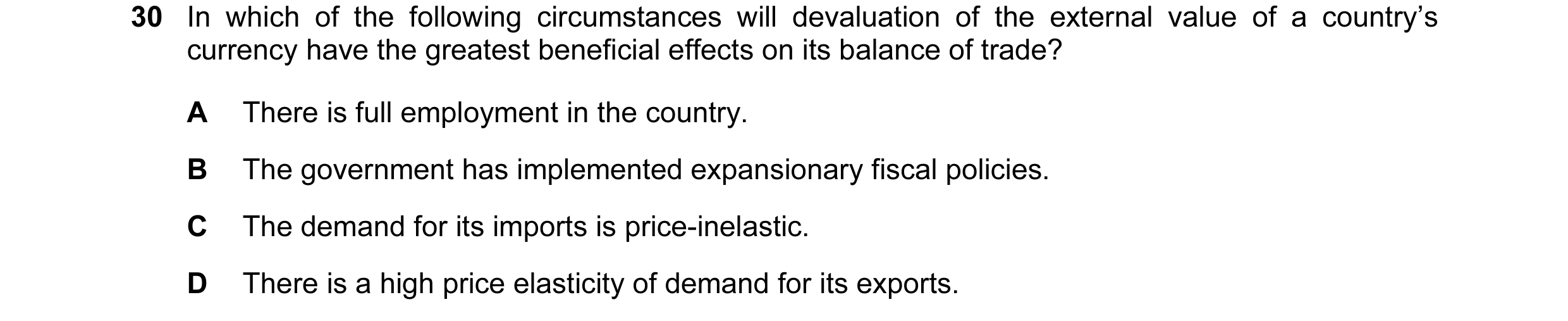
30 In which of the following circumstances will devaluation of the external value of a country’s currency have the greatest beneficial effects on its balance of trade? A There is full employment in the country. B The government has implemented expansionary fiscal policies. C The demand for its imports is price-inelastic. D There is a high price elasticity of demand for its exports.
1 marks
Answer: D
This question in 9708/11 Oct/Nov 2006
Q4 · A country with a freely floating exchange rate has a persistent deficit on the current… 9708/11 May/June 2007
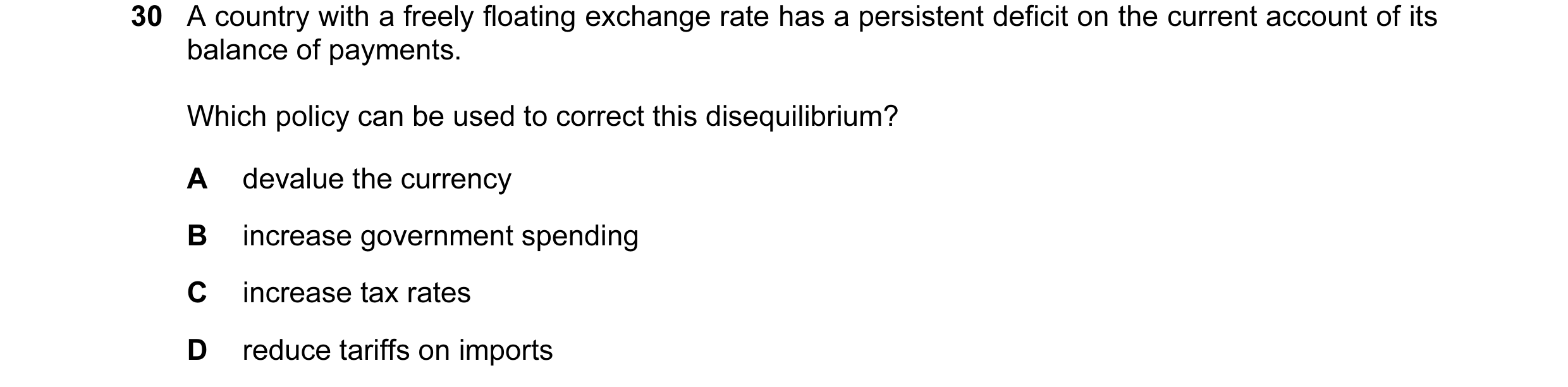
30 A country with a freely floating exchange rate has a persistent deficit on the current account of its balance of payments. Which policy can be used to correct this disequilibrium? A devalue the currency B increase government spending C increase tax rates D reduce tariffs on imports
1 marks
Answer: C
This question in 9708/11 May/June 2007
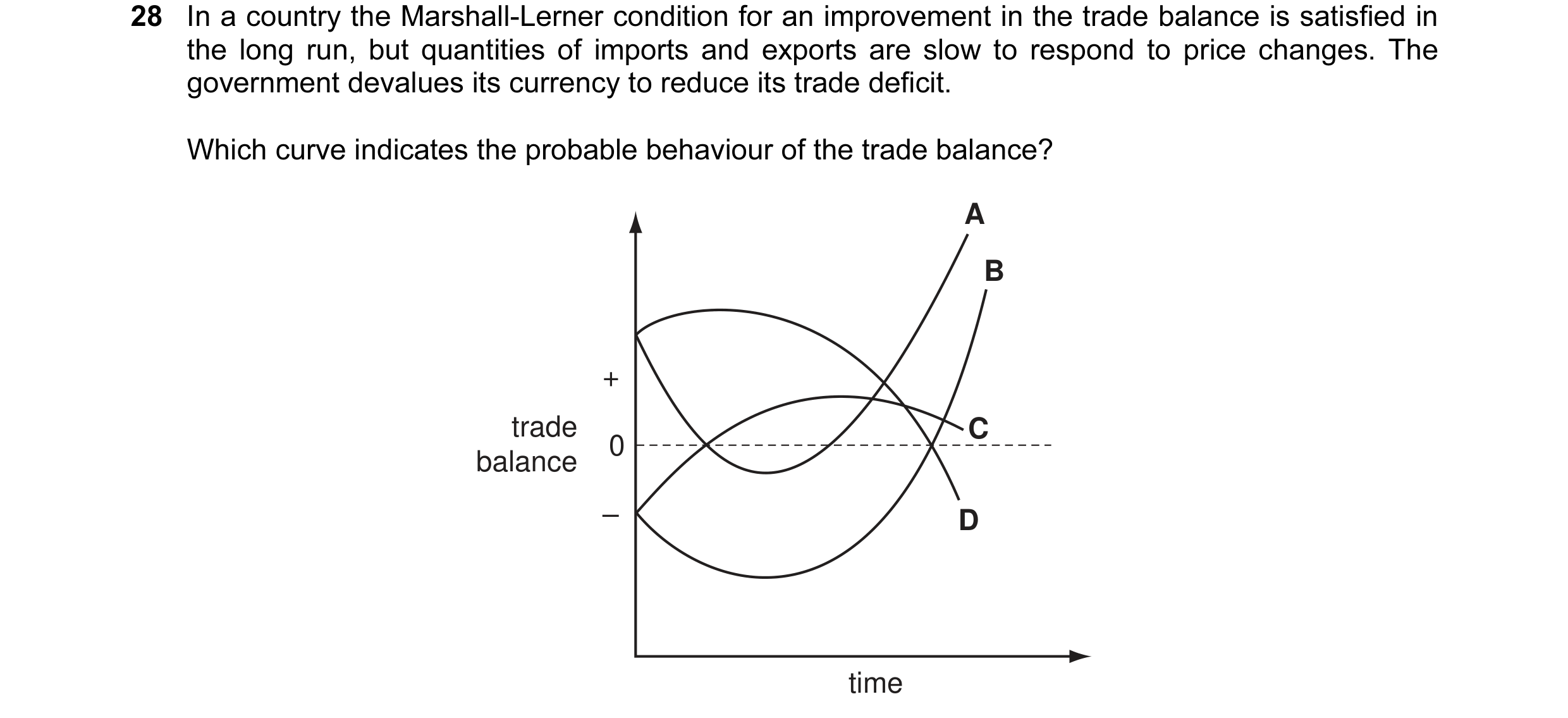
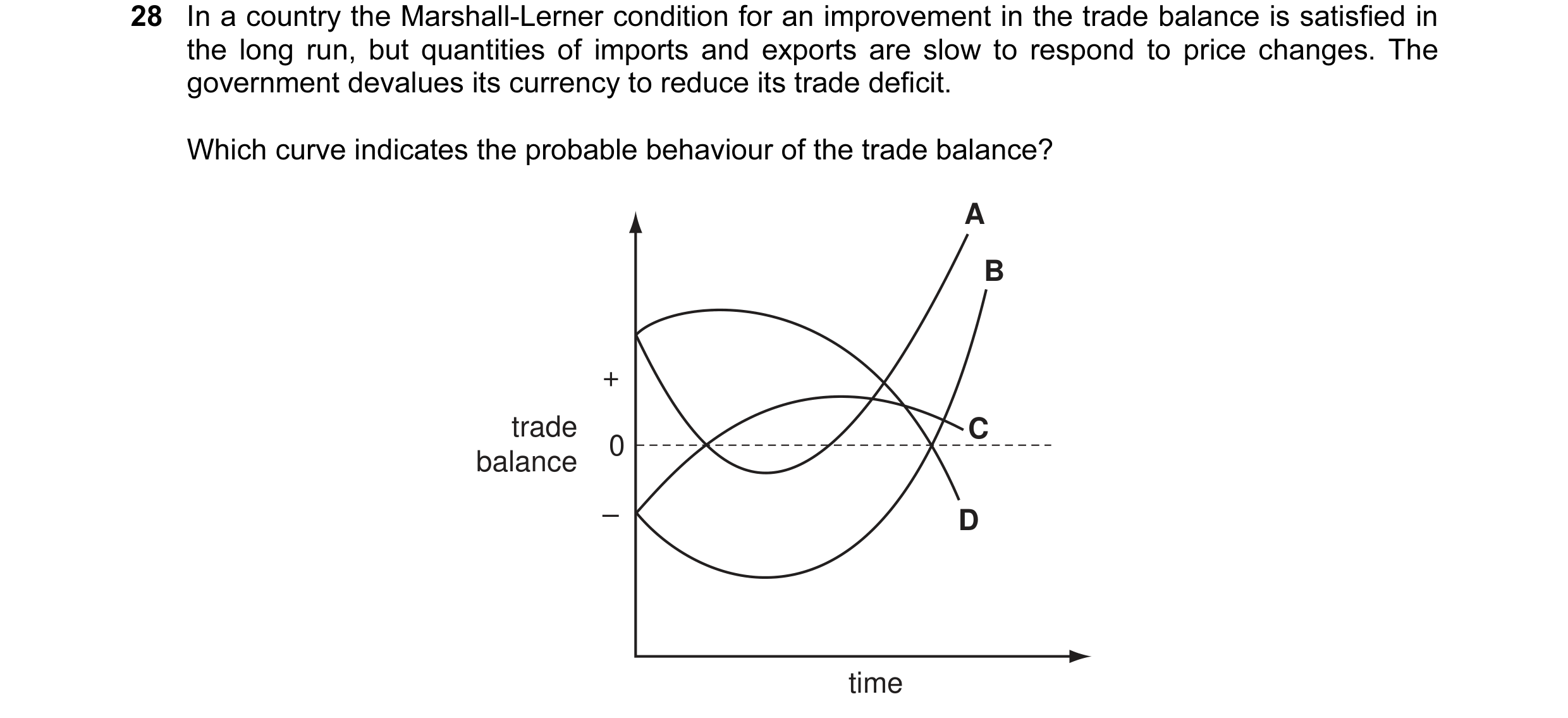
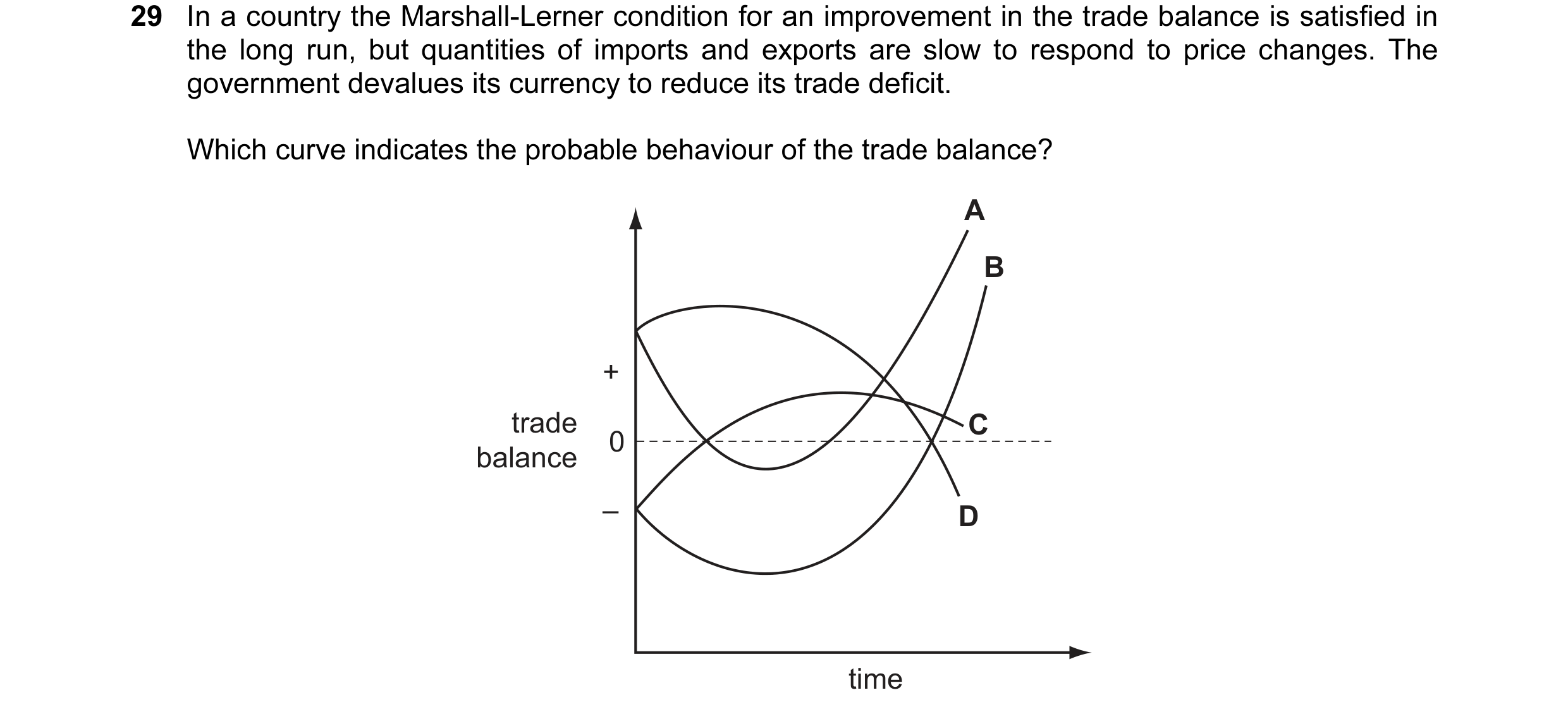
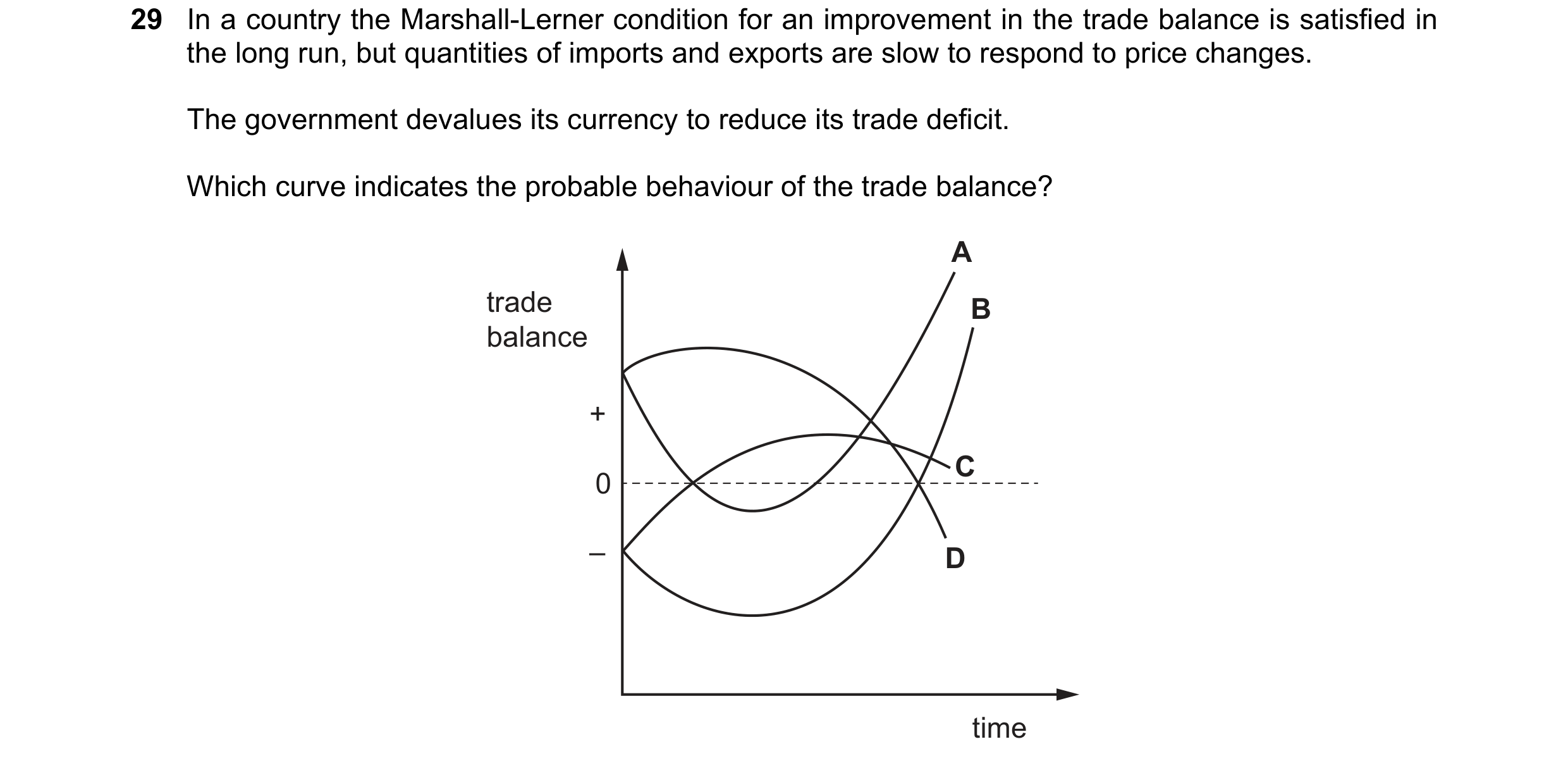
Q5 · In a country the Marshall-Lerner condition for an improvement in the trade balance is… 9708/11 Oct/Nov 2007
28 In a country the Marshall-Lerner condition for an improvement in the trade balance is satisfied in the long run, but quantities of imports and exports are slow to respond to price changes. The government devalues its currency to reduce its trade deficit. Which curve indicates the probable behaviour of the trade balance? A B + trade C 0 balance – D time
1 marks
Answer: B
This question in 9708/11 Oct/Nov 2007
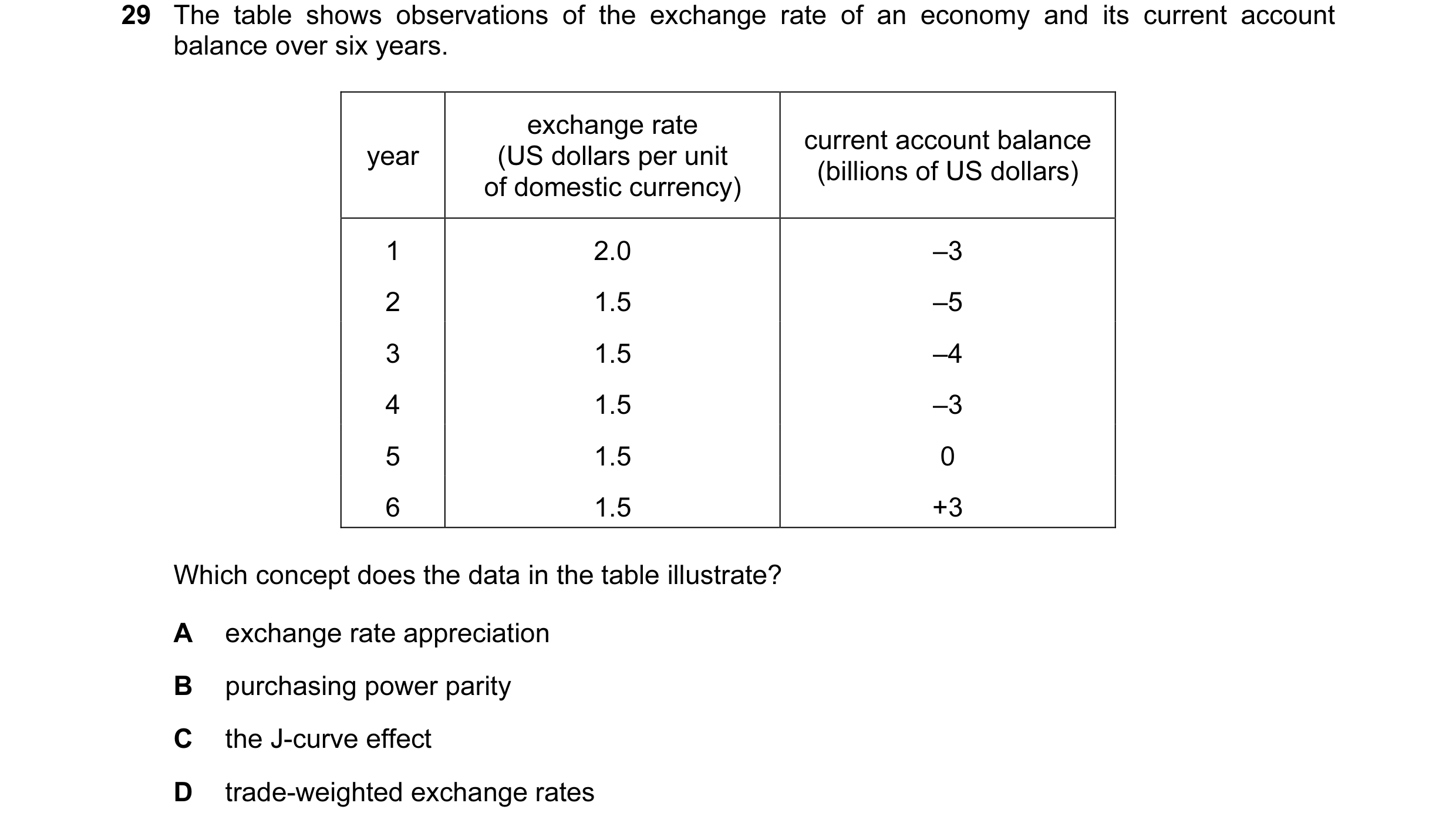
Q6 · The table shows observations of the exchange rate of an economy and its current account… 9708/11 May/June 2008
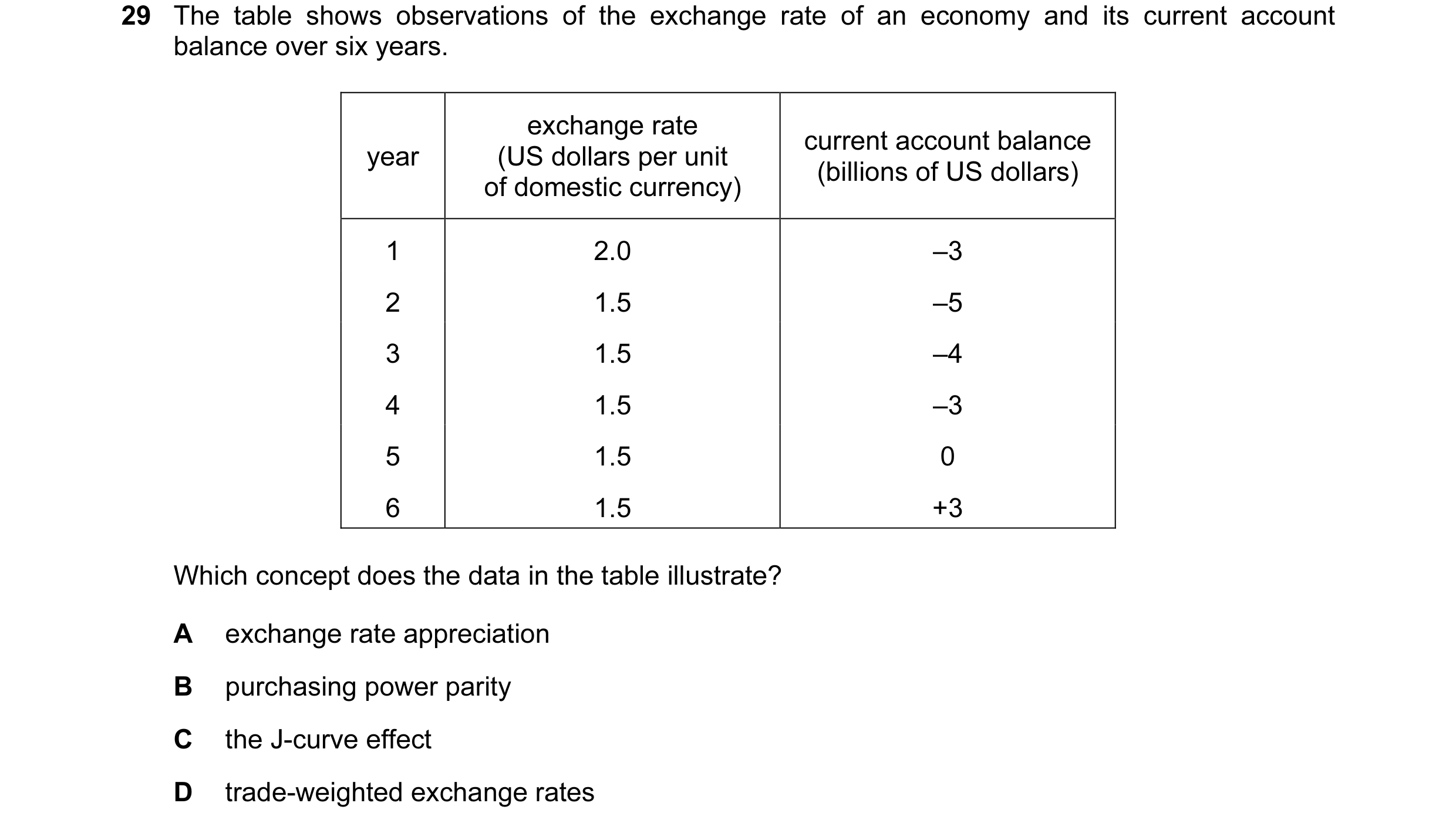
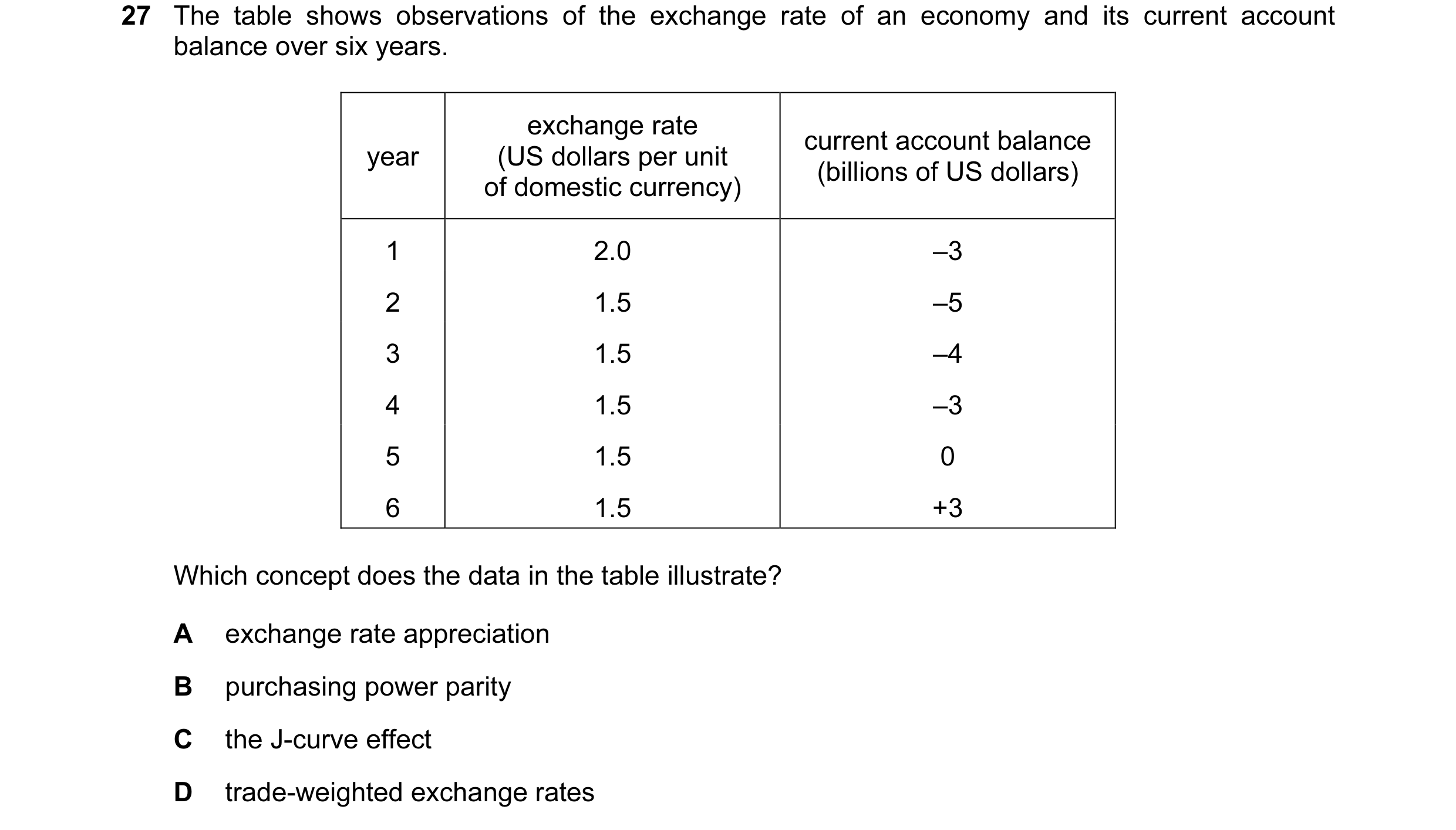
29 The table shows observations of the exchange rate of an economy and its current account balance over six years. exchange rate current account balance year (US dollars per unit (billions of US dollars) of domestic currency) 1 2.0 –3 2 1.5 –5 3 1.5 –4 4 1.5 –3 5 1.5 0 6 1.5 +3 Which concept does the data in the table illustrate? A exchange rate appreciation B purchasing power parity C the J-curve effect D trade-weighted exchange rates
1 marks
Answer: C
This question in 9708/11 May/June 2008
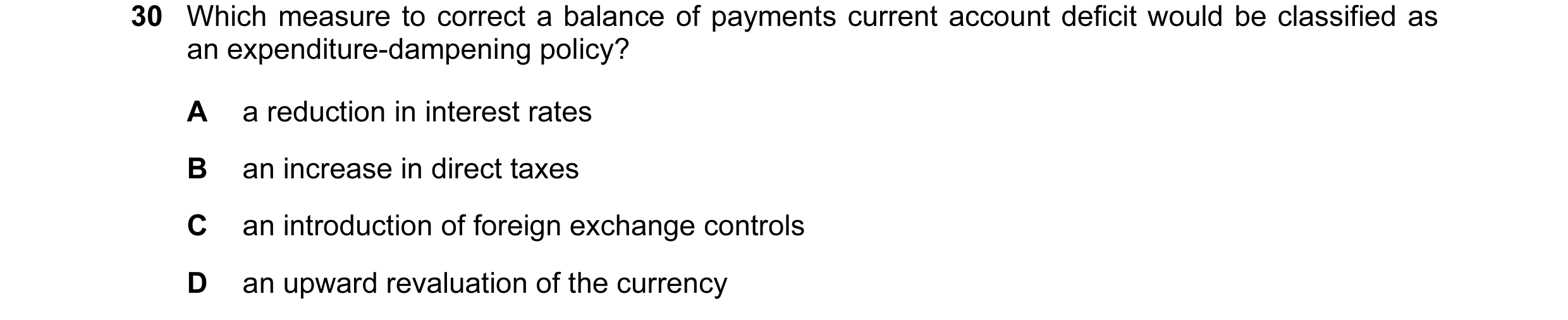
Q7 · Which measure to correct a balance of payments current account deficit would be… 9708/11 Oct/Nov 2008
30 Which measure to correct a balance of payments current account deficit would be classified as an expenditure-dampening policy? A a reduction in interest rates B an increase in direct taxes C an introduction of foreign exchange controls D an upward revaluation of the currency
1 marks
Answer: B
This question in 9708/11 Oct/Nov 2008
Q8 · A country has a large current account deficit 9708/11 May/June 2009
30 A country has a large current account deficit. Its government decides to devalue its currency. In which circumstance would such a measure reduce the deficit? price elasticity of price elasticity of demand for exports demand for imports A 0.0 0.0 B 0.0 0.5 C 0.5 0.5 D 0.5 1.0
1 marks
Answer: D
This question in 9708/11 May/June 2009
Q9 · When is a deficit on the current account of the balance of payments likely to worsen? 9708/11 May/June 2010
27 When is a deficit on the current account of the balance of payments likely to worsen? A when the government adopts a deflationary macroeconomic policy B when the government devalues the currency C when the prices of imported products that are demand-inelastic increase significantly D when tariffs are placed on imported products that are demand-elastic
1 marks
Answer: C
This question in 9708/11 May/June 2010
Q10 · When is a deficit on the current account of the balance of payments likely to worsen? 9708/12 May/June 2010
26 When is a deficit on the current account of the balance of payments likely to worsen? A when the government adopts a deflationary macroeconomic policy B when the government devalues the currency C when the prices of imported products that are demand-inelastic increase significantly D when tariffs are placed on imported products that are demand-elastic
1 marks
Answer: C
This question in 9708/12 May/June 2010
Q11 · When is a deficit on the current account of the balance of payments likely to worsen? 9708/13 May/June 2010
25 When is a deficit on the current account of the balance of payments likely to worsen? A when the government adopts a deflationary macroeconomic policy B when the government devalues the currency C when the prices of imported products that are demand-inelastic increase significantly D when tariffs are placed on imported products that are demand-elastic
1 marks
Answer: C
This question in 9708/13 May/June 2010
Q12 · In a country the Marshall-Lerner condition for an improvement in the trade balance is… 9708/11 Oct/Nov 2010
28 In a country the Marshall-Lerner condition for an improvement in the trade balance is satisfied in the long run, but quantities of imports and exports are slow to respond to price changes. The government devalues its currency to reduce its trade deficit. Which curve indicates the probable behaviour of the trade balance? A B + trade C 0 balance – D time
1 marks
Answer: B
This question in 9708/11 Oct/Nov 2010
Q13 · In 2008 the Chinese government was under pressure from other countries to reduce its… 9708/11 Oct/Nov 2010
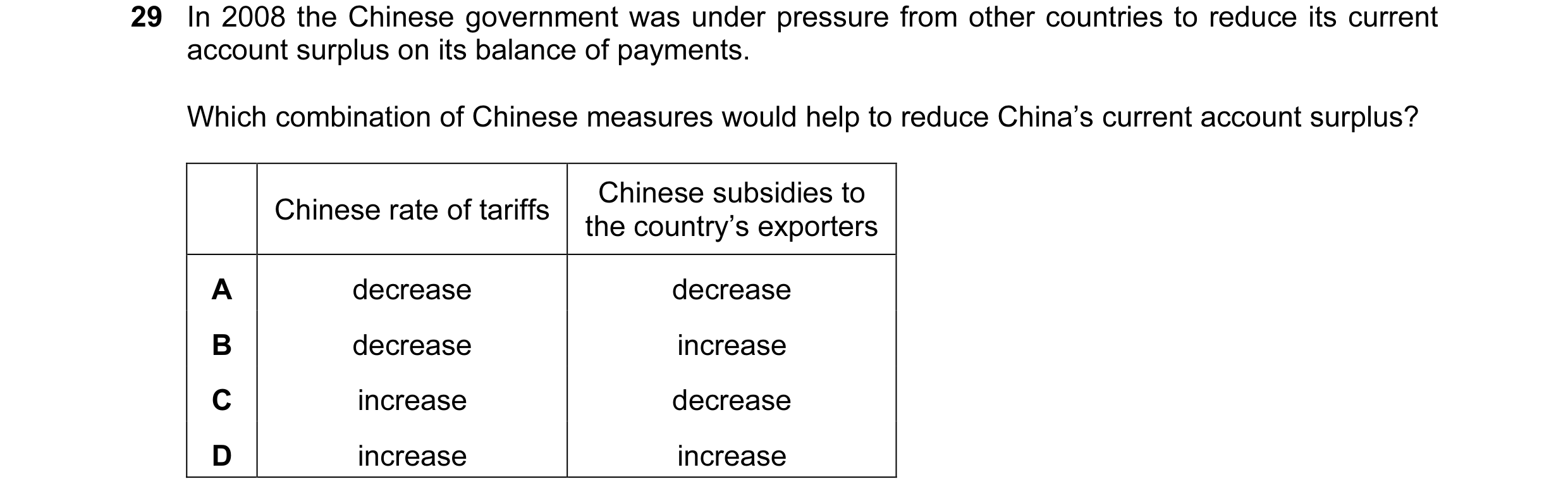
30 In 2008 the Chinese government was under pressure from other countries to reduce its current account surplus on its balance of payments. Which combination of Chinese measures would help to reduce China’s current account surplus? Chinese subsidies to Chinese rate of tariffs the country’s exporters A decrease decrease B decrease increase C increase decrease D increase increase
1 marks
Answer: A
This question in 9708/11 Oct/Nov 2010
Q14 · In a country the Marshall-Lerner condition for an improvement in the trade balance is… 9708/12 Oct/Nov 2010
28 In a country the Marshall-Lerner condition for an improvement in the trade balance is satisfied in the long run, but quantities of imports and exports are slow to respond to price changes. The government devalues its currency to reduce its trade deficit. Which curve indicates the probable behaviour of the trade balance? A B + trade C 0 balance – D time
1 marks
Answer: B
This question in 9708/12 Oct/Nov 2010
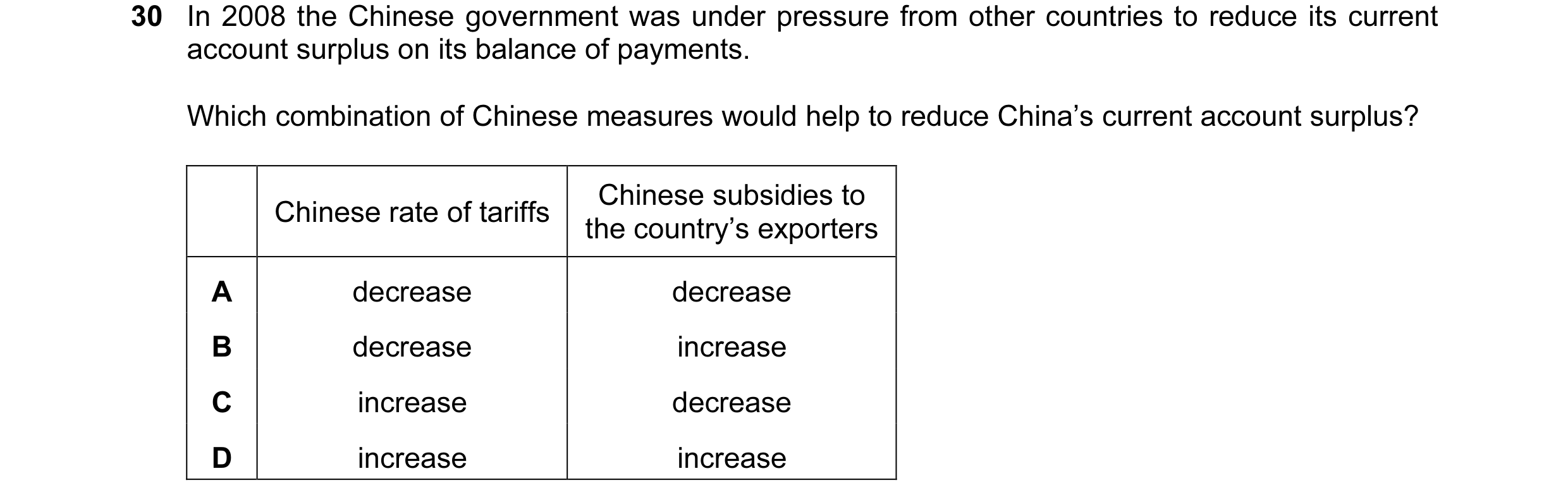
Q15 · In 2008 the Chinese government was under pressure from other countries to reduce its… 9708/12 Oct/Nov 2010
30 In 2008 the Chinese government was under pressure from other countries to reduce its current account surplus on its balance of payments. Which combination of Chinese measures would help to reduce China’s current account surplus? Chinese subsidies to Chinese rate of tariffs the country’s exporters A decrease decrease B decrease increase C increase decrease D increase increase
1 marks
Answer: A
This question in 9708/12 Oct/Nov 2010
Q16 · In a country the Marshall-Lerner condition for an improvement in the trade balance is… 9708/13 Oct/Nov 2010
27 In a country the Marshall-Lerner condition for an improvement in the trade balance is satisfied in the long run, but quantities of imports and exports are slow to respond to price changes. The government devalues its currency to reduce its trade deficit. Which curve indicates the probable behaviour of the trade balance? A B + trade C 0 balance – D time
1 marks
Answer: B
This question in 9708/13 Oct/Nov 2010
Q17 · In 2008 the Chinese government was under pressure from other countries to reduce its… 9708/13 Oct/Nov 2010
29 In 2008 the Chinese government was under pressure from other countries to reduce its current account surplus on its balance of payments. Which combination of Chinese measures would help to reduce China’s current account surplus? Chinese subsidies to Chinese rate of tariffs the country’s exporters A decrease decrease B decrease increase C increase decrease D increase increase
1 marks
Answer: A
This question in 9708/13 Oct/Nov 2010
Q18 · The table shows observations of the exchange rate of an economy and its current account… 9708/11 May/June 2011
29 The table shows observations of the exchange rate of an economy and its current account balance over six years. exchange rate current account balance year (US dollars per unit (billions of US dollars) of domestic currency) 1 2.0 –3 2 1.5 –5 3 1.5 –4 4 1.5 –3 5 1.5 0 6 1.5 +3 Which concept does the data in the table illustrate? A exchange rate appreciation B purchasing power parity C the J-curve effect D trade-weighted exchange rates
1 marks
Answer: C
This question in 9708/11 May/June 2011
Q19 · The table shows observations of the exchange rate of an economy and its current account… 9708/12 May/June 2011
28 The table shows observations of the exchange rate of an economy and its current account balance over six years. exchange rate current account balance year (US dollars per unit (billions of US dollars) of domestic currency) 1 2.0 –3 2 1.5 –5 3 1.5 –4 4 1.5 –3 5 1.5 0 6 1.5 +3 Which concept does the data in the table illustrate? A exchange rate appreciation B purchasing power parity C the J-curve effect D trade-weighted exchange rates
1 marks
Answer: C
This question in 9708/12 May/June 2011
Q20 · The table shows observations of the exchange rate of an economy and its current account… 9708/13 May/June 2011
27 The table shows observations of the exchange rate of an economy and its current account balance over six years. exchange rate current account balance year (US dollars per unit (billions of US dollars) of domestic currency) 1 2.0 –3 2 1.5 –5 3 1.5 –4 4 1.5 –3 5 1.5 0 6 1.5 +3 Which concept does the data in the table illustrate? A exchange rate appreciation B purchasing power parity C the J-curve effect D trade-weighted exchange rates
1 marks
Answer: C
This question in 9708/13 May/June 2011
Q21 · A country at the beginning of a given period seeks to improve the current account of its… 9708/11 Oct/Nov 2011
30 A country at the beginning of a given period seeks to improve the current account of its balance of payments by devaluing its currency. The effect of this policy in the following two years is shown in the diagram. current account surplus current +_ 0 balance 6 12 18 24 deficit months Which statement is likely to explain this performance? A In the short run, the price elasticity of demand for exports and imports was very low. B The domestic inflation rate fell after 12 months before having the desired result. C The elasticity of demand for imports diminished after 12 months. D The policy was ineffective and other factors must have led to an improvement in the current account.
1 marks
Answer: A
This question in 9708/11 Oct/Nov 2011
Q22 · When will a country’s balance of payments current account deficit be reduced? 9708/12 Oct/Nov 2011
30 When will a country’s balance of payments current account deficit be reduced? A when it raises its rate of income tax B when it reduces tariffs on its imports C when it revalues its currency D when it removes export subsidies
1 marks
Answer: A
This question in 9708/12 Oct/Nov 2011
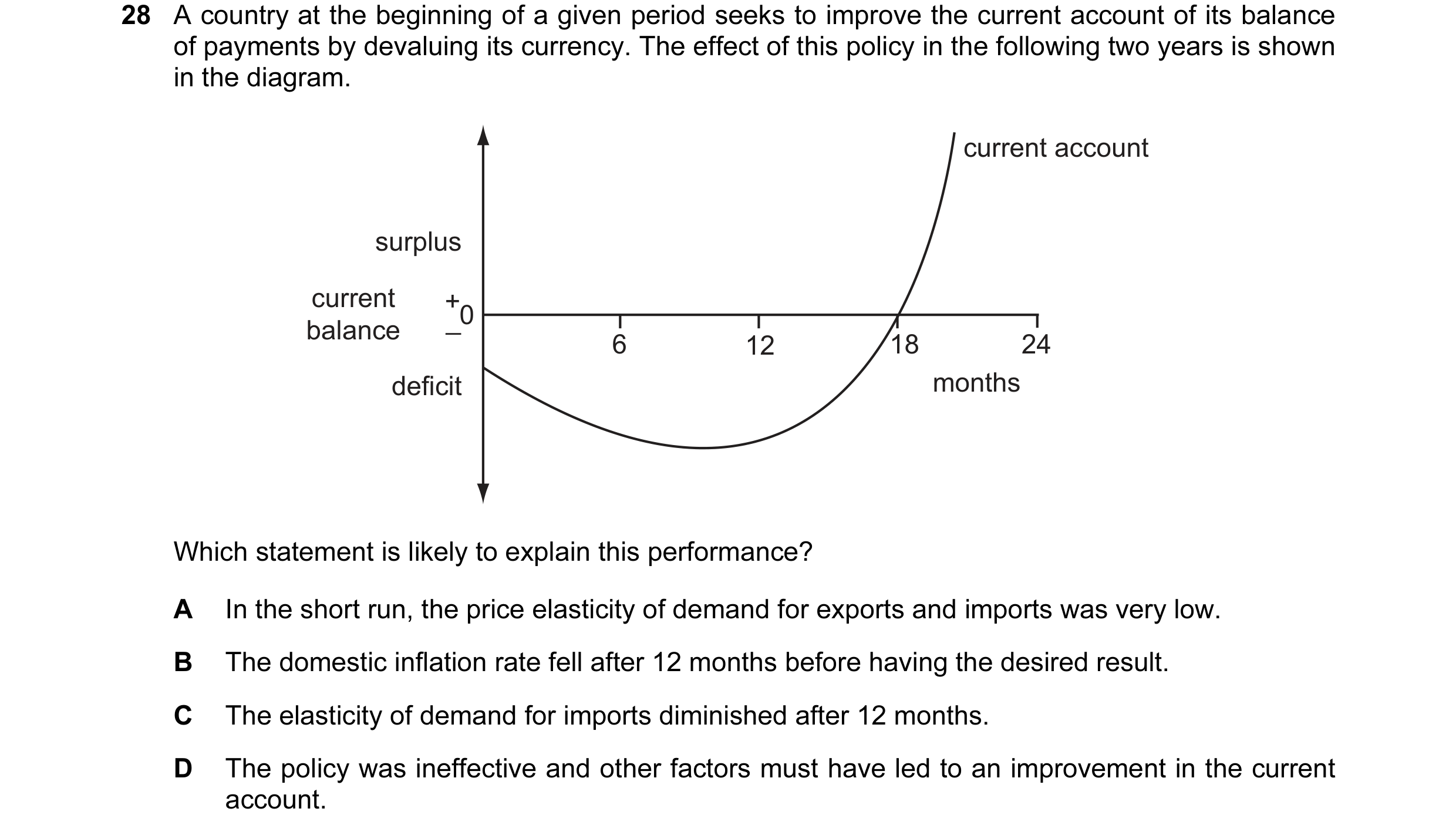
Q23 · A country at the beginning of a given period seeks to improve the current account of its… 9708/13 Oct/Nov 2011
28 A country at the beginning of a given period seeks to improve the current account of its balance of payments by devaluing its currency. The effect of this policy in the following two years is shown in the diagram. current account surplus current +_ 0 balance 6 12 18 24 deficit months Which statement is likely to explain this performance? A In the short run, the price elasticity of demand for exports and imports was very low. B The domestic inflation rate fell after 12 months before having the desired result. C The elasticity of demand for imports diminished after 12 months. D The policy was ineffective and other factors must have led to an improvement in the current account.
1 marks
Answer: A
This question in 9708/13 Oct/Nov 2011
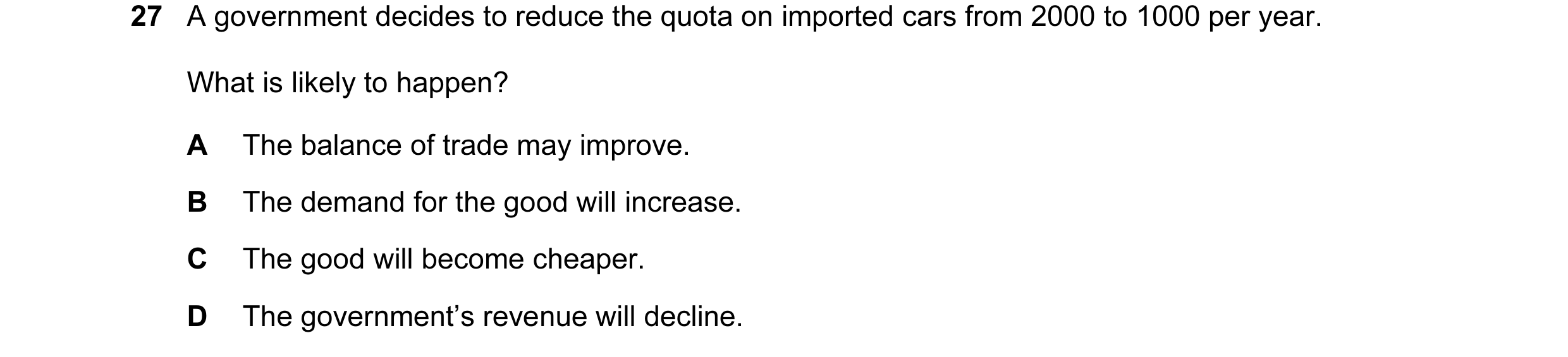
Q24 · A government decides to reduce the quota on imported cars from 2000 to 1000 per year 9708/11 May/June 2012
27 A government decides to reduce the quota on imported cars from 2000 to 1000 per year. What is likely to happen? A The balance of trade may improve. B The demand for the good will increase. C The good will become cheaper. D The government’s revenue will decline.
1 marks
Answer: A
This question in 9708/11 May/June 2012
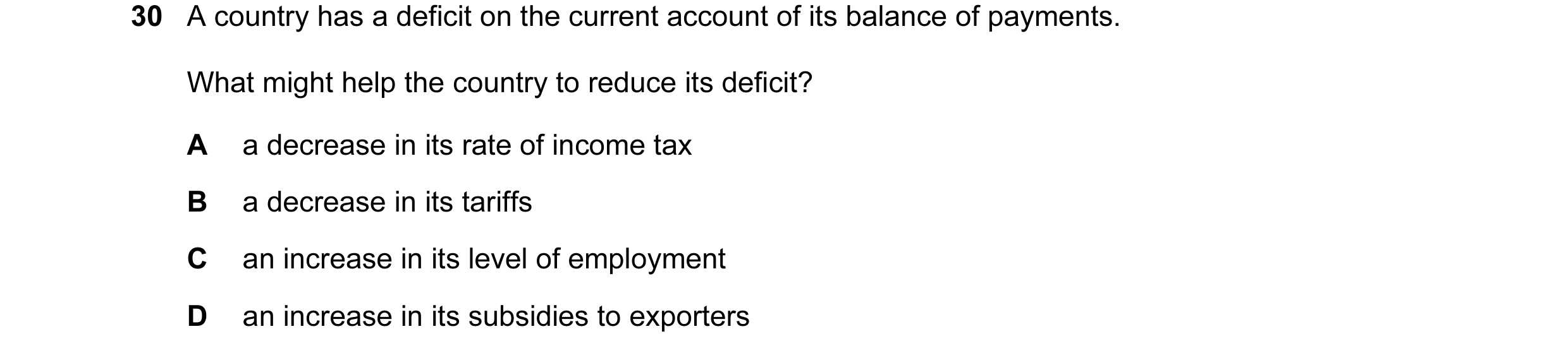
Q25 · A country has a deficit on the current account of its balance of payments 9708/11 May/June 2012
30 A country has a deficit on the current account of its balance of payments. What might help the country to reduce its deficit? A a decrease in its rate of income tax B a decrease in its tariffs C an increase in its level of employment D an increase in its subsidies to exporters
1 marks
Answer: D
This question in 9708/11 May/June 2012
Q26 · A government decides to reduce the quota on imported cars from 2000 to 1000 per year 9708/12 May/June 2012
27 A government decides to reduce the quota on imported cars from 2000 to 1000 per year. What is likely to happen? A The balance of trade may improve. B The demand for the good will increase. C The good will become cheaper. D The government’s revenue will decline.
1 marks
Answer: A
This question in 9708/12 May/June 2012
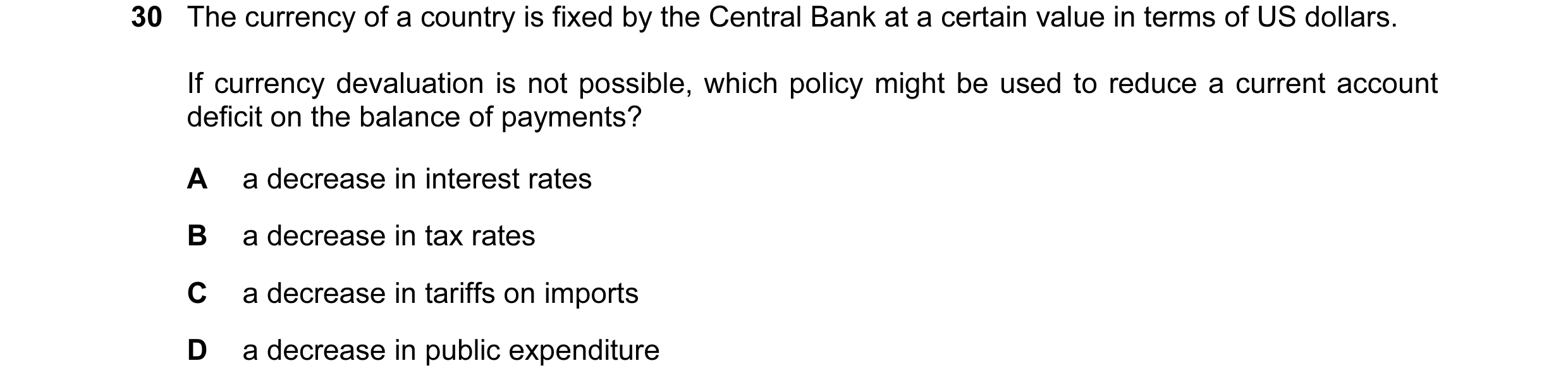
Q27 · The currency of a country is fixed by the Central Bank at a certain value in terms of US… 9708/12 May/June 2012
30 The currency of a country is fixed by the Central Bank at a certain value in terms of US dollars. If currency devaluation is not possible, which policy might be used to reduce a current account deficit on the balance of payments? A a decrease in interest rates B a decrease in tax rates C a decrease in tariffs on imports D a decrease in public expenditure
1 marks
Answer: D
This question in 9708/12 May/June 2012
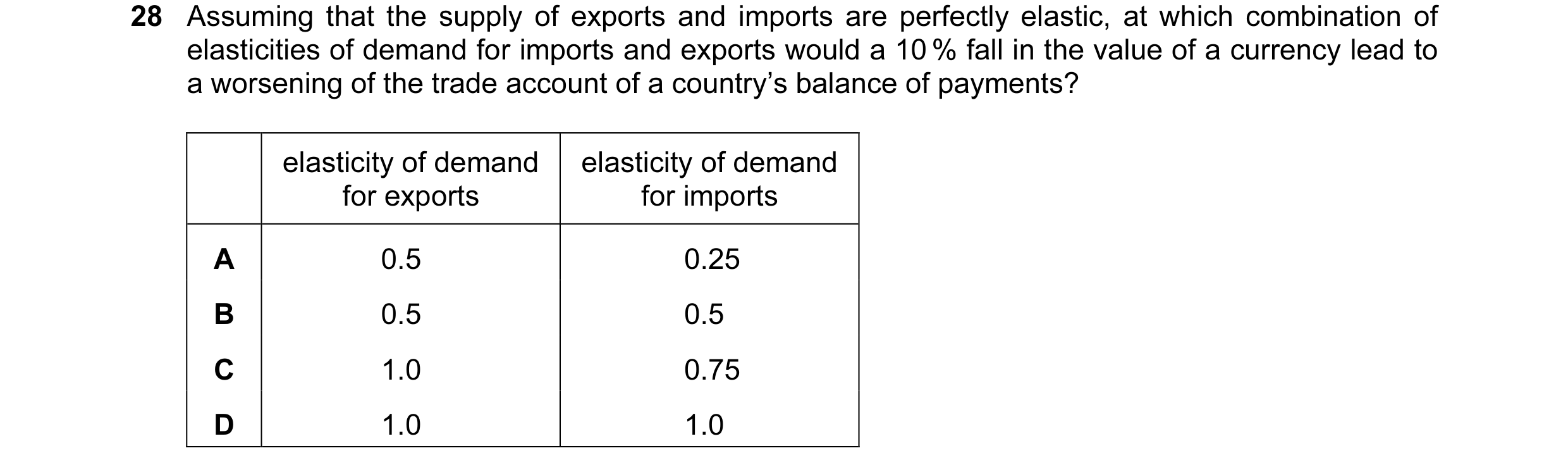
Q28 · Assuming that the supply of exports and imports are perfectly elastic, at which… 9708/13 May/June 2012
28 Assuming that the supply of exports and imports are perfectly elastic, at which combination of elasticities of demand for imports and exports would a 10 % fall in the value of a currency lead to a worsening of the trade account of a country’s balance of payments? elasticity of demand elasticity of demand for exports for imports A 0.5 0.25 B 0.5 0.5 C 1.0 0.75 D 1.0 1.0
1 marks
Answer: A
This question in 9708/13 May/June 2012
Q29 · A country has a deficit on the current account of its balance of payments 9708/13 May/June 2012
30 A country has a deficit on the current account of its balance of payments. What might help the country to reduce its deficit? A a decrease in its rate of income tax B a decrease in its tariffs C an increase in its level of employment D an increase in its subsidies to exporters
1 marks
Answer: D
This question in 9708/13 May/June 2012
Q30 · What is an example of an expenditure-dampening policy? 9708/11 Oct/Nov 2012
30 What is an example of an expenditure-dampening policy? A an increase in income tax rates B an increase in the level of import tariffs C an upward revaluation of the exchange rate D the introduction of import quotas
1 marks
Answer: A
This question in 9708/11 Oct/Nov 2012
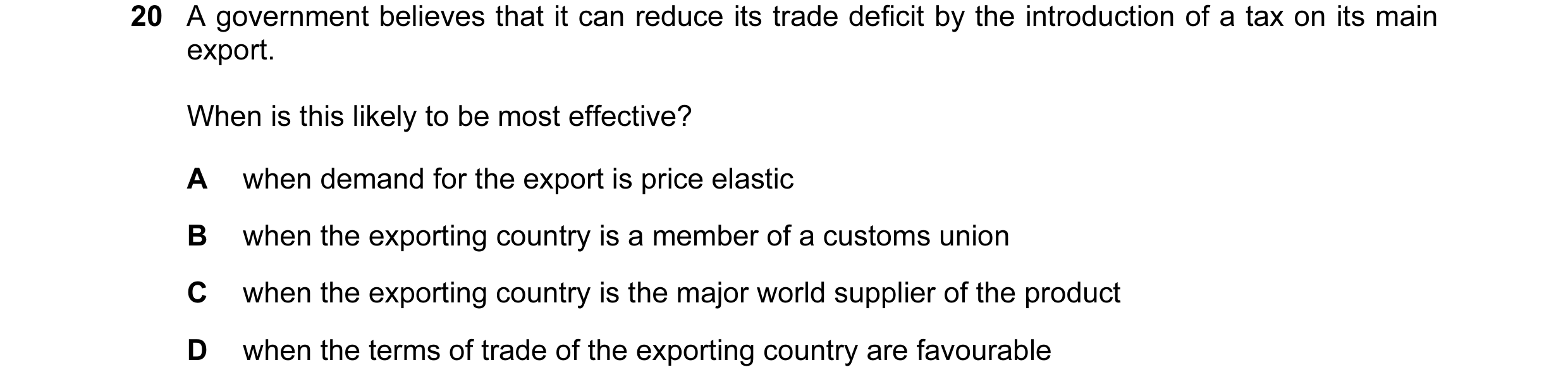
Q31 · A government believes that it can reduce its trade deficit by the introduction of a tax… 9708/12 Oct/Nov 2012
20 A government believes that it can reduce its trade deficit by the introduction of a tax on its main export. When is this likely to be most effective? A when demand for the export is price elastic B when the exporting country is a member of a customs union C when the exporting country is the major world supplier of the product D when the terms of trade of the exporting country are favourable
1 marks
Answer: C
This question in 9708/12 Oct/Nov 2012
Q32 · When is the imposition of a tariff on a good most likely to reduce a trade deficit? 9708/12 Oct/Nov 2012
30 When is the imposition of a tariff on a good most likely to reduce a trade deficit? A when the country has a potential comparative advantage in producing that good B when the country is a member of an economic union C when the elasticity of supply of the good domestically is zero D when the price elasticity of demand for the good is zero
1 marks
Answer: A
This question in 9708/12 Oct/Nov 2012
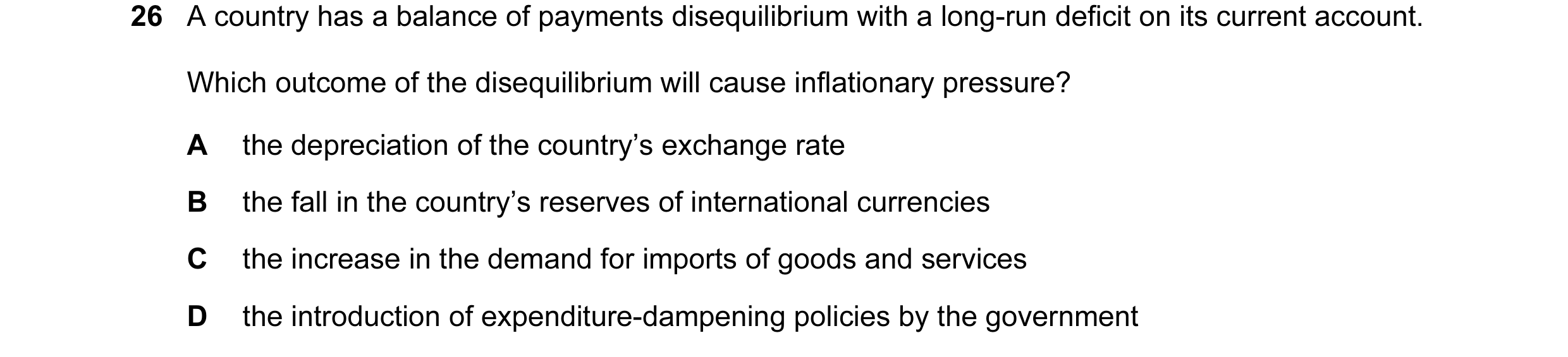
Q33 · A country has a balance of payments disequilibrium with a long-run deficit on its current… 9708/13 Oct/Nov 2012
26 A country has a balance of payments disequilibrium with a long-run deficit on its current account. Which outcome of the disequilibrium will cause inflationary pressure? A the depreciation of the country’s exchange rate B the fall in the country’s reserves of international currencies C the increase in the demand for imports of goods and services D the introduction of expenditure-dampening policies by the government
1 marks
Answer: A
This question in 9708/13 Oct/Nov 2012
Q34 · What is an expenditure-switching policy measure? 9708/11 May/June 2013
30 What is an expenditure-switching policy measure? A decreasing income tax B decreasing the money supply C devaluing the currency D increasing government spending
1 marks
Answer: C
This question in 9708/11 May/June 2013
Q35 · Which policy, adopted by a government with the intention of reducing the rate of… 9708/13 May/June 2013
28 Which policy, adopted by a government with the intention of reducing the rate of inflation, might cause a greater deficit on the balance of payments? A higher foreign exchange rates for its currency B higher interest rates for domestic customers C higher subsidies to domestic producers D higher tax rates on consumer incomes
1 marks
Answer: A
This question in 9708/13 May/June 2013
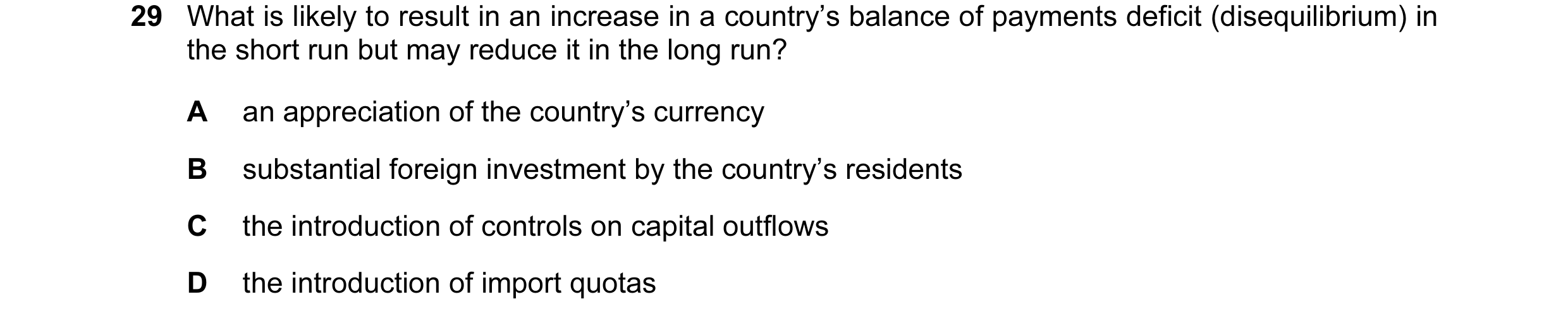
Q36 · What is likely to result in an increase in a country’s balance of payments deficit… 9708/13 May/June 2013
29 What is likely to result in an increase in a country’s balance of payments deficit (disequilibrium) in the short run but may reduce it in the long run? A an appreciation of the country’s currency B substantial foreign investment by the country’s residents C the introduction of controls on capital outflows D the introduction of import quotas
1 marks
Answer: B
This question in 9708/13 May/June 2013
Q37 · In a country the Marshall-Lerner condition for an improvement in the trade balance is… 9708/11 Oct/Nov 2013
29 In a country the Marshall-Lerner condition for an improvement in the trade balance is satisfied in the long run, but quantities of imports and exports are slow to respond to price changes. The government devalues its currency to reduce its trade deficit. Which curve indicates the probable behaviour of the trade balance? A B + trade C 0 balance – D time
1 marks
Answer: B
This question in 9708/11 Oct/Nov 2013
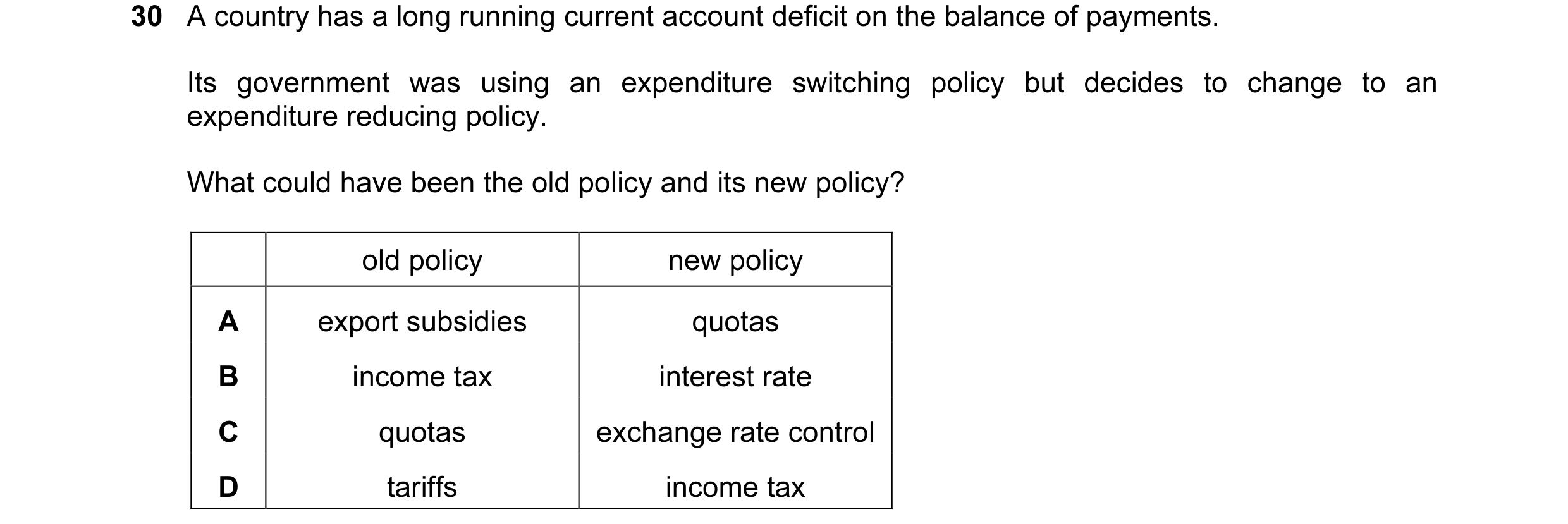
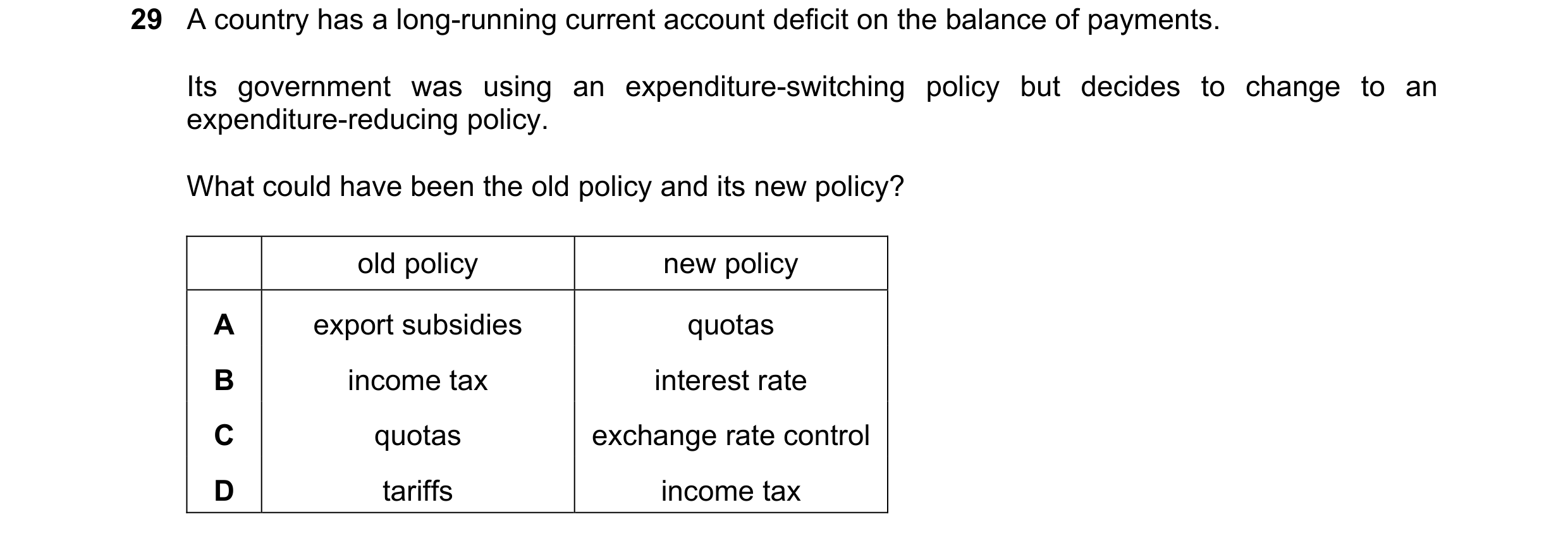
Q38 · A country has a long running current account deficit on the balance of payments 9708/11 Oct/Nov 2013
30 A country has a long running current account deficit on the balance of payments. Its government was using an expenditure switching policy but decides to change to an expenditure reducing policy. What could have been the old policy and its new policy? old policy new policy A export subsidies quotas B income tax interest rate C quotas exchange rate control D tariffs income tax
1 marks
Answer: D
This question in 9708/11 Oct/Nov 2013
Q39 · An economy has a high level of unemployment and a large balance of payments deficit on… 9708/12 Oct/Nov 2013
30 An economy has a high level of unemployment and a large balance of payments deficit on the current account. What would be a suitable policy for the government to adopt? A decrease government spending B devalue the currency C increase direct taxation D increase interest rates
1 marks
Answer: B
This question in 9708/12 Oct/Nov 2013
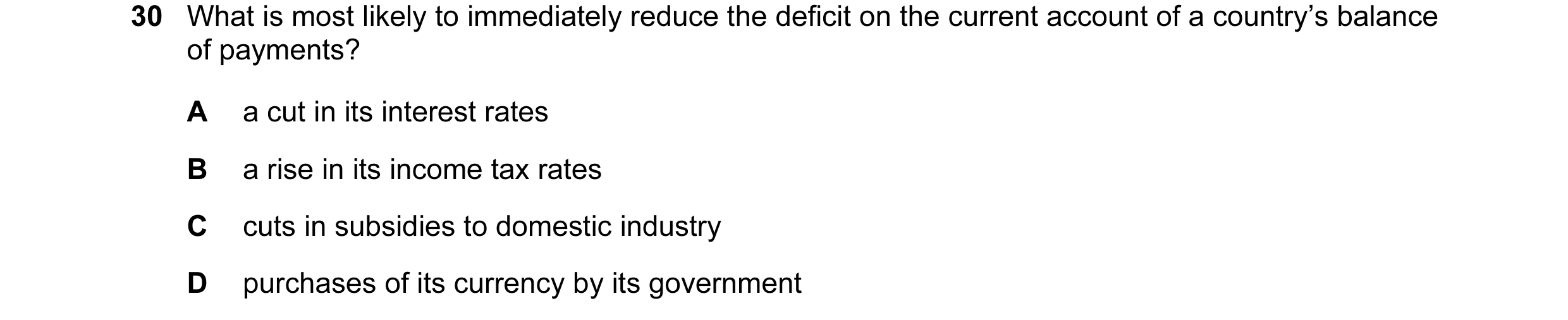
Q40 · What is most likely to immediately reduce the deficit on the current account of a… 9708/13 Oct/Nov 2013
30 What is most likely to immediately reduce the deficit on the current account of a country’s balance of payments? A a cut in its interest rates B a rise in its income tax rates C cuts in subsidies to domestic industry D purchases of its currency by its government
1 marks
Answer: B
This question in 9708/13 Oct/Nov 2013
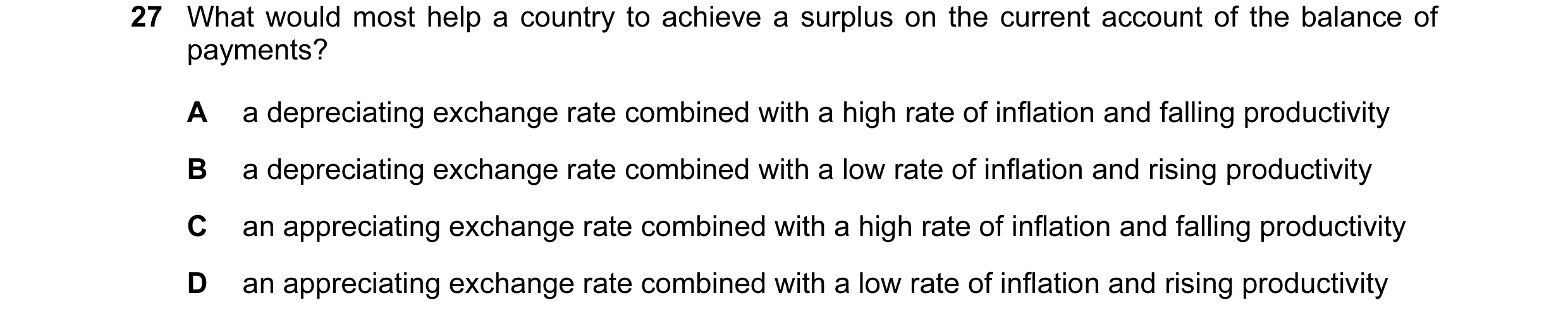
Q41 · What would most help a country to achieve a surplus on the current account of the balance… 9708/11 May/June 2014
27 What would most help a country to achieve a surplus on the current account of the balance of payments? A a depreciating exchange rate combined with a high rate of inflation and falling productivity B a depreciating exchange rate combined with a low rate of inflation and rising productivity C an appreciating exchange rate combined with a high rate of inflation and falling productivity D an appreciating exchange rate combined with a low rate of inflation and rising productivity
1 marks
Answer: B
This question in 9708/11 May/June 2014
Q42 · Devaluation always has the effect of A decreasing the price of imports 9708/11 May/June 2014
29 Devaluation always has the effect of A decreasing the price of imports. B decreasing the value of imports. C worsening the balance of payments. D worsening the terms of trade.
1 marks
Answer: D
This question in 9708/11 May/June 2014
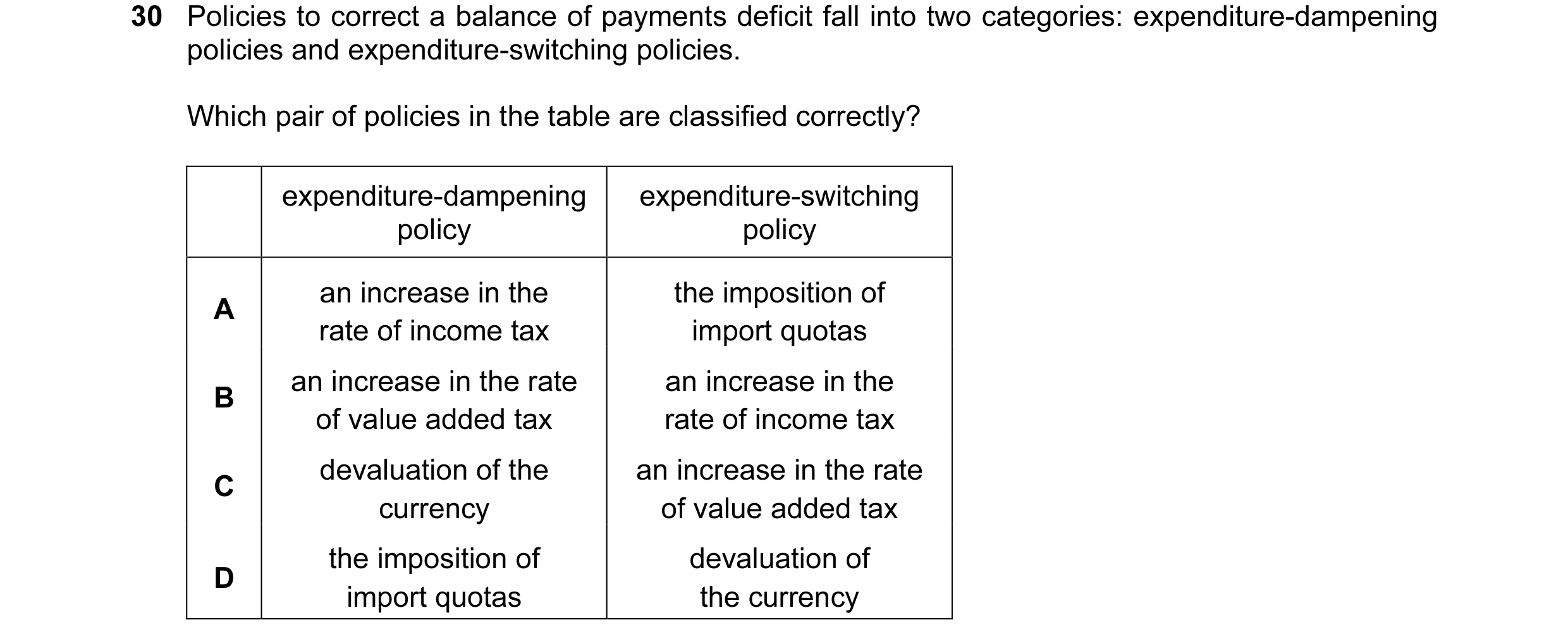
Q43 · Policies to correct a balance of payments deficit fall into two categories… 9708/11 May/June 2014
30 Policies to correct a balance of payments deficit fall into two categories: expenditure-dampening policies and expenditure-switching policies. Which pair of policies in the table are classified correctly? expenditure-dampening expenditure-switching policy policy an increase in the the imposition of A rate of income tax import quotas an increase in the rate an increase in the B of value added tax rate of income tax devaluation of the an increase in the rate C currency of value added tax the imposition of devaluation of D import quotas the currency
1 marks
Answer: A
This question in 9708/11 May/June 2014
Q44 · The table shows observations of the exchange rate of an economy and its current account… 9708/13 May/June 2014
29 The table shows observations of the exchange rate of an economy and its current account balance over six years. exchange rate current account balance year (US dollars per unit (billions of US dollars) of domestic currency) 1 2.0 –3 2 1.5 –5 3 1.5 –4 4 1.5 –3 5 1.5 0 6 1.5 +3 Which concept does the data in the table illustrate? A exchange rate appreciation B purchasing power parity C the J-curve effect D trade-weighted exchange rates
1 marks
Answer: C
This question in 9708/13 May/June 2014
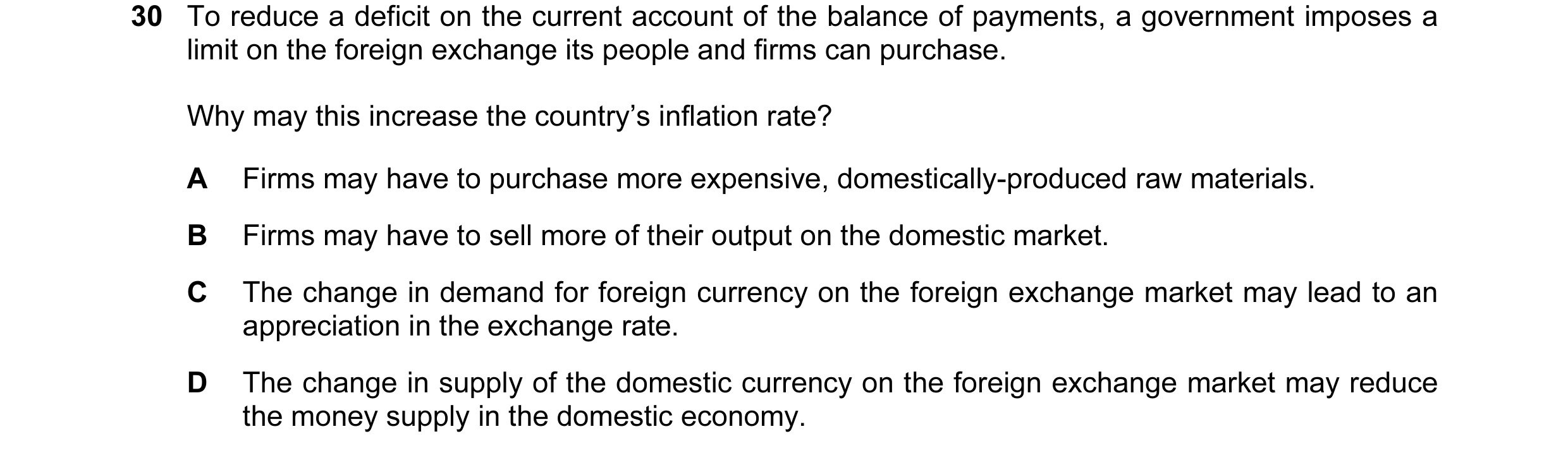
Q45 · To reduce a deficit on the current account of the balance of payments, a government… 9708/12 Oct/Nov 2014
30 To reduce a deficit on the current account of the balance of payments, a government imposes a limit on the foreign exchange its people and firms can purchase. Why may this increase the country’s inflation rate? A Firms may have to purchase more expensive, domestically-produced raw materials. B Firms may have to sell more of their output on the domestic market. C The change in demand for foreign currency on the foreign exchange market may lead to an appreciation in the exchange rate. D The change in supply of the domestic currency on the foreign exchange market may reduce the money supply in the domestic economy.
1 marks
Answer: A
This question in 9708/12 Oct/Nov 2014
Q46 · Demand for imports is often price inelastic in the short term 9708/13 Oct/Nov 2014
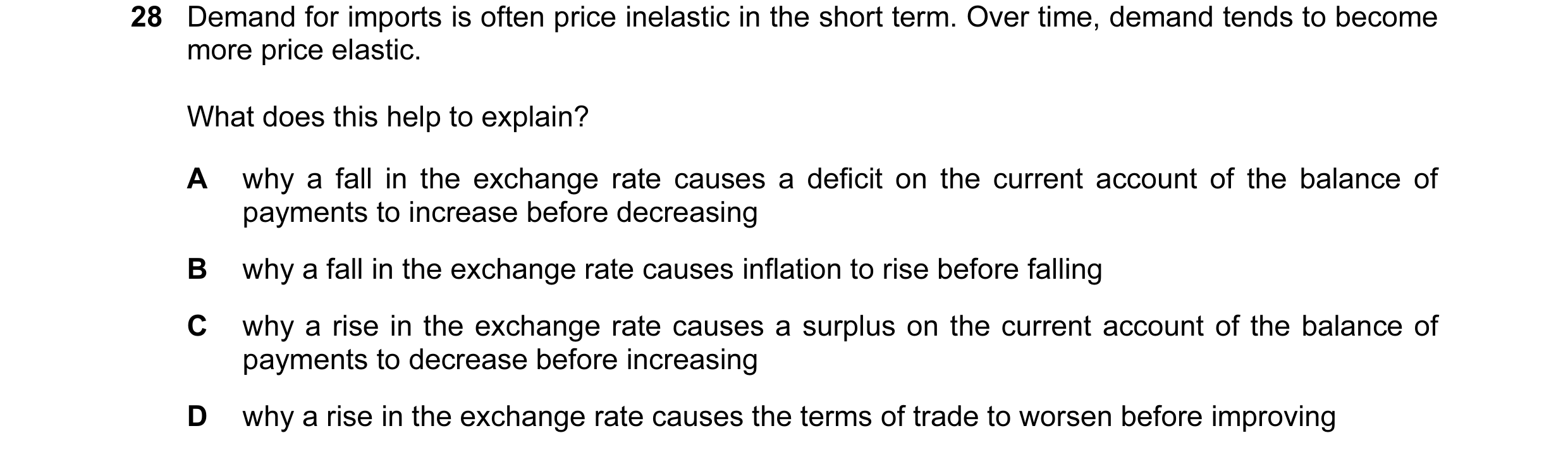
28 Demand for imports is often price inelastic in the short term. Over time, demand tends to become more price elastic. What does this help to explain? A why a fall in the exchange rate causes a deficit on the current account of the balance of payments to increase before decreasing B why a fall in the exchange rate causes inflation to rise before falling C why a rise in the exchange rate causes a surplus on the current account of the balance of payments to decrease before increasing D why a rise in the exchange rate causes the terms of trade to worsen before improving
1 marks
Answer: A
This question in 9708/13 Oct/Nov 2014
Q47 · An economy has a high rate of inflation and a balance of payments deficit 9708/13 Oct/Nov 2014
30 An economy has a high rate of inflation and a balance of payments deficit. Which policy change would help to reduce the balance of payments deficit without making inflation worse? A a devaluation of the currency B a reduction in government spending C the imposition of import quotas D the removal of import tariffs
1 marks
Answer: B
This question in 9708/13 Oct/Nov 2014
Q48 · When is a deficit on the current account of the balance of payments likely to worsen? 9708/12 May/June 2015
26 When is a deficit on the current account of the balance of payments likely to worsen? A when a government adopts a deflationary macroeconomic policy B when a government devalues the currency C when prices of essential imported raw materials increase significantly D when tariffs are placed on imported products with a wide range of domestic substitutes
1 marks
Answer: C
This question in 9708/12 May/June 2015
Q49 · A government has low reserves of foreign currency 9708/13 May/June 2015
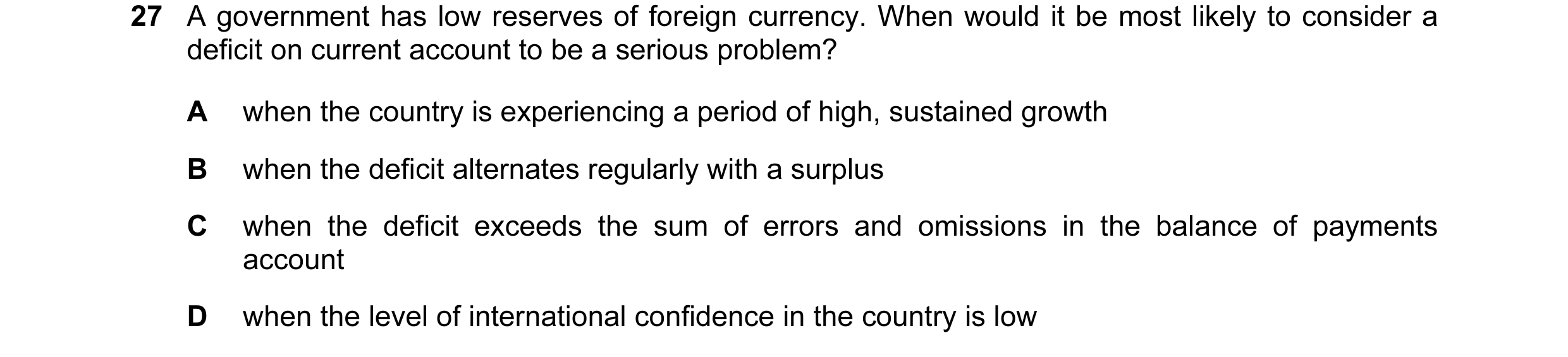
27 A government has low reserves of foreign currency. When would it be most likely to consider a deficit on current account to be a serious problem? A when the country is experiencing a period of high, sustained growth B when the deficit alternates regularly with a surplus C when the deficit exceeds the sum of errors and omissions in the balance of payments account D when the level of international confidence in the country is low
1 marks
Answer: D
This question in 9708/13 May/June 2015
Q50 · China had US$155 billion current account surplus in 2012 9708/13 May/June 2015
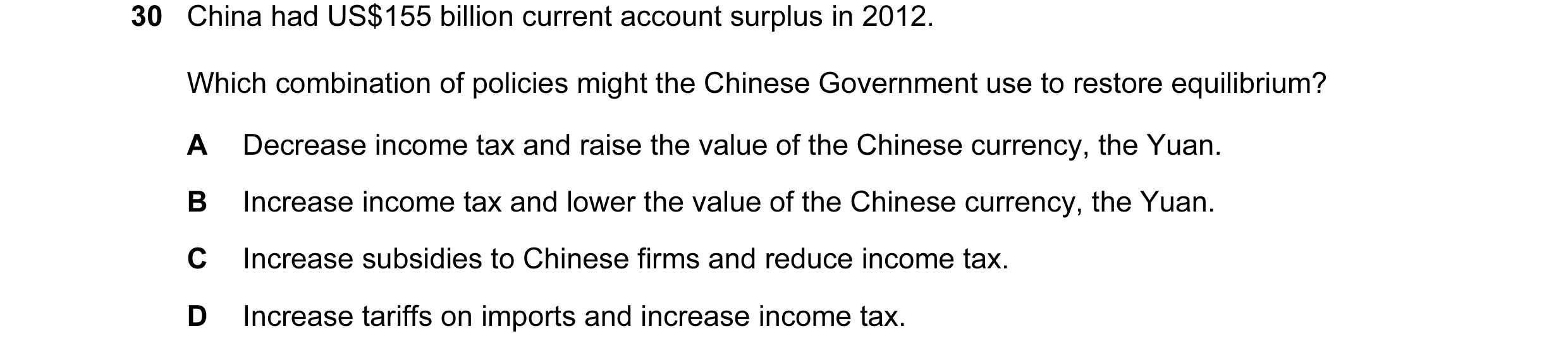
30 China had US$155 billion current account surplus in 2012. Which combination of policies might the Chinese Government use to restore equilibrium? A Decrease income tax and raise the value of the Chinese currency, the Yuan. B Increase income tax and lower the value of the Chinese currency, the Yuan. C Increase subsidies to Chinese firms and reduce income tax. D Increase tariffs on imports and increase income tax.
1 marks
Answer: A
This question in 9708/13 May/June 2015
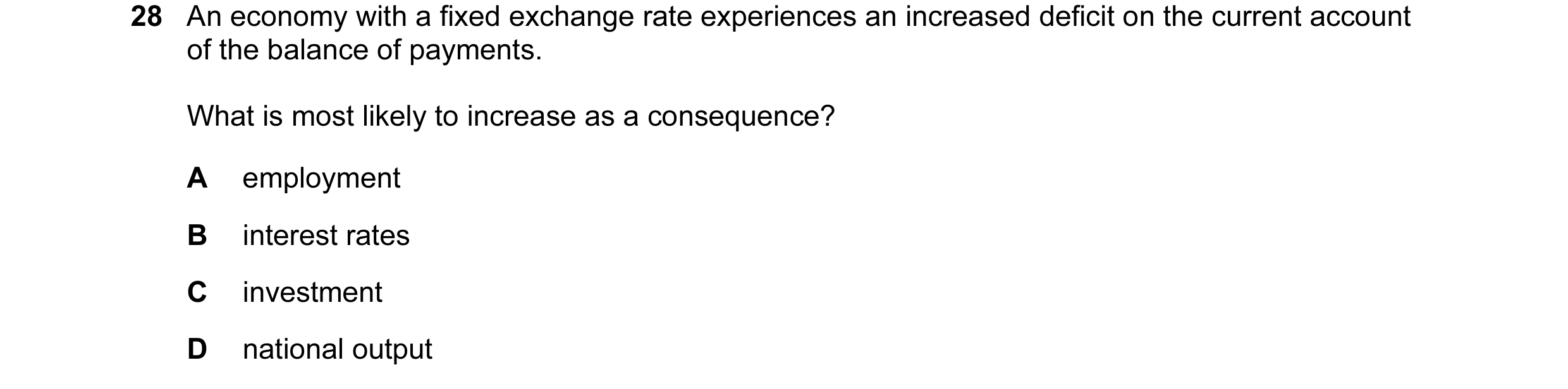
Q51 · An economy with a fixed exchange rate experiences an increased deficit on the current… 9708/12 Oct/Nov 2015
28 An economy with a fixed exchange rate experiences an increased deficit on the current account of the balance of payments. What is most likely to increase as a consequence? A employment B interest rates C investment D national output
1 marks
Answer: B
This question in 9708/12 Oct/Nov 2015
Q52 · A government devalues its exchange rate 9708/13 Oct/Nov 2015
30 A government devalues its exchange rate. What is most likely to be its aim? A to decrease a current account surplus B to decrease demand-pull inflation C to improve the terms of trade D to increase the level of employment
1 marks
Answer: D
This question in 9708/13 Oct/Nov 2015
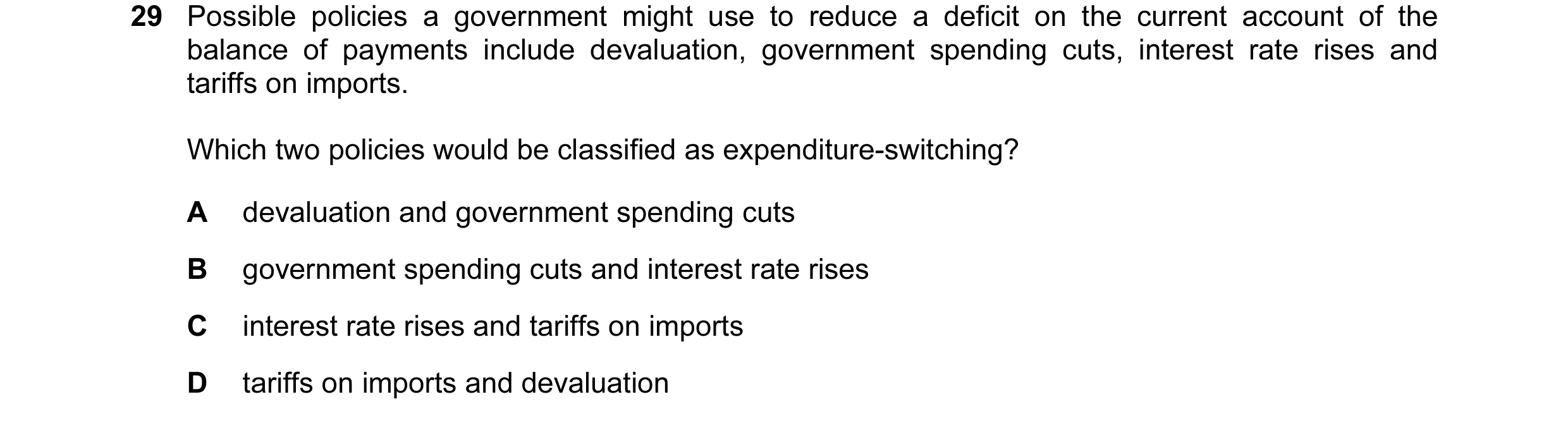
Q53 · Possible policies a government might use to reduce a deficit on the current account of… 9708/12 Feb/March 2016
29 Possible policies a government might use to reduce a deficit on the current account of the balance of payments include devaluation, government spending cuts, interest rate rises and tariffs on imports. Which two policies would be classified as expenditure-switching? A devaluation and government spending cuts B government spending cuts and interest rate rises C interest rate rises and tariffs on imports D tariffs on imports and devaluation
1 marks
Answer: D
This question in 9708/12 Feb/March 2016
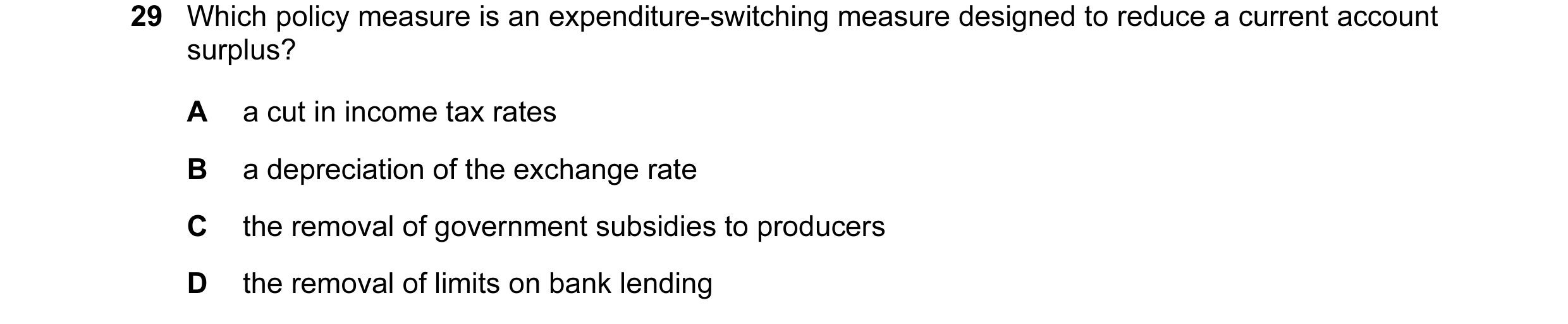
Q54 · Which policy measure is an expenditure-switching measure designed to reduce a current… 9708/11 May/June 2016
29 Which policy measure is an expenditure-switching measure designed to reduce a current account surplus? A a cut in income tax rates B a depreciation of the exchange rate C the removal of government subsidies to producers D the removal of limits on bank lending
1 marks
Answer: C
This question in 9708/11 May/June 2016
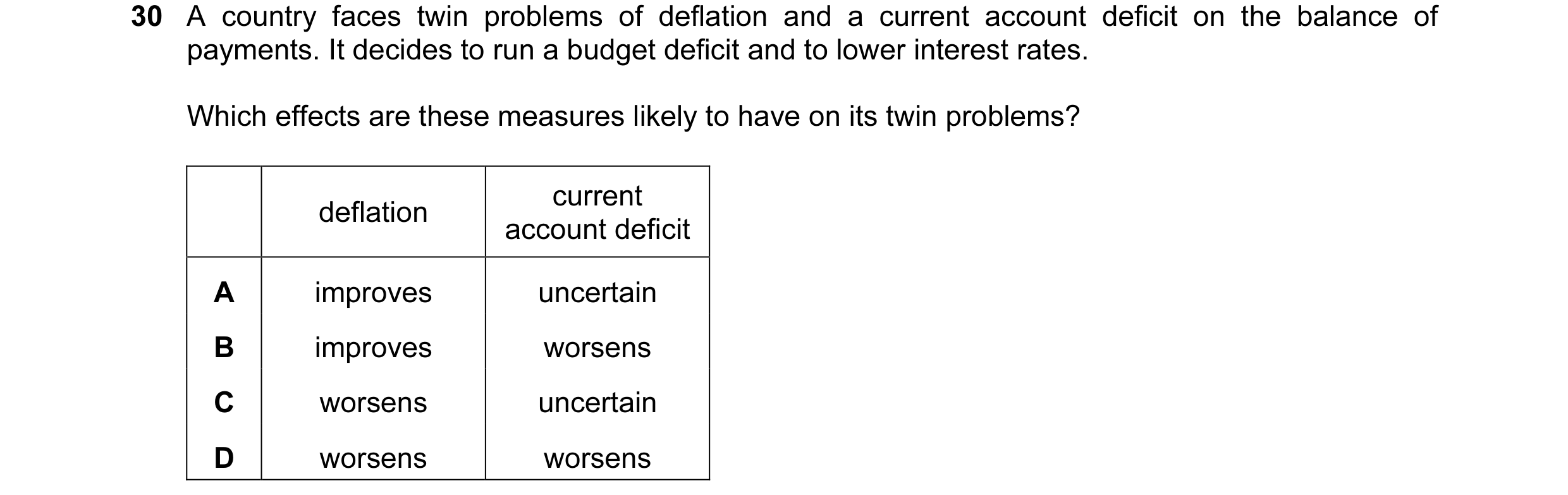
Q55 · A country faces twin problems of deflation and a current account deficit on the balance… 9708/11 May/June 2016
30 A country faces twin problems of deflation and a current account deficit on the balance of payments. It decides to run a budget deficit and to lower interest rates. Which effects are these measures likely to have on its twin problems? current deflation account deficit A improves uncertain B improves worsens C worsens uncertain D worsens worsens
1 marks
Answer: B
This question in 9708/11 May/June 2016
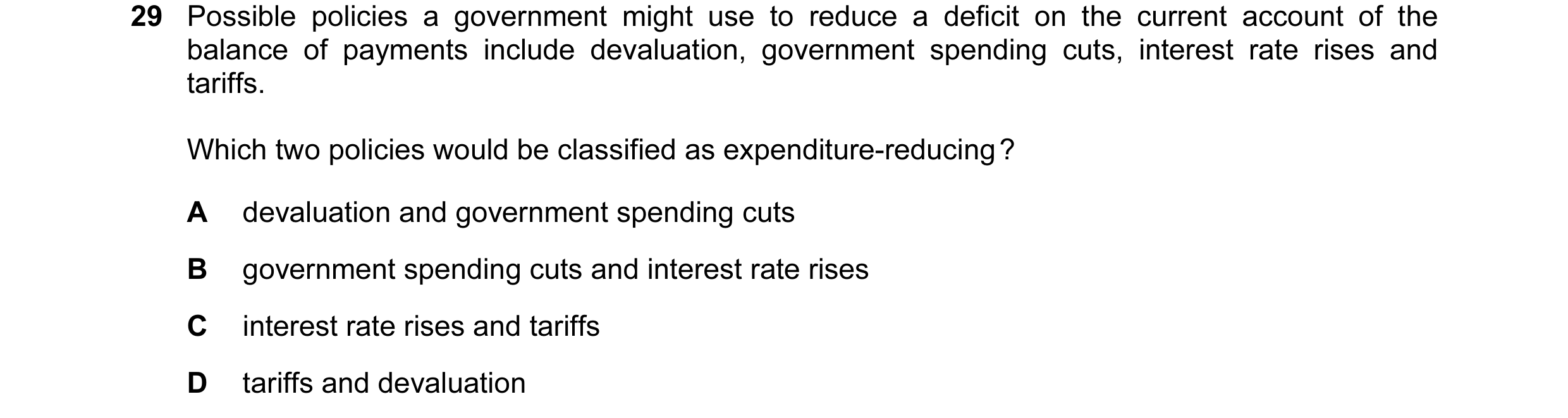
Q56 · Possible policies a government might use to reduce a deficit on the current account of… 9708/12 May/June 2016
29 Possible policies a government might use to reduce a deficit on the current account of the balance of payments include devaluation, government spending cuts, interest rate rises and tariffs. Which two policies would be classified as expenditure-reducing ? A devaluation and government spending cuts B government spending cuts and interest rate rises C interest rate rises and tariffs D tariffs and devaluation
1 marks
Answer: B
This question in 9708/12 May/June 2016
Q57 · In an attempt to correct a balance of trade deficit, the government of Indonesia has… 9708/13 May/June 2016
29 In an attempt to correct a balance of trade deficit, the government of Indonesia has decided to employ expenditure-dampening methods. Which policy would best fit this description? A introducing quotas on imported goods B raising income tax rates C subsidising home-produced goods D taxing imported goods
1 marks
Answer: B
This question in 9708/13 May/June 2016
Q58 · What would be the best policy for a country to reduce a balance of payments deficit? 9708/11 Oct/Nov 2016
29 What would be the best policy for a country to reduce a balance of payments deficit? A an increase in interest rates B an increase in the exchange rate C a reduction in direct taxes D a reduction in subsidies to domestic industry
1 marks
Answer: A
This question in 9708/11 Oct/Nov 2016
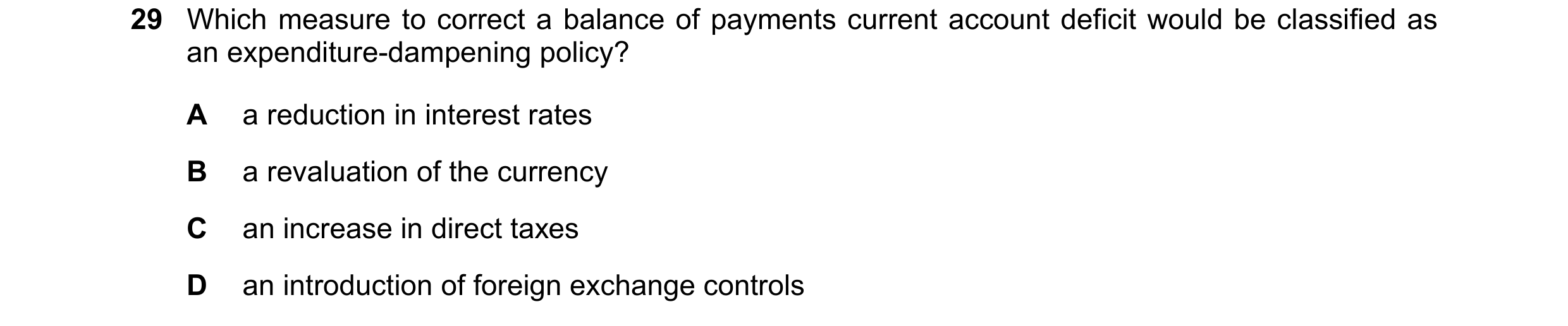
Q59 · Which measure to correct a balance of payments current account deficit would be… 9708/12 Oct/Nov 2016
29 Which measure to correct a balance of payments current account deficit would be classified as an expenditure-dampening policy? A a reduction in interest rates B a revaluation of the currency C an increase in direct taxes D an introduction of foreign exchange controls
1 marks
Answer: C
This question in 9708/12 Oct/Nov 2016
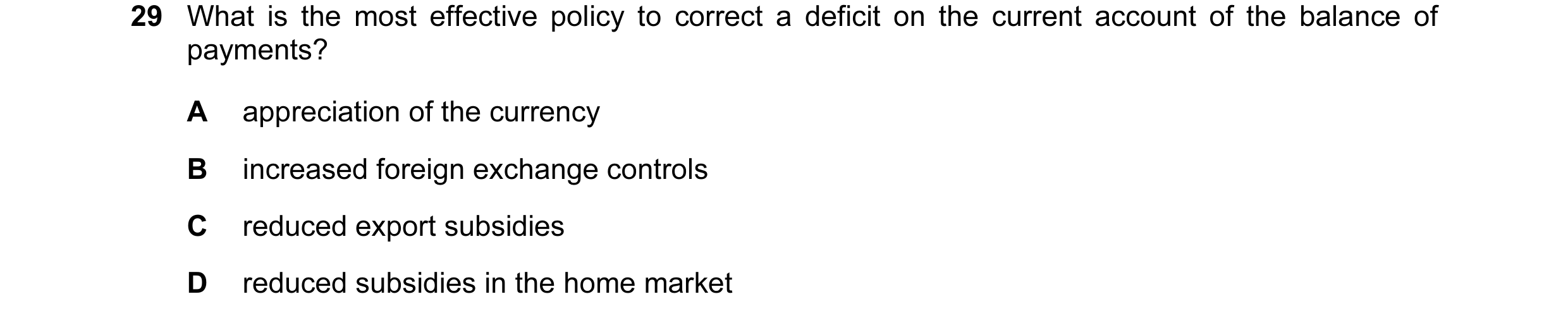
Q60 · What is the most effective policy to correct a deficit on the current account of the… 9708/13 Oct/Nov 2016
29 What is the most effective policy to correct a deficit on the current account of the balance of payments? A appreciation of the currency B increased foreign exchange controls C reduced export subsidies D reduced subsidies in the home market
1 marks
Answer: B
This question in 9708/13 Oct/Nov 2016
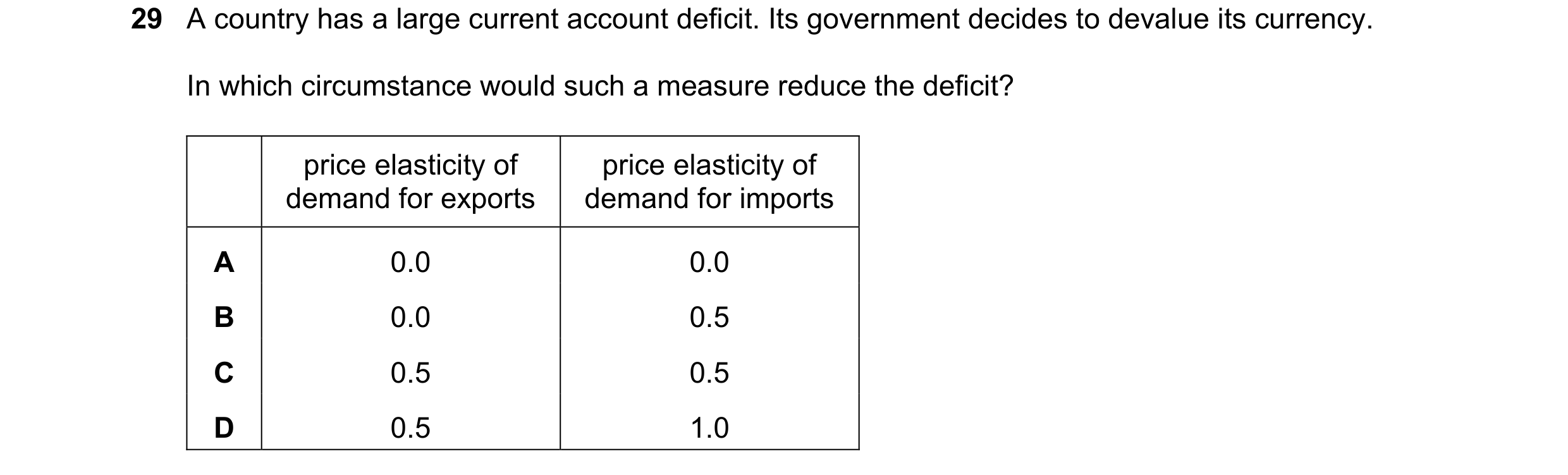
Q61 · A country has a large current account deficit 9708/12 Feb/March 2017
29 A country has a large current account deficit. Its government decides to devalue its currency. In which circumstance would such a measure reduce the deficit? price elasticity of price elasticity of demand for exports demand for imports A 0.0 0.0 B 0.0 0.5 C 0.5 0.5 D 0.5 1.0
1 marks
Answer: D
This question in 9708/12 Feb/March 2017
Q62 · A country with a fixed exchange rate has a current account surplus on its balance of… 9708/11 May/June 2017
29 A country with a fixed exchange rate has a current account surplus on its balance of payments. What is most likely to reduce this surplus? A higher interest rates B higher investment spending C higher tariffs D higher taxes
1 marks
Answer: B
This question in 9708/11 May/June 2017
Q63 · What is an example of an expenditure-dampening policy? 9708/12 May/June 2017
29 What is an example of an expenditure-dampening policy? A an increase in income tax rates B an increase in the level of import tariffs C an upward revaluation of the exchange rate D the introduction of import quotas
1 marks
Answer: A
This question in 9708/12 May/June 2017
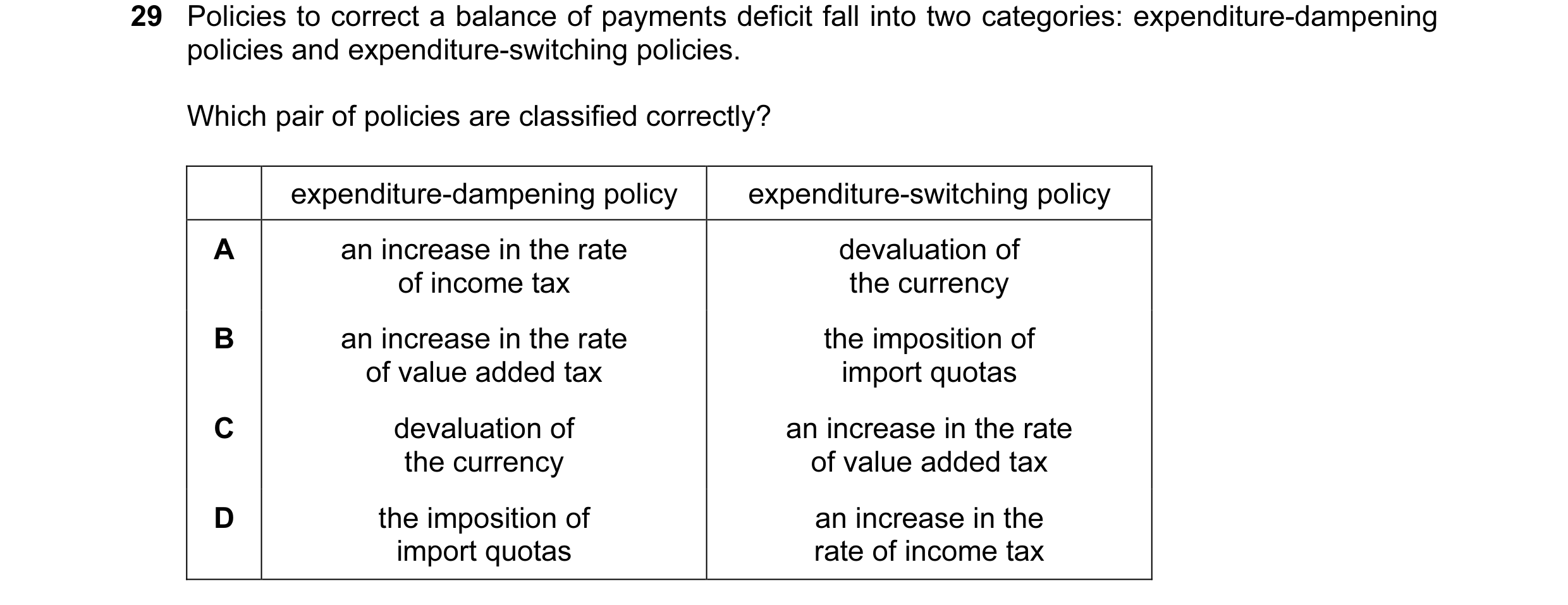
Q64 · Policies to correct a balance of payments deficit fall into two categories… 9708/13 May/June 2017
29 Policies to correct a balance of payments deficit fall into two categories: expenditure-dampening policies and expenditure-switching policies. Which pair of policies are classified correctly? expenditure-dampening policy expenditure-switching policy A an increase in the rate devaluation of of income tax the currency B an increase in the rate the imposition of of value added tax import quotas C devaluation of an increase in the rate the currency of value added tax D the imposition of an increase in the import quotas rate of income tax
1 marks
Answer: A
This question in 9708/13 May/June 2017
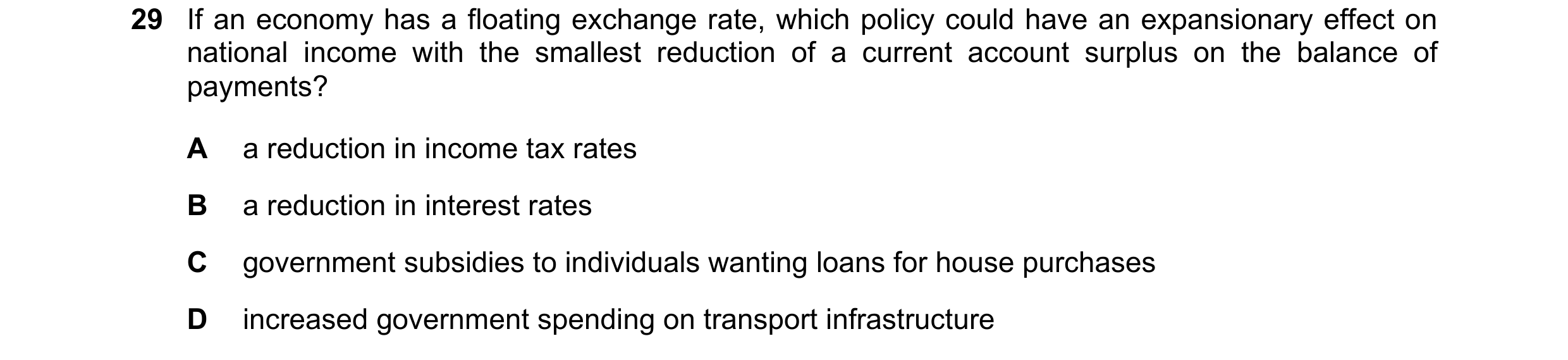
Q65 · If an economy has a floating exchange rate, which policy could have an expansionary… 9708/11 Oct/Nov 2017
29 If an economy has a floating exchange rate, which policy could have an expansionary effect on national income with the smallest reduction of a current account surplus on the balance of payments? A a reduction in income tax rates B a reduction in interest rates C government subsidies to individuals wanting loans for house purchases D increased government spending on transport infrastructure
1 marks
Answer: B
This question in 9708/11 Oct/Nov 2017
Q66 · When will a country’s balance of payments current account deficit be reduced? 9708/12 Oct/Nov 2017
29 When will a country’s balance of payments current account deficit be reduced? A when it lowers tariffs on its imports B when it raises its rate of income tax C when it removes export subsidies D when it revalues its currency
1 marks
Answer: B
This question in 9708/12 Oct/Nov 2017
Q67 · A country at the beginning of a given period seeks to improve the current account of its… 9708/13 Oct/Nov 2017
29 A country at the beginning of a given period seeks to improve the current account of its balance of payments by devaluing its currency. The effect of this policy in the following two years is shown in the diagram. current account surplus current + 0 balance – 6 12 18 24 deficit months Which statement is likely to explain this performance? A In the short run, the price elasticity of demand for exports and imports was very low. B The domestic inflation rate fell after 12 months before having the desired result. C The elasticity of demand for imports diminished after 12 months. D The policy was ineffective and other factors must have led to an improvement in the current account.
1 marks
Answer: A
This question in 9708/13 Oct/Nov 2017
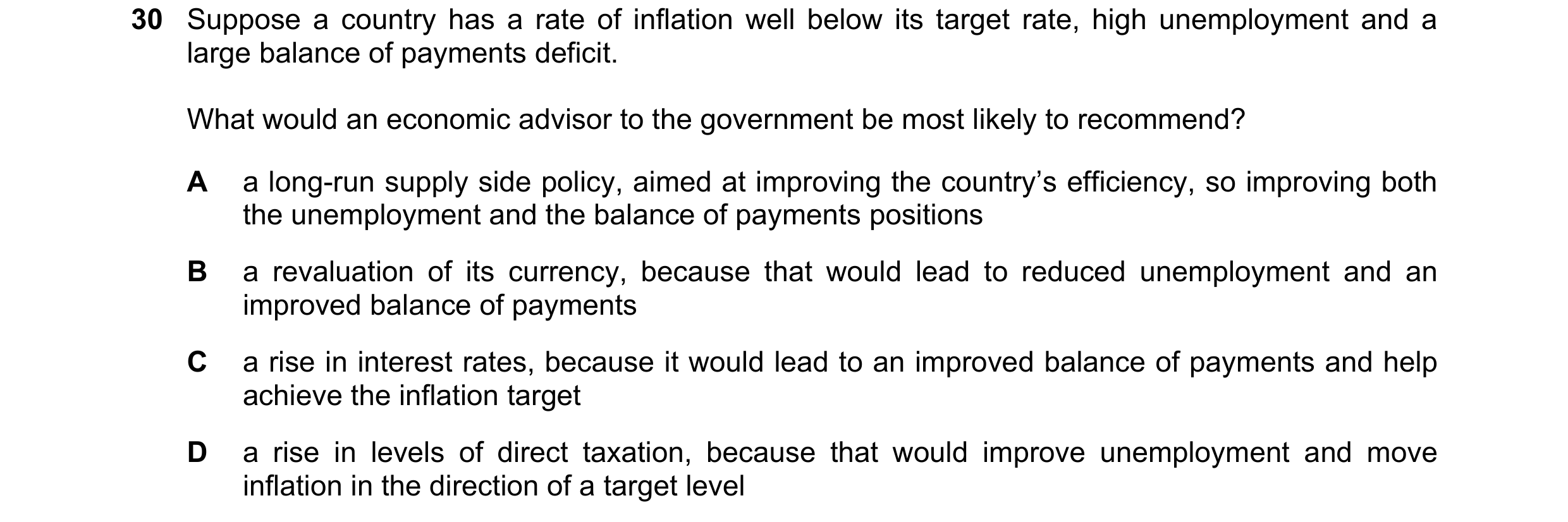
Q68 · Suppose a country has a rate of inflation well below its target rate, high unemployment… 9708/13 Oct/Nov 2017
30 Suppose a country has a rate of inflation well below its target rate, high unemployment and a large balance of payments deficit. What would an economic advisor to the government be most likely to recommend? A a long-run supply side policy, aimed at improving the country’s efficiency, so improving both the unemployment and the balance of payments positions B a revaluation of its currency, because that would lead to reduced unemployment and an improved balance of payments C a rise in interest rates, because it would lead to an improved balance of payments and help achieve the inflation target D a rise in levels of direct taxation, because that would improve unemployment and move inflation in the direction of a target level
1 marks
Answer: A
This question in 9708/13 Oct/Nov 2017
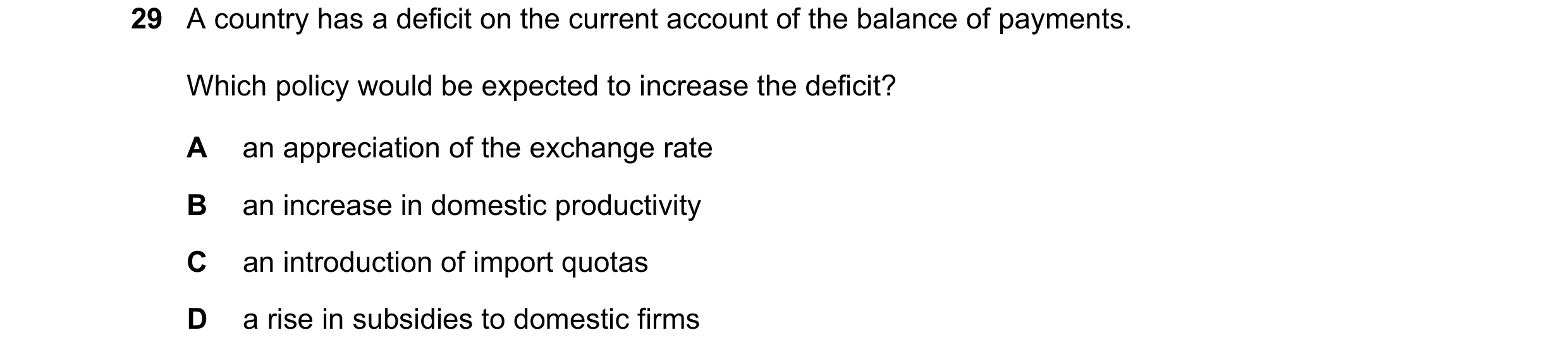
Q69 · A country has a deficit on the current account of the balance of payments 9708/12 Feb/March 2018
29 A country has a deficit on the current account of the balance of payments. Which policy would be expected to increase the deficit? A an appreciation of the exchange rate B an increase in domestic productivity C an introduction of import quotas D a rise in subsidies to domestic firms
1 marks
Answer: A
This question in 9708/12 Feb/March 2018
Q70 · The demand for a country’s exports is price-elastic 9708/11 May/June 2018
27 The demand for a country’s exports is price-elastic. What will be the effect of introducing export subsidies on its balance of trade and on its terms of trade? balance of trade terms of trade A improve improve B improve worsen C worsen improve D worsen worsen
1 marks
Answer: B
This question in 9708/11 May/June 2018
Q71 · Which policy is not likely to help reduce a balance of payments deficit? 9708/11 May/June 2018
29 Which policy is not likely to help reduce a balance of payments deficit? A an increase in expenditure promoting locally produced goods B an increase in the quota on cheap imports C an increase in the restrictions on foreign exchange D an increase in the subsidies to exporting industries
1 marks
Answer: B
This question in 9708/11 May/June 2018
Q72 · China had a US$155 billion current account surplus in 2012 9708/12 May/June 2018
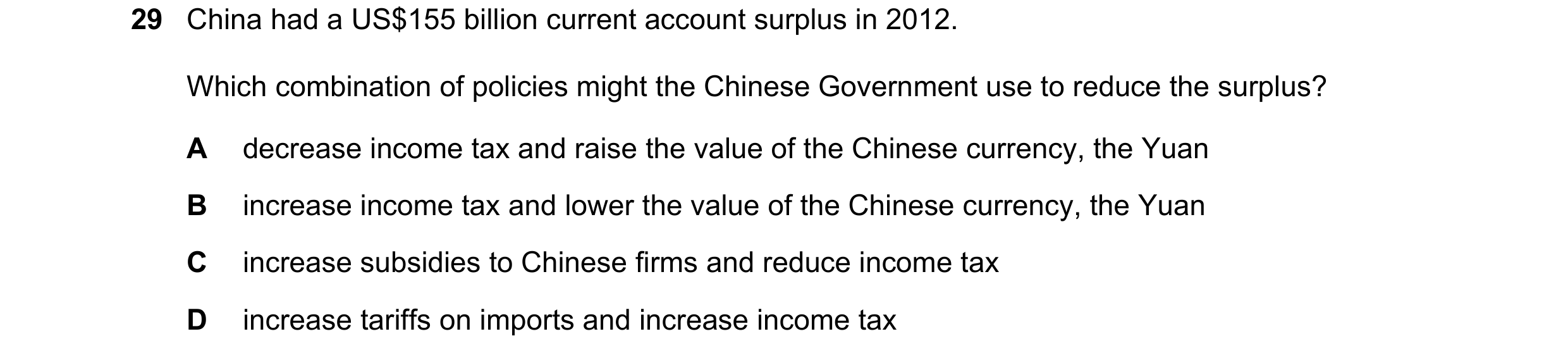
29 China had a US$155 billion current account surplus in 2012. Which combination of policies might the Chinese Government use to reduce the surplus? A decrease income tax and raise the value of the Chinese currency, the Yuan B increase income tax and lower the value of the Chinese currency, the Yuan C increase subsidies to Chinese firms and reduce income tax D increase tariffs on imports and increase income tax
1 marks
Answer: A
This question in 9708/12 May/June 2018
Q73 · To what does the J curve effect directly relate? 9708/13 May/June 2018
23 To what does the J curve effect directly relate? A balance of payment effects caused by exchange rate changes B exchange rate effects caused by balance of payment changes C import expenditure effects caused by tariff changes D trade creation effects caused by comparative advantage changes
1 marks
Answer: A
This question in 9708/13 May/June 2018
Q74 · If an economy experiences a persistent balance of trade deficit, it may choose to place… 9708/13 May/June 2018
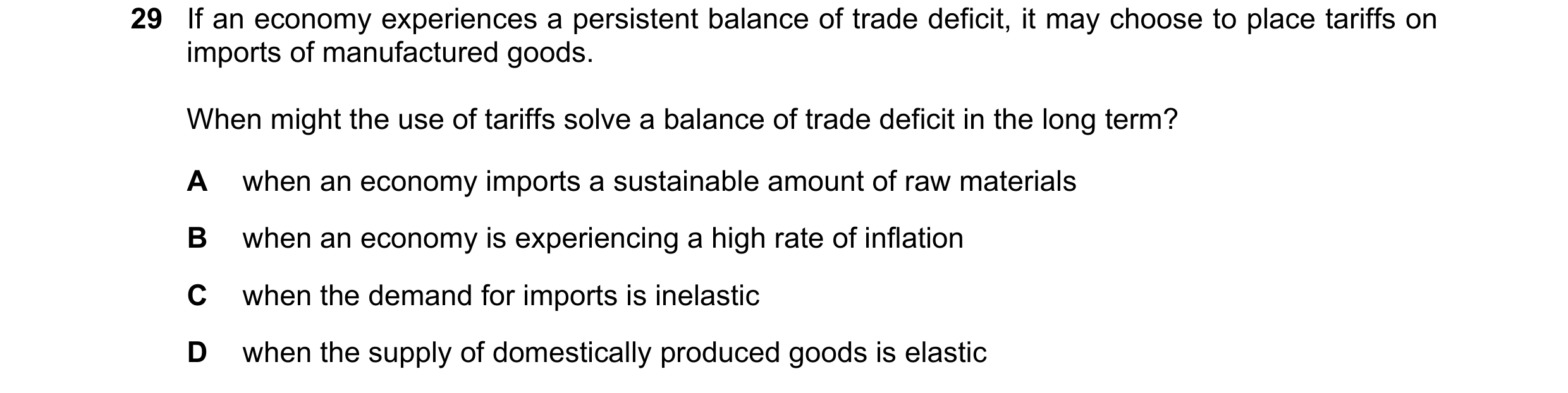
29 If an economy experiences a persistent balance of trade deficit, it may choose to place tariffs on imports of manufactured goods. When might the use of tariffs solve a balance of trade deficit in the long term? A when an economy imports a sustainable amount of raw materials B when an economy is experiencing a high rate of inflation C when the demand for imports is inelastic D when the supply of domestically produced goods is elastic
1 marks
Answer: D
This question in 9708/13 May/June 2018
Q75 · Which policy is most likely to help to correct an adverse balance on the current account… 9708/11 Oct/Nov 2018
29 Which policy is most likely to help to correct an adverse balance on the current account of the balance of payments? A abolishing tariffs B devaluing the currency C reducing direct taxes D reducing indirect taxes
1 marks
Answer: B
This question in 9708/11 Oct/Nov 2018
Q76 · In a country the Marshall-Lerner condition for an improvement in the trade balance is… 9708/12 Oct/Nov 2018
29 In a country the Marshall-Lerner condition for an improvement in the trade balance is satisfied in the long run, but quantities of imports and exports are slow to respond to price changes. The government devalues its currency to reduce its trade deficit. Which curve indicates the probable behaviour of the trade balance? A trade B balance + 0 C – D time
1 marks
Answer: B
This question in 9708/12 Oct/Nov 2018
Q77 · A country has a long-running current account deficit on the balance of payments 9708/13 Oct/Nov 2018
29 A country has a long-running current account deficit on the balance of payments. Its government was using an expenditure-switching policy but decides to change to an expenditure-reducing policy. What could have been the old policy and its new policy? old policy new policy A export subsidies quotas B income tax interest rate C quotas exchange rate control D tariffs income tax
1 marks
Answer: D
This question in 9708/13 Oct/Nov 2018
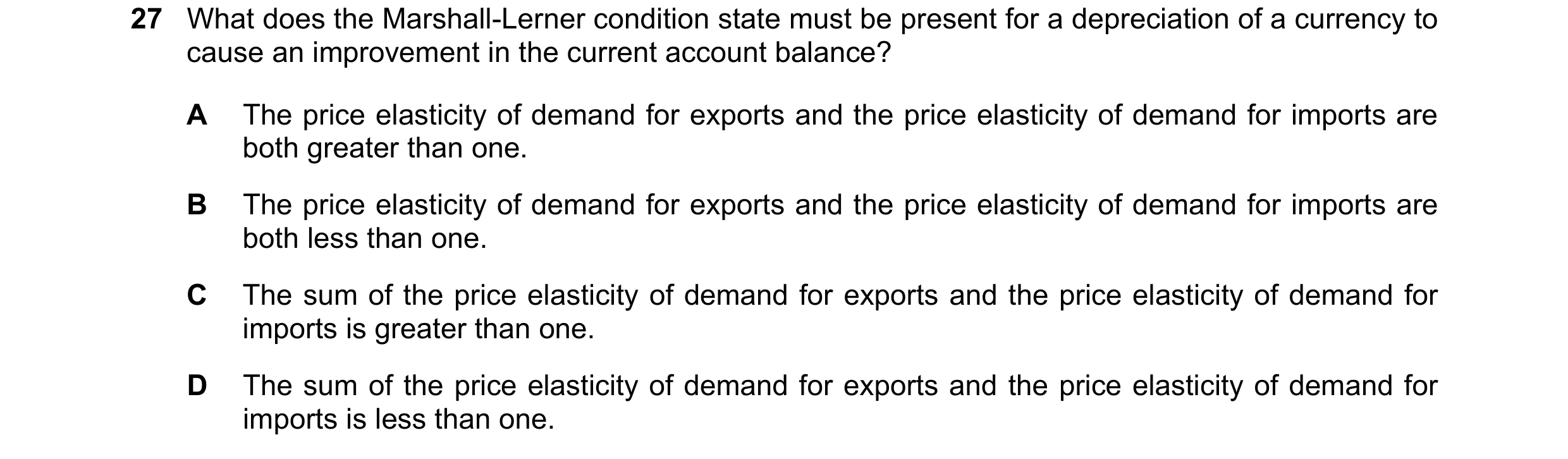
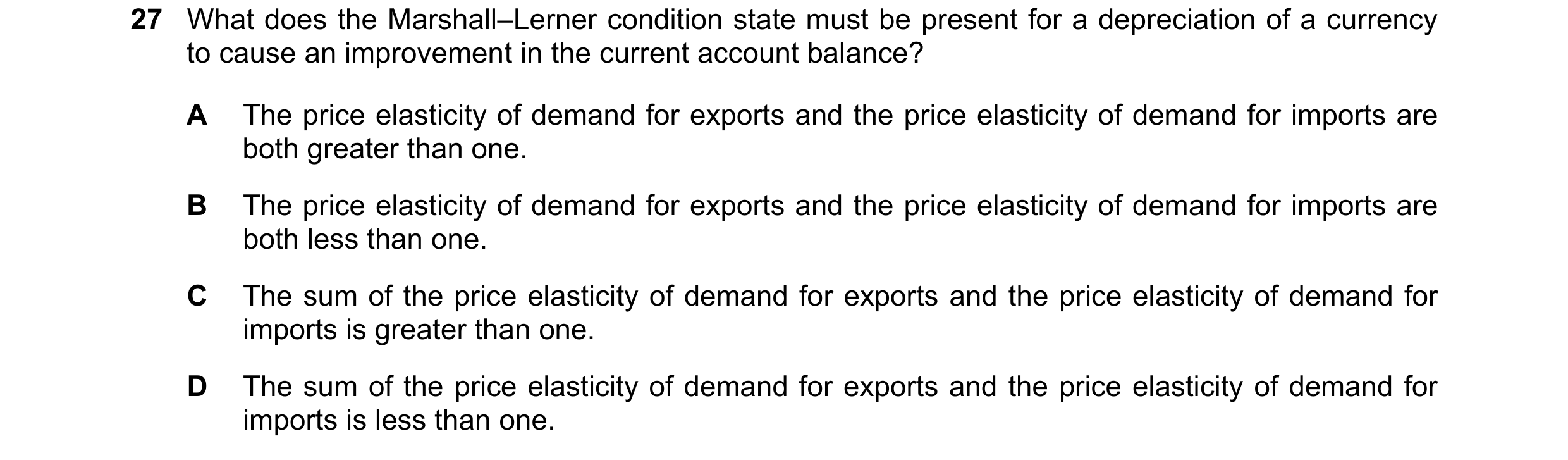
Q78 · What does the Marshall-Lerner condition state must be present for a depreciation of a… 9708/11 May/June 2019
27 What does the Marshall-Lerner condition state must be present for a depreciation of a currency to cause an improvement in the current account balance? A The price elasticity of demand for exports and the price elasticity of demand for imports are both greater than one. B The price elasticity of demand for exports and the price elasticity of demand for imports are both less than one. C The sum of the price elasticity of demand for exports and the price elasticity of demand for imports is greater than one. D The sum of the price elasticity of demand for exports and the price elasticity of demand for imports is less than one.
1 marks
Answer: C
This question in 9708/11 May/June 2019
Q79 · A country with low unemployment and a managed floating exchange rate has a persistent… 9708/11 May/June 2019
30 A country with low unemployment and a managed floating exchange rate has a persistent current account deficit on its balance of payments. Which policy to reduce this deficit is most likely to keep unemployment low, but cause inflation? A depreciating its currency B higher direct taxation C higher import tariffs D higher interest rates
1 marks
Answer: A
This question in 9708/11 May/June 2019
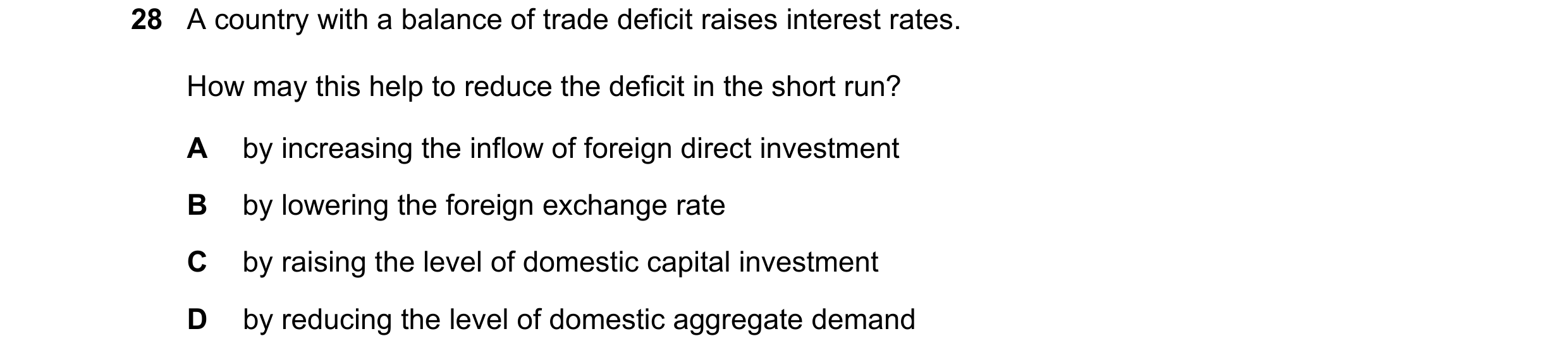
Q80 · A country with a balance of trade deficit raises interest rates 9708/12 May/June 2019
28 A country with a balance of trade deficit raises interest rates. How may this help to reduce the deficit in the short run? A by increasing the inflow of foreign direct investment B by lowering the foreign exchange rate C by raising the level of domestic capital investment D by reducing the level of domestic aggregate demand
1 marks
Answer: D
This question in 9708/12 May/June 2019
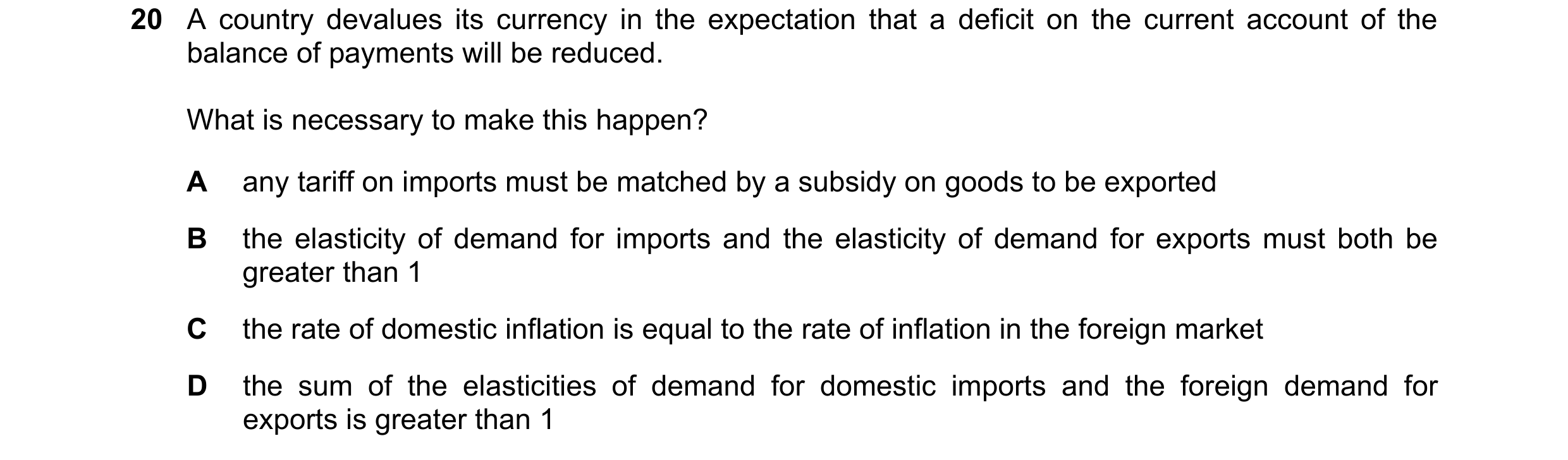
Q81 · A country devalues its currency in the expectation that a deficit on the current account… 9708/13 May/June 2019
20 A country devalues its currency in the expectation that a deficit on the current account of the balance of payments will be reduced. What is necessary to make this happen? A any tariff on imports must be matched by a subsidy on goods to be exported B the elasticity of demand for imports and the elasticity of demand for exports must both be greater than 1 C the rate of domestic inflation is equal to the rate of inflation in the foreign market D the sum of the elasticities of demand for domestic imports and the foreign demand for exports is greater than 1
1 marks
Answer: D
This question in 9708/13 May/June 2019
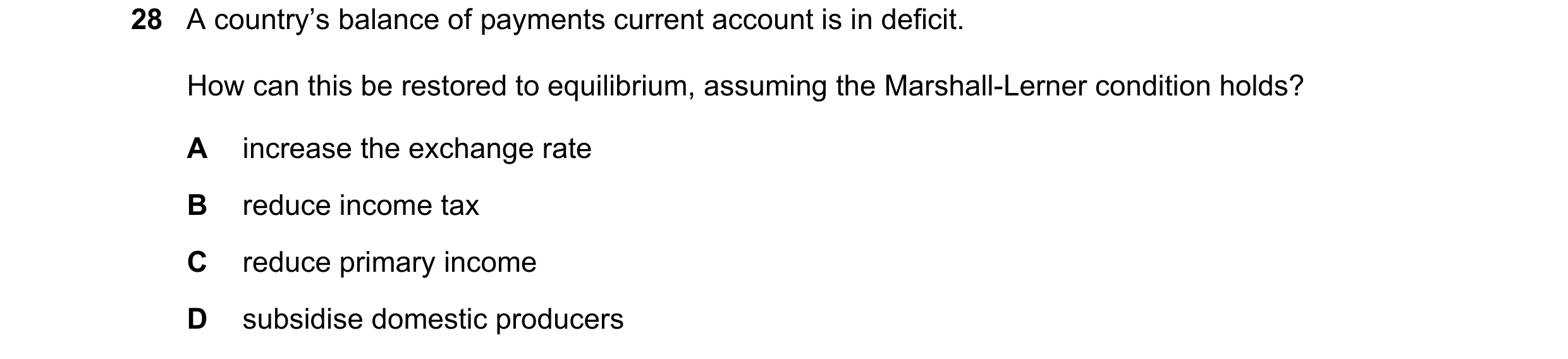
Q82 · A country’s balance of payments current account is in deficit 9708/13 May/June 2019
28 A country’s balance of payments current account is in deficit. How can this be restored to equilibrium, assuming the Marshall-Lerner condition holds? A increase the exchange rate B reduce income tax C reduce primary income D subsidise domestic producers
1 marks
Answer: D
This question in 9708/13 May/June 2019
Q83 · An economy changes its exchange rate at time T 9708/11 Oct/Nov 2019
25 An economy changes its exchange rate at time T. balance of trade surplus + T 0 time balance of trade deficit – What does the J-curve diagram show happens at T and after T? exchange rate Marshall-Lerner change at time T condition A devaluation does not apply B devaluation applies C revaluation does not apply D revaluation applies
1 marks
Answer: B
This question in 9708/11 Oct/Nov 2019
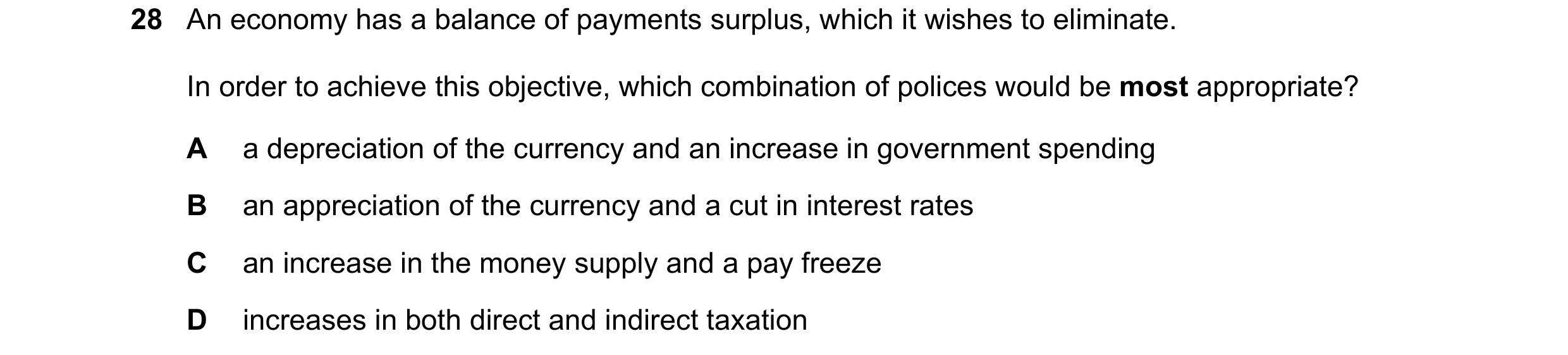
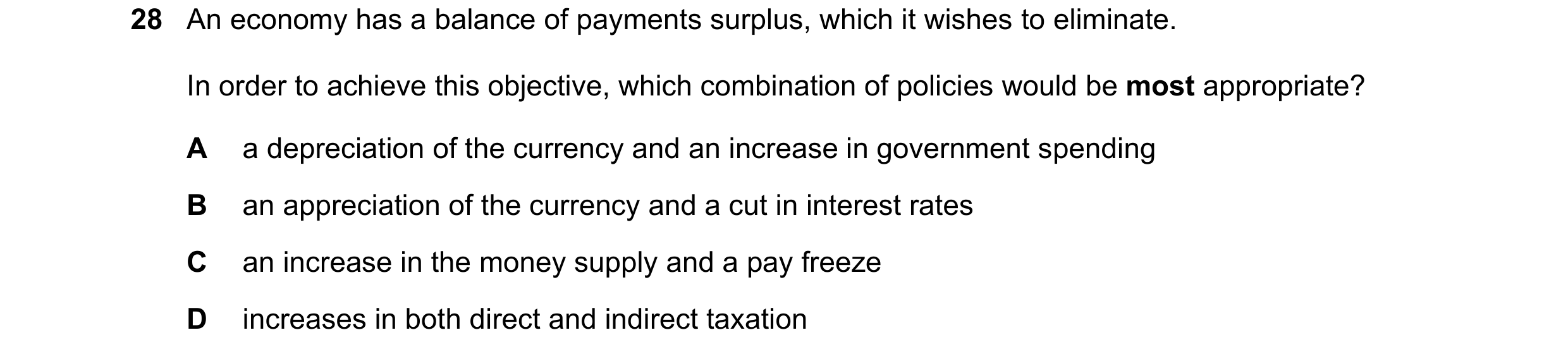
Q84 · An economy has a balance of payments surplus, which it wishes to eliminate 9708/11 Oct/Nov 2019
28 An economy has a balance of payments surplus, which it wishes to eliminate. In order to achieve this objective, which combination of polices would be most appropriate? A a depreciation of the currency and an increase in government spending B an appreciation of the currency and a cut in interest rates C an increase in the money supply and a pay freeze D increases in both direct and indirect taxation
1 marks
Answer: B
This question in 9708/11 Oct/Nov 2019
Q85 · Which policy would assist in reducing a deficit within the balance of payments? 9708/12 Oct/Nov 2019
28 Which policy would assist in reducing a deficit within the balance of payments? A increasing interest rates B increasing the money supply C reducing subsidies to exporting industries D reducing the level of direct taxation
1 marks
Answer: A
This question in 9708/12 Oct/Nov 2019
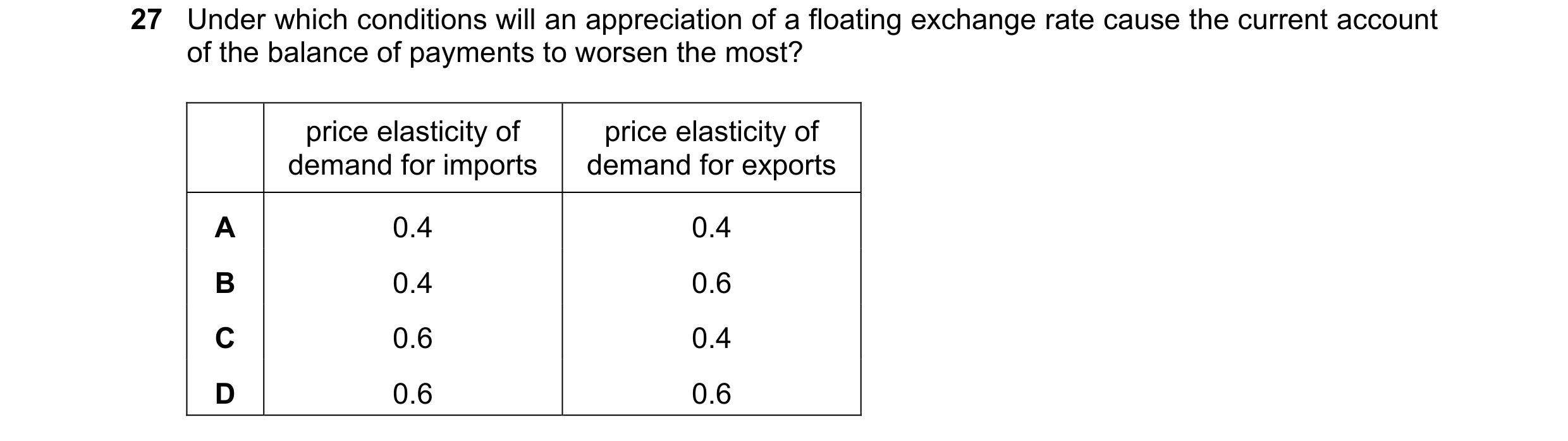
Q86 · Under which conditions will an appreciation of a floating exchange rate cause the current… 9708/13 Oct/Nov 2019
27 Under which conditions will an appreciation of a floating exchange rate cause the current account of the balance of payments to worsen the most? price elasticity of price elasticity of demand for imports demand for exports A 0.4 0.4 B 0.4 0.6 C 0.6 0.4 D 0.6 0.6
1 marks
Answer: D
This question in 9708/13 Oct/Nov 2019
Q87 · A country with a fixed exchange rate and a deficit in the current account of its balance… 9708/12 Feb/March 2020
28 A country with a fixed exchange rate and a deficit in the current account of its balance of payments enters a recession. It devalues its currency in an effort to correct its balance of payments. Under which conditions is the deficit most likely to improve? price elasticity of price elasticity of income elasticity of demand for imports demand for exports demand for imports A 0.3 0.5 0.8 B 0.4 0.8 0.8 C 0.3 0.5 1.2 D 0.4 0.8 1.2
1 marks
Answer: D
This question in 9708/12 Feb/March 2020
Q88 · What is an expenditure-switching policy to reduce a country’s balance of payments deficit? 9708/11 May/June 2020
25 What is an expenditure-switching policy to reduce a country’s balance of payments deficit? A an increase in budget surplus B an increase in direct taxes C an increase in import tariffs D an increase in interest rates
1 marks
Answer: C
This question in 9708/11 May/June 2020
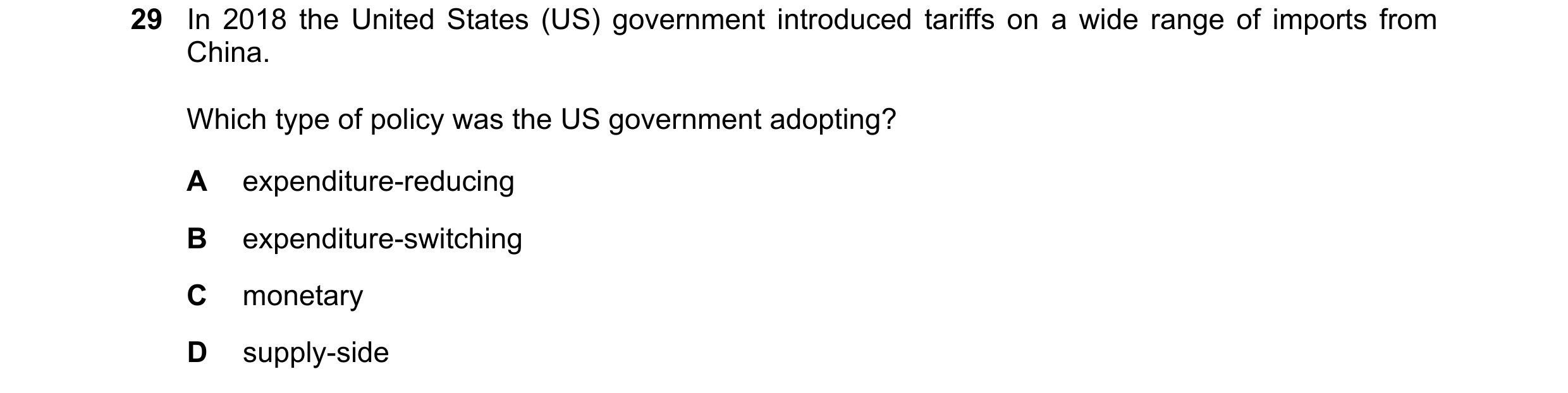
Q89 · In 2018 the United States (US) government introduced tariffs on a wide range of imports… 9708/12 May/June 2020
29 In 2018 the United States (US) government introduced tariffs on a wide range of imports from China. Which type of policy was the US government adopting? A expenditure-reducing B expenditure-switching C monetary D supply-side
1 marks
Answer: B
This question in 9708/12 May/June 2020
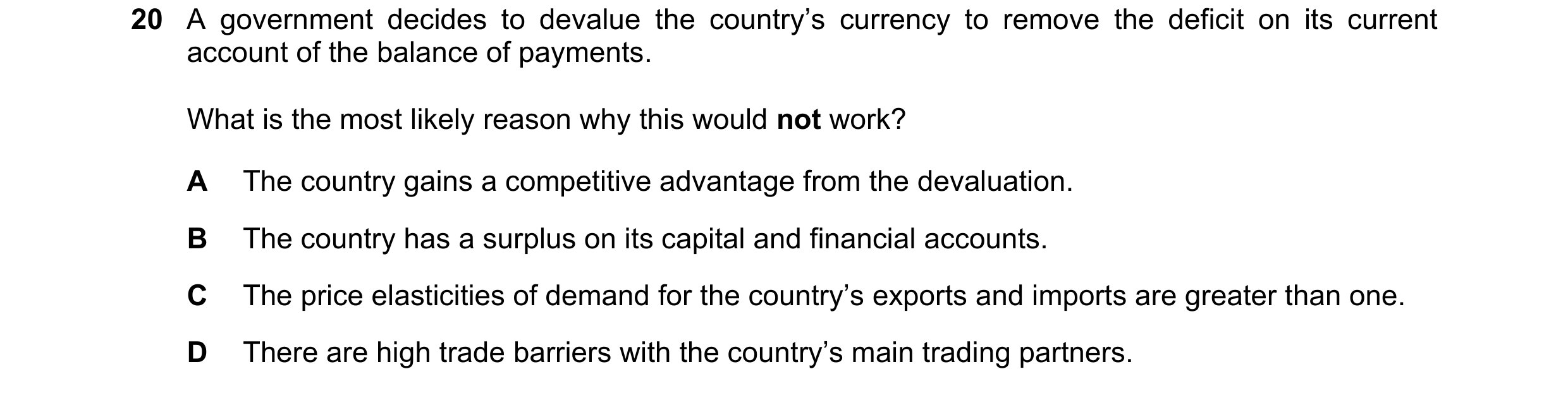
Q90 · A government decides to devalue the country’s currency to remove the deficit on its… 9708/13 May/June 2020
20 A government decides to devalue the country’s currency to remove the deficit on its current account of the balance of payments. What is the most likely reason why this would not work? A The country gains a competitive advantage from the devaluation. B The country has a surplus on its capital and financial accounts. C The price elasticities of demand for the country’s exports and imports are greater than one. D There are high trade barriers with the country’s main trading partners.
1 marks
Answer: D
This question in 9708/13 May/June 2020
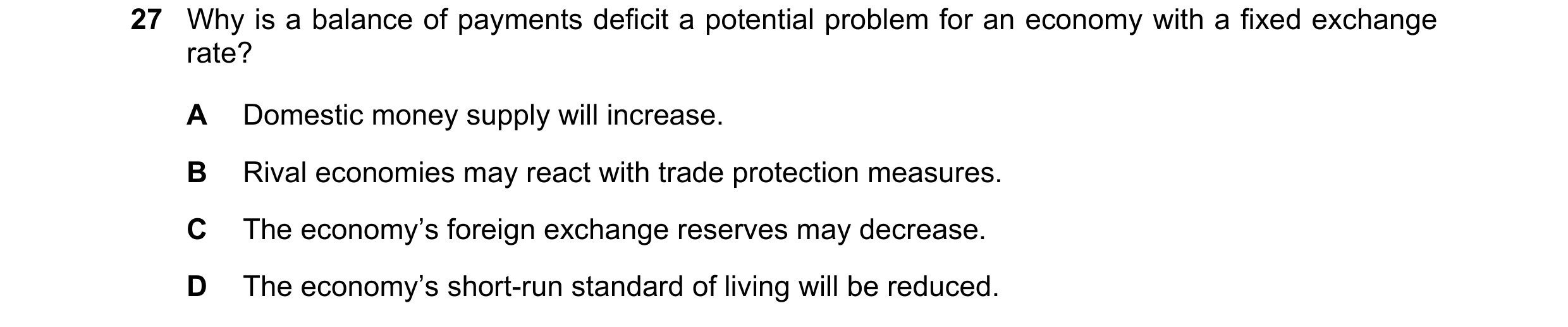
Q91 · Why is a balance of payments deficit a potential problem for an economy with a fixed… 9708/13 May/June 2020
27 Why is a balance of payments deficit a potential problem for an economy with a fixed exchange rate? A Domestic money supply will increase. B Rival economies may react with trade protection measures. C The economy’s foreign exchange reserves may decrease. D The economy’s short-run standard of living will be reduced.
1 marks
Answer: C
This question in 9708/13 May/June 2020
Q92 · Which policy measure is an expenditure-switching measure designed to reduce a current… 9708/13 May/June 2020
30 Which policy measure is an expenditure-switching measure designed to reduce a current account surplus? A a cut in income tax rates B a depreciation of the exchange rate C the removal of limits on bank lending D the removal of subsidies to exporters
1 marks
Answer: D
This question in 9708/13 May/June 2020
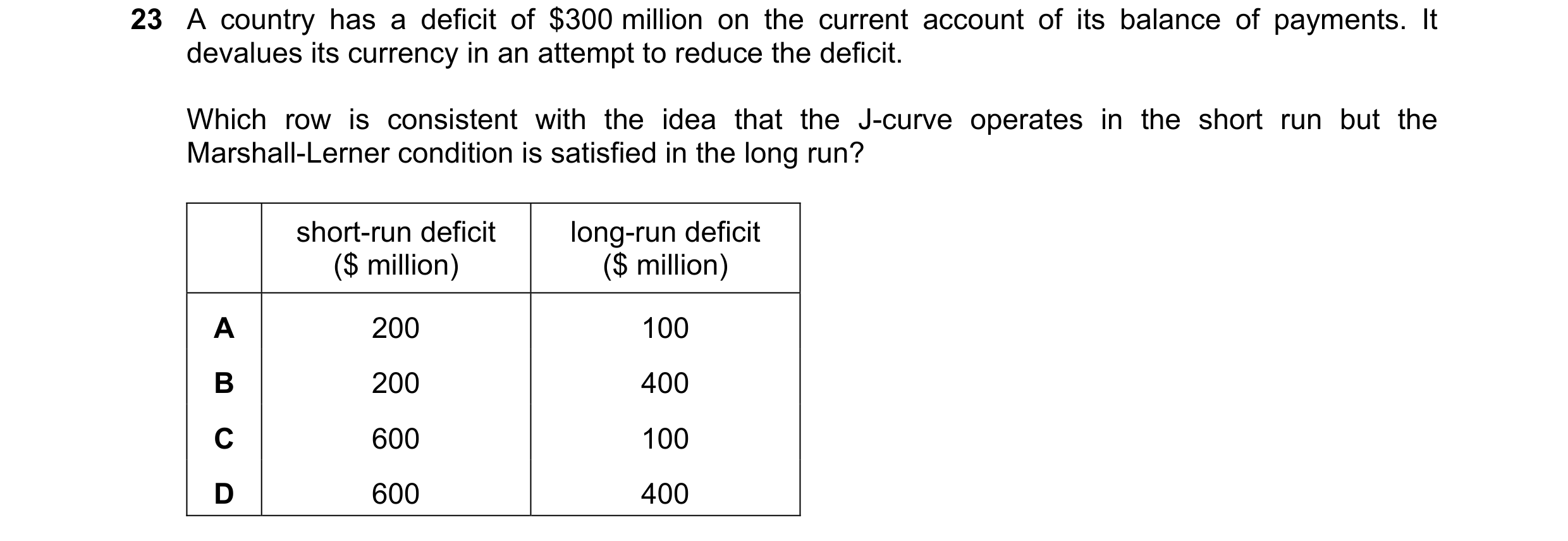
Q93 · A country has a deficit of $300 million on the current account of its balance of payments 9708/11 Oct/Nov 2020
23 A country has a deficit of $300 million on the current account of its balance of payments. It devalues its currency in an attempt to reduce the deficit. Which row is consistent with the idea that the J-curve operates in the short run but the Marshall-Lerner condition is satisfied in the long run? short-run deficit long-run deficit ($ million) ($ million) A 200 100 B 200 400 C 600 100 D 600 400
1 marks
Answer: C
This question in 9708/11 Oct/Nov 2020
Q94 · When is a deficit on the current account of the balance of payments likely to worsen? 9708/11 Oct/Nov 2020
26 When is a deficit on the current account of the balance of payments likely to worsen? A when a government adopts a deflationary macroeconomic policy B when a government subsidises exports C when prices of essential imported raw materials increase significantly D when tariffs are placed on imported products with a wide range of domestic substitutes
1 marks
Answer: C
This question in 9708/11 Oct/Nov 2020
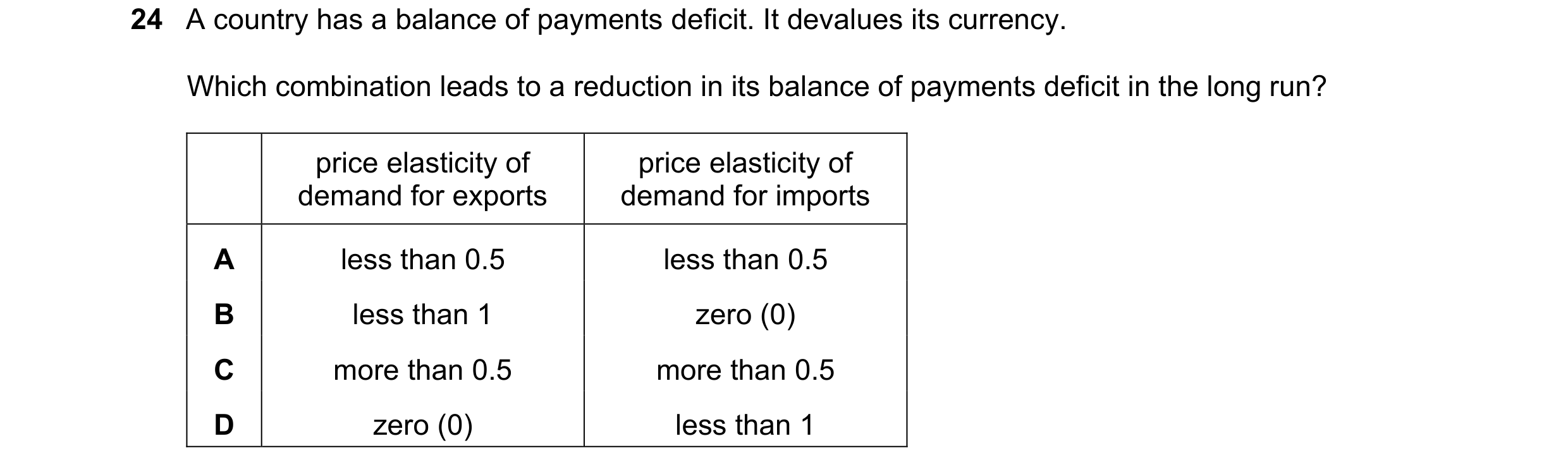
Q95 · A country has a balance of payments deficit 9708/12 Oct/Nov 2020
24 A country has a balance of payments deficit. It devalues its currency. Which combination leads to a reduction in its balance of payments deficit in the long run? price elasticity of price elasticity of demand for exports demand for imports A less than 0.5 less than 0.5 B less than 1 zero (0) C more than 0.5 more than 0.5 D zero (0) less than 1
1 marks
Answer: C
This question in 9708/12 Oct/Nov 2020
Q96 · Devaluation always has the effect of A decreasing the price of imports 9708/12 Oct/Nov 2020
27 Devaluation always has the effect of A decreasing the price of imports. B decreasing the value of imports. C worsening the balance of payments. D worsening the terms of trade.
1 marks
Answer: D
This question in 9708/12 Oct/Nov 2020
Q97 · A country has a persistent balance of payments deficit 9708/13 Oct/Nov 2020
26 A country has a persistent balance of payments deficit. What is most likely to improve the situation in the long run? A a lowering of the level of import duties B a reduction in the level of income tax C the introduction of expansionary monetary policy D the use of grants to encourage new investment by firms
1 marks
Answer: D
This question in 9708/13 Oct/Nov 2020
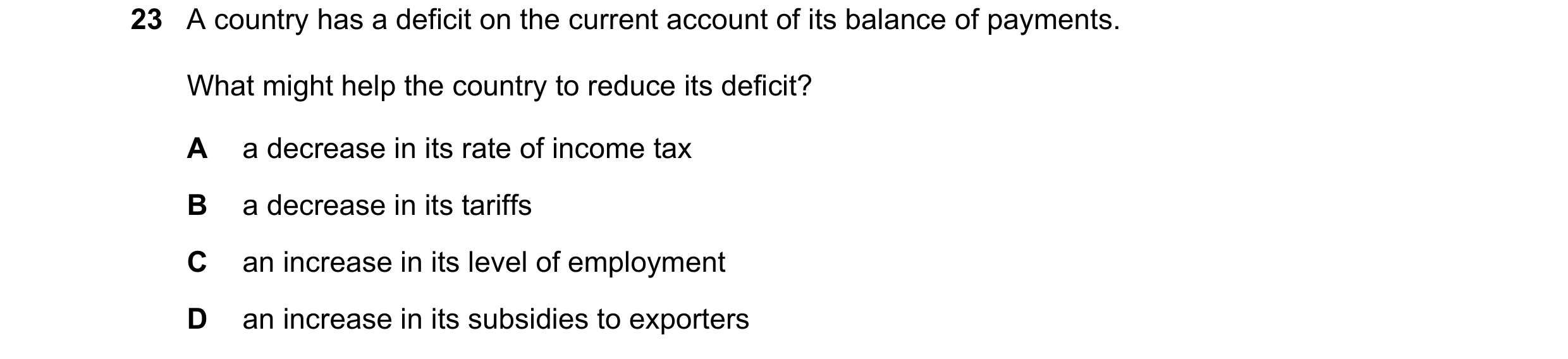
Q98 · A country has a deficit on the current account of its balance of payments 9708/12 Feb/March 2021
23 A country has a deficit on the current account of its balance of payments. What might help the country to reduce its deficit? A a decrease in its rate of income tax B a decrease in its tariffs C an increase in its level of employment D an increase in its subsidies to exporters
1 marks
Answer: D
This question in 9708/12 Feb/March 2021
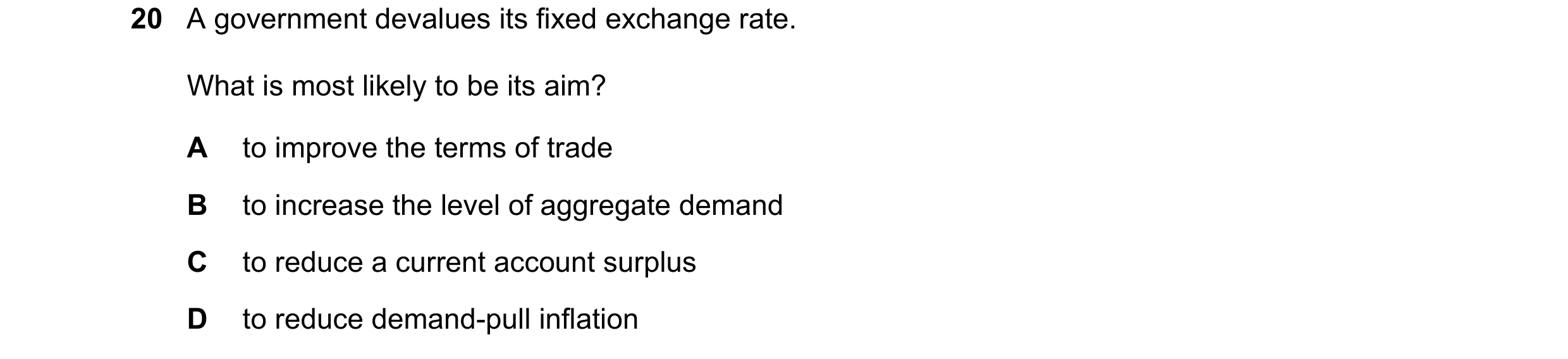
Q99 · A government devalues its fixed exchange rate 9708/12 May/June 2021
20 A government devalues its fixed exchange rate. What is most likely to be its aim? A to improve the terms of trade B to increase the level of aggregate demand C to reduce a current account surplus D to reduce demand-pull inflation
1 marks
Answer: B
This question in 9708/12 May/June 2021
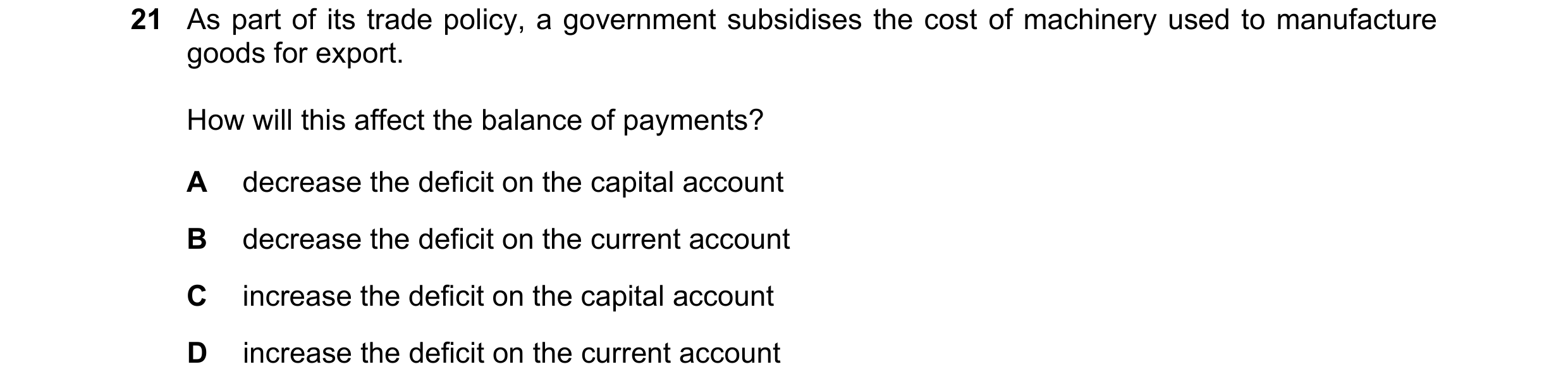
Q100 · As part of its trade policy, a government subsidises the cost of machinery used to… 9708/12 May/June 2021
21 As part of its trade policy, a government subsidises the cost of machinery used to manufacture goods for export. How will this affect the balance of payments? A decrease the deficit on the capital account B decrease the deficit on the current account C increase the deficit on the capital account D increase the deficit on the current account
1 marks
Answer: B
This question in 9708/12 May/June 2021
Q101 · Which policy aimed at correcting a balance of trade deficit is an expenditure-reducing… 9708/12 May/June 2021
29 Which policy aimed at correcting a balance of trade deficit is an expenditure-reducing policy? A depreciation of the currency B increased direct taxation C tax incentives for exporters D the imposition of protectionist tariffs
1 marks
Answer: B
This question in 9708/12 May/June 2021
Q102 · A country has a balance of trade deficit 9708/13 May/June 2021
25 A country has a balance of trade deficit. When will this be least likely to be improved as a result of a depreciation of its currency? A if it is currently operating with a significant amount of unused resources B if the sum of the price elasticities of demand for exports and imports is less than 1 C if in the long term, the price elasticity of demand for exports should increase D if the country uses a relatively small proportion of imports in their production process
1 marks
Answer: B
This question in 9708/13 May/June 2021
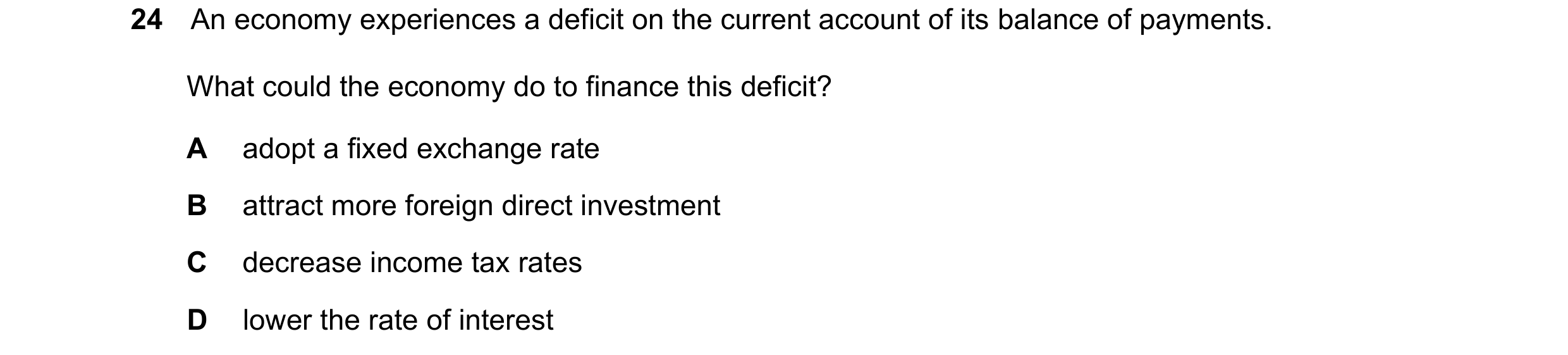
Q103 · An economy experiences a deficit on the current account of its balance of payments 9708/11 Oct/Nov 2021
24 An economy experiences a deficit on the current account of its balance of payments. What could the economy do to finance this deficit? A adopt a fixed exchange rate B attract more foreign direct investment C decrease income tax rates D lower the rate of interest
1 marks
Answer: B
This question in 9708/11 Oct/Nov 2021
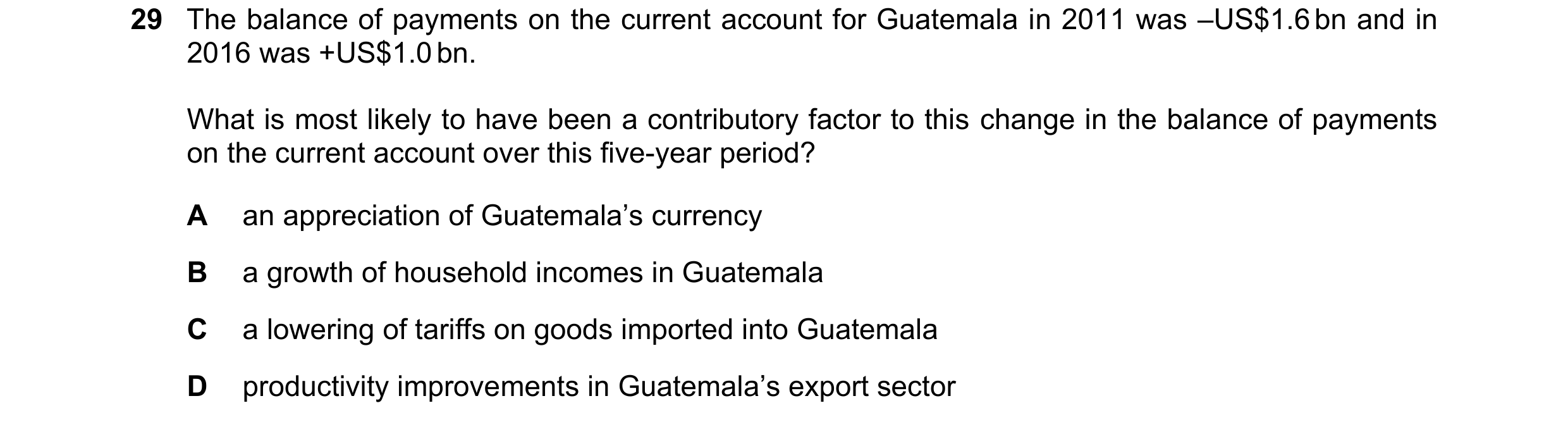
Q104 · The balance of payments on the current account for Guatemala in 2011 was –US$1.6 bn and… 9708/11 Oct/Nov 2021
29 The balance of payments on the current account for Guatemala in 2011 was –US$1.6 bn and in 2016 was +US$1.0 bn. What is most likely to have been a contributory factor to this change in the balance of payments on the current account over this five-year period? A an appreciation of Guatemala’s currency B a growth of household incomes in Guatemala C a lowering of tariffs on goods imported into Guatemala D productivity improvements in Guatemala’s export sector
1 marks
Answer: D
This question in 9708/11 Oct/Nov 2021
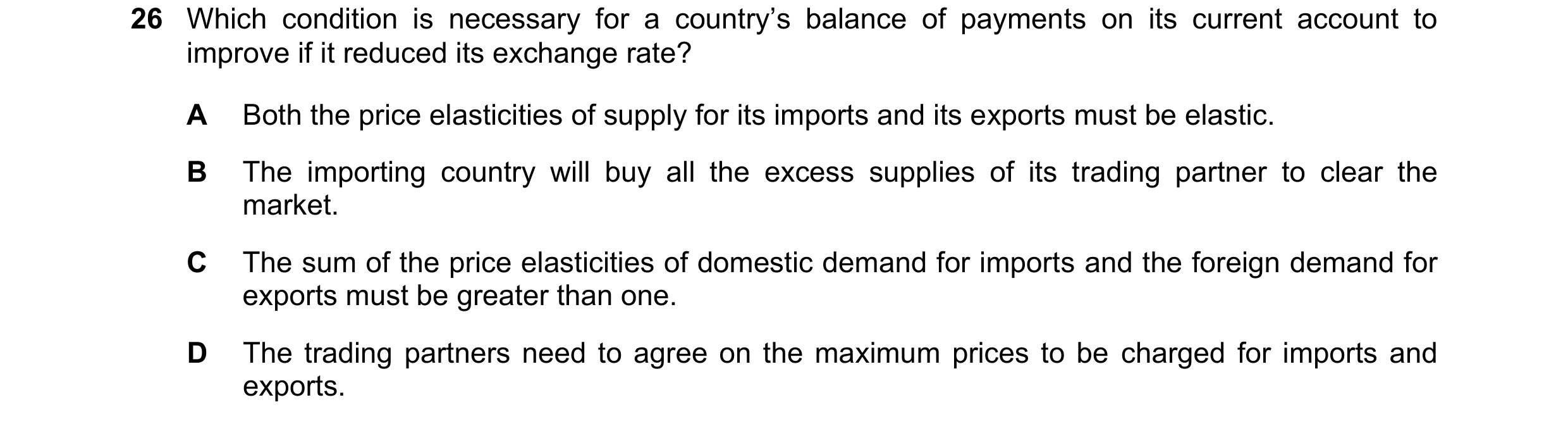
Q105 · Which condition is necessary for a country’s balance of payments on its current account… 9708/12 Oct/Nov 2021
26 Which condition is necessary for a country’s balance of payments on its current account to improve if it reduced its exchange rate? A Both the price elasticities of supply for its imports and its exports must be elastic. B The importing country will buy all the excess supplies of its trading partner to clear the market. C The sum of the price elasticities of domestic demand for imports and the foreign demand for exports must be greater than one. D The trading partners need to agree on the maximum prices to be charged for imports and exports.
1 marks
Answer: C
This question in 9708/12 Oct/Nov 2021
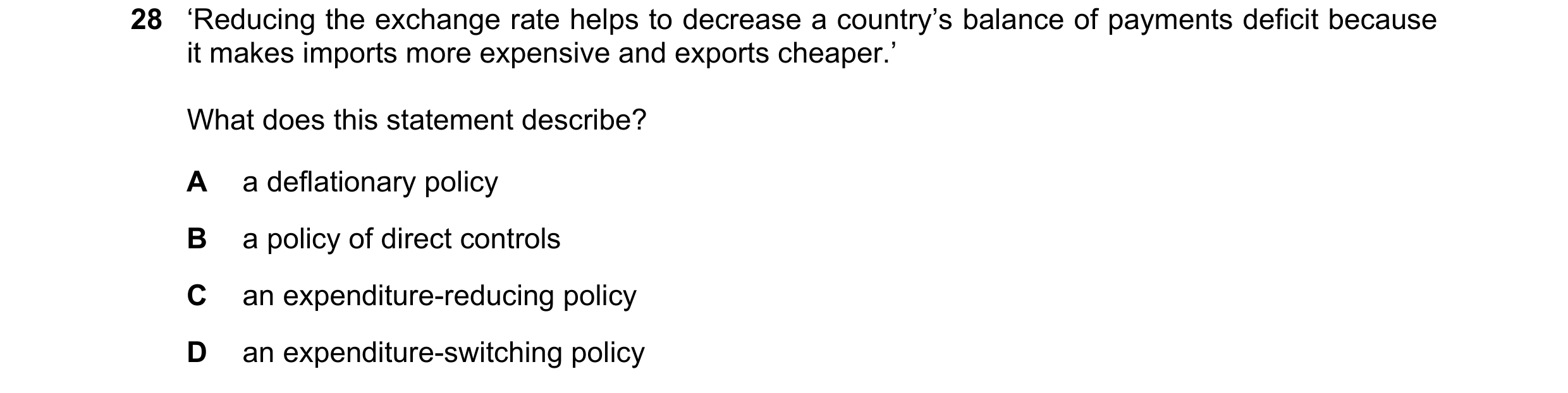
Q106 · ‘Reducing the exchange rate helps to decrease a country’s balance of payments deficit… 9708/12 Feb/March 2022
28 ‘Reducing the exchange rate helps to decrease a country’s balance of payments deficit because it makes imports more expensive and exports cheaper.’ What does this statement describe? A a deflationary policy B a policy of direct controls C an expenditure-reducing policy D an expenditure-switching policy
1 marks
Answer: D
This question in 9708/12 Feb/March 2022
Q107 · The government of a country is worried about a large deficit on the current account of… 9708/11 May/June 2022
30 The government of a country is worried about a large deficit on the current account of its balance of payments and an increasing rate of inflation. The country has a fixed exchange rate for its currency. Which policy measure is most likely to help the government to reduce the current account deficit and lower the rate of inflation? A devaluation of the currency B increasing government spending C decreasing the direct taxes D increasing the interest rate
1 marks
Answer: D
This question in 9708/11 May/June 2022
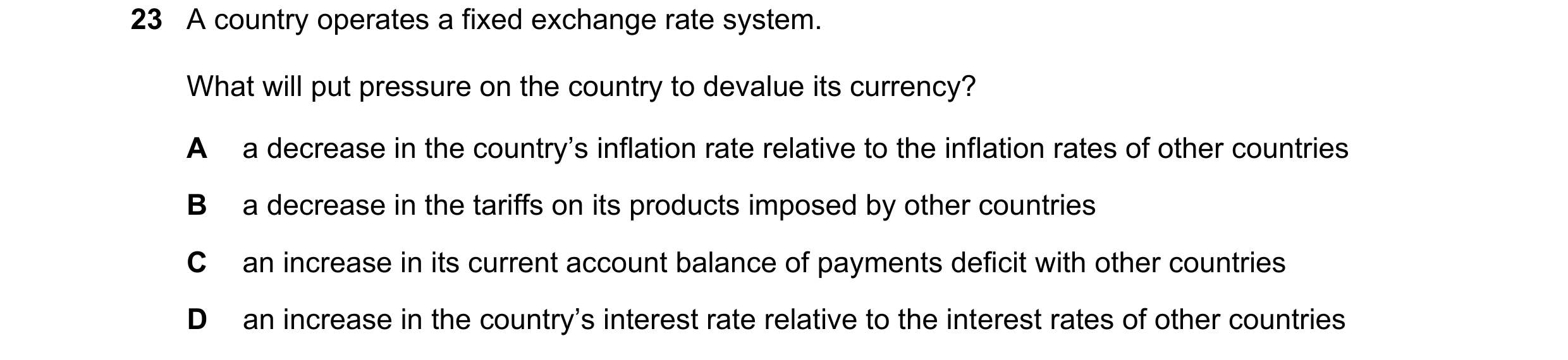
Q108 · A country operates a fixed exchange rate system 9708/12 May/June 2022
23 A country operates a fixed exchange rate system. What will put pressure on the country to devalue its currency? A a decrease in the country’s inflation rate relative to the inflation rates of other countries B a decrease in the tariffs on its products imposed by other countries C an increase in its current account balance of payments deficit with other countries D an increase in the country’s interest rate relative to the interest rates of other countries
1 marks
Answer: C
This question in 9708/12 May/June 2022
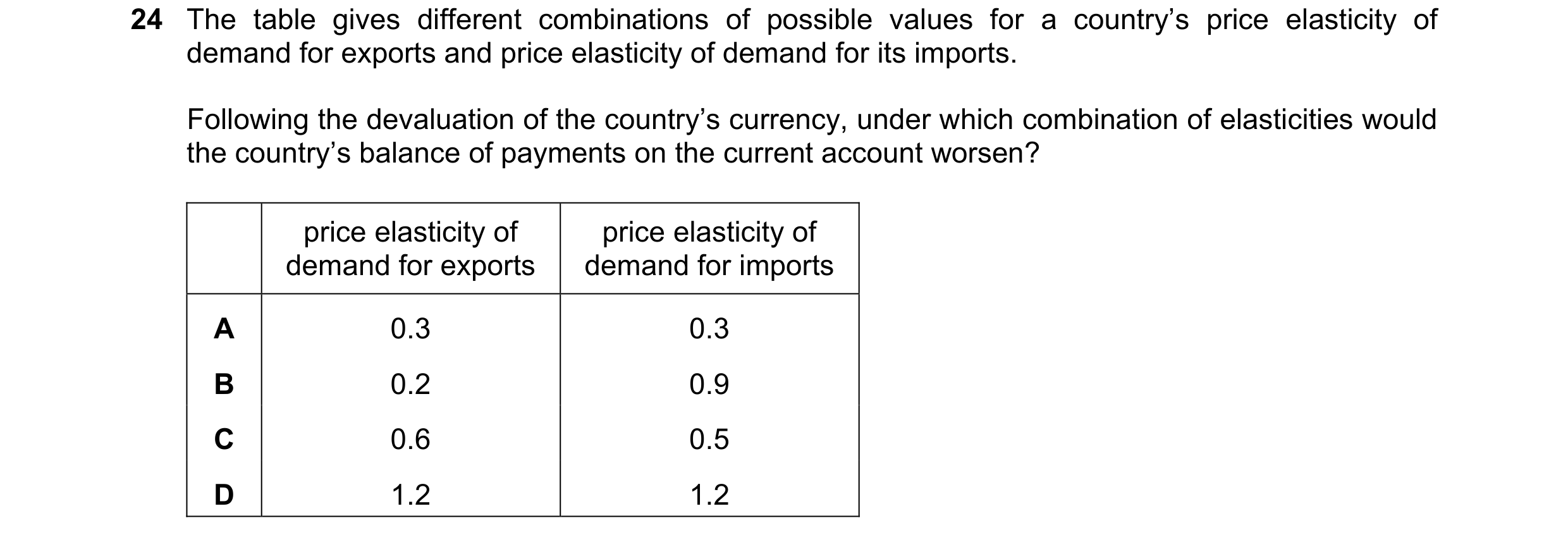
Q109 · The table gives different combinations of possible values for a country’s price… 9708/12 May/June 2022
24 The table gives different combinations of possible values for a country’s price elasticity of demand for exports and price elasticity of demand for its imports. Following the devaluation of the country’s currency, under which combination of elasticities would the country’s balance of payments on the current account worsen? price elasticity of price elasticity of demand for exports demand for imports A 0.3 0.3 B 0.2 0.9 C 0.6 0.5 D 1.2 1.2
1 marks
Answer: A
This question in 9708/12 May/June 2022
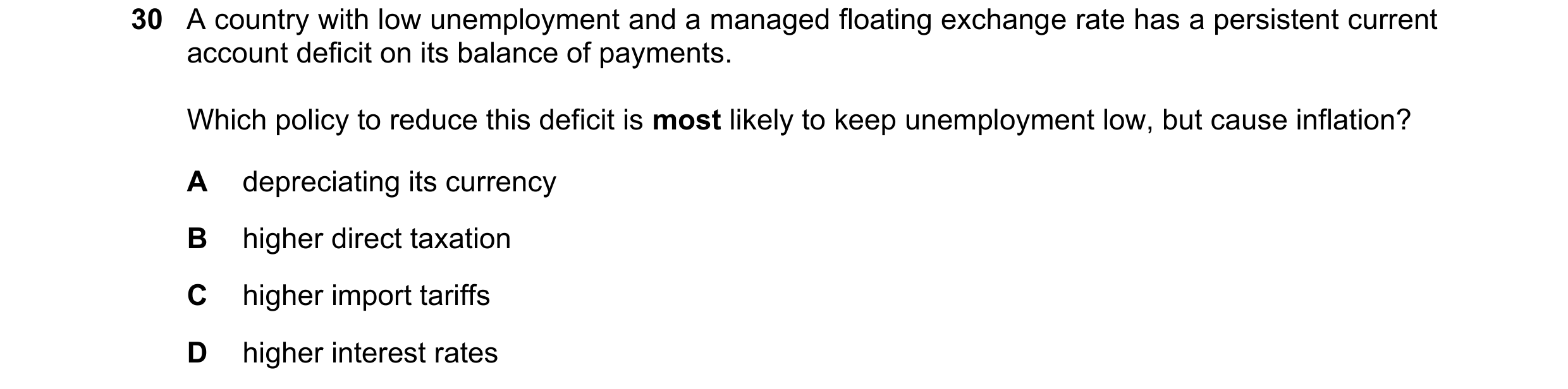
Q110 · A country with low unemployment and a managed floating exchange rate has a persistent… 9708/12 May/June 2022
30 A country with low unemployment and a managed floating exchange rate has a persistent current account deficit on its balance of payments. Which policy to reduce this deficit is most likely to keep unemployment low, but cause inflation? A depreciating its currency B higher direct taxation C higher import tariffs D higher interest rates
1 marks
Answer: A
This question in 9708/12 May/June 2022
Q111 · The diagram shows the aggregate demand (AD) and aggregate supply (AS) for a country 9708/13 May/June 2022
26 The diagram shows the aggregate demand (AD) and aggregate supply (AS) for a country. The initial equilibrium is at point E. The sum of the price elasticities of demand for imports and exports for this country exceeds one. A devaluation of the country’s exchange rate will cause aggregate demand to change. What will be the new equilibrium? AS price level A B E D C AD O real output
1 marks
Answer: B
This question in 9708/13 May/June 2022
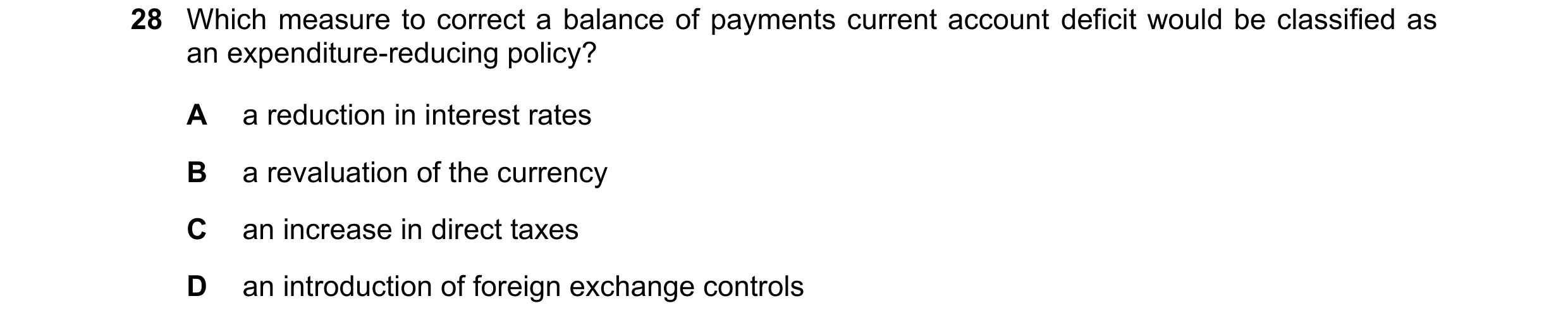
Q112 · Which measure to correct a balance of payments current account deficit would be… 9708/13 May/June 2022
28 Which measure to correct a balance of payments current account deficit would be classified as an expenditure-reducing policy? A a reduction in interest rates B a revaluation of the currency C an increase in direct taxes D an introduction of foreign exchange controls
1 marks
Answer: C
This question in 9708/13 May/June 2022
Q113 · An economy has a balance of payments surplus, which it wishes to eliminate 9708/14 May/June 2022
28 An economy has a balance of payments surplus, which it wishes to eliminate. In order to achieve this objective, which combination of policies would be most appropriate? A a depreciation of the currency and an increase in government spending B an appreciation of the currency and a cut in interest rates C an increase in the money supply and a pay freeze D increases in both direct and indirect taxation
1 marks
Answer: B
This question in 9708/14 May/June 2022
Q114 · What does the Marshall–Lerner condition state must be present for a depreciation of a… 9708/11 Oct/Nov 2022
27 What does the Marshall–Lerner condition state must be present for a depreciation of a currency to cause an improvement in the current account balance? A The price elasticity of demand for exports and the price elasticity of demand for imports are both greater than one. B The price elasticity of demand for exports and the price elasticity of demand for imports are both less than one. C The sum of the price elasticity of demand for exports and the price elasticity of demand for imports is greater than one. D The sum of the price elasticity of demand for exports and the price elasticity of demand for imports is less than one.
1 marks
Answer: C
This question in 9708/11 Oct/Nov 2022
Q115 · Raising interest rates is proposed to reduce a balance of payments deficit 9708/11 Oct/Nov 2022
29 Raising interest rates is proposed to reduce a balance of payments deficit. Which justification for this action is not valid? A It will attract more foreign currency inflows. B It will encourage exporters to find new foreign markets. C It will lower the level of imported consumer goods. D It will put downward pressure on the exchange rate.
1 marks
Answer: D
This question in 9708/11 Oct/Nov 2022
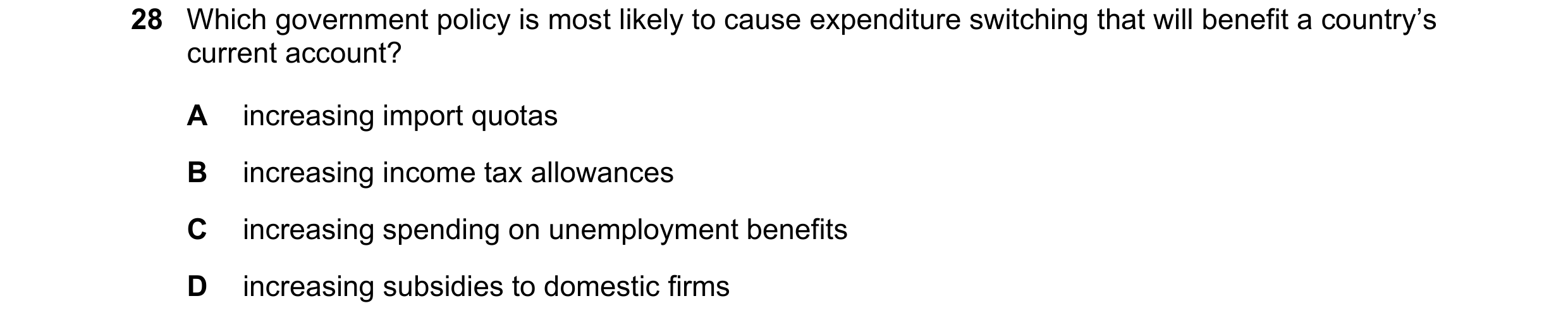
Q116 · Which government policy is most likely to cause expenditure switching that will benefit a… 9708/12 Oct/Nov 2022
28 Which government policy is most likely to cause expenditure switching that will benefit a country’s current account? A increasing import quotas B increasing income tax allowances C increasing spending on unemployment benefits D increasing subsidies to domestic firms
1 marks
Answer: D
This question in 9708/12 Oct/Nov 2022
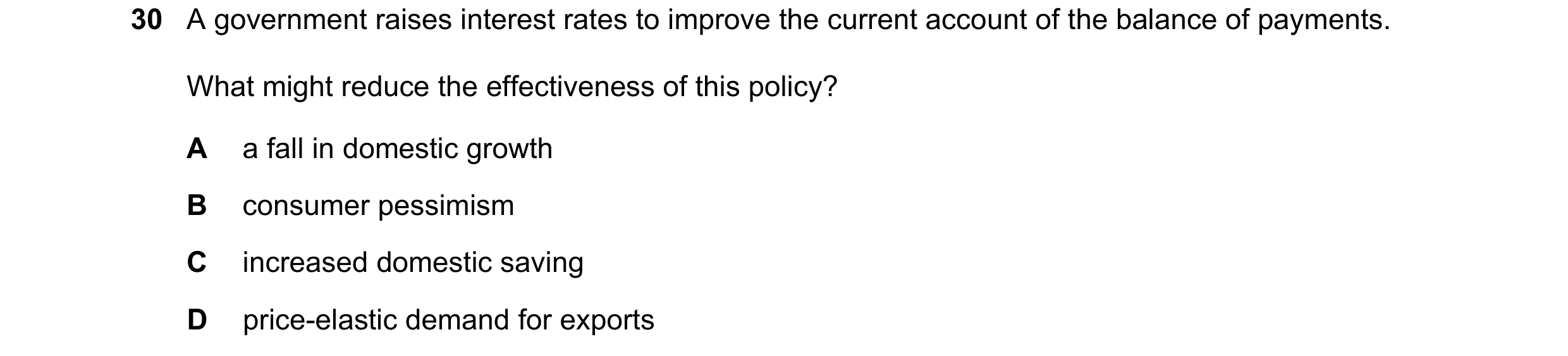
Q117 · A government raises interest rates to improve the current account of the balance of… 9708/12 Feb/March 2023
30 A government raises interest rates to improve the current account of the balance of payments. What might reduce the effectiveness of this policy? A a fall in domestic growth B consumer pessimism C increased domestic saving D price-elastic demand for exports
1 marks
Answer: D
This question in 9708/12 Feb/March 2023
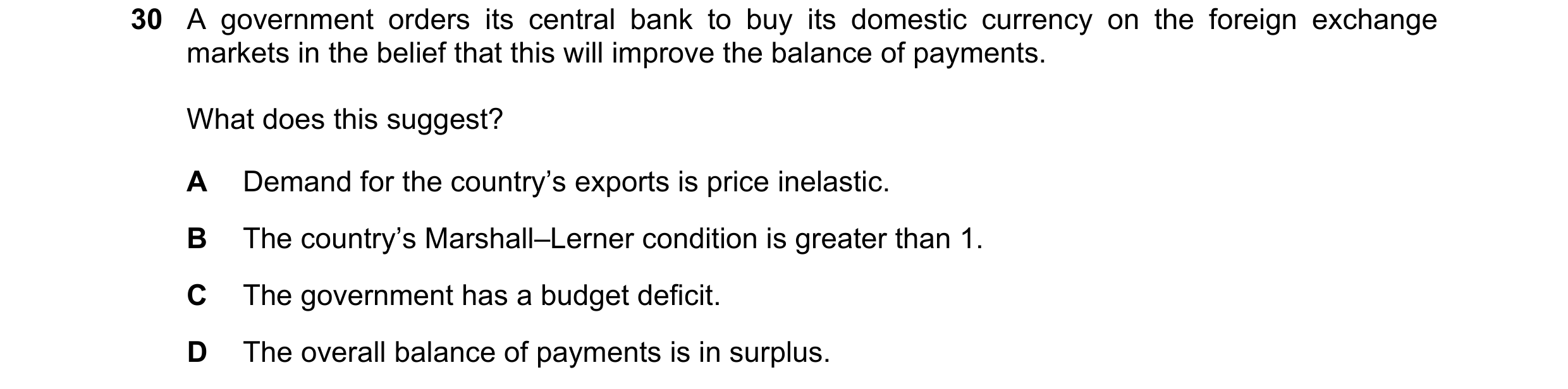
Q118 · A government orders its central bank to buy its domestic currency on the foreign exchange… 9708/11 May/June 2023
30 A government orders its central bank to buy its domestic currency on the foreign exchange markets in the belief that this will improve the balance of payments. What does this suggest? A Demand for the country’s exports is price inelastic. B The country’s Marshall–Lerner condition is greater than 1. C The government has a budget deficit. D The overall balance of payments is in surplus.
1 marks
This question in 9708/11 May/June 2023
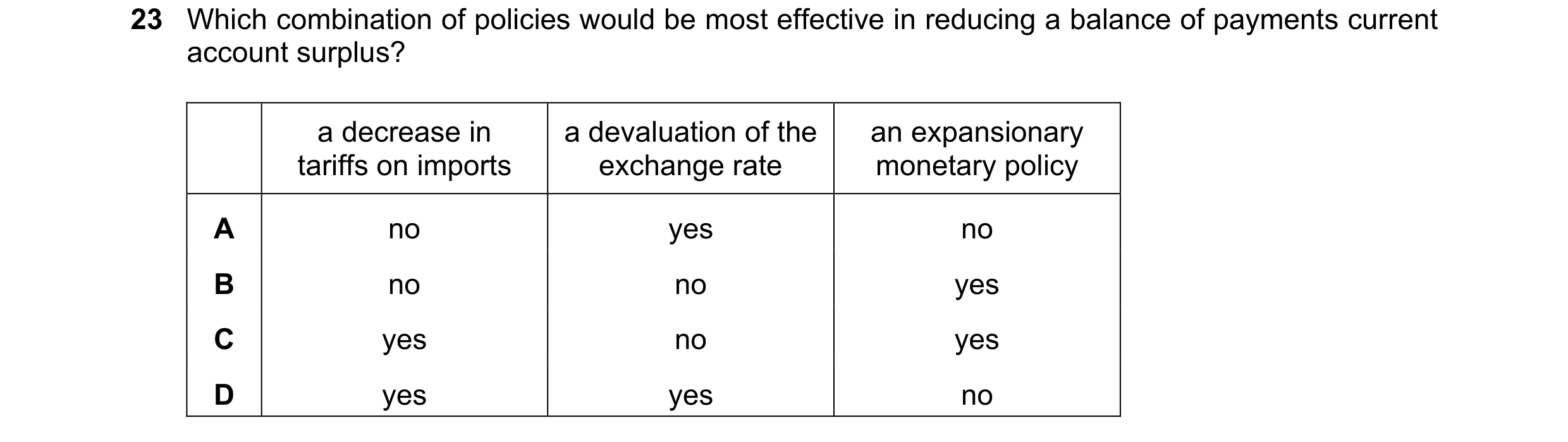
Q119 · Which combination of policies would be most effective in reducing a balance of payments… 9708/12 May/June 2023
23 Which combination of policies would be most effective in reducing a balance of payments current account surplus? a decrease in a devaluation of the an expansionary tariffs on imports exchange rate monetary policy A no yes no B no no yes C yes no yes D yes yes no
1 marks
Answer: C
This question in 9708/12 May/June 2023
Q120 · Which policy is most likely to help to correct an adverse balance on the current account… 9708/13 May/June 2023
19 Which policy is most likely to help to correct an adverse balance on the current account of the balance of payments? A abolishing tariffs B depreciating the currency C reducing direct taxes D reducing indirect taxes
1 marks
Answer: B
This question in 9708/13 May/June 2023
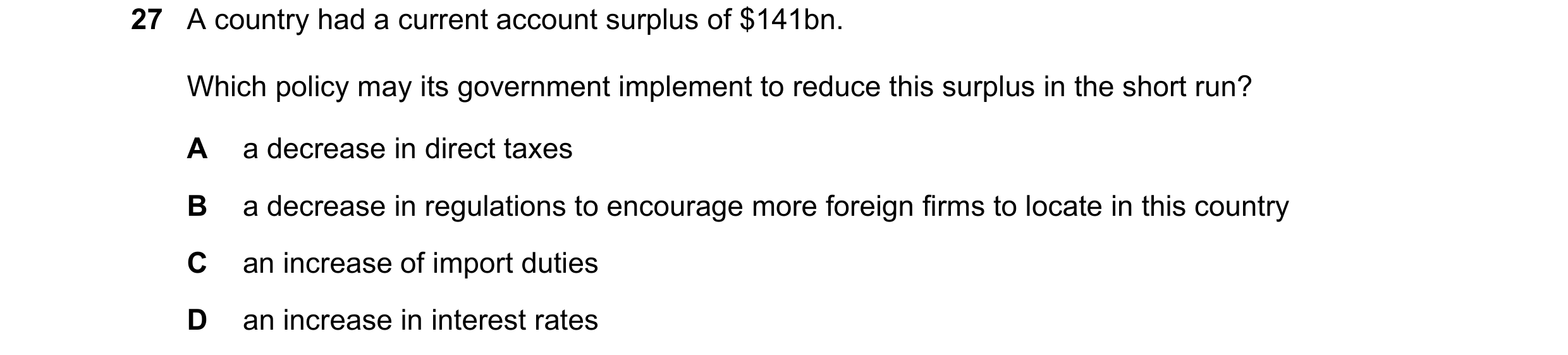
Q121 · A country had a current account surplus of $141bn 9708/13 May/June 2023
27 A country had a current account surplus of $141bn. Which policy may its government implement to reduce this surplus in the short run? A a decrease in direct taxes B a decrease in regulations to encourage more foreign firms to locate in this country C an increase of import duties D an increase in interest rates
1 marks
Answer: A
This question in 9708/13 May/June 2023
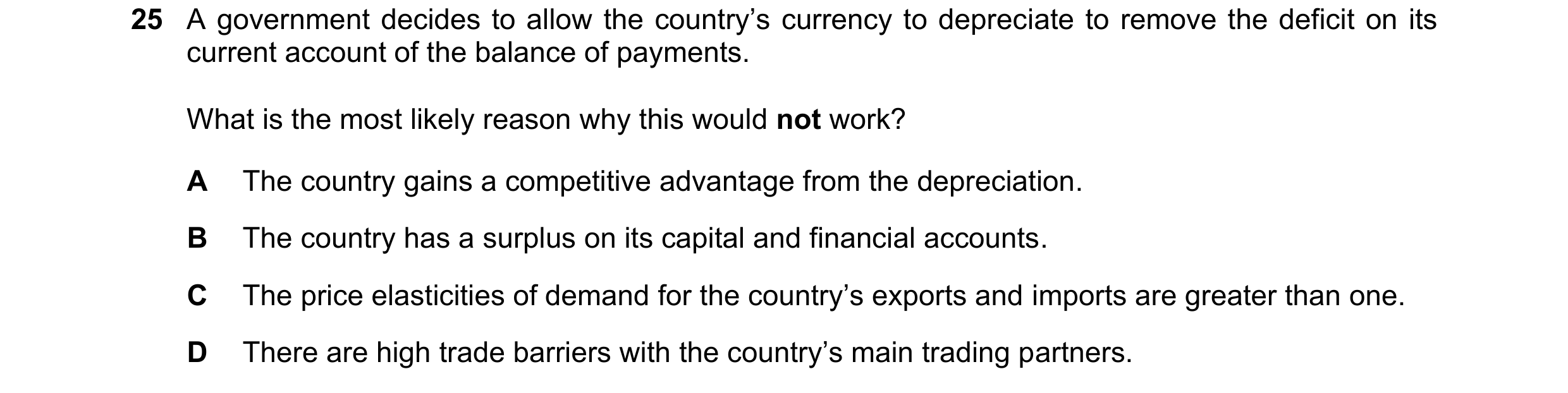
Q122 · A government decides to allow the country’s currency to depreciate to remove the deficit… 9708/12 Feb/March 2024
25 A government decides to allow the country’s currency to depreciate to remove the deficit on its current account of the balance of payments. What is the most likely reason why this would not work? A The country gains a competitive advantage from the depreciation. B The country has a surplus on its capital and financial accounts. C The price elasticities of demand for the country’s exports and imports are greater than one. D There are high trade barriers with the country’s main trading partners.
1 marks
Answer: D
This question in 9708/12 Feb/March 2024
Q123 · What would be the best policy for a country to reduce a balance of payments deficit? 9708/12 May/June 2024
24 What would be the best policy for a country to reduce a balance of payments deficit? A an increase in interest rates B an increase in the exchange rate C a reduction in direct taxes D a reduction in subsidies to domestic industry
1 marks
Answer: A
This question in 9708/12 May/June 2024
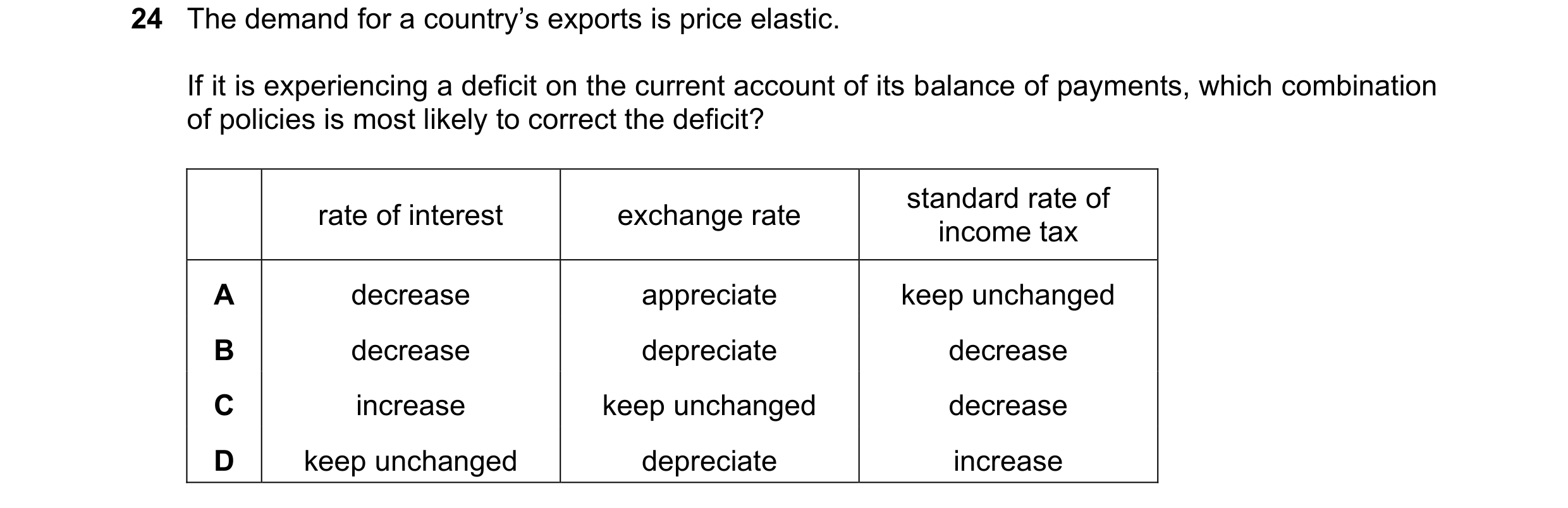
Q124 · The demand for a country’s exports is price elastic 9708/13 May/June 2024
24 The demand for a country’s exports is price elastic. If it is experiencing a deficit on the current account of its balance of payments, which combination of policies is most likely to correct the deficit? standard rate of rate of interest exchange rate income tax A decrease appreciate keep unchanged B decrease depreciate decrease C increase keep unchanged decrease D keep unchanged depreciate increase
1 marks
Answer: D
This question in 9708/13 May/June 2024
Q125 · A government subsidises training to improve the skills of workers in the industrial… 9708/11 Oct/Nov 2024
25 A government subsidises training to improve the skills of workers in the industrial sector of an economy. What is the most likely effect on the current account of the balance of payments? A exports fall B exports rise C imports fall D imports rise
1 marks
Answer: B
This question in 9708/11 Oct/Nov 2024
Q126 · Which policy is most likely to reduce a balance of payments deficit without causing… 9708/12 Oct/Nov 2024
26 Which policy is most likely to reduce a balance of payments deficit without causing inflation? A decreased import quotas B depreciation of currency C higher interest rates D decreased import tariffs
1 marks
Answer: C
This question in 9708/12 Oct/Nov 2024
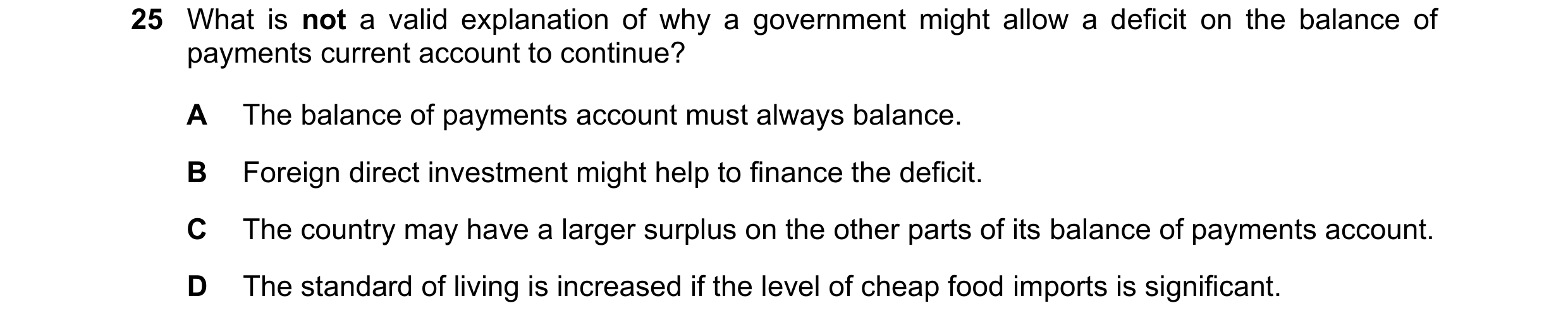
Q127 · What is not a valid explanation of why a government might allow a deficit on the balance… 9708/13 Oct/Nov 2024
25 What is not a valid explanation of why a government might allow a deficit on the balance of payments current account to continue? A The balance of payments account must always balance. B Foreign direct investment might help to finance the deficit. C The country may have a larger surplus on the other parts of its balance of payments account. D The standard of living is increased if the level of cheap food imports is significant.
1 marks
Answer: A
This question in 9708/13 Oct/Nov 2024
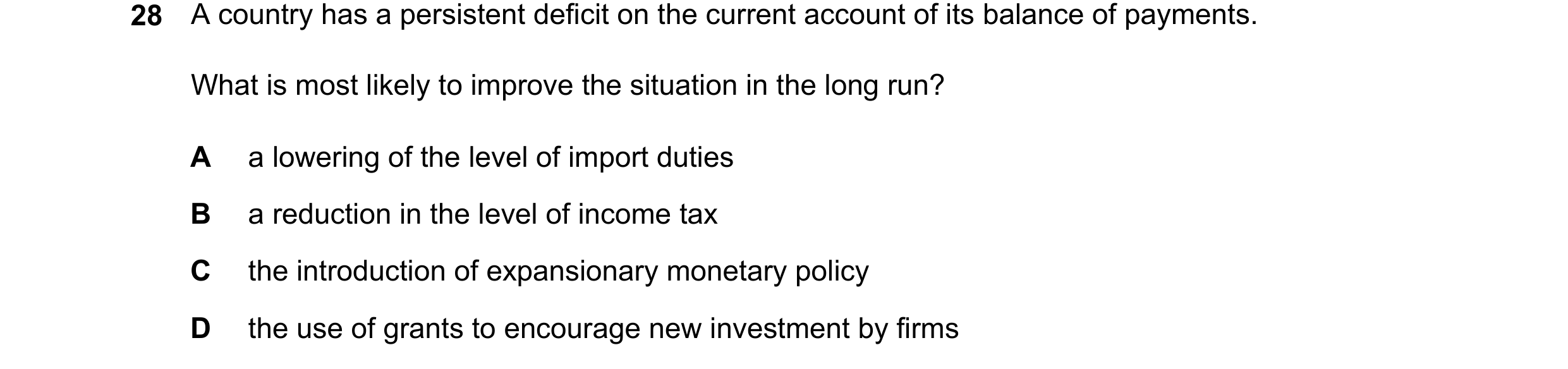
Q128 · A country has a persistent deficit on the current account of its balance of payments 9708/11 May/June 2025
28 A country has a persistent deficit on the current account of its balance of payments. What is most likely to improve the situation in the long run? A a lowering of the level of import duties B a reduction in the level of income tax C the introduction of expansionary monetary policy D the use of grants to encourage new investment by firms
1 marks
Answer: D
This question in 9708/11 May/June 2025
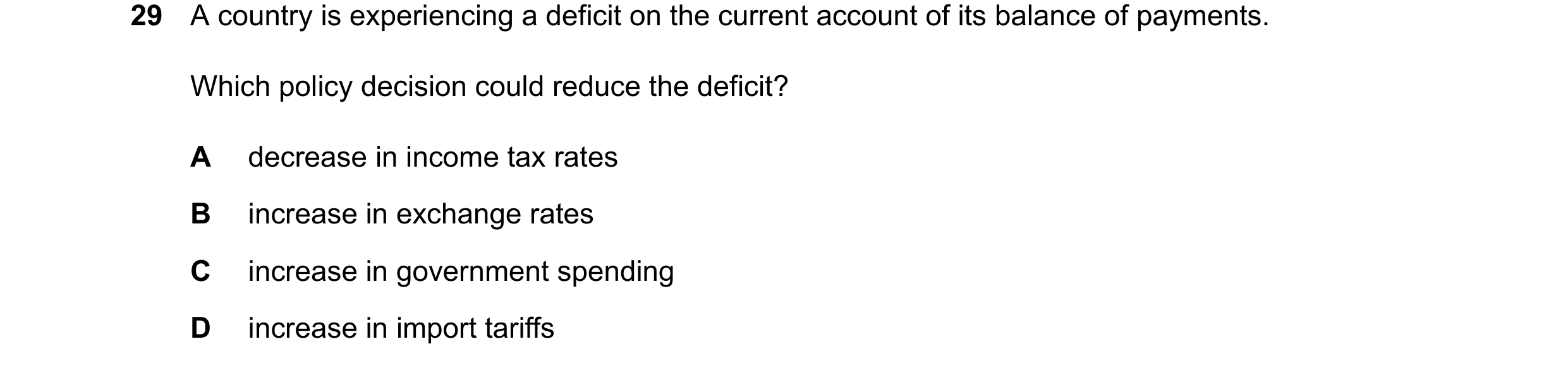
Q129 · A country is experiencing a deficit on the current account of its balance of payments 9708/12 May/June 2025
29 A country is experiencing a deficit on the current account of its balance of payments. Which policy decision could reduce the deficit? A decrease in income tax rates B increase in exchange rates C increase in government spending D increase in import tariffs
1 marks
Answer: D
This question in 9708/12 May/June 2025
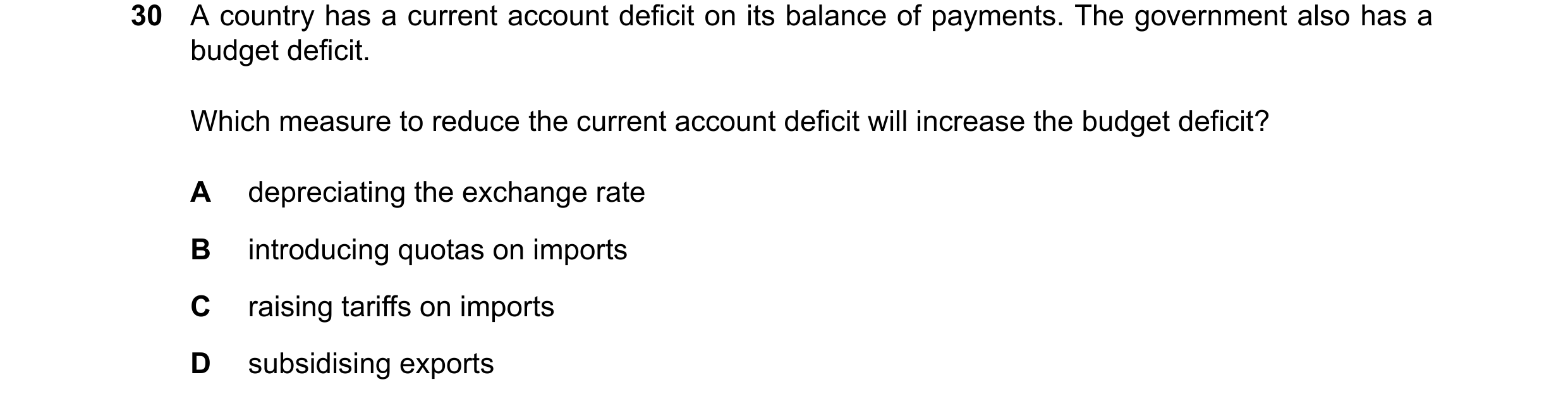
Q130 · A country has a current account deficit on its balance of payments 9708/11 Oct/Nov 2025
30 A country has a current account deficit on its balance of payments. The government also has a budget deficit. Which measure to reduce the current account deficit will increase the budget deficit? A depreciating the exchange rate B introducing quotas on imports C raising tariffs on imports D subsidising exports
1 marks
Answer: D
This question in 9708/11 Oct/Nov 2025

 1 / 31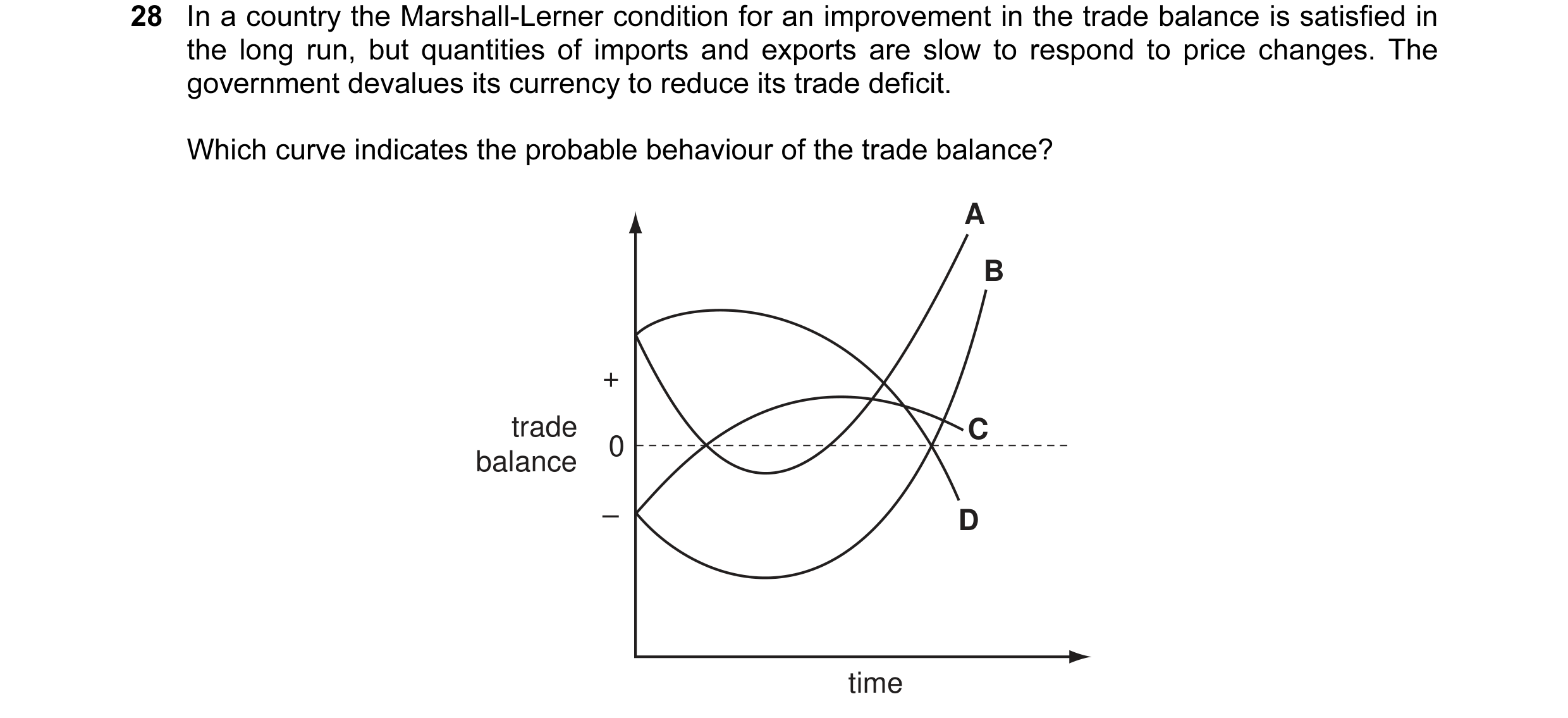
 2 / 31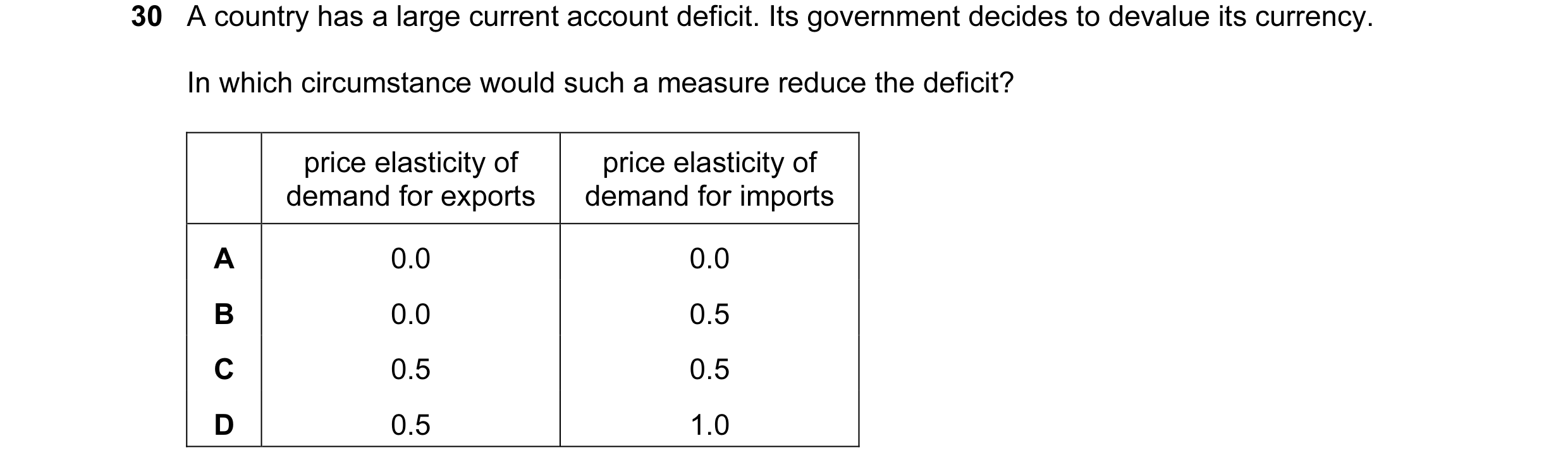



 3 / 31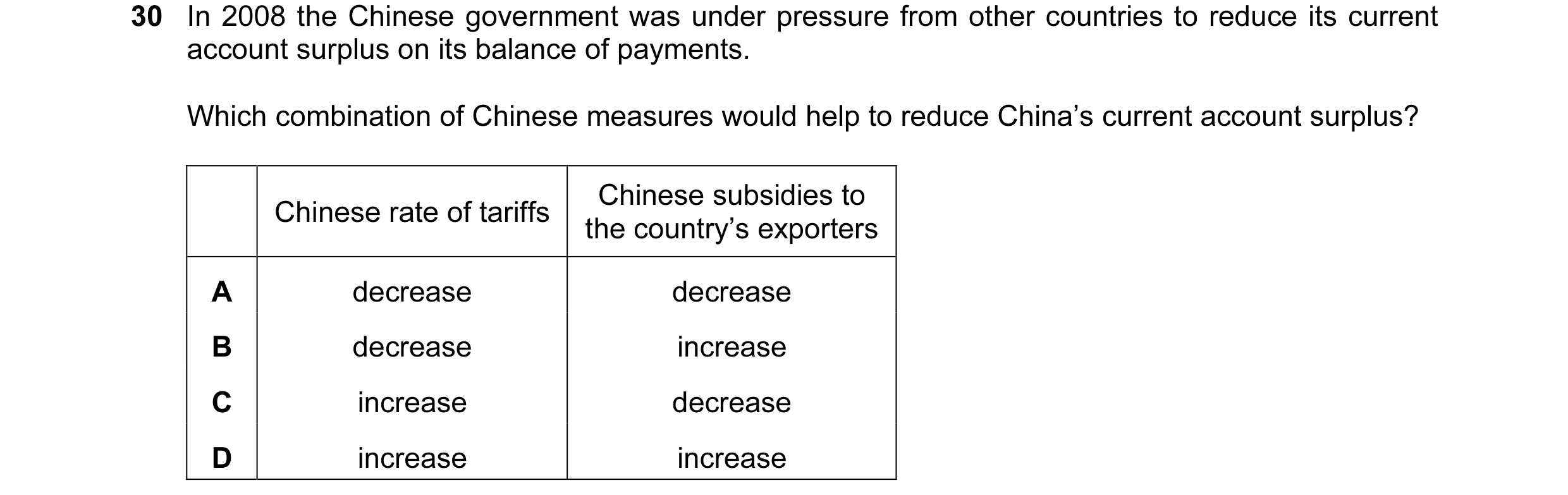
 4 / 31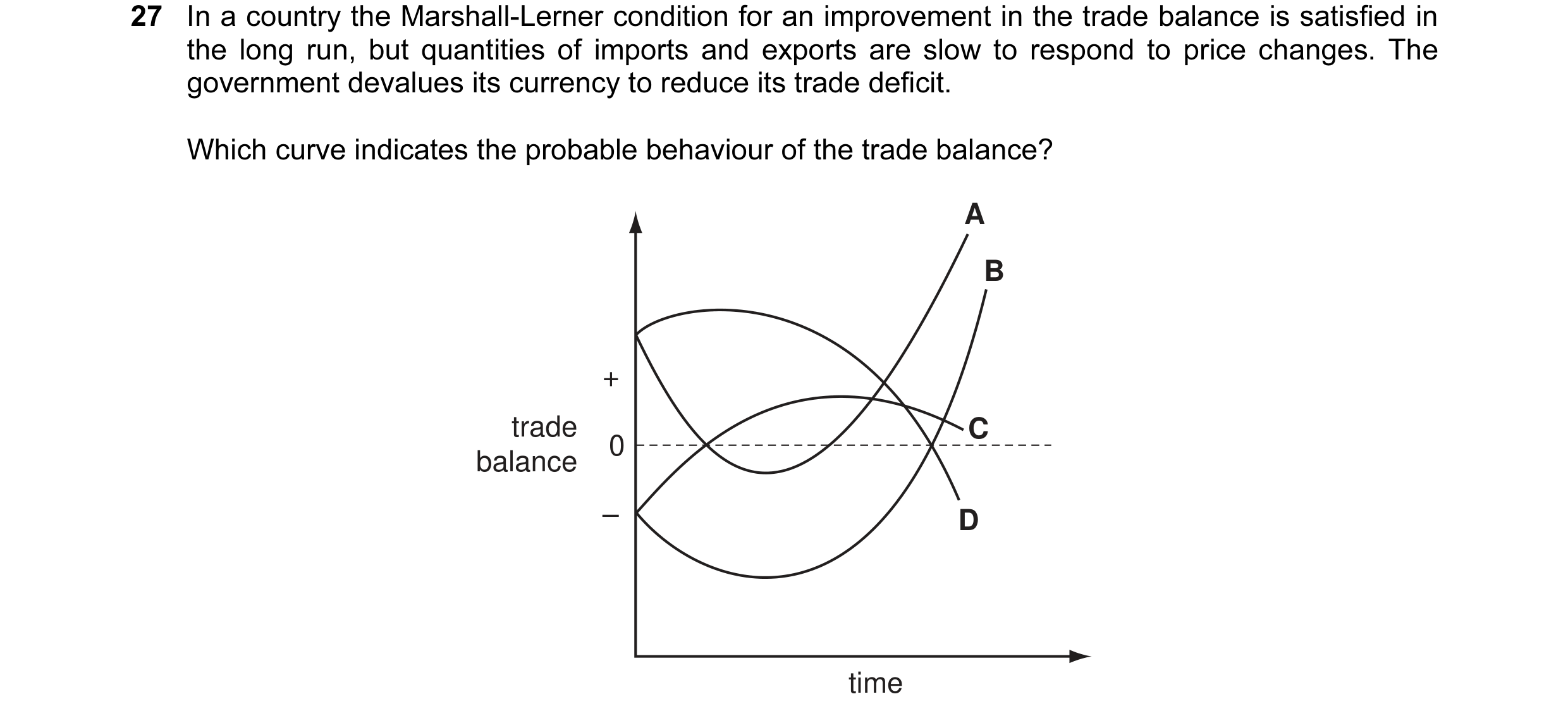
 5 / 31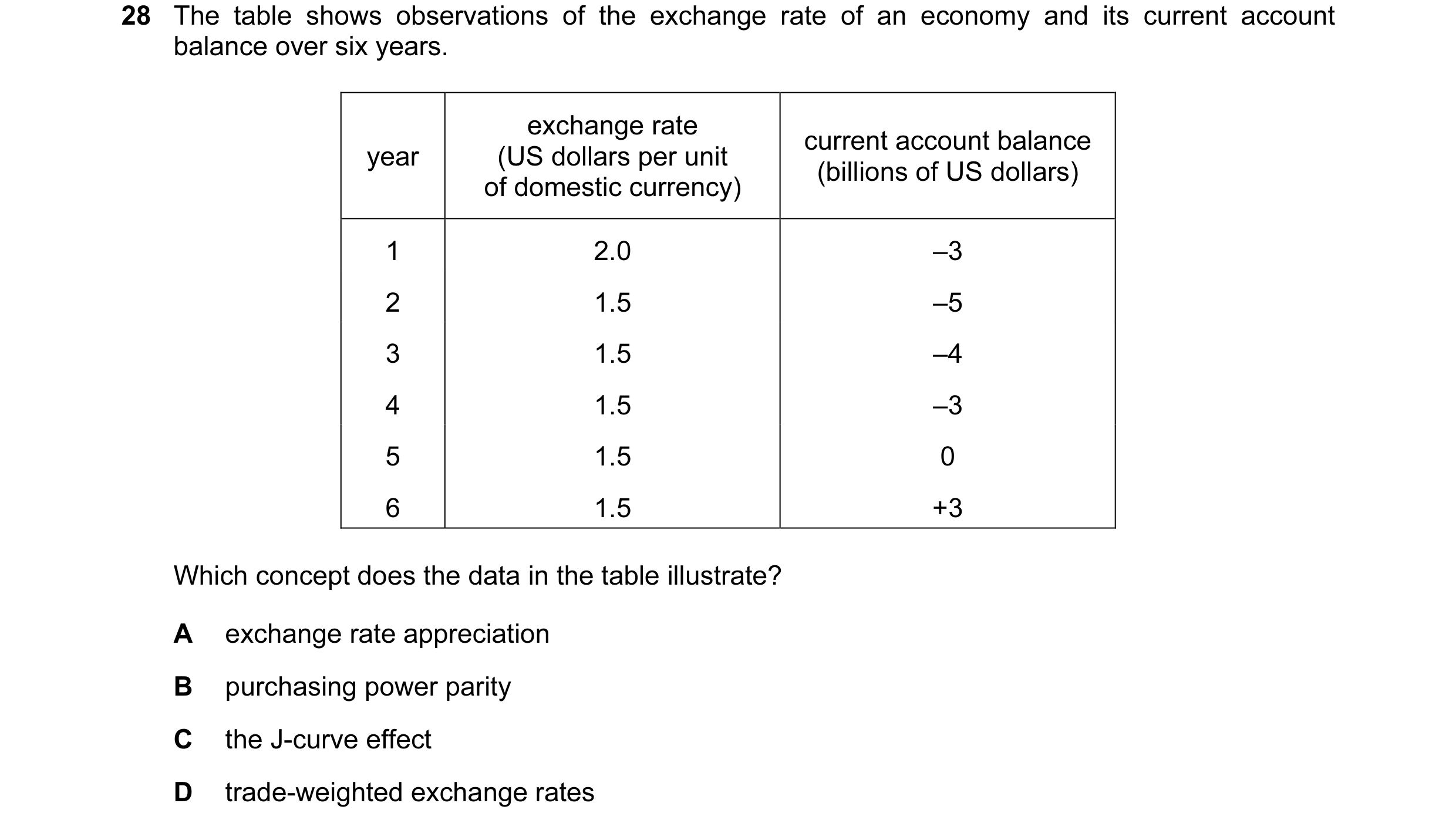
 6 / 31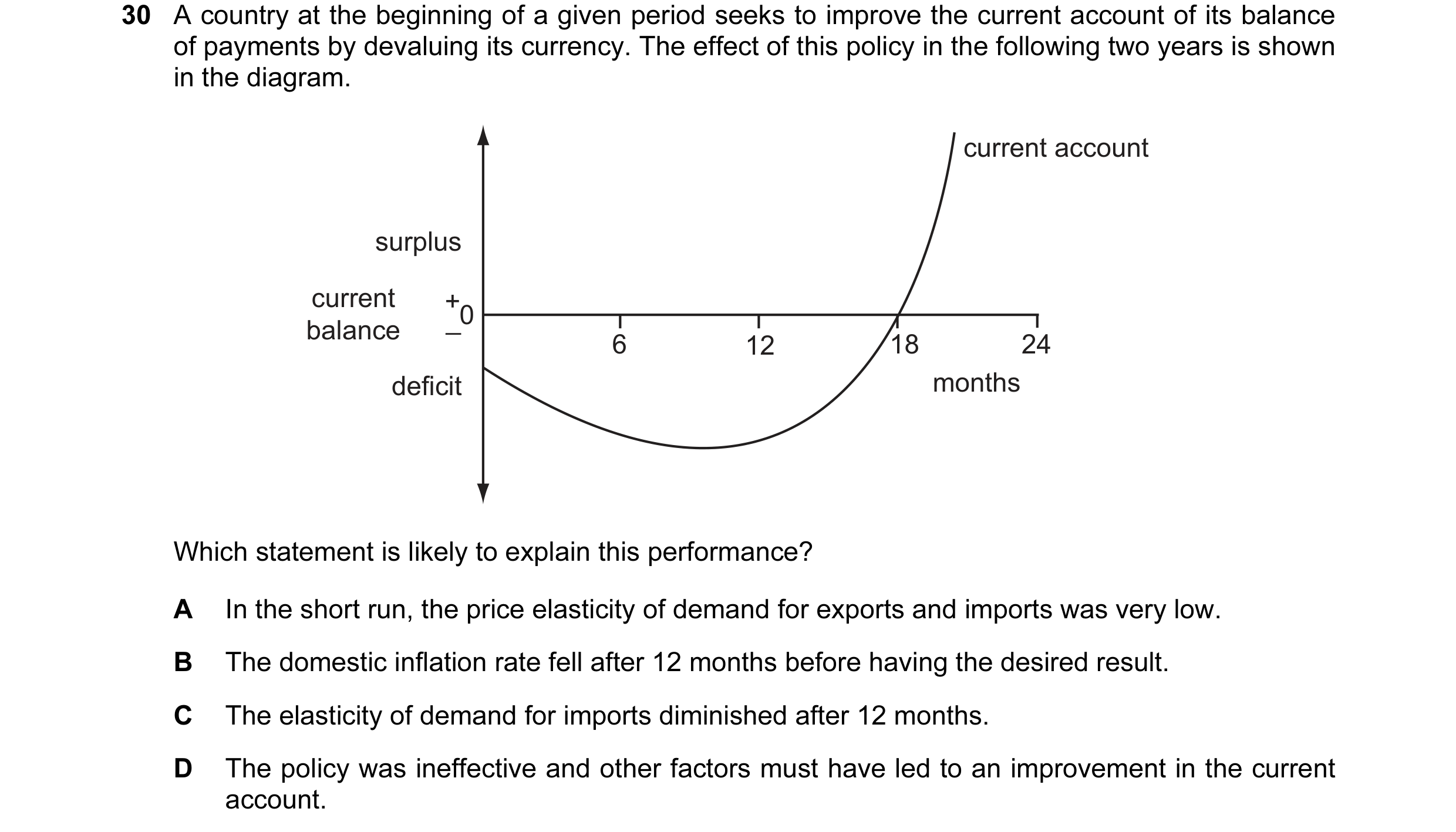

 7 / 31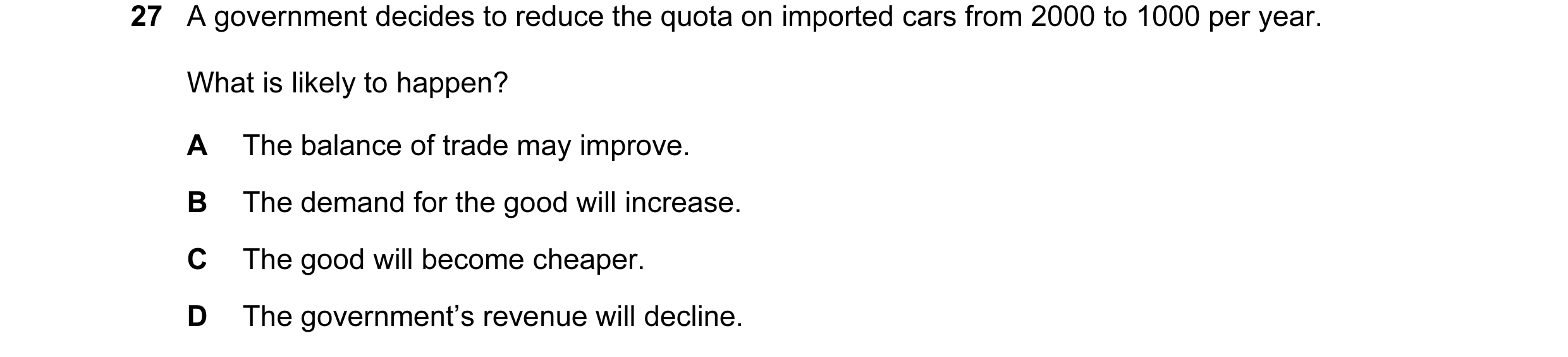
 8 / 31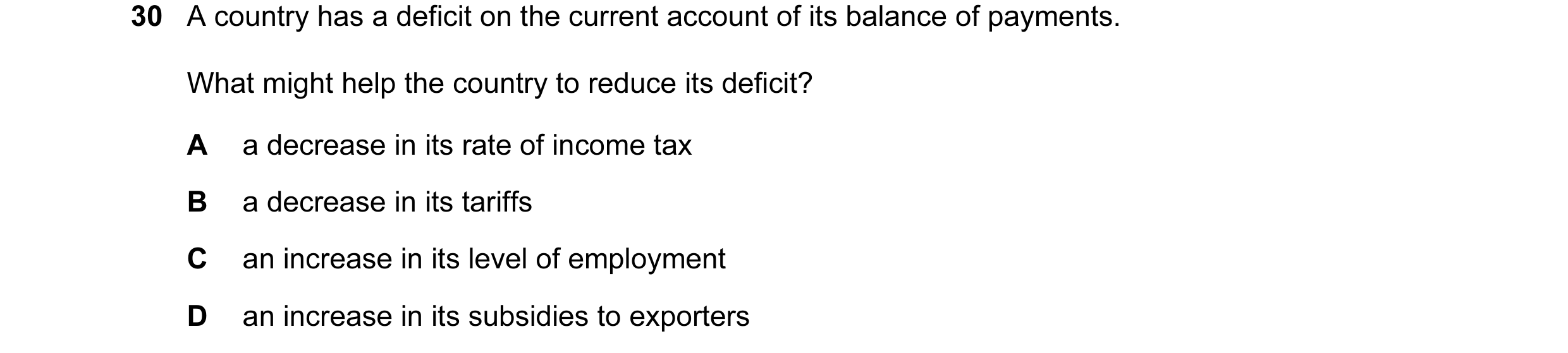


 9 / 31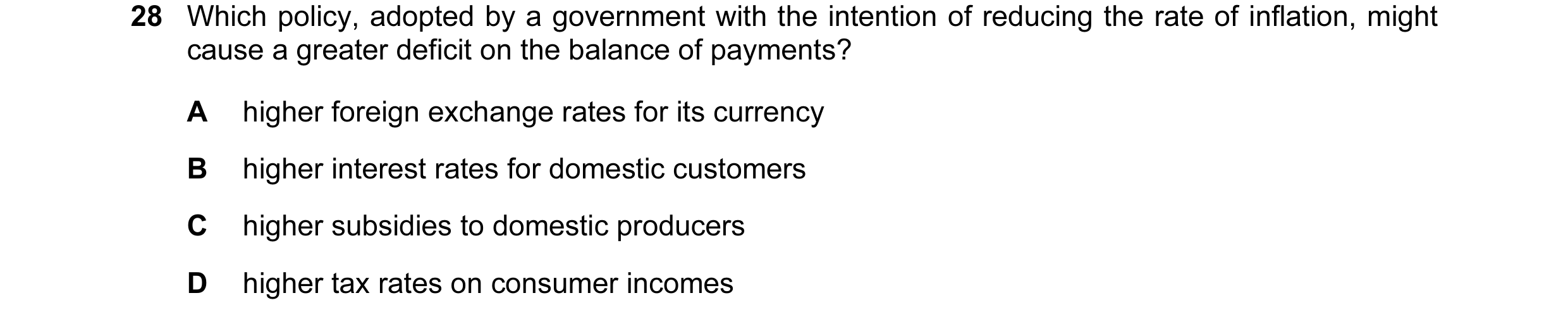
 10 / 31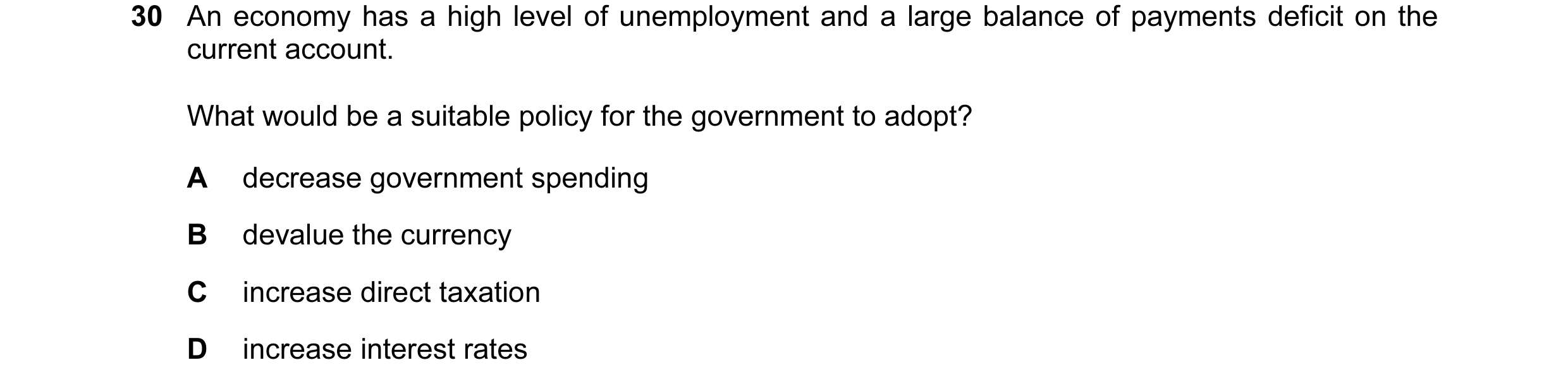

 11 / 31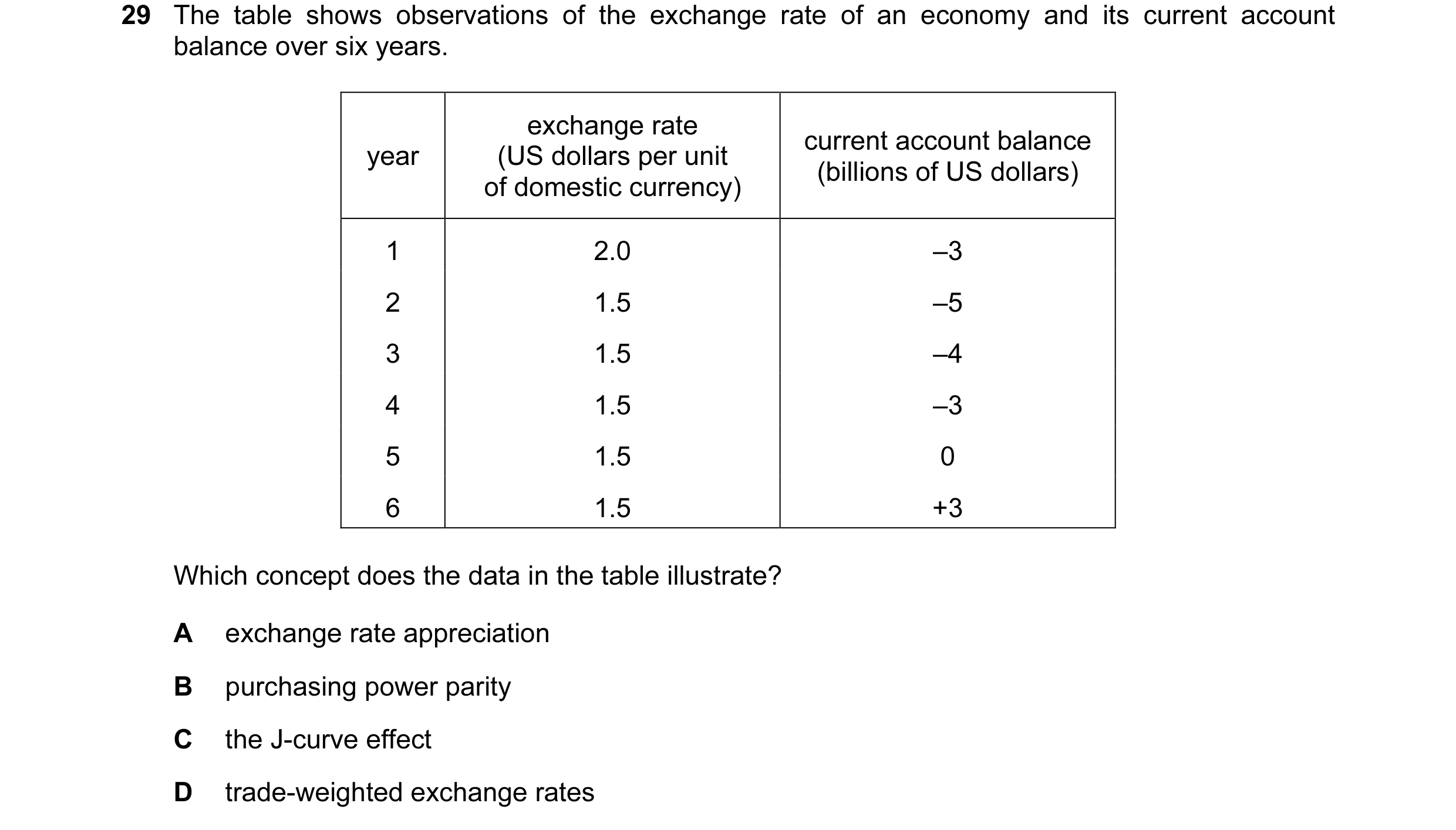
 12 / 31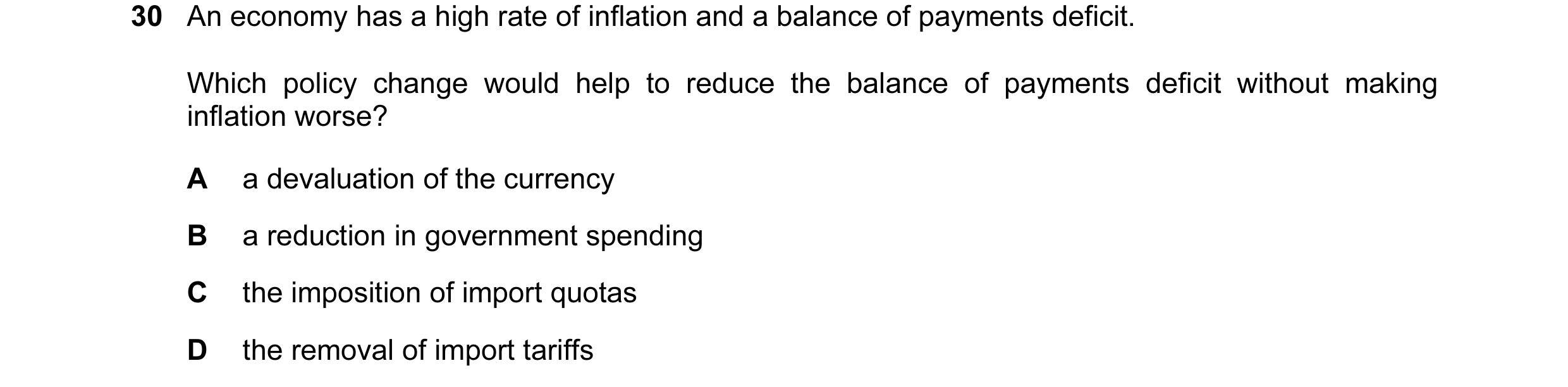

 13 / 31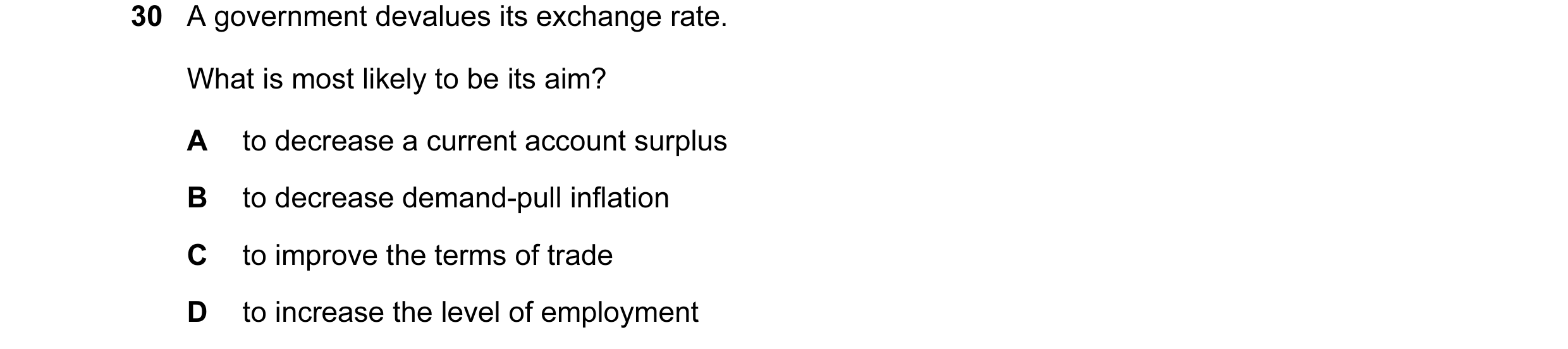
 14 / 31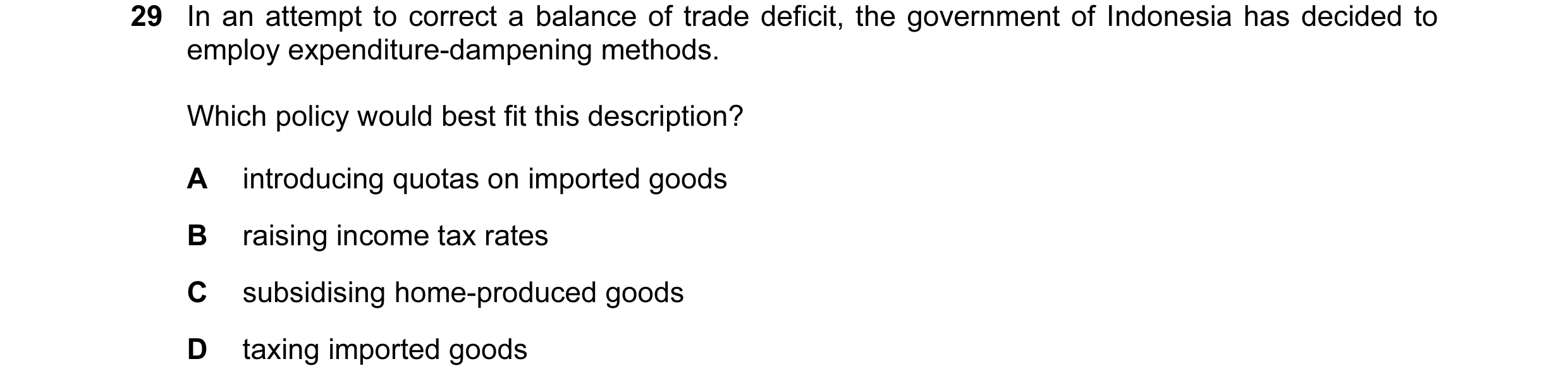

 15 / 31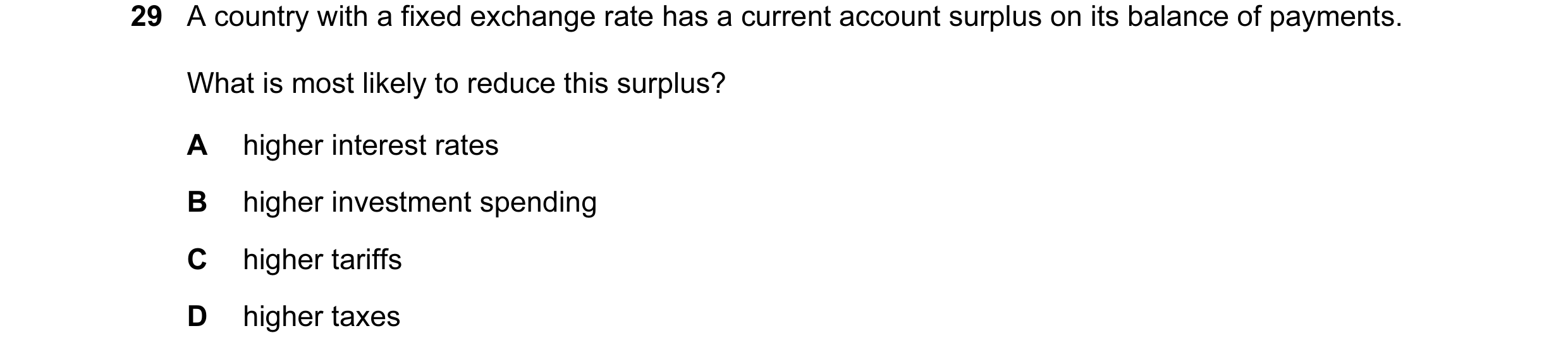

 16 / 31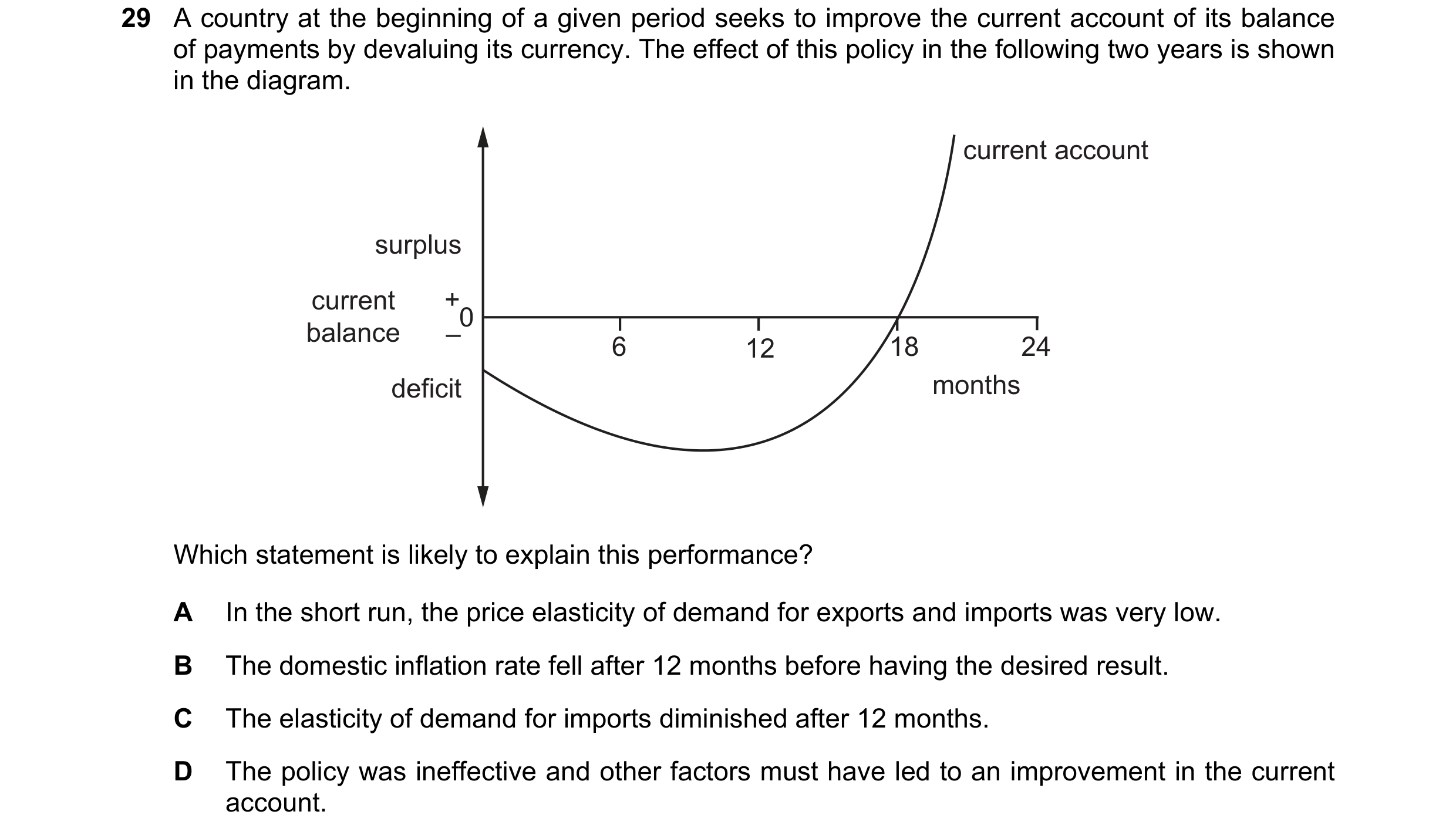
 17 / 31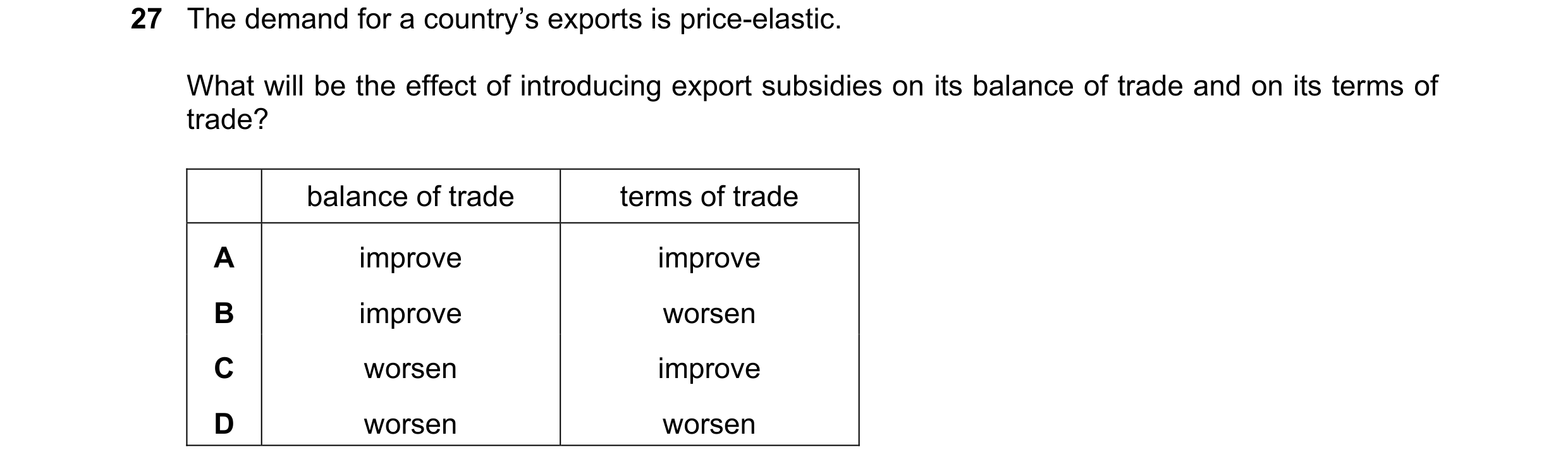


 18 / 31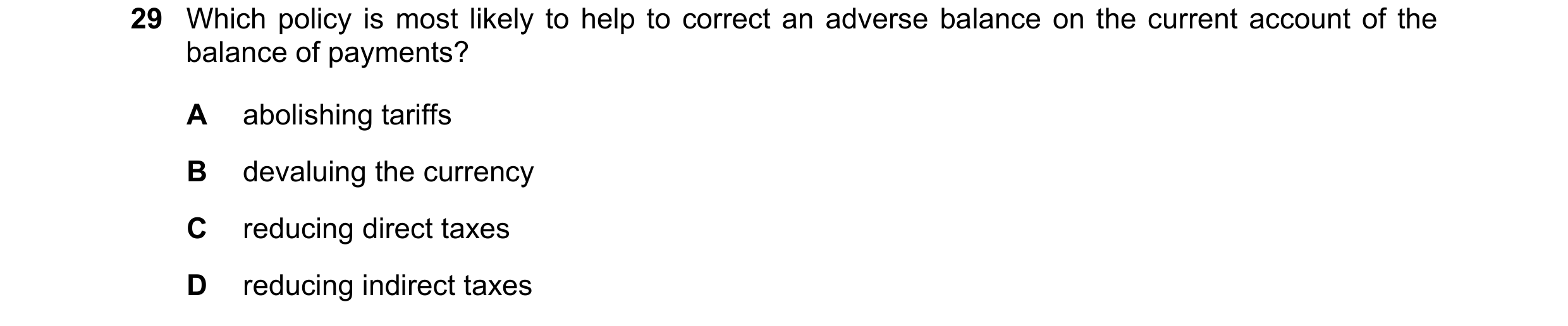
 19 / 31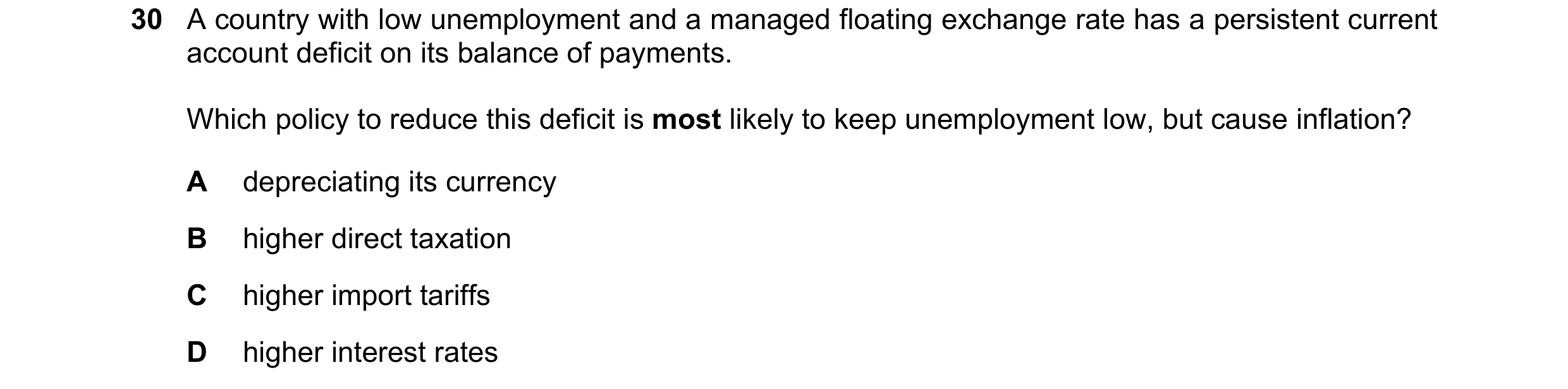
 20 / 31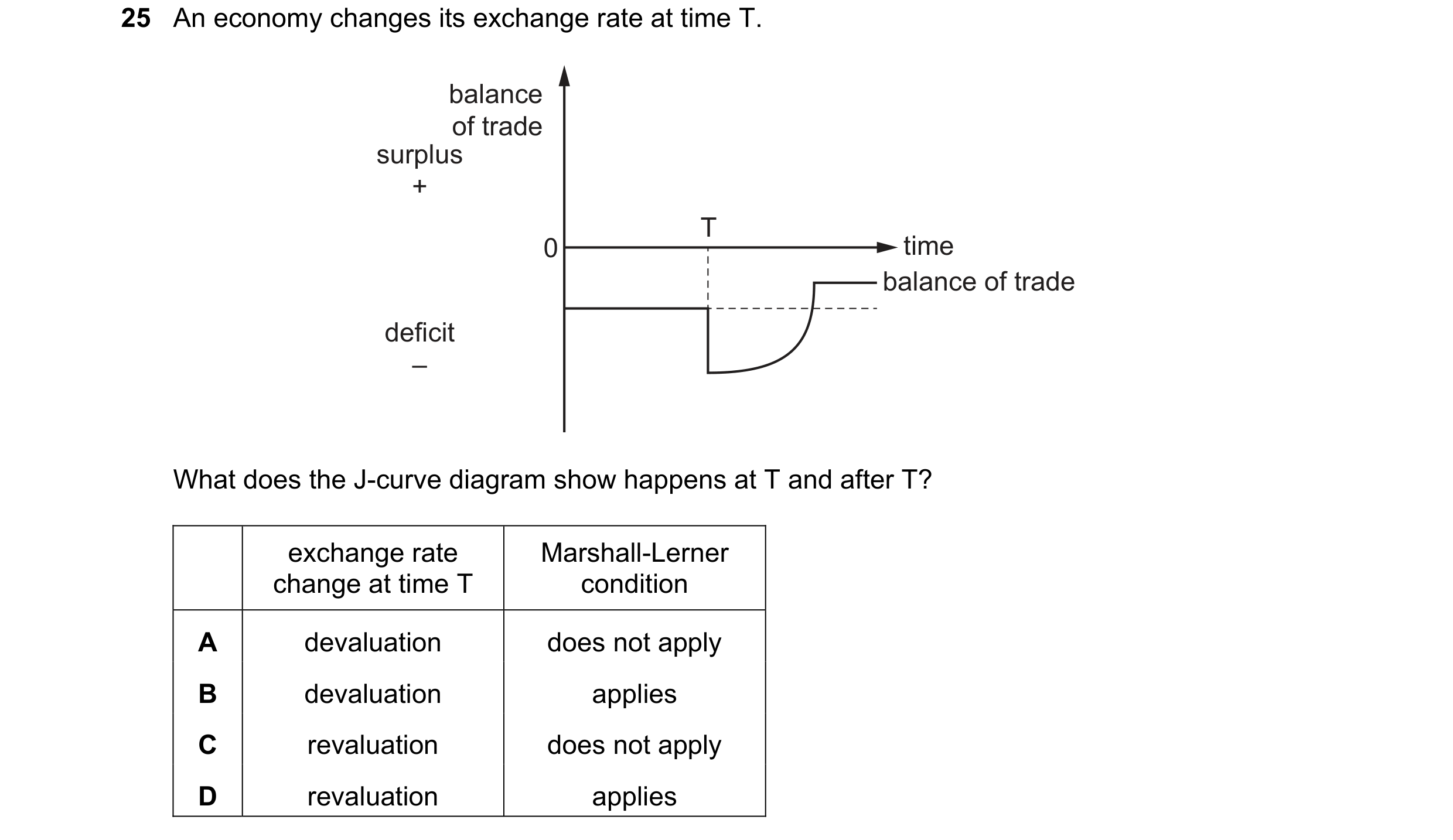

 21 / 31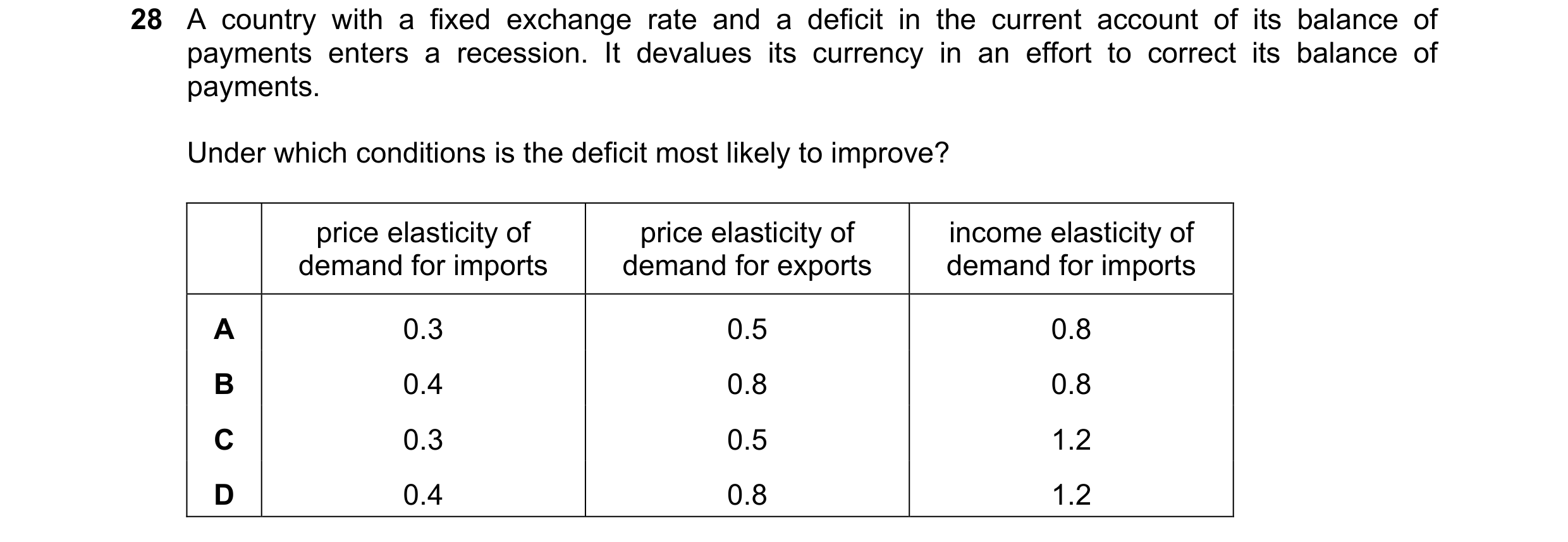

 22 / 31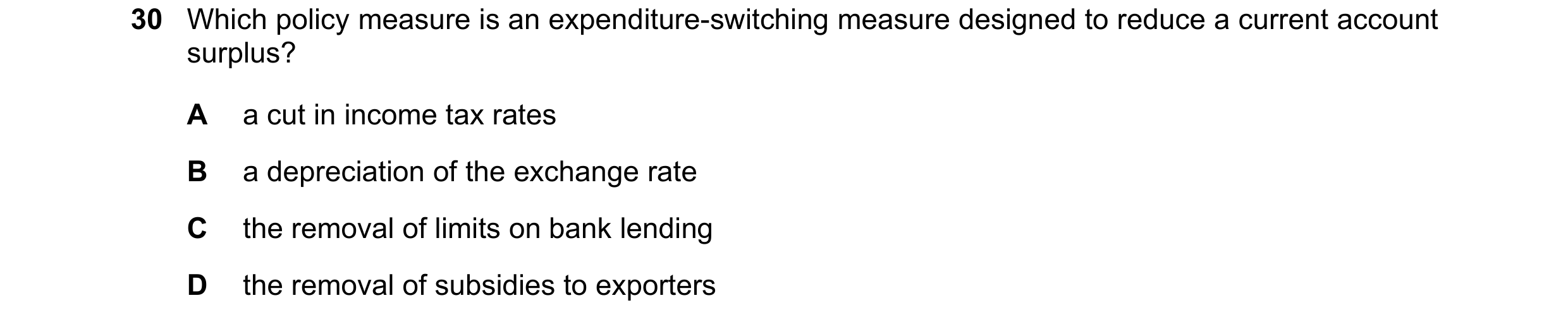

 23 / 31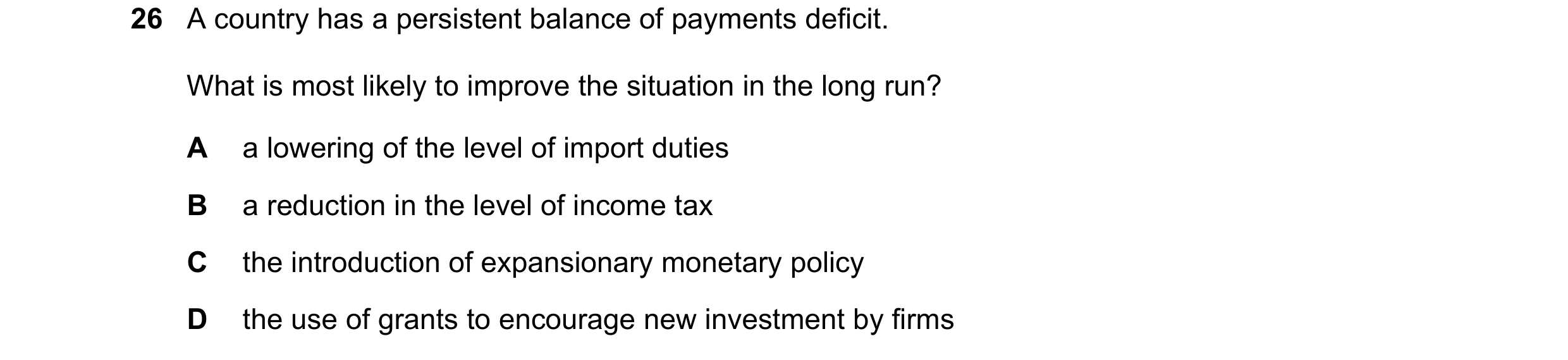
 24 / 31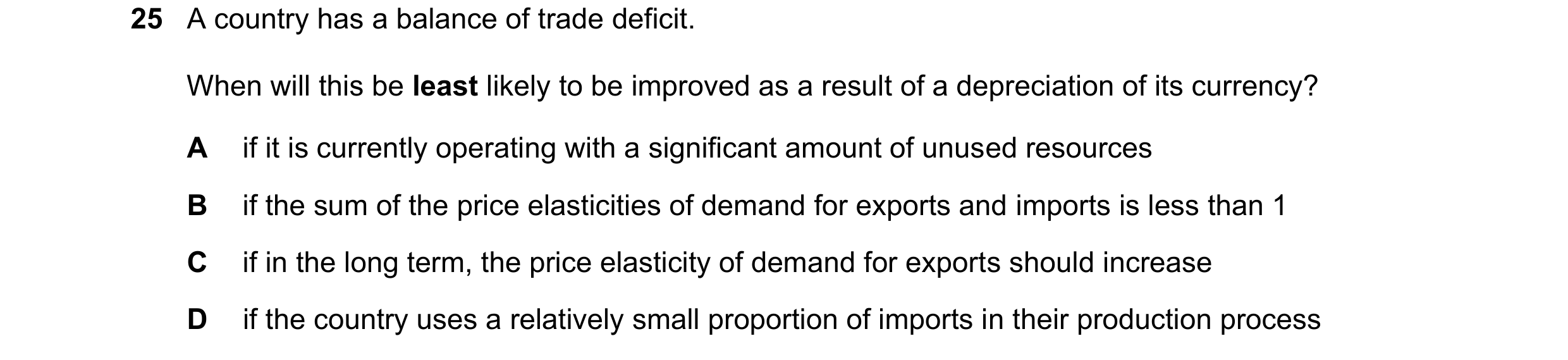
 25 / 31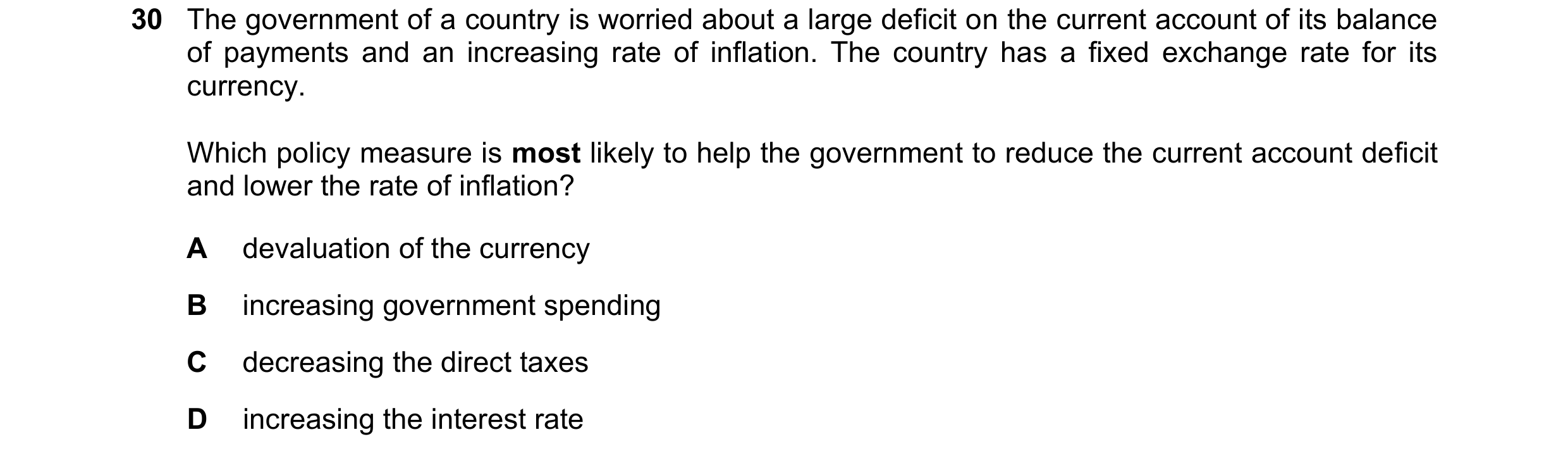
 26 / 31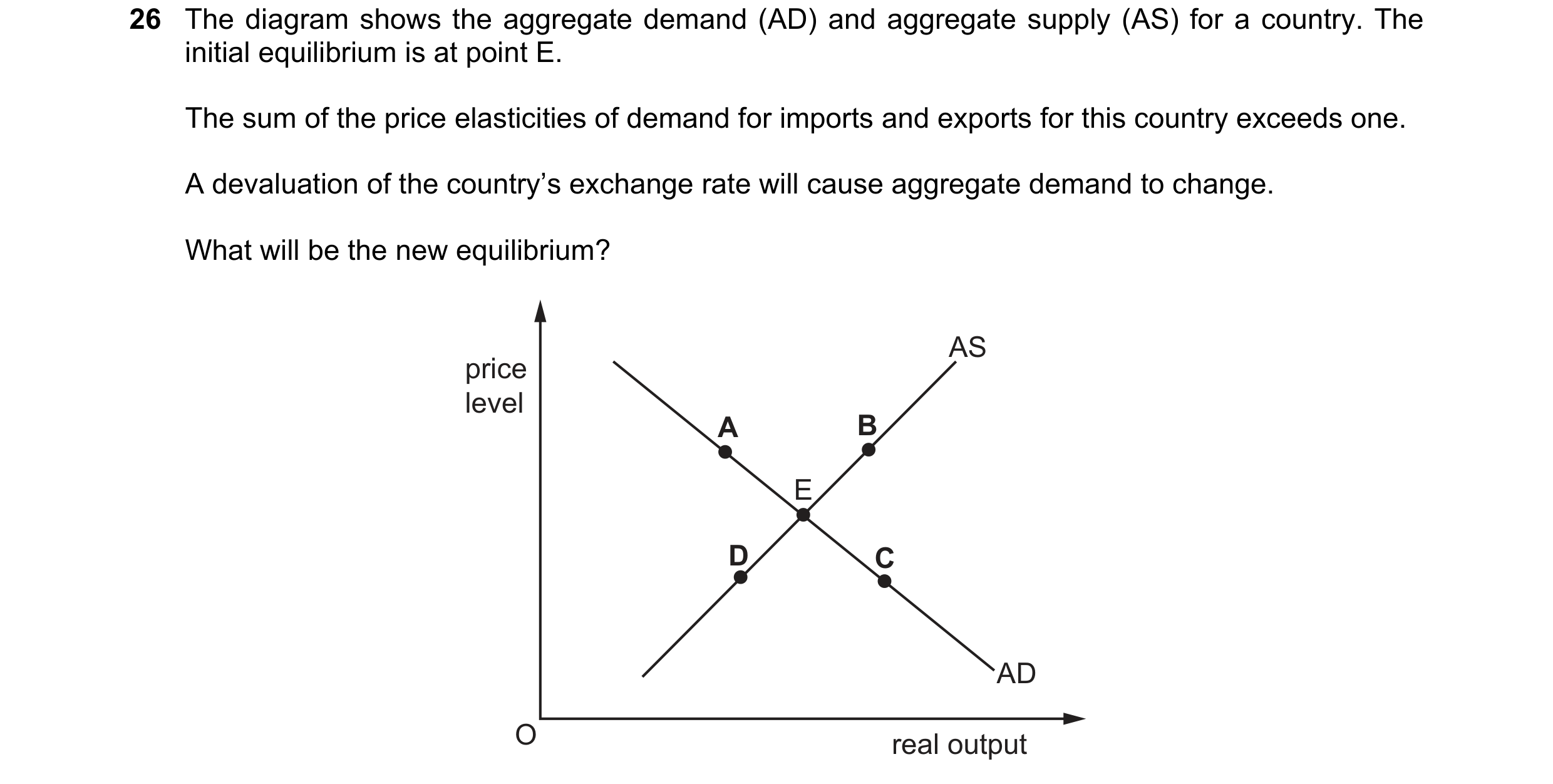
 27 / 31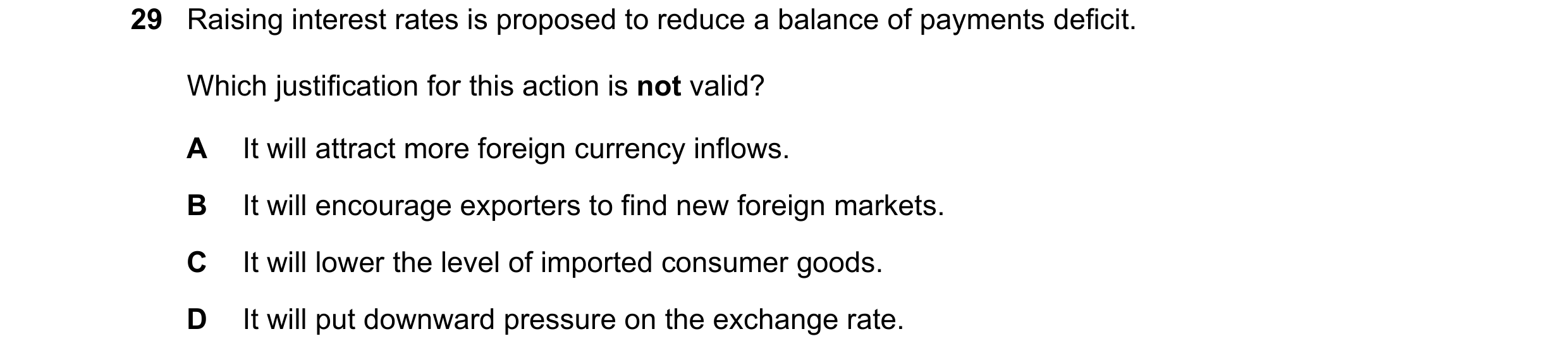
 28 / 31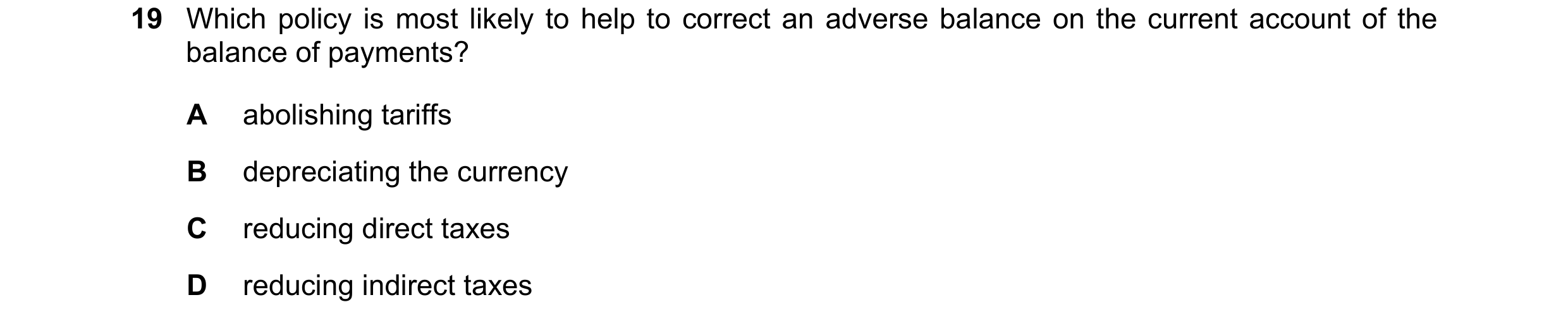

 29 / 31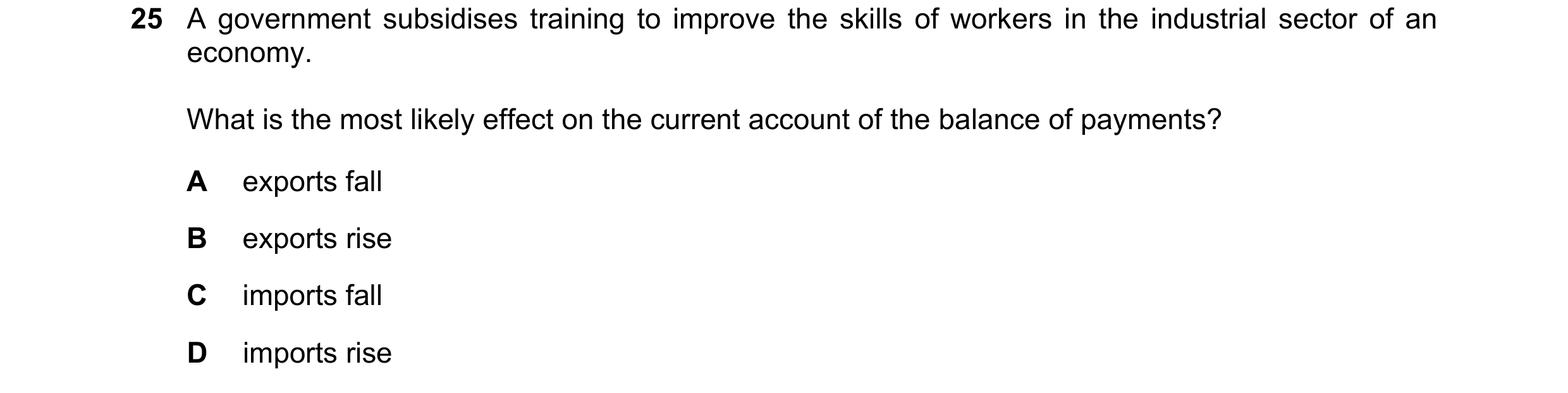

 30 / 31
 31 / 31