Questions as text
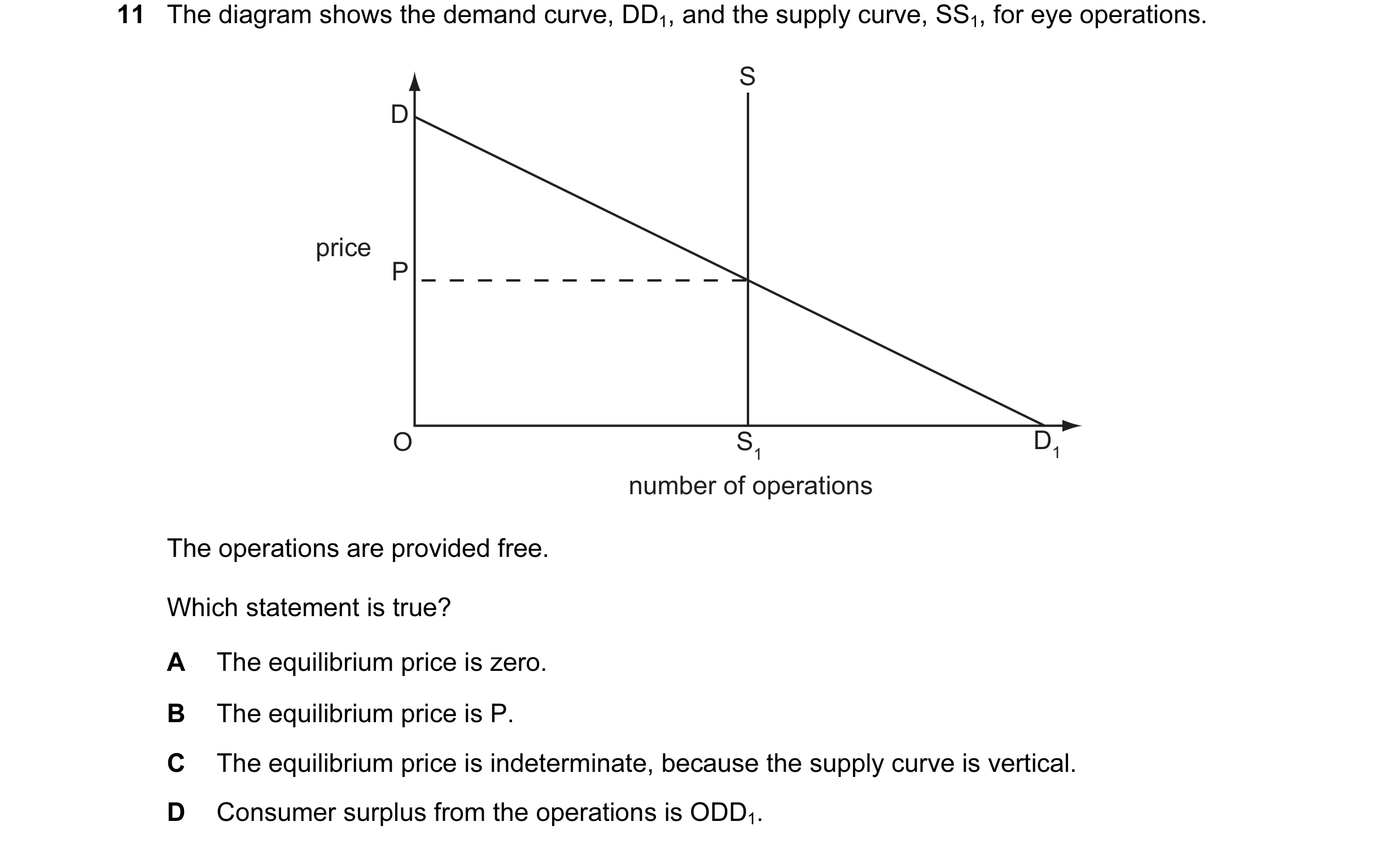
Q1 · The diagram shows the demand curve, DD1, and the supply curve, SS1, for eye operations 9708/11 Oct/Nov 2005
11 The diagram shows the demand curve, DD1, and the supply curve, SS1, for eye operations. S D price P O S1 D1 number of operations The operations are provided free. Which statement is true? A The equilibrium price is zero. B The equilibrium price is P. C The equilibrium price is indeterminate, because the supply curve is vertical. D Consumer surplus from the operations is ODD1.
1 marks
Answer: B
This question in 9708/11 Oct/Nov 2005
Q2 · Which of the following is a public good? 9708/11 Oct/Nov 2005
16 Which of the following is a public good? A defence B education C electricity supply D health services
1 marks
Answer: A
This question in 9708/11 Oct/Nov 2005
Q3 · A lighthouse is considered to be a public good 9708/11 May/June 2006
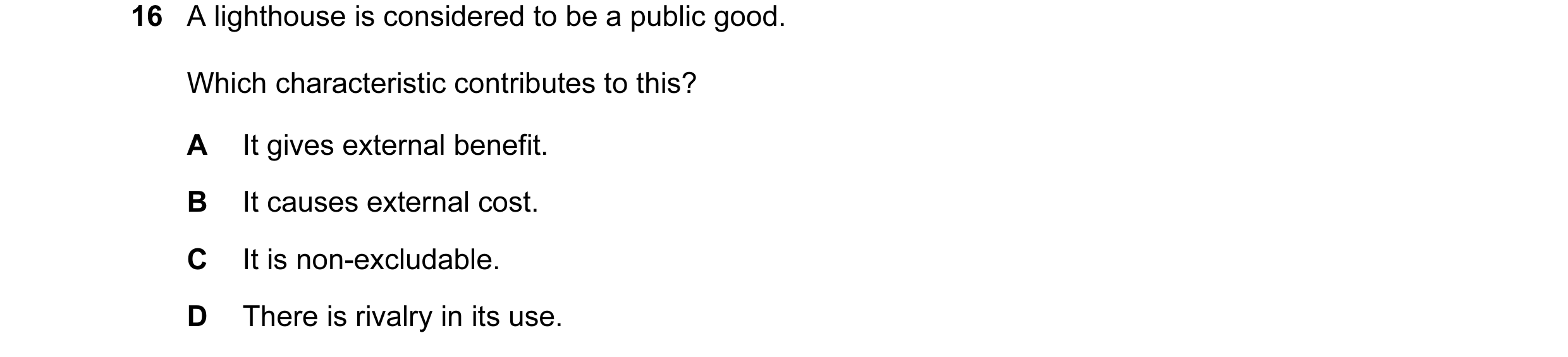
16 A lighthouse is considered to be a public good. Which characteristic contributes to this? A It gives external benefit. B It causes external cost. C It is non-excludable. D There is rivalry in its use.
1 marks
Answer: C
This question in 9708/11 May/June 2006
Q4 · Why are there no markets for free goods? 9708/11 Oct/Nov 2006
1 Why are there no markets for free goods? A Consumers’ valuation of free goods is the same at all levels of demand. B Free goods are non-excludable. C The demand for free goods is infinite. D The supply of free goods is sufficient to satisfy all demand at zero price.
1 marks
Answer: D
This question in 9708/11 Oct/Nov 2006
Q5 · What is an essential characteristic of a private good? 9708/11 Oct/Nov 2006
16 What is an essential characteristic of a private good? A Consumption of the good by one user diminishes the quantity available to others. B Consumption of the good by the user has no external effects on the consumption of others. C It is produced by the private sector. D The user has to pay for it.
1 marks
Answer: A
This question in 9708/11 Oct/Nov 2006
Q6 · For which one of the following reasons might education be considered a merit good? 9708/11 May/June 2007
18 For which one of the following reasons might education be considered a merit good? A It benefits both the recipient and society as a whole. B Left to market forces, it would be over-provided. C It does not have a social cost. D Its consumption by one person does not reduce the amount available to others.
1 marks
Answer: A
This question in 9708/11 May/June 2007
Q7 · Advances in technology are turning a number of goods which are usually thought of as… 9708/11 Oct/Nov 2007
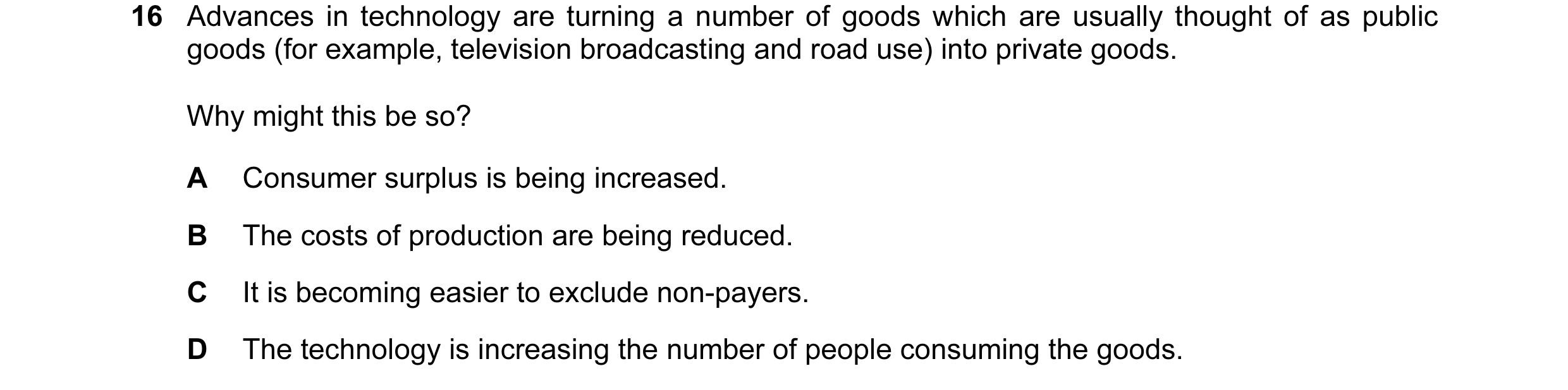
16 Advances in technology are turning a number of goods which are usually thought of as public goods (for example, television broadcasting and road use) into private goods. Why might this be so? A Consumer surplus is being increased. B The costs of production are being reduced. C It is becoming easier to exclude non-payers. D The technology is increasing the number of people consuming the goods.
1 marks
Answer: C
This question in 9708/11 Oct/Nov 2007
Q8 · A good is most suitable to be provided by the market if it is A excludable and non-rival 9708/11 May/June 2008
17 A good is most suitable to be provided by the market if it is A excludable and non-rival. B excludable and rival. C non-excludable and non-rival. D non-excludable and rival.
1 marks
Answer: B
This question in 9708/11 May/June 2008
Q9 · What is a defining characteristic of a private good? 9708/11 Oct/Nov 2008
18 What is a defining characteristic of a private good? A It is purchased by individual customers. B It is supplied exclusively through the market. C It is produced only by private sector firms. D When consumed by one individual, it is not available to others.
1 marks
Answer: D
This question in 9708/11 Oct/Nov 2008
Q10 · Why does the production of public goods have to be financed by the government? 9708/11 May/June 2009
17 Why does the production of public goods have to be financed by the government? A One person’s consumption of a public good means it is not available for anyone else. B People are able to consume public goods without paying for them. C Private sector firms will charge a price significantly above cost for public goods. D The cost of producing public goods is higher in the private sector.
1 marks
Answer: B
This question in 9708/11 May/June 2009
Q11 · Despite much opposition, the local government in a popular tourist resort built a leisure… 9708/11 Oct/Nov 2009
15 Despite much opposition, the local government in a popular tourist resort built a leisure centre and swimming pool which is open to everyone. Many tourists visit the centre. Local residents are charged a reduced entry fee. How would economists classify this service? A It is a demerit good because some people objected to the development. B It is a merit good because the entry fee is reduced for local residents. C It is a private good because there is an entry fee for all users. D It is a public good because it is open to everyone and provided by the local government.
1 marks
Answer: C
This question in 9708/11 Oct/Nov 2009
Q12 · What can be provided only as a public good? 9708/11 Oct/Nov 2009
16 What can be provided only as a public good? A road use B security services C street lighting D TV broadcasting
1 marks
Answer: C
This question in 9708/11 Oct/Nov 2009
Q13 · Despite much opposition, the local government in a popular tourist resort built a leisure… 9708/12 Oct/Nov 2009
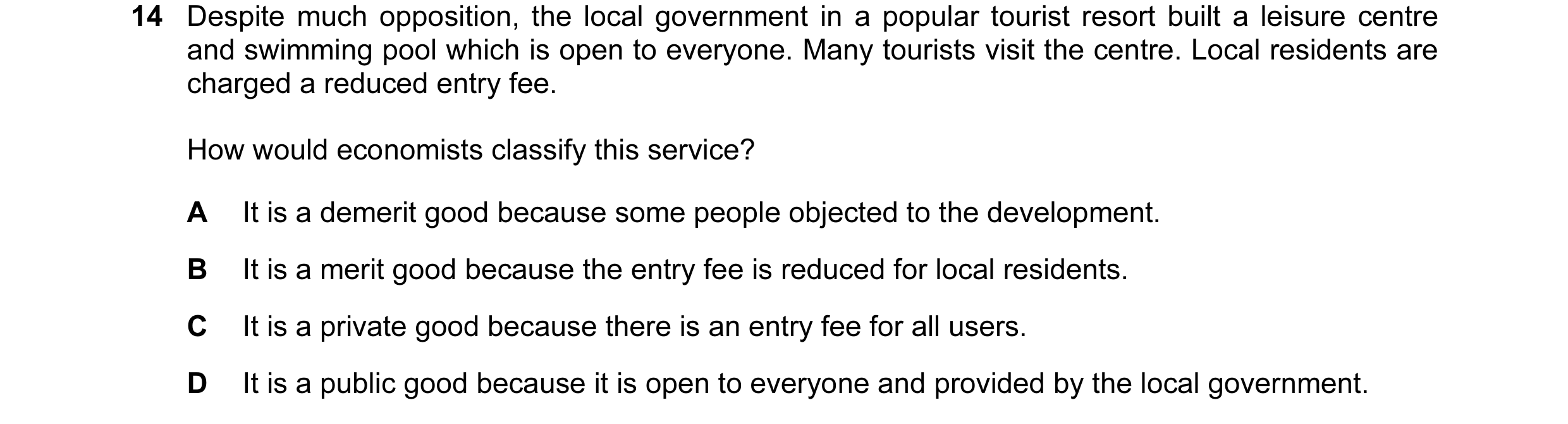
14 Despite much opposition, the local government in a popular tourist resort built a leisure centre and swimming pool which is open to everyone. Many tourists visit the centre. Local residents are charged a reduced entry fee. How would economists classify this service? A It is a demerit good because some people objected to the development. B It is a merit good because the entry fee is reduced for local residents. C It is a private good because there is an entry fee for all users. D It is a public good because it is open to everyone and provided by the local government.
1 marks
Answer: C
This question in 9708/12 Oct/Nov 2009
Q14 · What can be provided only as a public good? 9708/12 Oct/Nov 2009
15 What can be provided only as a public good? A road use B security services C street lighting D TV broadcasting
1 marks
Answer: C
This question in 9708/12 Oct/Nov 2009
Q15 · Which good is excludable but non-rival? 9708/11 May/June 2010
17 Which good is excludable but non-rival? A air defence B public libraries C street lighting D television broadcasts
1 marks
Answer: D
This question in 9708/11 May/June 2010
Q16 · What does not happen when price acts as a means to allocate resources? 9708/12 May/June 2010
12 What does not happen when price acts as a means to allocate resources? A Price determines the supply of public goods. B Price operates in the markets for both goods and factors of production. C Price recognises consumers’ ability to pay rather than consumers’ needs. D Price signals to producers which goods are most profitable.
1 marks
Answer: A
This question in 9708/12 May/June 2010
Q17 · Which good is excludable but non-rival? 9708/12 May/June 2010
16 Which good is excludable but non-rival? A air defence B public libraries C street lighting D television broadcasts
1 marks
Answer: D
This question in 9708/12 May/June 2010
Q18 · James grows fruit trees in his garden 9708/13 May/June 2010
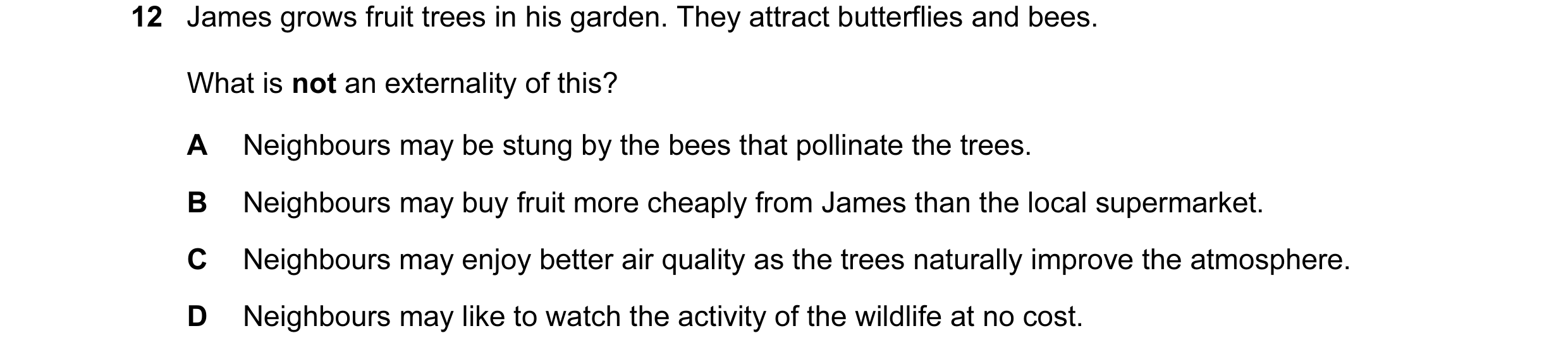
12 James grows fruit trees in his garden. They attract butterflies and bees. What is not an externality of this? A Neighbours may be stung by the bees that pollinate the trees. B Neighbours may buy fruit more cheaply from James than the local supermarket. C Neighbours may enjoy better air quality as the trees naturally improve the atmosphere. D Neighbours may like to watch the activity of the wildlife at no cost.
1 marks
Answer: B
This question in 9708/13 May/June 2010
Q19 · Which good is excludable but non-rival? 9708/13 May/June 2010
15 Which good is excludable but non-rival? A air defence B public libraries C street lighting D television broadcasts
1 marks
Answer: D
This question in 9708/13 May/June 2010
Q20 · What is the most likely reason economists will give to explain why large hospital… 9708/11 Oct/Nov 2010
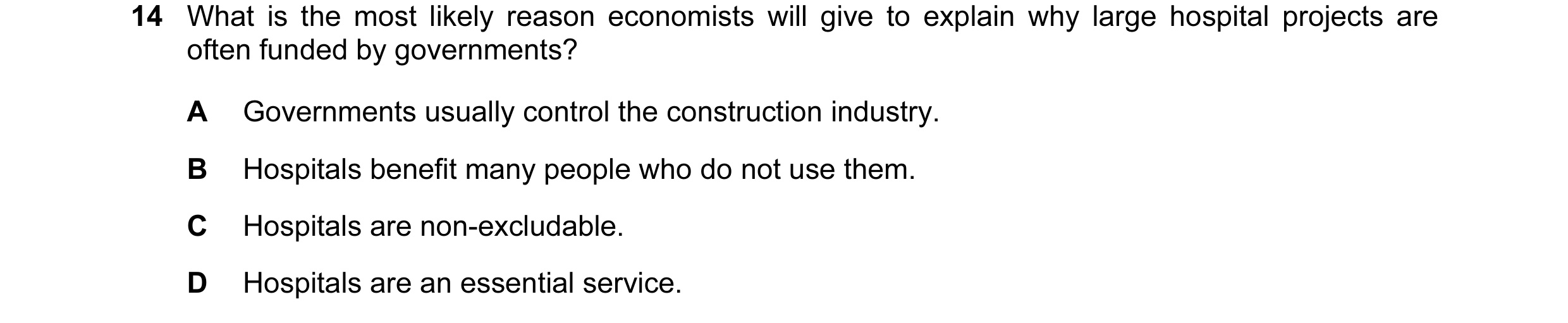
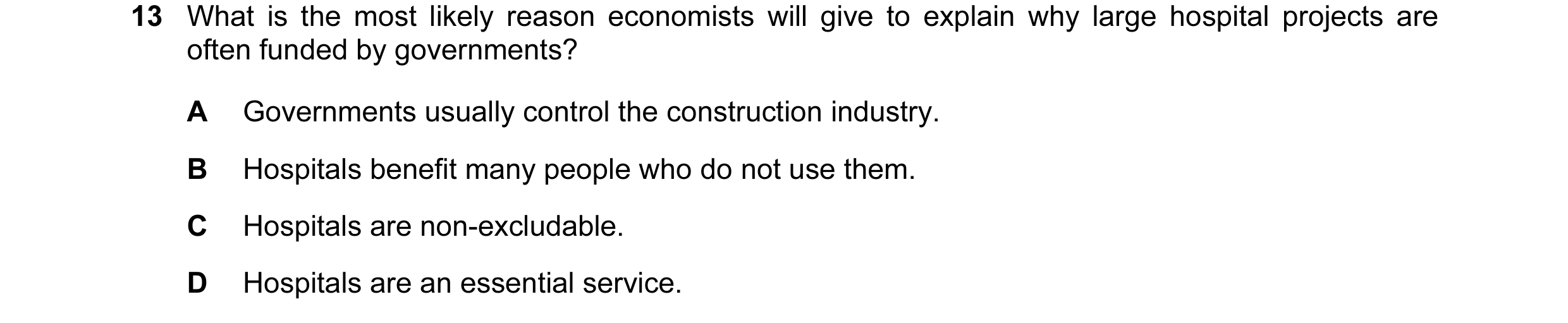
14 What is the most likely reason economists will give to explain why large hospital projects are often funded by governments? A Governments usually control the construction industry. B Hospitals benefit many people who do not use them. C Hospitals are non-excludable. D Hospitals are an essential service.
1 marks
Answer: B
This question in 9708/11 Oct/Nov 2010
Q21 · What is the most likely reason economists will give to explain why large hospital… 9708/12 Oct/Nov 2010
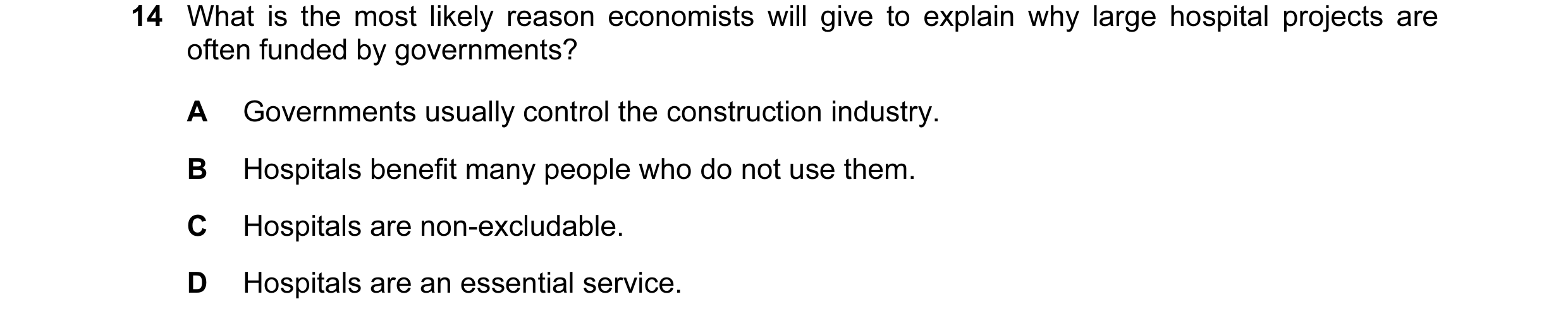
14 What is the most likely reason economists will give to explain why large hospital projects are often funded by governments? A Governments usually control the construction industry. B Hospitals benefit many people who do not use them. C Hospitals are non-excludable. D Hospitals are an essential service.
1 marks
Answer: B
This question in 9708/12 Oct/Nov 2010
Q22 · What is the most likely reason economists will give to explain why large hospital… 9708/13 Oct/Nov 2010
13 What is the most likely reason economists will give to explain why large hospital projects are often funded by governments? A Governments usually control the construction industry. B Hospitals benefit many people who do not use them. C Hospitals are non-excludable. D Hospitals are an essential service.
1 marks
Answer: B
This question in 9708/13 Oct/Nov 2010
Q23 · What is a distinguishing feature of a public good that is not found with private goods? 9708/11 May/June 2011
17 What is a distinguishing feature of a public good that is not found with private goods? A Consumption depends on the ability to pay. B It creates negative externalities. C Its consumption by one consumer can have an effect on other consumers. D Its consumption by one consumer does not restrict consumption by other consumers.
1 marks
Answer: D
This question in 9708/11 May/June 2011
Q24 · What is a distinguishing feature of a public good that is not found with private goods? 9708/12 May/June 2011
16 What is a distinguishing feature of a public good that is not found with private goods? A Consumption depends on the ability to pay. B It creates negative externalities. C Its consumption by one consumer can have an effect on other consumers. D Its consumption by one consumer does not restrict consumption by other consumers.
1 marks
Answer: D
This question in 9708/12 May/June 2011
Q25 · What is a distinguishing feature of a public good that is not found with private goods? 9708/13 May/June 2011
15 What is a distinguishing feature of a public good that is not found with private goods? A Consumption depends on the ability to pay. B It creates negative externalities. C Its consumption by one consumer can have an effect on other consumers. D Its consumption by one consumer does not restrict consumption by other consumers.
1 marks
Answer: D
This question in 9708/13 May/June 2011
Q26 · Which good or service is excludable but non-rival in consumption? 9708/11 Oct/Nov 2011
17 Which good or service is excludable but non-rival in consumption? A fish stocks B national defence C street lighting D TV broadcasting
1 marks
Answer: D
This question in 9708/11 Oct/Nov 2011
Q27 · What is a merit good? 9708/12 Oct/Nov 2011
17 What is a merit good? A a good or service which has higher social costs than private costs B a good or service which has no opportunity cost C a good or service which is both non-excludable and non-rival D a good or service which has a greater value than individuals recognise
1 marks
Answer: D
This question in 9708/12 Oct/Nov 2011
Q28 · What is a merit good? 9708/13 Oct/Nov 2011
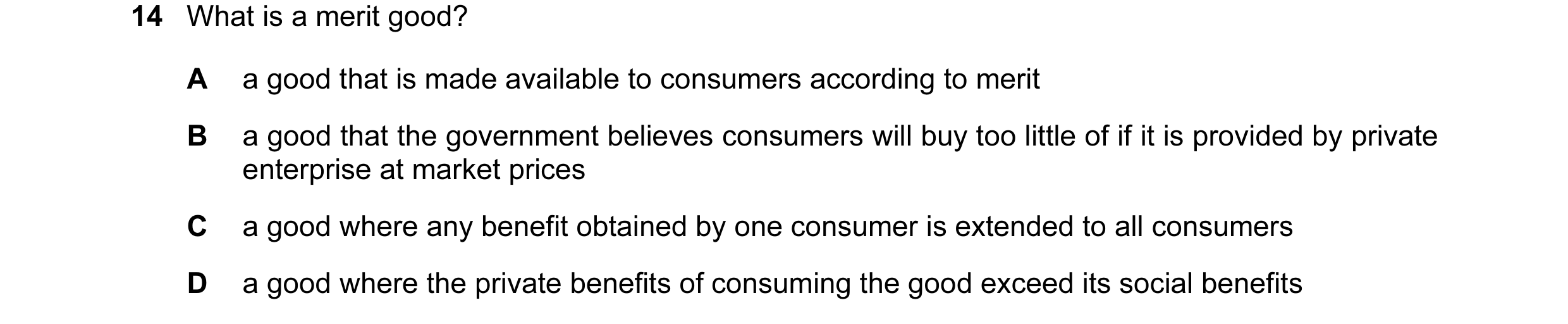
14 What is a merit good? A a good that is made available to consumers according to merit B a good that the government believes consumers will buy too little of if it is provided by private enterprise at market prices C a good where any benefit obtained by one consumer is extended to all consumers D a good where the private benefits of consuming the good exceed its social benefits
1 marks
Answer: B
This question in 9708/13 Oct/Nov 2011
Q29 · Which good or service is excludable but non-rival in consumption? 9708/13 Oct/Nov 2011
15 Which good or service is excludable but non-rival in consumption? A fish stocks B national defence C street lighting D TV broadcasting
1 marks
Answer: D
This question in 9708/13 Oct/Nov 2011
Q30 · Why does the production of public goods have to be financed by the government? 9708/11 May/June 2012
16 Why does the production of public goods have to be financed by the government? A One person’s consumption of a public good means it is not available for anyone else. B People are able to consume public goods without paying for them. C Private sector firms will charge a price significantly above cost for public goods. D The cost of producing public goods is higher in the private sector.
1 marks
Answer: B
This question in 9708/11 May/June 2012
Q31 · Why does the production of public goods have to be financed by the government? 9708/12 May/June 2012
16 Why does the production of public goods have to be financed by the government? A One person’s consumption of a public good means it is not available for anyone else. B People are able to consume public goods without paying for them. C Private sector firms will charge a price significantly above cost for public goods. D The cost of producing public goods is higher in the private sector.
1 marks
Answer: B
This question in 9708/12 May/June 2012
Q32 · A government wishes to encourage the consumption of a merit good and reduce the… 9708/11 Oct/Nov 2012
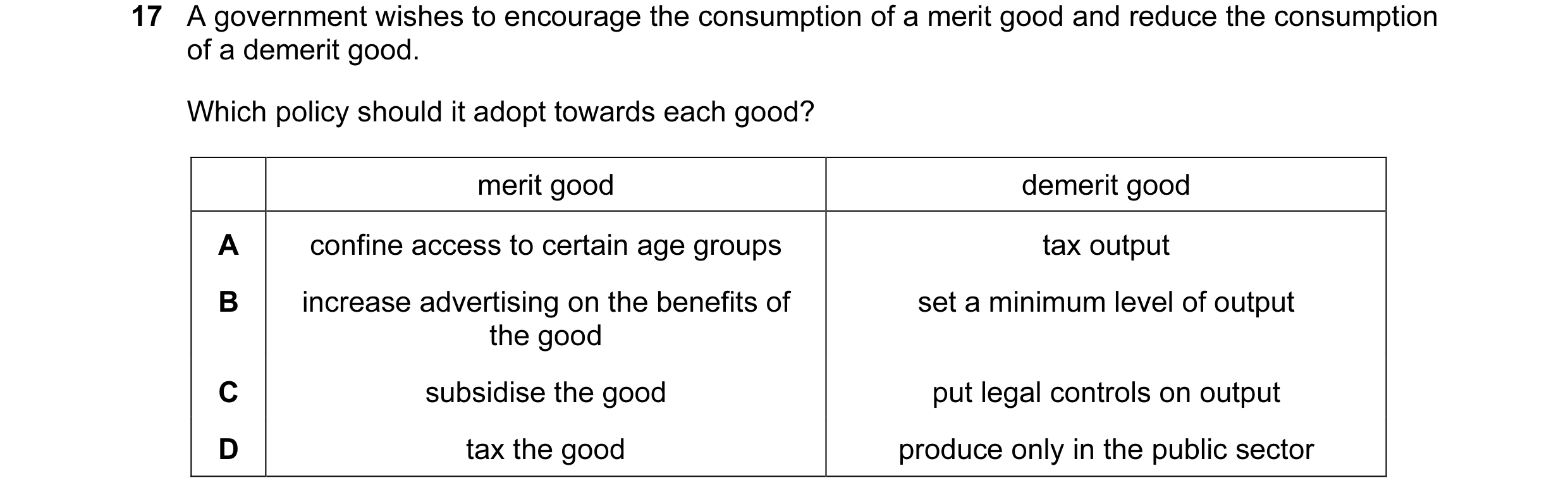
17 A government wishes to encourage the consumption of a merit good and reduce the consumption of a demerit good. Which policy should it adopt towards each good? merit good demerit good A confine access to certain age groups tax output B increase advertising on the benefits of set a minimum level of output the good C subsidise the good put legal controls on output D tax the good produce only in the public sector
1 marks
Answer: C
This question in 9708/11 Oct/Nov 2012
Q33 · What is a defining characteristic of a public good? 9708/13 Oct/Nov 2012
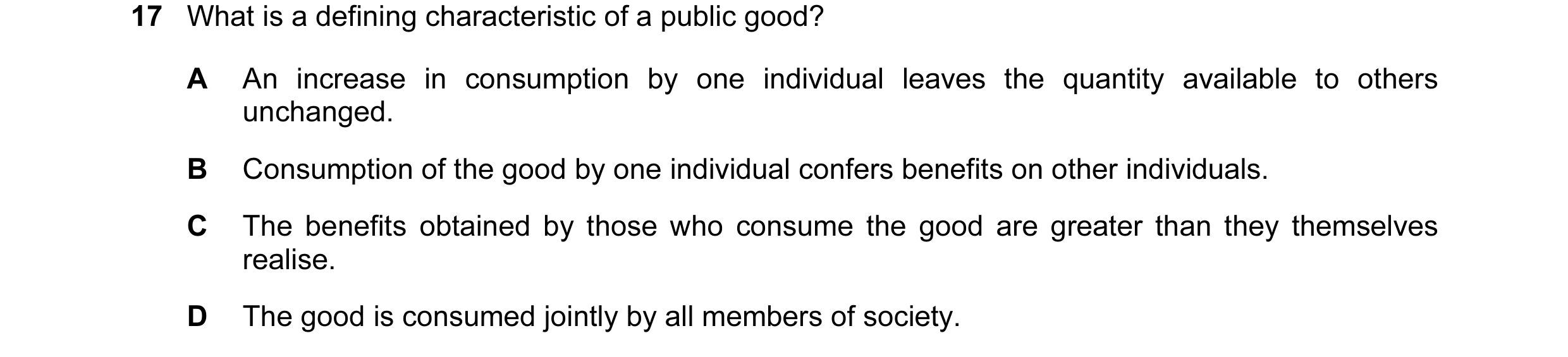
17 What is a defining characteristic of a public good? A An increase in consumption by one individual leaves the quantity available to others unchanged. B Consumption of the good by one individual confers benefits on other individuals. C The benefits obtained by those who consume the good are greater than they themselves realise. D The good is consumed jointly by all members of society.
1 marks
Answer: A
This question in 9708/13 Oct/Nov 2012
Q34 · In which case is the price system not a possible method of allocating resources? 9708/11 May/June 2013
13 In which case is the price system not a possible method of allocating resources? A in the distribution of foodstuff among the population B in the hiring of workers by employers C in the ownership of land for agricultural use D in the provision of public goods by the government
1 marks
Answer: D
This question in 9708/11 May/June 2013
Q35 · A good is more likely to be supplied by the government rather than a private company if… 9708/11 May/June 2013
16 A good is more likely to be supplied by the government rather than a private company if it is A excludable and non-rival. B excludable and rival. C non-excludable and non-rival D non-excludable and rival
1 marks
Answer: C
This question in 9708/11 May/June 2013
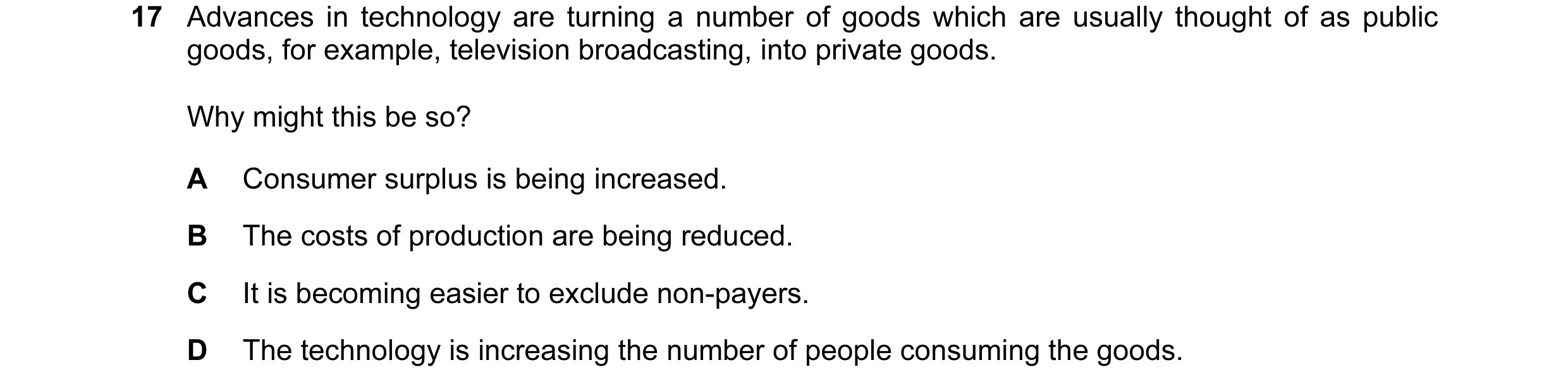
Q36 · Advances in technology are turning a number of goods which are usually thought of as… 9708/13 May/June 2013
17 Advances in technology are turning a number of goods which are usually thought of as public goods, for example, television broadcasting, into private goods. Why might this be so? A Consumer surplus is being increased. B The costs of production are being reduced. C It is becoming easier to exclude non-payers. D The technology is increasing the number of people consuming the goods.
1 marks
Answer: C
This question in 9708/13 May/June 2013
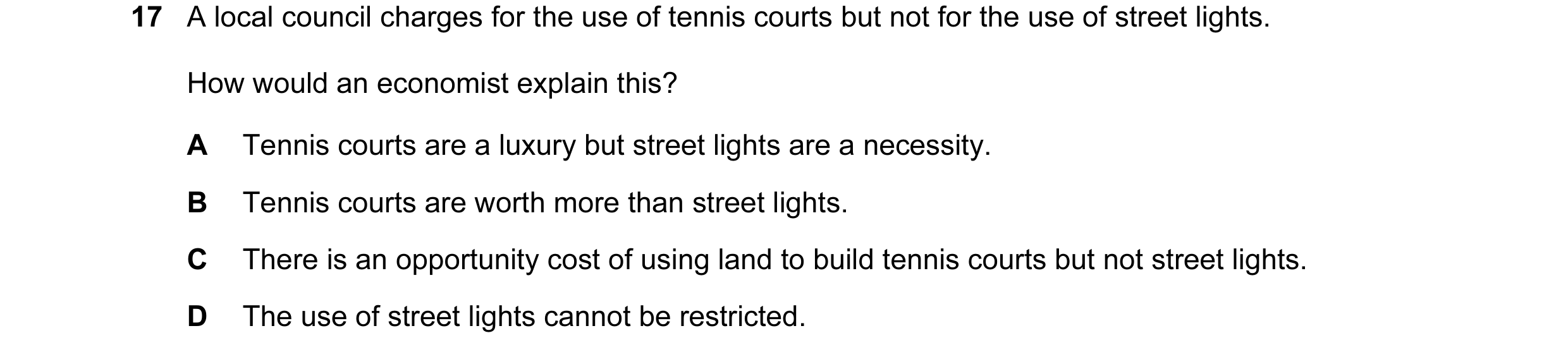
Q37 · A local council charges for the use of tennis courts but not for the use of street lights 9708/11 Oct/Nov 2013
17 A local council charges for the use of tennis courts but not for the use of street lights. How would an economist explain this? A Tennis courts are a luxury but street lights are a necessity. B Tennis courts are worth more than street lights. C There is an opportunity cost of using land to build tennis courts but not street lights. D The use of street lights cannot be restricted.
1 marks
Answer: D
This question in 9708/11 Oct/Nov 2013
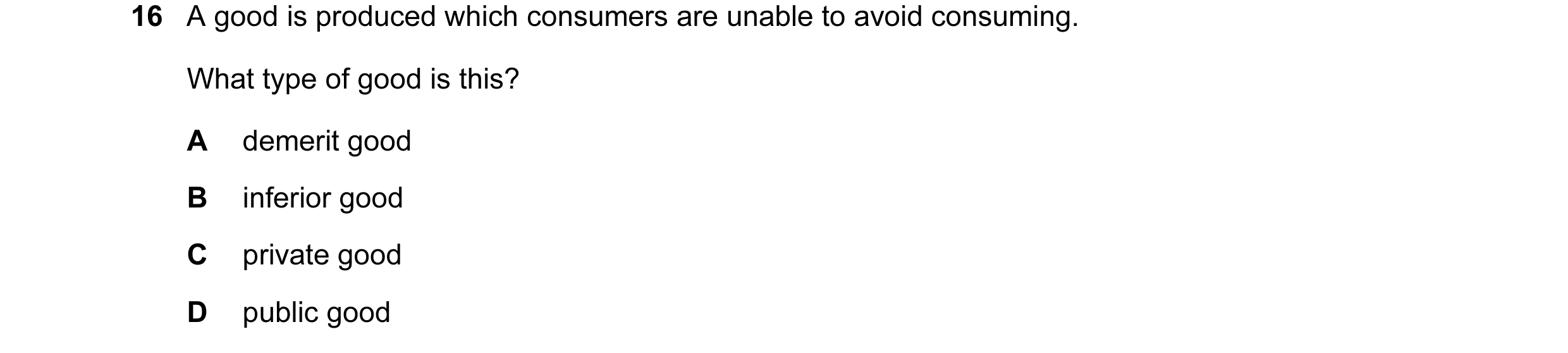
Q38 · A good is produced which consumers are unable to avoid consuming 9708/12 Oct/Nov 2013
16 A good is produced which consumers are unable to avoid consuming. What type of good is this? A demerit good B inferior good C private good D public good
1 marks
Answer: D
This question in 9708/12 Oct/Nov 2013
Q39 · What is the defining characteristic of a private good? 9708/13 Oct/Nov 2013
16 What is the defining characteristic of a private good? A Consumption by one individual reduces the amount of the good available to others. B The benefits derived from the good are confined to those who consume it. C The good is wholly produced within the private sector. D To acquire the good a consumer must be willing and able to pay for it.
1 marks
Answer: A
This question in 9708/13 Oct/Nov 2013
Q40 · A local government decided to organise a craft show in its exhibition centre 9708/11 May/June 2014
17 A local government decided to organise a craft show in its exhibition centre. Admission was $3. It promoted the show by paying for advertisements on advertising sites around the area. How may the craft show and the advertisements be classified from the viewpoint of local residents? craft show advertisements A private good private good B private good public good C public good private good D public good public good
1 marks
Answer: B
This question in 9708/11 May/June 2014
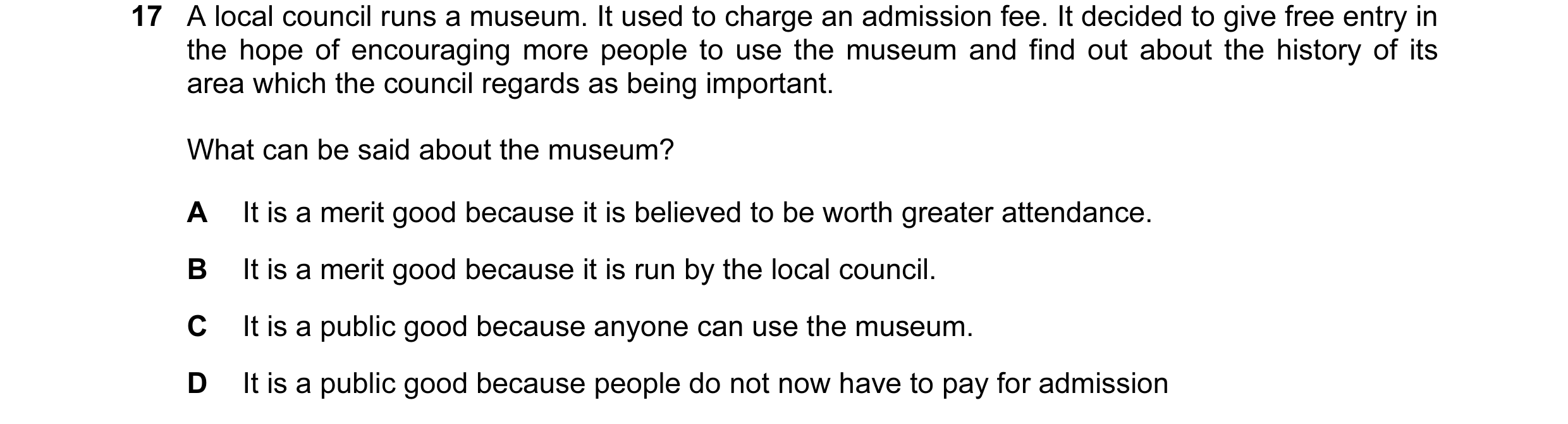
Q41 · A local council runs a museum 9708/13 May/June 2014
17 A local council runs a museum. It used to charge an admission fee. It decided to give free entry in the hope of encouraging more people to use the museum and find out about the history of its area which the council regards as being important. What can be said about the museum? A It is a merit good because it is believed to be worth greater attendance. B It is a merit good because it is run by the local council. C It is a public good because anyone can use the museum. D It is a public good because people do not now have to pay for admission
1 marks
Answer: A
This question in 9708/13 May/June 2014
Q42 · A good is most suitable to be provided by the market if it is A excludable and non-rival 9708/11 Oct/Nov 2014
17 A good is most suitable to be provided by the market if it is A excludable and non-rival. B excludable and rival. C non-excludable and non-rival. D non-excludable and rival.
1 marks
This question in 9708/11 Oct/Nov 2014
Q43 · What can be provided only as a public good? 9708/12 Oct/Nov 2014
16 What can be provided only as a public good? A road use B security services C street lighting D TV broadcasting
1 marks
Answer: C
This question in 9708/12 Oct/Nov 2014
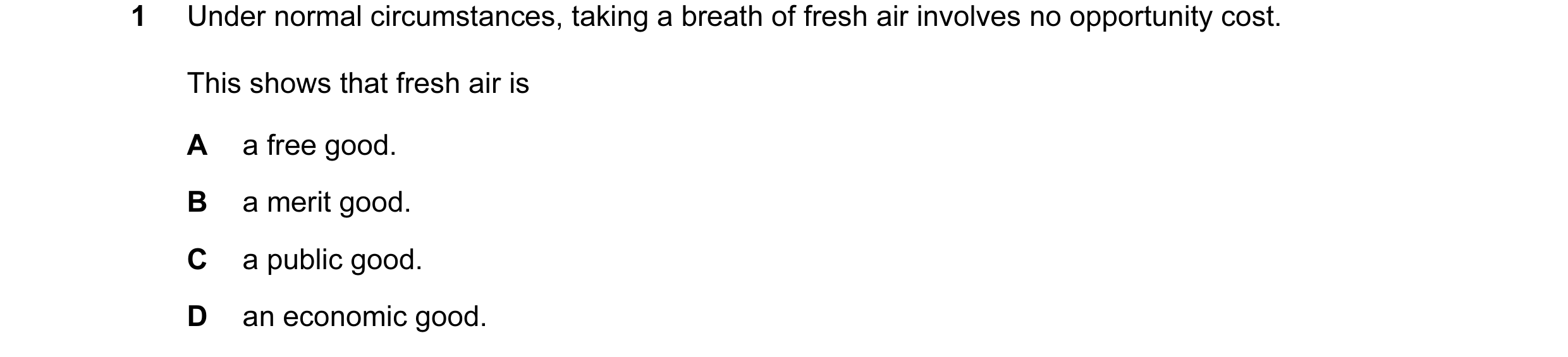
Q44 · Under normal circumstances, taking a breath of fresh air involves no opportunity cost 9708/13 Oct/Nov 2014
1 Under normal circumstances, taking a breath of fresh air involves no opportunity cost. This shows that fresh air is A a free good. B a merit good. C a public good. D an economic good.
1 marks
Answer: A
This question in 9708/13 Oct/Nov 2014
Q45 · Which statement about the provision of goods is correct? 9708/13 Oct/Nov 2014
15 Which statement about the provision of goods is correct? A Governments and private producers supply merit goods. B Governments and private producers supply public goods. C Governments are unable to supply private goods. D Governments subsidise the production of demerit goods.
1 marks
Answer: A
This question in 9708/13 Oct/Nov 2014
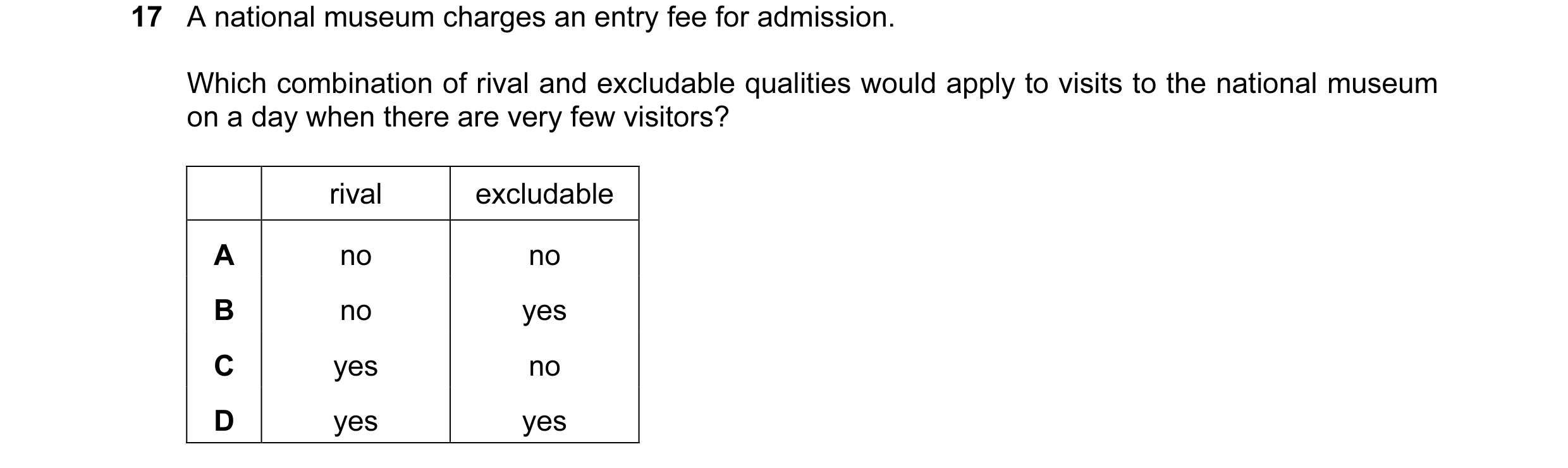
Q46 · A national museum charges an entry fee for admission 9708/12 May/June 2015
17 A national museum charges an entry fee for admission. Which combination of rival and excludable qualities would apply to visits to the national museum on a day when there are very few visitors? rival excludable A no no B no yes C yes no D yes yes
1 marks
Answer: B
This question in 9708/12 May/June 2015
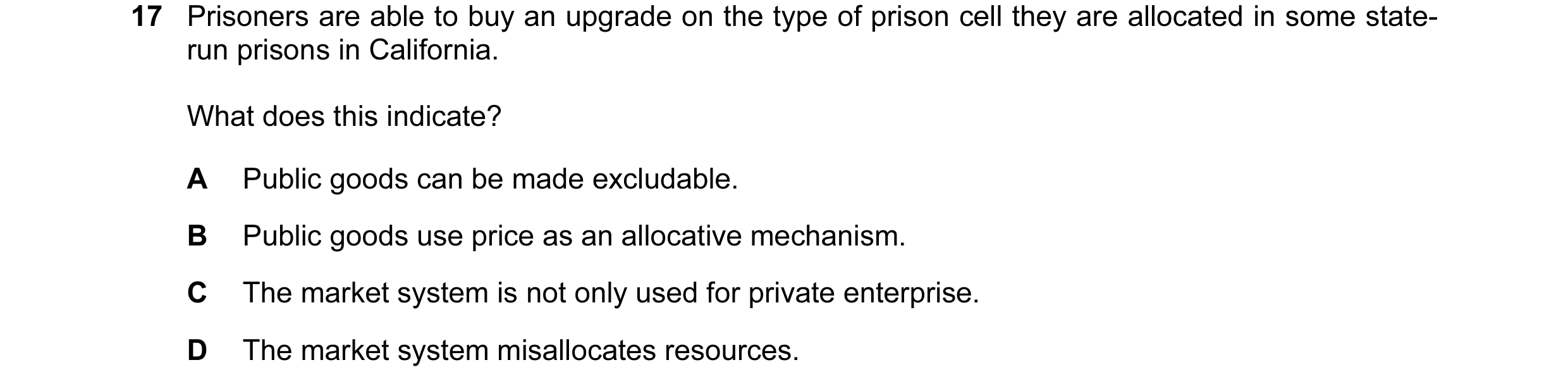
Q47 · Prisoners are able to buy an upgrade on the type of prison cell they are allocated in… 9708/13 May/June 2015
17 Prisoners are able to buy an upgrade on the type of prison cell they are allocated in some state- run prisons in California. What does this indicate? A Public goods can be made excludable. B Public goods use price as an allocative mechanism. C The market system is not only used for private enterprise. D The market system misallocates resources.
1 marks
Answer: C
This question in 9708/13 May/June 2015
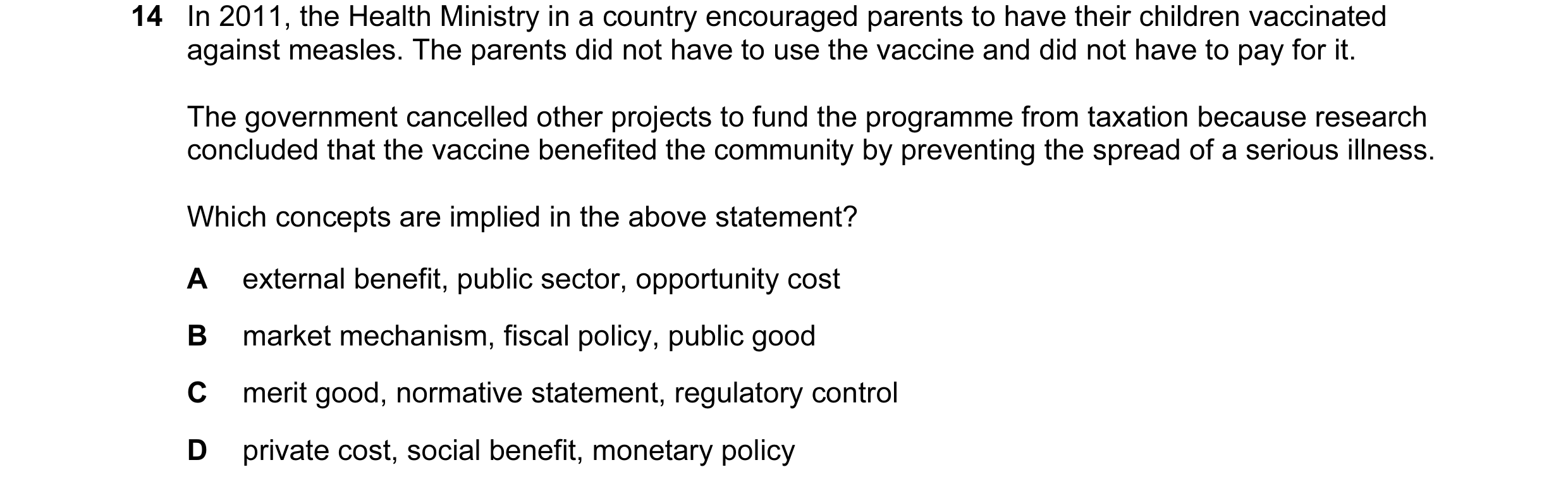
Q48 · In 2011, the Health Ministry in a country encouraged parents to have their children… 9708/12 Oct/Nov 2015
14 In 2011, the Health Ministry in a country encouraged parents to have their children vaccinated against measles. The parents did not have to use the vaccine and did not have to pay for it. The government cancelled other projects to fund the programme from taxation because research concluded that the vaccine benefited the community by preventing the spread of a serious illness. Which concepts are implied in the above statement? A external benefit, public sector, opportunity cost B market mechanism, fiscal policy, public good C merit good, normative statement, regulatory control D private cost, social benefit, monetary policy
1 marks
Answer: A
This question in 9708/12 Oct/Nov 2015
Q49 · What is the best example of what was once a public good becoming a private good? 9708/12 Oct/Nov 2015
17 What is the best example of what was once a public good becoming a private good? A education B medical care C postal services D television broadcasts
1 marks
Answer: D
This question in 9708/12 Oct/Nov 2015
Q50 · People walking past a bakery often comment on the pleasure of smelling freshly baked bread 9708/13 Oct/Nov 2015
14 People walking past a bakery often comment on the pleasure of smelling freshly baked bread. Of what is this an example? A a negative consumption externality B a negative production externality C a positive consumption externality D a positive production externality
1 marks
Answer: D
This question in 9708/13 Oct/Nov 2015
Q51 · Which statement is correct? 9708/13 Oct/Nov 2015
17 Which statement is correct? A A demerit good is overconsumed. B A demerit good produces zero consumer surplus. C A merit good is defined by its non-excludability and non-rivalry. D A merit good is provided free of charge.
1 marks
Answer: A
This question in 9708/13 Oct/Nov 2015
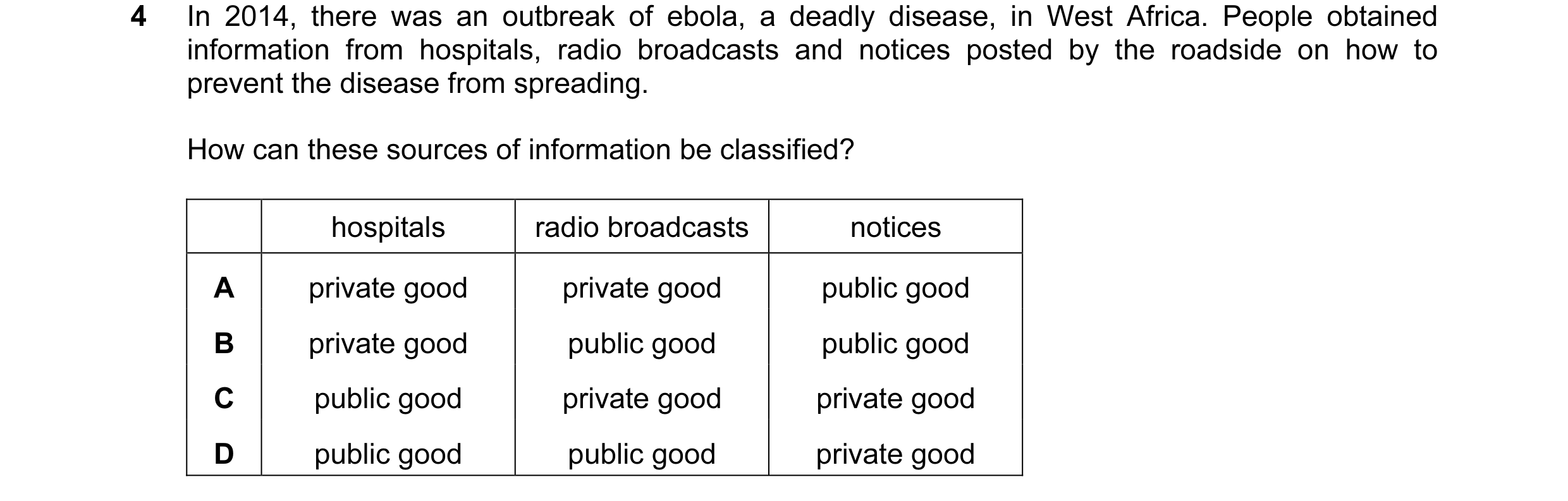
Q52 · In 2014, there was an outbreak of ebola, a deadly disease, in West Africa 9708/12 Feb/March 2016
4 In 2014, there was an outbreak of ebola, a deadly disease, in West Africa. People obtained information from hospitals, radio broadcasts and notices posted by the roadside on how to prevent the disease from spreading. How can these sources of information be classified? hospitals radio broadcasts notices A private good private good public good B private good public good public good C public good private good private good D public good public good private good
1 marks
Answer: B
This question in 9708/12 Feb/March 2016
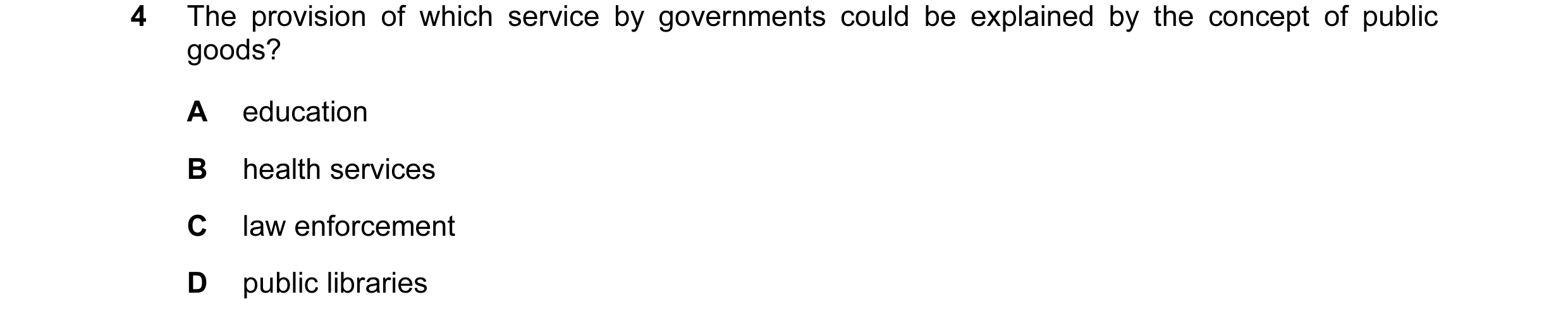
Q53 · The provision of which service by governments could be explained by the concept of public… 9708/13 May/June 2016
4 The provision of which service by governments could be explained by the concept of public goods? A education B health services C law enforcement D public libraries
1 marks
Answer: C
This question in 9708/13 May/June 2016
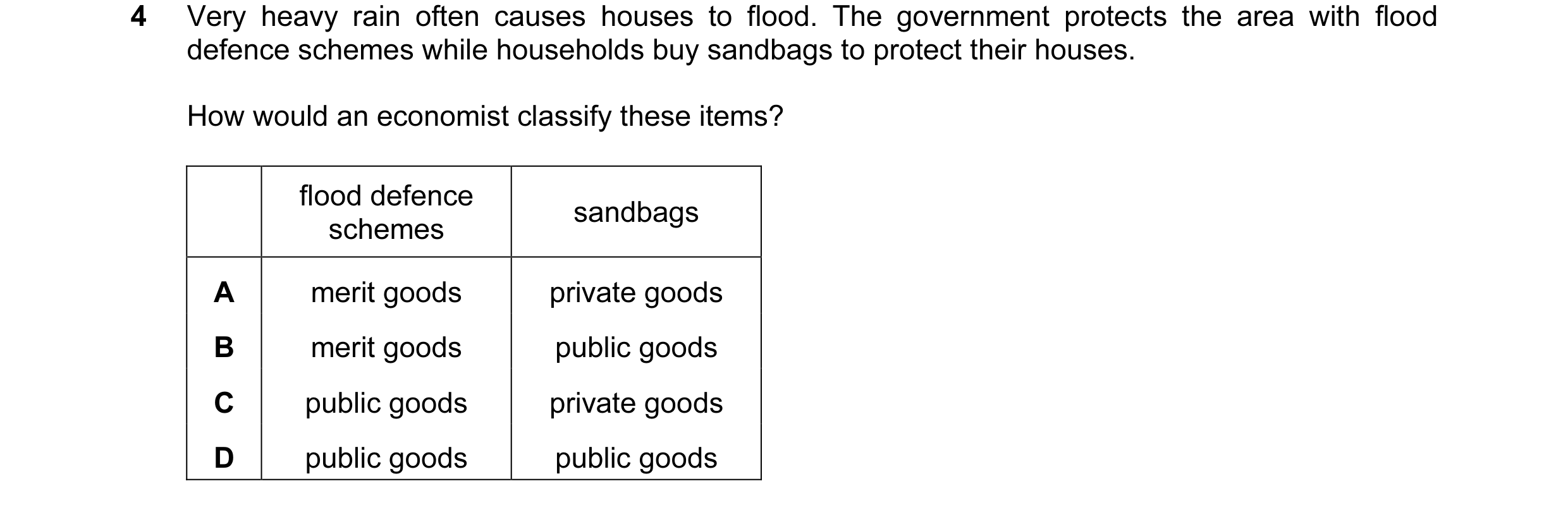
Q54 · Very heavy rain often causes houses to flood 9708/11 Oct/Nov 2016
4 Very heavy rain often causes houses to flood. The government protects the area with flood defence schemes while households buy sandbags to protect their houses. How would an economist classify these items? flood defence sandbags schemes A merit goods private goods B merit goods public goods C public goods private goods D public goods public goods
1 marks
Answer: C
This question in 9708/11 Oct/Nov 2016
Q55 · Which goods will be provided only by the government? 9708/13 Oct/Nov 2016
17 Which goods will be provided only by the government? A capital goods B inferior goods C merit goods D public goods
1 marks
Answer: D
This question in 9708/13 Oct/Nov 2016
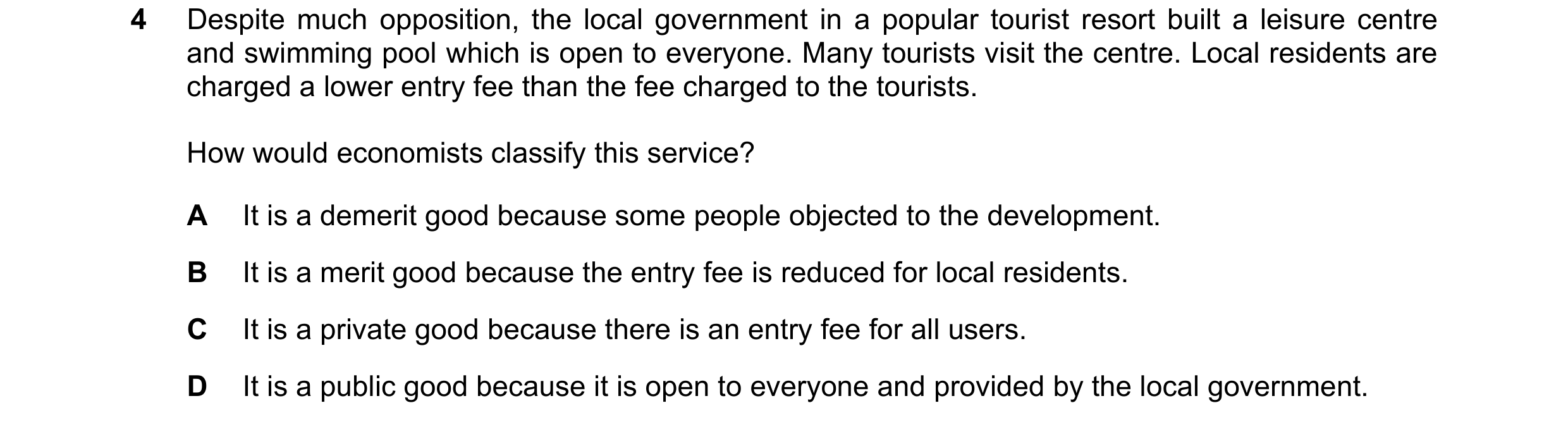
Q56 · Despite much opposition, the local government in a popular tourist resort built a leisure… 9708/12 Feb/March 2017
4 Despite much opposition, the local government in a popular tourist resort built a leisure centre and swimming pool which is open to everyone. Many tourists visit the centre. Local residents are charged a lower entry fee than the fee charged to the tourists. How would economists classify this service? A It is a demerit good because some people objected to the development. B It is a merit good because the entry fee is reduced for local residents. C It is a private good because there is an entry fee for all users. D It is a public good because it is open to everyone and provided by the local government.
1 marks
Answer: C
This question in 9708/12 Feb/March 2017
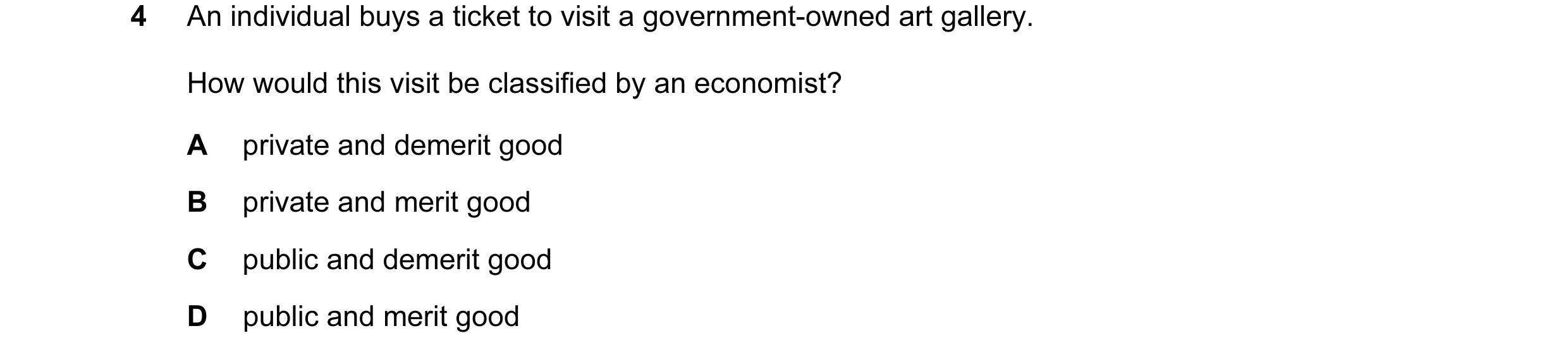
Q57 · An individual buys a ticket to visit a government-owned art gallery 9708/11 May/June 2017
4 An individual buys a ticket to visit a government-owned art gallery. How would this visit be classified by an economist? A private and demerit good B private and merit good C public and demerit good D public and merit good
1 marks
Answer: B
This question in 9708/11 May/June 2017
Q58 · What is an accurate statement about different types of goods? 9708/13 May/June 2017
4 What is an accurate statement about different types of goods? A Free goods are offered for sale at a loss-making price. B Merit goods generate more consumer surplus than producer surplus. C Private goods can be consumed with no opportunity cost. D Public goods can be used by additional consumers with no extra production cost.
1 marks
Answer: D
This question in 9708/13 May/June 2017
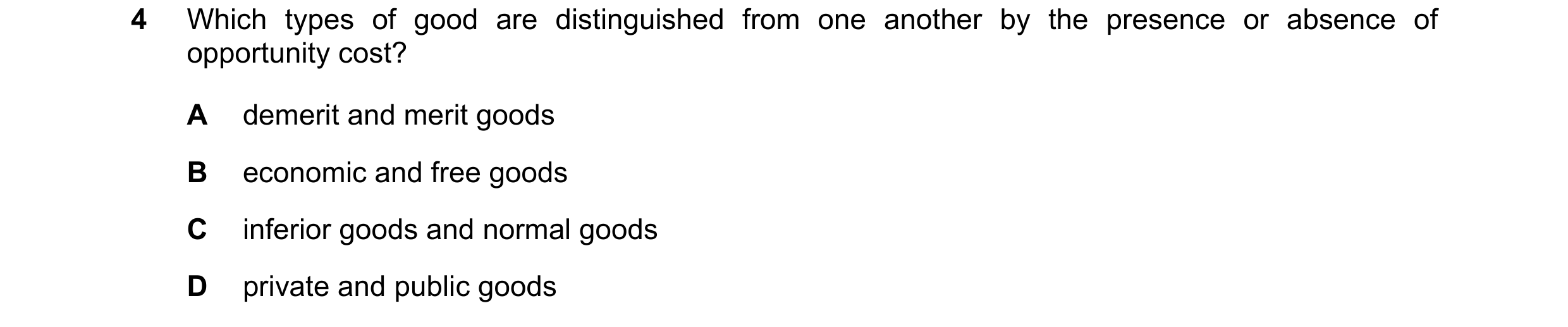
Q59 · Which types of good are distinguished from one another by the presence or absence of… 9708/11 Oct/Nov 2017
4 Which types of good are distinguished from one another by the presence or absence of opportunity cost? A demerit and merit goods B economic and free goods C inferior goods and normal goods D private and public goods
1 marks
Answer: B
This question in 9708/11 Oct/Nov 2017
Q60 · What does not happen when price acts as a means to allocate resources? 9708/12 Oct/Nov 2017
11 What does not happen when price acts as a means to allocate resources? A Price determines the supply of public goods. B Price operates in the markets for both goods and factors of production. C Price recognises consumers’ ability to pay rather than consumers’ needs. D Price signals to producers which goods are most profitable.
1 marks
Answer: A
This question in 9708/12 Oct/Nov 2017
Q61 · The Bureau of Alcohol, Tobacco, Firearms and Explosives is a branch of the United States… 9708/12 Feb/March 2018
4 The Bureau of Alcohol, Tobacco, Firearms and Explosives is a branch of the United States Government which regulates markets. What does its name imply is most likely to be its main responsibility? A to prevent harm from demerit goods B to provide subsidies for essential goods C to raise revenue from goods in elastic demand D to safeguard employment in manufacturing industry
1 marks
Answer: A
This question in 9708/12 Feb/March 2018
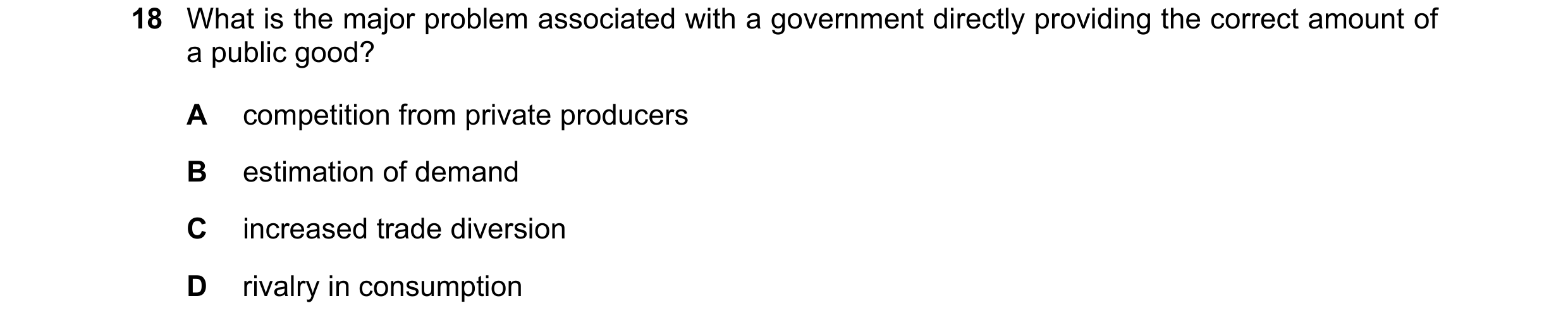
Q62 · What is the major problem associated with a government directly providing the correct… 9708/12 Feb/March 2018
18 What is the major problem associated with a government directly providing the correct amount of a public good? A competition from private producers B estimation of demand C increased trade diversion D rivalry in consumption
1 marks
Answer: B
This question in 9708/12 Feb/March 2018
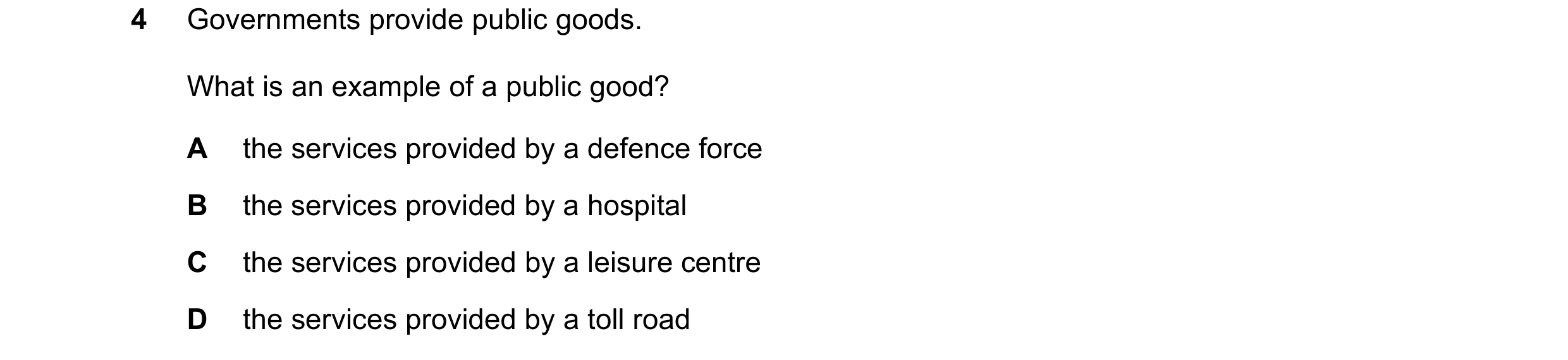
Q63 · Governments provide public goods 9708/12 May/June 2018
4 Governments provide public goods. What is an example of a public good? A the services provided by a defence force B the services provided by a hospital C the services provided by a leisure centre D the services provided by a toll road
1 marks
Answer: A
This question in 9708/12 May/June 2018
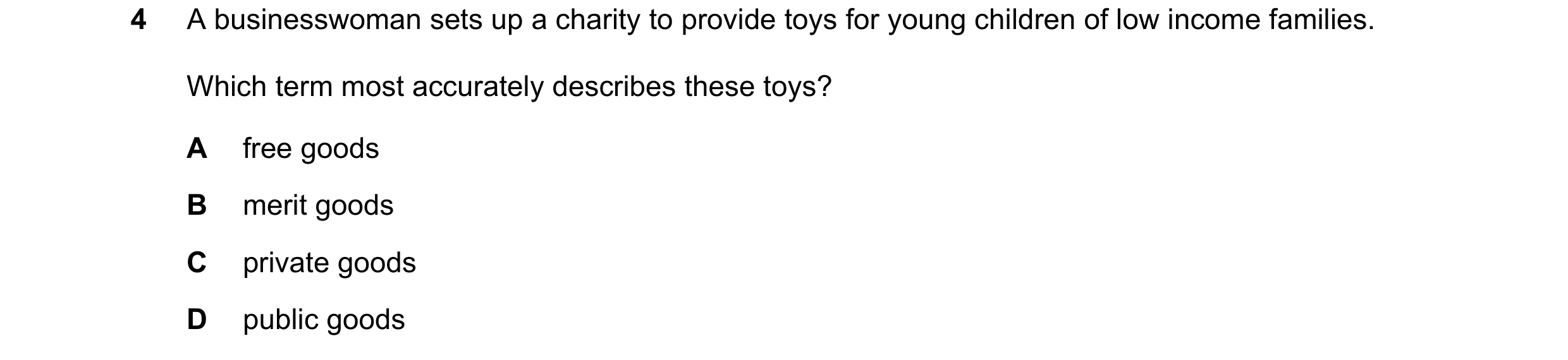
Q64 · A businesswoman sets up a charity to provide toys for young children of low income… 9708/12 Oct/Nov 2018
4 A businesswoman sets up a charity to provide toys for young children of low income families. Which term most accurately describes these toys? A free goods B merit goods C private goods D public goods
1 marks
Answer: C
This question in 9708/12 Oct/Nov 2018
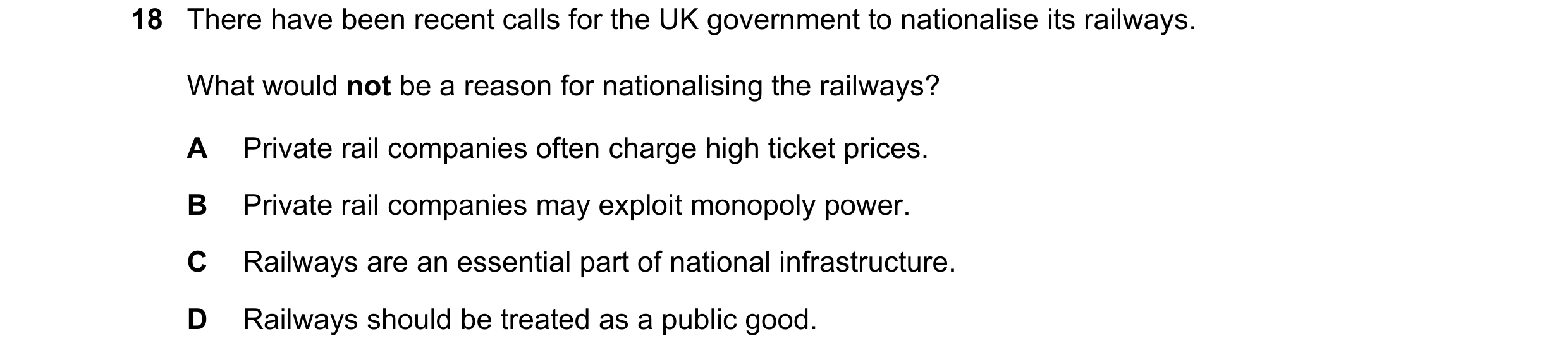
Q65 · There have been recent calls for the UK government to nationalise its railways 9708/12 Oct/Nov 2018
18 There have been recent calls for the UK government to nationalise its railways. What would not be a reason for nationalising the railways? A Private rail companies often charge high ticket prices. B Private rail companies may exploit monopoly power. C Railways are an essential part of national infrastructure. D Railways should be treated as a public good.
1 marks
Answer: D
This question in 9708/12 Oct/Nov 2018
Q66 · What is a statement of the non-rivalrous nature of public goods? 9708/13 Oct/Nov 2018
4 What is a statement of the non-rivalrous nature of public goods? A It is not possible to stop a non-payer from using the product. B One person consuming the product does not reduce the amount of it available to others. C People consume too little of the product because they are unaware of its true benefits. D There is an unlimited supply of the product.
1 marks
Answer: B
This question in 9708/13 Oct/Nov 2018
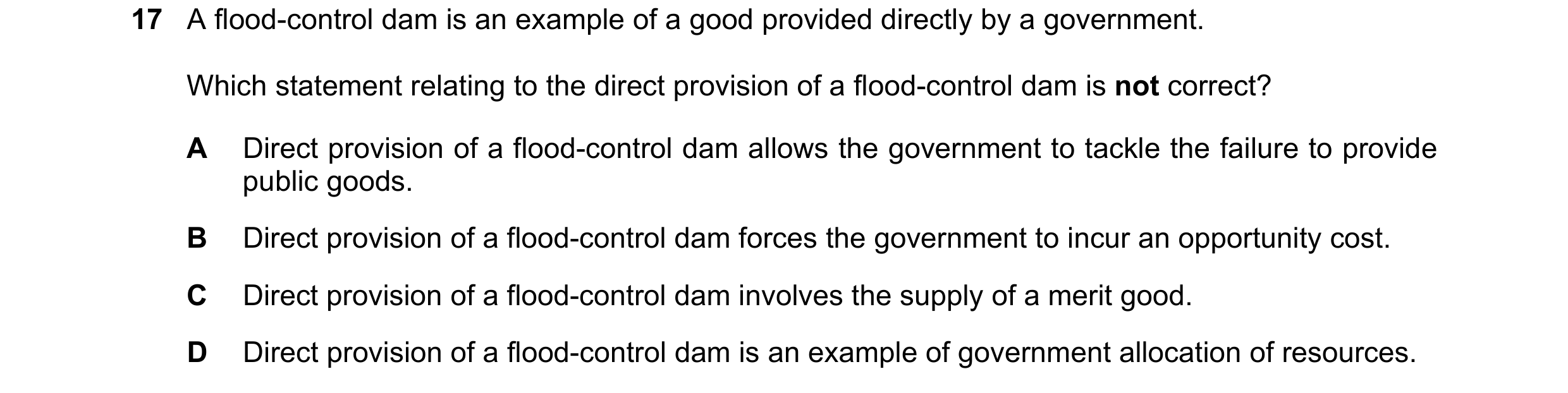
Q67 · A flood-control dam is an example of a good provided directly by a government 9708/13 Oct/Nov 2018
17 A flood-control dam is an example of a good provided directly by a government. Which statement relating to the direct provision of a flood-control dam is not correct? A Direct provision of a flood-control dam allows the government to tackle the failure to provide public goods. B Direct provision of a flood-control dam forces the government to incur an opportunity cost. C Direct provision of a flood-control dam involves the supply of a merit good. D Direct provision of a flood-control dam is an example of government allocation of resources.
1 marks
Answer: C
This question in 9708/13 Oct/Nov 2018
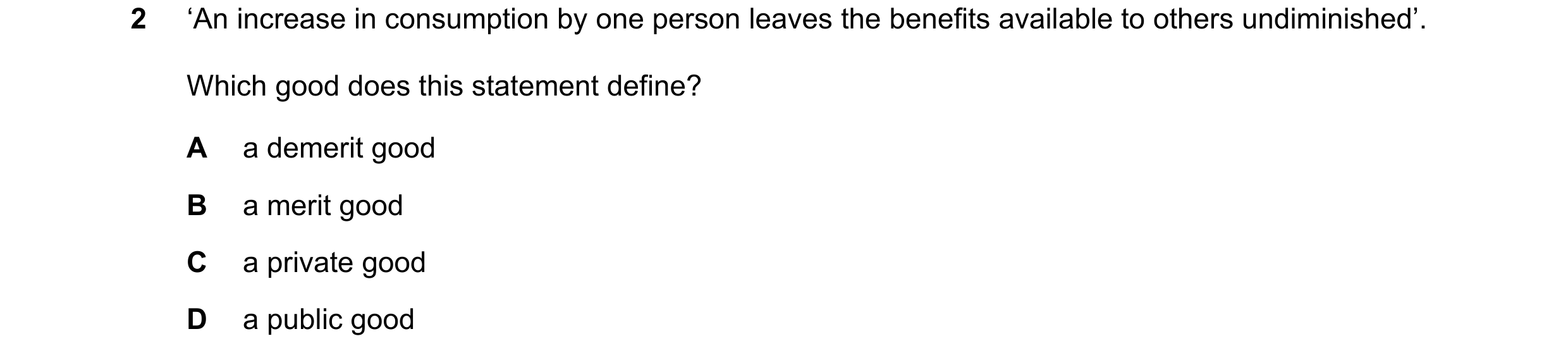
Q68 · ‘An increase in consumption by one person leaves the benefits available to others… 9708/12 Feb/March 2019
2 ‘An increase in consumption by one person leaves the benefits available to others undiminished’. Which good does this statement define? A a demerit good B a merit good C a private good D a public good
1 marks
Answer: D
This question in 9708/12 Feb/March 2019
Q69 · What is unlikely to occur with an increase in the provision of public goods? 9708/11 May/June 2019
18 What is unlikely to occur with an increase in the provision of public goods? A consumer non-excludability B improved use of resources C opportunity cost D reduction in tax
1 marks
Answer: D
This question in 9708/11 May/June 2019
Q70 · Which product is most likely to be provided only by the government? 9708/11 Oct/Nov 2019
14 Which product is most likely to be provided only by the government? A national defence B national health C national museums D national theatres
1 marks
Answer: A
This question in 9708/11 Oct/Nov 2019
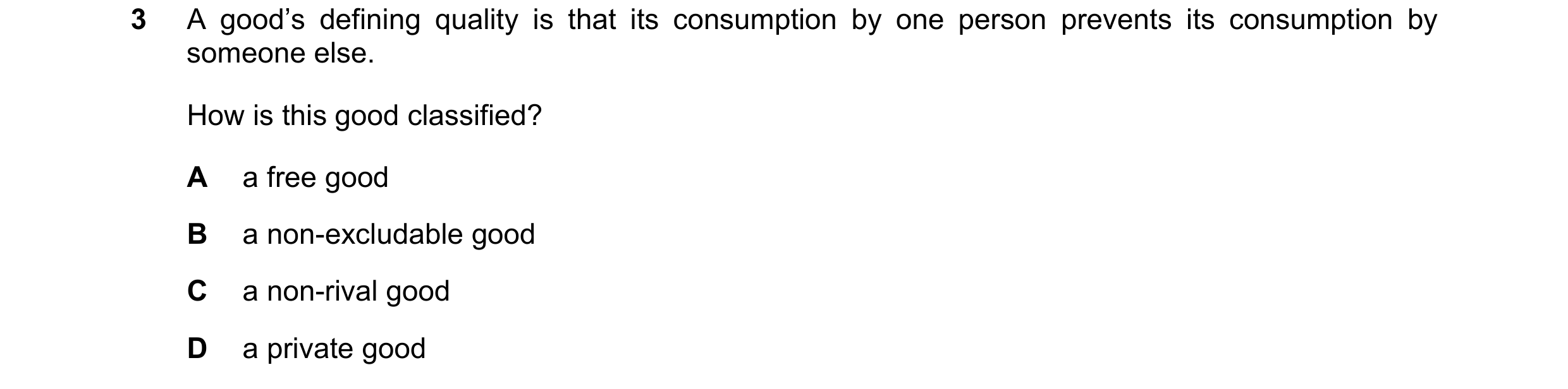
Q71 · A good’s defining quality is that its consumption by one person prevents its consumption… 9708/12 Oct/Nov 2019
3 A good’s defining quality is that its consumption by one person prevents its consumption by someone else. How is this good classified? A a free good B a non-excludable good C a non-rival good D a private good
1 marks
Answer: D
This question in 9708/12 Oct/Nov 2019
Q72 · Which is closest to being a public good? 9708/13 Oct/Nov 2019
2 Which is closest to being a public good? A electricity B health services C street lighting D water supply
1 marks
Answer: C
This question in 9708/13 Oct/Nov 2019
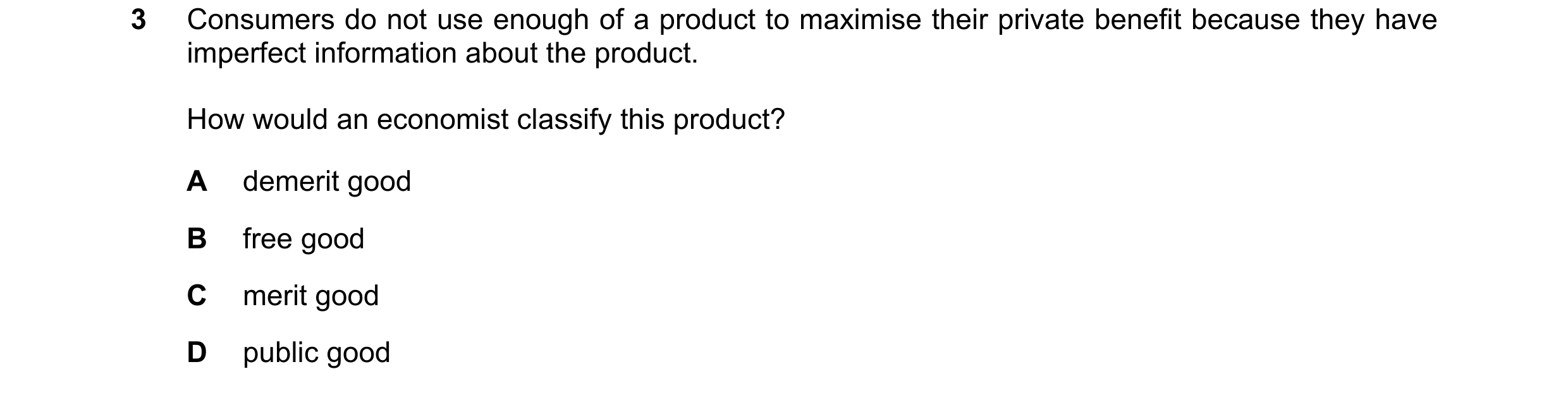
Q73 · Consumers do not use enough of a product to maximise their private benefit because they… 9708/11 May/June 2020
3 Consumers do not use enough of a product to maximise their private benefit because they have imperfect information about the product. How would an economist classify this product? A demerit good B free good C merit good D public good
1 marks
Answer: C
This question in 9708/11 May/June 2020
Q74 · What is a necessary characteristic of a public good? 9708/11 May/June 2020
18 What is a necessary characteristic of a public good? A It has a fixed maximum price. B It has an opportunity cost of production of zero. C It is non-excludable. D It is an essential good.
1 marks
Answer: C
This question in 9708/11 May/June 2020
Q75 · Which type of good is healthcare? 9708/13 May/June 2020
3 Which type of good is healthcare? A demerit B free C merit D public
1 marks
Answer: C
This question in 9708/13 May/June 2020
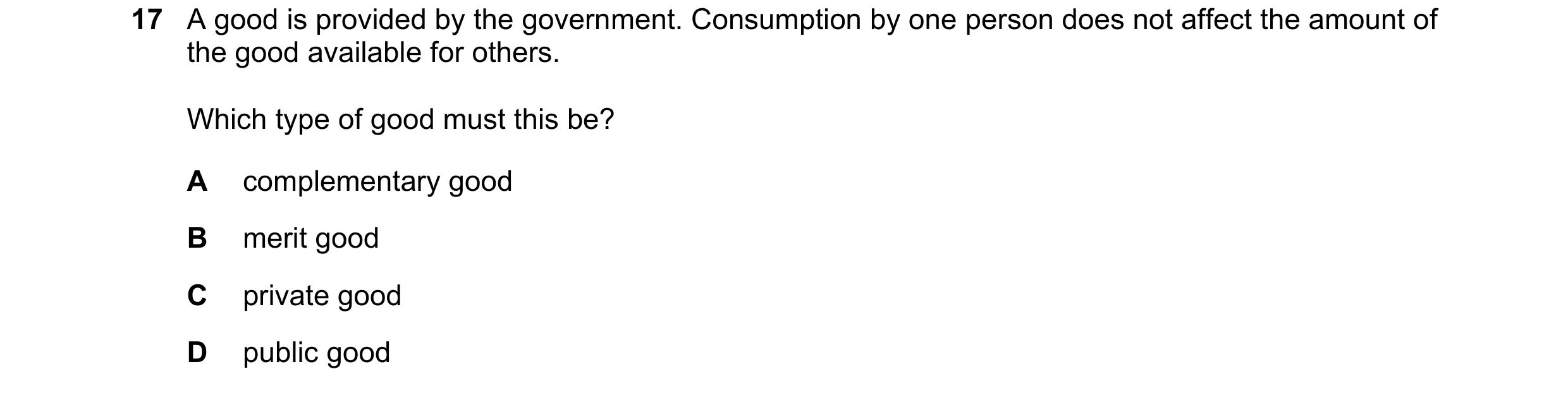
Q76 · A good is provided by the government 9708/11 Oct/Nov 2020
17 A good is provided by the government. Consumption by one person does not affect the amount of the good available for others. Which type of good must this be? A complementary good B merit good C private good D public good
1 marks
Answer: D
This question in 9708/11 Oct/Nov 2020
Q77 · Which statement is correct? 9708/12 Oct/Nov 2020
2 Which statement is correct? A Private goods are both non-rival and non-excludable. B Private goods are only provided by the private sector. C Public goods are both non-rival and non-excludable. D Public goods do not incur opportunity costs.
1 marks
Answer: C
This question in 9708/12 Oct/Nov 2020
Q78 · What is characterised as a free good? 9708/13 Oct/Nov 2020
2 What is characterised as a free good? A one that has zero opportunity cost B one that is non-excludable and non-rivalrous C one that is supplied by the government with no charge D one that receives a 100% government subsidy
1 marks
Answer: A
This question in 9708/13 Oct/Nov 2020
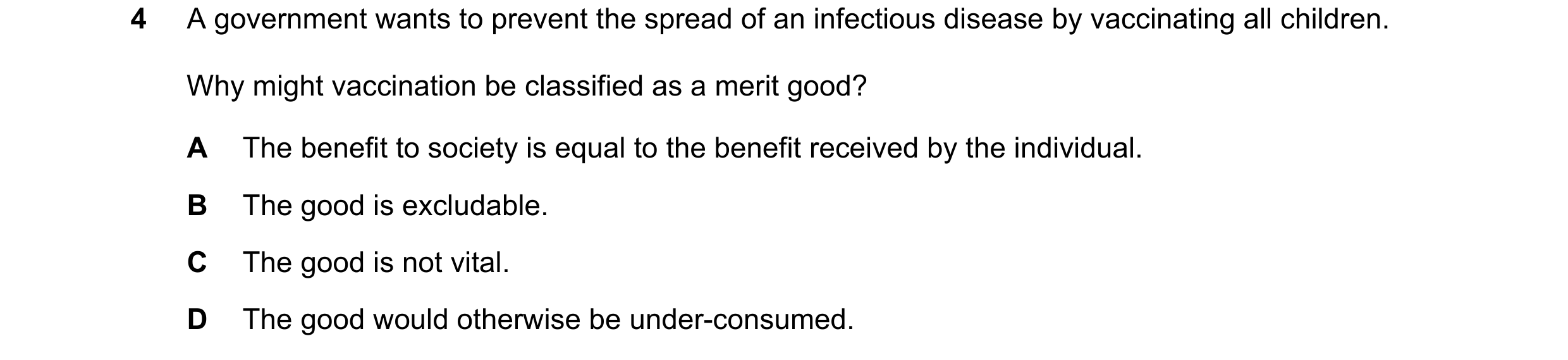
Q79 · A government wants to prevent the spread of an infectious disease by vaccinating all… 9708/13 Oct/Nov 2020
4 A government wants to prevent the spread of an infectious disease by vaccinating all children. Why might vaccination be classified as a merit good? A The benefit to society is equal to the benefit received by the individual. B The good is excludable. C The good is not vital. D The good would otherwise be under-consumed.
1 marks
Answer: D
This question in 9708/13 Oct/Nov 2020
Q80 · Why is national defence provided by the government? 9708/12 Feb/March 2021
18 Why is national defence provided by the government? A In a free market it is excludable and rival in consumption. B In a free market it is non-excludable and non-rival in consumption. C The government has perfect information, so it can set the correct quantity required. D The private sector firm would charge a high price for its use as it is a necessity.
1 marks
Answer: B
This question in 9708/12 Feb/March 2021
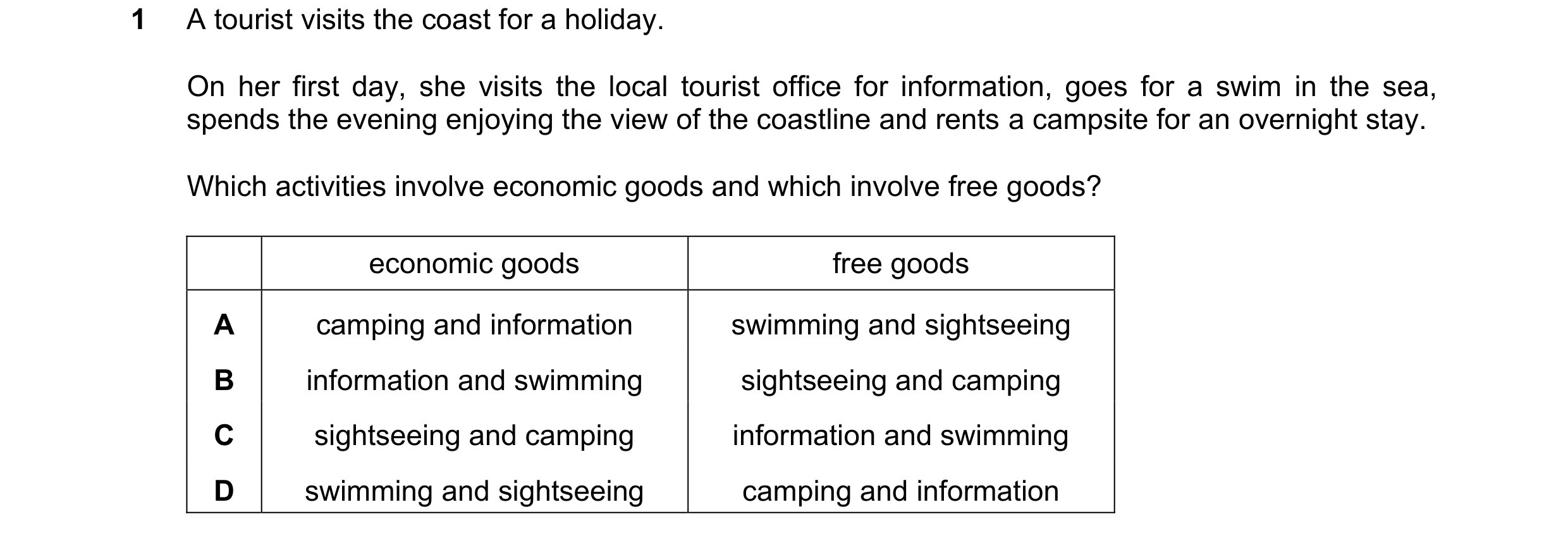
Q81 · A tourist visits the coast for a holiday 9708/12 May/June 2021
1 A tourist visits the coast for a holiday. On her first day, she visits the local tourist office for information, goes for a swim in the sea, spends the evening enjoying the view of the coastline and rents a campsite for an overnight stay. Which activities involve economic goods and which involve free goods? economic goods free goods A camping and information swimming and sightseeing B information and swimming sightseeing and camping C sightseeing and camping information and swimming D swimming and sightseeing camping and information
1 marks
Answer: A
This question in 9708/12 May/June 2021
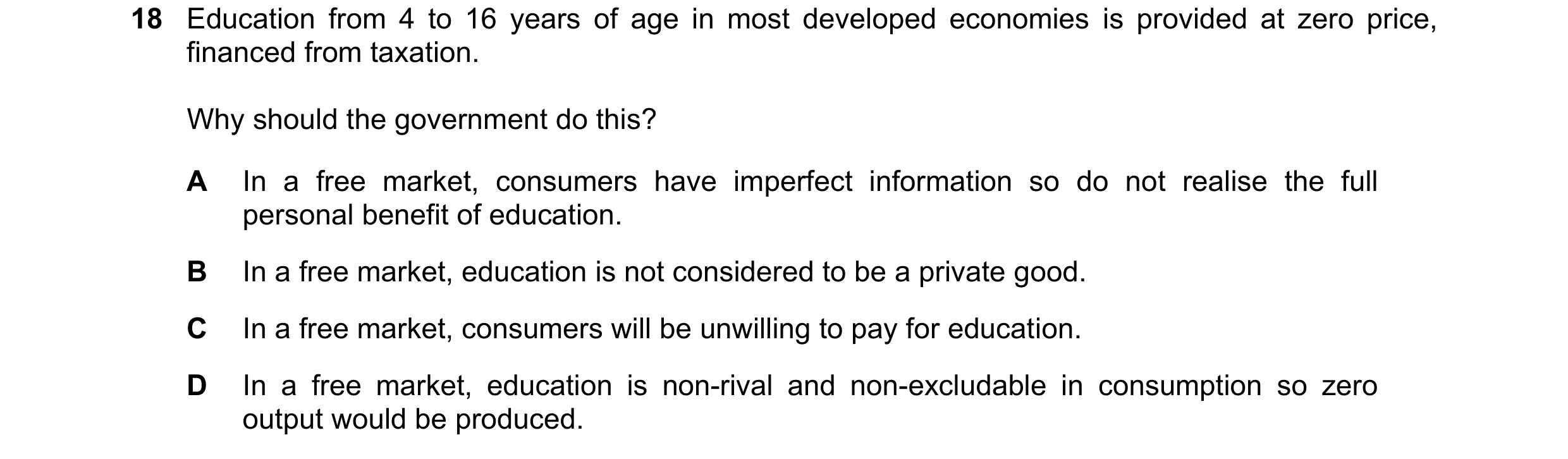
Q82 · Education from 4 to 16 years of age in most developed economies is provided at zero… 9708/12 May/June 2021
18 Education from 4 to 16 years of age in most developed economies is provided at zero price, financed from taxation. Why should the government do this? A In a free market, consumers have imperfect information so do not realise the full personal benefit of education. B In a free market, education is not considered to be a private good. C In a free market, consumers will be unwilling to pay for education. D In a free market, education is non-rival and non-excludable in consumption so zero output would be produced.
1 marks
Answer: A
This question in 9708/12 May/June 2021
Q83 · A government department provides milk at no charge to very low income families 9708/13 May/June 2021
1 A government department provides milk at no charge to very low income families. Which term best describes the milk? A free good B inferior good C private good D public good
1 marks
Answer: C
This question in 9708/13 May/June 2021
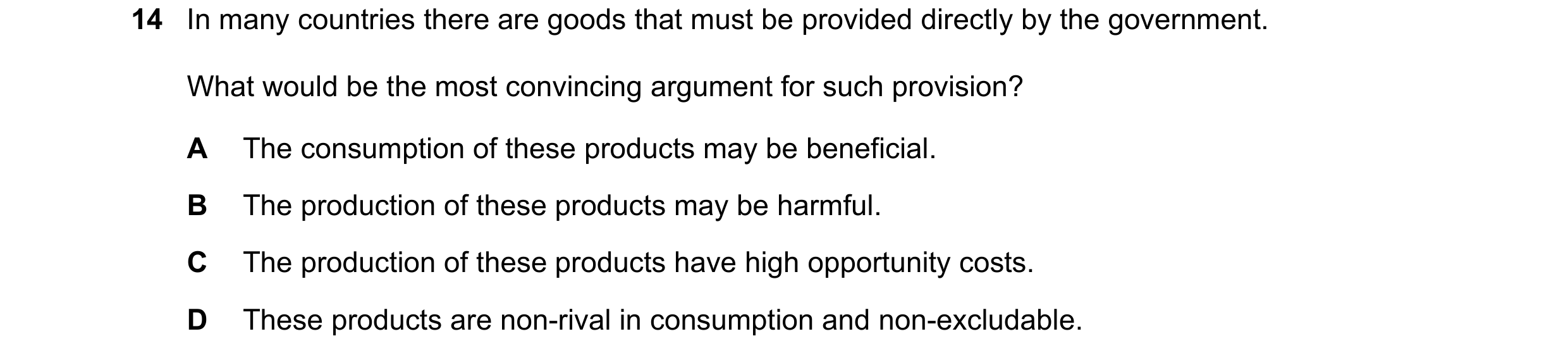
Q84 · In many countries there are goods that must be provided directly by the government 9708/13 May/June 2021
14 In many countries there are goods that must be provided directly by the government. What would be the most convincing argument for such provision? A The consumption of these products may be beneficial. B The production of these products may be harmful. C The production of these products have high opportunity costs. D These products are non-rival in consumption and non-excludable.
1 marks
Answer: D
This question in 9708/13 May/June 2021
Q85 · What is classified as a public good by economists? 9708/12 Oct/Nov 2021
3 What is classified as a public good by economists? A flood defences B government-funded hospitals C government-run national parks D the internet
1 marks
Answer: A
This question in 9708/12 Oct/Nov 2021
Q86 · Why does the production of public goods have to be financed by the government? 9708/13 Oct/Nov 2021
15 Why does the production of public goods have to be financed by the government? A One person’s consumption of a public good means it is not available for anyone else. B People are able to consume public goods without paying for them. C Private sector firms will charge a price significantly above cost for public goods. D The cost of producing public goods is higher in the private sector.
1 marks
Answer: B
This question in 9708/13 Oct/Nov 2021
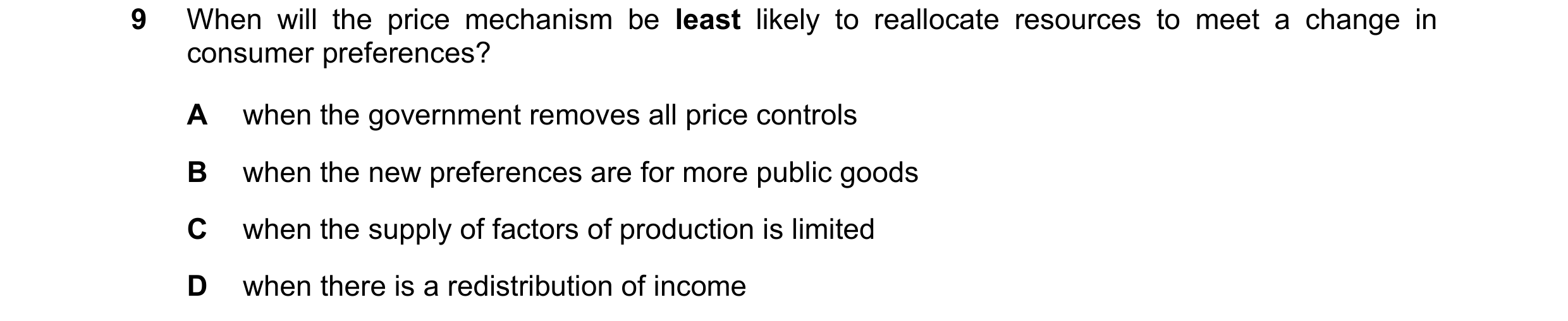
Q87 · When will the price mechanism be least likely to reallocate resources to meet a change in… 9708/12 Feb/March 2022
9 When will the price mechanism be least likely to reallocate resources to meet a change in consumer preferences? A when the government removes all price controls B when the new preferences are for more public goods C when the supply of factors of production is limited D when there is a redistribution of income
1 marks
Answer: B
This question in 9708/12 Feb/March 2022
Q88 · The National Library Board of Singapore is a public sector organisation that finances and… 9708/12 Feb/March 2022
16 The National Library Board of Singapore is a public sector organisation that finances and manages the state libraries. What is the most likely reason for this? A Libraries are public goods. B Libraries are merit goods. C The cost of providing library services would be greater in the private sector. D The opportunity cost to the public sector of providing library services is zero.
1 marks
Answer: B
This question in 9708/12 Feb/March 2022
Q89 · What does not happen when price acts as a means to allocate resources? 9708/12 May/June 2022
12 What does not happen when price acts as a means to allocate resources? A Price determines the supply of public goods. B Price operates in the markets for both goods and factors of production. C Price recognises consumers’ ability to pay rather than consumers’ needs. D Price signals to producers which goods are most profitable.
1 marks
Answer: A
This question in 9708/12 May/June 2022
Q90 · What is unlikely to occur with an increase in the provision of public goods? 9708/12 May/June 2022
18 What is unlikely to occur with an increase in the provision of public goods? A consumer non-excludability B improved use of resources C opportunity cost D reduction in tax
1 marks
Answer: D
This question in 9708/12 May/June 2022
Q91 · A local council provides a tap for drinking water in a town 9708/11 Oct/Nov 2022
2 A local council provides a tap for drinking water in a town. Would this make drinking water a free good? A No, because it is possible to exclude some people from using the tap. B No, because it requires the use of scarce resources. C Yes, because it is available to all passers-by. D Yes, because it is impossible to charge for it.
1 marks
Answer: B
This question in 9708/11 Oct/Nov 2022
Q92 · A key concept in classifying goods is whether a good is rival or non-rival 9708/12 Oct/Nov 2022
3 A key concept in classifying goods is whether a good is rival or non-rival. Which good is rival in consumption? A an ice cream B street lighting C a radio broadcast D the internet
1 marks
Answer: A
This question in 9708/12 Oct/Nov 2022
Q93 · A good is most suitable to be provided by the market if it is A excludable and non-rival 9708/12 Feb/March 2023
1 A good is most suitable to be provided by the market if it is A excludable and non-rival. B excludable and rival. C non-excludable and non-rival. D non-excludable and rival.
1 marks
Answer: B
This question in 9708/12 Feb/March 2023
Q94 · In which case is the price system not a possible method of allocating resources? 9708/12 Feb/March 2023
7 In which case is the price system not a possible method of allocating resources? A in the distribution of foodstuff among the population B in the hiring of workers by employers C in the ownership of land for agricultural use D in the provision of public goods by the government
1 marks
Answer: D
This question in 9708/12 Feb/March 2023
Q95 · People plant flowers in a local park 9708/13 May/June 2023
1 People plant flowers in a local park. Which statement is correct? A Flowers in parks are a public good because people can enjoy them at no charge. B Flowers in parks are a public good because they are owned by local people and are not for profit. C Flowers in parks are not a public good if local people can limit the number of visitors to the parks. D Flowers in parks are not a public good if they are individual, not identical, in nature.
1 marks
Answer: C
This question in 9708/13 May/June 2023
Q96 · A country’s health care is funded by taxation but can be used free of charge by patients 9708/11 Oct/Nov 2023
3 A country’s health care is funded by taxation but can be used free of charge by patients. Which type of good is health care in this country? A demerit good B free good C private good D public good
1 marks
Answer: C
This question in 9708/11 Oct/Nov 2023
Q97 · A government introduces charges for vehicles using the roads in its capital city 9708/11 Oct/Nov 2023
14 A government introduces charges for vehicles using the roads in its capital city. Which characteristic must the roads have for this to be successful in reducing congestion? A The roads must be excludable. B The roads must be merit goods. C The roads must be non-rivalrous. D The roads must be public goods.
1 marks
Answer: A
This question in 9708/11 Oct/Nov 2023
Q98 · A new section of a road is provided toll-free by the government 9708/12 Oct/Nov 2023
3 A new section of a road is provided toll-free by the government. What best describes this good? A a demerit good B a free good C a private good D a public good
1 marks
Answer: C
This question in 9708/12 Oct/Nov 2023
Q99 · Consumers do not use enough of a product to maximise their private benefit because they… 9708/13 Oct/Nov 2023
2 Consumers do not use enough of a product to maximise their private benefit because they have imperfect information about the product. How would an economist classify this product? A demerit good B free good C merit good D public good
1 marks
Answer: C
This question in 9708/13 Oct/Nov 2023
Q100 · What is an example of a free good? 9708/13 Oct/Nov 2023
4 What is an example of a free good? A a government sponsoring a free vaccination programme for its citizens B a hospital providing free treatment to the poor C a school providing free education to outstanding students D anything that provides free utility but is not scarce
1 marks
Answer: D
This question in 9708/13 Oct/Nov 2023
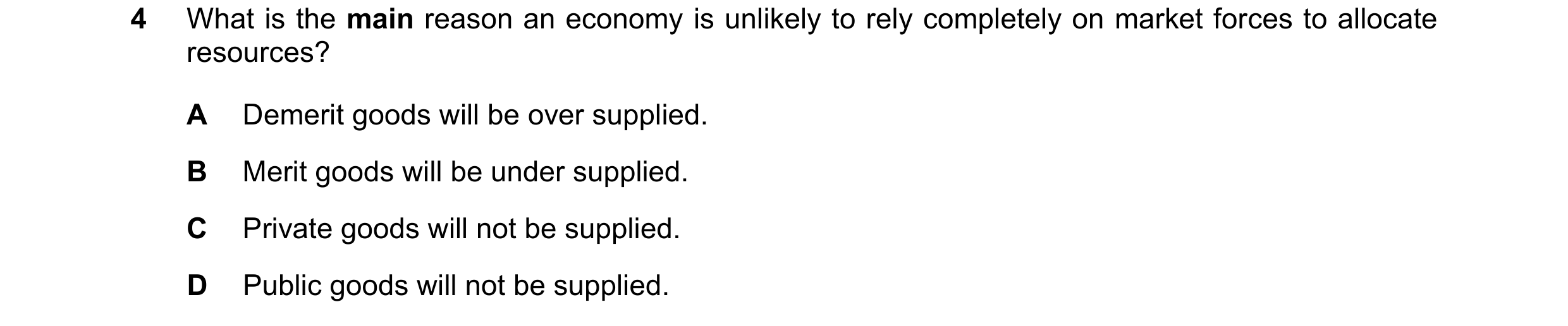
Q101 · What is the main reason an economy is unlikely to rely completely on market forces to… 9708/12 Feb/March 2024
4 What is the main reason an economy is unlikely to rely completely on market forces to allocate resources? A Demerit goods will be over supplied. B Merit goods will be under supplied. C Private goods will not be supplied. D Public goods will not be supplied.
1 marks
Answer: D
This question in 9708/12 Feb/March 2024
Q102 · What explains the underconsumption of merit goods? 9708/12 Feb/March 2024
13 What explains the underconsumption of merit goods? A Their value is not fully understood by consumers. B They are unproductive goods and services. C They can only be provided by the government. D They are only provided by private sector businesses.
1 marks
Answer: A
This question in 9708/12 Feb/March 2024
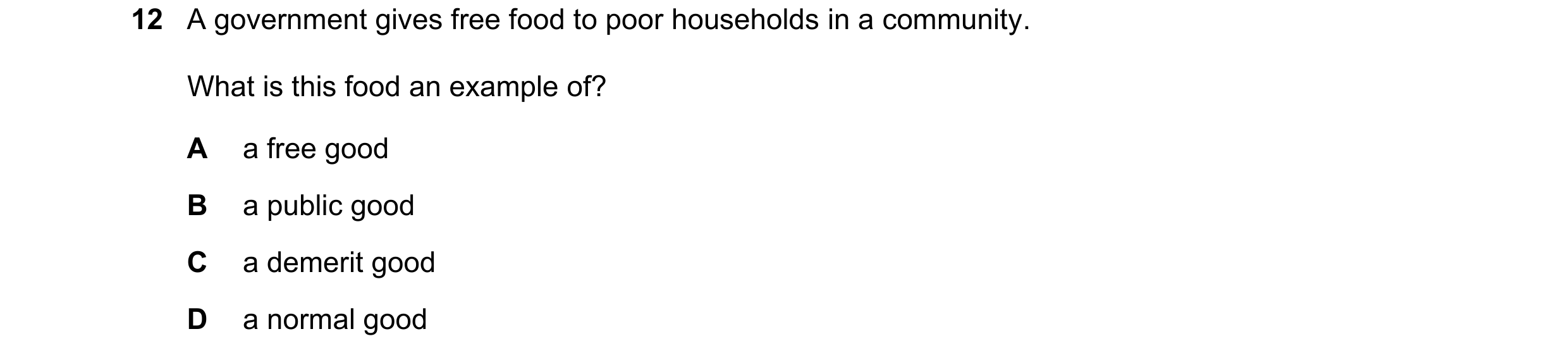
Q103 · A government gives free food to poor households in a community 9708/11 May/June 2024
12 A government gives free food to poor households in a community. What is this food an example of? A a free good B a public good C a demerit good D a normal good
1 marks
Answer: D
This question in 9708/11 May/June 2024
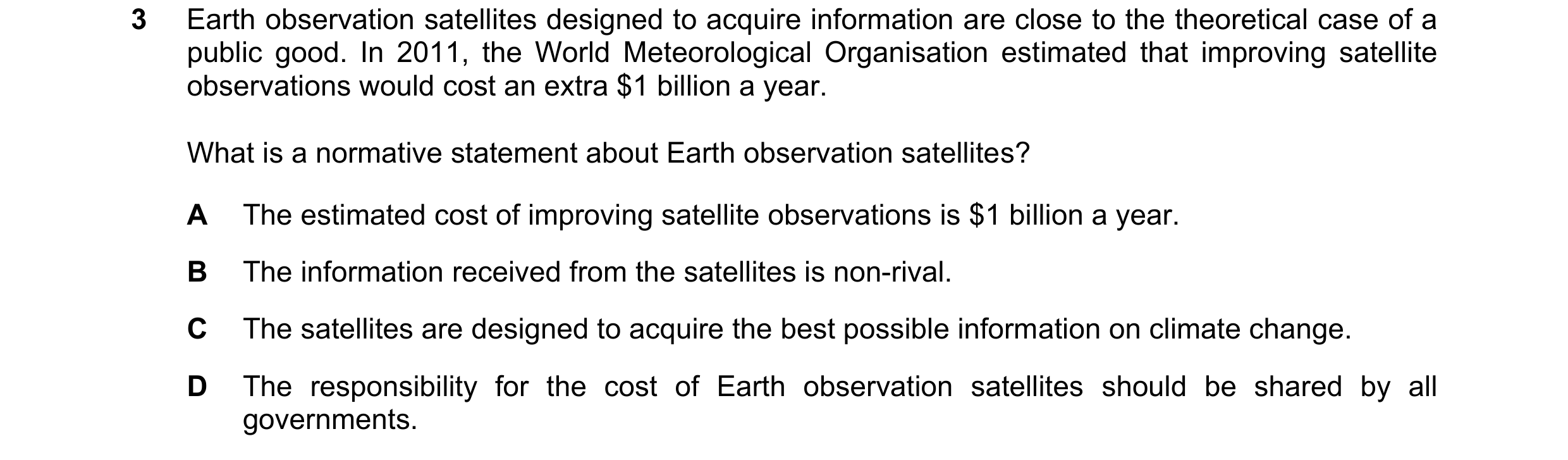
Q104 · Earth observation satellites designed to acquire information are close to the theoretical… 9708/12 May/June 2024
3 Earth observation satellites designed to acquire information are close to the theoretical case of a public good. In 2011, the World Meteorological Organisation estimated that improving satellite observations would cost an extra $1 billion a year. What is a normative statement about Earth observation satellites? A The estimated cost of improving satellite observations is $1 billion a year. B The information received from the satellites is non-rival. C The satellites are designed to acquire the best possible information on climate change. D The responsibility for the cost of Earth observation satellites should be shared by all governments.
1 marks
Answer: D
This question in 9708/12 May/June 2024
Q105 · What is an example of a public good? 9708/12 May/June 2024
13 What is an example of a public good? A a new road linking a major city with a port B free lunches provided to students at a school C Wi-Fi (internet access) provided for all the citizens of a town D state provision of a national defence system
1 marks
Answer: D
This question in 9708/12 May/June 2024
Q106 · What is not an example of a public good? 9708/13 May/June 2024
1 What is not an example of a public good? A education B flood control systems C national defence D street lighting
1 marks
Answer: A
This question in 9708/13 May/June 2024
Q107 · Which activity illustrates the consumption of a ‘free’ good? 9708/13 May/June 2024
3 Which activity illustrates the consumption of a ‘free’ good? A a farmer using water taken from a river B a patient visiting a medical facility provided by a charity C a person breathing air in the countryside D a person eating their birthday cake given as a gift by a friend
1 marks
Answer: C
This question in 9708/13 May/June 2024
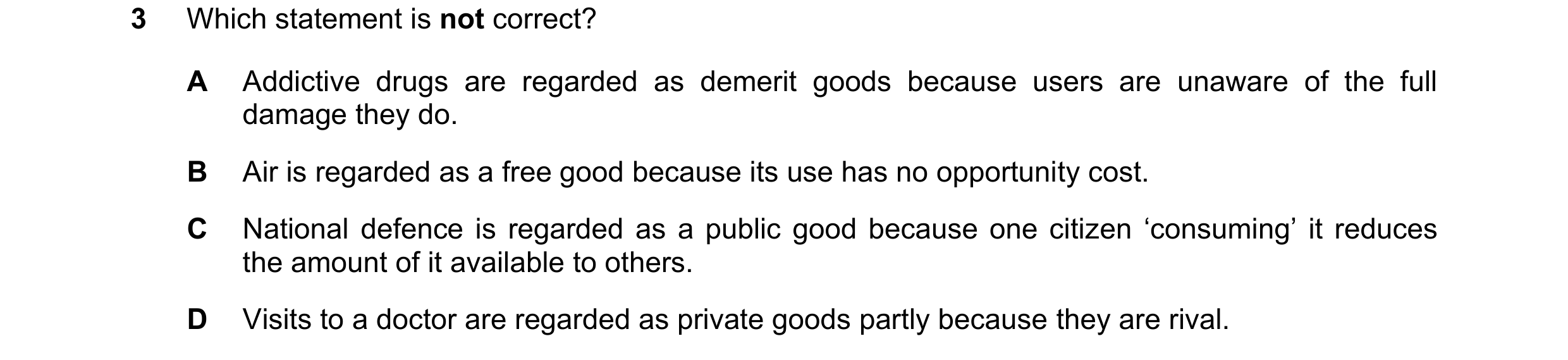
Q108 · Which statement is not correct? 9708/11 Oct/Nov 2024
3 Which statement is not correct? A Addictive drugs are regarded as demerit goods because users are unaware of the full damage they do. B Air is regarded as a free good because its use has no opportunity cost. C National defence is regarded as a public good because one citizen ‘consuming’ it reduces the amount of it available to others. D Visits to a doctor are regarded as private goods partly because they are rival.
1 marks
Answer: C
This question in 9708/11 Oct/Nov 2024
Q109 · Which type of good does not consume scarce resources? 9708/13 Oct/Nov 2024
2 Which type of good does not consume scarce resources? A economic good B free good C merit good D public good
1 marks
Answer: B
This question in 9708/13 Oct/Nov 2024
Q110 · Which policy is most likely to solve the free rider problem caused by public goods? 9708/13 Oct/Nov 2024
12 Which policy is most likely to solve the free rider problem caused by public goods? A an advertising campaign B a direct provision by the government C a minimum price D a tax on a substitute good
1 marks
Answer: B
This question in 9708/13 Oct/Nov 2024
Q111 · How can a public good become a private good? 9708/11 May/June 2025
5 How can a public good become a private good? A Consumers are dissatisfied with the performance of state-run services. B New technological developments make the good excludable. C The government privatises the industry producing the good. D The price of the good increases so it becomes more profitable.
1 marks
Answer: B
This question in 9708/11 May/June 2025
Q112 · What is a statement of the non-rivalrous nature of public goods? 9708/12 May/June 2025
3 What is a statement of the non-rivalrous nature of public goods? A It is not possible to stop a non-payer from using the product. B One person consuming the product does not reduce the amount of it available to others. C People consume too little of the product because they are unaware of its true benefits. D There is an unlimited supply of the product.
1 marks
Answer: B
This question in 9708/12 May/June 2025
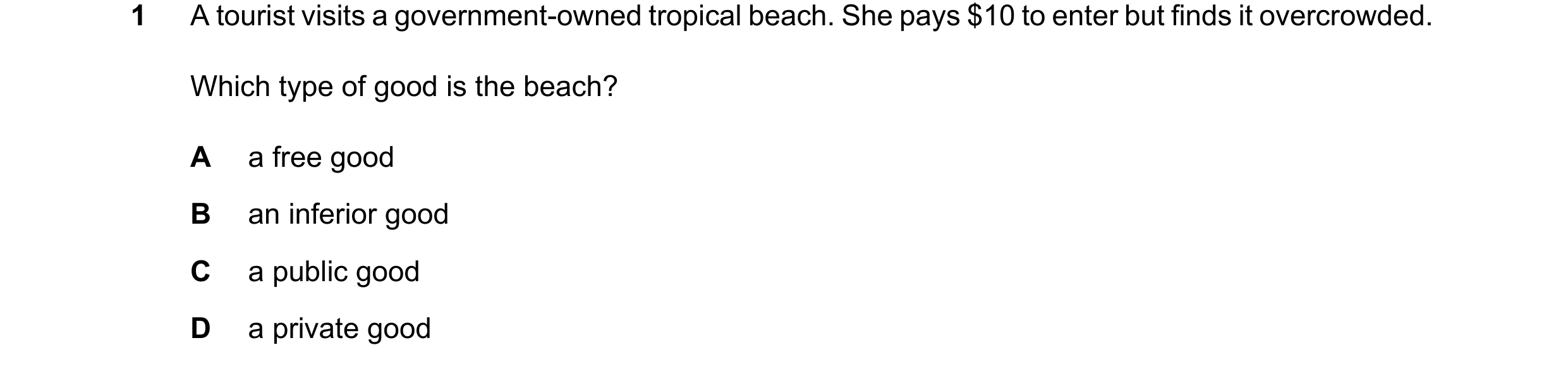
Q113 · A tourist visits a government-owned tropical beach 9708/13 May/June 2025
1 A tourist visits a government-owned tropical beach. She pays $10 to enter but finds it overcrowded. Which type of good is the beach? A a free good B an inferior good C a public good D a private good
1 marks
Answer: D
This question in 9708/13 May/June 2025
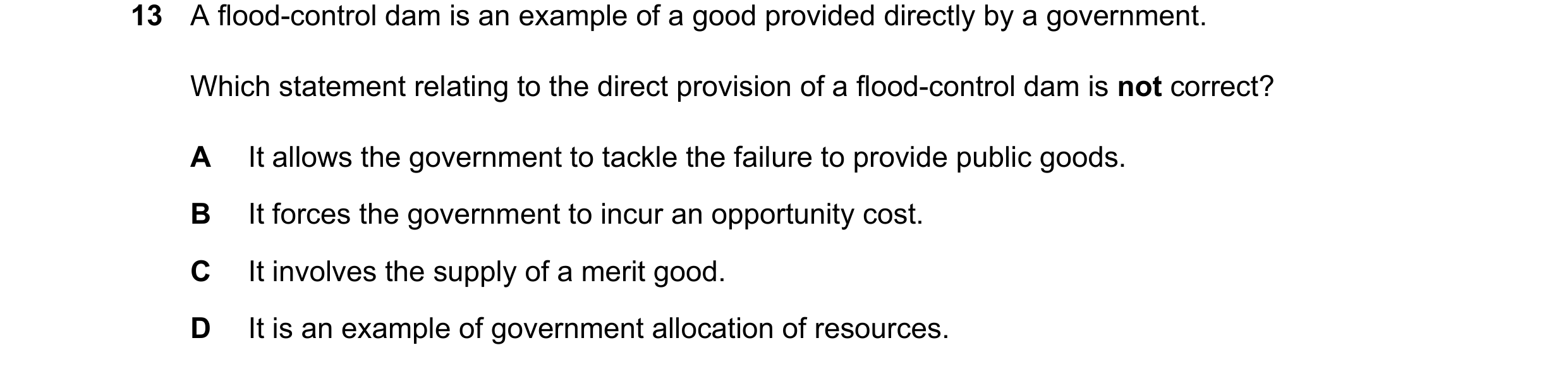
Q114 · A flood-control dam is an example of a good provided directly by a government 9708/13 May/June 2025
13 A flood-control dam is an example of a good provided directly by a government. Which statement relating to the direct provision of a flood-control dam is not correct? A It allows the government to tackle the failure to provide public goods. B It forces the government to incur an opportunity cost. C It involves the supply of a merit good. D It is an example of government allocation of resources.
1 marks
Answer: C
This question in 9708/13 May/June 2025
Q115 · What is an example of a public good? 9708/11 Oct/Nov 2025
4 What is an example of a public good? A A ferry that takes members of the public across a river. B A fish farm that is owned by the government. C A fishing boat that is owned by all members of a village. D A lighthouse that warns boats of dangerous rocks.
1 marks
Answer: D
This question in 9708/11 Oct/Nov 2025
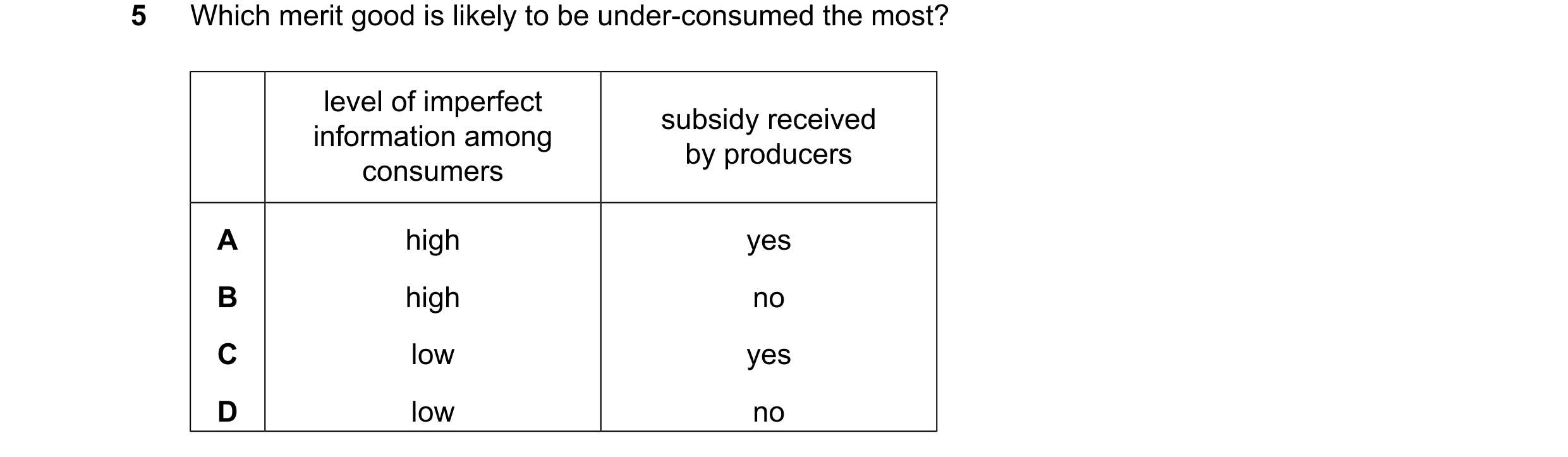
Q116 · Which merit good is likely to be under-consumed the most? 9708/11 Oct/Nov 2025
5 Which merit good is likely to be under-consumed the most? level of imperfect subsidy received information among by producers consumers A high yes B high no C low yes D low no
1 marks
Answer: B
This question in 9708/11 Oct/Nov 2025
Q117 · A public good must both be non-rivalrous in consumption and have the characteristic of… 9708/12 Oct/Nov 2025
2 A public good must both be non-rivalrous in consumption and have the characteristic of non-excludability. Which situation meets both of these conditions? A a former nationalised rail network which has been privatised B a good that has an opportunity cost C the building of a new toll road which charges all users the same toll D the provision of street lighting which improves a locality
1 marks
Answer: D
This question in 9708/12 Oct/Nov 2025
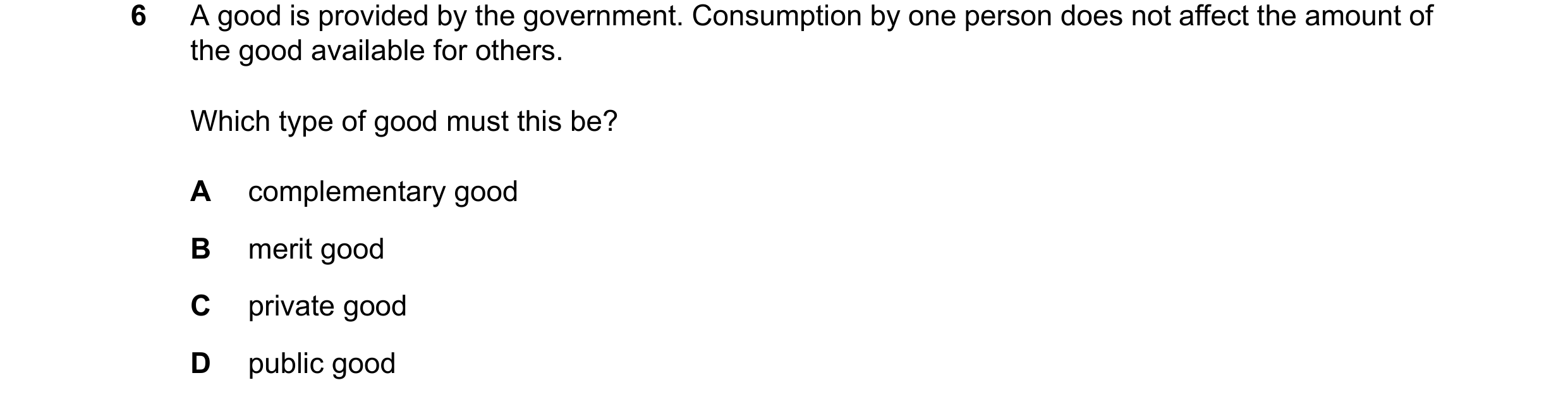
Q118 · A good is provided by the government 9708/13 Oct/Nov 2025
6 A good is provided by the government. Consumption by one person does not affect the amount of the good available for others. Which type of good must this be? A complementary good B merit good C private good D public good
1 marks
Answer: D
This question in 9708/13 Oct/Nov 2025

 1 / 22



 2 / 22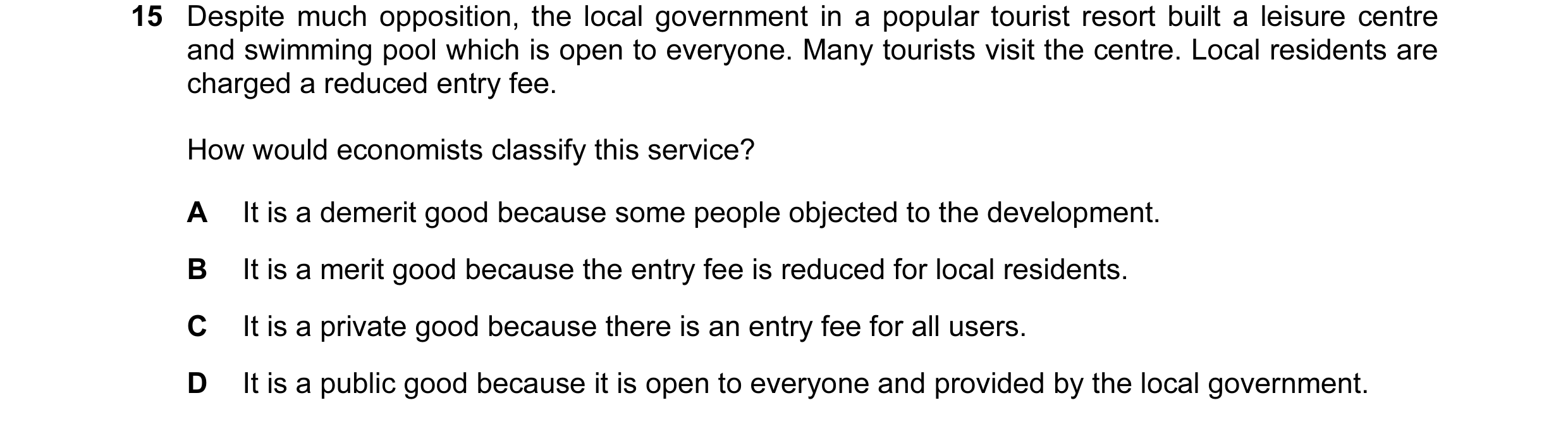



 3 / 22

 4 / 22




 5 / 22


 6 / 22
 7 / 22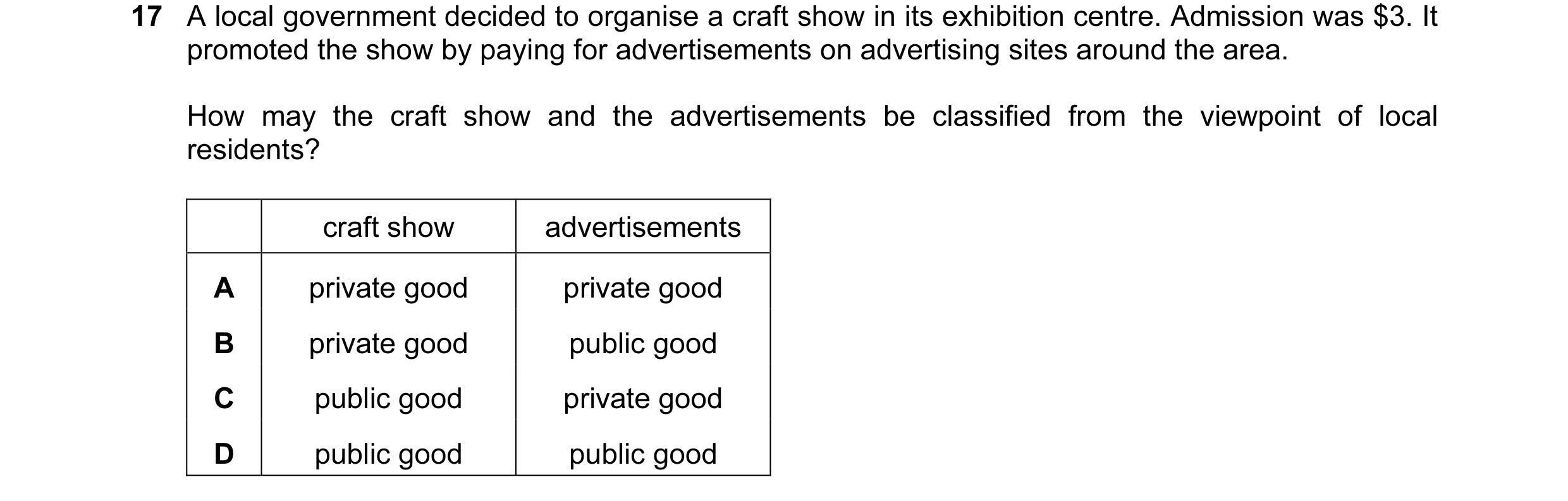


 8 / 22
 9 / 22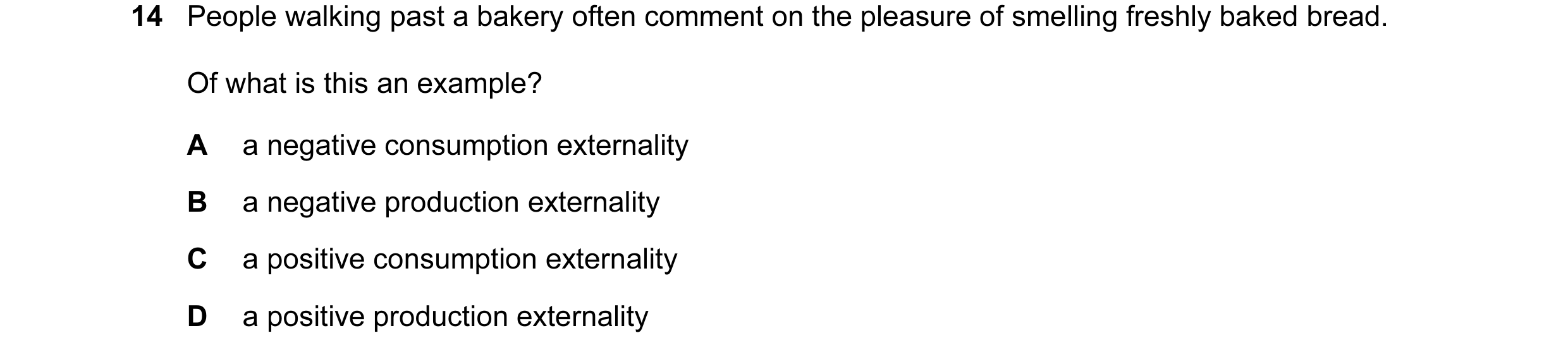

 10 / 22

 11 / 22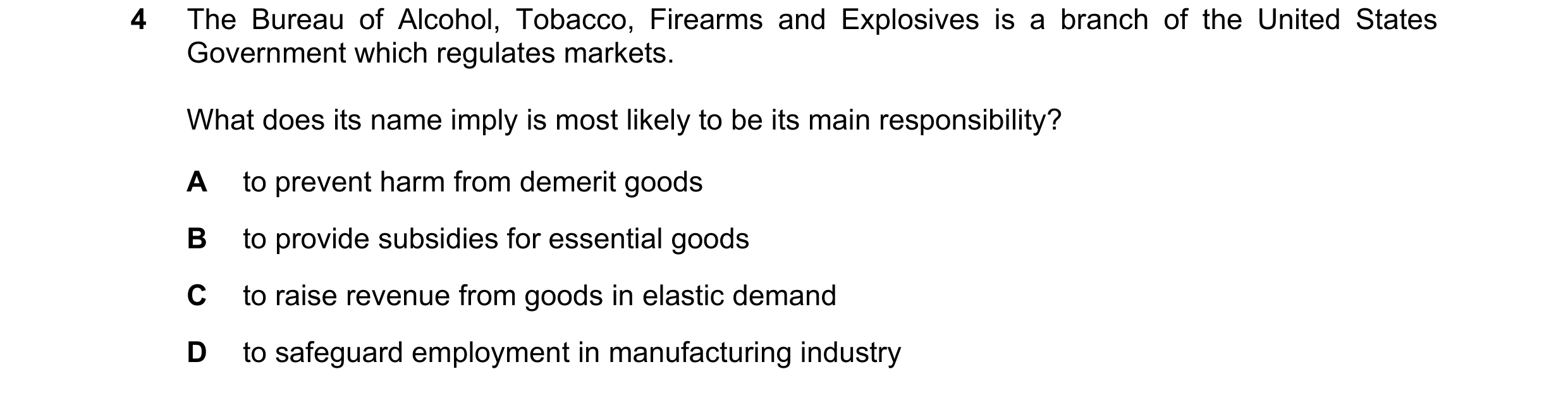
 12 / 22


 13 / 22


 14 / 22

 15 / 22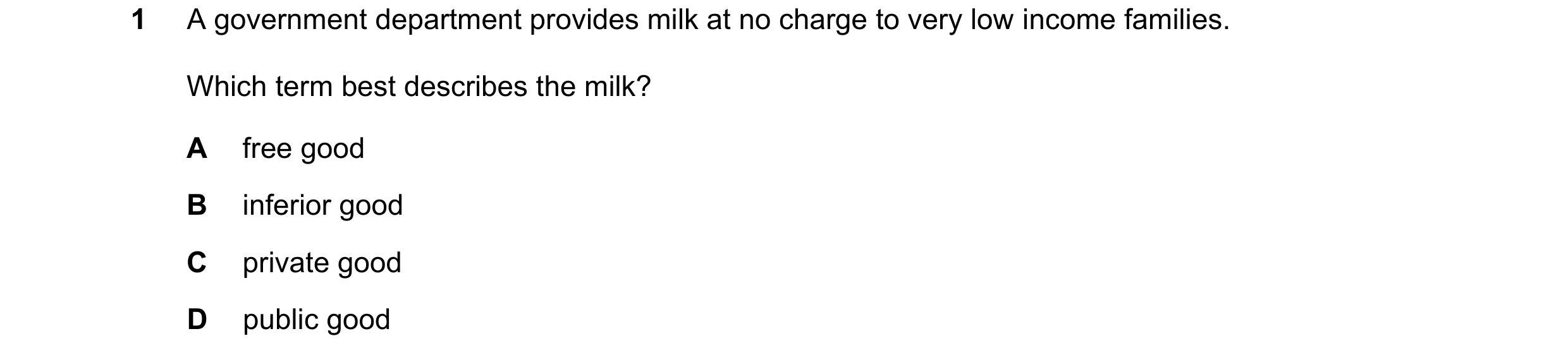


 16 / 22


 17 / 22
 18 / 22

 19 / 22



 20 / 22

 21 / 22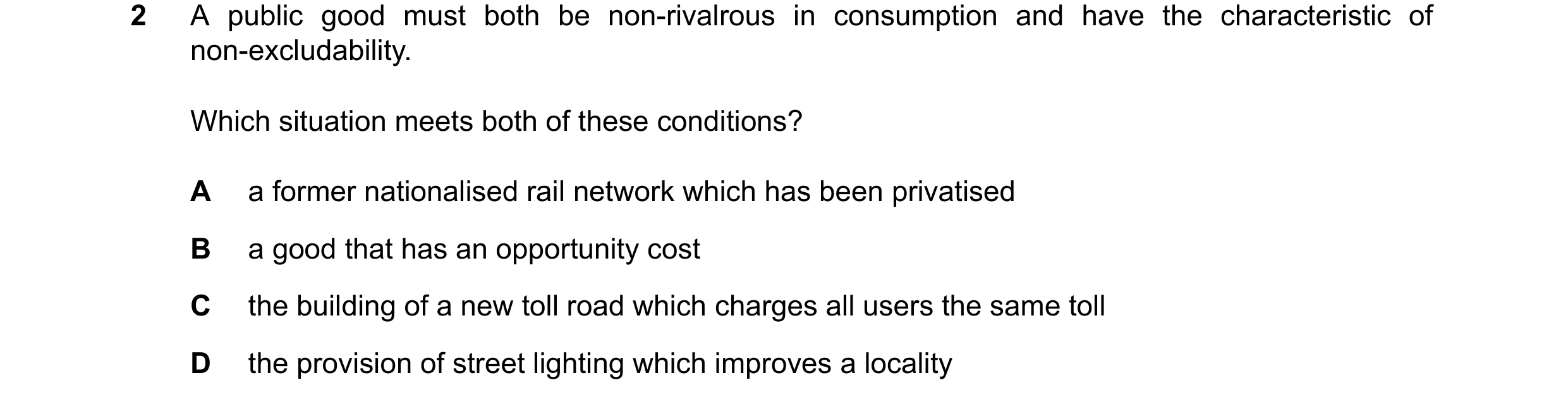
 22 / 22