Questions as text
Q1 · Which property of a metal determines the method used to extract the metal from its ore? 0653/11 May/June 2006
21 Which property of a metal determines the method used to extract the metal from its ore? A the melting point of the metal B the position of the metal in the Periodic Table C the reactivity of the metal D the relative atomic mass, Ar, of the metal
1 marks
Answer: C
This question in 0653/11 May/June 2006
Q2 · Which method is used to obtain iron from iron(III) oxide? 0653/11 May/June 2007
19 Which method is used to obtain iron from iron(III) oxide? A combustion B electrolysis C reduction D thermal decomposition
1 marks
Answer: C
This question in 0653/11 May/June 2007
Q3 · Aluminium oxide, dissolved in melted cryolite, is electrolysed 0653/11 Oct/Nov 2007
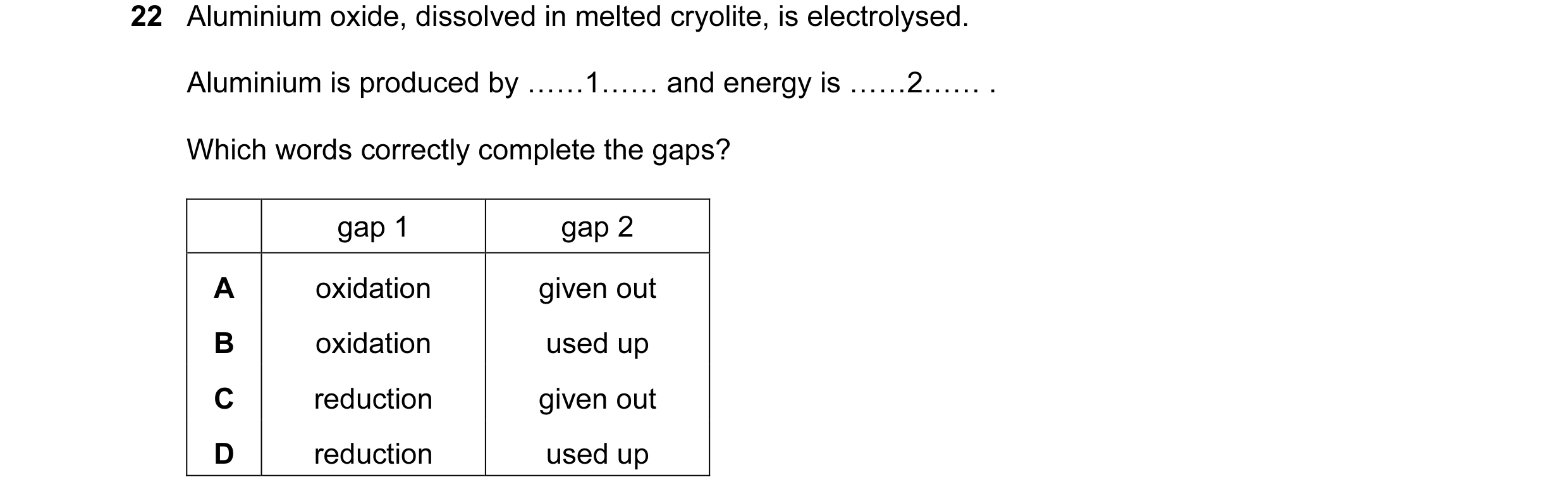
22 Aluminium oxide, dissolved in melted cryolite, is electrolysed. Aluminium is produced by ……1…… and energy is ……2…… . Which words correctly complete the gaps? gap 1 gap 2 A oxidation given out B oxidation used up C reduction given out D reduction used up
1 marks
Answer: D
This question in 0653/11 Oct/Nov 2007
Q4 · Are iron and sodium hydroxide obtained by electrolysis? 0653/11 Oct/Nov 2007
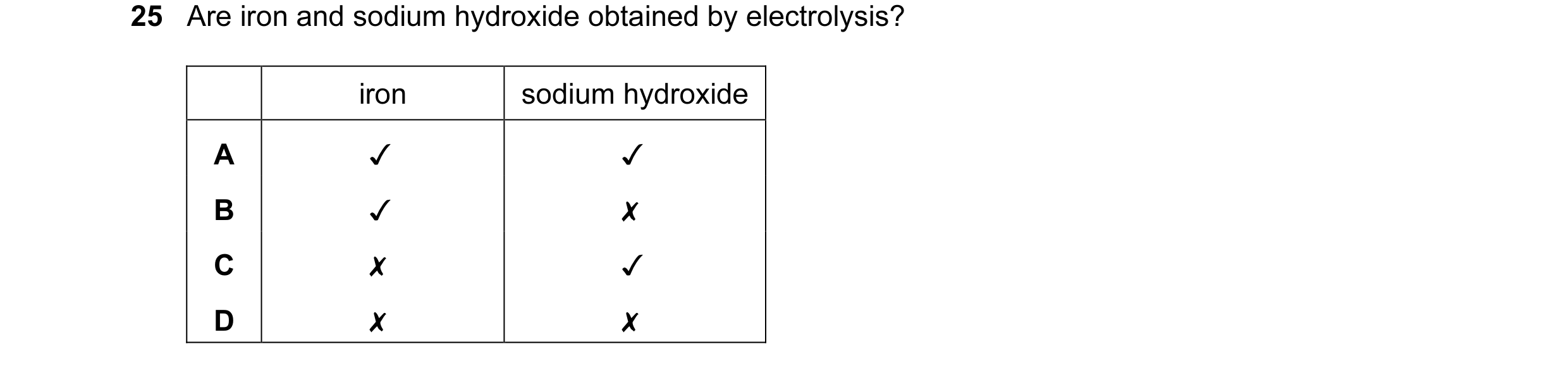
25 Are iron and sodium hydroxide obtained by electrolysis?
iron sodium hydroxide
v v
0 0O WwW D>
x
v
x
~ « &
1 marks
Answer: C
This question in 0653/11 Oct/Nov 2007
Q5 · Impure copper is purified by electrolysis, as shown 0653/11 Oct/Nov 2008
22 Impure copper is purified by electrolysis, as shown. A copper copper aqueous copper(II) sulphate What is the cathode made of and how does its mass change during the electrolysis? the cathode is made of its mass A impure copper decreases B impure copper increases C pure copper decreases D pure copper increases
1 marks
Answer: D
This question in 0653/11 Oct/Nov 2008
Q6 · Which method is used to obtain iron from iron(III) oxide? 0653/11 May/June 2010
20 Which method is used to obtain iron from iron(III) oxide? A combustion B electrolysis C reduction D thermal decomposition
1 marks
Answer: C
This question in 0653/11 May/June 2010
Q7 · Which method is used to obtain iron from iron(III) oxide? 0653/12 May/June 2010
21 Which method is used to obtain iron from iron(III) oxide? A combustion B electrolysis C reduction D thermal decomposition
1 marks
Answer: C
This question in 0653/12 May/June 2010
Q8 · Which method is used to obtain iron from iron(III) oxide? 0653/13 May/June 2010
21 Which method is used to obtain iron from iron(III) oxide? A combustion B electrolysis C reduction D thermal decomposition
1 marks
Answer: C
This question in 0653/13 May/June 2010
Q9 · Aluminium occurs as aluminium oxide in the ore bauxite 0653/11 Oct/Nov 2010
20 Aluminium occurs as aluminium oxide in the ore bauxite.
Which terms apply to the extraction of aluminium from aluminium oxide?
electrolysis reduction
A v v
B v x
Cc x v
D x x
1 marks
Answer: A
This question in 0653/11 Oct/Nov 2010
Q10 · Aluminium occurs as aluminium oxide in the ore bauxite 0653/12 Oct/Nov 2010
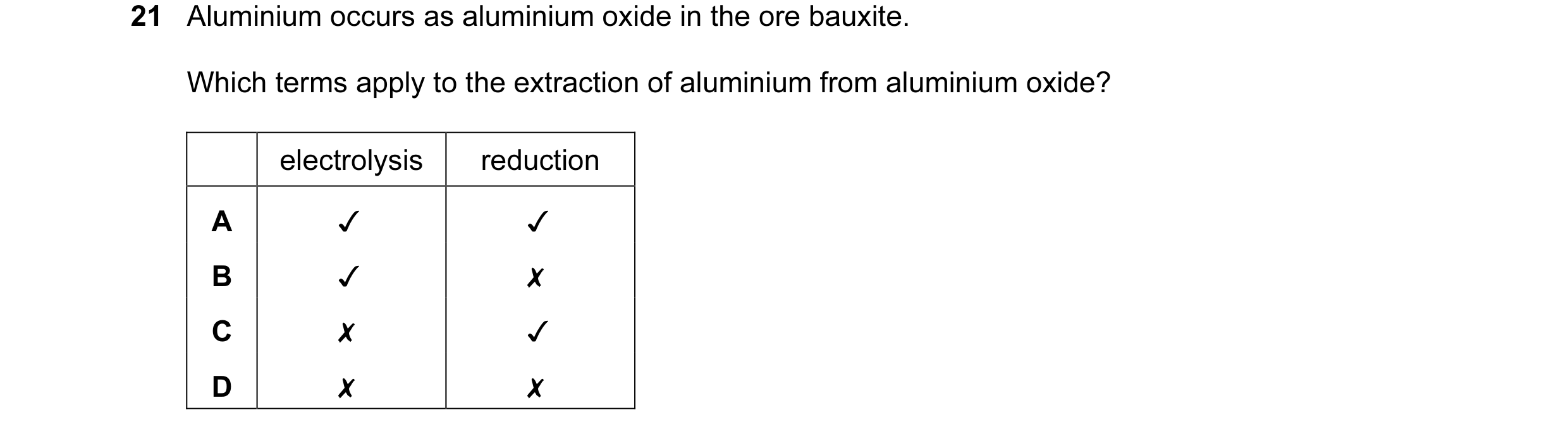
21 Aluminium occurs as aluminium oxide in the ore bauxite.
Which terms apply to the extraction of aluminium from aluminium oxide?
electrolysis reduction
A v v
B v x
Cc x v
D x x
1 marks
Answer: A
This question in 0653/12 Oct/Nov 2010
Q11 · Aluminium occurs as aluminium oxide in the ore bauxite 0653/13 Oct/Nov 2010
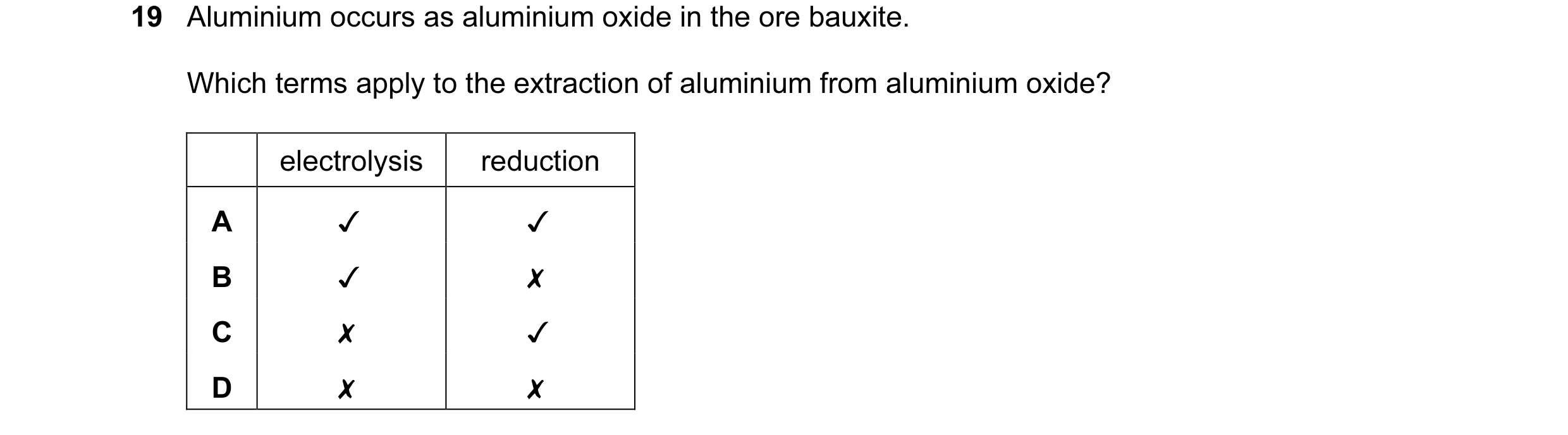
19 Aluminium occurs as aluminium oxide in the ore bauxite.
Which terms apply to the extraction of aluminium from aluminium oxide?
electrolysis reduction
A v v
B v x
Cc x v
D x x
1 marks
Answer: A
This question in 0653/13 Oct/Nov 2010
Q12 · Which property of a metal determines the method used to extract the metal from its ore? 0653/11 May/June 2012
23 Which property of a metal determines the method used to extract the metal from its ore? A the melting point of the metal B the position of the metal in the Periodic Table C the reactivity of the metal D the relative atomic mass, Ar, of the metal
1 marks
This question in 0653/11 May/June 2012
Q13 · Which property of a metal determines the method used to extract the metal from its ore? 0653/12 May/June 2012
23 Which property of a metal determines the method used to extract the metal from its ore? A the melting point of the metal B the position of the metal in the Periodic Table C the reactivity of the metal D the relative atomic mass, Ar, of the metal
1 marks
Answer: C
This question in 0653/12 May/June 2012
Q14 · Copper(II) oxide is mixed with a solid Q 0653/12 May/June 2012
24 Copper(II) oxide is mixed with a solid Q. On heating the mixture, a reaction occurs and the limewater turns milky. copper(II) oxide and solid Q heat limewater What is solid Q? A carbon B iron C sulfur D zinc
1 marks
Answer: A
This question in 0653/12 May/June 2012
Q15 · Which property of a metal determines the method used to extract the metal from its ore? 0653/13 May/June 2012
23 Which property of a metal determines the method used to extract the metal from its ore? A the melting point of the metal B the position of the metal in the Periodic Table C the reactivity of the metal D the relative atomic mass, Ar, of the metal
1 marks
Answer: C
This question in 0653/13 May/June 2012
Q16 · Which method is used to extract copper from copper(II) oxide? 0653/12 May/June 2013
27 Which method is used to extract copper from copper(II) oxide? A dissolving copper(II) oxide with hydrochloric acid and then filtering B dissolving copper(II) oxide in water and then filtering C heating the copper(II) oxide D heating the copper(II) oxide mixed with carbon
1 marks
Answer: D
This question in 0653/12 May/June 2013
Q17 · Metal X reacts rapidly with cold water 0653/11 Oct/Nov 2013
23 Metal X reacts rapidly with cold water. Metal Y does not react with dilute hydrochloric acid. Metal Y is obtained from its oxide by heating with carbon. Which row shows the more reactive metal and the type of reaction which metal Y oxide undergoes when it is heated with carbon? more reactive metal type of reaction A X oxidation B X reduction C Y oxidation D Y reduction
1 marks
Answer: B
This question in 0653/11 Oct/Nov 2013
Q18 · Copper can be made from copper oxide by reacting it with carbon at a high temperature 0653/11 Oct/Nov 2014
26 Copper can be made from copper oxide by reacting it with carbon at a high temperature. Why is carbon used? A It does not react with copper. B It is a conductor of electricity. C It is a high melting point solid. D It is more reactive than copper.
1 marks
Answer: D
This question in 0653/11 Oct/Nov 2014
Q19 · Copper can be made from copper oxide by reacting it with carbon at a high temperature 0653/12 Oct/Nov 2014
27 Copper can be made from copper oxide by reacting it with carbon at a high temperature. Why is carbon used? A It does not react with copper. B It is a conductor of electricity. C It is a high melting point solid. D It is more reactive than copper.
1 marks
Answer: D
This question in 0653/12 Oct/Nov 2014
Q20 · In the blast furnace, iron(III) oxide reacts with carbon forming iron and carbon monoxide 0653/11 May/June 2015
20 In the blast furnace, iron(III) oxide reacts with carbon forming iron and carbon monoxide. What happens to the iron(III) oxide? A It is oxidised by gaining oxygen. B It is oxidised by losing oxygen. C It is reduced by gaining oxygen. D It is reduced by losing oxygen.
1 marks
Answer: D
This question in 0653/11 May/June 2015
Q21 · Carbon is used to extract copper from copper oxide 0653/12 May/June 2015
26 Carbon is used to extract copper from copper oxide. Which statement about the process is correct? A Carbon is an oxidising agent. B Carbon is more reactive than copper. C Copper is more reactive than carbon. D Copper oxide is a reducing agent.
1 marks
Answer: B
This question in 0653/12 May/June 2015
Q22 · The following reactions occur in the blast furnace 0653/13 May/June 2015
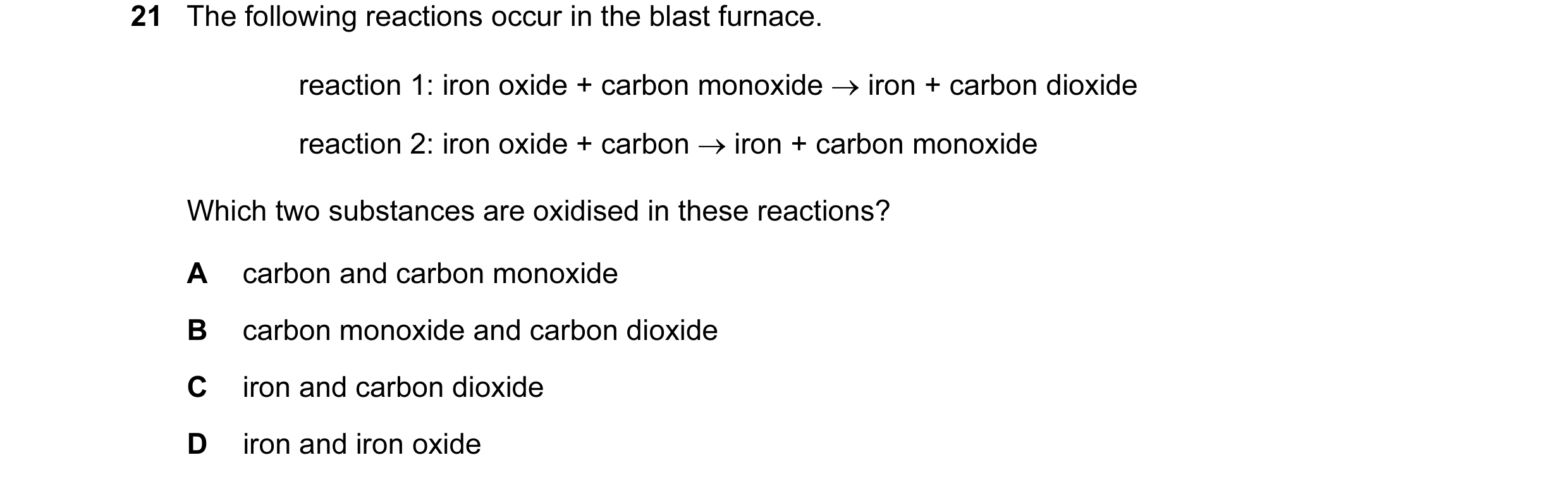
21 The following reactions occur in the blast furnace. reaction 1: iron oxide + carbon monoxide → iron + carbon dioxide reaction 2: iron oxide + carbon → iron + carbon monoxide Which two substances are oxidised in these reactions? A carbon and carbon monoxide B carbon monoxide and carbon dioxide C iron and carbon dioxide D iron and iron oxide
1 marks
Answer: A
This question in 0653/13 May/June 2015
Q23 · Tenorite is a mineral that contains copper oxide 0653/12 Oct/Nov 2016
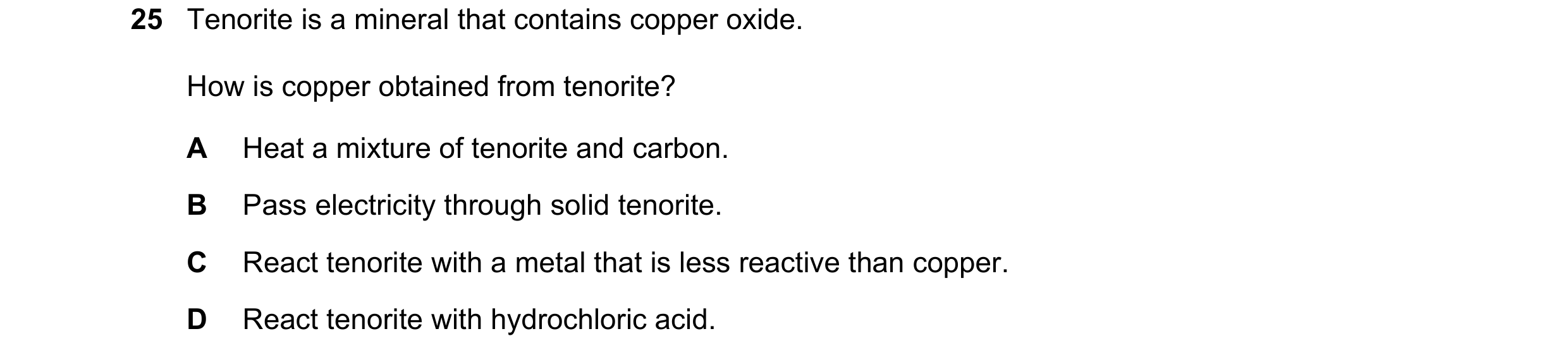
25 Tenorite is a mineral that contains copper oxide. How is copper obtained from tenorite? A Heat a mixture of tenorite and carbon. B Pass electricity through solid tenorite. C React tenorite with a metal that is less reactive than copper. D React tenorite with hydrochloric acid.
1 marks
Answer: A
This question in 0653/12 Oct/Nov 2016
Q24 · A mixture of copper(II) oxide and substance Q is heated 0653/12 May/June 2017
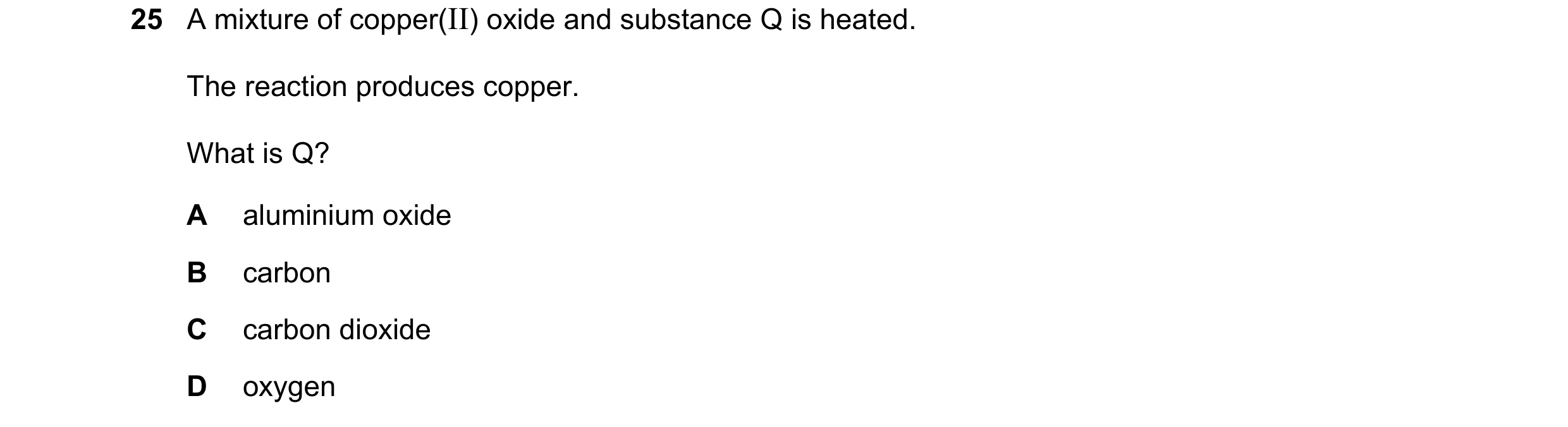
25 A mixture of copper(II) oxide and substance Q is heated. The reaction produces copper. What is Q? A aluminium oxide B carbon C carbon dioxide D oxygen
1 marks
Answer: B
This question in 0653/12 May/June 2017
Q25 · Which process is used to extract copper from copper oxide? 0653/11 Oct/Nov 2018
24 Which process is used to extract copper from copper oxide? A Heat the copper oxide on its own. B Heat the copper oxide with carbon. C Heat the copper oxide with carbon dioxide. D Heat the copper oxide with water and then filter.
1 marks
Answer: B
This question in 0653/11 Oct/Nov 2018
Q26 · Which element is used to extract copper from copper oxide? 0653/13 Oct/Nov 2018
25 Which element is used to extract copper from copper oxide? A aluminium B carbon C iron D sodium
1 marks
Answer: B
This question in 0653/13 Oct/Nov 2018
Q27 · Part of the reactivity series is shown 0653/12 May/June 2019
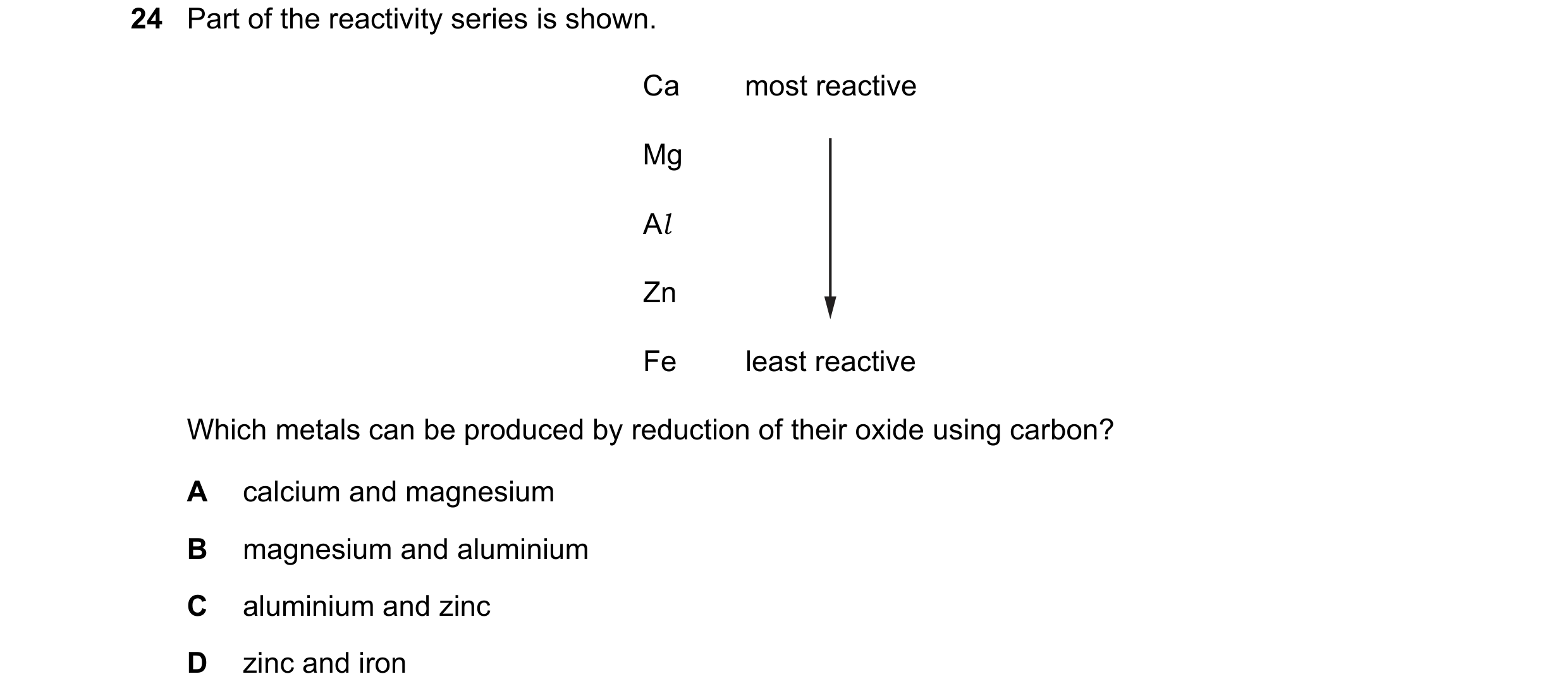
24 Part of the reactivity series is shown. Ca most reactive Mg Al Zn Fe least reactive Which metals can be produced by reduction of their oxide using carbon? A calcium and magnesium B magnesium and aluminium C aluminium and zinc D zinc and iron
1 marks
Answer: D
This question in 0653/12 May/June 2019
Q28 · Which process is used to extract copper from copper oxide? 0653/13 May/June 2019
24 Which process is used to extract copper from copper oxide? A heating copper oxide with carbon B heating copper oxide with carbon dioxide C heating copper oxide with hydrochloric acid D heating copper oxide with steam
1 marks
Answer: A
This question in 0653/13 May/June 2019
Q29 · Which row describes the method of extraction and the position of the metal in the… 0653/11 Oct/Nov 2019
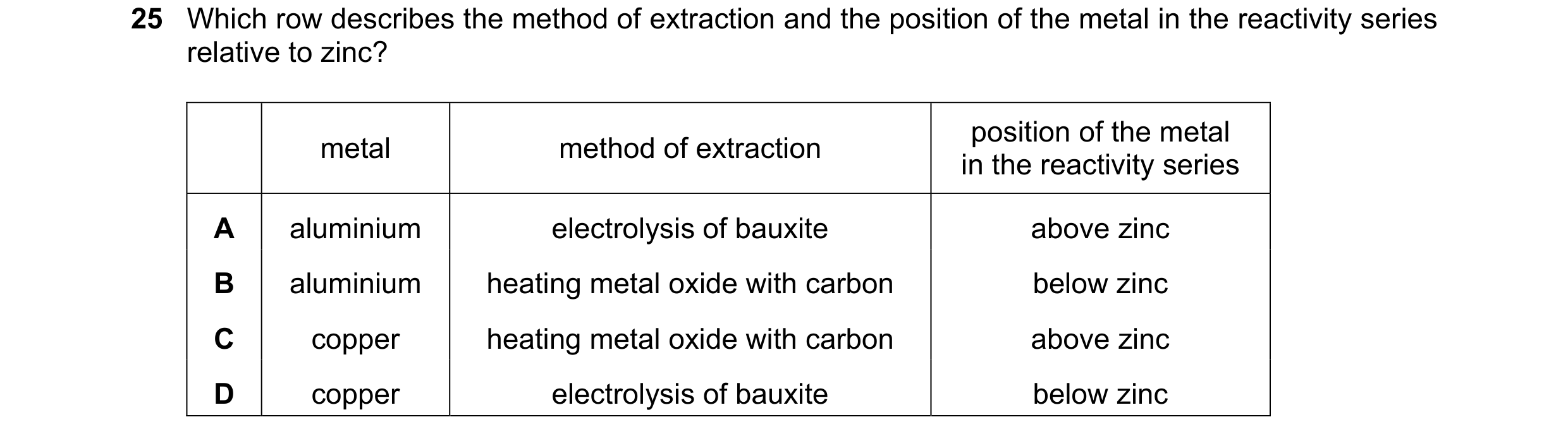
25 Which row describes the method of extraction and the position of the metal in the reactivity series relative to zinc? position of the metal metal method of extraction in the reactivity series A aluminium electrolysis of bauxite above zinc B aluminium heating metal oxide with carbon below zinc C copper heating metal oxide with carbon above zinc D copper electrolysis of bauxite below zinc
1 marks
Answer: A
This question in 0653/11 Oct/Nov 2019
Q30 · Copper oxide reacts with carbon 0653/12 Oct/Nov 2019
25 Copper oxide reacts with carbon. The equation is shown. copper oxide + carbon → copper + carbon dioxide What is the role of carbon in this reaction? A It is a catalyst. B It is an electrolyte. C It neutralises the copper oxide. D It reduces the copper oxide.
1 marks
Answer: D
This question in 0653/12 Oct/Nov 2019
Q31 · Copper oxide reacts with carbon 0653/13 Oct/Nov 2019
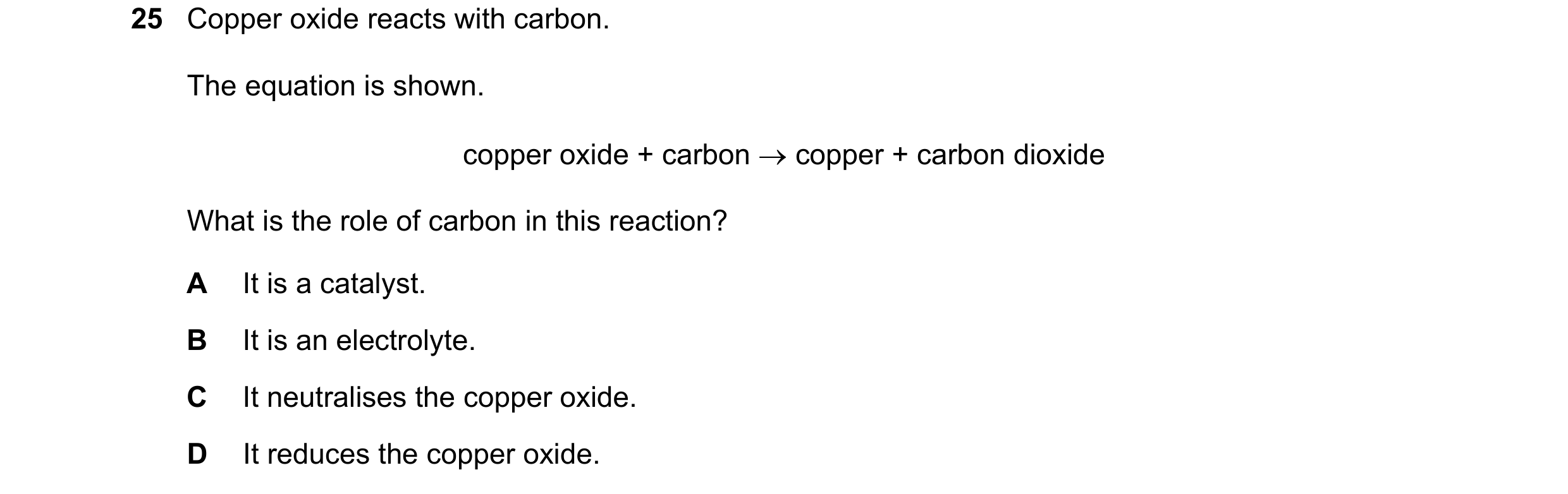
25 Copper oxide reacts with carbon. The equation is shown. copper oxide + carbon → copper + carbon dioxide What is the role of carbon in this reaction? A It is a catalyst. B It is an electrolyte. C It neutralises the copper oxide. D It reduces the copper oxide.
1 marks
Answer: D
This question in 0653/13 Oct/Nov 2019
Q32 · Why is carbon used to extract some metals from their oxide ores? 0653/12 Feb/March 2020
24 Why is carbon used to extract some metals from their oxide ores? A It oxidises the ore by removing oxygen. B It prevents the oxygen of the air reacting with the ore. C It reacts with impurities in the ore. D It reduces the ore by removing oxygen.
1 marks
Answer: D
This question in 0653/12 Feb/March 2020
Q33 · Copper can be made from copper oxide by reacting it with carbon at a high temperature 0653/11 May/June 2020
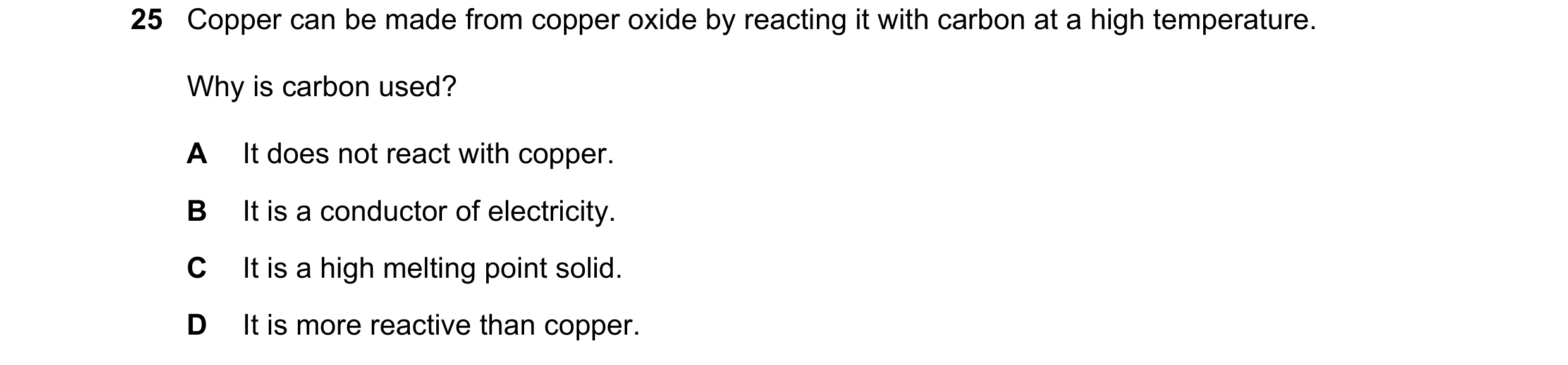
25 Copper can be made from copper oxide by reacting it with carbon at a high temperature. Why is carbon used? A It does not react with copper. B It is a conductor of electricity. C It is a high melting point solid. D It is more reactive than copper.
1 marks
Answer: D
This question in 0653/11 May/June 2020
Q34 · Which method is used to extract copper from copper(II) oxide? 0653/11 Oct/Nov 2020
25 Which method is used to extract copper from copper(II) oxide? A dissolving copper(II) oxide in hydrochloric acid and then filtering B dissolving copper(II) oxide in water and then filtering C heating the copper(II) oxide D heating the copper(II) oxide mixed with carbon
1 marks
Answer: D
This question in 0653/11 Oct/Nov 2020
Q35 · Which method is used to extract copper from copper(II) oxide? 0653/12 Oct/Nov 2020
25 Which method is used to extract copper from copper(II) oxide? A dissolving copper(II) oxide in hydrochloric acid and then filtering B dissolving copper(II) oxide in water and then filtering C heating the copper(II) oxide D heating the copper(II) oxide mixed with carbon
1 marks
Answer: D
This question in 0653/12 Oct/Nov 2020
Q36 · Which method is used to extract copper from copper(II) oxide? 0653/13 Oct/Nov 2020
25 Which method is used to extract copper from copper(II) oxide? A dissolving copper(II) oxide in hydrochloric acid and then filtering B dissolving copper(II) oxide in water and then filtering C heating the copper(II) oxide D heating the copper(II) oxide mixed with carbon
1 marks
Answer: D
This question in 0653/13 Oct/Nov 2020
Q37 · Copper is below both carbon and hydrogen in the reactivity series 0653/12 May/June 2022
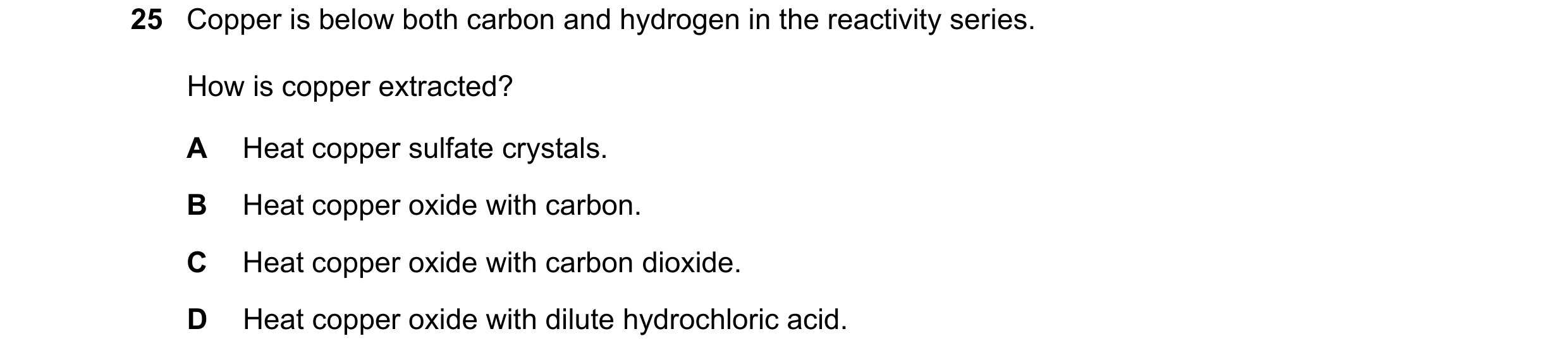
25 Copper is below both carbon and hydrogen in the reactivity series. How is copper extracted? A Heat copper sulfate crystals. B Heat copper oxide with carbon. C Heat copper oxide with carbon dioxide. D Heat copper oxide with dilute hydrochloric acid.
1 marks
Answer: B
This question in 0653/12 May/June 2022
Q38 · Which method is used to extract aluminium from the ore bauxite? 0653/11 Oct/Nov 2022
24 Which method is used to extract aluminium from the ore bauxite? A heating bauxite until it decomposes B heating bauxite with carbon C the electrolysis of aqueous bauxite D the electrolysis of molten bauxite
1 marks
Answer: D
This question in 0653/11 Oct/Nov 2022
Q39 · Which row identifies the methods used to extract copper and aluminium from their ores? 0653/12 Oct/Nov 2022
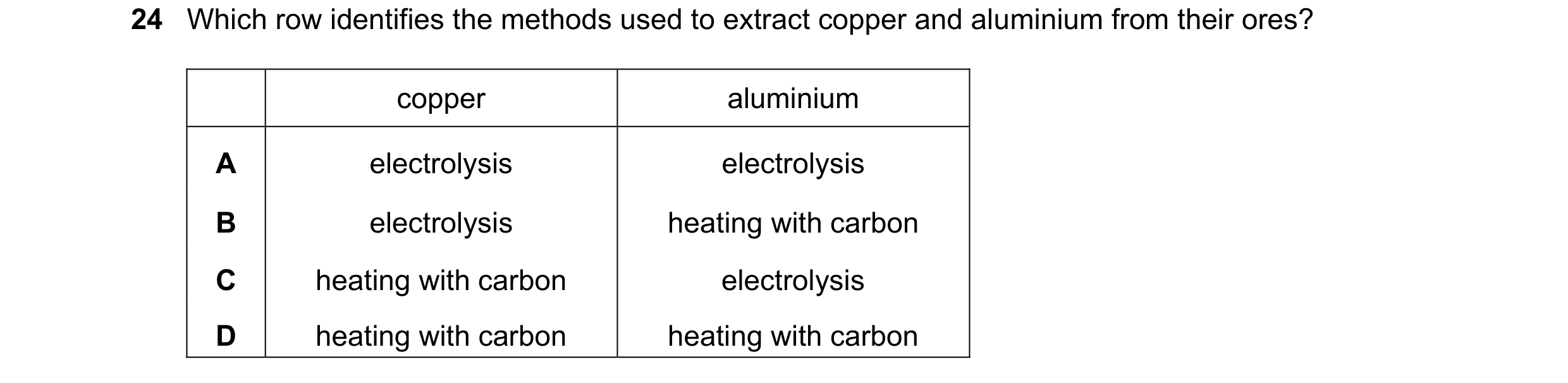
24 Which row identifies the methods used to extract copper and aluminium from their ores? copper aluminium A electrolysis electrolysis B electrolysis heating with carbon C heating with carbon electrolysis D heating with carbon heating with carbon
1 marks
Answer: C
This question in 0653/12 Oct/Nov 2022
Q40 · Which row identifies the methods used to extract copper and aluminium from their ores? 0653/13 Oct/Nov 2022
24 Which row identifies the methods used to extract copper and aluminium from their ores? copper aluminium A electrolysis electrolysis B electrolysis heating with carbon C heating with carbon electrolysis D heating with carbon heating with carbon
1 marks
Answer: C
This question in 0653/13 Oct/Nov 2022
Q41 · Which statement about the extraction of metals is correct? 0653/12 Feb/March 2023
23 Which statement about the extraction of metals is correct? A Aluminium is extracted from aluminium oxide by heating with carbon. B Aluminium is less reactive than copper so aluminium can be extracted by electrolysis. C Carbon can be used to remove oxygen from copper(II) oxide. D Copper is extracted from the ore bauxite.
1 marks
Answer: C
This question in 0653/12 Feb/March 2023
Q42 · Copper oxide is heated with carbon as shown 0653/13 May/June 2023
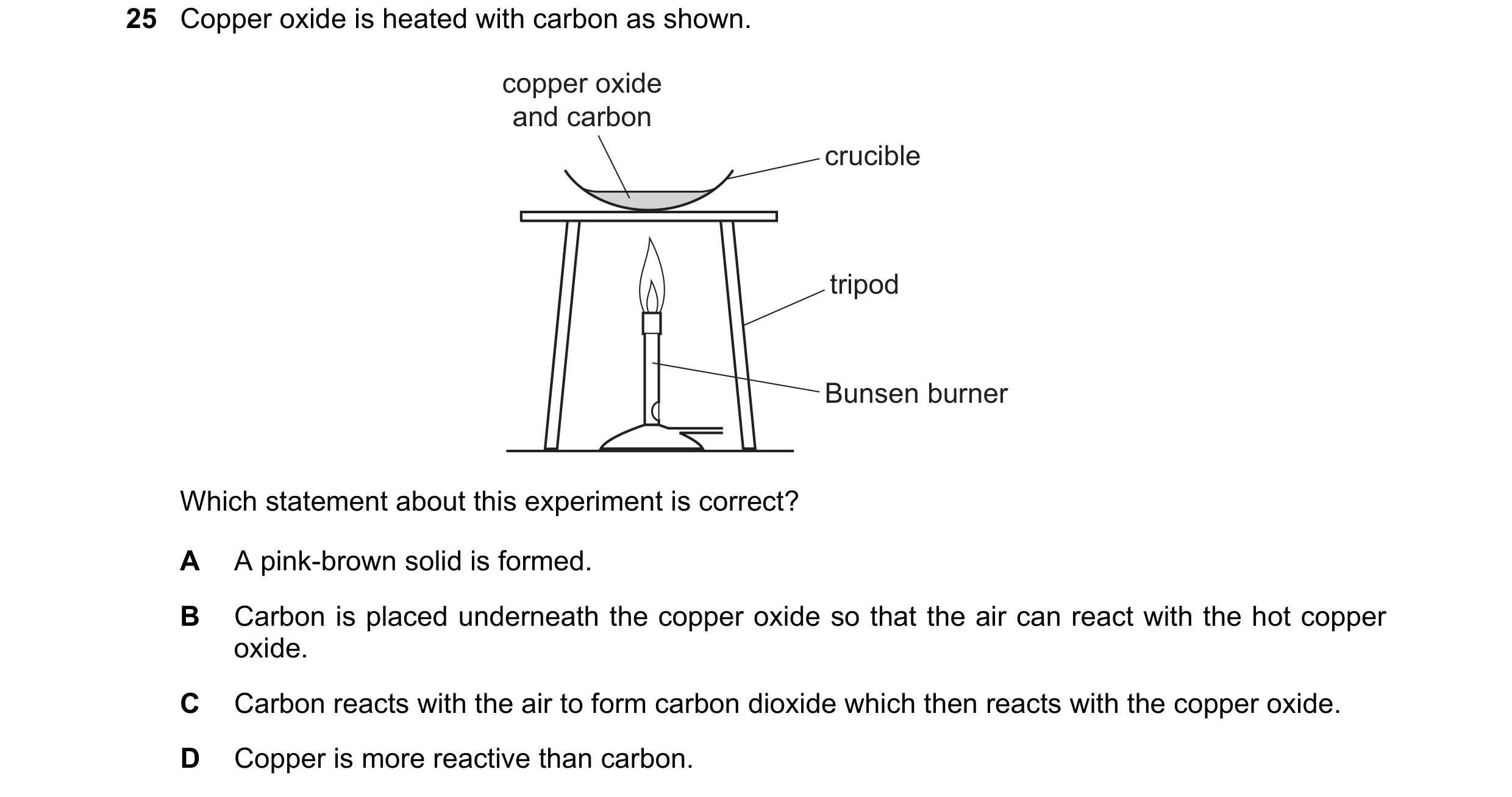
25 Copper oxide is heated with carbon as shown. copper oxide and carbon crucible tripod Bunsen burner Which statement about this experiment is correct? A A pink-brown solid is formed. B Carbon is placed underneath the copper oxide so that the air can react with the hot copper oxide. C Carbon reacts with the air to form carbon dioxide which then reacts with the copper oxide. D Copper is more reactive than carbon.
1 marks
Answer: A
This question in 0653/13 May/June 2023
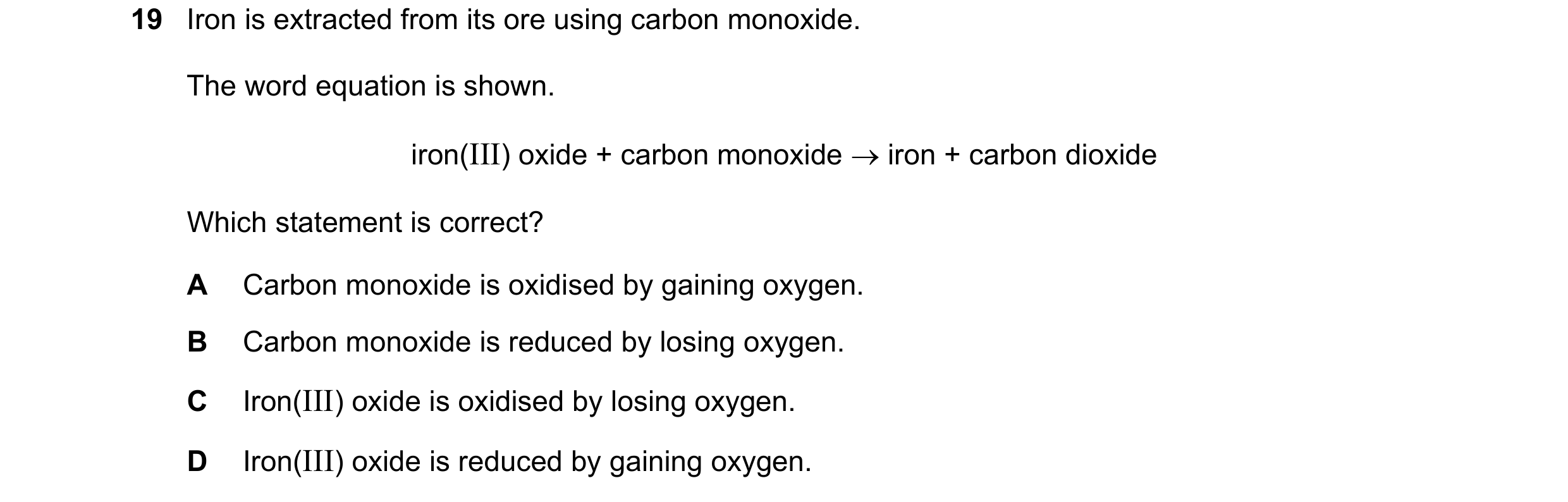
Q43 · Iron is extracted from its ore using carbon monoxide 0653/13 Oct/Nov 2023
19 Iron is extracted from its ore using carbon monoxide. The word equation is shown. iron(III) oxide + carbon monoxide iron + carbon dioxide Which statement is correct? A Carbon monoxide is oxidised by gaining oxygen. B Carbon monoxide is reduced by losing oxygen. C Iron(III) oxide is oxidised by losing oxygen. D Iron(III) oxide is reduced by gaining oxygen.
1 marks
Answer: A
This question in 0653/13 Oct/Nov 2023
Q44 · What is a reduction process? 0653/12 May/June 2024
21 What is a reduction process? A the combustion of a fuel B the thermal decomposition of calcium carbonate C the extraction of copper from copper oxide D the reaction between an acid and an alkali
1 marks
Answer: C
This question in 0653/12 May/June 2024
Q45 · Which type of reaction occurs when iron is obtained from its oxide using carbon? 0653/12 Oct/Nov 2024
19 Which type of reaction occurs when iron is obtained from its oxide using carbon? A combustion B neutralisation C electrolysis D reduction
1 marks
Answer: D
This question in 0653/12 Oct/Nov 2024
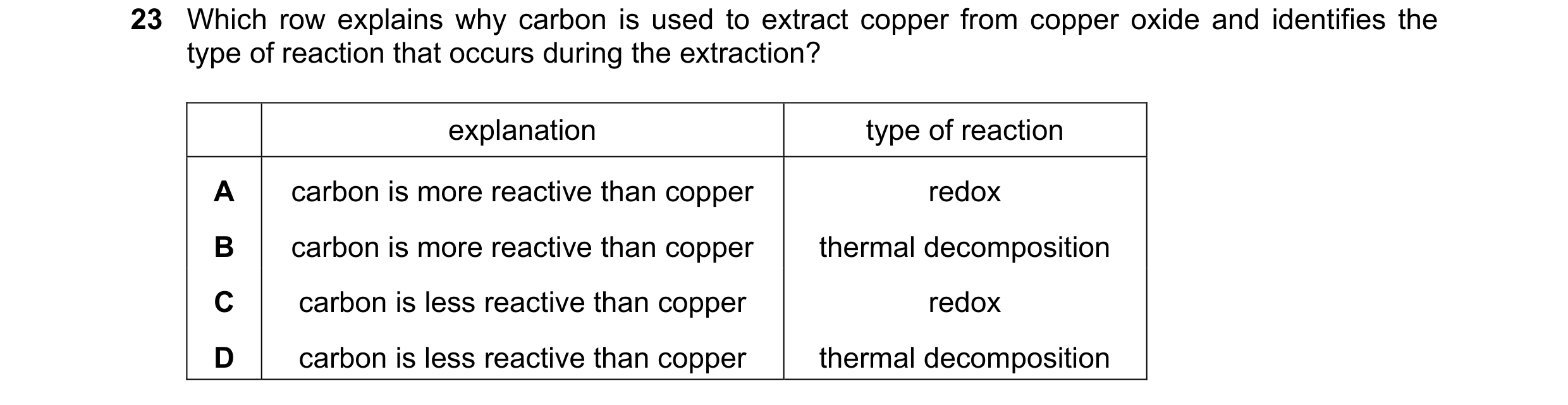
Q46 · Which row explains why carbon is used to extract copper from copper oxide and identifies… 0653/12 Oct/Nov 2024
23 Which row explains why carbon is used to extract copper from copper oxide and identifies the type of reaction that occurs during the extraction? explanation type of reaction A carbon is more reactive than copper redox B carbon is more reactive than copper thermal decomposition C carbon is less reactive than copper redox D carbon is less reactive than copper thermal decomposition
1 marks
Answer: A
This question in 0653/12 Oct/Nov 2024
Q47 · Which type of reaction occurs when iron is obtained from its oxide using carbon? 0653/13 Oct/Nov 2024
19 Which type of reaction occurs when iron is obtained from its oxide using carbon? A combustion B neutralisation C electrolysis D reduction
1 marks
Answer: D
This question in 0653/13 Oct/Nov 2024
Q48 · Which statement describes the extraction of aluminium? 0653/12 Feb/March 2025
22 Which statement describes the extraction of aluminium? A It is extracted from bauxite using electrolysis. B It is extracted from bauxite using carbon. C It is extracted from hematite using electrolysis. D It is extracted from hematite using carbon.
1 marks
Answer: A
This question in 0653/12 Feb/March 2025
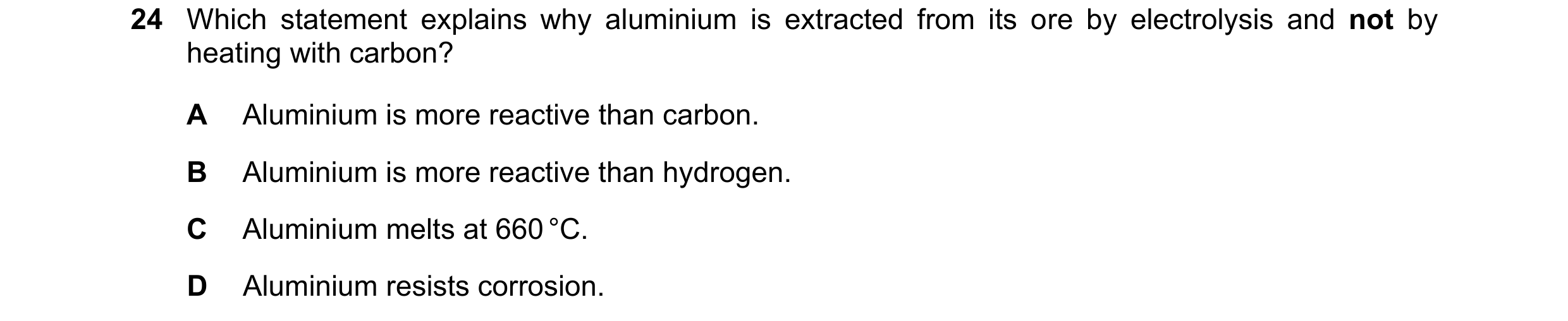
Q49 · Which statement explains why aluminium is extracted from its ore by electrolysis and not… 0653/11 May/June 2025
24 Which statement explains why aluminium is extracted from its ore by electrolysis and not by heating with carbon? A Aluminium is more reactive than carbon. B Aluminium is more reactive than hydrogen. C Aluminium melts at 660 °C. D Aluminium resists corrosion.
1 marks
Answer: A
This question in 0653/11 May/June 2025
Q50 · Which row shows the name of an ore of iron and the process used to extract iron from the… 0653/12 May/June 2025
25 Which row shows the name of an ore of iron and the process used to extract iron from the ore? ore process A bauxite electrolysis B bauxite reduction in the blast furnace C hematite electrolysis D hematite reduction in the blast furnace
1 marks
Answer: D
This question in 0653/12 May/June 2025
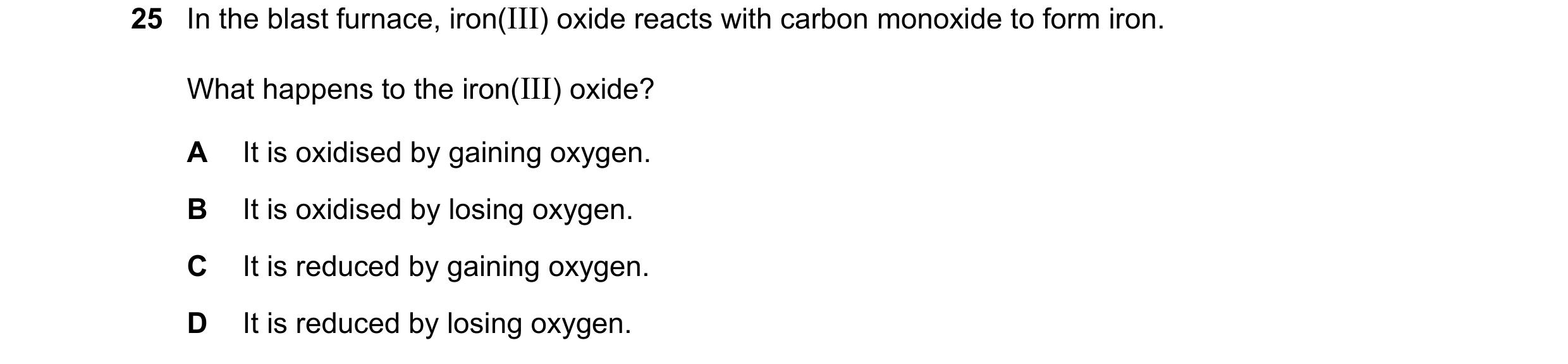
Q51 · In the blast furnace, iron(III) oxide reacts with carbon monoxide to form iron 0653/13 May/June 2025
25 In the blast furnace, iron(III) oxide reacts with carbon monoxide to form iron. What happens to the iron(III) oxide? A It is oxidised by gaining oxygen. B It is oxidised by losing oxygen. C It is reduced by gaining oxygen. D It is reduced by losing oxygen.
1 marks
Answer: D
This question in 0653/13 May/June 2025


 1 / 12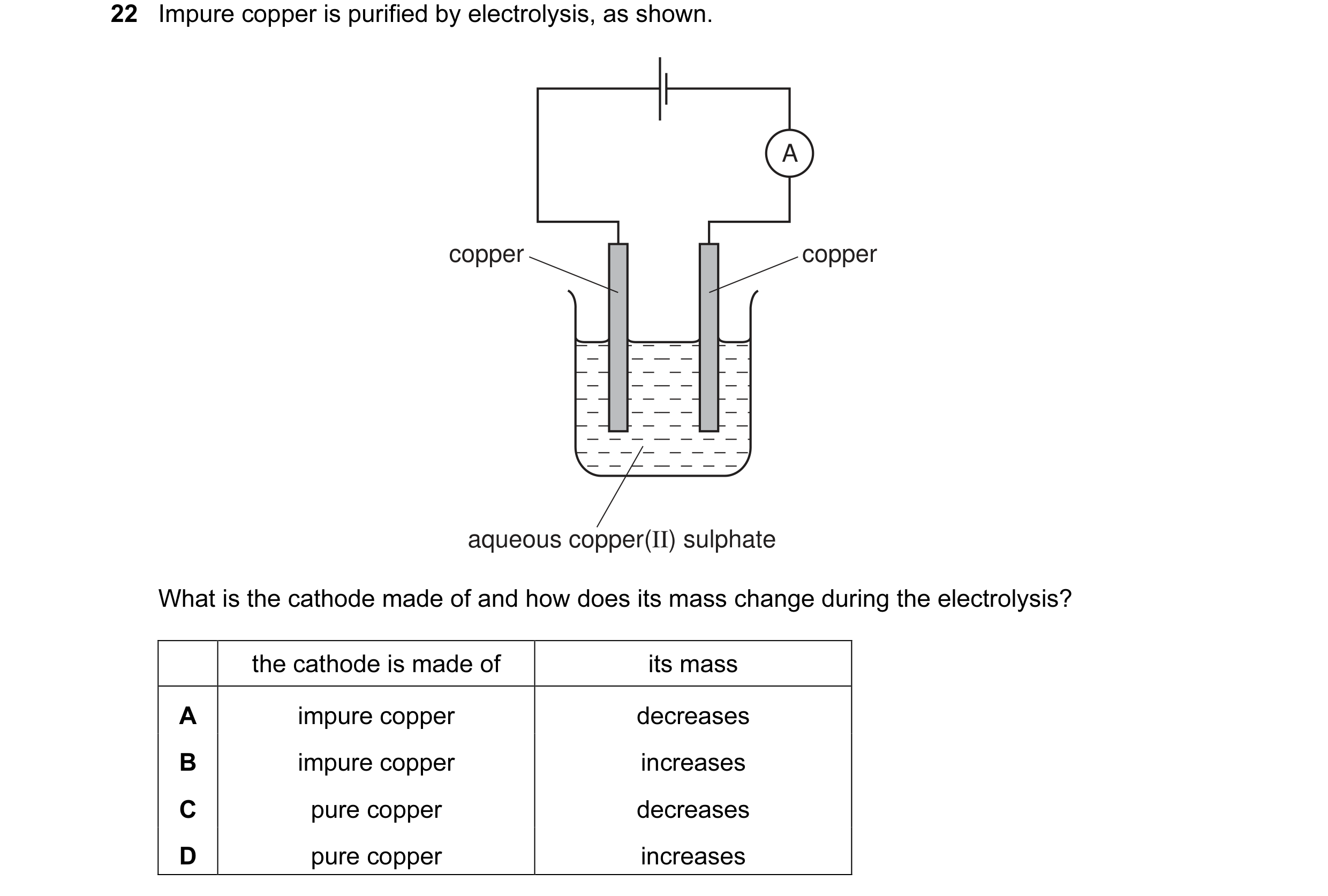


 2 / 12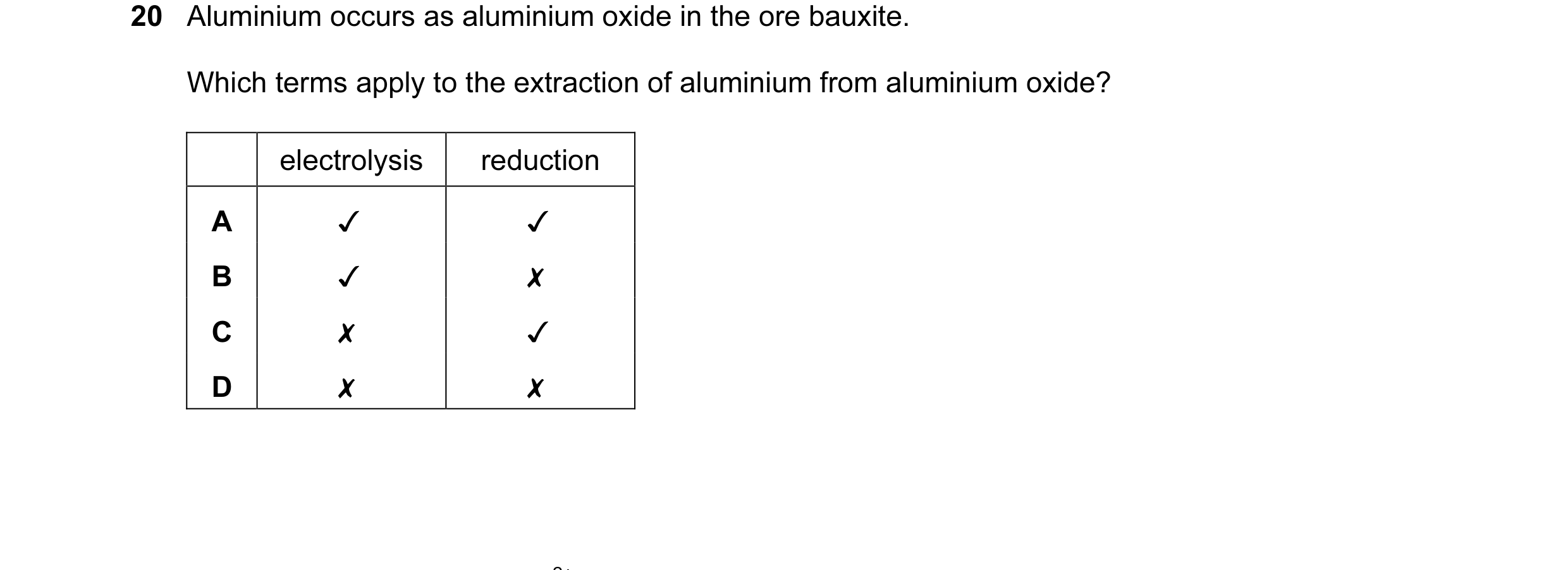

 3 / 12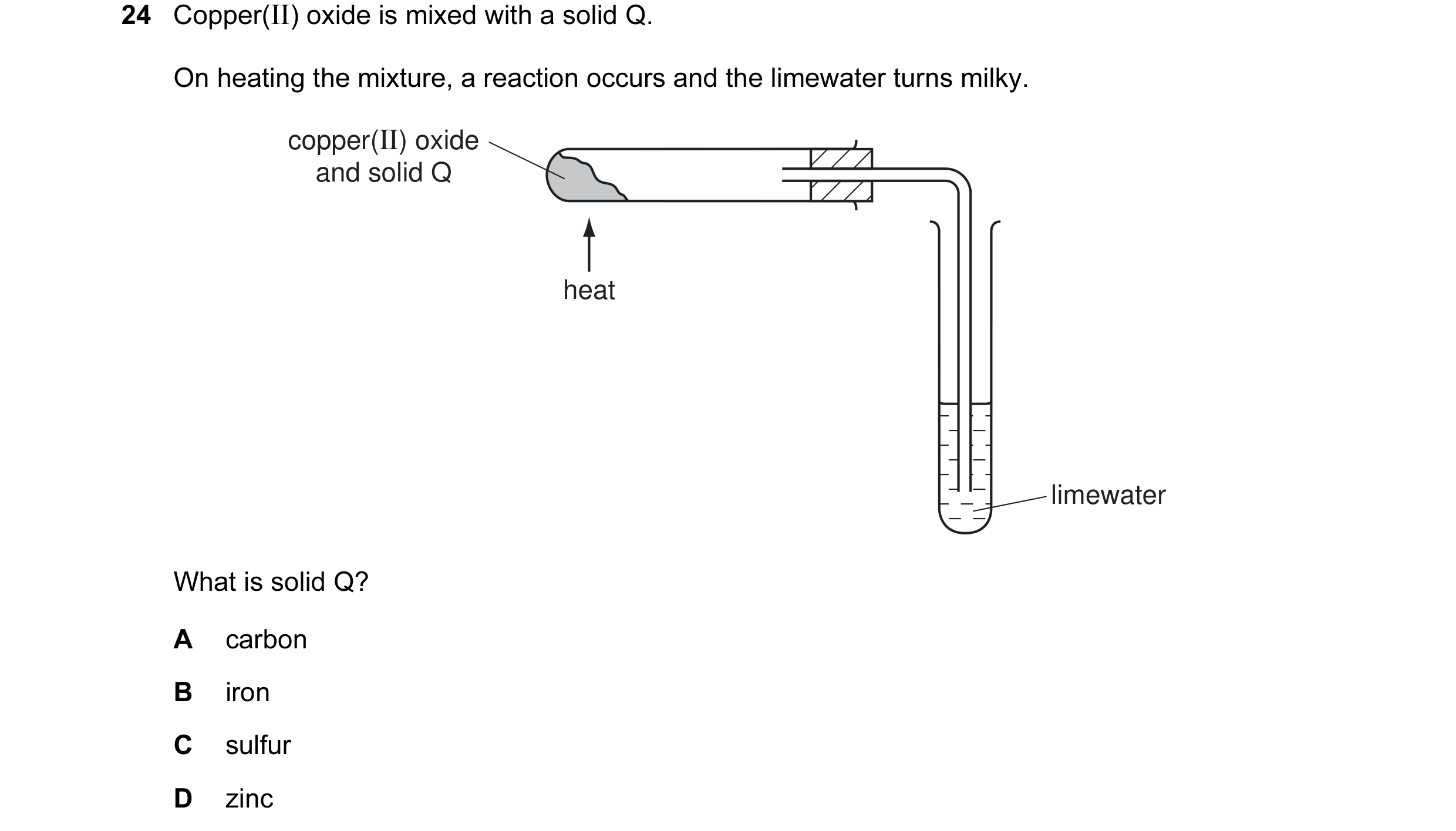

 4 / 12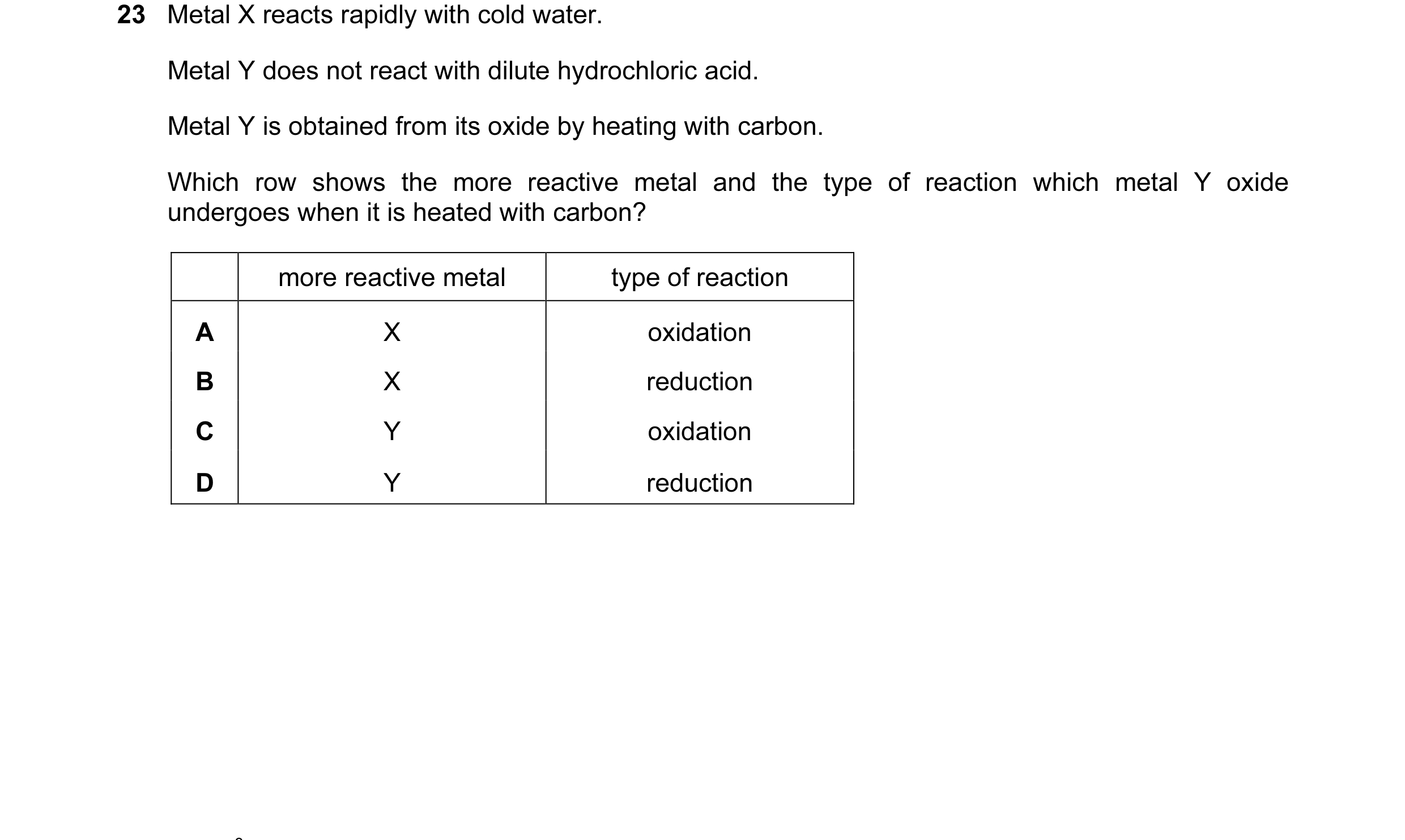
 5 / 12
 6 / 12

 7 / 12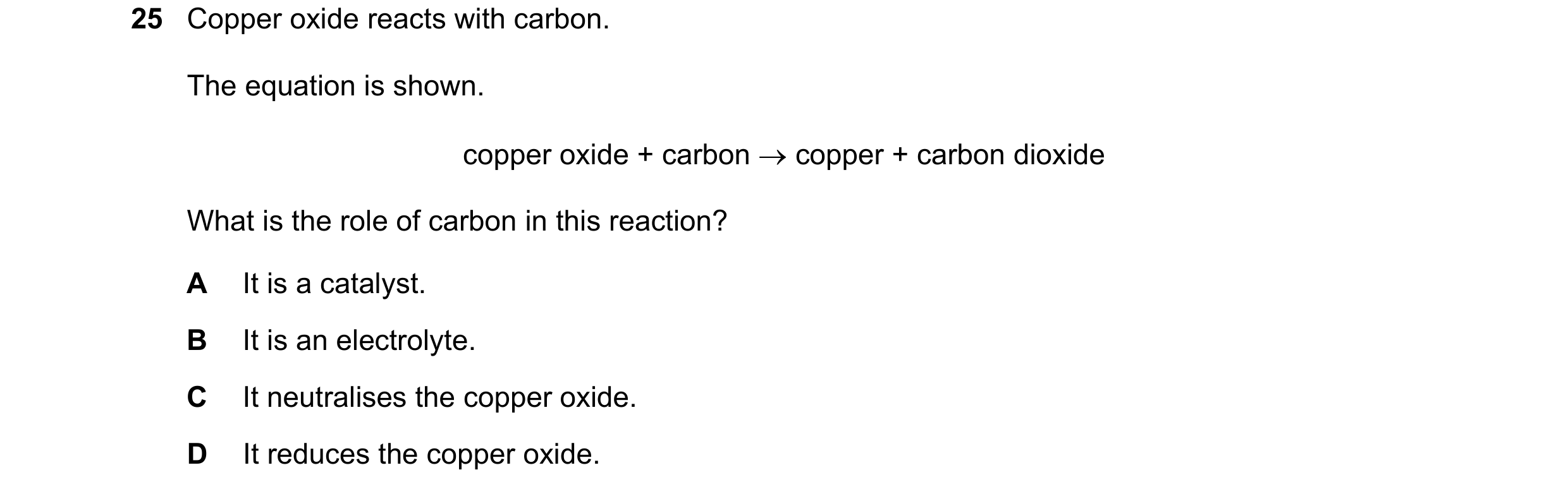

 8 / 12


 9 / 12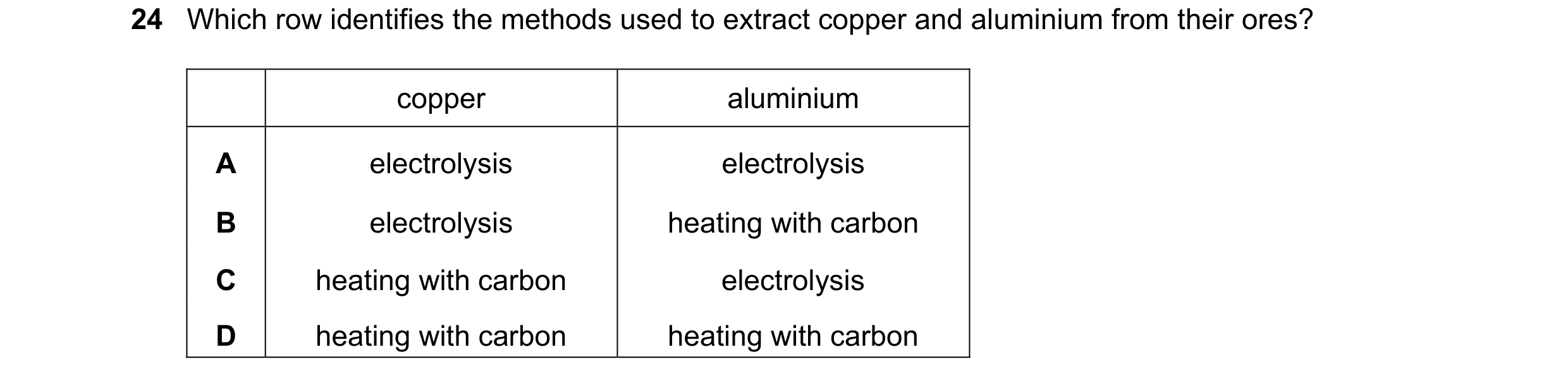

 10 / 12



 11 / 12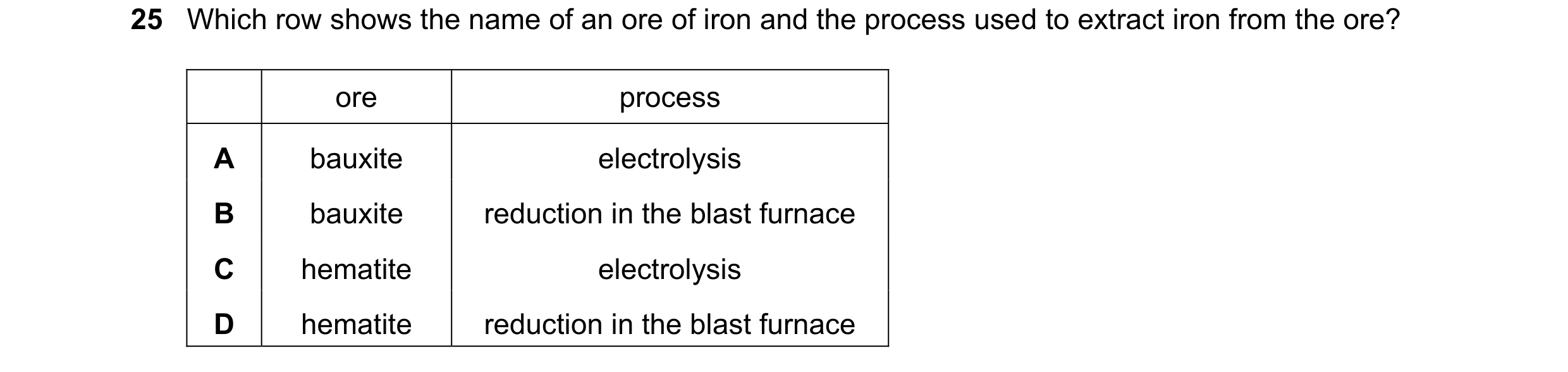
 12 / 12