Questions as text
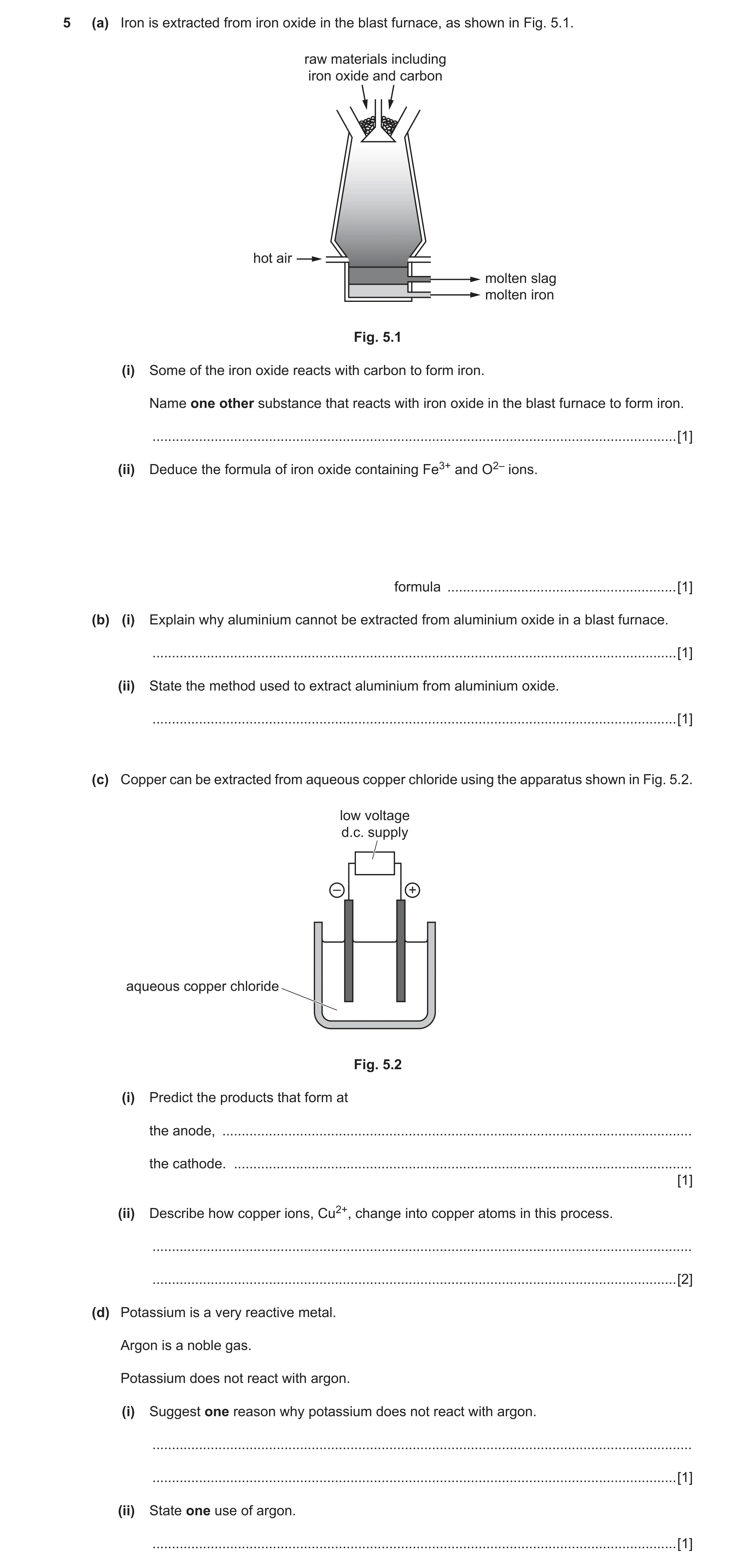
Q1 · Iron is extracted from iron oxide in the blast furnace, as shown in Fig 0653/42 Feb/March 2017
5 (a) Iron is extracted from iron oxide in the blast furnace, as shown in Fig. 5.1. raw materials including iron oxide and carbon hot air molten slag molten iron Fig. 5.1 (i) Some of the iron oxide reacts with carbon to form iron. Name one other substance that reacts with iron oxide in the blast furnace to form iron. … [1] (ii) Deduce the formula of iron oxide containing Fe3+ and O2– ions. formula … [1] (b) (i) Explain why aluminium cannot be extracted from aluminium oxide in a blast furnace. … [1] (ii) State the method used to extract aluminium from aluminium oxide. … [1] (c) Copper can be extracted from aqueous copper chloride using the apparatus shown in Fig. 5.2. low voltage d.c. supply – + aqueous copper chloride Fig. 5.2 (i) Predict the products that form at the anode, … the cathode. … [1] (ii) Describe how copper ions, Cu2+, change into copper atoms in this process. … … [2] (d) Potassium is a very reactive metal. Argon is a noble gas. Potassium does not react with argon. (i) Suggest one reason why potassium does not react with argon. … … [1] (ii) State one use of argon. … [1]
9 marks
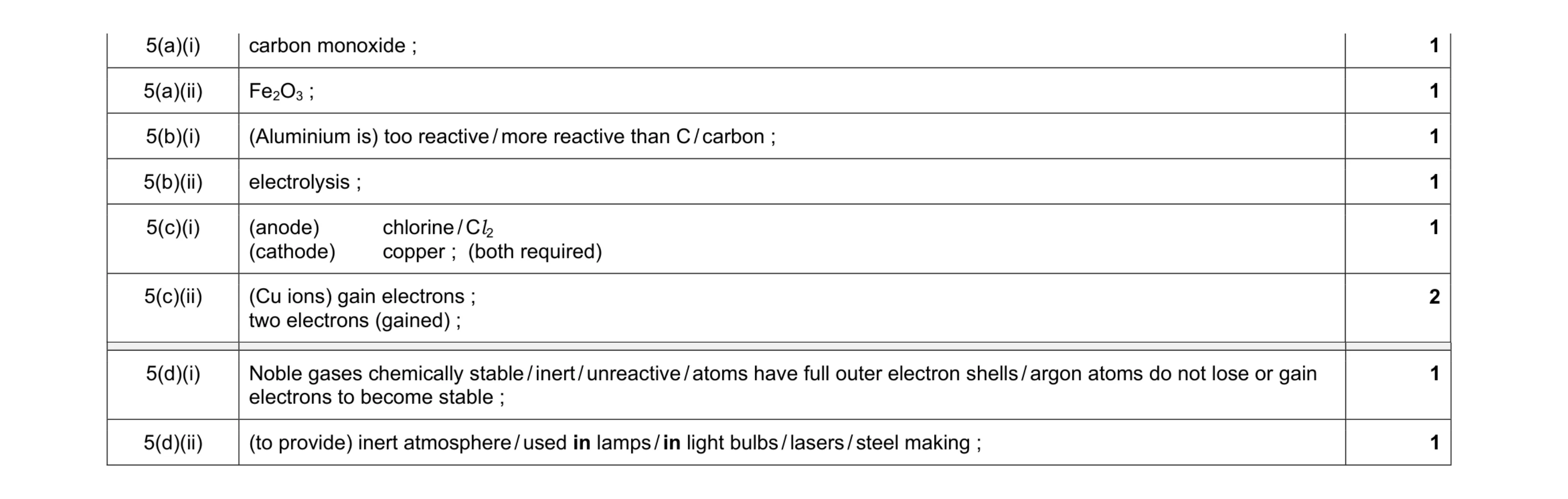
Mark scheme: 5(a)(i) carbon monoxide ; 1 5(a)(ii) Fe2O3 ; 1 5(b)(i) (Aluminium is) too reactive / more reactive than C / carbon ; 1 5(b)(ii) electrolysis ; 1 5(c)(i) (anode) chlorine / Cl2 (cathode) copper ; (both required) 1 5(c)(ii) (Cu ions) gain electrons ; two electrons (gained) ; 2 Question Answer Marks 5(d)(i) Noble gases chemically stable / inert / unreactive / atoms have full outer electron shells / argon atoms do not lose or gain electrons to become stable ; 1 5(d)(ii) (to provide) inert atmosphere / used in lamps / in light bulbs / lasers / steel making ; 1
This question in 0653/42 Feb/March 2017
Q2 · Use the Periodic Table on page 24 to determine the electronic structure of an aluminium… 0653/41 May/June 2017
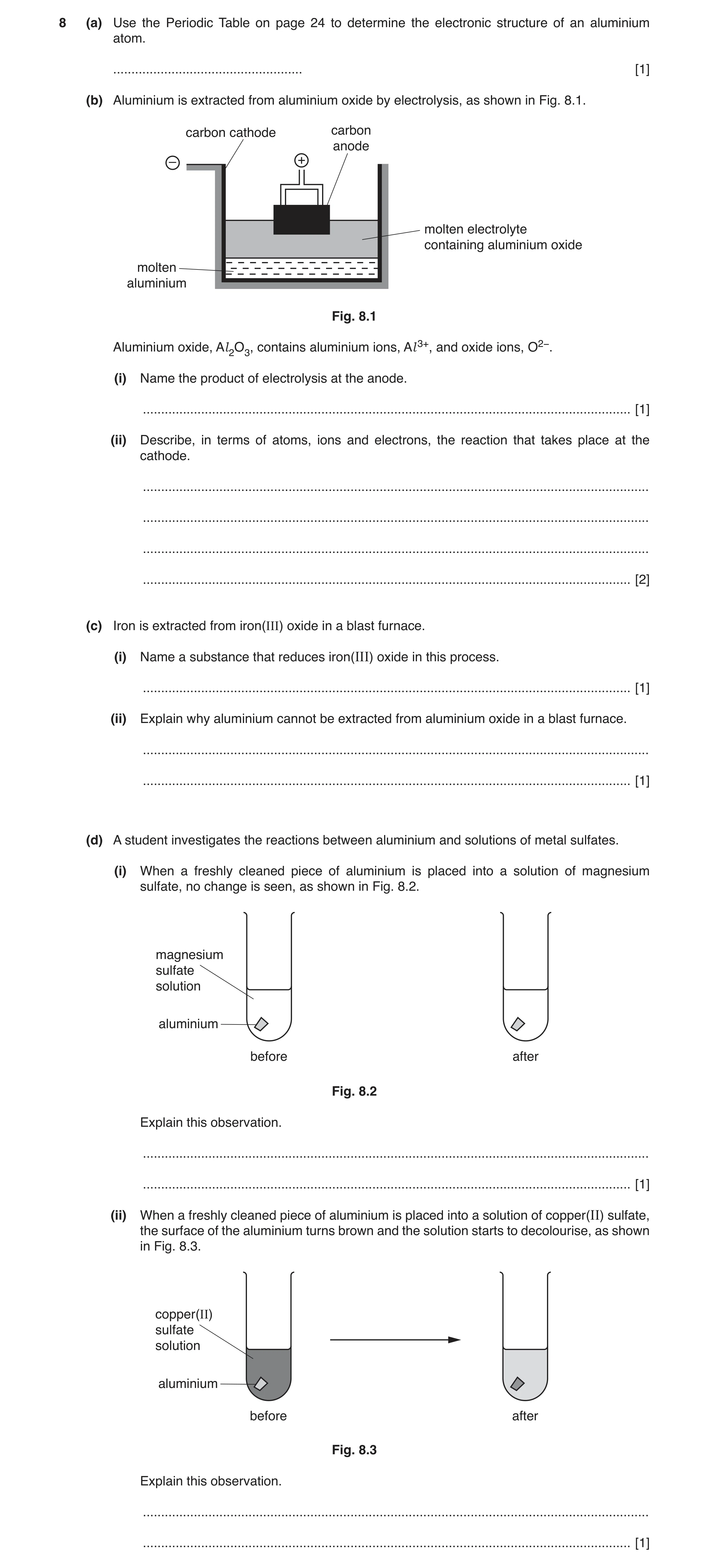
8 (a) Use the Periodic Table on page 24 to determine the electronic structure of an aluminium atom. … [1] (b) Aluminium is extracted from aluminium oxide by electrolysis, as shown in Fig. 8.1. carbon cathode carbon anode – + molten electrolyte containing aluminium oxide molten aluminium Fig. 8.1 Aluminium oxide, Al2O3, contains aluminium ions, Al 3+, and oxide ions, O2−. (i) Name the product of electrolysis at the anode. … [1] (ii) Describe, in terms of atoms, ions and electrons, the reaction that takes place at the cathode. … … … … [2] (c) Iron is extracted from iron(III) oxide in a blast furnace. (i) Name a substance that reduces iron(III) oxide in this process. … [1] (ii) Explain why aluminium cannot be extracted from aluminium oxide in a blast furnace. … … [1] (d) A student investigates the reactions between aluminium and solutions of metal sulfates. (i) When a freshly cleaned piece of aluminium is placed into a solution of magnesium sulfate, no change is seen, as shown in Fig. 8.2. magnesium sulfate solution aluminium before after Fig. 8.2 Explain this observation. … … [1] (ii) When a freshly cleaned piece of aluminium is placed into a solution of copper(II) sulfate, the surface of the aluminium turns brown and the solution starts to decolourise, as shown in Fig. 8.3. copper(II) sulfate solution aluminium before after Fig. 8.3 Explain this observation. … … [1]
8 marks
Mark scheme: 8(a) 1 8(b)(i) oxygen (gas) ; 1 8(b)(ii) aluminium ions gain electrons ; gain 3 electrons / ions are discharged / become aluminium atoms ; 2 8(c)(i) carbon / C / carbon monoxide / CO ; 1 8(c)(ii) aluminium / Al is more reactive than carbon / C ; 1 8(d)(i) Al is less reactive than Mg ; 1 8(d)(ii) Al is more reactive than Cu ; 1
This question in 0653/41 May/June 2017
Q3 · A student tries to produce chlorine gas and copper by electrolysis 0653/42 Oct/Nov 2017
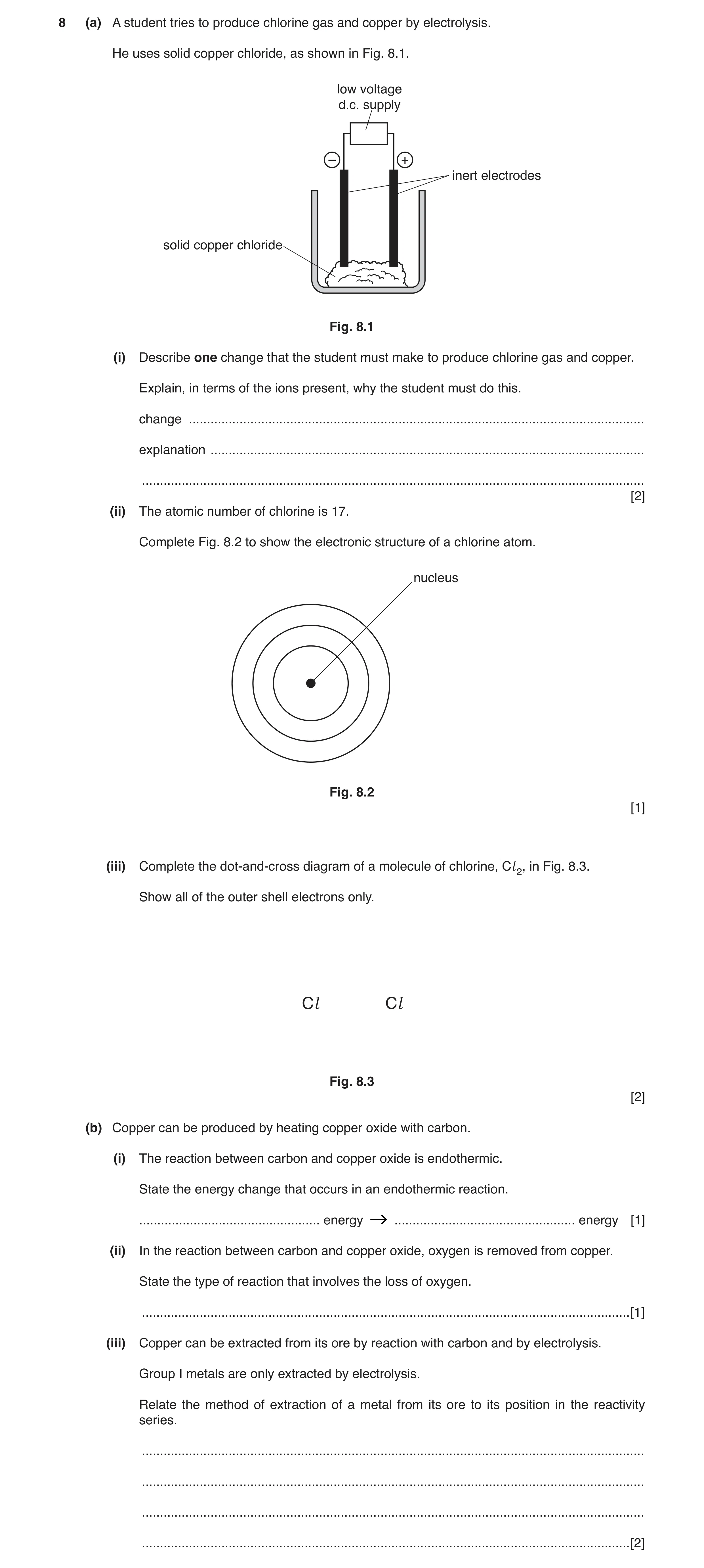
8 (a) A student tries to produce chlorine gas and copper by electrolysis. He uses solid copper chloride, as shown in Fig. 8.1. low voltage d.c. supply – + inert electrodes solid copper chloride Fig. 8.1 (i) Describe one change that the student must make to produce chlorine gas and copper. Explain, in terms of the ions present, why the student must do this. change … explanation … … [2] (ii) The atomic number of chlorine is 17. Complete Fig. 8.2 to show the electronic structure of a chlorine atom. nucleus Fig. 8.2 [1] (iii) Complete the dot-and-cross diagram of a molecule of chlorine, Cl 2, in Fig. 8.3. Show all of the outer shell electrons only. Cl Cl Fig. 8.3 [2] (b) Copper can be produced by heating copper oxide with carbon. (i) The reaction between carbon and copper oxide is endothermic. State the energy change that occurs in an endothermic reaction. … energy … energy [1] (ii) In the reaction between carbon and copper oxide, oxygen is removed from copper. State the type of reaction that involves the loss of oxygen. … [1] (iii) Copper can be extracted from its ore by reaction with carbon and by electrolysis. Group I metals are only extracted by electrolysis. Relate the method of extraction of a metal from its ore to its position in the reactivity series. … … … … [2]
9 marks
Mark scheme: 8(a)(i) add water / make into a solution / aqueous ; (so that) ions are mobile / can move ; 2 8(a)(ii) electrons arranged 2,8,7 ; 1 8(a)(iii) two electrons shown between Cl atoms ; six unshared electrons around each Cl atom ; 2 8(b)(i) thermal / heat (energy) → chemical (energy) ; 1 8(b)(ii) reduction ; 1 8(b)(iii) reactive metals / high in the reactivity series extracted by electrolysis ; less reactive metals / low in the reactivity series extracted by reaction with carbon ; reference to the relative reactivity of metal / named metal with carbon ; max 2
This question in 0653/42 Oct/Nov 2017
Q4 · The atomic number of oxygen is 8 0653/43 Oct/Nov 2017
8 (a) (i) The atomic number of oxygen is 8. Complete Fig. 8.1 to show the electronic structure of an oxygen atom. nucleus Fig. 8.1 [1] (ii) Complete the dot-and-cross diagram of a molecule of water. Show all the outer shell electrons. H O H [2] (b) Element Z has two electrons in its outer shell. Z is not the symbol for this element. (i) Predict the group number of element Z in the Periodic Table. … [1] (ii) An atom of element Z forms an ion. State the charge of this ion. Explain how this ion forms. charge … explanation … … … [2] (c) Potassium, copper and iron are extracted by different methods. Complete Table 8.1 to show the order of reactivity of these three metals. State the method of extraction of each metal from its ore. Table 8.1 order of reactivity metal method of extraction most reactive least reactive [3]
9 marks
Mark scheme: 8(a)(i) 2 electrons in 1st shell and 6 electrons in 2nd shell ; 1 8(a)(ii) 2 bonding pairs ; 2 lone pairs and no extra electrons anywhere ; 2 8(b)(i) II / 2 / two ; 1 8(b)(ii) 2+ ; loses two electrons ; 2 8(c) order of reactivity metal method of extraction most reactive least reactive potassium / K electrolysis ; iron / Fe blast furnace / reduction by C / CO ; copper / Cu ; carbon reduction / heat with carbon ; order of reactivity ; electrolysis linked to potassium ; carbon reduction owtte for both Fe and Cu ; 3
This question in 0653/43 Oct/Nov 2017
Q5 · Copper is extracted from molten copper chloride using electrolysis 0653/42 Feb/March 2018
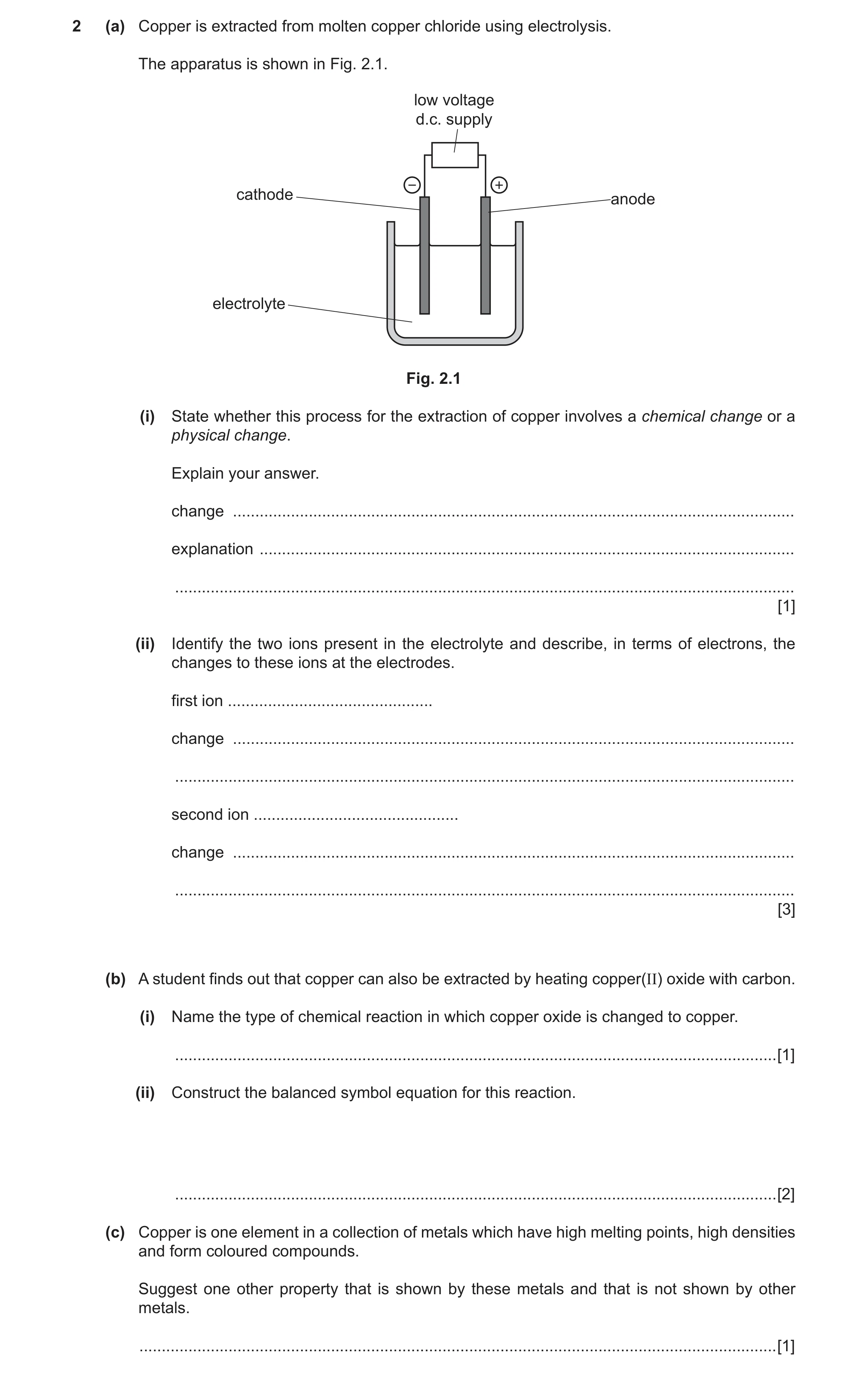
2 (a) Copper is extracted from molten copper chloride using electrolysis. The apparatus is shown in Fig. 2.1. low voltage d.c. supply − + cathode anode electrolyte Fig. 2.1 (i) State whether this process for the extraction of copper involves a chemical change or a physical change. Explain your answer. change … explanation … … [1] (ii) Identify the two ions present in the electrolyte and describe, in terms of electrons, the changes to these ions at the electrodes. first ion … change … … second ion … change … … [3] (b) A student finds out that copper can also be extracted by heating copper(II) oxide with carbon. (i) Name the type of chemical reaction in which copper oxide is changed to copper. … [1] (ii) Construct the balanced symbol equation for this reaction. … [2] (c) Copper is one element in a collection of metals which have high melting points, high densities and form coloured compounds. Suggest one other property that is shown by these metals and that is not shown by other metals. … [1]
8 marks
Mark scheme: 2(a)(i) chemical AND the idea that new substance(s) made ; 1 2(a)(ii) copper(II) / Cu2+ AND chloride / Cl – ; (copper(II) / Cu2+) gains (2) electrons ; (chloride / Cl –) loses (1) electron ; 3 2(b)(i) reduction / redox ; 1 2(b)(ii) C + 2CuO → CO2 + 2Cu all formulae correct ; correctly balanced ; 2 2(c) act as catalysts / form (compounds which act as) catalysts / other valid answers ; 1
This question in 0653/42 Feb/March 2018
Q6 · A student tries to make lead from a sample of solid lead(II) bromide using the… 0653/41 May/June 2018
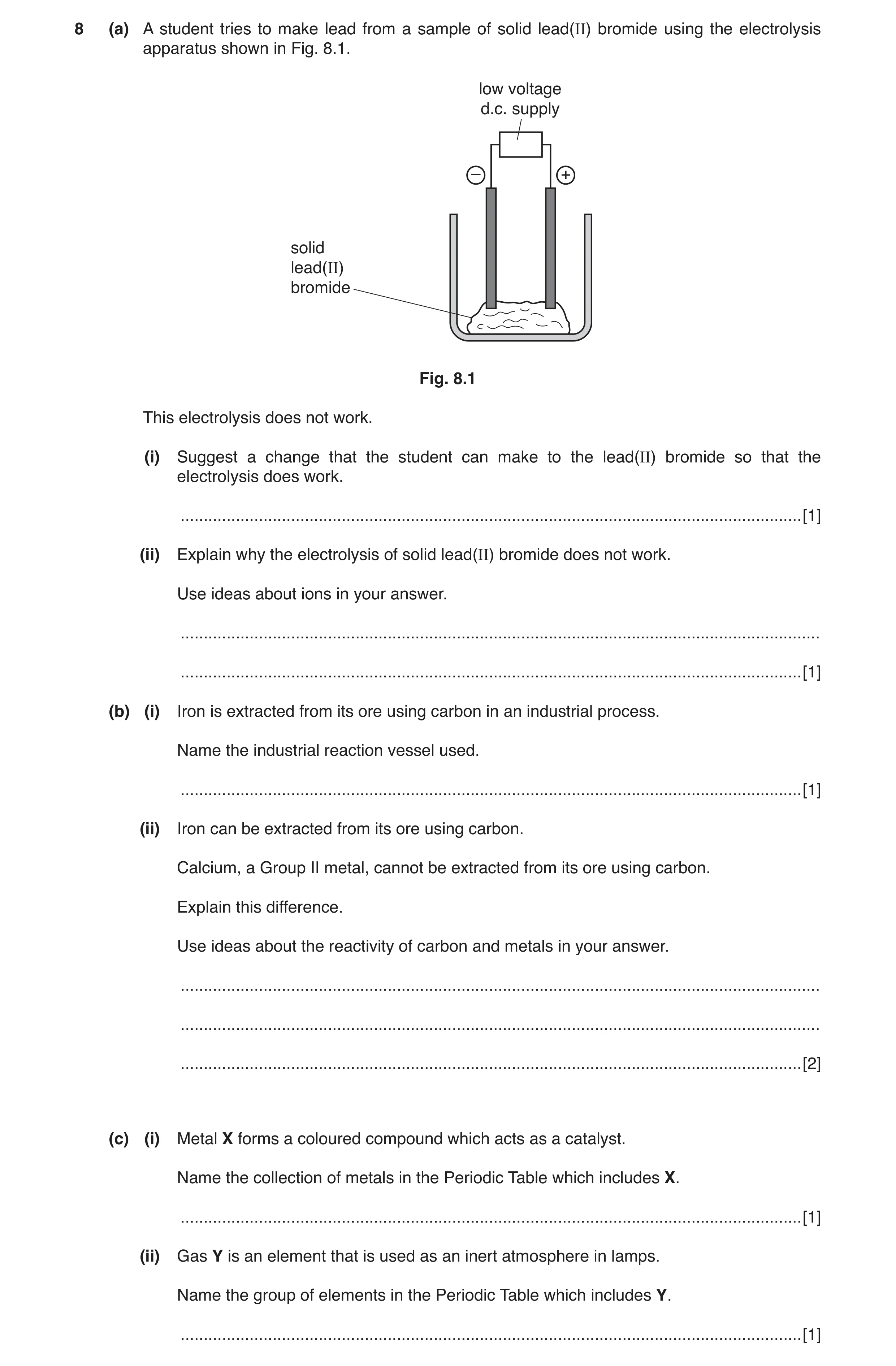
8 (a) A student tries to make lead from a sample of solid lead(II) bromide using the electrolysis apparatus shown in Fig. 8.1. low voltage d.c. supply – + solid lead(II) bromide Fig. 8.1 This electrolysis does not work. (i) Suggest a change that the student can make to the lead(II) bromide so that the electrolysis does work. … [1] (ii) Explain why the electrolysis of solid lead(II) bromide does not work. Use ideas about ions in your answer. … … [1] (b) (i) Iron is extracted from its ore using carbon in an industrial process. Name the industrial reaction vessel used. … [1] (ii) Iron can be extracted from its ore using carbon. Calcium, a Group II metal, cannot be extracted from its ore using carbon. Explain this difference. Use ideas about the reactivity of carbon and metals in your answer. … … … [2] (c) (i) Metal X forms a coloured compound which acts as a catalyst. Name the collection of metals in the Periodic Table which includes X. … [1] (ii) Gas Y is an element that is used as an inert atmosphere in lamps. Name the group of elements in the Periodic Table which includes Y. … [1]
7 marks
Mark scheme: 8(a)(i) melt / make it molten / convert it into a liquid form ; 1 8(a)(ii) ions not mobile / the idea that ions need to (be able to) move ; 1 8(b)(i) blast furnace ; 1 8(b)(ii) carbon is more reactive than iron ; group II metals / calcium are more reactive than carbon ; 2 8(c)(i) transition (elements / metals) ; 1 8(c)(ii) noble (gases) / Group VIII ; 1 Que estion Answer Ma arks
This question in 0653/41 May/June 2018
Q7 · An aqueous solution of an ionic compound is electrolysed using inert electrodes 0653/43 May/June 2018
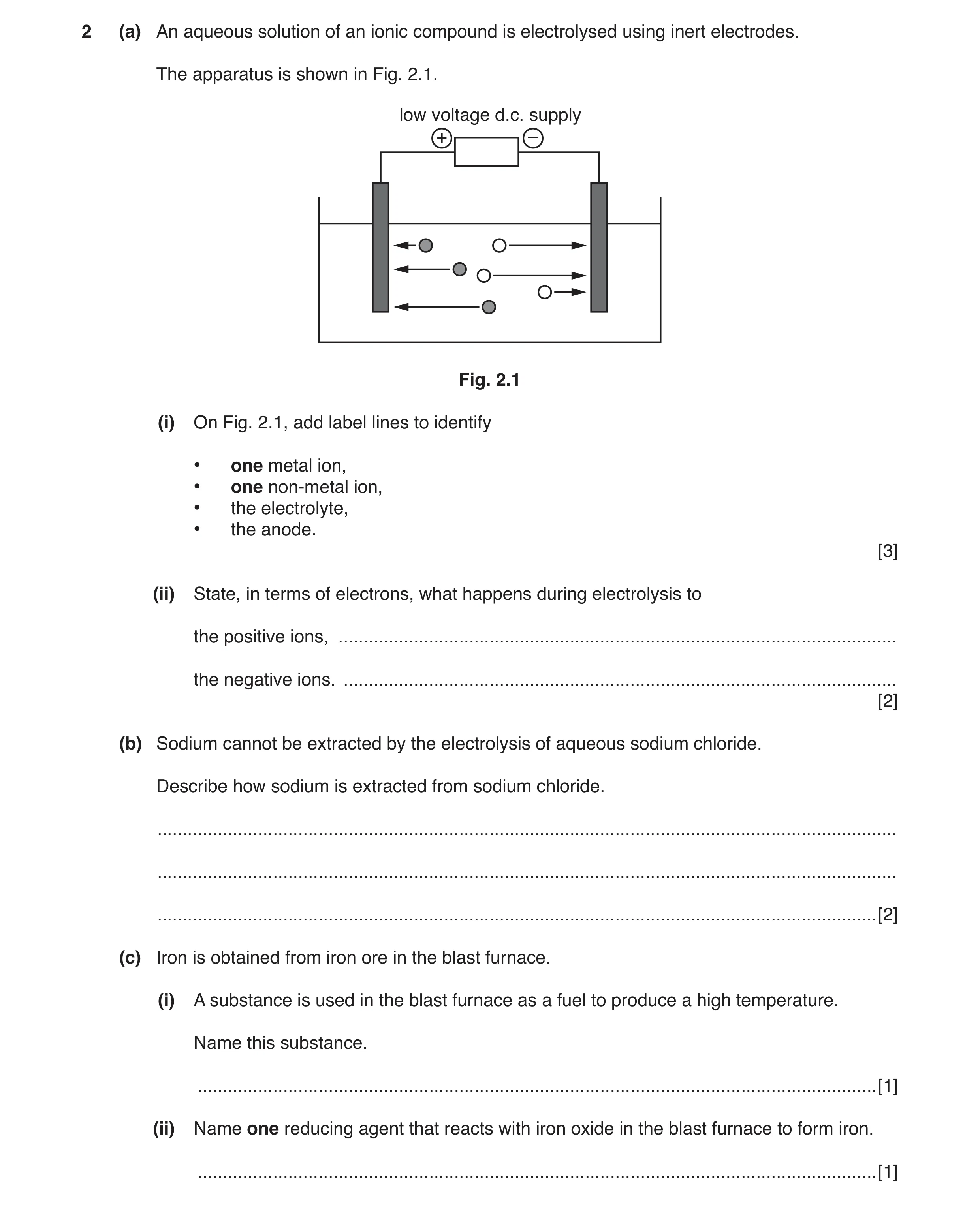
2 (a) An aqueous solution of an ionic compound is electrolysed using inert electrodes. The apparatus is shown in Fig. 2.1. low voltage d.c. supply + – Fig. 2.1 (i) On Fig. 2.1, add label lines to identify • one metal ion, • one non-metal ion, • the electrolyte, • the anode. [3] (ii) State, in terms of electrons, what happens during electrolysis to the positive ions, … the negative ions. … [2] (b) Sodium cannot be extracted by the electrolysis of aqueous sodium chloride. Describe how sodium is extracted from sodium chloride. … … … [2] (c) Iron is obtained from iron ore in the blast furnace. (i) A substance is used in the blast furnace as a fuel to produce a high temperature. Name this substance. … [1] (ii) Name one reducing agent that reacts with iron oxide in the blast furnace to form iron. … [1]
9 marks
Mark scheme: 2(a)(i) (metal ion) any moving towards negative electrode and (non-metal ion) any moving towards positive electrode ; (electrolyte) solution ; (anode) positive electrode ; 3 2(a)(ii) the idea that electron transfer occurs between ions and electrodes ; positive ions gain electrons and negative ion lose electrons ; 2 2(b) electrolysis ; molten (sodium chloride) ; relevant additional detail e.g. high temperature needed / inert electrodes used ; max 2 2(c)(i) carbon / coke ; 1 2(c)(ii) carbon monoxide / CO / carbon / C ; 1
This question in 0653/43 May/June 2018
Q8 · A student investigates the reactivities of four metals, A, B, C and D 0653/43 Oct/Nov 2018
5 (a) A student investigates the reactivities of four metals, A, B, C and D. He uses pieces of metal which are the same size. A gas is produced when the metals react with dilute hydrochloric acid. He uses the apparatus shown in Fig. 5.1 to measure the time taken to collect 25 cm3 of the gas. measuring cylinder gas dilute hydrochloric acid piece of metal Fig. 5.1 The results of the investigation are shown in Table 5.1. Table 5.1 metal time / s A 25 B 115 C 73 D 305 (i) Using letters A, B, C and D, state the order of reactivity of these metals, from most reactive to least reactive. … most reactive … … … least reactive [1] (ii) Describe and explain the effect of increasing the temperature on the rate of a reaction. Use ideas about particle movement and particle collisions in your answer. effect … explanation … … … … [3] (b) Iron is extracted from iron ore by reduction in a blast furnace. Limestone is added to the blast furnace to separate impurities from the iron. (i) Name two other raw materials which are added to the blast furnace. 1. … 2. … [2] (ii) Explain what is meant by reduction. … … [1] (c) Aluminium cannot be extracted from its ore by reduction in a blast furnace. (i) Explain why reduction in a blast furnace cannot be used to extract aluminium from its ore. … … [1] (ii) Name the method of extraction of aluminium from its ore. … [1]
9 marks
Mark scheme: 5(a)(i) (most) A C B (least) D ; 1 5(a)(ii) (effect) increase ; (explanation) two out of (particles) move faster / gain more kinetic energy ; (particles) collide more often / frequently ; (particles) collide with more energy ; Max 3 3 5(b)(i) air ; allow oxygen coke ; allow carbon 2 5(b)(ii) loss / removal of oxygen / O ; 1 5(c)(i) (aluminium is) too reactive / more reactive than carbon ; 1 5(c)(ii) electrolysis ; 1
This question in 0653/43 Oct/Nov 2018
Q9 · Iron is an element in Period 4 of the Periodic Table shown on page 24 0653/42 Feb/March 2019
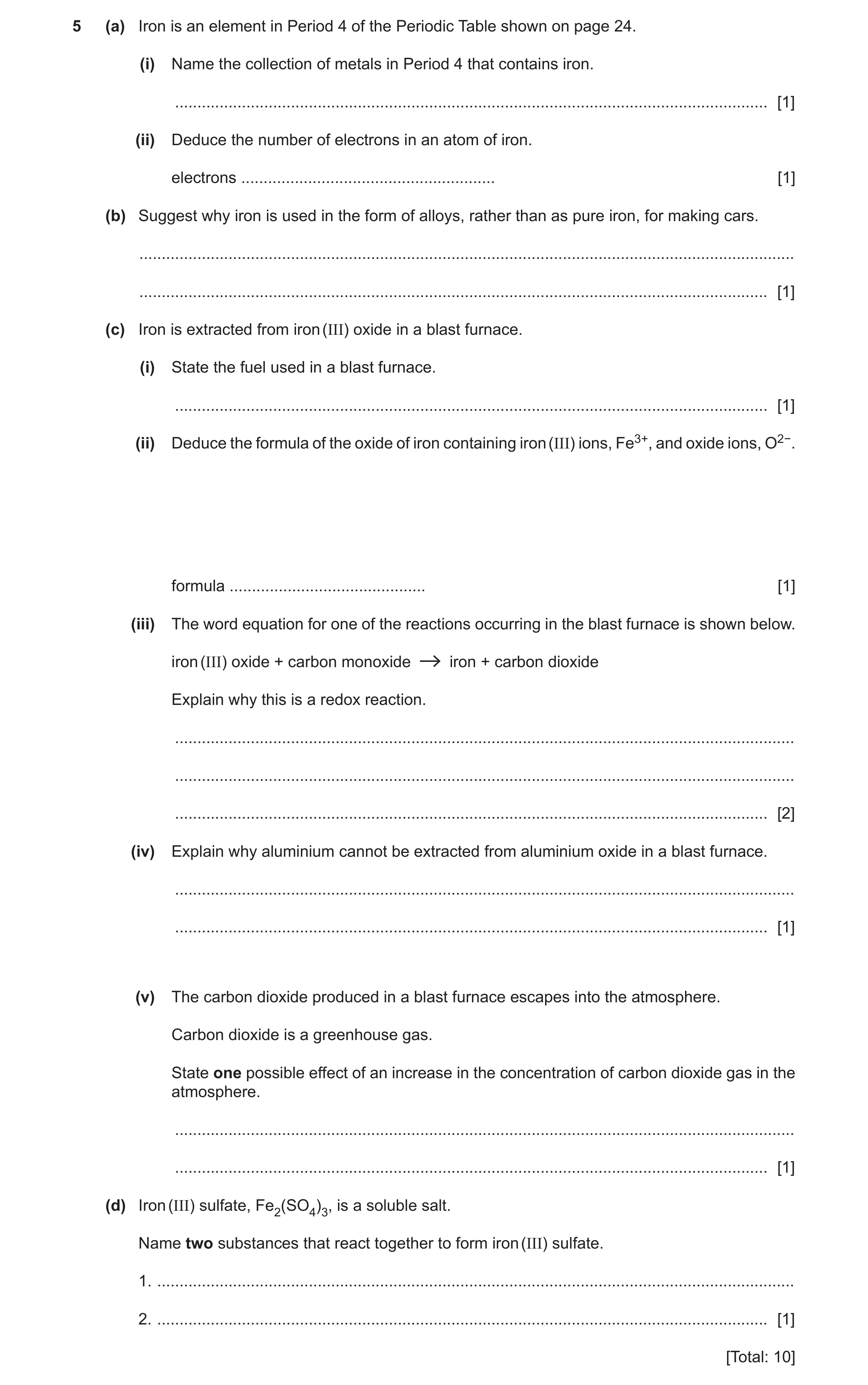
5 (a) Iron is an element in Period 4 of the Periodic Table shown on page 24. (i) Name the collection of metals in Period 4 that contains iron. … [1] (ii) Deduce the number of electrons in an atom of iron. electrons … [1] (b) Suggest why iron is used in the form of alloys, rather than as pure iron, for making cars. … … [1] (c) Iron is extracted from iron (III) oxide in a blast furnace. (i) State the fuel used in a blast furnace. … [1] (ii) Deduce the formula of the oxide of iron containing iron (III) ions, Fe3+, and oxide ions, O2−. formula … [1] (iii) The word equation for one of the reactions occurring in the blast furnace is shown below. iron (III) oxide + carbon monoxide iron + carbon dioxide Explain why this is a redox reaction. … … … [2] (iv) Explain why aluminium cannot be extracted from aluminium oxide in a blast furnace. … … [1] (v) The carbon dioxide produced in a blast furnace escapes into the atmosphere. Carbon dioxide is a greenhouse gas. State one possible effect of an increase in the concentration of carbon dioxide gas in the atmosphere. … … [1] (d) Iron (III) sulfate, Fe2(SO4)3, is a soluble salt. Name two substances that react together to form iron (III) sulfate. 1. … 2. … [1] [Total: 10]
10 marks
Mark scheme: 5(a)(i) transition metals / elements ; 1 5(a)(ii) electrons = 26 ; 1 5(b) stronger more resistant to corrosion ; 1 5(c)(i) coke / carbon ; 1 5(c)(ii) Fe2O3 ; 1 5(c)(iii) iron oxide / Fe3+ reduced ; carbon monoxide oxidised ; 2 5(c)(iv) aluminium is too reactive / aluminium is above carbon in reactivity series ; 1 5(c)(v) (increases) global warming / climate change / consequence of climate change described ; 1 5(d) iron and sulfuric acid ; or iron oxide / iron (III) oxide and (dilute) sulfuric acid ; 1
This question in 0653/42 Feb/March 2019
Q10 · Aluminium is a Group III metal 0653/41 Oct/Nov 2019
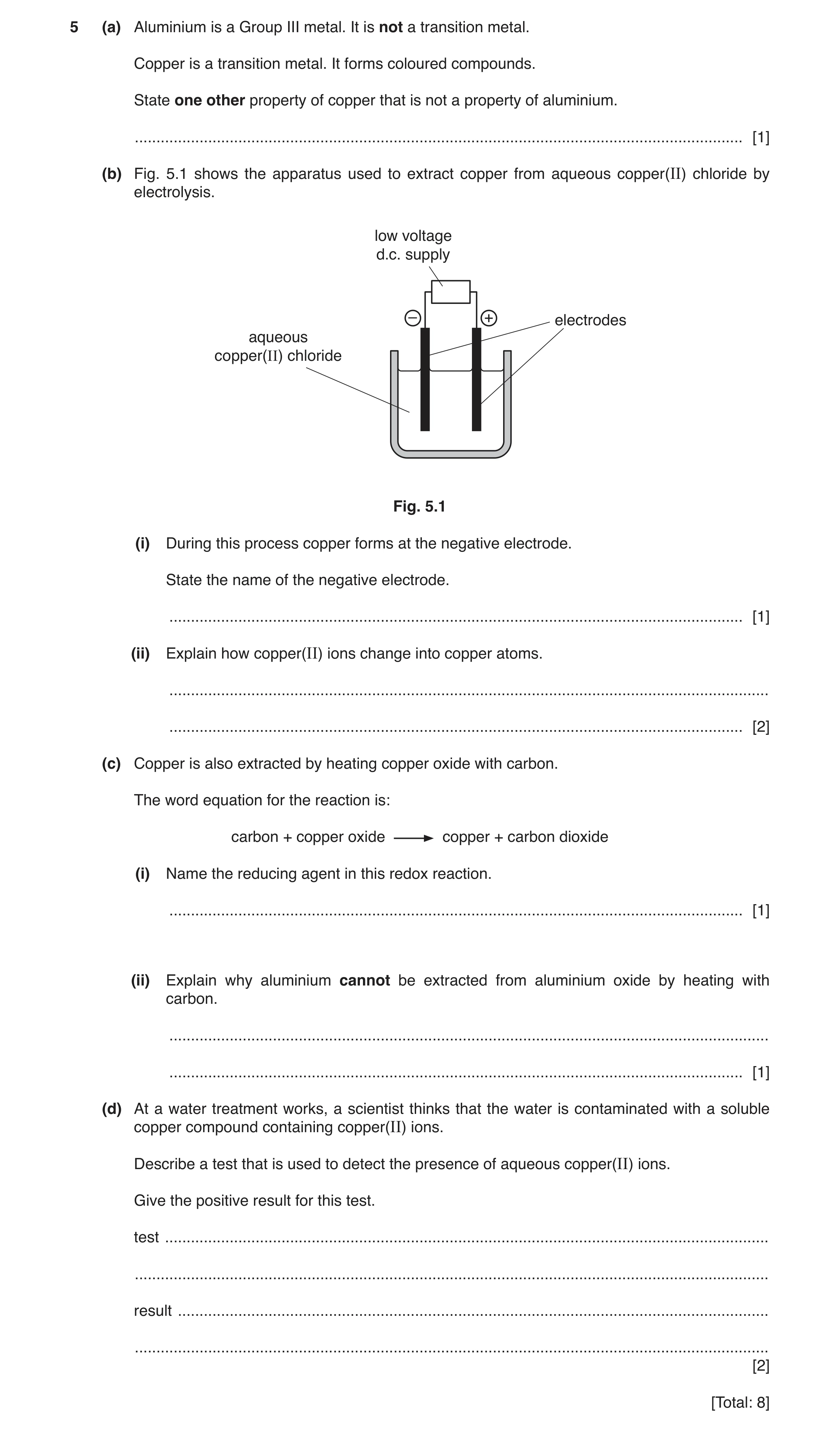
5 (a) Aluminium is a Group III metal. It is not a transition metal. Copper is a transition metal. It forms coloured compounds. State one other property of copper that is not a property of aluminium. … [1] (b) Fig. 5.1 shows the apparatus used to extract copper from aqueous copper(II) chloride by electrolysis. low voltage d.c. supply – + electrodes aqueous copper(II) chloride Fig. 5.1 (i) During this process copper forms at the negative electrode. State the name of the negative electrode. … [1] (ii) Explain how copper(II) ions change into copper atoms. … … [2] (c) Copper is also extracted by heating copper oxide with carbon. The word equation for the reaction is: carbon + copper oxide copper + carbon dioxide (i) Name the reducing agent in this redox reaction. … [1] (ii) Explain why aluminium cannot be extracted from aluminium oxide by heating with carbon. … … [1] (d) At a water treatment works, a scientist thinks that the water is contaminated with a soluble copper compound containing copper(II) ions. Describe a test that is used to detect the presence of aqueous copper(II) ions. Give the positive result for this test. test … … result … … [2] [Total: 8]
8 marks
Mark scheme: 5(a) high density / high melting point / acts as catalyst ; 1 5(b)(i) cathode ; 1 5(b)(ii) gains electrons ; two electrons ; 2 5(c)(i) carbon ; 1 5(c)(ii) aluminium is too reactive / aluminium more reactive than carbon ; 1 5(d) (aqueous) sodium hydroxide ; (pale) blue ppt ; or flame test ; blue–green / turquoise colour ; 2
This question in 0653/41 Oct/Nov 2019
Q11 · Aluminium ore is mainly aluminium oxide 0653/42 Oct/Nov 2019
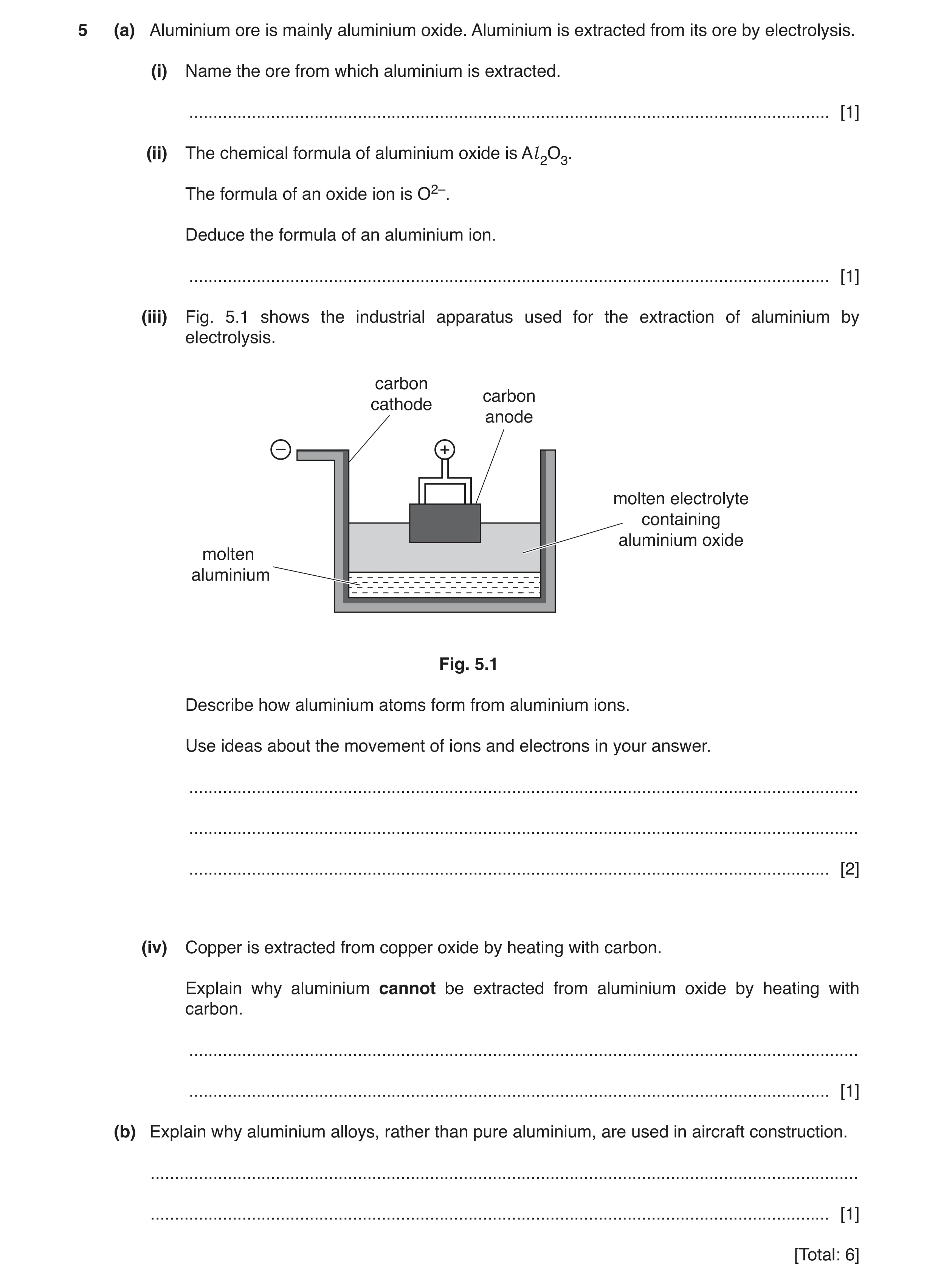
5 (a) Aluminium ore is mainly aluminium oxide. Aluminium is extracted from its ore by electrolysis. (i) Name the ore from which aluminium is extracted. … [1] (ii) The chemical formula of aluminium oxide is Al 2O3. The formula of an oxide ion is O2–. Deduce the formula of an aluminium ion. … [1] (iii) Fig. 5.1 shows the industrial apparatus used for the extraction of aluminium by electrolysis. carbon carbon cathode anode – + molten electrolyte containing aluminium oxide molten aluminium Fig. 5.1 Describe how aluminium atoms form from aluminium ions. Use ideas about the movement of ions and electrons in your answer. … … … [2] (iv) Copper is extracted from copper oxide by heating with carbon. Explain why aluminium cannot be extracted from aluminium oxide by heating with carbon. … … [1] (b) Explain why aluminium alloys, rather than pure aluminium, are used in aircraft construction. … … [1] [Total: 6]
6 marks
Mark scheme: 5(a)(i) bauxite ; 1 5(a)(ii) Al 3+ ; 1 5(a)(iii) (positive) aluminium ions move to / are attracted to (negative) cathode ; and gain (three) electrons ; 2 5(a)(iv) aluminium is too reactive / aluminium above carbon in reactivity series / aluminium is more reactive than carbon ; 1 5(b) (alloys are) stronger / more resistant to corrosion ; 1
This question in 0653/42 Oct/Nov 2019
Q12 · Magnesium reacts with dilute hydrochloric acid 0653/43 Oct/Nov 2019
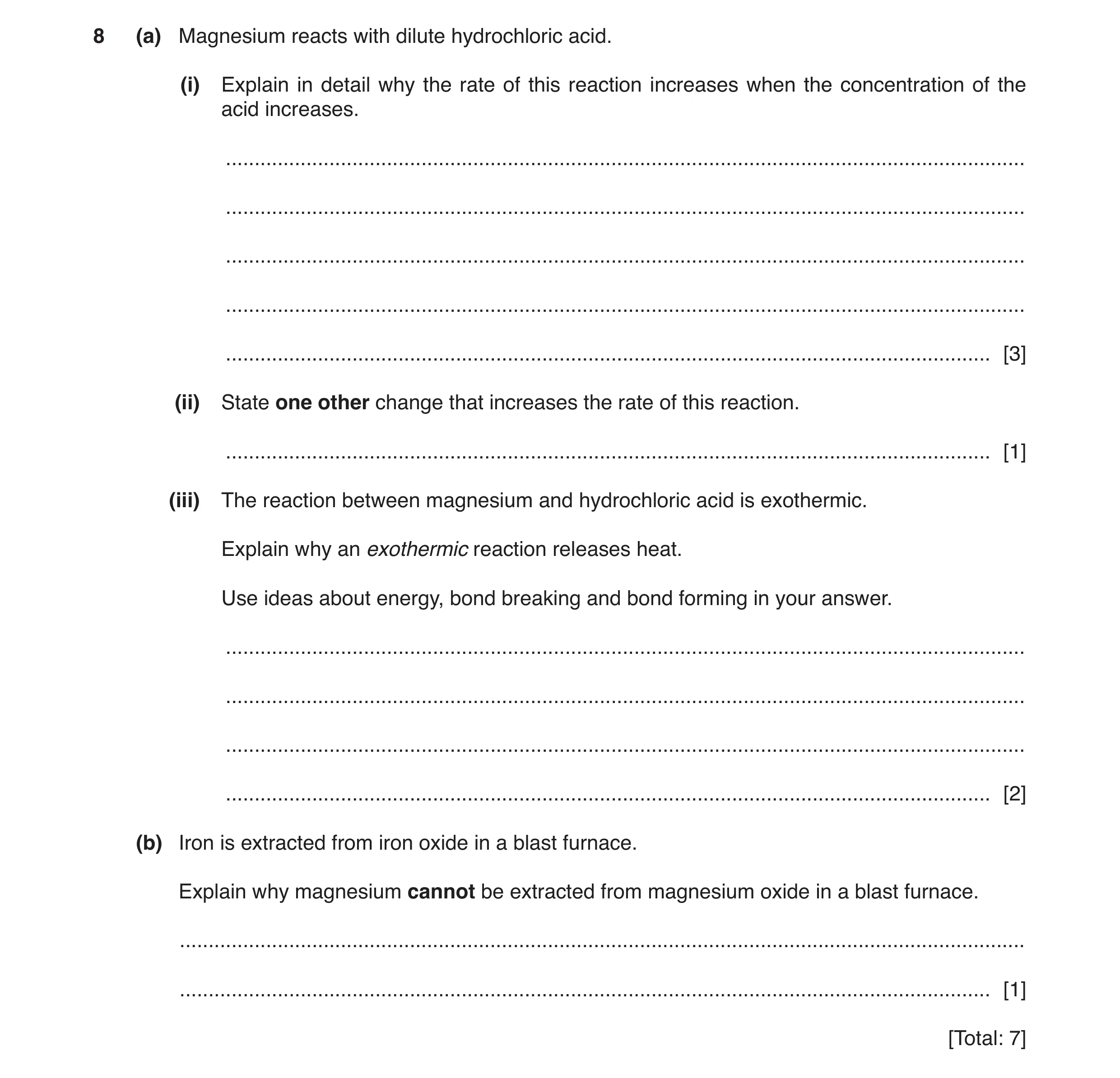
8 (a) Magnesium reacts with dilute hydrochloric acid. (i) Explain in detail why the rate of this reaction increases when the concentration of the acid increases. … … … … … [3] (ii) State one other change that increases the rate of this reaction. … [1] (iii) The reaction between magnesium and hydrochloric acid is exothermic. Explain why an exothermic reaction releases heat. Use ideas about energy, bond breaking and bond forming in your answer. … … … … [2] (b) Iron is extracted from iron oxide in a blast furnace. Explain why magnesium cannot be extracted from magnesium oxide in a blast furnace. … … [1] [Total: 7]
7 marks
Mark scheme: 8(a)(i) (at higher concentrations) more hydrogen ions / acid particles / reactant particles present ; increased rate of collisions ; so higher frequency of successful collisions ; 3 8(a)(ii) increase temperature / use a catalyst / increase surface area of magnesium ; 1 8(a)(iii) (thermal) energy is absorbed for bond breaking and released during bond formation ; more thermal energy is released than taken in ; 2 8(b) magnesium is too reactive / magnesium is above carbon in reactivity series ; 1
This question in 0653/43 Oct/Nov 2019
Q13 · Iron is a transition element 0653/41 May/June 2020
5 (a) Iron is a transition element. State one property of iron that is common to all transition elements but not to other metals. … [1] (b) Fig. 5.1 shows the arrangement of particles in pure solid iron. iron atom Fig. 5.1 (i) Explain why a high temperature is needed to melt solid iron. … … … [2] (ii) Steel is an alloy of iron. It contains iron atoms and smaller carbon atoms. Complete Fig. 5.2 to show the arrangement of atoms in solid steel. iron atom Fig. 5.2 [1] (c) Iron is extracted from iron oxide in the blast furnace. (i) The word equation for one of the reactions in the blast furnace is shown. iron oxide + carbon monoxide iron + carbon dioxide State why this is a redox reaction. … … … [2] (ii) Iron(III) oxide contains iron(III) ions, Fe3+, and oxide ions, O2–. Deduce the formula of iron(III) oxide. … [1] (iii) Magnesium can be extracted from magnesium oxide by electrolysis. Explain why magnesium cannot be extracted from magnesium oxide in a blast furnace. … … [2] [Total: 9]
9 marks
Mark scheme: 5(a) forms coloured compounds / has high melting point / has high density / catalyst ; 1 5(b)(i) (to provide) energy ; (energy) needed, for work to be done against attractive forces / to break interatomic ‘bonds’ / for particles to break free from solid state ; 2 Question Answer Marks 5(b)(ii) two different atoms and semi-regular / most touching ; 1 5(c)(i) iron oxide is reduced / iron oxide loses oxygen ; carbon monoxide is oxidised / carbon monoxide gains oxygen ; 2 5(c)(ii) Fe2O3 ; 1 5(c)(iii) magnesium is too reactive ; above carbon in reactivity series ; 2
This question in 0653/41 May/June 2020
Q14 · Iron is extracted from hematite, an iron ore, in the blast furnace 0653/42 Feb/March 2021
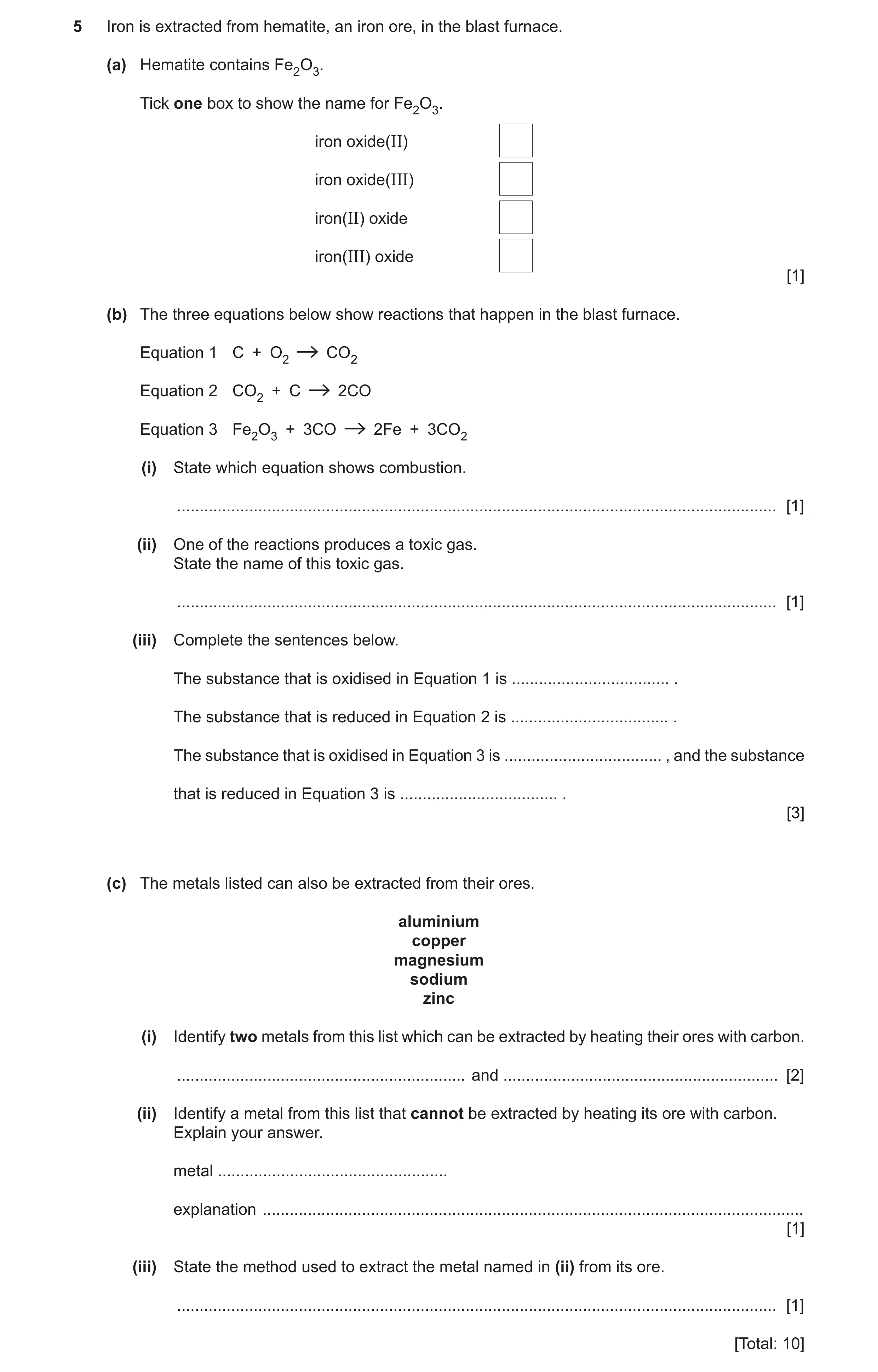
5 Iron is extracted from hematite, an iron ore, in the blast furnace. (a) Hematite contains Fe2O3. Tick one box to show the name for Fe2O3. iron oxide(II) iron oxide(III) iron(II) oxide iron(III) oxide [1] (b) The three equations below show reactions that happen in the blast furnace. Equation 1 C + O2 CO2 Equation 2 CO2 + C 2CO Equation 3 Fe2O3 + 3CO 2Fe + 3CO2 (i) State which equation shows combustion. … [1] (ii) One of the reactions produces a toxic gas. State the name of this toxic gas. … [1] (iii) Complete the sentences below. The substance that is oxidised in Equation 1 is … . The substance that is reduced in Equation 2 is … . The substance that is oxidised in Equation 3 is … , and the substance that is reduced in Equation 3 is … . [3] (c) The metals listed can also be extracted from their ores. aluminium copper magnesium sodium zinc (i) Identify two metals from this list which can be extracted by heating their ores with carbon. … and … [2] (ii) Identify a metal from this list that cannot be extracted by heating its ore with carbon. Explain your answer. metal … explanation … [1] (iii) State the method used to extract the metal named in (ii) from its ore. … [1] [Total: 10]
10 marks
Mark scheme: 5(a) iron(III) oxide ; 1 5(b)(i) equation 1 / C + O2 → CO2 ; 1 5(b)(ii) carbon monoxide ; 1 5(b)(iii) carbon / C ; carbon dioxide / CO2 ; CO / carbon monoxide (gap 1) and Fe2O3 / iron oxide (gap 2) ; 3 5(c)(i) copper ; zinc ; 2 Question Answer Marks 5(c)(ii) (aluminium/magnesium/sodium) AND because too reactive / very reactive / more reactive than carbon ; 1 5(c)(iii) electrolysis ; 1
This question in 0653/42 Feb/March 2021
Q15 · Iron is extracted from hematite in a blast furnace 0653/41 May/June 2022
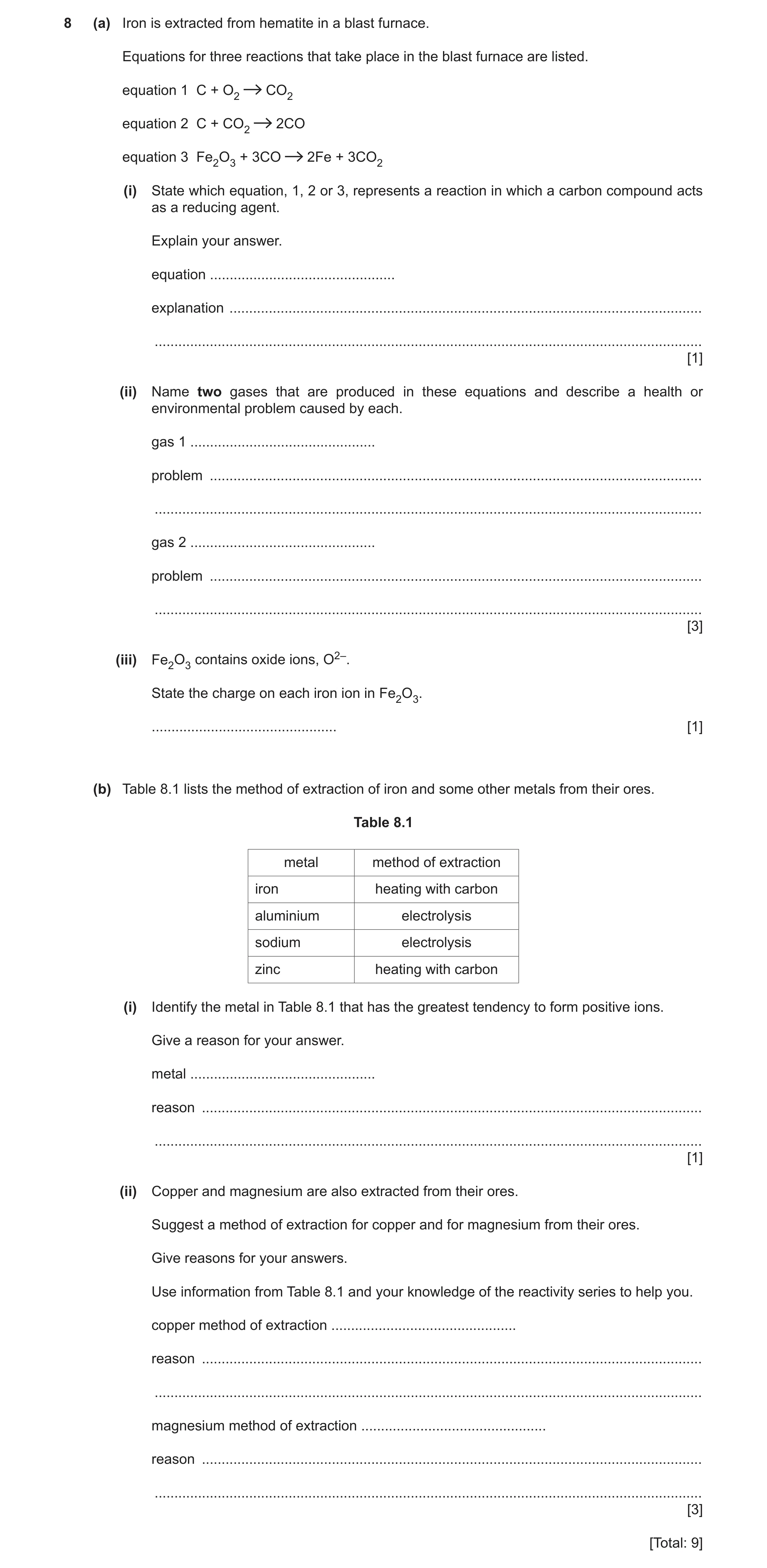
8 (a) Iron is extracted from hematite in a blast furnace. Equations for three reactions that take place in the blast furnace are listed. equation 1 C + O2 CO2 equation 2 C + CO2 2CO equation 3 Fe2O3 + 3CO 2Fe + 3CO2 (i) State which equation, 1, 2 or 3, represents a reaction in which a carbon compound acts as a reducing agent. Explain your answer. equation … explanation … … [1] (ii) Name two gases that are produced in these equations and describe a health or environmental problem caused by each. gas 1 … problem … … gas 2 … problem … … [3] (iii) Fe2O3 contains oxide ions, O2–. State the charge on each iron ion in Fe2O3. … [1] (b) Table 8.1 lists the method of extraction of iron and some other metals from their ores. Table 8.1 metal method of extraction iron heating with carbon aluminium electrolysis sodium electrolysis zinc heating with carbon (i) Identify the metal in Table 8.1 that has the greatest tendency to form positive ions. Give a reason for your answer. metal … reason … … [1] (ii) Copper and magnesium are also extracted from their ores. Suggest a method of extraction for copper and for magnesium from their ores. Give reasons for your answers. Use information from Table 8.1 and your knowledge of the reactivity series to help you. copper method of extraction … reason … … magnesium method of extraction … reason … … [3] [Total: 9]
9 marks
Mark scheme: 8(a)(i) (equation) 3 AND carbon monoxide removes oxygen from iron (oxide) ; 1 8(a)(ii) carbon monoxide AND carbon dioxide ; carbon monoxide, is toxic / restricts oxygen transport in the blood ; carbon dioxide causes, climate change / enhanced greenhouse effect / global warming ; 3 8(a)(iii) 3+ / Fe3+ ; 1 8(b)(i) sodium AND because it is the most reactive ; 1 Question Answer Marks 8(b)(ii) Cu heating with carbon AND Mg electrolysis ; Cu because less reactive than iron / carbon ; Mg because more reactive than aluminium / carbon ; 3
This question in 0653/41 May/June 2022
Q16 · Iron is extracted from hematite in the blast furnace 0653/42 Oct/Nov 2022
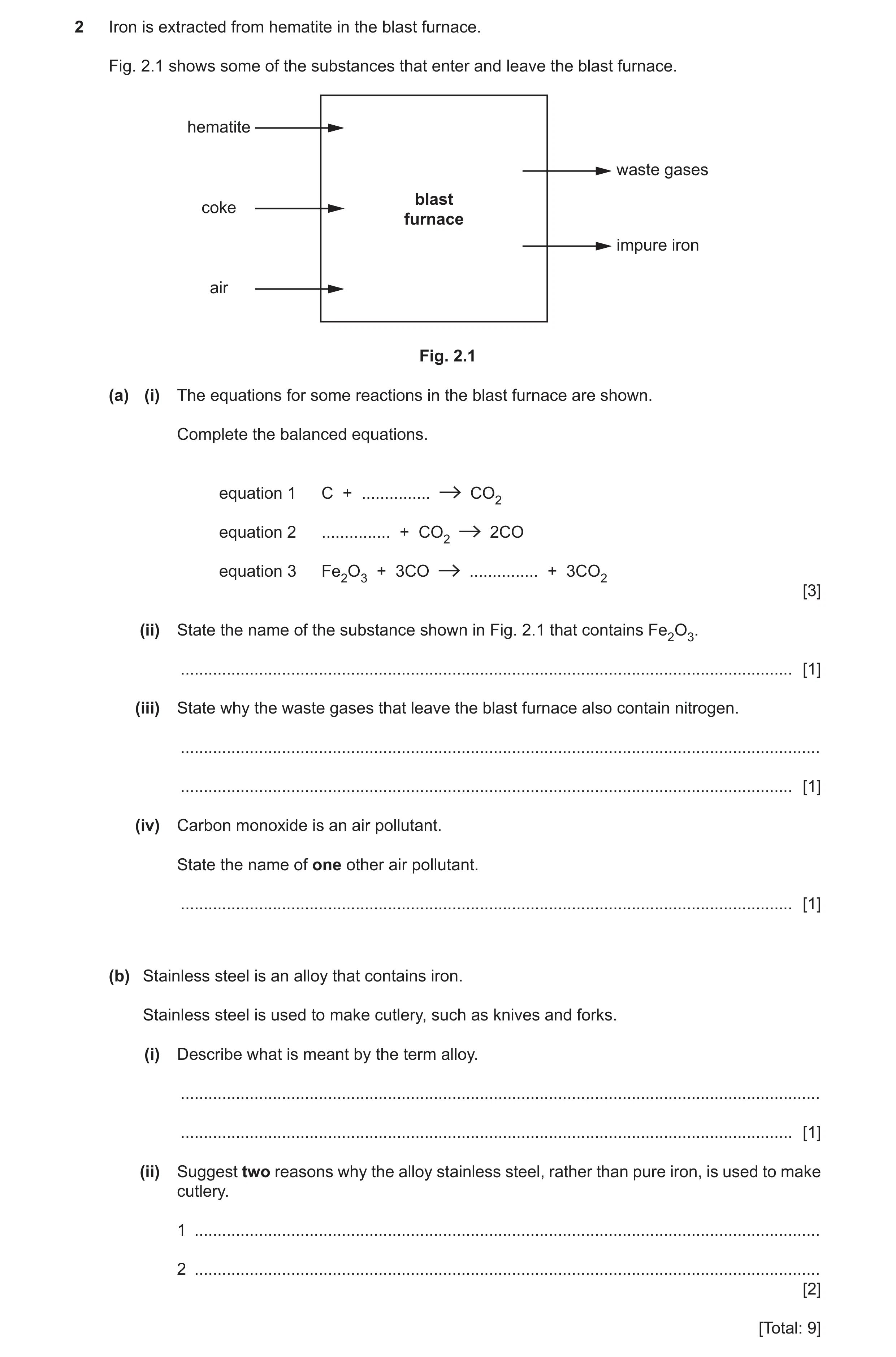
2 Iron is extracted from hematite in the blast furnace. Fig. 2.1 shows some of the substances that enter and leave the blast furnace. hematite waste gases blast coke furnace impure iron air Fig. 2.1 (a) (i) The equations for some reactions in the blast furnace are shown. Complete the balanced equations. equation 1 C + … CO2 equation 2 … + CO2 2CO equation 3 Fe2O3 + 3CO … + 3CO2 [3] (ii) State the name of the substance shown in Fig. 2.1 that contains Fe2O3. … [1] (iii) State why the waste gases that leave the blast furnace also contain nitrogen. … … [1] (iv) Carbon monoxide is an air pollutant. State the name of one other air pollutant. … [1] (b) Stainless steel is an alloy that contains iron. Stainless steel is used to make cutlery, such as knives and forks. (i) Describe what is meant by the term alloy. … … [1] (ii) Suggest two reasons why the alloy stainless steel, rather than pure iron, is used to make cutlery. 1 … 2 … [2] [Total: 9]
9 marks
Mark scheme: 2(a)(i) O2; 3 C ; 2Fe ; 2(a)(ii) hematite ; 1 2(a)(iii) (nitrogen) comes from the air (which enters the furnace) ; 1 2(a)(iv) sulfur dioxide ; 1 2(b)(i) mixture of a metal with (an)other element(s) ; 1 2(b)(ii) any two from: 2 (stainless steel / ORA) is strong(er) ; is (more) malleable ; does not, corrode / rust (as easily) ; AVP ;
This question in 0653/42 Oct/Nov 2022
Q17 · Iron is extracted from hematite in the blast furnace 0653/43 Oct/Nov 2022
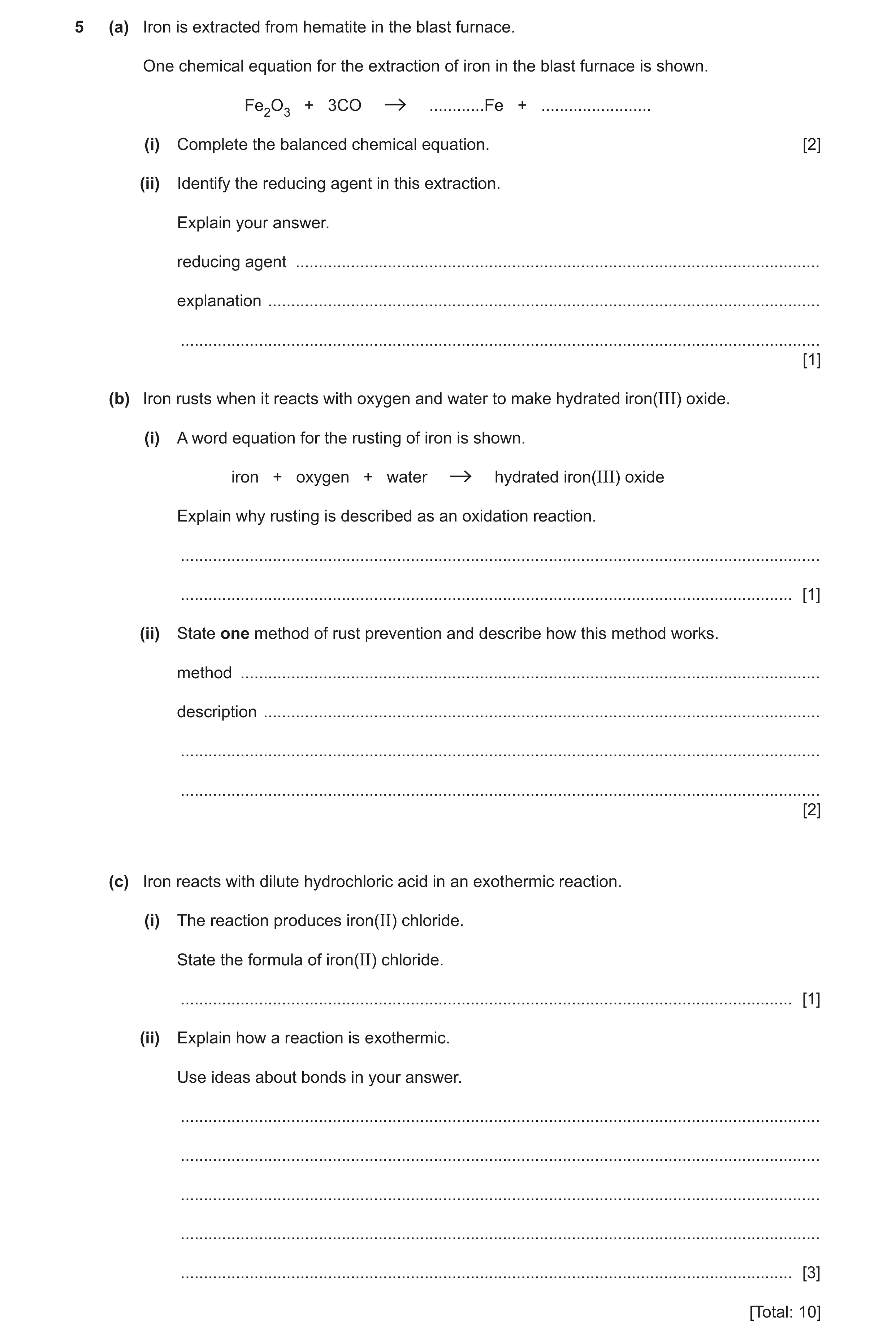
5 (a) Iron is extracted from hematite in the blast furnace. One chemical equation for the extraction of iron in the blast furnace is shown. Fe2O3 + 3CO … Fe + … (i) Complete the balanced chemical equation. [2] (ii) Identify the reducing agent in this extraction. Explain your answer. reducing agent … explanation … … [1] (b) Iron rusts when it reacts with oxygen and water to make hydrated iron(III) oxide. (i) A word equation for the rusting of iron is shown. iron + oxygen + water hydrated iron(III) oxide Explain why rusting is described as an oxidation reaction. … … [1] (ii) State one method of rust prevention and describe how this method works. method … description … … … [2] (c) Iron reacts with dilute hydrochloric acid in an exothermic reaction. (i) The reaction produces iron(II) chloride. State the formula of iron(II) chloride. … [1] (ii) Explain how a reaction is exothermic. Use ideas about bonds in your answer. … … … … … [3] [Total: 10]
10 marks
Mark scheme: 5(a)(i) Fe2O3 + 3CO → 2Fe + 3CO2 2 carbon dioxide shown ; equation balanced with 2 AND 3 ; 5(a)(ii) reducing agent carbon monoxide AND 1 explanation because it takes oxygen from iron (oxide) ; 5(b)(i) idea that, oxidation is gain of oxygen ; 1 5(b)(ii) method suitable method stated, e.g. painting / coating ; 2 description corresponding description given, e.g. (stops oxidation) by providing a barrier against, water / oxygen ; 5(c)(i) FeCl 2 ; 1 5(c)(ii) bond breaking, absorbs / takes in, energy ; 3 bond forming releases energy ; exothermic means, net release of energy / temperature rises ;
This question in 0653/43 Oct/Nov 2022
Q18 · Iron is extracted from hematite in a blast furnace 0653/42 Oct/Nov 2023
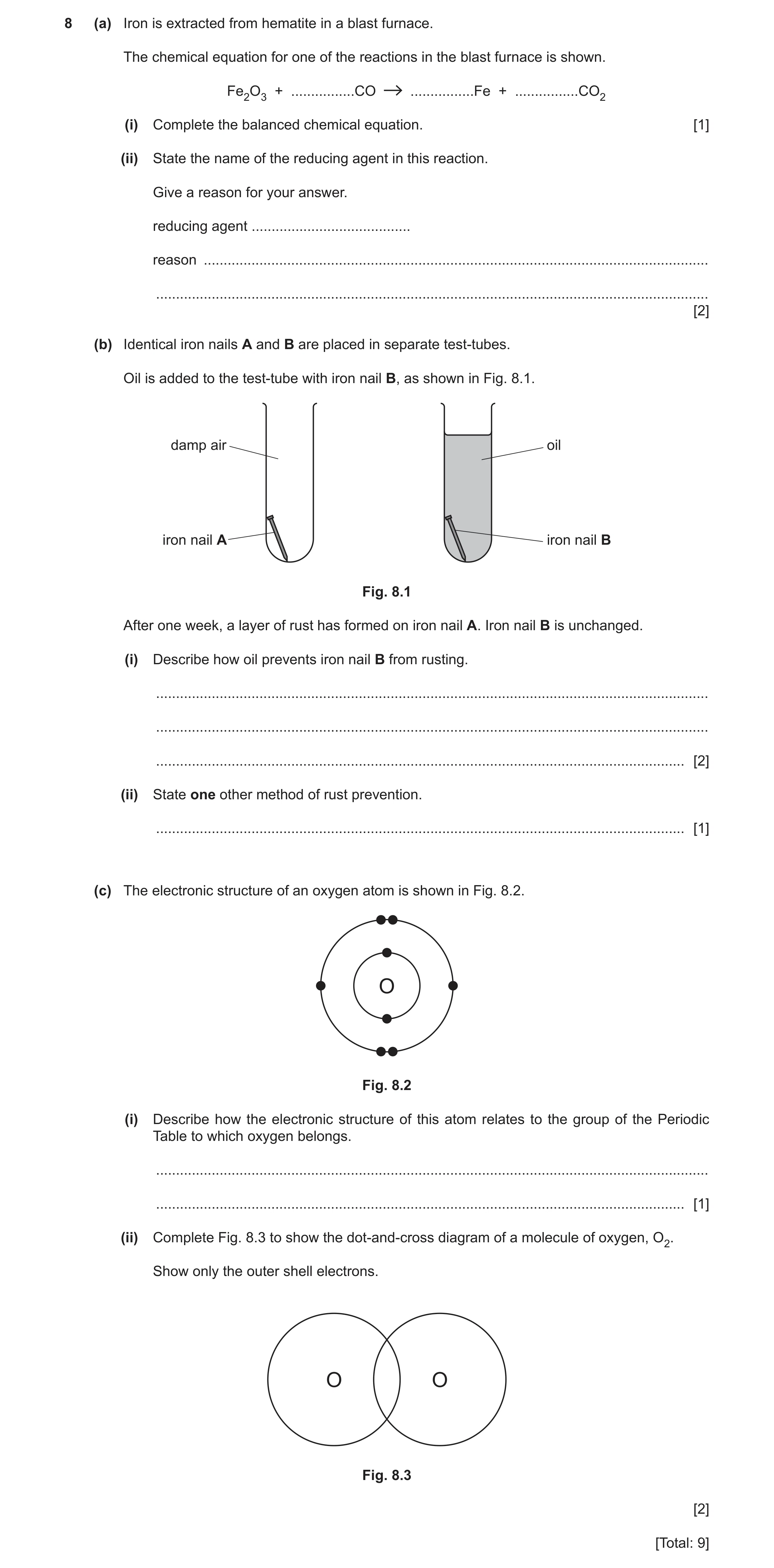
8 (a) Iron is extracted from hematite in a blast furnace. The chemical equation for one of the reactions in the blast furnace is shown. Fe2O3 + … CO … Fe + … CO2 (i) Complete the balanced chemical equation. [1] (ii) State the name of the reducing agent in this reaction. Give a reason for your answer. reducing agent … reason … … [2] (b) Identical iron nails A and B are placed in separate test-tubes. Oil is added to the test-tube with iron nail B, as shown in Fig. 8.1. damp air oil iron nail A iron nail B Fig. 8.1 After one week, a layer of rust has formed on iron nail A. Iron nail B is unchanged. (i) Describe how oil prevents iron nail B from rusting. … … … [2] (ii) State one other method of rust prevention. … [1] (c) The electronic structure of an oxygen atom is shown in Fig. 8.2. O Fig. 8.2 (i) Describe how the electronic structure of this atom relates to the group of the Periodic Table to which oxygen belongs. … … [1] (ii) Complete Fig. 8.3 to show the dot-and-cross diagram of a molecule of oxygen, O2. Show only the outer shell electrons. O O Fig. 8.3 [2] [Total: 9]
9 marks
Mark scheme: 8(a)(i) Fe2O3 + 3CO → 2Fe + 3CO2 ; 1 8(a)(ii) reducing agent carbon monoxide ; 2 reason it takes oxygen from iron (oxide) OR it reduces iron oxide (to iron) ; 8(b)(i) any two from: 2 oil acts as a barrier ; stops contact of iron with, air / oxygen ; stops contact of iron with water ; 8(b)(ii) painting / coating / AVP ; 1 8(c)(i) Group VI AND 1 has 6 electrons in the outer shell / same number of electrons in outer shell as the group number ; 8(c)(ii) 2 bonding electrons correct ; non-bonding electrons correct ;
This question in 0653/42 Oct/Nov 2023
Q19 · Carbon dioxide is a gas in air 0653/42 Oct/Nov 2024
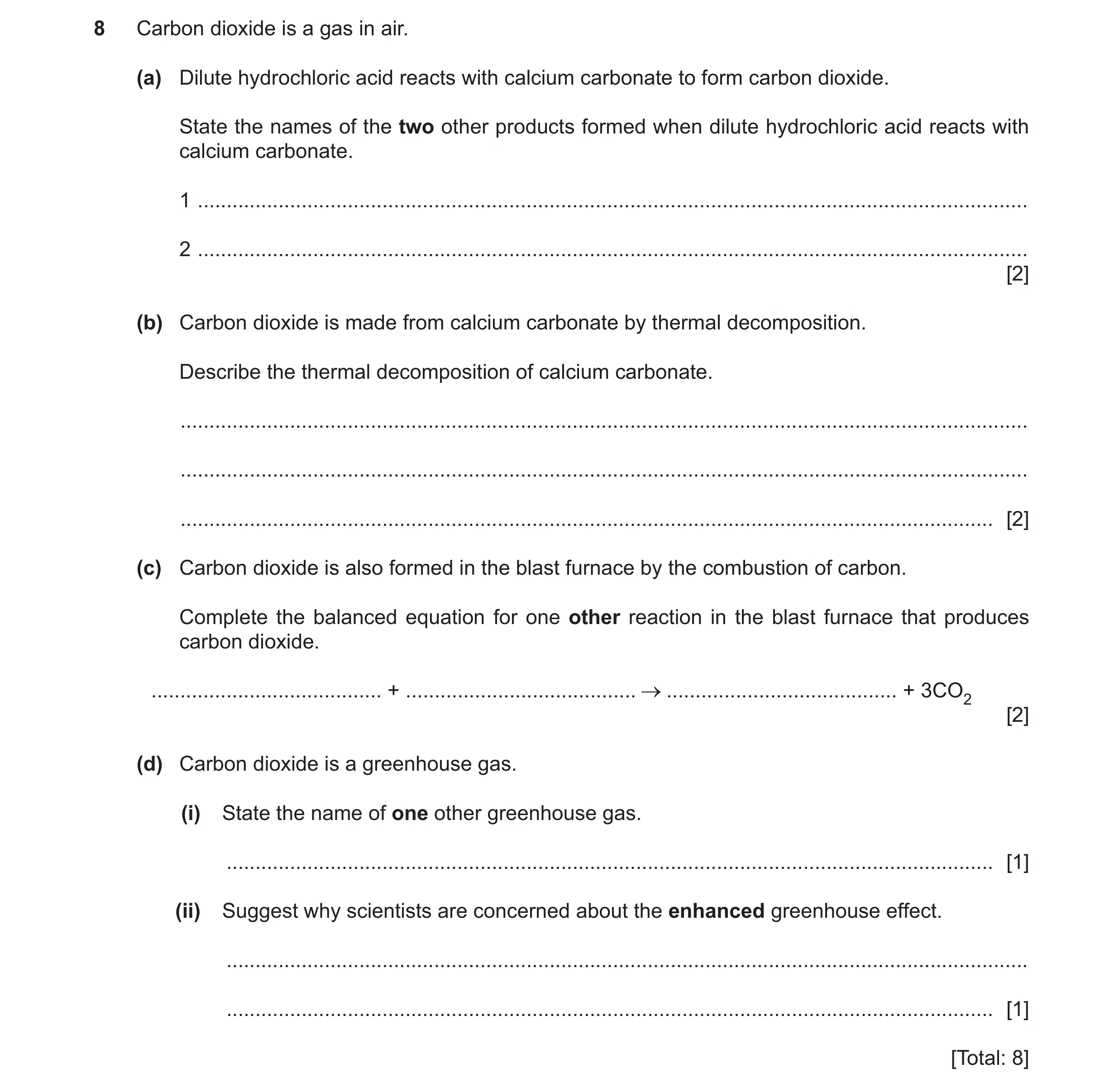
8 Carbon dioxide is a gas in air. (a) Dilute hydrochloric acid reacts with calcium carbonate to form carbon dioxide. State the names of the two other products formed when dilute hydrochloric acid reacts with calcium carbonate. 1 … 2 … [2] (b) Carbon dioxide is made from calcium carbonate by thermal decomposition. Describe the thermal decomposition of calcium carbonate. … … … [2] (c) Carbon dioxide is also formed in the blast furnace by the combustion of carbon. Complete the balanced equation for one other reaction in the blast furnace that produces carbon dioxide. … + … … + 3CO2 [2] (d) Carbon dioxide is a greenhouse gas. (i) State the name of one other greenhouse gas. … [1] (ii) Suggest why scientists are concerned about the enhanced greenhouse effect. … … [1] [Total: 8]
8 marks
Mark scheme: 8(a) calcium chloride ; 2 water ; 8(b) calcium carbonate is heated (to a high temperature) ; 2 (and) breaks down / breaks bonds / separates atoms ; 8(c) Fe2O3 + 3CO → 2Fe + (3CO2) 2 correct formulae ; balanced ; 8(d)(i) methane / AVP ; 1 8(d)(ii) increase in global temperature / climate change / named effect of climate change, e.g. ice caps melting, flooding, etc. ; 1
This question in 0653/42 Oct/Nov 2024
Q20 · Iron is extracted from hematite in the blast furnace 0653/42 Oct/Nov 2025
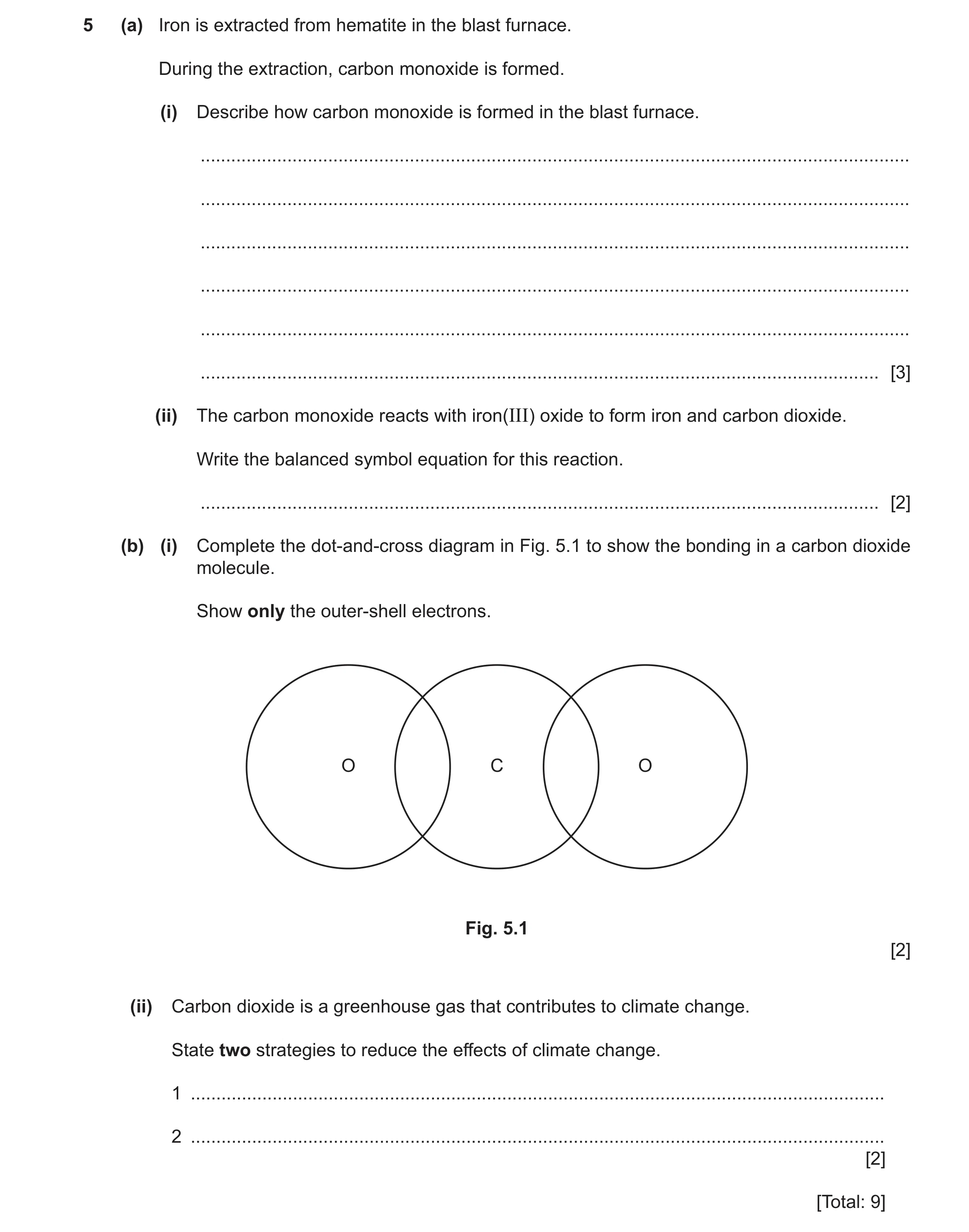
5 (a) Iron is extracted from hematite in the blast furnace. During the extraction, carbon monoxide is formed. (i) Describe how carbon monoxide is formed in the blast furnace. … … … … … … [3] (ii) The carbon monoxide reacts with iron(III) oxide to form iron and carbon dioxide. Write the balanced symbol equation for this reaction. … [2] (b) (i) Complete the dot-and-cross diagram in Fig. 5.1 to show the bonding in a carbon dioxide molecule. Show only the outer-shell electrons. O C O Fig. 5.1 [2] (ii) Carbon dioxide is a greenhouse gas that contributes to climate change. State two strategies to reduce the effects of climate change. 1 … 2 … [2] [Total: 9]
9 marks
Mark scheme: 5(a)(i) carbon / coke, is combusted or coke / C reacts with oxygen ; 3 carbon dioxide is formed / produced (during the extraction) ; carbon reacts with (reduces) carbon dioxide ; 5(a)(ii) Fe2O3 + 3CO → 2Fe + 3CO2 2 correct formulae ; correct balancing ; 5(b)(i) two bonding pairs between each oxygen and the carbon ; 2 4 non-bonding electrons / 2 lone pairs, on each oxygen ; 5(b)(ii) any two from: 2 use of renewable energy, e.g. wind, solar ; decreasing use of fossil fuels ; planting trees ; reduction in livestock farming ; AVP;
This question in 0653/42 Oct/Nov 2025
![Question 4: (a) (i) The atomic number of oxygen is 8. Complete Fig. 8.1 to show the electronic structure of an oxygen atom. nucleus Fig. 8.1 [1] (ii) C…](https://img.pastlit.com/crops/dd8e93b1-797b-4e9c-bf64-1ae7704e8796/q8.webp)
 10 / 27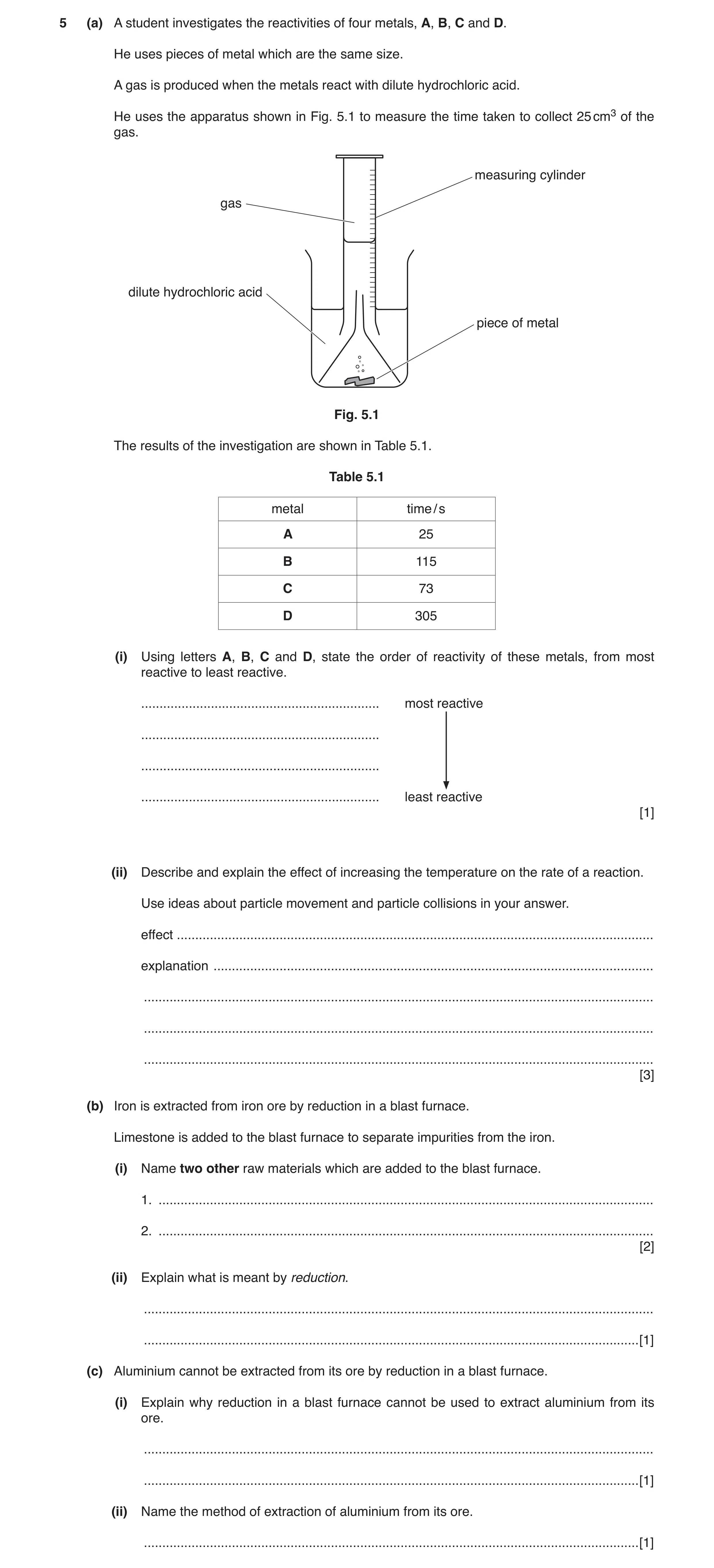
 16 / 27
 17 / 27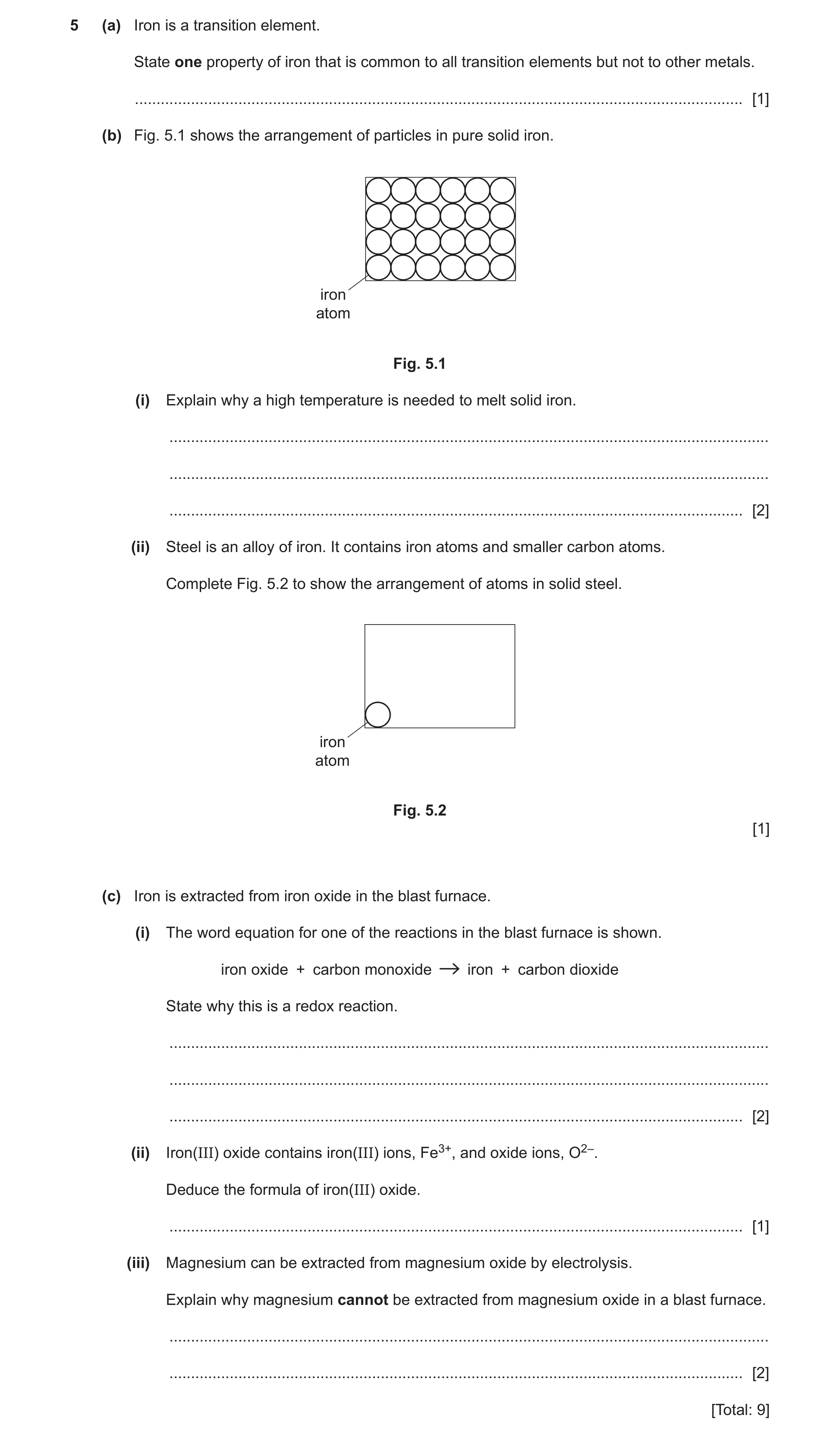
 26 / 27
 27 / 27
 9
9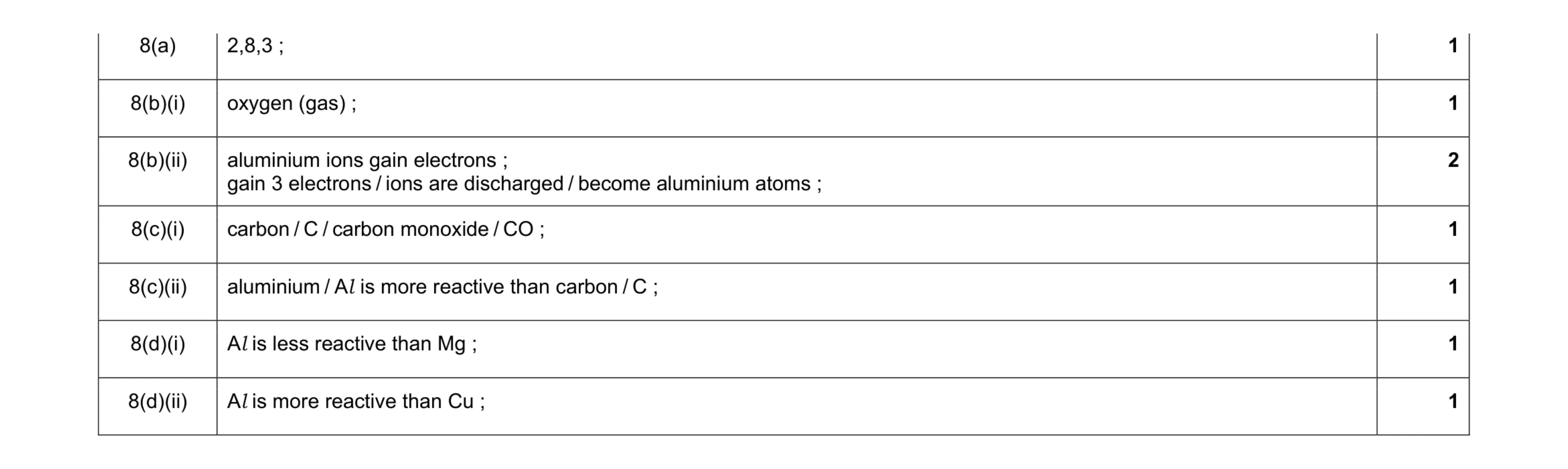 8
8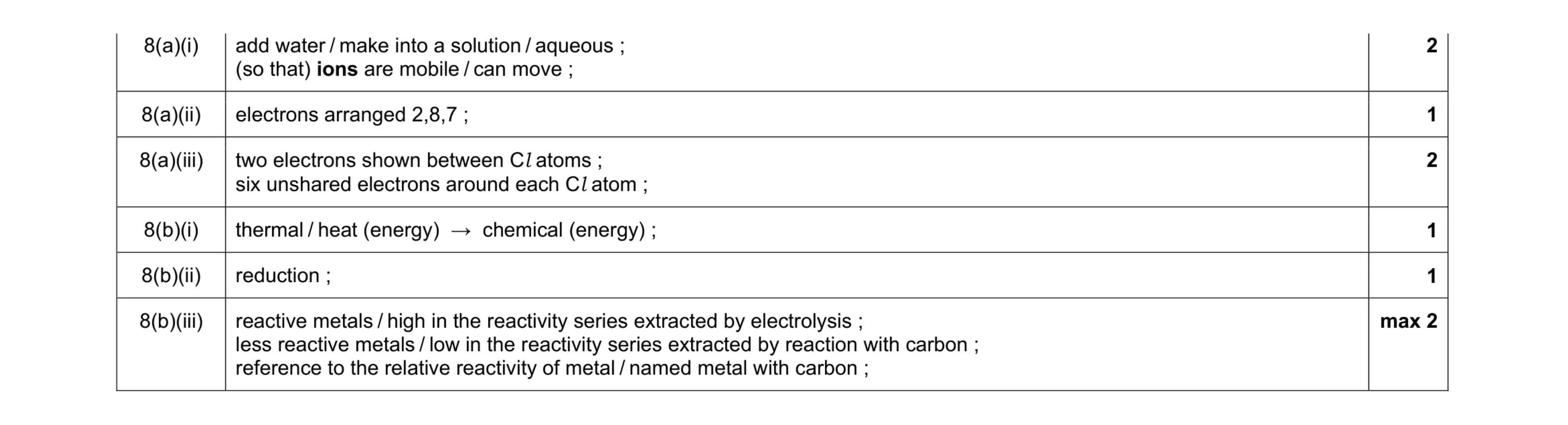 9
9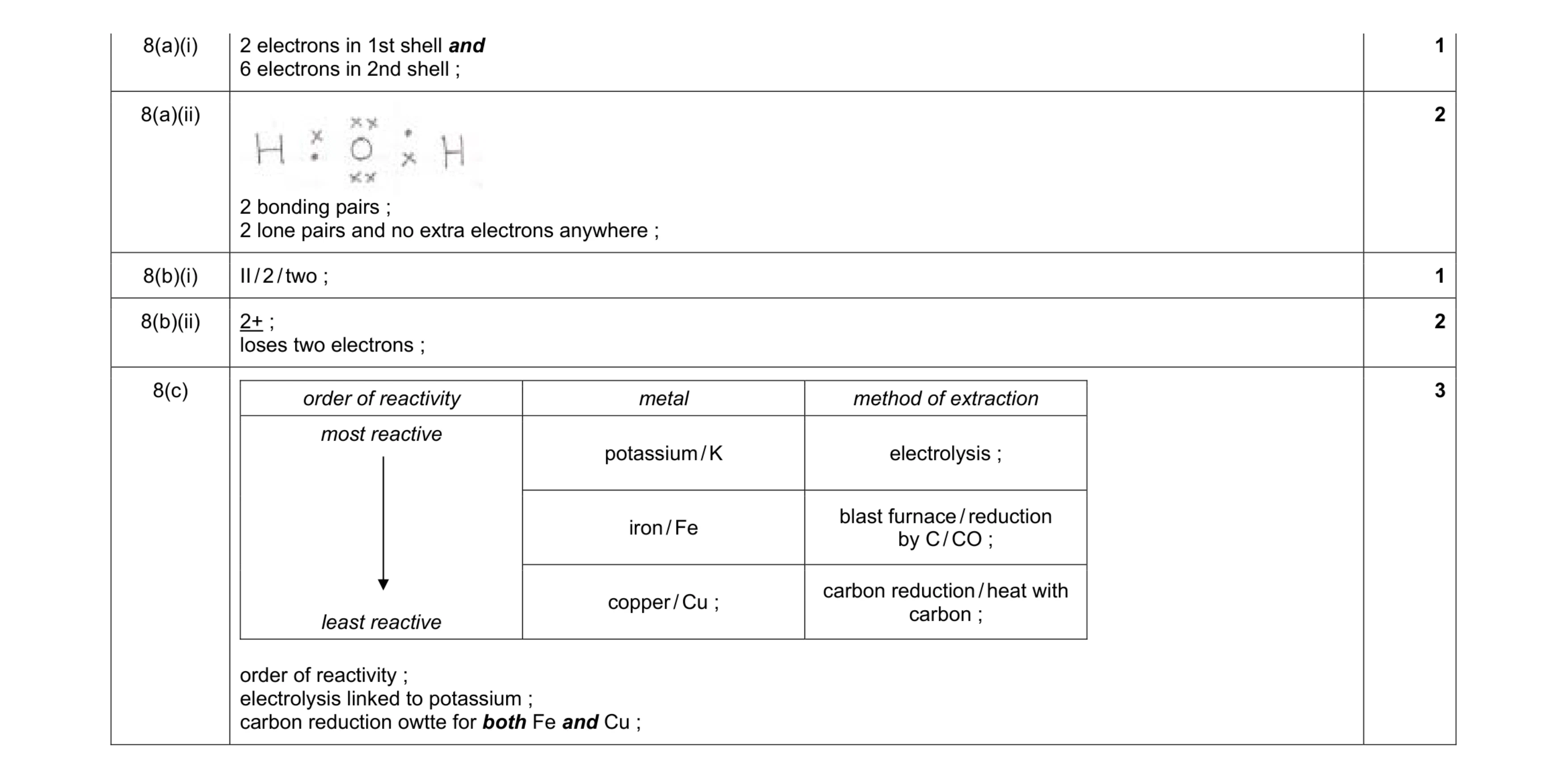 9
9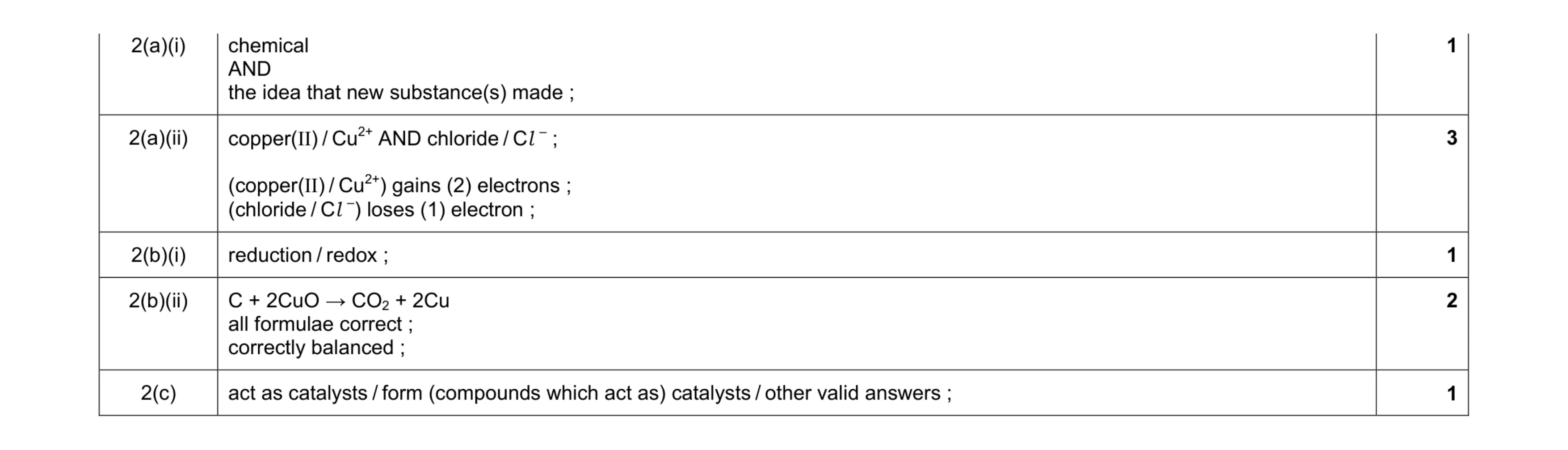 8
8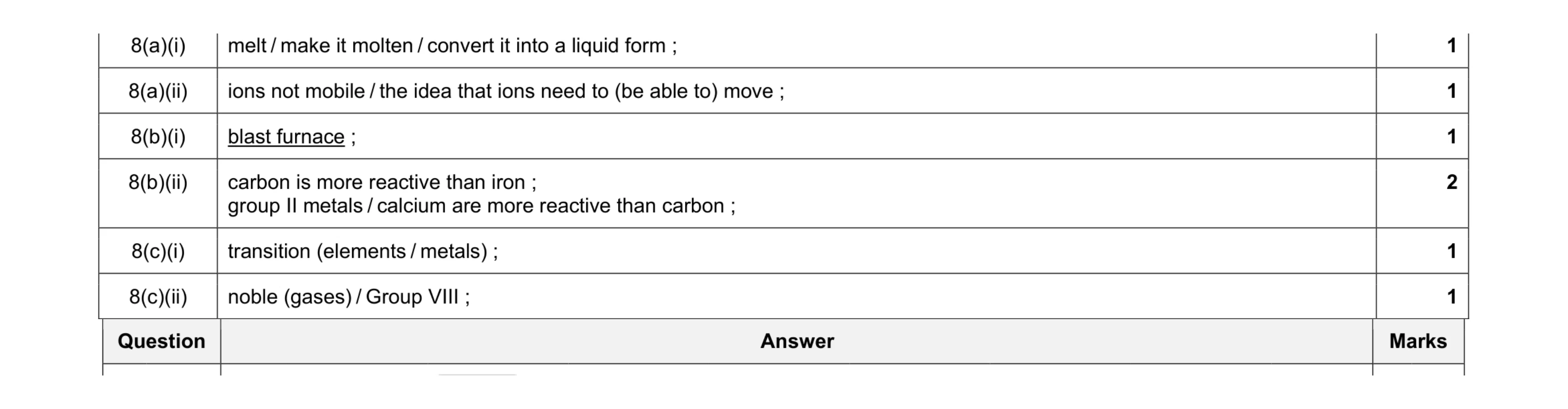 7
7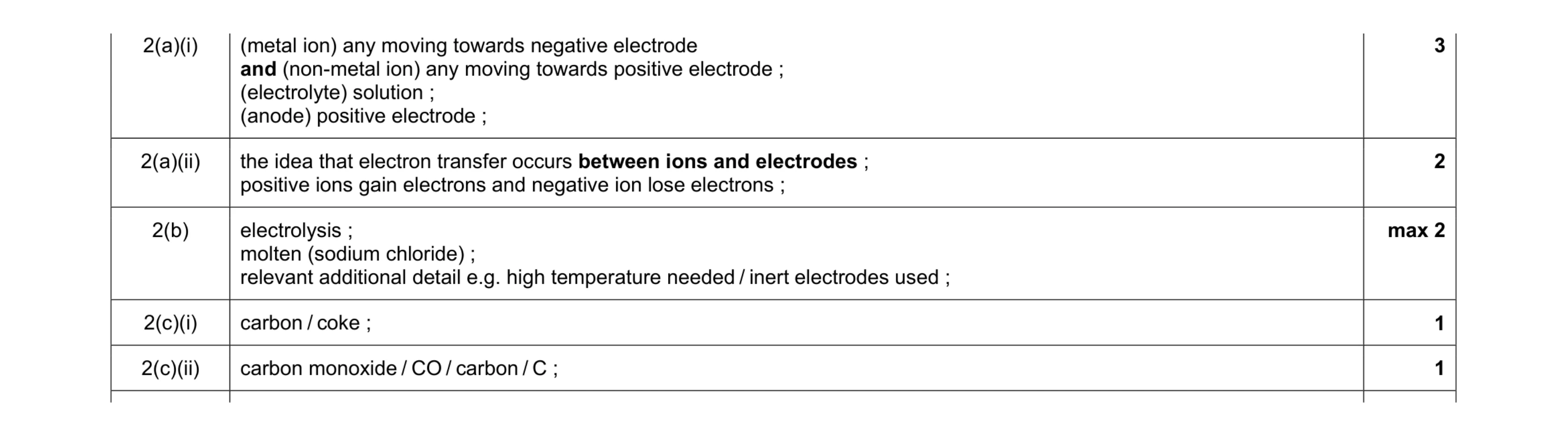 9
9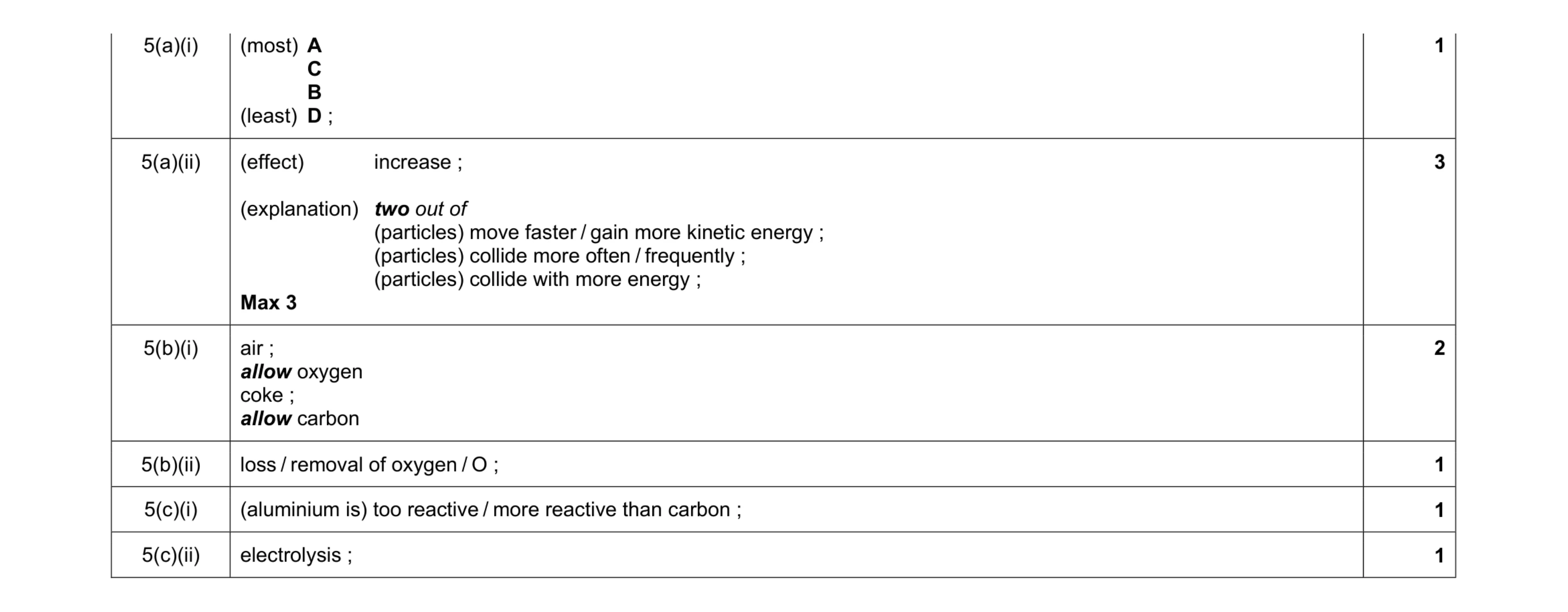 9
9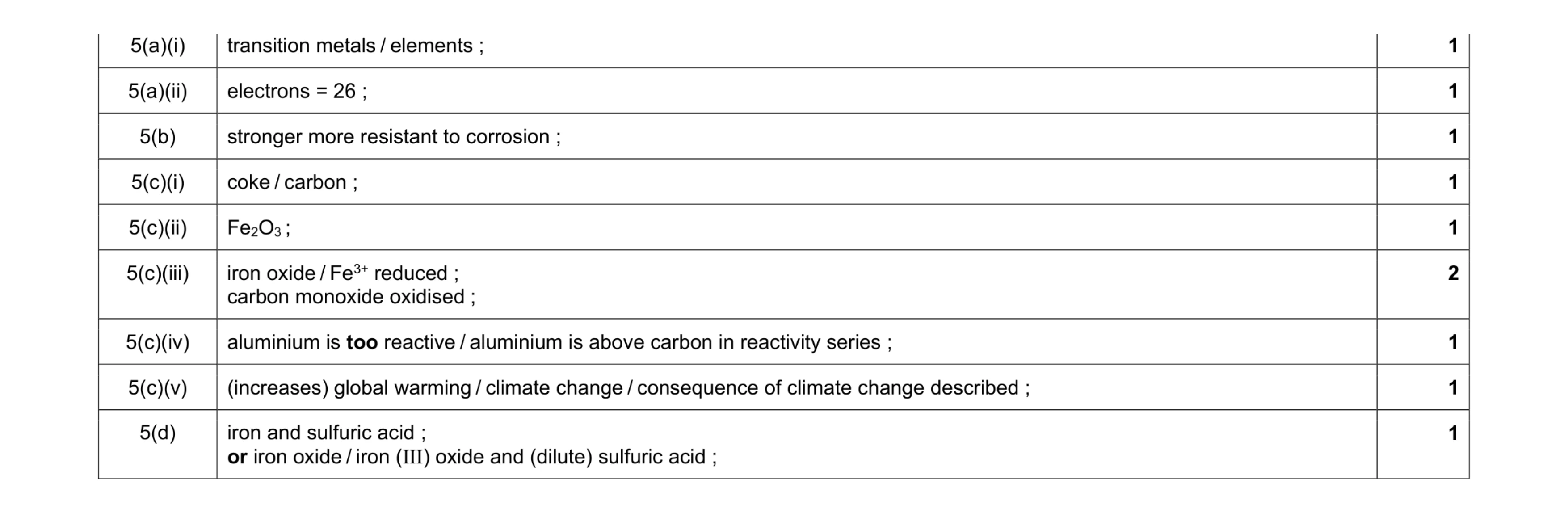 10
10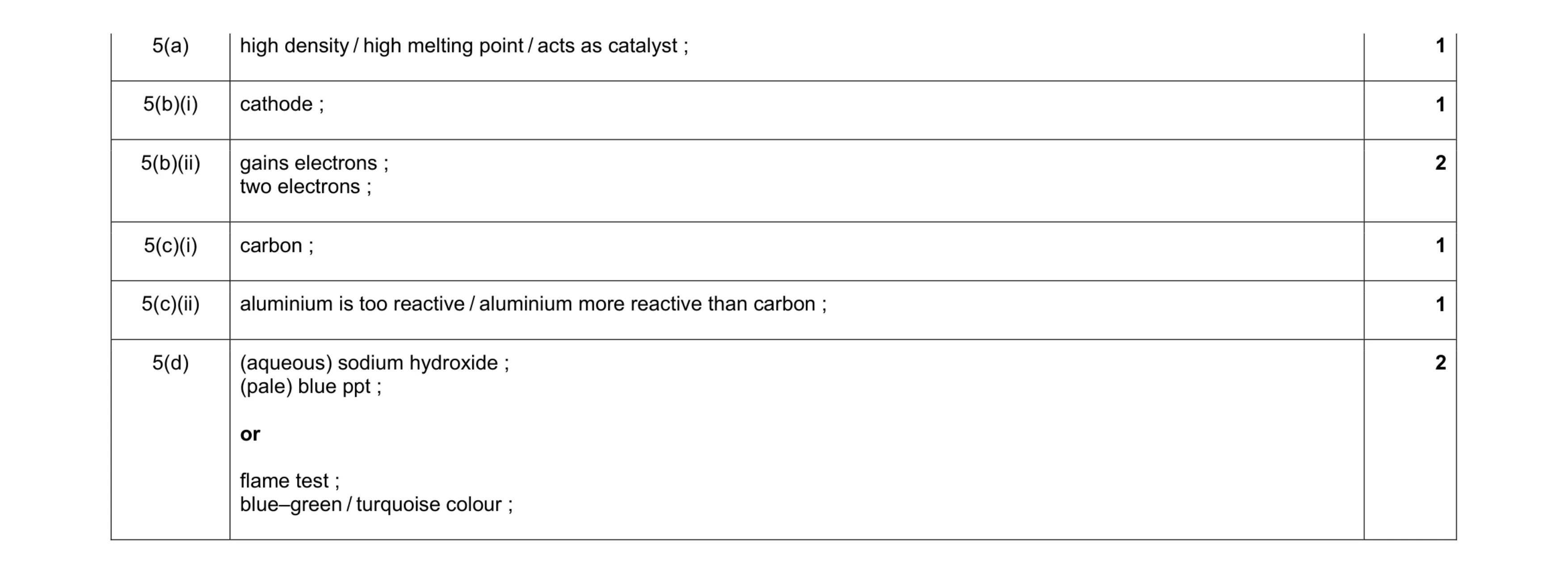 8
8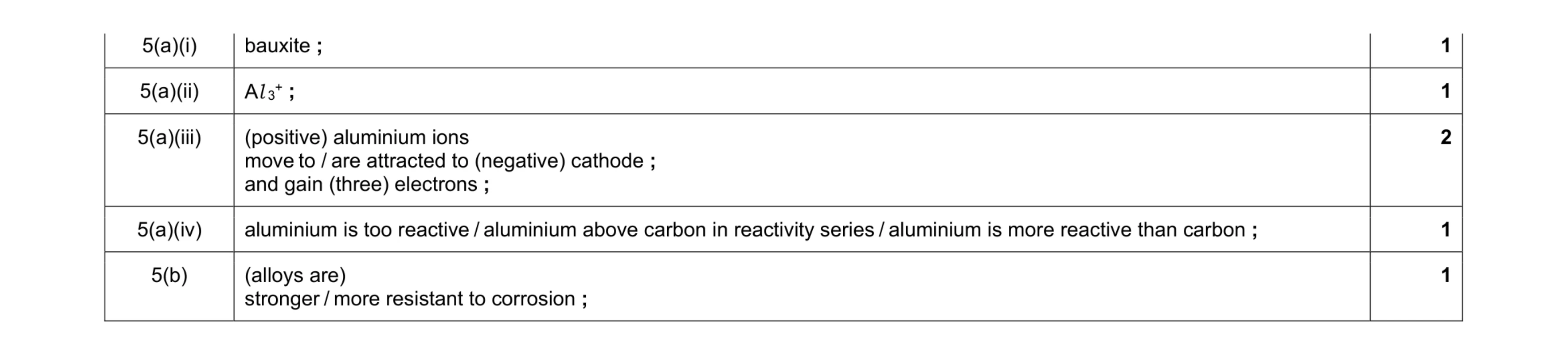 6
6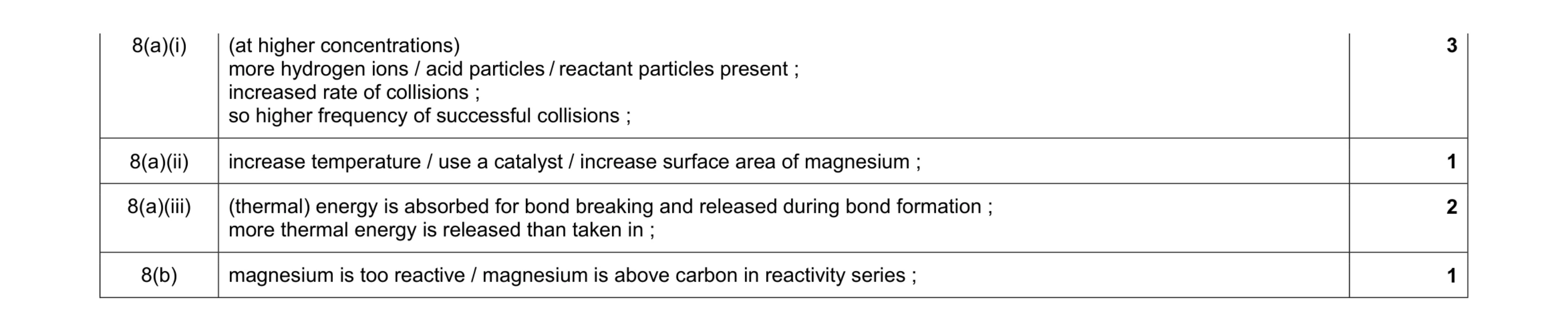 7
7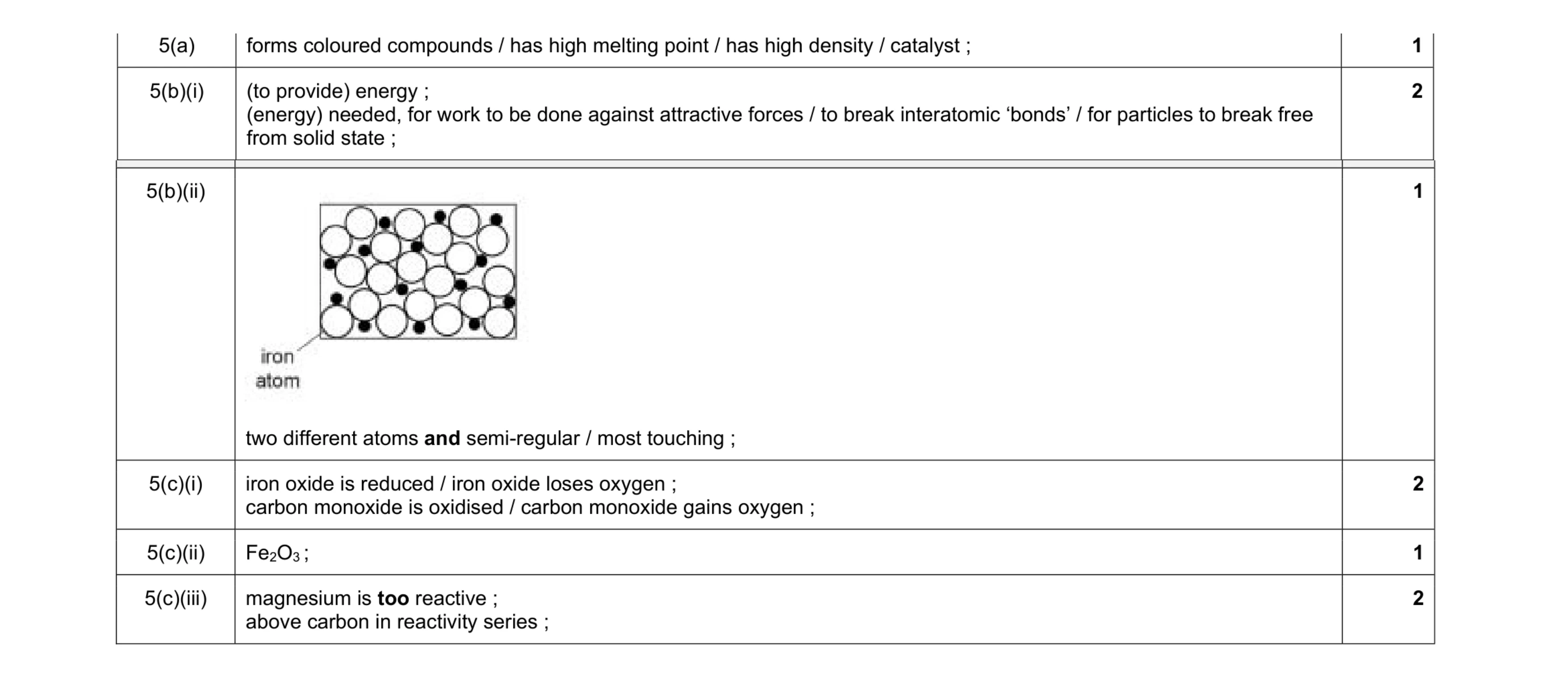 9
9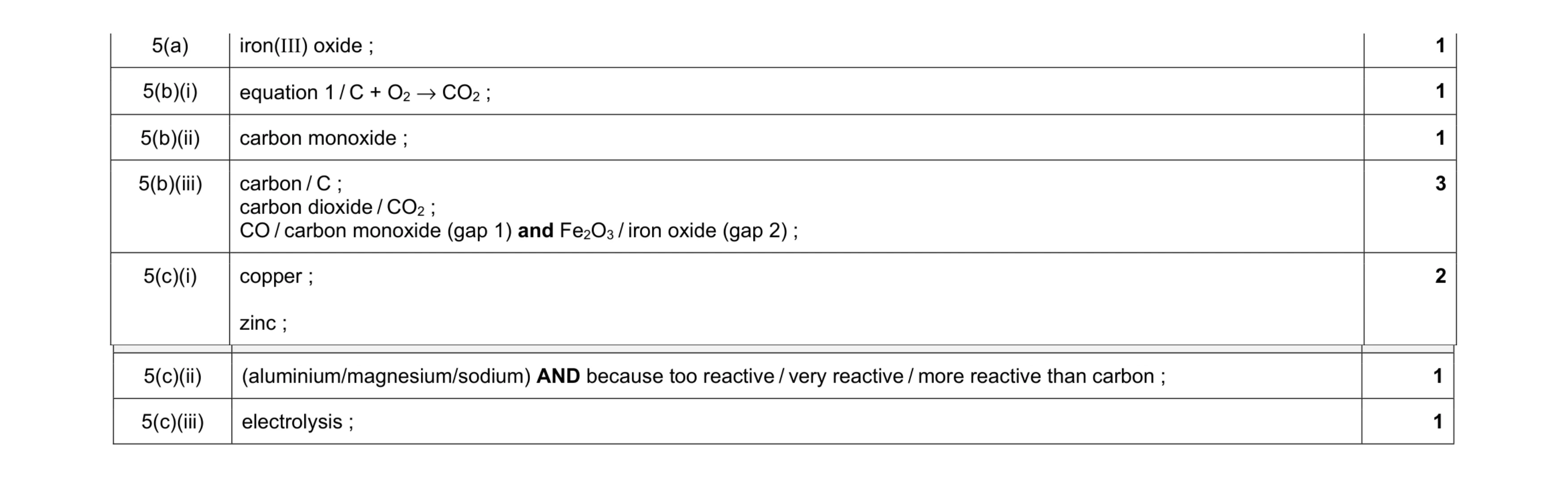 10
10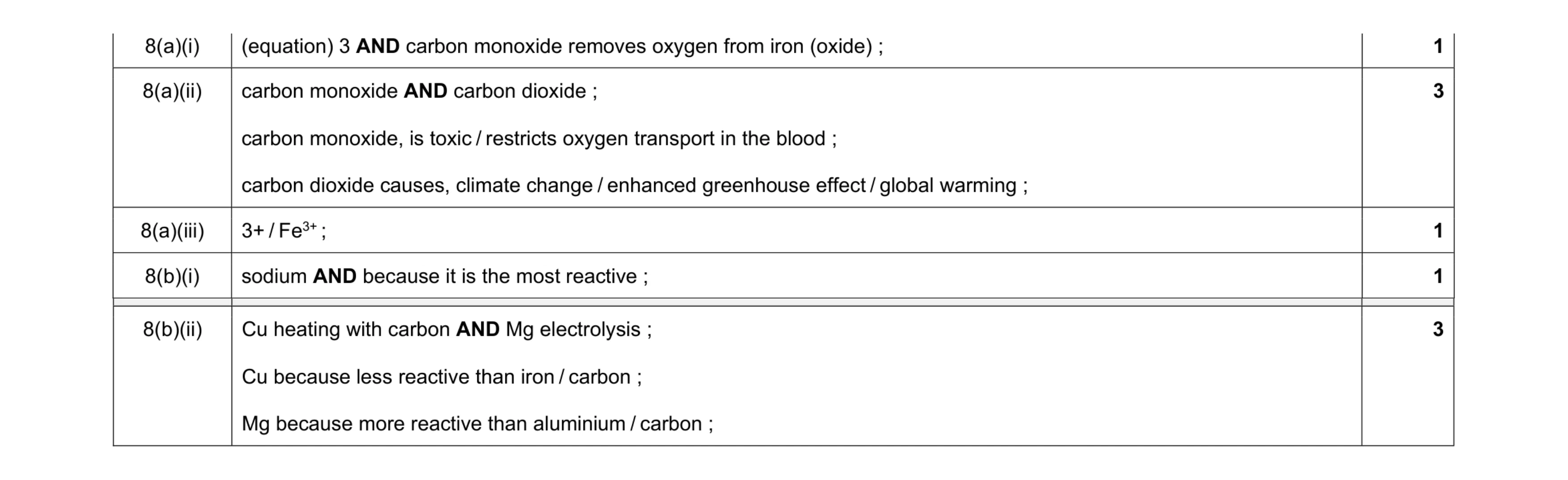 9
9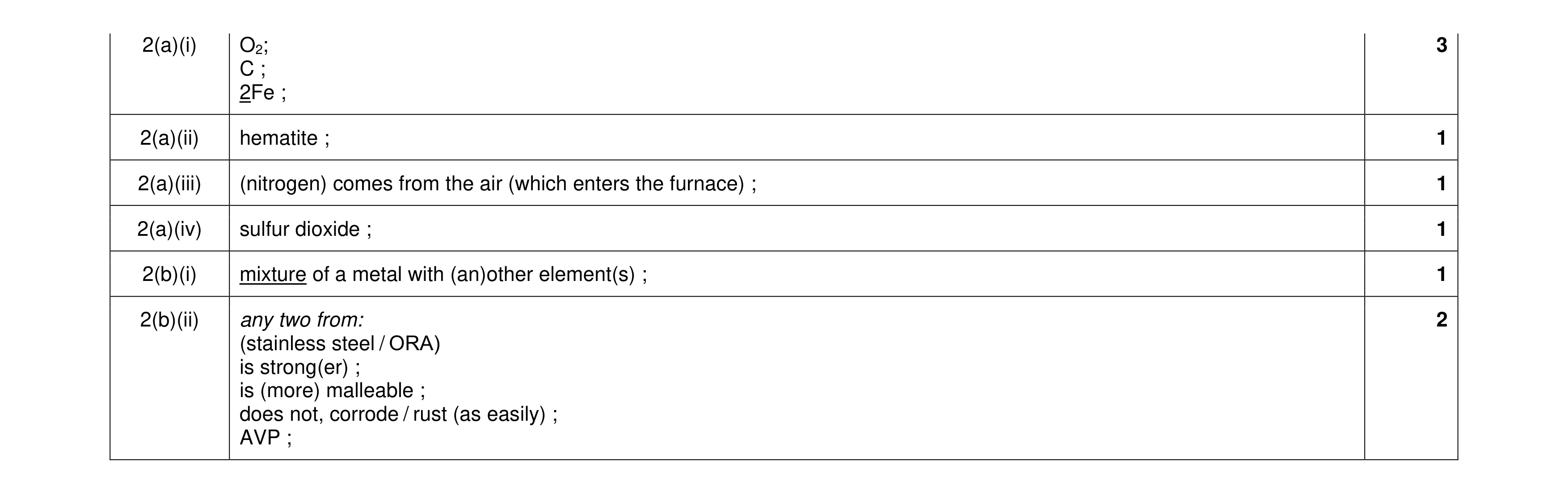 9
9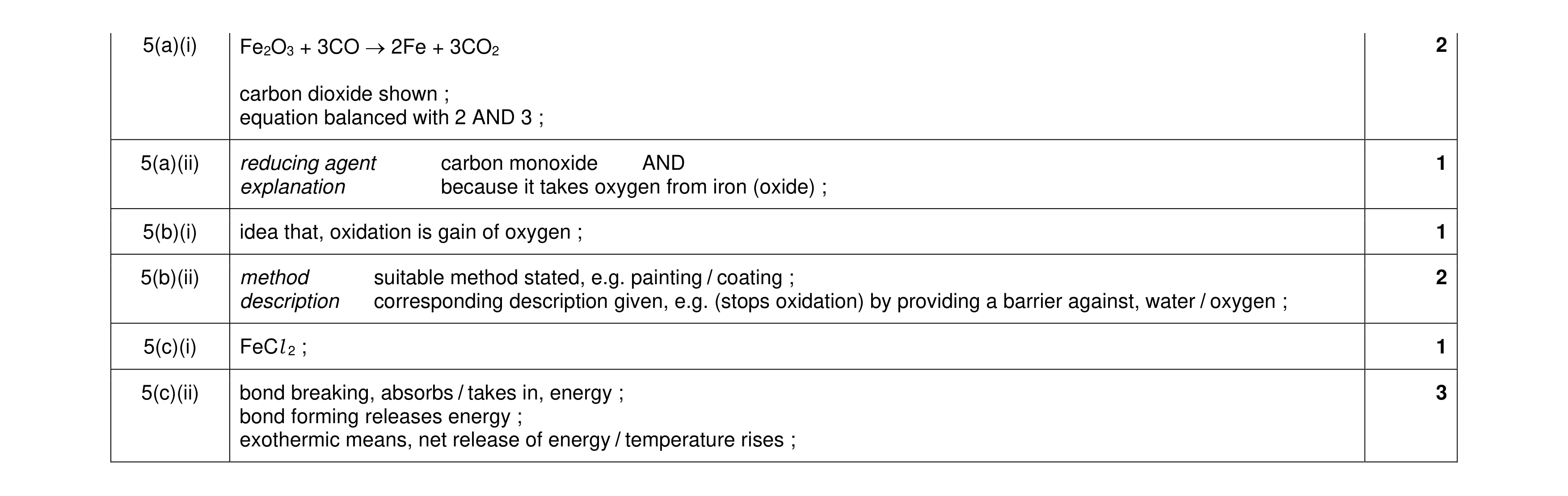 10
10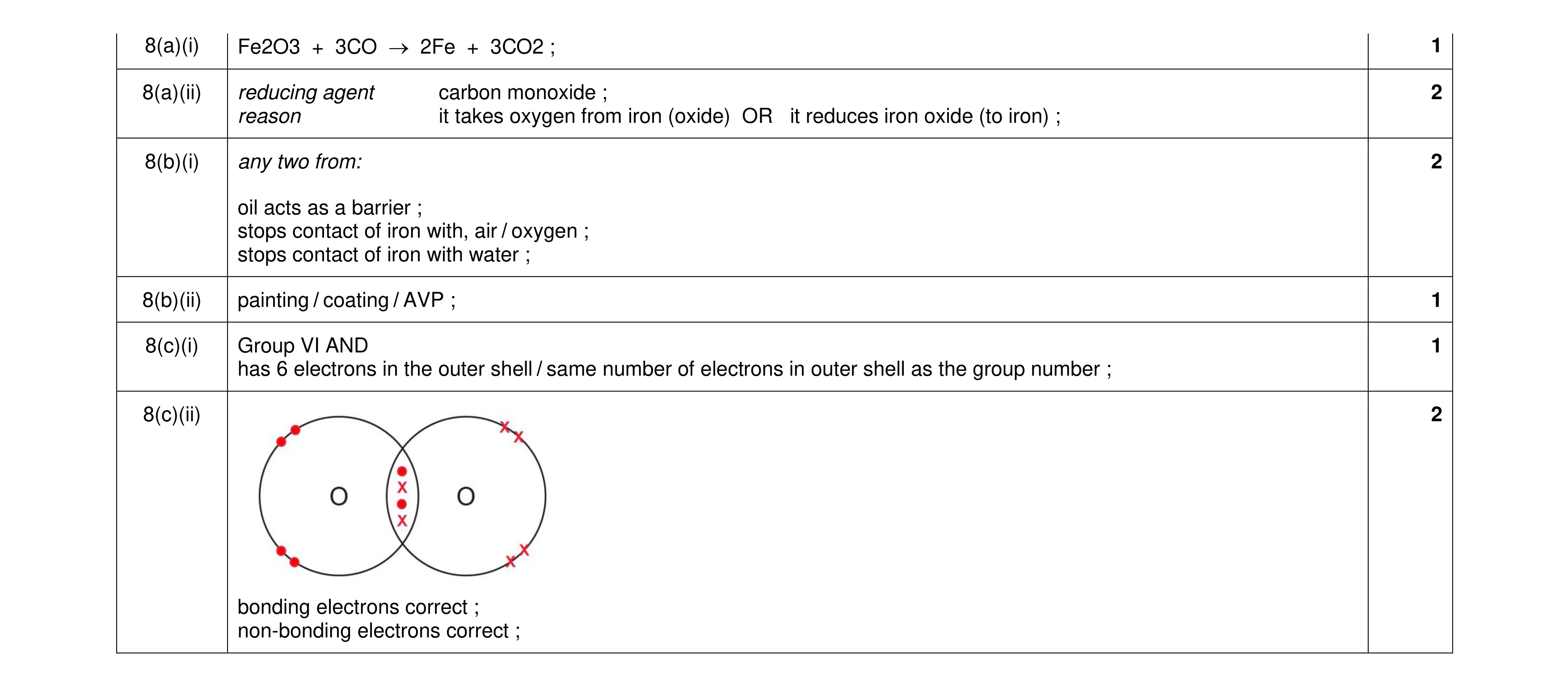 9
9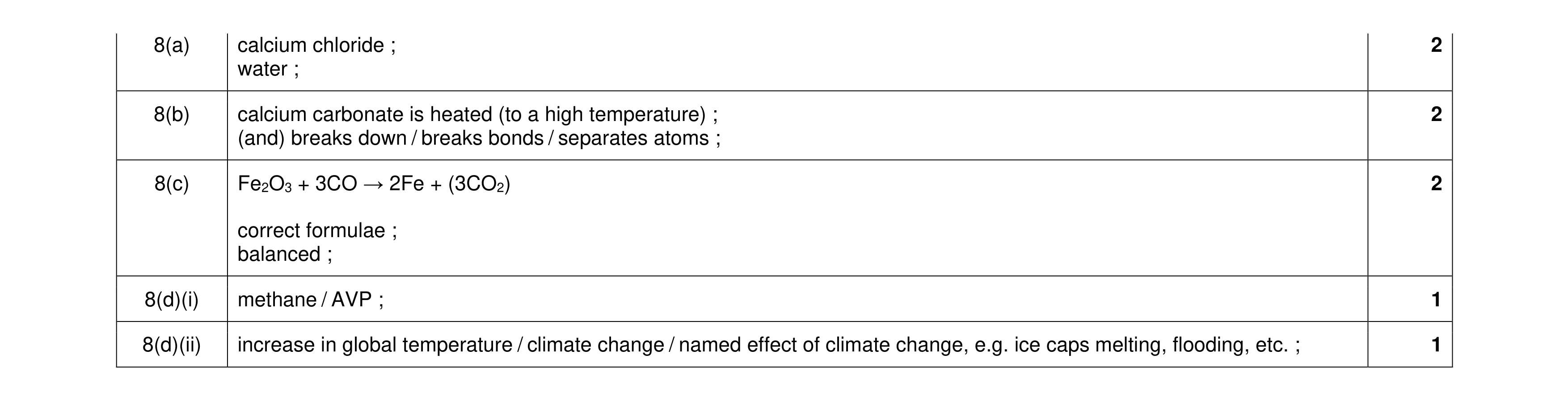 8
8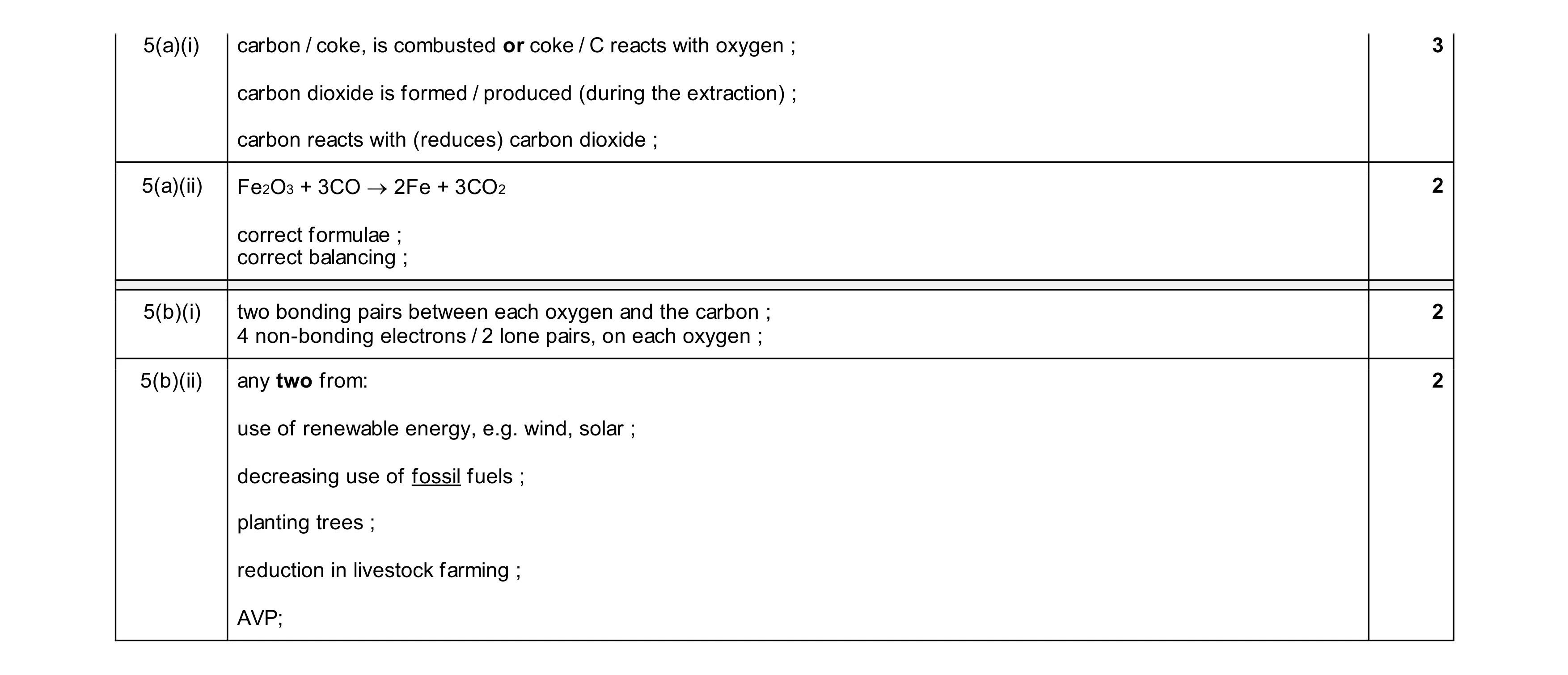 9
9