Questions as text
Q1 · What might a government decrease if it wished to slow down the rate of growth in an… 0455/11 May/June 2006
23 What might a government decrease if it wished to slow down the rate of growth in an economy? A expenditure on defence B goods and services (value added) tax C interest rates D the rate of income tax
1 marks
Answer: A
This question in 0455/11 May/June 2006
Q2 · Which aim of government policy is most likely to be achieved by an increase in interest… 0455/11 May/June 2006
25 Which aim of government policy is most likely to be achieved by an increase in interest rates? A economic growth B greater equality of income C full employment D price stability
1 marks
Answer: D
This question in 0455/11 May/June 2006
Q3 · What may a government change when it uses monetary policy? 0455/11 May/June 2006
26 What may a government change when it uses monetary policy? A budget deficit B minimum lending rate C regional assistance D rate of income tax
1 marks
Answer: B
This question in 0455/11 May/June 2006
Q4 · Why might a country’s central bank raise its interest rate? 0455/11 Oct/Nov 2006
6 Why might a country’s central bank raise its interest rate? A to encourage saving B to increase the money supply C to raise funds for the government D to reduce the level of employment
1 marks
Answer: A
This question in 0455/11 Oct/Nov 2006
Q5 · What could a government in a developed economy do to increase demand? 0455/11 Oct/Nov 2007
25 What could a government in a developed economy do to increase demand? A create a budget surplus B increase taxes C reduce government spending D reduce interest rates
1 marks
Answer: D
This question in 0455/11 Oct/Nov 2007
Q6 · What would encourage a rise in spending but not a rise in saving? 0455/11 May/June 2008
19 What would encourage a rise in spending but not a rise in saving? A easier credit facilities B more people working C rising interest rates D rising standards of living
1 marks
Answer: A
This question in 0455/11 May/June 2008
Q7 · In 2003, interest rates in Southern Africa were reduced 0455/11 May/June 2008
31 In 2003, interest rates in Southern Africa were reduced. What might have happened as a result? A an increase in investment B an increase in unemployment C a reduction in economic growth D a reduction in government spending
1 marks
Answer: A
This question in 0455/11 May/June 2008
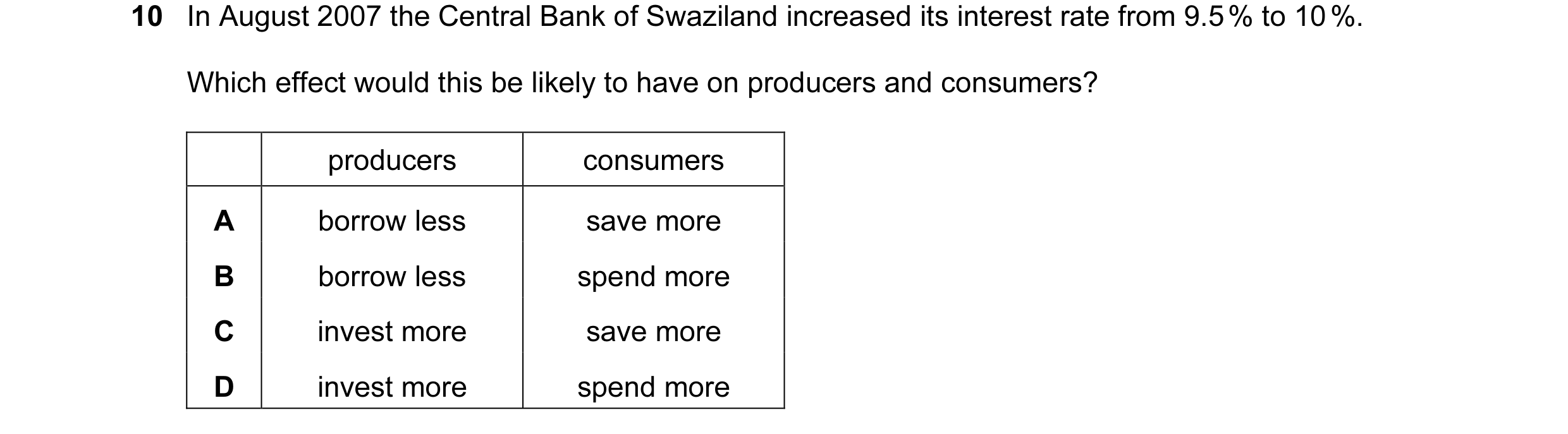
Q8 · In August 2007 the Central Bank of Swaziland increased its interest rate from 9.5 % to 10… 0455/11 Oct/Nov 2009
10 In August 2007 the Central Bank of Swaziland increased its interest rate from 9.5 % to 10 %. Which effect would this be likely to have on producers and consumers? producers consumers A borrow less save more B borrow less spend more C invest more save more D invest more spend more
1 marks
Answer: A
This question in 0455/11 Oct/Nov 2009
Q9 · A person is most likely to save more when there is an increase in a country’s A exchange… 0455/11 May/June 2010
10 A person is most likely to save more when there is an increase in a country’s A exchange rate. B inflation rate. C interest rates. D money supply.
1 marks
Answer: C
This question in 0455/11 May/June 2010
Q10 · A person is most likely to save more when there is an increase in a country’s A exchange… 0455/12 May/June 2010
11 A person is most likely to save more when there is an increase in a country’s A exchange rate. B inflation rate. C interest rates. D money supply.
1 marks
Answer: C
This question in 0455/12 May/June 2010
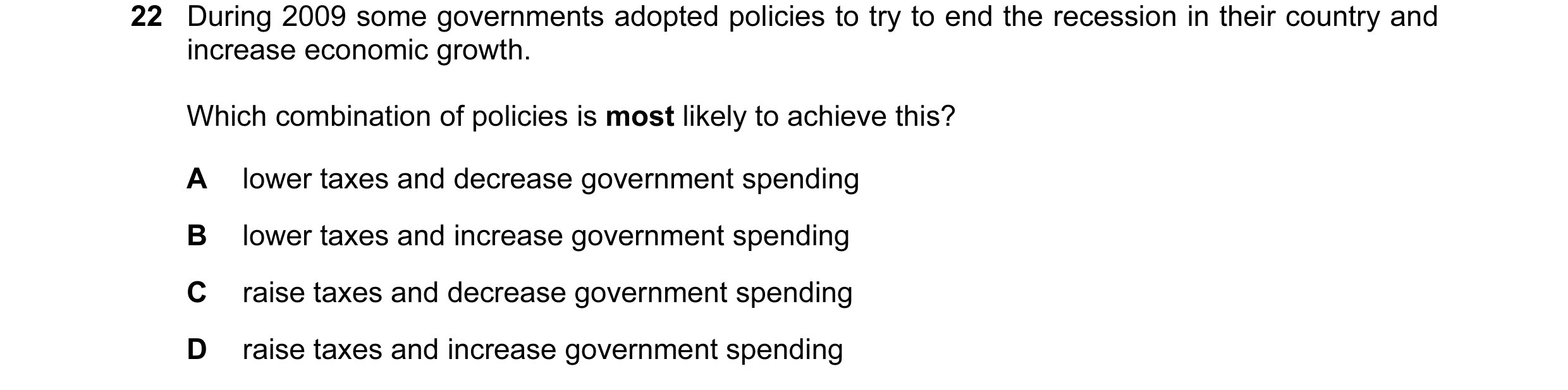
Q11 · During 2009 some governments adopted policies to try to end the recession in their… 0455/12 May/June 2011
22 During 2009 some governments adopted policies to try to end the recession in their country and increase economic growth. Which combination of policies is most likely to achieve this? A lower taxes and decrease government spending B lower taxes and increase government spending C raise taxes and decrease government spending D raise taxes and increase government spending
1 marks
Answer: B
This question in 0455/12 May/June 2011
Q12 · The central bank of Mexico set its rate of interest to try to keep the rise in the price… 0455/12 May/June 2011
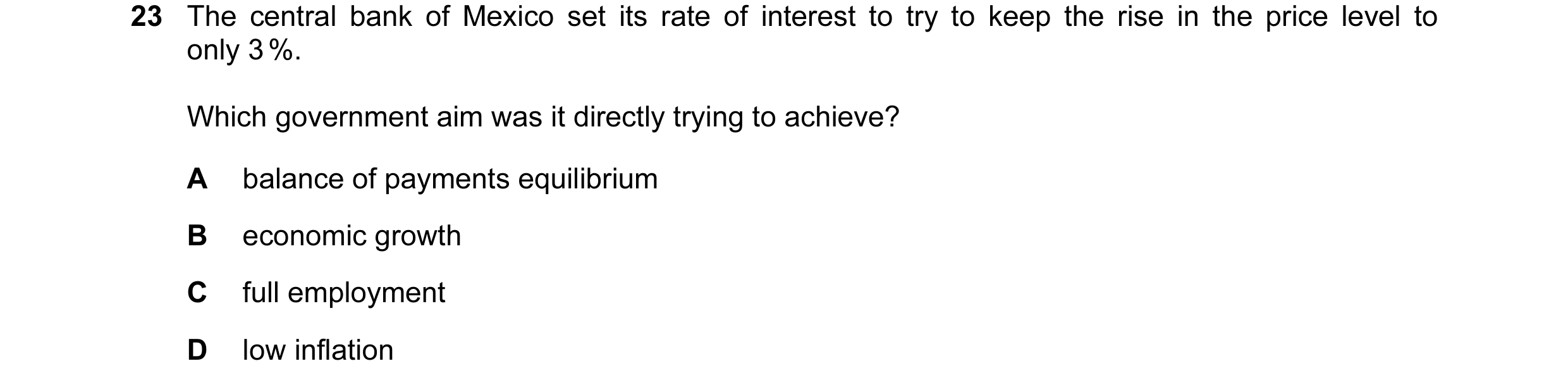
23 The central bank of Mexico set its rate of interest to try to keep the rise in the price level to only 3 %. Which government aim was it directly trying to achieve? A balance of payments equilibrium B economic growth C full employment D low inflation
1 marks
Answer: D
This question in 0455/12 May/June 2011
Q13 · The central bank of Mexico set its rate of interest to try to keep the rise in the price… 0455/13 May/June 2011
23 The central bank of Mexico set its rate of interest to try to keep the rise in the price level to only 3 %. Which government aim was it directly trying to achieve? A balance of payments equilibrium B economic growth C full employment D low inflation
1 marks
Answer: D
This question in 0455/13 May/June 2011
Q14 · Share prices on the stock market are most likely to rise if A employment falls 0455/11 Oct/Nov 2011
11 Share prices on the stock market are most likely to rise if A employment falls. B interest rates fall. C interest rates rise. D tax rates rise.
1 marks
Answer: B
This question in 0455/11 Oct/Nov 2011
Q15 · Between December 2008 and August 2009, the Central Bank of South Africa cut the rate of… 0455/11 Oct/Nov 2011
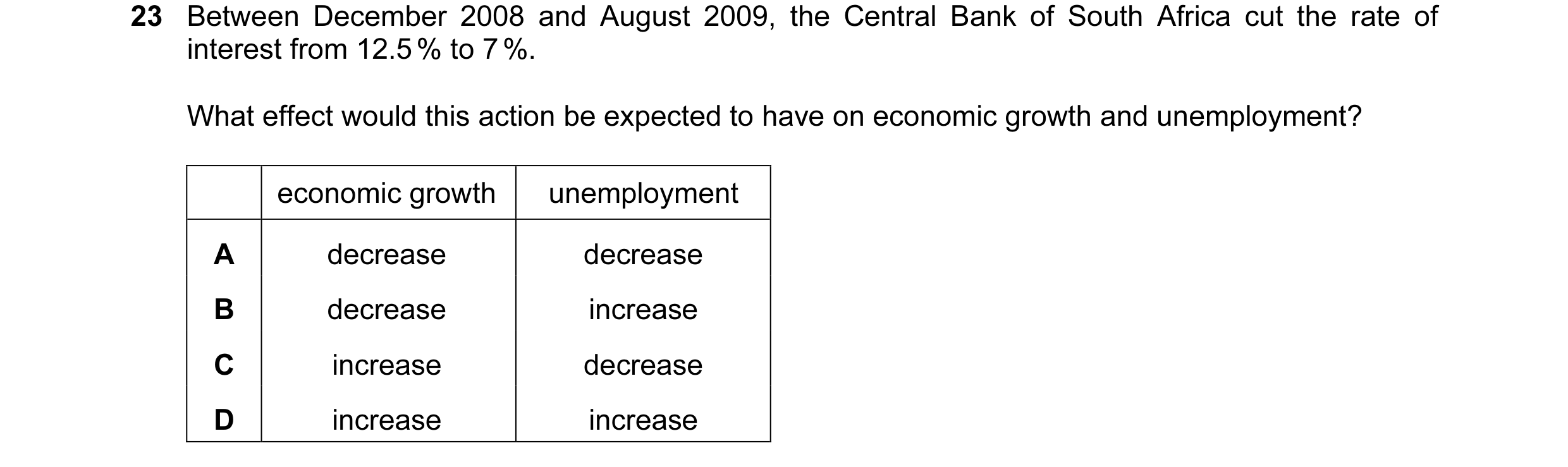
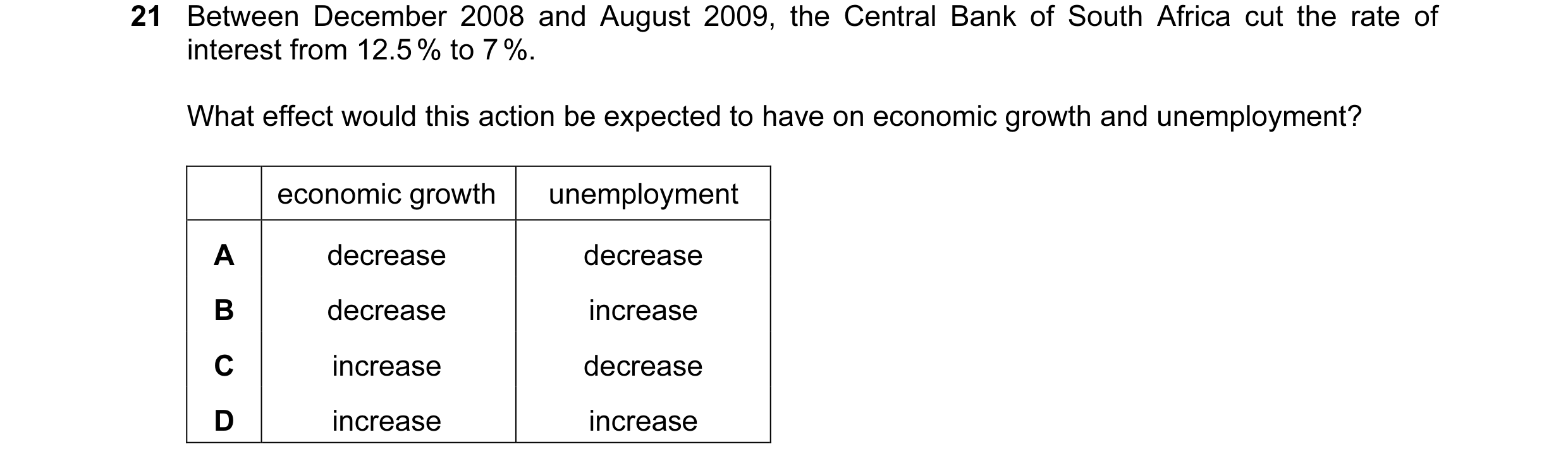
23 Between December 2008 and August 2009, the Central Bank of South Africa cut the rate of interest from 12.5 % to 7 %. What effect would this action be expected to have on economic growth and unemployment? economic growth unemployment A decrease decrease B decrease increase C increase decrease D increase increase
1 marks
Answer: C
This question in 0455/11 Oct/Nov 2011
Q16 · In 2009, the Chinese Government tried to increase household spending 0455/12 Oct/Nov 2011
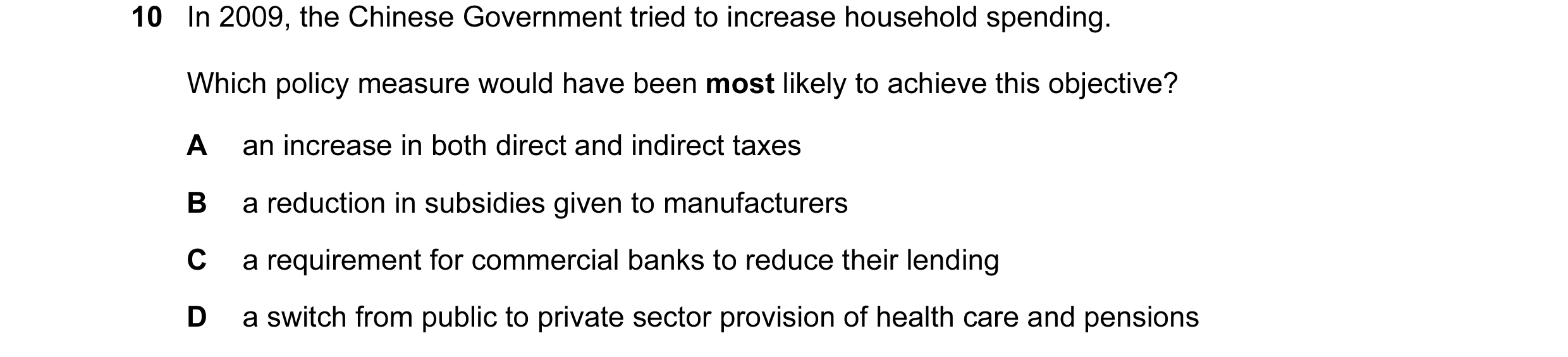
10 In 2009, the Chinese Government tried to increase household spending. Which policy measure would have been most likely to achieve this objective? A an increase in both direct and indirect taxes B a reduction in subsidies given to manufacturers C a requirement for commercial banks to reduce their lending D a switch from public to private sector provision of health care and pensions
1 marks
Answer: D
This question in 0455/12 Oct/Nov 2011
Q17 · Share prices on the stock market are most likely to rise if A employment falls 0455/12 Oct/Nov 2011
12 Share prices on the stock market are most likely to rise if A employment falls. B interest rates fall. C interest rates rise. D tax rates rise.
1 marks
Answer: B
This question in 0455/12 Oct/Nov 2011
Q18 · Between December 2008 and August 2009, the Central Bank of South Africa cut the rate of… 0455/12 Oct/Nov 2011
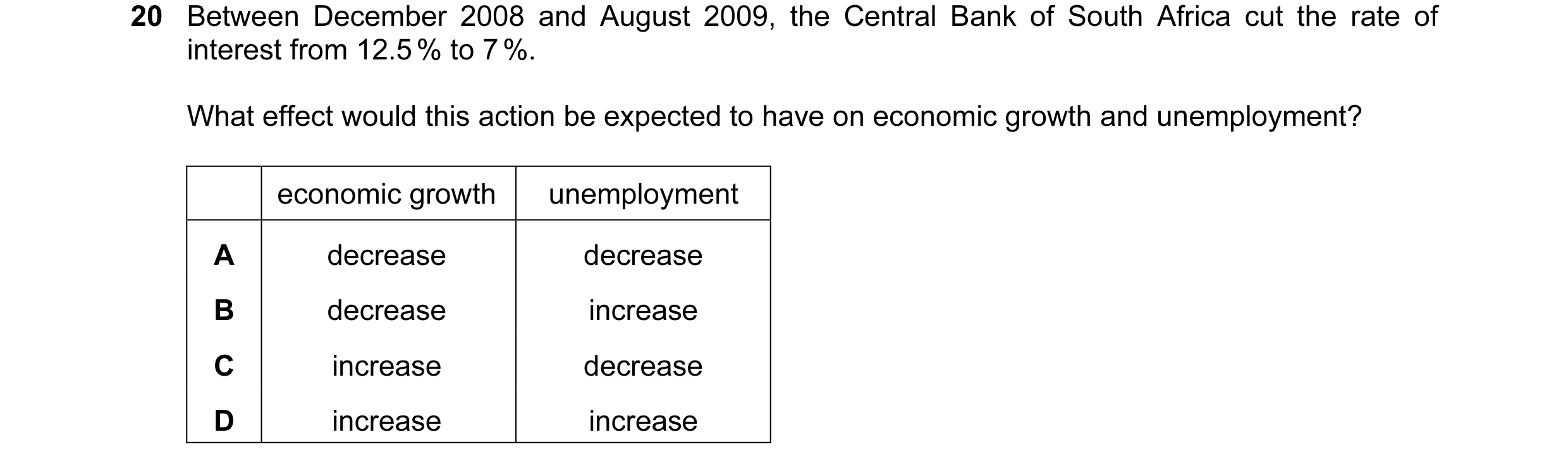
20 Between December 2008 and August 2009, the Central Bank of South Africa cut the rate of interest from 12.5 % to 7 %. What effect would this action be expected to have on economic growth and unemployment? economic growth unemployment A decrease decrease B decrease increase C increase decrease D increase increase
1 marks
Answer: C
This question in 0455/12 Oct/Nov 2011
Q19 · Share prices on the stock market are most likely to rise if A employment falls 0455/13 Oct/Nov 2011
13 Share prices on the stock market are most likely to rise if A employment falls. B interest rates fall. C interest rates rise. D tax rates rise.
1 marks
Answer: B
This question in 0455/13 Oct/Nov 2011
Q20 · Between December 2008 and August 2009, the Central Bank of South Africa cut the rate of… 0455/13 Oct/Nov 2011
21 Between December 2008 and August 2009, the Central Bank of South Africa cut the rate of interest from 12.5 % to 7 %. What effect would this action be expected to have on economic growth and unemployment? economic growth unemployment A decrease decrease B decrease increase C increase decrease D increase increase
1 marks
Answer: C
This question in 0455/13 Oct/Nov 2011
Q21 · What would be most likely to reduce the rate of inflation? 0455/11 May/June 2012
20 What would be most likely to reduce the rate of inflation? A an increase in direct taxes B an increase in government expenditure C an increase in indirect taxes D an increase in the budget deficit
1 marks
Answer: A
This question in 0455/11 May/June 2012
Q22 · In 2008–2009 the central bank of a developed country reduced interest rates from 5 % to… 0455/12 May/June 2012
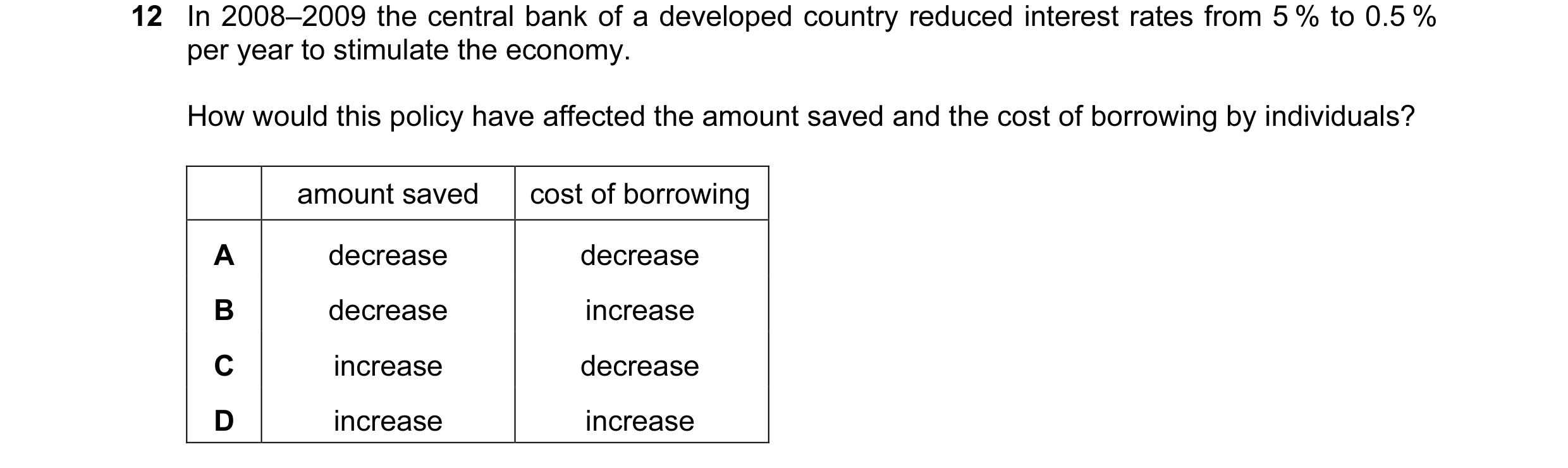
12 In 2008–2009 the central bank of a developed country reduced interest rates from 5 % to 0.5 % per year to stimulate the economy. How would this policy have affected the amount saved and the cost of borrowing by individuals? amount saved cost of borrowing A decrease decrease B decrease increase C increase decrease D increase increase
1 marks
Answer: A
This question in 0455/12 May/June 2012
Q23 · What would be most likely to reduce the rate of inflation? 0455/12 May/June 2012
20 What would be most likely to reduce the rate of inflation? A an increase in direct taxes B an increase in government expenditure C an increase in indirect taxes D an increase in the budget deficit
1 marks
Answer: A
This question in 0455/12 May/June 2012
Q24 · In 2008–2009 the central bank of a developed country reduced interest rates from 5 % to… 0455/13 May/June 2012
12 In 2008–2009 the central bank of a developed country reduced interest rates from 5 % to 0.5 % per year to stimulate the economy. How would this policy have affected the amount saved and the cost of borrowing by individuals? amount saved cost of borrowing A decrease decrease B decrease increase C increase decrease D increase increase
1 marks
Answer: A
This question in 0455/13 May/June 2012
Q25 · What might encourage a consumer to save rather than to spend? 0455/11 Oct/Nov 2012
3 What might encourage a consumer to save rather than to spend? A being made unemployed B discounts on products C government subsidies to producers D high interest rates
1 marks
Answer: D
This question in 0455/11 Oct/Nov 2012
Q26 · What is the most likely result of an increase in interest rates? 0455/11 May/June 2013
20 What is the most likely result of an increase in interest rates? A a rise in investment B a rise in borrowing C a fall in consumer spending D a fall in productivity
1 marks
Answer: C
This question in 0455/11 May/June 2013
Q27 · What is the most likely result of an increase in interest rates? 0455/12 May/June 2013
20 What is the most likely result of an increase in interest rates? A a rise in investment B a rise in borrowing C a fall in consumer spending D a fall in productivity
1 marks
Answer: C
This question in 0455/12 May/June 2013
Q28 · A government reduces the interest rate to encourage economic growth 0455/12 May/June 2013
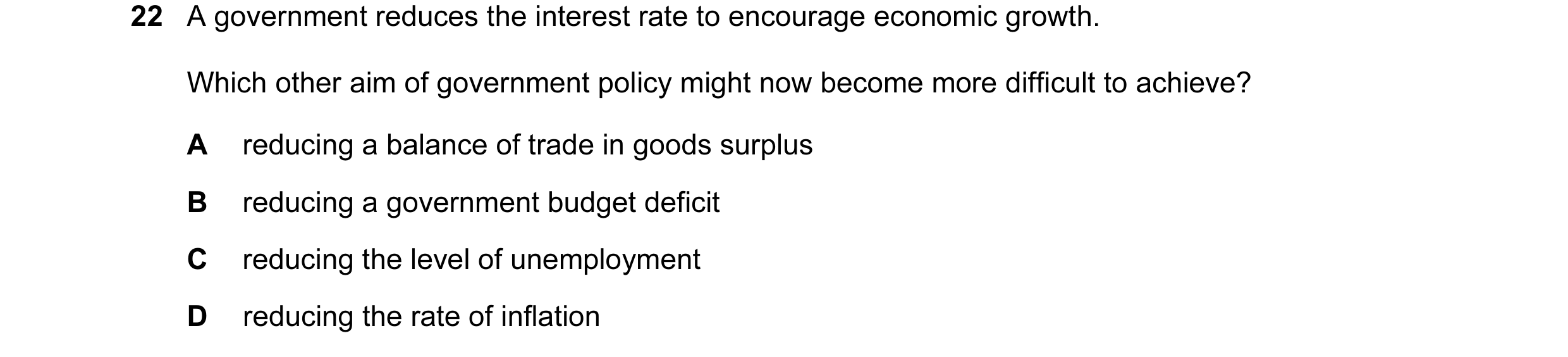
22 A government reduces the interest rate to encourage economic growth. Which other aim of government policy might now become more difficult to achieve? A reducing a balance of trade in goods surplus B reducing a government budget deficit C reducing the level of unemployment D reducing the rate of inflation
1 marks
Answer: D
This question in 0455/12 May/June 2013
Q29 · What is the most likely result of an increase in interest rates? 0455/13 May/June 2013
6 What is the most likely result of an increase in interest rates? A a rise in investment B a rise in borrowing C a fall in consumer spending D a fall in productivity
1 marks
Answer: C
This question in 0455/13 May/June 2013
Q30 · Which aim of government policy is most likely to be achieved by an increase in interest… 0455/11 Oct/Nov 2013
6 Which aim of government policy is most likely to be achieved by an increase in interest rates? A economic growth B greater equality of income C full employment D price stability
1 marks
Answer: D
This question in 0455/11 Oct/Nov 2013
Q31 · Which combination of government policies is most likely to be successful at reducing… 0455/11 Oct/Nov 2013
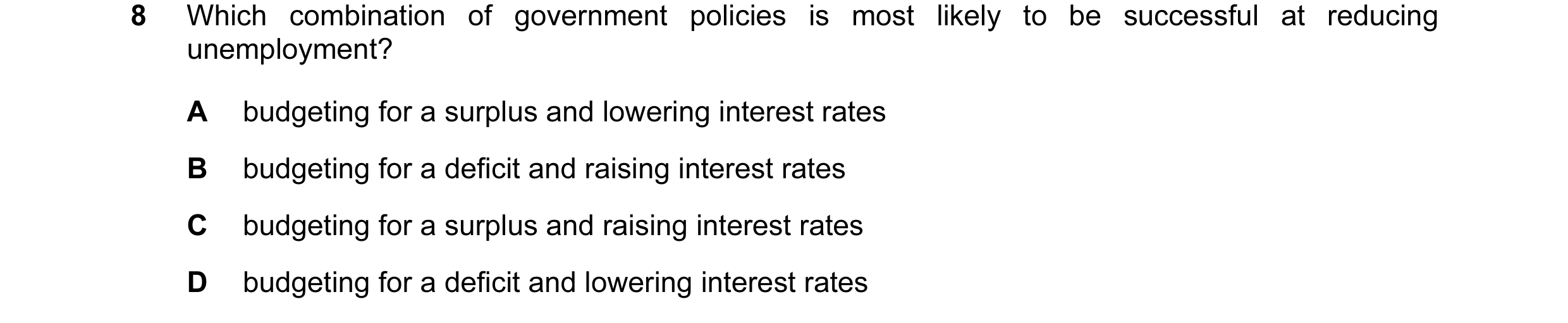
8 Which combination of government policies is most likely to be successful at reducing unemployment? A budgeting for a surplus and lowering interest rates B budgeting for a deficit and raising interest rates C budgeting for a surplus and raising interest rates D budgeting for a deficit and lowering interest rates
1 marks
Answer: D
This question in 0455/11 Oct/Nov 2013
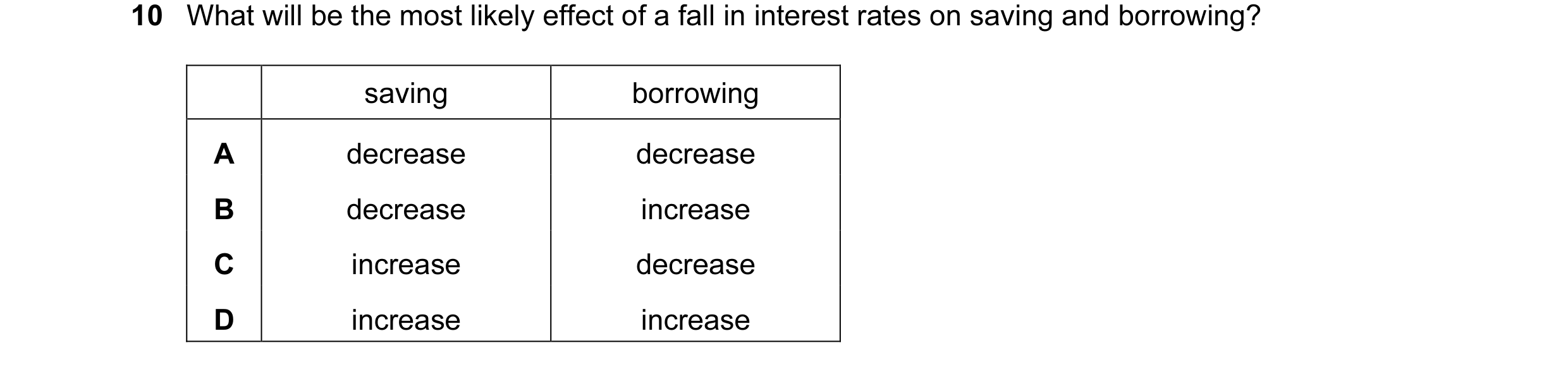
Q32 · What will be the most likely effect of a fall in interest rates on saving and borrowing? 0455/11 Oct/Nov 2013
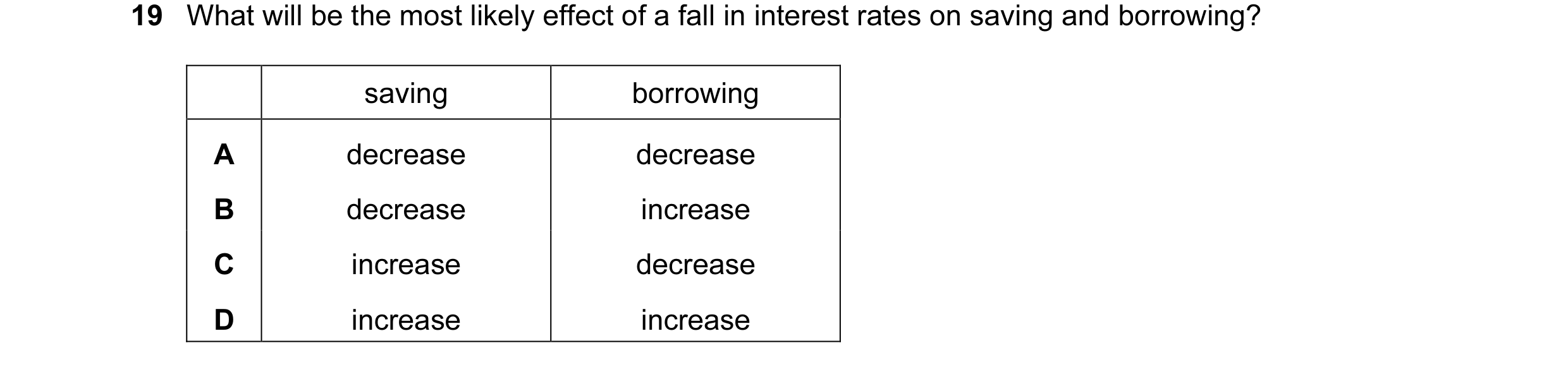
19 What will be the most likely effect of a fall in interest rates on saving and borrowing? saving borrowing A decrease decrease B decrease increase C increase decrease D increase increase
1 marks
Answer: B
This question in 0455/11 Oct/Nov 2013
Q33 · What will be the most likely effect of a fall in interest rates on saving and borrowing? 0455/12 Oct/Nov 2013
10 What will be the most likely effect of a fall in interest rates on saving and borrowing? saving borrowing A decrease decrease B decrease increase C increase decrease D increase increase
1 marks
Answer: B
This question in 0455/12 Oct/Nov 2013
Q34 · Which aim of government policy is most likely to be achieved by an increase in interest… 0455/12 Oct/Nov 2013
20 Which aim of government policy is most likely to be achieved by an increase in interest rates? A economic growth B greater equality of income C full employment D price stability
1 marks
Answer: D
This question in 0455/12 Oct/Nov 2013
Q35 · Which combination of government policies is most likely to be successful at reducing… 0455/12 Oct/Nov 2013
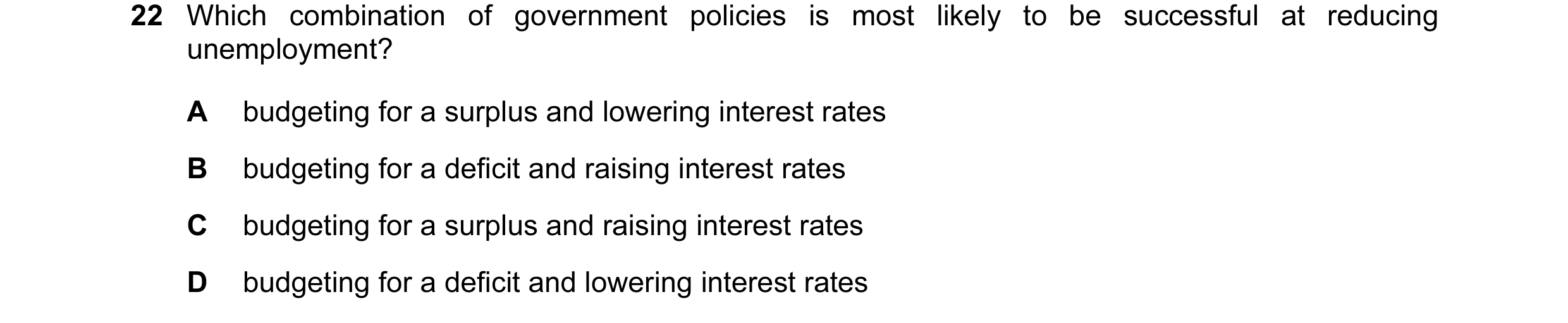
22 Which combination of government policies is most likely to be successful at reducing unemployment? A budgeting for a surplus and lowering interest rates B budgeting for a deficit and raising interest rates C budgeting for a surplus and raising interest rates D budgeting for a deficit and lowering interest rates
1 marks
Answer: D
This question in 0455/12 Oct/Nov 2013
Q36 · What will be the most likely effect of a fall in interest rates on saving and borrowing? 0455/13 Oct/Nov 2013
10 What will be the most likely effect of a fall in interest rates on saving and borrowing? saving borrowing A decrease decrease B decrease increase C increase decrease D increase increase
1 marks
Answer: B
This question in 0455/13 Oct/Nov 2013
Q37 · Which aim of government policy is most likely to be achieved by an increase in interest… 0455/13 Oct/Nov 2013
20 Which aim of government policy is most likely to be achieved by an increase in interest rates? A economic growth B greater equality of income C full employment D price stability
1 marks
Answer: D
This question in 0455/13 Oct/Nov 2013
Q38 · Which policy is an example of an expansionary monetary policy? 0455/12 May/June 2014
16 Which policy is an example of an expansionary monetary policy? A lower interest rates B lower money supply growth C lower public sector spending D lower taxation
1 marks
Answer: A
This question in 0455/12 May/June 2014
Q39 · A government aims to keep domestic prices stable in a fully employed economy 0455/11 Oct/Nov 2014
18 A government aims to keep domestic prices stable in a fully employed economy. Which policy should it use? A increase expenditure on defence B increase indirect taxes C increase the rate of interest D increase the wages of government workers
1 marks
Answer: C
This question in 0455/11 Oct/Nov 2014
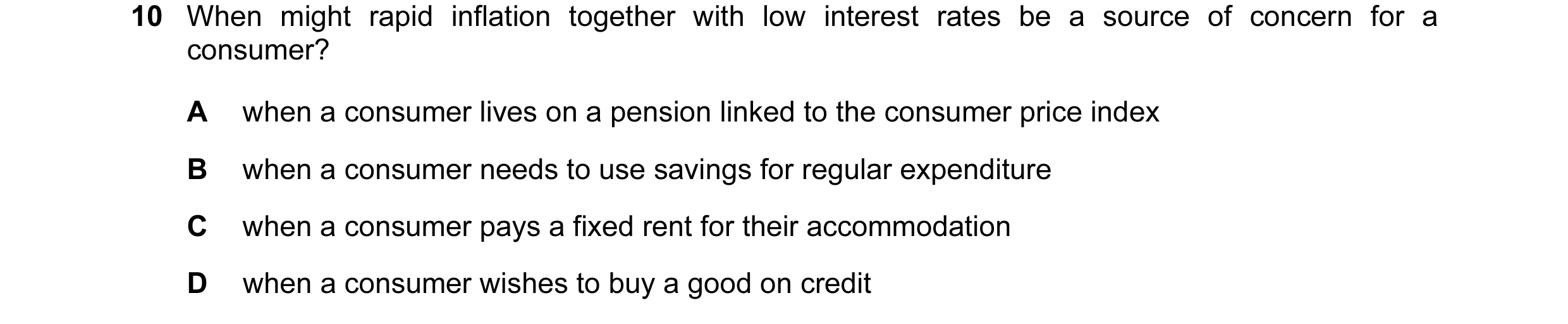
Q40 · When might rapid inflation together with low interest rates be a source of concern for a… 0455/12 Oct/Nov 2014
10 When might rapid inflation together with low interest rates be a source of concern for a consumer? A when a consumer lives on a pension linked to the consumer price index B when a consumer needs to use savings for regular expenditure C when a consumer pays a fixed rent for their accommodation D when a consumer wishes to buy a good on credit
1 marks
Answer: B
This question in 0455/12 Oct/Nov 2014
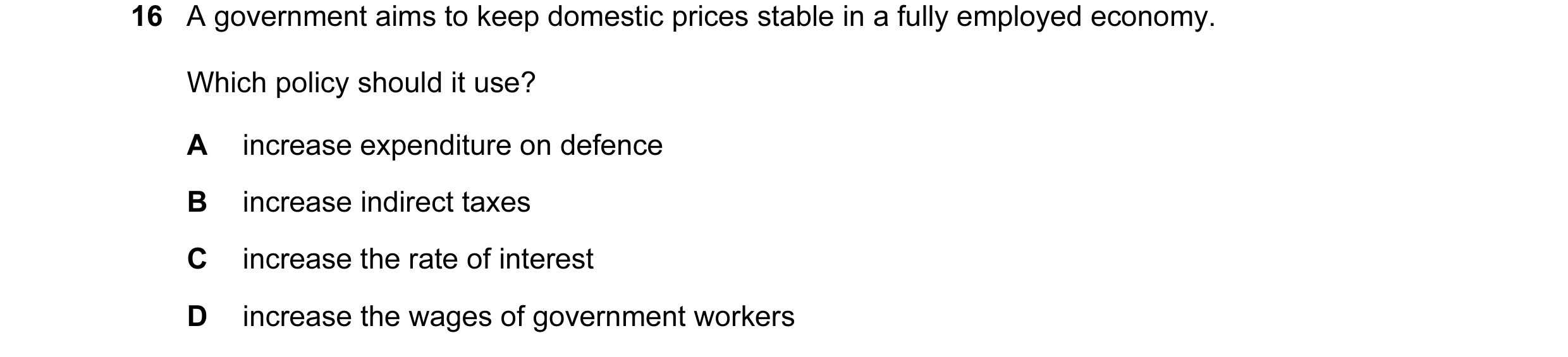
Q41 · A government aims to keep domestic prices stable in a fully employed economy 0455/12 Oct/Nov 2014
16 A government aims to keep domestic prices stable in a fully employed economy. Which policy should it use? A increase expenditure on defence B increase indirect taxes C increase the rate of interest D increase the wages of government workers
1 marks
Answer: C
This question in 0455/12 Oct/Nov 2014
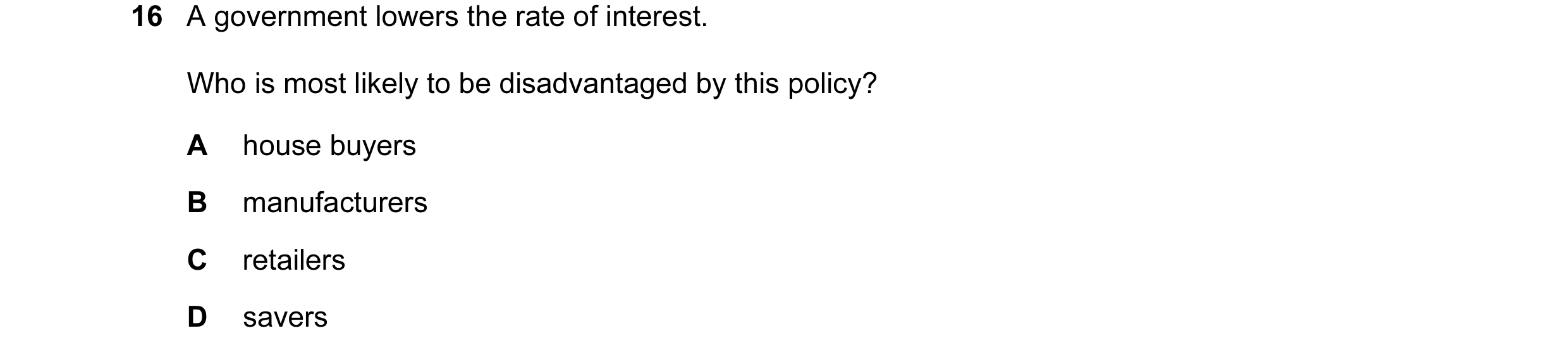
Q42 · A government lowers the rate of interest 0455/11 May/June 2015
16 A government lowers the rate of interest. Who is most likely to be disadvantaged by this policy? A house buyers B manufacturers C retailers D savers
1 marks
Answer: D
This question in 0455/11 May/June 2015
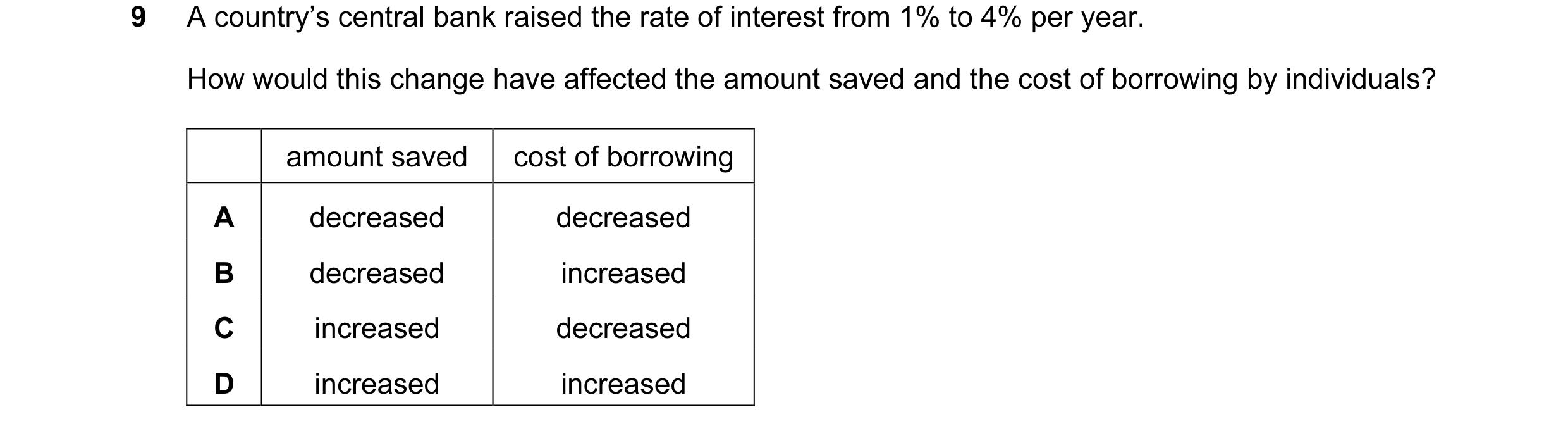
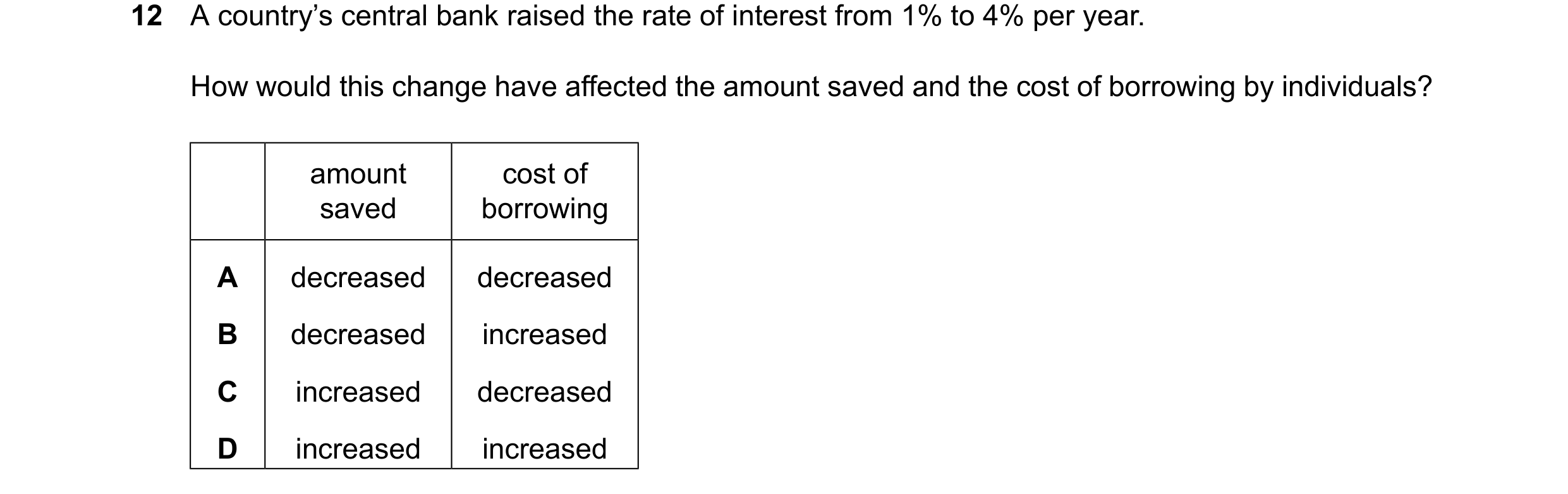
Q43 · A country’s central bank raised the rate of interest from 1% to 4% per year 0455/11 Oct/Nov 2015
9 A country’s central bank raised the rate of interest from 1% to 4% per year. How would this change have affected the amount saved and the cost of borrowing by individuals? amount saved cost of borrowing A decreased decreased B decreased increased C increased decreased D increased increased
1 marks
Answer: D
This question in 0455/11 Oct/Nov 2015
Q44 · How do high direct taxes affect spending and how do high interest rates affect saving by… 0455/12 Oct/Nov 2015
9 How do high direct taxes affect spending and how do high interest rates affect saving by wage- earners? spending saving A decrease decrease B decrease increase C increase decrease D increase increase
1 marks
Answer: B
This question in 0455/12 Oct/Nov 2015
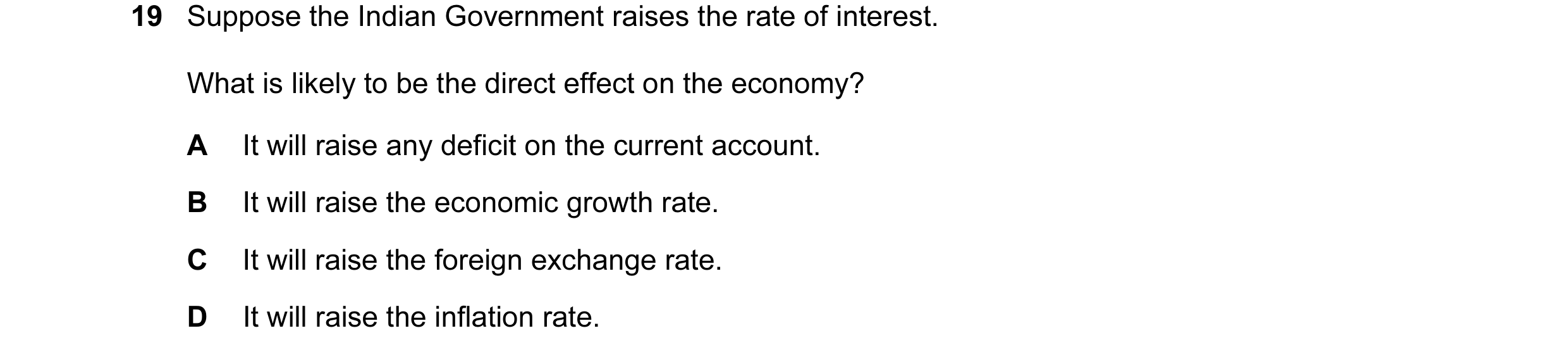
Q45 · Suppose the Indian Government raises the rate of interest 0455/12 Feb/March 2016
19 Suppose the Indian Government raises the rate of interest. What is likely to be the direct effect on the economy? A It will raise any deficit on the current account. B It will raise the economic growth rate. C It will raise the foreign exchange rate. D It will raise the inflation rate.
1 marks
Answer: C
This question in 0455/12 Feb/March 2016
Q46 · What is an expansionary monetary policy? 0455/11 May/June 2016
17 What is an expansionary monetary policy? A a decrease in the interest rate B a decrease in the rate of value added tax C an increase in the power of trade unions D an increase in the standard rate of income tax
1 marks
Answer: A
This question in 0455/11 May/June 2016
Q47 · Which policy combination will be the most effective if a government wishes to increase… 0455/13 May/June 2016
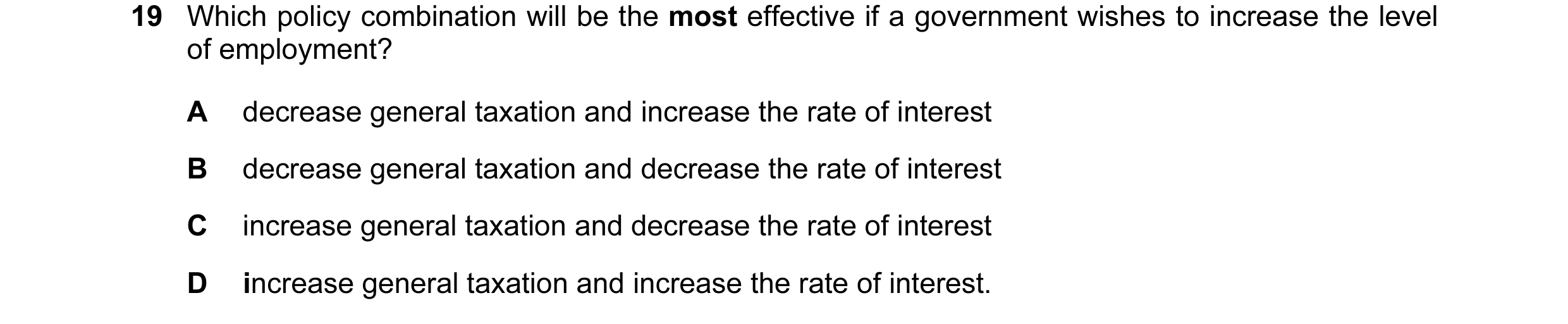
19 Which policy combination will be the most effective if a government wishes to increase the level of employment? A decrease general taxation and increase the rate of interest B decrease general taxation and decrease the rate of interest C increase general taxation and decrease the rate of interest D increase general taxation and increase the rate of interest.
1 marks
Answer: B
This question in 0455/13 May/June 2016
Q48 · What is likely to happen when the rate of interest increases? 0455/11 May/June 2017
8 What is likely to happen when the rate of interest increases? A consumer spending increases B firms buy fewer machines C people hold more cash D savers earn lower rewards
1 marks
Answer: B
This question in 0455/11 May/June 2017
Q49 · Which policy combination will be the most effective if a government wishes to increase… 0455/12 May/June 2017
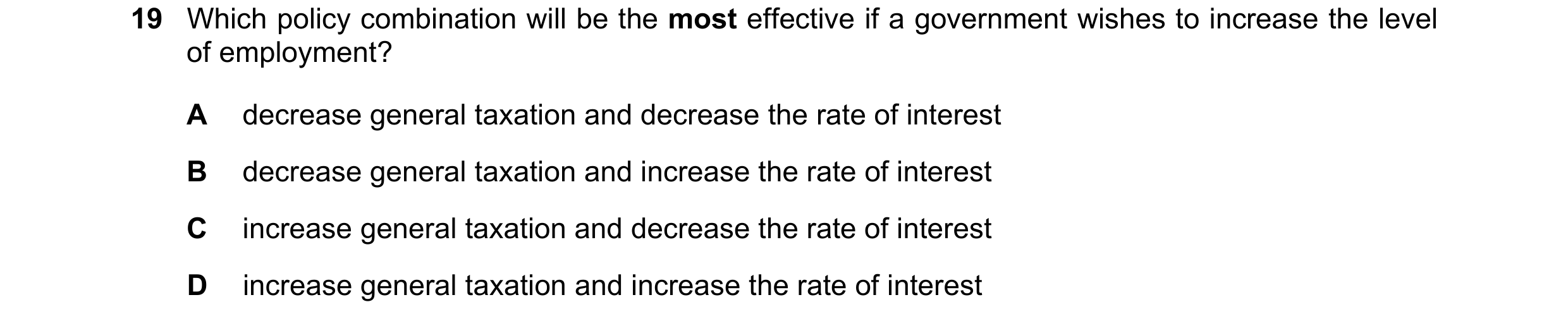
19 Which policy combination will be the most effective if a government wishes to increase the level of employment? A decrease general taxation and decrease the rate of interest B decrease general taxation and increase the rate of interest C increase general taxation and decrease the rate of interest D increase general taxation and increase the rate of interest
1 marks
Answer: A
This question in 0455/12 May/June 2017
Q50 · What, when increased, will help a government to reduce the rate of inflation? 0455/11 Oct/Nov 2017
16 What, when increased, will help a government to reduce the rate of inflation? A budget deficit B consumer spending C income tax D pensions
1 marks
Answer: C
This question in 0455/11 Oct/Nov 2017
Q51 · Which policy aims to maintain low inflation over a period of time? 0455/11 Oct/Nov 2017
23 Which policy aims to maintain low inflation over a period of time? A imposing a minimum wage to be paid to workers B reducing interest rates to encourage borrowing C restricting the supply of money through the central bank D writing off the debts of low-income countries
1 marks
Answer: C
This question in 0455/11 Oct/Nov 2017
Q52 · What would a government reduce as part of an expansionary monetary policy to increase… 0455/11 May/June 2018
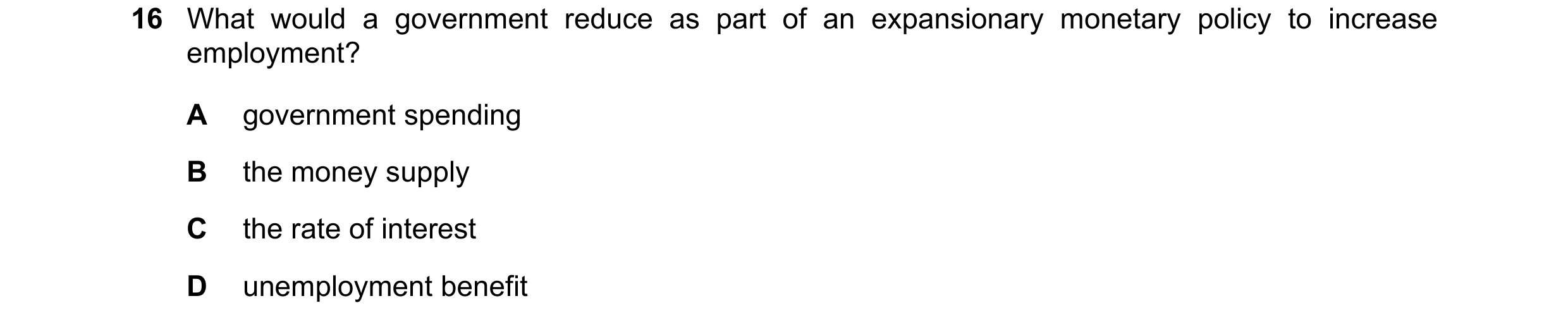
16 What would a government reduce as part of an expansionary monetary policy to increase employment? A government spending B the money supply C the rate of interest D unemployment benefit
1 marks
Answer: C
This question in 0455/11 May/June 2018
Q53 · What is likely to assist a government’s policy of reducing inflation? 0455/11 Oct/Nov 2018
11 What is likely to assist a government’s policy of reducing inflation? A allowing businesses to borrow money for longer periods B encouraging the public to spend more money C increasing lending to members of the public D raising the interest rate on credit card borrowing
1 marks
Answer: D
This question in 0455/11 Oct/Nov 2018
Q54 · Which statement about interest rate changes is accurate? 0455/11 May/June 2019
19 Which statement about interest rate changes is accurate? A A fall in interest rates will always increase inflation. B A rise in interest rates may increase cost-push inflation. C A rise in interest rates will raise the level of investment in a country. D Interest rate changes have no impact on the level of production.
1 marks
Answer: B
This question in 0455/11 May/June 2019
Q55 · In recent years some central banks have reduced interest rates below 1% per year 0455/12 May/June 2019
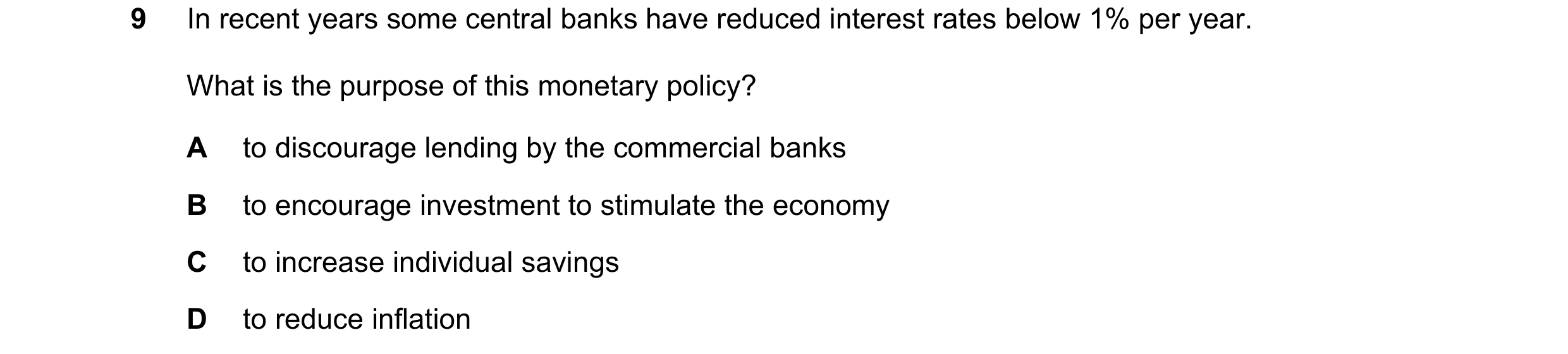
9 In recent years some central banks have reduced interest rates below 1% per year. What is the purpose of this monetary policy? A to discourage lending by the commercial banks B to encourage investment to stimulate the economy C to increase individual savings D to reduce inflation
1 marks
Answer: B
This question in 0455/12 May/June 2019
Q56 · The table shows possible sequences between the rate of interest and other economic… 0455/12 May/June 2019
20 The table shows possible sequences between the rate of interest and other economic variables. Which sequence is the most likely? interest rate borrowing investment GDP A higher decrease increase increase B higher increase decrease decrease C lower decrease decrease decrease D lower increase increase increase
1 marks
Answer: D
This question in 0455/12 May/June 2019
Q57 · What is the most likely effect of a government reducing the money supply? 0455/13 May/June 2019
17 What is the most likely effect of a government reducing the money supply? A Employment will decrease. B Growth will increase. C Inflation will increase. D Tax rates will decrease.
1 marks
Answer: A
This question in 0455/13 May/June 2019
Q58 · What is an example of expansionary monetary policy? 0455/11 Oct/Nov 2019
17 What is an example of expansionary monetary policy? A a decrease in income tax rates B a decrease in the budget deficit C a decrease in the money supply D a decrease in the rate of interest
1 marks
Answer: D
This question in 0455/11 Oct/Nov 2019
Q59 · Which government policy would reduce economic growth? 0455/11 Oct/Nov 2019
22 Which government policy would reduce economic growth? A cutting the rate of corporation tax B increasing expenditure on education C lowering the rate of income tax D raising interest rates
1 marks
Answer: D
This question in 0455/11 Oct/Nov 2019
Q60 · Which combination of policy measures would be effective in reducing the effects of a… 0455/12 Oct/Nov 2019
18 Which combination of policy measures would be effective in reducing the effects of a recession? A a reduction in interest rates and a reduction in income tax B a reduction in interest rates and an increase in income tax C an increase in interest rates and a reduction in income tax D an increase in interest rates and an increase in income tax
1 marks
Answer: A
This question in 0455/12 Oct/Nov 2019
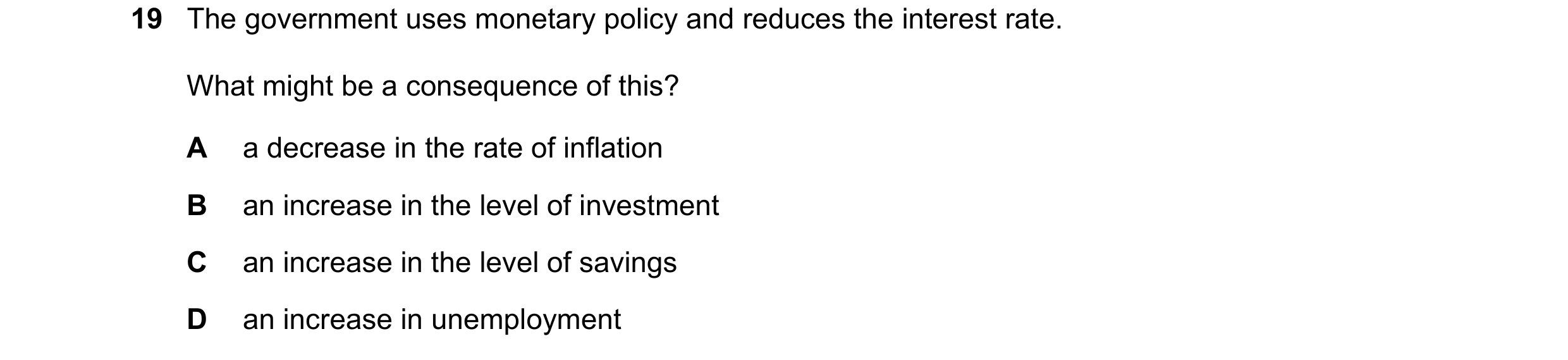
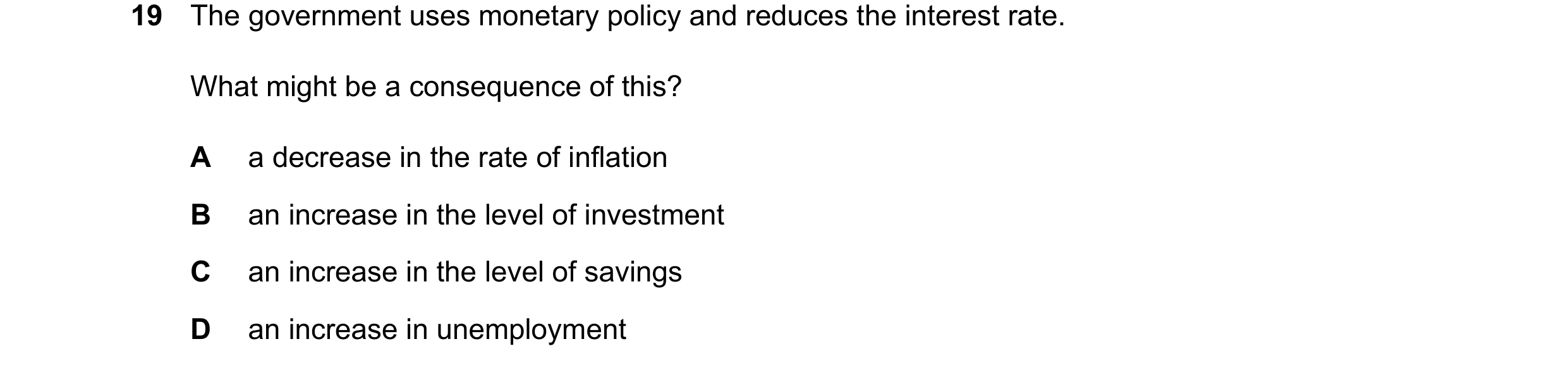
Q61 · The government uses monetary policy and reduces the interest rate 0455/13 Oct/Nov 2019
19 The government uses monetary policy and reduces the interest rate. What might be a consequence of this? A a decrease in the rate of inflation B an increase in the level of investment C an increase in the level of savings D an increase in unemployment
1 marks
Answer: B
This question in 0455/13 Oct/Nov 2019
Q62 · Banks decrease interest rates 0455/12 Feb/March 2020
11 Banks decrease interest rates. What is likely to be the effect of this on borrowing and saving? borrowing saving A falls falls B falls rises C rises falls D rises rises
1 marks
This question in 0455/12 Feb/March 2020
Q63 · What is a monetary policy measure? 0455/12 Feb/March 2020
17 What is a monetary policy measure? A increasing interest rates B increasing taxation C reducing the power of trade unions D selling state-owned enterprises
1 marks
This question in 0455/12 Feb/March 2020
Q64 · What can a central bank increase in order to reduce consumer borrowing? 0455/11 Oct/Nov 2020
11 What can a central bank increase in order to reduce consumer borrowing? A commercial bank deposits B government spending C the exchange rate D the rate of interest
1 marks
Answer: D
This question in 0455/11 Oct/Nov 2020
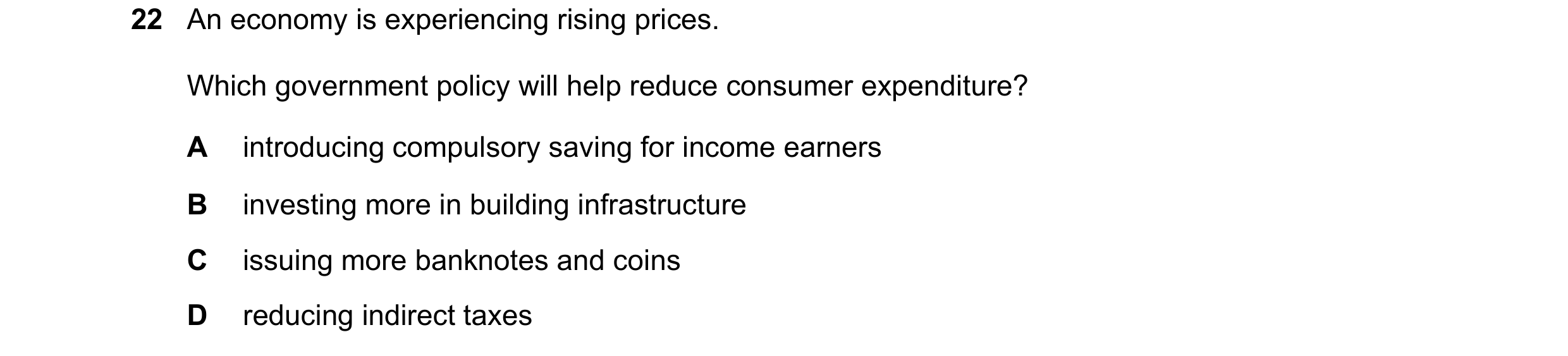
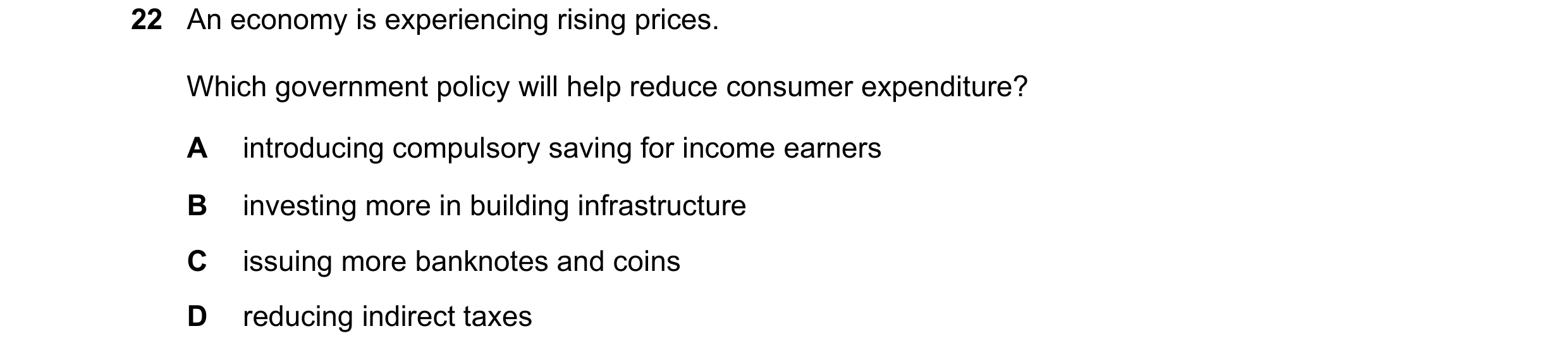
Q65 · An economy is experiencing rising prices 0455/11 Oct/Nov 2020
22 An economy is experiencing rising prices. Which government policy will help reduce consumer expenditure? A introducing compulsory saving for income earners B investing more in building infrastructure C issuing more banknotes and coins D reducing indirect taxes
1 marks
Answer: A
This question in 0455/11 Oct/Nov 2020
Q66 · What can a central bank increase in order to reduce consumer borrowing? 0455/12 Oct/Nov 2020
11 What can a central bank increase in order to reduce consumer borrowing? A commercial bank deposits B government spending C the exchange rate D the rate of interest
1 marks
Answer: D
This question in 0455/12 Oct/Nov 2020
Q67 · The table shows the rates of unemployment and real GDP growth for an economy in 2014 and… 0455/12 Oct/Nov 2020
21 The table shows the rates of unemployment and real GDP growth for an economy in 2014 and 2018. 2014 2018 rate of 3 10 unemployment (%) rate of real GDP 4 –2 growth (%) Which combination of policy measures would be most effective in returning the economy to the 2014 level of economic activity? A a decrease in direct taxes and an increase in the rate of interest B a decrease in government expenditure and an increase in the rate of interest C an increase in direct taxes and a decrease in the rate of interest D an increase in government expenditure and a decrease in the rate of interest
1 marks
Answer: D
This question in 0455/12 Oct/Nov 2020
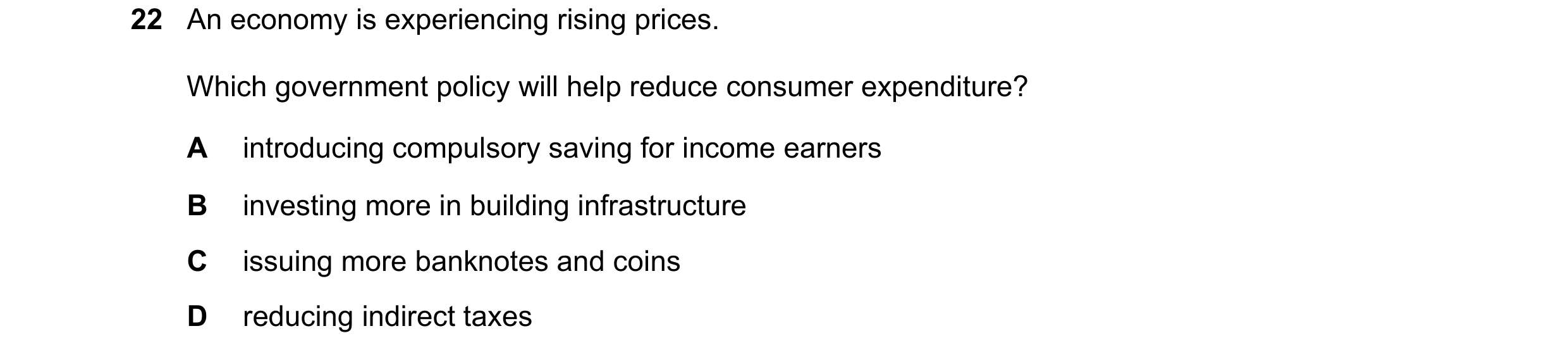
Q68 · An economy is experiencing rising prices 0455/12 Oct/Nov 2020
22 An economy is experiencing rising prices. Which government policy will help reduce consumer expenditure? A introducing compulsory saving for income earners B investing more in building infrastructure C issuing more banknotes and coins D reducing indirect taxes
1 marks
Answer: A
This question in 0455/12 Oct/Nov 2020
Q69 · What can a central bank increase in order to reduce consumer borrowing? 0455/13 Oct/Nov 2020
11 What can a central bank increase in order to reduce consumer borrowing? A commercial bank deposits B government spending C the exchange rate D the rate of interest
1 marks
Answer: D
This question in 0455/13 Oct/Nov 2020
Q70 · An economy is experiencing rising prices 0455/13 Oct/Nov 2020
22 An economy is experiencing rising prices. Which government policy will help reduce consumer expenditure? A introducing compulsory saving for income earners B investing more in building infrastructure C issuing more banknotes and coins D reducing indirect taxes
1 marks
Answer: A
This question in 0455/13 Oct/Nov 2020
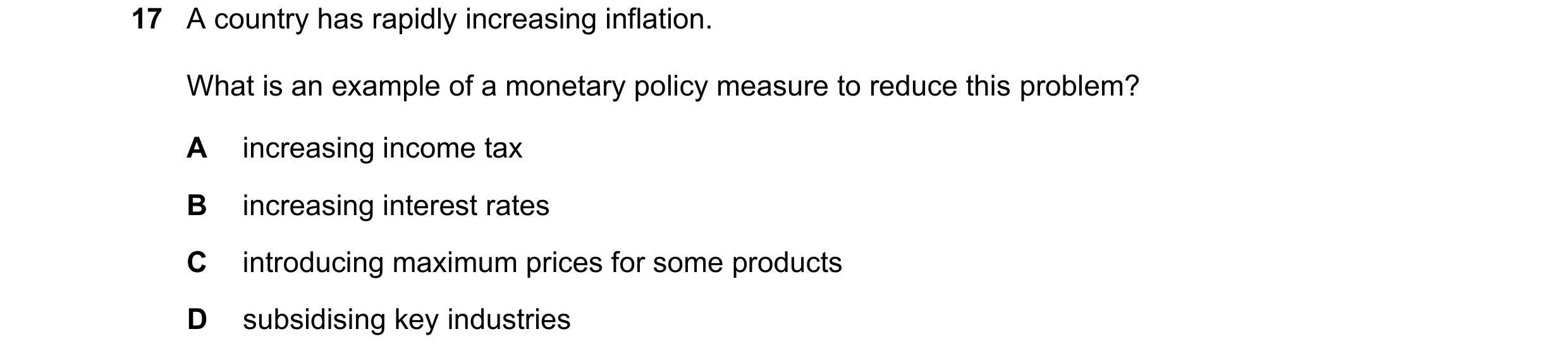
Q71 · A country has rapidly increasing inflation 0455/12 Feb/March 2021
17 A country has rapidly increasing inflation. What is an example of a monetary policy measure to reduce this problem? A increasing income tax B increasing interest rates C introducing maximum prices for some products D subsidising key industries
1 marks
Answer: B
This question in 0455/12 Feb/March 2021
Q72 · An economy has a high rate of inflation 0455/11 May/June 2021
16 An economy has a high rate of inflation. In response to this, its government increases income tax. What is the most likely reason for this increase? A to discourage the consumption of harmful goods B to raise money for government spending C to redistribute income D to reduce total demand
1 marks
Answer: D
This question in 0455/11 May/June 2021
Q73 · Interest rates are sometimes raised to control inflation 0455/11 May/June 2021
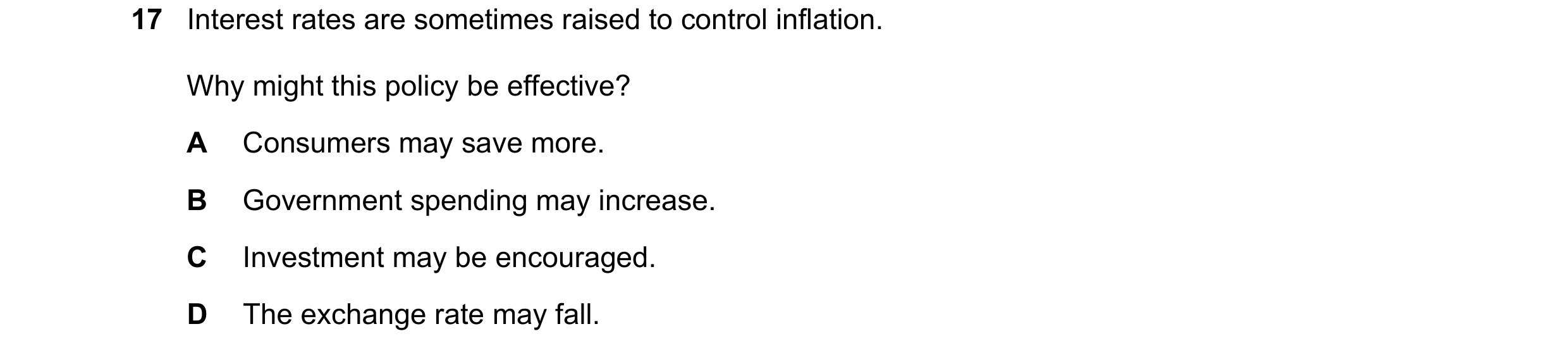
17 Interest rates are sometimes raised to control inflation. Why might this policy be effective? A Consumers may save more. B Government spending may increase. C Investment may be encouraged. D The exchange rate may fall.
1 marks
Answer: A
This question in 0455/11 May/June 2021
Q74 · A government uses expansionary monetary policy 0455/12 May/June 2021
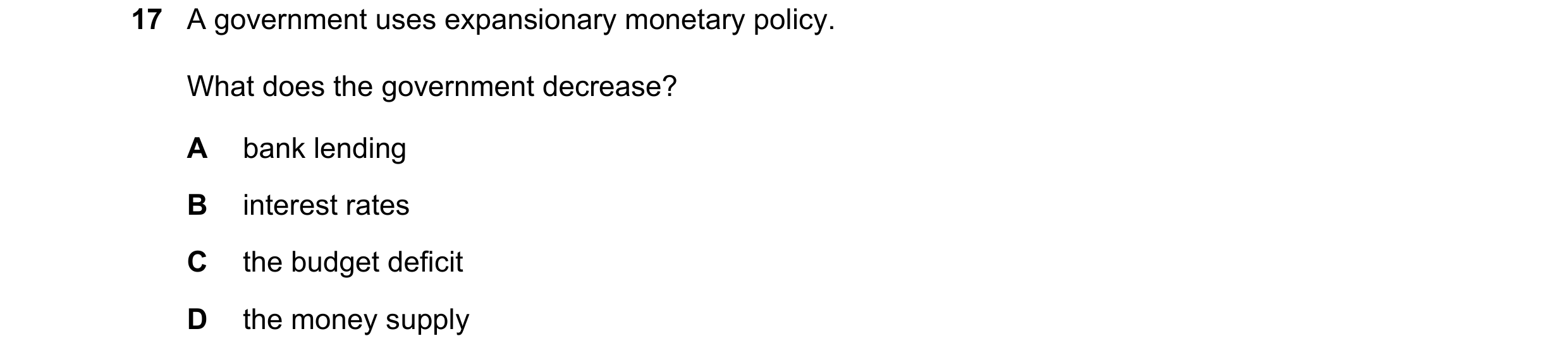
17 A government uses expansionary monetary policy. What does the government decrease? A bank lending B interest rates C the budget deficit D the money supply
1 marks
Answer: B
This question in 0455/12 May/June 2021
Q75 · Which combination of policy measures is most likely to increase the level of employment? 0455/13 Oct/Nov 2021
23 Which combination of policy measures is most likely to increase the level of employment? A decrease general taxation and decrease the rate of interest B decrease general taxation and increase the rate of interest C increase general taxation and decrease the rate of interest D increase general taxation and increase the rate of interest
1 marks
Answer: A
This question in 0455/13 Oct/Nov 2021
Q76 · Why would an increase in the interest rate potentially lead to lower inflation? 0455/11 May/June 2022
18 Why would an increase in the interest rate potentially lead to lower inflation? A Consumers will be more willing to save when interest rates are high. B Consumers will be more willing to spend when interest rates are high. C Producers will be more willing to borrow from banks when interest rates are high. D Producers will be more willing to invest when interest rates are high.
1 marks
Answer: A
This question in 0455/11 May/June 2022
Q77 · A government wishes to pursue an expansionary monetary policy 0455/12 May/June 2022
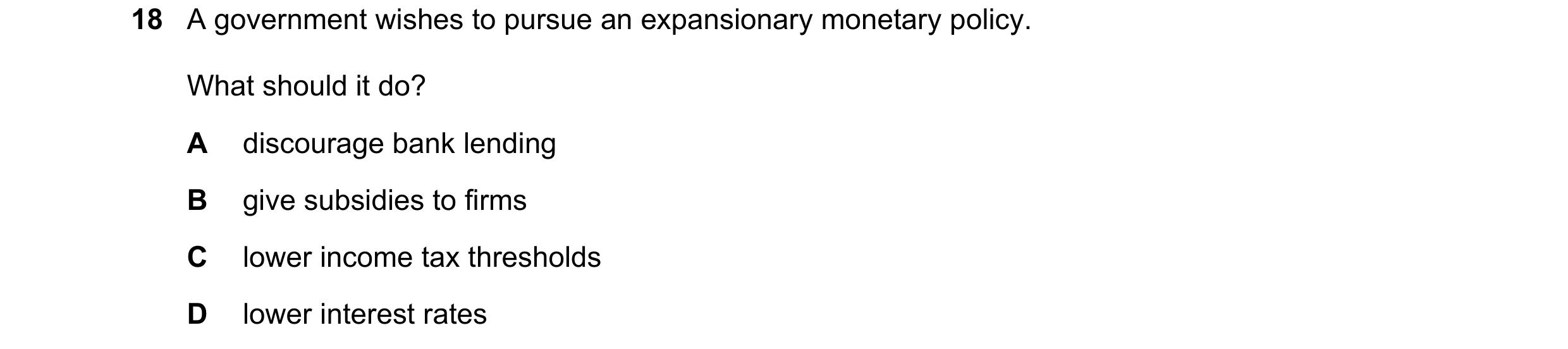
18 A government wishes to pursue an expansionary monetary policy. What should it do? A discourage bank lending B give subsidies to firms C lower income tax thresholds D lower interest rates
1 marks
Answer: D
This question in 0455/12 May/June 2022
Q78 · A country wishes to reduce the level of inflation 0455/12 May/June 2022
22 A country wishes to reduce the level of inflation. Which combination of policy measures will be most successful? policy measure 1 policy measure 2 A decrease exchange rates increase interest rates B decrease interest rates increase exchange rates C increase government spending decrease interest rates D increase interest rates decrease government spending
1 marks
Answer: D
This question in 0455/12 May/June 2022
Q79 · In a country, there is an increase in the rate of interest to prevent inflation 0455/13 May/June 2022
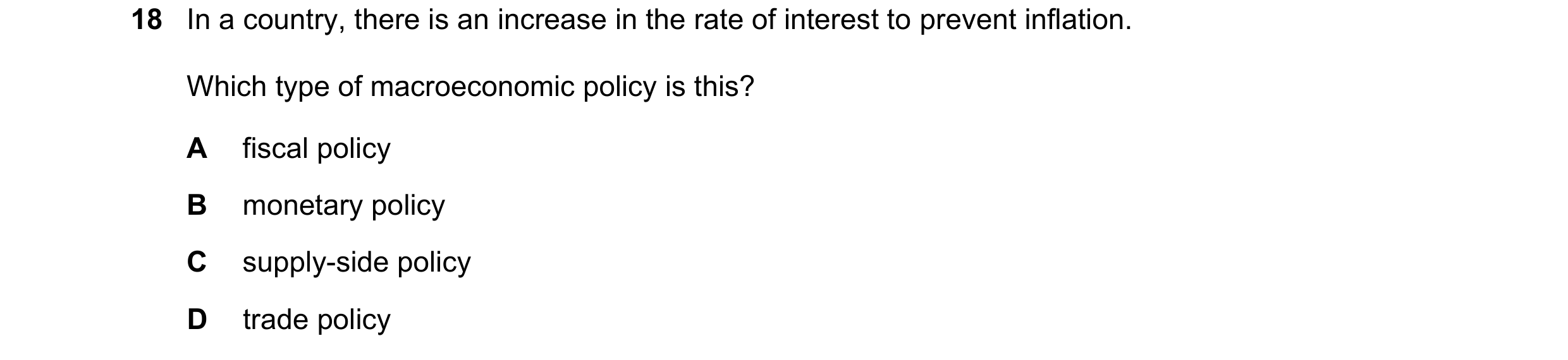
18 In a country, there is an increase in the rate of interest to prevent inflation. Which type of macroeconomic policy is this? A fiscal policy B monetary policy C supply-side policy D trade policy
1 marks
Answer: B
This question in 0455/13 May/June 2022
Q80 · Which change is an example of monetary policy? 0455/11 Oct/Nov 2022
17 Which change is an example of monetary policy? A a depreciation of the foreign exchange rate B a reduction of unemployment benefits C an increased import tax D the introduction of import quotas
1 marks
Answer: A
This question in 0455/11 Oct/Nov 2022
Q81 · What is the most likely effect of increasing the rate of interest? 0455/11 Oct/Nov 2022
18 What is the most likely effect of increasing the rate of interest? A Investment increases. B The cost of government borrowing falls. C The exchange rate falls. D The rate of inflation falls.
1 marks
Answer: D
This question in 0455/11 Oct/Nov 2022
Q82 · A decrease in which variable is most likely to cause the rate of inflation to increase? 0455/11 Oct/Nov 2022
22 A decrease in which variable is most likely to cause the rate of inflation to increase? A the average wage rate B the budget deficit C the interest rate D the money supply
1 marks
Answer: C
This question in 0455/11 Oct/Nov 2022
Q83 · The central bank of a country decreases interest rates to help the economy out of a… 0455/12 Oct/Nov 2022
13 The central bank of a country decreases interest rates to help the economy out of a recession. How is this decrease in interest rates most likely to affect the levels of saving in and borrowing from the country’s commercial banks? saving borrowing A decreases decreases B decreases increases C increases increases D increases decreases
1 marks
Answer: B
This question in 0455/12 Oct/Nov 2022
Q84 · A central bank reduces interest rates 0455/12 Oct/Nov 2022
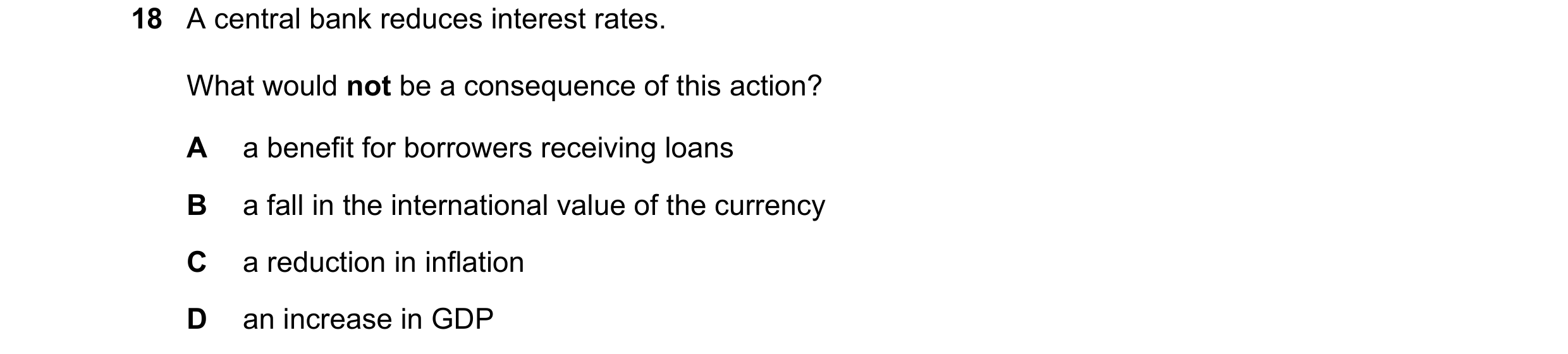
18 A central bank reduces interest rates. What would not be a consequence of this action? A a benefit for borrowers receiving loans B a fall in the international value of the currency C a reduction in inflation D an increase in GDP
1 marks
Answer: C
This question in 0455/12 Oct/Nov 2022
Q85 · What would the government reduce to decrease inflation? 0455/13 Oct/Nov 2022
18 What would the government reduce to decrease inflation? A income tax B its foreign exchange rate C the money supply D the rate of interest
1 marks
Answer: C
This question in 0455/13 Oct/Nov 2022
Q86 · What is the likely outcome of an expansionary monetary policy? 0455/12 Feb/March 2023
19 What is the likely outcome of an expansionary monetary policy? A Borrowing by consumers falls as the money supply increases. B Firms expand to meet higher consumer demand. C Prices fall as total supply exceeds total demand. D Wages rise due to a lower rate of inflation.
1 marks
Answer: B
This question in 0455/12 Feb/March 2023
Q87 · A country’s central bank raised the rate of interest from 1% to 4% per year 0455/11 May/June 2023
12 A country’s central bank raised the rate of interest from 1% to 4% per year. How would this change have affected the amount saved and the cost of borrowing by individuals? amount cost of saved borrowing A decreased decreased B decreased increased C increased decreased D increased increased
1 marks
Answer: D
This question in 0455/11 May/June 2023
Q88 · Government policy measures can affect economic activity in a country 0455/11 May/June 2023
18 Government policy measures can affect economic activity in a country. Which pair of monetary policy measures would be likely to increase employment? A depreciate foreign exchange rates and increase education spending B increase money supply and reduce interest rates C provide subsidies and grants and lower sales tax D reduce income tax and improve infrastructure
1 marks
Answer: B
This question in 0455/11 May/June 2023
Q89 · What would be most likely to encourage saving? 0455/11 May/June 2023
19 What would be most likely to encourage saving? A a rise in the exchange rate B a rise in the goods and services tax rate C a rise in the income tax rate D a rise in the interest rate
1 marks
Answer: D
This question in 0455/11 May/June 2023
Q90 · The government uses monetary policy and reduces the interest rate 0455/11 Oct/Nov 2023
19 The government uses monetary policy and reduces the interest rate. What might be a consequence of this? A a decrease in the rate of inflation B an increase in the level of investment C an increase in the level of savings D an increase in unemployment
1 marks
Answer: B
This question in 0455/11 Oct/Nov 2023
Q91 · What is an example of government macroeconomic policy? 0455/12 Oct/Nov 2023
17 What is an example of government macroeconomic policy? A increasing the money supply B preventing price rises in the food industry C removing a monopoly’s barriers to entry D setting a maximum price for wheat
1 marks
Answer: A
This question in 0455/12 Oct/Nov 2023
Q92 · What is likely to happen when the rate of interest increases? 0455/12 Oct/Nov 2023
19 What is likely to happen when the rate of interest increases? A consumer spending increases B firms buy fewer machines C people hold more cash D savers earn lower rewards
1 marks
Answer: B
This question in 0455/12 Oct/Nov 2023
Q93 · In 2008–2009 the central bank of a developed country reduced interest rates from 5% to… 0455/13 Oct/Nov 2023
12 In 2008–2009 the central bank of a developed country reduced interest rates from 5% to 0.5% per year to stimulate the economy. How would this policy have affected the amount saved and the cost of borrowing by individuals? cost of amount saved borrowing A decreased decreased B decreased increased C increased decreased D increased increased
1 marks
Answer: A
This question in 0455/13 Oct/Nov 2023
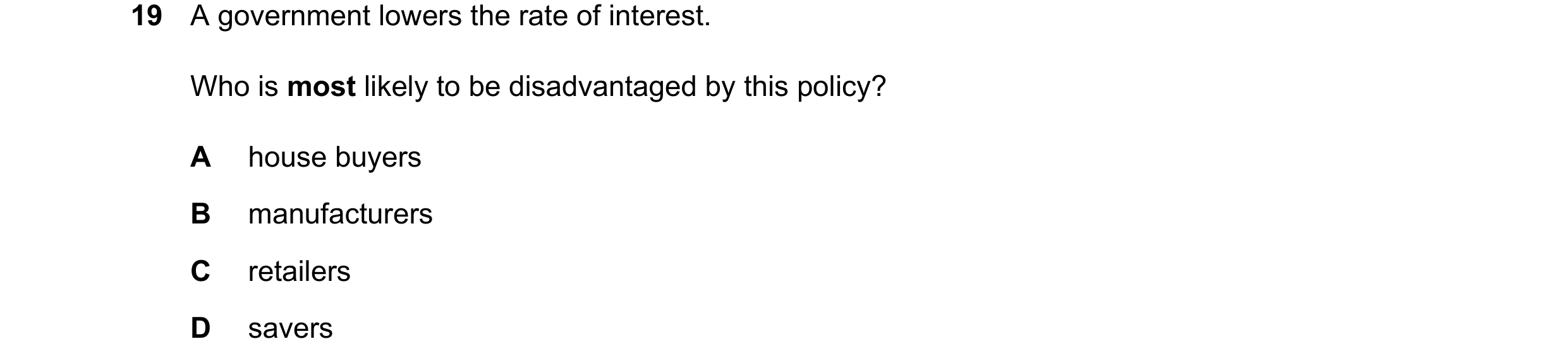
Q94 · A government lowers the rate of interest 0455/13 Oct/Nov 2023
19 A government lowers the rate of interest. Who is most likely to be disadvantaged by this policy? A house buyers B manufacturers C retailers D savers
1 marks
Answer: D
This question in 0455/13 Oct/Nov 2023
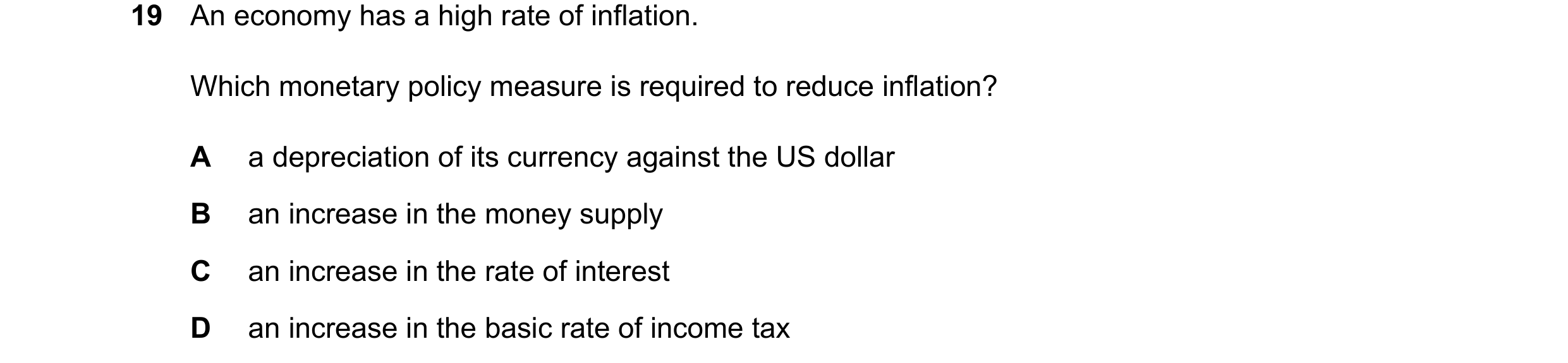
Q95 · An economy has a high rate of inflation 0455/12 Feb/March 2024
19 An economy has a high rate of inflation. Which monetary policy measure is required to reduce inflation? A a depreciation of its currency against the US dollar B an increase in the money supply C an increase in the rate of interest D an increase in the basic rate of income tax
1 marks
Answer: C
This question in 0455/12 Feb/March 2024
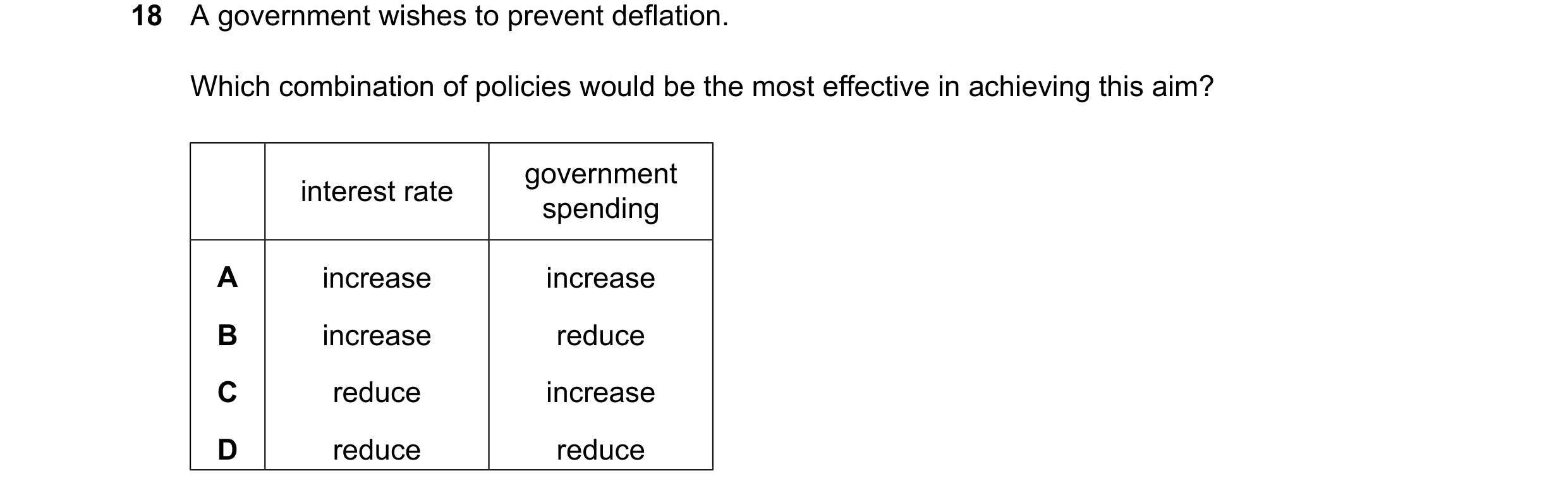
Q96 · A government wishes to prevent deflation 0455/12 May/June 2024
18 A government wishes to prevent deflation. Which combination of policies would be the most effective in achieving this aim? government interest rate spending A increase increase B increase reduce C reduce increase D reduce reduce
1 marks
Answer: C
This question in 0455/12 May/June 2024
Q97 · What correctly explains the effect of monetary policy measures on macroeconomic aims? 0455/13 May/June 2024
19 What correctly explains the effect of monetary policy measures on macroeconomic aims? A A higher exchange rate will make imports more expensive and improve the balance of payments. B An increase in interest rates will encourage investment and lead to higher economic growth. C An increase in the money supply in an economy without spare capacity will result in demand-pull inflation. D Higher interest rates result in less income from savings and therefore higher unemployment.
1 marks
Answer: C
This question in 0455/13 May/June 2024
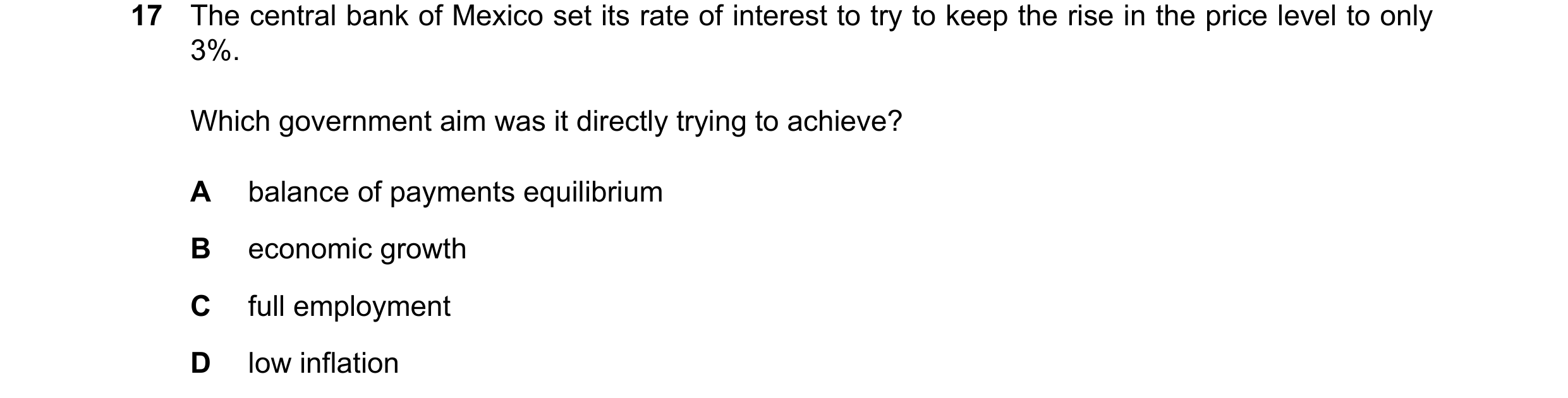
Q98 · The central bank of Mexico set its rate of interest to try to keep the rise in the price… 0455/11 Oct/Nov 2024
17 The central bank of Mexico set its rate of interest to try to keep the rise in the price level to only 3%. Which government aim was it directly trying to achieve? A balance of payments equilibrium B economic growth C full employment D low inflation
1 marks
Answer: D
This question in 0455/11 Oct/Nov 2024
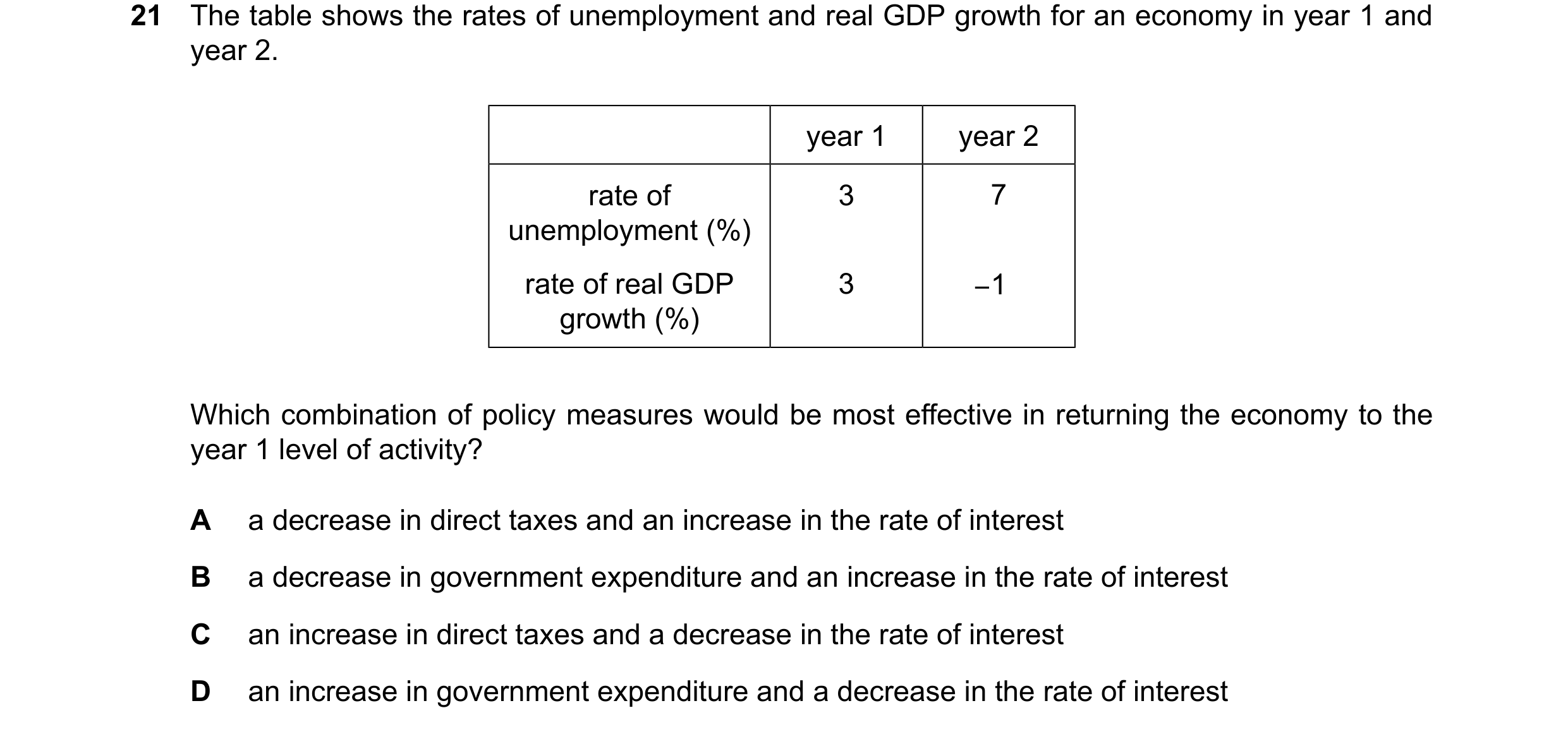
Q99 · The table shows the rates of unemployment and real GDP growth for an economy in year 1… 0455/11 Oct/Nov 2024
21 The table shows the rates of unemployment and real GDP growth for an economy in year 1 and year 2. year 1 year 2 rate of 3 7 unemployment (%) rate of real GDP 3 −1 growth (%) Which combination of policy measures would be most effective in returning the economy to the year 1 level of activity? A a decrease in direct taxes and an increase in the rate of interest B a decrease in government expenditure and an increase in the rate of interest C an increase in direct taxes and a decrease in the rate of interest D an increase in government expenditure and a decrease in the rate of interest
1 marks
Answer: D
This question in 0455/11 Oct/Nov 2024
Q100 · What is an important role of a central bank? 0455/12 Oct/Nov 2024
10 What is an important role of a central bank? A attempts to achieve price stability B issues credit cards C provides loans to producers D provides savings accounts for consumers
1 marks
Answer: A
This question in 0455/12 Oct/Nov 2024
Q101 · The table shows changes in economic policies for four countries, A, B, C and D 0455/12 Oct/Nov 2024
23 The table shows changes in economic policies for four countries, A, B, C and D. Which country is most likely to be following a policy of preventing deflation? government money supply taxation spending A decreasing decreasing decreasing B decreasing decreasing increasing C increasing increasing decreasing D increasing increasing increasing
1 marks
Answer: C
This question in 0455/12 Oct/Nov 2024
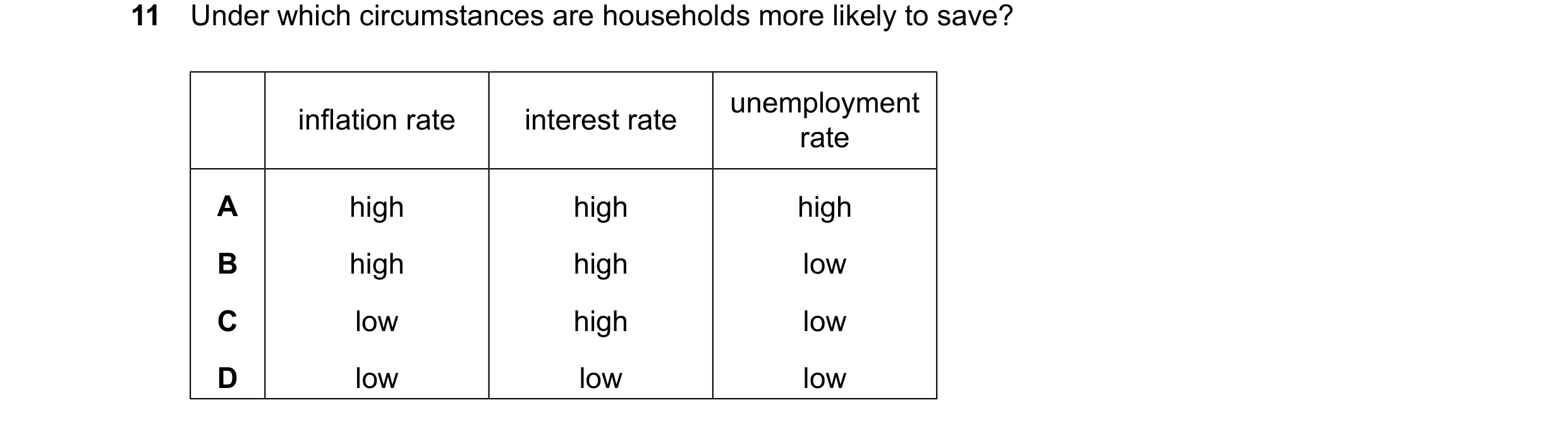
Q102 · Under which circumstances are households more likely to save? 0455/13 Oct/Nov 2024
11 Under which circumstances are households more likely to save? unemployment inflation rate interest rate rate A high high high B high high low C low high low D low low low
1 marks
Answer: C
This question in 0455/13 Oct/Nov 2024
Q103 · What is an example of monetary policy? 0455/13 Oct/Nov 2024
19 What is an example of monetary policy? A an increase in government spending B an increase in indirect taxation C an increase in rules and regulations D an increase in the money supply
1 marks
Answer: D
This question in 0455/13 Oct/Nov 2024
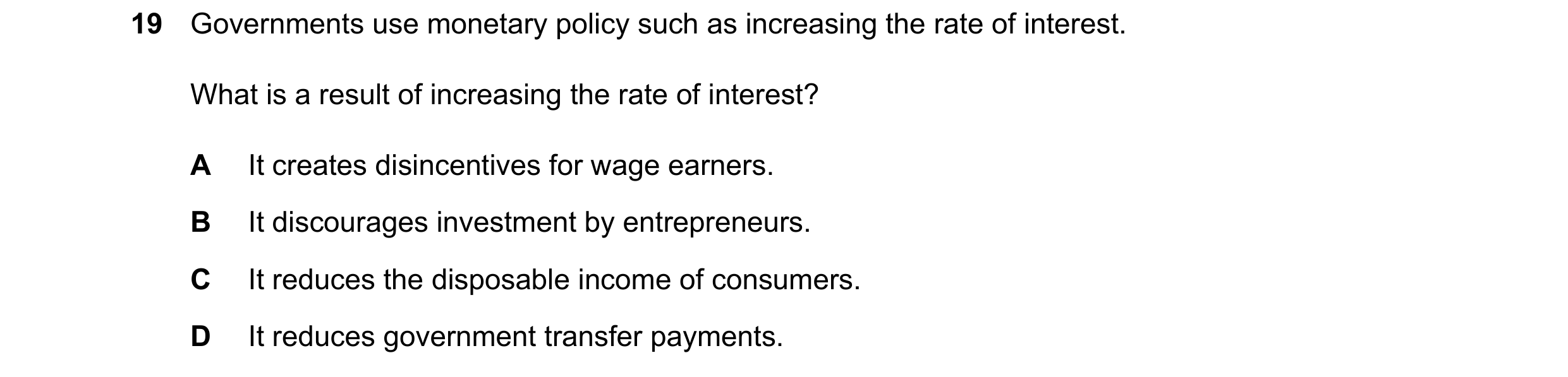
Q104 · Governments use monetary policy such as increasing the rate of interest 0455/12 Feb/March 2025
19 Governments use monetary policy such as increasing the rate of interest. What is a result of increasing the rate of interest? A It creates disincentives for wage earners. B It discourages investment by entrepreneurs. C It reduces the disposable income of consumers. D It reduces government transfer payments.
1 marks
Answer: B
This question in 0455/12 Feb/March 2025
Q105 · What might a central bank do to stop a fall in the value of its country’s currency? 0455/12 Feb/March 2025
29 What might a central bank do to stop a fall in the value of its country’s currency? A raise interest rates B reduce taxes on imports C remove controls on currency outflows D sell their currency on the foreign exchange market
1 marks
Answer: A
This question in 0455/12 Feb/March 2025
Q106 · If interest rates fall, what will be the most likely effect on saving and borrowing? 0455/11 May/June 2025
11 If interest rates fall, what will be the most likely effect on saving and borrowing? saving borrowing A decrease decrease B decrease increase C increase decrease D increase increase
1 marks
Answer: B
This question in 0455/11 May/June 2025
Q107 · Monetary policy often involves a change in which variables? 0455/11 May/June 2025
19 Monetary policy often involves a change in which variables? A government expenditure or taxes B interest rates or the money supply C labour market or trade union laws D tariffs or quotas
1 marks
Answer: B
This question in 0455/11 May/June 2025
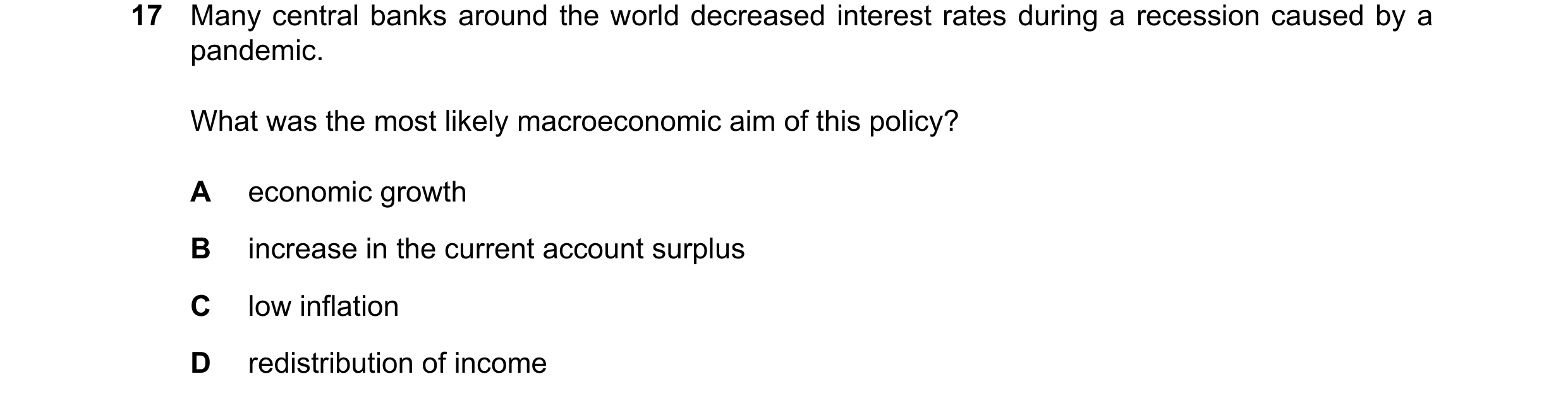
Q108 · Many central banks around the world decreased interest rates during a recession caused by… 0455/12 May/June 2025
17 Many central banks around the world decreased interest rates during a recession caused by a pandemic. What was the most likely macroeconomic aim of this policy? A economic growth B increase in the current account surplus C low inflation D redistribution of income
1 marks
Answer: A
This question in 0455/12 May/June 2025
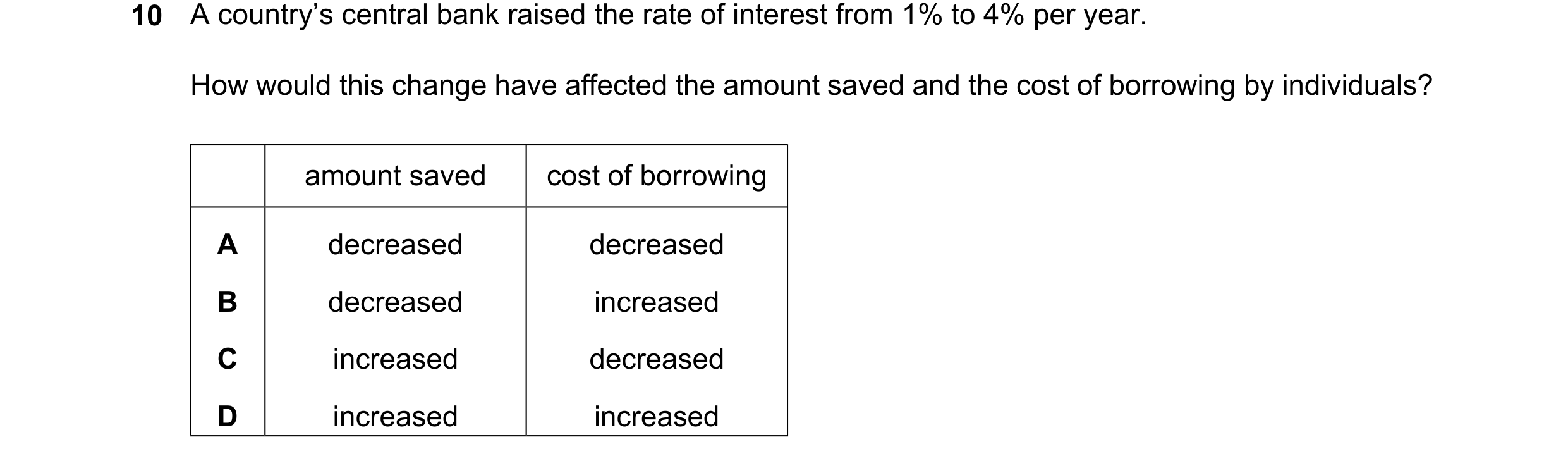
Q109 · A country’s central bank raised the rate of interest from 1% to 4% per year 0455/13 May/June 2025
10 A country’s central bank raised the rate of interest from 1% to 4% per year. How would this change have affected the amount saved and the cost of borrowing by individuals? amount saved cost of borrowing A decreased decreased B decreased increased C increased decreased D increased increased
1 marks
Answer: D
This question in 0455/13 May/June 2025
Q110 · What is not a monetary policy measure? 0455/11 Oct/Nov 2025
19 What is not a monetary policy measure? A changes in income tax rates B changes in interest rates C changes in the exchange rate D changes in the money supply
1 marks
Answer: A
This question in 0455/11 Oct/Nov 2025
Q111 · What is the most likely result of a fall in interest rates? 0455/12 Oct/Nov 2025
20 What is the most likely result of a fall in interest rates? A a fall in inflation B a fall in investment C a rise in consumer spending D a rise in saving
1 marks
Answer: C
This question in 0455/12 Oct/Nov 2025
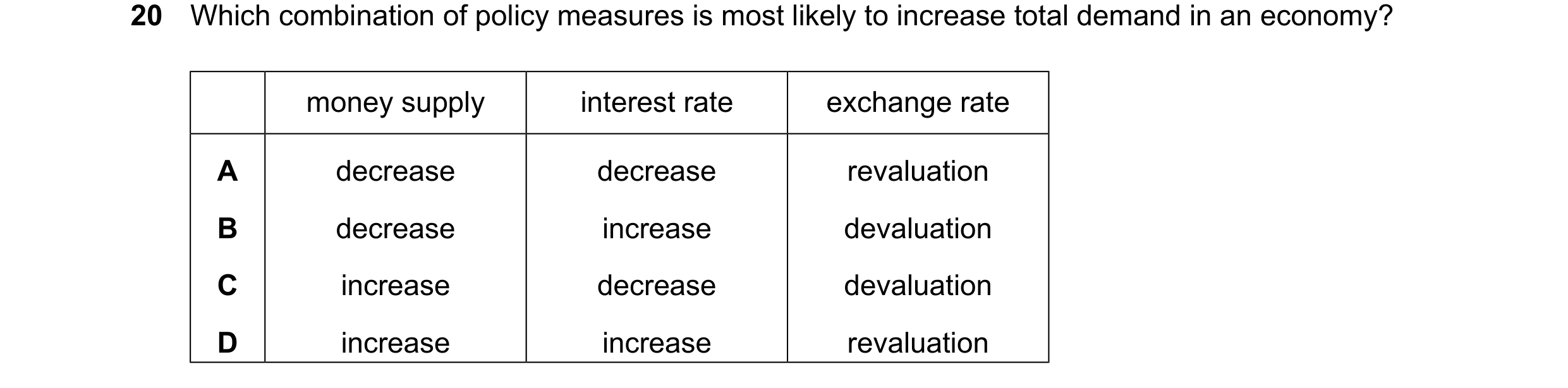
Q112 · Which combination of policy measures is most likely to increase total demand in an… 0455/13 Oct/Nov 2025
20 Which combination of policy measures is most likely to increase total demand in an economy? money supply interest rate exchange rate A decrease decrease revaluation B decrease increase devaluation C increase decrease devaluation D increase increase revaluation
1 marks
Answer: C
This question in 0455/13 Oct/Nov 2025





 1 / 22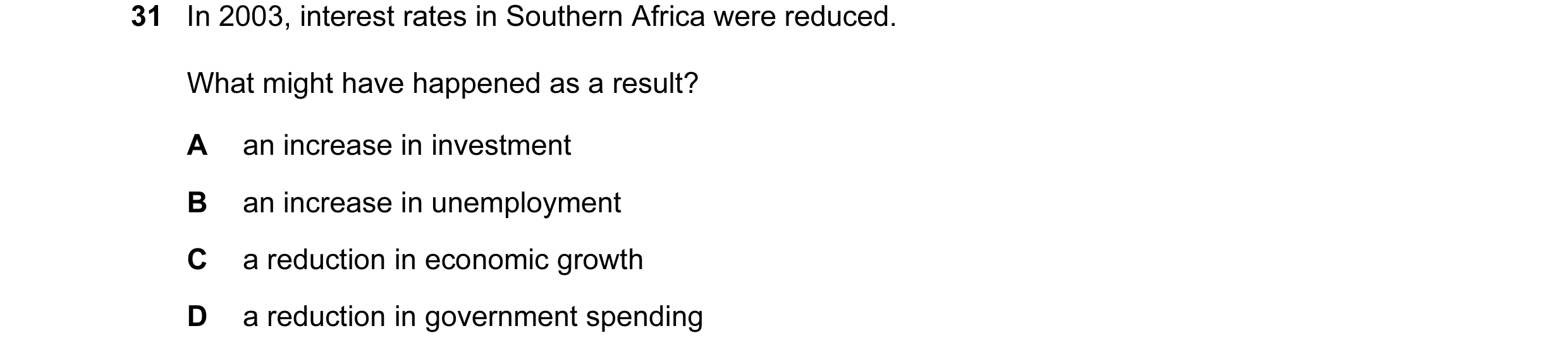


 2 / 22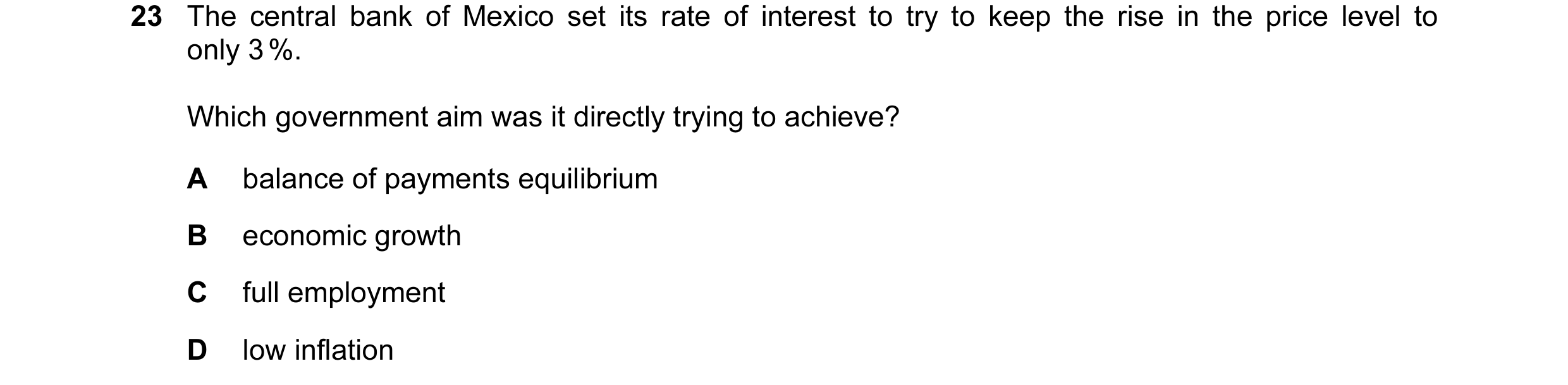

 3 / 22

 4 / 22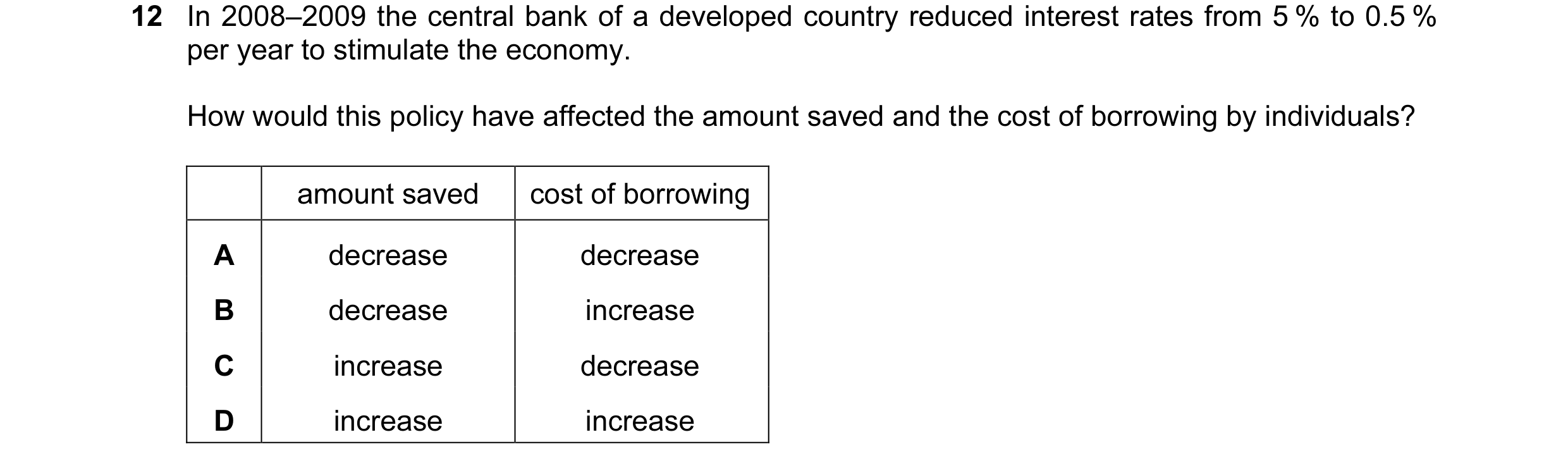


 5 / 22


 6 / 22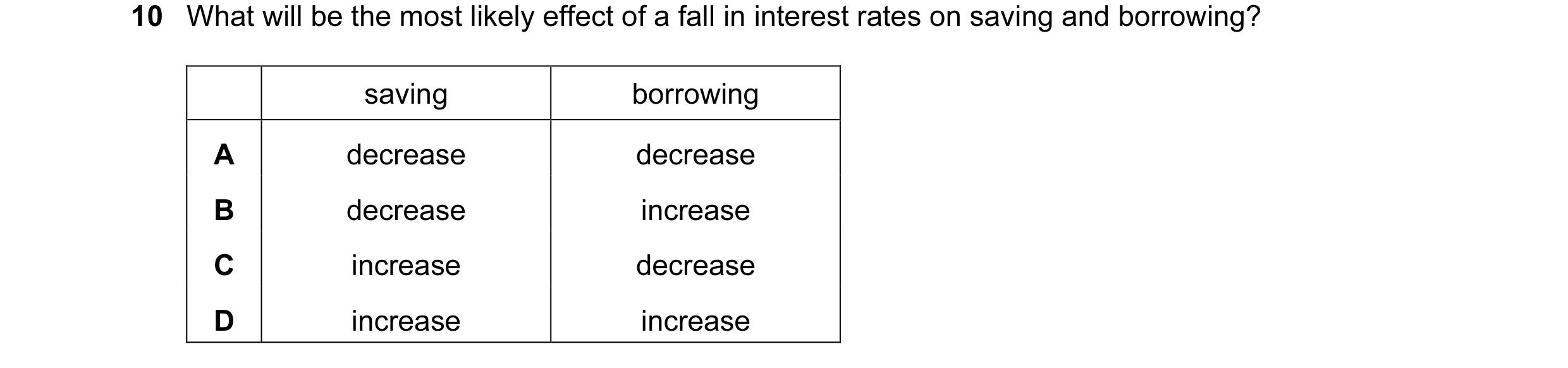


 7 / 22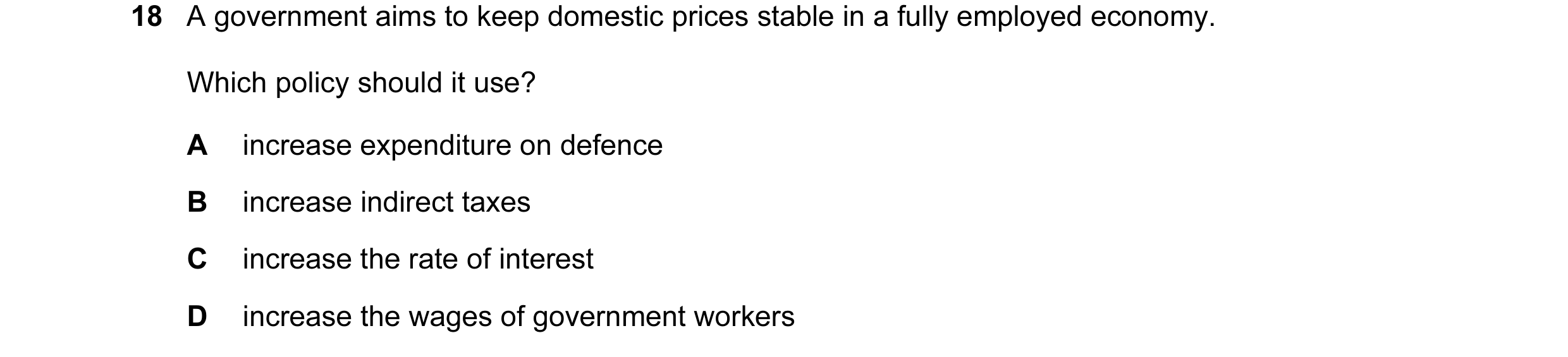
 8 / 22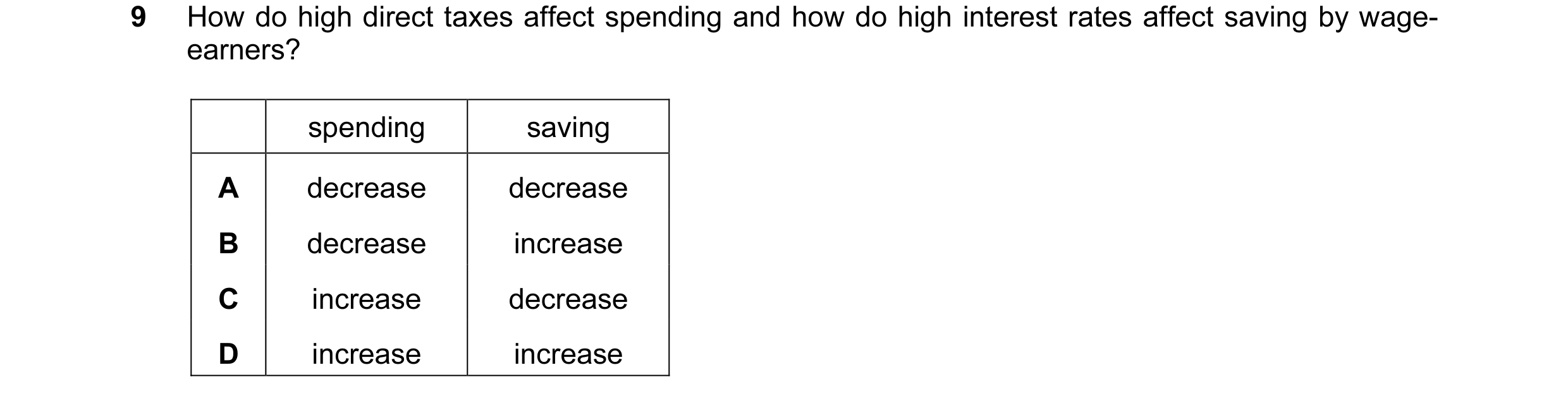


 9 / 22



 10 / 22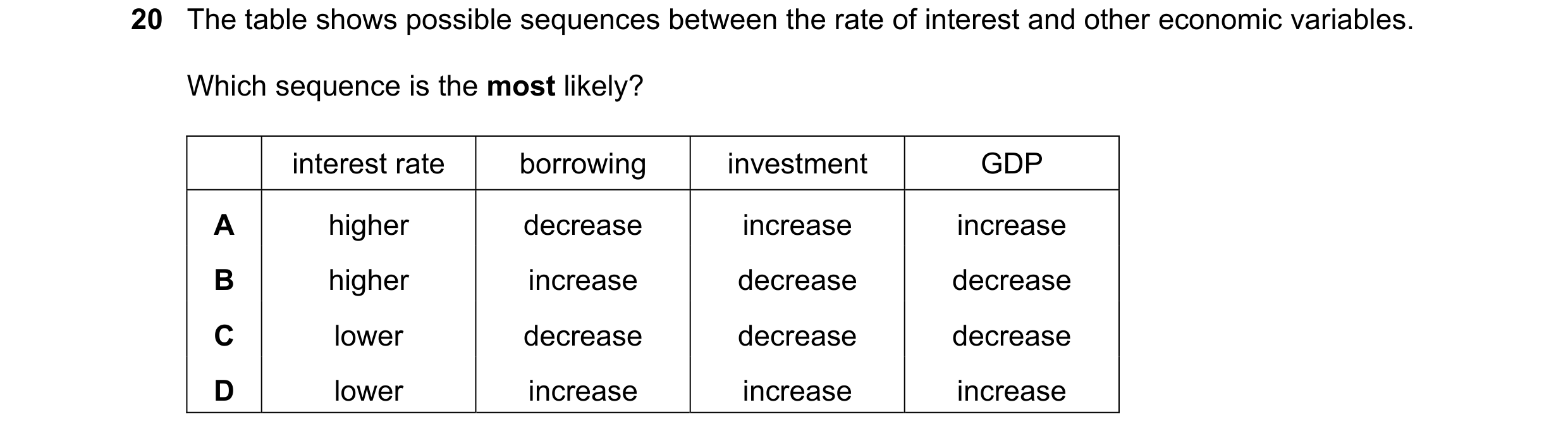




 11 / 22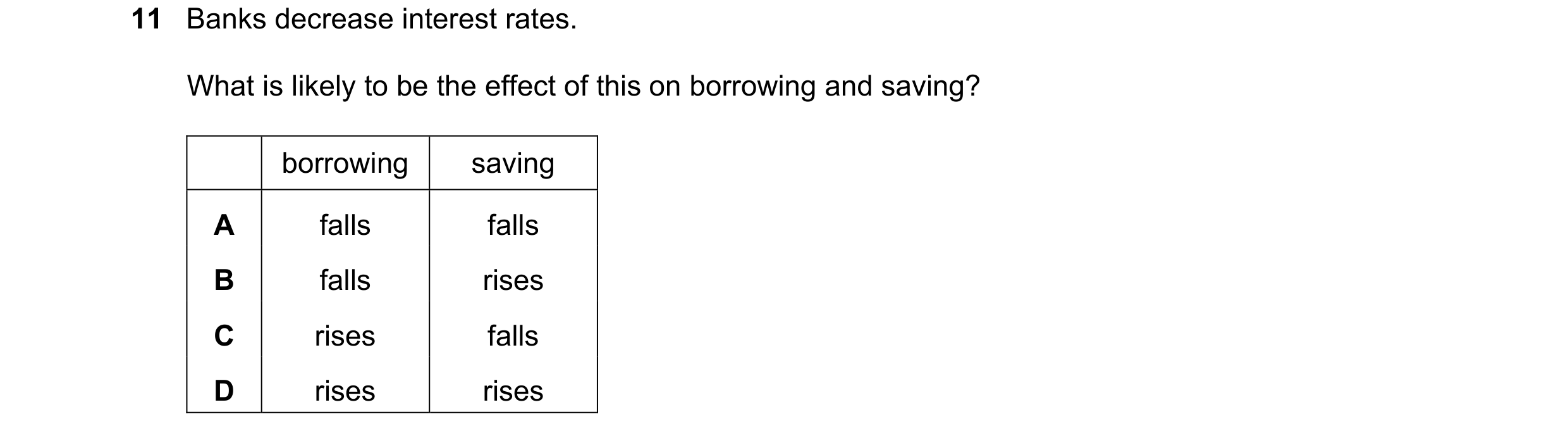


 12 / 22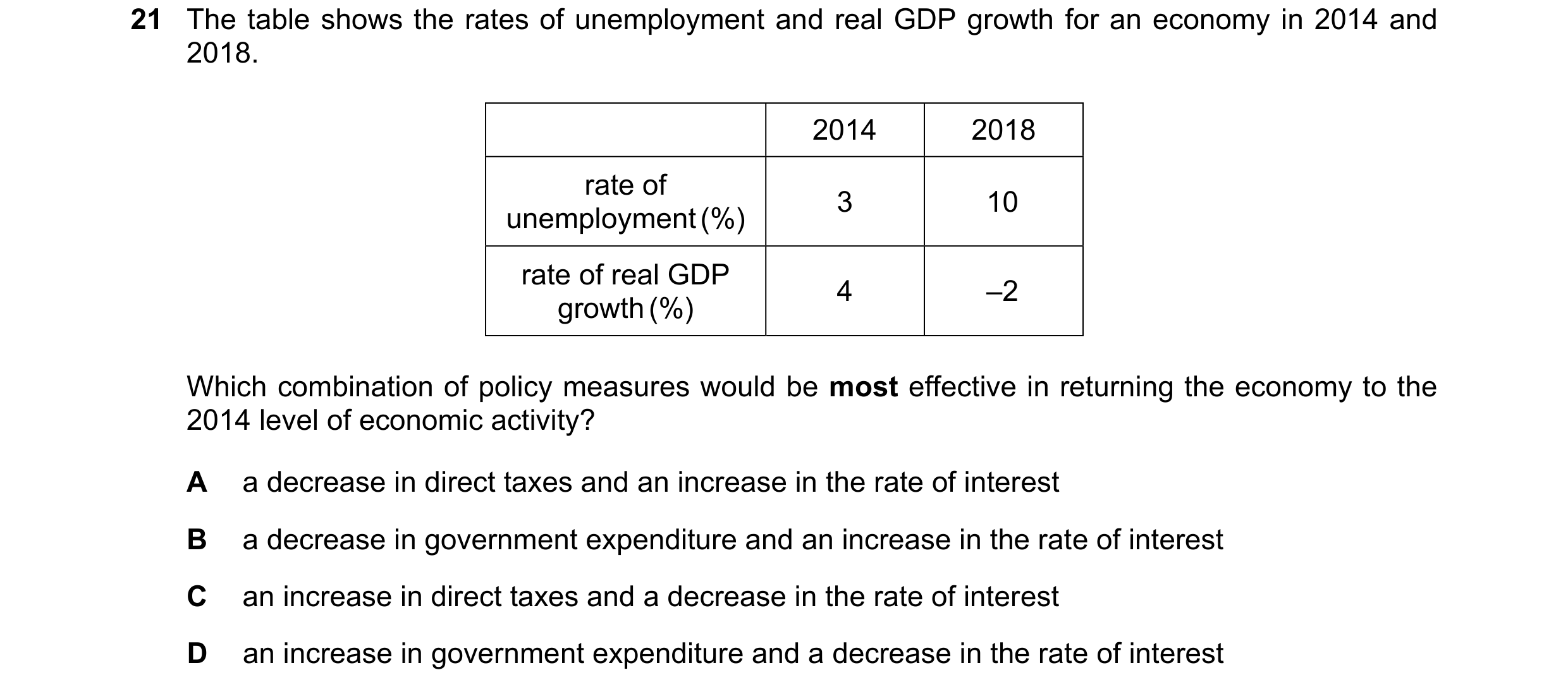

 13 / 22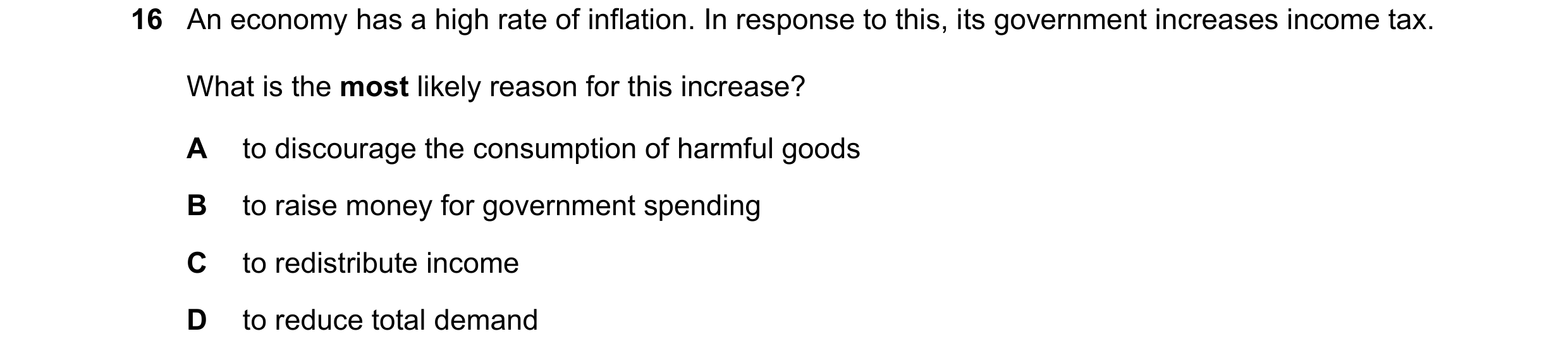


 14 / 22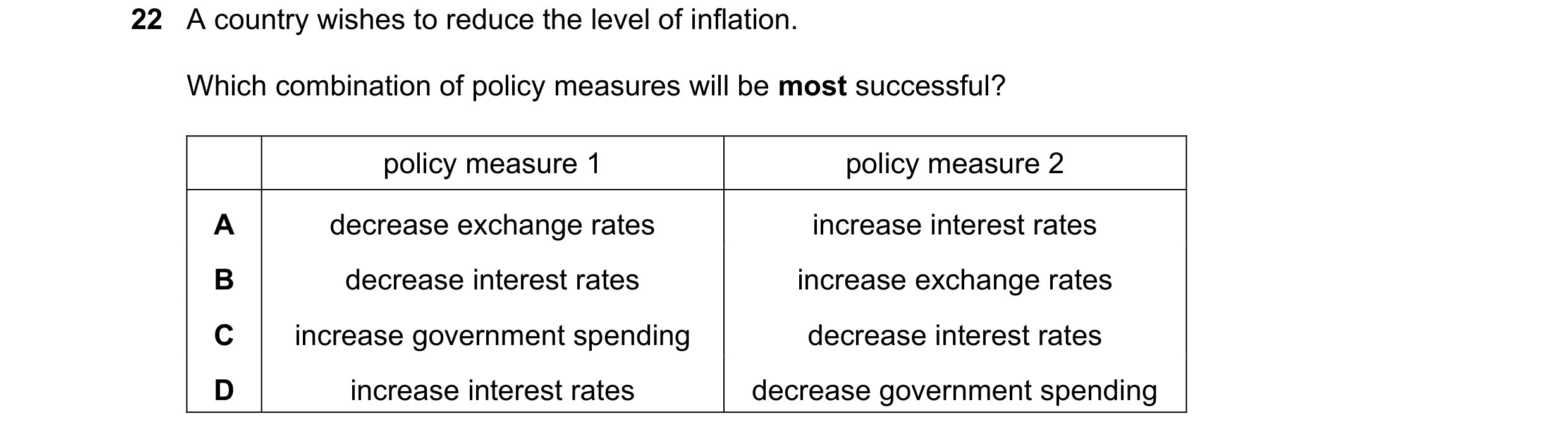


 15 / 22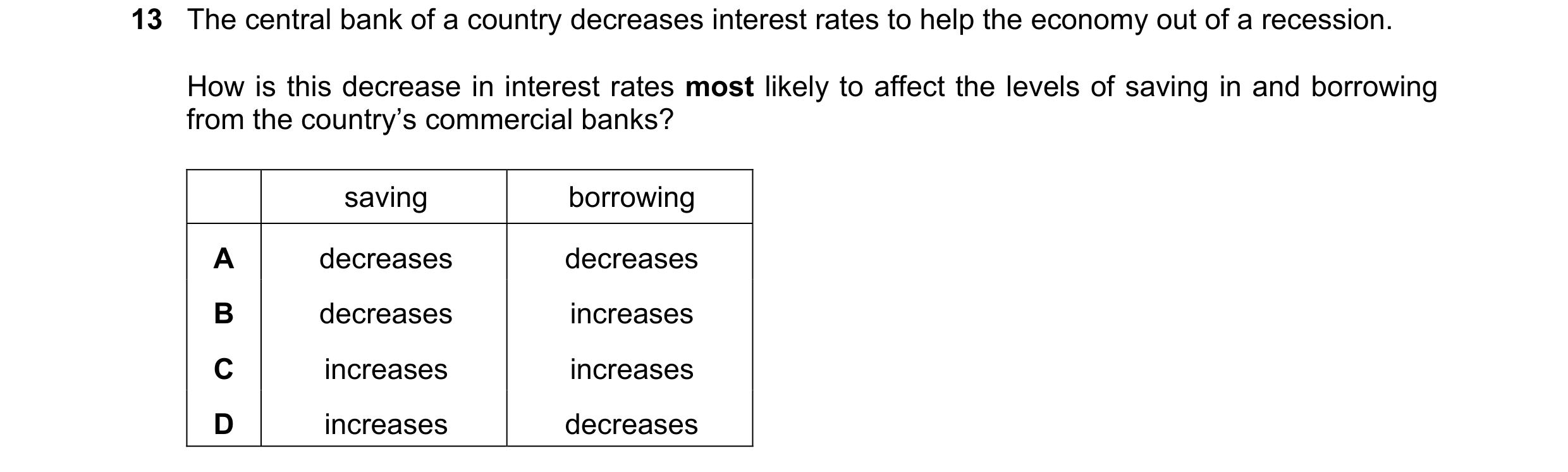


 16 / 22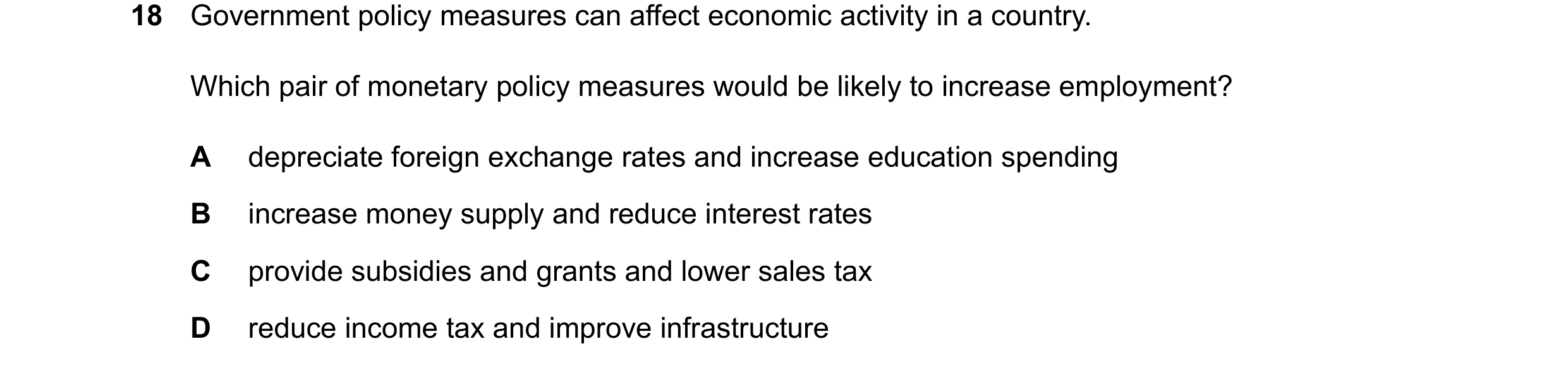


 17 / 22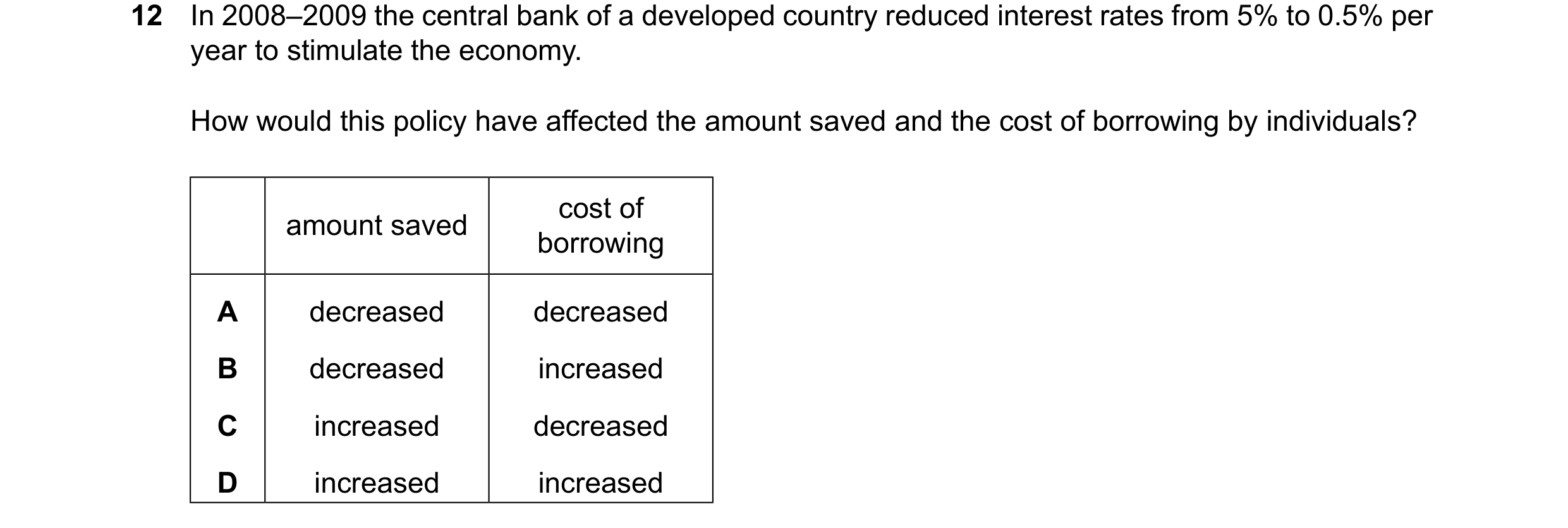
 18 / 22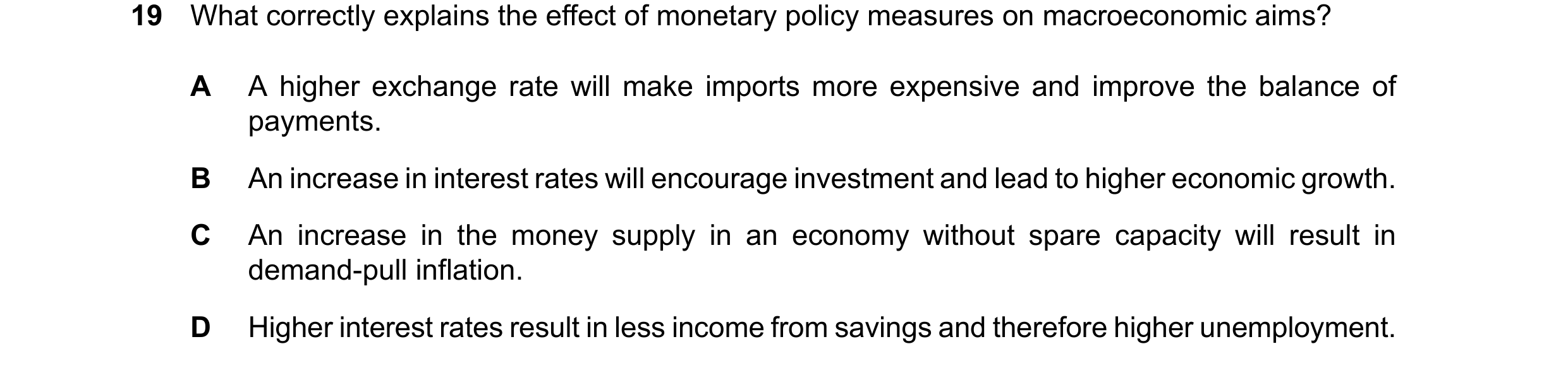
 19 / 22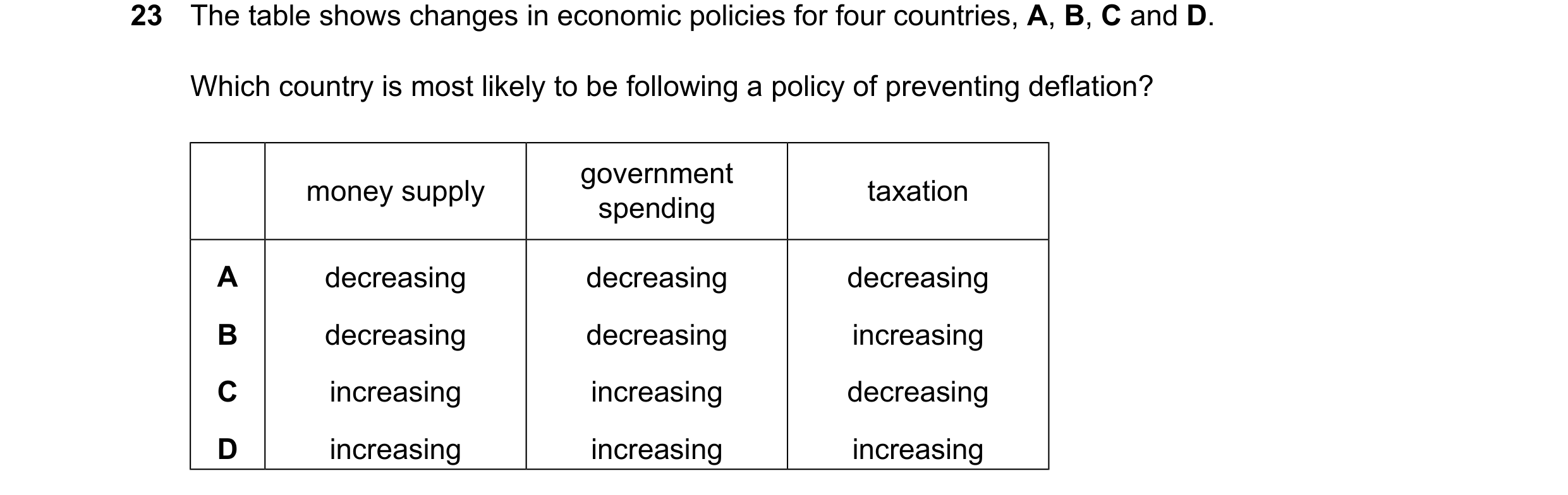

 20 / 22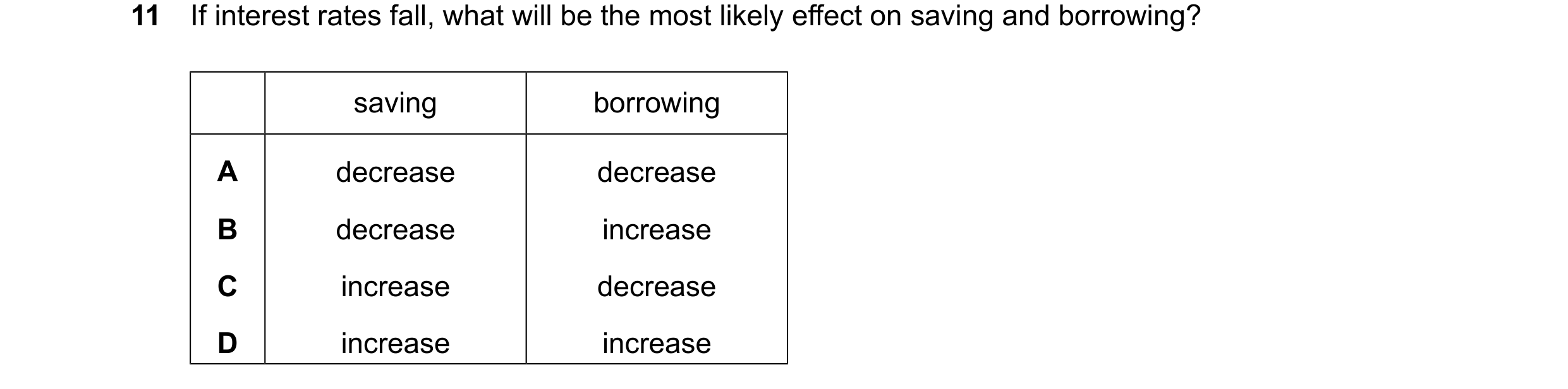

 21 / 22
 22 / 22