Questions as text
Q1 · Nitrogen combines with different elements to make ammonia and nitrogen oxides 0654/41 May/June 2017
3 (a) Nitrogen combines with different elements to make ammonia and nitrogen oxides. (i) Describe one way that nitrogen oxides are formed and one effect these can have on the environment. formation … … effect … … [2] (ii) Name the industrial process that is used to combine nitrogen and hydrogen to make ammonia. … [1] (iii) Hydrogen, H2, is produced by reacting methane, CH4, with steam, H2O(g). The reaction also produces the gas carbon monoxide, CO. Construct the balanced symbolic equation, including all state symbols, for this reaction. … [2] (b) Molecules of nitrogen gas, N2, are not very reactive. (i) Fig. 3.1 shows the outer electrons in a nitrogen atom. x x N x x x Fig. 3.1 Complete the bonding diagram in Fig. 3.2 to show how all of the outer electrons in a nitrogen molecule are arranged. x x N N x Fig. 3.2 [2] (ii) Suggest why nitrogen molecules are not very reactive. … … … [2] (c) Hydrazine has the chemical formula N2H4. Hydrazine decomposes as shown in the equation below. 3N2H4 → 4NH3 + N2 (i) Show that the relative molecular mass of hydrazine is 32. [Ar : N, 14 ; H, 1] [1] (ii) Complete the following steps to calculate the volume of ammonia produced when 192 g of hydrazine decompose. Show your working in each step. Step 1 Calculate the number of moles in 192 g of hydrazine. moles of hydrazine = … Step 2 Calculate the number of moles of ammonia produced. moles of ammonia = … Step 3 Calculate the volume of ammonia produced in dm3. Assume that one mole of ammonia occupies 24 dm3. volume of ammonia = … dm3 [3]
13 marks
Mark scheme: 3(a)(i) produced in car engines / by lightning ; contributes to acid rain / acidifies lakes / reference to damage to, plants / aquatic organisms / reference to damage to (animal) respiratory systems / damage to buildings / AVP ; 2 3(a)(ii) Haber ; 1 3(a)(iii) CH4 (g) + H2O (g) → CO (g) + 3 H2 (g) symbols and state symbols ; balanced ; 2 3(b)(i) 6 shared electrons ; remaining lone pair ; 2 3(b)(ii) multiple bonding / 6 / 3 pairs, bonding electrons / triple bond ; bond between the atoms is very strong / difficult to break / (relatively) large amount of energy required (to break bond) ; 2 3(c)(i) Mr of hydrazine = (14 × 2) + (1 × 4) ; 1 3(c)(ii) moles of hydrazine = 192 ÷ 32 = 6 ; so moles of ammonia = 4 × 2 / 4 × 6 ÷ 3 = 8 ; volume of ammonia = 8 × 24 = 192 (dm3) ; 3
This question in 0654/41 May/June 2017
Q2 · Four elements are shown in order of reactivity 0654/42 May/June 2017
9 Four elements are shown in order of reactivity. Mg (most reactive) C H Cu (least reactive) (a) Fig. 9.1 shows two sets of apparatus, P and Q, that a teacher uses to compare the reactivities of copper and magnesium. P Q mixture of limewater mixture of limewater copper oxide magnesium and carbon oxide and carbon Fig. 9.1 Predict and explain in which apparatus, P or Q, the limewater becomes milky when each mixture is heated. apparatus … explanation … … … … [3] (b) A student investigates what happens when three solids, magnesium, magnesium carbonate and magnesium oxide, are added separately to dilute hydrochloric acid. (i) The student records her observations in Table 9.1. Complete Table 9.1 by writing • a tick () if you predict that the observation does occur, • a cross (û) if you predict the observation does not occur. Table 9.1 observations solid solid reacts and gas given off dissolves magnesium magnesium carbonate magnesium oxide [3] (ii) Complete the word equation for the reaction between dilute hydrochloric acid and copper carbonate. hydrochloric copper + + + acid carbonate [2] (c) Iron combines with chlorine to form only iron chloride. In a reaction to produce iron chloride, 5.60 g of iron combines with 10.65 g of chlorine. (i) State the mass of iron chloride that forms. … g [1] (ii) Calculate the numbers of moles of iron atoms and chlorine atoms that combine. Show your working. [Ar : Fe, 56; Cl, 35.5] iron number of moles of iron atoms … chlorine number of moles of chlorine atoms … [2] (iii) Use your answers to (c)(ii) to deduce the chemical formula of this iron chloride. … [1] Question 10 starts on page 20.
12 marks
Mark scheme: 9(a) (P) carbon dioxide turns limewater milky ; carbon is more reactive than copper so can, remove / take, oxygen from copper oxide / owtte ; carbon is less reactive than magnesium so cannot, remove / take, oxygen from magnesium oxide / owtte ; 3 9(b)(i) solid reacts and dissolves gas given off magnesium 9 9 ; magnesium carbonate 9 9 ; magnesium oxide 9 X ; 3 9(b)(ii) copper chloride + carbon dioxide + water ;; 2 9(c)(i) 16.25 (g) ; 1 9(c)(ii) iron 5.60 ÷ 56 = 0.1 moles ; chlorine 10.65 ÷ 35.5 = 0.3 moles ; 2 9(c)(iii) FeCl3 ; 1
This question in 0654/42 May/June 2017
Q3 · State the percentage of nitrogen in clean air 0654/41 Oct/Nov 2017
5 (a) (i) State the percentage of nitrogen in clean air. … % [1] (ii) Name two other uncombined gaseous elements in clean air. … and … [1] (b) Air bags protect passengers if a car is involved in a collision. When a collision occurs, sodium azide, NaN3, decomposes releasing nitrogen gas to inflate the air bag. Fig. 5.1 shows an air bag protecting a passenger. air bag rapidly inflated by nitrogen gas Fig. 5.1 (i) Sodium azide, NaN3, is an ionic compound. Sodium ions have the formula Na+. Deduce the charge of an azide ion, … the formula of an azide ion … [2] (ii) The balanced equation for the decomposition of sodium azide is shown. 2NaN3(s) 2Na(s) + 3N2(g) Complete the steps in the calculation to find the volume of nitrogen gas that is released when 130 g of sodium azide decomposes completely. Show your working. Step 1 Calculate the relative formula mass of sodium azide. [Ar: Na = 23, N = 14] relative formula mass = … Step 2 Calculate the number of moles in 130 g of sodium azide. number of moles = … Step 3 Deduce the number of moles of nitrogen gas released by 130 g of sodium azide. number of moles = … Step 4 Calculate the volume of nitrogen gas released. [molar gas volume = 24 dm3] volume of nitrogen gas = … dm3 [4] (c) In industry, nitrogen is used in the Haber process to make ammonia. (i) Describe how nitrogen for the Haber process is obtained from air. … … … [2] (ii) State the word equation for the reaction that forms ammonia in the Haber process. … [1]
11 marks
Mark scheme: 5(a)(i) 78 ; 1 5(a)(ii) 2 from oxygen and noble gases ; 1 5(b)(i) negative / minus ; N3 – ; 2 5(b)(ii) Mr sodium azide = 23 + (14 × 3) = 65 ; moles of sodium azide = 130 ÷ 65 = 2 ; 3 moles of nitrogen ; so volume of nitrogen = 3 × 24 = 72 (dm3) ; 4 5(c)((i) fractional distillation ; of liquefied air ; 2 5(c)(ii) nitrogen + hydrogen → ammonia ; 1
This question in 0654/41 Oct/Nov 2017
Q4 · For each compound shown, predict whether it reacts with water to produce an acidic, an… 0654/42 Oct/Nov 2017
8 (a) For each compound shown, predict whether it reacts with water to produce an acidic, an alkaline or a neutral solution. potassium oxide, K2O … calcium oxide, CaO … carbon dioxide, CO2 … nitrogen dioxide, NO2 … [2] (b) When magnesium reacts with excess dilute hydrochloric acid, hydrogen gas is produced. Fig. 8.1 shows apparatus a student uses to investigate this reaction. hydrogen measuring cylinder gas dilute hydrochloric acid magnesium water Fig. 8.1 She measures the volume of gas in the measuring cylinder at regular intervals after the start of the reaction. A sketch graph of her results is shown in Fig. 8.2. volume of hydrogen 0 0 time Fig. 8.2 (i) Predict how the concentration of the hydrochloric acid changes, if at all, during the reaction. … [1] (ii) Describe and explain the shape of the graph in Fig. 8.2 in terms of the rate of reaction. … … … [2] (iii) The student repeats the experiment. She uses hydrochloric acid that has a higher concentration. She keeps all of the other variables the same. On Fig. 8.2, sketch a graph to show the results that the student obtains from her second experiment. [2] (c) The balanced equation for the reaction between zinc and dilute hydrochloric acid is shown. Zn + 2 HCl ZnCl + 2 H2 Complete the steps in the calculation to find the volume of hydrogen gas that is produced when 2.6 g of zinc reacts completely in excess dilute hydrochloric acid. Show your working. Step 1 Calculate the number of moles in 2.6 g of zinc. [Ar: Zn = 65] number of moles = … Step 2 State the number of moles of hydrogen gas produced. number of moles = … Step 3 Calculate the volume, in cm3, of hydrogen gas produced. [molar gas volume = 24 dm3] volume = … cm3 [4]
11 marks
Mark scheme: 8(a) potassium oxide – alkaline calcium oxide – alkaline carbon dioxide – acidic nitrogen dioxide – acidic 2 or 3 correct ; 4 correct ; 2 8(b)(i) decreases ; 1 8(b)(ii) rate of reaction, initially constant / steady ; then reaction rate decreases / eventually becomes zero ; 2 8(b)(iii) line is higher than the first line ; levels off at the same value of volume ; 2 8(c) moles of zinc = 2.6 ÷ 65 = 0.04 ; moles of hydrogen = 0.04 ; volume of hydrogen = 0.04 × 24 = 0.96 (dm3) ; 0.96 dm3 = 960 cm3 ; 4
This question in 0654/42 Oct/Nov 2017
Q5 · Ethene, C2H4, has the smallest molecules in the homologous series of alkenes 0654/43 Oct/Nov 2018
11 Ethene, C2H4, has the smallest molecules in the homologous series of alkenes. (a) (i) State the name of the alkene that contains three carbon atoms in each of its molecules. … [1] (ii) Complete the structure in Fig. 11.1 to show an alkene molecule that contains four carbon atoms. H H C H Fig. 11.1 [2] (b) Ethene reacts with bromine to form the compound dibromoethane, C2H4Br2. The balanced equation for the reaction is shown. C2H4 + Br2 C2H4Br2 (i) State the type of chemical reaction that occurs between ethene and bromine. … [1] (ii) Deduce the colour, if any, of the compound dibromoethane. Explain your answer. colour … explanation … … [2] (c) Ethene reacts with steam to produce ethanol, C2H5OH. The balanced equation for the complete combustion of ethanol is shown. C2H5OH + 3O2 2CO2 + 3H2O Complete steps 1 to 4 to calculate the volume of oxygen gas that reacts with 1.15 g of ethanol. Show your working. step 1 Show that the relative formula mass of ethanol is 46. [Ar: C, 12; H, 1; O, 16] … step 2 Calculate the number of moles of ethanol in 1.15 g. number of moles of ethanol = … step 3 Using your answer to step 2 and the balanced equation, state the number of moles of oxygen that reacts with 1.15 g of ethanol. number of moles of oxygen = … step 4 Using your answer to step 3, calculate the volume, in dm3, of oxygen gas that reacts with 1.15 g of ethanol. [Molar gas volume = 24 dm3] volume of oxygen gas = … dm3 [4]
10 marks
Mark scheme: 11(a)(i) propene ; 1 11(a)(ii) C=C double bond ; all else correct ; 2 11(b)(i) addition ; 1 11(b)(ii) colourless ; bromine forms colourless compounds with unsaturated hydrocarbons / alkenes ; 2 11(c) step 1 (12 × 2) + (1 × 6) + 16 (= 46) ; step 2 1.15 ÷ 46 = 0.025 ; step 3 0.025 × 3 = 0.075 ; step 4 0.075 × 24 = 1.8 (dm3) ; 4
This question in 0654/43 Oct/Nov 2018
Q6 · Petroleum is the raw material for the production of many useful substances 0654/41 May/June 2019
5 Petroleum is the raw material for the production of many useful substances. Fig. 5.1 shows processes A, B and C that can be used in the production of ethanol. petroleum process process process diesel ethene A B C other other ethanol materials materials Fig. 5.1 (a) Name the processes by drawing one line from each process to its name. process name catalytic addition A cracking B fermentation fractional distillation C polymerisation [2] (b) The formula of ethanol is C2H5OH. Explain why ethanol is not a hydrocarbon. … … [1] (c) Fig. 5.2 shows a camping stove which uses ethanol as the fuel. boiling water ethanol burner Fig. 5.2 Complete combustion of ethanol produces carbon dioxide and water. The balanced equation for this reaction is shown. C2H5OH + 3O2 2CO2 + 3H2O The stove uses 22 g of ethanol to boil 1 dm3 of water. (i) Complete steps 1 to 3 to calculate the maximum mass of carbon dioxide produced when boiling 1 dm3 of water. Show your working. [Mr : carbon dioxide, 44; ethanol, 46] Step 1 Calculate the number of moles in 22 g of ethanol. number of moles = … Step 2 Calculate the number of moles of carbon dioxide produced when 22 g of ethanol burns. number of moles = … Step 3 Calculate the mass of carbon dioxide produced when boiling 1 dm3 of water. mass = … g [3] (ii) A similar stove uses butane as the fuel. Butane produces less carbon dioxide when boiling 1 dm3 of water. Suggest whether using the butane stove or the ethanol stove causes less damage to the environment. Explain your answer. type of stove … explanation … … … [2] [Total: 8]
8 marks
Mark scheme: 5(a) 1 correct ; 3 correct ; 2 5(b) a hydrocarbon consists of only hydrogen and carbon ; 1 5(c)(i) Step 1: (22/46 =) 0.48 ; Step 2: (0.48 × 2 =) 0.96 ; Step 3: 0.96 × 44 = 42 (g) ; 3 5(c)(ii) (butane) least amount of greenhouse gas / carbon dioxide is a greenhouse gas; climate change / global warming / consequence of climate change ; 2 catalytic A cracking fermentation fractional polymerisation B C
This question in 0654/41 May/June 2019
Q7 · The raw materials needed to make sulfuric acid in the Contact process are air, sulfur and… 0654/42 May/June 2019
11 The raw materials needed to make sulfuric acid in the Contact process are air, sulfur and water. Fig. 11.1 shows the stages in the Contact process. sulfur air stage 1 sulfur dioxide air stage 2 sulfur trioxide sulfuric stage 3 acid compound X water stage 4 sulfuric acid Fig. 11.1 (a) In stage 2, sulfur dioxide reacts with oxygen to make sulfur trioxide. The equation for this reaction is 2SO2 + O2 2SO3 State the meaning of the symbol. … [1] (b) Fig. 11.2 shows the relationship between the temperature of stage 2 and the percentage of sulfur dioxide converted to sulfur trioxide. 100 percentage of sulfur dioxide 80 converted to sulfur trioxide 60 40 20 0 0 500 1000 1500 2000 temperature / °C Fig. 11.2 (i) Suggest the temperature in stage 2 of the Contact process. … [1] (ii) Use Fig. 11.2 to suggest one advantage, other than cost, of using a low temperature in stage 2. … [1] (iii) State and explain why a low temperature is not used in stage 2. Explain your answer in terms of particle movement in stage 2. … … … … [3] (c) Compound X, H2S2O7, is formed in stage 3. Name compound X. … [1] (d) The overall equation for the Contact process is raw materials product 2S + 3O2 + 2H2O 2H2SO4 Complete steps 1 to 4 to calculate the mass of sulfuric acid made from 1000 g of sulfur. Show your working. [Ar : H,1; O,16; S,32] Step 1 Calculate the number of moles in 1000 g of sulfur. number of moles = … Step 2 Deduce the number of moles of sulfuric acid made from 1000 g of sulfur. number of moles = … Step 3 Calculate the relative molecular mass, Mr , of sulfuric acid. Mr = … Step 4 Calculate the mass of sulfuric acid made from 1000 g of sulfur. mass = … g [4] [Total: 11]
11 marks
Mark scheme: 11(a) reversible ; 1 11(b)(i) 450 °C ; 1 11(b)(ii) greater yield / more sulfur trioxide produced ; 1 11(b)(iii) reduced rate of reaction ; any two from particles have, lower speed / less (kinetic) energy ; fewer particles have sufficient, energy to react / activation energy or fewer successful collisions ; lower frequency of collision ; max 3 11(c) oleum ; 1 11(d) Step 1: (1000 / 32) = 31.25 ; Step 2: 31.25 ; Step 3: Mr (H2SO4) = 98 ; Step 4: 31.25 × 98 = 3100 (g) ; 4
This question in 0654/42 May/June 2019
Q8 · A teacher investigates the rate at which carbon dioxide is produced when dilute… 0654/43 May/June 2019
5 (a) A teacher investigates the rate at which carbon dioxide is produced when dilute hydrochloric acid reacts with excess calcium carbonate powder. She uses the apparatus shown in Fig. 5.1. The temperature of the acid is 20 °C. carbon dioxide measuring cylinder water dilute hydrochloric acid calcium carbonate Fig. 5.1 She measures the volume of carbon dioxide collected in the measuring cylinder every minute for 10 minutes. Fig. 5.2 shows a graph of her results. 0.10 0.08 volume of carbon dioxide / dm3 0.06 0.04 0.02 0 0 2 4 6 8 10 time / min Fig. 5.2 (i) Use ideas about colliding particles to explain the shape of the graph. … … … [3] (ii) The teacher repeats the experiment, adding dilute hydrochloric acid at 30 °C to excess calcium carbonate powder. Sketch the graph she obtains on Fig. 5.2. [2] (b) The symbol equation for the reaction between calcium carbonate and dilute hydrochloric acid is shown. CaCO3 + 2HCl CaCl2 + CO2 + H2O (i) State the volume of gas produced in 10 minutes when dilute hydrochloric acid at 20 °C is added to excess calcium carbonate powder. …………………………………………….. dm3 [1] (ii) Use your answer to (b)(i) to calculate the volume of dilute hydrochloric acid added to the excess calcium carbonate. Complete steps 1 to 3. Show your working. The concentration of the dilute hydrochloric acid is 0.50 mol / dm3. The volume of 1 mole of any gas is 24 dm3 at room temperature and pressure. Step 1 Calculate the number of moles of carbon dioxide produced. number of moles = … Step 2 Calculate the number of moles of HCl reacting. number of moles = … Step 3 Calculate the volume of dilute acid added. volume = … dm3 [3] (c) State the ratio of the number of molecules in 1 mole of carbon dioxide to the number of molecules in 1 mole of water. … [1] [Total: 10]
10 marks
Mark scheme: 5(a)(i) rate decreases ; acid (particles) used up / concentration decreases ; frequency of particle collision decreases ; 3 5(a)(ii) steeper initially and plateaus earlier ; same final volume ; 2 5(b)(i) 0.070 ; 1 5(b)(ii) (0.070 / 24) = 0.0029 ; (0.0029 × 2) = 0.0058 ; (0.0058 / 0.50) = 0.012 ; 3 5(c) 1:1 ; 1
This question in 0654/43 May/June 2019
Q9 · Ammonia is manufactured in the Haber process 0654/42 Oct/Nov 2019
5 (a) Ammonia is manufactured in the Haber process. In this process nitrogen reacts with hydrogen. Nitrogen and hydrogen are obtained from the raw materials air, methane and steam. (i) Hydrogen is obtained when methane reacts with steam. Balance the symbol equation. [1] CH4 + … H2O … H2 + CO2 (ii) Nitrogen can be obtained when hydrogen is burned in air. Name the substance removed from air when hydrogen burns. … [1] (b) Fig. 5.1 shows the conditions inside the reaction vessel in the Haber process. reaction vessel nitrogen iron 200 atmospheres hydrogen 450 °C ammonia unreacted nitrogen and hydrogen Fig. 5.1 State and explain the purpose of the iron in the reaction vessel. … … [2] (c) Fig. 5.2 is an energy level diagram for the reaction between nitrogen and hydrogen. nitrogen and hydrogen activation energy chemical energy ammonia reaction progress Fig. 5.2 (i) Explain how the energy level diagram shows that the reaction is exothermic. … … … [2] (ii) Explain why a high temperature is needed to obtain a high rate of reaction. Use ideas about the movement and energy of molecules and about activation energy in your answer. … … … … [3] (d) A chemical company produces 3.4 × 10⁹ g of ammonia. The equation for the reaction between nitrogen and hydrogen is shown. N2 + 3H2 2NH3 Complete steps 1 to 4 to calculate the volume of hydrogen, measured at room temperature and pressure, used to make this ammonia. [Ar: H,1; N,14] molar gas volume = 24 dm3 at room temperature and pressure. step 1 Show that the relative molecular mass of ammonia is 17. step 2 Calculate the number of moles of ammonia produced. number of moles = … step 3 Calculate the number of moles of hydrogen used. number of moles = … step 4 Calculate the volume of hydrogen used. volume = … dm3 [4] [Total: 13]
13 marks
Mark scheme: 5(a)(i) CH4 + 2H2O → 4H2 + CO2 ; 1 5(a)(ii) oxygen ; 1 5(b) catalyst ; speeds up reaction ; lowers activation energy ; max 2 2 5(c)(i) product stores less energy than reactants ; (surplus) energy released (from system) ; 2 5(c)(ii) high temperature provides molecules with more (kinetic) energy / increases speed of molecules ; more molecules have the activation energy / sufficient energy to react ; increased frequency of (successful) collisions ; 3 5(d) 14 + 3(1) (=17) ; ( 3.4 × 10⁹ 17 =) 2.0 × 10⁸ ; ( 3 × 2.0 × 108 2 ) = 3.0 × 10⁸ ; 3.0 × 108 × 24 = 7.2 × 10⁹ (dm3) ; 4
This question in 0654/42 Oct/Nov 2019
Q10 · A homologous series is a family of compounds which have the same general formula and… 0654/43 Oct/Nov 2019
11 A homologous series is a family of compounds which have the same general formula and similar chemical properties. Alkanes and alkenes are examples of homologous series. Ethane, C2H6, and propane, C3H8, are alkanes. Ethene, C2H4, and propene, C3H6, are alkenes. (a) (i) The general formula for alkanes is CnH2n+2. Suggest the general formula for alkenes. … [1] (ii) Complete Fig. 11.1 to show the structures of an ethane molecule and an ethene molecule. C C C C ethane ethene Fig. 11.1 [2] (b) (i) The equation for the complete combustion of propane is shown. C3H8 + 5O2 3CO2 + 4H2O Complete steps 1 to 3 to calculate the volume of carbon dioxide when 1000 dm3 of propane is burned. All gas volumes are measured at room temperature and pressure. The volume of 1 mole of any gas is 24 dm3 at room temperature and pressure. step 1 Calculate the number of moles in 1000 dm3 of propane. number of moles = … step 2 Use your answer to step 1 and the balanced equation to calculate the number of moles of carbon dioxide produced by burning 1000 dm3 of propane. number of moles = … step 3 Calculate the volume of carbon dioxide produced by burning 1000 dm3 of propane. volume = … dm3 [3] (ii) Describe the effect of increased emission of carbon dioxide on the environment. … … … [2] (c) Two reactions of the alkenes ethene and propene are: • combustion • polymerisation. Describe one other chemical reaction of alkenes. Explain why alkenes can undergo this chemical reaction. reaction … explanation … … [2] (d) (i) State one difference between addition polymerisation and condensation polymerisation. … … … [1] (ii) Nylon is a condensation polymer made from monomer molecules A and B. Fig. 11.2 shows a few of these monomer molecules. A B A B A O O H H O O H H O O C C N N C C N N C C Cl Cl H H Cl Cl H H Cl Cl Fig. 11.2 Fig. 11.3 shows an incomplete section of the nylon molecule. N C Fig. 11.3 Complete Fig. 11.3 to show how a molecule of monomer B has chemically combined with a molecule of monomer A. [1] (iii) State the formula of the other compound that is formed during the polymerisation to make nylon. … [1] [Total: 13]
13 marks
Mark scheme: 11(a)(i) CnH2n ; 1 11(a)(ii) ethane correctly drawn ; ethene correctly drawn ; 2 11(b)(i) 1000 / 24 = 41.7 ; 41.7 × 3 = 125.1 ; 125.1 × 24 = 3000 (dm3) ; 3 11(b)(ii) greenhouse, effect / gas / description of greenhouse effect ; climate change / global warming / other environmental effect ; AVP ; max 2 2 11(c) (named) addition reaction ; (both have) double bond / are unsaturated ; 2 11(d)(i) condensation polymerisation gives (small molecular) waste product / owtte ; 1 11(d)(ii) H O | || — ; 1 11(d)(iii) HCl ; 1
This question in 0654/43 Oct/Nov 2019
Q11 · Calcium carbonate, CaCO3, reacts with dilute hydrochloric acid 0654/41 May/June 2020
8 Calcium carbonate, CaCO3, reacts with dilute hydrochloric acid. Calcium chloride, CaCl 2, carbon dioxide and water are made. (a) Write the balanced symbol equation for this reaction. … [2] (b) The hydrochloric acid used in the experiment is made by dissolving 0.75 moles of hydrogen chloride in 500 cm3 of water. Calculate the concentration of the hydrochloric acid in mol / dm3. concentration = … mol / dm3 [2] (c) The rate of this reaction can be changed by changing the concentration of the acid. Explain the effect of changing the concentration of the acid on the rate of the reaction. Use ideas about particles. … … … … … [3] (d) The reaction between calcium carbonate and hydrochloric acid is exothermic. (i) State the meaning of an exothermic reaction. … … [1] (ii) Fig. 8.1 shows an energy level diagram for an exothermic reaction. A B energy reactants C products reaction progress Fig. 8.1 State which arrow, A, B or C, shows the activation energy for the reaction. … [1] [Total: 9]
9 marks
Mark scheme: 8(a) CaCO3 + 2HCl → CaCl2 + H2O + CO2 correct formulae ; correctly balanced ; Question Answer Marks 8(b) (0.75 × 1000) ÷ 500 ; 1.5 (mol/dm3) ; or volume of water = 0.500 dm3 ; (0.75 ÷ 0.500 =) 1.5 (mol/dm3) ; 2 8(c) higher the concentration, higher the rate of reaction ; particles are more crowded / more particles per unit volume / more particles per cm3 / increased chance of collision ; more frequent collisions / more collisions per second ; 3 8(d)(i) (reaction in which), thermal energy / heat, is given out / more energy is given out than taken in / energy of products is less than energy of reactants ; 1 8(d)(ii) B 1
This question in 0654/41 May/June 2020
Q12 · Polymers are made from small molecules called monomers 0654/42 May/June 2020
13 Polymers are made from small molecules called monomers. (a) The structure of a polymer is shown. H H C C n H CH3 Draw the structure of the monomer. [1] (b) Poly(ethene) is an addition polymer. Nylon is a condensation polymer. Describe the differences between addition polymerisation and condensation polymerisation. … … … … [2] (c) A mixture containing 3.9 g of ethene and 4.0 g of steam is allowed to react. Ethanol, C2H6O, is made. C2H4 + H2O C2H6O Determine the limiting reactant in this reaction. Show your working and explain your answer. [Ar: C, 12; H, 1; O, 16] limiting reactant … explanation … … [3] [Total: 6]
6 marks
Mark scheme: 13(a) 1 13(b) in addition polymerisation molecules react together to form one larger molecule ; in condensation polymerisation molecules react together to form one larger molecule and smaller molecules ; 2 13(c) moles of ethene = 3.9 ÷ 28 = 0.14 OR moles of water = 4.0 ÷ 18 = 0.22 ; ethene is the limiting reactant ; explanation demonstrating understanding of the term ‘limiting reactant’; 3
This question in 0654/42 May/June 2020
Q13 · Paper chromatography is used to find out whether a fruit drink, D, contains a harmful… 0654/41 Oct/Nov 2020
2 Paper chromatography is used to find out whether a fruit drink, D, contains a harmful food colouring, X. Spots of substances D and X, and spots of three non‑harmful food colourings, A, B, and C, are placed on chromatography paper. Fig. 2.1 shows the results of the chromatography experiment. solvent front chromatography paper start line D A B C X Fig. 2.1 (a) State why the start line is drawn using pencil, rather than using ink. … … [1] (b) State whether the fruit drink D is a pure substance or a mixture. Explain your answer. D is a … explanation … … [1] (c) State whether the fruit drink contains the harmful food colouring X. Explain your answer. … … [1] (d) Calculate the Rf value of the spot from food colouring A. Rf value = … [2] (e) Tartrazine is a synthetic orange‑yellow food colouring. Tartrazine has a relative molecular mass, Mr , of 534. A tartrazine dye solution has a concentration of 84 g / dm3. Calculate the concentration of the tartrazine dye in mol / dm3. concentration = … mol / dm3 [2] [Total: 7]
7 marks
Mark scheme: 2(a) pencil does not dissolve in the solvent / AW ; 1 2(b) mixture because it contains more than one substance / three substances / pure substances only contain one substance ; 1 2(c) the fruit drink does contain the food colouring X because it, contains a substance / has a spot, with the same Rf value / contains a substance / has a spot which moves the same distance as the, substance / spot, in X ; 1 2(d) (Rf =) 3.3 to 3.7÷ 4.0 ; 0.83 to 0.93 ; 2 2(e) concentration = 84 ÷ 534 ; = 0.16 (mol / dm3) ; 2
This question in 0654/41 Oct/Nov 2020
Q14 · A scientist investigates the reaction between calcium carbonate and dilute hydrochloric… 0654/41 Oct/Nov 2020
5 A scientist investigates the reaction between calcium carbonate and dilute hydrochloric acid. Carbon dioxide gas is given off during the reaction. The scientist measures the mass of the flask and its contents every 30 seconds during the experiment. Fig. 5.1 shows the apparatus the scientist uses. cotton wool dilute hydrochloric acid flask pieces of calcium carbonate 178.52 balance Fig. 5.1 After every reading, the scientist calculates the mass of carbon dioxide gas given off. The scientist repeats the experiment using the same amount of calcium carbonate and dilute hydrochloric acid. This time he uses warm dilute hydrochloric acid instead of cold dilute hydrochloric acid. Fig. 5.2 shows the scientist’s results. 1.2 1.1 warm acid 1.0 0.9 cold acid 0.8 mass of 0.7 carbon dioxide 0.6 / g 0.5 0.4 0.3 0.2 0.1 00 1 2 3 4 5 6 7 time / minutes Fig. 5.2 (a) (i) Use Fig. 5.2 to state the mass of carbon dioxide made after 2.5 minutes using cold acid. … [1] (ii) Warm acid reacts faster with calcium carbonate than cold acid. Explain why both reactions make 1.2 g of carbon dioxide gas. … … [1] (iii) Calculate the volume occupied by 1.2 g of carbon dioxide gas at 25 °C. The molar gas volume at 25 °C is 24 dm3. [Ar: C, 12; O, 16] volume = … dm3 [3] (b) The reaction with warm acid is faster than the reaction with cold acid. Explain why reactions are faster at higher temperatures. Explain your answer in terms of collisions between particles. … … … … [3] (c) State two other processes that produce carbon dioxide. 1 … 2 … [2] [Total: 10]
10 marks
Mark scheme: 5(a)(i) 0.9 (g) ; 1 5(a)(ii) any one from: same mass / amount of calcium carbonate ; same amount of hydrochloric acid ; 1 5(a)(iii) Mr of CO2 = 44 ; moles of CO2 = 1.2 ÷ 44 = 0.027 ; volume of CO2 = 0.027 × 24 = 0.65 dm³ ; 3 5(b) particles have more kinetic energy / particles move faster ; more collisions per second / greater collision frequency ; more particles have the minimum/activation energy to react; 3 5(c) any two from: combustion of carbon-containing substances; respiration; (thermal) decomposition of carbonate; 2
This question in 0654/41 Oct/Nov 2020
Q15 · Ammonium sulfate is a fertiliser 0654/43 Oct/Nov 2020
2 Ammonium sulfate is a fertiliser. The formula of ammonium sulfate is (NH4)2SO4. (a) Calculate the relative formula mass, Mr , of ammonium sulfate. [Ar: H, 1; N, 14; O, 16; S, 32] relative formula mass = … [1] (b) Ammonium sulfate is made by reacting ammonia with sulfuric acid. Write a balanced symbol equation for this reaction. … [2] (c) Potassium sulfate, K2SO4, is another fertiliser. In an experiment, 22.4 g of potassium hydroxide, KOH, dissolved in distilled water, reacts with 19.6 g of sulfuric acid to make potassium sulfate. (i) Calculate the number of moles of potassium hydroxide and the number of moles of sulfuric acid that react. [Ar: H, 1; K, 39; O, 16; S, 32] number of moles of potassium hydroxide = … number of moles of sulfuric acid = … [2] (ii) Using your answers from part (c)(i), deduce the balanced symbol equation for the reaction. Show your working. … [3] (d) Ammonia is used in the manufacture of some fertilisers. Ammonia is made in the Haber process. nitrogen + hydrogen ammonia Fig. 2.1 shows the percentage of ammonia made using different conditions of temperature and pressure. 100 200 °C 80 400 °C 60 percentage of ammonia made 40 600 °C 20 0 0 100 200 300 400 500 pressure / atmospheres Fig. 2.1 The highest percentage of ammonia is made at 200 °C and 300 atmospheres pressure. However, in an ammonia factory, a temperature of 450 °C and 200 atmospheres pressure are used. Explain why. Use ideas about the percentage of ammonia made and the rate of reaction. … … … … … [3] [Total: 11]
11 marks
Mark scheme: 2(a) 132 ; 1 2(b) 2NH3 + H2SO4 → (NH4)2SO4 correct formulae ; correctly balanced ; 2 2(c)(i) moles of KOH = mass ÷ Mr = 22.4 ÷ 56 = 0.40 moles of H2SO4 mass ÷ Mr = 19.6 ÷ 98 = 0.20 use of mass ÷ Mr or working ; 0.40 and 0.20 ; 2 Question Answer Marks 2(c)(ii) simplest whole number ratio is 2:1 / (so) 2 mol of KOH react with 1 mol of H2SO4 ; 2KOH + H2SO4 → K2SO4 + 2H2O correct formulae ; correctly balanced ; 3 2(d) 450°C / higher temperature (rather than 200°C) increases rate of reaction ; 200 atmospheres / lower pressure (rather than 300 atmospheres) safer / less expensive ; idea of compromise (e.g. between yield and rate) ; max 3 3
This question in 0654/43 Oct/Nov 2020
Q16 · Some information about the charges and relative masses of three subatomic particles 0654/42 Feb/March 2021
2 (a) Table 2.1 shows some information about the charges and relative masses of three subatomic particles. Table 2.1 particle A particle B particle C charge +1 no charge –1 1 relative mass 1 1 1840 Use the information in Table 2.1 to state the names of particles A, B and C. particle A … particle B … particle C … [3] (b) Fig. 2.1 shows a diagram of an atom of magnesium. – – – nucleus – 12 protons – – – – 12 neutrons – – – – Fig. 2.1 (i) State why this atom of magnesium has a proton number (atomic number) of 12 and a nucleon number (mass number) of 24. proton number of 12 because … … nucleon number of 24 because … … [2] (ii) State the electronic structure of this atom of magnesium. … [1] (c) Magnesium reacts with oxygen to form magnesium oxide, MgO. Magnesium oxide is an ionic compound with a melting point of 2852 °C. Oxygen reacts with hydrogen to form water, H2O. Water is a covalent compound with a melting point of 0 °C. Explain the difference in the melting points of magnesium oxide and water in terms of attractive forces. … … … … [3] (d) Magnesium oxide reacts with dilute hydrochloric acid, HCl. Magnesium chloride, MgCl 2, is made. The balanced symbol equation for the reaction is shown. MgO + 2HCl MgCl 2 + H2O In an experiment, 2.0 g of magnesium oxide reacts with excess dilute hydrochloric acid. Calculate the maximum mass of magnesium chloride that can be made. Show your working. [Ar : Cl , 35.5; H, 1; Mg, 24; O, 16] mass of magnesium chloride = … g [2] [Total: 11]
11 marks
Mark scheme: 2(a) (particle A) – proton ; (particle B) – neutron ; (particle C) – electron ; 3 2(b)(i) proton number of 12 because (magnesium) has 12 protons ; nucleon number of 24 because (magnesium) has 12 protons and 12 neutrons ; 2 2(b)(ii) 2.8.2 ; 1 Question Answer Marks 2(c) magnesium oxide has strong (electrostatic) forces of attraction between oppositely charged magnesium ions and oxide ions ; water has weak intermolecular forces / weak attraction between (water) molecules ; strong (electrostatic) forces of attraction take more energy to break than weak intermolecular forces / ORA ; 3 2(d) relative molecular mass of MgO = 40 and of MgCl2 = 95 ; × 2.0 95 40 or 95 20 = 4.75 (g) ; 2
This question in 0654/42 Feb/March 2021
Q17 · A scientist investigates the reaction between marble chips (calcium carbonate) and dilute… 0654/42 Feb/March 2021
8 A scientist investigates the reaction between marble chips (calcium carbonate) and dilute hydrochloric acid. The scientist uses 20 g of marble chips and 40 cm3 of dilute hydrochloric acid. The temperature of the acid is 25 °C. Fig. 8.1 shows the apparatus used. beaker 40 cm3 dilute marble hydrochloric acid chips 146.2 g balance Fig. 8.1 The scientist measures the mass every 20 seconds until the reaction stops. The scientist calculates the loss in mass. Fig. 8.2 shows the results. 0.6 0.5 0.4 loss in mass 0.3 / g 0.2 0.1 0.0 0 40 80 120 160 200 240 280 time / seconds Fig. 8.2 (a) (i) Use Fig. 8.2 to state the loss in mass after 40 seconds. loss in mass = … g [1] (ii) Use Fig. 8.2 to state how long it takes for the reaction to stop. time = … seconds [1] (b) The scientist does the experiment again. This time the scientist uses dilute hydrochloric acid which is less concentrated than in the first experiment. The reaction is slower. Explain why reactions are slower when reactants are less concentrated. Explain your answer in terms of collisions between particles. … … … [2] (c) Carbon dioxide gas is made in the reaction. State the chemical test and its positive result for carbon dioxide gas. test … result … [2] (d) In this experiment, 0.47 g of carbon dioxide gas is made. Calculate the volume occupied by 0.47 g of carbon dioxide gas. The molar gas volume at 25 °C is 24 dm3. Show your working. [Ar : C, 12; O, 16] volume = … dm3 [3] [Total: 9]
9 marks
Mark scheme: 8(a)(i) 0.3 (g) ; 1 8(a)(ii) 156 (seconds) ; 1 8(b) less particles per unit volume / less particles per cm3 / less particle density ; less frequent collisions / less collisions per second ; 2 8(c) limewater ; turns, milky / cloudy ; 2 8(d) Mr of CO2 = 44 ; moles of CO2 = 0.47 ÷ 44 = 0.0107 ; volume of CO2 = 0.0107 × 24 = 0.26 (dm³) OR volume of CO2 = 0.0107 × 24 = 0.26 (dm³) ; 3
This question in 0654/42 Feb/March 2021
Q18 · Ammonia, NH3, is made in the Haber process 0654/41 Oct/Nov 2021
2 Ammonia, NH3, is made in the Haber process. The balanced symbol equation is shown. N2 + 3H2 2NH3 Fig. 2.1 shows how ammonia is made. nitrogen and hydrogen nitrogen • iron catalyst • high pressure hydrogen • 450 °C ammonia Fig. 2.1 (a) The reaction between nitrogen and hydrogen is a reversible reaction. State what is meant by a reversible reaction. … [1] (b) Describe what happens to unreacted nitrogen and hydrogen. … [1] (c) It is important to make ammonia as cheaply as possible. The conditions used to make ammonia are an iron catalyst, a high pressure and a temperature of 450 °C. Two of the factors that affect cost are: • the percentage of ammonia made • the rate of reaction. Explain why each condition is used. Use ideas about percentage of ammonia made and the rate of reaction. iron catalyst … … high pressure … … 450 °C … … [3] (d) The atoms in a molecule of nitrogen, N2, are held together by covalent bonds. The electronic structure of nitrogen is 2,5. Draw the dot-and-cross diagram to show the bonding in nitrogen. You only need to include the outer shell electrons. [2] (e) Ammonia reacts with sulfuric acid. The balanced symbol equation is shown. 2NH3 + H2SO4 (NH4)2SO4 Calculate the mass of sulfuric acid, H2SO4, needed to react completely with 68 g of ammonia. Show your working. [Ar : H, 1; N, 14; O, 16; S, 32] mass of sulfuric acid = … g [3] [Total: 10]
10 marks
Mark scheme: 2(a) idea of a reaction that goes both ways ; 1 2(b) recycled / owtte ; 1 2(c) iron catalyst: increases rate of reaction / owtte ; high pressure: increases the yield of ammonia / increases rate of reaction ; 450 °C: idea of compromise of temperature to give high enough rate of reaction with reasonable yield ; 3 2(d) triple bond between N atoms ; lone pairs on N atoms ; 2 2(e) Mr of NH3 = 17 and Mr H2SO4 = 98 ; 2 moles of NH3 needs 1 mole of H2SO4 ; 98 68 34 × = 196 (g) ; 3
This question in 0654/41 Oct/Nov 2021
Q19 · Iron is a transition metal 0654/43 Oct/Nov 2021
5 Iron is a transition metal. (a) State two properties of transition metals that are not properties of all metals. 1. … 2. … [2] (b) Iron is extracted from iron(III) oxide, Fe2O3, in an industrial process. Two of the stages in the process are: 1 C + CO2 2CO 2 Fe2O3 + 3CO 2Fe + 3CO2 (i) Suggest one hazard associated with stage 1. … [1] (ii) In stage 2, iron(III) ions are reduced to iron atoms. Explain, in terms of electrons, why this is a reduction reaction. … … [1] (iii) Complete and balance the half equation for the reaction in 5(b)(ii). … + … Fe [2] (iv) In stage 2, 32 kg of iron(III) oxide, Fe2O3, is added to 17.5 kg of carbon monoxide, CO. The balanced symbol equation is shown. Fe2O3 + 3CO 2Fe + 3CO2 Calculate the moles of iron(III) oxide and the number of moles of carbon monoxide. Use your answers to explain why iron(III) oxide is the limiting reactant. Show your working. [Ar: C, 12; Fe, 56; O, 16] moles of iron(III) oxide = … moles of carbon monoxide = … Iron(III) oxide is the limiting reactant because … … … [4] [Total: 10]
10 marks
Mark scheme: 5(a) any two from: high density ; high melting point ; form coloured compounds ; act as catalysts ; 2 5(b)(i) carbon monoxide is poisonous / toxic ; 1 5(b)(ii) iron(III) ions gain electrons ; 1 5(b)(iii) Fe3+ + 3e– → Fe correct formulae ; correct balancing ; 2 5(b)(iv) Mr of Fe2O3 = 160 and Mr of CO = 28 ; (moles of Fe2O3 = 32,000 ÷ 160 =) 200 ; (moles of CO = 17,500 ÷ 28 =) 625 ; Fe2O3 is the limiting reactant because there is less than 1/3 of the number of moles of CO ; 4
This question in 0654/43 Oct/Nov 2021
Q20 · A student investigates how metals react with different solutions 0654/42 Feb/March 2022
8 A student investigates how metals react with different solutions. Table 8.1 shows the student’s experiments and some of the results. Table 8.1 ZnSO4(aq) CuSO4(aq) FeSO4(aq) CuSO4(aq) diagram of experiment Mg Fe Zn Mg colour of metal silver coloured dark grey light grey at start colour of colourless pale blue pale green pale blue solution at start appearance of light grey dark grey pink / brown metal at end colour of colourless pale green colourless solution at end The order of reactivity of the metals is shown. magnesium most reactive zinc iron copper least reactive (a) Use the order of reactivity and the information in Table 8.1 to predict the missing results. Write your answers in the boxes in Table 8.1. [3] (b) Zinc reacts with a solution of iron sulfate, FeSO4. Iron and zinc sulfate are made. Construct the balanced symbol equation for the reaction. Include the state symbols. … [2] (c) In the reaction between magnesium and zinc sulfate, magnesium ions, Mg2+, are formed from magnesium atoms. Construct the balanced ionic half-equation for this reaction. Use the symbol e– for an electron. … [2] (d) Magnesium reacts with hydrochloric acid. Magnesium chloride, MgCl 2, and hydrogen gas are made. Mg + 2HCl MgCl 2 + H2 (i) Calculate the maximum mass of magnesium chloride that can be made from 0.48 g of magnesium. Show your working. [Ar : Cl , 35.5; Mg, 24] mass = … g [2] (ii) State the test for hydrogen gas and give the observation for a positive result. test … observation … [2] [Total: 11]
11 marks
Mark scheme: 8(a) Fe / CuSO4 pink/brown or pink or brown ; Mg / CuSO4 metal – silver (coloured) ; solution – colourless ; 3 8(b) Zn(s) + FeSO4(aq) → Fe(s) + ZnSO4(aq) ;; 2 8(c) Mg – 2e– → Mg2+ / Mg → Mg2+ + 2e– ;; 2 8(d)(i) relative molecular mass of MgCl2 = 95 ; ((95 × 0.48) ÷ 24) = 1.9 (g) ; 2 8(d)(ii) test - lighted splint / ignite gas ; observation - (squeaky) pop ; 2
This question in 0654/42 Feb/March 2022
Q21 · Fractional distillation of petroleum makes useful fractions 0654/42 May/June 2022
11 Fractional distillation of petroleum makes useful fractions. Three of these fractions are gasoline, gas oil and refinery gas. (a) Refinery gas contains butane, C4H10. Draw a diagram to show the structure of butane. [2] (b) Fractional distillation makes too much gas oil and not enough gasoline. Cracking breaks large hydrocarbon molecules into smaller molecules. State two conditions needed for cracking. 1 … 2 … [2] (c) Cracking involves the breaking of covalent bonds within molecules. Fig. 11.1 shows the structure of dodecane. H H H H H H H H H H H H H C C C C C C C C C C C C H H H H H H H H H H H H H Fig. 11.1 The cracking of dodecane makes a mixture of products. Explain why. … … [1] (d) Dodecane has the formula C12H26. During cracking, dodecane can make octane, C8H18, and ethene, C2H4. Ethene is an alkene. Alkenes have the general formula CnH2n. Dodecane and octane are alkanes. State the general formula of the alkanes. general formula = … [1] (e) In an experiment, 114 g of octane react with oxygen. The mass of carbon dioxide gas made is 352 g. Calculate the volume occupied by 352 g of carbon dioxide gas. Show your working. The volume of one mole of any gas is 24 dm3 at room temperature and pressure (r.t.p.). [Ar : C, 12; O, 16] volume = … dm3 [3] [Total: 9]
9 marks
Mark scheme: 11(a) ;; 2 11(b) any two from: (named) catalyst ; high temperature ; high pressure ; 2 11(c) idea that any bond within the molecule can break ; 1 11(d) CnH2n+2 ; 1 11(e) Mr of CO2 = 44 ; Moles of CO2 = 352 ÷ 44 = 8 ; Volume of CO2 = 8 24 = 192 dm³ ; 3
This question in 0654/42 May/June 2022
Q22 · Sulfuric acid is made by the Contact process 0654/43 May/June 2022
11 Sulfuric acid is made by the Contact process. Sulfur, air and water are raw materials used to make sulfuric acid. Look at the equations for the first two stages in the Contact process. stage 1 … + … sulfur dioxide stage 2 sulfur dioxide + oxygen sulfur trioxide (a) Complete the word equation for stage 1 of the Contact process. [2] (b) The conditions used for stage 2 are: • 450 °C • atmospheric pressure • a catalyst. (i) State the name of the catalyst used. … [1] (ii) Explain why a catalyst and a temperature of 450 °C are used in stage 2 of the Contact process. Use ideas about: • the percentage of sulfur trioxide made • the rate of reaction. catalyst percentage of sulfur trioxide made … … rate of reaction … … 450 °C percentage of sulfur trioxide made … … rate of reaction … … [4] (c) The reaction in stage 2 of the Contact process is exothermic. Fig. 11.1 shows the energy level diagram for the reaction. Complete the labels on Fig. 11.1. Choose the labels from the list. energy given out energy taken in products reactants reactants have less energy … energy … … progress of reaction Fig. 11.1 [2] (d) In an experiment, 200 g of sulfur trioxide, SO3, is made. Calculate the volume occupied by 200 g of sulfur trioxide gas. The relative molecular mass, Mr, of sulfur trioxide is 80. The volume of one mole of any gas is 24 dm3 at room temperature and pressure (r.t.p.). Show your working. volume = … dm3 [2] [Total: 11]
11 marks
Mark scheme: 11(a) sulfur ; oxygen ; 2 11(b)(i) vanadium(V) oxide / vanadium pentoxide ; 1 11(b)(ii) Due to an issue with question 11(b)(ii), the question has been removed from the question paper Question Answer Marks 11(c) ;; 2 11(d) moles of SO3 = 200 ÷ 80 = 2.5 ; volume of SO3 = 2.5 24 = 60 dm³ ; 2 reactants products energy given out
This question in 0654/43 May/June 2022
Q23 · Some cars use petrol as a fuel 0654/41 Oct/Nov 2022
8 Some cars use petrol as a fuel. Some cars use diesel as a fuel. Table 8.1 shows the mass of pollutant made when 1 kg of petrol or 1 kg of diesel is burnt in a car engine. Table 8.1 mass of pollutant / g pollutant car using petrol car using diesel black smoke 18 0.6 carbon monoxide 236 10 nitrogen monoxide 59 29 sulfur dioxide 3.8 0.9 (a) (i) Car A uses 5 kg of petrol fuel for a journey. Car B uses 8 kg of diesel fuel for the same journey. State which car, A or B, makes the most nitrogen monoxide. Explain your answer. Car … makes most nitrogen monoxide. explanation … … [1] (ii) The nitrogen monoxide, NO, made inside the car engine is removed by a catalytic converter. The nitrogen monoxide is turned into nitrogen gas and oxygen gas. Construct the balanced symbol equation for this reaction. … [2] (iii) Sulfur dioxide is a pollutant that causes acid rain. Sulfur dioxide is not removed from car emissions by a catalytic converter. Describe one way that emissions of sulfur dioxide by cars can be reduced. … … [1] (b) A petrol car makes 236 g of carbon monoxide gas when 1 kg of petrol is burnt. Calculate the volume occupied by 236 g of carbon monoxide gas. The molar gas volume at room temperature and pressure is 24 dm3. Show your working. volume = … dm3 [3] (c) Sulfur dioxide is used in the manufacture of sulfuric acid in the Contact process. 2SO2(g) + O2(g) 2SO3(g) Describe two conditions used for this reversible reaction. 1 … 2 … [2] [Total: 9]
9 marks
Mark scheme: 8(a)(i) (car A / petrol car because) 1 car A / petrol car makes 5 59 OR 295 g (of nitrogen monoxide) but car B / diesel car makes 8 29 OR 232 g (of nitrogen monoxide) ; 8(a)(ii) 2NO → N2 + O2 2 correct formulae ; correct balancing ; 8(a)(iii) use of low sulfur fuel / remove sulfur from fuel ; 1 8(b) Mr of CO = 28 ; 3 (moles of CO =) 236 ÷ 28 OR 8.43 ; (volume of CO = 8.43 24 =) 202 dm³ ; 8(c) any two from: 2 pressure – 2 atmospheres / 200 kPa ; temperature – 450 °C ; vanadium(V) oxide / V2O5 catalyst ;
This question in 0654/41 Oct/Nov 2022
Q24 · Copper oxide, CuO, is heated with carbon, C 0654/41 Oct/Nov 2022
11 (a) Copper oxide, CuO, is heated with carbon, C. Copper, Cu, and carbon dioxide, CO2, are made as shown in the equation: 2CuO + C 2Cu + CO2 This reaction is an example of reduction. Use the equation to explain what reduction means. … … [1] (b) The copper made from copper oxide is not pure. A student purifies the impure copper using electrolysis. Fig. 11.1 shows the apparatus the student uses. d.c. supply – + cathode impure copper anode solution Fig. 11.1 (i) State the name of the electrolyte solution the student uses. … [1] (ii) The student uses impure copper as the anode. State what the student uses as the cathode. … [1] (c) Copper atoms are formed from copper ions, Cu2+, at the cathode. Construct the balanced ionic half-equation for this reaction. Use the symbol e– for an electron. … [2] (d) Aluminium is a metal that is extracted by electrolysis. Fig. 11.2 shows the apparatus that is used. + carbon anode – aluminium oxide steel case carbon cathode molten aluminium Fig. 11.2 The word equation for the electrolysis of aluminium oxide is: aluminium oxide aluminium + oxygen (i) State what is made at the cathode. … [1] (ii) Oxide ions lose electrons to form oxygen molecules. The ionic half-equation for the reaction is: 2O2– – 4e– O2 Electrons are lost during this process. State the name of this type of reaction. … [1] (e) Aluminium reacts with oxygen to make aluminium oxide, Al 2O3. 4Al + 3O2 2Al 2O3 Calculate the maximum mass of aluminium oxide that can be made from 1.35 g of aluminium. Show your working. mass of aluminium oxide = … g [2] [Total: 9]
9 marks
Mark scheme: 11(a) oxygen is removed/lost (from copper oxide) ; 1 11(b)(i) copper sulfate ; 1 11(b)(ii) (pure) copper ; 1 11(c) Cu2+ + 2e– → Cu 2 correct formulae ; correct balancing ; 11(d)(i) aluminium ; 1 11(d)(ii) oxidation ; 1 11(e) relative formular mass of Al2O3 =102 ; 2 (204 x 1.35 OR 102 x 1.35 = ) 2.55 (g) ; 108 54
This question in 0654/41 Oct/Nov 2022
Q25 · A scientist investigates a food colouring, X, using chromatography 0654/42 Oct/Nov 2022
5 A scientist investigates a food colouring, X, using chromatography. The scientist also analyses four known food colourings, A, B, C and D. Fig. 5.1 shows the chromatogram produced. The result for food colouring D is not shown. solvent front 5 4 3 chromatography paper 2 1 start line 0 mm cm A B C D X Fig. 5.1 (a) The Rf value of a food colouring is calculated using the formula: distance travelled by substance Rf = distance travelled by solvent Calculate the Rf value of food colouring B. Show your working. Rf value = … [2] (b) Food colouring D has an Rf value of 0.56. Calculate the distance travelled by food colouring D. distance = … cm [2] (c) State which food colouring, A, B or C, is not in food colouring X. … [1] (d) The scientist also investigates the purity of four substances, V, W, Y and Z. Table 5.1 shows the melting point of each substance. Table 5.1 substance melting point / °C V 98 W 92 – 95 Y 82 Z 102 – 104 State which of the substances are pure. … Explain your answer. … … [2] (e) The scientist dissolves 4.8 g of a substance in 250 cm3 of distilled water. The relative molecular mass, Mr , of the substance is 192. Calculate the concentration of the solution in mol / dm3. concentration = … mol / dm3 [3] [Total: 10]
10 marks
Mark scheme: 5(a) (distance travelled by substance =) 4.5 ; 2 (Rf = 4.5 5.0 =) 0.90 ; 5(b) (distance moved by D) = Rf distance moved by solvent or 0.56 5.0 ; 2 (distance moved by D) = 2.8 (cm) ; 5(c) A ; 1 5(d) V and Y; 2 idea that pure substances, have a specific melting point / do not melt over a range (of temperatures) / ORA ; 5(e) moles = 4.8 ÷ 192 or 0.025 ; 3 conversion of cm³ to dm³ / 250 cm³ = 0.25 dm³ ; concentration = 0.025 ÷ 0.25 = 0.10 (mol / dm³) ;
This question in 0654/42 Oct/Nov 2022
Q26 · Diamond is one form of carbon 0654/43 Oct/Nov 2022
11 Diamond is one form of carbon. (a) (i) State the name of another form of carbon. … [1] (ii) Diamond is used in cutting tools such as those shown in Fig. 11.1. Fig. 11.1 State why diamond is used. … … [1] (b) Silicon dioxide, SiO2, has a similar structure to diamond. Fig. 11.2 shows the structure of silicon dioxide. silicon atoms oxygen atoms Fig. 11.2 Describe the structure and bonding in silicon dioxide. Use Fig. 11.2 to help you. … … … [2] (c) One of the isotopes of carbon is called carbon-12 and the other is called carbon-14. Table 11.1 shows some information about carbon-12. Complete the table for carbon-14. Table 11.1 number of number of number of protons neutrons electrons carbon-12 6 6 6 carbon-14 [1] (d) Relative atomic mass, Ar , is defined in terms of a carbon atom. Complete the definition of relative atomic mass. Choose words from the list. Each word may be used once, more than once or not at all. average compound density element formula mass Relative atomic mass is the … mass of naturally occurring atoms of an … on a scale where the 12 C atom has a … of exactly 12 units. [3] (e) Calculate the number of moles in 0.6 g of carbon. [Ar : C, 12;] moles = … [1] [Total: 9]
9 marks
Mark scheme: 11(a)(i) graphite ; 1 11(a)(ii) (diamond is) hard ; 1 11(b) covalent bonding (between the atoms) ; 2 any one from: (silicon dioxide has a) macromolecular / giant structure ; each silicon atoms bonds to 4 oxygen atoms and each oxygen atom bonds to 2 silicon atoms ; 11(c) 1 number of number of number of protons neutrons electrons carbon-12 6 6 6 carbon-14 6 8 6 ; 11(d) average ; 3 element ; mass ; 11(e) (moles = 0.6 ÷ 12 =) 0.05 ; 1
This question in 0654/43 Oct/Nov 2022
Q27 · Ammonium sulfate is used as a fertiliser 0654/42 Feb/March 2023
8 Ammonium sulfate is used as a fertiliser. (a) Ammonium sulfate contains the element nitrogen. Explain why farmers add nitrogen‑containing fertilisers to crops. … … [1] (b) Ammonium sulfate contains the ions NH4+ and SO42–. Determine the formula of ammonium sulfate. formula = … [1] (c) A student makes another fertiliser called potassium sulfate, K2SO4. The reactants are potassium hydroxide, KOH, and sulfuric acid, H2SO4. 2KOH + H2SO4 K2SO4 + 2H2O Calculate the maximum mass of potassium sulfate made from 28 g of potassium hydroxide. Show your working. [Ar: H, 1; K, 39; O, 16; S, 32] mass of potassium sulfate = … g [3] (d) Ammonia is a chemical used to make fertilisers. It is made by the Haber process from the reaction of nitrogen with hydrogen. nitrogen + hydrogen ammonia Fig. 8.1 shows the percentage of ammonia made using different conditions of temperature and pressure. 100 200 °C 80 400 °C 60 percentage of ammonia 40 600 °C 20 0 100 200 300 400 500 pressure / atmospheres Fig. 8.1 (i) State what happens to the percentage of ammonia made when the pressure increases. Use Fig. 8.1 and the curve drawn for the reaction at 600 °C. … [1] (ii) The highest percentage of ammonia is made at 200 °C and 300 atmospheres. This is the lowest of the three temperatures shown on the graph. Explain why a temperature of 450 °C is used in an ammonia factory. Use ideas about the position of the equilibrium and the rate of reaction. position of equilibrium … … rate of reaction … … [2] [Total: 8]
8 marks
Mark scheme: 8(a) increased crop yield / increased growth rate / idea of better-quality crops / idea of replacing or adding nutrients or 1 minerals / for synthesis of amino acids or proteins ; 8(b) (NH4)2SO4 ; 1 8(c) relative formula mass of KOH =56 and of K2SO4 = 174 ; 3 28 moles of KOH = = 0.5 ; 56 (2:1 ratio so) mass of potassium sulfate = 0.25 174 = 43.5 g ; 8(d)(i) increases / owtte ; 1 8(d)(ii) position of equilibrium 2 low temperature or 200 °C moves (position of) equilibrium to RHS / ORA ; rate of reaction reaction slow at low temperatures / ORA ;
This question in 0654/42 Feb/March 2023
Q28 · Ammonia is made from the reaction of nitrogen and hydrogen in the Haber process 0654/42 May/June 2023
5 Ammonia is made from the reaction of nitrogen and hydrogen in the Haber process. N2 + 3H2 2NH3 (a) State the sources of the nitrogen and hydrogen used in the Haber process. nitrogen … hydrogen … [2] (b) Fig. 5.1 shows the energy level diagram for the reaction between nitrogen and hydrogen. N2(g) + 3H2(g) energy (kJ) 2NH3(g) progress of reaction Fig. 5.1 (i) Draw an arrow on Fig. 5.1 to show the energy change in the reaction. Label your arrow A. [1] (ii) Draw an arrow on Fig. 5.1 to show the activation energy of the reaction. Label your arrow B. [1] (iii) Explain if Fig. 5.1 represents an exothermic or endothermic reaction. Use ideas about bond breaking and bond making in your answer. … … … … … … [4] (c) 58.8 kg of nitrogen gas reacts with hydrogen gas to make 142.8 kg of ammonia gas. N2 + 3H2 2NH3 Calculate the volume occupied by 142.8 kg of ammonia gas. The volume of one mole of any gas is 24 dm3 at room temperature and pressure (r.t.p.). volume of ammonia gas = … dm3 [3] [Total: 11]
11 marks
Mark scheme: 5(a) nitrogen – (from the) air ; hydrogen – from the reaction of methane / natural gas with steam ; 2 5(b)(i) ; 1 5(b)(ii) ; 1 A B Question Answer Marks 5(b)(iii) (exothermic because) energy change is negative / energy is given out in the reaction / energy of reactants is higher than energy of products ; bond breaking is endothermic / owtte ; bond making is exothermic / owtte ; more energy is given out (in bond making) than is taken in (in bond breaking) ; 4 5(c) Mr of NH3 = 17 ; moles of NH3 = 142 800 ÷ 17 = 8400 ; volume of NH3 = 8400 24 = 201 600 (dm³) ; 3
This question in 0654/42 May/June 2023
Q29 · The pH of a solution describes how acidic or alkaline it is 0654/41 Oct/Nov 2023
5 (a) The pH of a solution describes how acidic or alkaline it is. State which of these values shows the pH of a strong acid. Tick (3) one box. 14 7 5 1 [1] (b) Complete the sentences about dilute hydrochloric acid and aqueous sodium hydroxide. Choose words from the list. Each word may be used once, more than once or not at all. acceptor catalyst donor an electron a proton Dilute hydrochloric acid is defined as an acid because it is … … . Aqueous sodium hydroxide is defined as a base because it is … … . [3] (c) (i) Hydrochloric acid, HCl , reacts with copper carbonate, CuCO3. Copper chloride, CuCl 2, water and carbon dioxide are made. Construct the balanced symbol equation for this reaction. … [2] (ii) Describe the test for carbon dioxide and its positive result. test … positive result … [2] (d) 2.45 g of sulfuric acid reacts with 1.60 g of copper oxide. Copper sulfate, CuSO4, is made. H2SO4 + CuO CuSO4 + H2O Calculate the number of moles of sulfuric acid and the number of moles of copper oxide. Use your answers to determine the limiting reactant in this reaction. Show your working. [Ar: H, 1; Cu, 64; O, 16; S, 32] limiting reactant = … [4] [Total: 12]
12 marks
Mark scheme: 5(a) 1 ; 1 5(b) proton donor 3 proton acceptor ;; 5(c)(i) 2HCl + CuCO3 → CuCl2 + H2O + CO2 2 formulae ; balancing ; 5(c)(ii) test: limewater ; 2 observation: milky/cloudy / white precipitate ; 5(d) relative formula mass of H2SO4 = 98 and of CuO = 80 ; 4 moles of sulfuric acid (2.45 98 =) 0.025 ; moles of copper oxide (1.60 80 =) 0.02 ; (there are less moles of copper oxide so) copper oxide is the limiting reactant ;
This question in 0654/41 Oct/Nov 2023
Q30 · Non-metallic elements exist as simple molecules with covalent bonds 0654/41 Oct/Nov 2023
8 Non-metallic elements exist as simple molecules with covalent bonds. Non-metallic elements can also exist as giant covalent structures. (a) Oxygen is a simple molecule with covalent bonds. Table 8.1 gives some properties of four substances, A, B, C and D. Table 8.1 conducts electricity melting point / °C boiling point / °C in liquid state? A 1538 2862 yes B 780 1420 yes C –91 98 no D –218 –183 no State the most likely set of properties for oxygen. Choose from A, B, C or D. answer … [1] (b) (i) Iron reacts with oxygen to make hydrated iron oxide (rust). 4Fe + 3O2 + 6H2O 4Fe(OH)3 224 g of oxygen reacts with iron to make 1 kg of rust. Calculate the volume occupied by 224 g of oxygen gas. The molar gas volume at room temperature and pressure is 24 dm3. [Ar: O, 16] volume of oxygen gas = … dm3 [3] (ii) Chromium is added to iron to form the alloy stainless steel. Describe how the properties of iron are changed by adding chromium. … … [1] (c) Ammonia, NH3, is also a simple molecule with covalent bonds. Complete the dot-and-cross diagram in Fig. 8.1 to show the covalent bonding in ammonia. Only show the outer shell electrons. H N H H Fig. 8.1 [2] (d) Graphite and diamond are giant covalent structures. Fig. 8.2 shows the structures of graphite and diamond. graphite diamond Fig. 8.2 Explain why graphite is used as an electrical conductor but diamond is not. Use ideas about structure and bonding. … … … … [3] [Total: 10]
10 marks
Mark scheme: 8(a) D ; 1 8(b)(i) Mr of O2 = 32 ; 3 moles of O2 = 7 ; volume of O2 (7 24) = 168 dm³ ; 8(b)(ii) any one from: 1 (stainless steel) does not rust / rusts more slowly ; (stainless steel) is stronger / harder / tougher ; change in malleability ; 8(c) 2 one covalent bond between N and H correct ; rest of structure correct ; 8(d) each carbon atom bonds to 3 other carbon atoms ; 3 delocalised / free electrons ; (electrons) move ; or in diamond each carbon atom bonds to 4 other carbon atoms ; diamond does not have delocalised / free electrons ; (electrons) cannot move / (electrons) held in covalent bonds ;
This question in 0654/41 Oct/Nov 2023
Q31 · A student investigates the reaction between large marble chips and excess dilute… 0654/42 Oct/Nov 2023
8 A student investigates the reaction between large marble chips and excess dilute hydrochloric acid. Fig. 8.1 shows the apparatus they use. carbon dioxide measuring cylinder dilute hydrochloric acid trough 20 g large marble chips water Fig. 8.1 The student measures the total volume of carbon dioxide gas every 30 seconds. Fig. 8.2 shows a graph of the student’s results. 100 90 80 70 60 volume of carbon 50 dioxide gas / cm3 40 30 20 10 0 0 30 60 90 120 150 180 210 240 270 time / s Fig. 8.2 (a) (i) State the time at which the reaction stops. time = … s [1] (ii) The student repeats the experiment using 20 g of small marble chips, instead of 20 g of large marble chips. Sketch a line on Fig. 8.2 to show the results you would expect. [2] (b) The student repeats the experiment again. This time the student uses: • the same mass of small marble chips • the same volume of hydrochloric acid • more concentrated hydrochloric acid. Explain, using ideas about collisions between particles, why the reaction is faster. … … … [3] (c) The reaction between marble chips and dilute hydrochloric acid is an example of an exothermic reaction. Use the axes shown in Fig. 8.3 to draw and label the energy level diagram for this type of reaction. Label: • the energy levels of the reactants and the products • the energy change in the reaction • the activation energy of the reaction. energy progress of reaction Fig. 8.3 [3] (d) When 5 g of marble chips, CaCO3, react with dilute hydrochloric acid, HCl, 2.2 g of carbon dioxide is produced. CaCO3 + 2HCl CaCl2 + H2O + CO2 Calculate the volume occupied by this 2.2 g of carbon dioxide gas. The molar gas volume at room temperature and pressure is 24 dm3. [Ar: C, 12; O, 16] volume of carbon dioxide gas = … dm3 [3] [Total: 12]
12 marks
Mark scheme: 8(a)(i) 240 (s) ; 1 8(a)(ii) line starting at the origin but steeper than the original ; 2 levels off at 80 (cm3) ; 8(b) particles are more crowded / more particles per unit volume / 3 more particles per cm3 ; more collisions ; more frequent collisions / more collisions per second ; 8(c) 3 products shown below reactants ; energy change or H correctly clearly indicated and labelled ; activation energy clearly indicated and labelled ; 8(d) Mr of CO2 = 44 ; 3 moles of CO2 = 0.05 ; volume of H2 (= 0.05 24) = 1.2 dm3 ;
This question in 0654/42 Oct/Nov 2023
Q32 · A scientist investigates food colourings using paper chromatography 0654/42 Oct/Nov 2023
11 A scientist investigates food colourings using paper chromatography. Fig. 11.1 shows the chromatogram produced. The result for dye A is not shown. solvent front chromatography paper start line A B C D X Fig. 11.1 (a) Identify which dyes, B, C or D, are in the food colouring X. … [1] (b) The Rf value of a food colouring is calculated using the formula distance travelled by substance Rf = distance travelled by solvent Calculate the Rf value for dye B. Show your working. Rf value = … [2] (c) Food colouring A has an Rf value of 0.44. Calculate the distance travelled by food colouring A. distance travelled = … cm [2] (d) The scientist makes a solution of food colouring B. They dissolve 2.43 g of the food colouring in 200 cm3 of distilled water. Calculate the concentration of the solution made in mol / dm3. The relative molecular mass, Mr, of the food colouring is 486. concentration = … mol / dm3 [3] [Total: 8]
8 marks
Mark scheme: 11(a) B and C ; 1 11(b) (Rf =) 5.4 6(.0) ; 2 (Rf =) 0.90 ; 11(c) (distance =) Rf distance moved by solvent / 0.44 6(.0) ; 2 (distance =) 2.64 or 2.6 (cm) ; 11(d) (moles =) 0.005 ; 3 (conversion of 200 cm3 to dm3 =) 0.2(00) (dm3) ; (concentration = 0.005 ÷ 0.200 =) 0.025 (mol / dm3) ; or (conversion of 200 cm3 to dm3 =) 0.2(00) (dm3) ; (concentration =) 12.15 g / dm3) ; (concentration in mol / dm3 = 12.15 ÷ 486 =) 0.025 (mol / dm3) ;
This question in 0654/42 Oct/Nov 2023
Q33 · Particles can be atoms, ions or molecules 0654/43 Oct/Nov 2023
5 (a) Particles can be atoms, ions or molecules. Particles either form pure substances or mixtures. Draw one line from each word to the correct definition. One has been done for you. substance made of only one type of atom atom an atom or group of atoms with an element electrical charge ion two or more atoms joined together mixture two or more different substances that are not joined together molecule the smallest neutral part of an element [4] (b) Particles can diffuse at different rates. Fig. 5.1 shows an experiment to investigate diffusion of gas particles. cotton wool ammonium cotton wool soaked with chloride soaked with hydrochloric acid ammonia solution Fig. 5.1 Ammonia gas, NH3, and hydrogen chloride gas, HCl, diffuse along the tube. When the gases meet, they react to form a white cloud of ammonium chloride. (i) The ammonium chloride forms at the end of the tube furthest from the ammonia. Explain why, in terms of the movement of molecules. … … … [2] (ii) Calculate the volume occupied by 5.1 g of ammonia gas. The molar gas volume at room temperature and pressure is 24 dm3. Show your working. [Ar: H, 1; N, 14] volume of ammonia gas = … dm3 [3] [Total: 9]
9 marks
Mark scheme: 5(a) 4 substance made of only one type of atom atom an atom or group of atoms with an element electrical charge ion two or more atoms joined together mixture two or more different substances that are not joined together molecule the smallest neutral part of an element one mark for each additional correct line ;;;; 5(b)(i) molecular mass of ammonia is less (than hydrogen chloride) / ORA ; 2 ammonia particles diffuse / move faster (than hydrogen chloride particles / molecules) / ORA ; 5(b)(ii) Mr of NH3 = 17 ; 3 moles of NH3 = 5.1 17 = 0.3 volume of NH3 = 0.3 24 = 7.2(0) dm3 ;
This question in 0654/43 Oct/Nov 2023
Q34 · An aqueous solution of dilute hydrochloric acid is acidic 0654/43 Oct/Nov 2023
11 (a) An aqueous solution of dilute hydrochloric acid is acidic. (i) Suggest the pH of an aqueous solution of dilute hydrochloric acid. pH = … [1] (ii) State the definition of an acid in terms of proton transfer. … [1] (b) A student investigates the rate of reaction between magnesium and dilute hydrochloric acid. Magnesium chloride and a gas are made. (i) Construct the word equation for the reaction. … + … … + … [1] (ii) State how the rate of reaction can be increased. Tick (3) one box. adding water to the dilute hydrochloric acid decreasing the mass of the magnesium increasing the volume of the dilute hydrochloric acid using powdered magnesium instead of magnesium ribbon [1] (iii) The student measures the volume of hydrogen gas made until all the magnesium has reacted. Fig. 11.1 shows a graph of the results. volume of hydrogen gas / cm3 time / s Fig. 11.1 Sketch, on Fig. 11.1, the results that the student would obtain by repeating the experiment under the same conditions but using more concentrated hydrochloric acid. [2] (iv) Explain why the rate of reaction can be increased by increasing the temperature of the dilute hydrochloric acid. Use ideas about particles in your answer. … … … … [3] (c) The student adds 0.1 g of magnesium to 40 cm3 of 0.5 mol / dm3 hydrochloric acid. Mg + 2HCl MgCl2 + H2 Show, by calculation, that the magnesium is the limiting reactant. [Ar: Mg, 24] [4] [Total: 13]
13 marks
Mark scheme: 11(a)(i) any value between 0 and 6.9 ; 1 11(a)(ii) proton donor / owtte ; 1 11(b)(i) magnesium + hydrochloric acid → magnesium chloride + hydrogen ; 1 11(b)(ii) using powdered magnesium instead of magnesium ribbon ✓ ; 1 11(b)(iii) line starting at origin, but steeper than original ; 2 levels off at same point ; 11(b)(iv) any three from: 3 molecules have higher (average)(kinetic) energy / molecules are moving faster ; more molecules with activation energy ; frequency of collision (of molecules) is higher / more collisions per second ; more successful collisions ; 11(c) 40 4 moles of HCl = 0.5 = 0.02 ; 1000 0.1 moles of Mg = = 0.004(166667) ; 24 (from equation) 1 mol of Mg reacts with 2 mol of HCl ; so (2 0.004) = 0.008 mol of HCl are needed but there is more than this ;
This question in 0654/43 Oct/Nov 2023
Q35 · Electrolysis can be used to break down a substance into useful products 0654/42 Feb/March 2024
5 Electrolysis can be used to break down a substance into useful products. Fig. 5.1 shows the electrolysis of dilute sulfuric acid. hydrogen gas gas X test tube glass container … … dilute sulfuric acid + – Fig. 5.1 (a) (i) Complete the labels on Fig. 5.1. Choose words from the list. anode anion cathode cation electrolyte [2] (ii) State the name of gas X in Fig. 5.1. … [1] (iii) Hydrogen gas, H2, is made at the negative electrode. Complete and balance the ionic half-equation for this reaction. … + … e – H2 [2] (iv) State if the reaction in part (iii) is oxidation or reduction. Explain your answer using ideas about electrons. … … [1] (v) Describe the test for hydrogen and the observation for a positive result. test … result … [2] (b) In an experiment a student passes electricity through dilute sulfuric acid and collects 6 dm3 of hydrogen gas. Calculate the mass of 6 dm3 of hydrogen gas. The volume of one mole of any gas is 24 dm3 at room temperature and pressure (r.t.p.). mass of hydrogen gas = … g [3] [Total: 11]
11 marks
Mark scheme: 5(a)(i) LHS – anode ; 2 RHS – cathode ; 5(a)(ii) oxygen ; 1 5(a)(iii) 2H+ + 2e– → H2 ;; 2 5(a)(iv) (reduction) 1 gain of electrons ; 5(a)(v) test – lighted splint ; 2 result – (squeaky) pop ; 5(b) Mr of H2 = 2 ; 3 moles of H2 = 6 ÷ 24 = 0.25 ; mass of H2 = 0.25 2 = 0.5g ;
This question in 0654/42 Feb/March 2024
Q36 · Some students investigate the reaction between marble chips and dilute hydrochloric acid 0654/42 May/June 2024
5 Some students investigate the reaction between marble chips and dilute hydrochloric acid. They react marble chips of three different sizes, A, B and C, with excess dilute hydrochloric acid. They use the same mass of marble chips, the same concentration of acid and the same temperature for each experiment. The students measure the volume of carbon dioxide gas every 30 seconds until the reaction finishes. Fig. 5.1 shows a graph of their results. 50 40 A B C 30 volume of carbon dioxide gas / cm3 20 10 0 0 30 60 90 120 150 180 210 time / s Fig. 5.1 (a) (i) State which marble chips, A, B or C, are the smallest. … [1] (ii) Look at the line for marble chips B. State when the rate of reaction is the greatest. Choose your answer from the list. 0 – 30 s 30 – 60 s 60 – 90 s 90 – 120 s answer = … s [1] (b) The students did the experiments at 20 °C. State how the rate of reaction will change if they do the experiments again at 40 °C. Explain your answer using ideas about collisions between particles. … … … … … … [3] (c) Calculate the volume occupied by 1.1 g of carbon dioxide gas at room temperature and pressure. The volume of one mole of any gas is 24 dm3 at room temperature and pressure (r.t.p.). [Ar: C, 12; O, 16] volume of carbon dioxide gas = … dm3 [3] (d) Carbon dioxide is a greenhouse gas. State two problems caused by increased concentrations of greenhouse gases. 1 … … 2 … … [2] [Total: 10]
10 marks
Mark scheme: 5(a)(i) A ; 1 5(a)(ii) 0–30 s ; 1 5(b) (reaction will be) faster ; (because) Any two from: molecules have higher kinetic energy / molecules are moving faster ; more molecules with activation energy ; frequency of collision (of molecules) is higher / more collisions per second ; more successful collisions ; 3 5(c) (Mr of CO2) = 12 + 16 + 16 or 44 ; (moles of CO2) = 1.1 ÷ 44 = 0.025 ; (volume of CO2) = 0.025 24 = 0.60 dm³ ; 3 5(d) Any two from: enhanced greenhouse effect ; climate change ; correct consequences e.g. altered weather patterns / colder winters / hotter summers / rising sea levels / melting of ice caps / species extinction / loss of habitat / changes to migration patterns / flooding / drought / more forest fires etc. ;; 2
This question in 0654/42 May/June 2024
Q37 · The structures of three carbon compounds 0654/42 May/June 2024
8 Fig. 8.1 shows the structures of three carbon compounds. H H C C H H ethene H H H O H C C H C C O H O H H H H ethanoic acid ethanol Fig. 8.1 (a) Ethene is an unsaturated hydrocarbon. Explain how the structure of ethene shows that ethene is an unsaturated hydrocarbon. unsaturated … … hydrocarbon … … [2] (b) Ethene, C2H4, reacts with hydrogen to make an alkane. Write the balanced symbol equation for this reaction. … [2] (c) Complete the dot‑and‑cross diagram in Fig. 8.2 to show the bonding in ethene. Only show the outer‑shell electrons. H H C C H H Fig. 8.2 [2] (d) Ethanol is made by fermentation. State one condition for making ethanol by fermentation. … [1] (e) Ethanol can also be made from ethene in an addition reaction. Complete the symbol equation for this reaction. C2H4 + ……… C2H5OH [1] (f) A scientist makes a solution of ethanol. 250 cm3 of the solution contains 5.75 g of ethanol. Calculate the concentration of the ethanol solution in mol / dm3. [Ar: C, 12; H, 1; O, 16] concentration of ethanol solution = … mol / dm3 [4] [Total: 12]
12 marks
Mark scheme: 8(a) contains a double (carbon to carbon) bond ; contains only hydrogen and carbon (atoms) / AW ; 2 8(b) C2H4 + H2 C2H6 ;; 2 8(c) ;; 2 Question Answer Marks 8(d) absence of air / no oxygen / anaerobic / yeast / sugar or glucose / water / warm temperature ; 1 8(e) H2O ; 1 8(f) (Mr of C2H5OH) = 46 ; (moles of C2H5OH) = 5.75 ÷ 46 = 0.125 ; 250 cm3 = 250 ÷ 1000 = 0.250 dm3 ; (concentration of C2H5OH) = 0.125 ÷ 0.25 = 0.5 mol / dm³ ; 4
This question in 0654/42 May/June 2024
Q38 · A toy car that is powered by hydrogen gas 0654/43 May/June 2024
8 Fig. 8.1 shows a toy car that is powered by hydrogen gas. Fig. 8.1 (a) (i) The hydrogen gas is made by the electrolysis of water. During the electrolysis, hydrogen ions, H+, gain electrons. Hydrogen gas, H2, is made. Construct the ionic half-equation for this reaction. Use e– to represent an electron. … [2] (ii) Oxygen gas is also made during the electrolysis of water. 4OH– 2H2O + O2 + 4e– This is an example of oxidation. Explain why. … … [1] (b) The equation for the breakdown of water by electrolysis is shown. 2H2O 2H2 + O2 45 g of water makes 40 g of oxygen gas. Calculate the volume occupied by 40 g of oxygen gas at r.t.p. The volume of one mole of any gas is 24 dm3 at room temperature and pressure (r.t.p.). [Ar: H, 1; O, 16] volume of oxygen gas = … dm3 [3] (c) Hydrogen, oxygen and water are all covalent molecules with low melting and boiling points. Explain why these covalent molecules have low melting and boiling points. … … … [2] (d) At very high temperatures, oxygen reacts with silicon to form silicon(IV) oxide (silicon dioxide), SiO2. Fig. 8.2 shows part of the structure of silicon dioxide. oxygen silicon Fig. 8.2 Describe the structure of silicon dioxide. … … … [2] (e) Oxides are classified as acidic, basic, amphoteric or neutral. Silicon dioxide is an acidic oxide. Draw a line to classify each of the oxides in the diagram. One has been done for you. acidic aluminium oxide, Al 2O3 amphoteric carbon monoxide, CO basic sodium oxide, Na2O neutral [2] [Total: 12]
12 marks
Mark scheme: 8(a)(i) 2 8(a)(ii) loss of electrons / AW ; 1 8(b) Mr of O2 = 32 ; moles of O2 = 40 ÷ 32 = 1.25 ; volume of O2 = 1.25 24 = 30 dm³ ; 3 8(c) weak intermolecular forces / weak forces between molecules ; (weak forces) which require little energy to break ; 2 8(d) giant covalent OR covalent lattice ; each oxygen atom forms bonds with 2 silicon atoms / each silicon atoms forms bonds with 4 oxygen atoms ; 2 8(e) ;; 2
This question in 0654/43 May/June 2024
Q39 · A student investigates the reaction between zinc and dilute nitric acid, HNO3 0654/41 Oct/Nov 2024
8 A student investigates the reaction between zinc and dilute nitric acid, HNO3. Zinc nitrate, Zn(NO3)2, and hydrogen gas, H2, are made. (a) Construct the balanced symbol equation for this reaction. … [2] (b) The student performs two reactions, X and Y, using different concentrations of nitric acid. They use the same mass of zinc granules and the same temperature of nitric acid in each reaction. Fig. 8.1 shows a graph of their results. 60 50 Y volume of 40 hydrogen gas / cm3 30 20 X 10 0 0 50 100 150 200 250 300 350 time / s Fig. 8.1 (i) State which reaction, X or Y, uses a higher concentration of nitric acid. Use Fig. 8.1 to explain your answer. reaction … explanation … … … [1] (ii) Determine the average rate of reaction X during the first 50 seconds. average rate = … cm3 / s [2] (c) Reactions X and Y both produced 46 cm3 of hydrogen gas measured at room temperature and pressure (r.t.p.). Calculate the mass of 46 cm3 of hydrogen gas. The volume of one mole of any gas is 24 dm3 at room temperature and pressure (r.t.p.). Show your working. [Mr: H2, 2] mass of 46 cm3 of hydrogen gas = … g [3] (d) The student repeats reaction Y at a higher temperature. State and explain how the rate of reaction changes. Use ideas about collisions between particles. … … … … [3] [Total: 11]
11 marks
Mark scheme: 8(a) Zn + 2HNO3 → Zn(NO3)2 + H2 ;; 2 1 mark for correct formulae 1 mark for correct balanced equation 8(b)(i) (Y) 1 curve has a steeper gradient / reaction finishes sooner ; 8(b)(ii) (gradient calculation)16 ÷ 50 ; 2 0.32 (cm3 / s) ; 8(c) (46 cm3 =) 0.046 (dm3) ; 3 (moles of H2 = 0.046 ÷ 24 =) 0.0019 ; (mass of H2 = 2 0.0019 =) 0.0038 (g) ; 8(d) (reaction will be) faster ; 3 (because) any two from: molecules have higher (average) energy / molecules are moving faster ; more molecules with activation energy ; frequency of collision (of molecules) is higher / more collisions per second ; more successful collisions ;
This question in 0654/41 Oct/Nov 2024
Q40 · Aluminium is extracted by electrolysis from the ore bauxite that contains aluminium… 0654/41 Oct/Nov 2024
11 Aluminium is extracted by electrolysis from the ore bauxite that contains aluminium oxide, Al 2O3. The equation for the overall reaction is 2Al 2O3(l) 4Al (l) + 3O2(g) (a) A scientist electrolyses 81.6 g of aluminium oxide. Calculate the maximum mass of aluminium extracted from the aluminium oxide. Show your working. [Ar: Al, 27; O, 16] mass of aluminium = … g [2] (b) At the anode oxide ions, O2–, form oxygen molecules. 2O2– O2 + 4e– State if this reaction is oxidation or reduction. Explain your answer. … … [1] (c) Construct the ionic half‑equation for the reaction at the cathode. … [2] (d) Iron can be extracted from iron oxide by heating the iron oxide with carbon. Explain why aluminium cannot be extracted from aluminium oxide using this method. … … [1] (e) Fig. 11.1 shows metallic bonding. – – – – – + + + + + + + + – – – – – – + + + + + + + – – – – – – – – + + + + + + + + – – – – – – – – + + + + + + + – – – – – – – – – + + + – + + – + + + Fig. 11.1 Use Fig. 11.1 to explain why metals conduct electricity. … … … [2] [Total: 8]
8 marks
Mark scheme: 11(a) relative molecular mass of Al2O3 = 102 ; 2 (54 81.6 g ) ; = 43.2 ( 102 11(b) oxidation 1 and electrons are lost ; 11(c) Al3+ + 3e– → Al 2 1 mark for correct symbols ; 1 mark for correctly balanced electrons ; 11(d) idea that aluminium is more reactive than carbon / ORA ; 1 11(e) has free electrons ; 2 which can move throughout/in (the metal) ;
This question in 0654/41 Oct/Nov 2024
Q41 · A student investigates the reaction between calcium carbonate and dilute hydrochloric acid 0654/42 Oct/Nov 2024
8 A student investigates the reaction between calcium carbonate and dilute hydrochloric acid. The student does the experiment using three different sets of conditions, A, B and C. All other variables are kept the same. Fig. 8.1 shows the three sets of conditions. A B C thermometer 45 °C 30 °C 45 °C 0.1 mol / dm3 0.05 mol / dm3 0.1 mol / dm3 hydrochloric acid hydrochloric acid hydrochloric acid lump of calcium small pieces of powdered calcium carbonate calcium carbonate carbonate Fig. 8.1 (a) State which set of conditions, A, B or C, will give the fastest rate of reaction. … [1] (b) The equation for the reaction in the student’s experiment is shown. CaCO3 + 2HCl CaCl 2 + H2O + CO2 Calculate the mass of 1.2 dm3 of carbon dioxide gas measured at room temperature and pressure (r.t.p.). The volume of one mole of any gas is 24 dm3 at r.t.p. Show your working. [Ar: C, 12; O, 16] mass of carbon dioxide gas = … g [3] (c) The reaction between calcium carbonate and dilute hydrochloric acid is exothermic. State what is meant by an exothermic reaction. … … [1] (d) A food company is making new self-heating cans of soup. n H Ca ot ot C H ng an Self heati Self heati ng Soup Soup Creamy Creamy chicken tomato iinn 33 minuteminutess!! HHotot iinn 33 minuteminutess!! HHotot They investigate three different reactions. Fig. 8.2 shows the reaction profiles for the three reactions, X, Y and Z. X Y Z energy reactants energy energy products reactants products products reactants progress of reaction progress of reaction progress of reaction Fig. 8.2 The reaction profiles show: • the energy change in the reaction • the activation energy of the reaction. (i) State what is meant by activation energy. … … … [2] (ii) Suggest which reaction, X, Y or Z, would be most suitable to use in the self-heating cans. Explain your answer. reaction … explanation … … … [3] [Total: 10]
10 marks
Mark scheme: 8(a) C ; 1 8(b) (Mr of CO2 =) 44 ; 3 (moles of CO2 = 1.2 ÷ 24 =) 0.05 ; (mass of CO2 = 0.05 44 =) 2.2 (g) ; 8(c) (reaction in which) energy is given out / heat is given out ; 1 8(d)(i) minimum amount of energy ; 2 required for reaction to take place ; 8(d)(ii) (reaction) X ; 3 (because) Z is endothermic / Z does not give out heat (energy) ; (because) X has a lower activation energy than Y / X gives out more energy / heat than Y ;
This question in 0654/42 Oct/Nov 2024
Q42 · A student investigates the reaction between calcium carbonate and dilute hydrochloric acid 0654/43 Oct/Nov 2024
5 A student investigates the reaction between calcium carbonate and dilute hydrochloric acid. Fig. 5.1 shows the apparatus the student uses. gas syringe dilute calcium hydrochloric acid carbonate Fig. 5.1 The student measures the volume of gas in the gas syringe every 20 seconds. Fig. 5.2 shows a graph of the student’s results. 60 50 40 volume of gas in the syringe 30 / cm3 20 10 0 0 20 40 60 80 100 120 140 160 180 time / s Fig. 5.2 (a) State the name of the gas made in this reaction. … [1] (b) Complete the sentence. The reaction is fastest between … seconds and … seconds. [1] (c) The total volume of gas made in the experiment is 50 cm3. Calculate the total number of moles in 50 cm3 of the gas measured at room temperature and pressure (r.t.p.). The volume of one mole of any gas is 24 dm3 at r.t.p. Show your working. number of moles in 50 cm3 of the gas = … [2] (d) The student repeats the experiment using dilute hydrochloric acid at a higher temperature. Explain why the reaction is faster. Use ideas about collisions between particles. … … … … … … [3] (e) The reaction between calcium carbonate and dilute hydrochloric acid is exothermic. Complete Fig. 5.3 to show an energy level diagram for an exothermic reaction. Label the activation energy and the energy change on your diagram. reactants energy progress of reaction Fig. 5.3 [3] [Total: 10]
10 marks
Mark scheme: 5(a) carbon dioxide ; 1 5(b) the reaction is fastest between 0 seconds and 16 seconds ; 1 5(c) (50 cm3 =) 0.050 dm3 ; 2 (moles = 0.050 ÷ 24) = 0.0021 ; OR (24 dm3 =) 24 000 cm3 ; moles = (50 / 24000 =) 0.0021 ; 5(d) molecules have higher (average) energy / 3 molecules are moving faster ; more molecules with activation energy ; frequency of collision (of molecules) is higher / more collisions per second / more successful collisions ; 5(e) 3 products shown below reactants ; energy change or H correctly clearly indicated and labelled ; activation energy clearly indicated and labelled ;
This question in 0654/43 Oct/Nov 2024
Q43 · The reactivity series of some metals 0654/43 Oct/Nov 2024
11 Fig. 11.1 shows the reactivity series of some metals. The element carbon is also included in the list. sodium most reactive magnesium aluminium carbon zinc iron copper least reactive Fig. 11.1 (a) (i) Iron is extracted from the ore hematite by heating with carbon. Use Fig. 11.1 to state and explain how magnesium is extracted from magnesium ore. … … … [2] (ii) Sodium is more reactive than magnesium. Explain why. … … [1] (b) Carbon is used to extract an element, X, from its oxide. The equation for the reaction is shown. XO2 + C X + CO2 The sum of the relative formula masses of the reactants (XO2 + C) is 163. Calculate the relative atomic mass of X. [Ar: C, 12; O, 16] relative atomic mass of X = … [2] (c) Iron is extracted from iron oxide by reacting the iron oxide with aluminium. The equation for the reaction is shown. 2Al + Fe2O3 2Fe + Al 2O3 A mixture contains 162 g of aluminium and 800 g of iron oxide. Show that aluminium is the limiting reactant. [Ar: Al, 27; Fe, 56; O, 16] aluminium is the limiting reactant because … … … [3] (d) Magnesium displaces copper from copper chloride solution. The ionic equation for the reaction is shown. Mg + Cu2+ Mg2+ + Cu Explain why the reaction between magnesium atoms and copper ions involves both oxidation and reduction. … … … [2] (e) Complete the following sentences about oxidising agents and reducing agents. An oxidising agent is a substance which … another substance during a redox reaction. A reducing agent is a substance which … another substance during a redox reaction. [1] [Total: 11]
11 marks
Mark scheme: 11(a)(i) electrolysis ; 2 carbon is less reactive than magnesium / ORA / carbon cannot displace the magnesium from the magnesium ore ; 11(a)(ii) (idea that sodium atoms) form positive (sodium) ions more easily (than magnesium) / 1 (idea that sodium atoms) lose electrons more easily (than magnesium) ; 11(b) Mr of CO2 = 44 / relative atomic mass of X = 163 – 44 / 163 – 32 – 12 ; 2 119 ; 11(c) (moles of Fe2O3 = 800 / 160 =) 5 ; 3 (moles of Al = 162 / 27 =) 6 ; (aluminium is limiting because) 6 mol is less than the (2 5 =) 10 mol (aluminium needed) or iron oxide is in excess because 5 mol is more than the (6 ÷ 2 =) 3 mol (iron oxide needed) ; 11(d) oxidation because magnesium atoms lose electrons ; 2 reduction because copper ions gain electrons ; 11(e) oxidises 1 and reduces ;
This question in 0654/43 Oct/Nov 2024
Q44 · The alkenes are a family of similar compounds with similar chemical properties 0654/42 Feb/March 2025
7 The alkenes are a family of similar compounds with similar chemical properties. (a) State the term used to describe a family of similar compounds with similar chemical properties. … [1] (b) (i) Butene, C4H8, reacts with bromine. State what would be observed in the reaction. … … [2] (ii) The equation for the reaction is C4H8 + Br2 C4H8Br2 State what type of reaction this is. Choose your answer from the list. addition combustion cracking polymerisation answer … [1] (c) Butene also reacts with hydrogen to form butane, C4H10. C4H8 + H2 C4H10 Calculate the maximum mass of butane that can be made from 1.68 kg of butene. [Ar: C, 12; H, 1] mass of butane = … kg [3] (d) Fig. 7.1 shows the structural formula of but-1-ene. H H H H C C C C H H H H Fig. 7.1 Draw the structural formula of but-2-ene. [2] [Total: 9]
9 marks
Mark scheme: 7(a) homologous series ; 1 7(b)(i) orange / red-brown, bromine water ; 2 is decolourised / turns colourless ; 7(b)(ii) addition ; 1 7(c) Mr of C4H8 = 56 and Mr of C4H10 = 58 ; 3 58 Mass of C4H10 = 1.68 ; 56 = 1.74 (kg) ; 7(d) 2 ; ;
This question in 0654/42 Feb/March 2025
Q45 · A sodium atom is represented with numbers next to its chemical symbol, as shown in Fig 0654/41 May/June 2025
6 (a) A sodium atom is represented with numbers next to its chemical symbol, as shown in Fig. 6.1. 23 Na 11 Fig. 6.1 Complete Table 6.1 to show the structure of a sodium atom. Table 6.1 number of atomic mass number number protons neutrons electrons 23 11 … … … [2] (b) Fig. 6.2 shows an outline of the Periodic Table. The letter E shows the position of an element in the Periodic Table. The letter E is not the chemical symbol of the element. E Fig. 6.2 Predict the electronic configuration of element E. Tick (3) one box. 2.2 2.8.2 2.3 2.8.3 [1] (c) Carbon-12 and carbon-13 are two isotopes of the element carbon. These isotopes of carbon have the same chemical properties. Explain why. … … [1] (d) State the type of oxide formed when carbon, a non-metal, reacts with oxygen to produce carbon dioxide, CO2. … [1] (e) Carbon dioxide is a greenhouse gas and causes global warming. Complete the sentences to describe how carbon dioxide causes global warming. Use words from the list. Each word can be used once, more than once, or not at all. absorbed reflected refracted stored Energy from the Sun reaches the Earth’s surface. Some energy is … back into space. Most of the energy is … by the Earth’s surface, causing an increase in temperature. The warm Earth emits energy. Some of this emitted energy is then … by greenhouse gases. When this energy is re-emitted, it can be transferred back to the Earth’s surface. [3] (f) Some coal burns to make 11 000 g of carbon dioxide gas. Calculate the volume occupied by 11 000 g of carbon dioxide gas. The volume of one mole of any gas is 24 dm3 at room temperature and pressure (r.t.p.). [Ar: C, 12; O, 16] volume of carbon dioxide gas = … dm3 [3] [Total: 11]
11 marks
Mark scheme: 6(a) 2 atomic mass number of number number protons neutrons electrons 11 ; 23 11 12 ; 11 6(b) 2.8.2 ✓ ; 1 6(c) (the isotopes have) the same number of electrons / 1 the same electronic configuration ; 6(d) acidic (oxide) ; 1 6(e) reflected ; 3 absorbed ; absorbed / stored ; 6(f) Mr of CO2 = 44 ; 3 moles of CO2 = 11000 44 = 250 ; volume of CO2 = 250 24 = 6000 dm³ ;
This question in 0654/41 May/June 2025
Q46 · Petroleum is separated into useful fractions by fractional distillation 0654/41 May/June 2025
8 Petroleum is separated into useful fractions by fractional distillation. Fig. 8.1 shows the fractions obtained. refinery gas gasoline / petrol naphtha diesel oil / gas oil petroleum bitumen Fig. 8.1 (a) Describe how the chain length and the boiling points of the fractions change from the bottom to the top of the fractionating column. chain length … boiling points … [2] (b) (i) Describe how large alkane molecules produced by fractional distillation are changed into smaller alkene molecules. … … … [2] (ii) The large alkane C22H46 is changed into butane and an alkene. Complete the balanced symbol equation for this reaction. C22H46 … + … butane alkene [2] (c) A mixture containing 5.6 g of ethene, C2H4, is allowed to react with 5.4 g of steam. Ethanol, C2H5OH, is made. C2H4 + H2O C2H5OH Determine the limiting reactant in this reaction. Show your working. [Ar: C, 12; H, 1; O, 16] [3] [Total: 9]
9 marks
Mark scheme: 8(a) (chain length) decreases / AW ; 2 (boiling point) decreases / AW ; 8(b)(i) cracking ; 2 (use of a) high temperature / catalyst ; 8(b)(ii) C4H10 ; 2 C18H36 ; 8(c) moles of ethene = 5.6 28 = 0.2 (mol) ; 3 moles of steam = 5.4 18 = 0.3 (mol) ; (there are less moles of ethene) so ethene is the limiting reactant ;
This question in 0654/41 May/June 2025
Q47 · The structure of magnesium oxide 0654/43 May/June 2025
6 Fig. 6.1 shows the structure of magnesium oxide. Key O2– Mg2+ Fig. 6.1 (a) Deduce the formula of magnesium oxide. formula … [1] (b) Oxides can be classified as acidic, basic or amphoteric. Classify magnesium oxide. Explain your answer. classification … explanation … … [2] (c) Magnesium is in Group II and period 3 of the Periodic Table. Determine the electronic configuration of a magnesium atom. … [1] (d) Magnesium occurs naturally in three stable isotopes, 24Mg, 25Mg and 26Mg. Describe the similarity and the difference between the three isotopes. similarity … difference … [2] (e) The compound magnesium sulfate, MgSO4, is found in sea water. Calculate the amount (mol) of magnesium sulfate in a 3.05 g sample of magnesium sulfate where all the magnesium atoms are the isotope 26Mg. [Ar: O, 16; S, 32] amount (mol) of magnesium sulfate = … [3] (f) A student measures the boiling point of a sample of sea water. The boiling point is 102 °C. Describe how the student knows that the sea water is not pure water. … … [1] [Total: 10]
10 marks
Mark scheme: 6(a) MgO; 1 6(b) basic; 2 (because) magnesium is a metal; 6(c) 2.8.2; 1 6(d) similarity 2 same number / amount of protons / same atomic number / all have an atomic number of 12; difference different number / amount of neutrons / different mass number; 6(e) Mr of MgSO4 = 26 + 32 + (4 16) = 122; 3 mol = mass ÷ Mr / 3.05 ÷ 122; = 0.025; 6(f) idea that (pure) water has a boiling point of 100 °C; 1
This question in 0654/43 May/June 2025
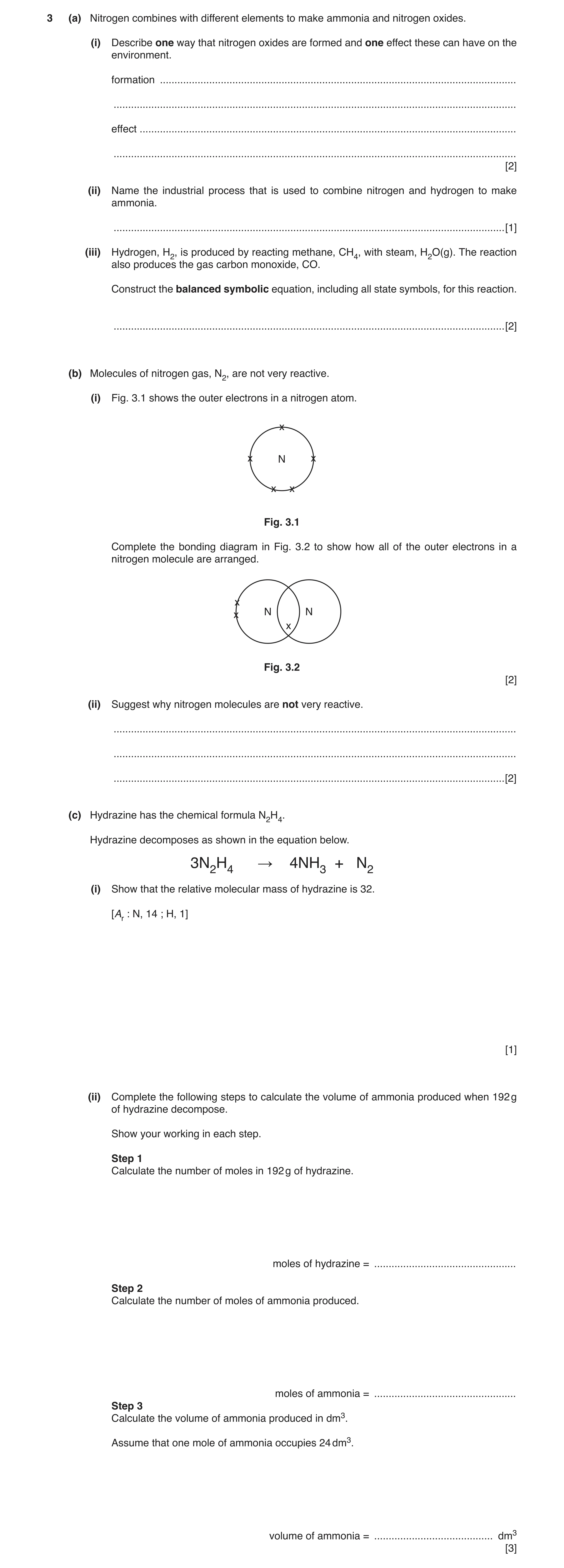
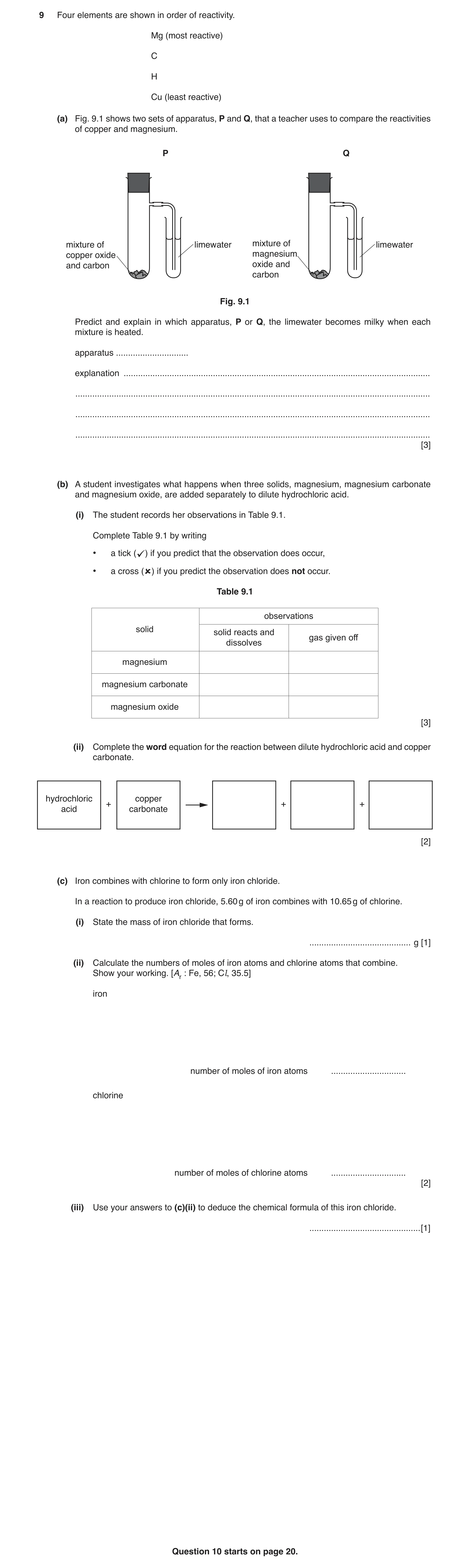
![Question 3: (a) (i) State the percentage of nitrogen in clean air. .............................% [1] (ii) Name two other uncombined gaseous elements i…](https://img.pastlit.com/crops/b4946fc1-1ba1-4f4a-a888-af11a644cd24/q5.webp)
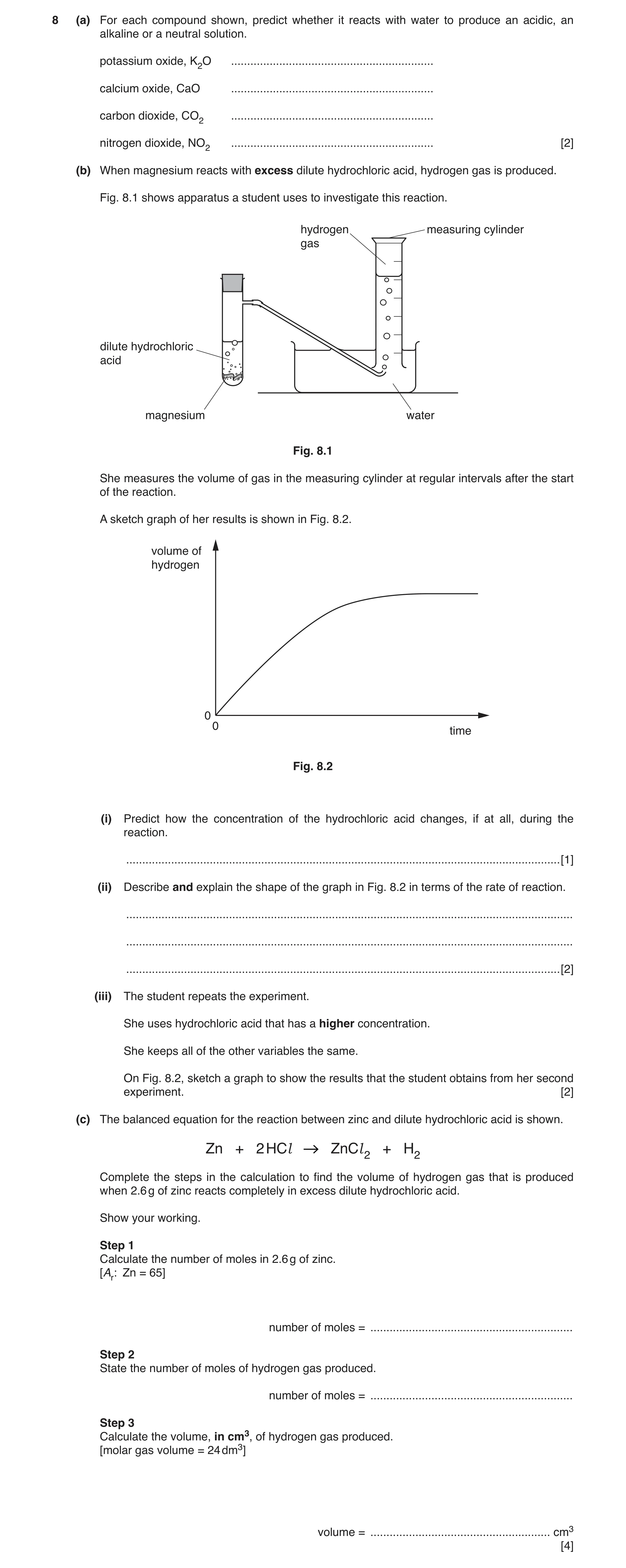
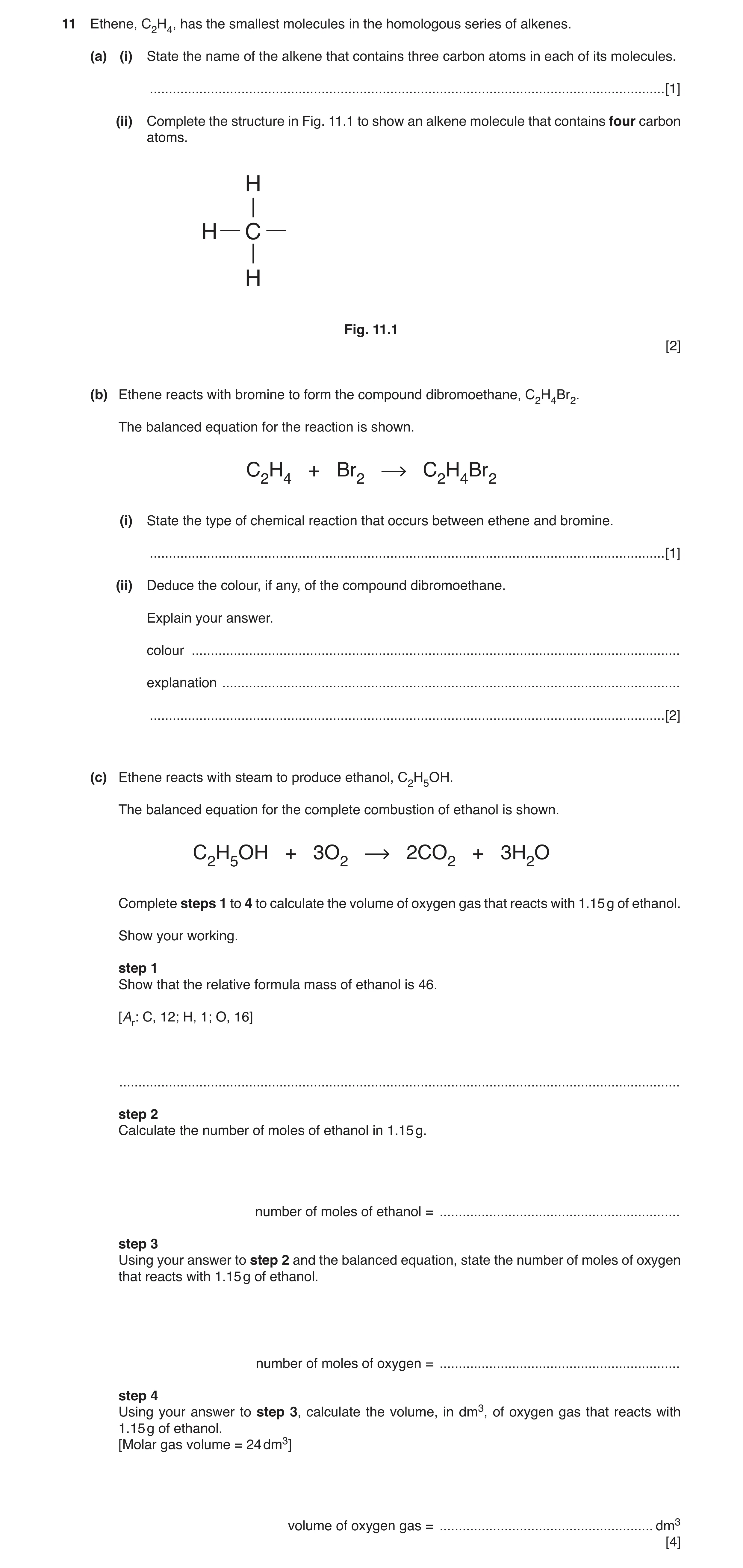
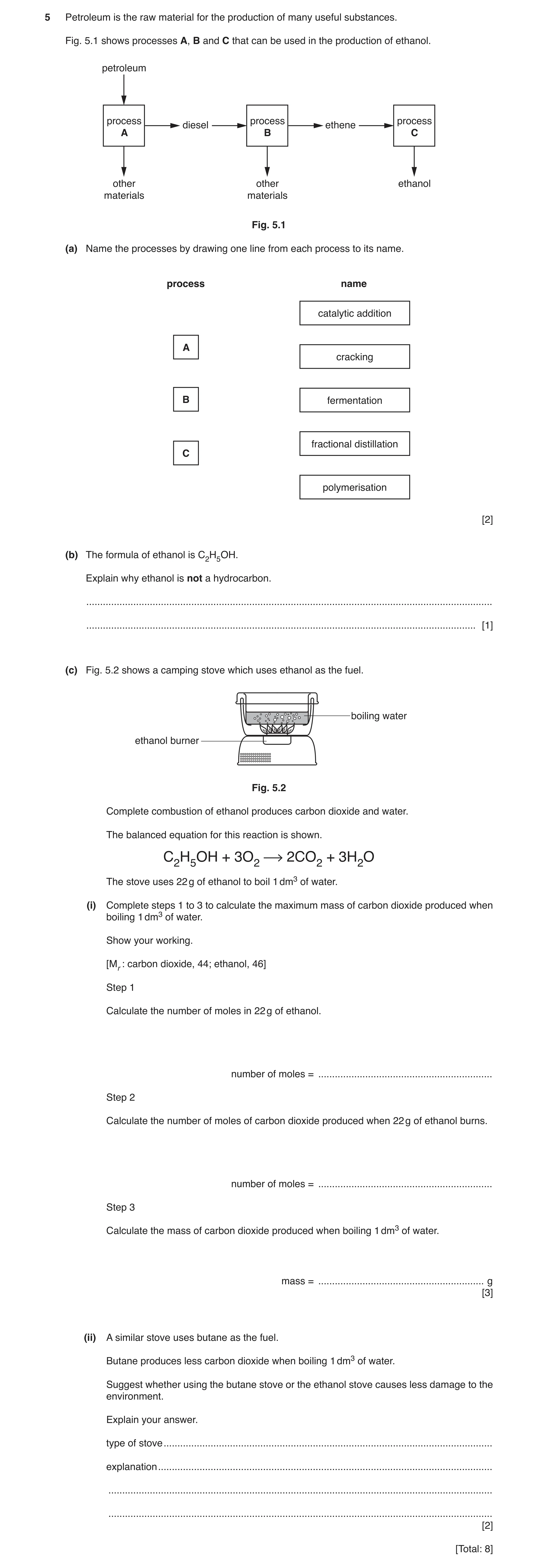
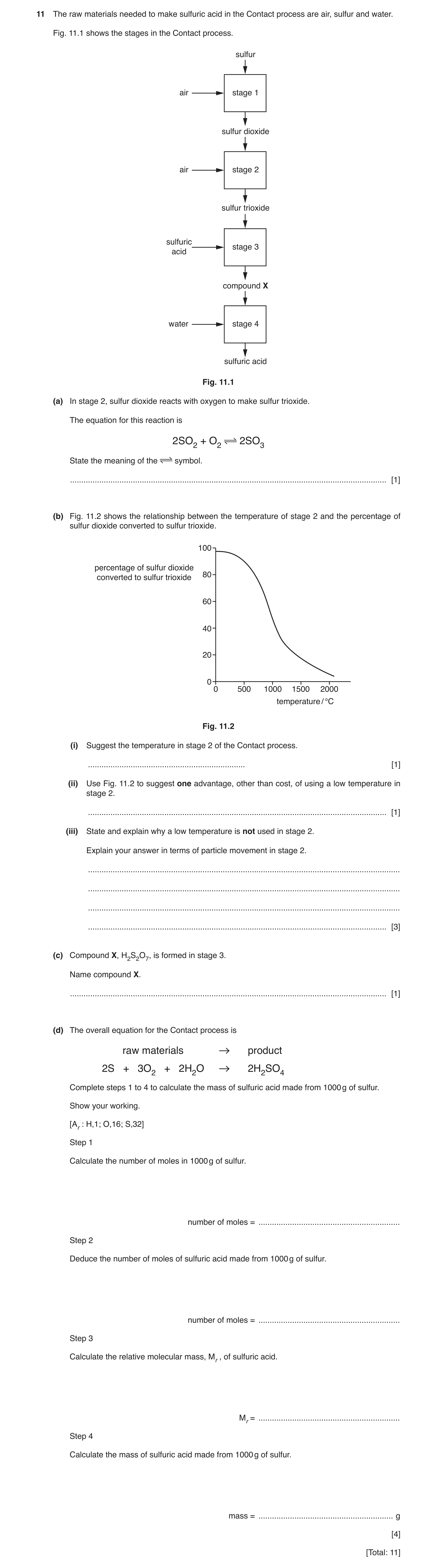
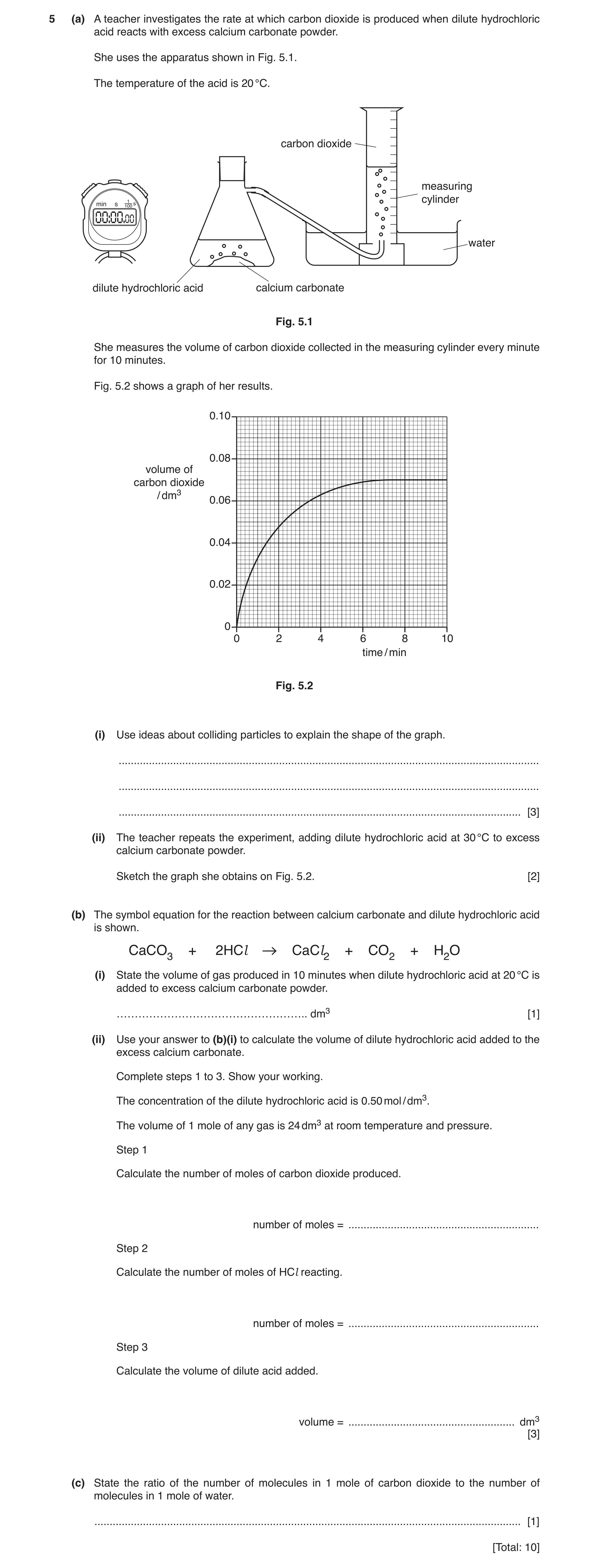
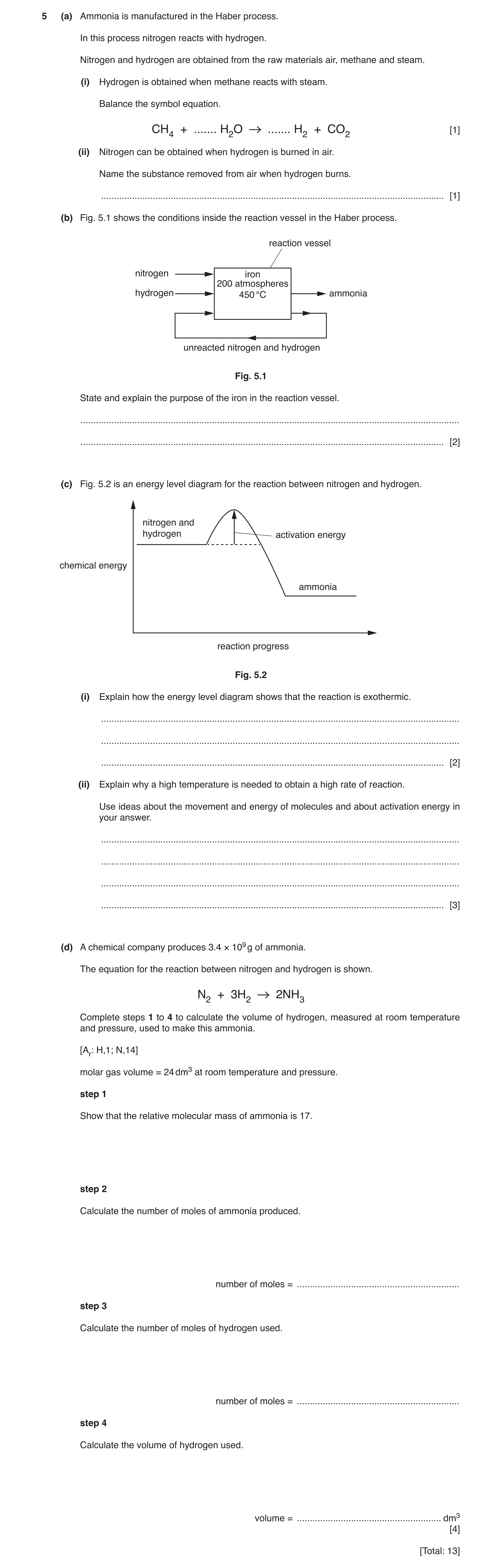
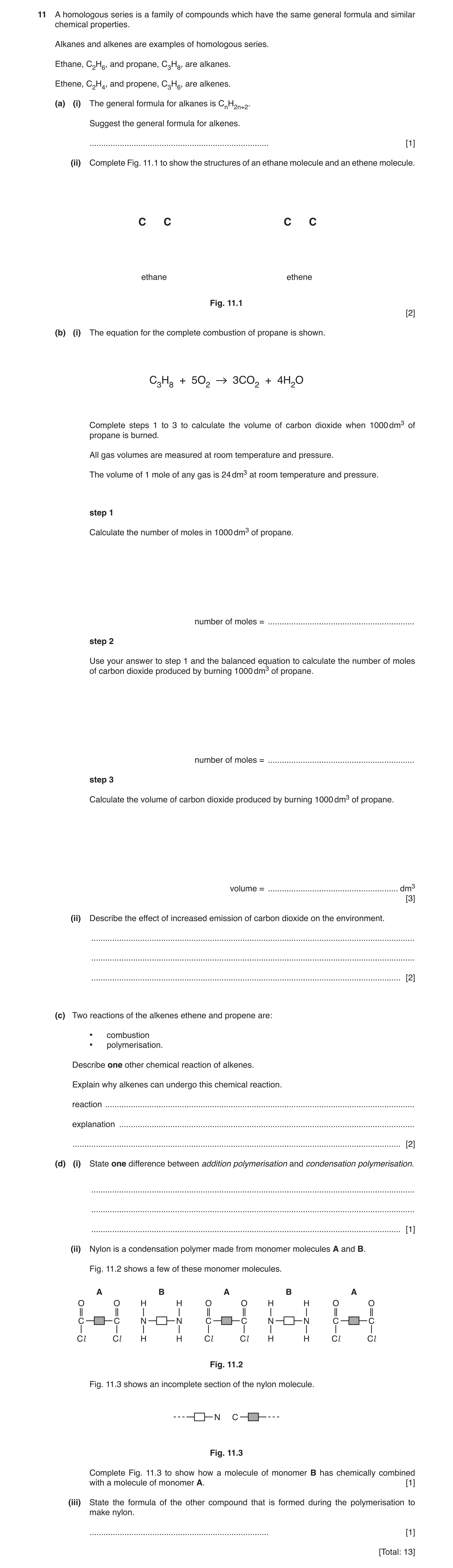
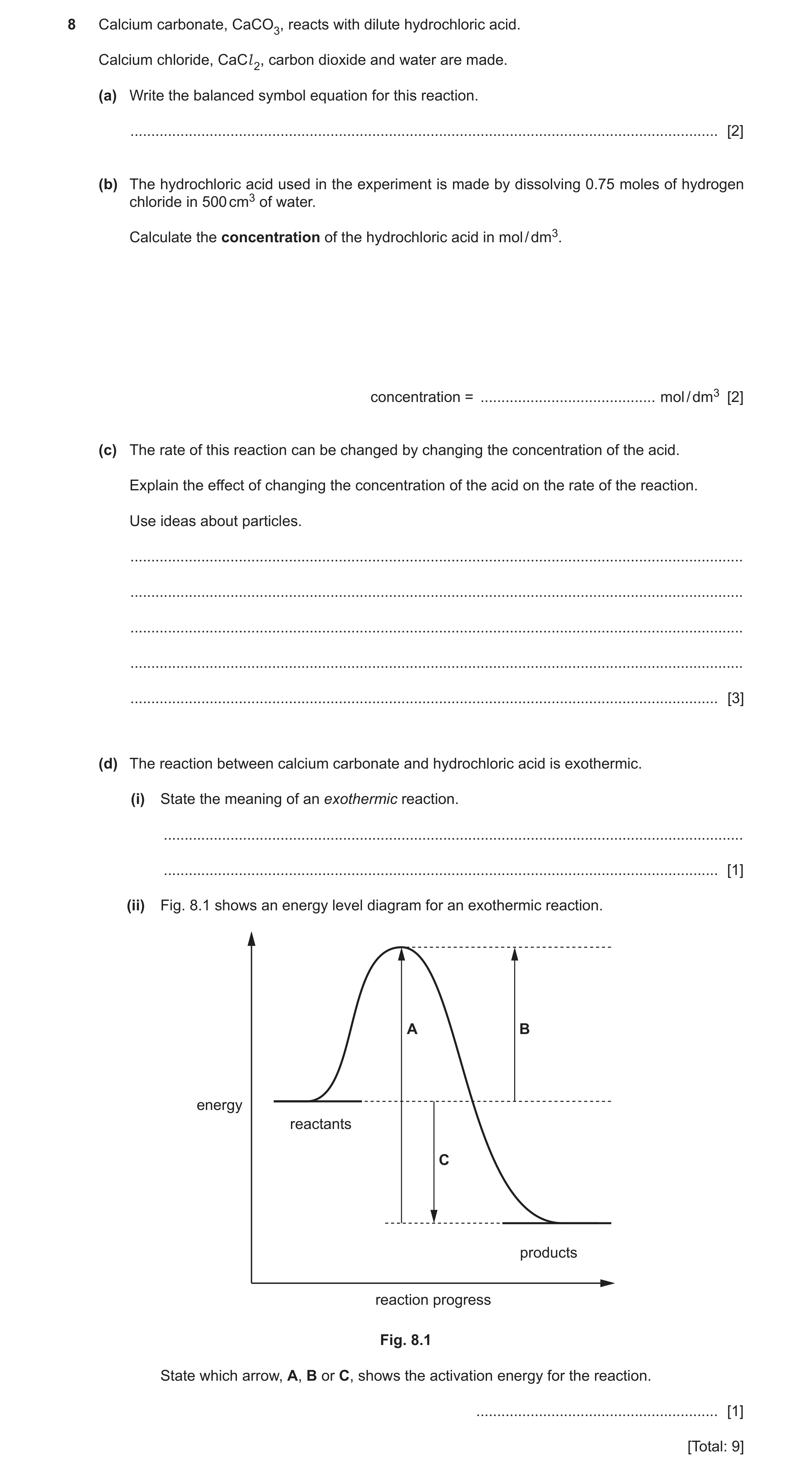
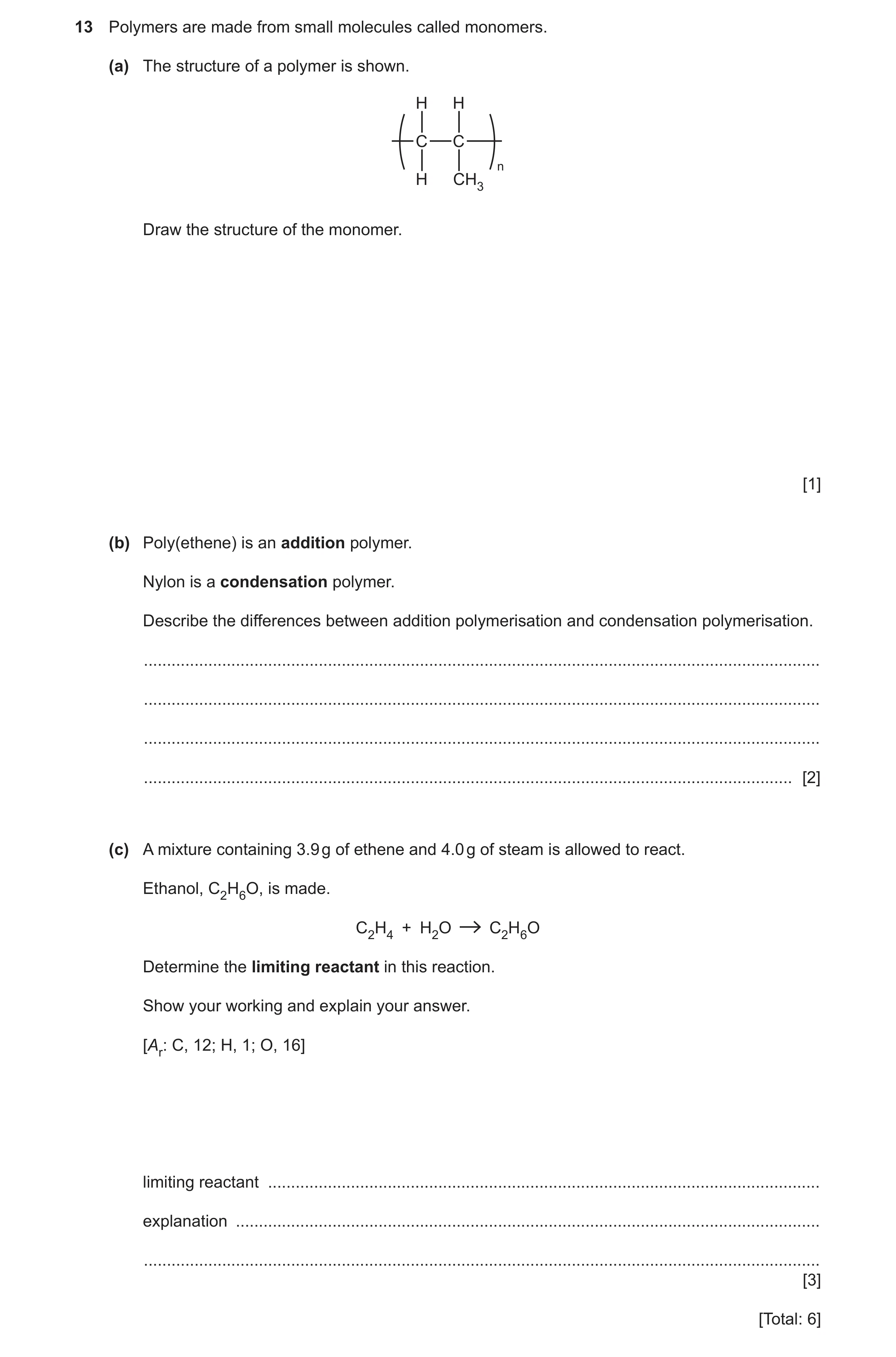
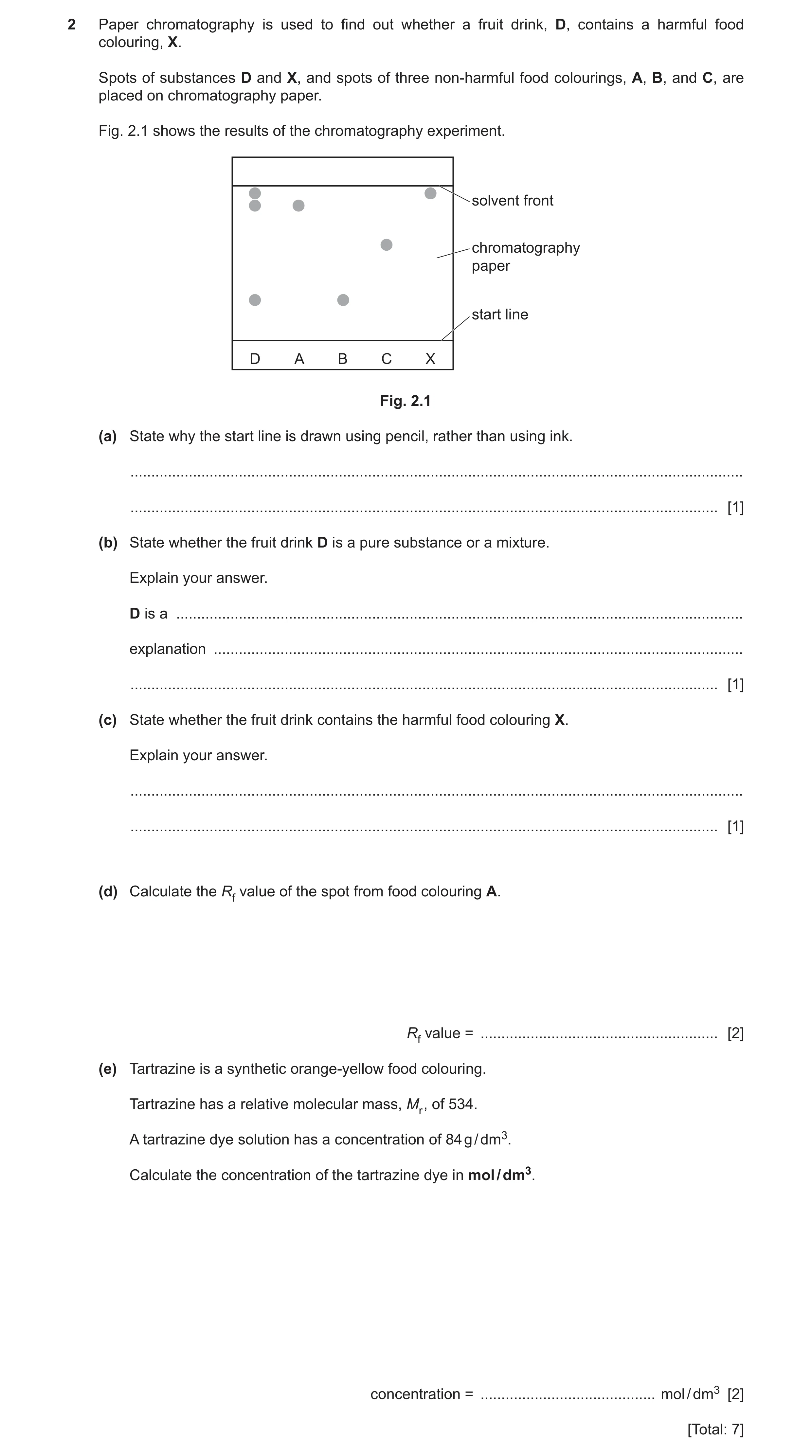
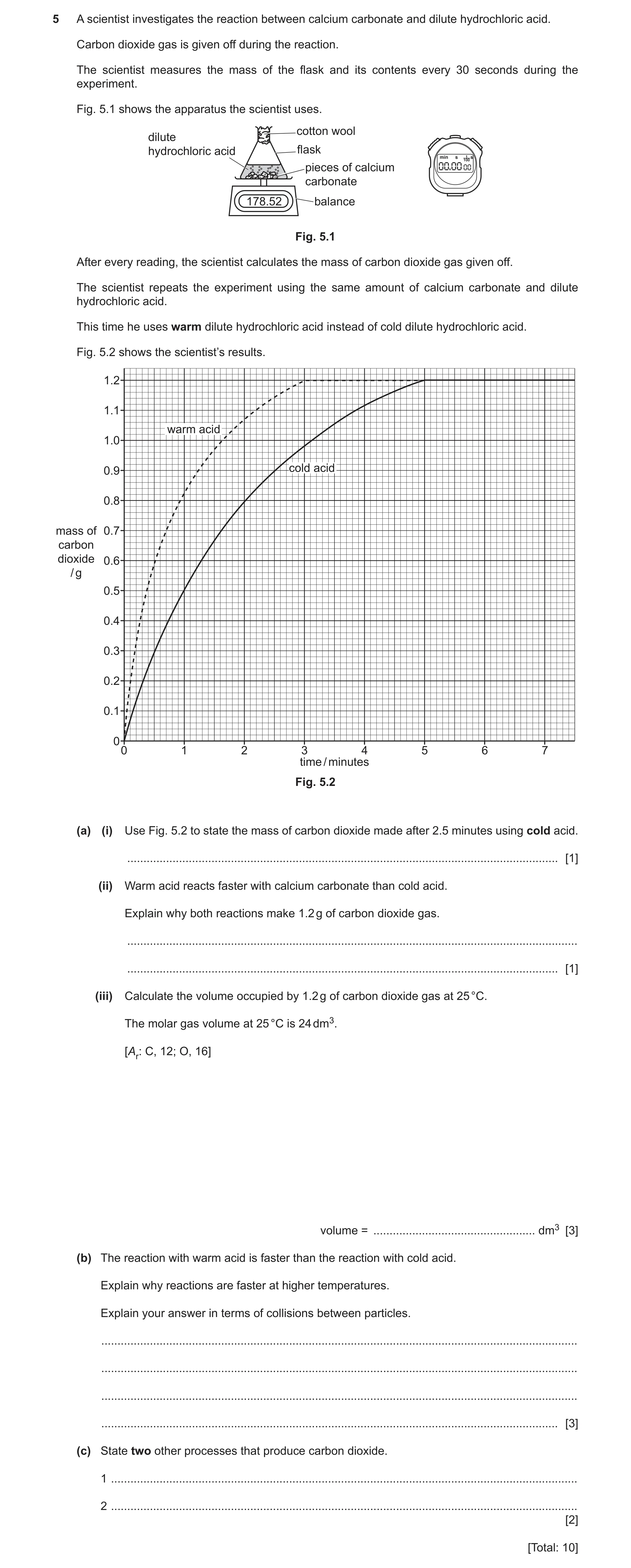
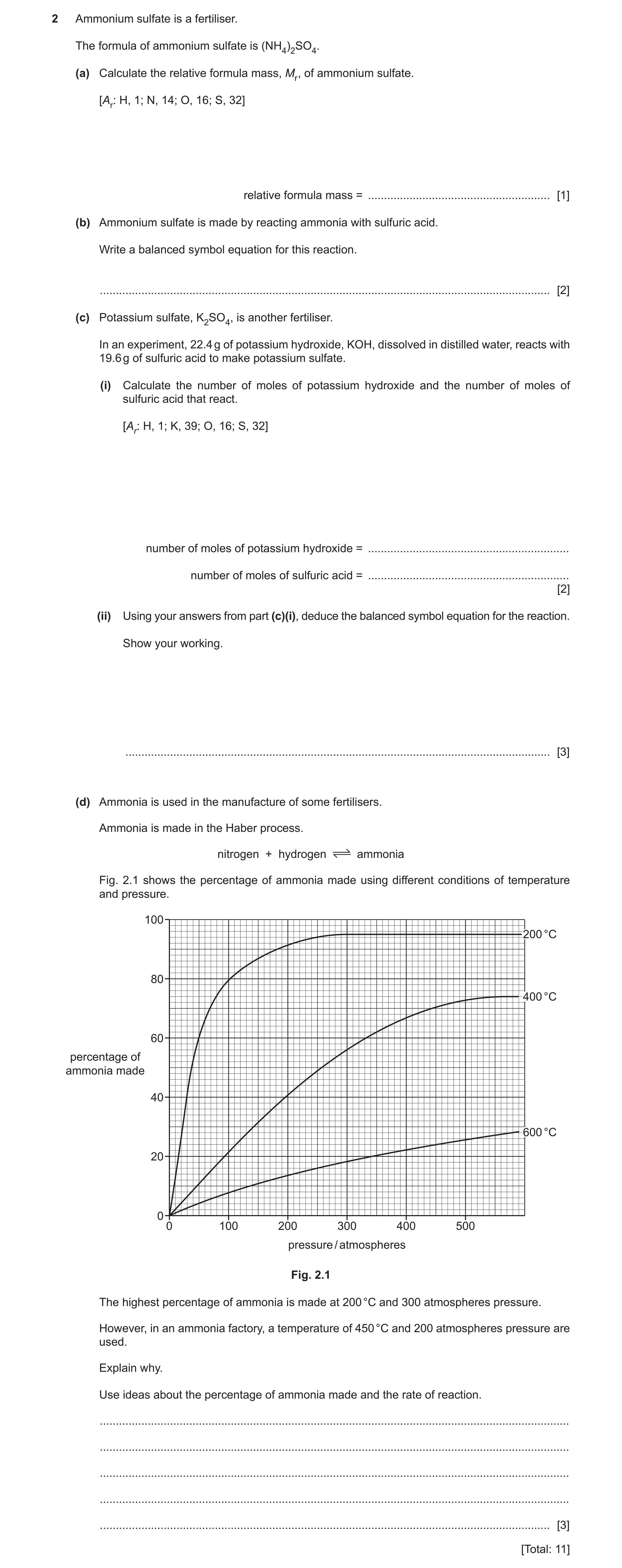
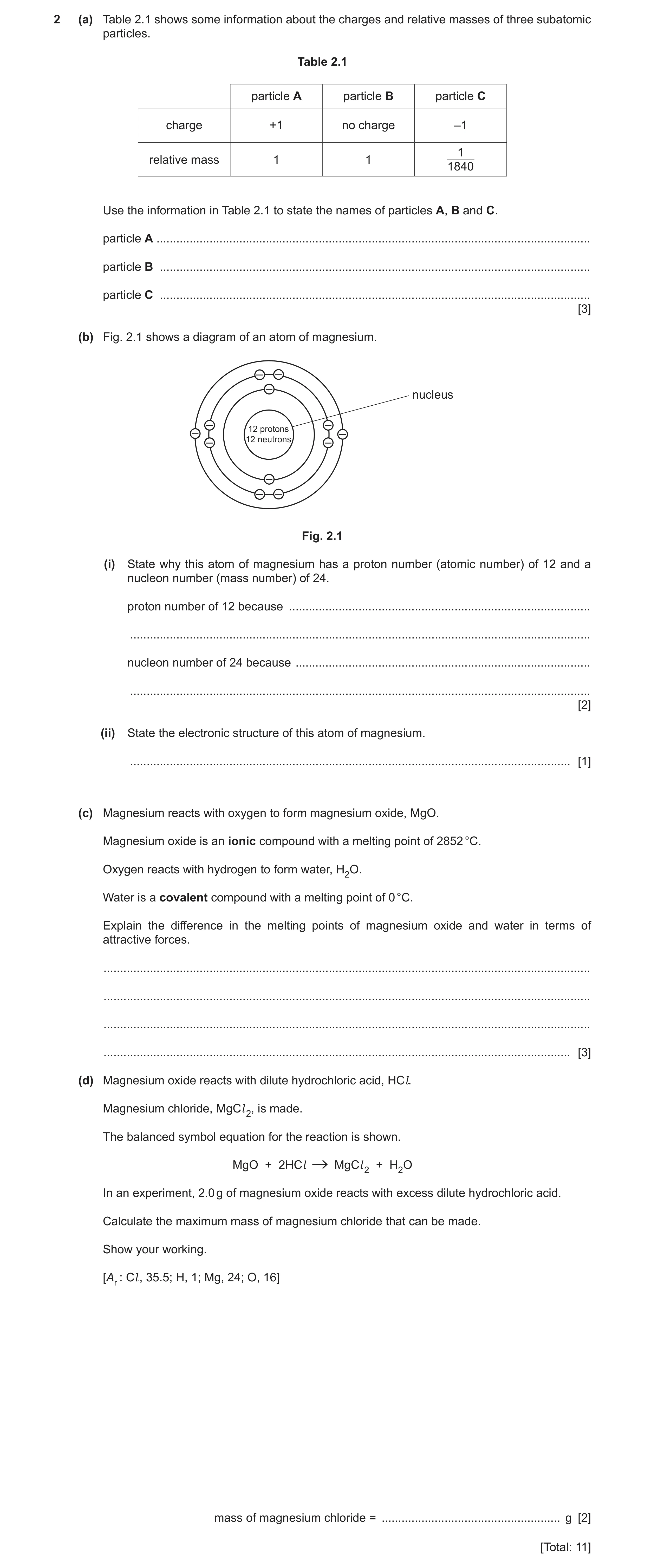
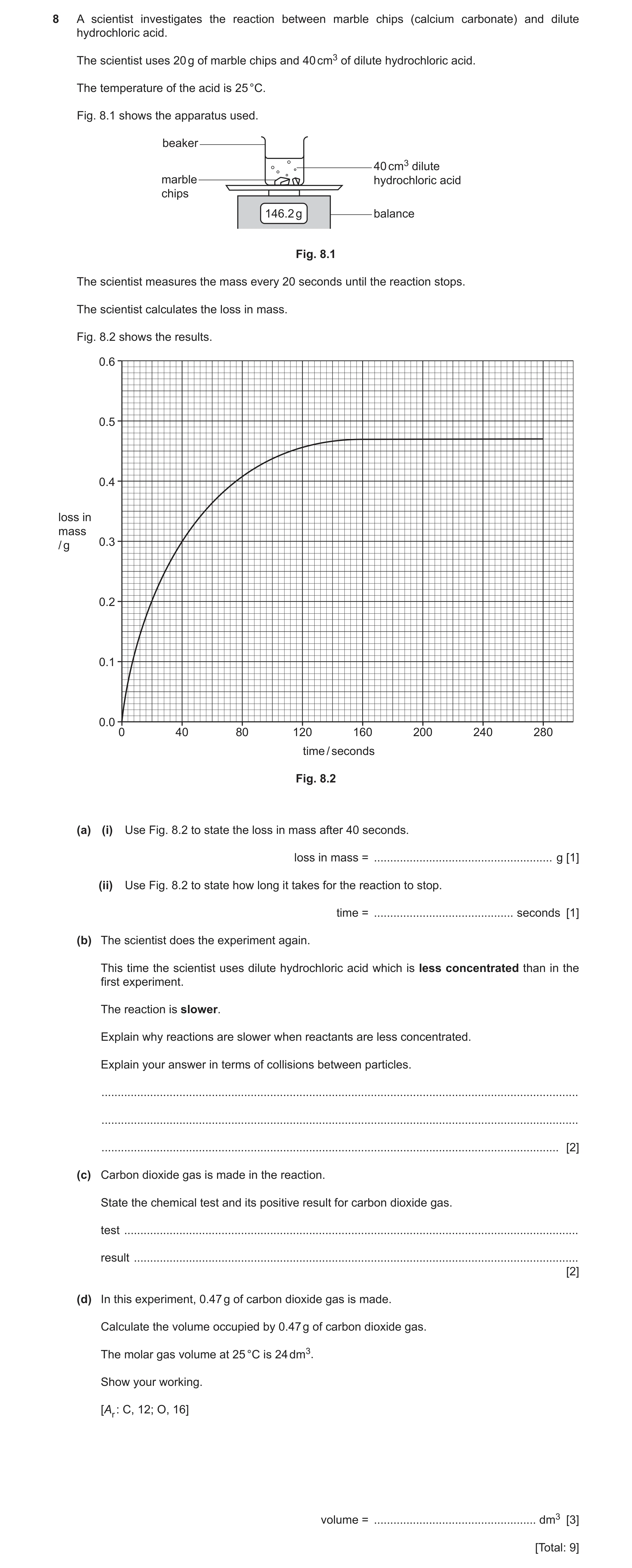
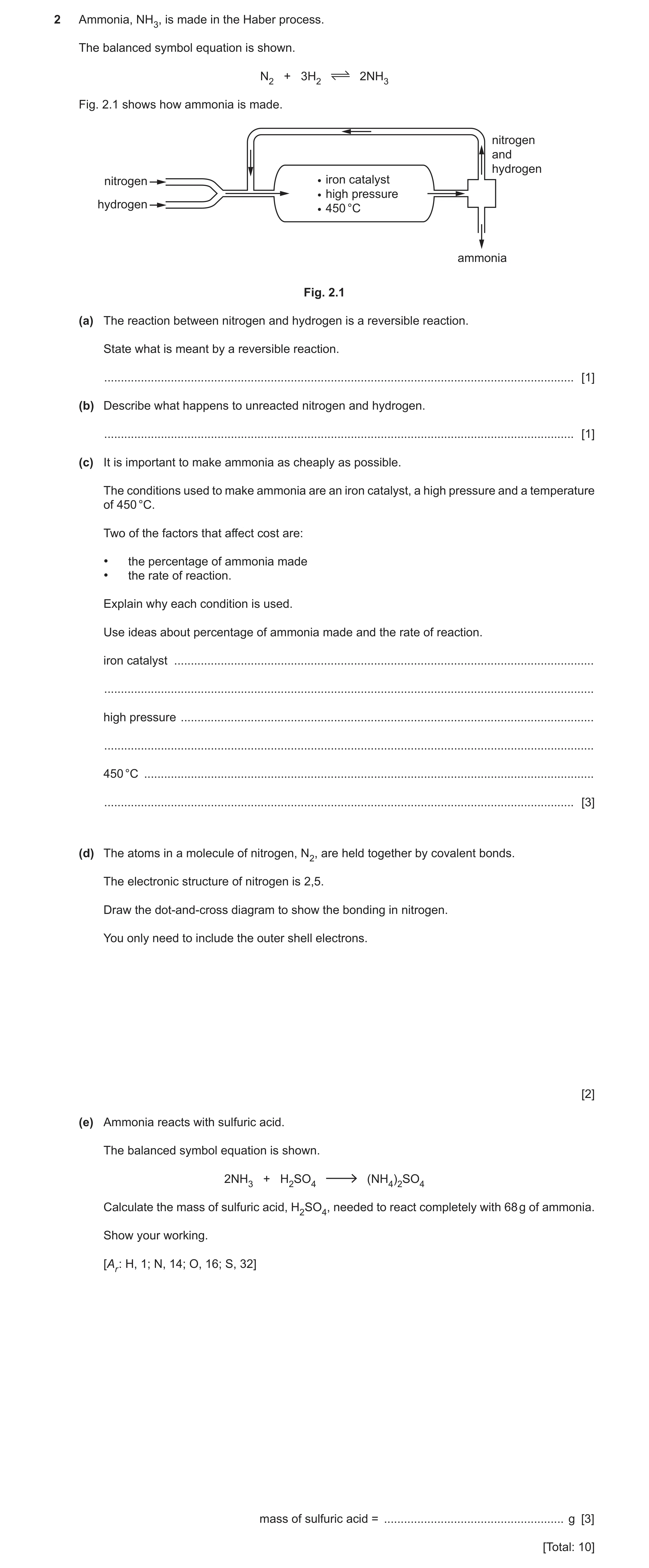
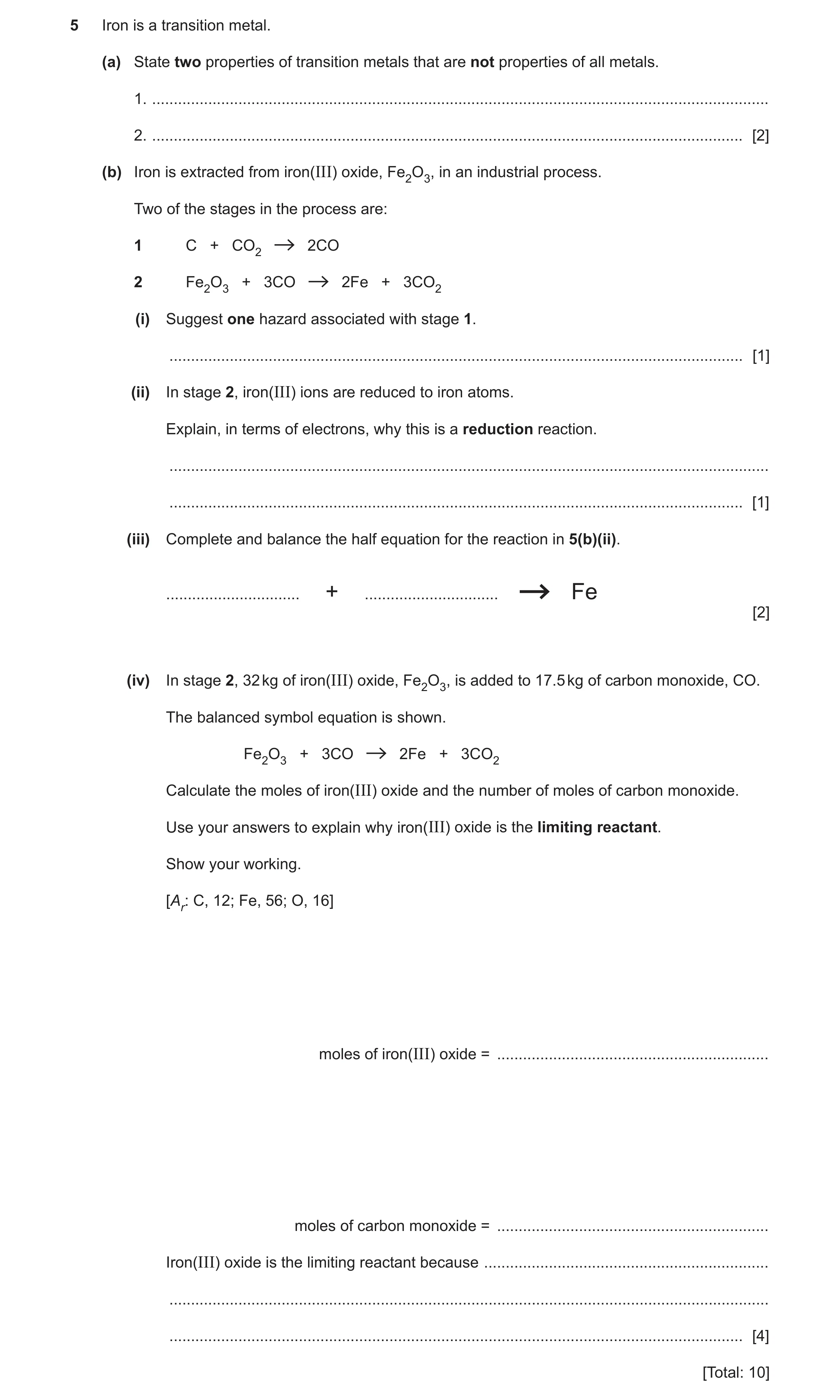
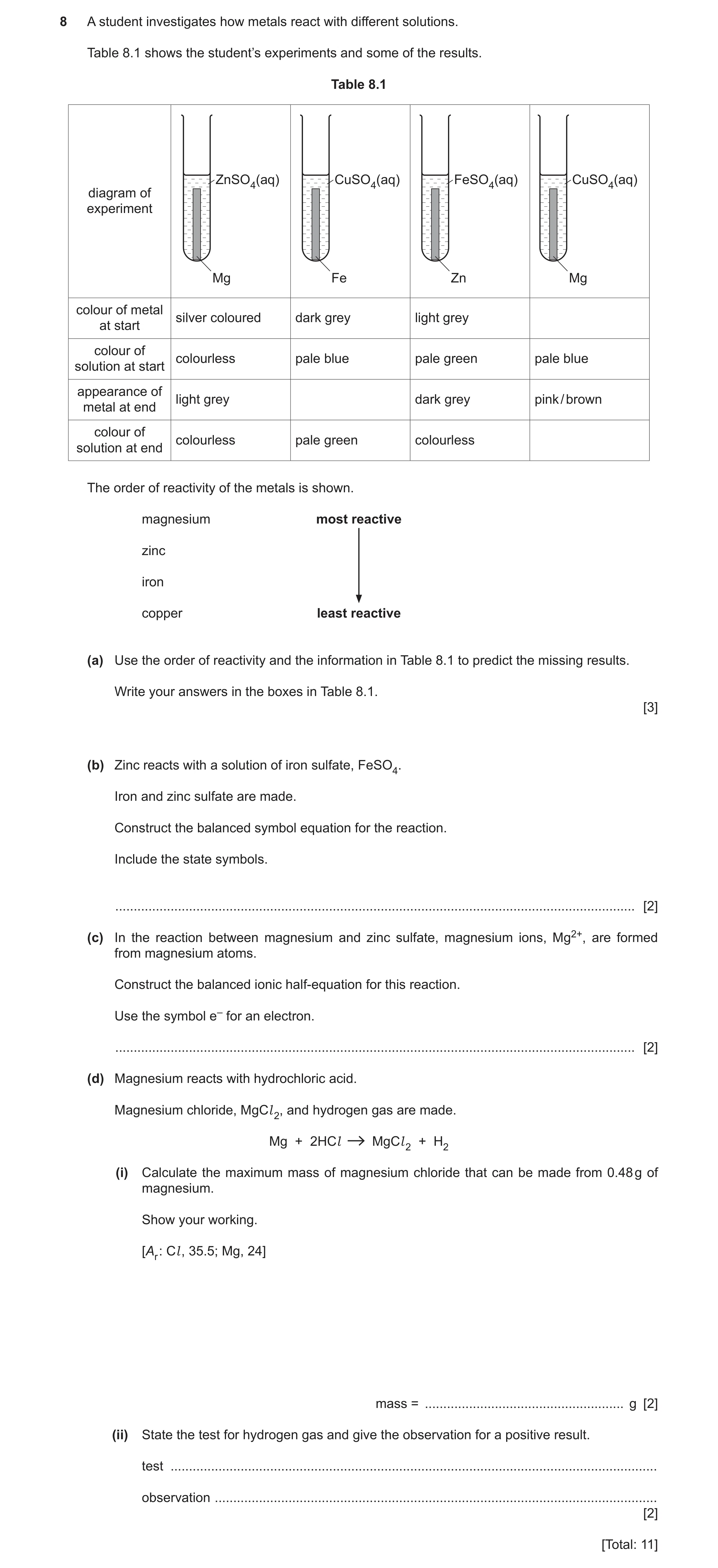
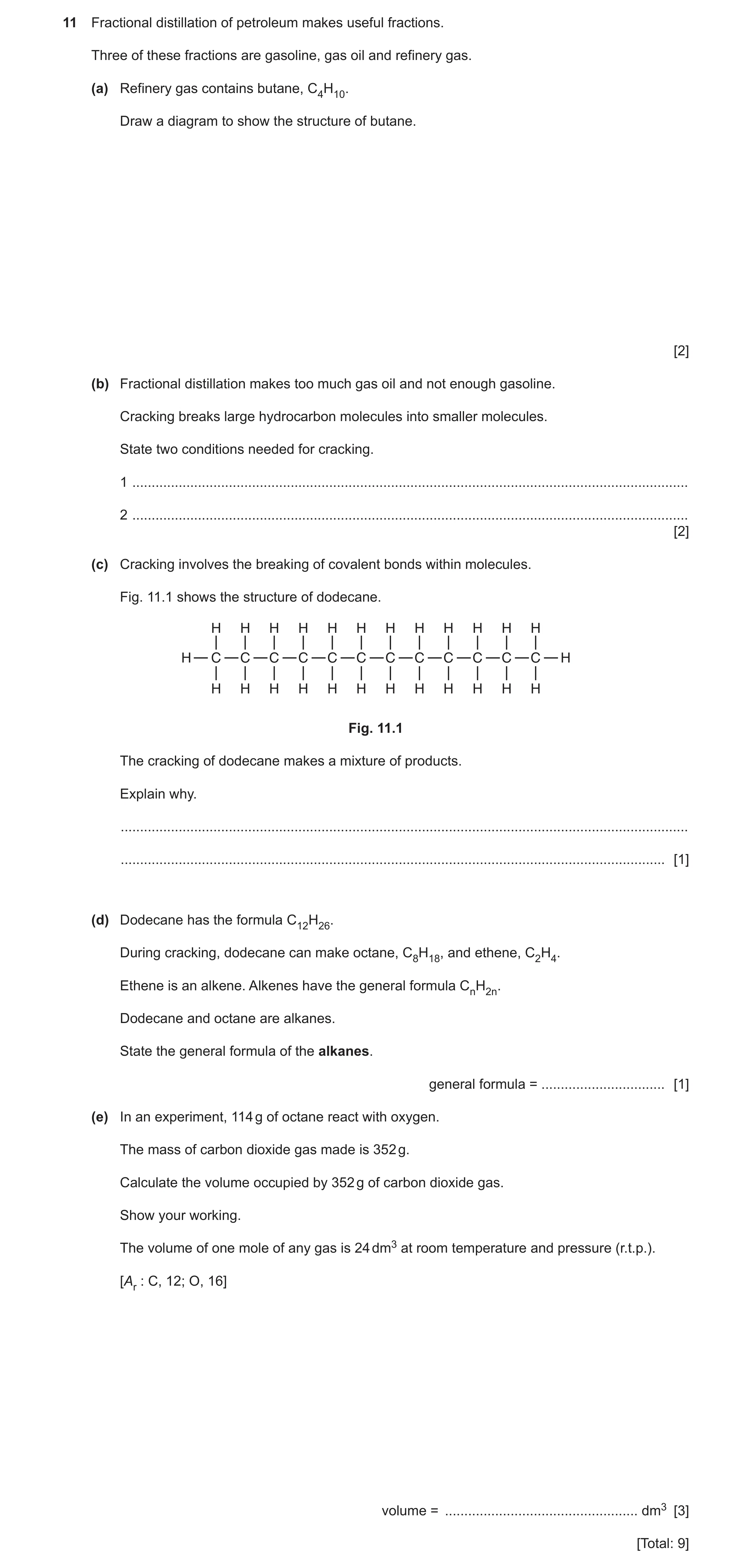
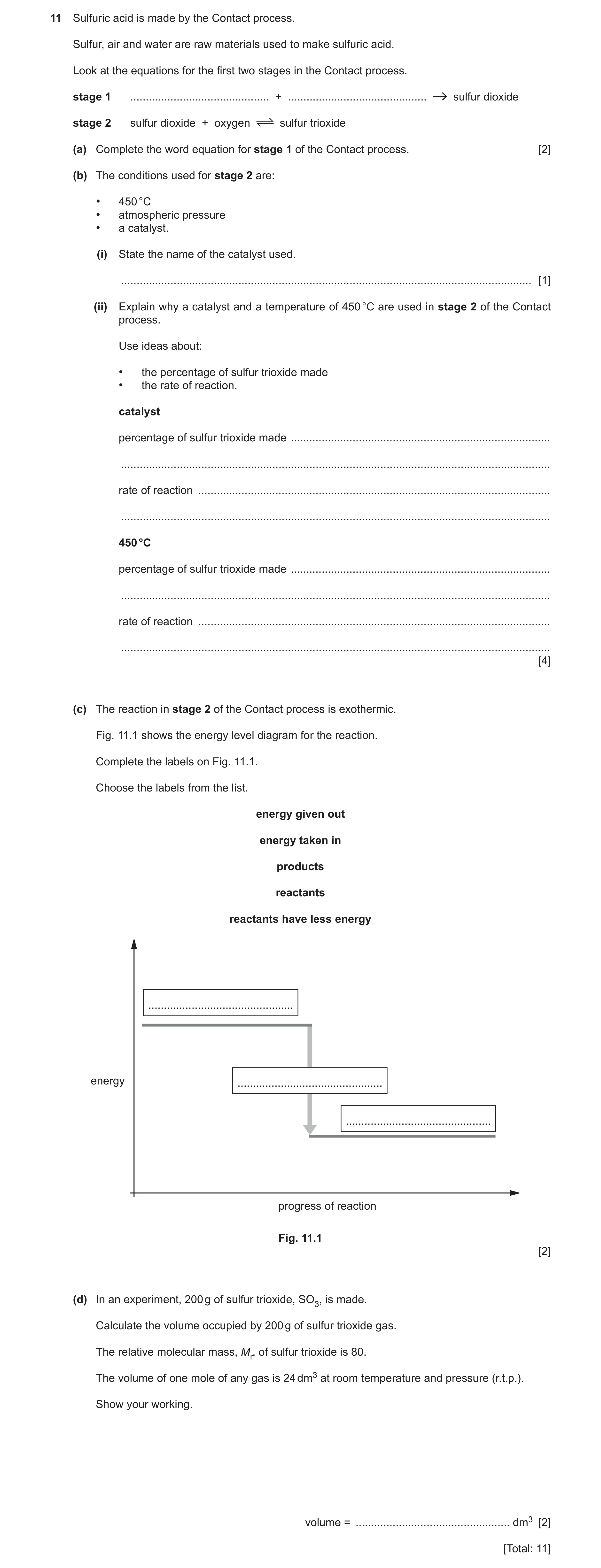
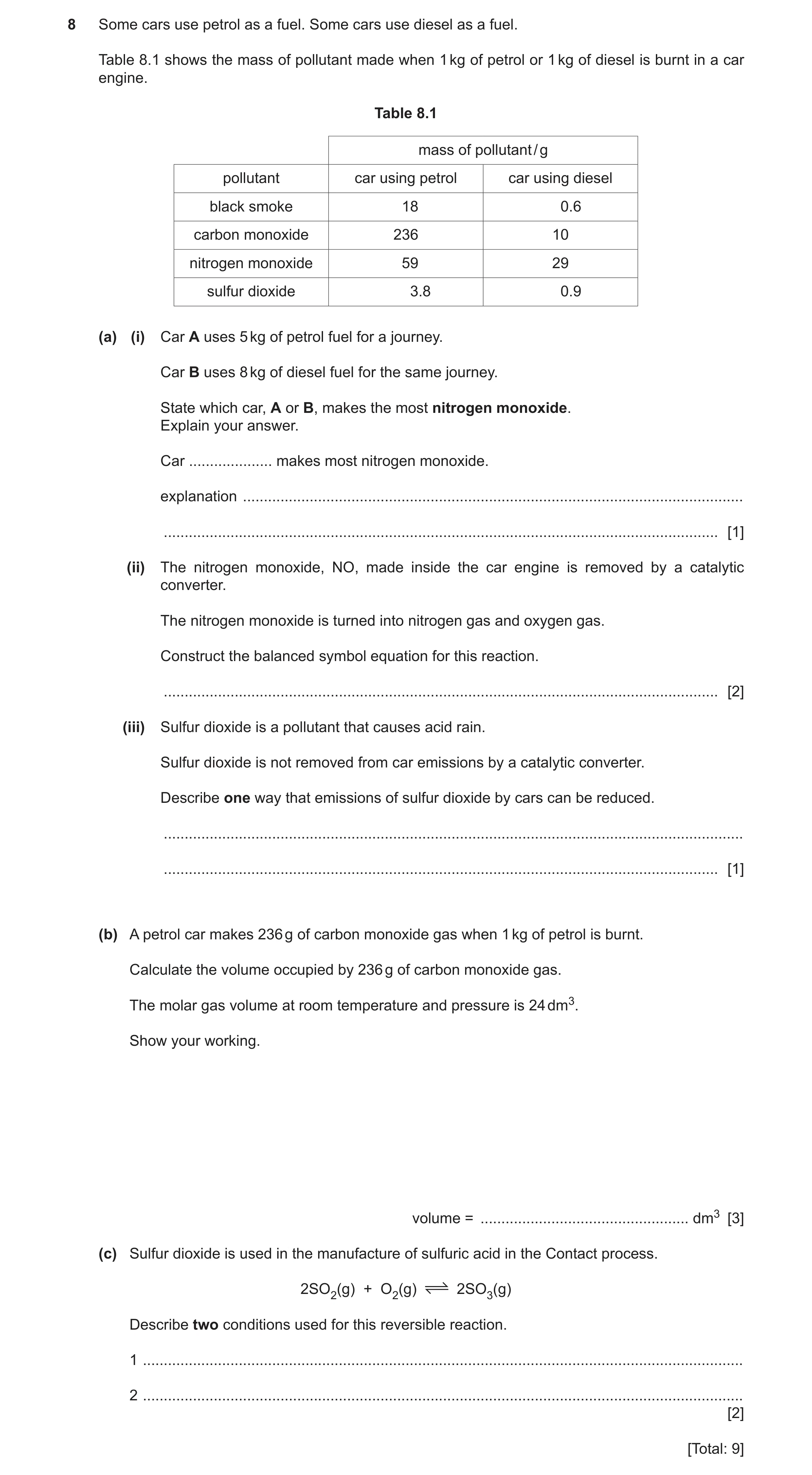
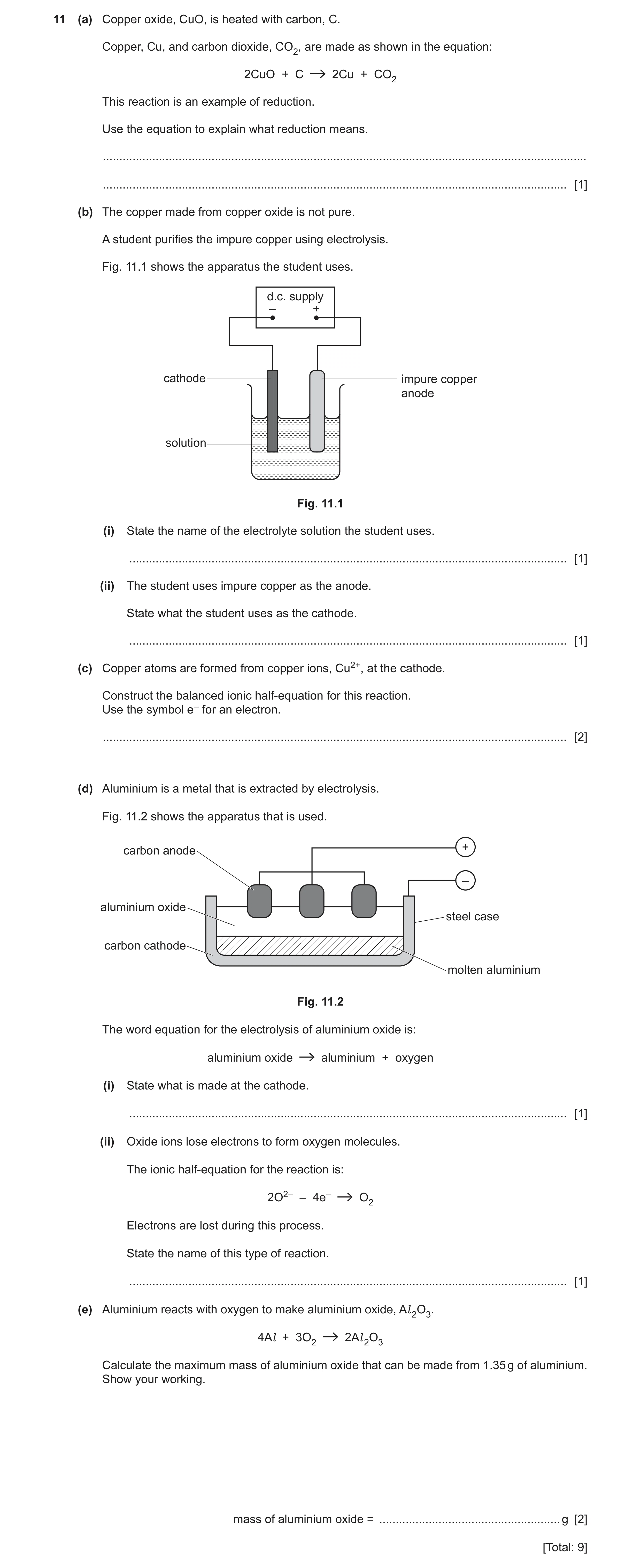
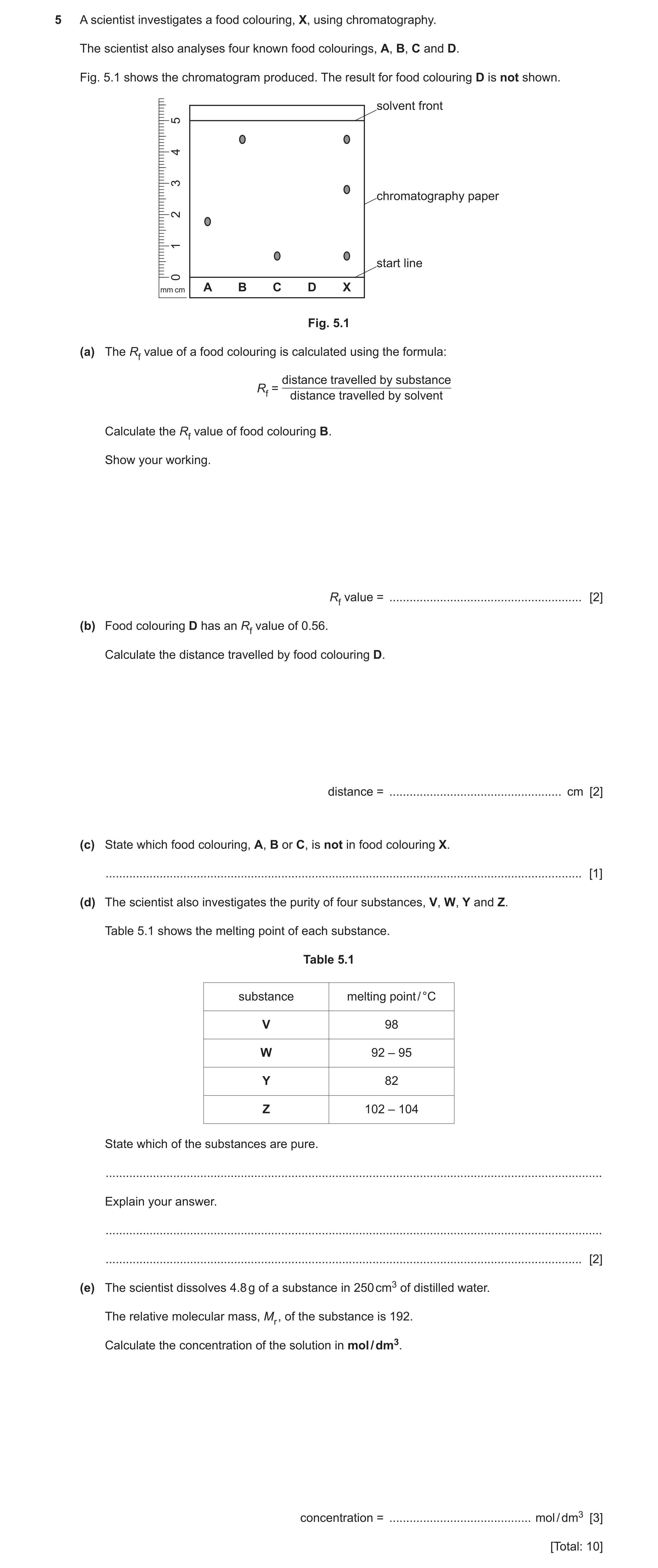
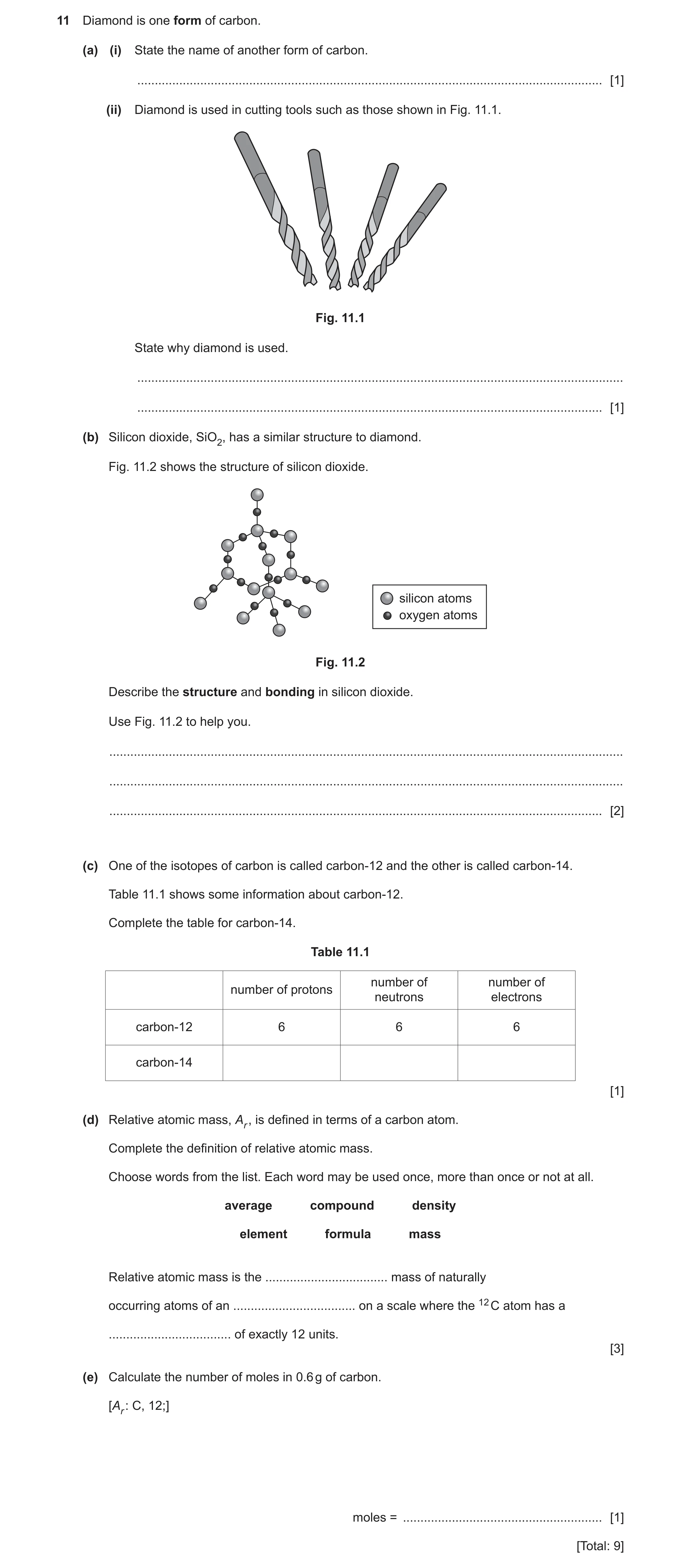
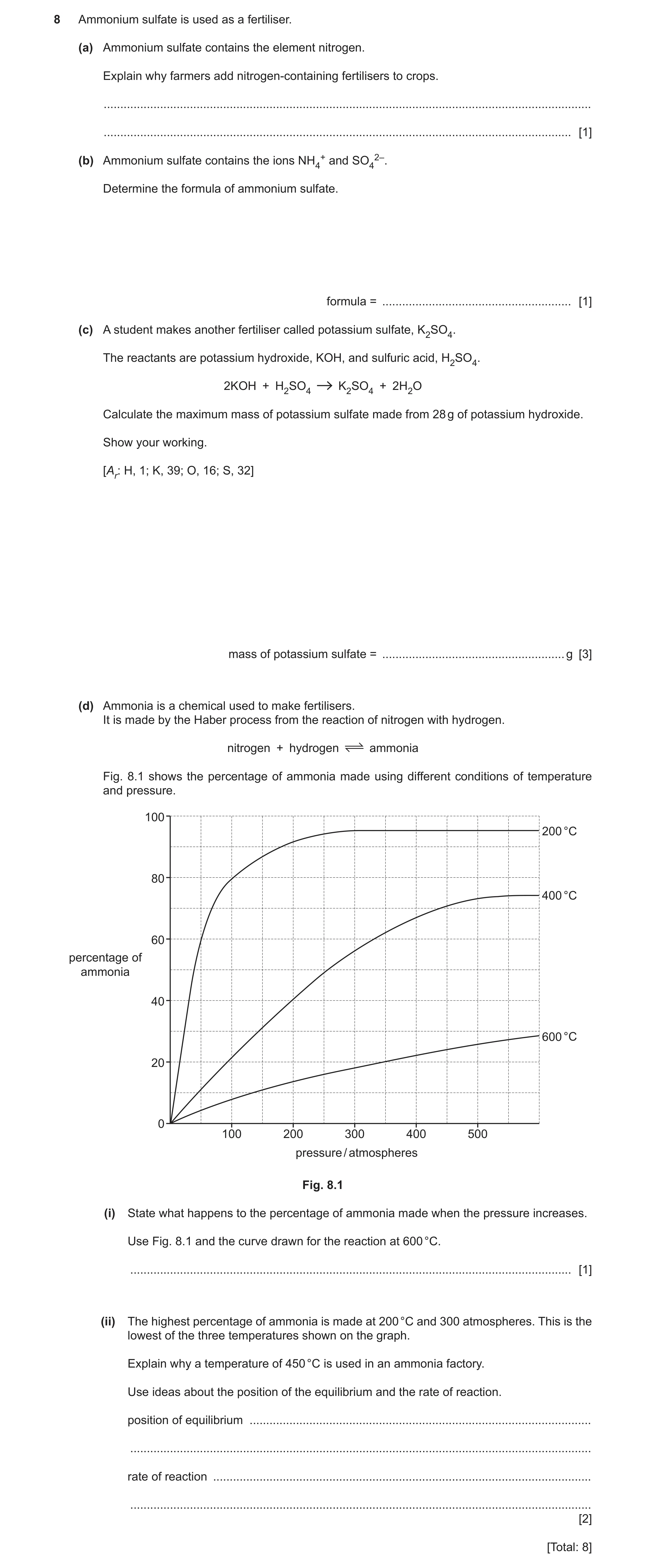
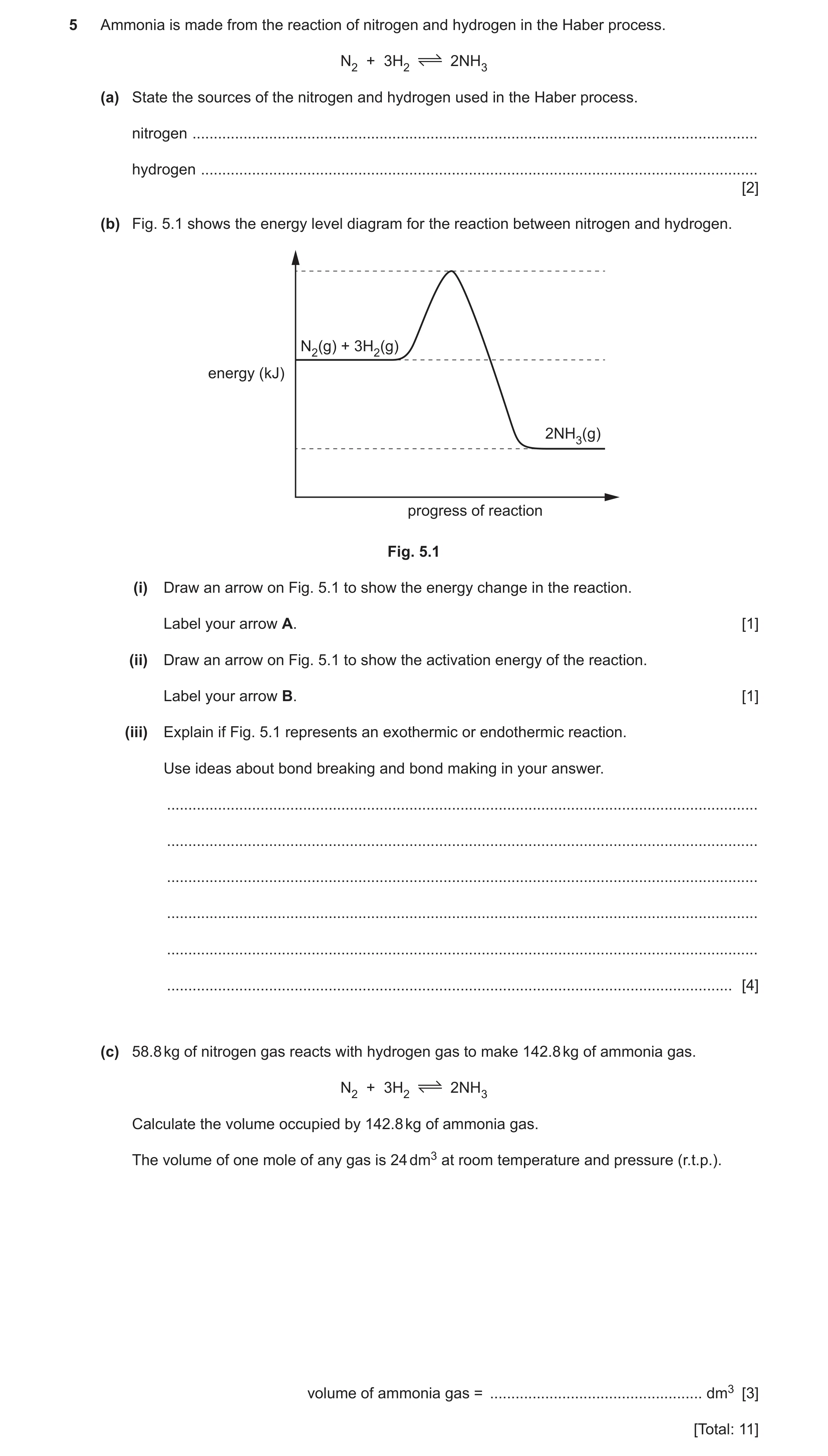
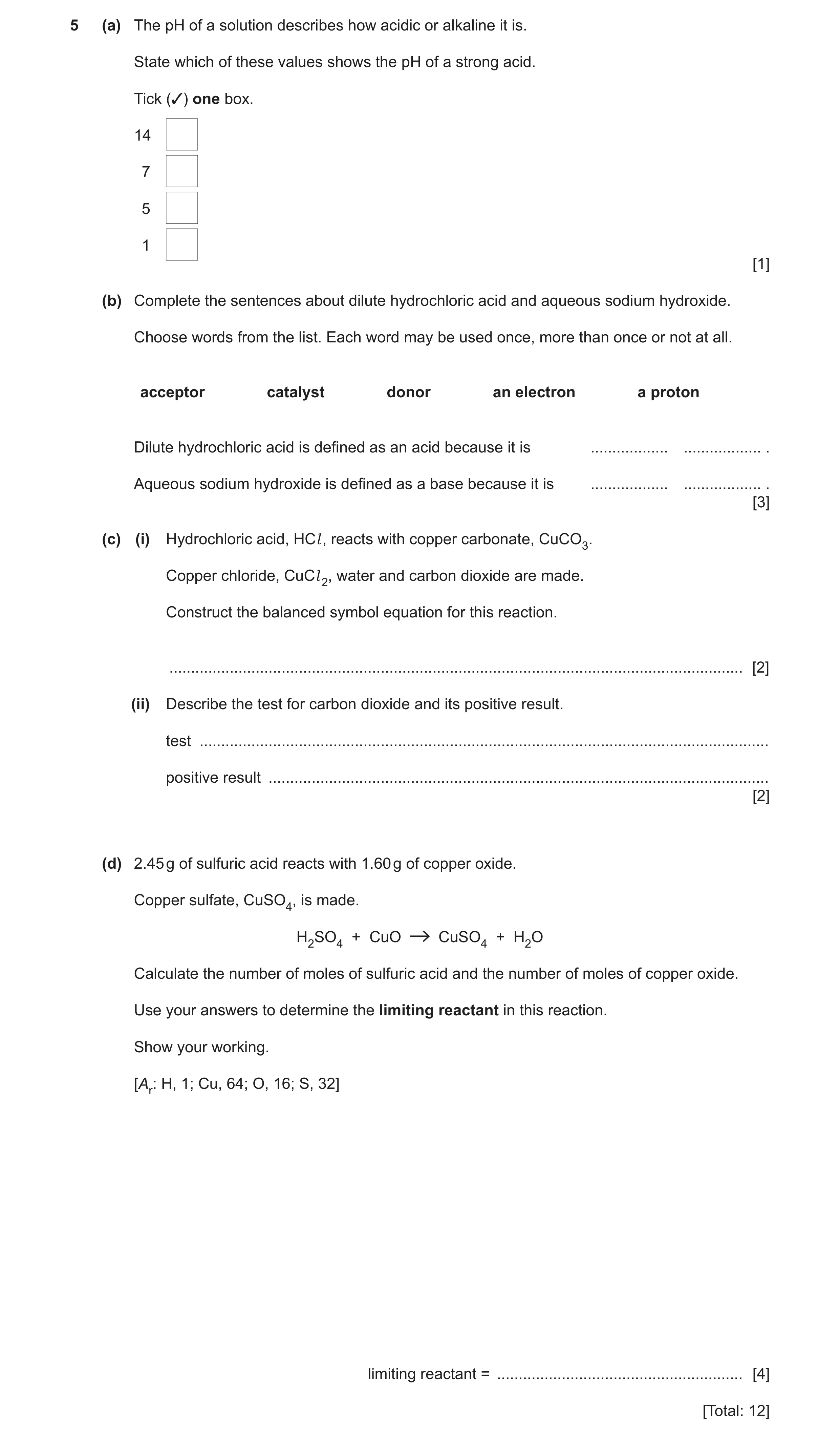
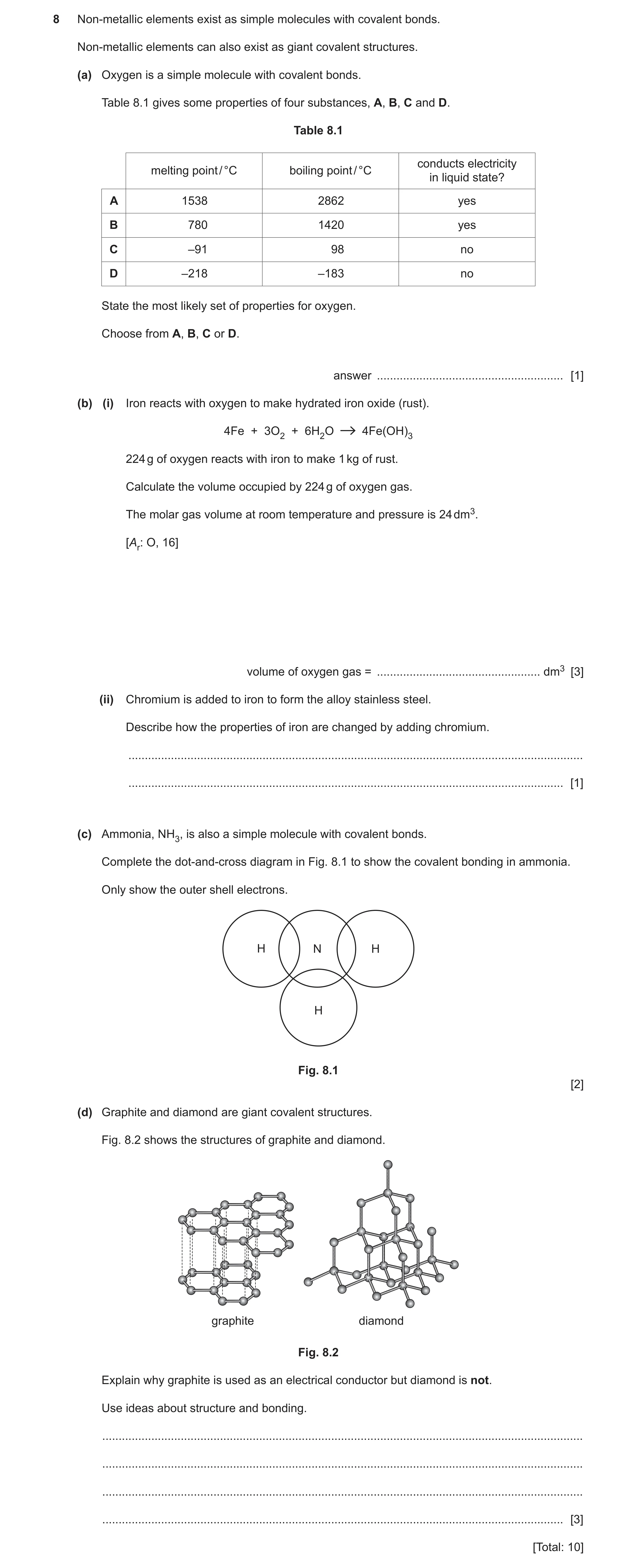
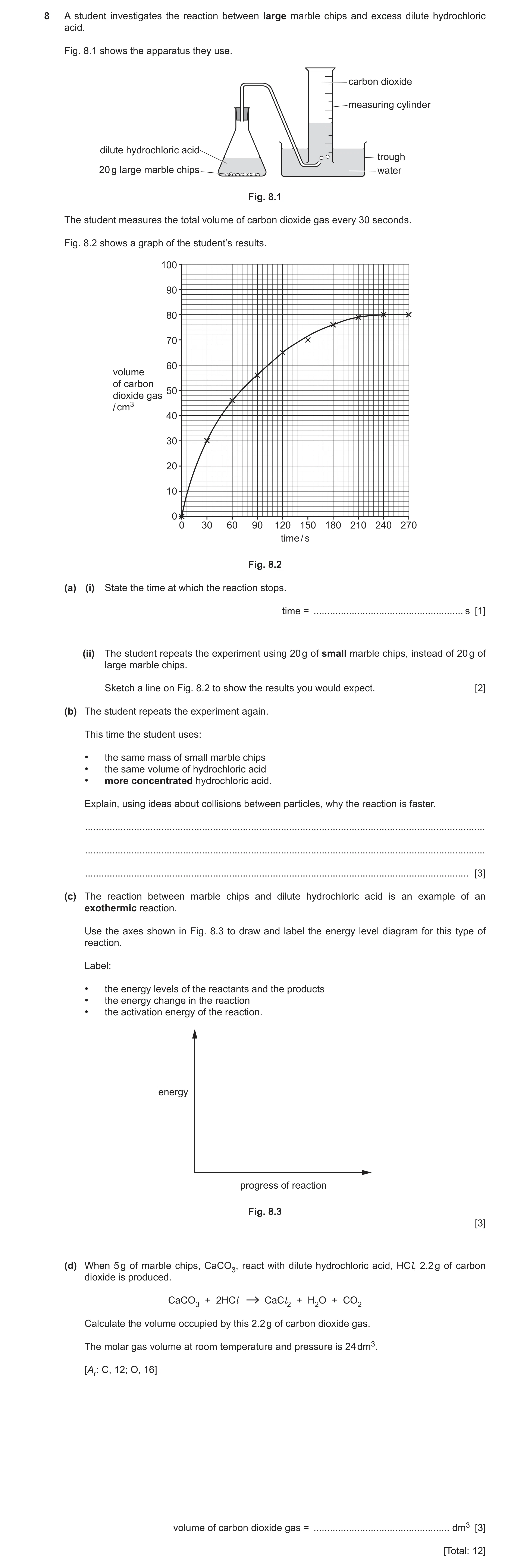
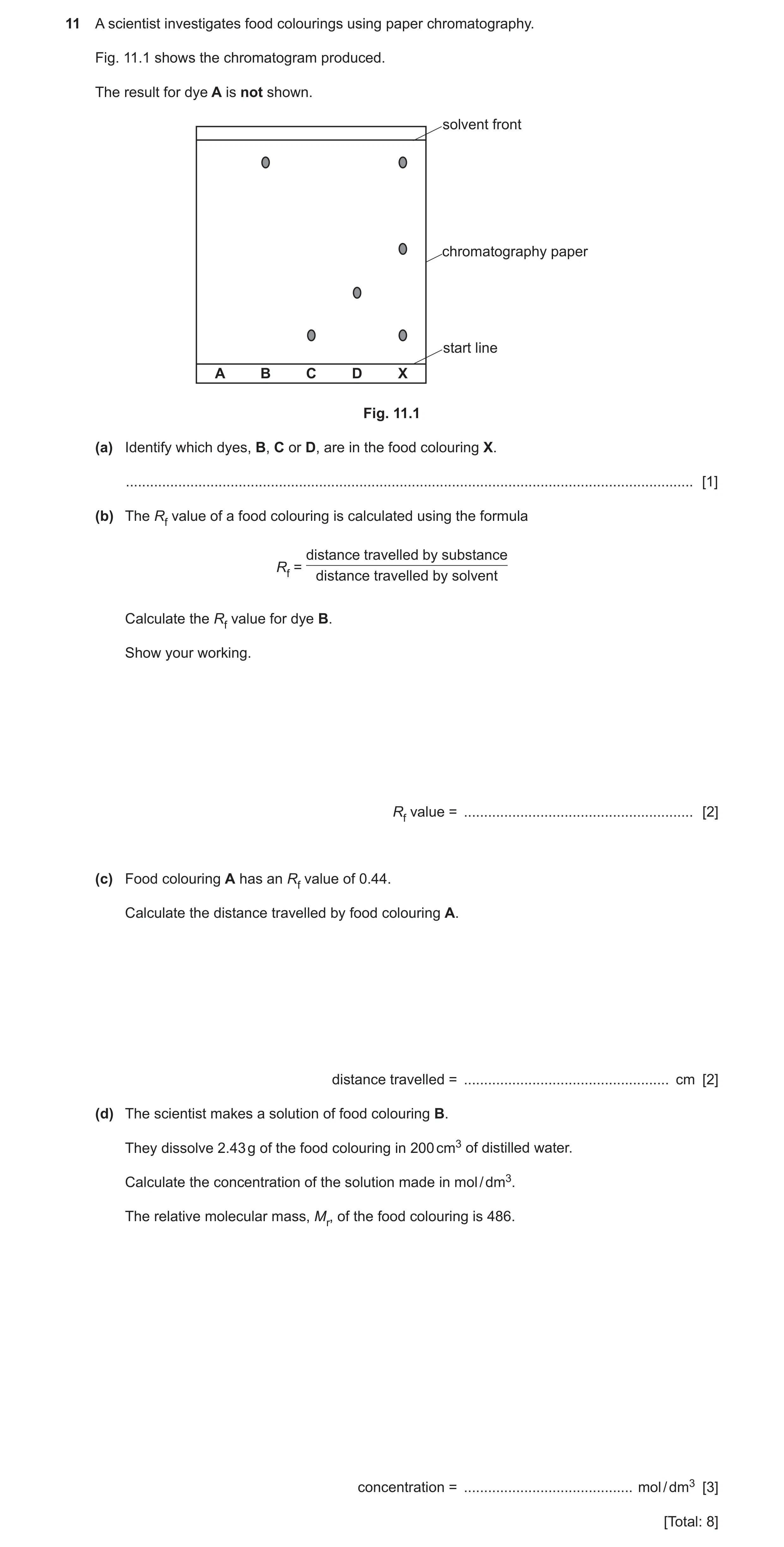
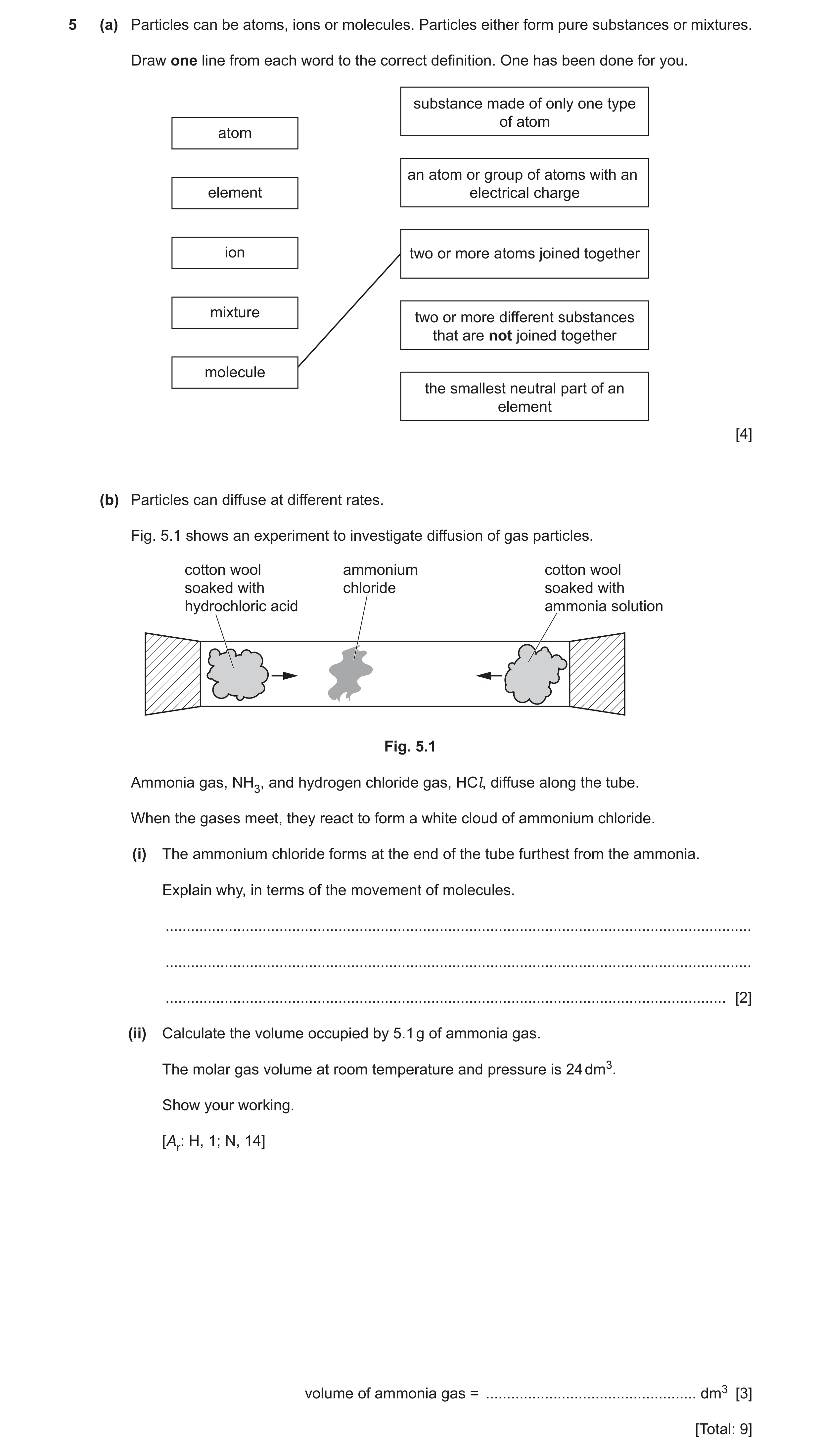
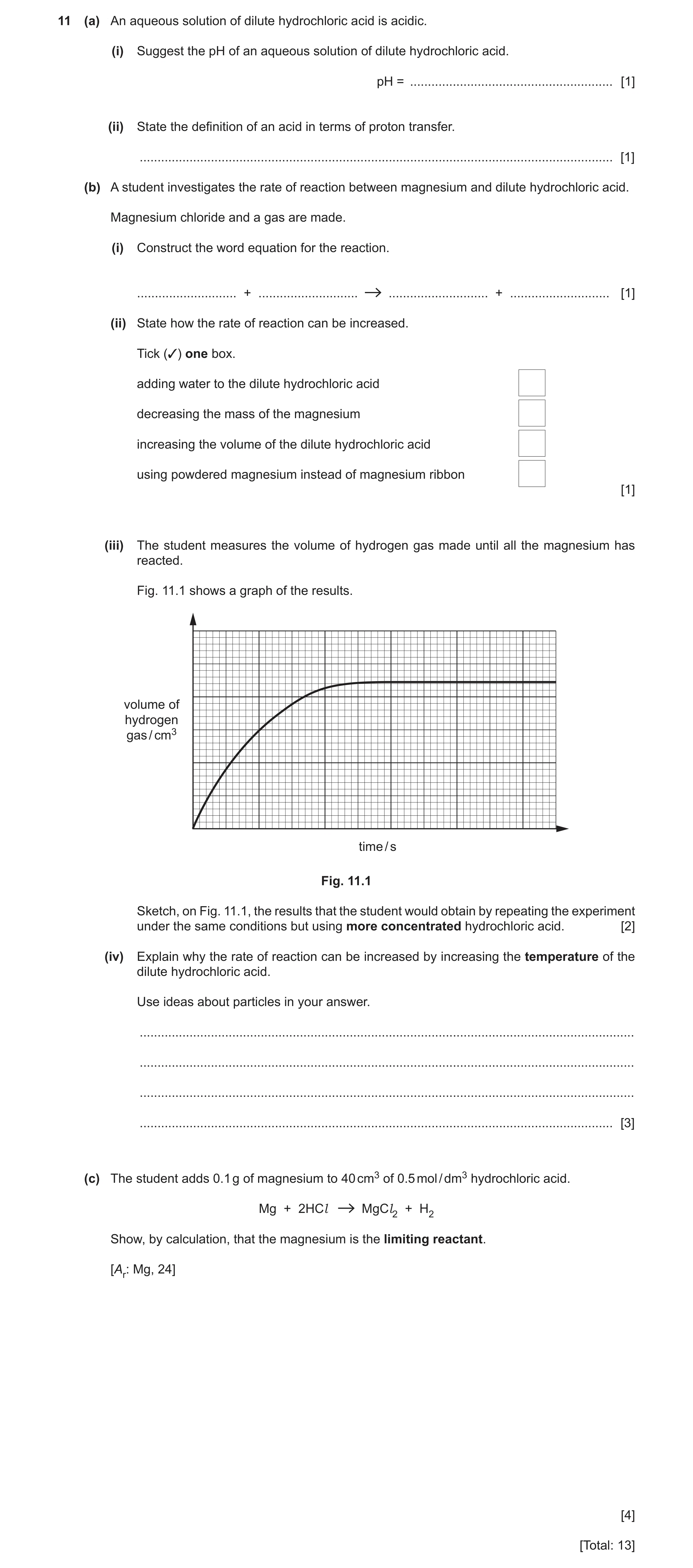
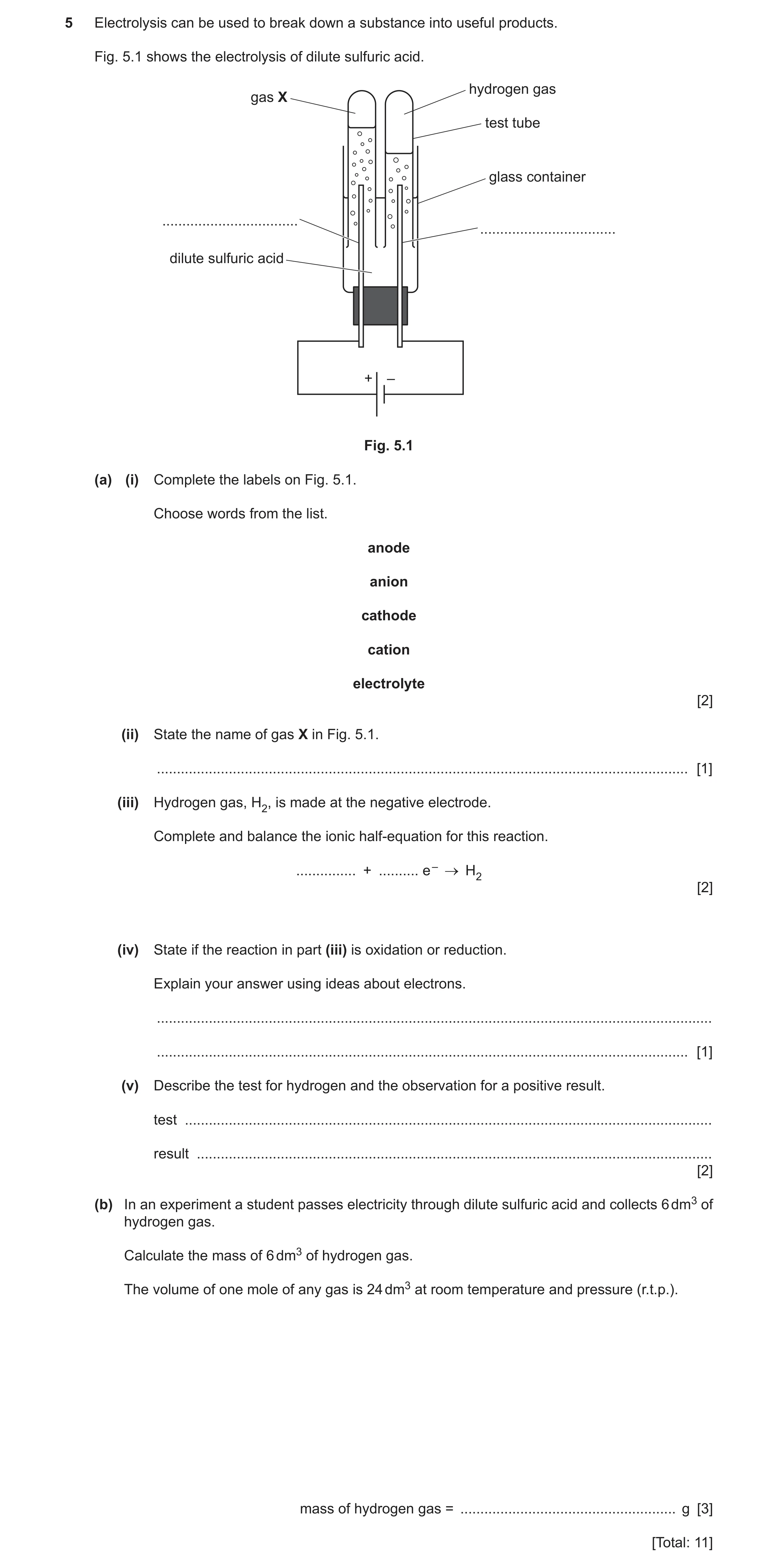
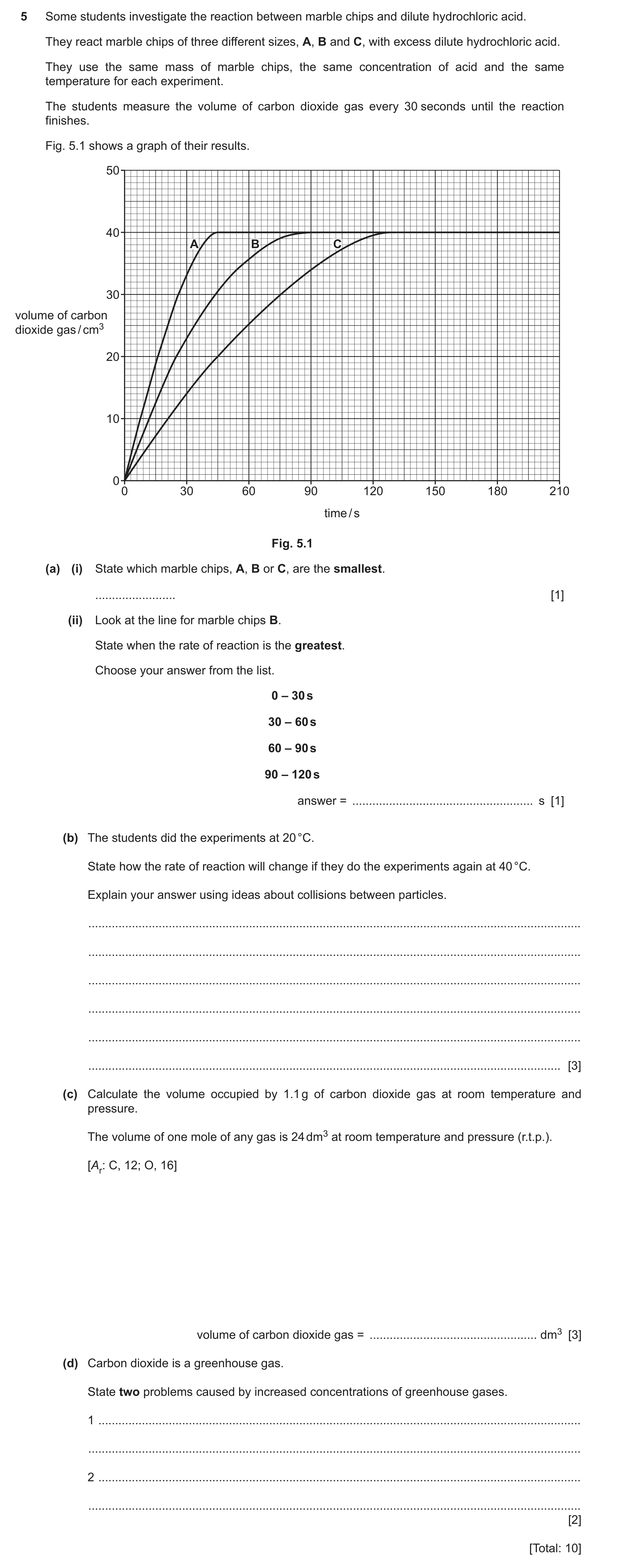
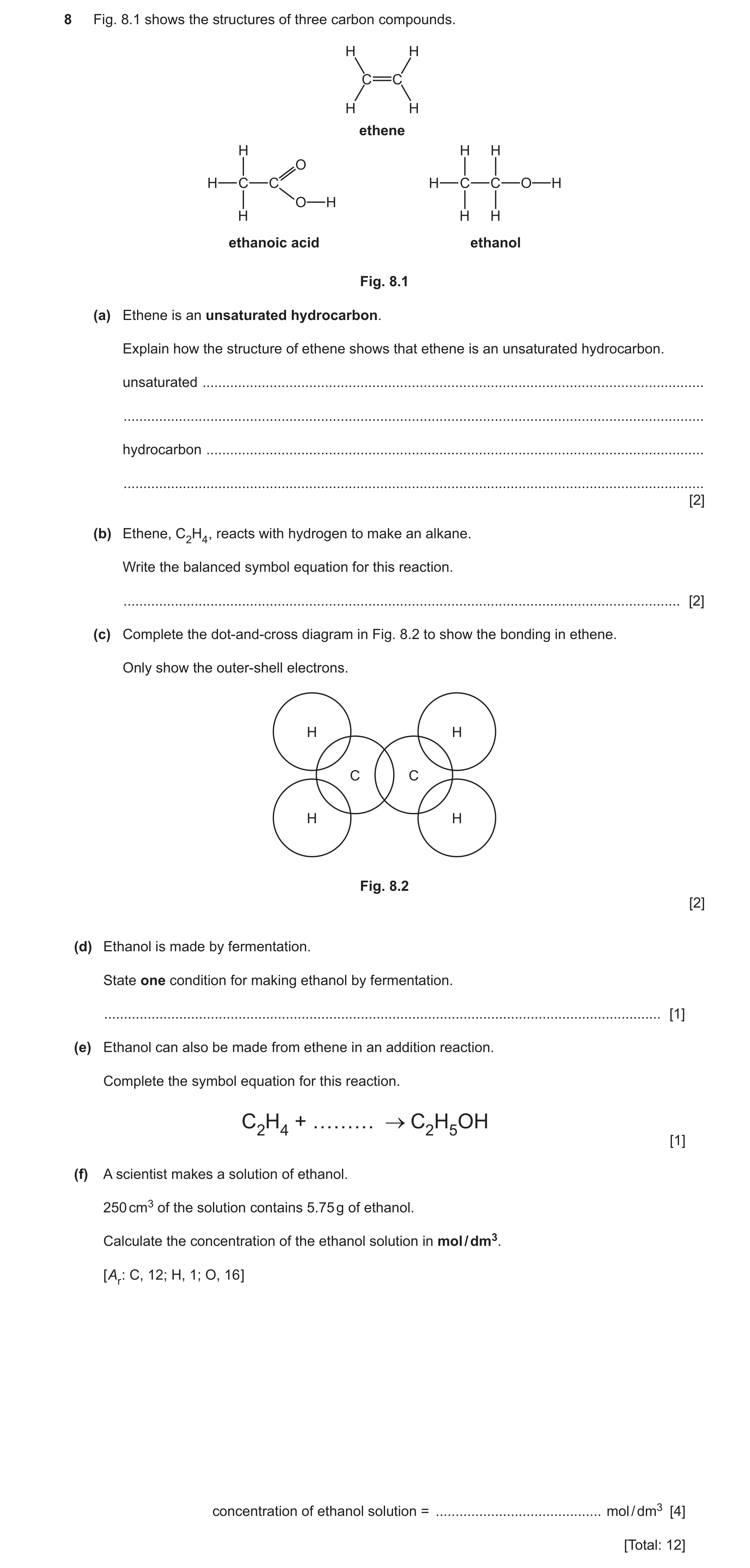
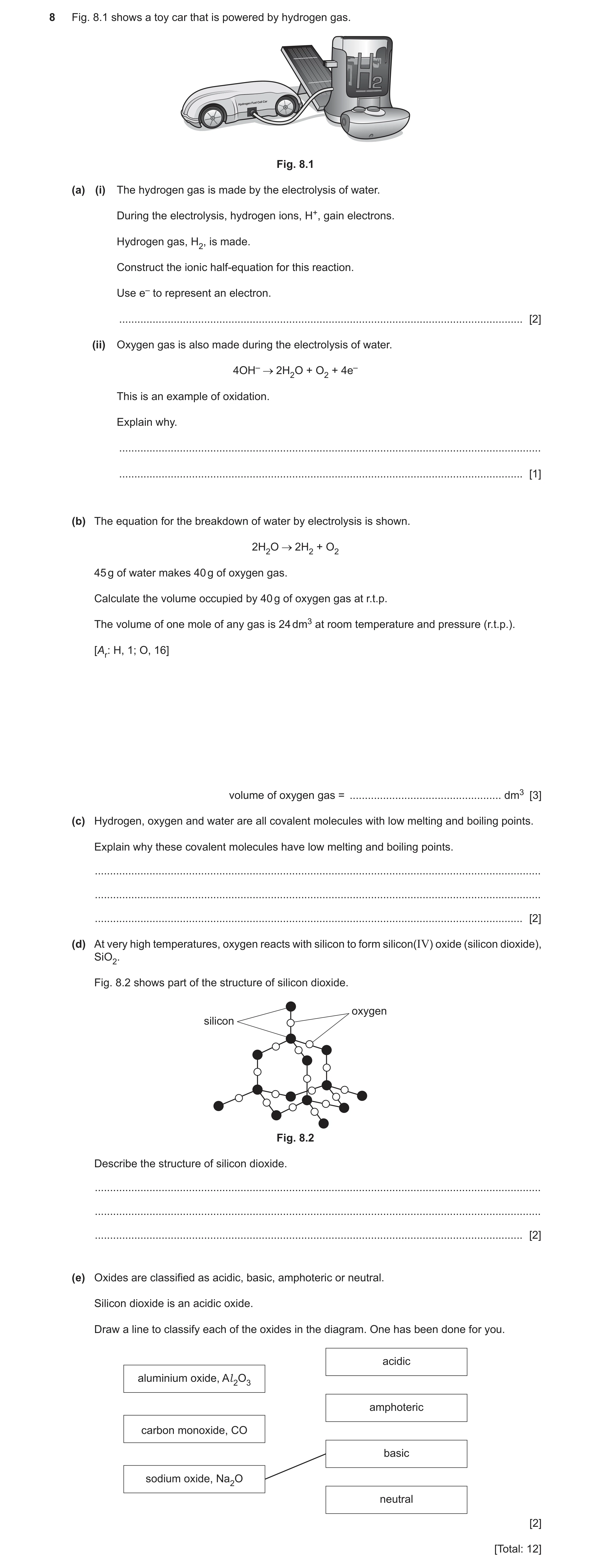
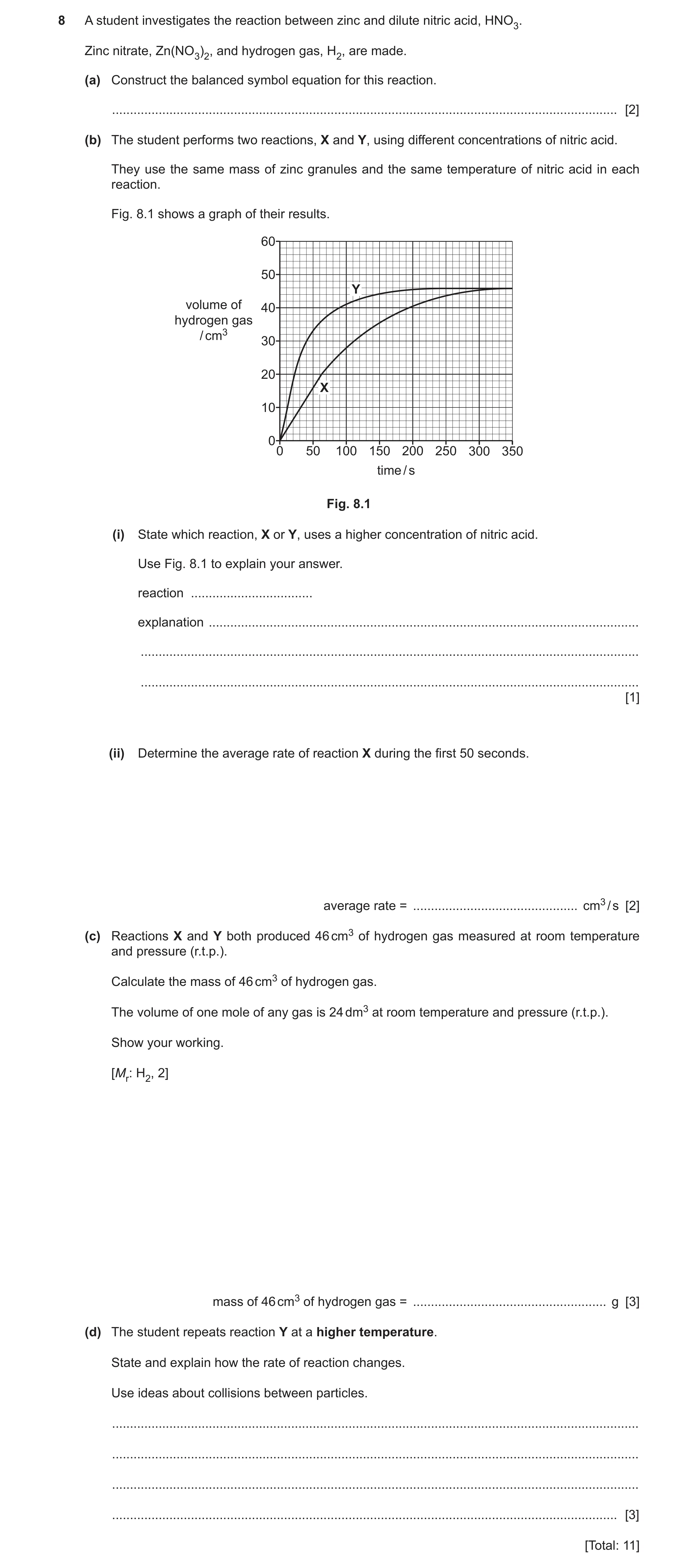
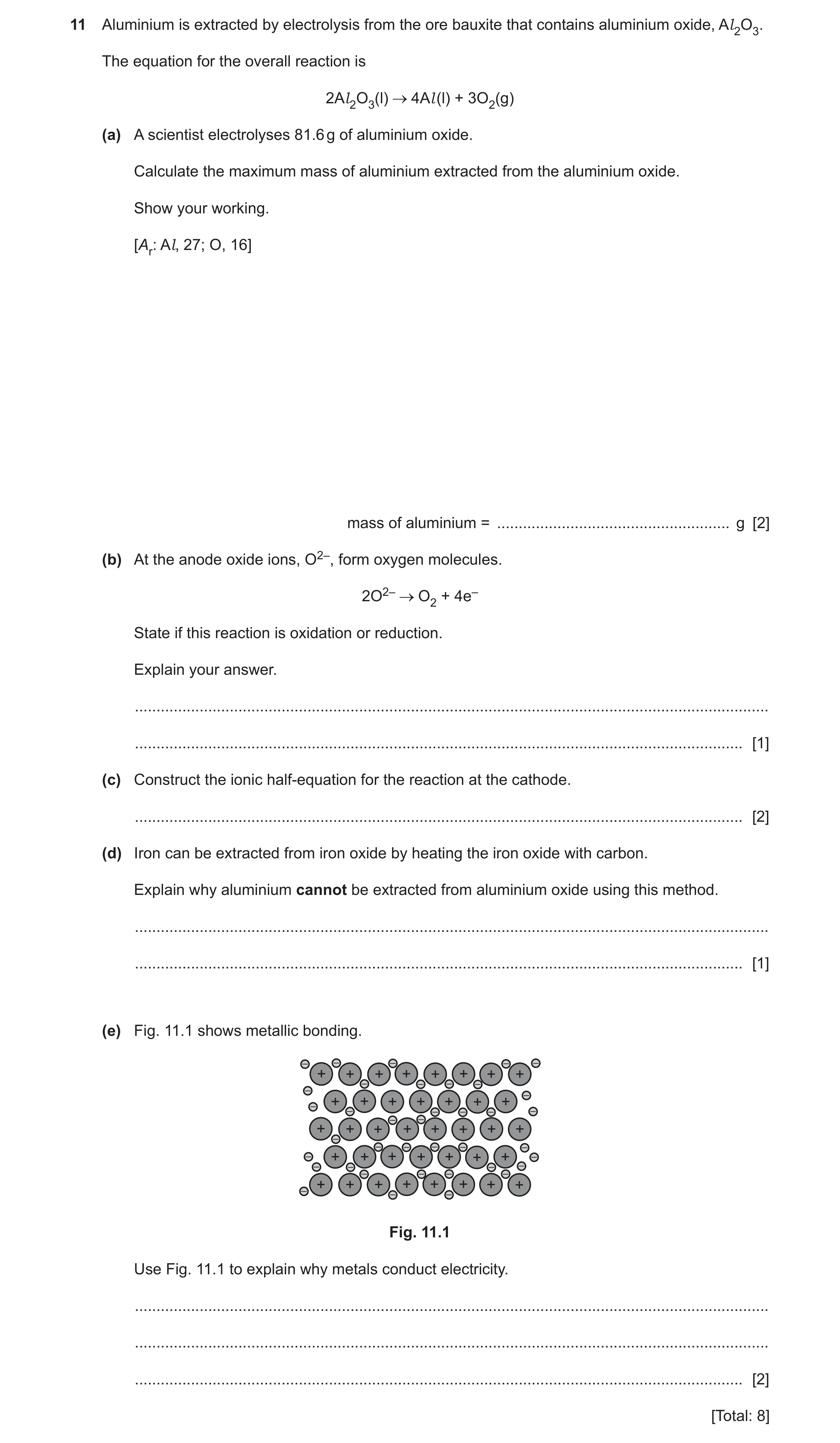
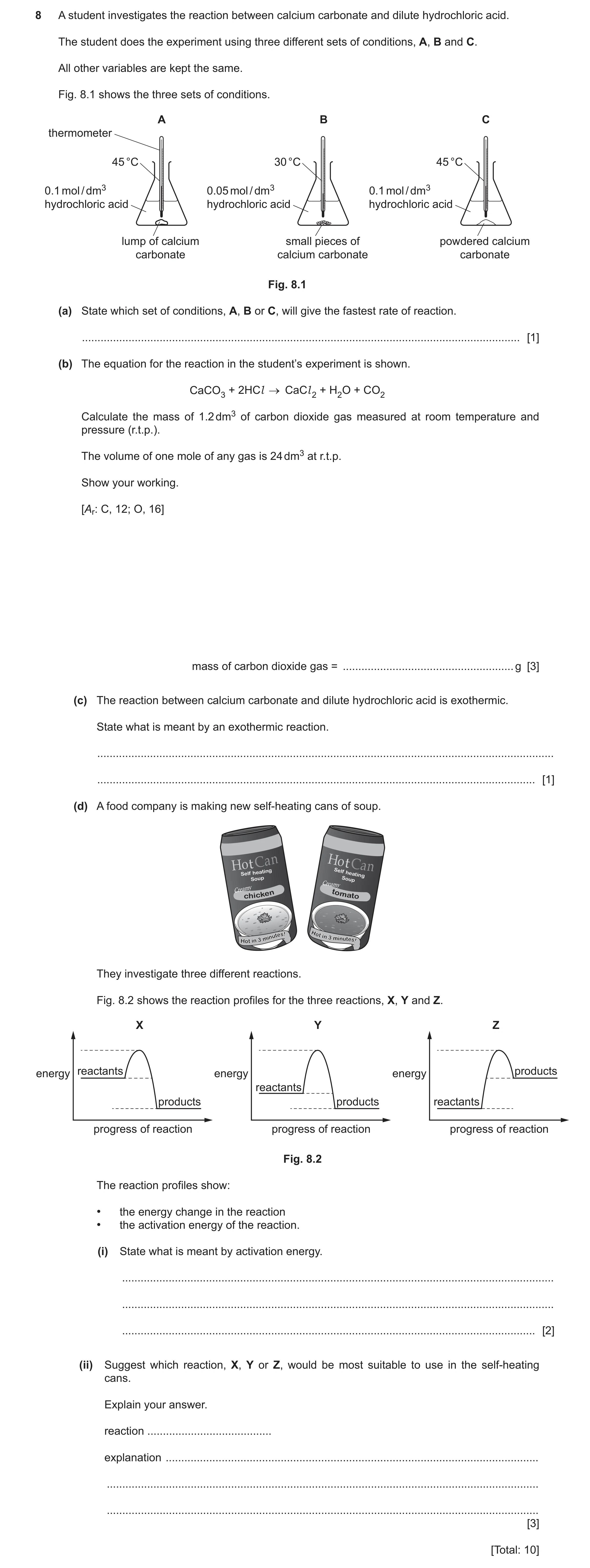
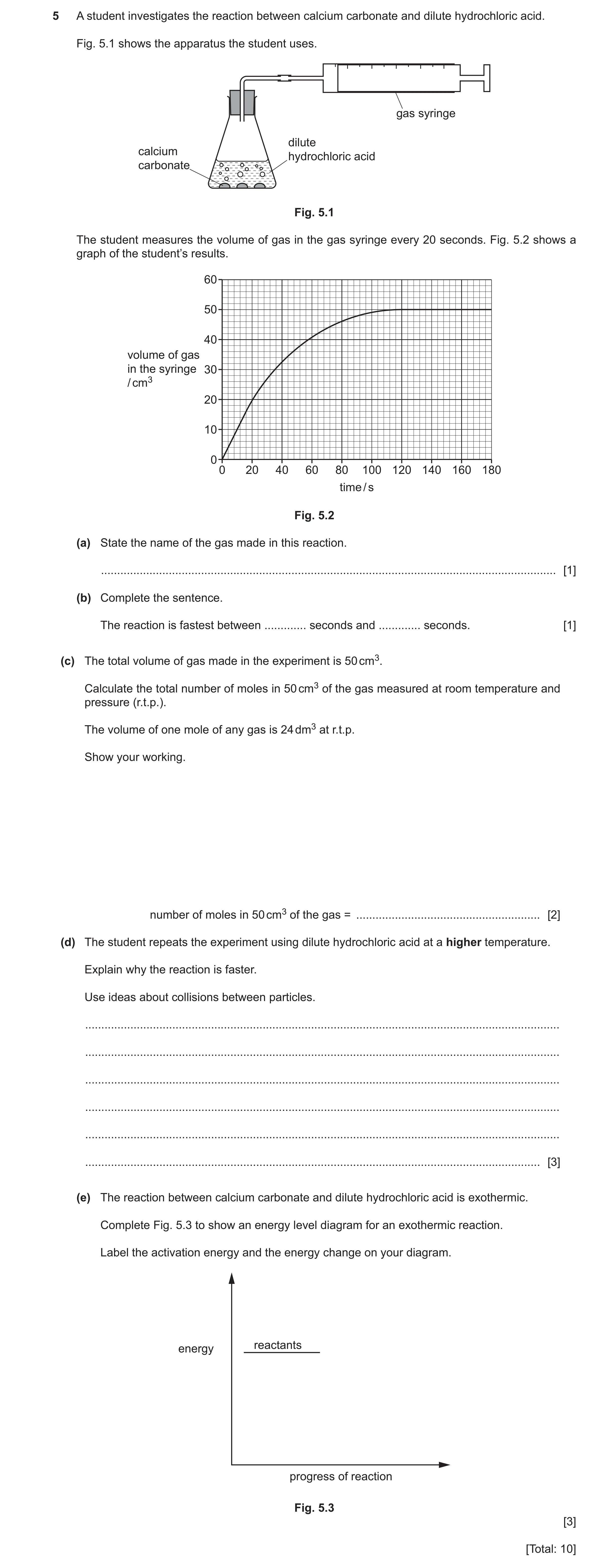
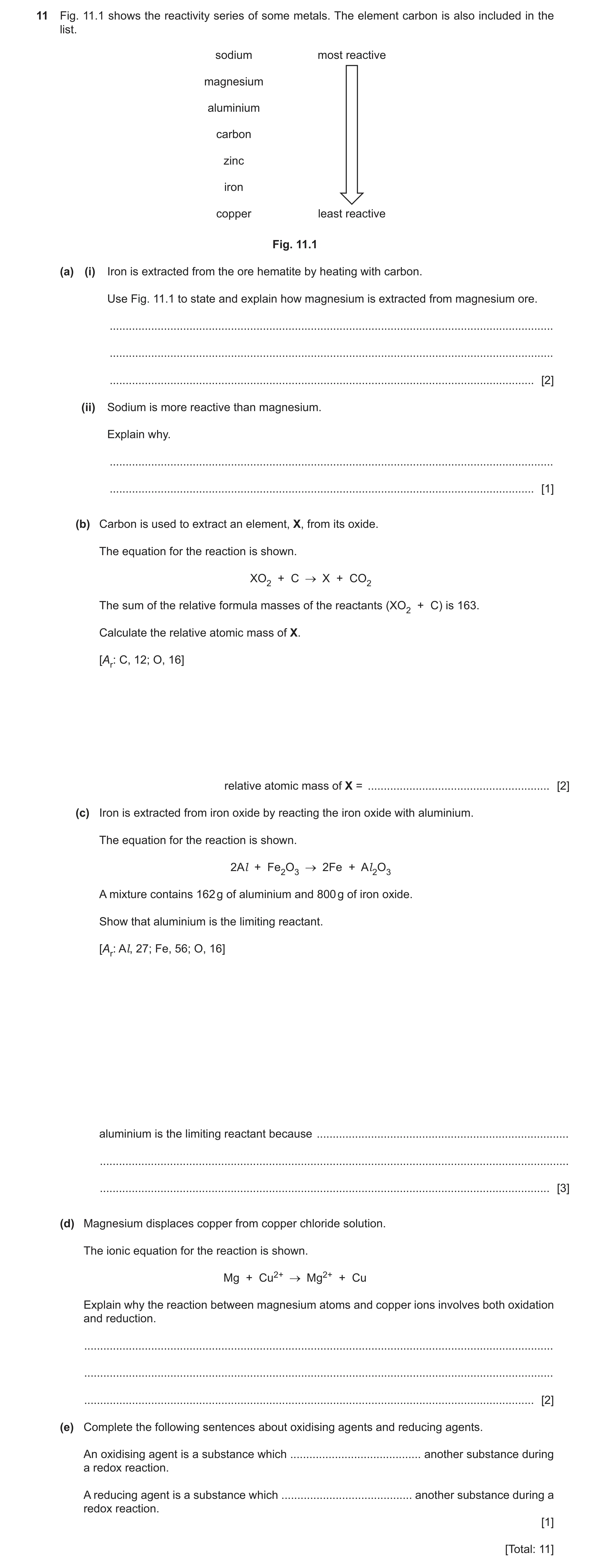
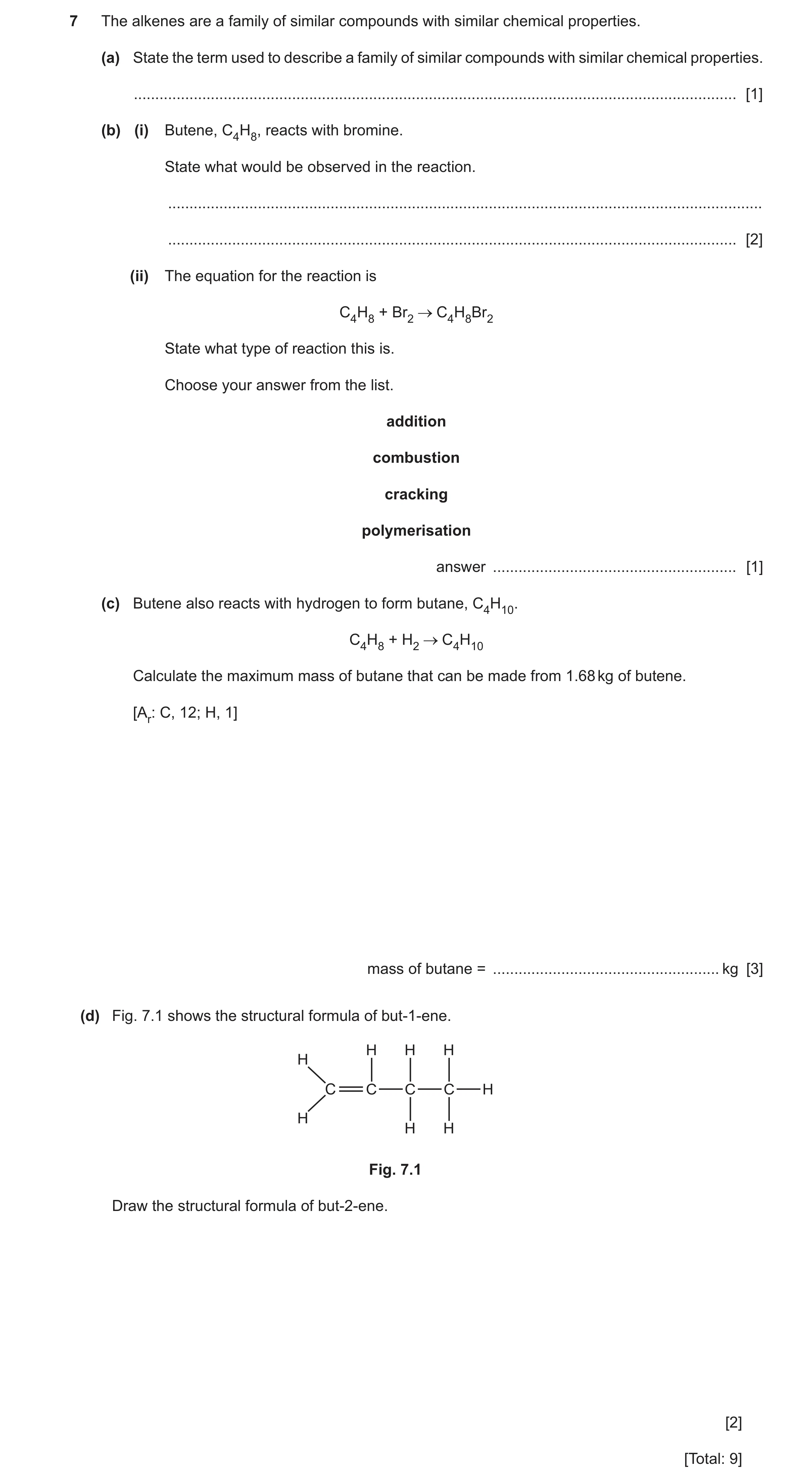
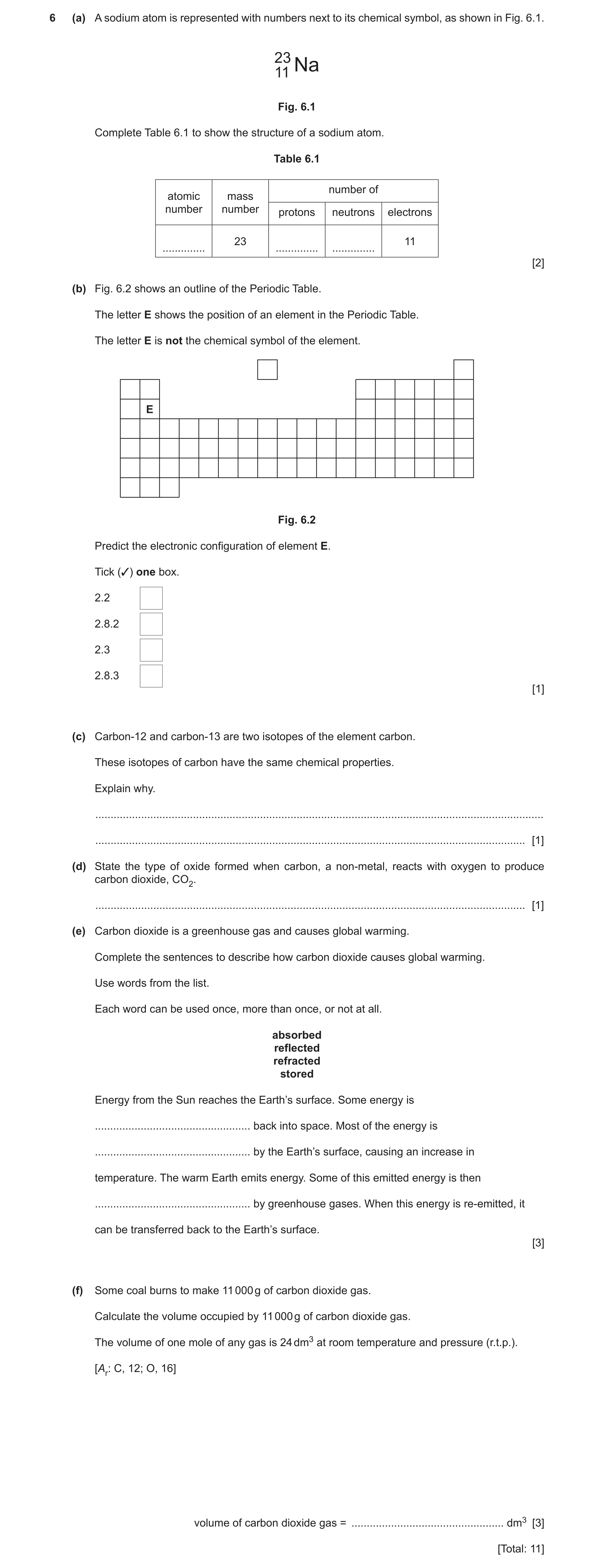
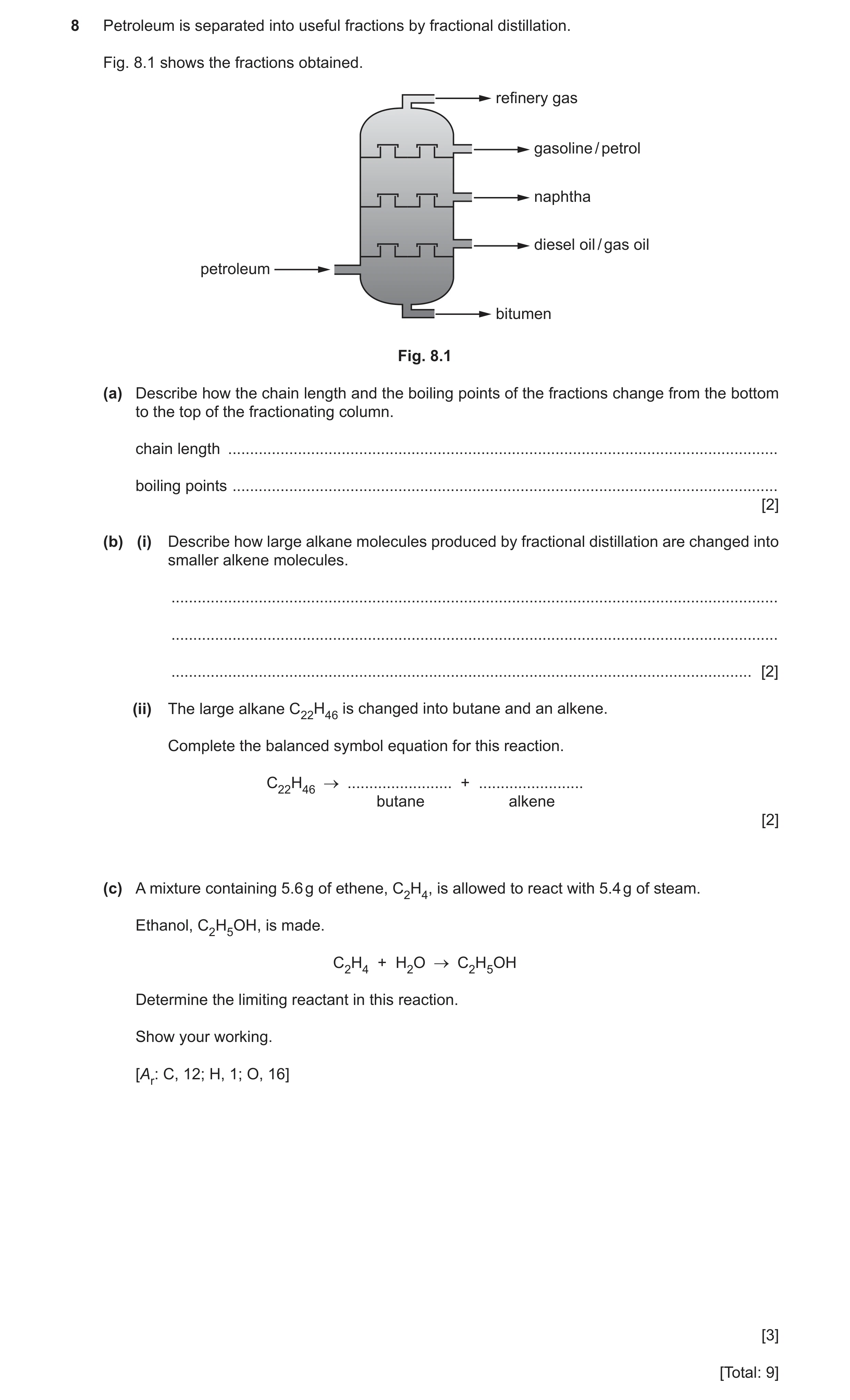
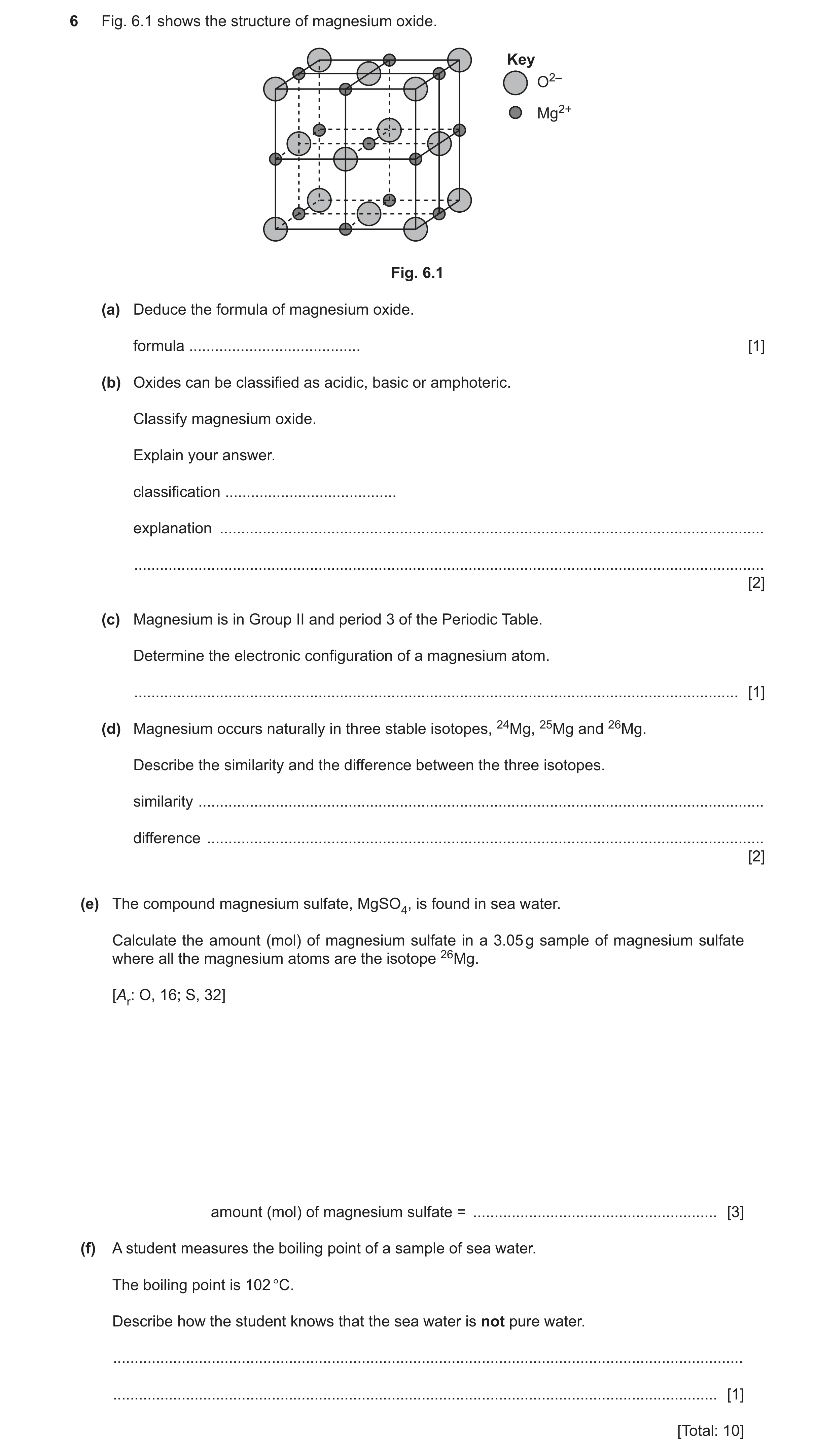
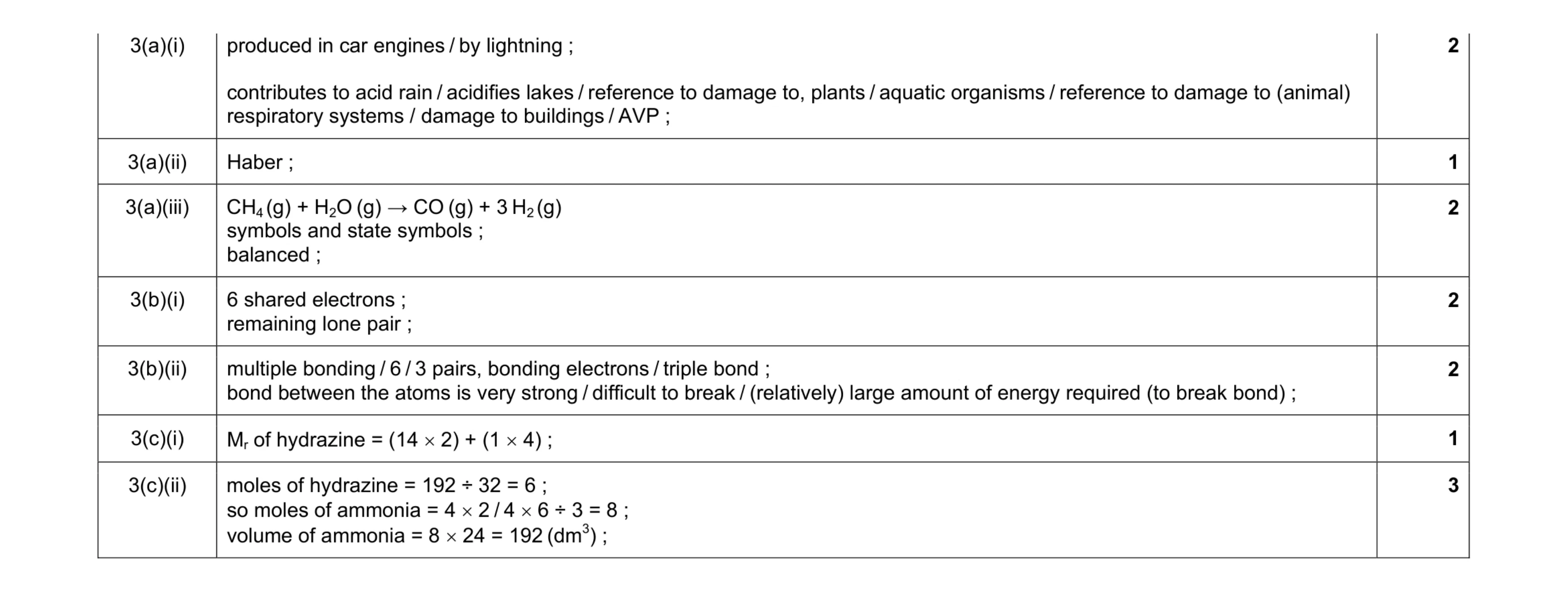 13
13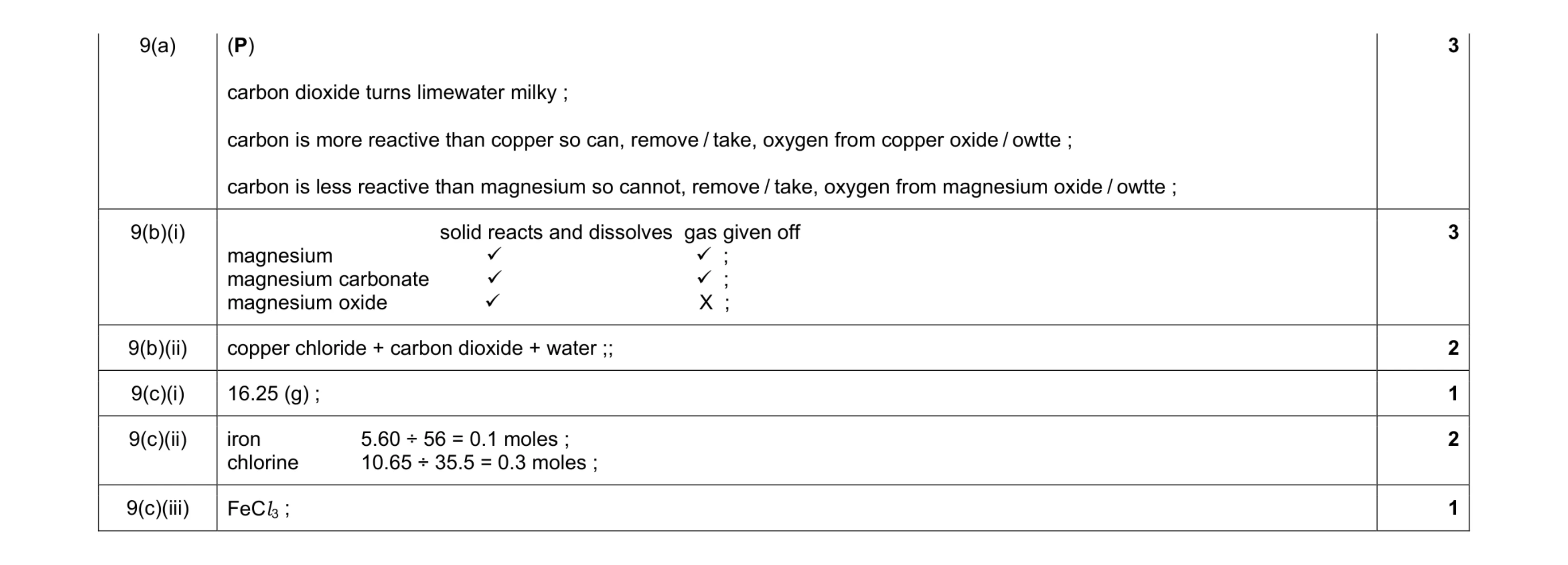 12
12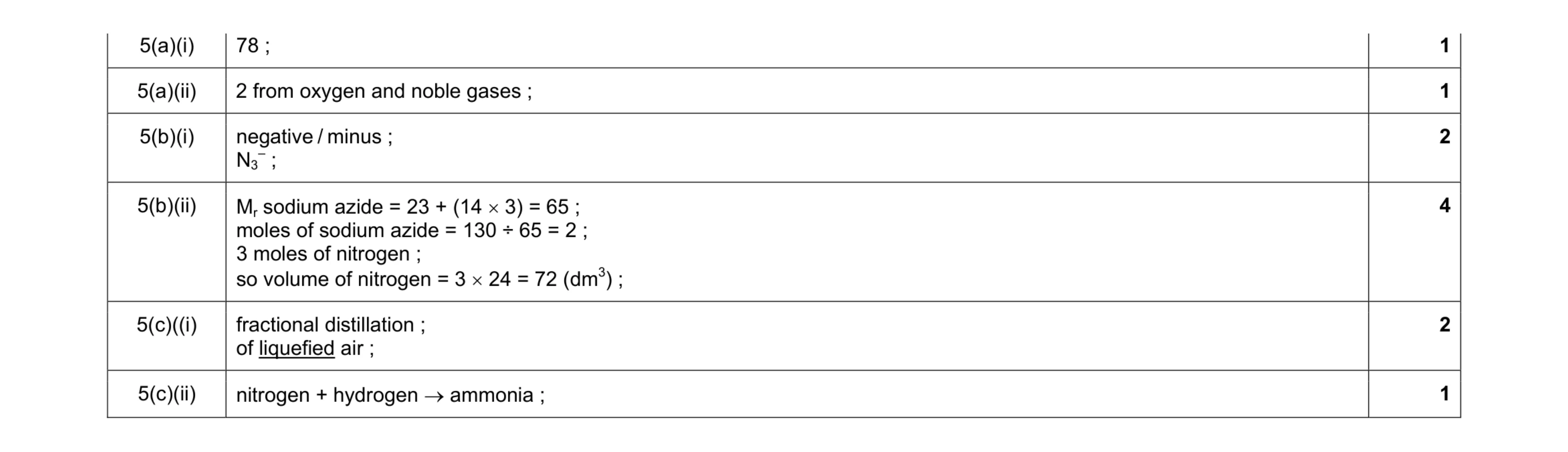 11
11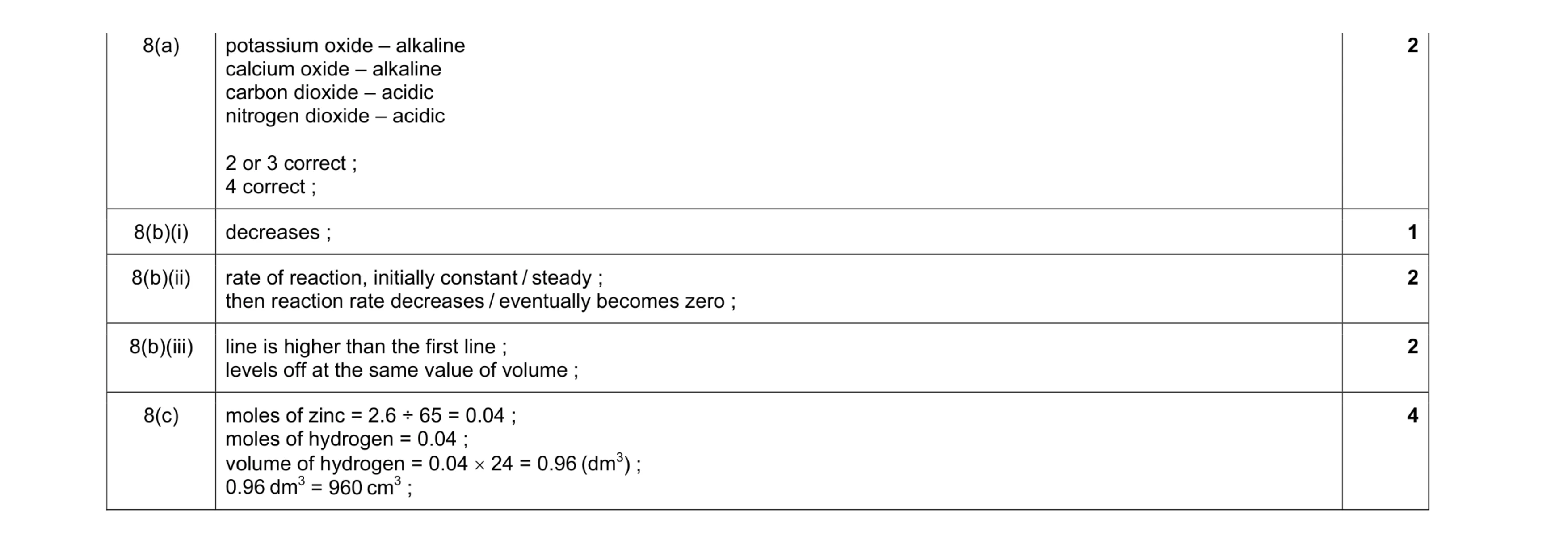 11
11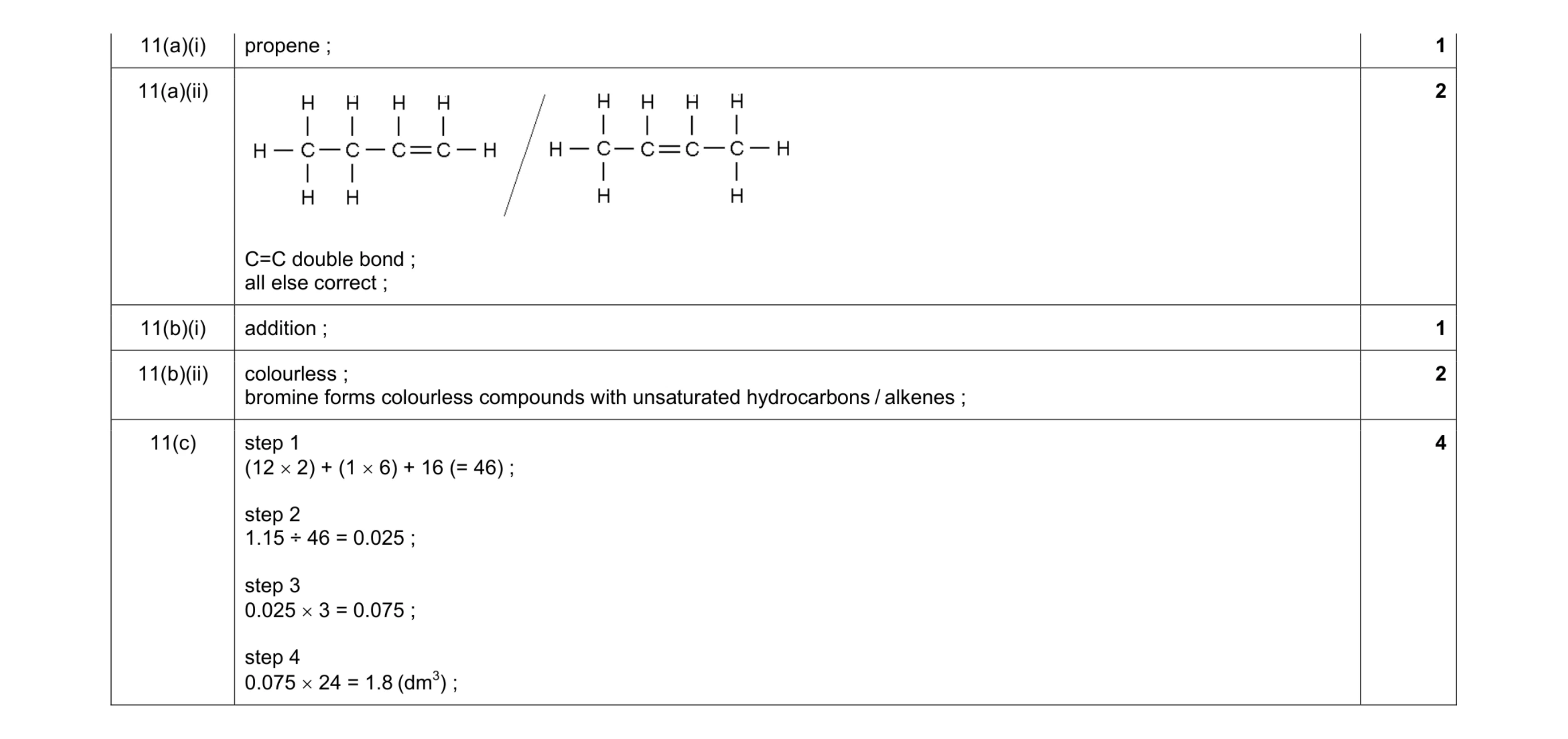 10
10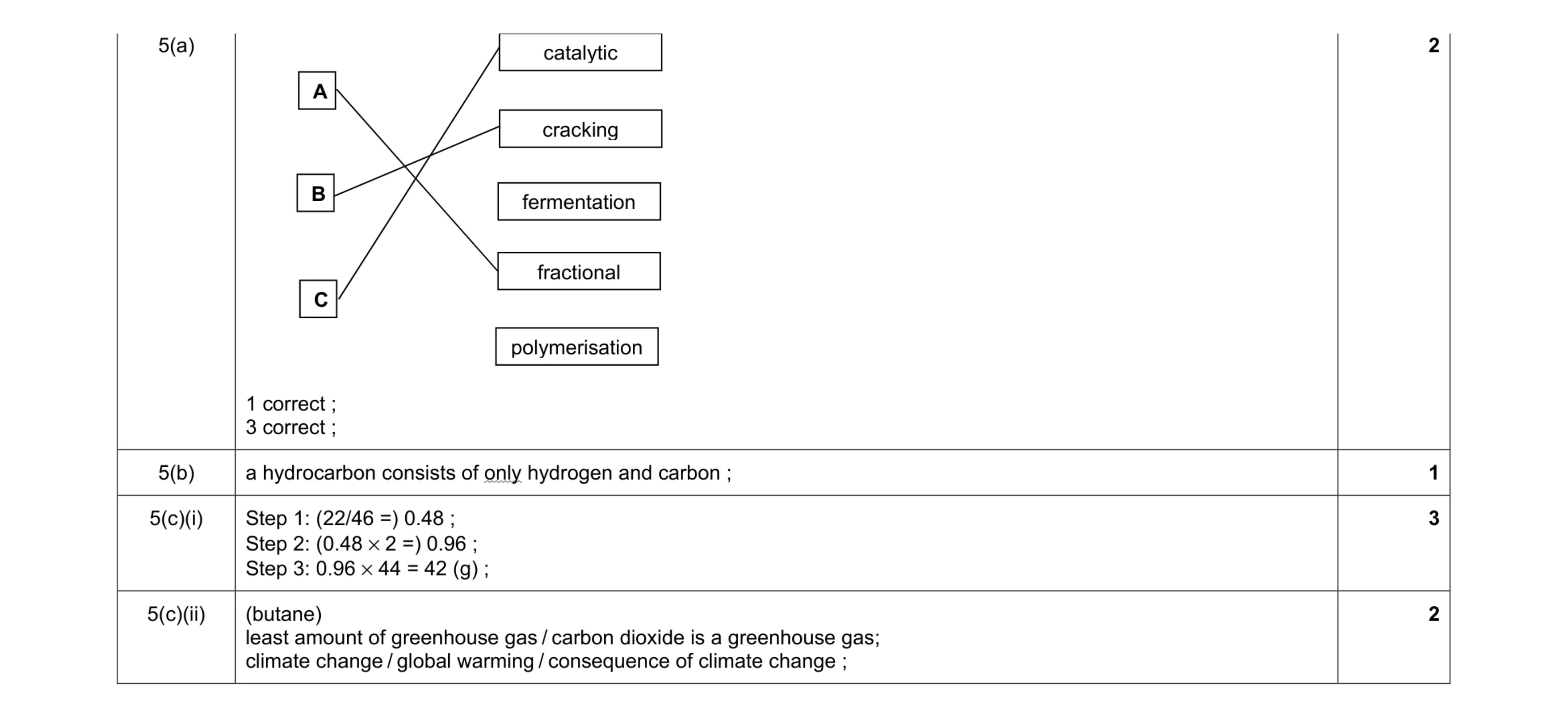 8
8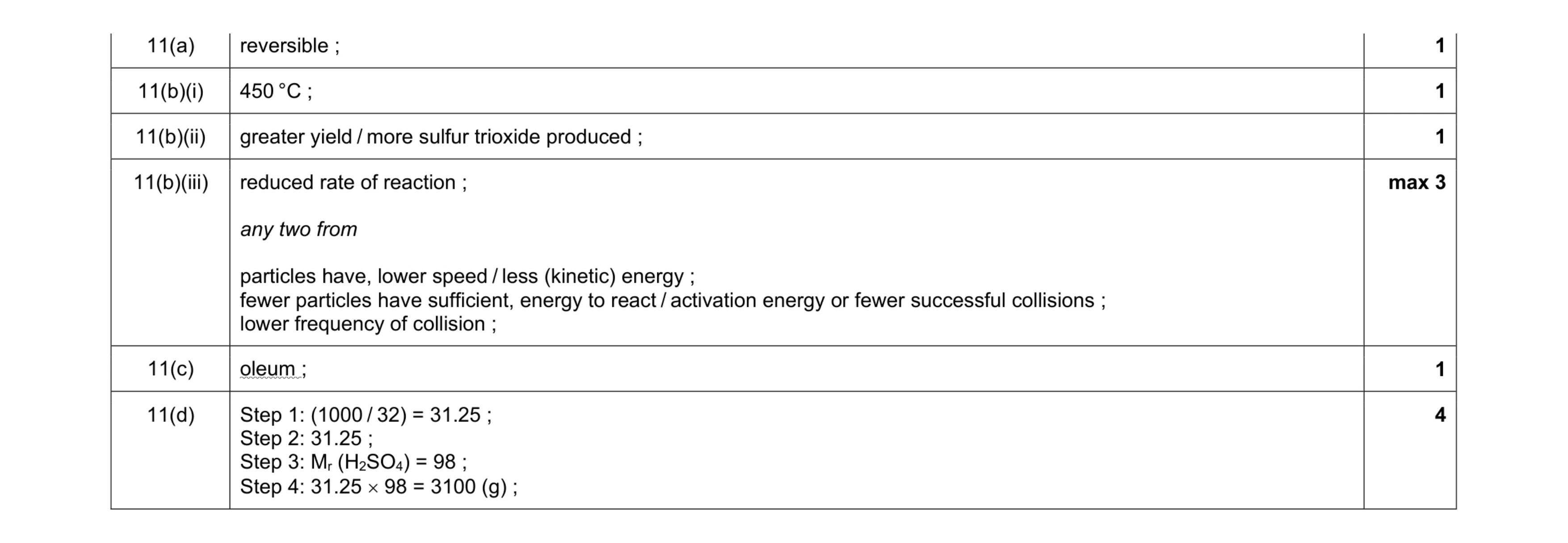 11
11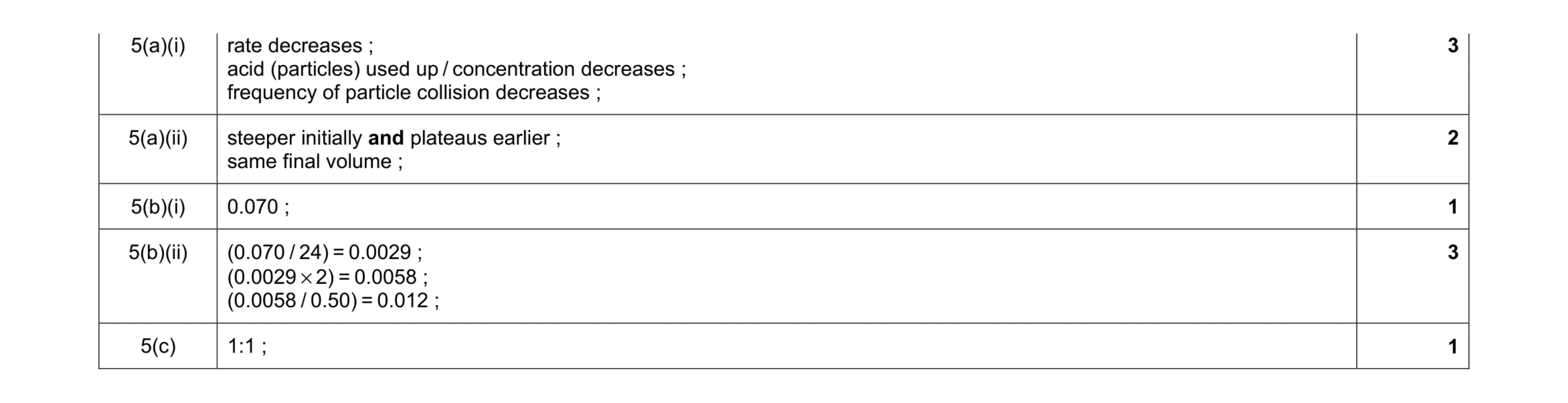 10
10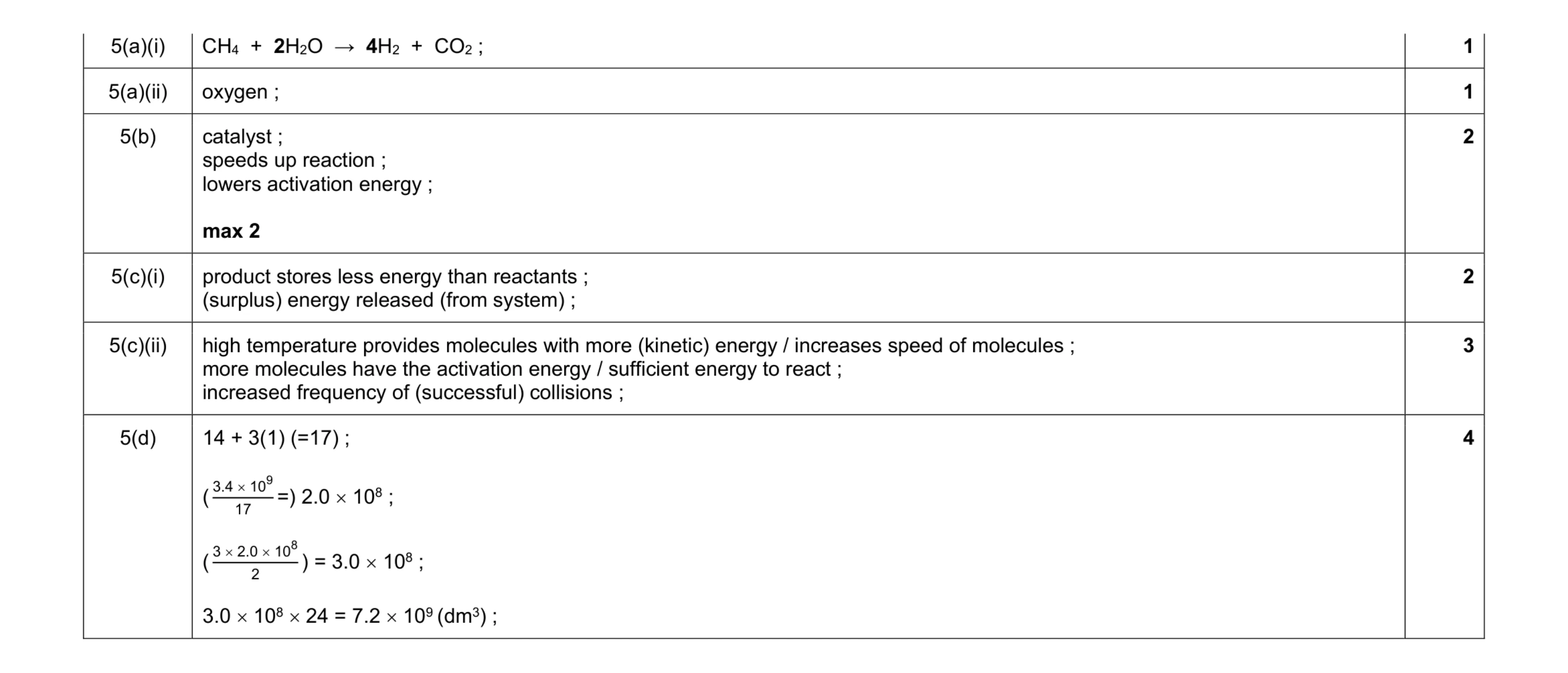 13
13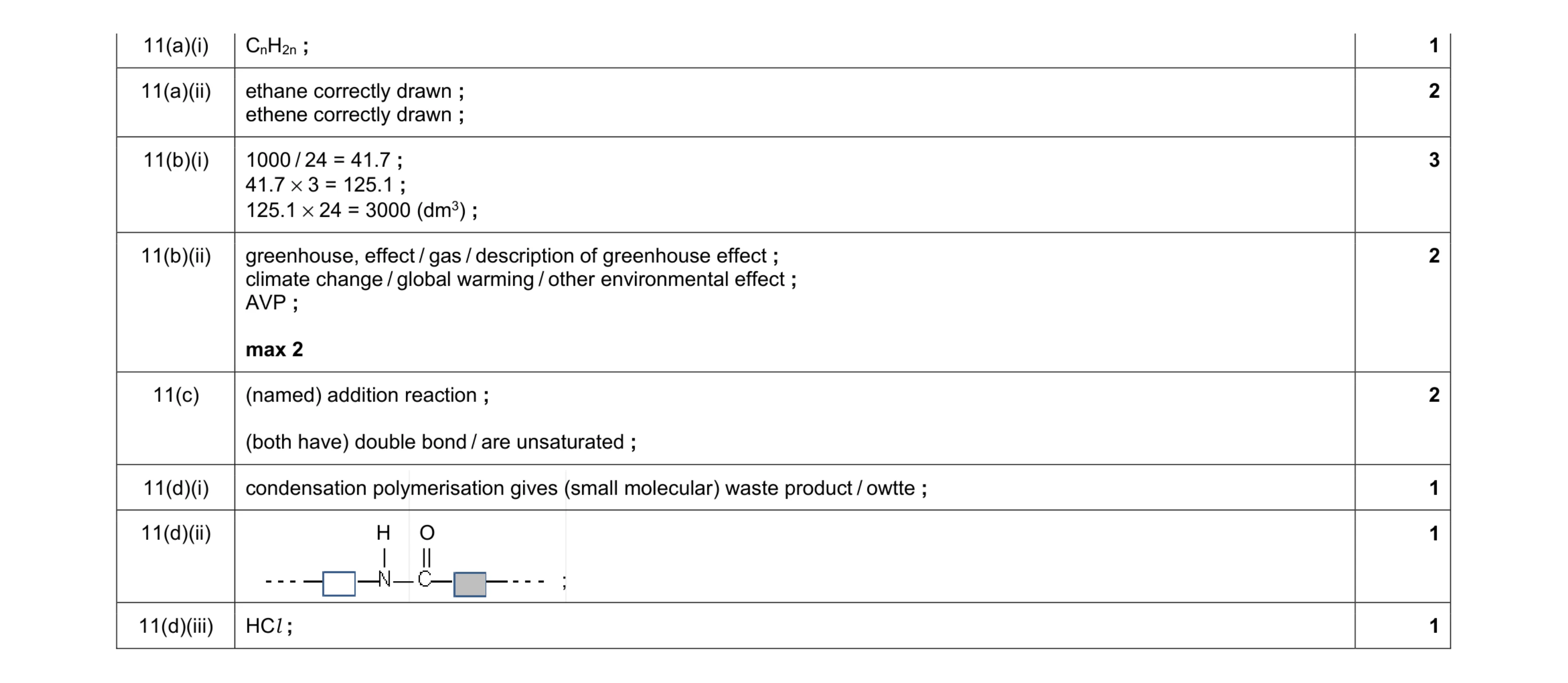 13
13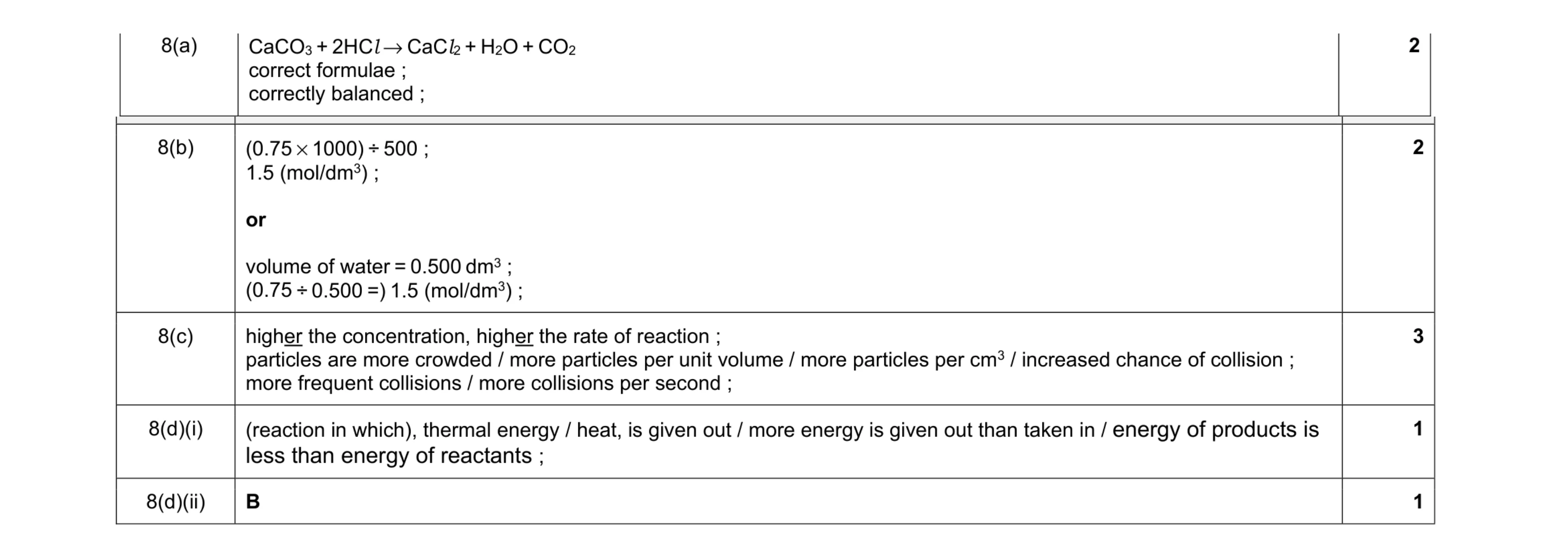 9
9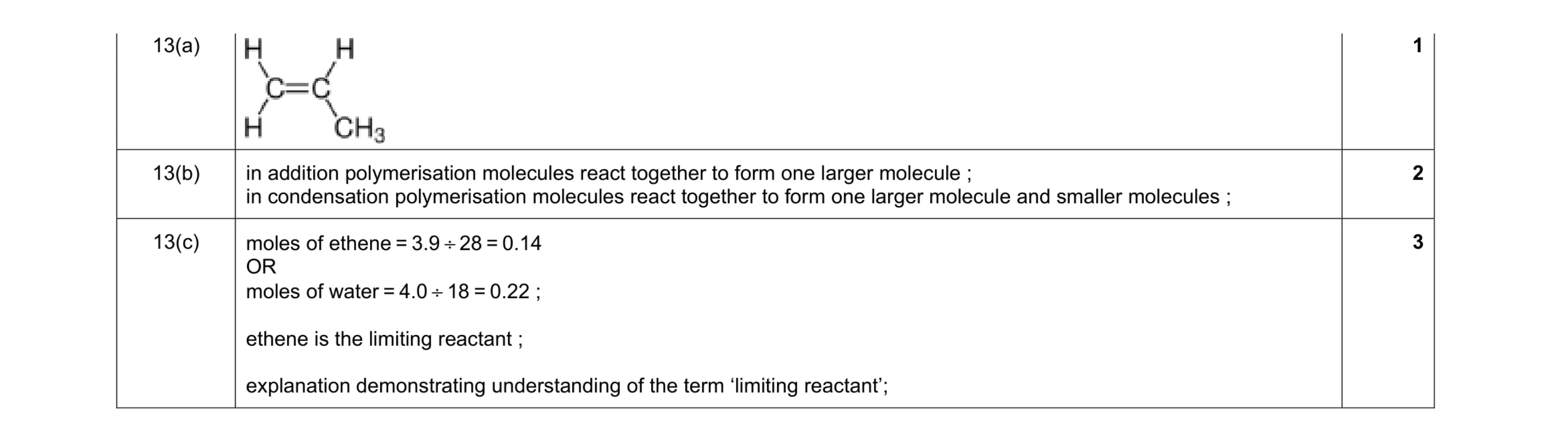 6
6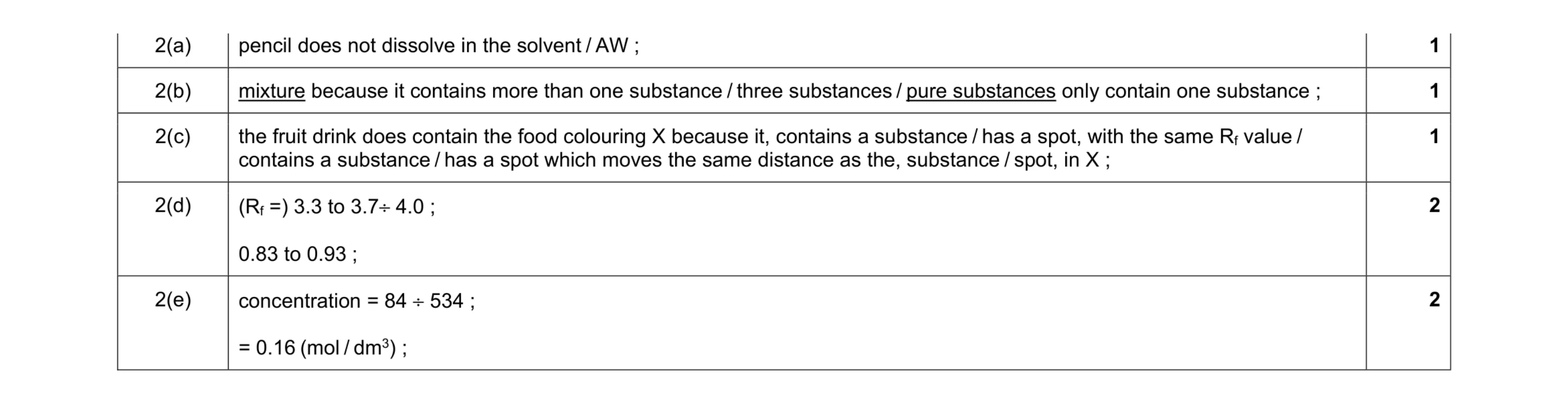 7
7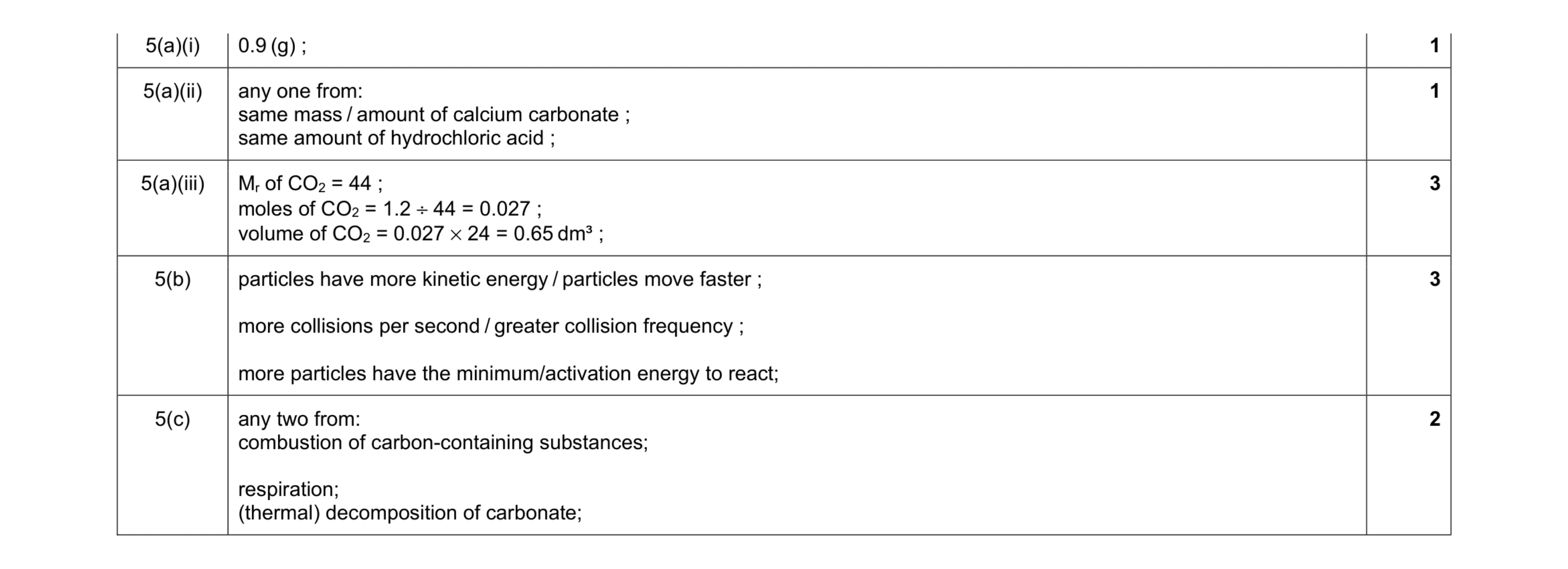 10
10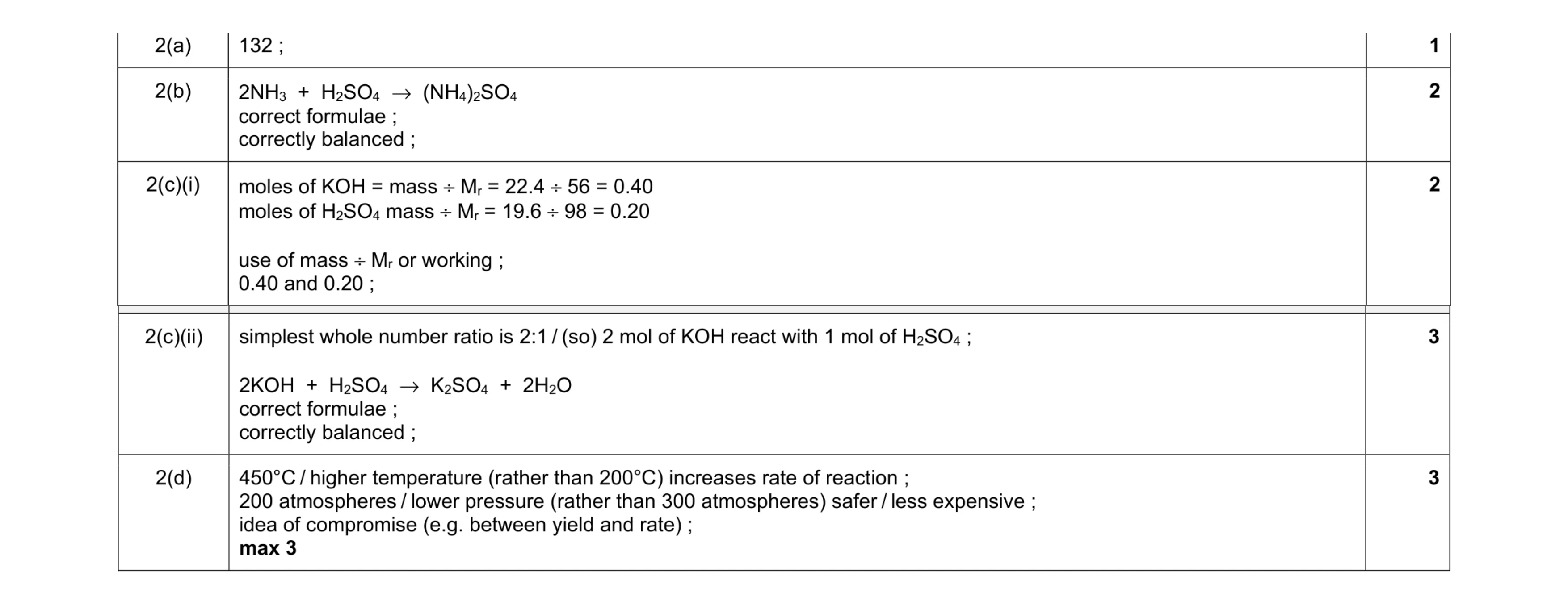 11
11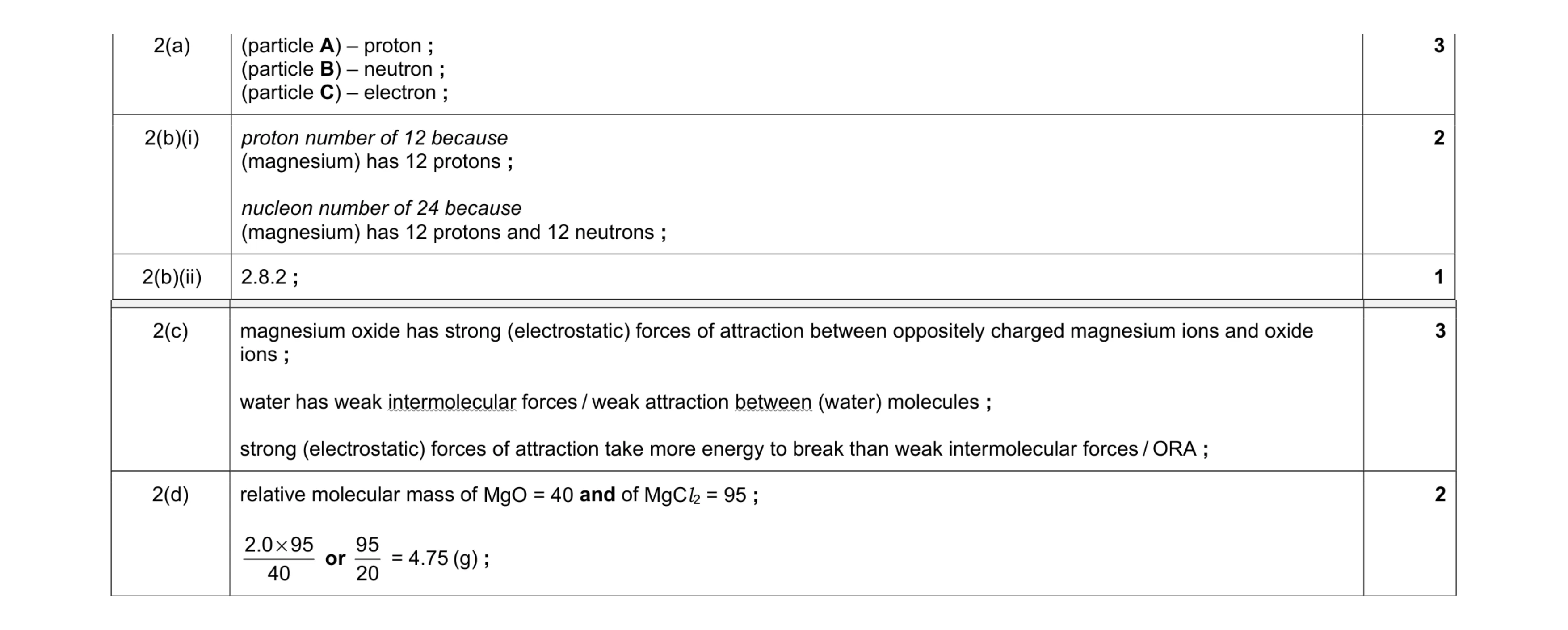 11
11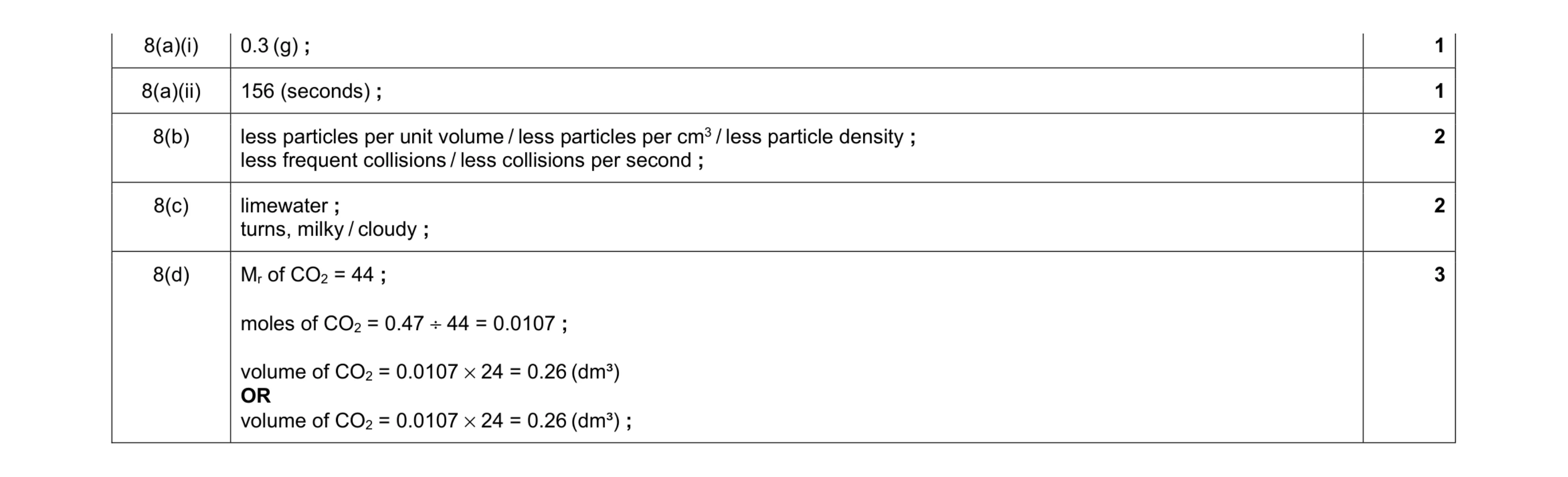 9
9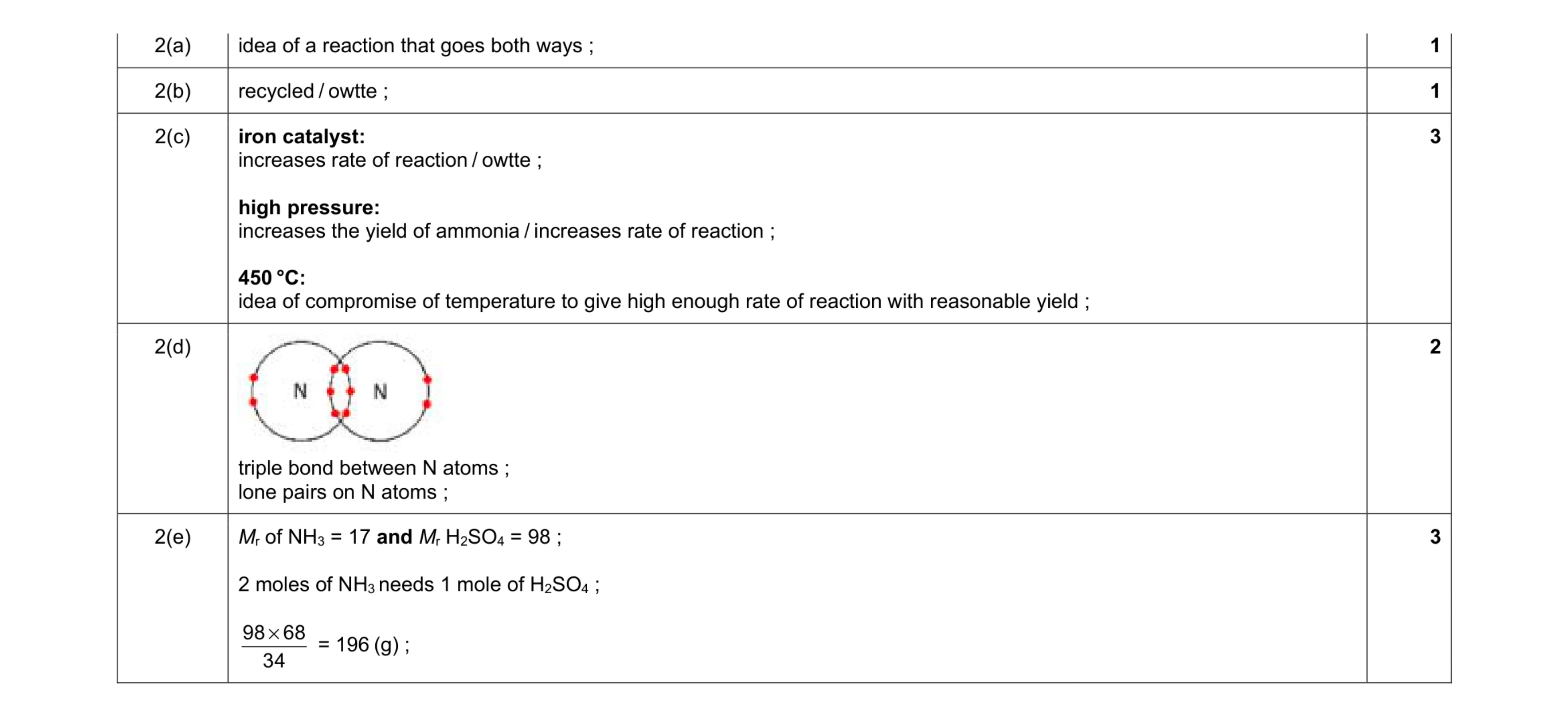 10
10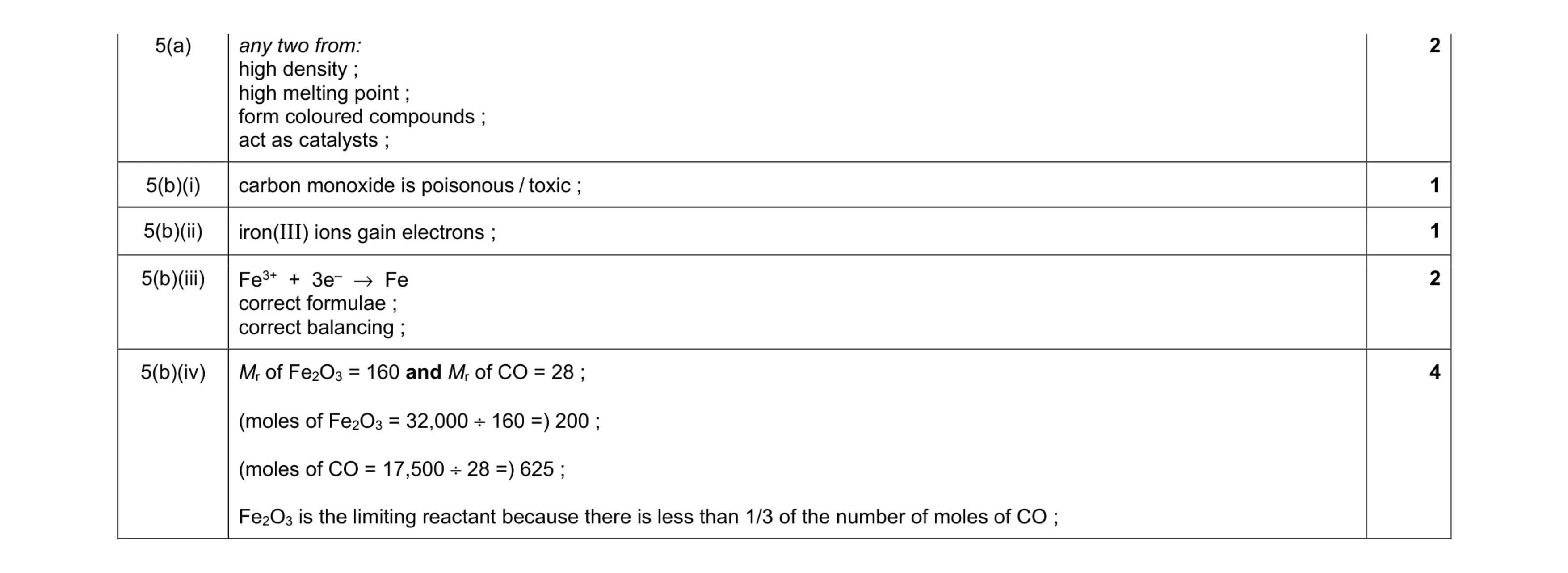 10
10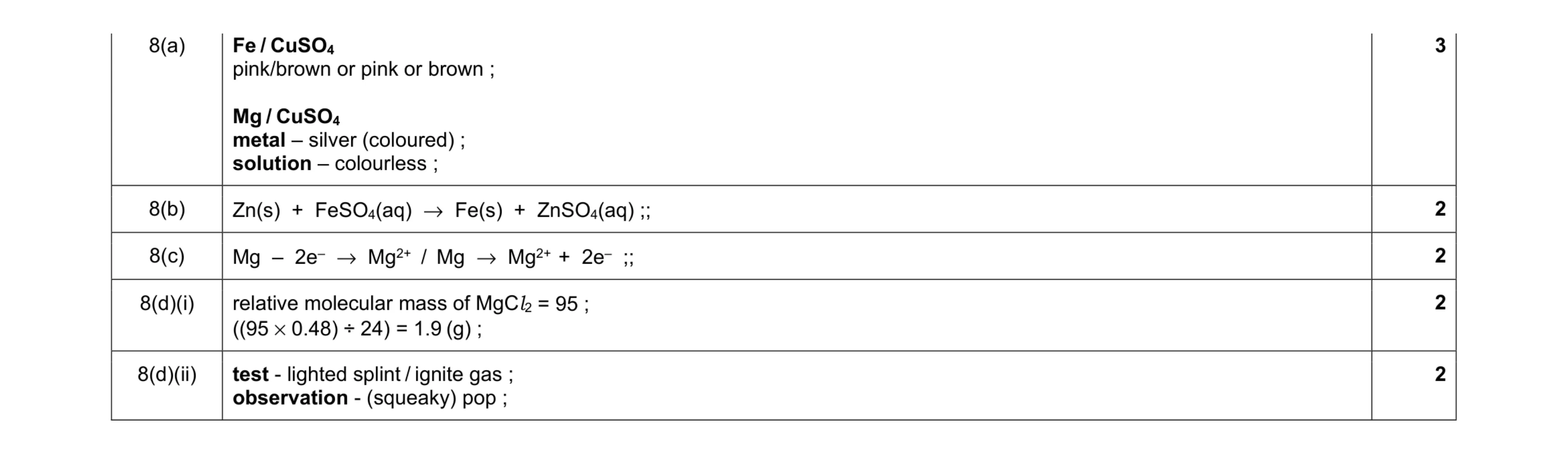 11
11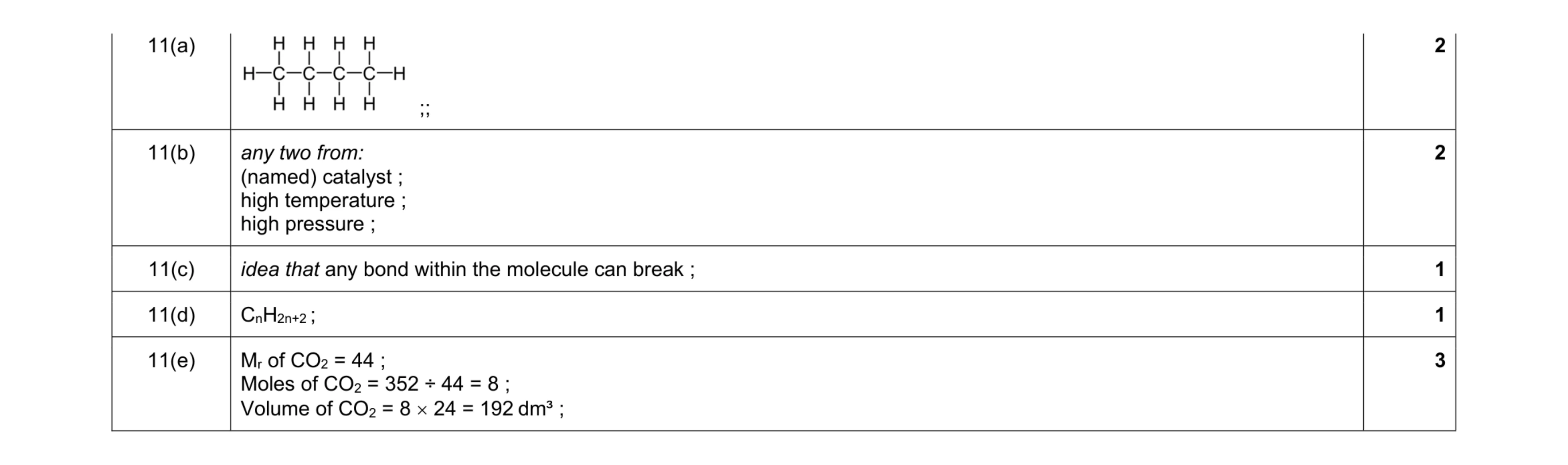 9
9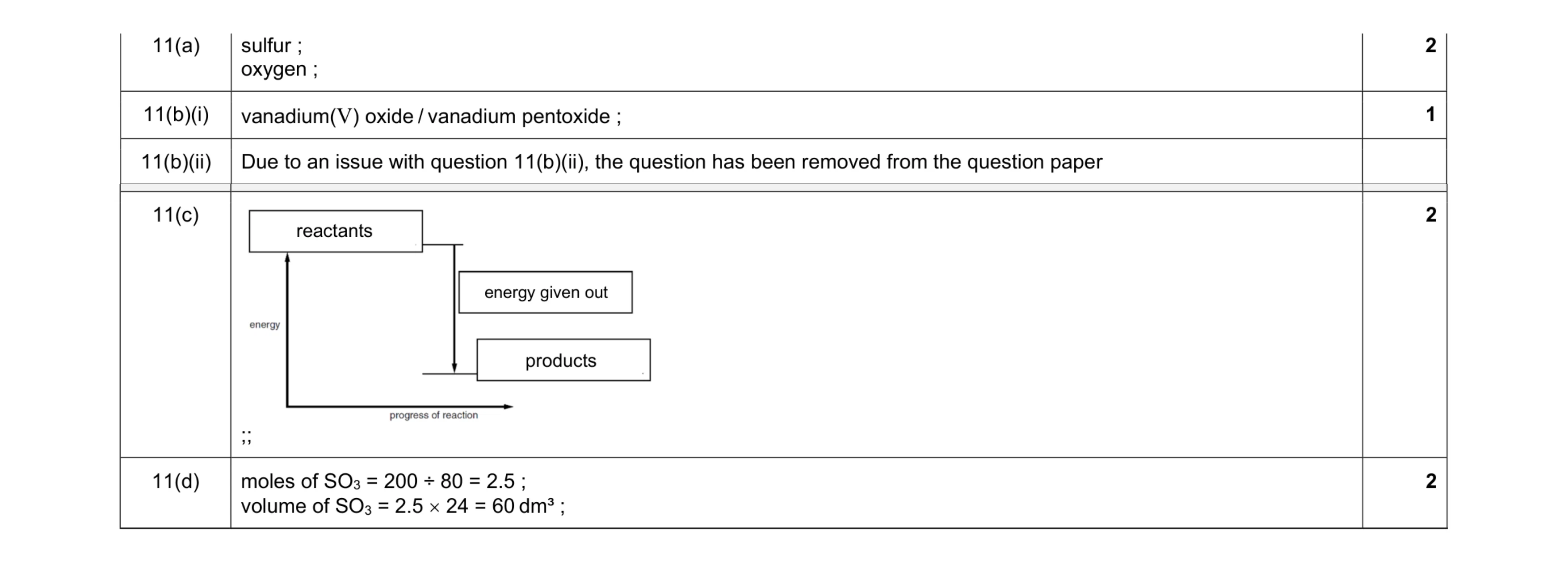 11
11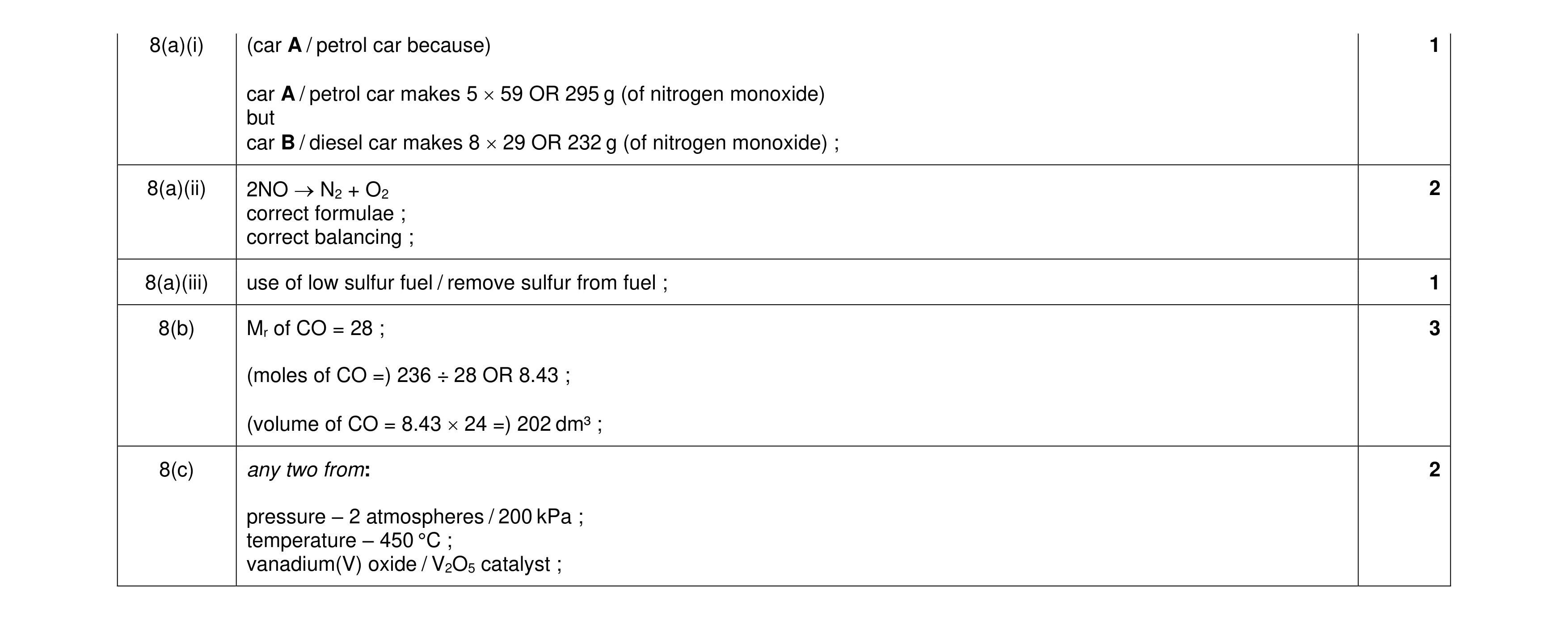 9
9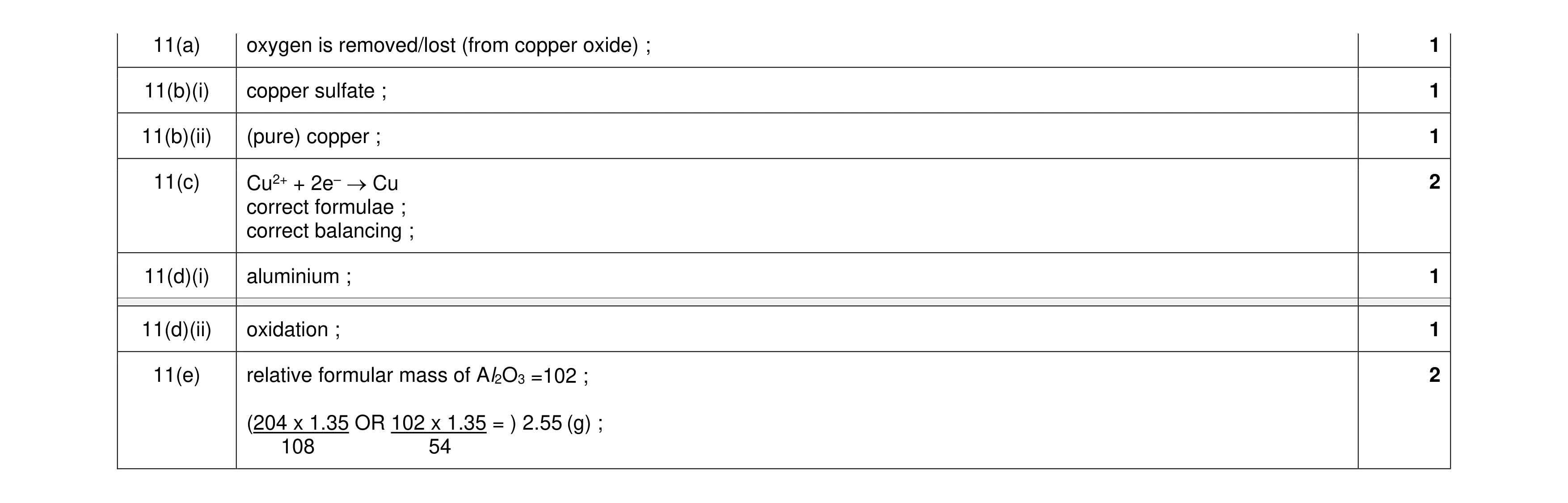 9
9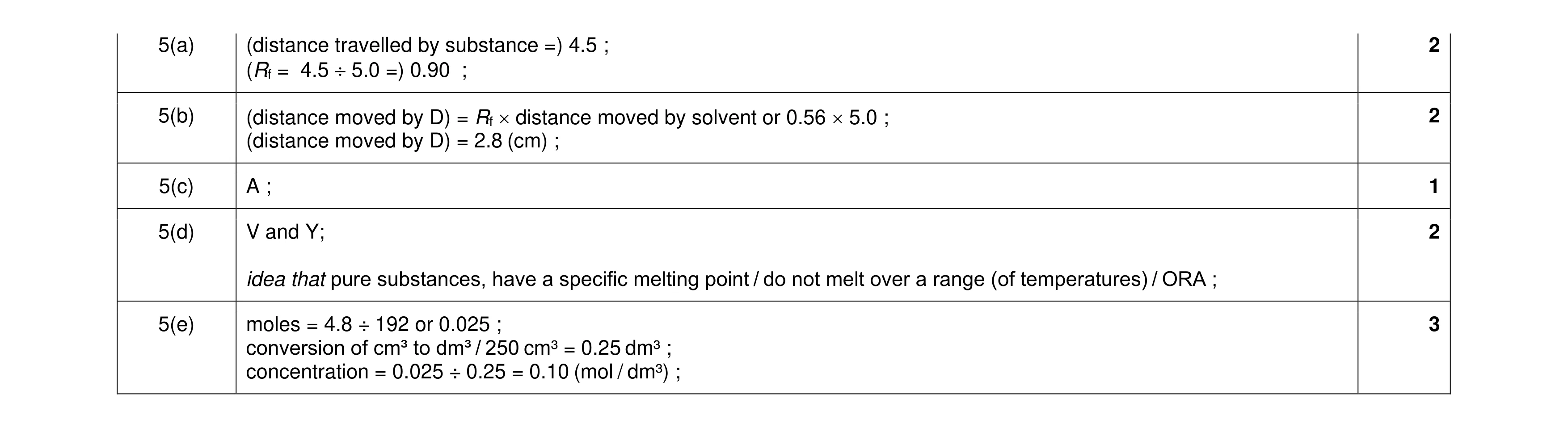 10
10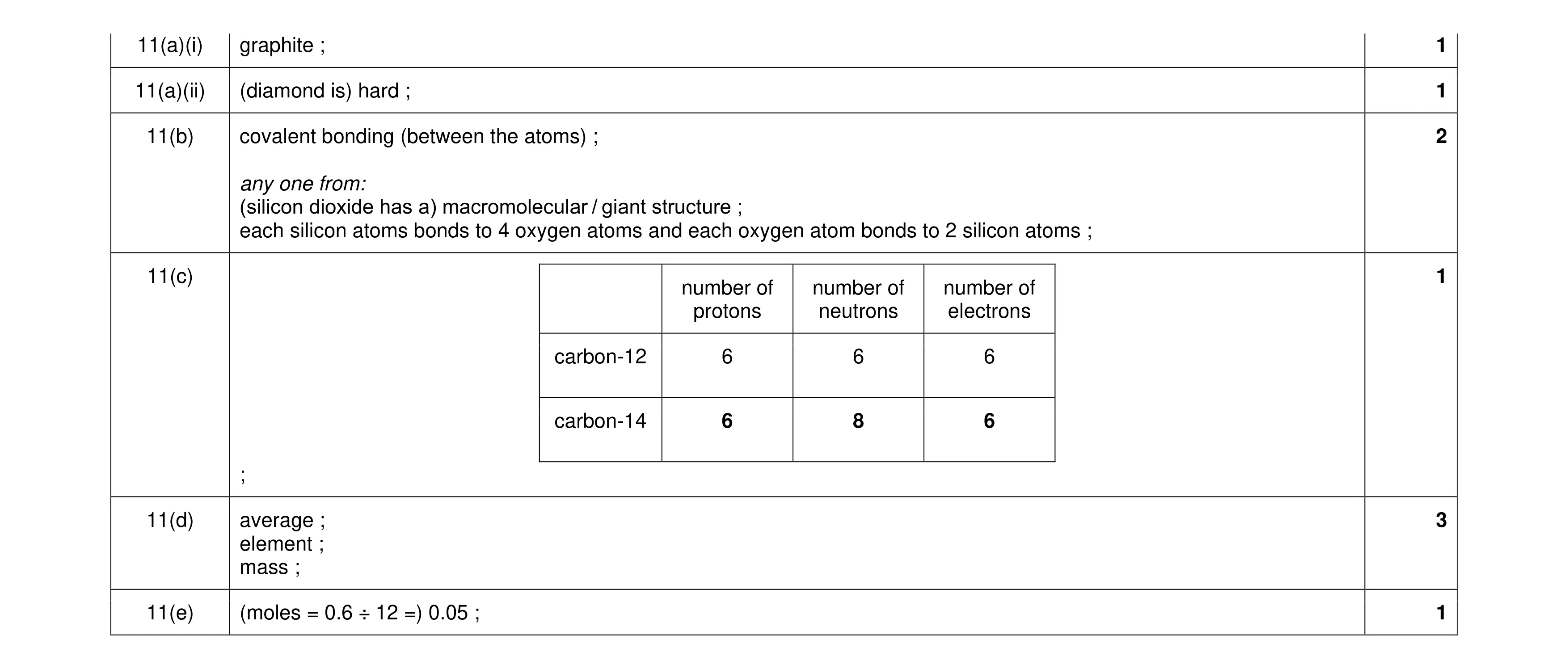 9
9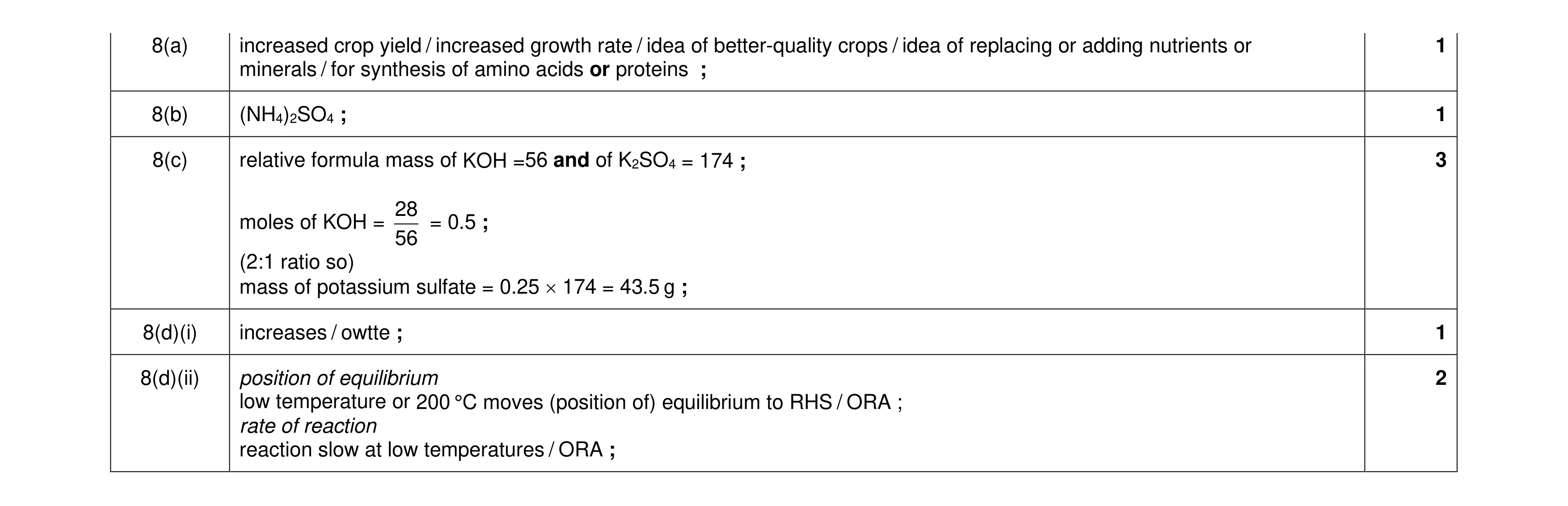 8
8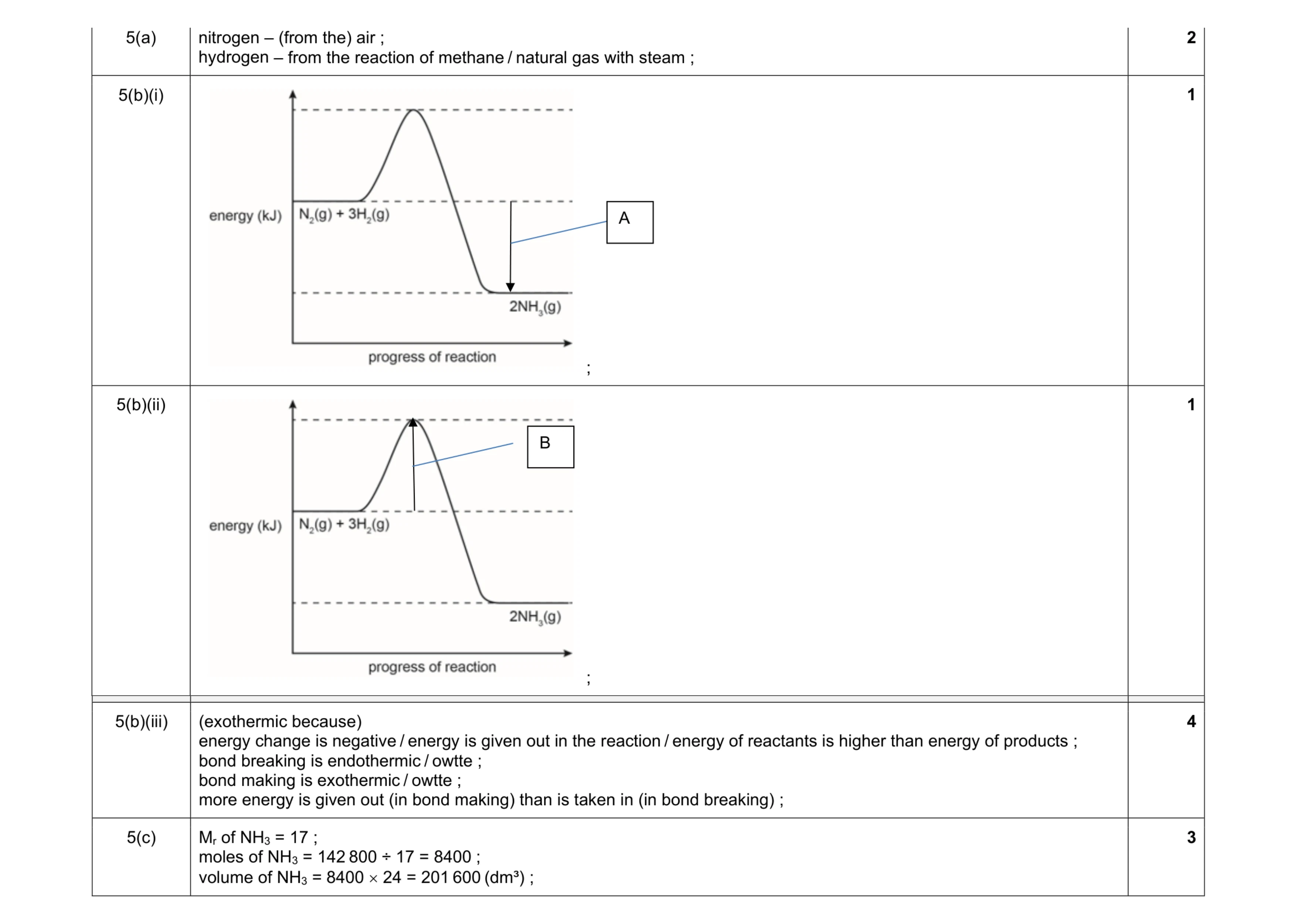 11
11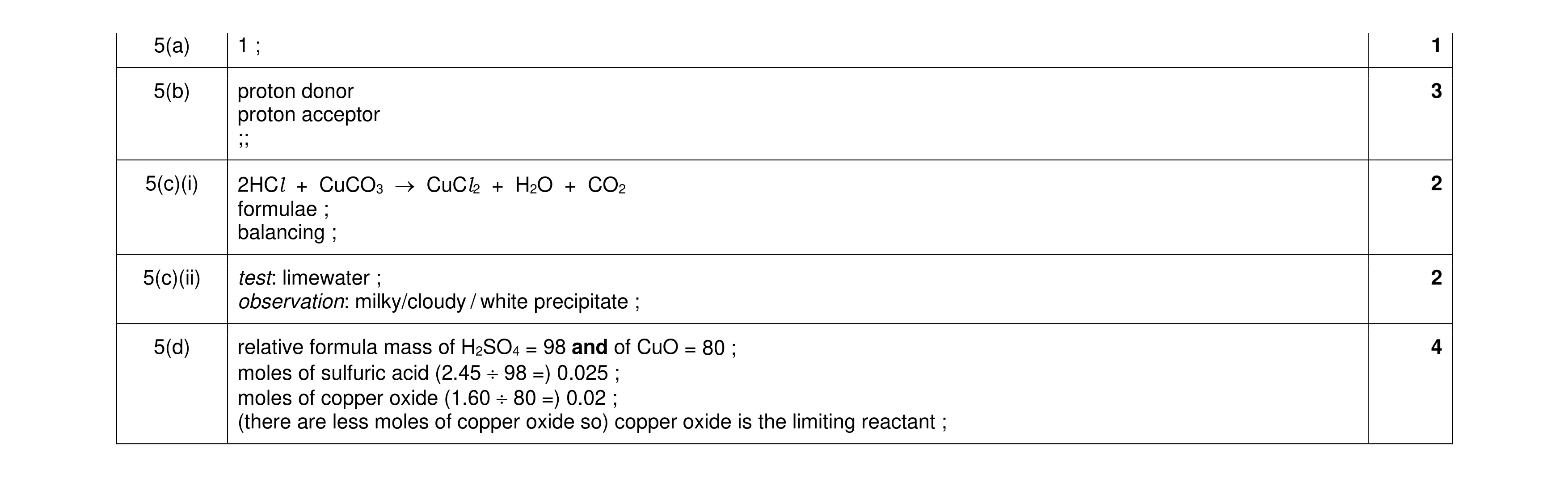 12
12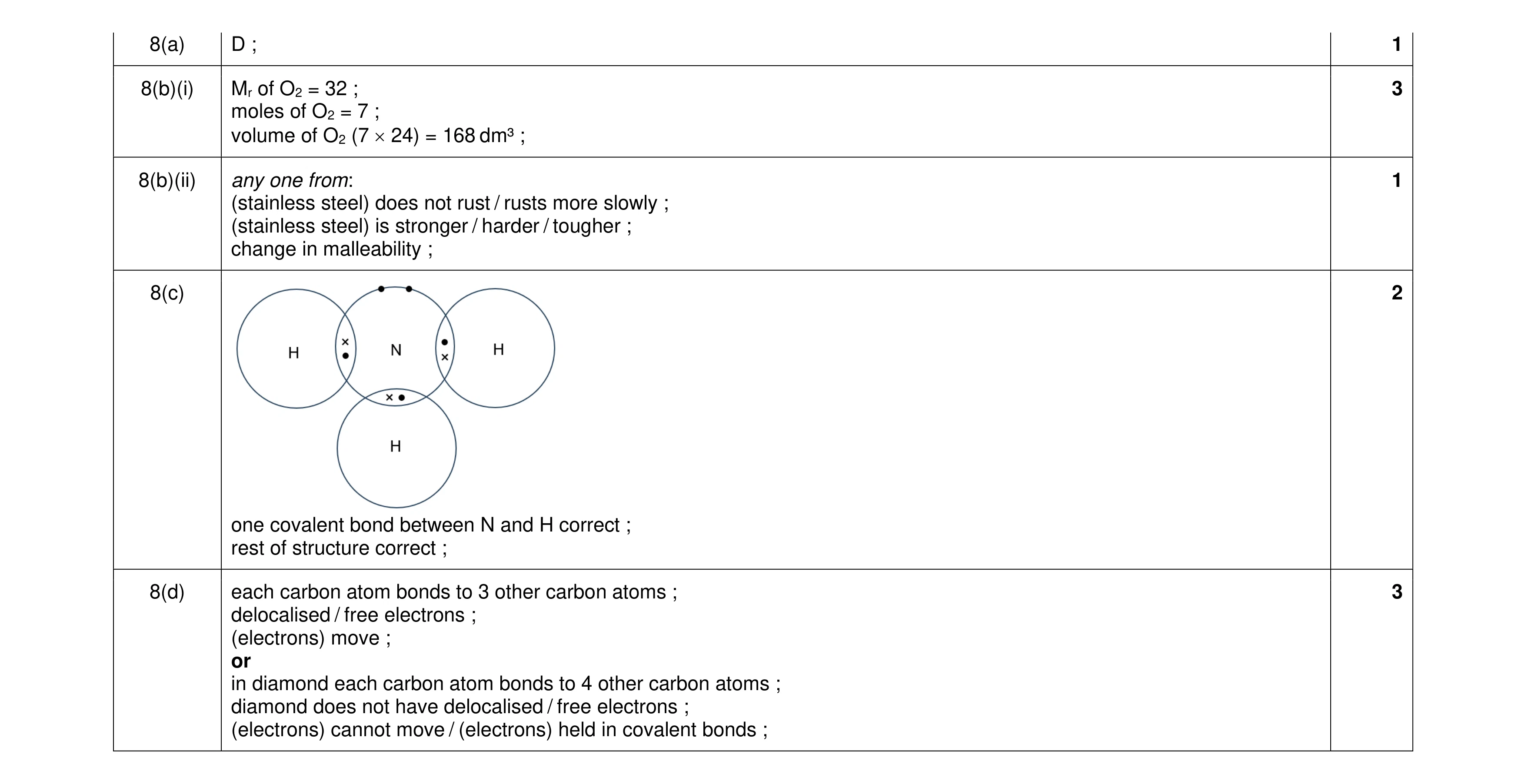 10
10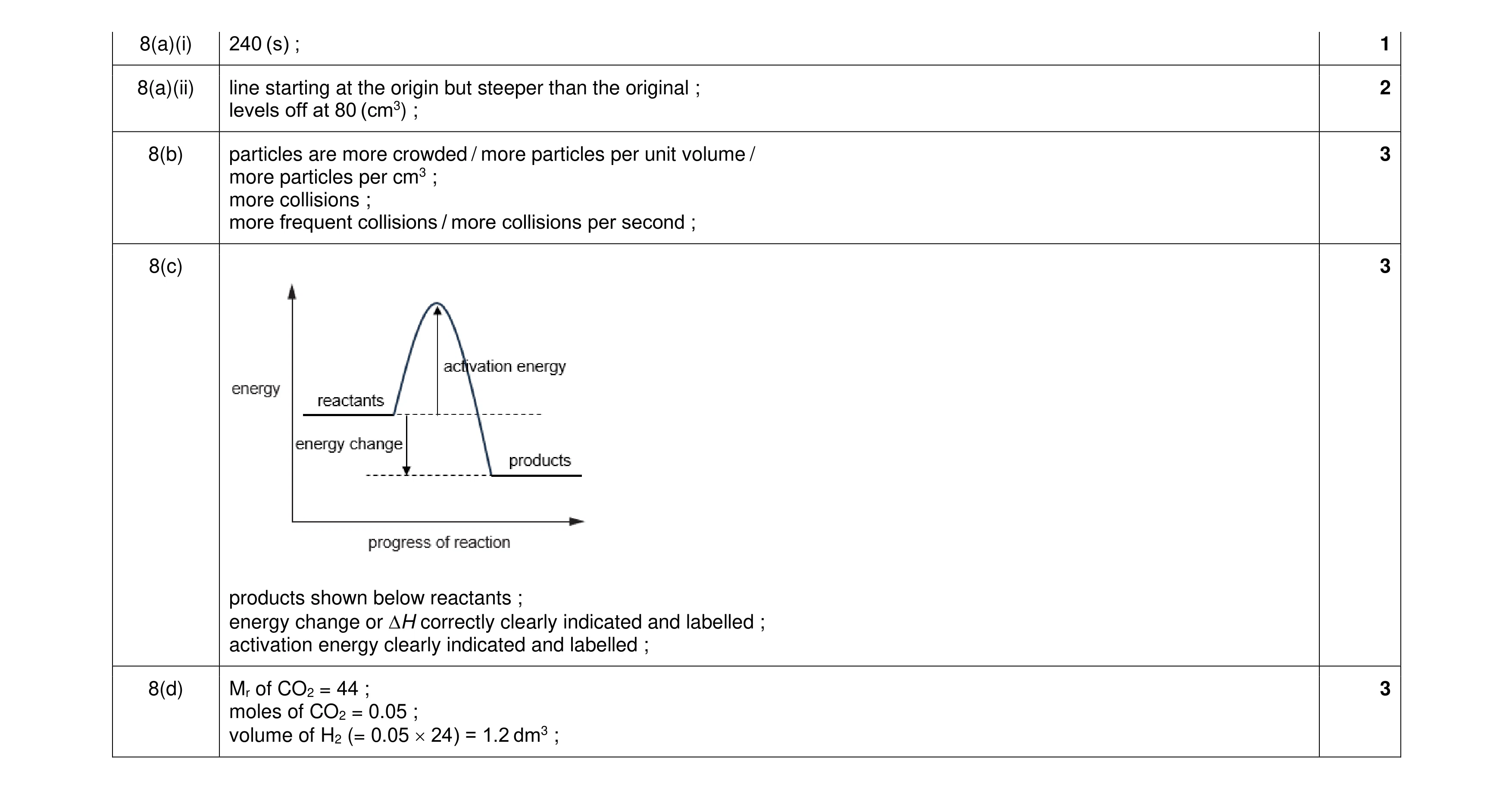 12
12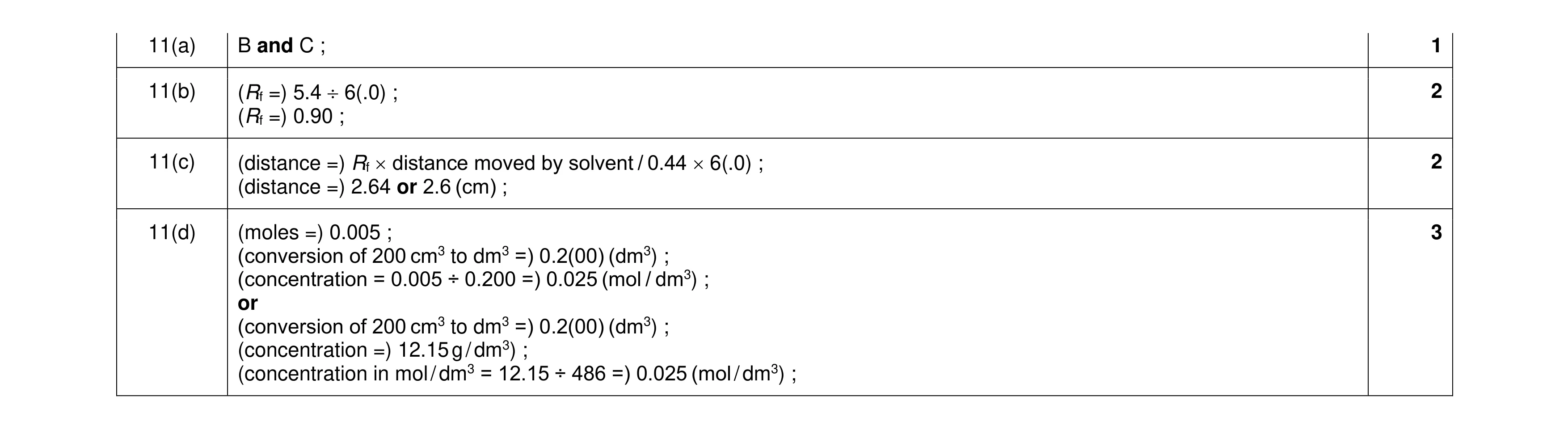 8
8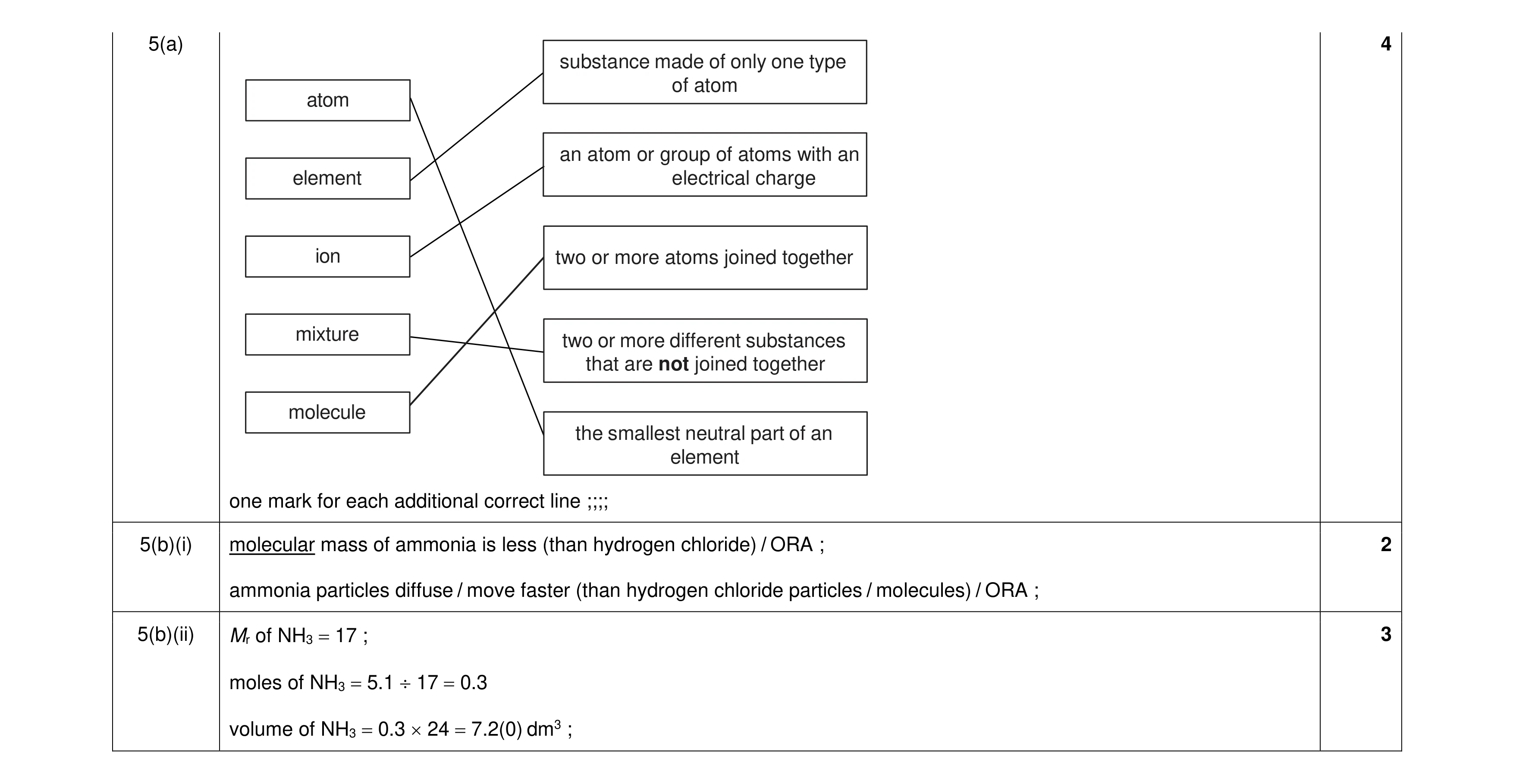 9
9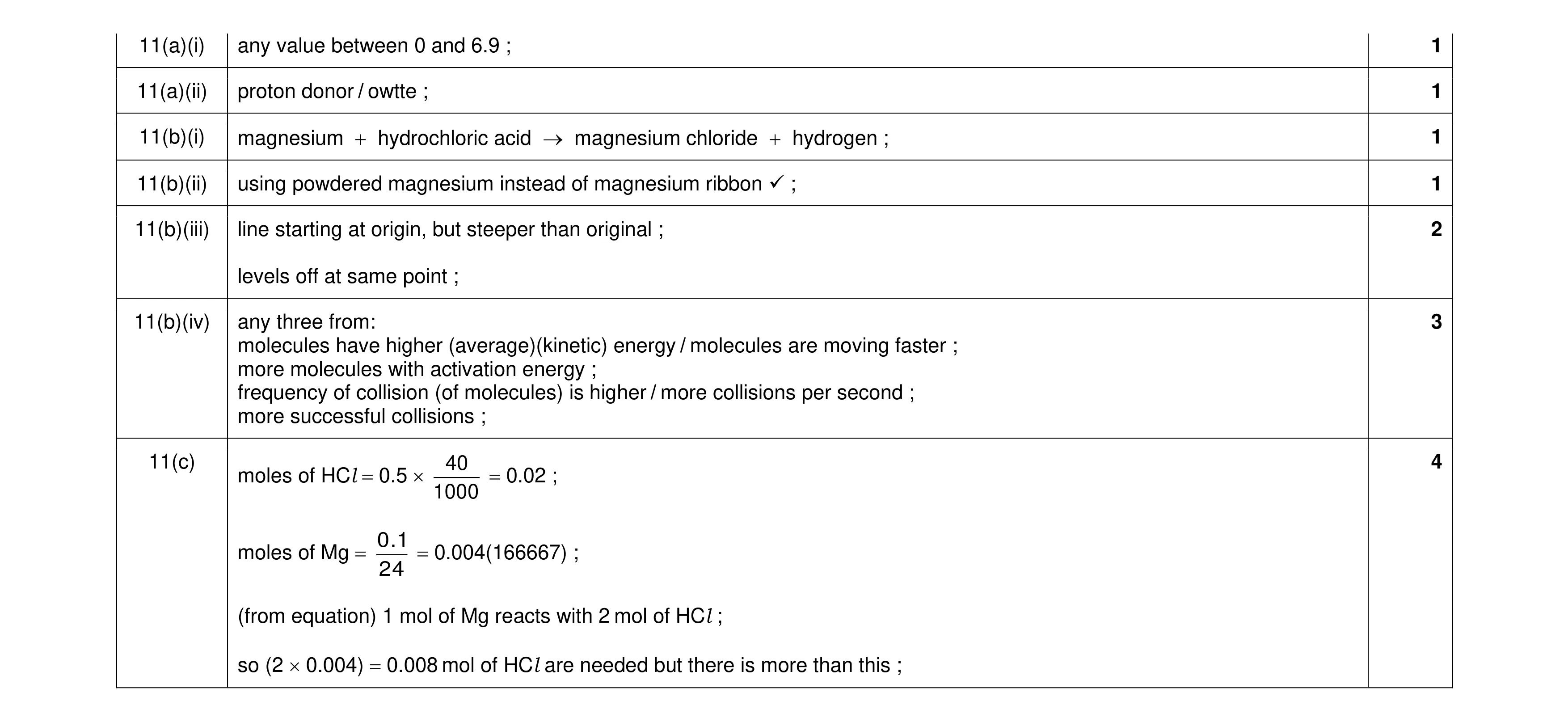 13
13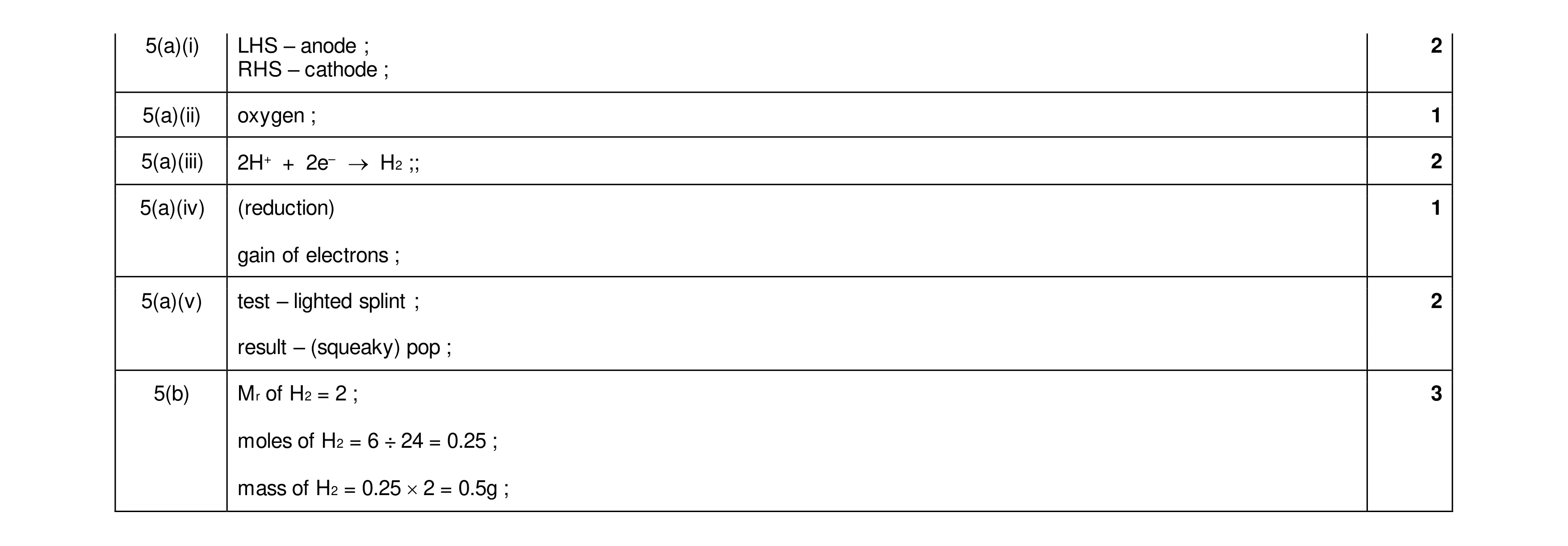 11
11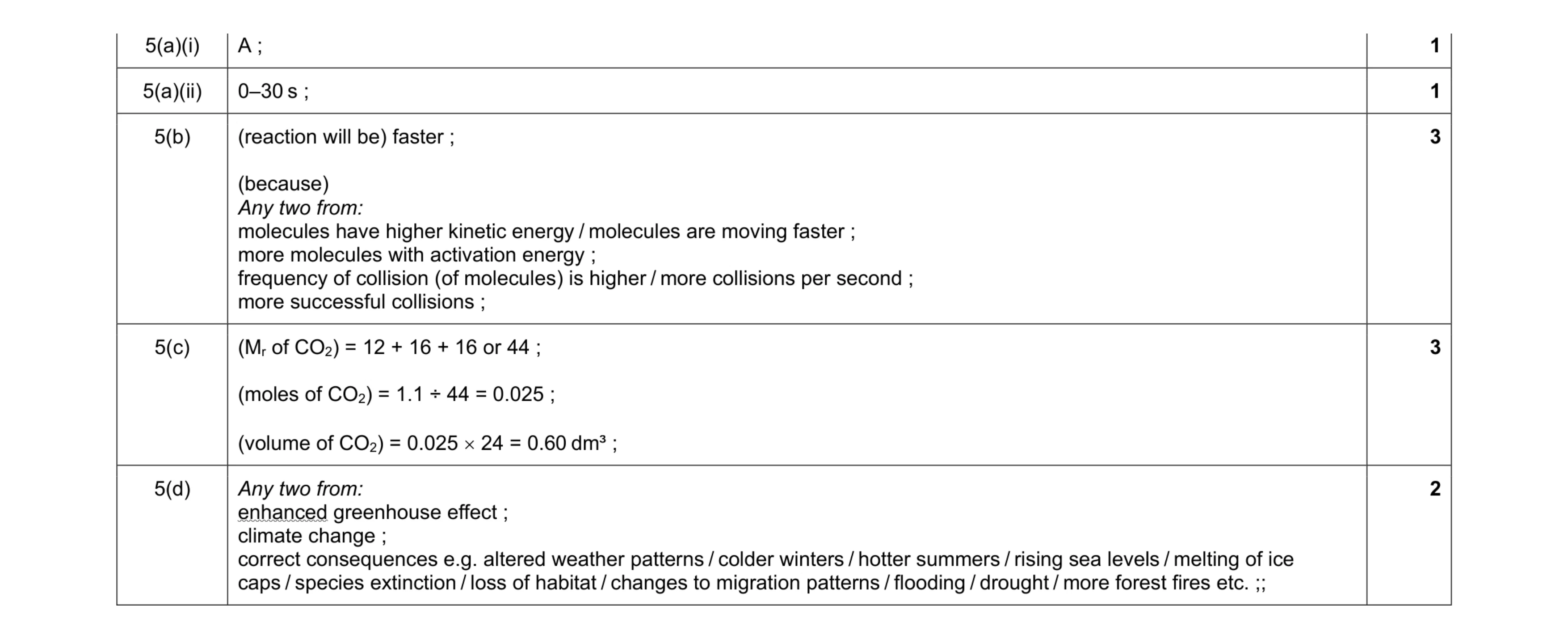 10
10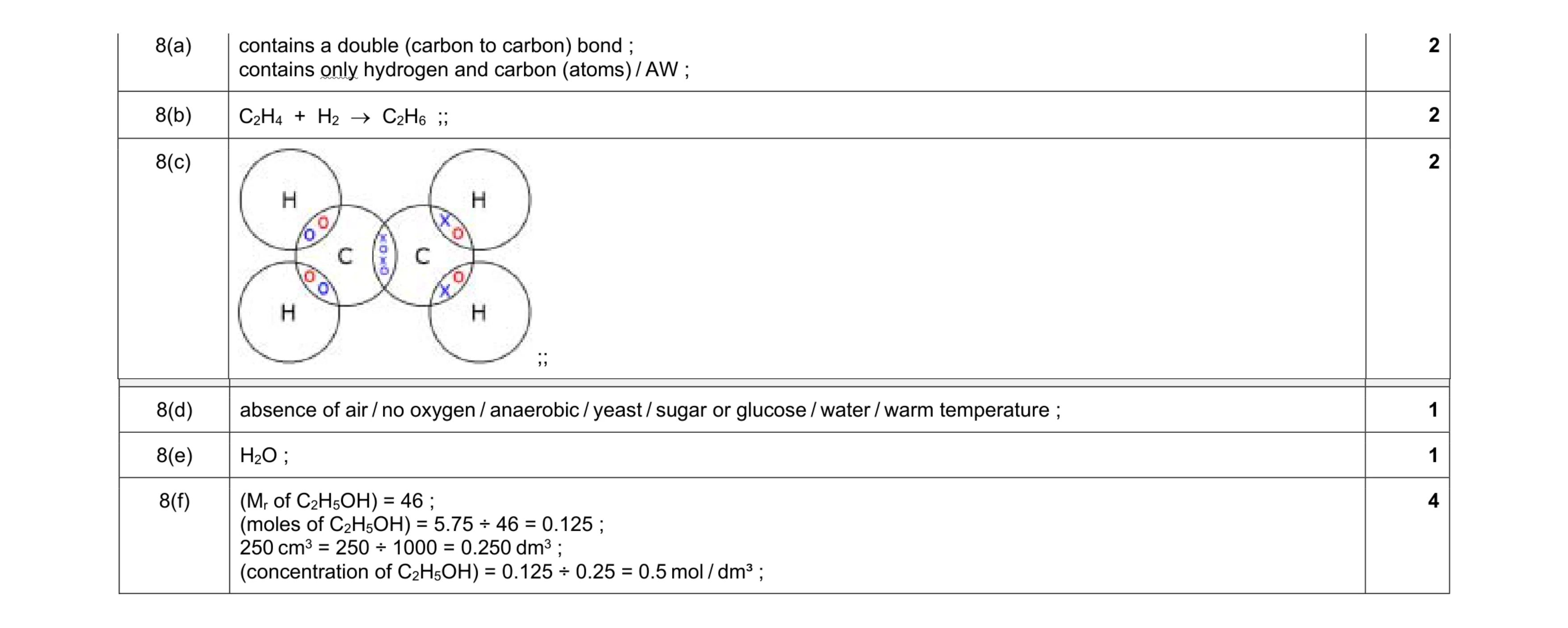 12
12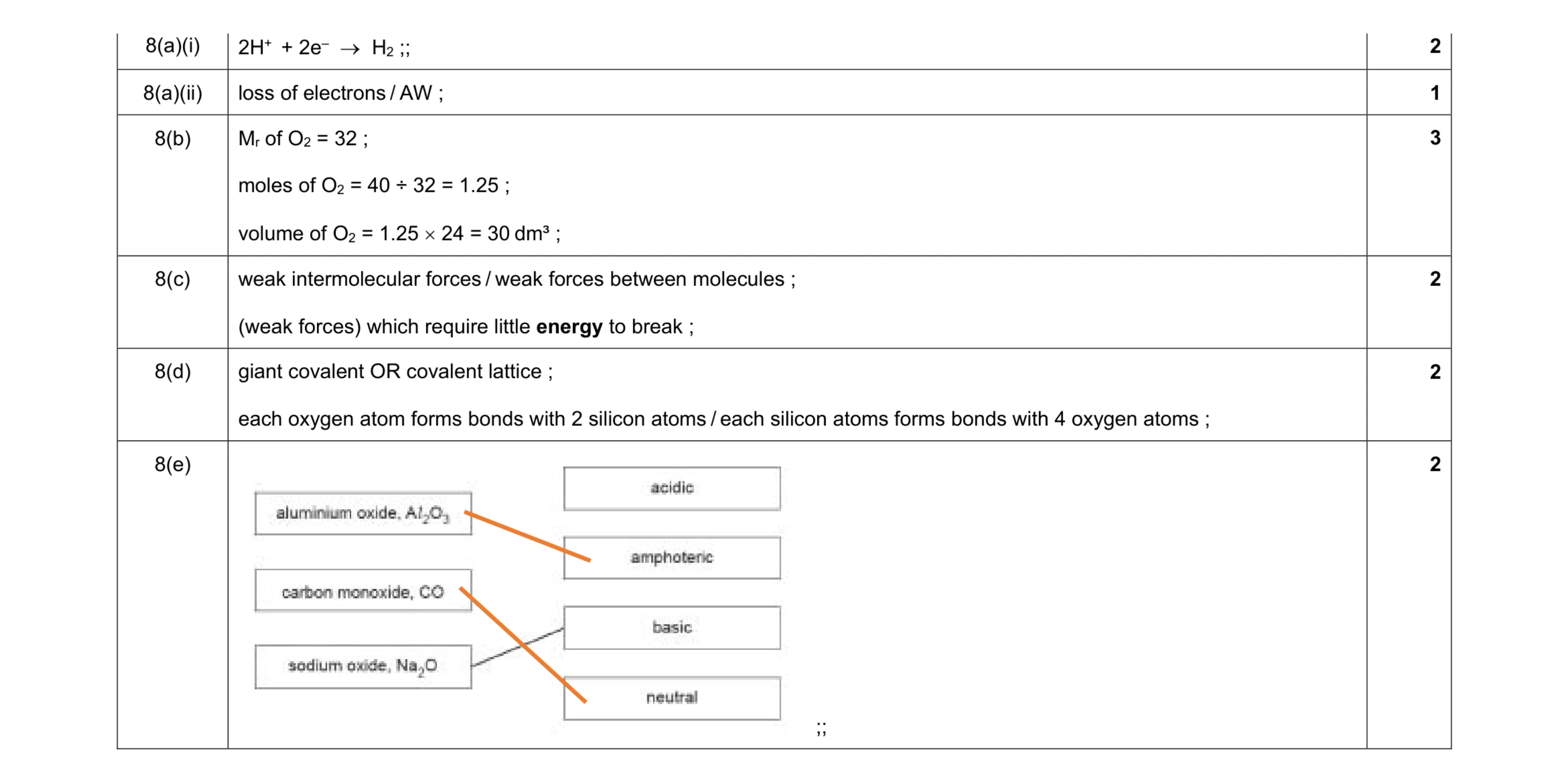 12
12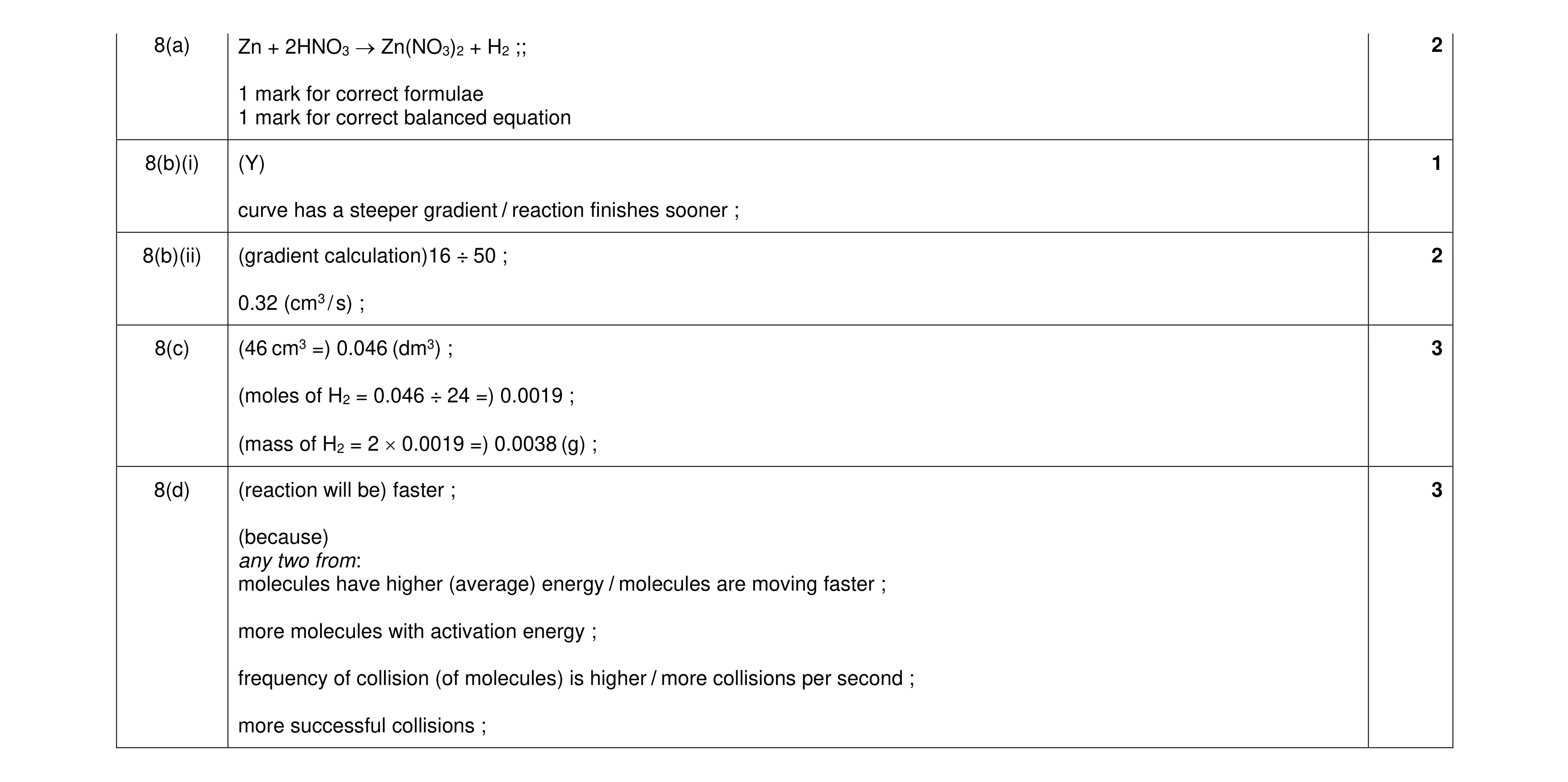 11
11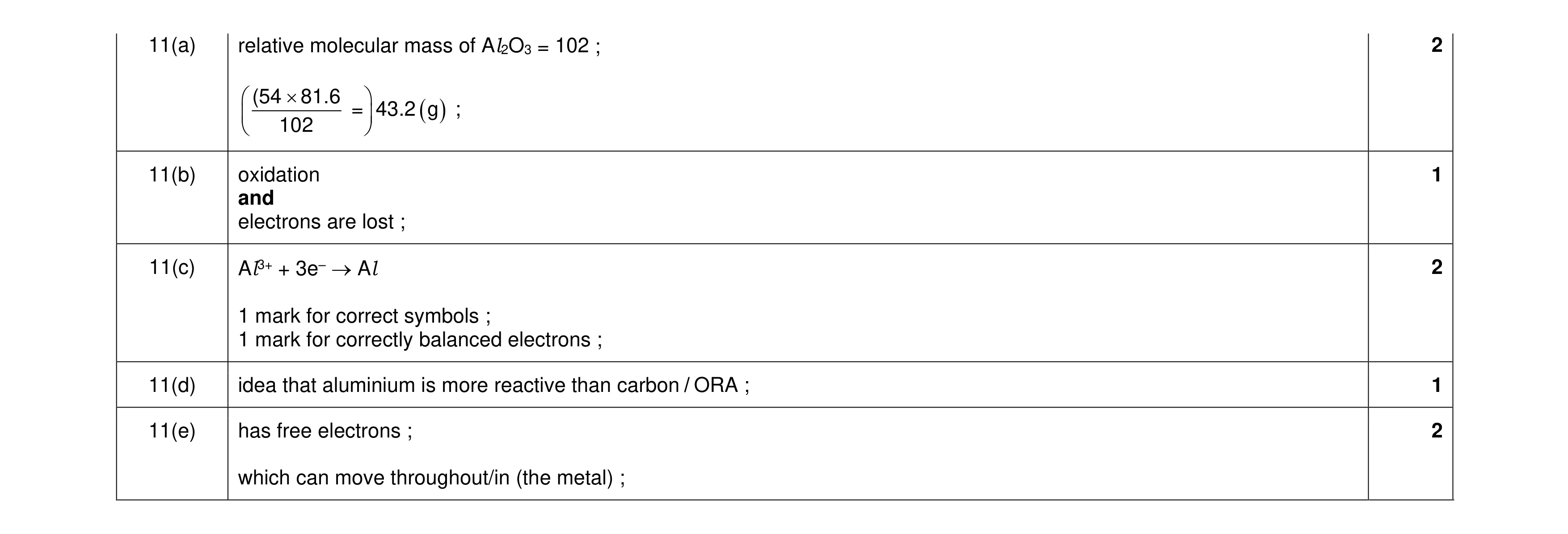 8
8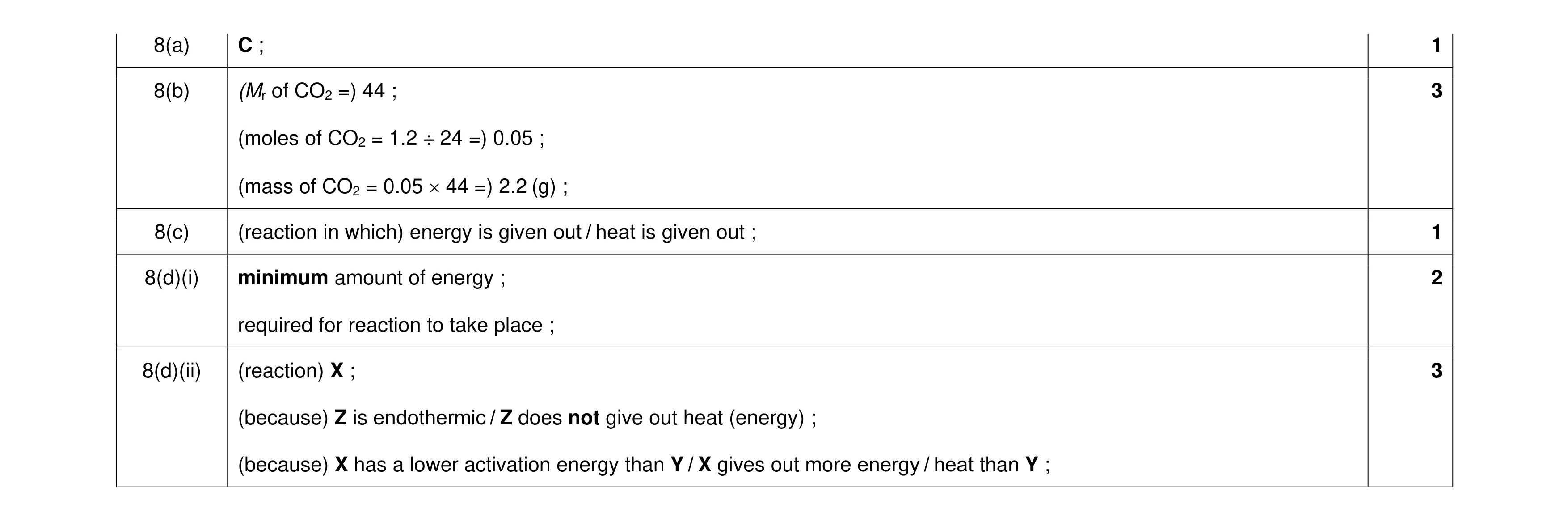 10
10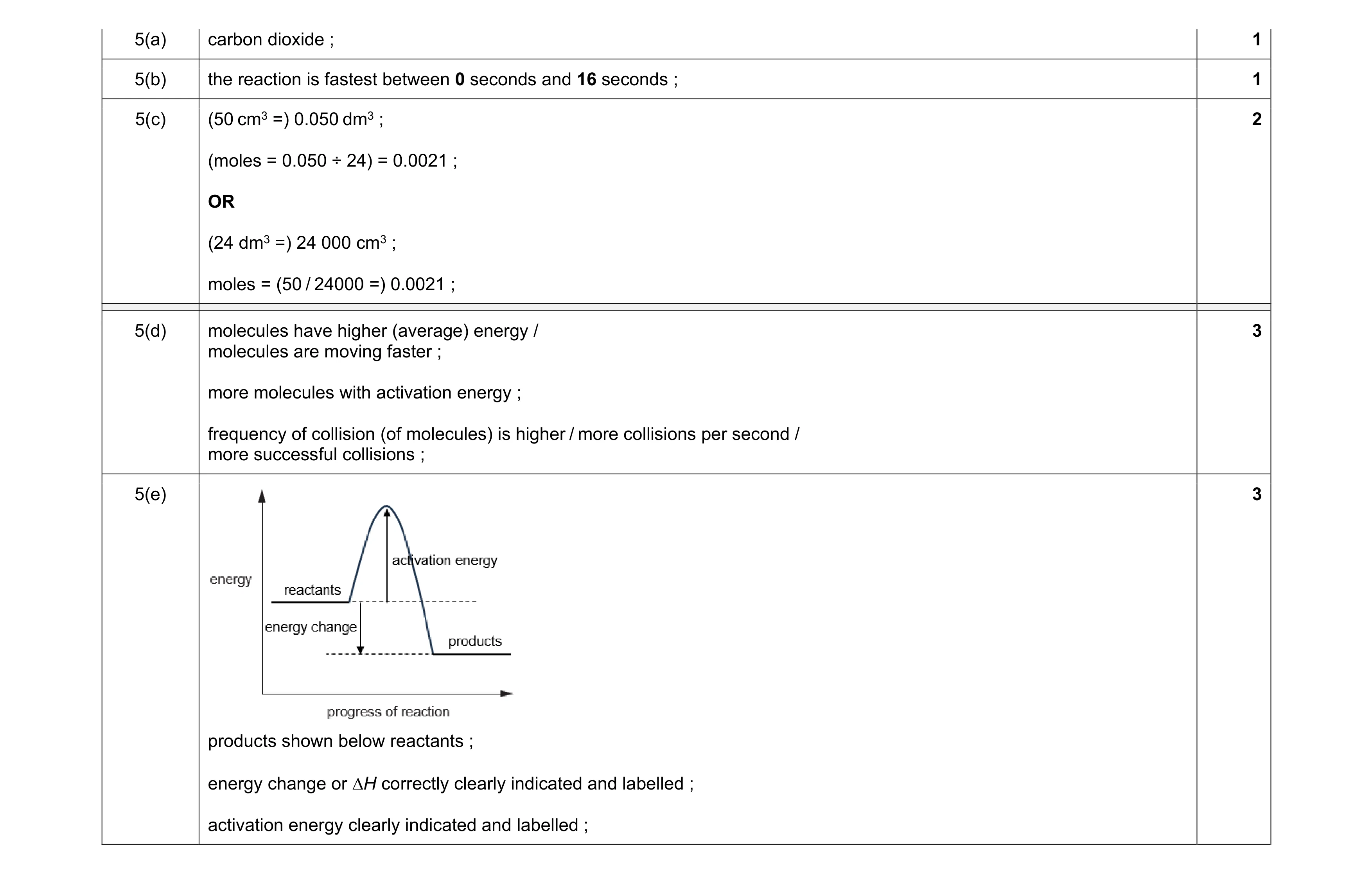 10
10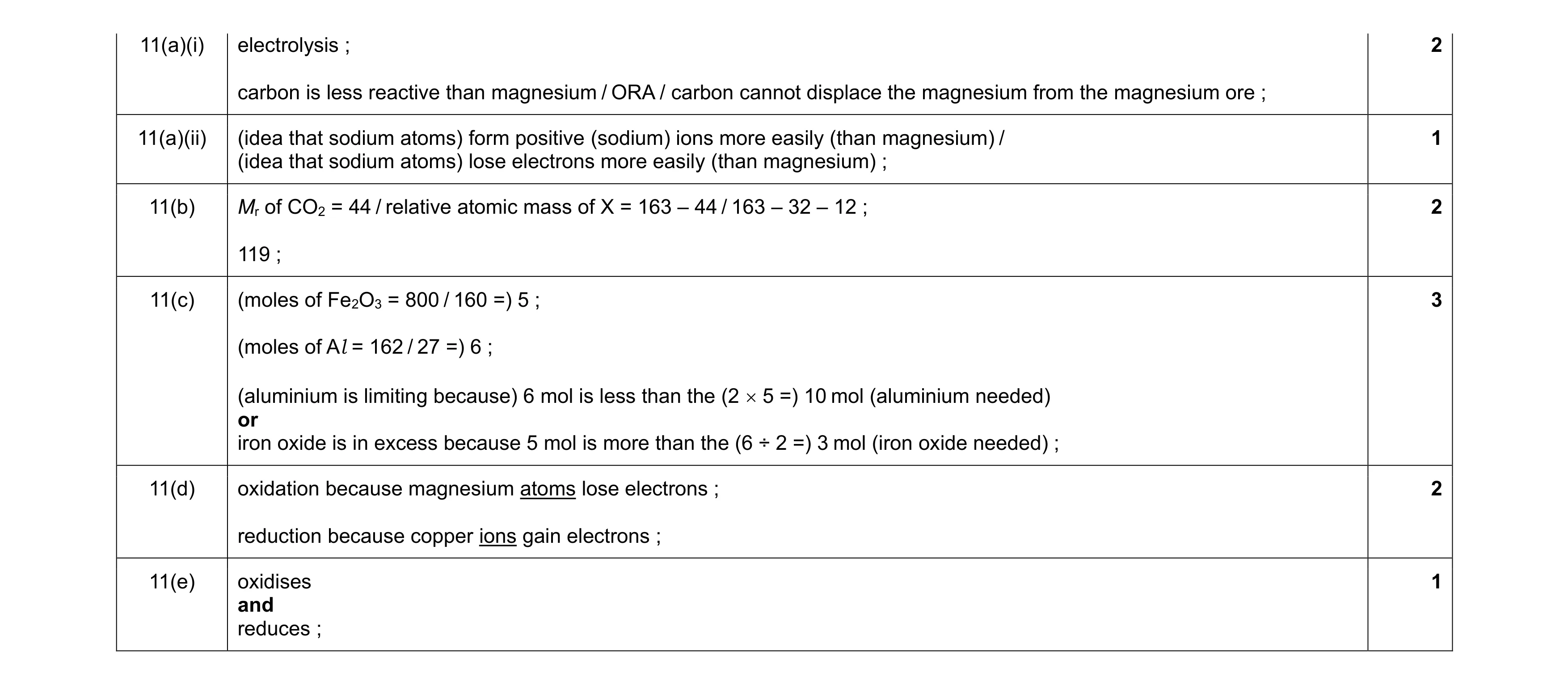 11
11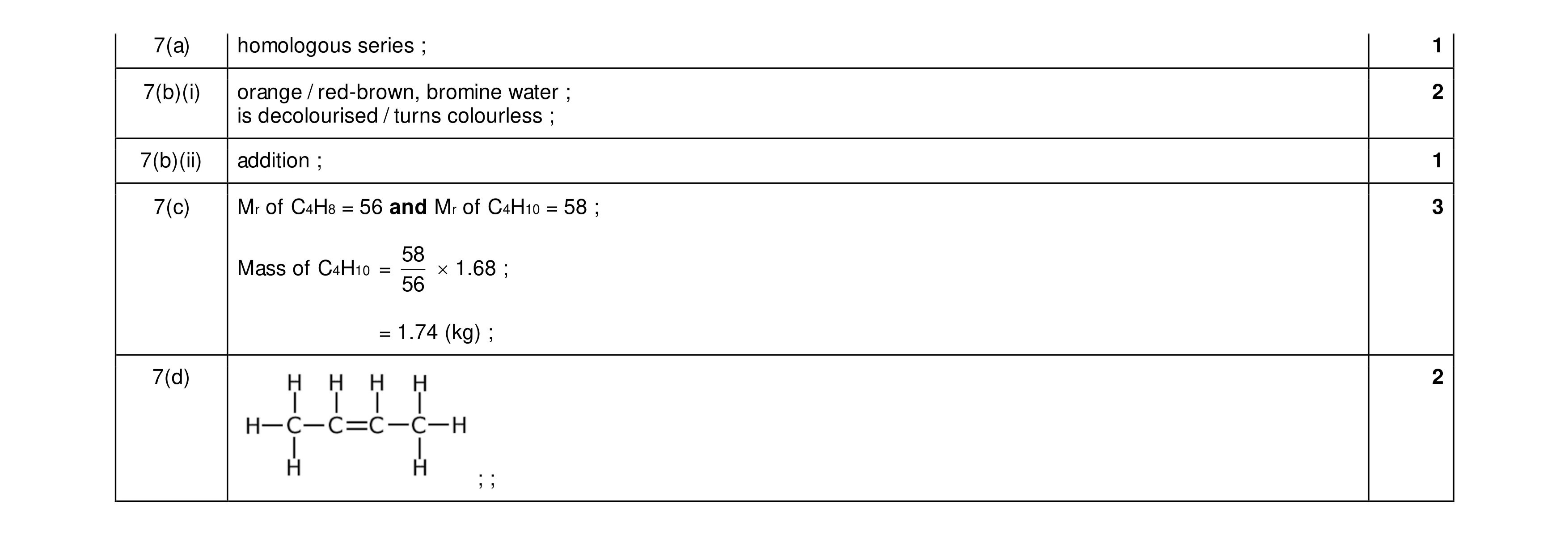 9
9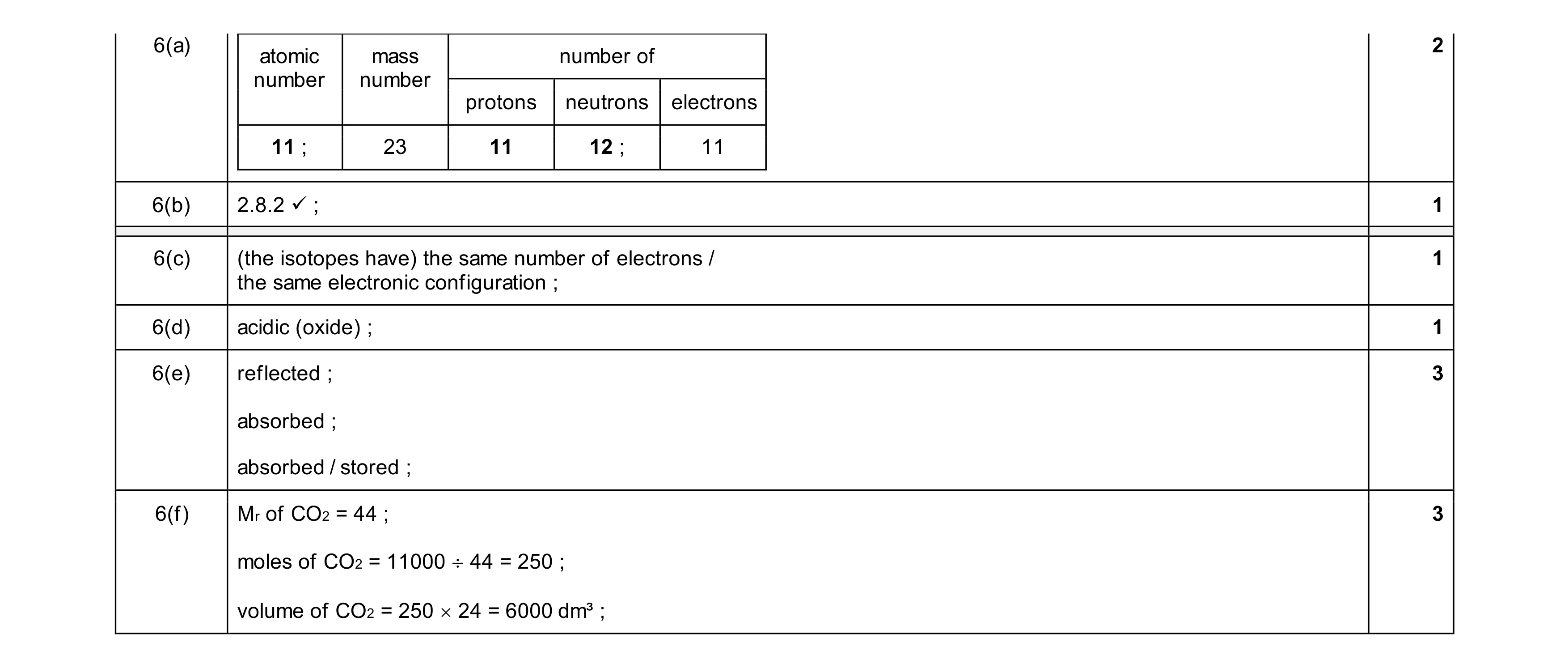 11
11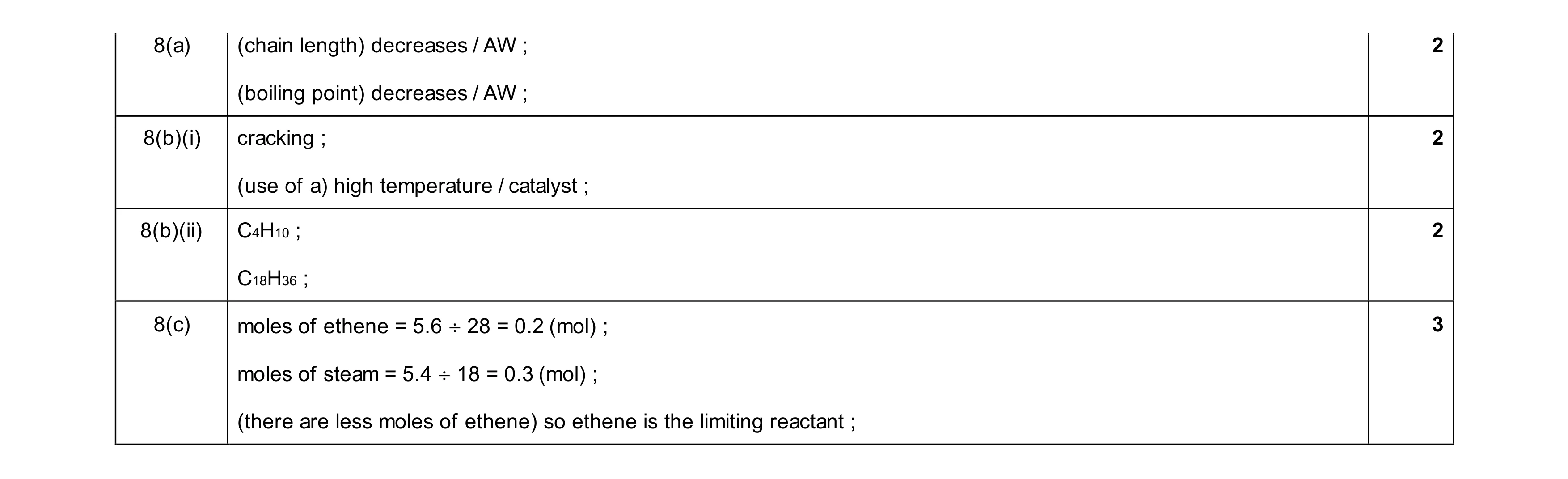 9
9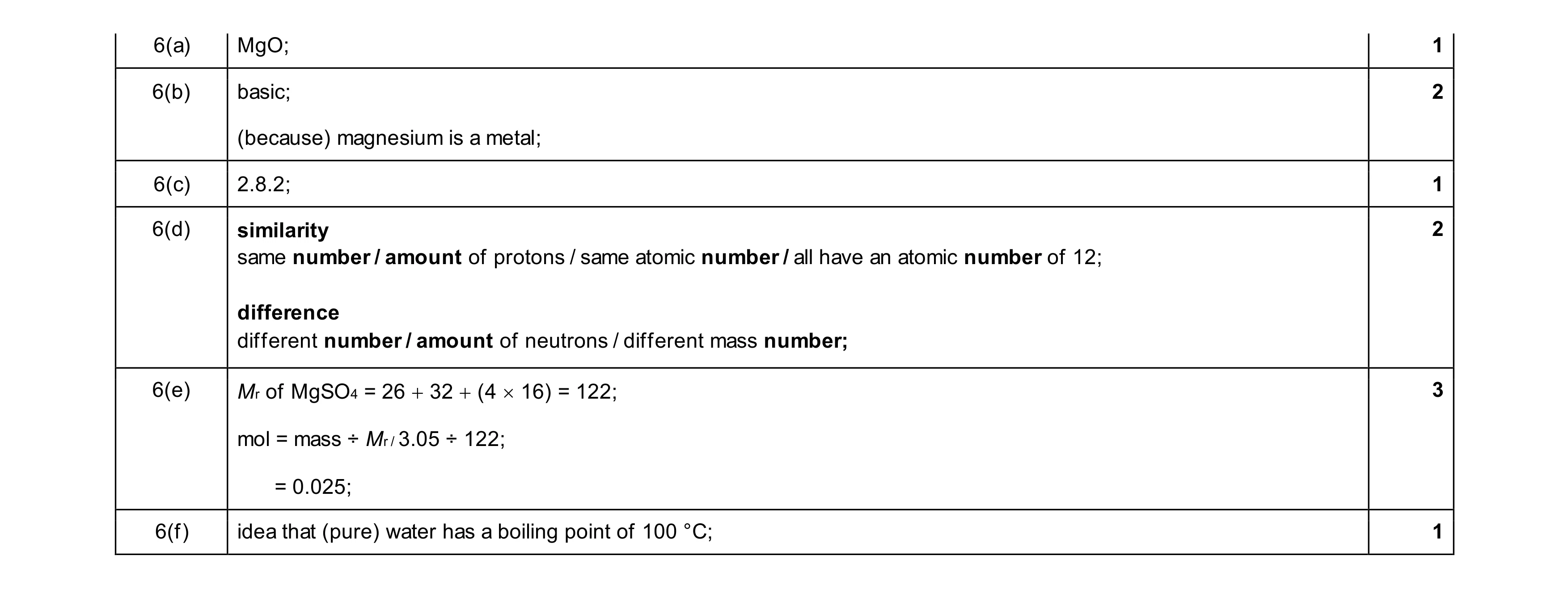 10
10