Cambridge IGCSE Sciences - Co-ordinated (Double) 0654 — 2021 Oct/Nov Paper 4 · Variant 1
0654/41/O/N/21 · 12 questions · 120 marks · ≈135 min
The question paper and its mark scheme, free to read here and free to download. This is Cambridge’s own paper, exactly as it was sat.
Question paper28 pages



Mark scheme13 pages
Answers below. Sit the paper first if you are practising.
Questions as text
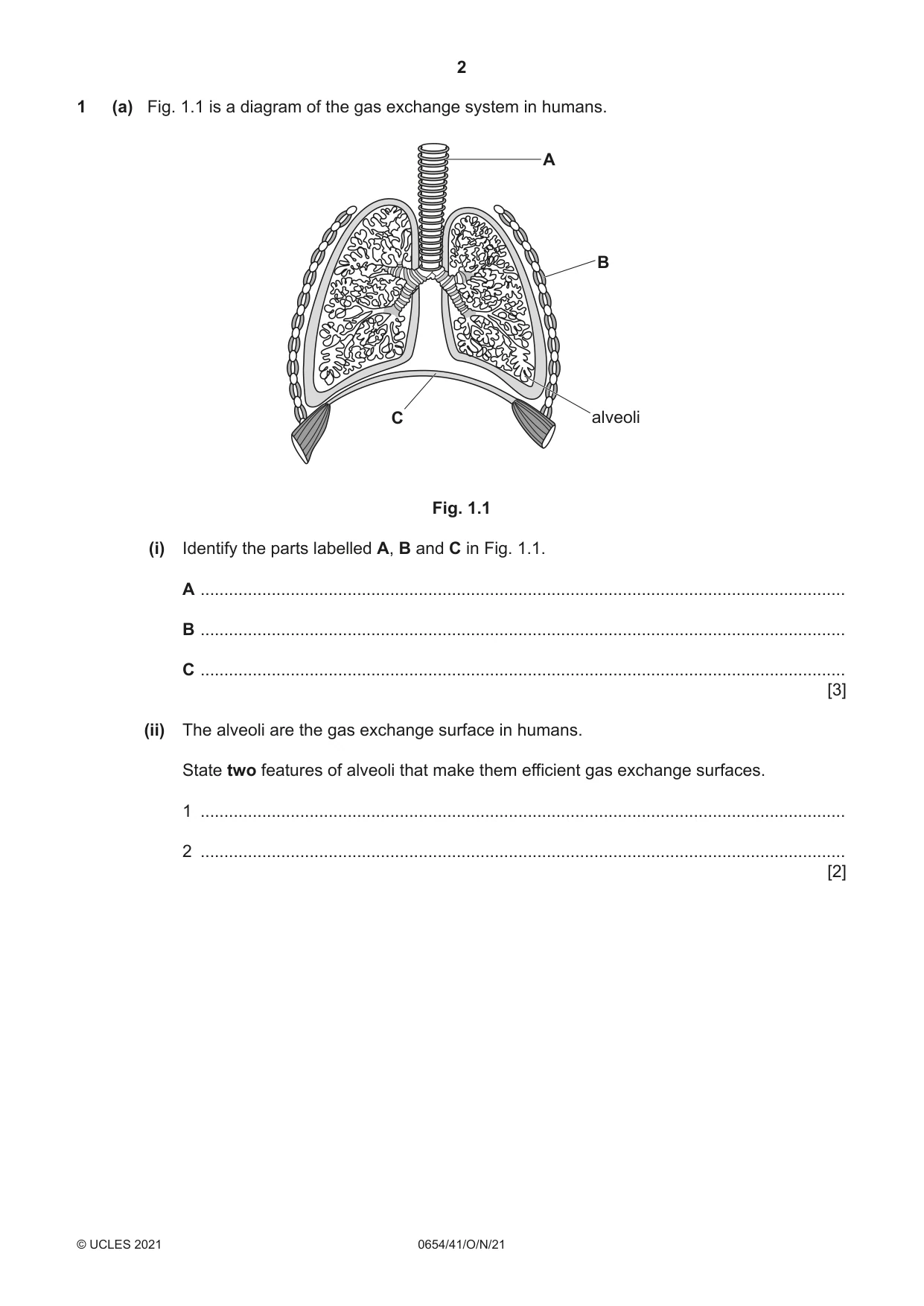
Q1 · A diagram of the gas exchange system in humans
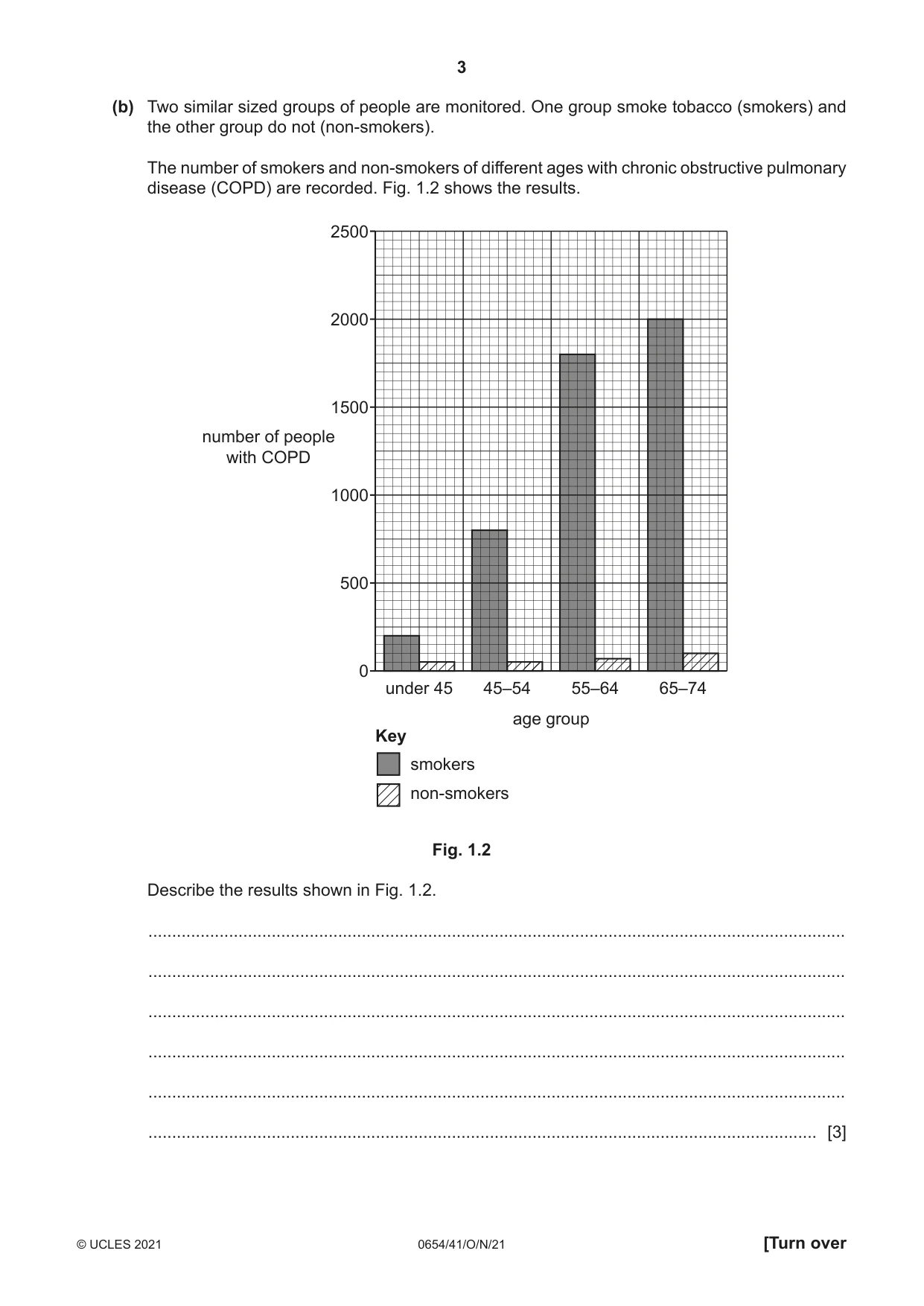
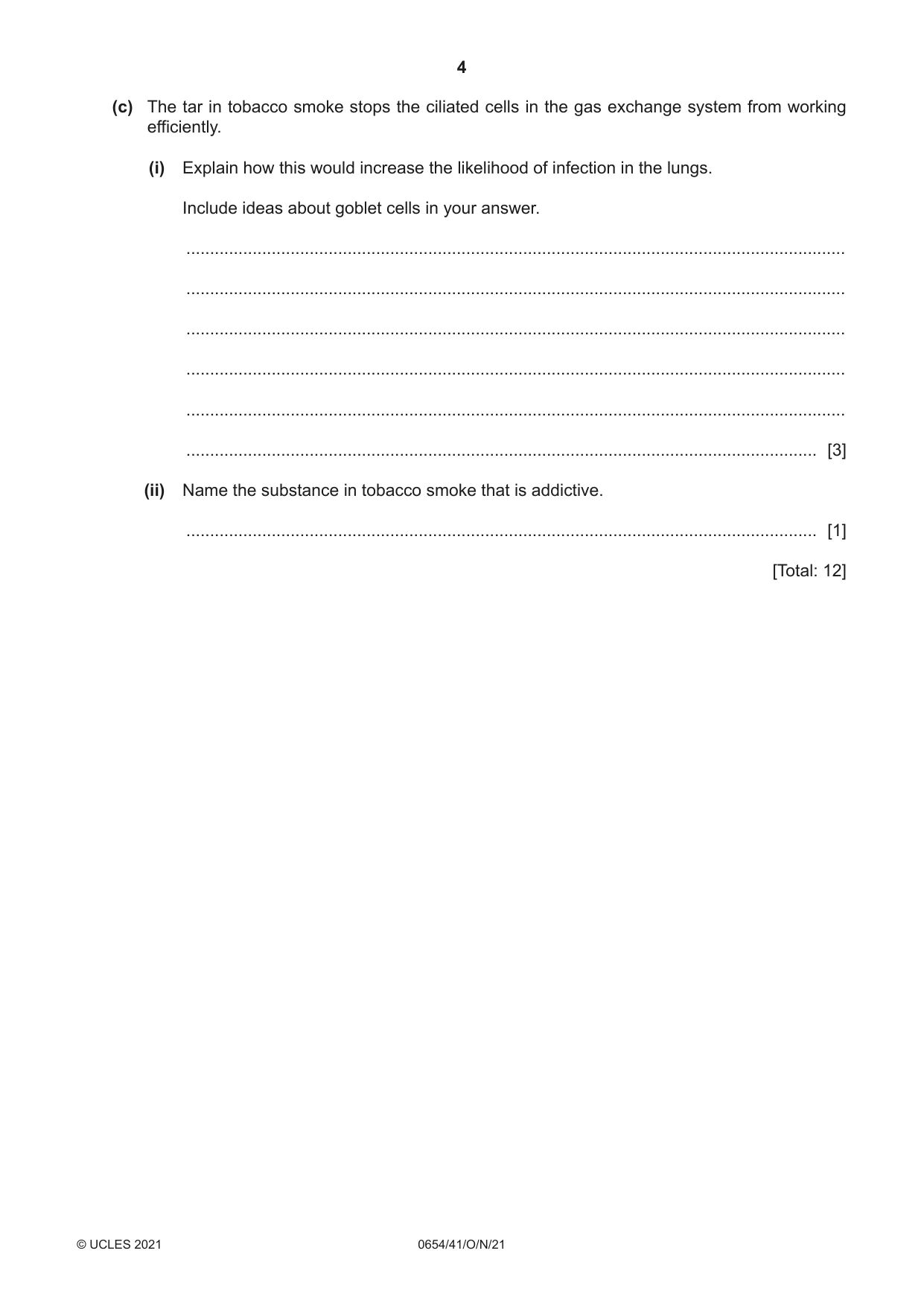
1 (a) Fig. 1.1 is a diagram of the gas exchange system in humans. A B C alveoli Fig. 1.1 (i) Identify the parts labelled A, B and C in Fig. 1.1. A ........................................................................................................................................ B ........................................................................................................................................ C ........................................................................................................................................ [3] (ii) The alveoli are the gas exchange surface in humans. State two features of alveoli that make them efficient gas exchange surfaces. 1 ........................................................................................................................................ 2 ........................................................................................................................................ [2] (b) Two similar sized groups of people are monitored. One group smoke tobacco (smokers) and the other group do not (non-smokers). The number of smokers and non-smokers of different ages with chronic obstructive pulmonary disease (COPD) are recorded. Fig. 1.2 shows the results. 2500 2000 1500 number of people with COPD 1000 500 0 under 45 45–54 55–64 65–74 age group Key smokers non-smokers Fig. 1.2 Describe the results shown in Fig. 1.2. ................................................................................................................................................... ................................................................................................................................................... ................................................................................................................................................... ................................................................................................................................................... ................................................................................................................................................... ............................................................................................................................................. [3] (c) The tar in tobacco smoke stops the ciliated cells in the gas exchange system from working efficiently. (i) Explain how this would increase the likelihood of infection in the lungs. Include ideas about goblet cells in your answer. ........................................................................................................................................... ........................................................................................................................................... ........................................................................................................................................... ........................................................................................................................................... ........................................................................................................................................... ..................................................................................................................................... [3] (ii) Name the substance in tobacco smoke that is addictive. ..................................................................................................................................... [1] [Total: 12]
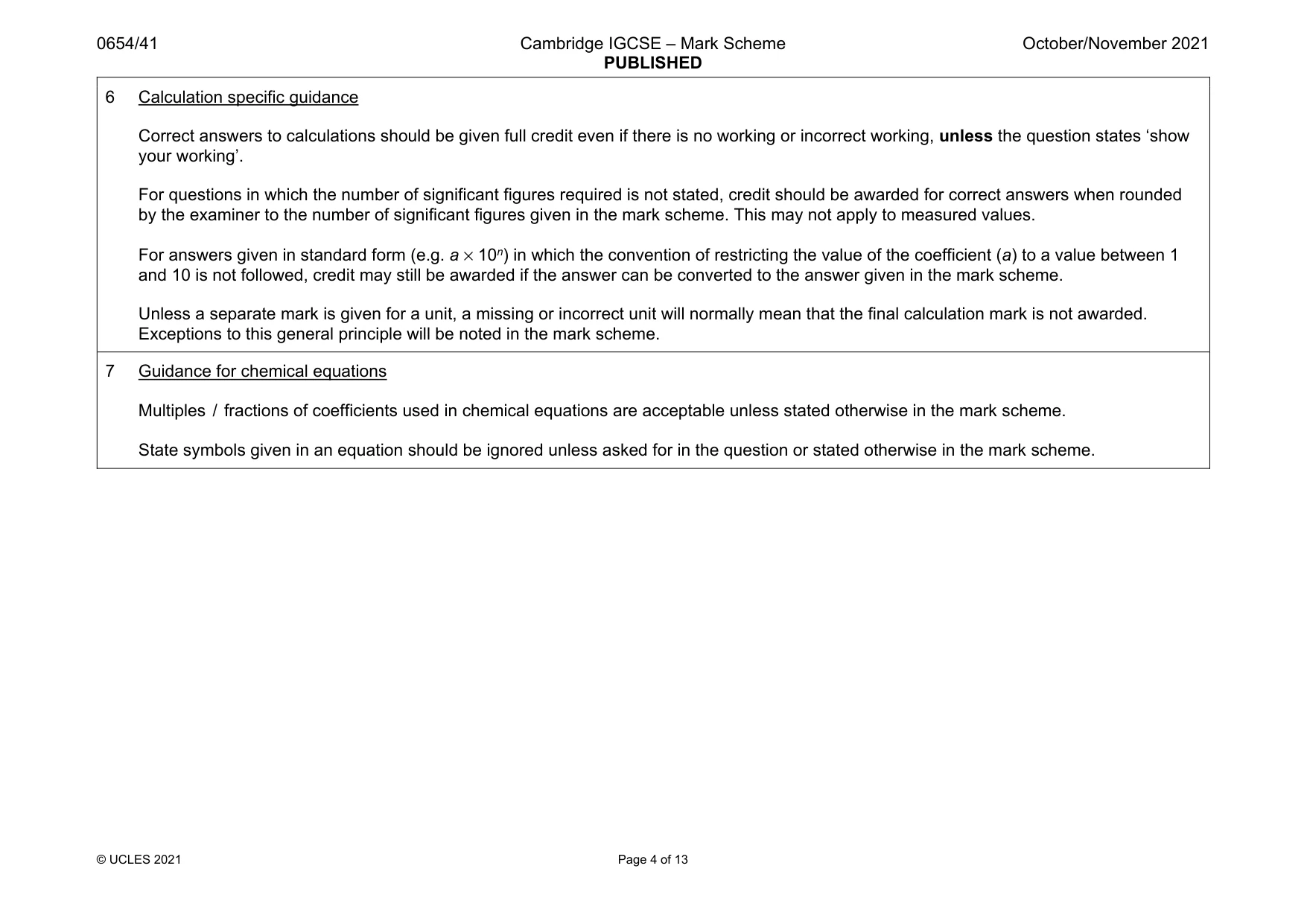
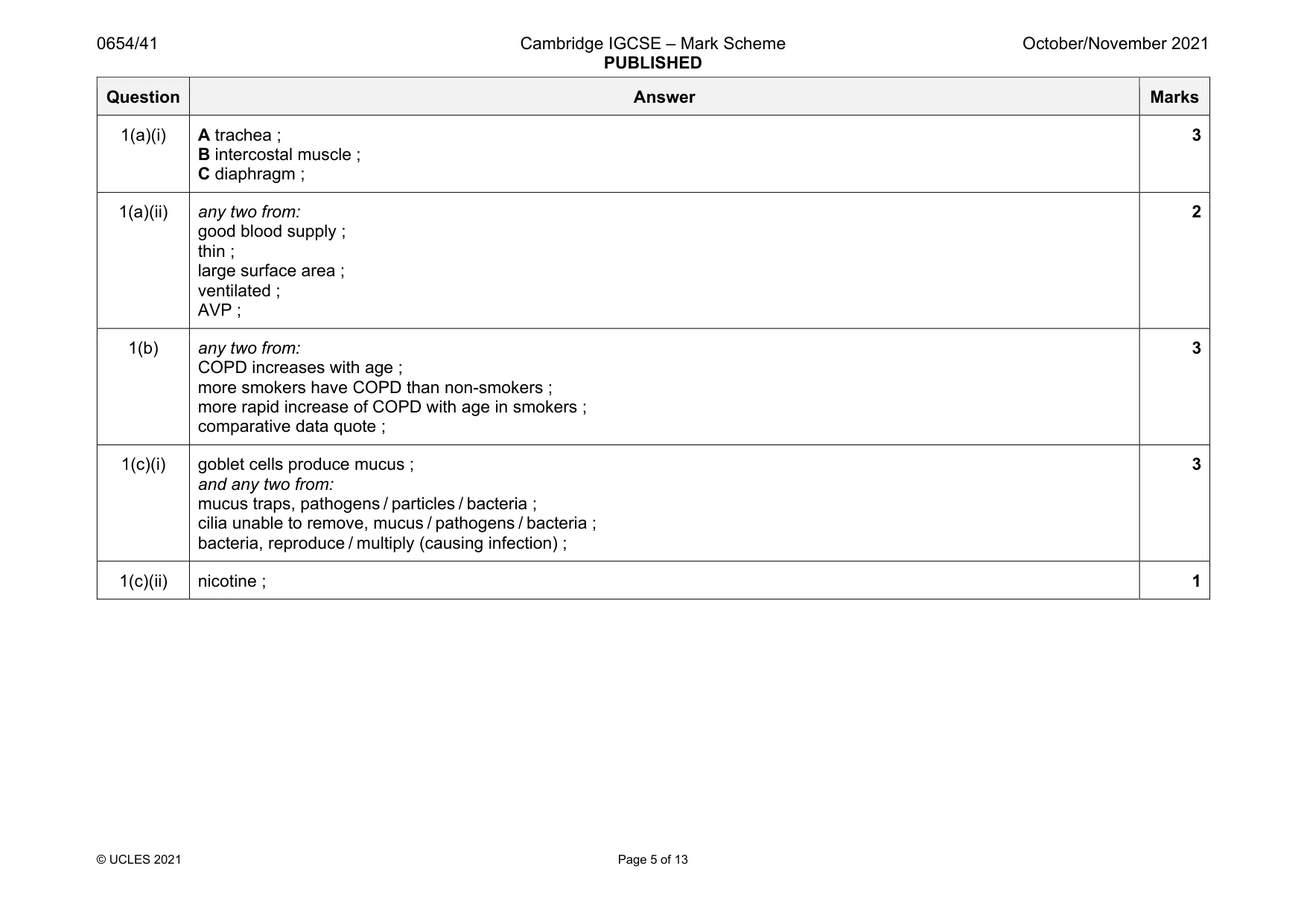
Mark scheme: 1(a)(i) A trachea ; B intercostal muscle ; C diaphragm ; 3 1(a)(ii) any two from: good blood supply ; thin ; large surface area ; ventilated ; AVP ; 2 1(b) any two from: COPD increases with age ; more smokers have COPD than non-smokers ; more rapid increase of COPD with age in smokers ; comparative data quote ; 3 1(c)(i) goblet cells produce mucus ; and any two from: mucus traps, pathogens / particles / bacteria ; cilia unable to remove, mucus / pathogens / bacteria ; bacteria, reproduce / multiply (causing infection) ; 3 1(c)(ii) nicotine ; 1
Q2 · Ammonia, NH3, is made in the Haber process
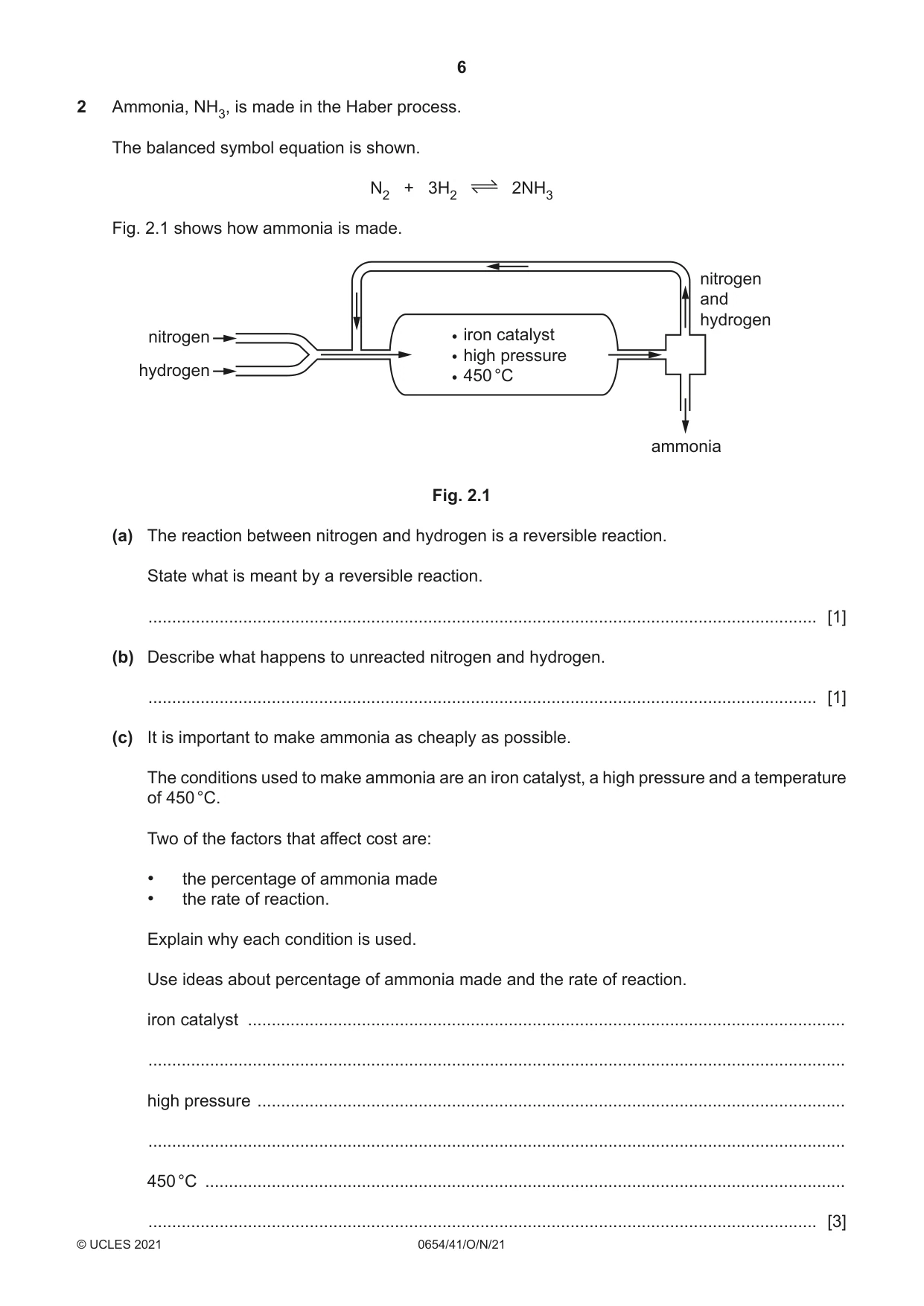
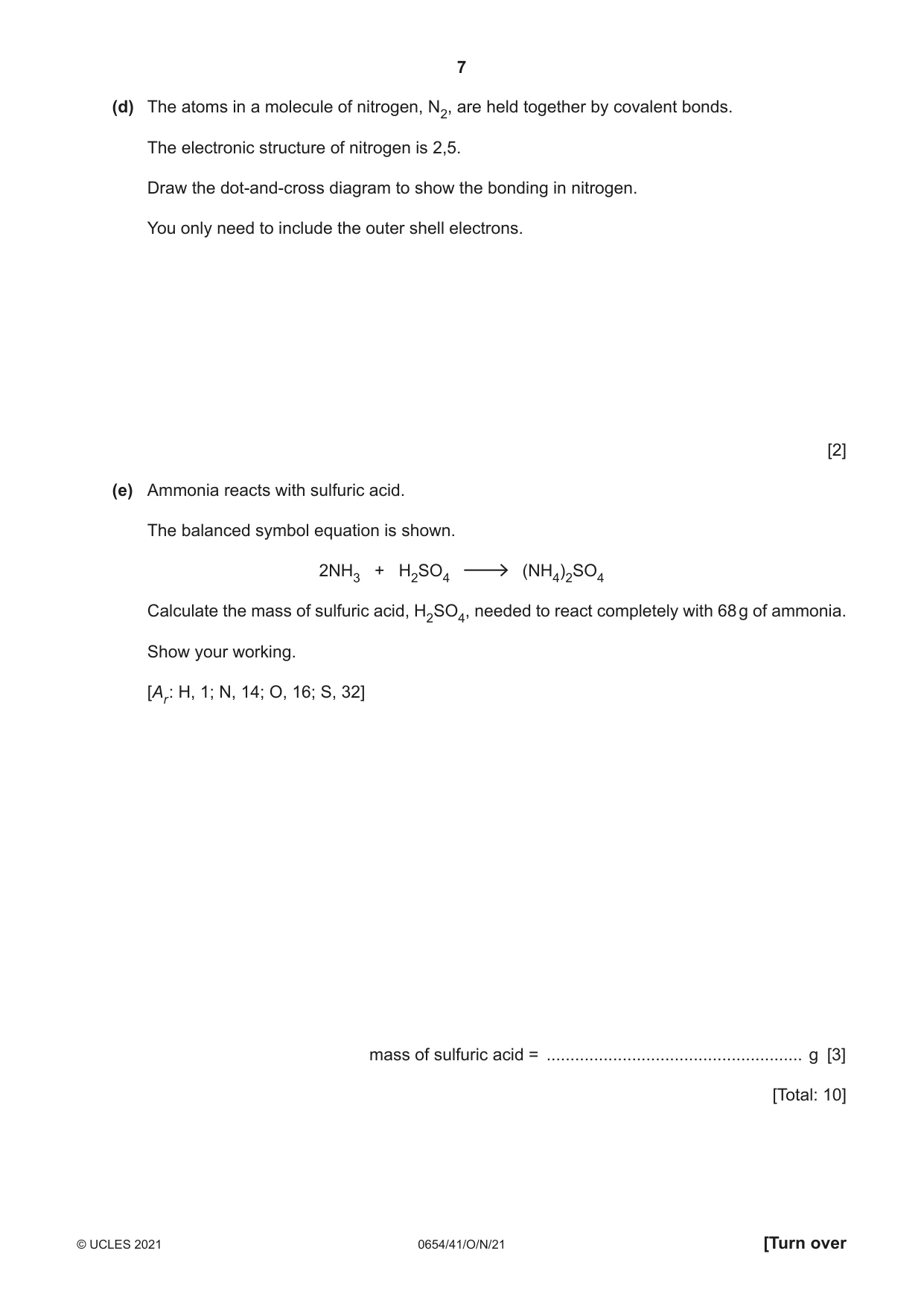
2 Ammonia, NH3, is made in the Haber process. The balanced symbol equation is shown. N2 + 3H2 2NH3 Fig. 2.1 shows how ammonia is made. nitrogen and hydrogen nitrogen • iron catalyst • high pressure hydrogen • 450 °C ammonia Fig. 2.1 (a) The reaction between nitrogen and hydrogen is a reversible reaction. State what is meant by a reversible reaction. ............................................................................................................................................. [1] (b) Describe what happens to unreacted nitrogen and hydrogen. ............................................................................................................................................. [1] (c) It is important to make ammonia as cheaply as possible. The conditions used to make ammonia are an iron catalyst, a high pressure and a temperature of 450 °C. Two of the factors that affect cost are: • the percentage of ammonia made • the rate of reaction. Explain why each condition is used. Use ideas about percentage of ammonia made and the rate of reaction. iron catalyst .............................................................................................................................. ................................................................................................................................................... high pressure ............................................................................................................................ ................................................................................................................................................... 450 °C ....................................................................................................................................... ............................................................................................................................................. [3] (d) The atoms in a molecule of nitrogen, N2, are held together by covalent bonds. The electronic structure of nitrogen is 2,5. Draw the dot-and-cross diagram to show the bonding in nitrogen. You only need to include the outer shell electrons. [2] (e) Ammonia reacts with sulfuric acid. The balanced symbol equation is shown. 2NH3 + H2SO4 (NH4)2SO4 Calculate the mass of sulfuric acid, H2SO4, needed to react completely with 68 g of ammonia. Show your working. [Ar : H, 1; N, 14; O, 16; S, 32] mass of sulfuric acid = ...................................................... g [3] [Total: 10]
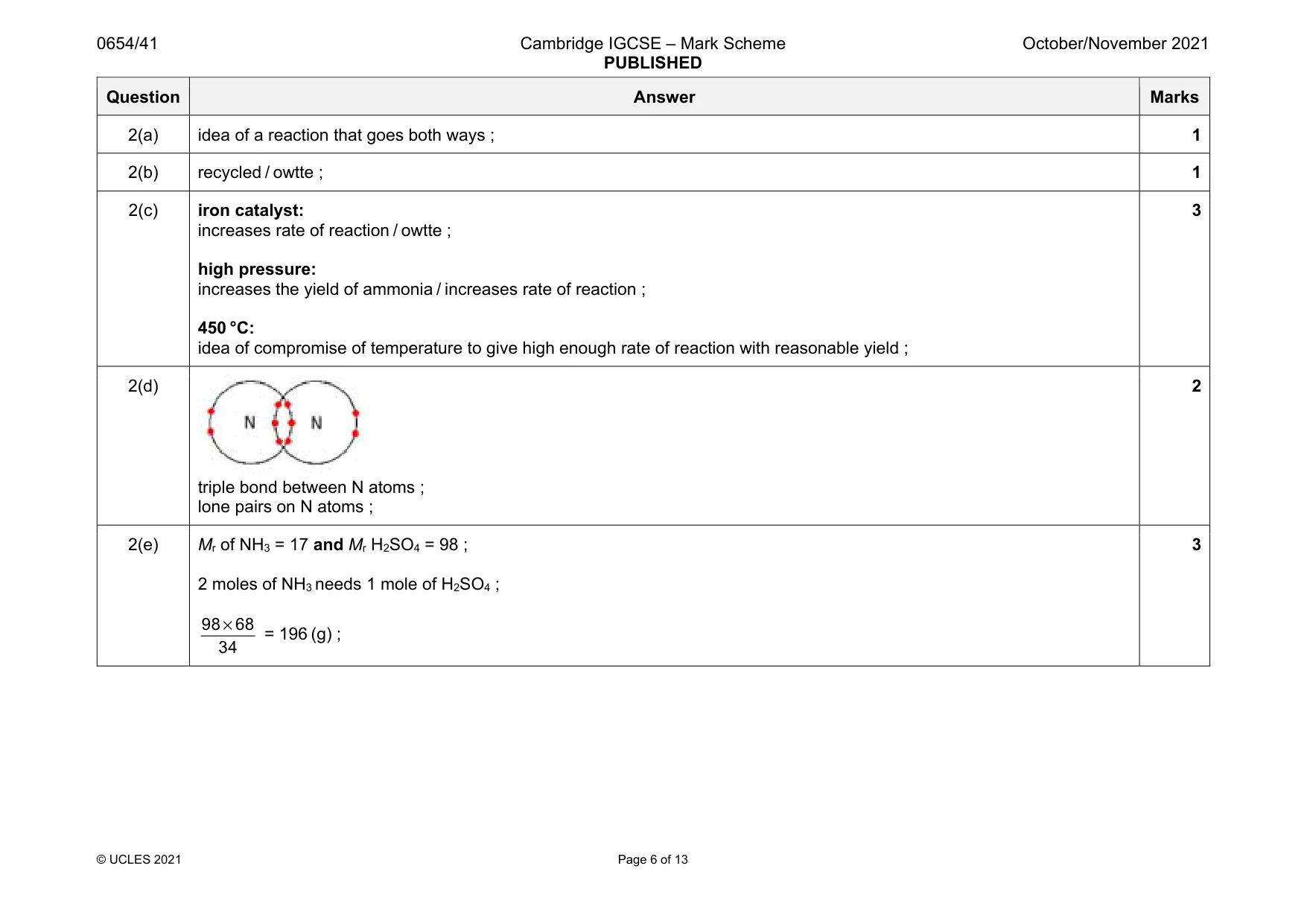
Mark scheme: 2(a) idea of a reaction that goes both ways ; 1 2(b) recycled / owtte ; 1 2(c) iron catalyst: increases rate of reaction / owtte ; high pressure: increases the yield of ammonia / increases rate of reaction ; 450 °C: idea of compromise of temperature to give high enough rate of reaction with reasonable yield ; 3 2(d) triple bond between N atoms ; lone pairs on N atoms ; 2 2(e) Mr of NH3 = 17 and Mr H2SO4 = 98 ; 2 moles of NH3 needs 1 mole of H2SO4 ; 98 68 34 × = 196 (g) ; 3
Q3 · State the speed of electromagnetic waves in a vacuum
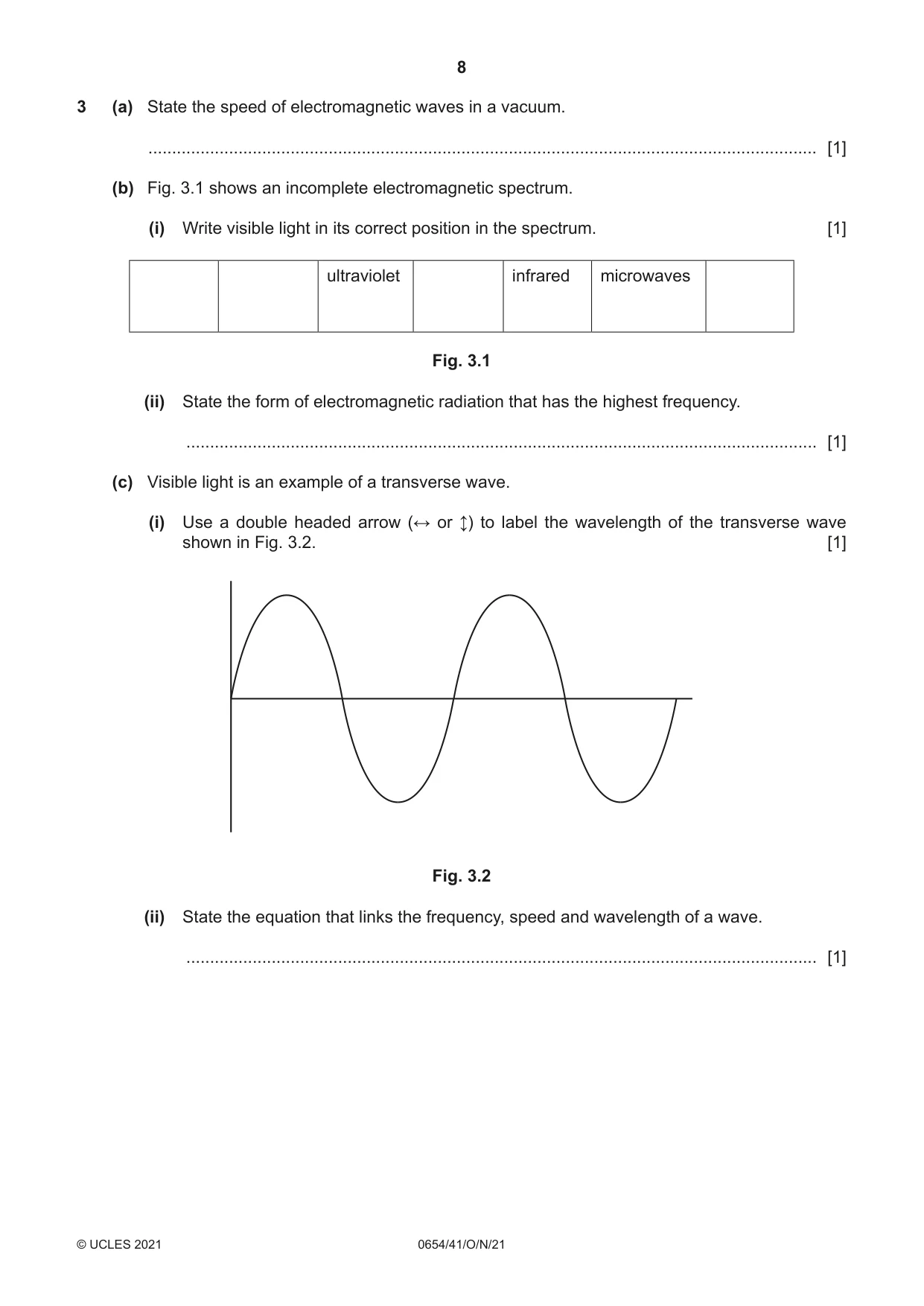
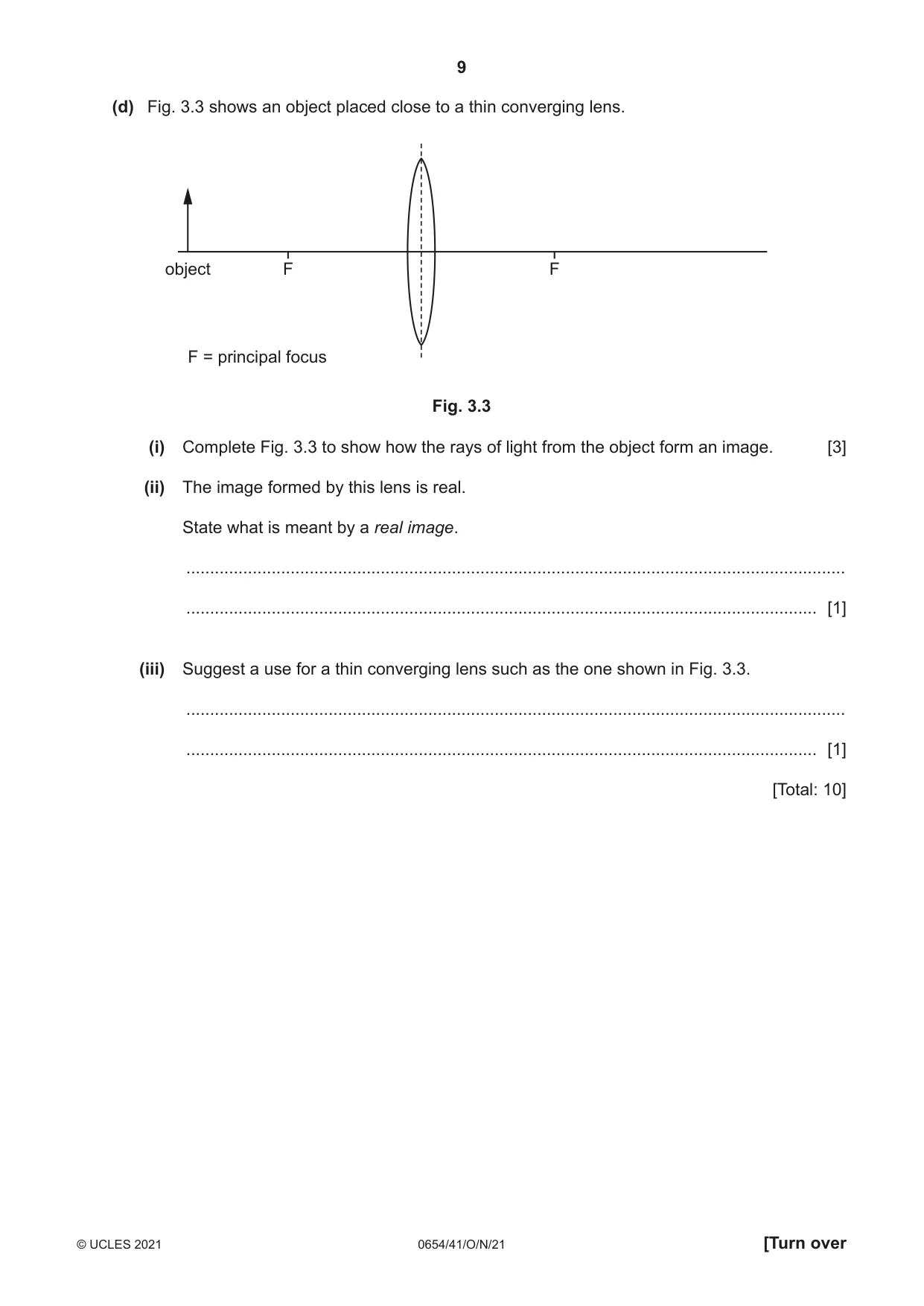
3 (a) State the speed of electromagnetic waves in a vacuum. ............................................................................................................................................. [1] (b) Fig. 3.1 shows an incomplete electromagnetic spectrum. (i) Write visible light in its correct position in the spectrum. [1] ultraviolet infrared microwaves Fig. 3.1 (ii) State the form of electromagnetic radiation that has the highest frequency. ..................................................................................................................................... [1] (c) Visible light is an example of a transverse wave. (i) Use a double headed arrow (↔ or ↕) to label the wavelength of the transverse wave shown in Fig. 3.2. [1] Fig. 3.2 (ii) State the equation that links the frequency, speed and wavelength of a wave. ..................................................................................................................................... [1] (d) Fig. 3.3 shows an object placed close to a thin converging lens. object F F F = principal focus Fig. 3.3 (i) Complete Fig. 3.3 to show how the rays of light from the object form an image. [3] (ii) The image formed by this lens is real. State what is meant by a real image. ........................................................................................................................................... ..................................................................................................................................... [1] (iii) Suggest a use for a thin converging lens such as the one shown in Fig. 3.3. ........................................................................................................................................... ..................................................................................................................................... [1] [Total: 10]
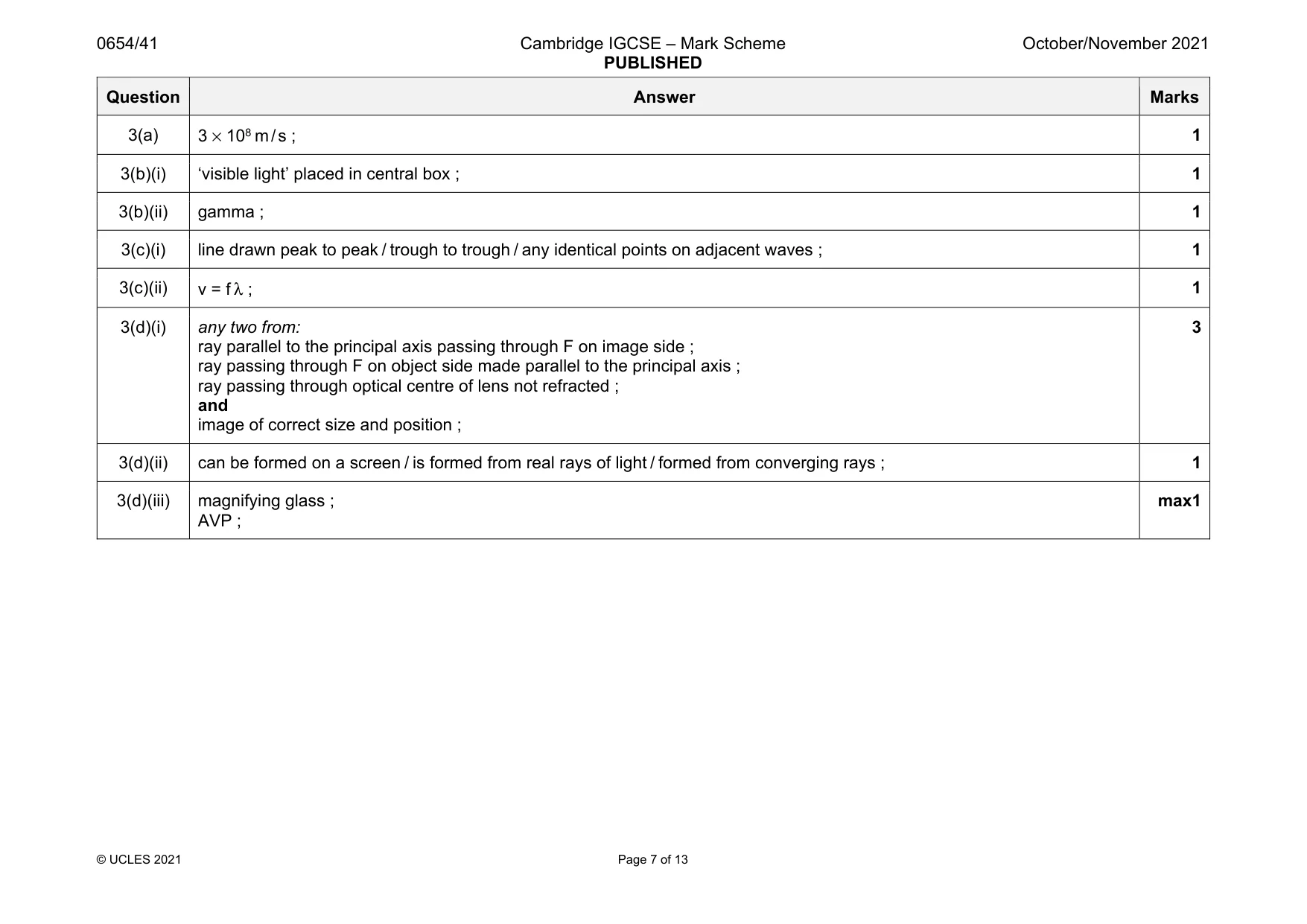
Mark scheme: 3(a) 3 × 10⁸ m / s ; 1 3(b)(i) ‘visible light’ placed in central box ; 1 3(b)(ii) gamma ; 1 3(c)(i) line drawn peak to peak / trough to trough / any identical points on adjacent waves ; 1 3(c)(ii) v = f λ ; 1 3(d)(i) any two from: ray parallel to the principal axis passing through F on image side ; ray passing through F on object side made parallel to the principal axis ; ray passing through optical centre of lens not refracted ; and image of correct size and position ; 3 3(d)(ii) can be formed on a screen / is formed from real rays of light / formed from converging rays ; 1 3(d)(iii) magnifying glass ; AVP ; max1
Q4 · Antibiotics are drugs that are used to kill bacteria
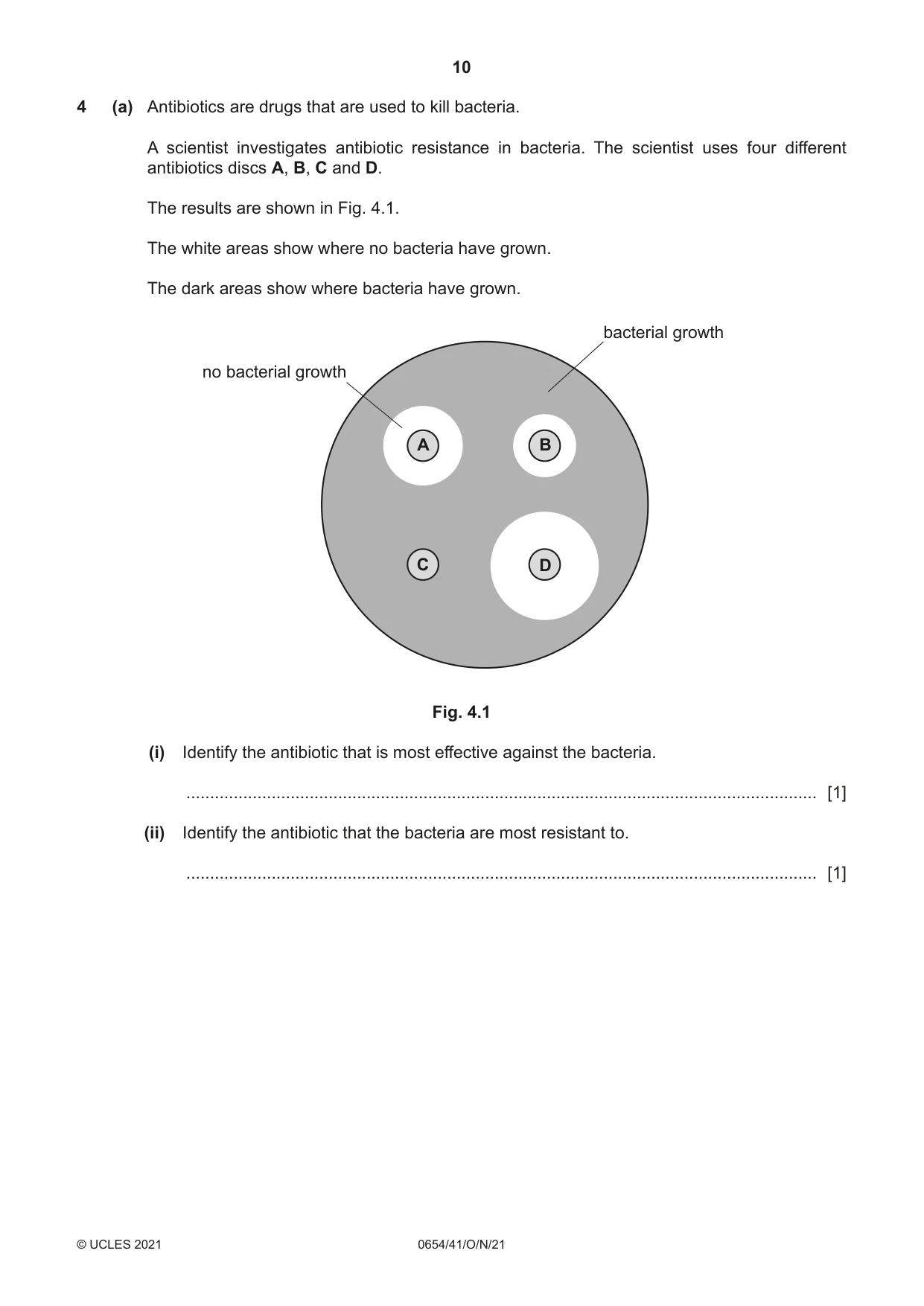
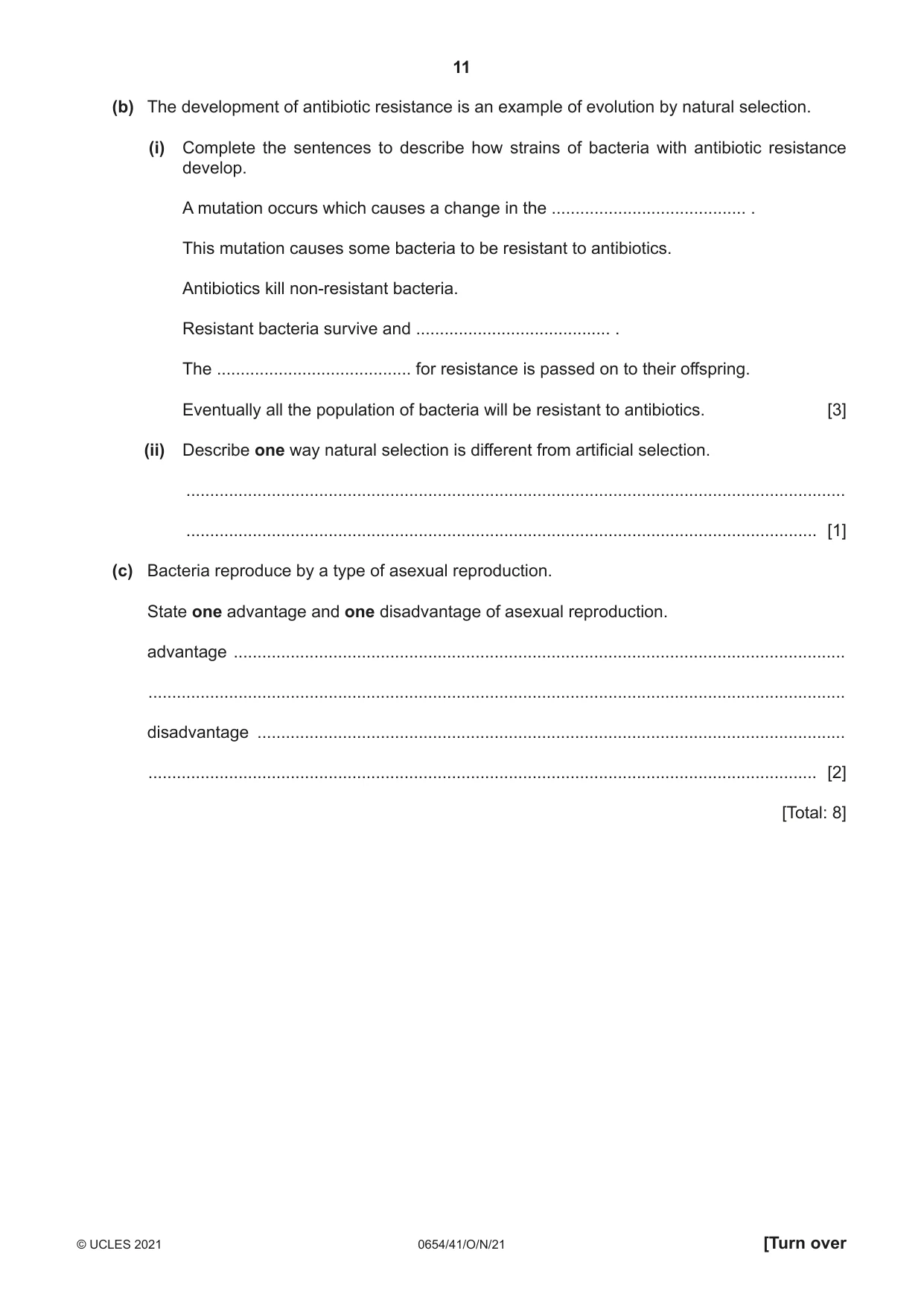
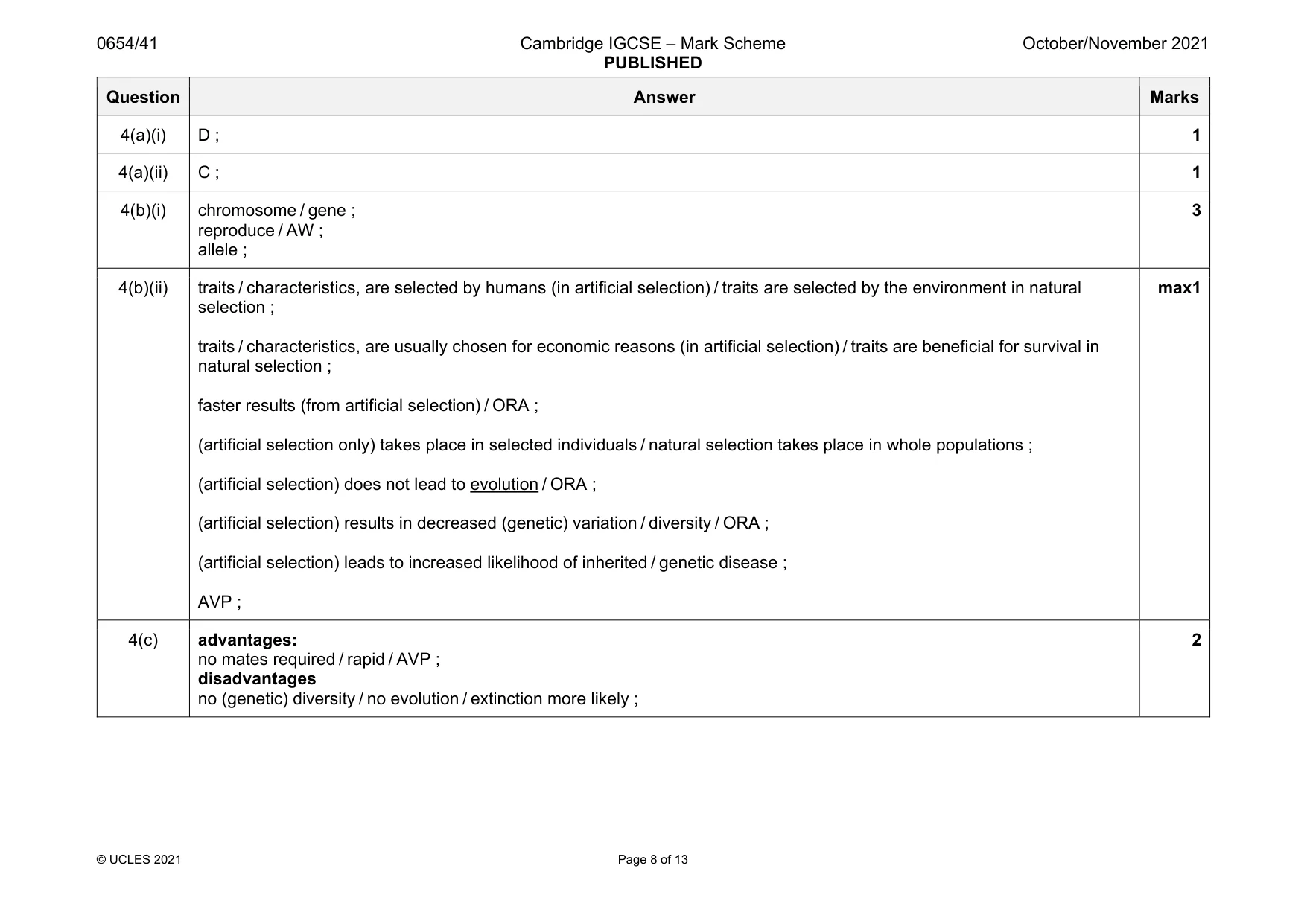
4 (a) Antibiotics are drugs that are used to kill bacteria. A scientist investigates antibiotic resistance in bacteria. The scientist uses four different antibiotics discs A, B, C and D. The results are shown in Fig. 4.1. The white areas show where no bacteria have grown. The dark areas show where bacteria have grown. bacterial growth no bacterial growth A B C D Fig. 4.1 (i) Identify the antibiotic that is most effective against the bacteria. ..................................................................................................................................... [1] (ii) Identify the antibiotic that the bacteria are most resistant to. ..................................................................................................................................... [1] (b) The development of antibiotic resistance is an example of evolution by natural selection. (i) Complete the sentences to describe how strains of bacteria with antibiotic resistance develop. A mutation occurs which causes a change in the ......................................... . This mutation causes some bacteria to be resistant to antibiotics. Antibiotics kill non-resistant bacteria. Resistant bacteria survive and ......................................... . The ......................................... for resistance is passed on to their offspring. Eventually all the population of bacteria will be resistant to antibiotics. [3] (ii) Describe one way natural selection is different from artificial selection. ........................................................................................................................................... ..................................................................................................................................... [1] (c) Bacteria reproduce by a type of asexual reproduction. State one advantage and one disadvantage of asexual reproduction. advantage ................................................................................................................................. ................................................................................................................................................... disadvantage ............................................................................................................................ ............................................................................................................................................. [2] [Total: 8]
Mark scheme: 4(a)(i) D ; 1 4(a)(ii) C ; 1 4(b)(i) chromosome / gene ; reproduce / AW ; allele ; 3 4(b)(ii) traits / characteristics, are selected by humans (in artificial selection) / traits are selected by the environment in natural selection ; traits / characteristics, are usually chosen for economic reasons (in artificial selection) / traits are beneficial for survival in natural selection ; faster results (from artificial selection) / ORA ; (artificial selection only) takes place in selected individuals / natural selection takes place in whole populations ; (artificial selection) does not lead to evolution / ORA ; (artificial selection) results in decreased (genetic) variation / diversity / ORA ; (artificial selection) leads to increased likelihood of inherited / genetic disease ; AVP ; max1 4(c) advantages: no mates required / rapid / AVP ; disadvantages no (genetic) diversity / no evolution / extinction more likely ; 2
Q5 · Magnesium carbonate, MgCO3, reacts with dilute hydrochloric acid, HCl
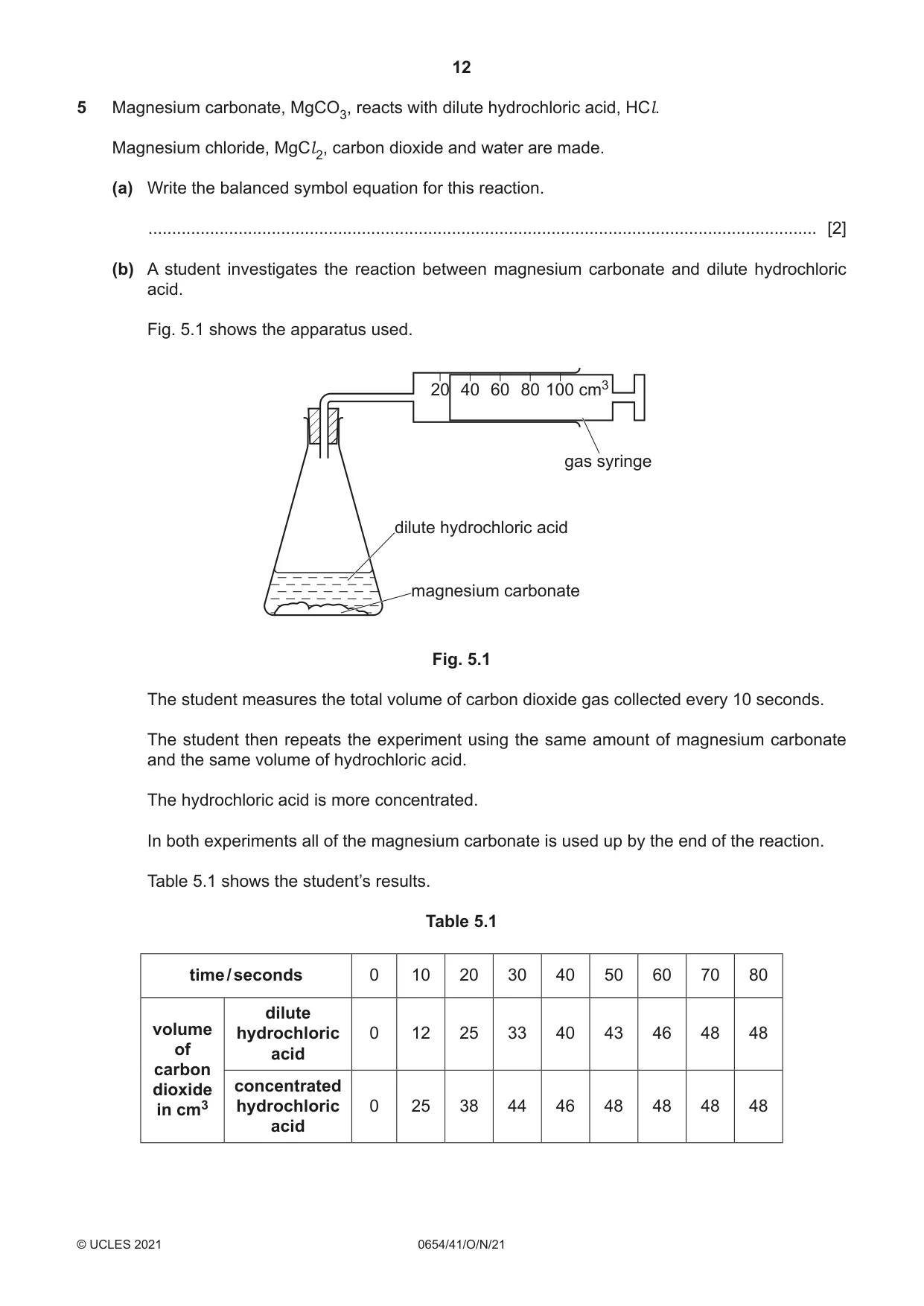
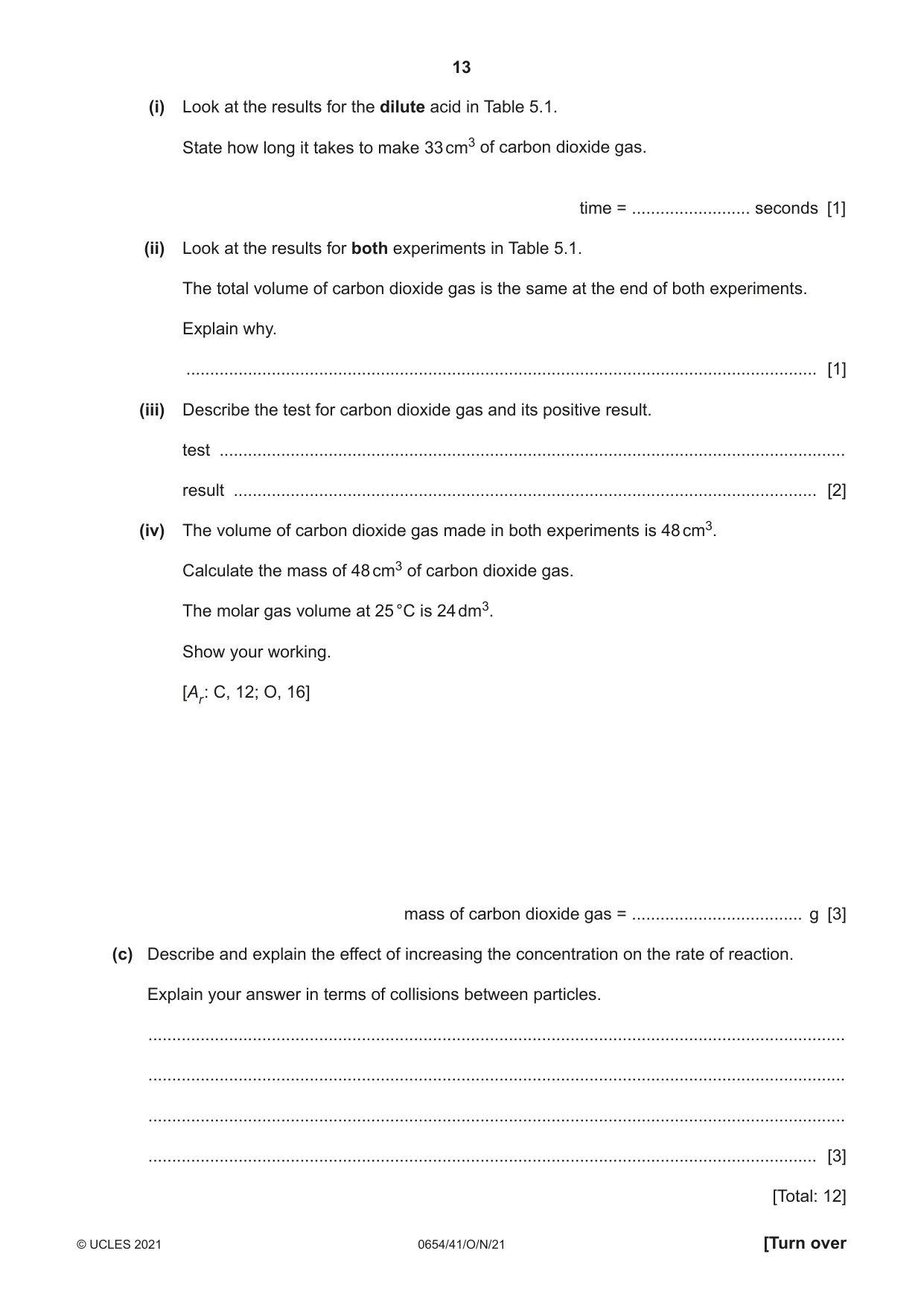
5 Magnesium carbonate, MgCO3, reacts with dilute hydrochloric acid, HCl. Magnesium chloride, MgCl 2, carbon dioxide and water are made. (a) Write the balanced symbol equation for this reaction. ............................................................................................................................................. [2] (b) A student investigates the reaction between magnesium carbonate and dilute hydrochloric acid. Fig. 5.1 shows the apparatus used. 20 40 60 80 100 cm3 gas syringe dilute hydrochloric acid magnesium carbonate Fig. 5.1 The student measures the total volume of carbon dioxide gas collected every 10 seconds. The student then repeats the experiment using the same amount of magnesium carbonate and the same volume of hydrochloric acid. The hydrochloric acid is more concentrated. In both experiments all of the magnesium carbonate is used up by the end of the reaction. Table 5.1 shows the student’s results. Table 5.1 time / seconds 0 10 20 30 40 50 60 70 80 dilute volume hydrochloric 0 12 25 33 40 43 46 48 48 of acid carbon dioxide concentrated in cm3 hydrochloric 0 25 38 44 46 48 48 48 48 acid (i) Look at the results for the dilute acid in Table 5.1. State how long it takes to make 33 cm3 of carbon dioxide gas. time = ......................... seconds [1] (ii) Look at the results for both experiments in Table 5.1. The total volume of carbon dioxide gas is the same at the end of both experiments. Explain why. ..................................................................................................................................... [1] (iii) Describe the test for carbon dioxide gas and its positive result. test .................................................................................................................................... result ........................................................................................................................... [2] (iv) The volume of carbon dioxide gas made in both experiments is 48 cm3. Calculate the mass of 48 cm3 of carbon dioxide gas. The molar gas volume at 25 °C is 24 dm3. Show your working. [Ar : C, 12; O, 16] mass of carbon dioxide gas = .................................... g [3] (c) Describe and explain the effect of increasing the concentration on the rate of reaction. Explain your answer in terms of collisions between particles. ................................................................................................................................................... ................................................................................................................................................... ................................................................................................................................................... ............................................................................................................................................. [3] [Total: 12]
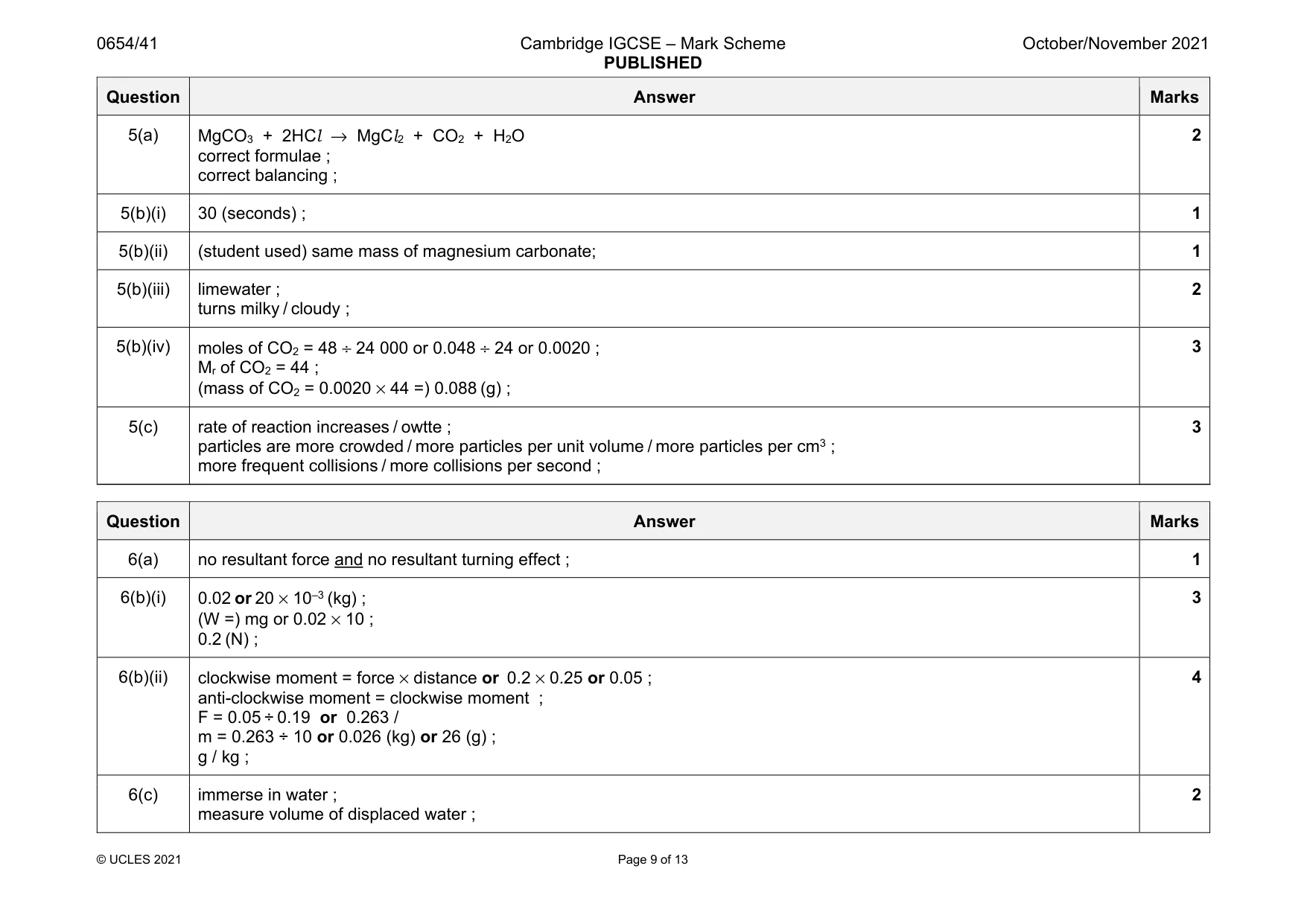
Mark scheme: 5(a) MgCO3 + 2HCl → MgCl2 + CO2 + H2O correct formulae ; correct balancing ; 2 5(b)(i) 30 (seconds) ; 1 5(b)(ii) (student used) same mass of magnesium carbonate; 1 5(b)(iii) limewater ; turns milky / cloudy ; 2 5(b)(iv) moles of CO2 = 48 ÷ 24 000 or 0.048 ÷ 24 or 0.0020 ; Mr of CO2 = 44 ; (mass of CO2 = 0.0020 × 44 =) 0.088 (g) ; 3 5(c) rate of reaction increases / owtte ; particles are more crowded / more particles per unit volume / more particles per cm3 ; more frequent collisions / more collisions per second ; 3
Q6 · Some students are investigating moments and turning effects
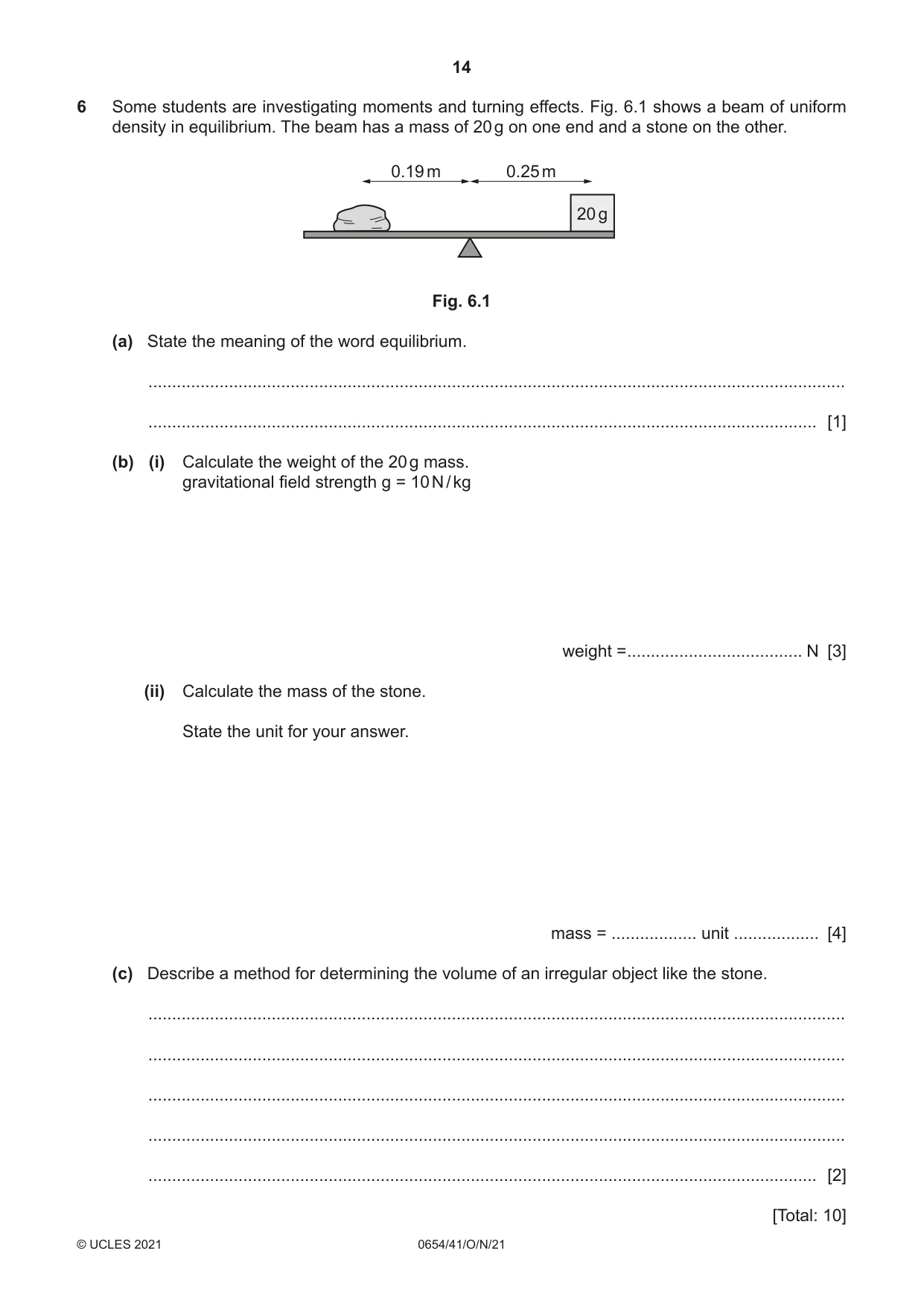
6 Some students are investigating moments and turning effects. Fig. 6.1 shows a beam of uniform density in equilibrium. The beam has a mass of 20 g on one end and a stone on the other. 0.19 m 0.25 m 20 g Fig. 6.1 (a) State the meaning of the word equilibrium. ................................................................................................................................................... ............................................................................................................................................. [1] (b) (i) Calculate the weight of the 20 g mass. gravitational field strength g = 10 N / kg weight = ..................................... N [3] (ii) Calculate the mass of the stone. State the unit for your answer. mass = .................. unit .................. [4] (c) Describe a method for determining the volume of an irregular object like the stone. ................................................................................................................................................... ................................................................................................................................................... ................................................................................................................................................... ................................................................................................................................................... ............................................................................................................................................. [2] [Total: 10]
Mark scheme: 6(a) no resultant force and no resultant turning effect ; 1 6(b)(i) 0.02 or 20 × 10–3 (kg) ; (W =) mg or 0.02 × 10 ; 0.2 (N) ; 3 6(b)(ii) clockwise moment = force × distance or 0.2 × 0.25 or 0.05 ; anti-clockwise moment = clockwise moment ; F = 0.05 ÷ 0.19 or 0.263 / m = 0.263 ÷ 10 or 0.026 (kg) or 26 (g) ; g / kg ; 4 6(c) immerse in water ; measure volume of displaced water ; 2
Q7 · A diagram of a villus
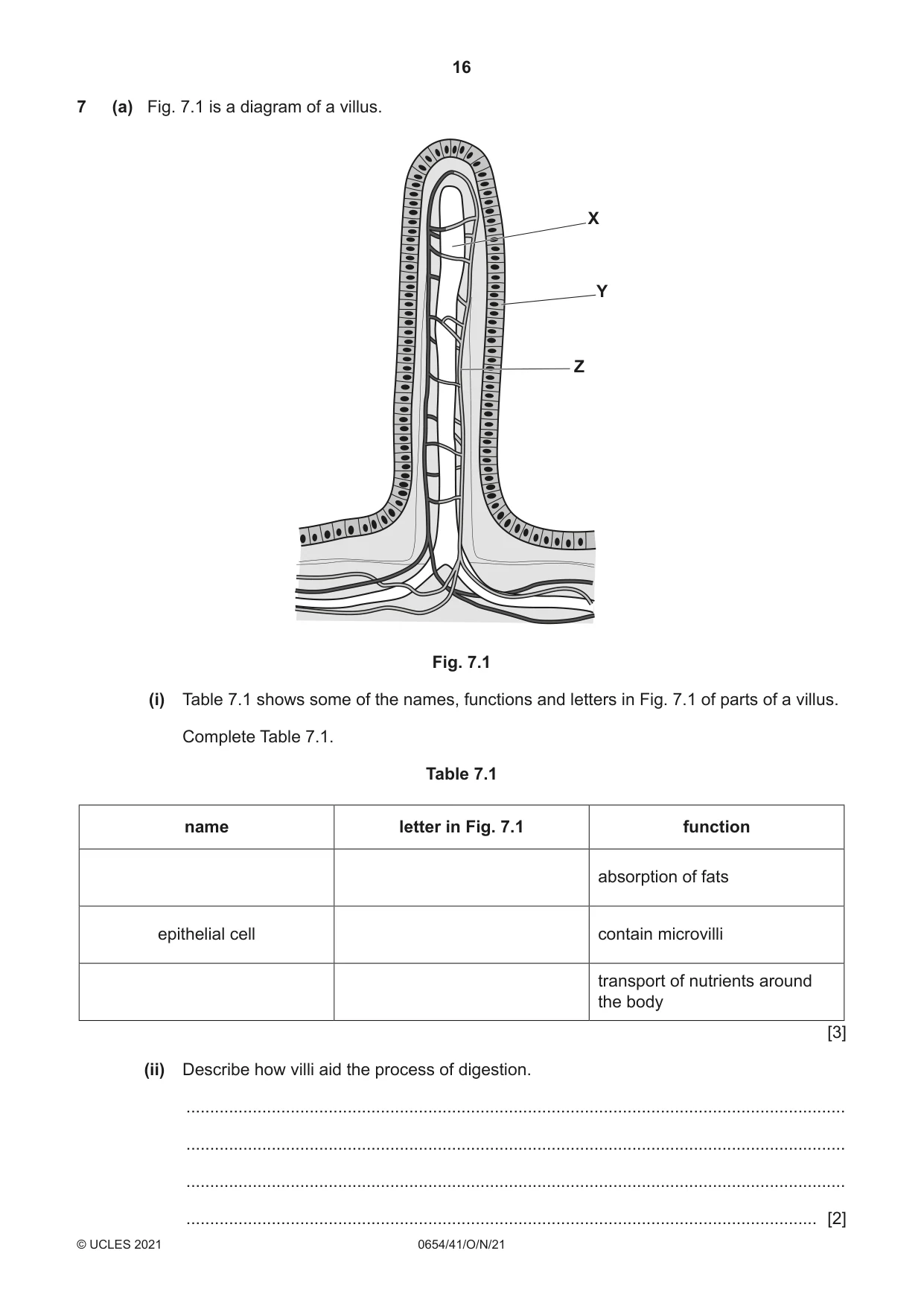
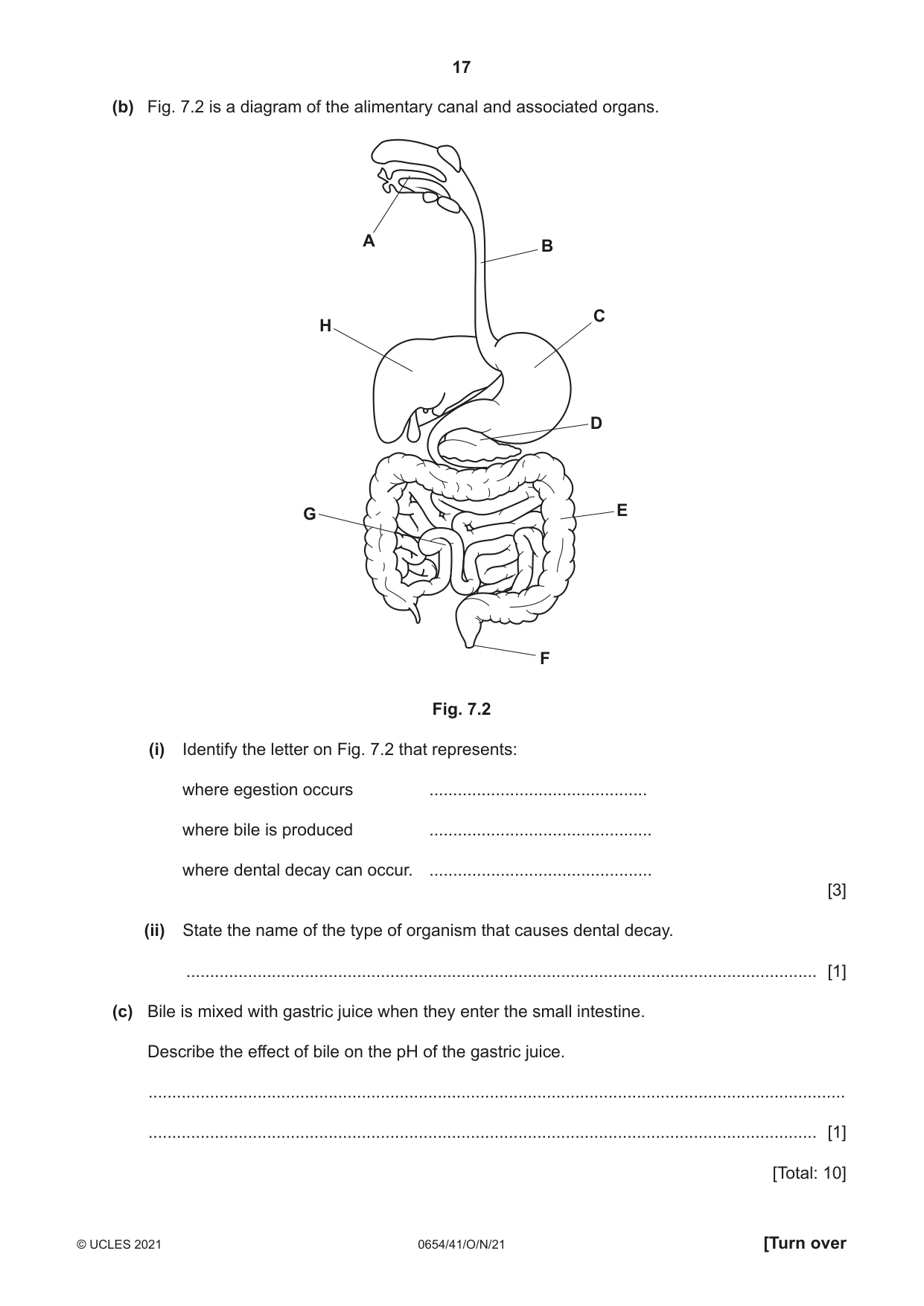
7 (a) Fig. 7.1 is a diagram of a villus. X Y Z Fig. 7.1 (i) Table 7.1 shows some of the names, functions and letters in Fig. 7.1 of parts of a villus. Complete Table 7.1. Table 7.1 name letter in Fig. 7.1 function absorption of fats epithelial cell contain microvilli transport of nutrients around the body [3] (ii) Describe how villi aid the process of digestion. ........................................................................................................................................... ........................................................................................................................................... ........................................................................................................................................... ..................................................................................................................................... [2] (b) Fig. 7.2 is a diagram of the alimentary canal and associated organs. A B C H D G E F Fig. 7.2 (i) Identify the letter on Fig. 7.2 that represents: where egestion occurs .............................................. where bile is produced ............................................... where dental decay can occur. ............................................... [3] (ii) State the name of the type of organism that causes dental decay. ..................................................................................................................................... [1] (c) Bile is mixed with gastric juice when they enter the small intestine. Describe the effect of bile on the pH of the gastric juice. ................................................................................................................................................... ............................................................................................................................................. [1] [Total: 10]
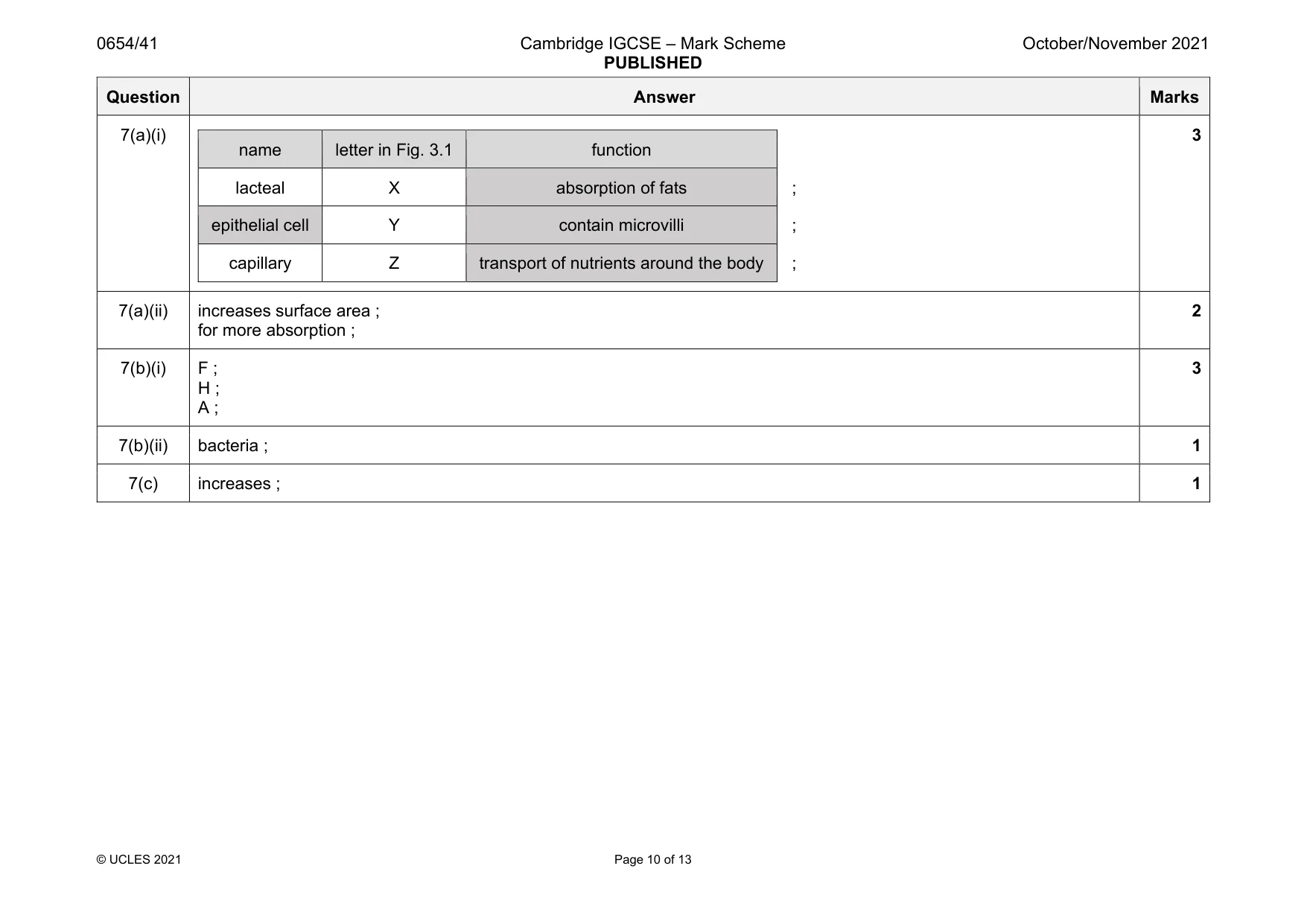
Mark scheme: 7(a)(i) name letter in Fig. 3.1 function lacteal X absorption of fats ; epithelial cell Y contain microvilli ; capillary Z transport of nutrients around the body ; 3 7(a)(ii) increases surface area ; for more absorption ; 2 7(b)(i) F ; H ; A ; 3 7(b)(ii) bacteria ; 1 7(c) increases ; 1
Q8 · The apparatus that is used to electrolyse concentrated aqueous sodium chloride
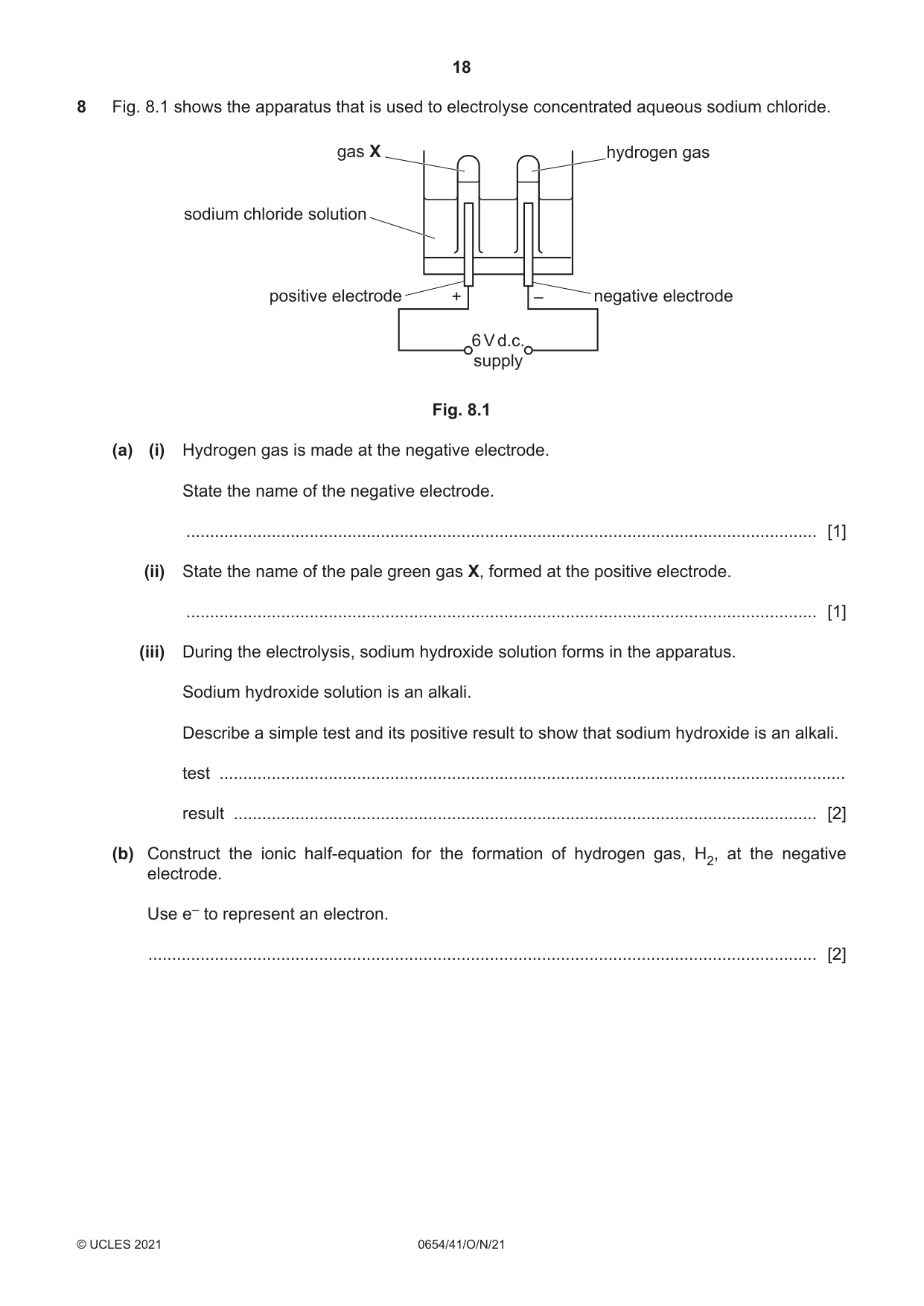
8 Fig. 8.1 shows the apparatus that is used to electrolyse concentrated aqueous sodium chloride. gas X hydrogen gas sodium chloride solution positive electrode + – negative electrode 6 V d.c. supply Fig. 8.1 (a) (i) Hydrogen gas is made at the negative electrode. State the name of the negative electrode. ..................................................................................................................................... [1] (ii) State the name of the pale green gas X, formed at the positive electrode. ..................................................................................................................................... [1] (iii) During the electrolysis, sodium hydroxide solution forms in the apparatus. Sodium hydroxide solution is an alkali. Describe a simple test and its positive result to show that sodium hydroxide is an alkali. test .................................................................................................................................... result ........................................................................................................................... [2] (b) Construct the ionic half-equation for the formation of hydrogen gas, H2, at the negative electrode. Use e– to represent an electron. ............................................................................................................................................. [2] (c) Hydrogen gas, H2, has a boiling point of −253 °C. Sodium chloride, NaCl, has a boiling point of 1465 °C. Explain the difference in these boiling points in terms of attractive forces. ................................................................................................................................................... ................................................................................................................................................... ................................................................................................................................................... ............................................................................................................................................. [3] [Total: 9]
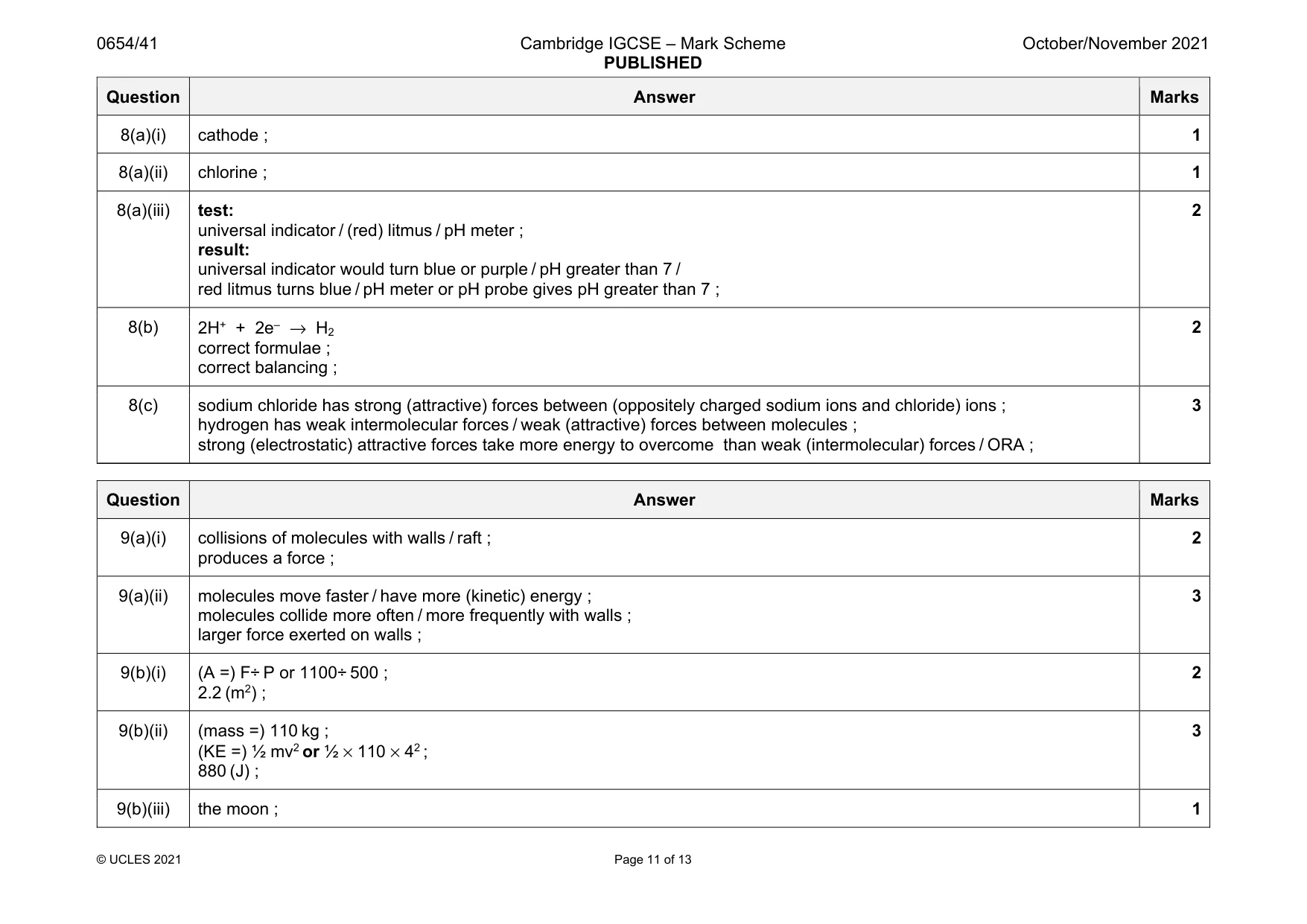
Mark scheme: 8(a)(i) cathode ; 1 8(a)(ii) chlorine ; 1 8(a)(iii) test: universal indicator / (red) litmus / pH meter ; result: universal indicator would turn blue or purple / pH greater than 7 / red litmus turns blue / pH meter or pH probe gives pH greater than 7 ; 2 8(b) 2H+ + 2e– → H2 correct formulae ; correct balancing ; 2 8(c) sodium chloride has strong (attractive) forces between (oppositely charged sodium ions and chloride) ions ; hydrogen has weak intermolecular forces / weak (attractive) forces between molecules ; strong (electrostatic) attractive forces take more energy to overcome than weak (intermolecular) forces / ORA ; 3
Q9 · A person sitting in an inflatable raft
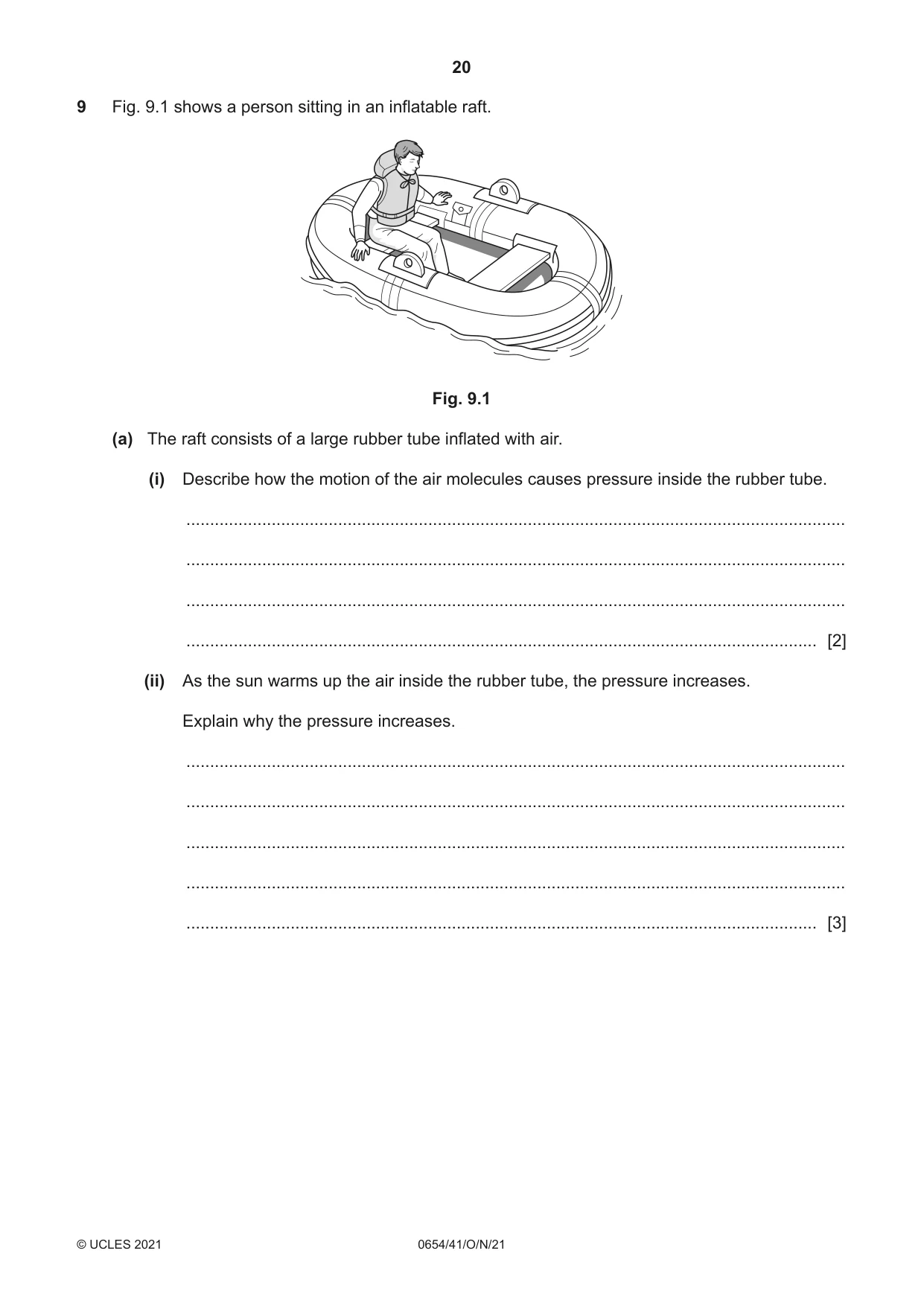
9 Fig. 9.1 shows a person sitting in an inflatable raft. Fig. 9.1 (a) The raft consists of a large rubber tube inflated with air. (i) Describe how the motion of the air molecules causes pressure inside the rubber tube. ........................................................................................................................................... ........................................................................................................................................... ........................................................................................................................................... ..................................................................................................................................... [2] (ii) As the sun warms up the air inside the rubber tube, the pressure increases. Explain why the pressure increases. ........................................................................................................................................... ........................................................................................................................................... ........................................................................................................................................... ........................................................................................................................................... ..................................................................................................................................... [3] (b) The combined weight of the raft and the person is 1100 N. The raft exerts a pressure of 500 Pa on the surface of the water. (i) Calculate the area of raft in contact with the water. area = .................................. m2 [2] (ii) The tide causes the raft to move at a speed of 4.0 m / s. Calculate the kinetic energy of the raft and the person. gravitational field strength g = 10 N / kg kinetic energy = ..................................... J [3] (iii) State what causes tides. ..................................................................................................................................... [1] [Total: 11]
Mark scheme: 9(a)(i) collisions of molecules with walls / raft ; produces a force ; 2 9(a)(ii) molecules move faster / have more (kinetic) energy ; molecules collide more often / more frequently with walls ; larger force exerted on walls ; 3 9(b)(i) (A =) F÷ P or 1100÷ 500 ; 2.2 (m2) ; 2 9(b)(ii) (mass =) 110 kg ; (KE =) ½ mv2 or ½ × 110 × 42 ; 880 (J) ; 3 9(b)(iii) the moon ; 1
Q10 · Hormones control blood glucose concentration
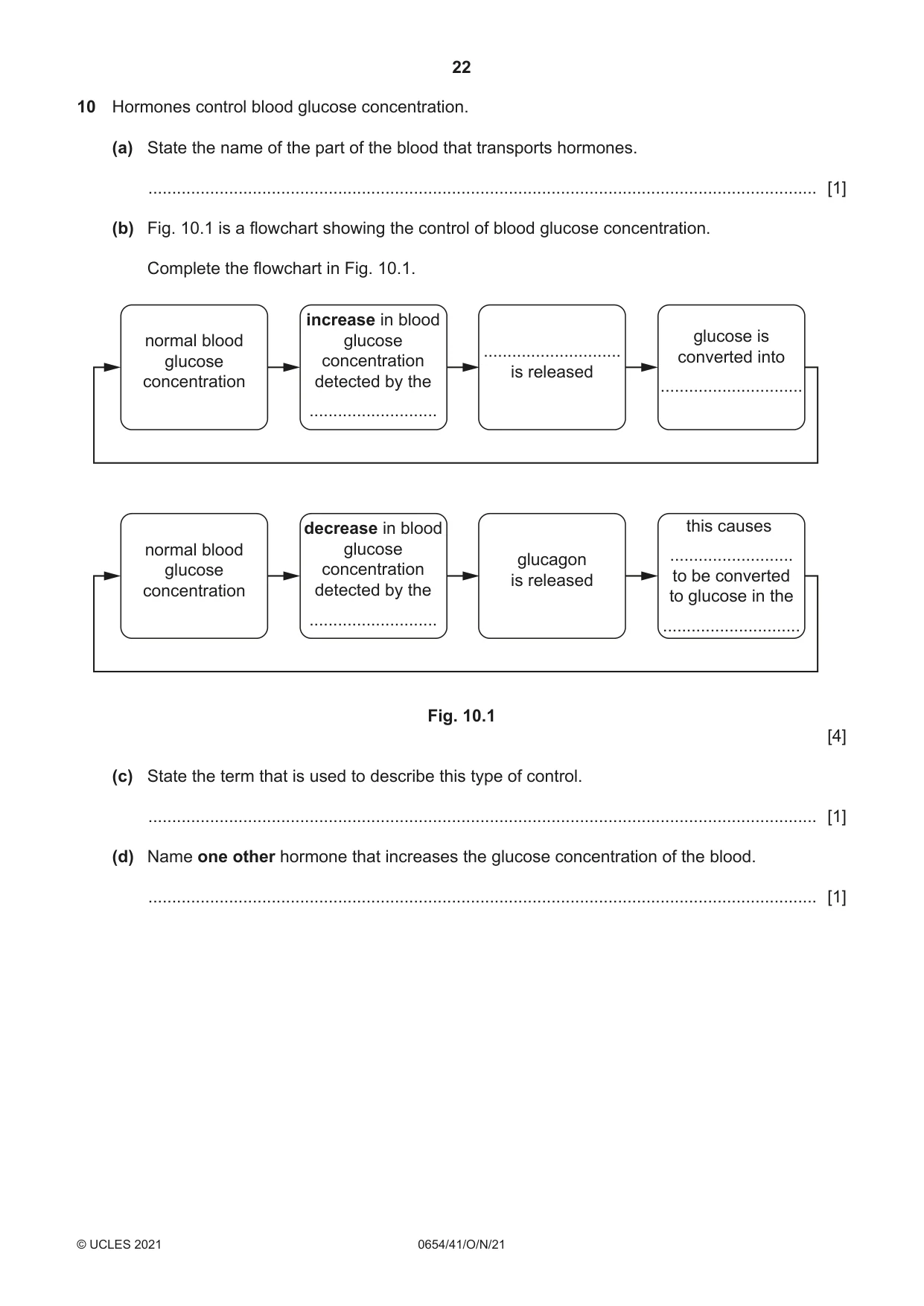
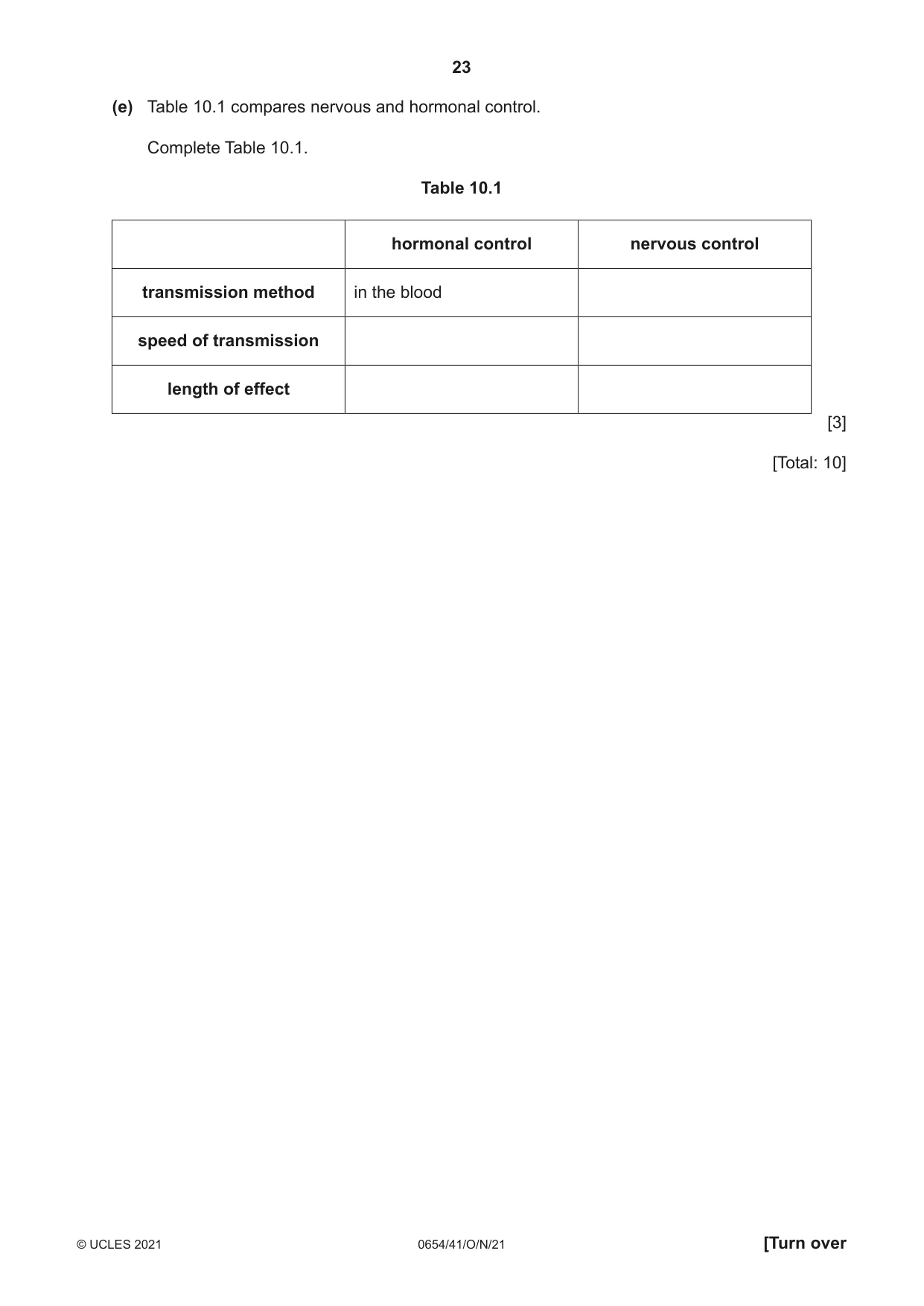
10 Hormones control blood glucose concentration. (a) State the name of the part of the blood that transports hormones. ............................................................................................................................................. [1] (b) Fig. 10.1 is a flowchart showing the control of blood glucose concentration. Complete the flowchart in Fig. 10.1. increase in blood normal blood glucose glucose is ............................. glucose concentration converted into is released concentration detected by the .............................. ........................... decrease in blood this causes normal blood glucose glucagon .......................... glucose concentration is released to be converted concentration detected by the to glucose in the ........................... ............................. Fig. 10.1 [4] (c) State the term that is used to describe this type of control. ............................................................................................................................................. [1] (d) Name one other hormone that increases the glucose concentration of the blood. ............................................................................................................................................. [1] (e) Table 10.1 compares nervous and hormonal control. Complete Table 10.1. Table 10.1 hormonal control nervous control transmission method in the blood speed of transmission length of effect [3] [Total: 10]
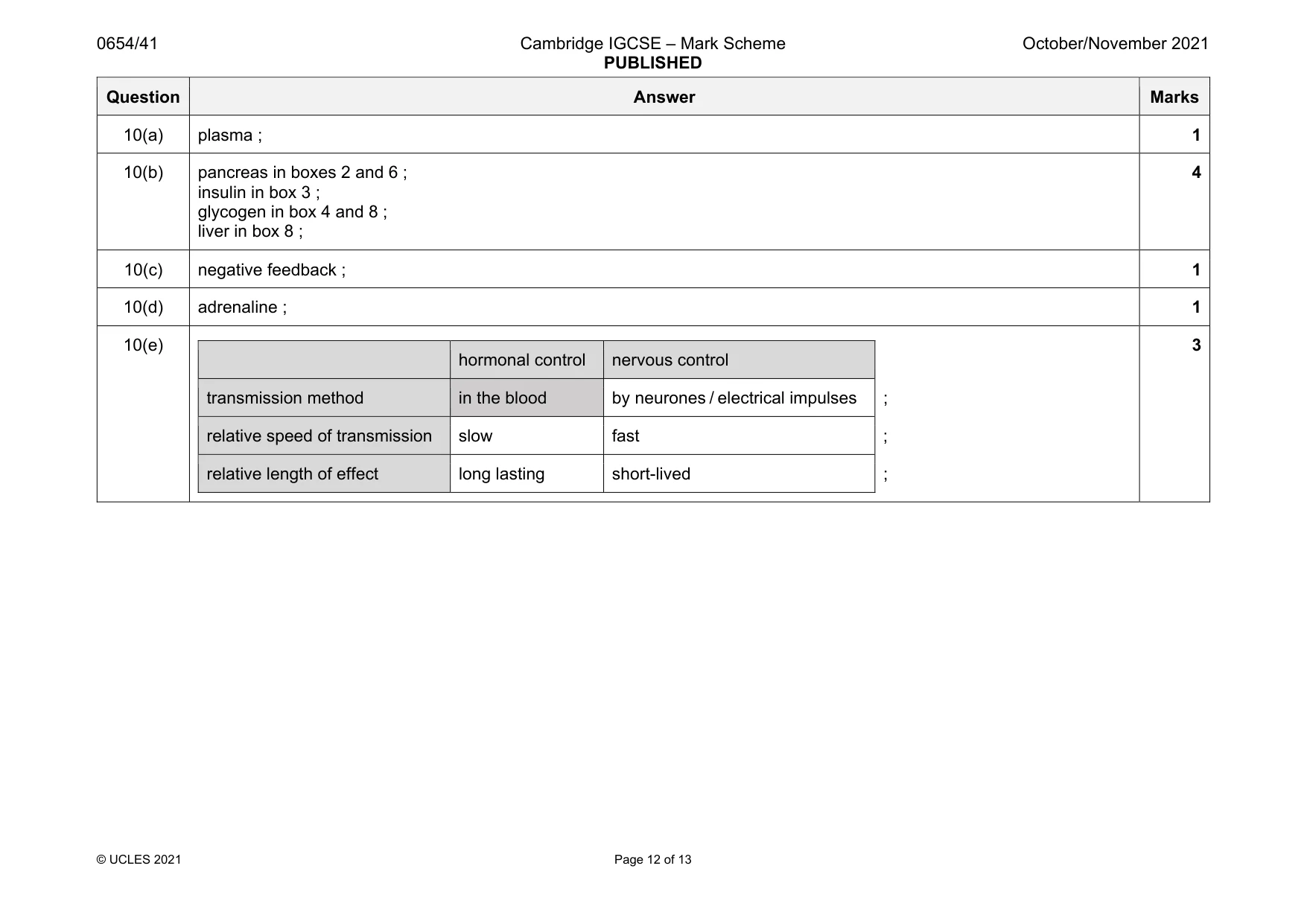
Mark scheme: 10(a) plasma ; 1 10(b) pancreas in boxes 2 and 6 ; insulin in box 3 ; glycogen in box 4 and 8 ; liver in box 8 ; 4 10(c) negative feedback ; 1 10(d) adrenaline ; 1 10(e) hormonal control nervous control transmission method in the blood by neurones / electrical impulses ; relative speed of transmission slow fast ; relative length of effect long lasting short-lived ; 3
Q11 · This is the information given on the Periodic Table about an atom of iron
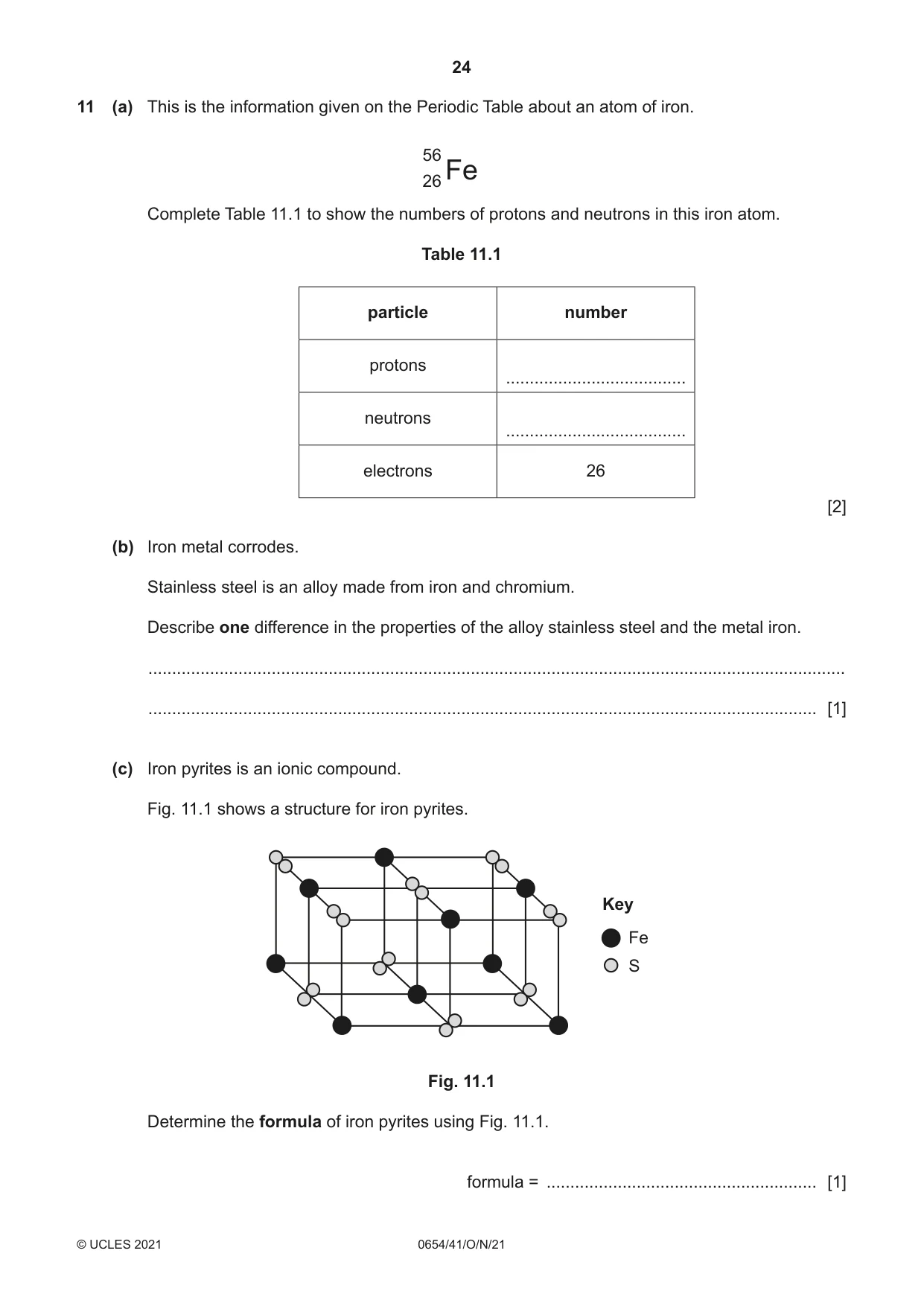
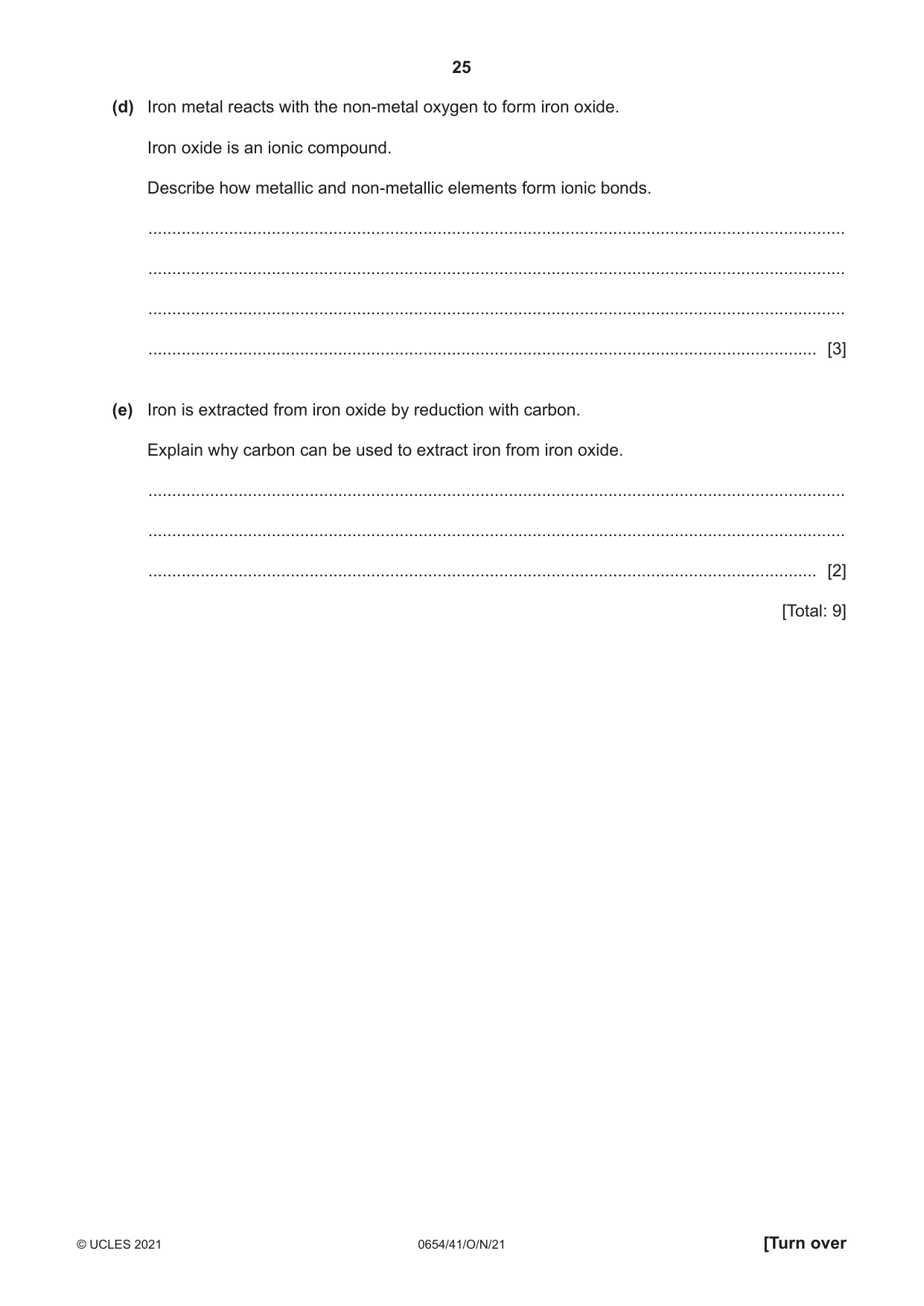
11 (a) This is the information given on the Periodic Table about an atom of iron. 56 26 Fe Complete Table 11.1 to show the numbers of protons and neutrons in this iron atom. Table 11.1 particle number protons ...................................... neutrons ...................................... electrons 26 [2] (b) Iron metal corrodes. Stainless steel is an alloy made from iron and chromium. Describe one difference in the properties of the alloy stainless steel and the metal iron. ................................................................................................................................................... ............................................................................................................................................. [1] (c) Iron pyrites is an ionic compound. Fig. 11.1 shows a structure for iron pyrites. Key Fe S Fig. 11.1 Determine the formula of iron pyrites using Fig. 11.1. formula = ......................................................... [1] (d) Iron metal reacts with the non-metal oxygen to form iron oxide. Iron oxide is an ionic compound. Describe how metallic and non-metallic elements form ionic bonds. ................................................................................................................................................... ................................................................................................................................................... ................................................................................................................................................... ............................................................................................................................................. [3] (e) Iron is extracted from iron oxide by reduction with carbon. Explain why carbon can be used to extract iron from iron oxide. ................................................................................................................................................... ................................................................................................................................................... ............................................................................................................................................. [2] [Total: 9]
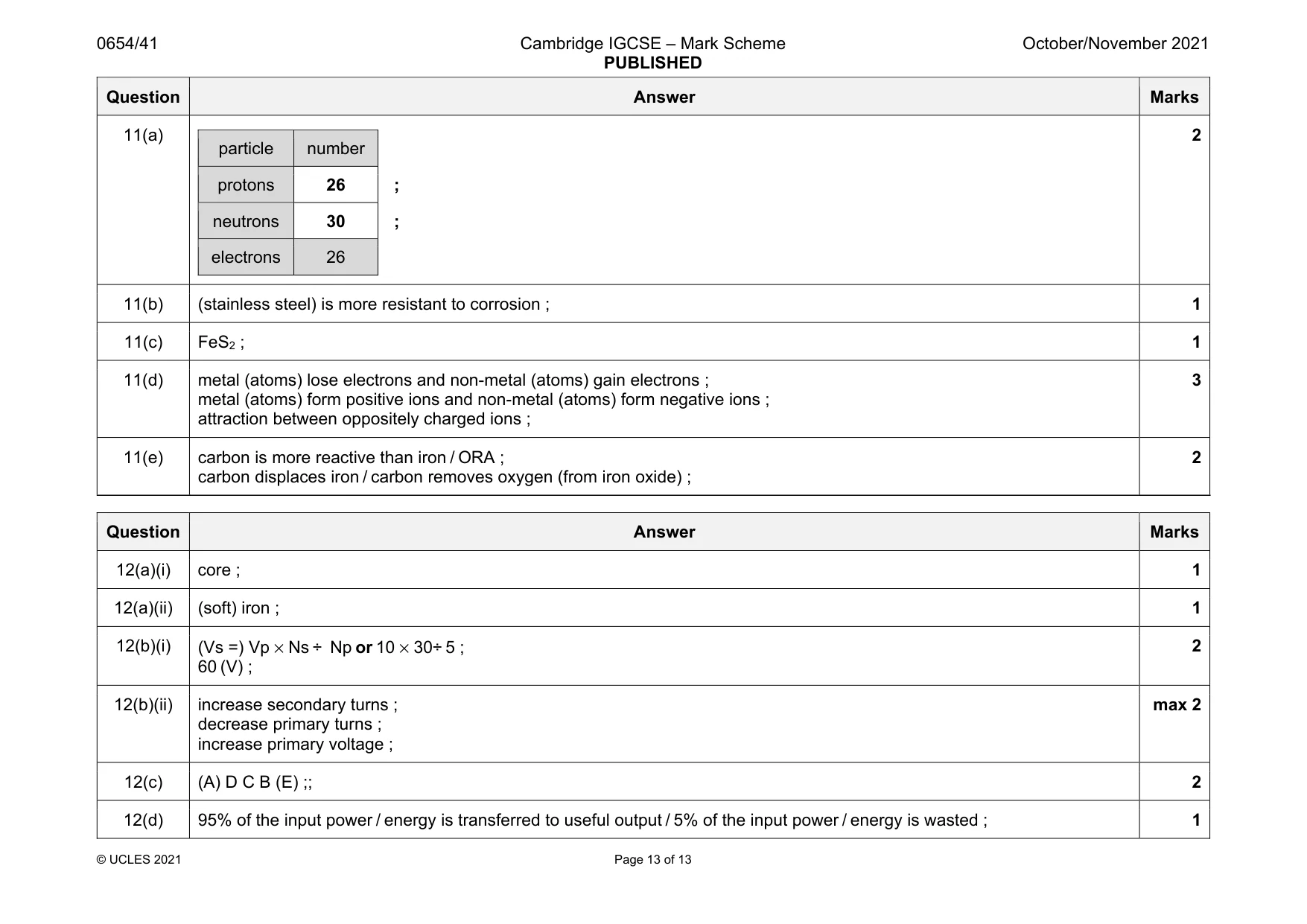
Mark scheme: 11(a) particle number protons 26 ; neutrons 30 ; electrons 26 2 11(b) (stainless steel) is more resistant to corrosion ; 1 11(c) FeS2 ; 1 11(d) metal (atoms) lose electrons and non-metal (atoms) gain electrons ; metal (atoms) form positive ions and non-metal (atoms) form negative ions ; attraction between oppositely charged ions ; 3 11(e) carbon is more reactive than iron / ORA ; carbon displaces iron / carbon removes oxygen (from iron oxide) ; 2
Question 12
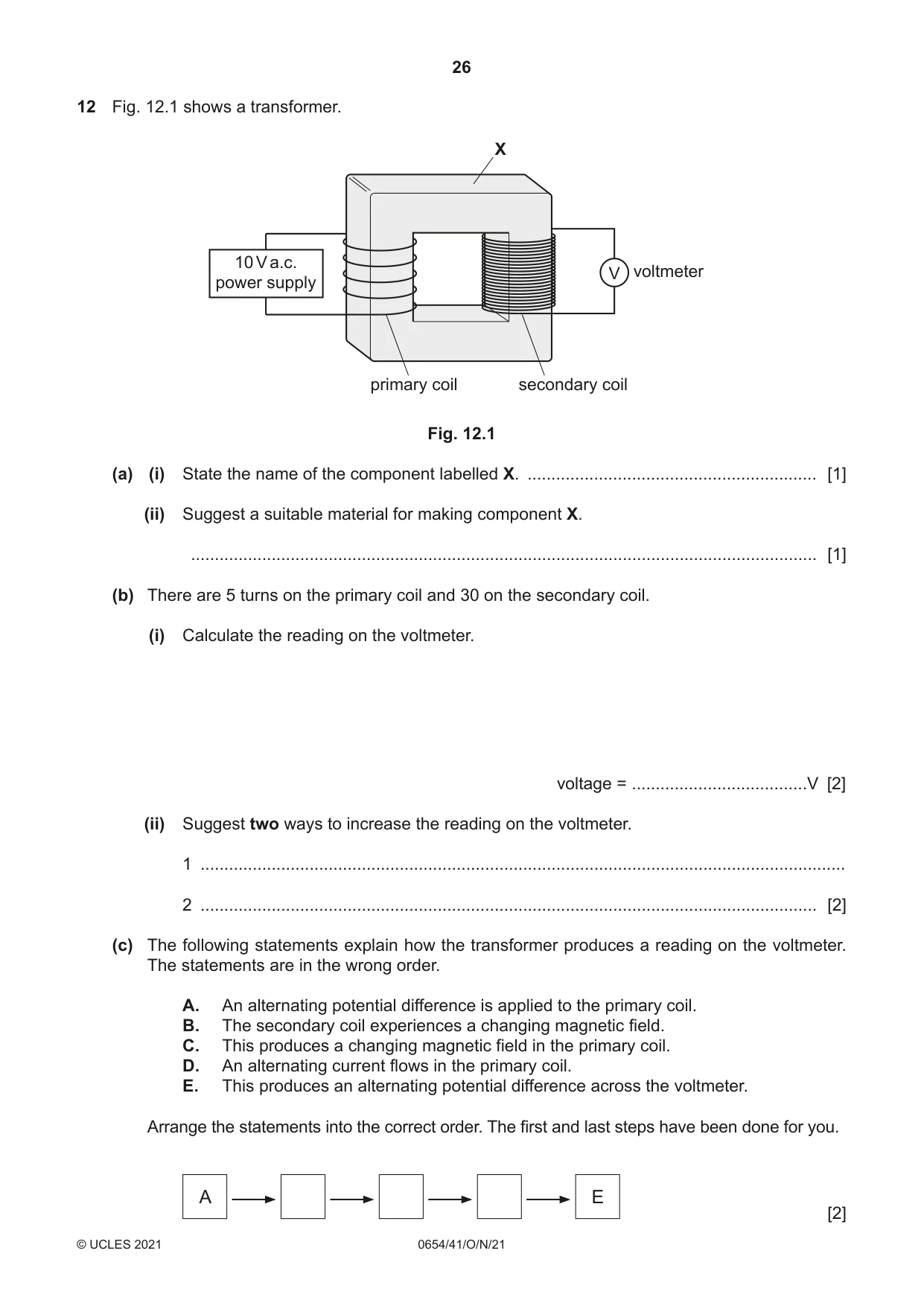
12 Fig. 12.1 shows a transformer. X 10 V a.c. V voltmeter power supply primary coil secondary coil Fig. 12.1 (a) (i) State the name of the component labelled X. ............................................................. [1] (ii) Suggest a suitable material for making component X. .................................................................................................................................... [1] (b) There are 5 turns on the primary coil and 30 on the secondary coil. (i) Calculate the reading on the voltmeter. voltage = .....................................V [2] (ii) Suggest two ways to increase the reading on the voltmeter. 1 ........................................................................................................................................ 2 .................................................................................................................................. [2] (c) The following statements explain how the transformer produces a reading on the voltmeter. The statements are in the wrong order. A. An alternating potential difference is applied to the primary coil. B. The secondary coil experiences a changing magnetic field. C. This produces a changing magnetic field in the primary coil. D. An alternating current flows in the primary coil. E. This produces an alternating potential difference across the voltmeter. Arrange the statements into the correct order. The first and last steps have been done for you. A E [2] (d) The transformer has an efficiency of 95%. Describe what is meant by an efficiency of 95%. ................................................................................................................................................... ...............................................................................................................................................[1] [Total: 9]
Mark scheme: 12(a)(i) core ; 1 12(a)(ii) (soft) iron ; 1 12(b)(i) (Vs =) Vp × Ns ÷ Np or 10 × 30÷ 5 ; 60 (V) ; 2 12(b)(ii) increase secondary turns ; decrease primary turns ; increase primary voltage ; max 2 12(c) (A) D C B (E) ;; 2 12(d) 95% of the input power / energy is transferred to useful output / 5% of the input power / energy is wasted ; 1
What was in this paper
The subtopics covered by these 12 questions, and how many questions each got. Open one in a new tab to see every Cambridge question on it.
What you needed in this session
Cambridge’s own grade thresholds for 2021 Oct/Nov, Paper 4 · Variant 1. A higher threshold means an easier paper — the bar moves with how the cohort did.