Questions as text
Q1 · Which substances react to produce a mixture of an element and a compound? 0653/22 Oct/Nov 2017
16 Which substances react to produce a mixture of an element and a compound? A copper oxide and carbon B hydrochloric acid and sodium carbonate C hydrogen and oxygen D nitric acid and sodium hydroxide
1 marks
Answer: A
This question in 0653/22 Oct/Nov 2017
Q2 · Magnesium, magnesium oxide and magnesium carbonate are insoluble in water 0653/22 Feb/March 2018
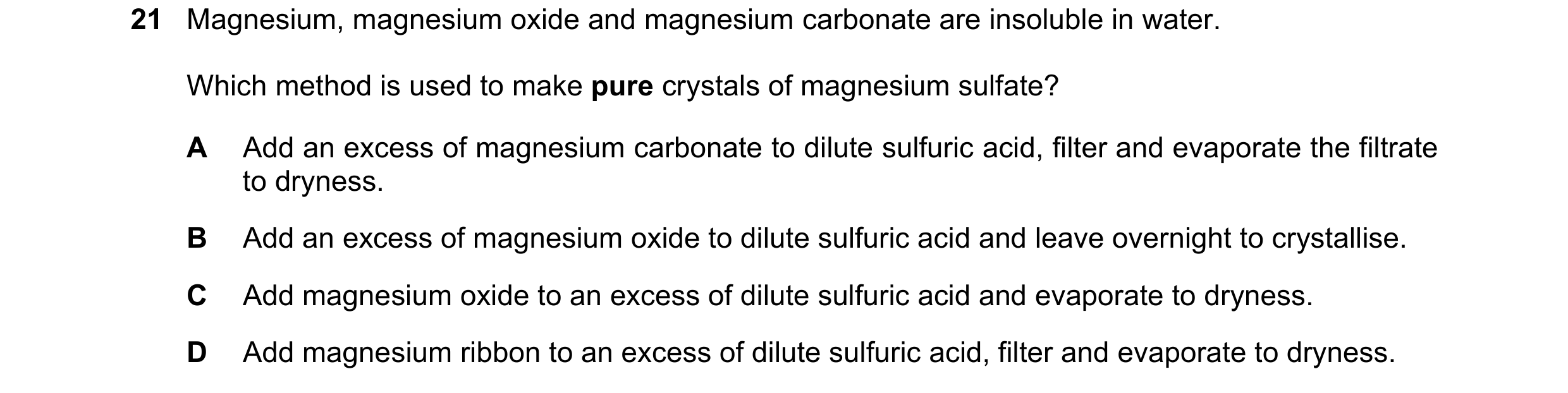
21 Magnesium, magnesium oxide and magnesium carbonate are insoluble in water. Which method is used to make pure crystals of magnesium sulfate? A Add an excess of magnesium carbonate to dilute sulfuric acid, filter and evaporate the filtrate to dryness. B Add an excess of magnesium oxide to dilute sulfuric acid and leave overnight to crystallise. C Add magnesium oxide to an excess of dilute sulfuric acid and evaporate to dryness. D Add magnesium ribbon to an excess of dilute sulfuric acid, filter and evaporate to dryness.
1 marks
Answer: A
This question in 0653/22 Feb/March 2018
Q3 · Which process produces a gas that contributes to climate change? 0653/23 May/June 2018
26 Which process produces a gas that contributes to climate change? A the electrolysis of molten lead(II) bromide B the reaction of calcium with water C the reaction of copper oxide with dilute sulfuric acid D the thermal decomposition of calcium carbonate
1 marks
Answer: D
This question in 0653/23 May/June 2018
Q4 · On which label does the formula match the name of the acid? 0653/21 Oct/Nov 2018
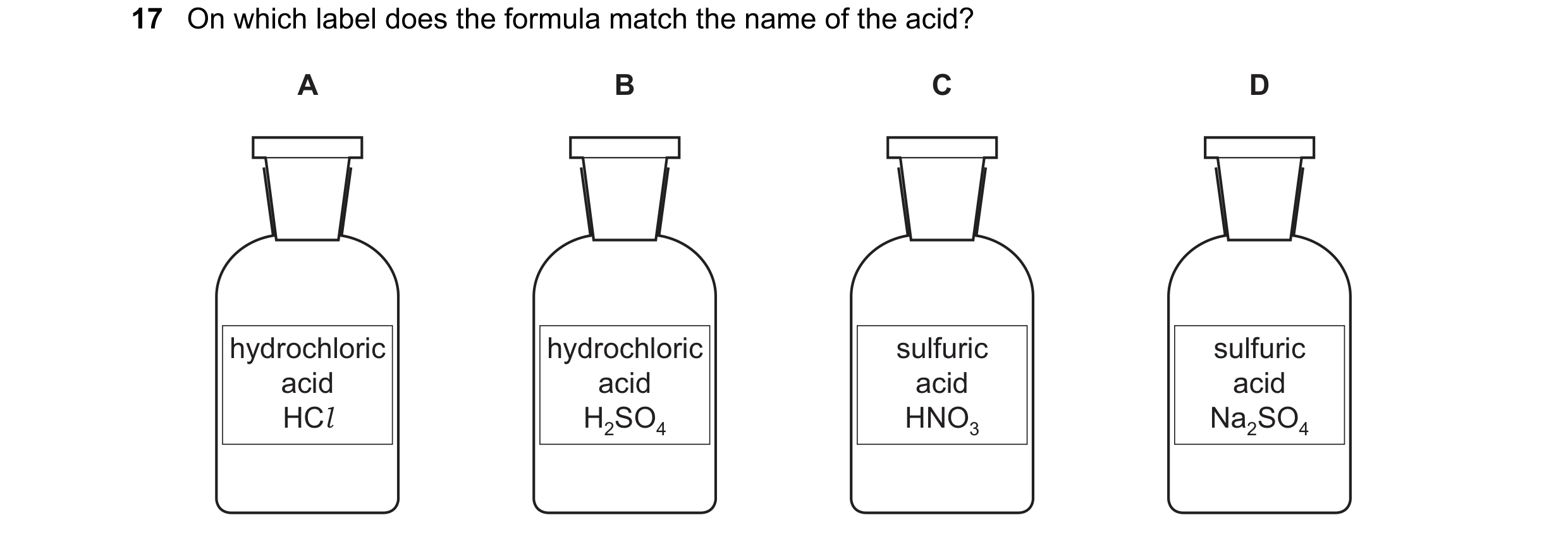
17 On which label does the formula match the name of the acid? A B C D hydrochloric hydrochloric sulfuric sulfuric acid acid acid acid HCl H2SO4 HNO3 Na2SO4
1 marks
Answer: A
This question in 0653/21 Oct/Nov 2018
Q5 · Which formula does not represent an acid? 0653/22 Oct/Nov 2018
17 Which formula does not represent an acid? A H2SO4 B HCl C HNO3 D NH3
1 marks
Answer: D
This question in 0653/22 Oct/Nov 2018
Q6 · What is the formula of nitric acid? 0653/23 Oct/Nov 2018
17 What is the formula of nitric acid? A HCl B HNO3 C NaOH D NH3
1 marks
Answer: B
This question in 0653/23 Oct/Nov 2018
Q7 · Which two substances are used to make copper sulfate? 0653/21 Oct/Nov 2019
22 Which two substances are used to make copper sulfate? A copper and dilute sulfuric acid B copper and sulfur C copper oxide and dilute sulfuric acid D copper oxide and sulfur
1 marks
Answer: C
This question in 0653/21 Oct/Nov 2019
Q8 · Solid sodium carbonate is added to vinegar in a beaker and stirred 0653/21 May/June 2020
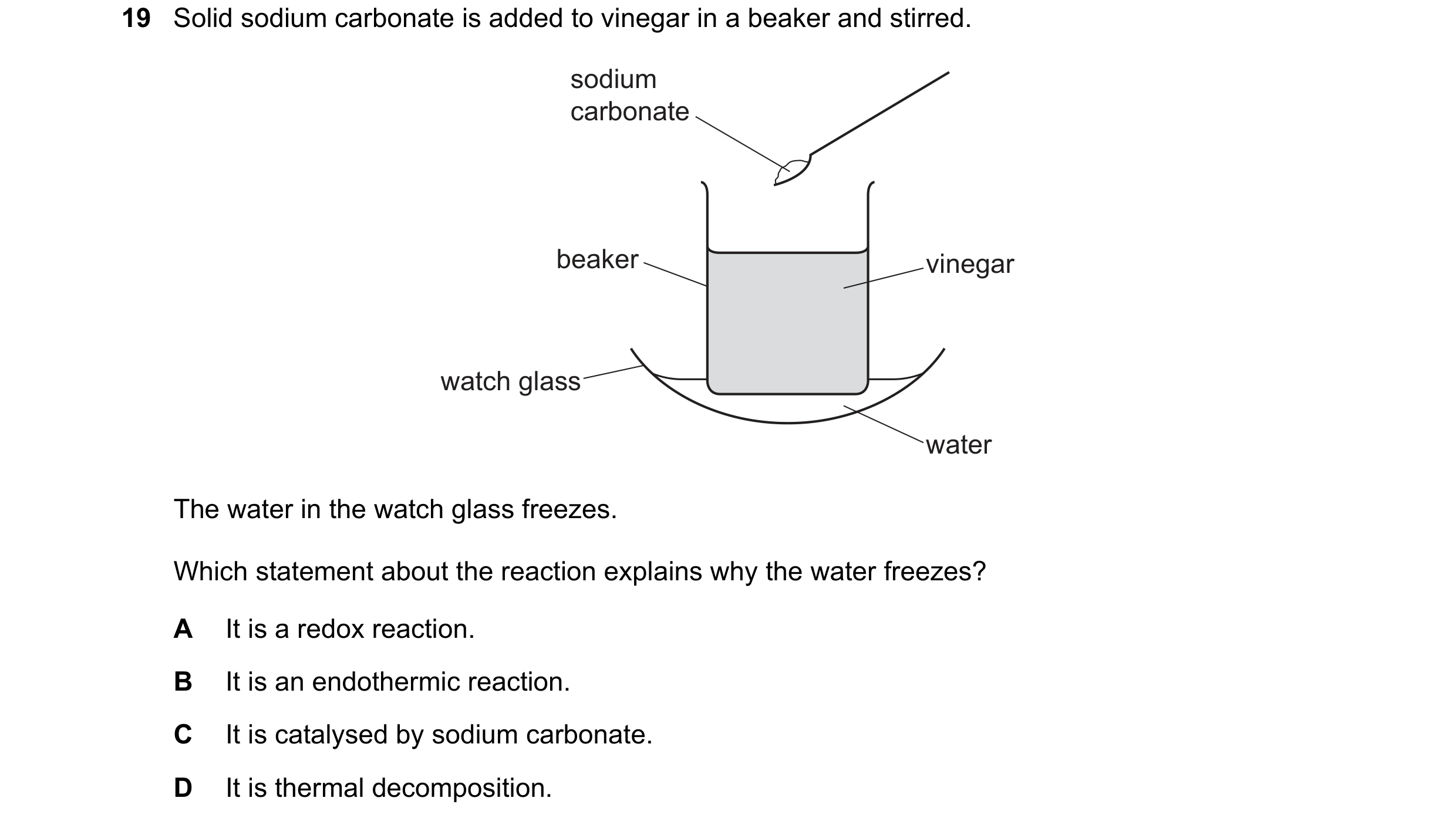
19 Solid sodium carbonate is added to vinegar in a beaker and stirred. sodium carbonate beaker vinegar watch glass water The water in the watch glass freezes. Which statement about the reaction explains why the water freezes? A It is a redox reaction. B It is an endothermic reaction. C It is catalysed by sodium carbonate. D It is thermal decomposition.
1 marks
Answer: B
This question in 0653/21 May/June 2020
Q9 · Copper(II) sulfate is prepared by reacting copper(II) oxide with dilute sulfuric acid 0653/21 May/June 2020
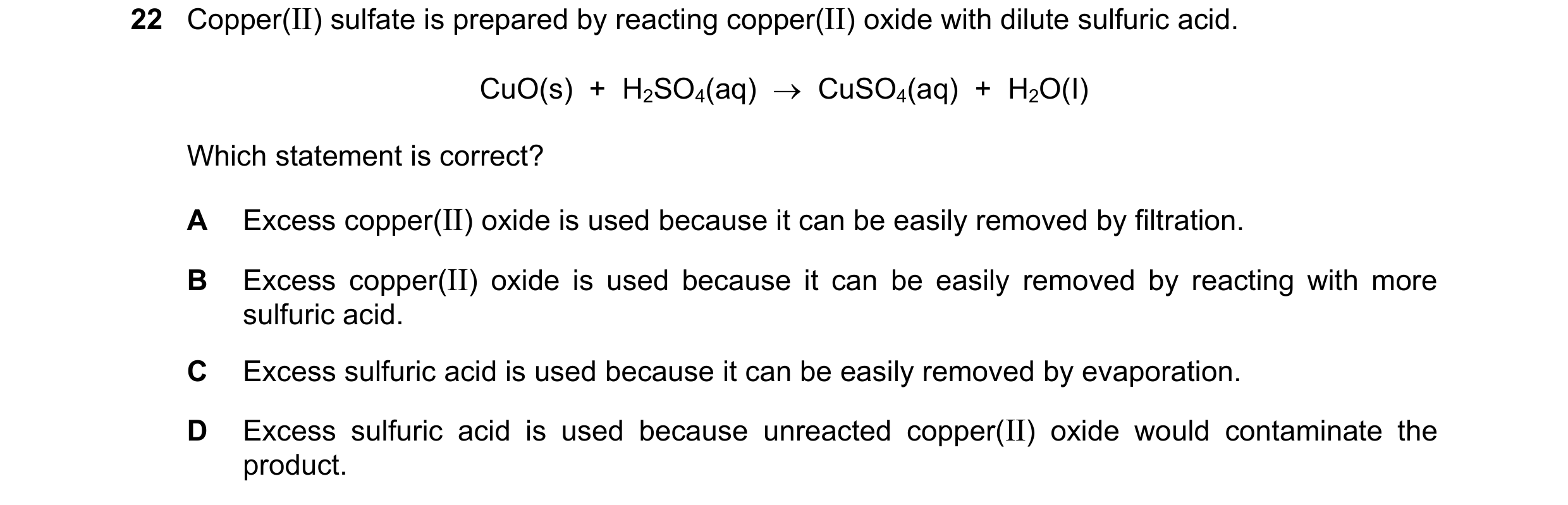
22 Copper(II) sulfate is prepared by reacting copper(II) oxide with dilute sulfuric acid. CuO(s) + H2SO4(aq) → CuSO4(aq) + H2O(I) Which statement is correct? A Excess copper(II) oxide is used because it can be easily removed by filtration. B Excess copper(II) oxide is used because it can be easily removed by reacting with more sulfuric acid. C Excess sulfuric acid is used because it can be easily removed by evaporation. D Excess sulfuric acid is used because unreacted copper(II) oxide would contaminate the product.
1 marks
Answer: A
This question in 0653/21 May/June 2020
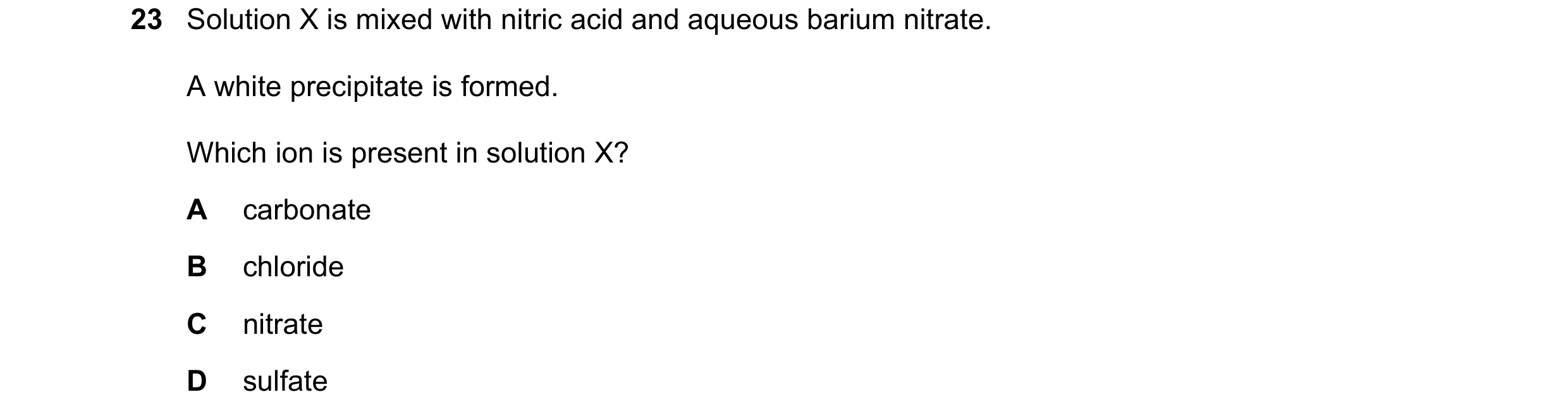
Q10 · Solution X is mixed with nitric acid and aqueous barium nitrate 0653/21 May/June 2020
23 Solution X is mixed with nitric acid and aqueous barium nitrate. A white precipitate is formed. Which ion is present in solution X? A carbonate B chloride C nitrate D sulfate
1 marks
Answer: D
This question in 0653/21 May/June 2020
Q11 · Copper(II) sulfate is prepared by reacting copper(II) oxide with dilute sulfuric acid 0653/22 May/June 2020
20 Copper(II) sulfate is prepared by reacting copper(II) oxide with dilute sulfuric acid. CuO(s) + H2SO4(aq) → CuSO4(aq) + H2O(I) Which statement is correct? A Excess copper(II) oxide is used because it can be easily removed by filtration. B Excess copper(II) oxide is used because it can be easily removed by reacting with more sulfuric acid. C Excess sulfuric acid is used because it can be easily removed by evaporation. D Excess sulfuric acid is used because unreacted copper(II) oxide would contaminate the product.
1 marks
Answer: A
This question in 0653/22 May/June 2020
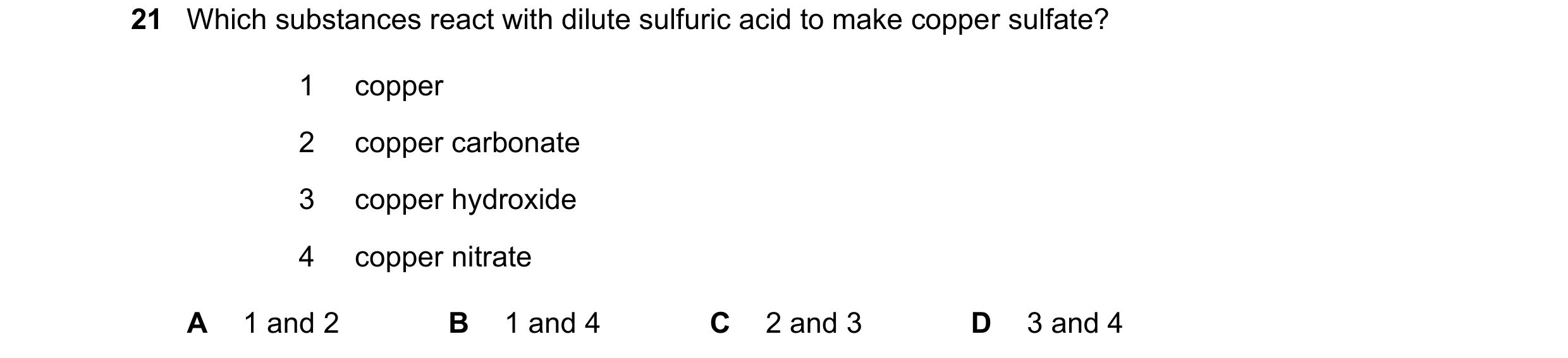
Q12 · Which substances react with dilute sulfuric acid to make copper sulfate? 0653/21 Oct/Nov 2020
21 Which substances react with dilute sulfuric acid to make copper sulfate? 1 copper 2 copper carbonate 3 copper hydroxide 4 copper nitrate A 1 and 2 B 1 and 4 C 2 and 3 D 3 and 4
1 marks
Answer: C
This question in 0653/21 Oct/Nov 2020
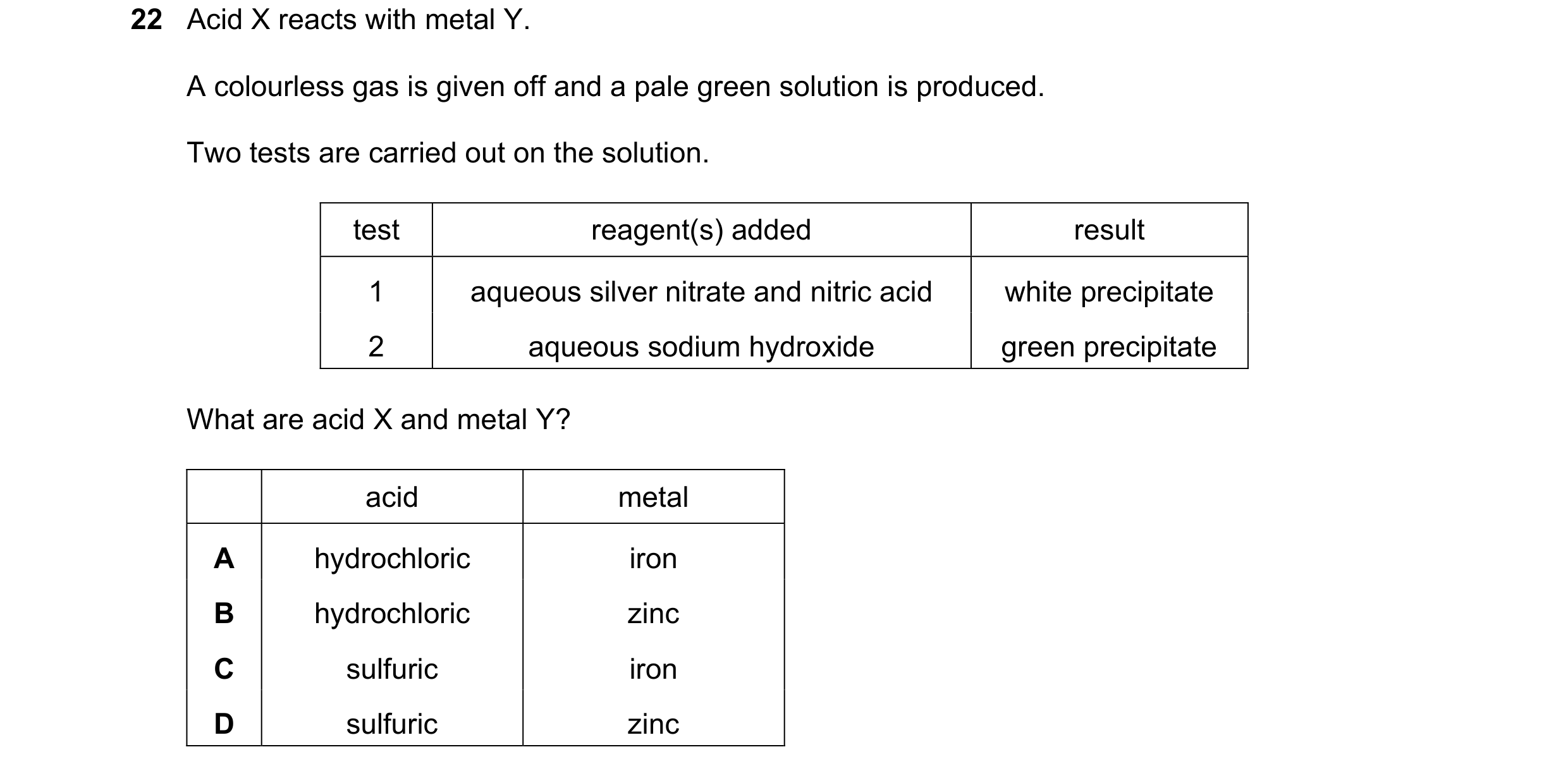
Q13 · Acid X reacts with metal Y 0653/21 Oct/Nov 2020
22 Acid X reacts with metal Y. A colourless gas is given off and a pale green solution is produced. Two tests are carried out on the solution. test reagent(s) added result 1 aqueous silver nitrate and nitric acid white precipitate 2 aqueous sodium hydroxide green precipitate What are acid X and metal Y? acid metal A hydrochloric iron B hydrochloric zinc C sulfuric iron D sulfuric zinc
1 marks
Answer: A
This question in 0653/21 Oct/Nov 2020
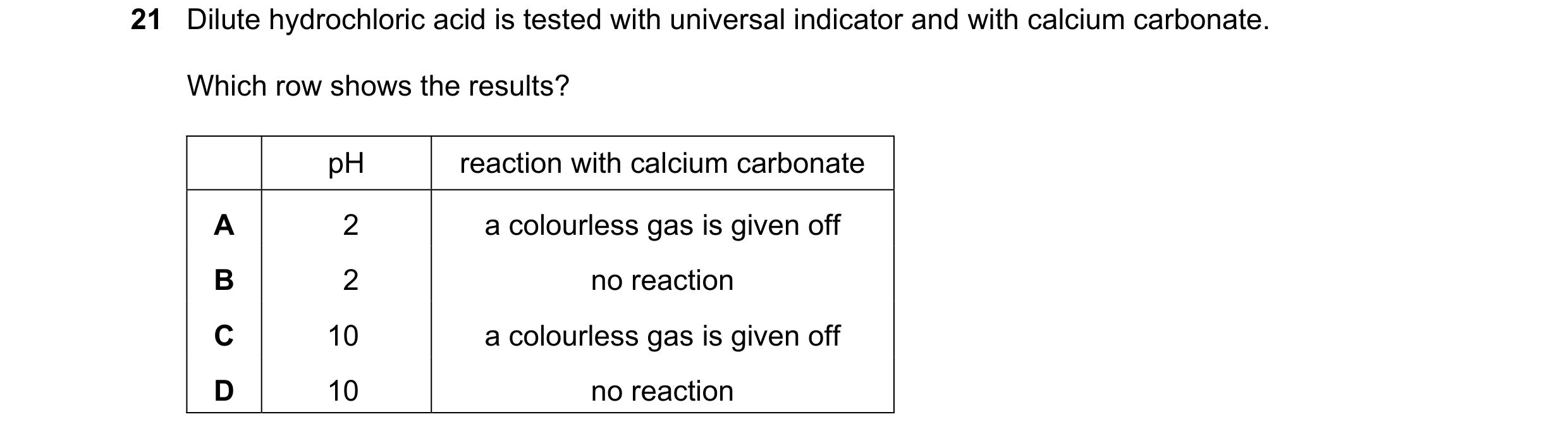
Q14 · Dilute hydrochloric acid is tested with universal indicator and with calcium carbonate 0653/22 Oct/Nov 2020
21 Dilute hydrochloric acid is tested with universal indicator and with calcium carbonate. Which row shows the results? pH reaction with calcium carbonate A 2 a colourless gas is given off B 2 no reaction C 10 a colourless gas is given off D 10 no reaction
1 marks
Answer: A
This question in 0653/22 Oct/Nov 2020
Q15 · Acid X reacts with metal Y 0653/22 Oct/Nov 2020
22 Acid X reacts with metal Y. A colourless gas is given off and a pale green solution is produced. Two tests are carried out on the solution. test reagent(s) added result 1 aqueous silver nitrate and nitric acid white precipitate 2 aqueous sodium hydroxide green precipitate What are acid X and metal Y? acid metal A hydrochloric iron B hydrochloric zinc C sulfuric iron D sulfuric zinc
1 marks
Answer: A
This question in 0653/22 Oct/Nov 2020
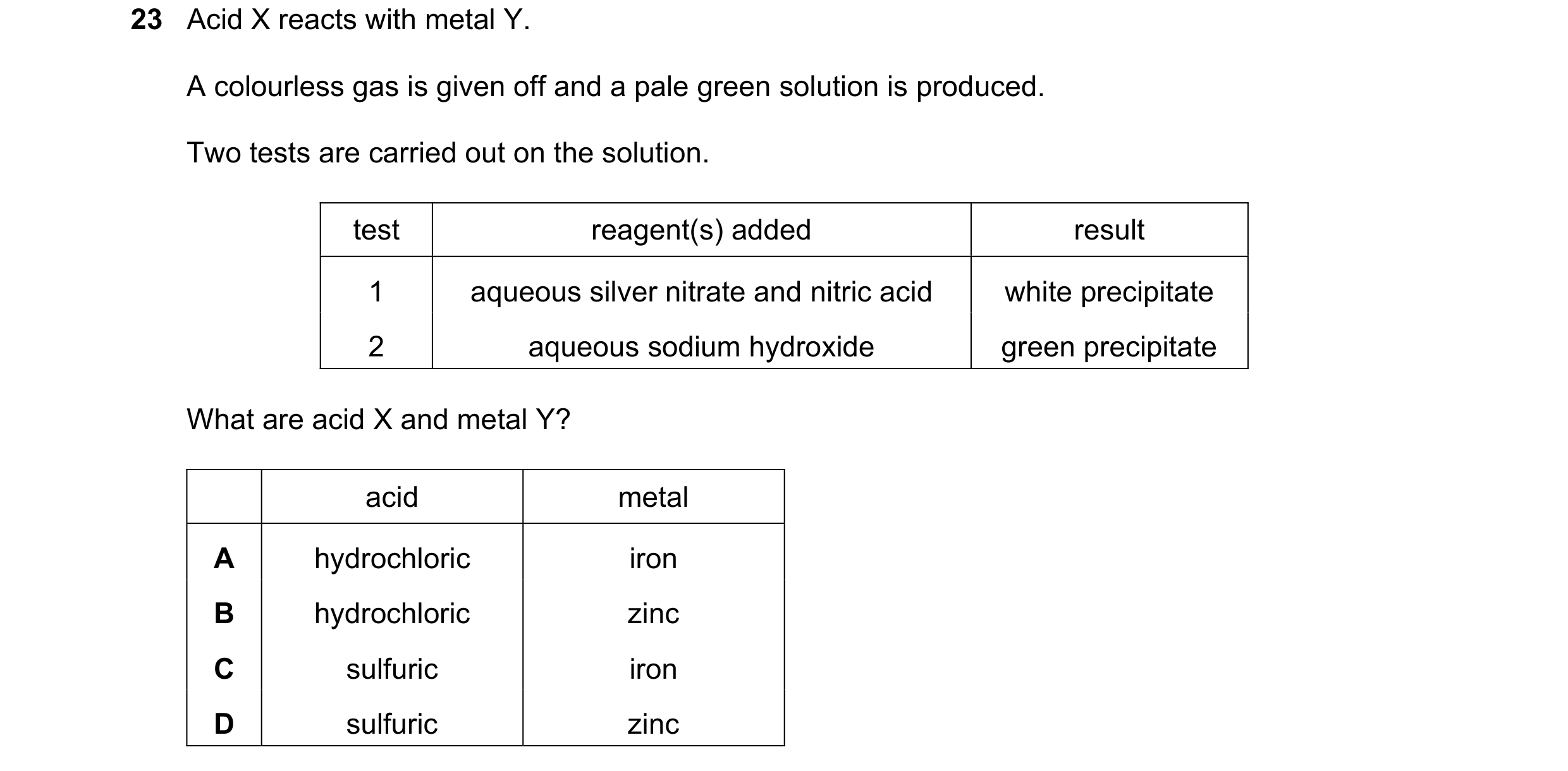
Q16 · Acid X reacts with metal Y 0653/23 Oct/Nov 2020
23 Acid X reacts with metal Y. A colourless gas is given off and a pale green solution is produced. Two tests are carried out on the solution. test reagent(s) added result 1 aqueous silver nitrate and nitric acid white precipitate 2 aqueous sodium hydroxide green precipitate What are acid X and metal Y? acid metal A hydrochloric iron B hydrochloric zinc C sulfuric iron D sulfuric zinc
1 marks
Answer: A
This question in 0653/23 Oct/Nov 2020
Q17 · The solubilities of some copper compounds are shown 0653/21 May/June 2021
21 The solubilities of some copper compounds are shown. copper compound solubility in water copper nitrate soluble copper sulfate soluble copper oxide insoluble copper hydroxide insoluble Which method is used to make copper sulfate? A Mix aqueous copper hydroxide and dilute sulfuric acid. B Mix aqueous copper nitrate with aqueous sodium sulfate and filter off solid copper sulfate. C Mix excess aqueous copper nitrate with dilute sulfuric acid and filter off unreacted copper nitrate. D Mix excess solid copper oxide with dilute sulfuric acid and filter off unreacted copper oxide.
1 marks
Answer: D
This question in 0653/21 May/June 2021
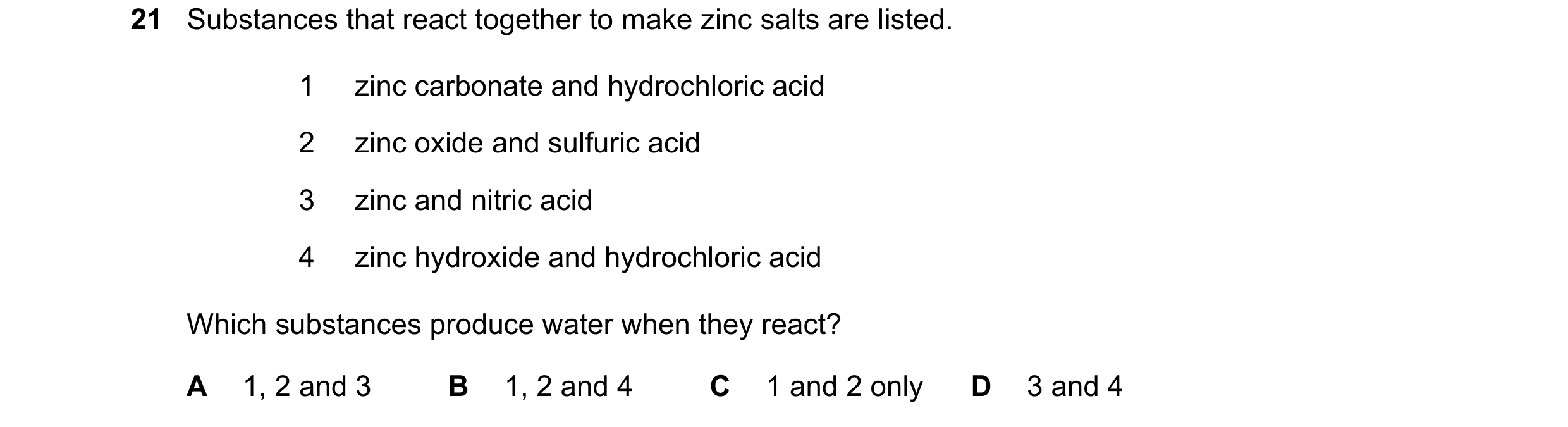
Q18 · Substances that react together to make zinc salts are listed 0653/23 May/June 2021
21 Substances that react together to make zinc salts are listed. 1 zinc carbonate and hydrochloric acid 2 zinc oxide and sulfuric acid 3 zinc and nitric acid 4 zinc hydroxide and hydrochloric acid Which substances produce water when they react? A 1, 2 and 3 B 1, 2 and 4 C 1 and 2 only D 3 and 4
1 marks
Answer: B
This question in 0653/23 May/June 2021
Q19 · Which word equation correctly describes a reaction of dilute sulfuric acid? 0653/21 Oct/Nov 2021
19 Which word equation correctly describes a reaction of dilute sulfuric acid? A sulfuric acid + zinc zinc sulfate + water B sulfuric acid + zinc carbonate zinc sulfate + carbon dioxide C sulfuric acid + zinc hydroxide zinc sulfate + water D sulfuric acid + zinc oxide zinc sulfate + hydrogen
1 marks
Answer: C
This question in 0653/21 Oct/Nov 2021
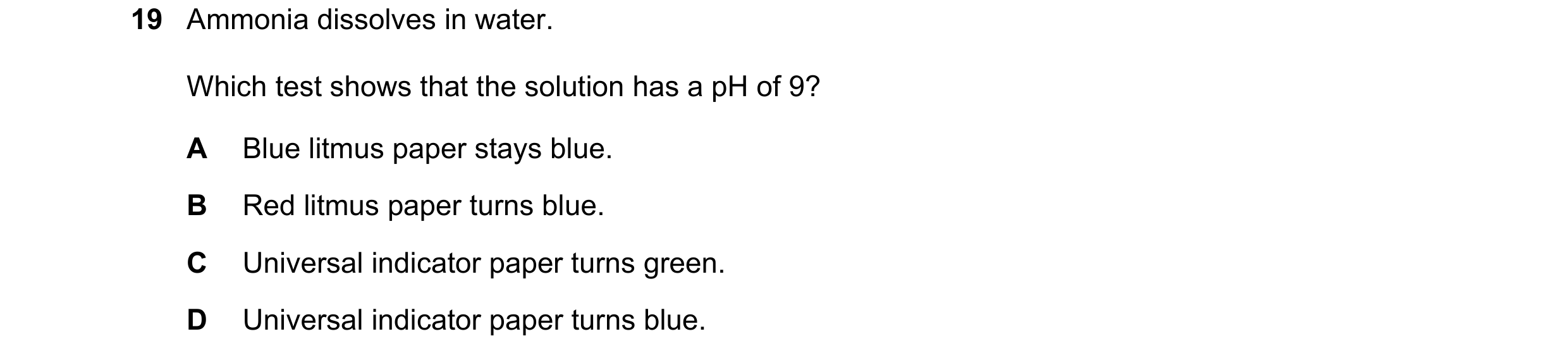
Q20 · Ammonia dissolves in water 0653/22 Oct/Nov 2021
19 Ammonia dissolves in water. Which test shows that the solution has a pH of 9? A Blue litmus paper stays blue. B Red litmus paper turns blue. C Universal indicator paper turns green. D Universal indicator paper turns blue.
1 marks
Answer: D
This question in 0653/22 Oct/Nov 2021
Q21 · Magnesium carbonate reacts with dilute hydrochloric acid 0653/22 Oct/Nov 2021
26 Magnesium carbonate reacts with dilute hydrochloric acid. Calcium carbonate decomposes when heated. Which gas is produced in both reactions? A carbon dioxide B carbon monoxide C chlorine D hydrogen
1 marks
Answer: A
This question in 0653/22 Oct/Nov 2021
Q22 · Which statement describes an acid? 0653/23 Oct/Nov 2021
19 Which statement describes an acid? A It has a pH less than 7. B It reacts with calcium carbonate to form a white precipitate. C It reacts with hydrochloric acid to form a salt and water. D It turns universal indicator blue.
1 marks
Answer: A
This question in 0653/23 Oct/Nov 2021
Q23 · In which reaction is carbon dioxide not formed? 0653/22 Feb/March 2022
20 In which reaction is carbon dioxide not formed? A adding hydrochloric acid to calcium B adding hydrochloric acid to calcium carbonate C burning coal in air D burning methane in air
1 marks
Answer: A
This question in 0653/22 Feb/March 2022
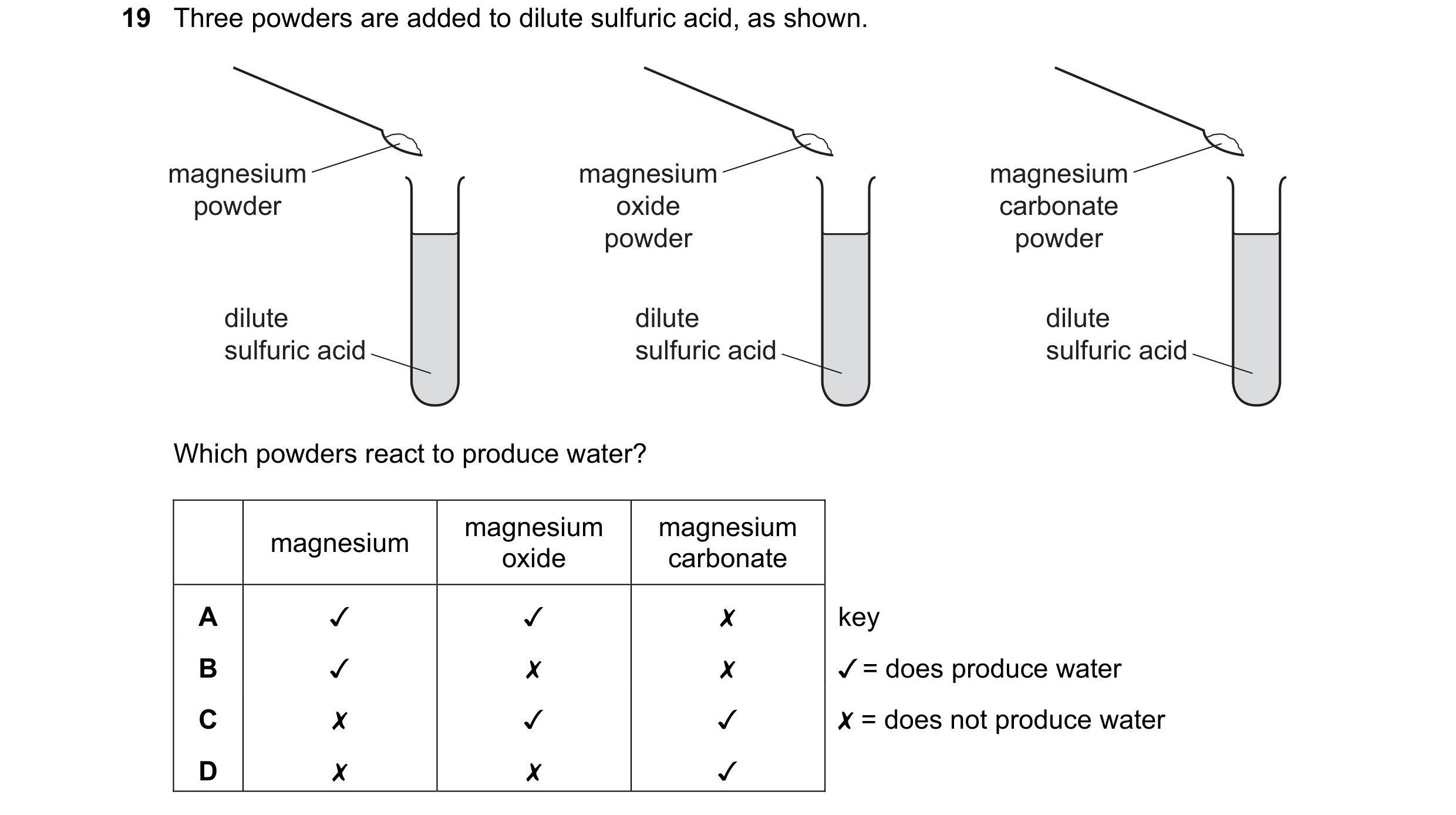
Q24 · Three powders are added to dilute sulfuric acid, as shown 0653/21 May/June 2022
19 Three powders are added to dilute sulfuric acid, as shown.
magnesium
powder
dilute
sulfuric acid
Which powders react to produce water?
magnesium
oxide
powder
dilute
sulfuric acid
magnesium
magnesium
oxide
x \ x
magnesium
carbonate
\ \ x
magnesium
carbonate
powder
dilute
sulfuric acid
key
¥ = does produce water
X = does not produce water
1 marks
Answer: C
This question in 0653/21 May/June 2022
Q25 · Three powders are added to dilute sulfuric acid, as shown 0653/22 May/June 2022
18 Three powders are added to dilute sulfuric acid, as shown.
magnesium
powder
dilute
sulfuric acid
Which powders react to produce water?
magnesium
oxide
powder
dilute
sulfuric acid
. magnesium magnesium
magnesium .
oxide carbonate
Jv x
x x
Jv Jv
x Jv
magnesium
carbonate
powder
dilute
sulfuric acid
key
¥ = does produce water
X = does not produce water
1 marks
Answer: C
This question in 0653/22 May/June 2022
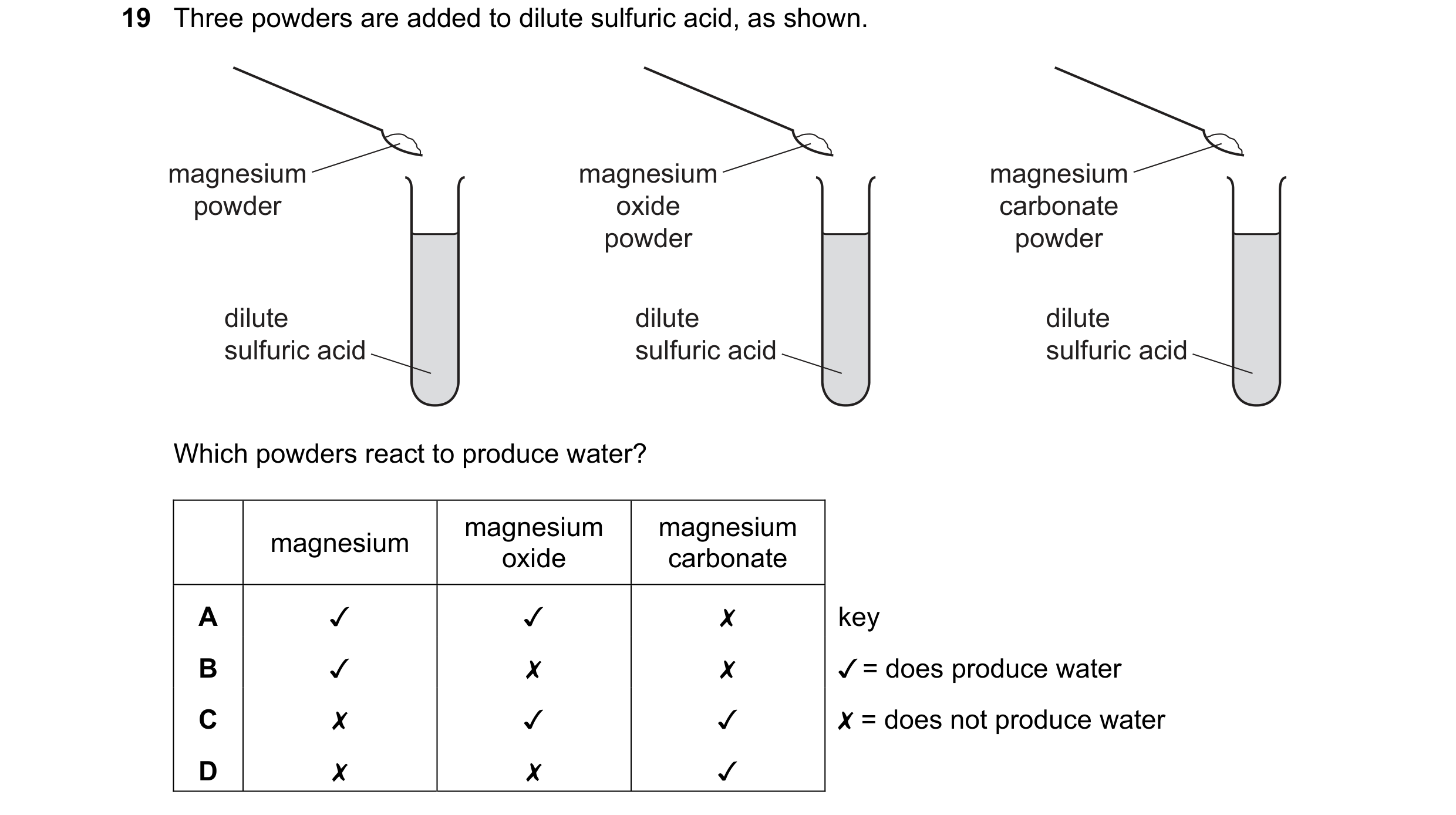
Q26 · Three powders are added to dilute sulfuric acid, as shown 0653/23 May/June 2022
19 Three powders are added to dilute sulfuric acid, as shown.
magnesium
powder
dilute
sulfuric acid
Which powders react to produce water?
magnesium
oxide
powder
dilute
sulfuric acid
magnesium
magnesium
oxide
x \ x
magnesium
carbonate
\ \ x
magnesium
carbonate
powder
dilute
sulfuric acid
key
¥ = does produce water
X = does not produce water
1 marks
Answer: C
This question in 0653/23 May/June 2022
Q27 · The word equation represents the reaction between substance J and hydrochloric acid 0653/21 Oct/Nov 2022
19 The word equation represents the reaction between substance J and hydrochloric acid. substance J + hydrochloric acid magnesium chloride + hydrogen What is substance J? A magnesium B magnesium carbonate C magnesium hydroxide D magnesium oxide
1 marks
Answer: A
This question in 0653/21 Oct/Nov 2022
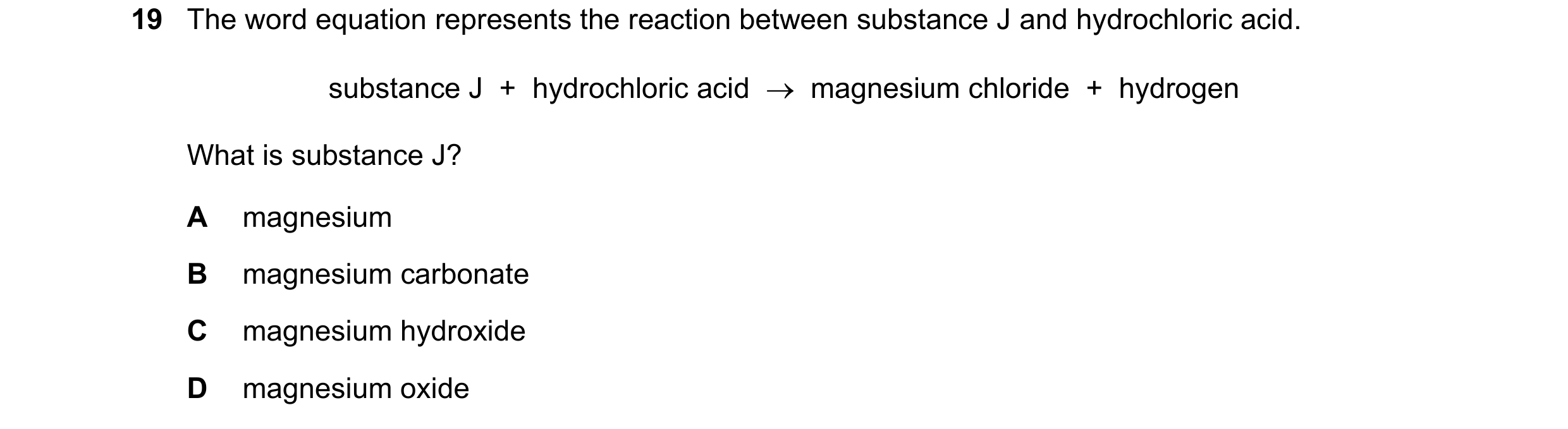
Q28 · The word equation represents the reaction between substance J and hydrochloric acid 0653/22 Oct/Nov 2022
19 The word equation represents the reaction between substance J and hydrochloric acid. substance J + hydrochloric acid magnesium chloride + hydrogen What is substance J? A magnesium B magnesium carbonate C magnesium hydroxide D magnesium oxide
1 marks
Answer: A
This question in 0653/22 Oct/Nov 2022
Q29 · Which solid reacts with sulfuric acid to produce a gas? 0653/22 Feb/March 2023
21 Which solid reacts with sulfuric acid to produce a gas? A copper B copper carbonate C copper oxide D copper sulfate
1 marks
Answer: B
This question in 0653/22 Feb/March 2023
Q30 · Dilute hydrochloric acid is tested with universal indicator and with calcium carbonate 0653/21 May/June 2023
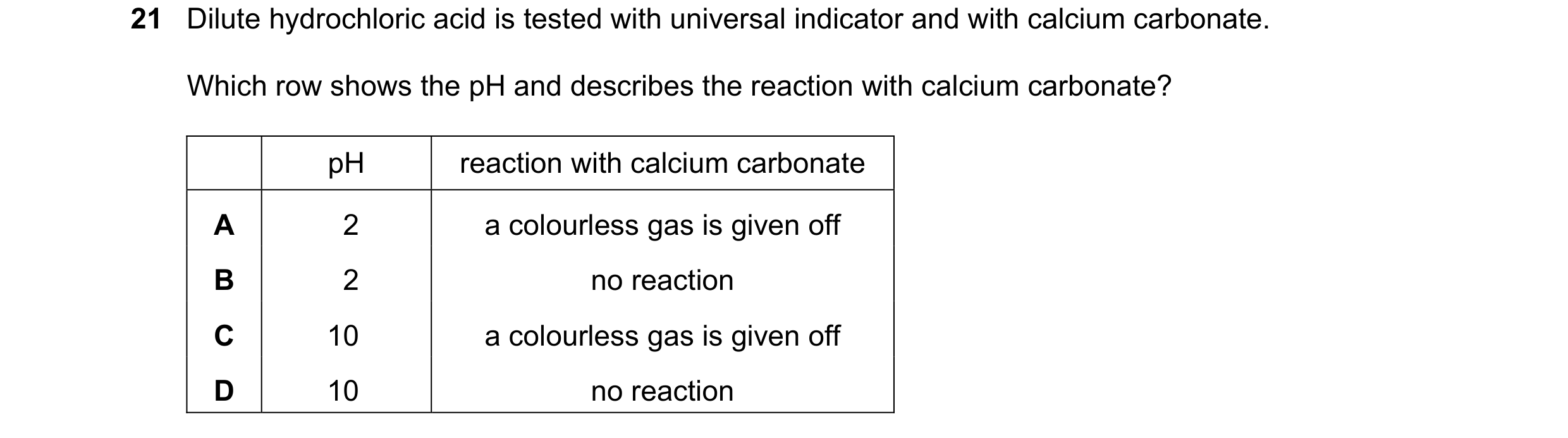
21 Dilute hydrochloric acid is tested with universal indicator and with calcium carbonate. Which row shows the pH and describes the reaction with calcium carbonate? pH reaction with calcium carbonate A 2 a colourless gas is given off B 2 no reaction C 10 a colourless gas is given off D 10 no reaction
1 marks
Answer: A
This question in 0653/21 May/June 2023
Q31 · Dilute sulfuric acid reacts with aqueous potassium hydroxide 0653/22 May/June 2023
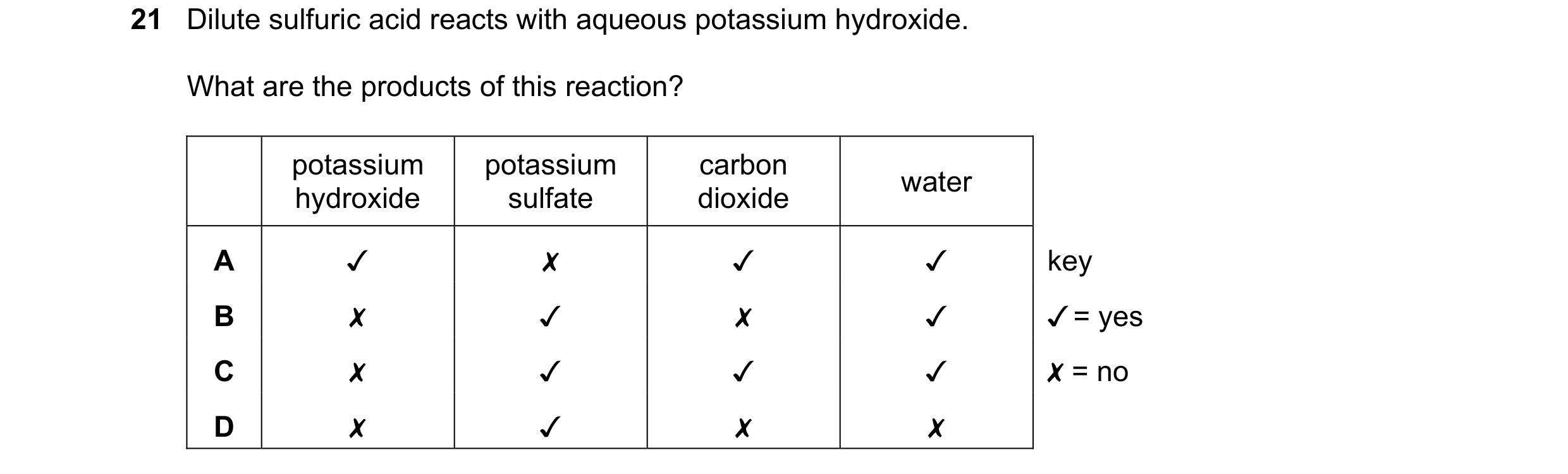
21 Dilute sulfuric acid reacts with aqueous potassium hydroxide.
What are the products of this reaction?
potassium potassium carbon water
hydroxide sulfate dioxide
A Jv x v v
B x Jv x v
Cc x v v Jv
D x v x x
key
/=yes
X =no
1 marks
Answer: B
This question in 0653/22 May/June 2023
Q32 · Which two substances both react with dilute sulfuric acid to make the salt magnesium… 0653/23 May/June 2023
21 Which two substances both react with dilute sulfuric acid to make the salt magnesium sulfate? A magnesium carbonate and magnesium chloride B magnesium chloride and magnesium nitrate C magnesium oxide and magnesium carbonate D magnesium oxide and magnesium nitrate
1 marks
Answer: C
This question in 0653/23 May/June 2023
Q33 · Calcium oxide is added to water containing universal indicator 0653/21 Oct/Nov 2023
21 Calcium oxide is added to water containing universal indicator. The universal indicator turns blue. What is the pH of the solution? A 1 B 6 C 7 D 11
1 marks
Answer: D
This question in 0653/21 Oct/Nov 2023
Q34 · Acid X reacts with metal Y 0653/21 Oct/Nov 2023
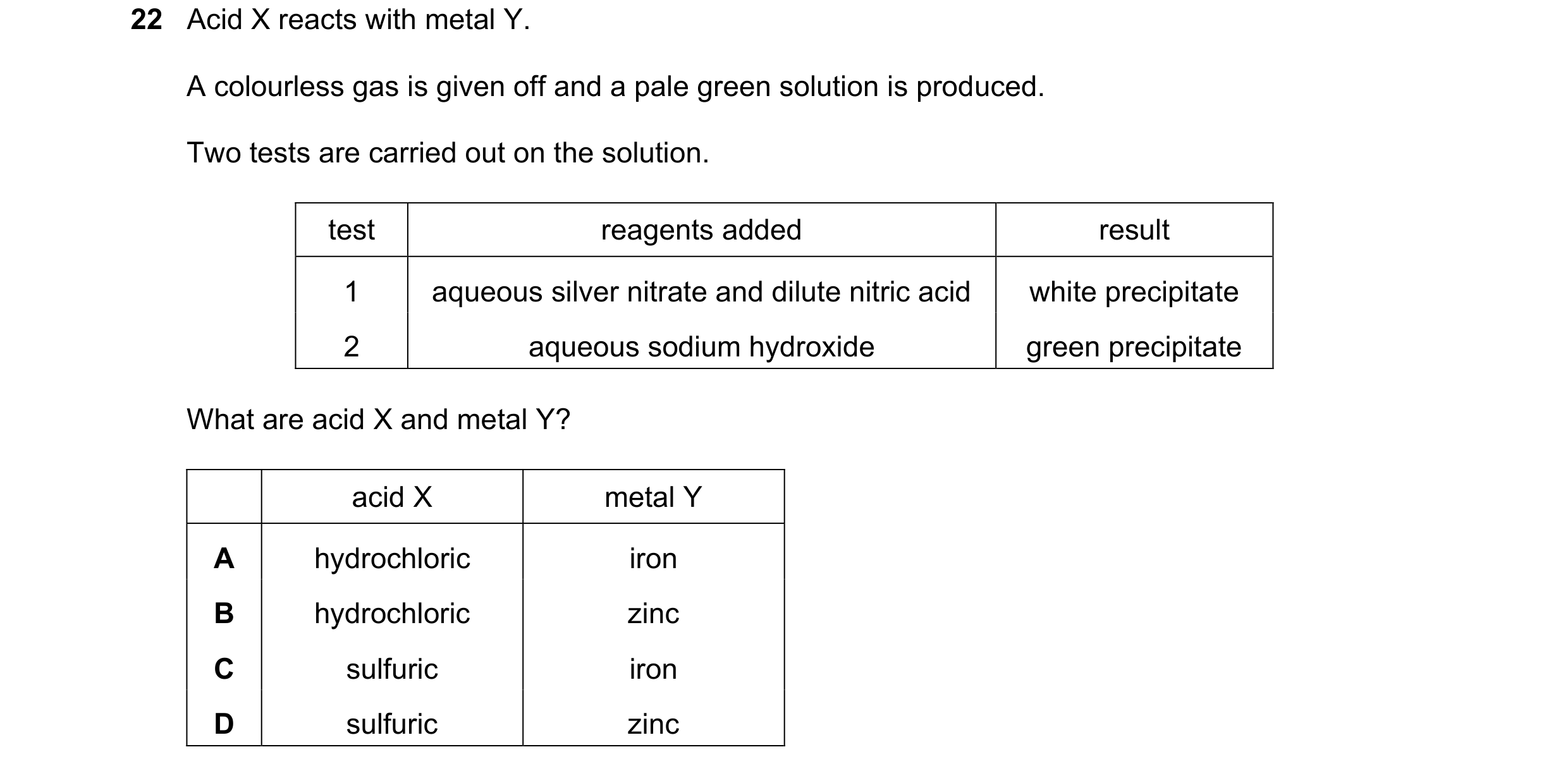
22 Acid X reacts with metal Y. A colourless gas is given off and a pale green solution is produced. Two tests are carried out on the solution. test reagents added result 1 aqueous silver nitrate and dilute nitric acid white precipitate 2 aqueous sodium hydroxide green precipitate What are acid X and metal Y? acid X metal Y A hydrochloric iron B hydrochloric zinc C sulfuric iron D sulfuric zinc
1 marks
Answer: A
This question in 0653/21 Oct/Nov 2023
Q35 · Dilute hydrochloric acid is added to powdered solid X 0653/22 Oct/Nov 2023
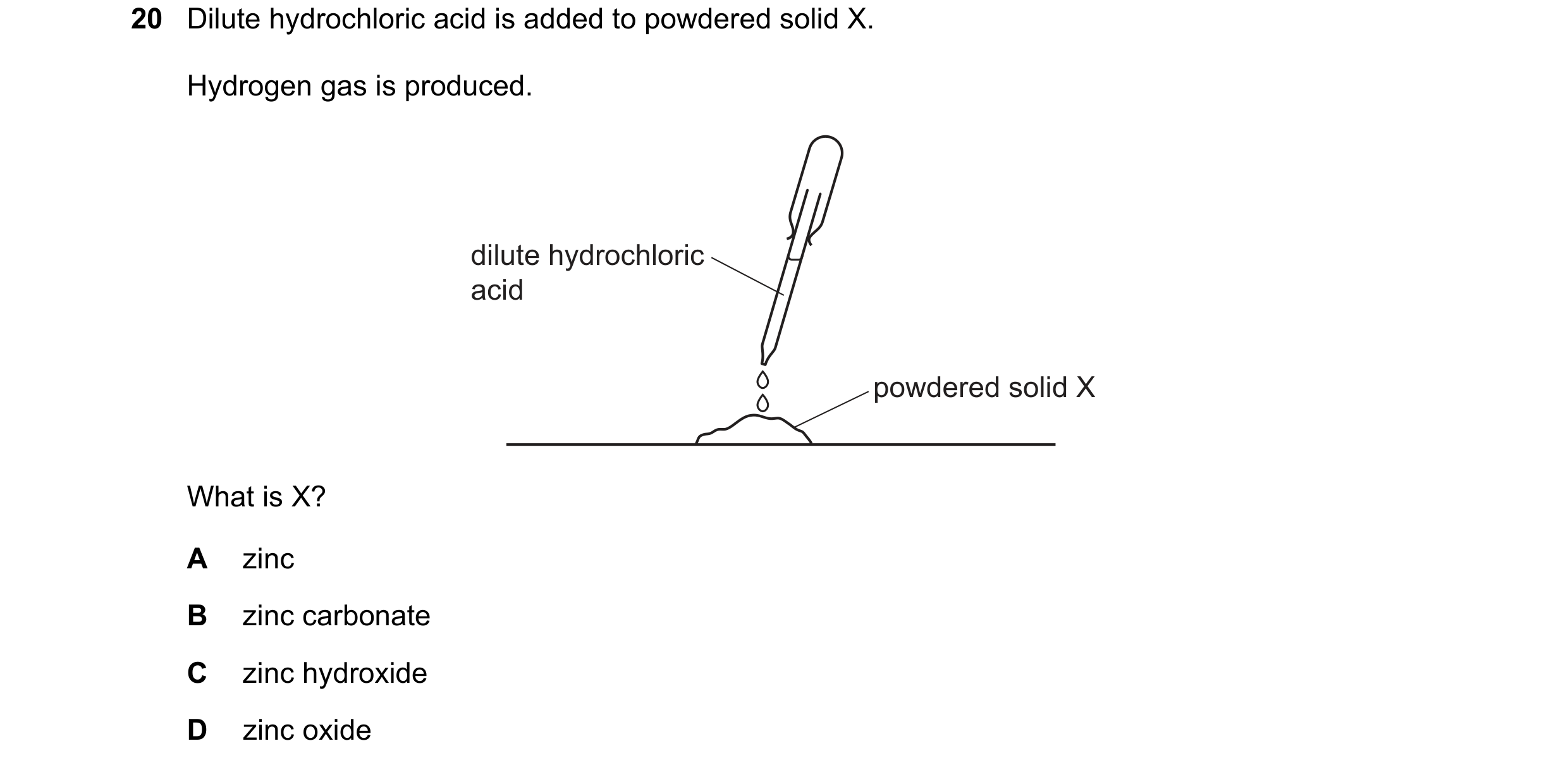
20 Dilute hydrochloric acid is added to powdered solid X. Hydrogen gas is produced. dilute hydrochloric acid powdered solid X What is X? A zinc B zinc carbonate C zinc hydroxide D zinc oxide
1 marks
Answer: A
This question in 0653/22 Oct/Nov 2023
Q36 · Which substance does not react with dilute hydrochloric acid to produce copper chloride? 0653/22 Oct/Nov 2023
24 Which substance does not react with dilute hydrochloric acid to produce copper chloride? A copper B copper carbonate C copper hydroxide D copper oxide
1 marks
Answer: A
This question in 0653/22 Oct/Nov 2023
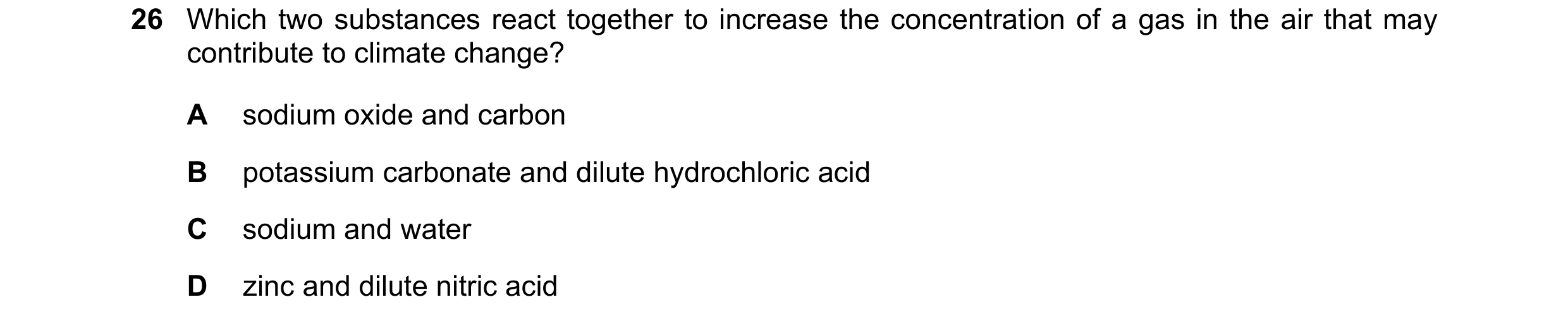
Q37 · Which two substances react together to increase the concentration of a gas in the air… 0653/22 Oct/Nov 2023
26 Which two substances react together to increase the concentration of a gas in the air that may contribute to climate change? A sodium oxide and carbon B potassium carbonate and dilute hydrochloric acid C sodium and water D zinc and dilute nitric acid
1 marks
Answer: B
This question in 0653/22 Oct/Nov 2023
Q38 · Which element reacts with dilute sulfuric acid to form a salt? 0653/23 Oct/Nov 2023
20 Which element reacts with dilute sulfuric acid to form a salt? A carbon B copper C sulfur D zinc
1 marks
Answer: D
This question in 0653/23 Oct/Nov 2023
Q39 · Which aqueous substances form a white precipitate when they are mixed? 0653/21 May/June 2024
21 Which aqueous substances form a white precipitate when they are mixed? A barium chloride and hydrochloric acid B barium chloride and nitric acid C silver nitrate and nitric acid D silver nitrate and hydrochloric acid
1 marks
Answer: D
This question in 0653/21 May/June 2024
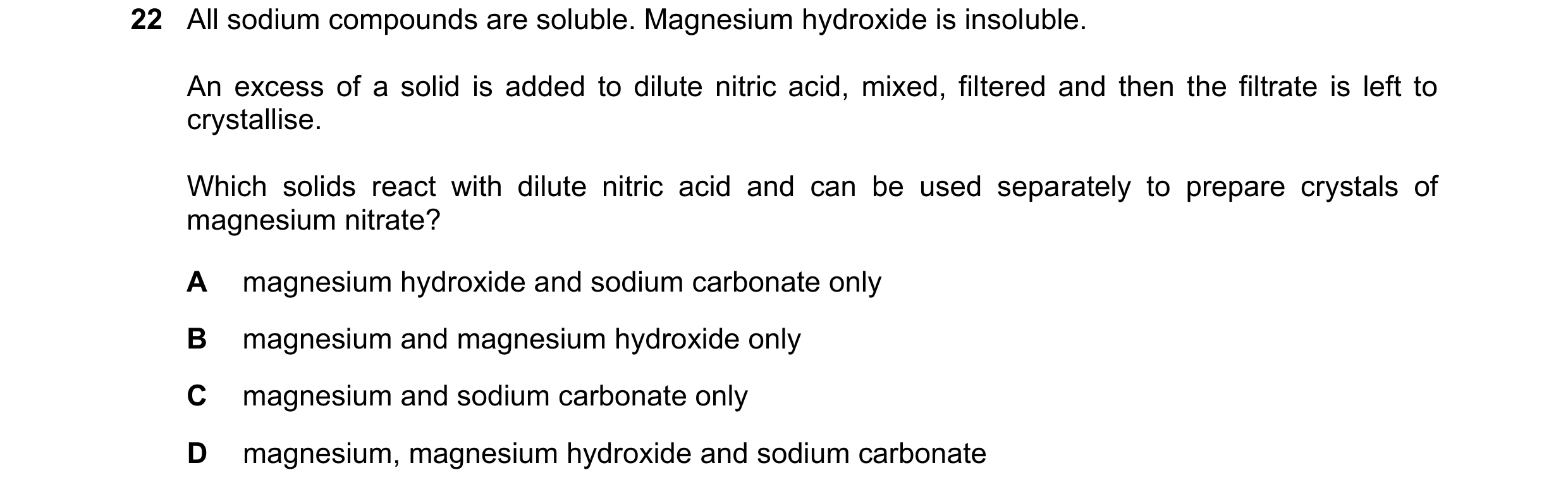
Q40 · All sodium compounds are soluble 0653/21 May/June 2024
22 All sodium compounds are soluble. Magnesium hydroxide is insoluble. An excess of a solid is added to dilute nitric acid, mixed, filtered and then the filtrate is left to crystallise. Which solids react with dilute nitric acid and can be used separately to prepare crystals of magnesium nitrate? A magnesium hydroxide and sodium carbonate only B magnesium and magnesium hydroxide only C magnesium and sodium carbonate only D magnesium, magnesium hydroxide and sodium carbonate
1 marks
Answer: B
This question in 0653/21 May/June 2024
Q41 · Magnesium carbonate reacts with dilute sulfuric acid 0653/22 May/June 2024
23 Magnesium carbonate reacts with dilute sulfuric acid. A gas is produced. What is the test for this gas? A It bleaches damp litmus paper. B It ‘pops’ with a lighted splint. C It relights a glowing splint. D It turns limewater milky.
1 marks
Answer: D
This question in 0653/22 May/June 2024
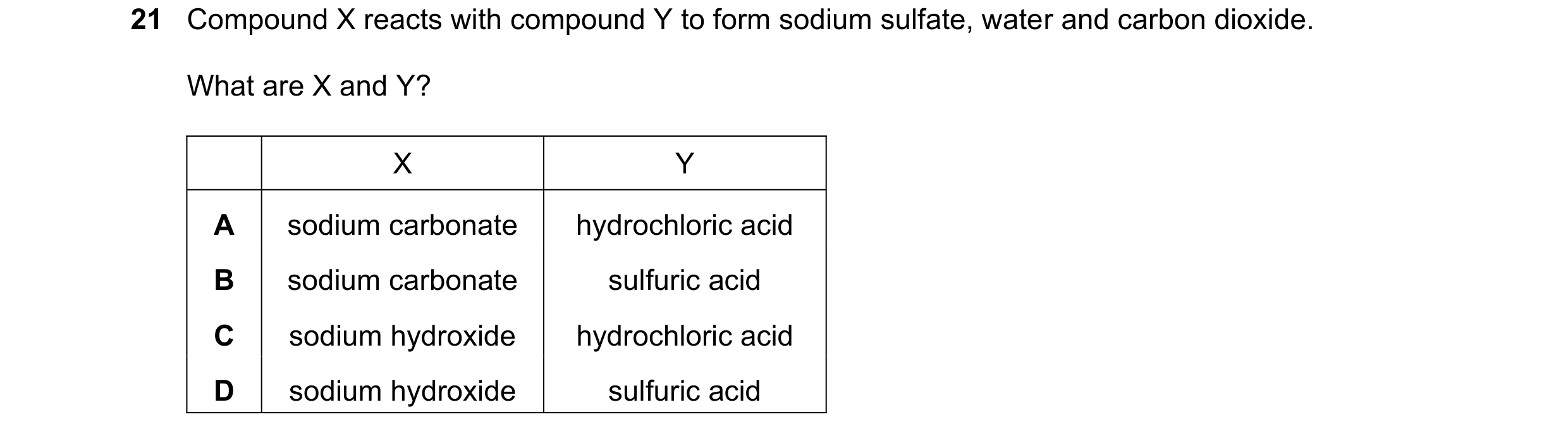
Q42 · Compound X reacts with compound Y to form sodium sulfate, water and carbon dioxide 0653/21 Oct/Nov 2024
21 Compound X reacts with compound Y to form sodium sulfate, water and carbon dioxide. What are X and Y? X Y A sodium carbonate hydrochloric acid B sodium carbonate sulfuric acid C sodium hydroxide hydrochloric acid D sodium hydroxide sulfuric acid
1 marks
Answer: B
This question in 0653/21 Oct/Nov 2024
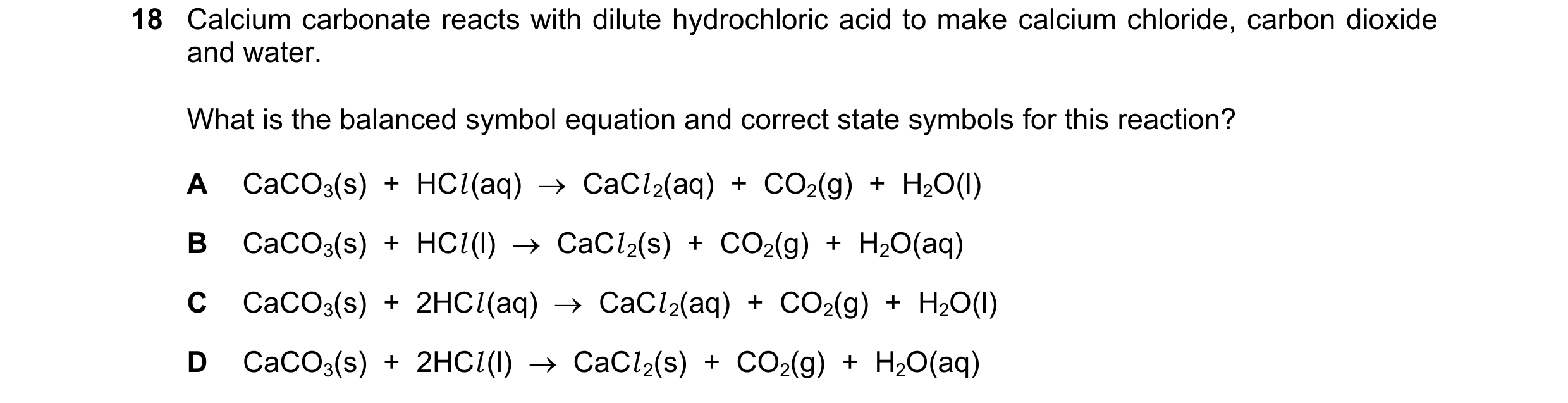
Q43 · Calcium carbonate reacts with dilute hydrochloric acid to make calcium chloride, carbon… 0653/22 Feb/March 2025
18 Calcium carbonate reacts with dilute hydrochloric acid to make calcium chloride, carbon dioxide and water. What is the balanced symbol equation and correct state symbols for this reaction? A CaCO3(s) + HCl (aq) CaCl 2(aq) + CO2(g) + H2O(l) B CaCO3(s) + HCl (l) CaCl 2(s) + CO2(g) + H2O(aq) C CaCO3(s) + 2HCl (aq) CaCl 2(aq) + CO2(g) + H2O(l) D CaCO3(s) + 2HCl (l) CaCl 2(s) + CO2(g) + H2O(aq)
1 marks
Answer: C
This question in 0653/22 Feb/March 2025
Q44 · Which word equation represents the reaction of an acid with a carbonate? 0653/22 May/June 2025
19 Which word equation represents the reaction of an acid with a carbonate? A acid + carbonate salt + carbon dioxide B acid + carbonate salt + carbon dioxide + water C acid + carbonate salt + hydrogen + water D acid + carbonate salt + water
1 marks
Answer: B
This question in 0653/22 May/June 2025
Q45 · Which formula does not represent an acid? 0653/23 May/June 2025
16 Which formula does not represent an acid? A H2SO4 B HCl C HNO3 D NH3
1 marks
Answer: D
This question in 0653/23 May/June 2025
Q46 · Ammonia dissolves in water 0653/22 Oct/Nov 2025
20 Ammonia dissolves in water. Which test shows that the solution has a pH of 9? A Blue litmus paper stays blue. B Red litmus paper turns blue. C Universal indicator turns green. D Universal indicator turns blue.
1 marks
Answer: D
This question in 0653/22 Oct/Nov 2025
Q47 · Which word equation describes a reaction of dilute sulfuric acid? 0653/23 Oct/Nov 2025
20 Which word equation describes a reaction of dilute sulfuric acid? A sulfuric acid + zinc zinc sulfate + water B sulfuric acid + zinc carbonate zinc sulfate + carbon dioxide C sulfuric acid + zinc hydroxide zinc sulfate + water D sulfuric acid + zinc oxide zinc sulfate + hydrogen
1 marks
Answer: C
This question in 0653/23 Oct/Nov 2025



 1 / 12
 2 / 12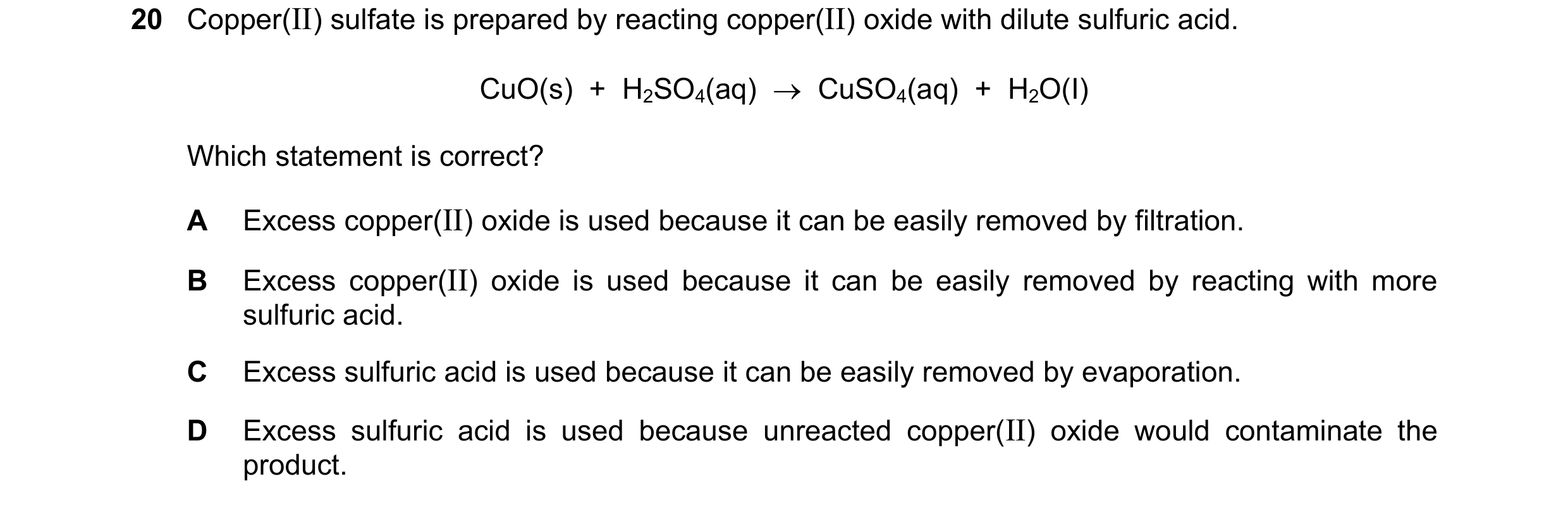
 3 / 12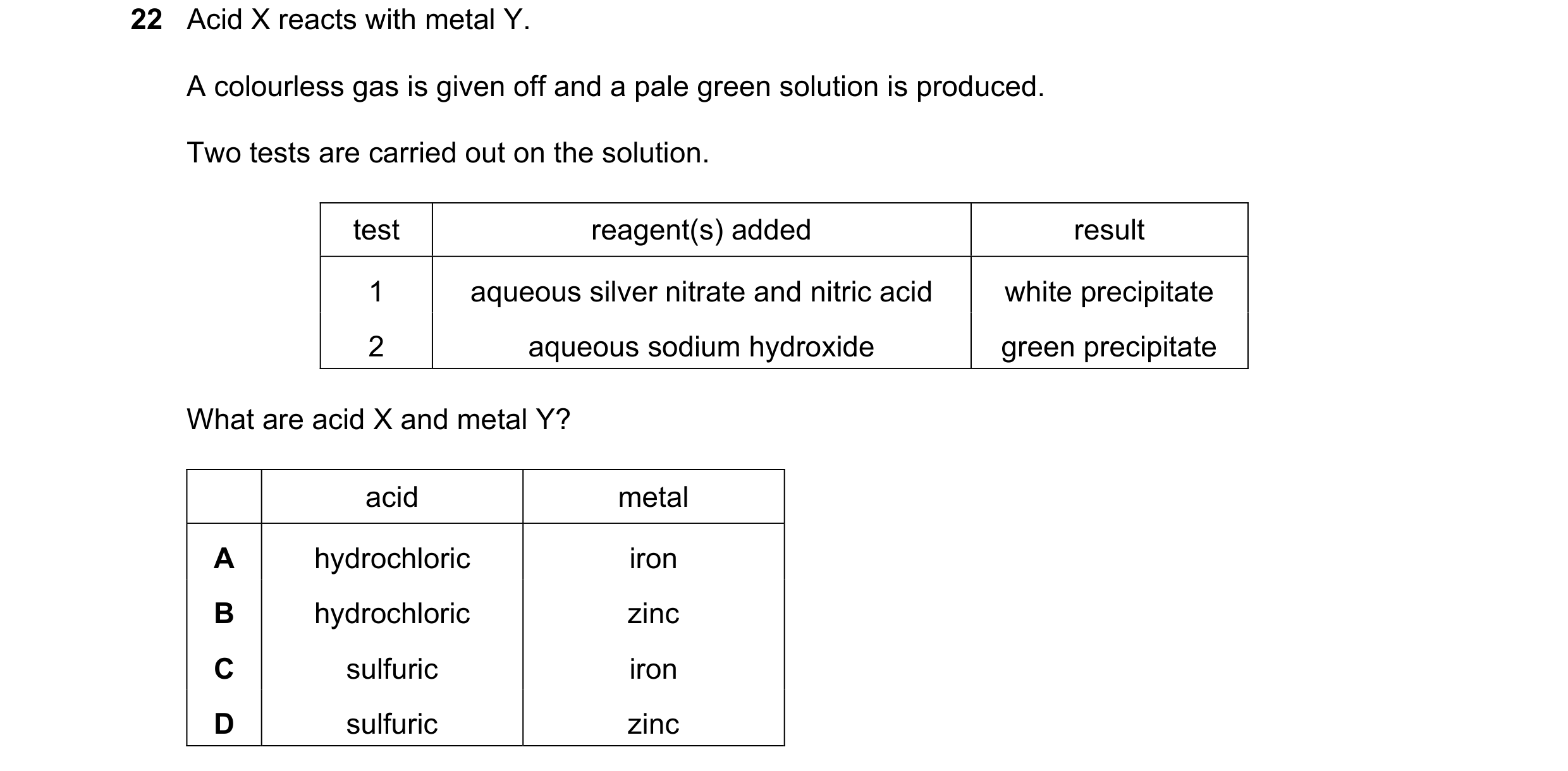
 4 / 12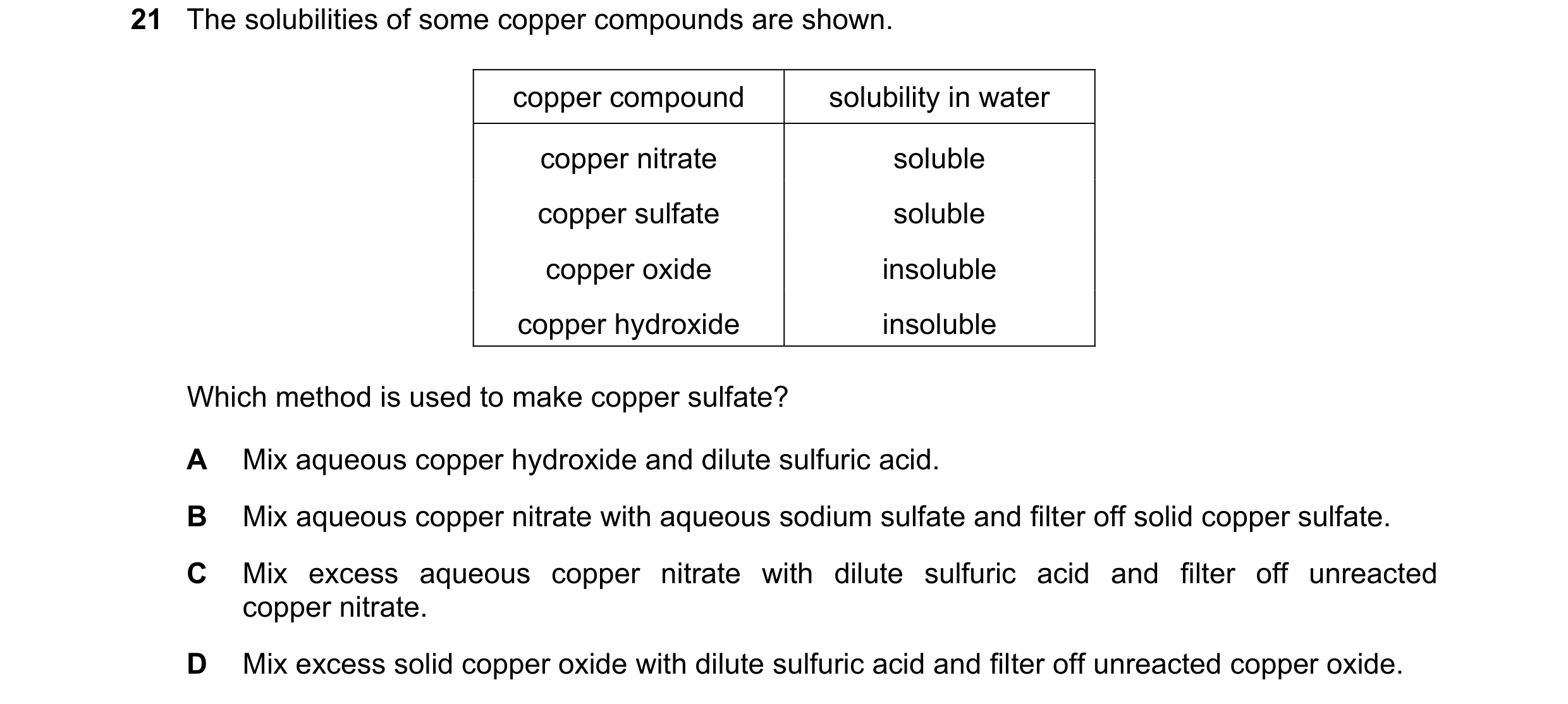

 5 / 12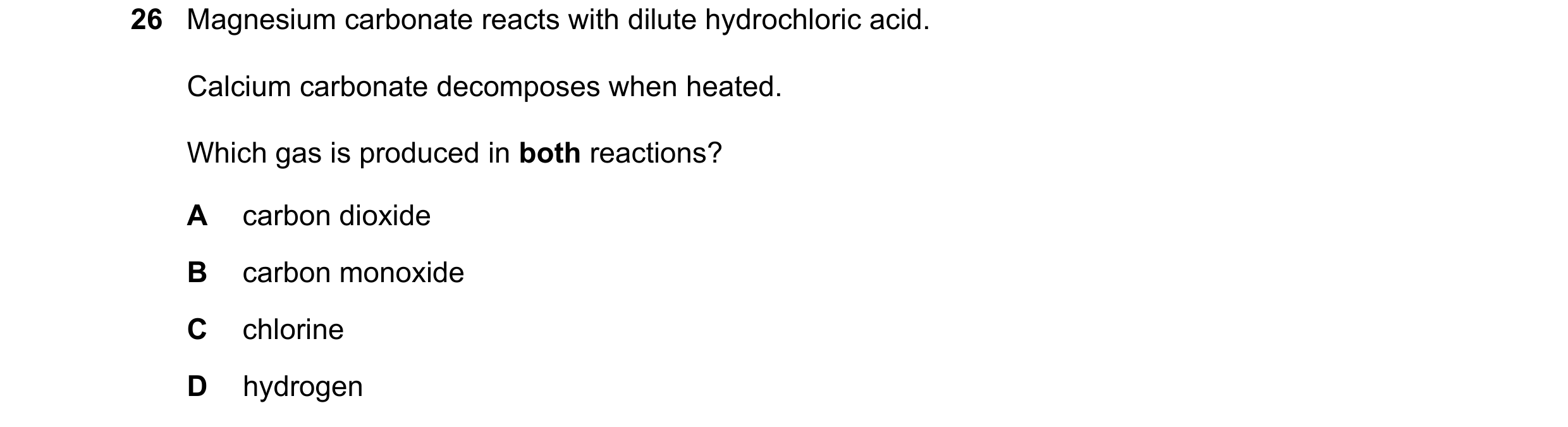


 6 / 12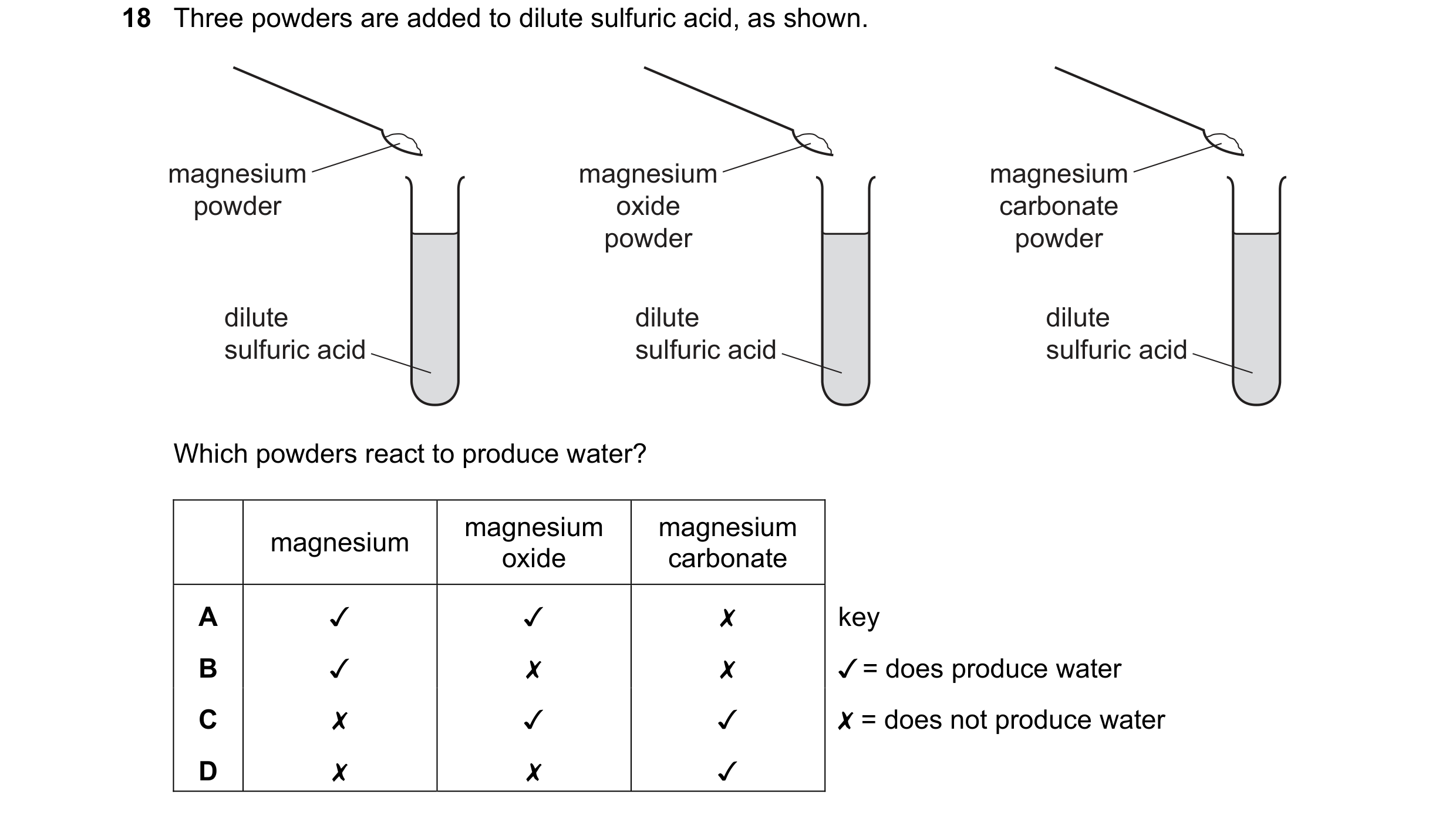
 7 / 12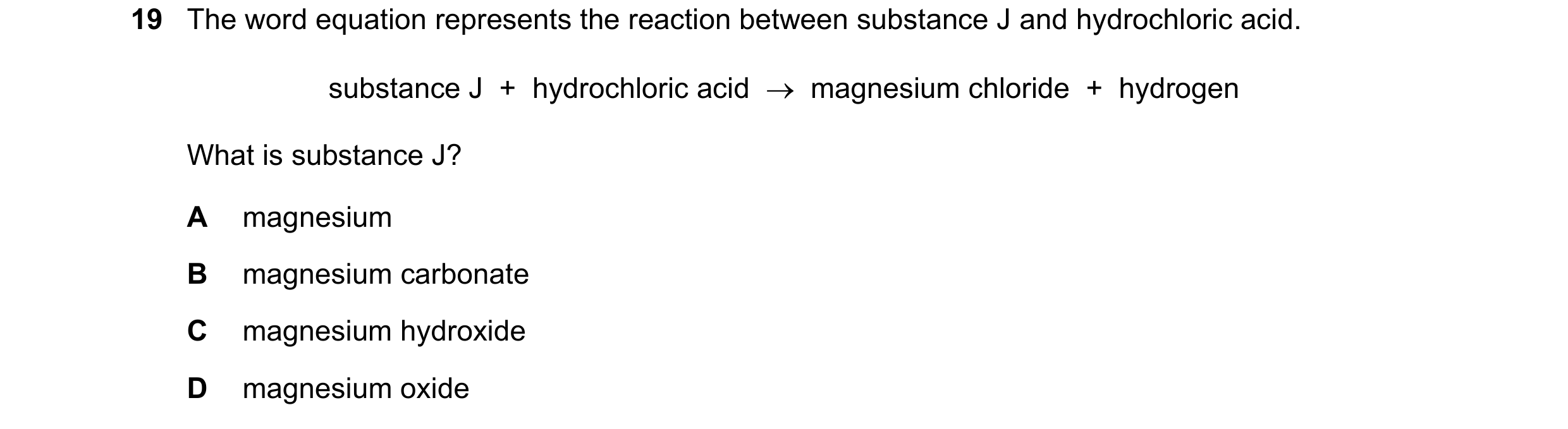

 8 / 12

 9 / 12


 10 / 12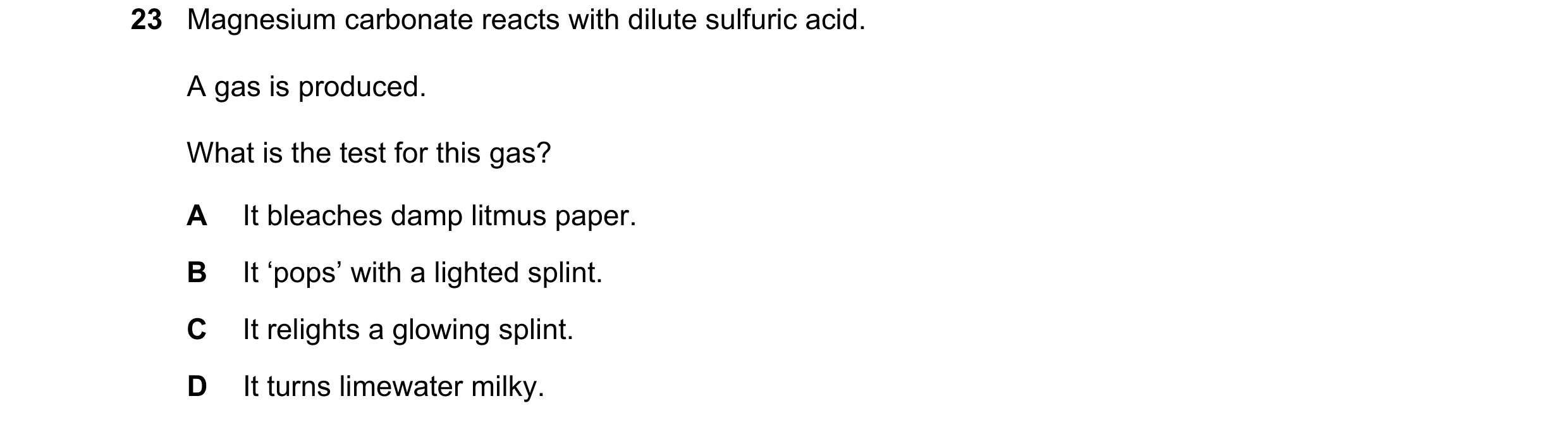

 11 / 12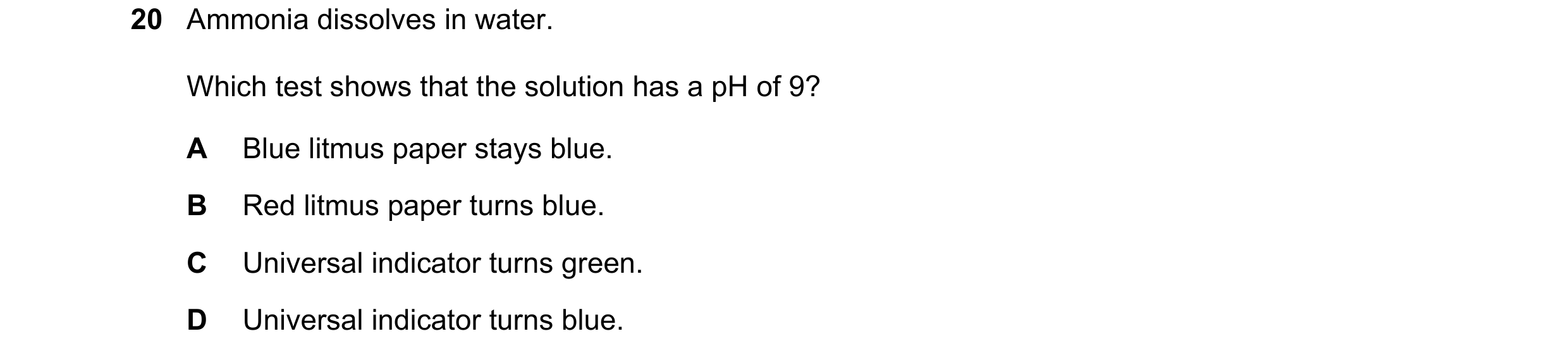
 12 / 12