Questions as text
Q1 · A student investigates the reaction between dilute sulfuric acid and excess copper(II)… 0653/41 May/June 2017
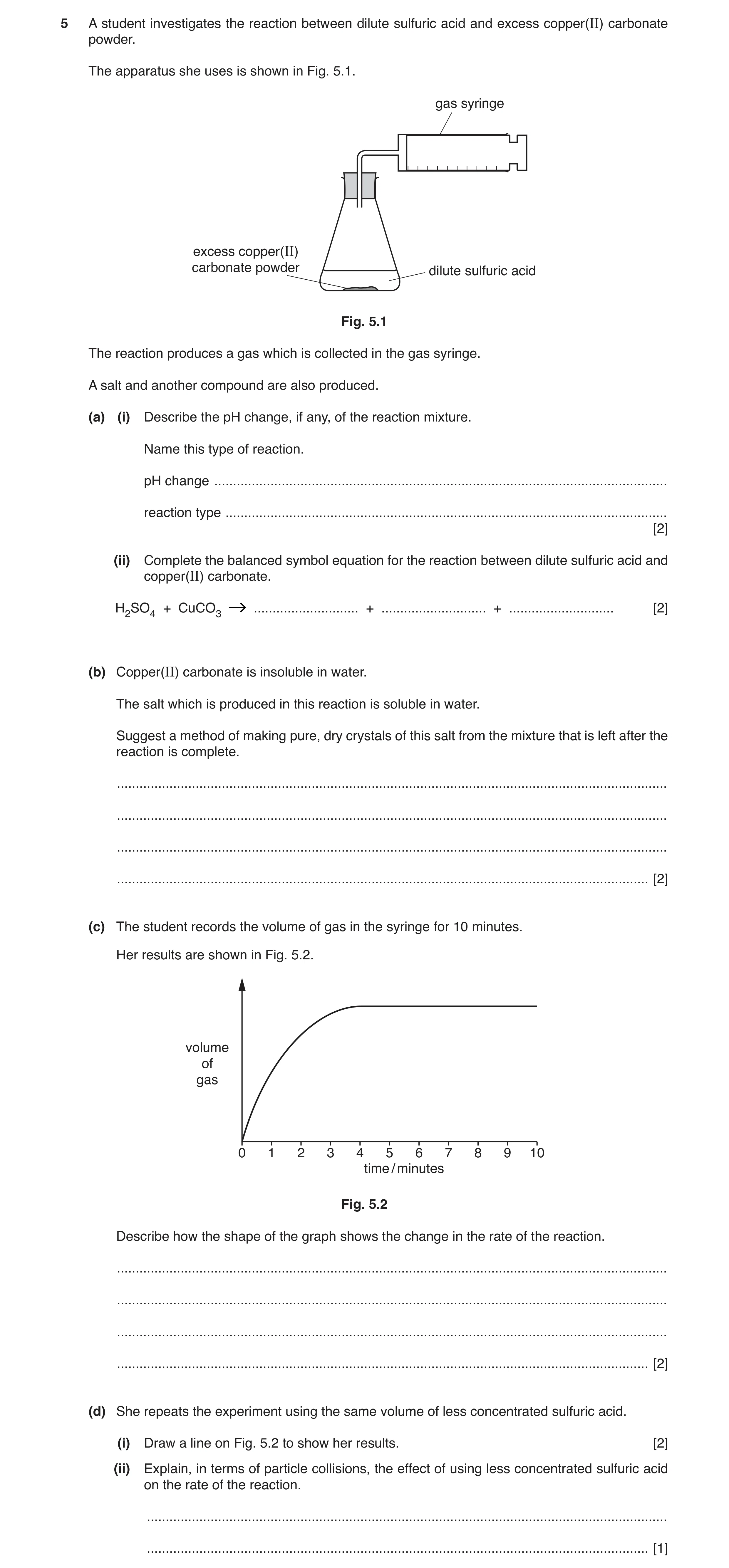
5 A student investigates the reaction between dilute sulfuric acid and excess copper(II) carbonate powder. The apparatus she uses is shown in Fig. 5.1. gas syringe excess copper(II) carbonate powder dilute sulfuric acid Fig. 5.1 The reaction produces a gas which is collected in the gas syringe. A salt and another compound are also produced. (a) (i) Describe the pH change, if any, of the reaction mixture. Name this type of reaction. pH change … reaction type … [2] (ii) Complete the balanced symbol equation for the reaction between dilute sulfuric acid and copper(II) carbonate. H2SO4 + CuCO3 … + … + … [2] (b) Copper(II) carbonate is insoluble in water. The salt which is produced in this reaction is soluble in water. Suggest a method of making pure, dry crystals of this salt from the mixture that is left after the reaction is complete. … … … … [2] (c) The student records the volume of gas in the syringe for 10 minutes. Her results are shown in Fig. 5.2. volume of gas 0 1 2 3 4 5 6 7 8 9 10 time / minutes Fig. 5.2 Describe how the shape of the graph shows the change in the rate of the reaction. … … … … [2] (d) She repeats the experiment using the same volume of less concentrated sulfuric acid. (i) Draw a line on Fig. 5.2 to show her results. [2] (ii) Explain, in terms of particle collisions, the effect of using less concentrated sulfuric acid on the rate of the reaction. … … [1]
11 marks
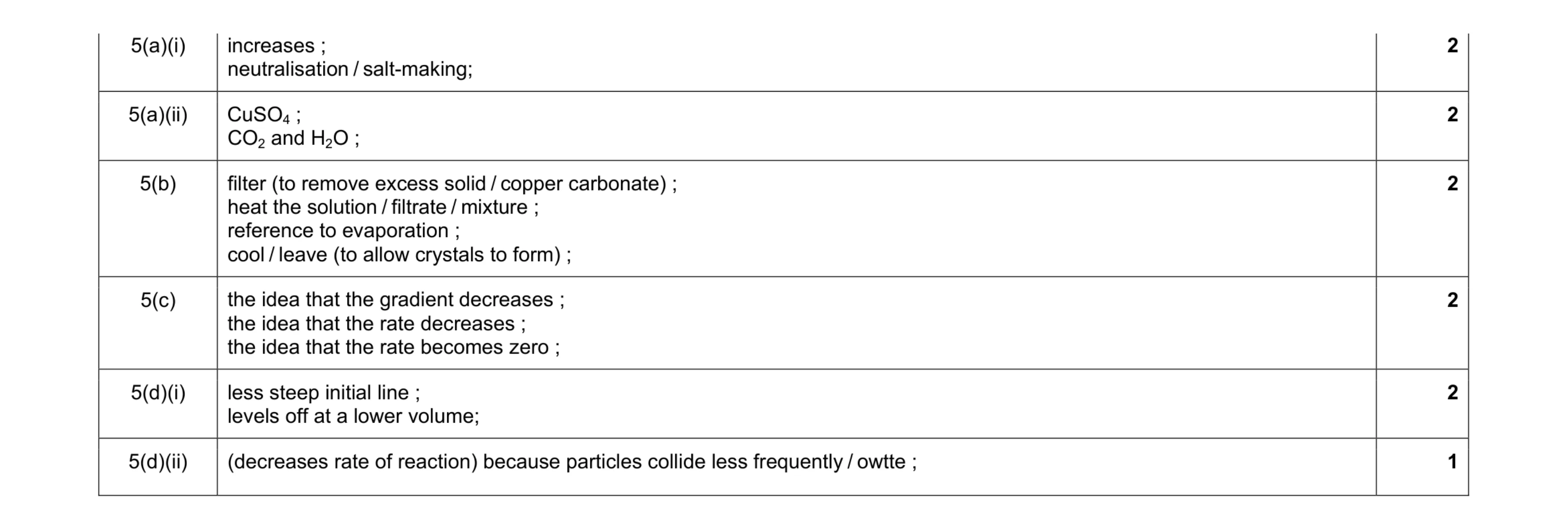
Mark scheme: 5(a)(i) neutralisation / salt-making; 2 5(a)(ii) CuSO4 ; CO2 and H2O ; 2 5(b) filter (to remove excess solid / copper carbonate) ; heat the solution / filtrate / mixture ; reference to evaporation ; cool / leave (to allow crystals to form) ; 2 5(c) the idea that the gradient decreases ; the idea that the rate decreases ; the idea that the rate becomes zero ; 2 5(d)(i) less steep initial line ; levels off at a lower volume; 2 5(d)(ii) (decreases rate of reaction) because particles collide less frequently / owtte ; 1
This question in 0653/41 May/June 2017
Q2 · Use the Periodic Table on page 24 to deduce the electronic structure of a calcium atom 0653/41 May/June 2019
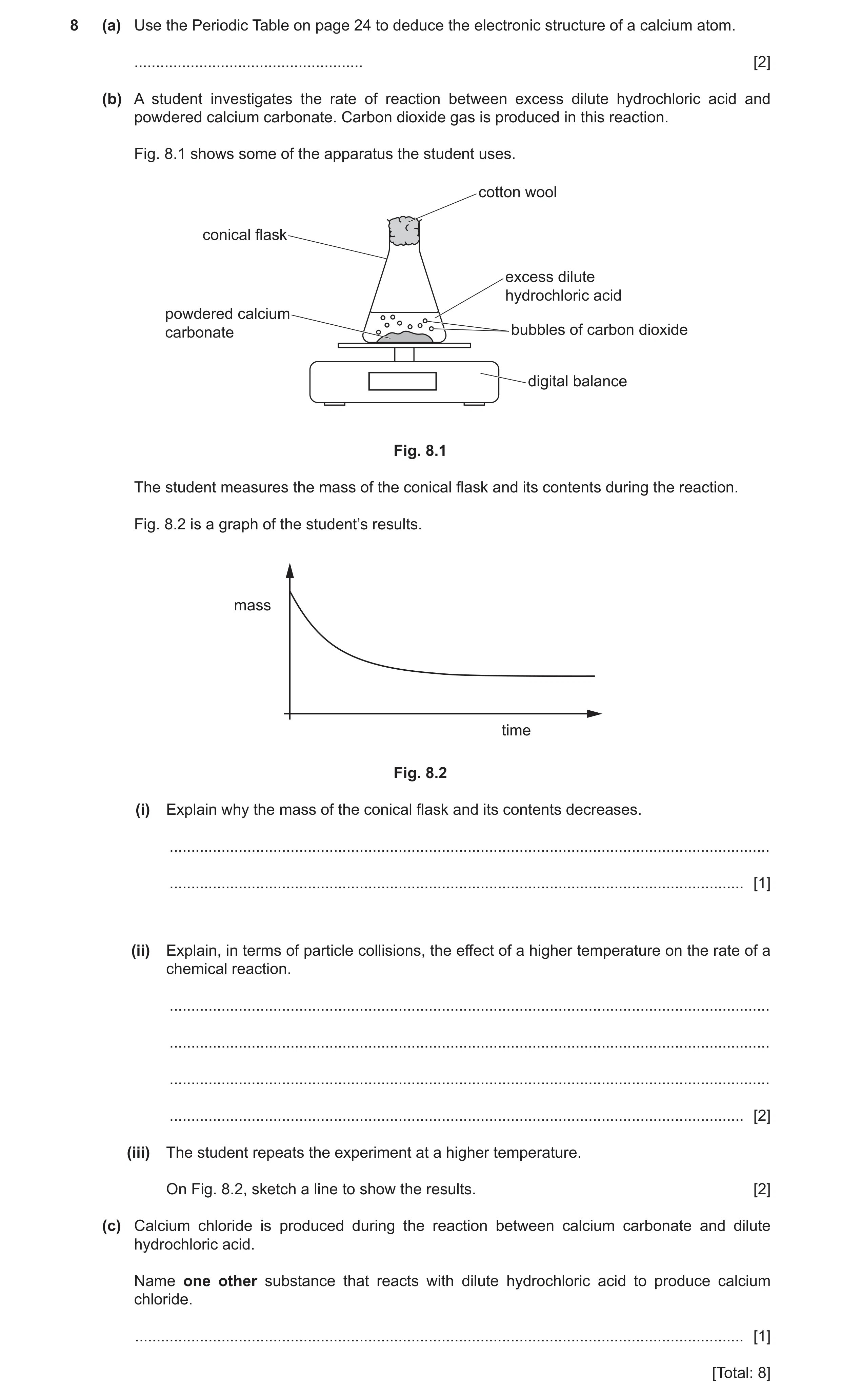
8 (a) Use the Periodic Table on page 24 to deduce the electronic structure of a calcium atom. … [2] (b) A student investigates the rate of reaction between excess dilute hydrochloric acid and powdered calcium carbonate. Carbon dioxide gas is produced in this reaction. Fig. 8.1 shows some of the apparatus the student uses. cotton wool conical flask excess dilute hydrochloric acid powdered calcium carbonate bubbles of carbon dioxide digital balance Fig. 8.1 The student measures the mass of the conical flask and its contents during the reaction. Fig. 8.2 is a graph of the student’s results. mass time Fig. 8.2 (i) Explain why the mass of the conical flask and its contents decreases. … … [1] (ii) Explain, in terms of particle collisions, the effect of a higher temperature on the rate of a chemical reaction. … … … … [2] (iii) The student repeats the experiment at a higher temperature. On Fig. 8.2, sketch a line to show the results. [2] (c) Calcium chloride is produced during the reaction between calcium carbonate and dilute hydrochloric acid. Name one other substance that reacts with dilute hydrochloric acid to produce calcium chloride. … [1] [Total: 8]
8 marks
Mark scheme: 8(a) 20 electrons ; 2,8,8,2 ; 2 8(b)(i) (carbon dioxide) gas released from the apparatus ; 1 8(b)(ii) particles have more energy/kinetic energy / move faster ; more successful collisions / collisions with enough energy ; greater frequency of collisions ; max 2 8(b)(iii) curved portion steeper ; horizontal line at same mass ; 2 8(c) calcium oxide / calcium hydroxide / calcium hydrogencarbonate / calcium ; 1
This question in 0653/41 May/June 2019
Q3 · A student investigates the rate of reaction between solid calcium carbonate and dilute… 0653/42 May/June 2021
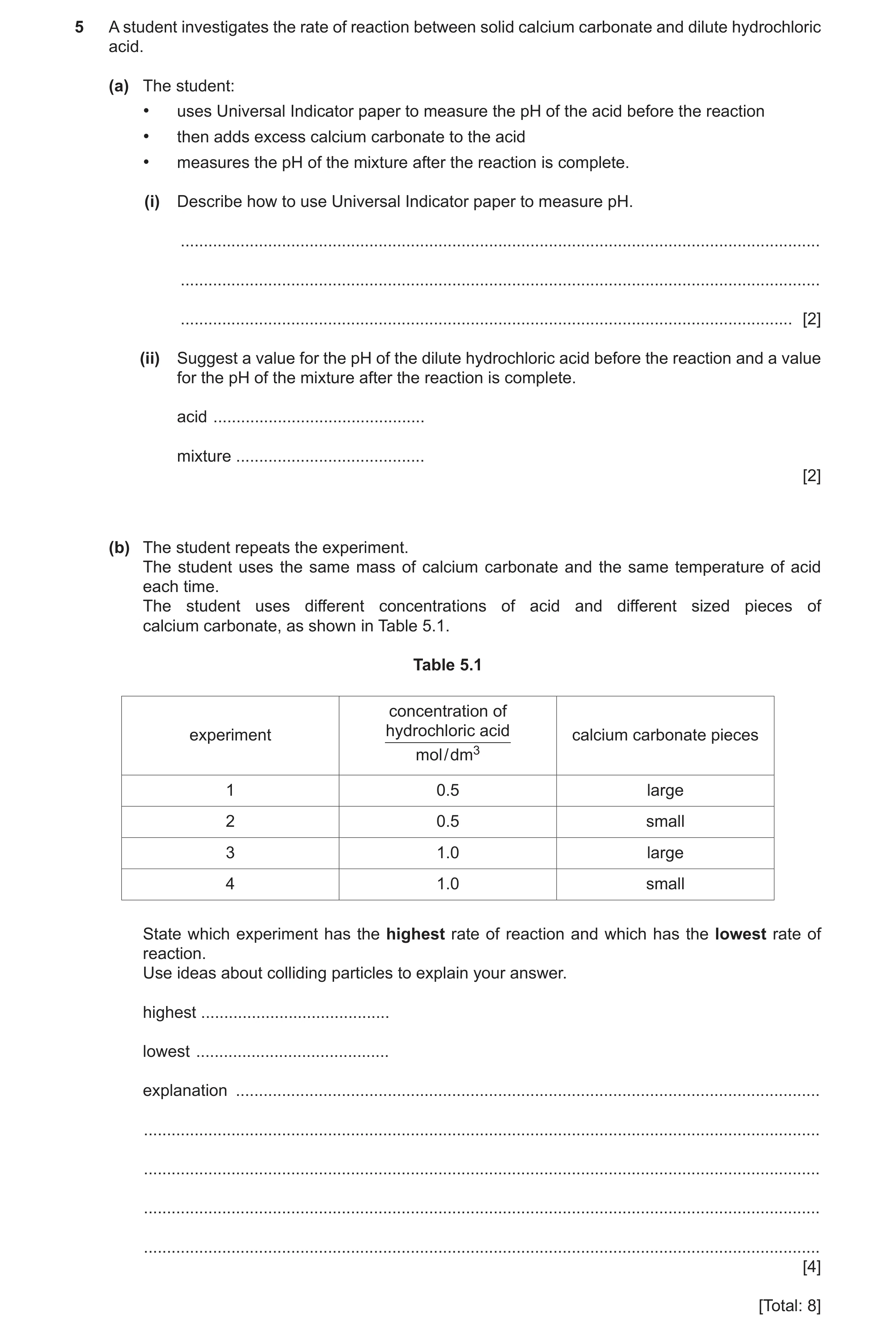
5 A student investigates the rate of reaction between solid calcium carbonate and dilute hydrochloric acid. (a) The student: • uses Universal Indicator paper to measure the pH of the acid before the reaction • then adds excess calcium carbonate to the acid • measures the pH of the mixture after the reaction is complete. (i) Describe how to use Universal Indicator paper to measure pH. … … … [2] (ii) Suggest a value for the pH of the dilute hydrochloric acid before the reaction and a value for the pH of the mixture after the reaction is complete. acid … mixture … [2] (b) The student repeats the experiment. The student uses the same mass of calcium carbonate and the same temperature of acid each time. The student uses different concentrations of acid and different sized pieces of calcium carbonate, as shown in Table 5.1. Table 5.1 concentration of experiment hydrochloric acid calcium carbonate pieces mol / dm3 1 0.5 large 2 0.5 small 3 1.0 large 4 1.0 small State which experiment has the highest rate of reaction and which has the lowest rate of reaction. Use ideas about colliding particles to explain your answer. highest … lowest … explanation … … … … … [4] [Total: 8]
8 marks
Mark scheme: 5(a)(i) place some acid on the paper OWTTE ; compare colours to a chart / colour indicates pH ; 2 5(a)(ii) acid: in the range 4 to 1 ; mixture: 7 ; 2 5(b) (highest) 4 AND (lowest) 1 ; faster reactions have more frequent collisions ; more concentrated acids have more particles (in the same volume) ; smaller pieces (of CaCO3) have a larger surface area (exposed to acid) ; 4
This question in 0653/42 May/June 2021
Q4 · The pH values of four aqueous salt solutions are listed in Table 5.1 0653/42 Oct/Nov 2021
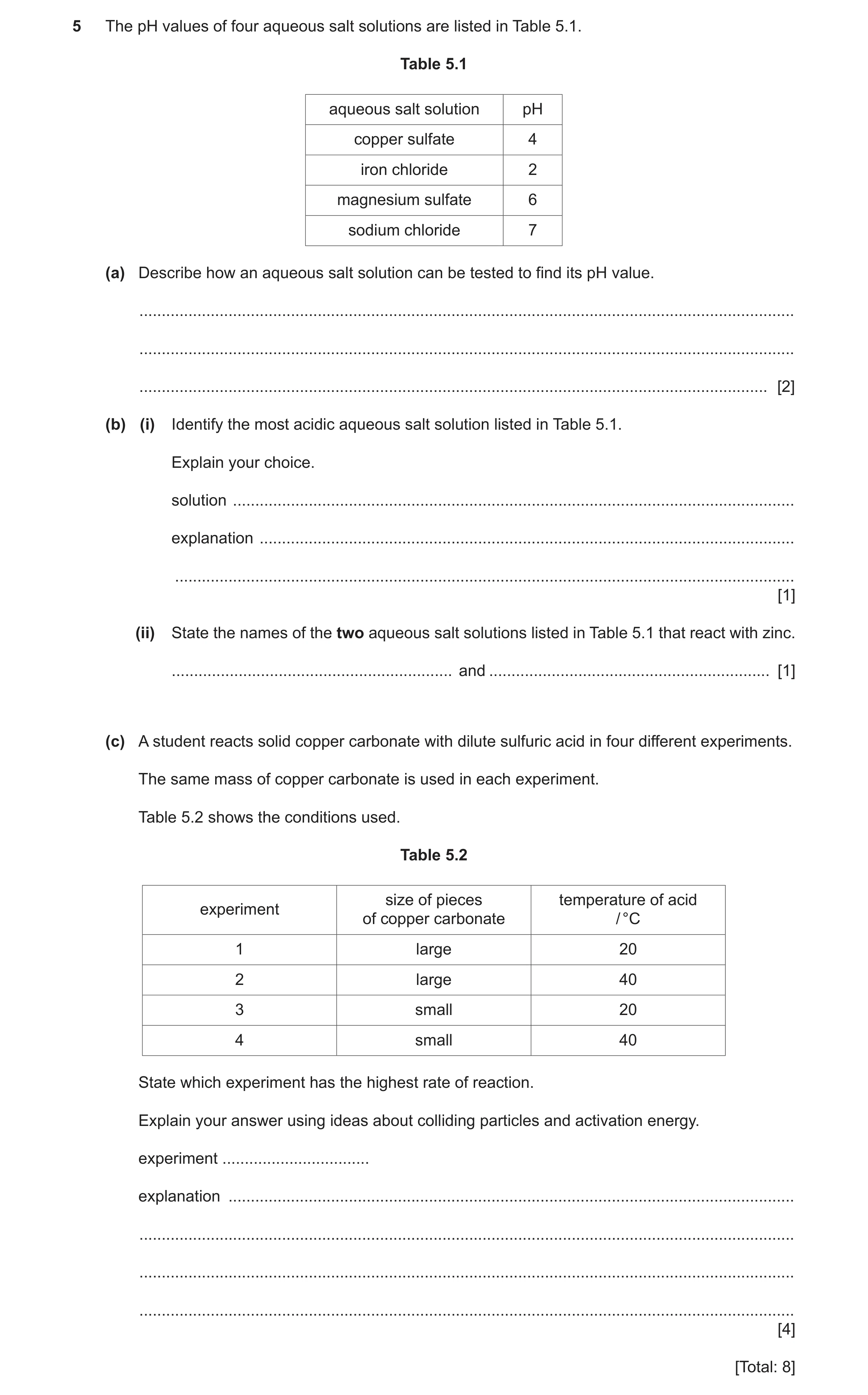
5 The pH values of four aqueous salt solutions are listed in Table 5.1. Table 5.1 aqueous salt solution pH copper sulfate 4 iron chloride 2 magnesium sulfate 6 sodium chloride 7 (a) Describe how an aqueous salt solution can be tested to find its pH value. … … … [2] (b) (i) Identify the most acidic aqueous salt solution listed in Table 5.1. Explain your choice. solution … explanation … … [1] (ii) State the names of the two aqueous salt solutions listed in Table 5.1 that react with zinc. … and … [1] (c) A student reacts solid copper carbonate with dilute sulfuric acid in four different experiments. The same mass of copper carbonate is used in each experiment. Table 5.2 shows the conditions used. Table 5.2 size of pieces temperature of acid experiment of copper carbonate / °C 1 large 20 2 large 40 3 small 20 4 small 40 State which experiment has the highest rate of reaction. Explain your answer using ideas about colliding particles and activation energy. experiment … explanation … … … … [4] [Total: 8]
8 marks
Mark scheme: 5(a) use universal indicator ; observe the colour ; 2 5(b)(i) iron(III) chloride AND has the lowest pH ; 1 5(b)(ii) copper(II) sulfate AND iron(III) chloride ; 1 5(c) experiment 4 ; more particles, have / collide with, the (minimum) activation energy ; plus any two from: higher temperature means higher, kinetic energy / speed ; small pieces have larger surface area ; reference to more frequent collisions ; 4
This question in 0653/42 Oct/Nov 2021
Q5 · Hydrogen and oxygen are made when dilute sulfuric acid is electrolysed using inert… 0653/42 Feb/March 2022
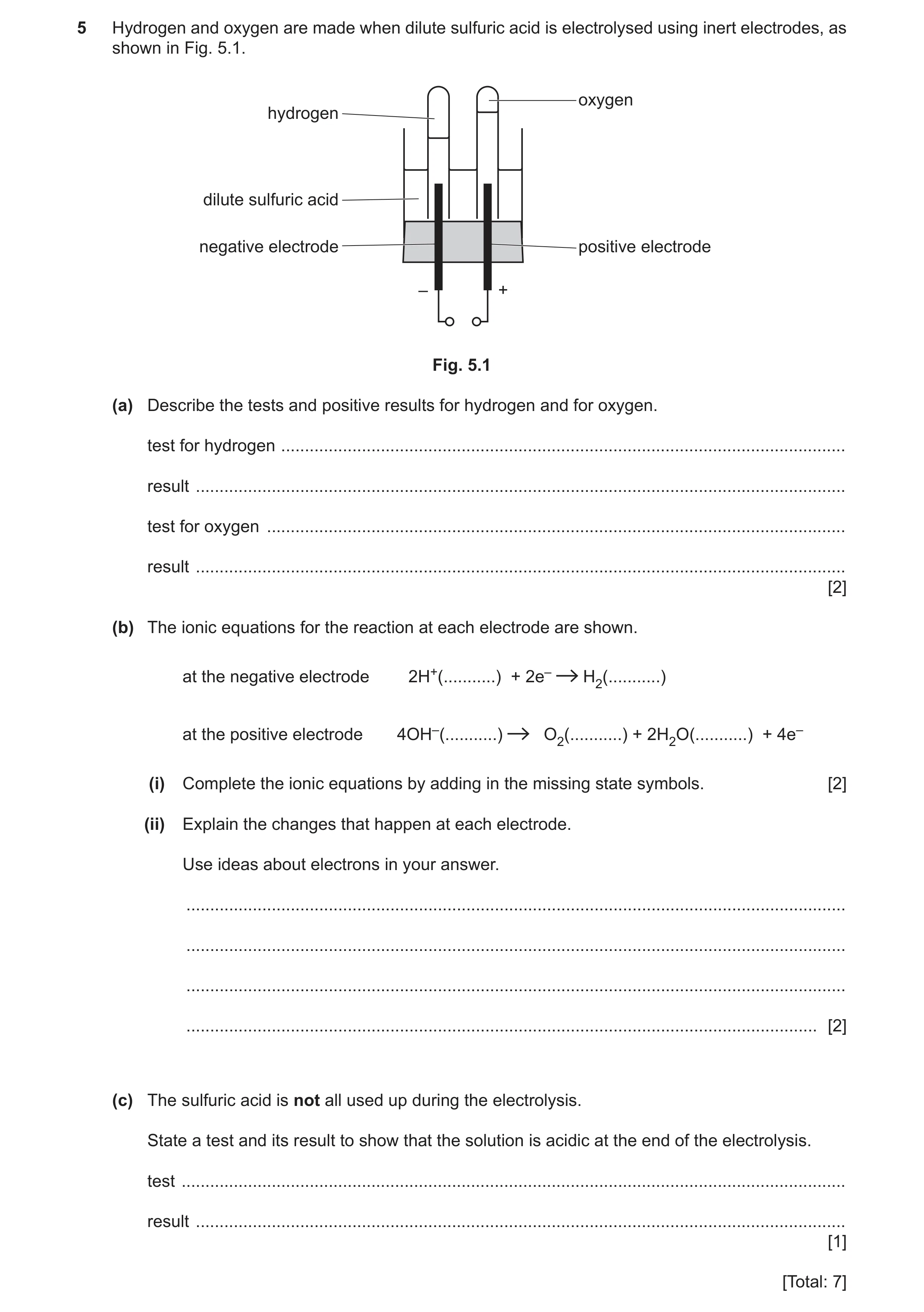
5 Hydrogen and oxygen are made when dilute sulfuric acid is electrolysed using inert electrodes, as shown in Fig. 5.1. oxygen hydrogen dilute sulfuric acid negative electrode positive electrode – + Fig. 5.1 (a) Describe the tests and positive results for hydrogen and for oxygen. test for hydrogen … result … test for oxygen … result … [2] (b) The ionic equations for the reaction at each electrode are shown. at the negative electrode 2H+( … ) + 2e– H2( … ) at the positive electrode 4OH–( … ) O2( … ) + 2H2O( … ) + 4e– (i) Complete the ionic equations by adding in the missing state symbols. [2] (ii) Explain the changes that happen at each electrode. Use ideas about electrons in your answer. … … … … [2] (c) The sulfuric acid is not all used up during the electrolysis. State a test and its result to show that the solution is acidic at the end of the electrolysis. test … result … [1] [Total: 7]
7 marks
Mark scheme: 5(a) hydrogen: lighted splint and pops / gives a squeaky pop ; oxygen: glowing splint and relights ; 2 5(b)(i) 2H+(aq) + 2 e– → H2(g) 4OH-(aq) → O2(g) + 2H2O(l) + 4e– (g) shown for hydrogen and oxygen ; (aq) for H + and OH – and (l) for water ; 2 5(b)(ii) (at the negative electrode / cathode) hydrogen ions gain electrons (to form hydrogen atoms / hydrogen molecules) ; (at the positive electrode / anode) hydroxide ions lose electrons (to form water molecules and oxygen molecules) ; 2 5(c) universal indicator / (blue) litmus AND turns red ; 1
This question in 0653/42 Feb/March 2022
Q6 · A pH meter is an instrument which measures pH 0653/41 May/June 2022
5 (a) A pH meter is an instrument which measures pH. The tip of the meter is dipped into a solution. The pH of the solution is displayed on a small screen as shown in Fig. 5.1. pH screen pH meter 5.5 solution tip Fig. 5.1 The pH values of some aqueous solutions are measured using universal indicator paper and using a pH meter. The results are shown in Table 5.1. Table 5.1 pH value measured using pH value measured using aqueous solution universal indicator paper a pH meter ammonia 12 11.6 ammonium nitrate 5 5.3 ammonium sulfate 5 5.5 sulfuric acid 1 0.5 nitric acid 1 0.5 (i) Describe the procedure used to measure the pH of a solution using universal indicator paper. … … … [2] (ii) Suggest two advantages of using a pH meter rather than universal indicator paper to test the pH of some solutions. Use Fig. 5.1 and Table 5.1 to help you. 1 … … 2 … … [2] (b) Farmers use solid ammonium nitrate and solid ammonium sulfate to improve the growth of crops. (i) Aqueous ammonia and dilute sulfuric acid react to make aqueous ammonium sulfate. Complete the balanced equation for this reaction. … + … (NH4)2SO4 [2] (ii) Suggest the name of the compound that reacts with aqueous ammonia to form ammonium nitrate. … [1] (iii) Describe how solid ammonium sulfate is obtained from aqueous ammonium sulfate. … … … [2] [Total: 9]
9 marks
Mark scheme: 5(a)(i) (dip paper in) and observe the colour ; compare colour to a chart / idea that colour indicates the pH ; 2 5(a)(ii) gives a value to one decimal place idea / idea of greater precision of measurements ; do not need to use a reference chart / can be reused / avoids the uncertainly of judging colours ; 2 5(b)(i) 2NH3 + H2SO4 formula of both correct ; balancing correct dependent on correct formulae ; 2 5(b)(ii) nitric acid ; 1 5(b)(iii) leave in warm place / heat ; evaporate water ; 2
This question in 0653/41 May/June 2022
Q7 · Sodium, potassium and rubidium are elements in Group I of the Periodic Table 0653/43 May/June 2022
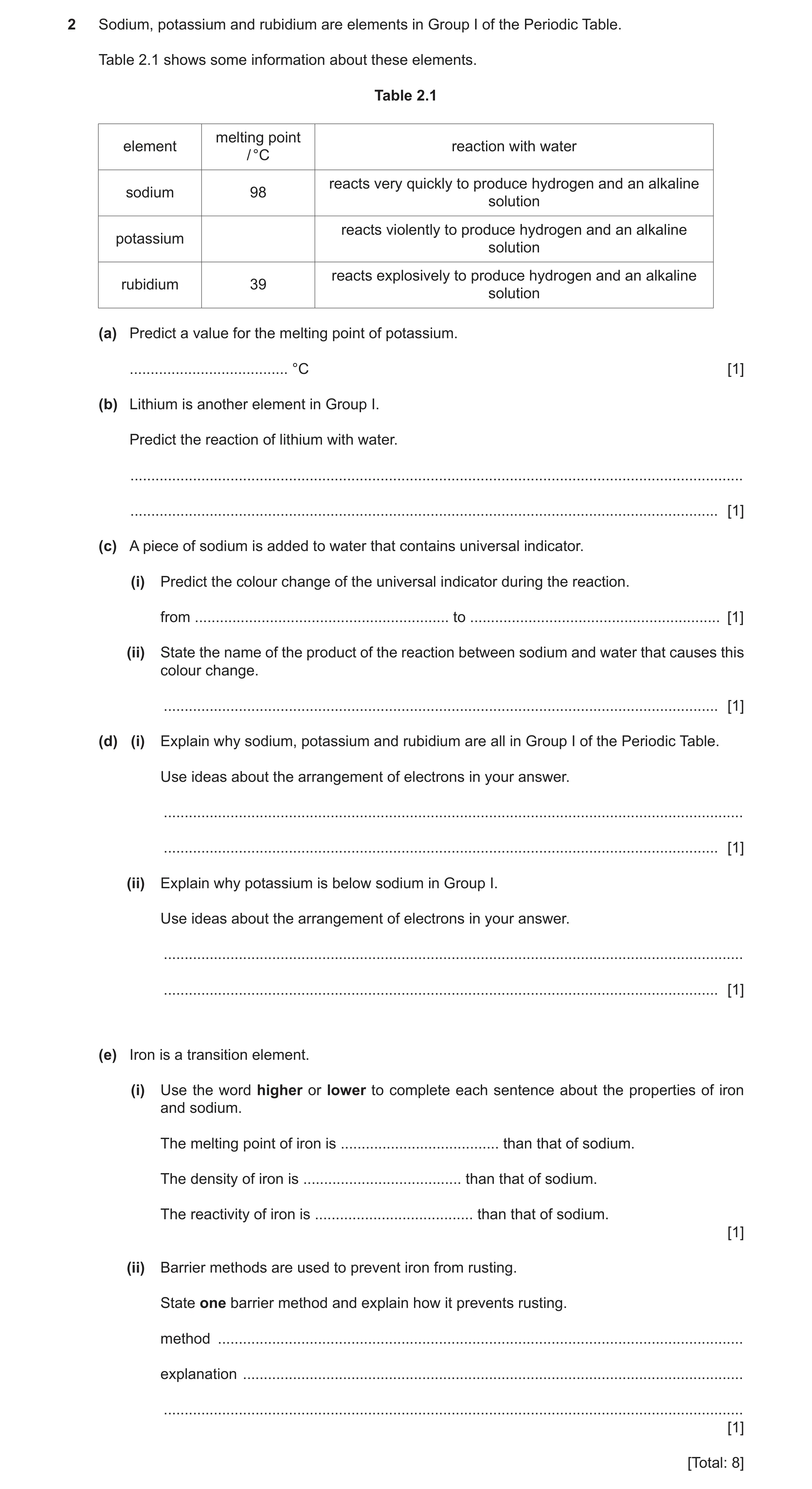
2 Sodium, potassium and rubidium are elements in Group I of the Periodic Table. Table 2.1 shows some information about these elements. Table 2.1 melting point element reaction with water / °C reacts very quickly to produce hydrogen and an alkaline sodium 98 solution reacts violently to produce hydrogen and an alkaline potassium solution reacts explosively to produce hydrogen and an alkaline rubidium 39 solution (a) Predict a value for the melting point of potassium. … °C [1] (b) Lithium is another element in Group I. Predict the reaction of lithium with water. … … [1] (c) A piece of sodium is added to water that contains universal indicator. (i) Predict the colour change of the universal indicator during the reaction. from … to … [1] (ii) State the name of the product of the reaction between sodium and water that causes this colour change. … [1] (d) (i) Explain why sodium, potassium and rubidium are all in Group I of the Periodic Table. Use ideas about the arrangement of electrons in your answer. … … [1] (ii) Explain why potassium is below sodium in Group I. Use ideas about the arrangement of electrons in your answer. … … [1] (e) Iron is a transition element. (i) Use the word higher or lower to complete each sentence about the properties of iron and sodium. The melting point of iron is … than that of sodium. The density of iron is … than that of sodium. The reactivity of iron is … than that of sodium. [1] (ii) Barrier methods are used to prevent iron from rusting. State one barrier method and explain how it prevents rusting. method … explanation … … [1] [Total: 8]
8 marks
Mark scheme: 2(a) value between melting point of sodium and rubidium ; 1 2(b) reacts, quickly / slower than sodium,( to give hydrogen and an alkaline solution ) ; 1 2(c)(i) green/yellow to purple/blue ; 1 2(c)(ii) sodium hydroxide ; 1 2(d)(i) (all their atoms have) one electron in the outer shell ; 1 Question Answer Marks 2(d)(ii) potassium has (one) more shell than sodium ; 1 2(e)(i) higher higher lower ; 1 2(e)(ii) method: oil / grease / paint explanation: keeps out oxygen / water ; 1
This question in 0653/43 May/June 2022
Q8 · Concentrated aqueous sodium chloride is electrolysed using inert electrodes, as shown in… 0653/41 Oct/Nov 2022
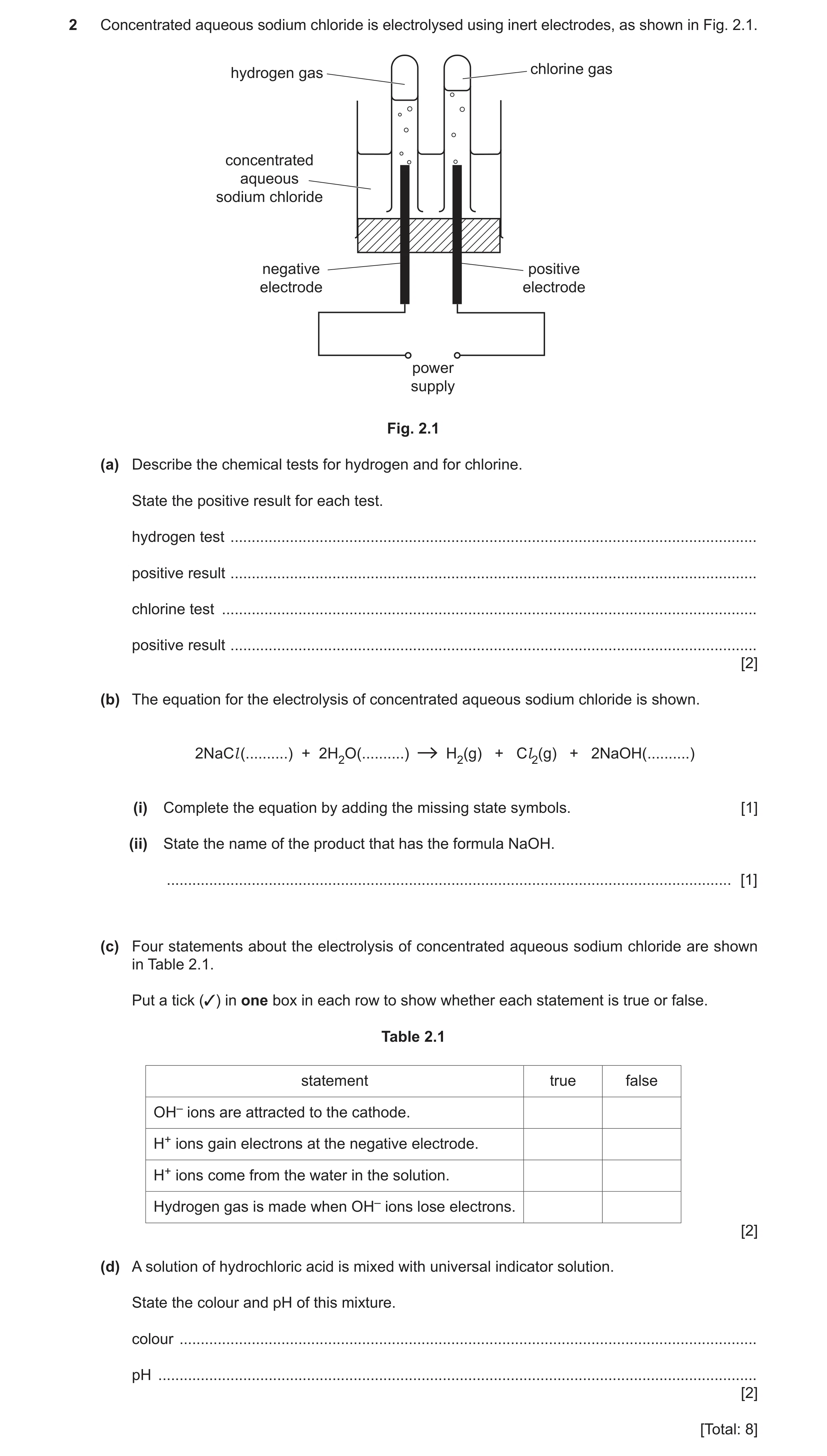
2 Concentrated aqueous sodium chloride is electrolysed using inert electrodes, as shown in Fig. 2.1. chlorine gas hydrogen gas concentrated aqueous sodium chloride negative positive electrode electrode power supply Fig. 2.1 (a) Describe the chemical tests for hydrogen and for chlorine. State the positive result for each test. hydrogen test … positive result … chlorine test … positive result … [2] (b) The equation for the electrolysis of concentrated aqueous sodium chloride is shown. 2NaCl ( … ) + 2H2O( … ) H2(g) + Cl2(g) + 2NaOH( … ) (i) Complete the equation by adding the missing state symbols. [1] (ii) State the name of the product that has the formula NaOH. … [1] (c) Four statements about the electrolysis of concentrated aqueous sodium chloride are shown in Table 2.1. Put a tick (3) in one box in each row to show whether each statement is true or false. Table 2.1 statement true false OH– ions are attracted to the cathode. H+ ions gain electrons at the negative electrode. H+ ions come from the water in the solution. Hydrogen gas is made when OH– ions lose electrons. [2] (d) A solution of hydrochloric acid is mixed with universal indicator solution. State the colour and pH of this mixture. colour … pH … [2] [Total: 8]
8 marks
Mark scheme: 2(a) hydrogen test lighted splint AND positive result pops ; 2 chlorine test (damp) litmus paper AND positive result bleaches ; 2(b)(i) 2NaCl (aq) AND 2H2O (l ) AND 2NaOH (aq) ; 1 2(b)(ii) sodium hydroxide ; 1 2(c) 2 statement true false OH- ions are attracted to the cathode. ✓ H+ ions gain electrons at the negative electrode. ✓ H+ ions come from the water in the solution. ✓ Hydrogen gas is made when OH– ions lose electrons. ✓ two or three correct ; all four correct ; 2(d) colour red ; 2 pH answer in range 1–3 ;
This question in 0653/41 Oct/Nov 2022
Q9 · Solid magnesium and some magnesium compounds react with dilute acids to make salts 0653/42 May/June 2024
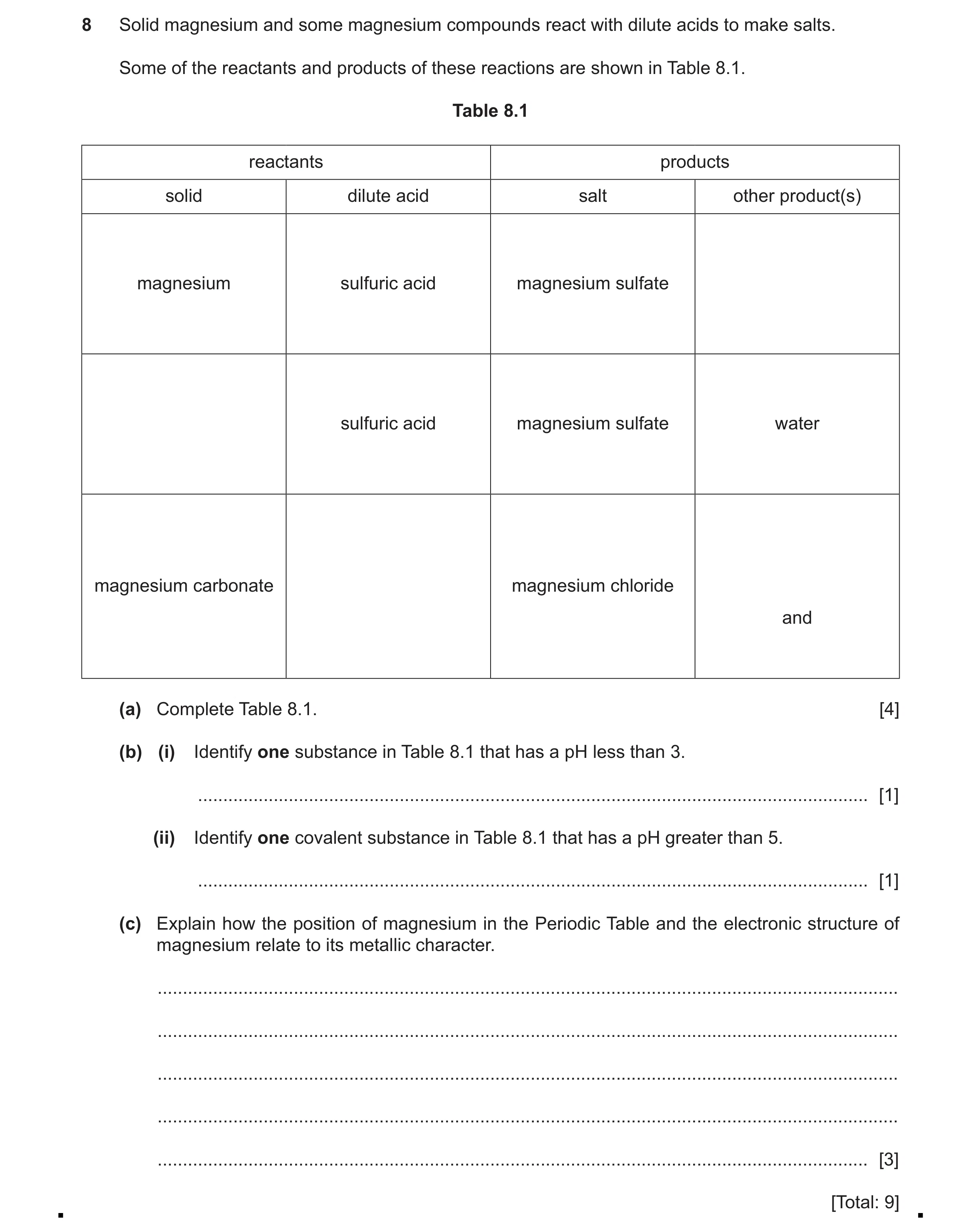
8 Solid magnesium and some magnesium compounds react with dilute acids to make salts. Some of the reactants and products of these reactions are shown in Table 8.1. Table 8.1 reactants products solid dilute acid salt other product(s) magnesium sulfuric acid magnesium sulfate sulfuric acid magnesium sulfate water magnesium carbonate magnesium chloride and (a) Complete Table 8.1. [4] (b) (i) Identify one substance in Table 8.1 that has a pH less than 3. … [1] (ii) Identify one covalent substance in Table 8.1 that has a pH greater than 5. … [1] (c) Explain how the position of magnesium in the Periodic Table and the electronic structure of magnesium relate to its metallic character. … … … … … [3] [Total: 9]
9 marks
Mark scheme: 8(a) hydrogen / H2 ; magnesium oxide / MgO / magnesium hydroxide / Mg(OH)2 ; hydrochloric acid / HCl ; carbon dioxide AND water / CO2 AND H2O ; 4 8(b)(i) sulfuric acid / hydrochloric acid ; 1 8(b)(ii) water ; 1 Question Answer Marks 8(c) any three from: magnesium is in Group II ; magnesium has two electrons in the outer shell ; metals are on left of the Periodic Table ; metals have, low / 1–3, electrons in the outer shells ; 3
This question in 0653/42 May/June 2024
Q10 · Zinc and some zinc compounds react with dilute acids to make salts 0653/43 May/June 2024
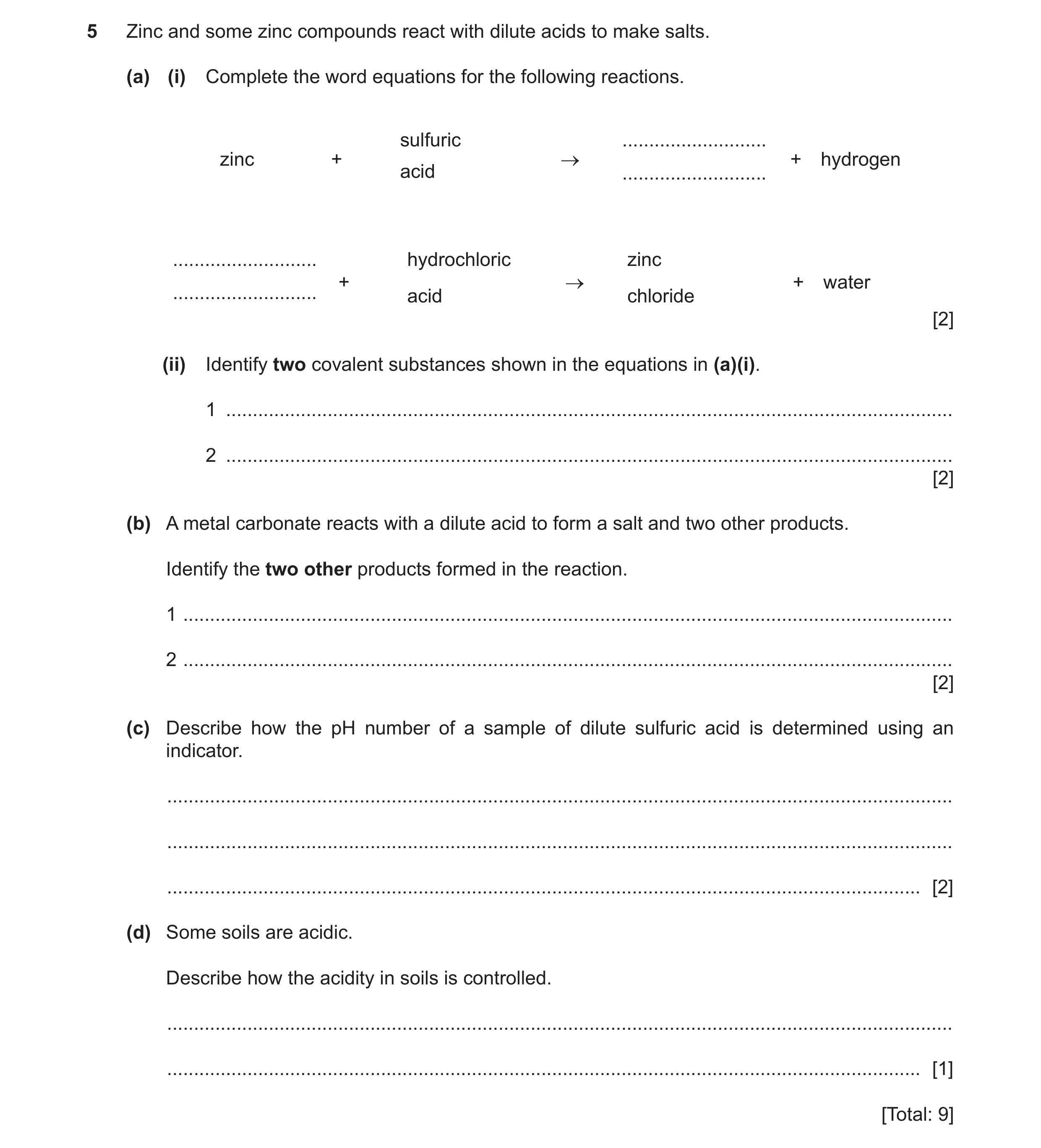
5 Zinc and some zinc compounds react with dilute acids to make salts. (a) (i) Complete the word equations for the following reactions. sulfuric … zinc + + hydrogen acid … … hydrochloric zinc + + water … acid chloride [2] (ii) Identify two covalent substances shown in the equations in (a)(i). 1 … 2 … [2] (b) A metal carbonate reacts with a dilute acid to form a salt and two other products. Identify the two other products formed in the reaction. 1 … 2 … [2] (c) Describe how the pH number of a sample of dilute sulfuric acid is determined using an indicator. … … … [2] (d) Some soils are acidic. Describe how the acidity in soils is controlled. … … [1] [Total: 9]
9 marks
Mark scheme: 5(a)(i) zinc sulfate ; zinc oxide / zinc hydroxide ; 2 5(a)(ii) hydrogen ; water ; 2 5(b) carbon dioxide ; water ; 2 Question Answer Marks 5(c) full range / universal, indicator ; compare (colours) with chart / colour corresponds to a number ; 2 5(d) add, calcium carbonate / limestone / calcium hydroxide / (slaked) lime / add a base ; 1
This question in 0653/43 May/June 2024
 7 / 14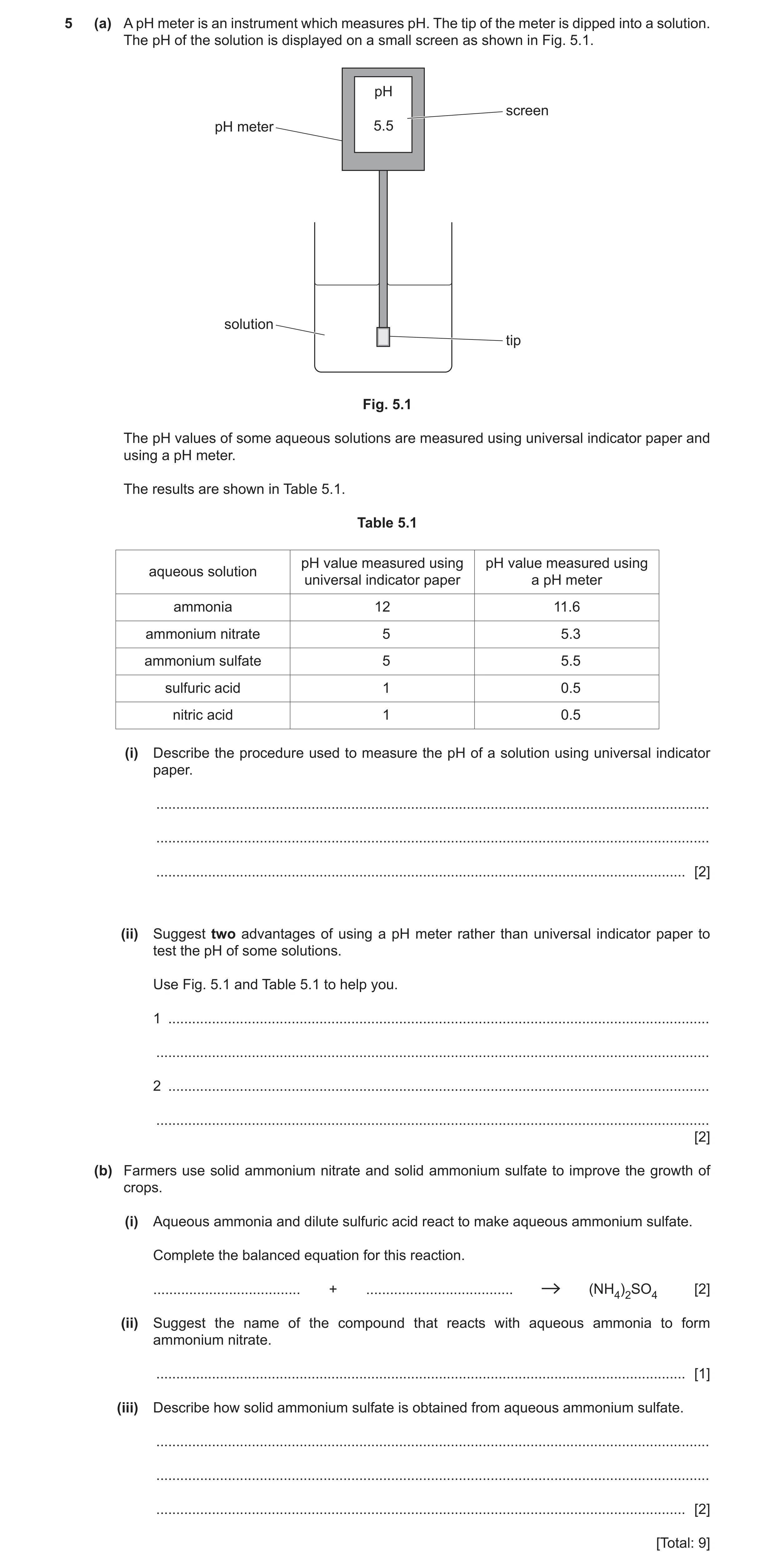
 13 / 14
 14 / 14
 11
11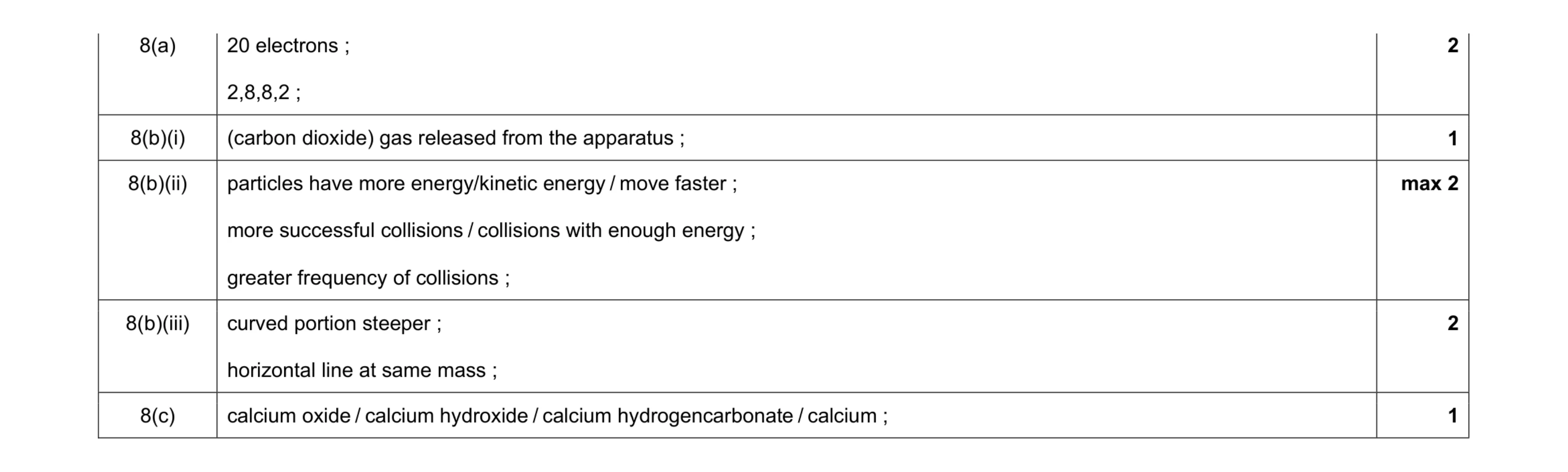 8
8 8
8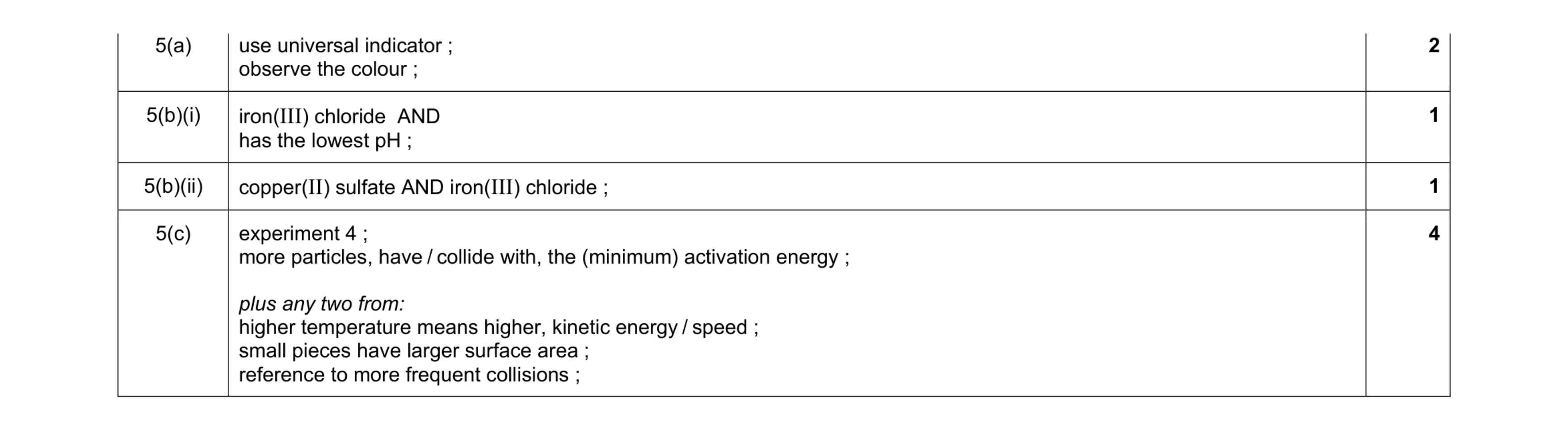 8
8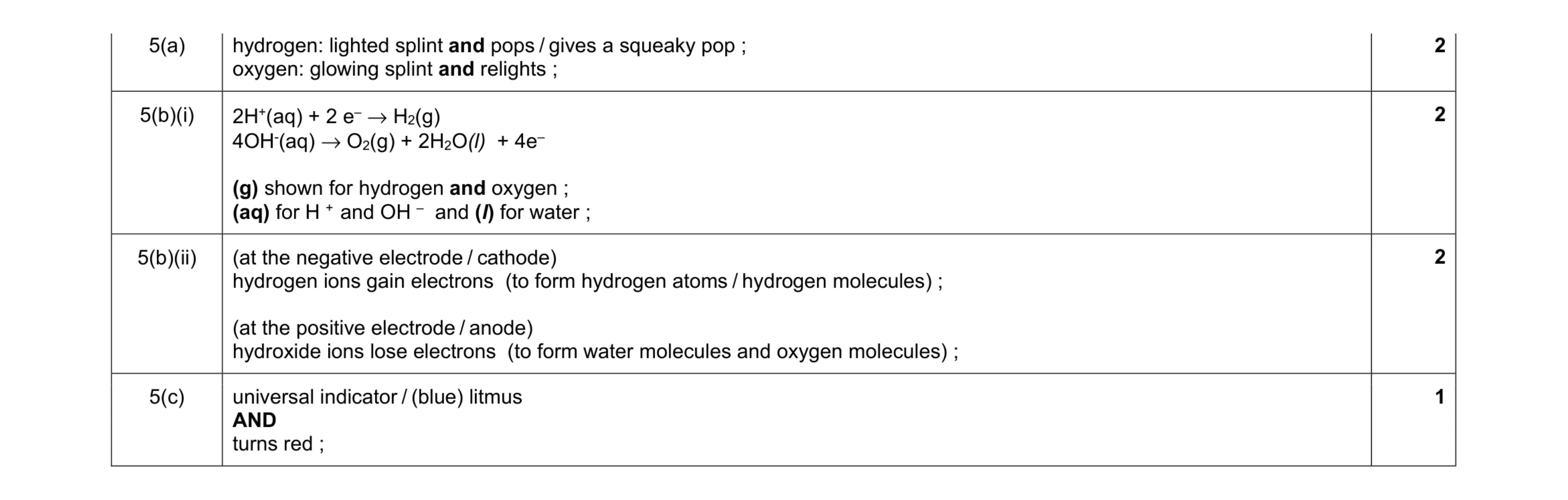 7
7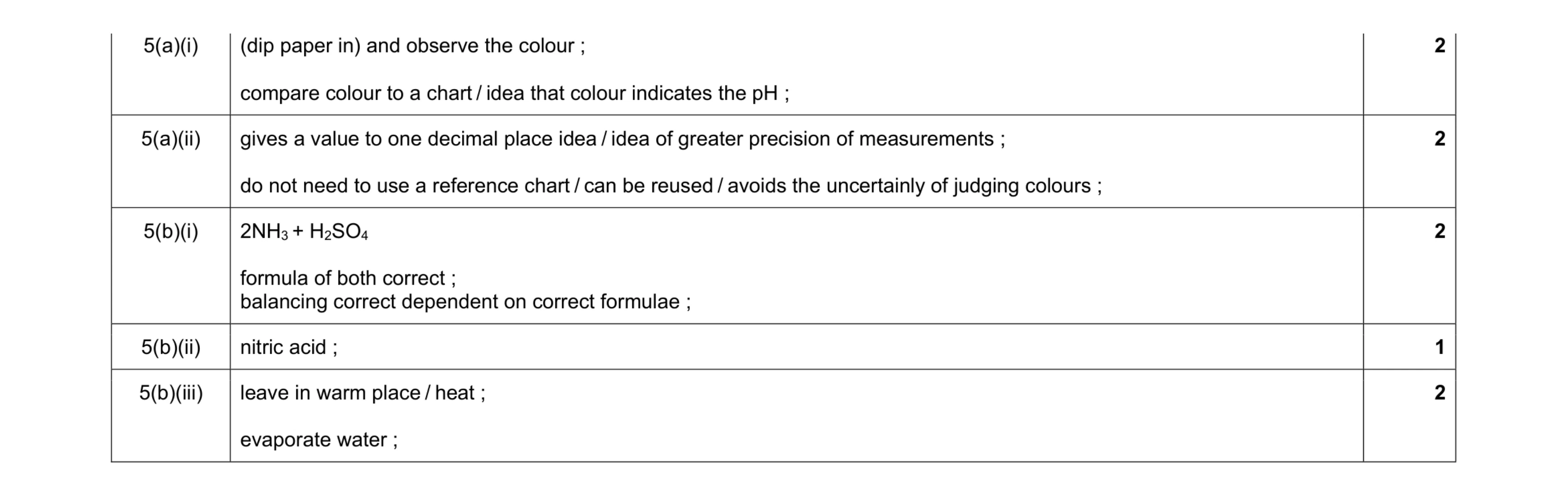 9
9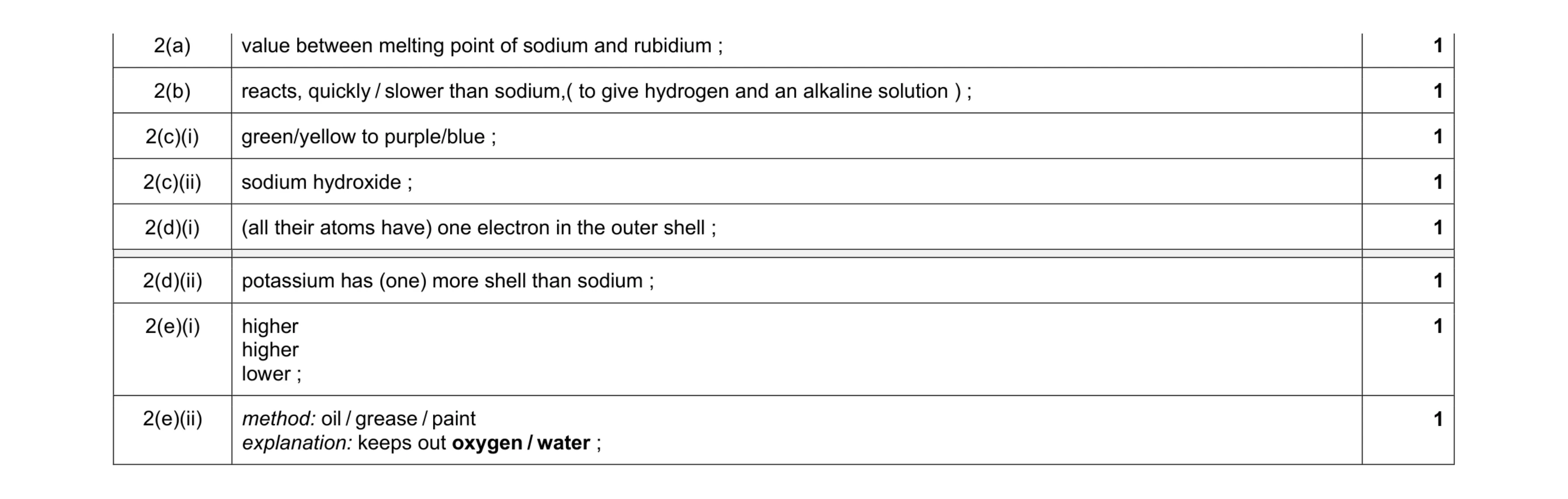 8
8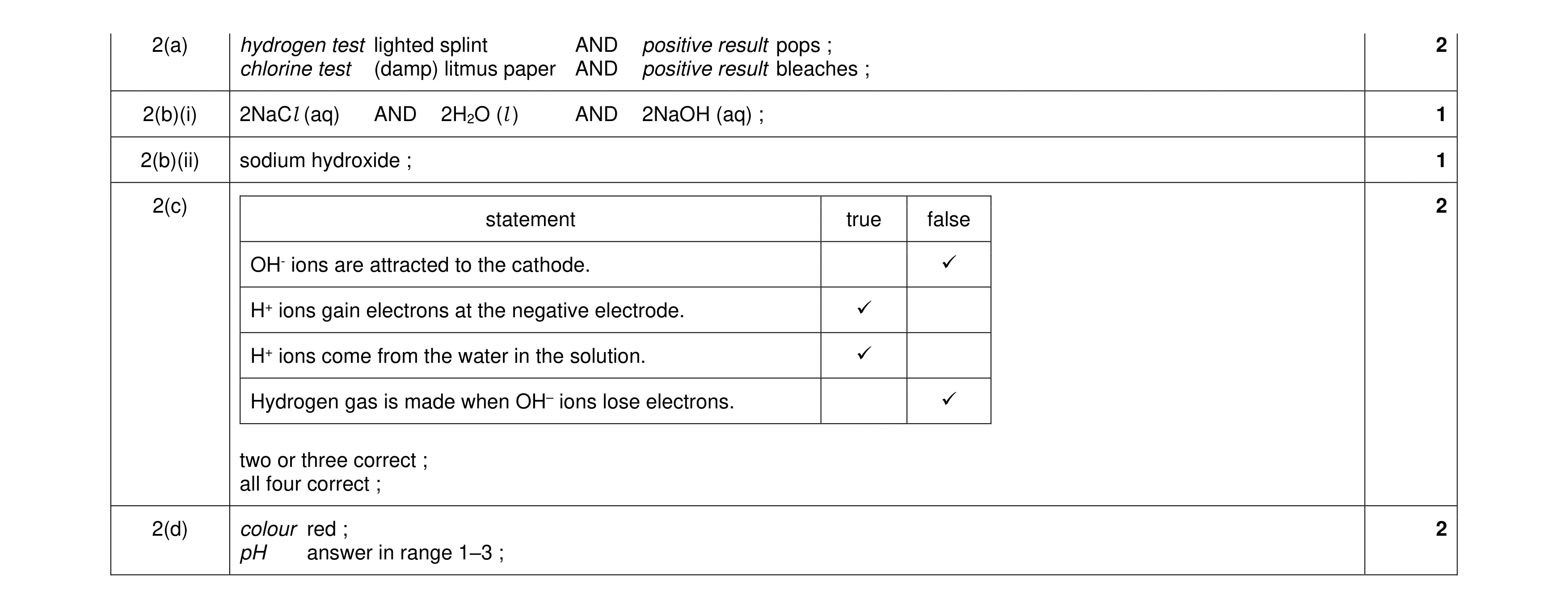 8
8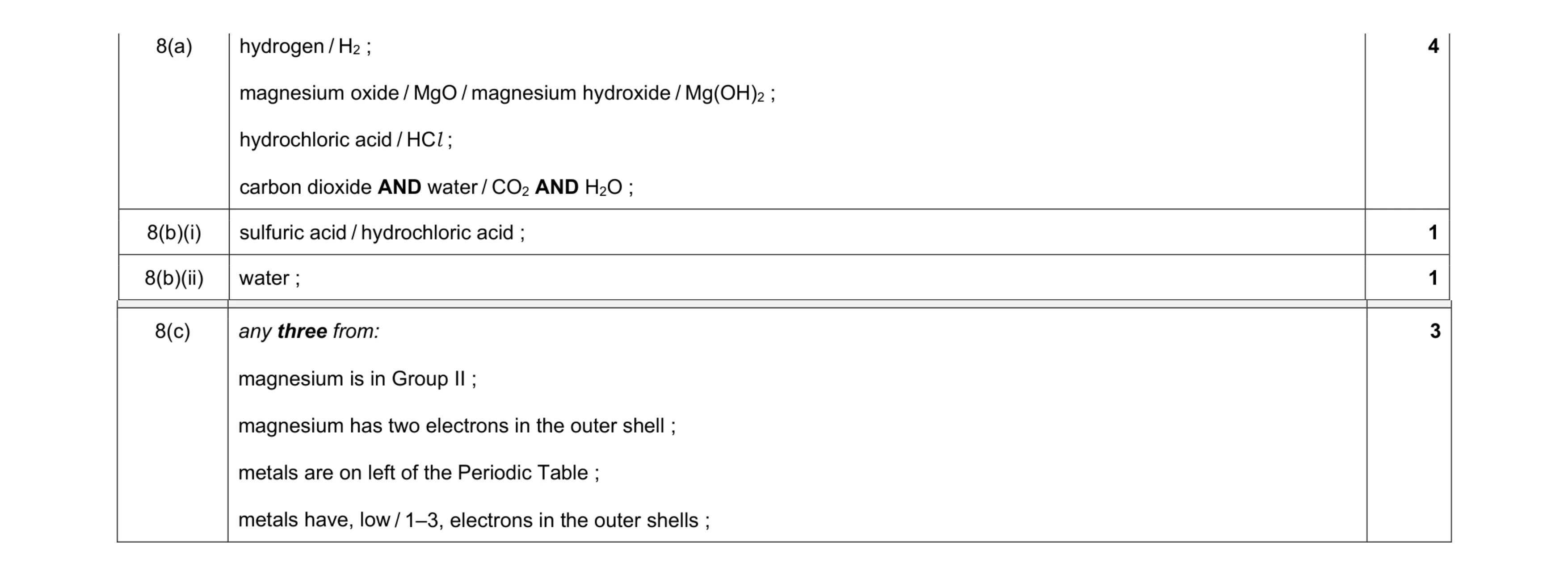 9
9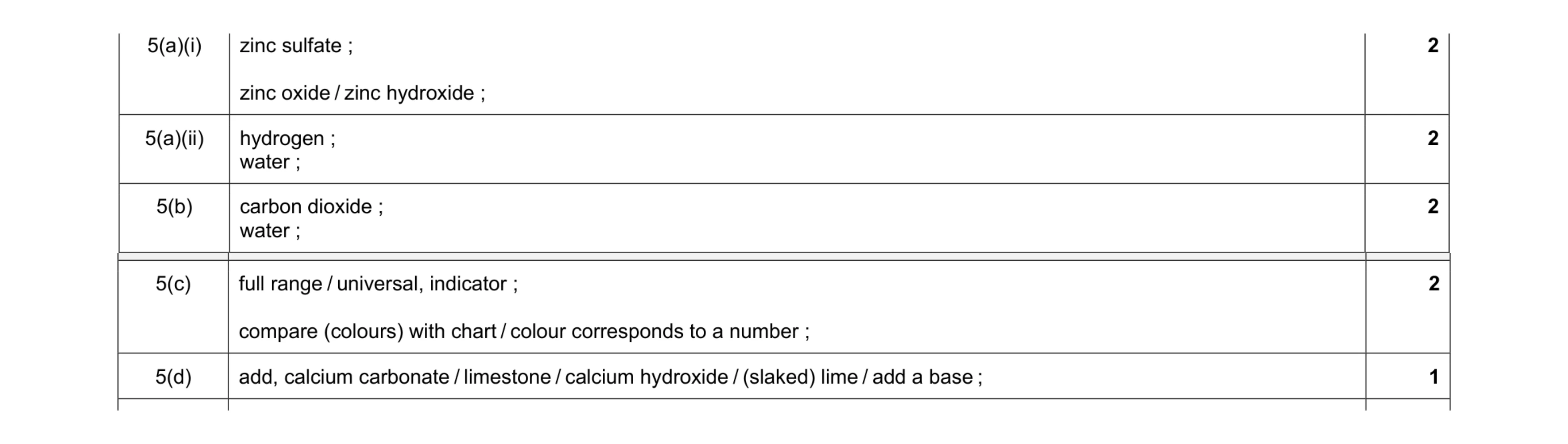 9
9