Questions as text
Q1 · What is usually found in a developed country? 0455/11 Oct/Nov 2004
36 What is usually found in a developed country? A a high GDP per head with a low level of employment B a high level of labour skills with a low level of car ownership C a high rate of adult literacy with a low level of poverty D a high rate of population growth with a low level of labour productivity
1 marks
Answer: C
This question in 0455/11 Oct/Nov 2004
Q2 · The table gives information on standards of living in four countries 0455/11 May/June 2006
34 The table gives information on standards of living in four countries. life expectancy at birth adult literacy % labour force in (years) rate % agriculture Brazil 66.5 82.4 23 India 60.7 50.6 64 Rwanda 47.2 58.0 92 Uganda 44.7 59.7 85 On the basis of this information which country has the highest standard of living? A Brazil B India C Rwanda D Uganda
1 marks
Answer: A
This question in 0455/11 May/June 2006
Q3 · What is likely to be higher in a developing country, such as Kenya, than in a developed… 0455/11 May/June 2006
35 What is likely to be higher in a developing country, such as Kenya, than in a developed country, such as Switzerland? A birth rate B GDP per head C life expectancy D net investment per head
1 marks
Answer: A
This question in 0455/11 May/June 2006
Q4 · What is likely to happen as a developing country becomes more developed? 0455/11 May/June 2006
36 What is likely to happen as a developing country becomes more developed? A A higher percentage of children will attend school. B Infant mortality will rise. C Life expectancy will fall. D The agricultural sector will increase in importance.
1 marks
Answer: A
This question in 0455/11 May/June 2006
Q5 · Which of the following is usually found in a developed economy? 0455/11 Oct/Nov 2006
35 Which of the following is usually found in a developed economy? low high A birth rate gross domestic product per head B death rate infant mortality rate C gross domestic product per head birth rate D infant mortality rate death rate
1 marks
Answer: A
This question in 0455/11 Oct/Nov 2006
Q6 · Some people think that the debts and interest payments of the poorest countries in the… 0455/11 Oct/Nov 2006
40 Some people think that the debts and interest payments of the poorest countries in the world should be cancelled. What might be a disadvantage for the poorest countries if this were done? A International banks might be less willing to give loans to poor countries. B Interest payments to the lenders would fall. C The standard of living of people in the poorest countries would increase. D Trade between the poorest countries and the rest of the world would increase.
1 marks
Answer: A
This question in 0455/11 Oct/Nov 2006
Q7 · The table shows the proportion of the working population in different sectors in three… 0455/11 May/June 2007
28 The table shows the proportion of the working population in different sectors in three countries. country agriculture % manufacturing % services % Iran 38 33 29 Nepal 93 2 5 UK 2 42 56 What can be concluded from the table? A Iran has fewer people working in manufacturing than the UK. B Nepal is a developed economy. C Services are more developed in Iran than Nepal. D The UK is dependent on agriculture.
1 marks
Answer: C
This question in 0455/11 May/June 2007
Q8 · Which country is likely to have the lowest standard of living? 0455/11 May/June 2007
33 Which country is likely to have the lowest standard of living? life infant birth rate death rate expectancy mortality A 25 10 57 24 B 43 31 40 42 C 25 5 72 22 D 36 14 48 56
1 marks
Answer: B
This question in 0455/11 May/June 2007
Q9 · At the G8 Economic Summit in 2005, it was decided to cancel much of the debt which… 0455/11 May/June 2007
35 At the G8 Economic Summit in 2005, it was decided to cancel much of the debt which African countries owed to European and North American countries. This will have the same effect as a transfer of resources from A developed countries to developing countries. B developing countries to developed countries. C market economies to planned economies. D planned economies to market economies.
1 marks
Answer: A
This question in 0455/11 May/June 2007
Q10 · There are more people in developing countries who cannot read or write than in developed… 0455/11 Oct/Nov 2007
3 There are more people in developing countries who cannot read or write than in developed countries. What can be concluded from this? A Developed countries will use more labour than capital as it is skilled. B In developing countries, factors of production are not used to their maximum potential. C Less money needs to be spent on education in developed countries than in developing countries. D Production in developing countries is likely to rely more on capital than labour.
1 marks
Answer: B
This question in 0455/11 Oct/Nov 2007
Q11 · Turkey’s agricultural sector employs 48 % of the country’s workforce compared with 17 %… 0455/11 Oct/Nov 2007
33 Turkey’s agricultural sector employs 48 % of the country’s workforce compared with 17 % in the US and 3.9 % in France. What could be concluded from this? A France is likely to import more agricultural produce than the US. B The workers in France are not as productive as those in Turkey. C Total agricultural production is likely to be higher in Turkey than in the US. D Turkey is likely to be less developed than France.
1 marks
Answer: D
This question in 0455/11 Oct/Nov 2007
Q12 · As a country develops, what is most likely to happen? 0455/11 Oct/Nov 2007
35 As a country develops, what is most likely to happen? A A greater proportion of the workforce will be employed in the service sector. B The average age will decrease. C The birth rate will increase. D There will be reduced occupational mobility of labour.
1 marks
Answer: A
This question in 0455/11 Oct/Nov 2007
Q13 · The governments of developing countries often allow multi-nationals to mine minerals in… 0455/11 Oct/Nov 2007
39 The governments of developing countries often allow multi-nationals to mine minerals in their territory. Which conflict between possible benefit and cost does this present to the developing country? benefit cost A improved balance of trade increased training by the companies B higher employment loss of finite resource C increased profits for the companies more efficient production D more sustainable development faster economic growth
1 marks
Answer: B
This question in 0455/11 Oct/Nov 2007
Q14 · In some developing countries, such as Rwanda, a large percentage of the population is… 0455/11 May/June 2008
34 In some developing countries, such as Rwanda, a large percentage of the population is involved in subsistence farming. What can be concluded from this? A In some developing countries, the natural resources are used efficiently. B Production in some developing countries depends upon skilled labour. C Production in some developing countries is not likely to be capital intensive. D Some developing countries do not import food because each family is self-sufficient.
1 marks
Answer: C
This question in 0455/11 May/June 2008
Q15 · What is characteristic of a developed economy? 0455/11 May/June 2008
35 What is characteristic of a developed economy? A a high infant mortality rate B a high literacy rate C a low GDP per capita D a low life expectancy
1 marks
Answer: B
This question in 0455/11 May/June 2008
Q16 · Which combination is most likely to be found in a developing country compared with a more… 0455/11 Oct/Nov 2008
33 Which combination is most likely to be found in a developing country compared with a more developed country? population growth rate death rate A higher higher B higher lower C lower higher D lower lower
1 marks
Answer: A
This question in 0455/11 Oct/Nov 2008
Q17 · What is usually found in a developed country? 0455/11 Oct/Nov 2008
35 What is usually found in a developed country? A a high proportion of workers in the tertiary sector B a high birth rate C a low level of technology D a low GDP per head
1 marks
Answer: A
This question in 0455/11 Oct/Nov 2008
Q18 · What is least likely to be found in a typical developing country? 0455/11 May/June 2009
26 What is least likely to be found in a typical developing country? A Ill-health affects many of the population. B Many workers are highly skilled. C Production is labour-intensive. D There is an unequal distribution of income and wealth.
1 marks
Answer: B
This question in 0455/11 May/June 2009
Q19 · Which statement about economic development is correct? 0455/11 May/June 2009
27 Which statement about economic development is correct? A A country needs more than a high GDP to be considered developed. B A country which has rich reserves of raw materials is classed as developed. C A country will have no people living in poverty when it is developed. D A country with a trade surplus is considered to be developed.
1 marks
Answer: A
This question in 0455/11 May/June 2009
Q20 · What is most likely to be found in a typical developing country? 0455/11 Oct/Nov 2009
26 What is most likely to be found in a typical developing country? A a good education sector B a small average family size C a small percentage of very old people D high spending on entertainment
1 marks
Answer: C
This question in 0455/11 Oct/Nov 2009
Q21 · Gross Domestic Product (GDP) per capita is commonly used as an indicator of the… 0455/11 May/June 2010
26 Gross Domestic Product (GDP) per capita is commonly used as an indicator of the comparative level of development in different countries. What does not lead to difficulties when using this as a comparison between countries? A different climatic conditions B different international exchange rates C different population growth rates D different rates of inflation
1 marks
Answer: C
This question in 0455/11 May/June 2010
Q22 · What is likely to happen in a developing country as it becomes more developed? 0455/11 May/June 2010
28 What is likely to happen in a developing country as it becomes more developed? A A lower percentage of people will go to university. B Average life expectancy will rise. C The rate of population growth will increase. D The tertiary sector will decline in importance.
1 marks
Answer: B
This question in 0455/11 May/June 2010
Q23 · What is likely to happen in a developing country as it becomes more developed? 0455/12 May/June 2010
29 What is likely to happen in a developing country as it becomes more developed? A A lower percentage of people will go to university. B Average life expectancy will rise. C The rate of population growth will increase. D The tertiary sector will decline in importance.
1 marks
Answer: B
This question in 0455/12 May/June 2010
Q24 · How is the pattern of employment likely to change when a country becomes more developed? 0455/11 Oct/Nov 2010
24 How is the pattern of employment likely to change when a country becomes more developed? A from rural employment to urban employment B from skilled employment to primary employment C from technical employment to manual employment D from tertiary employment to secondary employment
1 marks
Answer: A
This question in 0455/11 Oct/Nov 2010
Q25 · In 2008, the US had a higher GDP per head than Iceland, but a lower Human Development… 0455/11 Oct/Nov 2010
25 In 2008, the US had a higher GDP per head than Iceland, but a lower Human Development Index ranking than Iceland. What could explain this difference? A Average family size is higher in Iceland. B Life expectancy is higher in Iceland. C School enrolments are higher in the US. D The population of the US is larger.
1 marks
Answer: B
This question in 0455/11 Oct/Nov 2010
Q26 · What is most likely to indicate that an economy is developed rather than developing? 0455/11 Oct/Nov 2010
28 What is most likely to indicate that an economy is developed rather than developing? A a high birth rate and a low death rate B a large primary sector and a high population growth C a large service sector and capital intensive production D a low level of investment and a high rate of savings
1 marks
Answer: C
This question in 0455/11 Oct/Nov 2010
Q27 · In 2008, the US had a higher GDP per head than Iceland, but a lower Human Development… 0455/12 Oct/Nov 2010
23 In 2008, the US had a higher GDP per head than Iceland, but a lower Human Development Index ranking than Iceland. What could explain this difference? A Average family size is higher in Iceland. B Life expectancy is higher in Iceland. C School enrolments are higher in the US. D The population of the US is larger.
1 marks
Answer: B
This question in 0455/12 Oct/Nov 2010
Q28 · How is the pattern of employment likely to change when a country becomes more developed? 0455/12 Oct/Nov 2010
25 How is the pattern of employment likely to change when a country becomes more developed? A from rural employment to urban employment B from skilled employment to primary employment C from technical employment to manual employment D from tertiary employment to secondary employment
1 marks
Answer: A
This question in 0455/12 Oct/Nov 2010
Q29 · What is most likely to indicate that an economy is developed rather than developing? 0455/12 Oct/Nov 2010
26 What is most likely to indicate that an economy is developed rather than developing? A a high birth rate and a low death rate B a large primary sector and a high population growth C a large service sector and capital intensive production D a low level of investment and a high rate of savings
1 marks
Answer: C
This question in 0455/12 Oct/Nov 2010
Q30 · What will be the likely effect on the remaining population of a developing country when… 0455/12 Oct/Nov 2010
28 What will be the likely effect on the remaining population of a developing country when newly trained, skilled workers migrate to developed countries? A Its average age will increase. B Its mobility will increase. C Its productivity will increase. D Its total size will increase.
1 marks
Answer: A
This question in 0455/12 Oct/Nov 2010
Q31 · How is the pattern of employment likely to change when a country becomes more developed? 0455/13 Oct/Nov 2010
23 How is the pattern of employment likely to change when a country becomes more developed? A from rural employment to urban employment B from skilled employment to primary employment C from technical employment to manual employment D from tertiary employment to secondary employment
1 marks
Answer: A
This question in 0455/13 Oct/Nov 2010
Q32 · In 2008, the US had a higher GDP per head than Iceland, but a lower Human Development… 0455/13 Oct/Nov 2010
24 In 2008, the US had a higher GDP per head than Iceland, but a lower Human Development Index ranking than Iceland. What could explain this difference? A Average family size is higher in Iceland. B Life expectancy is higher in Iceland. C School enrolments are higher in the US. D The population of the US is larger.
1 marks
Answer: B
This question in 0455/13 Oct/Nov 2010
Q33 · What is most likely to indicate that an economy is developed rather than developing? 0455/13 Oct/Nov 2010
27 What is most likely to indicate that an economy is developed rather than developing? A a high birth rate and a low death rate B a large primary sector and a high population growth C a large service sector and capital intensive production D a low level of investment and a high rate of savings
1 marks
Answer: C
This question in 0455/13 Oct/Nov 2010
Q34 · The table shows four countries in 2007 0455/13 Oct/Nov 2010
28 The table shows four countries in 2007. Which country is most likely to have the lowest standard of living? country GDP (US$ billion) population (million) A Bangladesh 206.7 153.5 B India 2989.1 1147.9 C Nigeria 292.7 138.3 D South Africa 467.1 43.8
1 marks
Answer: A
This question in 0455/13 Oct/Nov 2010
Q35 · The table shows the percentage change in employment over a period for a country with… 0455/11 May/June 2011
24 The table shows the percentage change in employment over a period for a country with three economic sectors. percentage (%) change economic sector in employment agriculture –6 manufacturing +2 services +4 Which statement must be correct? A Agricultural output fell. B The country became more developed. C The working population stayed constant. D Total employment remained the same.
1 marks
Answer: B
This question in 0455/11 May/June 2011
Q36 · What is likely to happen as a developing country becomes more developed? 0455/11 May/June 2011
26 What is likely to happen as a developing country becomes more developed? A A higher percentage of children will attend school. B Infant mortality will rise. C Life expectancy will fall. D The agricultural sector will increase in importance.
1 marks
Answer: A
This question in 0455/11 May/June 2011
Q37 · What is likely to happen as a developing country becomes more developed? 0455/12 May/June 2011
28 What is likely to happen as a developing country becomes more developed? A A higher percentage of children will attend school. B Infant mortality will rise. C Life expectancy will fall. D The agricultural sector will increase in importance.
1 marks
Answer: A
This question in 0455/12 May/June 2011
Q38 · The table shows statistics for four countries in southern Africa 0455/13 May/June 2011
27 The table shows statistics for four countries in southern Africa. From the information given, which country has the lowest standard of living? average annual population density real GDP life growth rate of per square per capita expectancy population (%) kilometre (US$) A 1.9 19 46 190 B 2.7 2 58 1700 C 3.7 45 59 210 D 4.2 89 44 190
1 marks
Answer: D
This question in 0455/13 May/June 2011
Q39 · What is likely to happen as a developing country becomes more developed? 0455/13 May/June 2011
28 What is likely to happen as a developing country becomes more developed? A A higher percentage of children will attend school. B Infant mortality will rise. C Life expectancy will fall. D The agricultural sector will increase in importance.
1 marks
Answer: A
This question in 0455/13 May/June 2011
Q40 · The table gives information about four countries 0455/11 Oct/Nov 2011
26 The table gives information about four countries. Which country is likely to have the lowest standard of living? life expectancy GNP per head adult literacy country at birth (years) ($) (%) A Ethiopia 43 110 66 B India 59 350 43 C Nigeria 51 290 43 D Mozambique 45 80 39
1 marks
Answer: D
This question in 0455/11 Oct/Nov 2011
Q41 · Developing countries are sometimes given aid by charities and foreign governments 0455/11 Oct/Nov 2011
28 Developing countries are sometimes given aid by charities and foreign governments. Which aid programme would be least likely to lead to long-term economic growth? A the building of an irrigation system B the construction of a new airport C the distribution of gifts of food D the training of technical staff
1 marks
Answer: C
This question in 0455/11 Oct/Nov 2011
Q42 · The table gives information about four countries 0455/12 Oct/Nov 2011
28 The table gives information about four countries. Which country is likely to have the lowest standard of living? life expectancy GNP per head adult literacy country at birth (years) ($) (%) A Ethiopia 43 110 66 B India 59 350 43 C Nigeria 51 290 43 D Mozambique 45 80 39
1 marks
Answer: D
This question in 0455/12 Oct/Nov 2011
Q43 · Developing countries are sometimes given aid by charities and foreign governments 0455/12 Oct/Nov 2011
29 Developing countries are sometimes given aid by charities and foreign governments. Which aid programme would be least likely to lead to long-term economic growth? A the building of an irrigation system B the construction of a new airport C the distribution of gifts of food D the training of technical staff
1 marks
Answer: C
This question in 0455/12 Oct/Nov 2011
Q44 · The table gives information about four countries 0455/13 Oct/Nov 2011
29 The table gives information about four countries. Which country is likely to have the lowest standard of living? life expectancy GNP per head adult literacy country at birth (years) ($) (%) A Ethiopia 43 110 66 B India 59 350 43 C Nigeria 51 290 43 D Mozambique 45 80 39
1 marks
Answer: D
This question in 0455/13 Oct/Nov 2011
Q45 · Developing countries are sometimes given aid by charities and foreign governments 0455/13 Oct/Nov 2011
30 Developing countries are sometimes given aid by charities and foreign governments. Which aid programme would be least likely to lead to long-term economic growth? A the building of an irrigation system B the construction of a new airport C the distribution of gifts of food D the training of technical staff
1 marks
Answer: C
This question in 0455/13 Oct/Nov 2011
Q46 · What is usually a characteristic of a developed country? 0455/11 May/June 2012
27 What is usually a characteristic of a developed country? A a dependency on primary product exports B high rates of economic growth C low levels of productivity D low rates of population growth
1 marks
Answer: D
This question in 0455/11 May/June 2012
Q47 · What level of unemployment and what distribution of income are often found in developing… 0455/12 May/June 2012
26 What level of unemployment and what distribution of income are often found in developing economies? level of unemployment distribution of income A high evenly distributed B high unequal C low evenly distributed D low unequal
1 marks
Answer: B
This question in 0455/12 May/June 2012
Q48 · What level of unemployment and what distribution of income are often found in developing… 0455/13 May/June 2012
26 What level of unemployment and what distribution of income are often found in developing economies? level of unemployment distribution of income A high evenly distributed B high unequal C low evenly distributed D low unequal
1 marks
Answer: B
This question in 0455/13 May/June 2012
Q49 · Why is the size of the average family higher in developing countries than in developed… 0455/13 May/June 2012
27 Why is the size of the average family higher in developing countries than in developed countries? A In developing countries babies are more likely to survive at birth. B In developing countries parents start families at a later age. C In developing countries there is often a shortage of family planning advice. D In developing countries the government provides a higher level of child support.
1 marks
Answer: C
This question in 0455/13 May/June 2012
Q50 · An Economics student described a typical developing country as having a large population… 0455/11 Oct/Nov 2012
20 An Economics student described a typical developing country as having a large population, a low GDP per head, a relatively large primary sector and an uneven income distribution. Which of these features is not necessarily accurate? A a large population B a low GDP per head C an uneven income distribution D a relatively large primary sector
1 marks
Answer: A
This question in 0455/11 Oct/Nov 2012
Q51 · An Economics student described a typical developing country as having a large population… 0455/12 Oct/Nov 2012
26 An Economics student described a typical developing country as having a large population, a low GDP per head, a relatively large primary sector and an uneven income distribution. Which of these features is not necessarily accurate? A a large population B a low GDP per head C an uneven income distribution D a relatively large primary sector
1 marks
Answer: A
This question in 0455/12 Oct/Nov 2012
Q52 · What is most likely to be an indicator that a country is a developed economy rather than… 0455/11 May/June 2013
28 What is most likely to be an indicator that a country is a developed economy rather than a developing economy? A a dominant service sector B a high birth rate C a lack of capital-intensive production D a low level of adult literacy
1 marks
Answer: A
This question in 0455/11 May/June 2013
Q53 · The table shows data for four countries in 2006 0455/12 May/June 2013
27 The table shows data for four countries in 2006. percentage of life expectancy computers per labour force crude birth (years) 100 population employed in rate agriculture Bangladesh 64.1 1.2 66 24.8 Egypt 71.3 3.7 27 24.2 India 64.8 1.5 60 23.0 Pakistan 65.6 1.6 42 27.2 On the basis of the information given, what is the likely ranking order of the four countries in terms of development, starting from the most developed to the least developed? A Bangladesh → India → Pakistan → Egypt B Egypt → Pakistan → India → Bangladesh C India → Egypt → Bangladesh → Pakistan D Pakistan → Bangladesh → Egypt → India
1 marks
Answer: B
This question in 0455/12 May/June 2013
Q54 · What is most likely to be an indicator that a country is a developed economy rather than… 0455/13 May/June 2013
28 What is most likely to be an indicator that a country is a developed economy rather than a developing economy? A a dominant service sector B a high birth rate C a lack of capital-intensive production D a low level of adult literacy
1 marks
Answer: A
This question in 0455/13 May/June 2013
Q55 · In developed economies there are changing patterns of employment 0455/13 May/June 2013
29 In developed economies there are changing patterns of employment. What explains why fewer work in agriculture but food production has increased? A increased incomes and more leisure B mechanisation and the use of scientific methods C movement to factory jobs in manufacturing D shift to office work using computers
1 marks
Answer: B
This question in 0455/13 May/June 2013
Q56 · In some developing countries a large percentage of the population is involved in… 0455/11 Oct/Nov 2013
27 In some developing countries a large percentage of the population is involved in subsistence farming. What can be concluded from this? A Each family will be able to produce enough to live on. B Production is unlikely to be capital intensive. C Production will be efficient. D There will be a high level of trade.
1 marks
Answer: B
This question in 0455/11 Oct/Nov 2013
Q57 · The table shows the change in the labour force in Bangladesh between 2006 and 2009 0455/12 Oct/Nov 2013
25 The table shows the change in the labour force in Bangladesh between 2006 and 2009. group 2006 (millions) 2009 (millions) urban male labour force 8.9 9.7 urban female labour force 2.8 3.1 total urban labour force 11.7 12.8 rural male labour force 28.5 30.5 rural female labour force 9.3 10.4 total rural labour force 37.8 40.9 Which statement is most likely to be consistent with these statistics? A Farming is the major employer in the economy. B Male workers are more mobile than female workers. C The absolute increase in the labour force is greater in urban areas than rural areas. D The supply of female workers has fallen.
1 marks
Answer: A
This question in 0455/12 Oct/Nov 2013
Q58 · In some developing countries a large percentage of the population is involved in… 0455/12 Oct/Nov 2013
27 In some developing countries a large percentage of the population is involved in subsistence farming. What can be concluded from this? A Each family will be able to produce enough to live on. B Production is unlikely to be capital intensive. C Production will be efficient. D There will be a high level of trade.
1 marks
Answer: B
This question in 0455/12 Oct/Nov 2013
Q59 · The diagram shows percentage employment in different sectors in two countries 0455/13 Oct/Nov 2013
25 The diagram shows percentage employment in different sectors in two countries. country X country Y 70 70 60 60 50 50 percentage 40 percentage 40 employed employed 30 30 20 20 10 10 0 0 primary secondary services primary secondary services Which statement is correct when comparing country X and country Y? A Country X produces more primary output than country Y. B Country X employs more workers in secondary industry than country Y. C Country Y produces more secondary output than country X. D Country Y is more developed than country X.
1 marks
Answer: D
This question in 0455/13 Oct/Nov 2013
Q60 · Developing countries often wish to prevent the population in rural areas moving to the… 0455/11 May/June 2014
25 Developing countries often wish to prevent the population in rural areas moving to the towns. Investment grants are given to companies if they set up their businesses in rural areas. What is this policy intended to achieve? A decreased transport costs B decreased external cost C increased economies of scale D increased use of labour
1 marks
Answer: D
This question in 0455/11 May/June 2014
Q61 · The table shows data collected in 2010 for the average number of children a woman gave… 0455/11 May/June 2014
26 The table shows data collected in 2010 for the average number of children a woman gave birth to and the education she received during her lifetime. average number education received of children none 4.5 primary school level 3.0 secondary school level 2.0 university level 1.7 What can be concluded from this information? A Average fertility was 2.8 in 2010. B Most girls do not go to school. C Providing more education for girls would reduce fertility rates. D There is no relationship between education and fertility rates.
1 marks
Answer: C
This question in 0455/11 May/June 2014
Q62 · The table gives information about four countries 0455/11 May/June 2014
27 The table gives information about four countries. Which country has the lowest standard of living? life % of labour GDP per head force in expectancy (US $) agriculture A 48 120 80 B 48 250 70 C 54 350 75 D 60 380 60
1 marks
Answer: A
This question in 0455/11 May/June 2014
Q63 · Developing countries often wish to prevent the population in rural areas moving to the… 0455/12 May/June 2014
25 Developing countries often wish to prevent the population in rural areas moving to the towns. Investment grants are given to companies if they set up their businesses in rural areas. What is this policy intended to achieve? A decreased transport costs B decreased external cost C increased economies of scale D increased use of labour
1 marks
Answer: D
This question in 0455/12 May/June 2014
Q64 · Increasing numbers of qualified medical workers from developing economies migrate to… 0455/12 May/June 2014
26 Increasing numbers of qualified medical workers from developing economies migrate to developed economies. What explains this migration? A There are better working conditions in hospitals and clinics in developed economies. B There are fewer patients requiring medical treatment in developing countries. C There is a lack of training opportunities for medical staff in developed economies. D There is an oversupply of qualified medical workers in developing countries.
1 marks
Answer: A
This question in 0455/12 May/June 2014
Q65 · The table gives information about four countries 0455/12 May/June 2014
27 The table gives information about four countries. Which country has the lowest standard of living? life % of labour GDP per head force in expectancy (US $) agriculture A 48 120 80 B 48 250 70 C 54 350 75 D 60 380 60
1 marks
Answer: A
This question in 0455/12 May/June 2014
Q66 · The table gives information about four countries 0455/13 May/June 2014
27 The table gives information about four countries. Which country has the lowest standard of living? life % of labour GDP per head force in expectancy (US $) agriculture A 48 120 80 B 48 250 70 C 54 350 75 D 60 380 60
1 marks
Answer: A
This question in 0455/13 May/June 2014
Q67 · Developing countries often wish to prevent the population in rural areas moving to the… 0455/13 May/June 2014
29 Developing countries often wish to prevent the population in rural areas moving to the towns. Investment grants are given to companies if they set up their businesses in rural areas. What is this policy intended to achieve? A decreased transport costs B decreased external cost C increased economies of scale D increased use of labour
1 marks
Answer: D
This question in 0455/13 May/June 2014
Q68 · The table shows the percentage change (%) in employment over a period for a country with… 0455/11 Oct/Nov 2014
22 The table shows the percentage change (%) in employment over a period for a country with three economic sectors. (%) change in economic sector employment agriculture –6 manufacturing +2 services +4 What could be concluded from this information? A Agricultural output fell. B The country became more developed. C The working population stayed constant. D Total employment remained the same.
1 marks
Answer: B
This question in 0455/11 Oct/Nov 2014
Q69 · What will increase the level of economic development in a country? 0455/11 Oct/Nov 2014
25 What will increase the level of economic development in a country? A a higher infant mortality rate B a higher inflation rate C a higher interest rate D a higher literacy rate
1 marks
Answer: D
This question in 0455/11 Oct/Nov 2014
Q70 · What is most likely to be found in a developed country? 0455/11 Oct/Nov 2014
26 What is most likely to be found in a developed country? A a small amount of income spent on leisure and entertainment B a small average family size C a small number of old people D a small number of professional people
1 marks
Answer: B
This question in 0455/11 Oct/Nov 2014
Q71 · The table shows the percentage change (%) in employment over a period for a country with… 0455/12 Oct/Nov 2014
23 The table shows the percentage change (%) in employment over a period for a country with three economic sectors. (%) change in economic sector employment agriculture –6 manufacturing +2 services +4 What could be concluded from this information? A Agricultural output fell. B The country became more developed. C The working population stayed constant. D Total employment remained the same.
1 marks
Answer: B
This question in 0455/12 Oct/Nov 2014
Q72 · What is most likely to be found in a developed country? 0455/12 Oct/Nov 2014
24 What is most likely to be found in a developed country? A a small amount of income spent on leisure and entertainment B a small average family size C a small number of old people D a small number of professional people
1 marks
Answer: B
This question in 0455/12 Oct/Nov 2014
Q73 · What will increase the level of economic development in a country? 0455/12 Oct/Nov 2014
25 What will increase the level of economic development in a country? A a higher infant mortality rate B a higher inflation rate C a higher interest rate D a higher literacy rate
1 marks
Answer: D
This question in 0455/12 Oct/Nov 2014
Q74 · The table shows statistics for four countries in southern Africa 0455/12 Oct/Nov 2014
27 The table shows statistics for four countries in southern Africa. From the information given, which country has the lowest standard of living? average annual population density real GDP life growth rate of per square per capita expectancy population (%) kilometre (US$) A 1.9 19 46 190 B 2.7 2 58 1700 C 3.7 45 59 210 D 4.2 89 44 190
1 marks
Answer: D
This question in 0455/12 Oct/Nov 2014
Q75 · As a country develops, what is most likely to happen? 0455/13 Oct/Nov 2014
24 As a country develops, what is most likely to happen? A There will be an increase in productivity. B There will be an increase in the birth rate. C There will be an increase in the death rate. D There will be reduced occupational mobility.
1 marks
Answer: A
This question in 0455/13 Oct/Nov 2014
Q76 · What is not a reason why the average size of families is likely to be greater in… 0455/11 May/June 2015
24 What is not a reason why the average size of families is likely to be greater in developing countries than in developed countries? A Children offer the prospect of security in old age. B Government child care support is widely available. C Means of birth control are less available and more expensive. D Women are less likely to be part of the workforce.
1 marks
Answer: B
This question in 0455/11 May/June 2015
Q77 · The table shows the proportion of GDP produced by each sector of production in three… 0455/11 May/June 2015
25 The table shows the proportion of GDP produced by each sector of production in three fictitious countries. Farland Highland Lowland (% of GDP) (% of GDP) (% of GDP) primary sector 30 10 35 secondary sector 20 60 25 tertiary sector 50 30 40 What can be concluded from the table? A Farland is the least developed economy. B Highland is the most developed economy. C It is uncertain which is the most developed economy. D Lowland is the least developed economy.
1 marks
Answer: C
This question in 0455/11 May/June 2015
Q78 · The Human Development Index (HDI) measures more than just average incomes 0455/12 May/June 2015
21 The Human Development Index (HDI) measures more than just average incomes. What are two additional measures it includes? A life expectancy years of schooling B percentage unemployed number of hospitals C poverty rate years of schooling D years of schooling access to clean water
1 marks
Answer: A
This question in 0455/12 May/June 2015
Q79 · Which feature is not a typical characteristic of a developed country? 0455/12 May/June 2015
25 Which feature is not a typical characteristic of a developed country? A a high death rate B a high literacy rate C a large elderly population D a low number of doctors per head
1 marks
Answer: A
This question in 0455/12 May/June 2015
Q80 · The Human Development Index can be used to measure human development in countries 0455/13 May/June 2015
24 The Human Development Index can be used to measure human development in countries. Which measure would not be part of its calculation? A inequality of incomes B life expectancy C standards of living D years of schooling
1 marks
Answer: A
This question in 0455/13 May/June 2015
Q81 · The table gives the percentage employment in the primary, secondary and service sectors… 0455/13 May/June 2015
26 The table gives the percentage employment in the primary, secondary and service sectors in four countries. Which country is most likely to be a developed country? primary secondary service sector sector sector A 10 35 55 B 20 60 20 C 35 35 30 D 40 40 20
1 marks
Answer: A
This question in 0455/13 May/June 2015
Q82 · How would the proportions of different age groups in the population compare between… 0455/11 Oct/Nov 2015
24 How would the proportions of different age groups in the population compare between low-income developing countries and high-income developed countries? Low-income developing countries would have a A higher proportion of the elderly and higher proportion of young people. B higher proportion of the elderly and lower proportion of young people. C lower proportion of the elderly and higher proportion of young people. D lower proportion of the elderly and lower proportion of young people.
1 marks
Answer: C
This question in 0455/11 Oct/Nov 2015
Q83 · Which feature would be most helpful in identifying a typical developing country? 0455/11 Oct/Nov 2015
25 Which feature would be most helpful in identifying a typical developing country? A the level of Gross Domestic Product B the rate of rural to urban migration C the size of geographical area D the size of the population
1 marks
Answer: B
This question in 0455/11 Oct/Nov 2015
Q84 · Turkey’s agricultural sector employs 48% of the country’s workforce, compared with 17% in… 0455/11 Oct/Nov 2015
30 Turkey’s agricultural sector employs 48% of the country’s workforce, compared with 17% in the United States (US) and 3.9% in France. What could be concluded from this? A France is likely to import more agricultural produce than the US. B The workers in France are not as productive as those in Turkey. C Total agricultural production is likely to be higher in Turkey than in the US. D Turkey is likely to be less developed than France.
1 marks
Answer: D
This question in 0455/11 Oct/Nov 2015
Q85 · The proportion of workers employed varies between different industries and between… 0455/12 Oct/Nov 2015
21 The proportion of workers employed varies between different industries and between developing and developed economies. Which combination in the table is likely to have the highest percentage of workers employed? developing developed A agriculture manufacturing B agriculture services C construction manufacturing D construction services
1 marks
Answer: B
This question in 0455/12 Oct/Nov 2015
Q86 · Turkey’s agricultural sector employs 48% of the country’s workforce, compared with 17% in… 0455/12 Oct/Nov 2015
30 Turkey’s agricultural sector employs 48% of the country’s workforce, compared with 17% in the United States (US) and 3.9% in France. What could be concluded from this? A France is likely to import more agricultural produce than the US. B The workers in France are not as productive as those in Turkey. C Total agricultural production is likely to be higher in Turkey than in the US. D Turkey is likely to be less developed than France.
1 marks
Answer: D
This question in 0455/12 Oct/Nov 2015
Q87 · China is classified as a developing country 0455/12 May/June 2016
24 China is classified as a developing country. Recently, contributions to its Gross Domestic Product (GDP) were agriculture 10%, construction 13%, manufacturing 32% and services 45%. Which contribution to GDP usually decreases first when countries move to a higher level of development? A agriculture B construction C manufacturing D services
1 marks
Answer: A
This question in 0455/12 May/June 2016
Q88 · Some people think that the debts and interest payments of the poorest countries in the… 0455/12 May/June 2016
25 Some people think that the debts and interest payments of the poorest countries in the world should be cancelled. What might be a disadvantage for the poorest countries if this were done? A International banks might be less willing to give loans to poor countries. B Interest payments to the lenders would fall. C The standard of living of people in the poorest countries would fall. D Trade between the poorest countries and the rest of the world would increase.
1 marks
Answer: A
This question in 0455/12 May/June 2016
Q89 · Why might the emigration of workers help the economy of a developing country? 0455/13 May/June 2016
25 Why might the emigration of workers help the economy of a developing country? A The dependency ratio is likely to improve. B The inflow of transfers of money is likely to increase. C The least healthy workers are likely to be the last ones to leave. D The more skilled workers are likely to be the ones to leave.
1 marks
Answer: B
This question in 0455/13 May/June 2016
Q90 · Which outcome is least likely to be found with greater economic development? 0455/12 Oct/Nov 2016
24 Which outcome is least likely to be found with greater economic development? A A greater percentage of the population are highly educated. B A greater percentage of the population are homeowners. C A greater percentage of the population are old. D A greater percentage of the population are very poor.
1 marks
This question in 0455/12 Oct/Nov 2016
Q91 · The chart shows total world carbon emissions in 1995 and predicted emissions by 2035 0455/12 Oct/Nov 2016
26 The chart shows total world carbon emissions in 1995 and predicted emissions by 2035. 1995 2035 other Asia 6% developing developing world world 27% 50% other US Latin China US Asia America 4% 15% 11% 22% 14% W. Africa 3% China Europe Middle East 17% 12% W. Europe 3% 17% E. Europe E. Europe 19% Japan Africa 27% 7% 8% Latin America 6% developed developed world world 50% Middle Japan 73% East 4% 5% If the chart proves to be correct, what will have happened by 2035? A Africa and the Middle East will have responsibility for the same amount of carbon emissions in 2035 as in 1995. B Between 1995 and 2035, the Middle East will have increased its industrialisation by as much as Latin America. C By 2035 the combined percentage of carbon emissions caused by Africa and Latin America will have doubled. D The US will have decreased its carbon emissions by a smaller percentage than Western Europe.
1 marks
This question in 0455/12 Oct/Nov 2016
Q92 · How is the pattern of employment likely to change when a country becomes more developed? 0455/13 Oct/Nov 2016
21 How is the pattern of employment likely to change when a country becomes more developed? A from regular employment to seasonal employment B from rural employment to urban employment C from skilled employment to manual employment D from tertiary employment to primary employment
1 marks
Answer: B
This question in 0455/13 Oct/Nov 2016
Q93 · The chart shows total world carbon emissions in 1995 and predicted emissions by 2035 0455/13 Oct/Nov 2016
26 The chart shows total world carbon emissions in 1995 and predicted emissions by 2035. 1995 2035 other Asia 6% developing developing world world 27% 50% other US Latin China US Asia America 4% 15% 11% 22% 14% W. Africa 3% China Europe Middle East 17% 12% W. Europe 3% 17% E. Europe E. Europe 19% Japan Africa 27% 7% 8% Latin America developed 6% developed world world 73% Middle Japan 50% East 4% 5% If the chart proves to be correct, what would have happened by 2035? A Africa will emit the least carbon. B China will cause about a third of the emissions of all developing areas shown. C Developed areas will have reduced their absolute amount of carbon emissions. D The US will have decreased its carbon emissions by a smaller percentage than Western Europe.
1 marks
Answer: B
This question in 0455/13 Oct/Nov 2016
Q94 · Developing countries often wish to prevent the population in rural areas moving to the… 0455/12 Feb/March 2017
24 Developing countries often wish to prevent the population in rural areas moving to the towns. Investment grants are given to companies if they set up their businesses in rural areas. What is this policy intended to achieve? A decreased government expenditure B decreased transport costs C increased economies of scale D increased use of labour
1 marks
Answer: D
This question in 0455/12 Feb/March 2017
Q95 · The table shows data for four countries in 2006 0455/12 Feb/March 2017
26 The table shows data for four countries in 2006. percentage of life expectancy computers per labour force birth (years) 100 population employed in rate agriculture Bangladesh 64.1 1.2 66 24.8 Egypt 71.3 3.7 27 24.2 India 64.8 1.5 60 23.0 Pakistan 65.6 1.6 42 27.2 On the basis of the information given, what is the likely ranking order of the four countries in terms of development, starting from the most developed to the least developed? A Bangladesh → India → Pakistan → Egypt B Egypt → Pakistan → India → Bangladesh C India → Egypt → Bangladesh → Pakistan D Pakistan → Bangladesh → Egypt → India
1 marks
Answer: B
This question in 0455/12 Feb/March 2017
Q96 · A country has a low GDP and a large population but ranks relatively highly on the HDI 0455/11 May/June 2017
21 A country has a low GDP and a large population but ranks relatively highly on the HDI. Which combination may exist in the country? provision of education and income per head healthcare (merit goods) A high high B high low C low low D low high
1 marks
Answer: D
This question in 0455/11 May/June 2017
Q97 · Which characteristic do developed and developing economies have in common? 0455/11 May/June 2017
24 Which characteristic do developed and developing economies have in common? A participation in international trade B high birth rates and high death rates C rapid economic growth D stable financial conditions and institutions
1 marks
Answer: A
This question in 0455/11 May/June 2017
Q98 · Which statement about the poorest families in developing economies is not likely to be… 0455/12 May/June 2017
24 Which statement about the poorest families in developing economies is not likely to be correct? A The children will be expected to work to help provide income. B The family will find it easy to obtain loans to develop their farms. C The family will have a low earning capacity. D The family will suffer from malnutrition and lack of medical care.
1 marks
Answer: B
This question in 0455/12 May/June 2017
Q99 · The table shows information about four countries 0455/12 May/June 2017
26 The table shows information about four countries. Which country is likely to be least developed? % of labour force GDP per head life expectancy in service industries ($) A 20 49 380 B 35 49 350 C 40 53 350 D 45 63 450
1 marks
Answer: A
This question in 0455/12 May/June 2017
Q100 · The diagram shows a production possibility curve for agriculture and machinery 0455/13 May/June 2017
3 The diagram shows a production possibility curve for agriculture and machinery. agriculture L K N M O machinery As a country develops, its primary production decreases and its secondary production increases. Which movement would represent this change? A K to L B L to N C M to N D N to L
1 marks
Answer: B
This question in 0455/13 May/June 2017
Q101 · In the poorest developing countries it is difficult to measure the size of GDP 0455/13 May/June 2017
21 In the poorest developing countries it is difficult to measure the size of GDP. What is the main cause of this? A A high proportion of the paid workforce is in the informal sector. B Employment in rural areas is seasonal in nature. C The provision of services cannot be given a value. D Women are discriminated against in many jobs.
1 marks
Answer: A
This question in 0455/13 May/June 2017
Q102 · The diagrams show percentage employment in different sectors in two countries 0455/11 Oct/Nov 2017
22 The diagrams show percentage employment in different sectors in two countries. country X country Y percentage 70 percentage 70 employed employed 60 60 50 50 40 40 30 30 20 20 10 10 0 0 primary secondary services primary secondary services Which statement is correct when comparing country X and country Y? A Country X employs more workers in secondary industry than country Y. B Country X produces more primary output than country Y. C Country Y is more developed than country X. D Country Y produces more secondary output than country X.
1 marks
Answer: C
This question in 0455/11 Oct/Nov 2017
Q103 · The table gives information about four countries 0455/11 Oct/Nov 2017
26 The table gives information about four countries. Which country is likely to be most developed? GDP per head % of labour force life expectancy (US$) in agriculture A 52 450 50 B 54 490 40 C 60 550 15 D 60 500 25
1 marks
Answer: C
This question in 0455/11 Oct/Nov 2017
Q104 · Which of the effects of economic development is an external cost? 0455/12 Oct/Nov 2017
5 Which of the effects of economic development is an external cost? A higher employment B higher fixed costs C increased production D increased traffic congestion
1 marks
Answer: D
This question in 0455/12 Oct/Nov 2017
Q105 · Although there are higher paid jobs in offices many workers stay in low-paid jobs on farms 0455/12 Oct/Nov 2017
10 Although there are higher paid jobs in offices many workers stay in low-paid jobs on farms. What might explain this in developing economies? A Agricultural workers lack the necessary education and skills. B Governments plan to increase indirect taxes on services. C Manual workers are being replaced by machines. D Workers on farms have high labour mobility.
1 marks
Answer: A
This question in 0455/12 Oct/Nov 2017
Q106 · The diagrams show percentage employment in different sectors in two countries 0455/12 Oct/Nov 2017
22 The diagrams show percentage employment in different sectors in two countries. country X country Y percentage 70 percentage 70 employed employed 60 60 50 50 40 40 30 30 20 20 10 10 0 0 primary secondary services primary secondary services Which statement is correct when comparing country X and country Y? A Country X employs more workers in secondary industry than country Y. B Country X produces more primary output than country Y. C Country Y is more developed than country X. D Country Y produces more secondary output than country X.
1 marks
Answer: C
This question in 0455/12 Oct/Nov 2017
Q107 · Private multinational clothing companies operate in developing countries to reduce their… 0455/13 Oct/Nov 2017
13 Private multinational clothing companies operate in developing countries to reduce their average costs of production. Which feature of developing countries attracts them for this purpose? A In developing countries, clothing workers receive low wages. B In developing countries, foreign managers are allowed to pay no income tax. C In developing countries, multinationals are allowed to take profits out of the country. D In developing countries, there is a large market for fashion clothing.
1 marks
Answer: A
This question in 0455/13 Oct/Nov 2017
Q108 · The diagrams show percentage employment in different sectors in two countries 0455/13 Oct/Nov 2017
22 The diagrams show percentage employment in different sectors in two countries. country X country Y percentage 70 percentage 70 employed employed 60 60 50 50 40 40 30 30 20 20 10 10 0 0 primary secondary services primary secondary services Which statement is correct when comparing country X and country Y? A Country X employs more workers in secondary industry than country Y. B Country X produces more primary output than country Y. C Country Y is more developed than country X. D Country Y produces more secondary output than country X.
1 marks
Answer: C
This question in 0455/13 Oct/Nov 2017
Q109 · What is found in a typical developed country? 0455/11 May/June 2018
24 What is found in a typical developed country? A fast rate of economic growth B high population growth C limited use of technology D significant tertiary employment
1 marks
Answer: D
This question in 0455/11 May/June 2018
Q110 · The government of a developing country allows a multinational mining company to mine… 0455/11 May/June 2018
26 The government of a developing country allows a multinational mining company to mine minerals in order to improve the standard of living of the local people. Which action by the multinational company (MNC) will not lead to an improvement in the standard of living of the local people? A building roads to assist transport B exporting mineral ore C providing skills training D returning profits overseas
1 marks
Answer: D
This question in 0455/11 May/June 2018
Q111 · Which feature is found in a developed country rather than a developing country? 0455/12 May/June 2018
24 Which feature is found in a developed country rather than a developing country? A high levels of rural to urban migration B highly organised international financial markets C low proportion of workforce in service industries D low school-leaving age
1 marks
Answer: B
This question in 0455/12 May/June 2018
Q112 · The government of a developing country allows a multinational mining company to mine… 0455/12 May/June 2018
26 The government of a developing country allows a multinational mining company to mine minerals in order to improve the standard of living of the local people. Which action by the multinational company (MNC) will not lead to an improvement in the standard of living of the local people? A building roads to assist transport B exporting mineral ore C providing skills training D returning profits overseas
1 marks
Answer: D
This question in 0455/12 May/June 2018
Q113 · Provision of services in rural districts of developing countries tends to occur later… 0455/13 May/June 2018
24 Provision of services in rural districts of developing countries tends to occur later than those in urban areas. For which service would this not be correct? A medical research units B mobile phone networks C modern transport systems D university teaching departments
1 marks
Answer: B
This question in 0455/13 May/June 2018
Q114 · The government of a developing country allows a multinational mining company to mine… 0455/13 May/June 2018
26 The government of a developing country allows a multinational mining company to mine minerals in order to improve the standard of living of the local people. Which action by the multinational company (MNC) will not lead to an improvement in the standard of living of the local people? A building roads to assist transport B exporting mineral ore C providing skills training D returning profits overseas
1 marks
Answer: D
This question in 0455/13 May/June 2018
Q115 · The table shows some economic indicators 0455/11 Oct/Nov 2018
25 The table shows some economic indicators. Which combination of indicators is most likely to represent a developed country? size of primary sector birth rate literacy rate (% of GDP) (births per 1000) (% of population) A 3 10 98 B 3 22 65 C 27 32 56 D 33 35 70
1 marks
Answer: A
This question in 0455/11 Oct/Nov 2018
Q116 · Developing countries are sometimes given aid by charities and foreign governments 0455/11 Oct/Nov 2018
26 Developing countries are sometimes given aid by charities and foreign governments. Which aid programme would be least likely to lead to long-term economic growth? A the building of an irrigation system B the construction of a new airport C the distribution of gifts of food D the training of technical staff
1 marks
Answer: C
This question in 0455/11 Oct/Nov 2018
Q117 · Which change is most likely to be expected when an economy is developing? 0455/12 Oct/Nov 2018
25 Which change is most likely to be expected when an economy is developing? A birth rates increase rapidly B poverty rates fall C unemployment levels rise D the primary sector overtakes the secondary sector
1 marks
Answer: B
This question in 0455/12 Oct/Nov 2018
Q118 · Developing countries are sometimes given aid by charities and foreign governments 0455/12 Oct/Nov 2018
26 Developing countries are sometimes given aid by charities and foreign governments. Which aid programme would be least likely to lead to long-term economic growth? A the building of an irrigation system B the construction of a new airport C the distribution of gifts of food D the training of technical staff
1 marks
Answer: C
This question in 0455/12 Oct/Nov 2018
Q119 · The table shows the tariffs imposed on imported tropical fruit in the European Union (EU)… 0455/12 Oct/Nov 2018
30 The table shows the tariffs imposed on imported tropical fruit in the European Union (EU) according to the degree of processing. EU tariffs (% rate) fresh tropical fruit 8.0 canned tropical fruit 11.3 bottled tropical fruit drinks 23.6 What might be the reason for this pattern of tariffs? A to encourage imports of processed products into the EU B to encourage tropical countries’ exports C to help manufacturing industries in the EU D to help tropical countries develop manufacturing industries
1 marks
Answer: C
This question in 0455/12 Oct/Nov 2018
Q120 · Developing countries are sometimes given aid by charities and foreign governments 0455/13 Oct/Nov 2018
26 Developing countries are sometimes given aid by charities and foreign governments. Which aid programme would be least likely to lead to long-term economic growth? A the building of an irrigation system B the construction of a new airport C the distribution of gifts of food D the training of technical staff
1 marks
Answer: C
This question in 0455/13 Oct/Nov 2018
Q121 · All countries need to produce food 0455/12 Feb/March 2019
1 All countries need to produce food. Which type of agriculture would make the best use of the resources of developing and developed economies? developing developed A capital-intensive capital-intensive B capital-intensive labour-intensive C labour-intensive capital-intensive D labour-intensive labour-intensive
1 marks
Answer: C
This question in 0455/12 Feb/March 2019
Q122 · What is included in the Human Development Index (HDI) of a country? 0455/12 Feb/March 2019
21 What is included in the Human Development Index (HDI) of a country? A level of net immigration B life expectancy at birth C population size D rate of population growth
1 marks
Answer: B
This question in 0455/12 Feb/March 2019
Q123 · A country’s minister for agriculture said “the biggest challenge the country faces is to… 0455/12 Feb/March 2019
25 A country’s minister for agriculture said “the biggest challenge the country faces is to develop irrigation so that we are not at the mercy of the weather for crucial export earnings”. Which type of country is this most likely to be? A developed, exporting manufactured goods B developed, exporting services C developing, exporting primary commodities D developing, exporting services
1 marks
Answer: C
This question in 0455/12 Feb/March 2019
Q124 · Given the following information, which country is most likely to have the highest… 0455/11 May/June 2019
25 Given the following information, which country is most likely to have the highest standard of living? birth death life infant rate rate expectancy mortality rate A Bangladesh 27 10 58 93 B Bhutan 36 14 53 107 C Botswana 31 21 40 57 D Brunei 25 5 72 22
1 marks
Answer: D
This question in 0455/11 May/June 2019
Q125 · What usually happens as a developing country becomes more developed? 0455/12 May/June 2019
24 What usually happens as a developing country becomes more developed? A The average age of the population falls. B The fertility rate declines. C The infant mortality rate increases. D The primary sector expands.
1 marks
Answer: B
This question in 0455/12 May/June 2019
Q126 · What are the components of the Human Development Index (HDI)? 0455/11 Oct/Nov 2019
21 What are the components of the Human Development Index (HDI)? A life expectancy at birth, expected years of schooling, GDP B life expectancy at birth, expected years of schooling, GDP per head C population growth, adult literacy rate, GDP per head D population size, expected years of schooling, number of doctors per head
1 marks
Answer: B
This question in 0455/11 Oct/Nov 2019
Q127 · What is a typical characteristic of a developing country? 0455/11 Oct/Nov 2019
24 What is a typical characteristic of a developing country? A equal distribution of income and wealth B good medical care C high gross domestic product per head D high reliance on natural resources
1 marks
Answer: D
This question in 0455/11 Oct/Nov 2019
Q128 · The table shows the percentage share of GDP held by the richest 20% and poorest 20% of… 0455/11 Oct/Nov 2019
26 The table shows the percentage share of GDP held by the richest 20% and poorest 20% of the population in each country. Which country had the greatest extremes of income and poverty? country richest 20% poorest 20% A Ghana 41.7% 8.4% B Nigeria 55.7% 4.4% C Senegal 48.2% 6.4% D South Africa 64.8% 2.9%
1 marks
Answer: D
This question in 0455/11 Oct/Nov 2019
Q129 · What is most likely to increase as a country becomes more developed? 0455/12 Oct/Nov 2019
24 What is most likely to increase as a country becomes more developed? A average household income B average size of family C infant mortality rate D the proportion of income spent on food
1 marks
Answer: A
This question in 0455/12 Oct/Nov 2019
Q130 · Which change, as a percentage of GDP, would be unlikely to be found in a country as it… 0455/13 Oct/Nov 2019
24 Which change, as a percentage of GDP, would be unlikely to be found in a country as it develops? A an increase in average incomes and a decrease in unemployment B an increase in manufacturing production and an increase in shipping services C an increase in subsistence farming and a decrease in financial services D an increase in tourism and a decrease in the export of agricultural products
1 marks
Answer: C
This question in 0455/13 Oct/Nov 2019
Q131 · What distinguishes a more developed country from a less developed country? 0455/11 May/June 2020
24 What distinguishes a more developed country from a less developed country? A Inflation rates are higher in the more developed country. B Interest rates are higher in the more developed country. C Natural resources are higher in the more developed country. D Real incomes are higher in the more developed country.
1 marks
Answer: D
This question in 0455/11 May/June 2020
Q132 · Many low-income countries rely on exports of raw materials such as coffee or iron ore to… 0455/11 May/June 2020
28 Many low-income countries rely on exports of raw materials such as coffee or iron ore to earn them foreign currency. What is a disadvantage of this? A Countries have a constant demand for raw materials. B International trade only benefits the importing countries. C It is necessary for low-income countries to belong to a free trade area. D Raw materials have fluctuating prices.
1 marks
Answer: D
This question in 0455/11 May/June 2020
Q133 · Which country would be classified as the most developed based on the data in the table? 0455/12 May/June 2020
25 Which country would be classified as the most developed based on the data in the table? gross domestic population country product per year (millions) ($m) A 600 3 B 700 2 C 12 000 40 D 15 000 100
1 marks
Answer: B
This question in 0455/12 May/June 2020
Q134 · Which changes usually result when a country develops and is able to provide free… 0455/12 May/June 2020
26 Which changes usually result when a country develops and is able to provide free healthcare and good living conditions? labour birth rate death rate productivity A falls falls rises B falls rises falls C rises falls falls D rises rises rises
1 marks
Answer: A
This question in 0455/12 May/June 2020
Q135 · In recent years some low-income countries have achieved higher rates of economic growth… 0455/13 May/June 2020
25 In recent years some low-income countries have achieved higher rates of economic growth than high-income countries. What is most likely to explain this accelerated economic growth? A ease of transfer of modern technology to increase productivity B falling agricultural prices C higher ratios of labour to capital in manufacturing industries D increased trade barriers by high-income countries
1 marks
Answer: A
This question in 0455/13 May/June 2020
Q136 · Which factor in the world’s low-income countries limits their economic development? 0455/11 Oct/Nov 2020
25 Which factor in the world’s low-income countries limits their economic development? A balance of payments surpluses B high saving ratios C large inflows of foreign investment D rapid population growth
1 marks
Answer: D
This question in 0455/11 Oct/Nov 2020
Q137 · The table shows the percentage employment in the primary, secondary and service sectors… 0455/11 Oct/Nov 2020
26 The table shows the percentage employment in the primary, secondary and service sectors in four countries. Which country is likely to be the most developed? percentage employment primary secondary service country sector sector sector A 10 35 55 B 20 60 20 C 35 35 30 D 40 40 20
1 marks
Answer: A
This question in 0455/11 Oct/Nov 2020
Q138 · In countries with absolute poverty, low incomes can start a process that keeps incomes low 0455/12 Oct/Nov 2020
24 In countries with absolute poverty, low incomes can start a process that keeps incomes low. What are the stages of this process? A low incomes low consumption low prices low output low incomes B low incomes low government spending high taxation low employment low incomes C low incomes low investment high profits low dividends low incomes D low incomes low saving low investment low productivity low incomes
1 marks
Answer: D
This question in 0455/12 Oct/Nov 2020
Q139 · Which factor in the world’s low-income countries limits their economic development? 0455/12 Oct/Nov 2020
25 Which factor in the world’s low-income countries limits their economic development? A balance of payments surpluses B high saving ratios C large inflows of foreign investment D rapid population growth
1 marks
Answer: D
This question in 0455/12 Oct/Nov 2020
Q140 · The table shows the percentage employment in the primary, secondary and service sectors… 0455/12 Oct/Nov 2020
26 The table shows the percentage employment in the primary, secondary and service sectors in four countries. Which country is likely to be the most developed? percentage employment primary secondary service country sector sector sector A 10 35 55 B 20 60 20 C 35 35 30 D 40 40 20
1 marks
Answer: A
This question in 0455/12 Oct/Nov 2020
Q141 · Which factor in the world’s low-income countries limits their economic development? 0455/13 Oct/Nov 2020
25 Which factor in the world’s low-income countries limits their economic development? A balance of payments surpluses B high saving ratios C large inflows of foreign investment D rapid population growth
1 marks
Answer: D
This question in 0455/13 Oct/Nov 2020
Q142 · The table shows the percentage employment in the primary, secondary and service sectors… 0455/13 Oct/Nov 2020
26 The table shows the percentage employment in the primary, secondary and service sectors in four countries. Which country is likely to be the most developed? percentage employment primary secondary service country sector sector sector A 10 35 55 B 20 60 20 C 35 35 30 D 40 40 20
1 marks
Answer: A
This question in 0455/13 Oct/Nov 2020
Q143 · Many low-income countries rely on multinational companies (MNCs) to provide economic… 0455/13 Oct/Nov 2020
29 Many low-income countries rely on multinational companies (MNCs) to provide economic development. What is a disadvantage of this for the low-income country? A Local firms close because MNCs are more efficient. B New production techniques are introduced. C The balance of payments may improve. D The MNCs have to pay taxes on their profits.
1 marks
Answer: A
This question in 0455/13 Oct/Nov 2020
Q144 · In low-income countries, fewer girls than boys become skilled design engineers 0455/11 May/June 2021
10 In low-income countries, fewer girls than boys become skilled design engineers. What might explain this situation? A Girls are only interested in low-wage jobs. B Girls do not favour heavy manual work. C Girls have fewer opportunities to complete higher education. D It costs more for girls to be trained as design engineers.
1 marks
Answer: C
This question in 0455/11 May/June 2021
Q145 · A multinational company (MNC) wishes to invest in a low-income country to expand its palm… 0455/12 May/June 2021
2 A multinational company (MNC) wishes to invest in a low-income country to expand its palm oil production. What is most likely to make this investment possible? A high cost of clearing forests to increase land for plantations B increased demand for palm oil C shortages of labour in the rural economy D the removal of subsidies for palm oil production
1 marks
Answer: B
This question in 0455/12 May/June 2021
Q146 · The table shows statistics for four countries, A–D 0455/13 Oct/Nov 2021
26 The table shows statistics for four countries, A–D. Which country has the lowest standard of living? average annual growth rate of population density life expectancy real GDP per head population (per square kilometre) (years) ($) (%) A 1.9 19 46 190 B 2.7 2 58 1700 C 3.7 45 59 210 D 4.2 89 44 190
1 marks
Answer: D
This question in 0455/13 Oct/Nov 2021
Q147 · The governments of low-income countries often allow foreign multinational companies… 0455/11 May/June 2022
25 The governments of low-income countries often allow foreign multinational companies (MNCs) to mine minerals in their country. Which conflict between benefit and cost might this cause the low-income countries? benefit cost A improved balance of trade training by the MNCs B higher employment loss of a finite resource C increased profits for the MNCs efficient production D more sustainable development economic growth
1 marks
Answer: B
This question in 0455/11 May/June 2022
Q148 · Germany is considered a capital-intensive economy while Indonesia is considered a… 0455/12 May/June 2022
12 Germany is considered a capital-intensive economy while Indonesia is considered a labour-intensive economy. What does this mean about the economies of Germany and Indonesia? A Capital is relatively cheaper than labour in Germany while labour is relatively cheaper than capital in Indonesia. B Germany has many primary sector workers while Indonesia has many tertiary sector workers. C Indonesia has a higher growth in its population size than Germany. D Relatively more low-cost labour is available in Germany while capital is more efficient than labour in Indonesia.
1 marks
Answer: A
This question in 0455/12 May/June 2022
Q149 · Which components, in addition to Gross Domestic Product (GDP) per head, are included in… 0455/12 May/June 2022
24 Which components, in addition to Gross Domestic Product (GDP) per head, are included in the Human Development Index (HDI)? A average earnings and inequalities of incomes B balance of trade and balance of payments C life expectancy at birth and expected years of schooling D size of population and age structure of population
1 marks
Answer: C
This question in 0455/12 May/June 2022
Q150 · The governments of low-income countries often allow foreign multinational companies… 0455/12 May/June 2022
30 The governments of low-income countries often allow foreign multinational companies (MNCs) to mine minerals in their country. Which conflict between benefit and cost might this cause the low-income countries? benefit cost A improved balance of trade training by the MNCs B higher employment loss of a finite resource C increased profits for the MNCs efficient production D more sustainable development economic growth
1 marks
Answer: B
This question in 0455/12 May/June 2022
Q151 · Which components, in addition to Gross Domestic Product (GDP) per head, are included in… 0455/13 May/June 2022
24 Which components, in addition to Gross Domestic Product (GDP) per head, are included in the Human Development Index (HDI)? A average earnings and inequalities of incomes B balance of trade and balance of payments C life expectancy at birth and expected years of schooling D size of population and age structure of population
1 marks
Answer: C
This question in 0455/13 May/June 2022
Q152 · The governments of low-income countries often allow foreign multinational companies… 0455/13 May/June 2022
30 The governments of low-income countries often allow foreign multinational companies (MNCs) to mine minerals in their country. Which conflict between benefit and cost might this cause the low-income countries? benefit cost A improved balance of trade training by the MNCs B higher employment loss of a finite resource C increased profits for the MNCs efficient production D more sustainable development economic growth
1 marks
Answer: B
This question in 0455/13 May/June 2022
Q153 · The table shows the Human Development Index (HDI) for a country in two years 0455/11 Oct/Nov 2022
25 The table shows the Human Development Index (HDI) for a country in two years. year HDI value 1 0.467 2 0.609 What would not explain the changes in the HDI? A an increase in gender equality B an increase in income per head C an increase in life expectancy D an increase in years of schooling
1 marks
Answer: A
This question in 0455/11 Oct/Nov 2022
Q154 · The table shows the percentage (%) contribution of agriculture to the GDP of three… 0455/11 Oct/Nov 2022
26 The table shows the percentage (%) contribution of agriculture to the GDP of three countries in a year. country % X 18.5 Y 3.9 Z 2.2 What can be concluded from the table? A Agricultural production in country Z was not as productive as it was in country Y. B Country X was likely to be less developed as a country than country Z. C Country Y was likely to import more agricultural produce than country Z. D Total agricultural production was higher in country X than in country Z.
1 marks
Answer: B
This question in 0455/11 Oct/Nov 2022
Q155 · What is included in the Human Development Index (HDI)? 0455/12 Oct/Nov 2022
25 What is included in the Human Development Index (HDI)? environmental life expectancy years of schooling sustainability A no no yes B no yes no C no yes yes D yes yes yes
1 marks
Answer: C
This question in 0455/12 Oct/Nov 2022
Q156 · The Chinese government is concerned about the level of poverty and the need for more… 0455/13 Oct/Nov 2022
1 The Chinese government is concerned about the level of poverty and the need for more resources in low-income regions of the country. As a result, it is increasing its expenditure in those regions and reducing it in high-income regions. Which economic concept does this government policy illustrate? A diseconomies of scale B market forces C opportunity cost D specialisation
1 marks
Answer: C
This question in 0455/13 Oct/Nov 2022
Q157 · As a country develops economically, what is most likely to happen? 0455/12 Feb/March 2023
22 As a country develops economically, what is most likely to happen? A There will be an increase in productivity. B There will be an increase in the birth rate. C There will be an increase in the death rate. D There will be reduced occupational mobility.
1 marks
Answer: A
This question in 0455/12 Feb/March 2023
Q158 · What is most likely to be found in a high-income economy? 0455/12 Feb/March 2023
26 What is most likely to be found in a high-income economy? low high A access to safe water infant mortality rate B birth rate adult literacy rate C gross domestic product per head access to safe water D infant mortality rate death rate
1 marks
Answer: B
This question in 0455/12 Feb/March 2023
Q159 · Which statement is correct about the Human Development Index (HDI) and real GDP? 0455/11 May/June 2023
24 Which statement is correct about the Human Development Index (HDI) and real GDP? A HDI includes exports and imports while real GDP does not. B HDI includes life expectancy and years of schooling while real GDP does not. C HDI includes the level of output while real GDP does not. D HDI includes the level of unemployment in the population while real GDP does not.
1 marks
Answer: B
This question in 0455/11 May/June 2023
Q160 · Which change would be unlikely to be found in a country as it develops? 0455/11 May/June 2023
26 Which change would be unlikely to be found in a country as it develops? A an increase in average incomes and a decrease in unemployment B an increase in manufacturing production and an increase in shipping services C an increase in subsistence farming and a decrease in financial services D an increase in tourism and an increase in the export of agricultural products
1 marks
Answer: C
This question in 0455/11 May/June 2023
Q161 · Which combination of factors might cause a country to be classified as developing rather… 0455/13 May/June 2023
26 Which combination of factors might cause a country to be classified as developing rather than developed? A a government budget deficit and a low death rate B a high birth rate and a low death rate C a large population and a current account deficit D a poor education system and a low standard of living
1 marks
Answer: D
This question in 0455/13 May/June 2023
Q162 · What are the components of the Human Development Index (HDI)? 0455/11 Oct/Nov 2023
24 What are the components of the Human Development Index (HDI)? A life expectancy at birth, expected years of schooling, gross national income (GNI) B life expectancy at birth, expected years of schooling, gross national income (GNI) per head C population growth, adult literacy rate, gross national income (GNI) per head D population size, expected years of schooling, number of doctors per head
1 marks
Answer: B
This question in 0455/11 Oct/Nov 2023
Q163 · The Human Development Index (HDI) can be used to measure human development in countries 0455/12 Oct/Nov 2023
24 The Human Development Index (HDI) can be used to measure human development in countries. Which measure would not be part of its calculation? A inequality of incomes B life expectancy C gross national income per head D years of schooling
1 marks
Answer: A
This question in 0455/12 Oct/Nov 2023
Q164 · In some developing countries a large percentage of the population is involved in… 0455/12 Oct/Nov 2023
26 In some developing countries a large percentage of the population is involved in subsistence farming. What can be concluded from this? A Each family will be able to produce enough to live on. B Production is unlikely to be capital intensive. C Production will be efficient. D There will be a high level of trade.
1 marks
Answer: B
This question in 0455/12 Oct/Nov 2023
Q165 · How is the pattern of employment likely to change when a country becomes more developed? 0455/12 May/June 2024
22 How is the pattern of employment likely to change when a country becomes more developed? A from rural employment to urban employment B from skilled employment to primary employment C from technical employment to manual employment D from tertiary employment to secondary employment
1 marks
Answer: A
This question in 0455/12 May/June 2024
Q166 · Economic development in country X has progressed at a greater rate than in country Y 0455/12 May/June 2024
25 Economic development in country X has progressed at a greater rate than in country Y. What is the most likely explanation of this difference in economic development between country X and country Y? A Country X has a higher level of spending on education than country Y. B Country X has a higher level of unemployment than country Y. C Country Y has a higher level of investment spending than country X. D Country Y has a higher level of spending on healthcare than country X.
1 marks
Answer: A
This question in 0455/12 May/June 2024
Q167 · What does the Human Development Index (HDI) indicate? 0455/13 May/June 2024
24 What does the Human Development Index (HDI) indicate? A economic development B level of unemployment C living standards D rate of inflation
1 marks
Answer: C
This question in 0455/13 May/June 2024
Q168 · Which combination best describes the characteristics of a high-income economy? 0455/12 Oct/Nov 2024
26 Which combination best describes the characteristics of a high-income economy? Human percentage of the GDP per head Development labour force in the (US$) Index value tertiary sector A high high high B high high low C low low high D low low low
1 marks
Answer: A
This question in 0455/12 Oct/Nov 2024
Q169 · Which country would be classified as the most developed based on the data in the table? 0455/13 Oct/Nov 2024
26 Which country would be classified as the most developed based on the data in the table? gross domestic population product per year (millions) ($m) A 600 3 B 700 2 C 12000 40 D 15000 100
1 marks
Answer: B
This question in 0455/13 Oct/Nov 2024
Q170 · The table shows the Human Development Index (HDI) values for two countries 0455/12 Feb/March 2025
24 The table shows the Human Development Index (HDI) values for two countries. country HDI value X 0.90 Y 0.45 What might explain the difference in the HDI values? A Country X has double the inflation rate of country Y. B Country X has half the population of country Y. C Country X spends more of its real GDP on foreign aid than country Y. D Country X spends more of its real GDP on schooling than country Y.
1 marks
Answer: D
This question in 0455/12 Feb/March 2025
Q171 · The table shows the Human Development Index (HDI) value for a country in two years 0455/11 May/June 2025
25 The table shows the Human Development Index (HDI) value for a country in two years. year HDI value 1 0.467 2 0.609 What would not explain the change in the HDI value? A an increase in gender equality B an increase in income per head C an increase in life expectancy D an increase in years of schooling
1 marks
Answer: A
This question in 0455/11 May/June 2025
Q172 · Which combination of characteristics would be found in a less developed economy? 0455/13 Oct/Nov 2025
26 Which combination of characteristics would be found in a less developed economy? population literacy rates tertiary sector growth A high high small B low high small C high low large D low low large
1 marks
Answer: B
This question in 0455/13 Oct/Nov 2025

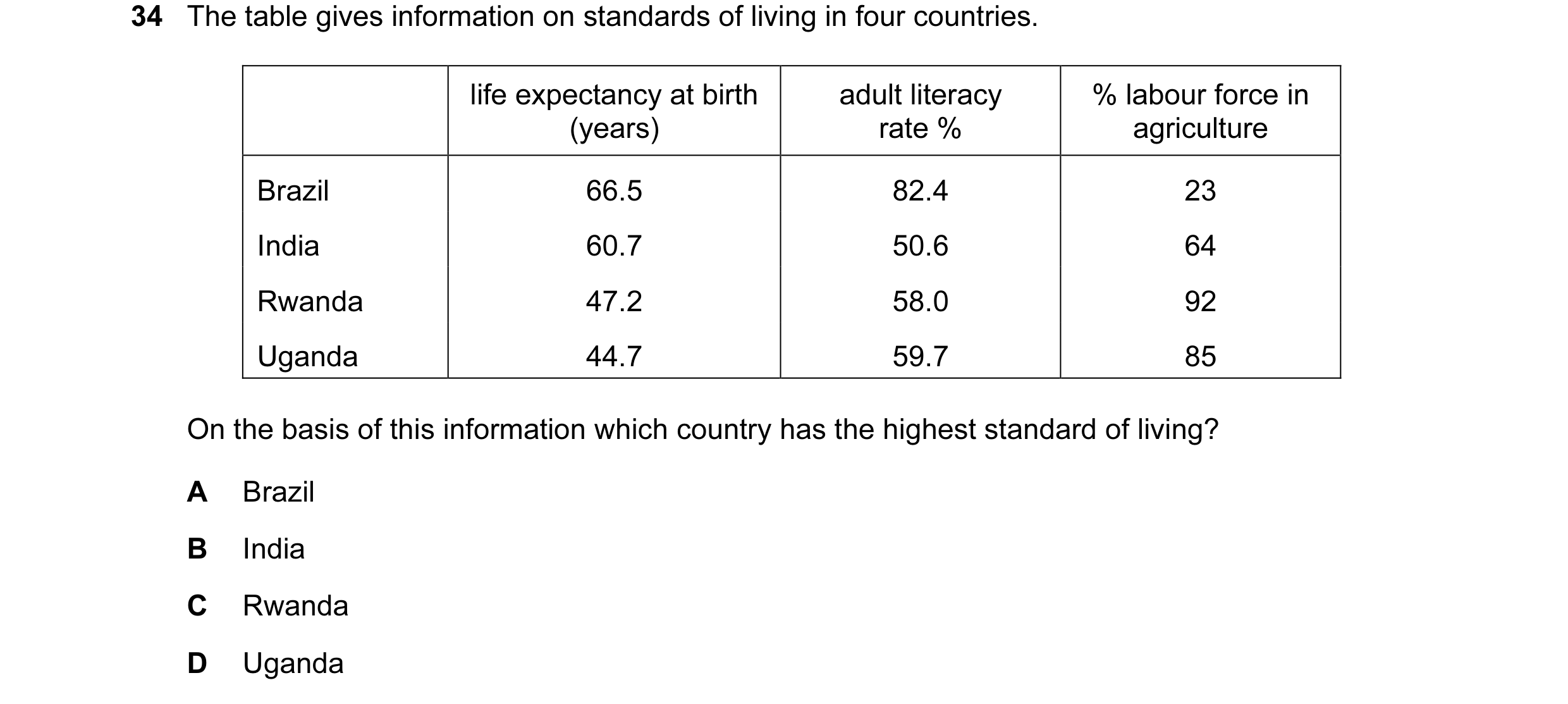
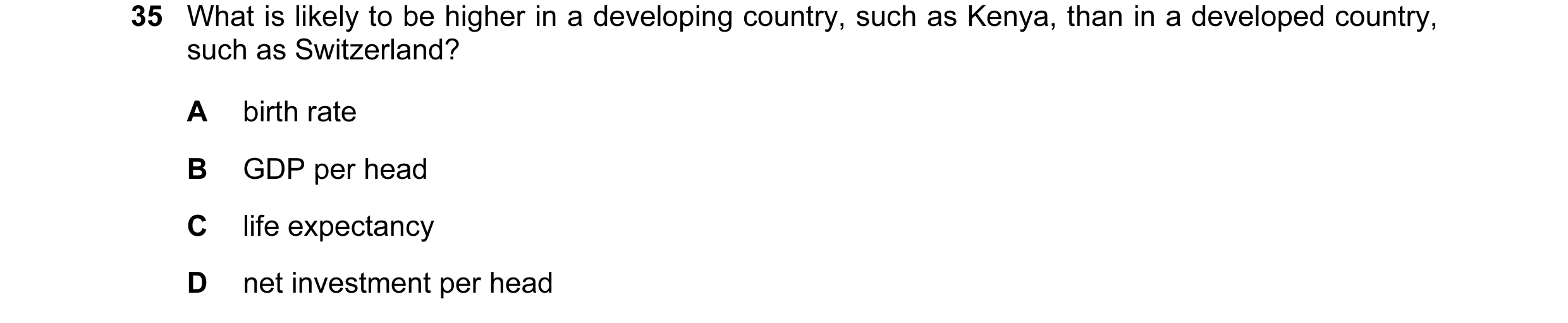

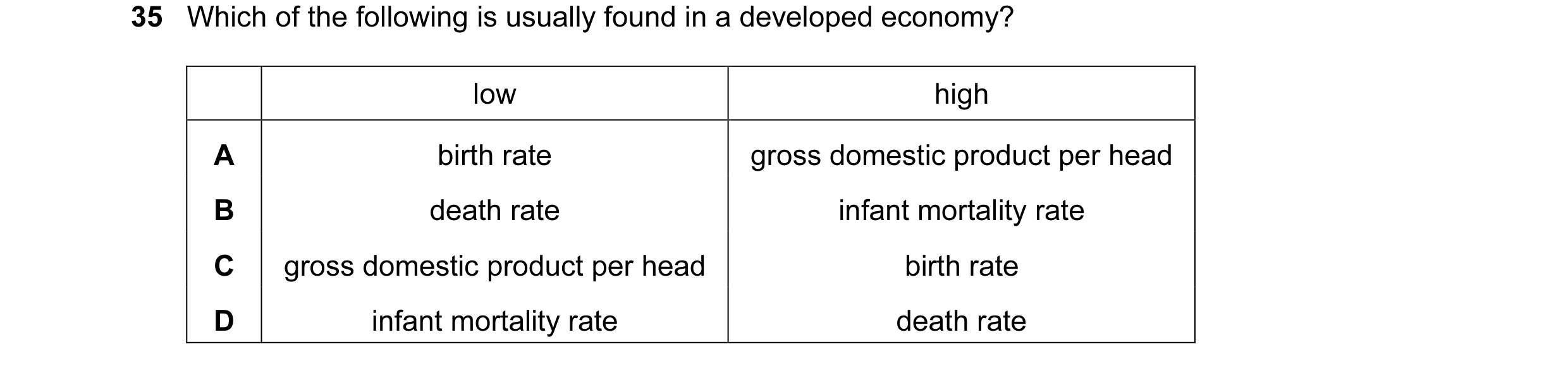 1 / 39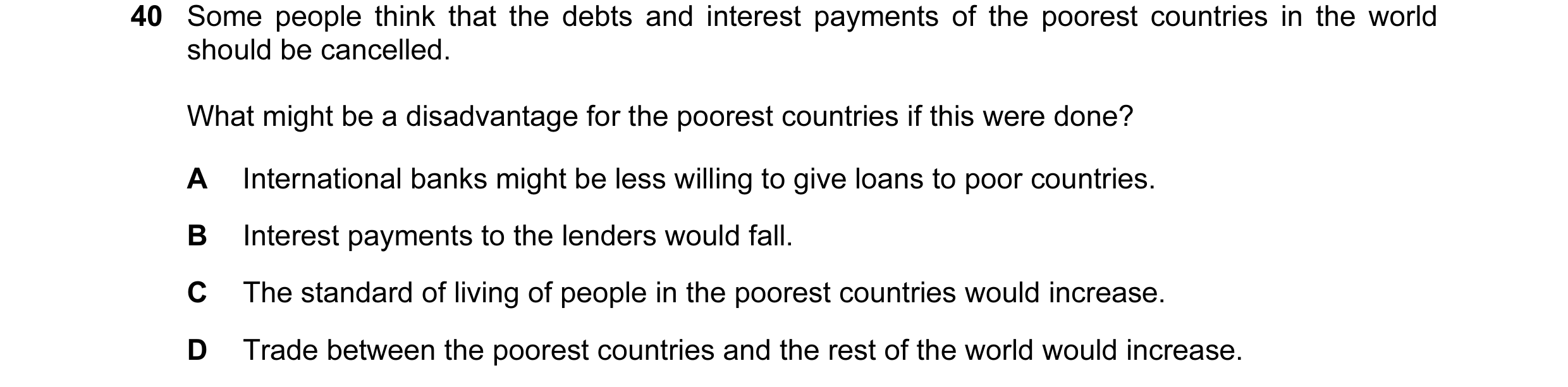
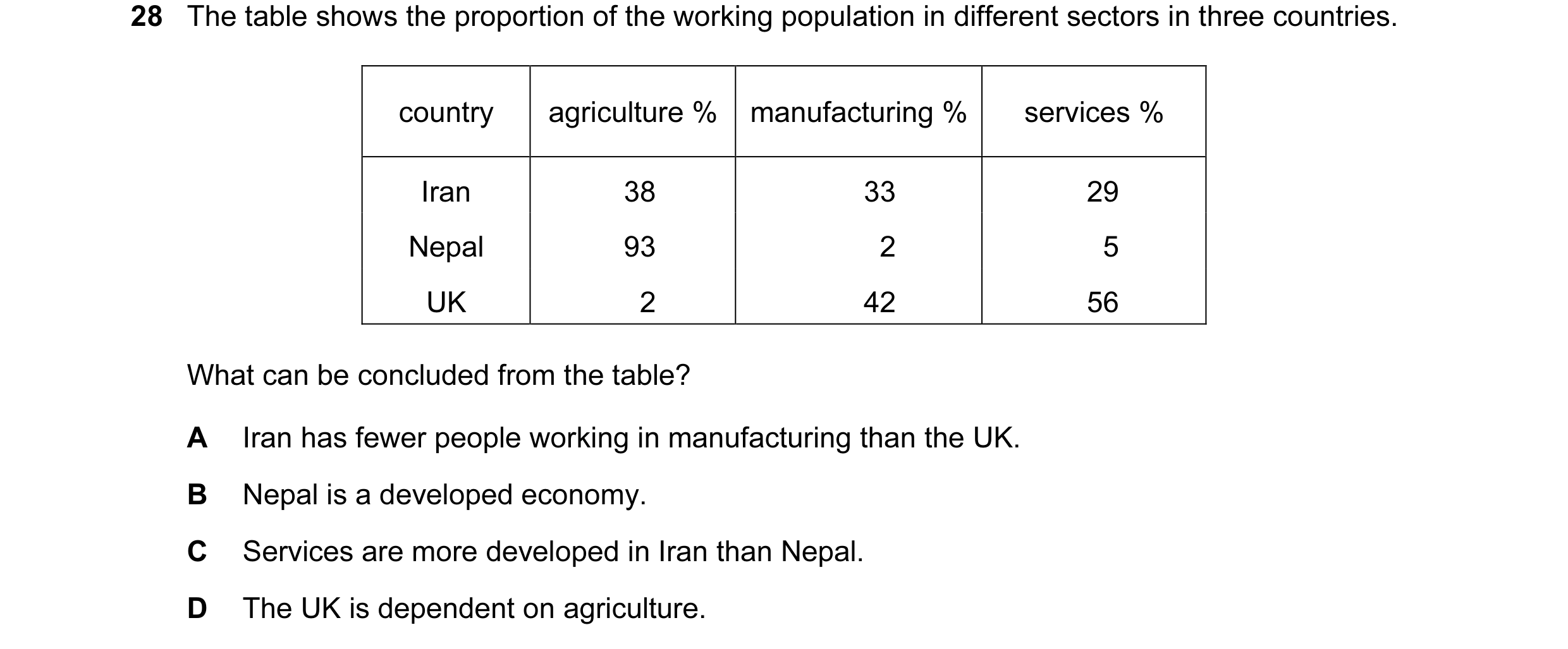
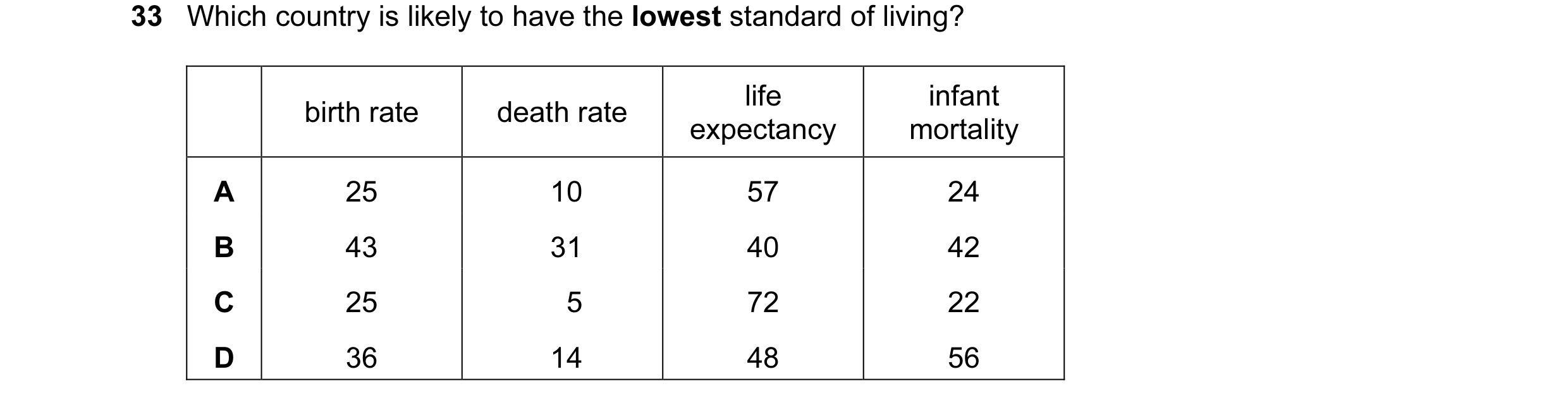
 2 / 39
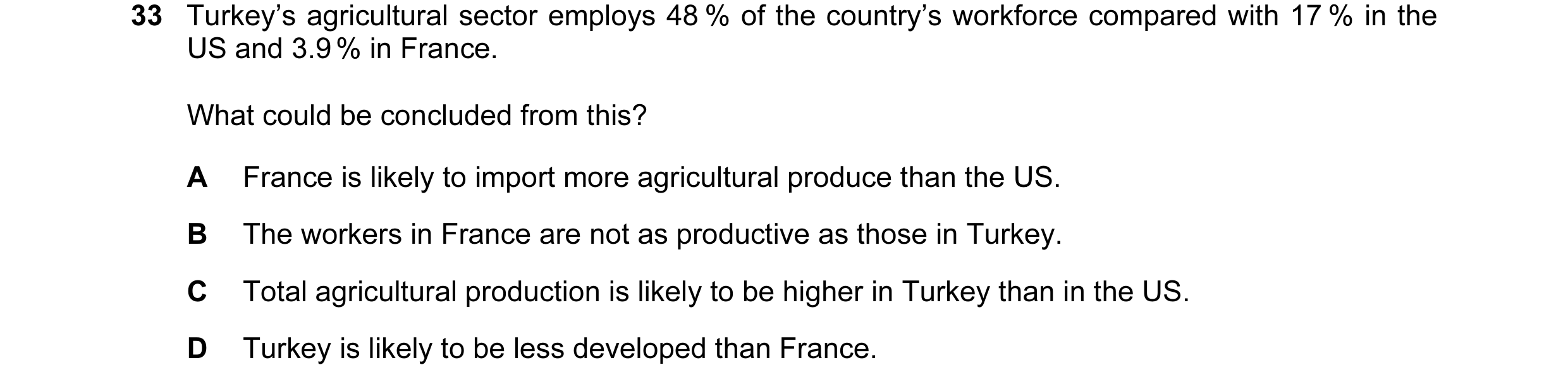

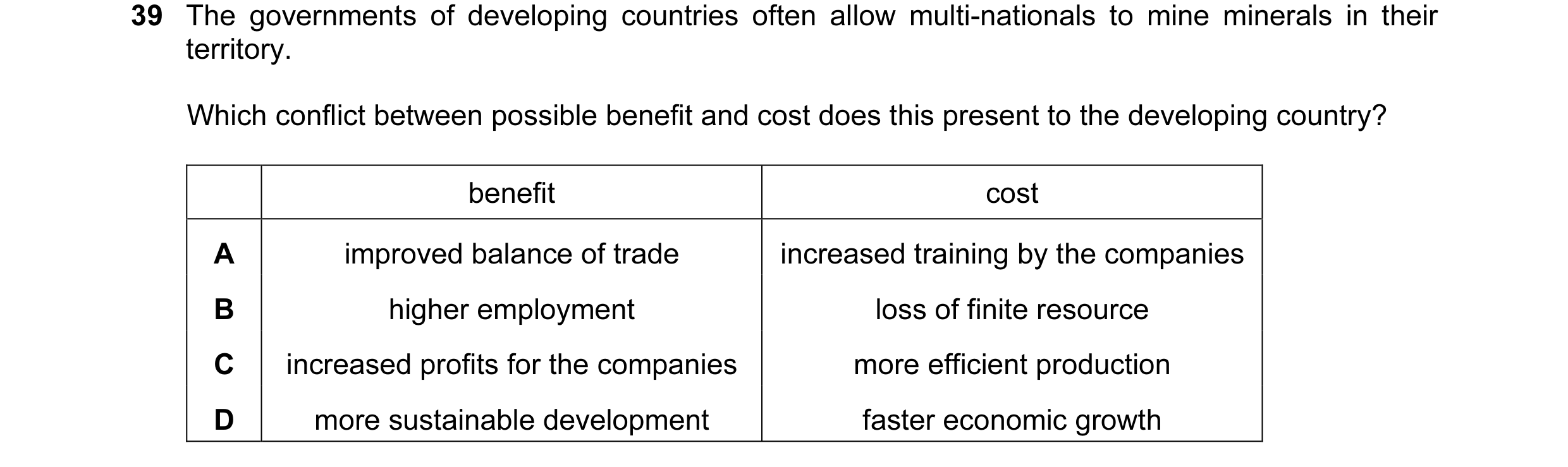
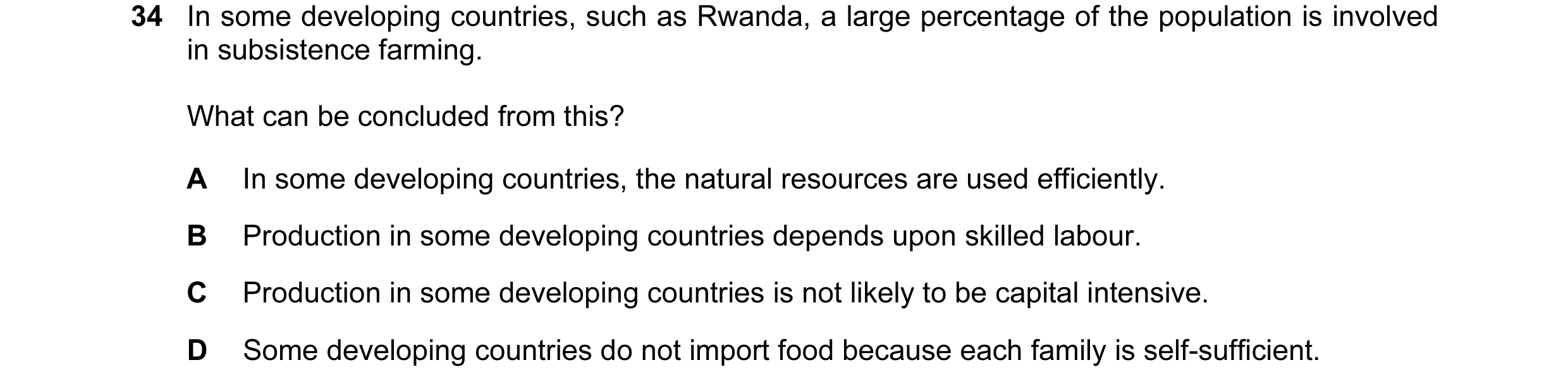 3 / 39
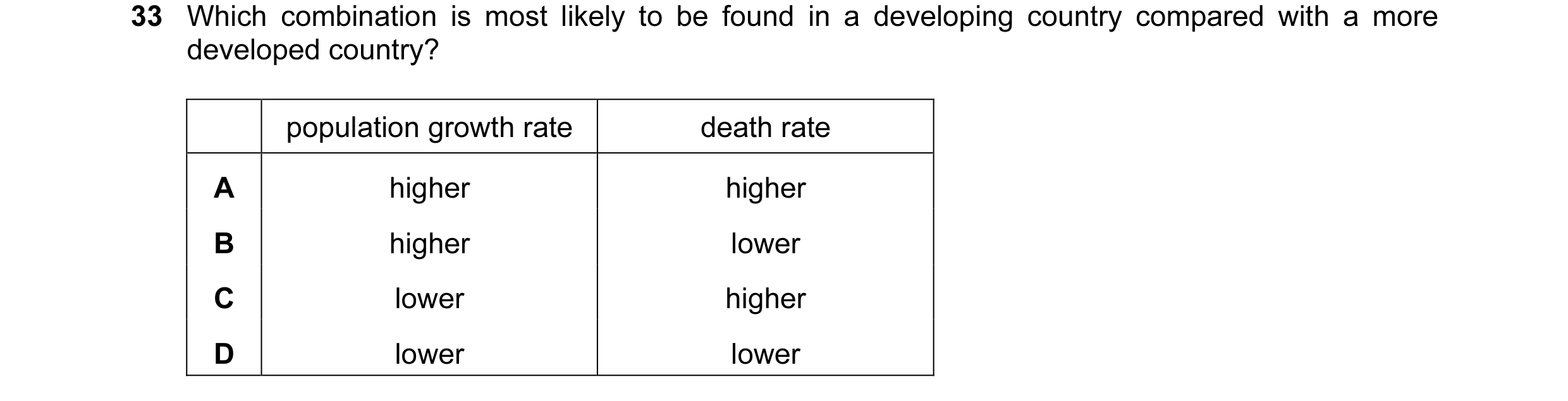



 4 / 39



 5 / 39



 6 / 39
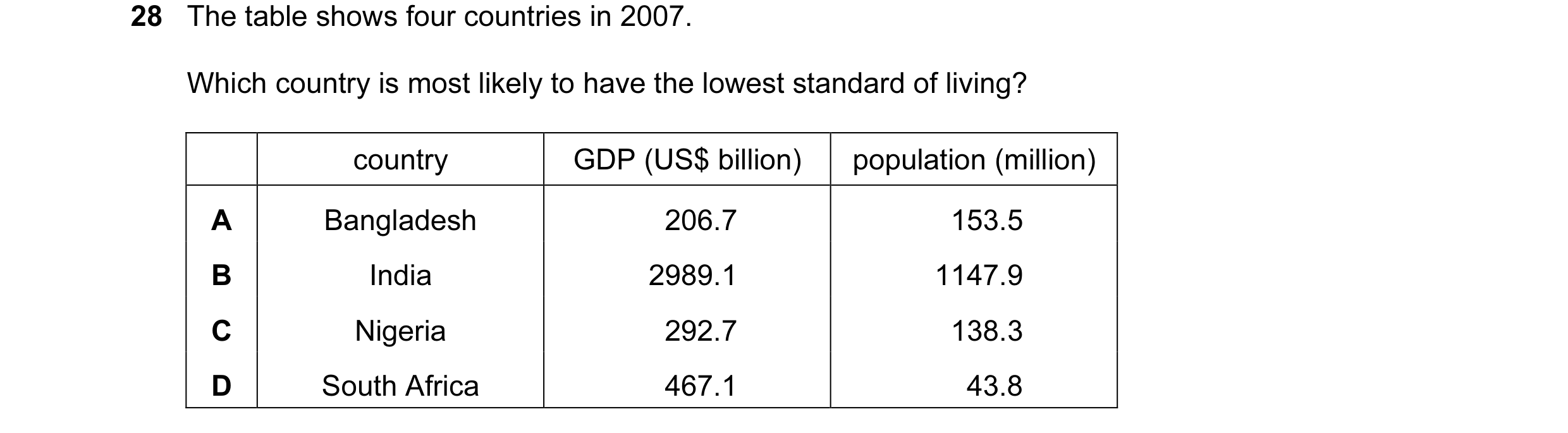
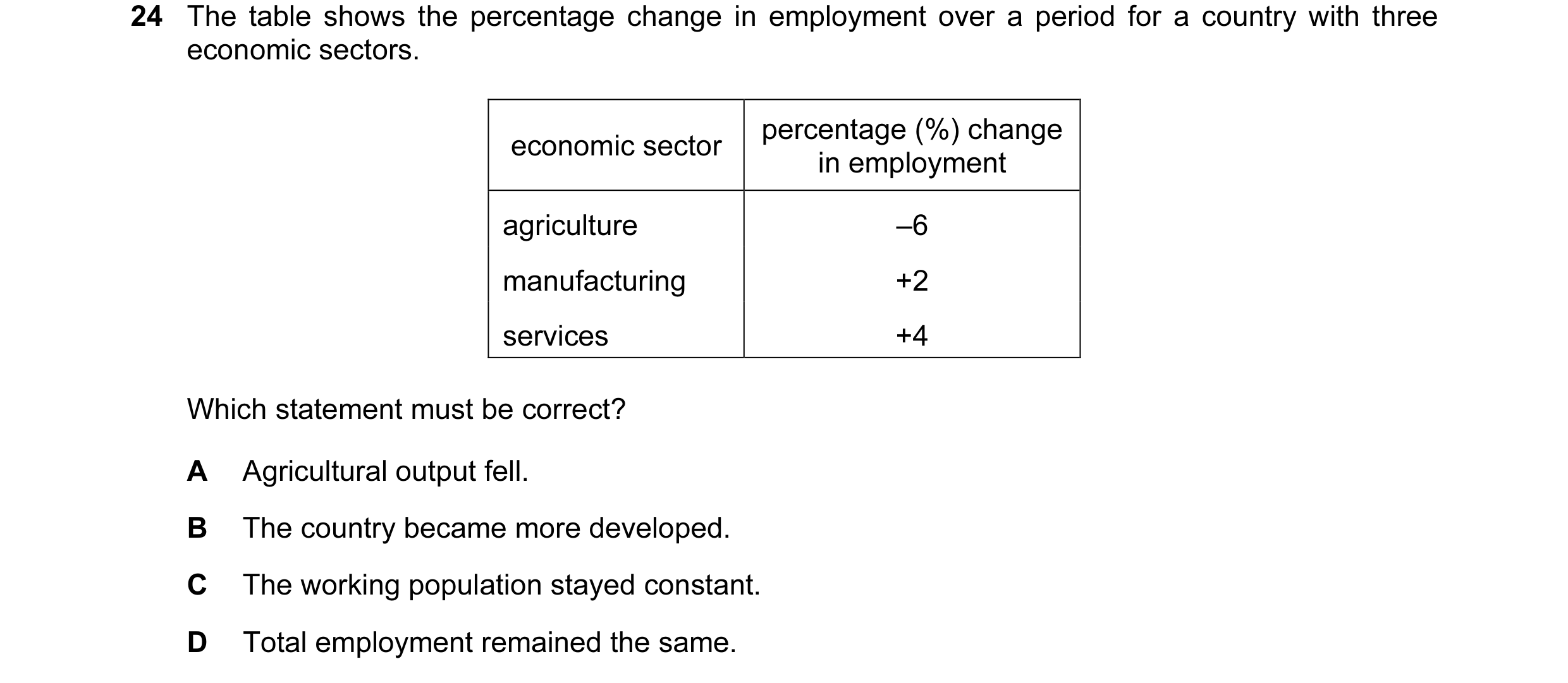

 7 / 39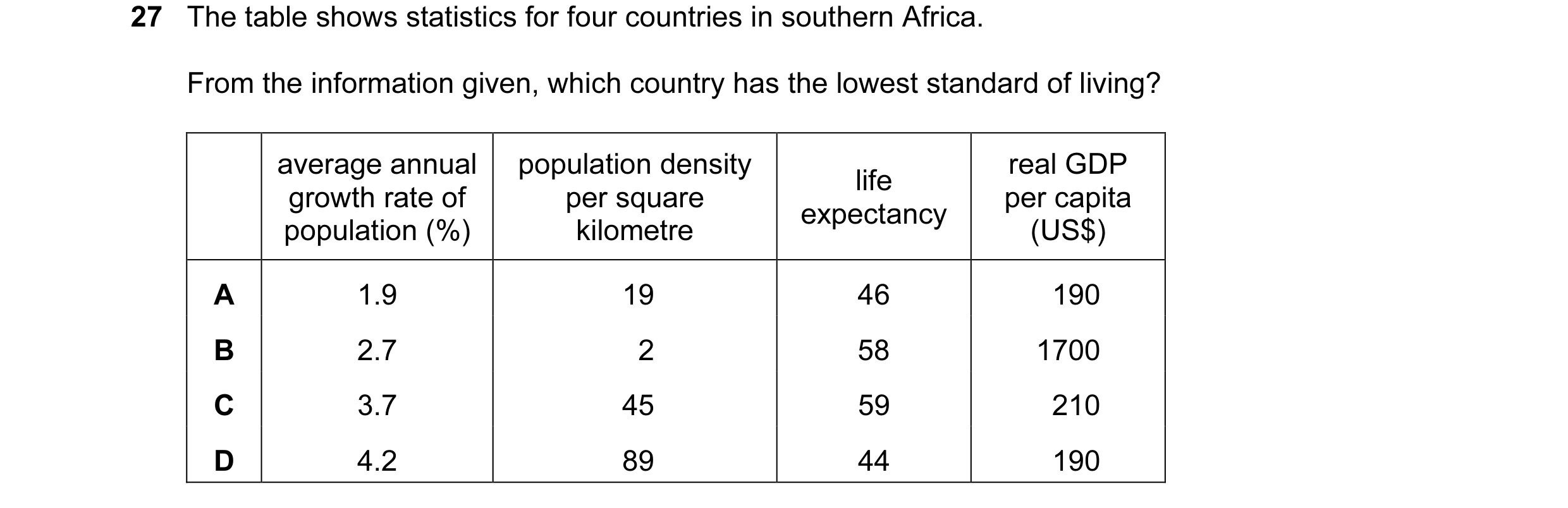

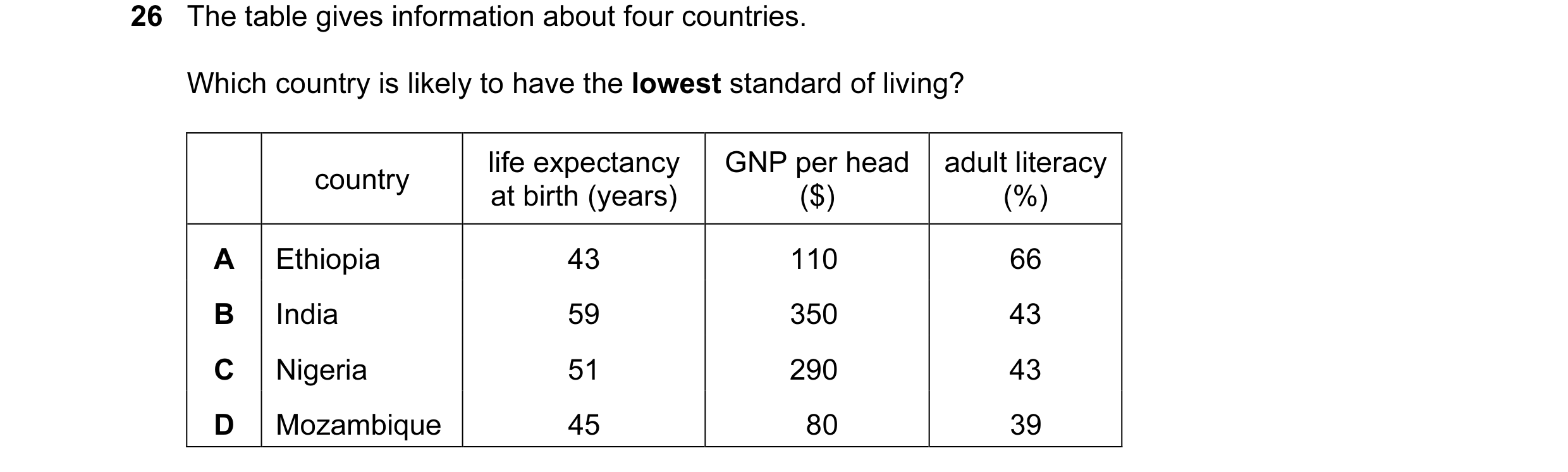
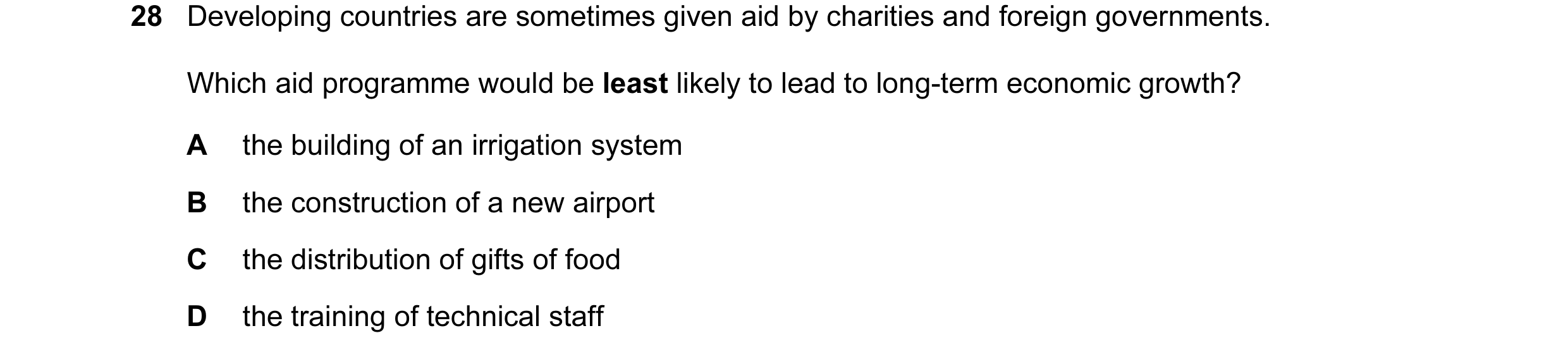 8 / 39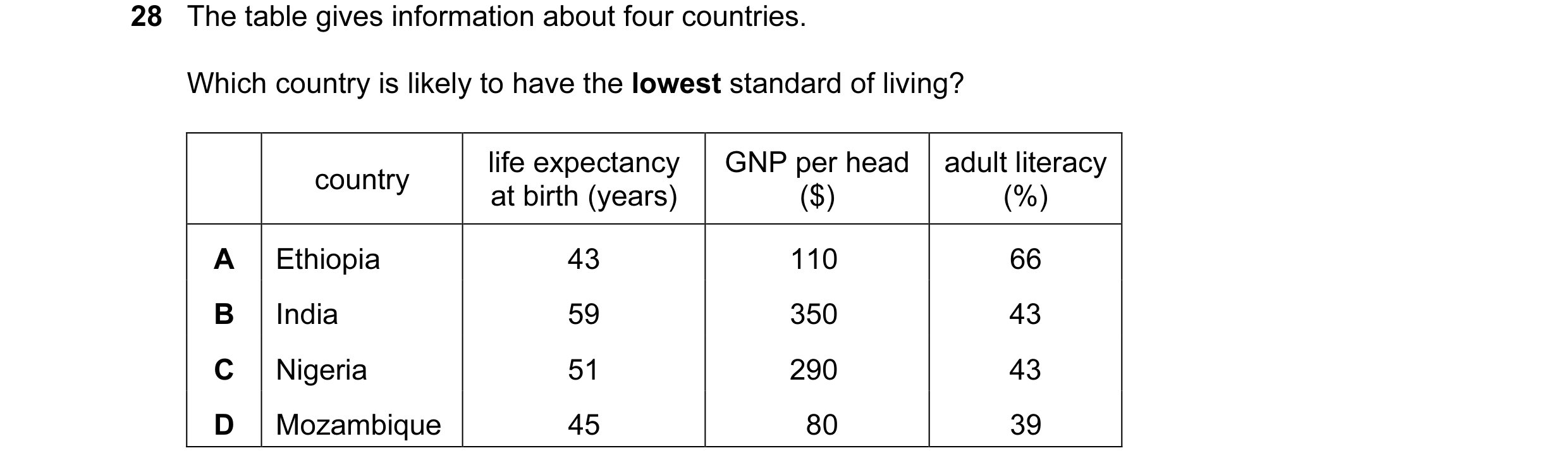
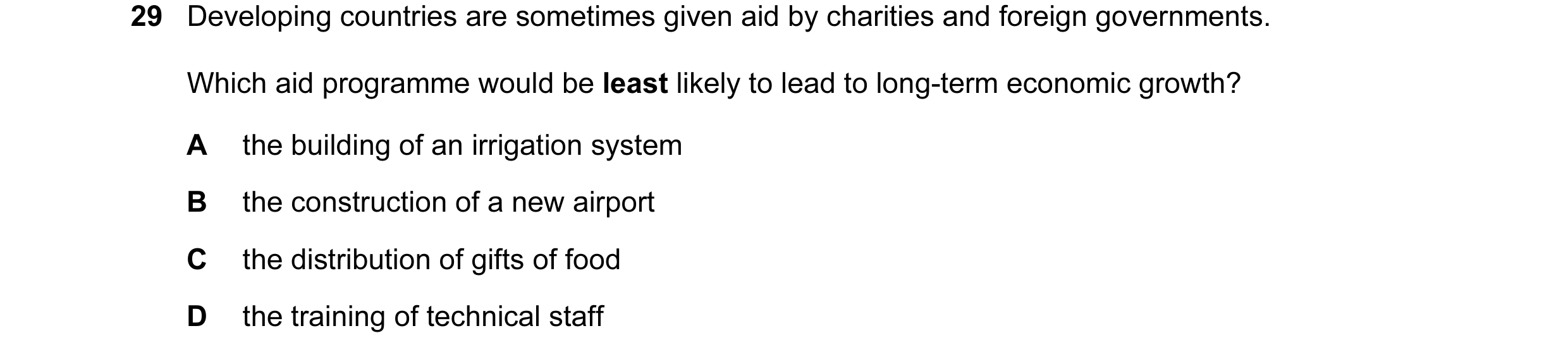
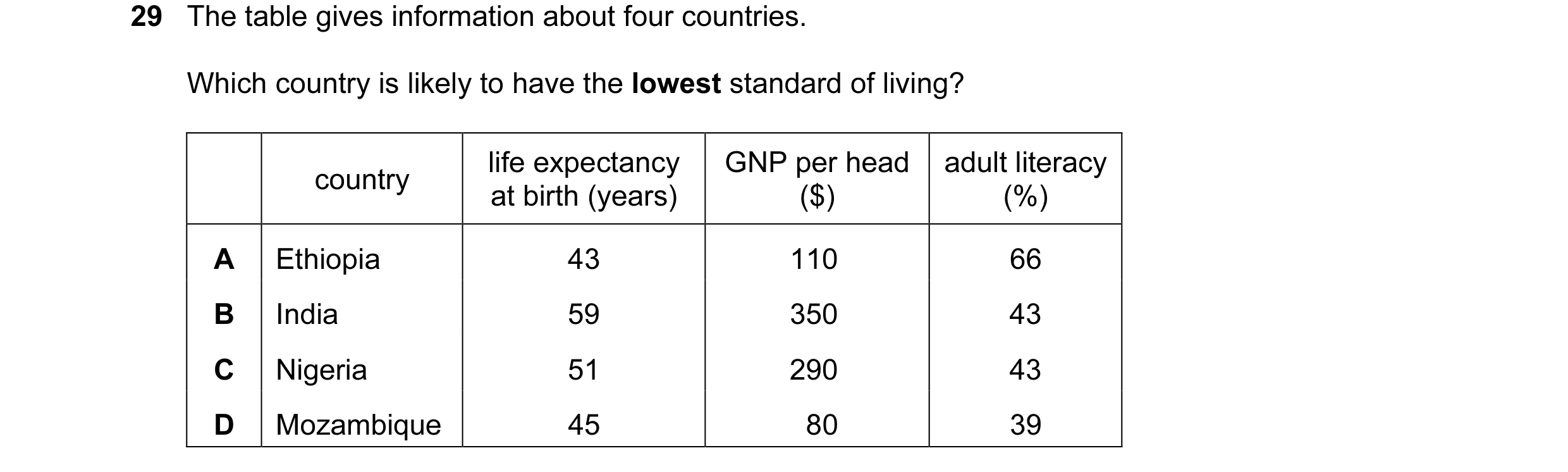
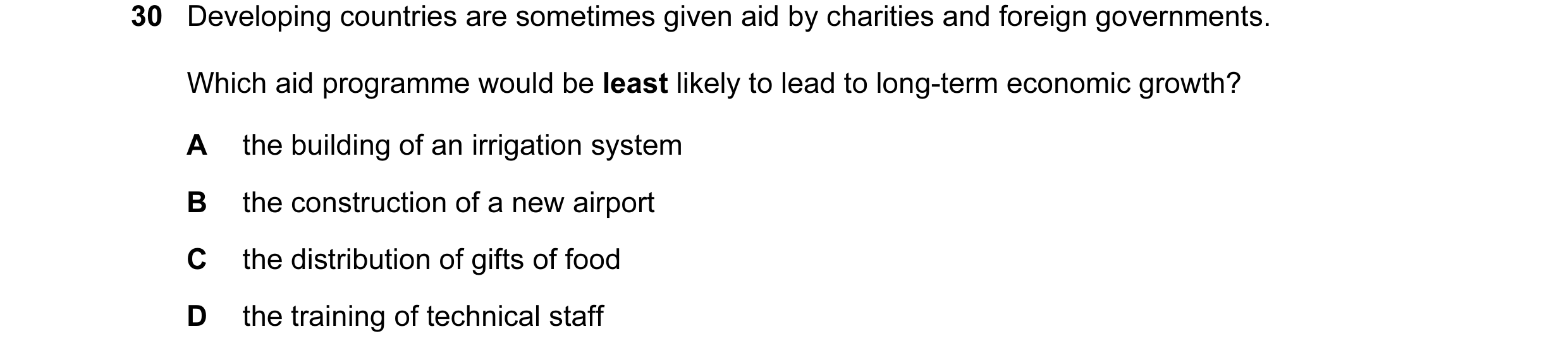
 9 / 39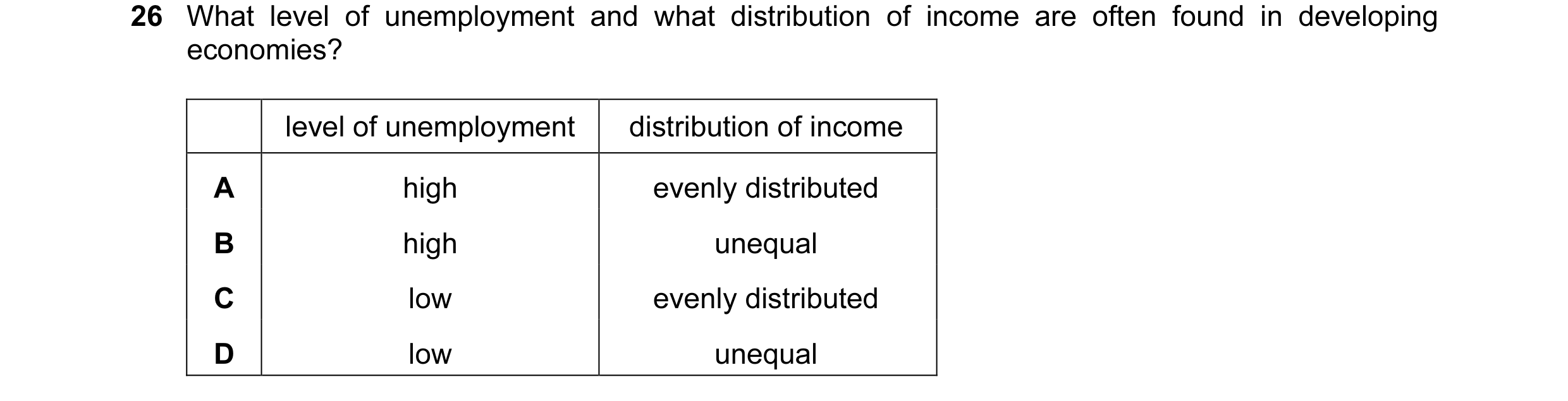
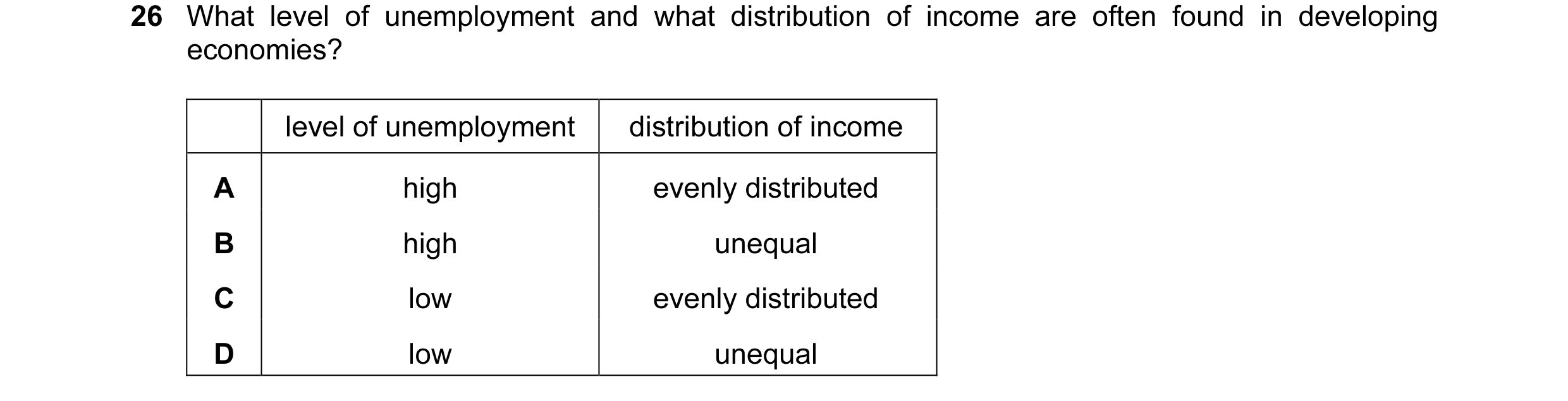

 10 / 39
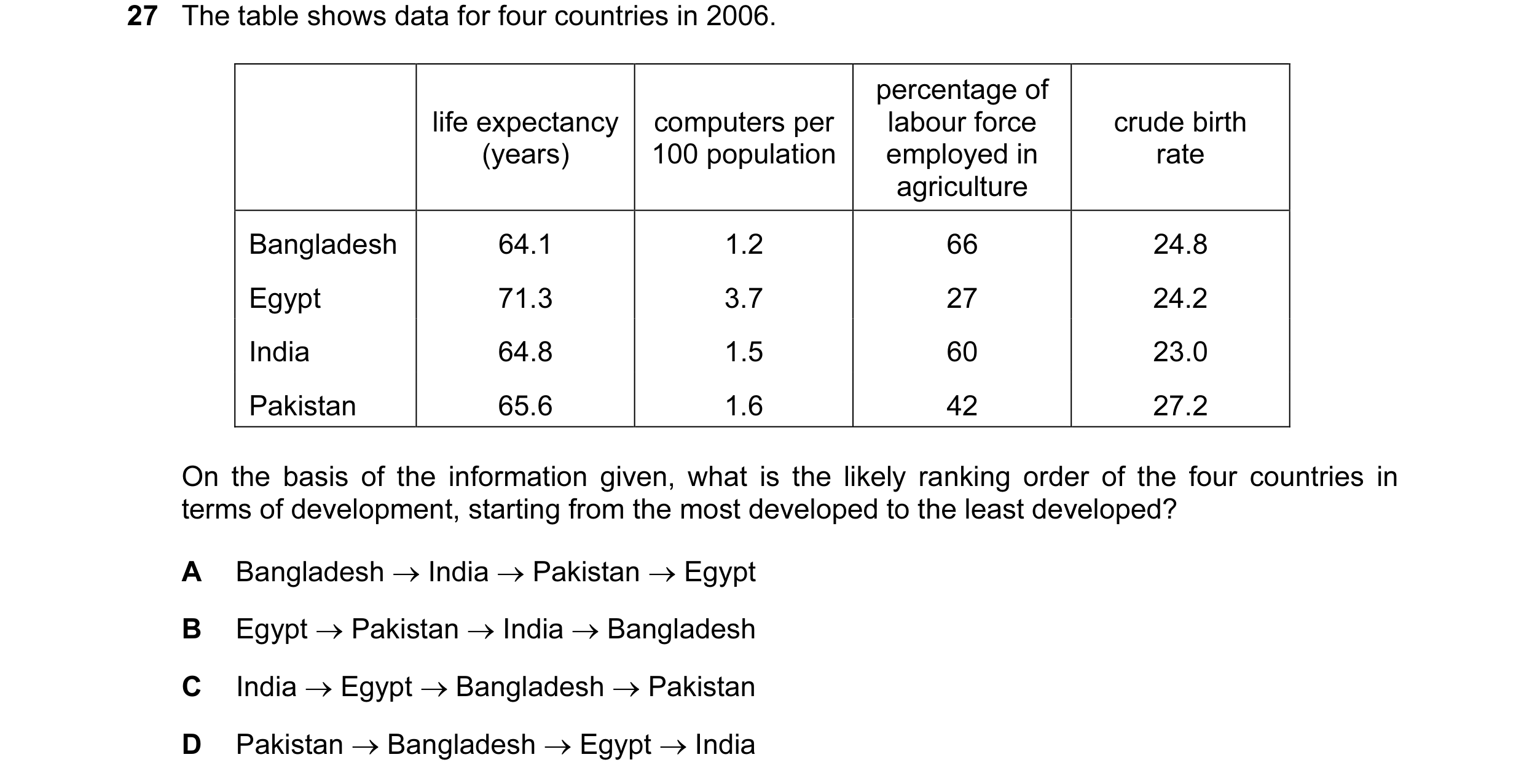
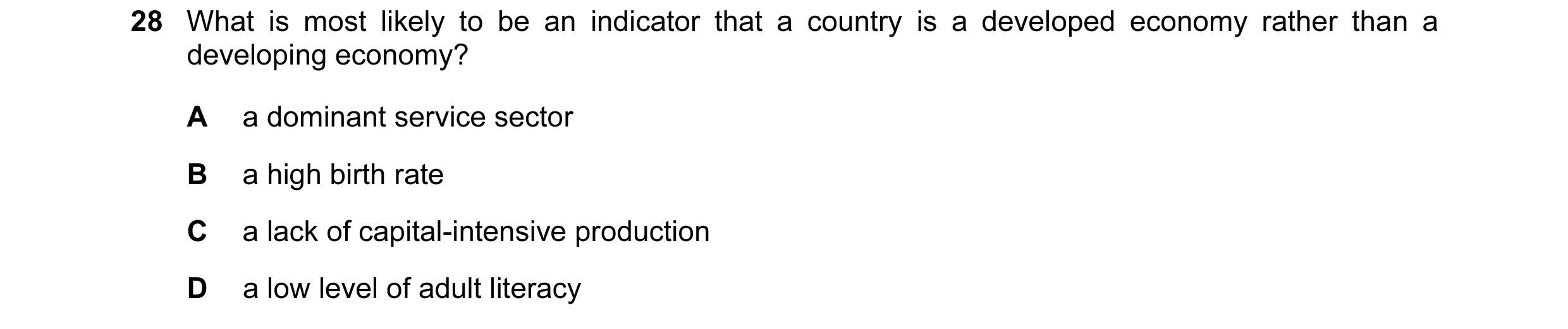
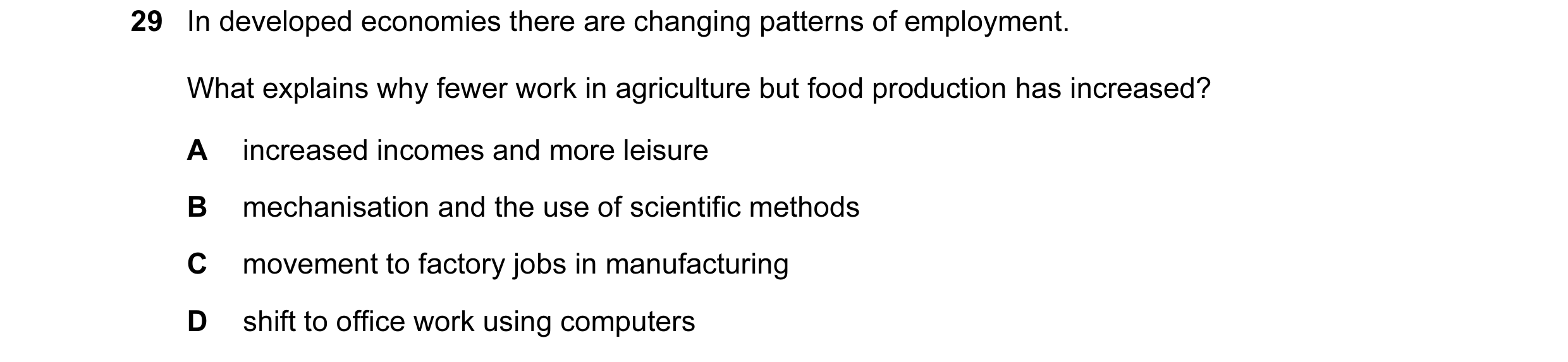 11 / 39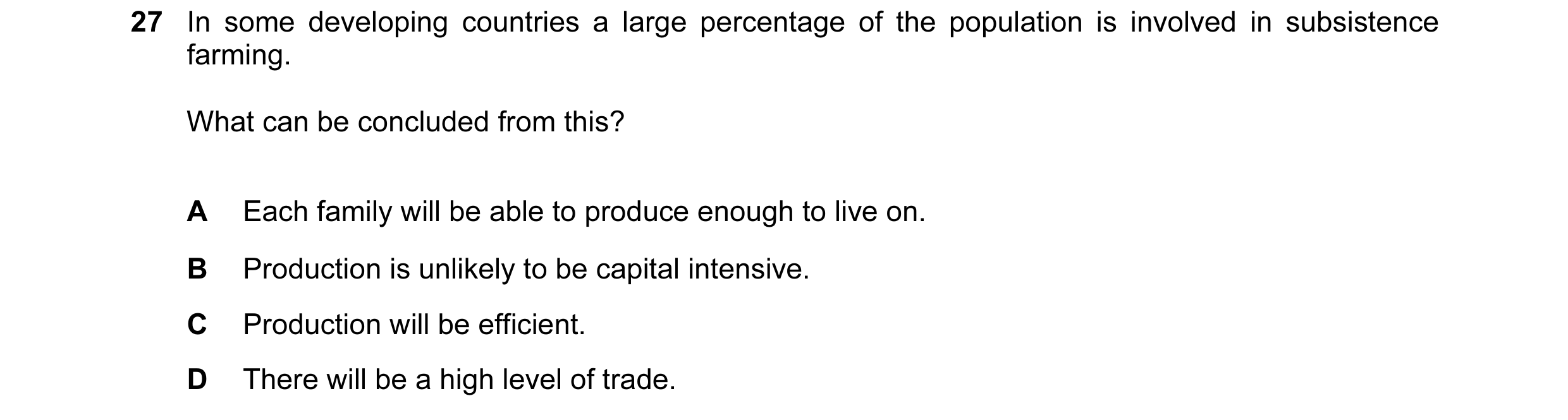
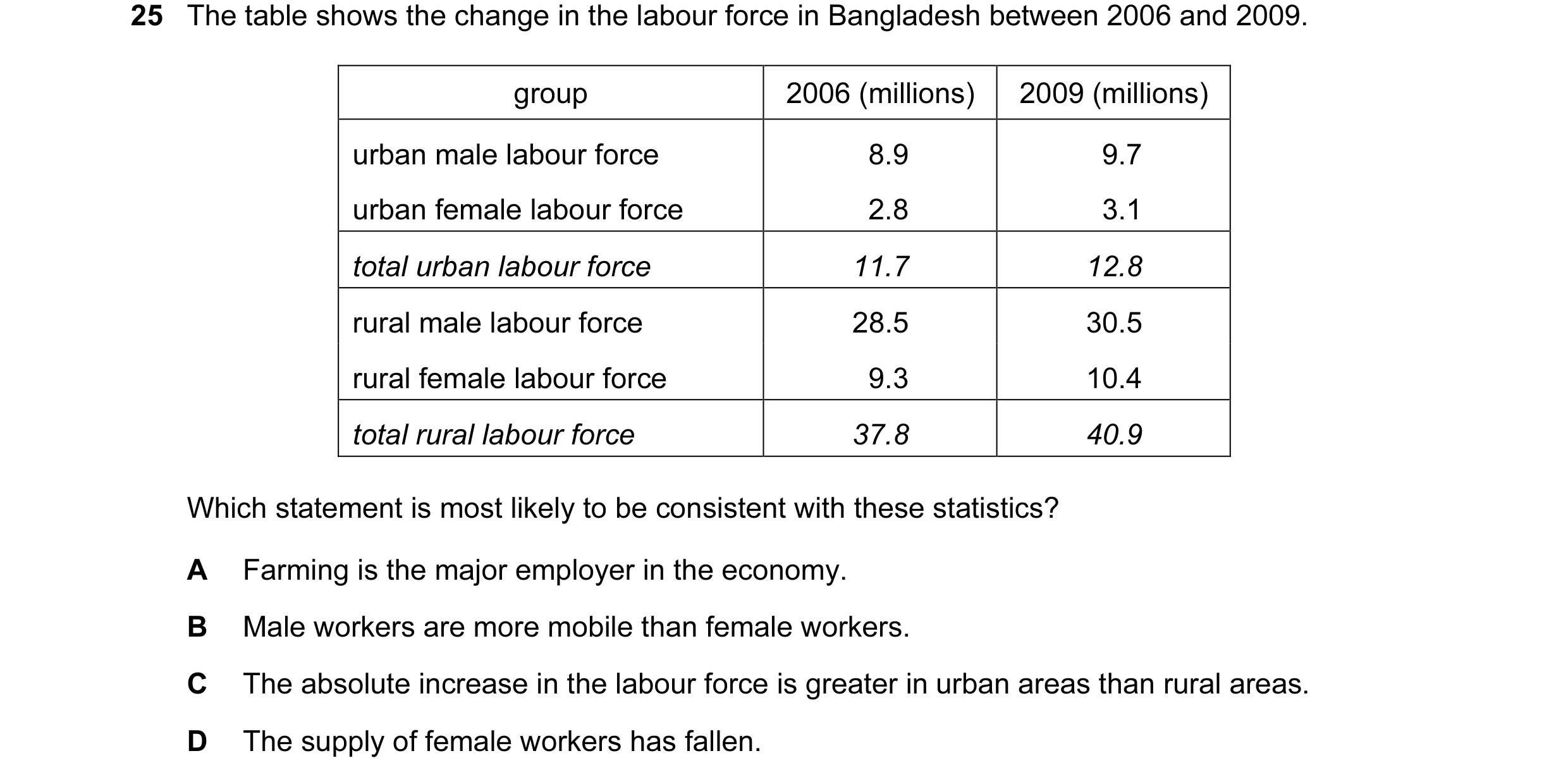
 12 / 39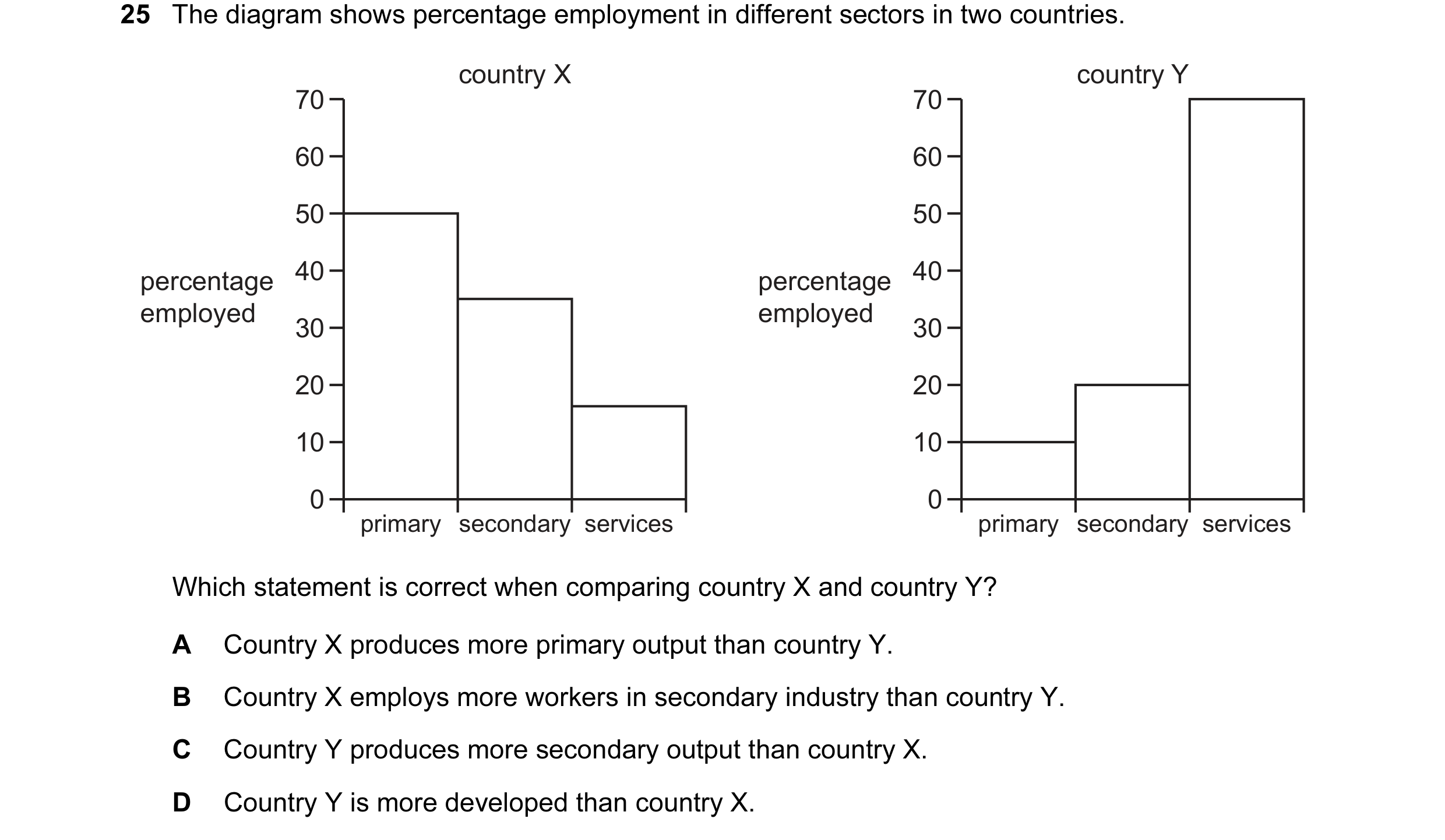
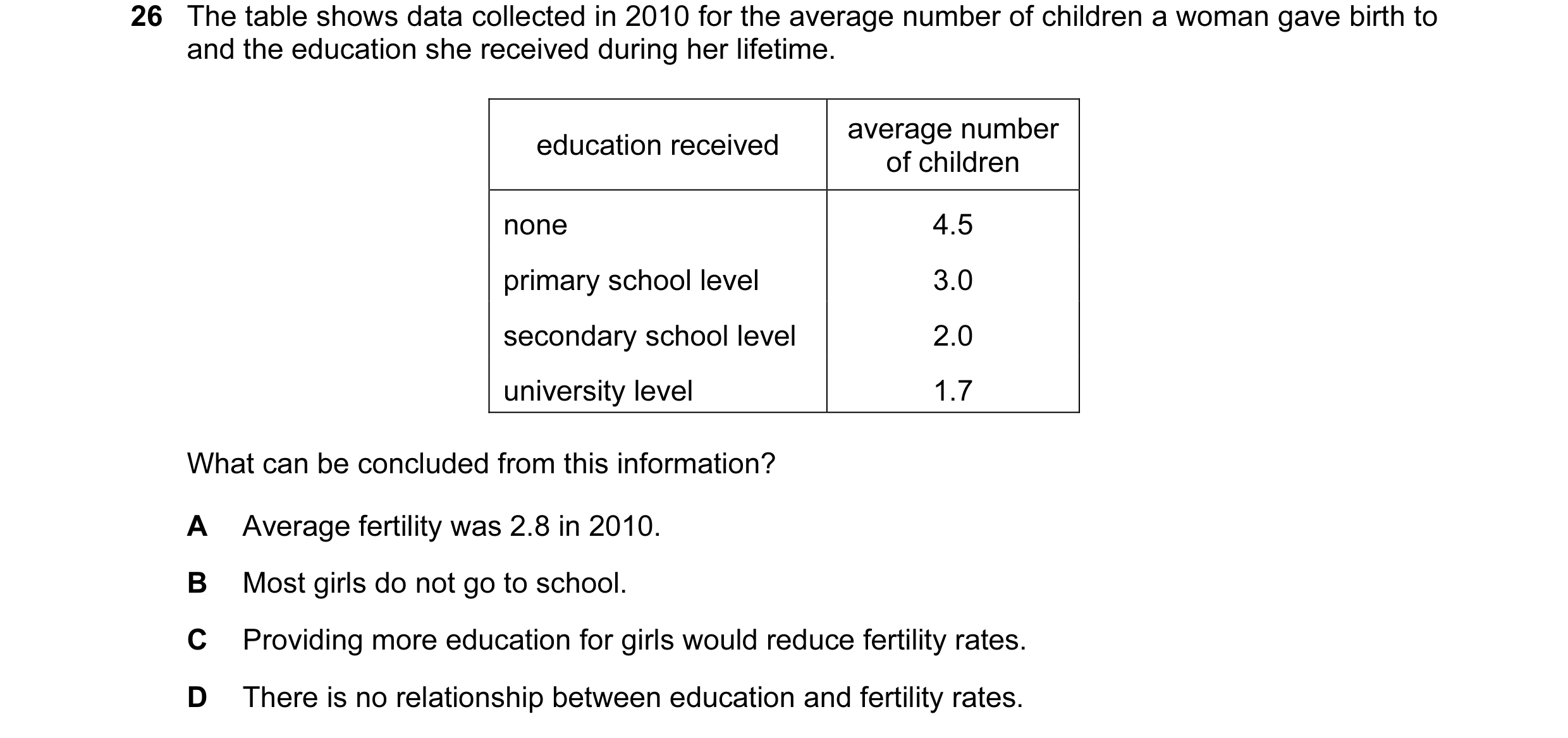 13 / 39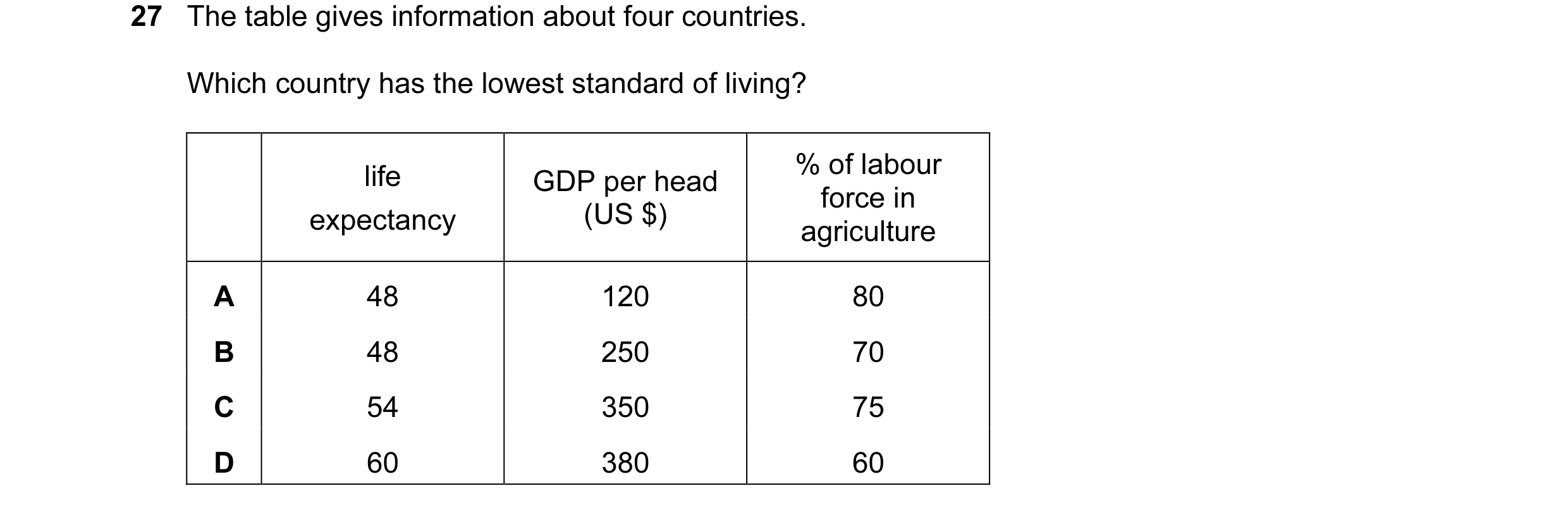
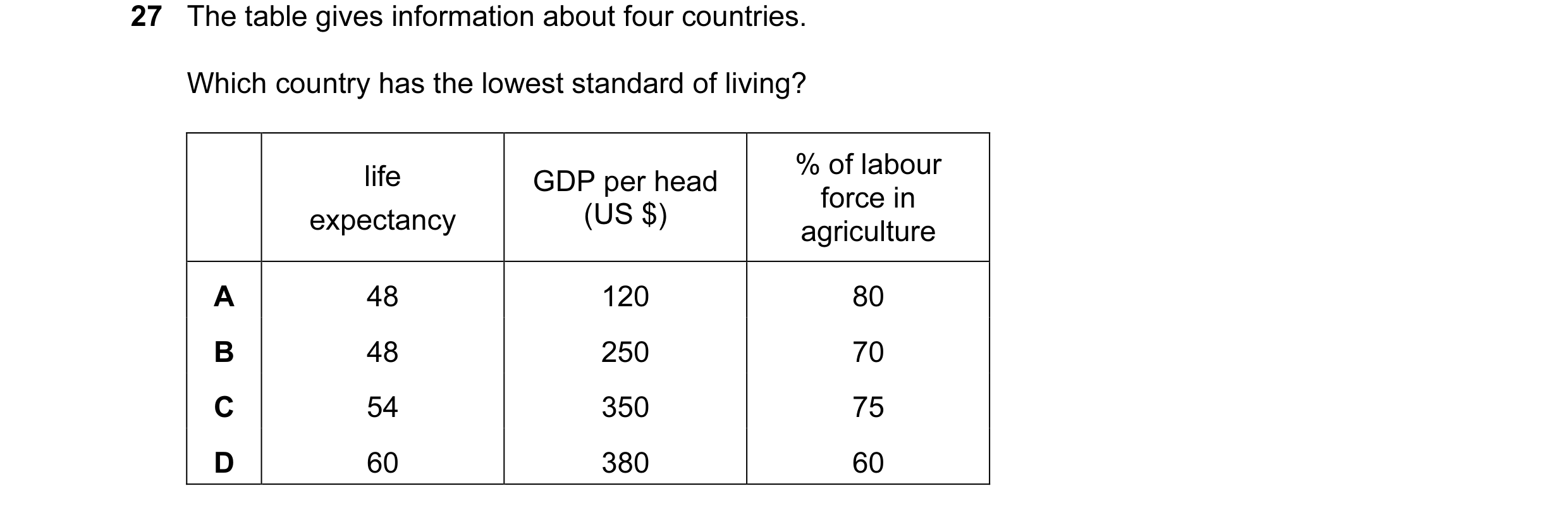 14 / 39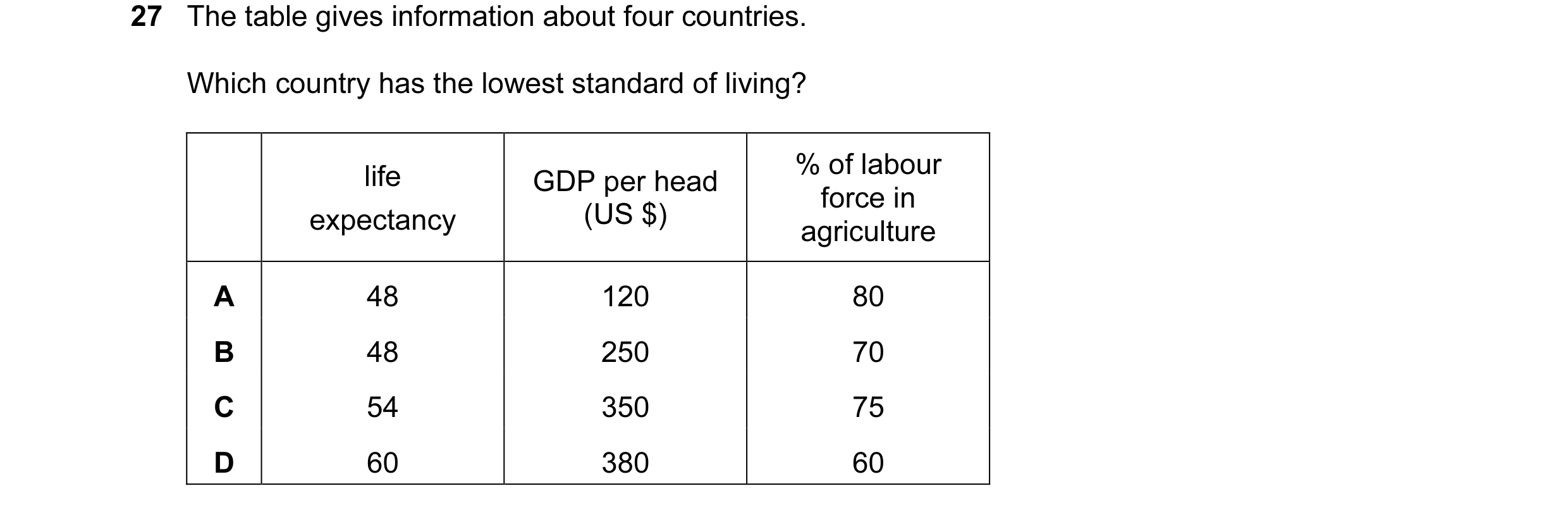
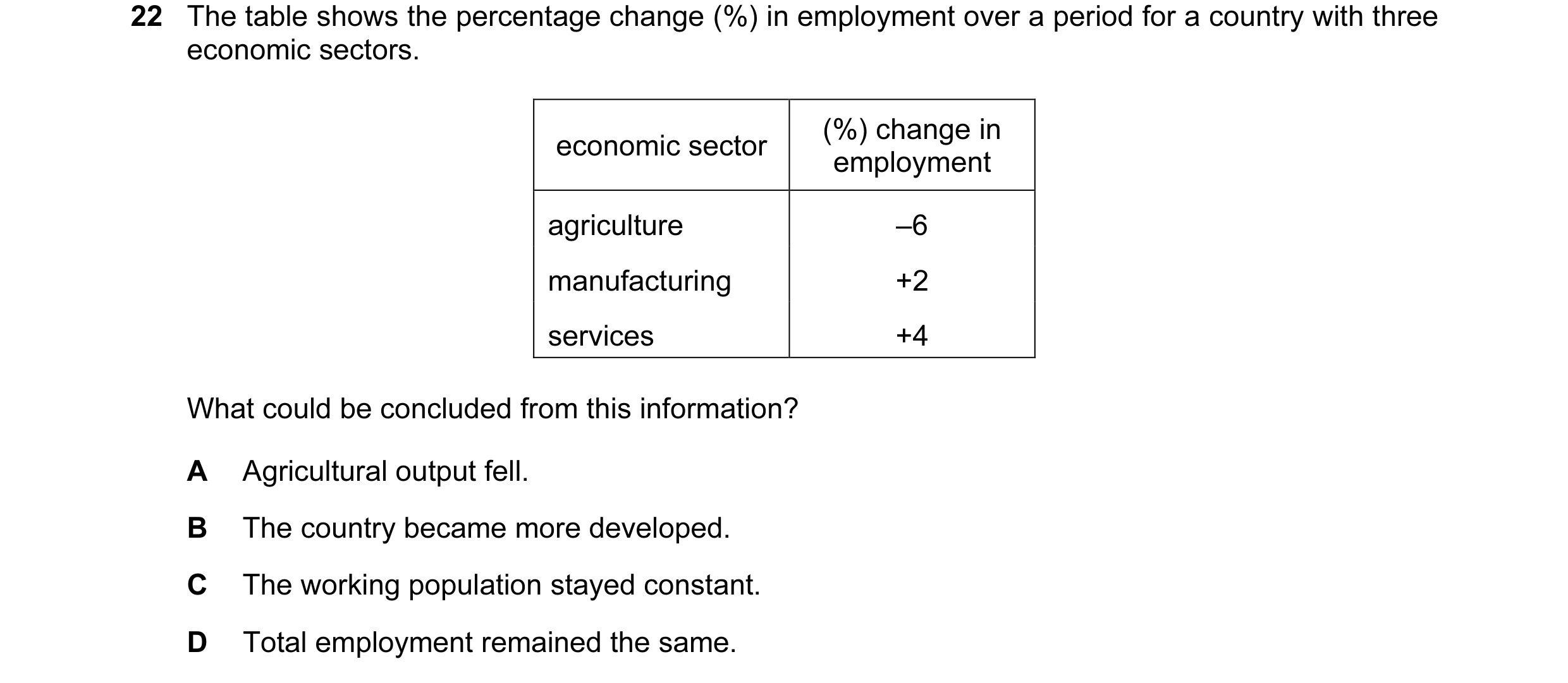
 15 / 39
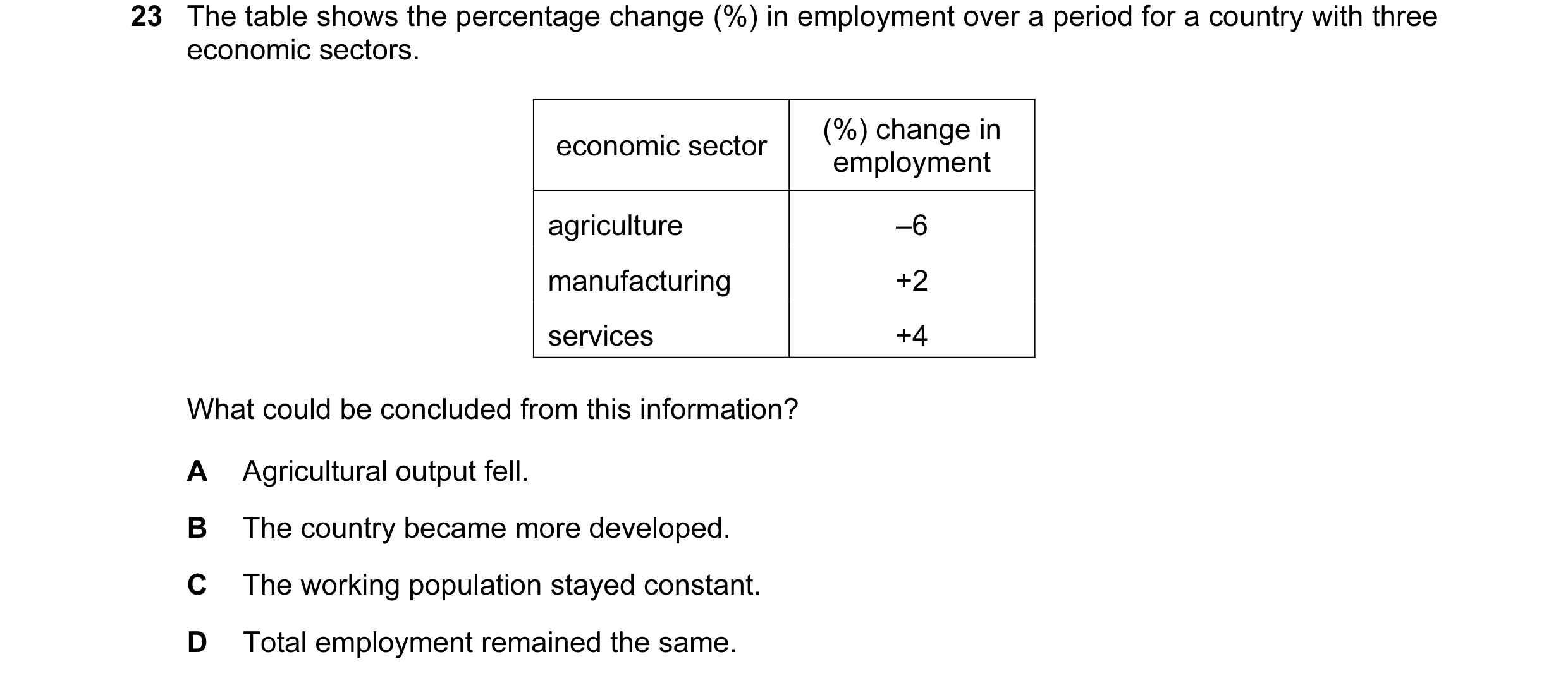


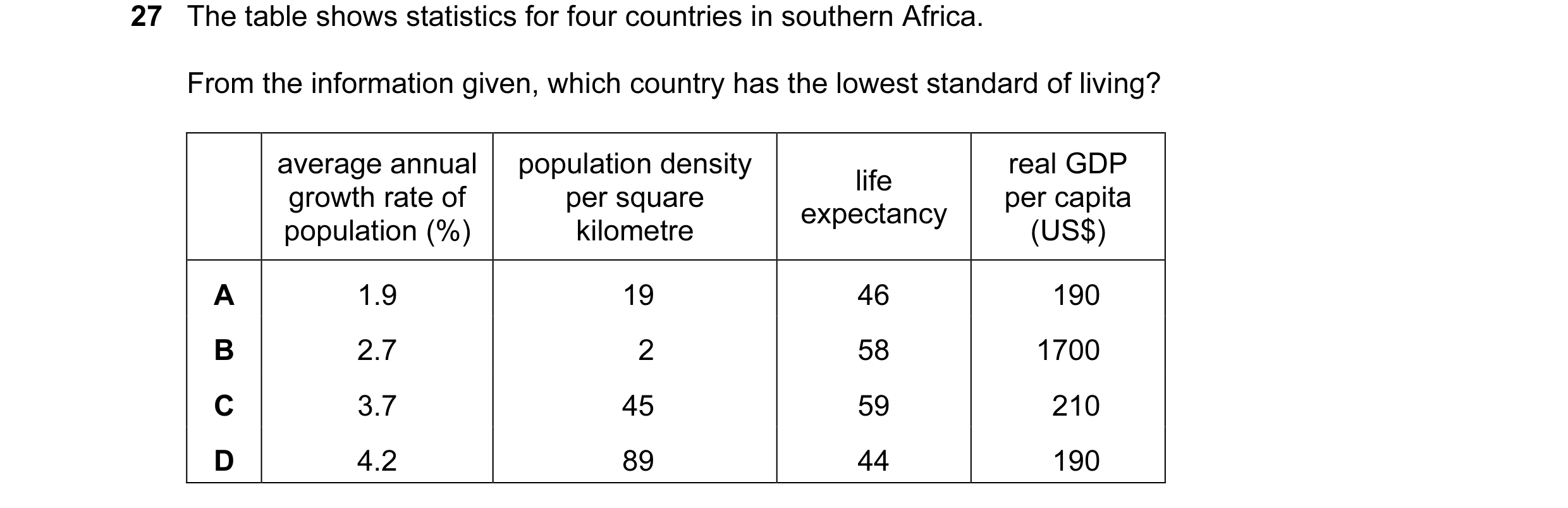 16 / 39
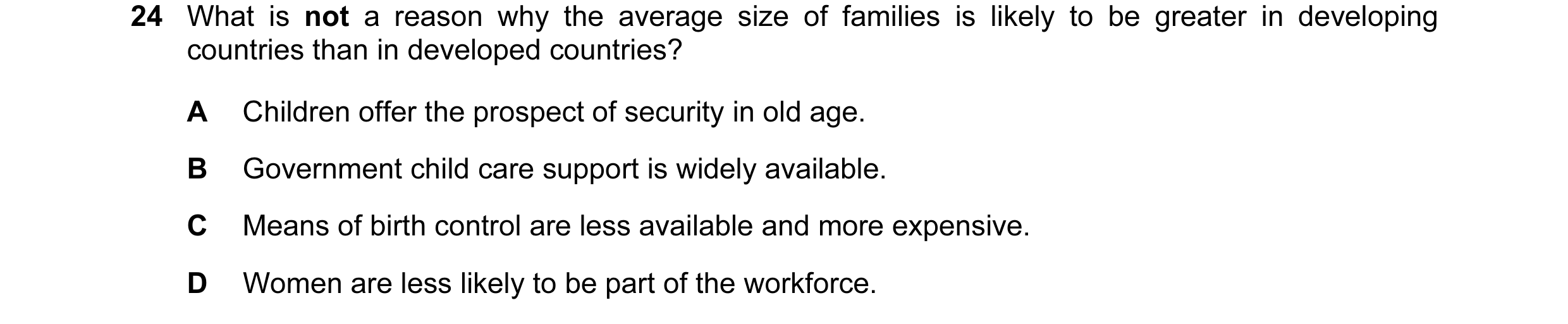
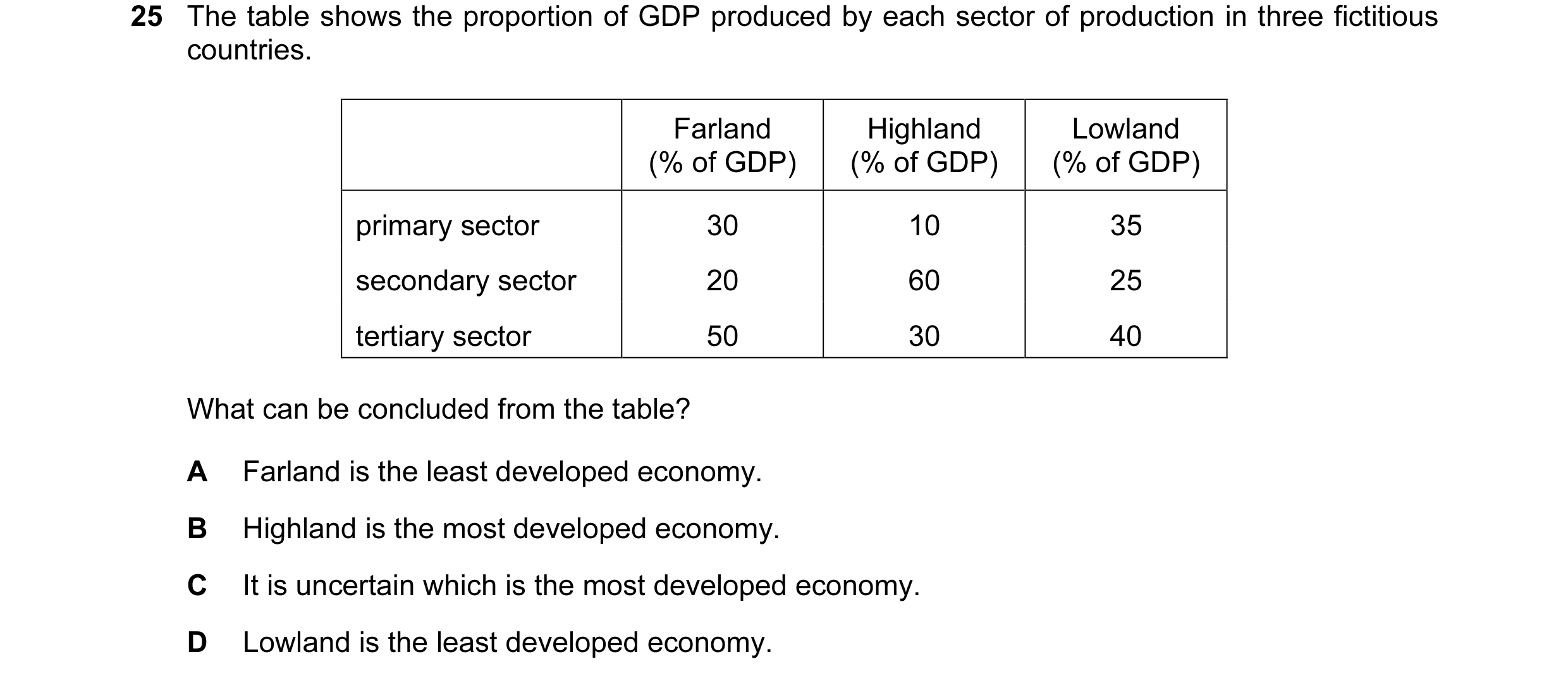
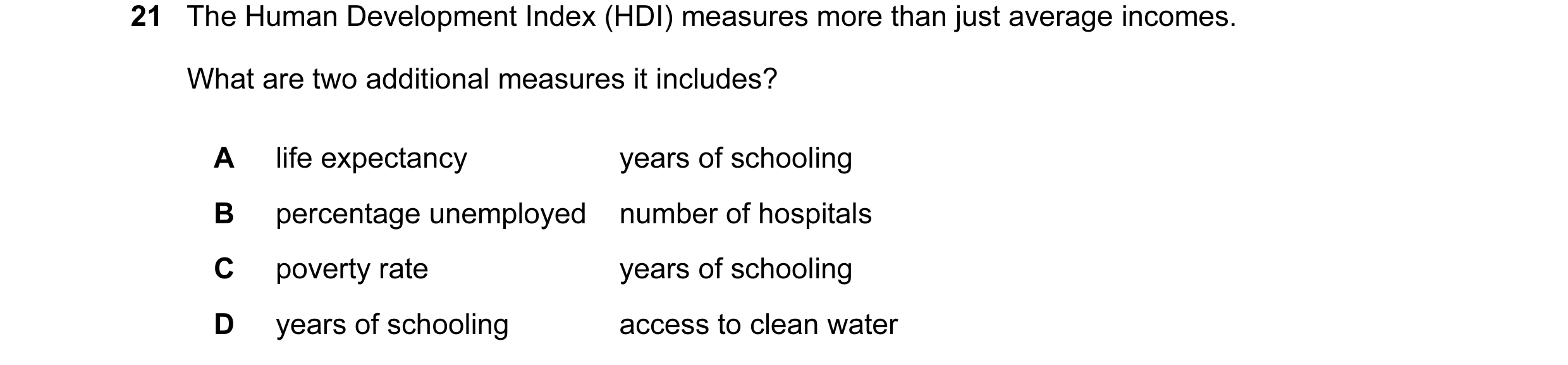
 17 / 39
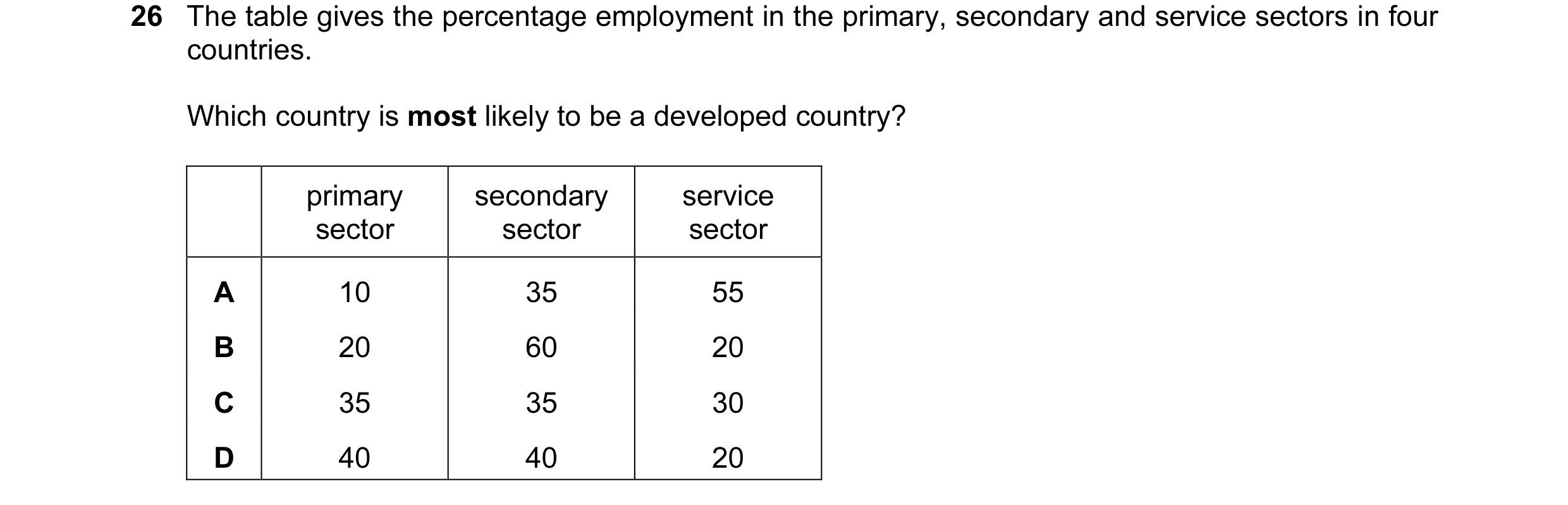

 18 / 39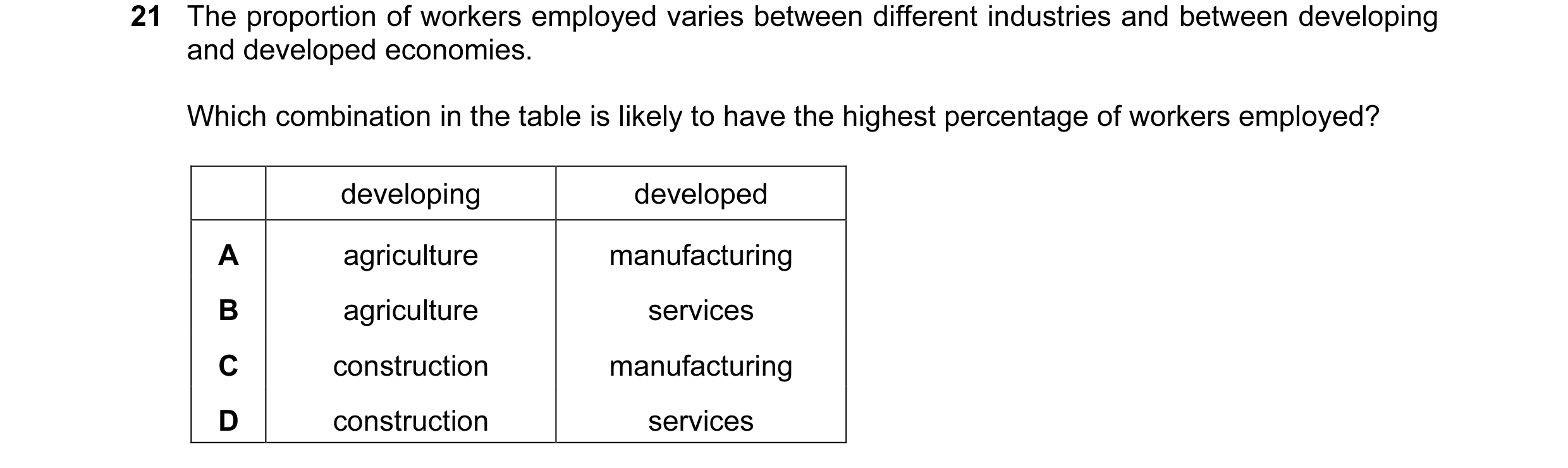
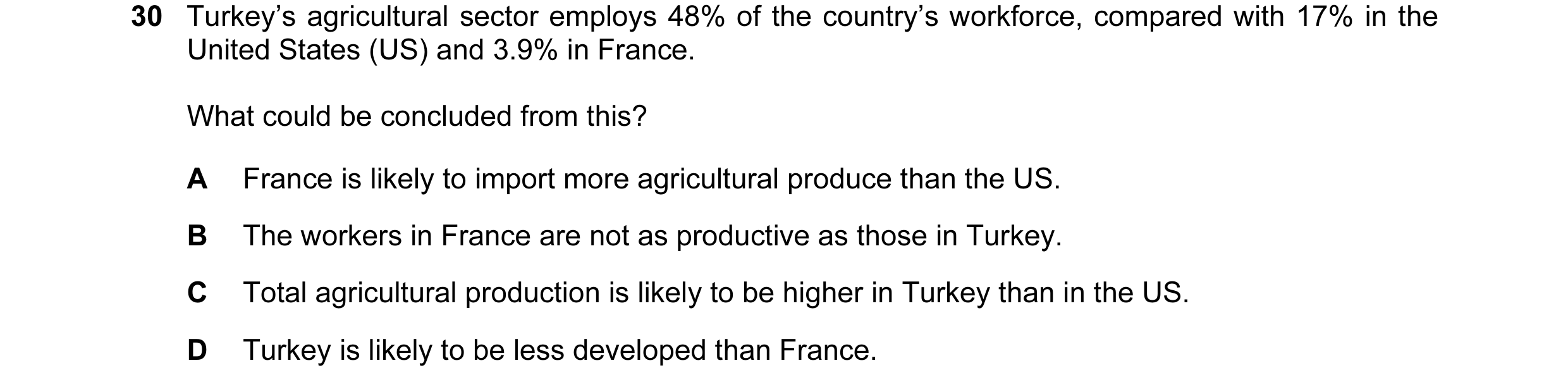
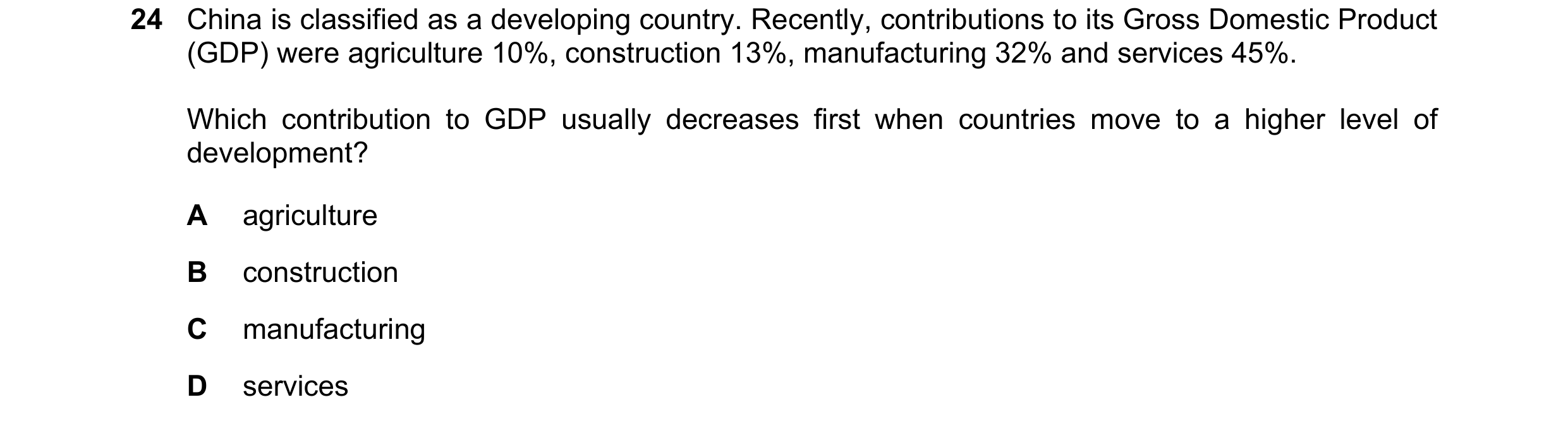
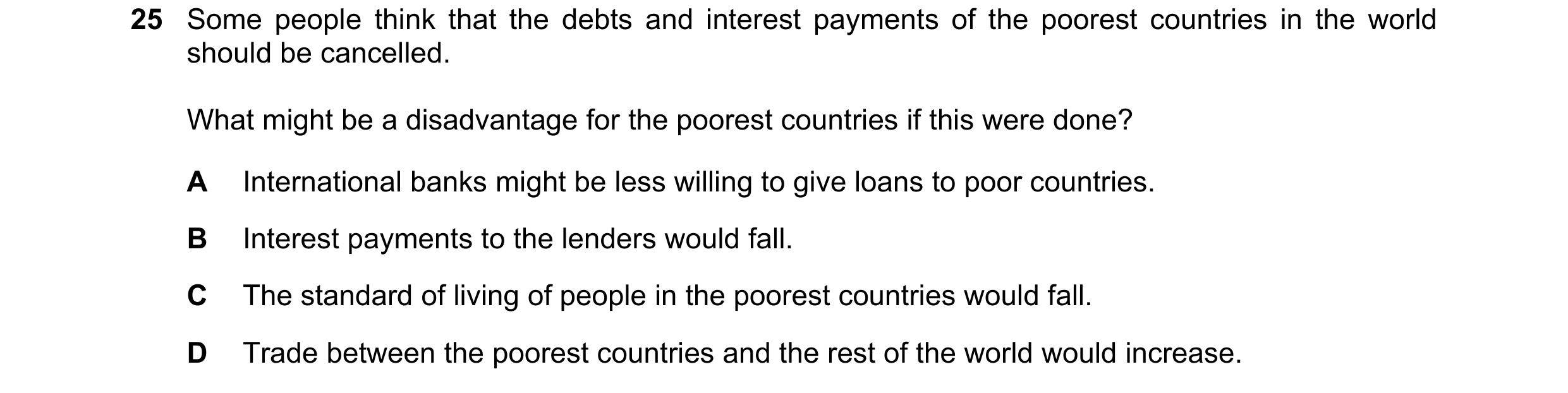
 19 / 39
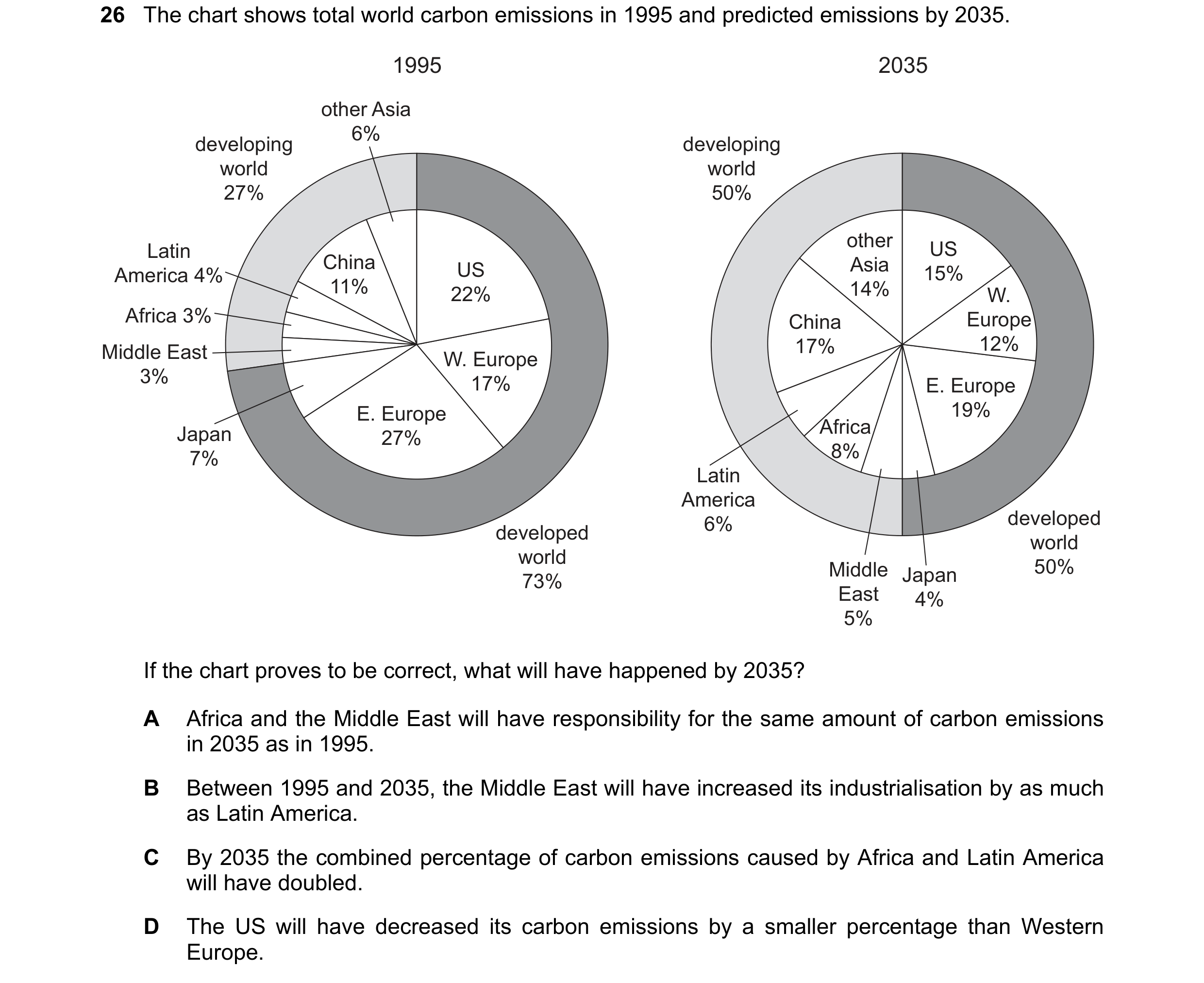
 20 / 39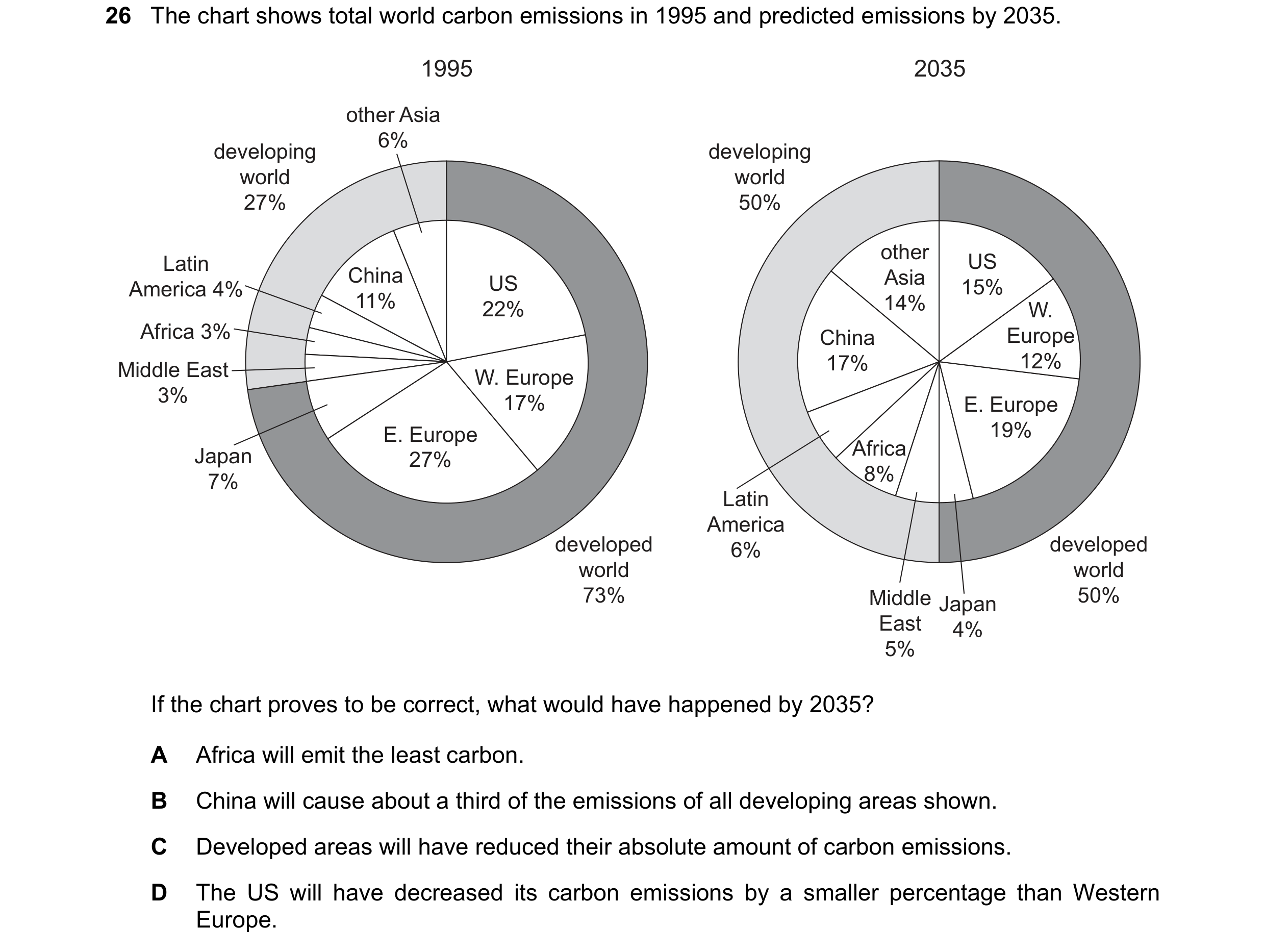
 21 / 39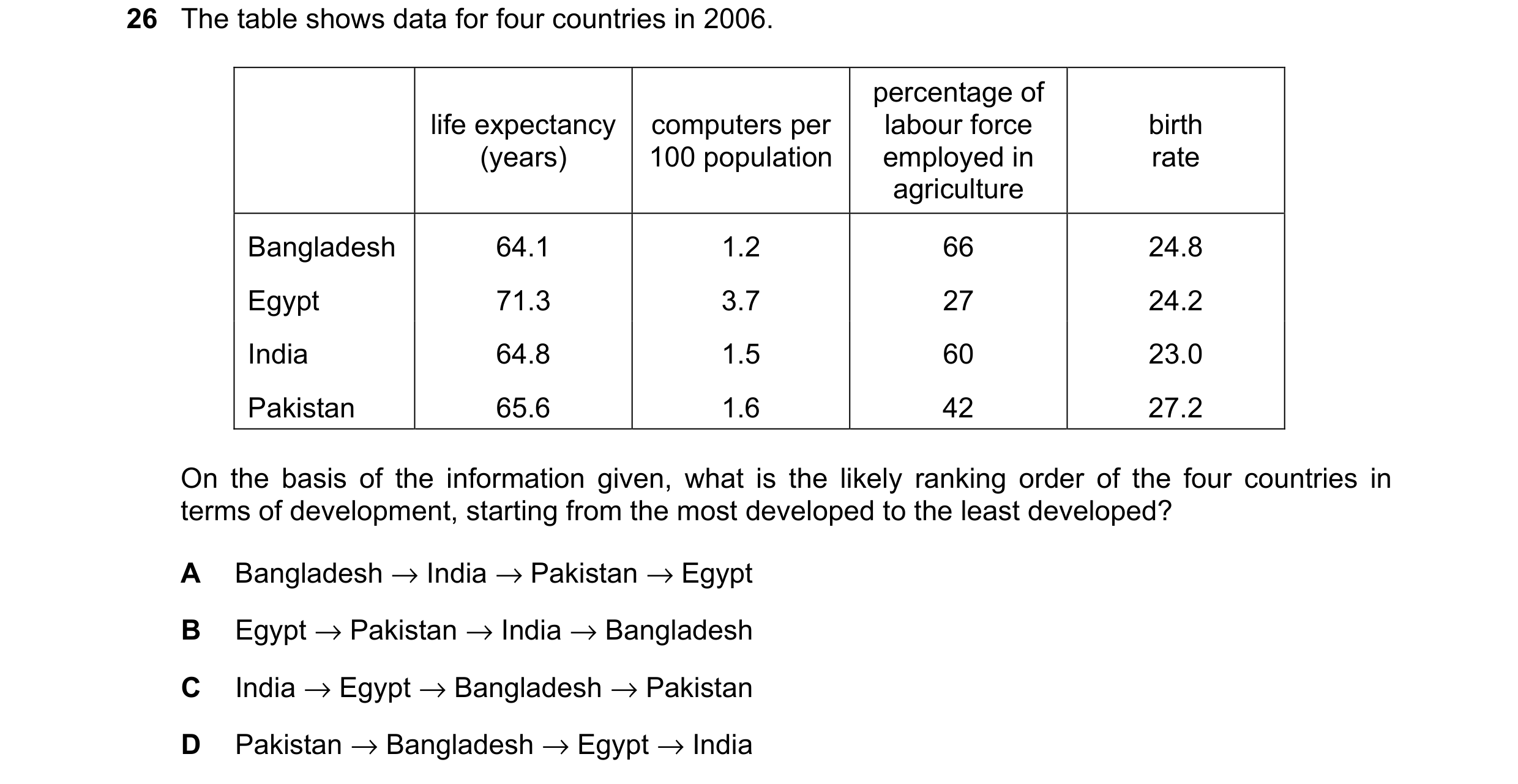
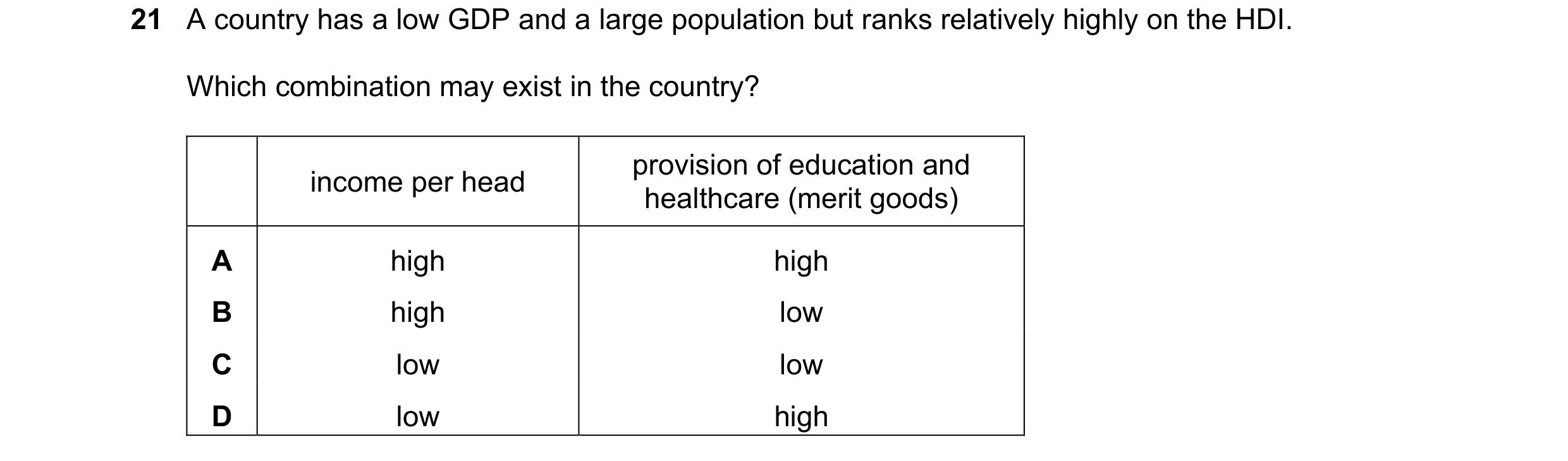

 22 / 39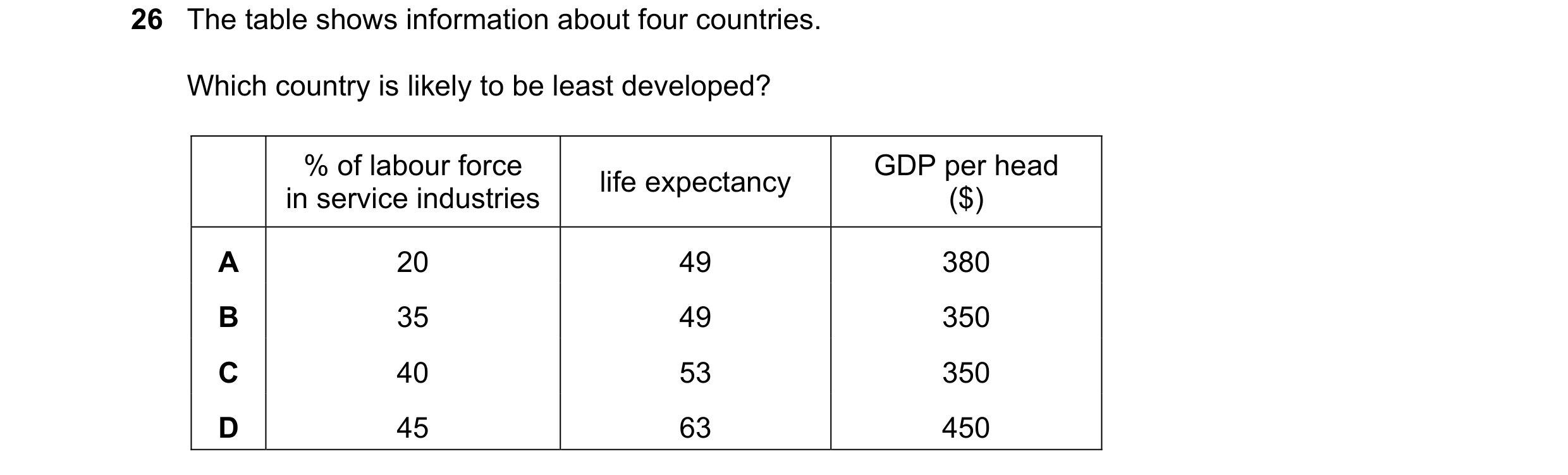
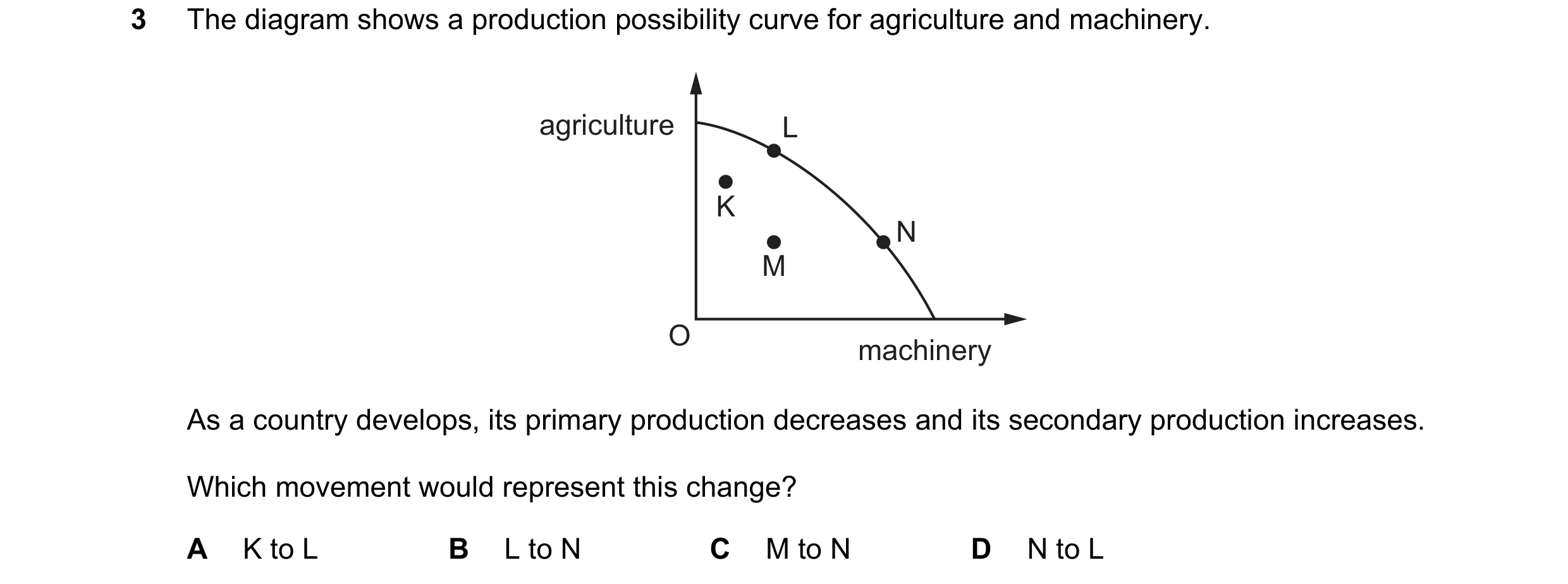
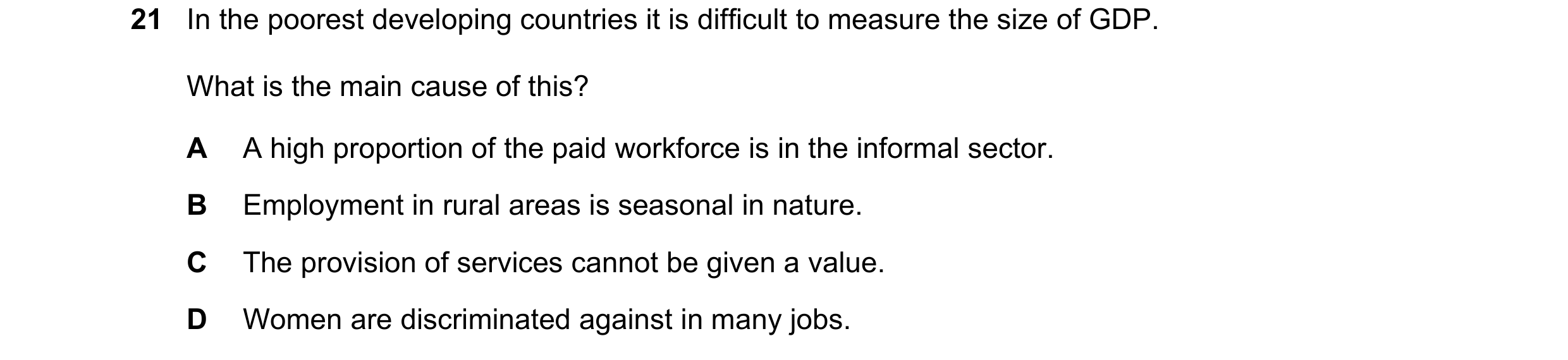 23 / 39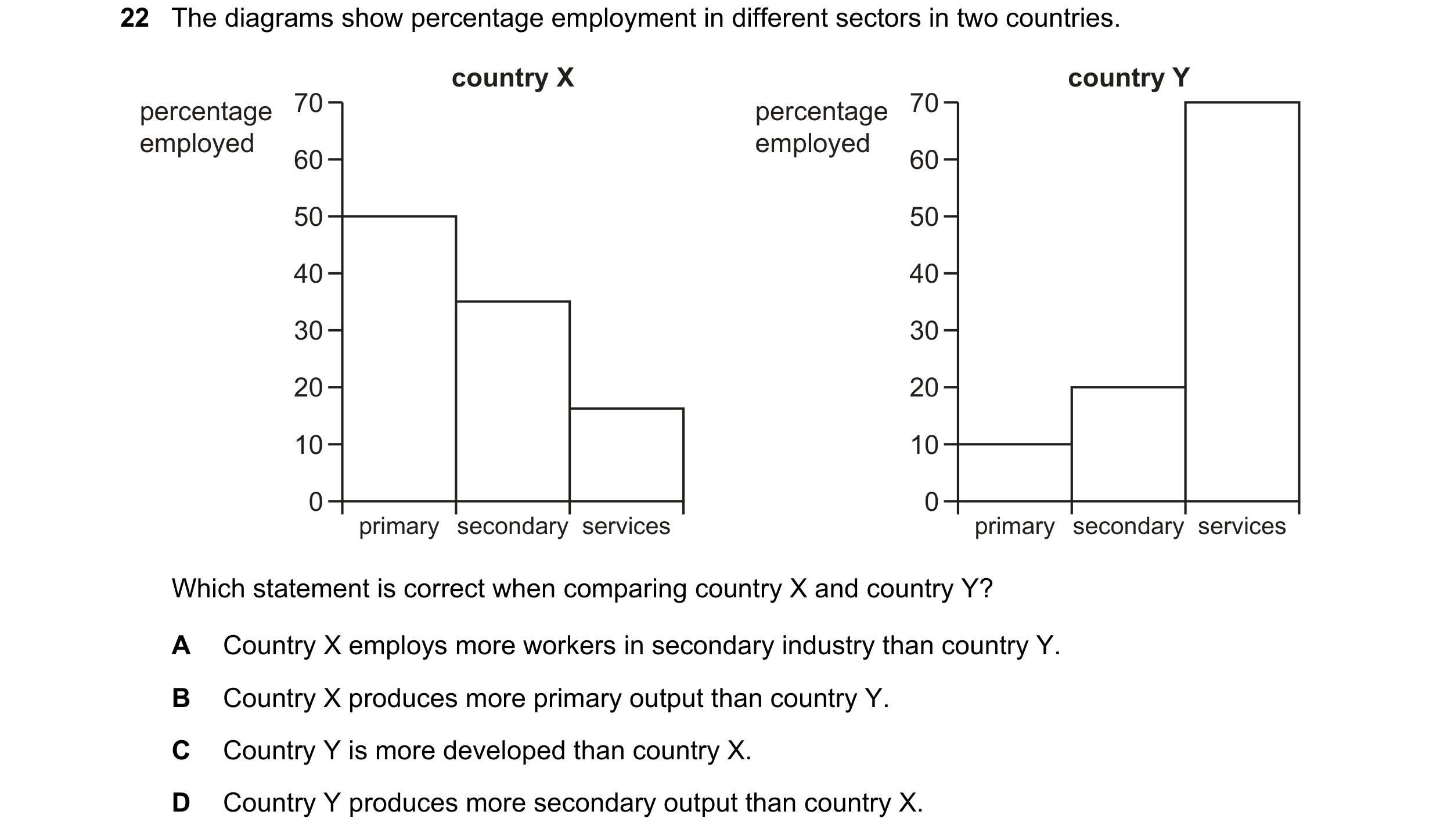
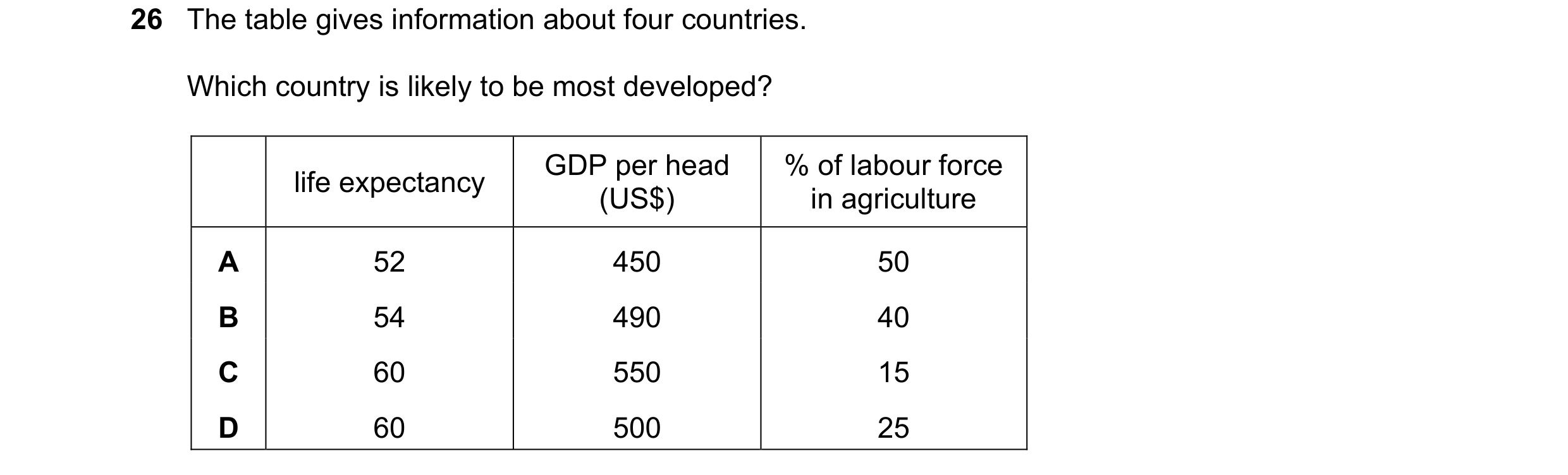

 24 / 39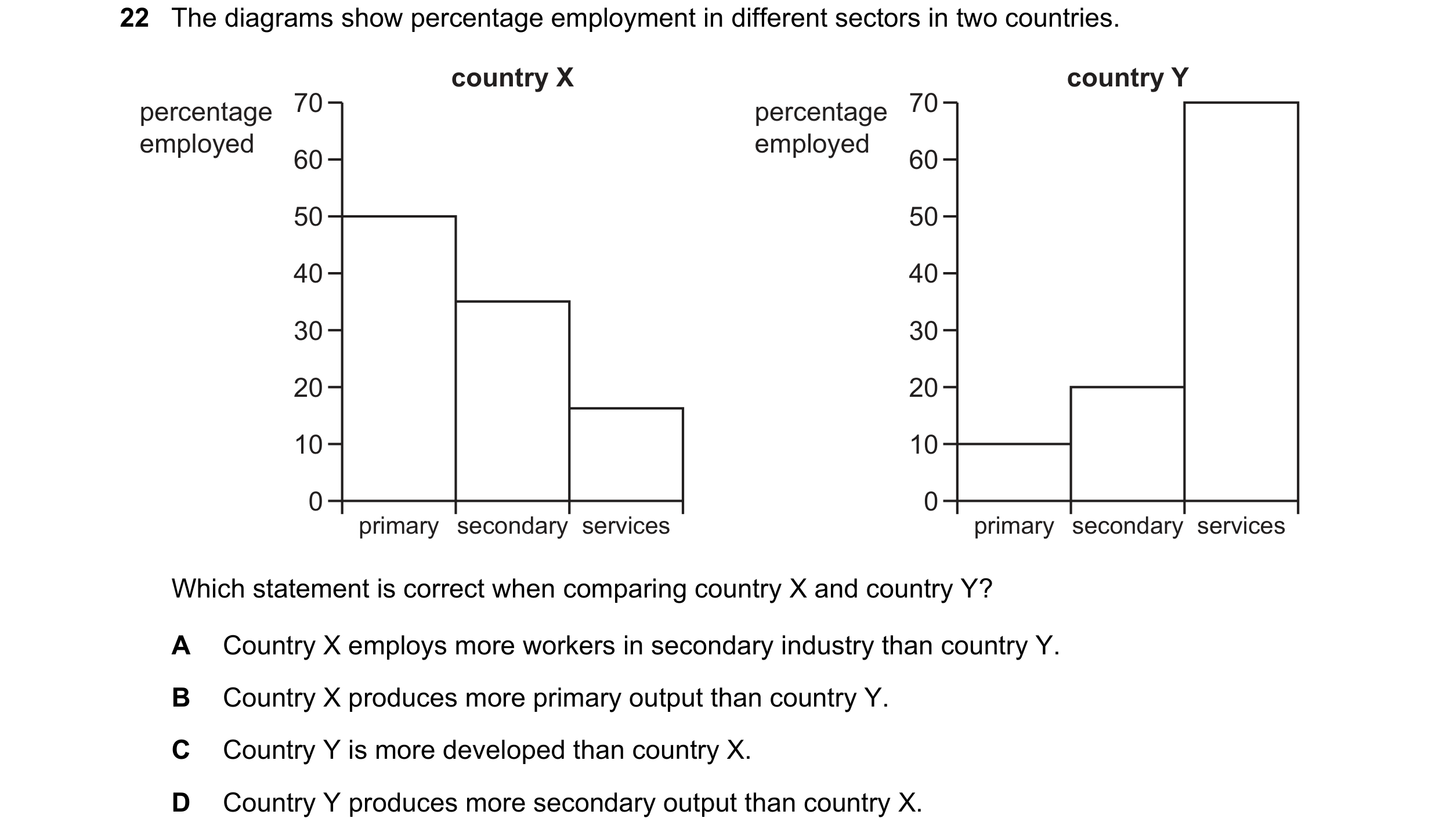
 25 / 39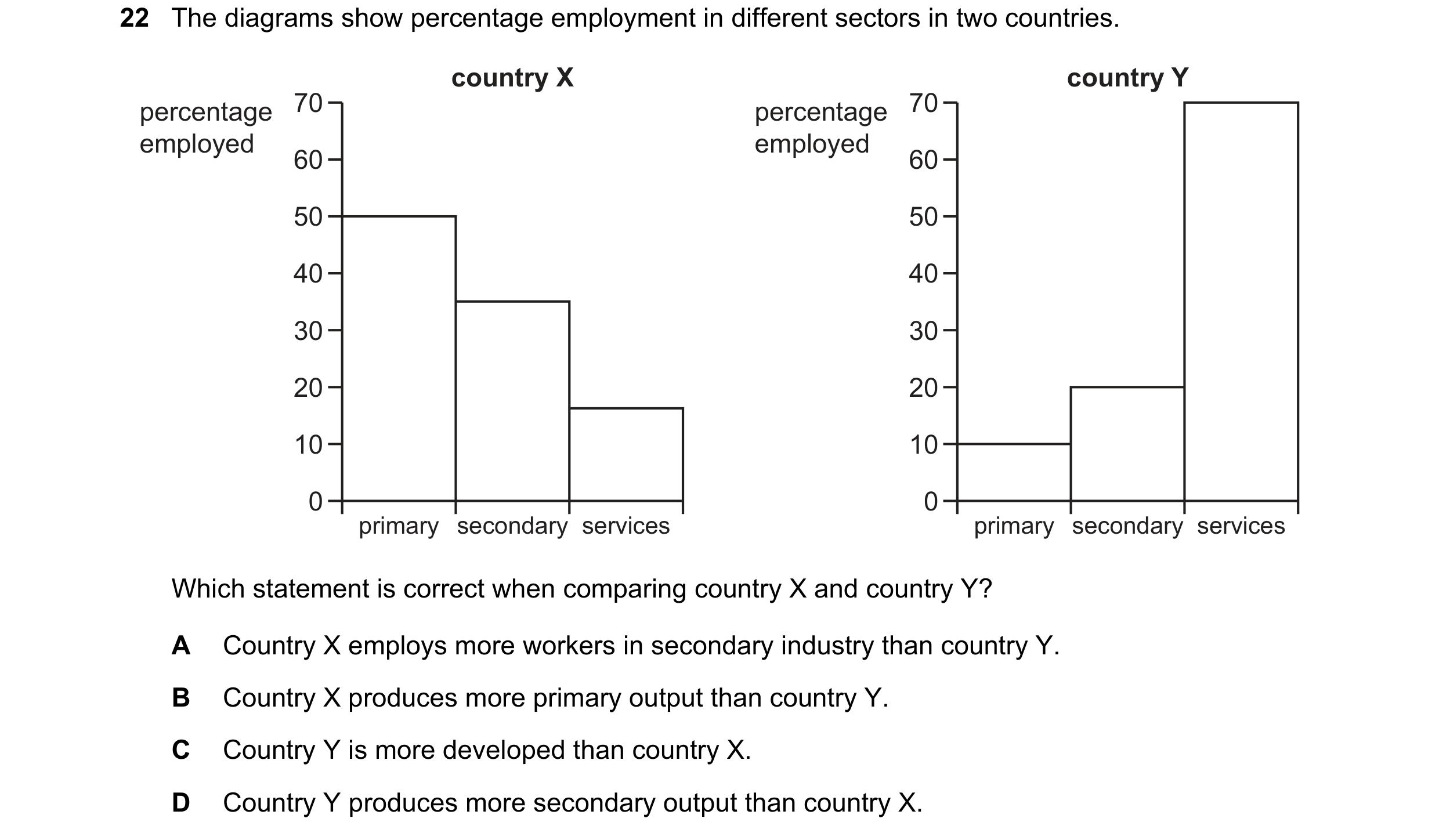

 26 / 39
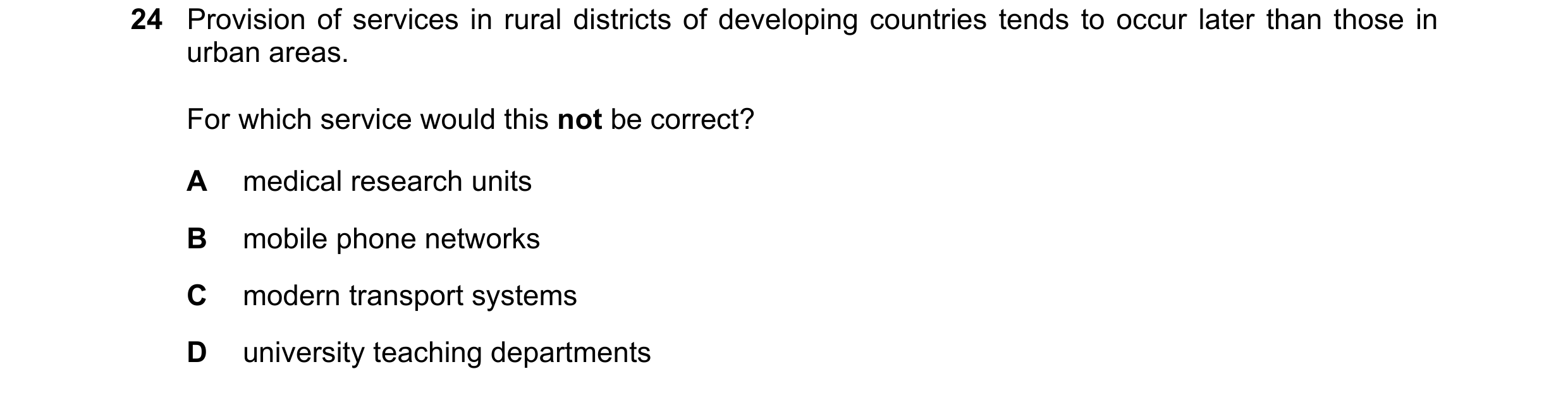
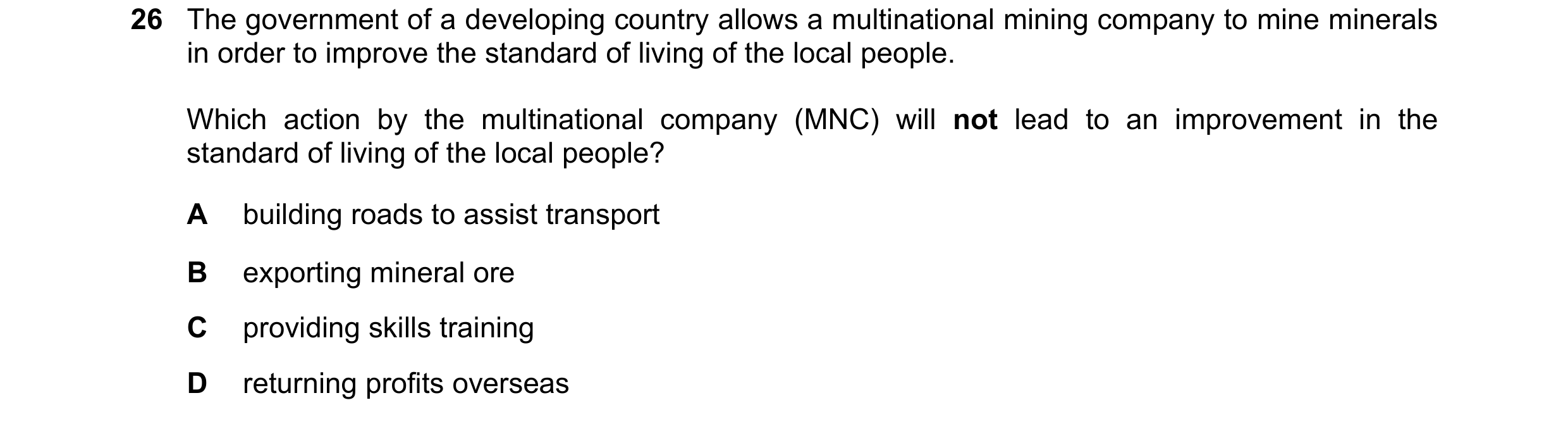
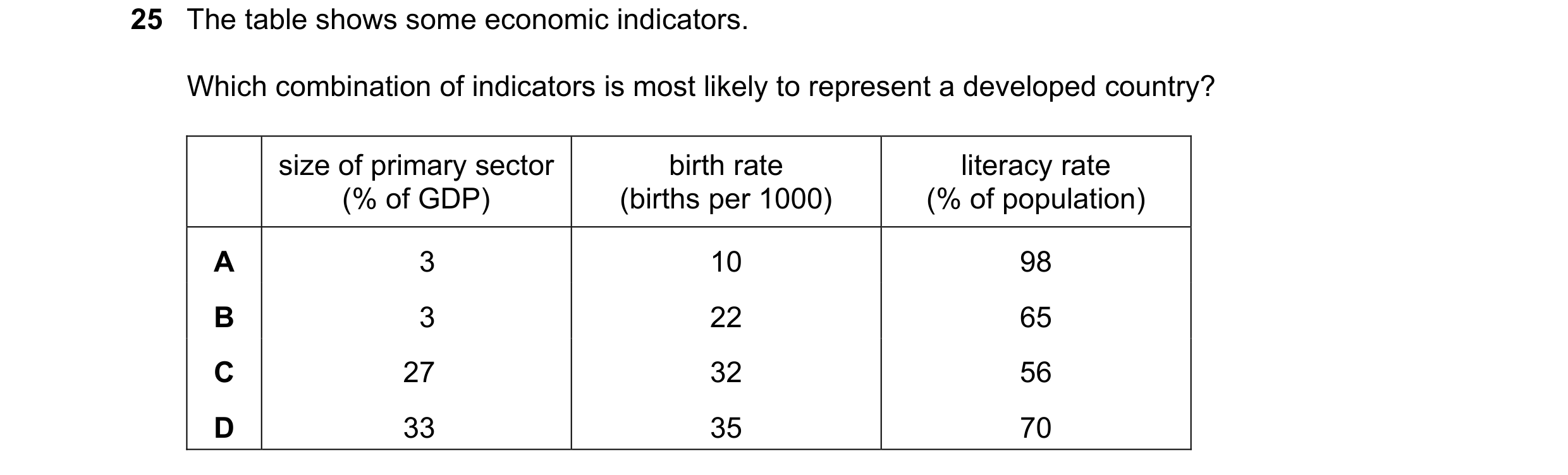 27 / 39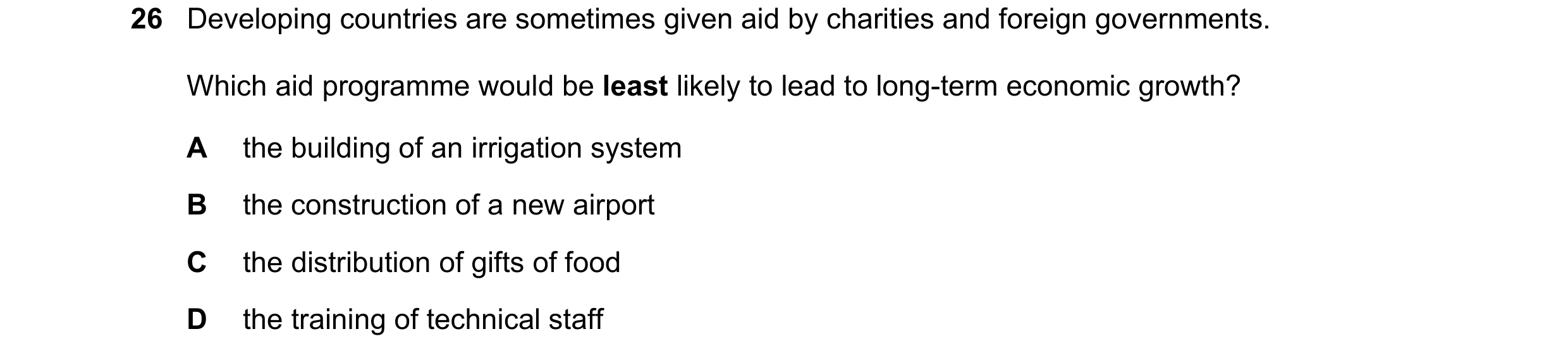

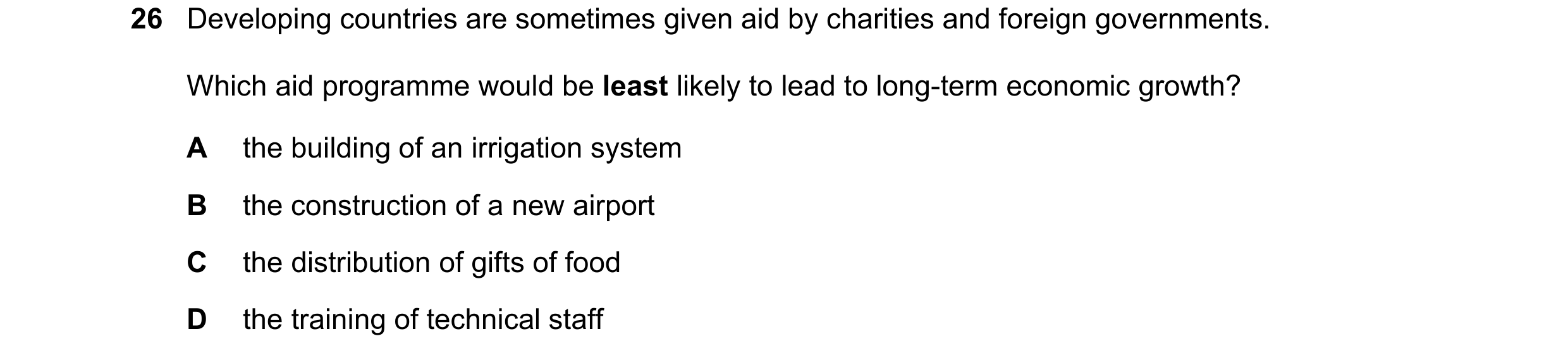
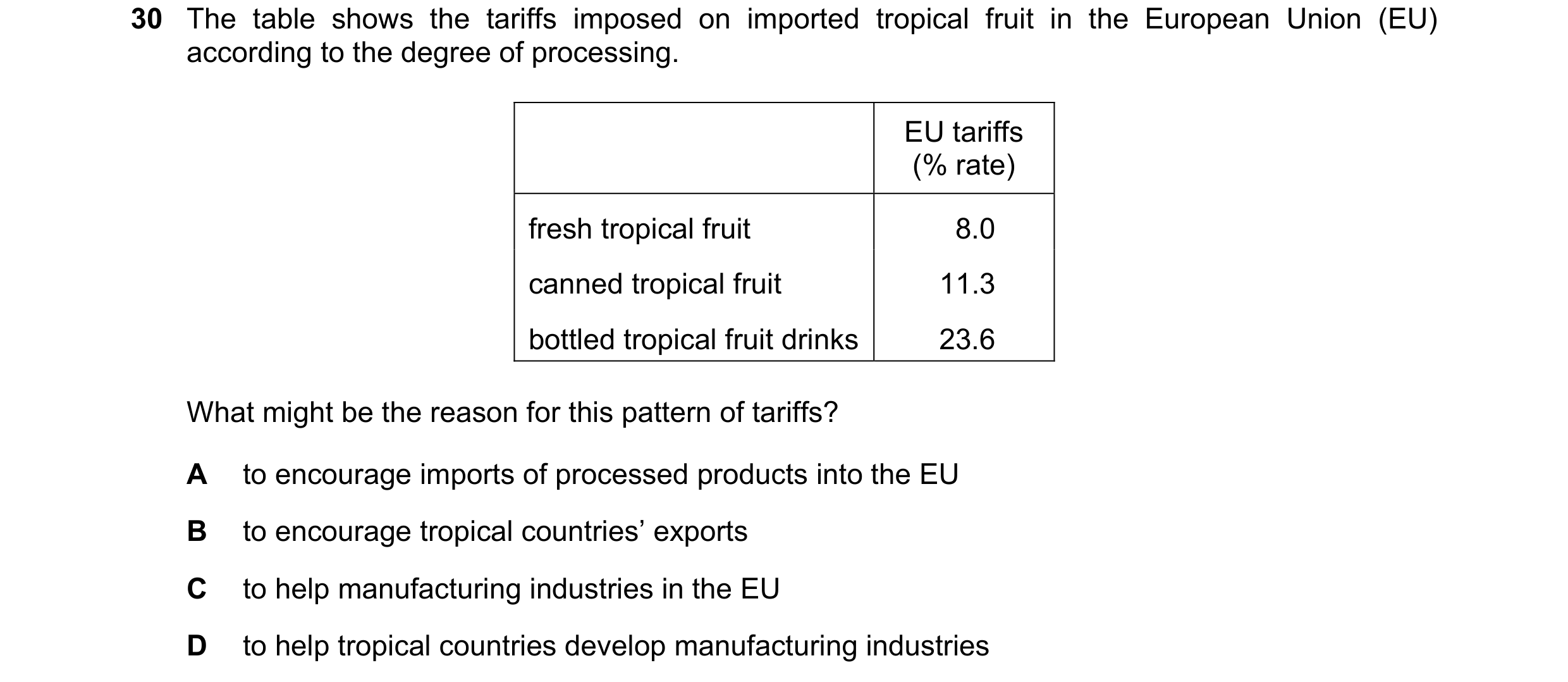
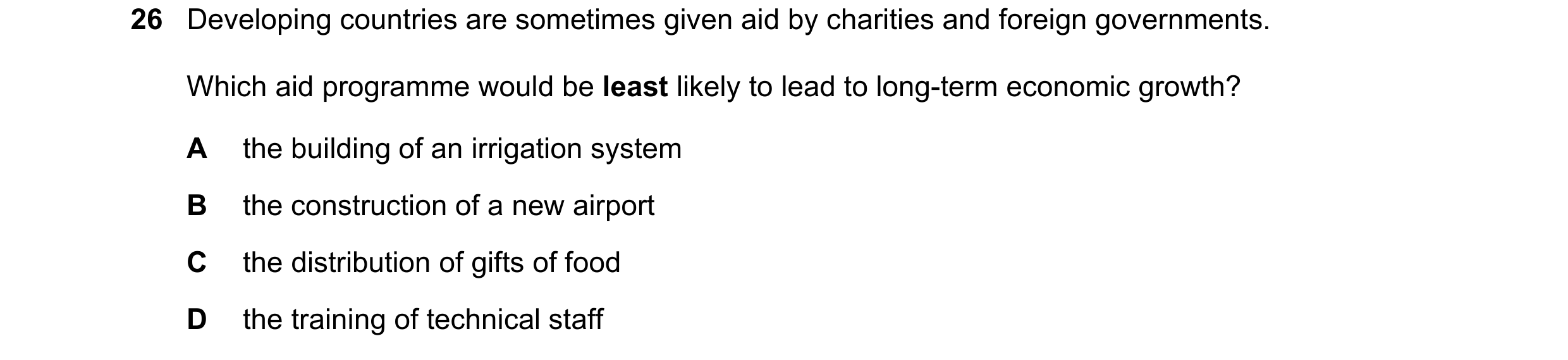 28 / 39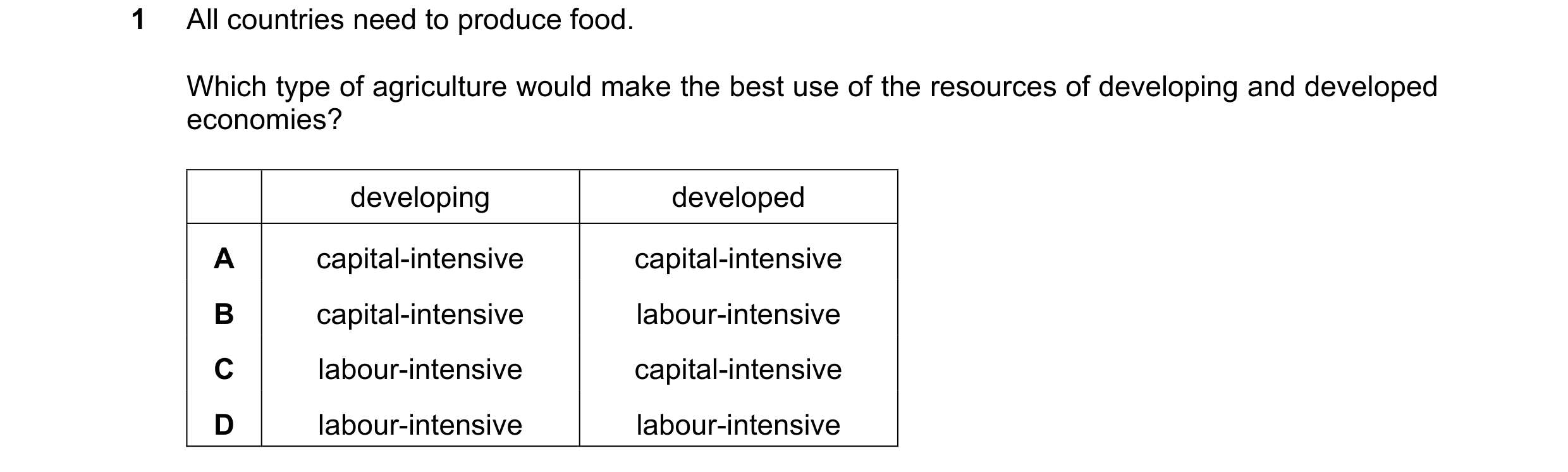

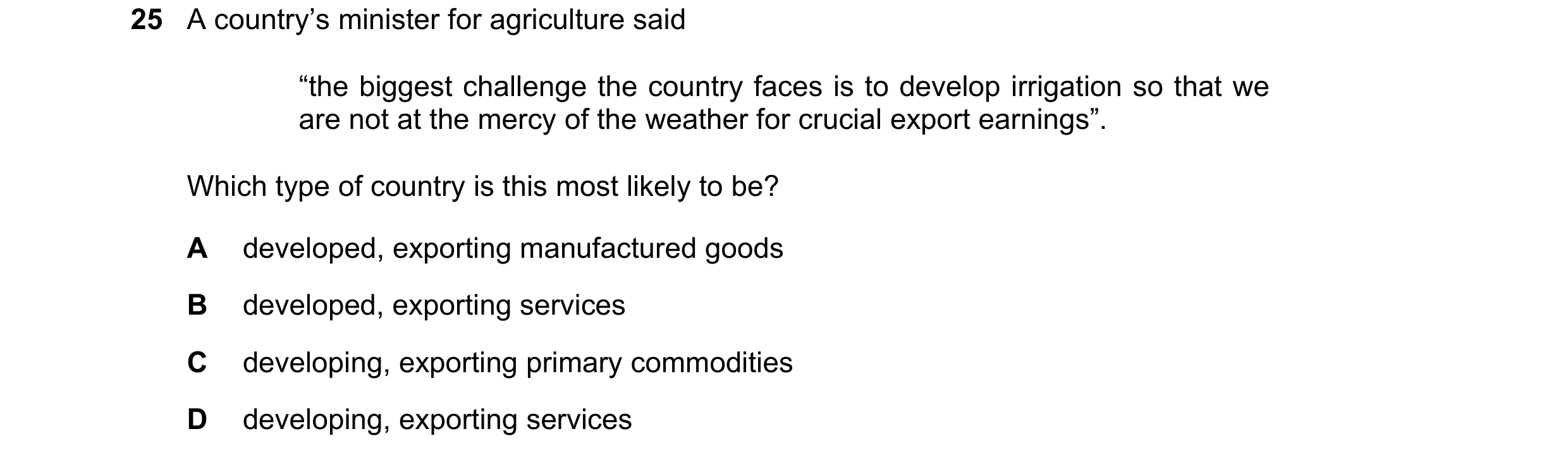
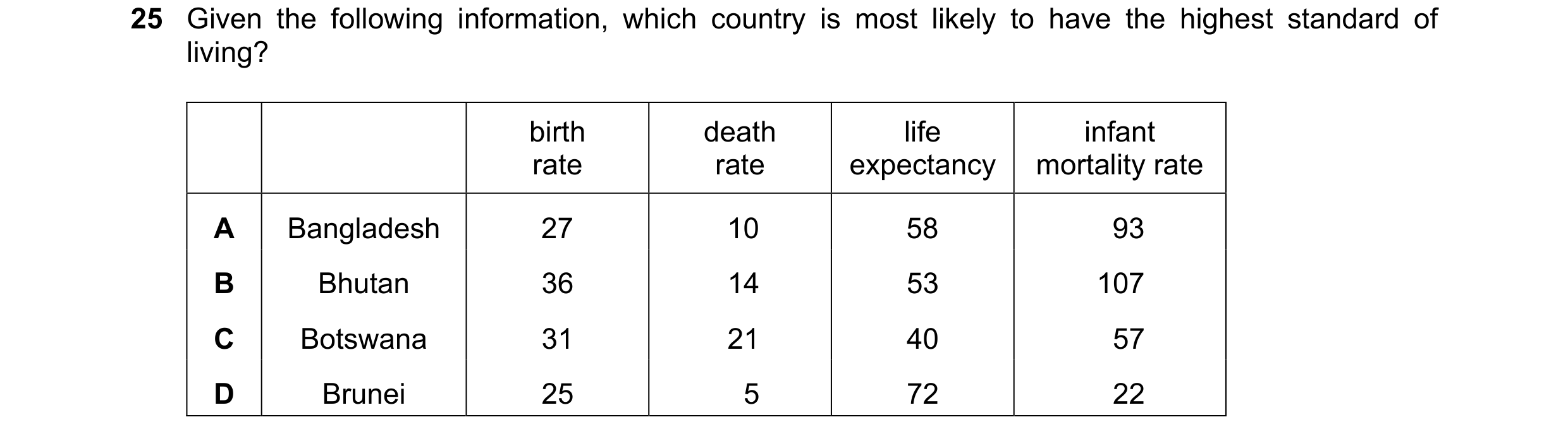
 29 / 39

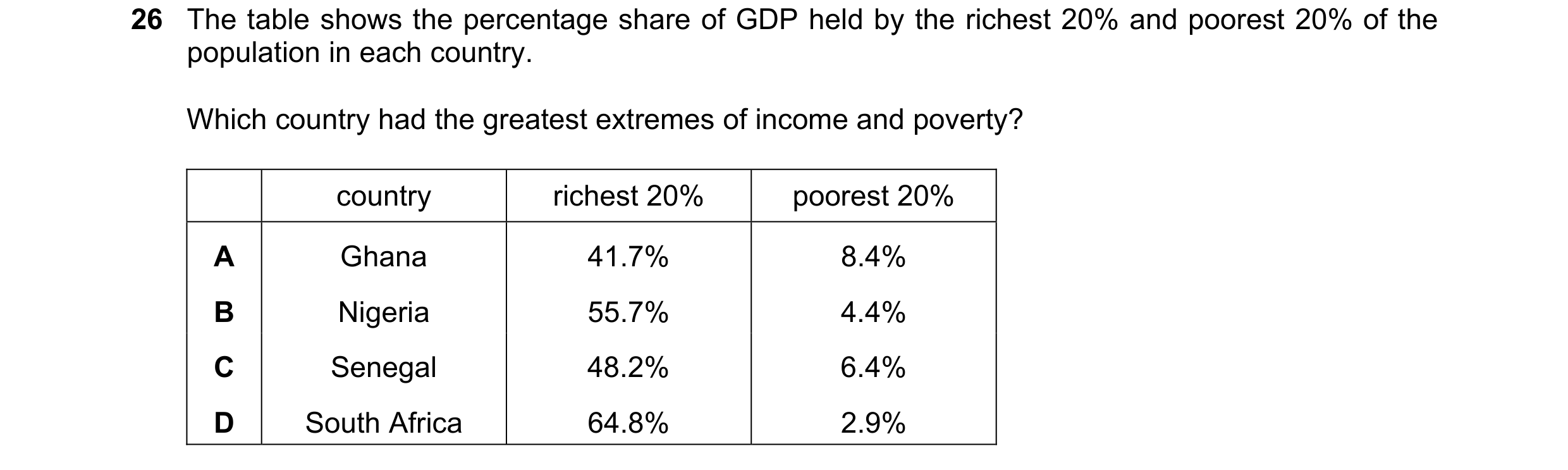

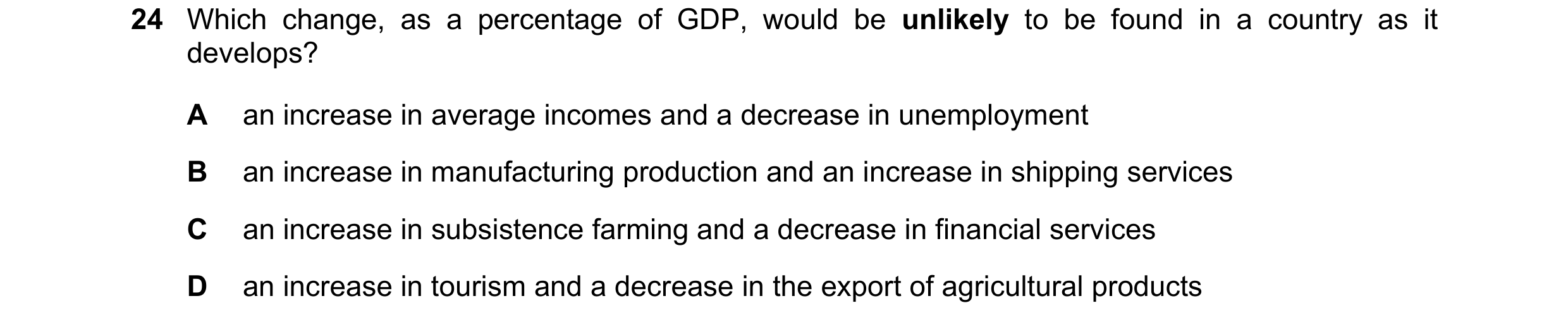
 30 / 39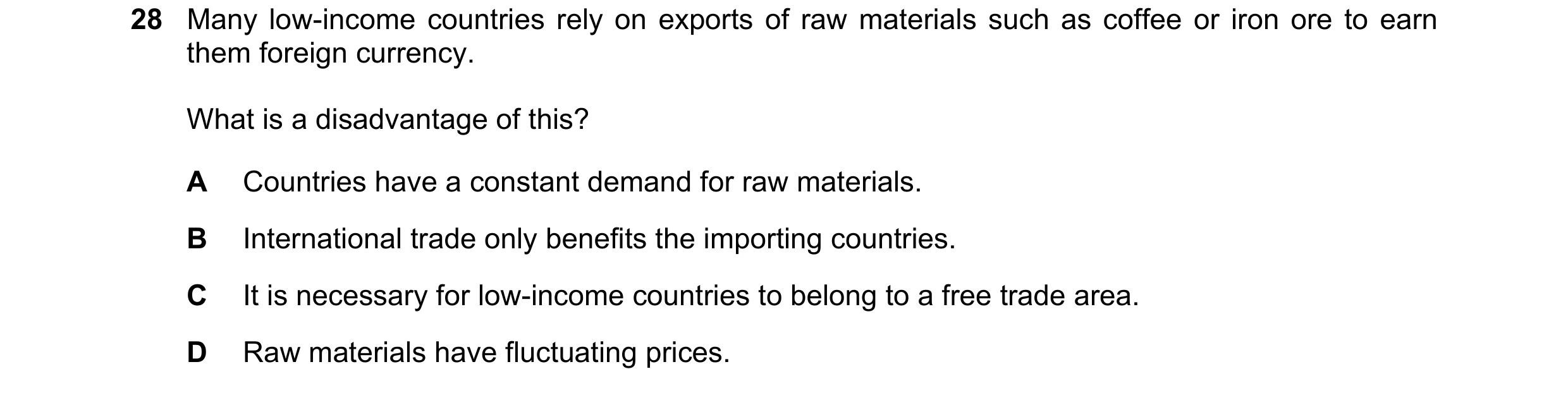
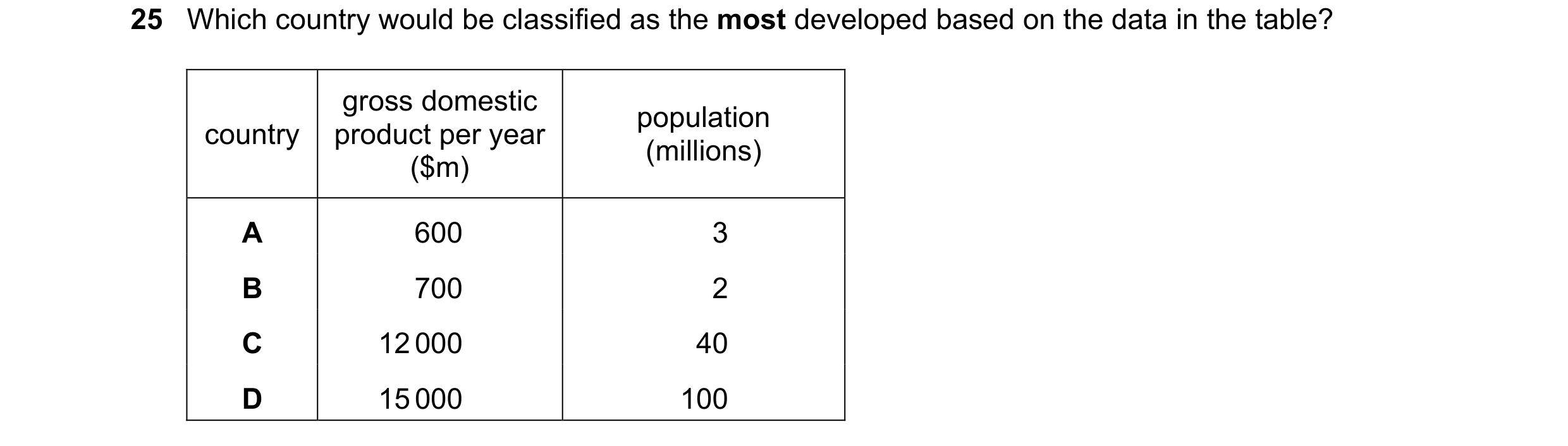
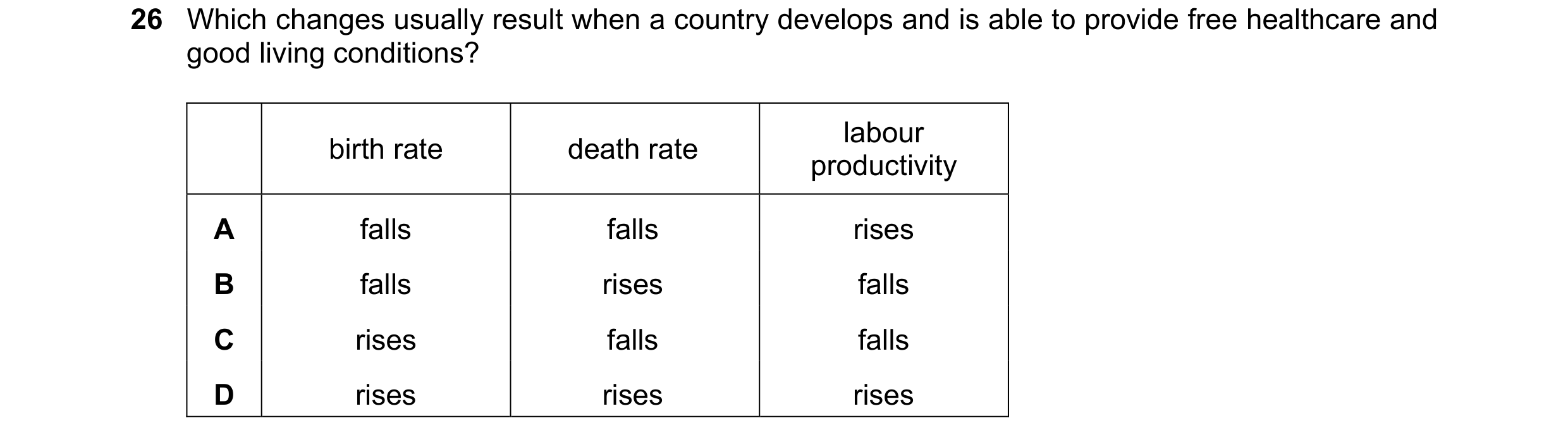
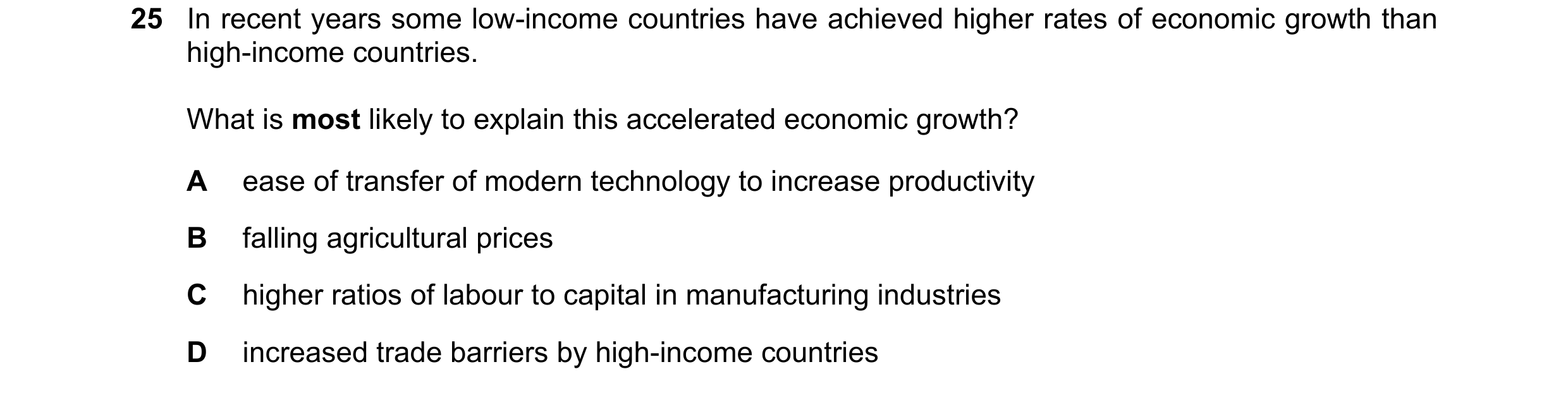
 31 / 39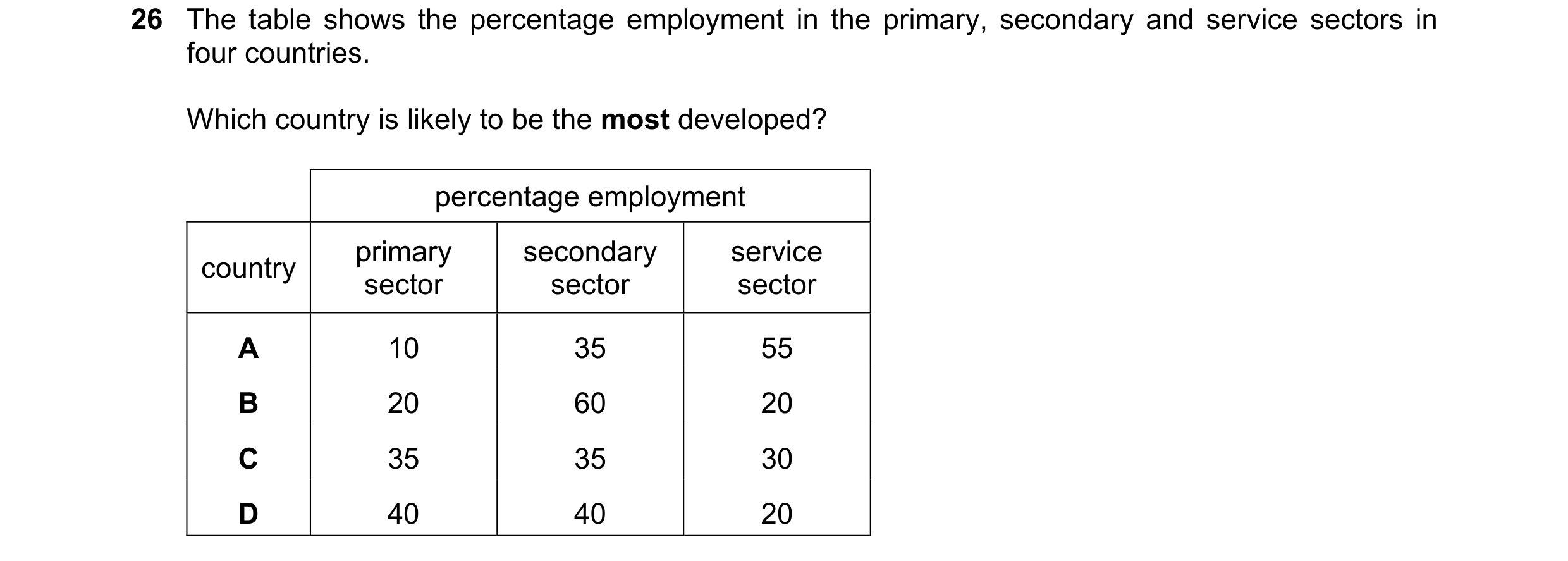
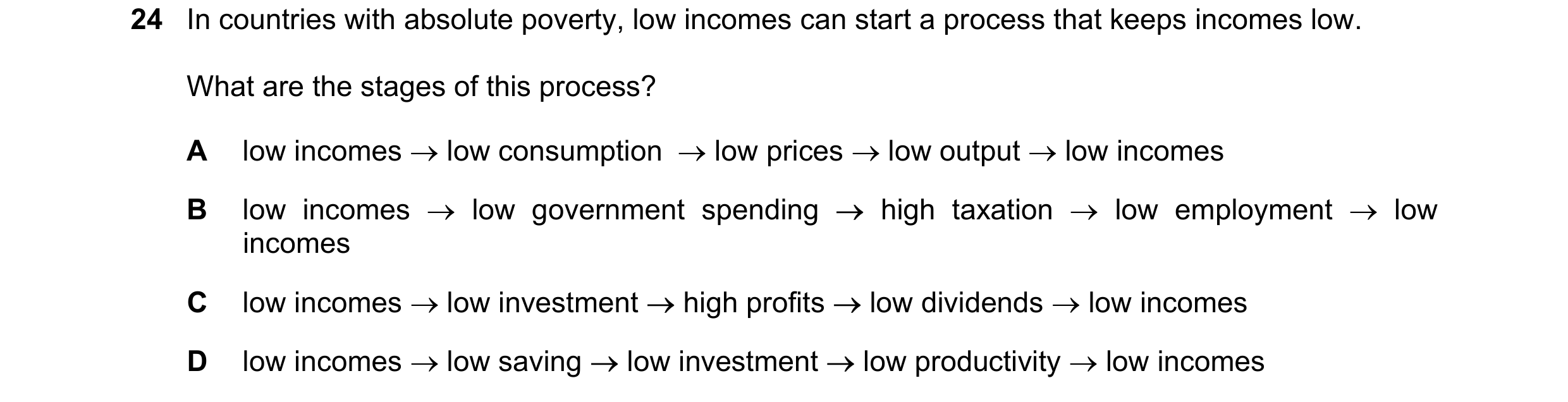

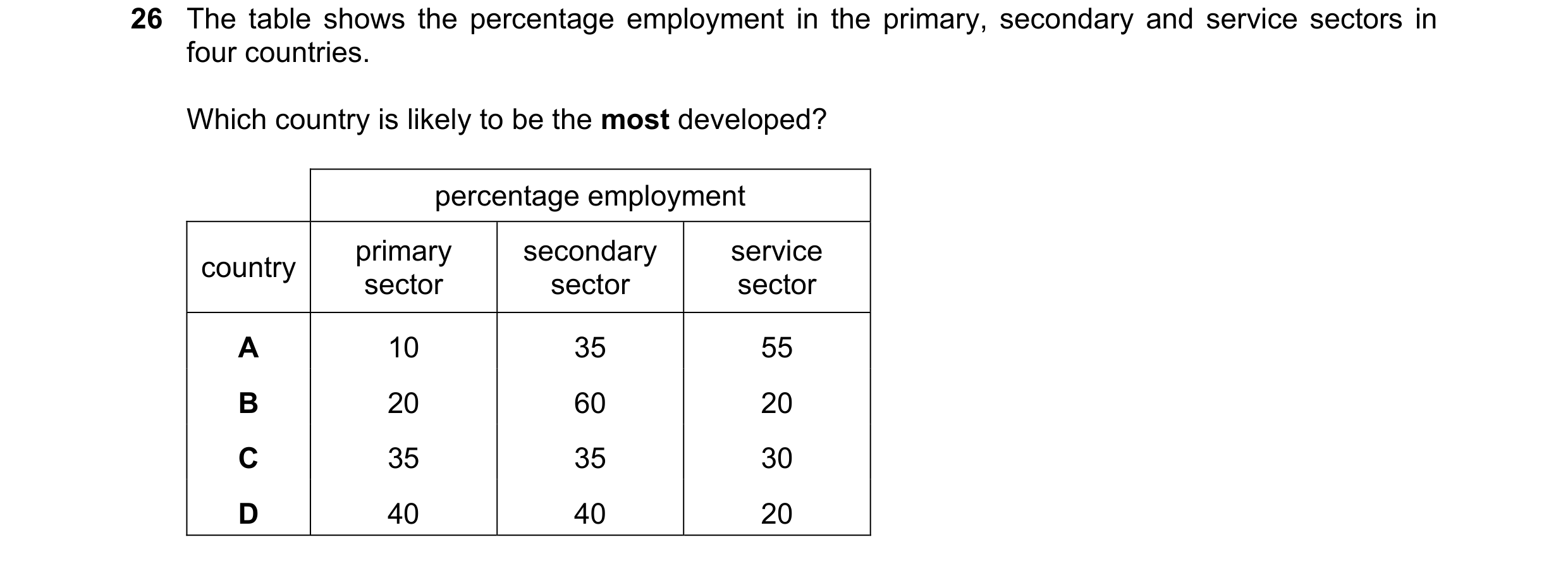 32 / 39
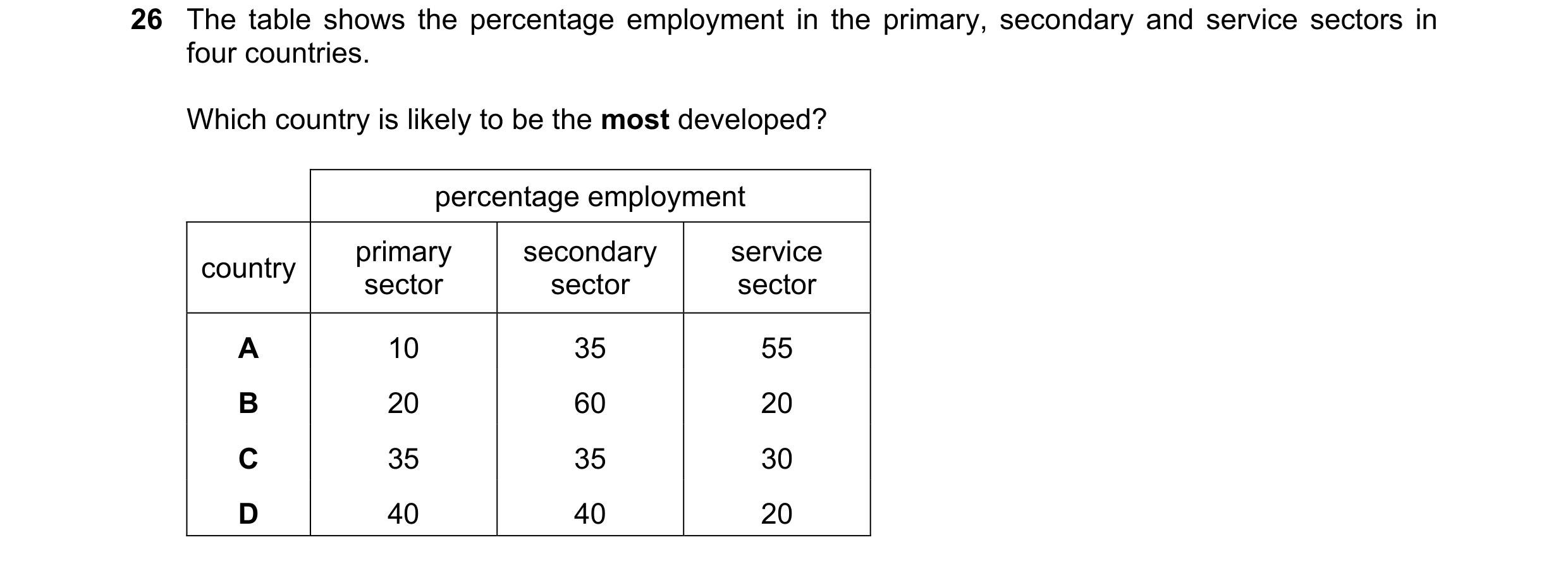
 33 / 39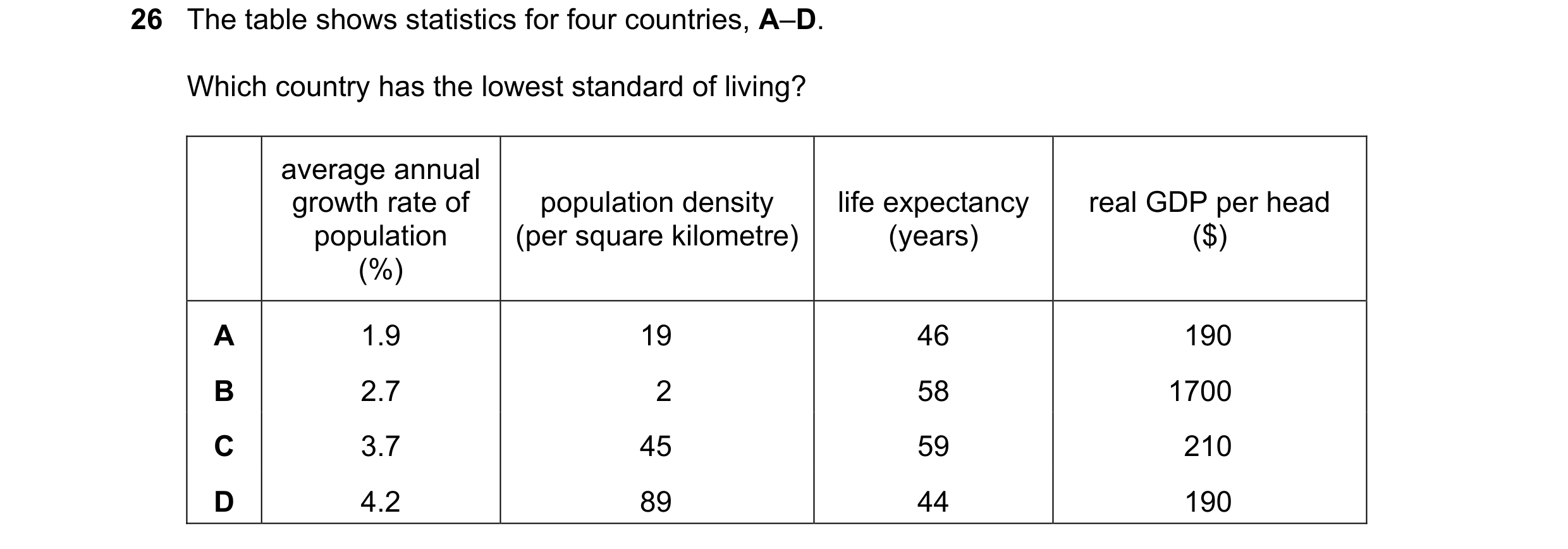
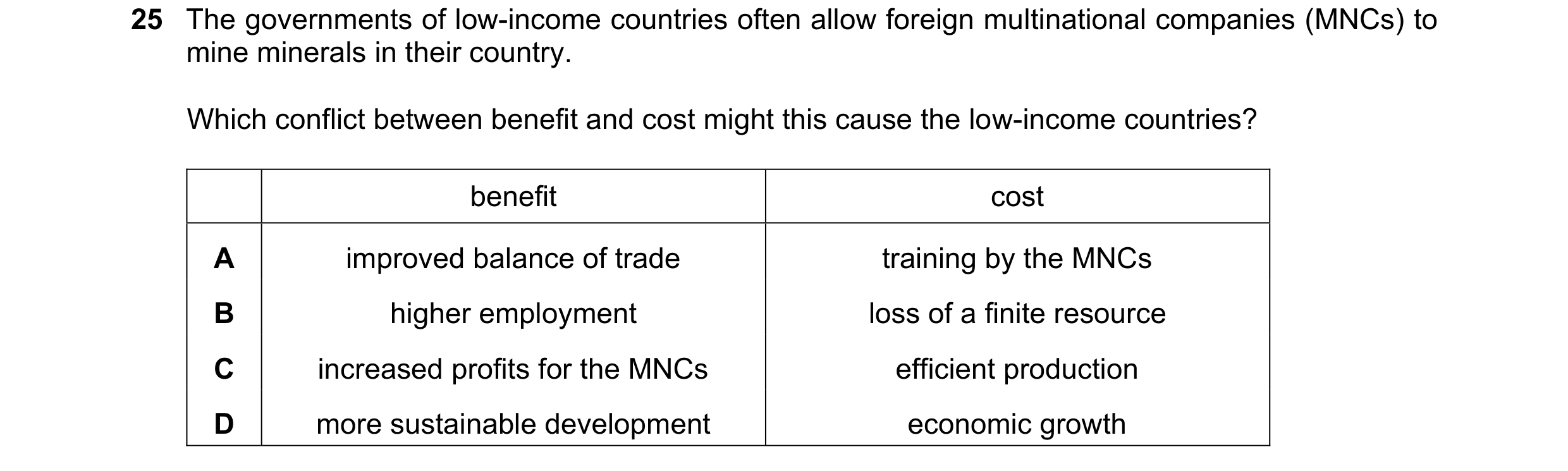
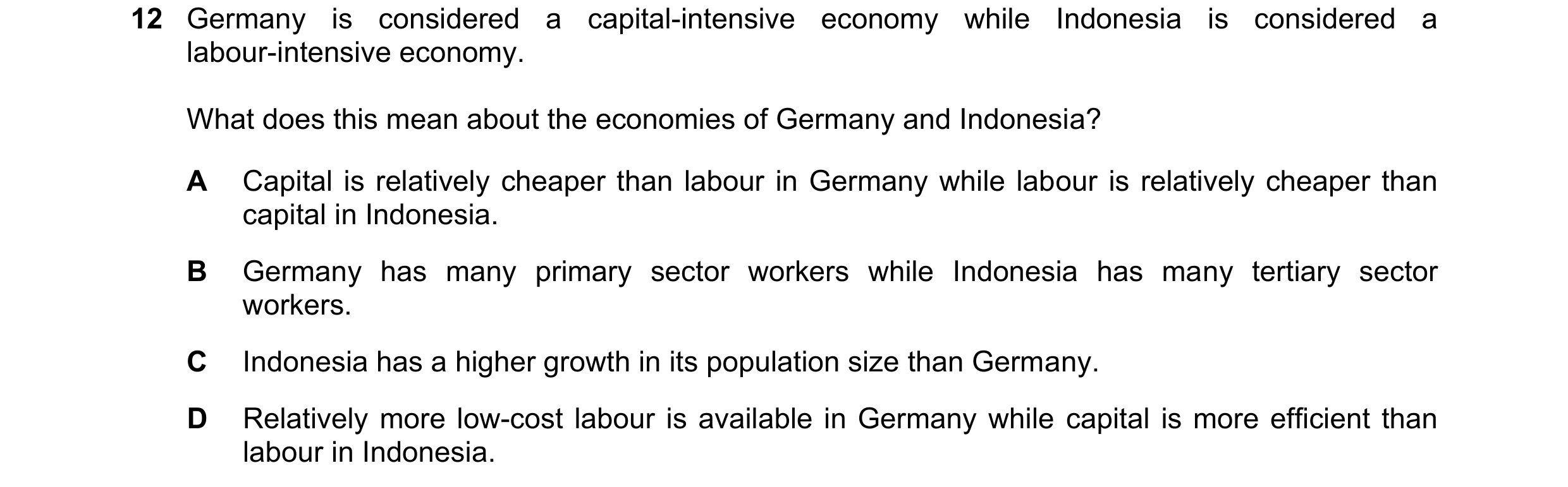
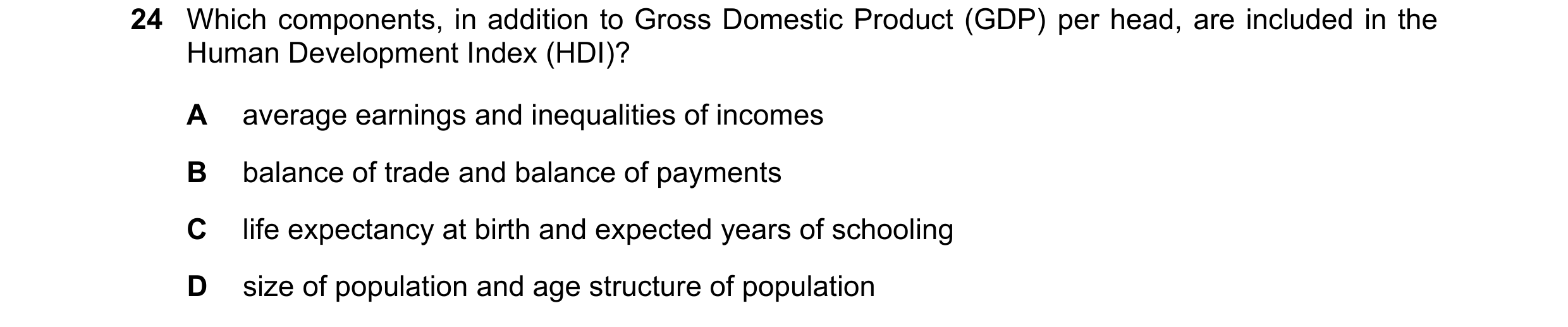 34 / 39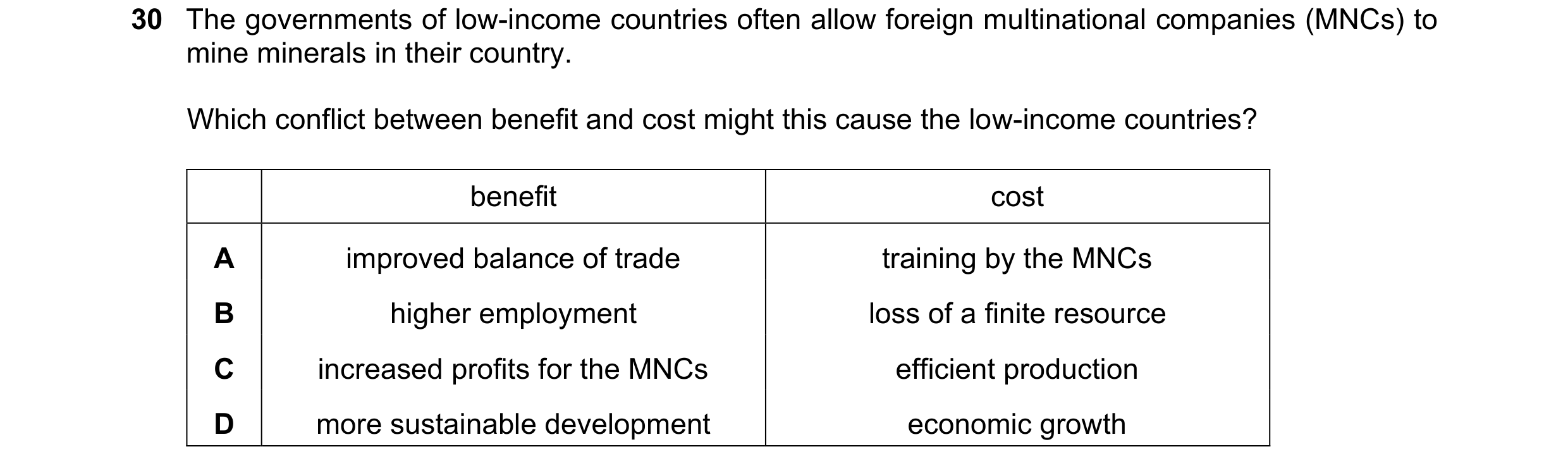
 35 / 39
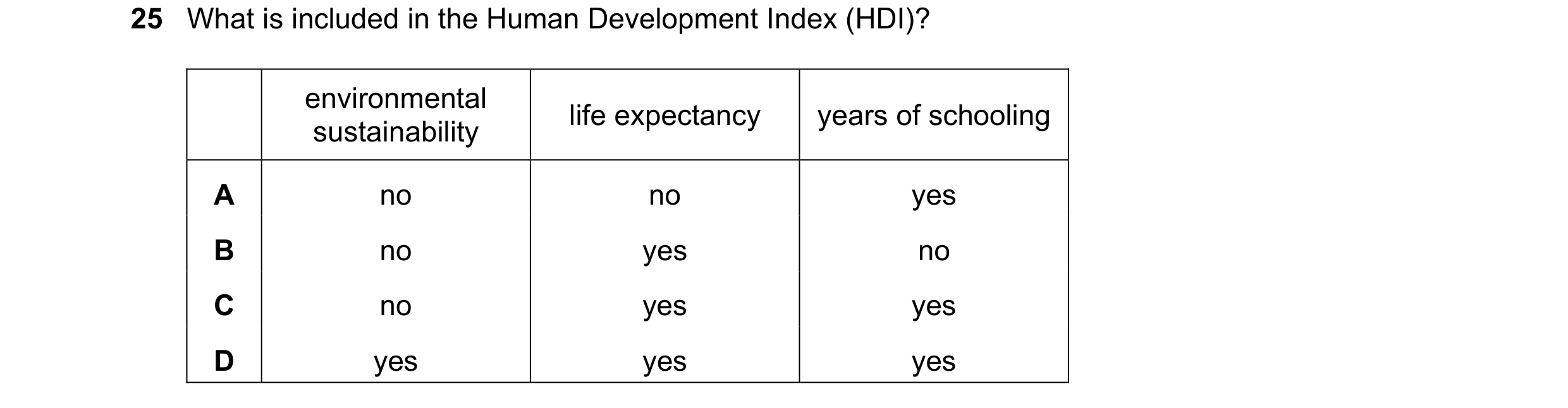
 36 / 39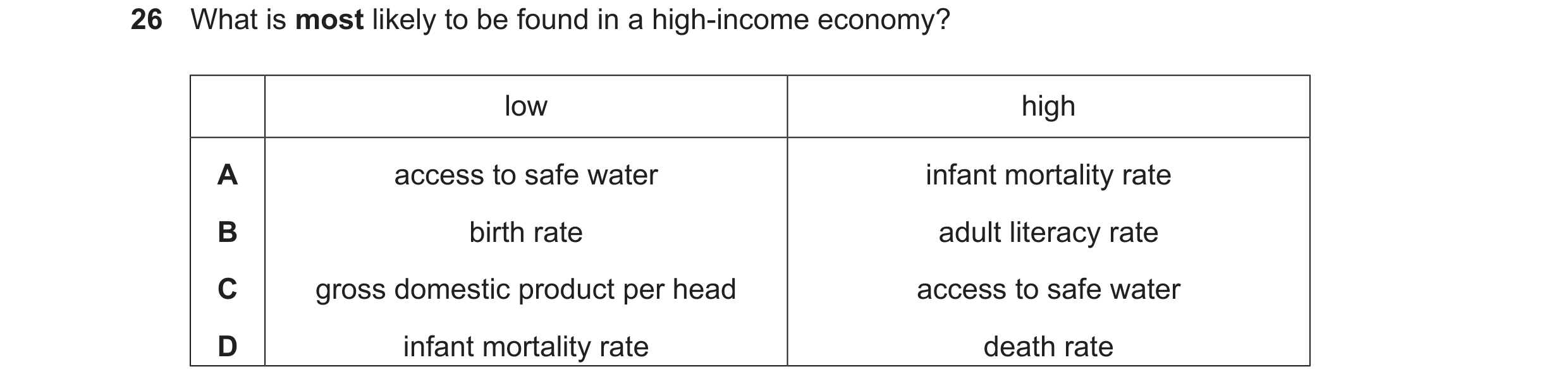



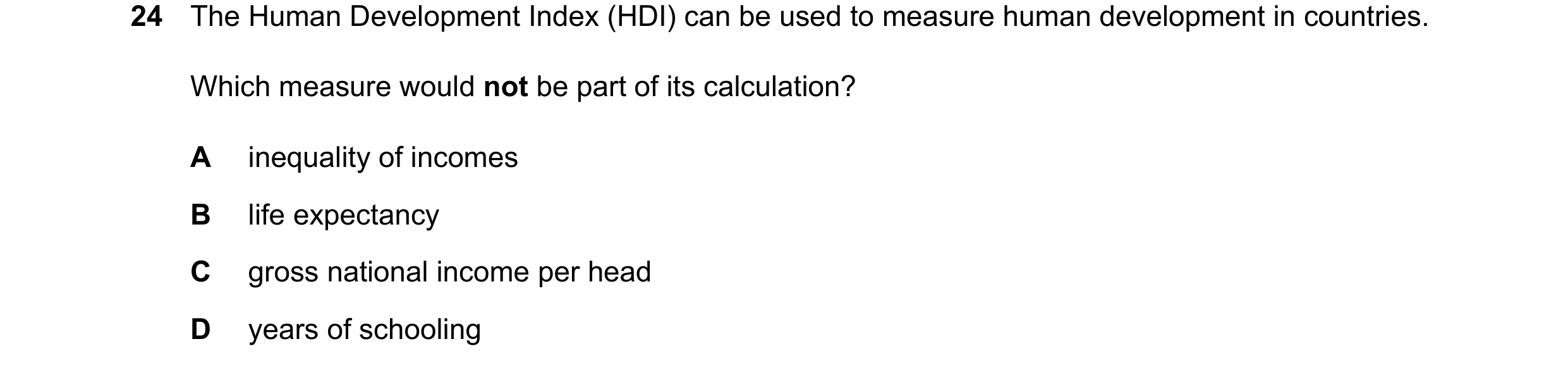 37 / 39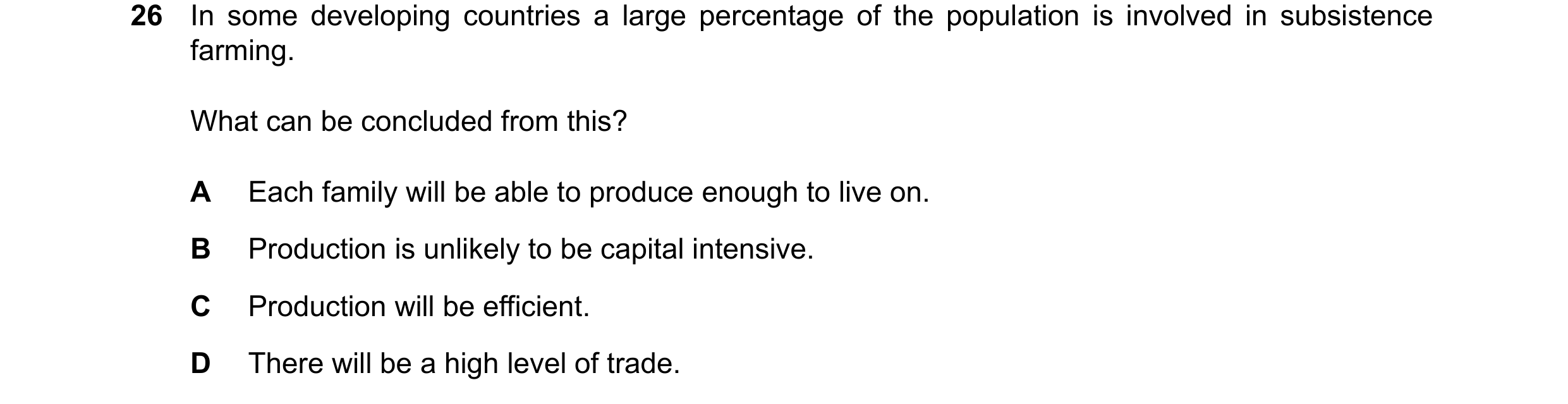

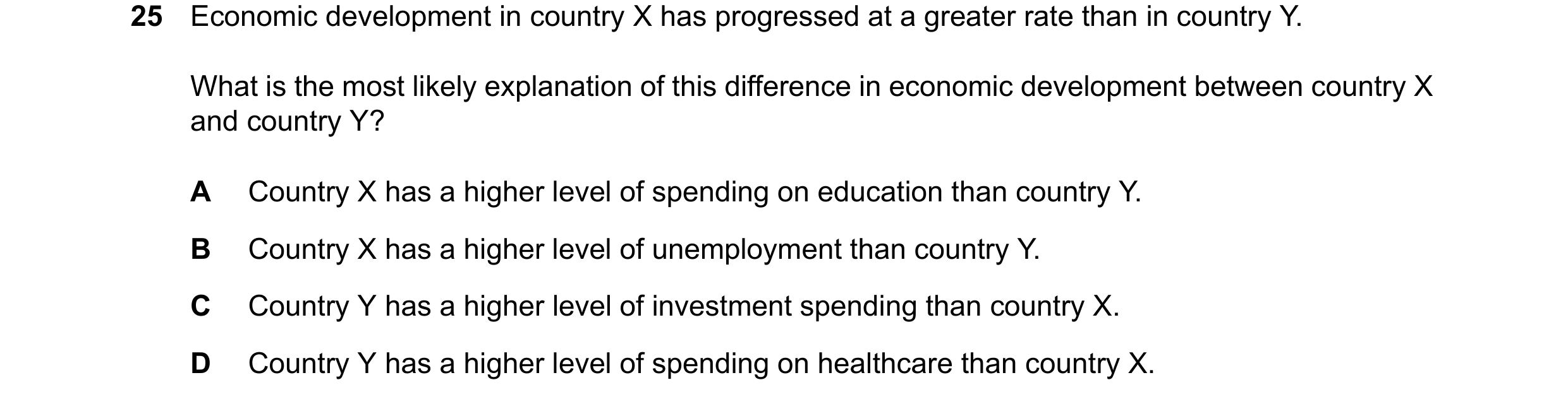

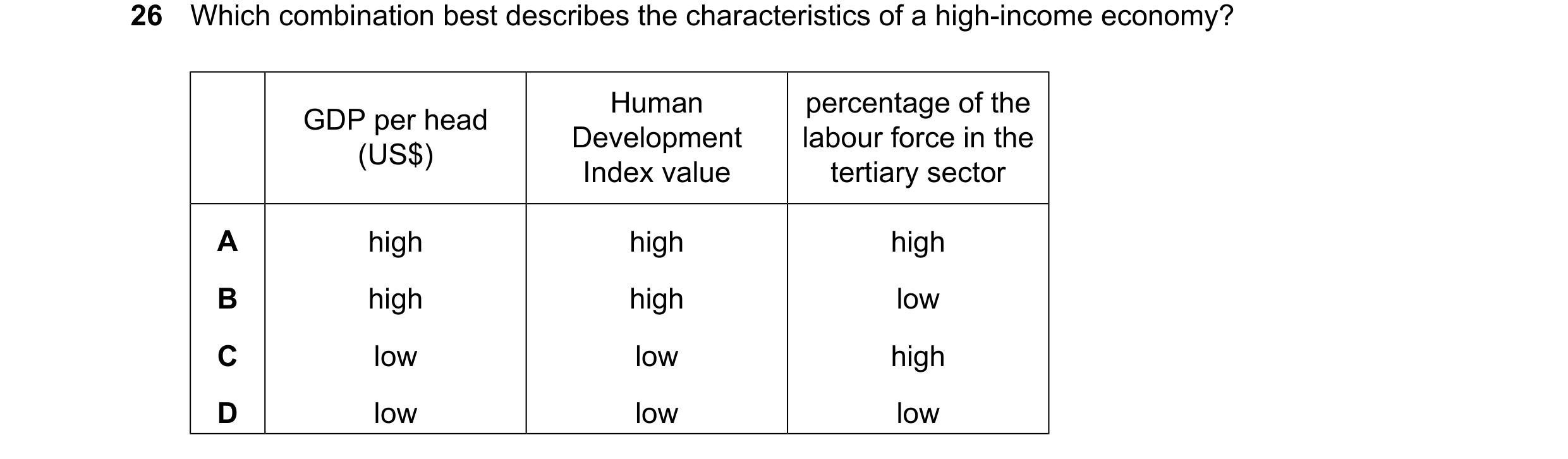 38 / 39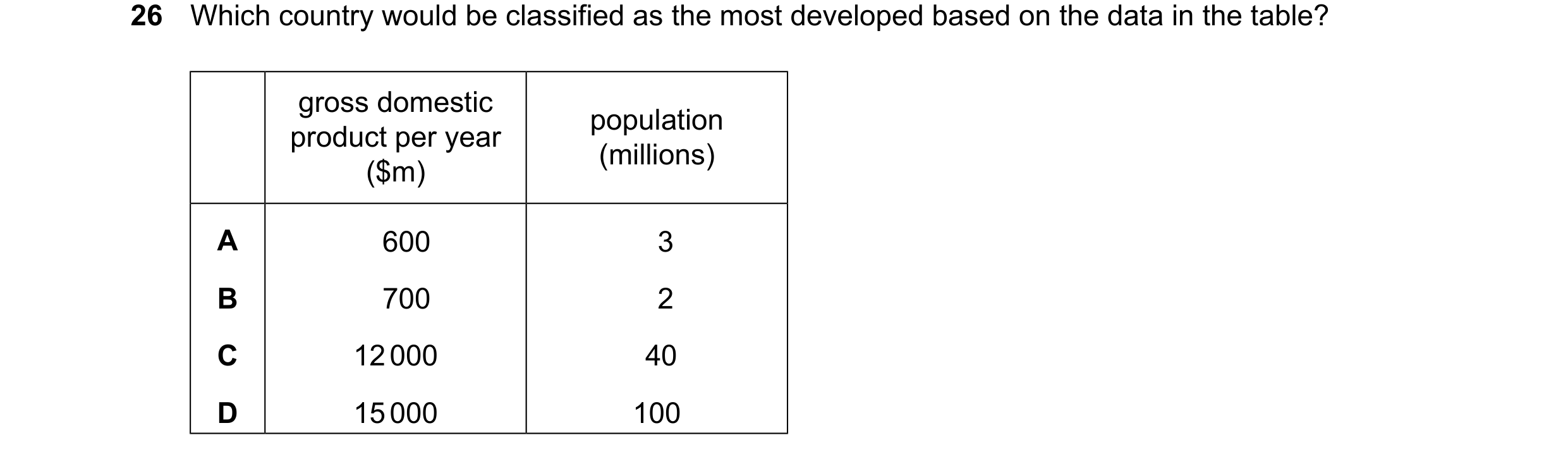
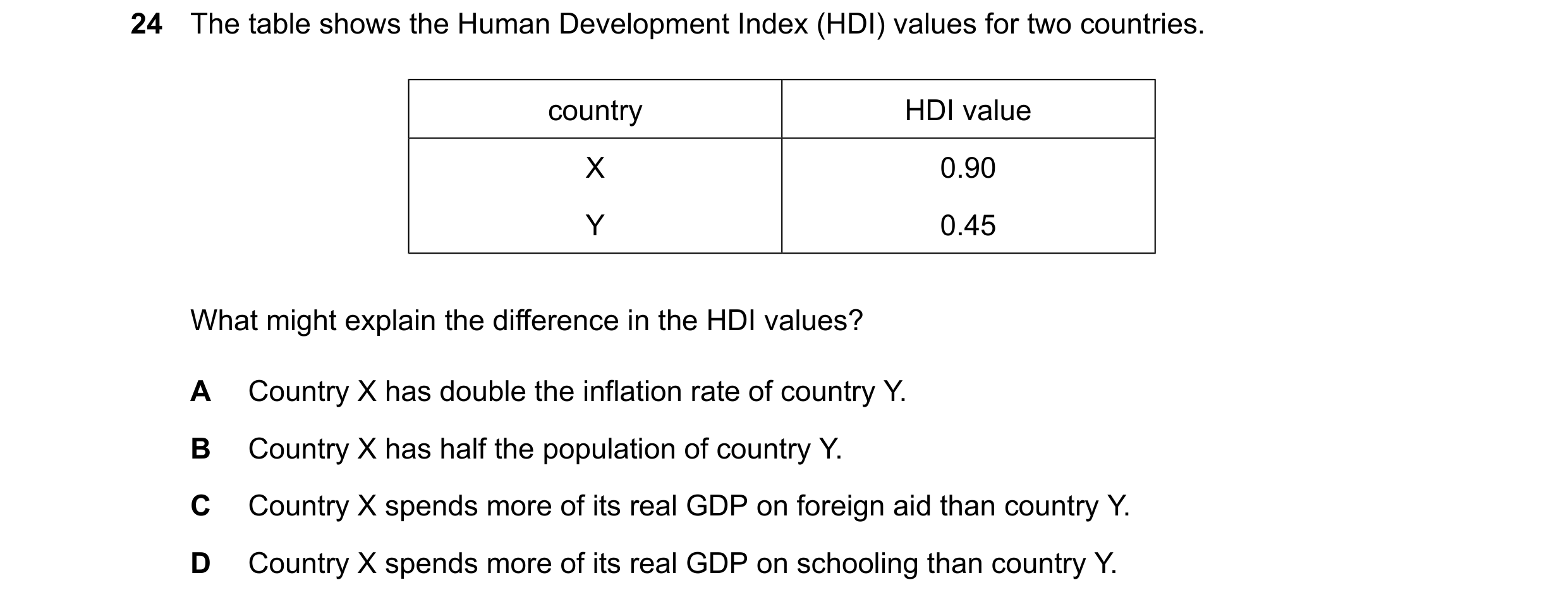
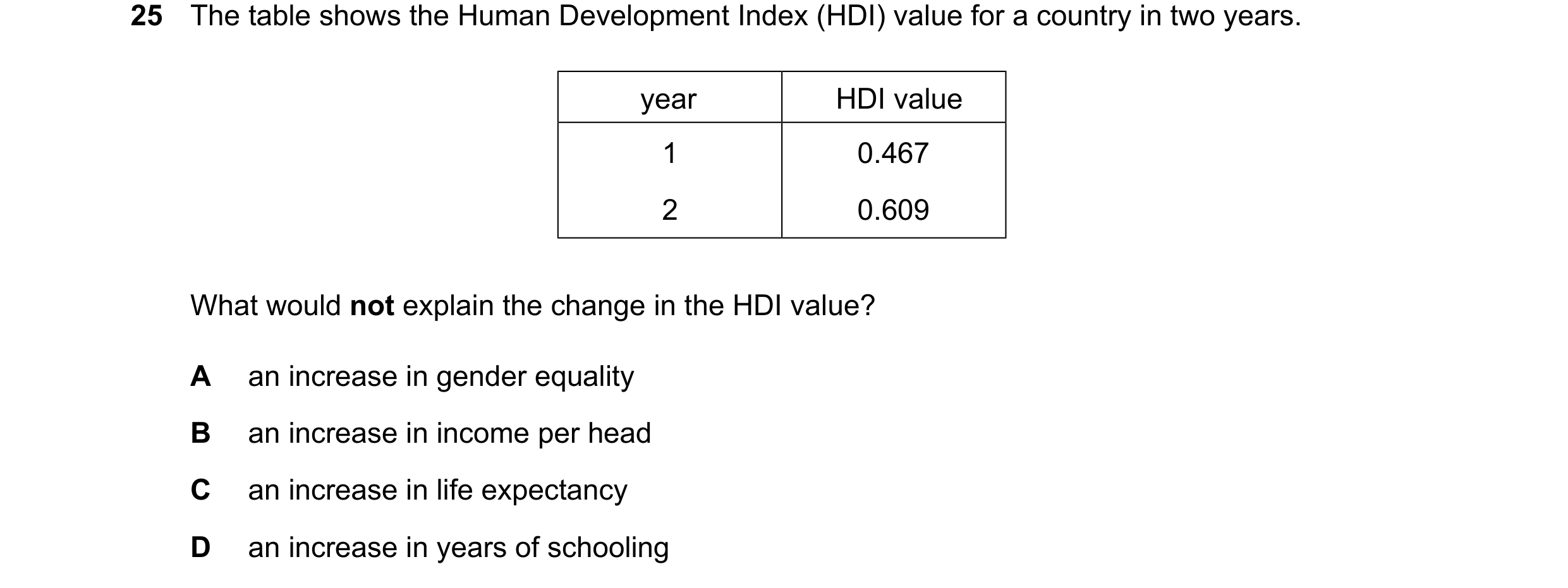
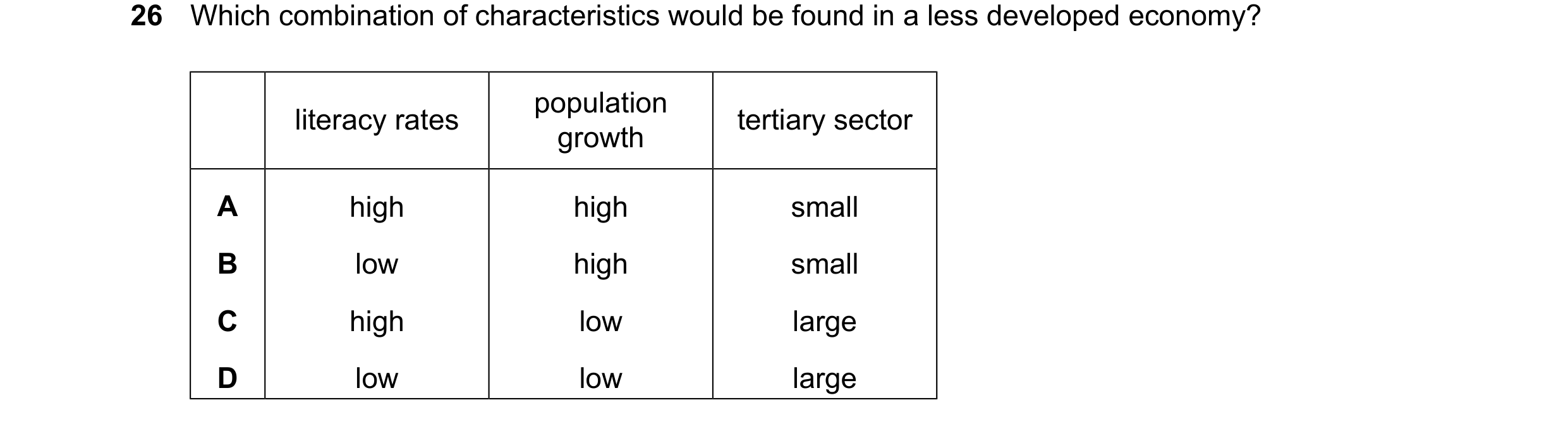 39 / 39