Questions as text
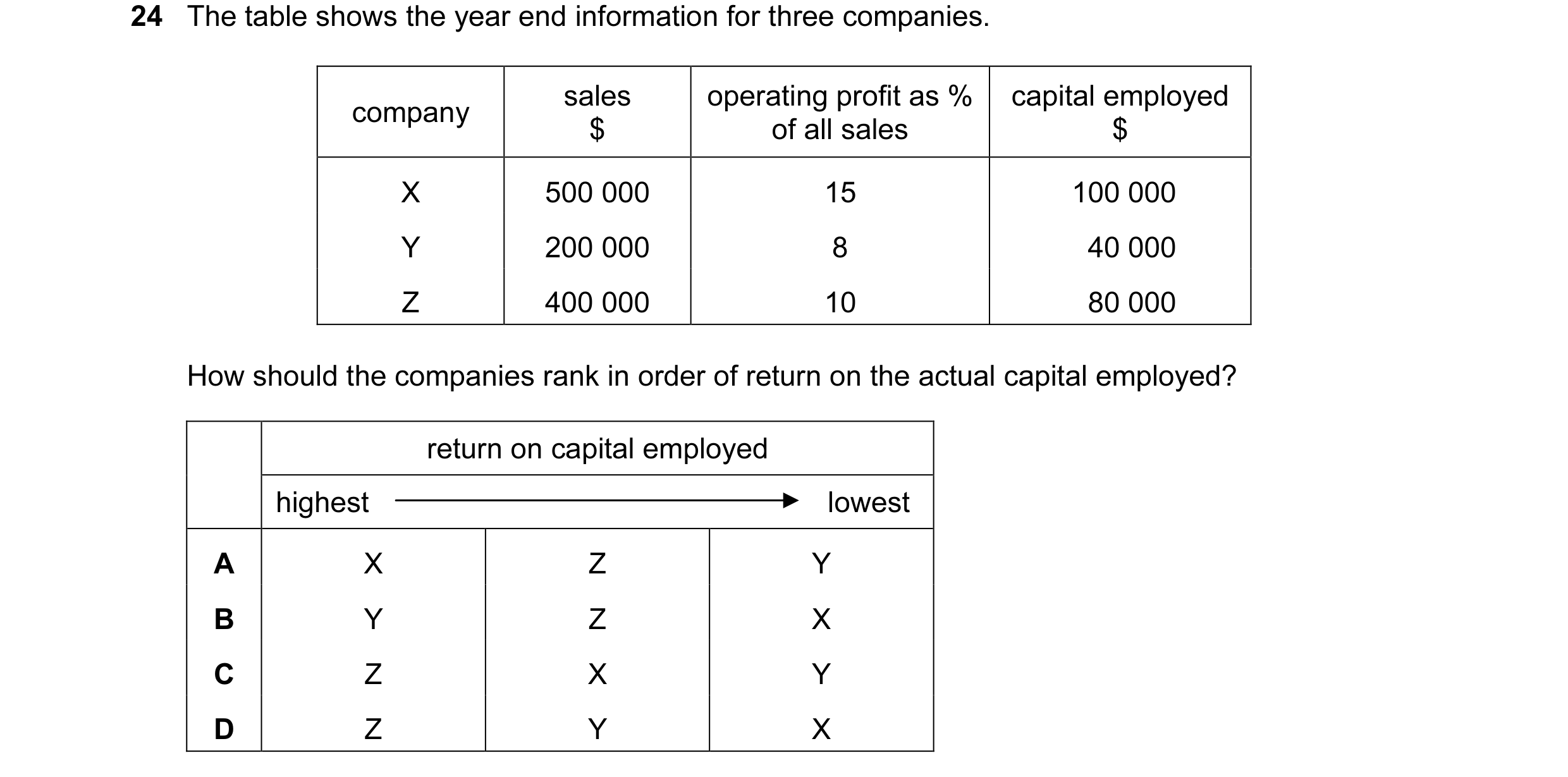
Q1 · The table shows the year end information for three companies 9706/12 Oct/Nov 2010
24 The table shows the year end information for three companies. sales operating profit as % capital employed company $ of all sales $ X 500 000 15 100 000 Y 200 000 8 40 000 Z 400 000 10 80 000 How should the companies rank in order of return on the actual capital employed? return on capital employed highest lowest A X Z Y B Y Z X C Z X Y D Z Y X
1 marks
Answer: A
This question in 9706/12 Oct/Nov 2010
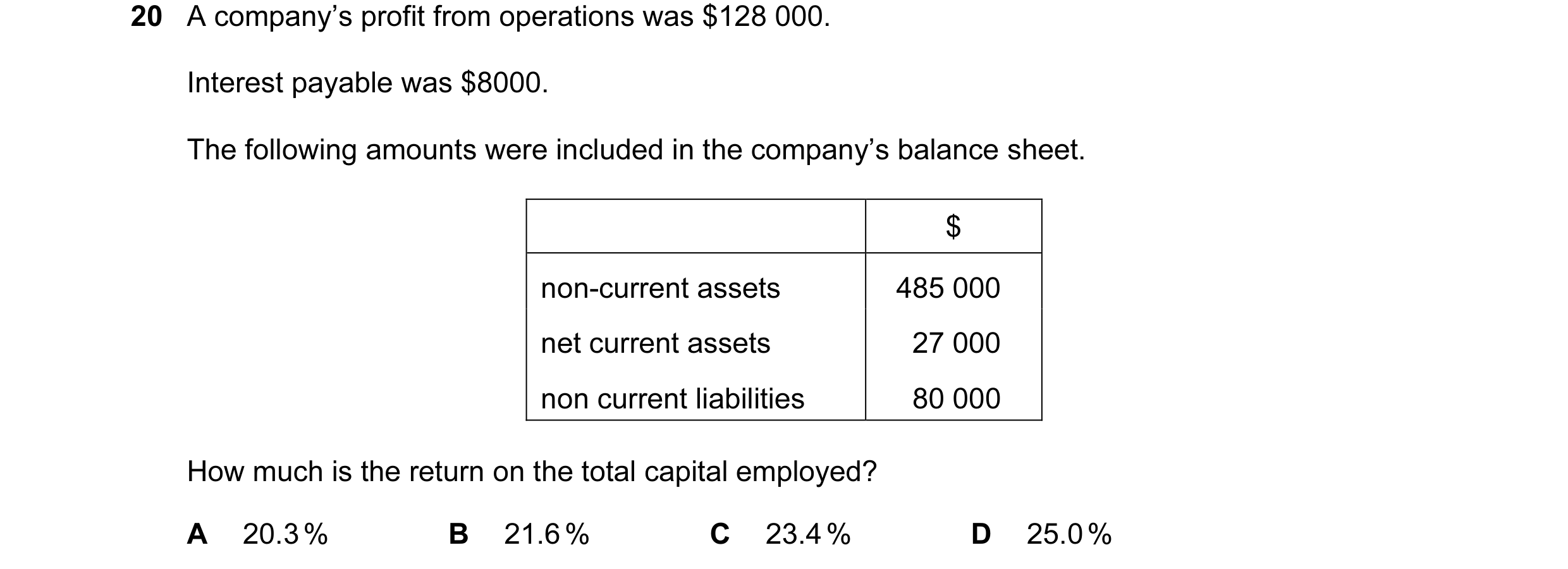
Q2 · A company’s profit from operations was $128 000 9706/11 May/June 2011
20 A company’s profit from operations was $128 000. Interest payable was $8000. The following amounts were included in the company’s balance sheet. $ non-current assets 485 000 net current assets 27 000 non current liabilities 80 000 How much is the return on the total capital employed? A 20.3 % B 21.6 % C 23.4 % D 25.0 %
1 marks
Answer: D
This question in 9706/11 May/June 2011
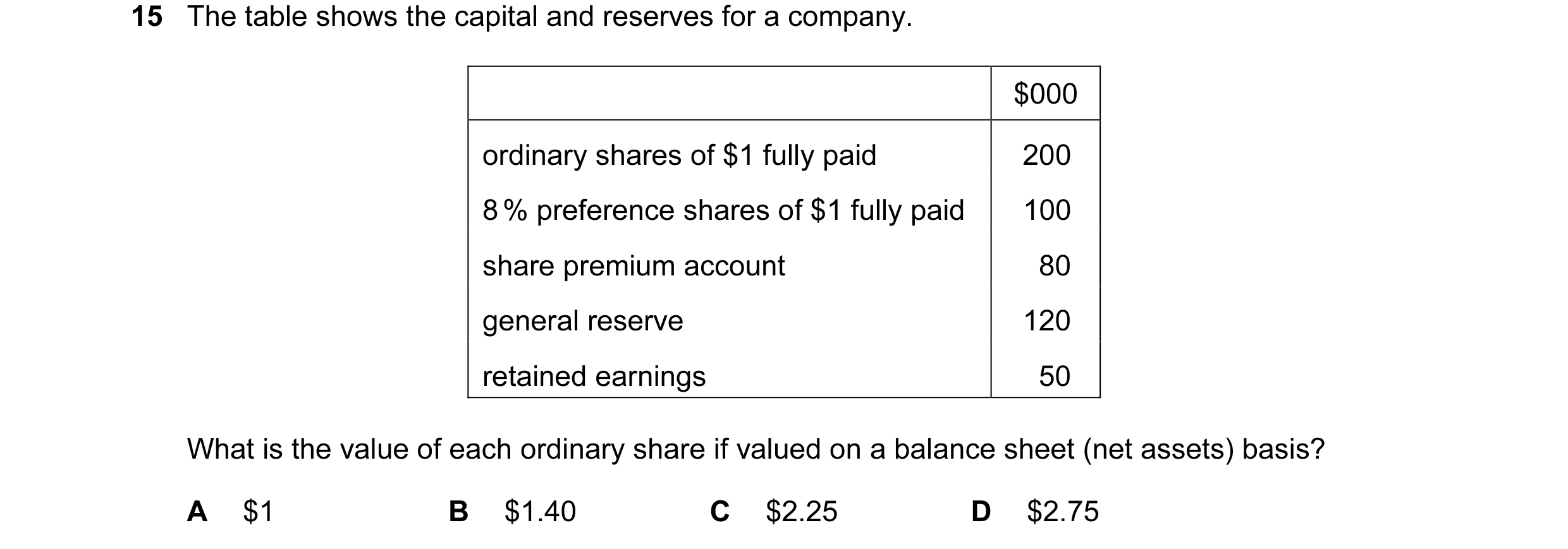
Q3 · The table shows the capital and reserves for a company 9706/13 May/June 2012
15 The table shows the capital and reserves for a company. $000 ordinary shares of $1 fully paid 200 8 % preference shares of $1 fully paid 100 share premium account 80 general reserve 120 retained earnings 50 What is the value of each ordinary share if valued on a balance sheet (net assets) basis? A $1 B $1.40 C $2.25 D $2.75
1 marks
Answer: C
This question in 9706/13 May/June 2012
Q4 · The following information is given in the financial statements of Primecrop Limited 9706/13 May/June 2012
16 The following information is given in the financial statements of Primecrop Limited. $ ordinary shares 1 200 000 6 % preference shares 250 000 general reserve 120 000 retained earnings 710 000 8 % debentures 400 000 What is the value of ordinary shareholders’ funds? A $1 910 000 B $2 030 000 C $2 280 000 D $2 430 000
1 marks
Answer: B
This question in 9706/13 May/June 2012
Q5 · Arun wishes to invest in a business with a skilled workforce which will make a profit in… 9706/13 May/June 2012
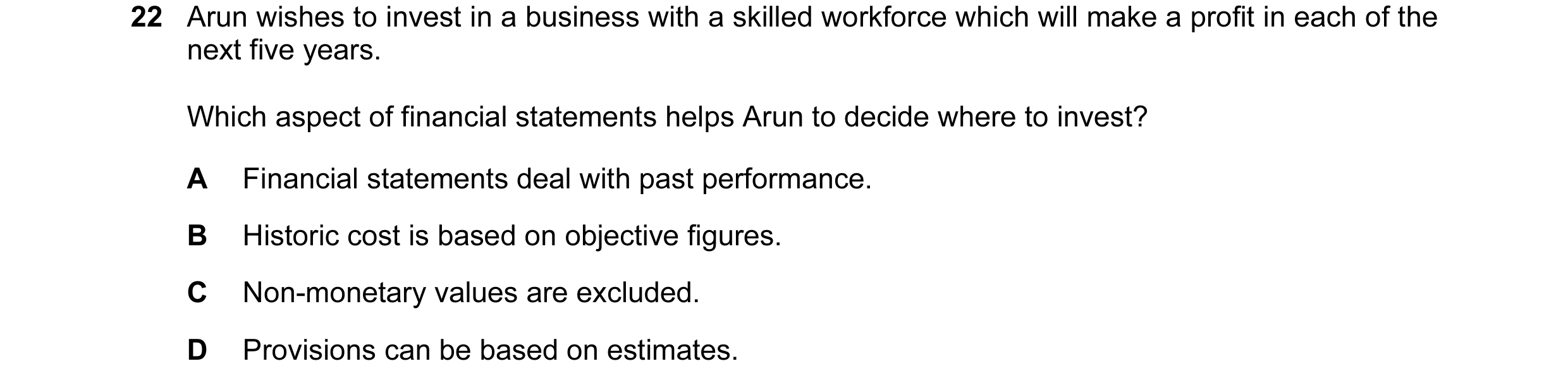
22 Arun wishes to invest in a business with a skilled workforce which will make a profit in each of the next five years. Which aspect of financial statements helps Arun to decide where to invest? A Financial statements deal with past performance. B Historic cost is based on objective figures. C Non-monetary values are excluded. D Provisions can be based on estimates.
1 marks
Answer: B
This question in 9706/13 May/June 2012
Q6 · The following shows extracts from the statement of financial position of a company 9706/13 May/June 2013
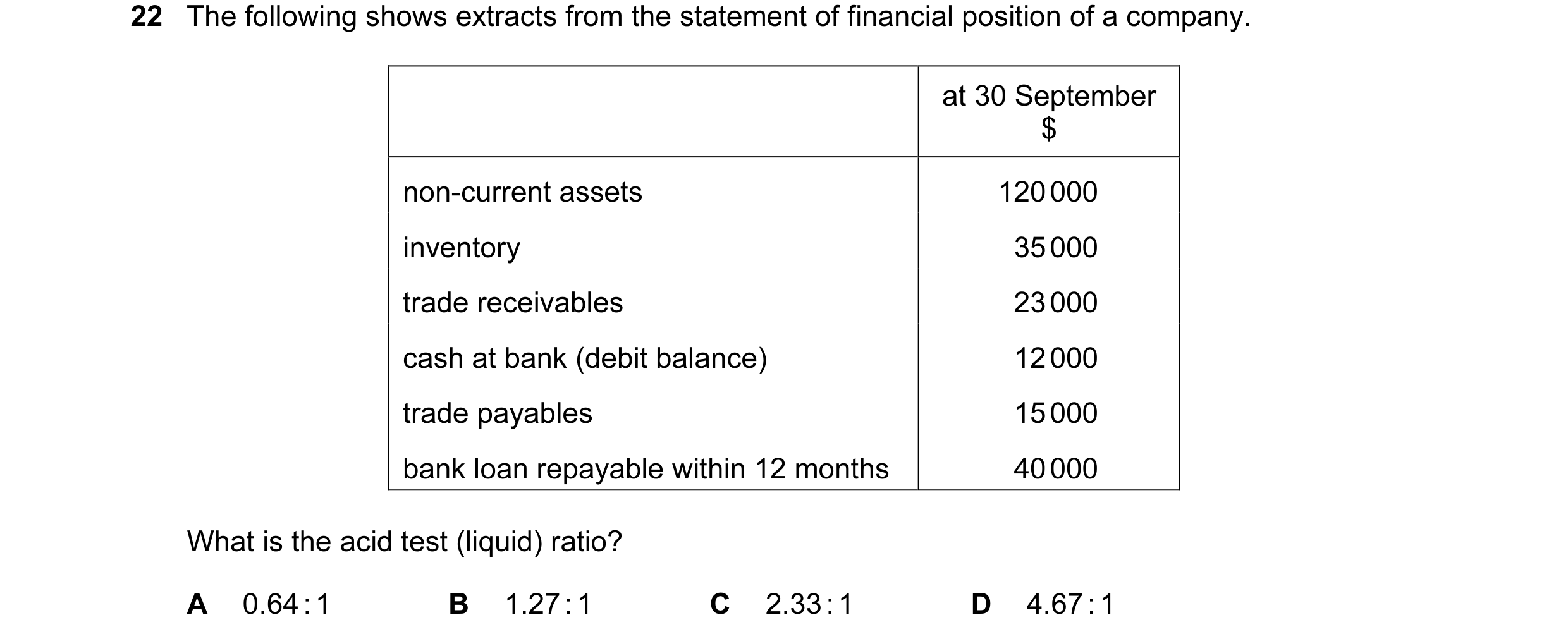
22 The following shows extracts from the statement of financial position of a company. at 30 September $ non-current assets 120 000 inventory 35 000 trade receivables 23 000 cash at bank (debit balance) 12 000 trade payables 15 000 bank loan repayable within 12 months 40 000 What is the acid test (liquid) ratio? A 0.64 : 1 B 1.27 : 1 C 2.33 : 1 D 4.67 : 1
1 marks
Answer: A
This question in 9706/13 May/June 2013
Q7 · A company’s non-current asset turnover ratio decreases this year compared to last year 9706/13 May/June 2013
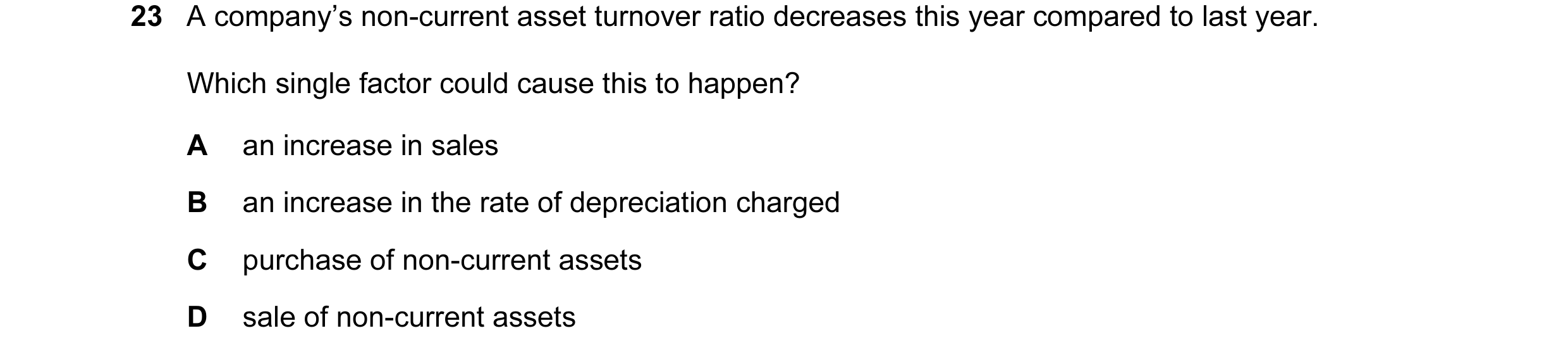
23 A company’s non-current asset turnover ratio decreases this year compared to last year. Which single factor could cause this to happen? A an increase in sales B an increase in the rate of depreciation charged C purchase of non-current assets D sale of non-current assets
1 marks
Answer: C
This question in 9706/13 May/June 2013
Q8 · A company’s financial statements show the following 9706/13 May/June 2013
24 A company’s financial statements show the following. $ issued share capital 300 000 profit from operations 160 000 profit after preference dividends 120 000 non-current liabilities 280 000 reserves 100 000 What is the company’s return on capital employed? A 23.5% B 30.0% C 40.0% D 53.3%
1 marks
Answer: A
This question in 9706/13 May/June 2013
Q9 · What would increase the current ratio of a business? 9706/13 May/June 2013
25 What would increase the current ratio of a business? A buying goods on credit for $2000 and selling immediately for $3000 cash B paying creditors $1000 cash C purchasing a non-current asset of $10 000 on credit D selling goods of $1000 at cost price on credit
1 marks
Answer: A
This question in 9706/13 May/June 2013
Q10 · A company had a profit after interest of $25 000 9706/13 Oct/Nov 2017
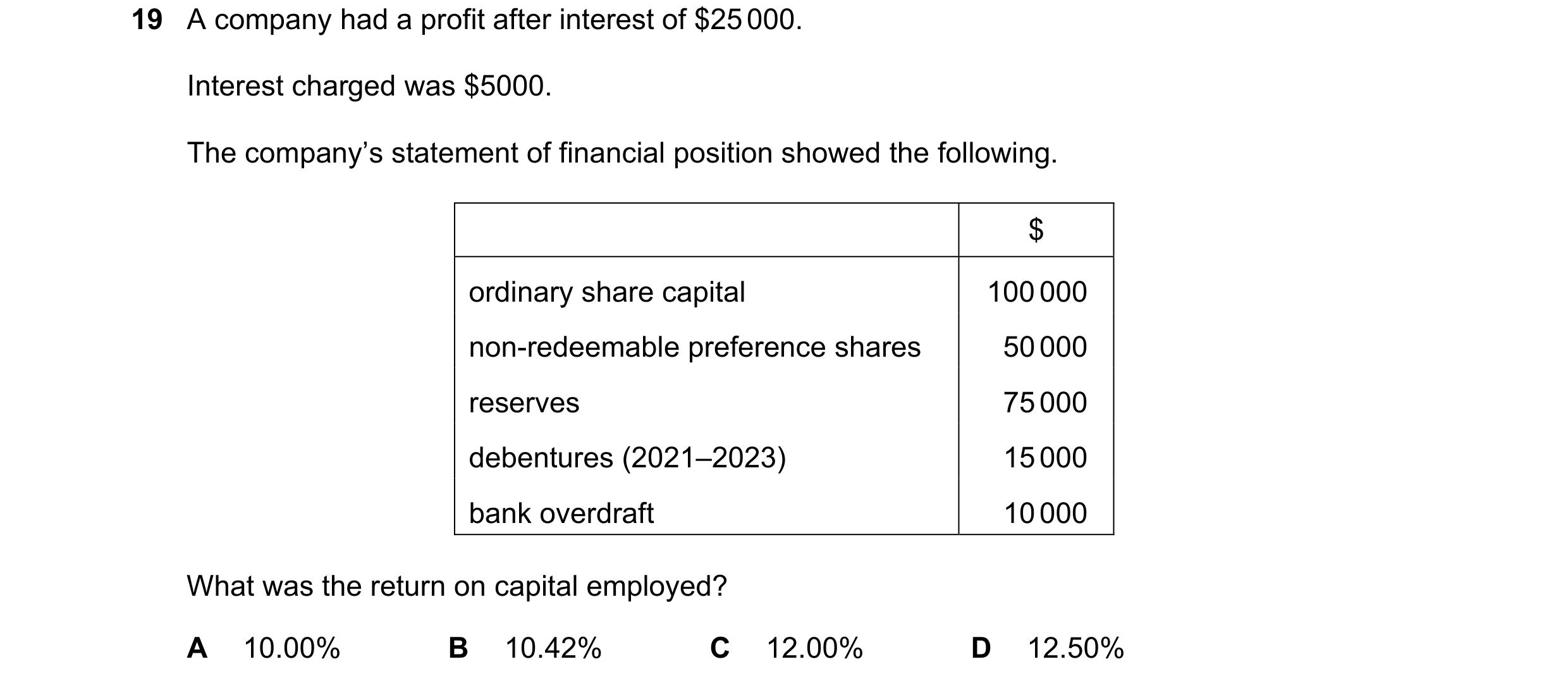
19 A company had a profit after interest of $25 000. Interest charged was $5000. The company’s statement of financial position showed the following. $ ordinary share capital 100 000 non-redeemable preference shares 50 000 reserves 75 000 debentures (2021–2023) 15 000 bank overdraft 10 000 What was the return on capital employed? A 10.00% B 10.42% C 12.00% D 12.50%
1 marks
Answer: D
This question in 9706/13 Oct/Nov 2017
Q11 · Which statement about the limitations of comparing accounting ratios between similar… 9706/13 Oct/Nov 2017
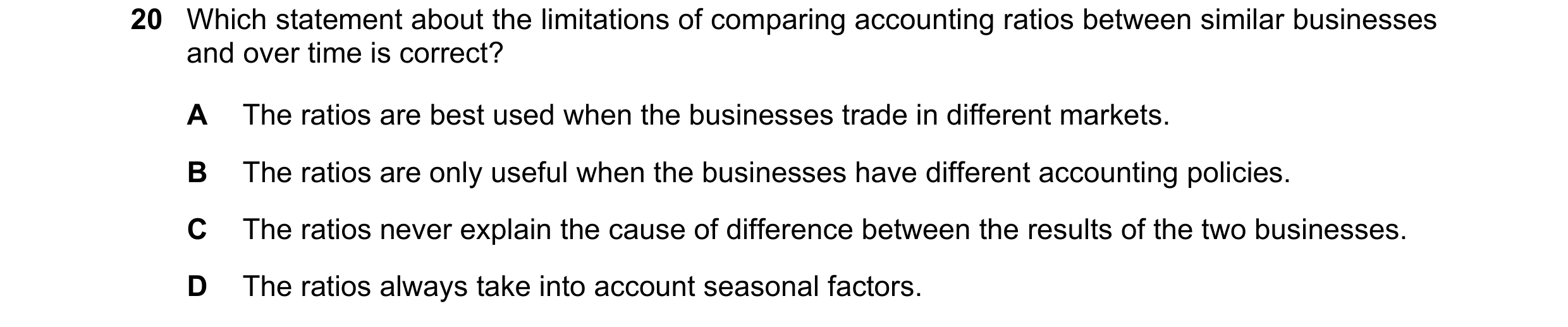
20 Which statement about the limitations of comparing accounting ratios between similar businesses and over time is correct? A The ratios are best used when the businesses trade in different markets. B The ratios are only useful when the businesses have different accounting policies. C The ratios never explain the cause of difference between the results of the two businesses. D The ratios always take into account seasonal factors.
1 marks
Answer: C
This question in 9706/13 Oct/Nov 2017
Q12 · The statement of financial position of X Limited at 31 December 2017 shows the following 9706/12 Feb/March 2018
17 The statement of financial position of X Limited at 31 December 2017 shows the following. $000 non-current assets 1350 current assets 140 ordinary share capital 900 general reserve 150 10% debentures 200 current liabilities 90 retained earnings 150 The profit from operations for the year was $65 000 and the finance costs were $20 000. What is the return on capital employed for 2017? A 3.21% B 4.64% C 5.7% D 5.91%
1 marks
Answer: B
This question in 9706/12 Feb/March 2018
Q13 · The following has been extracted from the financial statements of a business 9706/11 May/June 2018
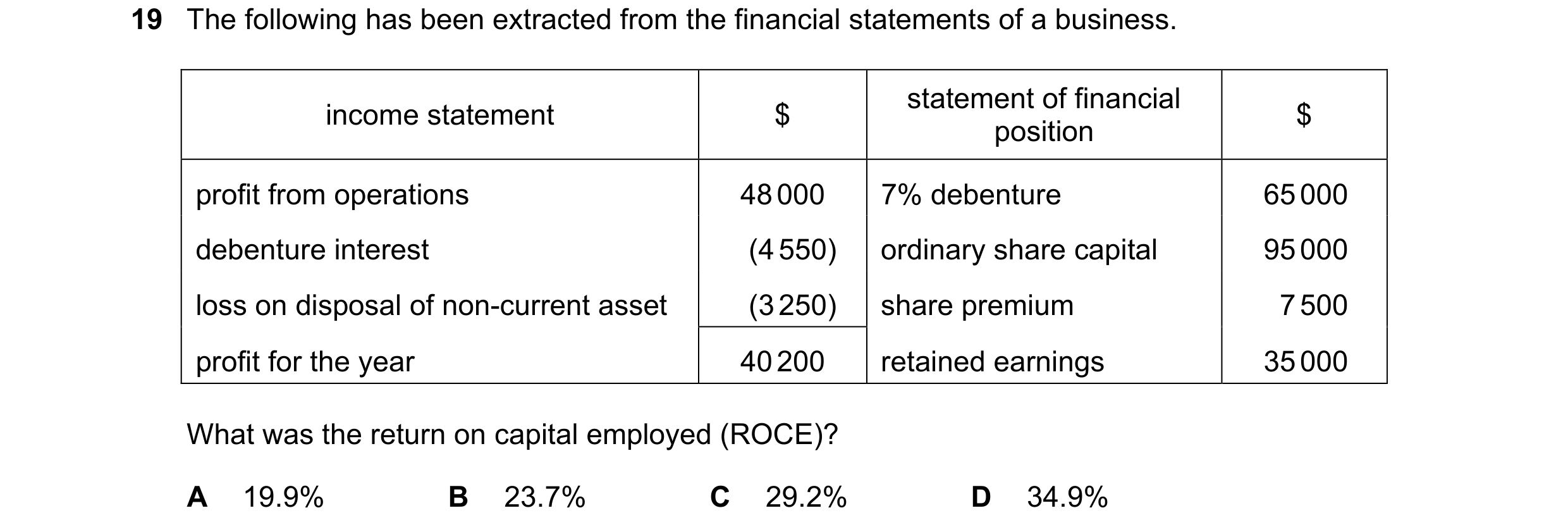
19 The following has been extracted from the financial statements of a business. statement of financial income statement $ $ position profit from operations 48 000 7% debenture 65 000 debenture interest (4 550) ordinary share capital 95 000 loss on disposal of non-current asset (3 250) share premium 7 500 profit for the year 40 200 retained earnings 35 000 What was the return on capital employed (ROCE)? A 19.9% B 23.7% C 29.2% D 34.9%
1 marks
Answer: B
This question in 9706/11 May/June 2018
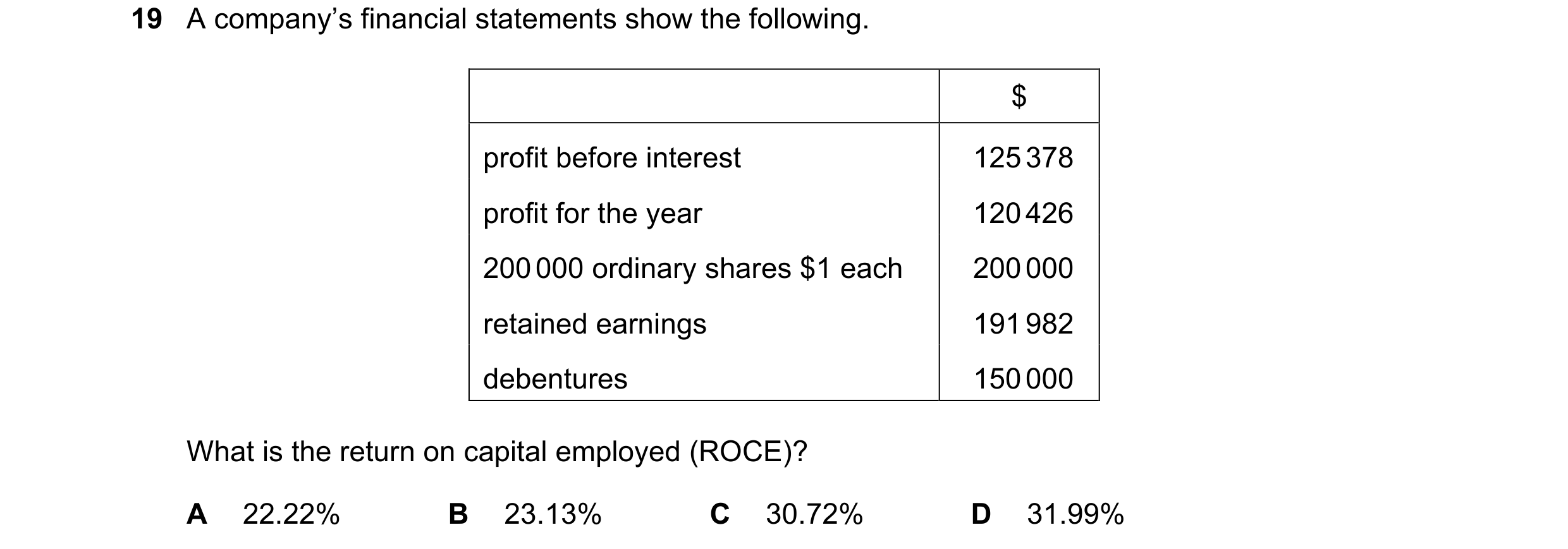
Q14 · A company’s financial statements show the following 9706/12 Oct/Nov 2018
19 A company’s financial statements show the following. $ profit before interest 125 378 profit for the year 120 426 200 000 ordinary shares $1 each 200 000 retained earnings 191 982 debentures 150 000 What is the return on capital employed (ROCE)? A 22.22% B 23.13% C 30.72% D 31.99%
1 marks
Answer: B
This question in 9706/12 Oct/Nov 2018
Q15 · A company’s income statement shows the following 9706/12 Oct/Nov 2018
20 A company’s income statement shows the following. $ revenue 460 000 cost of sales 120 000 administration expenses 54 000 distribution costs 47 000 finance charges 7 000 What is the operating expenses to revenue ratio? A 21.96% B 23.48% C 48.04% D 49.57%
1 marks
Answer: A
This question in 9706/12 Oct/Nov 2018
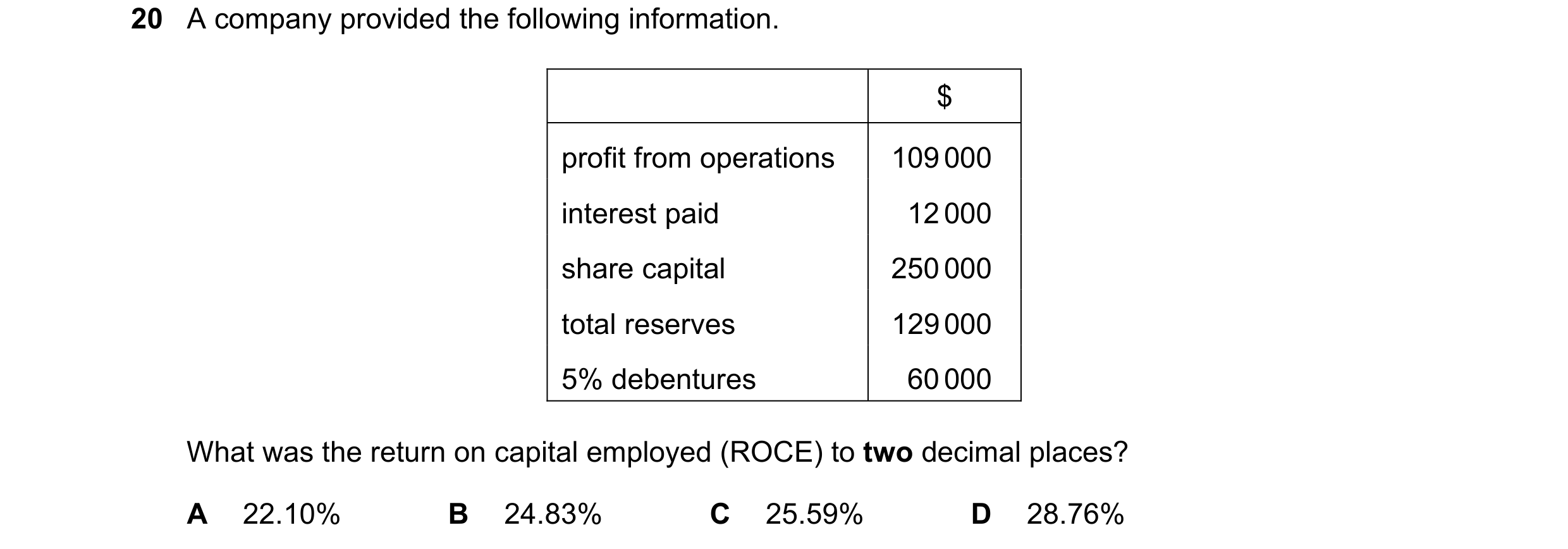
Q16 · A company provided the following information 9706/12 Feb/March 2019
20 A company provided the following information. $ profit from operations 109 000 interest paid 12 000 share capital 250 000 total reserves 129 000 5% debentures 60 000 What was the return on capital employed (ROCE) to two decimal places? A 22.10% B 24.83% C 25.59% D 28.76%
1 marks
Answer: B
This question in 9706/12 Feb/March 2019
Q17 · Which ratio calculates the average time a business takes to pay its credit suppliers? 9706/11 May/June 2019
18 Which ratio calculates the average time a business takes to pay its credit suppliers? A current ratio B liquid (acid test) ratio C trade payables turnover D trade receivables turnover
1 marks
Answer: C
This question in 9706/11 May/June 2019
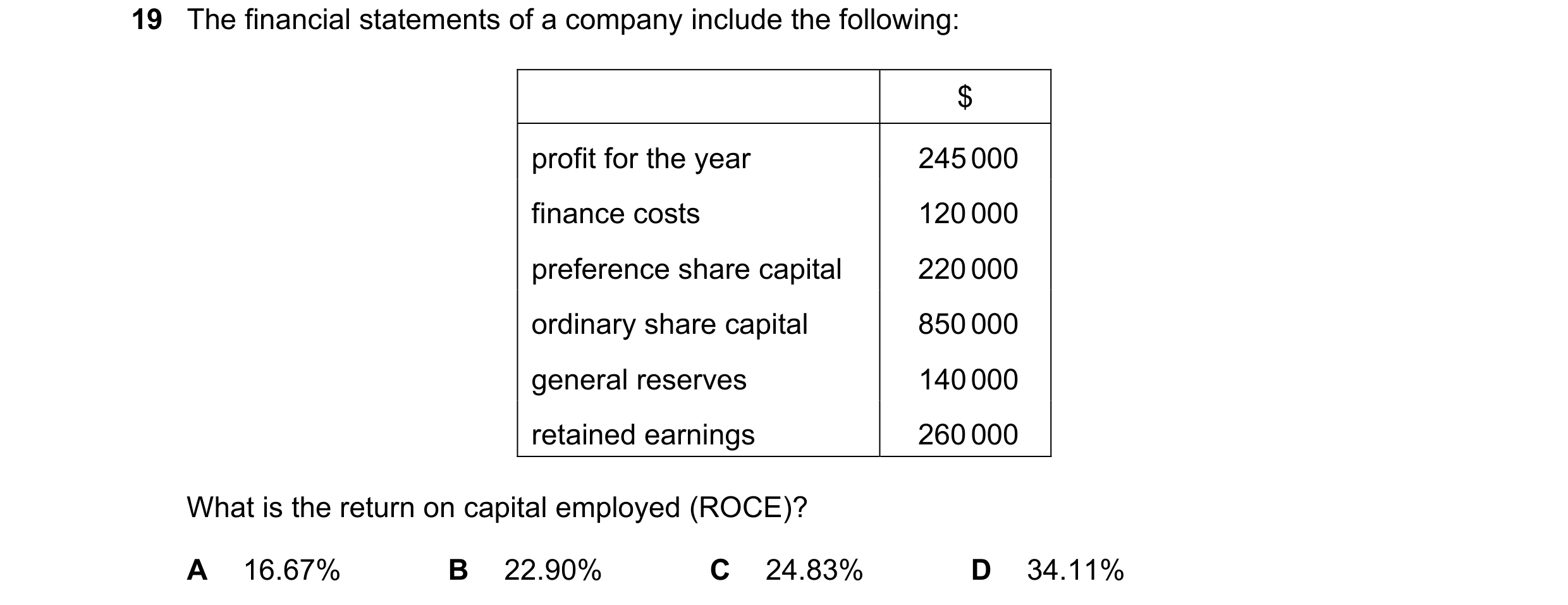
Q18 · The financial statements of a company include the following: $ profit for the year 245… 9706/11 May/June 2019
19 The financial statements of a company include the following: $ profit for the year 245 000 finance costs 120 000 preference share capital 220 000 ordinary share capital 850 000 general reserves 140 000 retained earnings 260 000 What is the return on capital employed (ROCE)? A 16.67% B 22.90% C 24.83% D 34.11%
1 marks
Answer: C
This question in 9706/11 May/June 2019
Q19 · A business has prepared the following information for the year ended 30 April 2019 9706/11 May/June 2019
20 A business has prepared the following information for the year ended 30 April 2019. $ $ revenue 220 000 opening inventory 25 000 purchases 120 000 closing inventory (31 000) cost of goods sold 114 000 gross profit 106 000 What was the inventory turnover? A 86 days B 90 days C 95 days D 100 days
1 marks
Answer: B
This question in 9706/11 May/June 2019
Q20 · Which action will increase a company’s current ratio? 9706/12 May/June 2019
17 Which action will increase a company’s current ratio? A making an issue of bonus shares B making a rights issue of shares C increasing the provision for doubtful debts D reducing the rate of depreciation on non-current assets
1 marks
Answer: B
This question in 9706/12 May/June 2019
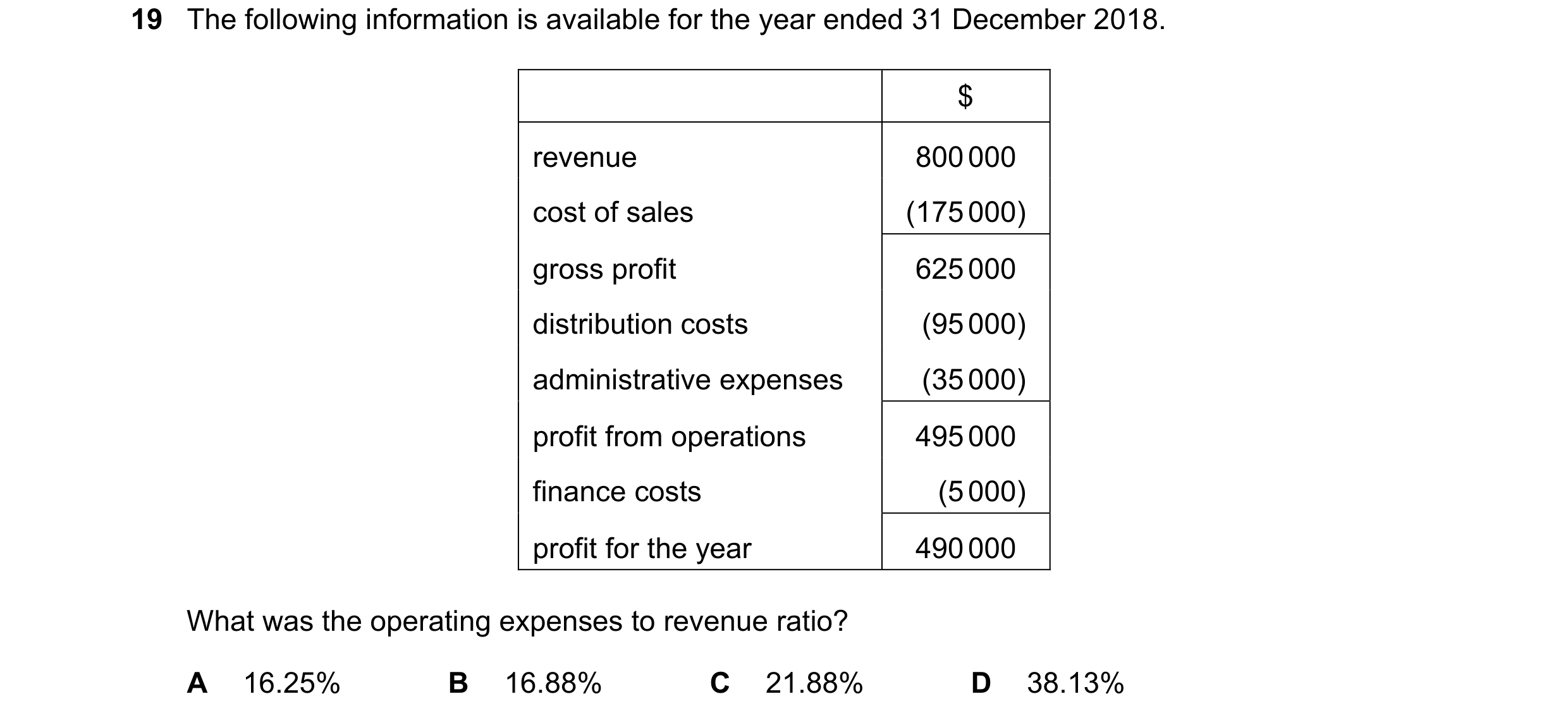
Q21 · The following information is available for the year ended 31 December 2018 9706/12 May/June 2019
19 The following information is available for the year ended 31 December 2018. $ revenue 800 000 cost of sales (175 000) gross profit 625 000 distribution costs (95 000) administrative expenses (35 000) profit from operations 495 000 finance costs (5 000) profit for the year 490 000 What was the operating expenses to revenue ratio? A 16.25% B 16.88% C 21.88% D 38.13%
1 marks
Answer: A
This question in 9706/12 May/June 2019
Q22 · On 1 January 2018 a business expected to have sales for the year ended 31 December 2018… 9706/12 May/June 2019
20 On 1 January 2018 a business expected to have sales for the year ended 31 December 2018 of $450 000. Its non-current assets at that date were $306 000. On 1 July 2018 it purchased new machinery at a cost of $180 000, in order to increase its sales by an extra $20 000 each month. What was the rate of non-current asset turnover in 2018? (Ignore depreciation.) A 1.17 times B 1.42 times C 1.44 times D 1.74 times
1 marks
Answer: A
This question in 9706/12 May/June 2019
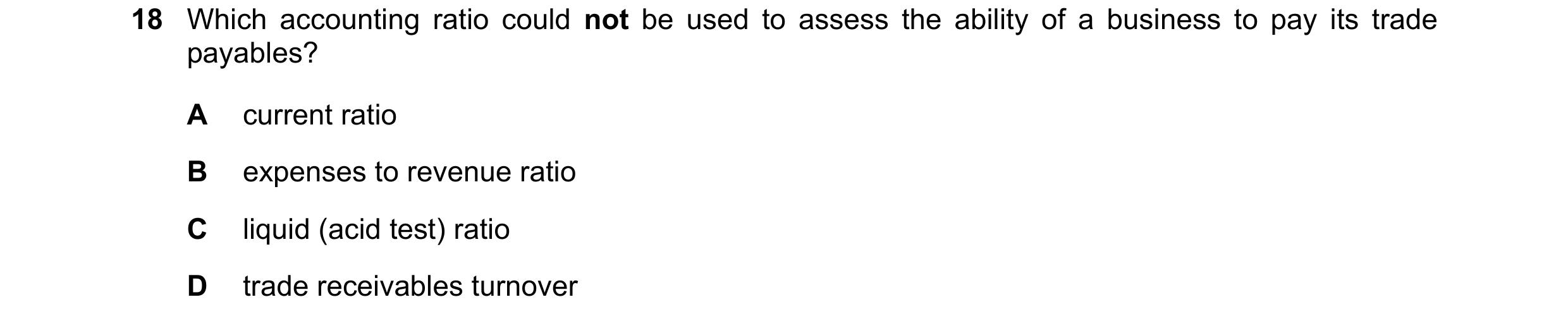
Q23 · Which accounting ratio could not be used to assess the ability of a business to pay its… 9706/13 May/June 2019
18 Which accounting ratio could not be used to assess the ability of a business to pay its trade payables? A current ratio B expenses to revenue ratio C liquid (acid test) ratio D trade receivables turnover
1 marks
Answer: B
This question in 9706/13 May/June 2019
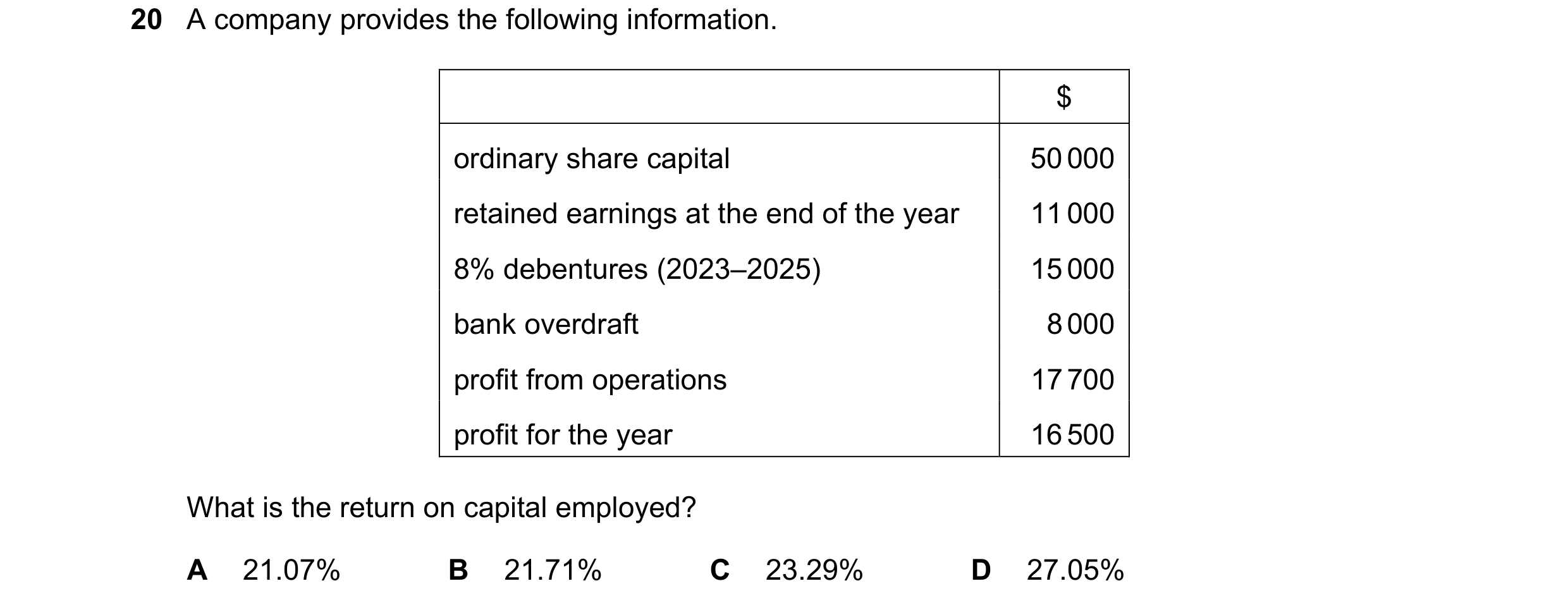
Q24 · A company provides the following information 9706/11 Oct/Nov 2019
20 A company provides the following information. $ ordinary share capital 50 000 retained earnings at the end of the year 11 000 8% debentures (2023–2025) 15 000 bank overdraft 8 000 profit from operations 17 700 profit for the year 16 500 What is the return on capital employed? A 21.07% B 21.71% C 23.29% D 27.05%
1 marks
Answer: C
This question in 9706/11 Oct/Nov 2019
Q25 · Which information would an investor gain by looking at the financial statements of a… 9706/12 Oct/Nov 2019
19 Which information would an investor gain by looking at the financial statements of a business? 1 identifying future trading prospects 2 identifying the amount of future dividends 3 identifying that the entity is a going concern A 1 and 2 B 1 only C 2 and 3 D 3 only
1 marks
Answer: D
This question in 9706/12 Oct/Nov 2019
Q26 · The following information is available for a limited company 9706/12 Oct/Nov 2019
20 The following information is available for a limited company. $ profit from operations 40 475 profit for the year 26 380 10% debenture (2025) 75 000 100 000 shares ($1 each) 100 000 retained earnings at the end of the year 135 679 What was the return on capital employed? A 8.49% B 11.19% C 13.03% D 17.17%
1 marks
Answer: C
This question in 9706/12 Oct/Nov 2019
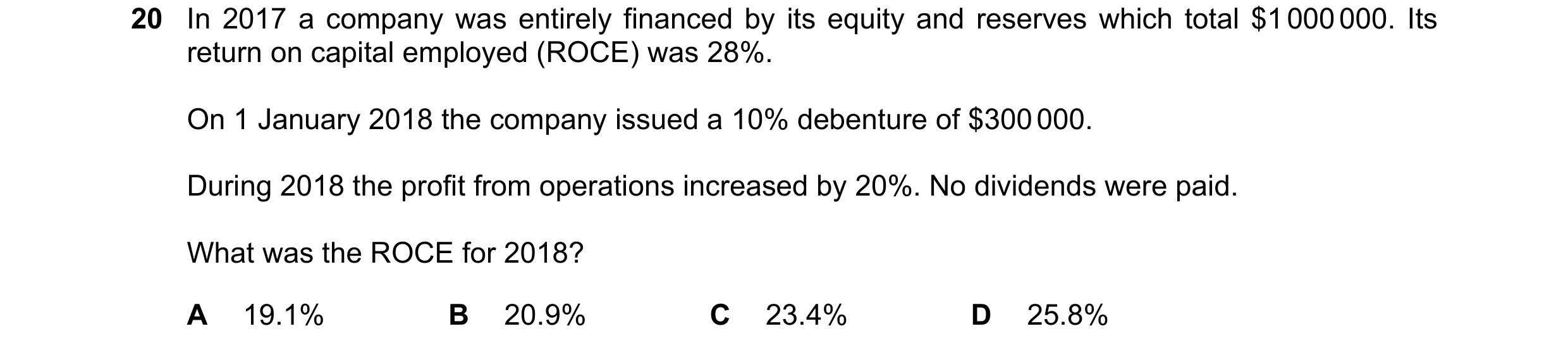
Q27 · In 2017 a company was entirely financed by its equity and reserves which total $1 000 000 9706/13 Oct/Nov 2019
20 In 2017 a company was entirely financed by its equity and reserves which total $1 000 000. Its return on capital employed (ROCE) was 28%. On 1 January 2018 the company issued a 10% debenture of $300 000. During 2018 the profit from operations increased by 20%. No dividends were paid. What was the ROCE for 2018? A 19.1% B 20.9% C 23.4% D 25.8%
1 marks
Answer: B
This question in 9706/13 Oct/Nov 2019
Q28 · Which ratio tells managers how long it takes to receive payment for goods sold on credit? 9706/11 May/June 2020
19 Which ratio tells managers how long it takes to receive payment for goods sold on credit? A current ratio B liquid (acid test) ratio C trade payables turnover D trade receivables turnover
1 marks
Answer: D
This question in 9706/11 May/June 2020
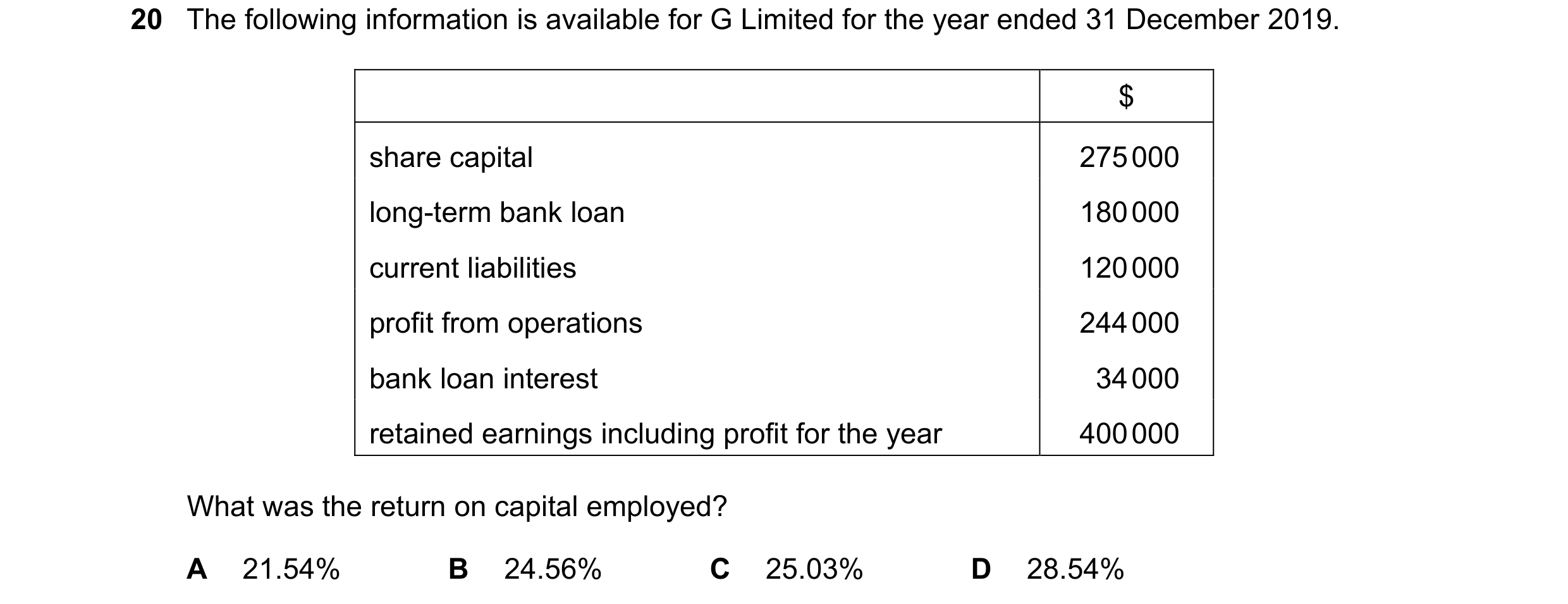
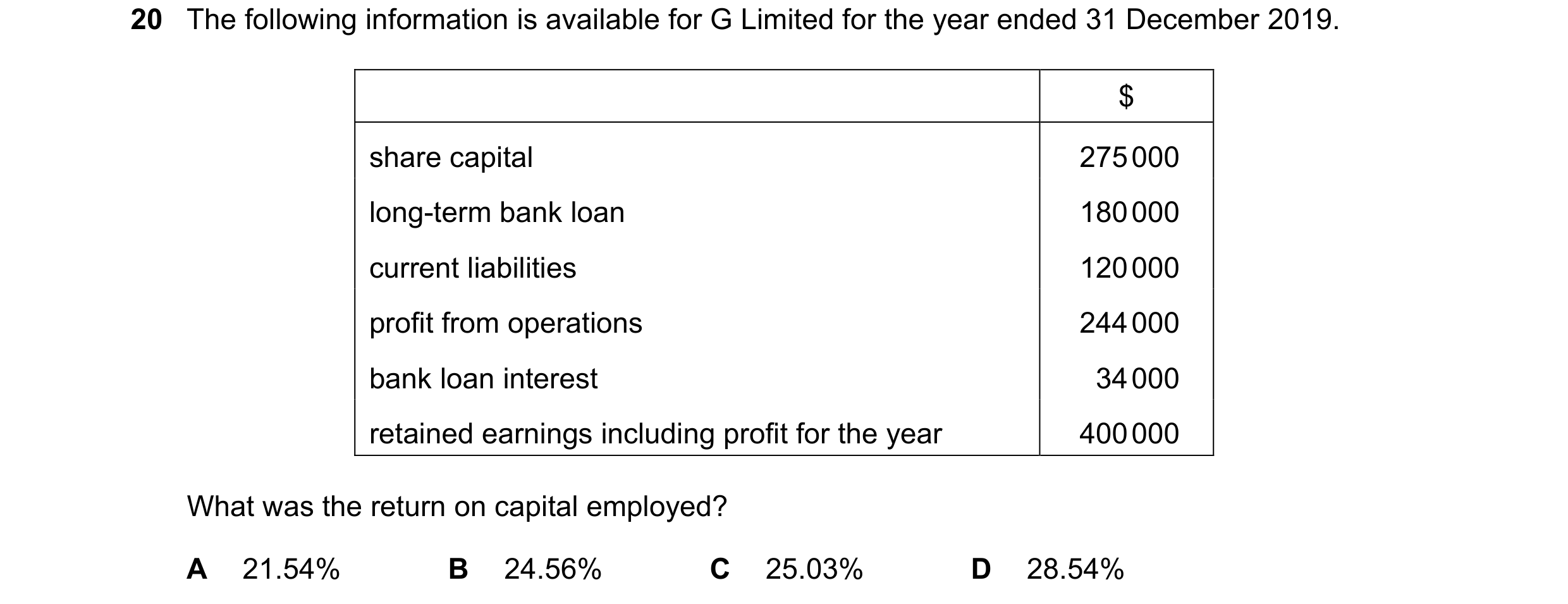
Q29 · The following information is available for G Limited for the year ended 31 December 2019 9706/11 May/June 2020
20 The following information is available for G Limited for the year ended 31 December 2019. $ share capital 275 000 long-term bank loan 180 000 current liabilities 120 000 profit from operations 244 000 bank loan interest 34 000 retained earnings including profit for the year 400 000 What was the return on capital employed? A 21.54% B 24.56% C 25.03% D 28.54%
1 marks
Answer: D
This question in 9706/11 May/June 2020
Q30 · The rate of inventory turnover of a company has been calculated for two successive periods 9706/12 May/June 2020
18 The rate of inventory turnover of a company has been calculated for two successive periods. current period 5.6 times previous period 4.8 times The following statements have been made about the change. 1 Inventory is moving more slowly in the current period. 2 Inventory is moving more quickly in the current period. 3 Management of inventory has been more efficient in the current period. Which statements may explain the change? A 1 and 3 B 1 only C 2 and 3 D 2 only
1 marks
Answer: C
This question in 9706/12 May/June 2020
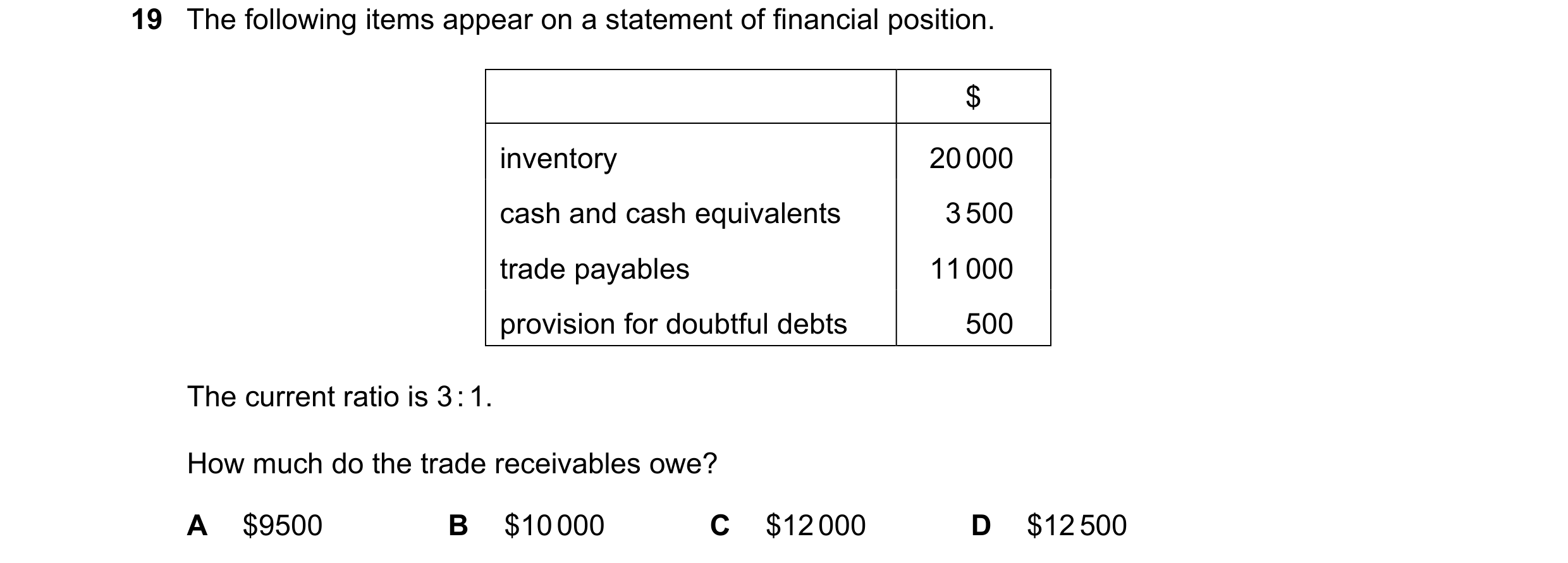
Q31 · The following items appear on a statement of financial position 9706/12 May/June 2020
19 The following items appear on a statement of financial position. $ inventory 20 000 cash and cash equivalents 3 500 trade payables 11 000 provision for doubtful debts 500 The current ratio is 3 : 1. How much do the trade receivables owe? A $9500 B $10 000 C $12 000 D $12 500
1 marks
Answer: B
This question in 9706/12 May/June 2020
Q32 · Which ratio tells managers how long it takes to receive payment for goods sold on credit? 9706/13 May/June 2020
19 Which ratio tells managers how long it takes to receive payment for goods sold on credit? A current ratio B liquid (acid test) ratio C trade payables turnover D trade receivables turnover
1 marks
Answer: D
This question in 9706/13 May/June 2020
Q33 · The following information is available for G Limited for the year ended 31 December 2019 9706/13 May/June 2020
20 The following information is available for G Limited for the year ended 31 December 2019. $ share capital 275 000 long-term bank loan 180 000 current liabilities 120 000 profit from operations 244 000 bank loan interest 34 000 retained earnings including profit for the year 400 000 What was the return on capital employed? A 21.54% B 24.56% C 25.03% D 28.54%
1 marks
Answer: D
This question in 9706/13 May/June 2020
Q34 · Which financial information is not available for potential shareholders of a limited… 9706/12 Oct/Nov 2020
18 Which financial information is not available for potential shareholders of a limited company? A cash budget B income statement C notes to financial statements D statement of changes in equity
1 marks
Answer: A
This question in 9706/12 Oct/Nov 2020
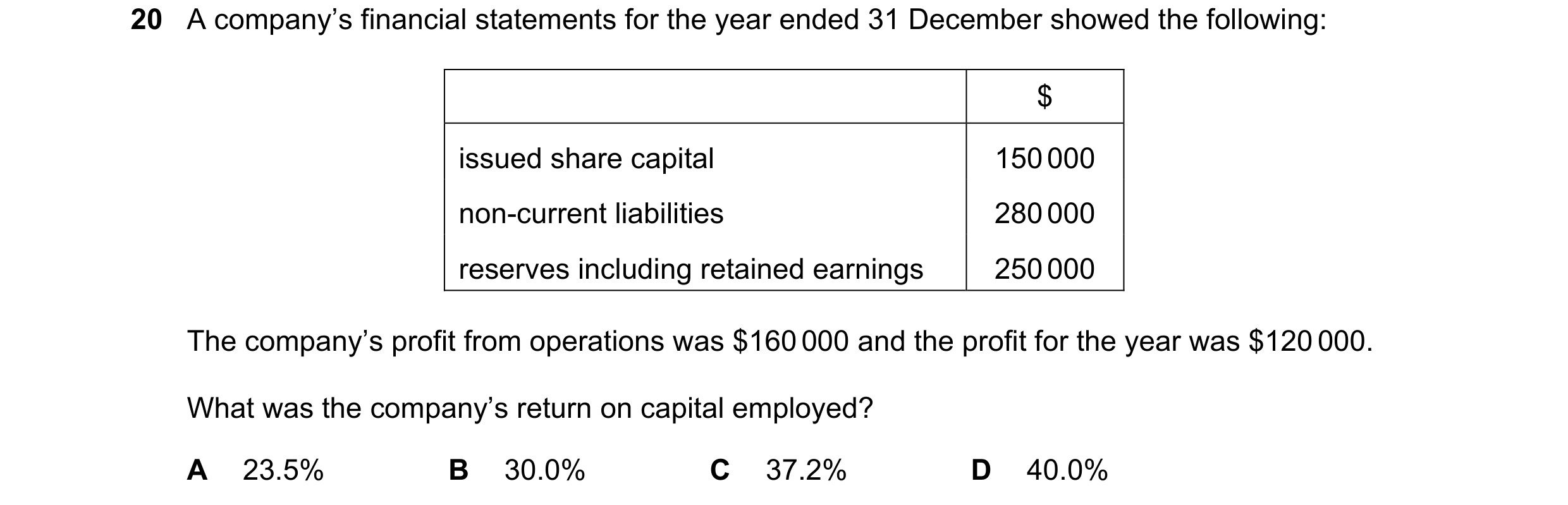
Q35 · A company’s financial statements for the year ended 31 December showed the following: $… 9706/12 Oct/Nov 2020
20 A company’s financial statements for the year ended 31 December showed the following: $ issued share capital 150 000 non-current liabilities 280 000 reserves including retained earnings 250 000 The company’s profit from operations was $160 000 and the profit for the year was $120 000. What was the company’s return on capital employed? A 23.5% B 30.0% C 37.2% D 40.0%
1 marks
Answer: A
This question in 9706/12 Oct/Nov 2020
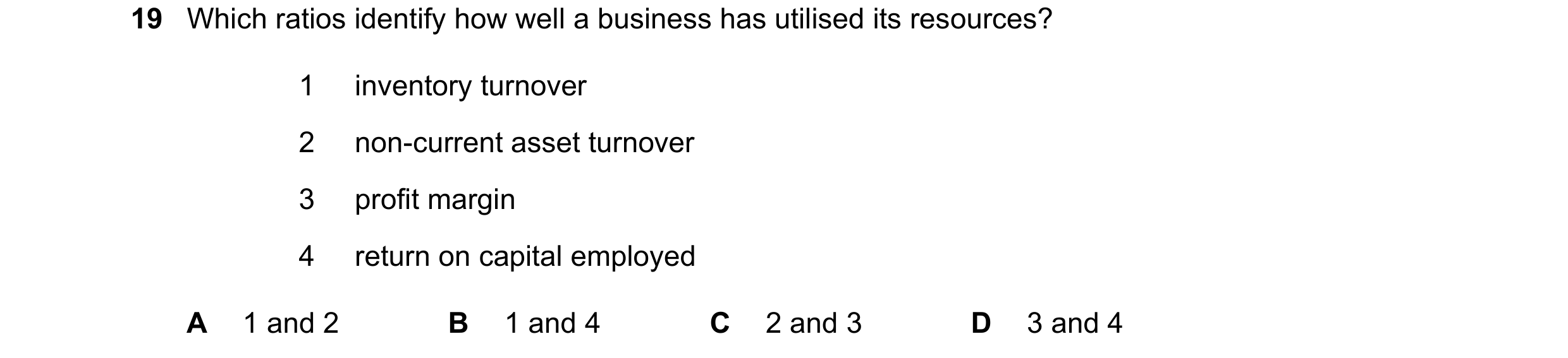
Q36 · Which ratios identify how well a business has utilised its resources? 9706/13 Oct/Nov 2020
19 Which ratios identify how well a business has utilised its resources? 1 inventory turnover 2 non-current asset turnover 3 profit margin 4 return on capital employed A 1 and 2 B 1 and 4 C 2 and 3 D 3 and 4
1 marks
Answer: A
This question in 9706/13 Oct/Nov 2020
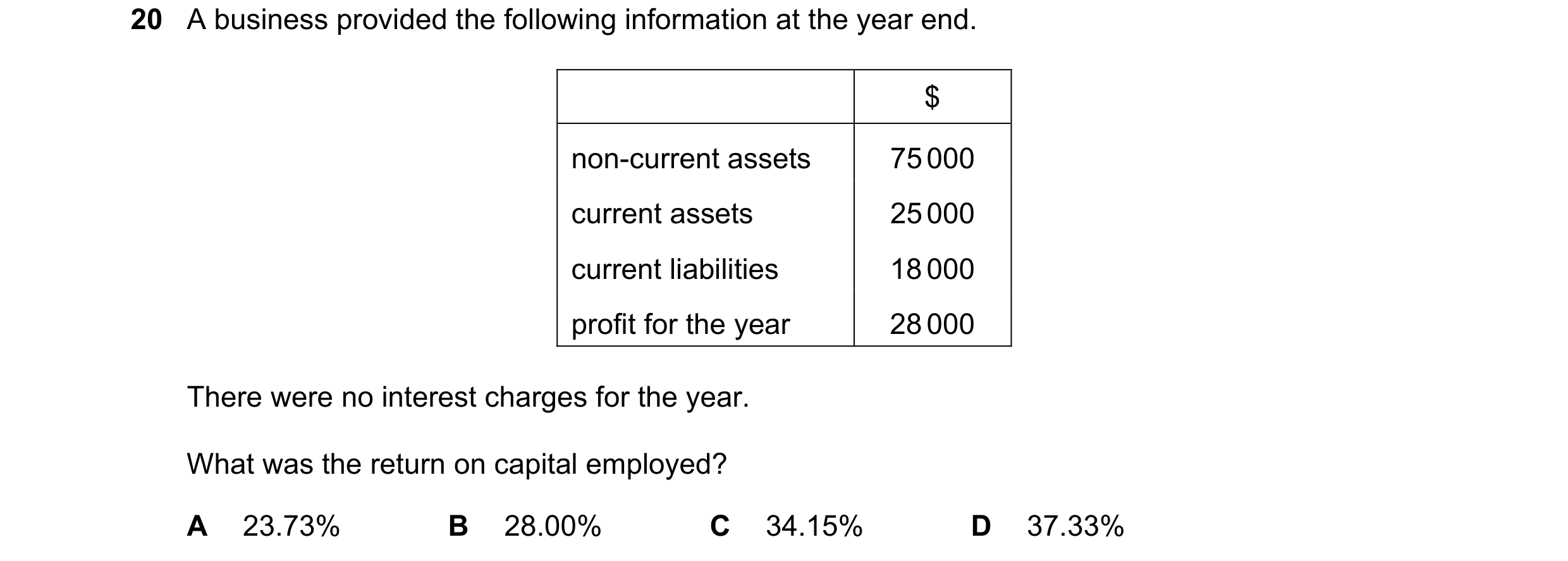
Q37 · A business provided the following information at the year end 9706/13 Oct/Nov 2020
20 A business provided the following information at the year end. $ non-current assets 75 000 current assets 25 000 current liabilities 18 000 profit for the year 28 000 There were no interest charges for the year. What was the return on capital employed? A 23.73% B 28.00% C 34.15% D 37.33%
1 marks
Answer: C
This question in 9706/13 Oct/Nov 2020
Q38 · Which ratio will help a business assess its ability to meet its immediate cash… 9706/12 Feb/March 2021
19 Which ratio will help a business assess its ability to meet its immediate cash requirements? A expenses to revenue B liquid (acid test) C non-current asset turnover D return on capital employed
1 marks
Answer: B
This question in 9706/12 Feb/March 2021
Q39 · The following information for a business was available at the end of its financial year 9706/12 Feb/March 2021
20 The following information for a business was available at the end of its financial year. $ inventory 20 000 bank 8 400 credit trade receivables 35 000 trade payables 15 000 rent receivable in arrears 3 000 There is also a 5-year bank loan of $20 000 repayable in equal annual instalments. What was the current ratio? A 2.12 : 1 B 2.88 : 1 C 3.52 : 1 D 4.43 : 1
1 marks
Answer: A
This question in 9706/12 Feb/March 2021
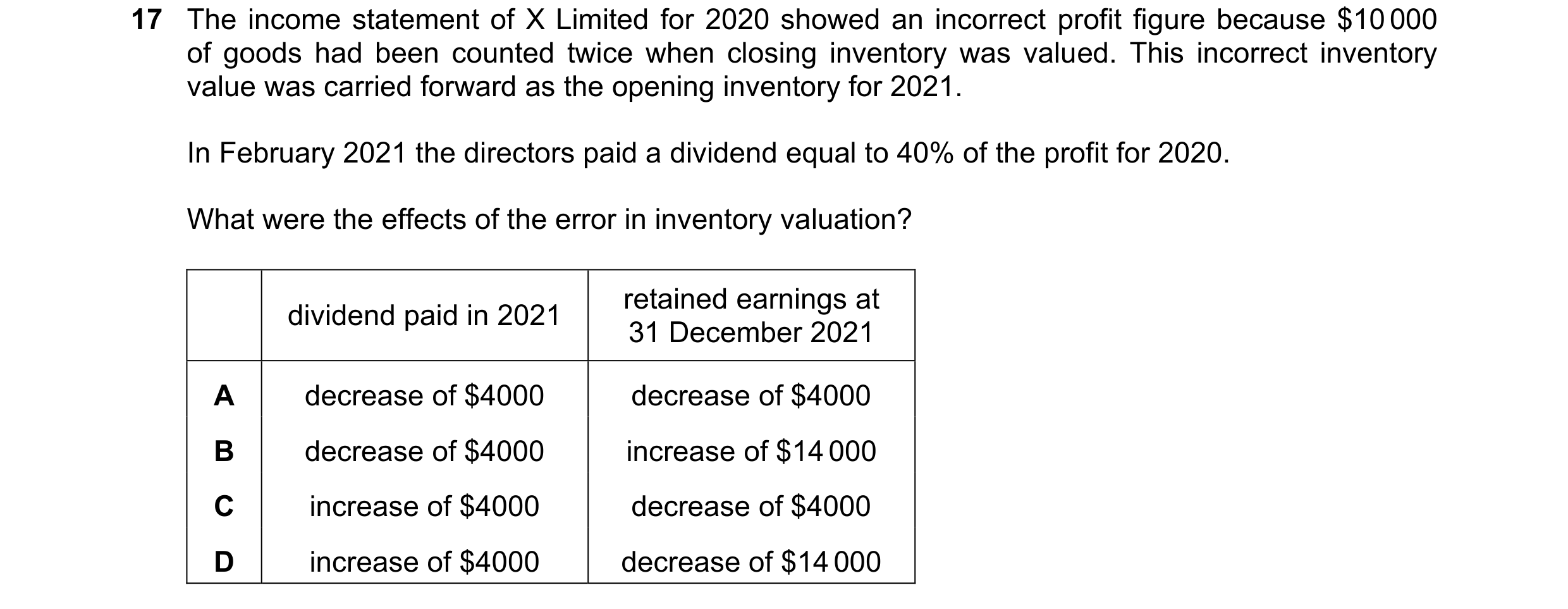
Q40 · The income statement of X Limited for 2020 showed an incorrect profit figure because $10… 9706/11 May/June 2021
17 The income statement of X Limited for 2020 showed an incorrect profit figure because $10 000 of goods had been counted twice when closing inventory was valued. This incorrect inventory value was carried forward as the opening inventory for 2021. In February 2021 the directors paid a dividend equal to 40% of the profit for 2020. What were the effects of the error in inventory valuation? retained earnings at dividend paid in 2021 31 December 2021 A decrease of $4000 decrease of $4000 B decrease of $4000 increase of $14 000 C increase of $4000 decrease of $4000 D increase of $4000 decrease of $14 000
1 marks
Answer: C
This question in 9706/11 May/June 2021
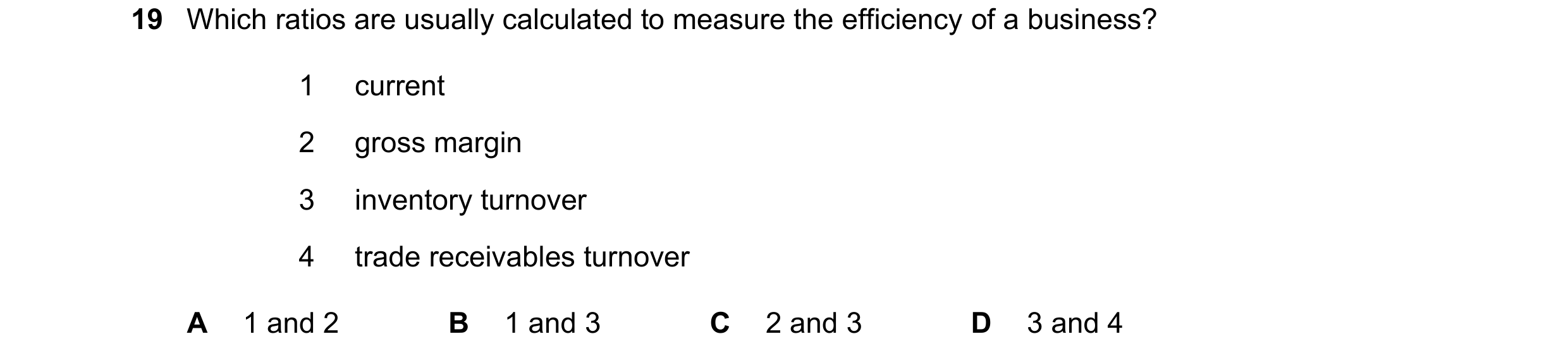
Q41 · Which ratios are usually calculated to measure the efficiency of a business? 9706/11 May/June 2021
19 Which ratios are usually calculated to measure the efficiency of a business? 1 current 2 gross margin 3 inventory turnover 4 trade receivables turnover A 1 and 2 B 1 and 3 C 2 and 3 D 3 and 4
1 marks
Answer: D
This question in 9706/11 May/June 2021
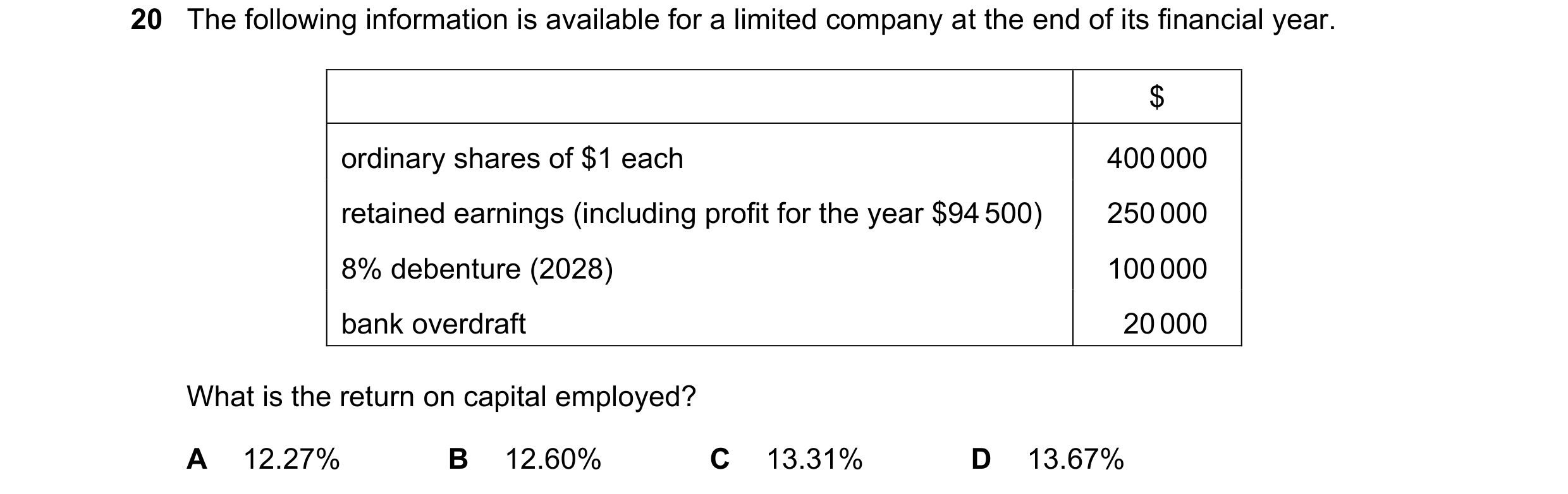
Q42 · The following information is available for a limited company at the end of its financial… 9706/11 May/June 2021
20 The following information is available for a limited company at the end of its financial year. $ ordinary shares of $1 each 400 000 retained earnings (including profit for the year $94 500) 250 000 8% debenture (2028) 100 000 bank overdraft 20 000 What is the return on capital employed? A 12.27% B 12.60% C 13.31% D 13.67%
1 marks
Answer: D
This question in 9706/11 May/June 2021
Q43 · In 2019 a company’s non-current asset turnover ratio was = 3.96 times 9706/12 May/June 2021
19 In 2019 a company’s non-current asset turnover ratio was = 3.96 times. $ 510 0 During 2020 the following took place. 1 Net revenue was unchanged. 2 Discount allowed increased by $400. 3 Depreciation was $1000. 4 Purchases of non-current assets amounted to $1300. What was the non-current asset turnover ratio in 2020? A 3.09 times B 3.16 times C 3.67 times D 3.74 times
1 marks
Answer: D
This question in 9706/12 May/June 2021
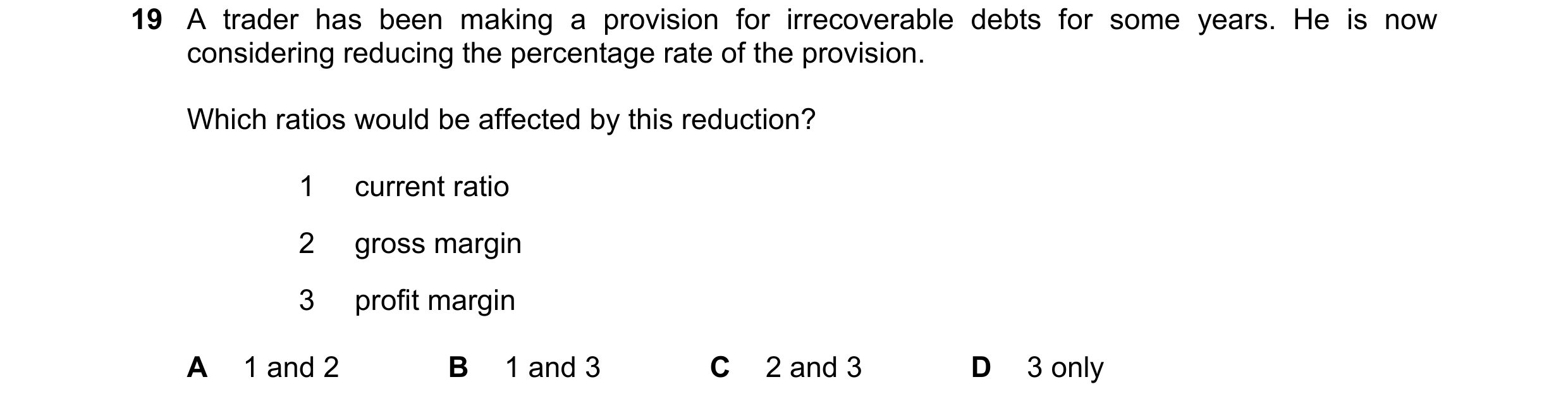
Q44 · A trader has been making a provision for irrecoverable debts for some years 9706/13 May/June 2021
19 A trader has been making a provision for irrecoverable debts for some years. He is now considering reducing the percentage rate of the provision. Which ratios would be affected by this reduction? 1 current ratio 2 gross margin 3 profit margin A 1 and 2 B 1 and 3 C 2 and 3 D 3 only
1 marks
Answer: B
This question in 9706/13 May/June 2021
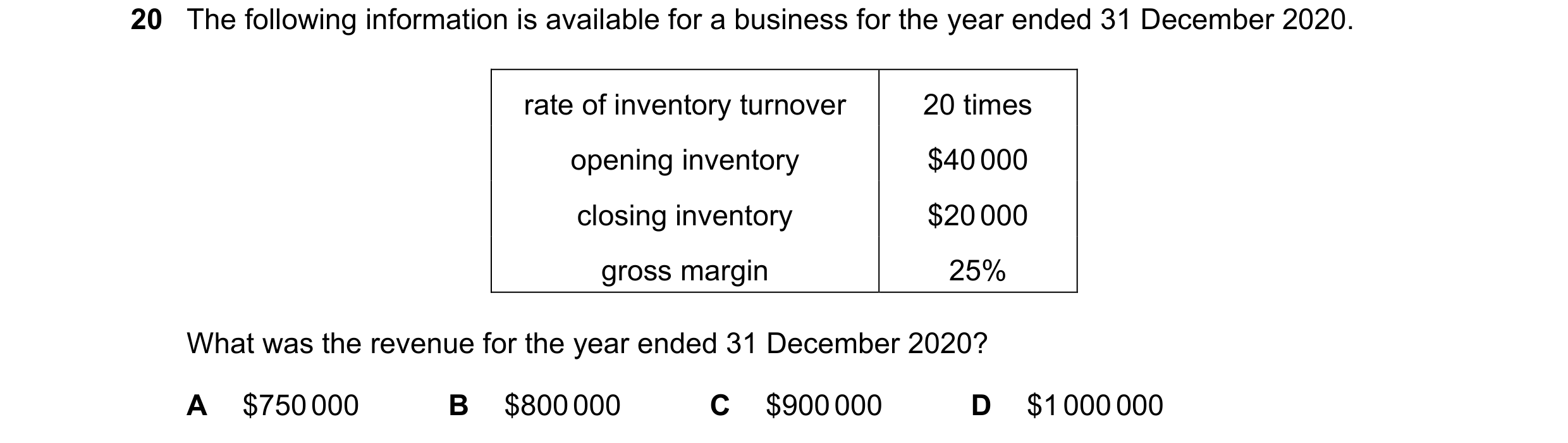
Q45 · The following information is available for a business for the year ended 31 December 2020 9706/13 May/June 2021
20 The following information is available for a business for the year ended 31 December 2020. rate of inventory turnover 20 times opening inventory $40 000 closing inventory $20 000 gross margin 25% What was the revenue for the year ended 31 December 2020? A $750 000 B $800 000 C $900 000 D $1 000 000
1 marks
Answer: B
This question in 9706/13 May/June 2021
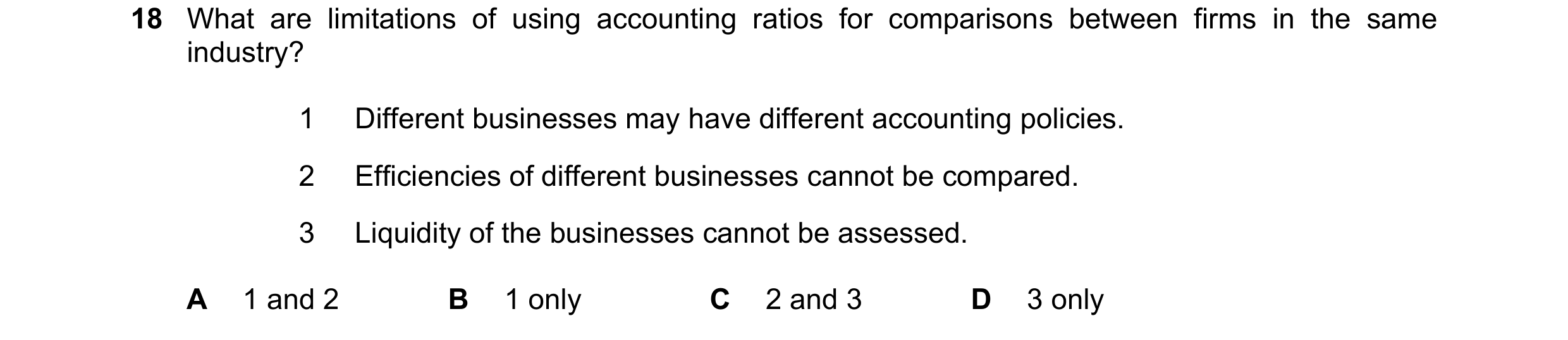
Q46 · What are limitations of using accounting ratios for comparisons between firms in the same… 9706/11 Oct/Nov 2021
18 What are limitations of using accounting ratios for comparisons between firms in the same industry? 1 Different businesses may have different accounting policies. 2 Efficiencies of different businesses cannot be compared. 3 Liquidity of the businesses cannot be assessed. A 1 and 2 B 1 only C 2 and 3 D 3 only
1 marks
Answer: B
This question in 9706/11 Oct/Nov 2021
Q47 · The non-current asset turnover of a business improved between 2020 and 2021, even though… 9706/12 Oct/Nov 2021
19 The non-current asset turnover of a business improved between 2020 and 2021, even though the net revenue was the same for both years. What caused the improvement in the ratio? A a reduction in the level of irrecoverable debts being incurred B an upwards revaluation of the premises at the year end C depreciation charged being higher than the cost of new non-current assets D purchases of new non-current assets being greater than disposals
1 marks
Answer: C
This question in 9706/12 Oct/Nov 2021
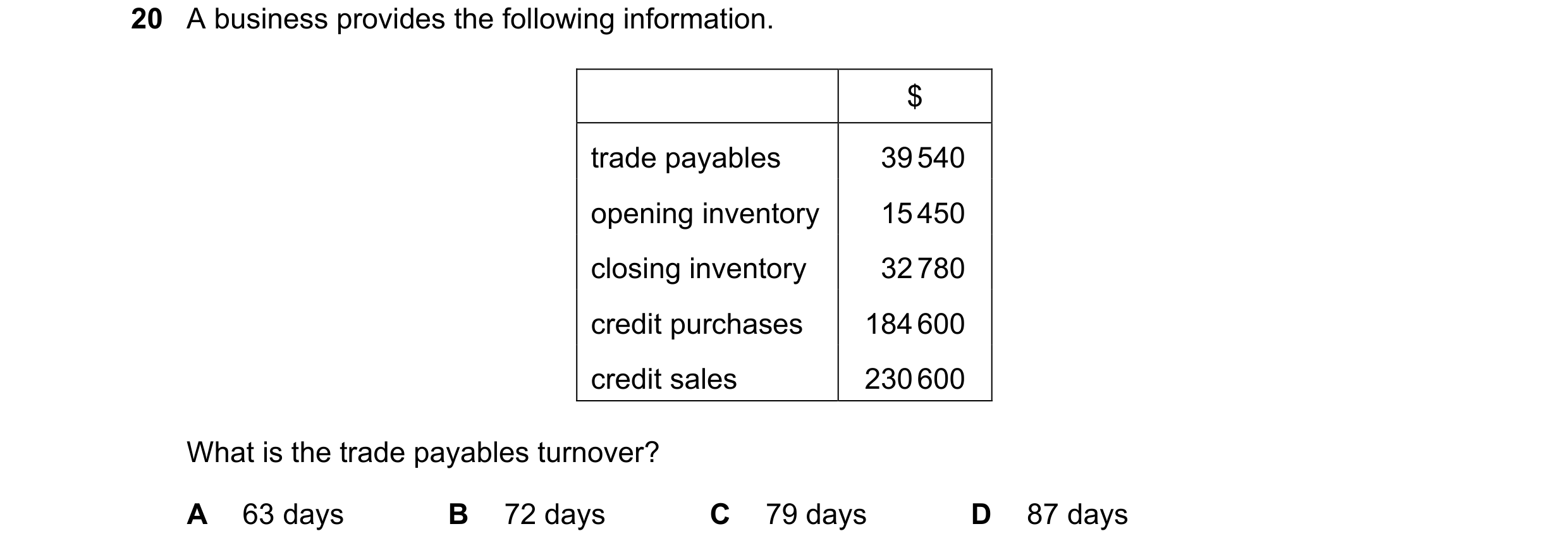
Q48 · A business provides the following information 9706/12 Oct/Nov 2021
20 A business provides the following information. $ trade payables 39 540 opening inventory 15 450 closing inventory 32 780 credit purchases 184 600 credit sales 230 600 What is the trade payables turnover? A 63 days B 72 days C 79 days D 87 days
1 marks
Answer: C
This question in 9706/12 Oct/Nov 2021
Q49 · What might cause a decrease in a company’s non-current asset turnover? 9706/12 Feb/March 2022
20 What might cause a decrease in a company’s non-current asset turnover? A increase in expenses B increase in sales revenue C purchase of new non-current assets D selling non-current assets
1 marks
Answer: C
This question in 9706/12 Feb/March 2022
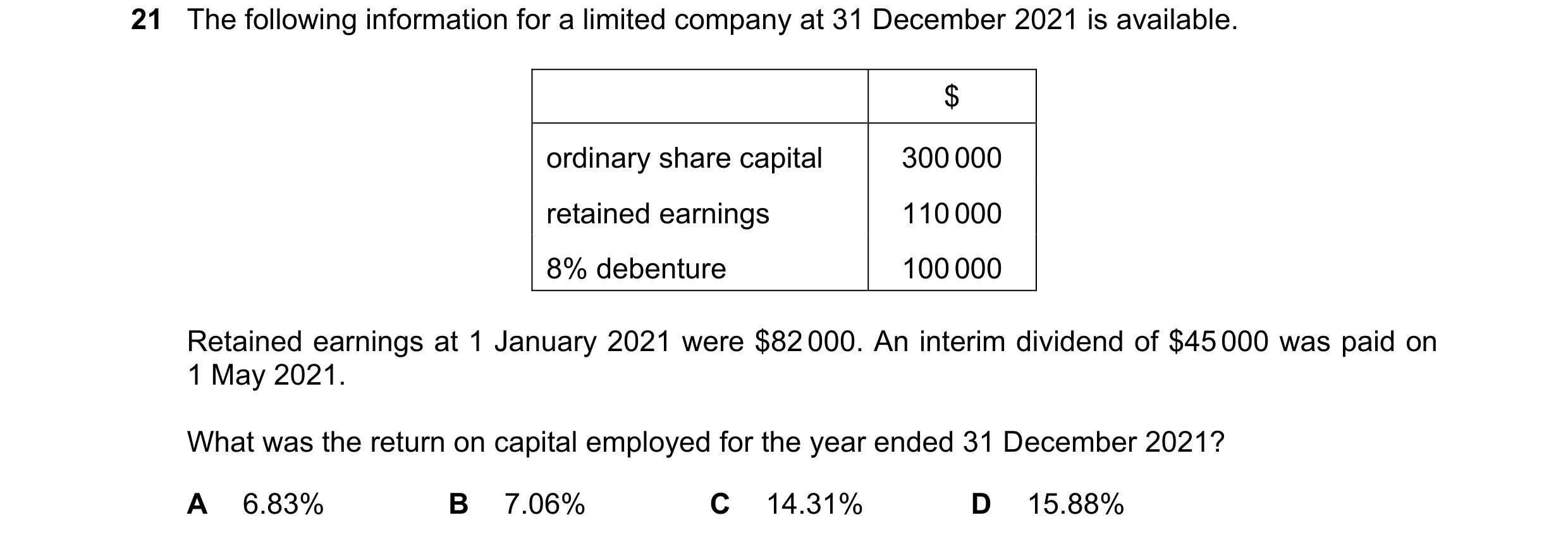
Q50 · The following information for a limited company at 31 December 2021 is available 9706/12 Feb/March 2022
21 The following information for a limited company at 31 December 2021 is available. $ ordinary share capital 300 000 retained earnings 110 000 8% debenture 100 000 Retained earnings at 1 January 2021 were $82 000. An interim dividend of $45 000 was paid on 1 May 2021. What was the return on capital employed for the year ended 31 December 2021? A 6.83% B 7.06% C 14.31% D 15.88%
1 marks
Answer: D
This question in 9706/12 Feb/March 2022
Q51 · Which ratios are efficiency ratios? 9706/11 May/June 2022
19 Which ratios are efficiency ratios? 1 expenses to revenue ratio 2 inventory turnover 3 non-current asset turnover 4 return on capital employed A 1 and 2 B 2 and 3 C 3 and 4 D 4 only
1 marks
Answer: B
This question in 9706/11 May/June 2022
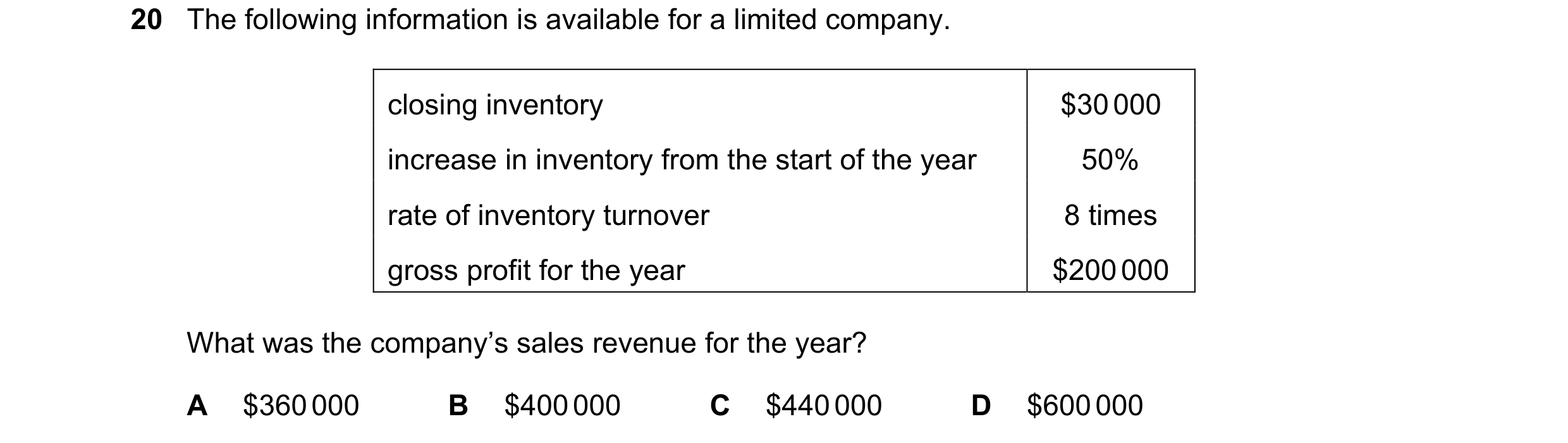
Q52 · The following information is available for a limited company 9706/11 May/June 2022
20 The following information is available for a limited company. closing inventory $30 000 increase in inventory from the start of the year 50% rate of inventory turnover 8 times gross profit for the year $200 000 What was the company’s sales revenue for the year? A $360 000 B $400 000 C $440 000 D $600 000
1 marks
Answer: B
This question in 9706/11 May/June 2022
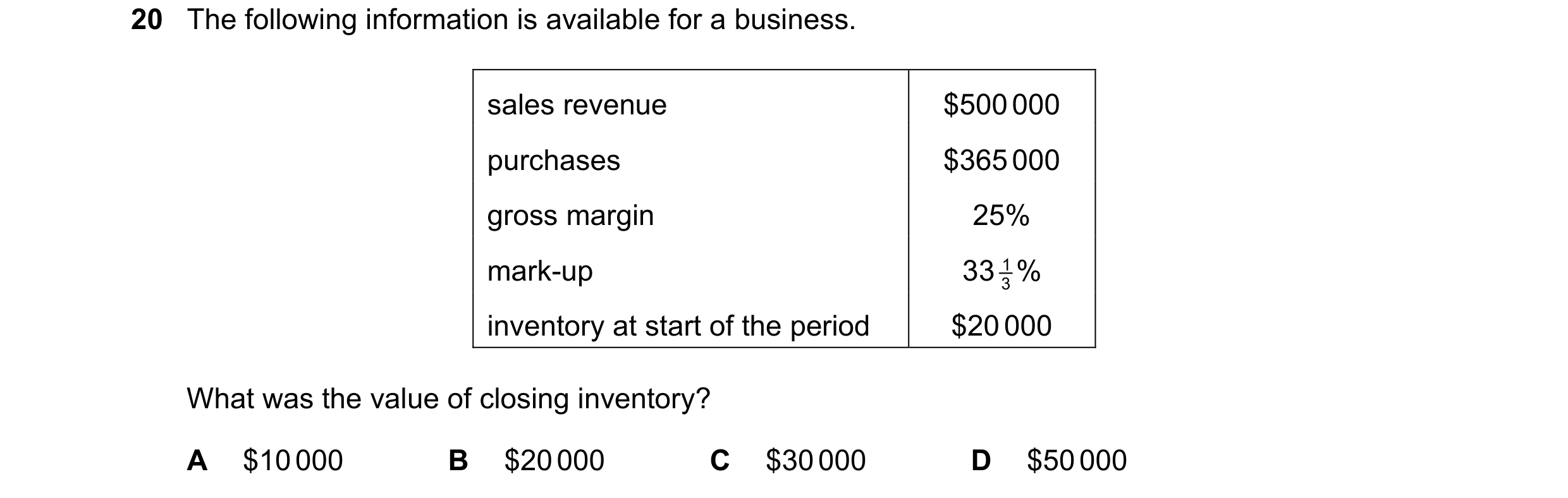
Q53 · The following information is available for a business 9706/12 May/June 2022
20 The following information is available for a business. sales revenue $500 000 purchases $365 000 gross margin 25% mark-up 33 % 1 3 inventory at start of the period $20 000 What was the value of closing inventory? A $10 000 B $20 000 C $30 000 D $50 000
1 marks
Answer: A
This question in 9706/12 May/June 2022
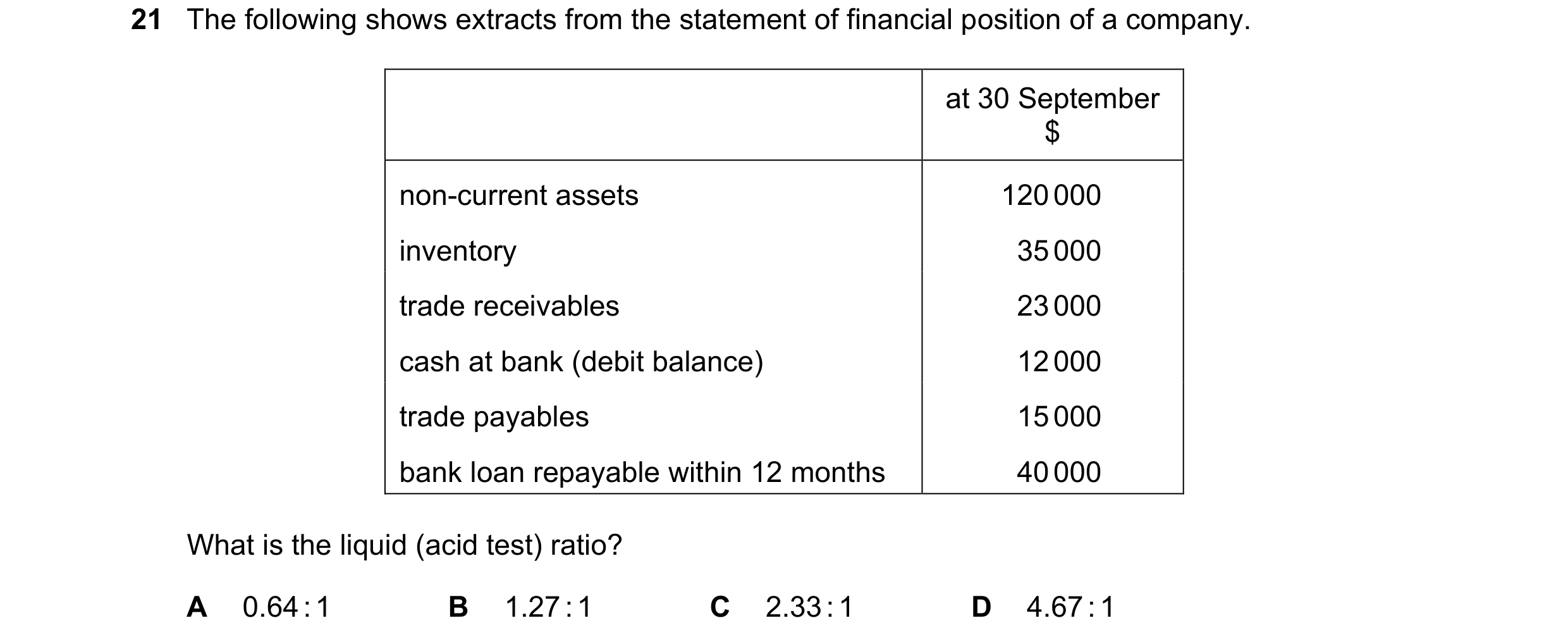
Q54 · The following shows extracts from the statement of financial position of a company 9706/12 May/June 2022
21 The following shows extracts from the statement of financial position of a company. at 30 September $ non-current assets 120 000 inventory 35 000 trade receivables 23 000 cash at bank (debit balance) 12 000 trade payables 15 000 bank loan repayable within 12 months 40 000 What is the liquid (acid test) ratio? A 0.64 : 1 B 1.27 : 1 C 2.33 : 1 D 4.67 : 1
1 marks
Answer: A
This question in 9706/12 May/June 2022
Q55 · What does return on capital employed measure for a business? 9706/11 Oct/Nov 2022
20 What does return on capital employed measure for a business? A efficiency to generate profit from its total assets B efficiency to generate profit from its total liabilities C efficiency to generate profit from its non-current assets D efficiency to generate profit from its shareholders’ equity and non-current liabilities
1 marks
Answer: D
This question in 9706/11 Oct/Nov 2022
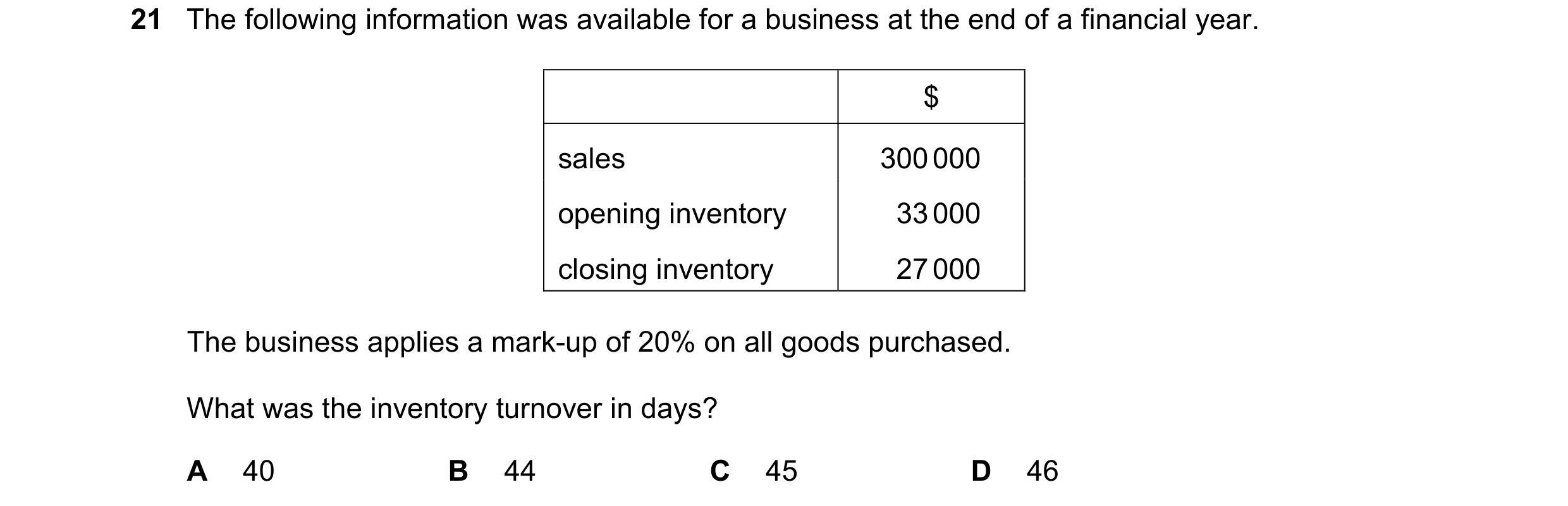
Q56 · The following information was available for a business at the end of a financial year 9706/11 Oct/Nov 2022
21 The following information was available for a business at the end of a financial year. $ sales 300 000 opening inventory 33 000 closing inventory 27 000 The business applies a mark-up of 20% on all goods purchased. What was the inventory turnover in days? A 40 B 44 C 45 D 46
1 marks
Answer: B
This question in 9706/11 Oct/Nov 2022
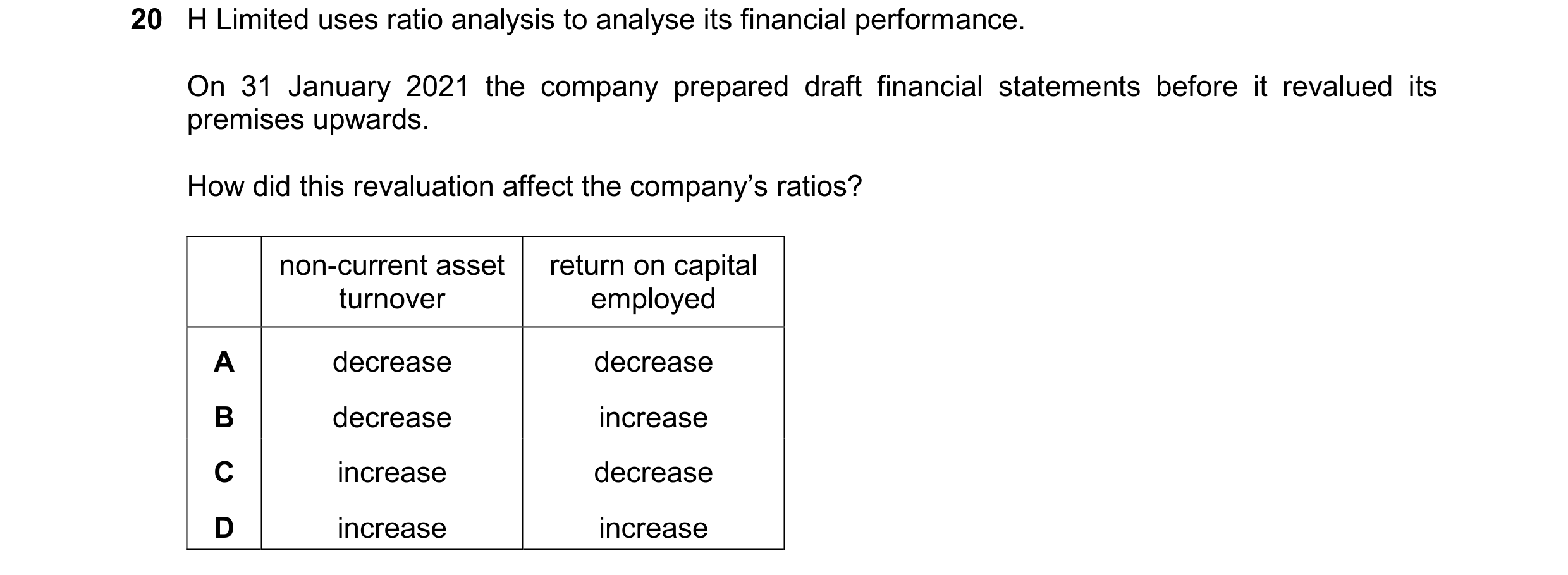
Q57 · H Limited uses ratio analysis to analyse its financial performance 9706/12 Oct/Nov 2022
20 H Limited uses ratio analysis to analyse its financial performance. On 31 January 2021 the company prepared draft financial statements before it revalued its premises upwards. How did this revaluation affect the company’s ratios? non-current asset return on capital turnover employed A decrease decrease B decrease increase C increase decrease D increase increase
1 marks
Answer: A
This question in 9706/12 Oct/Nov 2022
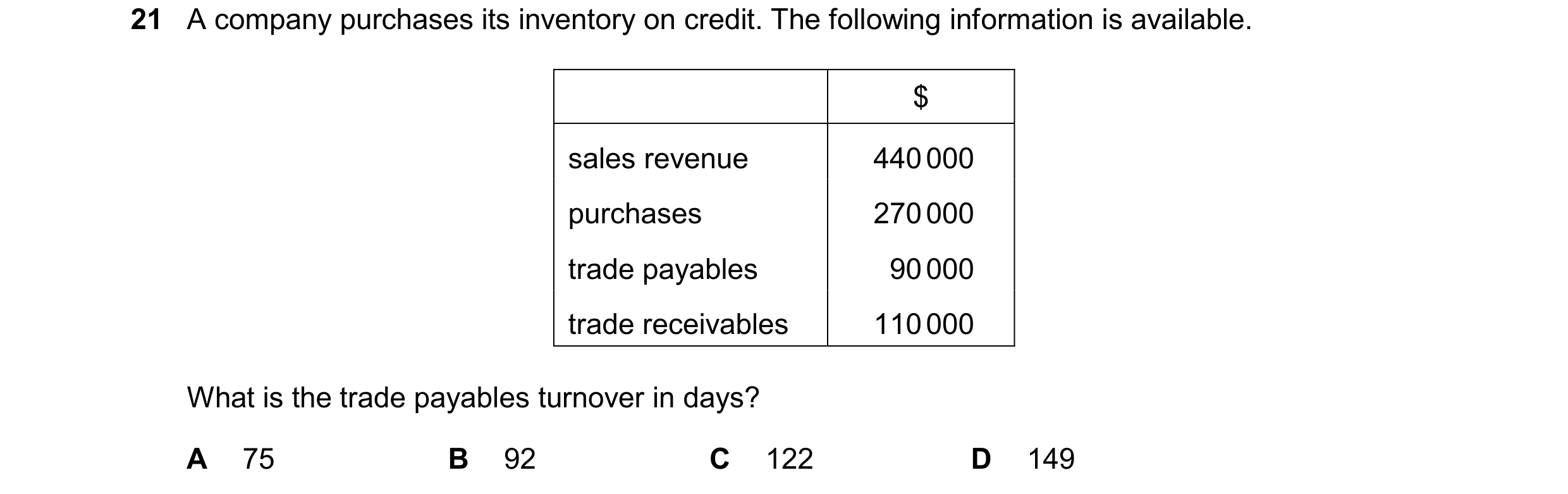
Q58 · A company purchases its inventory on credit 9706/12 Oct/Nov 2022
21 A company purchases its inventory on credit. The following information is available. $ sales revenue 440 000 purchases 270 000 trade payables 90 000 trade receivables 110 000 What is the trade payables turnover in days? A 75 B 92 C 122 D 149
1 marks
Answer: C
This question in 9706/12 Oct/Nov 2022
Q59 · The year-end statement of financial position of X Limited at 31 December shows the… 9706/12 Feb/March 2023
21 The year-end statement of financial position of X Limited at 31 December shows the following: $000 non-current assets 1350 current assets 140 ordinary share capital 900 general reserve 150 long-term loan 200 current liabilities 90 retained earnings 150 The profit from operations for the year was $65 000 and finance costs were $20 000. What was the return on capital employed for the year? A 3.21% B 4.64% C 5.7% D 5.91%
1 marks
Answer: B
This question in 9706/12 Feb/March 2023
Q60 · Which statements describe the usefulness of cost–volume–profit analysis? 9706/12 Feb/March 2023
30 Which statements describe the usefulness of cost–volume–profit analysis? 1 to see the relationship between costs and revenue at different levels of activity 2 to set the selling price of a product to achieve targeted profit 3 to set the selling prices for a variety of products A 1, 2 and 3 B 1 and 2 only C 1 and 3 only D 2 and 3 only
1 marks
Answer: B
This question in 9706/12 Feb/March 2023
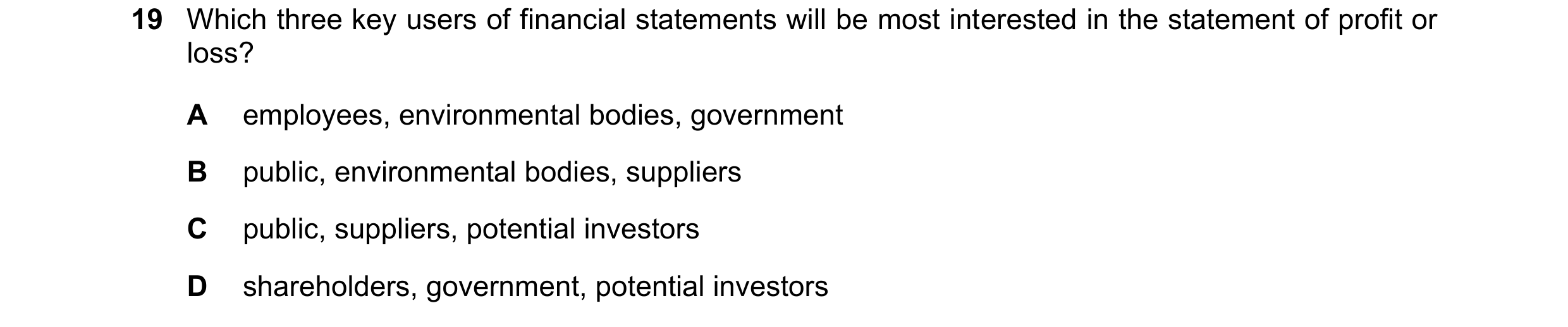
Q61 · Which three key users of financial statements will be most interested in the statement of… 9706/12 May/June 2023
19 Which three key users of financial statements will be most interested in the statement of profit or loss? A employees, environmental bodies, government B public, environmental bodies, suppliers C public, suppliers, potential investors D shareholders, government, potential investors
1 marks
Answer: D
This question in 9706/12 May/June 2023
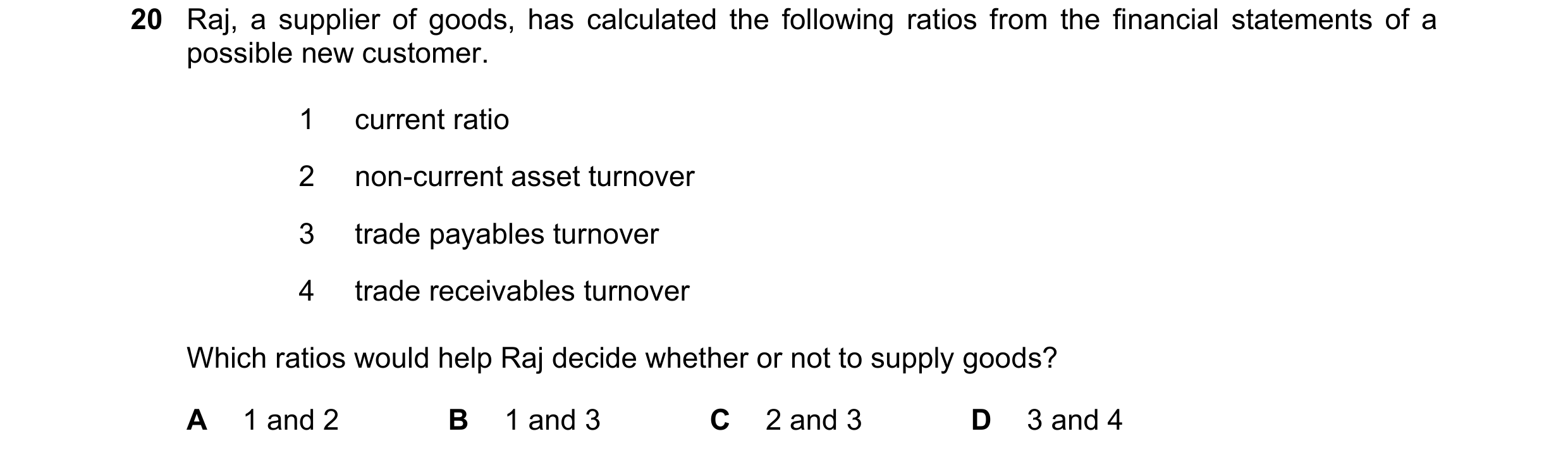
Q62 · Raj, a supplier of goods, has calculated the following ratios from the financial… 9706/12 May/June 2023
20 Raj, a supplier of goods, has calculated the following ratios from the financial statements of a possible new customer. 1 current ratio 2 non-current asset turnover 3 trade payables turnover 4 trade receivables turnover Which ratios would help Raj decide whether or not to supply goods? A 1 and 2 B 1 and 3 C 2 and 3 D 3 and 4
1 marks
Answer: B
This question in 9706/12 May/June 2023
Q63 · The following information is available for a business for the year ended 31 December 9706/12 May/June 2023
21 The following information is available for a business for the year ended 31 December. $000 revenue 800 purchases 600 owing to credit suppliers 46 owed by credit customers 58 90% of revenue is from credit sales. 80% of purchases are on credit terms. What is the trade payables turnover? A 23 days B 28 days C 35 days D 45 days
1 marks
Answer: C
This question in 9706/12 May/June 2023
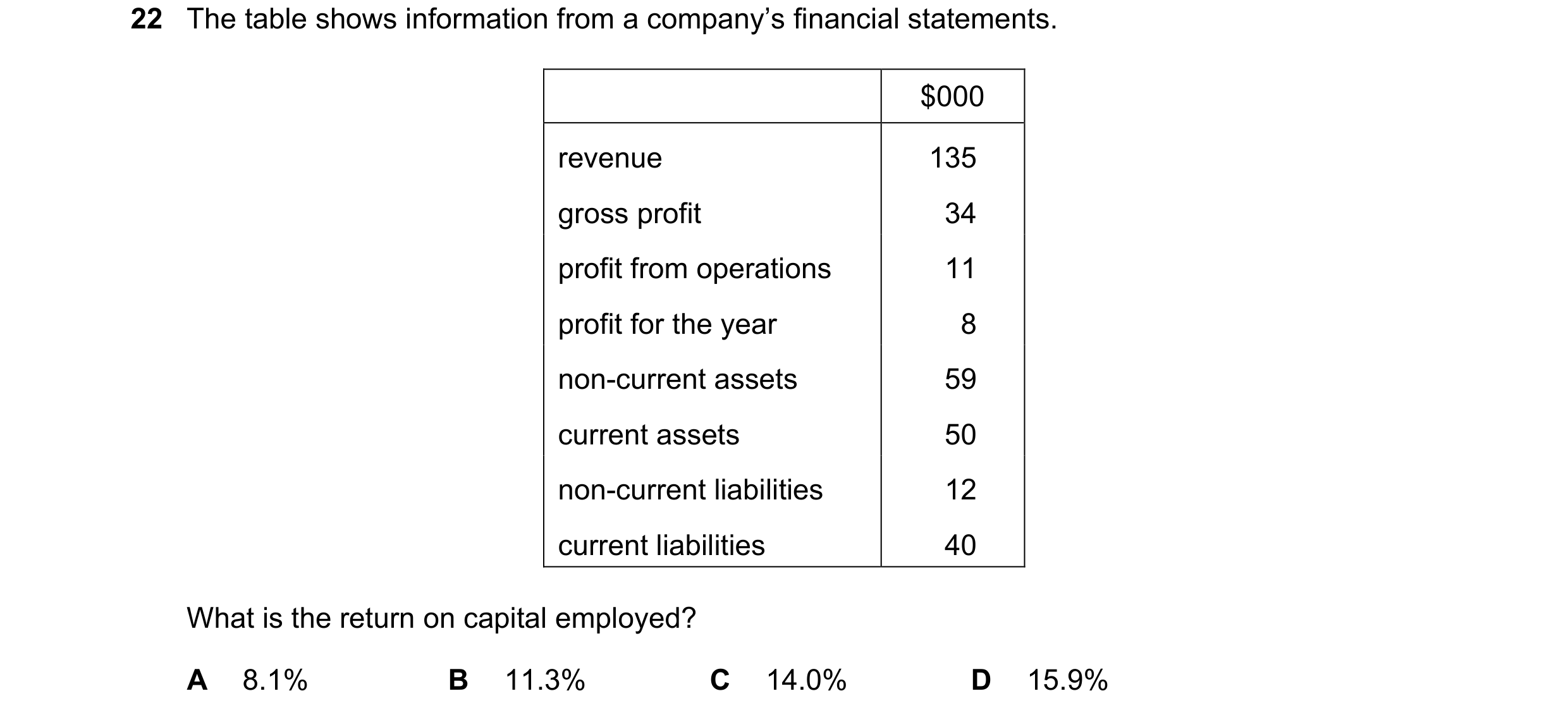
Q64 · The table shows information from a company’s financial statements 9706/12 May/June 2023
22 The table shows information from a company’s financial statements. $000 revenue 135 gross profit 34 profit from operations 11 profit for the year 8 non-current assets 59 current assets 50 non-current liabilities 12 current liabilities 40 What is the return on capital employed? A 8.1% B 11.3% C 14.0% D 15.9%
1 marks
Answer: D
This question in 9706/12 May/June 2023
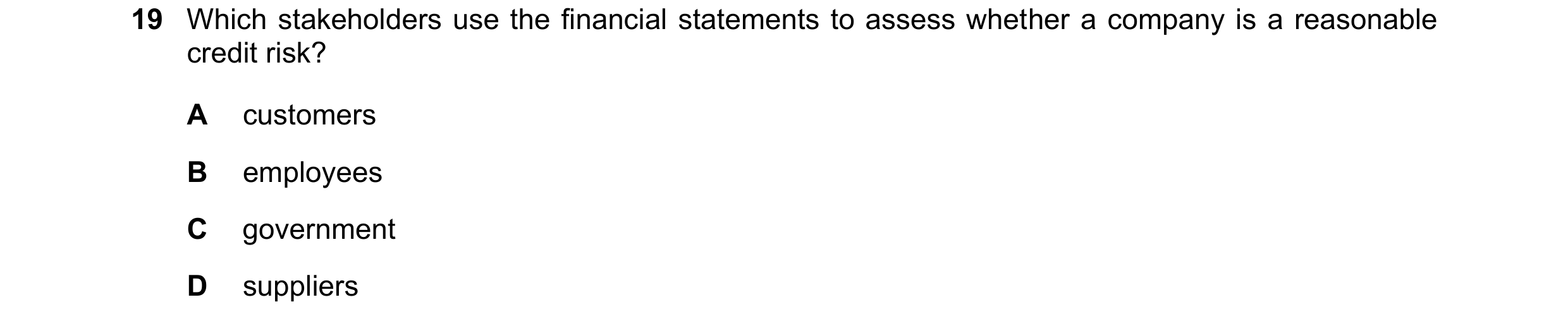
Q65 · Which stakeholders use the financial statements to assess whether a company is a… 9706/13 May/June 2023
19 Which stakeholders use the financial statements to assess whether a company is a reasonable credit risk? A customers B employees C government D suppliers
1 marks
Answer: D
This question in 9706/13 May/June 2023
Q66 · Which statements describe the limitations of accounting information? 9706/13 May/June 2023
20 Which statements describe the limitations of accounting information? 1 Businesses in the same industry may use different accounting policies. 2 Non-monetary aspects of a business are excluded from financial statements. 3 Results of accounting ratios are based on the use of historic cost. A 1, 2 and 3 B 1 and 2 only C 1 and 3 only D 2 and 3 only
1 marks
Answer: A
This question in 9706/13 May/June 2023
Q67 · A company provided the following information at the end of its first year of trading 9706/13 May/June 2023
21 A company provided the following information at the end of its first year of trading. $ cash sales 9 000 credit sales 27 000 receipts from credit customers 24 000 trade receivables at year end 4 100 What was the trade receivables turnover? A 42 days B 46 days C 56 days D 63 days
1 marks
Answer: C
This question in 9706/13 May/June 2023
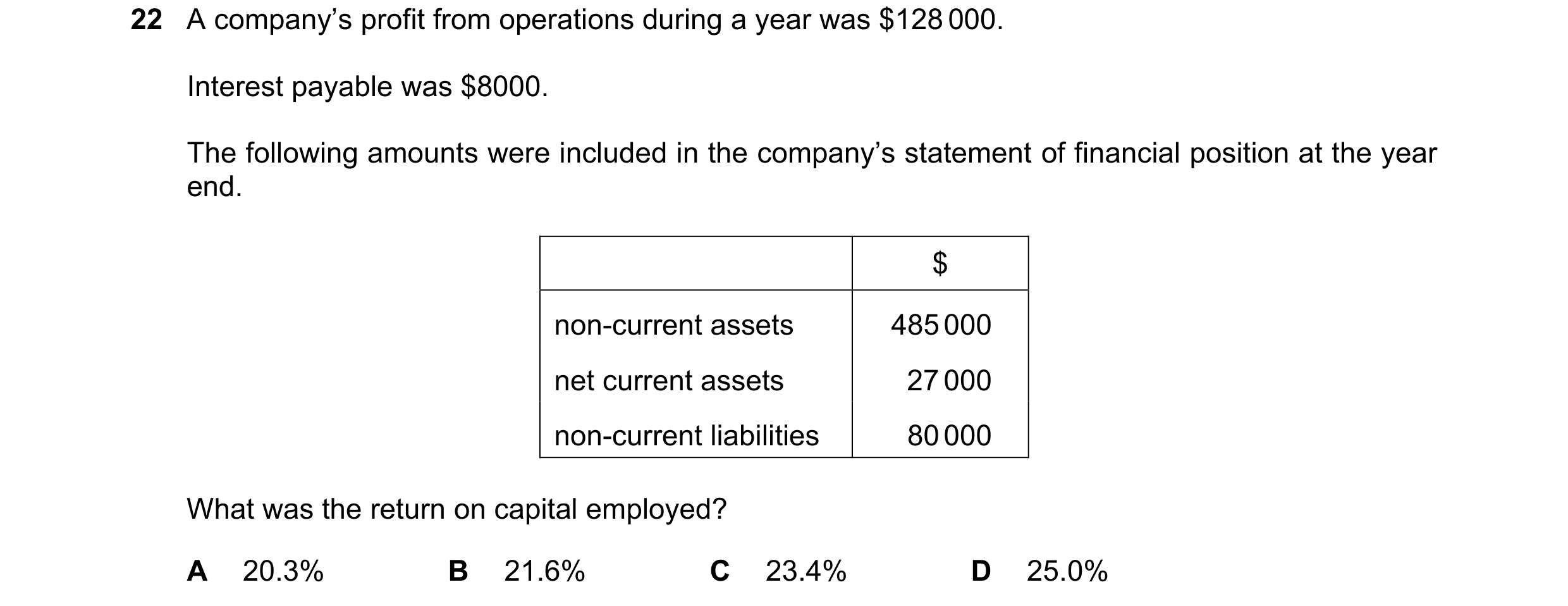
Q68 · A company’s profit from operations during a year was $128 000 9706/13 May/June 2023
22 A company’s profit from operations during a year was $128 000. Interest payable was $8000. The following amounts were included in the company’s statement of financial position at the year end. $ non-current assets 485 000 net current assets 27 000 non-current liabilities 80 000 What was the return on capital employed? A 20.3% B 21.6% C 23.4% D 25.0%
1 marks
Answer: D
This question in 9706/13 May/June 2023
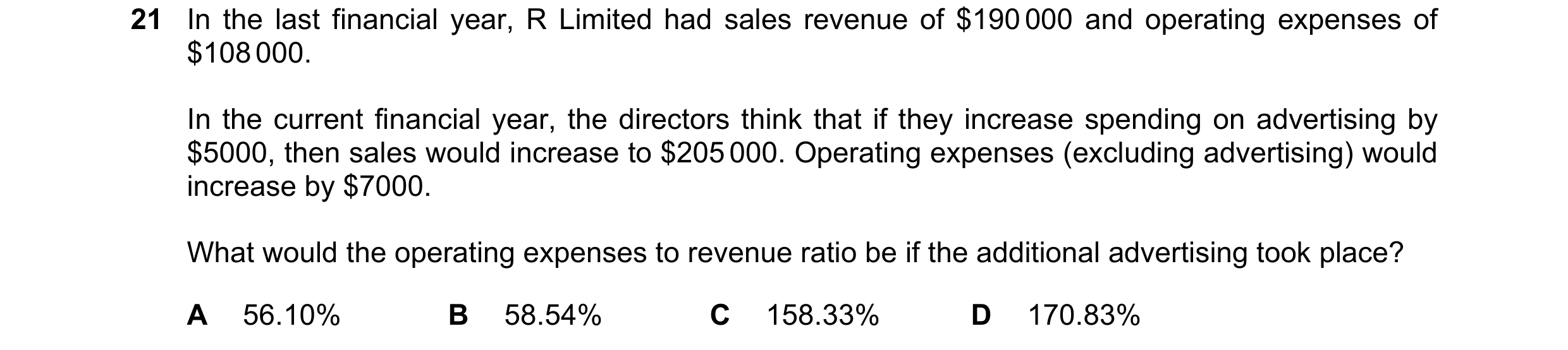
Q69 · In the last financial year, R Limited had sales revenue of $190 000 and operating… 9706/13 Oct/Nov 2023
21 In the last financial year, R Limited had sales revenue of $190 000 and operating expenses of $108 000. In the current financial year, the directors think that if they increase spending on advertising by $5000, then sales would increase to $205 000. Operating expenses (excluding advertising) would increase by $7000. What would the operating expenses to revenue ratio be if the additional advertising took place? A 56.10% B 58.54% C 158.33% D 170.83%
1 marks
Answer: B
This question in 9706/13 Oct/Nov 2023
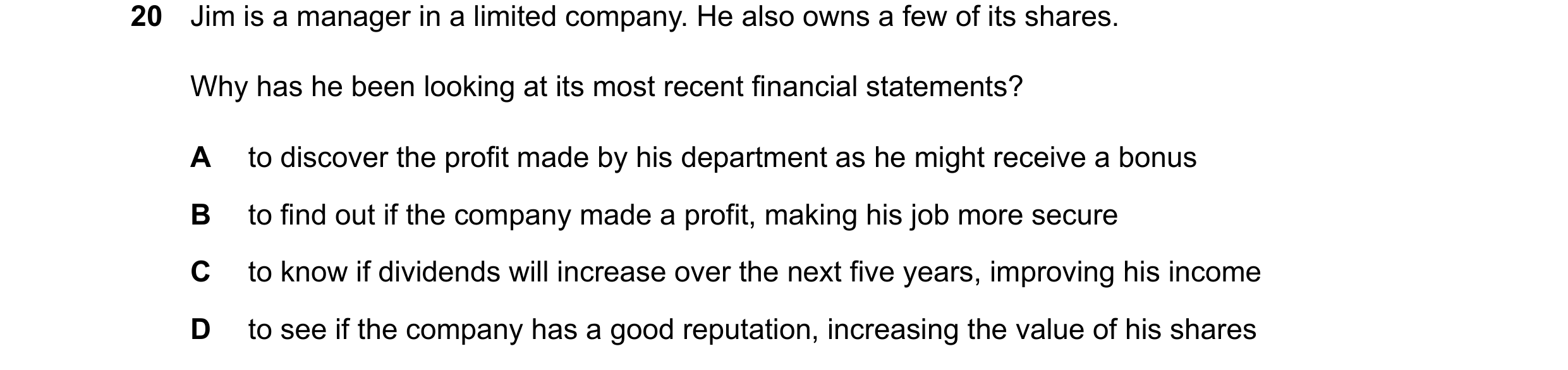
Q70 · Jim is a manager in a limited company 9706/12 Feb/March 2024
20 Jim is a manager in a limited company. He also owns a few of its shares. Why has he been looking at its most recent financial statements? A to discover the profit made by his department as he might receive a bonus B to find out if the company made a profit, making his job more secure C to know if dividends will increase over the next five years, improving his income D to see if the company has a good reputation, increasing the value of his shares
1 marks
Answer: B
This question in 9706/12 Feb/March 2024
Q71 · H Limited’s cost of sales for the recent two years (Year 2 and Year 1) is as follows… 9706/12 Feb/March 2024
21 H Limited’s cost of sales for the recent two years (Year 2 and Year 1) is as follows: Year 2 Year 1 $ $ average inventory 100 000 65 000 credit purchases 910 000 760 000 cost of sales 850 000 750 000 Which statement regarding the efficiency of inventory turnover is correct? A Year 2 is better because the average inventory is higher. B Year 2 is better because the inventory turnover (in days) is higher. C Year 2 is worse because the cost of sales is higher. D Year 2 is worse because the inventory turnover (in days) is higher.
1 marks
Answer: D
This question in 9706/12 Feb/March 2024
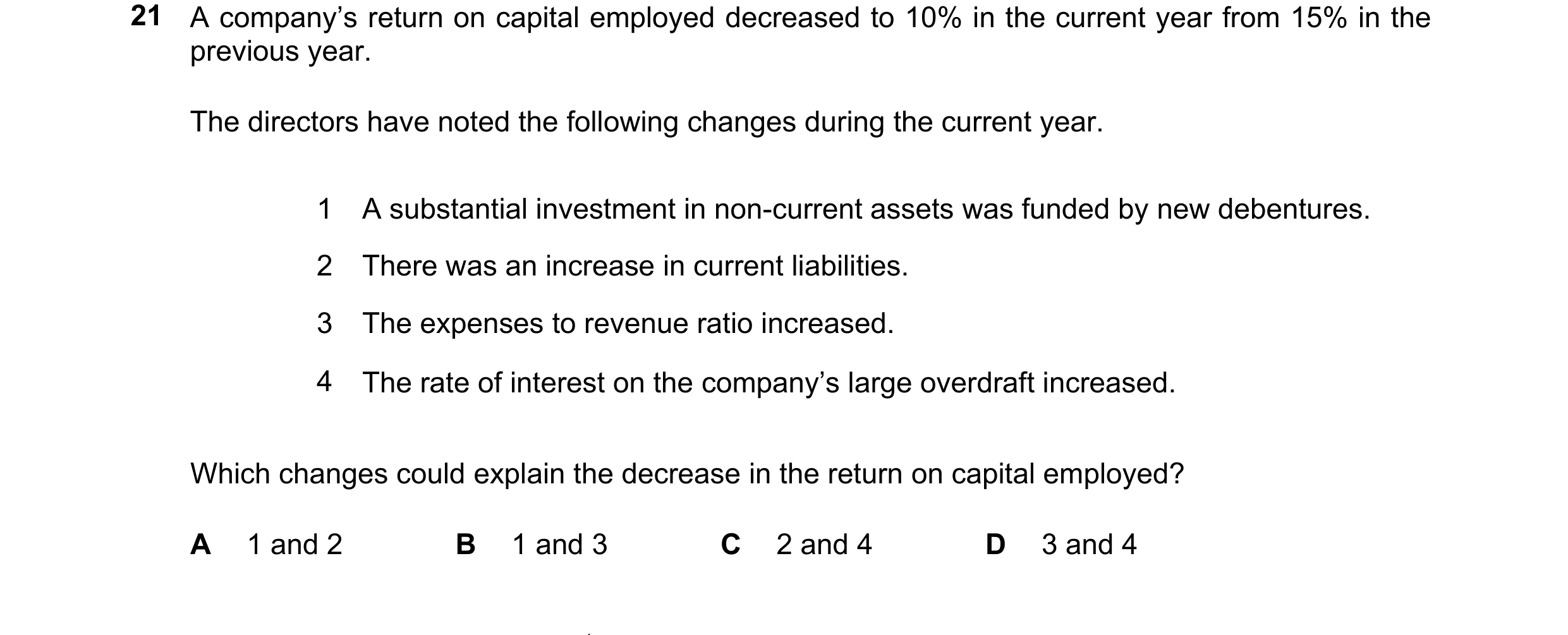
Q72 · A company’s return on capital employed decreased to 10% in the current year from 15% in… 9706/12 Oct/Nov 2024
21 A company’s return on capital employed decreased to 10% in the current year from 15% in the previous year. The directors have noted the following changes during the current year. 1 A substantial investment in non-current assets was funded by new debentures. 2 There was an increase in current liabilities. 3 The expenses to revenue ratio increased. 4 The rate of interest on the company’s large overdraft increased. Which changes could explain the decrease in the return on capital employed? A 1 and 2 B 1 and 3 C 2 and 4 D 3 and 4
1 marks
Answer: B
This question in 9706/12 Oct/Nov 2024
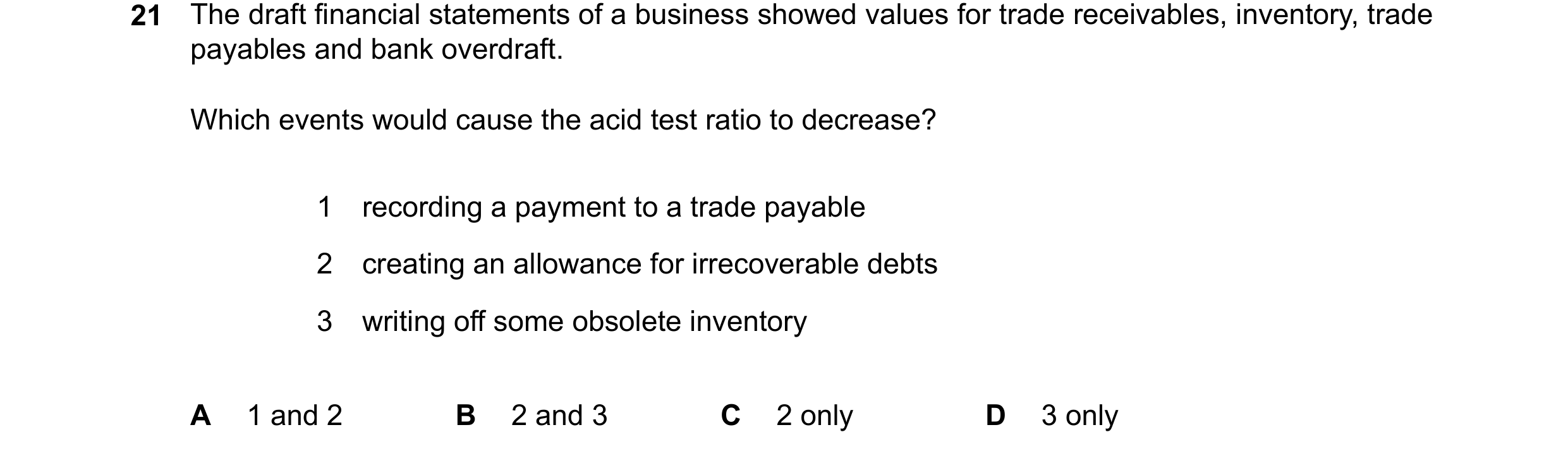
Q73 · The draft financial statements of a business showed values for trade receivables… 9706/13 Oct/Nov 2024
21 The draft financial statements of a business showed values for trade receivables, inventory, trade payables and bank overdraft. Which events would cause the acid test ratio to decrease? 1 recording a payment to a trade payable 2 creating an allowance for irrecoverable debts 3 writing off some obsolete inventory A 1 and 2 B 2 and 3 C 2 only D 3 only
1 marks
Answer: C
This question in 9706/13 Oct/Nov 2024
Q74 · The following information is available about Chi’s business 9706/13 Oct/Nov 2024
22 The following information is available about Chi’s business. $ opening inventory 18000 closing inventory 26000 cost of sales 442000 When calculating his rate of inventory turnover, Chi used closing inventory in error. What was the effect of this error on the rate of inventory turnover? A 3.09 times too high B 3.09 times too low C 7.55 times too high D 7.55 times too low
1 marks
Answer: B
This question in 9706/13 Oct/Nov 2024
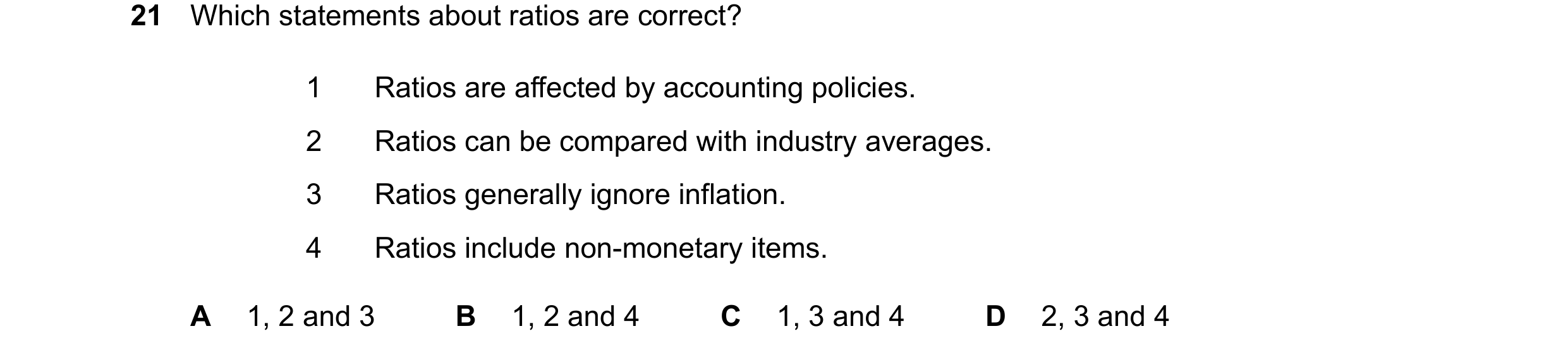
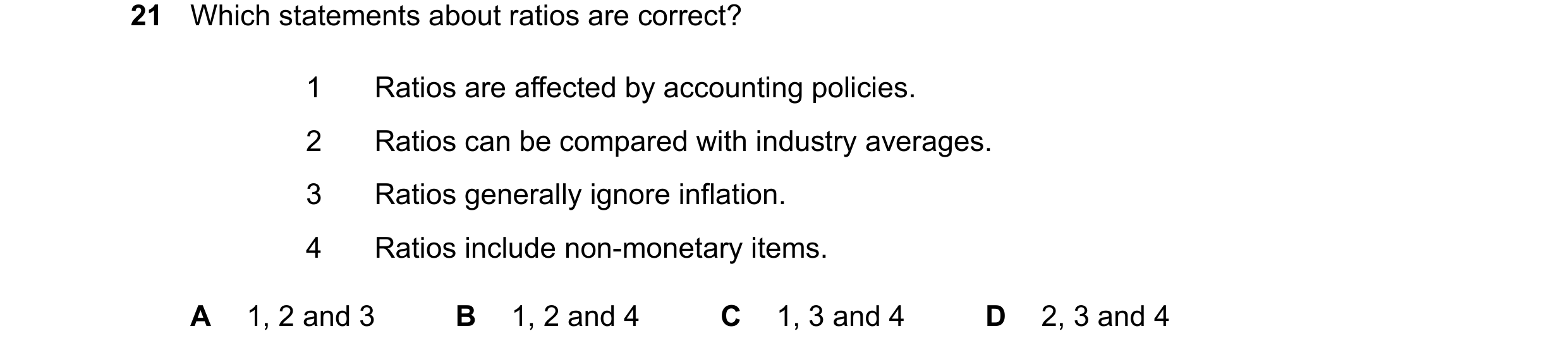
Q75 · Which statements about ratios are correct? 9706/11 May/June 2025
21 Which statements about ratios are correct? 1 Ratios are affected by accounting policies. 2 Ratios can be compared with industry averages. 3 Ratios generally ignore inflation. 4 Ratios include non-monetary items. A 1, 2 and 3 B 1, 2 and 4 C 1, 3 and 4 D 2, 3 and 4
1 marks
Answer: A
This question in 9706/11 May/June 2025
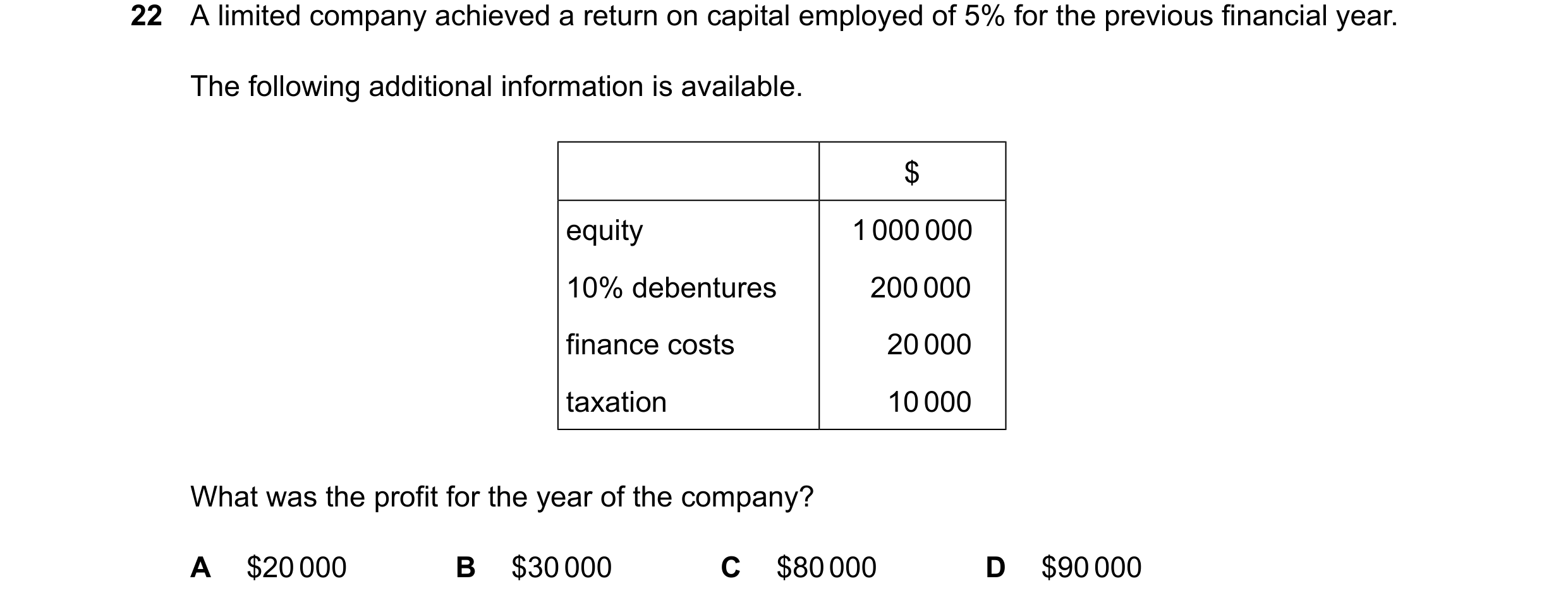
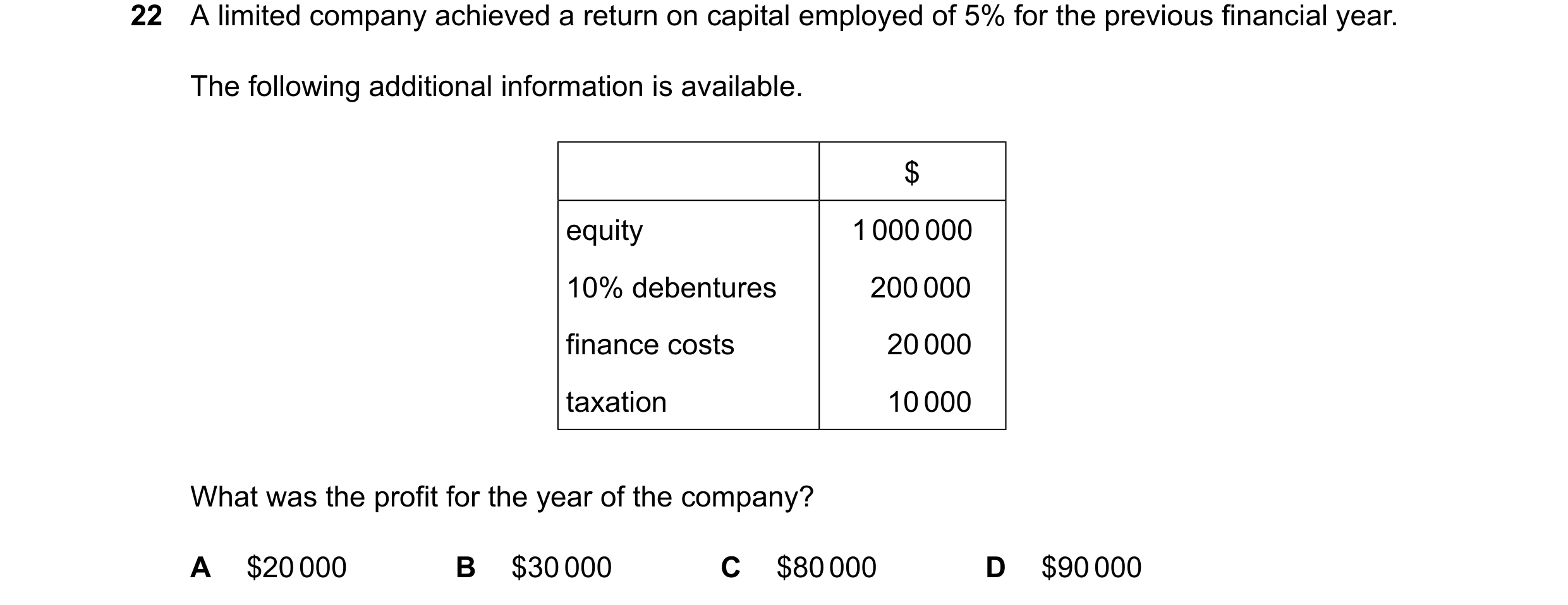
Q76 · A limited company achieved a return on capital employed of 5% for the previous financial… 9706/11 May/June 2025
22 A limited company achieved a return on capital employed of 5% for the previous financial year. The following additional information is available. $ equity 1000000 10% debentures 200000 finance costs 20000 taxation 10000 What was the profit for the year of the company? A $20000 B $30000 C $80000 D $90000
1 marks
Answer: B
This question in 9706/11 May/June 2025
Q77 · A company had the following balances at 31 December 9706/12 May/June 2025
21 A company had the following balances at 31 December. $ inventory 31000 trade receivables 88000 allowance for irrecoverable debts 2000 bank overdraft 9000 cash in hand 5000 The current ratio is 2.5:1. What was the value of trade payables at 31 December? A $38600 B $39800 C $40600 D $57800
1 marks
Answer: B
This question in 9706/12 May/June 2025
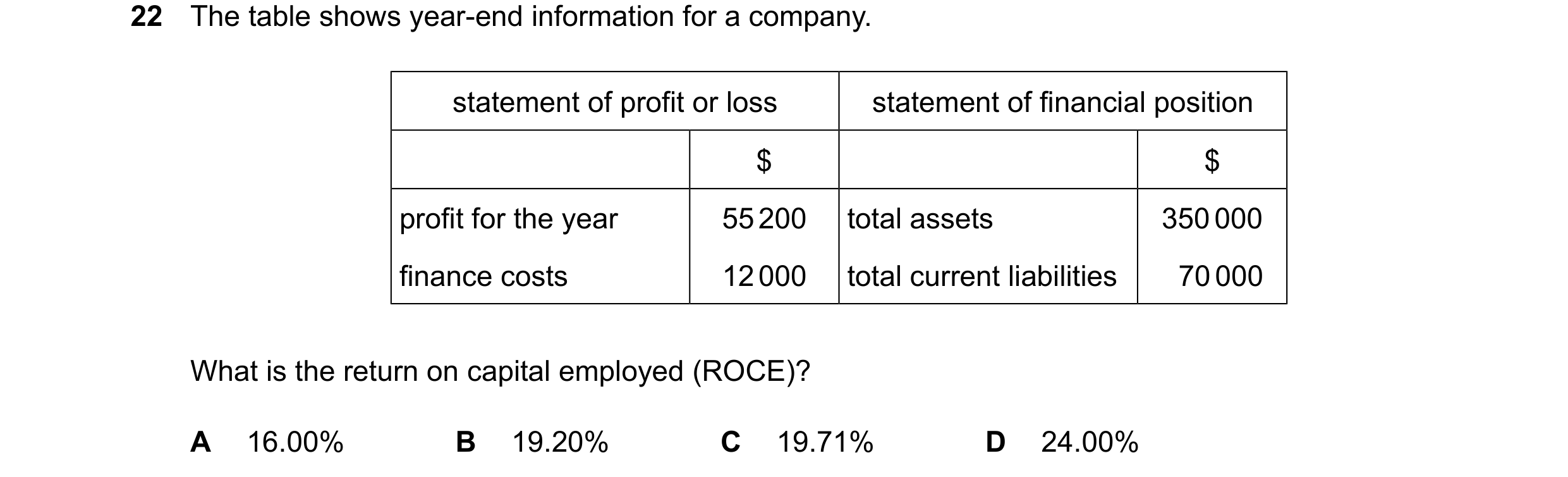
Q78 · The table shows year-end information for a company 9706/12 May/June 2025
22 The table shows year-end information for a company. statement of profit or loss statement of financial position $ $ profit for the year 55200 total assets 350000 finance costs 12000 total current liabilities 70000 What is the return on capital employed (ROCE)? A 16.00% B 19.20% C 19.71% D 24.00%
1 marks
Answer: D
This question in 9706/12 May/June 2025
Q79 · Which statements about ratios are correct? 9706/13 May/June 2025
21 Which statements about ratios are correct? 1 Ratios are affected by accounting policies. 2 Ratios can be compared with industry averages. 3 Ratios generally ignore inflation. 4 Ratios include non-monetary items. A 1, 2 and 3 B 1, 2 and 4 C 1, 3 and 4 D 2, 3 and 4
1 marks
Answer: A
This question in 9706/13 May/June 2025
Q80 · A limited company achieved a return on capital employed of 5% for the previous financial… 9706/13 May/June 2025
22 A limited company achieved a return on capital employed of 5% for the previous financial year. The following additional information is available. $ equity 1000000 10% debentures 200000 finance costs 20000 taxation 10000 What was the profit for the year of the company? A $20000 B $30000 C $80000 D $90000
1 marks
Answer: B
This question in 9706/13 May/June 2025
Q81 · Which stakeholders would focus mainly on the liquidity of a business? 9706/11 Oct/Nov 2025
20 Which stakeholders would focus mainly on the liquidity of a business? 1 government 2 lenders 3 public and environmental bodies 4 suppliers A 1 and 2 B 1 and 4 C 2 and 3 D 2 and 4
1 marks
Answer: D
This question in 9706/11 Oct/Nov 2025
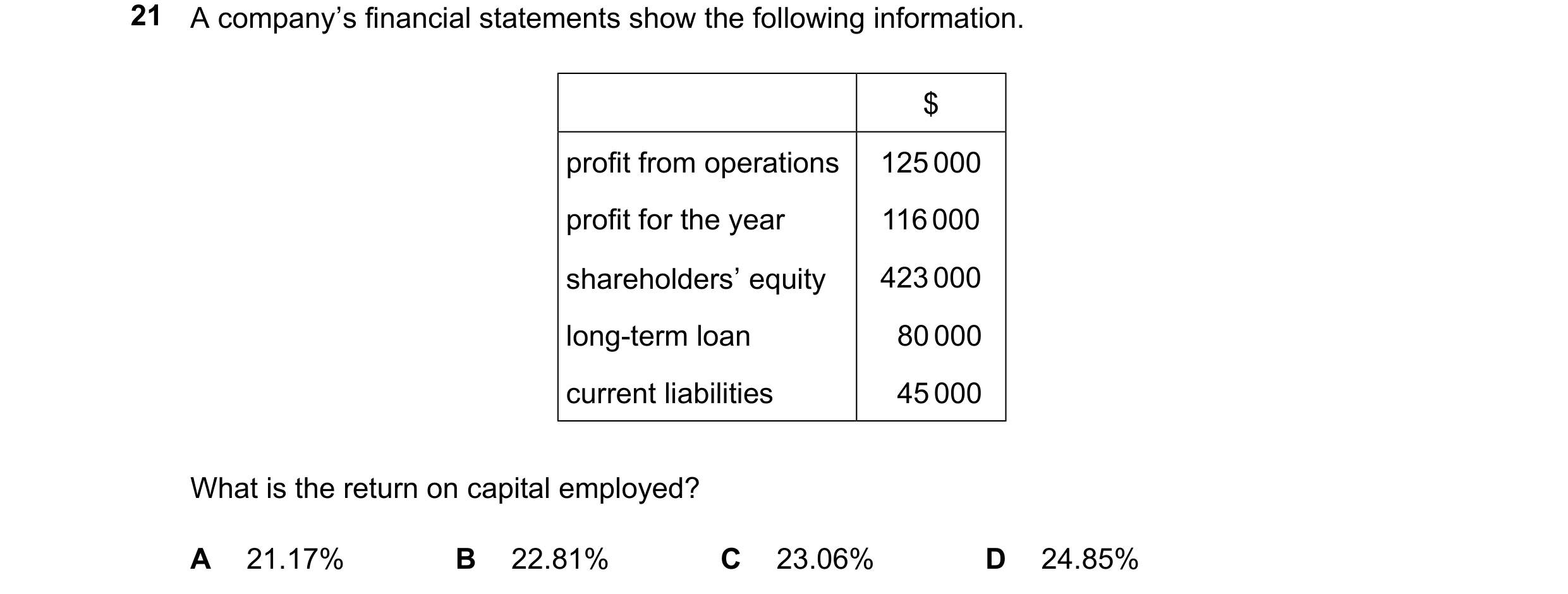
Q82 · A company’s financial statements show the following information 9706/11 Oct/Nov 2025
21 A company’s financial statements show the following information. $ profit from operations 125000 profit for the year 116000 shareholders’ equity 423000 long-term loan 80000 current liabilities 45000 What is the return on capital employed? A 21.17% B 22.81% C 23.06% D 24.85%
1 marks
Answer: D
This question in 9706/11 Oct/Nov 2025
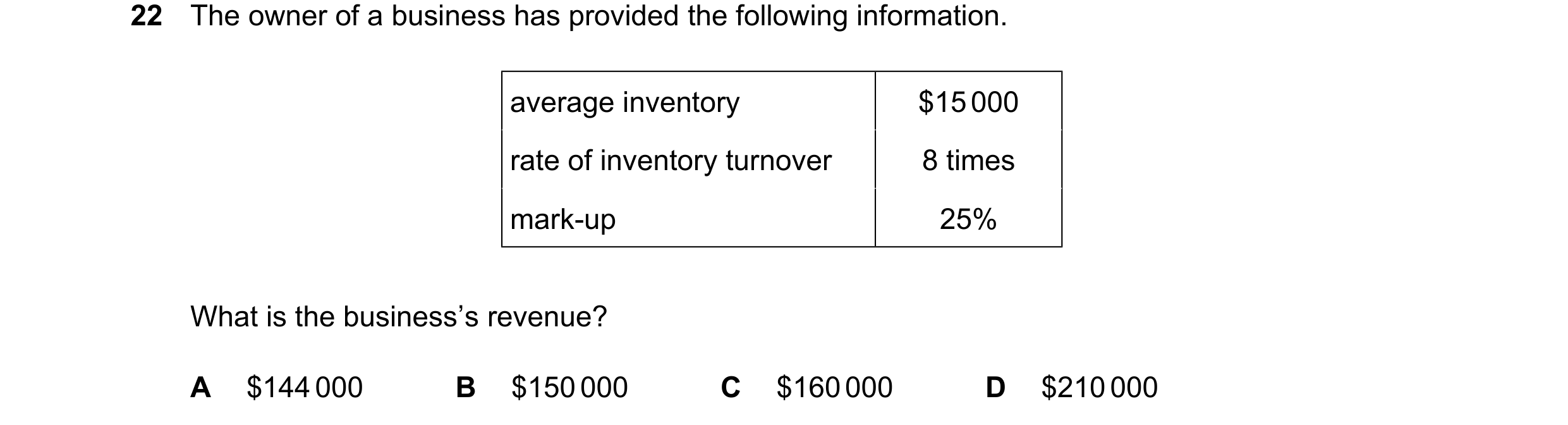
Q83 · The owner of a business has provided the following information 9706/11 Oct/Nov 2025
22 The owner of a business has provided the following information. average inventory $15000 rate of inventory turnover 8 times mark-up 25% What is the business’s revenue? A $144000 B $150000 C $160000 D $210000
1 marks
Answer: B
This question in 9706/11 Oct/Nov 2025
Q84 · Why do shareholders in a public limited company review the published financial statements? 9706/13 Oct/Nov 2025
21 Why do shareholders in a public limited company review the published financial statements? 1 to assess the return on their investment 2 to check the current price of a share in the company 3 to consider the security of their investment A 1, 2 and 3 B 1 and 2 only C 1 and 3 only D 2 and 3 only
1 marks
Answer: C
This question in 9706/13 Oct/Nov 2025
 1 / 22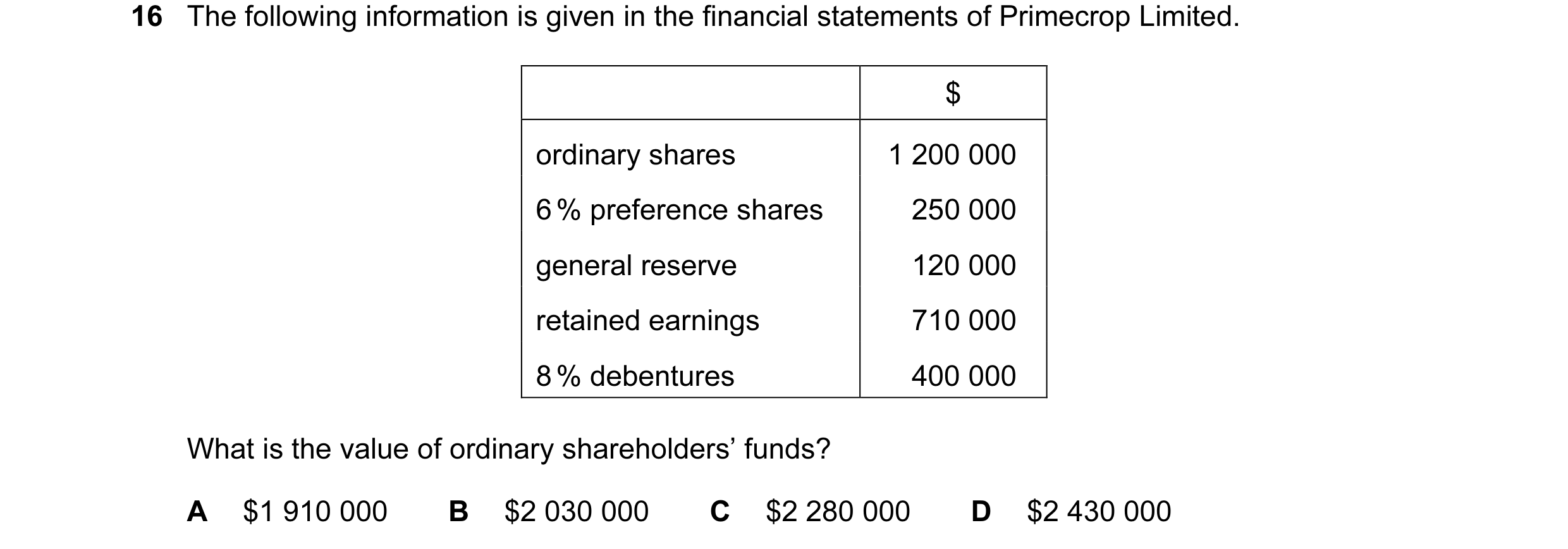
 2 / 22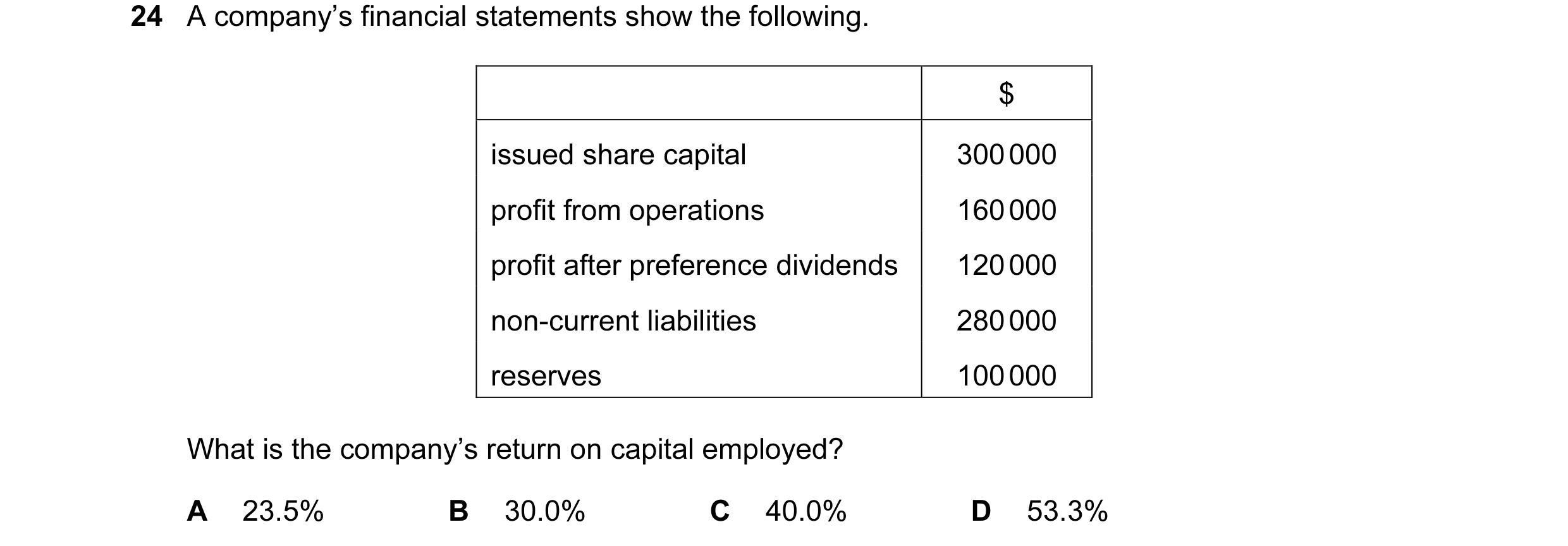

 3 / 22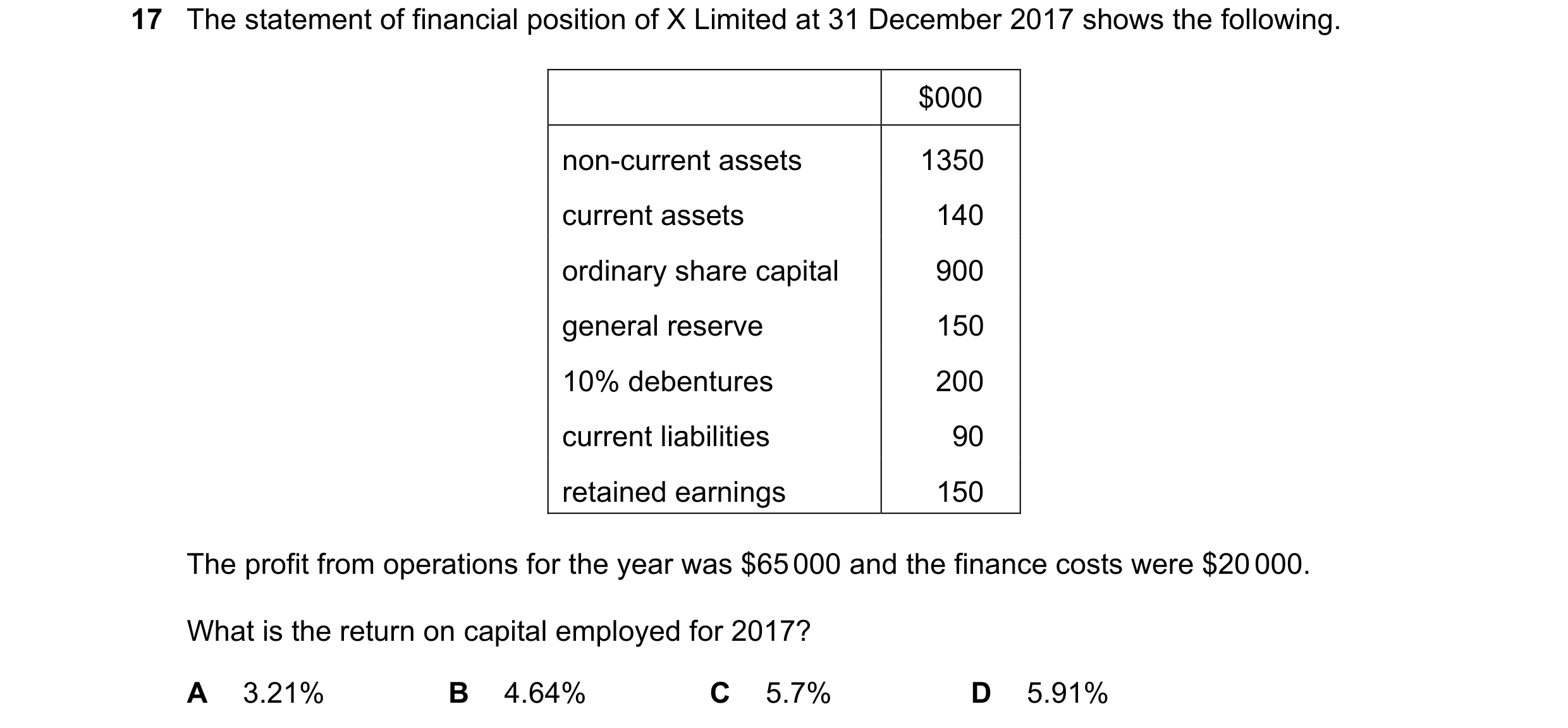
 4 / 22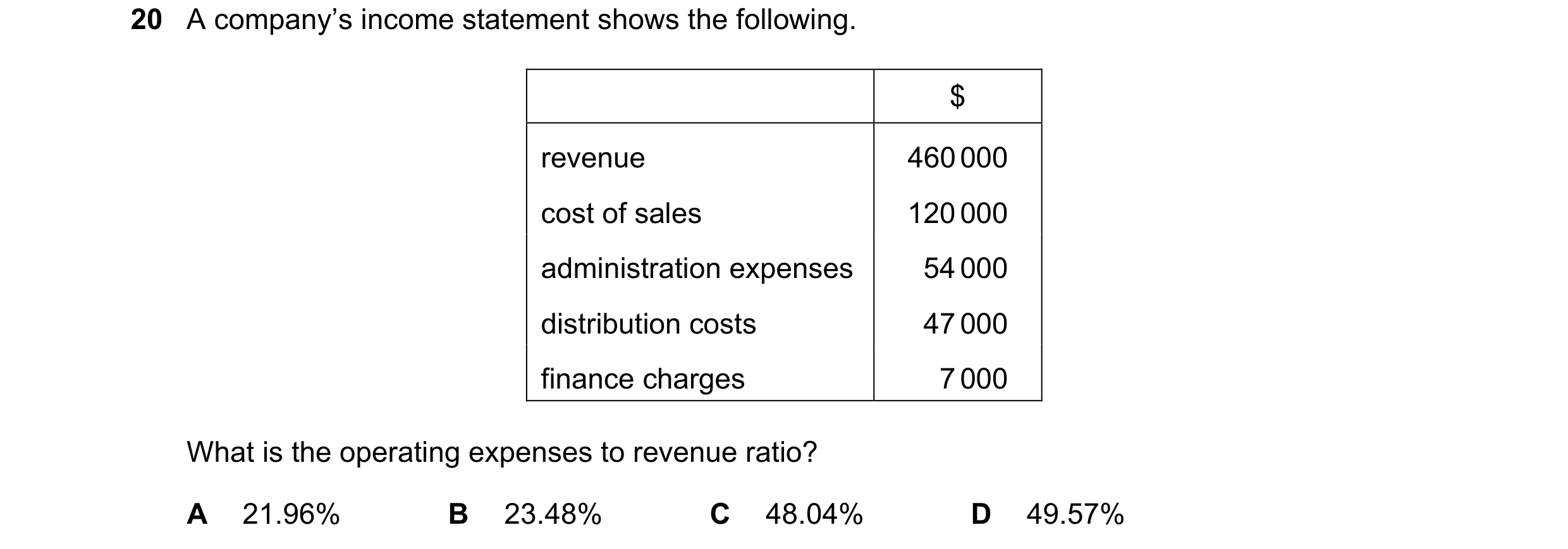

 5 / 22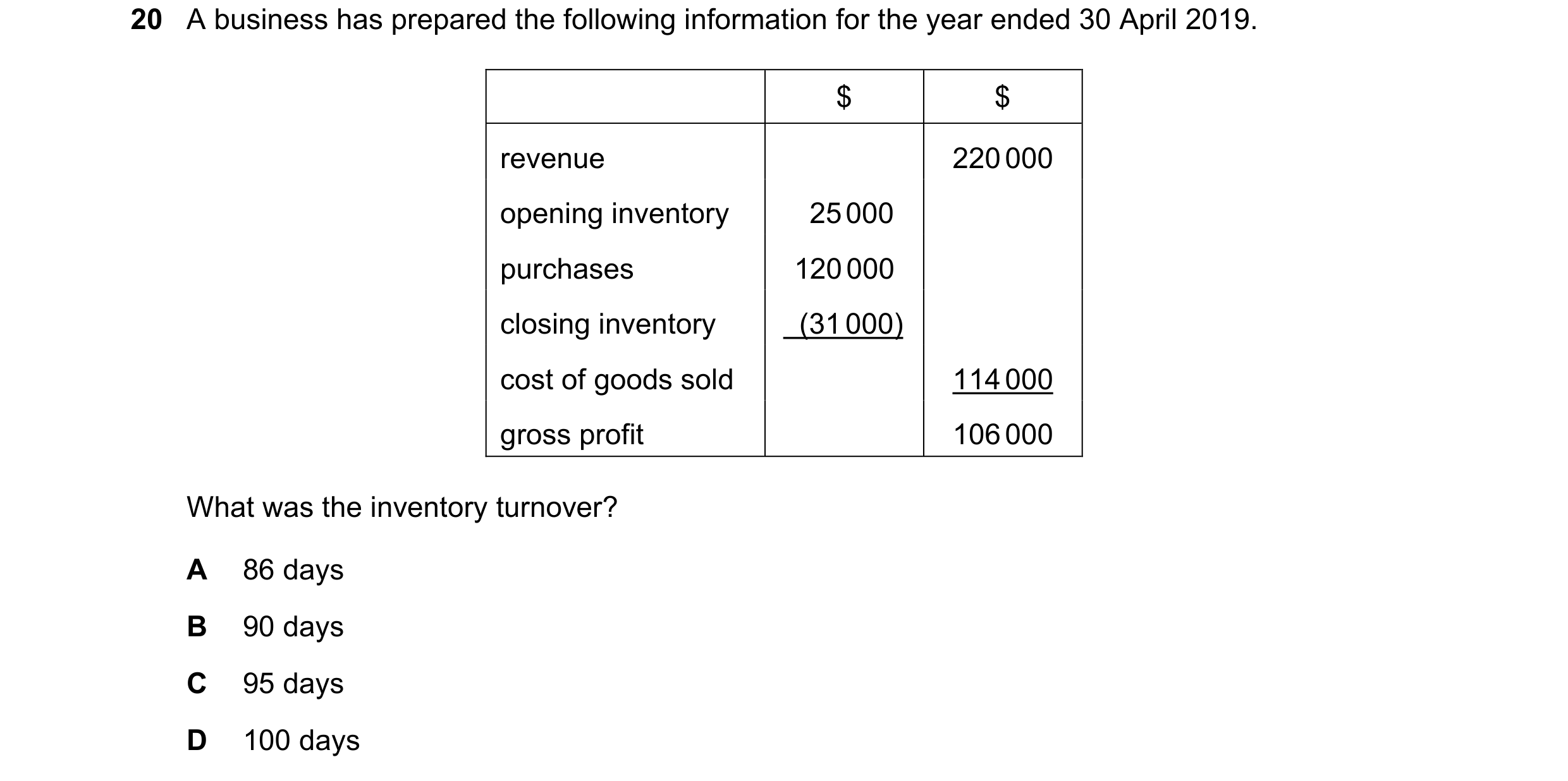

 6 / 22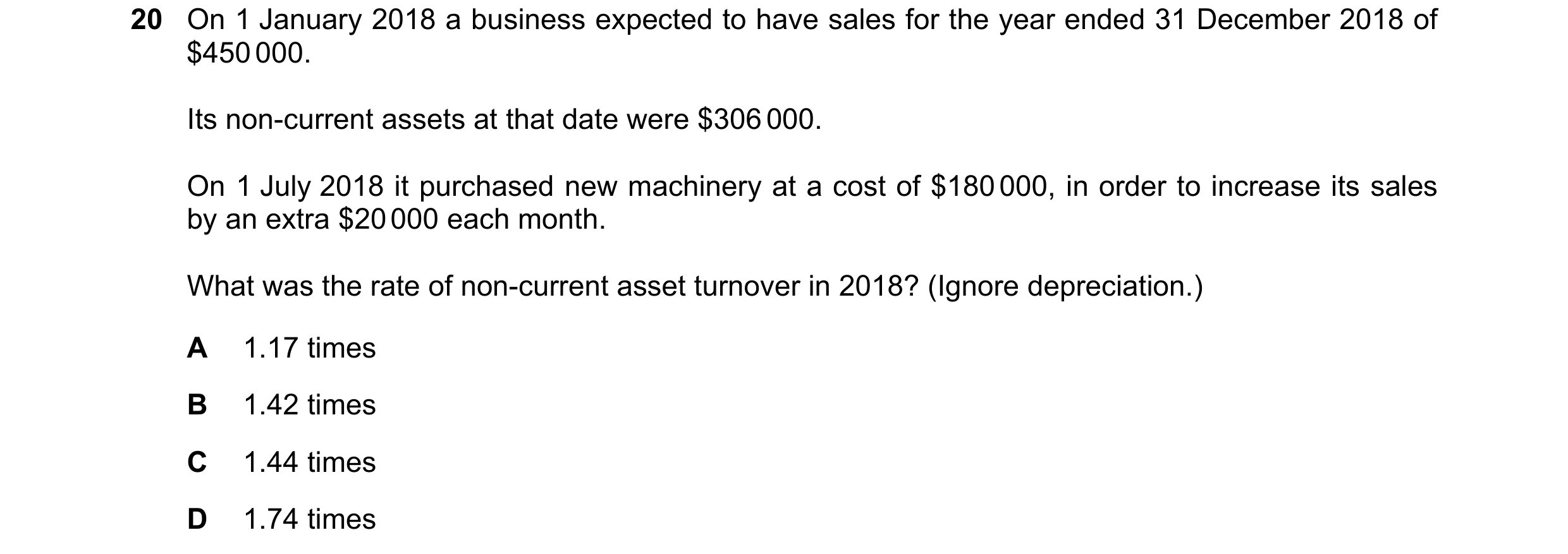
 7 / 22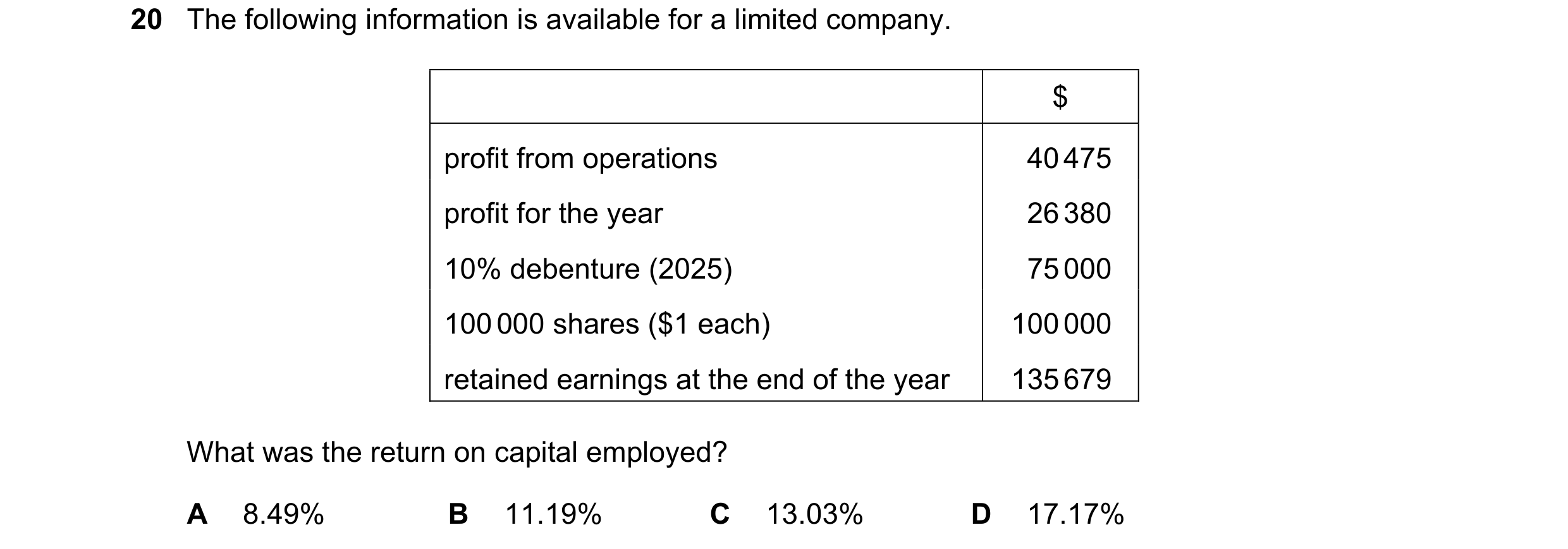

 8 / 22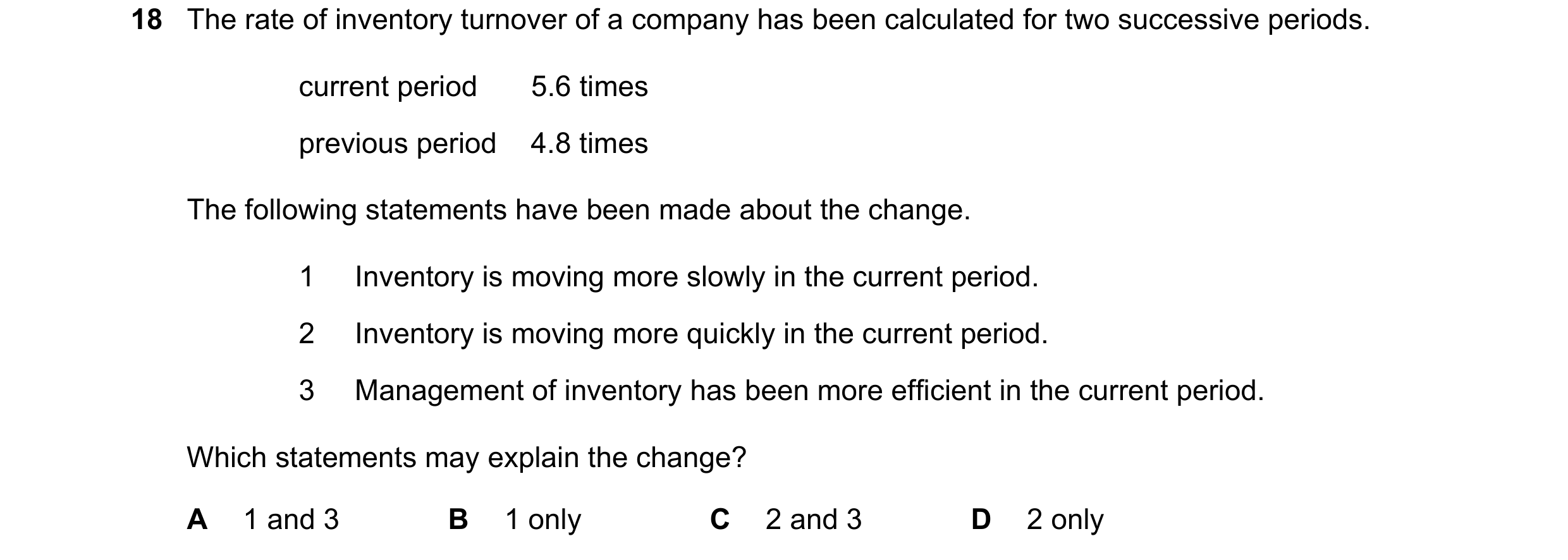

 9 / 22
 10 / 22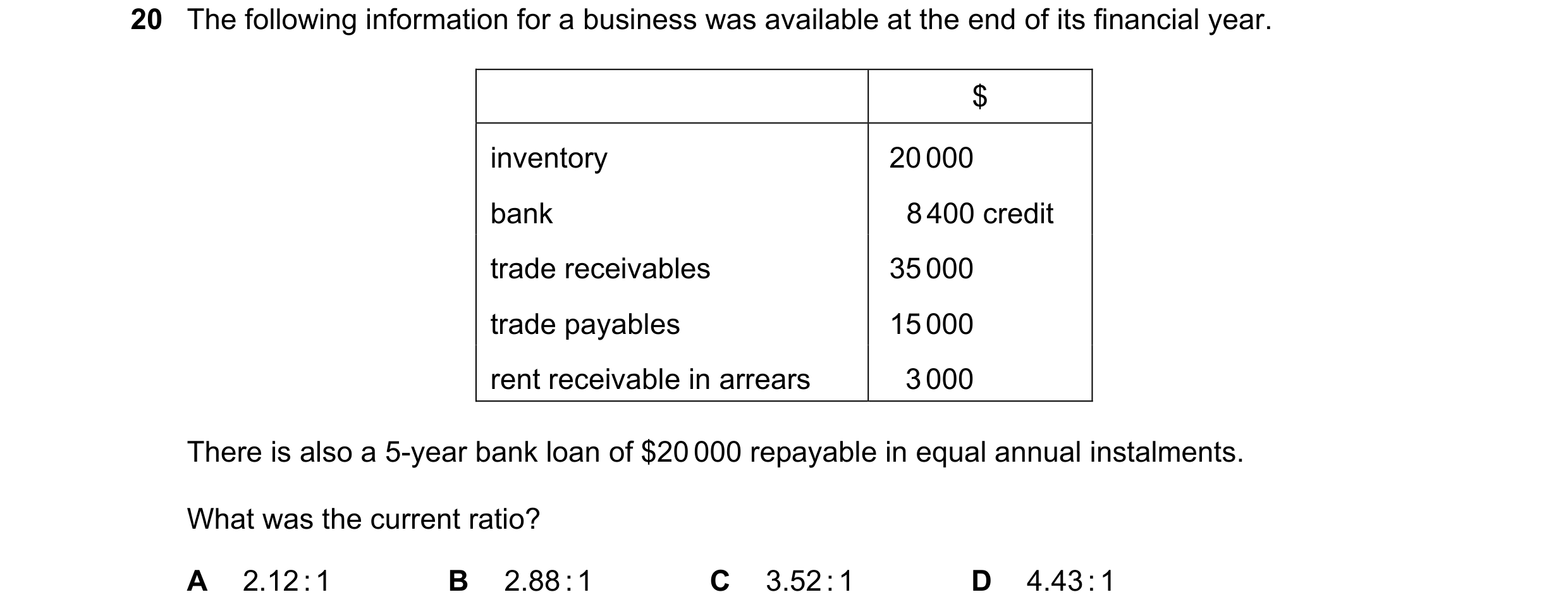
 11 / 22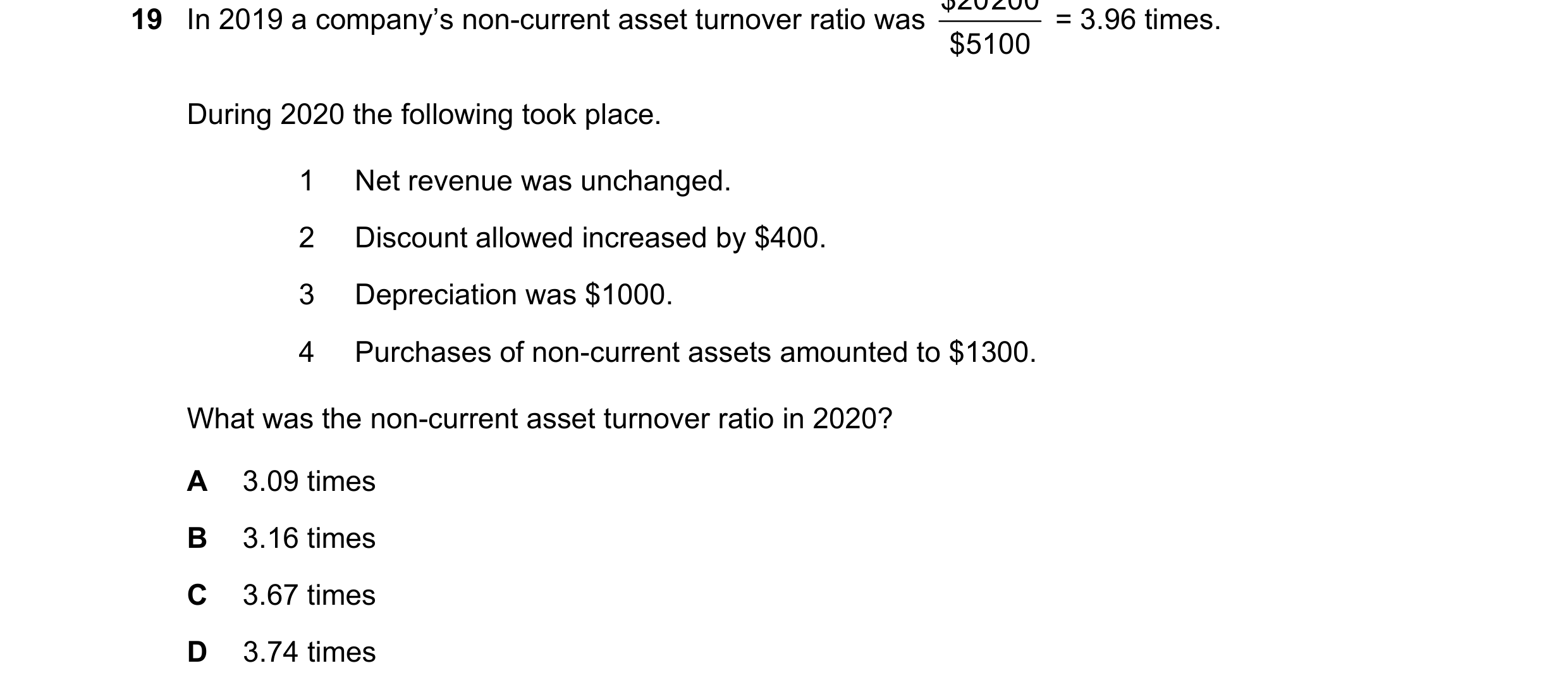
 12 / 22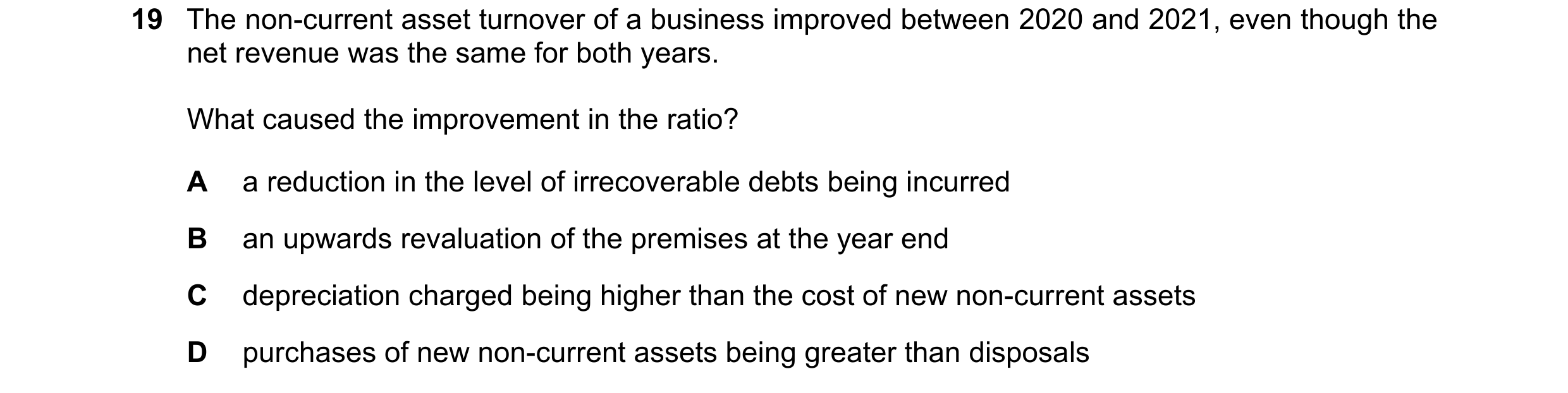

 13 / 22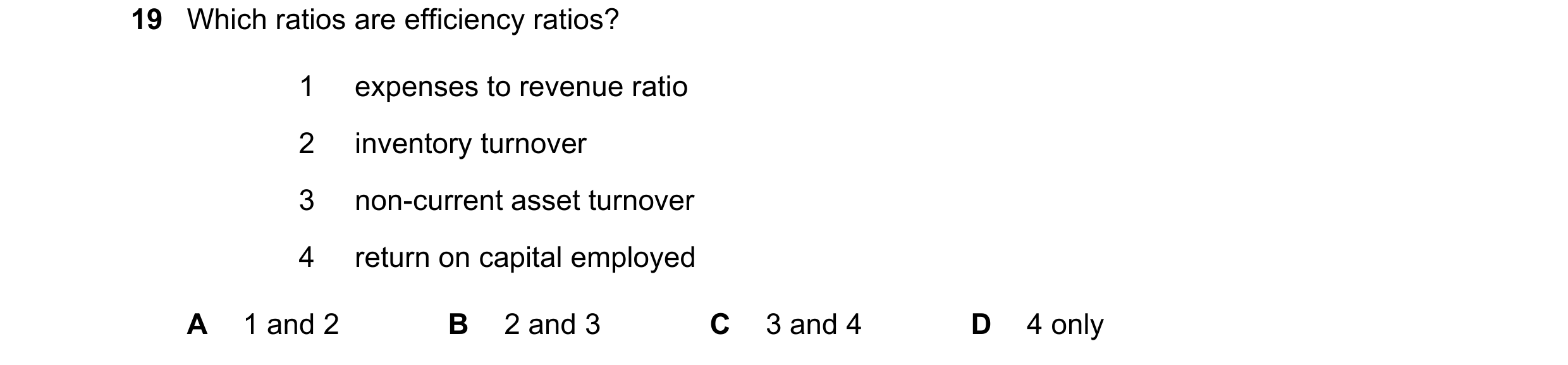
 14 / 22
 15 / 22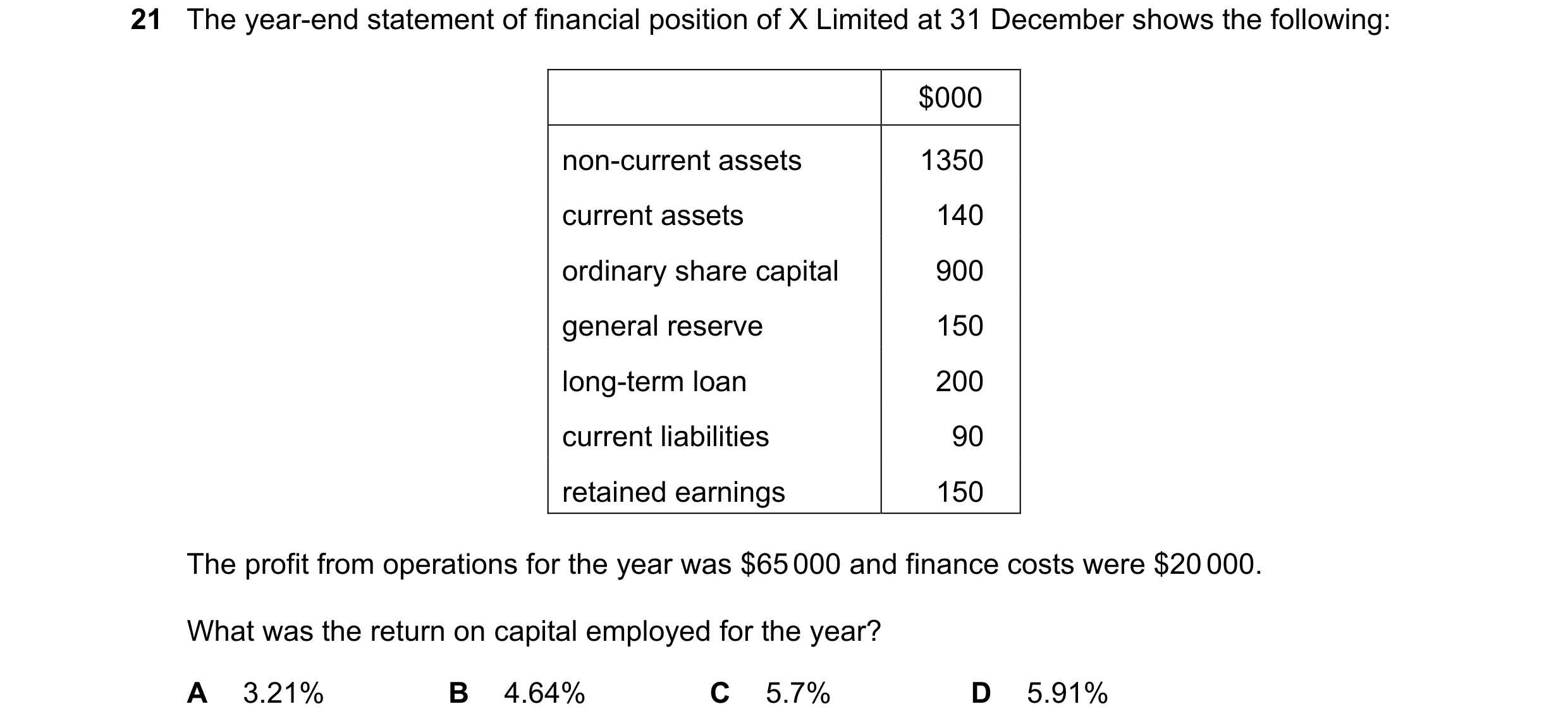

 16 / 22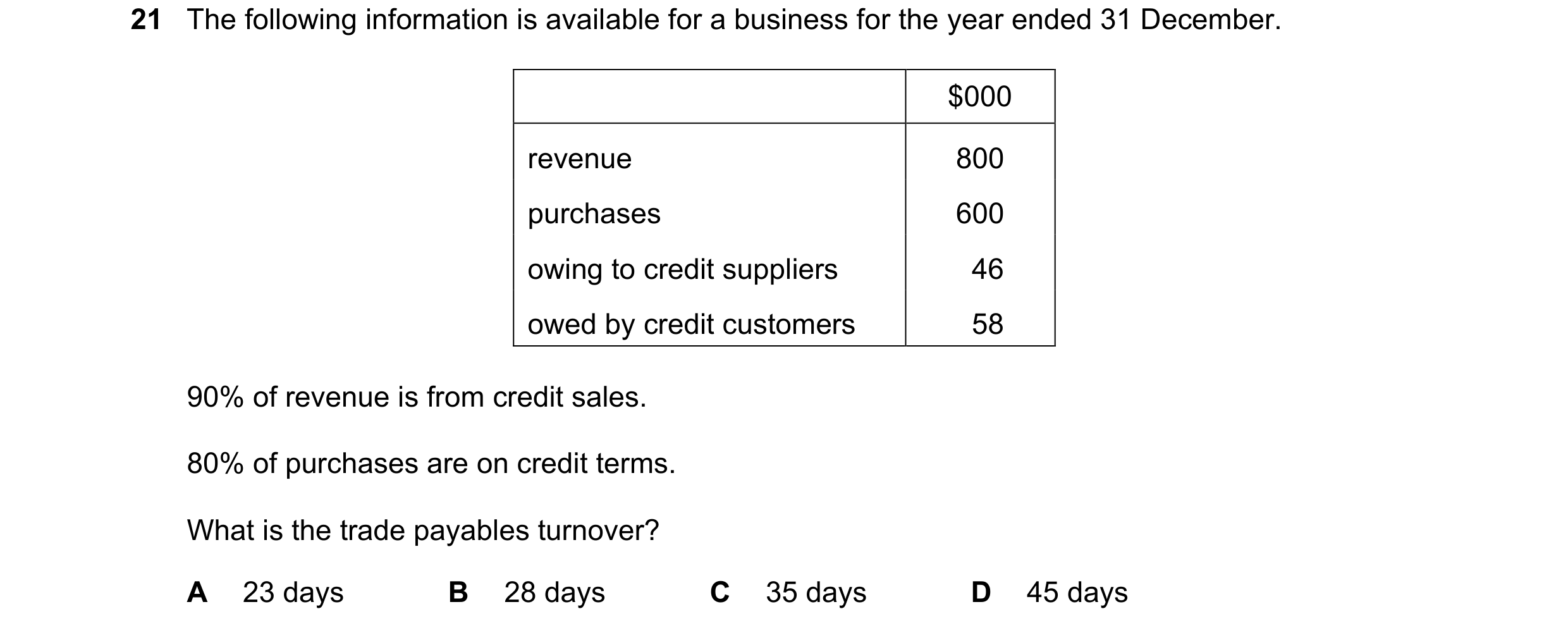
 17 / 22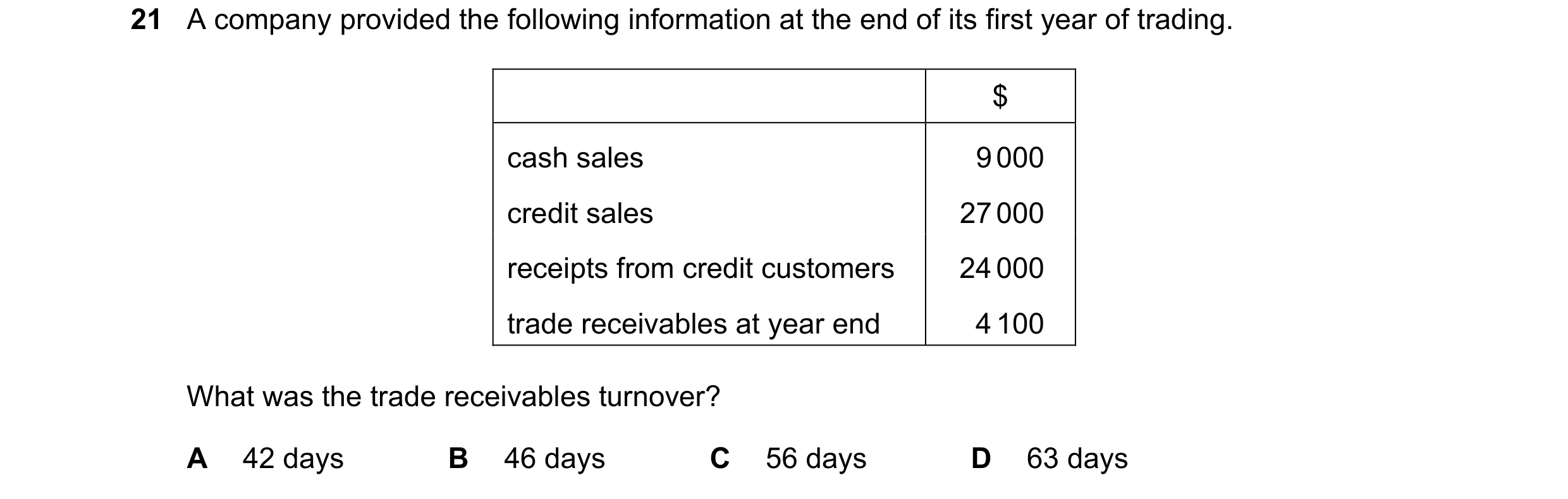
 18 / 22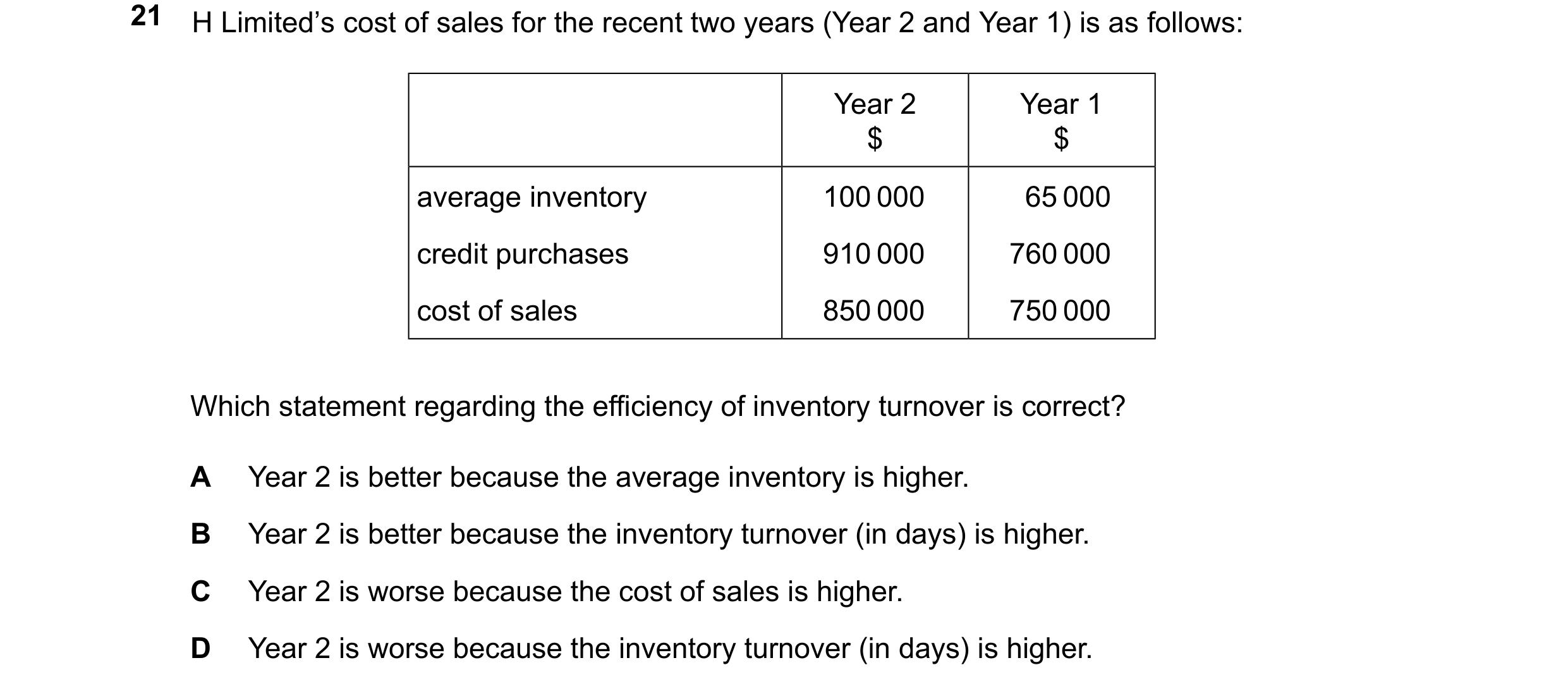
 19 / 22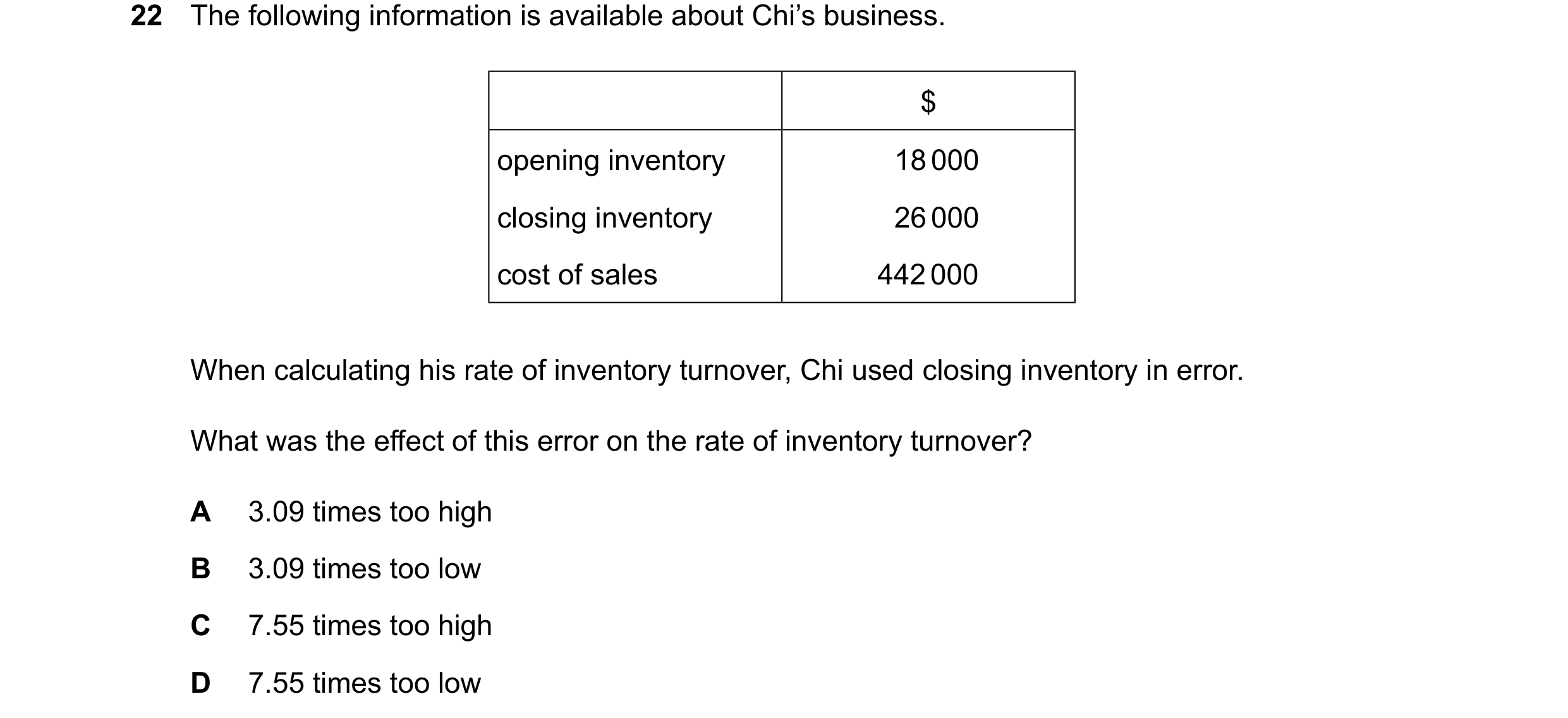
 20 / 22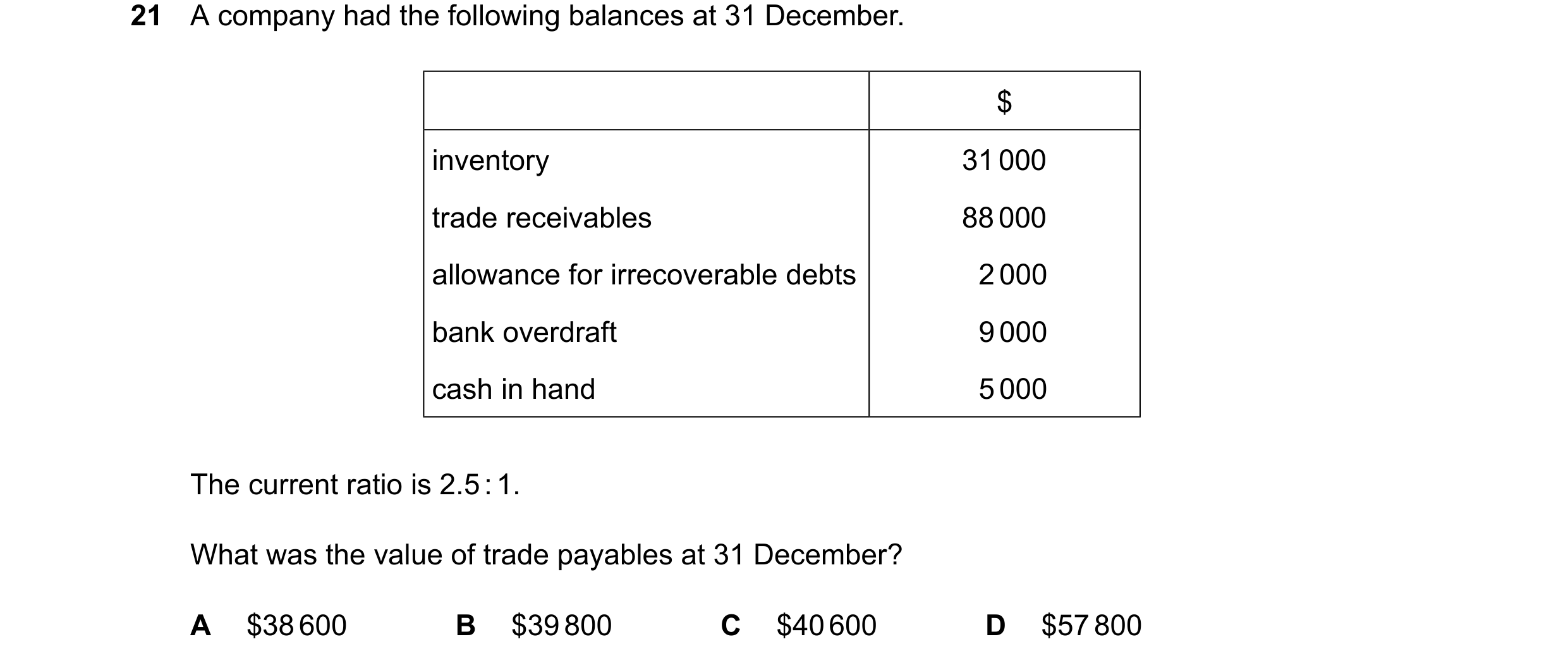
 21 / 22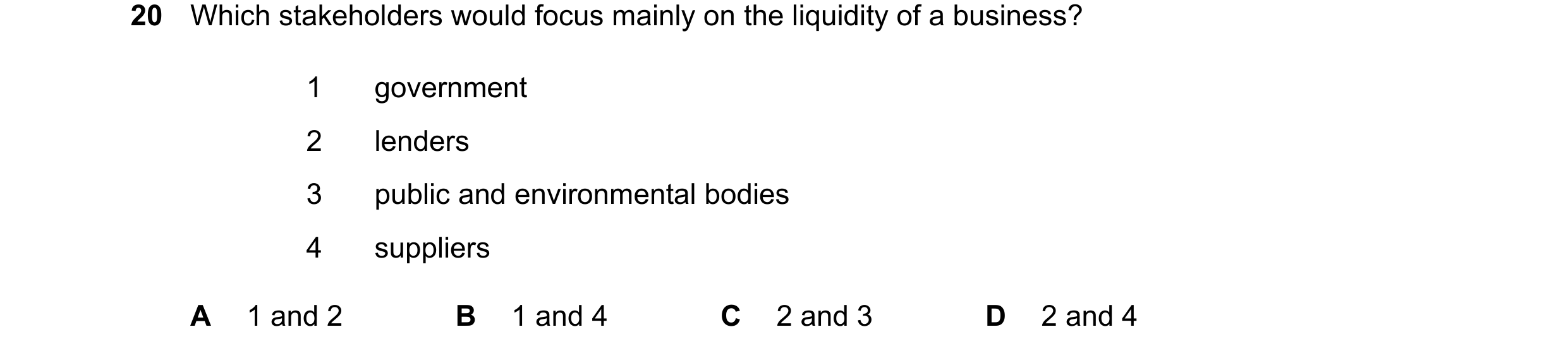
 22 / 22