Questions as text
Q1 · Large hydrocarbons can be .….X…. 0654/11 May/June 2005
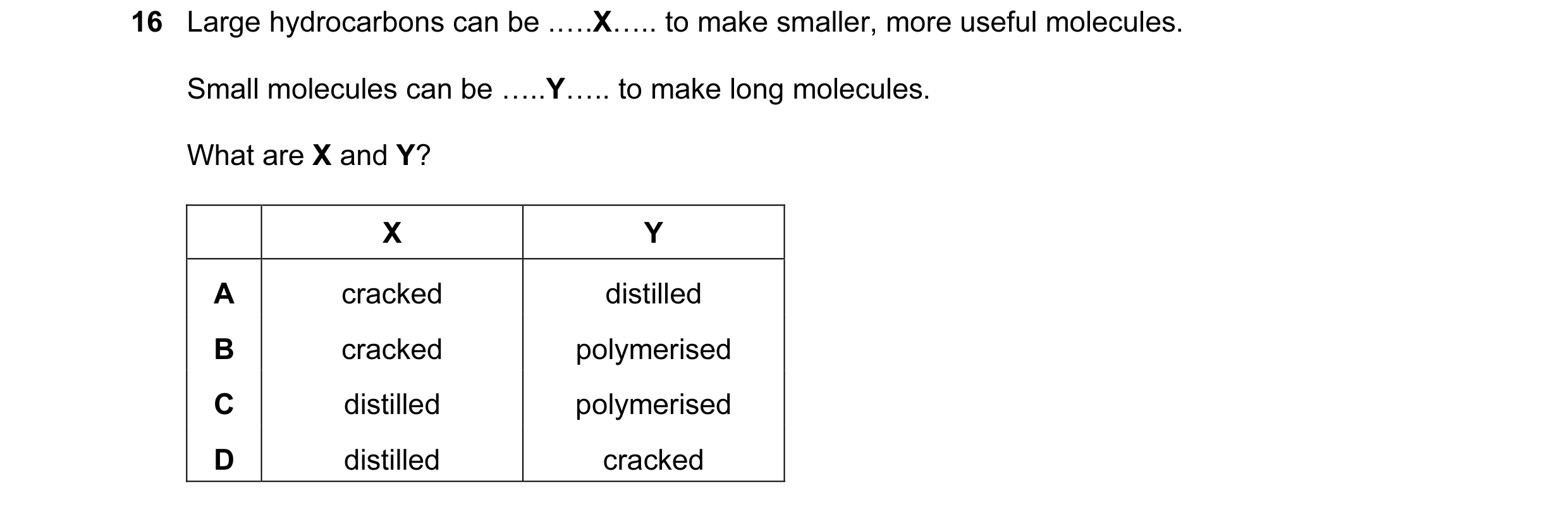
16 Large hydrocarbons can be .….X….. to make smaller, more useful molecules. Small molecules can be …..Y….. to make long molecules. What are X and Y? X Y A cracked distilled B cracked polymerised C distilled polymerised D distilled cracked
1 marks
Answer: B
This question in 0654/11 May/June 2005
Q2 · Which process produces molecules with longer chains? 0654/11 May/June 2006
16 Which process produces molecules with longer chains? A combustion of hydrocarbon B cracking C fractional distillation of crude oil D polymerisation
1 marks
Answer: D
This question in 0654/11 May/June 2006
Q3 · The diagram shows part of a polymer molecule 0654/11 May/June 2006
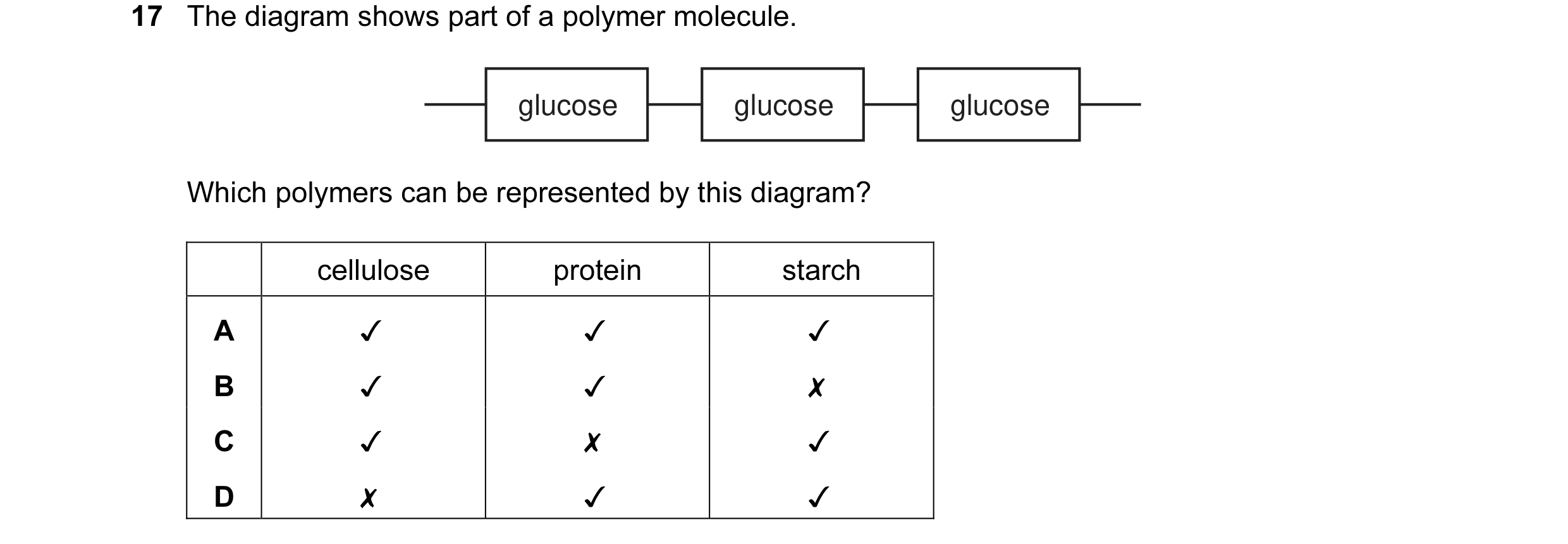
17 The diagram shows part of a polymer molecule.
glucose glucose glucose
Which polymers can be represented by this diagram?
cellulose protein starch
v v v
0 0O WwW D>
v v
v x
x v
\ 4 x
1 marks
Answer: C
This question in 0654/11 May/June 2006
Q4 · The reactions of glucose are shown 0654/11 May/June 2008
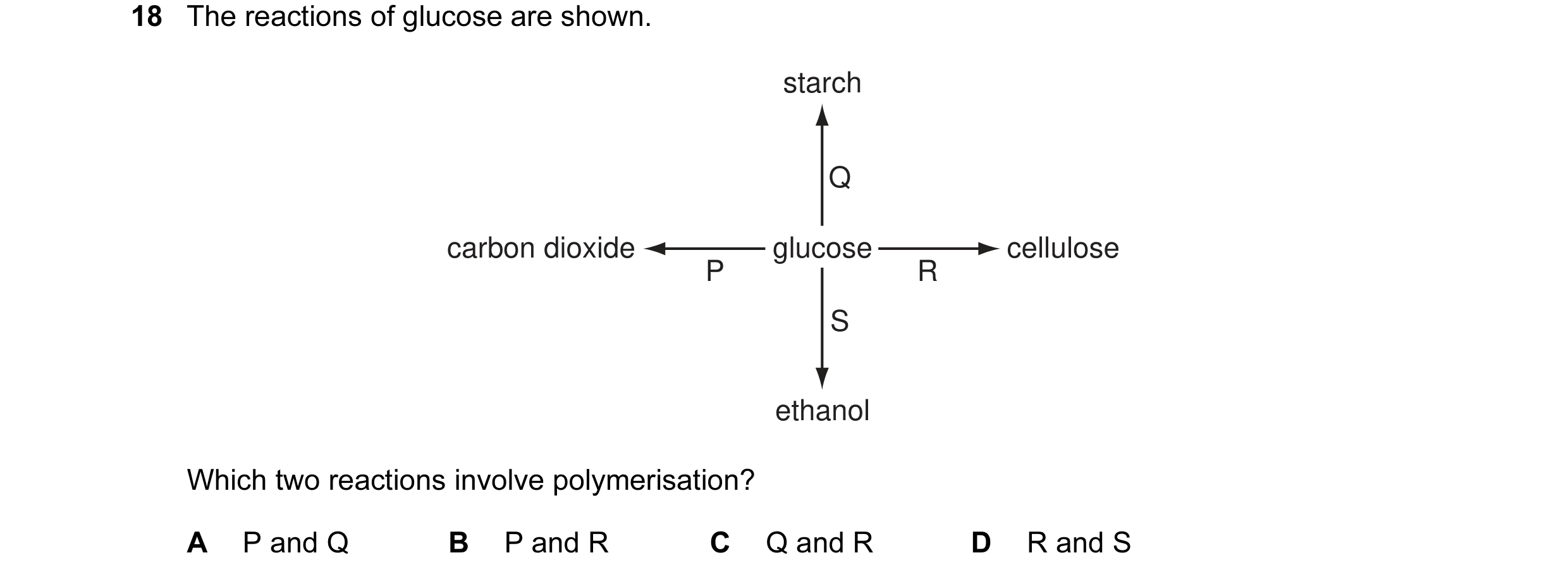
18 The reactions of glucose are shown. starch Q carbon dioxide glucose cellulose P R S ethanol Which two reactions involve polymerisation? A P and Q B P and R C Q and R D R and S
1 marks
Answer: C
This question in 0654/11 May/June 2008
Q5 · Large hydrocarbons can be ..….1….. 0654/11 Oct/Nov 2008
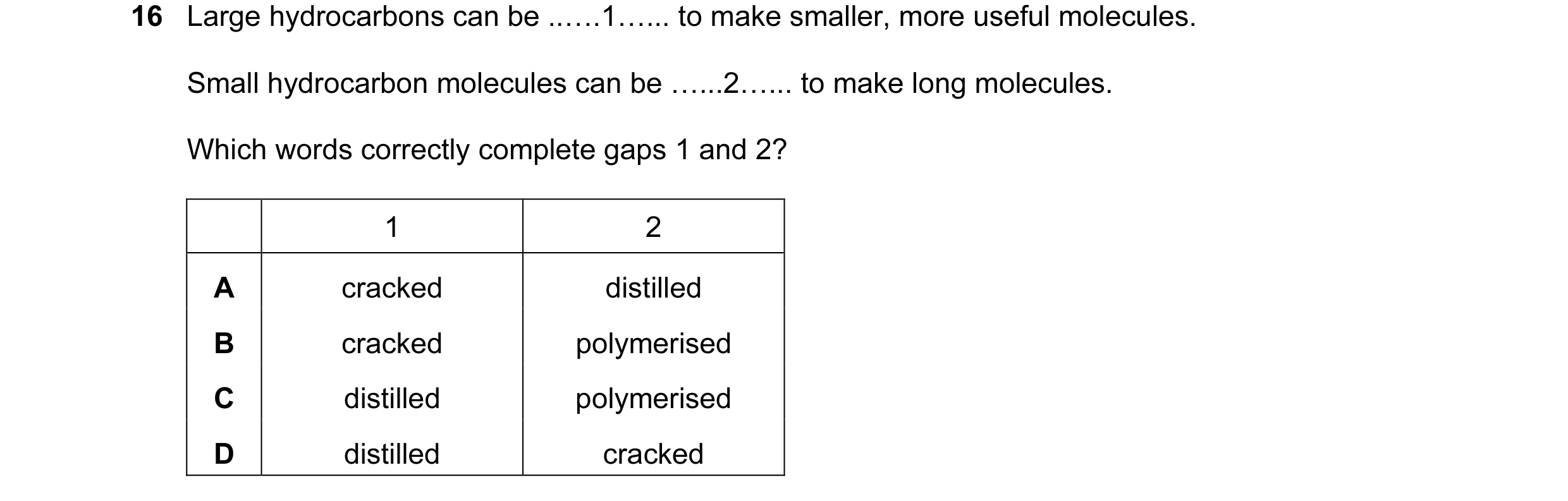
16 Large hydrocarbons can be ..….1…... to make smaller, more useful molecules. Small hydrocarbon molecules can be …...2…... to make long molecules. Which words correctly complete gaps 1 and 2? 1 2 A cracked distilled B cracked polymerised C distilled polymerised D distilled cracked
1 marks
Answer: B
This question in 0654/11 Oct/Nov 2008
Q6 · Which process produces molecules with longer chains? 0654/11 May/June 2009
16 Which process produces molecules with longer chains? A combustion of hydrocarbon B cracking C fractional distillation of crude oil D polymerisation
1 marks
Answer: D
This question in 0654/11 May/June 2009
Q7 · Which statement about cellulose is not correct? 0654/11 Oct/Nov 2009
17 Which statement about cellulose is not correct? A It is used to make paper. B It is a carbohydrate. C It is used to make glass. D It is a natural polymer.
1 marks
Answer: C
This question in 0654/11 Oct/Nov 2009
Q8 · Which molecules join into long chains to make proteins? 0654/11 Oct/Nov 2010
17 Which molecules join into long chains to make proteins? A amino acids B ethene C glucose D starch
1 marks
Answer: A
This question in 0654/11 Oct/Nov 2010
Q9 · Large hydrocarbons can be ..….1….. 0654/11 May/June 2011
16 Large hydrocarbons can be ..….1…... to make smaller, more useful molecules. Small hydrocarbon molecules can be …...2…... to make long molecules. Which words correctly complete gaps 1 and 2? 1 2 A cracked distilled B cracked polymerised C distilled polymerised D distilled cracked
1 marks
Answer: B
This question in 0654/11 May/June 2011
Q10 · Large hydrocarbons can be ..….1….. 0654/12 May/June 2011
18 Large hydrocarbons can be ..….1…... to make smaller, more useful molecules. Small hydrocarbon molecules can be …...2…... to make long molecules. Which words correctly complete gaps 1 and 2? 1 2 A cracked distilled B cracked polymerised C distilled polymerised D distilled cracked
1 marks
Answer: B
This question in 0654/12 May/June 2011
Q11 · Large hydrocarbons can be ..….1….. 0654/13 May/June 2011
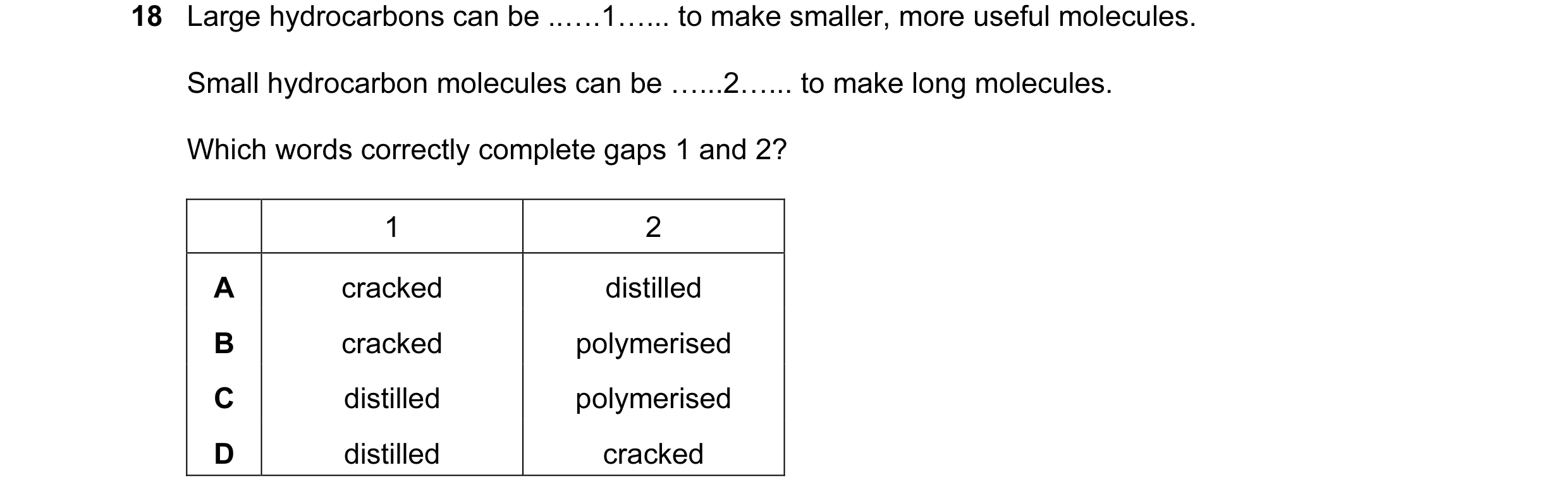
18 Large hydrocarbons can be ..….1…... to make smaller, more useful molecules. Small hydrocarbon molecules can be …...2…... to make long molecules. Which words correctly complete gaps 1 and 2? 1 2 A cracked distilled B cracked polymerised C distilled polymerised D distilled cracked
1 marks
Answer: B
This question in 0654/13 May/June 2011
Q12 · In the diagram below, the compounds on the left are monomers and those on the right are… 0654/11 Oct/Nov 2011
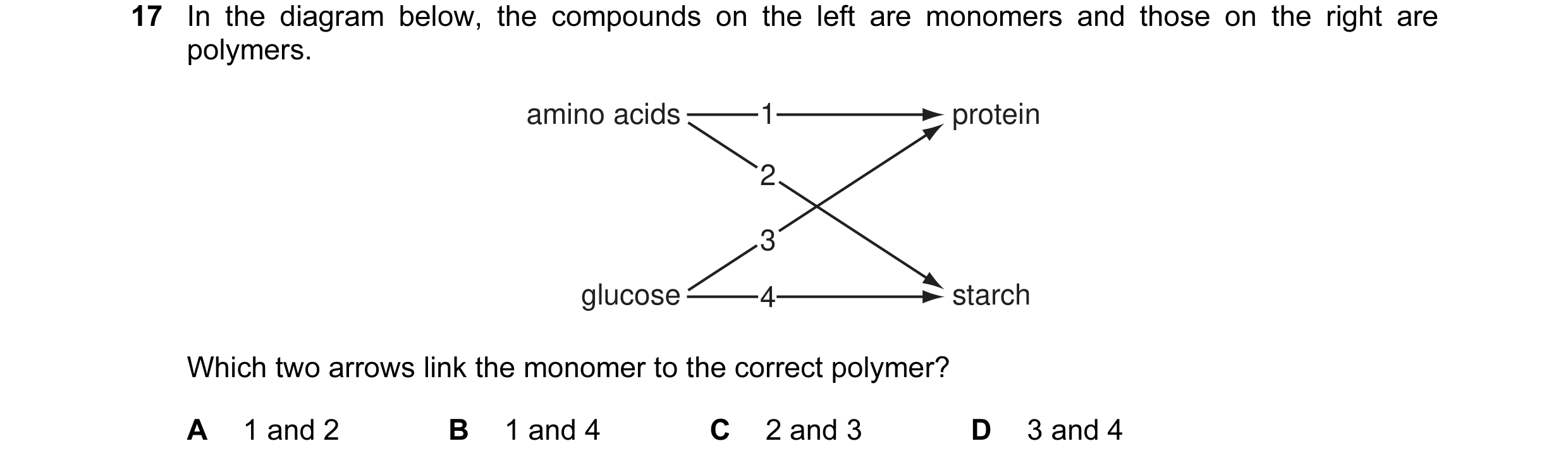
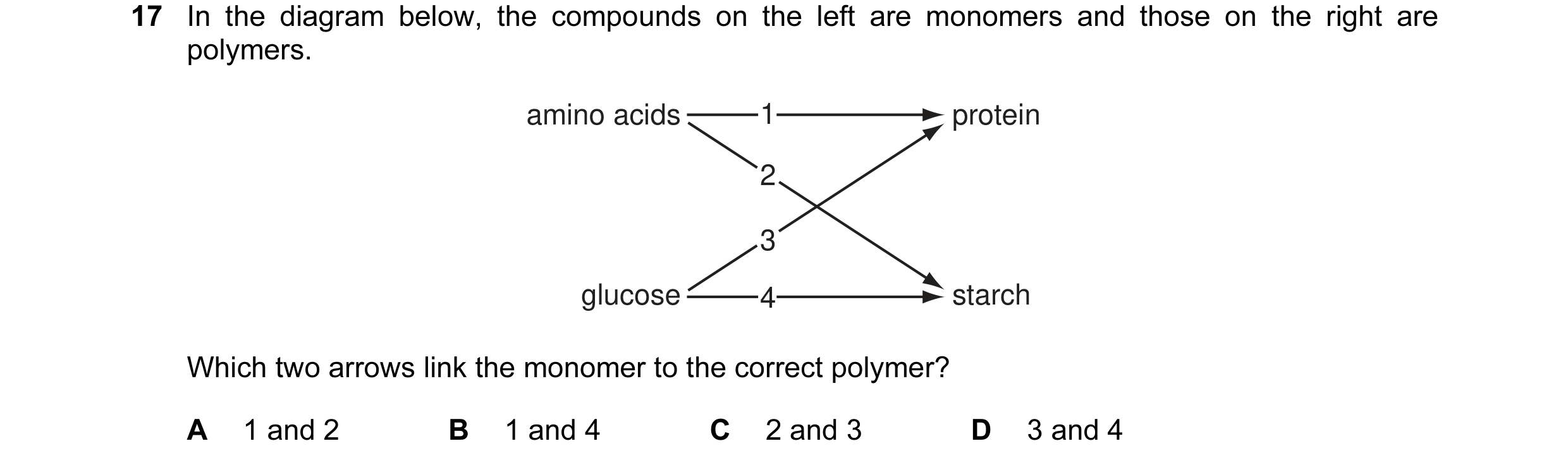
17 In the diagram below, the compounds on the left are monomers and those on the right are polymers. amino acids 1 protein 2 3 glucose 4 starch Which two arrows link the monomer to the correct polymer? A 1 and 2 B 1 and 4 C 2 and 3 D 3 and 4
1 marks
Answer: B
This question in 0654/11 Oct/Nov 2011
Q13 · In the diagram below, the compounds on the left are monomers and those on the right are… 0654/12 Oct/Nov 2011
17 In the diagram below, the compounds on the left are monomers and those on the right are polymers. amino acids 1 protein 2 3 glucose 4 starch Which two arrows link the monomer to the correct polymer? A 1 and 2 B 1 and 4 C 2 and 3 D 3 and 4
1 marks
Answer: B
This question in 0654/12 Oct/Nov 2011
Q14 · The diagram shows three molecules 0654/11 May/June 2012
27 The diagram shows three molecules. X Y Z H H H H H H H H H C C H C C C C C C H H H H H H H H Which molecule is a monomer and which is a polymer? monomer polymer A X Z B Y Z C Y X D Z Y
1 marks
Answer: B
This question in 0654/11 May/June 2012
Q15 · This description of a plastic is incomplete 0654/12 May/June 2012
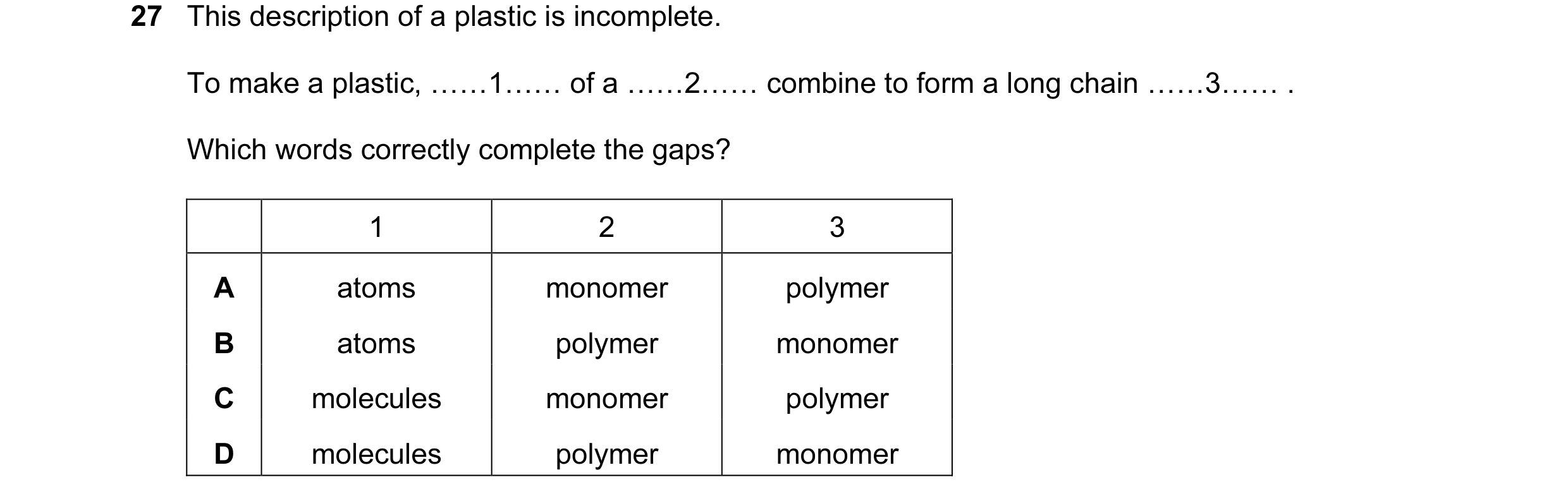
27 This description of a plastic is incomplete. To make a plastic, ……1…… of a ……2…… combine to form a long chain ……3…… . Which words correctly complete the gaps? 1 2 3 A atoms monomer polymer B atoms polymer monomer C molecules monomer polymer D molecules polymer monomer
1 marks
Answer: C
This question in 0654/12 May/June 2012
Q16 · This description of a plastic is incomplete 0654/13 May/June 2012
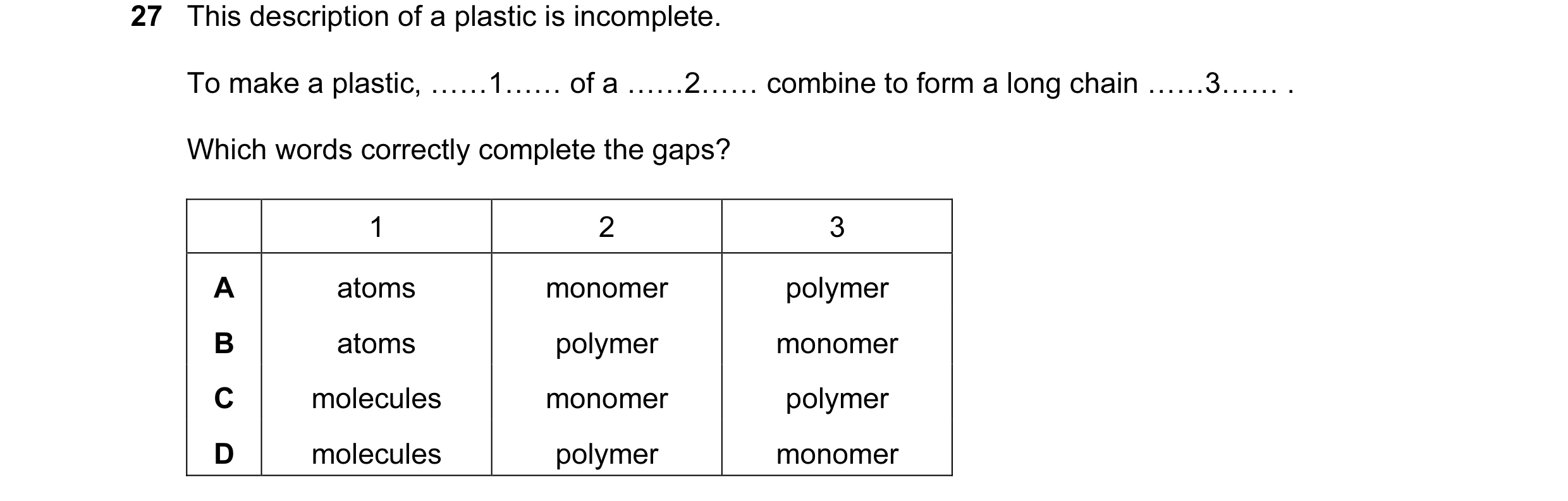
27 This description of a plastic is incomplete. To make a plastic, ……1…… of a ……2…… combine to form a long chain ……3…… . Which words correctly complete the gaps? 1 2 3 A atoms monomer polymer B atoms polymer monomer C molecules monomer polymer D molecules polymer monomer
1 marks
Answer: C
This question in 0654/13 May/June 2012
Q17 · Poly(ethene) is made from ethene 0654/12 Oct/Nov 2015
27 Poly(ethene) is made from ethene. Ethene molecules are known as ……1…… and join together in a process known as ……2…… polymerisation. Which words correctly complete gaps 1 and 2? 1 2 A monomers addition B monomers neutralisation C polymers addition D polymers neutralisation
1 marks
Answer: A
This question in 0654/12 Oct/Nov 2015
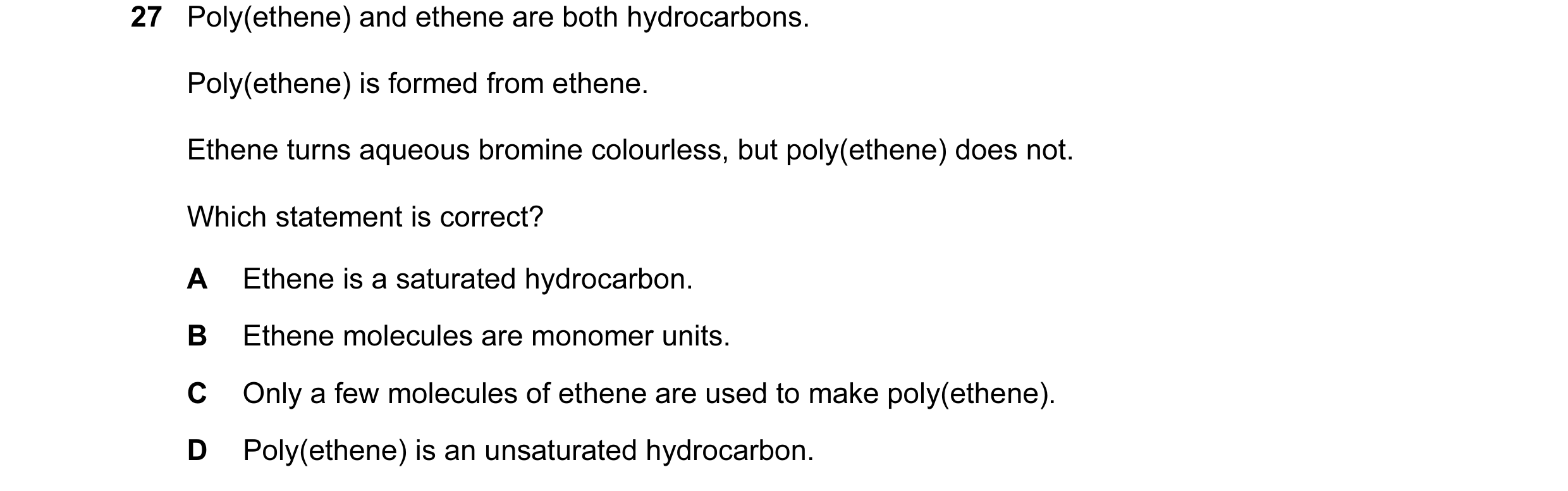
Q18 · Poly(ethene) and ethene are both hydrocarbons 0654/12 May/June 2016
27 Poly(ethene) and ethene are both hydrocarbons. Poly(ethene) is formed from ethene. Ethene turns aqueous bromine colourless, but poly(ethene) does not. Which statement is correct? A Ethene is a saturated hydrocarbon. B Ethene molecules are monomer units. C Only a few molecules of ethene are used to make poly(ethene). D Poly(ethene) is an unsaturated hydrocarbon.
1 marks
Answer: B
This question in 0654/12 May/June 2016
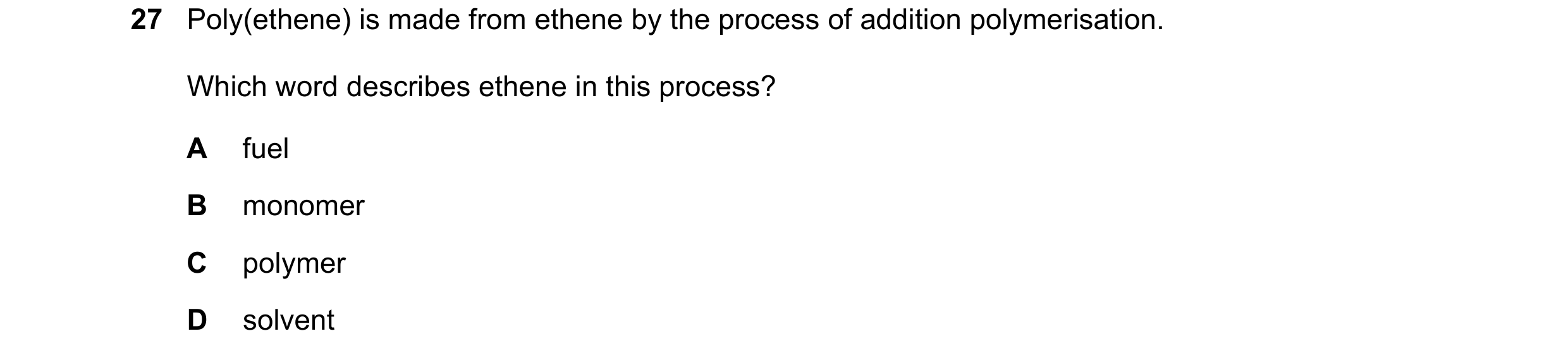
Q19 · Poly(ethene) is made from ethene by the process of addition polymerisation 0654/12 Oct/Nov 2016
27 Poly(ethene) is made from ethene by the process of addition polymerisation. Which word describes ethene in this process? A fuel B monomer C polymer D solvent
1 marks
Answer: B
This question in 0654/12 Oct/Nov 2016
Q20 · Which monomer is used to form poly(ethene) and what is the structure of poly(ethene)? 0654/11 May/June 2017
27 Which monomer is used to form poly(ethene) and what is the structure of poly(ethene)? monomer poly(ethene) structure H H H H A C C C C H H H H n H H H H B C C C C H H H H n H H H H C H C C H C C H H H H n H H H H D H C C H C C H H H H n
1 marks
Answer: B
This question in 0654/11 May/June 2017
Q21 · Poly(ethene) is made from many small molecules 0654/12 Oct/Nov 2018
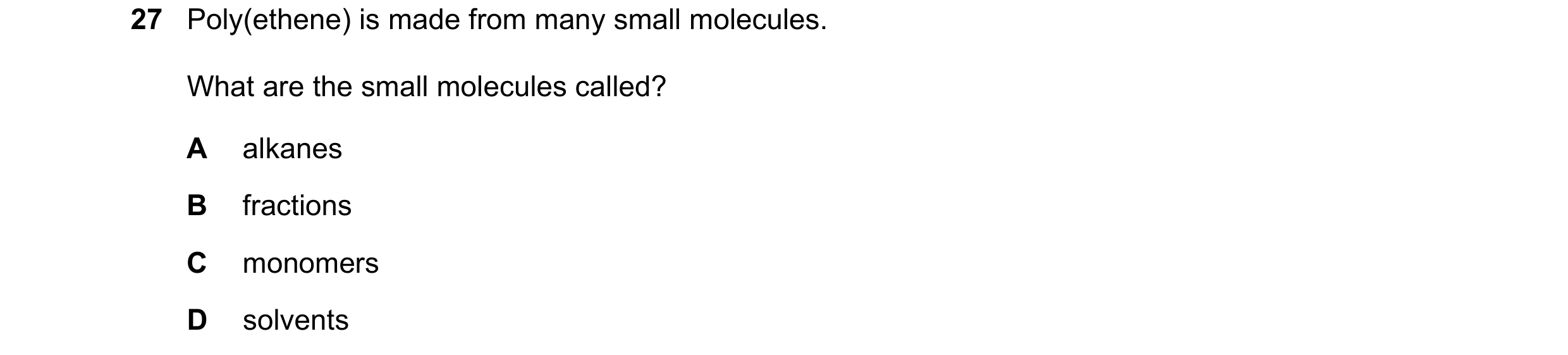
27 Poly(ethene) is made from many small molecules. What are the small molecules called? A alkanes B fractions C monomers D solvents
1 marks
Answer: C
This question in 0654/12 Oct/Nov 2018
Q22 · Ethene molecules are monomer units 0654/13 Oct/Nov 2018
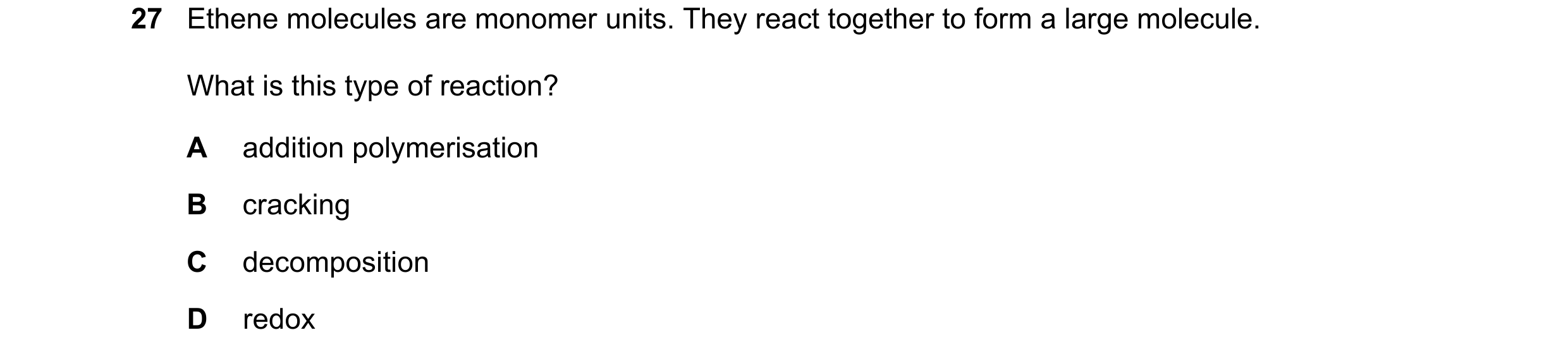
27 Ethene molecules are monomer units. They react together to form a large molecule. What is this type of reaction? A addition polymerisation B cracking C decomposition D redox
1 marks
Answer: A
This question in 0654/13 Oct/Nov 2018
Q23 · Which statements about poly(ethene) molecules are correct? 0654/11 May/June 2019
27 Which statements about poly(ethene) molecules are correct? 1 They are long chains formed from many monomer units. 2 They are made by addition polymerisation. 3 They contain many double bonds. A 1 and 2 only B 1 and 3 only C 2 and 3 only D 1, 2 and 3
1 marks
Answer: A
This question in 0654/11 May/June 2019
Q24 · Which two statements describe addition polymers? 0654/12 May/June 2019
27 Which two statements describe addition polymers? 1 They are large molecules. 2 They contain carbon to carbon double bonds. 3 They are small molecules. 4 They are made from small units. A 1 and 2 B 1 and 4 C 2 and 3 D 3 and 4
1 marks
Answer: B
This question in 0654/12 May/June 2019
Q25 · Which two statements describe addition polymers? 0654/13 May/June 2019
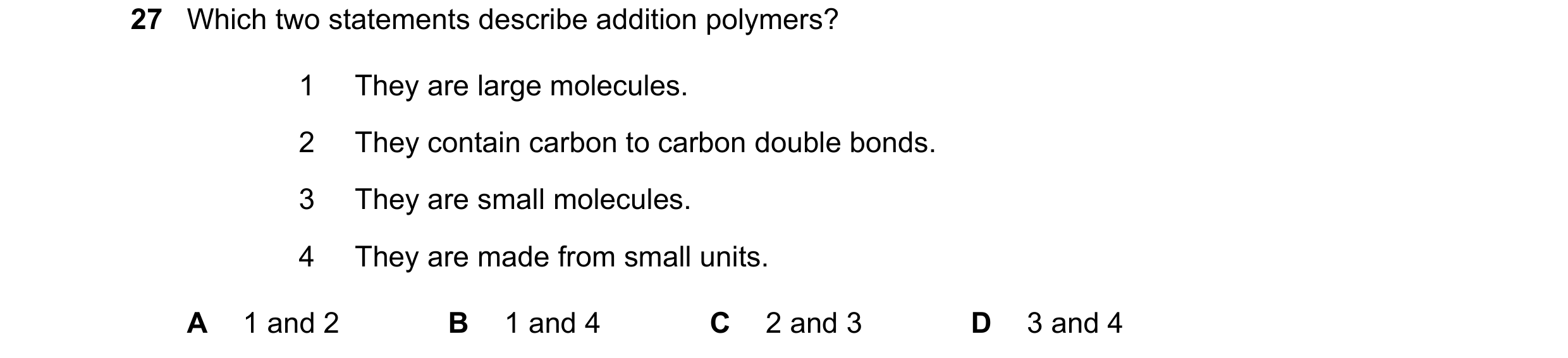
27 Which two statements describe addition polymers? 1 They are large molecules. 2 They contain carbon to carbon double bonds. 3 They are small molecules. 4 They are made from small units. A 1 and 2 B 1 and 4 C 2 and 3 D 3 and 4
1 marks
Answer: B
This question in 0654/13 May/June 2019
Q26 · Which type of reaction is represented by the equation? 0654/13 Oct/Nov 2019
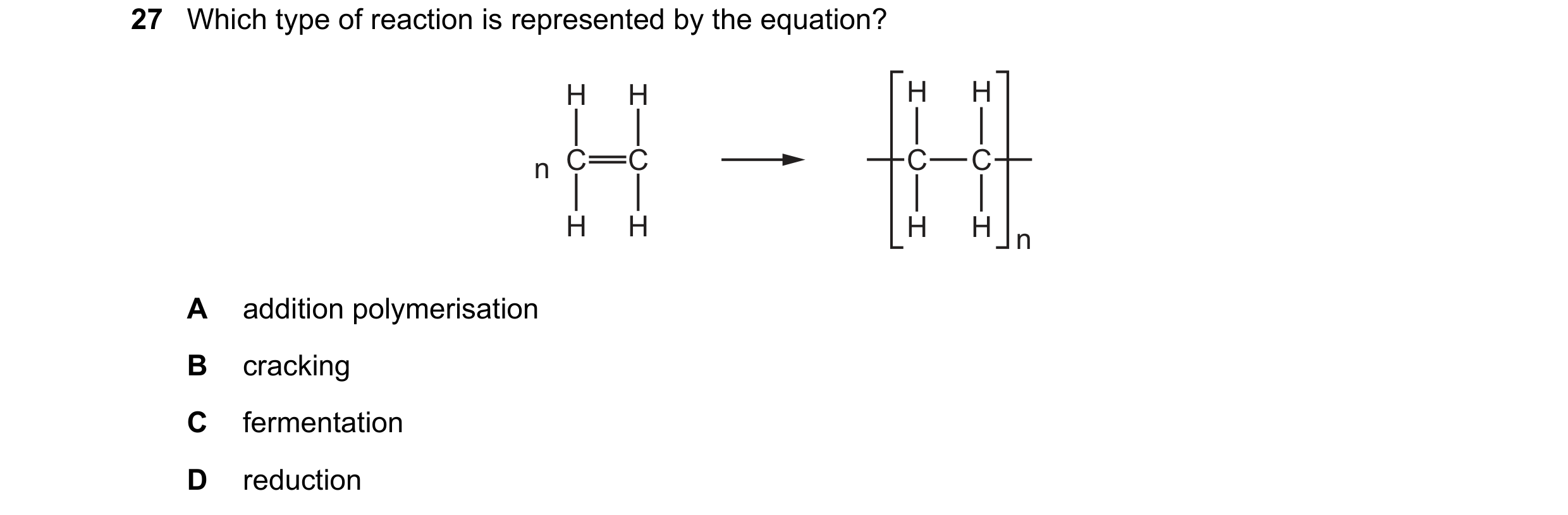
27 Which type of reaction is represented by the equation? H H H H n C C C C H H H H n A addition polymerisation B cracking C fermentation D reduction
1 marks
Answer: A
This question in 0654/13 Oct/Nov 2019
Q27 · Which statement about the manufacture of polymers is correct? 0654/11 May/June 2020
27 Which statement about the manufacture of polymers is correct? A Polymers are made by breaking long-chain molecules into shorter chain ones. B Polymers are made by joining polymers together. C Polymers are made by fractional distillation of petroleum. D Polymers are made by joining short-chain molecules together.
1 marks
Answer: D
This question in 0654/11 May/June 2020
Q28 · Which statement about the manufacture of polymers is correct? 0654/12 May/June 2020
27 Which statement about the manufacture of polymers is correct? A Polymers are made by breaking long-chain molecules into shorter chain ones. B Polymers are made by joining polymers together. C Polymers are made by fractional distillation of petroleum. D Polymers are made by joining short-chain molecules together.
1 marks
Answer: D
This question in 0654/12 May/June 2020
Q29 · Which statement about the manufacture of polymers is correct? 0654/13 May/June 2020
27 Which statement about the manufacture of polymers is correct? A Polymers are made by breaking long-chain molecules into shorter chain ones. B Polymers are made by joining polymers together. C Polymers are made by fractional distillation of petroleum. D Polymers are made by joining short-chain molecules together.
1 marks
Answer: D
This question in 0654/13 May/June 2020
Q30 · Poly(ethene) is made from ethene by the process of addition polymerisation 0654/11 Oct/Nov 2020
27 Poly(ethene) is made from ethene by the process of addition polymerisation. Which word describes ethene in this process? A fuel B catalyst C monomer D solvent
1 marks
Answer: C
This question in 0654/11 Oct/Nov 2020
Q31 · Poly(ethene) is made from ethene by the process of addition polymerisation 0654/12 Oct/Nov 2020
27 Poly(ethene) is made from ethene by the process of addition polymerisation. Which word describes ethene in this process? A fuel B catalyst C monomer D solvent
1 marks
Answer: C
This question in 0654/12 Oct/Nov 2020
Q32 · Poly(ethene) is made from ethene by the process of addition polymerisation 0654/13 Oct/Nov 2020
27 Poly(ethene) is made from ethene by the process of addition polymerisation. Which word describes ethene in this process? A fuel B catalyst C monomer D solvent
1 marks
Answer: C
This question in 0654/13 Oct/Nov 2020
Q33 · Which row shows the structure of the monomer used to make poly(ethene) and the structure… 0654/11 May/June 2021
27 Which row shows the structure of the monomer used to make poly(ethene) and the structure of a section of poly(ethene)? monomer section of poly(ethene) H H H H H H A H C C H C C C C H H H H H H H H H H H H B H C C H C C C C H H H H H H H H H H C C C C C C C H H H H H H H H H H H H D C C C C C C H H H H
1 marks
Answer: C
This question in 0654/11 May/June 2021
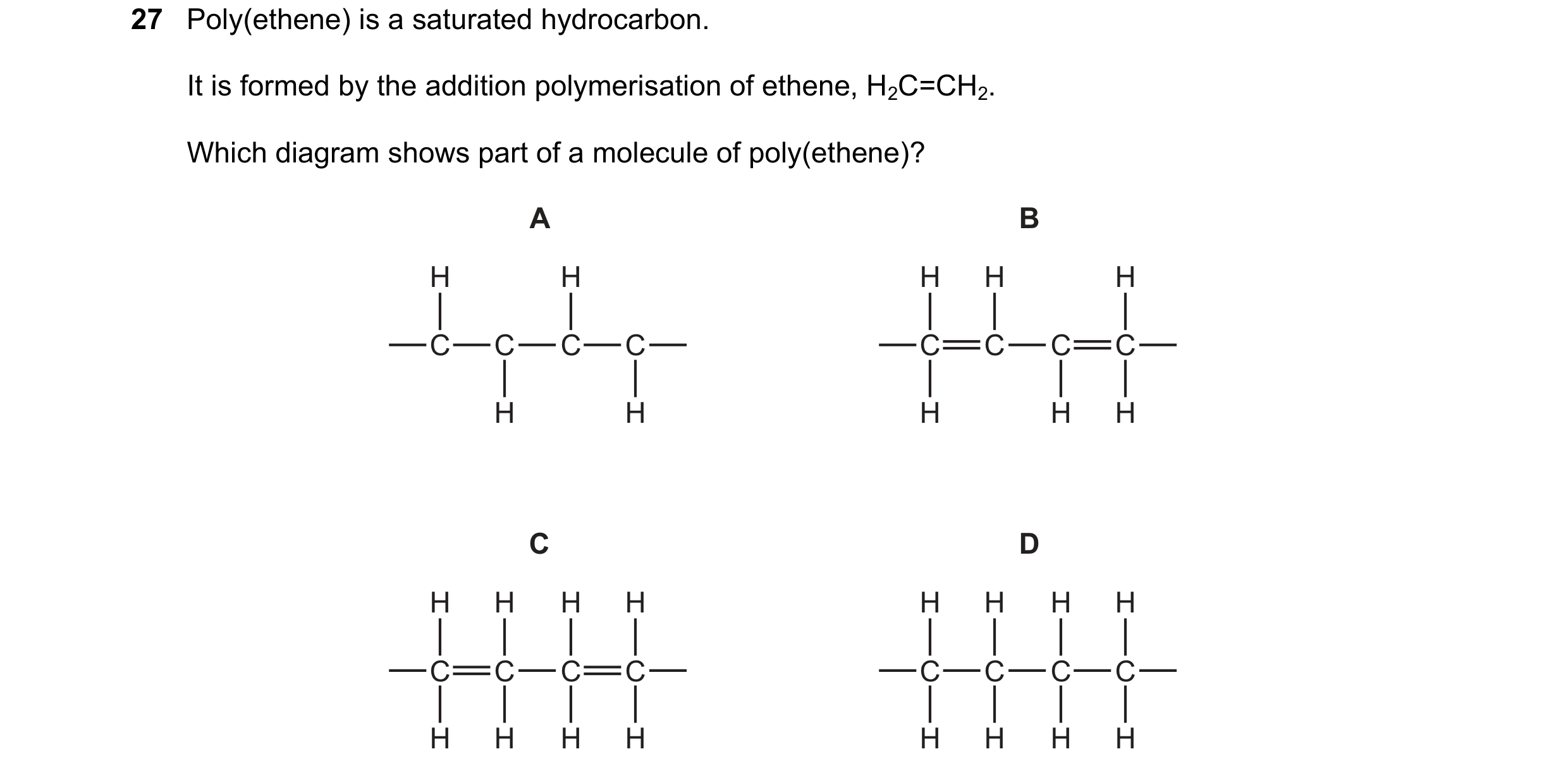
Q34 · Poly(ethene) is a saturated hydrocarbon 0654/12 May/June 2021
27 Poly(ethene) is a saturated hydrocarbon. It is formed by the addition polymerisation of ethene, H2C=CH2. Which diagram shows part of a molecule of poly(ethene)? A B H H H H H C C C C C C C C H H H H H C D H H H H H H H H C C C C C C C C H H H H H H H H
1 marks
Answer: D
This question in 0654/12 May/June 2021
Q35 · Poly(ethene) is a saturated hydrocarbon 0654/13 May/June 2021
27 Poly(ethene) is a saturated hydrocarbon. It is formed by the addition polymerisation of ethene, H2C=CH2. Which diagram shows part of a molecule of poly(ethene)? A B H H H H H C C C C C C C C H H H H H C D H H H H H H H H C C C C C C C C H H H H H H H H
1 marks
Answer: D
This question in 0654/13 May/June 2021
Q36 · Which statement about poly(ethene) is correct? 0654/12 Feb/March 2022
27 Which statement about poly(ethene) is correct? A It is an alkene. B It is formed in a reaction called cracking. C It is obtained from the bitumen fraction of petroleum. D It is made by an addition reaction.
1 marks
Answer: D
This question in 0654/12 Feb/March 2022
Q37 · Which statement about poly(ethene) is correct? 0654/11 Oct/Nov 2023
27 Which statement about poly(ethene) is correct? A It always contains less than 12 carbon atoms. B It is formed from ethane. C It is formed from ethene. D It occurs naturally.
1 marks
Answer: C
This question in 0654/11 Oct/Nov 2023
Q38 · Polymers are long chain molecules made from smaller molecules 0654/12 Oct/Nov 2023
27 Polymers are long chain molecules made from smaller molecules. What are these smaller molecules called? A alkanes B atoms C components D monomers
1 marks
Answer: D
This question in 0654/12 Oct/Nov 2023
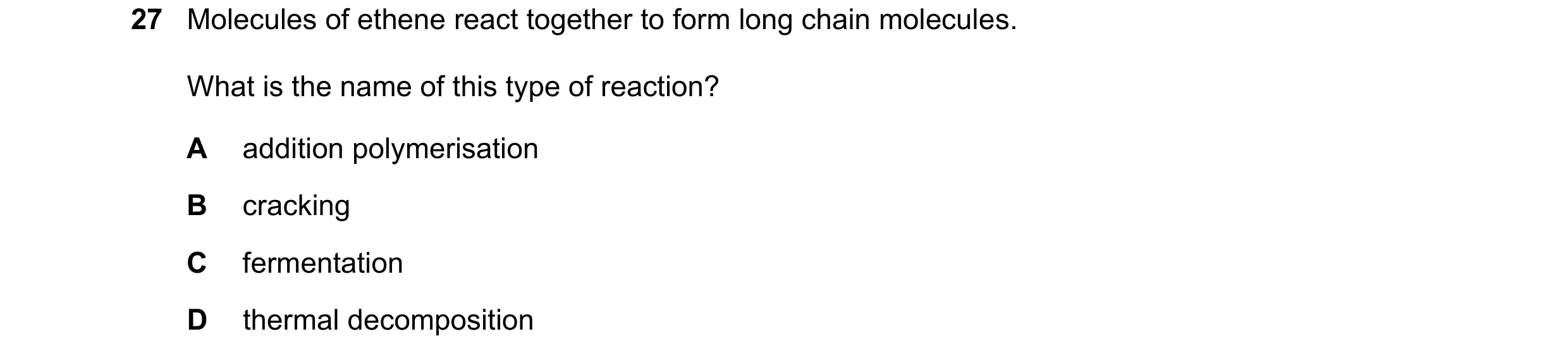
Q39 · Molecules of ethene react together to form long chain molecules 0654/13 Oct/Nov 2023
27 Molecules of ethene react together to form long chain molecules. What is the name of this type of reaction? A addition polymerisation B cracking C fermentation D thermal decomposition
1 marks
Answer: A
This question in 0654/13 Oct/Nov 2023
Q40 · Poly(ethene) is made from ethene by addition polymerisation 0654/12 May/June 2024
27 Poly(ethene) is made from ethene by addition polymerisation. Which word describes ethene in this process? A fuel B catalyst C monomer D solvent
1 marks
Answer: C
This question in 0654/12 May/June 2024
Q41 · Poly(ethene) is made from ethene by addition polymerisation 0654/13 May/June 2024
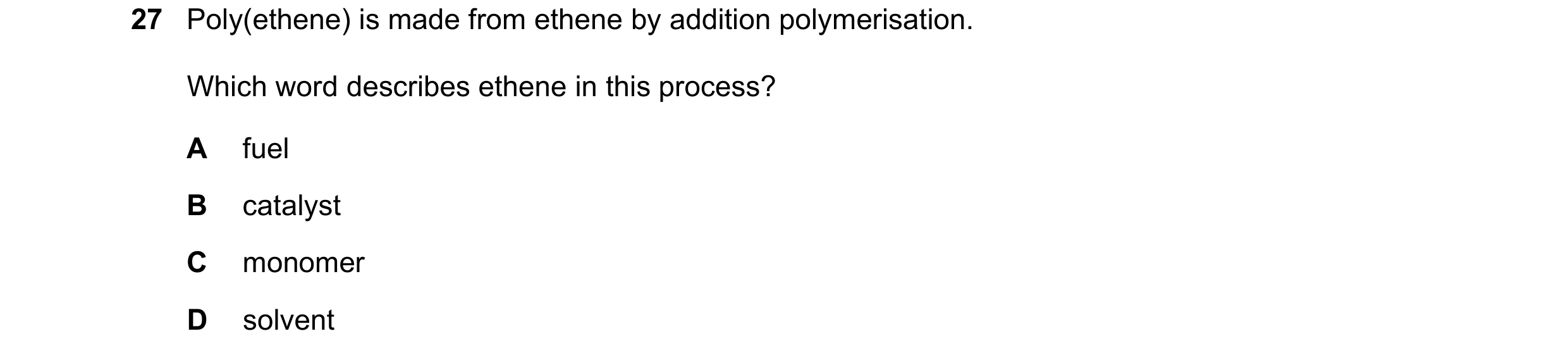
27 Poly(ethene) is made from ethene by addition polymerisation. Which word describes ethene in this process? A fuel B catalyst C monomer D solvent
1 marks
Answer: C
This question in 0654/13 May/June 2024
Q42 · Which statement about addition polymerisation is correct? 0654/12 Oct/Nov 2024
27 Which statement about addition polymerisation is correct? A Large monomer units join to form small polymer molecules. B Large polymer molecules join to form small monomer units. C Small monomer units join to form large polymer molecules. D Small polymer molecules join to form large monomer units.
1 marks
Answer: C
This question in 0654/12 Oct/Nov 2024
Q43 · Which statement about addition polymerisation is correct? 0654/13 Oct/Nov 2024
27 Which statement about addition polymerisation is correct? A Large monomer units join to form small polymer molecules. B Large polymer molecules join to form small monomer units. C Small monomer units join to form large polymer molecules. D Small polymer molecules join to form large monomer units.
1 marks
Answer: C
This question in 0654/13 Oct/Nov 2024
Q44 · Which statement describes poly(ethene)? 0654/11 May/June 2025
25 Which statement describes poly(ethene)? A It is formed from monomer molecules which each contain two atoms. B It is formed from a saturated hydrocarbon monomer. C It is formed in an addition reaction. D It is a polymer consisting of C, H and O atoms.
1 marks
Answer: C
This question in 0654/11 May/June 2025
Q45 · Polymers are ……1…… chain molecules 0654/11 Oct/Nov 2025
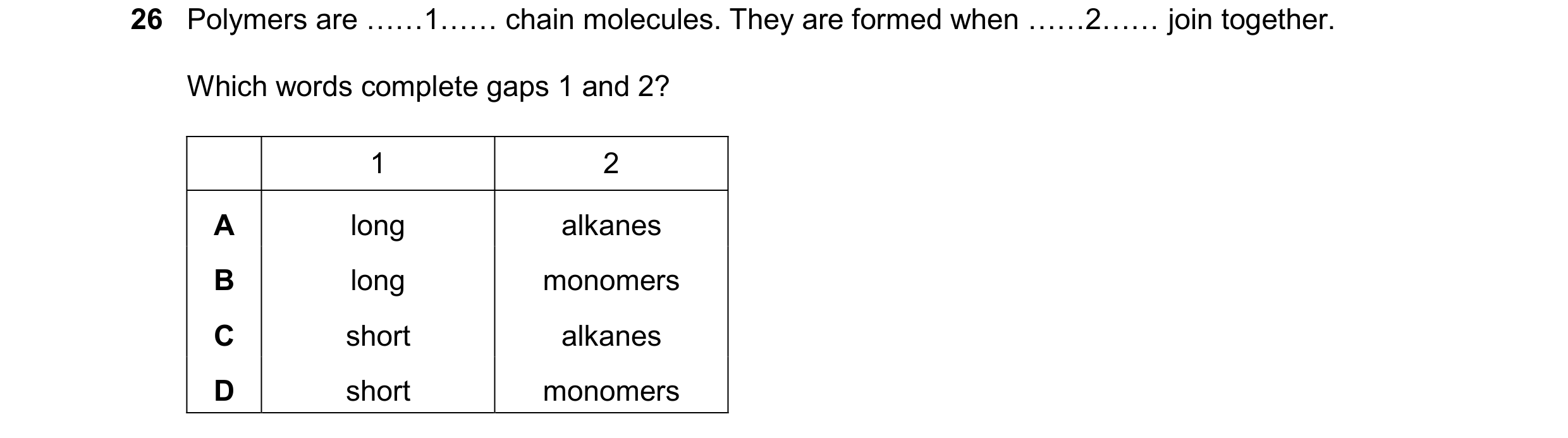
26 Polymers are ……1…… chain molecules. They are formed when ……2…… join together. Which words complete gaps 1 and 2? 1 2 A long alkanes B long monomers C short alkanes D short monomers
1 marks
Answer: B
This question in 0654/11 Oct/Nov 2025

 1 / 12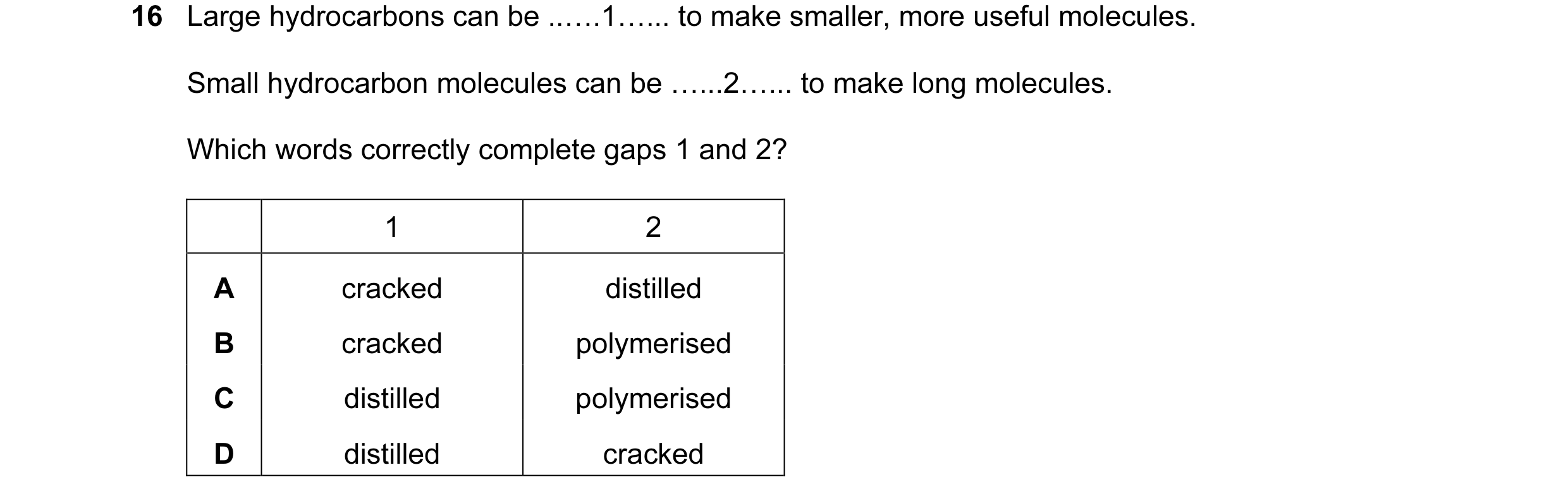



 2 / 12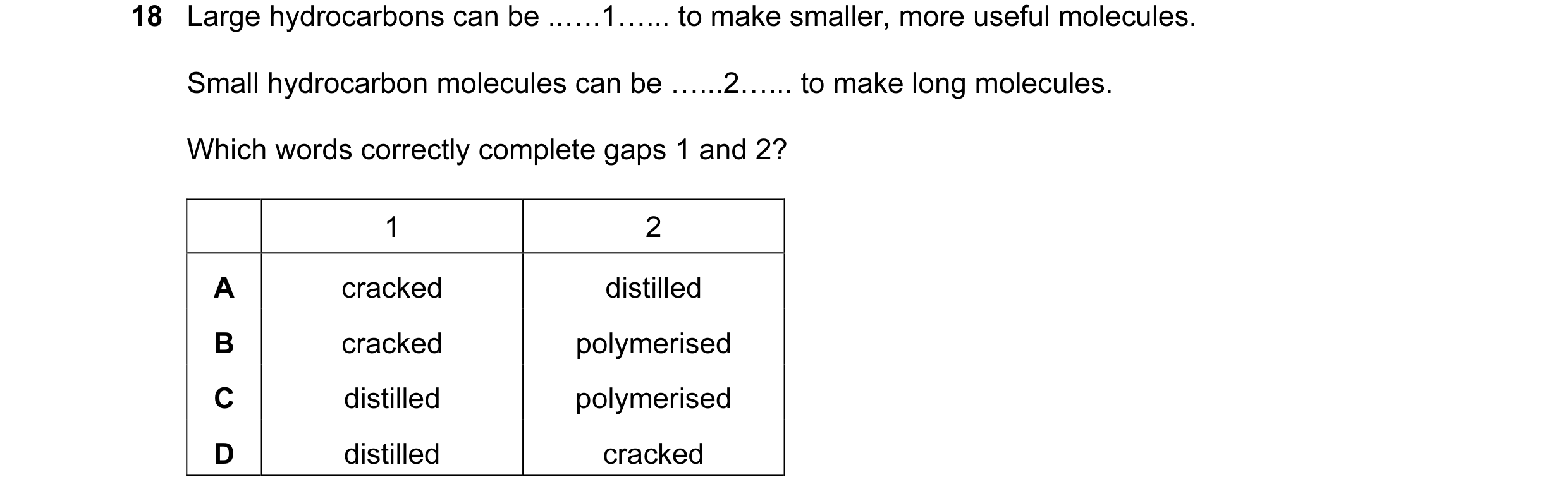
 3 / 12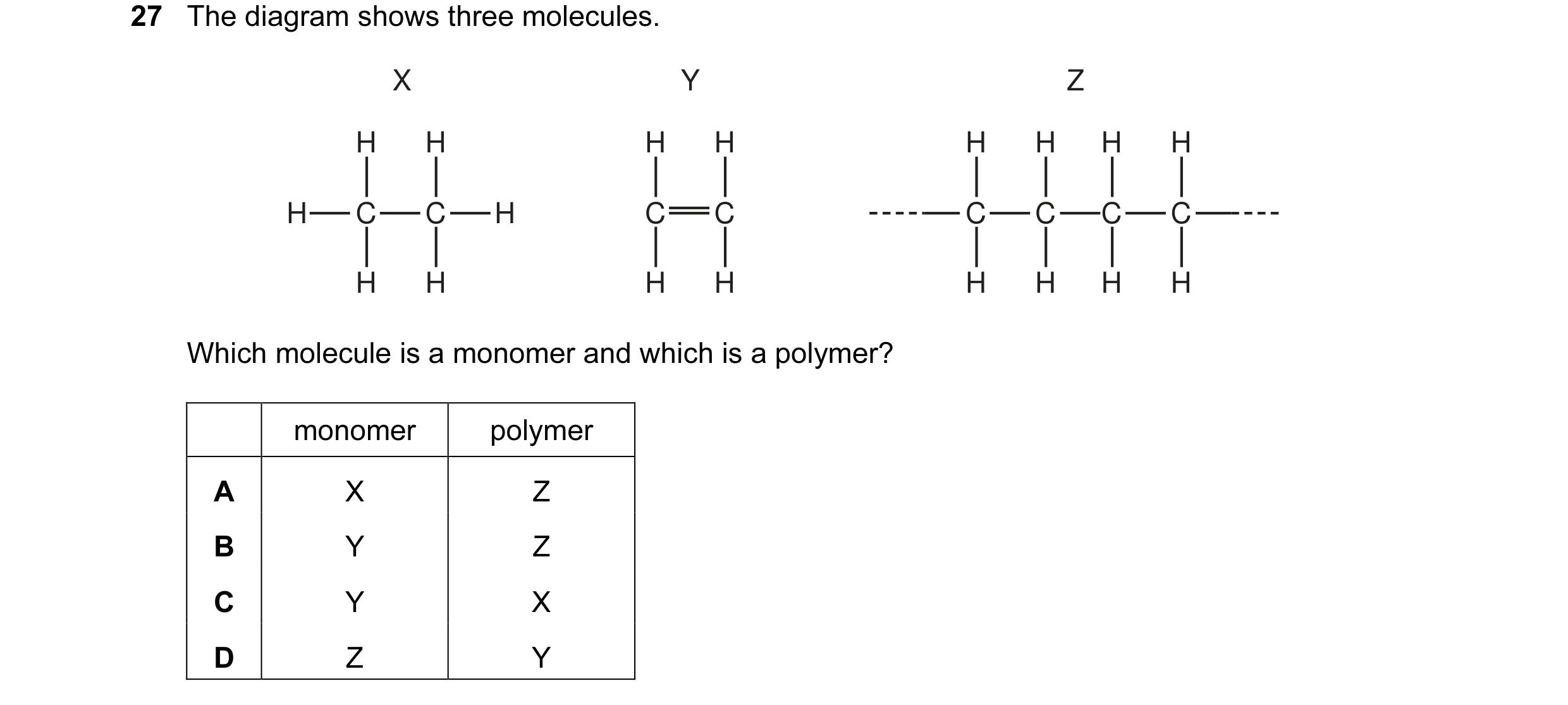
 4 / 12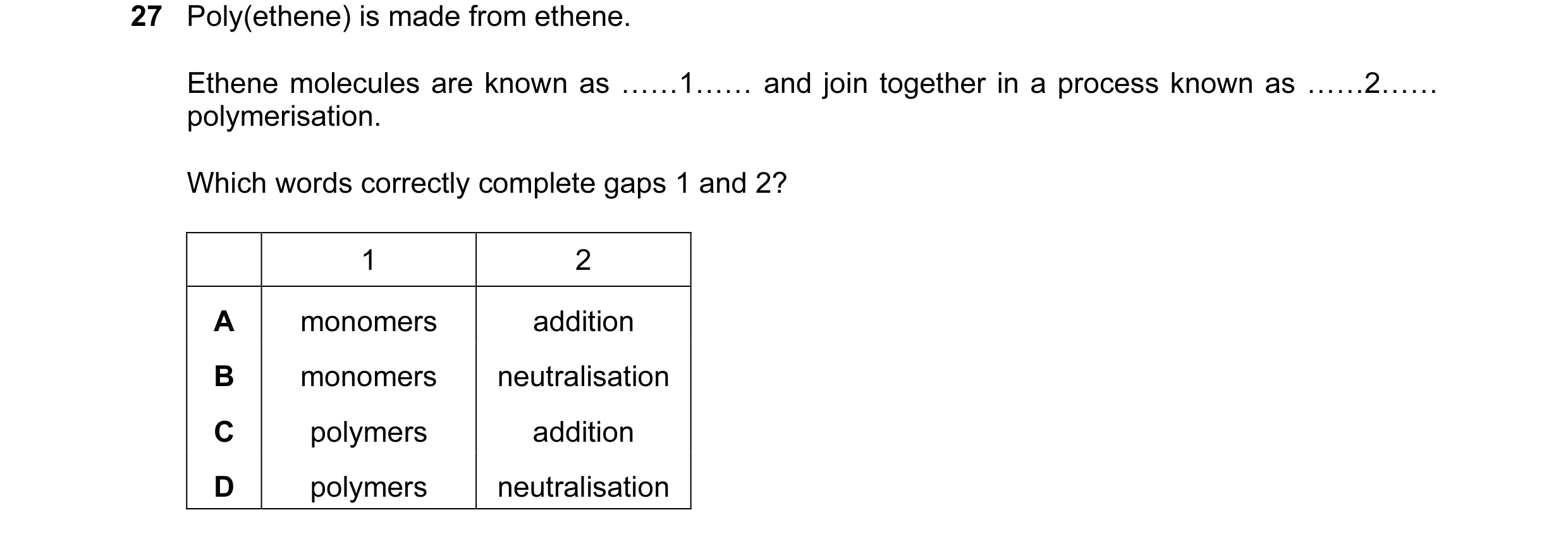
 5 / 12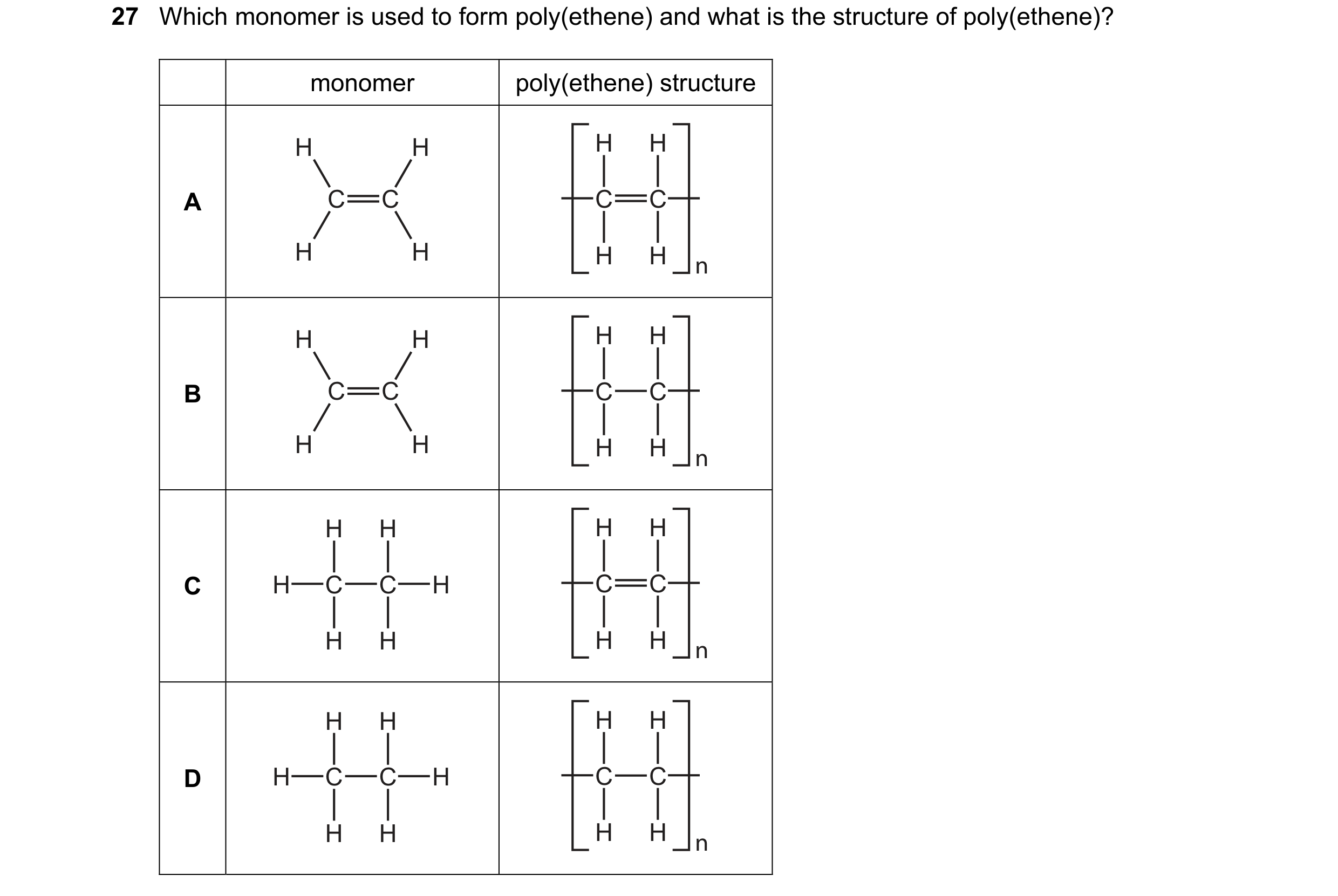
 6 / 12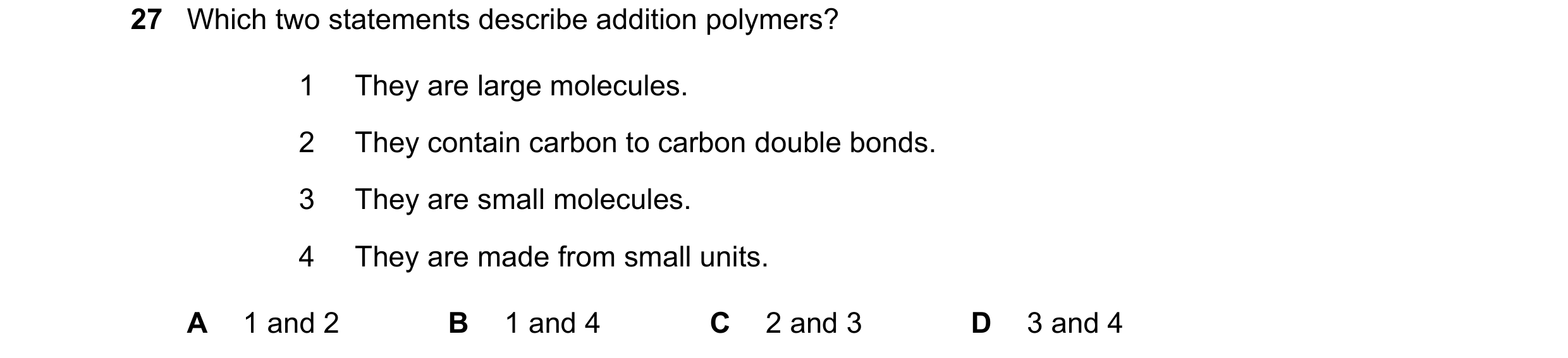

 7 / 12
 8 / 12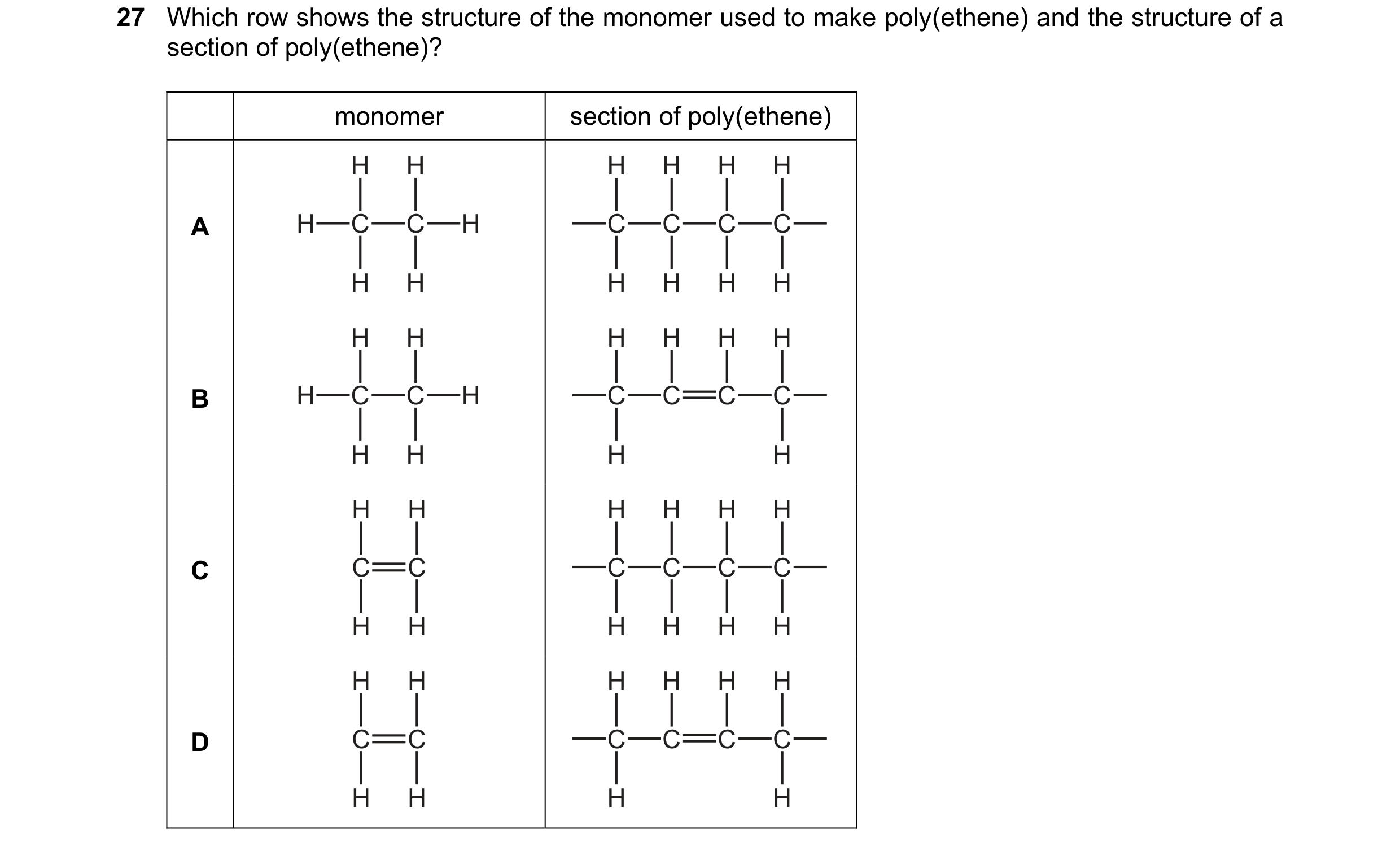
 9 / 12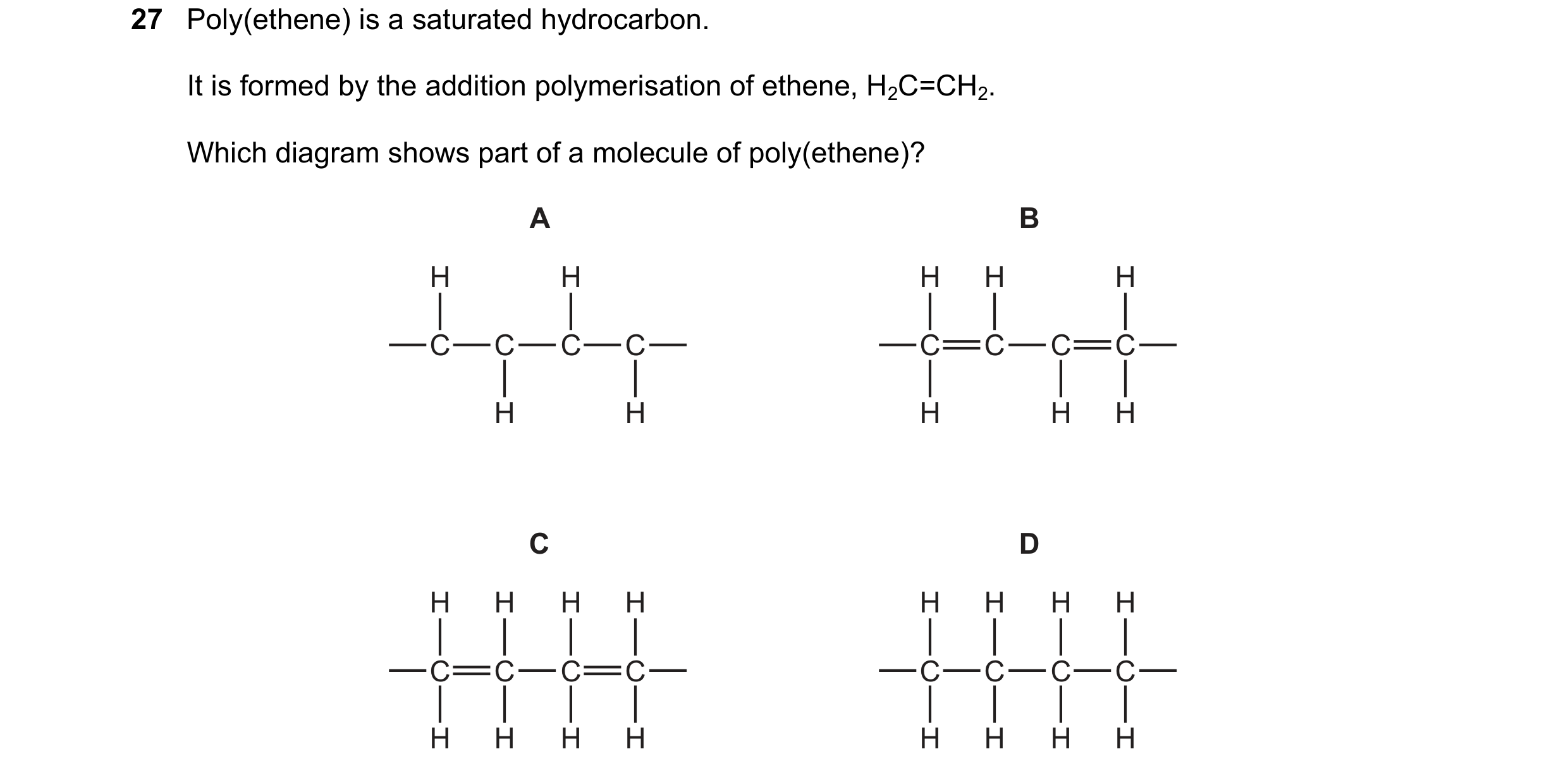


 10 / 12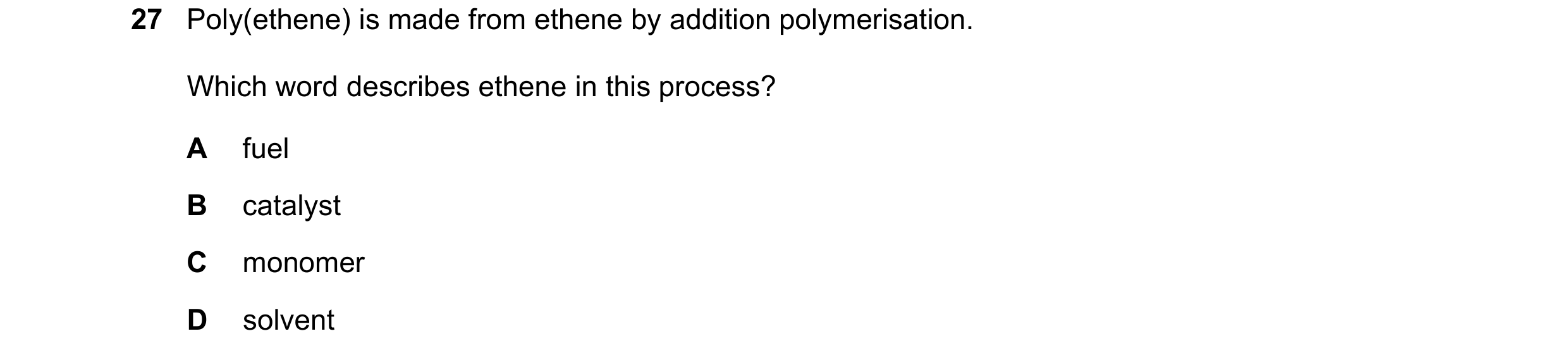


 11 / 12
 12 / 12