Questions as text
Q1 · Polymers form from monomer units 0654/42 Oct/Nov 2018
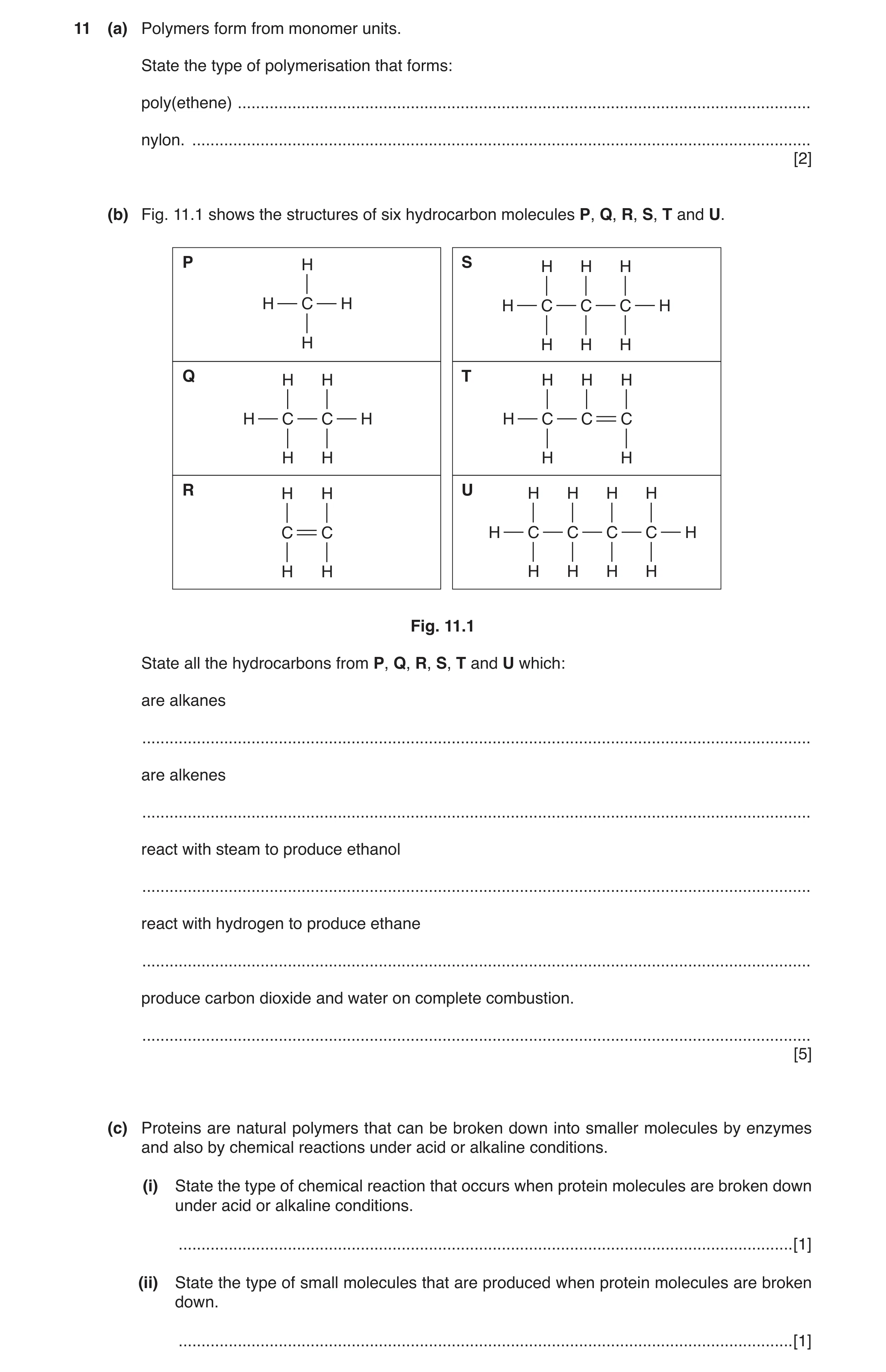
11 (a) Polymers form from monomer units. State the type of polymerisation that forms: poly(ethene) … nylon. … [2] (b) Fig. 11.1 shows the structures of six hydrocarbon molecules P, Q, R, S, T and U. P H S H H H H C H H C C C H H H H H Q H H T H H H H C C H H C C C H H H H R H H U H H H H C C H C C C C H H H H H H H Fig. 11.1 State all the hydrocarbons from P, Q, R, S, T and U which: are alkanes … are alkenes … react with steam to produce ethanol … react with hydrogen to produce ethane … produce carbon dioxide and water on complete combustion. … [5] (c) Proteins are natural polymers that can be broken down into smaller molecules by enzymes and also by chemical reactions under acid or alkaline conditions. (i) State the type of chemical reaction that occurs when protein molecules are broken down under acid or alkaline conditions. … [1] (ii) State the type of small molecules that are produced when protein molecules are broken down. … [1]
9 marks
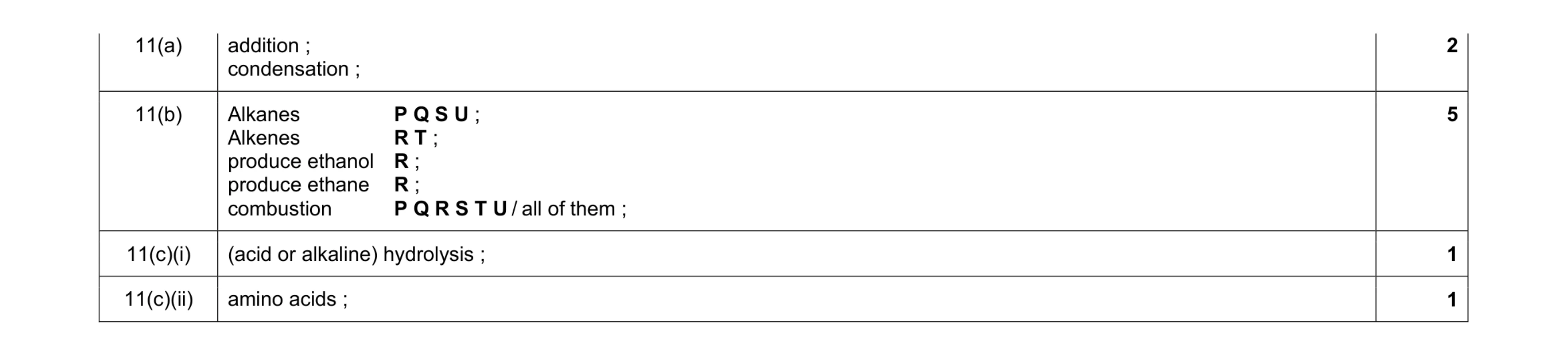
Mark scheme: 11(a) addition ; condensation ; 2 11(b) Alkanes P Q S U ; Alkenes R T ; produce ethanol R ; produce ethane R ; combustion P Q R S T U / all of them ; 5 11(c)(i) (acid or alkaline) hydrolysis ; 1 11(c)(ii) amino acids ; 1
This question in 0654/42 Oct/Nov 2018
Q2 · The composition of clean air and of natural gas 0654/42 May/June 2019
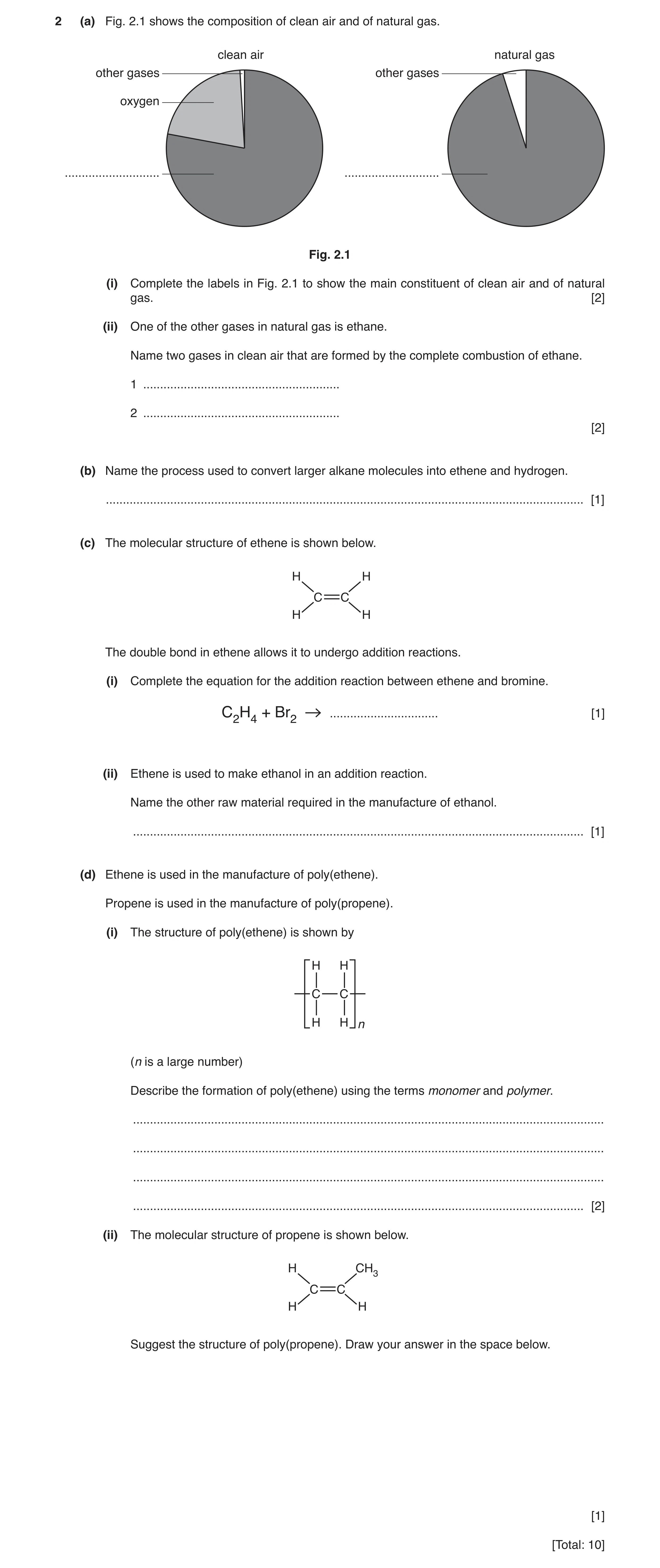
2 (a) Fig. 2.1 shows the composition of clean air and of natural gas. clean air natural gas other gases other gases oxygen … … Fig. 2.1 (i) Complete the labels in Fig. 2.1 to show the main constituent of clean air and of natural gas. [2] (ii) One of the other gases in natural gas is ethane. Name two gases in clean air that are formed by the complete combustion of ethane. 1 … 2 … [2] (b) Name the process used to convert larger alkane molecules into ethene and hydrogen. … [1] (c) The molecular structure of ethene is shown below. H H C C H H The double bond in ethene allows it to undergo addition reactions. (i) Complete the equation for the addition reaction between ethene and bromine. … [1] C2H4 + Br2 (ii) Ethene is used to make ethanol in an addition reaction. Name the other raw material required in the manufacture of ethanol. … [1] (d) Ethene is used in the manufacture of poly(ethene). Propene is used in the manufacture of poly(propene). (i) The structure of poly(ethene) is shown by H H C C H H n (n is a large number) Describe the formation of poly(ethene) using the terms monomer and polymer. … … … … [2] (ii) The molecular structure of propene is shown below. H CH3 C C H H Suggest the structure of poly(propene). Draw your answer in the space below. [1] [Total: 10]
10 marks
Mark scheme: 2(a)(i) nitrogen ; methane ; 2 2(a)(ii) carbon dioxide ; water (vapour) ; 2 2(b) cracking ; 1 2(c)(i) C2H4Br2 ; 1 2(c)(ii) steam / water (vapour) ; 1 2 (d)(i) ethene is monomer ; many, monomers / molecules, join to make a (long chain) polymer ; 2 2(d)(ii) H CH3 | | ------C---C------ | | H H n ; 1
This question in 0654/42 May/June 2019
Q3 · Industrial processes carried out to make some useful materials from petroleum 0654/43 May/June 2019
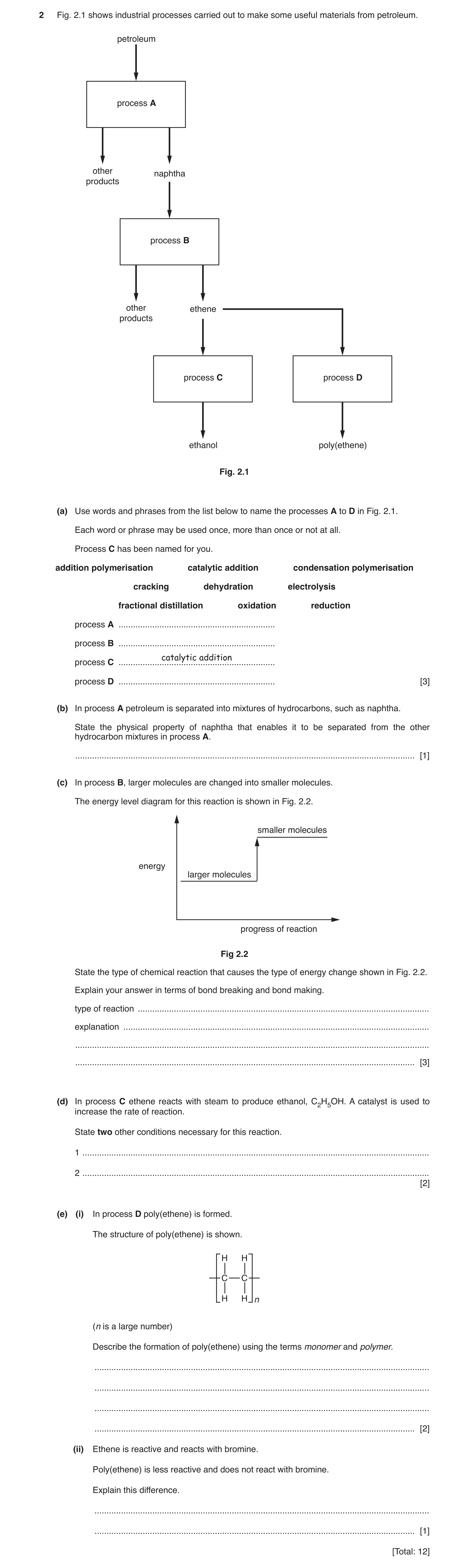
2 Fig. 2.1 shows industrial processes carried out to make some useful materials from petroleum. petroleum process A other naphtha products process B other ethene products process C process D ethanol poly(ethene) Fig. 2.1 (a) Use words and phrases from the list below to name the processes A to D in Fig. 2.1. Each word or phrase may be used once, more than once or not at all. Process C has been named for you. addition polymerisation catalytic addition condensation polymerisation cracking dehydration electrolysis fractional distillation oxidation reduction process A … process B … catalytic addition process C … process D … [3] (b) In process A petroleum is separated into mixtures of hydrocarbons, such as naphtha. State the physical property of naphtha that enables it to be separated from the other hydrocarbon mixtures in process A. … [1] (c) In process B, larger molecules are changed into smaller molecules. The energy level diagram for this reaction is shown in Fig. 2.2. smaller molecules energy larger molecules progress of reaction Fig 2.2 State the type of chemical reaction that causes the type of energy change shown in Fig. 2.2. Explain your answer in terms of bond breaking and bond making. type of reaction … explanation … … … [3] (d) In process C ethene reacts with steam to produce ethanol, C2H5OH. A catalyst is used to increase the rate of reaction. State two other conditions necessary for this reaction. 1 … 2 … [2] (e) (i) In process D poly(ethene) is formed. The structure of poly(ethene) is shown. H H C C H H n (n is a large number) Describe the formation of poly(ethene) using the terms monomer and polymer. … … … … [2] (ii) Ethene is reactive and reacts with bromine. Poly(ethene) is less reactive and does not react with bromine. Explain this difference. … … [1] [Total: 12]
12 marks
Mark scheme: 2(a) A fractional distillation ; B cracking ; (C catalytic addition) D addition polymerisation ; 3 2(b) boiling point (range) ; 1 2(c) endothermic ; bond breaking takes in energy / is an endothermic process and bond formation gives out energy / is an exothermic process ; more energy taken in than given out ; 3 2(d) high temperature ; high pressure ; 2 2(e)(i) ethene is monomer ; many (monomers / molecules) join to make (long chain) polymer ; 2 2(e)(ii) poly(ethene) is not an alkene / does not have double bond / is saturated ; 1
This question in 0654/43 May/June 2019
Q4 · A homologous series is a family of compounds which have the same general formula and… 0654/43 Oct/Nov 2019
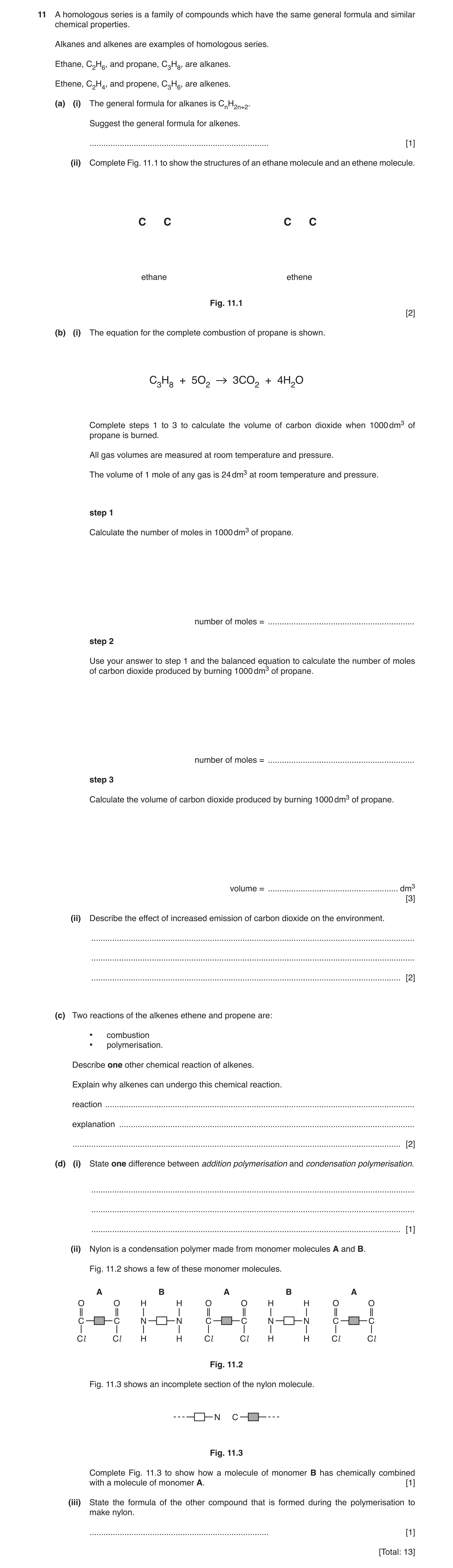
11 A homologous series is a family of compounds which have the same general formula and similar chemical properties. Alkanes and alkenes are examples of homologous series. Ethane, C2H6, and propane, C3H8, are alkanes. Ethene, C2H4, and propene, C3H6, are alkenes. (a) (i) The general formula for alkanes is CnH2n+2. Suggest the general formula for alkenes. … [1] (ii) Complete Fig. 11.1 to show the structures of an ethane molecule and an ethene molecule. C C C C ethane ethene Fig. 11.1 [2] (b) (i) The equation for the complete combustion of propane is shown. C3H8 + 5O2 3CO2 + 4H2O Complete steps 1 to 3 to calculate the volume of carbon dioxide when 1000 dm3 of propane is burned. All gas volumes are measured at room temperature and pressure. The volume of 1 mole of any gas is 24 dm3 at room temperature and pressure. step 1 Calculate the number of moles in 1000 dm3 of propane. number of moles = … step 2 Use your answer to step 1 and the balanced equation to calculate the number of moles of carbon dioxide produced by burning 1000 dm3 of propane. number of moles = … step 3 Calculate the volume of carbon dioxide produced by burning 1000 dm3 of propane. volume = … dm3 [3] (ii) Describe the effect of increased emission of carbon dioxide on the environment. … … … [2] (c) Two reactions of the alkenes ethene and propene are: • combustion • polymerisation. Describe one other chemical reaction of alkenes. Explain why alkenes can undergo this chemical reaction. reaction … explanation … … [2] (d) (i) State one difference between addition polymerisation and condensation polymerisation. … … … [1] (ii) Nylon is a condensation polymer made from monomer molecules A and B. Fig. 11.2 shows a few of these monomer molecules. A B A B A O O H H O O H H O O C C N N C C N N C C Cl Cl H H Cl Cl H H Cl Cl Fig. 11.2 Fig. 11.3 shows an incomplete section of the nylon molecule. N C Fig. 11.3 Complete Fig. 11.3 to show how a molecule of monomer B has chemically combined with a molecule of monomer A. [1] (iii) State the formula of the other compound that is formed during the polymerisation to make nylon. … [1] [Total: 13]
13 marks
Mark scheme: 11(a)(i) CnH2n ; 1 11(a)(ii) ethane correctly drawn ; ethene correctly drawn ; 2 11(b)(i) 1000 / 24 = 41.7 ; 41.7 × 3 = 125.1 ; 125.1 × 24 = 3000 (dm3) ; 3 11(b)(ii) greenhouse, effect / gas / description of greenhouse effect ; climate change / global warming / other environmental effect ; AVP ; max 2 2 11(c) (named) addition reaction ; (both have) double bond / are unsaturated ; 2 11(d)(i) condensation polymerisation gives (small molecular) waste product / owtte ; 1 11(d)(ii) H O | || — ; 1 11(d)(iii) HCl ; 1
This question in 0654/43 Oct/Nov 2019
Q5 · Polymers are made from small molecules called monomers 0654/42 May/June 2020
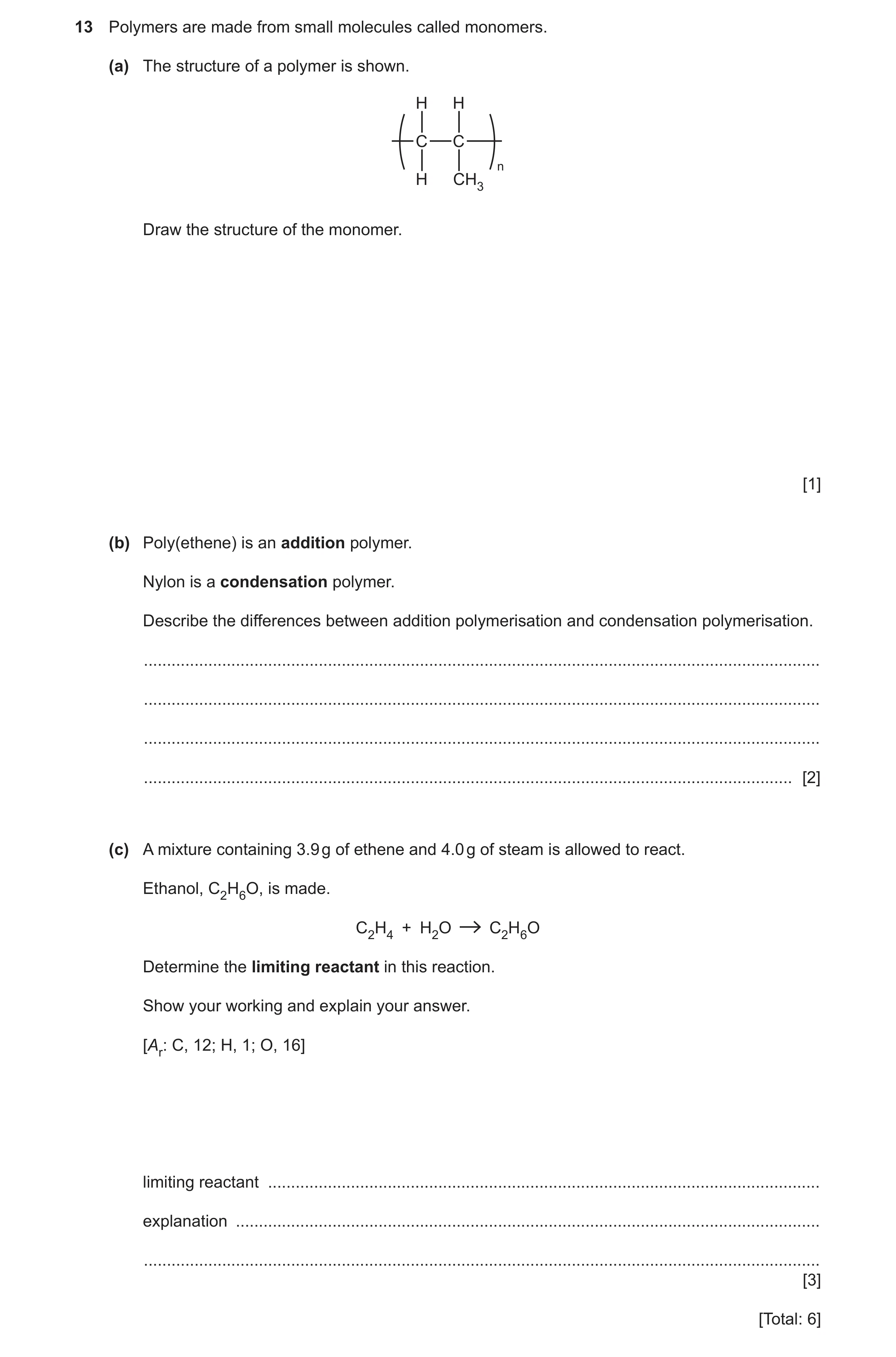
13 Polymers are made from small molecules called monomers. (a) The structure of a polymer is shown. H H C C n H CH3 Draw the structure of the monomer. [1] (b) Poly(ethene) is an addition polymer. Nylon is a condensation polymer. Describe the differences between addition polymerisation and condensation polymerisation. … … … … [2] (c) A mixture containing 3.9 g of ethene and 4.0 g of steam is allowed to react. Ethanol, C2H6O, is made. C2H4 + H2O C2H6O Determine the limiting reactant in this reaction. Show your working and explain your answer. [Ar: C, 12; H, 1; O, 16] limiting reactant … explanation … … [3] [Total: 6]
6 marks
Mark scheme: 13(a) 1 13(b) in addition polymerisation molecules react together to form one larger molecule ; in condensation polymerisation molecules react together to form one larger molecule and smaller molecules ; 2 13(c) moles of ethene = 3.9 ÷ 28 = 0.14 OR moles of water = 4.0 ÷ 18 = 0.22 ; ethene is the limiting reactant ; explanation demonstrating understanding of the term ‘limiting reactant’; 3
This question in 0654/42 May/June 2020
Q6 · Propane and propene are both hydrocarbons 0654/42 Oct/Nov 2020
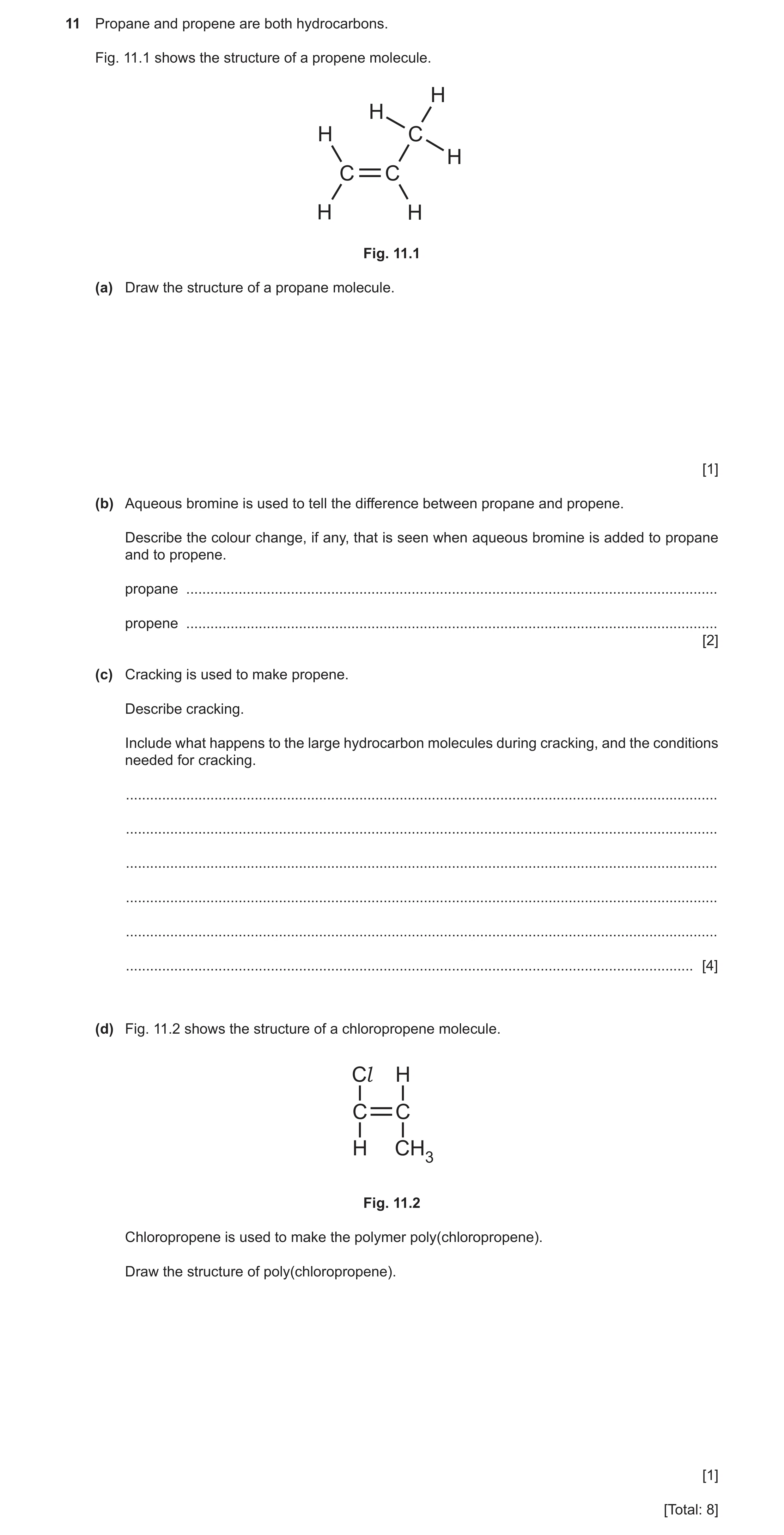
11 Propane and propene are both hydrocarbons. Fig. 11.1 shows the structure of a propene molecule. H H H C H C C H H Fig. 11.1 (a) Draw the structure of a propane molecule. [1] (b) Aqueous bromine is used to tell the difference between propane and propene. Describe the colour change, if any, that is seen when aqueous bromine is added to propane and to propene. propane … propene … [2] (c) Cracking is used to make propene. Describe cracking. Include what happens to the large hydrocarbon molecules during cracking, and the conditions needed for cracking. … … … … … … [4] (d) Fig. 11.2 shows the structure of a chloropropene molecule. Cl H C C H CH3 Fig. 11.2 Chloropropene is used to make the polymer poly(chloropropene). Draw the structure of poly(chloropropene). [1] [Total: 8]
8 marks
Mark scheme: 11(a) ; 1 11(b) bromine water remains orange (with propane) / bromine water is not decolourised (with propane) ; bromine water is decolourised (with propene) / bromine water changes from orange to colourless (with propene) ; 2 11(c) large hydrocarbon molecules are broken down / split up (into smaller molecules) ; to make, alkenes / named alkene other than propene ; plus any two from: high temperature / 300 to 600 °C ; catalyst / correctly named catalyst e.g. zeolite or porcelain ; high pressure / 50 to 200 atmospheres ; max 4 11(d) n ; 1
This question in 0654/42 Oct/Nov 2020
Q7 · Ethene and propene are both members of the homologous series called the alkenes 0654/41 May/June 2021
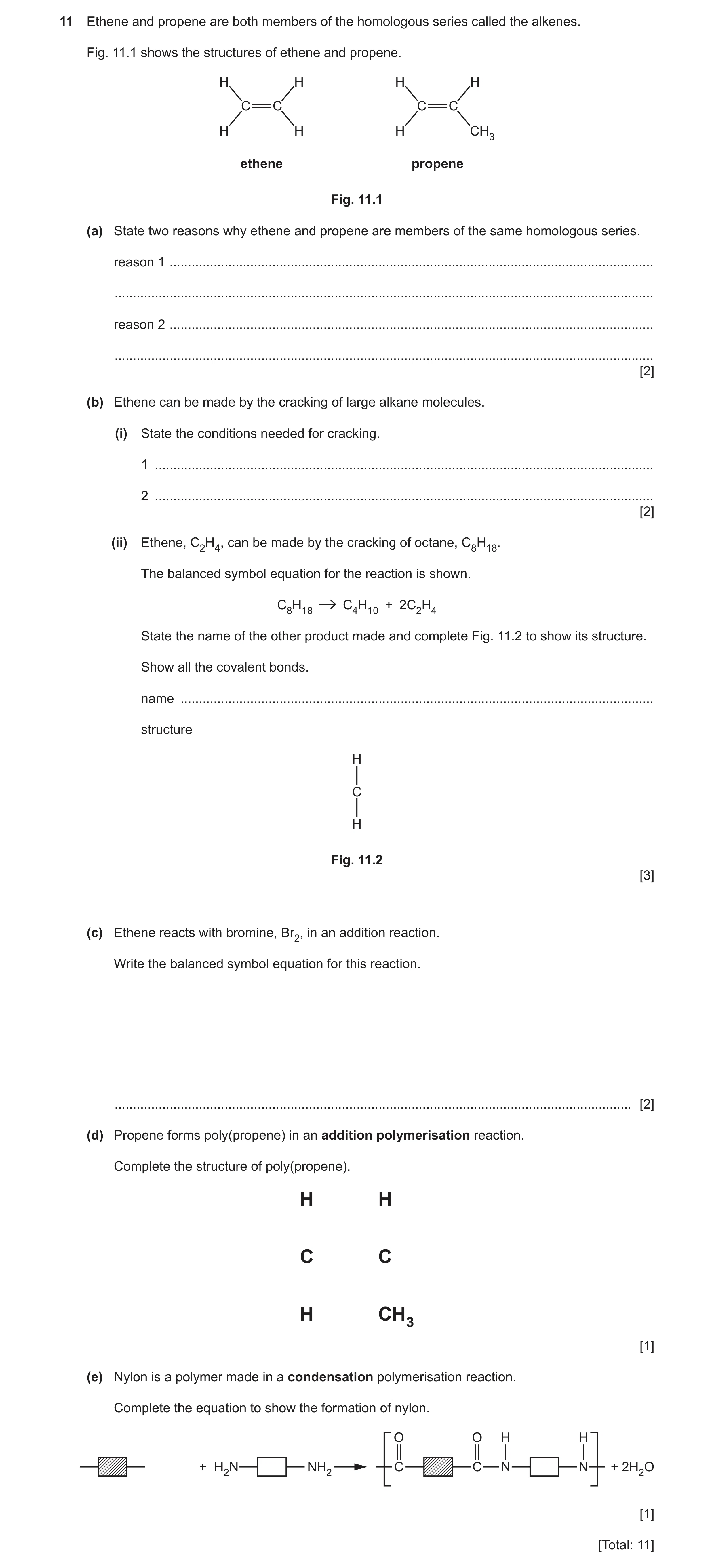
11 Ethene and propene are both members of the homologous series called the alkenes. Fig. 11.1 shows the structures of ethene and propene. H H H H C C C C H H H CH3 ethene propene Fig. 11.1 (a) State two reasons why ethene and propene are members of the same homologous series. reason 1 … … reason 2 … … [2] (b) Ethene can be made by the cracking of large alkane molecules. (i) State the conditions needed for cracking. 1 … 2 … [2] (ii) Ethene, C2H4, can be made by the cracking of octane, C8H18. The balanced symbol equation for the reaction is shown. C8H18 C4H10 + 2C2H4 State the name of the other product made and complete Fig. 11.2 to show its structure. Show all the covalent bonds. name … structure H C H Fig. 11.2 [3] (c) Ethene reacts with bromine, Br2, in an addition reaction. Write the balanced symbol equation for this reaction. … [2] (d) Propene forms poly(propene) in an addition polymerisation reaction. Complete the structure of poly(propene). H H C C H CH3 [1] (e) Nylon is a polymer made in a condensation polymerisation reaction. Complete the equation to show the formation of nylon. O O H H + H2N NH2 C C N N + 2H2O [1] [Total: 11]
11 marks
Mark scheme: 11(a) both have same functional group / both have (carbon to carbon) double bond ; both have same general formula / CnH2n ; both have similar (chemical) reactions ; trend in / similar, physical properties ; max 2 11(b)(i) high temperature / specified elevated temperature ; high pressure / specified elevated pressure ; catalyst / named catalyst ; AVP ; max 2 2 11(b)(ii) butane ; ;; 3 11(c) C2H4 + Br2 → C2H4Br2 C2H4Br2 ; then all else correct ; 2 Question Answer Marks 11(d) ; 1 11(e) ; 1
This question in 0654/41 May/June 2021
Q8 · The fractional distillation of petroleum makes useful fractions 0654/43 May/June 2021
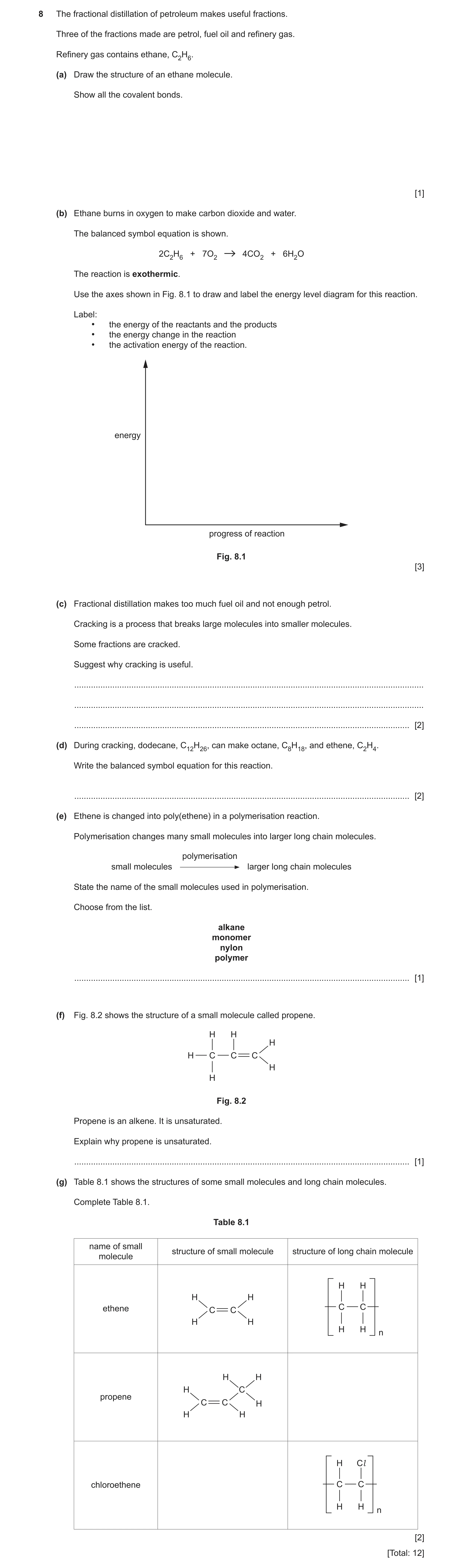
8 The fractional distillation of petroleum makes useful fractions. Three of the fractions made are petrol, fuel oil and refinery gas. Refinery gas contains ethane, C2H6. (a) Draw the structure of an ethane molecule. Show all the covalent bonds. [1] (b) Ethane burns in oxygen to make carbon dioxide and water. The balanced symbol equation is shown. 2C2H6 + 7O2 4CO2 + 6H2O The reaction is exothermic. Use the axes shown in Fig. 8.1 to draw and label the energy level diagram for this reaction. Label: • the energy of the reactants and the products • the energy change in the reaction • the activation energy of the reaction. energy progress of reaction Fig. 8.1 [3] (c) Fractional distillation makes too much fuel oil and not enough petrol. Cracking is a process that breaks large molecules into smaller molecules. Some fractions are cracked. Suggest why cracking is useful. … … … [2] (d) During cracking, dodecane, C12H26, can make octane, C8H18, and ethene, C2H4. Write the balanced symbol equation for this reaction. … [2] (e) Ethene is changed into poly(ethene) in a polymerisation reaction. Polymerisation changes many small molecules into larger long chain molecules. polymerisation small molecules larger long chain molecules State the name of the small molecules used in polymerisation. Choose from the list. alkane monomer nylon polymer … [1] (f) Fig. 8.2 shows the structure of a small molecule called propene. H H H H C C C H H Fig. 8.2 Propene is an alkene. It is unsaturated. Explain why propene is unsaturated. … [1] (g) Table 8.1 shows the structures of some small molecules and long chain molecules. Complete Table 8.1. Table 8.1 name of small structure of small molecule structure of long chain molecule molecule H H H H ethene C C C C H H H H n H H H C propene C C H H H H Cl chloroethene C C H H n [2] [Total: 12]
12 marks
Mark scheme: 8(a) ; 8(b) products shown below reactants ; energy change or correctly labelled ; activation energy correctly labelled ; 3 8(c) cracking makes more petrol / matches supply with demand ; cracking makes alkanes which can be used as fuels ; cracking makes alkenes which can be used to make plastics / alcohol / ethanol ; max 2 2 Activation Energy Energy Energy Change Question Answer Marks 8(d) C12H26 → C8H18 + 2C2H4 formulae ; balancing ; 2 8(e) monomer ; 1 8(f) (propene contains) a (carbon to carbon) double bond ; 1 8(g) (propene) (chloroethene) 2
This question in 0654/43 May/June 2021
Q9 · Large hydrocarbon molecules can be cracked to make smaller molecules 0654/42 Oct/Nov 2021
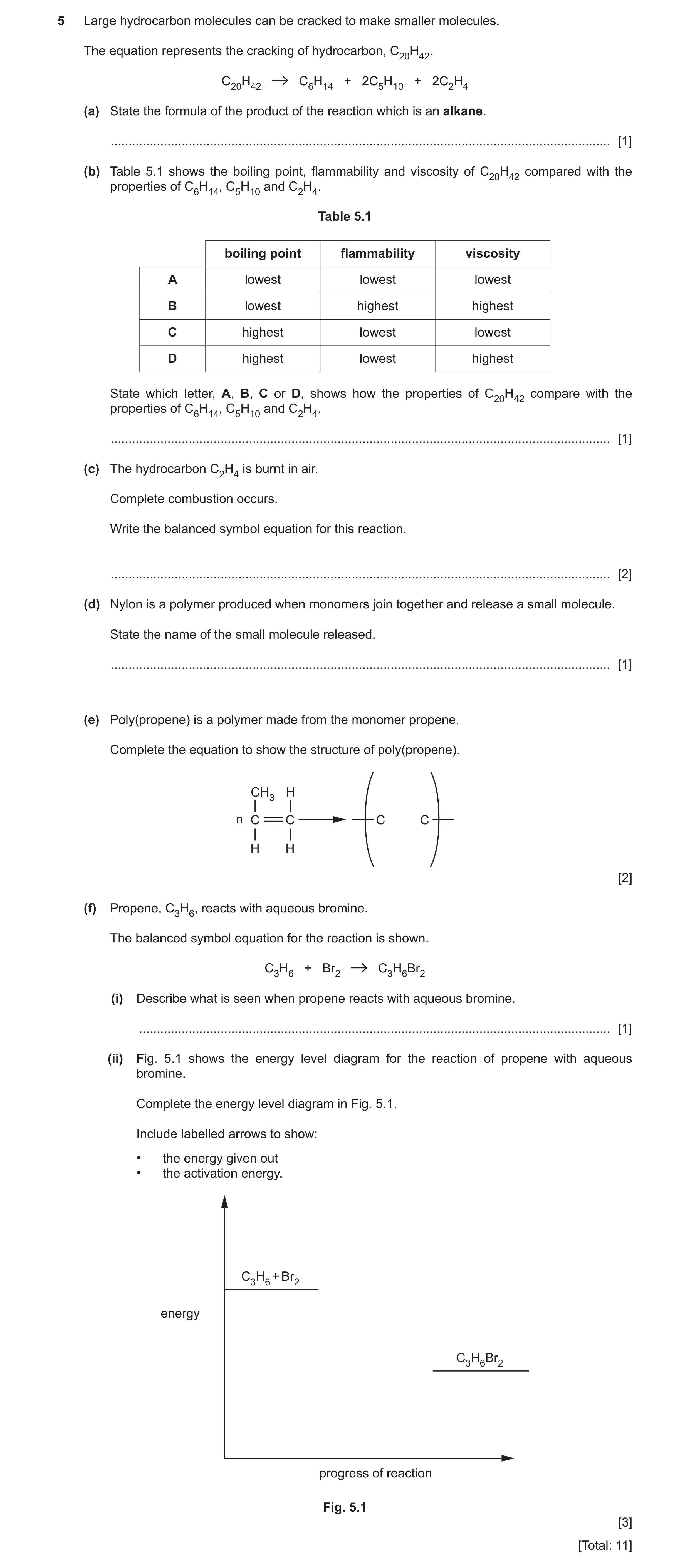
5 Large hydrocarbon molecules can be cracked to make smaller molecules. The equation represents the cracking of hydrocarbon, C20H42. C20H42 C6H14 + 2C5H10 + 2C2H4 (a) State the formula of the product of the reaction which is an alkane. … [1] (b) Table 5.1 shows the boiling point, flammability and viscosity of C20H42 compared with the properties of C6H14, C5H10 and C2H4. Table 5.1 boiling point flammability viscosity A lowest lowest lowest B lowest highest highest C highest lowest lowest D highest lowest highest State which letter, A, B, C or D, shows how the properties of C20H42 compare with the properties of C6H14, C5H10 and C2H4. … [1] (c) The hydrocarbon C2H4 is burnt in air. Complete combustion occurs. Write the balanced symbol equation for this reaction. … [2] (d) Nylon is a polymer produced when monomers join together and release a small molecule. State the name of the small molecule released. … [1] (e) Poly(propene) is a polymer made from the monomer propene. Complete the equation to show the structure of poly(propene). CH3 H n C C C C H H [2] (f) Propene, C3H6, reacts with aqueous bromine. The balanced symbol equation for the reaction is shown. C3H6 + Br2 C3H6Br2 (i) Describe what is seen when propene reacts with aqueous bromine. … [1] (ii) Fig. 5.1 shows the energy level diagram for the reaction of propene with aqueous bromine. Complete the energy level diagram in Fig. 5.1. Include labelled arrows to show: • the energy given out • the activation energy. C3H6 + Br2 energy C3H6Br2 progress of reaction Fig. 5.1 [3] [Total: 11]
11 marks
Mark scheme: 5(a) C6H14 ; 1 5(b) D ; 1 5(c) C2H4 + 3O2 → 2 CO2 + 2H2O ;; 2 5(d) water ; 1 5(e) ;; 2 5(f)(i) (aqueous bromine is) decolourised / changes from orange or yellow to colourless ; 1 5(f)(ii) ;;; 3 activation energy energy given out
This question in 0654/42 Oct/Nov 2021
Q10 · Propene is an alkene 0654/43 Oct/Nov 2021
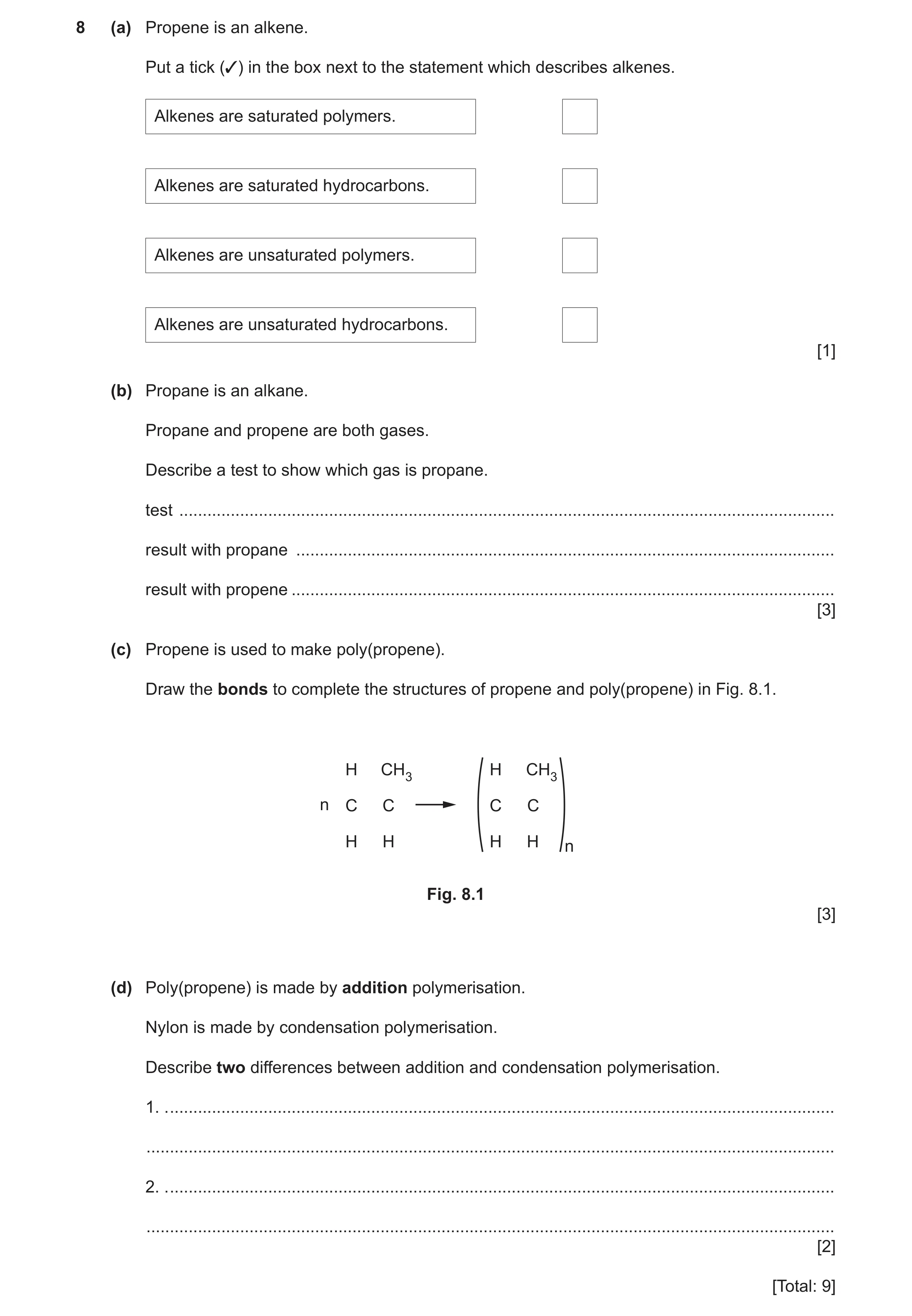
8 (a) Propene is an alkene. Put a tick (3) in the box next to the statement which describes alkenes. Alkenes are saturated polymers. Alkenes are saturated hydrocarbons. Alkenes are unsaturated polymers. Alkenes are unsaturated hydrocarbons. [1] (b) Propane is an alkane. Propane and propene are both gases. Describe a test to show which gas is propane. test … result with propane … result with propene … [3] (c) Propene is used to make poly(propene). Draw the bonds to complete the structures of propene and poly(propene) in Fig. 8.1. H CH3 H CH3 n C C C C H H H H n Fig. 8.1 [3] (d) Poly(propene) is made by addition polymerisation. Nylon is made by condensation polymerisation. Describe two differences between addition and condensation polymerisation. 1. . … … 2. . … … [2] [Total: 9]
9 marks
Mark scheme: 8(a) alkenes are unsaturated hydrocarbons ticked ; 1 8(b) test: aqueous bromine ; result with propane: no change / aqueous bromine stays orange or yellow ; result with propene: aqueous bromine is decolourised / aqueous bromine changes from orange or yellow to colourless ; 3 8(c) C=C in propene ; C—C in poly(propene) ; all else correct ; 3 8(d) addition polymerisation requires one monomer / condensation polymerisation requires two monomers ; addition polymerisation produces a polymer only / condensation polymerisation produces a polymer molecule and a small molecule ; 2
This question in 0654/43 Oct/Nov 2021
Q11 · This question is about hydrocarbons 0654/42 Feb/March 2022
5 This question is about hydrocarbons. Fig. 5.1 shows the displayed formulae of three hydrocarbons. H H H H H H H H C C H H C C C H C C C H H H H H H H H H ethane propane propene Fig. 5.1 (a) The molecular formula of ethane is C2H6. Write down the molecular formula of propene. molecular formula = … [1] (b) Ethane and propane are members of the same group of hydrocarbons called the alkanes. State which group of hydrocarbons propene belongs to. … [1] (c) Propene is an unsaturated hydrocarbon. State what is meant by the word unsaturated. … … [1] (d) Propene can be changed into propane by reaction with hydrogen, as shown in Fig. 5.2. H H H H H C C C H + H2 H C C C H H H H H H H Fig. 5.2 State the name of this type of reaction. … [1] (e) Aqueous bromine is used to tell the difference between propene and propane. State what you would see when aqueous bromine is added to propene and propane. propene … propane … [2] (f) (i) Propene can be used as a monomer. Propene can be converted into a polymer, poly(propene), in an addition polymerisation reaction. Complete Fig. 5.3 to show the structure of poly(propene). H H C C Fig. 5.3 [2] (ii) Nylon is another polymer. Nylon is made in a condensation polymerisation reaction. Describe the differences between addition polymerisation and condensation polymerisation. … … … … [2] [Total: 10]
10 marks
Mark scheme: 5(a) C3H6 ; 1 5(b) alkenes ; 1 5(c) contains a carbon to carbon double bond ; 1 5(d) addition (reaction) / reduction / hydrogenation ; 1 5(e) propene (aqueous bromine) changes from orange to colourless / decolourised / loses its colour / owtte propane (aqueous bromine) stays orange / no change 2 Question Answer Marks 5(f)(i) ;; 2 5(f)(ii) any two from: condensation – one larger and one smaller molecule formed / addition – one large molecule formed ; in condensation polymerisation water is (often) produced (as the smaller molecule) ; AVP ; 2 CH3
This question in 0654/42 Feb/March 2022
Q12 · Ethane and ethene are members of two different homologous series 0654/42 Oct/Nov 2022
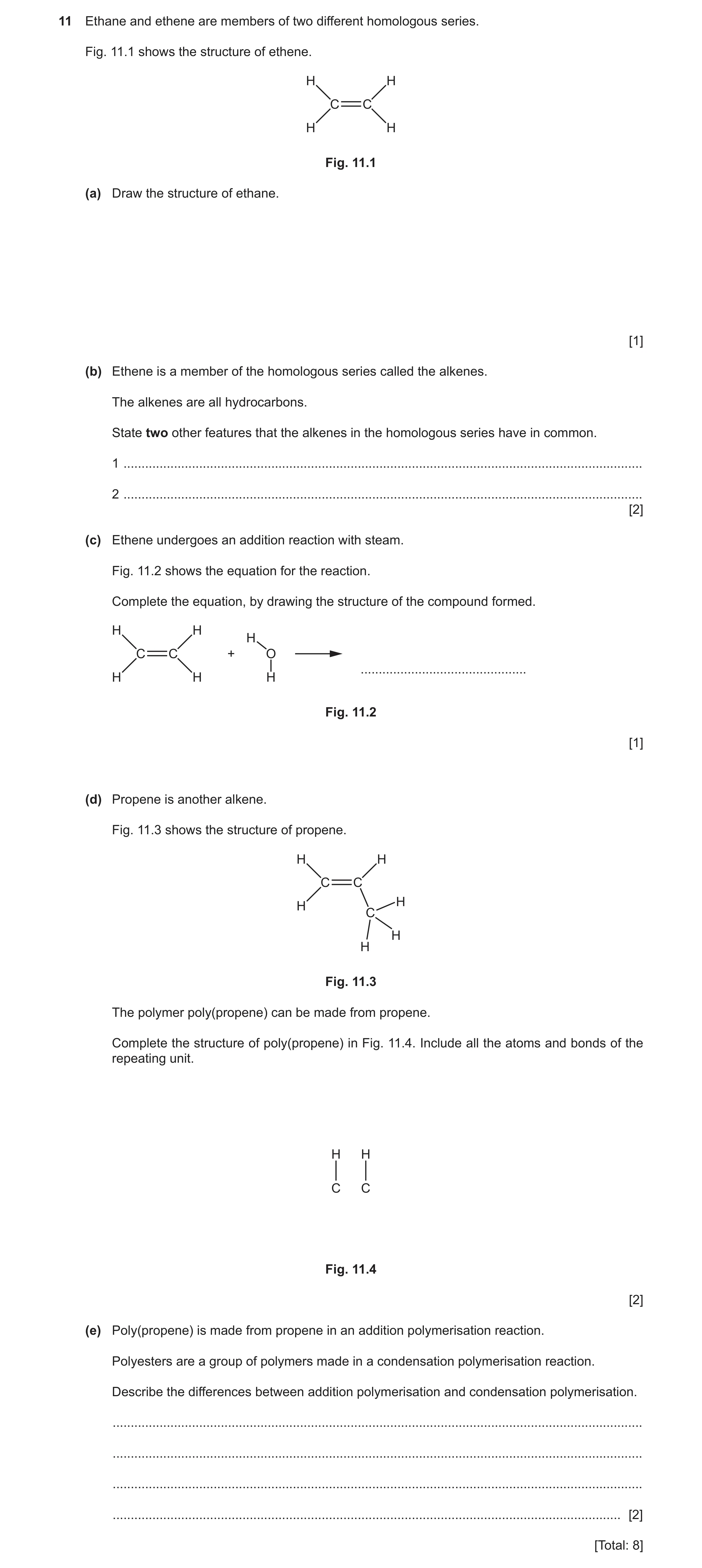
11 Ethane and ethene are members of two different homologous series. Fig. 11.1 shows the structure of ethene. H H C C H H Fig. 11.1 (a) Draw the structure of ethane. [1] (b) Ethene is a member of the homologous series called the alkenes. The alkenes are all hydrocarbons. State two other features that the alkenes in the homologous series have in common. 1 … 2 … [2] (c) Ethene undergoes an addition reaction with steam. Fig. 11.2 shows the equation for the reaction. Complete the equation, by drawing the structure of the compound formed. H H H C C + O … H H H Fig. 11.2 [1] (d) Propene is another alkene. Fig. 11.3 shows the structure of propene. H H C C H H C H H Fig. 11.3 The polymer poly(propene) can be made from propene. Complete the structure of poly(propene) in Fig. 11.4. Include all the atoms and bonds of the repeating unit. H H C C Fig. 11.4 [2] (e) Poly(propene) is made from propene in an addition polymerisation reaction. Polyesters are a group of polymers made in a condensation polymerisation reaction. Describe the differences between addition polymerisation and condensation polymerisation. … … … … [2] [Total: 8]
8 marks
Mark scheme: 11(a) 1 ; 11(b) any two from: 2 same general formula / have formula C2H2 ; similar chemical properties ; contain (at least one) double bond ; 11(c) 1 ; 11(d) 2 mark for single bond between carbon atoms ; mark for rest of structure correct ; 11(e) addition polymerisation requires one monomer / condensation 2 polymerisation requires two monomers ; addition polymerisation produces a polymer only / condensation polymerisation produces a polymer molecule and a small molecule ;
This question in 0654/42 Oct/Nov 2022
Q13 · The structures of some compounds of carbon 0654/42 Feb/March 2023
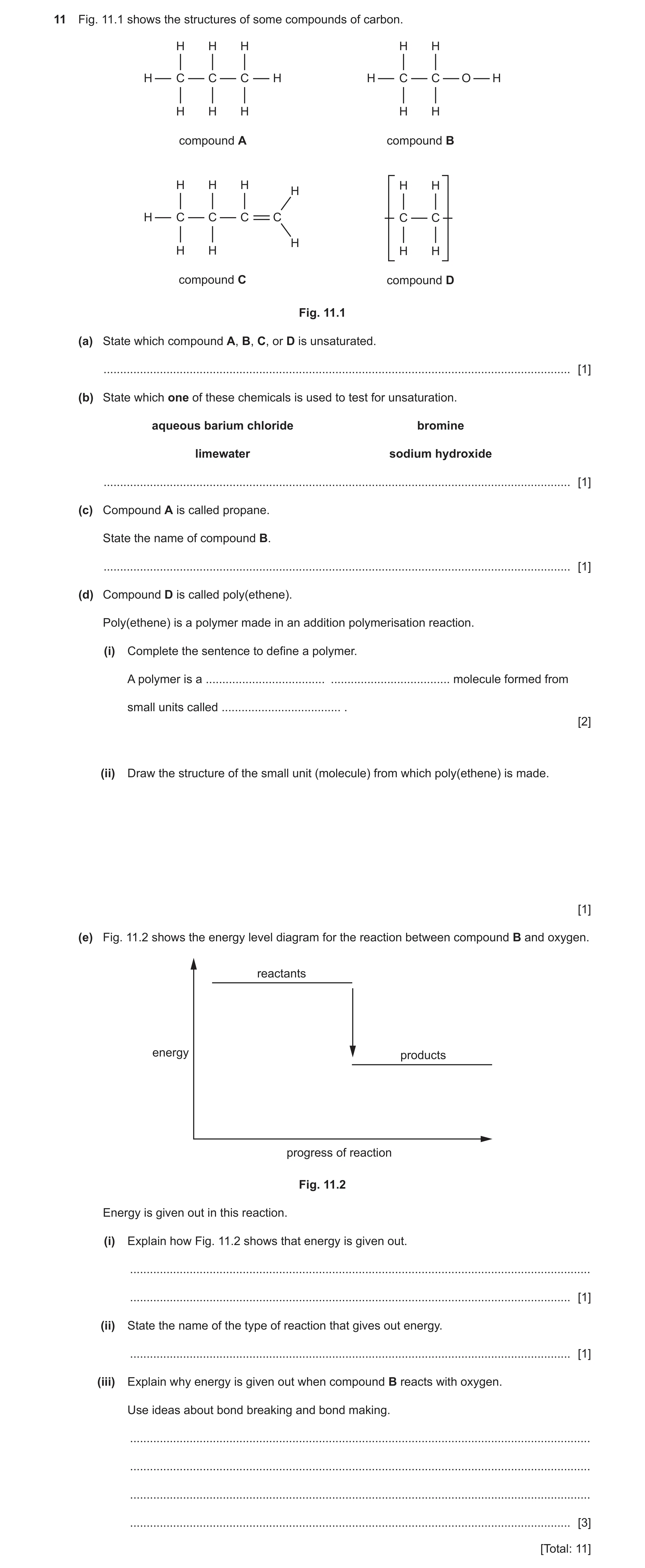
11 Fig. 11.1 shows the structures of some compounds of carbon. H H H H H H C C C H H C C O H H H H H H compound A compound B H H H H H H H C C C C C C H H H H H compound C compound D Fig. 11.1 (a) State which compound A, B, C, or D is unsaturated. … [1] (b) State which one of these chemicals is used to test for unsaturation. aqueous barium chloride bromine limewater sodium hydroxide … [1] (c) Compound A is called propane. State the name of compound B. … [1] (d) Compound D is called poly(ethene). Poly(ethene) is a polymer made in an addition polymerisation reaction. (i) Complete the sentence to define a polymer. A polymer is a … … molecule formed from small units called … . [2] (ii) Draw the structure of the small unit (molecule) from which poly(ethene) is made. [1] (e) Fig. 11.2 shows the energy level diagram for the reaction between compound B and oxygen. reactants energy products progress of reaction Fig. 11.2 Energy is given out in this reaction. (i) Explain how Fig. 11.2 shows that energy is given out. … … [1] (ii) State the name of the type of reaction that gives out energy. … [1] (iii) Explain why energy is given out when compound B reacts with oxygen. Use ideas about bond breaking and bond making. … … … … [3] [Total: 11]
11 marks
Mark scheme: 11(a) C ; 1 11(b) bromine ; 1 11(c) ethanol ; 1 11(d)(i) long chain ; 2 monomers ; 11(d)(ii) 1 ; 11(e)(i) idea that products have less energy than the reactants ; 1 11(e)(ii) exothermic ; 1 11(e)(iii) bond breaking is endothermic / owtte ; 3 bond making is exothermic / owtte ; more energy is given out (in bond making) than is taken in (in bond breaking) ;
This question in 0654/42 Feb/March 2023
Q14 · Look at the structures of the carbon compounds shown in Fig 0654/41 May/June 2023
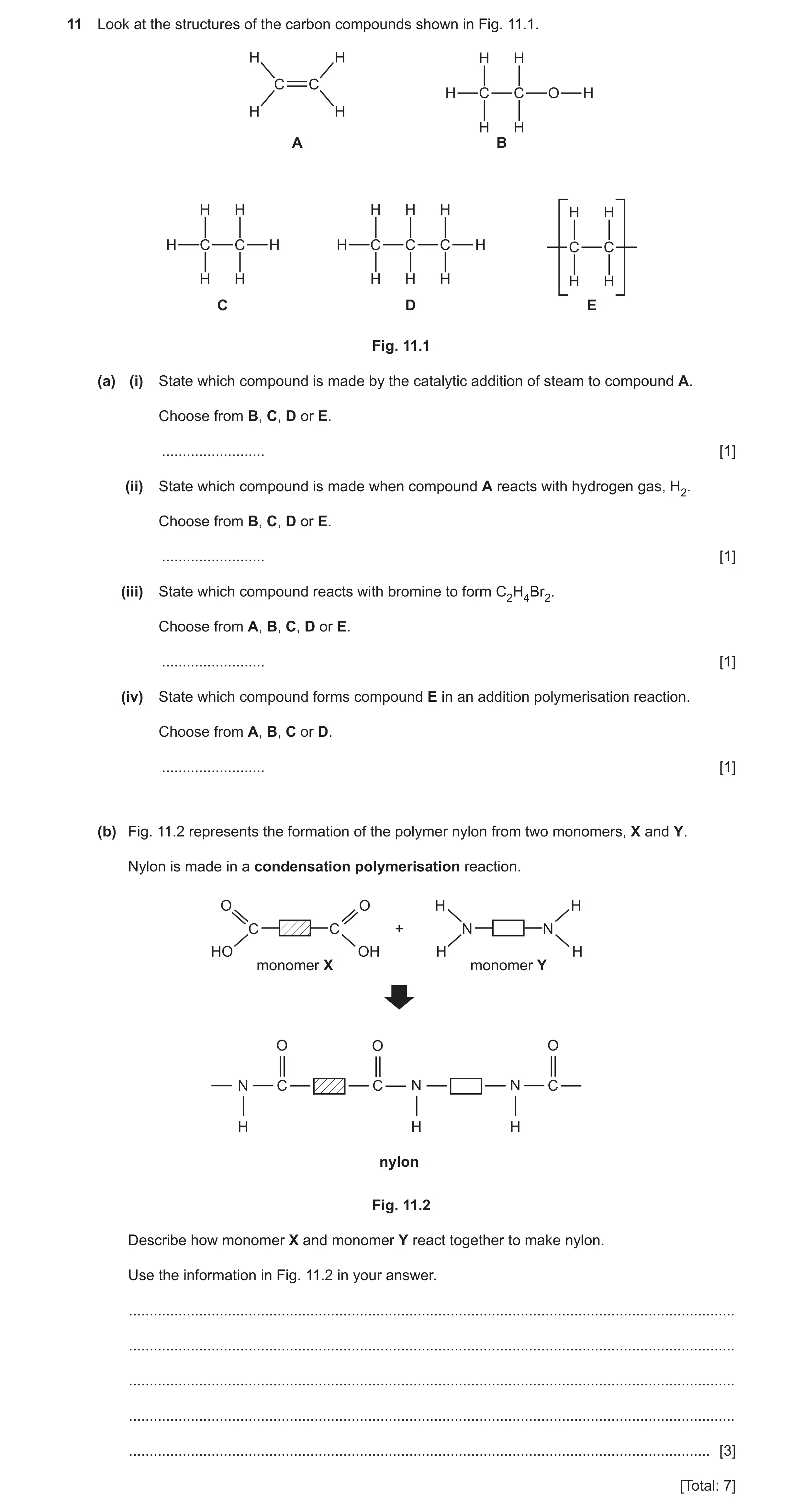
11 Look at the structures of the carbon compounds shown in Fig. 11.1. H H H H C C H C C O H H H H H A B H H H H H H H H C C H H C C C H C C H H H H H H H C D E Fig. 11.1 (a) (i) State which compound is made by the catalytic addition of steam to compound A. Choose from B, C, D or E. … [1] (ii) State which compound is made when compound A reacts with hydrogen gas, H2. Choose from B, C, D or E. … [1] (iii) State which compound reacts with bromine to form C2H4Br2. Choose from A, B, C, D or E. … [1] (iv) State which compound forms compound E in an addition polymerisation reaction. Choose from A, B, C or D. … [1] (b) Fig. 11.2 represents the formation of the polymer nylon from two monomers, X and Y. Nylon is made in a condensation polymerisation reaction. O O H H C C + N N HO OH H H monomer X monomer Y O O O N C C N N C H H H nylon Fig. 11.2 Describe how monomer X and monomer Y react together to make nylon. Use the information in Fig. 11.2 in your answer. … … … … … [3] [Total: 7]
7 marks
Mark scheme: 11(a)(i) B ; 1 11(a)(ii) C ; 1 11(a)(iii) A ; 1 11(a)(iv) A ; 1 11(b) any three from: idea that C on monomer X and N on monomer Y join ; idea that -OH group is lost from the monomer X ; idea that -H is lost from monomer Y ; idea that water is eliminated ; AVP ; 3
This question in 0654/41 May/June 2023
Q15 · Alkanes are saturated hydrocarbons 0654/42 May/June 2023
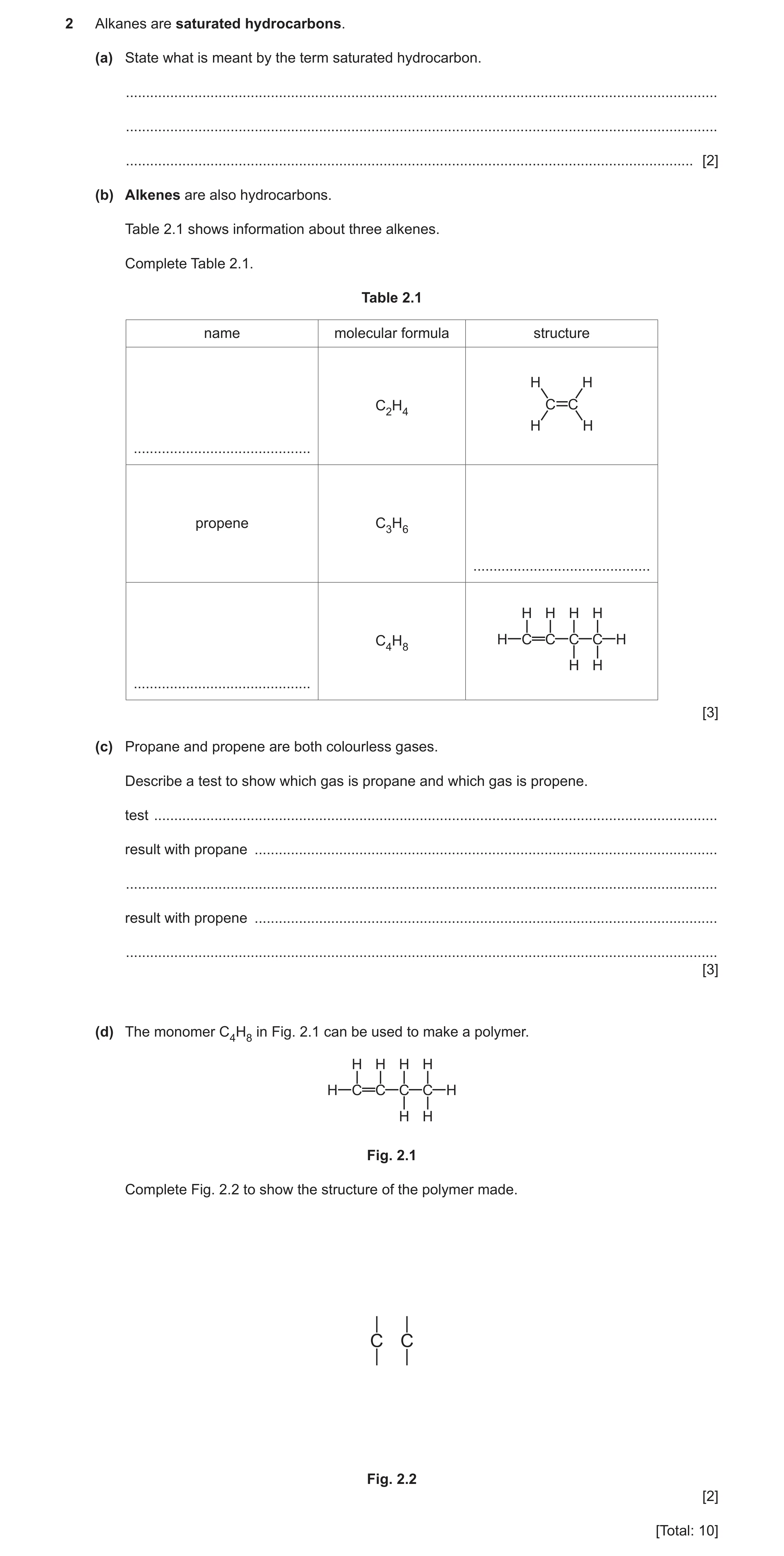
2 Alkanes are saturated hydrocarbons. (a) State what is meant by the term saturated hydrocarbon. … … … [2] (b) Alkenes are also hydrocarbons. Table 2.1 shows information about three alkenes. Complete Table 2.1. Table 2.1 name molecular formula structure H H C2H4 C C H H … propene C3H6 … H H H H C4H8 H C C C C H H H … [3] (c) Propane and propene are both colourless gases. Describe a test to show which gas is propane and which gas is propene. test … result with propane … … result with propene … … [3] (d) The monomer C4H8 in Fig. 2.1 can be used to make a polymer. H H H H H C C C C H H H Fig. 2.1 Complete Fig. 2.2 to show the structure of the polymer made. C C Fig. 2.2 [2] [Total: 10]
10 marks
Mark scheme: 2(a) (saturated) – contains only single (covalent) bonds ; (hydrocarbon) – contains only hydrogen and carbon atoms ; 2 Question Answer Marks 2(b) name molecular formula structure ethene ; C2H4 propene C3H6 ; butene ; C4H8 3 2(c) test – aqueous bromine ; result with propane – (aqueous bromine) stays orange / brown or no change ; result with propene – (aqueous bromine) is decolourised / turns colourless ; 3 Question Answer Marks 2(d) ;; 2
This question in 0654/42 May/June 2023
Q16 · The displayed formulae of some carbon compounds 0654/43 Oct/Nov 2024
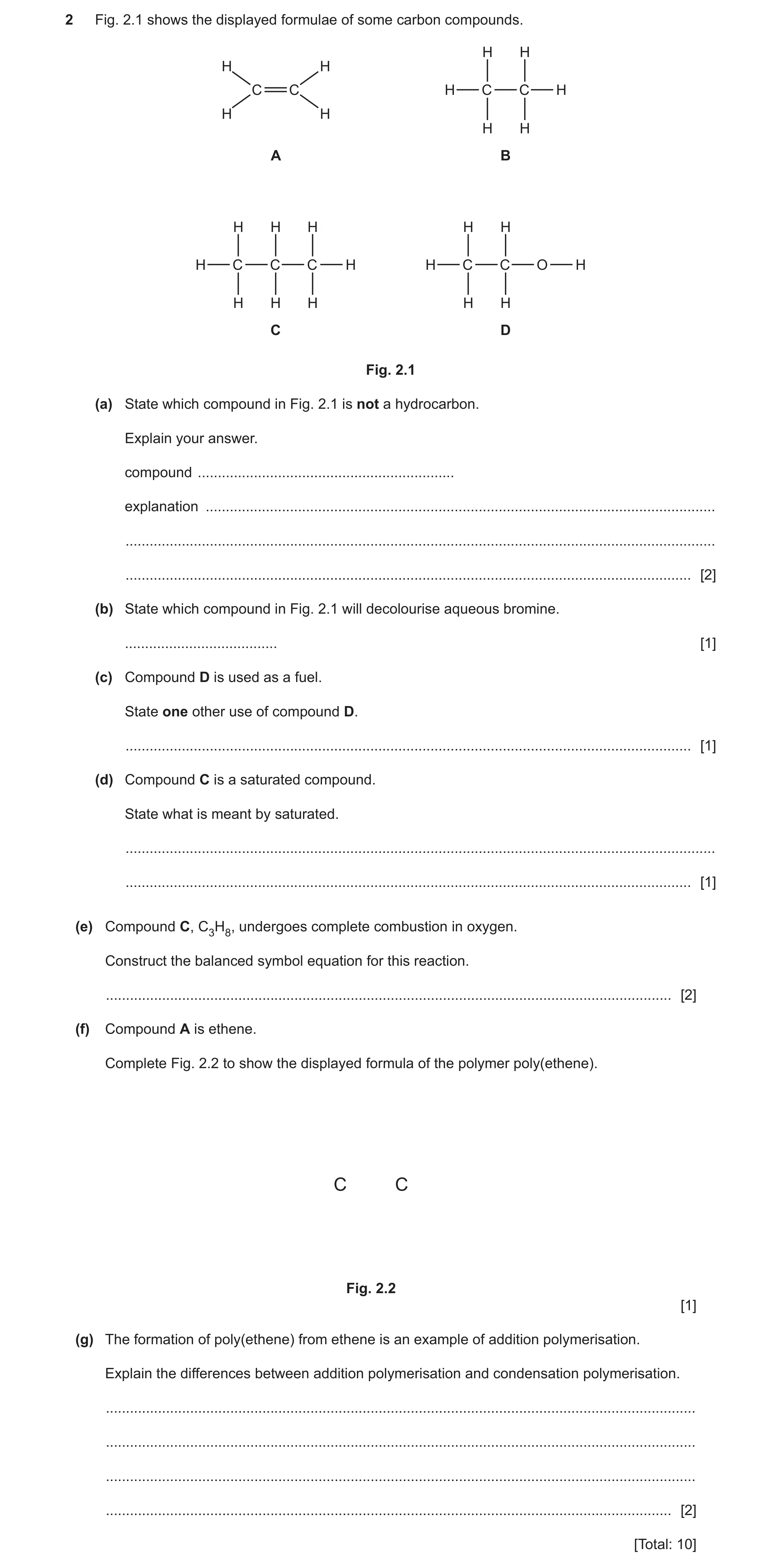
2 Fig. 2.1 shows the displayed formulae of some carbon compounds. H H H H C C H C C H H H H H A B H H H H H H C C C H H C C O H H H H H H C D Fig. 2.1 (a) State which compound in Fig. 2.1 is not a hydrocarbon. Explain your answer. compound … explanation … … … [2] (b) State which compound in Fig. 2.1 will decolourise aqueous bromine. … [1] (c) Compound D is used as a fuel. State one other use of compound D. … [1] (d) Compound C is a saturated compound. State what is meant by saturated. … … [1] (e) Compound C, C3H8, undergoes complete combustion in oxygen. Construct the balanced symbol equation for this reaction. … [2] (f) Compound A is ethene. Complete Fig. 2.2 to show the displayed formula of the polymer poly(ethene). C C Fig. 2.2 [1] (g) The formation of poly(ethene) from ethene is an example of addition polymerisation. Explain the differences between addition polymerisation and condensation polymerisation. … … … … [2] [Total: 10]
10 marks
Mark scheme: 2(a) D ; 2 contains oxygen / does not contain only carbon and hydrogen ; 2(b) A ; 1 2(c) solvent ; 1 2(d) contains only C-C single bonds ; 1 2(e) C3H8 + 5O2 → 3CO2 + 4H2O 2 correct formulae (reactants in either order and products in either order) ; balanced correctly ; 2(f) 1 2(g) addition polymerisation 2 only occurs in unsaturated monomers or monomers that contain C=C bonds / idea that involves the addition of many (identical) monomers (to make a long chained polymer) / monomers have one functional group / forms the polymer molecule only ; condensation polymerisation idea that two different monomers join together / (forms the polymer molecule and one) water molecule (per linkage) / monomers have two functional groups (one at each end) ;
This question in 0654/43 Oct/Nov 2024
Q17 · Look at the structures of the carbon compounds shown in Fig 0654/43 May/June 2025
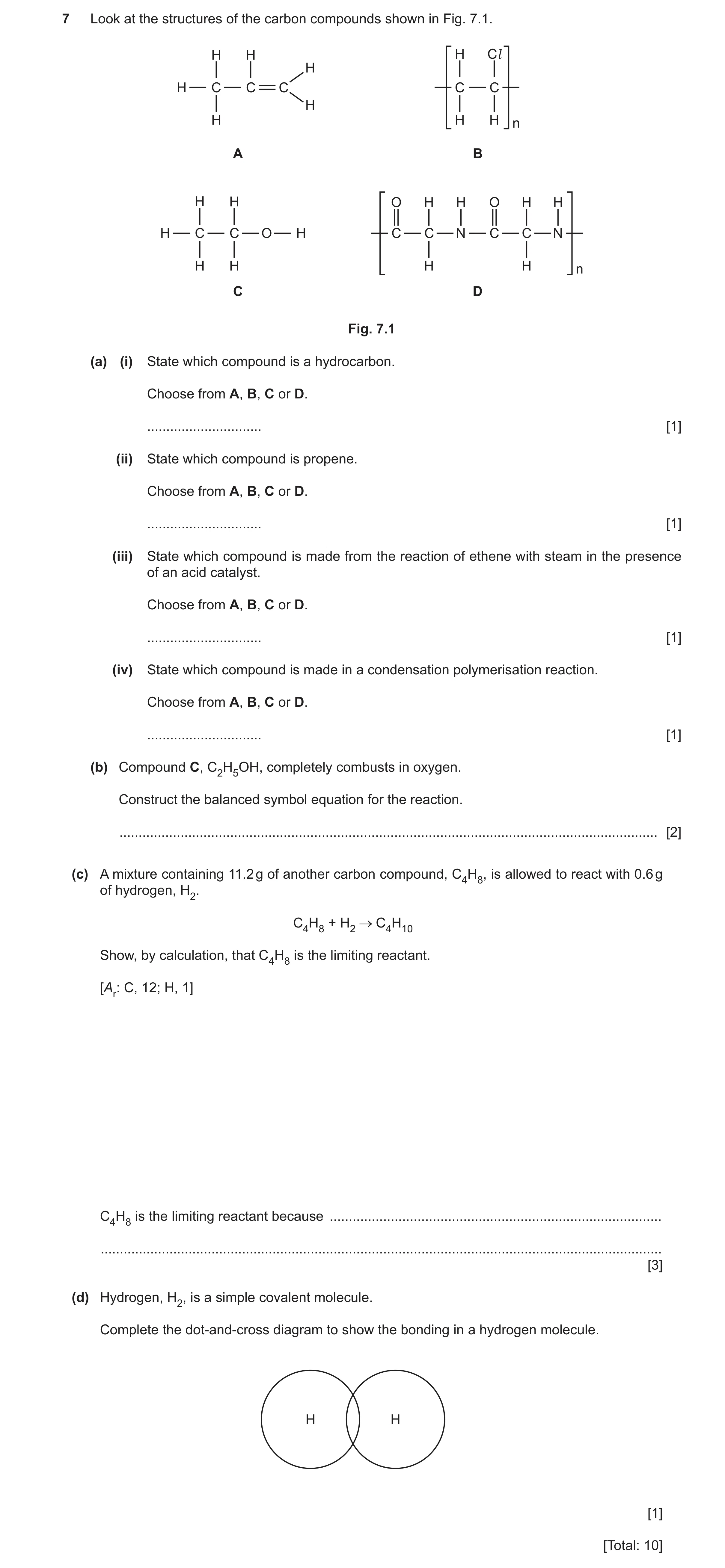
7 Look at the structures of the carbon compounds shown in Fig. 7.1. H H H Cl H H C C C C C H H H H n A B H H O H H O H H H C C O H C C N C C N H H H H n C D Fig. 7.1 (a) (i) State which compound is a hydrocarbon. Choose from A, B, C or D. … [1] (ii) State which compound is propene. Choose from A, B, C or D. … [1] (iii) State which compound is made from the reaction of ethene with steam in the presence of an acid catalyst. Choose from A, B, C or D. … [1] (iv) State which compound is made in a condensation polymerisation reaction. Choose from A, B, C or D. … [1] (b) Compound C, C2H5OH, completely combusts in oxygen. Construct the balanced symbol equation for the reaction. … [2] (c) A mixture containing 11.2 g of another carbon compound, C4H8, is allowed to react with 0.6 g of hydrogen, H2. C4H8 + H2 C4H10 Show, by calculation, that C4H8 is the limiting reactant. [Ar: C, 12; H, 1] C4H8 is the limiting reactant because … … [3] (d) Hydrogen, H2, is a simple covalent molecule. Complete the dot-and-cross diagram to show the bonding in a hydrogen molecule. H H [1] [Total: 10]
10 marks
Mark scheme: 7(a)(i) A; 1 7(a)(ii) A; 1 7(a)(iii) C; 1 7(a)(iv) D; 1 7(b) C2H5OH + 3O2 → 2CO2 + 3H2O 2 correct formulae; correct balancing; 7(c) moles of C4H8 = 11.2 = 0.2; 3 56 moles of H2 = 0.6 = 0.3; 2 (C4H8 is limiting because) 0.2 mol is less than the 0.3 mol of H2; 7(d) 1 ; ;
This question in 0654/43 May/June 2025
Q18 · The displayed formulas of some organic compounds 0654/43 Oct/Nov 2025
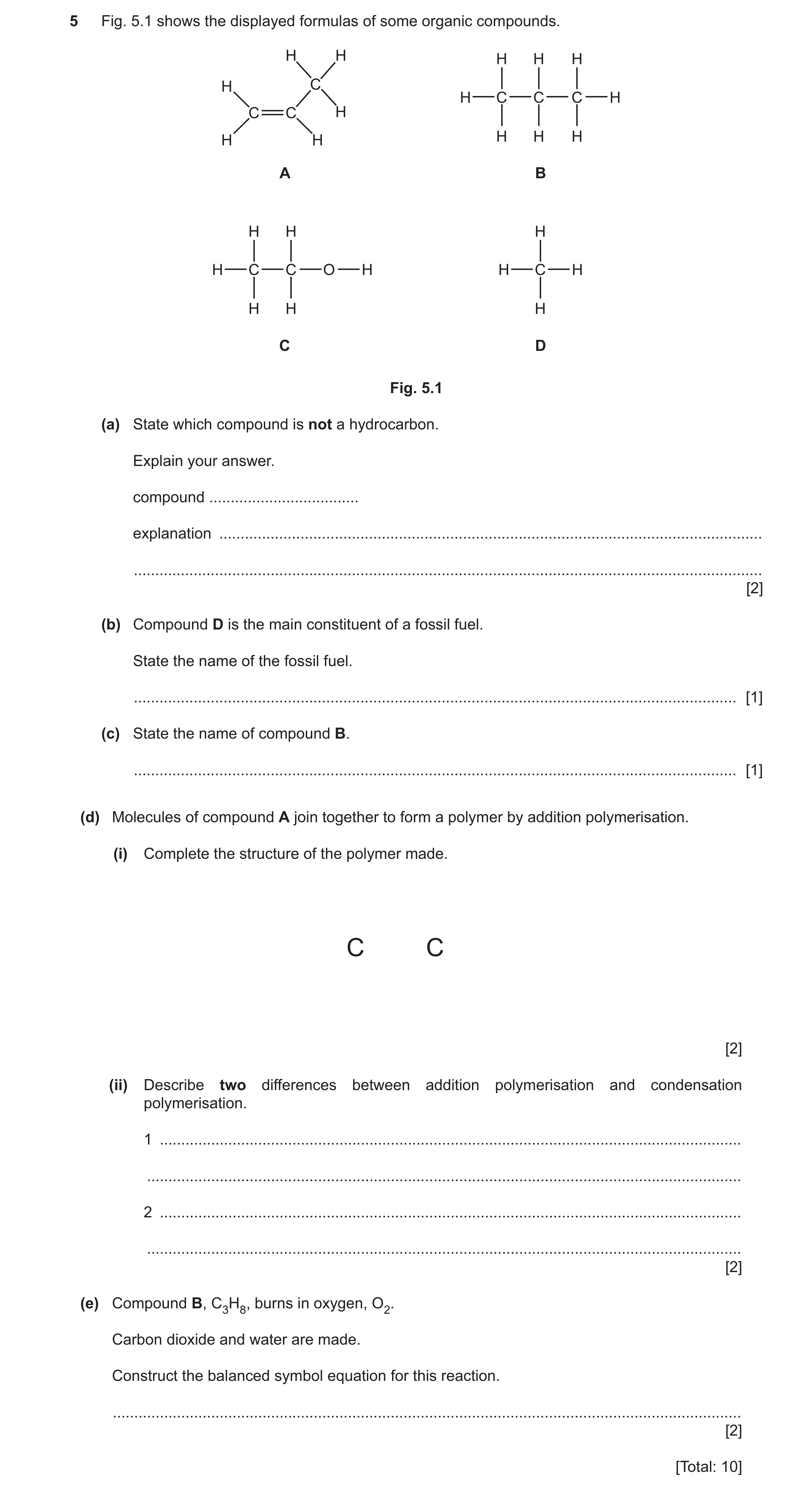
5 Fig. 5.1 shows the displayed formulas of some organic compounds. H H H H H H C H C C C H C C H H H H H H A B H H H H C C O H H C H H H H C D Fig. 5.1 (a) State which compound is not a hydrocarbon. Explain your answer. compound … explanation … … [2] (b) Compound D is the main constituent of a fossil fuel. State the name of the fossil fuel. … [1] (c) State the name of compound B. … [1] (d) Molecules of compound A join together to form a polymer by addition polymerisation. (i) Complete the structure of the polymer made. C C [2] (ii) Describe two differences between addition polymerisation and condensation polymerisation. 1 … … 2 … … [2] (e) Compound B, C3H8, burns in oxygen, O2. Carbon dioxide and water are made. Construct the balanced symbol equation for this reaction. … [2] [Total: 10]
10 marks
Mark scheme: 5(a) C ; 2 (C) contains oxygen / (C) does not contain only carbon and hydrogen / hydrocarbons only contains hydrogen and carbon ; 5(b) natural gas ; 1 5(c) propane ; 1 5(d)(i) 2 1 mark for single bond between carbon atoms 1 mark for rest of structure correct 5(d)(ii) any two from: 2 addition polymerisation • only occurs in unsaturated monomers / monomers that contain C = C bonds ; • idea that it involves the same type of monomer/unit ; • only forms the polymer molecule ; condensation polymerisation • idea that it involves different types of monomers / units ; • forms (the polymer molecule and one) water (molecule per linkage) ; 5(e) C3H8 + 5O2 → 3CO2 + 4H2O ;; 2 1 mark for correct formulae 1 mark for correct balanced equation
This question in 0654/43 Oct/Nov 2025
 19 / 31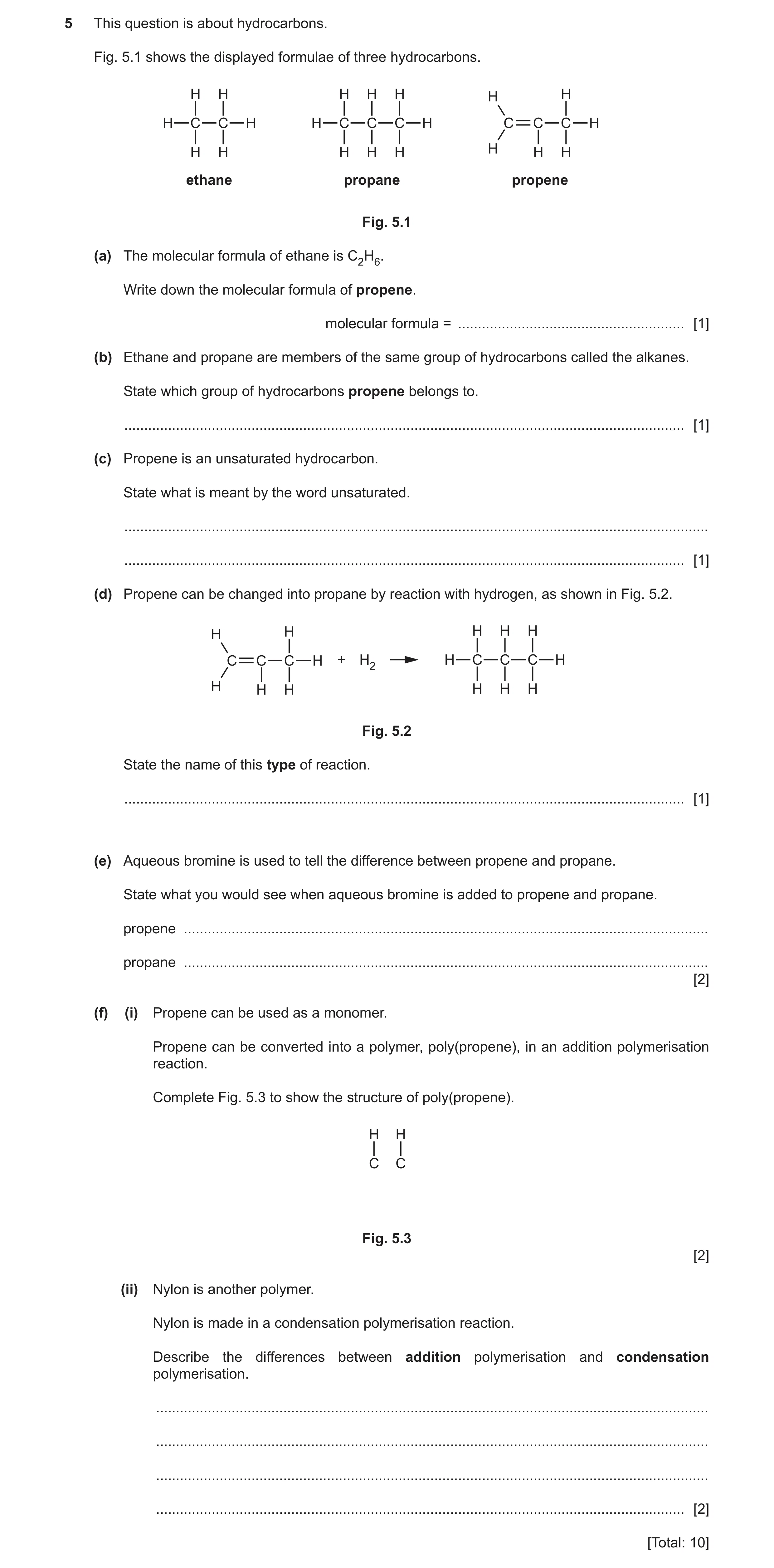
 9
9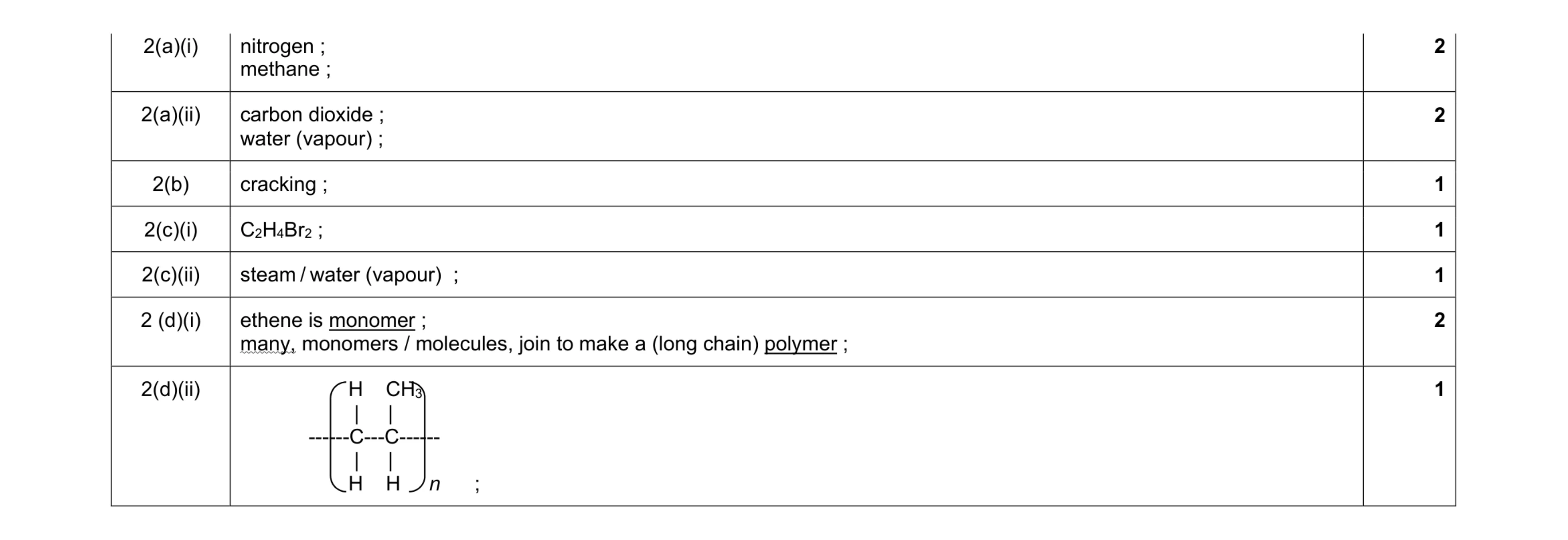 10
10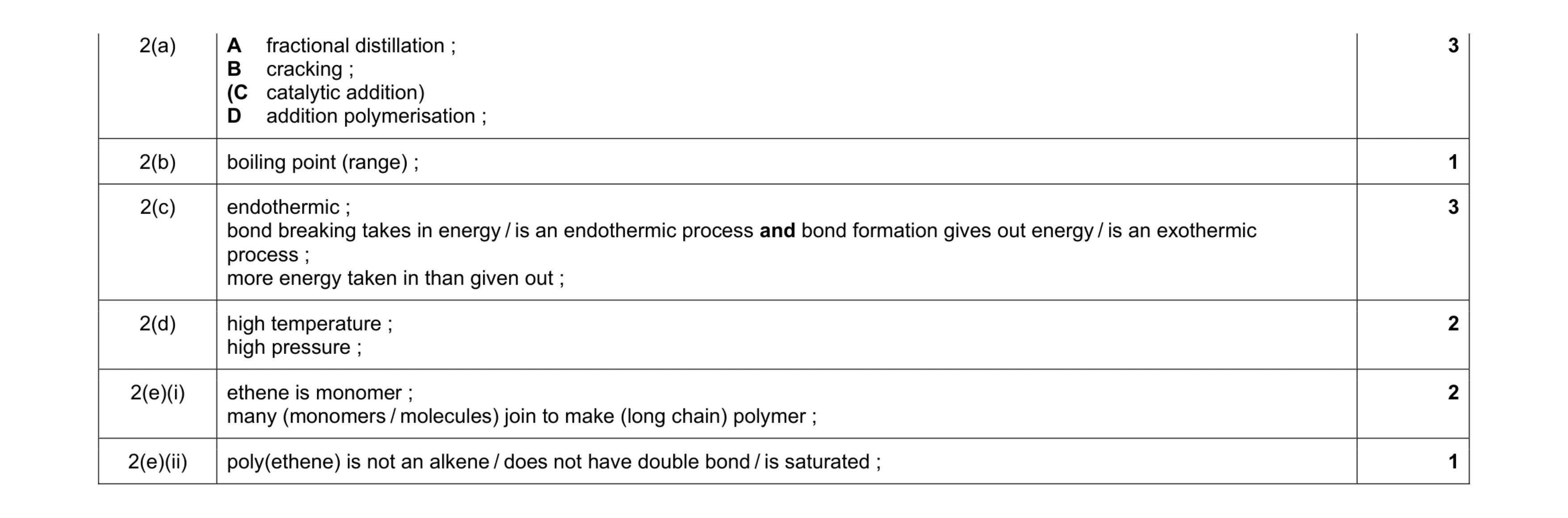 12
12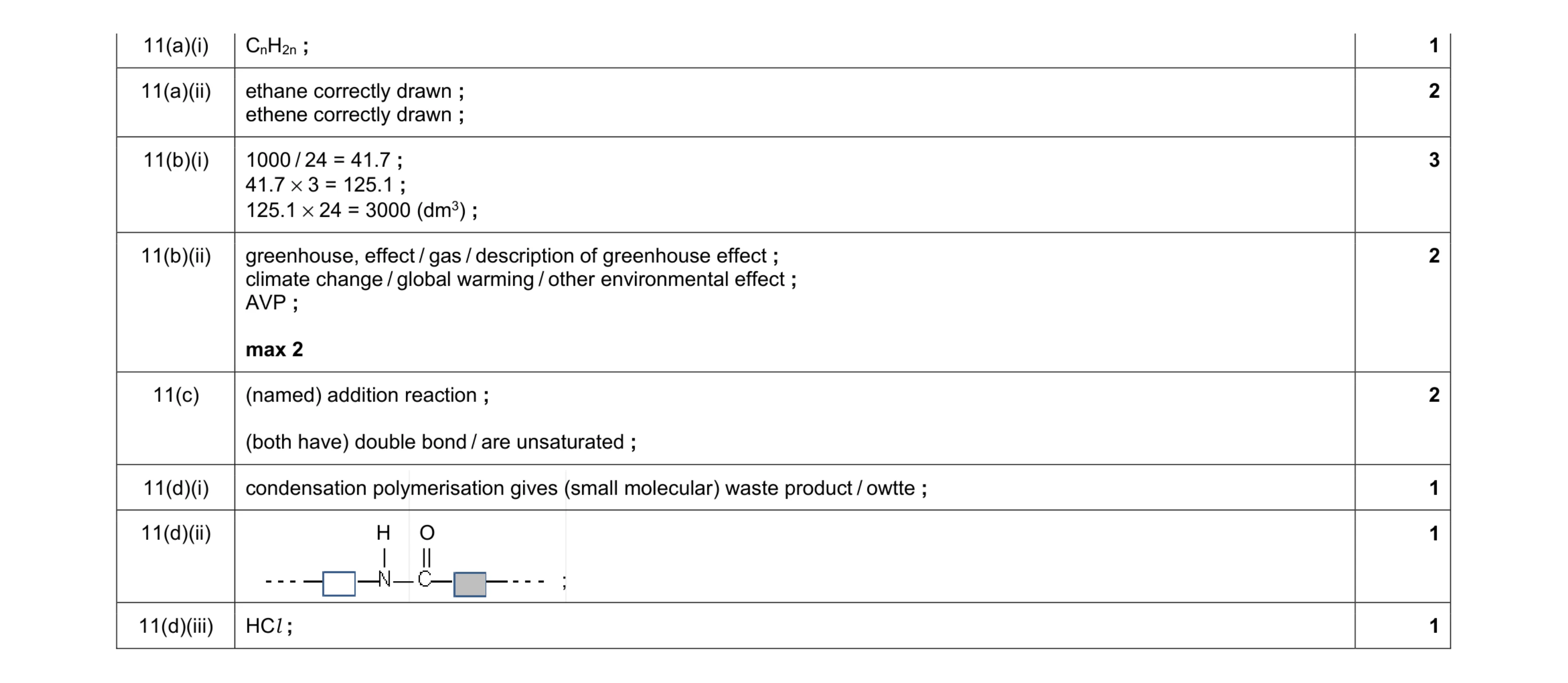 13
13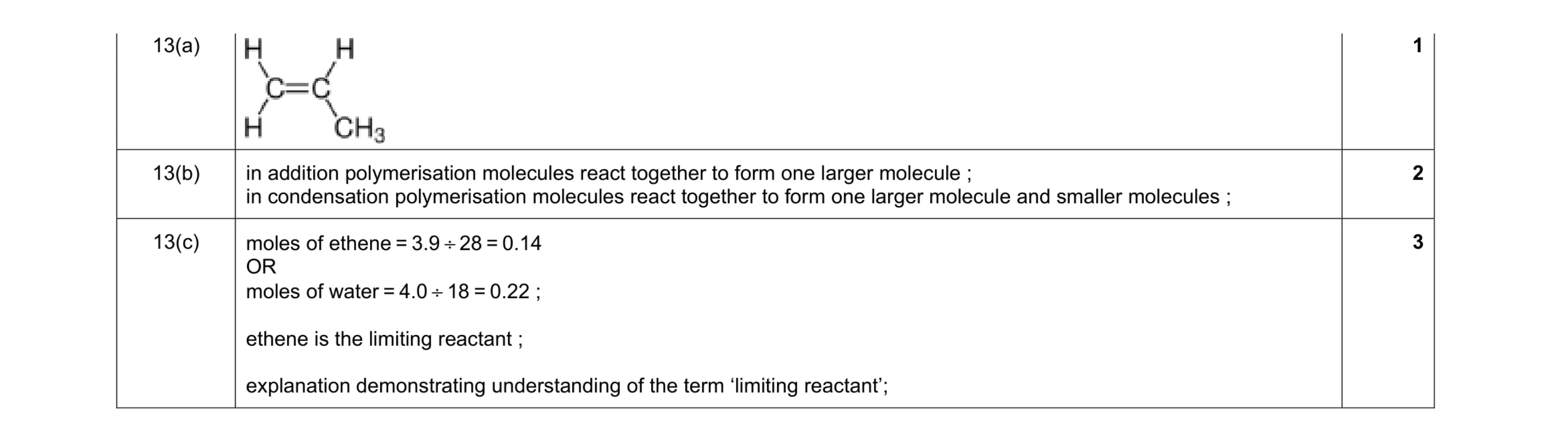 6
6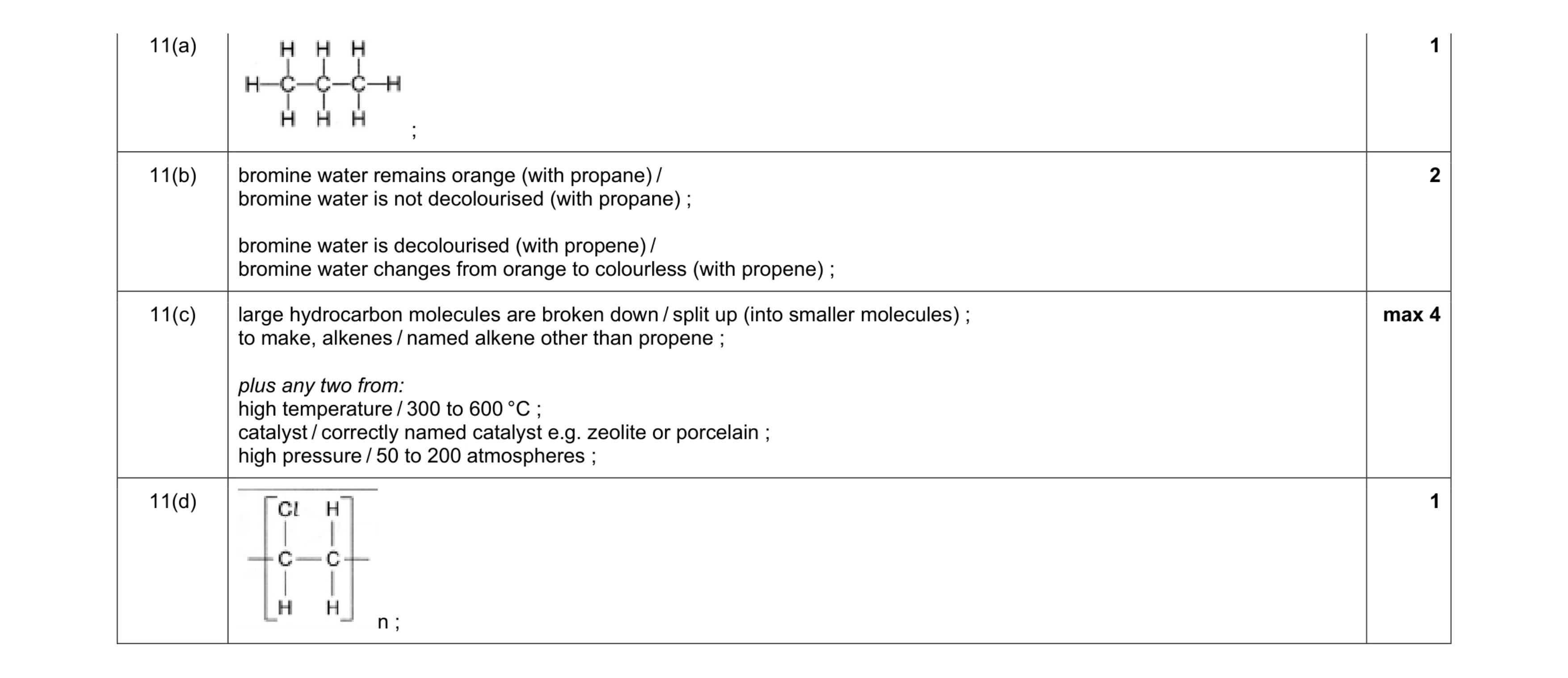 8
8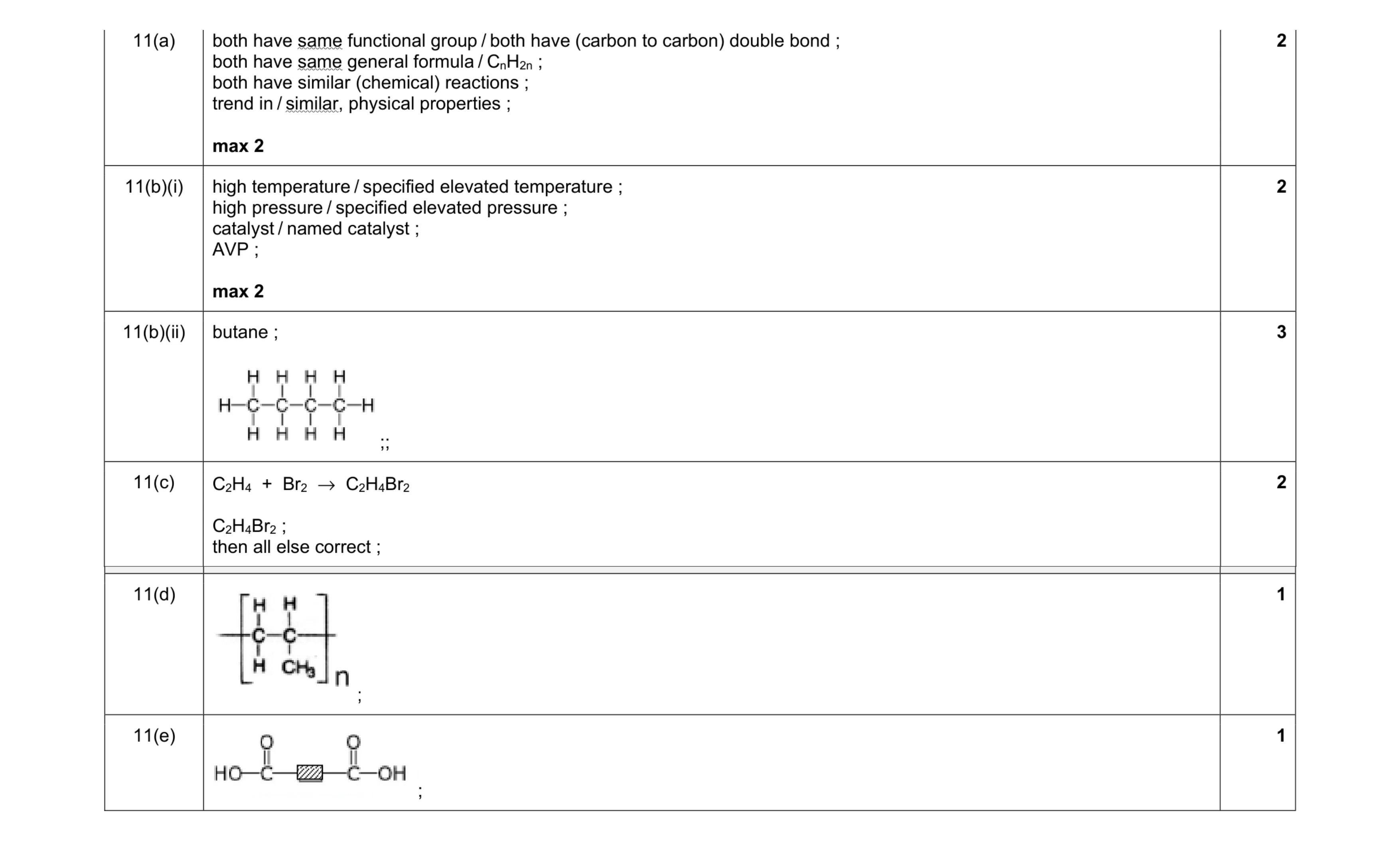 11
11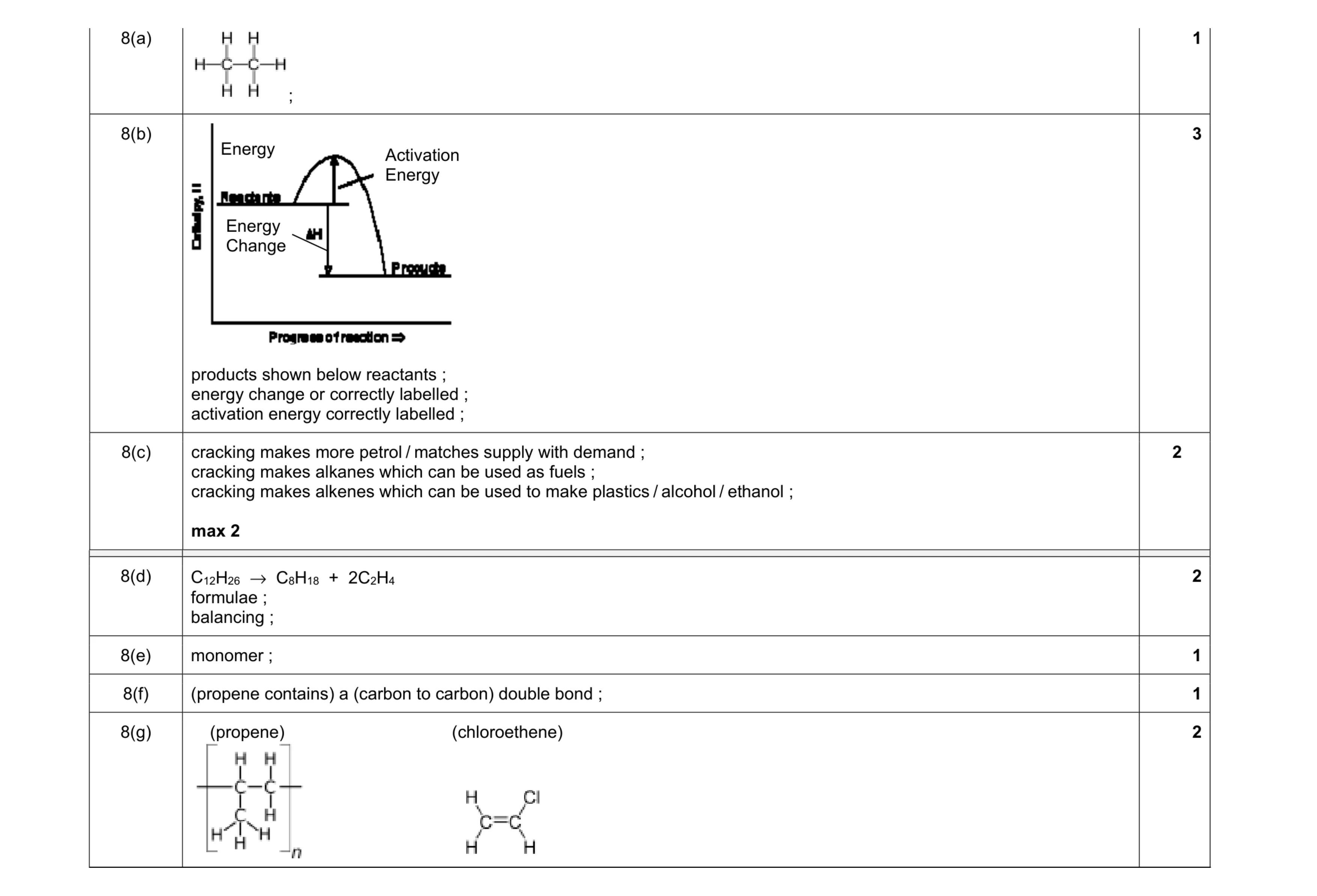 12
12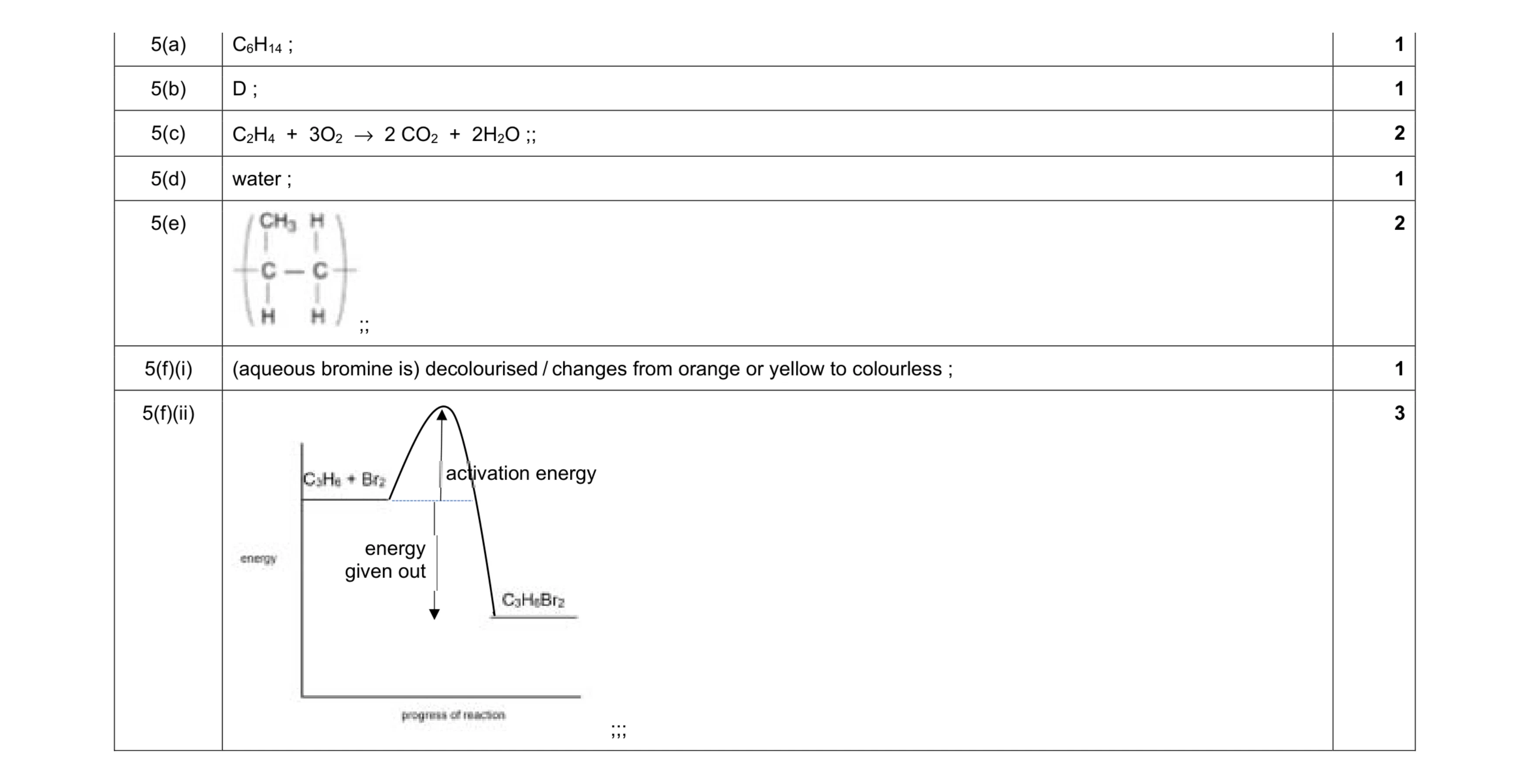 11
11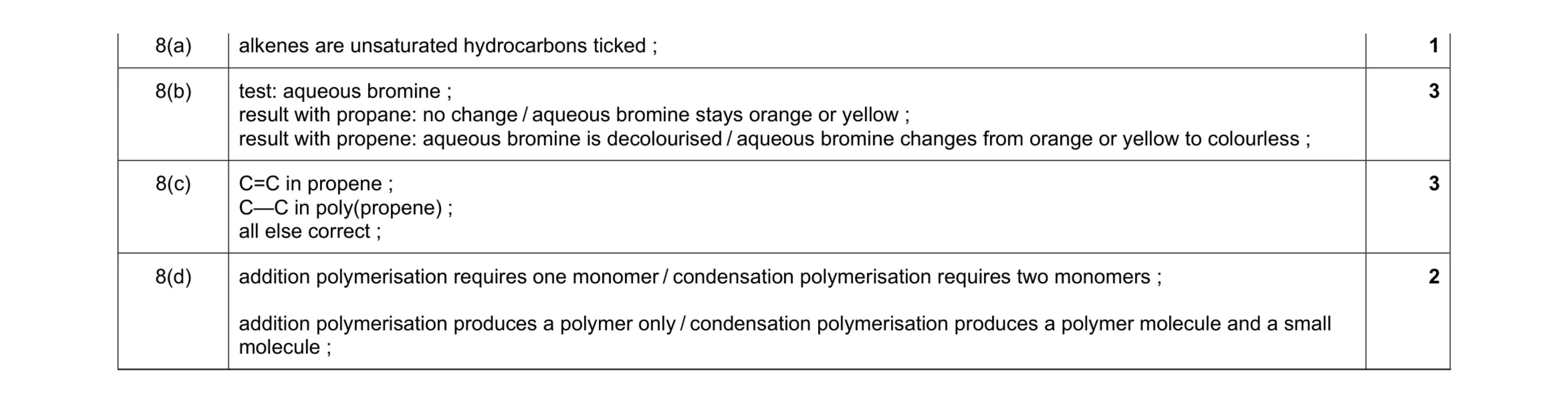 9
9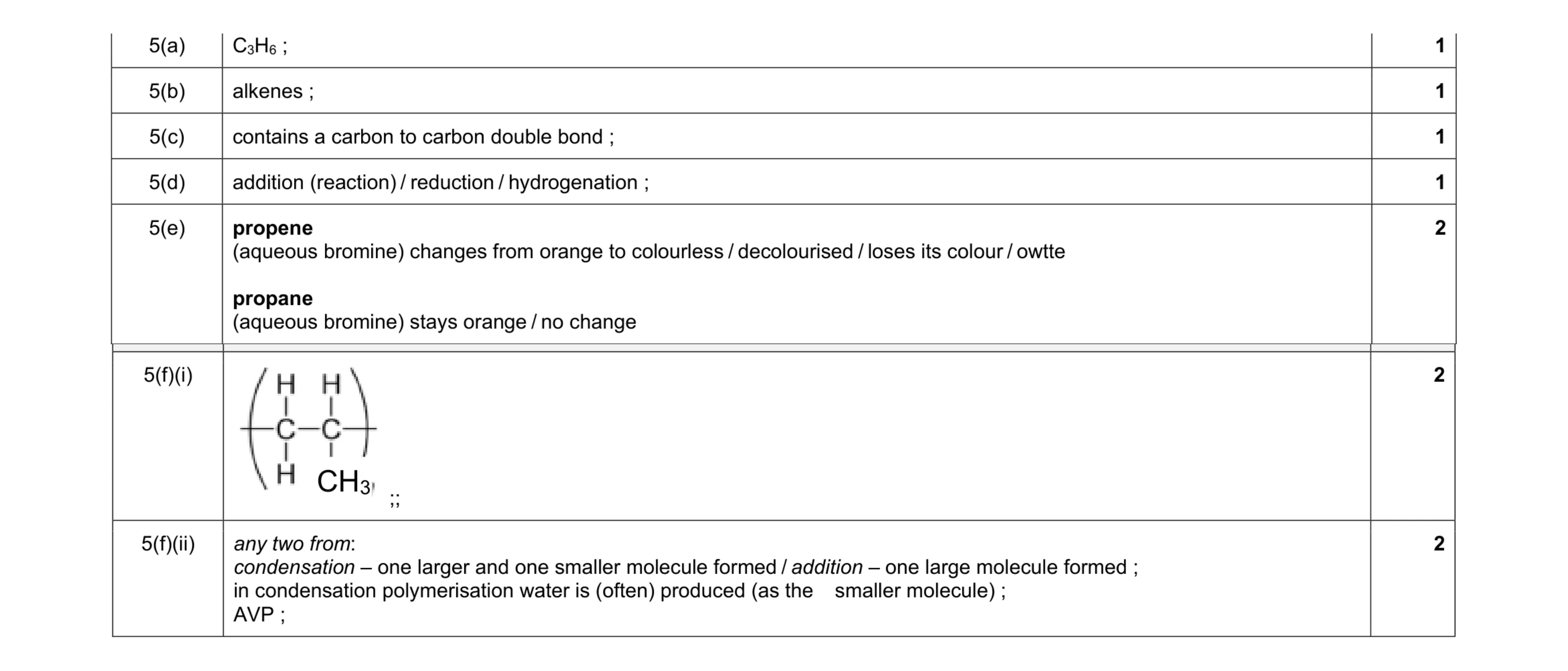 10
10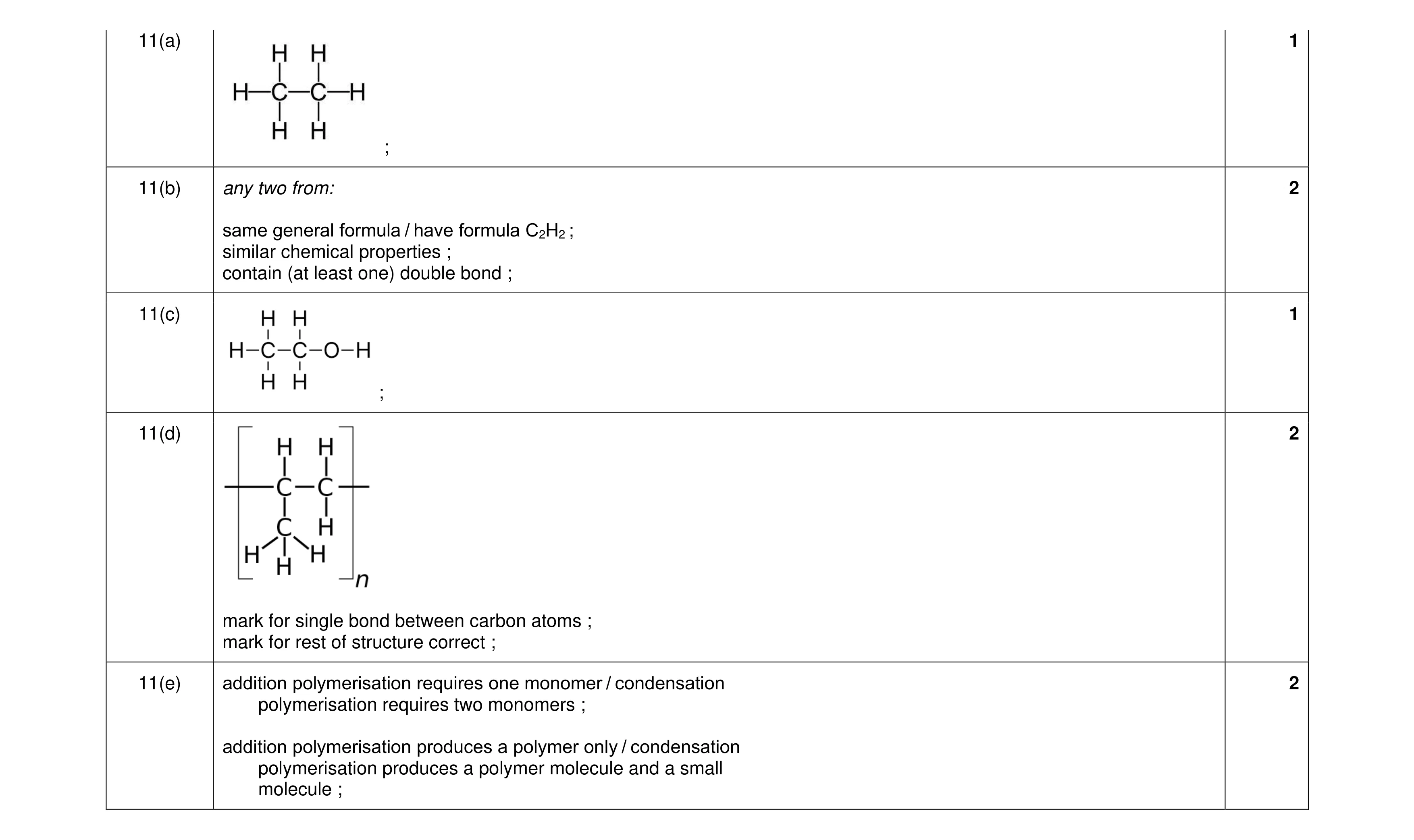 8
8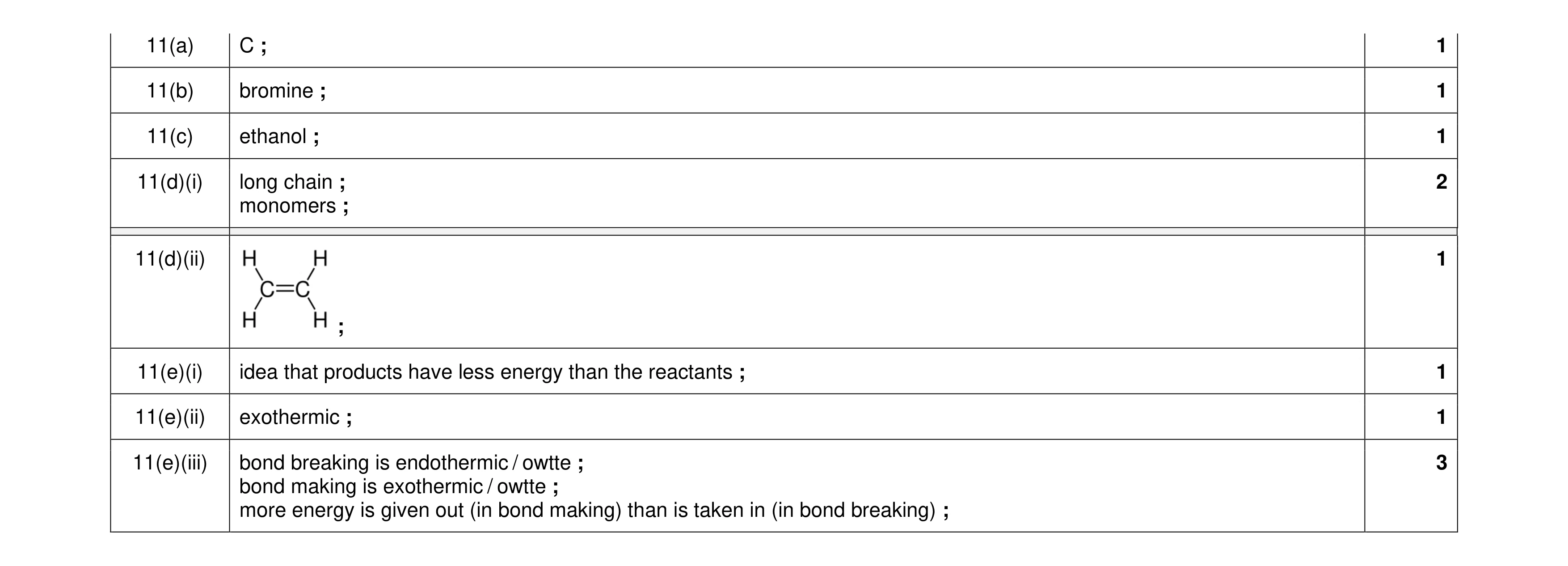 11
11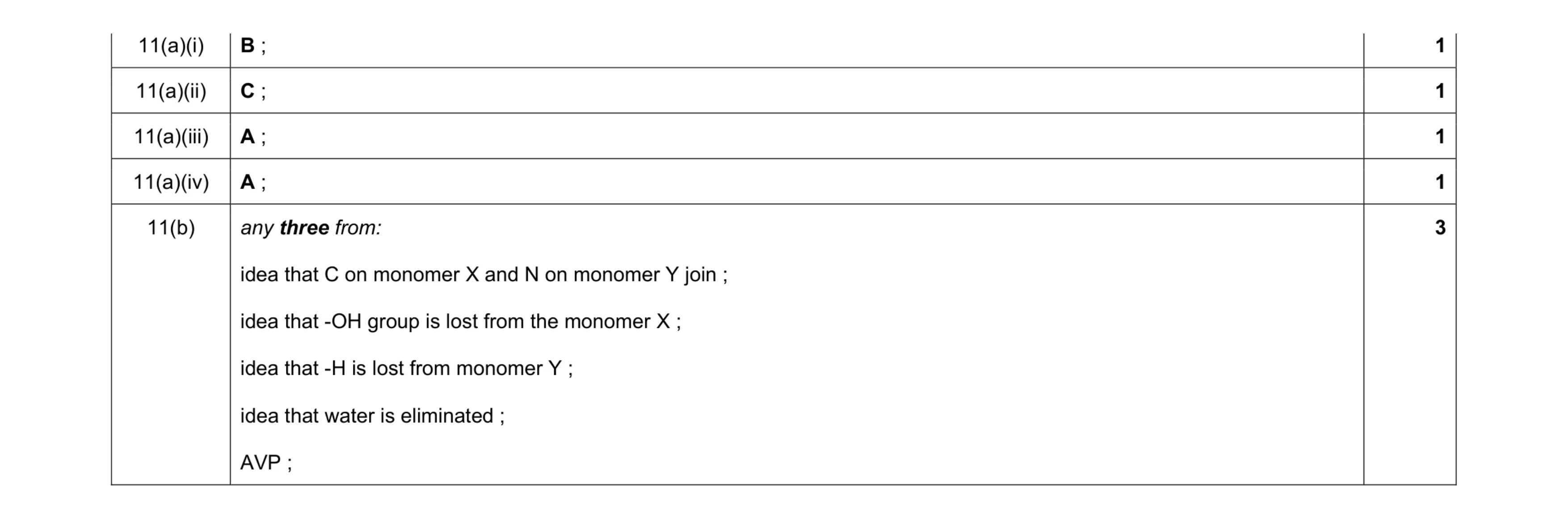 7
7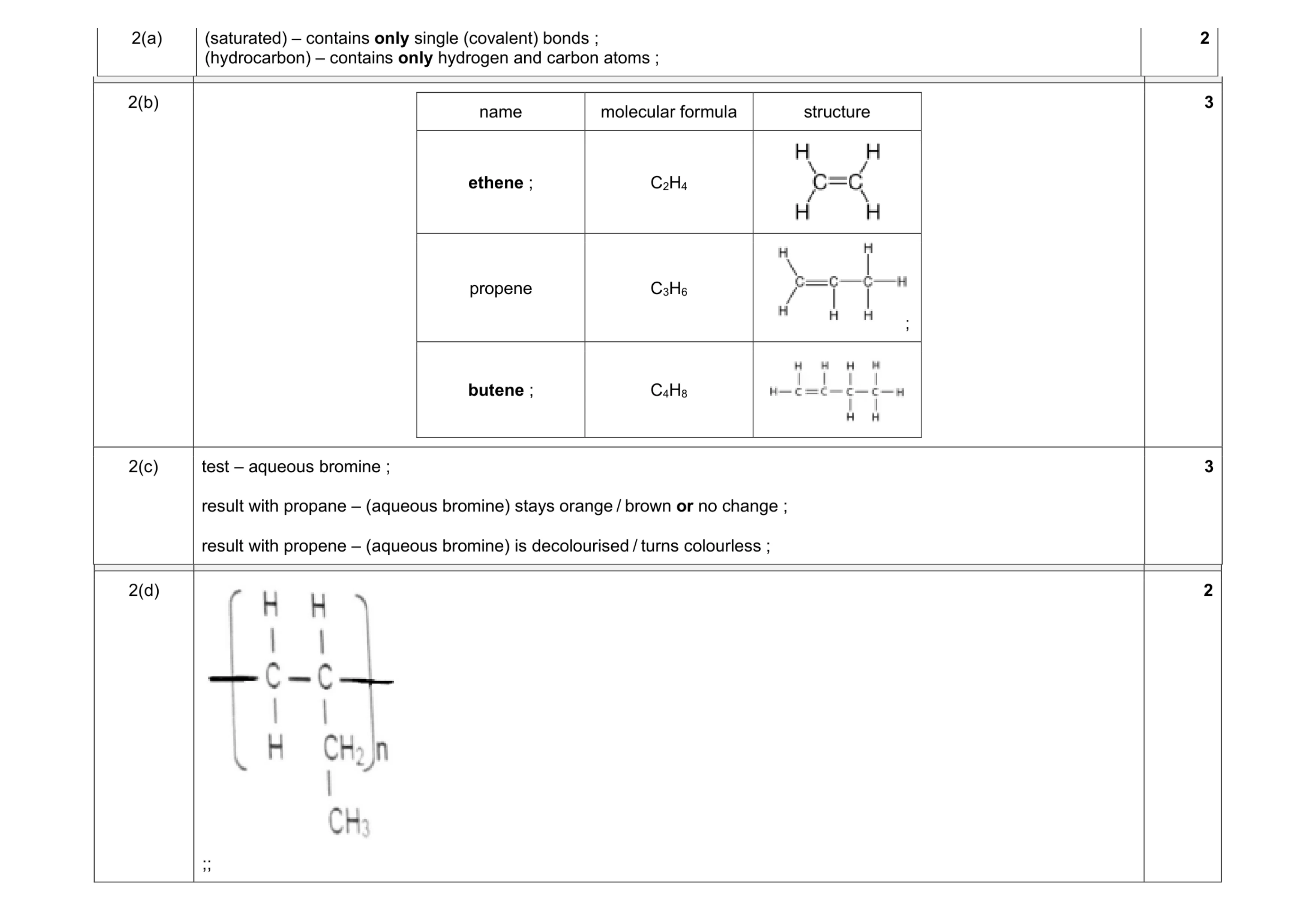 10
10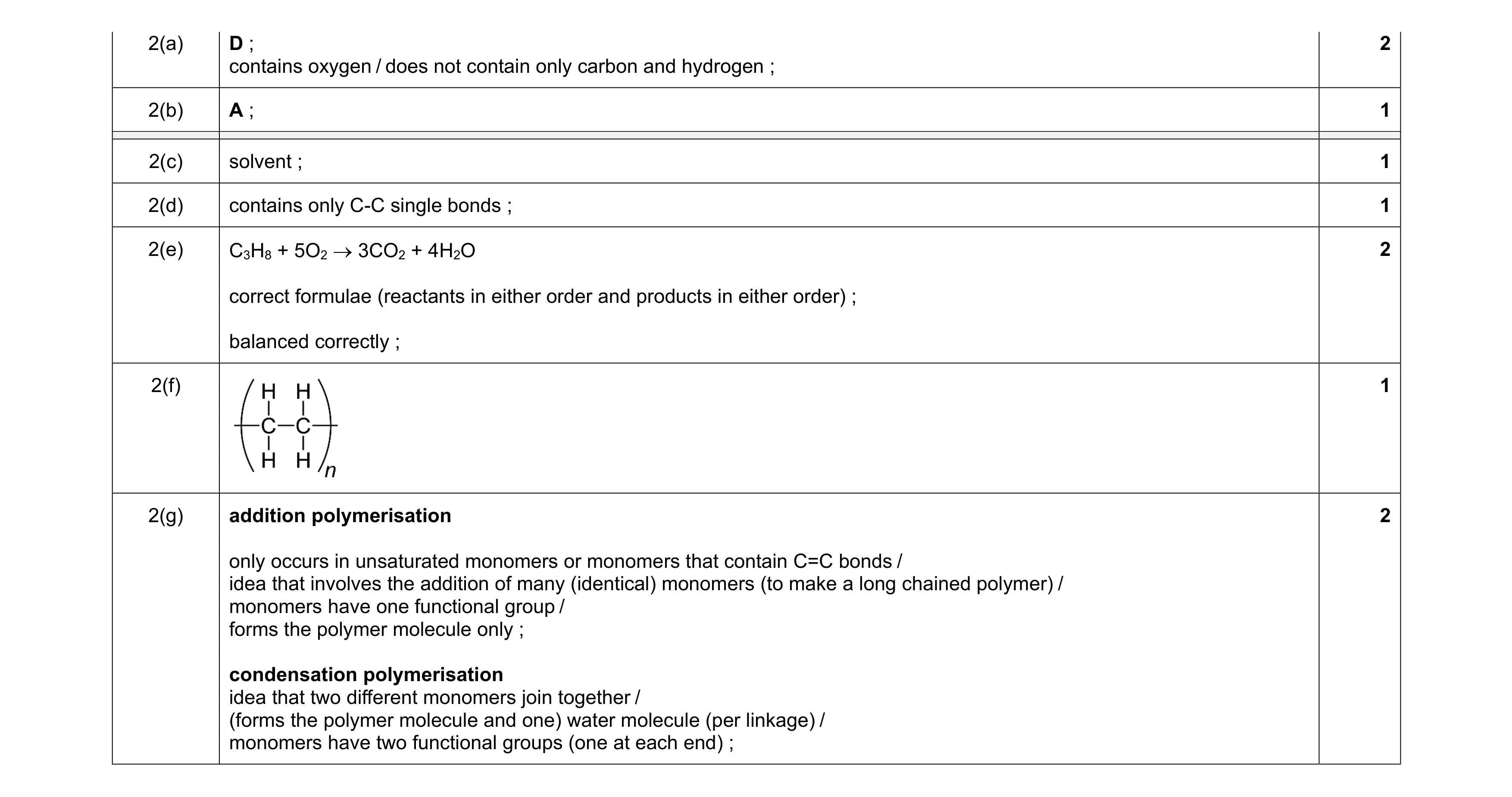 10
10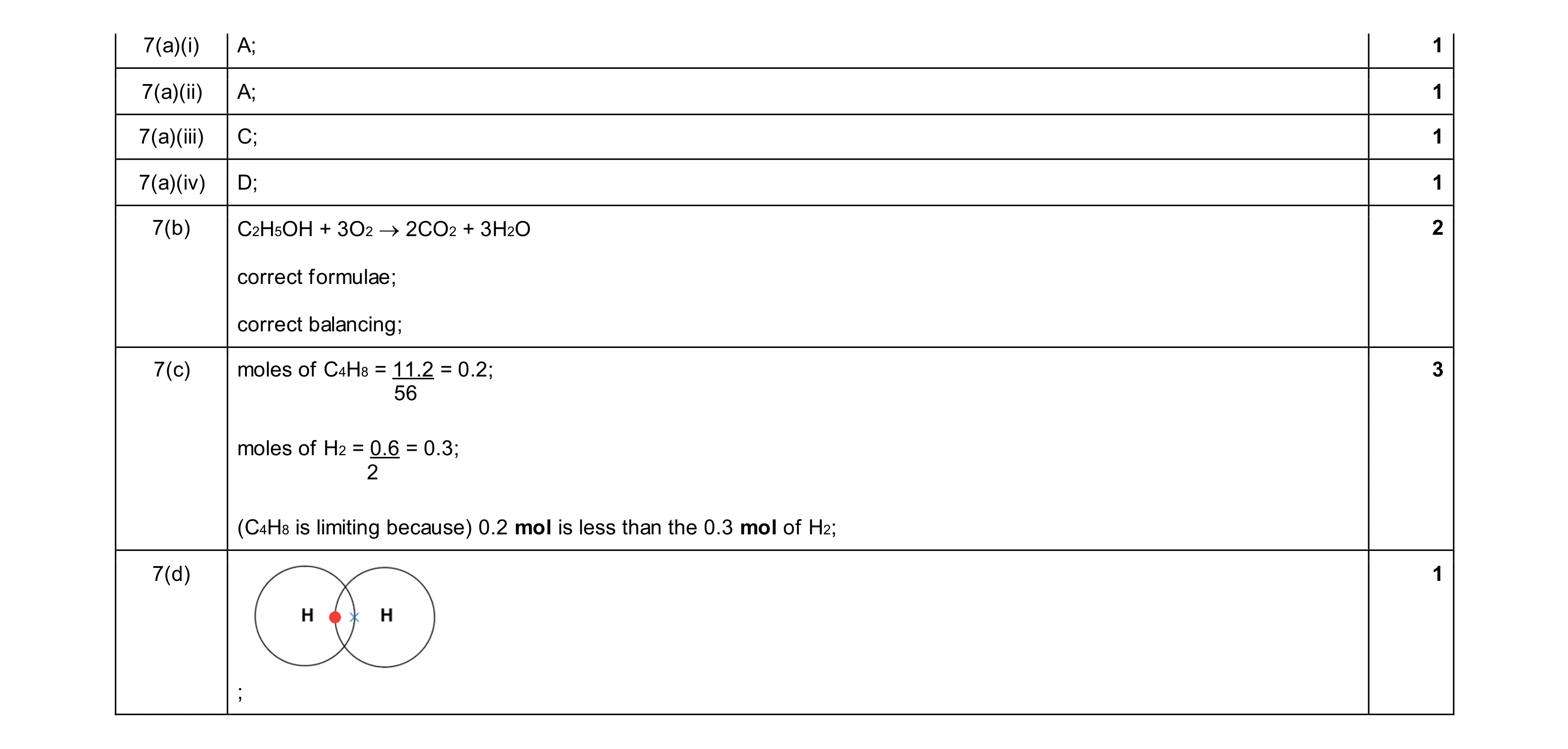 10
10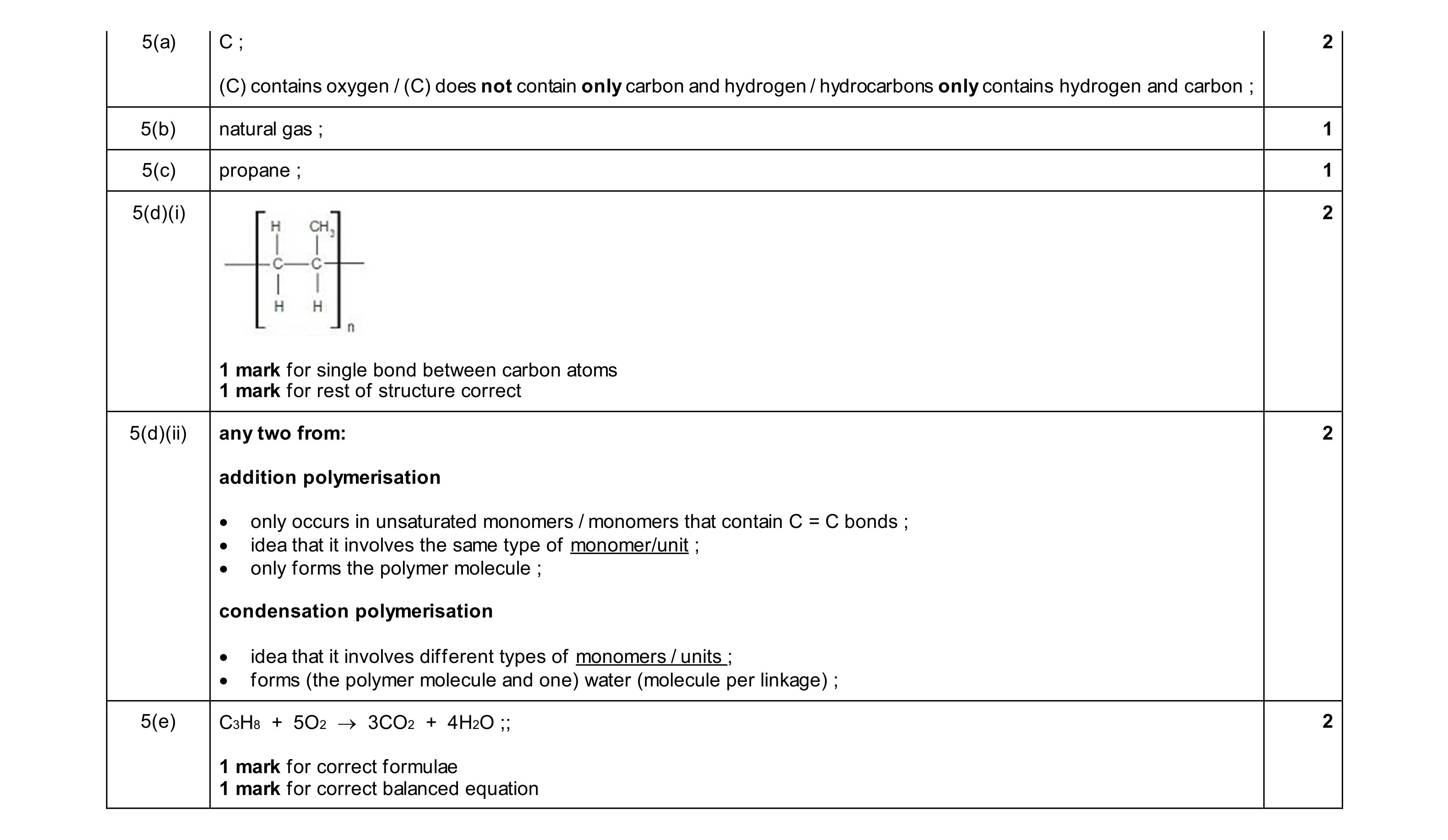 10
10