Questions as text
Q1 · A survey of employment in a particular economy shows that the primary sector was… 0455/11 Oct/Nov 2004
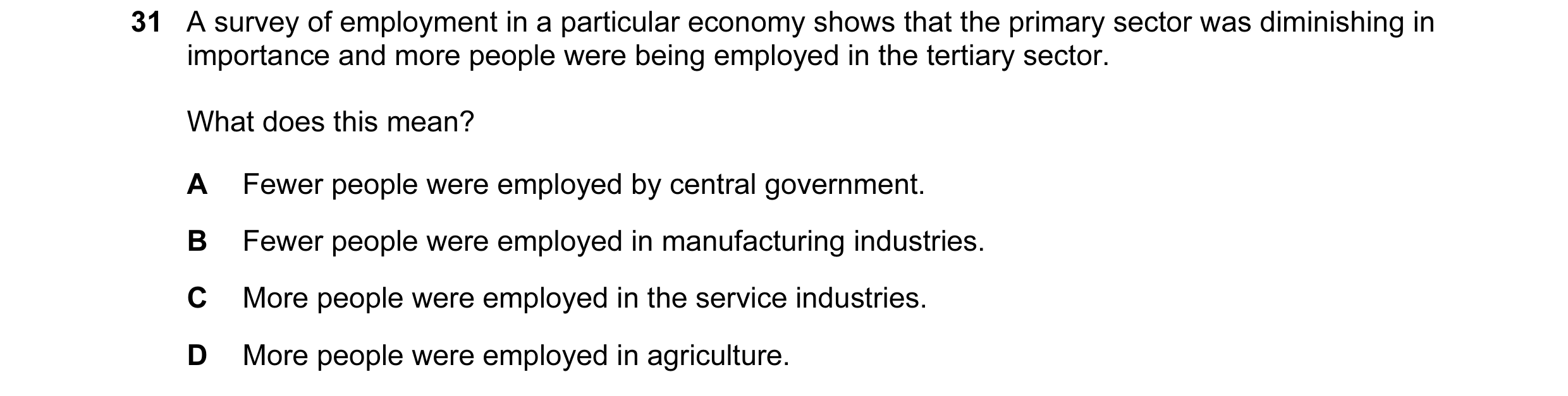
31 A survey of employment in a particular economy shows that the primary sector was diminishing in importance and more people were being employed in the tertiary sector. What does this mean? A Fewer people were employed by central government. B Fewer people were employed in manufacturing industries. C More people were employed in the service industries. D More people were employed in agriculture.
1 marks
Answer: C
This question in 0455/11 Oct/Nov 2004
Q2 · What advantage does a company risk losing when it expands? 0455/11 May/June 2006
21 What advantage does a company risk losing when it expands? A access to finance B national reputation C personal contact D skilled labour
1 marks
Answer: C
This question in 0455/11 May/June 2006
Q3 · ‘The tertiary sector of the economy is increasing in importance’ 0455/11 Oct/Nov 2006
3 ‘The tertiary sector of the economy is increasing in importance’. This statement is most likely to mean that a higher proportion of the labour force is A being educated. B employed in manufacturing. C employed in the production of services. D unemployed but looking for work.
1 marks
Answer: C
This question in 0455/11 Oct/Nov 2006
Q4 · The purchase of new machinery enables a firm to increase output with fewer workers 0455/11 Oct/Nov 2008
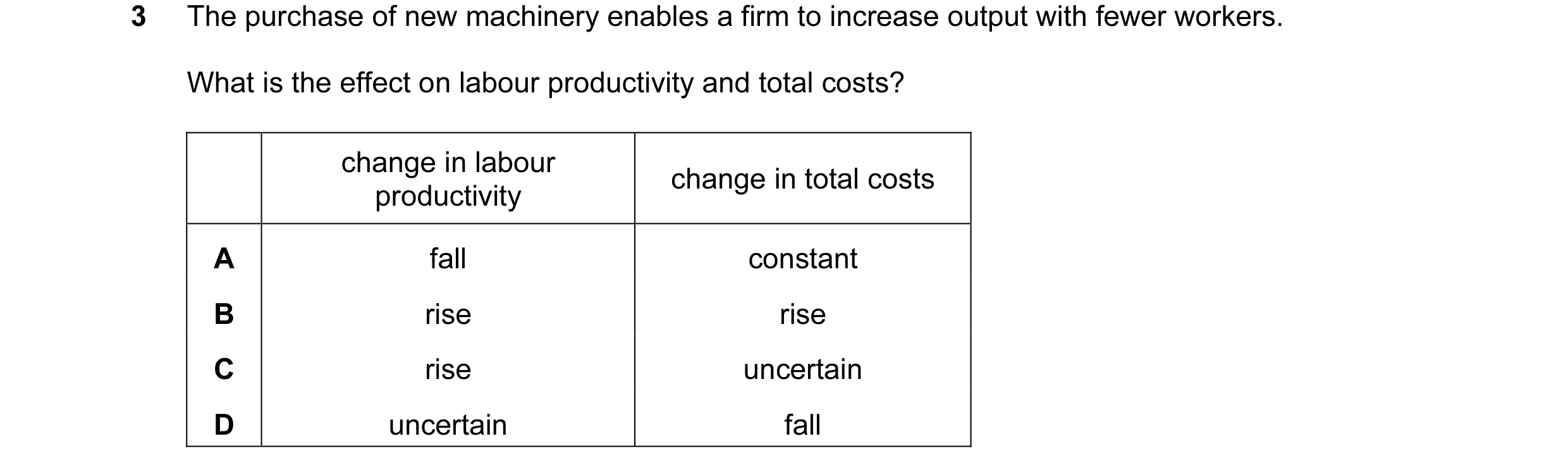
3 The purchase of new machinery enables a firm to increase output with fewer workers. What is the effect on labour productivity and total costs? change in labour change in total costs productivity A fall constant B rise rise C rise uncertain D uncertain fall
1 marks
Answer: C
This question in 0455/11 Oct/Nov 2008
Q5 · Which is a diseconomy of scale? 0455/11 May/June 2009
16 Which is a diseconomy of scale? A Bulk buying reduces costs. B Communications deteriorate. C Employees are more motivated. D Technological improvements take place.
1 marks
Answer: B
This question in 0455/11 May/June 2009
Q6 · India is experiencing rapid growth in air travel 0455/11 Oct/Nov 2009
16 India is experiencing rapid growth in air travel. The number and size of airlines is increasing every year. Which effect arising from this growth is an external economy of scale? A Banks are more prepared to lend to large airlines rather than small airlines. B Fuel suppliers charge less to airlines that buy in bulk. C Institutions are established to train flight crew. D Larger airlines operate aircraft which can carry more passengers.
1 marks
Answer: C
This question in 0455/11 Oct/Nov 2009
Q7 · A milk processing company takes over a group of dairy farms before merging with a chain… 0455/12 Oct/Nov 2010
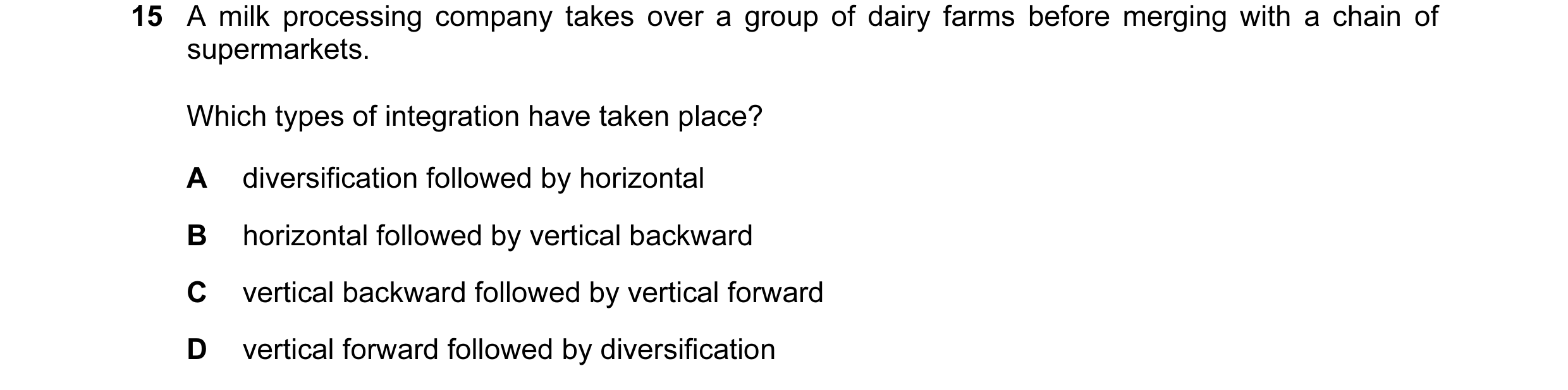
15 A milk processing company takes over a group of dairy farms before merging with a chain of supermarkets. Which types of integration have taken place? A diversification followed by horizontal B horizontal followed by vertical backward C vertical backward followed by vertical forward D vertical forward followed by diversification
1 marks
Answer: C
This question in 0455/12 Oct/Nov 2010
Q8 · Which change must occur when a firm starts to experience diseconomies of scale? 0455/11 May/June 2011
17 Which change must occur when a firm starts to experience diseconomies of scale? A Average costs begin to rise. B Employees are made redundant. C Profits turn into losses. D Variable costs become fixed.
1 marks
Answer: A
This question in 0455/11 May/June 2011
Q9 · Which is a diseconomy of scale? 0455/11 May/June 2012
15 Which is a diseconomy of scale? A Bulk buying reduces costs. B Communications deteriorate. C Employees are more motivated. D Technological improvements take place.
1 marks
Answer: B
This question in 0455/11 May/June 2012
Q10 · Which is a diseconomy of scale? 0455/12 May/June 2012
15 Which is a diseconomy of scale? A Bulk buying reduces costs. B Communications deteriorate. C Employees are more motivated. D Technological improvements take place.
1 marks
Answer: B
This question in 0455/12 May/June 2012
Q11 · Which is a diseconomy of scale? 0455/13 May/June 2012
15 Which is a diseconomy of scale? A Bulk buying reduces costs. B Communications deteriorate. C Employees are more motivated. D Technological improvements take place.
1 marks
Answer: B
This question in 0455/13 May/June 2012
Q12 · Which is an external economy of scale? 0455/11 Oct/Nov 2012
6 Which is an external economy of scale? A availability of training facilities in local colleges B greater production from employees C increased credit facilities from banks D lower costs through bulk buying
1 marks
Answer: A
This question in 0455/11 Oct/Nov 2012
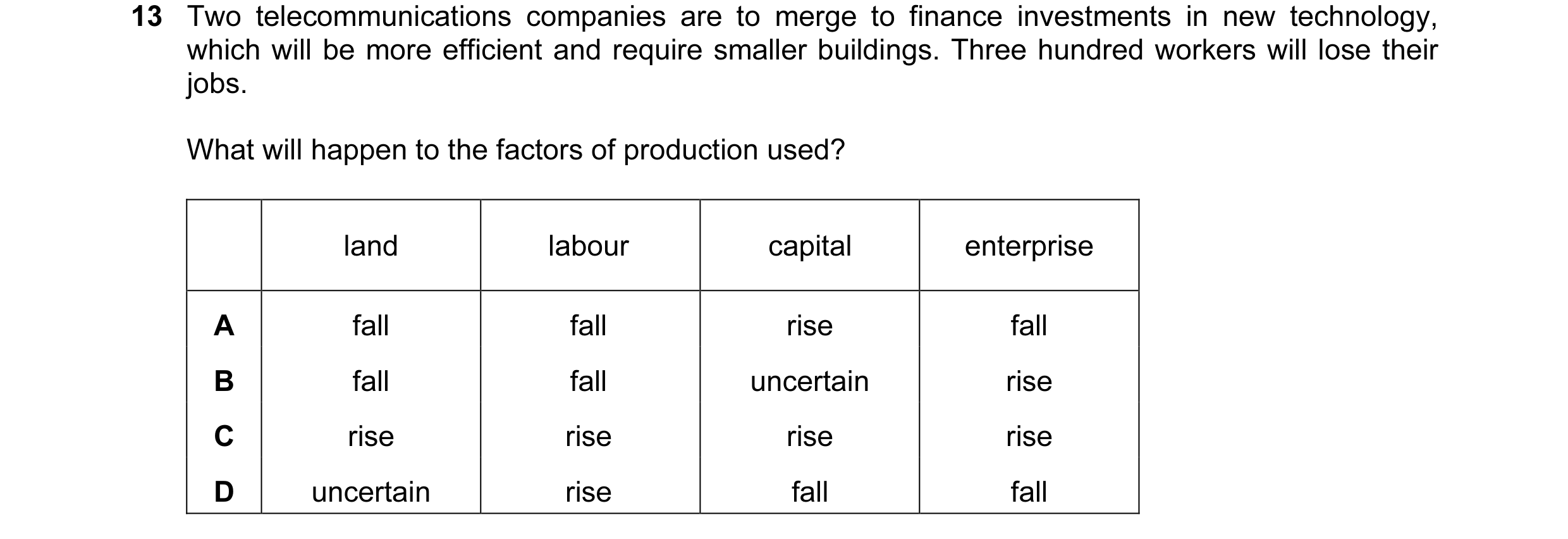
Q13 · Two telecommunications companies are to merge to finance investments in new technology… 0455/11 Oct/Nov 2012
13 Two telecommunications companies are to merge to finance investments in new technology, which will be more efficient and require smaller buildings. Three hundred workers will lose their jobs. What will happen to the factors of production used? land labour capital enterprise A fall fall rise fall B fall fall uncertain rise C rise rise rise rise D uncertain rise fall fall
1 marks
Answer: B
This question in 0455/11 Oct/Nov 2012
Q14 · Which is an external economy of scale? 0455/12 Oct/Nov 2012
15 Which is an external economy of scale? A availability of training facilities in local colleges B greater production from employees C increased credit facilities from banks D lower costs through bulk buying
1 marks
Answer: A
This question in 0455/12 Oct/Nov 2012
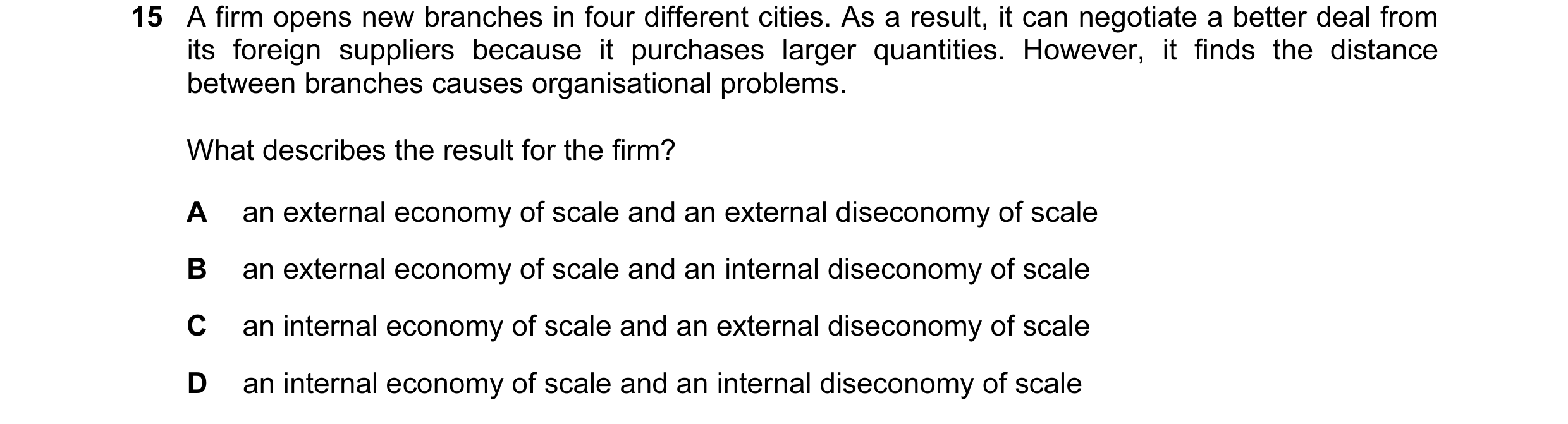
Q15 · A firm opens new branches in four different cities 0455/13 Oct/Nov 2012
15 A firm opens new branches in four different cities. As a result, it can negotiate a better deal from its foreign suppliers because it purchases larger quantities. However, it finds the distance between branches causes organisational problems. What describes the result for the firm? A an external economy of scale and an external diseconomy of scale B an external economy of scale and an internal diseconomy of scale C an internal economy of scale and an external diseconomy of scale D an internal economy of scale and an internal diseconomy of scale
1 marks
Answer: D
This question in 0455/13 Oct/Nov 2012
Q16 · In developed economies there are changing patterns of employment 0455/11 May/June 2013
24 In developed economies there are changing patterns of employment. What explains why fewer work in agriculture but food production has increased? A increased incomes and more leisure B mechanisation and the use of scientific methods C movement to factory jobs in manufacturing D shift to office work using computers
1 marks
Answer: B
This question in 0455/11 May/June 2013
Q17 · What is a reason why firms making similar products sometimes locate near each other? 0455/11 Oct/Nov 2013
1 What is a reason why firms making similar products sometimes locate near each other? A competition is decreased B there are external economies of scale C there are internal economies of scale D transport costs may be eliminated
1 marks
Answer: B
This question in 0455/11 Oct/Nov 2013
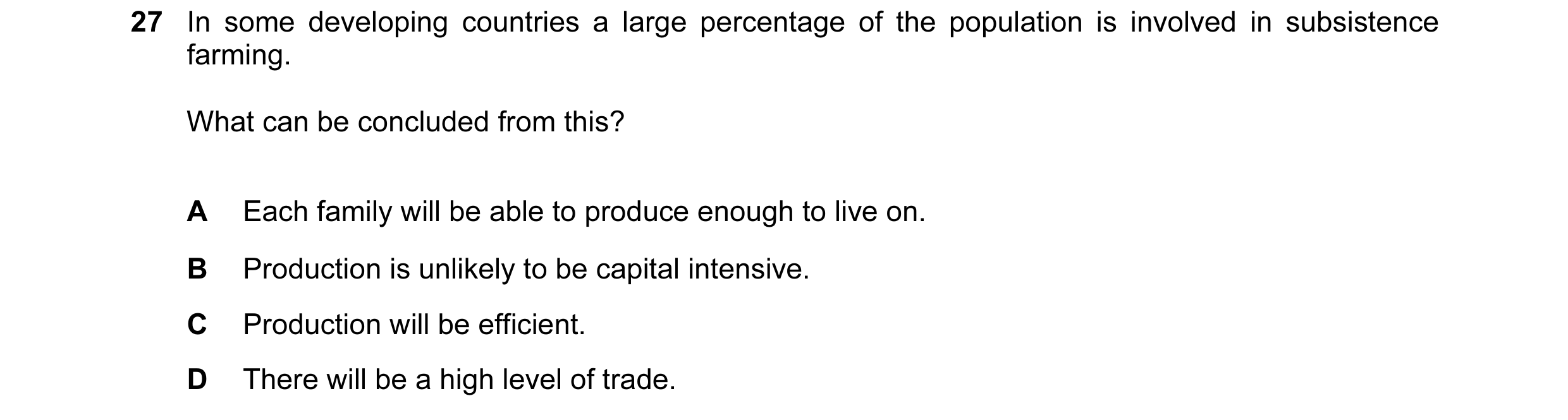
Q18 · In some developing countries a large percentage of the population is involved in… 0455/11 Oct/Nov 2013
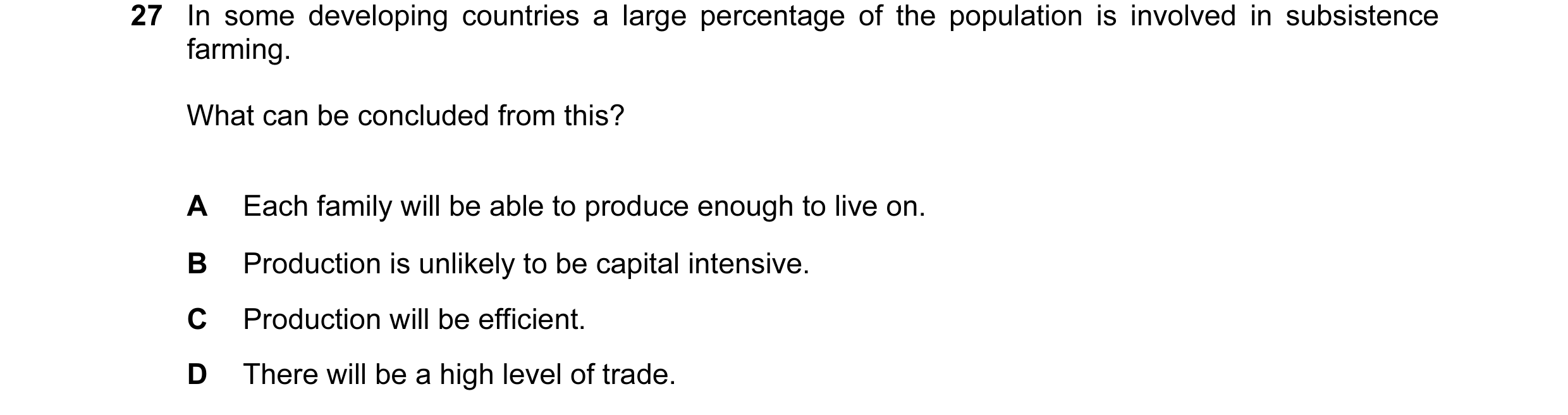
27 In some developing countries a large percentage of the population is involved in subsistence farming. What can be concluded from this? A Each family will be able to produce enough to live on. B Production is unlikely to be capital intensive. C Production will be efficient. D There will be a high level of trade.
1 marks
Answer: B
This question in 0455/11 Oct/Nov 2013
Q19 · What is a reason why firms making similar products sometimes locate near each other? 0455/12 Oct/Nov 2013
15 What is a reason why firms making similar products sometimes locate near each other? A competition is decreased B there are external economies of scale C there are internal economies of scale D transport costs may be eliminated
1 marks
Answer: B
This question in 0455/12 Oct/Nov 2013
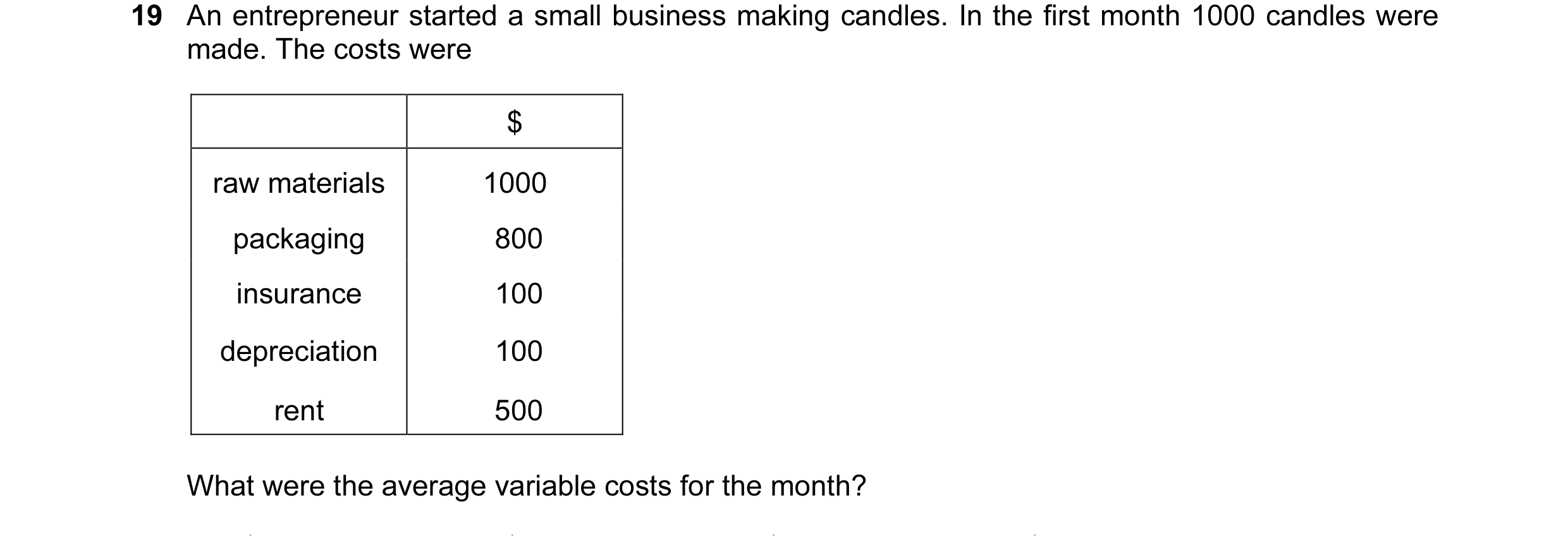
Q20 · An entrepreneur started a small business making candles 0455/12 Oct/Nov 2013
19 An entrepreneur started a small business making candles. In the first month 1000 candles were made. The costs were $ raw materials 1000 packaging 800 insurance 100 depreciation 100 rent 500 What were the average variable costs for the month? A $1.00 B $1.80 C $1.90 D $2.00
1 marks
Answer: B
This question in 0455/12 Oct/Nov 2013
Q21 · In some developing countries a large percentage of the population is involved in… 0455/12 Oct/Nov 2013
27 In some developing countries a large percentage of the population is involved in subsistence farming. What can be concluded from this? A Each family will be able to produce enough to live on. B Production is unlikely to be capital intensive. C Production will be efficient. D There will be a high level of trade.
1 marks
Answer: B
This question in 0455/12 Oct/Nov 2013
Q22 · Which type of economy of scale results from a firm producing a diverse range of products? 0455/11 May/June 2014
12 Which type of economy of scale results from a firm producing a diverse range of products? A buying B financial C risk bearing D technical
1 marks
Answer: C
This question in 0455/11 May/June 2014
Q23 · A market changes from perfect competition to monopoly 0455/11 May/June 2014
13 A market changes from perfect competition to monopoly. What is likely to happen in this market? barriers to economies the size of entry of scale the firm A decrease decrease increase B decrease increase decrease C increase decrease decrease D increase increase increase
1 marks
Answer: D
This question in 0455/11 May/June 2014
Q24 · When a shoe manufacturer doubles all factors of production output more than doubles 0455/12 May/June 2014
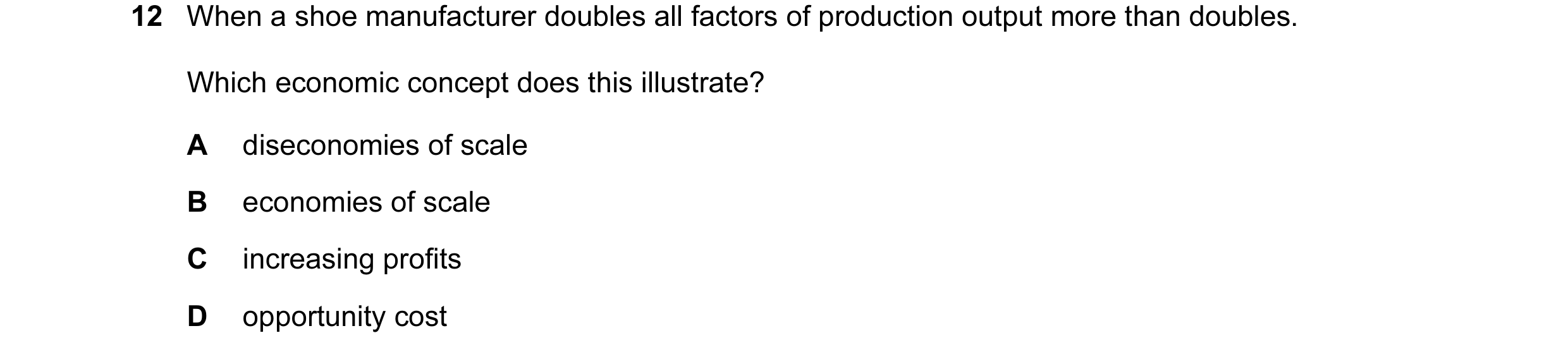
12 When a shoe manufacturer doubles all factors of production output more than doubles. Which economic concept does this illustrate? A diseconomies of scale B economies of scale C increasing profits D opportunity cost
1 marks
Answer: B
This question in 0455/12 May/June 2014
Q25 · A market changes from perfect competition to monopoly 0455/13 May/June 2014
10 A market changes from perfect competition to monopoly. What is likely to happen in this market? barriers to economies the size of entry of scale the firm A decrease decrease increase B decrease increase decrease C increase decrease decrease D increase increase increase
1 marks
Answer: D
This question in 0455/13 May/June 2014
Q26 · Which type of economy of scale results from a firm producing a diverse range of products? 0455/13 May/June 2014
11 Which type of economy of scale results from a firm producing a diverse range of products? A buying B financial C risk bearing D technical
1 marks
Answer: C
This question in 0455/13 May/June 2014
Q27 · The table shows output and total costs of production of a firm with three workers 0455/11 Oct/Nov 2014
17 The table shows output and total costs of production of a firm with three workers. output total costs ($) week 1 5 1500 week 2 6 1600 week 3 7 1700 week 4 8 1800 How did output per worker and average cost of the product change over the period? output per worker average cost A decrease no change B increase decrease C increase no change D no change increase
1 marks
Answer: B
This question in 0455/11 Oct/Nov 2014
Q28 · The table shows output and total costs of production of a firm with three workers 0455/12 Oct/Nov 2014
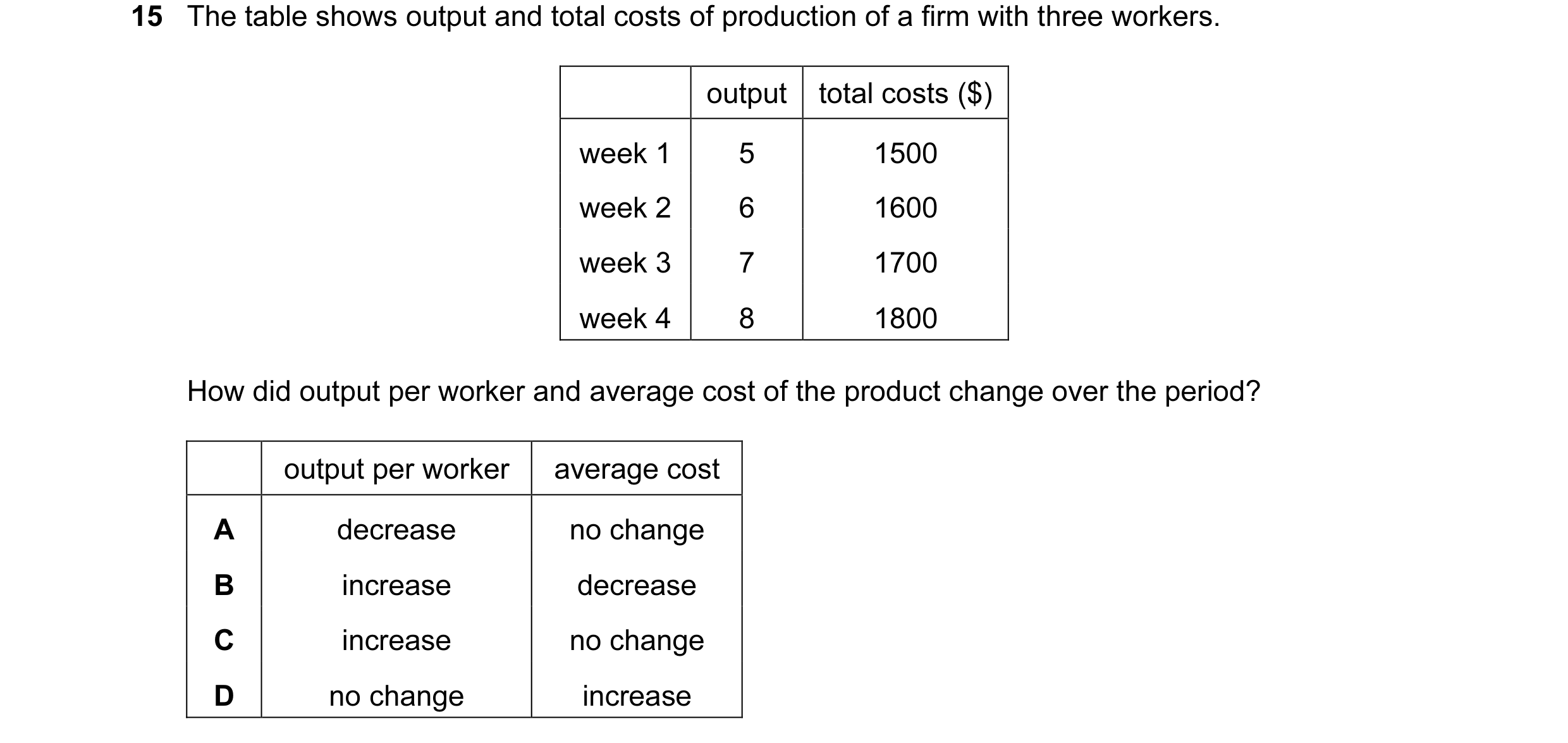
15 The table shows output and total costs of production of a firm with three workers. output total costs ($) week 1 5 1500 week 2 6 1600 week 3 7 1700 week 4 8 1800 How did output per worker and average cost of the product change over the period? output per worker average cost A decrease no change B increase decrease C increase no change D no change increase
1 marks
Answer: B
This question in 0455/12 Oct/Nov 2014
Q29 · The table shows output and total costs of production of a firm with three workers 0455/13 Oct/Nov 2014
15 The table shows output and total costs of production of a firm with three workers. output total costs ($) week 1 5 1500 week 2 6 1600 week 3 7 1700 week 4 8 1800 How did output per worker and average cost of the product change over the period? output per worker average cost A decrease no change B increase decrease C increase no change D no change increase
1 marks
Answer: B
This question in 0455/13 Oct/Nov 2014
Q30 · When is a firm considered more capital-intensive than another firm? 0455/11 May/June 2015
13 When is a firm considered more capital-intensive than another firm? A when it has a lower ratio of workers to machines than the other firm B when it has fewer workers than the other firm C when it has higher variable costs than the other firm D when it has more machines than the other firm
1 marks
Answer: A
This question in 0455/11 May/June 2015
Q31 · What is not a reason for the decline in manufacturing industries in developed economies… 0455/12 May/June 2015
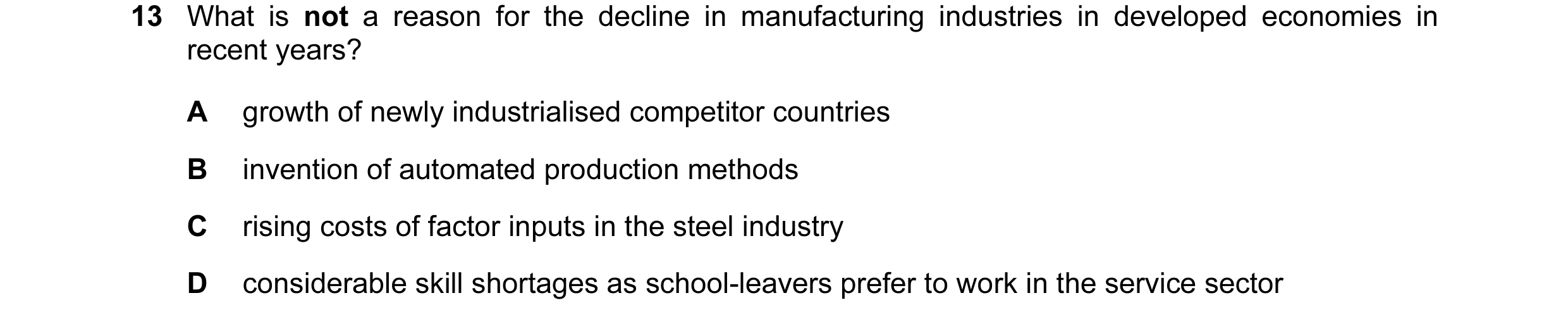
13 What is not a reason for the decline in manufacturing industries in developed economies in recent years? A growth of newly industrialised competitor countries B invention of automated production methods C rising costs of factor inputs in the steel industry D considerable skill shortages as school-leavers prefer to work in the service sector
1 marks
Answer: B
This question in 0455/12 May/June 2015
Q32 · A group of farmers form a partnership 0455/13 May/June 2015
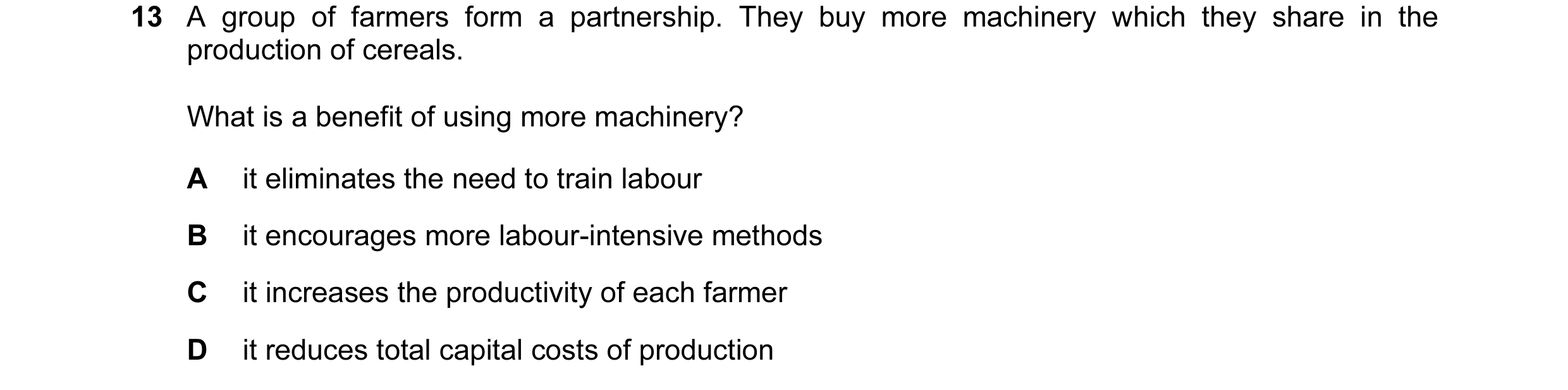
13 A group of farmers form a partnership. They buy more machinery which they share in the production of cereals. What is a benefit of using more machinery? A it eliminates the need to train labour B it encourages more labour-intensive methods C it increases the productivity of each farmer D it reduces total capital costs of production
1 marks
Answer: C
This question in 0455/13 May/June 2015
Q33 · The world’s open-cast mining of mineral ores is dominated by a few multinational… 0455/11 Oct/Nov 2015
14 The world’s open-cast mining of mineral ores is dominated by a few multinational companies which employ relatively few workers. What does this indicate? A Production is capital-intensive. B Productivity of labour is low. C The market is perfectly competitive. D There is a monopoly of world production.
1 marks
Answer: A
This question in 0455/11 Oct/Nov 2015
Q34 · The table shows the daily output and costs of four firms making chairs 0455/12 Feb/March 2016
15 The table shows the daily output and costs of four firms making chairs. Which firm has the highest average cost of production? fixed costs variable costs output (units) ($) ($) A 6 100 140 B 9 30 150 C 12 200 160 D 15 120 330
1 marks
Answer: A
This question in 0455/12 Feb/March 2016
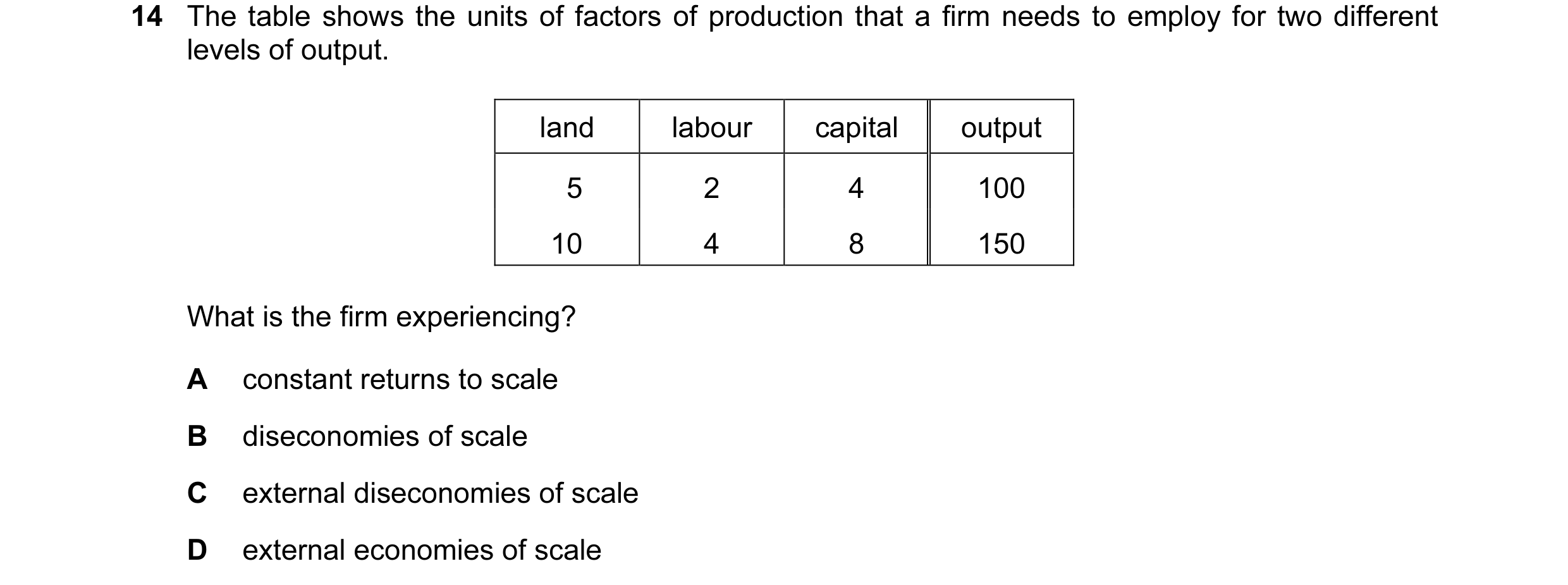
Q35 · The table shows the units of factors of production that a firm needs to employ for two… 0455/11 May/June 2016
14 The table shows the units of factors of production that a firm needs to employ for two different levels of output. land labour capital output 5 2 4 100 10 4 8 150 What is the firm experiencing? A constant returns to scale B diseconomies of scale C external diseconomies of scale D external economies of scale
1 marks
Answer: B
This question in 0455/11 May/June 2016
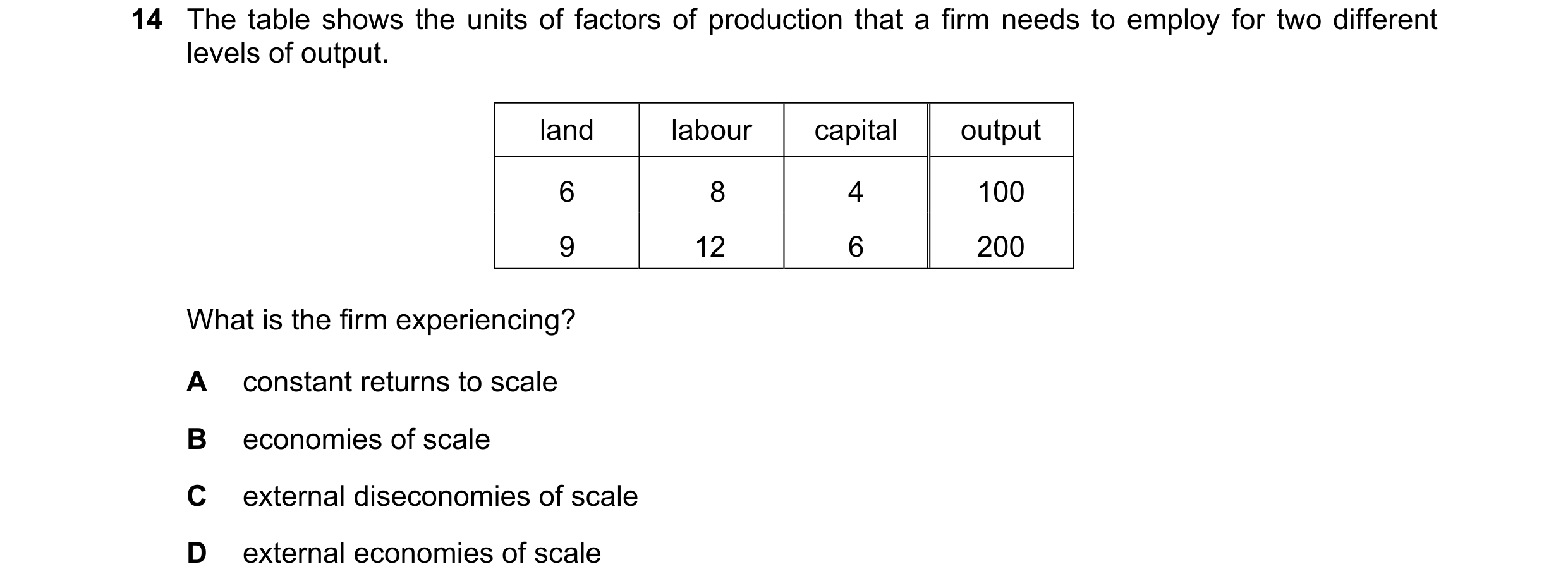
Q36 · The table shows the units of factors of production that a firm needs to employ for two… 0455/12 May/June 2016
14 The table shows the units of factors of production that a firm needs to employ for two different levels of output. land labour capital output 6 8 4 100 9 12 6 200 What is the firm experiencing? A constant returns to scale B economies of scale C external diseconomies of scale D external economies of scale
1 marks
Answer: B
This question in 0455/12 May/June 2016
Q37 · Some agricultural co-operatives have changed from labour-intensive to capital-intensive… 0455/12 Oct/Nov 2016
13 Some agricultural co-operatives have changed from labour-intensive to capital-intensive methods of production. What might be a cause of this change? A Average productivity of agricultural workers has increased. B Farming equipment has become more efficient. C People are eating less food for health reasons. D Some agricultural land has been sold for housing.
1 marks
This question in 0455/12 Oct/Nov 2016
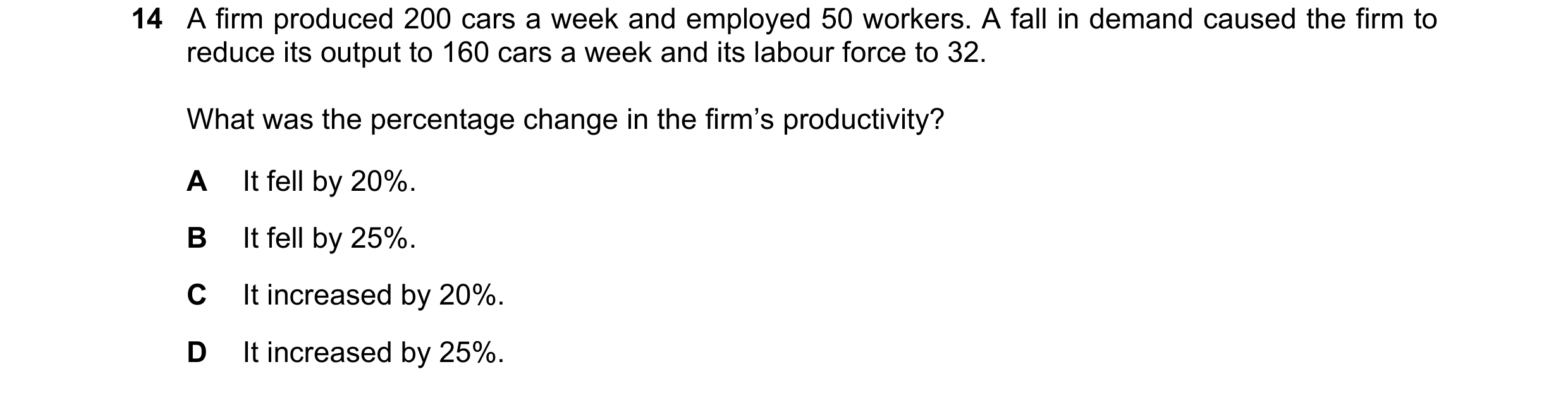
Q38 · A firm produced 200 cars a week and employed 50 workers 0455/13 Oct/Nov 2016
14 A firm produced 200 cars a week and employed 50 workers. A fall in demand caused the firm to reduce its output to 160 cars a week and its labour force to 32. What was the percentage change in the firm’s productivity? A It fell by 20%. B It fell by 25%. C It increased by 20%. D It increased by 25%.
1 marks
Answer: D
This question in 0455/13 Oct/Nov 2016
Q39 · The high volume of goods sold by large supermarkets enables them to reduce prices, but… 0455/12 Feb/March 2017
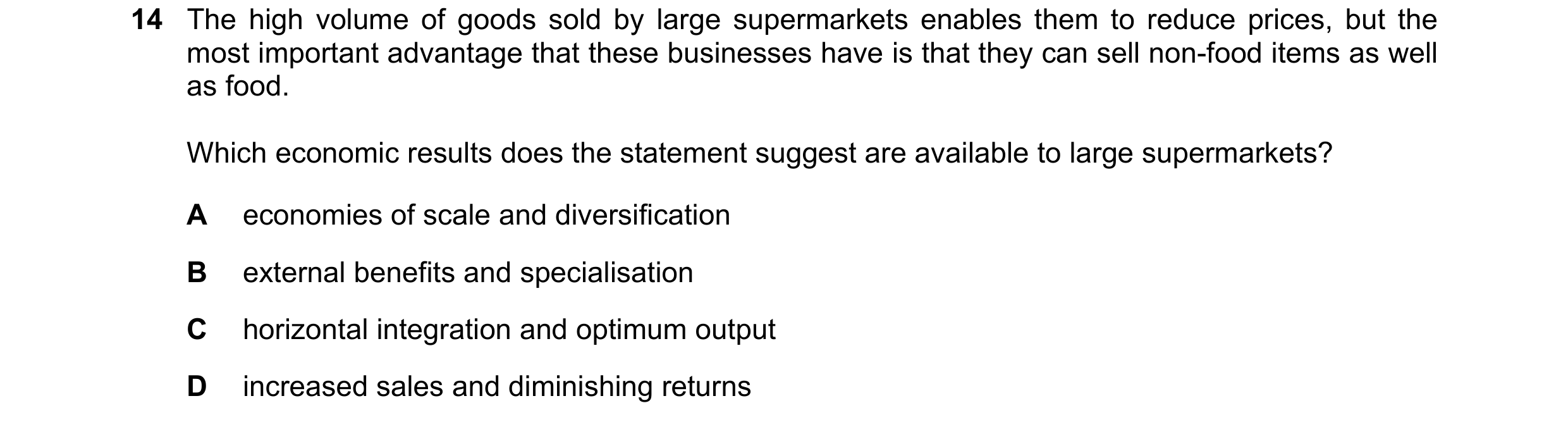
14 The high volume of goods sold by large supermarkets enables them to reduce prices, but the most important advantage that these businesses have is that they can sell non-food items as well as food. Which economic results does the statement suggest are available to large supermarkets? A economies of scale and diversification B external benefits and specialisation C horizontal integration and optimum output D increased sales and diminishing returns
1 marks
Answer: A
This question in 0455/12 Feb/March 2017
Q40 · The table shows how a firm’s production changes as it employs more workers 0455/11 May/June 2017
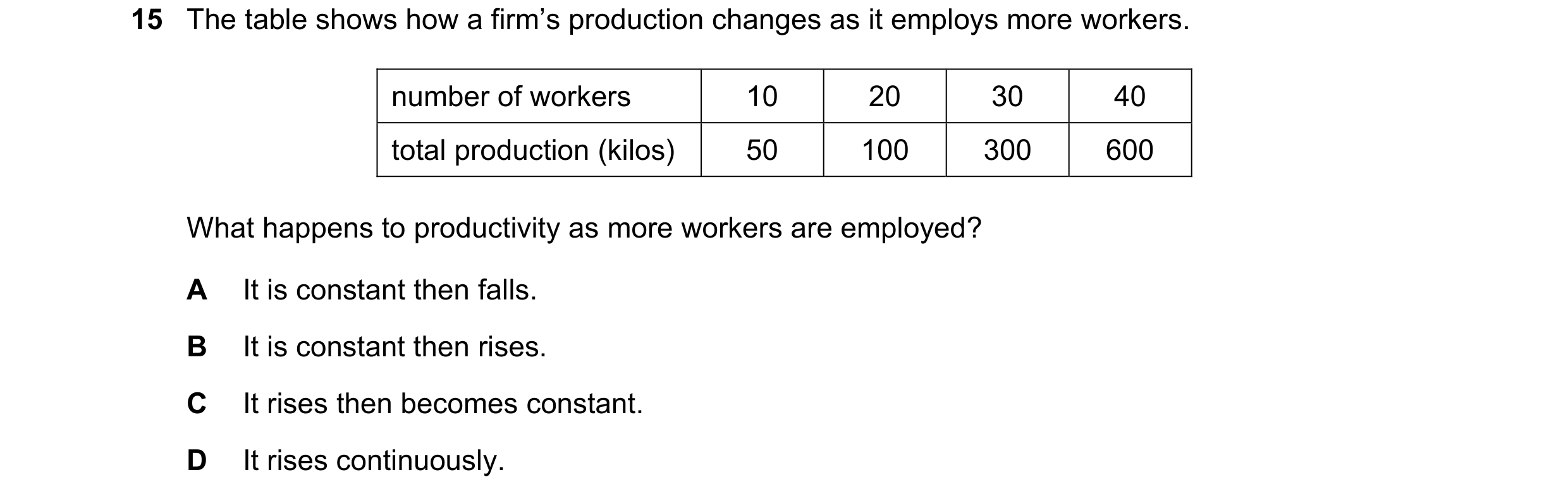
15 The table shows how a firm’s production changes as it employs more workers. number of workers 10 20 30 40 total production (kilos) 50 100 300 600 What happens to productivity as more workers are employed? A It is constant then falls. B It is constant then rises. C It rises then becomes constant. D It rises continuously.
1 marks
Answer: B
This question in 0455/11 May/June 2017
Q41 · A company produces an electric car that can be driven much further than other electric… 0455/13 May/June 2017
6 A company produces an electric car that can be driven much further than other electric cars without needing recharging. The car does not emit the dangerous fumes that petrol cars do. The batteries that power the car are very expensive and the company is building a huge factory to produce batteries more cheaply. Which concepts can be applied to the above statement? A average cost and mergers B external costs and mixed economy C private costs and economies of scale D public sector and market failure
1 marks
Answer: C
This question in 0455/13 May/June 2017
Q42 · A car manufacturer has a highly mechanised assembly line using robots and a few skilled… 0455/13 May/June 2017
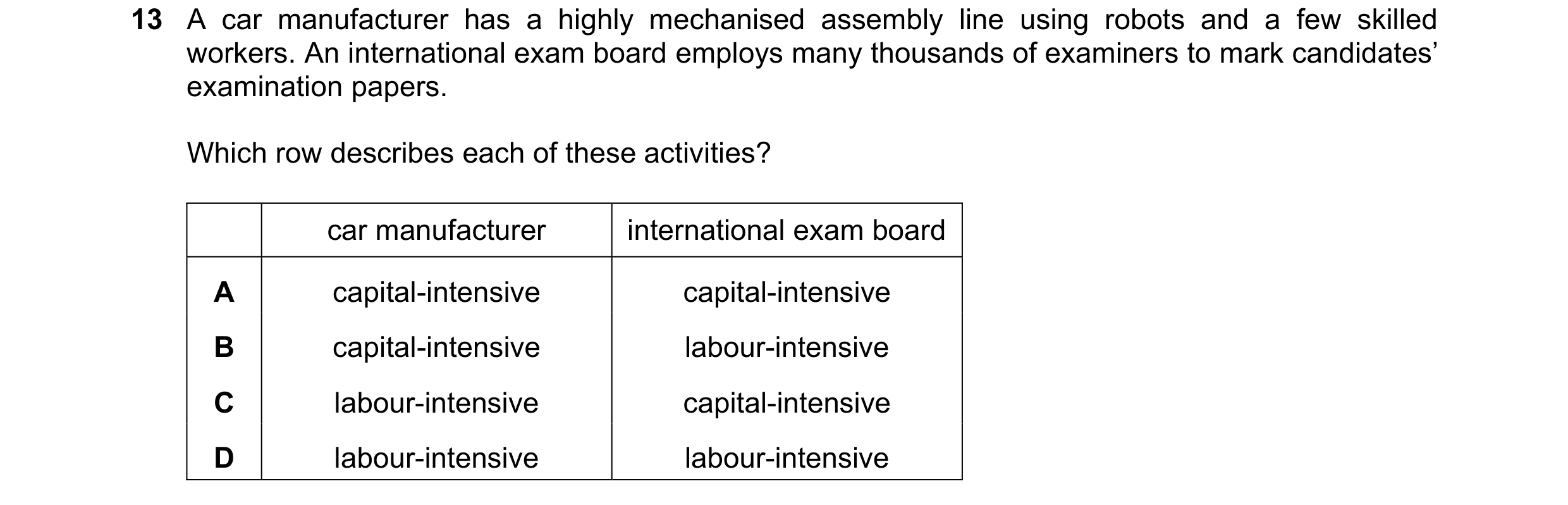
13 A car manufacturer has a highly mechanised assembly line using robots and a few skilled workers. An international exam board employs many thousands of examiners to mark candidates’ examination papers. Which row describes each of these activities? car manufacturer international exam board A capital-intensive capital-intensive B capital-intensive labour-intensive C labour-intensive capital-intensive D labour-intensive labour-intensive
1 marks
Answer: B
This question in 0455/13 May/June 2017
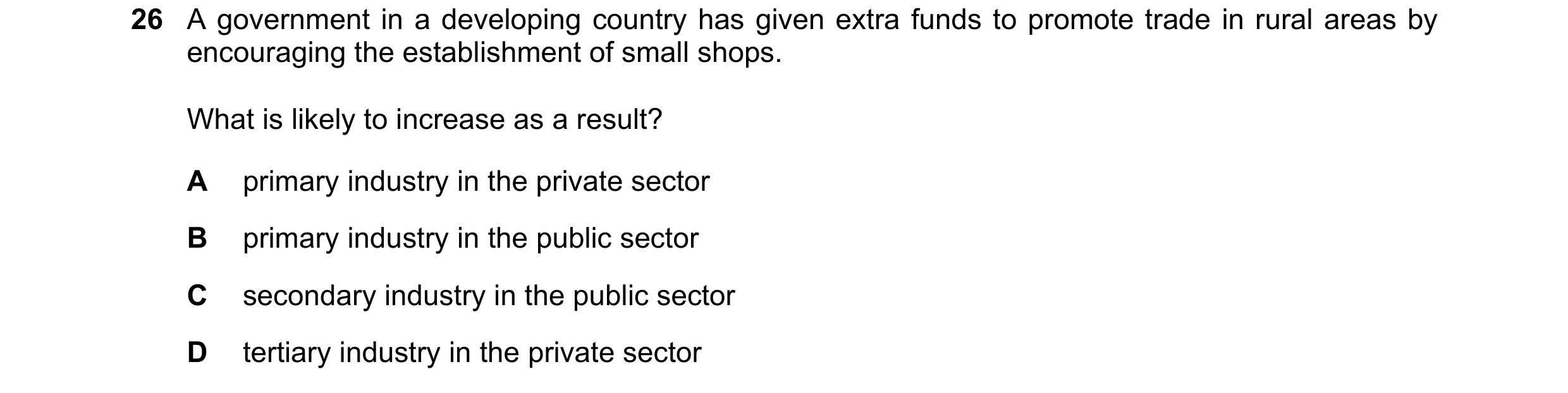
Q43 · A government in a developing country has given extra funds to promote trade in rural… 0455/13 May/June 2017
26 A government in a developing country has given extra funds to promote trade in rural areas by encouraging the establishment of small shops. What is likely to increase as a result? A primary industry in the private sector B primary industry in the public sector C secondary industry in the public sector D tertiary industry in the private sector
1 marks
Answer: D
This question in 0455/13 May/June 2017
Q44 · Which change will make a manufacturing company replace machines with labour to maintain… 0455/12 Oct/Nov 2017
9 Which change will make a manufacturing company replace machines with labour to maintain the most efficient combination of factors of production? A The price of the product manufactured has increased. B The productivity of labour has increased. C The productivity of machinery has increased. D The wages of labour have increased.
1 marks
Answer: B
This question in 0455/12 Oct/Nov 2017
Q45 · Which is an internal diseconomy of scale? 0455/12 Oct/Nov 2017
12 Which is an internal diseconomy of scale? A a lack of communication in a firm B a reduction of cost by buying in bulk C a shortage of skilled labour in an area D traffic congestion in a particular area
1 marks
Answer: A
This question in 0455/12 Oct/Nov 2017
Q46 · The table shows units of output, value of output and number of people employed in an… 0455/11 May/June 2018
23 The table shows units of output, value of output and number of people employed in an industry over three years. output output value number employed (units, millions) ($ millions) (000) year 1 10 10 5 year 2 21 25 7 year 3 32 40 8 What can be concluded from the table? A Inflation has increased. B Productivity has increased. C Profit has increased. D Working population has increased.
1 marks
Answer: B
This question in 0455/11 May/June 2018
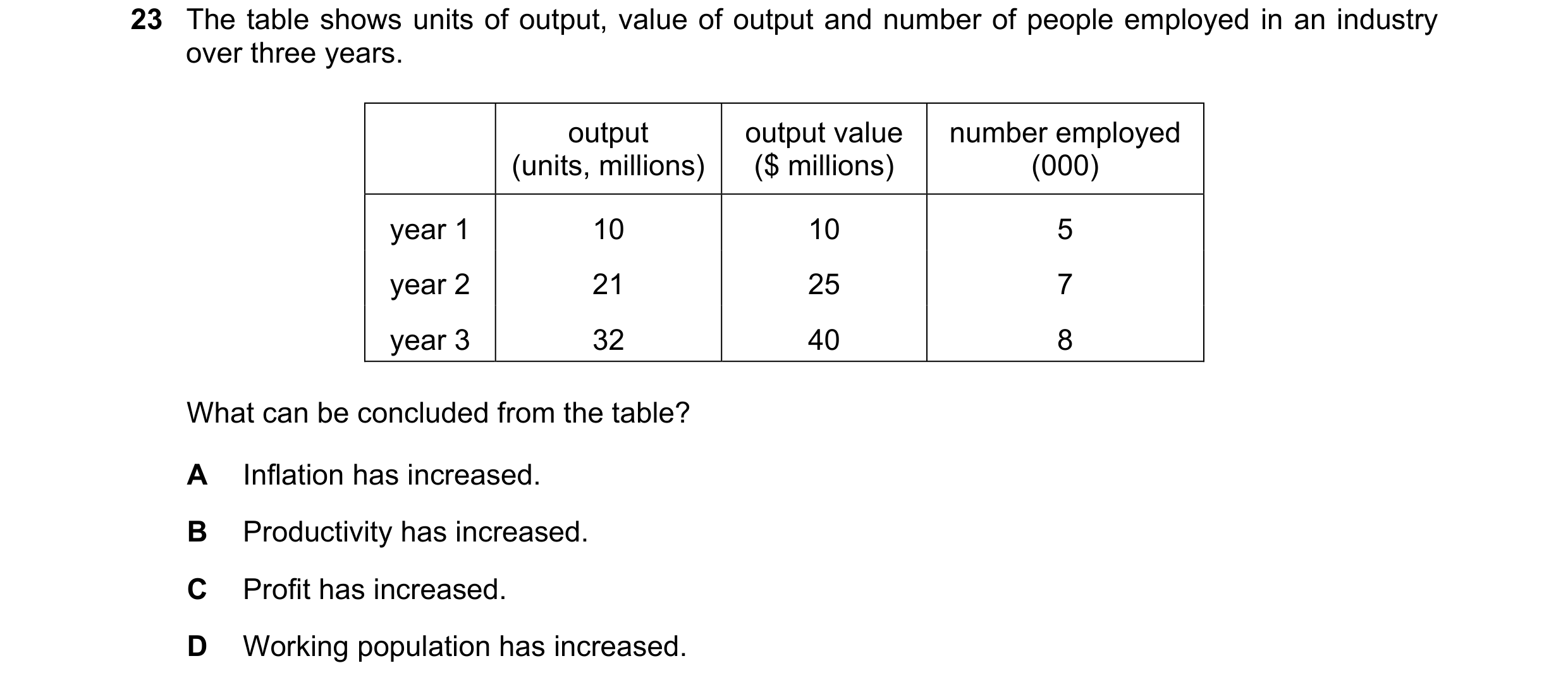
Q47 · The table shows units of output, value of output and number of people employed in an… 0455/12 May/June 2018
23 The table shows units of output, value of output and number of people employed in an industry over three years. output output value number employed (units, millions) ($ millions) (000) year 1 10 10 5 year 2 21 25 7 year 3 32 40 8 What can be concluded from the table? A Inflation has increased. B Productivity has increased. C Profit has increased. D Working population has increased.
1 marks
Answer: B
This question in 0455/12 May/June 2018
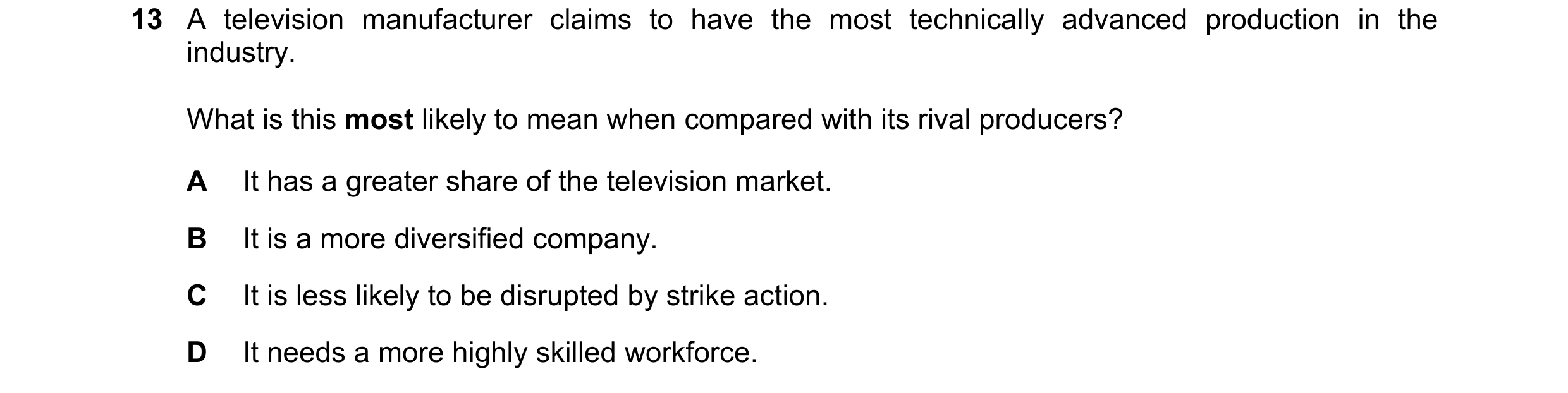
Q48 · A television manufacturer claims to have the most technically advanced production in the… 0455/13 May/June 2018
13 A television manufacturer claims to have the most technically advanced production in the industry. What is this most likely to mean when compared with its rival producers? A It has a greater share of the television market. B It is a more diversified company. C It is less likely to be disrupted by strike action. D It needs a more highly skilled workforce.
1 marks
Answer: D
This question in 0455/13 May/June 2018
Q49 · The table shows units of output, value of output and number of people employed in an… 0455/13 May/June 2018
23 The table shows units of output, value of output and number of people employed in an industry over three years. output output value number employed (units, millions) ($ millions) (000) year 1 10 10 5 year 2 21 25 7 year 3 32 40 8 What can be concluded from the table? A Inflation has increased. B Productivity has increased. C Profit has increased. D Working population has increased.
1 marks
Answer: B
This question in 0455/13 May/June 2018
Q50 · What is most likely to increase the total output of a firm in the short run? 0455/11 Oct/Nov 2018
9 What is most likely to increase the total output of a firm in the short run? A a rise in the length of the working day B a rise in the number of days holiday C a rise in the school leaving age D a rise in unemployment payments
1 marks
Answer: A
This question in 0455/11 Oct/Nov 2018
Q51 · Which form of production would be least likely to have the advantages of economies of… 0455/11 Oct/Nov 2018
13 Which form of production would be least likely to have the advantages of economies of scale? A car manufacturing B commercial cereal farming C handmade jewellery D refining of oil products
1 marks
Answer: C
This question in 0455/11 Oct/Nov 2018
Q52 · Why does specialisation increase the productivity of employees? 0455/12 May/June 2019
8 Why does specialisation increase the productivity of employees? A Average cost of production increases. B Staff turnover is high. C Time is saved by not moving between tasks. D Workers lose interest in their job.
1 marks
Answer: C
This question in 0455/12 May/June 2019
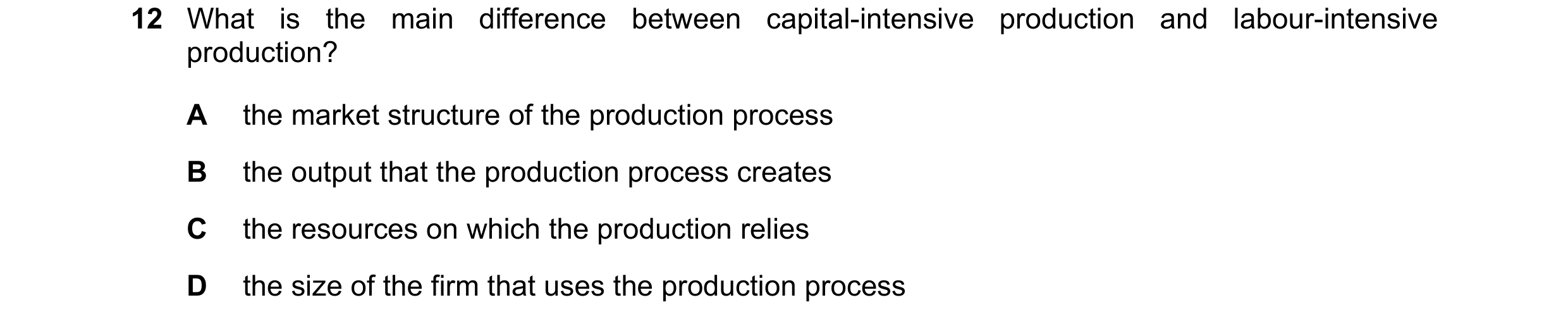
Q53 · What is the main difference between capital-intensive production and labour-intensive… 0455/12 May/June 2019
12 What is the main difference between capital-intensive production and labour-intensive production? A the market structure of the production process B the output that the production process creates C the resources on which the production relies D the size of the firm that uses the production process
1 marks
Answer: C
This question in 0455/12 May/June 2019
Q54 · What is a characteristic of tertiary industries? 0455/13 May/June 2019
4 What is a characteristic of tertiary industries? A They are located away from centres of population. B They do not sell to the final consumer. C They tend to be labour-intensive. D They transform raw materials into goods.
1 marks
Answer: C
This question in 0455/13 May/June 2019
Q55 · What is an example of a technical economy of scale? 0455/13 May/June 2019
13 What is an example of a technical economy of scale? A Banks provide loans at a lower interest rate to bigger firms. B Bigger firms hire more workers. C Firms obtain discounts when buying in bulk. D Machines are used closer to their full capacity.
1 marks
Answer: D
This question in 0455/13 May/June 2019
Q56 · What is most likely to lead to an improvement in labour productivity in an industry? 0455/11 May/June 2020
14 What is most likely to lead to an improvement in labour productivity in an industry? A an increase in capital investment B an increase in income tax rates C an increase in the demand for the industry’s product D an increase in the number of firms in the industry
1 marks
Answer: A
This question in 0455/11 May/June 2020
Q57 · Which statement proves there has been an increase in productivity for a factory making… 0455/12 May/June 2020
14 Which statement proves there has been an increase in productivity for a factory making tractors? A 10% more workers results in a 10% increase in tractors produced each week. B Output per worker increases from 3 tractors to 4 tractors per month. C Production increases as more workers are hired. D Starting a night shift leads to an increase in production of 10 tractors a day.
1 marks
Answer: B
This question in 0455/12 May/June 2020
Q58 · What is a disadvantage to employers of switching to production using division of labour? 0455/13 May/June 2020
8 What is a disadvantage to employers of switching to production using division of labour? A average cost decreases B flexibility of workers is lost C repetition of tasks saves time D training time decreases
1 marks
Answer: B
This question in 0455/13 May/June 2020
Q59 · Firms can grow by increasing the internal scale of their operations 0455/13 May/June 2020
14 Firms can grow by increasing the internal scale of their operations. What might be a disadvantage of this to the firm? A average cost begins to fall B it is difficult to motivate workers C labour is replaced by robots D markets become global
1 marks
Answer: B
This question in 0455/13 May/June 2020
Q60 · In the short run, a firm calculates its total fixed cost, total variable cost and total… 0455/11 Oct/Nov 2020
12 In the short run, a firm calculates its total fixed cost, total variable cost and total cost. It then plots a graph showing how they change as output increases. What happens to the lines showing the total variable cost and total cost as output increases? A They merge to become one curve. B They move closer together. C They move further apart. D They remain a constant distance apart.
1 marks
Answer: D
This question in 0455/11 Oct/Nov 2020
Q61 · What could cause internal diseconomies of scale for a firm? 0455/11 Oct/Nov 2020
15 What could cause internal diseconomies of scale for a firm? A a fall in demand for the products produced by the firm B a merger with another firm that results in slower decision-making C spending more on research and development to create new products D the lack of skilled labour in the geographical area where the firm is based
1 marks
Answer: B
This question in 0455/11 Oct/Nov 2020
Q62 · What is usually considered to be an advantage to a firm of using division of labour? 0455/13 Oct/Nov 2020
15 What is usually considered to be an advantage to a firm of using division of labour? A high labour turnover B increased mechanisation C movement of labour between tasks D need for quality control
1 marks
Answer: B
This question in 0455/13 Oct/Nov 2020
Q63 · How would a state-owned oil refining firm be classified? 0455/12 Feb/March 2021
15 How would a state-owned oil refining firm be classified? A as a multi-national company (MNC) in the private sector B as a private sector firm in the tertiary sector C as a public sector firm in the primary sector D as a public sector firm in the secondary sector
1 marks
Answer: D
This question in 0455/12 Feb/March 2021
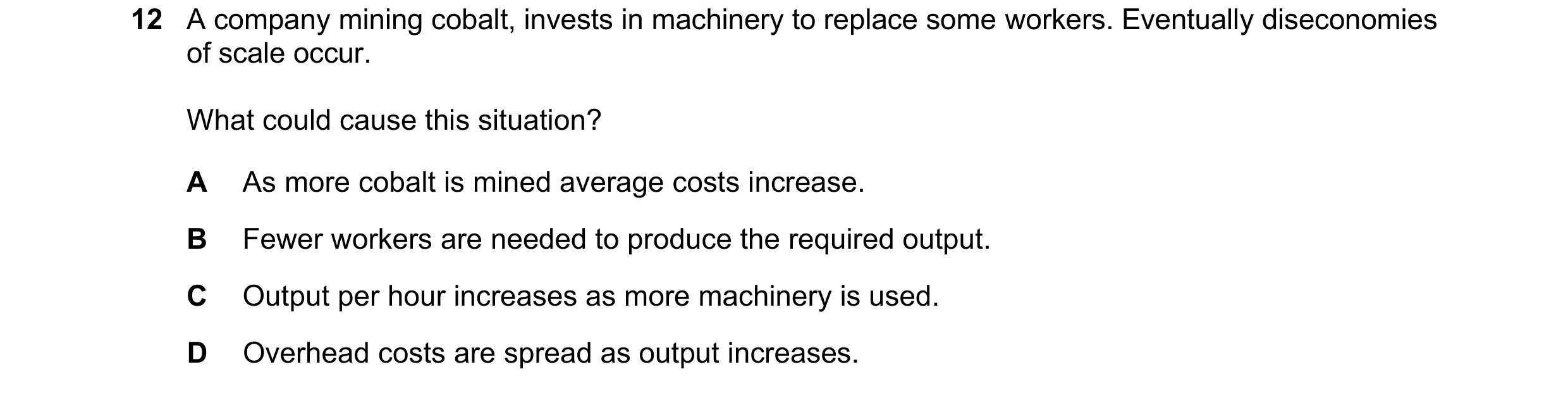
Q64 · A company mining cobalt, invests in machinery to replace some workers 0455/11 May/June 2021
12 A company mining cobalt, invests in machinery to replace some workers. Eventually diseconomies of scale occur. What could cause this situation? A As more cobalt is mined average costs increase. B Fewer workers are needed to produce the required output. C Output per hour increases as more machinery is used. D Overhead costs are spread as output increases.
1 marks
Answer: A
This question in 0455/11 May/June 2021
Q65 · Which firm is in the tertiary sector? 0455/13 May/June 2021
10 Which firm is in the tertiary sector? A bread bakery B fruit grower C meal delivery D road builder
1 marks
Answer: C
This question in 0455/13 May/June 2021
Q66 · The table compares the distribution of employment in selected industries in two years 0455/13 May/June 2021
22 The table compares the distribution of employment in selected industries in two years. employment in millions industry year 1 year 2 agriculture 4 3 mining 2 2 manufacturing 6 6 retailing 4 4 transport 4 5 total 20 20 How did the distribution of employment change between year 1 and year 2? primary sector secondary sector A fell rose B fell unchanged C rose fell D rose unchanged
1 marks
Answer: B
This question in 0455/13 May/June 2021
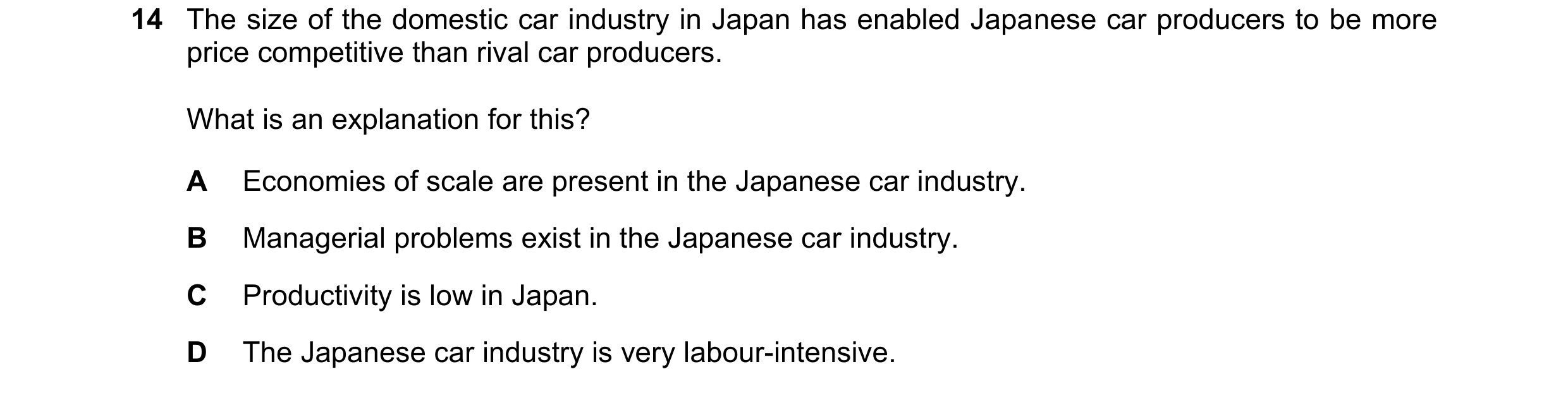
Q67 · The size of the domestic car industry in Japan has enabled Japanese car producers to be… 0455/11 Oct/Nov 2021
14 The size of the domestic car industry in Japan has enabled Japanese car producers to be more price competitive than rival car producers. What is an explanation for this? A Economies of scale are present in the Japanese car industry. B Managerial problems exist in the Japanese car industry. C Productivity is low in Japan. D The Japanese car industry is very labour-intensive.
1 marks
Answer: A
This question in 0455/11 Oct/Nov 2021
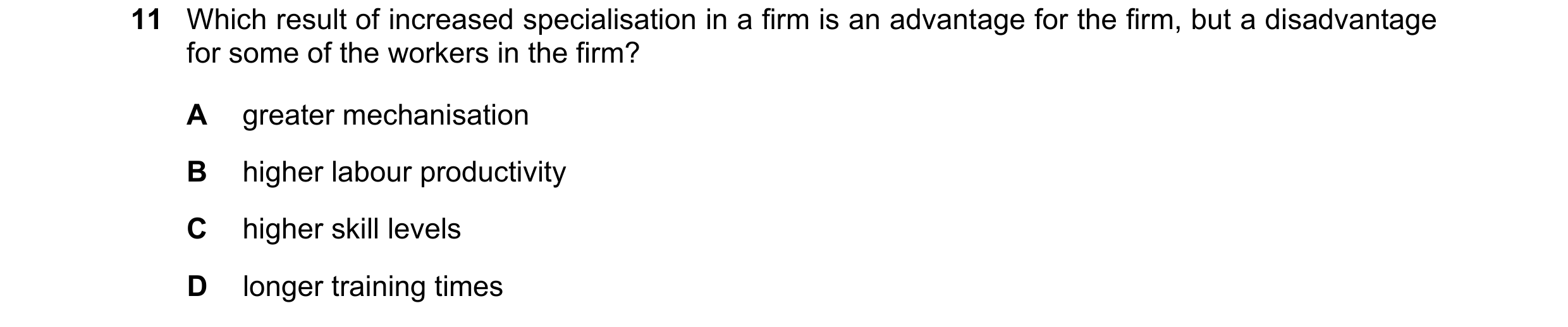
Q68 · Which result of increased specialisation in a firm is an advantage for the firm, but a… 0455/12 Oct/Nov 2021
11 Which result of increased specialisation in a firm is an advantage for the firm, but a disadvantage for some of the workers in the firm? A greater mechanisation B higher labour productivity C higher skill levels D longer training times
1 marks
Answer: A
This question in 0455/12 Oct/Nov 2021
Q69 · The table shows the output of cakes from four bakeries, A–D 0455/13 Oct/Nov 2021
9 The table shows the output of cakes from four bakeries, A–D. Which bakery has the highest labour productivity? labour output (hours per day) (cakes per day) A 10 40 B 40 640 C 50 750 D 100 500
1 marks
Answer: B
This question in 0455/13 Oct/Nov 2021
Q70 · What is an advantage of labour-intensive production and what is an advantage of… 0455/13 Oct/Nov 2021
10 What is an advantage of labour-intensive production and what is an advantage of capital-intensive production? labour-intensive capital-intensive A each item can be individually made average costs of production are low B keeps unemployment down fixed costs are high C workers have pride in the product machinery may break down D workers have to work hard there is a ready market for the product
1 marks
Answer: A
This question in 0455/13 Oct/Nov 2021
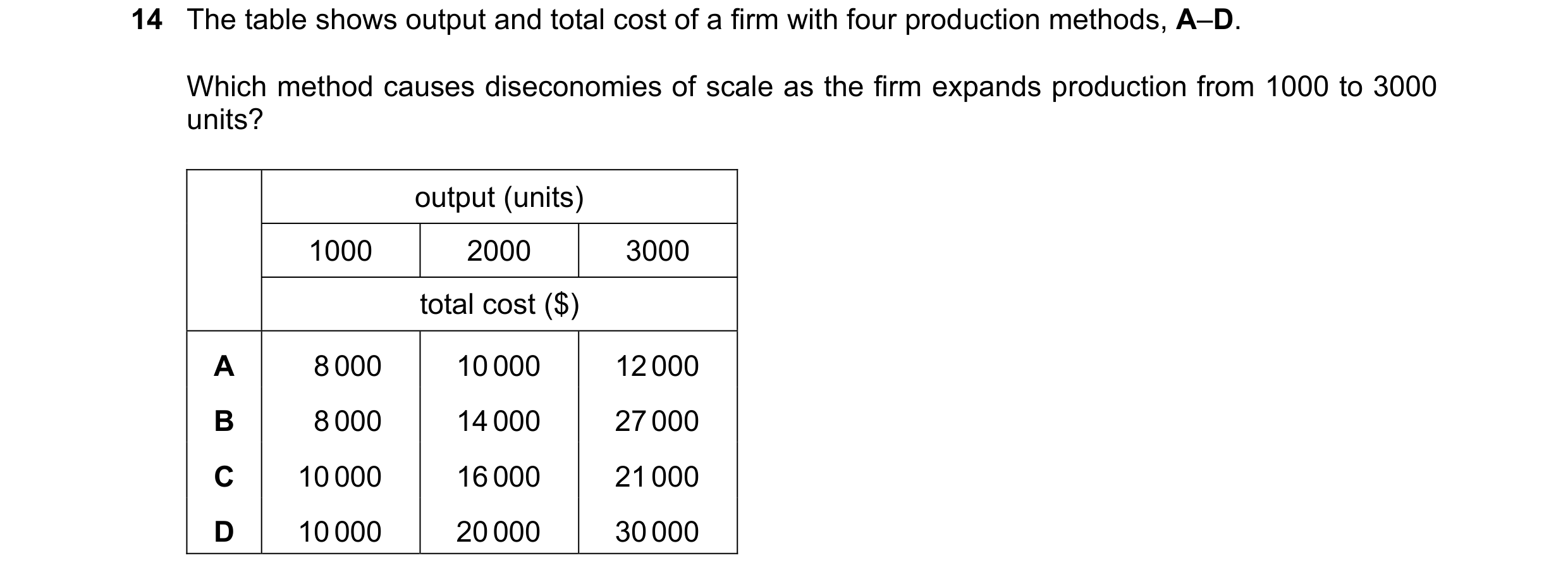
Q71 · The table shows output and total cost of a firm with four production methods, A–D 0455/13 Oct/Nov 2021
14 The table shows output and total cost of a firm with four production methods, A–D. Which method causes diseconomies of scale as the firm expands production from 1000 to 3000 units? output (units) 1000 2000 3000 total cost ($) A 8 000 10 000 12 000 B 8 000 14 000 27 000 C 10 000 16 000 21 000 D 10 000 20 000 30 000
1 marks
Answer: B
This question in 0455/13 Oct/Nov 2021
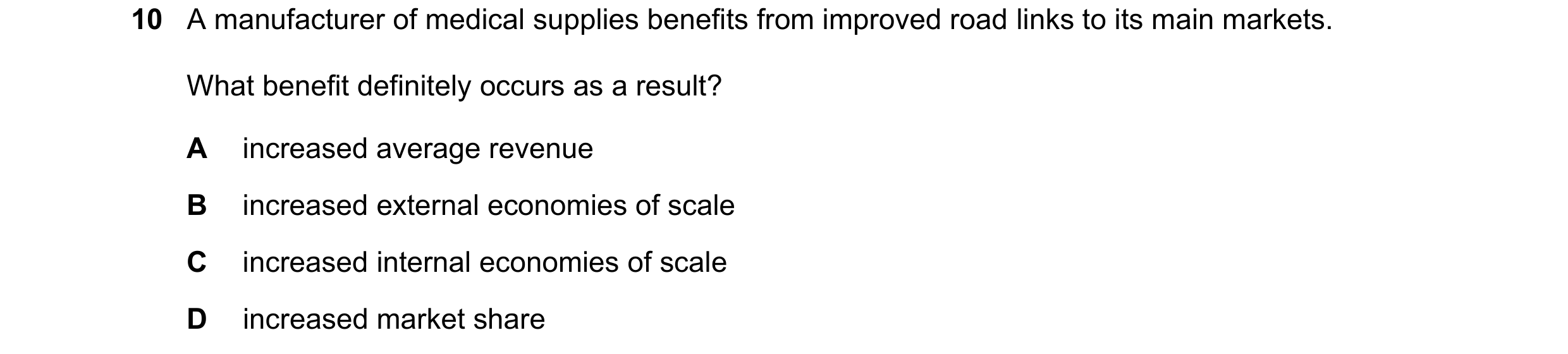
Q72 · A manufacturer of medical supplies benefits from improved road links to its main markets 0455/11 May/June 2022
10 A manufacturer of medical supplies benefits from improved road links to its main markets. What benefit definitely occurs as a result? A increased average revenue B increased external economies of scale C increased internal economies of scale D increased market share
1 marks
Answer: B
This question in 0455/11 May/June 2022
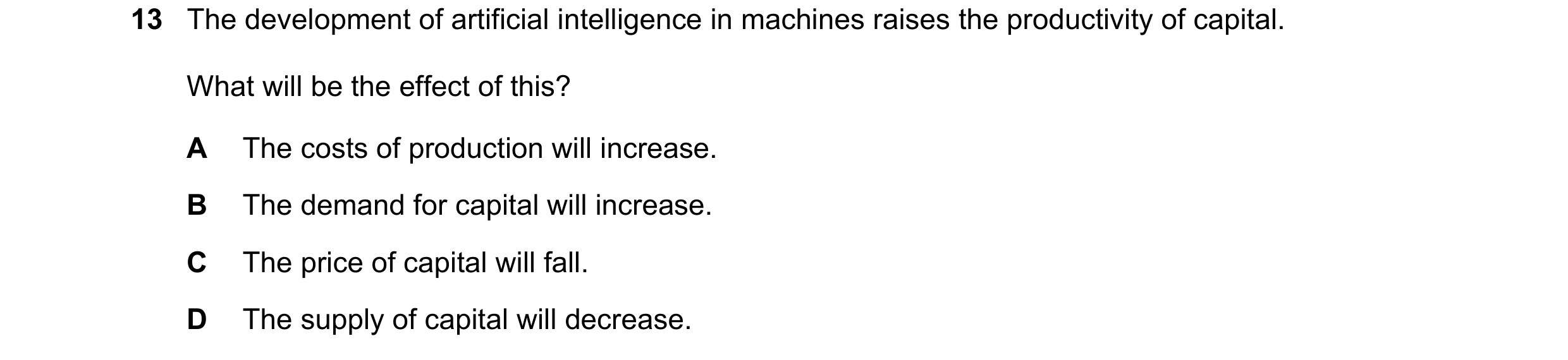
Q73 · The development of artificial intelligence in machines raises the productivity of capital 0455/11 May/June 2022
13 The development of artificial intelligence in machines raises the productivity of capital. What will be the effect of this? A The costs of production will increase. B The demand for capital will increase. C The price of capital will fall. D The supply of capital will decrease.
1 marks
Answer: B
This question in 0455/11 May/June 2022
Q74 · A manufacturer of tinned beans mechanises its assembly line 0455/13 May/June 2022
8 A manufacturer of tinned beans mechanises its assembly line. This increases output by 30% and reduces labour by 20%. How and why will this affect supply curve S? S price of tinned beans O quantity of tinned beans A S will move to the left due to an increase in average costs. B S will move to the left due to an increase in the price of tinned beans. C S will move to the right due to an increase in consumer demand. D S will move to the right due to an increase in productivity.
1 marks
Answer: D
This question in 0455/13 May/June 2022
Q75 · A firm produces bicycles 0455/11 Oct/Nov 2022
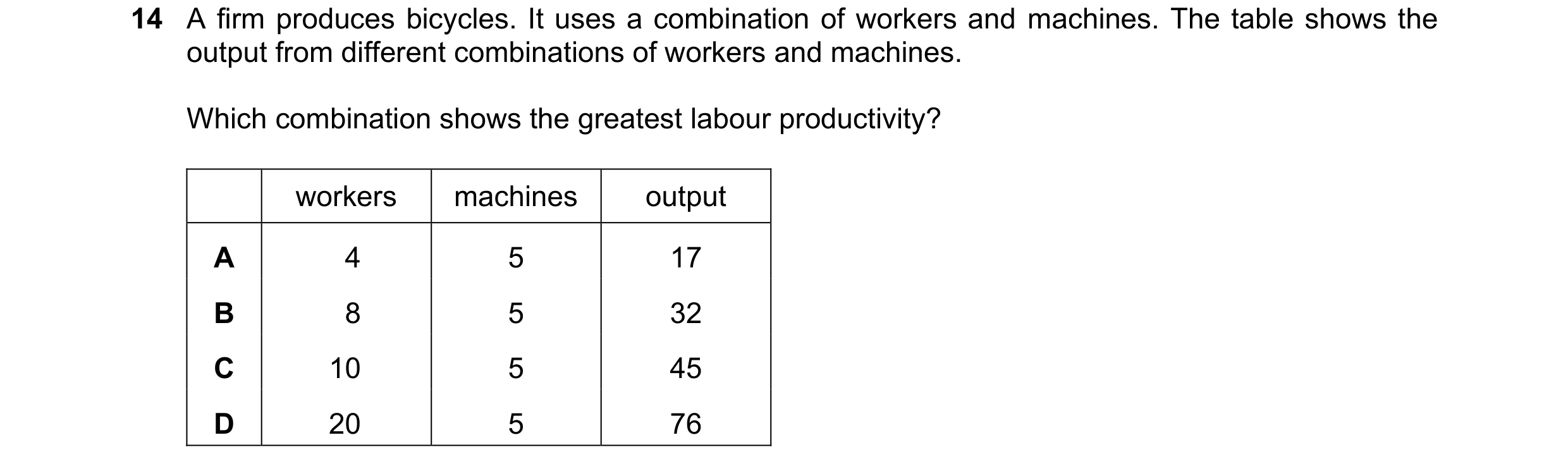
14 A firm produces bicycles. It uses a combination of workers and machines. The table shows the output from different combinations of workers and machines. Which combination shows the greatest labour productivity? workers machines output A 4 5 17 B 8 5 32 C 10 5 45 D 20 5 76
1 marks
Answer: C
This question in 0455/11 Oct/Nov 2022
Q76 · The table shows the units of factors of production that a firm needs to employ for two… 0455/11 May/June 2023
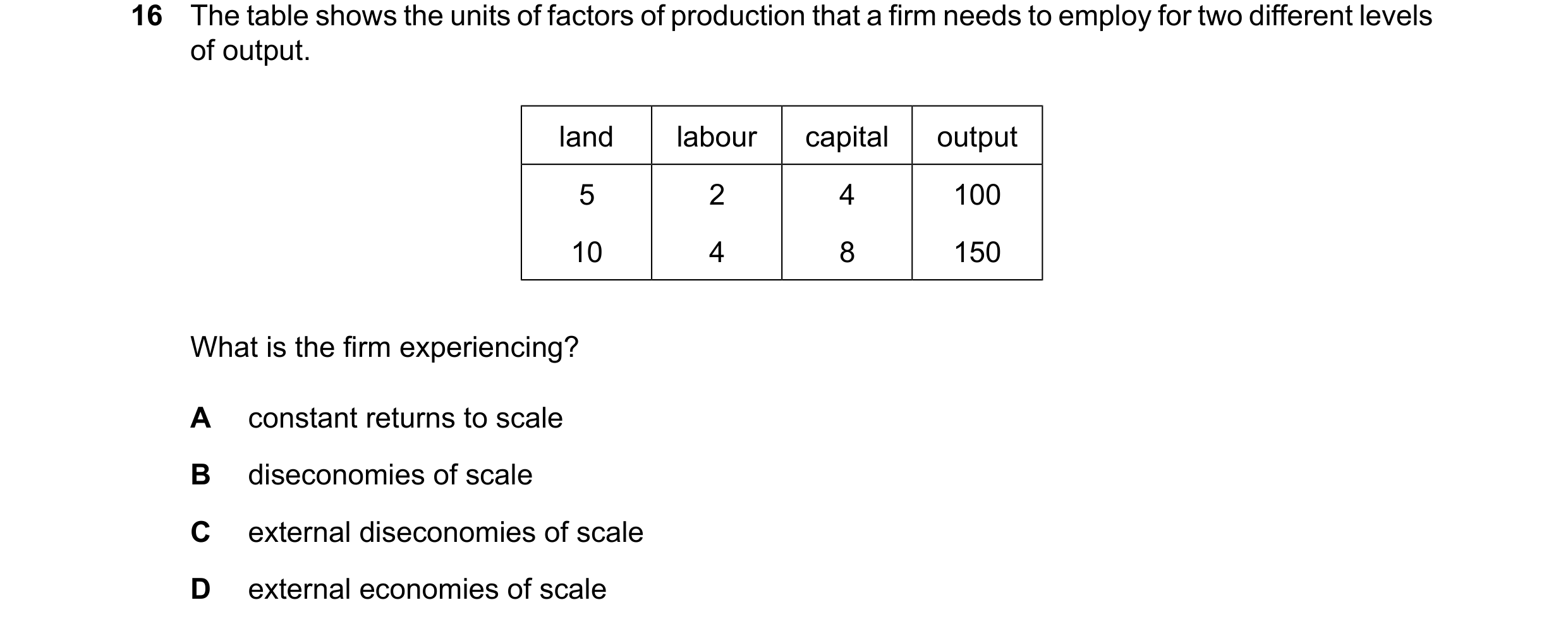
16 The table shows the units of factors of production that a firm needs to employ for two different levels of output. land labour capital output 5 2 4 100 10 4 8 150 What is the firm experiencing? A constant returns to scale B diseconomies of scale C external diseconomies of scale D external economies of scale
1 marks
Answer: B
This question in 0455/11 May/June 2023
Q77 · What could cause internal diseconomies of scale for a firm? 0455/12 May/June 2023
16 What could cause internal diseconomies of scale for a firm? A a fall in demand for the products produced by the firm B a merger with another firm that results in slower decision-making C spending more on research and development to create new products D the lack of skilled labour in the geographical area where the firm is based
1 marks
Answer: B
This question in 0455/12 May/June 2023
Q78 · What is not a reason for the decline in manufacturing industries in developed economies… 0455/12 May/June 2023
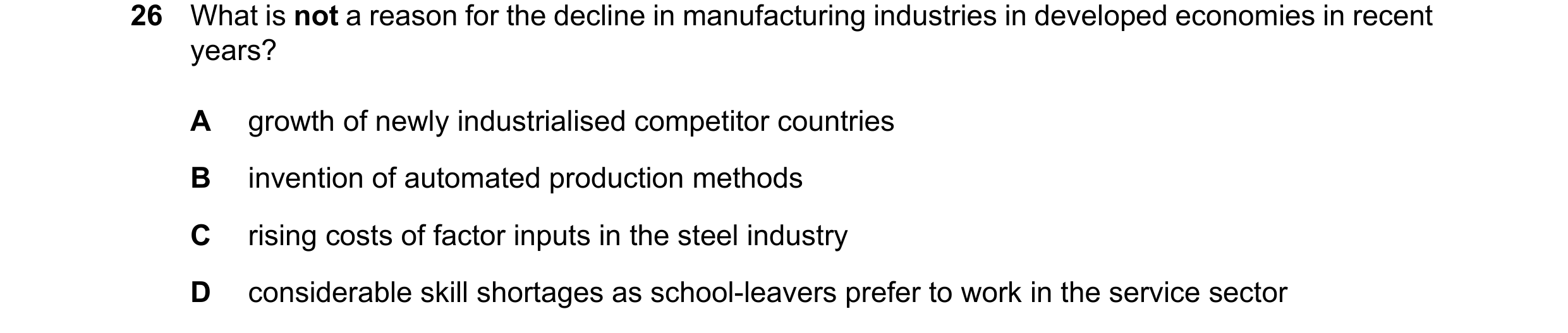
26 What is not a reason for the decline in manufacturing industries in developed economies in recent years? A growth of newly industrialised competitor countries B invention of automated production methods C rising costs of factor inputs in the steel industry D considerable skill shortages as school-leavers prefer to work in the service sector
1 marks
Answer: B
This question in 0455/12 May/June 2023
Q79 · What is a reason why firms making similar products sometimes locate near each other? 0455/13 May/June 2023
16 What is a reason why firms making similar products sometimes locate near each other? A Competition is decreased. B There are external economies of scale. C There are internal economies of scale. D Transport costs may be eliminated.
1 marks
Answer: B
This question in 0455/13 May/June 2023
Q80 · In high-income economies, cereal farming is highly productive but few workers are employed 0455/13 Oct/Nov 2023
22 In high-income economies, cereal farming is highly productive but few workers are employed. What could have caused this employment situation? A a fall in world demand for cereals B a lack of capital equipment C increased mechanisation of agriculture D large-scale migration from rural areas
1 marks
Answer: C
This question in 0455/13 Oct/Nov 2023
Q81 · A firm changes from producing individual pieces of wooden furniture by hand to a… 0455/13 May/June 2024
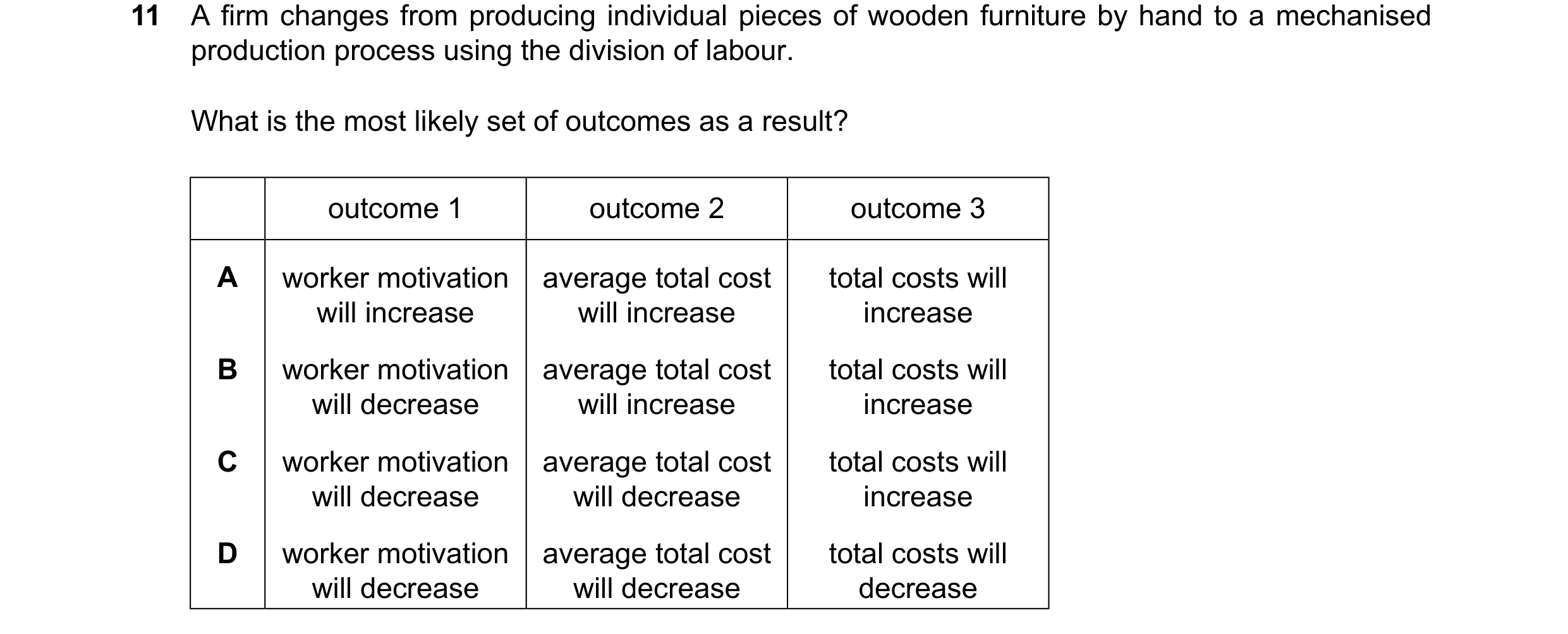
11 A firm changes from producing individual pieces of wooden furniture by hand to a mechanised production process using the division of labour. What is the most likely set of outcomes as a result? outcome 1 outcome 2 outcome 3 A worker motivation average total cost total costs will will increase will increase increase B worker motivation average total cost total costs will will decrease will increase increase C worker motivation average total cost total costs will will decrease will decrease increase D worker motivation average total cost total costs will will decrease will decrease decrease
1 marks
Answer: C
This question in 0455/13 May/June 2024
Q82 · A busy restaurant employs a large number of highly skilled chefs to individually prepare… 0455/13 May/June 2024
15 A busy restaurant employs a large number of highly skilled chefs to individually prepare high quality meals. What is an advantage to the restaurant of this type of production? A A highly skilled chef is paid more than an unskilled cook. B It is easier to prepare a wide variety of meals. C It takes time to train a highly skilled chef. D The quality of a meal varies according to which chef prepares it.
1 marks
Answer: B
This question in 0455/13 May/June 2024
Q83 · A food-processing firm decides to change from a labour-intensive production method to a… 0455/11 Oct/Nov 2024
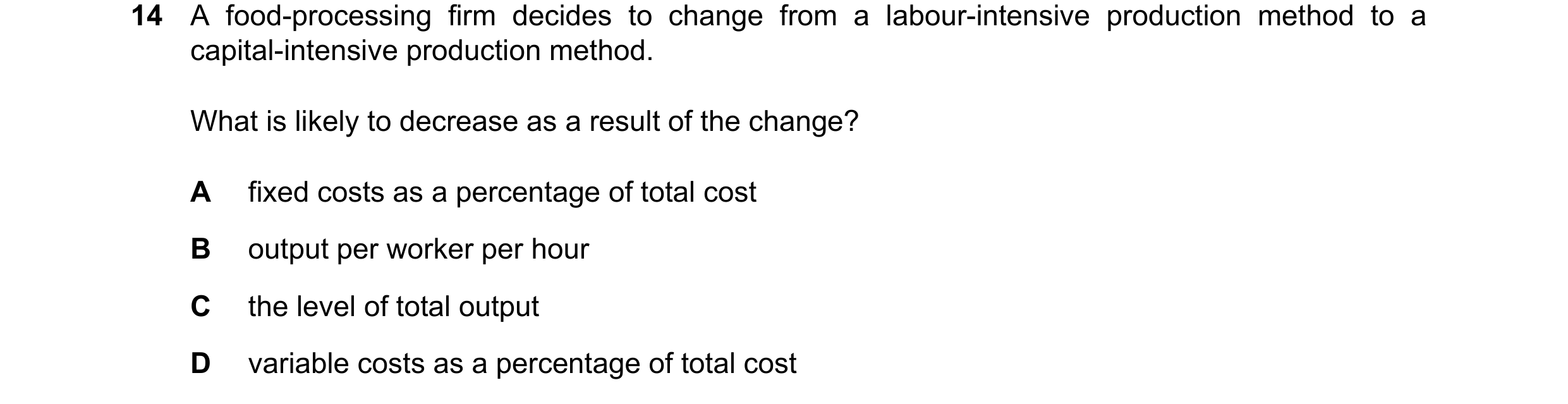
14 A food-processing firm decides to change from a labour-intensive production method to a capital-intensive production method. What is likely to decrease as a result of the change? A fixed costs as a percentage of total cost B output per worker per hour C the level of total output D variable costs as a percentage of total cost
1 marks
Answer: D
This question in 0455/11 Oct/Nov 2024
Q84 · What is most likely to encourage capital-intensive production methods in a low-income… 0455/12 Oct/Nov 2024
14 What is most likely to encourage capital-intensive production methods in a low-income economy? A expensive capital equipment costs B grants from foreign aid programmes C supplies of local low-cost labour D a shortage of highly trained supervisors A firm’s average revenue is $20. It sells 1000 units.
1 marks
Answer: B
This question in 0455/12 Oct/Nov 2024
Q85 · Workers in Switzerland earn more on average than workers in Mexico 0455/12 Oct/Nov 2024
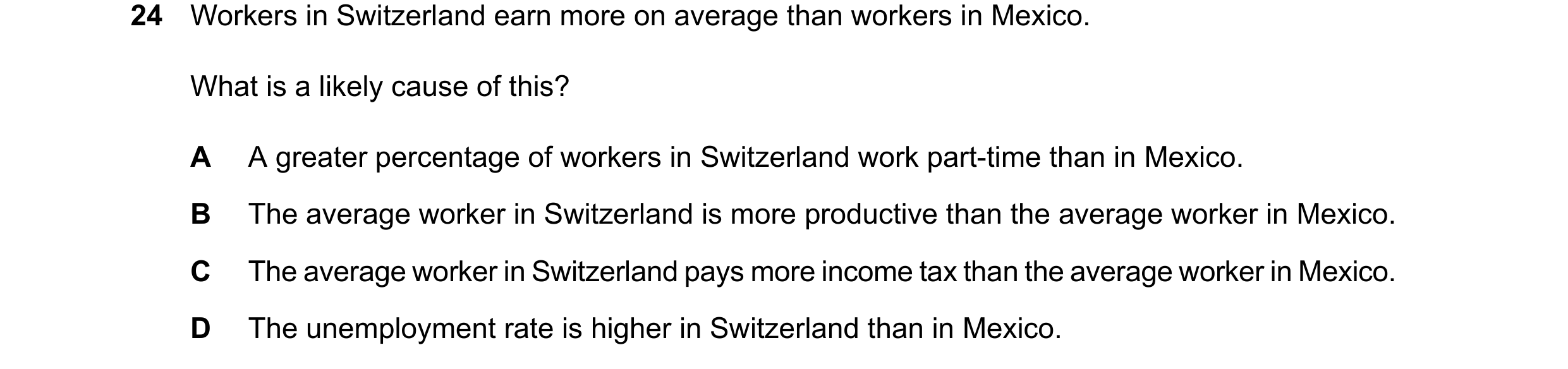
24 Workers in Switzerland earn more on average than workers in Mexico. What is a likely cause of this? A A greater percentage of workers in Switzerland work part-time than in Mexico. B The average worker in Switzerland is more productive than the average worker in Mexico. C The average worker in Switzerland pays more income tax than the average worker in Mexico. D The unemployment rate is higher in Switzerland than in Mexico.
1 marks
Answer: B
This question in 0455/12 Oct/Nov 2024
Q86 · A car-wash firm has 3 workers 0455/12 Feb/March 2025
14 A car-wash firm has 3 workers. Before specialisation, each worker washed 5 cars per day. After specialisation, 30 cars per day are washed. What is the percentage increase in productivity? A 50% B 100% C 200% D 600%
1 marks
Answer: B
This question in 0455/12 Feb/March 2025
Q87 · There has been an improvement in the transport infrastructure in India that reduces the… 0455/11 May/June 2025
14 There has been an improvement in the transport infrastructure in India that reduces the costs of farming. What is this an example of? A external diseconomies of scale B external economies of scale C internal diseconomies of scale D internal economies of scale
1 marks
Answer: B
This question in 0455/11 May/June 2025
Q88 · A firm chooses to become more capital-intensive 0455/11 May/June 2025
15 A firm chooses to become more capital-intensive. What is least likely to have increased? A interest rates B minimum wages C the power of trade unions D the productivity of capital
1 marks
Answer: A
This question in 0455/11 May/June 2025
Q89 · What must occur if a firm experiences economies of scale? 0455/11 Oct/Nov 2025
14 What must occur if a firm experiences economies of scale? A average costs decrease B profits decrease C the number of workers increases D total advertising costs decrease
1 marks
Answer: A
This question in 0455/11 Oct/Nov 2025
Q90 · The table shows the output of cakes from four bakeries, A, B, C and D 0455/13 Oct/Nov 2025
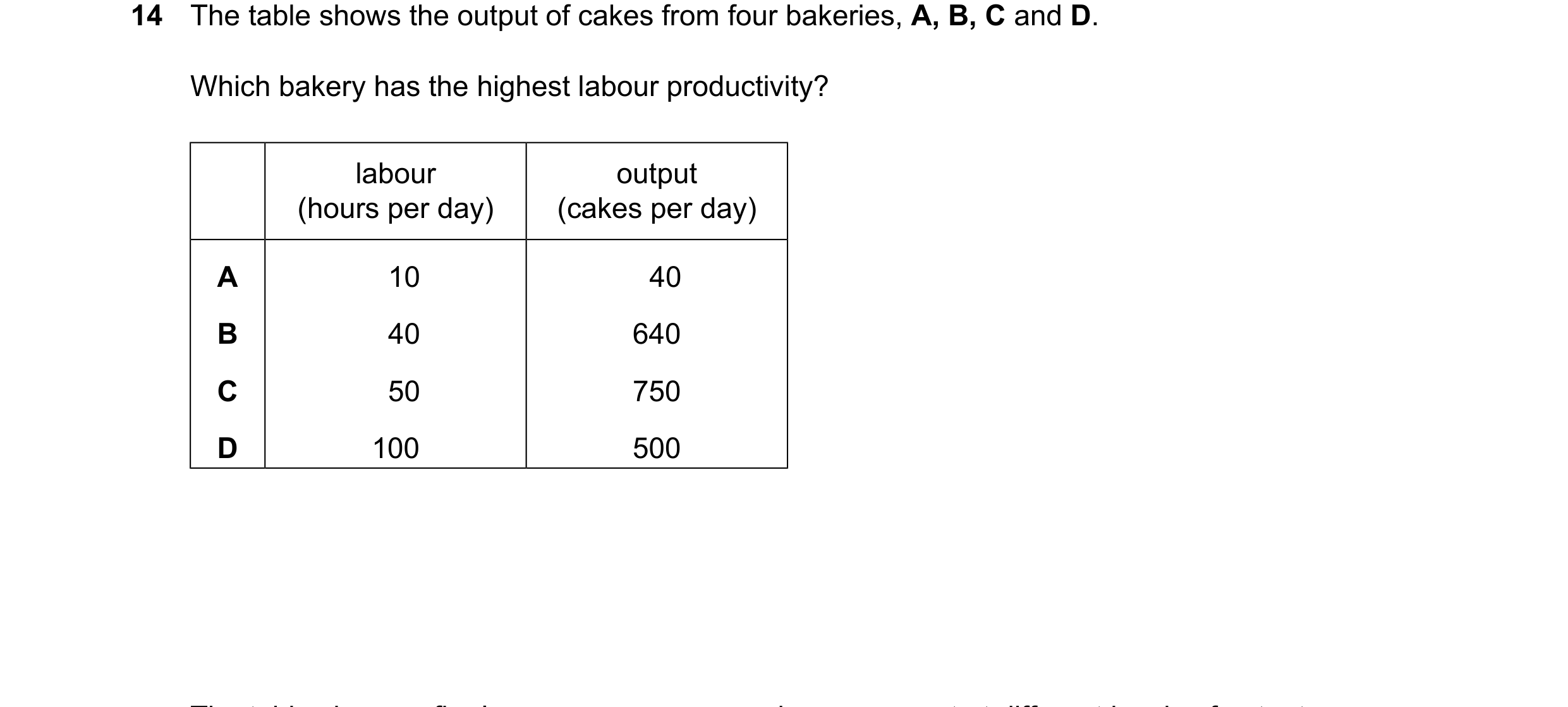
14 The table shows the output of cakes from four bakeries, A, B, C and D. Which bakery has the highest labour productivity? labour output (hours per day) (cakes per day) A 10 40 B 40 640 C 50 750 D 100 500 The table shows a firm’s average revenue and average cost at different levels of output.
1 marks
Answer: B
This question in 0455/13 Oct/Nov 2025
Q91 · Which supply-side policy measure would most likely cause the greatest increase in labour… 0455/13 Oct/Nov 2025
21 Which supply-side policy measure would most likely cause the greatest increase in labour productivity in a country? A a decrease in the rate of corporation tax B a reduced top rate of income tax C improved education and training provision D privatisation of a state-owned industry
1 marks
Answer: C
This question in 0455/13 Oct/Nov 2025


 1 / 21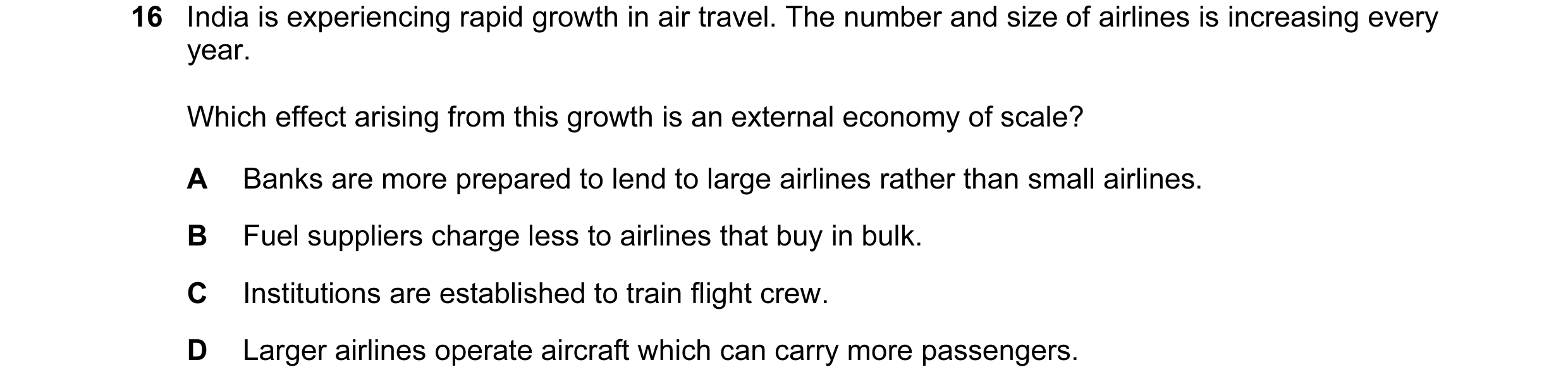



 2 / 21

 3 / 21

 4 / 21


 5 / 21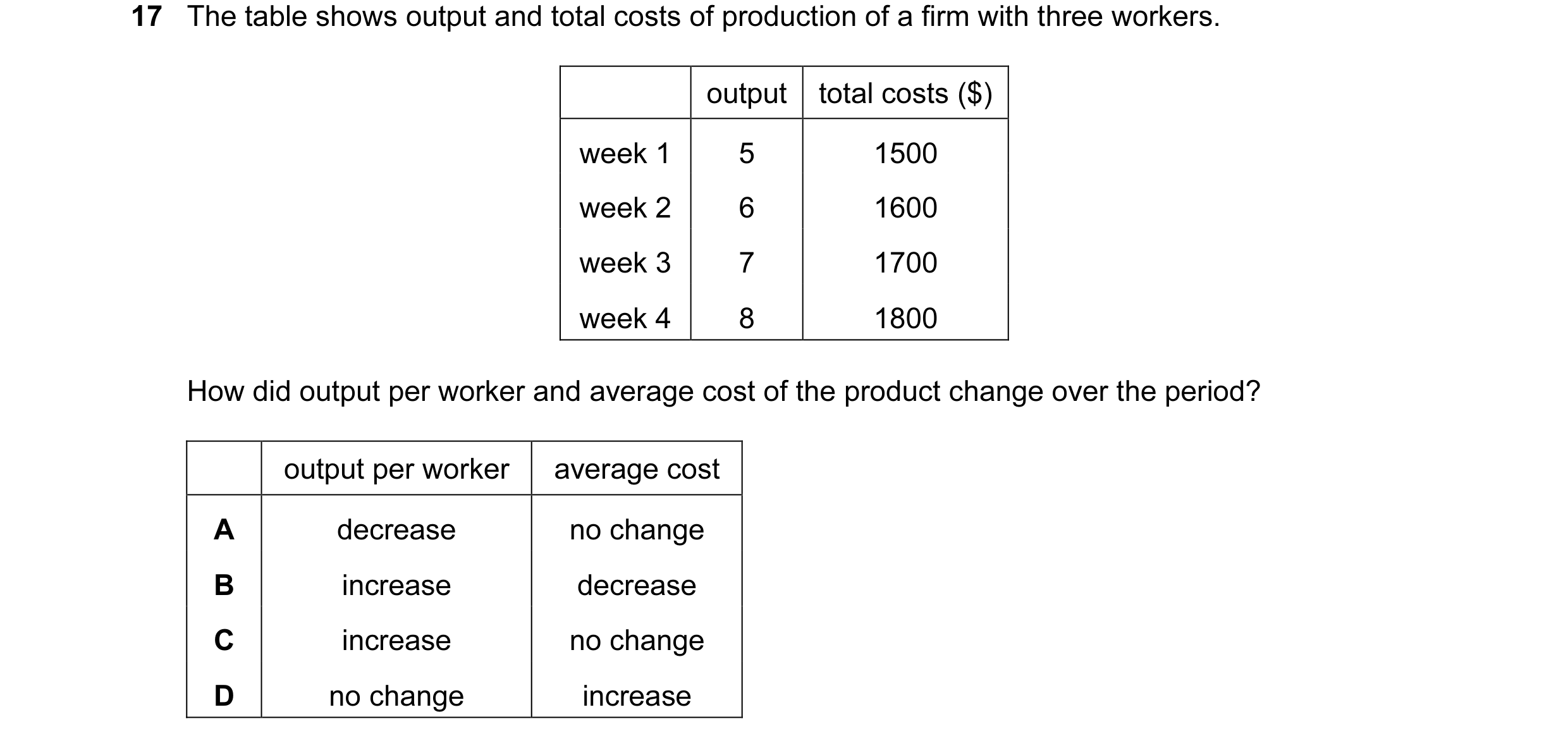
 6 / 21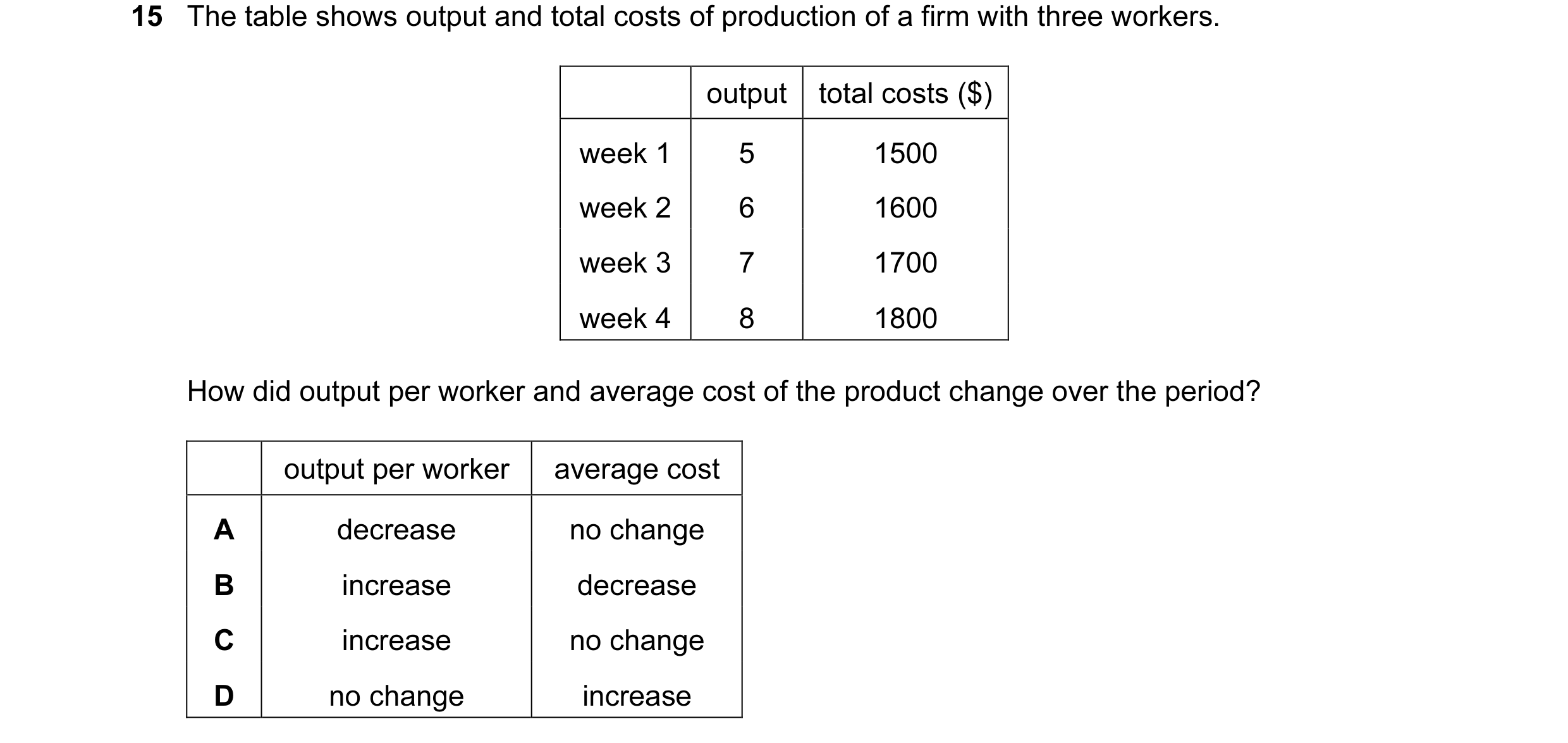

 7 / 21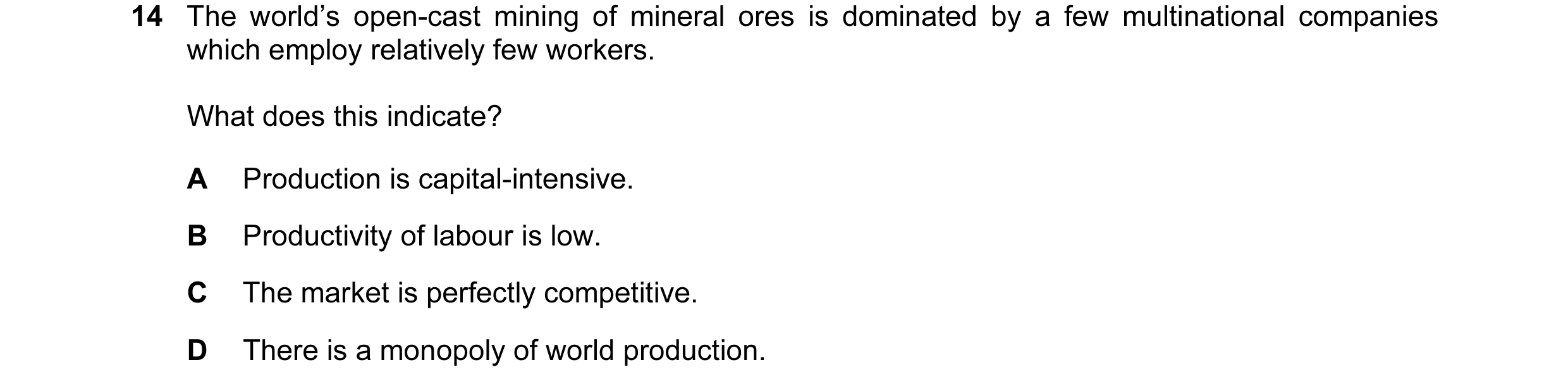

 8 / 21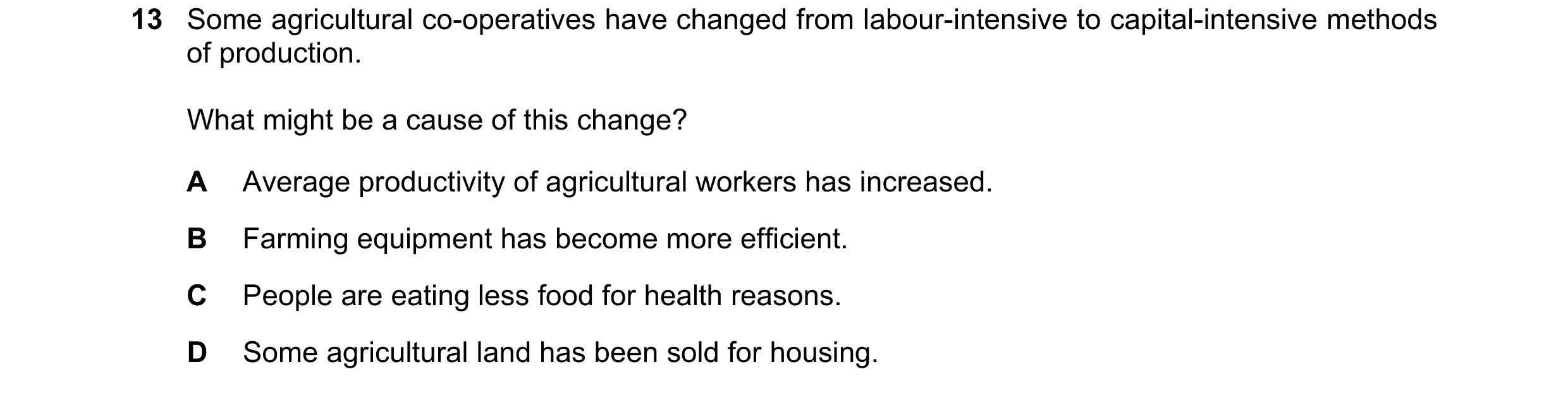
 9 / 21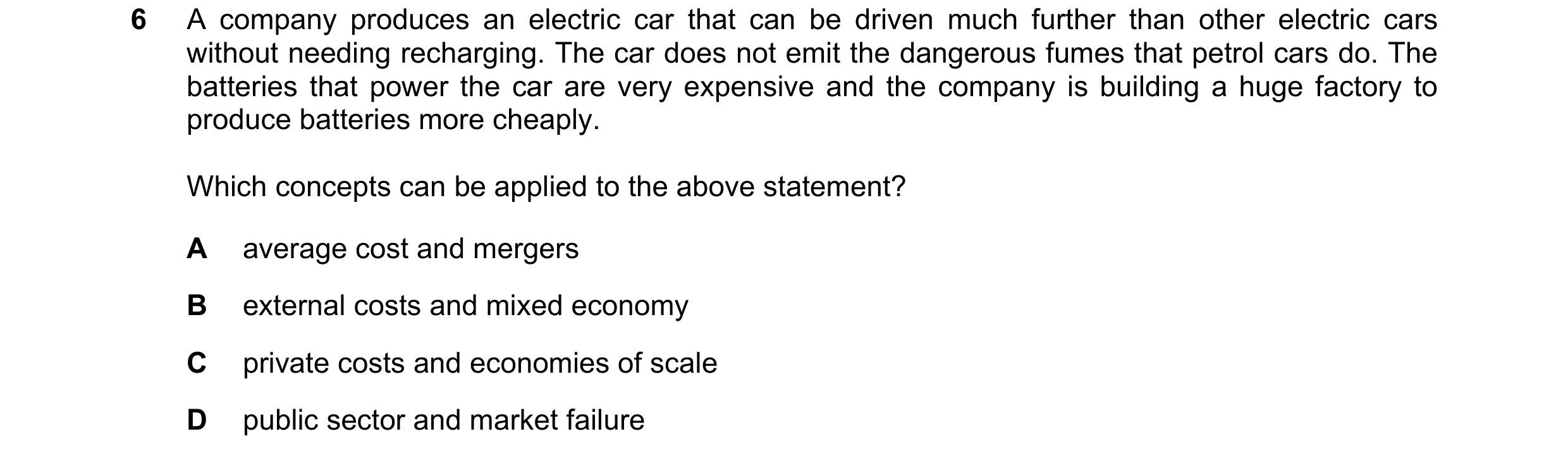

 10 / 21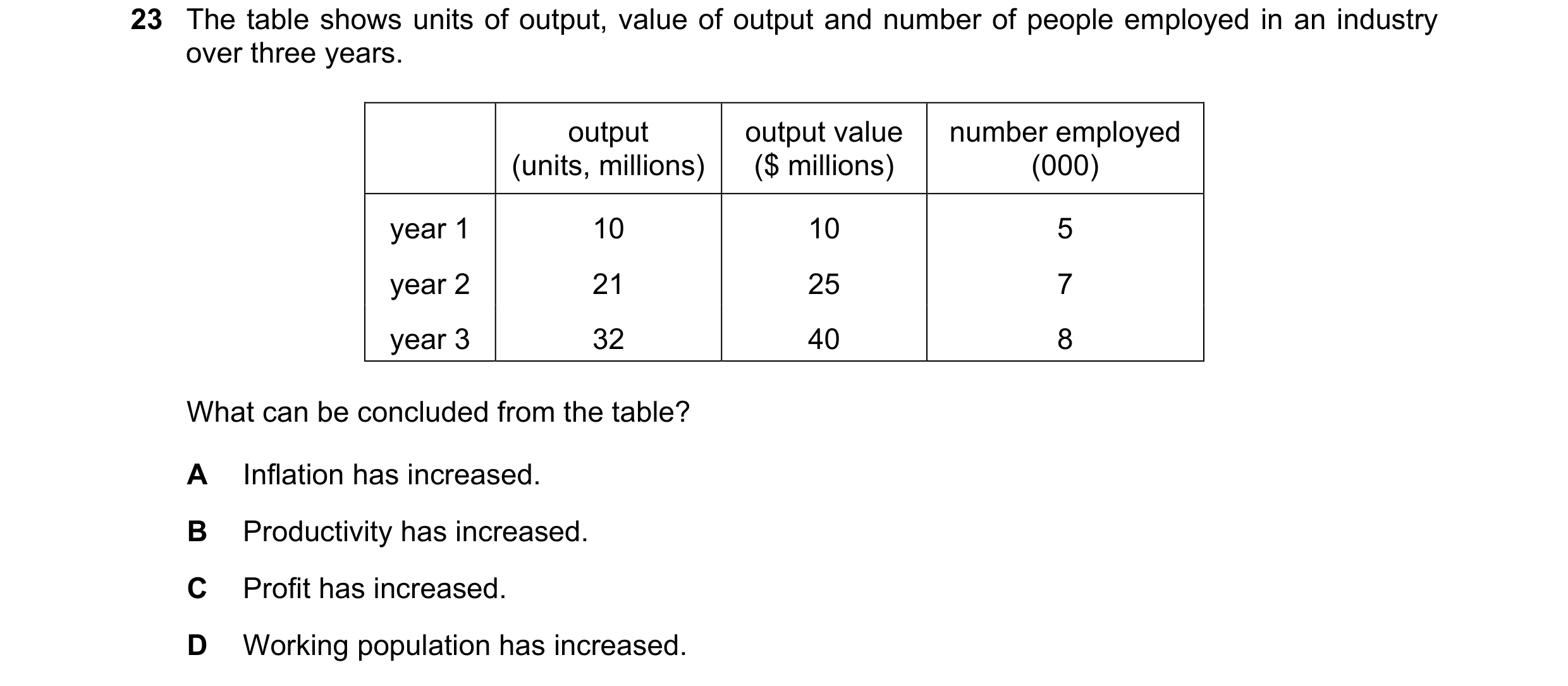
 11 / 21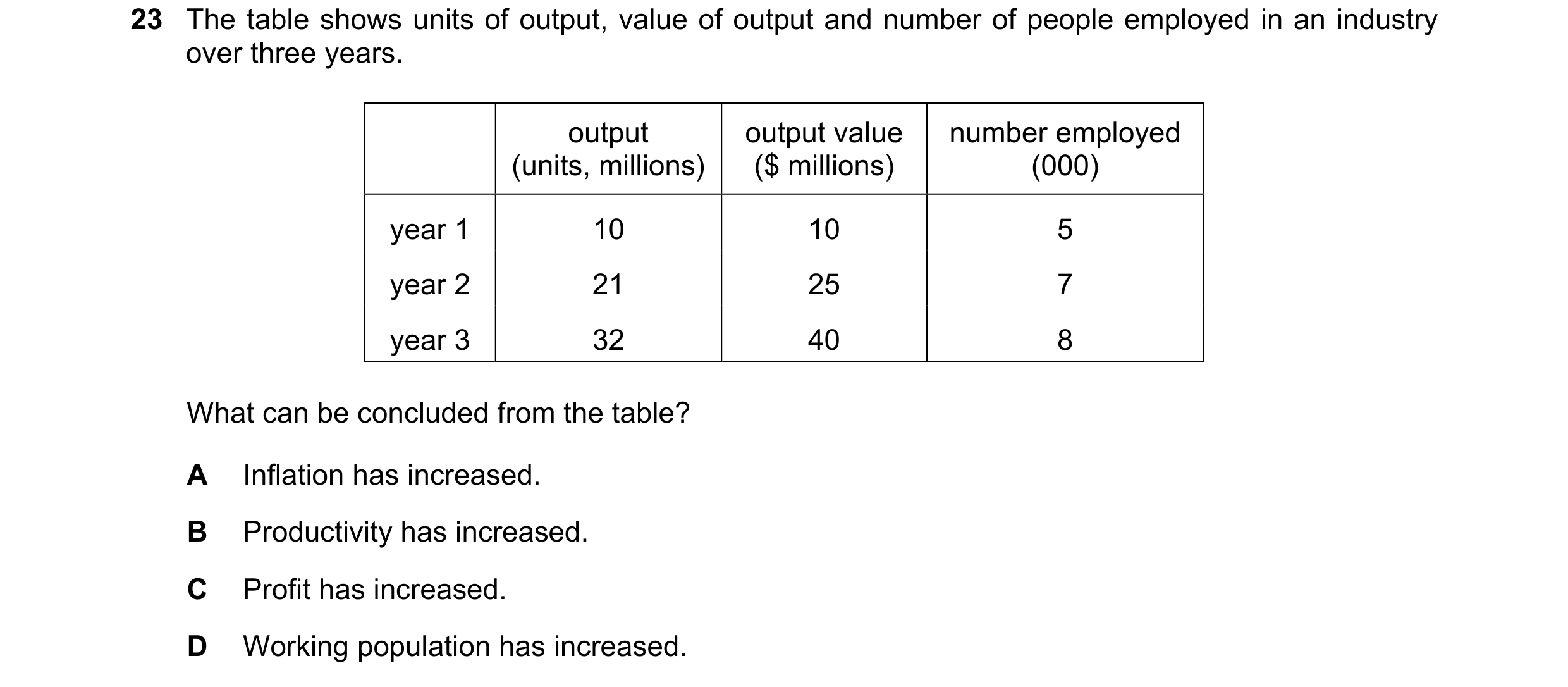



 12 / 21




 13 / 21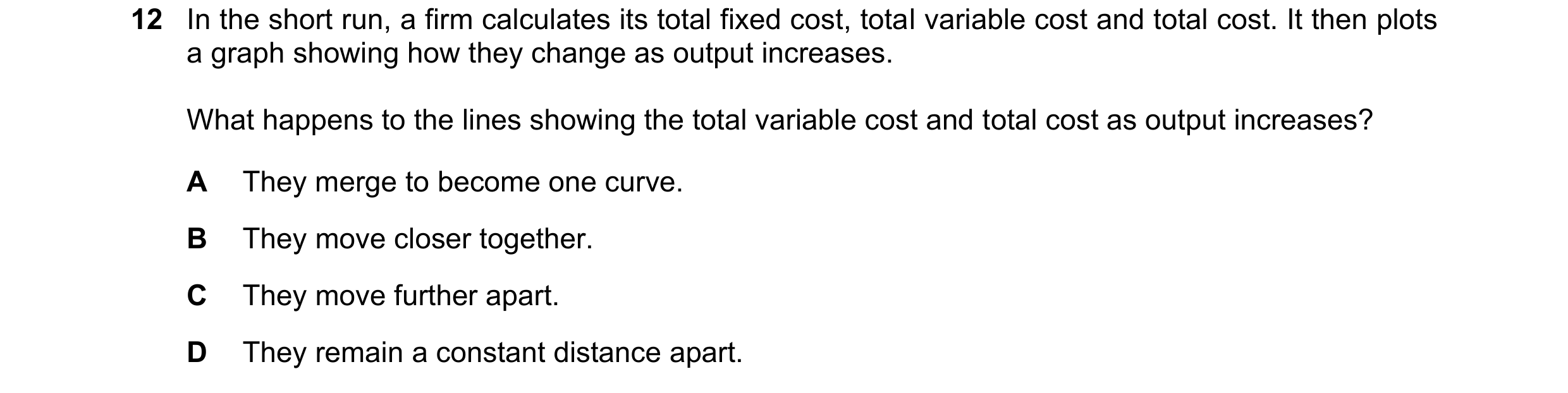



 14 / 21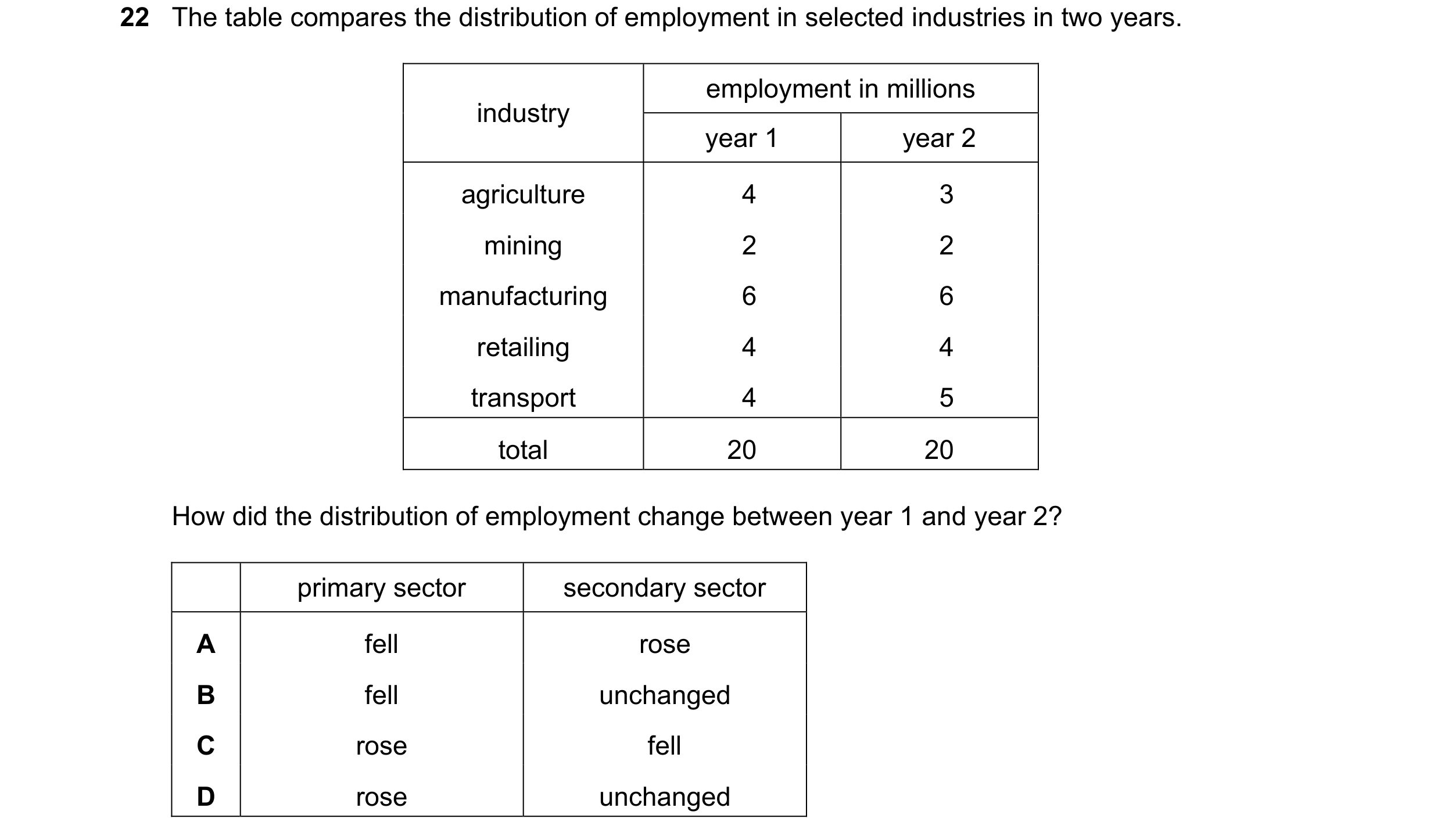
 15 / 21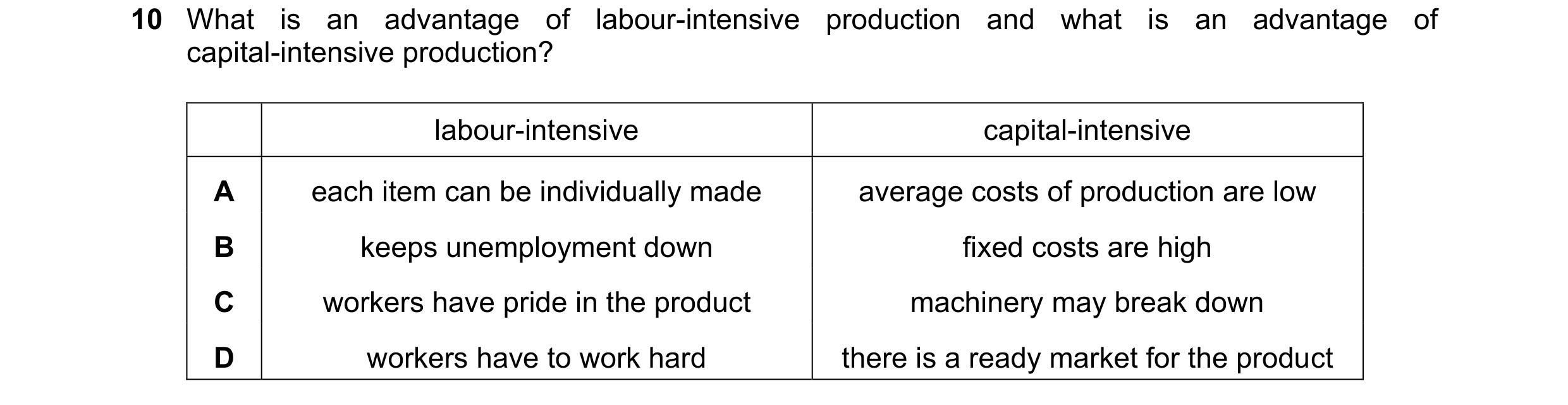
 16 / 21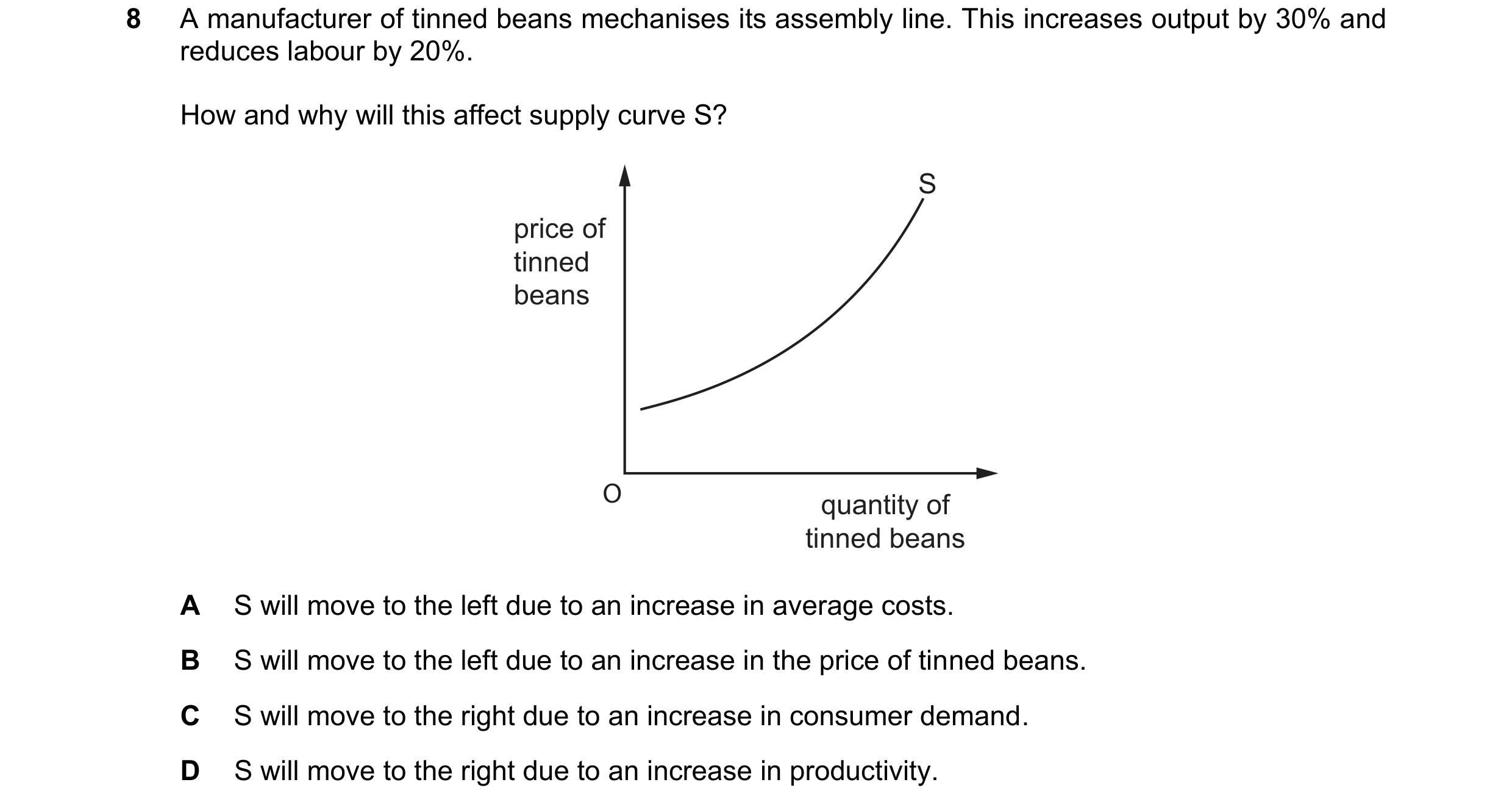
 17 / 21


 18 / 21

 19 / 21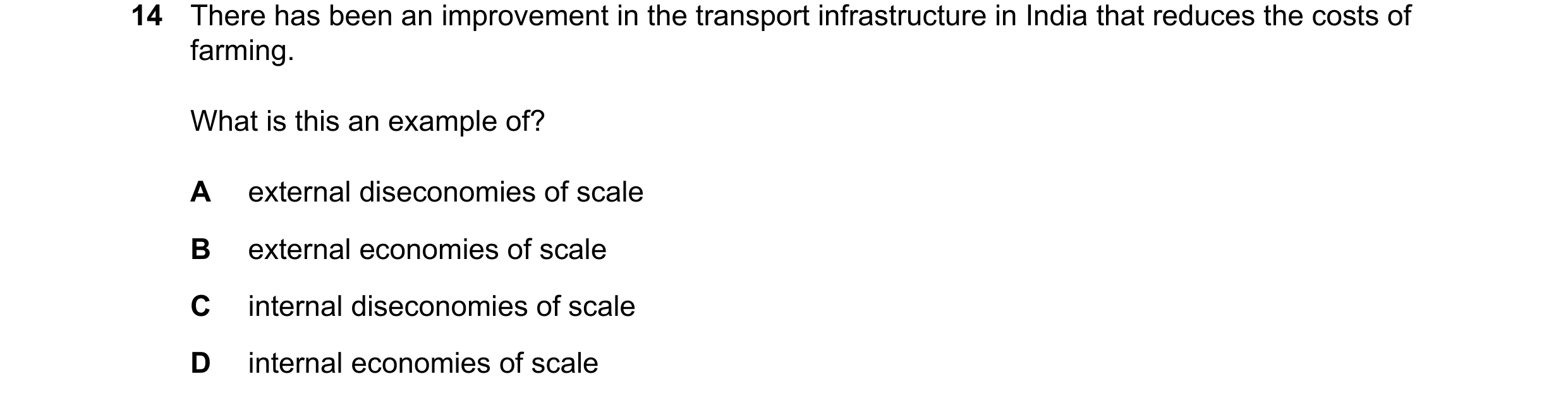


 20 / 21
 21 / 21