Questions as text
Q1 · Why do bank notes function as money? 0455/11 Oct/Nov 2004
4 Why do bank notes function as money? A They are durable. B They are generally acceptable. C They count as legal tender. D They have intrinsic value.
1 marks
Answer: B
This question in 0455/11 Oct/Nov 2004
Q2 · To whom does the central bank usually make loans? 0455/11 Oct/Nov 2004
8 To whom does the central bank usually make loans? A individuals B limited companies C the government D trade unions
1 marks
Answer: C
This question in 0455/11 Oct/Nov 2004
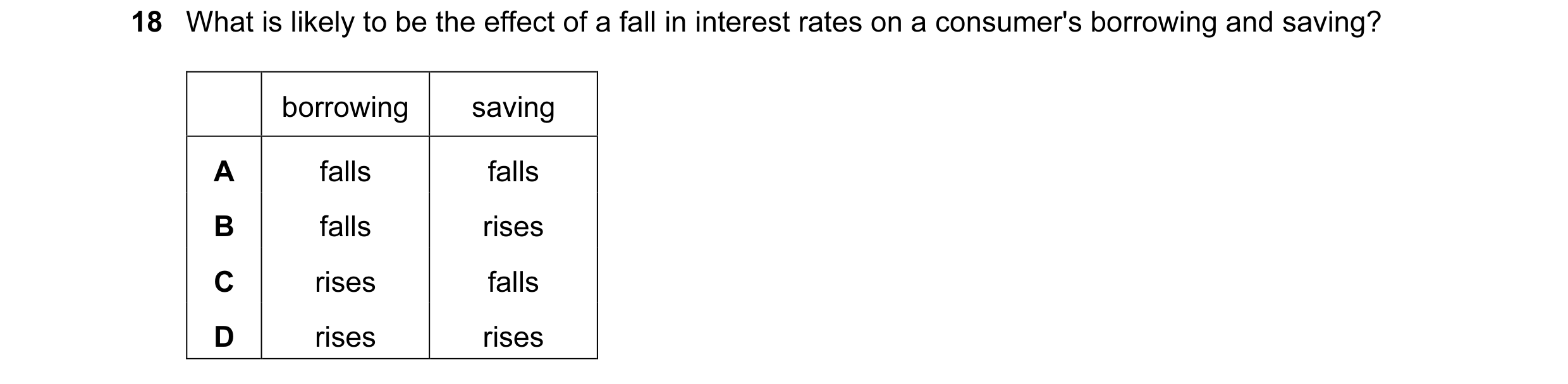
Q3 · What is likely to be the effect of a fall in interest rates on a consumer's borrowing and… 0455/11 Oct/Nov 2004
18 What is likely to be the effect of a fall in interest rates on a consumer's borrowing and saving? borrowing saving A falls falls B falls rises C rises falls D rises rises
1 marks
Answer: C
This question in 0455/11 Oct/Nov 2004
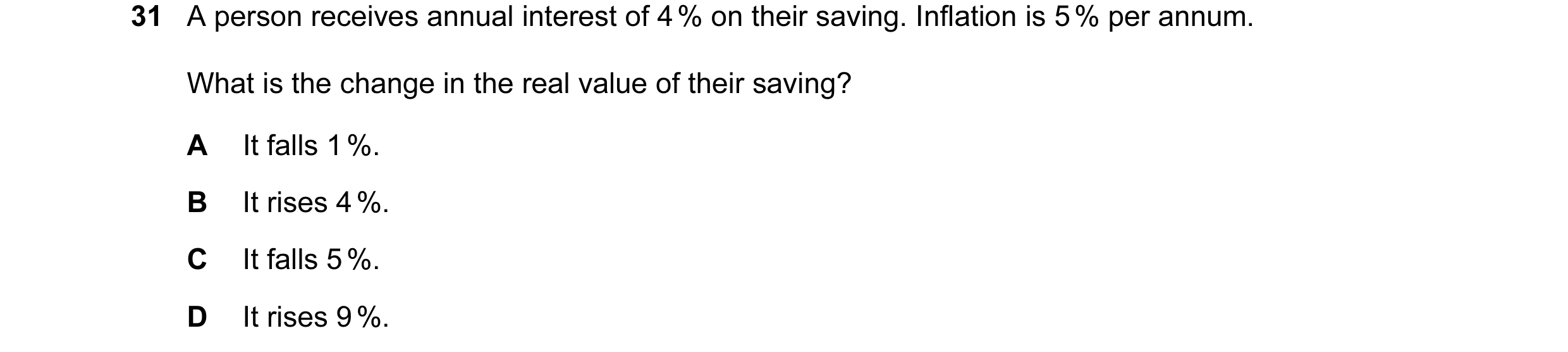
Q4 · A person receives annual interest of 4 % on their saving 0455/11 Oct/Nov 2006
31 A person receives annual interest of 4 % on their saving. Inflation is 5 % per annum. What is the change in the real value of their saving? A It falls 1 %. B It rises 4 %. C It falls 5 %. D It rises 9 %.
1 marks
Answer: A
This question in 0455/11 Oct/Nov 2006
Q5 · What makes specialisation easier? 0455/11 May/June 2007
2 What makes specialisation easier? A the imposition of taxation B the protection of trade C the system of barter D the use of money
1 marks
Answer: D
This question in 0455/11 May/June 2007
Q6 · Which asset is the most illiquid? 0455/11 May/June 2007
17 Which asset is the most illiquid? A cash B money order C government bonds D a house
1 marks
Answer: D
This question in 0455/11 May/June 2007
Q7 · In wartime conditions, cigarettes have been used as money 0455/11 Oct/Nov 2007
4 In wartime conditions, cigarettes have been used as money. What disadvantage do cigarettes have for trading compared with notes and coins? A They cannot act as a medium of exchange. B They have no intrinsic value. C They lack durability. D They make a double coincidence of wants necessary.
1 marks
Answer: C
This question in 0455/11 Oct/Nov 2007
Q8 · In most countries which organisation controls the banking system? 0455/11 Oct/Nov 2007
6 In most countries which organisation controls the banking system? A central bank B commercial bank C investment bank D World Bank
1 marks
Answer: A
This question in 0455/11 Oct/Nov 2007
Q9 · Which of the following benefits does a stock exchange provide? 0455/11 May/June 2008
7 Which of the following benefits does a stock exchange provide? A a source of finance for private limited companies B a safeguard against the risk of loss C an opportunity to sell shares quickly D an opportunity to purchase foreign currency
1 marks
Answer: C
This question in 0455/11 May/June 2008
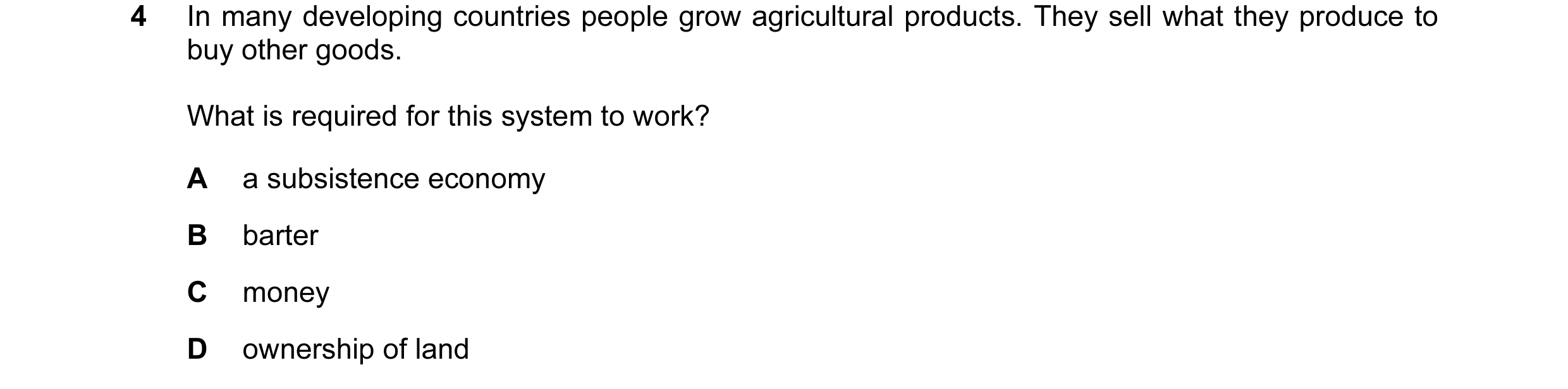
Q10 · In many developing countries people grow agricultural products 0455/11 Oct/Nov 2008
4 In many developing countries people grow agricultural products. They sell what they produce to buy other goods. What is required for this system to work? A a subsistence economy B barter C money D ownership of land
1 marks
Answer: C
This question in 0455/11 Oct/Nov 2008
Q11 · What function does a central bank provide for the general public? 0455/11 May/June 2009
10 What function does a central bank provide for the general public? A accepting deposits B issuing banknotes C making loans D providing overdrafts
1 marks
Answer: B
This question in 0455/11 May/June 2009
Q12 · What is a function of a commercial bank? 0455/11 May/June 2010
9 What is a function of a commercial bank? A acting as the lender of last resort B deciding what is a legal tender C determining monetary policy D providing overdrafts
1 marks
Answer: D
This question in 0455/11 May/June 2010
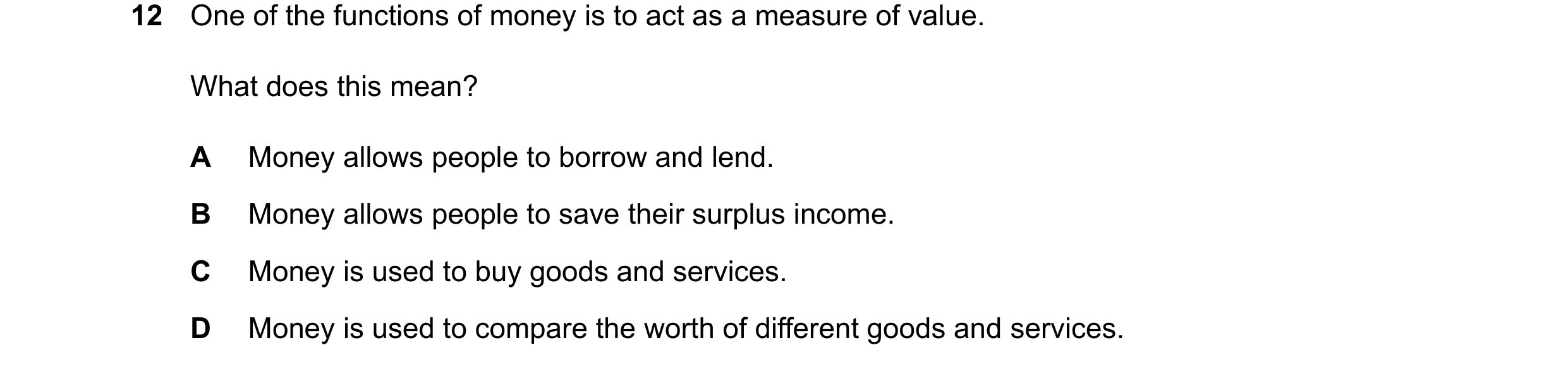
Q13 · One of the functions of money is to act as a measure of value 0455/11 May/June 2010
11 One of the functions of money is to act as a measure of value. What does this mean? A Money allows people to borrow and lend. B Money allows people to save their surplus income. C Money is used to buy goods and services. D Money is used to compare the worth of different goods and services.
1 marks
Answer: D
This question in 0455/11 May/June 2010
Q14 · What is a function of a commercial bank? 0455/12 May/June 2010
5 What is a function of a commercial bank? A acting as the lender of last resort B deciding what is a legal tender C determining monetary policy D providing overdrafts
1 marks
Answer: D
This question in 0455/12 May/June 2010
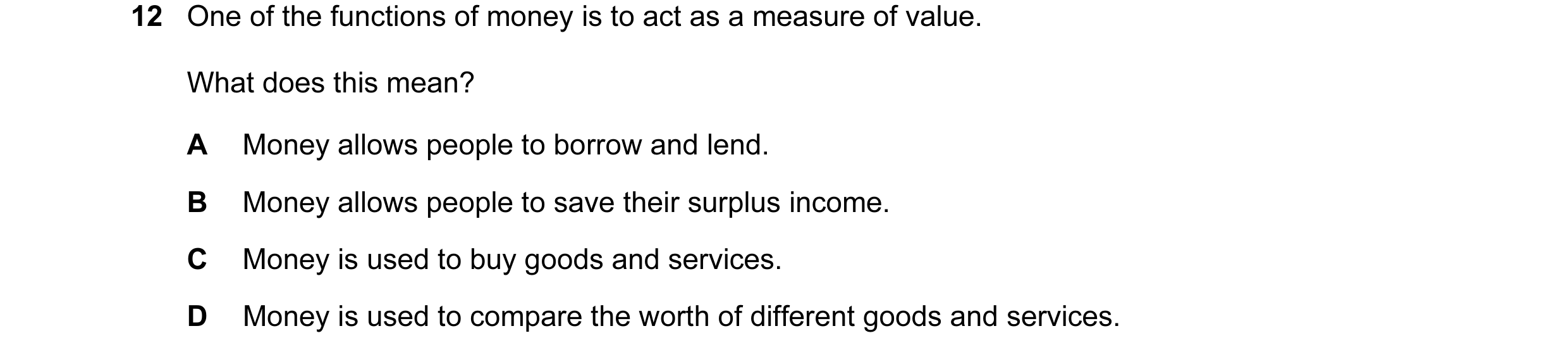
Q15 · One of the functions of money is to act as a measure of value 0455/12 May/June 2010
12 One of the functions of money is to act as a measure of value. What does this mean? A Money allows people to borrow and lend. B Money allows people to save their surplus income. C Money is used to buy goods and services. D Money is used to compare the worth of different goods and services.
1 marks
Answer: D
This question in 0455/12 May/June 2010
Q16 · A stock exchange is a market in which A a system of barter operates 0455/11 Oct/Nov 2010
9 A stock exchange is a market in which A a system of barter operates. B the interest rate is fixed. C the value of the exchange rate is determined. D shares are bought and sold.
1 marks
Answer: D
This question in 0455/11 Oct/Nov 2010
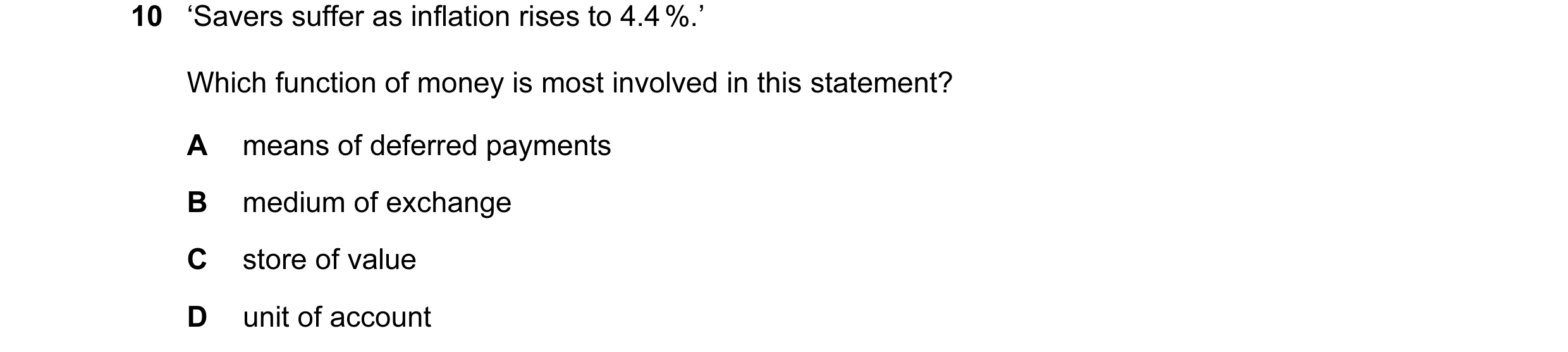
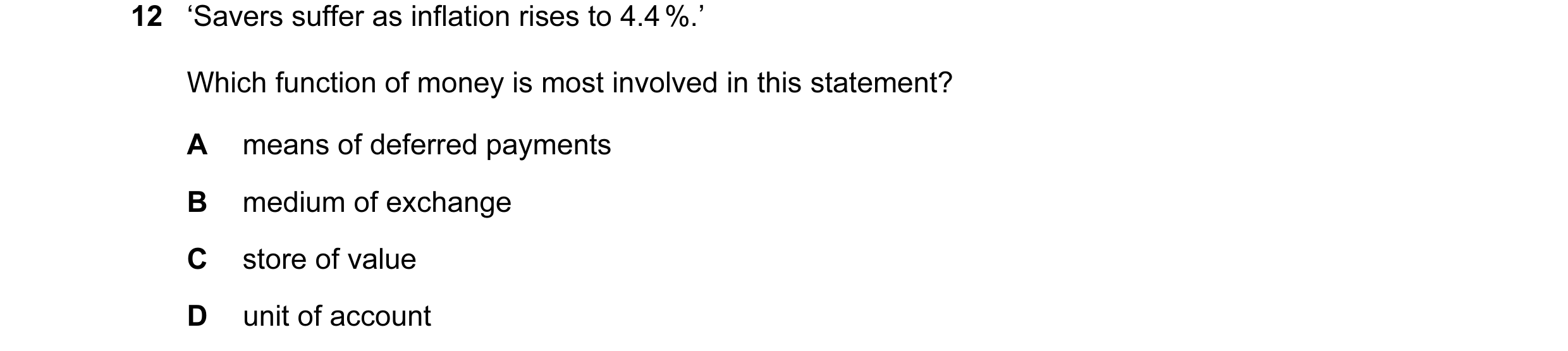
Q17 · ‘Savers suffer as inflation rises to 4.4 %.’ Which function of money is most involved in… 0455/11 Oct/Nov 2010
10 ‘Savers suffer as inflation rises to 4.4 %.’ Which function of money is most involved in this statement? A means of deferred payments B medium of exchange C store of value D unit of account
1 marks
Answer: C
This question in 0455/11 Oct/Nov 2010
Q18 · A stock exchange is a market in which A a system of barter operates 0455/12 Oct/Nov 2010
10 A stock exchange is a market in which A a system of barter operates. B the interest rate is fixed. C the value of the exchange rate is determined. D shares are bought and sold.
1 marks
Answer: D
This question in 0455/12 Oct/Nov 2010
Q19 · ‘Savers suffer as inflation rises to 4.4 %.’ Which function of money is most involved in… 0455/12 Oct/Nov 2010
11 ‘Savers suffer as inflation rises to 4.4 %.’ Which function of money is most involved in this statement? A means of deferred payments B medium of exchange C store of value D unit of account
1 marks
Answer: C
This question in 0455/12 Oct/Nov 2010
Q20 · A stock exchange is a market in which A a system of barter operates 0455/13 Oct/Nov 2010
11 A stock exchange is a market in which A a system of barter operates. B the interest rate is fixed. C the value of the exchange rate is determined. D shares are bought and sold.
1 marks
Answer: D
This question in 0455/13 Oct/Nov 2010
Q21 · ‘Savers suffer as inflation rises to 4.4 %.’ Which function of money is most involved in… 0455/13 Oct/Nov 2010
12 ‘Savers suffer as inflation rises to 4.4 %.’ Which function of money is most involved in this statement? A means of deferred payments B medium of exchange C store of value D unit of account
1 marks
Answer: C
This question in 0455/13 Oct/Nov 2010
Q22 · What may cause an individual to save a higher proportion of their income? 0455/11 May/June 2011
10 What may cause an individual to save a higher proportion of their income? A a belief that the price of goods will rise in the future B a fall in the rate of interest paid by the country’s banks C a fear that income will fall in the future D a rise in the individual’s wish to enjoy higher consumption immediately
1 marks
Answer: C
This question in 0455/11 May/June 2011
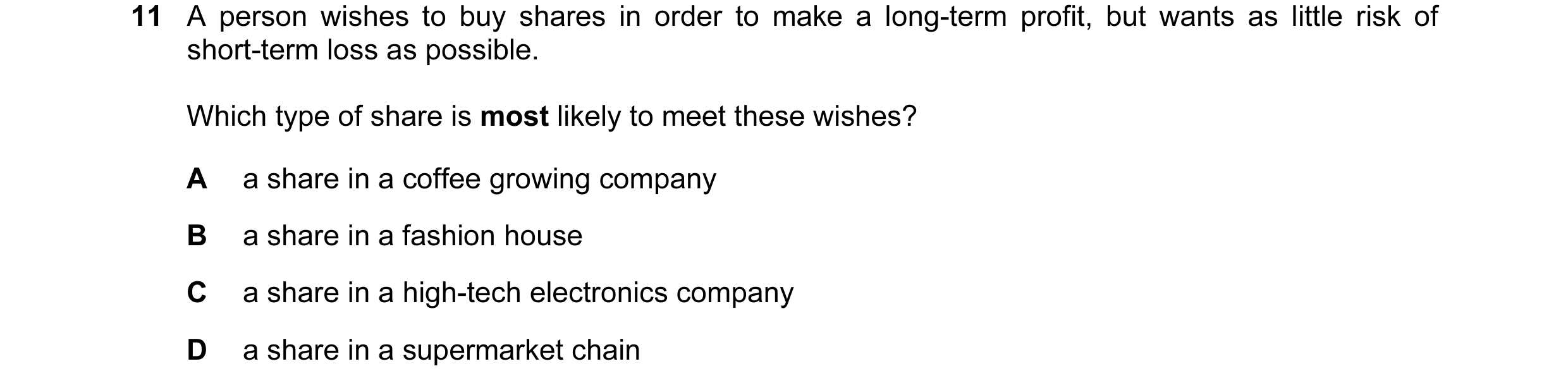
Q23 · A person wishes to buy shares in order to make a long-term profit, but wants as little… 0455/11 May/June 2011
11 A person wishes to buy shares in order to make a long-term profit, but wants as little risk of short-term loss as possible. Which type of share is most likely to meet these wishes? A a share in a coffee growing company B a share in a fashion house C a share in a high-tech electronics company D a share in a supermarket chain
1 marks
Answer: D
This question in 0455/11 May/June 2011
Q24 · Which statement about a country’s banks is correct? 0455/11 May/June 2011
12 Which statement about a country’s banks is correct? A Commercial banks hold the financial accounts of the government. B Commercial banks settle debts by clearing customers’ cheques. C The central bank sets the government’s tax and spending policies. D The central bank supplies foreign currency to members of the public.
1 marks
Answer: B
This question in 0455/11 May/June 2011
Q25 · Which statement about a country’s banks is correct? 0455/12 May/June 2011
11 Which statement about a country’s banks is correct? A Commercial banks hold the financial accounts of the government. B Commercial banks settle debts by clearing customers’ cheques. C The central bank sets the government’s tax and spending policies. D The central bank supplies foreign currency to members of the public.
1 marks
Answer: B
This question in 0455/12 May/June 2011
Q26 · Which statement about a country’s banks is correct? 0455/13 May/June 2011
11 Which statement about a country’s banks is correct? A Commercial banks hold the financial accounts of the government. B Commercial banks settle debts by clearing customers’ cheques. C The central bank sets the government’s tax and spending policies. D The central bank supplies foreign currency to members of the public.
1 marks
Answer: B
This question in 0455/13 May/June 2011
Q27 · Which motive is most likely to increase the wish to open a savings account? 0455/11 Oct/Nov 2011
10 Which motive is most likely to increase the wish to open a savings account? A to have cash immediately available B to prepare for future expenditure C to satisfy essential needs D to widen present consumption choices
1 marks
Answer: B
This question in 0455/11 Oct/Nov 2011
Q28 · Share prices on the stock market are most likely to rise if A employment falls 0455/11 Oct/Nov 2011
11 Share prices on the stock market are most likely to rise if A employment falls. B interest rates fall. C interest rates rise. D tax rates rise.
1 marks
Answer: B
This question in 0455/11 Oct/Nov 2011
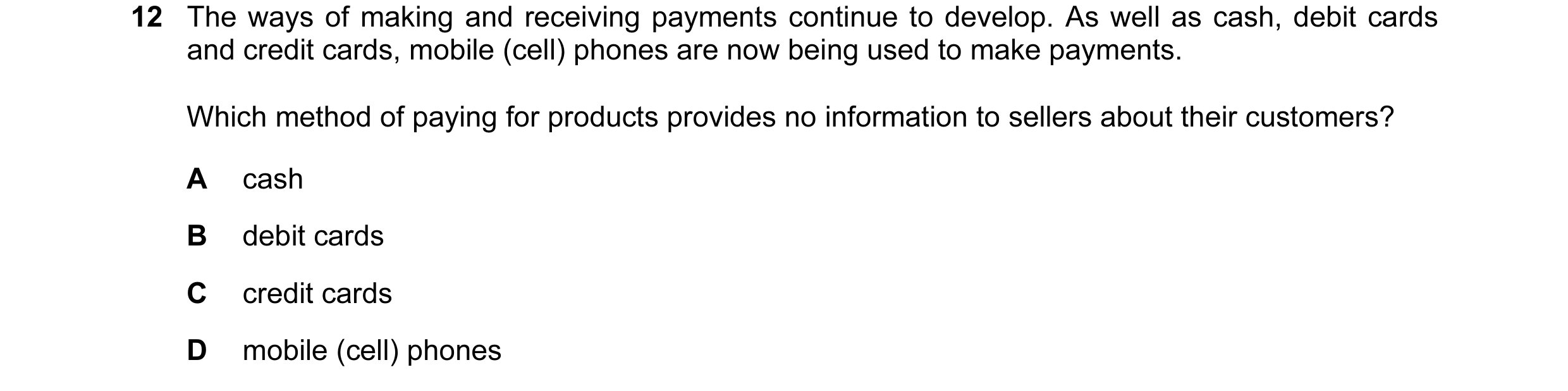
Q29 · The ways of making and receiving payments continue to develop 0455/11 Oct/Nov 2011
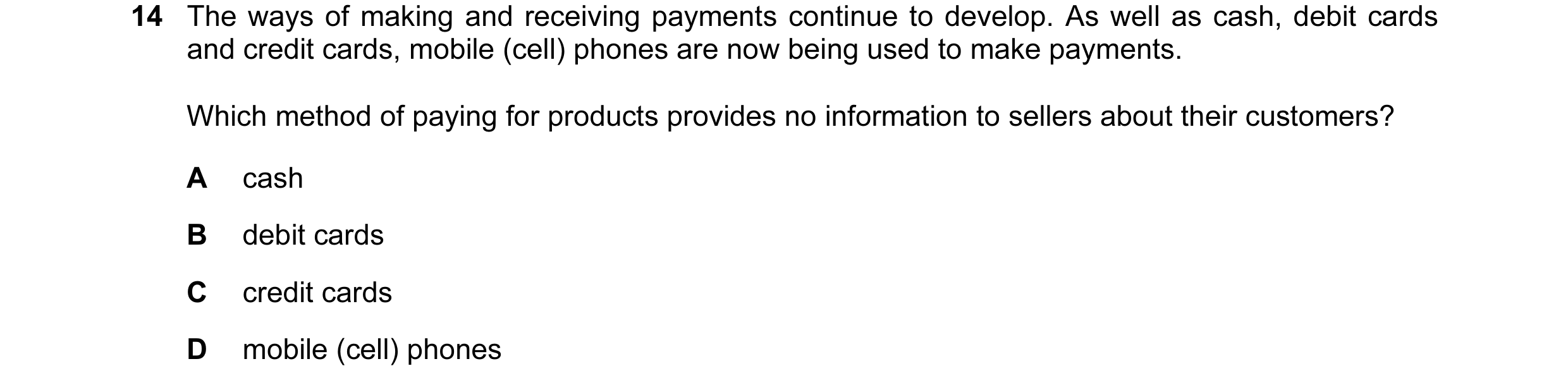
12 The ways of making and receiving payments continue to develop. As well as cash, debit cards and credit cards, mobile (cell) phones are now being used to make payments. Which method of paying for products provides no information to sellers about their customers? A cash B debit cards C credit cards D mobile (cell) phones
1 marks
Answer: A
This question in 0455/11 Oct/Nov 2011
Q30 · Which motive is most likely to increase the wish to open a savings account? 0455/12 Oct/Nov 2011
11 Which motive is most likely to increase the wish to open a savings account? A to have cash immediately available B to prepare for future expenditure C to satisfy essential needs D to widen present consumption choices
1 marks
Answer: B
This question in 0455/12 Oct/Nov 2011
Q31 · The ways of making and receiving payments continue to develop 0455/12 Oct/Nov 2011
13 The ways of making and receiving payments continue to develop. As well as cash, debit cards and credit cards, mobile (cell) phones are now being used to make payments. Which method of paying for products provides no information to sellers about their customers? A cash B debit cards C credit cards D mobile (cell) phones
1 marks
Answer: A
This question in 0455/12 Oct/Nov 2011
Q32 · Which motive is most likely to increase the wish to open a savings account? 0455/13 Oct/Nov 2011
12 Which motive is most likely to increase the wish to open a savings account? A to have cash immediately available B to prepare for future expenditure C to satisfy essential needs D to widen present consumption choices
1 marks
Answer: B
This question in 0455/13 Oct/Nov 2011
Q33 · Share prices on the stock market are most likely to rise if A employment falls 0455/13 Oct/Nov 2011
13 Share prices on the stock market are most likely to rise if A employment falls. B interest rates fall. C interest rates rise. D tax rates rise.
1 marks
Answer: B
This question in 0455/13 Oct/Nov 2011
Q34 · The ways of making and receiving payments continue to develop 0455/13 Oct/Nov 2011
14 The ways of making and receiving payments continue to develop. As well as cash, debit cards and credit cards, mobile (cell) phones are now being used to make payments. Which method of paying for products provides no information to sellers about their customers? A cash B debit cards C credit cards D mobile (cell) phones
1 marks
Answer: A
This question in 0455/13 Oct/Nov 2011
Q35 · For anything to be used as money, it must be A a fixed value 0455/11 May/June 2012
13 For anything to be used as money, it must be A a fixed value. B in fixed supply. C legal tender. D readily acceptable.
1 marks
Answer: D
This question in 0455/11 May/June 2012
Q36 · For anything to be used as money, it must be A a fixed value 0455/12 May/June 2012
13 For anything to be used as money, it must be A a fixed value. B in fixed supply. C legal tender. D readily acceptable.
1 marks
Answer: D
This question in 0455/12 May/June 2012
Q37 · For anything to be used as money, it must be A a fixed value 0455/13 May/June 2012
13 For anything to be used as money, it must be A a fixed value. B in fixed supply. C legal tender. D readily acceptable.
1 marks
Answer: D
This question in 0455/13 May/June 2012
Q38 · Why do banknotes function as money? 0455/11 Oct/Nov 2012
4 Why do banknotes function as money? A They are backed by gold. B They are durable. C They are generally acceptable. D They have intrinsic value.
1 marks
Answer: C
This question in 0455/11 Oct/Nov 2012
Q39 · What might encourage a consumer to save rather than to spend? 0455/12 Oct/Nov 2012
12 What might encourage a consumer to save rather than to spend? A being made unemployed B discounts on products C government subsidies to producers D high interest rates
1 marks
Answer: D
This question in 0455/12 Oct/Nov 2012
Q40 · Why do banknotes function as money? 0455/12 Oct/Nov 2012
13 Why do banknotes function as money? A They are backed by gold. B They are durable. C They are generally acceptable. D They have intrinsic value.
1 marks
Answer: C
This question in 0455/12 Oct/Nov 2012
Q41 · An individual has various financial assets 0455/13 Oct/Nov 2012
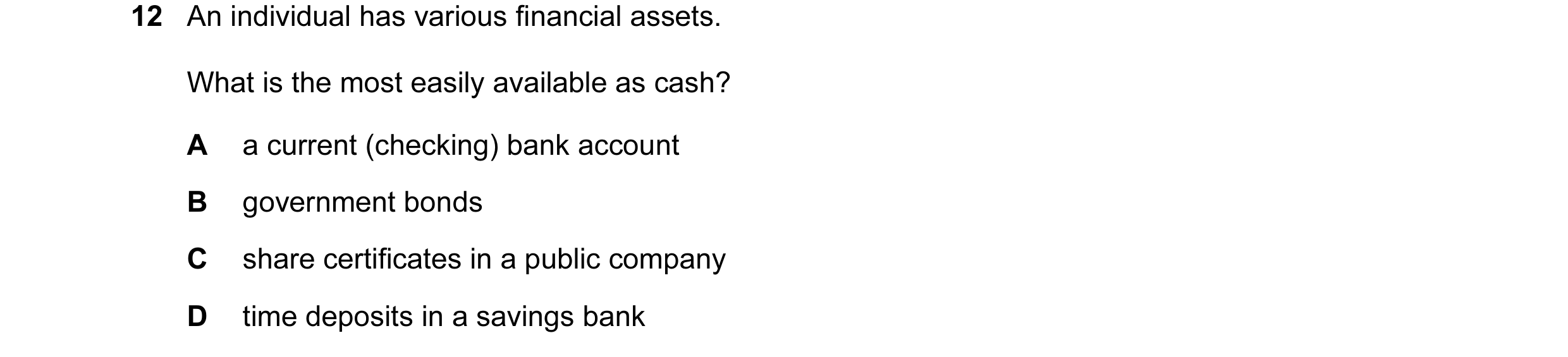
12 An individual has various financial assets. What is the most easily available as cash? A a current (checking) bank account B government bonds C share certificates in a public company D time deposits in a savings bank
1 marks
Answer: A
This question in 0455/13 Oct/Nov 2012
Q42 · Why do banknotes function as money? 0455/13 Oct/Nov 2012
13 Why do banknotes function as money? A They are backed by gold. B They are durable. C They are generally acceptable. D They have intrinsic value.
1 marks
Answer: C
This question in 0455/13 Oct/Nov 2012
Q43 · The use of a mobile (cell) phone to make payments is an example of which function of… 0455/11 May/June 2013
10 The use of a mobile (cell) phone to make payments is an example of which function of money? A a medium of exchange B a standard of deferred payment C a store of wealth D a unit of account
1 marks
Answer: A
This question in 0455/11 May/June 2013
Q44 · A function of money is to act as a measure of value 0455/12 May/June 2013
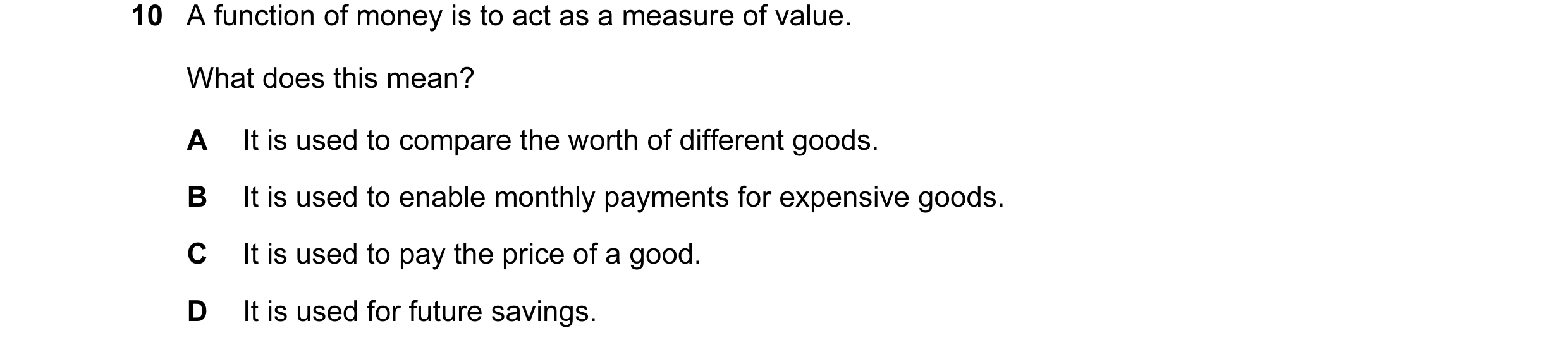
10 A function of money is to act as a measure of value. What does this mean? A It is used to compare the worth of different goods. B It is used to enable monthly payments for expensive goods. C It is used to pay the price of a good. D It is used for future savings.
1 marks
Answer: A
This question in 0455/12 May/June 2013
Q45 · The use of a mobile (cell) phone to make payments is an example of which function of… 0455/13 May/June 2013
19 The use of a mobile (cell) phone to make payments is an example of which function of money? A a medium of exchange B a standard of deferred payment C a store of wealth D a unit of account
1 marks
Answer: A
This question in 0455/13 May/June 2013
Q46 · Which function of money enables people to compare the worth of different products? 0455/11 Oct/Nov 2013
23 Which function of money enables people to compare the worth of different products? A medium of exchange B standard for deferred payments C store of value D unit of account
1 marks
Answer: D
This question in 0455/11 Oct/Nov 2013
Q47 · Which function of money enables people to compare the worth of different products? 0455/12 Oct/Nov 2013
14 Which function of money enables people to compare the worth of different products? A medium of exchange B standard for deferred payments C store of value D unit of account
1 marks
Answer: D
This question in 0455/12 Oct/Nov 2013
Q48 · What will be the most likely effect of a fall in interest rates on saving and borrowing? 0455/13 Oct/Nov 2013
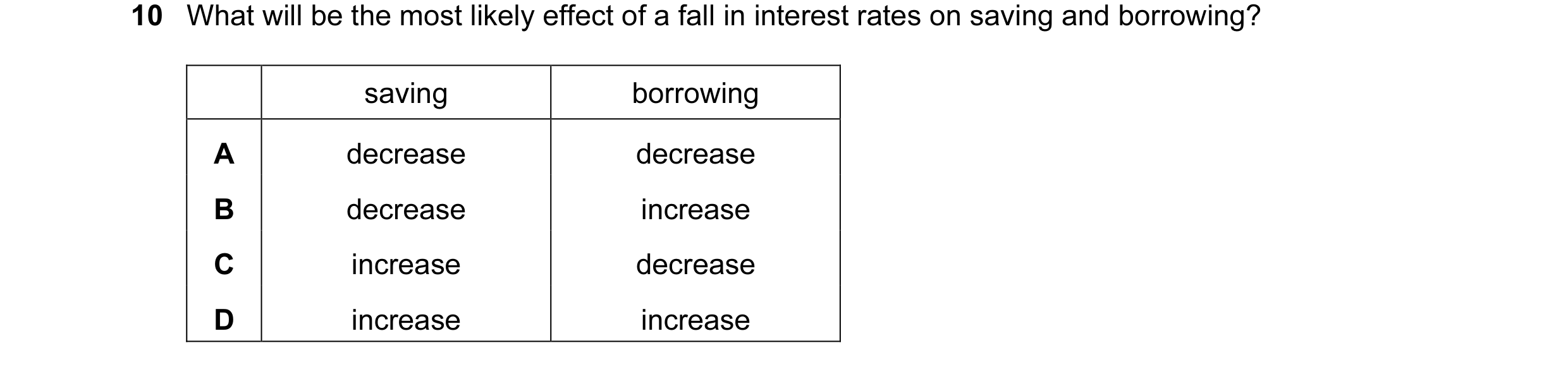
10 What will be the most likely effect of a fall in interest rates on saving and borrowing? saving borrowing A decrease decrease B decrease increase C increase decrease D increase increase
1 marks
Answer: B
This question in 0455/13 Oct/Nov 2013
Q49 · A merchant travels abroad for a few days to buy samples of low-value goods from a range… 0455/13 Oct/Nov 2013
13 A merchant travels abroad for a few days to buy samples of low-value goods from a range of manufacturers. Which property of money would be least necessary for this to take place smoothly? A acceptability B divisibility C durability D portability
1 marks
Answer: C
This question in 0455/13 Oct/Nov 2013
Q50 · What may cause an individual to save a higher proportion of their income? 0455/12 May/June 2014
8 What may cause an individual to save a higher proportion of their income? A a belief that the price of goods will rise in the future B a fall in the rate of interest paid by the country’s banks C a fear that income will fall in the future D a rise in the individual’s wish to enjoy higher consumption immediately
1 marks
Answer: C
This question in 0455/12 May/June 2014
Q51 · In 2013 there was a period of low interest rates and high inflation in an economy 0455/12 May/June 2014
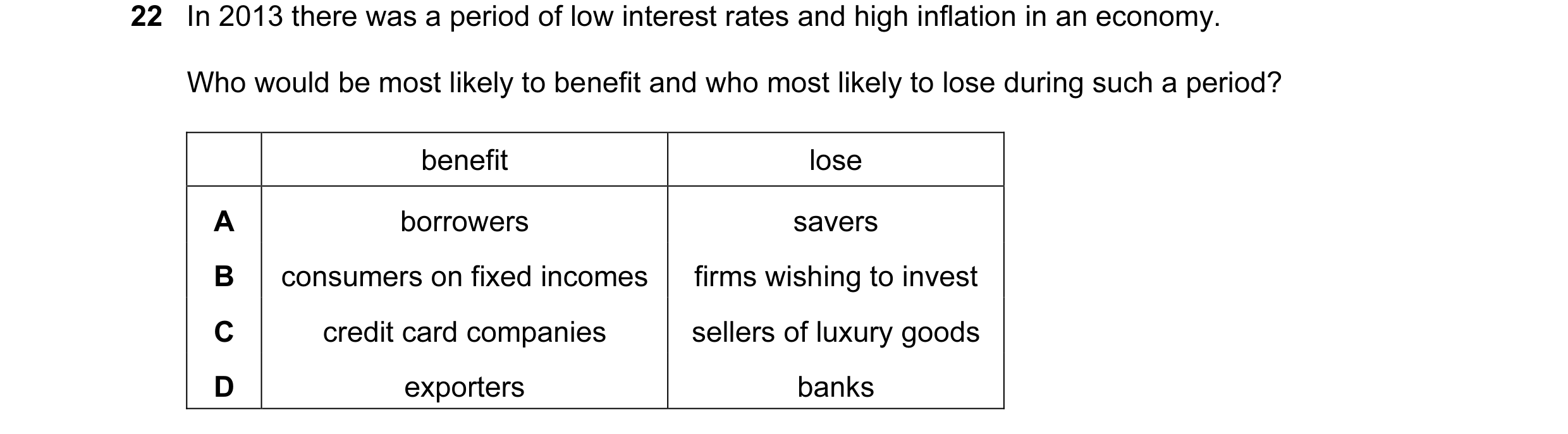
22 In 2013 there was a period of low interest rates and high inflation in an economy. Who would be most likely to benefit and who most likely to lose during such a period? benefit lose A borrowers savers B consumers on fixed incomes firms wishing to invest C credit card companies sellers of luxury goods D exporters banks
1 marks
Answer: A
This question in 0455/12 May/June 2014
Q52 · What may cause an individual to save a higher proportion of their income? 0455/13 May/June 2014
15 What may cause an individual to save a higher proportion of their income? A a belief that the price of goods will rise in the future B a fall in the rate of interest paid by the country’s banks C a fear that income will fall in the future D a rise in the individual’s wish to enjoy higher consumption immediately
1 marks
Answer: C
This question in 0455/13 May/June 2014
Q53 · In 2008, economic conditions in the UK were uncertain and the rate of inflation increased 0455/13 Oct/Nov 2014
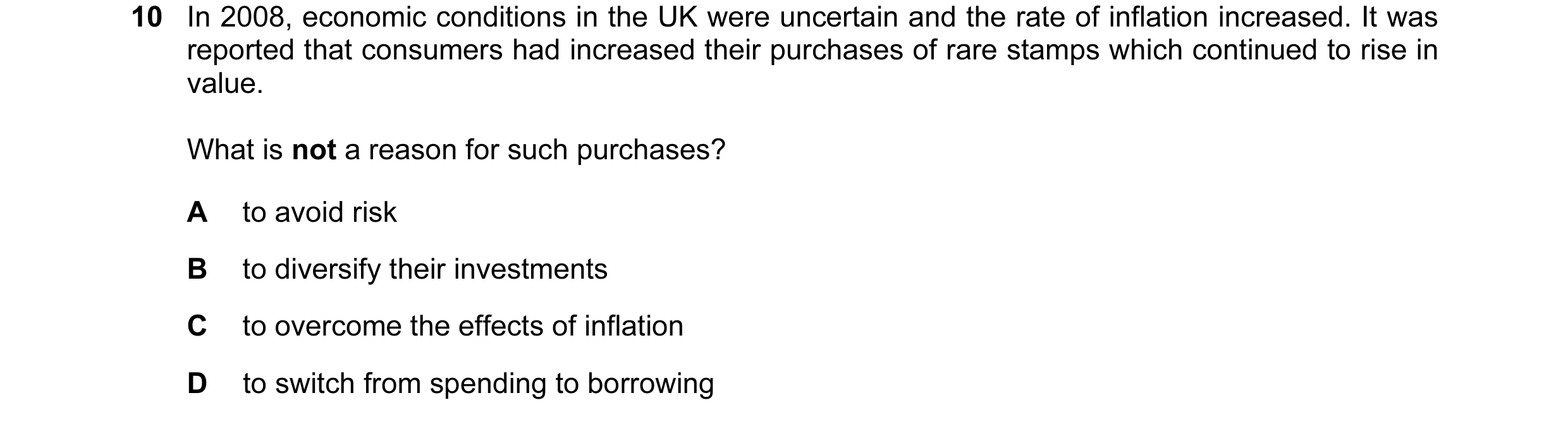
10 In 2008, economic conditions in the UK were uncertain and the rate of inflation increased. It was reported that consumers had increased their purchases of rare stamps which continued to rise in value. What is not a reason for such purchases? A to avoid risk B to diversify their investments C to overcome the effects of inflation D to switch from spending to borrowing
1 marks
Answer: D
This question in 0455/13 Oct/Nov 2014
Q54 · Cigarettes have been used as money in exceptional circumstances 0455/11 May/June 2015
9 Cigarettes have been used as money in exceptional circumstances. What is the most likely reason that they are not acceptable as money in normal circumstances? A cigarettes lack durability B cigarettes lack intrinsic value C cigarettes lack portability D cigarettes lack uniformity
1 marks
Answer: A
This question in 0455/11 May/June 2015
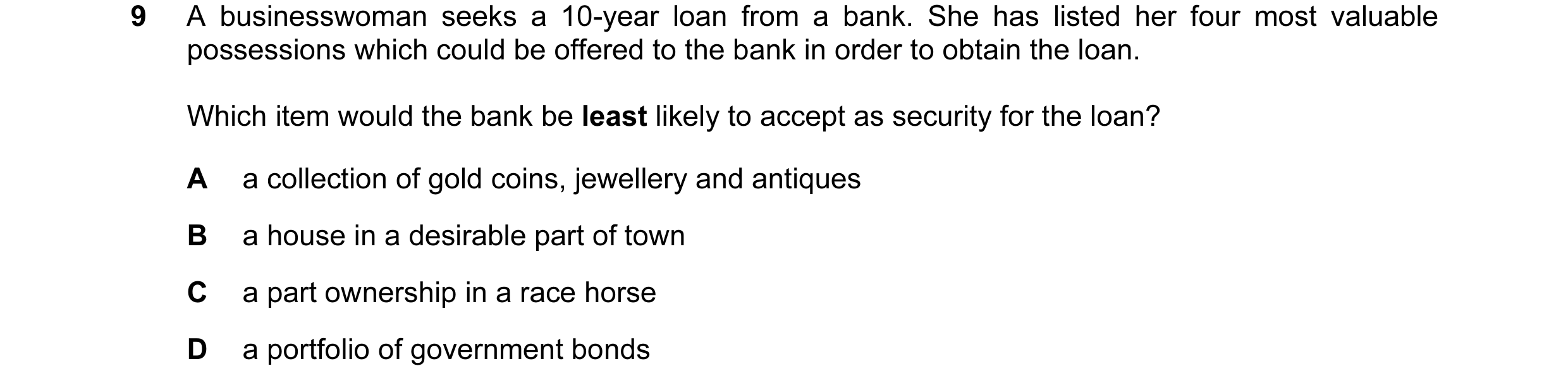
Q55 · A businesswoman seeks a 10-year loan from a bank 0455/12 May/June 2015
9 A businesswoman seeks a 10-year loan from a bank. She has listed her four most valuable possessions which could be offered to the bank in order to obtain the loan. Which item would the bank be least likely to accept as security for the loan? A a collection of gold coins, jewellery and antiques B a house in a desirable part of town C a part ownership in a race horse D a portfolio of government bonds
1 marks
Answer: C
This question in 0455/12 May/June 2015
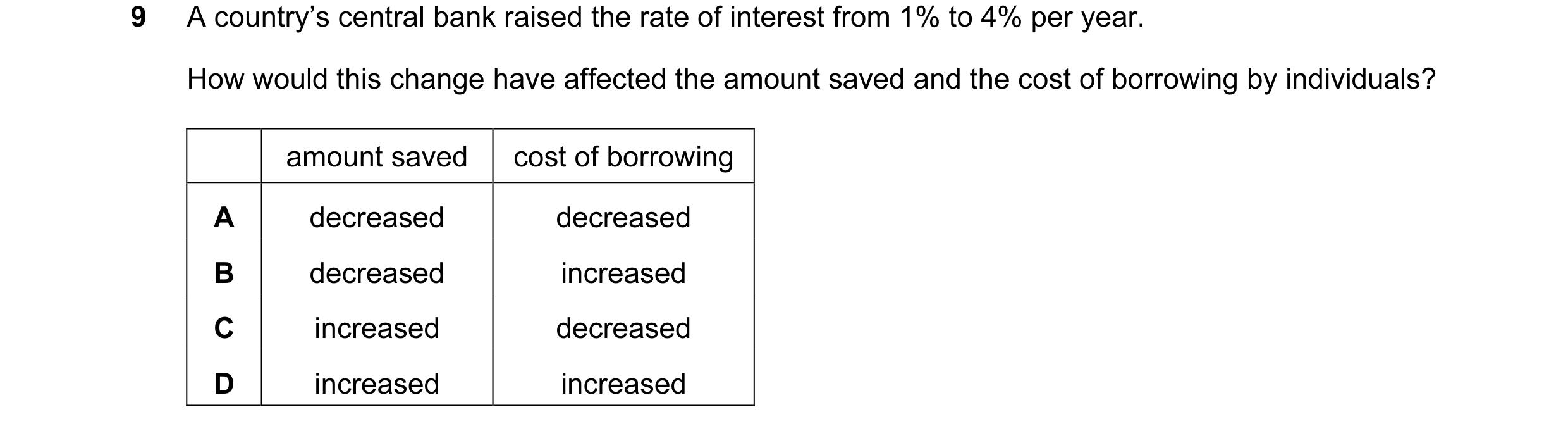
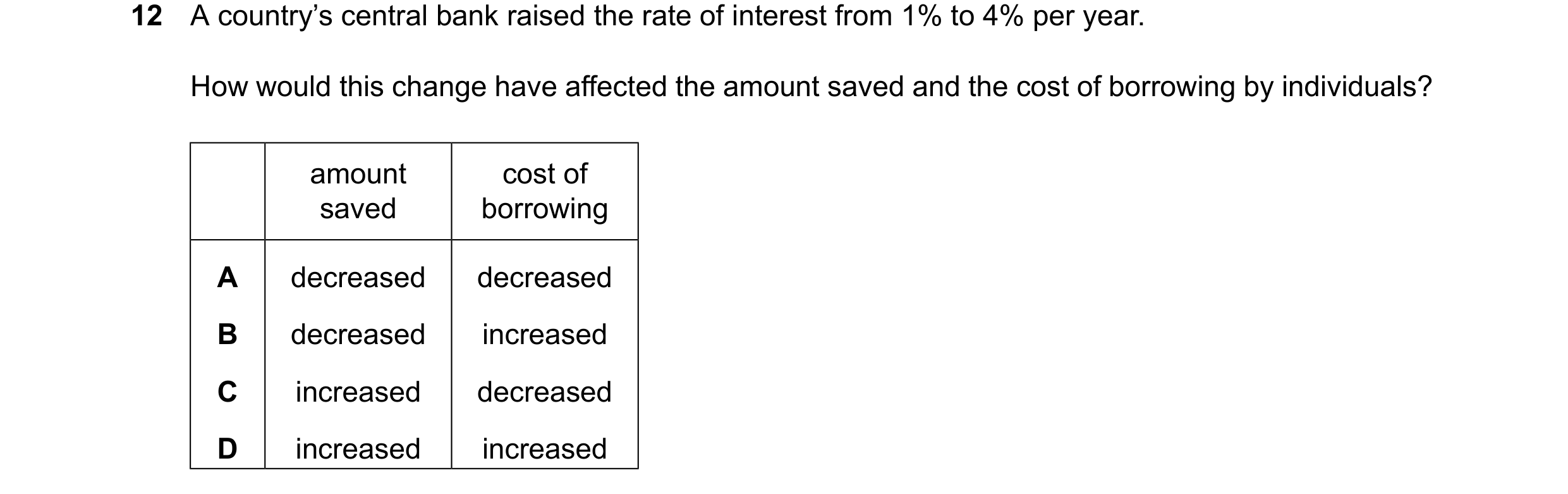
Q56 · A country’s central bank raised the rate of interest from 1% to 4% per year 0455/11 Oct/Nov 2015
9 A country’s central bank raised the rate of interest from 1% to 4% per year. How would this change have affected the amount saved and the cost of borrowing by individuals? amount saved cost of borrowing A decreased decreased B decreased increased C increased decreased D increased increased
1 marks
Answer: D
This question in 0455/11 Oct/Nov 2015
Q57 · What is the usual reason why citizens trust their country’s banknotes? 0455/11 May/June 2016
9 What is the usual reason why citizens trust their country’s banknotes? A They are acceptable for trade and exchange. B They are backed by gold at the central bank. C They are convertible into the US$ or Chinese Yuan. D They are recognisable and in infinite supply.
1 marks
Answer: A
This question in 0455/11 May/June 2016
Q58 · When will a central bank act as lender of last resort to a commercial bank? 0455/12 May/June 2016
9 When will a central bank act as lender of last resort to a commercial bank? A when a commercial bank faces a liquidity crisis B when a commercial bank fails to make a profit C when a commercial bank needs to raise share capital D when a commercial bank reduces its lending rates
1 marks
Answer: A
This question in 0455/12 May/June 2016
Q59 · What function does a central bank fulfil? 0455/13 May/June 2016
9 What function does a central bank fulfil? A It issues currency. B It offers overdraft facilities to individuals. C It operates deposit accounts. D It raises taxation.
1 marks
Answer: A
This question in 0455/13 May/June 2016
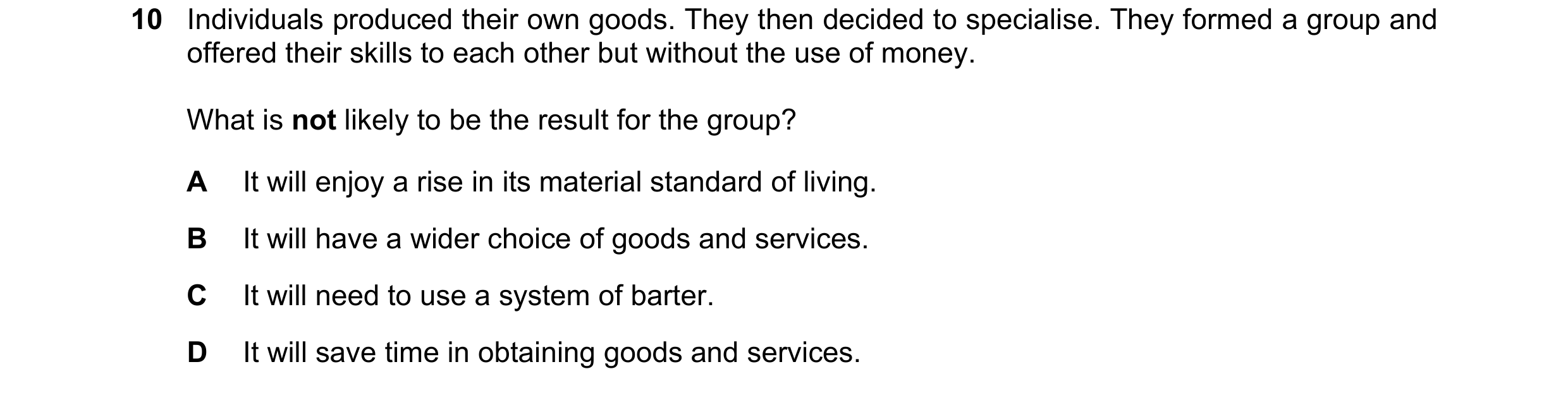
Q60 · Individuals produced their own goods 0455/11 May/June 2017
10 Individuals produced their own goods. They then decided to specialise. They formed a group and offered their skills to each other but without the use of money. What is not likely to be the result for the group? A It will enjoy a rise in its material standard of living. B It will have a wider choice of goods and services. C It will need to use a system of barter. D It will save time in obtaining goods and services.
1 marks
Answer: D
This question in 0455/11 May/June 2017
Q61 · Which statement about financial matters is correct? 0455/12 May/June 2017
8 Which statement about financial matters is correct? A Commercial banks’ main activity is the finance of international trade. B Paper banknotes possess all the desirable properties needed to act as money. C Stock exchanges trade mainly in second-hand stocks and shares. D The central bank acts as the lender of last resort to companies facing bankruptcy.
1 marks
Answer: C
This question in 0455/12 May/June 2017
Q62 · What is a function of a central bank? 0455/11 May/June 2018
8 What is a function of a central bank? A accepting deposits from the public B determining tax rates C implementing monetary policy D lending to businesses
1 marks
Answer: C
This question in 0455/11 May/June 2018
Q63 · What does a commercial bank not provide? 0455/12 May/June 2018
8 What does a commercial bank not provide? A cash B bonds C loans D mortgages
1 marks
Answer: B
This question in 0455/12 May/June 2018
Q64 · What is not a function of a central bank? 0455/13 May/June 2018
8 What is not a function of a central bank? A It is the lender of last resort to financial institutions. B It is the sole issuer of notes and coins. C It lends to individual firms and consumers. D It manages the national debt for the government.
1 marks
Answer: C
This question in 0455/13 May/June 2018
Q65 · What is a function of a central bank? 0455/11 Oct/Nov 2018
8 What is a function of a central bank? A collecting taxes B issuing currency C providing bank accounts for individuals D setting foreign trade tariffs
1 marks
Answer: B
This question in 0455/11 Oct/Nov 2018
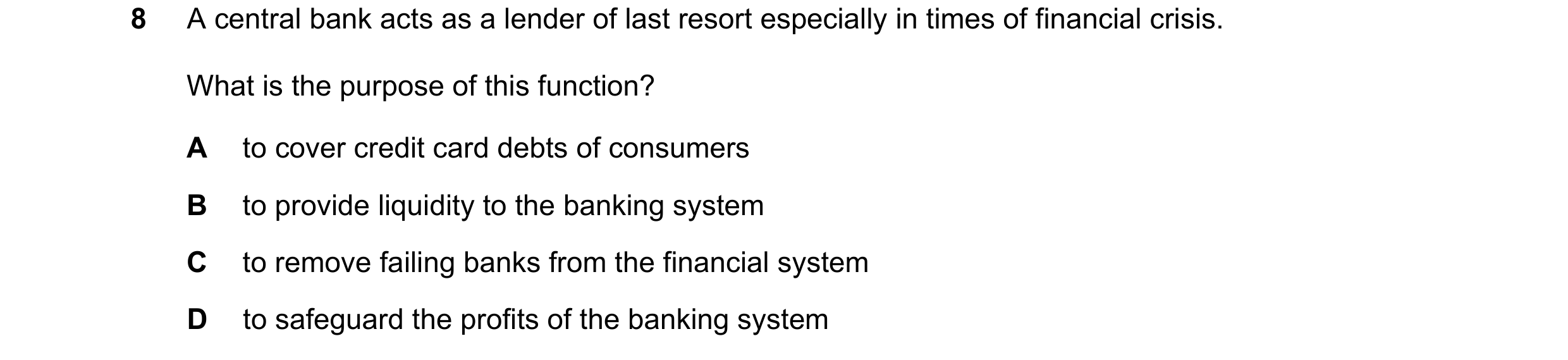
Q66 · A central bank acts as a lender of last resort especially in times of financial crisis 0455/12 Oct/Nov 2018
8 A central bank acts as a lender of last resort especially in times of financial crisis. What is the purpose of this function? A to cover credit card debts of consumers B to provide liquidity to the banking system C to remove failing banks from the financial system D to safeguard the profits of the banking system
1 marks
Answer: B
This question in 0455/12 Oct/Nov 2018
Q67 · What is a function of a country’s stock exchange? 0455/13 Oct/Nov 2018
8 What is a function of a country’s stock exchange? A to act as lender of last resort to commercial banks B to provide a market for the purchase and sale of shares C to provide short-term loans for investment D to set interest rates within the country
1 marks
Answer: B
This question in 0455/13 Oct/Nov 2018
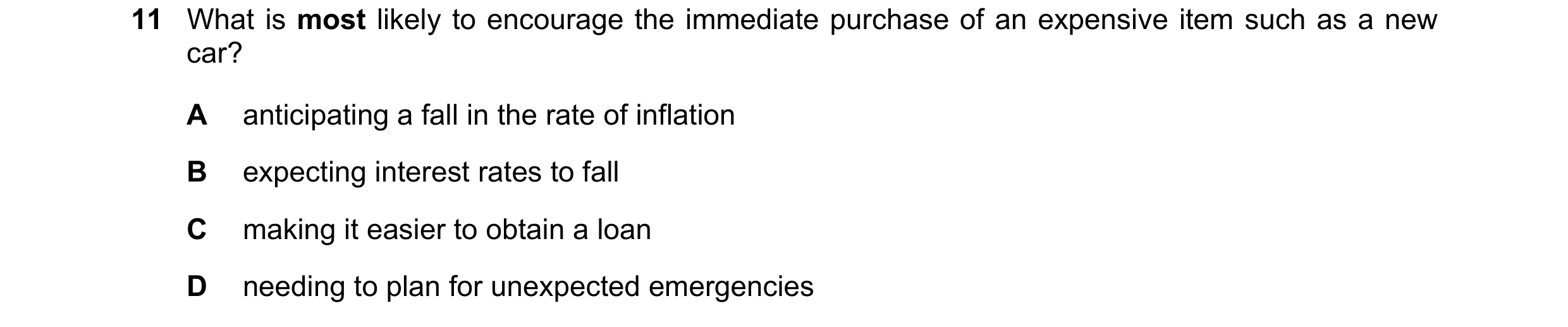
Q68 · What is most likely to encourage the immediate purchase of an expensive item such as a… 0455/13 Oct/Nov 2018
11 What is most likely to encourage the immediate purchase of an expensive item such as a new car? A anticipating a fall in the rate of inflation B expecting interest rates to fall C making it easier to obtain a loan D needing to plan for unexpected emergencies
1 marks
Answer: C
This question in 0455/13 Oct/Nov 2018
Q69 · What would be least likely to act as a store of value during a period of rapid inflation? 0455/12 Feb/March 2019
9 What would be least likely to act as a store of value during a period of rapid inflation? A cash B gold C property D shares
1 marks
Answer: A
This question in 0455/12 Feb/March 2019
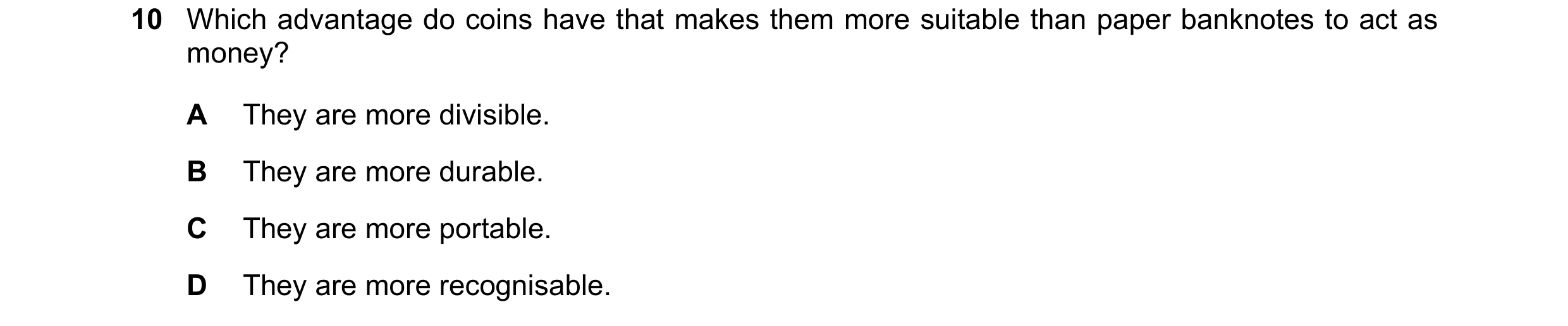
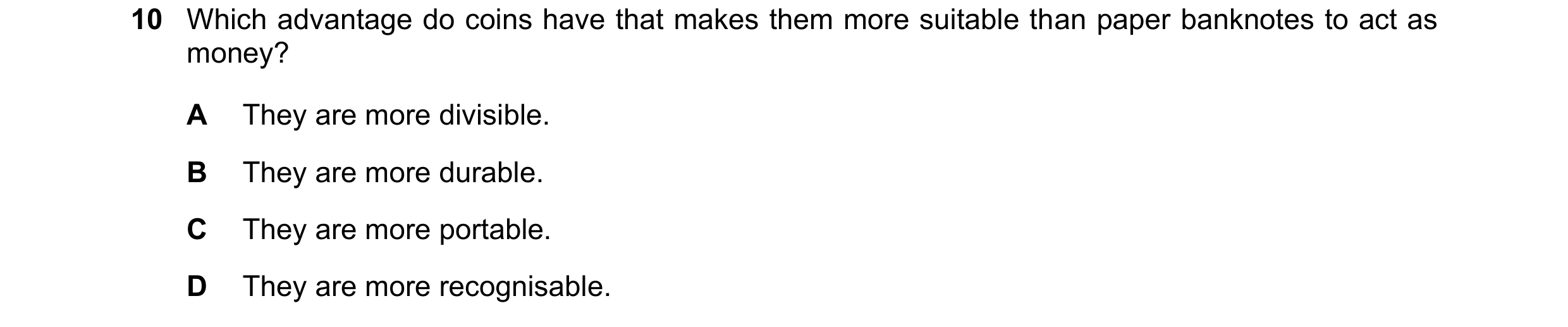
Q70 · Which advantage do coins have that make them more suitable than banknotes to act as money? 0455/13 May/June 2019
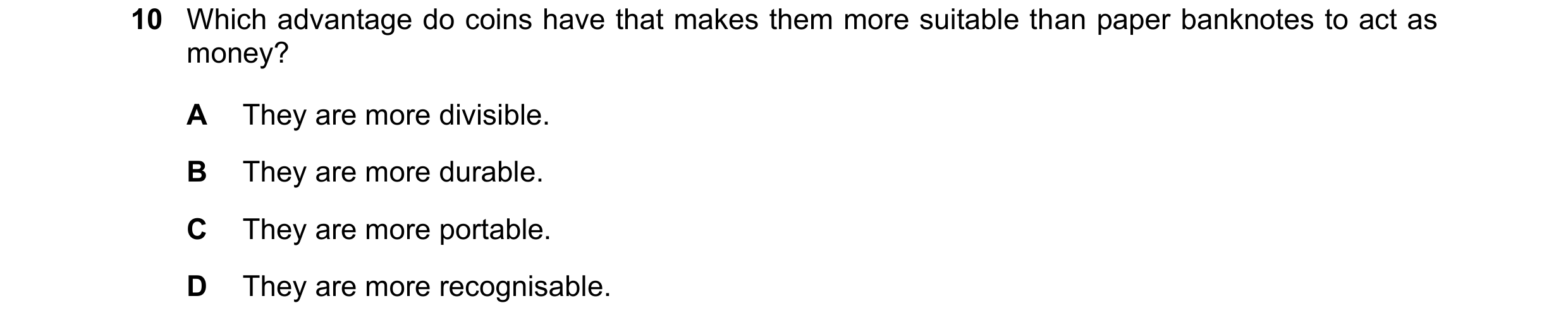
9 Which advantage do coins have that make them more suitable than banknotes to act as money? A They are more divisible. B They are more durable. C They are more portable. D They are more recognisable.
1 marks
Answer: B
This question in 0455/13 May/June 2019
Q71 · An African government has abandoned its own dollar and now uses the US dollar as its… 0455/11 Oct/Nov 2019
9 An African government has abandoned its own dollar and now uses the US dollar as its currency. Why would such a policy have been necessary? A Commercial banks restricted their lending. B Consumers only used credit cards rather than paper money. C Its own dollar no longer acted as a store of value. D The central bank controlled the issue of money too tightly.
1 marks
Answer: C
This question in 0455/11 Oct/Nov 2019
Q72 · What is not normally a function of the central bank of a country? 0455/12 Oct/Nov 2019
9 What is not normally a function of the central bank of a country? A acting as lender of last resort B issuing notes and coins C operating the government’s monetary policy D setting the government’s budget
1 marks
Answer: D
This question in 0455/12 Oct/Nov 2019
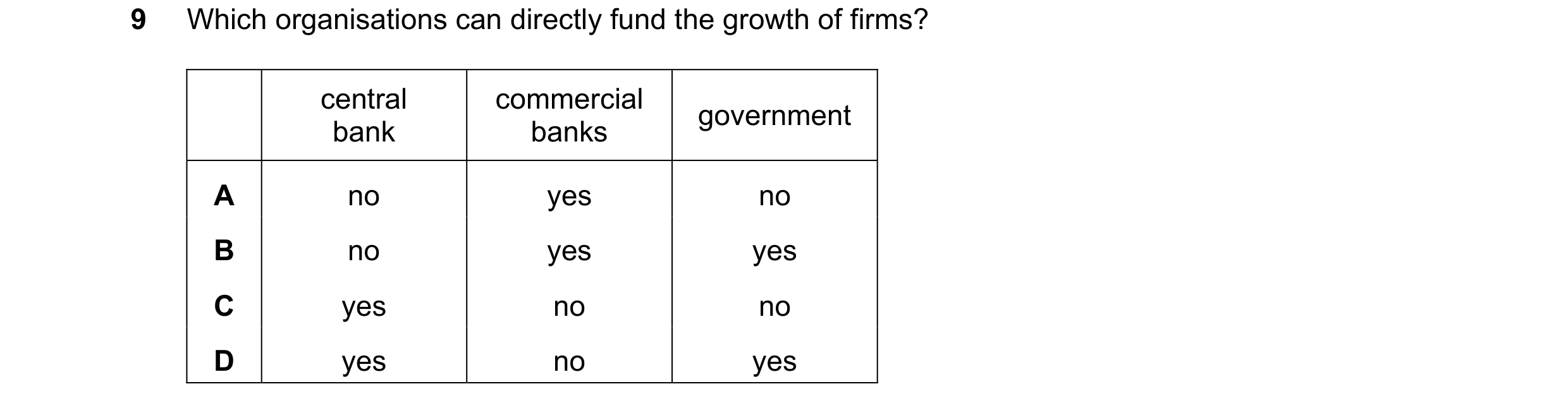
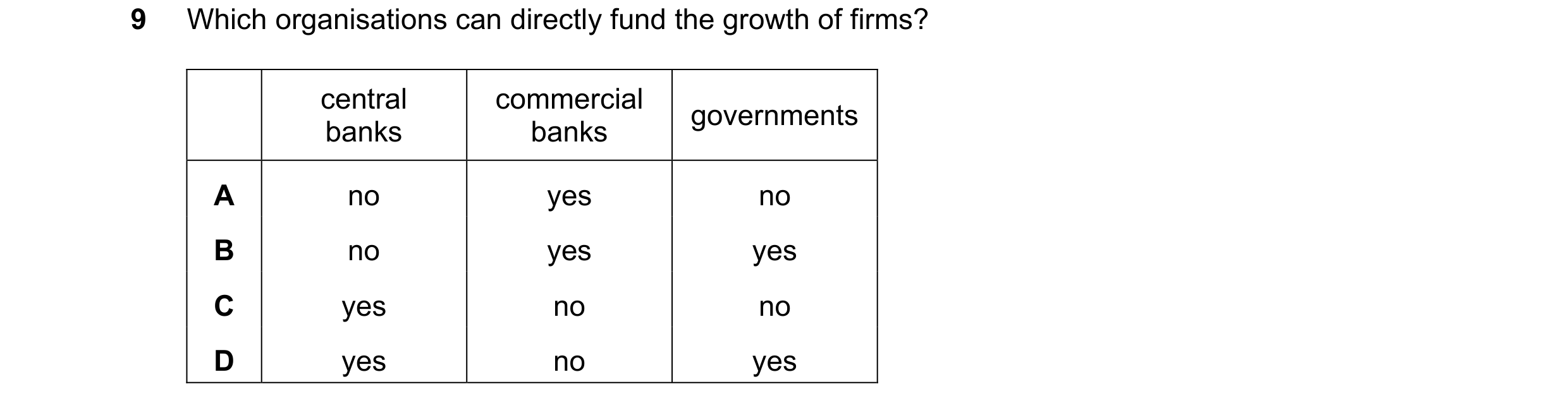
Q73 · Which organisations can directly fund the growth of firms? 0455/13 Oct/Nov 2019
9 Which organisations can directly fund the growth of firms? central commercial government bank banks A no yes no B no yes yes C yes no no D yes no yes
1 marks
Answer: B
This question in 0455/13 Oct/Nov 2019
Q74 · What is the most important characteristic of money? 0455/12 Feb/March 2020
9 What is the most important characteristic of money? A It has intrinsic value. B It is generally acceptable. C It is portable. D It is readily available.
1 marks
This question in 0455/12 Feb/March 2020
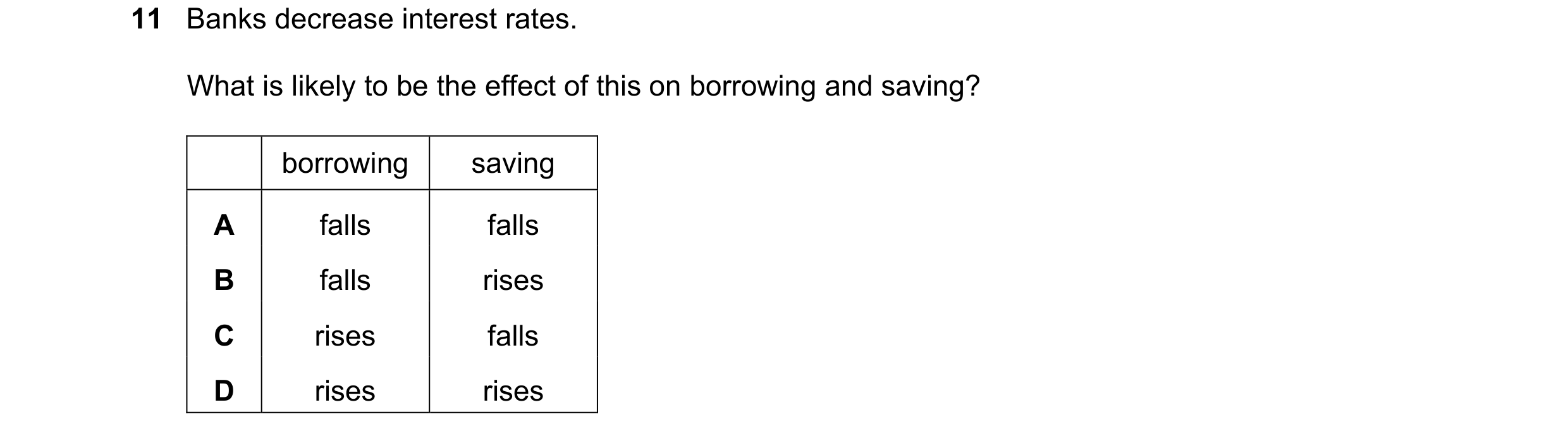
Q75 · Banks decrease interest rates 0455/12 Feb/March 2020
11 Banks decrease interest rates. What is likely to be the effect of this on borrowing and saving? borrowing saving A falls falls B falls rises C rises falls D rises rises
1 marks
This question in 0455/12 Feb/March 2020
Q76 · What is an advantage to a country of having an efficient commercial banking system? 0455/13 May/June 2020
9 What is an advantage to a country of having an efficient commercial banking system? A It controls the money supply. B It discourages spending. C It encourages tax evasion. D It enables investment.
1 marks
Answer: D
This question in 0455/13 May/June 2020
Q77 · What can a central bank increase in order to reduce consumer borrowing? 0455/11 Oct/Nov 2020
11 What can a central bank increase in order to reduce consumer borrowing? A commercial bank deposits B government spending C the exchange rate D the rate of interest
1 marks
Answer: D
This question in 0455/11 Oct/Nov 2020
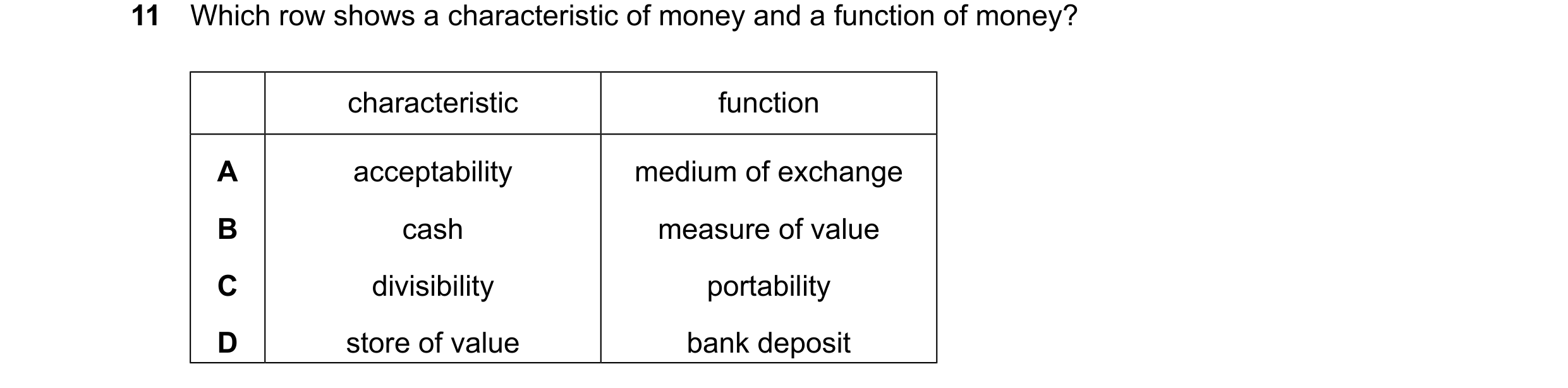
Q78 · Which row shows a characteristic of money and a function of money? 0455/13 Oct/Nov 2020
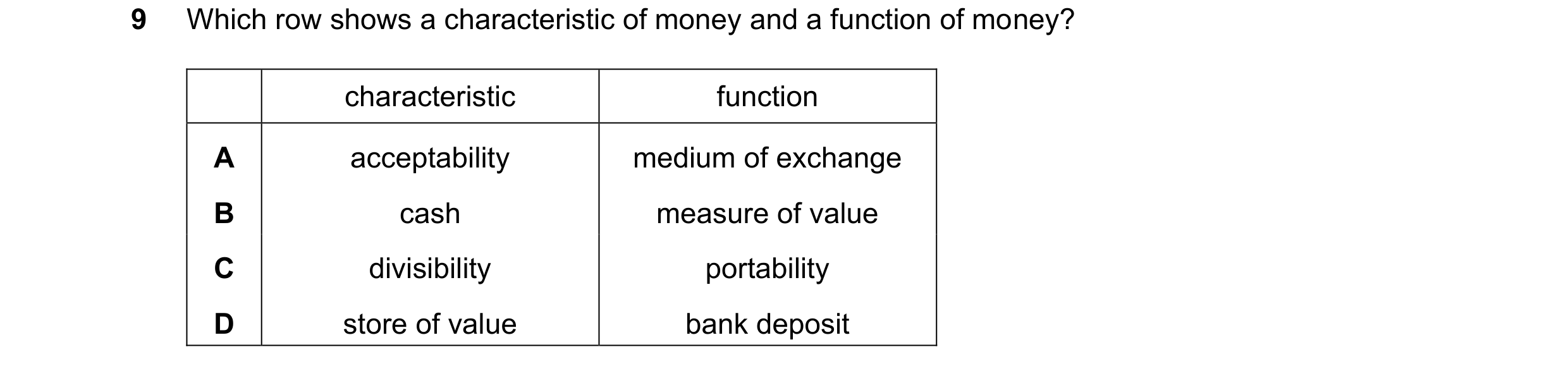
9 Which row shows a characteristic of money and a function of money? characteristic function A acceptability medium of exchange B cash measure of value C divisibility portability D store of value bank deposit
1 marks
Answer: A
This question in 0455/13 Oct/Nov 2020
Q79 · What can a central bank increase in order to reduce consumer borrowing? 0455/13 Oct/Nov 2020
11 What can a central bank increase in order to reduce consumer borrowing? A commercial bank deposits B government spending C the exchange rate D the rate of interest
1 marks
Answer: D
This question in 0455/13 Oct/Nov 2020
Q80 · Which function does a central bank provide for the general public? 0455/12 Feb/March 2021
9 Which function does a central bank provide for the general public? A accepting deposits B issuing banknotes C making loans D providing overdrafts
1 marks
Answer: B
This question in 0455/12 Feb/March 2021
Q81 · It is expected that consumers will use less paper money 0455/11 May/June 2021
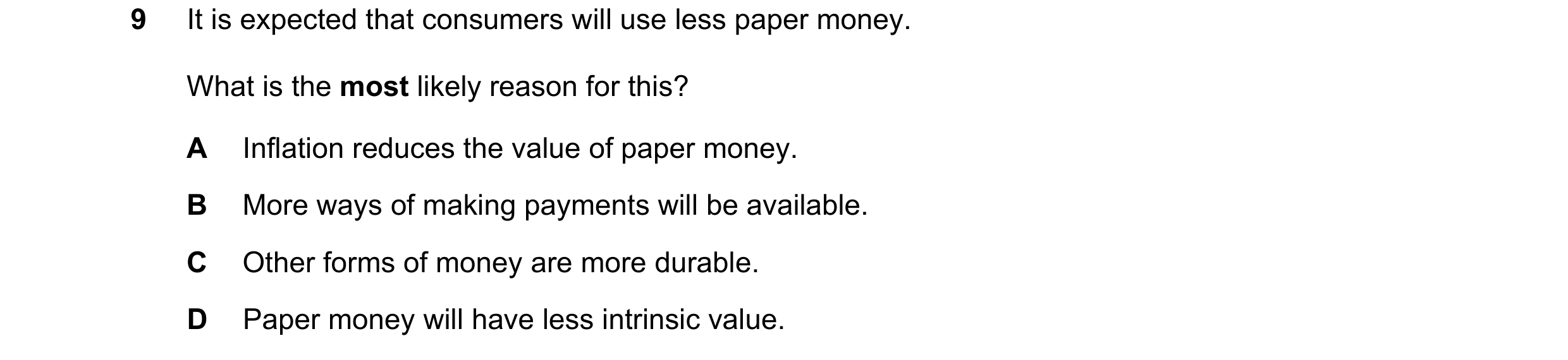
9 It is expected that consumers will use less paper money. What is the most likely reason for this? A Inflation reduces the value of paper money. B More ways of making payments will be available. C Other forms of money are more durable. D Paper money will have less intrinsic value.
1 marks
Answer: B
This question in 0455/11 May/June 2021
Q82 · What is the money supply? 0455/13 May/June 2021
17 What is the money supply? A the total quantity of foreign currency available within the economy B the total quantity of money available within the economy C the total quantity of money issued by the central bank D the total quantity of money within commercial banks
1 marks
Answer: B
This question in 0455/13 May/June 2021
Q83 · Which activity is correctly linked to the organisation that provides it? 0455/11 May/June 2022
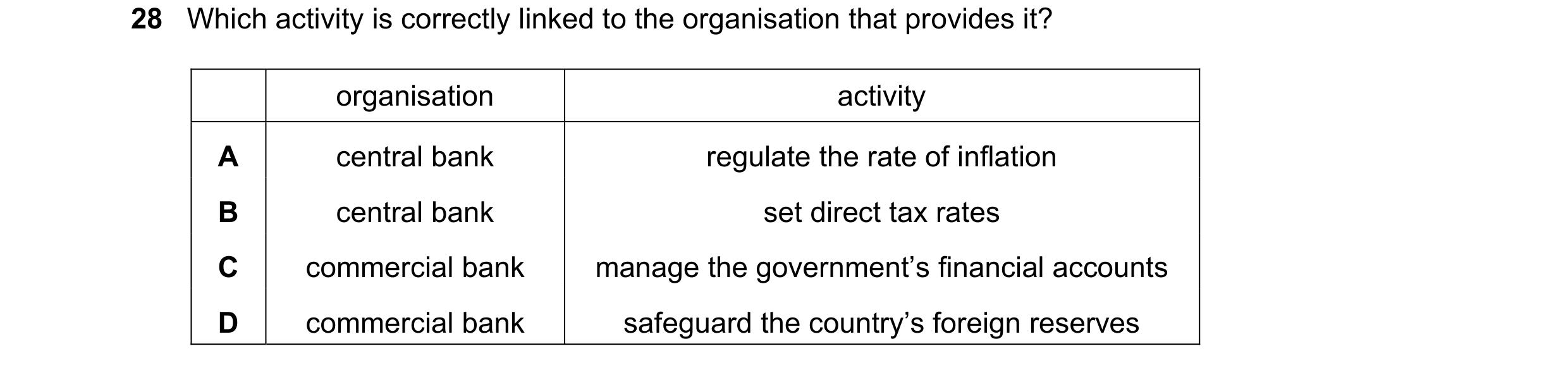
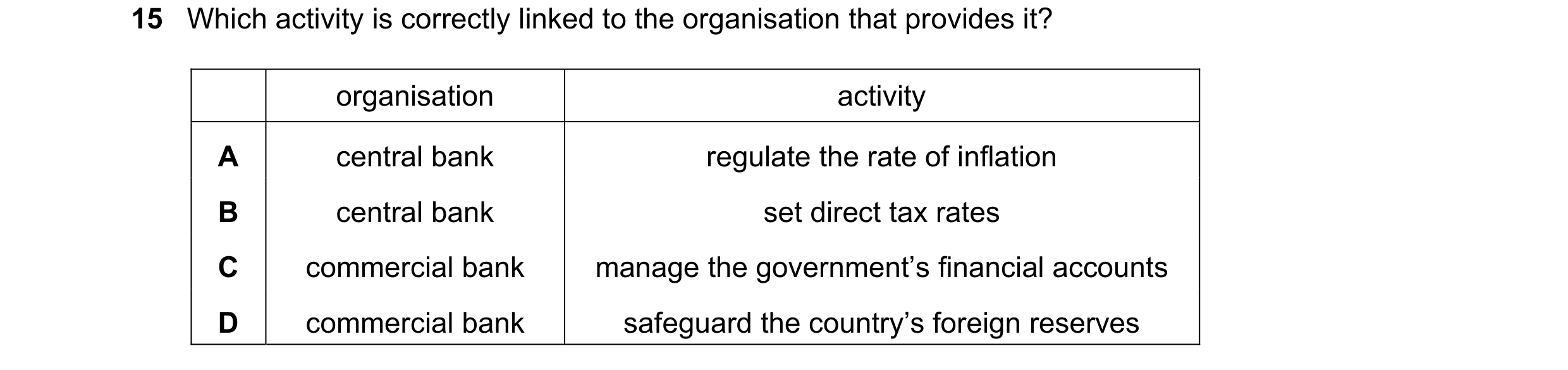
28 Which activity is correctly linked to the organisation that provides it? organisation activity A central bank regulate the rate of inflation B central bank set direct tax rates C commercial bank manage the government’s financial accounts D commercial bank safeguard the country’s foreign reserves
1 marks
Answer: A
This question in 0455/11 May/June 2022
Q84 · Which activity is correctly linked to the organisation that provides it? 0455/12 May/June 2022
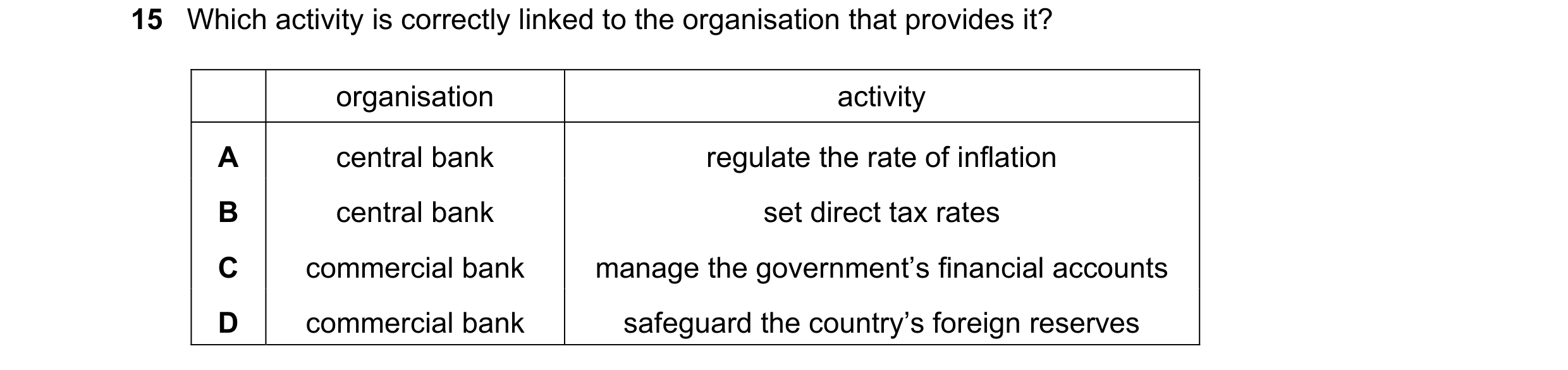
15 Which activity is correctly linked to the organisation that provides it? organisation activity A central bank regulate the rate of inflation B central bank set direct tax rates C commercial bank manage the government’s financial accounts D commercial bank safeguard the country’s foreign reserves
1 marks
Answer: A
This question in 0455/12 May/June 2022
Q85 · Which activity is correctly linked to the organisation that provides it? 0455/13 May/June 2022
15 Which activity is correctly linked to the organisation that provides it? organisation activity A central bank regulate the rate of inflation B central bank set direct tax rates C commercial bank manage the government’s financial accounts D commercial bank safeguard the country’s foreign reserves
1 marks
Answer: A
This question in 0455/13 May/June 2022
Q86 · In a country, inflation is 10% and nominal interest rates are 7% 0455/13 May/June 2022
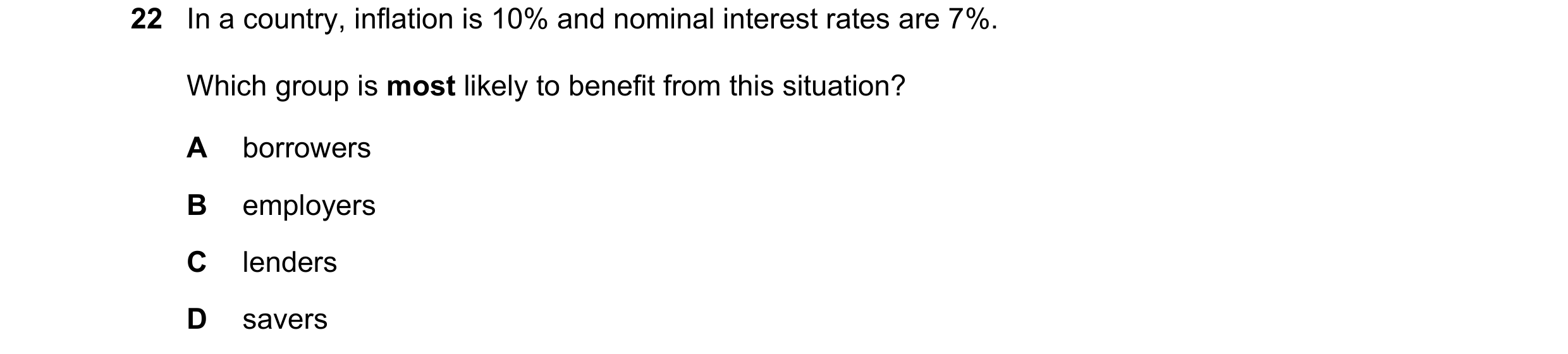
22 In a country, inflation is 10% and nominal interest rates are 7%. Which group is most likely to benefit from this situation? A borrowers B employers C lenders D savers
1 marks
Answer: A
This question in 0455/13 May/June 2022
Q87 · Which organisations can directly fund the growth of firms? 0455/11 Oct/Nov 2022
9 Which organisations can directly fund the growth of firms? central commercial governments banks banks A no yes no B no yes yes C yes no no D yes no yes
1 marks
Answer: B
This question in 0455/11 Oct/Nov 2022
Q88 · Which advantage do coins have that makes them more suitable than paper banknotes to act… 0455/11 Oct/Nov 2022
10 Which advantage do coins have that makes them more suitable than paper banknotes to act as money? A They are more divisible. B They are more durable. C They are more portable. D They are more recognisable.
1 marks
Answer: B
This question in 0455/11 Oct/Nov 2022
Q89 · Which organisations can directly fund the growth of firms? 0455/12 Oct/Nov 2022
9 Which organisations can directly fund the growth of firms? central commercial governments banks banks A no yes no B no yes yes C yes no no D yes no yes
1 marks
Answer: B
This question in 0455/12 Oct/Nov 2022
Q90 · Which advantage do coins have that makes them more suitable than paper banknotes to act… 0455/12 Oct/Nov 2022
10 Which advantage do coins have that makes them more suitable than paper banknotes to act as money? A They are more divisible. B They are more durable. C They are more portable. D They are more recognisable.
1 marks
Answer: B
This question in 0455/12 Oct/Nov 2022
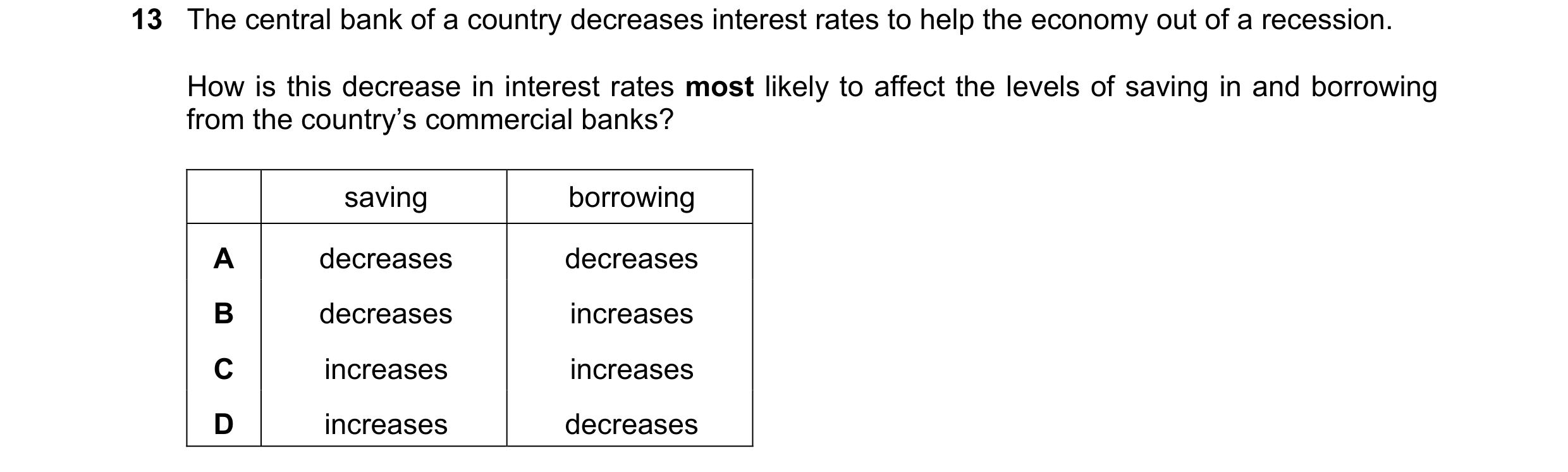
Q91 · The central bank of a country decreases interest rates to help the economy out of a… 0455/12 Oct/Nov 2022
13 The central bank of a country decreases interest rates to help the economy out of a recession. How is this decrease in interest rates most likely to affect the levels of saving in and borrowing from the country’s commercial banks? saving borrowing A decreases decreases B decreases increases C increases increases D increases decreases
1 marks
Answer: B
This question in 0455/12 Oct/Nov 2022
Q92 · Which organisations can directly fund the growth of firms? 0455/13 Oct/Nov 2022
9 Which organisations can directly fund the growth of firms? central commercial governments banks banks A no yes no B no yes yes C yes no no D yes no yes
1 marks
Answer: B
This question in 0455/13 Oct/Nov 2022
Q93 · Which advantage do coins have that makes them more suitable than paper banknotes to act… 0455/13 Oct/Nov 2022
10 Which advantage do coins have that makes them more suitable than paper banknotes to act as money? A They are more divisible. B They are more durable. C They are more portable. D They are more recognisable.
1 marks
Answer: B
This question in 0455/13 Oct/Nov 2022
Q94 · What is a function of commercial banks? 0455/12 Feb/March 2023
10 What is a function of commercial banks? A accept deposits and savings B lender of last resort to government C manage the national debt D operate monetary policy
1 marks
Answer: A
This question in 0455/12 Feb/March 2023
Q95 · What would be least likely to act as a store of value during a period of rapid inflation? 0455/11 May/June 2023
11 What would be least likely to act as a store of value during a period of rapid inflation? A cash B gold C property D shares
1 marks
Answer: A
This question in 0455/11 May/June 2023
Q96 · A country’s central bank raised the rate of interest from 1% to 4% per year 0455/11 May/June 2023
12 A country’s central bank raised the rate of interest from 1% to 4% per year. How would this change have affected the amount saved and the cost of borrowing by individuals? amount cost of saved borrowing A decreased decreased B decreased increased C increased decreased D increased increased
1 marks
Answer: D
This question in 0455/11 May/June 2023
Q97 · Savers suffer as inflation rises to 4.4% 0455/12 May/June 2023
11 Savers suffer as inflation rises to 4.4%. Which function of money is most involved in this statement? A means of deferred payments B medium of exchange C store of value D unit of account
1 marks
Answer: C
This question in 0455/12 May/June 2023
Q98 · One of the functions of money is to act as a measure of value 0455/12 May/June 2023
12 One of the functions of money is to act as a measure of value. What does this mean? A Money allows people to borrow and lend. B Money allows people to save their surplus income. C Money is used to buy goods and services. D Money is used to compare the worth of different goods and services.
1 marks
Answer: D
This question in 0455/12 May/June 2023
Q99 · Which row shows a characteristic of money and a function of money? 0455/13 May/June 2023
11 Which row shows a characteristic of money and a function of money? characteristic function A acceptability medium of exchange B cash measure of value C divisibility portability D store of value bank deposit
1 marks
Answer: A
This question in 0455/13 May/June 2023
Q100 · When will a central bank act as lender of last resort to a commercial bank? 0455/13 May/June 2023
12 When will a central bank act as lender of last resort to a commercial bank? A when a commercial bank faces a liquidity crisis B when a commercial bank fails to make a profit C when a commercial bank needs to raise share capital D when a commercial bank reduces its lending rates
1 marks
Answer: A
This question in 0455/13 May/June 2023
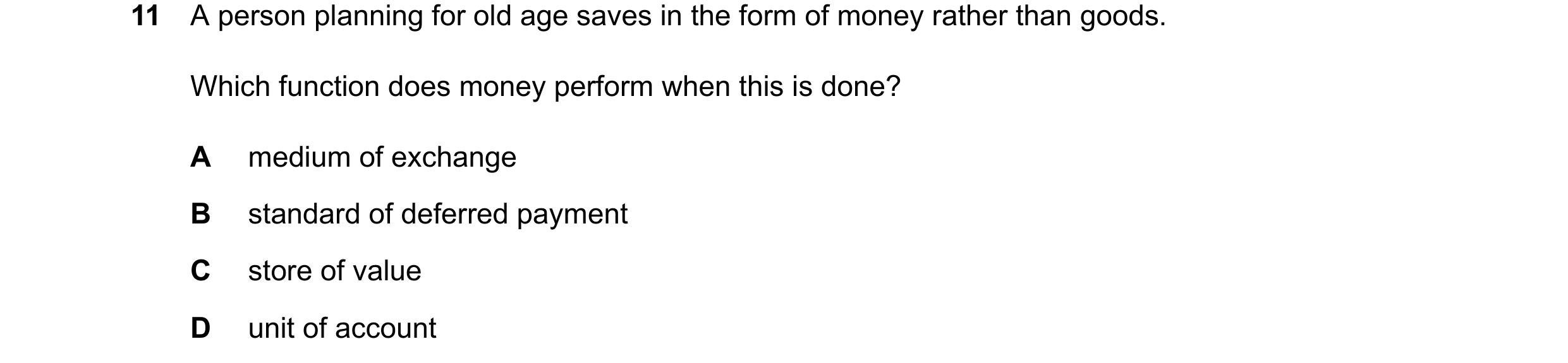
Q101 · A person planning for old age saves in the form of money rather than goods 0455/11 Oct/Nov 2023
11 A person planning for old age saves in the form of money rather than goods. Which function does money perform when this is done? A medium of exchange B standard of deferred payment C store of value D unit of account
1 marks
Answer: C
This question in 0455/11 Oct/Nov 2023
Q102 · What is not normally a function of the central bank of a country? 0455/11 Oct/Nov 2023
12 What is not normally a function of the central bank of a country? A acting as lender of last resort B issuing notes and coins C operating the government monetary policy D setting the government budget
1 marks
Answer: D
This question in 0455/11 Oct/Nov 2023
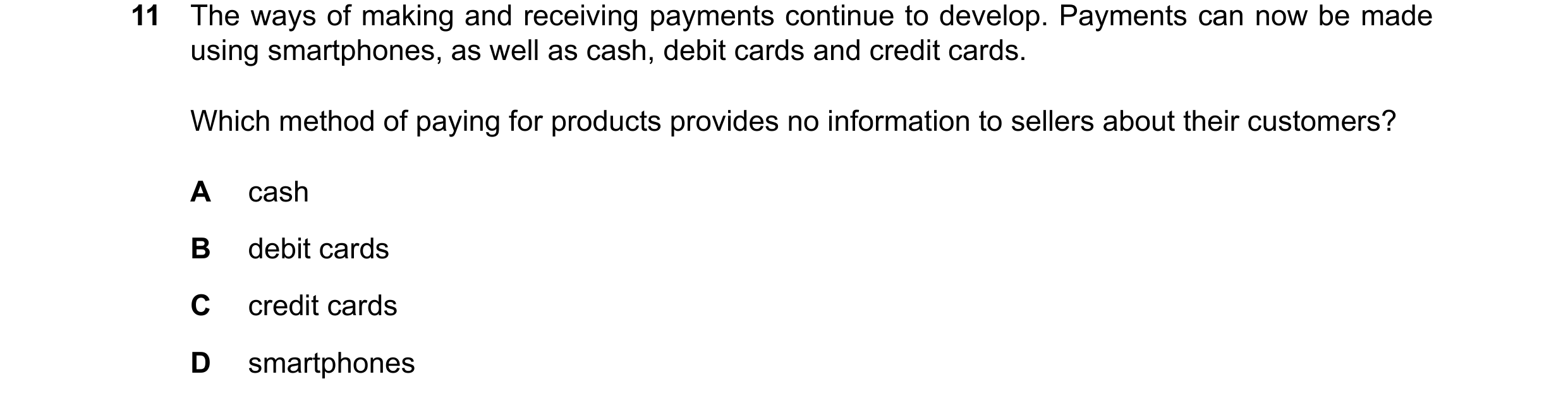
Q103 · The ways of making and receiving payments continue to develop 0455/12 Oct/Nov 2023
11 The ways of making and receiving payments continue to develop. Payments can now be made using smartphones, as well as cash, debit cards and credit cards. Which method of paying for products provides no information to sellers about their customers? A cash B debit cards C credit cards D smartphones
1 marks
Answer: A
This question in 0455/12 Oct/Nov 2023
Q104 · In most countries, which organisation controls the banking system? 0455/12 Oct/Nov 2023
12 In most countries, which organisation controls the banking system? A central bank B commercial bank C investment bank D World Bank
1 marks
Answer: A
This question in 0455/12 Oct/Nov 2023
Q105 · What must have happened in a country when it experienced an annual rate of inflation of… 0455/12 Oct/Nov 2023
23 What must have happened in a country when it experienced an annual rate of inflation of 100%? A The money supply doubled. B The price level halved. C The purchasing power of money halved. D The real value of money doubled.
1 marks
Answer: C
This question in 0455/12 Oct/Nov 2023
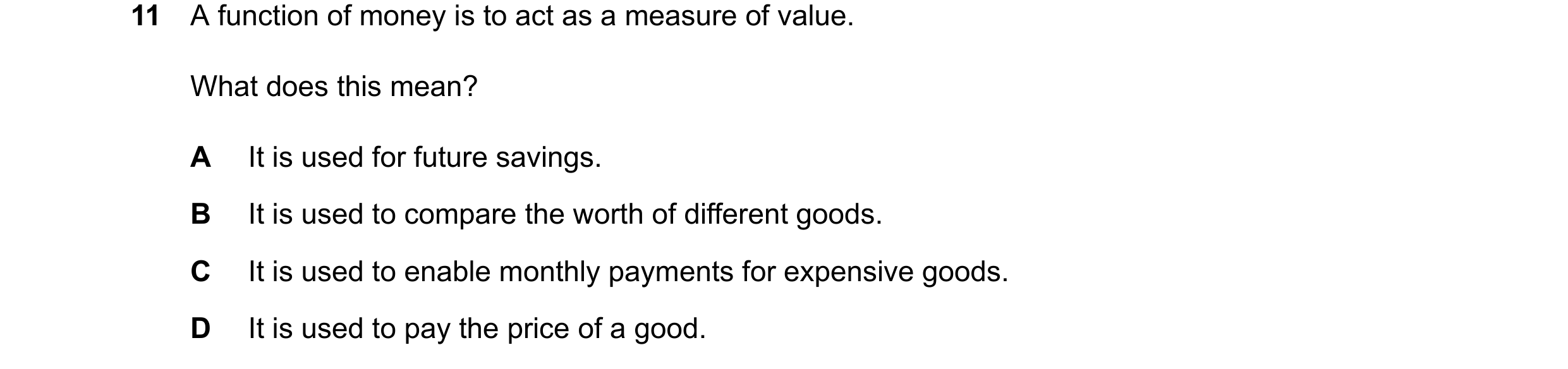
Q106 · A function of money is to act as a measure of value 0455/13 Oct/Nov 2023
11 A function of money is to act as a measure of value. What does this mean? A It is used for future savings. B It is used to compare the worth of different goods. C It is used to enable monthly payments for expensive goods. D It is used to pay the price of a good.
1 marks
Answer: B
This question in 0455/13 Oct/Nov 2023
Q107 · The table shows information about four financial institutions 0455/12 Feb/March 2024
10 The table shows information about four financial institutions. Which institution is most likely to be a commercial bank? it is the it is owned by government’s shareholders bank A no no B no yes C yes no D yes yes
1 marks
Answer: B
This question in 0455/12 Feb/March 2024
Q108 · Which function of money acts as a measure of value? 0455/12 May/June 2024
15 Which function of money acts as a measure of value? A a medium of exchange B a standard of deferred payment C a store of wealth D a unit of account
1 marks
Answer: D
This question in 0455/12 May/June 2024
Q109 · What function does a central bank provide for an economy? 0455/13 May/June 2024
10 What function does a central bank provide for an economy? A It issues bank notes to encourage spending. B It manages the debt of private sector firms. C It offers high interest rate accounts to encourage savings. D It provides mortgages to encourage home ownership.
1 marks
Answer: A
This question in 0455/13 May/June 2024
Q110 · What is not a function of money? 0455/11 Oct/Nov 2024
10 What is not a function of money? A medium of exchange B portability C store of value D unit of account
1 marks
Answer: B
This question in 0455/11 Oct/Nov 2024
Q111 · What is an important role of a central bank? 0455/12 Oct/Nov 2024
10 What is an important role of a central bank? A attempts to achieve price stability B issues credit cards C provides loans to producers D provides savings accounts for consumers
1 marks
Answer: A
This question in 0455/12 Oct/Nov 2024
Q112 · What is the money supply? 0455/12 Oct/Nov 2024
18 What is the money supply? A the total quantity of foreign currency available within the economy B the total quantity of money available within the economy C the total quantity of money issued by the central bank D the total quantity of money within commercial banks
1 marks
Answer: B
This question in 0455/12 Oct/Nov 2024
Q113 · What is a function of a commercial bank? 0455/13 Oct/Nov 2024
10 What is a function of a commercial bank? A accepting deposits B controlling money supply C issuing notes and coins D lending money to the government
1 marks
Answer: A
This question in 0455/13 Oct/Nov 2024
Q114 · Which function does a central bank provide for the general public? 0455/12 Feb/March 2025
10 Which function does a central bank provide for the general public? A accepting deposits B issuing banknotes C making loans D providing overdrafts
1 marks
Answer: B
This question in 0455/12 Feb/March 2025
Q115 · What is not a form of money? 0455/11 May/June 2025
10 What is not a form of money? A a banknote B a cheque C a coin D a credit card
1 marks
This question in 0455/11 May/June 2025
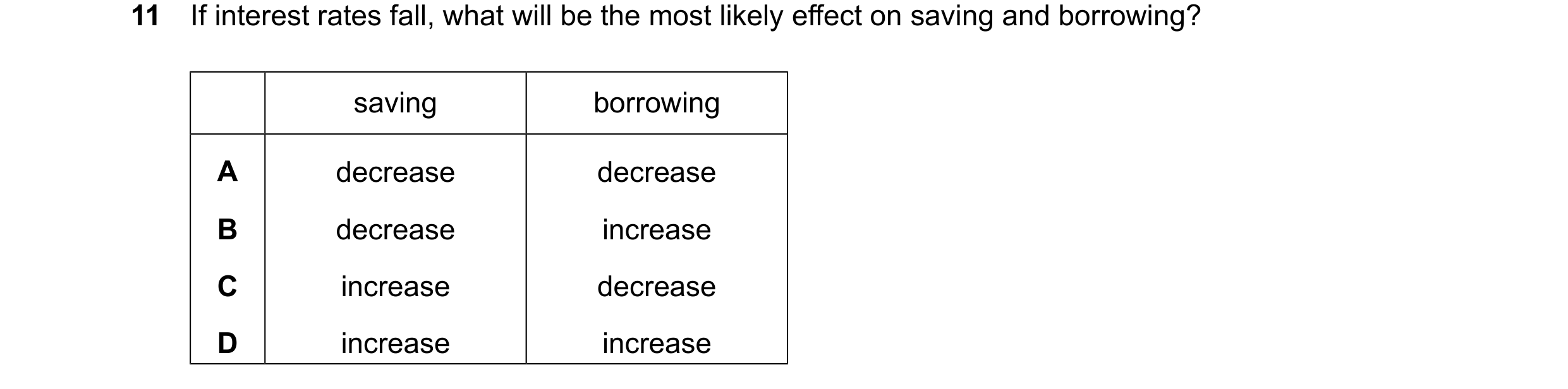
Q116 · If interest rates fall, what will be the most likely effect on saving and borrowing? 0455/11 May/June 2025
11 If interest rates fall, what will be the most likely effect on saving and borrowing? saving borrowing A decrease decrease B decrease increase C increase decrease D increase increase
1 marks
Answer: B
This question in 0455/11 May/June 2025
Q117 · What is the function of money when it is used to value goods and record transactions? 0455/11 Oct/Nov 2025
10 What is the function of money when it is used to value goods and record transactions? A a medium of exchange B a standard of deferred payment C a store of wealth D a unit of account
1 marks
Answer: D
This question in 0455/11 Oct/Nov 2025
Q118 · What is not a role of the central bank? 0455/12 Oct/Nov 2025
10 What is not a role of the central bank? A to act as the lender of last resort B to hold deposits from the general public C to issue notes and coins D to manage the gold reserves of the country
1 marks
Answer: B
This question in 0455/12 Oct/Nov 2025
Q119 · Why do banknotes function as money? 0455/13 Oct/Nov 2025
10 Why do banknotes function as money? A They are backed by gold. B They are durable. C They are generally acceptable. D They have intrinsic value.
1 marks
Answer: C
This question in 0455/13 Oct/Nov 2025



 1 / 22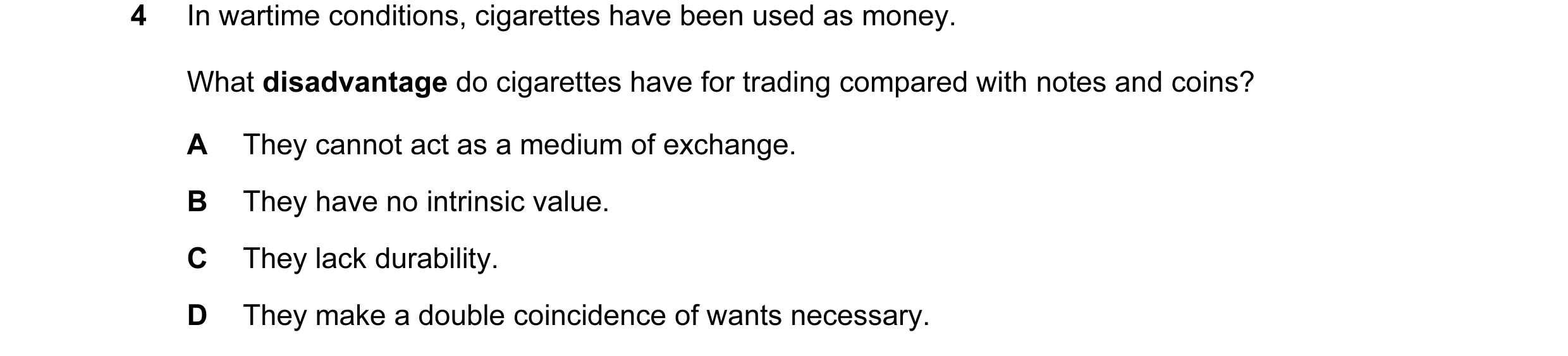



 2 / 22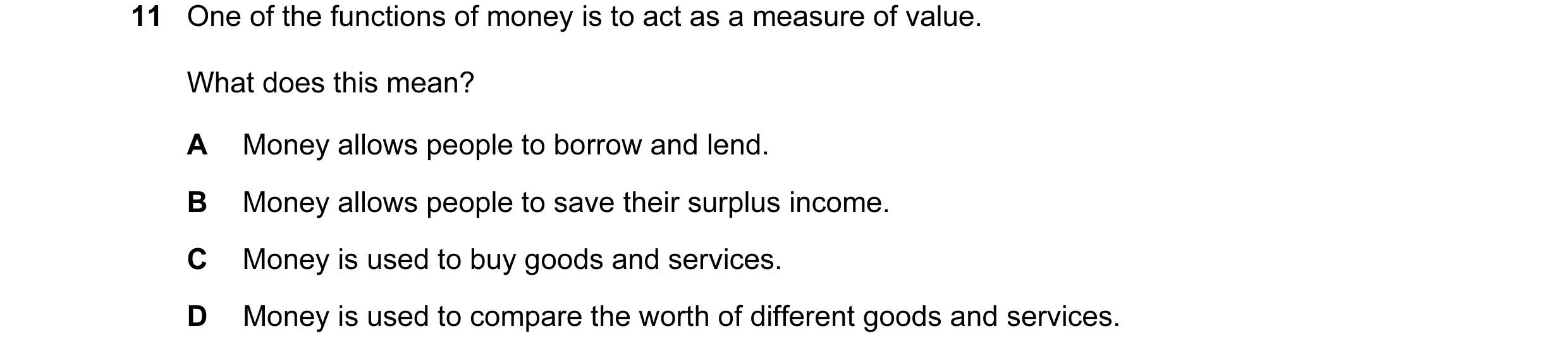


 3 / 22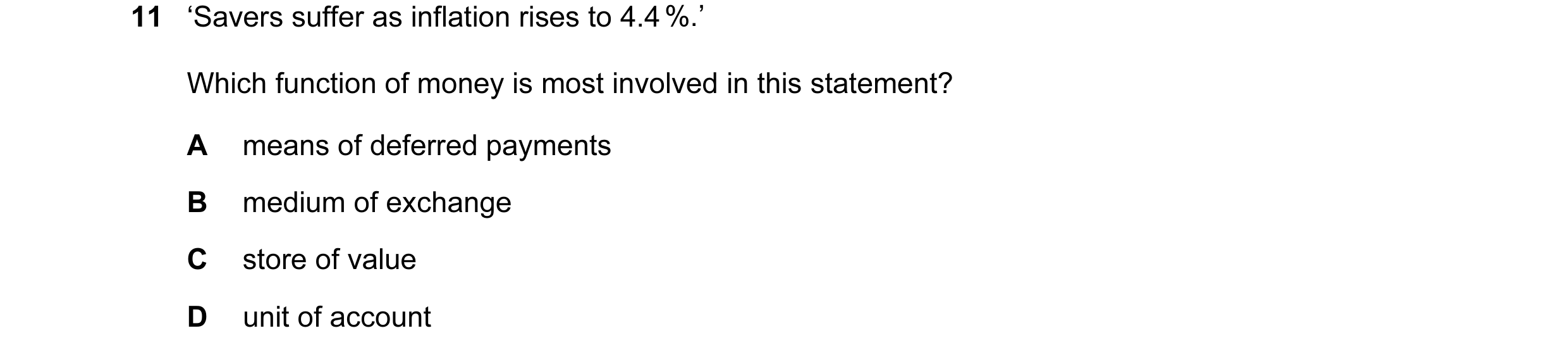


 4 / 22



 5 / 22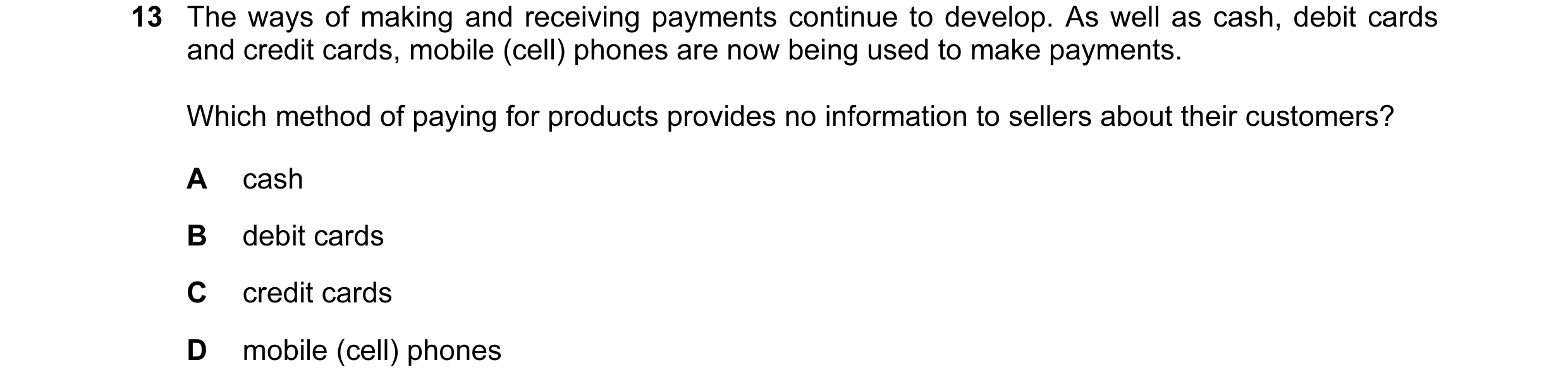



 6 / 22



 7 / 22



 8 / 22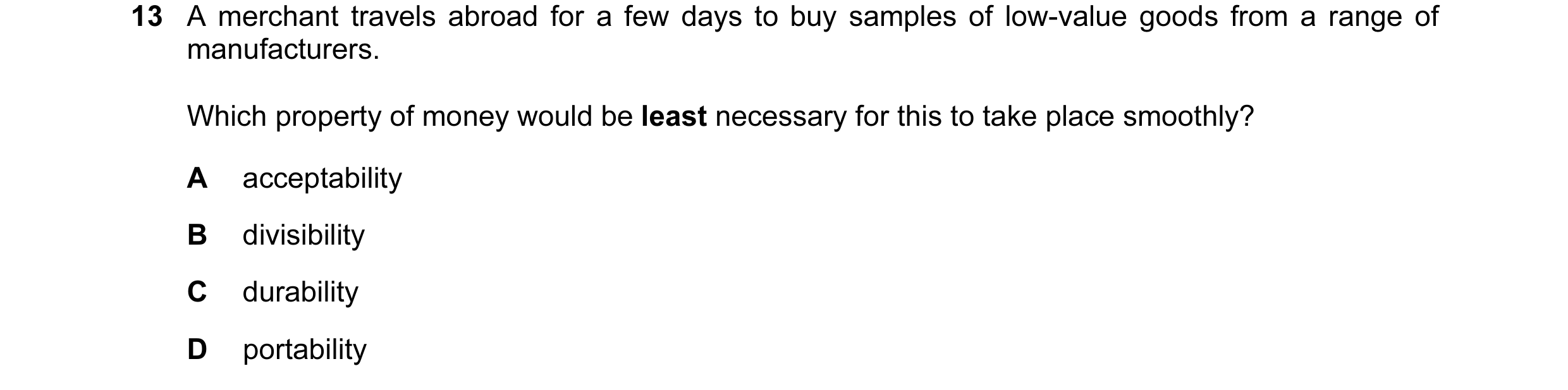


 9 / 22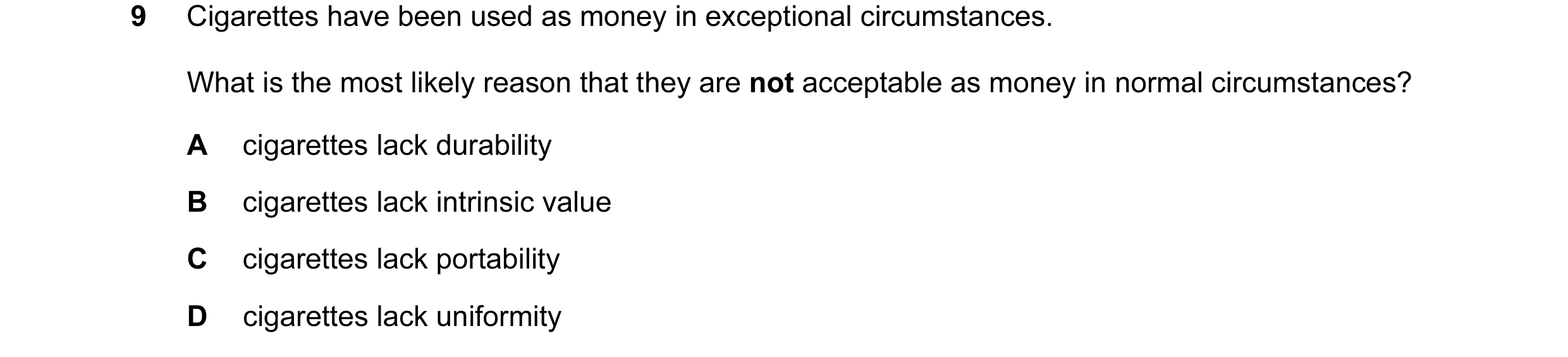

 10 / 22



 11 / 22


 12 / 22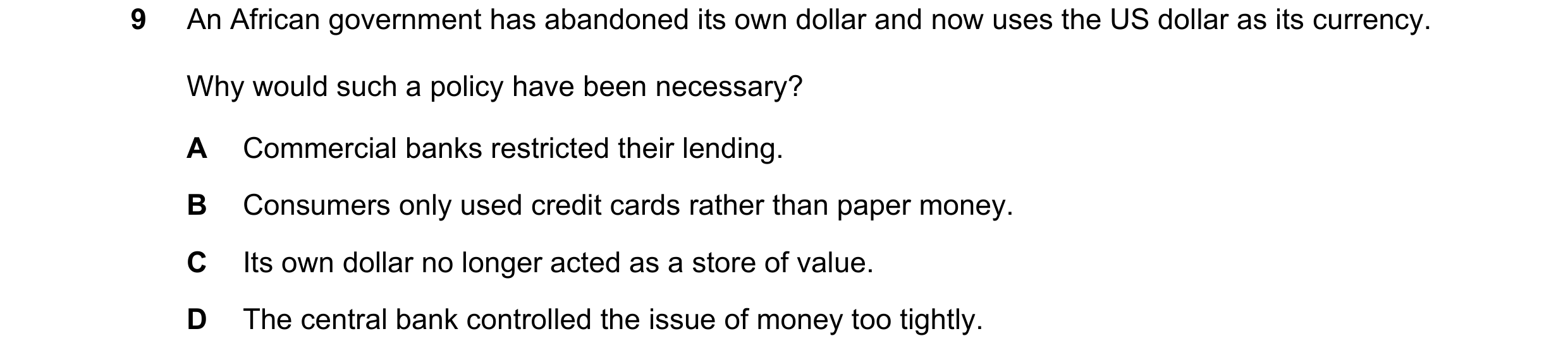


 13 / 22



 14 / 22
 15 / 22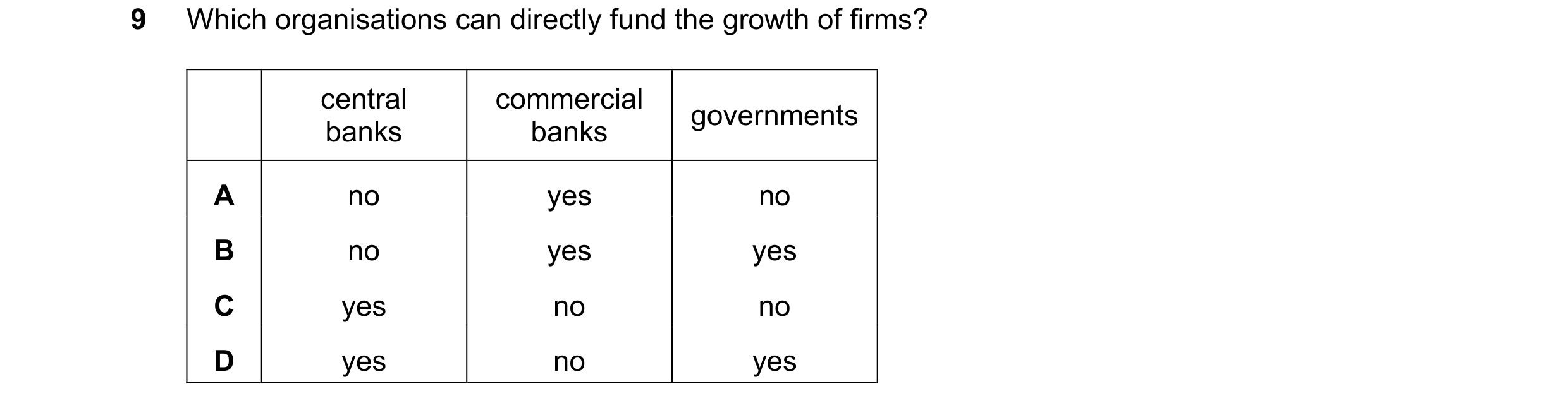
 16 / 22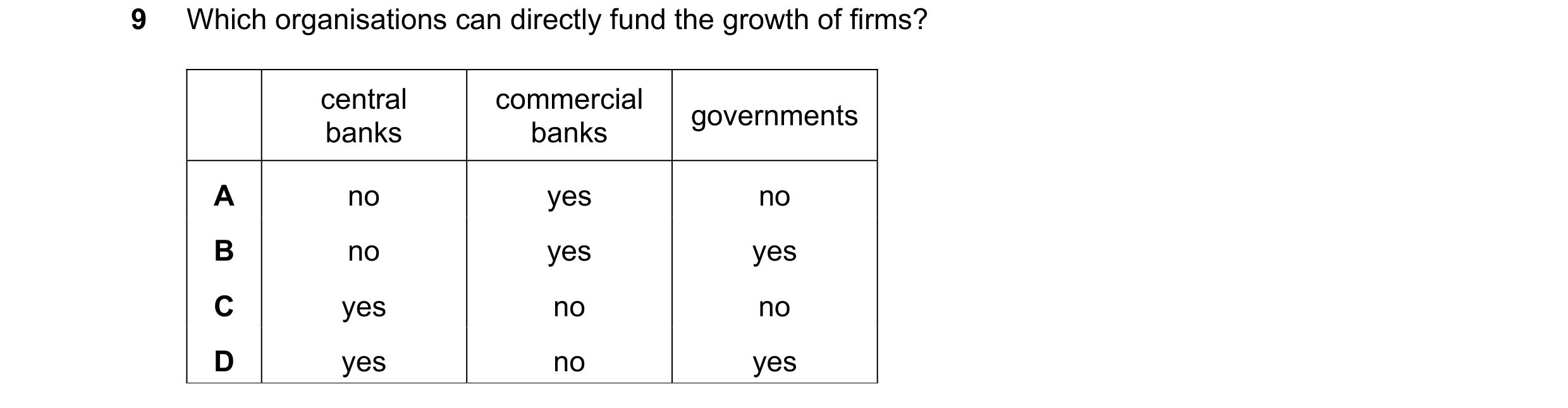


 17 / 22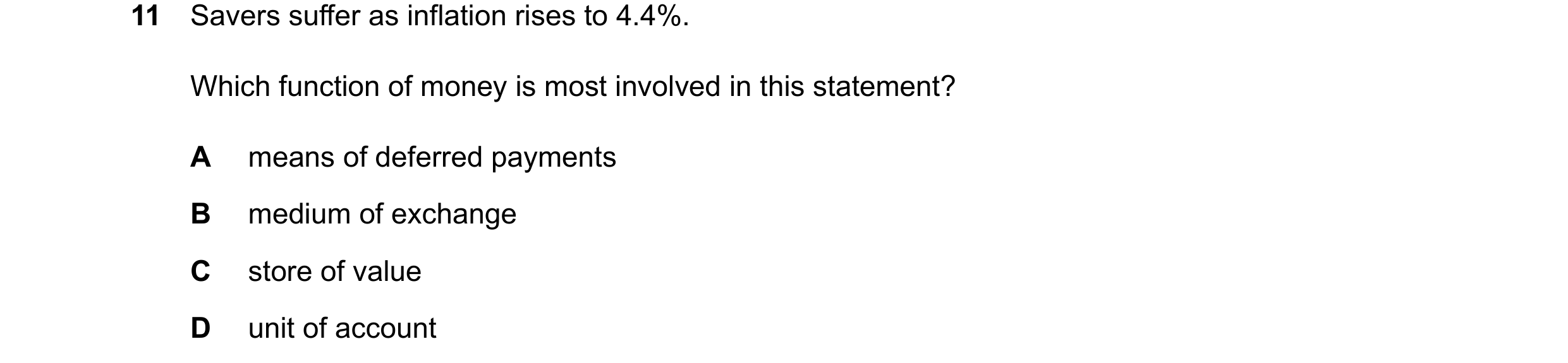

 18 / 22


 19 / 22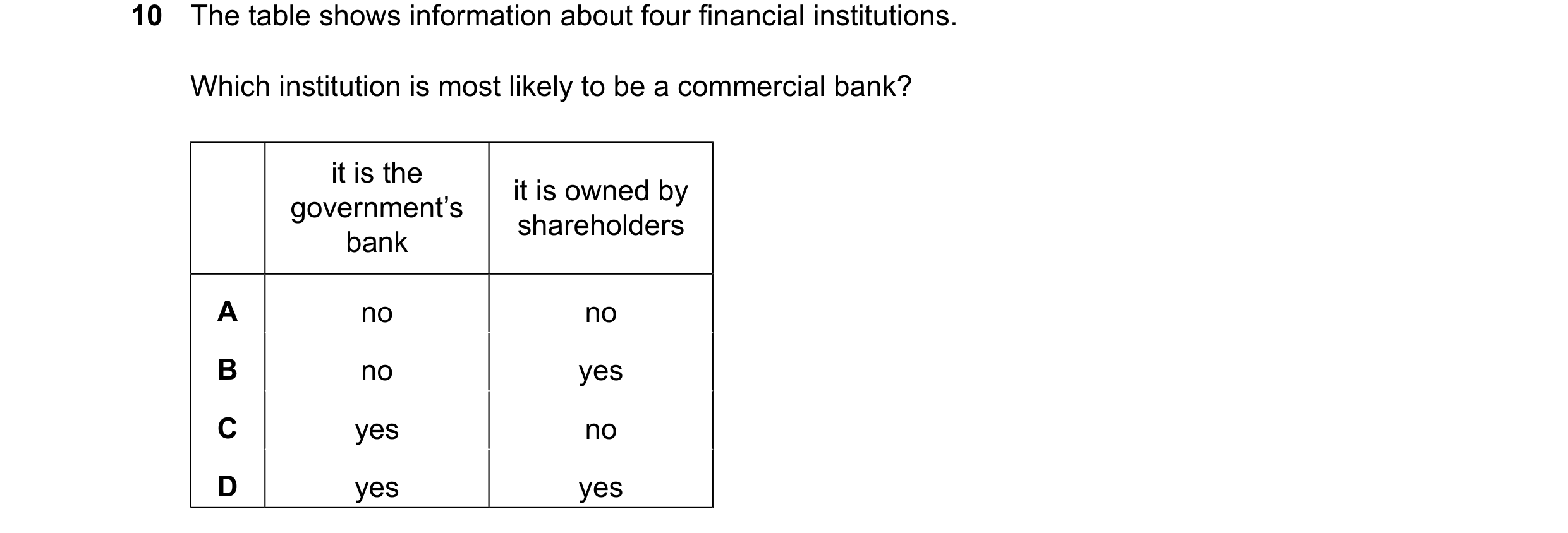




 20 / 22



 21 / 22
 22 / 22