Questions as text
Q1 · Which of the following is an example of the factor of production ‘capital’? 0455/11 Oct/Nov 2004
3 Which of the following is an example of the factor of production ‘capital’? A a truck B a truck driver C a truck driver’s savings D a truck driver’s wage
1 marks
Answer: A
This question in 0455/11 Oct/Nov 2004
Q2 · What is not a factor of production? 0455/11 Oct/Nov 2004
20 What is not a factor of production? A a $10 note B a farm C a printing machine D a teacher
1 marks
Answer: A
This question in 0455/11 Oct/Nov 2004
Q3 · What is regarded as a factor of production? 0455/11 May/June 2006
3 What is regarded as a factor of production? A capital B interest C profit D rent
1 marks
Answer: A
This question in 0455/11 May/June 2006
Q4 · What is an example of the factor of production ‘capital’? 0455/11 May/June 2007
1 What is an example of the factor of production ‘capital’? A a truck B a truck driver C a truck driver’s savings D a truck driver’s wage
1 marks
Answer: A
This question in 0455/11 May/June 2007
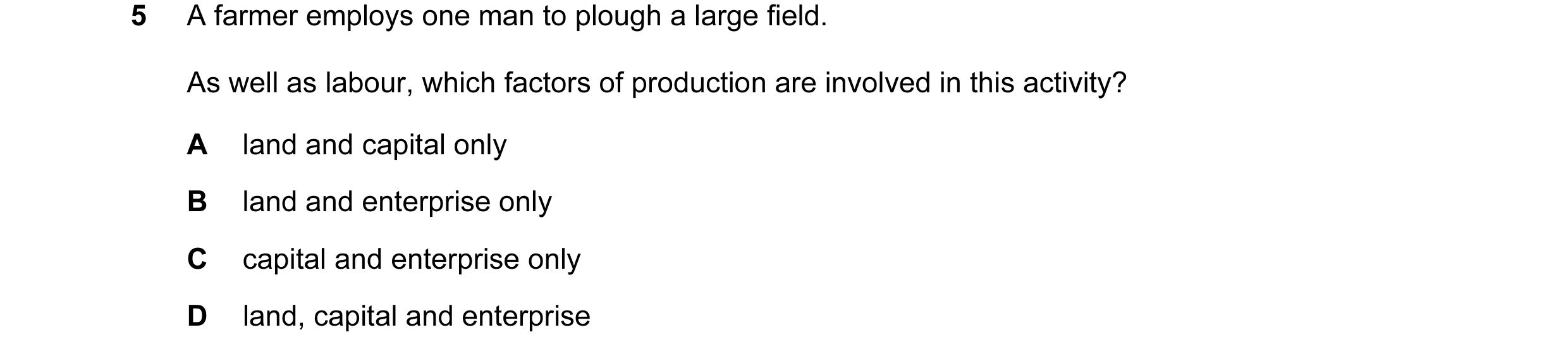
Q5 · A farmer employs one man to plough a large field 0455/11 Oct/Nov 2007
5 A farmer employs one man to plough a large field. As well as labour, which factors of production are involved in this activity? A land and capital only B land and enterprise only C capital and enterprise only D land, capital and enterprise
1 marks
Answer: D
This question in 0455/11 Oct/Nov 2007
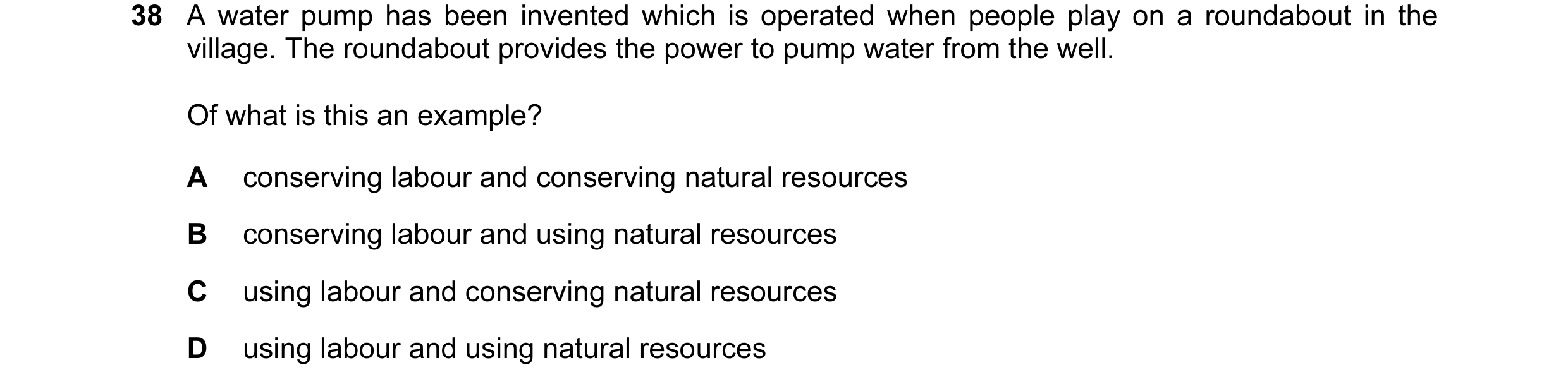
Q6 · A water pump has been invented which is operated when people play on a roundabout in the… 0455/11 Oct/Nov 2007
38 A water pump has been invented which is operated when people play on a roundabout in the village. The roundabout provides the power to pump water from the well. Of what is this an example? A conserving labour and conserving natural resources B conserving labour and using natural resources C using labour and conserving natural resources D using labour and using natural resources
1 marks
Answer: D
This question in 0455/11 Oct/Nov 2007
Q7 · Which of the following is a factor of production? 0455/11 May/June 2008
2 Which of the following is a factor of production? A the payment of interest on a bank loan B the profit declared by a company in its annual report C the skill of the managers of a business D the taxes paid to the government
1 marks
Answer: C
This question in 0455/11 May/June 2008
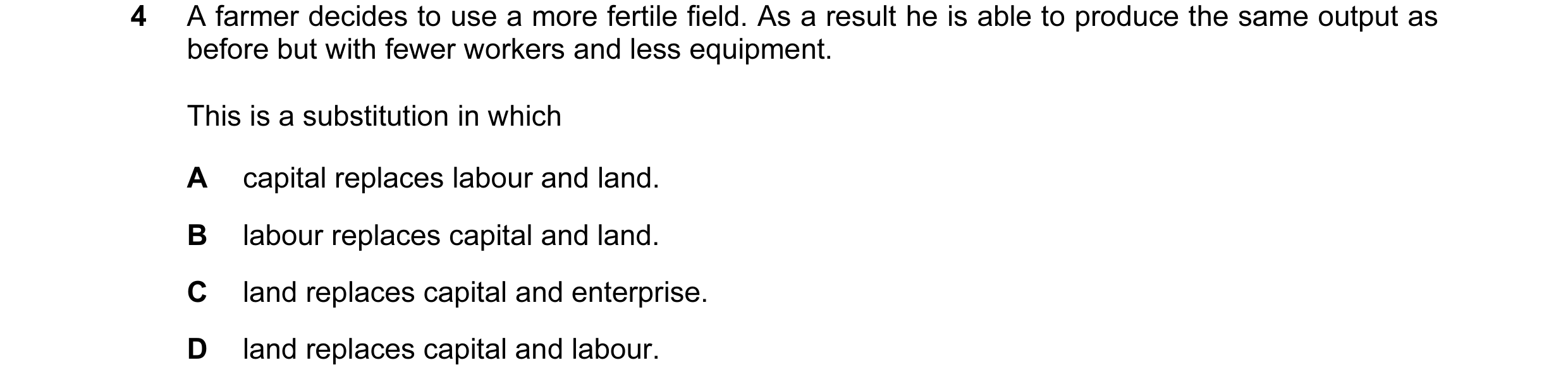
Q8 · A farmer decides to use a more fertile field 0455/11 May/June 2008
4 A farmer decides to use a more fertile field. As a result he is able to produce the same output as before but with fewer workers and less equipment. This is a substitution in which A capital replaces labour and land. B labour replaces capital and land. C land replaces capital and enterprise. D land replaces capital and labour.
1 marks
Answer: D
This question in 0455/11 May/June 2008
Q9 · What is not a factor of production? 0455/11 Oct/Nov 2008
1 What is not a factor of production? A company shares B machinery C raw materials D unskilled workers
1 marks
Answer: A
This question in 0455/11 Oct/Nov 2008
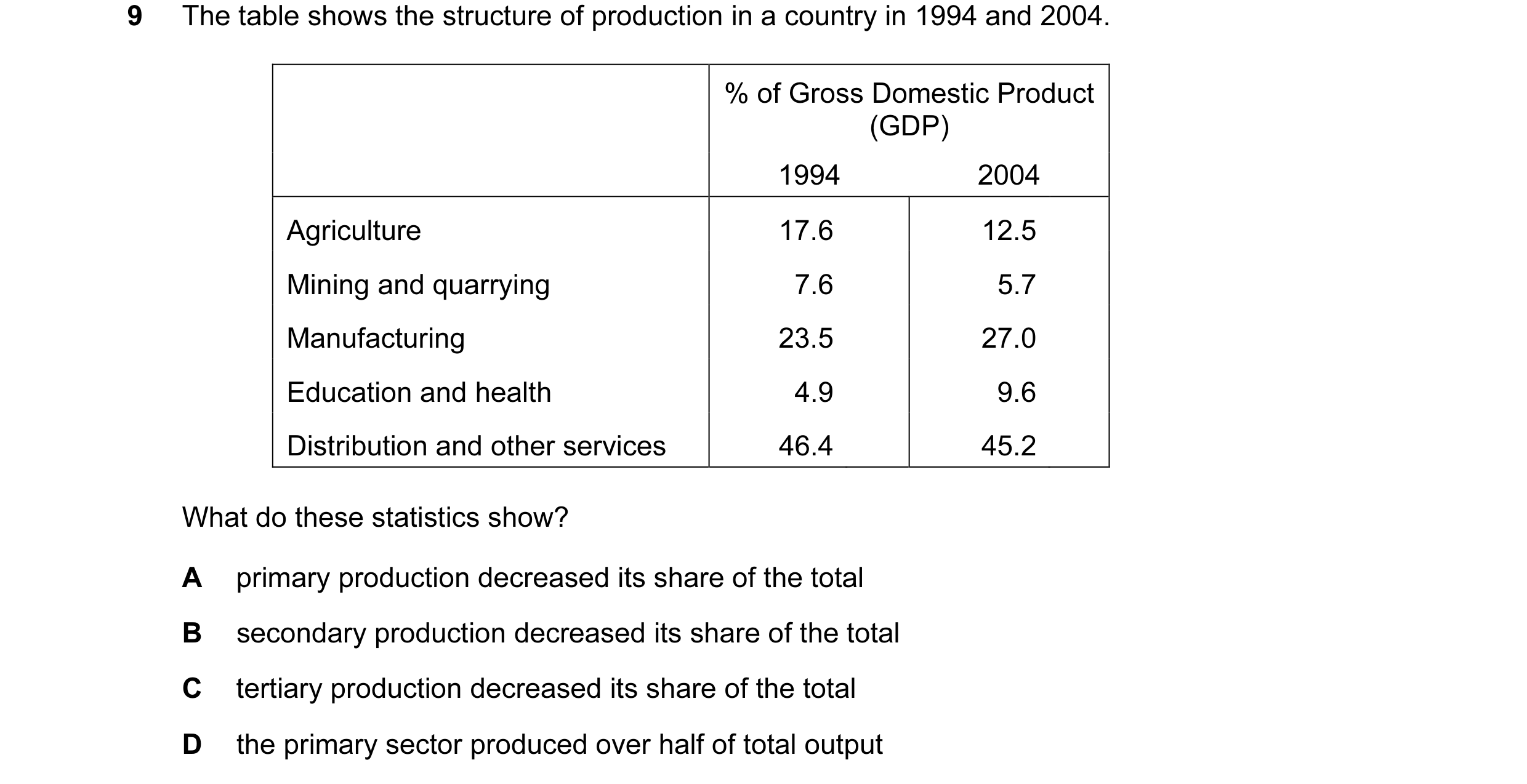
Q10 · The table shows the structure of production in a country in 1994 and 2004 0455/11 Oct/Nov 2008
9 The table shows the structure of production in a country in 1994 and 2004. % of Gross Domestic Product (GDP) 1994 2004 Agriculture 17.6 12.5 Mining and quarrying 7.6 5.7 Manufacturing 23.5 27.0 Education and health 4.9 9.6 Distribution and other services 46.4 45.2 What do these statistics show? A primary production decreased its share of the total B secondary production decreased its share of the total C tertiary production decreased its share of the total D the primary sector produced over half of total output
1 marks
Answer: A
This question in 0455/11 Oct/Nov 2008
Q11 · Which type of income is earned by the factor of production enterprise? 0455/11 Oct/Nov 2008
17 Which type of income is earned by the factor of production enterprise? A interest B profit C rent D wages
1 marks
Answer: B
This question in 0455/11 Oct/Nov 2008
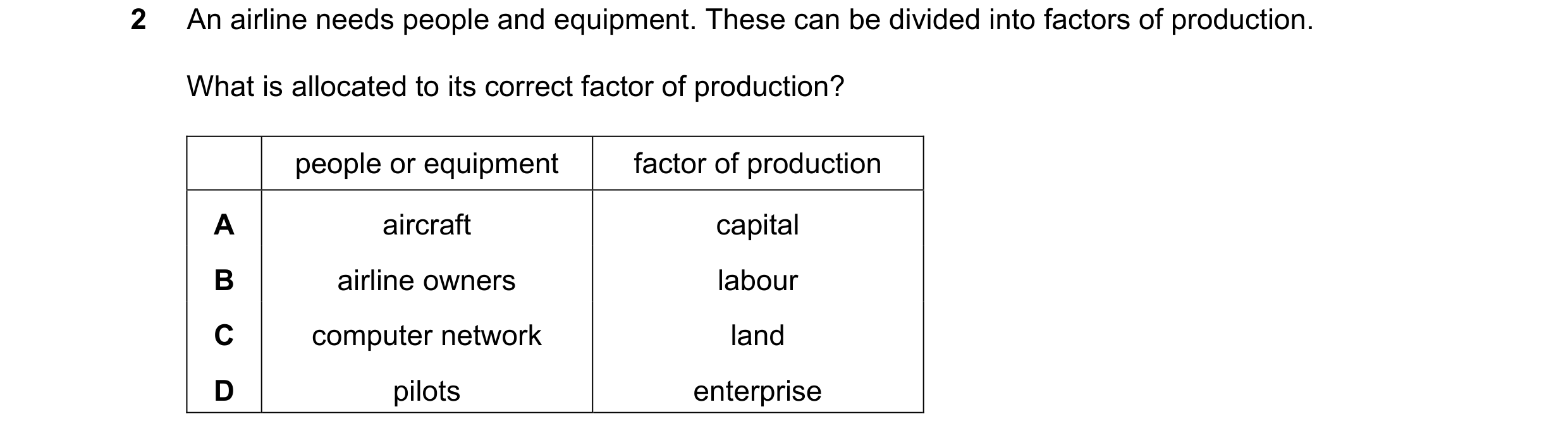
Q12 · A major airline needs a range of people and equipment 0455/11 May/June 2009
2 A major airline needs a range of people and equipment. These can be divided into factors of production. Which is allocated to its correct factor of production? people or equipment factor of production A aircraft capital B computer network land C pilots enterprise D shareholders labour
1 marks
Answer: A
This question in 0455/11 May/June 2009
Q13 · Who is definitely employed in the primary sector? 0455/11 May/June 2009
4 Who is definitely employed in the primary sector? A a person in a firm producing goods for other firms to use B a person in a firm engaged in agricultural production C a person in an organisation which first deals with any imports into the country D a person in the head office of a company
1 marks
Answer: B
This question in 0455/11 May/June 2009
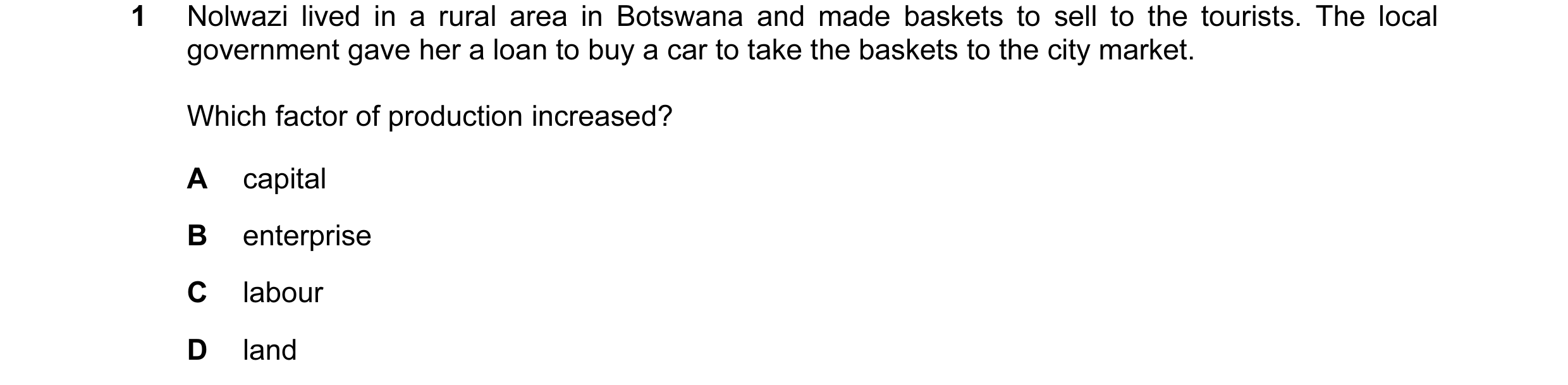
Q14 · Nolwazi lived in a rural area in Botswana and made baskets to sell to the tourists 0455/11 Oct/Nov 2009
1 Nolwazi lived in a rural area in Botswana and made baskets to sell to the tourists. The local government gave her a loan to buy a car to take the baskets to the city market. Which factor of production increased? A capital B enterprise C labour D land
1 marks
Answer: A
This question in 0455/11 Oct/Nov 2009
Q15 · Which statement about the factors of production is correct? 0455/11 May/June 2010
2 Which statement about the factors of production is correct? A A river from which a company draws water is called land. B Raising finance for a company is called capital. C Supervisors employed in a company are called enterprise. D The owner of a company is called labour.
1 marks
Answer: A
This question in 0455/11 May/June 2010
Q16 · Which statement about the factors of production is correct? 0455/12 May/June 2010
1 Which statement about the factors of production is correct? A A river from which a company draws water is called land. B Raising finance for a company is called capital. C Supervisors employed in a company are called enterprise. D The owner of a company is called labour.
1 marks
Answer: A
This question in 0455/12 May/June 2010
Q17 · What is a factor of production? 0455/11 Oct/Nov 2010
2 What is a factor of production? A an advantage of producing on a large scale B a resource used to produce goods and services C a sub-section of a manufacturing process D a unit of output
1 marks
Answer: B
This question in 0455/11 Oct/Nov 2010
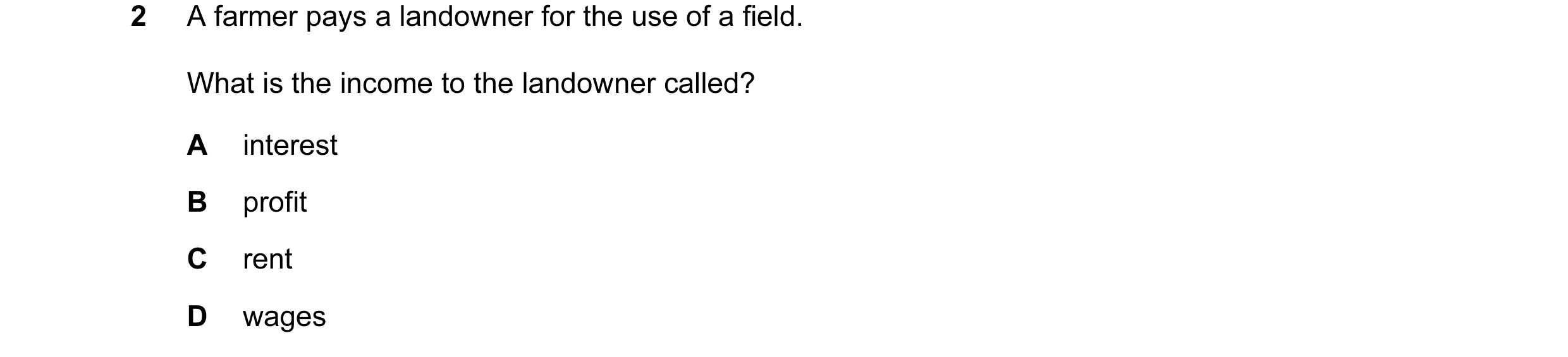
Q18 · A farmer pays a landowner for the use of a field 0455/11 Oct/Nov 2010
4 A farmer pays a landowner for the use of a field. What is the income to the landowner called? A interest B profit C rent D wages
1 marks
Answer: C
This question in 0455/11 Oct/Nov 2010
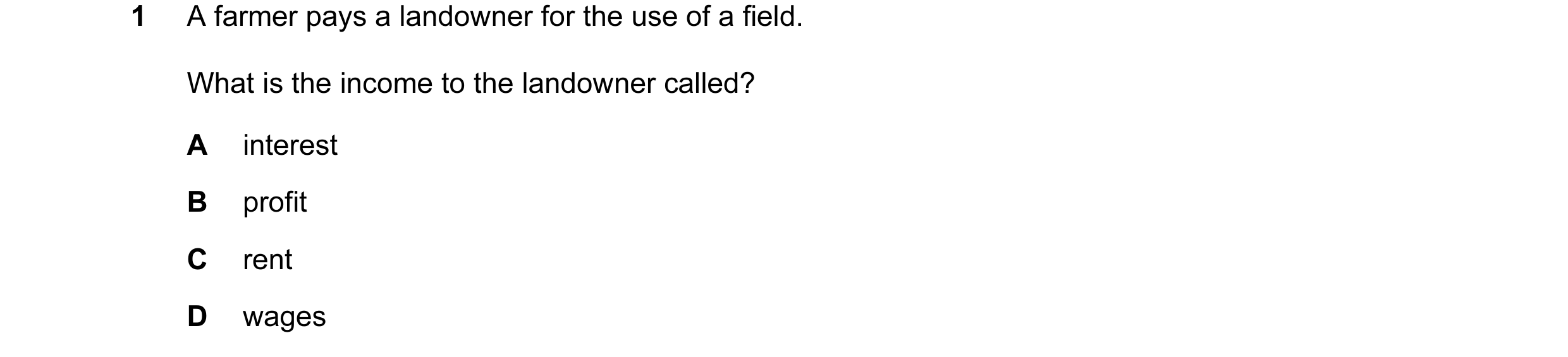
Q19 · A farmer pays a landowner for the use of a field 0455/12 Oct/Nov 2010
1 A farmer pays a landowner for the use of a field. What is the income to the landowner called? A interest B profit C rent D wages
1 marks
Answer: C
This question in 0455/12 Oct/Nov 2010
Q20 · What is a factor of production? 0455/12 Oct/Nov 2010
3 What is a factor of production? A an advantage of producing on a large scale B a resource used to produce goods and services C a sub-section of a manufacturing process D a unit of output
1 marks
Answer: B
This question in 0455/12 Oct/Nov 2010
Q21 · A farmer pays a landowner for the use of a field 0455/13 Oct/Nov 2010
2 A farmer pays a landowner for the use of a field. What is the income to the landowner called? A interest B profit C rent D wages
1 marks
Answer: C
This question in 0455/13 Oct/Nov 2010
Q22 · What is a factor of production? 0455/13 Oct/Nov 2010
4 What is a factor of production? A an advantage of producing on a large scale B a resource used to produce goods and services C a sub-section of a manufacturing process D a unit of output
1 marks
Answer: B
This question in 0455/13 Oct/Nov 2010
Q23 · Each of the factors of production earns an income 0455/11 May/June 2011
2 Each of the factors of production earns an income. What are the incomes for land and capital? land capital A rent interest B rent profit C wages interest D wages profit
1 marks
Answer: A
This question in 0455/11 May/June 2011
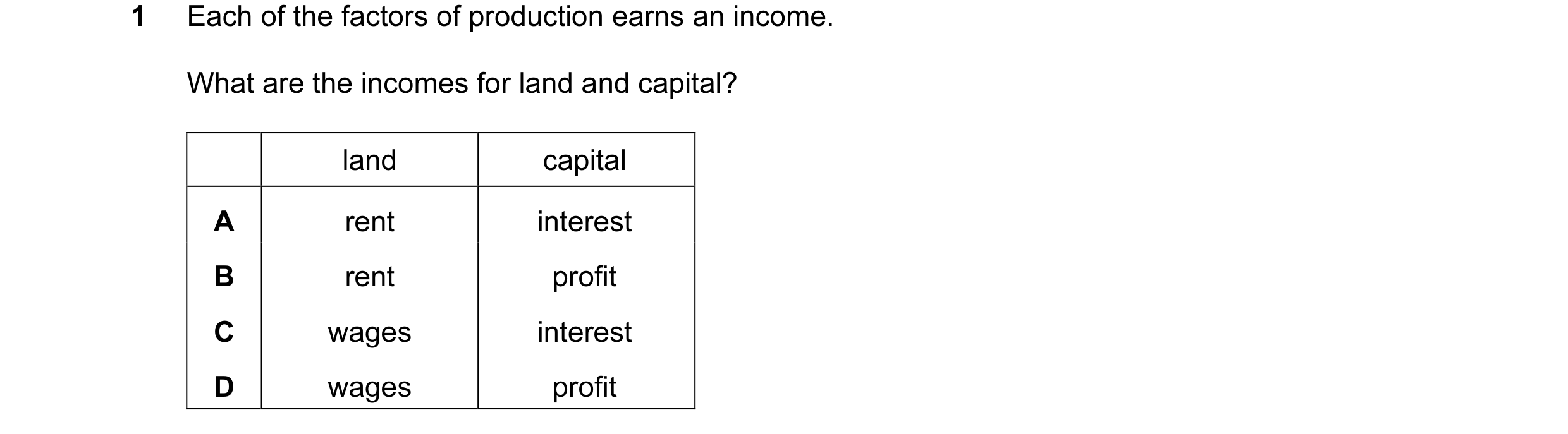
Q24 · Each of the factors of production earns an income 0455/12 May/June 2011
1 Each of the factors of production earns an income. What are the incomes for land and capital? land capital A rent interest B rent profit C wages interest D wages profit
1 marks
Answer: A
This question in 0455/12 May/June 2011
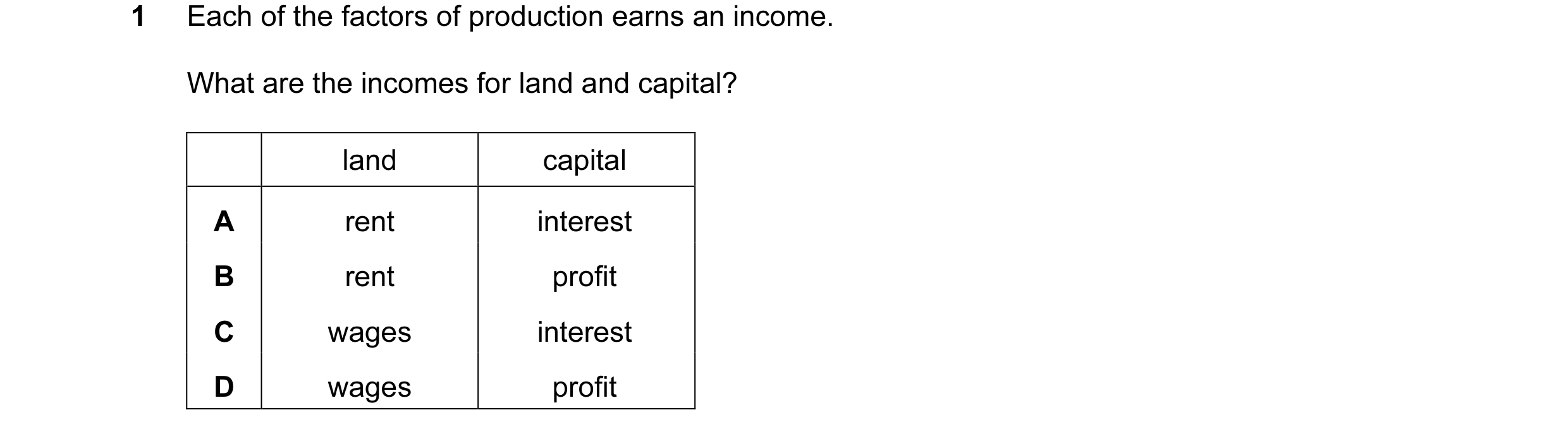
Q25 · Each of the factors of production earns an income 0455/13 May/June 2011
1 Each of the factors of production earns an income. What are the incomes for land and capital? land capital A rent interest B rent profit C wages interest D wages profit
1 marks
Answer: A
This question in 0455/13 May/June 2011
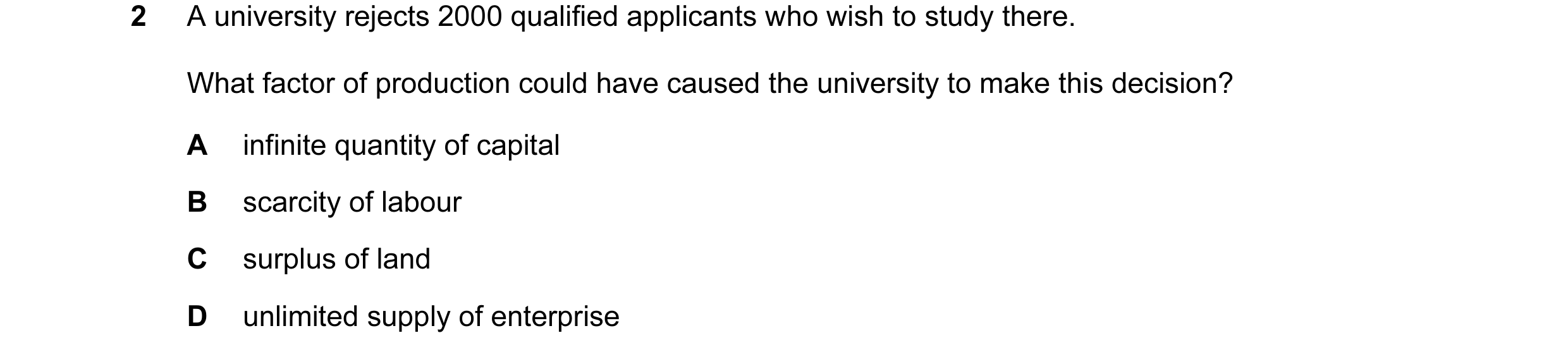
Q26 · A university rejects 2000 qualified applicants who wish to study there 0455/11 Oct/Nov 2011
2 A university rejects 2000 qualified applicants who wish to study there. What factor of production could have caused the university to make this decision? A infinite quantity of capital B scarcity of labour C surplus of land D unlimited supply of enterprise
1 marks
Answer: B
This question in 0455/11 Oct/Nov 2011
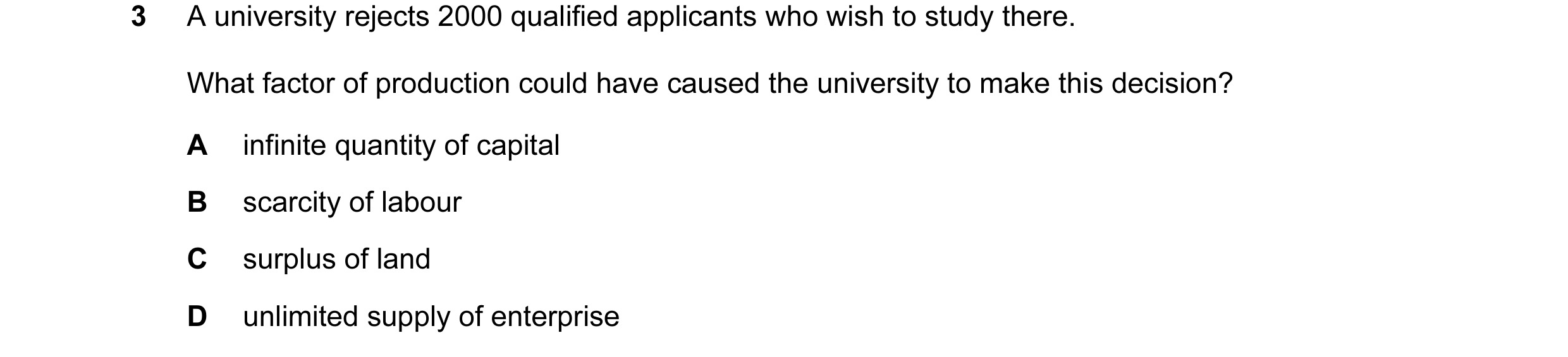
Q27 · A university rejects 2000 qualified applicants who wish to study there 0455/12 Oct/Nov 2011
3 A university rejects 2000 qualified applicants who wish to study there. What factor of production could have caused the university to make this decision? A infinite quantity of capital B scarcity of labour C surplus of land D unlimited supply of enterprise
1 marks
Answer: B
This question in 0455/12 Oct/Nov 2011
Q28 · A university rejects 2000 qualified applicants who wish to study there 0455/13 Oct/Nov 2011
1 A university rejects 2000 qualified applicants who wish to study there. What factor of production could have caused the university to make this decision? A infinite quantity of capital B scarcity of labour C surplus of land D unlimited supply of enterprise
1 marks
Answer: B
This question in 0455/13 Oct/Nov 2011
Q29 · What does an economist mean by capital? 0455/11 May/June 2012
2 What does an economist mean by capital? A man-made goods that do not directly satisfy human wants B money used to set up new businesses and expand existing businesses C natural resources that will not be replaced D the ability to earn profits by combining resources to produce goods
1 marks
Answer: A
This question in 0455/11 May/June 2012
Q30 · Which statement about the factors of production is correct? 0455/12 May/June 2012
2 Which statement about the factors of production is correct? A Capital includes factories and machinery but not roads and ports. B Enterprise is more often found in the public sector rather than the private sector. C Labour is the factor that takes risks and can become unemployed. D Land is the natural factor that can be improved by human action.
1 marks
Answer: D
This question in 0455/12 May/June 2012
Q31 · Which statement about the factors of production is correct? 0455/13 May/June 2012
2 Which statement about the factors of production is correct? A Capital includes factories and machinery but not roads and ports. B Enterprise is more often found in the public sector rather than the private sector. C Labour is the factor that takes risks and can become unemployed. D Land is the natural factor that can be improved by human action.
1 marks
Answer: D
This question in 0455/13 May/June 2012
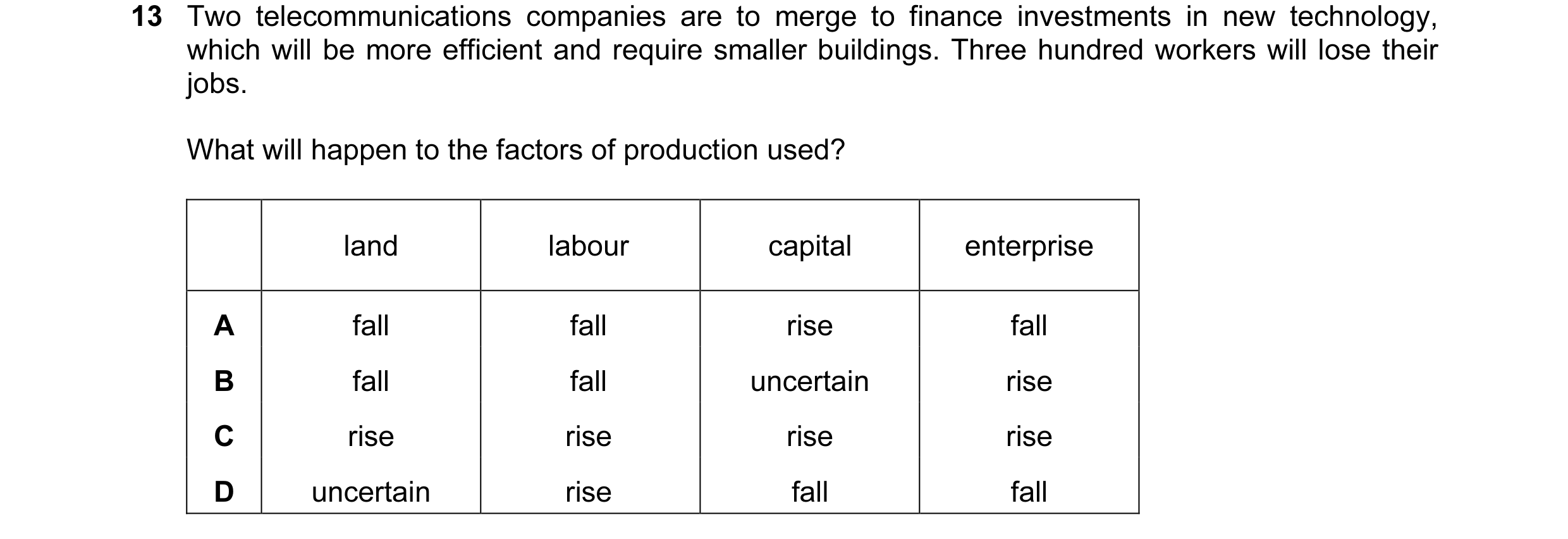
Q32 · Two telecommunications companies are to merge to finance investments in new technology… 0455/11 Oct/Nov 2012
13 Two telecommunications companies are to merge to finance investments in new technology, which will be more efficient and require smaller buildings. Three hundred workers will lose their jobs. What will happen to the factors of production used? land labour capital enterprise A fall fall rise fall B fall fall uncertain rise C rise rise rise rise D uncertain rise fall fall
1 marks
Answer: B
This question in 0455/11 Oct/Nov 2012
Q33 · Two telecommunications companies are to merge to finance investments in new technology… 0455/12 Oct/Nov 2012
3 Two telecommunications companies are to merge to finance investments in new technology, which will be more efficient and require smaller buildings. Three hundred workers will lose their jobs. What will happen to the factors of production used? land labour capital enterprise A fall fall rise fall B fall fall uncertain rise C rise rise rise rise D uncertain rise fall fall
1 marks
Answer: B
This question in 0455/12 Oct/Nov 2012
Q34 · As the need for energy increases, energy suppliers use a mix of resources 0455/13 Oct/Nov 2012
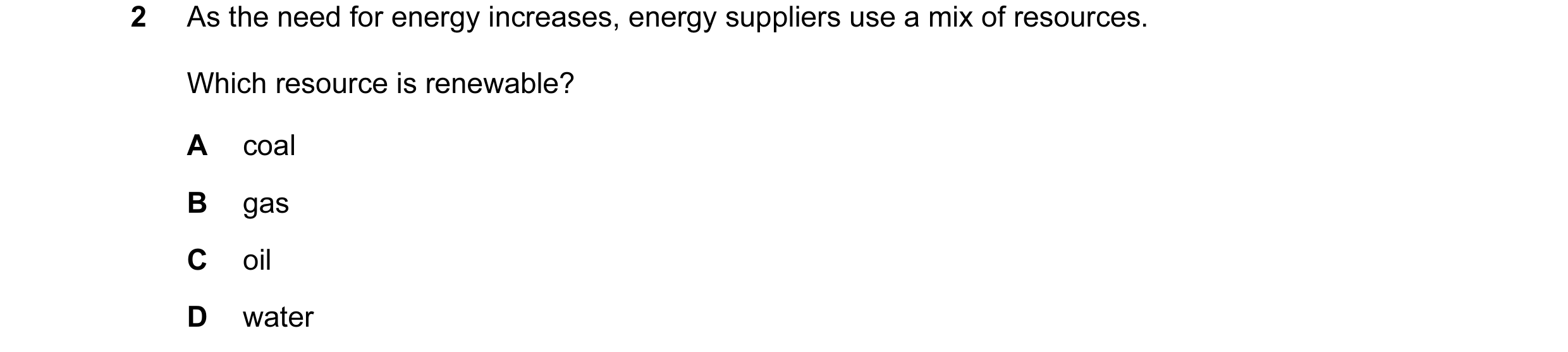
2 As the need for energy increases, energy suppliers use a mix of resources. Which resource is renewable? A coal B gas C oil D water
1 marks
Answer: D
This question in 0455/13 Oct/Nov 2012
Q35 · A public limited company delivers groceries which customers order on the Internet 0455/13 Oct/Nov 2012
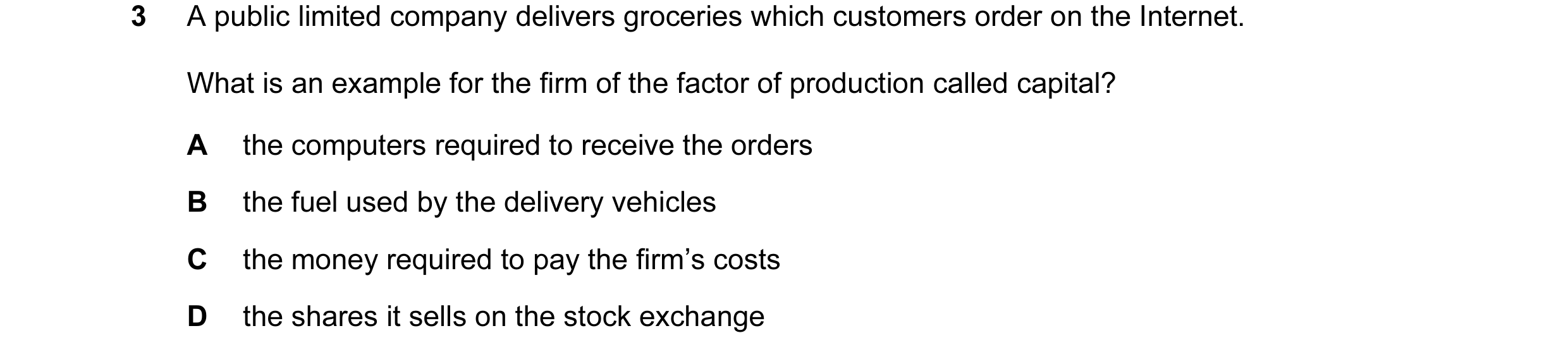
3 A public limited company delivers groceries which customers order on the Internet. What is an example for the firm of the factor of production called capital? A the computers required to receive the orders B the fuel used by the delivery vehicles C the money required to pay the firm’s costs D the shares it sells on the stock exchange
1 marks
Answer: A
This question in 0455/13 Oct/Nov 2012
Q36 · Reena makes a living by selling paintings of the town in which she lives 0455/12 May/June 2013
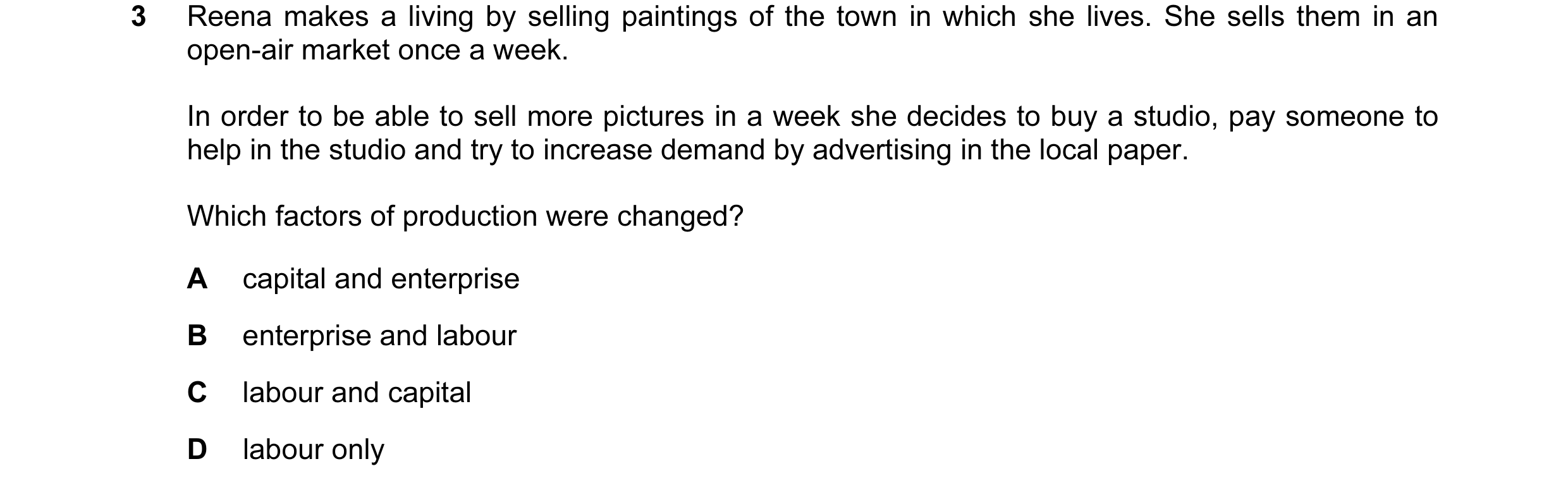
3 Reena makes a living by selling paintings of the town in which she lives. She sells them in an open-air market once a week. In order to be able to sell more pictures in a week she decides to buy a studio, pay someone to help in the studio and try to increase demand by advertising in the local paper. Which factors of production were changed? A capital and enterprise B enterprise and labour C labour and capital D labour only
1 marks
Answer: C
This question in 0455/12 May/June 2013
Q37 · In which case is it possible to set the level of reward before production takes place for… 0455/11 Oct/Nov 2013
12 In which case is it possible to set the level of reward before production takes place for the first factor of production but not for the second? first factor second factor A capital land B enterprise labour C labour capital D land enterprise
1 marks
Answer: D
This question in 0455/11 Oct/Nov 2013
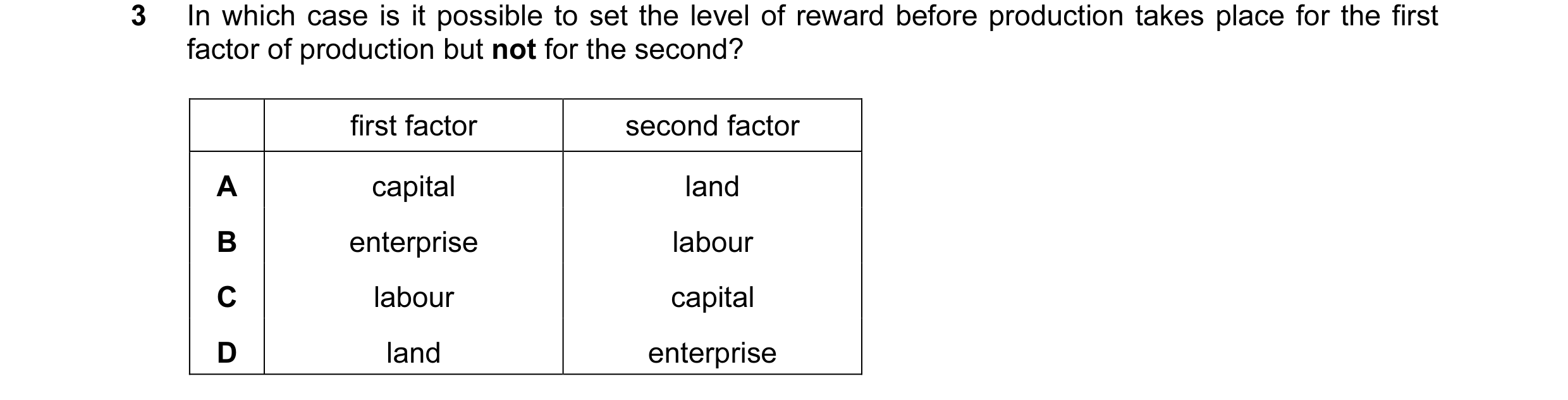
Q38 · In which case is it possible to set the level of reward before production takes place for… 0455/12 Oct/Nov 2013
3 In which case is it possible to set the level of reward before production takes place for the first factor of production but not for the second? first factor second factor A capital land B enterprise labour C labour capital D land enterprise
1 marks
Answer: D
This question in 0455/12 Oct/Nov 2013
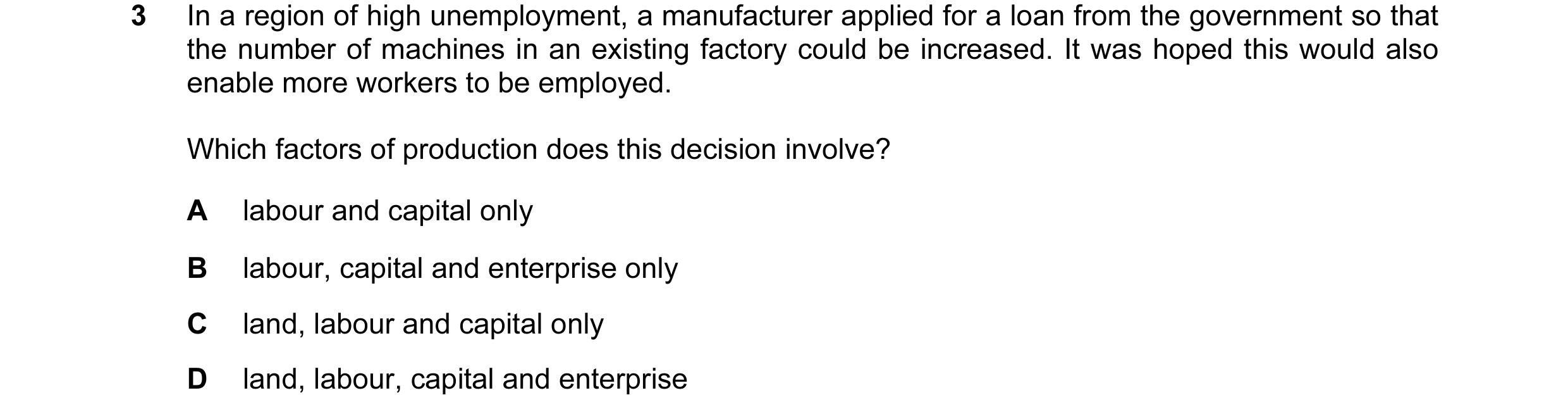
Q39 · In a region of high unemployment, a manufacturer applied for a loan from the government… 0455/13 Oct/Nov 2013
3 In a region of high unemployment, a manufacturer applied for a loan from the government so that the number of machines in an existing factory could be increased. It was hoped this would also enable more workers to be employed. Which factors of production does this decision involve? A labour and capital only B labour, capital and enterprise only C land, labour and capital only D land, labour, capital and enterprise
1 marks
Answer: B
This question in 0455/13 Oct/Nov 2013
Q40 · What is most likely to reduce the supply of factors of production in an economy? 0455/11 May/June 2014
3 What is most likely to reduce the supply of factors of production in an economy? A increasing the age of retirement B introducing new methods of irrigation C lowering the cost of borrowing from banks D raising the rate of tax on profits
1 marks
Answer: D
This question in 0455/11 May/June 2014
Q41 · What is a factor of production? 0455/12 May/June 2014
3 What is a factor of production? A a semi-skilled, young worker B direct taxes received by a government C shares in a manufacturing company D stocks of money held a bank
1 marks
Answer: A
This question in 0455/12 May/June 2014
Q42 · What is most likely to reduce the supply of factors of production in an economy? 0455/13 May/June 2014
2 What is most likely to reduce the supply of factors of production in an economy? A increasing the age of retirement B introducing new methods of irrigation C lowering the cost of borrowing from banks D raising the rate of tax on profits
1 marks
Answer: D
This question in 0455/13 May/June 2014
Q43 · Which statement about the factors of production is correct? 0455/11 Oct/Nov 2014
3 Which statement about the factors of production is correct? A Capital includes man-made machines that do not keep their original value. B Enterprise is a natural factor of production that cannot be taught. C Labour is an immobile factor that does not change its skill level. D Land is only agricultural fields that cannot be improved by human effort.
1 marks
Answer: A
This question in 0455/11 Oct/Nov 2014
Q44 · Which statement about the factors of production is correct? 0455/12 Oct/Nov 2014
2 Which statement about the factors of production is correct? A Capital includes man-made machines that do not keep their original value. B Enterprise is a natural factor of production that cannot be taught. C Labour is an immobile factor that does not change its skill level. D Land is only agricultural fields that cannot be improved by human effort.
1 marks
Answer: A
This question in 0455/12 Oct/Nov 2014
Q45 · Which resource is an example of capital used in the fishing industry? 0455/13 Oct/Nov 2014
1 Which resource is an example of capital used in the fishing industry? A a fishing boat B fish C owners of firms in the industry D skilled workers in the industry
1 marks
Answer: A
This question in 0455/13 Oct/Nov 2014
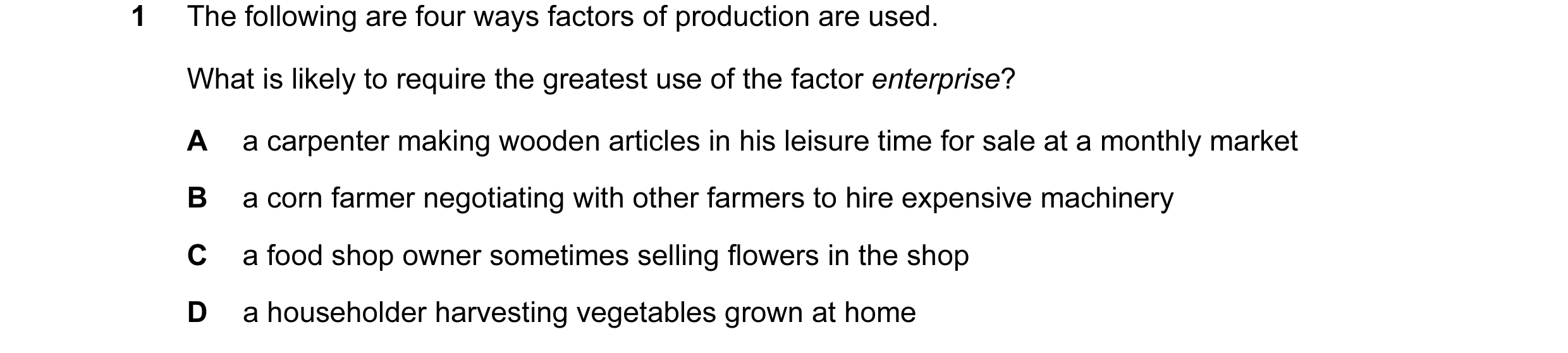
Q46 · The following are four ways factors of production are used 0455/11 May/June 2015
1 The following are four ways factors of production are used. What is likely to require the greatest use of the factor enterprise? A a carpenter making wooden articles in his leisure time for sale at a monthly market B a corn farmer negotiating with other farmers to hire expensive machinery C a food shop owner sometimes selling flowers in the shop D a householder harvesting vegetables grown at home
1 marks
Answer: B
This question in 0455/11 May/June 2015
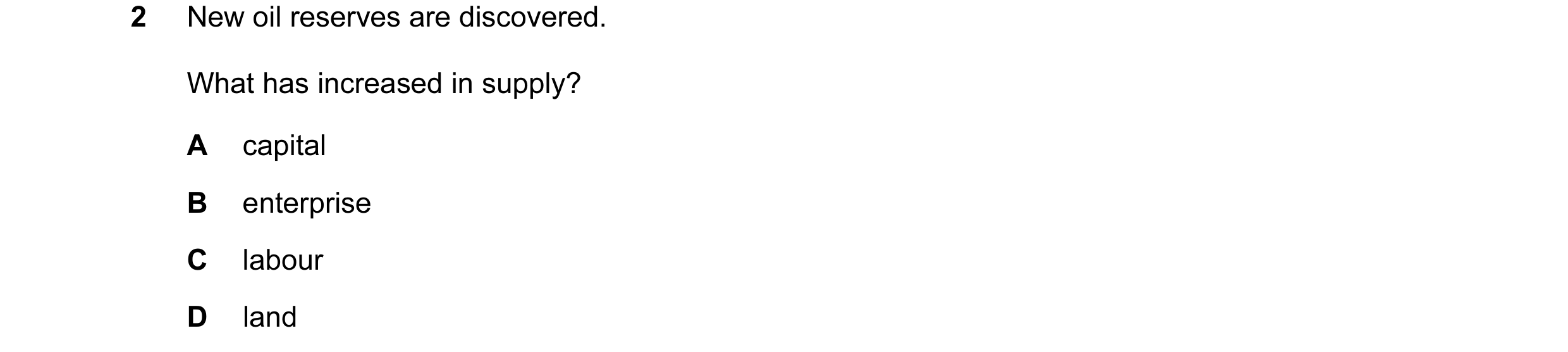
Q47 · New oil reserves are discovered 0455/12 May/June 2015
2 New oil reserves are discovered. What has increased in supply? A capital B enterprise C labour D land
1 marks
Answer: D
This question in 0455/12 May/June 2015
Q48 · Each of the factors of production earns an income 0455/13 May/June 2015
1 Each of the factors of production earns an income. What are the incomes for capital and enterprise? capital enterprise A interest profit B interest wages C profit interest D profit rent
1 marks
Answer: A
This question in 0455/13 May/June 2015
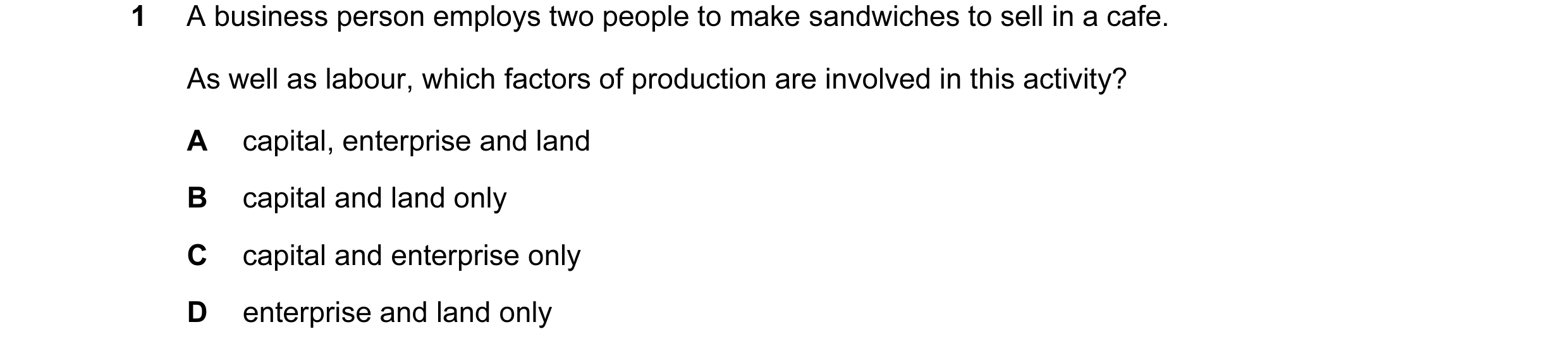
Q49 · A business person employs two people to make sandwiches to sell in a cafe 0455/11 Oct/Nov 2015
1 A business person employs two people to make sandwiches to sell in a cafe. As well as labour, which factors of production are involved in this activity? A capital, enterprise and land B capital and land only C capital and enterprise only D enterprise and land only
1 marks
Answer: A
This question in 0455/11 Oct/Nov 2015
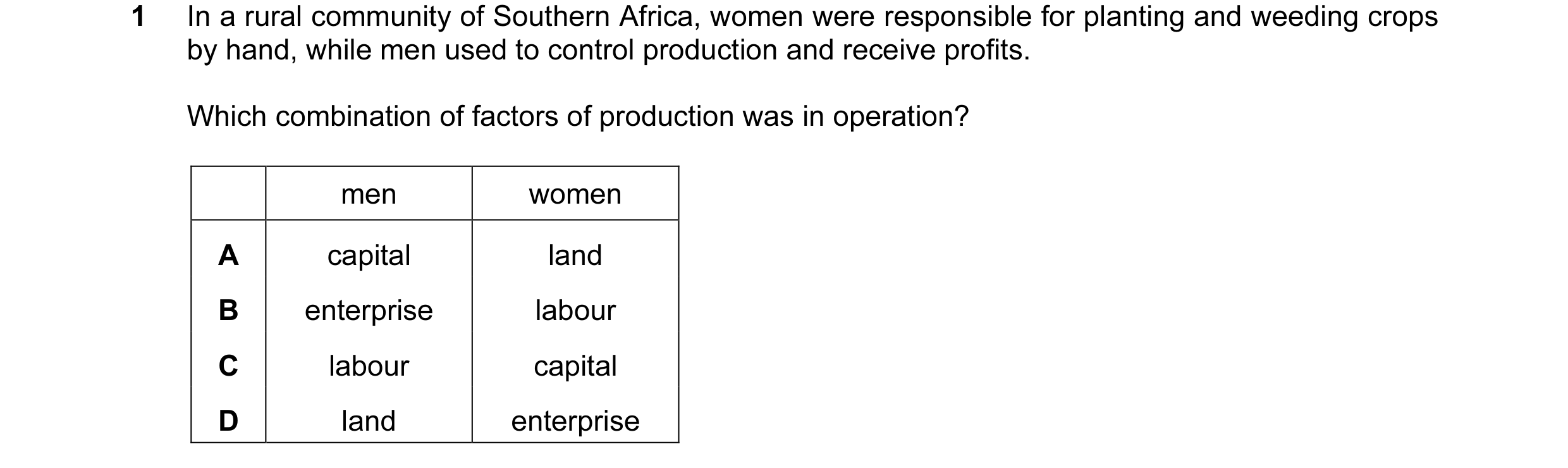
Q50 · In a rural community of Southern Africa, women were responsible for planting and weeding… 0455/12 Oct/Nov 2015
1 In a rural community of Southern Africa, women were responsible for planting and weeding crops by hand, while men used to control production and receive profits. Which combination of factors of production was in operation? men women A capital land B enterprise labour C labour capital D land enterprise
1 marks
Answer: B
This question in 0455/12 Oct/Nov 2015
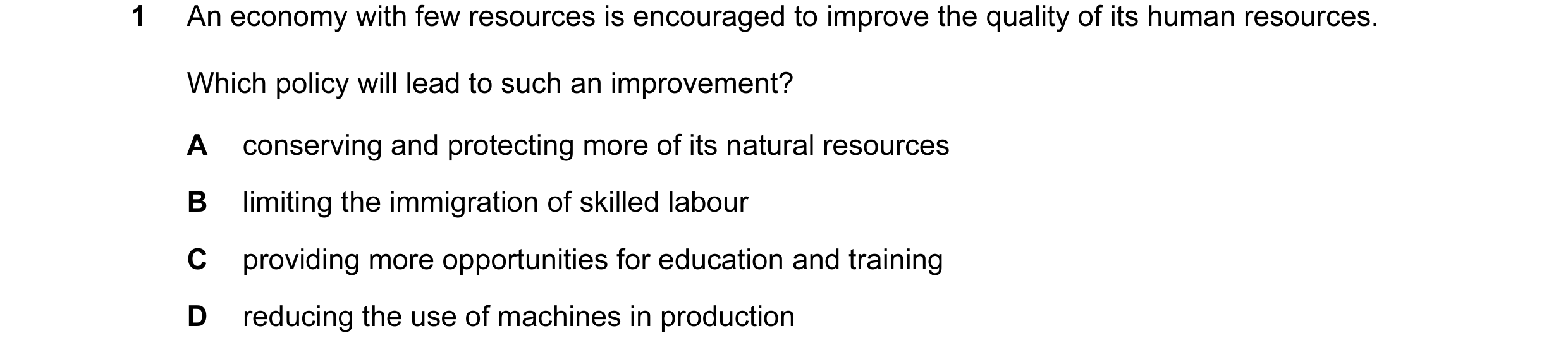
Q51 · An economy with few resources is encouraged to improve the quality of its human resources 0455/12 Feb/March 2016
1 An economy with few resources is encouraged to improve the quality of its human resources. Which policy will lead to such an improvement? A conserving and protecting more of its natural resources B limiting the immigration of skilled labour C providing more opportunities for education and training D reducing the use of machines in production
1 marks
Answer: C
This question in 0455/12 Feb/March 2016
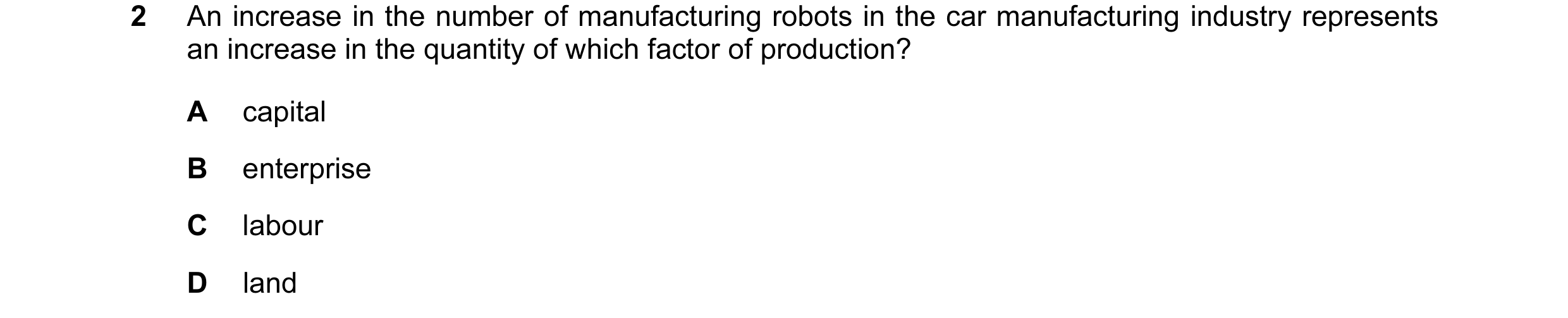
Q52 · An increase in the number of manufacturing robots in the car manufacturing industry… 0455/11 May/June 2016
2 An increase in the number of manufacturing robots in the car manufacturing industry represents an increase in the quantity of which factor of production? A capital B enterprise C labour D land
1 marks
Answer: A
This question in 0455/11 May/June 2016
Q53 · Which firm is likely to find it most difficult to expand the use of its main factor of… 0455/13 May/June 2016
2 Which firm is likely to find it most difficult to expand the use of its main factor of production? A a farm growing crops in extensive fields B a technology firm dependent on risky innovations C a textile firm making use of labour-intensive systems D an engineering firm relying upon capital-intensive methods
1 marks
Answer: A
This question in 0455/13 May/June 2016
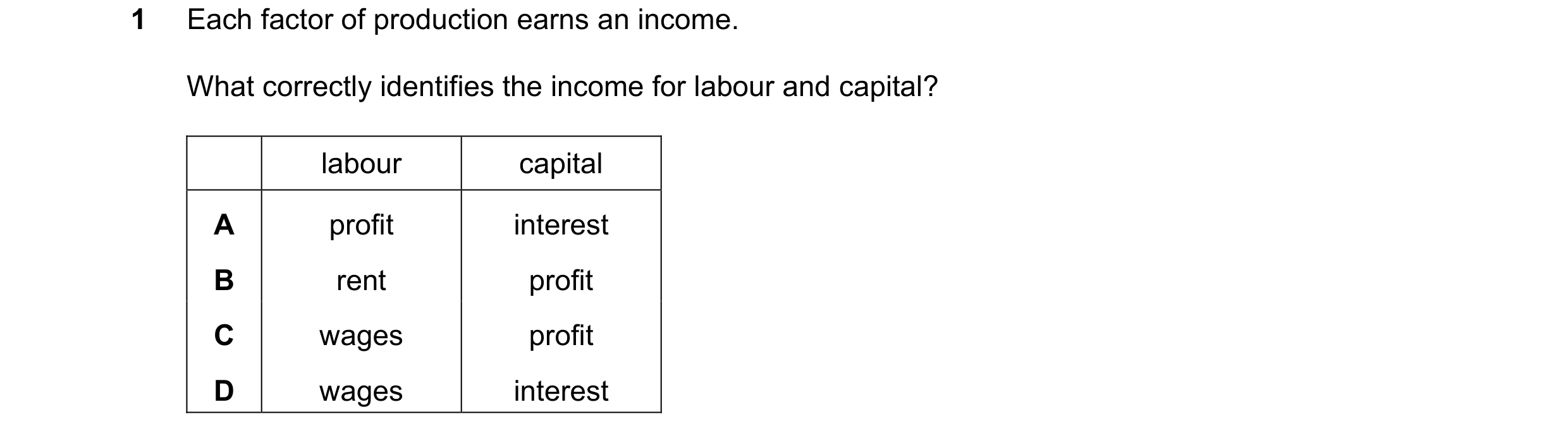
Q54 · Each factor of production earns an income 0455/12 Oct/Nov 2016
1 Each factor of production earns an income. What correctly identifies the income for labour and capital? labour capital A profit interest B rent profit C wages profit D wages interest
1 marks
This question in 0455/12 Oct/Nov 2016
Q55 · What is not a factor of production? 0455/13 Oct/Nov 2016
1 What is not a factor of production? A a $20 banknote B an office C a photocopier D a secretary
1 marks
Answer: A
This question in 0455/13 Oct/Nov 2016
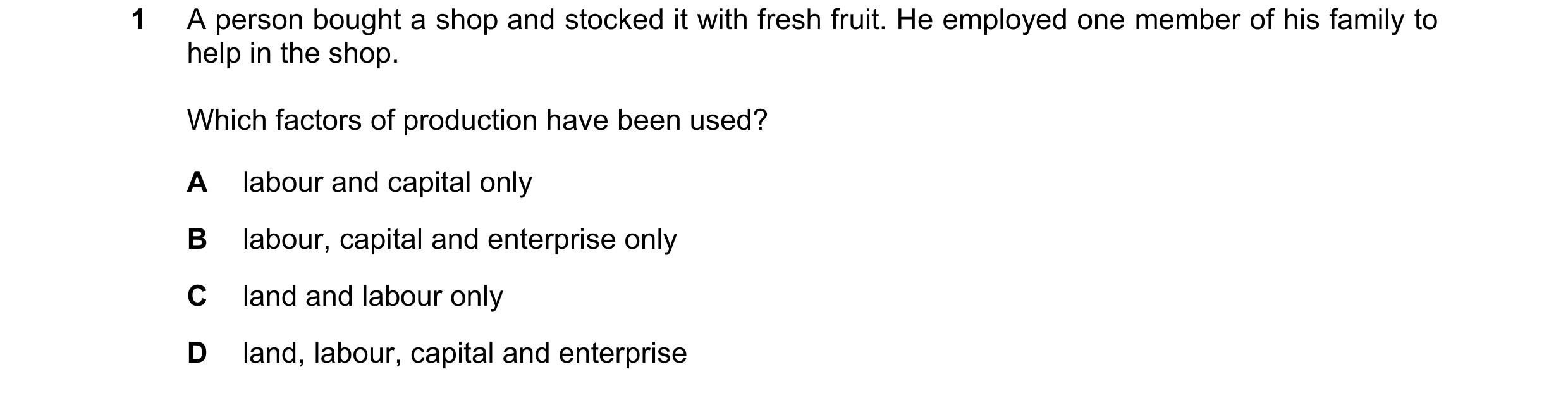
Q56 · A person bought a shop and stocked it with fresh fruit 0455/12 Feb/March 2017
1 A person bought a shop and stocked it with fresh fruit. He employed one member of his family to help in the shop. Which factors of production have been used? A labour and capital only B labour, capital and enterprise only C land and labour only D land, labour, capital and enterprise
1 marks
Answer: D
This question in 0455/12 Feb/March 2017
Q57 · Which is not a factor of production? 0455/12 May/June 2017
1 Which is not a factor of production? A a farm B a farmer C a farmer’s bank account D a second-hand tractor
1 marks
Answer: C
This question in 0455/12 May/June 2017
Q58 · Which statement about factors of production is correct? 0455/13 May/June 2017
1 Which statement about factors of production is correct? A The fruit picked from the tree is called land. B The managers of a company are called enterprise. C The money used to finance a project is called capital. D The owner of a company is called labour.
1 marks
Answer: A
This question in 0455/13 May/June 2017
Q59 · An oil company announced in 2015 that it was starting its drilling operations for oil… 0455/11 Oct/Nov 2017
1 An oil company announced in 2015 that it was starting its drilling operations for oil deposits in the Arctic Ocean. What will be the effect of this? A to increase the supply of raw materials B to reduce the level of technology available C to solve the economic problem D to worsen resource allocation
1 marks
Answer: A
This question in 0455/11 Oct/Nov 2017
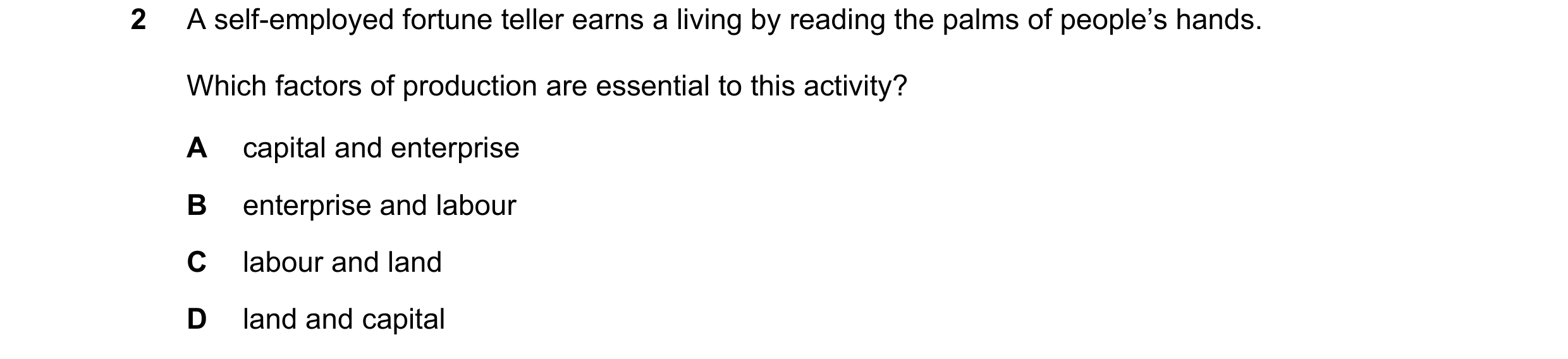
Q60 · A self-employed fortune teller earns a living by reading the palms of people’s hands 0455/11 Oct/Nov 2017
2 A self-employed fortune teller earns a living by reading the palms of people’s hands. Which factors of production are essential to this activity? A capital and enterprise B enterprise and labour C labour and land D land and capital
1 marks
Answer: B
This question in 0455/11 Oct/Nov 2017
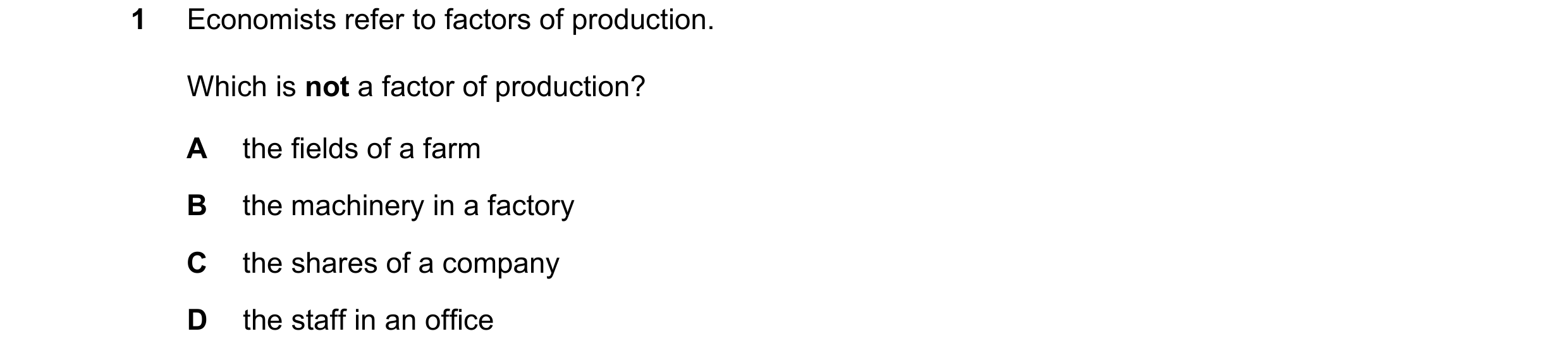
Q61 · Economists refer to factors of production 0455/12 Oct/Nov 2017
1 Economists refer to factors of production. Which is not a factor of production? A the fields of a farm B the machinery in a factory C the shares of a company D the staff in an office
1 marks
Answer: C
This question in 0455/12 Oct/Nov 2017
Q62 · What does an economist mean by the factor of production called capital? 0455/13 Oct/Nov 2017
1 What does an economist mean by the factor of production called capital? A goods that can be used to produce other goods B money used to start a business C resources that cannot be replaced D the profits of a company
1 marks
Answer: A
This question in 0455/13 Oct/Nov 2017
Q63 · What would be classified by an economist as the factor of production known as land? 0455/11 May/June 2018
2 What would be classified by an economist as the factor of production known as land? A a discovery of oil in the South China sea B an oil rig bought by an oil company C money held by the oil companies in their bank accounts D the productivity of oil workers
1 marks
Answer: A
This question in 0455/11 May/June 2018
Q64 · Which activity takes place in the tertiary sector? 0455/11 May/June 2018
4 Which activity takes place in the tertiary sector? A assembling computers B giving legal advice C harvesting grain D making bread
1 marks
Answer: B
This question in 0455/11 May/June 2018
Q65 · What would be classified as the factor of production capital for an airline? 0455/12 May/June 2018
2 What would be classified as the factor of production capital for an airline? A the aircraft operated by the airline B the money the airline keeps in the bank C the pilots the airline uses D the shares of the airline quoted on the stock market
1 marks
Answer: A
This question in 0455/12 May/June 2018
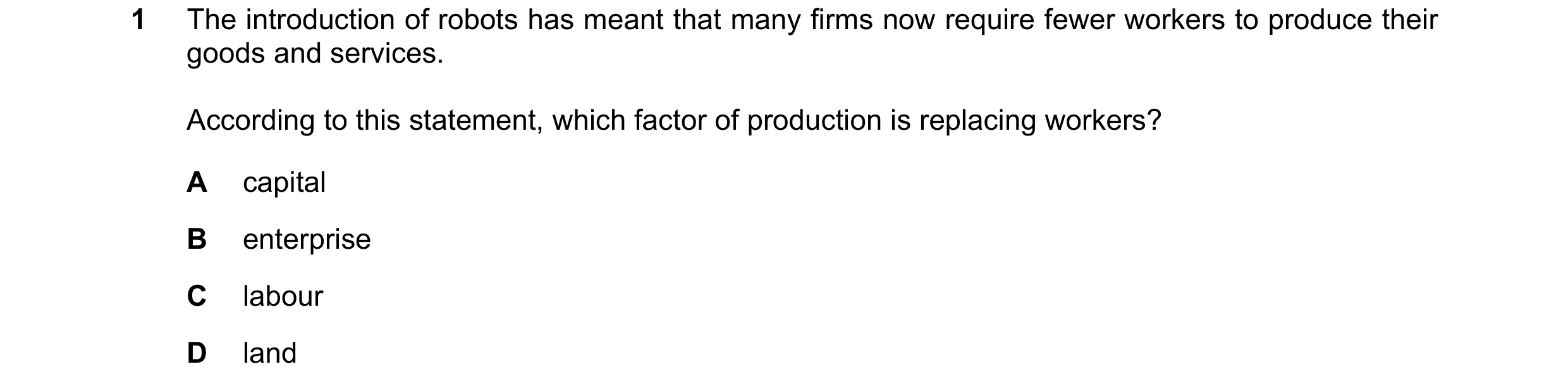
Q66 · The introduction of robots has meant that many firms now require fewer workers to produce… 0455/13 May/June 2018
1 The introduction of robots has meant that many firms now require fewer workers to produce their goods and services. According to this statement, which factor of production is replacing workers? A capital B enterprise C labour D land
1 marks
Answer: A
This question in 0455/13 May/June 2018
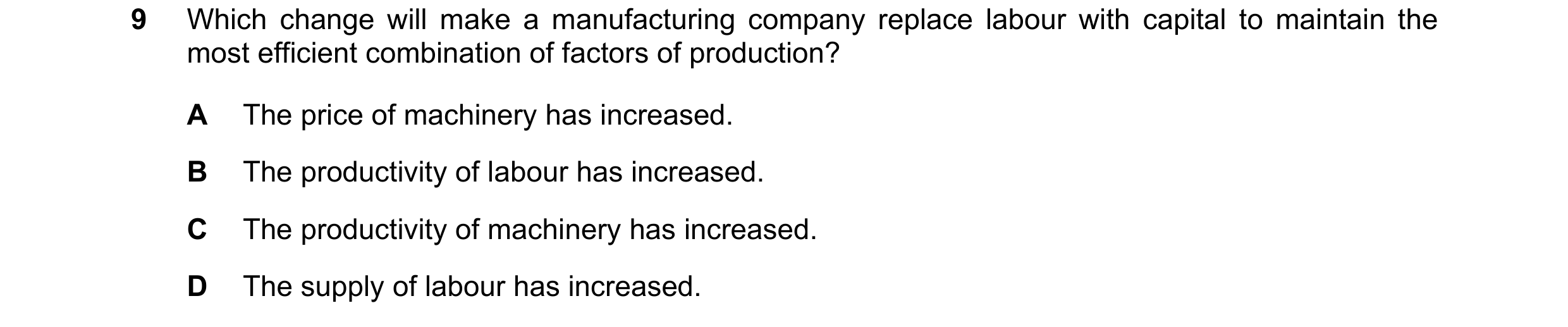
Q67 · Which change will make a manufacturing company replace labour with capital to maintain… 0455/13 May/June 2018
9 Which change will make a manufacturing company replace labour with capital to maintain the most efficient combination of factors of production? A The price of machinery has increased. B The productivity of labour has increased. C The productivity of machinery has increased. D The supply of labour has increased.
1 marks
Answer: C
This question in 0455/13 May/June 2018
Q68 · Which factor of production involves risk-taking? 0455/11 Oct/Nov 2018
1 Which factor of production involves risk-taking? A capital B enterprise C labour D land
1 marks
Answer: B
This question in 0455/11 Oct/Nov 2018
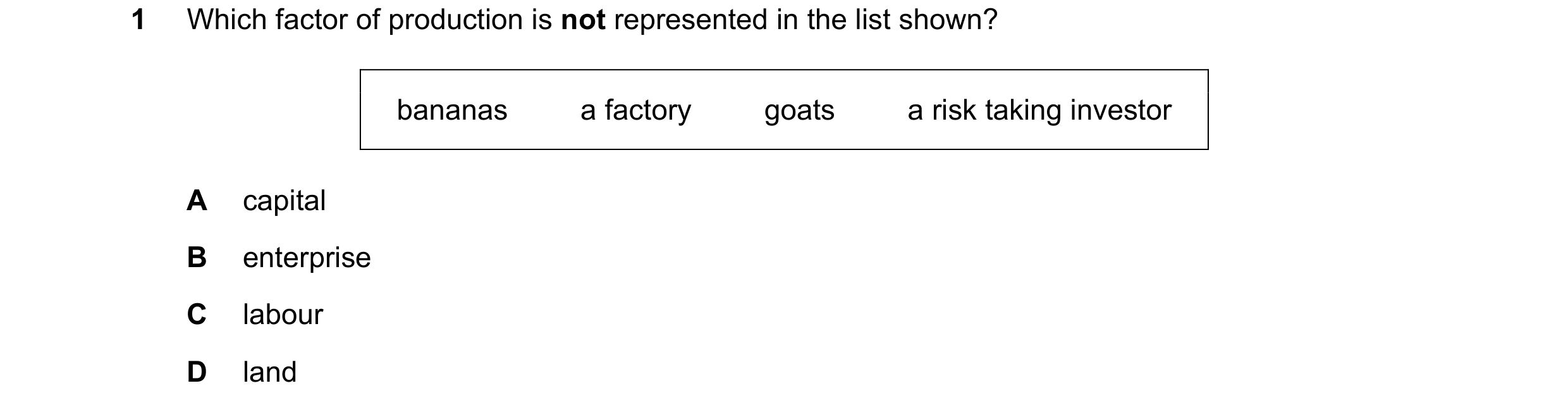
Q69 · Which factor of production is not represented in the list shown? 0455/12 Oct/Nov 2018
1 Which factor of production is not represented in the list shown? bananas a factory goats a risk taking investor A capital B enterprise C labour D land
1 marks
Answer: C
This question in 0455/12 Oct/Nov 2018
Q70 · Which example of a factor of production in the fishing industry is correct? 0455/13 Oct/Nov 2018
1 Which example of a factor of production in the fishing industry is correct? factor example A capital charges on loan for fishing boat B enterprise salaries of fish warehouse managers C labour profits of fish shop owners D land fish in the sea
1 marks
Answer: D
This question in 0455/13 Oct/Nov 2018
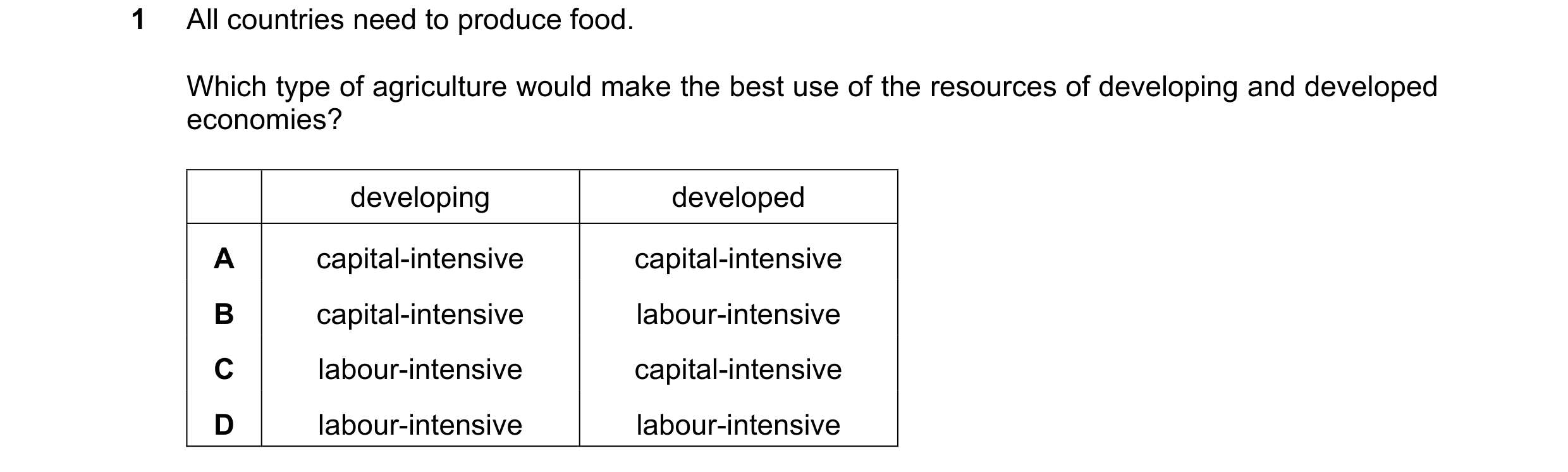
Q71 · All countries need to produce food 0455/12 Feb/March 2019
1 All countries need to produce food. Which type of agriculture would make the best use of the resources of developing and developed economies? developing developed A capital-intensive capital-intensive B capital-intensive labour-intensive C labour-intensive capital-intensive D labour-intensive labour-intensive
1 marks
Answer: C
This question in 0455/12 Feb/March 2019
Q72 · What would an economist regard as an example of the factor of production capital? 0455/11 May/June 2019
1 What would an economist regard as an example of the factor of production capital? A an individual’s purchase of stocks and shares B borrowing by a firm to pay for electricity C the building by a firm of a new factory D total savings by individuals in a country
1 marks
Answer: C
This question in 0455/11 May/June 2019
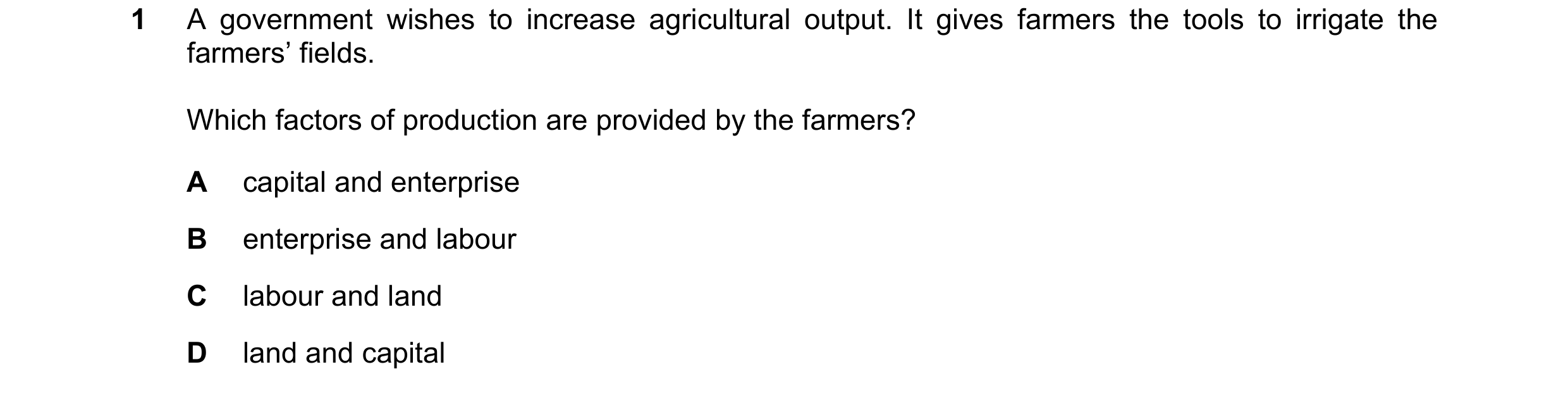
Q73 · A government wishes to increase agricultural output 0455/12 May/June 2019
1 A government wishes to increase agricultural output. It gives farmers the tools to irrigate the farmers’ fields. Which factors of production are provided by the farmers? A capital and enterprise B enterprise and labour C labour and land D land and capital
1 marks
Answer: C
This question in 0455/12 May/June 2019
Q74 · In farming, what is an example of what economists call capital? 0455/13 May/June 2019
1 In farming, what is an example of what economists call capital? A savings the farmer has in the bank B shares in a farming company C the money the farmer set aside to pay taxes D the tractor owned by the farmer
1 marks
Answer: D
This question in 0455/13 May/June 2019
Q75 · What is classified as one of the four economic resources? 0455/11 Oct/Nov 2019
1 What is classified as one of the four economic resources? A consumption B enterprise C production D trade
1 marks
Answer: B
This question in 0455/11 Oct/Nov 2019
Q76 · Which statement about factors of production is correct? 0455/12 Oct/Nov 2019
1 Which statement about factors of production is correct? A Capital is the amount of money borrowed from a bank. B Labour is output made by an employee. C Land includes commercially grown rice crops. D Profit is the reward for enterprise.
1 marks
Answer: D
This question in 0455/12 Oct/Nov 2019
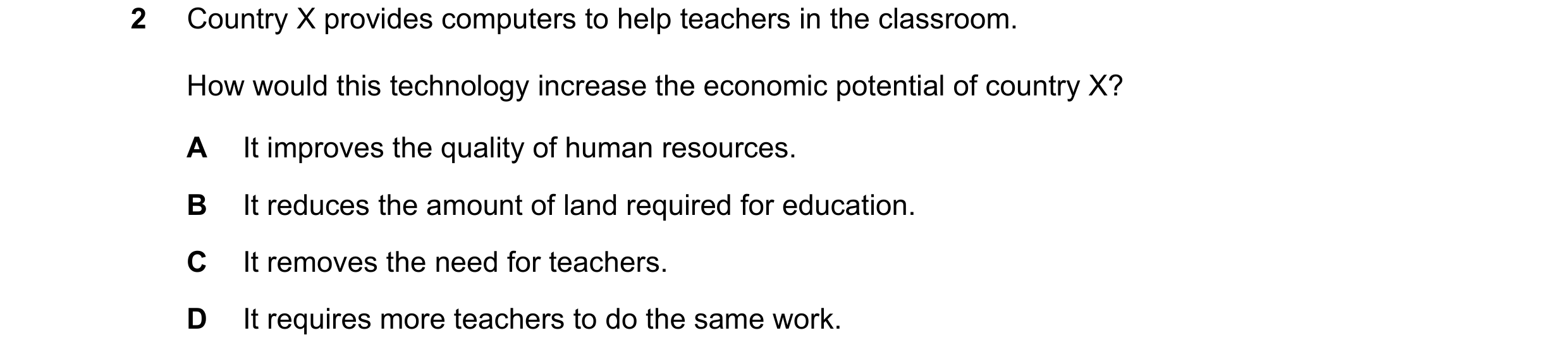
Q77 · Country X provides computers to help teachers in the classroom 0455/13 Oct/Nov 2019
2 Country X provides computers to help teachers in the classroom. How would this technology increase the economic potential of country X? A It improves the quality of human resources. B It reduces the amount of land required for education. C It removes the need for teachers. D It requires more teachers to do the same work.
1 marks
Answer: A
This question in 0455/13 Oct/Nov 2019
Q78 · What is not a factor of production? 0455/12 Feb/March 2020
1 What is not a factor of production? A a $20 banknote B an office C a photocopier D a secretary
1 marks
This question in 0455/12 Feb/March 2020
Q79 · What is the function of the factors of production in an economy? 0455/11 May/June 2020
2 What is the function of the factors of production in an economy? A to make goods and services to fulfil wants and needs B to provide an even distribution of income C to provide tax income for the government D to reduce the existence of external costs
1 marks
Answer: A
This question in 0455/11 May/June 2020
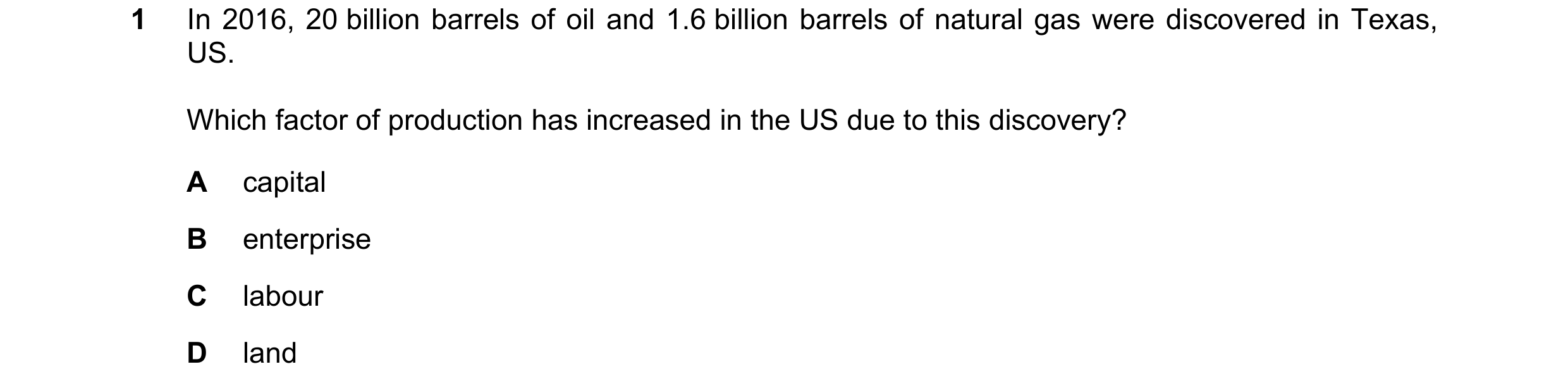
Q80 · In 2016, 20 billion barrels of oil and 1.6 billion barrels of natural gas were discovered… 0455/12 May/June 2020
1 In 2016, 20 billion barrels of oil and 1.6 billion barrels of natural gas were discovered in Texas, US. Which factor of production has increased in the US due to this discovery? A capital B enterprise C labour D land
1 marks
Answer: D
This question in 0455/12 May/June 2020
Q81 · On which factor of production does innovation directly depend? 0455/11 Oct/Nov 2020
2 On which factor of production does innovation directly depend? A decisions of entrepreneurs B high inputs of capital C long hours of manual labour D plentiful supplies of land
1 marks
Answer: A
This question in 0455/11 Oct/Nov 2020
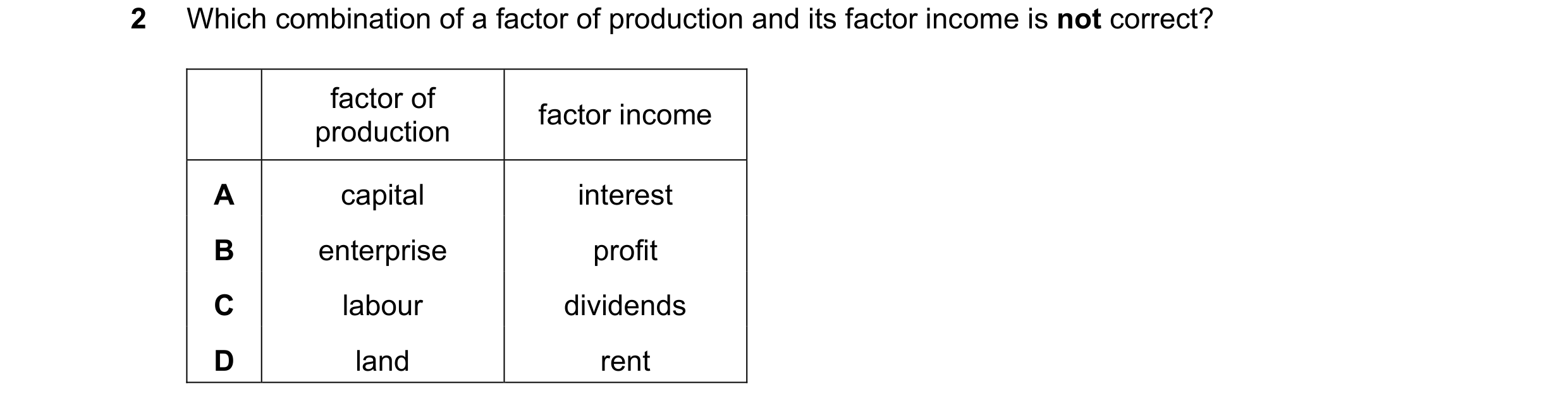
Q82 · Which combination of a factor of production and its factor income is not correct? 0455/12 Oct/Nov 2020
2 Which combination of a factor of production and its factor income is not correct? factor of factor income production A capital interest B enterprise profit C labour dividends D land rent
1 marks
Answer: C
This question in 0455/12 Oct/Nov 2020
Q83 · What is the key role of an entrepreneur? 0455/13 Oct/Nov 2020
2 What is the key role of an entrepreneur? A inventor B risk taker C shareholder D worker
1 marks
Answer: B
This question in 0455/13 Oct/Nov 2020
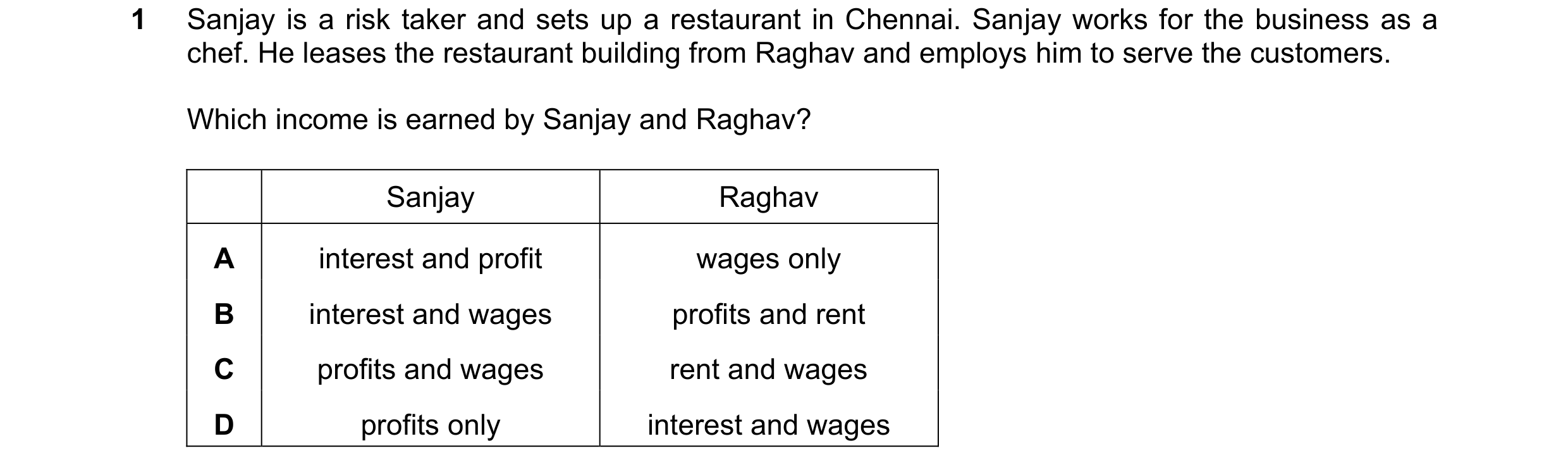
Q84 · Sanjay is a risk taker and sets up a restaurant in Chennai 0455/12 Feb/March 2021
1 Sanjay is a risk taker and sets up a restaurant in Chennai. Sanjay works for the business as a chef. He leases the restaurant building from Raghav and employs him to serve the customers. Which income is earned by Sanjay and Raghav? Sanjay Raghav A interest and profit wages only B interest and wages profits and rent C profits and wages rent and wages D profits only interest and wages
1 marks
Answer: C
This question in 0455/12 Feb/March 2021
Q85 · Which statement about the factors of production is correct? 0455/11 May/June 2021
1 Which statement about the factors of production is correct? A Capital is a financial resource and includes savings in banks. B Enterprise is limited in supply and includes office workers. C Labour is a human resource and includes pensioners and children. D Land is a natural resource and includes trees and fish.
1 marks
Answer: D
This question in 0455/11 May/June 2021
Q86 · Germany is considered a capital-intensive economy while Indonesia is considered a… 0455/12 May/June 2022
12 Germany is considered a capital-intensive economy while Indonesia is considered a labour-intensive economy. What does this mean about the economies of Germany and Indonesia? A Capital is relatively cheaper than labour in Germany while labour is relatively cheaper than capital in Indonesia. B Germany has many primary sector workers while Indonesia has many tertiary sector workers. C Indonesia has a higher growth in its population size than Germany. D Relatively more low-cost labour is available in Germany while capital is more efficient than labour in Indonesia.
1 marks
Answer: A
This question in 0455/12 May/June 2022
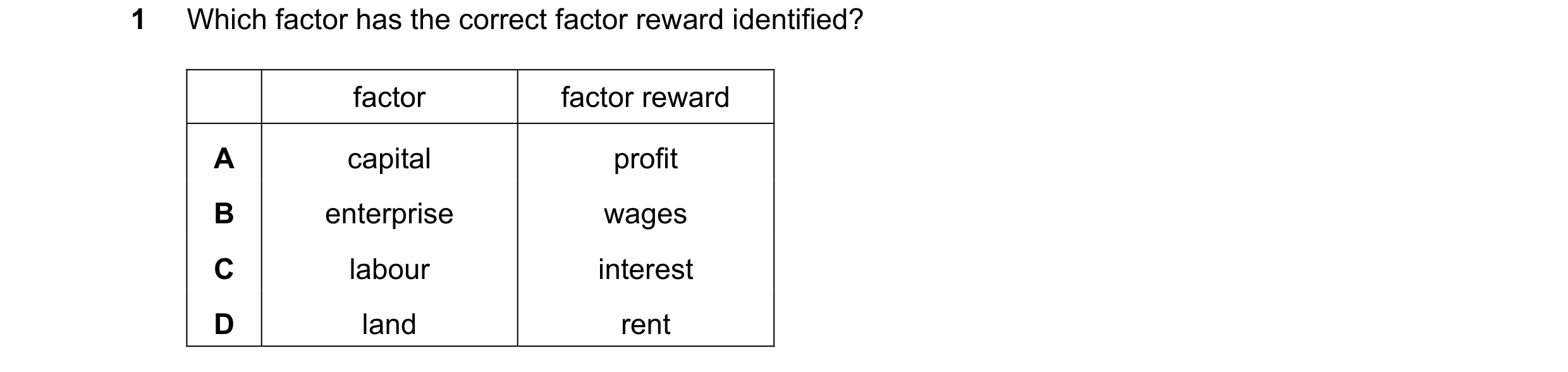
Q87 · Which factor has the correct factor reward identified? 0455/13 May/June 2022
1 Which factor has the correct factor reward identified? factor factor reward A capital profit B enterprise wages C labour interest D land rent
1 marks
Answer: D
This question in 0455/13 May/June 2022
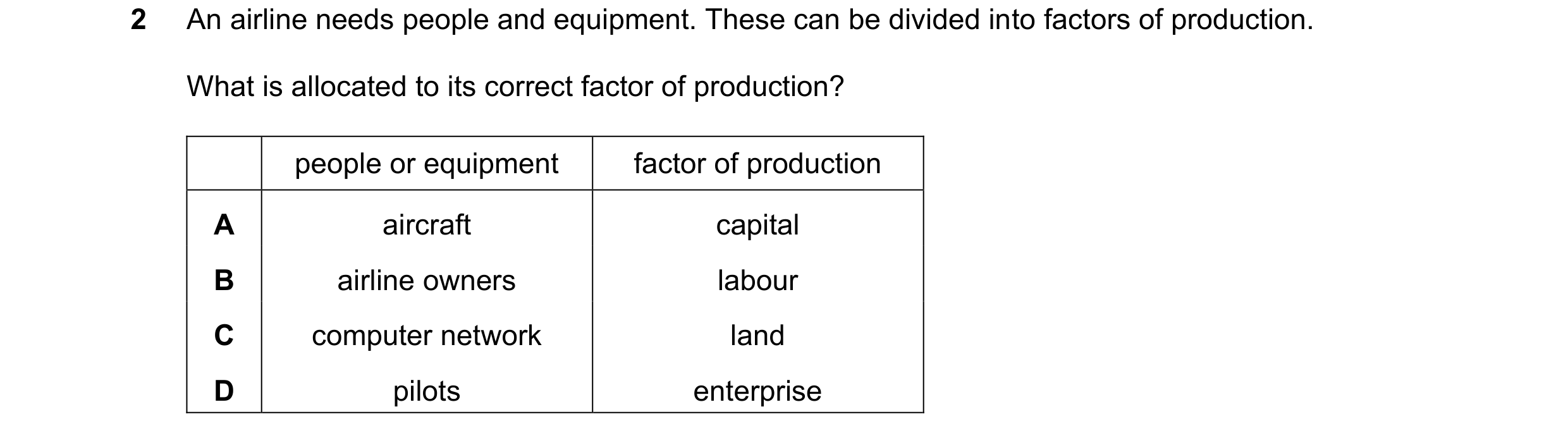
Q88 · An airline needs people and equipment 0455/11 Oct/Nov 2022
2 An airline needs people and equipment. These can be divided into factors of production. What is allocated to its correct factor of production? people or equipment factor of production A aircraft capital B airline owners labour C computer network land D pilots enterprise
1 marks
Answer: A
This question in 0455/11 Oct/Nov 2022
Q89 · An airline needs people and equipment 0455/12 Oct/Nov 2022
2 An airline needs people and equipment. These can be divided into factors of production. What is allocated to its correct factor of production? people or equipment factor of production A aircraft capital B airline owners labour C computer network land D pilots enterprise
1 marks
Answer: A
This question in 0455/12 Oct/Nov 2022
Q90 · An airline needs people and equipment 0455/13 Oct/Nov 2022
2 An airline needs people and equipment. These can be divided into factors of production. What is allocated to its correct factor of production? people or equipment factor of production A aircraft capital B airline owners labour C computer network land D pilots enterprise
1 marks
Answer: A
This question in 0455/13 Oct/Nov 2022
Q91 · What is most likely to increase enterprise as a factor of production in an economy? 0455/11 May/June 2023
3 What is most likely to increase enterprise as a factor of production in an economy? A a decrease in government spending on education B a decrease in regulation on firms C an increase in emigration D an increase in taxation on firms
1 marks
Answer: B
This question in 0455/11 May/June 2023
Question 92 0455/12 Oct/Nov 2023
3 What is capital? A the ability to organise the factors of production B the energy used in production C the factory used in production D the money invested in a firm
1 marks
Answer: C
This question in 0455/12 Oct/Nov 2023
Q93 · Which type of factor of production is a railway track? 0455/13 Oct/Nov 2023
3 Which type of factor of production is a railway track? A capital B enterprise C labour D land
1 marks
Answer: A
This question in 0455/13 Oct/Nov 2023
Q94 · What would be included in the factor of production land? 0455/13 May/June 2024
2 What would be included in the factor of production land? A bread B factory building C sports arena D wheat
1 marks
Answer: D
This question in 0455/13 May/June 2024
Q95 · In which case is it possible to set the level of reward before production takes place for… 0455/11 Oct/Nov 2024
2 In which case is it possible to set the level of reward before production takes place for the first factor of production but not for the second factor? first factor second factor A capital land B enterprise labour C labour capital D land enterprise
1 marks
Answer: D
This question in 0455/11 Oct/Nov 2024
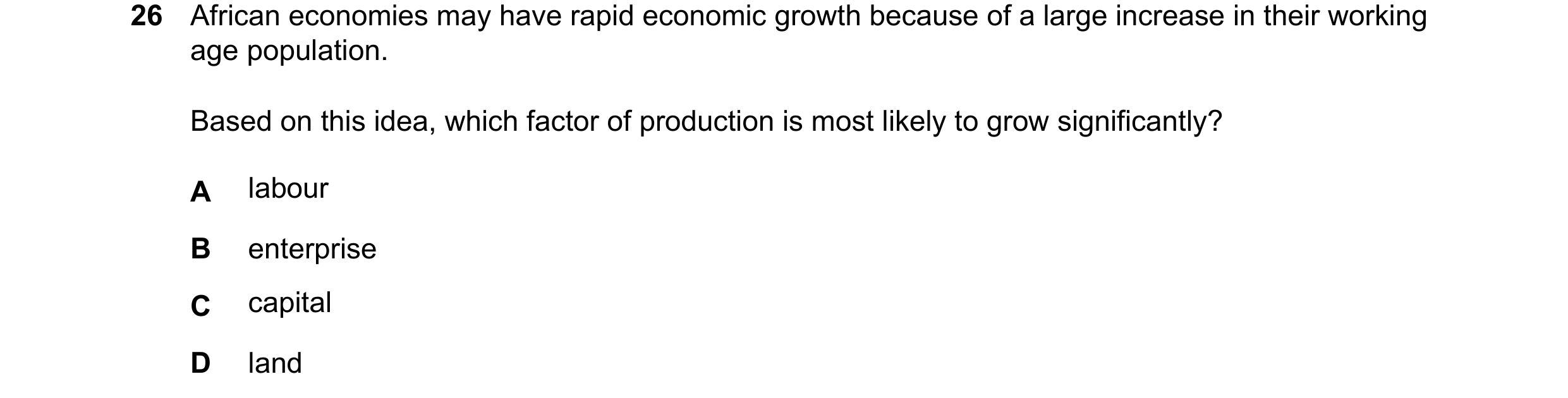
Q96 · African economies may have rapid economic growth because of a large increase in their… 0455/11 Oct/Nov 2024
26 African economies may have rapid economic growth because of a large increase in their working age population. Based on this idea, which factor of production is most likely to grow significantly? A labour B enterprise C capital D land
1 marks
Answer: A
This question in 0455/11 Oct/Nov 2024
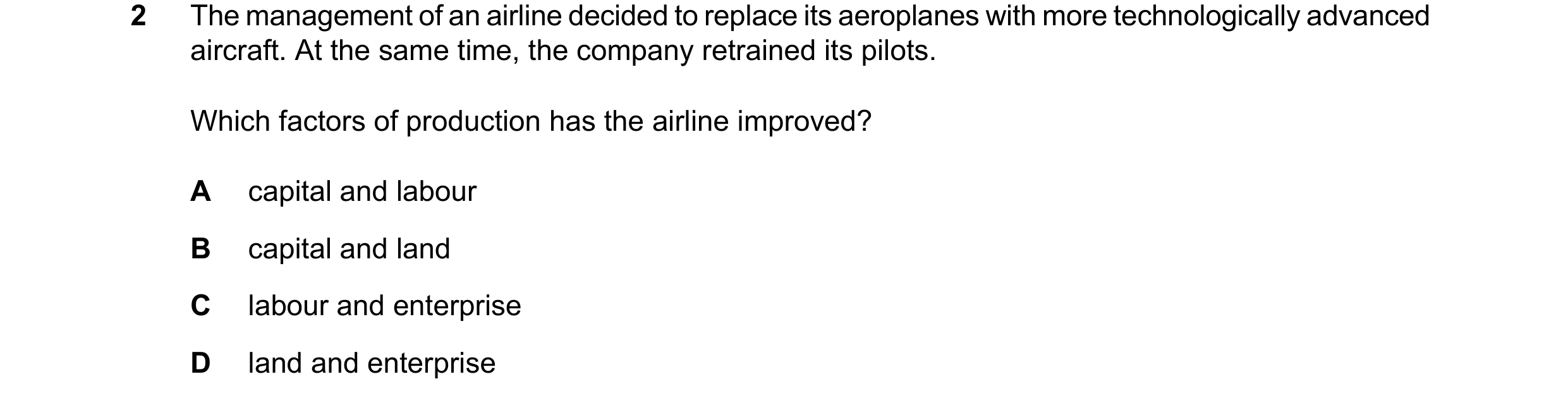
Q97 · The management of an airline decided to replace its aeroplanes with more technologically… 0455/13 Oct/Nov 2024
2 The management of an airline decided to replace its aeroplanes with more technologically advanced aircraft. At the same time, the company retrained its pilots. Which factors of production has the airline improved? A capital and labour B capital and land C labour and enterprise D land and enterprise
1 marks
Answer: A
This question in 0455/13 Oct/Nov 2024
Q98 · What is classed as the factor of production land? 0455/12 Feb/March 2025
1 What is classed as the factor of production land? A an airport B a car park C a doctor’s office D a forest
1 marks
Answer: D
This question in 0455/12 Feb/March 2025
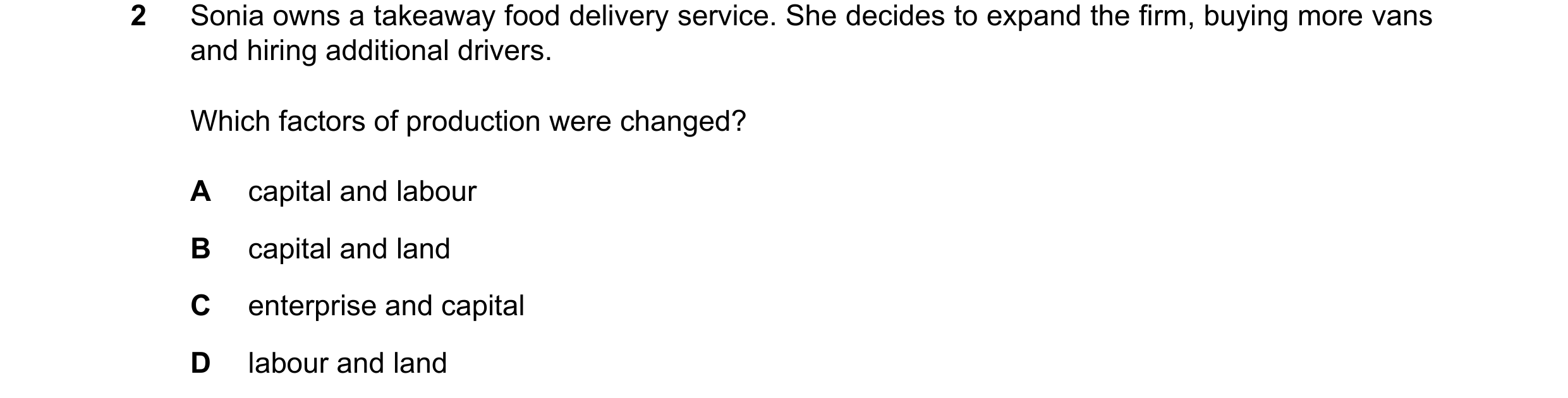
Q99 · Sonia owns a takeaway food delivery service 0455/11 May/June 2025
2 Sonia owns a takeaway food delivery service. She decides to expand the firm, buying more vans and hiring additional drivers. Which factors of production were changed? A capital and labour B capital and land C enterprise and capital D labour and land
1 marks
Answer: A
This question in 0455/11 May/June 2025
Q100 · What is not a factor of production? 0455/13 May/June 2025
1 What is not a factor of production? A a 10 dollar note B a farm labourer C a farm shop D a tractor
1 marks
Answer: A
This question in 0455/13 May/June 2025




 1 / 20

 2 / 20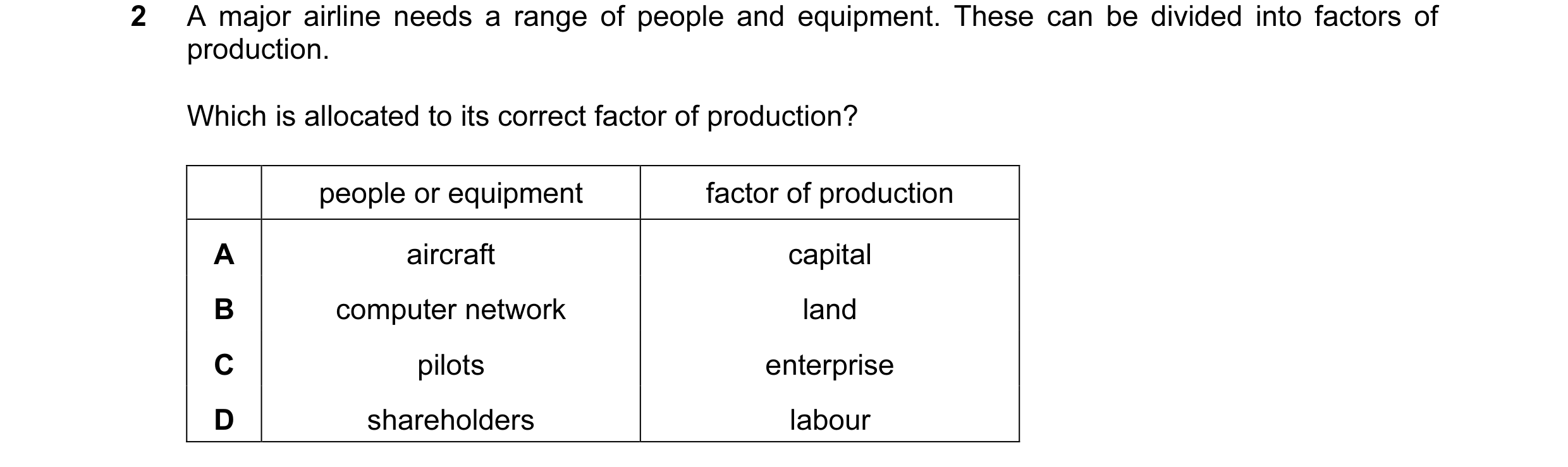



 3 / 20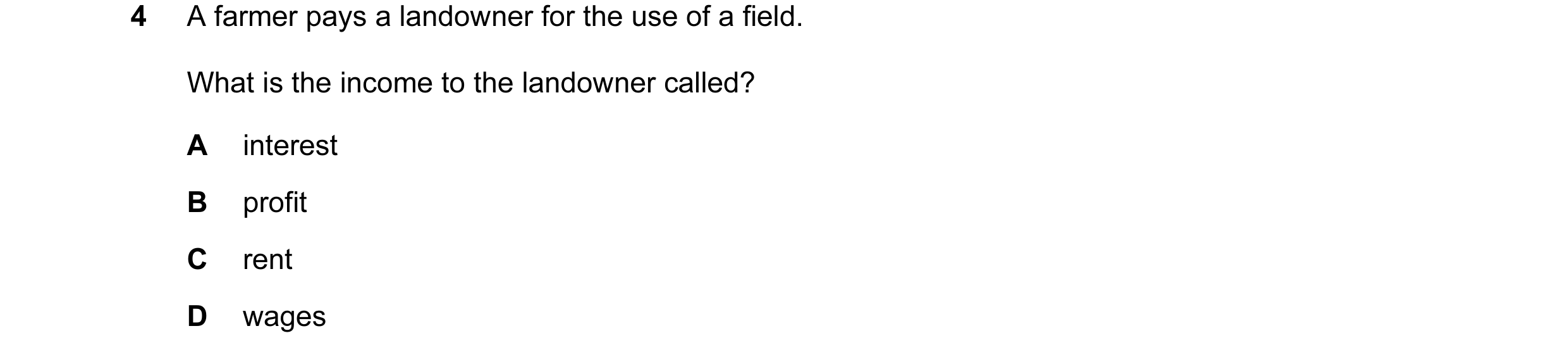

 4 / 20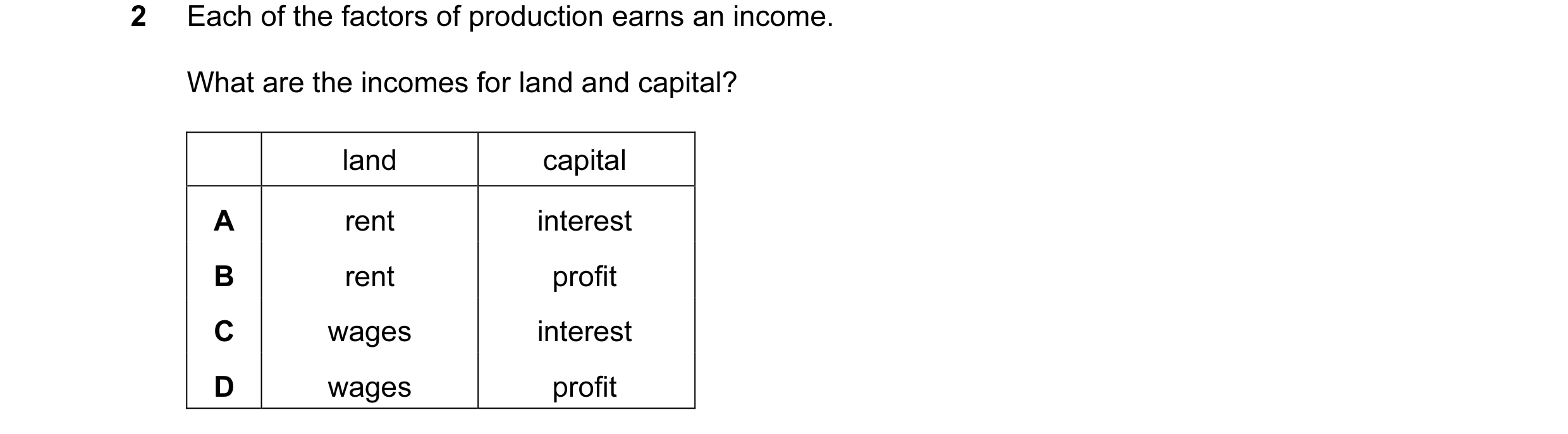
 5 / 20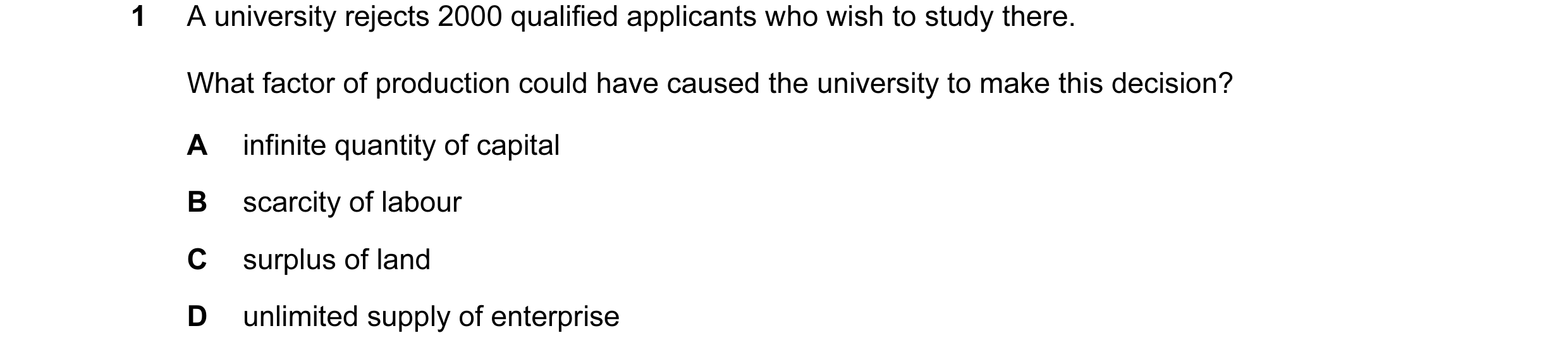



 6 / 20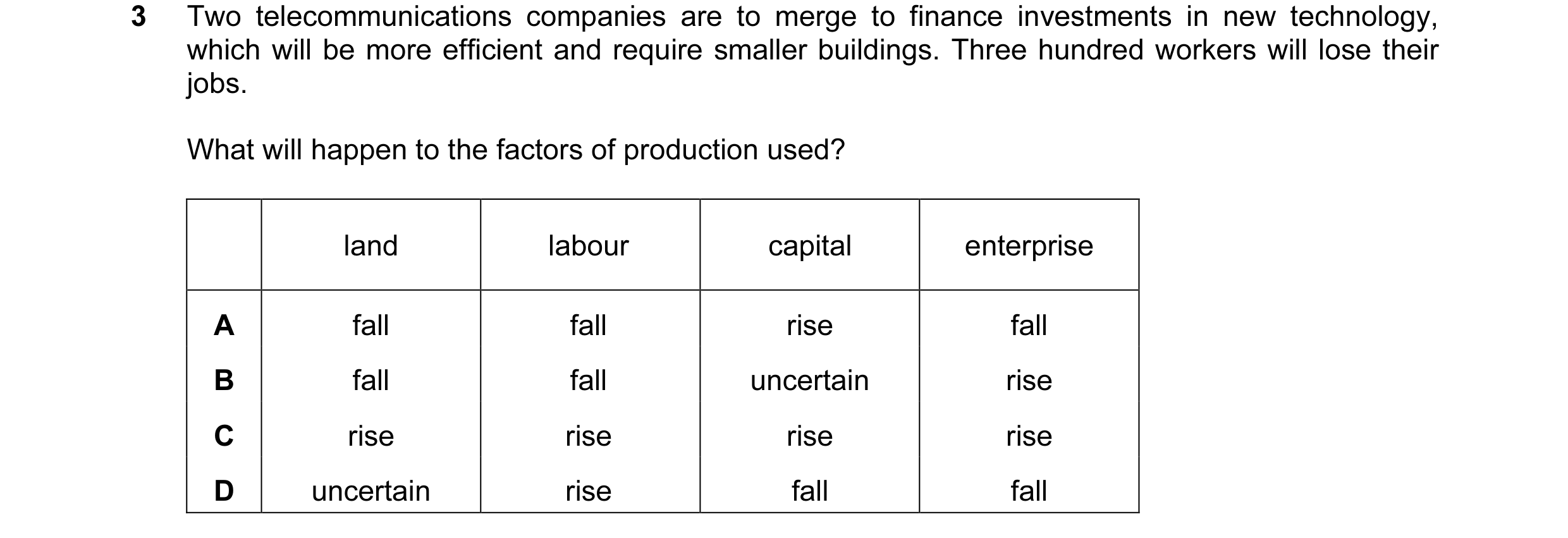
 7 / 20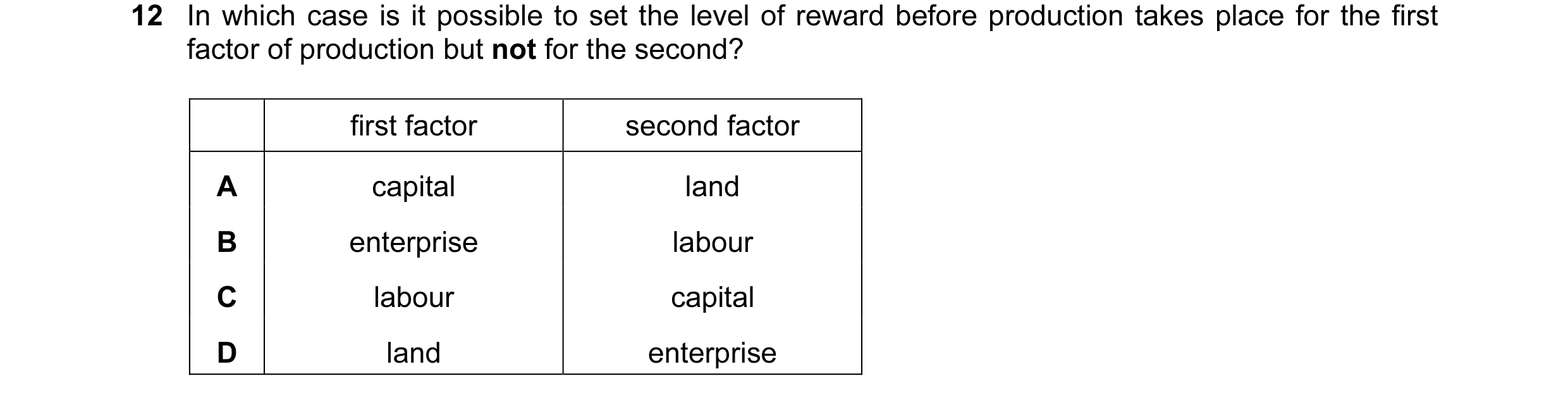

 8 / 20



 9 / 20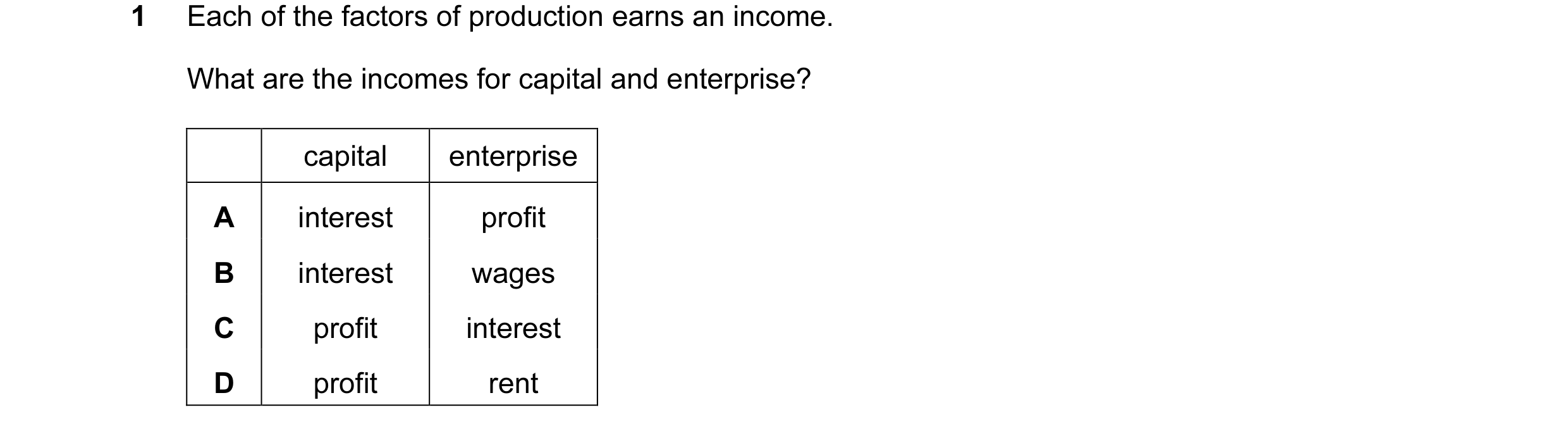
 10 / 20


 11 / 20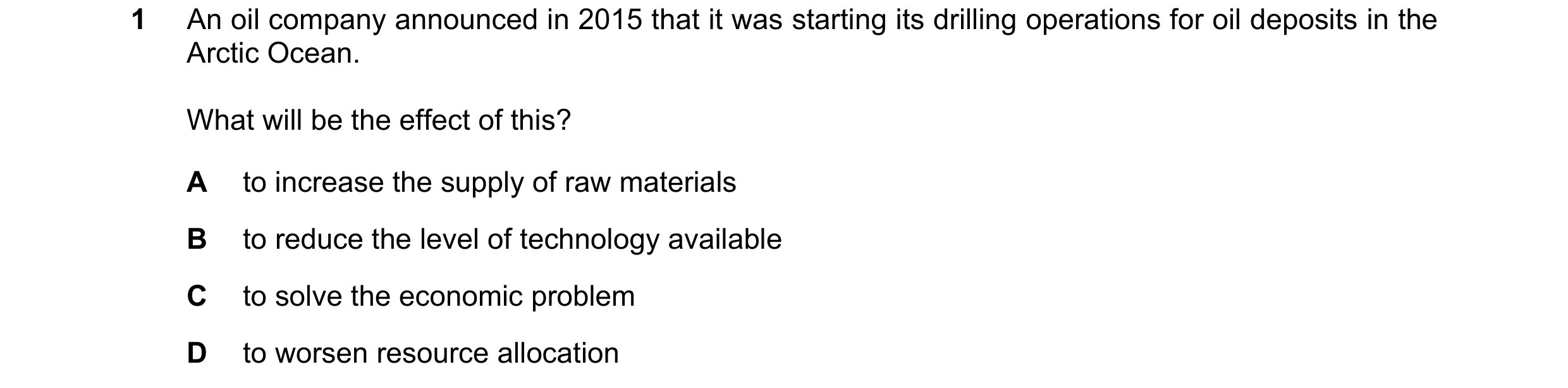


 12 / 20

 13 / 20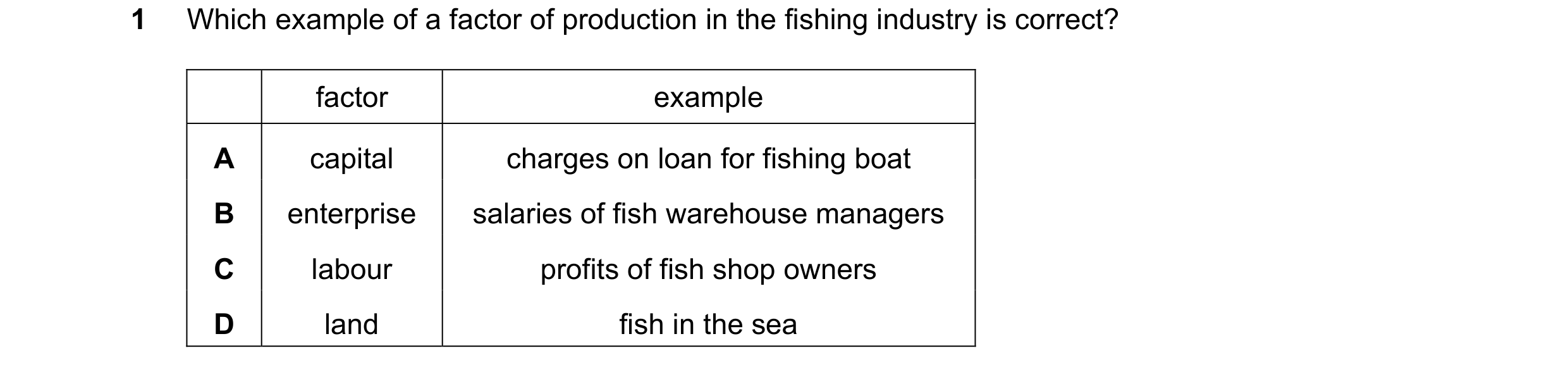

 14 / 20



 15 / 20

 16 / 20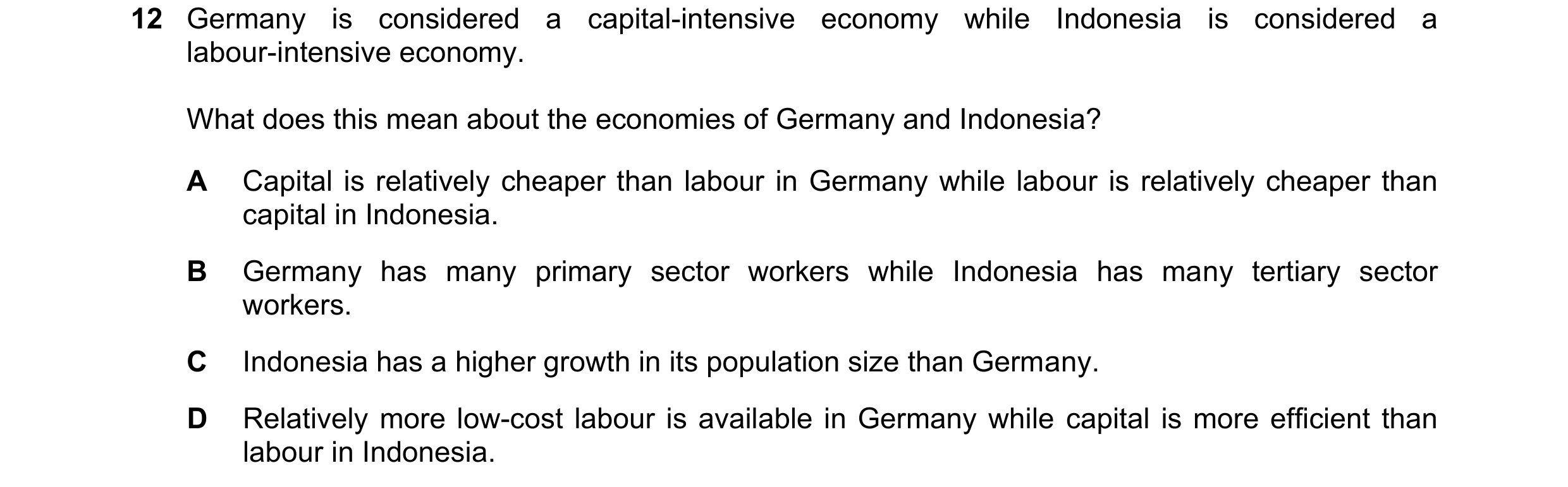
 17 / 20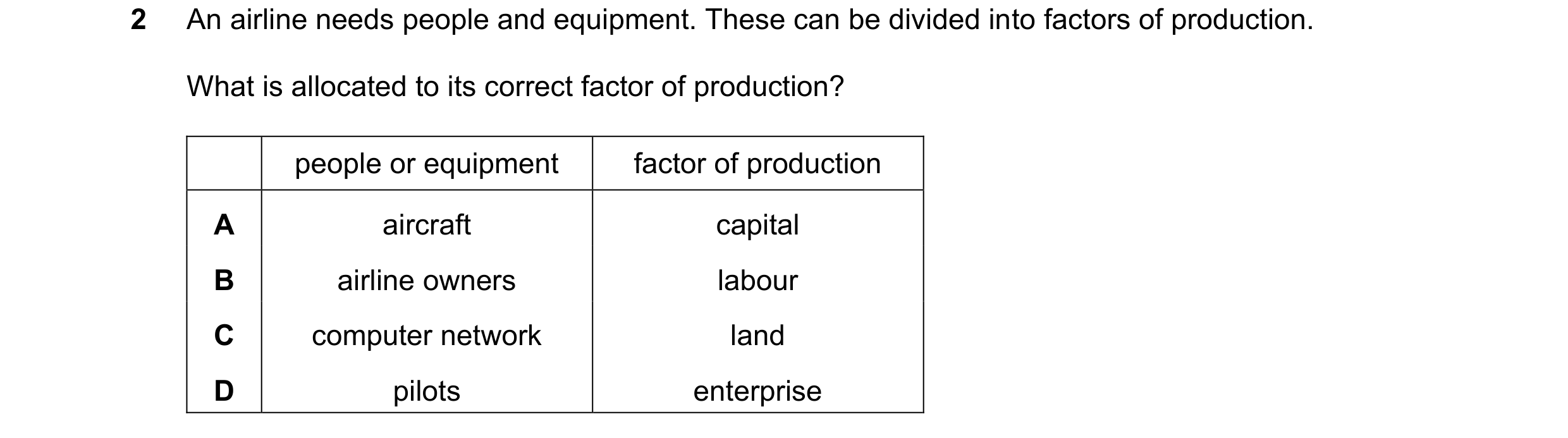



 18 / 20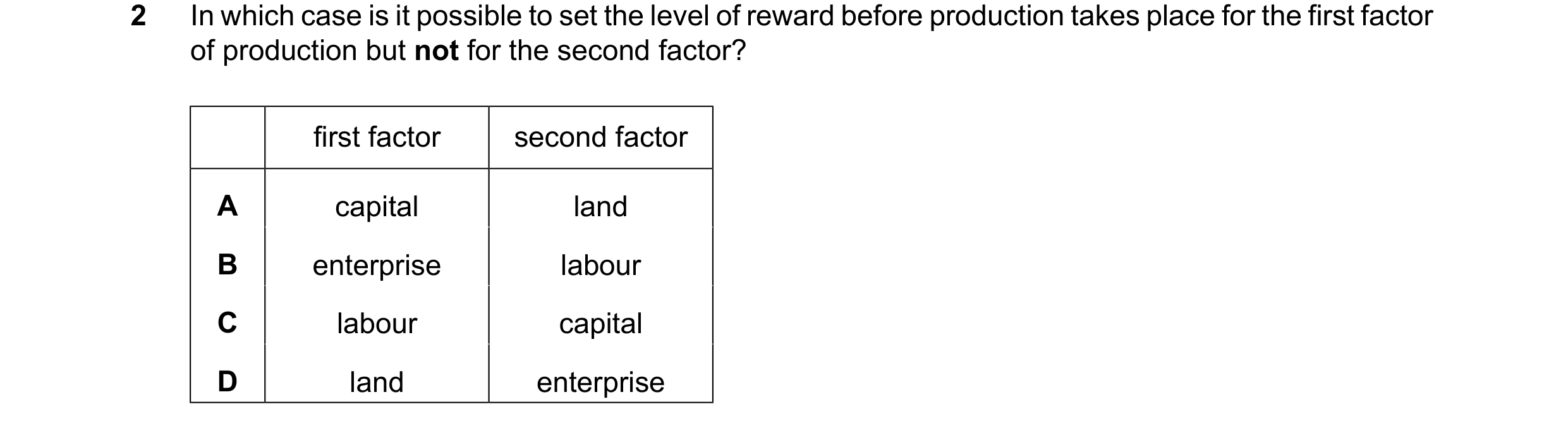

 19 / 20
 20 / 20