Questions as text
Q1 · What is an essential feature of a pure market economy? 9708/11 Oct/Nov 2005
1 What is an essential feature of a pure market economy? A Buyers and sellers have perfect knowledge. B External costs are taxed. C Prices respond to the demands of consumers. D The government provides public goods.
1 marks
Answer: C
This question in 9708/11 Oct/Nov 2005
Q2 · What is present in a mixed economy but not in a planned economy? 9708/11 Oct/Nov 2006
2 What is present in a mixed economy but not in a planned economy? A capital goods B consumer surplus C government borrowing D private production
1 marks
Answer: D
This question in 9708/11 Oct/Nov 2006
Q3 · What is not correct when price acts as a means to allocate resources? 9708/11 Oct/Nov 2006
13 What is not correct when price acts as a means to allocate resources? A Price determines the supply of public goods. B Price operates in the markets for both goods and factors of production. C Price recognises consumers’ ability to pay rather than consumers’ needs. D Price signals to producers which goods are most profitable.
1 marks
Answer: A
This question in 9708/11 Oct/Nov 2006
Q4 · Planned economies had a history of failing to produce enough consumer goods 9708/11 May/June 2007
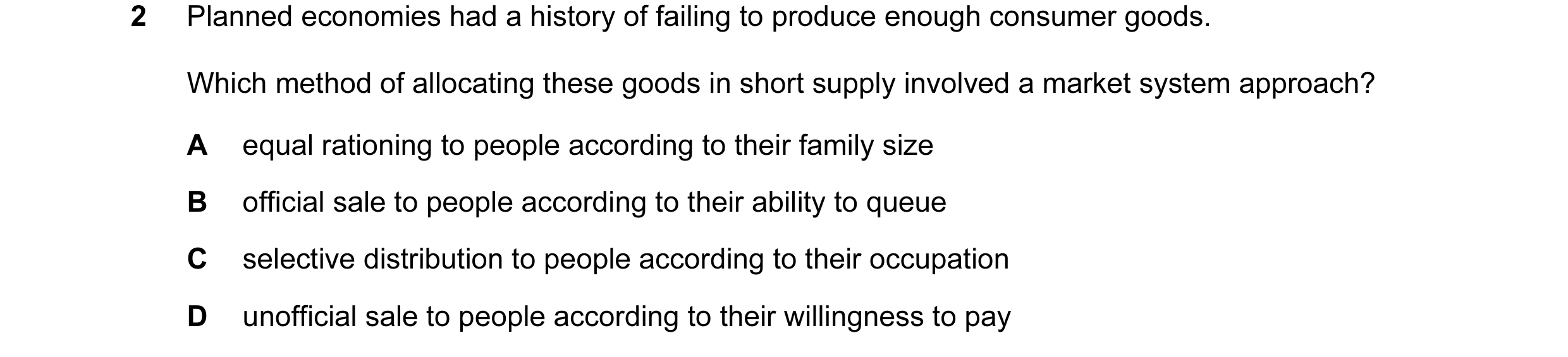
2 Planned economies had a history of failing to produce enough consumer goods. Which method of allocating these goods in short supply involved a market system approach? A equal rationing to people according to their family size B official sale to people according to their ability to queue C selective distribution to people according to their occupation D unofficial sale to people according to their willingness to pay
1 marks
Answer: D
This question in 9708/11 May/June 2007
Q5 · A Southern African government was concerned about the market influence of a large… 9708/11 May/June 2008
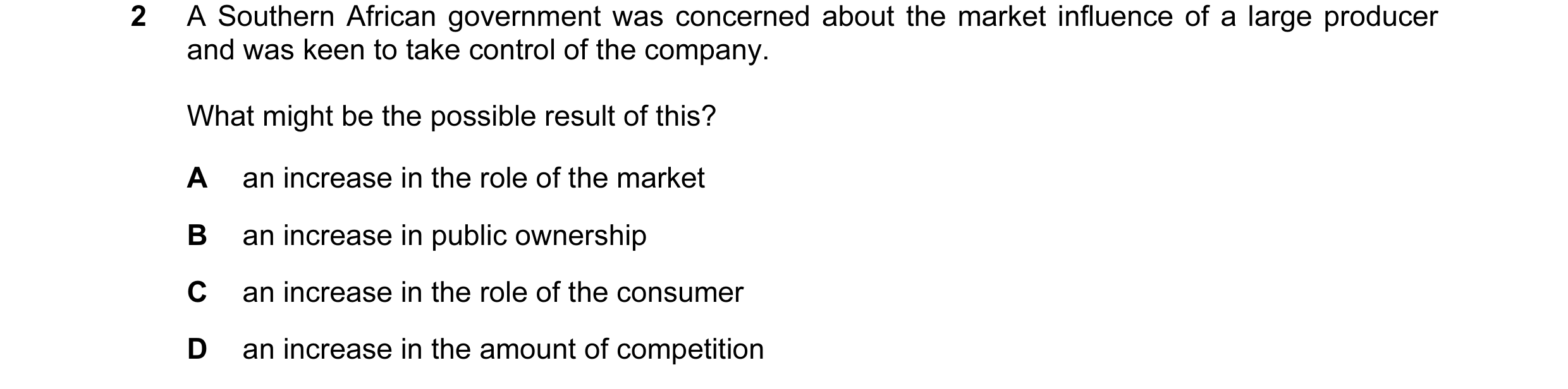
2 A Southern African government was concerned about the market influence of a large producer and was keen to take control of the company. What might be the possible result of this? A an increase in the role of the market B an increase in public ownership C an increase in the role of the consumer D an increase in the amount of competition
1 marks
Answer: B
This question in 9708/11 May/June 2008
Q6 · In which types of economy might a government control prices? 9708/11 Oct/Nov 2008
3 In which types of economy might a government control prices? A market and mixed only B market and planned only C market, mixed and planned D mixed and planned only
1 marks
Answer: D
This question in 9708/11 Oct/Nov 2008
Q7 · Which statement indicates that the price mechanism is allocating resources successfully? 9708/11 May/June 2009
13 Which statement indicates that the price mechanism is allocating resources successfully? A Belgian chocolate companies increase supplies to China because of higher than expected sales. B Train operators in India lower fares because of overcrowding on trains. C US supermarkets throw away large amounts of food because of misjudging demand. D World fish stocks decline because of over-fishing.
1 marks
Answer: A
This question in 9708/11 May/June 2009
Q8 · What is generally considered to be one of the advantages of using the price mechanism as… 9708/11 Oct/Nov 2009
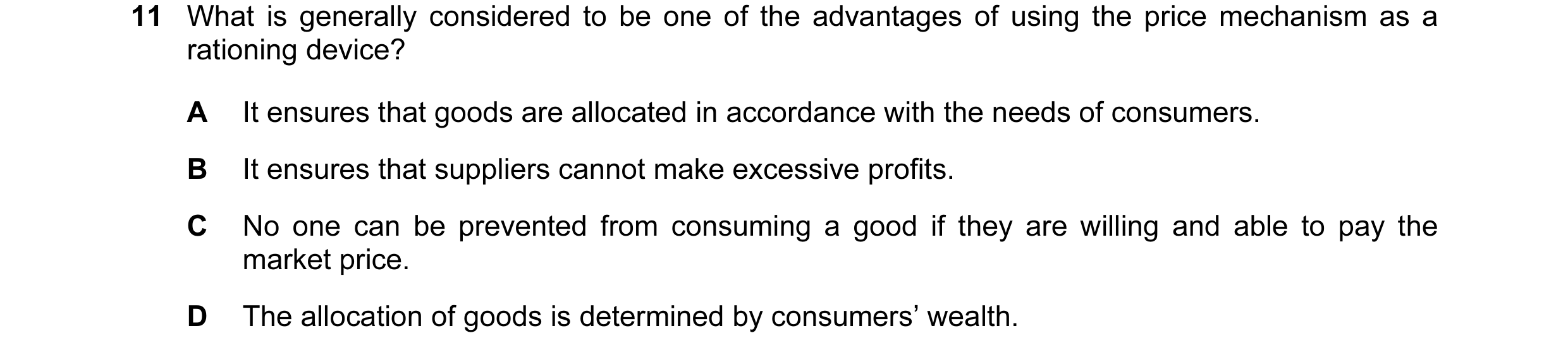
11 What is generally considered to be one of the advantages of using the price mechanism as a rationing device? A It ensures that goods are allocated in accordance with the needs of consumers. B It ensures that suppliers cannot make excessive profits. C No one can be prevented from consuming a good if they are willing and able to pay the market price. D The allocation of goods is determined by consumers’ wealth.
1 marks
Answer: C
This question in 9708/11 Oct/Nov 2009
Q9 · What is generally considered to be one of the advantages of using the price mechanism as… 9708/12 Oct/Nov 2009
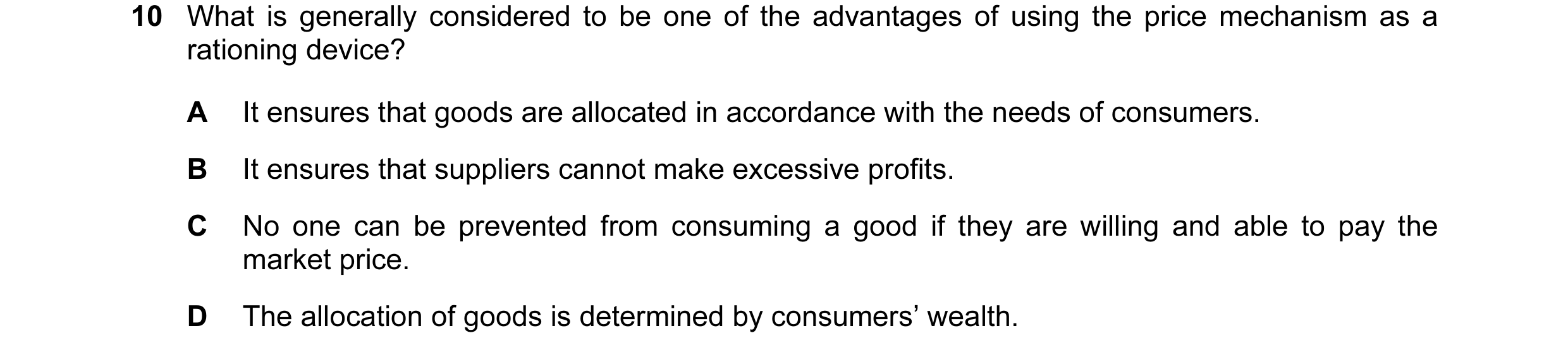
10 What is generally considered to be one of the advantages of using the price mechanism as a rationing device? A It ensures that goods are allocated in accordance with the needs of consumers. B It ensures that suppliers cannot make excessive profits. C No one can be prevented from consuming a good if they are willing and able to pay the market price. D The allocation of goods is determined by consumers’ wealth.
1 marks
Answer: C
This question in 9708/12 Oct/Nov 2009
Q10 · What would cause a failure of the market mechanism’s rationing function? 9708/12 Oct/Nov 2009
12 What would cause a failure of the market mechanism’s rationing function? A falling prices B price controls C rising profits D self interest
1 marks
Answer: B
This question in 9708/12 Oct/Nov 2009
Q11 · In a command economy, what is the basis for determining the allocation of factors of… 9708/11 May/June 2010
1 In a command economy, what is the basis for determining the allocation of factors of production? A the pattern of consumers’ spending B the perceived needs of the country C the revenue from taxes D the size of public sector companies
1 marks
Answer: B
This question in 9708/11 May/June 2010
Q12 · What does not happen when price acts as a means to allocate resources? 9708/11 May/June 2010
13 What does not happen when price acts as a means to allocate resources? A Price determines the supply of public goods. B Price operates in the markets for both goods and factors of production. C Price recognises consumers’ ability to pay rather than consumers’ needs. D Price signals to producers which goods are most profitable.
1 marks
Answer: A
This question in 9708/11 May/June 2010
Q13 · What does not happen when price acts as a means to allocate resources? 9708/12 May/June 2010
12 What does not happen when price acts as a means to allocate resources? A Price determines the supply of public goods. B Price operates in the markets for both goods and factors of production. C Price recognises consumers’ ability to pay rather than consumers’ needs. D Price signals to producers which goods are most profitable.
1 marks
Answer: A
This question in 9708/12 May/June 2010
Q14 · In a command economy, what is the basis for determining the allocation of factors of… 9708/12 May/June 2010
30 In a command economy, what is the basis for determining the allocation of factors of production? A the pattern of consumers’ spending B the perceived needs of the country C the revenue from taxes D the size of public sector companies
1 marks
Answer: B
This question in 9708/12 May/June 2010
Q15 · What does not happen when price acts as a means to allocate resources? 9708/13 May/June 2010
11 What does not happen when price acts as a means to allocate resources? A Price determines the supply of public goods. B Price operates in the markets for both goods and factors of production. C Price recognises consumers’ ability to pay rather than consumers’ needs. D Price signals to producers which goods are most profitable.
1 marks
Answer: A
This question in 9708/13 May/June 2010
Q16 · In a command economy, what is the basis for determining the allocation of factors of… 9708/13 May/June 2010
29 In a command economy, what is the basis for determining the allocation of factors of production? A the pattern of consumers’ spending B the perceived needs of the country C the revenue from taxes D the size of public sector companies
1 marks
Answer: B
This question in 9708/13 May/June 2010
Q17 · What are most likely to be disadvantages found in a market economy? 9708/11 Oct/Nov 2010
2 What are most likely to be disadvantages found in a market economy? A economic growth and state-owned companies B merit goods and free competition C public goods and economic specialisation D unemployment and external costs
1 marks
Answer: D
This question in 9708/11 Oct/Nov 2010
Q18 · What are most likely to be disadvantages found in a market economy? 9708/12 Oct/Nov 2010
2 What are most likely to be disadvantages found in a market economy? A economic growth and state-owned companies B merit goods and free competition C public goods and economic specialisation D unemployment and external costs
1 marks
Answer: D
This question in 9708/12 Oct/Nov 2010
Q19 · What are most likely to be disadvantages found in a market economy? 9708/13 Oct/Nov 2010
1 What are most likely to be disadvantages found in a market economy? A economic growth and state-owned companies B merit goods and free competition C public goods and economic specialisation D unemployment and external costs
1 marks
Answer: D
This question in 9708/13 Oct/Nov 2010
Q20 · What is likely to be greater in a planned economy than a market economy? 9708/11 May/June 2011
3 What is likely to be greater in a planned economy than a market economy? A efficiency B flexibility C innovation D stability
1 marks
Answer: D
This question in 9708/11 May/June 2011
Q21 · What is likely to be greater in a planned economy than a market economy? 9708/12 May/June 2011
2 What is likely to be greater in a planned economy than a market economy? A efficiency B flexibility C innovation D stability
1 marks
Answer: D
This question in 9708/12 May/June 2011
Q22 · What is likely to be greater in a planned economy than a market economy? 9708/13 May/June 2011
1 What is likely to be greater in a planned economy than a market economy? A efficiency B flexibility C innovation D stability
1 marks
Answer: D
This question in 9708/13 May/June 2011
Q23 · The term ‘transition economy’ is used to describe a country that is A adopting… 9708/11 May/June 2012
1 The term ‘transition economy’ is used to describe a country that is A adopting capital-intensive methods in place of labour-intensive methods. B moving from central planning towards the market system. C replacing a trade deficit with a trade surplus. D substituting manufacturing output for agricultural output.
1 marks
Answer: B
This question in 9708/11 May/June 2012
Q24 · What is not a function of the price mechanism? 9708/11 May/June 2012
13 What is not a function of the price mechanism? A to ensure that firms make profits B to permit consumers to express their preferences C to ration scarce resources D to signal where resources are required
1 marks
Answer: A
This question in 9708/11 May/June 2012
Q25 · What is a characteristic of a planned economy? 9708/12 May/June 2012
1 What is a characteristic of a planned economy? A All property is owned privately. B All resources are allocated centrally. C Supply and demand always determine prices. D There is competition in most markets.
1 marks
Answer: B
This question in 9708/12 May/June 2012
Q26 · The diagram shows the demand and supply curves for parking spaces in a hospital car park 9708/12 May/June 2012
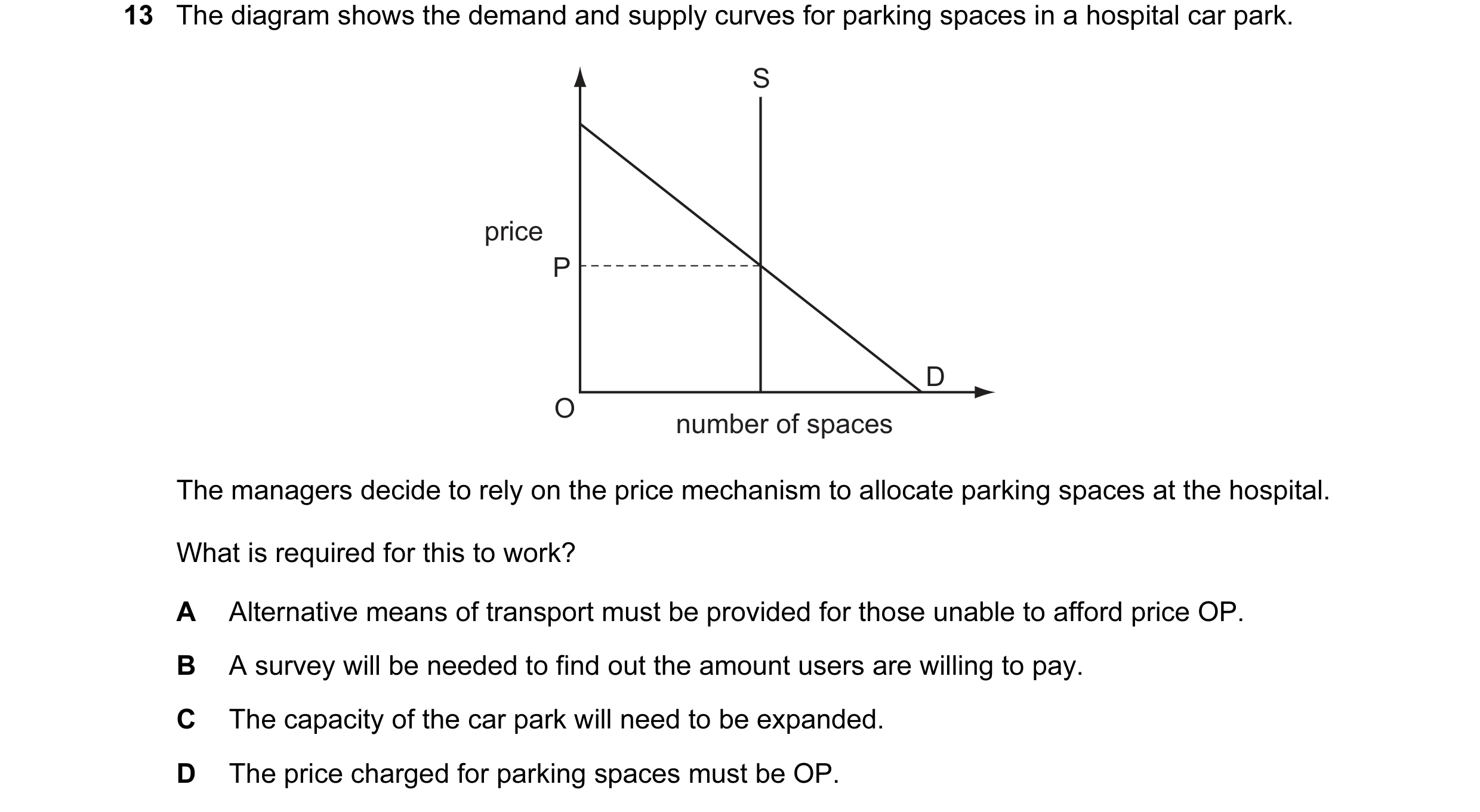
13 The diagram shows the demand and supply curves for parking spaces in a hospital car park. S price P D O number of spaces The managers decide to rely on the price mechanism to allocate parking spaces at the hospital. What is required for this to work? A Alternative means of transport must be provided for those unable to afford price OP. B A survey will be needed to find out the amount users are willing to pay. C The capacity of the car park will need to be expanded. D The price charged for parking spaces must be OP.
1 marks
Answer: D
This question in 9708/12 May/June 2012
Q27 · The term ‘transition economy’ is used to describe a country that is A adopting… 9708/13 May/June 2012
1 The term ‘transition economy’ is used to describe a country that is A adopting capital-intensive methods in place of labour-intensive methods. B moving from central planning towards the market system. C replacing a trade deficit with a trade surplus. D substituting manufacturing output for agricultural output.
1 marks
Answer: B
This question in 9708/13 May/June 2012
Q28 · What is not a function of the price mechanism? 9708/13 May/June 2012
13 What is not a function of the price mechanism? A to ensure that firms make profits B to permit consumers to express their preferences C to ration scarce resources D to signal where resources are required
1 marks
Answer: A
This question in 9708/13 May/June 2012
Q29 · The diagram shows a market subject to a maximum price 9708/11 Oct/Nov 2012
13 The diagram shows a market subject to a maximum price. S price P maximum price D O Q1 Q Q2 quantity What will happen if the maximum price is removed? A There will be allocation by a queuing system. B There will be allocation by government rationing. C There will be allocation by seller’s preference. D There will be allocation by the price system.
1 marks
Answer: D
This question in 9708/11 Oct/Nov 2012
Q30 · What is the defining characteristic of a mixed economy? 9708/12 Oct/Nov 2012
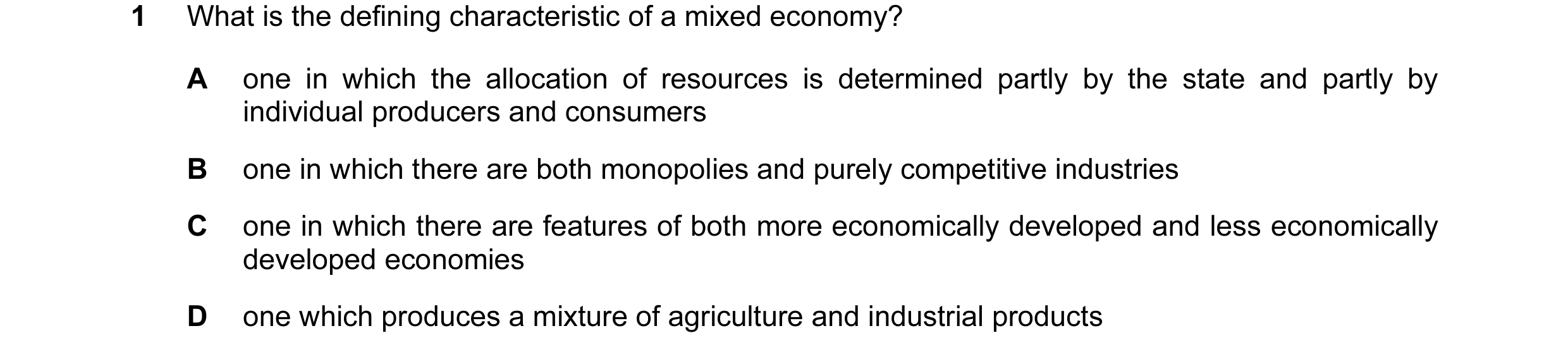
1 What is the defining characteristic of a mixed economy? A one in which the allocation of resources is determined partly by the state and partly by individual producers and consumers B one in which there are both monopolies and purely competitive industries C one in which there are features of both more economically developed and less economically developed economies D one which produces a mixture of agriculture and industrial products
1 marks
Answer: A
This question in 9708/12 Oct/Nov 2012
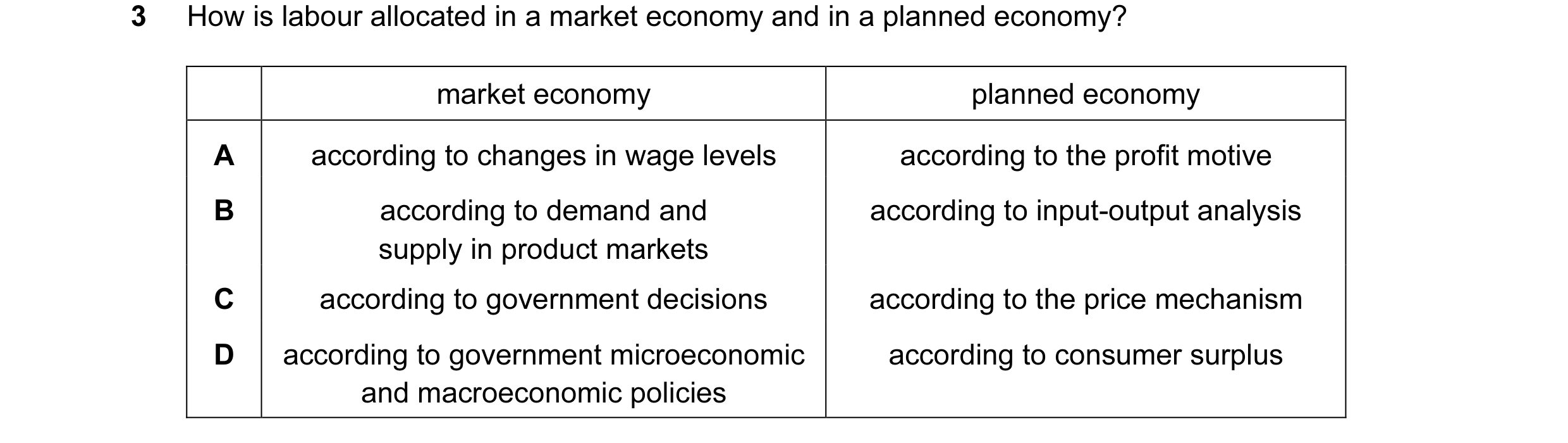
Q31 · How is labour allocated in a market economy and in a planned economy? 9708/13 Oct/Nov 2012
3 How is labour allocated in a market economy and in a planned economy? market economy planned economy A according to changes in wage levels according to the profit motive B according to demand and according to input-output analysis supply in product markets C according to government decisions according to the price mechanism D according to government microeconomic according to consumer surplus and macroeconomic policies
1 marks
Answer: B
This question in 9708/13 Oct/Nov 2012
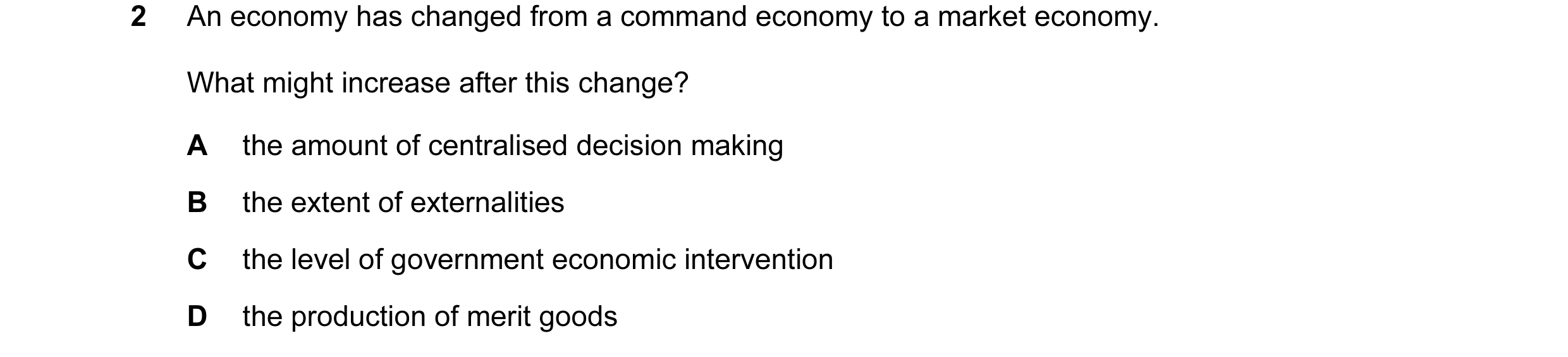
Q32 · An economy has changed from a command economy to a market economy 9708/11 May/June 2013
2 An economy has changed from a command economy to a market economy. What might increase after this change? A the amount of centralised decision making B the extent of externalities C the level of government economic intervention D the production of merit goods
1 marks
Answer: B
This question in 9708/11 May/June 2013
Q33 · In which case is the price system not a possible method of allocating resources? 9708/11 May/June 2013
13 In which case is the price system not a possible method of allocating resources? A in the distribution of foodstuff among the population B in the hiring of workers by employers C in the ownership of land for agricultural use D in the provision of public goods by the government
1 marks
Answer: D
This question in 9708/11 May/June 2013
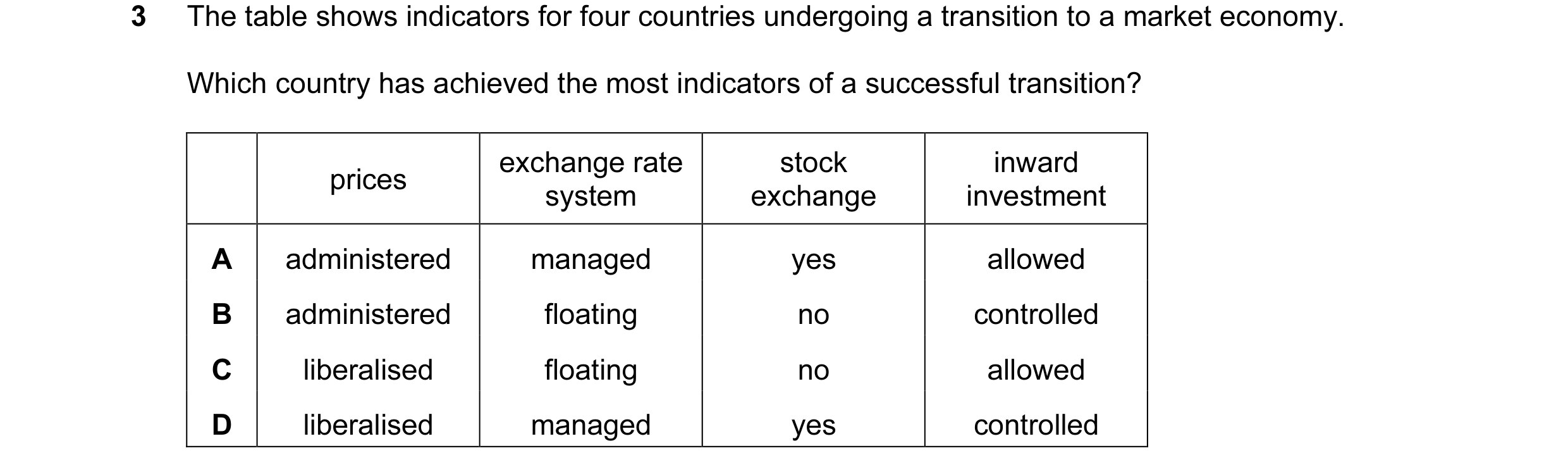
Q34 · The table shows indicators for four countries undergoing a transition to a market economy 9708/12 May/June 2013
3 The table shows indicators for four countries undergoing a transition to a market economy. Which country has achieved the most indicators of a successful transition? exchange rate stock inward prices system exchange investment A administered managed yes allowed B administered floating no controlled C liberalised floating no allowed D liberalised managed yes controlled
1 marks
Answer: C
This question in 9708/12 May/June 2013
Q35 · What is likely to occur when an economy moves from state planning to a market system? 9708/13 May/June 2013
1 What is likely to occur when an economy moves from state planning to a market system? A Consumer choice is reduced. B Enterprise is discouraged. C The amount of innovation declines. D The output of merit goods is reduced.
1 marks
Answer: D
This question in 9708/13 May/June 2013
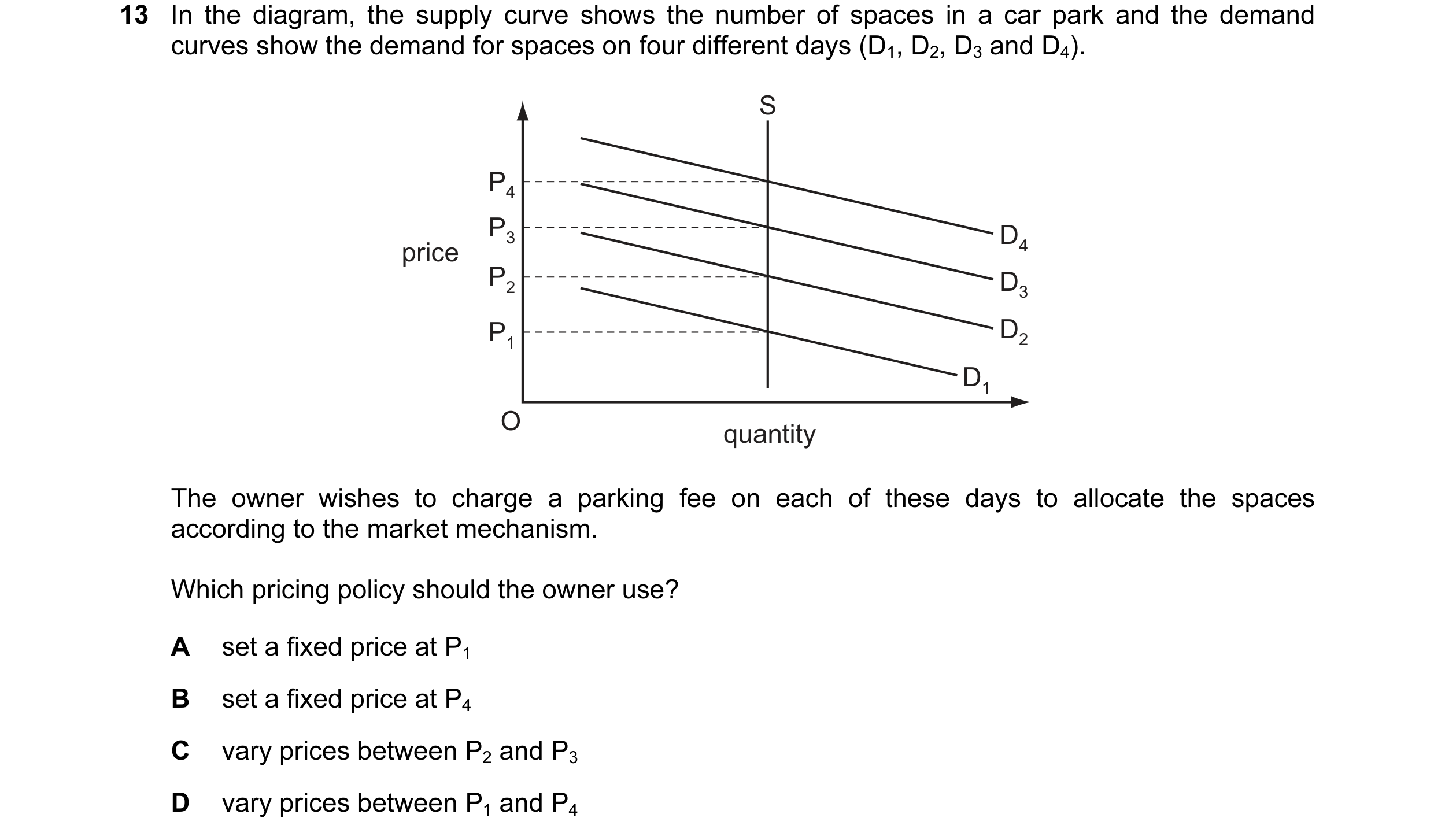
Q36 · In the diagram, the supply curve shows the number of spaces in a car park and the demand… 9708/11 Oct/Nov 2013
13 In the diagram, the supply curve shows the number of spaces in a car park and the demand curves show the demand for spaces on four different days (D1, D2, D3 and D4). S P4 P3 D4 price P2 D3 P1 D2 D1 O quantity The owner wishes to charge a parking fee on each of these days to allocate the spaces according to the market mechanism. Which pricing policy should the owner use? A set a fixed price at P1 B set a fixed price at P4 C vary prices between P2 and P3 D vary prices between P1 and P4
1 marks
Answer: D
This question in 9708/11 Oct/Nov 2013
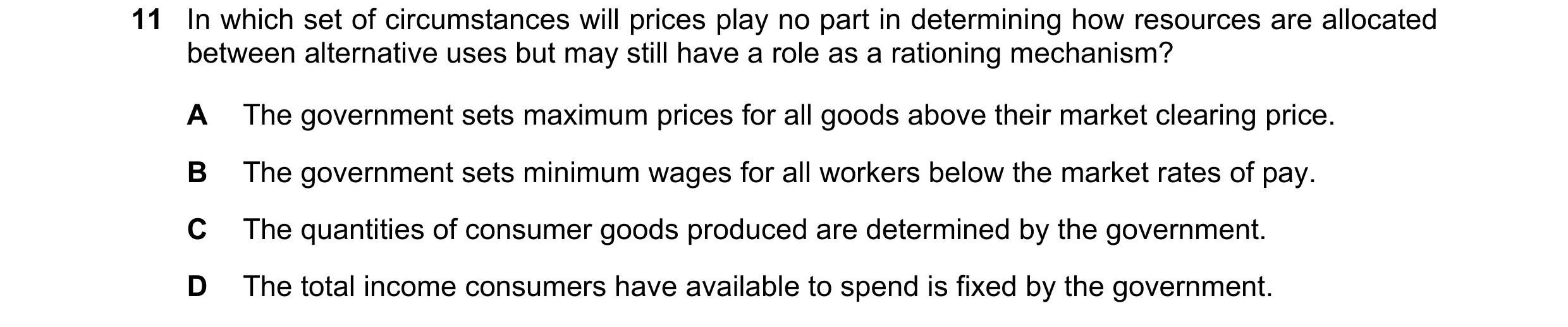
Q37 · In which set of circumstances will prices play no part in determining how resources are… 9708/12 Oct/Nov 2013
13 In which set of circumstances will prices play no part in determining how resources are allocated between alternative uses but may still have a role as a rationing mechanism? A The government sets maximum prices for all goods above their market clearing price. B The government sets minimum wages for all workers below the market rates of pay. C The quantities of consumer goods produced are determined by the government. D The total income consumers have available to spend is fixed by the government.
1 marks
Answer: C
This question in 9708/12 Oct/Nov 2013
Q38 · A centrally planned economy introduces a significant role for free market forces in… 9708/13 Oct/Nov 2013
3 A centrally planned economy introduces a significant role for free market forces in determining how its economic resources are allocated. What is most likely to occur in the short run? A an improvement in the balance of trade B an increase in the general level of prices C an increase in the level of employment D an increase in the level of output
1 marks
Answer: B
This question in 9708/13 Oct/Nov 2013
Q39 · What is generally considered to be one of the advantages of using the price mechanism as… 9708/13 Oct/Nov 2013
13 What is generally considered to be one of the advantages of using the price mechanism as a rationing device? A It ensures that goods are allocated in accordance with the needs of consumers. B It ensures that suppliers cannot make excessive profits. C No one can be prevented from consuming a good if they are willing and able to pay the market price. D The allocation of goods is determined by consumers’ wealth.
1 marks
Answer: C
This question in 9708/13 Oct/Nov 2013
Q40 · What is likely to be the short-run consequence of replacing central planning with a… 9708/11 May/June 2014
2 What is likely to be the short-run consequence of replacing central planning with a market-based system? A a decrease in the rate of inflation B a lower rate of return on capital investment C a more equal distribution of income and wealth D an increase in the level of unemployment
1 marks
Answer: D
This question in 9708/11 May/June 2014
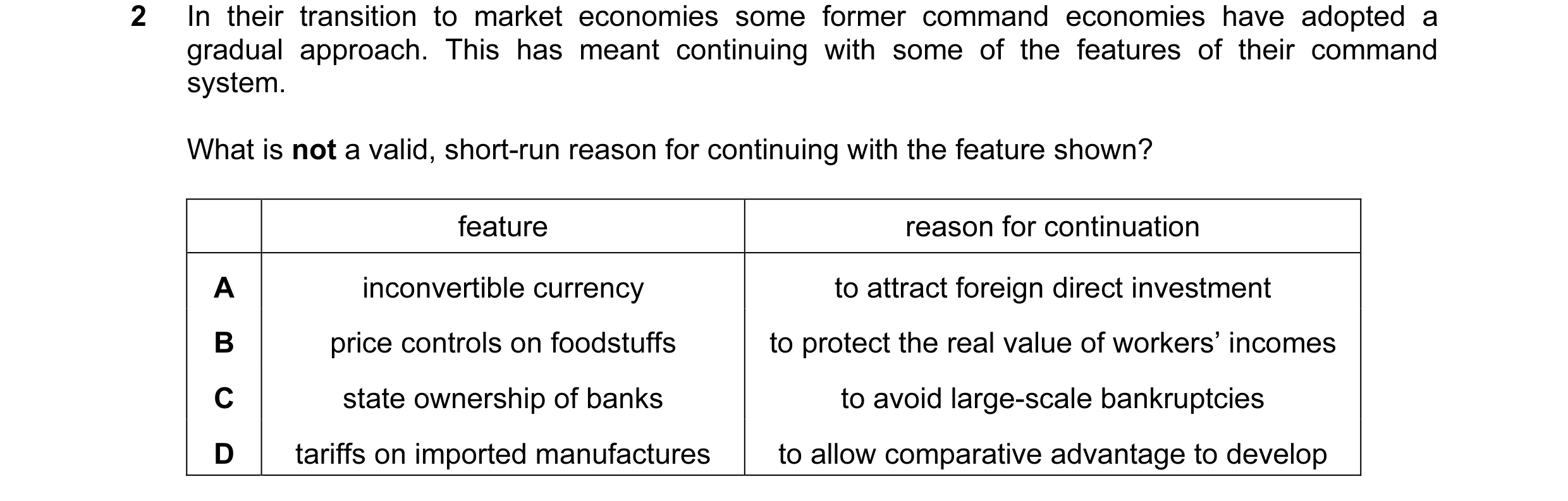
Q41 · In their transition to market economies some former command economies have adopted a… 9708/13 May/June 2014
2 In their transition to market economies some former command economies have adopted a gradual approach. This has meant continuing with some of the features of their command system. What is not a valid, short-run reason for continuing with the feature shown? feature reason for continuation A inconvertible currency to attract foreign direct investment B price controls on foodstuffs to protect the real value of workers’ incomes C state ownership of banks to avoid large-scale bankruptcies D tariffs on imported manufactures to allow comparative advantage to develop
1 marks
Answer: A
This question in 9708/13 May/June 2014
Q42 · What are involved in the allocation of resources in a market economy? 9708/11 Oct/Nov 2014
1 What are involved in the allocation of resources in a market economy? A factors of production and subsidies for essential goods B prices and choices C production possibilities and trade restrictions D unlimited wants and public goods
1 marks
This question in 9708/11 Oct/Nov 2014
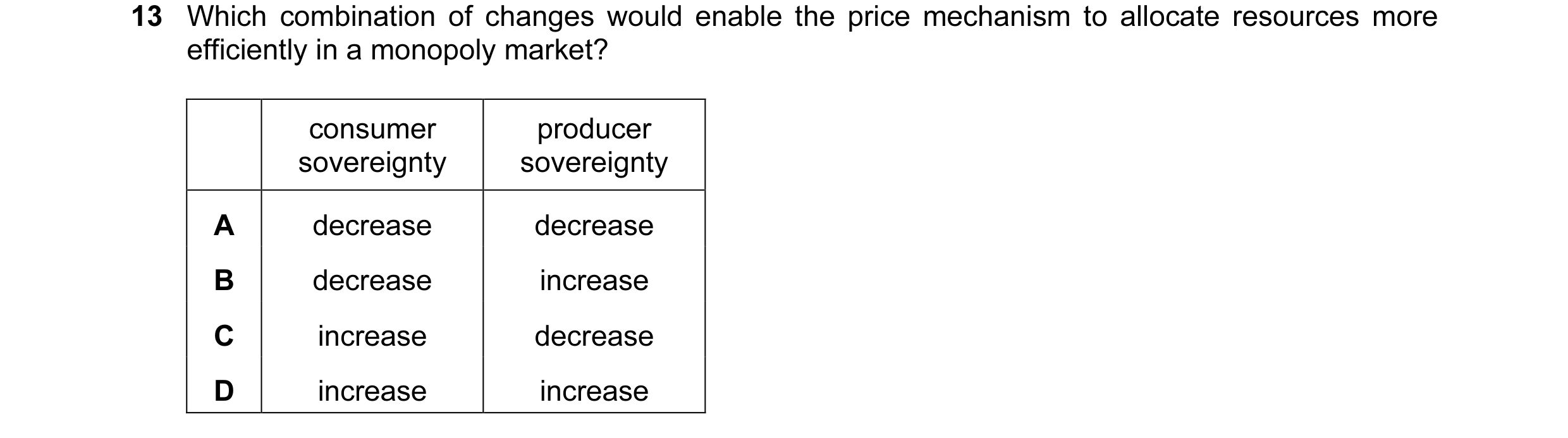
Q43 · Which combination of changes would enable the price mechanism to allocate resources more… 9708/12 Oct/Nov 2014
13 Which combination of changes would enable the price mechanism to allocate resources more efficiently in a monopoly market? consumer producer sovereignty sovereignty A decrease decrease B decrease increase C increase decrease D increase increase
1 marks
Answer: C
This question in 9708/12 Oct/Nov 2014
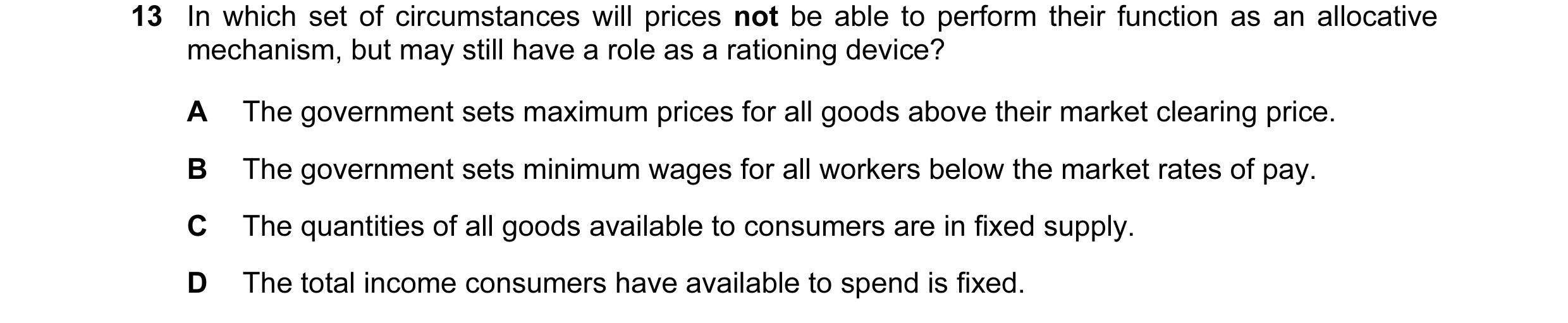
Q44 · In which set of circumstances will prices not be able to perform their function as an… 9708/13 Oct/Nov 2014
13 In which set of circumstances will prices not be able to perform their function as an allocative mechanism, but may still have a role as a rationing device? A The government sets maximum prices for all goods above their market clearing price. B The government sets minimum wages for all workers below the market rates of pay. C The quantities of all goods available to consumers are in fixed supply. D The total income consumers have available to spend is fixed.
1 marks
Answer: C
This question in 9708/13 Oct/Nov 2014
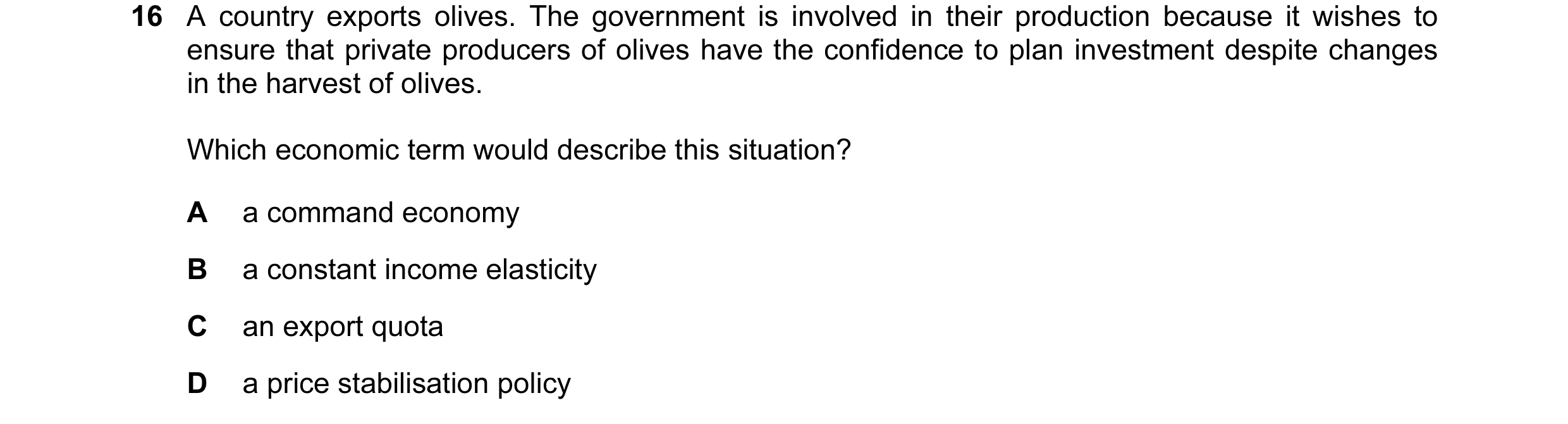
Q45 · A country exports olives 9708/13 Oct/Nov 2014
16 A country exports olives. The government is involved in their production because it wishes to ensure that private producers of olives have the confidence to plan investment despite changes in the harvest of olives. Which economic term would describe this situation? A a command economy B a constant income elasticity C an export quota D a price stabilisation policy
1 marks
Answer: D
This question in 9708/13 Oct/Nov 2014
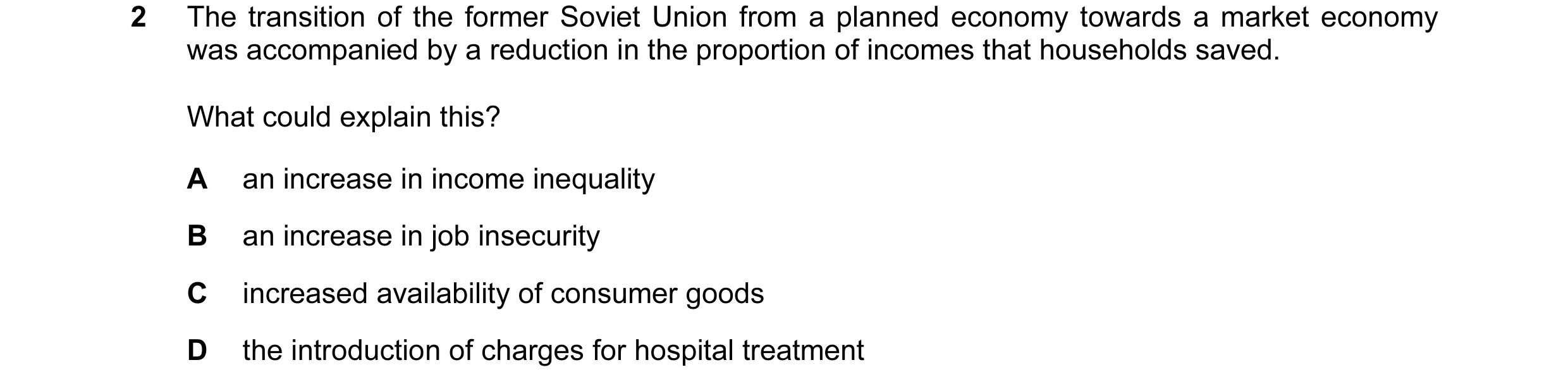
Q46 · The transition of the former Soviet Union from a planned economy towards a market economy… 9708/12 May/June 2015
2 The transition of the former Soviet Union from a planned economy towards a market economy was accompanied by a reduction in the proportion of incomes that households saved. What could explain this? A an increase in income inequality B an increase in job insecurity C increased availability of consumer goods D the introduction of charges for hospital treatment
1 marks
Answer: C
This question in 9708/12 May/June 2015
Q47 · To improve their economic performance, Eastern European countries have switched from… 9708/13 May/June 2015
2 To improve their economic performance, Eastern European countries have switched from planned economies to mixed economies. What is likely to be the most common outcome of such a change? A short-term and long-term success in improving economic performance B short-term and long-term failure in improving economic performance C short-term failure and long-term success in improving economic performance D short-term success and long-term failure in improving economic performance
1 marks
Answer: C
This question in 9708/13 May/June 2015
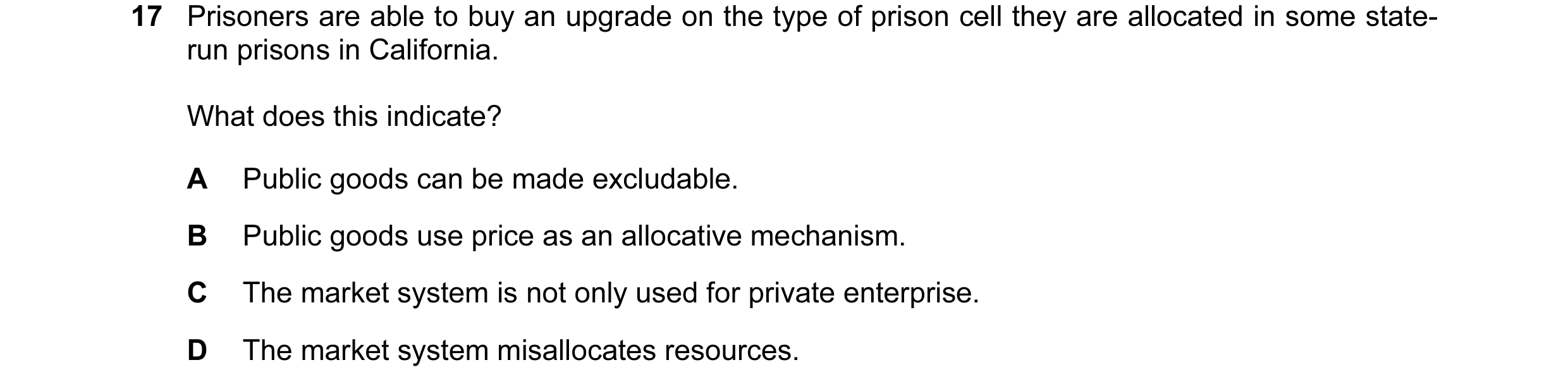
Q48 · Prisoners are able to buy an upgrade on the type of prison cell they are allocated in… 9708/13 May/June 2015
17 Prisoners are able to buy an upgrade on the type of prison cell they are allocated in some state- run prisons in California. What does this indicate? A Public goods can be made excludable. B Public goods use price as an allocative mechanism. C The market system is not only used for private enterprise. D The market system misallocates resources.
1 marks
Answer: C
This question in 9708/13 May/June 2015
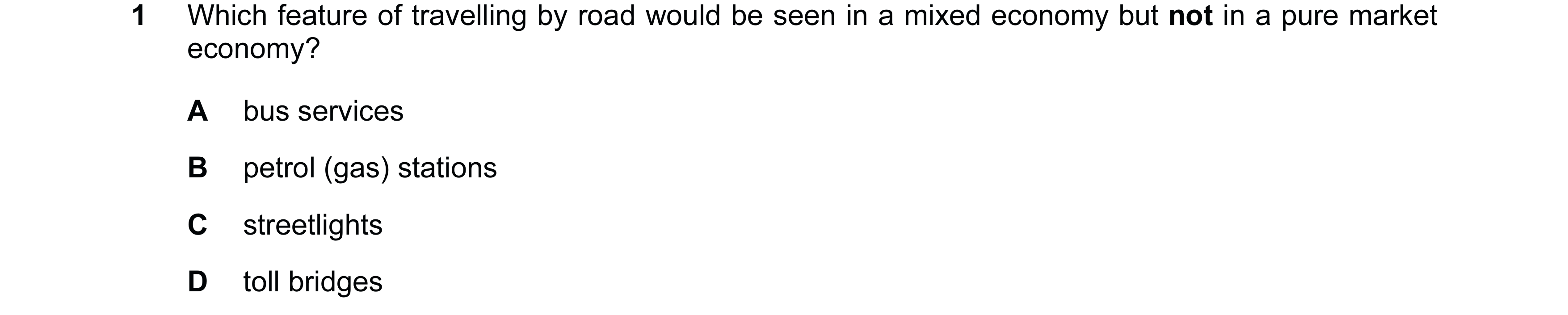
Q49 · Which feature of travelling by road would be seen in a mixed economy but not in a pure… 9708/11 Oct/Nov 2015
1 Which feature of travelling by road would be seen in a mixed economy but not in a pure market economy? A bus services B petrol (gas) stations C streetlights D toll bridges
1 marks
Answer: C
This question in 9708/11 Oct/Nov 2015
Q50 · What would explain why the transition from a planned economy to a market economy often… 9708/13 Oct/Nov 2015
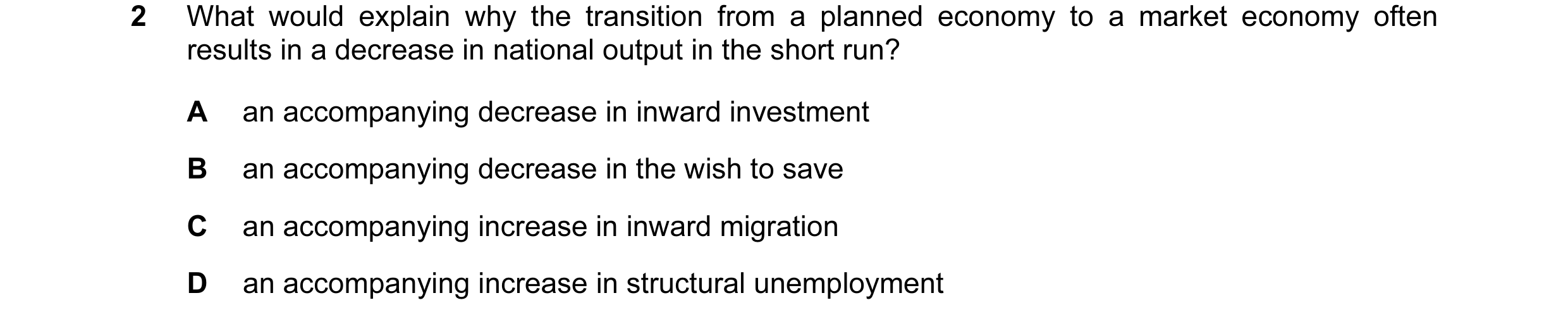
2 What would explain why the transition from a planned economy to a market economy often results in a decrease in national output in the short run? A an accompanying decrease in inward investment B an accompanying decrease in the wish to save C an accompanying increase in inward migration D an accompanying increase in structural unemployment
1 marks
Answer: D
This question in 9708/13 Oct/Nov 2015
Q51 · As part of a privatisation policy, a government deregulates bus services and sells off… 9708/12 Feb/March 2016
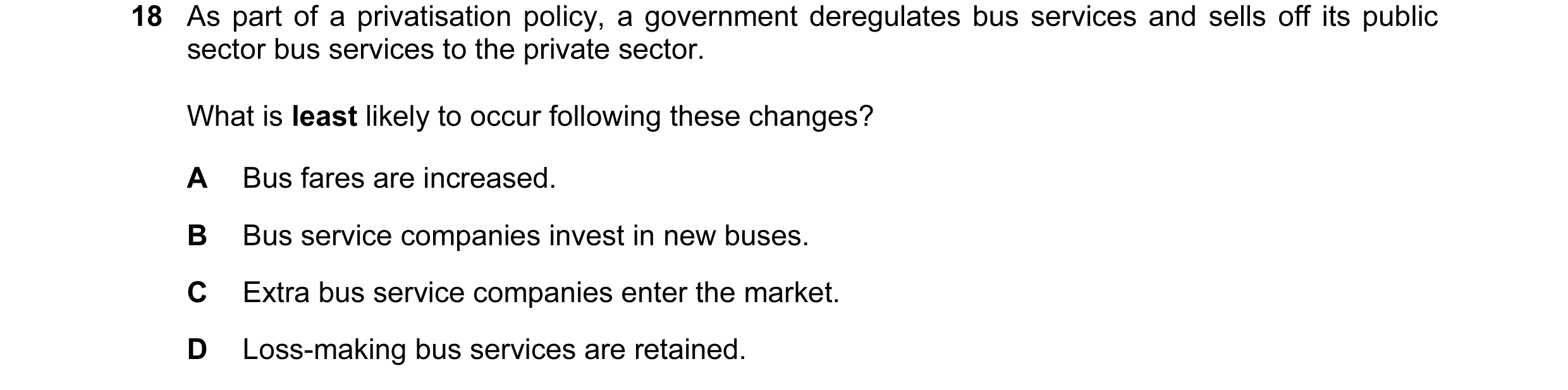
18 As part of a privatisation policy, a government deregulates bus services and sells off its public sector bus services to the private sector. What is least likely to occur following these changes? A Bus fares are increased. B Bus service companies invest in new buses. C Extra bus service companies enter the market. D Loss-making bus services are retained.
1 marks
Answer: D
This question in 9708/12 Feb/March 2016
Q52 · The transition of centrally planned economies to market economies was accompanied by a… 9708/11 May/June 2016
2 The transition of centrally planned economies to market economies was accompanied by a significant change in the composition of output. What was an immediate consequence of this transition? A a build-up of unsold stocks of goods B an increase in exports of goods C an increase in structural unemployment D decreasing prices of goods and services
1 marks
Answer: C
This question in 9708/11 May/June 2016
Q53 · On 1 May 2012 President Morales of Bolivia announced the nationalisation of… 9708/11 May/June 2016
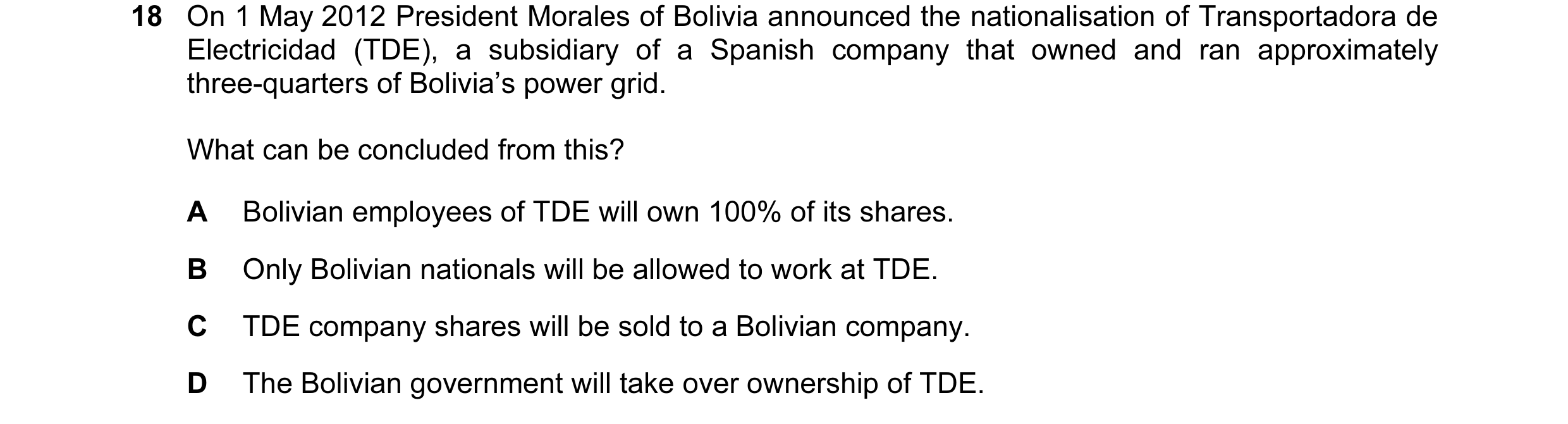
18 On 1 May 2012 President Morales of Bolivia announced the nationalisation of Transportadora de Electricidad (TDE), a subsidiary of a Spanish company that owned and ran approximately three-quarters of Bolivia’s power grid. What can be concluded from this? A Bolivian employees of TDE will own 100% of its shares. B Only Bolivian nationals will be allowed to work at TDE. C TDE company shares will be sold to a Bolivian company. D The Bolivian government will take over ownership of TDE.
1 marks
Answer: D
This question in 9708/11 May/June 2016
Q54 · Governments reduce their stock of assets by privatisation 9708/13 May/June 2016
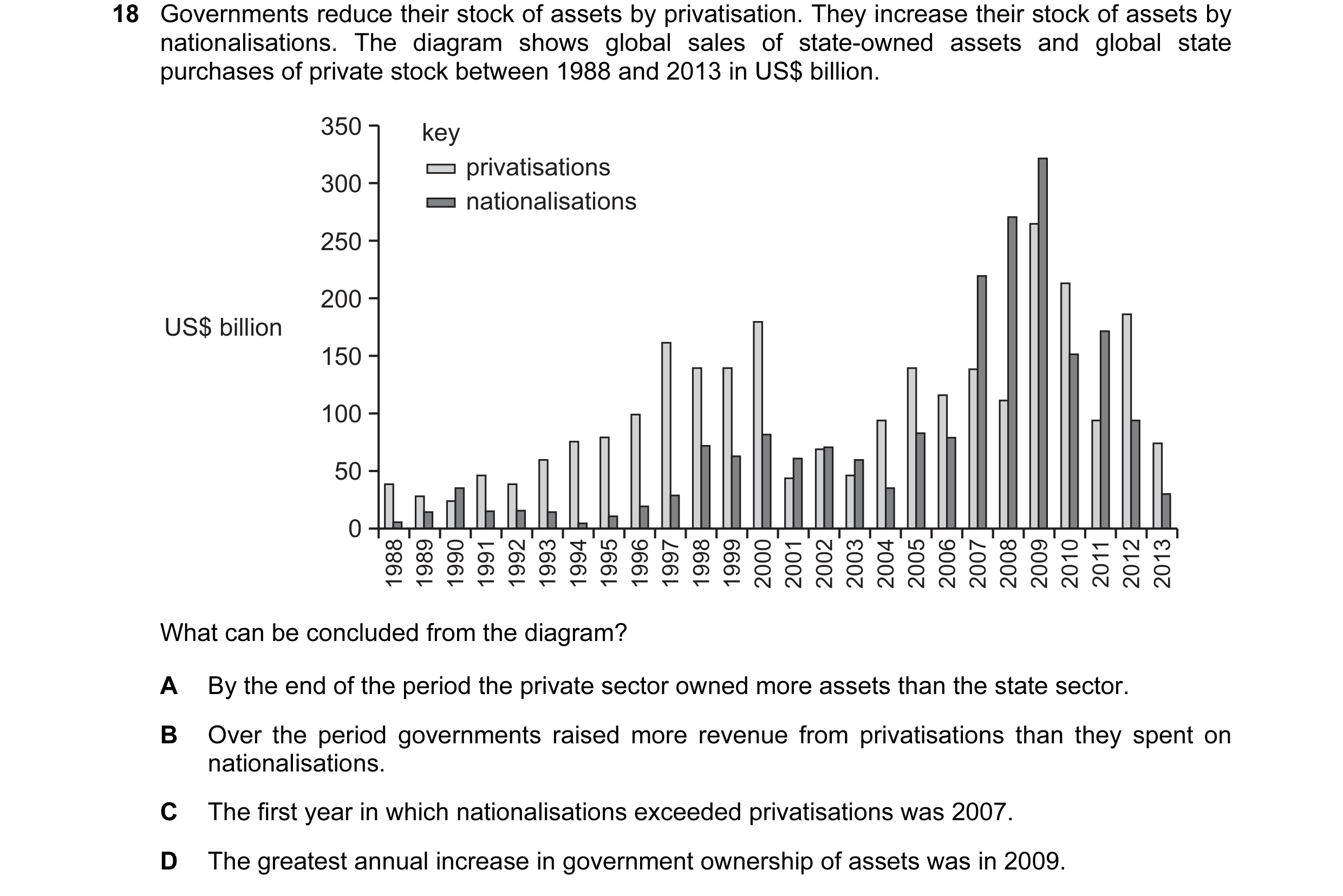
18 Governments reduce their stock of assets by privatisation. They increase their stock of assets by nationalisations. The diagram shows global sales of state-owned assets and global state purchases of private stock between 1988 and 2013 in US$ billion. 350 key privatisations 300 nationalisations 250 200 US$ billion 150 100 50 0 1988 1989 1990 1991 1992 1993 1994 1995 1996 1997 1998 1999 2000 2001 2002 2003 2004 2005 2006 2007 2008 2009 2010 2011 2012 2013 What can be concluded from the diagram? A By the end of the period the private sector owned more assets than the state sector. B Over the period governments raised more revenue from privatisations than they spent on nationalisations. C The first year in which nationalisations exceeded privatisations was 2007. D The greatest annual increase in government ownership of assets was in 2009.
1 marks
Answer: B
This question in 9708/13 May/June 2016
Q55 · In 2014, the Hong Kong Housing Authority said the waiting time for public sector housing… 9708/12 Oct/Nov 2016
2 In 2014, the Hong Kong Housing Authority said the waiting time for public sector housing had increased and it would only complete 8900 flats of the 15 000 planned for the year. The reasons were the shortage of workers because they were needed in other public sector projects, the difficulty of finding land, and government regulations. Which economic concepts are illustrated in this information? A a market economy and a lack of resources B economic planning and the price mechanism C opportunity cost of labour and excess demand D production possibility and budget deficit
1 marks
Answer: C
This question in 9708/12 Oct/Nov 2016
Q56 · What is most likely to be a distinguishing feature of the healthcare system of a mixed… 9708/12 Oct/Nov 2016
3 What is most likely to be a distinguishing feature of the healthcare system of a mixed economy? A a mixture of foreign and domestically owned hospitals B a mixture of foreign and domestic medical staff C a mixture of government-owned and privately owned hospitals D a mixture of specialist and general hospitals
1 marks
Answer: C
This question in 9708/12 Oct/Nov 2016
Q57 · Which change in economic system is likely to result in the greatest rise in unemployment… 9708/13 Oct/Nov 2016
2 Which change in economic system is likely to result in the greatest rise in unemployment combined with the greatest fall in economic regulation? A market to mixed B mixed to planned C planned to market D planned to mixed
1 marks
Answer: C
This question in 9708/13 Oct/Nov 2016
Q58 · What is likely to be introduced in the market for bus travel if an economy moved from a… 9708/11 May/June 2017
2 What is likely to be introduced in the market for bus travel if an economy moved from a mixed economy to a market economy? A allowing companies to bid for bus routes B free bus travel for school children C maximum prices for bus travel D subsidies to bus operators
1 marks
Answer: A
This question in 9708/11 May/June 2017
Q59 · In which aspect is the planned economy likely to offer more than the market economy? 9708/12 May/June 2017
2 In which aspect is the planned economy likely to offer more than the market economy? A competition B incentive C innovation D security
1 marks
Answer: D
This question in 9708/12 May/June 2017
Q60 · What would prevent the operation of the market mechanism’s rationing function? 9708/12 May/June 2017
12 What would prevent the operation of the market mechanism’s rationing function? A falling prices B price controls C rising profits D self interest
1 marks
Answer: B
This question in 9708/12 May/June 2017
Q61 · Following deregulation, state-owned enterprises in an economy are to be privatised 9708/13 May/June 2017
18 Following deregulation, state-owned enterprises in an economy are to be privatised. What is least likely to result? A Private companies will put customer needs before profits. B Private companies will raise their own share capital. C The level of incentive for the enterprises will rise. D The number of companies will increase.
1 marks
Answer: A
This question in 9708/13 May/June 2017
Q62 · From 1990 to 2000 each of the countries listed below changed towards a market economy… 9708/11 Oct/Nov 2017
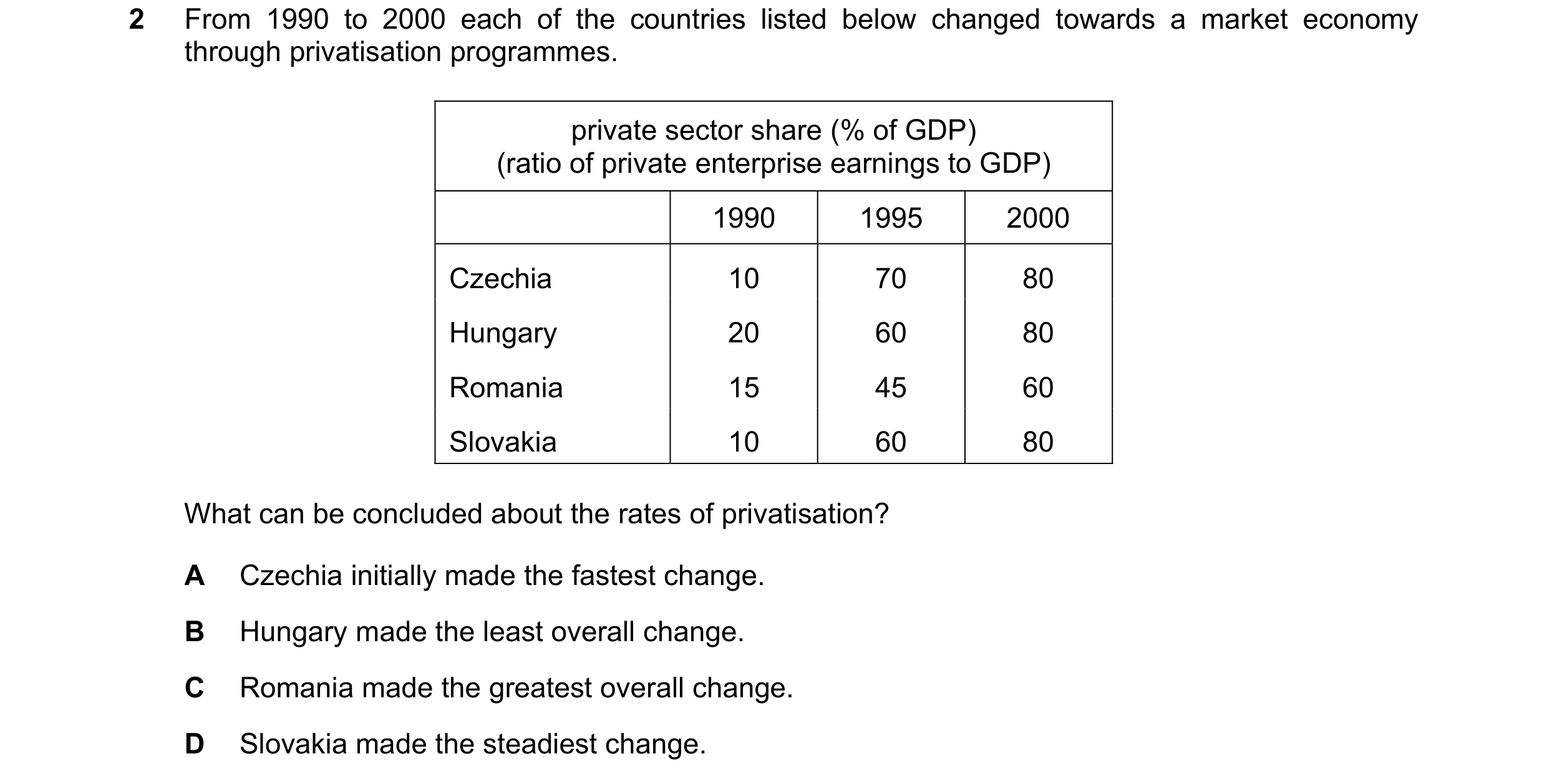
2 From 1990 to 2000 each of the countries listed below changed towards a market economy through privatisation programmes. private sector share (% of GDP) (ratio of private enterprise earnings to GDP) 1990 1995 2000 Czechia 10 70 80 Hungary 20 60 80 Romania 15 45 60 Slovakia 10 60 80 What can be concluded about the rates of privatisation? A Czechia initially made the fastest change. B Hungary made the least overall change. C Romania made the greatest overall change. D Slovakia made the steadiest change.
1 marks
Answer: A
This question in 9708/11 Oct/Nov 2017
Q63 · The diagram shows the demand and supply curves for parking spaces in a hospital car park 9708/11 Oct/Nov 2017
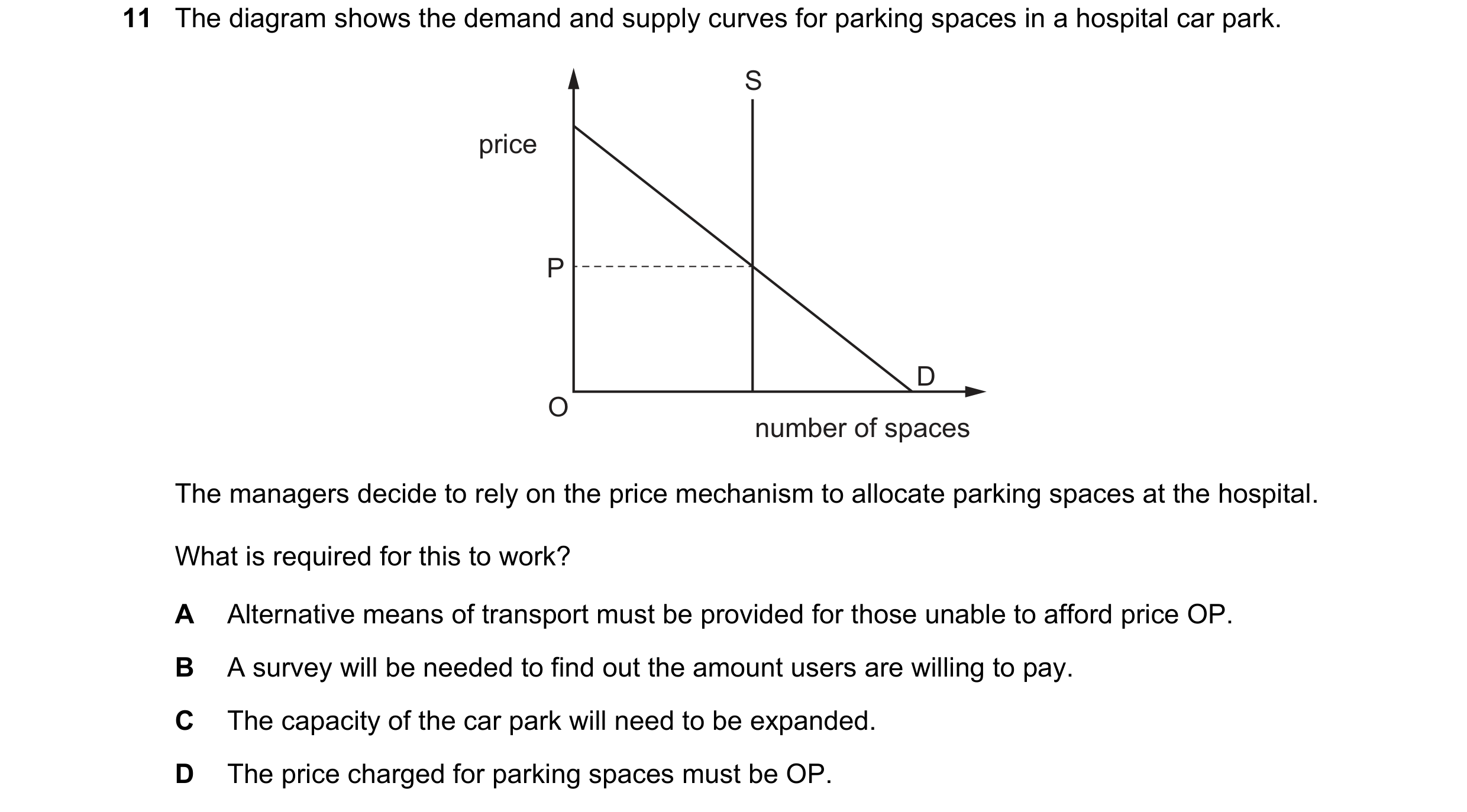
11 The diagram shows the demand and supply curves for parking spaces in a hospital car park. S price P D O number of spaces The managers decide to rely on the price mechanism to allocate parking spaces at the hospital. What is required for this to work? A Alternative means of transport must be provided for those unable to afford price OP. B A survey will be needed to find out the amount users are willing to pay. C The capacity of the car park will need to be expanded. D The price charged for parking spaces must be OP.
1 marks
Answer: D
This question in 9708/11 Oct/Nov 2017
Q64 · The table shows the annual percentage change in the output per worker employed for four… 9708/11 Oct/Nov 2017
18 The table shows the annual percentage change in the output per worker employed for four nationalised industries before and after privatisation. nationalised before after industry privatisation privatisation railways –4% 2% electricity supply 7% 9% shipbuilding 4% –1% telecommunications 6% 6% What can be concluded from the table about the effect of privatisation? A Employment fell in the railway industry. B Employment was unchanged in the telecommunications industry. C Output was greatest in the electricity supply industry. D Workers became less efficient in the shipbuilding industry.
1 marks
Answer: D
This question in 9708/11 Oct/Nov 2017
Q65 · What does not happen when price acts as a means to allocate resources? 9708/12 Oct/Nov 2017
11 What does not happen when price acts as a means to allocate resources? A Price determines the supply of public goods. B Price operates in the markets for both goods and factors of production. C Price recognises consumers’ ability to pay rather than consumers’ needs. D Price signals to producers which goods are most profitable.
1 marks
Answer: A
This question in 9708/12 Oct/Nov 2017
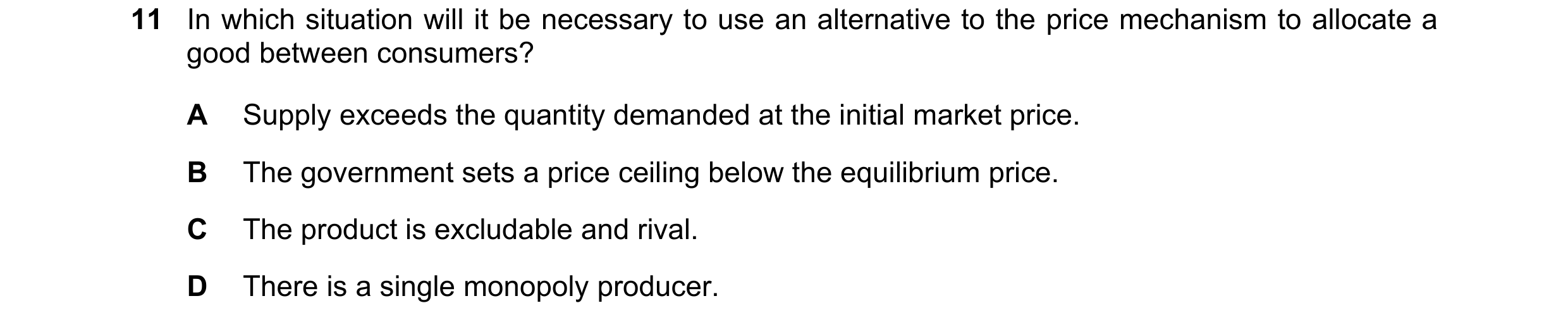
Q66 · In which situation will it be necessary to use an alternative to the price mechanism to… 9708/13 Oct/Nov 2017
11 In which situation will it be necessary to use an alternative to the price mechanism to allocate a good between consumers? A Supply exceeds the quantity demanded at the initial market price. B The government sets a price ceiling below the equilibrium price. C The product is excludable and rival. D There is a single monopoly producer.
1 marks
Answer: B
This question in 9708/13 Oct/Nov 2017
Q67 · Which action by a government would not be regarded as a form of privatisation? 9708/13 Oct/Nov 2017
18 Which action by a government would not be regarded as a form of privatisation? A the contracting out of the provision of public sector services to private sector firms B the deregulation of public sector industries to allow the entry of private sector firms C the payment of subsidies from the public sector to private sector firms D the sale of shares in a public sector corporation to the private sector
1 marks
Answer: C
This question in 9708/13 Oct/Nov 2017
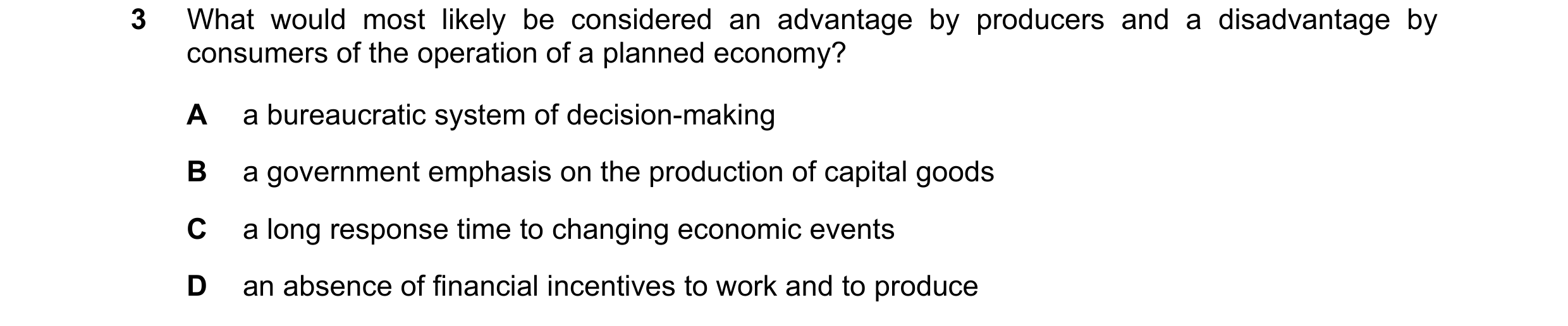
Q68 · What would most likely be considered an advantage by producers and a disadvantage by… 9708/11 May/June 2018
3 What would most likely be considered an advantage by producers and a disadvantage by consumers of the operation of a planned economy? A a bureaucratic system of decision-making B a government emphasis on the production of capital goods C a long response time to changing economic events D an absence of financial incentives to work and to produce
1 marks
Answer: B
This question in 9708/11 May/June 2018
Q69 · What is definitely a feature of a nationalised industry? 9708/11 May/June 2018
17 What is definitely a feature of a nationalised industry? A Consumers are not charged a price for its product. B No profit is made from supplying its product. C The government owns the industry’s capital. D There is no competition in the market for its product.
1 marks
Answer: C
This question in 9708/11 May/June 2018
Q70 · When will the price mechanism not function as a system for allocating goods? 9708/12 May/June 2018
10 When will the price mechanism not function as a system for allocating goods? A when the government bans advertising B when the government maintains an effective maximum price C when there is a limited supply of the good D when there is a powerful company able to set the market price
1 marks
Answer: B
This question in 9708/12 May/June 2018
Q71 · A government privatises the telecommunications industry 9708/12 May/June 2018
18 A government privatises the telecommunications industry. What is least likely to increase? A choice of telecommunications services for consumers B development of new telecommunications products C employment in the telecommunications industry D productivity in the supply of telecommunications
1 marks
Answer: C
This question in 9708/12 May/June 2018
Q72 · In which set of circumstances will prices play no part in determining how resources are… 9708/13 May/June 2018
11 In which set of circumstances will prices play no part in determining how resources are allocated between alternative uses but may still have a role as a rationing mechanism? A The government sets maximum prices for all goods above their market clearing price. B The government sets minimum wages for all workers below the market rates of pay. C The quantities of consumer goods produced are determined by the government. D The total income consumers have available to spend is fixed by the government.
1 marks
Answer: C
This question in 9708/13 May/June 2018
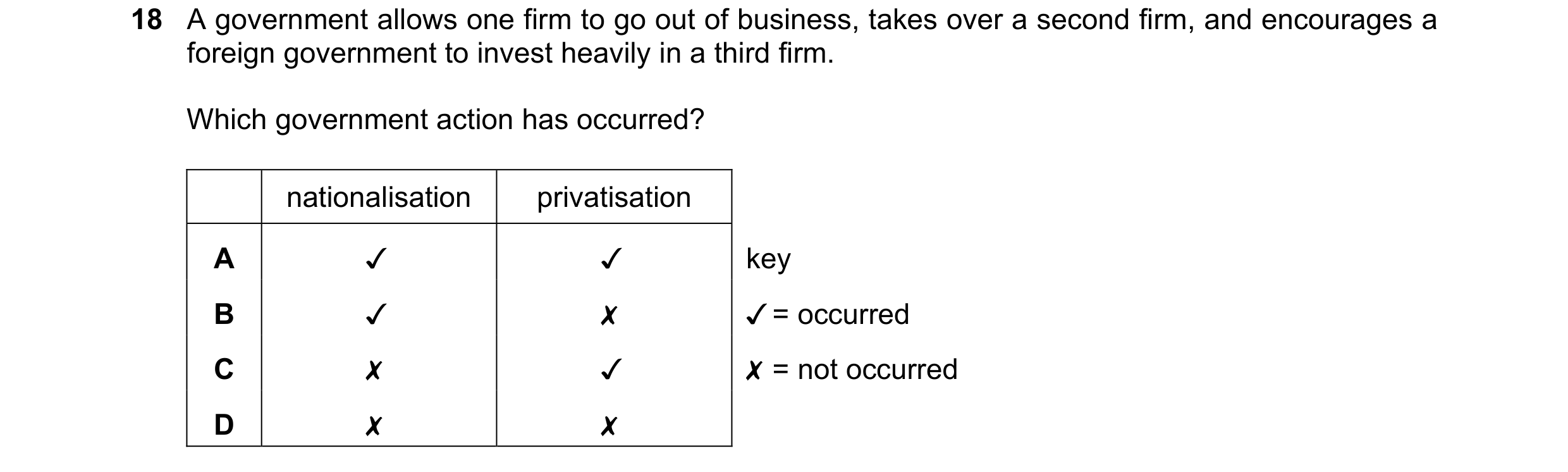
Q73 · A government allows one firm to go out of business, takes over a second firm, and… 9708/13 May/June 2018
18 A government allows one firm to go out of business, takes over a second firm, and encourages a
foreign government to invest heavily in a third firm.
Which government action has occurred?
nationalisation privatisation
A J J key
B v x ¥ = occurred
Cc x v X = not occurred
D x x
1 marks
Answer: B
This question in 9708/13 May/June 2018
Q74 · Which argument is used to justify a policy of nationalisation? 9708/11 Oct/Nov 2018
18 Which argument is used to justify a policy of nationalisation? A A firm exposed to market forces is more likely to be efficient. B It avoids the wasteful duplication of resources. C The stock market can exert effective discipline on the industry. D There are benefits from wider share ownership.
1 marks
Answer: B
This question in 9708/11 Oct/Nov 2018
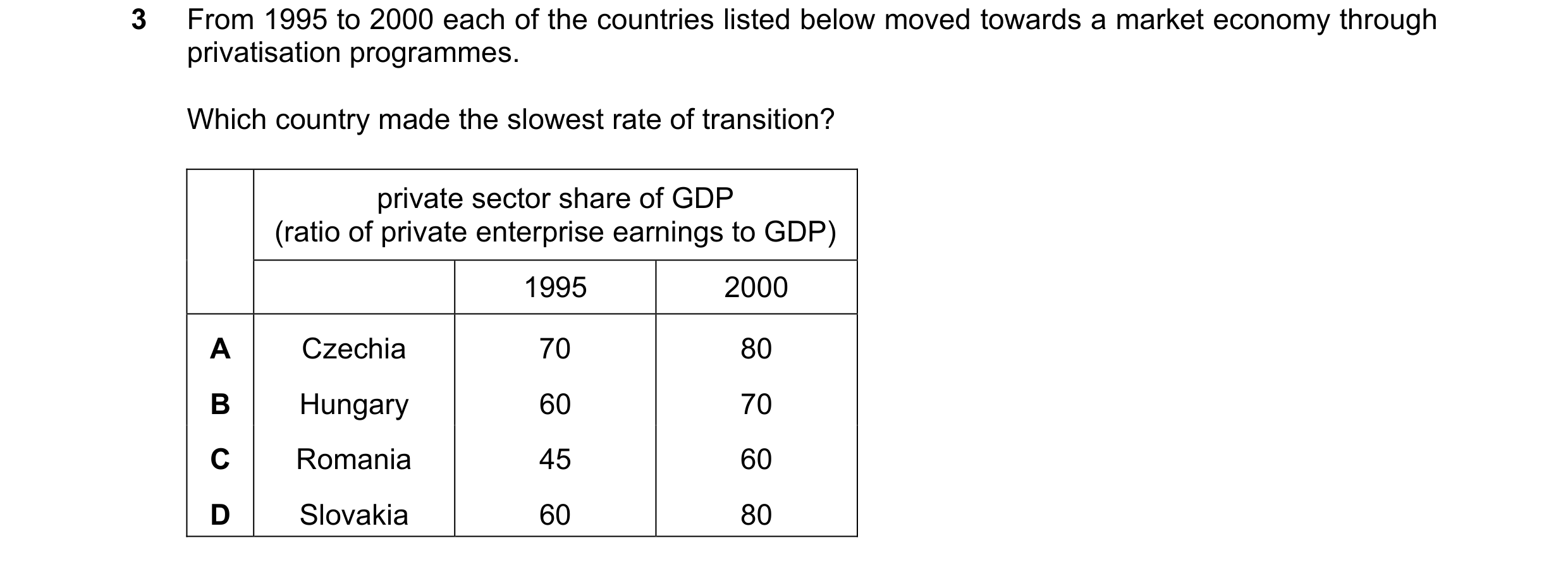
Q75 · From 1995 to 2000 each of the countries listed below moved towards a market economy… 9708/12 Oct/Nov 2018
3 From 1995 to 2000 each of the countries listed below moved towards a market economy through privatisation programmes. Which country made the slowest rate of transition? private sector share of GDP (ratio of private enterprise earnings to GDP) 1995 2000 A Czechia 70 80 B Hungary 60 70 C Romania 45 60 D Slovakia 60 80
1 marks
Answer: A
This question in 9708/12 Oct/Nov 2018
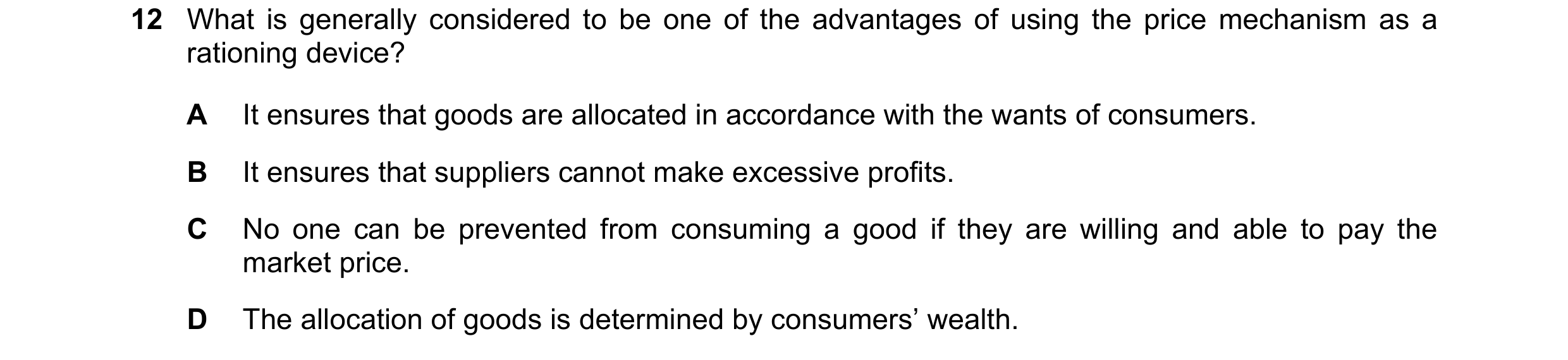
Q76 · What is generally considered to be one of the advantages of using the price mechanism as… 9708/12 Oct/Nov 2018
12 What is generally considered to be one of the advantages of using the price mechanism as a rationing device? A It ensures that goods are allocated in accordance with the wants of consumers. B It ensures that suppliers cannot make excessive profits. C No one can be prevented from consuming a good if they are willing and able to pay the market price. D The allocation of goods is determined by consumers’ wealth.
1 marks
Answer: C
This question in 9708/12 Oct/Nov 2018
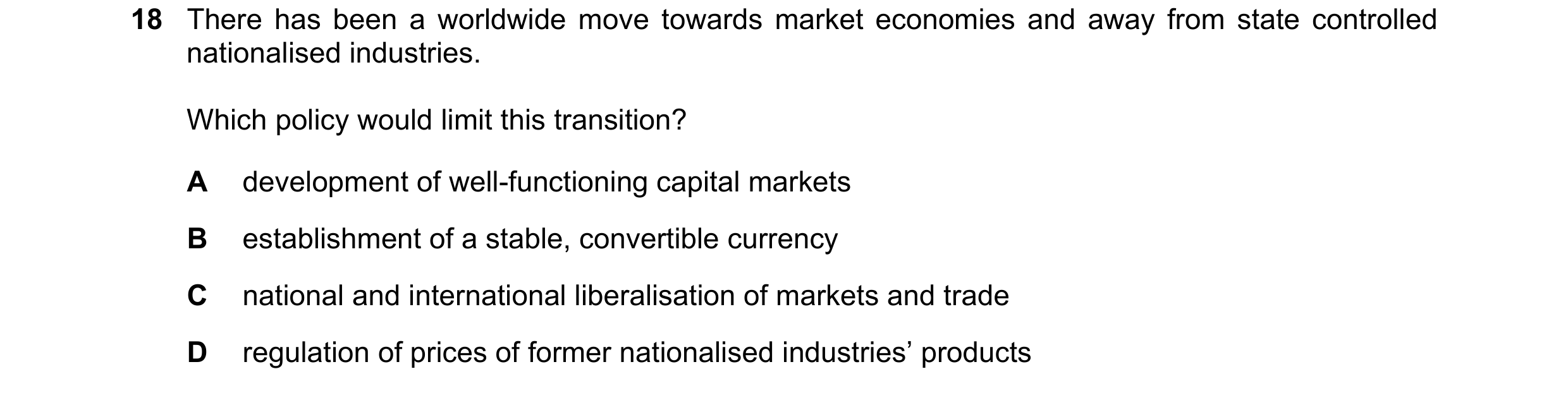
Q77 · There has been a worldwide move towards market economies and away from state controlled… 9708/13 Oct/Nov 2018
18 There has been a worldwide move towards market economies and away from state controlled nationalised industries. Which policy would limit this transition? A development of well-functioning capital markets B establishment of a stable, convertible currency C national and international liberalisation of markets and trade D regulation of prices of former nationalised industries’ products
1 marks
Answer: D
This question in 9708/13 Oct/Nov 2018
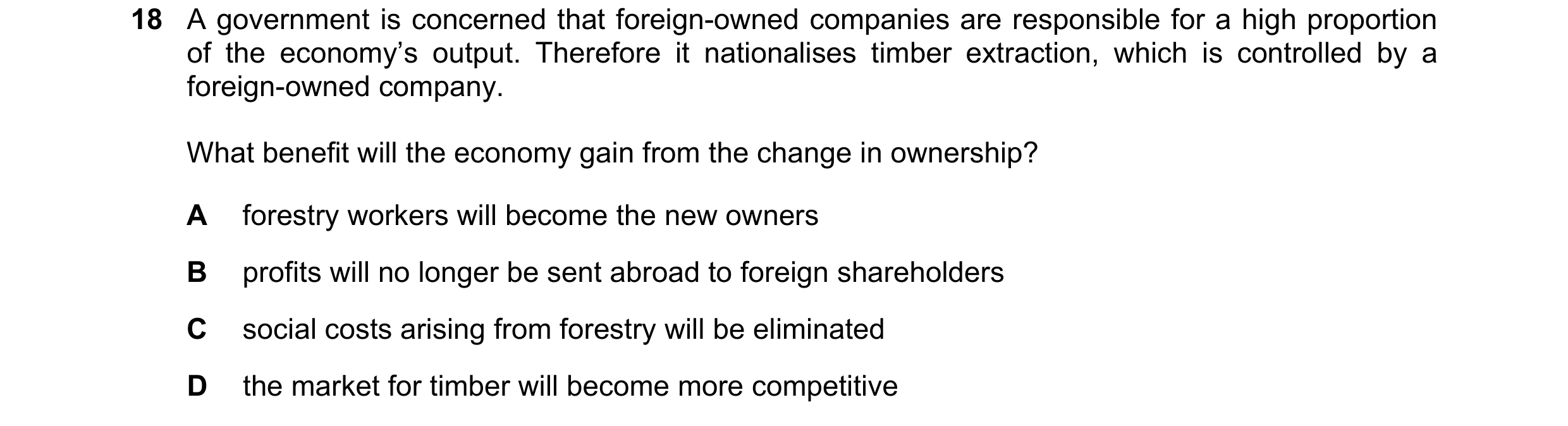
Q78 · A government is concerned that foreign-owned companies are responsible for a high… 9708/12 Feb/March 2019
18 A government is concerned that foreign-owned companies are responsible for a high proportion of the economy’s output. Therefore it nationalises timber extraction, which is controlled by a foreign-owned company. What benefit will the economy gain from the change in ownership? A forestry workers will become the new owners B profits will no longer be sent abroad to foreign shareholders C social costs arising from forestry will be eliminated D the market for timber will become more competitive
1 marks
Answer: B
This question in 9708/12 Feb/March 2019
Q79 · A government wants to move its economy away from central planning towards a market economy 9708/12 May/June 2019
2 A government wants to move its economy away from central planning towards a market economy. Which policy would be consistent with this aim? A introduce tariffs on imported goods B privatise the ownership of electricity generation C provide free education for primary school pupils D reduce prices of foods such as wheat and rice
1 marks
Answer: B
This question in 9708/12 May/June 2019
Q80 · A Southern African government was concerned about the market influence of a large… 9708/12 May/June 2019
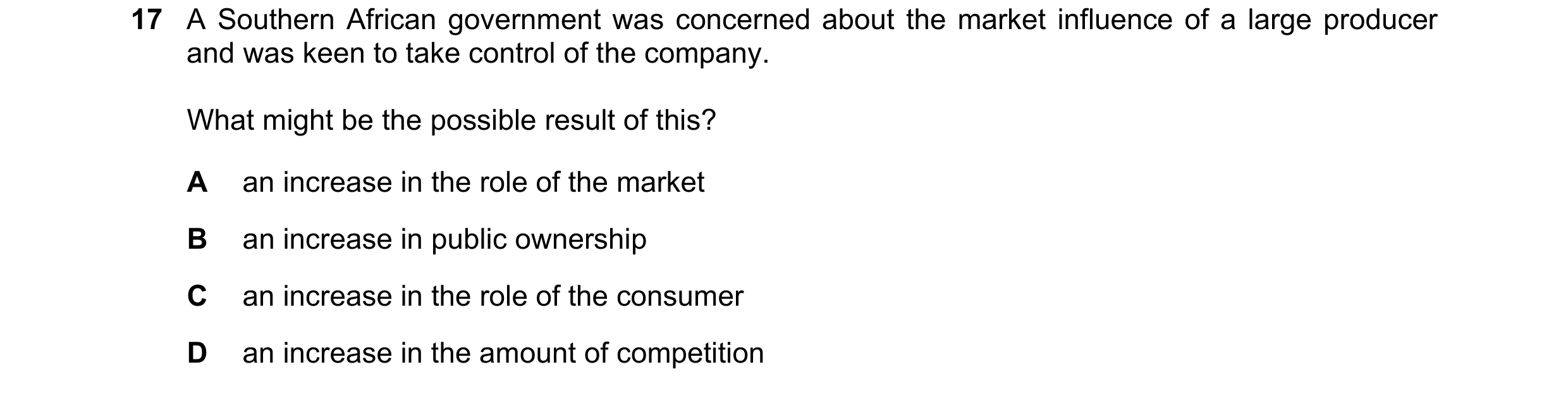
17 A Southern African government was concerned about the market influence of a large producer and was keen to take control of the company. What might be the possible result of this? A an increase in the role of the market B an increase in public ownership C an increase in the role of the consumer D an increase in the amount of competition
1 marks
Answer: B
This question in 9708/12 May/June 2019
Q81 · What is not a function of the price mechanism? 9708/12 Oct/Nov 2019
7 What is not a function of the price mechanism? A to act as a signal to firms when allocating resources B to maximise consumer surplus C to provide an incentive to firms to produce goods D to ration scarce resources
1 marks
Answer: B
This question in 9708/12 Oct/Nov 2019
Q82 · Which change in the way resources are allocated in an economy is consistent with moving… 9708/12 Feb/March 2020
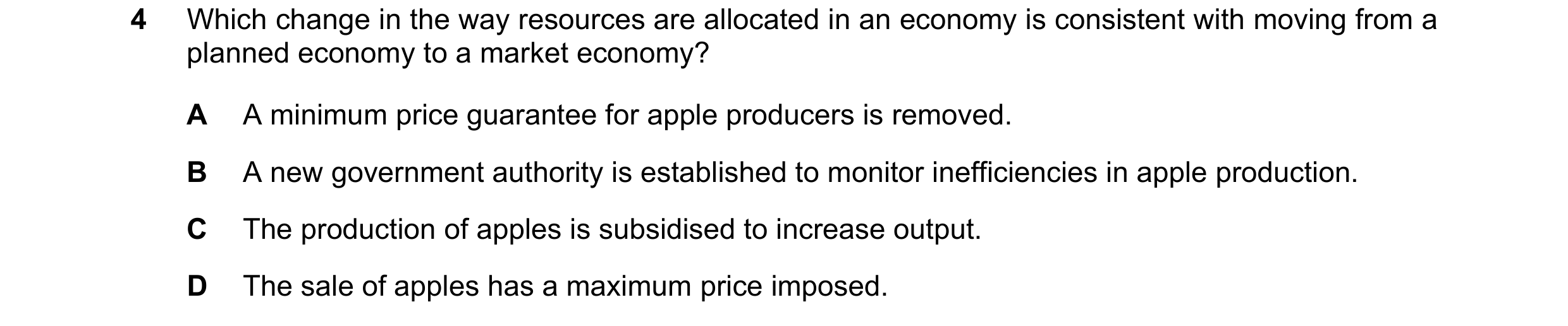
4 Which change in the way resources are allocated in an economy is consistent with moving from a planned economy to a market economy? A A minimum price guarantee for apple producers is removed. B A new government authority is established to monitor inefficiencies in apple production. C The production of apples is subsidised to increase output. D The sale of apples has a maximum price imposed.
1 marks
Answer: A
This question in 9708/12 Feb/March 2020
Q83 · Which argument has often been used to justify the privatisation of state enterprises? 9708/12 Feb/March 2020
14 Which argument has often been used to justify the privatisation of state enterprises? A Private firms can produce the same outputs using fewer inputs. B Private firms try to earn large profits. C State enterprises are always monopolies which exploit consumers. D State enterprises cannot operate without government subsidies.
1 marks
Answer: A
This question in 9708/12 Feb/March 2020
Q84 · The transition of centrally planned economies to market economies was accompanied by a… 9708/11 May/June 2020
1 The transition of centrally planned economies to market economies was accompanied by a significant change in the composition of output. What was an immediate consequence of this transition? A a build-up of unsold stocks of goods B an increase in exports of goods C an increase in unemployment D decreasing prices of goods and services
1 marks
Answer: C
This question in 9708/11 May/June 2020
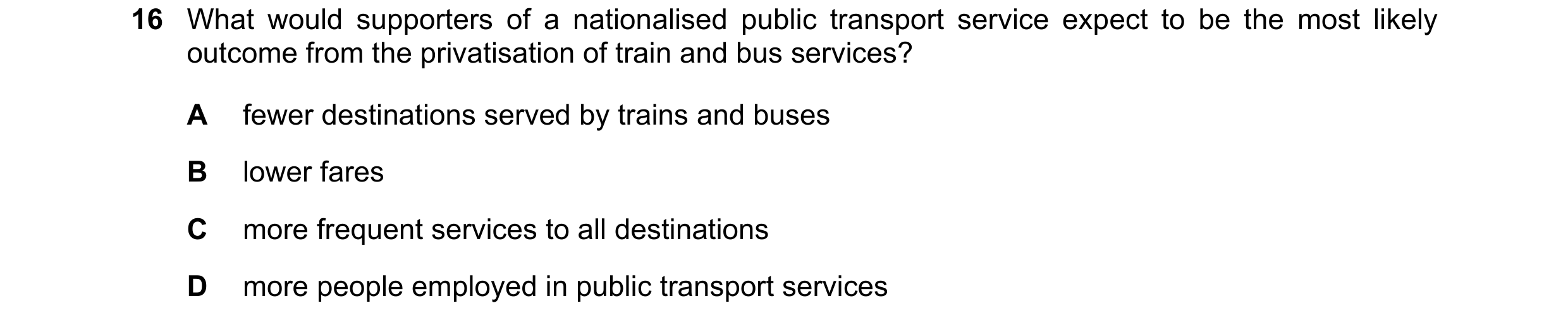
Q85 · What would supporters of a nationalised public transport service expect to be the most… 9708/11 May/June 2020
16 What would supporters of a nationalised public transport service expect to be the most likely outcome from the privatisation of train and bus services? A fewer destinations served by trains and buses B lower fares C more frequent services to all destinations D more people employed in public transport services
1 marks
Answer: A
This question in 9708/11 May/June 2020
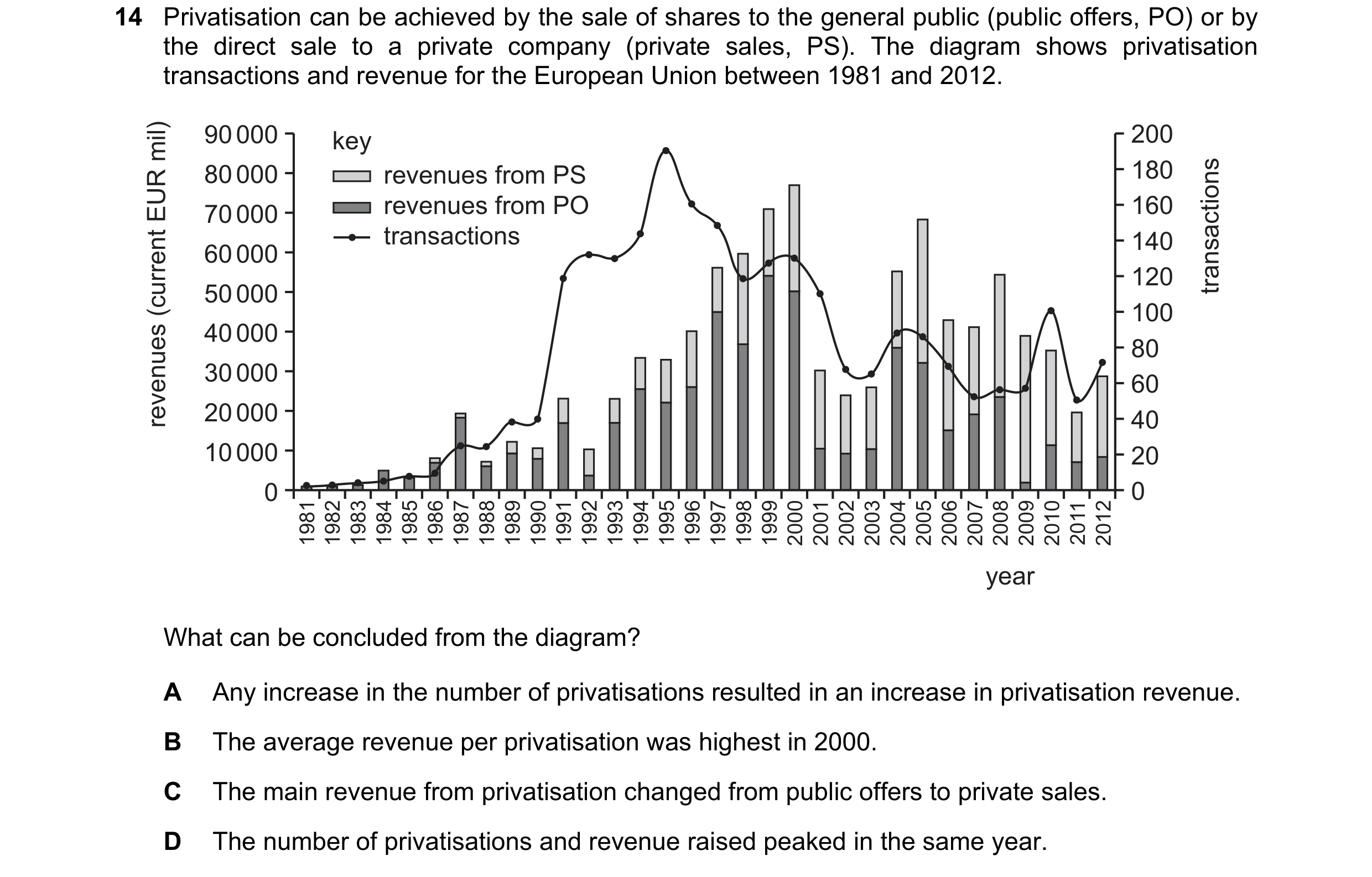
Q86 · Privatisation can be achieved by the sale of shares to the general public (public offers… 9708/12 May/June 2020
14 Privatisation can be achieved by the sale of shares to the general public (public offers, PO) or by the direct sale to a private company (private sales, PS). The diagram shows privatisation transactions and revenue for the European Union between 1981 and 2012. revenues (current EUR mil) 90 000 key 200 80 000 revenues from PS 180 transactions 70 000 revenues from PO 160 transactions 140 60 000 120 50 000 100 40 000 80 30 000 60 20 000 40 10 000 20 0 0 1981 1982 1983 1984 1985 1986 1987 1988 1989 1990 1991 1992 1993 1994 1995 1996 1997 1998 1999 2000 2001 2002 2003 2004 2005 2006 2007 2008 2009 2010 2011 2012 year What can be concluded from the diagram? A Any increase in the number of privatisations resulted in an increase in privatisation revenue. B The average revenue per privatisation was highest in 2000. C The main revenue from privatisation changed from public offers to private sales. D The number of privatisations and revenue raised peaked in the same year.
1 marks
Answer: C
This question in 9708/12 May/June 2020
Q87 · What is most likely to occur when the government privatises public sector organisations? 9708/13 May/June 2020
14 What is most likely to occur when the government privatises public sector organisations? A Consumer choice will increase. B Employment will increase in the short run. C Innovation will be discouraged. D The production of public goods will increase.
1 marks
Answer: A
This question in 9708/13 May/June 2020
Q88 · What is not a characteristic of a planned economy? 9708/11 Oct/Nov 2020
4 What is not a characteristic of a planned economy? A Consumers have limited influence on what is produced. B Profit is the motive for increasing output. C Resources are owned by the government. D There is limited competition in the market.
1 marks
Answer: B
This question in 9708/11 Oct/Nov 2020
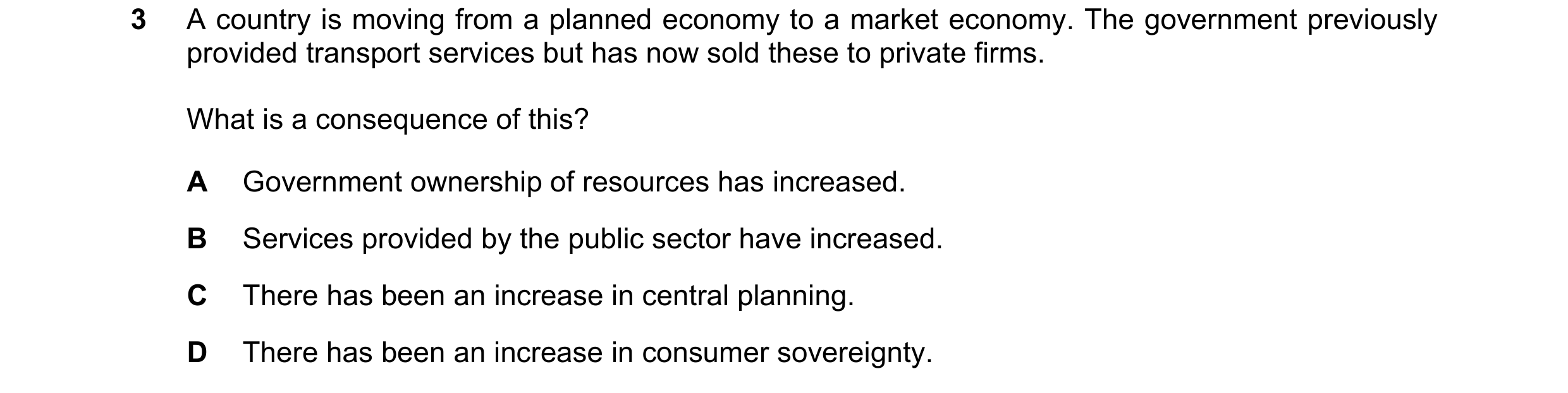
Q89 · A country is moving from a planned economy to a market economy 9708/13 Oct/Nov 2020
3 A country is moving from a planned economy to a market economy. The government previously provided transport services but has now sold these to private firms. What is a consequence of this? A Government ownership of resources has increased. B Services provided by the public sector have increased. C There has been an increase in central planning. D There has been an increase in consumer sovereignty.
1 marks
Answer: D
This question in 9708/13 Oct/Nov 2020
Q90 · Why might a government privatise the railway industry in a country? 9708/13 Oct/Nov 2020
16 Why might a government privatise the railway industry in a country? A Economists classify railway journeys as a public good. B Privatisation would provide funds for investment from a wider range of sources. C Privatised railways would be run to maximise producer surplus. D Railway fares can be taxed to raise money for the government only if railways are privatised.
1 marks
Answer: B
This question in 9708/13 Oct/Nov 2020
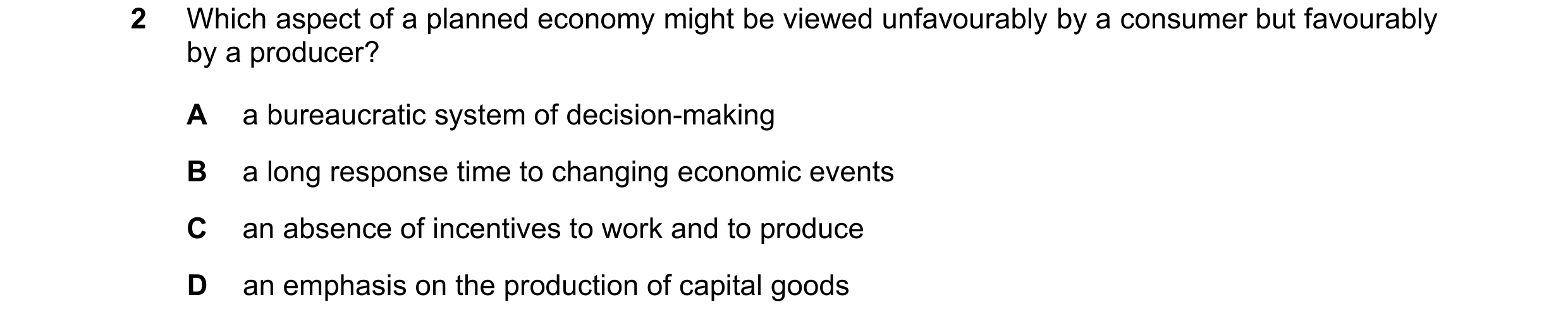
Q91 · Which aspect of a planned economy might be viewed unfavourably by a consumer but… 9708/12 May/June 2021
2 Which aspect of a planned economy might be viewed unfavourably by a consumer but favourably by a producer? A a bureaucratic system of decision-making B a long response time to changing economic events C an absence of incentives to work and to produce D an emphasis on the production of capital goods
1 marks
Answer: D
This question in 9708/12 May/June 2021
Q92 · What will definitely stop, following the nationalisation of an industry? 9708/12 May/June 2021
14 What will definitely stop, following the nationalisation of an industry? A dividend payments to the industry’s shareholders B job losses among the industry’s workforce C price increases for the industry’s product D the closure of unprofitable factories in the industry
1 marks
Answer: A
This question in 9708/12 May/June 2021
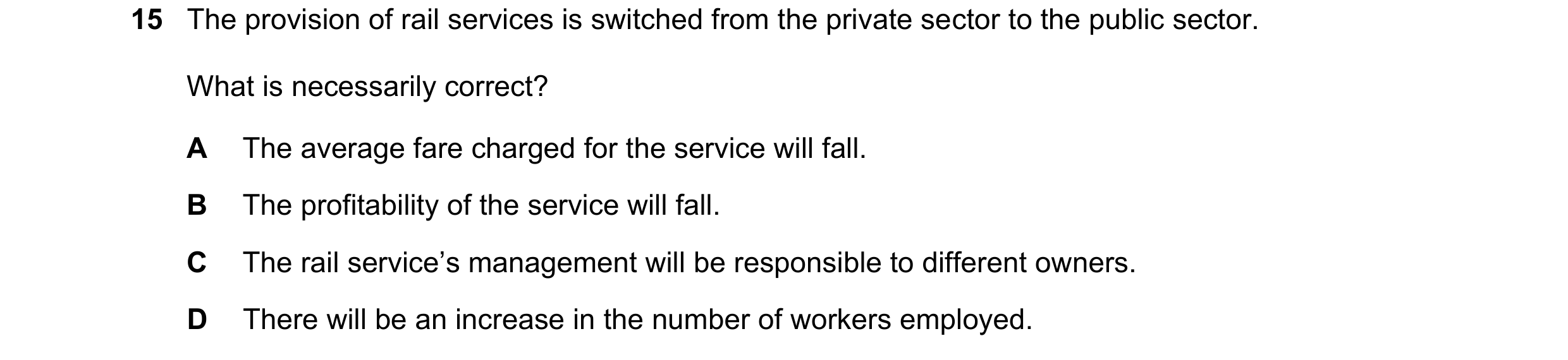
Q93 · The provision of rail services is switched from the private sector to the public sector 9708/13 May/June 2021
15 The provision of rail services is switched from the private sector to the public sector. What is necessarily correct? A The average fare charged for the service will fall. B The profitability of the service will fall. C The rail service’s management will be responsible to different owners. D There will be an increase in the number of workers employed.
1 marks
Answer: C
This question in 9708/13 May/June 2021
Q94 · Which statement about the behaviour of firms in a planned economy is correct? 9708/11 Oct/Nov 2021
2 Which statement about the behaviour of firms in a planned economy is correct? A Firms are sent signals to produce through the price mechanism. B Firms will operate in competitive markets. C Firms will attempt to make profits for the benefit of shareholders. D Firms are more likely to consider the private and external costs of production.
1 marks
Answer: D
This question in 9708/11 Oct/Nov 2021
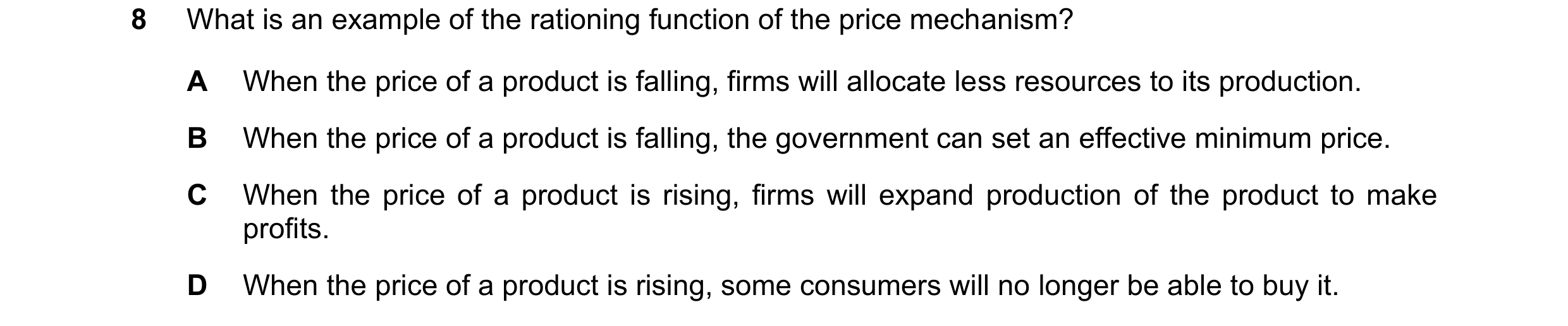
Q95 · What is an example of the rationing function of the price mechanism? 9708/12 Oct/Nov 2021
8 What is an example of the rationing function of the price mechanism? A When the price of a product is falling, firms will allocate less resources to its production. B When the price of a product is falling, the government can set an effective minimum price. C When the price of a product is rising, firms will expand production of the product to make profits. D When the price of a product is rising, some consumers will no longer be able to buy it.
1 marks
Answer: D
This question in 9708/12 Oct/Nov 2021
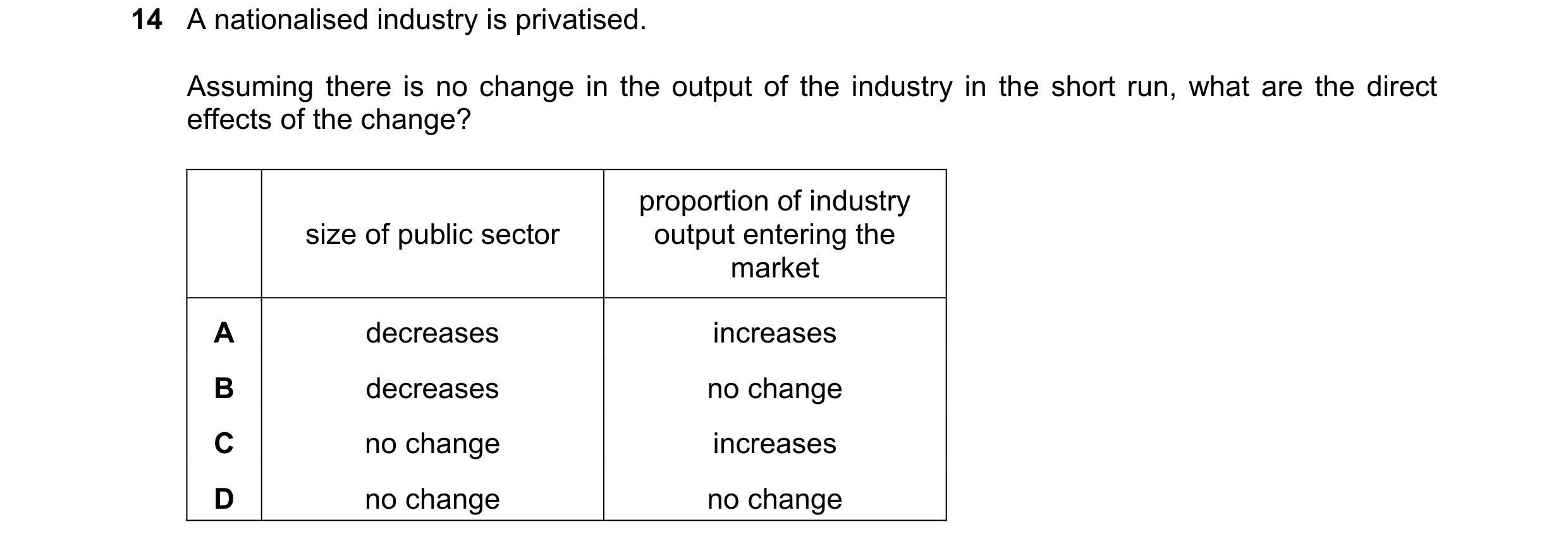
Q96 · A nationalised industry is privatised 9708/12 Oct/Nov 2021
14 A nationalised industry is privatised. Assuming there is no change in the output of the industry in the short run, what are the direct effects of the change? proportion of industry size of public sector output entering the market A decreases increases B decreases no change C no change increases D no change no change
1 marks
Answer: B
This question in 9708/12 Oct/Nov 2021
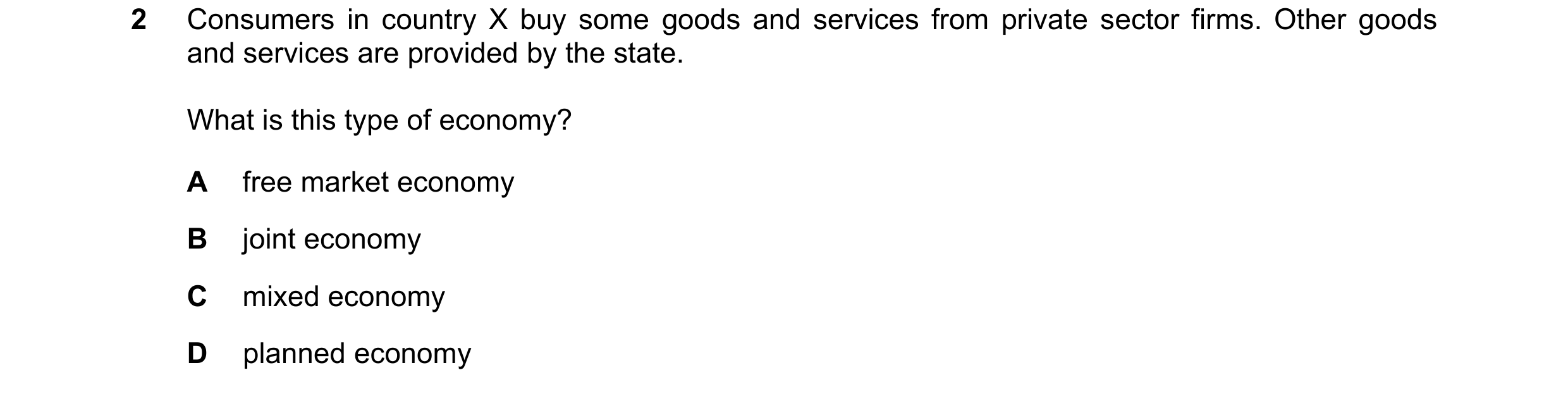
Q97 · Consumers in country X buy some goods and services from private sector firms 9708/13 Oct/Nov 2021
2 Consumers in country X buy some goods and services from private sector firms. Other goods and services are provided by the state. What is this type of economy? A free market economy B joint economy C mixed economy D planned economy
1 marks
Answer: C
This question in 9708/13 Oct/Nov 2021
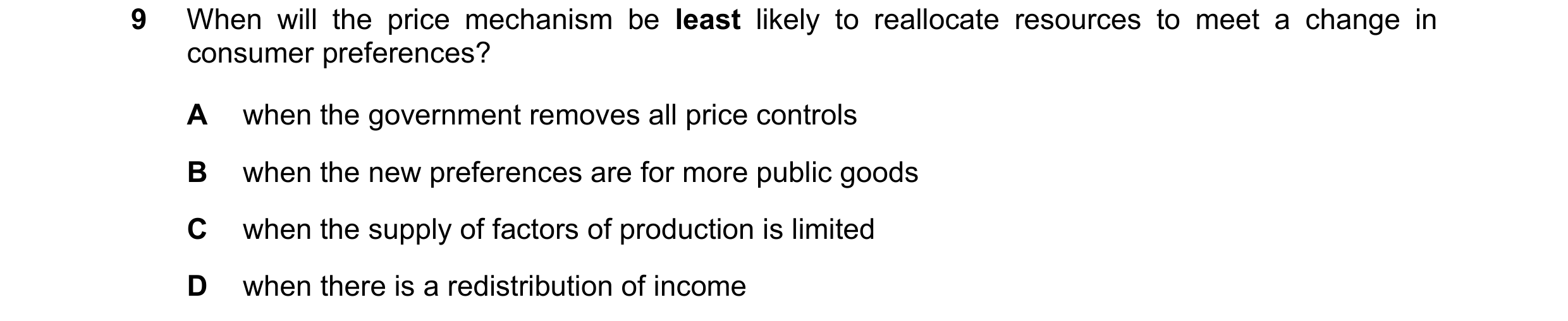
Q98 · When will the price mechanism be least likely to reallocate resources to meet a change in… 9708/12 Feb/March 2022
9 When will the price mechanism be least likely to reallocate resources to meet a change in consumer preferences? A when the government removes all price controls B when the new preferences are for more public goods C when the supply of factors of production is limited D when there is a redistribution of income
1 marks
Answer: B
This question in 9708/12 Feb/March 2022
Q99 · Economics students have to fill in the gaps in the following passage 9708/11 May/June 2022
3 Economics students have to fill in the gaps in the following passage. ‘The three basic questions arising from the economic problem of scarcity are … 1 … to produce, … 2 … to produce, and … 3 … to produce.’ Which combination is correct? 1 2 3 A how when where B how where for whom C what how for whom D what when where
1 marks
Answer: C
This question in 9708/11 May/June 2022
Q100 · When will the price mechanism not function as a system for allocating goods? 9708/11 May/June 2022
11 When will the price mechanism not function as a system for allocating goods? A when the government bans advertising B when the government maintains an effective maximum price C when there is a limited supply of the good D when there is a powerful company able to set the market price
1 marks
Answer: B
This question in 9708/11 May/June 2022
Q101 · What is the main characteristic of a planned economy? 9708/12 May/June 2022
2 What is the main characteristic of a planned economy? A All goods and services are produced by privately-owned firms. B All goods and services are produced by state-owned firms. C Privately-owned firms produce private goods and state-owned firms produce public goods. D The price mechanism allocates scarce resources through the actions of buyers and sellers.
1 marks
Answer: B
This question in 9708/12 May/June 2022
Q102 · What can be concluded about the roles of demand and supply in a free market? 9708/12 May/June 2022
7 What can be concluded about the roles of demand and supply in a free market? A They allocate resources to the greatest needs. B They ensure that goods and services are distributed equally. C They are both significant in setting the market price. D They ensure that everyone can benefit from the good or service provided.
1 marks
Answer: C
This question in 9708/12 May/June 2022
Q103 · What does not happen when price acts as a means to allocate resources? 9708/12 May/June 2022
12 What does not happen when price acts as a means to allocate resources? A Price determines the supply of public goods. B Price operates in the markets for both goods and factors of production. C Price recognises consumers’ ability to pay rather than consumers’ needs. D Price signals to producers which goods are most profitable.
1 marks
Answer: A
This question in 9708/12 May/June 2022
Q104 · What is necessary to achieve the best allocation of resources using the price mechanism? 9708/13 May/June 2022
9 What is necessary to achieve the best allocation of resources using the price mechanism? A Producers can maximise their collective interest. B Consumers and producers must have perfect knowledge. C The government must be able to apply maximum and minimum prices. D The value of the price elasticity of supply must be greater than one.
1 marks
Answer: B
This question in 9708/13 May/June 2022
Q105 · What will result from a government’s decision to allow health care to be provided… 9708/14 May/June 2022
1 What will result from a government’s decision to allow health care to be provided entirely by market forces? A There will be a reduction in the provision of a public good. B All consumers will receive better health care. C Market failure will be eliminated in the health care market. D The health care market will reach an equilibrium.
1 marks
Answer: D
This question in 9708/14 May/June 2022
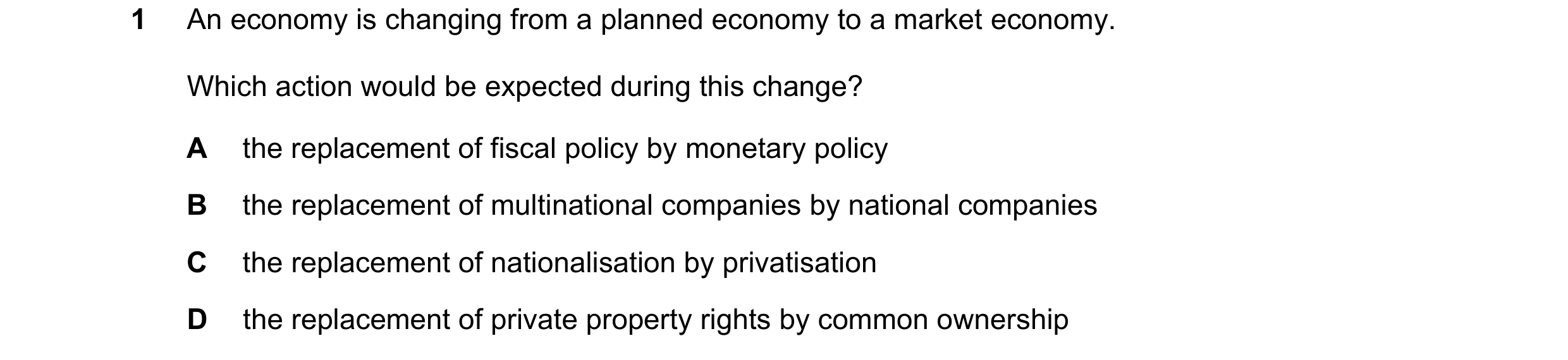
Q106 · An economy is changing from a planned economy to a market economy 9708/11 Oct/Nov 2022
1 An economy is changing from a planned economy to a market economy. Which action would be expected during this change? A the replacement of fiscal policy by monetary policy B the replacement of multinational companies by national companies C the replacement of nationalisation by privatisation D the replacement of private property rights by common ownership
1 marks
Answer: C
This question in 9708/11 Oct/Nov 2022
Q107 · In a planned economy, what will determine the allocation of scarce resources? 9708/12 Oct/Nov 2022
2 In a planned economy, what will determine the allocation of scarce resources? A a mixture of private and central decision making B the decisions of central government C the forces of demand and supply D the revenue generated from direct and indirect taxes
1 marks
Answer: B
This question in 9708/12 Oct/Nov 2022
Q108 · What best illustrates the process of privatisation? 9708/12 Oct/Nov 2022
18 What best illustrates the process of privatisation? A a single private shareholder acquires complete control of an organisation B the purchase of government bonds by private sector commercial organisations C the purchase of shares in a private company D the transfer of public sector assets to the private sector
1 marks
Answer: D
This question in 9708/12 Oct/Nov 2022
Q109 · A government wishes to ensure adequate flood defences are provided in its coastal areas 9708/13 Oct/Nov 2022
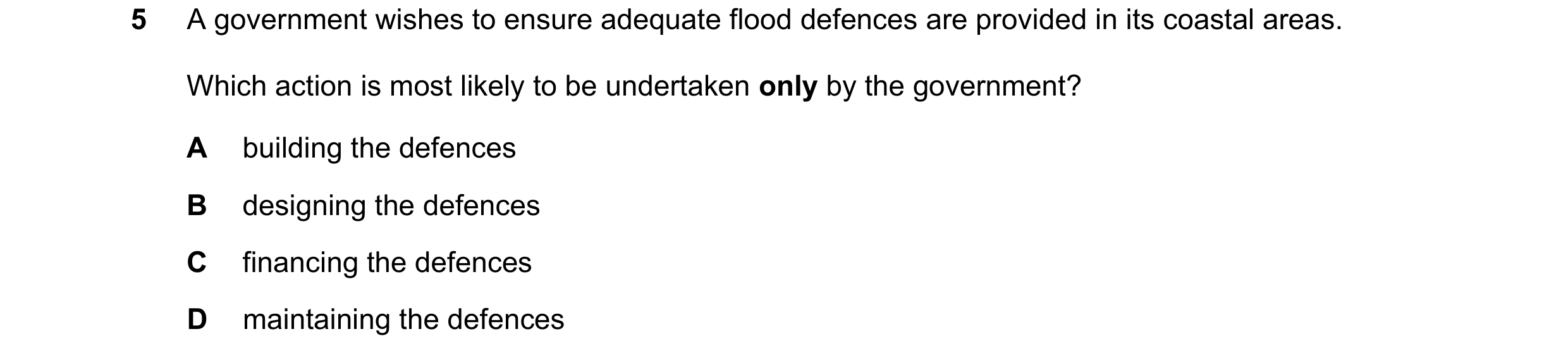
5 A government wishes to ensure adequate flood defences are provided in its coastal areas. Which action is most likely to be undertaken only by the government? A building the defences B designing the defences C financing the defences D maintaining the defences
1 marks
Answer: C
This question in 9708/13 Oct/Nov 2022
Q110 · In which case is the price system not a possible method of allocating resources? 9708/12 Feb/March 2023
7 In which case is the price system not a possible method of allocating resources? A in the distribution of foodstuff among the population B in the hiring of workers by employers C in the ownership of land for agricultural use D in the provision of public goods by the government
1 marks
Answer: D
This question in 9708/12 Feb/March 2023
Q111 · What is not a characteristic of a mixed economy? 9708/12 May/June 2023
3 What is not a characteristic of a mixed economy? A The government has no role in setting prices. B The government manages taxation rights. C The government prevents firms from earning excessive profits. D The government provides services not provided by the private sector.
1 marks
Answer: A
This question in 9708/12 May/June 2023
Q112 · What is least likely to increase as a result of a transition from a planned economy to a… 9708/11 Oct/Nov 2023
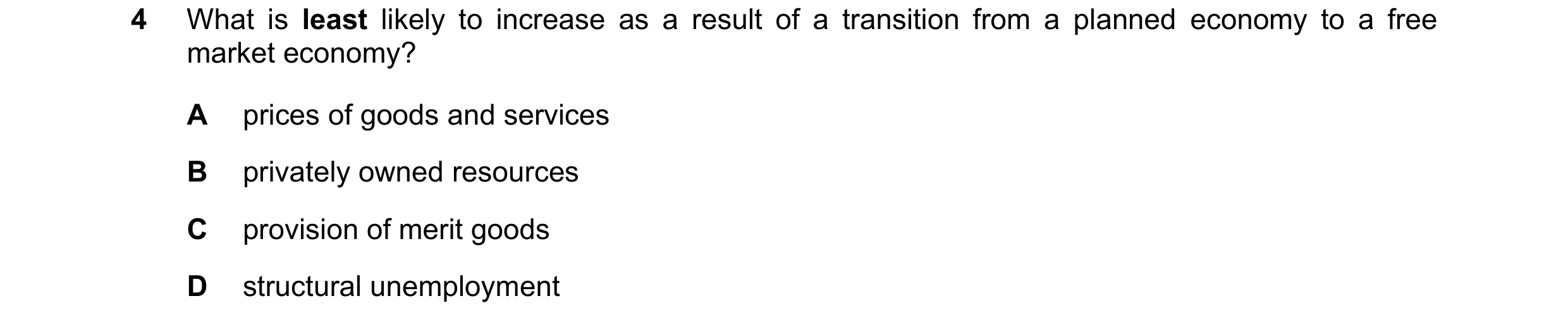
4 What is least likely to increase as a result of a transition from a planned economy to a free market economy? A prices of goods and services B privately owned resources C provision of merit goods D structural unemployment
1 marks
Answer: C
This question in 9708/11 Oct/Nov 2023
Q113 · In the diagram, the supply curve shows the number of spaces in a car park and the demand… 9708/11 Oct/Nov 2023
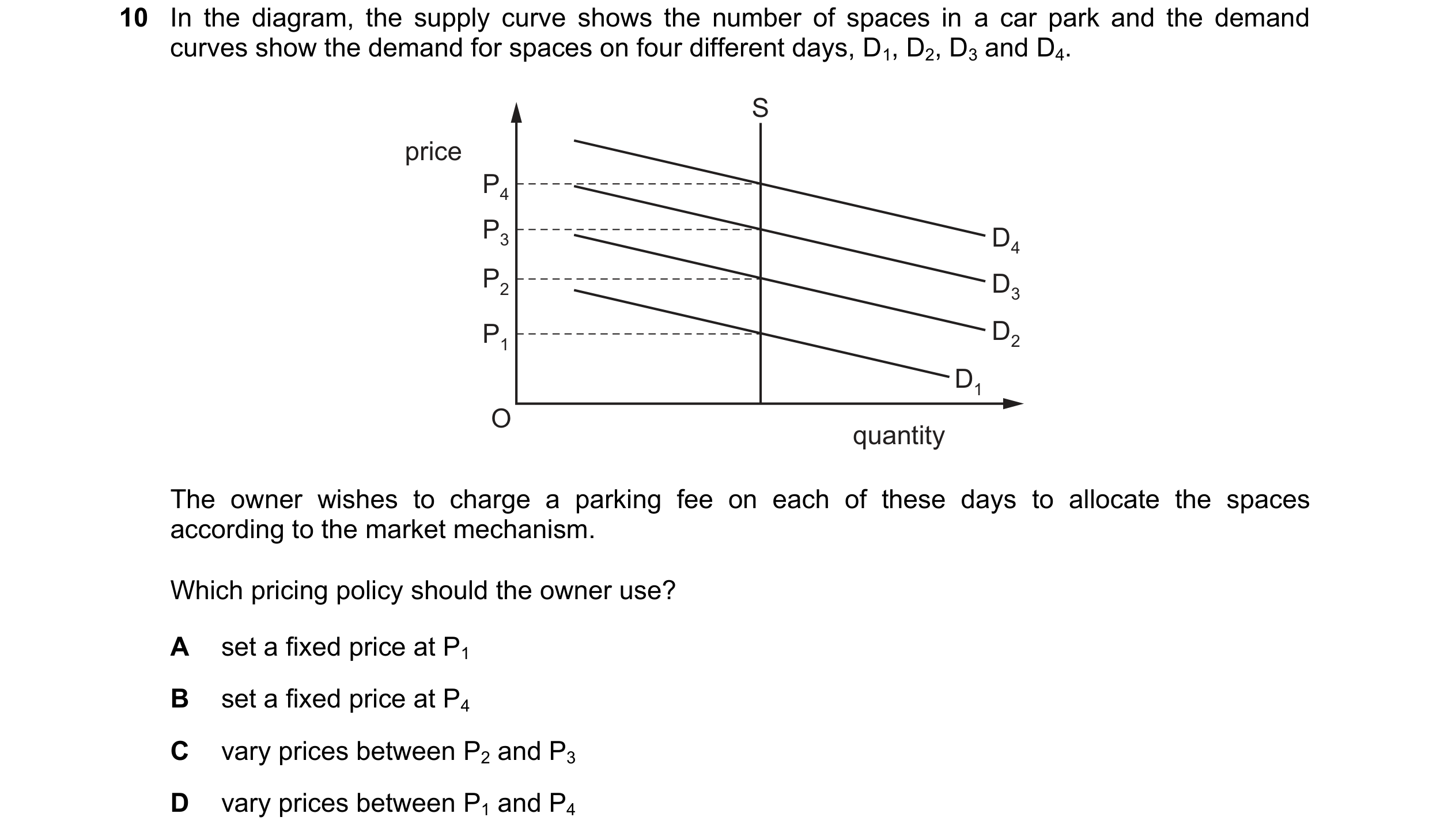
10 In the diagram, the supply curve shows the number of spaces in a car park and the demand curves show the demand for spaces on four different days, D1, D2, D3 and D4. S price P4 P3 D4 P2 D3 P1 D2 D1 O quantity The owner wishes to charge a parking fee on each of these days to allocate the spaces according to the market mechanism. Which pricing policy should the owner use? A set a fixed price at P1 B set a fixed price at P4 C vary prices between P2 and P3 D vary prices between P1 and P4
1 marks
Answer: D
This question in 9708/11 Oct/Nov 2023
Q114 · Eastern European nations have changed from planned to market economies 9708/12 Oct/Nov 2023
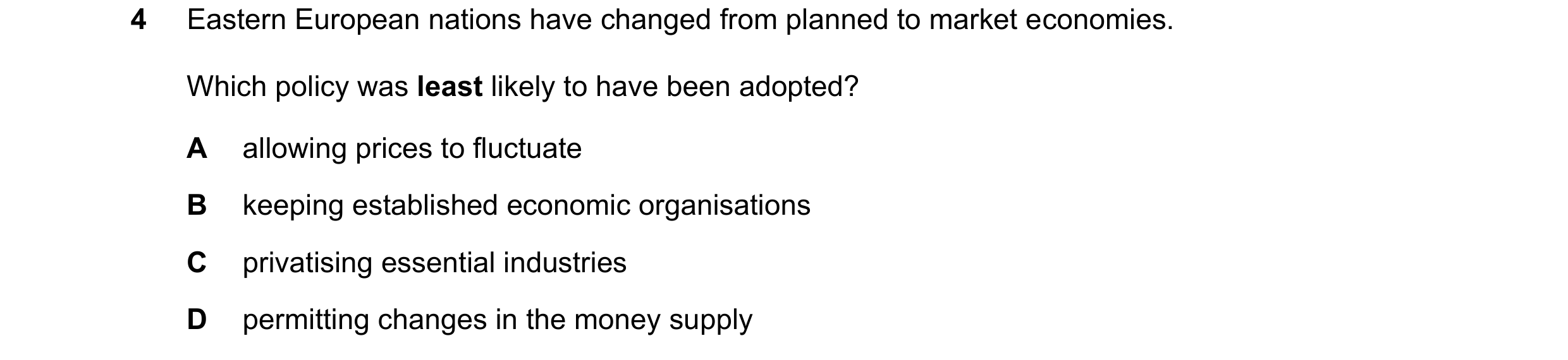
4 Eastern European nations have changed from planned to market economies. Which policy was least likely to have been adopted? A allowing prices to fluctuate B keeping established economic organisations C privatising essential industries D permitting changes in the money supply
1 marks
Answer: B
This question in 9708/12 Oct/Nov 2023
Q115 · What is the main reason an economy is unlikely to rely completely on market forces to… 9708/12 Feb/March 2024
4 What is the main reason an economy is unlikely to rely completely on market forces to allocate resources? A Demerit goods will be over supplied. B Merit goods will be under supplied. C Private goods will not be supplied. D Public goods will not be supplied.
1 marks
Answer: D
This question in 9708/12 Feb/March 2024
Q116 · What is produced in a mixed economy but not in a free market economy? 9708/12 May/June 2024
2 What is produced in a mixed economy but not in a free market economy? A demerit goods B free goods C private goods D public goods
1 marks
Answer: D
This question in 9708/12 May/June 2024
Q117 · Which statement about a market economy is not correct? 9708/12 Feb/March 2025
1 Which statement about a market economy is not correct? A Competition is promoted among firms which can increase productive efficiency. B Immobility of the factors of production can lead to allocative inefficiency. C Price always reflects all the costs and all the benefits associated with production. D The entrepreneur is encouraged to innovate and take risks, motivated by profit.
1 marks
Answer: C
This question in 9708/12 Feb/March 2025
Q118 · Which goods are least likely to be allocated by market forces in a mixed economy? 9708/11 May/June 2025
3 Which goods are least likely to be allocated by market forces in a mixed economy? A hospitals B railways C street lighting D television programmes
1 marks
Answer: C
This question in 9708/11 May/June 2025
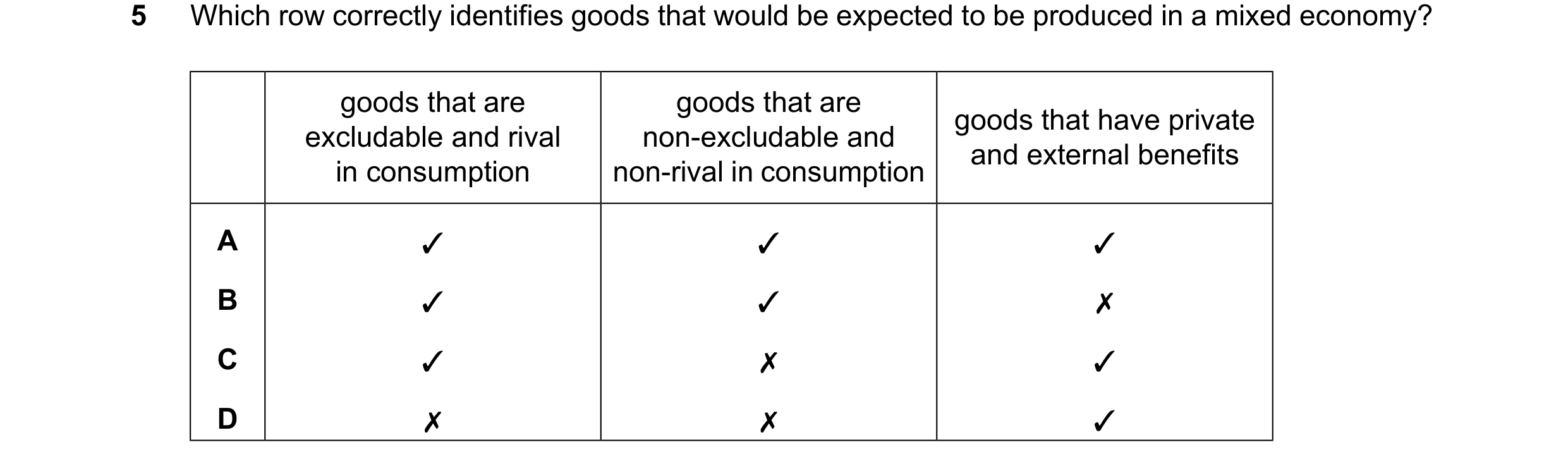
Q119 · Which row correctly identifies goods that would be expected to be produced in a mixed… 9708/13 May/June 2025
5 Which row correctly identifies goods that would be expected to be produced in a mixed economy? goods that are goods that are goods that have private excludable and rival non-excludable and and external benefits in consumption non-rival in consumption A ✓ ✓ ✓ B ✓ ✓ ✗ C ✓ ✗ ✓ D ✗ ✗ ✓
1 marks
Answer: A
This question in 9708/13 May/June 2025
Q120 · A country with a market economy changes to a mixed economy 9708/11 Oct/Nov 2025
2 A country with a market economy changes to a mixed economy. When is this change likely to achieve the largest improvement in resource allocation? number of demerit Gini coefficient goods in the value for the country country A many 0.4 B many 0.7 C few 0.4 D few 0.7
1 marks
Answer: B
This question in 9708/11 Oct/Nov 2025
Q121 · What is not a characteristic of a planned economy? 9708/12 Oct/Nov 2025
3 What is not a characteristic of a planned economy? A Consumers have limited influence on what is produced. B Profit is the motive for increasing output. C Resources are owned by the government. D There is limited competition in the market.
1 marks
Answer: B
This question in 9708/12 Oct/Nov 2025
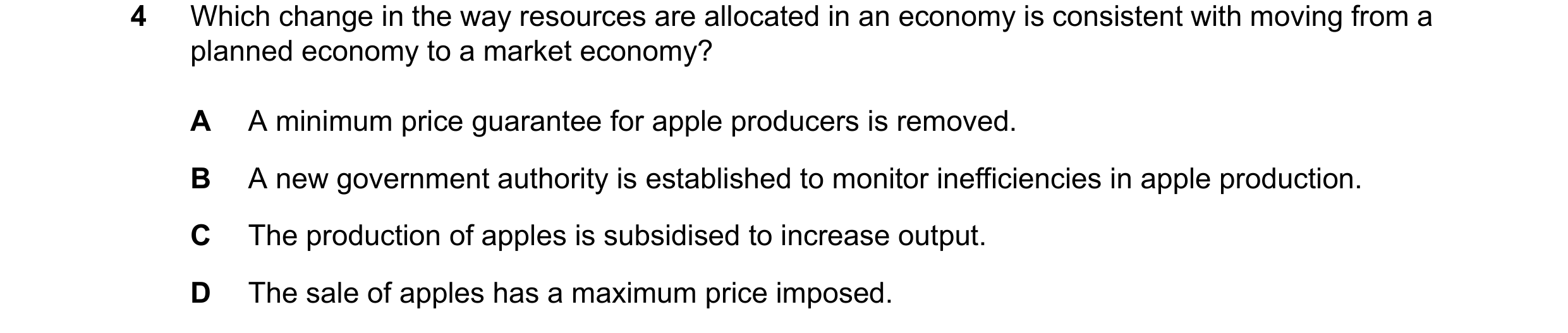
Q122 · Which change in the way resources are allocated in an economy is consistent with moving… 9708/13 Oct/Nov 2025
4 Which change in the way resources are allocated in an economy is consistent with moving from a planned economy to a market economy? A A minimum price guarantee for apple producers is removed. B A new government authority is established to monitor inefficiencies in apple production. C The production of apples is subsidised to increase output. D The sale of apples has a maximum price imposed.
1 marks
Answer: A
This question in 9708/13 Oct/Nov 2025



 1 / 25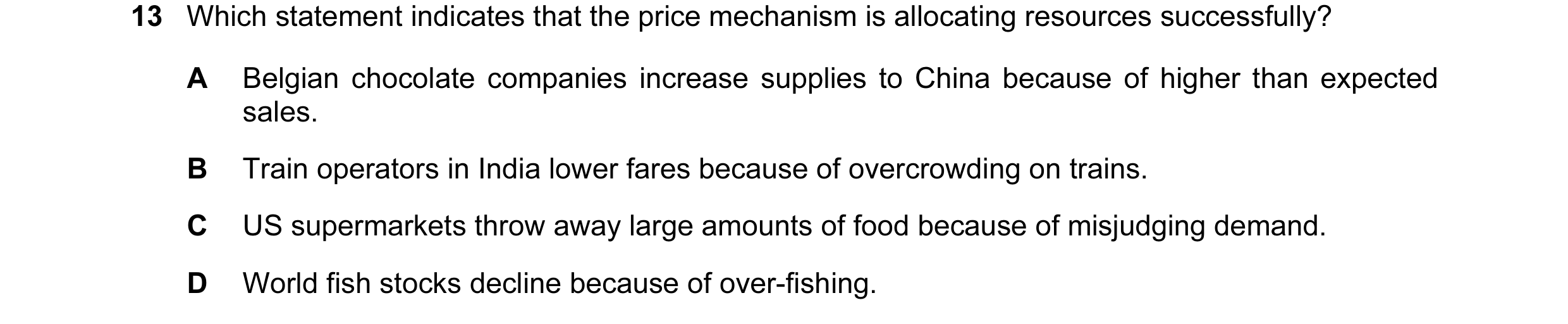


 2 / 25




 3 / 25




 4 / 25

 5 / 25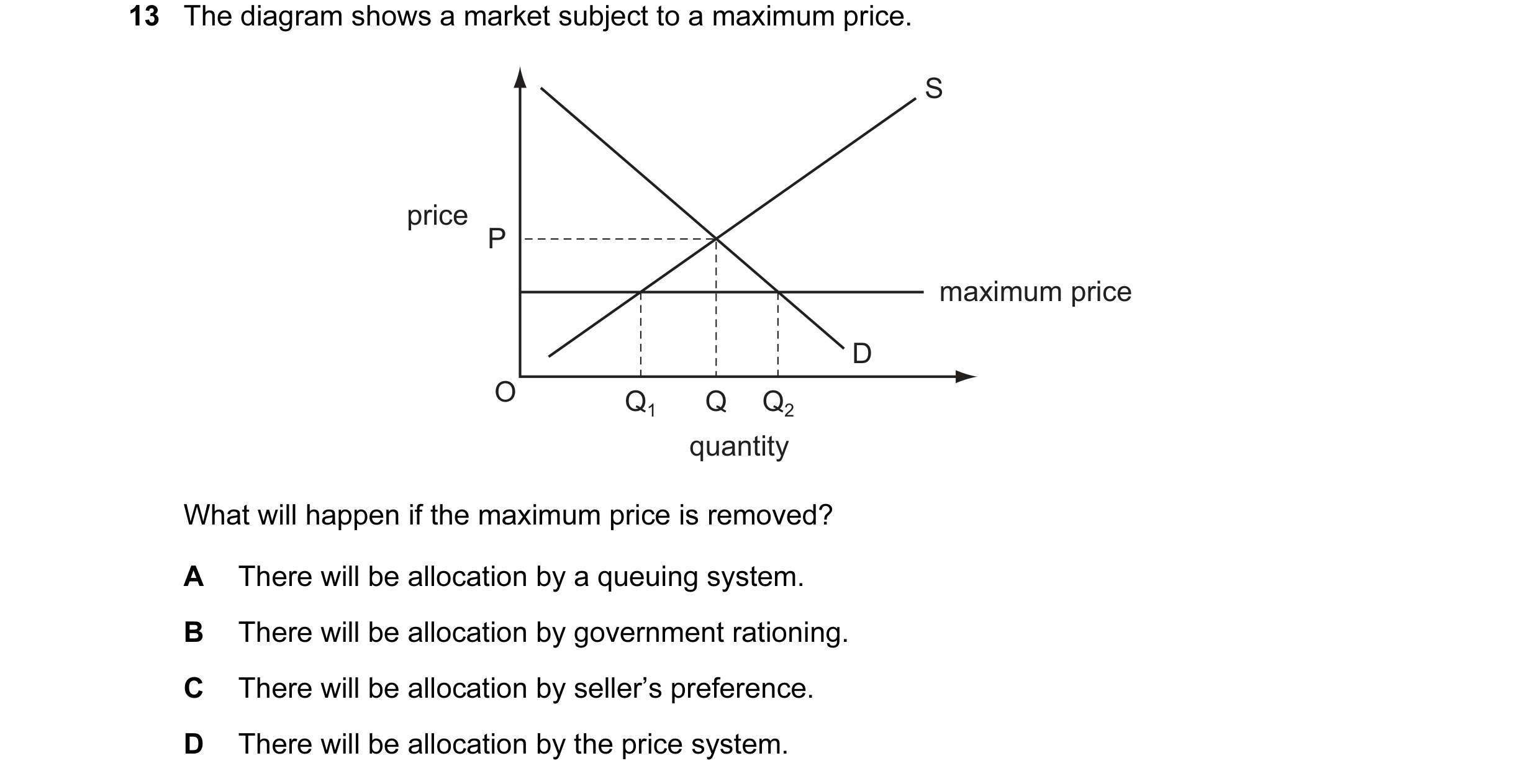
 6 / 25

 7 / 25
 8 / 25
 9 / 25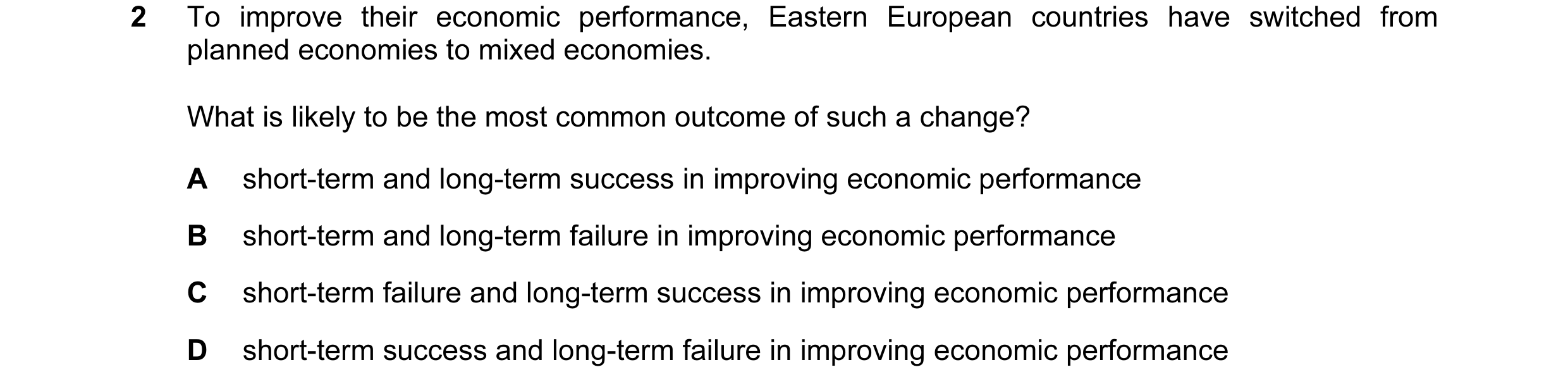
 10 / 25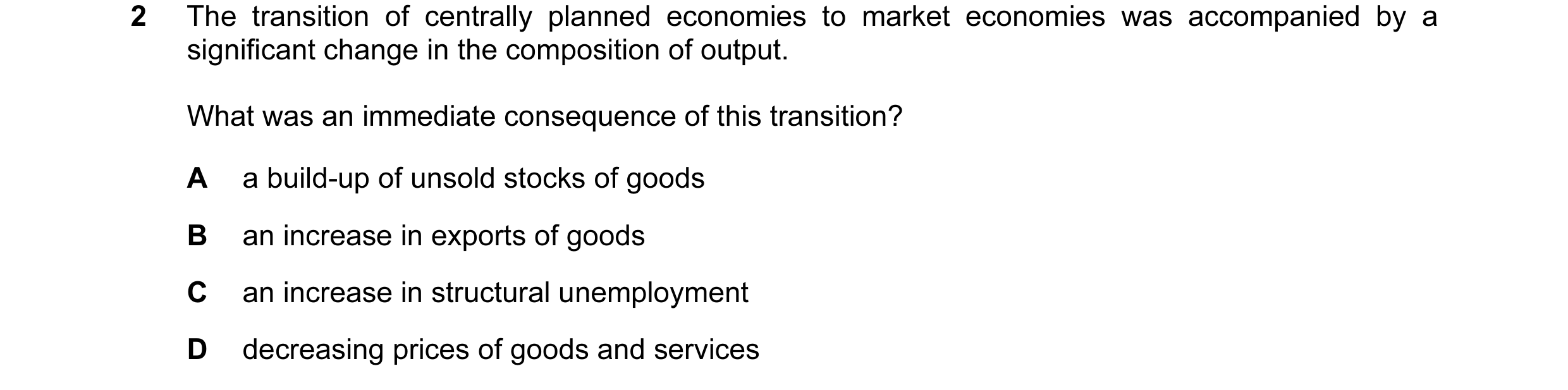
 11 / 25


 12 / 25
 13 / 25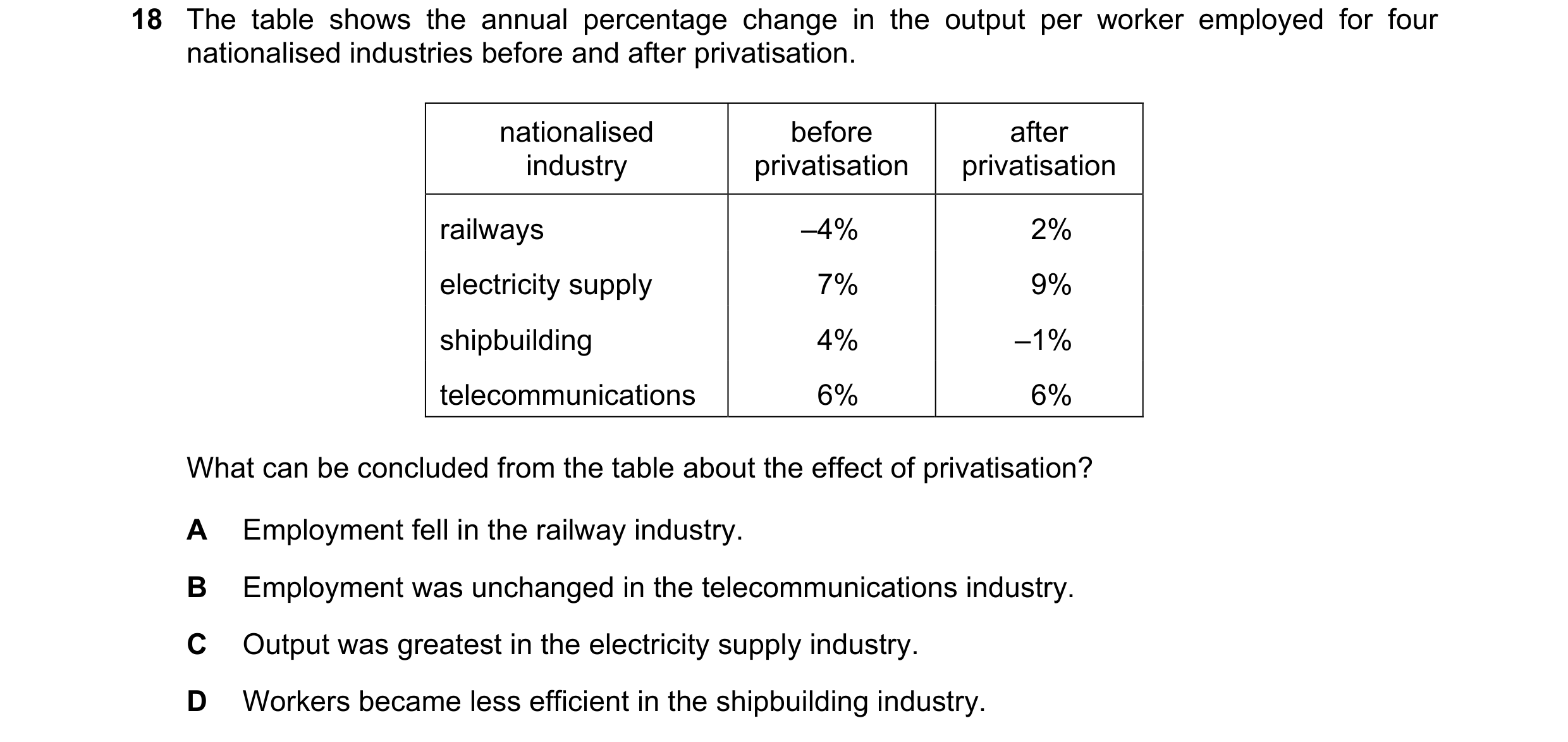


 14 / 25


 15 / 25
 16 / 25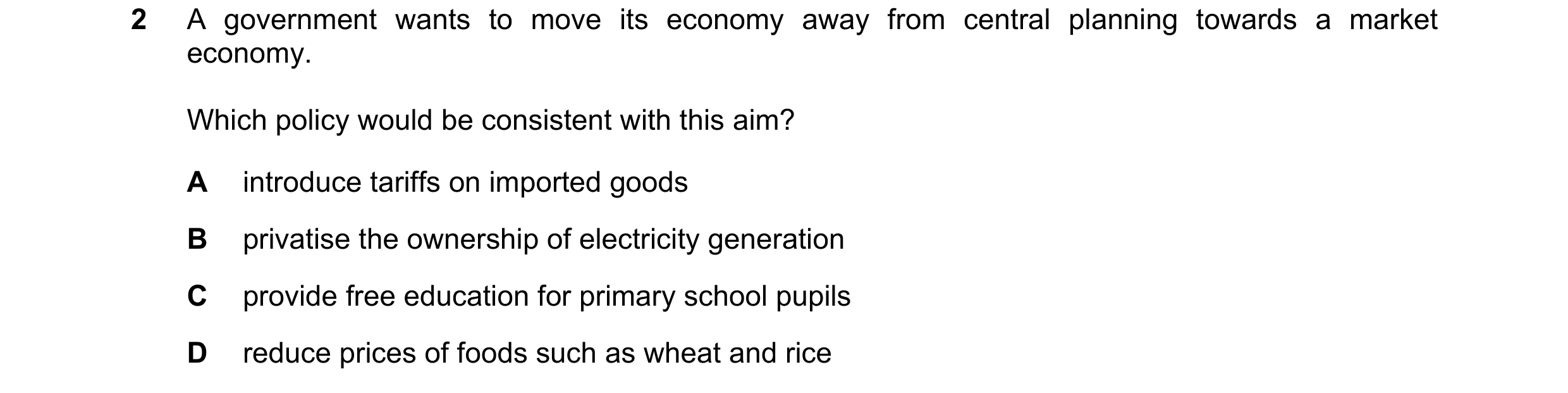

 17 / 25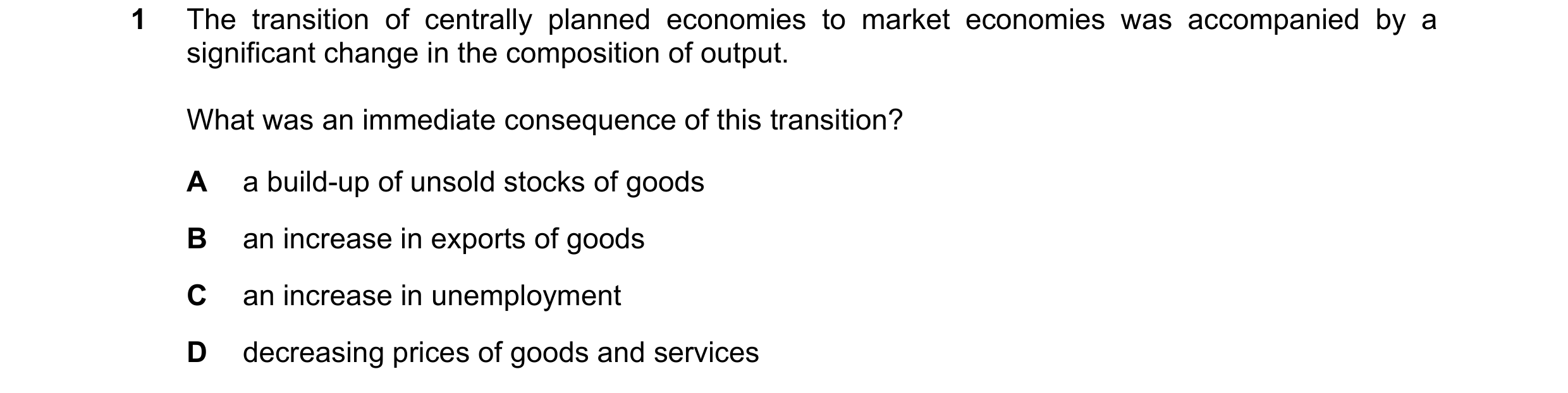
 18 / 25


 19 / 25
 20 / 25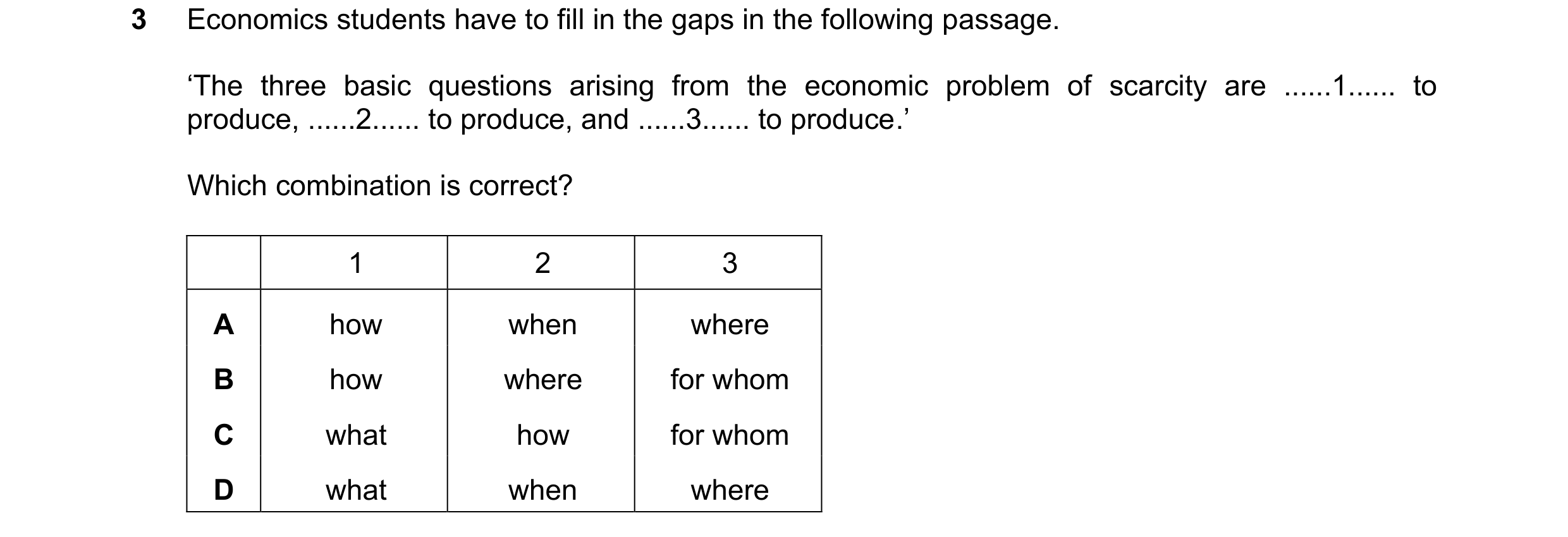




 21 / 25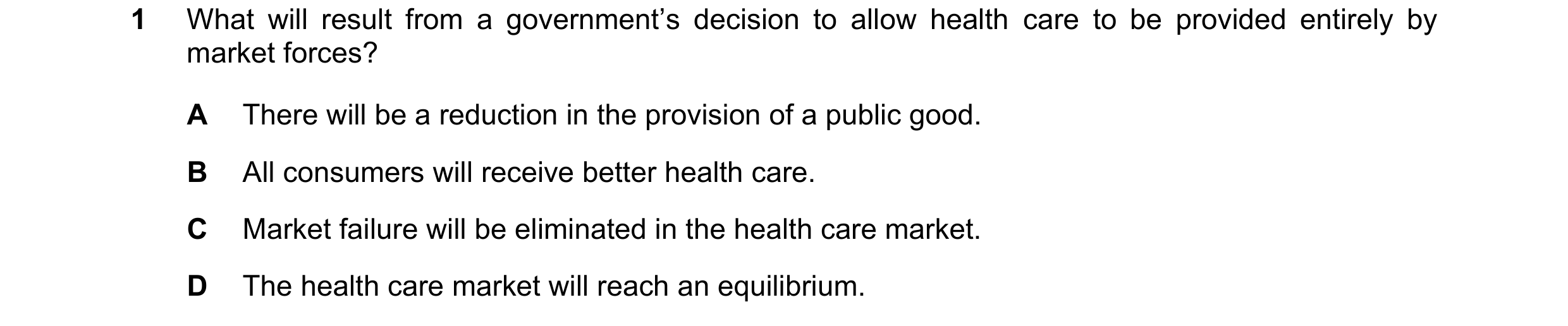


 22 / 25
 23 / 25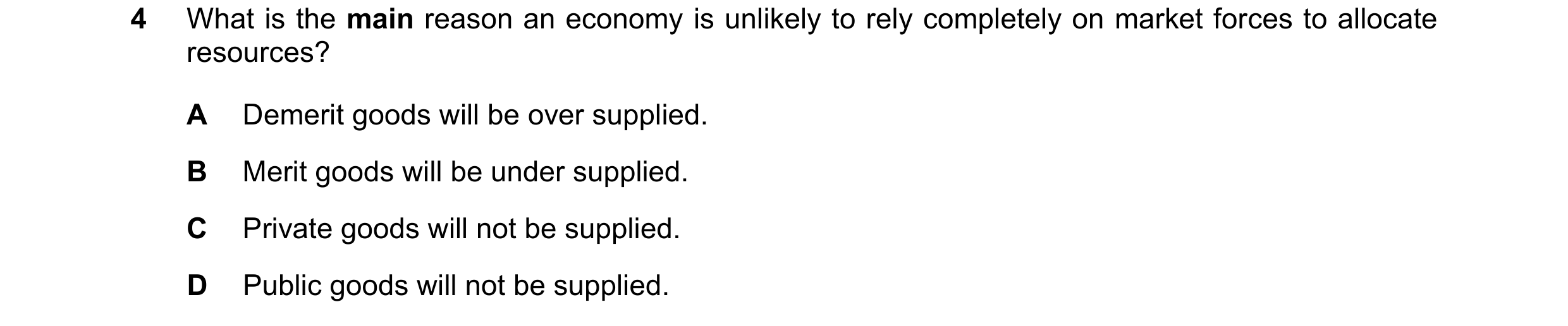



 24 / 25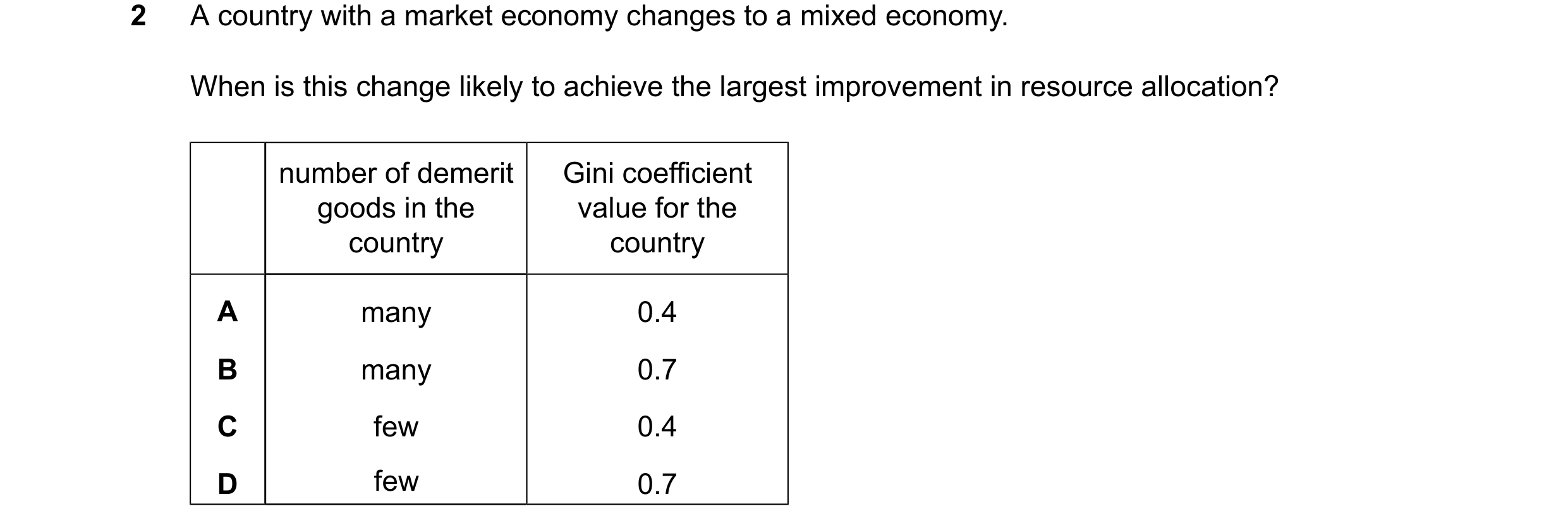

 25 / 25