Questions as text
Q1 · The workers in a factory currently earn $240 for a 40-hour week 9708/11 Oct/Nov 2005
4 The workers in a factory currently earn $240 for a 40-hour week. The management offers them a choice between either a 10 per cent wage increase or an increase in the weekly wage to $260 along with a reduction from 40 to 39 hours. Disregarding the value of leisure time, what is the opportunity cost to each worker of opting for the 39-hour week? A $4 B $6 C $20 D $24
1 marks
Answer: A
This question in 9708/11 Oct/Nov 2005
Q2 · A consumer allocates his expenditure over time 9708/11 May/June 2006
1 A consumer allocates his expenditure over time. What would cause an increase in the opportunity cost of current consumption to the consumer? A a decrease in his current income B a decrease in interest rates C an increase in his current income D an increase in interest rates
1 marks
Answer: D
This question in 9708/11 May/June 2006
Q3 · A farmer can produce both beef and lamb 9708/11 May/June 2007
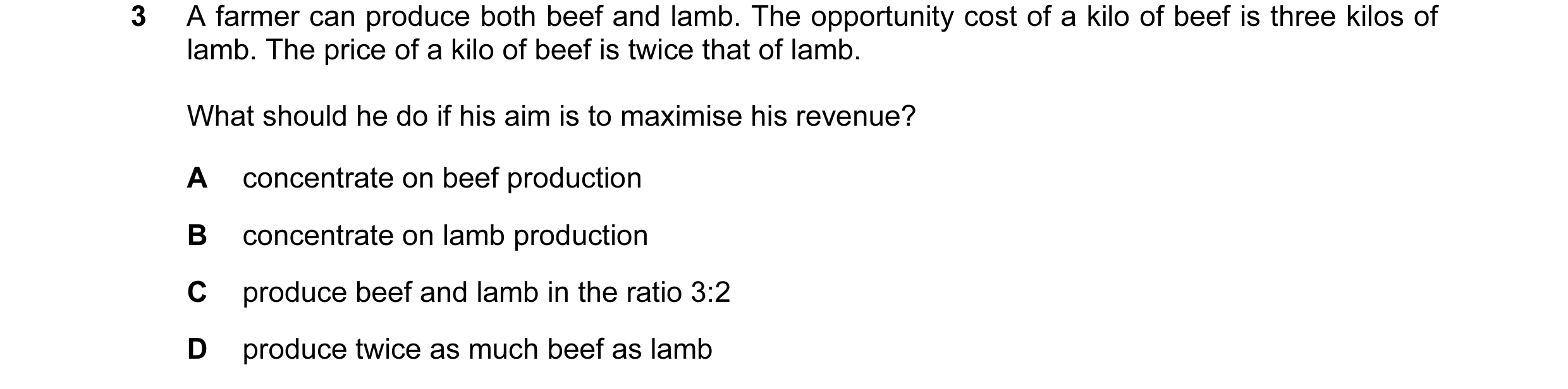
4 A farmer can produce both beef and lamb. The opportunity cost of a kilo of beef is three kilos of lamb. The price of a kilo of beef is twice that of lamb. What should he do if his aim is to maximise his revenue? A concentrate on beef production B concentrate on lamb production C produce beef and lamb in the ratio 3:2 D produce twice as much beef as lamb
1 marks
Answer: B
This question in 9708/11 May/June 2007
Q4 · Why is scarcity the central feature of the economic problem? 9708/11 Oct/Nov 2008
1 Why is scarcity the central feature of the economic problem? A People’s needs are limited. B Resources have alternative uses. C Economic resources are finite. D Consumers have limited choices.
1 marks
Answer: C
This question in 9708/11 Oct/Nov 2008
Q5 · The production possibility curve for an economy producing capital and consumer goods is… 9708/11 Oct/Nov 2008
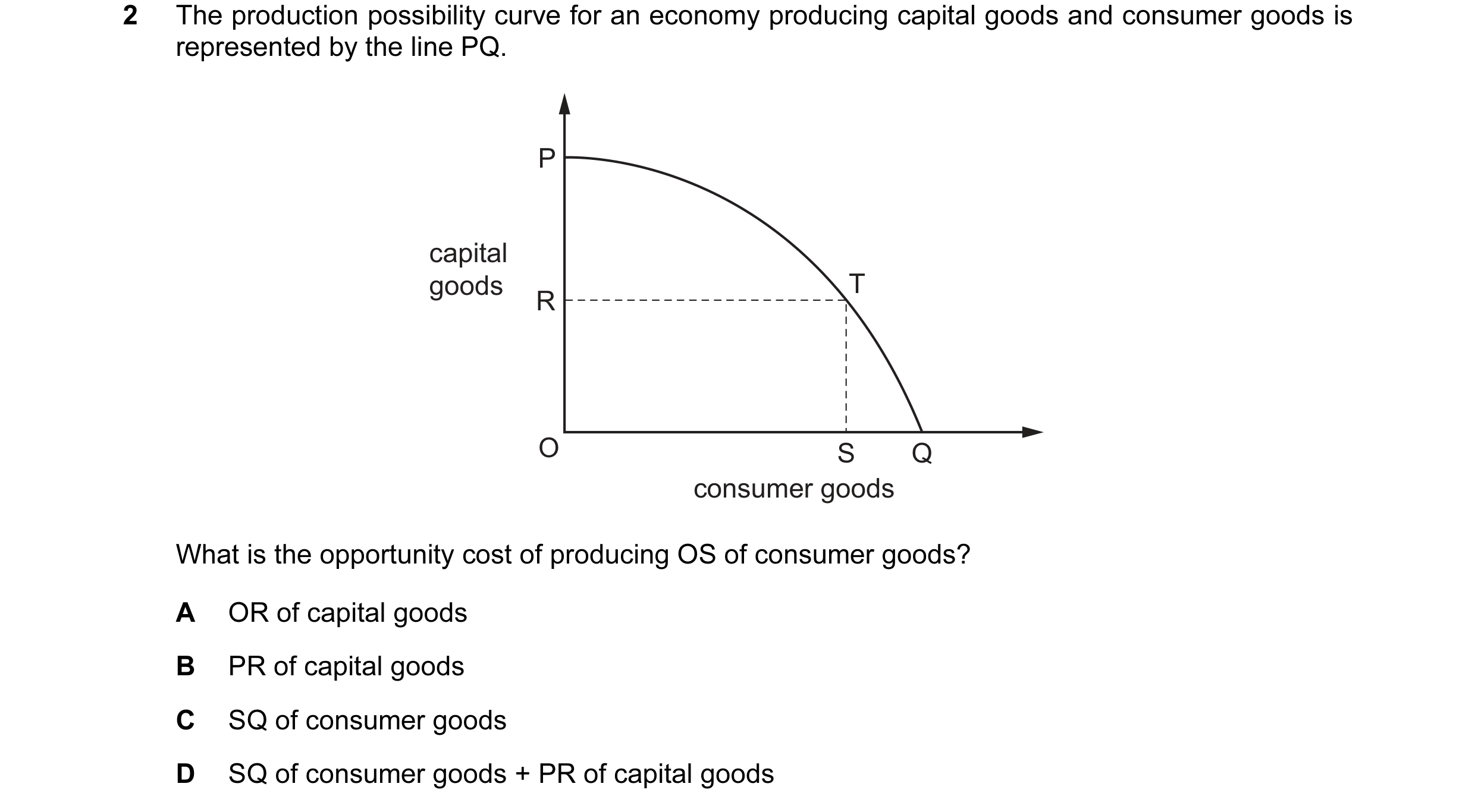
2 The production possibility curve for an economy producing capital and consumer goods is represented by the line PQ. P capital goods T R O S Q consumer goods What is the opportunity cost of producing OS of consumer goods? A OR of capital goods B PR of capital goods C SQ of consumer goods D SQ of consumer goods + PR of capital goods
1 marks
Answer: B
This question in 9708/11 Oct/Nov 2008
Q6 · Three women work in a pottery workshop, each dividing their time equally between three… 9708/11 May/June 2009
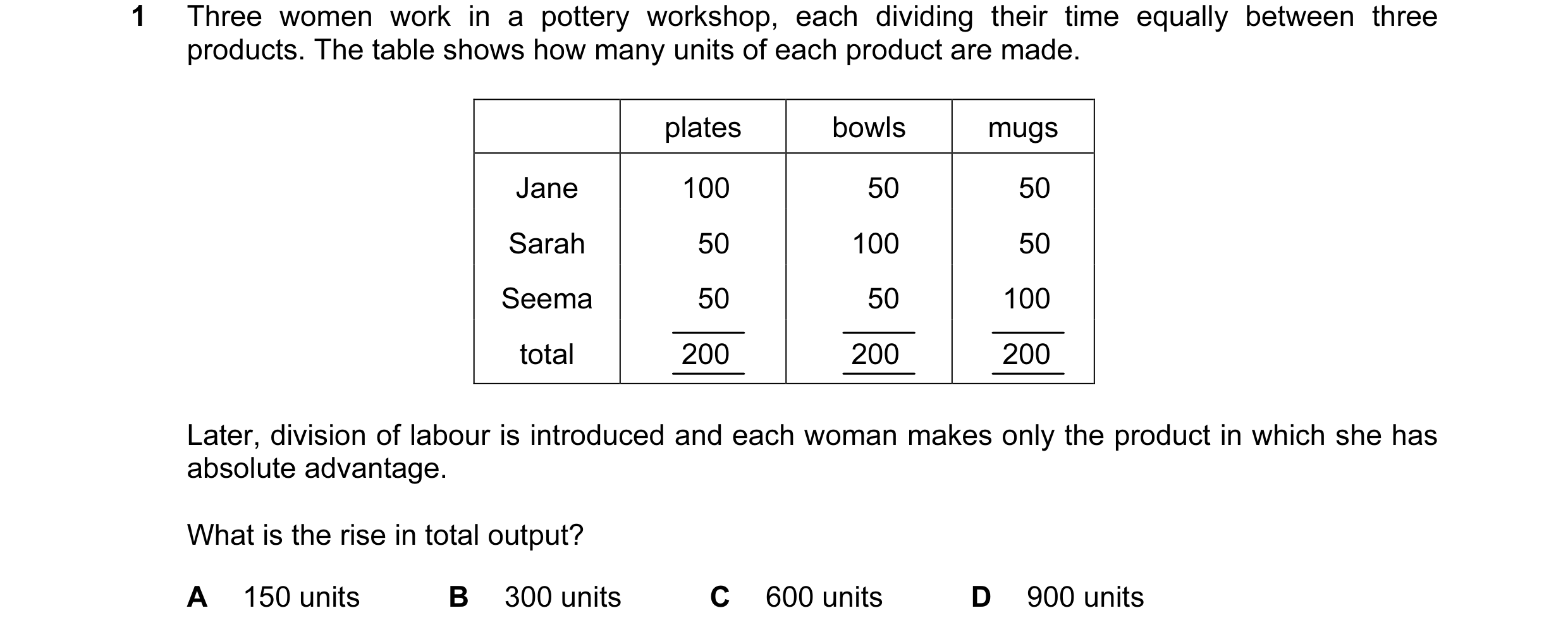
1 Three women work in a pottery workshop, each dividing their time equally between three products. The table shows how many units of each product are made. plates bowls mugs Jane 100 50 50 Sarah 50 100 50 Seema 50 50 100 total 200 200 200 Later, division of labour is introduced and each woman makes only the product in which she has absolute advantage. What is the rise in total output? A 150 units B 300 units C 600 units D 900 units
1 marks
Answer: B
This question in 9708/11 May/June 2009
Q7 · The diagram shows two production possibility curves (EF and GH), before and after… 9708/11 May/June 2009
2 The diagram shows two production possibility curves (EF and GH), before and after technological progress has taken place. G E consumer goods X O Y M F H capital goods After technological progress has taken place, what is the opportunity cost in capital goods of producing OX consumer goods? A MH B OH C OM D YF
1 marks
Answer: A
This question in 9708/11 May/June 2009
Q8 · A country has the correct climate for growing tea, which is produced very cheaply and… 9708/11 Oct/Nov 2009
19 A country has the correct climate for growing tea, which is produced very cheaply and exported. Fruit is also grown, but this costs more as the climate is not as suitable. Fruit can be sold at a higher price than tea so some of the land used for tea is switched to fruit. What will definitely happen as a result? A There will be an increase in specialisation by the country. B There will be an increase in the imports of tea. C There will be an opportunity cost of the loss of the tea production. D There will be production in line with absolute advantage.
1 marks
Answer: C
This question in 9708/11 Oct/Nov 2009
Q9 · The diagram illustrates the production possibility curves for an economy in Year 1 (X1… 9708/12 Oct/Nov 2009
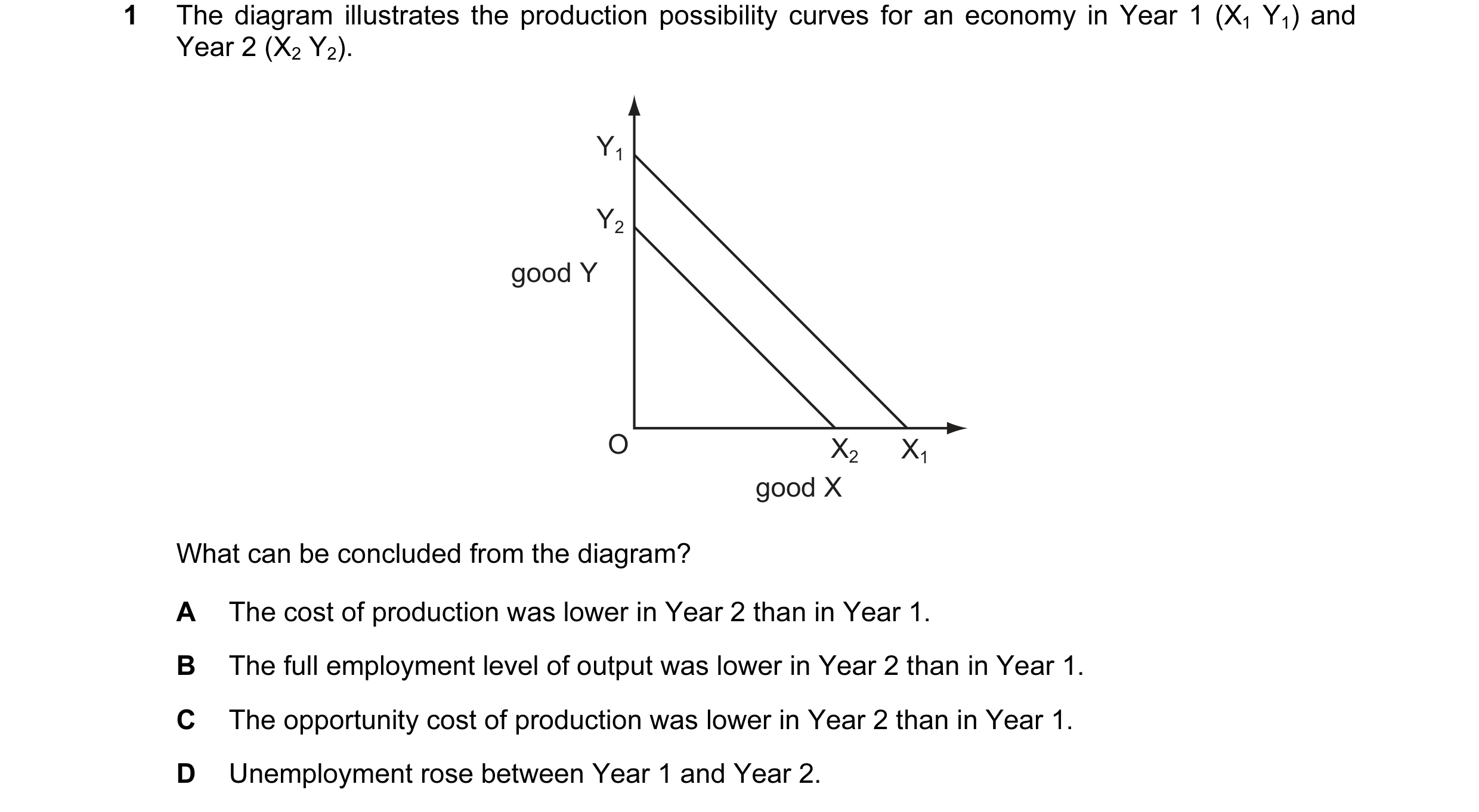
1 The diagram illustrates the production possibility curves for an economy in Year 1 (X1 Y1) and Year 2 (X2 Y2). Y1 Y2 good Y O X2 X1 good X What can be concluded from the diagram? A The cost of production was lower in Year 2 than in Year 1. B The full employment level of output was lower in Year 2 than in Year 1. C The opportunity cost of production was lower in Year 2 than in Year 1. D Unemployment rose between Year 1 and Year 2.
1 marks
Answer: B
This question in 9708/12 Oct/Nov 2009
Q10 · A country has the correct climate for growing tea, which is produced very cheaply and… 9708/12 Oct/Nov 2009
18 A country has the correct climate for growing tea, which is produced very cheaply and exported. Fruit is also grown, but this costs more as the climate is not as suitable. Fruit can be sold at a higher price than tea so some of the land used for tea is switched to fruit. What will definitely happen as a result? A There will be an increase in specialisation by the country. B There will be an increase in the imports of tea. C There will be an opportunity cost of the loss of the tea production. D There will be production in line with absolute advantage.
1 marks
Answer: C
This question in 9708/12 Oct/Nov 2009
Q11 · A worker can make 10 hats or 5 pairs of shoes in a day 9708/11 May/June 2010
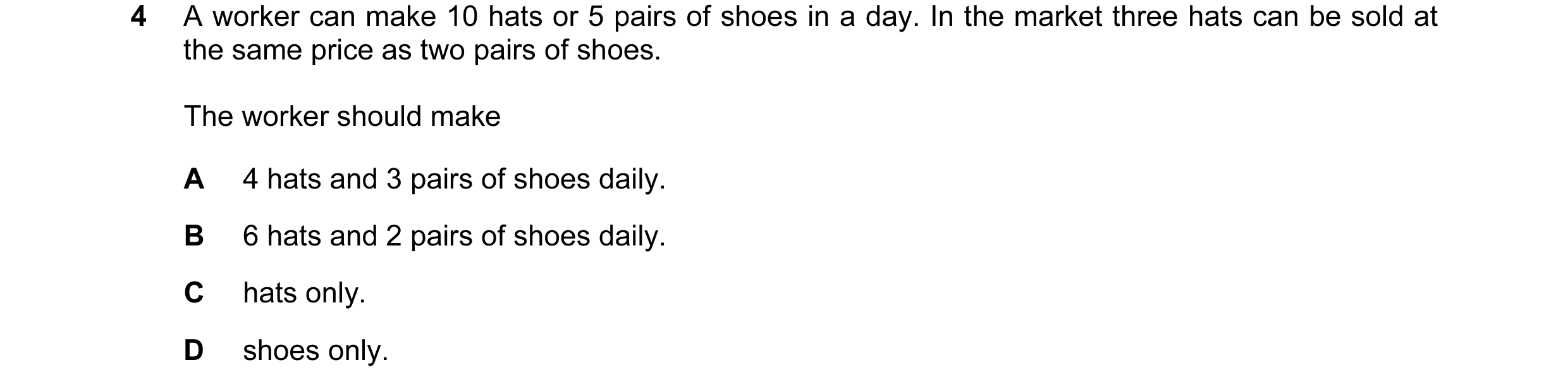
4 A worker can make 10 hats or 5 pairs of shoes in a day. In the market three hats can be sold at the same price as two pairs of shoes. The worker should make A 4 hats and 3 pairs of shoes daily. B 6 hats and 2 pairs of shoes daily. C hats only. D shoes only.
1 marks
Answer: C
This question in 9708/11 May/June 2010
Q12 · A worker can make 10 hats or 5 pairs of shoes in a day 9708/12 May/June 2010
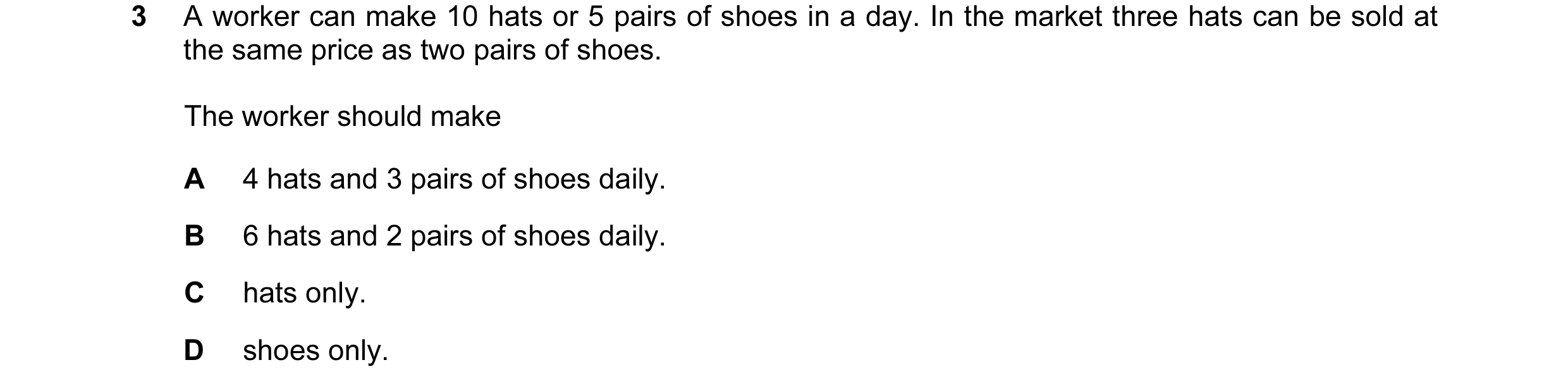
3 A worker can make 10 hats or 5 pairs of shoes in a day. In the market three hats can be sold at the same price as two pairs of shoes. The worker should make A 4 hats and 3 pairs of shoes daily. B 6 hats and 2 pairs of shoes daily. C hats only. D shoes only.
1 marks
Answer: C
This question in 9708/12 May/June 2010
Q13 · A worker can make 10 hats or 5 pairs of shoes in a day 9708/13 May/June 2010
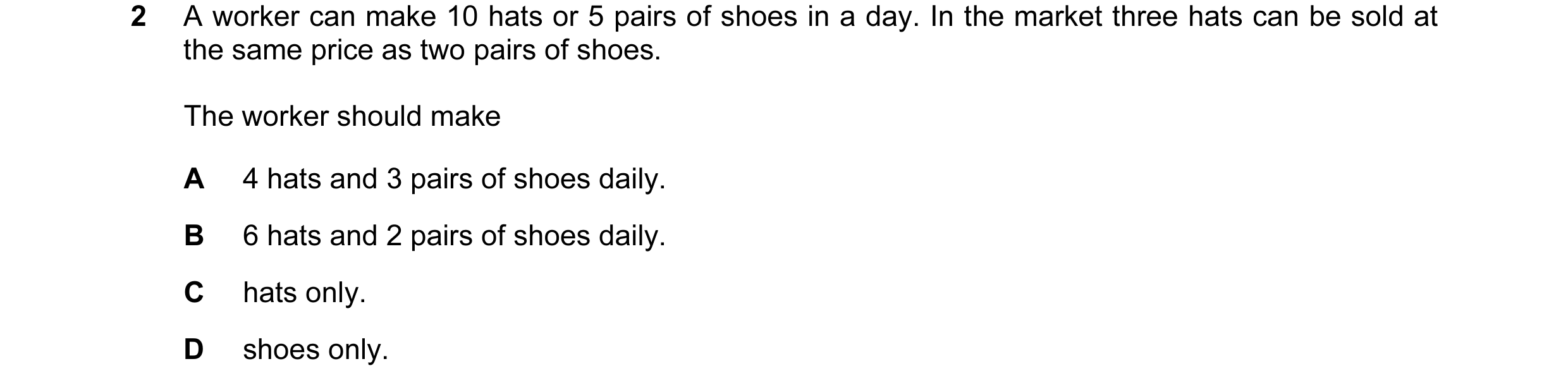
2 A worker can make 10 hats or 5 pairs of shoes in a day. In the market three hats can be sold at the same price as two pairs of shoes. The worker should make A 4 hats and 3 pairs of shoes daily. B 6 hats and 2 pairs of shoes daily. C hats only. D shoes only.
1 marks
Answer: C
This question in 9708/13 May/June 2010
Q14 · What is the central problem for an economy? 9708/11 Oct/Nov 2010
1 What is the central problem for an economy? A to achieve maximum growth in production B to allocate resources between alternative uses C to ensure all resources are fully exploited D to overcome inequalities in income distribution
1 marks
Answer: B
This question in 9708/11 Oct/Nov 2010
Q15 · The diagram shows the production possibility curve of an economy 9708/11 Oct/Nov 2010
3 The diagram shows the production possibility curve of an economy. capital goods O consumer goods Which statement explains the shape of this curve? A More efficient workers are drawn away from the production of consumer goods. B Resources cannot be switched between producing capital and consumer goods. C The economy is more efficient at producing capital than consumer goods. D The opportunity cost of producing capital goods increases the more capital goods are made.
1 marks
Answer: D
This question in 9708/11 Oct/Nov 2010
Q16 · Rising demand for oil from China and other countries is leading to concerns that there… 9708/11 Oct/Nov 2010
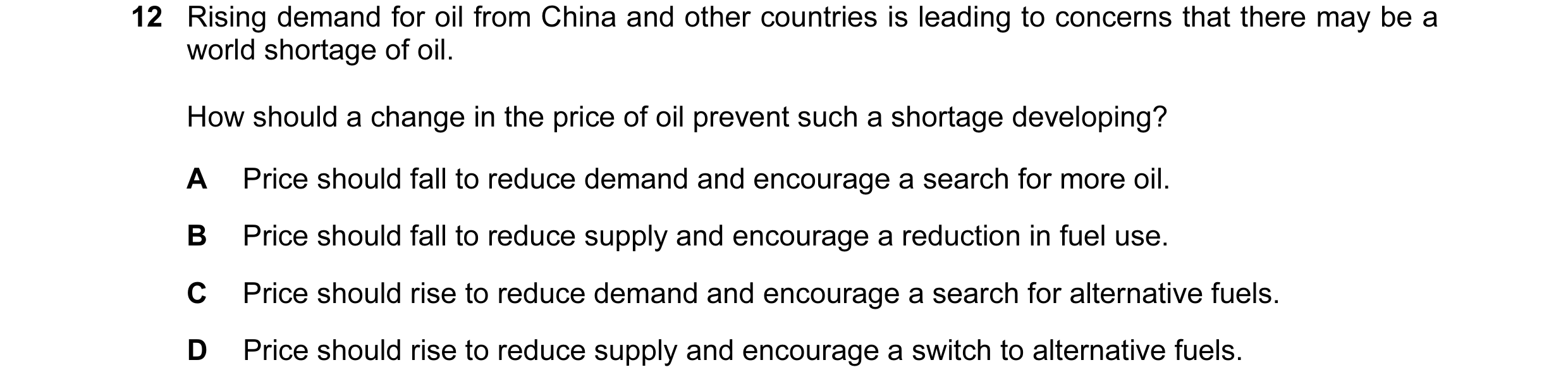
12 Rising demand for oil from China and other countries is leading to concerns that there may be a world shortage of oil. How should a change in the price of oil prevent such a shortage developing? A Price should fall to reduce demand and encourage a search for more oil. B Price should fall to reduce supply and encourage a reduction in fuel use. C Price should rise to reduce demand and encourage a search for alternative fuels. D Price should rise to reduce supply and encourage a switch to alternative fuels.
1 marks
Answer: C
This question in 9708/11 Oct/Nov 2010
Q17 · The table shows the expected costs and benefits from four government projects 9708/11 Oct/Nov 2010
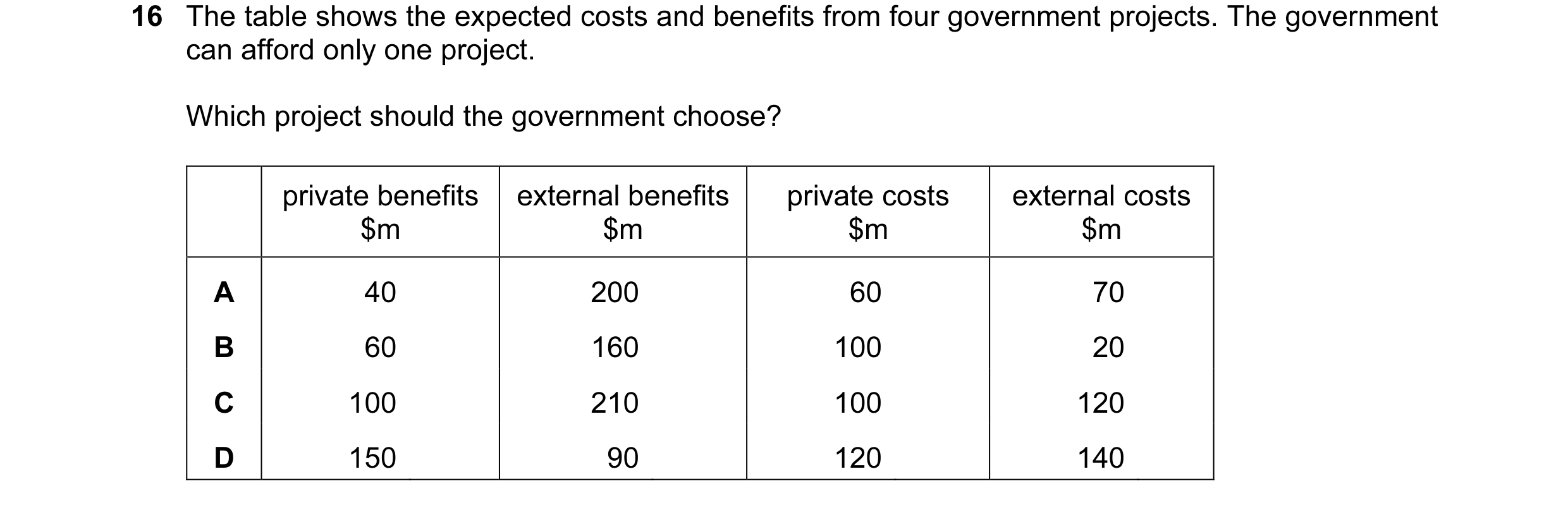
16 The table shows the expected costs and benefits from four government projects. The government can afford only one project. Which project should the government choose? private benefits external benefits private costs external costs $m $m $m $m A 40 200 60 70 B 60 160 100 20 C 100 210 100 120 D 150 90 120 140
1 marks
Answer: A
This question in 9708/11 Oct/Nov 2010
Q18 · What is the central problem for an economy? 9708/12 Oct/Nov 2010
1 What is the central problem for an economy? A to achieve maximum growth in production B to allocate resources between alternative uses C to ensure all resources are fully exploited D to overcome inequalities in income distribution
1 marks
Answer: B
This question in 9708/12 Oct/Nov 2010
Q19 · The table shows the expected costs and benefits from four government projects 9708/13 Oct/Nov 2010
15 The table shows the expected costs and benefits from four government projects. The government can afford only one project. Which project should the government choose? private benefits external benefits private costs external costs $m $m $m $m A 40 200 60 70 B 60 160 100 20 C 100 210 100 120 D 150 90 120 140
1 marks
Answer: A
This question in 9708/13 Oct/Nov 2010
Q20 · What is the central problem for an economy? 9708/13 Oct/Nov 2010
30 What is the central problem for an economy? A to achieve maximum growth in production B to allocate resources between alternative uses C to ensure all resources are fully exploited D to overcome inequalities in income distribution
1 marks
Answer: B
This question in 9708/13 Oct/Nov 2010
Q21 · What is the opportunity cost to an unemployed worker who becomes employed? 9708/11 Oct/Nov 2011
3 What is the opportunity cost to an unemployed worker who becomes employed? A the leisure they would otherwise have had B the value of the goods and services they produce C the wages they are paid D zero
1 marks
Answer: A
This question in 9708/11 Oct/Nov 2011
Q22 · An individual has an appointment with his bank manager 9708/12 Oct/Nov 2011
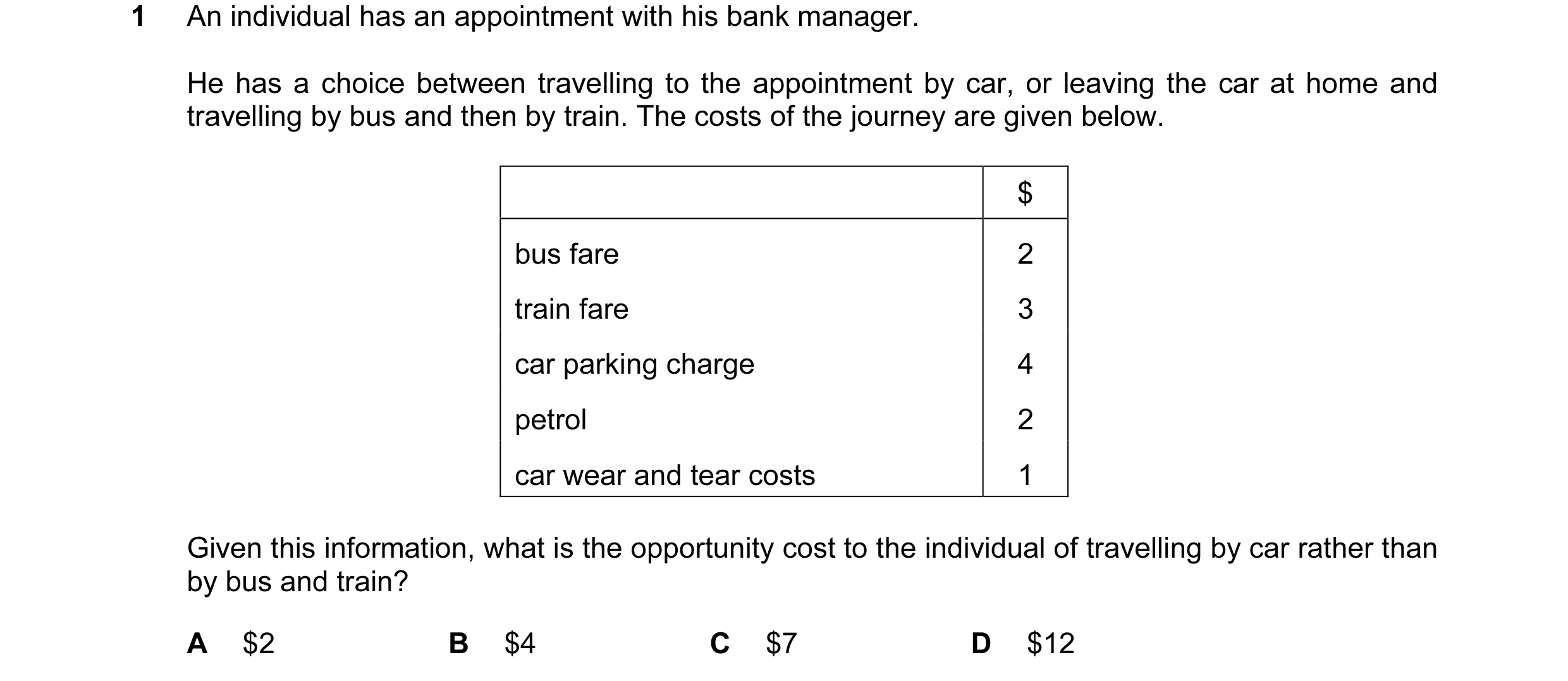
1 An individual has an appointment with his bank manager. He has a choice between travelling to the appointment by car, or leaving the car at home and travelling by bus and then by train. The costs of the journey are given below. $ bus fare 2 train fare 3 car parking charge 4 petrol 2 car wear and tear costs 1 Given this information, what is the opportunity cost to the individual of travelling by car rather than by bus and train? A $2 B $4 C $7 D $12
1 marks
Answer: A
This question in 9708/12 Oct/Nov 2011
Q23 · What is the opportunity cost to an unemployed worker who becomes employed? 9708/13 Oct/Nov 2011
1 What is the opportunity cost to an unemployed worker who becomes employed? A the leisure they would otherwise have had B the value of the goods and services they produce C the wages they are paid D zero
1 marks
Answer: A
This question in 9708/13 Oct/Nov 2011
Q24 · What is the opportunity cost to a fully employed economy of increasing capital investment? 9708/11 May/June 2012
3 What is the opportunity cost to a fully employed economy of increasing capital investment? A a fall in consumption B a fall in income C a rise in saving D a rise in the rate of interest
1 marks
Answer: A
This question in 9708/11 May/June 2012
Q25 · The growing domestic, agricultural and industrial demand for water is leading to a world… 9708/12 May/June 2012
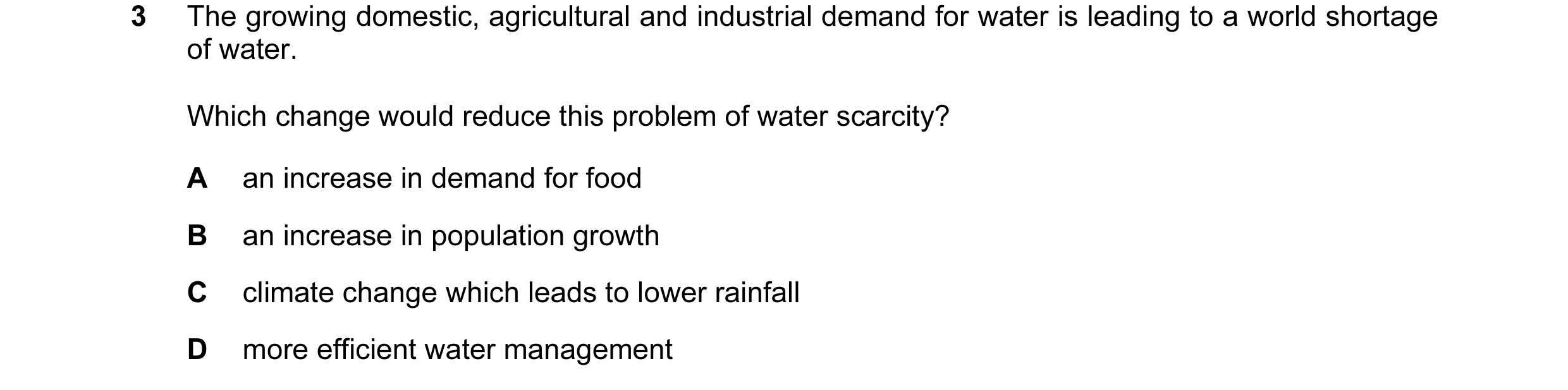
3 The growing domestic, agricultural and industrial demand for water is leading to a world shortage of water. Which change would reduce this problem of water scarcity? A an increase in demand for food B an increase in population growth C climate change which leads to lower rainfall D more efficient water management
1 marks
Answer: D
This question in 9708/12 May/June 2012
Q26 · What is the opportunity cost to a fully employed economy of increasing capital investment? 9708/13 May/June 2012
3 What is the opportunity cost to a fully employed economy of increasing capital investment? A a fall in consumption B a fall in income C a rise in saving D a rise in the rate of interest
1 marks
Answer: A
This question in 9708/13 May/June 2012
Q27 · What can be calculated as part of a government cost-benefit analysis that would not be… 9708/13 May/June 2012
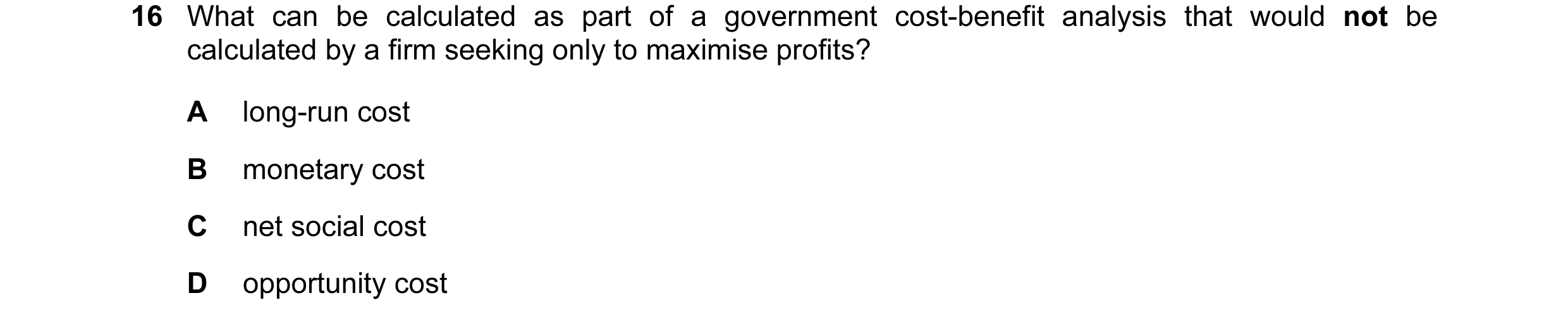
16 What can be calculated as part of a government cost-benefit analysis that would not be calculated by a firm seeking only to maximise profits? A long-run cost B monetary cost C net social cost D opportunity cost
1 marks
Answer: C
This question in 9708/13 May/June 2012
Q28 · The diagram shows the production possibility frontier of a desert island economy where… 9708/11 Oct/Nov 2012
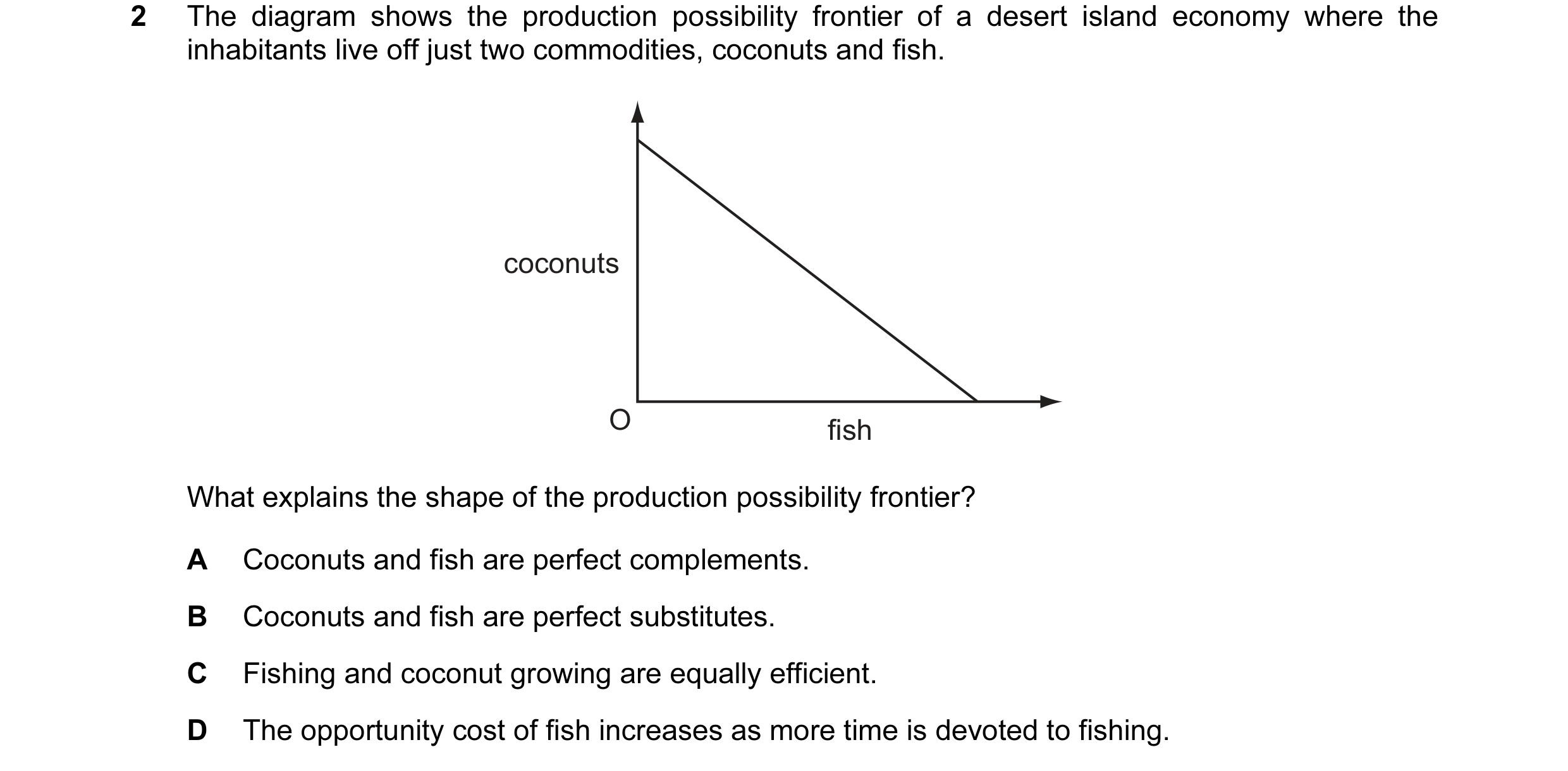
2 The diagram shows the production possibility frontier of a desert island economy where the inhabitants live off just two commodities, coconuts and fish. coconuts O fish What explains the shape of the production possibility frontier? A Coconuts and fish are perfect complements. B Coconuts and fish are perfect substitutes. C Fishing and coconut growing are equally efficient. D The opportunity cost of fish increases as more time is devoted to fishing.
1 marks
Answer: C
This question in 9708/11 Oct/Nov 2012
Q29 · There is a worldwide shortage of oil 9708/11 Oct/Nov 2012
4 There is a worldwide shortage of oil. The diagram shows the consumption and production of oil (billion tonnes) in 2007 for selected countries. United States consumption Japan production Russia Britain 0 0.2 0.4 0.6 0.8 1.0 bn tonnes What can be concluded from the diagram? A In Britain, oil has zero opportunity cost. B In Japan, there is self sufficiency in oil. C In Russia, the problem of oil shortage has been solved. D In the United States, rationing will be the only solution to oil shortage.
1 marks
Answer: C
This question in 9708/11 Oct/Nov 2012
Q30 · An international oil company announced that it would stop exploring for oil off the coast… 9708/11 Oct/Nov 2012
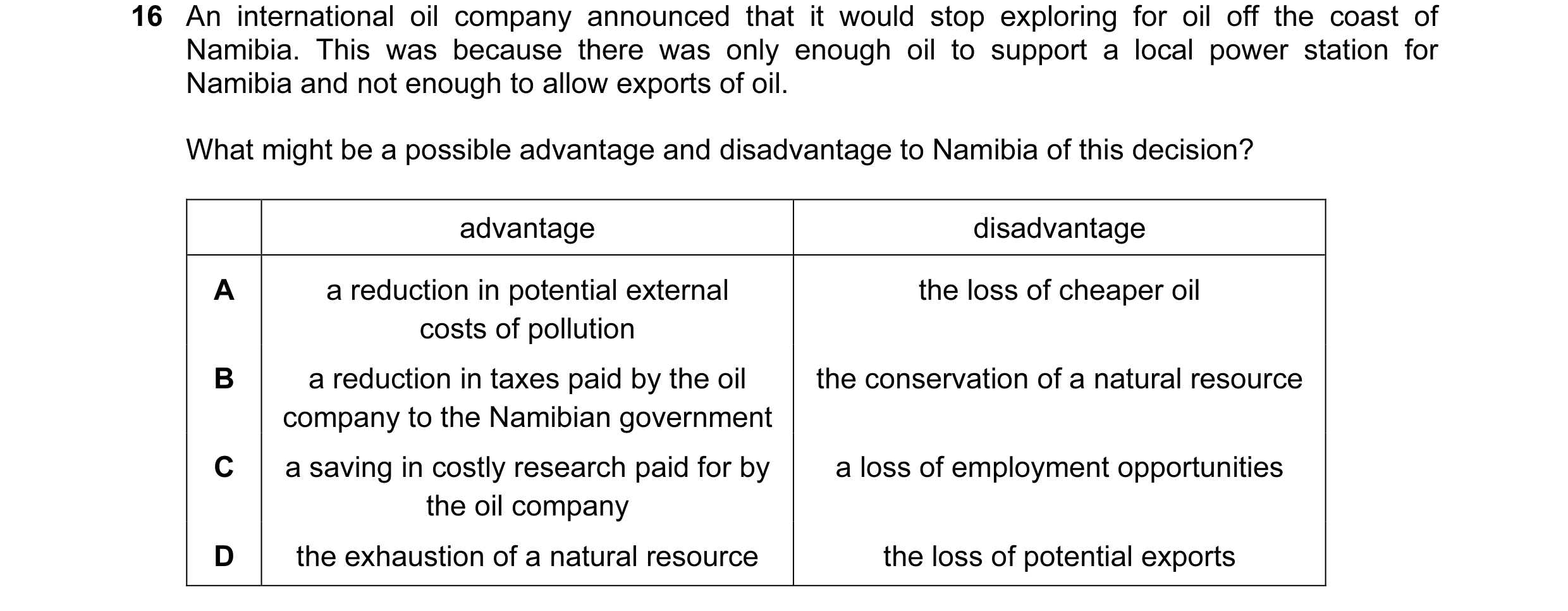
16 An international oil company announced that it would stop exploring for oil off the coast of Namibia. This was because there was only enough oil to support a local power station for Namibia and not enough to allow exports of oil. What might be a possible advantage and disadvantage to Namibia of this decision? advantage disadvantage A a reduction in potential external the loss of cheaper oil costs of pollution B a reduction in taxes paid by the oil the conservation of a natural resource company to the Namibian government C a saving in costly research paid for by a loss of employment opportunities the oil company D the exhaustion of a natural resource the loss of potential exports
1 marks
Answer: A
This question in 9708/11 Oct/Nov 2012
Q31 · The production possibility curve for an economy producing capital goods and consumer… 9708/13 Oct/Nov 2012
2 The production possibility curve for an economy producing capital goods and consumer goods is represented by the line PQ. P capital goods T R O S Q consumer goods What is the opportunity cost of producing OS of consumer goods? A OR of capital goods B PR of capital goods C SQ of consumer goods D SQ of consumer goods + PR of capital goods
1 marks
Answer: B
This question in 9708/13 Oct/Nov 2012
Q32 · A cost-benefit analysis concludes that a nuclear power station project might be socially… 9708/11 May/June 2013
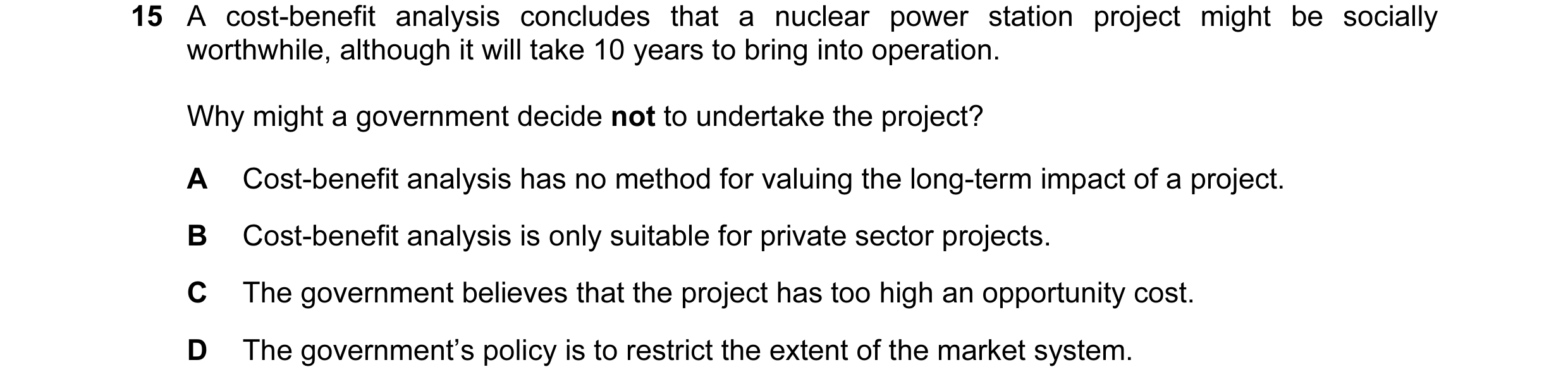
15 A cost-benefit analysis concludes that a nuclear power station project might be socially worthwhile, although it will take 10 years to bring into operation. Why might a government decide not to undertake the project? A Cost-benefit analysis has no method for valuing the long-term impact of a project. B Cost-benefit analysis is only suitable for private sector projects. C The government believes that the project has too high an opportunity cost. D The government’s policy is to restrict the extent of the market system.
1 marks
Answer: C
This question in 9708/11 May/June 2013
Q33 · What would cause a country to lose its comparative advantage in producing rice? 9708/11 May/June 2013
19 What would cause a country to lose its comparative advantage in producing rice? A Another country becomes able to produce rice at a lower opportunity cost. B There is a global fall in demand for rice. C There is a fall in tariffs imposed by rice importers. D Transport costs to and from another country producing rice decrease.
1 marks
Answer: A
This question in 9708/11 May/June 2013
Q34 · A government minister states that the main economic benefit of locating a new factory in… 9708/12 May/June 2013
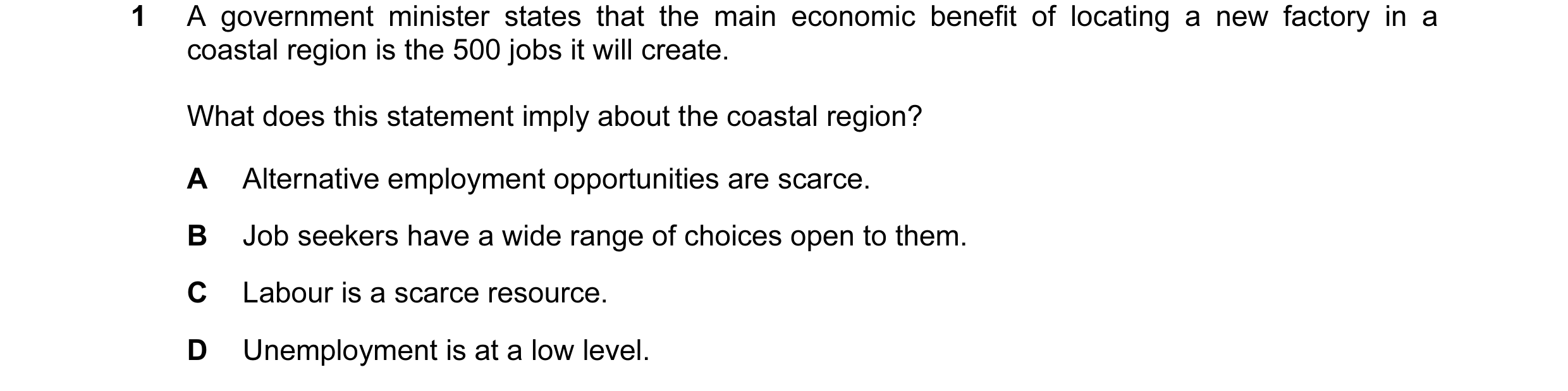
1 A government minister states that the main economic benefit of locating a new factory in a coastal region is the 500 jobs it will create. What does this statement imply about the coastal region? A Alternative employment opportunities are scarce. B Job seekers have a wide range of choices open to them. C Labour is a scarce resource. D Unemployment is at a low level.
1 marks
Answer: A
This question in 9708/12 May/June 2013
Q35 · The diagram shows two production possibility curves (EF and GH), before and after… 9708/12 May/June 2013
2 The diagram shows two production possibility curves (EF and GH), before and after technological progress has taken place. G E consumer goods X O Y M F H capital goods After technological progress has taken place, what is the opportunity cost in capital goods of producing OX consumer goods? A MH B OH C OM D YF
1 marks
Answer: A
This question in 9708/12 May/June 2013
Q36 · A local council charges for the use of tennis courts but not for the use of street lights 9708/11 Oct/Nov 2013
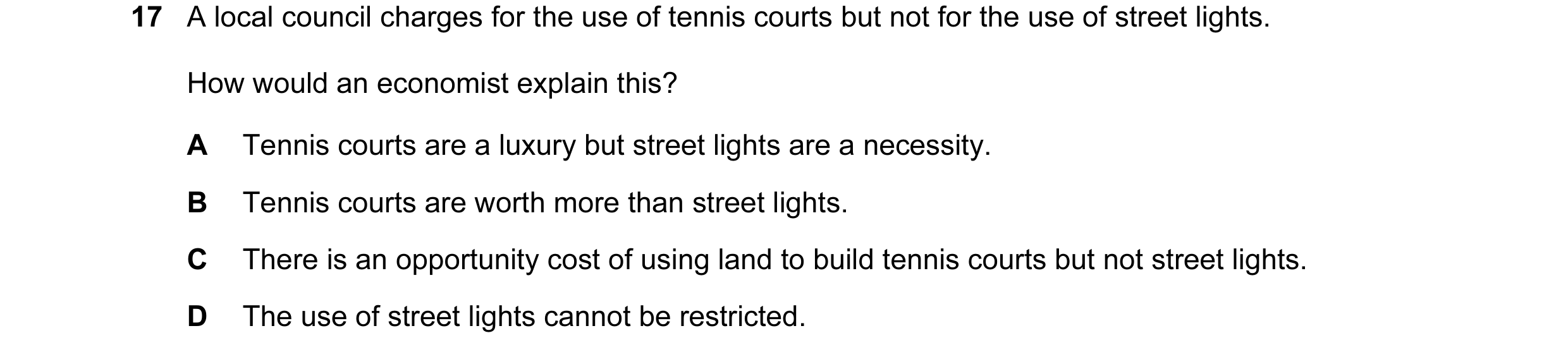
17 A local council charges for the use of tennis courts but not for the use of street lights. How would an economist explain this? A Tennis courts are a luxury but street lights are a necessity. B Tennis courts are worth more than street lights. C There is an opportunity cost of using land to build tennis courts but not street lights. D The use of street lights cannot be restricted.
1 marks
Answer: D
This question in 9708/11 Oct/Nov 2013
Q37 · What is the correct order of these economic concepts? 9708/12 Oct/Nov 2013
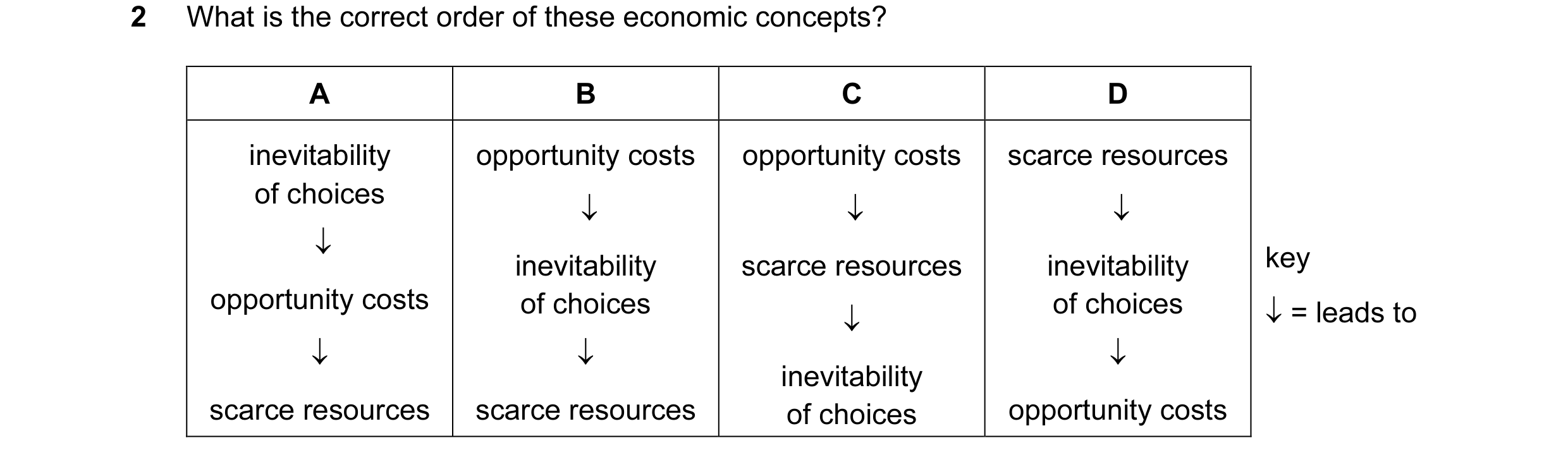
2 What is the correct order of these economic concepts? A B C D inevitability opportunity costs opportunity costs scarce resources of choices ↓ ↓ ↓ ↓ inevitability scarce resources inevitability key opportunity costs of choices of choices ↓ = leads to ↓ ↓ ↓ ↓ inevitability scarce resources scarce resources of choices opportunity costs
1 marks
Answer: D
This question in 9708/12 Oct/Nov 2013
Q38 · A farmer can produce both beef and lamb 9708/12 Oct/Nov 2013
3 A farmer can produce both beef and lamb. The opportunity cost of a kilo of beef is three kilos of lamb. The price of a kilo of beef is twice that of lamb. What should he do if his aim is to maximise his revenue? A concentrate on beef production B concentrate on lamb production C produce beef and lamb in the ratio 3:2 D produce twice as much beef as lamb
1 marks
Answer: B
This question in 9708/12 Oct/Nov 2013
Q39 · A consumer needed a new camera and a new armchair 9708/12 Oct/Nov 2013
12 A consumer needed a new camera and a new armchair. She was prepared to spend $500 on one item. She discovered that the camera cost $450 and the armchair $500. She bought the camera. What was her opportunity cost and her consumer surplus? opportunity consumer cost surplus A the armchair $50 B the armchair $500 C $50 $450 D $450 $50
1 marks
Answer: A
This question in 9708/12 Oct/Nov 2013
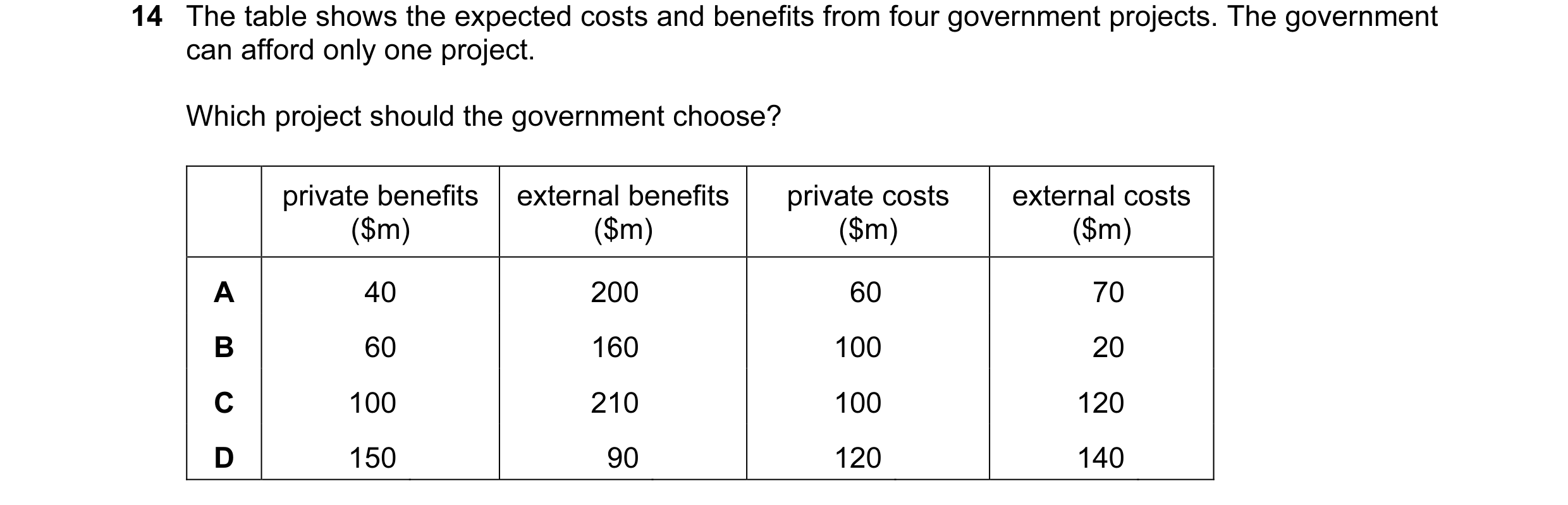
Q40 · The table shows the expected costs and benefits from four government projects 9708/12 Oct/Nov 2013
14 The table shows the expected costs and benefits from four government projects. The government can afford only one project. Which project should the government choose? private benefits external benefits private costs external costs ($m) ($m) ($m) ($m) A 40 200 60 70 B 60 160 100 20 C 100 210 100 120 D 150 90 120 140
1 marks
Answer: A
This question in 9708/12 Oct/Nov 2013
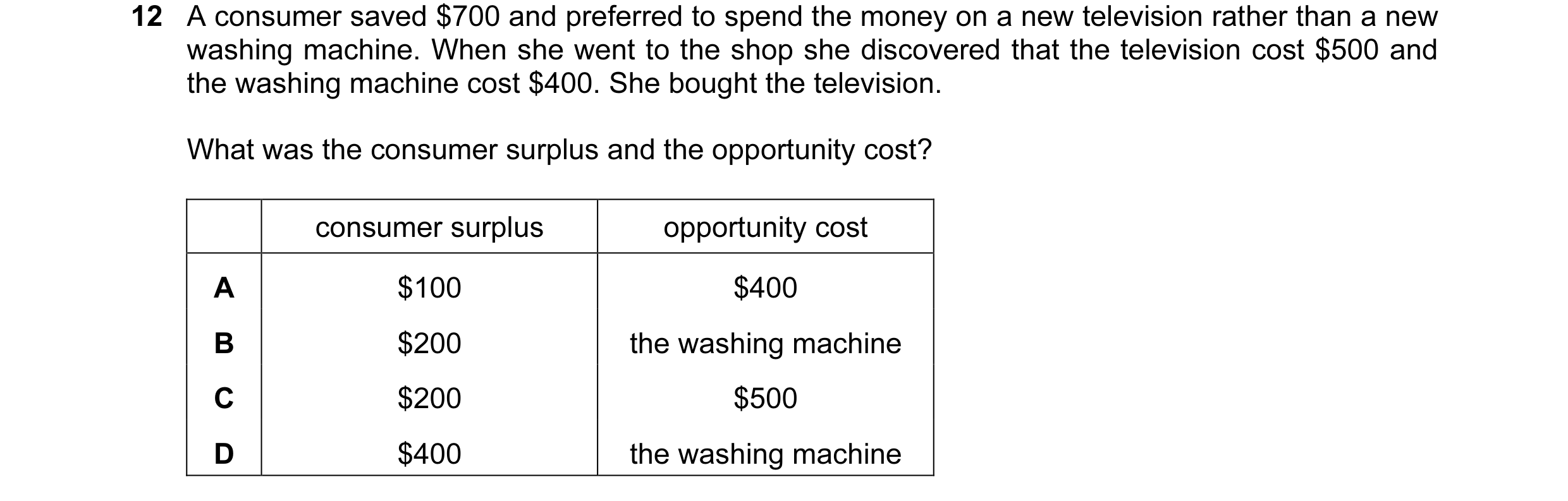
Q41 · A consumer saved $700 and preferred to spend the money on a new television rather than a… 9708/13 Oct/Nov 2013
12 A consumer saved $700 and preferred to spend the money on a new television rather than a new washing machine. When she went to the shop she discovered that the television cost $500 and the washing machine cost $400. She bought the television. What was the consumer surplus and the opportunity cost? consumer surplus opportunity cost A $100 $400 B $200 the washing machine C $200 $500 D $400 the washing machine
1 marks
Answer: B
This question in 9708/13 Oct/Nov 2013
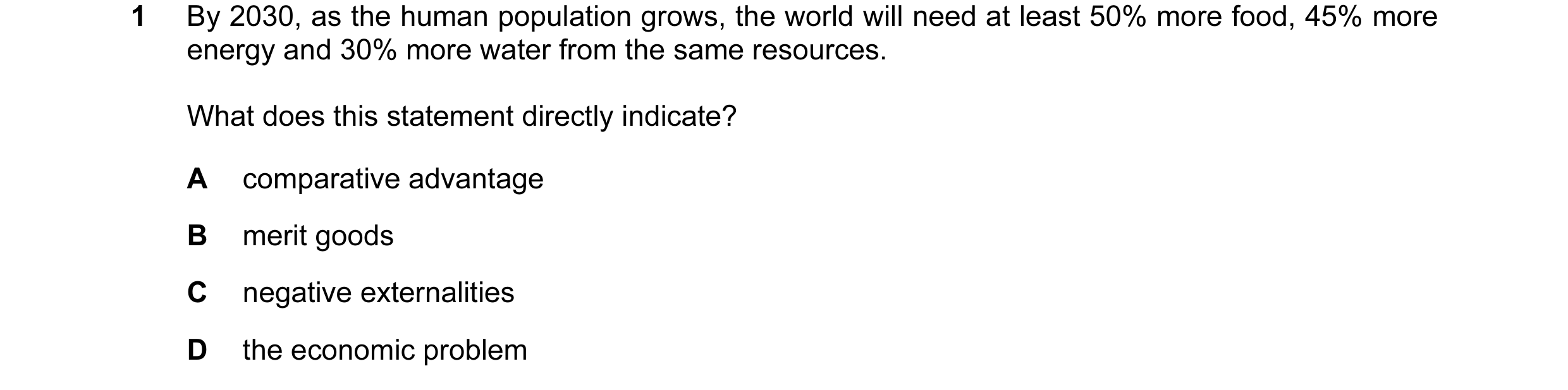
Q42 · By 2030, as the human population grows, the world will need at least 50% more food, 45%… 9708/12 May/June 2014
1 By 2030, as the human population grows, the world will need at least 50% more food, 45% more energy and 30% more water from the same resources. What does this statement directly indicate? A comparative advantage B merit goods C negative externalities D the economic problem
1 marks
Answer: D
This question in 9708/12 May/June 2014
Q43 · One of the central themes of economics is that resources are scarce 9708/13 May/June 2014
1 One of the central themes of economics is that resources are scarce. What is certain from this? A Difficult choices are unavoidable for economic agents. B Food shortages will become more severe over time. C Resource allocation cannot be left solely to the price mechanism. D There will be a continuing upward trend in commodity prices.
1 marks
Answer: A
This question in 9708/13 May/June 2014
Q44 · What is meant by ‘the value of money’? 9708/11 Oct/Nov 2014
4 What is meant by ‘the value of money’? A the amount of goods that can be purchased with a given sum of money B the amount of wealth stored in the form of money C the cost of production of money D the opportunity cost of holding wealth in the form of money
1 marks
This question in 9708/11 Oct/Nov 2014
Q45 · Which statement about the problem of scarcity is correct? 9708/12 Oct/Nov 2014
1 Which statement about the problem of scarcity is correct? A Continually rising productivity will increase output and solve scarcity. B Future inventions will introduce new products that remove scarcity. C Government printing of money will raise incomes and eliminate scarcity. D Human nature will make the solution of scarcity impossible.
1 marks
Answer: D
This question in 9708/12 Oct/Nov 2014
Q46 · A firm is considering whether to buy a piece of capital equipment which will cost $2000 9708/12 Oct/Nov 2014
2 A firm is considering whether to buy a piece of capital equipment which will cost $2000. It estimates that the equipment will last for two years. The alternative is to lend the money to a finance company at a compound rate of interest of 5%. What is the minimum increase in revenue the firm must expect to make it worthwhile buying the equipment? A $101 B $206 C $2001 D $2206
1 marks
Answer: D
This question in 9708/12 Oct/Nov 2014
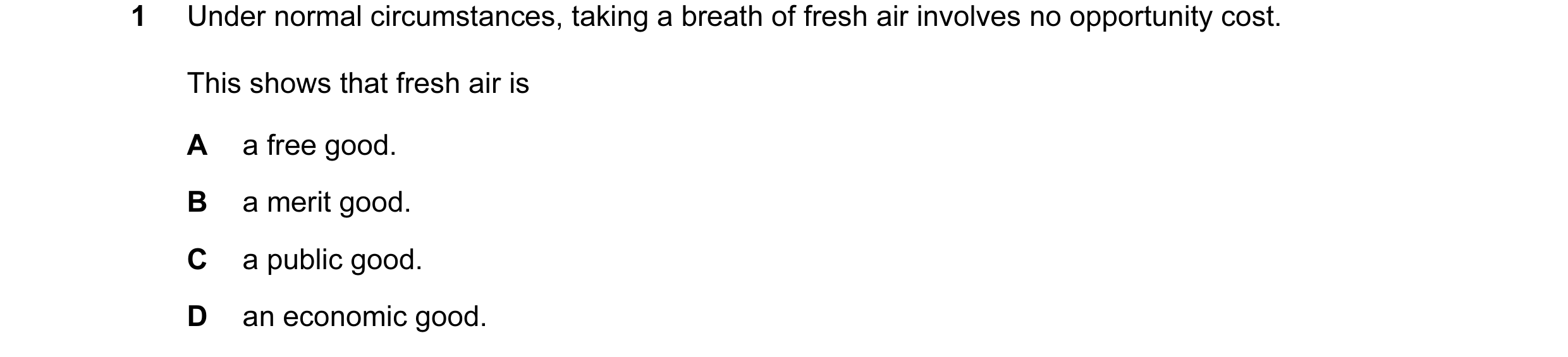
Q47 · Under normal circumstances, taking a breath of fresh air involves no opportunity cost 9708/13 Oct/Nov 2014
1 Under normal circumstances, taking a breath of fresh air involves no opportunity cost. This shows that fresh air is A a free good. B a merit good. C a public good. D an economic good.
1 marks
Answer: A
This question in 9708/13 Oct/Nov 2014
Q48 · The diagrams show an economy’s production possibility curve before and after a change has… 9708/13 Oct/Nov 2014
2 The diagrams show an economy’s production possibility curve before and after a change has occurred. before after 50 50 capital capital goods goods 0 consumer 100 0 consumer 100 goods goods What would this change indicate about opportunity cost and the production possibility curve? opportunity cost production possibility curve A switched from constant to increasing involved some increase B switched from decreasing to constant involved some decrease C switched from decreasing to increasing involved some increase D switched from increasing to constant involved some decrease
1 marks
Answer: D
This question in 9708/13 Oct/Nov 2014
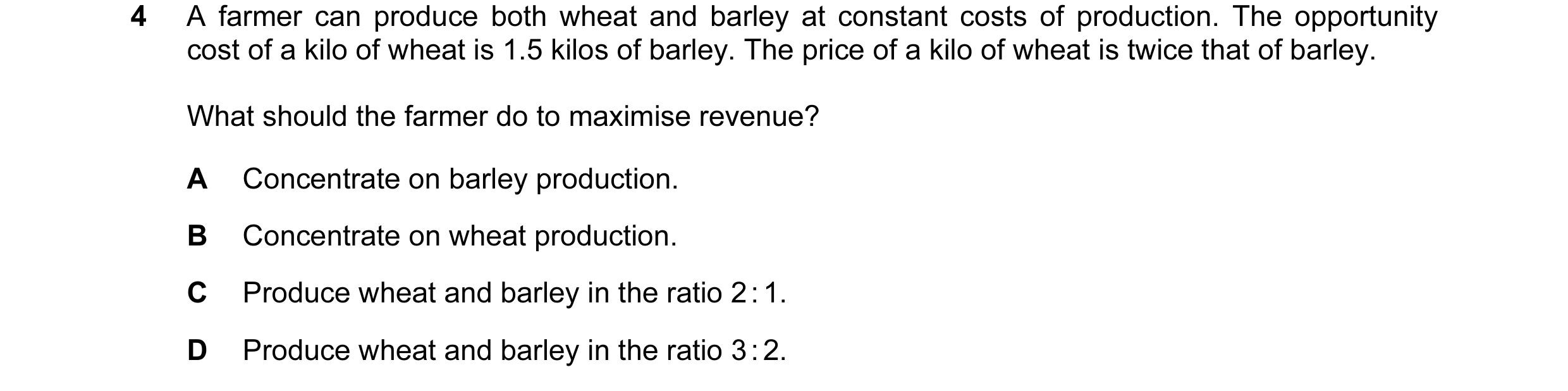
Q49 · A farmer can produce both wheat and barley at constant costs of production 9708/13 Oct/Nov 2014
4 A farmer can produce both wheat and barley at constant costs of production. The opportunity cost of a kilo of wheat is 1.5 kilos of barley. The price of a kilo of wheat is twice that of barley. What should the farmer do to maximise revenue? A Concentrate on barley production. B Concentrate on wheat production. C Produce wheat and barley in the ratio 2 : 1. D Produce wheat and barley in the ratio 3 : 2.
1 marks
Answer: B
This question in 9708/13 Oct/Nov 2014
Q50 · Which combination of events must increase the level of scarcity in an economy? 9708/11 May/June 2015
1 Which combination of events must increase the level of scarcity in an economy? A discovery of new oil reserves and higher saving ratios B improved application of technology and new invention C less certain weather patterns and a fashion for greater consumption D more efficient power generation and a reduced birth rate
1 marks
Answer: C
This question in 9708/11 May/June 2015
Q51 · A worker can make 10 hats or 5 pairs of shoes in a day 9708/11 May/June 2015
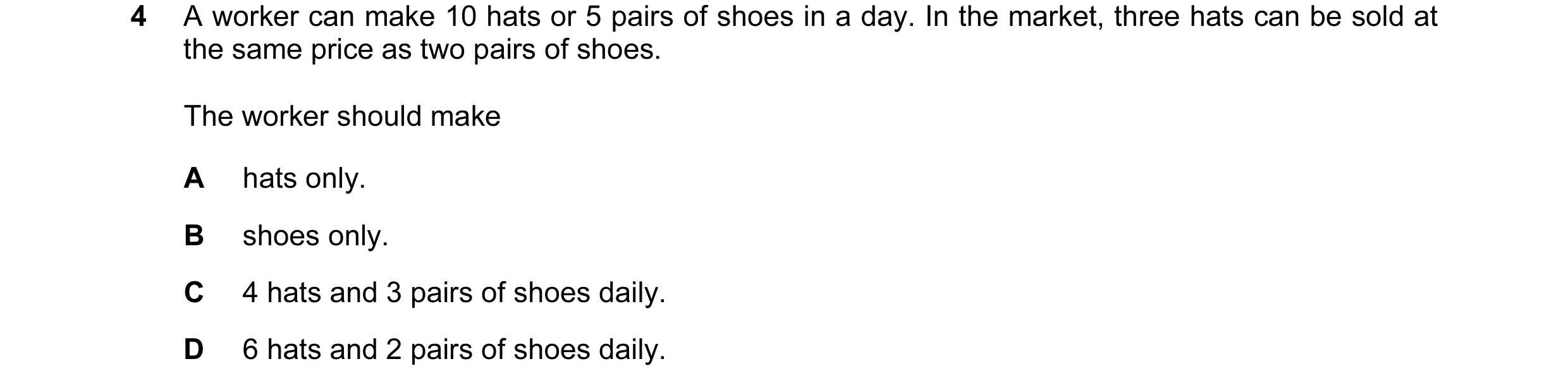
4 A worker can make 10 hats or 5 pairs of shoes in a day. In the market, three hats can be sold at the same price as two pairs of shoes. The worker should make A hats only. B shoes only. C 4 hats and 3 pairs of shoes daily. D 6 hats and 2 pairs of shoes daily.
1 marks
Answer: A
This question in 9708/11 May/June 2015
Q52 · Which statement about costs is correct? 9708/11 May/June 2015
15 Which statement about costs is correct? A External cost only affects consumers. B Opportunity cost affects all transactions. C Private cost only affects producers. D Social cost affects all members of society equally.
1 marks
Answer: B
This question in 9708/11 May/June 2015
Q53 · In 2013, there was much criticism of a government project to build a new high-speed rail… 9708/12 May/June 2015
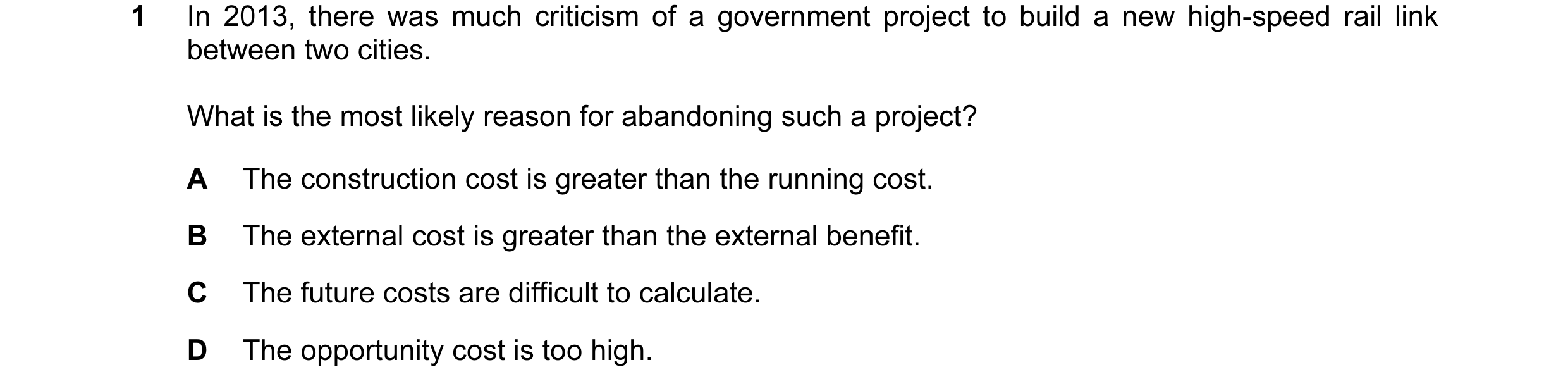
1 In 2013, there was much criticism of a government project to build a new high-speed rail link between two cities. What is the most likely reason for abandoning such a project? A The construction cost is greater than the running cost. B The external cost is greater than the external benefit. C The future costs are difficult to calculate. D The opportunity cost is too high.
1 marks
Answer: D
This question in 9708/12 May/June 2015
Q54 · The diagram shows the production possibility curve of a desert island economy where the… 9708/12 May/June 2015
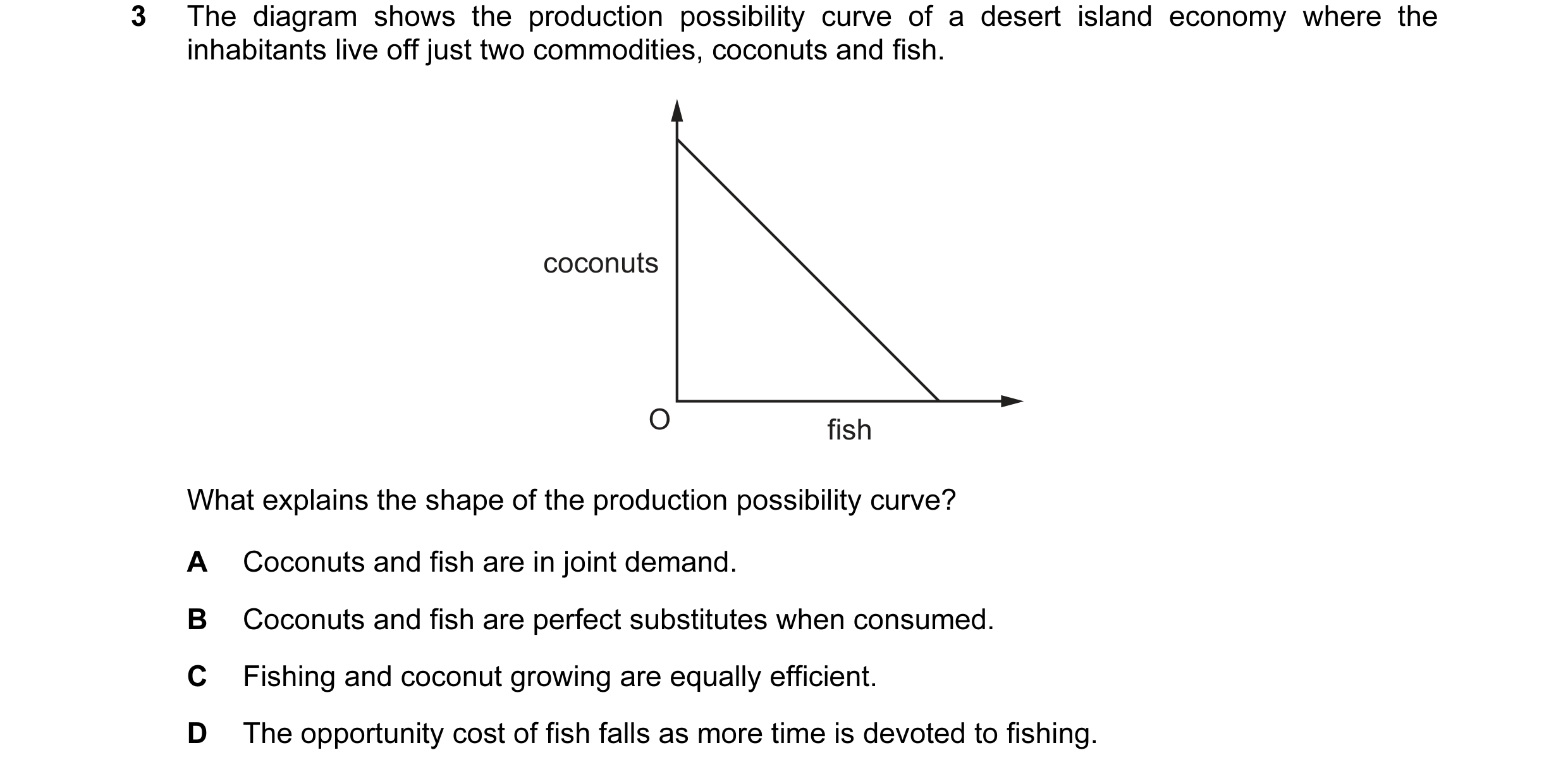
3 The diagram shows the production possibility curve of a desert island economy where the inhabitants live off just two commodities, coconuts and fish. coconuts O fish What explains the shape of the production possibility curve? A Coconuts and fish are in joint demand. B Coconuts and fish are perfect substitutes when consumed. C Fishing and coconut growing are equally efficient. D The opportunity cost of fish falls as more time is devoted to fishing.
1 marks
Answer: C
This question in 9708/12 May/June 2015
Q55 · What is the fundamental assumption of the economic problem? 9708/13 May/June 2015
1 What is the fundamental assumption of the economic problem? A Factors of production are finite. B Individuals are the best judges of their own wellbeing. C Individuals can be relied upon to behave rationally. D The principal aim of private firms is profit maximisation.
1 marks
Answer: A
This question in 9708/13 May/June 2015
Q56 · The diagram shows the change in a country’s production possibility curve from PQ to PR 9708/13 May/June 2015
3 The diagram shows the change in a country’s production possibility curve from PQ to PR. P public goods O Q R private goods What increases as a result of the change from PQ to PR? A the price of private goods B the price of public goods C the opportunity cost of private goods D the opportunity cost of public goods
1 marks
Answer: D
This question in 9708/13 May/June 2015
Q57 · A trading country can produce two goods, X and Y 9708/13 May/June 2015
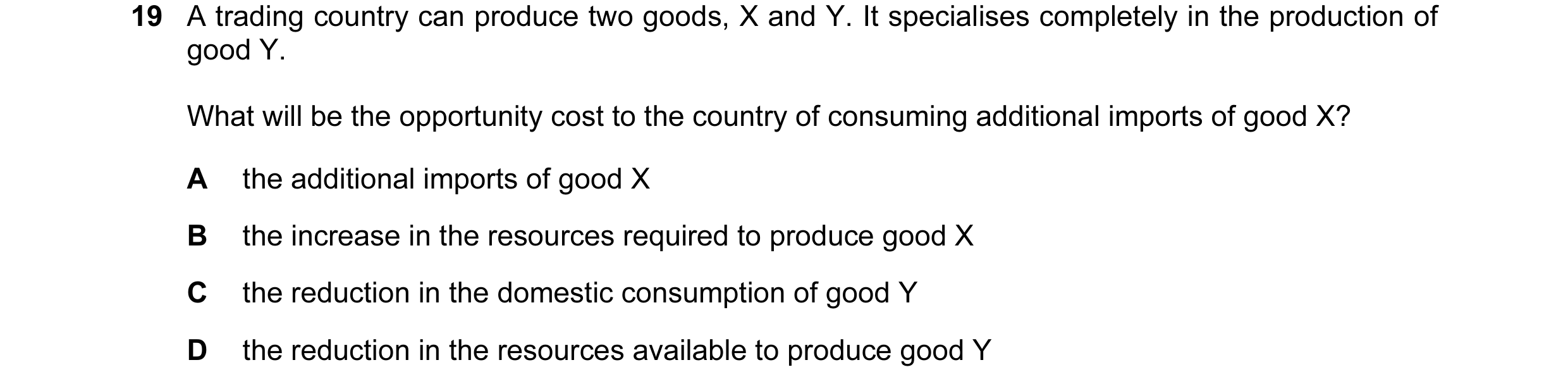
19 A trading country can produce two goods, X and Y. It specialises completely in the production of good Y. What will be the opportunity cost to the country of consuming additional imports of good X? A the additional imports of good X B the increase in the resources required to produce good X C the reduction in the domestic consumption of good Y D the reduction in the resources available to produce good Y
1 marks
Answer: C
This question in 9708/13 May/June 2015
Q58 · Which question does not directly refer to the basic economic problem? 9708/12 Oct/Nov 2015
1 Which question does not directly refer to the basic economic problem? A What goods and services should a firm produce? B What price should a firm charge? C What production methods should a firm use? D Who should receive the goods and services that a firm produces?
1 marks
Answer: B
This question in 9708/12 Oct/Nov 2015
Q59 · The diagram shows a person’s marginal costs and marginal benefits of making trips to the… 9708/13 Oct/Nov 2015
3 The diagram shows a person’s marginal costs and marginal benefits of making trips to the cinema. costs, benefits marginal cost ($) marginal benefit 0 1 2 3 4 number of trips How many trips will the person make? A None, as each extra trip reduces marginal benefit. B One, as this maximises the excess of marginal benefit over marginal cost. C Two, as this maximises the net benefit of making trips. D Three, as all trips have a positive marginal benefit.
1 marks
Answer: C
This question in 9708/13 Oct/Nov 2015
Q60 · The table shows the annual production per worker per year in three countries 9708/13 Oct/Nov 2015
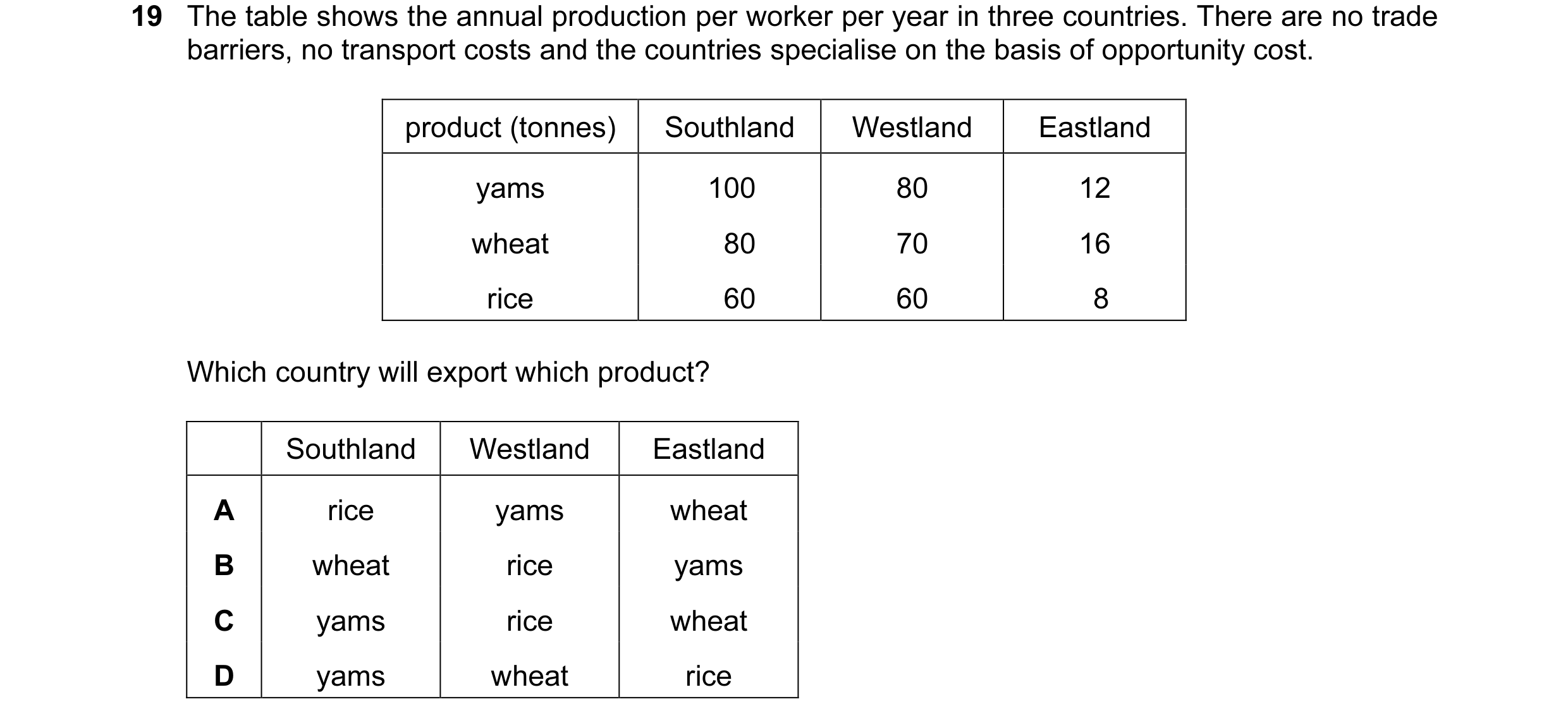
19 The table shows the annual production per worker per year in three countries. There are no trade barriers, no transport costs and the countries specialise on the basis of opportunity cost. product (tonnes) Southland Westland Eastland yams 100 80 12 wheat 80 70 16 rice 60 60 8 Which country will export which product? Southland Westland Eastland A rice yams wheat B wheat rice yams C yams rice wheat D yams wheat rice
1 marks
Answer: C
This question in 9708/13 Oct/Nov 2015
Q61 · An individual has an appointment with his bank manager 9708/12 Feb/March 2016
1 An individual has an appointment with his bank manager. He has a choice between travelling to the appointment by car, or leaving the car at home and travelling by bus and then by train. The costs of the journey are given below. $ bus fare 2 train fare 3 car parking charge 4 petrol 2 car wear and tear costs 1 Given this information, what is the opportunity cost to the individual of travelling by car rather than by bus and train? A $2 B $4 C $7 D $12
1 marks
Answer: A
This question in 9708/12 Feb/March 2016
Q62 · What confirms that scarcity exists? 9708/12 Feb/March 2016
2 What confirms that scarcity exists? A A product has an opportunity cost. B The demand for a product has risen. C The government has set a minimum price for a product. D The supply of a product has fallen.
1 marks
Answer: A
This question in 9708/12 Feb/March 2016
Q63 · The diagram shows the production possibility frontier of a desert island economy where… 9708/12 Feb/March 2016
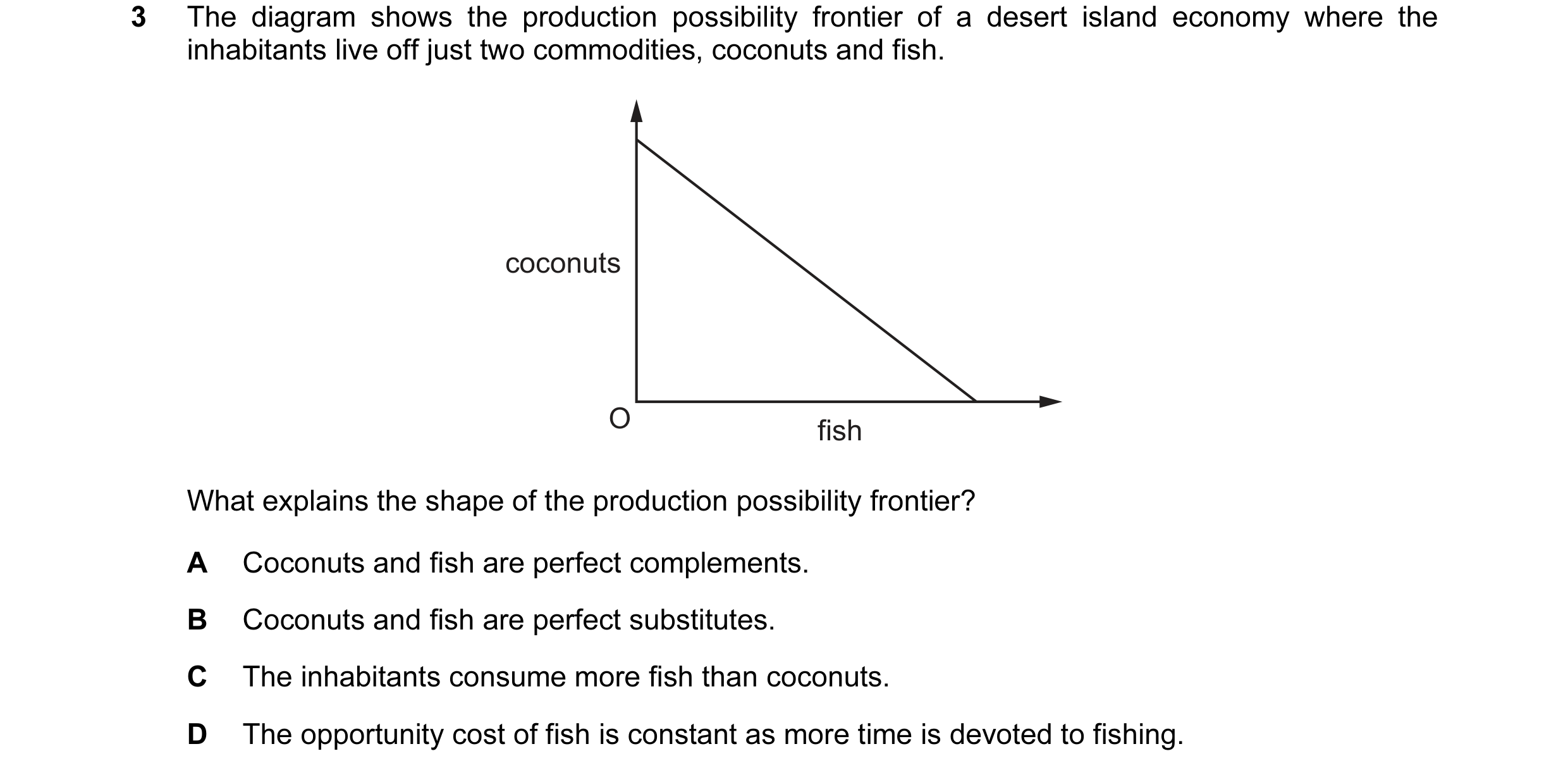
3 The diagram shows the production possibility frontier of a desert island economy where the inhabitants live off just two commodities, coconuts and fish. coconuts O fish What explains the shape of the production possibility frontier? A Coconuts and fish are perfect complements. B Coconuts and fish are perfect substitutes. C The inhabitants consume more fish than coconuts. D The opportunity cost of fish is constant as more time is devoted to fishing.
1 marks
Answer: D
This question in 9708/12 Feb/March 2016
Q64 · A driver makes the following estimates in considering the purchase of a car which she… 9708/11 May/June 2016
1 A driver makes the following estimates in considering the purchase of a car which she intends to use only when she would otherwise have used public transport. $ purchase price of car 6000 value of car after one year 4500 car operating and repair costs, insurance and taxation for one year 1800 cost of using public transport for one year instead of travelling by car 800 potential earnings after tax on $6000 invested for one year 500 What will be the opportunity cost in monetary terms to the driver over the year of travelling by car rather than by public transport? A $1500 B $3000 C $3700 D $7800
1 marks
Answer: B
This question in 9708/11 May/June 2016
Q65 · In 2007 there was a worldwide shortage of oil 9708/12 May/June 2016
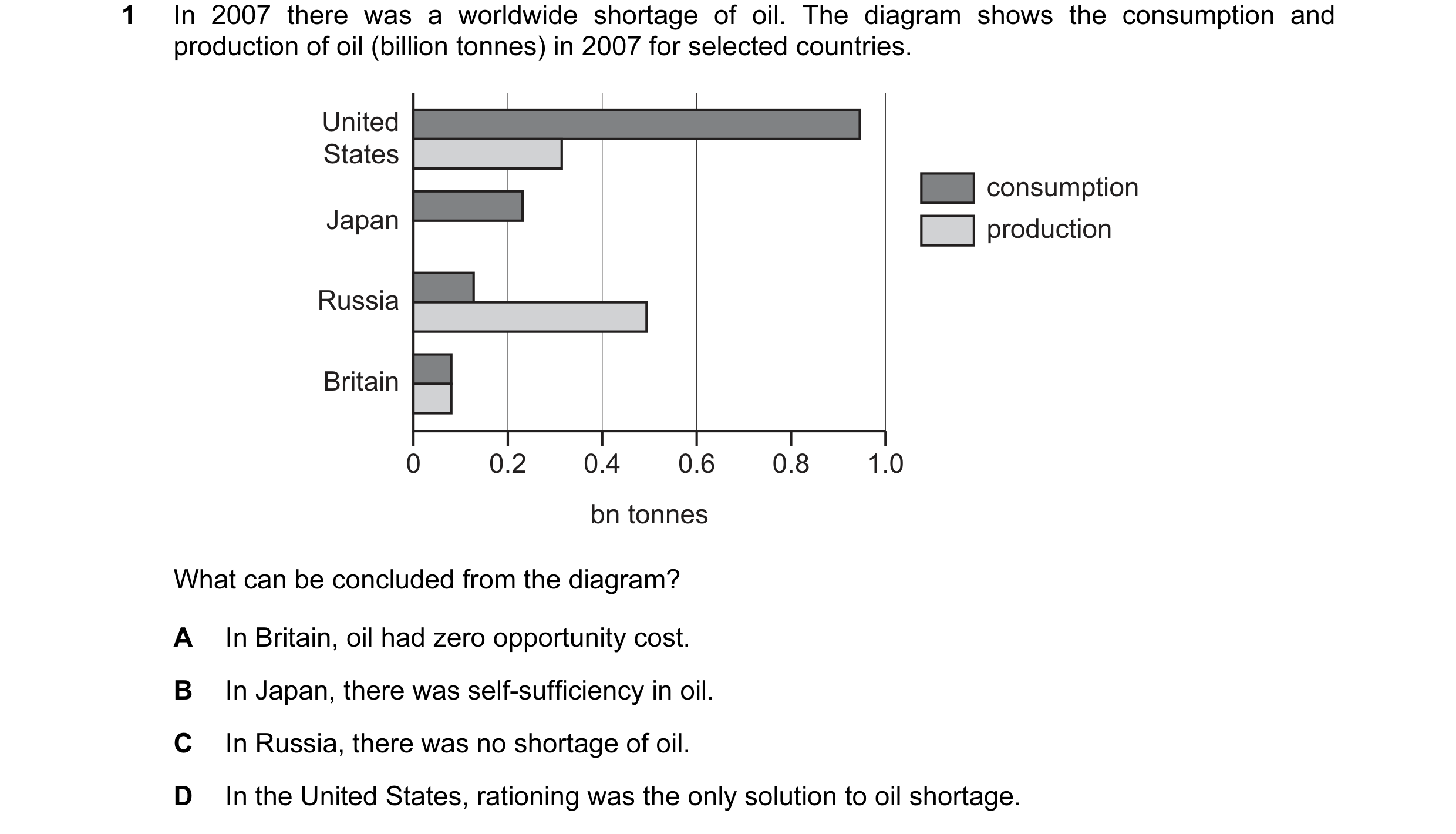
1 In 2007 there was a worldwide shortage of oil. The diagram shows the consumption and production of oil (billion tonnes) in 2007 for selected countries. United States consumption Japan production Russia Britain 0 0.2 0.4 0.6 0.8 1.0 bn tonnes What can be concluded from the diagram? A In Britain, oil had zero opportunity cost. B In Japan, there was self-sufficiency in oil. C In Russia, there was no shortage of oil. D In the United States, rationing was the only solution to oil shortage.
1 marks
Answer: C
This question in 9708/12 May/June 2016
Q66 · The diagram shows different production possibilities for a bakery 9708/13 May/June 2016
1 The diagram shows different production possibilities for a bakery. 100 70 bread 50 0 15 25 50 cakes They wish to increase production of cakes from 15 units to 25 units. What is the opportunity cost? A 10 units of cake B 15 units of cake C 20 units of bread D 50 units of bread
1 marks
Answer: C
This question in 9708/13 May/June 2016
Q67 · The production possibility curve for an economy producing capital goods and consumer… 9708/11 Oct/Nov 2016
2 The production possibility curve for an economy producing capital goods and consumer goods is represented by the line PQ. P capital goods T R O S Q consumer goods What is the opportunity cost of producing OS of consumer goods? A OR of capital goods B PR of capital goods C SQ of consumer goods D SQ of consumer goods + PR of capital goods
1 marks
Answer: B
This question in 9708/11 Oct/Nov 2016
Q68 · The diagram shows a production possibility curve for an economy that produces only two… 9708/12 Oct/Nov 2016
1 The diagram shows a production possibility curve for an economy that produces only two goods, X and Y. 1000 good Y 500 0 0 500 1000 1500 2000 good X The economy produces 1200 of good X and operates on its production possibility curve. Which quantity of good Y is given up? A 400 B 600 C 800 D 1000
1 marks
Answer: B
This question in 9708/12 Oct/Nov 2016
Q69 · In 2014, the Hong Kong Housing Authority said the waiting time for public sector housing… 9708/12 Oct/Nov 2016
2 In 2014, the Hong Kong Housing Authority said the waiting time for public sector housing had increased and it would only complete 8900 flats of the 15 000 planned for the year. The reasons were the shortage of workers because they were needed in other public sector projects, the difficulty of finding land, and government regulations. Which economic concepts are illustrated in this information? A a market economy and a lack of resources B economic planning and the price mechanism C opportunity cost of labour and excess demand D production possibility and budget deficit
1 marks
Answer: C
This question in 9708/12 Oct/Nov 2016
Q70 · Why is choice central to the economic problem? 9708/13 Oct/Nov 2016
1 Why is choice central to the economic problem? A Different governments have different objectives. B Firms have access to unlimited resources. C Most resources have alternative uses. D People’s wants are limited.
1 marks
Answer: C
This question in 9708/13 Oct/Nov 2016
Q71 · The diagram is from a chapter on ‘The Economic Problem’ in an Economics textbook 9708/12 Feb/March 2017
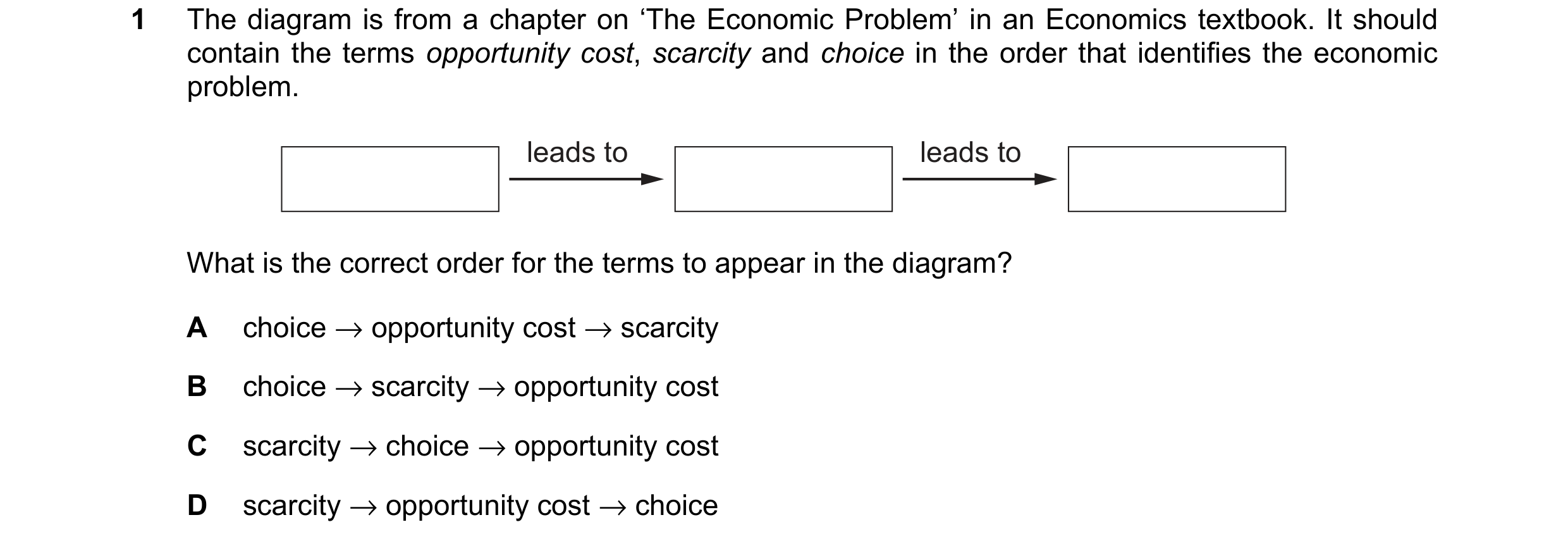
1 The diagram is from a chapter on ‘The Economic Problem’ in an Economics textbook. It should contain the terms opportunity cost, scarcity and choice in the order that identifies the economic problem. leads to leads to What is the correct order for the terms to appear in the diagram? A choice → opportunity cost → scarcity B choice → scarcity → opportunity cost C scarcity → choice → opportunity cost D scarcity → opportunity cost → choice
1 marks
Answer: C
This question in 9708/12 Feb/March 2017
Q72 · What must follow when scarcity exists? 9708/11 May/June 2017
1 What must follow when scarcity exists? A Consumers have to make choices. B Governments are unable to supply public goods. C Producers must be misallocating resources. D Workers must be earning low wages.
1 marks
Answer: A
This question in 9708/11 May/June 2017
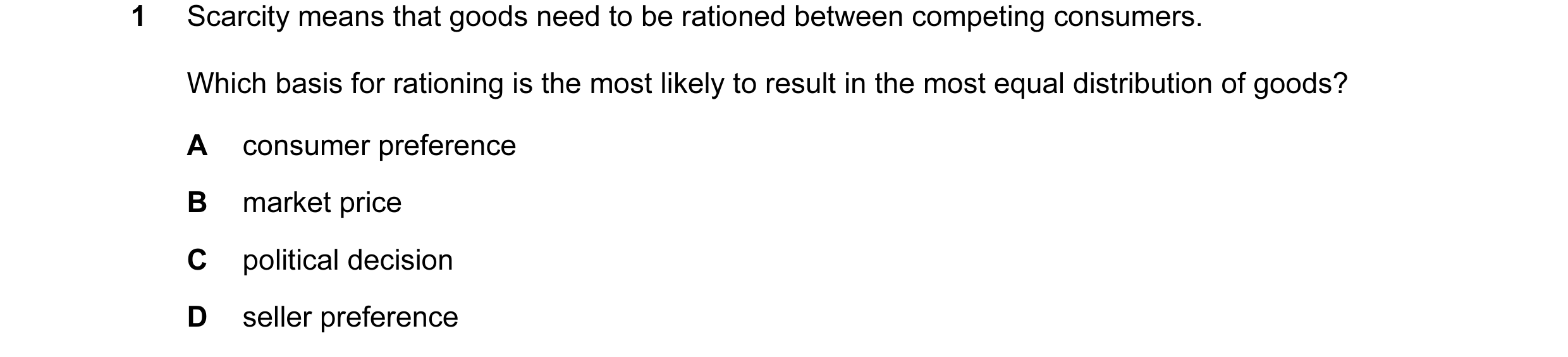
Q73 · Scarcity means that goods need to be rationed between competing consumers 9708/12 May/June 2017
1 Scarcity means that goods need to be rationed between competing consumers. Which basis for rationing is the most likely to result in the most equal distribution of goods? A consumer preference B market price C political decision D seller preference
1 marks
Answer: C
This question in 9708/12 May/June 2017
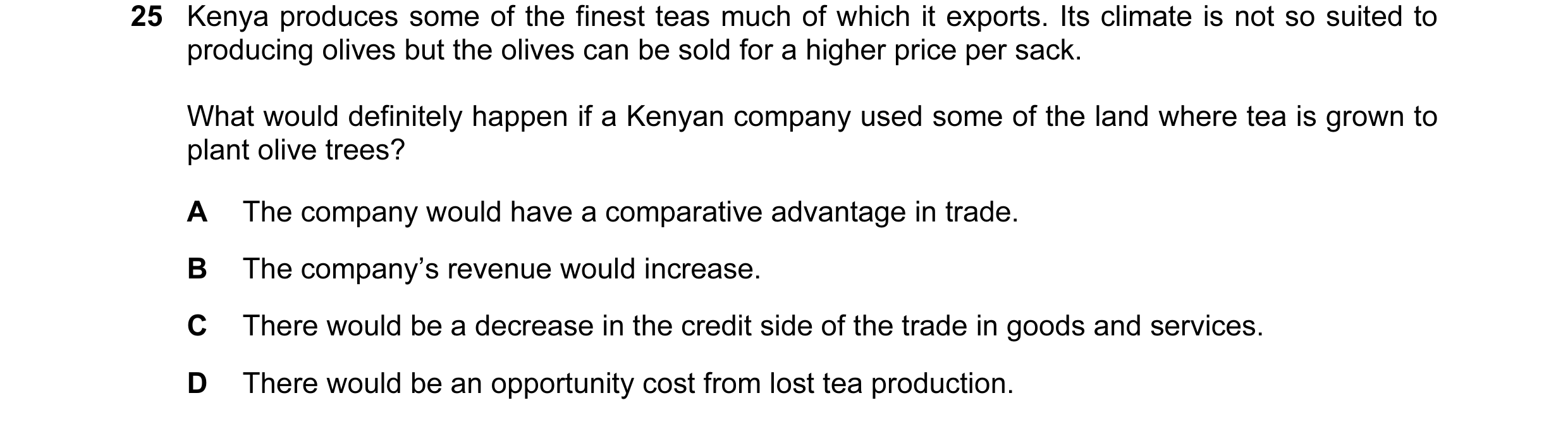
Q74 · Kenya produces some of the finest teas much of which it exports 9708/13 May/June 2017
25 Kenya produces some of the finest teas much of which it exports. Its climate is not so suited to producing olives but the olives can be sold for a higher price per sack. What would definitely happen if a Kenyan company used some of the land where tea is grown to plant olive trees? A The company would have a comparative advantage in trade. B The company’s revenue would increase. C There would be a decrease in the credit side of the trade in goods and services. D There would be an opportunity cost from lost tea production.
1 marks
Answer: D
This question in 9708/13 May/June 2017
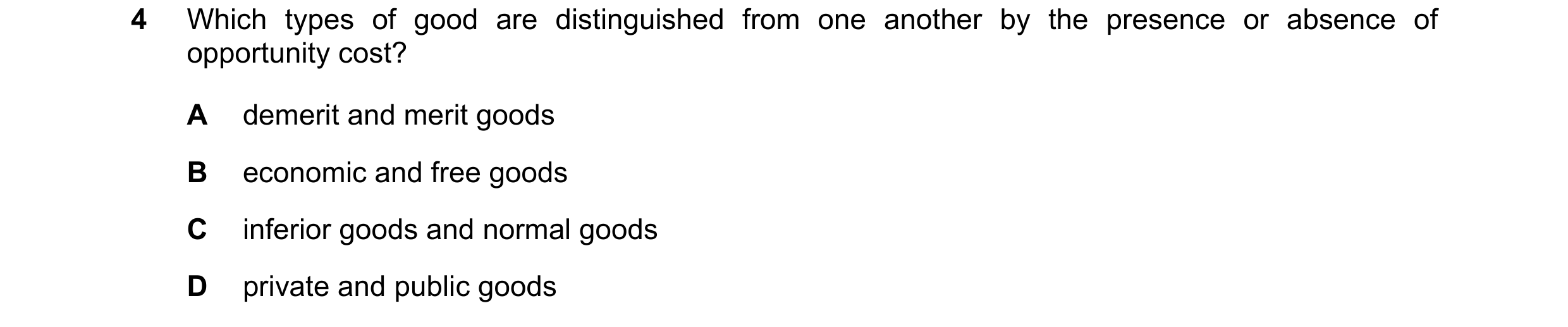
Q75 · Which types of good are distinguished from one another by the presence or absence of… 9708/11 Oct/Nov 2017
4 Which types of good are distinguished from one another by the presence or absence of opportunity cost? A demerit and merit goods B economic and free goods C inferior goods and normal goods D private and public goods
1 marks
Answer: B
This question in 9708/11 Oct/Nov 2017
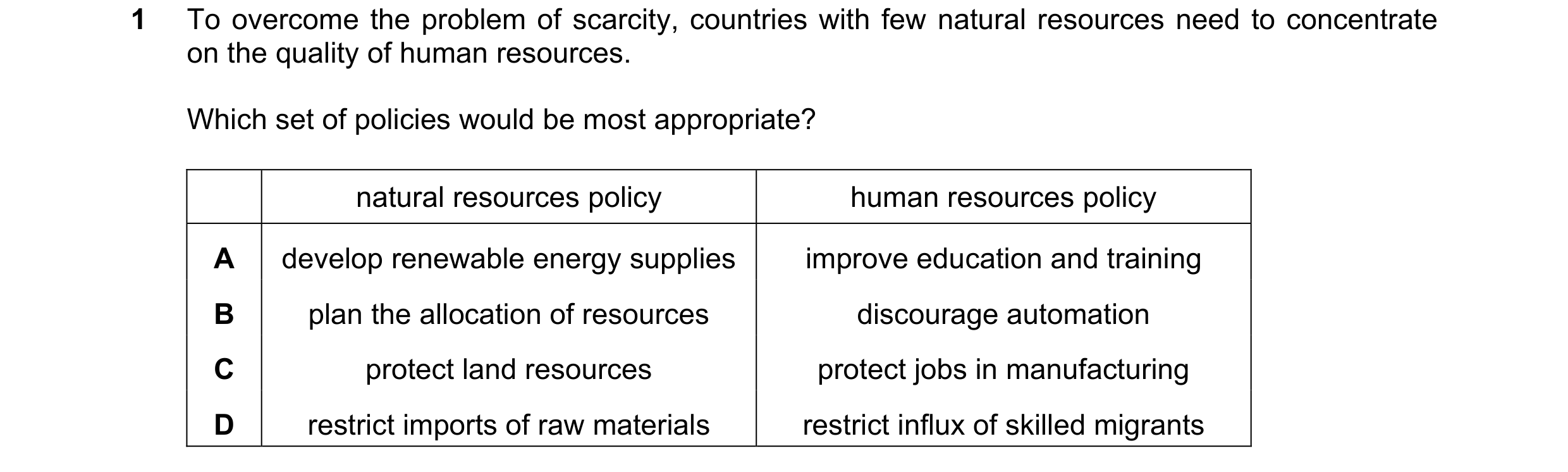
Q76 · To overcome the problem of scarcity, countries with few natural resources need to… 9708/12 Oct/Nov 2017
1 To overcome the problem of scarcity, countries with few natural resources need to concentrate on the quality of human resources. Which set of policies would be most appropriate? natural resources policy human resources policy A develop renewable energy supplies improve education and training B plan the allocation of resources discourage automation C protect land resources protect jobs in manufacturing D restrict imports of raw materials restrict influx of skilled migrants
1 marks
Answer: A
This question in 9708/12 Oct/Nov 2017
Q77 · The graph shows the total economic welfare derived by citizens from a government’s… 9708/13 Oct/Nov 2017
16 The graph shows the total economic welfare derived by citizens from a government’s expenditure on health and education services. total economic welfare health education 0 20 40 60 80 expenditure ($ billions) If the government has $60 billion of its budget to allocate between health and education services, which allocation will give its citizens the highest level of welfare? health spending education spending ($ billions) ($ billions) A 0 60 B 20 40 C 40 20 D 60 0
1 marks
Answer: C
This question in 9708/13 Oct/Nov 2017
Q78 · Which statement about economics is not correct? 9708/12 Feb/March 2018
1 Which statement about economics is not correct? A Economic actions can produce unexpected side effects. B Economic thinking is usually based on logical reasoning at the margin. C The use of scarce resources to produce a good always has a cost. D The value of a good or service involves a purely objective judgement.
1 marks
Answer: D
This question in 9708/12 Feb/March 2018
Q79 · A farmer is able to grow three crops, X, Y and Z, on his land 9708/12 Feb/March 2018
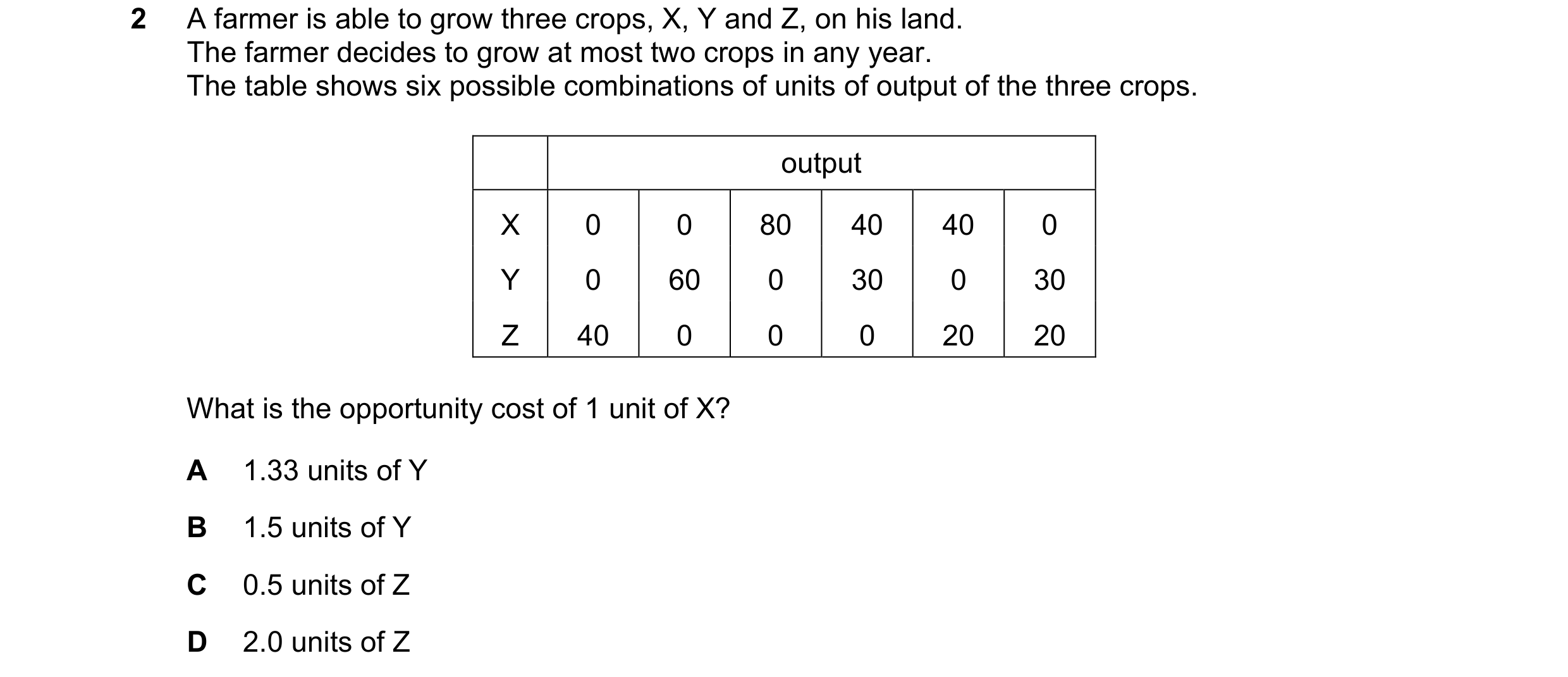
2 A farmer is able to grow three crops, X, Y and Z, on his land. The farmer decides to grow at most two crops in any year. The table shows six possible combinations of units of output of the three crops. output X 0 0 80 40 40 0 Y 0 60 0 30 0 30 Z 40 0 0 0 20 20 What is the opportunity cost of 1 unit of X? A 1.33 units of Y B 1.5 units of Y C 0.5 units of Z D 2.0 units of Z
1 marks
Answer: C
This question in 9708/12 Feb/March 2018
Q80 · What would be an opportunity cost of growth in an economy? 9708/11 May/June 2018
1 What would be an opportunity cost of growth in an economy? A the faster growth of services than of manufacturing B the need for an increased level of imported raw materials C the need for greater government intervention D the reduction of consumption if growth requires investment
1 marks
Answer: D
This question in 9708/11 May/June 2018
Q81 · YX is an economy’s production possibility curve (PPC) 9708/12 May/June 2018
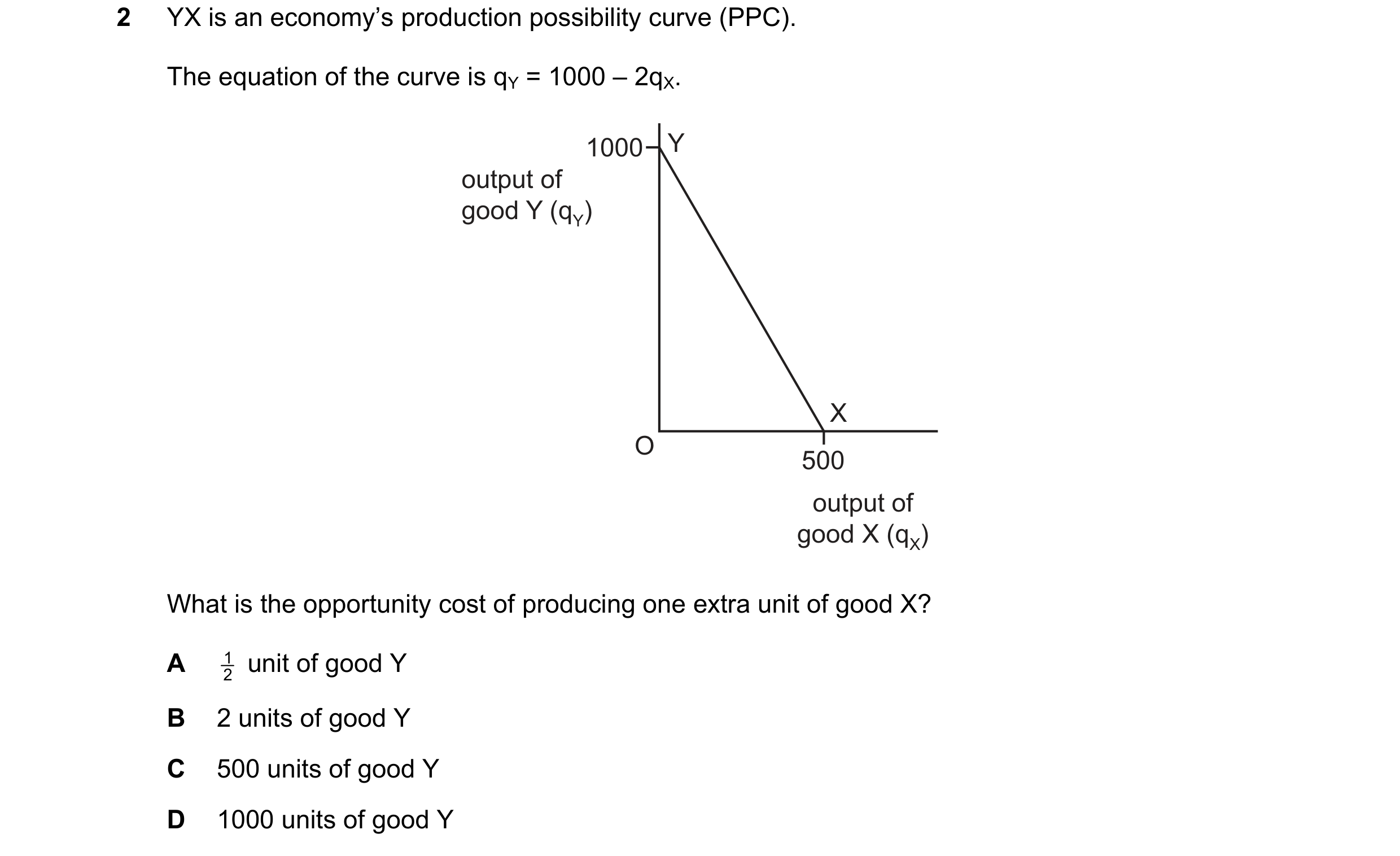
2 YX is an economy’s production possibility curve (PPC). The equation of the curve is qY = 1000 – 2qX. 1000 Y output of good Y (qY) X O 500 output of good X (qX) What is the opportunity cost of producing one extra unit of good X? A 1 unit of good Y 2 B 2 units of good Y C 500 units of good Y D 1000 units of good Y
1 marks
Answer: B
This question in 9708/12 May/June 2018
Q82 · XY is the production possibility curve (PPC) of a firm that produces desks and chairs 9708/13 May/June 2018
1 XY is the production possibility curve (PPC) of a firm that produces desks and chairs. X 5 output of chairs per day 4 3 2 1 Y 0 0 1 2 3 4 5 output of desks per day What are the opportunity costs of the 4th and 5th desks produced by the firm? opportunity cost opportunity cost of 4th desk of 5th desk A 1 chair 3 chairs B 2 chairs 5 chairs C 3 chairs 0 chairs D 4 chairs 5 chairs
1 marks
Answer: A
This question in 9708/13 May/June 2018
Q83 · The diagram shows an economy's production possibility curve for goods X and Y 9708/12 Oct/Nov 2018
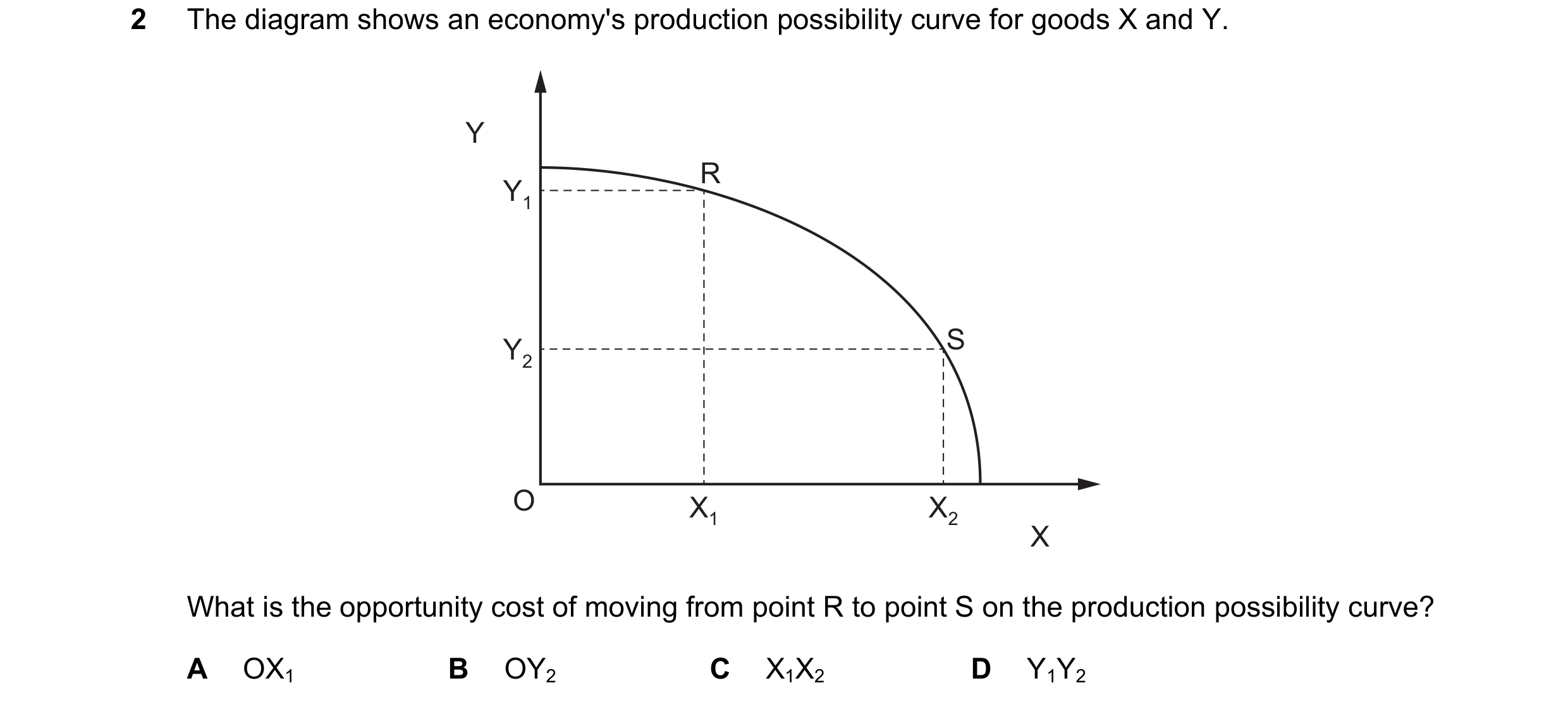
2 The diagram shows an economy's production possibility curve for goods X and Y. Y R Y1 Y2 S O X1 X2 X What is the opportunity cost of moving from point R to point S on the production possibility curve? A OX1 B OY2 C X1X2 D Y1Y2
1 marks
Answer: D
This question in 9708/12 Oct/Nov 2018
Q84 · The combinations of output of goods X and Y shown in the table could all be produced… 9708/13 Oct/Nov 2018
2 The combinations of output of goods X and Y shown in the table could all be produced using the existing resources in a country to their maximum capacity. 1 2 3 4 5 X 220 200 180 140 90 Y 10 25 40 70 100 Which statement about the opportunity cost of good Y in terms of good X is correct? A It decreases as the output of Y increases. B It is always below 1Y = 1X. C It is constant throughout the range of output shown. D It is never above 1Y = 2X.
1 marks
Answer: D
This question in 9708/13 Oct/Nov 2018
Q85 · An international oil company announced that it would stop exploring for oil off the coast… 9708/13 Oct/Nov 2018
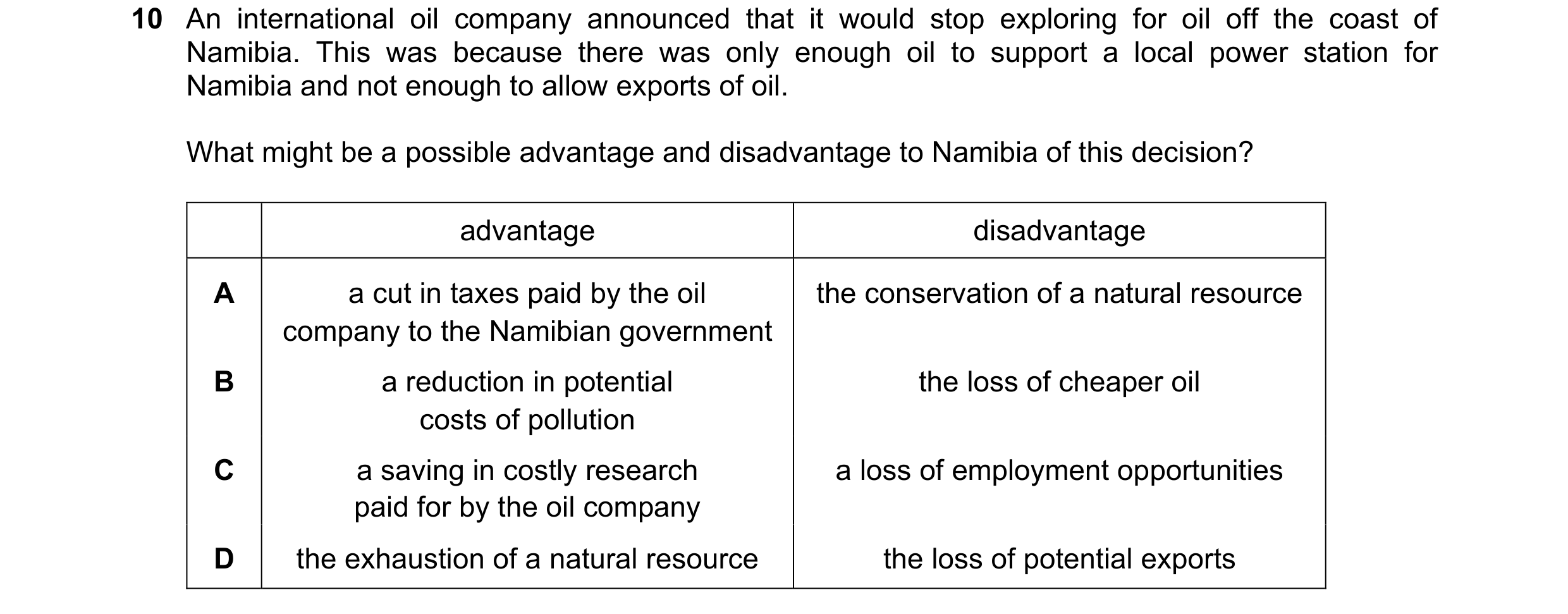
10 An international oil company announced that it would stop exploring for oil off the coast of Namibia. This was because there was only enough oil to support a local power station for Namibia and not enough to allow exports of oil. What might be a possible advantage and disadvantage to Namibia of this decision? advantage disadvantage A a cut in taxes paid by the oil the conservation of a natural resource company to the Namibian government B a reduction in potential the loss of cheaper oil costs of pollution C a saving in costly research a loss of employment opportunities paid for by the oil company D the exhaustion of a natural resource the loss of potential exports
1 marks
Answer: B
This question in 9708/13 Oct/Nov 2018
Q86 · The diagram shows a production possibility curve for a farmer 9708/12 Feb/March 2019
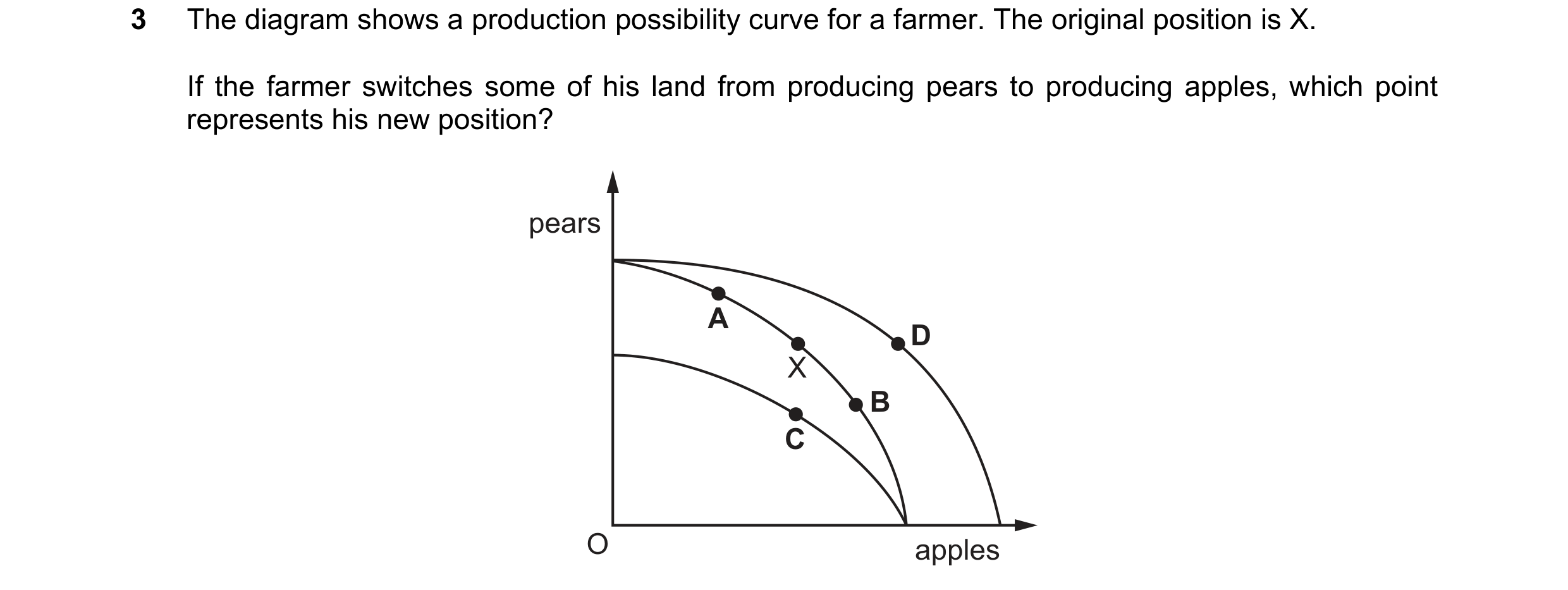
3 The diagram shows a production possibility curve for a farmer. The original position is X. If the farmer switches some of his land from producing pears to producing apples, which point represents his new position? pears A D X B C O apples
1 marks
Answer: B
This question in 9708/12 Feb/March 2019
Q87 · A student buys a flute for $80 but then is unable to learn to play it 9708/12 Feb/March 2019
4 A student buys a flute for $80 but then is unable to learn to play it. It has a resale value of $50, while the shop retail price of the same type of flute has risen to $95. What is the present opportunity cost to the student of keeping the flute? A $30 B $50 C $80 D $95
1 marks
Answer: B
This question in 9708/12 Feb/March 2019
Q88 · The fundamental economic question is how to meet unlimited wants with limited resources 9708/11 May/June 2019
2 The fundamental economic question is how to meet unlimited wants with limited resources. What is an example of limited resources? A insufficient consumer goods in the local shops B insufficient jobs to allow full employment C insufficient machinery to produce electrical goods D insufficient tax revenue to finance building a school
1 marks
Answer: C
This question in 9708/11 May/June 2019
Q89 · What is unlikely to occur with an increase in the provision of public goods? 9708/11 May/June 2019
18 What is unlikely to occur with an increase in the provision of public goods? A consumer non-excludability B improved use of resources C opportunity cost D reduction in tax
1 marks
Answer: D
This question in 9708/11 May/June 2019
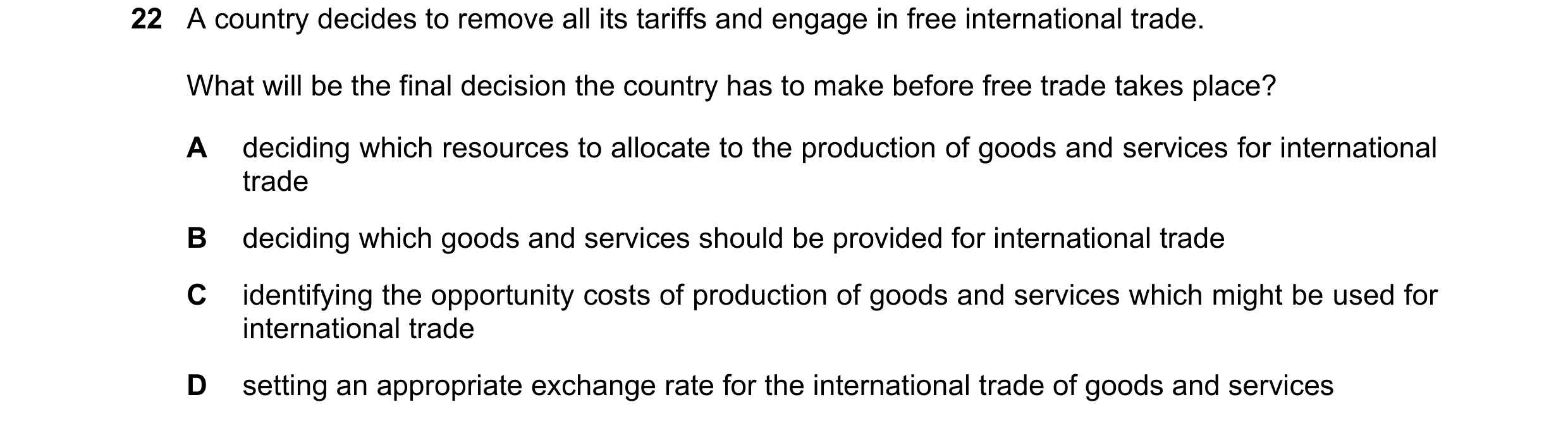
Q90 · A country decides to remove all its tariffs and engage in free international trade 9708/12 May/June 2019
22 A country decides to remove all its tariffs and engage in free international trade. What will be the final decision the country has to make before free trade takes place? A deciding which resources to allocate to the production of goods and services for international trade B deciding which goods and services should be provided for international trade C identifying the opportunity costs of production of goods and services which might be used for international trade D setting an appropriate exchange rate for the international trade of goods and services
1 marks
Answer: D
This question in 9708/12 May/June 2019
Q91 · What is the opportunity cost to a person of spending $20 on a new pair of sports shoes? 9708/13 May/June 2019
1 What is the opportunity cost to a person of spending $20 on a new pair of sports shoes? A all the other things the person could have bought B the cost of getting to the sports shop C the current value of his old pair of shoes D the next best thing that could have been bought with the $20
1 marks
Answer: D
This question in 9708/13 May/June 2019
Q92 · What is correct about scarcity? 9708/12 Oct/Nov 2019
1 What is correct about scarcity? A Scarcity affects low income earners only. B Scarcity forces individuals to make choices. C Scarcity is removed by periods of falling prices. D Scarcity will be abolished by advances in technology.
1 marks
Answer: B
This question in 9708/12 Oct/Nov 2019
Q93 · An individual has an appointment with his dentist 9708/13 Oct/Nov 2019
3 An individual has an appointment with his dentist. He has a choice between travelling to the appointment by car, or leaving the car at home and travelling by bus and then by train. The costs of the journey are given below. $ bus fare 2 train fare 3 car parking charge 4 petrol 2 car wear and tear costs 1 Given this information, what is the opportunity cost to the individual of travelling by car rather than by bus and train? A $2 B $4 C $7 D $12
1 marks
Answer: A
This question in 9708/13 Oct/Nov 2019
Q94 · A worker earns $40 per hour 9708/12 Feb/March 2020
2 A worker earns $40 per hour. Rather than work, she decides to visit a museum for three hours. The visit costs a total of $40. What is the opportunity cost of visiting the museum? A $40 B $80 C $120 D $160
1 marks
Answer: C
This question in 9708/12 Feb/March 2020
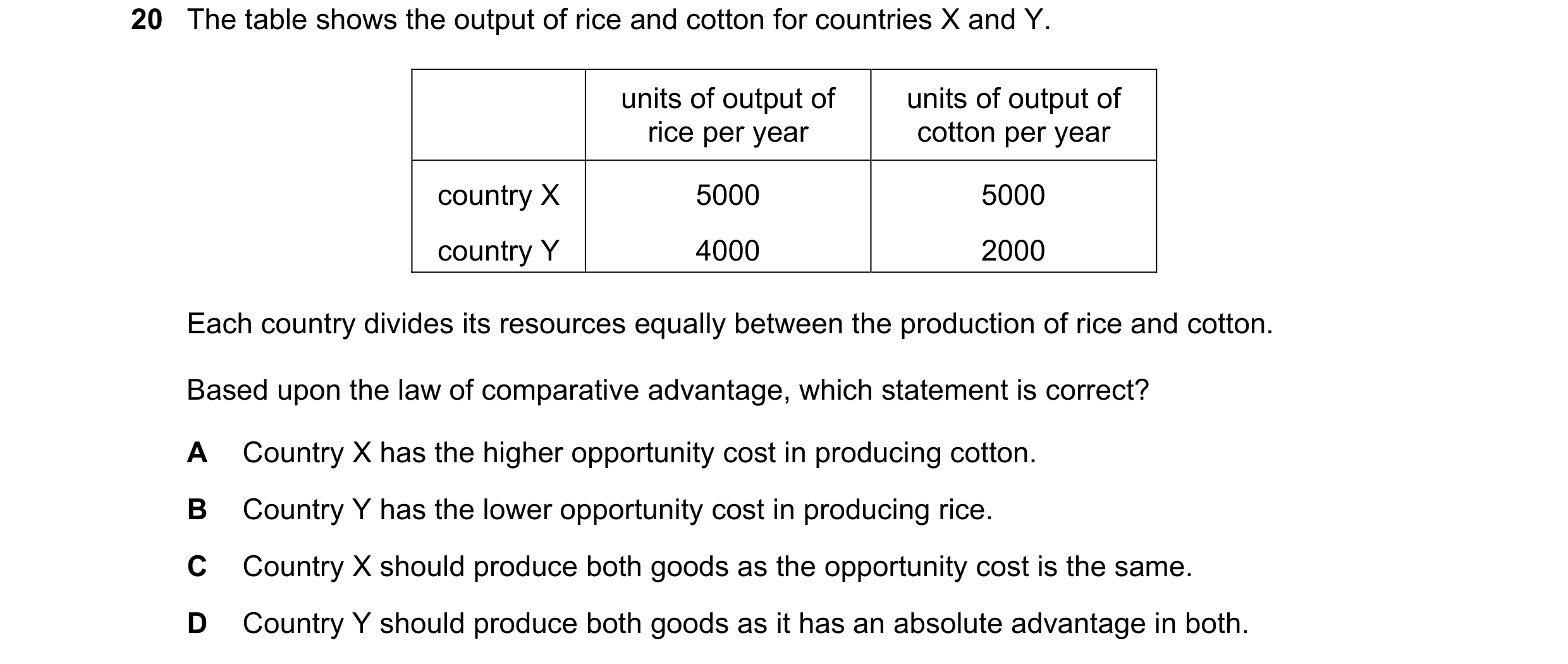
Q95 · The table shows the output of rice and cotton for countries X and Y 9708/11 Oct/Nov 2020
20 The table shows the output of rice and cotton for countries X and Y. units of output of units of output of rice per year cotton per year country X 5000 5000 country Y 4000 2000 Each country divides its resources equally between the production of rice and cotton. Based upon the law of comparative advantage, which statement is correct? A Country X has the higher opportunity cost in producing cotton. B Country Y has the lower opportunity cost in producing rice. C Country X should produce both goods as the opportunity cost is the same. D Country Y should produce both goods as it has an absolute advantage in both.
1 marks
Answer: B
This question in 9708/11 Oct/Nov 2020
Q96 · What is characterised as a free good? 9708/13 Oct/Nov 2020
2 What is characterised as a free good? A one that has zero opportunity cost B one that is non-excludable and non-rivalrous C one that is supplied by the government with no charge D one that receives a 100% government subsidy
1 marks
Answer: A
This question in 9708/13 Oct/Nov 2020
Q97 · An American family is choosing between four holiday destinations in Europe, each at the… 9708/12 Feb/March 2021
1 An American family is choosing between four holiday destinations in Europe, each at the same price. The table shows the family’s order of preference for these holiday destinations. holiday order of destination preference Barcelona 1st London = 3rd Paris 2nd Venice = 3rd If the family goes to Barcelona, what is the opportunity cost of this choice? A Barcelona B London and Venice C Paris D London, Paris and Venice
1 marks
Answer: C
This question in 9708/12 Feb/March 2021
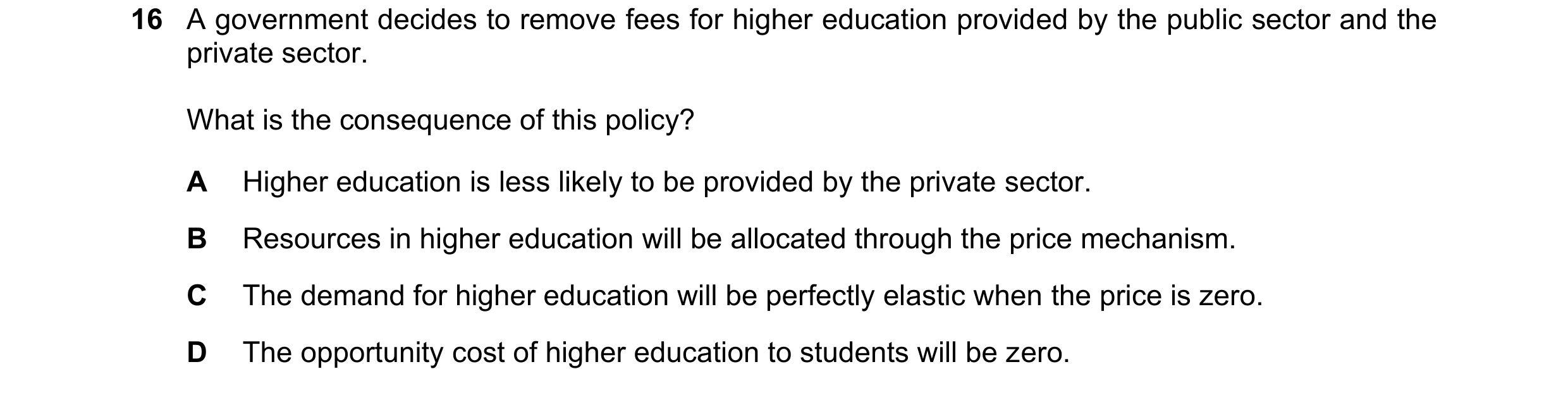
Q98 · A government decides to remove fees for higher education provided by the public sector… 9708/11 Oct/Nov 2021
16 A government decides to remove fees for higher education provided by the public sector and the private sector. What is the consequence of this policy? A Higher education is less likely to be provided by the private sector. B Resources in higher education will be allocated through the price mechanism. C The demand for higher education will be perfectly elastic when the price is zero. D The opportunity cost of higher education to students will be zero.
1 marks
Answer: A
This question in 9708/11 Oct/Nov 2021
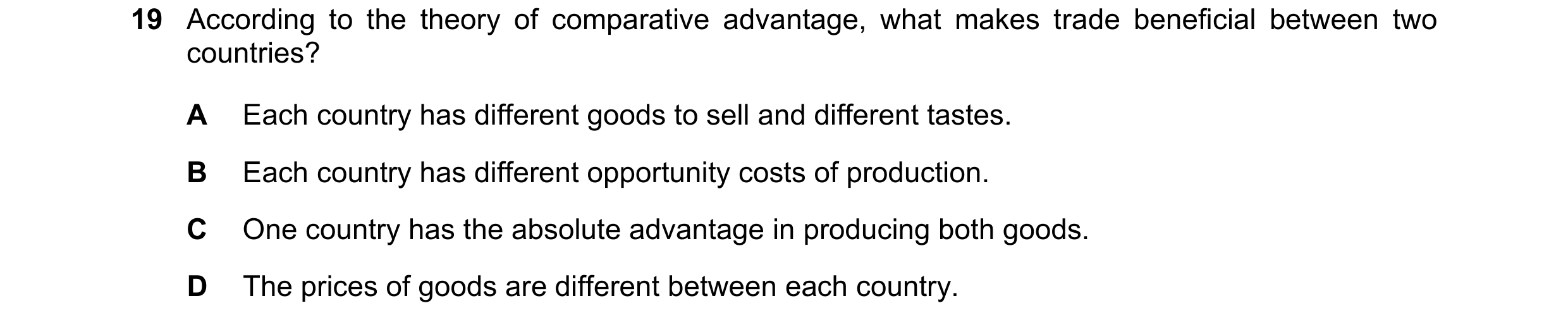
Q99 · According to the theory of comparative advantage, what makes trade beneficial between two… 9708/13 Oct/Nov 2021
19 According to the theory of comparative advantage, what makes trade beneficial between two countries? A Each country has different goods to sell and different tastes. B Each country has different opportunity costs of production. C One country has the absolute advantage in producing both goods. D The prices of goods are different between each country.
1 marks
Answer: B
This question in 9708/13 Oct/Nov 2021
Q100 · The production possibility curves (PPCs) show the abilities of four economies to produce… 9708/12 Feb/March 2022
4 The production possibility curves (PPCs) show the abilities of four economies to produce wheat and rice. Which PPC has the lowest opportunity cost for producing wheat? 6 wheat (tonnes) 4 1 A B C D 0 40 80 120 rice (tonnes)
1 marks
Answer: B
This question in 9708/12 Feb/March 2022
Q101 · The diagram shows a production possibility curve for an economy that is producing at… 9708/11 May/June 2022
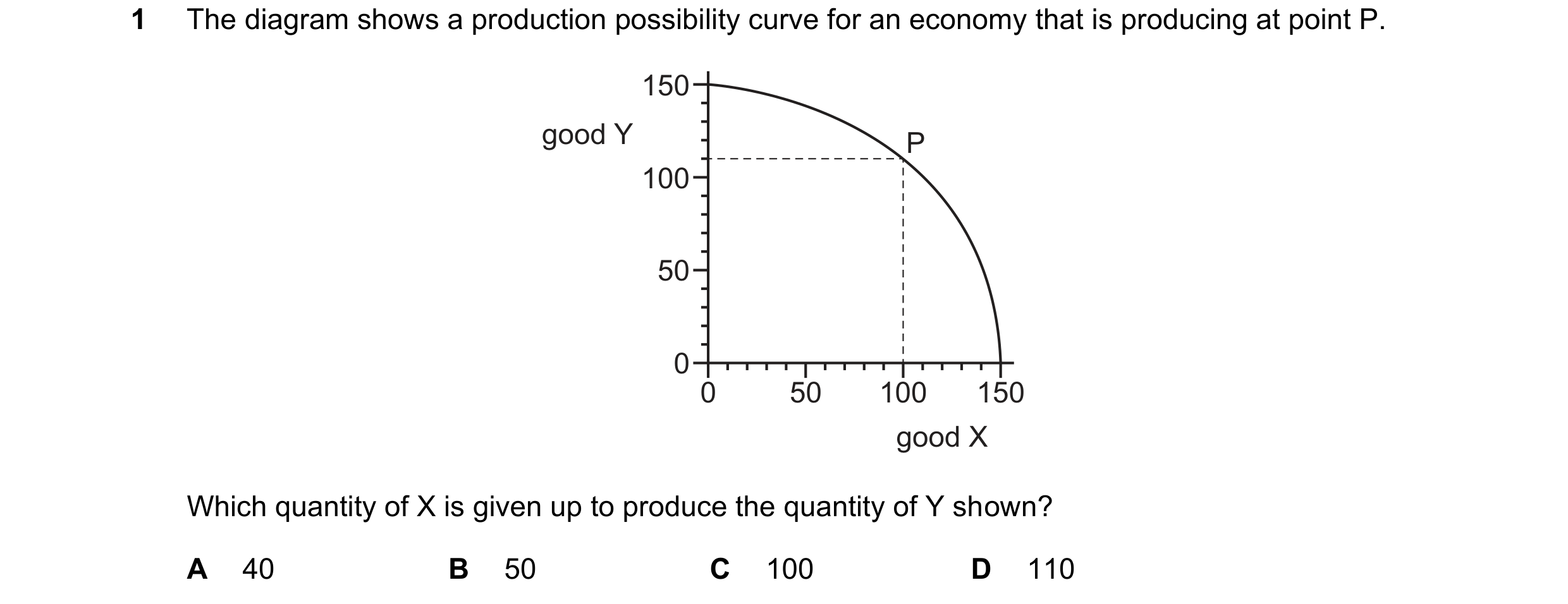
1 The diagram shows a production possibility curve for an economy that is producing at point P. 150 good Y P 100 50 0 0 50 100 150 good X Which quantity of X is given up to produce the quantity of Y shown? A 40 B 50 C 100 D 110
1 marks
Answer: B
This question in 9708/11 May/June 2022
Q102 · Economics students have to fill in the gaps in the following passage 9708/11 May/June 2022
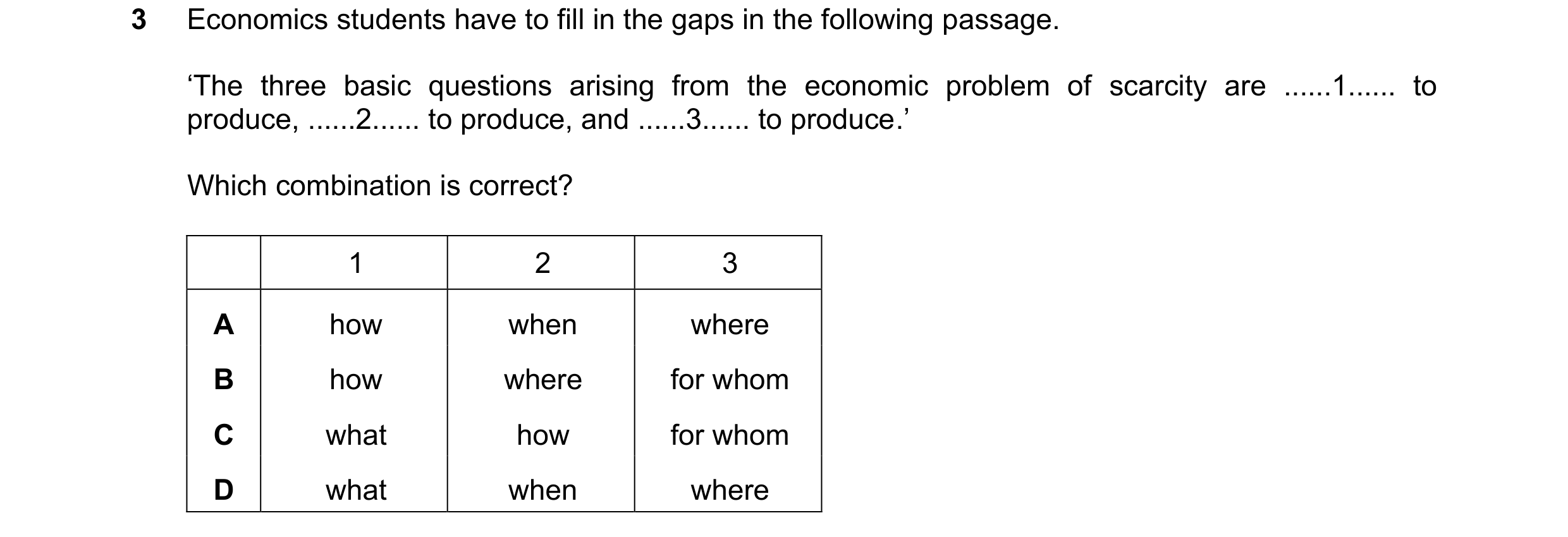
3 Economics students have to fill in the gaps in the following passage. ‘The three basic questions arising from the economic problem of scarcity are … 1 … to produce, … 2 … to produce, and … 3 … to produce.’ Which combination is correct? 1 2 3 A how when where B how where for whom C what how for whom D what when where
1 marks
Answer: C
This question in 9708/11 May/June 2022
Q103 · What is unlikely to occur with an increase in the provision of public goods? 9708/12 May/June 2022
18 What is unlikely to occur with an increase in the provision of public goods? A consumer non-excludability B improved use of resources C opportunity cost D reduction in tax
1 marks
Answer: D
This question in 9708/12 May/June 2022
Q104 · What does opportunity cost measure? 9708/13 May/June 2022
3 What does opportunity cost measure? A the benefits of a good compared with the next choice B the benefits given up by not consuming the next best alternative C the costs of any good not chosen D the financial costs of consuming a good
1 marks
Answer: B
This question in 9708/13 May/June 2022
Q105 · A doctor has very long working hours and a high level of stress 9708/11 Oct/Nov 2022
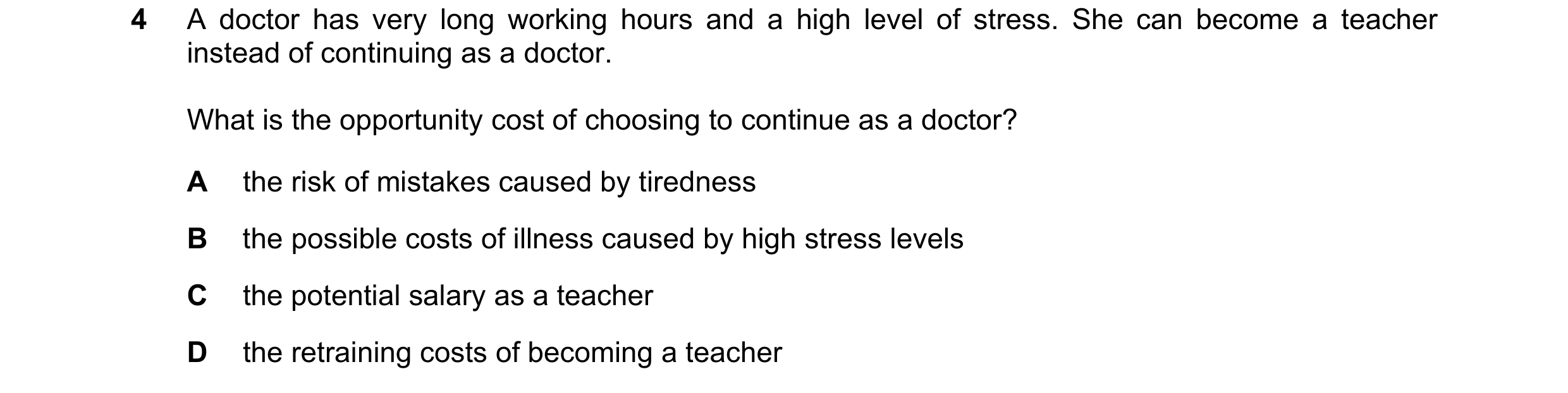
4 A doctor has very long working hours and a high level of stress. She can become a teacher instead of continuing as a doctor. What is the opportunity cost of choosing to continue as a doctor? A the risk of mistakes caused by tiredness B the possible costs of illness caused by high stress levels C the potential salary as a teacher D the retraining costs of becoming a teacher
1 marks
Answer: C
This question in 9708/11 Oct/Nov 2022
Q106 · The diagram shows an economy’s production possibility curve (PPC) 9708/12 Oct/Nov 2022
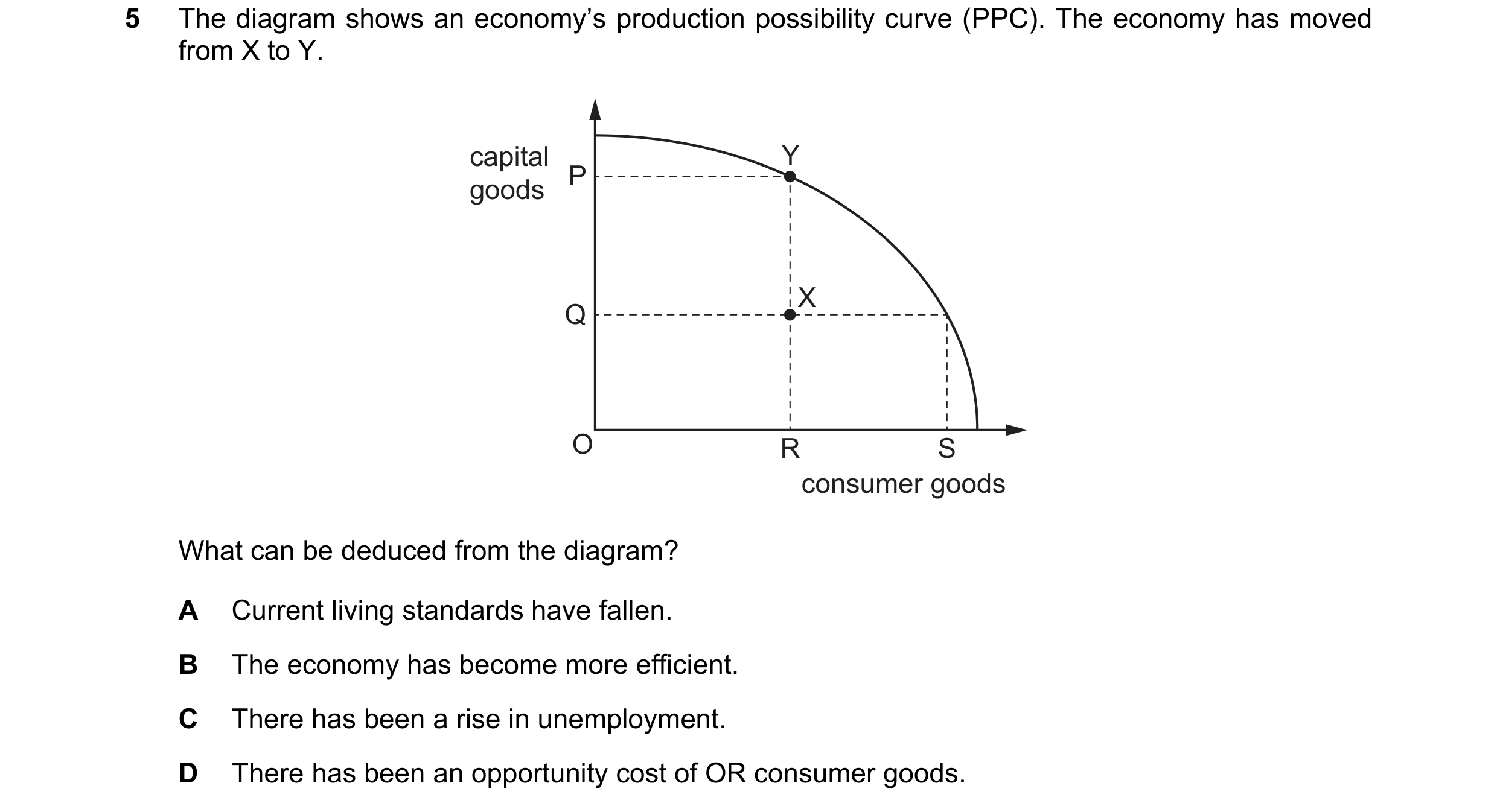
5 The diagram shows an economy’s production possibility curve (PPC). The economy has moved from X to Y. capital Y P goods X Q O R S consumer goods What can be deduced from the diagram? A Current living standards have fallen. B The economy has become more efficient. C There has been a rise in unemployment. D There has been an opportunity cost of OR consumer goods.
1 marks
Answer: B
This question in 9708/12 Oct/Nov 2022
Q107 · Why does the basic economic problem of scarcity apply to both the rich and the poor? 9708/12 Feb/March 2023
10 Why does the basic economic problem of scarcity apply to both the rich and the poor? A The choices people make are not dependent on income inequalities. B Consumers pay the same prices for goods and services to satisfy their wants. C Human wants exceed what can be produced from available resources. D Natural resources are unevenly distributed amongst nations.
1 marks
Answer: C
This question in 9708/12 Feb/March 2023
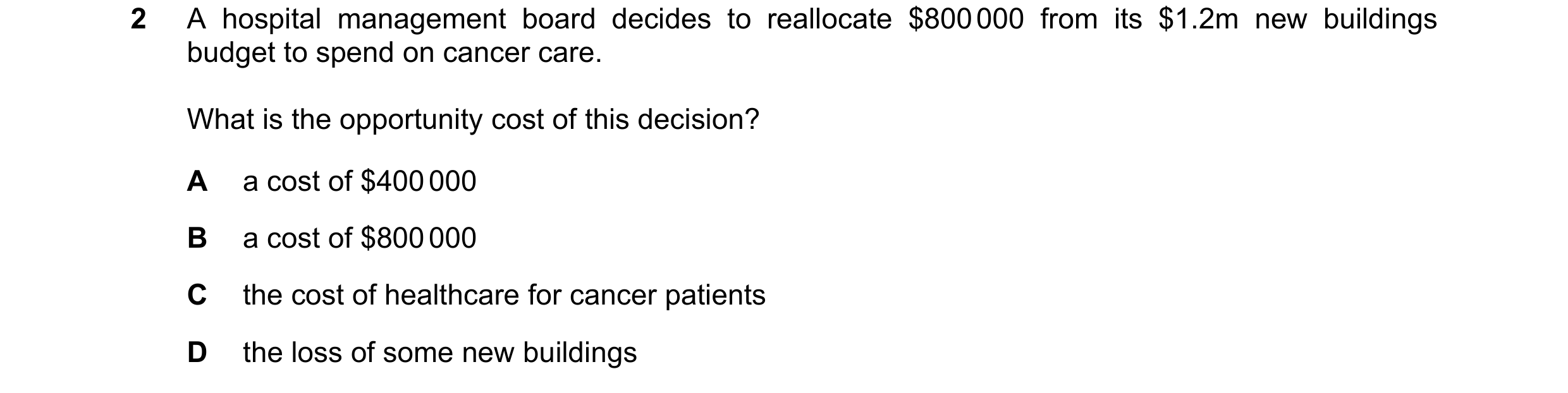
Q108 · A hospital management board decides to reallocate $800 000 from its $1.2m new buildings… 9708/11 May/June 2023
2 A hospital management board decides to reallocate $800 000 from its $1.2m new buildings budget to spend on cancer care. What is the opportunity cost of this decision? A a cost of $400 000 B a cost of $800 000 C the cost of healthcare for cancer patients D the loss of some new buildings
1 marks
Answer: D
This question in 9708/11 May/June 2023
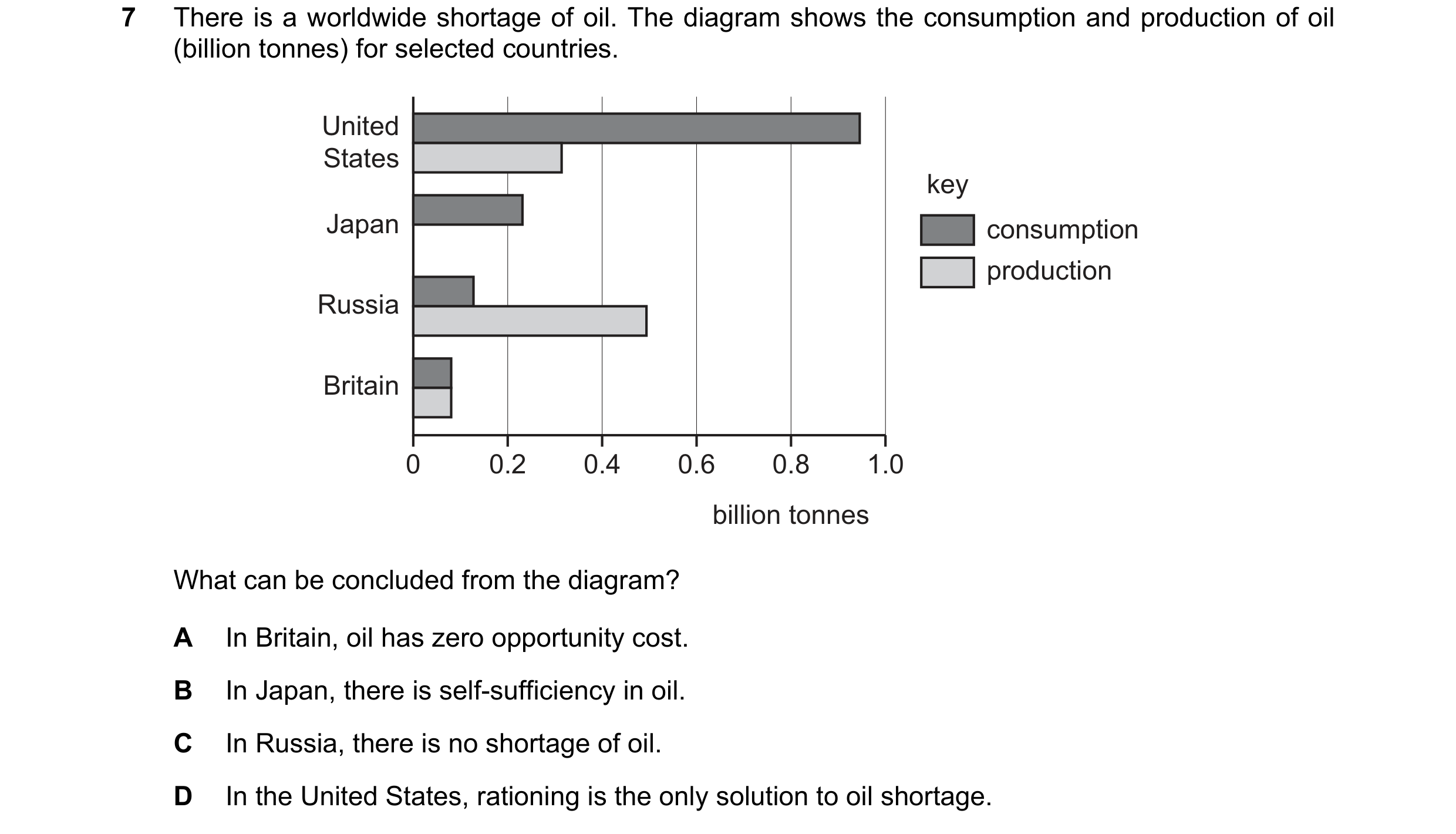
Q109 · There is a worldwide shortage of oil 9708/12 May/June 2023
7 There is a worldwide shortage of oil. The diagram shows the consumption and production of oil (billion tonnes) for selected countries. United States key Japan consumption production Russia Britain 0 0.2 0.4 0.6 0.8 1.0 billion tonnes What can be concluded from the diagram? A In Britain, oil has zero opportunity cost. B In Japan, there is self-sufficiency in oil. C In Russia, there is no shortage of oil. D In the United States, rationing is the only solution to oil shortage.
1 marks
Answer: C
This question in 9708/12 May/June 2023
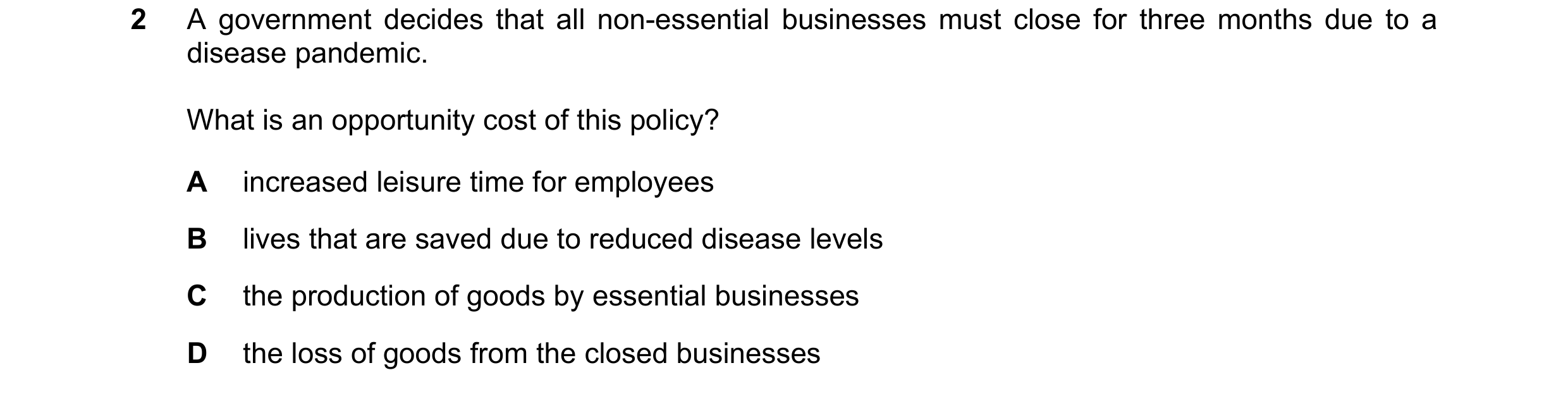
Q110 · A government decides that all non-essential businesses must close for three months due to… 9708/13 May/June 2023
2 A government decides that all non-essential businesses must close for three months due to a disease pandemic. What is an opportunity cost of this policy? A increased leisure time for employees B lives that are saved due to reduced disease levels C the production of goods by essential businesses D the loss of goods from the closed businesses
1 marks
Answer: D
This question in 9708/13 May/June 2023
Q111 · Country X and country Y each allocate half of their resources towards the manufacturing… 9708/13 May/June 2023
23 Country X and country Y each allocate half of their resources towards the manufacturing of shoes, and the other half towards the manufacturing of t-shirts. Resources can be used equally effectively in the production of both products in both countries. The table shows the output of shoes and t-shirts produced by both countries using half their resources in each case, before specialisation. country shoes t-shirts X 4 000 12 000 Y 2 000 8 000 total 6 000 20 000 What can be concluded from the data? A The opportunity cost of country Y producing two shoes is four t-shirts. B The opportunity cost of country X producing one t-shirt is four shoes. C The total output of shoes and t-shirts after specialisation would be 24 000. D The total output of shoes and t-shirts after specialisation would be 28 000.
1 marks
Answer: C
This question in 9708/13 May/June 2023
Q112 · What will help solve the basic economic problem? 9708/11 Oct/Nov 2023
1 What will help solve the basic economic problem? A the control of the market system B the efficient allocation of scarce resources C the preservation of a healthy environment D the elimination of hunger
1 marks
Answer: B
This question in 9708/11 Oct/Nov 2023
Q113 · Country Z operates with a production possibility curve (PPC) 9708/11 Oct/Nov 2023
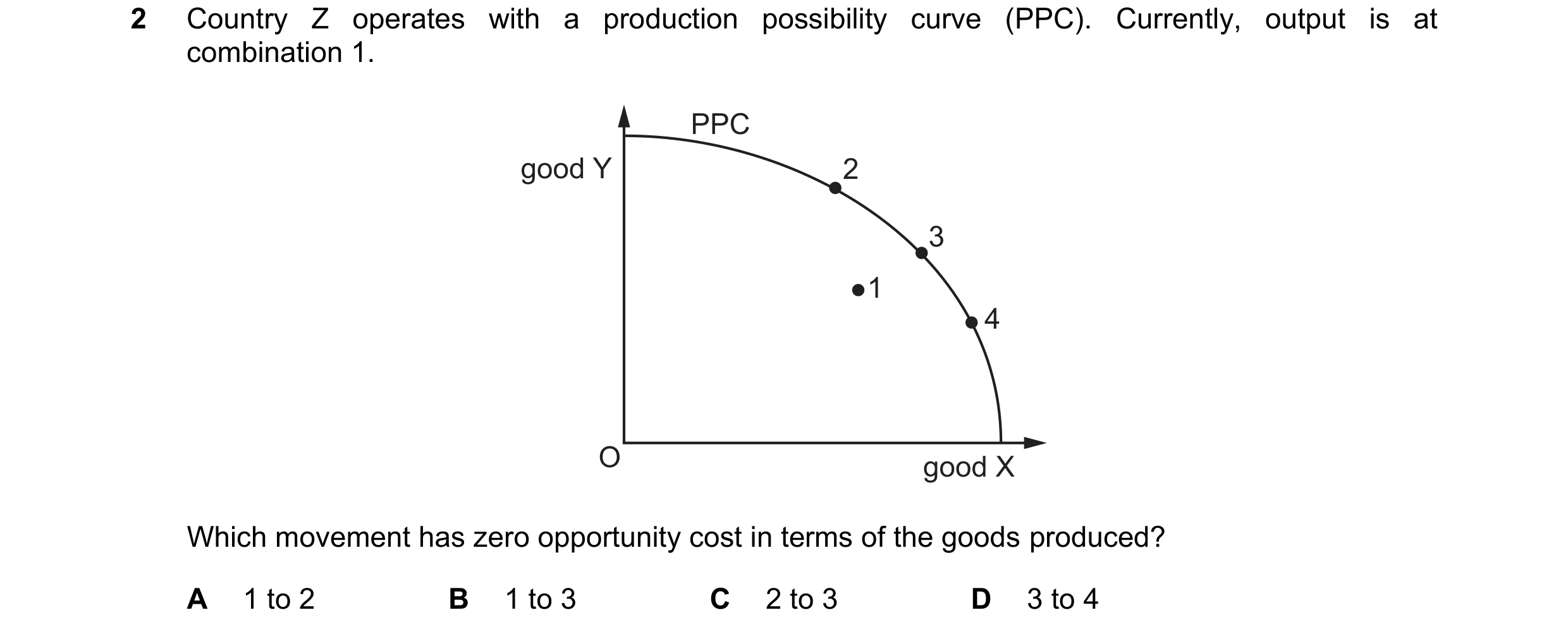
2 Country Z operates with a production possibility curve (PPC). Currently, output is at combination 1. PPC good Y 2 3 1 4 O good X Which movement has zero opportunity cost in terms of the goods produced? A 1 to 2 B 1 to 3 C 2 to 3 D 3 to 4
1 marks
Answer: B
This question in 9708/11 Oct/Nov 2023
Q114 · What is an example of a free good? 9708/13 Oct/Nov 2023
4 What is an example of a free good? A a government sponsoring a free vaccination programme for its citizens B a hospital providing free treatment to the poor C a school providing free education to outstanding students D anything that provides free utility but is not scarce
1 marks
Answer: D
This question in 9708/13 Oct/Nov 2023
Q115 · Which combination best describes the basic economic problem? 9708/12 Feb/March 2024
3 Which combination best describes the basic economic problem? resources wants A limited limited B limited unlimited C unlimited limited D unlimited unlimited
1 marks
Answer: B
This question in 9708/12 Feb/March 2024
Q116 · What is the opportunity cost to a person of spending $20 on a new pair of sports shoes? 9708/12 Feb/March 2024
5 What is the opportunity cost to a person of spending $20 on a new pair of sports shoes? A all the other things the person could have bought B the cost of getting to the sports shop C the current value of the person’s old pair of shoes D the next best thing that could have been bought with the $20
1 marks
Answer: D
This question in 9708/12 Feb/March 2024
Q117 · A worker earns $40 per hour 9708/11 May/June 2024
1 A worker earns $40 per hour. Rather than work, she decides to visit a museum for three hours. The visit costs a total of $40. What is the opportunity cost of visiting the museum? A $40 B $80 C $120 D $160
1 marks
Answer: C
This question in 9708/11 May/June 2024
Q118 · Why does the concept of scarcity apply to the use of fossil fuels? 9708/11 May/June 2024
4 Why does the concept of scarcity apply to the use of fossil fuels? A Demand fluctuates according to price changes. B Supply is insufficient to meet demand. C Their use is restricted because of harmful pollution. D They are being replaced by renewable energy sources.
1 marks
Answer: B
This question in 9708/11 May/June 2024
Q119 · What is the opportunity cost of a virus to the healthcare service in a country? 9708/12 May/June 2024
4 What is the opportunity cost of a virus to the healthcare service in a country? A increased number of hospital patients B increased use of personal protective equipment C increased stress for staff working in hospitals D increased waiting times to treat non-virus patients
1 marks
This question in 9708/12 May/June 2024
Q120 · The diagram shows a production possibility curve for an economy that produces two goods… 9708/13 May/June 2024
2 The diagram shows a production possibility curve for an economy that produces two goods, X and Y. good Y G F E H O good X When will the opportunity cost of producing more of good X be the largest? A moving from point E to point F B moving from point E to point G C moving from point E to point H D moving from point G to point H
1 marks
Answer: D
This question in 9708/13 May/June 2024
Q121 · What is essential to eliminate scarcity? 9708/13 May/June 2024
4 What is essential to eliminate scarcity? A the existence of sufficient resources to meet all needs and wants B producers consistently produce in excess of demand C the government has a surplus budget D there is equilibrium in all markets
1 marks
Answer: A
This question in 9708/13 May/June 2024
Q122 · The production possibility curve for a country is shown 9708/12 Oct/Nov 2024
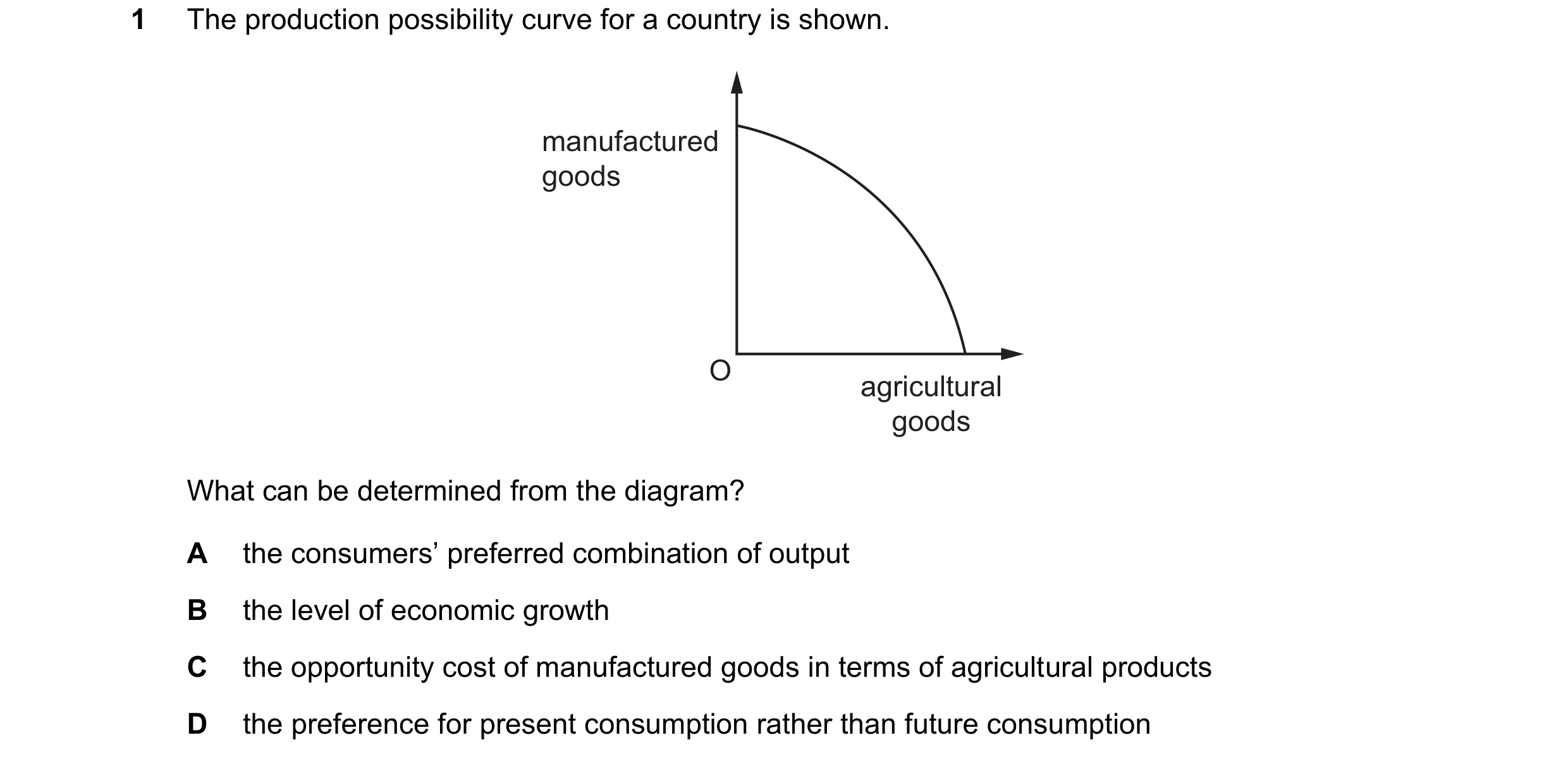
1 The production possibility curve for a country is shown. manufactured goods O agricultural goods What can be determined from the diagram? A the consumers’ preferred combination of output B the level of economic growth C the opportunity cost of manufactured goods in terms of agricultural products D the preference for present consumption rather than future consumption
1 marks
Answer: C
This question in 9708/12 Oct/Nov 2024
Q123 · The diagram shows the change in a country’s production possibility curve from PQ to PR 9708/12 Oct/Nov 2024
5 The diagram shows the change in a country’s production possibility curve from PQ to PR. P public goods O Q R private goods What increases as a result of the change from PQ to PR? A the price of private goods B the price of public goods C the opportunity cost of private goods D the opportunity cost of public goods
1 marks
Answer: D
This question in 9708/12 Oct/Nov 2024
Q124 · The diagram is from a chapter on ‘The Fundamental Economic Problem’ in an Economics… 9708/12 May/June 2025
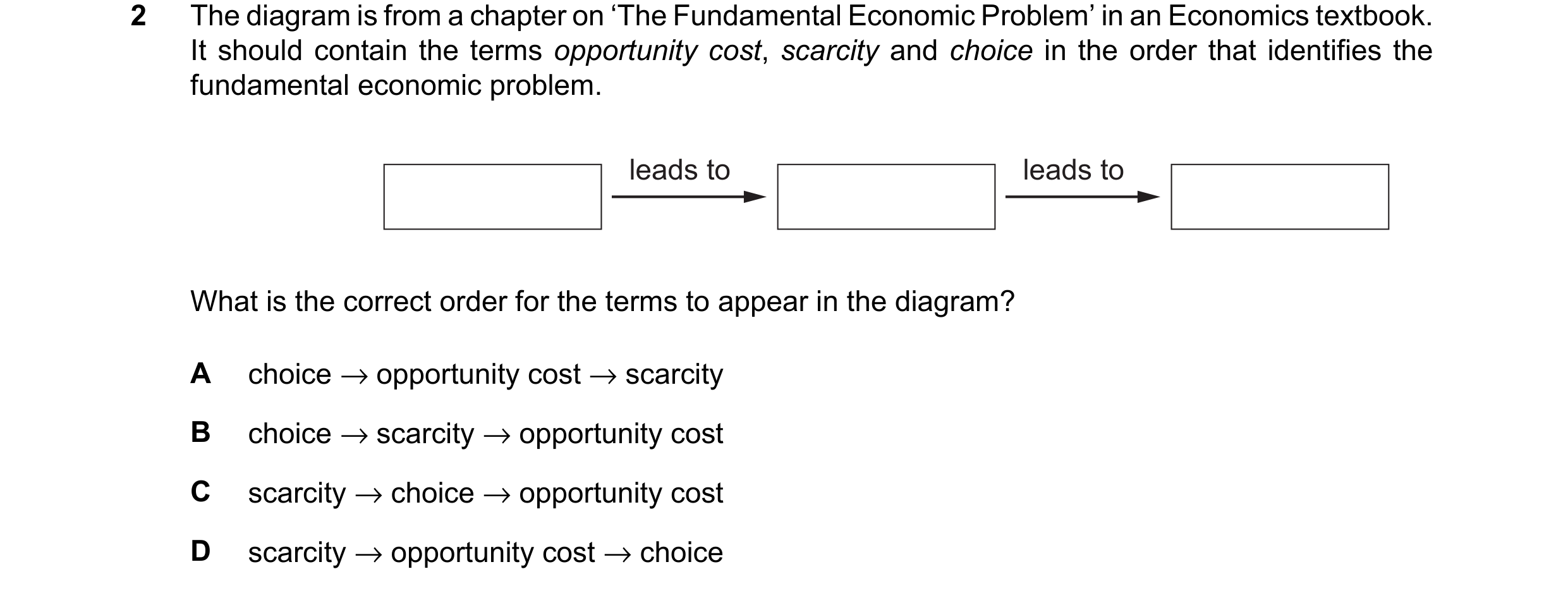
2 The diagram is from a chapter on ‘The Fundamental Economic Problem’ in an Economics textbook. It should contain the terms opportunity cost, scarcity and choice in the order that identifies the fundamental economic problem. leads to leads to What is the correct order for the terms to appear in the diagram? A choice →opportunity cost →scarcity B choice →scarcity →opportunity cost C scarcity →choice →opportunity cost D scarcity →opportunity cost →choice
1 marks
Answer: C
This question in 9708/12 May/June 2025
Q125 · A firm produces 100 units of good Y and 200 units of good X with a fixed amount of… 9708/13 May/June 2025
3 A firm produces 100 units of good Y and 200 units of good X with a fixed amount of resources. This firm wants to increase production of good Y to 120 units and as a result it can now only produce 170 units of good X. What is the opportunity cost of producing the extra 20 units of good Y? A 20 units of good X B 30 units of good X C 120 units of good X D 170 units of good X
1 marks
Answer: B
This question in 9708/13 May/June 2025
Q126 · The graph shows the total economic welfare derived by citizens from a government’s… 9708/11 Oct/Nov 2025
11 The graph shows the total economic welfare derived by citizens from a government’s expenditure on health and education services. total economic welfare health education 0 20 40 60 80 expenditure ($ billions) If the government has $60 billion of its budget to allocate between health and education services, which allocation will give its citizens the highest level of welfare? health spending education spending ($ billions) ($ billions) A 0 60 B 20 40 C 40 20 D 60 0
1 marks
Answer: C
This question in 9708/11 Oct/Nov 2025
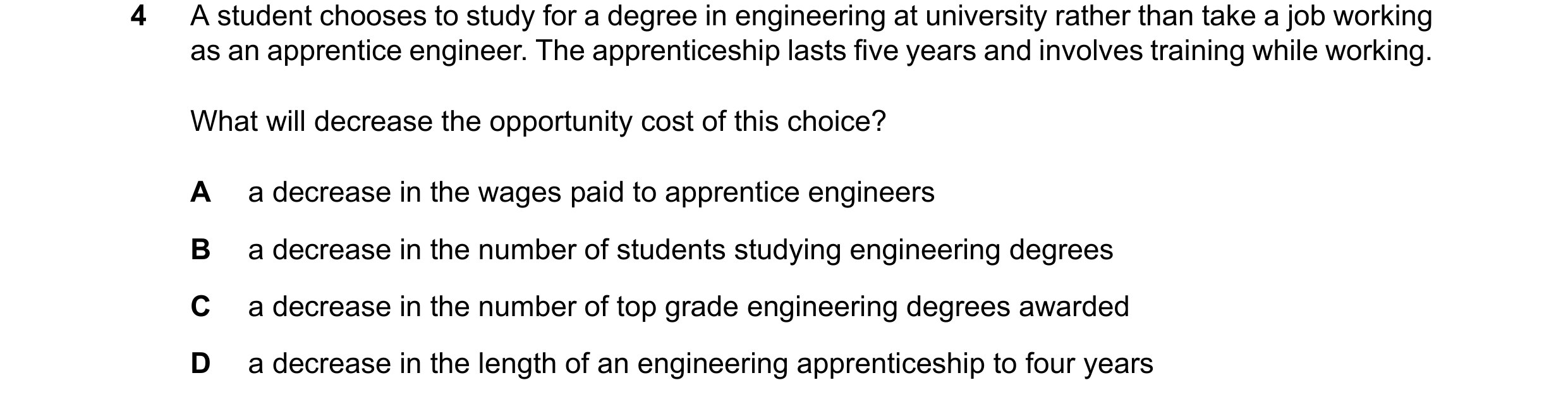
Q127 · A student chooses to study for a degree in engineering at university rather than take a… 9708/12 Oct/Nov 2025
4 A student chooses to study for a degree in engineering at university rather than take a job working as an apprentice engineer. The apprenticeship lasts five years and involves training while working. What will decrease the opportunity cost of this choice? A a decrease in the wages paid to apprentice engineers B a decrease in the number of students studying engineering degrees C a decrease in the number of top grade engineering degrees awarded D a decrease in the length of an engineering apprenticeship to four years
1 marks
Answer: A
This question in 9708/12 Oct/Nov 2025
Q128 · What would be an opportunity cost of growth in an economy? 9708/13 Oct/Nov 2025
3 What would be an opportunity cost of growth in an economy? A the faster growth of services than of manufacturing B the need for an increased level of imported raw materials C the need for greater government intervention D the reduction of consumption if growth requires investment
1 marks
Answer: D
This question in 9708/13 Oct/Nov 2025

 1 / 36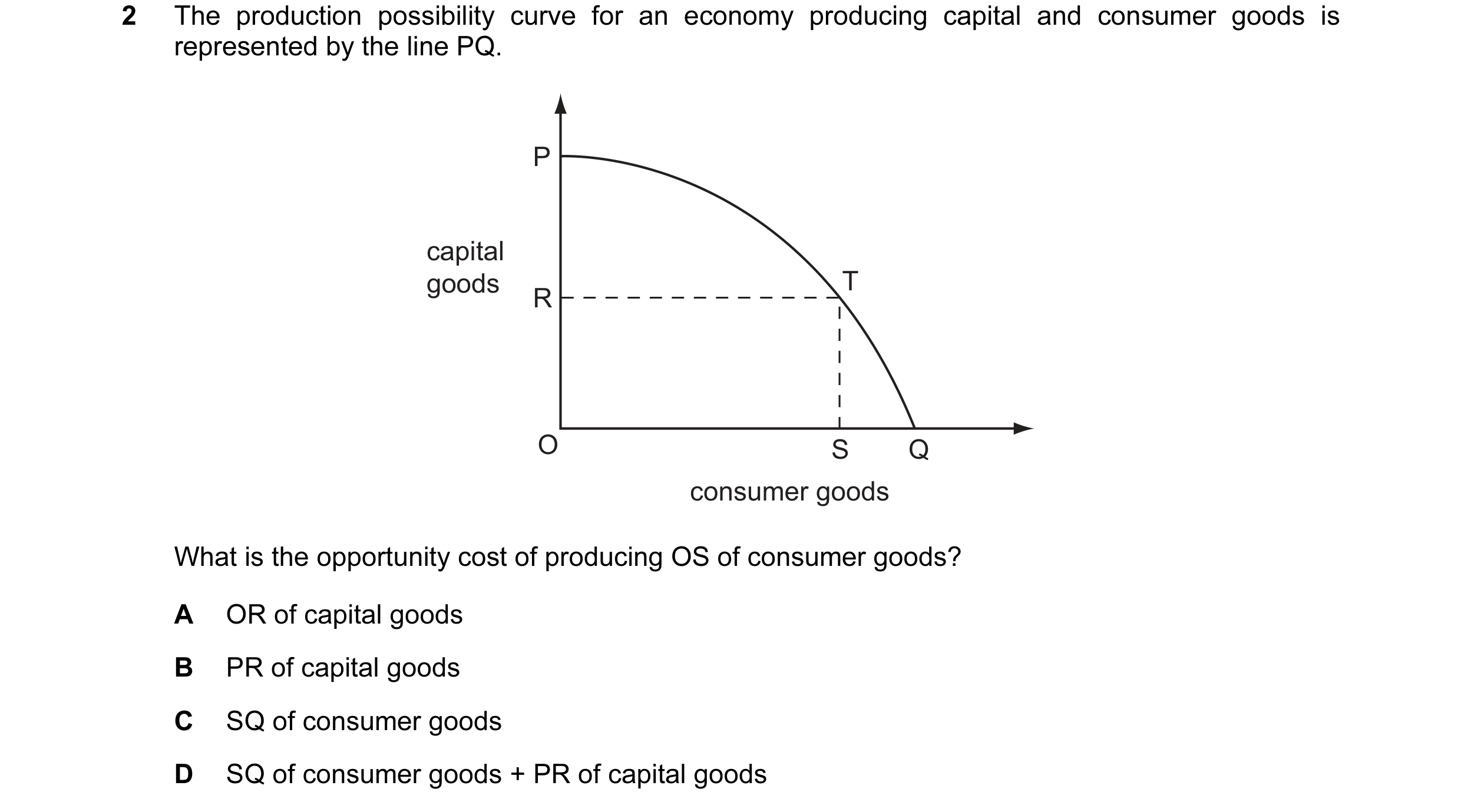
 2 / 36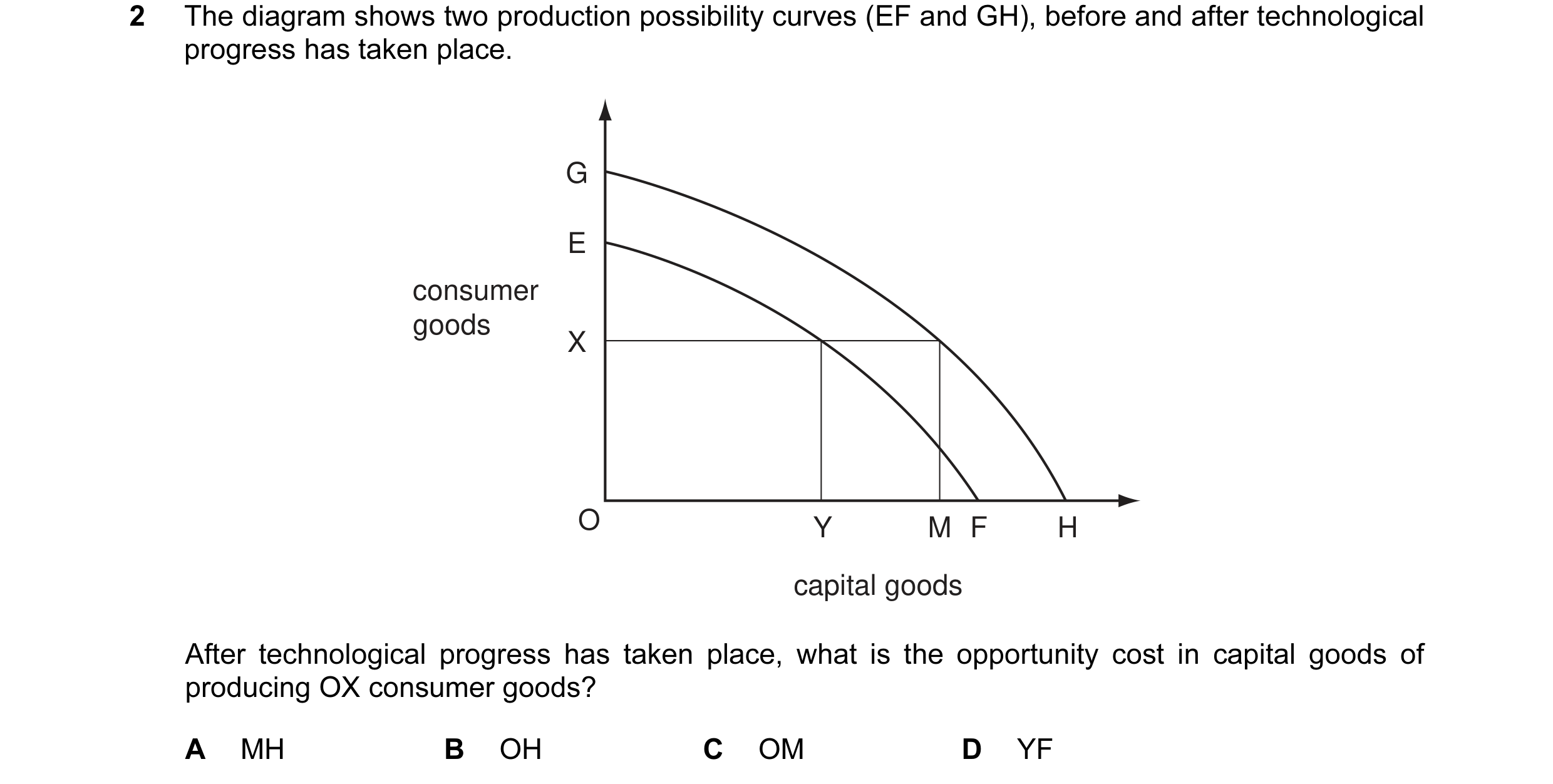
 3 / 36
 4 / 36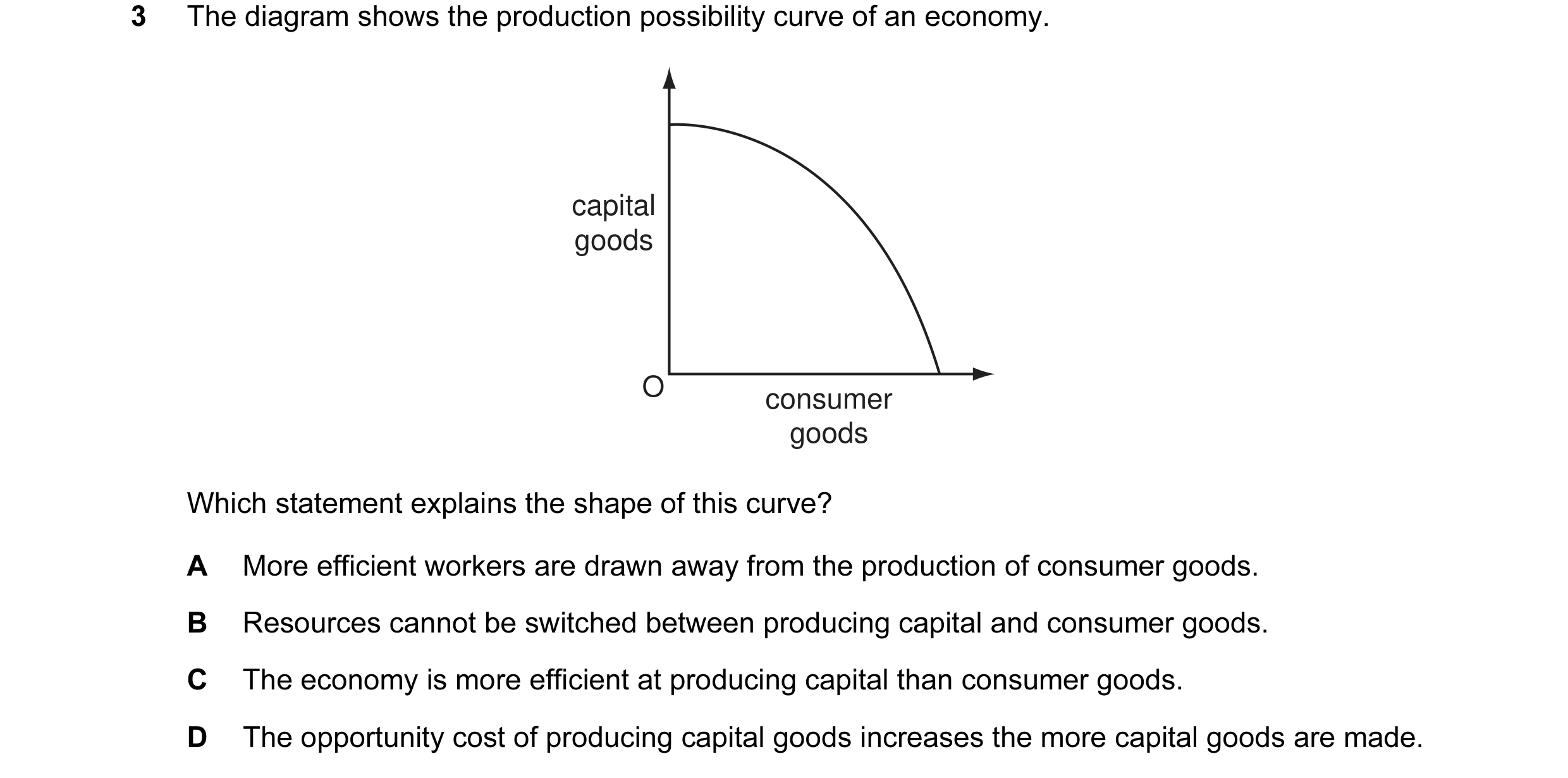
 5 / 36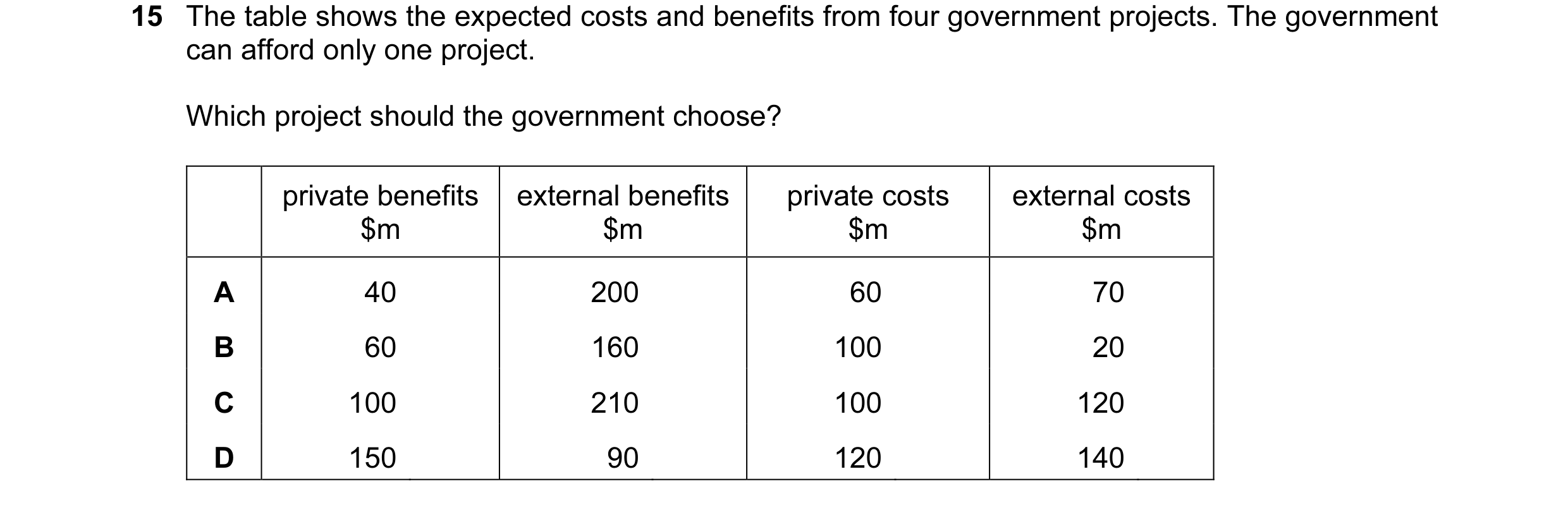


 6 / 36

 7 / 36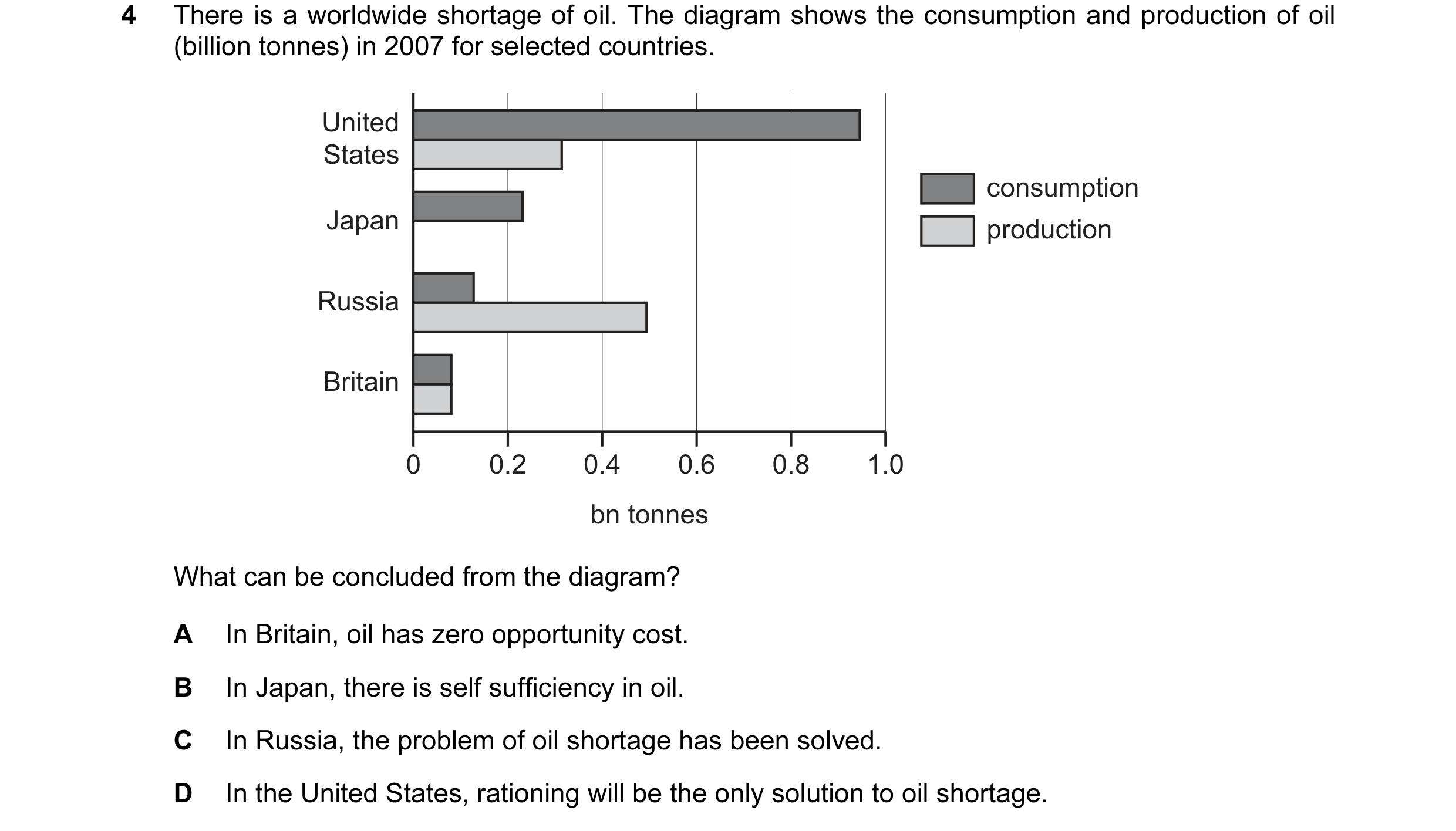
 8 / 36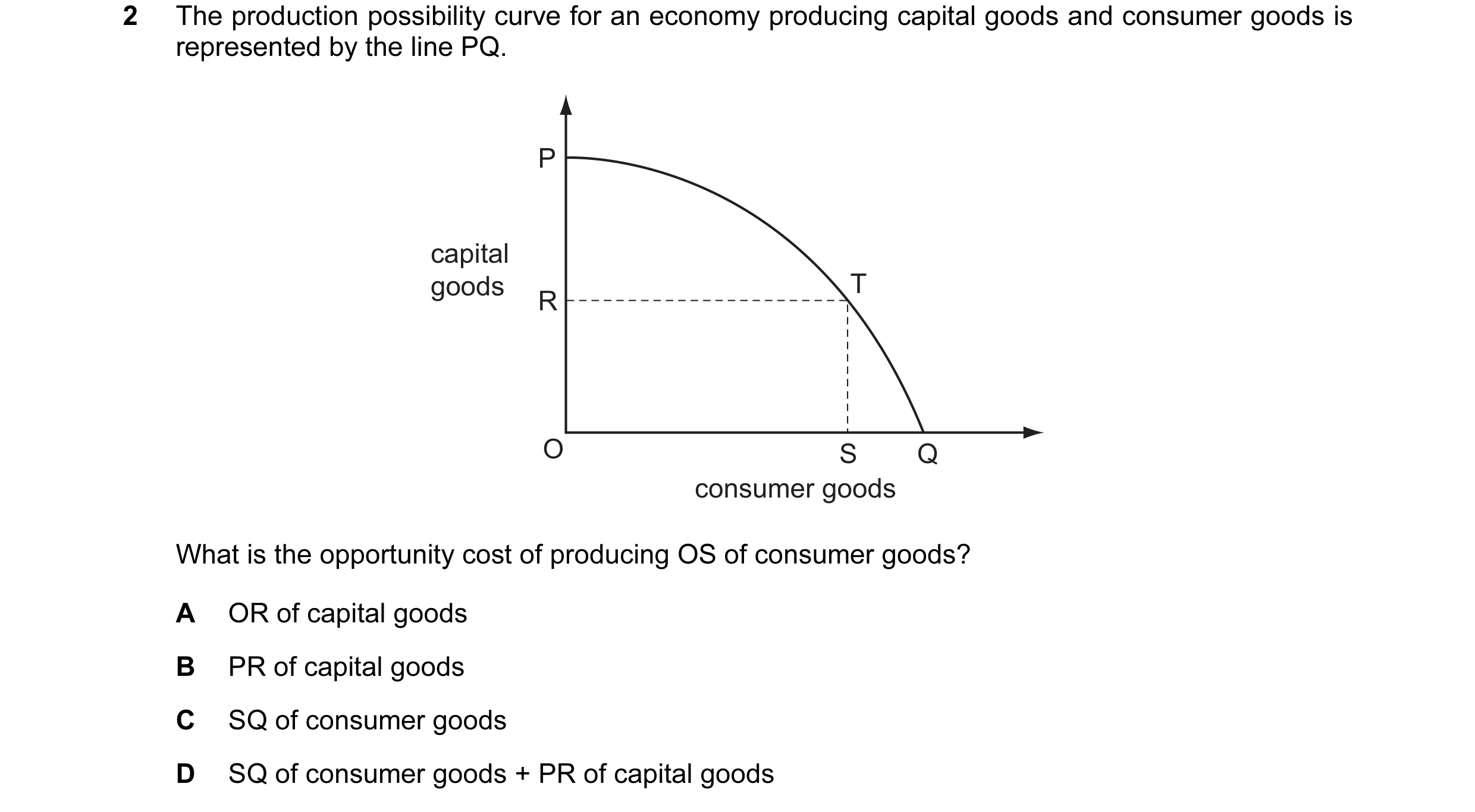

 9 / 36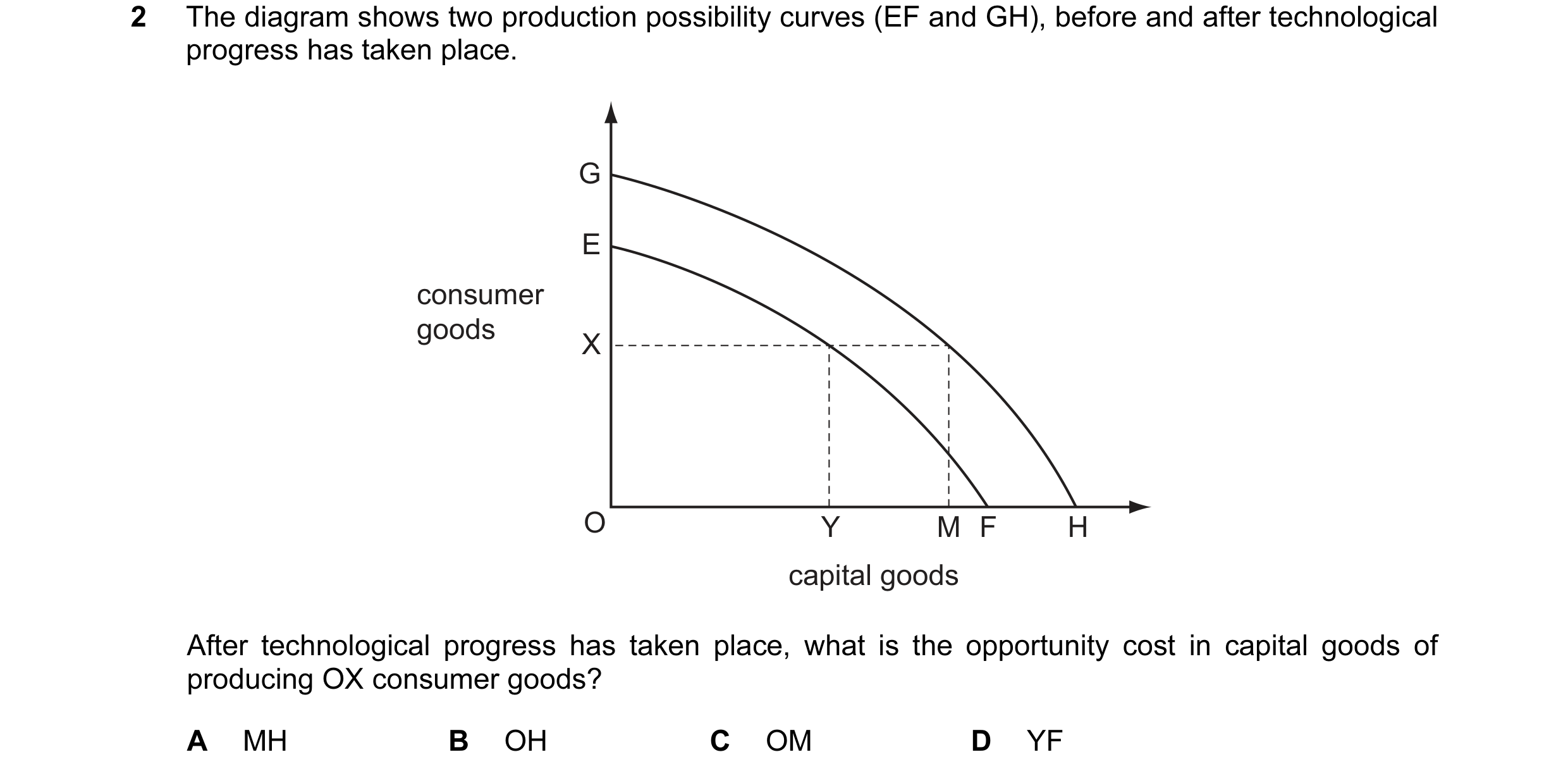
 10 / 36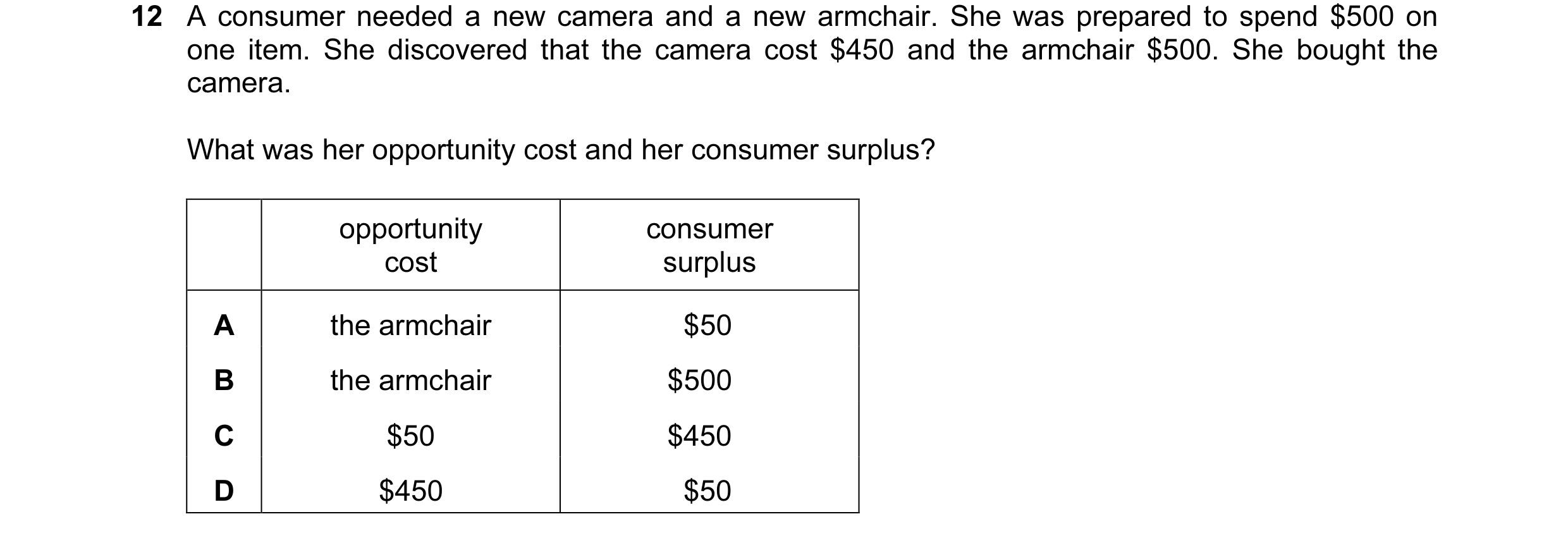
 11 / 36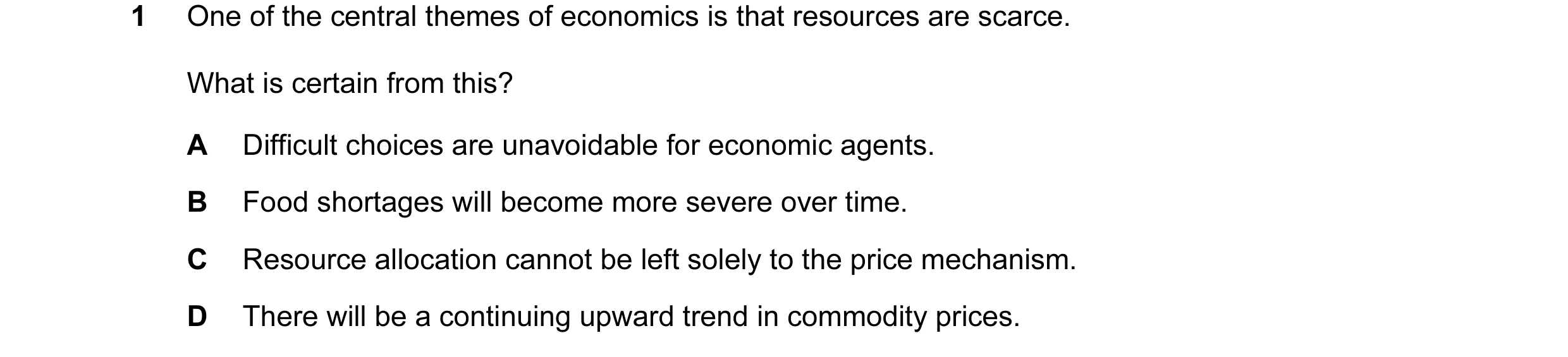



 12 / 36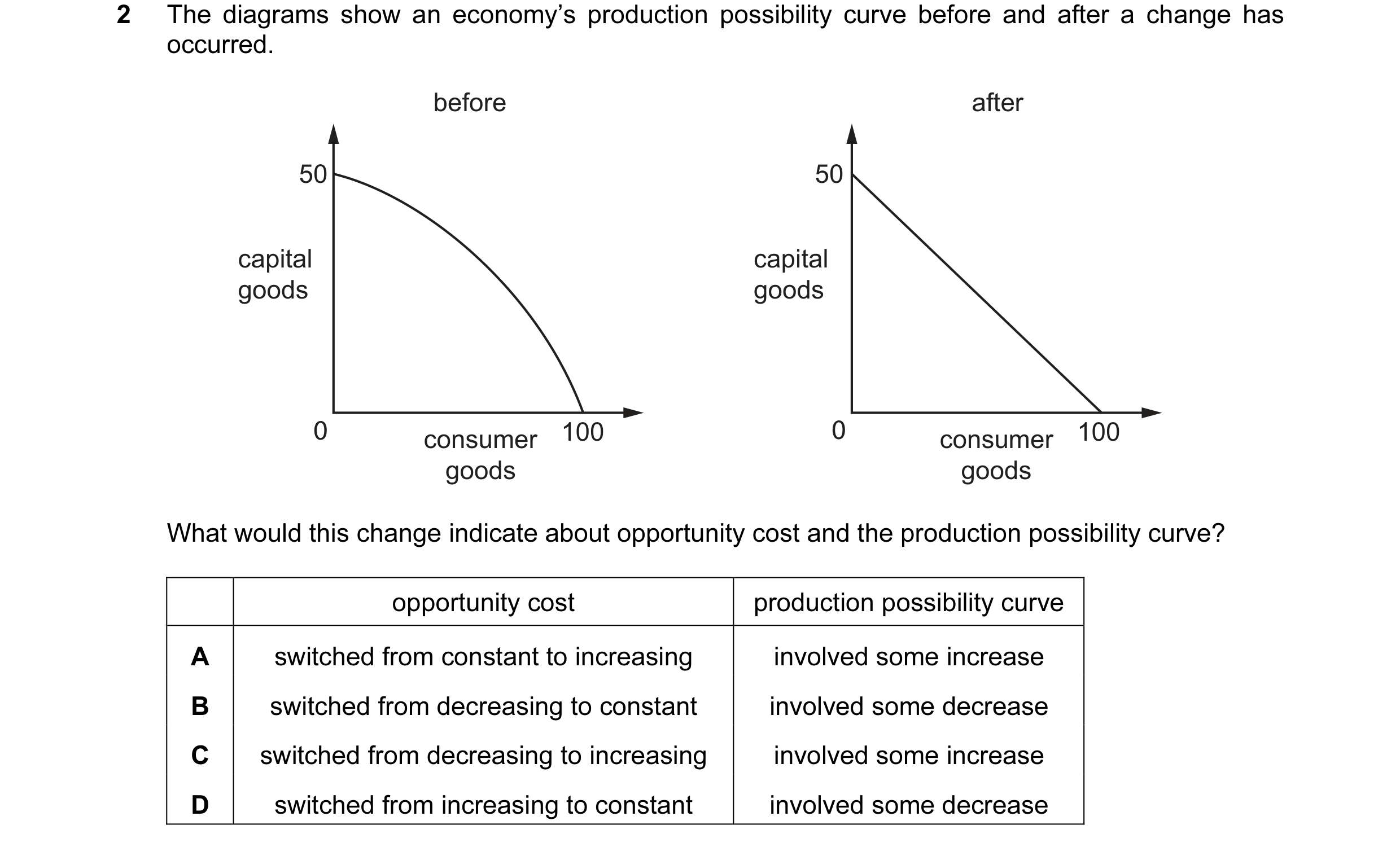

 13 / 36
 14 / 36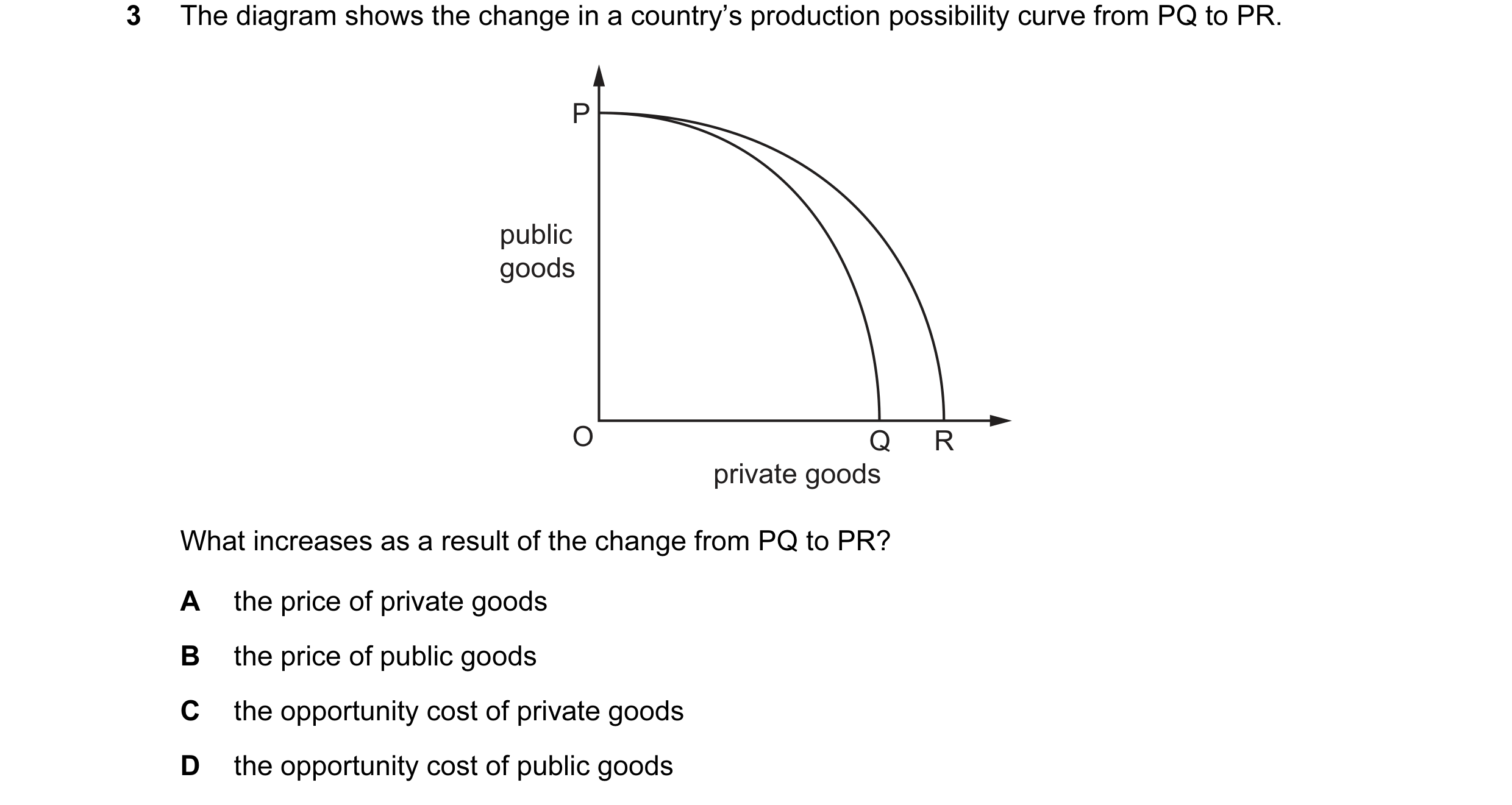
 15 / 36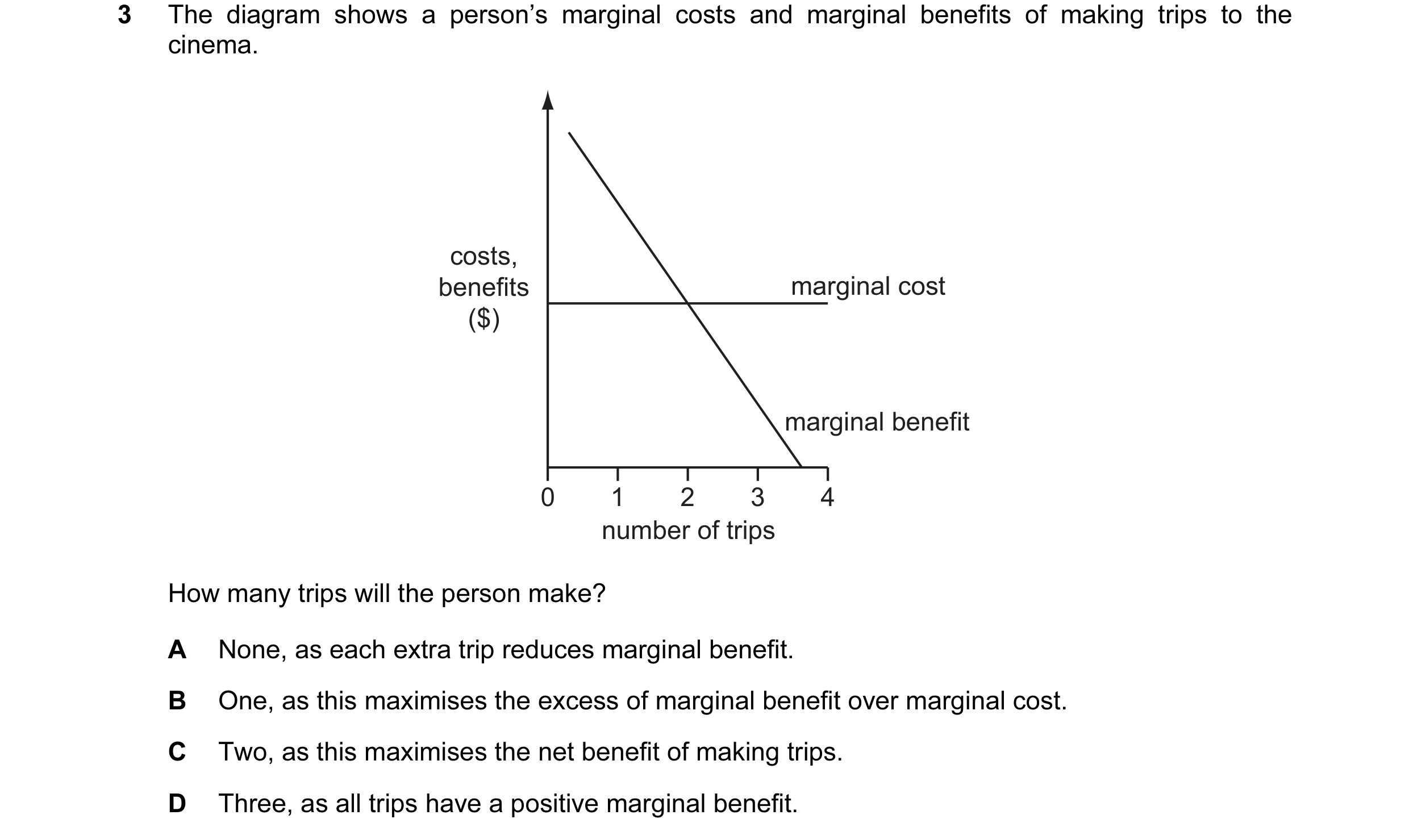
 16 / 36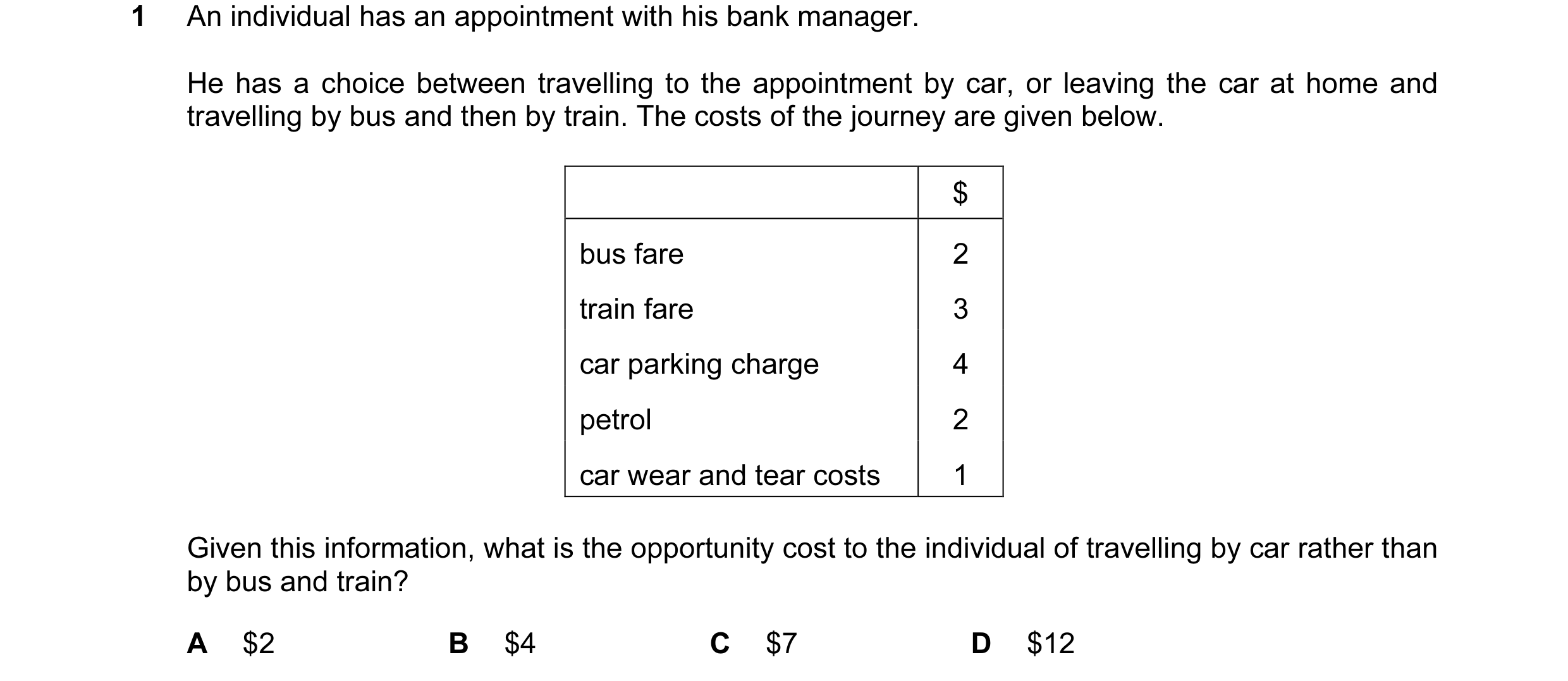

 17 / 36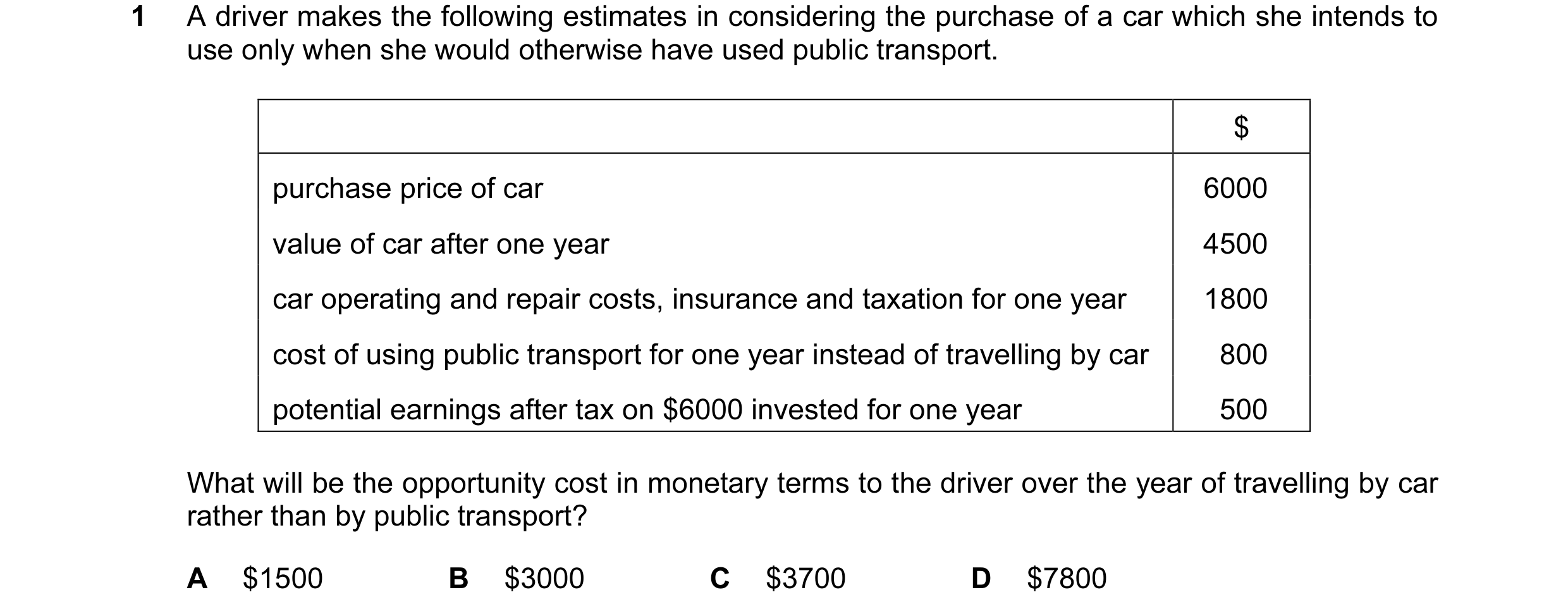
 18 / 36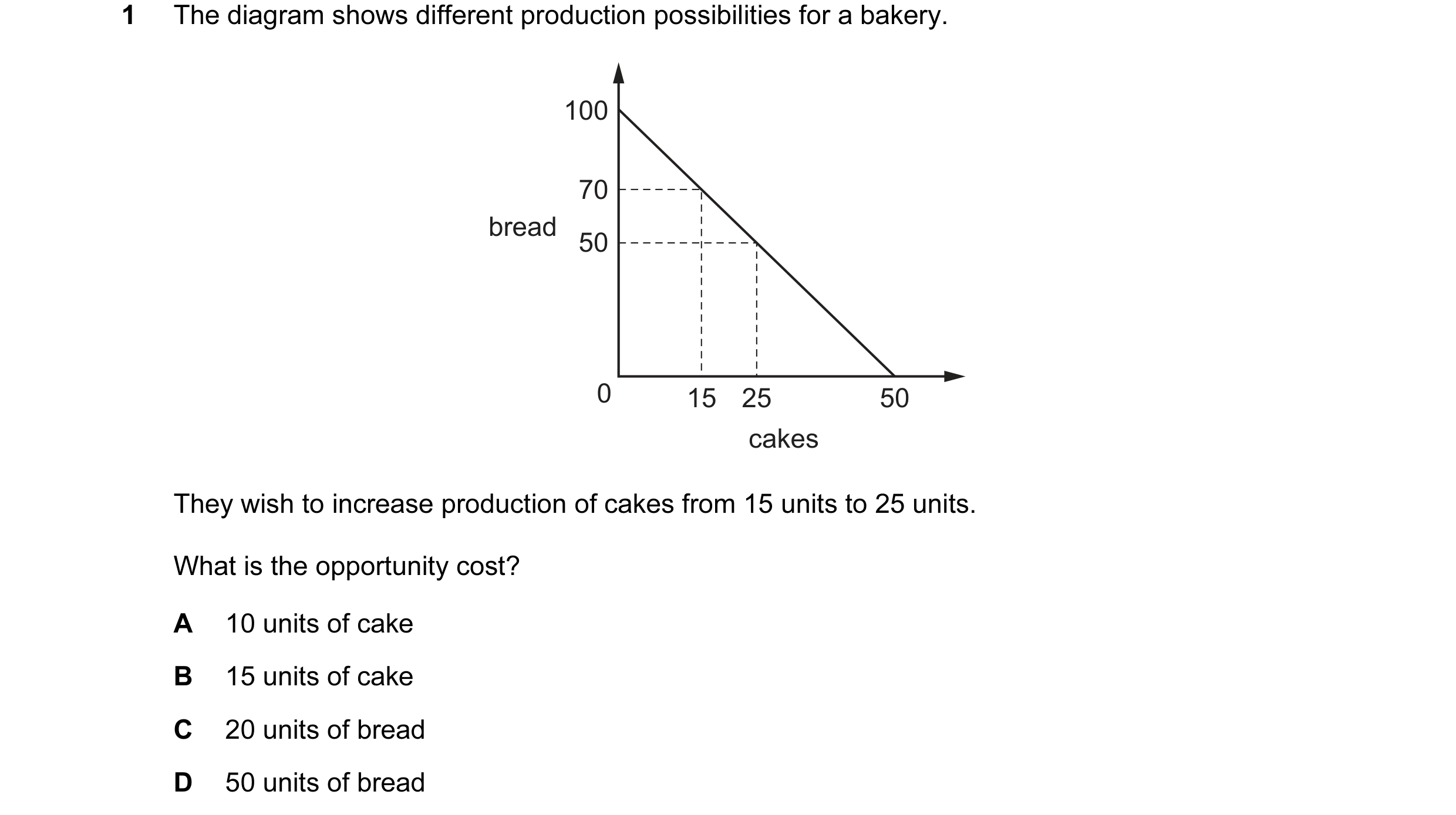
 19 / 36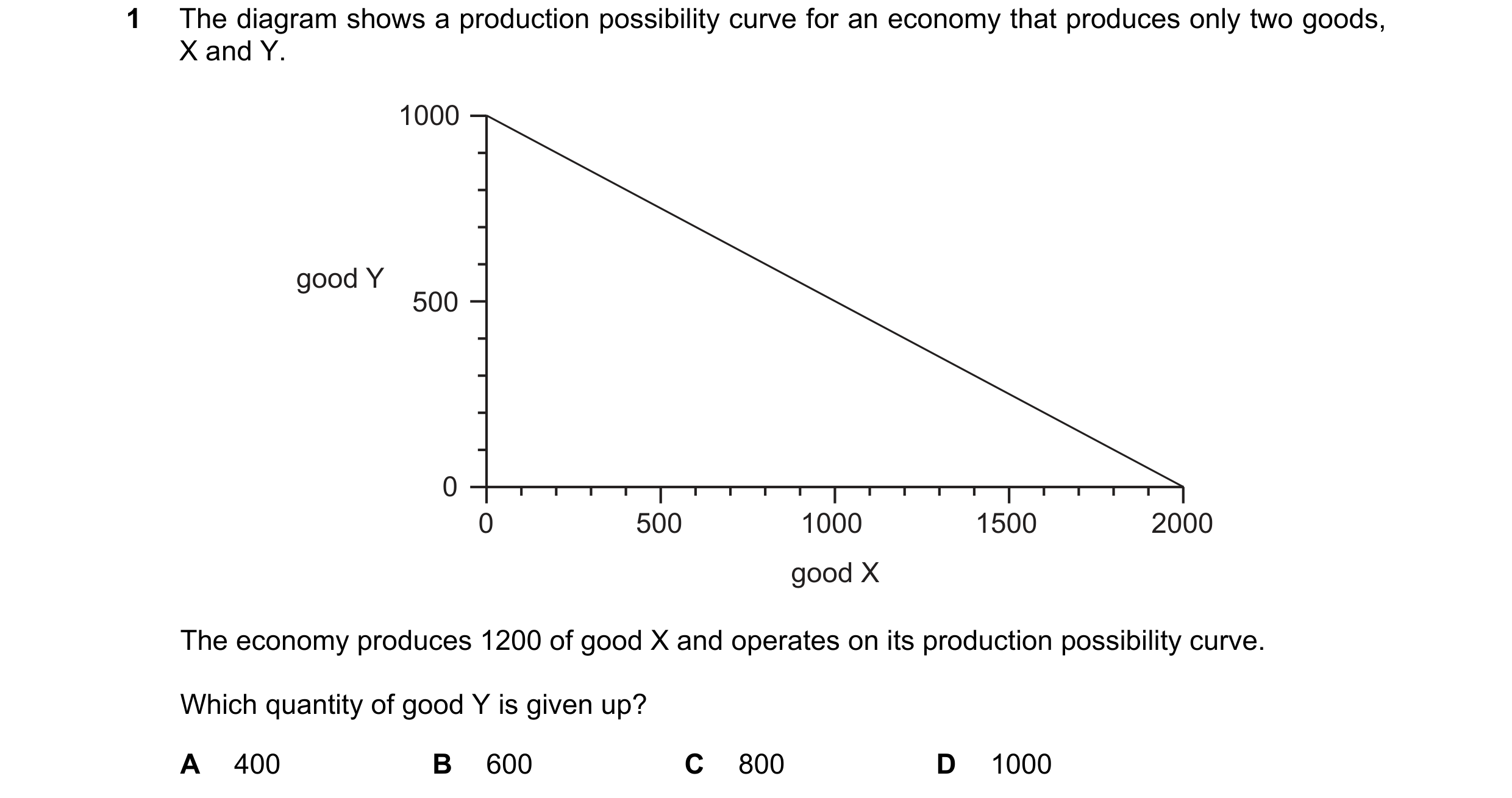

 20 / 36
 21 / 36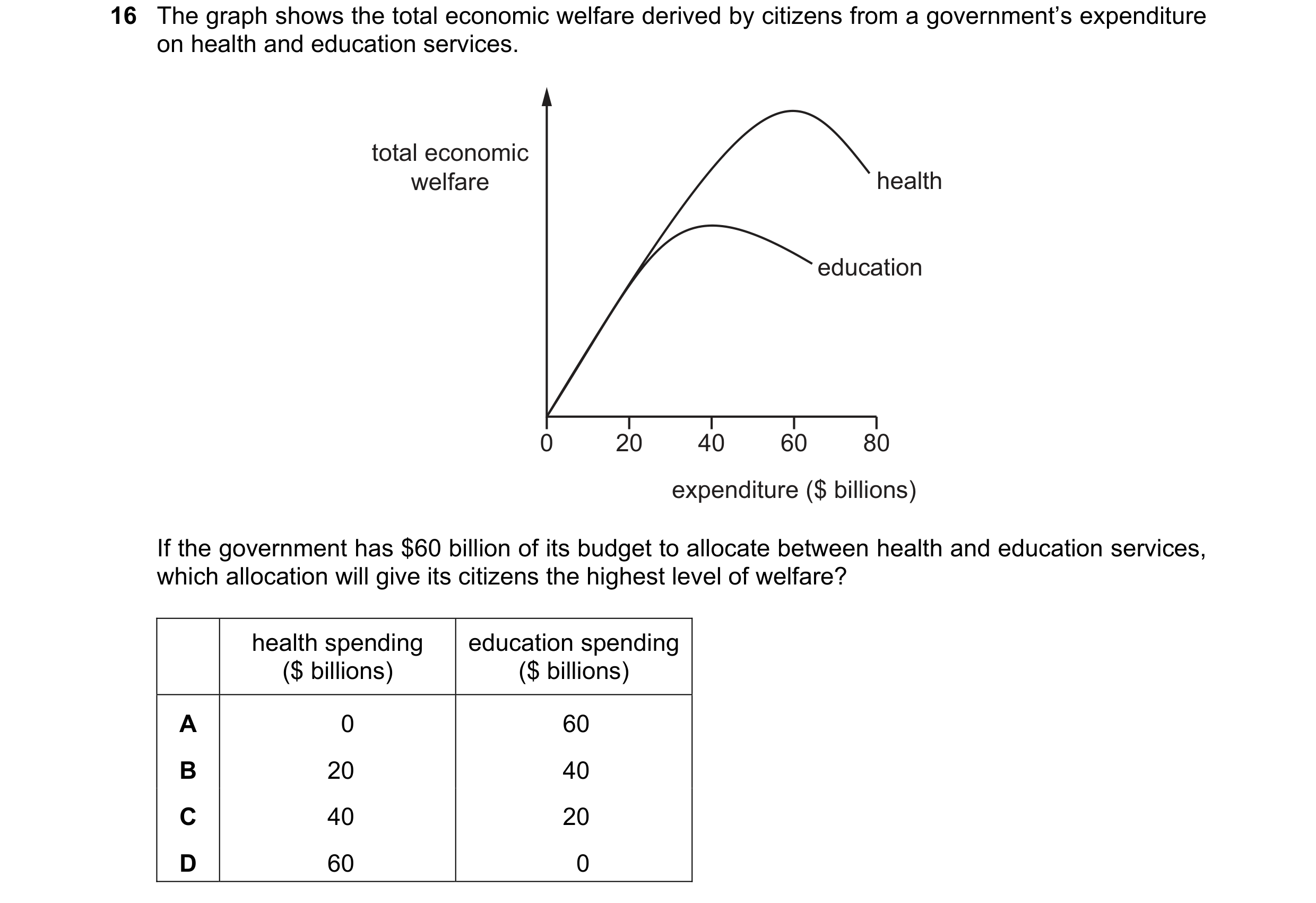

 22 / 36
 23 / 36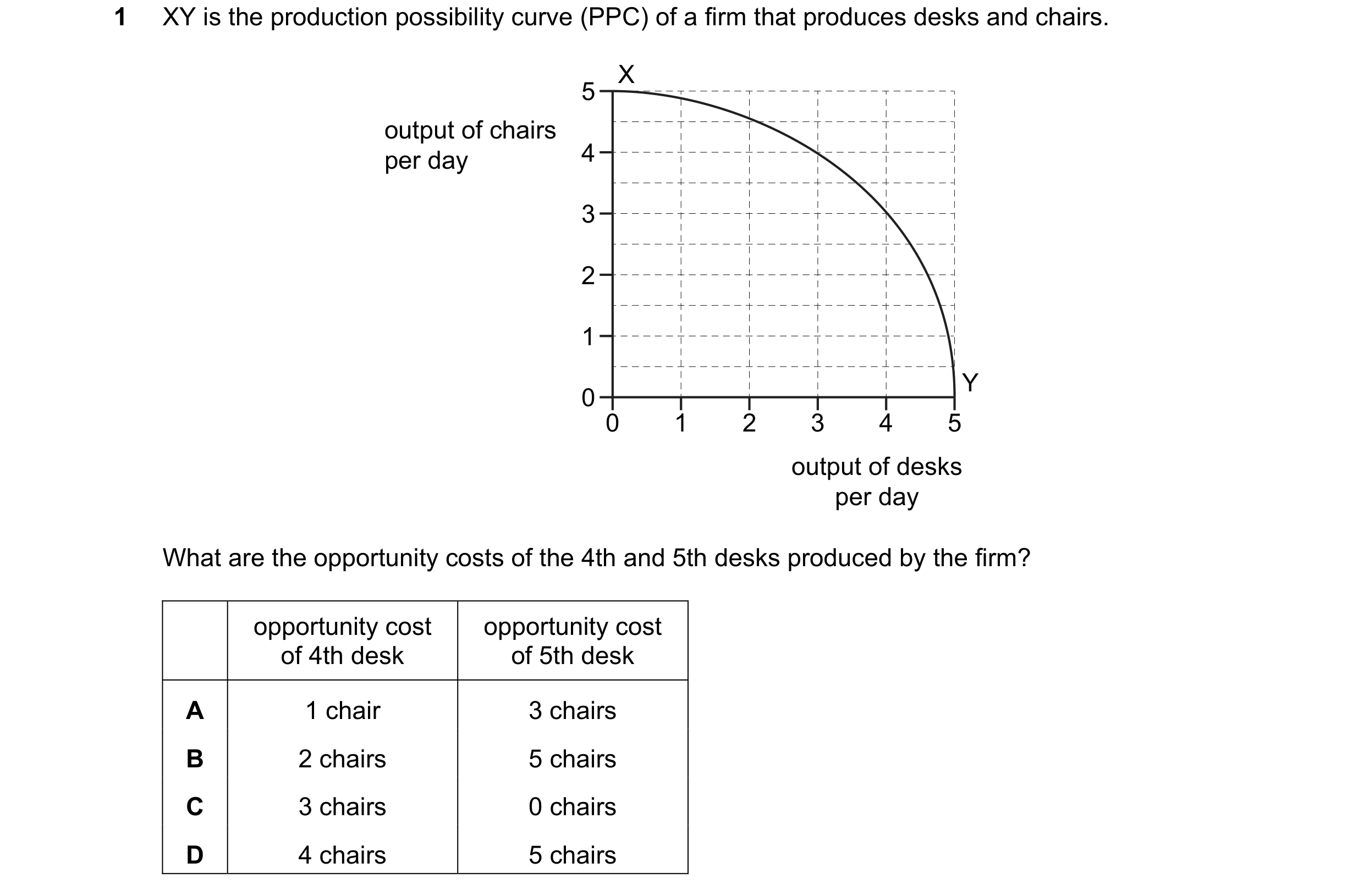
 24 / 36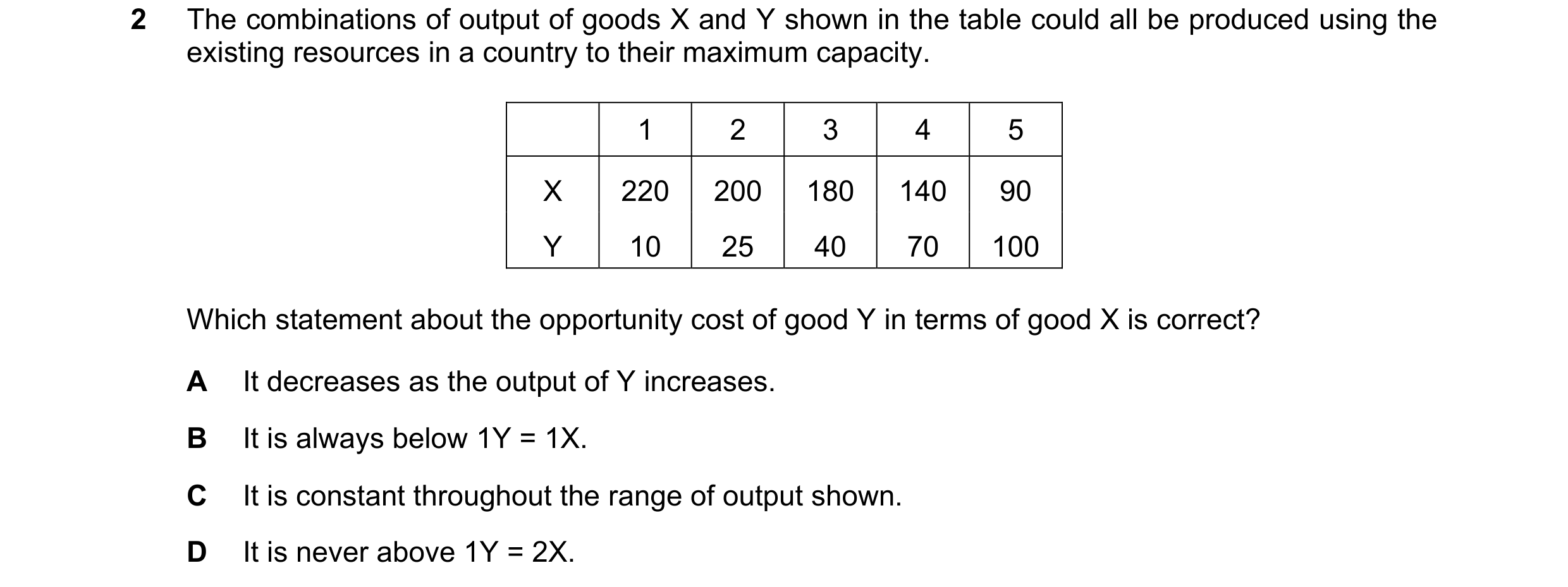
 25 / 36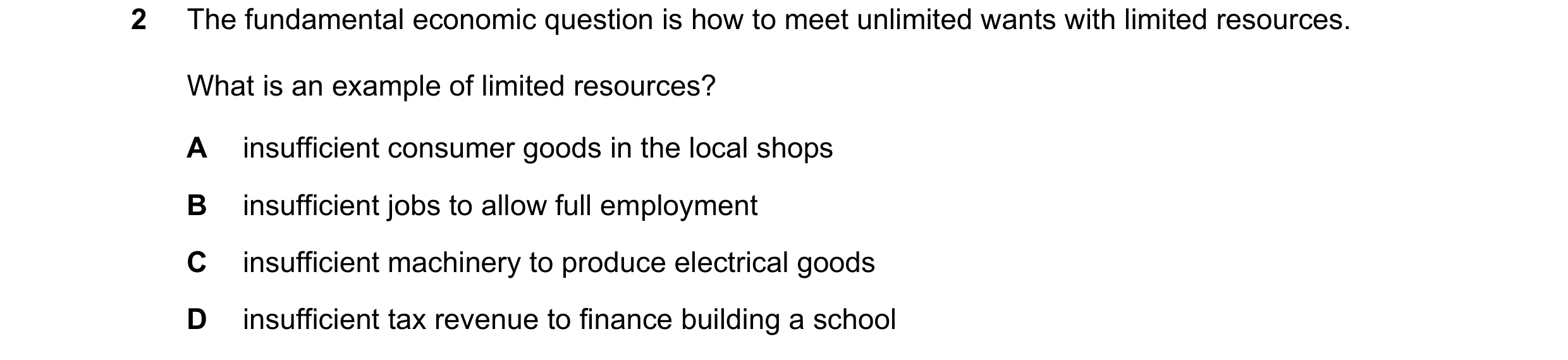


 26 / 36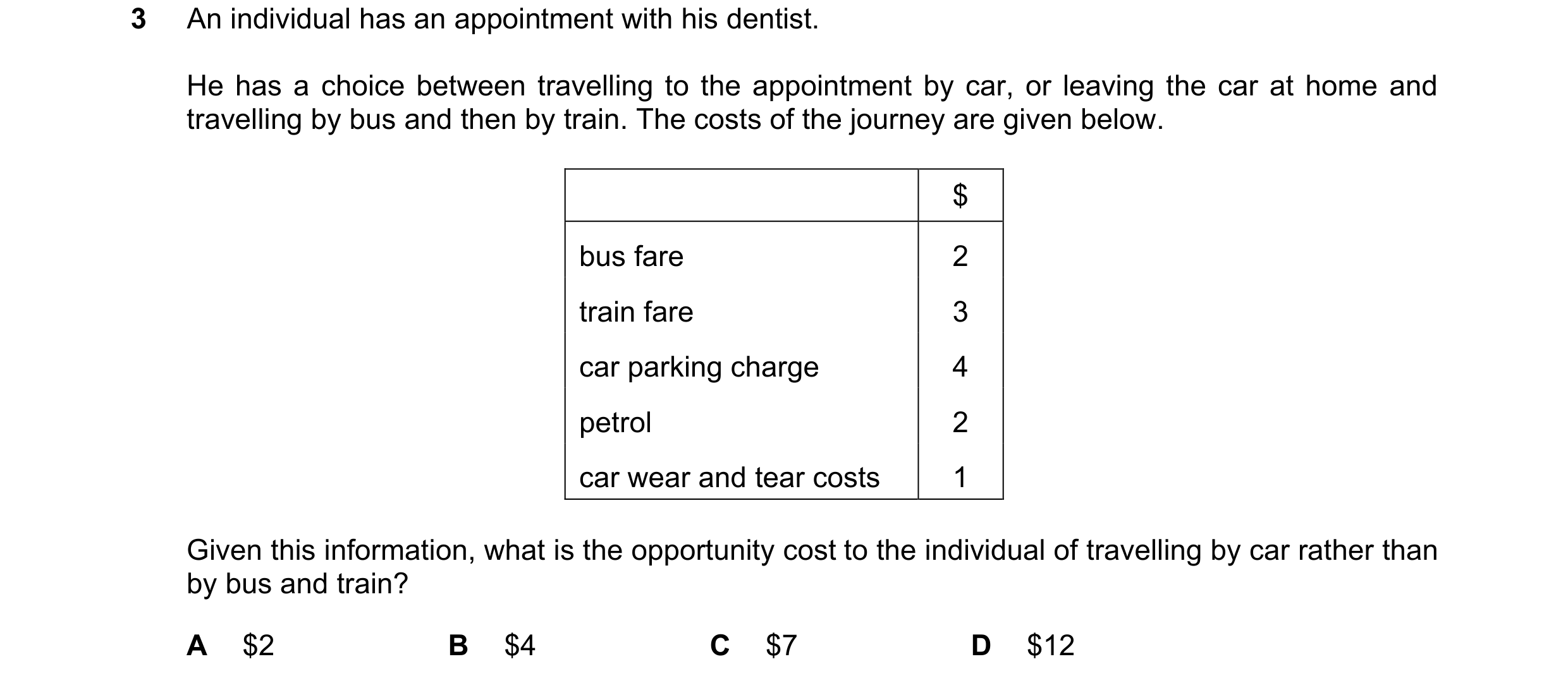

 27 / 36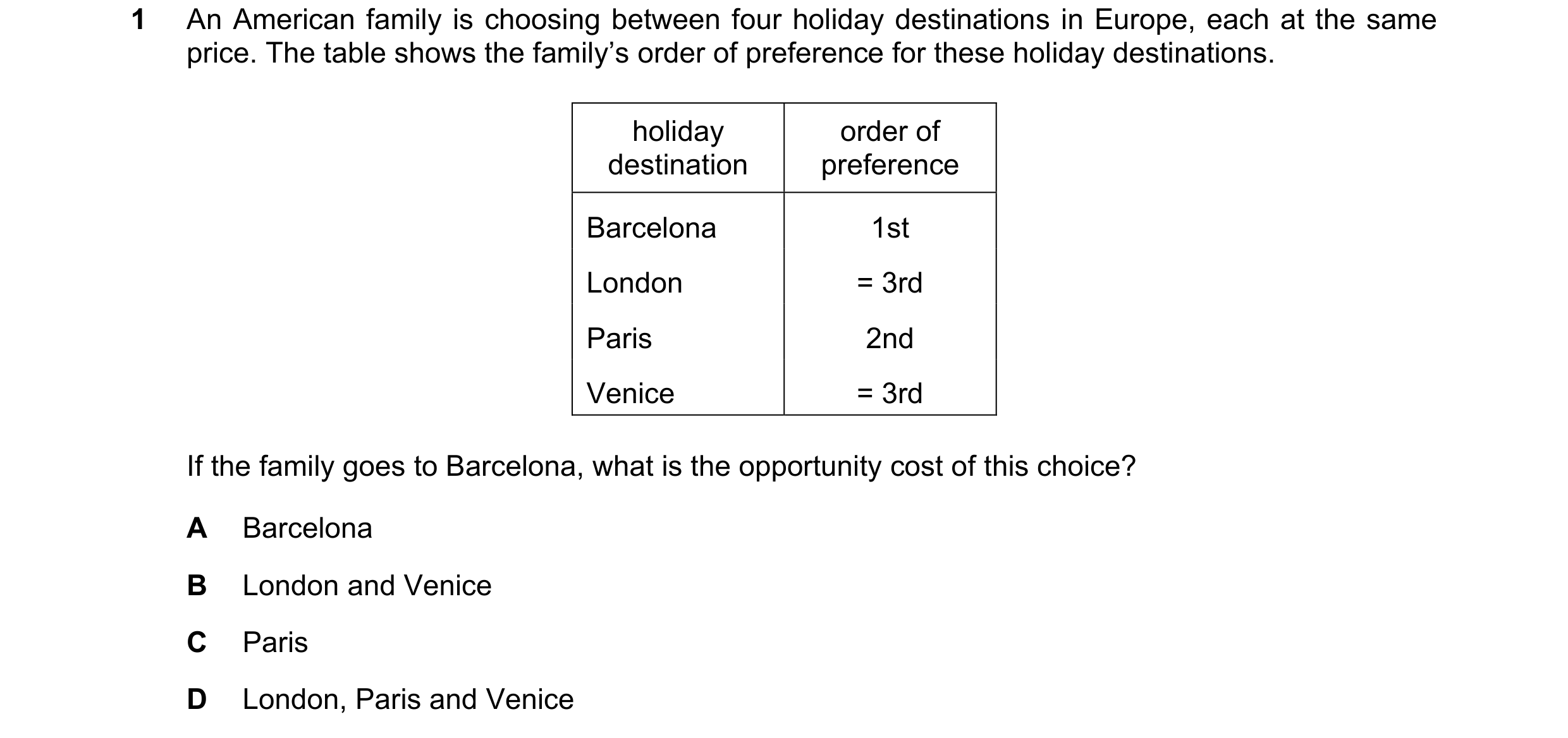
 28 / 36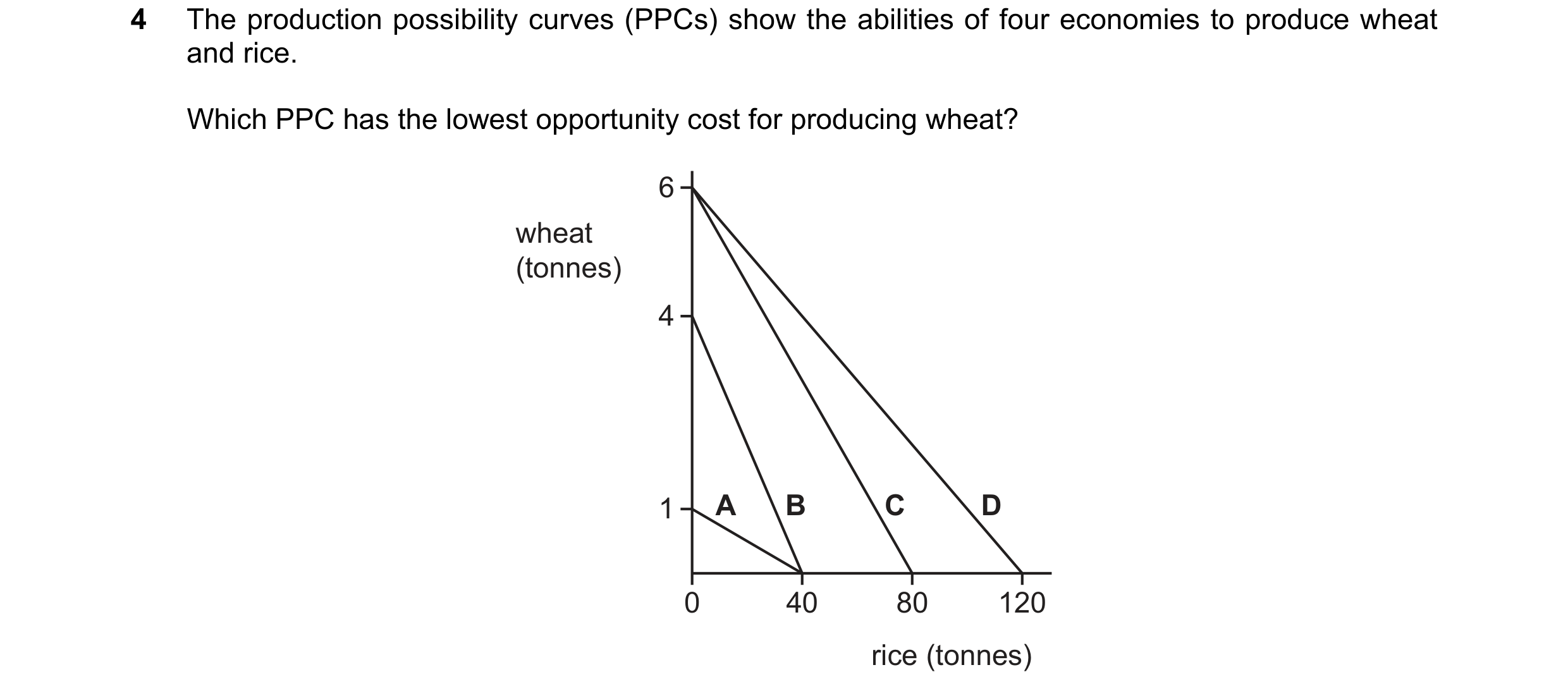
 29 / 36

 30 / 36
 31 / 36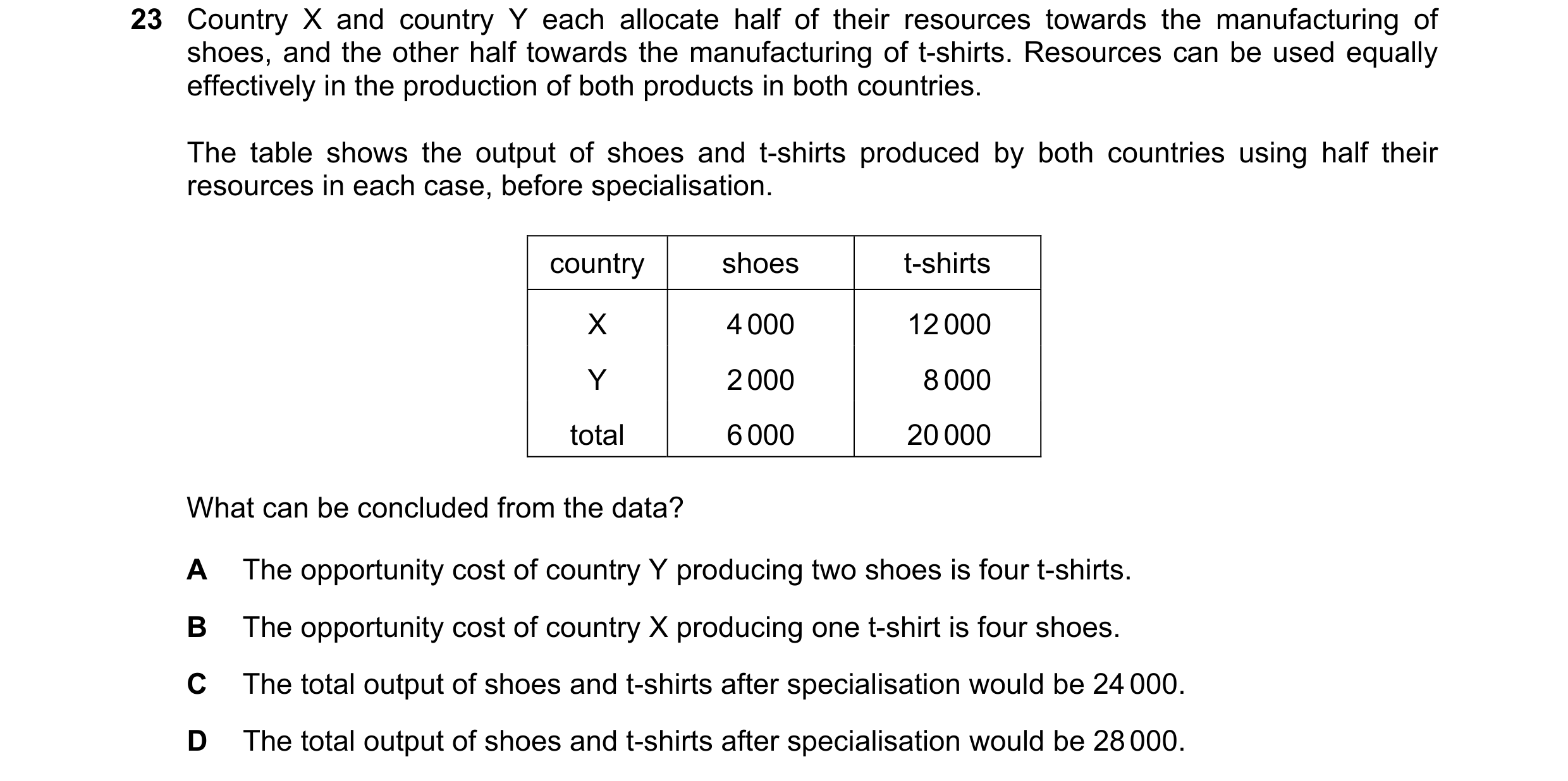

 32 / 36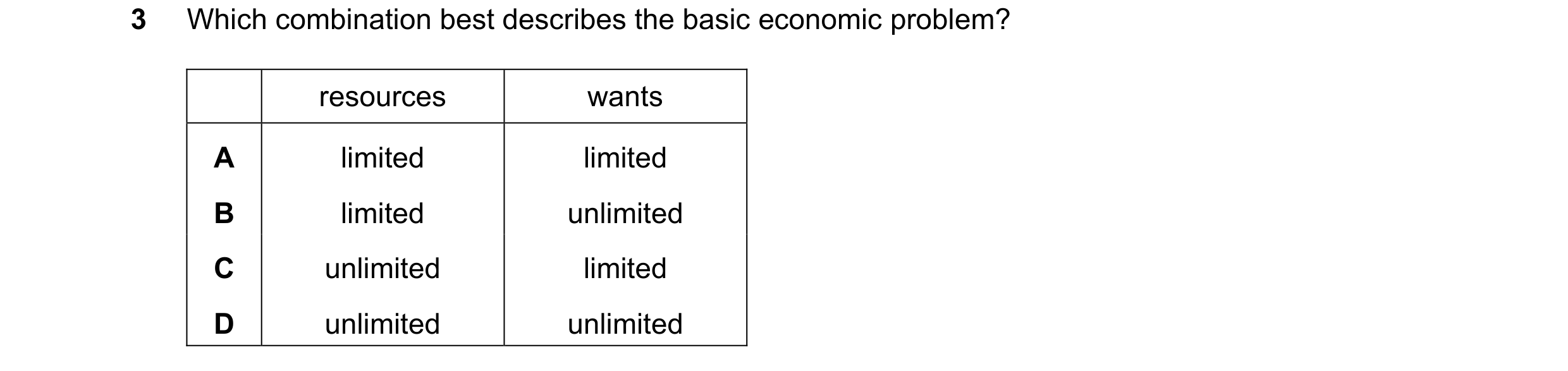



 33 / 36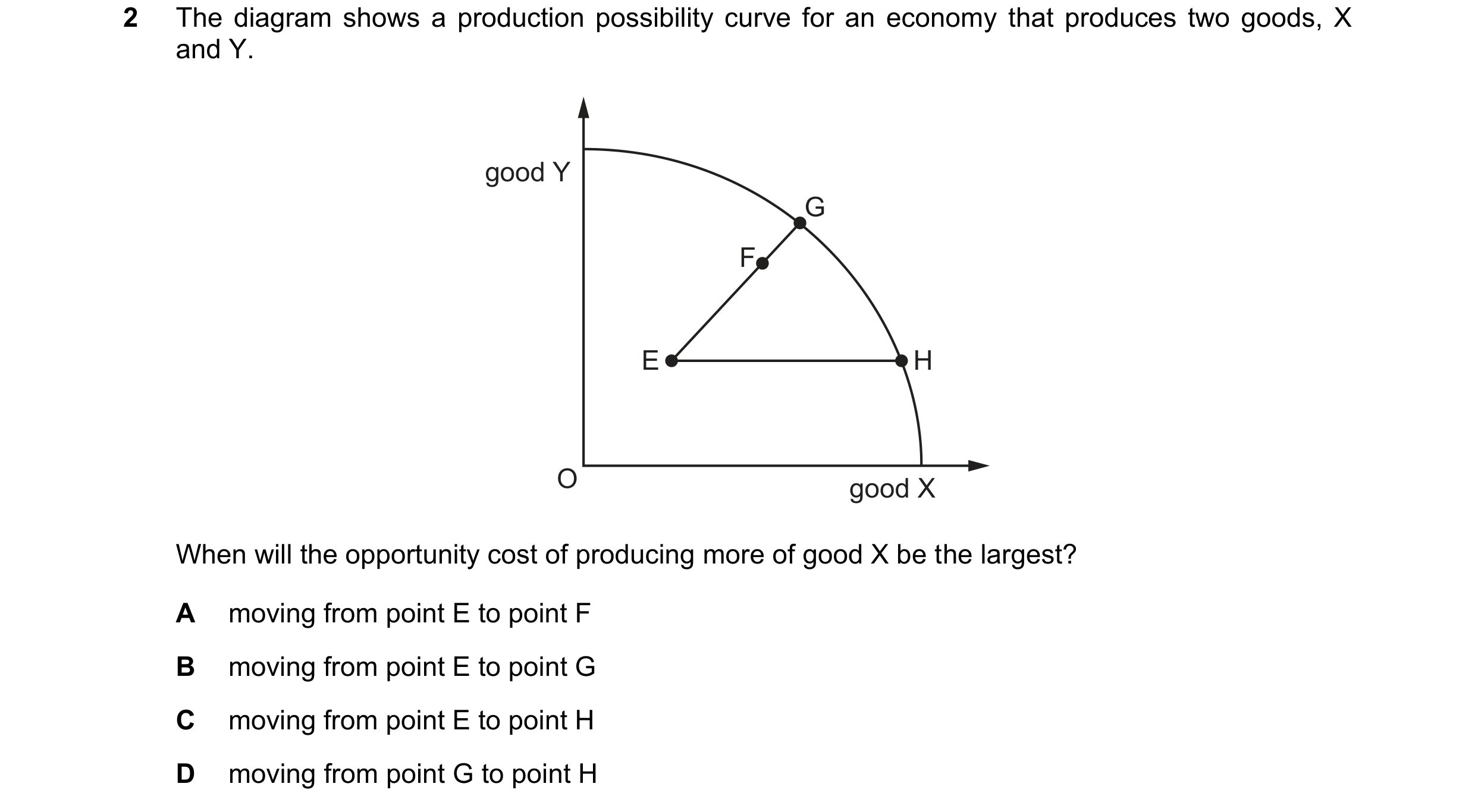

 34 / 36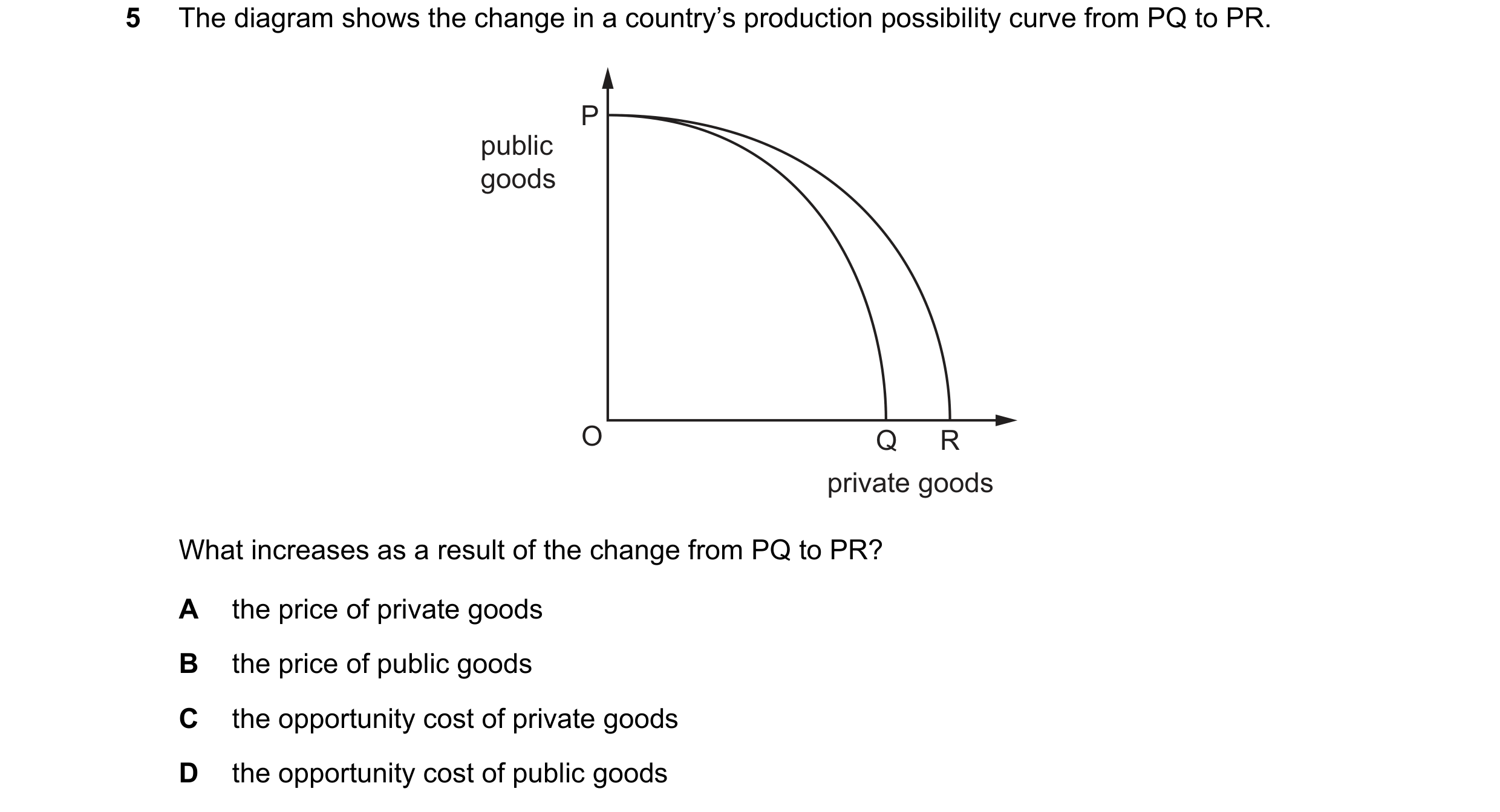
 35 / 36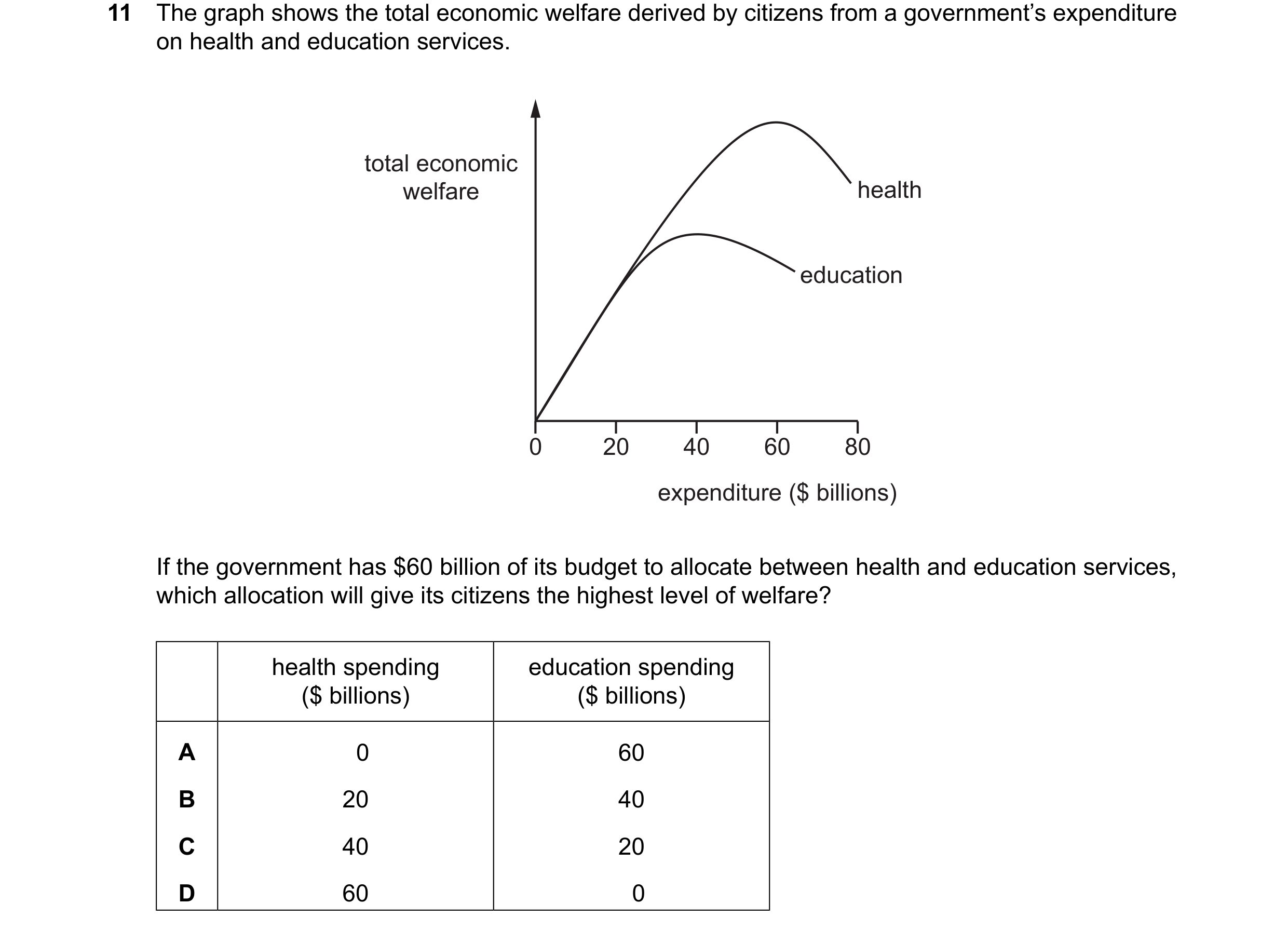
 36 / 36