Questions as text
Q1 · A student is climbing a mountain 0654/31 May/June 2017
13 (a) A student is climbing a mountain. State the type of energy gained by the student as she climbs. … energy [1] (b) The student makes a loud noise as she climbs and hears the echo from another mountain a few seconds later. The student knows the distance to the other mountain. Describe how she can calculate a value for the speed of sound in air. … … … … … … [3] (c) On the mountain, the student is exposed to both infra-red and ultraviolet waves. Infra-red and ultraviolet are part of the electromagnetic spectrum. On Fig. 13.1, put infra-red and ultraviolet waves in their correct places in the incomplete electromagnetic spectrum. visible γ-rays microwaves light Fig. 13.1 [2] (d) The student uses a camera to take photographs when she reaches the top of the mountain. The camera uses a converging lens. Fig. 13.2 shows an incomplete ray diagram for a converging lens forming an image. object F F Fig. 13.2 (i) On Fig. 13.2, complete the ray diagram to show the three rays of light after they have passed through the lens. One ray has been drawn for you. [1] (ii) On Fig. 13.2, draw an arrow ↓ to show where the image is formed. [1] (iii) State the name of points F. … [1]
9 marks
Mark scheme: 13(a) gravitational (potential) energy ; 1 13(b) measure the number of seconds / time between noise and echo ; divide distance by time ; divide double the distance / multiply by 2 ; 3 13(c) infra-red to right of visible ; ultraviolet to left of visible ; 2 13(d)(i) middle ray passes through without deviation and bottom ray passes out parallel to principal axis ; 1 13(d)(ii) inverted arrow drawn at intersection of three rays ; 1 13(d)(iii) principal focus / focal point ; 1
This question in 0654/31 May/June 2017
Q2 · Information on the label attached to a television 0654/32 May/June 2017
10 (a) Fig. 10.1 shows information on the label attached to a television. 240 V 720 W Fig. 10.1 State the name of the unit whose symbol is W. … [1] (b) (i) There is a fuse in the electrical supply to the television. Describe how a fuse works. … … … [2] (ii) The fuse in the electrical supply to the television has to be replaced. The current through the television when in use is 3 A. Three fuses with different current ratings are available. 3 A 5 A 13 A Explain why only the 5 A fuse should be used. … … … [2] (c) (i) Radio waves are used in television communication. Draw lines to link other waves in the electromagnetic spectrum to their uses. electromagnetic wave use γ-radiation airport security scanners microwaves mobile phone (cell phone) communication X-rays radioactive medical tracers [2] (ii) Name the electromagnetic wave used in a television remote control. … [1] (d) Two speakers in the television, each with a resistance of 8 Ω, are connected in series. Calculate their combined resistance. Show your working. resistance = … Ω [2]
10 marks
Mark scheme: 10(a) watt ; 1 10(b)(i) melts ; when too much current passes through ; 2 10(b)(ii) must be higher than 3A / not 3A fuse or else it will blow with normal current ; not 13A fuse as too much current could pass through / damage TV / be a fire risk ; 2 10(c)(i) gamma to medical tracers microwaves to mobile phone communication X rays to airport security scanners ;; 2 10(c)(ii) infra-red ; 1 10(d) formula or 8 + 8 ; = 16 (Ω) ; 2
This question in 0654/32 May/June 2017
Q3 · A polar bear swims 687 km in 9 days without stopping 0654/33 May/June 2017
4 (a) A polar bear swims 687 km in 9 days without stopping. Complete the following steps to calculate the average speed of the polar bear. Show your working in each step. Step 1 Calculate the distance in metres travelled by the polar bear. distance = … m Step 2 Calculate the time in seconds taken by the polar bear for this journey. time = … s Step 3 Use your answers to Steps 1 and 2 to calculate the average speed, in metres per second, of the polar bear for this journey. average speed = … m / s [3] (b) Polar bears spend a lot of time on floating ice. A polar bear must exert as small a pressure as possible when standing on the ice. State the two quantities that are needed to calculate the pressure exerted by the polar bear on the ice. … and … [2] (c) Recent research suggests that the audible frequency range for polar bears is between 50 Hz and 35 000 Hz. (i) State the audible frequency range for a human. from … Hz to … Hz [1] (ii) Ultrasound waves have a very high frequency that cannot be heard by humans. Devices which emit ultrasound waves have been tested to see if they can keep polar bears away from people. Suggest a suitable frequency for the waves emitted by such a device. … Hz [1] (d) Scientists use thermal imaging cameras to detect polar bears travelling on the ice. Thermal imaging cameras use infra-red radiation. Infra-red radiation is part of the electromagnetic spectrum. Name one other part of the electromagnetic spectrum and give a use for that radiation. radiation … use … … [2]
9 marks
Mark scheme: 4(a) distance = 687 000 (m) ; time = 777 600 (s) ; 0.88 (m / s) ; 3 4(b) area ; force (weight) ; 2 4(c)(i) 20 Hz to 20 000 Hz ; 1 4(c)(ii) any value between 20 000 to 35 000 Hz ; 1 4(d) named electromagnetic wave ; use ; 2
This question in 0654/33 May/June 2017
Q4 · A microwave oven contains a motor which produces a quiet sound with a high pitch 0654/32 Oct/Nov 2017
6 (a) A microwave oven contains a motor which produces a quiet sound with a high pitch. (i) State whether the sound waves produced have a large or small amplitude. Explain your answer. the amplitude is … because … … [1] (ii) State whether the sound waves produced have a high or low frequency. Explain your answer. the frequency is … because … … [1] (b) Some water is heated in the microwave oven for five minutes. Fig. 6.1 shows how the temperature of the water changes with time. 100 temperature / ºC 50 0 0 1 2 3 4 5 time / minutes Fig. 6.1 (i) On the graph, mark with the letter B a point when the water is boiling. Explain your answer. … … [2] (ii) State what is meant by the term boiling point. … … [1] (iii) When the liquid water boils, it turns into steam. Steam is a gas. Fig. 6.2 shows the arrangement of particles in a solid, a liquid and a gas. A B C Fig. 6.2 Use ideas about the arrangement and spacing of particles to state and explain which diagrams, A, B or C, best describe water and steam. Explain your answer. water … explanation … … steam … explanation … … [2] (c) Fig. 6.3 shows the mains electrical cable of the microwave oven. electrical cable Fig. 6.3 State one electrical hazard that is visible in Fig. 6.3. Explain why using the microwave oven could be dangerous. hazard … explanation … … [2] (d) The microwave oven uses microwaves. Microwaves are part of the electromagnetic spectrum. Fig. 6.4 shows an inaccurate electromagnetic spectrum drawn by a student. γ -rays X-rays ultraviolet microwaves infra-red radio increasing wavelength Fig. 6.4 State two errors shown in Fig. 6.4. 1 … … 2 … … [2] Please turn over for Question 7.
11 marks
Mark scheme: 6(a)(i) small amplitude because quiet noise / amplitude determines loudness ; 1 6(a)(ii) high frequency because high pitch / frequency determines pitch ; 1 6(b)(i) B anywhere from 2 minutes to 5 minutes ; temperature is constant when boiling / water boils at 100 o C ; 2 6(b)(ii) temperature at which a liquid boils / turns into a gas ; 1 6(b)(iii) water – B AND particles are close together / touching and randomly arranged ; steam – C AND particles are widely spaced / spread out (and randomly arranged) ; 2 6(c) cable broken / no insulation / wire exposed ; danger of electrocution / short circuit / electric shock / fire ; 2 6(d) visible light is missing ; microwaves and / or infra-red in wrong place / in each other’s place ; 2
This question in 0654/32 Oct/Nov 2017
Q5 · Name the electromagnetic wave used in mobile (cell) phone communication 0654/33 Oct/Nov 2017
7 (a) Name the electromagnetic wave used in mobile (cell) phone communication. … [1] (b) Fig. 7.1 shows a mobile phone being charged. charger speaker screen 1 2 3 4 5 6 battery battery 7 8 9 # 0 @ cable microphone Fig. 7.1 Some parts of the mobile phone have been labelled. Name the part of the mobile phone that transfers (i) electrical energy into sound energy, … [1] (ii) electrical energy into stored chemical energy. … [1] (c) A charger for a mobile phone is marked as shown in Fig. 7.2. input: a.c. 240 V, 50 Hz, 80 mA output: d.c. 5300 mV, 500 mA Fig. 7.2 (i) State the physical quantity that has the unit mV. … [1] (ii) State the physical quantity that has the unit Hz. … [1] (d) The ring tone on a mobile phone can be changed. Fig. 7.3 shows the sound trace made by four sound waves on an oscilloscope screen. P Q R S Fig. 7.3 State the letter that shows a sound trace from a ring tone which would be a loud sound with a high pitch, … loud sound with a low pitch. … [1] (e) The sound waves produced by the speaker of the mobile phone are longitudinal waves. The visible light waves emitted from the screen of the mobile phone are transverse waves. Describe the difference between longitudinal wave motion and transverse wave motion. … … … … [1] (f) A student wants to find the work done when she lifts her mobile phone vertically from her desk to her ear. Name the two quantities that the student needs to measure to determine the work done. … and … [2]
9 marks
Mark scheme: 7(a) microwaves ; 1 7(b)(i) speaker ; 1 7(b)(ii) battery ; 1 7(c)(i) potential difference / voltage ; 1 7(c)(ii) frequency (of electricity) ; 1 7(d) P then Q ; 1 Question Answer Marks 7(e) transverse waves - the vibrations are at right angles to the direction of travel / longitudinal waves - the vibrations are along the same direction as the direction of travel ; 1 7(f) weight / force ; (vertical) distance ; 2
This question in 0654/33 Oct/Nov 2017
Q6 · A bus gets very hot as it travels on a sunny day 0654/31 Oct/Nov 2018
6 (a) A bus gets very hot as it travels on a sunny day. (i) State the method of thermal energy transfer between the Sun and the Earth. … [1] (ii) Name the main part of the electromagnetic spectrum involved in the energy transfer stated in (a)(i). … [1] (iii) Fig. 6.1 shows an incomplete electromagnetic spectrum. On Fig. 6.1, label the part of the electromagnetic spectrum named in (a)(ii). visible γ-rays microwaves light Fig. 6.1 [1] (b) The air in the tyres of the bus also gets hot. The pressure of the air in the tyres increases. (i) Describe, in terms of moving molecules, how the air inside a tyre exerts a pressure on the tyre wall. … … [1] (ii) Explain, in terms of molecules, why the pressure of the air in the tyres increases as the air gets hot. … … … … … [2] (c) At night, the bus lamps are switched on. Fig. 6.2 shows a circuit used for the lamps on the bus. There are three switches, A, B and C, in the circuit. There is a current of 0.5 A in each sidelamp when lit. There is a current of 6.0 A in each headlamp when lit. C A sidelamps B headlamps 12 V Fig. 6.2 (i) State which switch or switches must be closed for only the sidelamps to light up. … [1] (ii) State which switch or switches must be closed for only the headlamps to light up. … [1] (iii) Calculate the resistance of one of the sidelamps. State the formula you use and show your working. formula working resistance = … Ω [2] (iv) The resistance of each headlamp is 2.0 Ω. From the list of resistance values, choose the correct value for the combined resistance of the two headlamps in parallel. 0.5 Ω 1.0 Ω 2.0 Ω 4.0 Ω resistance = … Ω [1]
11 marks
Mark scheme: 6(a)(i) radiation ; 1 6(a)(ii) infrared ; 1 6(a)(iii) between visible and microwaves ; 1 6(b)(i) pressure caused by collisions with tyre wall ; 1 6(b)(ii) thermal energy causes particles to move faster / particles have more KE ; more frequent collisions / collisions exert a greater force; max 2 6(c)(i) A and B ; 1 6(c)(ii) A and C ; 1 6(c)(iii) resistance = voltage / current or 12 / 0.5 ; = 24 (Ω) ; 2 6(c)(iv) 1 (Ω) ; 1
This question in 0654/31 Oct/Nov 2018
Q7 · Doctors use X‑rays, γ‑rays and ultrasound waves in a hospital 0654/32 Oct/Nov 2018
3 Doctors use X‑rays, γ‑rays and ultrasound waves in a hospital. (a) State one medical use for X‑rays in a hospital. … … [1] (b) Ultrasound waves are used by doctors to scan unborn babies. Suggest and explain why it is not safe to scan unborn babies with X‑rays or γ‑rays. … … … [2] (c) Ultrasound waves have a very high frequency which humans cannot hear. (i) State, in terms of waves, what is meant by the term frequency. … … [1] (ii) Using your knowledge of the range of audible frequencies for humans, suggest a frequency for these ultrasound waves. Explain your answer. frequency = … Hz explanation … … [2]
6 marks
Mark scheme: 3(a) X-rays – viewing bones / images of internal structures; 1 3(b) (more likely to be affected by) ionising radiation; named effect of ionising radiation on body cells; 2 3(c)(i) number of oscillations / vibration per second / per unit time; 1 3(c)(ii) any value above 20 000 Hz; maximum value for human hearing is 20 000 Hz; 2
This question in 0654/32 Oct/Nov 2018
Q8 · A boy travels in an elevator from the ground floor of an apartment building 0654/31 May/June 2019
6 (a) A boy travels in an elevator from the ground floor of an apartment building. He goes up to the 10th floor. Fig. 6.1 shows a speed-time graph of the elevator. speed m / s 0 5 10 15 20 25 30 35 40 45 time / s Fig. 6.1 (i) The elevator travels 30 m upwards and stops. Calculate the average speed of the elevator as it travelled upwards. Show your working. average speed = … m / s [2] (ii) Use Fig. 6.1 to find the length of time the elevator travels at a constant speed. time = … seconds [1] (b) The boy makes a telephone call on his mobile phone (cell phone). The mobile phone screen provides information using visible light and it transmits conversations using microwaves. (i) Write microwaves and visible light in their correct positions in the electromagnetic spectrum in Fig. 6.2. gamma ultraviolet radio waves rays Fig. 6.2 [2] (ii) Draw a line from each type of electromagnetic radiation to its use. One of the lines has been drawn for you. infra-red TV remote control television signal microwaves transmission airport security radio waves bag checking X-rays mobile phone [2] (c) The mobile phone case uses a magnet and a strip of steel within the case to keep it closed. Describe how the magnet and the steel strip keeps the phone case closed. … [1] [Total: 8]
8 marks
Mark scheme: 6(a)(i) speed = distance / time or 30 / 35 ; 0.86 m / s ; 2 6(a)(ii) 20 seconds ; 1 6(b)(i) microwaves next to radio waves ; visible light in the middle ; 2 6(b)(ii) infra-red to TV remote control radio waves to television signal transmission X-rays to airport security bag checking 1 correct ; 3 correct ; 2 6(c) magnetic material is attracted to the magnet (or) force of attraction ; 1
This question in 0654/31 May/June 2019
Q9 · A presenter talking into a microphone at a radio station, and a man listening to the… 0654/32 May/June 2019
6 (a) Fig. 6.1 shows a presenter talking into a microphone at a radio station, and a man listening to the radio show on a radio at home. Fig. 6.1 (i) Write radio waves in the correct location in the incomplete electromagnetic spectrum in Fig. 6.2. gamma ultraviolet visible rays [1] Fig. 6.2 (ii) Fig. 6.3 shows soundwaves travelling in compressions (C) and rarefactions (R) from the loudspeaker to the ear of the man. On Fig. 6.3 use a double headed arrow ( ) to show one wavelength. C R C R C R C R C R C Fig. 6.3 [1] (iii) The distance from the radio station to the man is 500 km. Suggest why the radio signal arrives at the man’s radio almost instantly. … [1] (b) The radio presenter is talking about photography. (i) Complete the ray diagram in Fig. 6.4 to show how light rays from an object travel through a converging lens and are focused on the image sensor. L image sensor lens [2] Fig. 6.4 (ii) State the name of the distance L shown in Fig. 6.4. … [1] (c) The man investigates the properties of water. (i) State the melting point of water. temperature = … °C [1] (ii) The man boils the water in a kettle to produce steam. Fig. 6.5 shows different arrangements of molecules in solids, liquids and gases. Label each of the diagrams using the words ice, steam and water to show the correct arrangement of molecules for each. … … … [2] Fig. 6.5 [Total: 9]
9 marks
Mark scheme: 6(a)(i) right hand box ; 1 6(a)(ii) from centre of compression to next centre of compression or rarefaction to rarefaction or corresponding points on successive compressions ; 1 6(a)(iii) electromagnetic waves travel at the speed of light / electromagnetic or radio waves travel at high speed ; 1 6(b)(i) top and bottom rays parallel to middle ray ; top and bottom rays from lens to focal point on camera sensor ; 2 6(b)(ii) focal length ; 1 6(c)(i) 0 (oC) ; 1 6(c)(ii) correct label on 1 diagram ; correct label on all 3 diagrams ; 2
This question in 0654/32 May/June 2019
Q10 · A presenter talking into a microphone at a radio station, and a man listening to the… 0654/33 May/June 2019
6 (a) Fig. 6.1 shows a presenter talking into a microphone at a radio station, and a man listening to the radio show on a radio at home. Fig. 6.1 (i) Write radio waves in the correct location in the incomplete electromagnetic spectrum in Fig. 6.2. gamma ultraviolet visible rays [1] Fig. 6.2 (ii) Fig. 6.3 shows soundwaves travelling in compressions (C) and rarefactions (R) from the loudspeaker to the ear of the man. On Fig. 6.3 use a double headed arrow ( ) to show one wavelength. C R C R C R C R C R C Fig. 6.3 [1] (iii) The distance from the radio station to the man is 500 km. Suggest why the radio signal arrives at the man’s radio almost instantly. … [1] (b) The radio presenter is talking about photography. (i) Complete the ray diagram in Fig. 6.4 to show how light rays from an object travel through a converging lens and are focused on the image sensor. L image sensor lens [2] Fig. 6.4 (ii) State the name of the distance L shown in Fig. 6.4. … [1] (c) The man investigates the properties of water. (i) State the melting point of water. temperature = … °C [1] (ii) The man boils the water in a kettle to produce steam. Fig. 6.5 shows different arrangements of molecules in solids, liquids and gases. Label each of the diagrams using the words ice, steam and water to show the correct arrangement of molecules for each. … … … [2] Fig. 6.5 [Total: 9]
9 marks
Mark scheme: 6(a)(i) right hand box ; 1 6(a)(ii) from centre of compression to next centre of compression or rarefaction to rarefaction or corresponding points on successive compressions ; 1 6(a)(iii) electromagnetic waves travel at the speed of light / electromagnetic or radio waves travel at high speed ; 1 6(b)(i) top and bottom rays parallel to middle ray ; top and bottom rays from lens to focal point on camera sensor ; 2 6(b)(ii) focal length ; 1 6(c)(i) 0 (oC) ; 1 6(c)(ii) correct label on 1 diagram ; correct label on all 3 diagrams ; 2
This question in 0654/33 May/June 2019
Q11 · Between the Sun and the Earth there is the vacuum of space 0654/31 Oct/Nov 2019
12 (a) Between the Sun and the Earth there is the vacuum of space. (i) State the part of the electromagnetic spectrum mostly involved in the transfer of thermal energy by radiation. … [1] (ii) It takes 8 minutes for visible light to travel from the Sun to the Earth. State how long it takes for other electromagnetic waves to travel from the Sun to the Earth. … [1] (iii) The magnetic field around the Earth protects living things from the Sun’s harmful ionising radiation. State one effect of ionising radiation on living things. … [1] (iv) Explain why the sound produced by the Sun cannot be heard on Earth. … … [1] (b) A boy uses a thin converging lens to focus the Sun’s light rays onto a sheet of paper. (i) Complete the ray diagram in Fig. 12.1 to show what happens to the rays of light after they pass through the lens. rays of light L from the Sun lens paper Fig. 12.1 [1] (ii) Name the distance labelled L in Fig. 12.1. … [1] (c) The boy builds a torch (flashlight) to shine light through the lens. The circuit contains a cell, a switch and a lamp all connected in series. (i) Draw a circuit diagram for the torch. [2] (ii) The potential difference across the lamp is 9 V. The current flowing in the circuit is 4.5 A. Calculate the resistance of the lamp. resistance = … Ω [2]
10 marks
Mark scheme: 12(a)(i) infrared ; 1 12(a)(ii) 8 minutes ; 1 12(a)(iii) can cause cancer / cell mutations/damage to cells ; 1 12(a)(iv) mention of sound waves and needing a medium to travel through / cannot travel through a vacuum ; 1 12(b)(i) two rays meet at single point in middle of paper ; 1 12(b)(ii) focal length ; 1 12(c)(i) symbols correct ; cell, switch and lamp in series ; 2 12(c)(ii) R = V/I or 9/4.5 ; 2 ; 2
This question in 0654/31 Oct/Nov 2019
Q12 · A battery from a mobile phone (cell phone) is analysed to see what it contains 0654/32 Oct/Nov 2019
9 (a) A battery from a mobile phone (cell phone) is analysed to see what it contains. One of the materials is the metal lithium. The sample taken from the battery consists of two types of lithium atom, lithium-6 and lithium-7. (i) Name the two types of particle in the nucleus of an atom. … and … [1] (ii) The nuclide notation for lithium-6 is written as 63 Li. State what each of the numbers in the nuclide notation represents. 6 represents … 3 represents … [2] (iii) The nuclide notation for lithium-7 is written as 73 Li. Explain why this is an isotope of lithium. … … [1] (b) The lithium battery is connected to a lamp to produce visible light. (i) Write visible light in the correct position in the incomplete electromagnetic spectrum in Fig. 9.1. gamma radio waves rays Fig. 9.1 [1] (ii) The lithium battery produces an electromotive force (e.m.f.). State the unit of e.m.f. … [1] (c) Fig. 9.2 shows the arrangement of lithium atoms in three different states of matter. Label Fig. 9.2 to identify the state represented in each diagram. … … … Fig. 9.2 [2] [Total: 8]
8 marks
Mark scheme: 9(a)(i) proton and neutron ; 1 9(a)(ii) nucleon number / mass number ; atomic number / proton number ; 2 9(a)(iii) atomic number / proton number is the same ; 1 9(b)(i) visible light in the centre box ; 1 9(b)(ii) Volts, V ; 1 9(c) solid then gas then liquid 1 mark for 1 correct ; 2 marks for all 3 correct ; 2
This question in 0654/32 Oct/Nov 2019
Q13 · An electric heater containing three heating elements 0654/33 Oct/Nov 2019
12 (a) Fig. 12.1 shows an electric heater containing three heating elements. Fig. 12.2 shows how a heating element is made of metal wire wound around a ceramic rod. metal wire heating element ceramic rod Fig. 12.1 Fig. 12.2 (i) Describe what happens to the motion of the atoms in the solid metal wire as it increases in temperature. … [1] (ii) Explain why the metal wire is wound around a ceramic rod and not around a metal rod. … … [1] (iii) State two methods of thermal energy transfer from the heater to a person in the room. 1 … 2 … [2] (b) The heater is plugged into an extension socket along with other appliances. Fig. 12.3 shows the extension socket plugged into a single socket which is connected to the mains supply. to electric to cooker to kettle heater Fig. 12.3 (i) Identify two electrical hazards in Fig. 12.3. 1 … 2 … [2] (ii) The plug for the heater requires a new fuse. The current through the heater is 10 A in normal use. Four different fuse ratings are available. 3 A 10 A 13 A 30 A State the most appropriate fuse rating. … A [1] (iii) State the purpose of a fuse in an electrical appliance. … [1] (c) The heater emits visible light and infrared radiation. (i) Place visible light and infrared in their correct positions in the incomplete electromagnetic spectrum in Fig. 12.4. gamma rays radio waves Fig. 12.4 [2] (ii) Each part of the electromagnetic spectrum has a different frequency. In terms of waves, state the meaning of the term frequency. … [1] (d) Two heating elements are connected in series. Each heating element has an electrical resistance of 6 Ω. Calculate the combined resistance of the two heating elements. resistance = … Ω [1] [Total: 12]
12 marks
Mark scheme: 12(a)(i) vibrate faster; 1 12(a)(ii) a metal rod would cause a short circuit / it is an electrical conductor; or ceramic rod would prevent short circuit / as it is an insulator ; max 1 1 12(a)(iii) convection; radiation; 2 12(b)(i) damaged cable / insulation (on cable to electric heater); overloaded socket / overheating of cables / overheating of plug (to mains socket); 2 12(b)(ii) 13; 1 12(b)(iii) to protect the electrical circuit, to provide electrical safety to the user; 1 12(c)(i) visible in middle box; infrared in 5th box; 2 12(c)(ii) number of waves (passing a point) per unit time; 1 12(d) 12 (Ω); 1
This question in 0654/33 Oct/Nov 2019
Q14 · A thin converging lens used in a digital camera 0654/31 May/June 2020
9 (a) Fig. 9.1 shows a thin converging lens used in a digital camera. A ray of light has been drawn from a man’s head to the image sensor. ray 1 hand F F image sensor thin converging lens Fig. 9.1 (i) On Fig. 9.1 draw a ray of light from the man’s hand to show where it will be detected on the image sensor of the camera. [2] (ii) The image is formed on the image sensor. Circle the two correct words or phrases that describe the image. diminished enlarged inverted same size upright [2] (iii) The camera detects visible light, and has an infrared sensor. Write visible light and infrared in the correct positions in the electromagnetic spectrum in Fig. 9.2. X-rays radio waves [2] Fig. 9.2 (b) The camera is used to photograph a thunder storm. Thunder and lightning are caused at the same time. The photographer sees the flash of lightning before he hears the thunder. (i) Explain why the photographer sees the lightning before he hears the thunder. … … [1] (ii) Explain why an astronaut orbiting the Earth in a space-station sees the lightning but does not hear the thunder. … … … [2] (c) When electronic equipment is recycled, some of the materials can be sorted using magnets. (i) In a recycling factory an electromagnet is used to sort steel from other metals. Explain why an electromagnet is used to sort the steel. … … … [2] (ii) Some materials at the recycling factory were tested to see if they conducted electricity. Complete Table 9.1 by placing a tick (3) in the electrical conductor column or electrical insulator column to correctly describe each material. Table 9.1 electrical conductor electrical insulator aluminium cardboard copper polystyrene PVC [2] [Total: 13]
13 marks
Mark scheme: 9(a)(i) second ray drawn (parallel) to ray 1 towards lens; from lens, through F to a point further up on the image sensor; 2 9(a)(ii) diminished; inverted; 2 9(a)(iii) microwaves to mobile telephones X-rays to security at airports visible light to photographic cameras ;; 2 correct for 1 mark all correct for 2 marks 2 9(b)(i) light travels faster than sound ; 1 Question Answer Marks 9(b)(ii) space is a vacuum ; sound needs a medium to travel / light can travel through a vacuum; 2 9(c)(i) steel is magnetic (most other metals are not) ; magnet can be switched off to release the steel; 2 9(c)(ii) electrical conductor electrical insulator aluminium √ cardboard √ copper √ polystyrene √ PVC √ ;; 3 correct for 1 mark all correct for 2 marks 2
This question in 0654/31 May/June 2020
Q15 · Visible light rays passing through a thin converging lens onto a screen 0654/32 May/June 2020
9 (a) Fig. 9.1 shows visible light rays passing through a thin converging lens onto a screen. screen Fig. 9.1 (i) On Fig. 9.1, show the focal length of the thin converging lens using a doubled-headed arrow ( ). [1] (ii) On Fig. 9.1 label the position of the principal focus of the lens with the letter F. [1] (iii) Write visible light in the correct position in the electromagnetic spectrum in Fig. 9.2. X-rays ultraviolet radio waves [1] Fig. 9.2 (iv) X-rays are used to look at bones in the human body. Describe a safety precaution that is taken when using X-rays. … … [1] (b) (i) X-rays are an example of ionising radiation. State two other examples of ionising radiation. 1 … 2 … [2] (ii) State one effect of ionising radiation on living things. … [1] (c) A sample of radioactive material is tested in a hospital laboratory. A detector records the radioactive emissions from the sample. The sample is moved away from the detector. Explain why there is still some radiation detected by the radiation detector. Suggest a source of this radiation. explanation … … source … [2] [Total: 9]
9 marks
Mark scheme: 9(a)(i) focal length shown from lens to focal point; 1 9(a)(ii) F pointing to focus of rays; 1 9(a)(iii) visible light in centre box; 1 9(a)(iv) standing behind a lead screen or doctor leaves the room or operates the X-ray machine from behind a screen; 1 9(b)(i) two from α, β, γ ;; 2 9(b)(ii) damages cells / cancer / mutations ; 1 9(c) background radiation; the ground / rocks, plants, cosmic rays; 2
This question in 0654/32 May/June 2020
Q16 · Visible light rays passing through a thin converging lens onto a screen 0654/33 May/June 2020
9 (a) Fig. 9.1 shows visible light rays passing through a thin converging lens onto a screen. screen Fig. 9.1 (i) On Fig. 9.1, show the focal length of the thin converging lens using a doubled-headed arrow ( ). [1] (ii) On Fig. 9.1 label the position of the principal focus of the lens with the letter F. [1] (iii) Write visible light in the correct position in the electromagnetic spectrum in Fig. 9.2. X-rays ultraviolet radio waves [1] Fig. 9.2 (iv) X-rays are used to look at bones in the human body. Describe a safety precaution that is taken when using X-rays. … … [1] (b) (i) X-rays are an example of ionising radiation. State two other examples of ionising radiation. 1 … 2 … [2] (ii) State one effect of ionising radiation on living things. … [1] (c) A sample of radioactive material is tested in a hospital laboratory. A detector records the radioactive emissions from the sample. The sample is moved away from the detector. Explain why there is still some radiation detected by the radiation detector. Suggest a source of this radiation. explanation … … source … [2] [Total: 9]
9 marks
Mark scheme: 9(a)(i) focal length shown from lens to focal point; 1 9(a)(ii) F pointing to focus of rays; 1 9(a)(iii) visible light in centre box; 1 9(a)(iv) standing behind a lead screen or doctor leaves the room or operates the X-ray machine from behind a screen; 1 9(b)(i) two from α, β, γ ;; 2 9(b)(ii) damages cells / cancer / mutations ; 1 9(c) background radiation; the ground / rocks, plants, cosmic rays; 2
This question in 0654/33 May/June 2020
Q17 · Beneath the surface of the Earth, solid rocks are heated and form liquid rock (magma) and… 0654/31 Oct/Nov 2020
9 Beneath the surface of the Earth, solid rocks are heated and form liquid rock (magma) and gases. (a) (i) On Fig. 9.1, draw lines to link each state of matter with the correct arrangement of particles. state of matter arrangement of particles gas liquid solid Fig. 9.1 [1] (ii) In some places, the hot magma comes to the surface as lava. Some hot lava flows into water in a lake. A liquid‑in‑glass thermometer is used to measure the temperature of the water in the lake. The liquid in the thermometer rises as the water in the lake is heated. Explain why the liquid in the thermometer is able to show the increase in temperature. (iii) A different thermometer has no scale on it. Describe how melting ice and boiling water can be used to identify fixed points on this thermometer. (b) People standing near the hot lava feel the thermal energy being emitted by infrared radiation. On Fig. 9.2, place infrared radiation in the correct place on the incomplete electromagnetic spectrum. gamma microwaves rays Fig. 9.2 [1] (c) A cooled sample of lava is tested for radioactivity. Describe how a radiation detector is used to determine if α‑particles are being emitted. (d) The lava contains the isotope potassium‑40. 40 The nuclide notation is 19K. State the number of protons and neutrons in the nucleus of potassium‑40. number of protons … number of neutrons … [2] [Total: 9]
9 marks
Mark scheme: 9(a)(i) gas to bottom box, liquid to top box, solid to middle box ; 1 9(a)(ii) (as a liquid is heated) it expands ; 1 9(a)(iii) ref to 0°C and 100°C; identify / mark temperatures on scale ; 2 9(b) infrared to box left on microwaves ; 1 Question Answer Marks 9(c) paper placed between sample and detector ; remove paper and if counts increase, α radiation detected ; 2 9(d) protons = 19 ; neutrons = 21 ; 2
This question in 0654/31 Oct/Nov 2020
Q18 · A building is kept warm by heating its solid concrete floor 0654/32 Oct/Nov 2020
9 (a) A building is kept warm by heating its solid concrete floor. (i) Describe the change in the motion of molecules in a solid as the temperature rises. … [1] (ii) Some water spills onto the warm floor and evaporates. Describe evaporation in terms of the motion of the water molecules. … … [2] (b) Thermal energy from the warm floor is transferred to the air which rises. State the name of this process. … [1] (c) An infrared camera is used to measure the rise in temperature of the concrete floor. Place infrared into the incomplete electromagnetic spectrum in Fig. 9.1. gamma radio ultraviolet rays waves Fig. 9.1 [1] (d) A worker in the building is using a hammer. Hammering on concrete produces sound waves. (i) Label with the letter A the double-headed arrow on Fig. 9.2 that shows the amplitude of the sound wave. time Fig. 9.2 [1] (ii) State the approximate range of audible frequencies for a healthy human ear. from … Hz to … Hz [1] (e) The roof of the building is fitted with solar cells. State one advantage and one disadvantage of generating electricity using solar cells apart from cost. advantage … disadvantage … [2] [Total: 9]
9 marks
Mark scheme: 9(a)(i) increased vibration; 1 9(a)(ii) escape of more energetic molecules; from the surface of the liquid; 2 9(b) convection; 1 9(c) gamma rays ultraviolet infrared; 1 9(d)(i) A on the arrow from the x axis to the top of the crest; 1 9(d)(ii) 20 (Hz) to 20 000 (Hz); 1 9(e) advantage: renewable ; disadvantage: does not work in the dark / less electricity produced when it is cloudy; 2
This question in 0654/32 Oct/Nov 2020
Q19 · Beneath the surface of the Earth, solid rocks are heated and form liquid rock (magma) and… 0654/33 Oct/Nov 2020
9 Beneath the surface of the Earth, solid rocks are heated and form liquid rock (magma) and gases. (a) (i) On Fig. 9.1, draw lines to link each state of matter with the correct arrangement of particles. state of matter arrangement of particles gas liquid solid Fig. 9.1 [1] (ii) In some places, the hot magma comes to the surface as lava. Some hot lava flows into water in a lake. A liquid‑in‑glass thermometer is used to measure the temperature of the water in the lake. The liquid in the thermometer rises as the water in the lake is heated. Explain why the liquid in the thermometer is able to show the increase in temperature. … … [1] (iii) A different thermometer has no scale on it. Describe how melting ice and boiling water can be used to identify fixed points on this thermometer. … … … [2] (b) People standing near the hot lava feel the thermal energy being emitted by infrared radiation. On Fig. 9.2, place infrared radiation in the correct place on the incomplete electromagnetic spectrum. gamma microwaves rays Fig. 9.2 [1] (c) A cooled sample of lava is tested for radioactivity. Describe how a radiation detector is used to determine if α‑particles are being emitted. … … … [2] (d) The lava contains the isotope potassium‑40. 40 The nuclide notation is 19K. State the number of protons and neutrons in the nucleus of potassium‑40. number of protons … number of neutrons … [2] [Total: 9]
9 marks
Mark scheme: 9(a)(i) gas to bottom box, liquid to top box, solid to middle box ; 1 9(a)(ii) (as a liquid is heated) it expands ; 1 9(a)(iii) ref to 0°C and 100°C; identify / mark temperatures on scale ; 2 9(b) infrared to box left on microwaves ; 1 Question Answer Marks 9(c) paper placed between sample and detector ; remove paper and if counts increase, α radiation detected ; 2 9(d) protons = 19 ; neutrons = 21 ; 2
This question in 0654/33 Oct/Nov 2020
Q20 · An astronaut travels to the Moon in a spacecraft 0654/31 Oct/Nov 2021
12 (a) An astronaut travels to the Moon in a spacecraft. The weight of the spacecraft at take-off is 25 000 000 N. When the spacecraft blasts off from Earth, it is pushed upwards by a force of 32 000 000 N. Calculate the resultant upward force on the spacecraft. resultant force = … N [1] (b) The spacecraft has solar panels to gather energy from the Sun. This energy is stored in batteries on the spacecraft. (i) Complete the sentences to describe the energy conversion that takes place in this process. The Sun’s light energy is transformed into … energy by the solar panels. This energy is stored as … energy in the batteries. [2] (ii) Solar energy is a renewable energy source. State one other renewable energy source. … [1] (c) The spacecraft travels 386 000 km from Earth to the Moon in 72 hours. Calculate the average speed of the spacecraft in km / s. Show your working. average speed = … km / s [3] (d) On Earth, the astronaut has a mass of 80 kg and a weight of 800 N. On the Moon the astronaut has a mass of 80 kg and a weight of 135 N. Describe the difference between mass and weight. … … [1] (e) The astronaut communicates with Earth using radio waves. (i) Fig. 12.1 shows an incomplete electromagnetic spectrum. X-rays ultraviolet microwaves Fig. 12.1 Place radio waves in the correct place in Fig. 12.1. [1] (ii) Explain why it is not possible for the astronaut to communicate with Earth using sound waves. … … … [1] (iii) Fig. 12.2 shows a sound wave. On Fig. 12.2 label with a double headed arrow ( or ) one wavelength of the sound wave. Fig. 12.2 [1] [Total: 11]
11 marks
Mark scheme: 12(a) 7 000 000 N ; 1 12(b)(i) electrical ; chemical potential ; 2 12(b)(ii) waves / HEP / tides / geothermal / wind ; 1 12(c) 72 hours = 259 200 s ; speed = distance ÷ time or 386 000÷ 259 200 ; 1.49 km / s ; 3 12(d) mass is the actual amount of material contained in a body (measured in kg or g) ; OR weight is the force exerted by the gravity on that object; 1 12(e)(i) radio waves in right hand box ; 1 12(e)(ii) sound waves need a medium / cannot travel through a vacuum ; 1 12(e)(iii) (double headed arrow from) peak to peak OR from trough to trough OR equivalent ; 1
This question in 0654/31 Oct/Nov 2021
Q21 · An astronomer on Earth is able to see the Moon even though the Moon does not emit visible… 0654/32 Oct/Nov 2021
3 (a) An astronomer on Earth is able to see the Moon even though the Moon does not emit visible light. State one property of visible light that enables observation of the Moon. … … [1] (b) Visible light is part of the electromagnetic spectrum. Place visible light in the correct place in the incomplete electromagnetic spectrum in Fig. 3.1. X-rays ultraviolet microwaves Fig. 3.1 [1] (c) (i) Light rays from the Moon travel at 3 × 10⁵ km / s to reach the astronomer on Earth. The distance travelled is 400 000 km. Calculate the time taken for the light rays to travel from the Moon to the Earth. time = … s [2] (ii) Explain why sound waves are unable to travel from the Moon to the Earth. … … [1] (d) The astronomer uses lenses in a telescope to look at the Moon. Fig. 3.2 shows rays of light passing through a lens. object image Fig. 3.2 (i) On Fig. 3.2 label the focal length of the lens with a double headed arrow (↔). [1] (ii) On Fig. 3.2 label the principal focus of the lens with the letter F. [1] (e) An astronaut on the Moon is exposed to ionising background radiation. (i) State one effect of ionising radiation on the human body. … … [1] (ii) Suggest one source of background radiation on the Moon. … … [1] [Total: 9]
9 marks
Mark scheme: 3(a) reflection ; 1 3(b) (visible) light in middle box ; 1 3(c)(i) time = distance ÷ speed or 400 000 ÷ 3 × 10⁵ ; = 1.33 (s) ; 2 3(c)(ii) sound (waves) cannot travel through a vacuum / need a medium to travel through ; 1 3(d)(i) arrow showing distance from centre of lens to point labelled F ; 1 3(d)(ii) F labelled as either point marked with a dot on the axis of the lens; 1 3(e)(i) cancer / mutation etc. ; 1 3(e)(ii) cosmic radiation ; 1
This question in 0654/32 Oct/Nov 2021
Q22 · Some examples of waves are listed 0654/32 Feb/March 2022
3 Some examples of waves are listed. γ-ray infrared microwave radio sound visible light X-ray (a) Use words from the list to answer the following questions. (i) State which wave in the electromagnetic spectrum has the highest frequency. … [1] (ii) State which wave is emitted by a remote control for a television. … [1] (b) Fig. 3.1 shows a ray of light passing through a rectangular glass block. P 45° glass block B 26° Q x Fig. 3.1 (not to scale) (i) State the effect shown by the ray of light at B. … [1] (ii) State the name of the line labelled PQ. … [1] (iii) State the value of angle x. angle = … ° [1] (iv) The glass block in Fig. 3.1 is resting on a bench. The glass block exerts a pressure on the bench. State the two variables that must be measured to determine the pressure exerted. 1 … 2 … [2] (v) The mass of the glass block is 156 g. The volume of the glass block is 60.0 cm3. Calculate the density of the glass block. density = … g / cm3 [2] (c) α-particles, β-particles and γ-rays are all types of ionising radiation. (i) Place these three radiations in order of their ionising ability. most ionising … … least ionising … [1] (ii) State which one of these radiations is negatively charged. … [1] (iii) State which one of these radiations is the most penetrating. … [1] [Total: 12]
12 marks
Mark scheme: 3(a)(i) γ – ray; 1 3(a)(ii) infrared ; 1 3(b)(i) refraction; 1 3(b)(ii) normal; 1 3(b)(iii) 45(o); 1 3(b)(iv) force / mass / weight; area; 2 3(b)(v) density = mass / volume or 156 / 60 ; 2.60 (g / cm3) ; 2 3(c)(i) α β γ; 1 3(c)(ii) β; 1 3(c)(iii) γ; 1
This question in 0654/32 Feb/March 2022
Q23 · Many types of radiation are used in hospitals 0654/31 May/June 2022
6 Many types of radiation are used in hospitals. (a) Fig. 6.1 shows an infrared thermometer used to measure body temperature. 36.6 Fig. 6.1 (i) Place infrared radiation in the correct place in the incomplete electromagnetic spectrum shown in Fig. 6.2. increasing frequency X-rays ultraviolet radio waves Fig. 6.2 [1] (ii) Electromagnetic radiation is used in hospitals. On Fig. 6.3, draw one straight line from each radiation to its correct medical use. One line has been drawn for you. radiation use γ-radiation treating cancer infrared radiation diagnosing broken bones X-rays measuring body temperatures Fig. 6.3 [1] (b) Ionising radiation from radioactive sources is used in hospitals. (i) Place α-radiation, β-radiation and γ-radiation in order of their relative ionising effect. greatest ionising effect … … least ionising effect … [1] (ii) State one harmful effect of ionising radiation on the human body. … … [1] (c) The isotope iodine-131 is used in hospitals. (i) State the meaning of the term isotope. … … [1] (ii) The half-life of iodine-131 is 8 days. A sample of iodine-131 is left for 16 days. The mass of iodine-131 remaining is 0.05 g. Calculate the mass of iodine-131 in the sample at the start. mass = … g [2] (d) In the hospital, the audible frequency range of a patient’s hearing is measured. The result is a range from 100 Hz to 15 000 Hz. State how this compares to the average range of audible frequencies for a healthy human ear. … … … [2] (e) A power station supplies electricity to the hospital. The power station uses petroleum as a fuel. Complete Fig. 6.4 to show the energy transformations that occur in the power station. … potential thermal … electrical energy energy energy energy Fig. 6.4 [2] [Total: 11]
11 marks
Mark scheme: 6(a)(i) infrared placed in third box from the right; 1 6(a)(ii) -radiation linked to treating cancer and X-rays linked to diagnosing broken bones; 1 6(b)(i) ; 1 Question Answer Marks 6(b)(ii) cancer / mutation; 1 6(c)(i) (atoms of an element that have the) same number of protons but different numbers of neutrons; 1 6(c)(ii) 2 half-lives (or evidence of 2 2); mass at start = 0.2 g; 2 6(d) statement of average range; 100 Hz is higher than average low value; 15 000 Hz is lower than average high value; Max 2 marks 2 6(e) chemical; kinetic; 2
This question in 0654/31 May/June 2022
Q24 · X-rays and γ-radiation are used in hospitals 0654/32 May/June 2022
3 (a) X-rays and γ-radiation are used in hospitals. (i) State one use of X-rays in a hospital. … … [1] (ii) Write X-rays in the correct place in the incomplete electromagnetic spectrum shown in Fig. 3.1. increasing frequency γ-radiation visible light radio waves Fig. 3.1 [1] (iii) X-rays and γ-radiation are forms of ionising radiation. State one harmful effect of ionising radiation on humans. … … [1] (b) (i) Fig. 3.2 represents a sound wave. Fig. 3.2 Draw one line from each wave property to its description. wave property description the distance between the tops of amplitude two consecutive waves the distance between the top and frequency the middle of a wave the number of waves passing wavelength every second [2] (ii) State the approximate range of audible frequencies for a healthy human ear. from … Hz to … Hz [2] (iii) A student determines the speed of sound in air. State the two measurements that she makes. Describe how she uses these measurements to calculate the speed of sound. measurements … … description of calculation … … … [3] [Total: 10]
10 marks
Mark scheme: 3(a)(i) diagnosing broken bones; 1 3(a)(ii) box next to -radiation; 1 3(a)(iii) cancer / mutation; 1 3(b)(i) amplitude = distance between the top and the middle of a wave frequency = number of waves passing every second wavelength = distance between the tops of two consecutive waves; 2 3(b)(ii) 20 Hz; to 20 000 Hz; 2 3(b)(iii) measure time taken for a (loud) sound to travel; a known distance; speed = distance / time; 3
This question in 0654/32 May/June 2022
Q25 · X-rays and γ-radiation are used in hospitals 0654/33 May/June 2022
3 (a) X-rays and γ-radiation are used in hospitals. (i) State one use of X-rays in a hospital. … … [1] (ii) Write X-rays in the correct place in the incomplete electromagnetic spectrum shown in Fig. 3.1. increasing frequency γ-radiation visible light radio waves Fig. 3.1 [1] (iii) X-rays and γ-radiation are forms of ionising radiation. State one harmful effect of ionising radiation on humans. … … [1] (b) (i) Fig. 3.2 represents a sound wave. Fig. 3.2 Draw one line from each wave property to its description. wave property description the distance between the tops of amplitude two consecutive waves the distance between the top and frequency the middle of a wave the number of waves passing wavelength every second [2] (ii) State the approximate range of audible frequencies for a healthy human ear. from … Hz to … Hz [2] (iii) A student determines the speed of sound in air. State the two measurements that she makes. Describe how she uses these measurements to calculate the speed of sound. measurements … … description of calculation … … … [3] [Total: 10]
10 marks
Mark scheme: 3(a)(i) diagnosing broken bones; 1 3(a)(ii) box next to -radiation; 1 3(a)(iii) cancer / mutation; 1 3(b)(i) amplitude = distance between the top and the middle of a wave frequency = number of waves passing every second wavelength = distance between the tops of two consecutive waves; 2 3(b)(ii) 20 Hz; to 20 000 Hz; 2 3(b)(iii) measure time taken for a (loud) sound to travel; a known distance; speed = distance / time; 3
This question in 0654/33 May/June 2022
Q26 · A person standing on a warm, sunny beach is exposed to several forms of electromagnetic… 0654/31 Oct/Nov 2022
12 (a) A person standing on a warm, sunny beach is exposed to several forms of electromagnetic radiation. Fig. 12.1 shows part of the electromagnetic spectrum. Complete Fig. 12.1 by writing the names of the other two forms of electromagnetic radiation in the correct places. gamma- radio ultraviolet visible light infrared radiation waves Fig. 12.1 [2] (b) The person stands with both feet on some very soft sand on the beach. When one foot is lifted off the sand, the other foot sinks deeper into the sand. Explain why this happens. … … … [2] (c) A sample of sand has a mass of 8000 kg. This sand has a density of 1600 kg / m3. (i) Calculate the volume of this sample of sand. volume = … m3 [2] (ii) Show that the weight of this sample of sand is 80 000 N. The gravitational field strength, g, is 10 N / kg. [1] (d) A piece of glass has been left on the beach. The glass acts like a convex lens focusing the Sun’s rays. Fig. 12.2 shows two rays of light passing through a convex lens. F Fig. 12.2 (i) Complete the light rays in Fig. 12.2 to show how the light rays are focused by the lens. [1] (ii) State the name of point F. … [1] (iii) On Fig. 12.2, draw a double headed arrow (↔) to indicate the focal length of the lens. [1] [Total: 10]
10 marks
Mark scheme: 12(a) 2 -rays X-rays ultraviolet visible light infrared microwaves radio waves microwaves in correct place ; X-rays in correct place ; 12(b) area decreases ; 2 so pressure increases ; 12(c)(i) volume = mass / density (in any form symbols or words) or 8000 / 1600 ; 2 = 5 (m3) ; 12(c)(ii) 8000 10 ; 1 (= 80 000 N) 12(d)(i) rays meet at focus (F) ; 1 12(d)(ii) principal focus ; 1 12(d)(iii) focal length correctly identified ; 1
This question in 0654/31 Oct/Nov 2022
Q27 · A rocket about to be launched 0654/32 Oct/Nov 2022
9 (a) Fig. 9.1 shows a rocket about to be launched. Fig. 9.1 (i) The weight of the rocket is 8 000 000 N. When the rocket is launched, the upward force exerted by the rocket is 12 000 000 N. Calculate the resultant upward force on the rocket. resultant force = … N [1] (ii) Explain why the resultant force cannot be zero, when the rocket is launched. … … [1] (iii) The rocket travels 385 000 km from the Earth to the Moon in 75 hours. Calculate the average speed of the rocket in km / s. speed = … km / s [3] (b) An astronaut on the rocket uses a telescope to view a star. Fig. 9.2 shows a lens that is used in the telescope. Light rays from the star pass through the lens and are focused at the principal focus. Fig. 9.2 (i) On Fig. 9.2, label the principal focus of the lens with the letter F. [1] (ii) On Fig. 9.2, draw a double headed arrow ( ↔ ) to indicate the focal length of the lens. [1] (iii) State the name of the process that occurs when light passes into the lens and the direction of the light changes. … [1] (c) The astronaut communicates with Earth using radio waves. (i) Place radio waves in the correct place in the incomplete electromagnetic spectrum shown in Fig. 9.3. gamma ultraviolet infrared radiation Fig. 9.3 [1] (ii) State which part of the electromagnetic spectrum has the greatest frequency. … [1] (iii) Explain why it is not possible for the astronaut to use sound waves to communicate directly with Earth. … … [2] [Total: 12]
12 marks
Mark scheme: 9(a)(i) 4 000 000 (N) ; 1 9(a)(ii) rocket would not, move/take off ; 1 9(a)(iii) conversion of 75 hours to seconds / 270 000 s ; 3 speed = distance ÷ time or substituted distance ÷ time ; speed = 1.43 (km / s) ; 9(b)(i) principal focus correctly identified ; 1 9(b)(ii) focal length correctly identified ; 1 9(b)(iii) refraction ; 1 9(c)(i) 1 -rays ultraviolet infrared radio waves ; 9(c)(ii) - rays ; 1 9(c)(iii) there is no medium / there is a vacuum ; 2 no particles to transfer the vibrations (preventing sound from travelling) ;
This question in 0654/32 Oct/Nov 2022
Q28 · Bats use the reflection of sound waves to determine the position of objects 0654/33 Oct/Nov 2022
6 Bats use the reflection of sound waves to determine the position of objects. Fig. 6.1 shows a bat, and a moth flying in front of the bat. moth sound waves emitted by bat Fig. 6.1 (a) State the name given to a reflected sound wave. … [1] (b) Some bats are able to detect ultraviolet radiation. Ultraviolet radiation is part of the electromagnetic spectrum. (i) On the incomplete electromagnetic spectrum shown in Fig. 6.2, place ultraviolet in the correct position. X-rays infrared radio waves Fig. 6.2 [1] (ii) State which part of the electromagnetic spectrum has the lowest frequency. … [1] (c) A bat produces a sound wave with a frequency of 200 kHz and a wavelength of 0.0016 m. (i) Draw straight lines to link each wave term to its definition. term definition distance between the peaks on amplitude consecutive waves maximum displacement frequency of points on a wave number of waves passing a wavelength fixed point per second [2] (ii) Explain why a human cannot hear the sound emitted by the bat. … … [1] (iii) The bat changes the frequency of the sound it produces from 200 kHz to 250 kHz. State what happens to the pitch of the sound. … [1] [Total: 7]
7 marks
Mark scheme: 6(a) echo ; 1 6(b)(i) 1 X-rays UV infrared radio waves 6(b)(ii) radio waves ; 1 6(c)(i) 2 term definition distance between the peaks on amplitude consecutive waves maximum displacement frequency of points on a wave number of waves passing a wavelength fixed point per second 1 correct 1 mark ; 3 correct 2 marks ; 6(c)(ii) highest frequency heard by a human is 20 000 Hz ; 1 6(c)(iii) pitch increases ; 1
This question in 0654/33 Oct/Nov 2022
Q29 · A spacecraft carrying an astronaut travels 384 000 km from the Earth to the Moon in 78… 0654/32 May/June 2023
3 (a) A spacecraft carrying an astronaut travels 384 000 km from the Earth to the Moon in 78 hours. Calculate the average speed of the spacecraft in km / s. average speed = … km / s [3] (b) The mass of the astronaut on the Earth is 90 kg. (i) Calculate the weight of the astronaut on the Earth. The gravitational force on unit mass, g, is 10 N / kg. weight = … N [2] (ii) State the mass of the astronaut on the Moon. mass = … kg [1] (c) (i) The astronaut communicates with Earth using radio waves. Fig. 3.1 shows an incomplete electromagnetic spectrum. Write radio waves in the correct position in Fig. 3.1. increasing frequency visible X-rays light Fig. 3.1 [1] (ii) Explain why it is not possible for the astronaut to communicate with Earth using sound waves. … … [1] (d) The astronaut collects a lump of moon rock. The rock contains iron-60, a radioactive isotope. (i) State the meaning of the term isotope. … … [1] (ii) Iron-60 decays by the emission of β-particles. Complete the sentences to describe the nature of β-particles. β-particles are identical in nature to … . β-particles have a single … charge. [2] [Total: 11]
11 marks
Mark scheme: 3(a) speed = distance / time (in any form) or 384 000 / 280 800 ; = 1.37 (km / s) ; 3 3(b)(i) weight = mass g (in any form) or 90 10 ; = 900 (N) ; 2 3(b)(ii) 90 (kg) ; 1 3(c)(i) radio (waves) in right hand box ; 1 3(c)(ii) sound waves need a medium / sound waves do not travel through a vacuum ; 1 3(d)(i) atoms of the same element that have different numbers of neutrons ; OR atoms which have the same number of protons and different numbers of neutrons ; OR atoms which have the same atomic number but different mass number ; 1 Question Answer Marks 3(d)(ii) electrons ; negative ; 2
This question in 0654/32 May/June 2023
Q30 · A spacecraft carrying an astronaut travels 384 000 km from the Earth to the Moon in 78… 0654/33 May/June 2023
3 (a) A spacecraft carrying an astronaut travels 384 000 km from the Earth to the Moon in 78 hours. Calculate the average speed of the spacecraft in km / s. average speed = … km / s [3] (b) The mass of the astronaut on the Earth is 90 kg. (i) Calculate the weight of the astronaut on the Earth. The gravitational force on unit mass, g, is 10 N / kg. weight = … N [2] (ii) State the mass of the astronaut on the Moon. mass = … kg [1] (c) (i) The astronaut communicates with Earth using radio waves. Fig. 3.1 shows an incomplete electromagnetic spectrum. Write radio waves in the correct position in Fig. 3.1. increasing frequency visible X-rays light Fig. 3.1 [1] (ii) Explain why it is not possible for the astronaut to communicate with Earth using sound waves. … … [1] (d) The astronaut collects a lump of moon rock. The rock contains iron-60, a radioactive isotope. (i) State the meaning of the term isotope. … … [1] (ii) Iron-60 decays by the emission of β-particles. Complete the sentences to describe the nature of β-particles. β-particles are identical in nature to … . β-particles have a single … charge. [2] [Total: 11]
11 marks
Mark scheme: 3(a) speed = distance / time (in any form) or 384 000 / 280 800 ; = 1.37 (km / s) ; 3 3(b)(i) weight = mass g (in any form) or 90 10 ; = 900 (N) ; 2 3(b)(ii) 90 (kg) ; 1 3(c)(i) radio (waves) in right hand box ; 1 3(c)(ii) sound waves need a medium / sound waves do not travel through a vacuum ; 1 3(d)(i) atoms of the same element that have different numbers of neutrons ; OR atoms which have the same number of protons and different numbers of neutrons ; OR atoms which have the same atomic number but different mass number ; 1 Question Answer Marks 3(d)(ii) electrons ; negative ; 2
This question in 0654/33 May/June 2023
Q31 · Train track is made of lengths of steel rails with small gaps between them 0654/31 Oct/Nov 2023
9 (a) Train track is made of lengths of steel rails with small gaps between them. Fig. 9.1 shows some train track. small gaps Fig. 9.1 (i) Suggest why gaps are left between the steel rails. … … … [2] (ii) A steel rail has a volume of 0.13 m3. The density of steel is 7900 kg / m3. Calculate the mass of the steel rail. mass = … kg [2] (b) (i) A train travels along the track for 600 s. The train starts from rest and accelerates to a speed of 12.5 m / s in 200 s. The train then travels at a constant speed for 300 s before slowing down and stopping after a further 100 s. Complete the speed–time graph shown in Fig. 9.2 to show the motion of the train. 15 speed m / s 10 5 0 0 100 200 300 400 500 600 time / s Fig. 9.2 [2] (ii) During the journey, the train engine transfers 5 × 10⁹ J of energy to the train. State the work done on the train by the engine. work done = … J [1] (c) Nuclear waste is carried by trains. Nuclear waste emits ionising radiation. (i) State one harmful effect of ionising radiation on human health. … … [1] (ii) Suggest how the nuclear waste is stored safely during the train journey. … … [1] (d) The headlamps of a train produce visible light. Visible light is part of the electromagnetic spectrum. Fig. 9.3 shows an incomplete electromagnetic spectrum. Complete Fig. 9.3 to show all the parts of the electromagnetic spectrum. increasing frequency gamma X-rays infrared microwaves radiation Fig. 9.3 [2] [Total: 11]
11 marks
Mark scheme: 9(a)(i) to allow for expansion ; 2 so rails are not damaged / in hot weather ; 9(a)(ii) mass = density volume (in any form) or 7900 0.13 ; 2 1000 (kg) or 1027 (kg) ; 9(b)(i) horizontal section correct ; 2 slowing down section taking 100 s ; 9(b)(ii) 5 109 (J) ; 1 9(c)(i) cancer / radiation burns / AVP ; 1 9(c)(ii) lead lined container ; 1 9(d) 2 gamma visible radio X-rays ultraviolet infrared microwaves radiation light waves three correct ; in correct order ;
This question in 0654/31 Oct/Nov 2023
Q32 · The highest and lowest frequencies that five animals can hear 0654/32 Oct/Nov 2023
9 (a) Table 9.1 shows the highest and lowest frequencies that five animals can hear. Table 9.1 animal highest frequency / Hz lowest frequency / Hz bat 200 000 2000 dog 50 000 50 dolphin 130 000 1000 elephant 12 000 5 rat 76 000 200 (i) State which animals from Table 9.1 can hear sounds with a pitch higher than a rat can hear. Explain your answer. … … [2] (ii) A bat emits a high frequency sound. State the range of frequencies emitted by a bat that a healthy human ear can hear. highest frequency … Hz lowest frequency … Hz [2] (b) (i) A bat flies at a constant speed of 40 m / s. Calculate the time taken by the bat to travel 200 m. time = … s [2] (ii) Bats and birds often fly into wind turbines and are killed. State one other disadvantage of using wind turbines to generate electrical energy. … … [1] (iii) Wind energy is an example of a renewable energy source. State one other renewable energy source. … [1] (c) (i) Some bats are able to detect ultraviolet radiation. Ultraviolet radiation is part of the electromagnetic spectrum. Fig. 9.1 shows an incomplete electromagnetic spectrum. Write ultraviolet in the correct position in the electromagnetic spectrum. increasing frequency X-rays visible light radiowaves Fig. 9.1 [1] (ii) State one danger of ultraviolet radiation to humans. … [1] [Total: 10]
10 marks
Mark scheme: 9(a)(i) bat and dolphin ; 2 pitch is frequency ; 9(a)(ii) highest 20 000 Hz ; 2 lowest 2000 Hz ; 9(b)(i) time = distance/speed (in any form) or 200 ÷ 40 ; 2 = 5 (s) ; 9(b)(ii) unreliable / depends on the wind blowing ; 1 9(b)(iii) HEP /solar / tides / waves / geothermal ; 1 9(c)(i) ultraviolet in box between X-rays and visible light ; 1 9(c)(ii) skin cancer / sunburn ; 1
This question in 0654/32 Oct/Nov 2023
Q33 · A man is sitting on a beach on a sunny day 0654/33 Oct/Nov 2023
3 (a) A man is sitting on a beach on a sunny day. The man is out in the Sun for too long and gets sunburned. (i) State the name of the electromagnetic radiation that causes sunburn. … [1] (ii) Place the electromagnetic radiation named in 3(a)(i) into the incomplete electromagnetic spectrum shown in Fig. 3.1. increasing frequency X-rays infrared radio waves Fig. 3.1 [1] (b) The man stands up. Pressure from his feet makes footprints in the sand. State the two quantities needed to calculate this pressure. 1 … 2 … [2] (c) The man catches a beach ball. The ball has a mass of 0.50 kg and a weight of 4.9 N. Calculate the value of the gravitational field strength g. State the units of your answer. g = … units … [3] (d) Fig. 3.2 represents a water wave on the sea. 1.0 0.5 distance / m displacement / m 0 1 2 3 4 5 6 7 8 –0.5 –1.0 Fig. 3.2 (i) Determine the wavelength of the wave. wavelength = … m [1] (ii) Determine the amplitude of the wave. amplitude = … m [1] (e) A piece of glass has been left on the sand. The glass acts as a convex lens focusing the Sun’s rays onto a piece of paper lying on the sand. (i) Complete Fig. 3.3 to show the three rays of light focused on the paper at point X. X sand paper Fig. 3.3 [1] (ii) The lens has a mass of 5.0 g and a volume of 2.0 cm3. Calculate the density of the glass in the lens. density = … g / cm3 [2] [Total: 12]
12 marks
Mark scheme: 3(a)(i) ultraviolet ; 1 3(a)(ii) ultraviolet (UV) written in box to the right of X-rays ; 1 3(b) surface area of feet (in contact with sand) ; 2 weight of man ; 3(c) g = weight mass (in any form) / 4.9 0.50 ; 3 9.8 ; N / kg ; 3(d)(i) 4(.0) (m) ; 1 3(d)(ii) 1(.0) (m) ; 1 3(e)(i) three rays coming to a focus at X ; 1 3(e)(ii) density = mass ÷ volume (in any form) / 5.0 ÷ 2.0 ; 2 = 2.5 (g / cm3) ;
This question in 0654/33 Oct/Nov 2023
Q34 · A speed-time graph for a penguin swimming in the sea 0654/32 Feb/March 2024
9 (a) Fig. 9.1 shows a speed-time graph for a penguin swimming in the sea. 3.0 2.0 speed m / s 1.0 0 0 10 20 30 40 time / s Fig. 9.1 (i) On Fig. 9.1 mark with the letter A a time when the penguin has greatest acceleration. [1] (ii) On Fig. 9.1 mark with the letter M a time when the penguin is swimming at constant speed and state this speed. speed = … m / s [2] (b) Fig. 9.2 shows a penguin walking on ice in Antarctica. Fig. 9.2 A scientist is studying the penguin. (i) State the two quantities that the scientist needs to know to calculate the pressure exerted by the penguin on the ice. 1 … 2 … [2] (ii) The scientist can detect the penguin moving on the ice using thermal imaging cameras. These use infrared radiation. State one other use for infrared radiation. … [1] (c) The penguin hears a sound of 400 Hz made by the scientist. The audible frequency range for the penguin has a higher minimum frequency and a lower maximum frequency compared to a human. Suggest the audible frequency range for the penguin. minimum frequency = … Hz maximum frequency = … Hz [2] (d) Describe how the scientist could measure the speed of sound. Include the measurements that need to be taken. … … … … … [3] [Total: 11]
11 marks
Mark scheme: 9(a)(i) letter A somewhere between t = 20 s and t = 25 s ; 1 9(a)(ii) letter M somewhere between t = 10 s and t = 20 s; 2 speed 1.0 m / s ; or letter M somewhere between t = 25 s and t = 40 s; speed 2.0 m / s ; 9(b)(i) weight of penguin ; 2 area of feet (in contact with the ice) ; 9(b)(ii) TV remote controller/ intruder alarms ; 1 9(c) minimum – 21 to 400 ; 2 maximum – 401 to 19 999 Hz ; 9(d) make a loud noise ; 3 time how long it takes to travel a measured distance ; divide distance by time ;
This question in 0654/32 Feb/March 2024
Q35 · Doctors use ionising and non‑ionising radiations in hospitals 0654/32 May/June 2024
3 (a) Doctors use ionising and non‑ionising radiations in hospitals. (i) Table 3.1 lists some radiations. Table 3.1 radiation ionising alpha (α) beta (β) gamma (γ) ✓ ultrasound ✗ X‑rays Put a tick (✓) in each row of Table 3.1 to show which radiations are ionising and a cross (✗) to show which radiations are not ionising. Two have been done for you. [2] (ii) Describe one adverse effect of ionising radiations on living things. … … [1] (iii) Place alpha (α), beta (β) and gamma (γ) radiations in order of their relative penetrating ability. most penetrating … … least penetrating … [1] (iv) State one use of X‑rays in a hospital. … … [1] (v) Ultrasound waves are used to scan unborn babies. Ultrasound waves have a frequency above the maximum audible frequency for a human. Suggest a frequency for ultrasound waves. State the unit of your answer. frequency = … unit … [2] (b) (i) Gamma (γ) radiation is used in hospitals to destroy cancer cells. Fig. 3.1 shows an incomplete electromagnetic spectrum. Write gamma (γ) radiation in its correct place. X‑rays microwaves radio waves Fig. 3.1 [1] (ii) State the region of the electromagnetic spectrum where the waves have the lowest frequency. … [1] (c) A radioactive isotope of iodine, iodine‑123, is used by a doctor to examine the thyroid gland of a patient. The nuclide notation for the isotope is 12353I. State what the numbers 123 and 53 represent. 123 … 53 … [2] [Total: 11]
11 marks
Mark scheme: 3(a)(i) radiation ionising alpha () beta () gamma () () ultrasound (X) X-rays 2 correct ; 3 correct ; 2 3(a)(ii) cancer / mutation ; 1 Question Answer Marks 3(a)(iii) gamma beta alpha ; 1 3(a)(iv) to view internal body structures ; 1 3(a)(v) any value higher than 20 000 ; Hz ; 2 3(b)(i) –radiation in left hand box ; 1 3(b)(ii) radio waves ; 1 3(c) 123 is nucleon number ; 53 is proton number ; 2
This question in 0654/32 May/June 2024
Q36 · Doctors use ionising and non‑ionising radiations in hospitals 0654/33 May/June 2024
3 (a) Doctors use ionising and non‑ionising radiations in hospitals. (i) Table 3.1 lists some radiations. Table 3.1 radiation ionising alpha (α) beta (β) gamma (γ) ✓ ultrasound ✗ X‑rays Put a tick (✓) in each row of Table 3.1 to show which radiations are ionising and a cross (✗) to show which radiations are not ionising. Two have been done for you. [2] (ii) Describe one adverse effect of ionising radiations on living things. … … [1] (iii) Place alpha (α), beta (β) and gamma (γ) radiations in order of their relative penetrating ability. most penetrating … … least penetrating … [1] (iv) State one use of X‑rays in a hospital. … … [1] (v) Ultrasound waves are used to scan unborn babies. Ultrasound waves have a frequency above the maximum audible frequency for a human. Suggest a frequency for ultrasound waves. State the unit of your answer. frequency = … unit … [2] (b) (i) Gamma (γ) radiation is used in hospitals to destroy cancer cells. Fig. 3.1 shows an incomplete electromagnetic spectrum. Write gamma (γ) radiation in its correct place. X‑rays microwaves radio waves Fig. 3.1 [1] (ii) State the region of the electromagnetic spectrum where the waves have the lowest frequency. … [1] (c) A radioactive isotope of iodine, iodine‑123, is used by a doctor to examine the thyroid gland of a patient. The nuclide notation for the isotope is 12353I. State what the numbers 123 and 53 represent. 123 … 53 … [2] [Total: 11]
11 marks
Mark scheme: 3(a)(i) radiation ionising alpha () beta () gamma () () ultrasound (X) X-rays 2 correct ; 3 correct ; 2 3(a)(ii) cancer / mutation ; 1 Question Answer Marks 3(a)(iii) gamma beta alpha ; 1 3(a)(iv) to view internal body structures ; 1 3(a)(v) any value higher than 20 000 ; Hz ; 2 3(b)(i) –radiation in left hand box ; 1 3(b)(ii) radio waves ; 1 3(c) 123 is nucleon number ; 53 is proton number ; 2
This question in 0654/33 May/June 2024
Q37 · Visible light travels 1.5 × 10⁸ km from the Sun to the Earth 0654/31 Oct/Nov 2024
12 Visible light travels 1.5 × 10⁸ km from the Sun to the Earth. (a) The speed of light is 3.0 × 10⁸ m / s. Calculate the time taken for visible light to travel from the Sun to the Earth. time = … s [3] (b) Visible light is part of the electromagnetic spectrum. Fig. 12.1 shows an incomplete electromagnetic spectrum. increasing frequency radio J K visible ultraviolet L gamma waves light radiation Fig. 12.1 Identify regions J, K and L shown in Fig. 12.1. J … K … L … [3] (c) Explain why energy is transferred through space from the Sun to the Earth by radiation and not by conduction or convection. … … … [2] (d) Solar energy is a renewable source of energy. The list shows some renewable energy sources and some non-renewable energy sources. coal geothermal hydroelectric natural gas waves wind (i) Identify two renewable energy sources from the list. 1 … 2 … [1] (ii) Identify two non-renewable energy sources from the list. 1 … 2 … [1] [Total: 10]
10 marks
Mark scheme: 12(a) evidence of, unit conversion km to m ; 3 evidence of, time = distance ÷ speed / 1.5 1011 ÷ 3.0 108 ; 500 (s) ; 12(b) J = microwaves ; 3 K = infrared (radiation) ; L = X-rays ; 12(c) space is a vacuum ; 2 radiation does not need a medium to pass through / conduction and convection need a medium to pass through ; 12(d)(i) any two from: 1 geothermal hydroelectric waves wind ;; 12(d)(ii) coal AND natural gas ; 1
This question in 0654/31 Oct/Nov 2024
Q38 · A person climbs a mountain 0654/32 Oct/Nov 2024
3 A person climbs a mountain. (a) The person is exposed to infrared and ultraviolet radiation from the Sun. Infrared and ultraviolet radiation are part of the electromagnetic spectrum. (i) Fig. 3.1 shows an incomplete electromagnetic spectrum. On Fig. 3.1, write infrared and ultraviolet in their correct places. increasing frequency radio visible light γ-rays waves Fig. 3.1 [2] (ii) Ultraviolet waves travel at 300 000 000 m / s in a vacuum. State the speed of infrared waves in a vacuum. speed = … m / s [1] (b) The person makes a loud sound and then hears an echo. State what is meant by an echo. … … [1] (c) The person takes a photograph with a camera. The camera contains a thin converging lens. Fig. 3.2 shows an incomplete ray diagram for a thin converging lens forming an image. object ray 1 ray 2 F F thin converging lens Fig. 3.2 (i) State the name of the points labelled F on Fig. 3.2. … [1] (ii) On Fig. 3.2: • draw a line to complete the path of ray 2 • draw the image formed • label the image. [2] (d) The person drops the camera from the top of the mountain. The camera falls down the mountain. Fig. 3.3 shows the distance–time graph for the motion of the camera over the first 6.0 s. 200 150 distance / m 100 50 0 1 2 3 4 5 6 time / s Fig. 3.3 Use Fig. 3.3 to determine the average speed of the camera over 6.0 s. speed = … m / s [3] [Total: 10]
10 marks
Mark scheme: 3(a)(i) 2 radio waves infrared visible light ultraviolet γ - rays infrared correct ; ultraviolet correct ; 3(a)(ii) 300 000 000 (m / s) ; 1 3(b) the reflection of sound ; 1 3(c)(i) principal focus / focal point ; 1 3(c)(ii) horizontal line drawn from lens to intersect with ray 1 ; 2 inverted (labelled) arrow for image ; 3(d) total distance 180 m ; 3 evidence of speed = distance ÷ time / 180 ÷ 6.0 ; 30 (m / s) ;
This question in 0654/32 Oct/Nov 2024
Q39 · Α-particles, β-particles and γ-rays are all used in hospitals to treat cancer 0654/32 Oct/Nov 2024
6 (a) α-particles, β-particles and γ-rays are all used in hospitals to treat cancer. Table 6.1 gives information about the nature and charge of these three radiations. Table 6.1 radiation nature charge α-particles positive … β-particles electron … electromagnetic γ-rays wave … (i) Complete Table 6.1. [3] (ii) Place the three radiations in order of their ionising ability, from most ionising to least ionising. most ionising … … least ionising … [1] (iii) State which radiation is the most penetrating. … [1] (b) X-rays and ultrasound waves are also used in hospitals. (i) State one use of X-rays in hospitals. … … [1] (ii) Ultrasound waves have a frequency that is too high for a human to hear. Use your knowledge of the range of audible frequencies for a human to suggest the frequency of ultrasound waves. frequency = … Hz [1] (c) A doctor in the hospital uses some sanitising hand liquid. The liquid contains ethanol, which evaporates from the skin of the doctor and cools the doctor’s hands. Explain why the evaporation of the ethanol causes the doctor’s skin to cool. Use ideas about molecules in your answer. … … … … … [3] [Total: 10]
10 marks
Mark scheme: 6(a)(i) 3 radiation nature charge α-particles helium nucleus positive β-particles electron negative γ-rays electromagnetic no charge / zero wave ;;; one mark for each correct row 6(a)(ii) (in order) 1 (-particles) (-particles) (-rays) ; 6(a)(iii) -rays ; 1 6(b)(i) scanning / imaging (tissues) inside the body ; 1 6(b)(ii) any value above 20 000 (Hz) ; 1 6(c) most energetic molecules escape ; 3 from surface of liquid ; lowering the temperature of the remaining ethanol molecules ;
This question in 0654/32 Oct/Nov 2024
Q40 · A person climbs a mountain 0654/33 Oct/Nov 2024
3 A person climbs a mountain. (a) The person is exposed to infrared and ultraviolet radiation from the Sun. Infrared and ultraviolet radiation are part of the electromagnetic spectrum. (i) Fig. 3.1 shows an incomplete electromagnetic spectrum. On Fig. 3.1, write infrared and ultraviolet in their correct places. increasing frequency radio visible light γ-rays waves Fig. 3.1 [2] (ii) Ultraviolet waves travel at 300 000 000 m / s in a vacuum. State the speed of infrared waves in a vacuum. speed = … m / s [1] (b) The person makes a loud sound and then hears an echo. State what is meant by an echo. … … [1] (c) The person takes a photograph with a camera. The camera contains a thin converging lens. Fig. 3.2 shows an incomplete ray diagram for a thin converging lens forming an image. object ray 1 ray 2 F F thin converging lens Fig. 3.2 (i) State the name of the points labelled F on Fig. 3.2. … [1] (ii) On Fig. 3.2: • draw a line to complete the path of ray 2 • draw the image formed • label the image. [2] (d) The person drops the camera from the top of the mountain. The camera falls down the mountain. Fig. 3.3 shows the distance–time graph for the motion of the camera over the first 6.0 s. 200 150 distance / m 100 50 0 1 2 3 4 5 6 time / s Fig. 3.3 Use Fig. 3.3 to determine the average speed of the camera over 6.0 s. speed = … m / s [3] [Total: 10]
10 marks
Mark scheme: 3(a)(i) 2 radio waves infrared visible light ultraviolet γ - rays infrared correct ; ultraviolet correct ; 3(a)(ii) 300 000 000 (m / s) ; 1 3(b) the reflection of sound ; 1 3(c)(i) principal focus / focal point ; 1 3(c)(ii) horizontal line drawn from lens to intersect with ray 1 ; 2 inverted (labelled) arrow for image ; 3(d) total distance 180 m ; 3 evidence of speed = distance ÷ time / 180 ÷ 6.0 ; 30 (m / s) ;
This question in 0654/33 Oct/Nov 2024
Q41 · The Sun consists mostly of two elements 0654/32 Feb/March 2025
10 (a) (i) The Sun consists mostly of two elements. State the names of these two elements. 1 … 2 … [1] (ii) The Milky Way galaxy contains the Sun and many other stars. State the approximate diameter of the Milky Way. diameter = … light-years [1] (iii) Stars are extremely hot bodies. Energy is being transferred from the stars into space when they emit electromagnetic radiation. Explain why stars can lose energy by radiation and not by conduction or convection. … … [1] (iv) Visible light waves from a distant star change direction as they enter the Earth’s atmosphere. State the name of this effect. … [1] (b) (i) A frequency of infrared radiation emitted by the Sun is 2.5 × 10¹⁴ Hz. The speed of infrared radiation is 3.0 × 10⁸ m / s. Calculate the wavelength of this infrared radiation. wavelength = … m [2] (ii) Fig. 10.1 shows an incomplete electromagnetic spectrum. Write infrared radiation in its correct position. increasing frequency visible radio X-rays light waves Fig. 10.1 [1] (c) Fig. 10.2 shows a ray of white light from the Sun refracting through a prism. The ray of light splits into the seven colours of the visible spectrum. The seven colours are shown as the numbers 1 to 7. Red light refracts less than violet light. 1 2 3 white 4 light 5 6 prism 7 Fig. 10.2 Complete Table 10.1 to identify the seven colours. Table 10.1 ray number colour observed 1 2 3 4 5 6 7 [2] (d) Fig. 10.3 shows a spacecraft on a rocket about to be launched. Fig. 10.3 (i) The weight of the spacecraft and the rocket is 6 000 000 N. When the rocket engines start to operate, the upward force exerted by the rocket engines is 9 000 000 N. Calculate the resultant upward force on the spacecraft and the rocket. resultant force = … N [1] (ii) The rocket accelerates as it leaves the ground. State what is meant by accelerate. … … [1] (iii) State two energy stores in which the energy stored is increasing as the rocket accelerates upwards. 1 … 2 … [2] [Total: 13]
13 marks
Mark scheme: 10(a)(i) hydrogen 1 and helium ; 10(a)(ii) 100 000 (light-years) ; 1 10(a)(iii) conduction and convection require a medium ORA ; 1 10(a)(iv) refraction ; 1 10(b)(i) v = f (in any form) or wavelength = 3 108 / 2.5 1014 ; 2 1.2 10–6 (m) ; 10(b)(ii) ‘infrared’ in box to the right of ‘visible light’ ; 1 10(c) 2 ray number colour observed 1 R 2 O 3 Y 4 G 5 B 6 I 7 V 7 colours in any order ; 7 colours in correct order ; 10(d)(i) 3 000 000 (N) ; 1 10(d)(ii) increase of speed / velocity; 1 10(d)(iii) any two from 2 gravitational potential / GPE kinetic thermal ; ;
This question in 0654/32 Feb/March 2025
Q42 · A student uses the following equipment to determine the resistance of a lamp 0654/31 May/June 2025
11 (a) A student uses the following equipment to determine the resistance of a lamp. 2 cells ammeter connecting wires lamp switch voltmeter (i) Draw the circuit diagram for the circuit that the student makes to determine the resistance of the lamp. [4] (ii) The student writes down the readings seen on the voltmeter and ammeter. State the formula that the student uses to determine the resistance of the lamp. … [1] (b) The lamp emits visible light. Visible light is part of the electromagnetic spectrum. (i) Write visible light in the correct place in the incomplete electromagnetic spectrum in Fig. 11.1. X-rays microwaves Fig. 11.1 [1] (ii) Name the region of the electromagnetic spectrum with waves of the highest frequency. … [1] (c) Fig. 11.2 shows a ray of light of one frequency passing into a glass block. X Y air glass block Fig. 11.2 (i) State the name of the line XY. … [1] (ii) State the name of the effect shown in Fig. 11.2. … [1] (iii) On Fig. 11.2, label the angle of incidence with the letter i. [1] (iv) On Fig. 11.2, complete the diagram to show how the ray of light emerges into the air. [1] [Total: 11]
11 marks
Mark scheme: 11(a)(i) cells, switch & lamp symbols correct ; 4 ammeter and voltmeter symbols correct ; voltmeter connected in parallel with lamp ; all else correct ; E.g. for 4 marks 11(a)(ii) (resistance) = voltage ÷ current (in any form) ; 1 11(b)(i) visible light in middle box ; 1 11(b)(ii) gamma ; 1 11(c)(i) normal ; 1 11(c)(ii) refraction ; 1 11(c)(iii) angle of incidence correctly identified ; 1 i 11(c)(iv) emergent ray parallel to incident ray ; 1
This question in 0654/31 May/June 2025
Q43 · X-rays and γ-radiation are both used in hospitals 0654/31 Oct/Nov 2025
11 (a) X-rays and γ-radiation are both used in hospitals. Write X-rays in the correct place in the incomplete electromagnetic spectrum in Fig. 11.1. increasing frequency radio γ-radiation infrared waves Fig. 11.1 [1] (b) (i) State one use for X-rays in a hospital. … [1] (ii) Ultrasound waves are used in a hospital to scan unborn babies. Explain why ultrasound is used in preference to X-rays. … … … [1] (iii) Suggest the frequency of ultrasound waves in kHz. Use your knowledge of the range of frequencies audible to humans to explain your answer. frequency = … kHz explanation … … [2] (c) γ-radiation with a frequency of 6 × 10¹⁹ Hz travels at a speed of 3 × 10⁸ m / s. Calculate the wavelength of γ-radiation. State the unit of your answer. wavelength = … unit … [3] (d) γ-radiation is used in the treatment of cancer. The source of γ-radiation is the isotope cobalt-60 which has a half-life of 5.3 years. (i) Complete the sentence to define the half-life of a radioactive isotope. The half-life of a radioactive isotope is the time taken for … … … [2] (ii) A sample of cobalt-60 contains 1600 cobalt-60 atoms. Calculate how many cobalt-60 atoms will remain after 31.8 years. number of atoms remaining = … [2] [Total: 12]
12 marks
Mark scheme: 11(b)(i) scanning (bones) ; 1 11(b)(ii) (ultrasound) is less harmful / (ultrasound) causes less mutation / (ultrasound) causes less damage to cells / ORA ; 1 11(b)(iii) any figure above 20 (kHz) ; 2 explanation – highest audible frequency for a human is 20 (kHz) ; 11(c) v = f (in any form) 3 OR (wavelength =) 3 108 / 6 1019 ; 5 10–12 ; m ; 11(d)(i) (The half-life of a radioactive isotope is the time taken for) half the nuclei of (that isotope in any sample) to decay ; 2 two of the underlined words used correctly – 1 mark all three underlined words used correctly – 2 marks 11(d)(ii) 6 half-lives seen ; 2 so 25 atoms remain ;
This question in 0654/31 Oct/Nov 2025
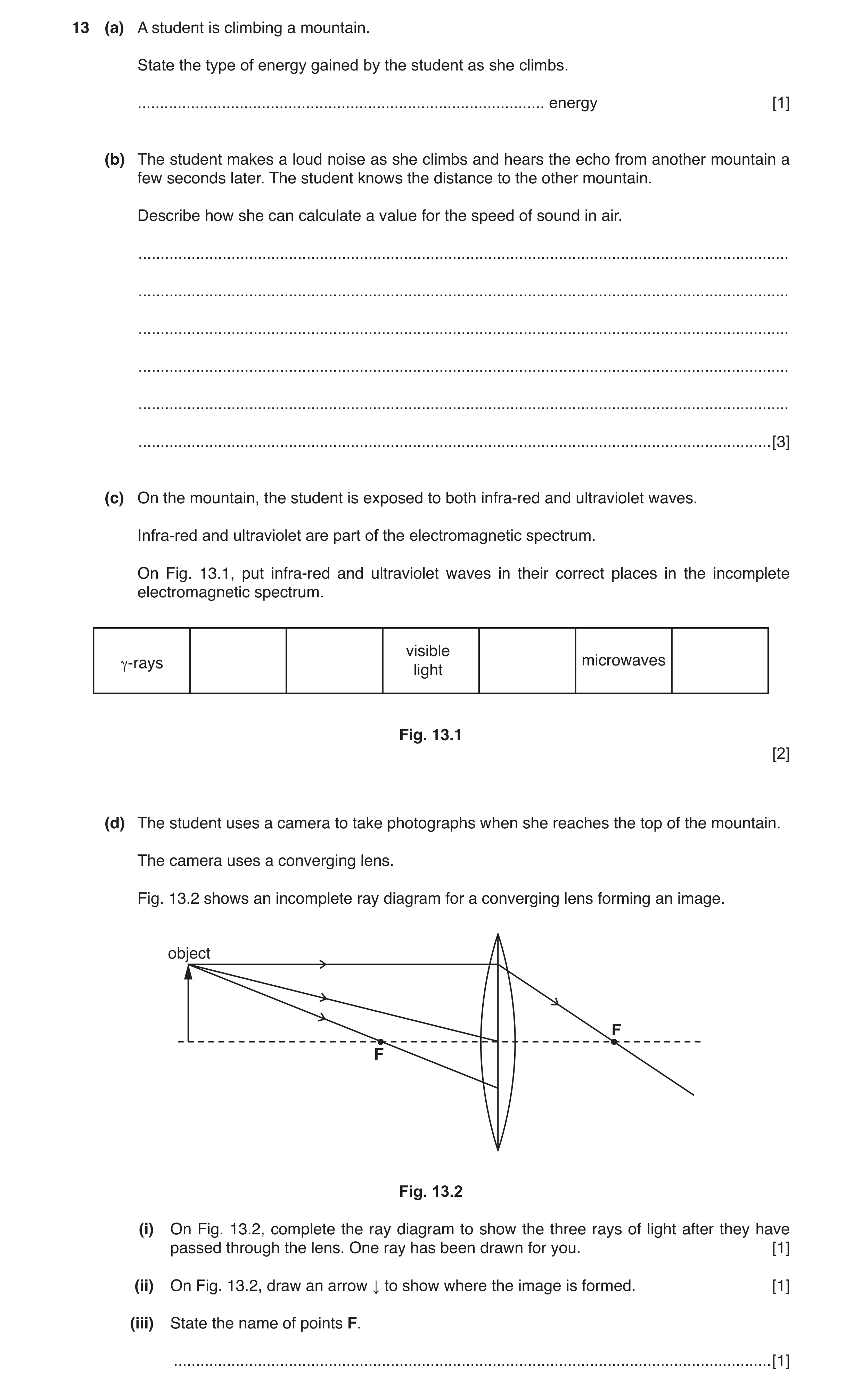
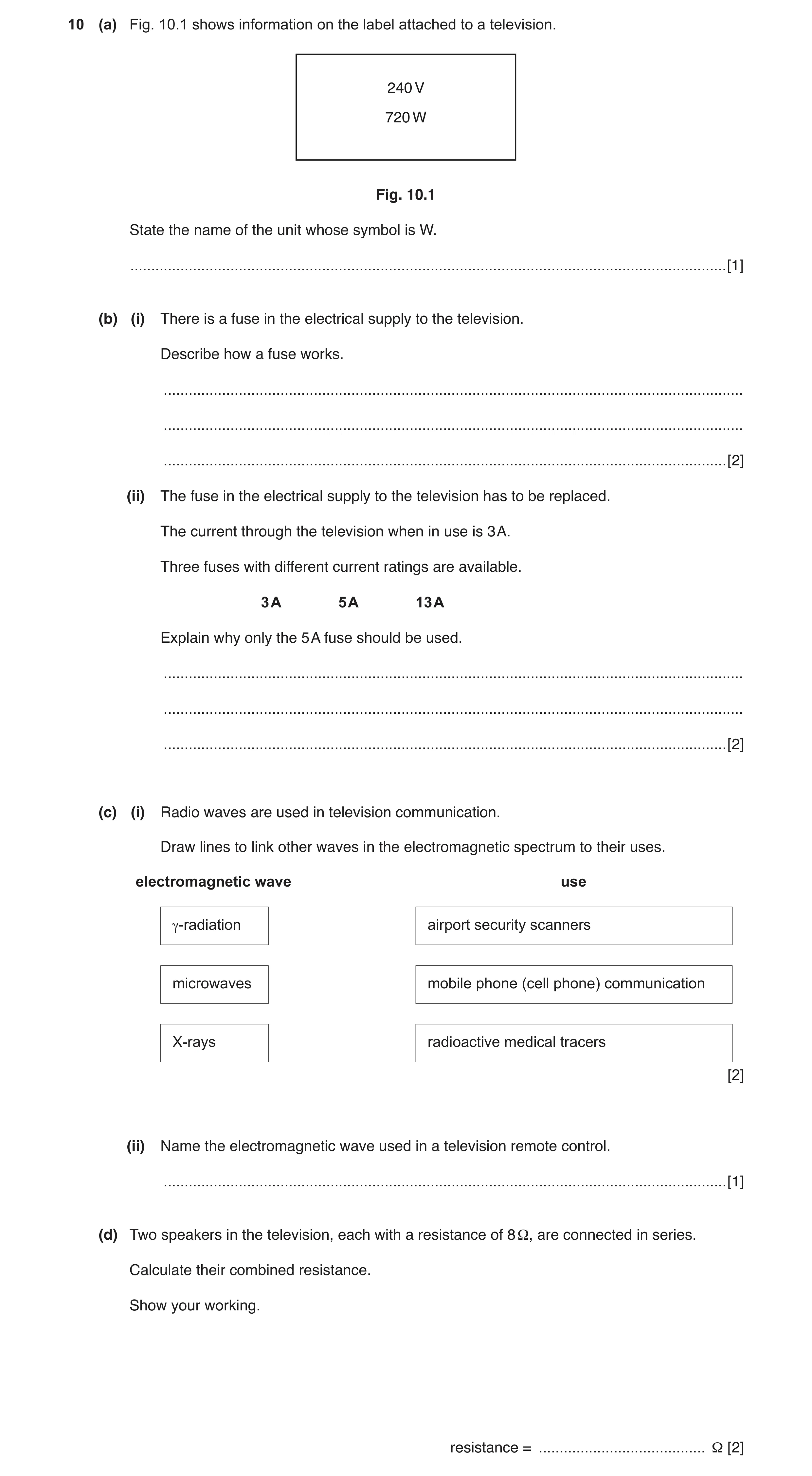
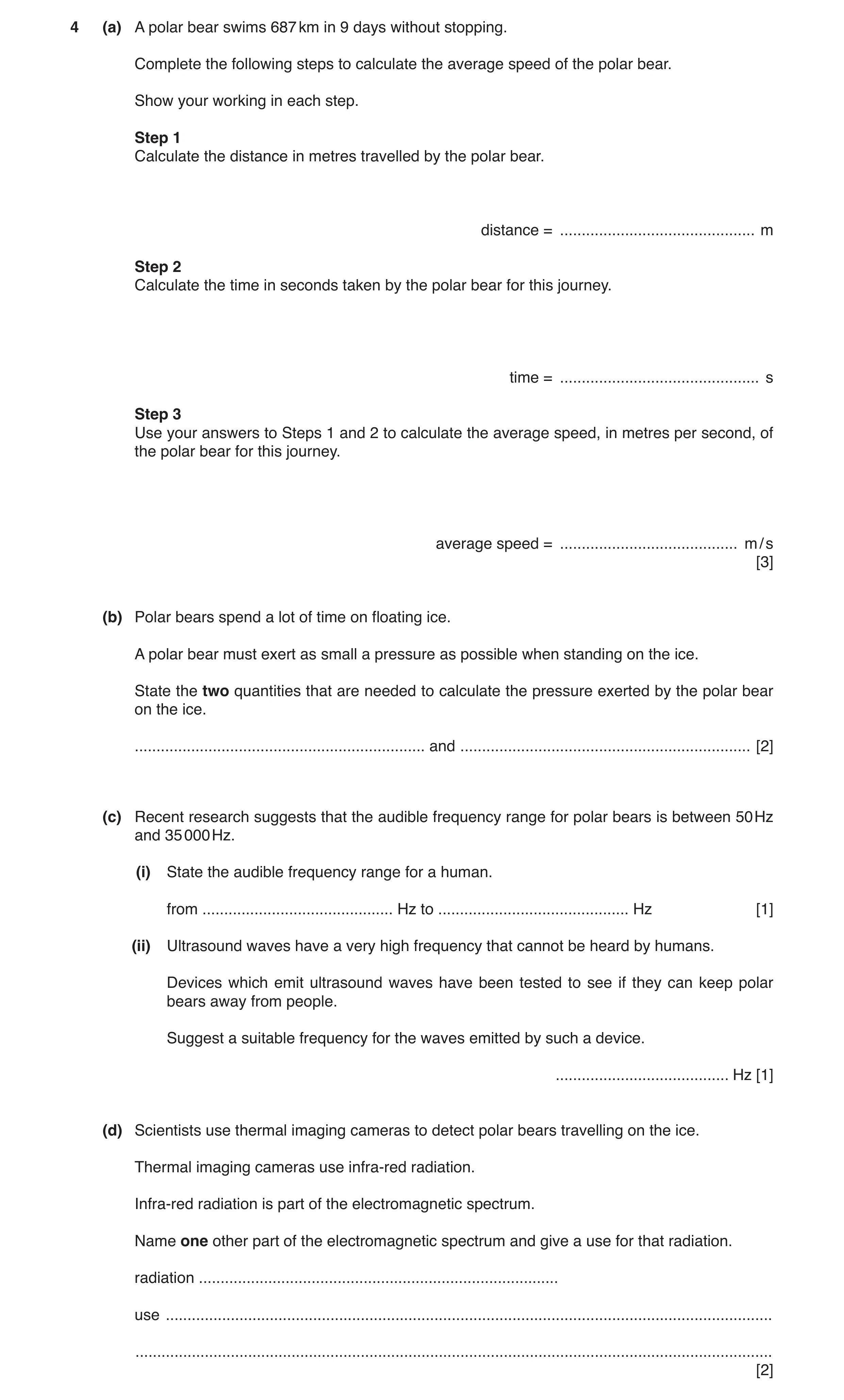
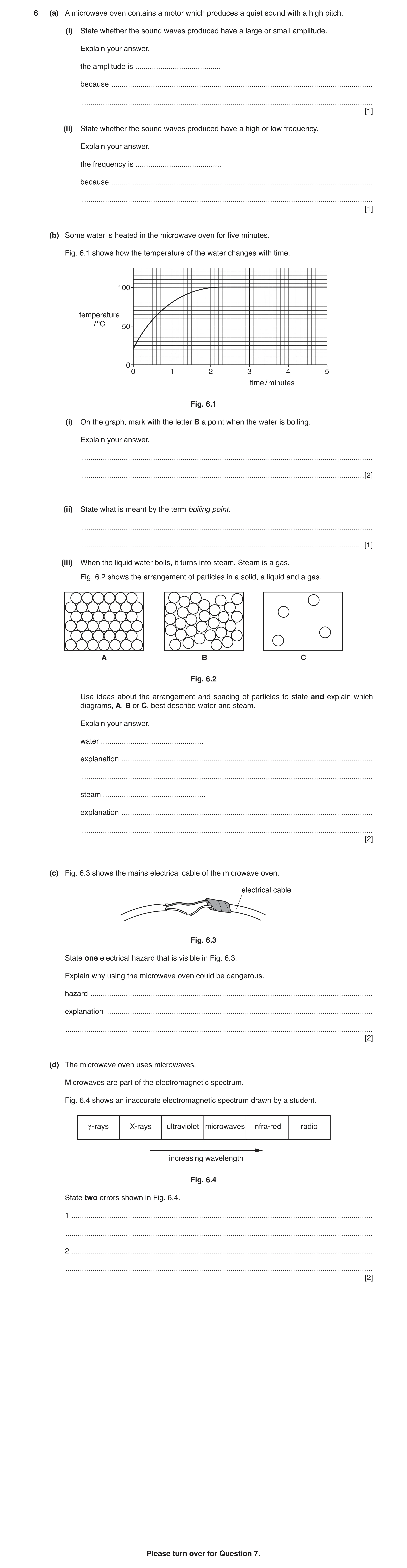
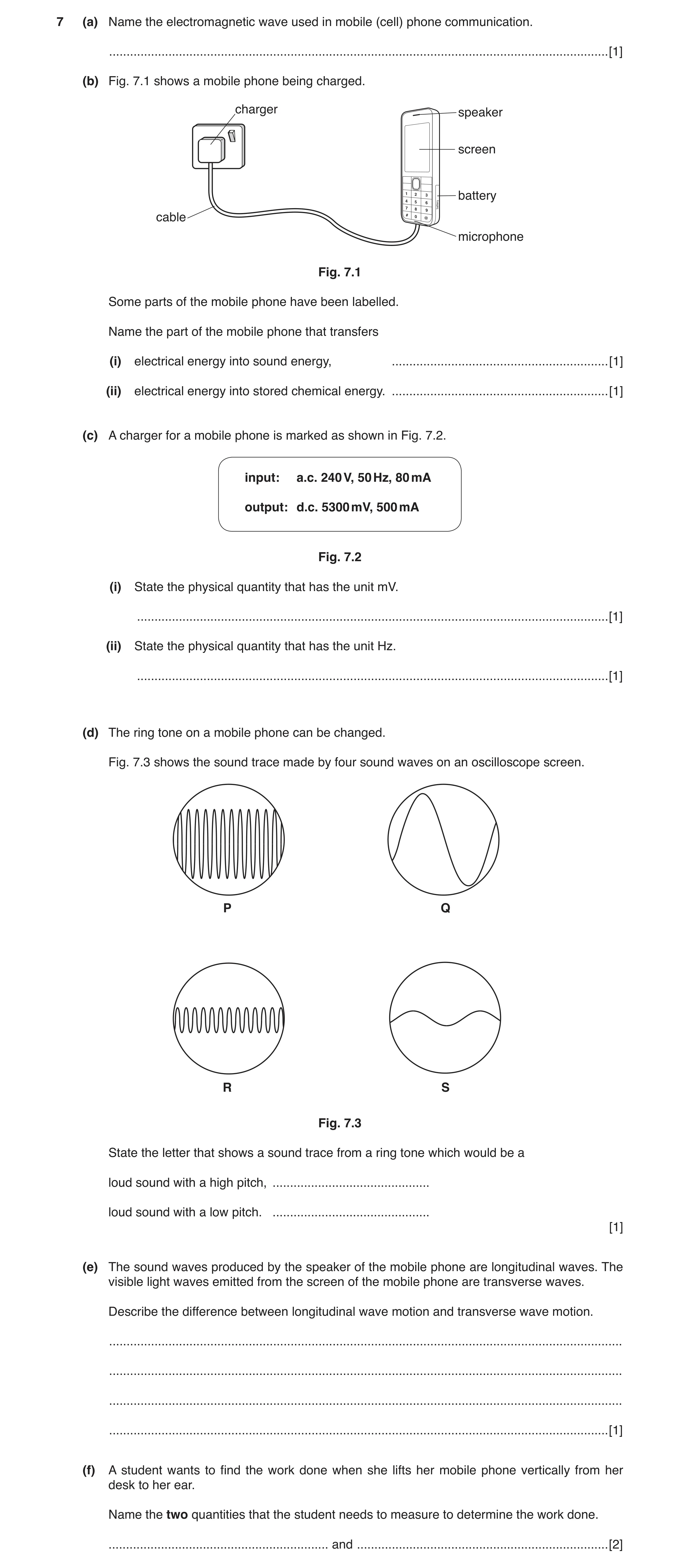
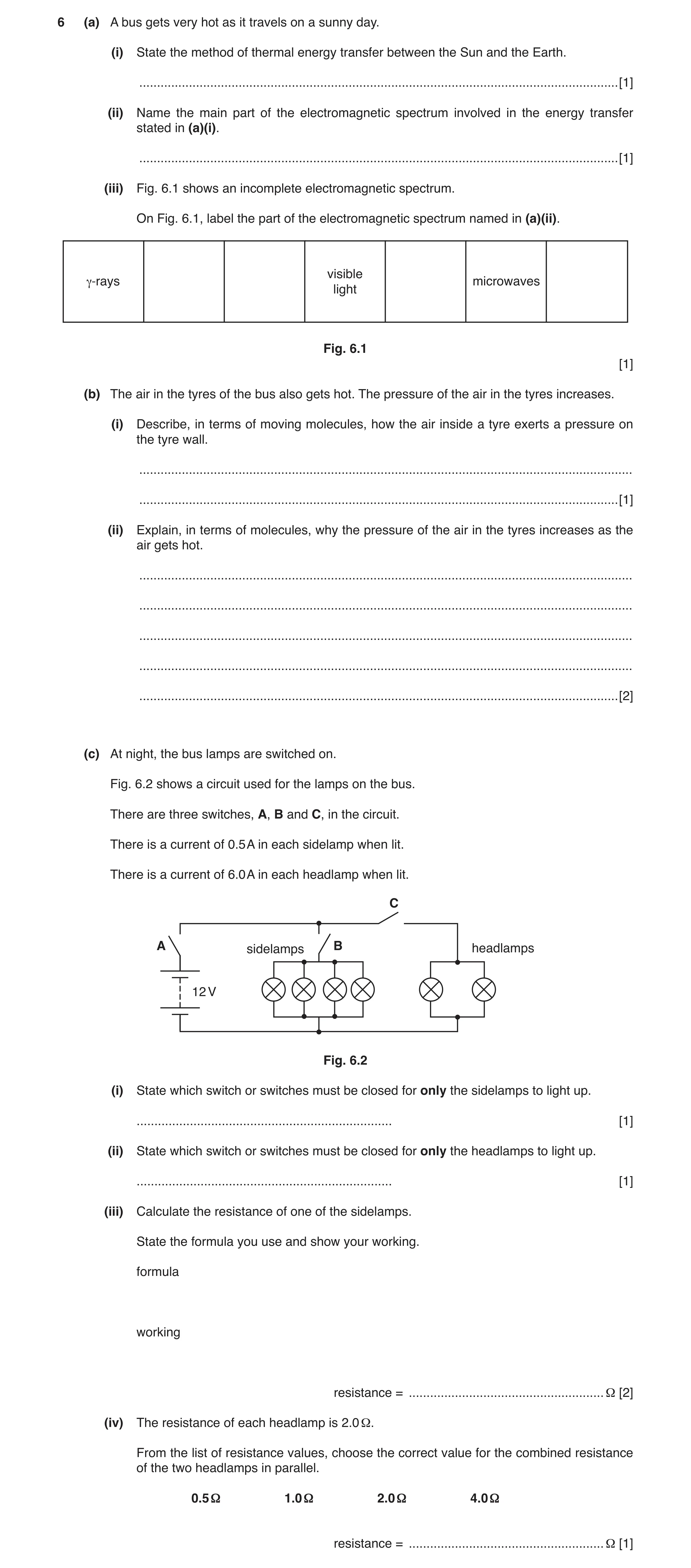
 11 / 69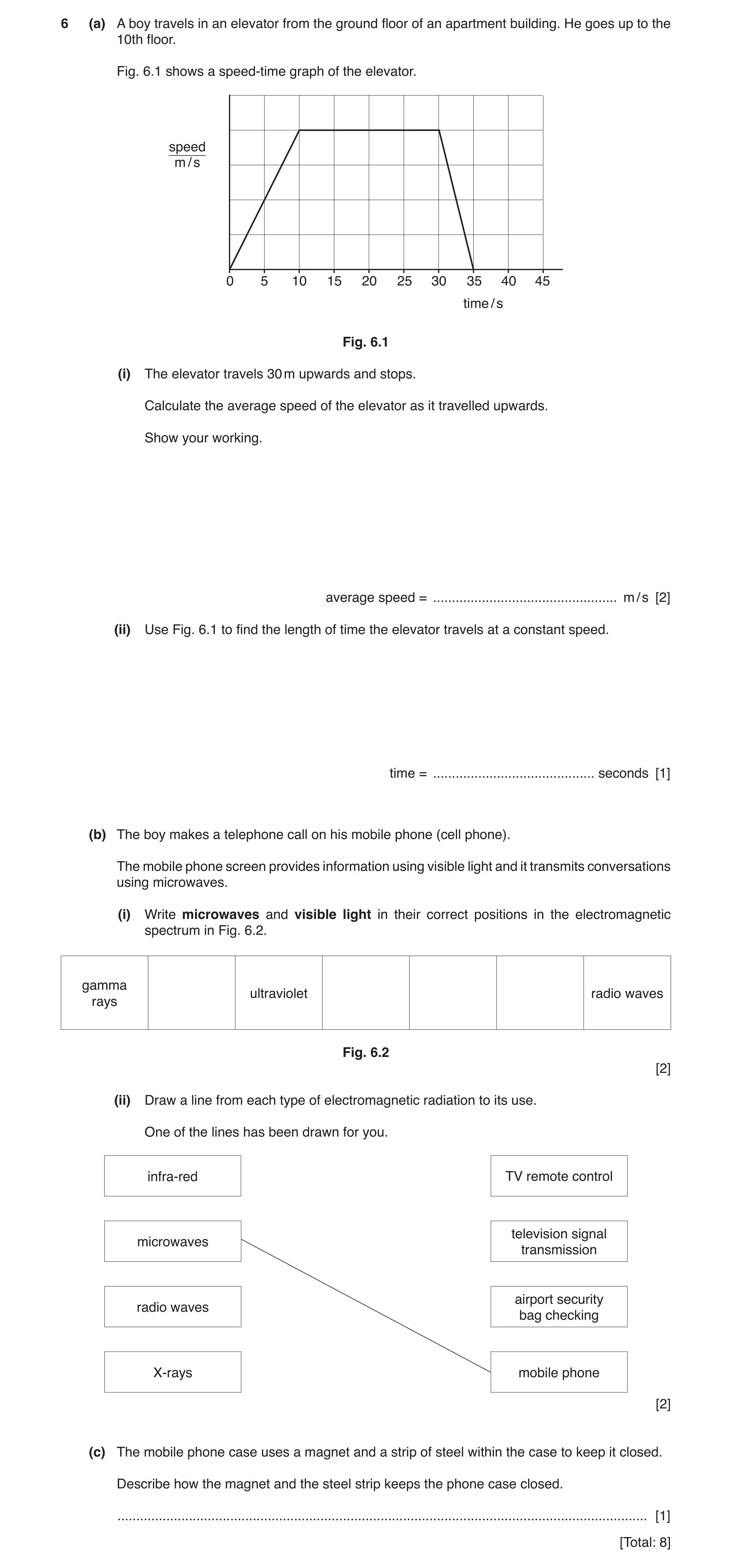
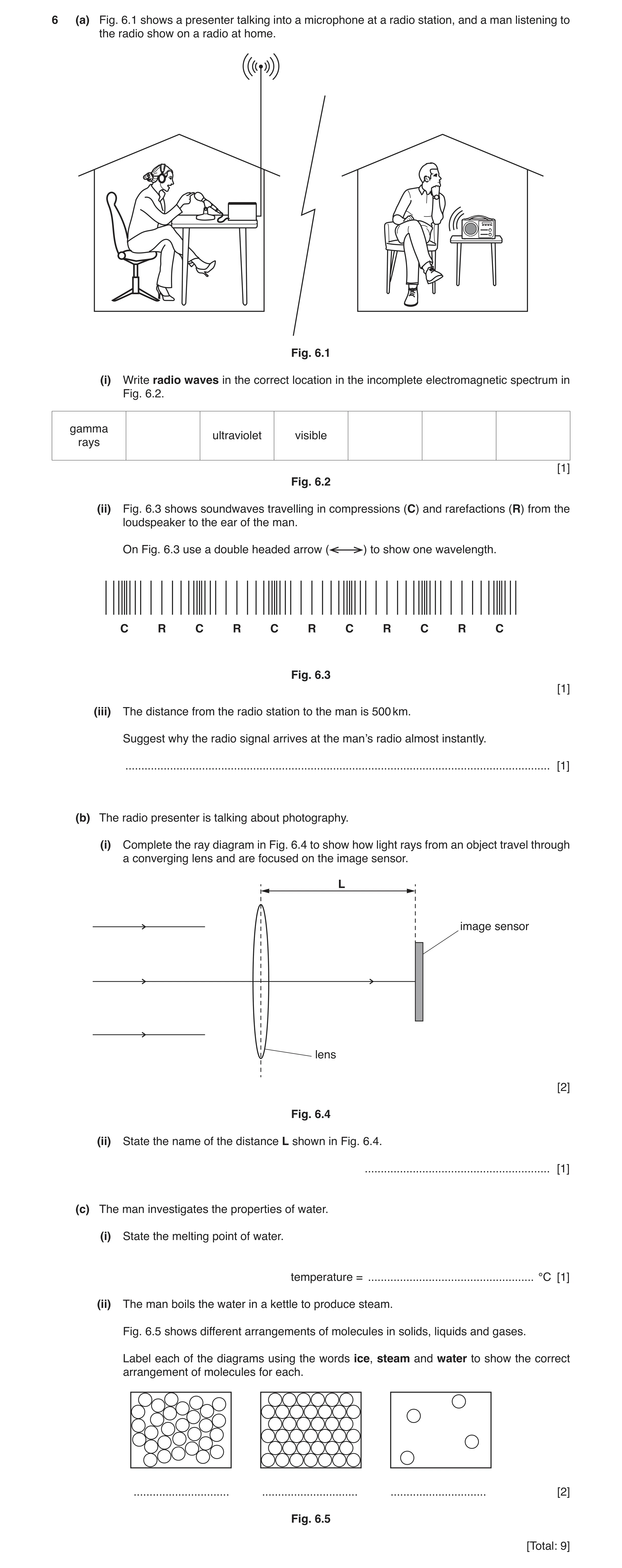
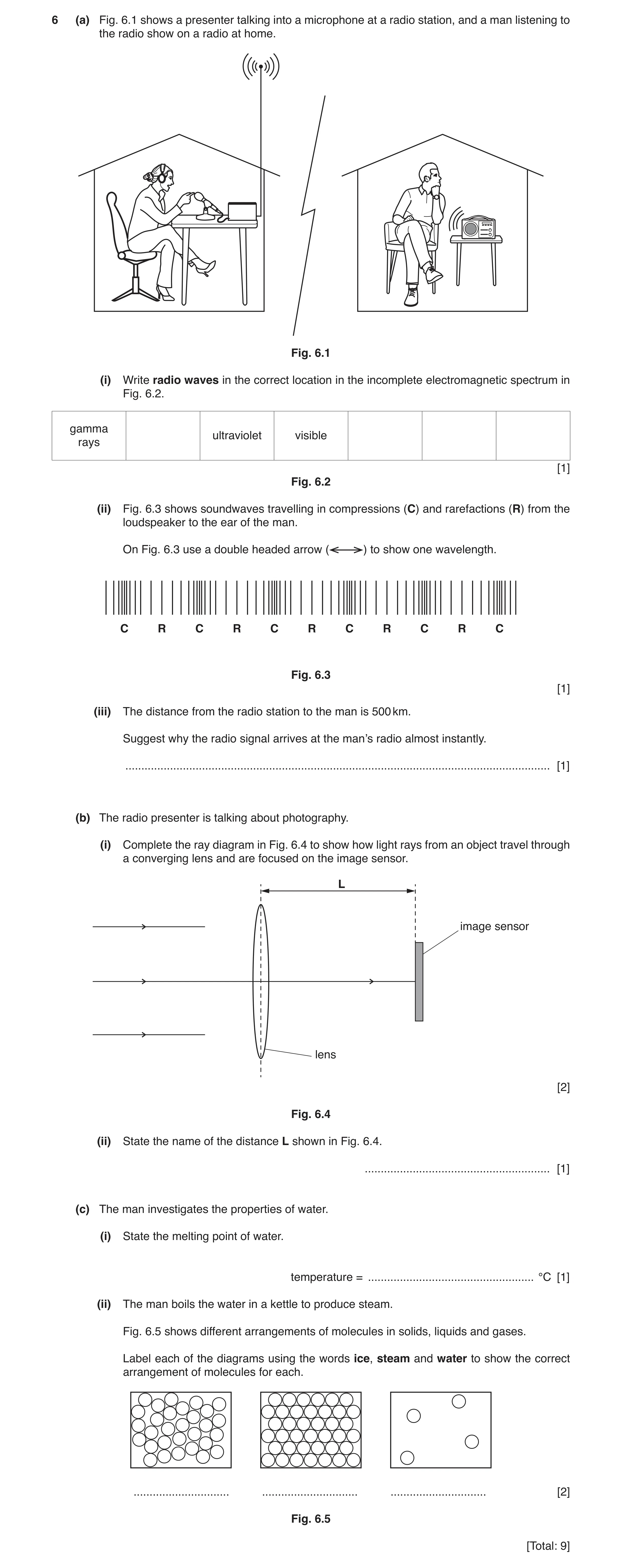
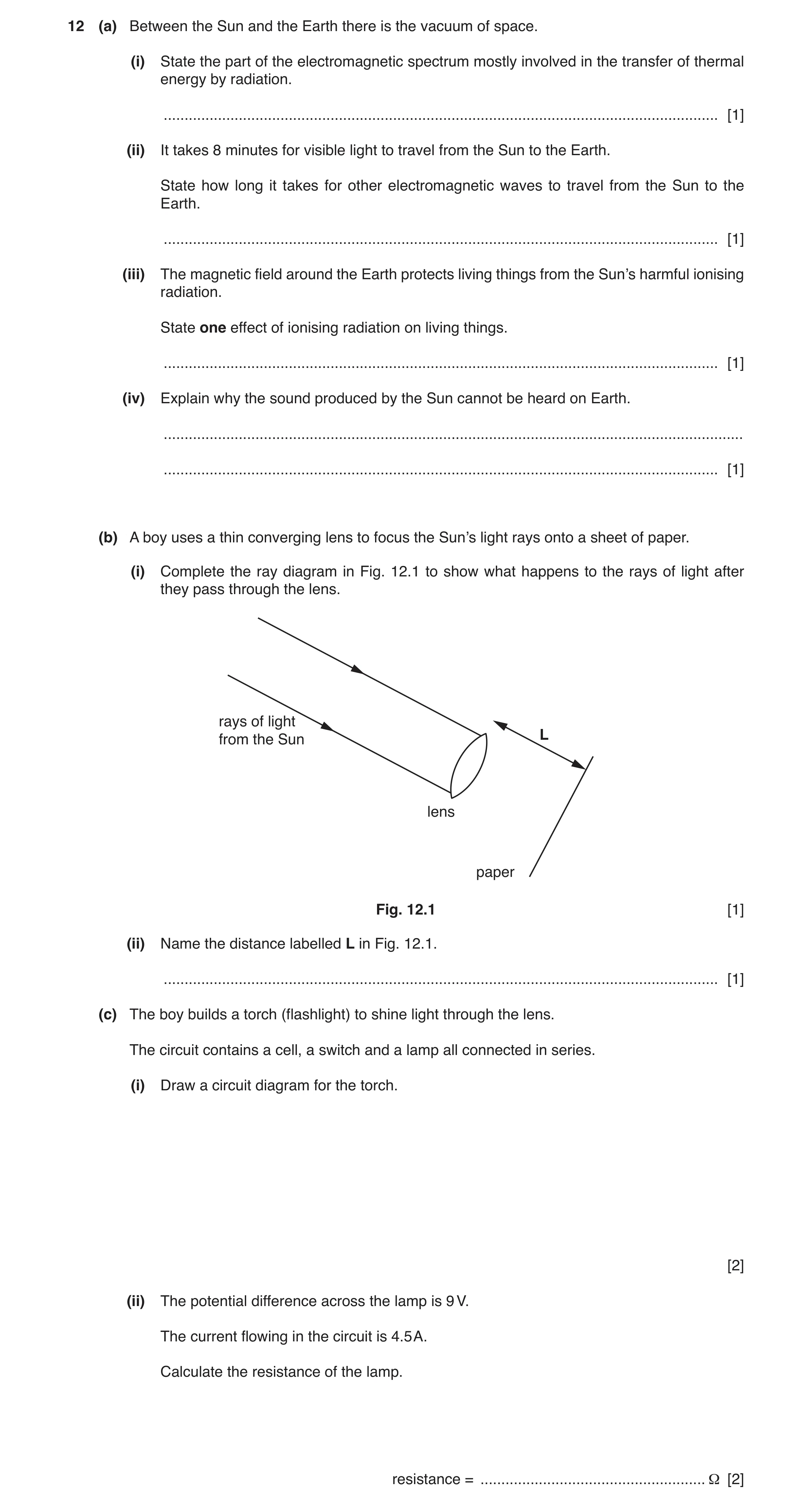
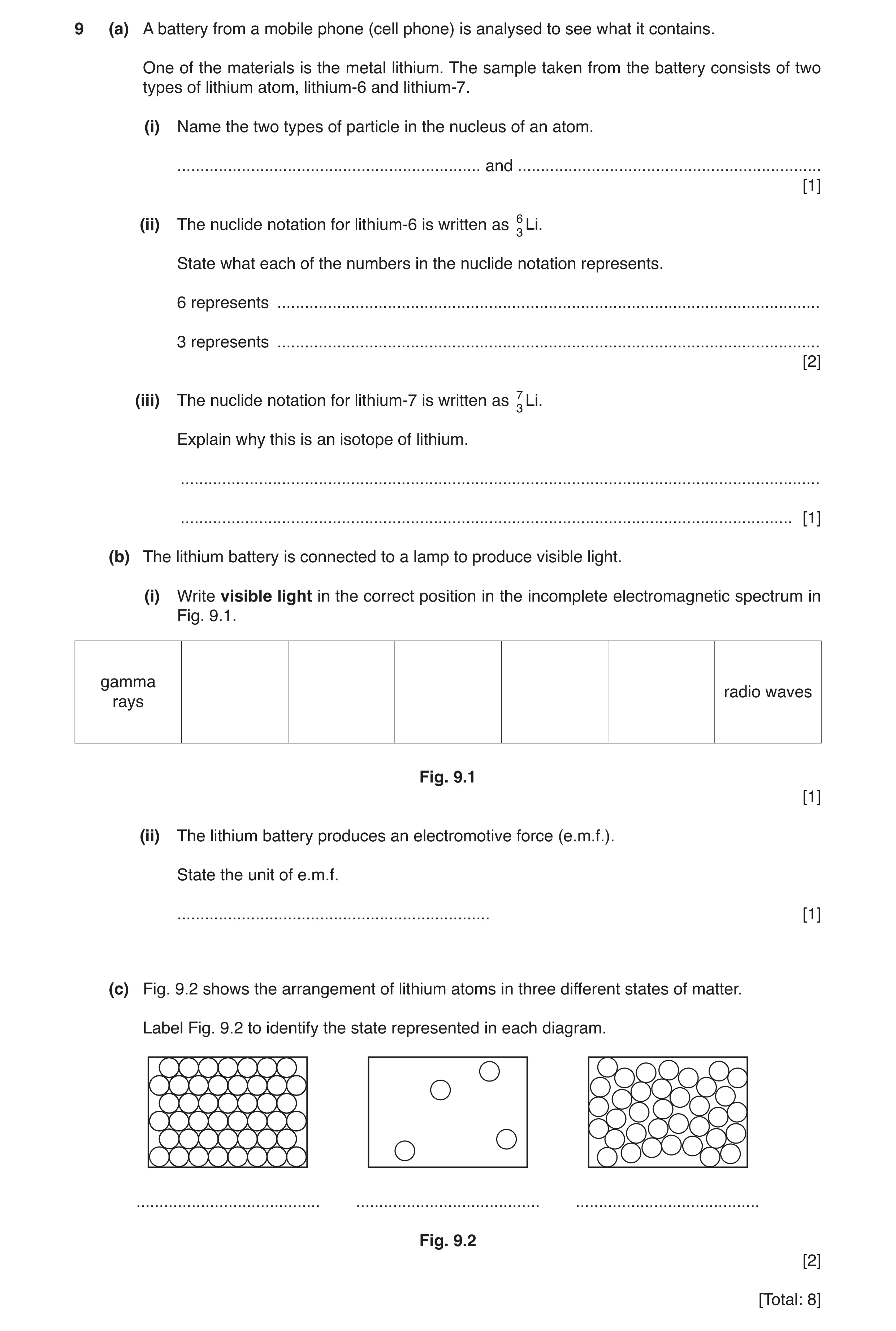
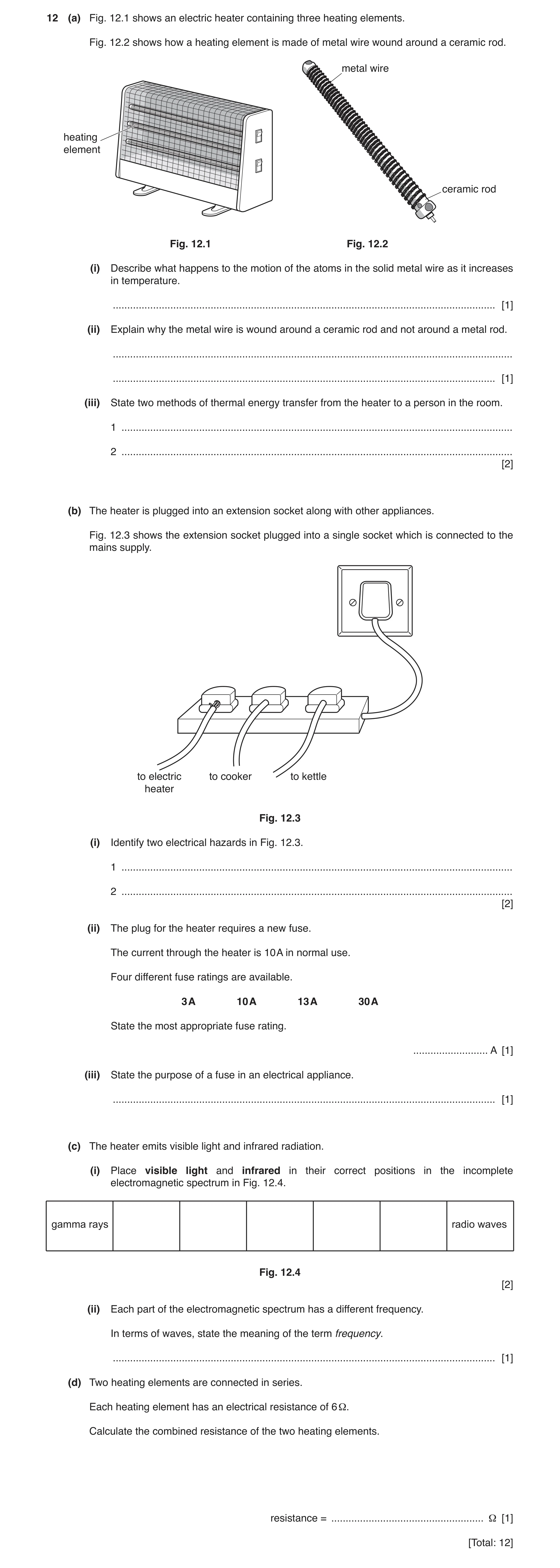
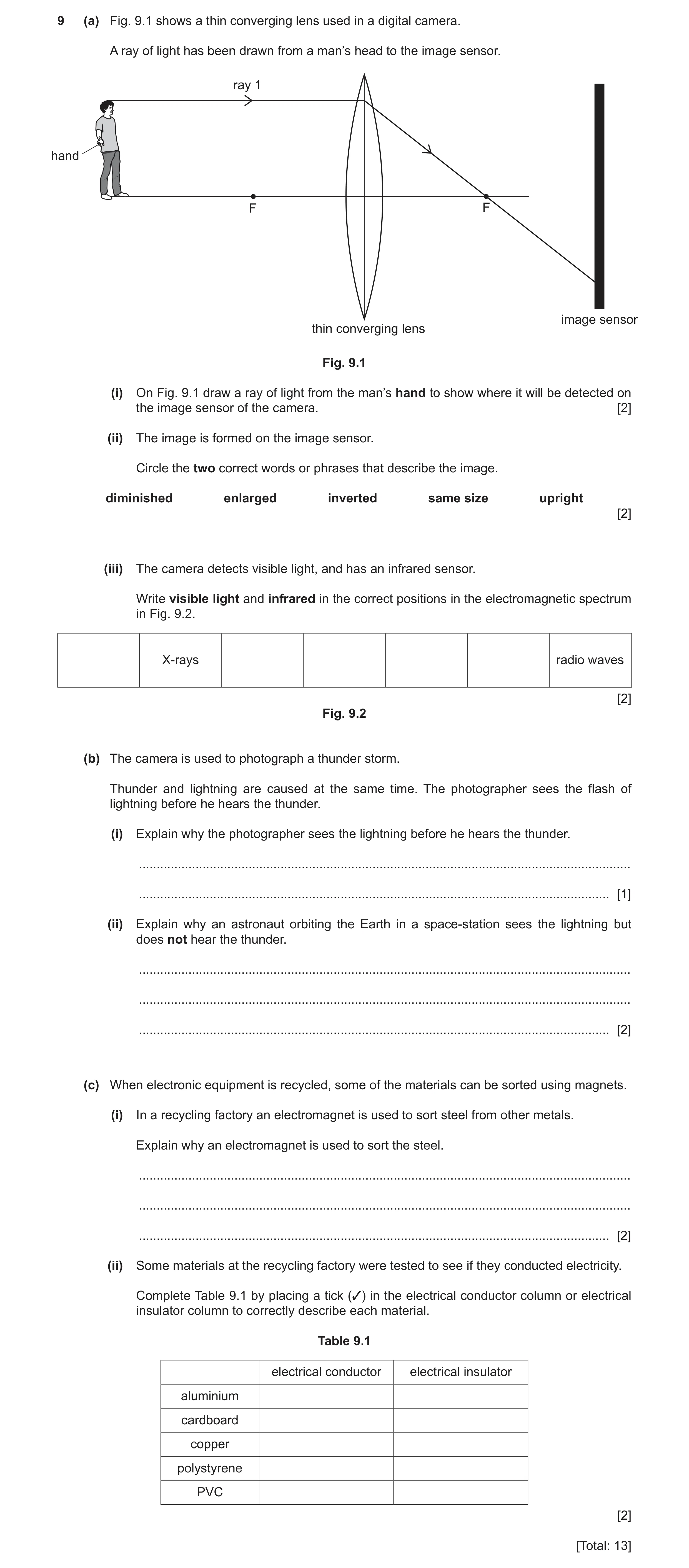
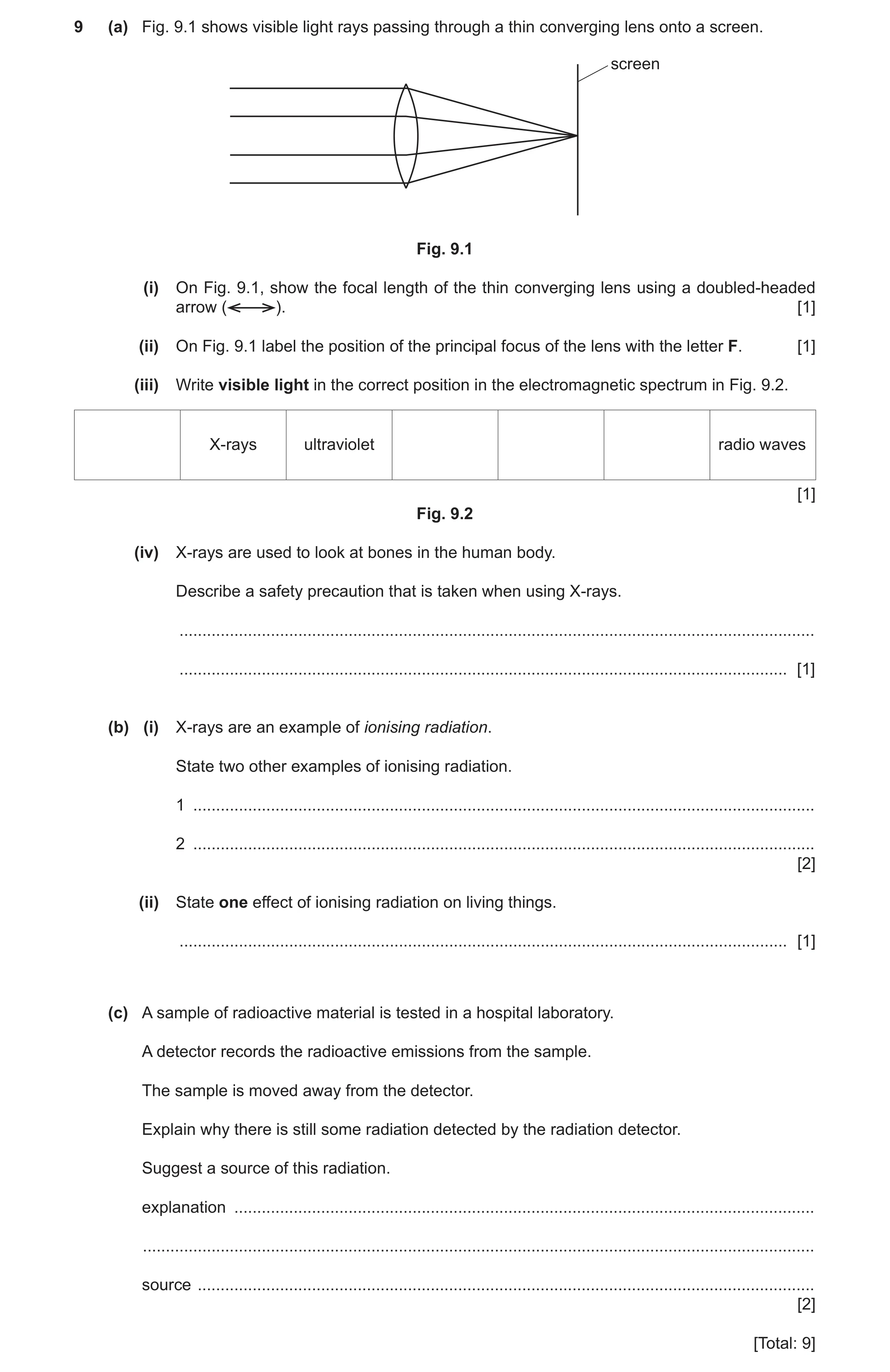
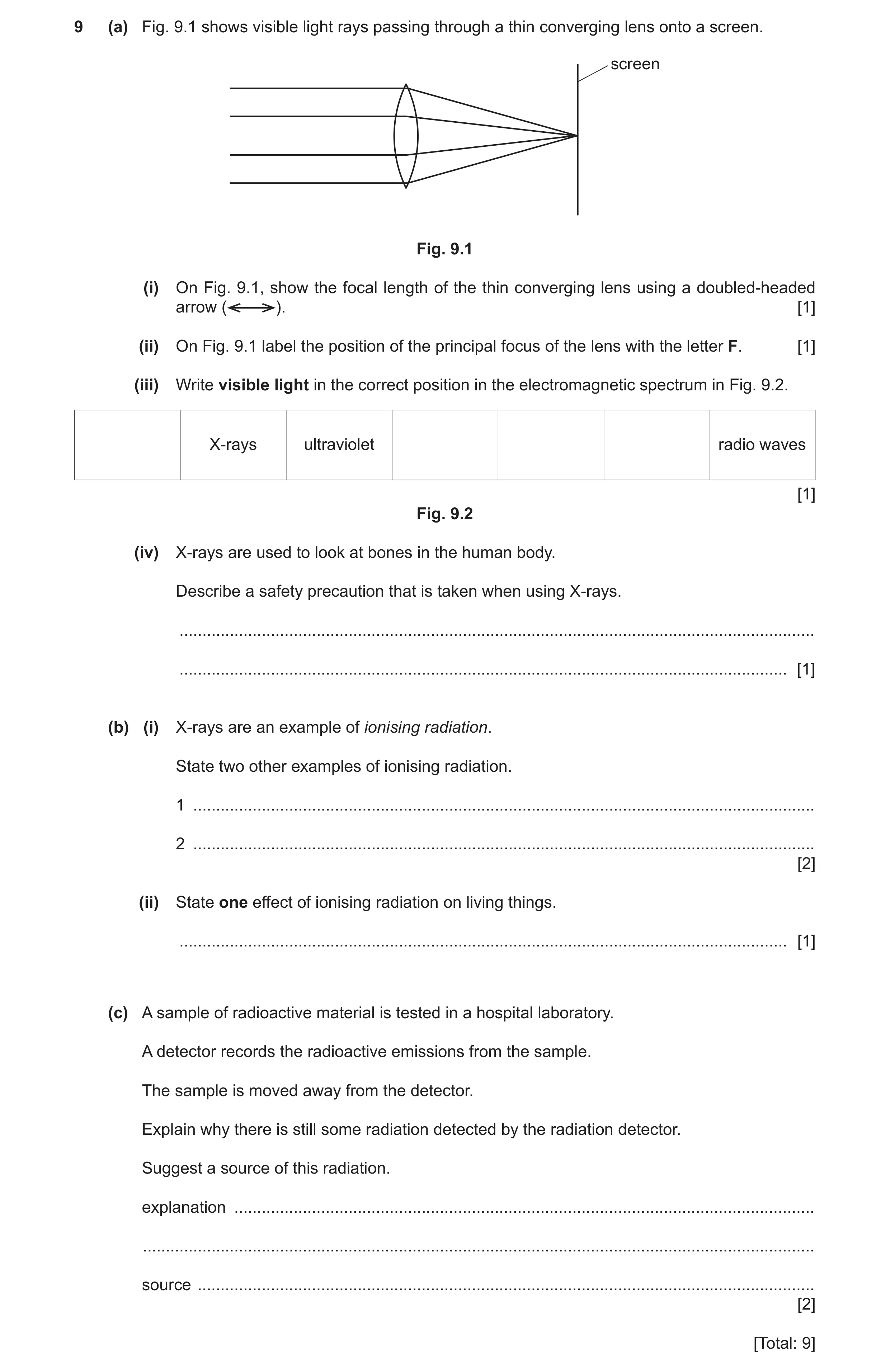
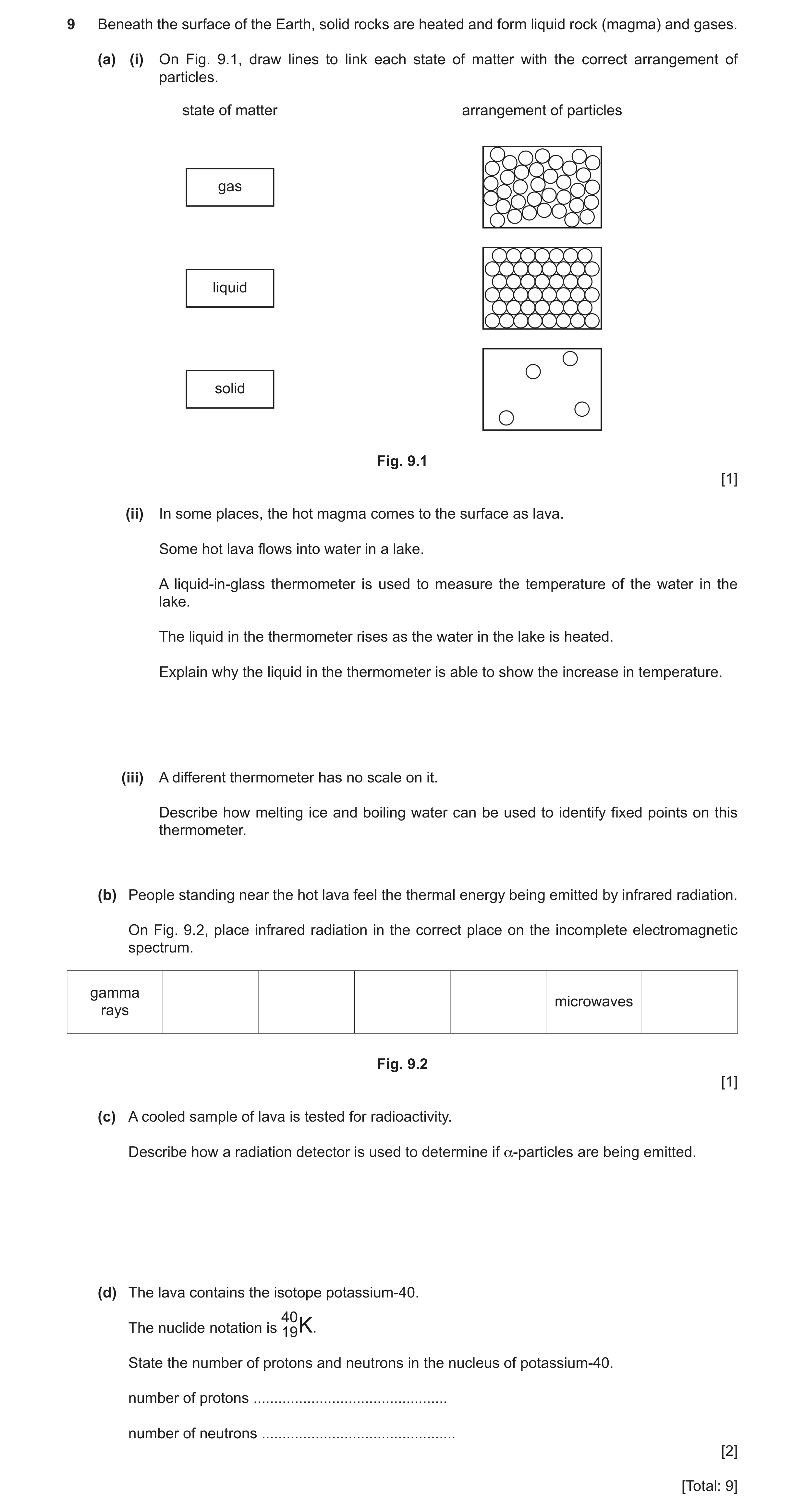
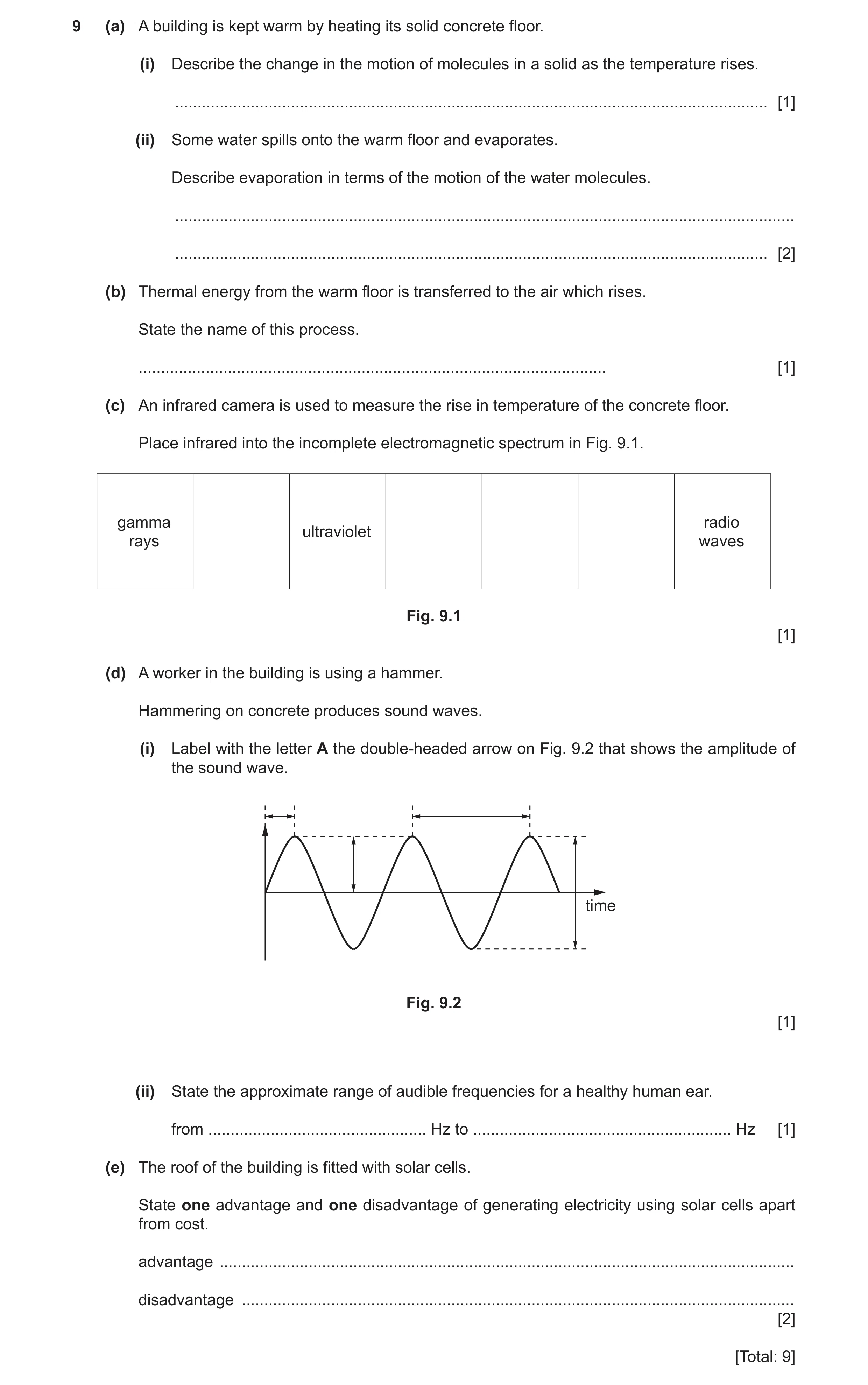
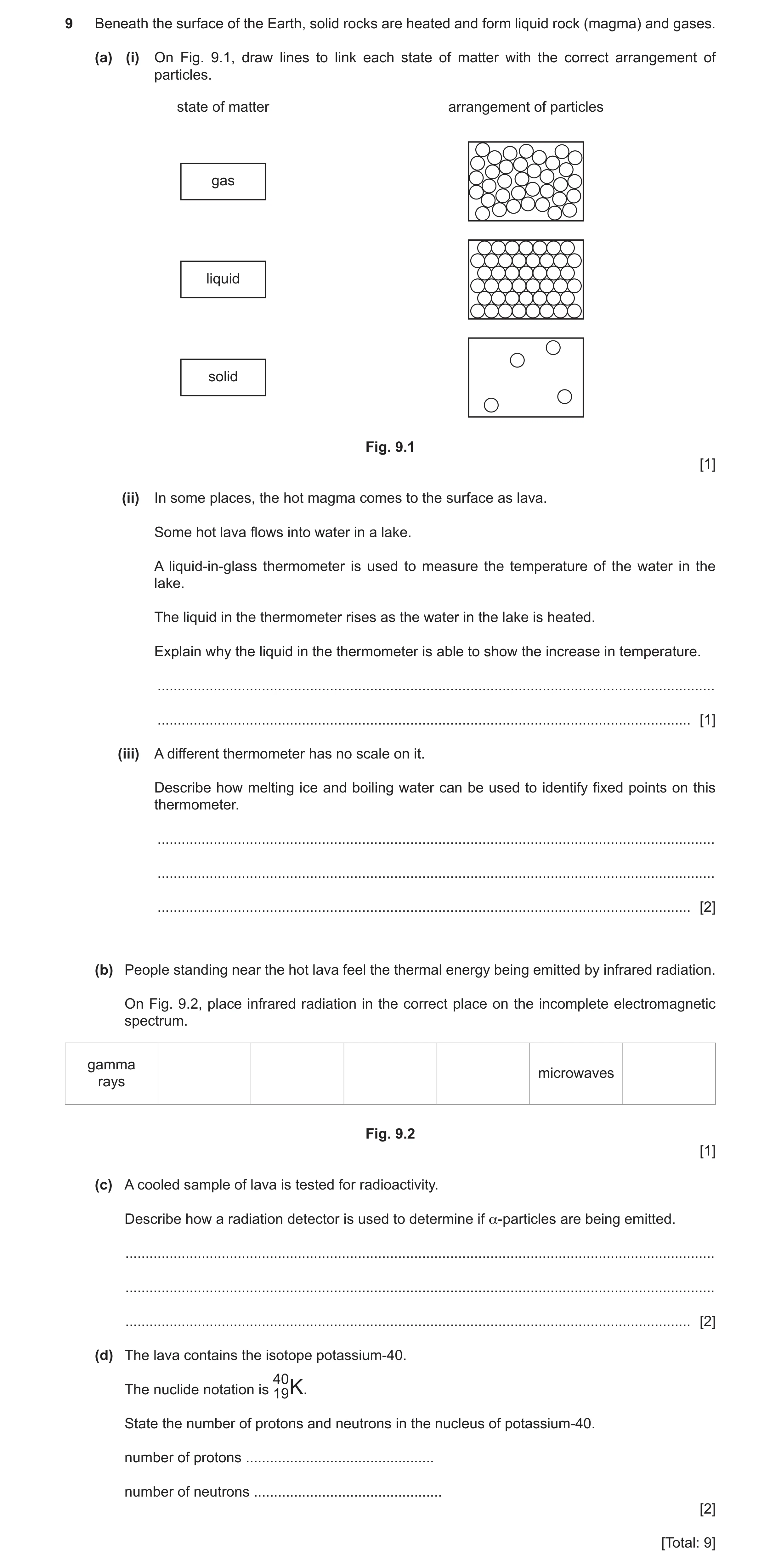
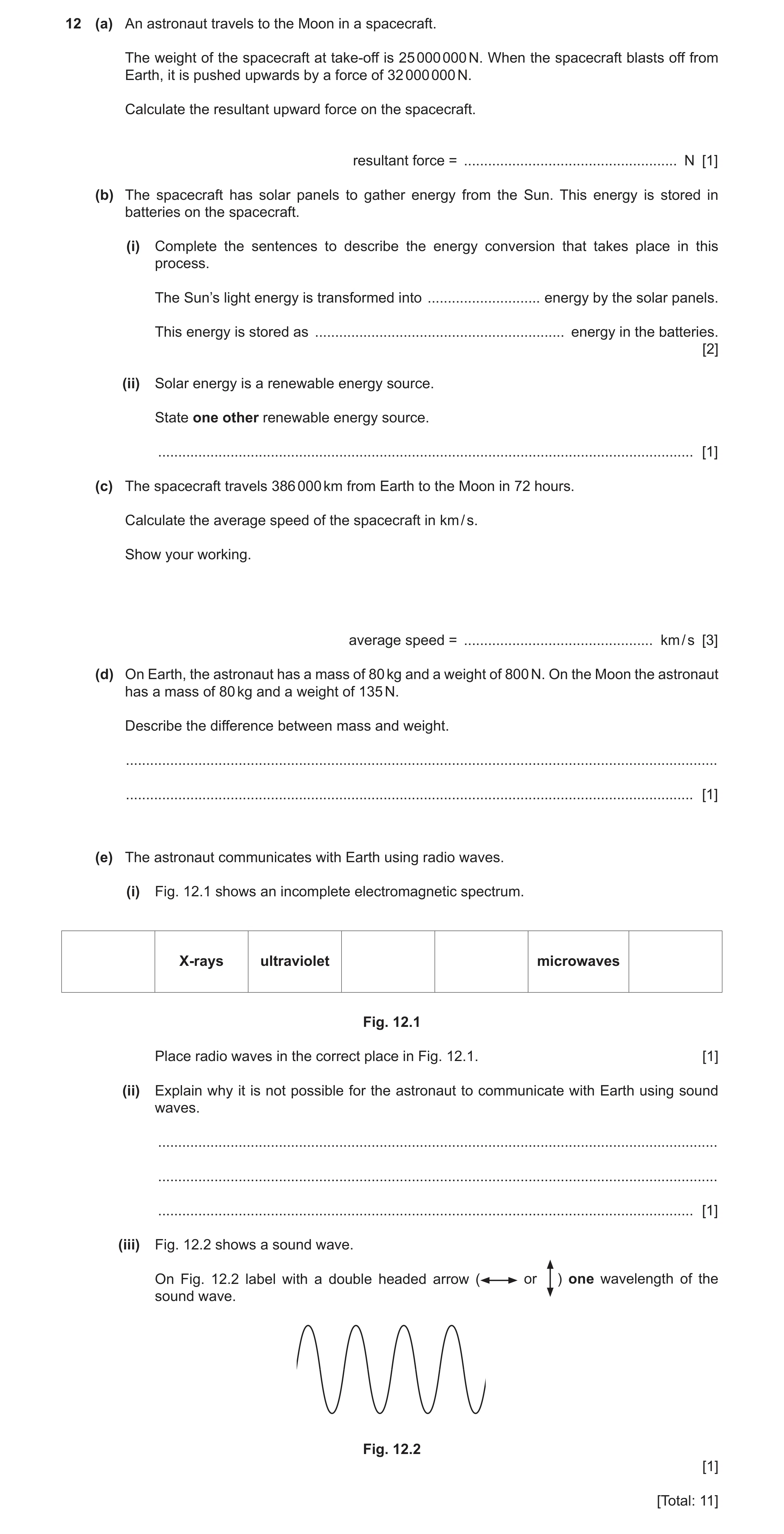
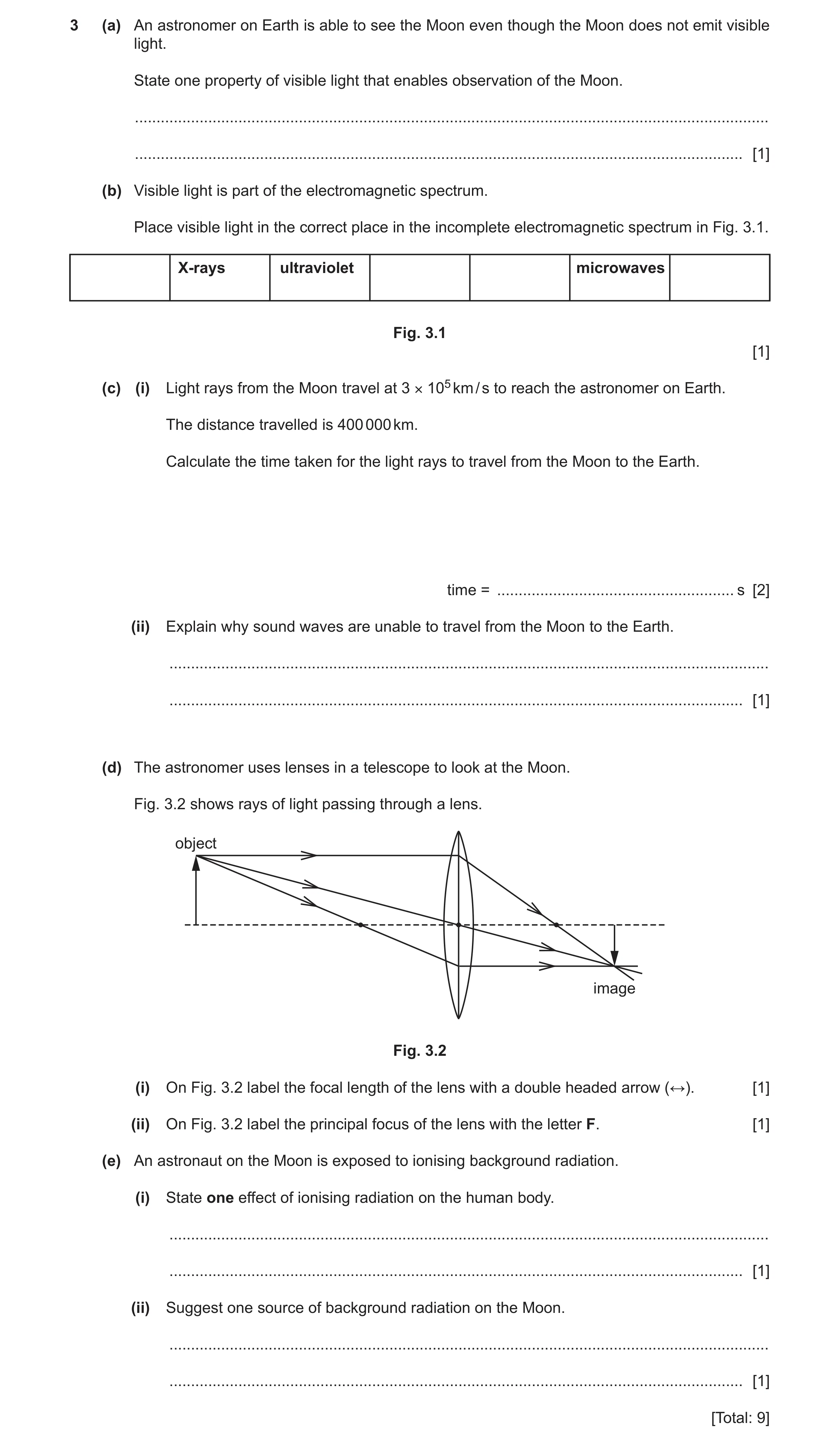
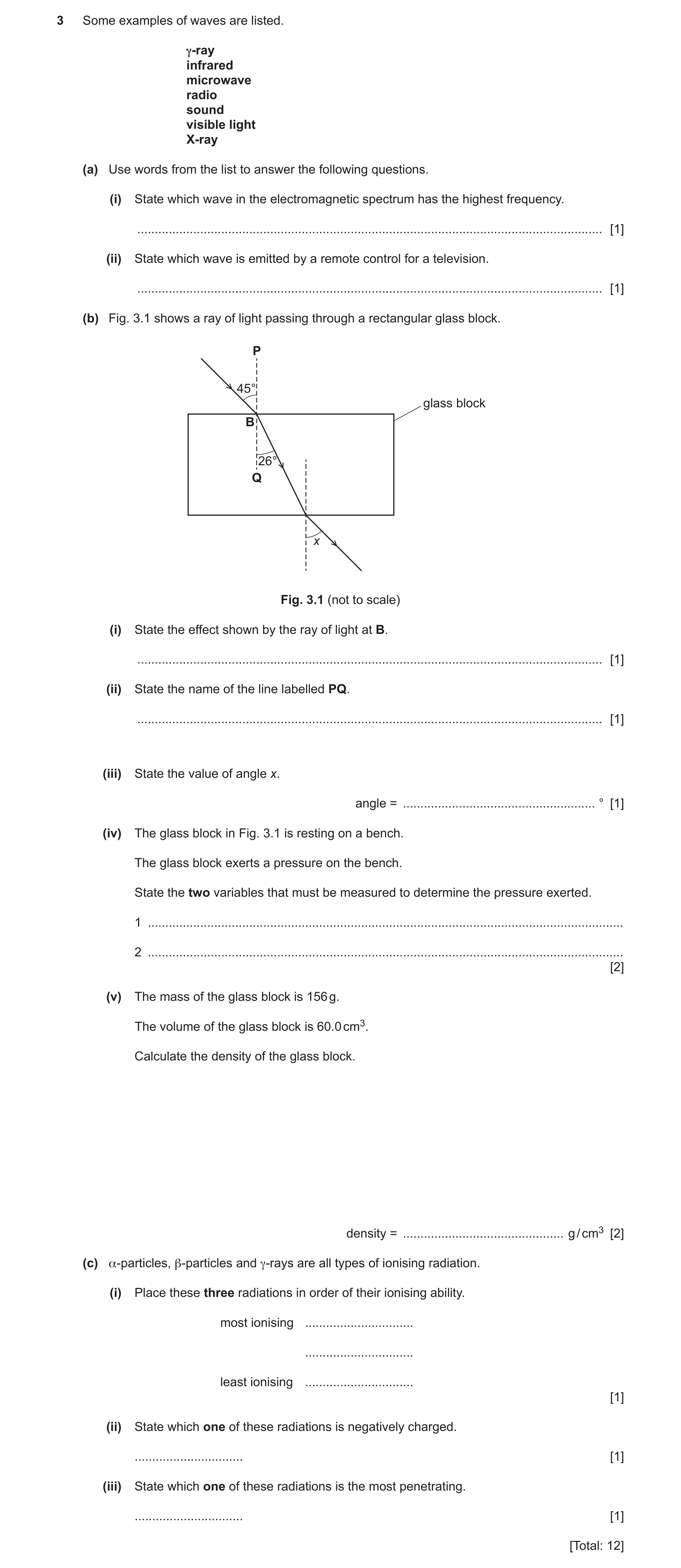
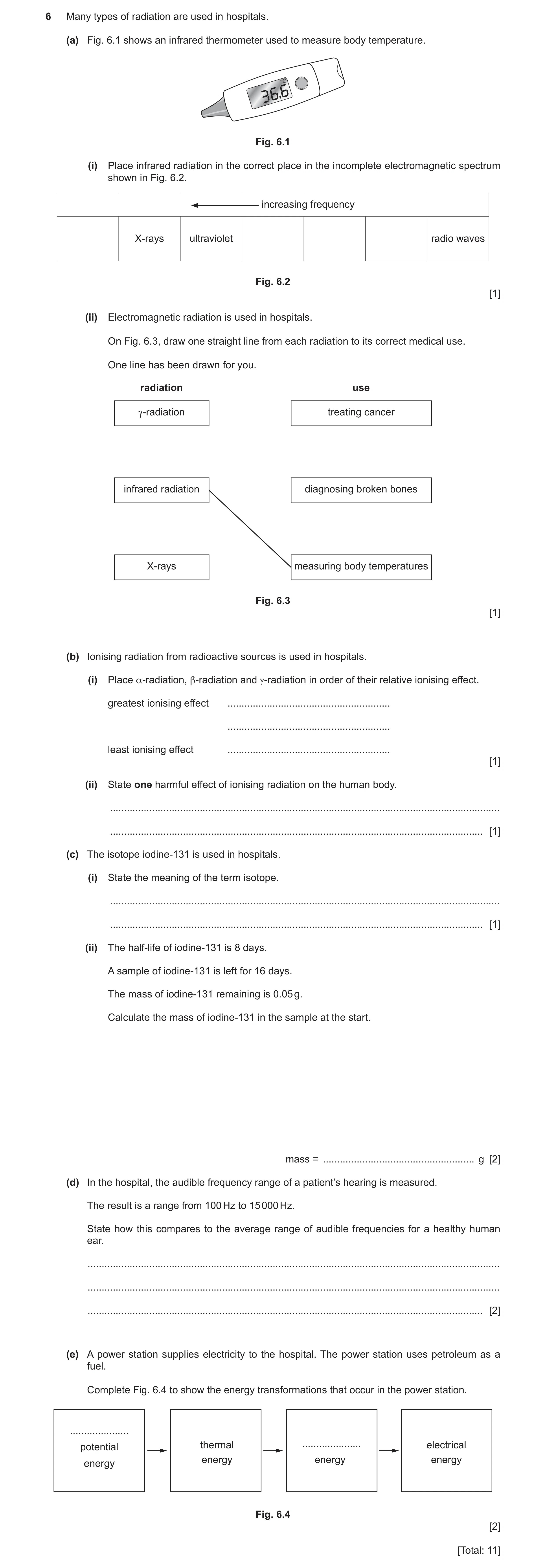
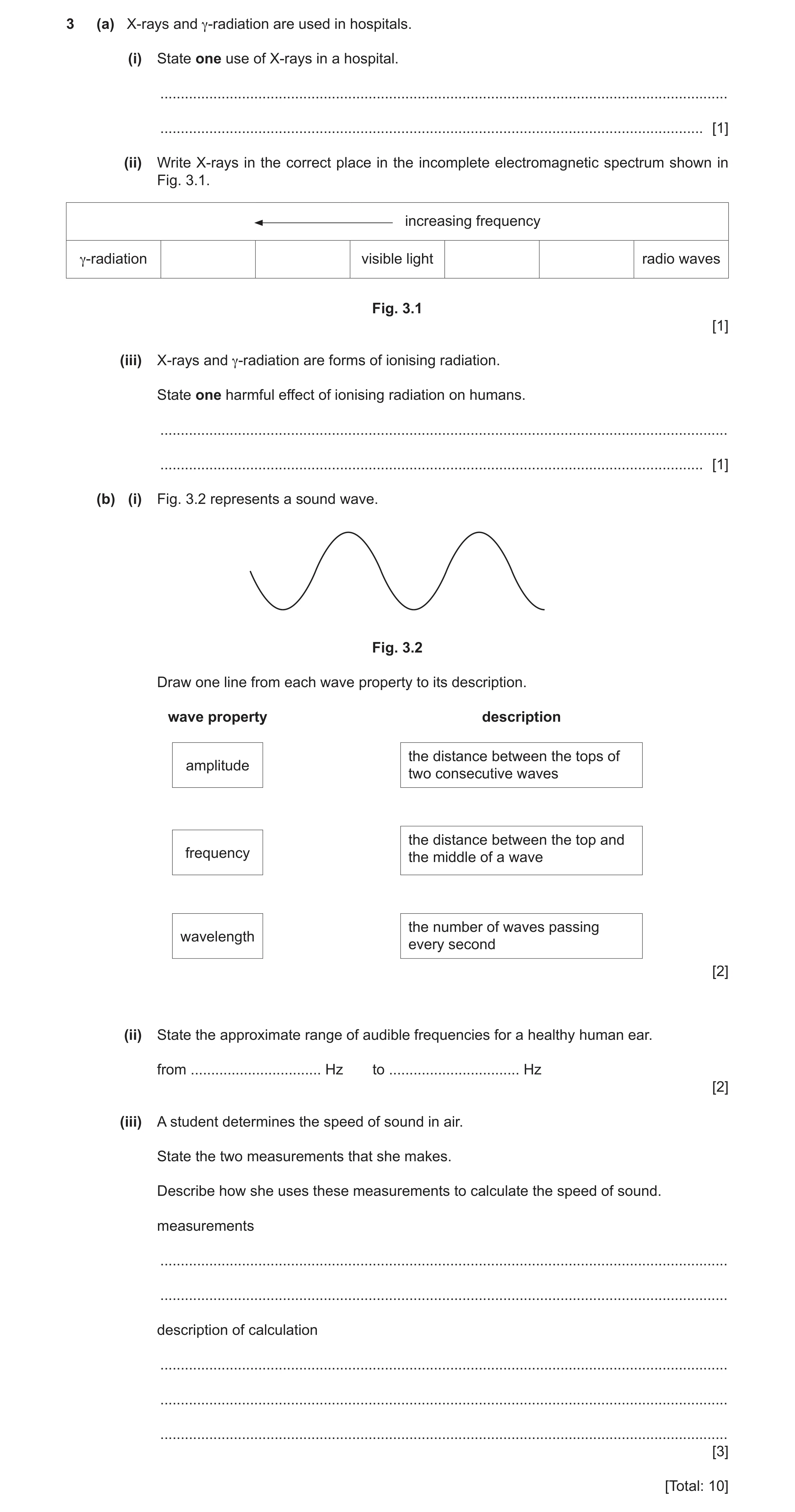
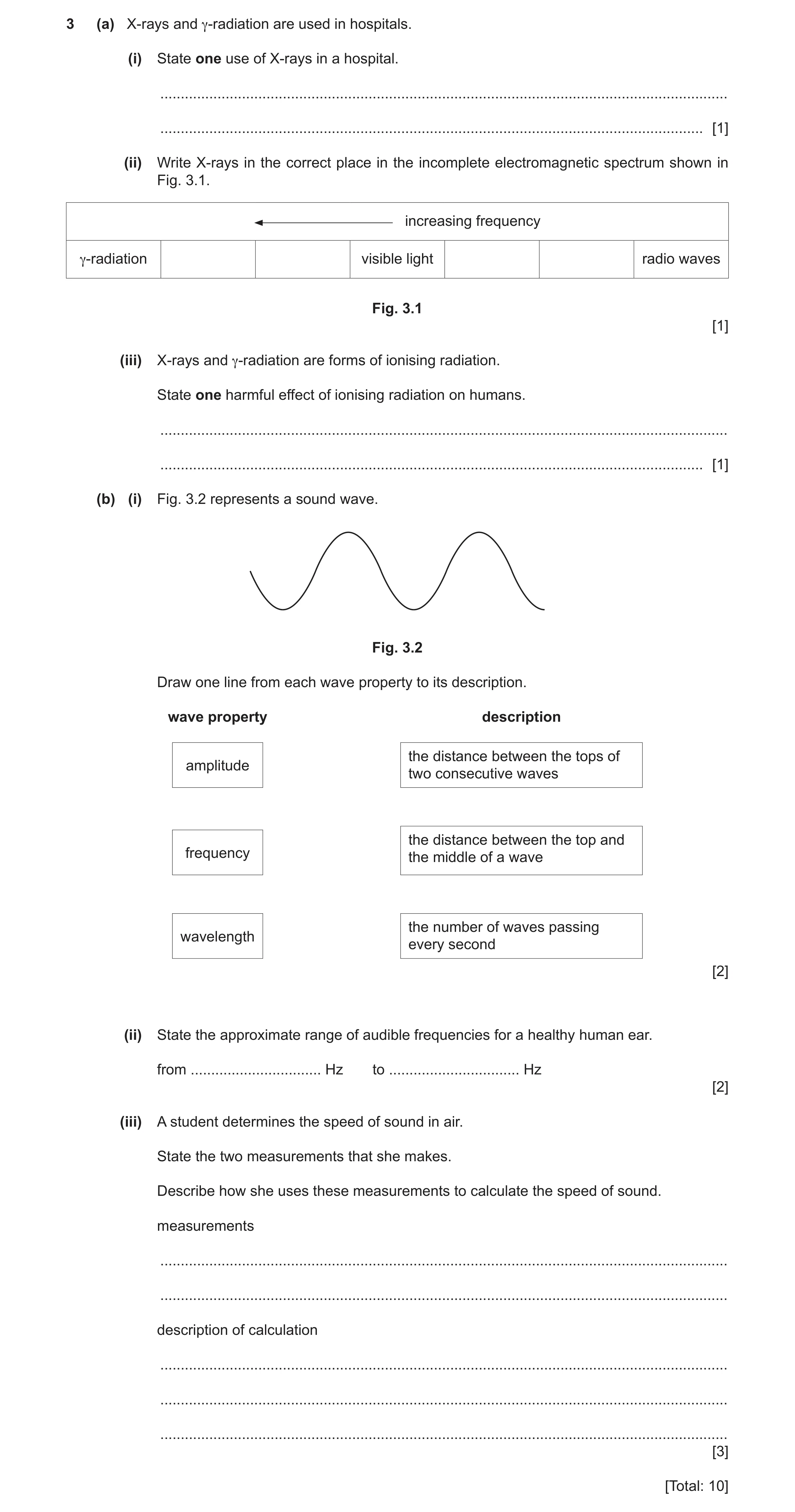
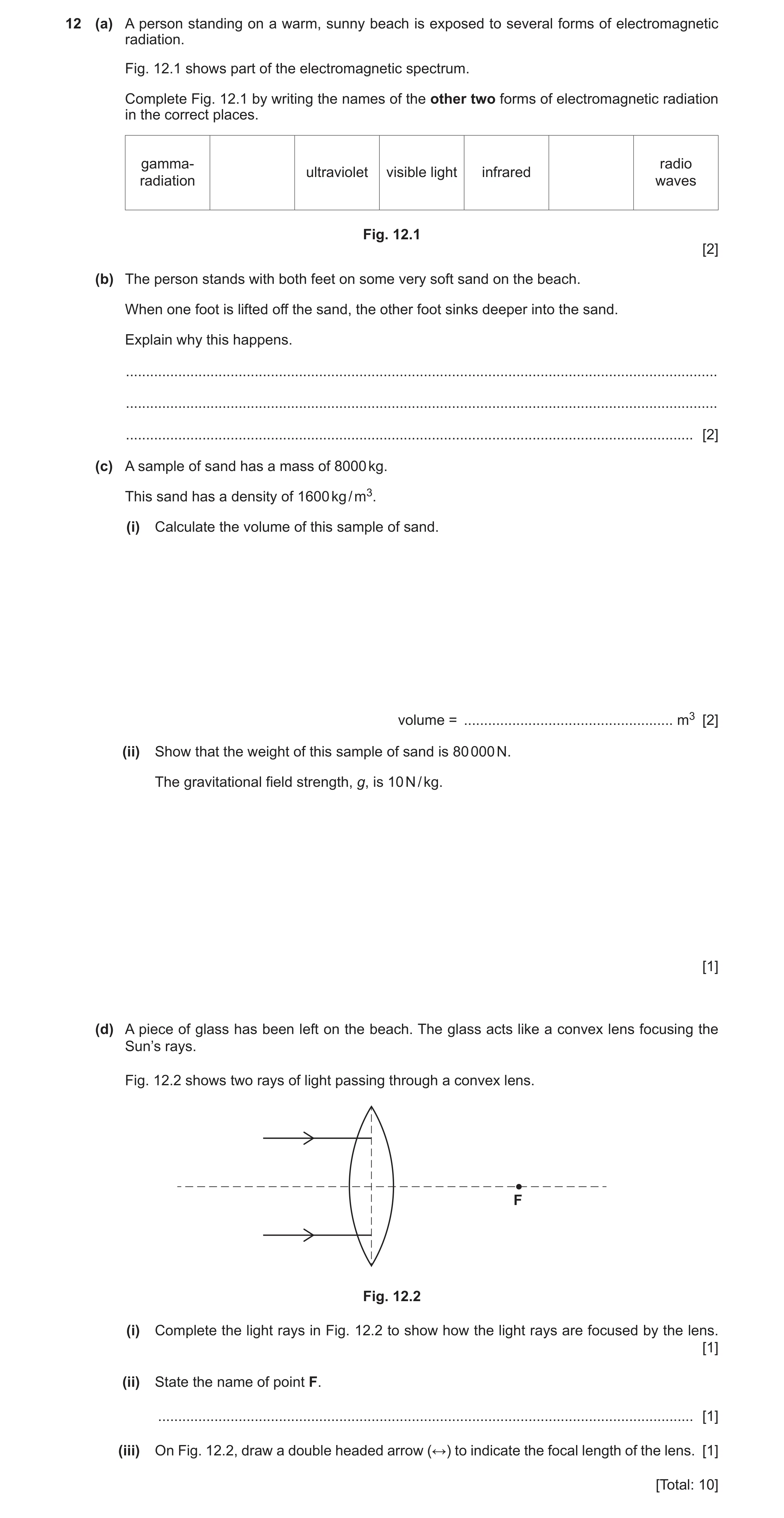
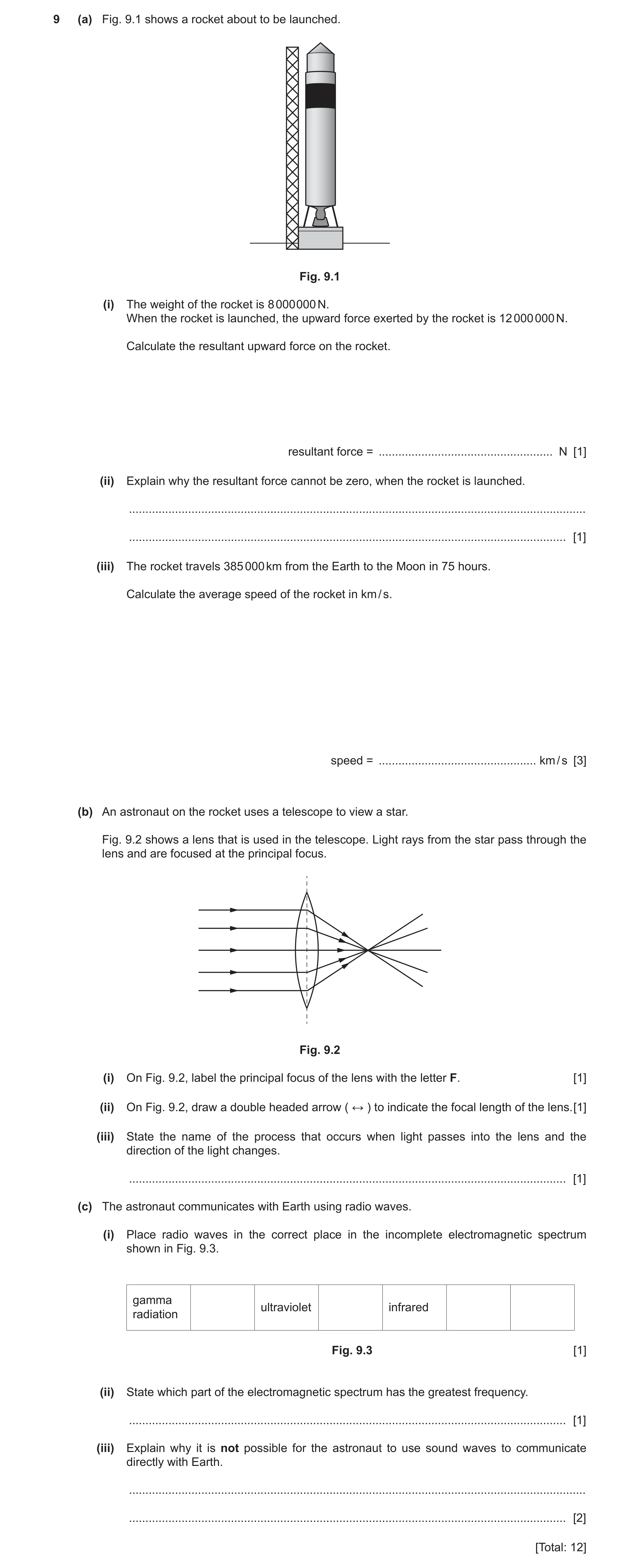
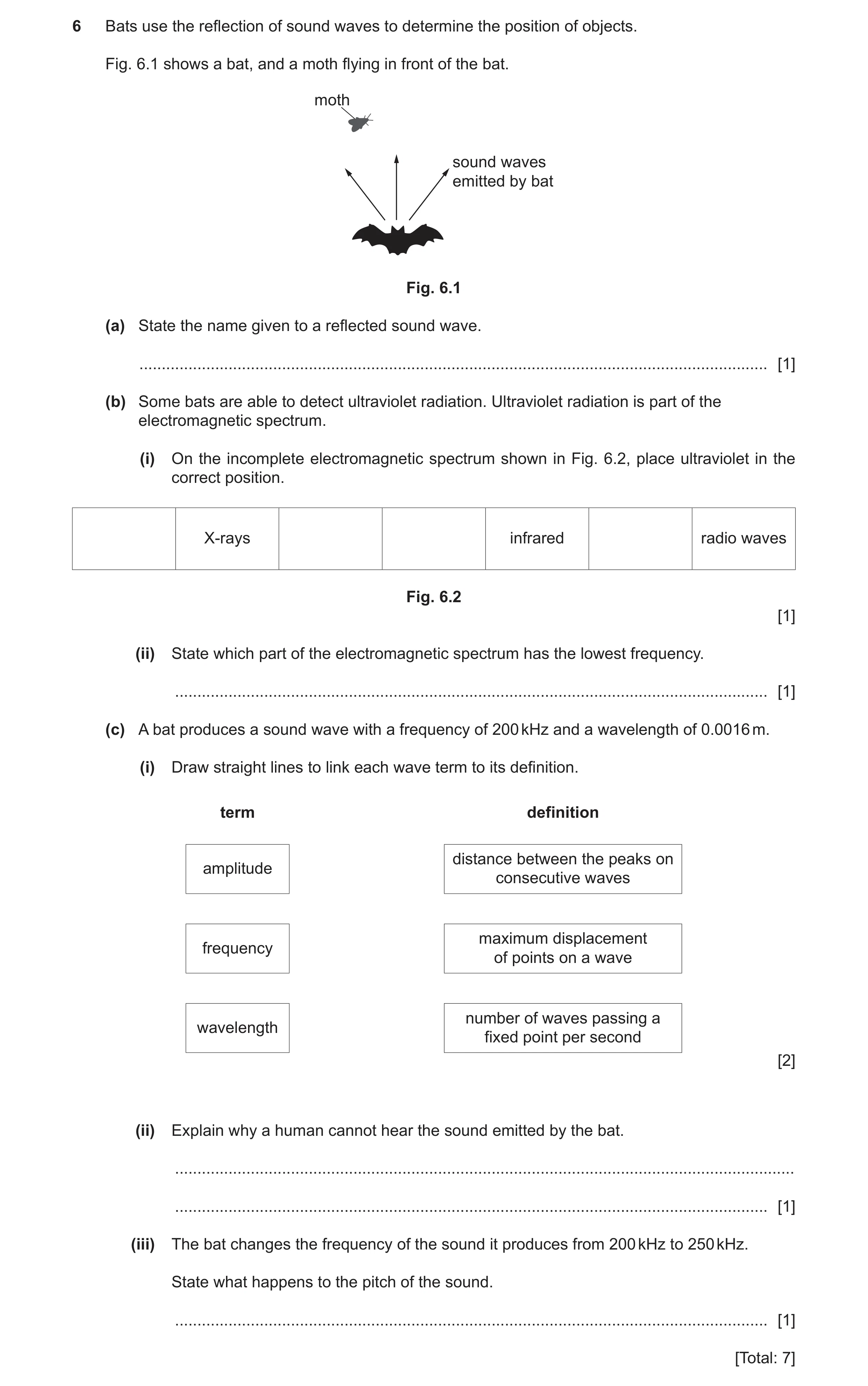
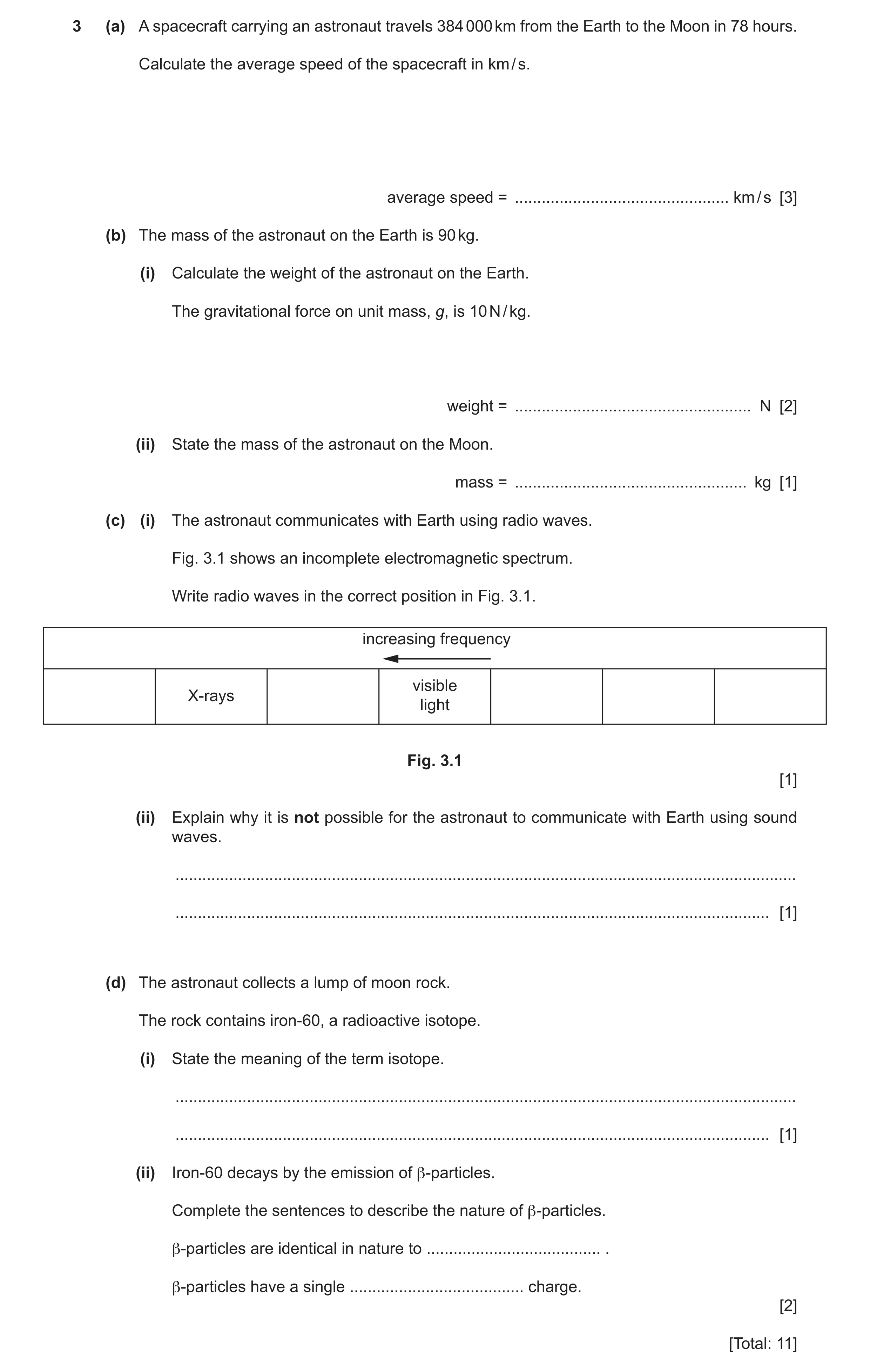
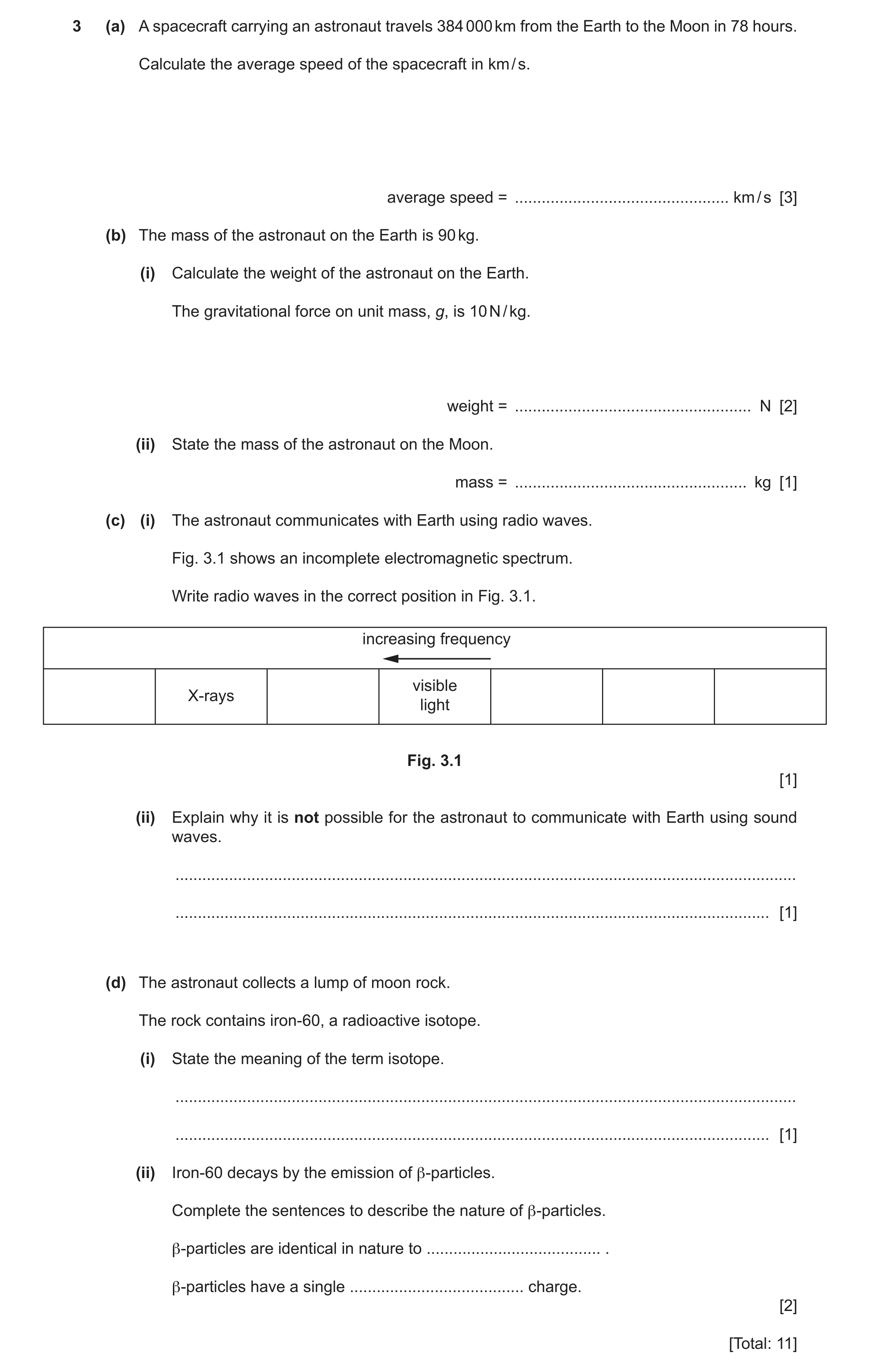
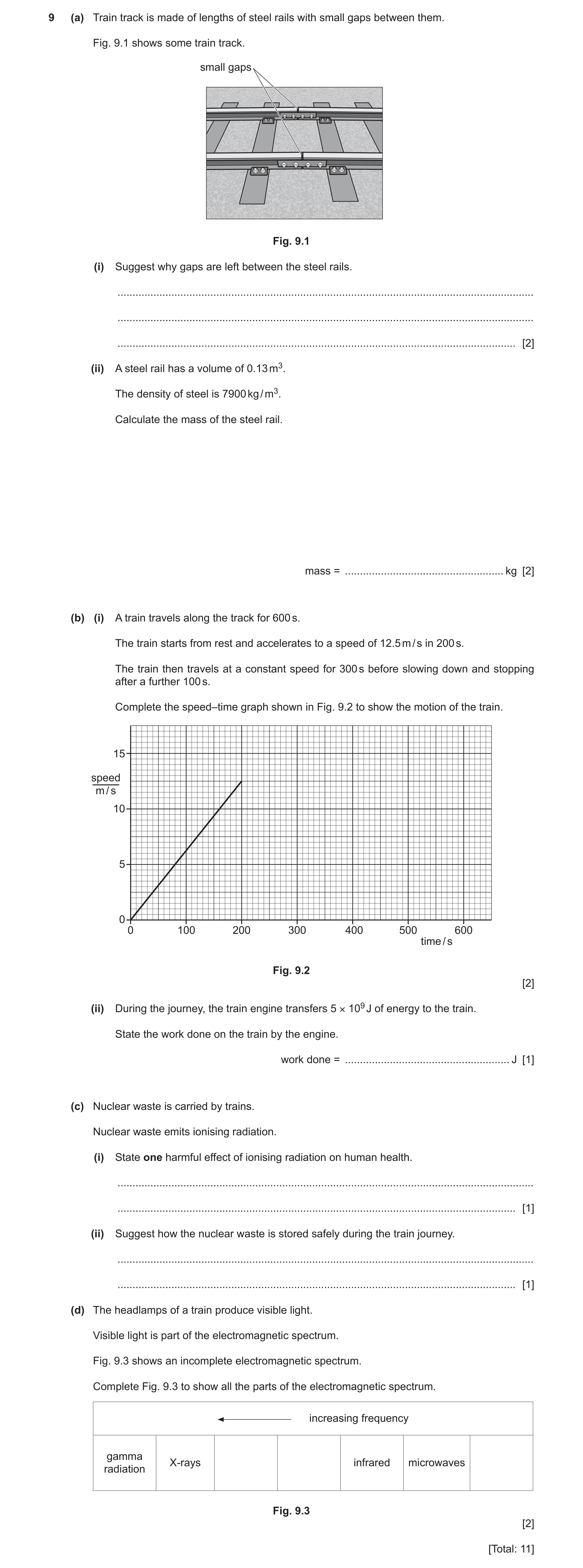
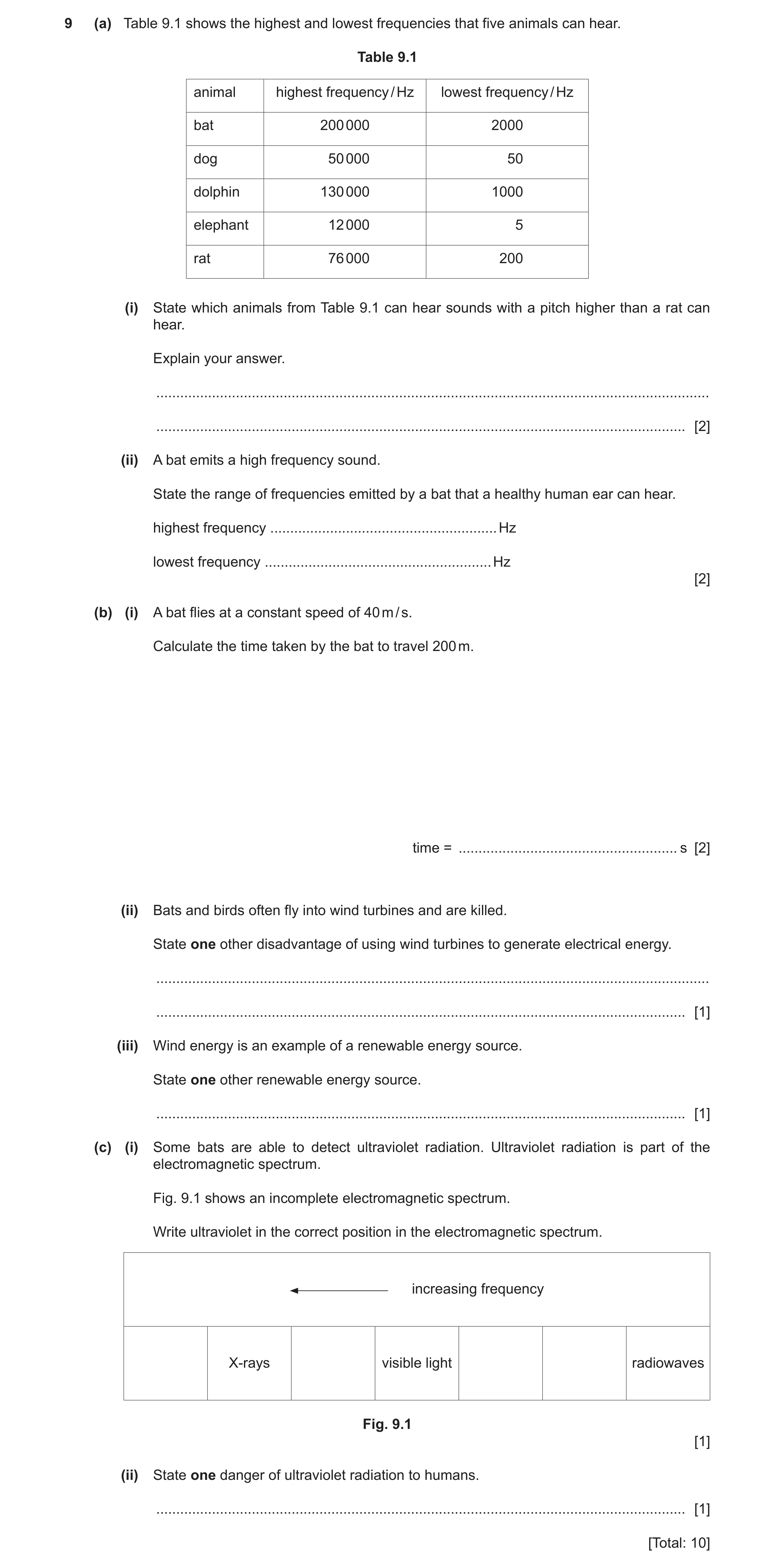
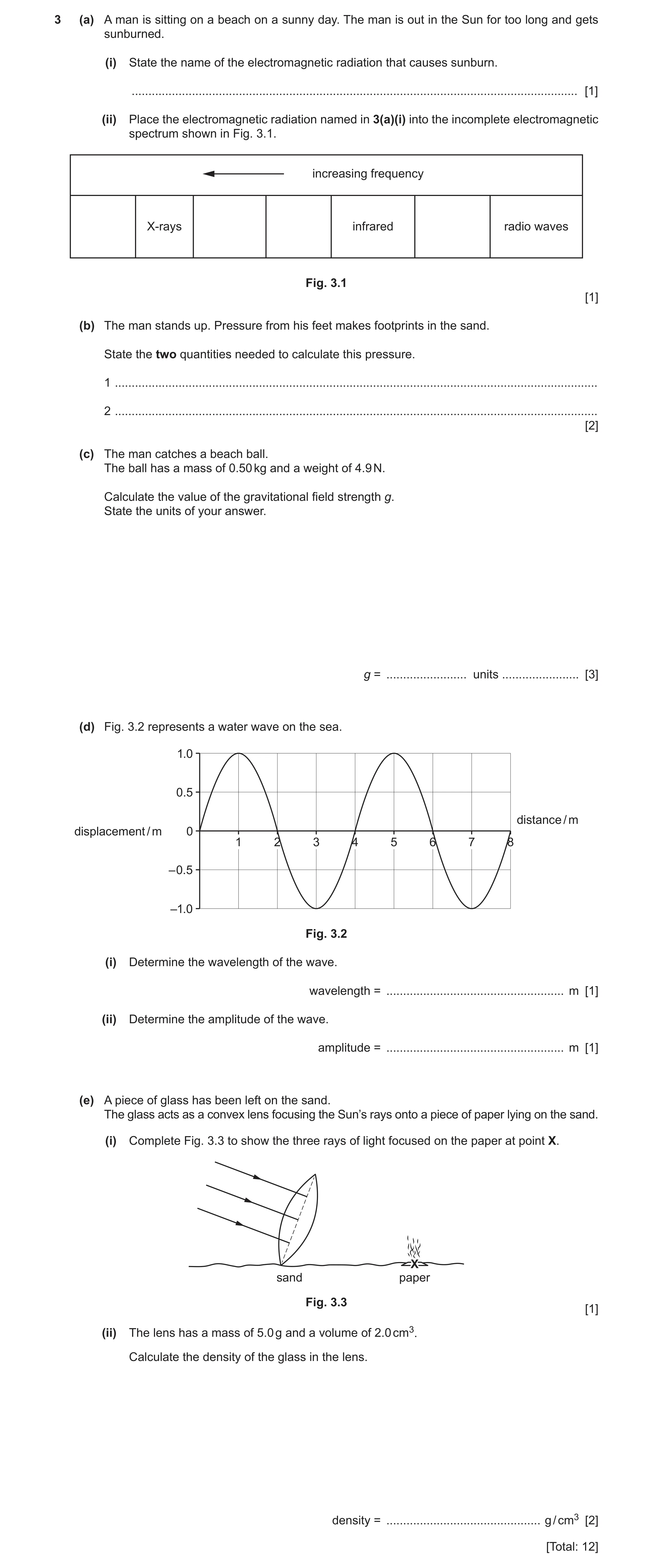
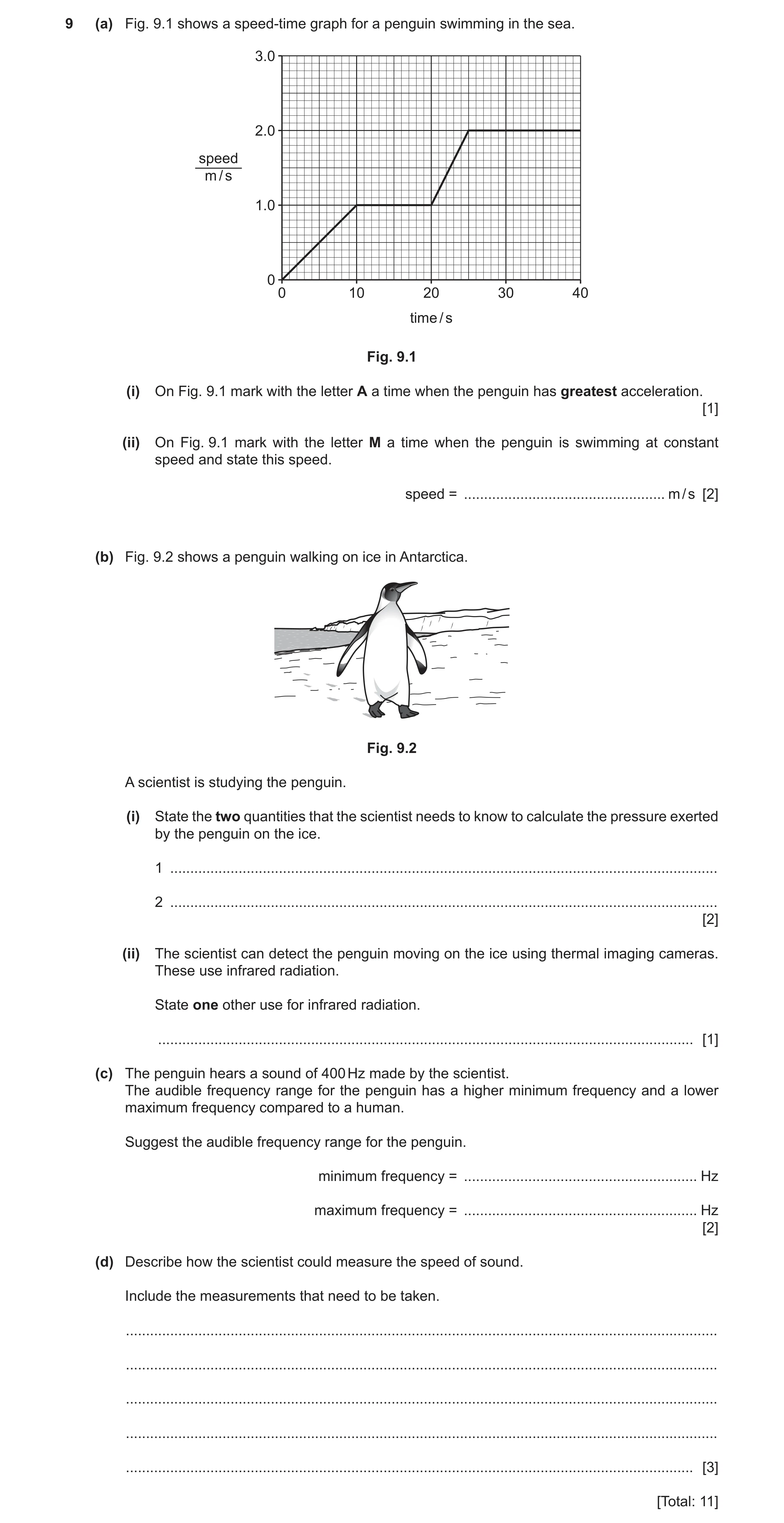
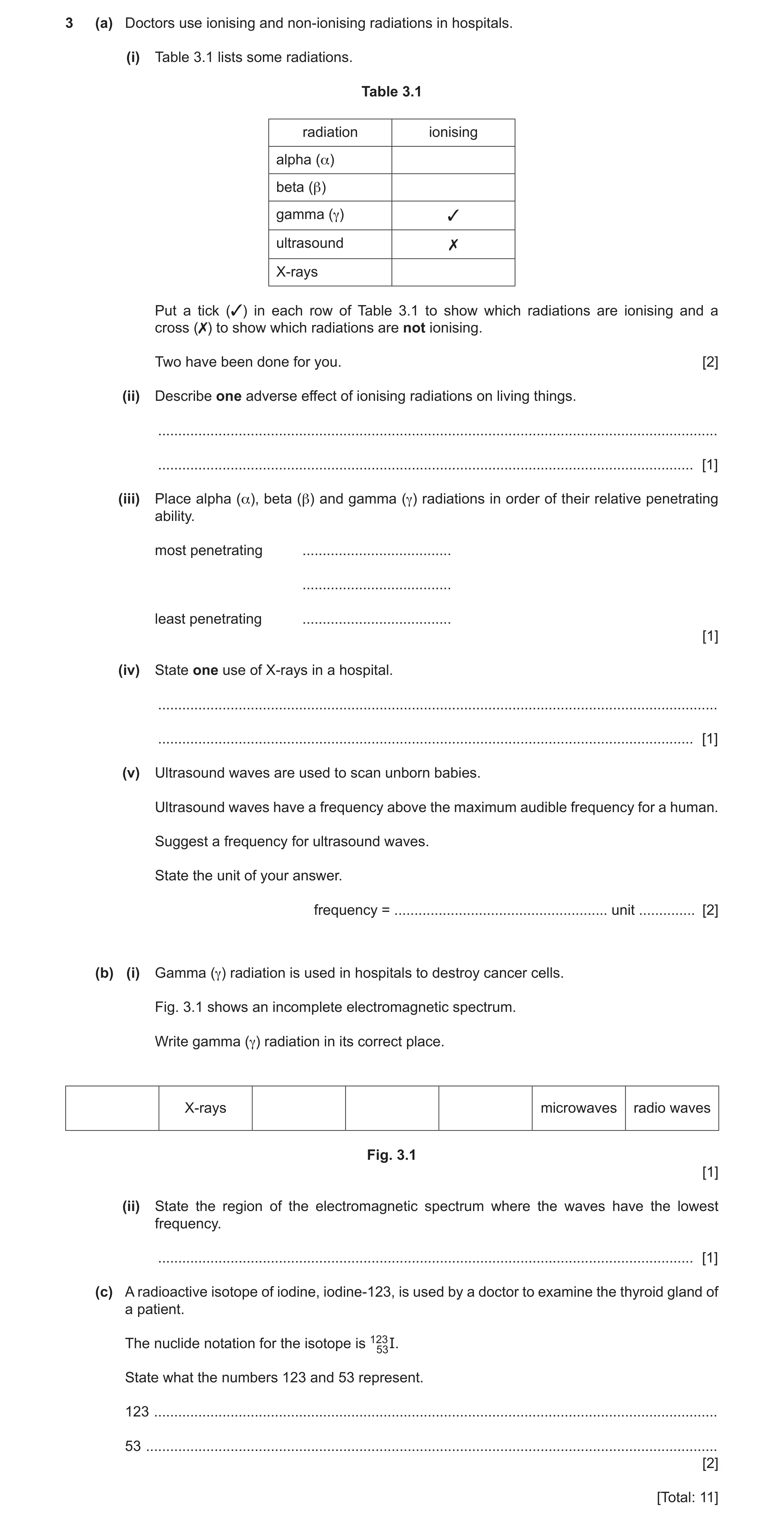
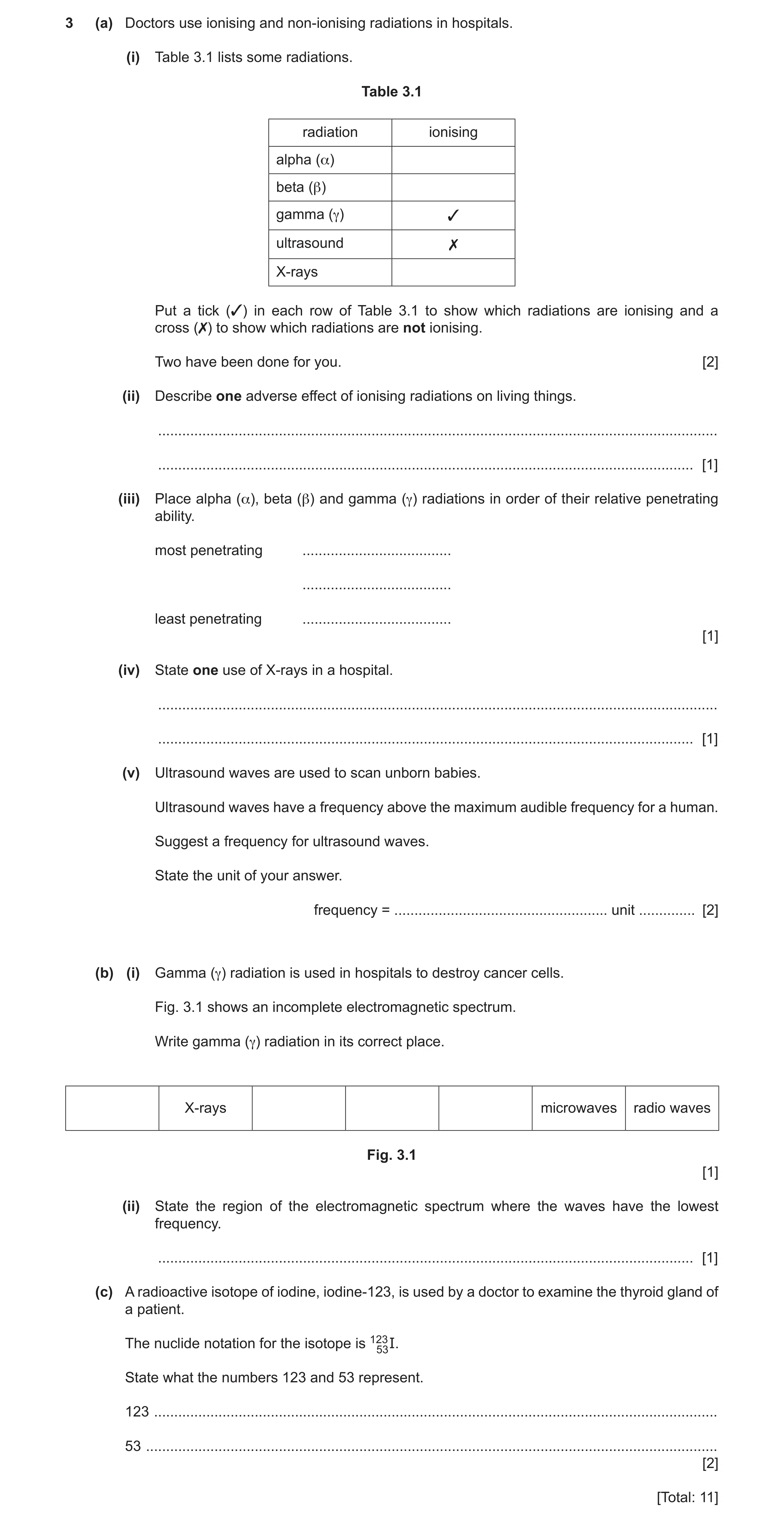
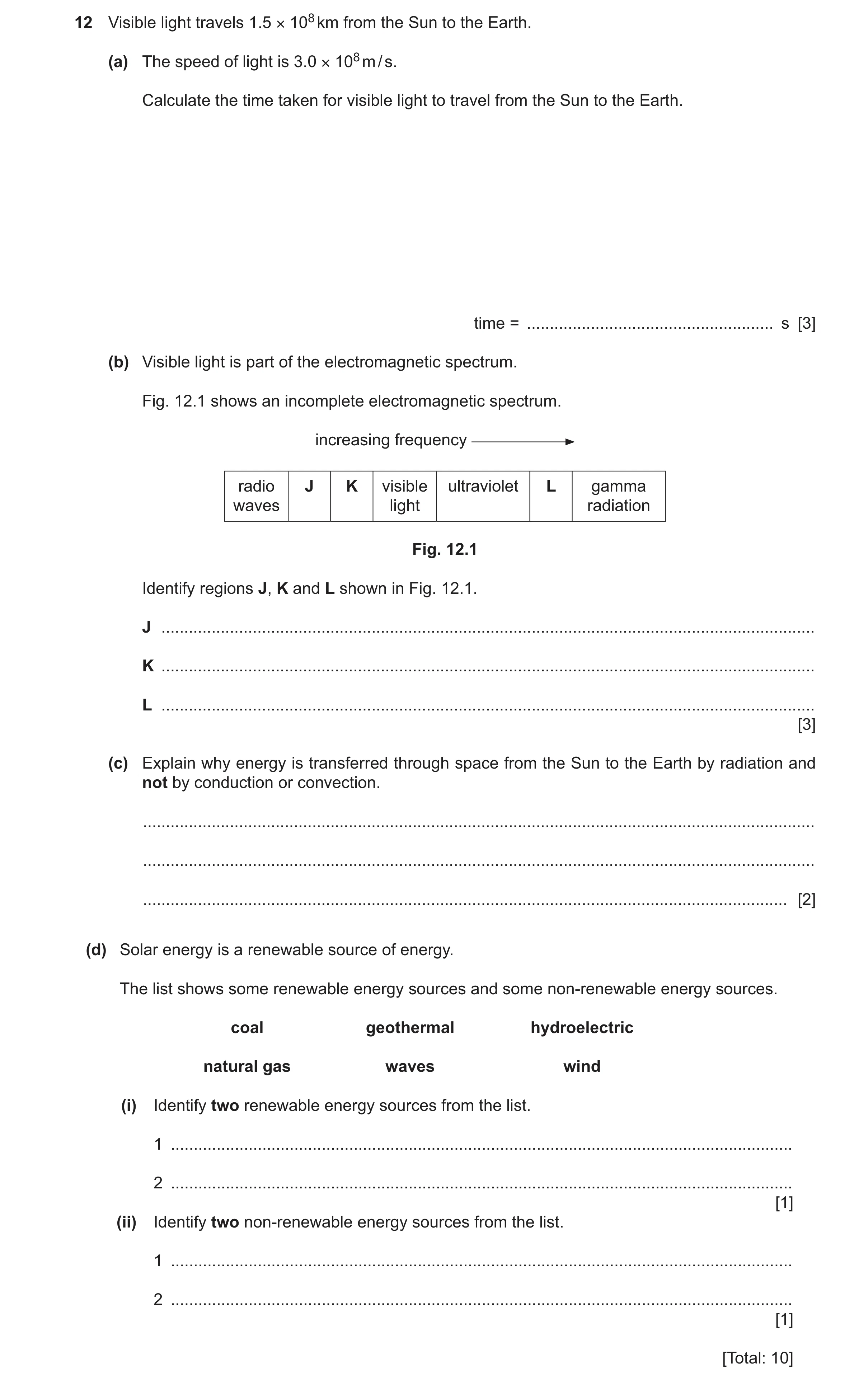
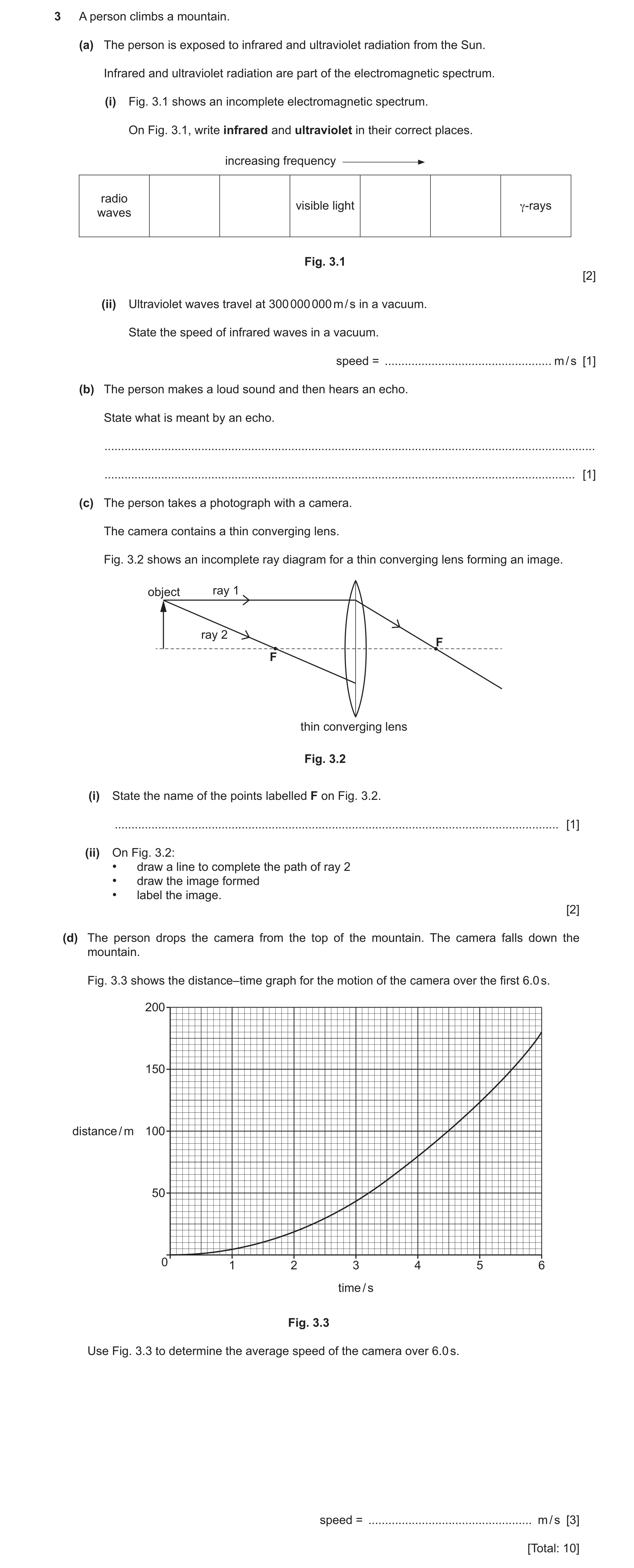
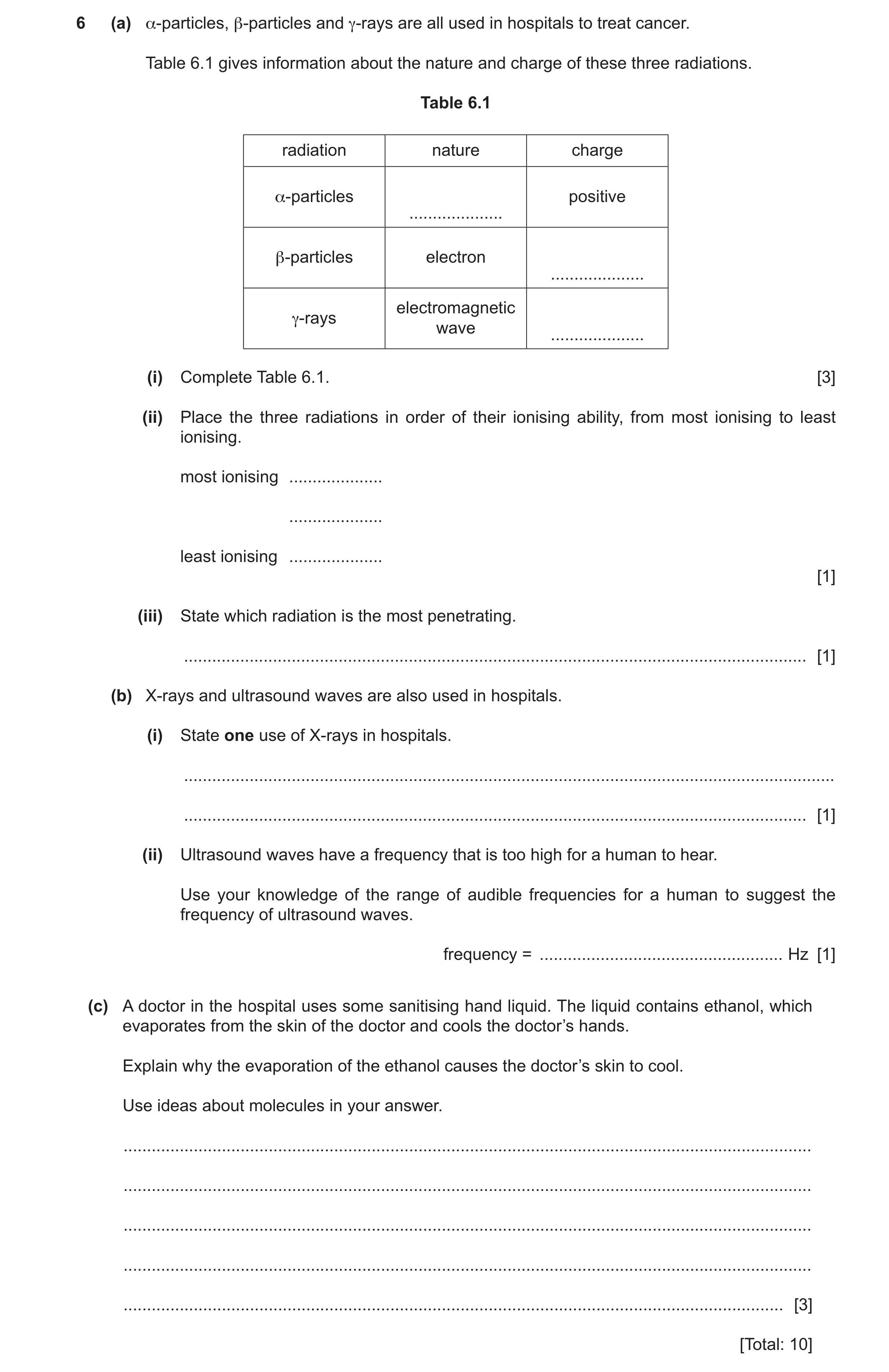
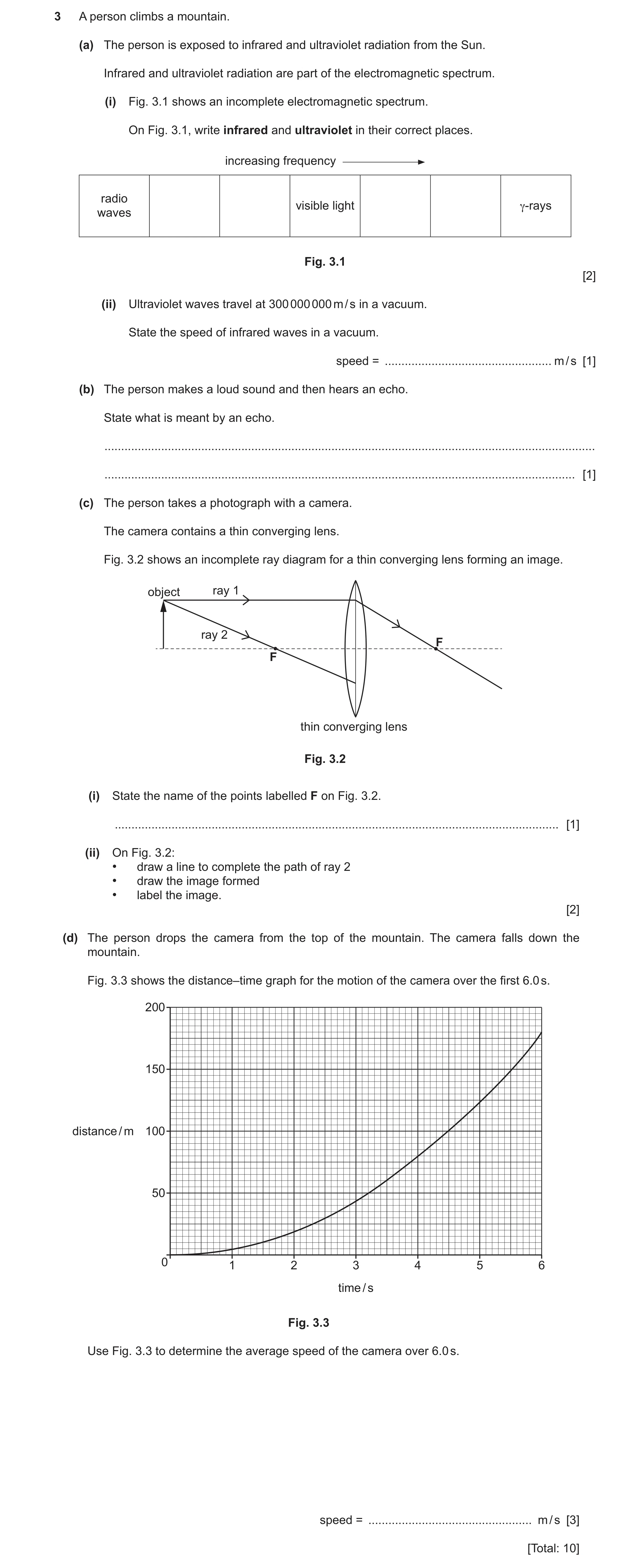
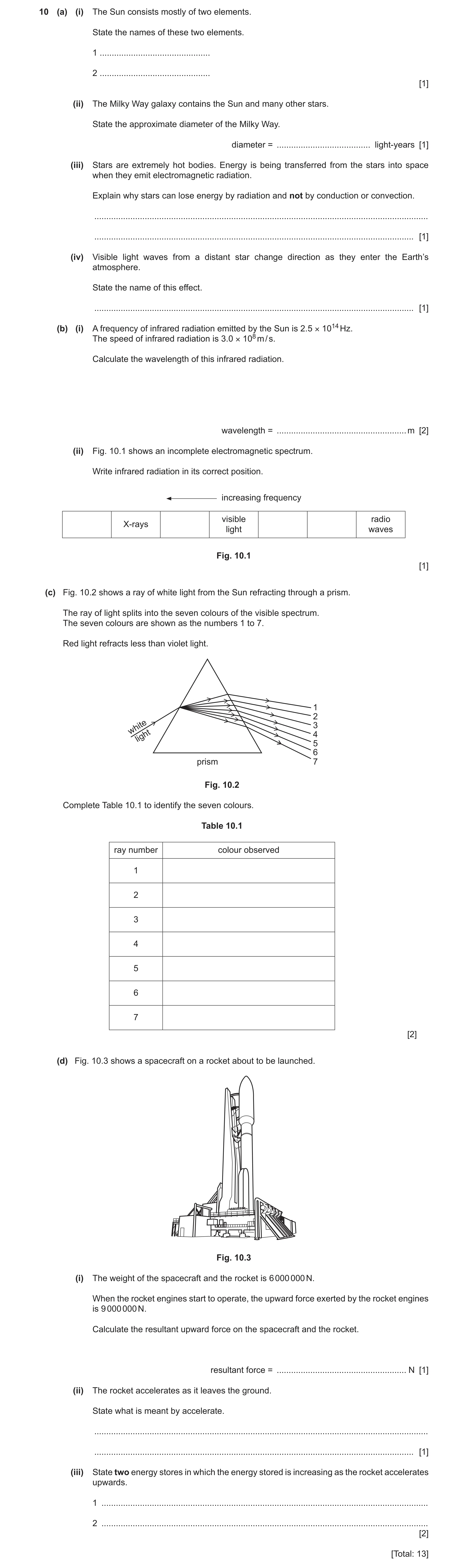
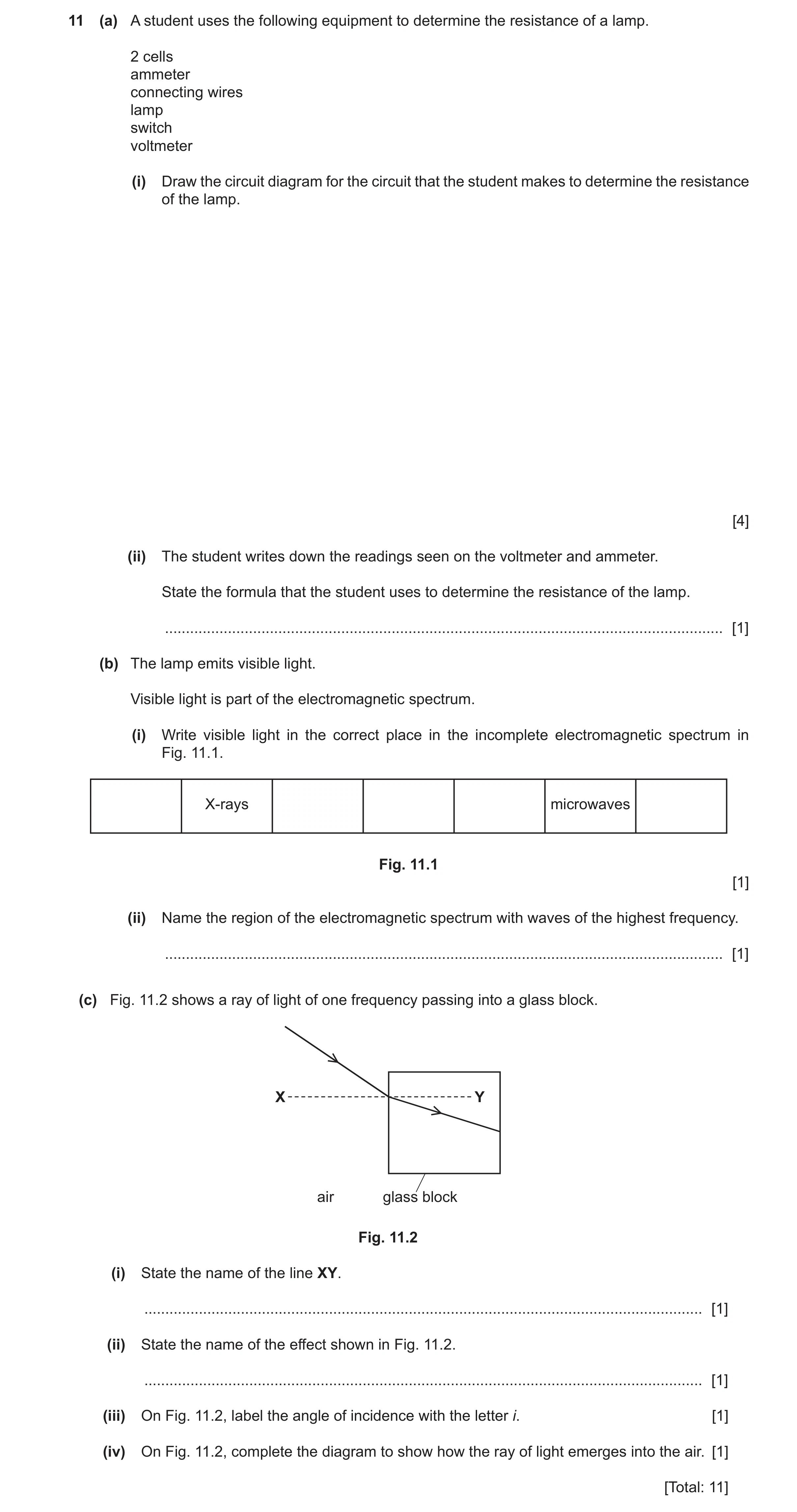
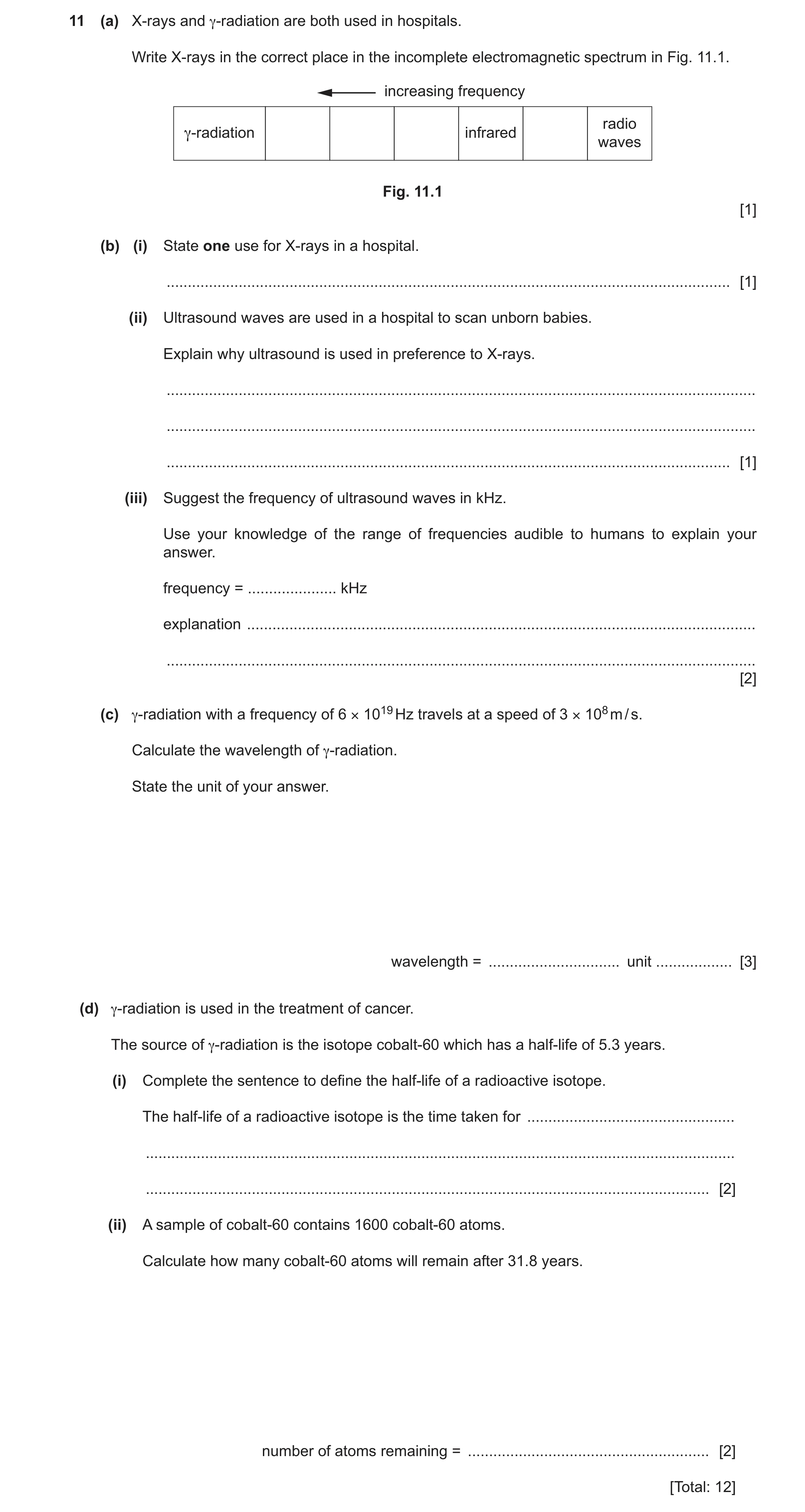
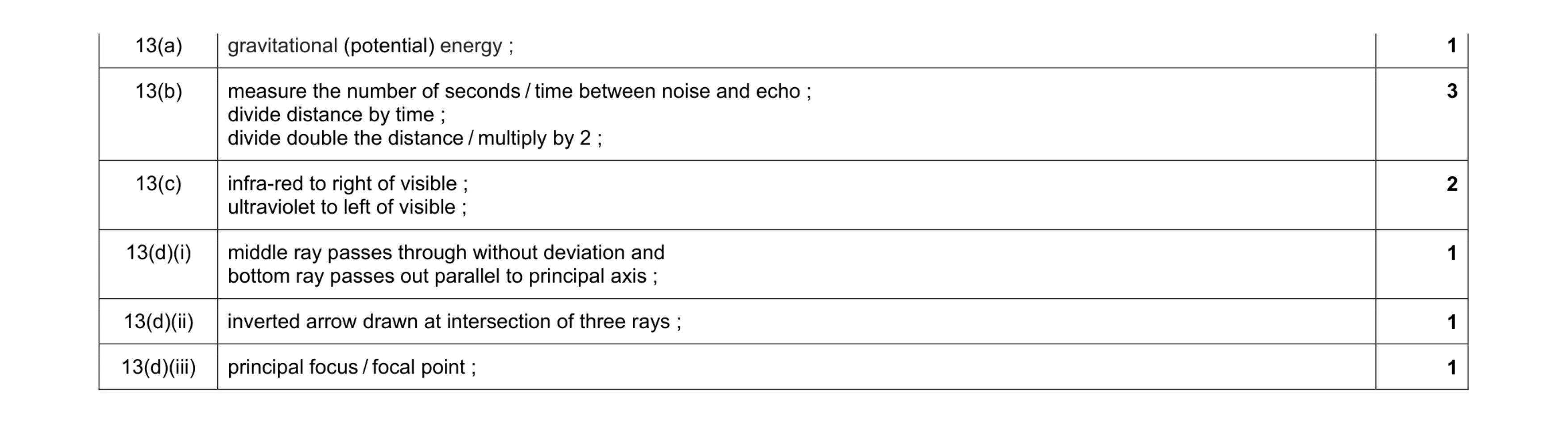 9
9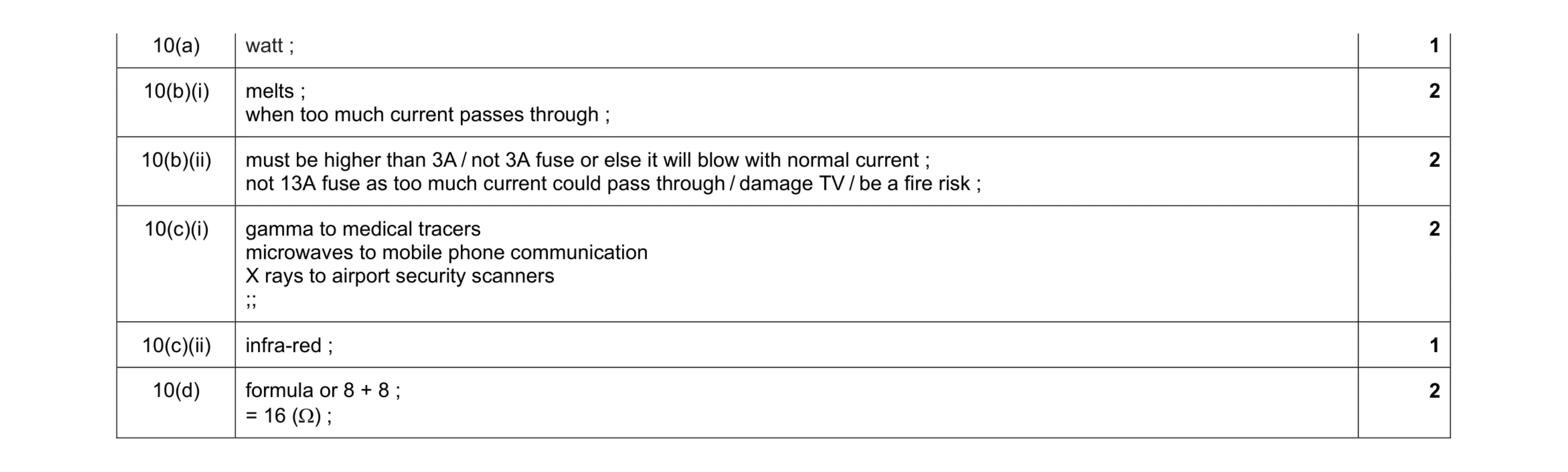 10
10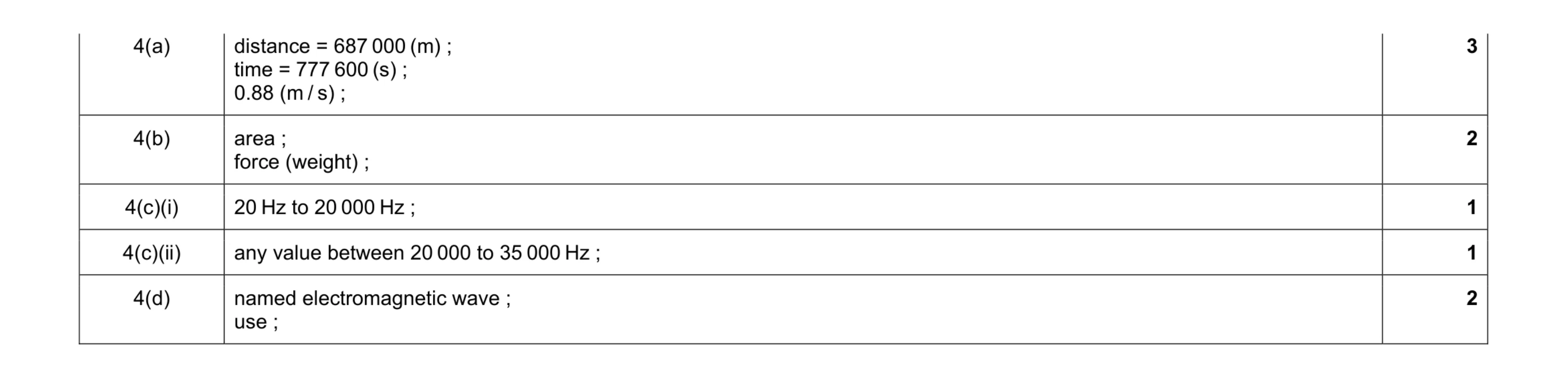 9
9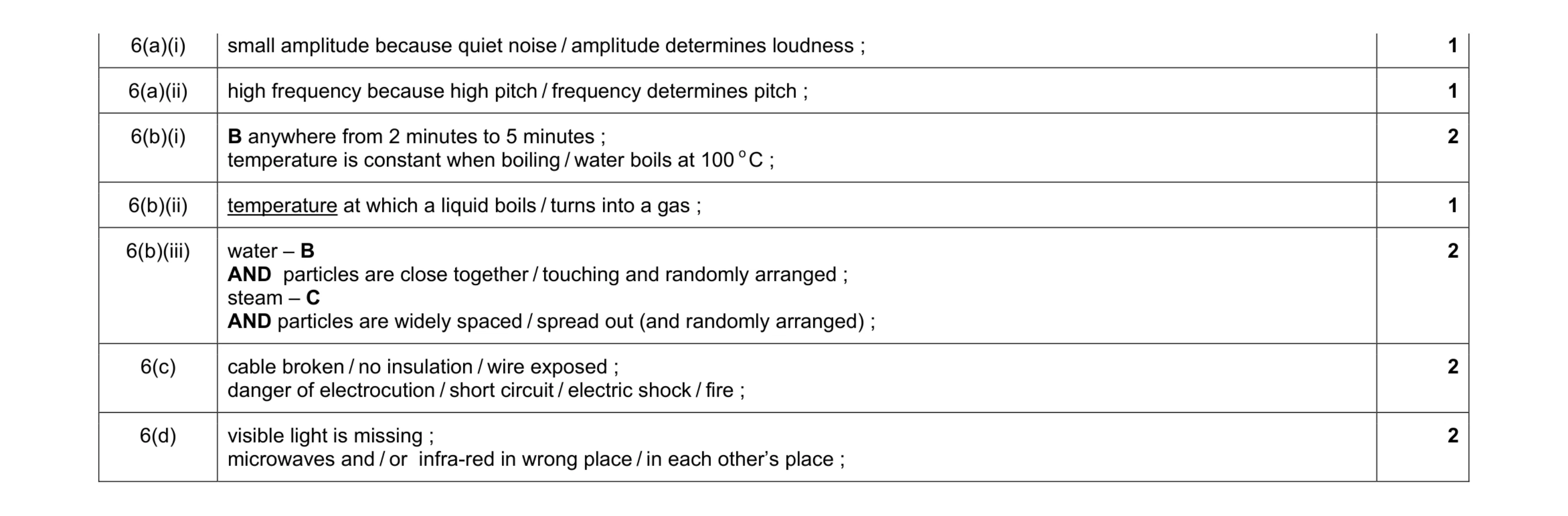 11
11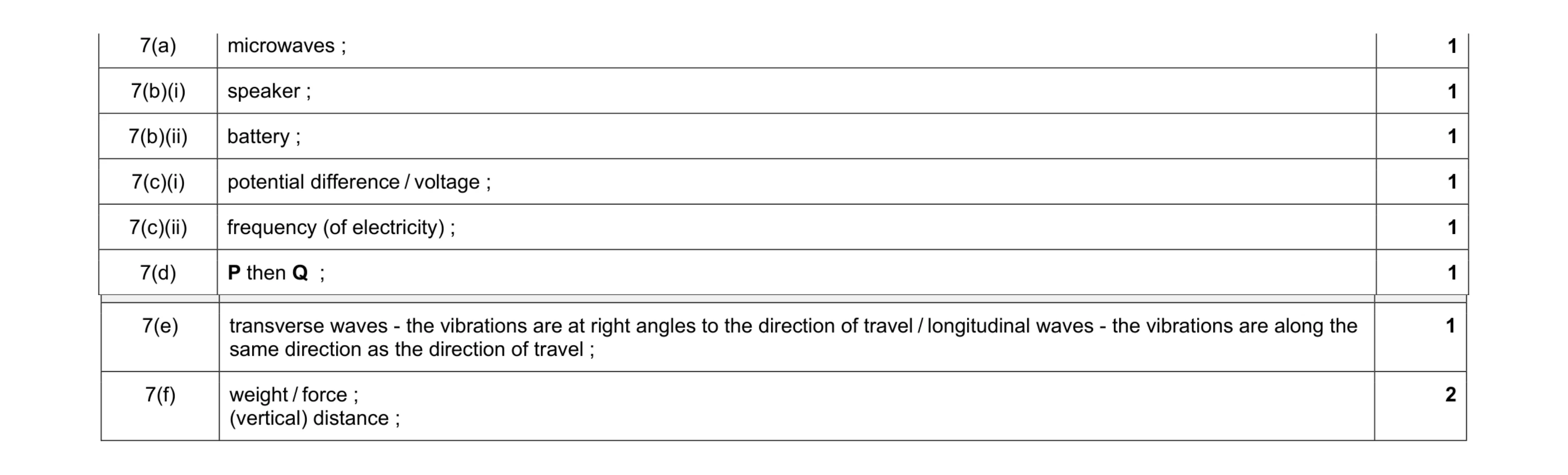 9
9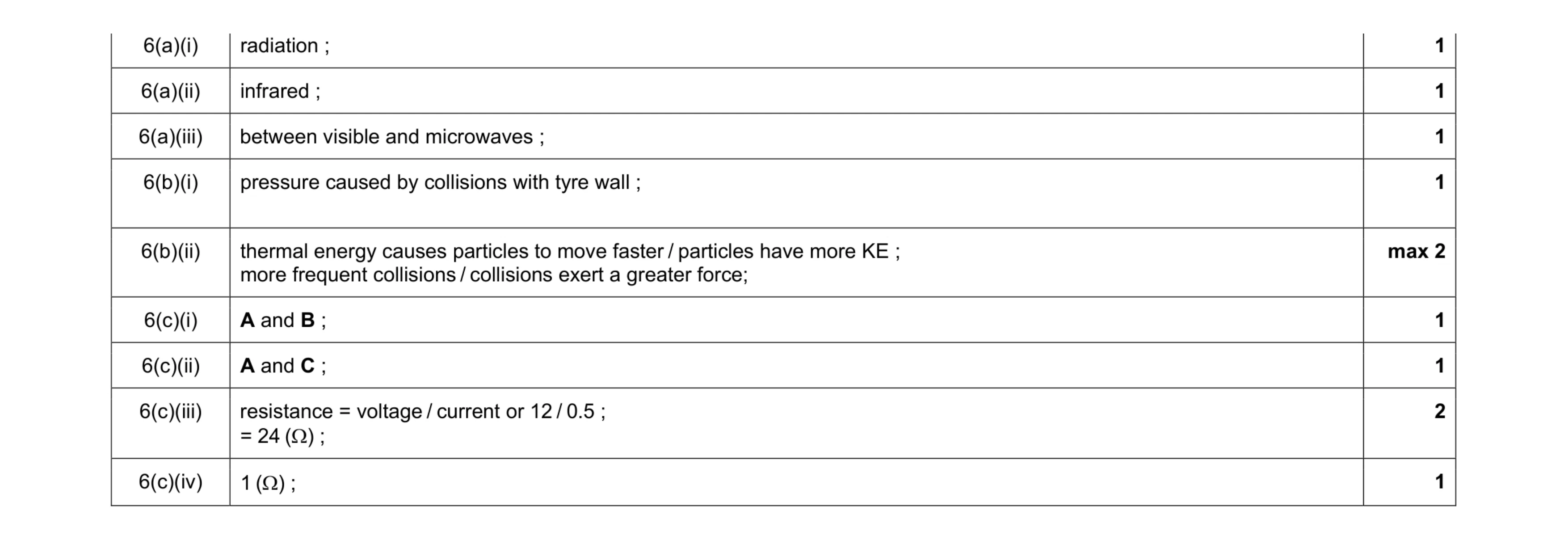 11
11 6
6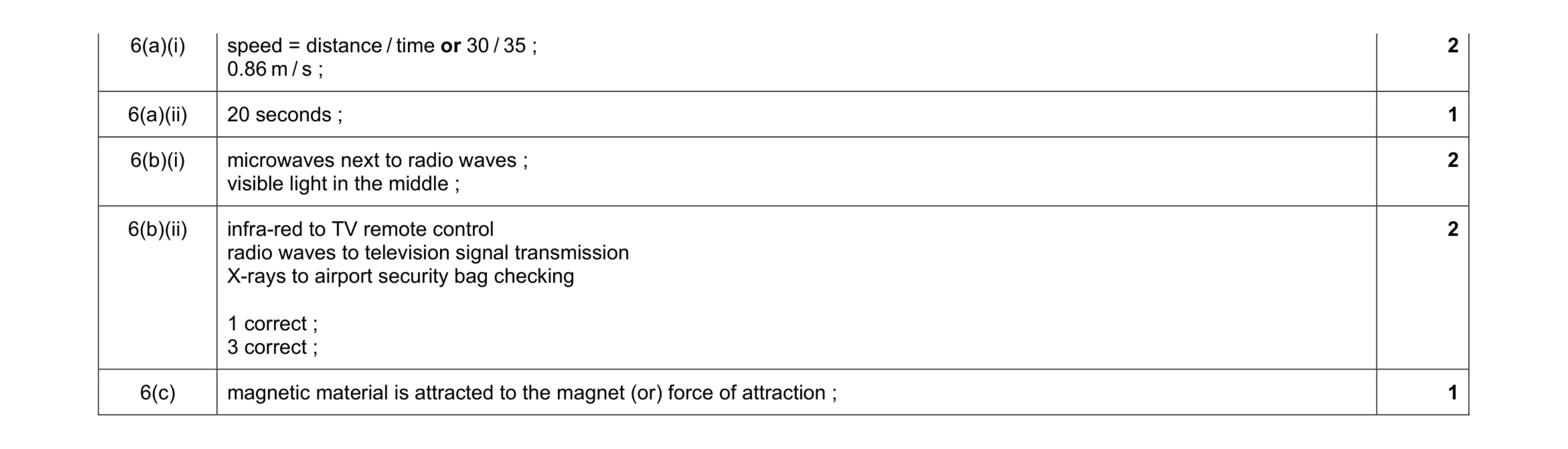 8
8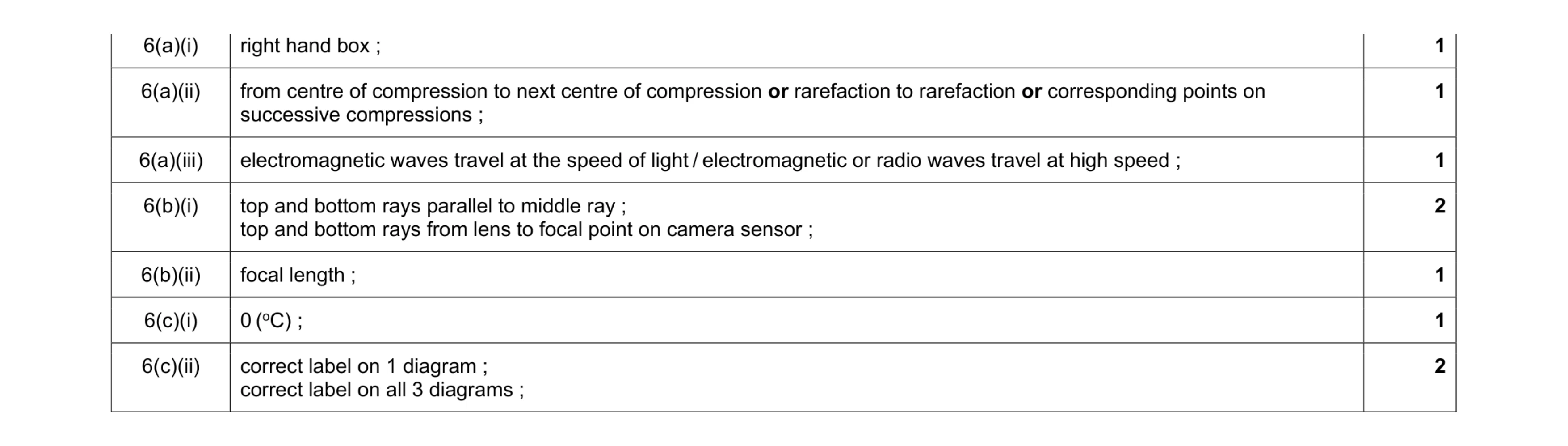 9
9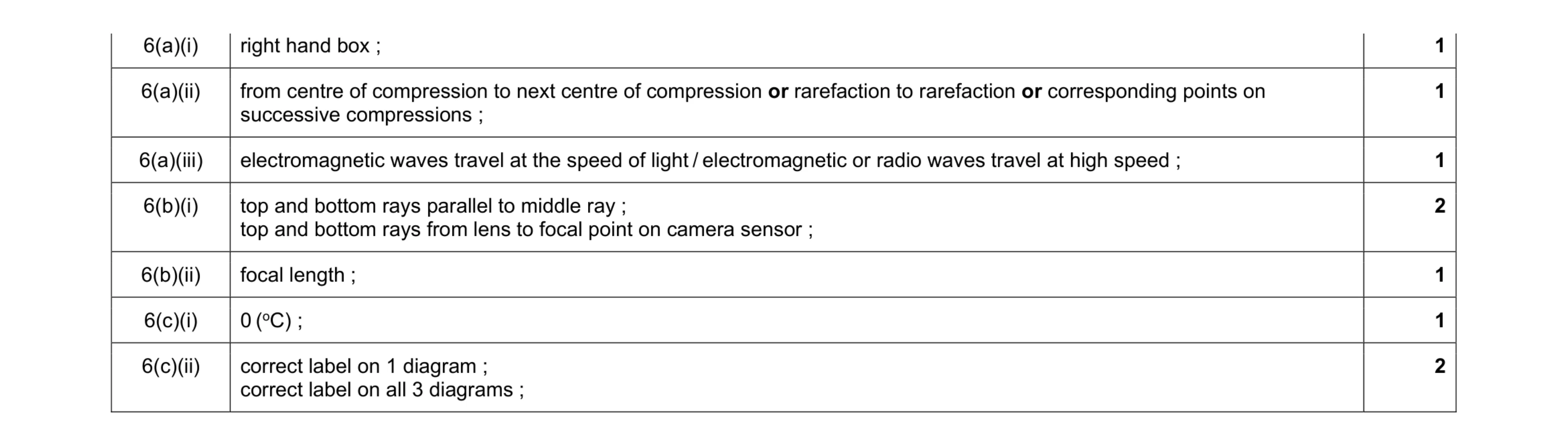 9
9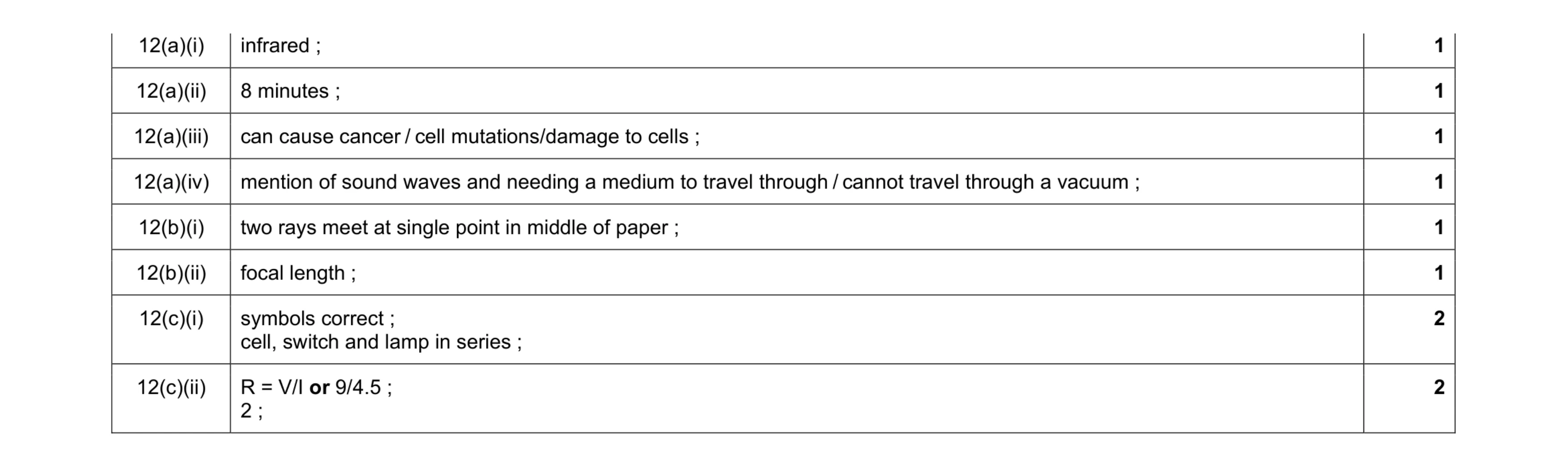 10
10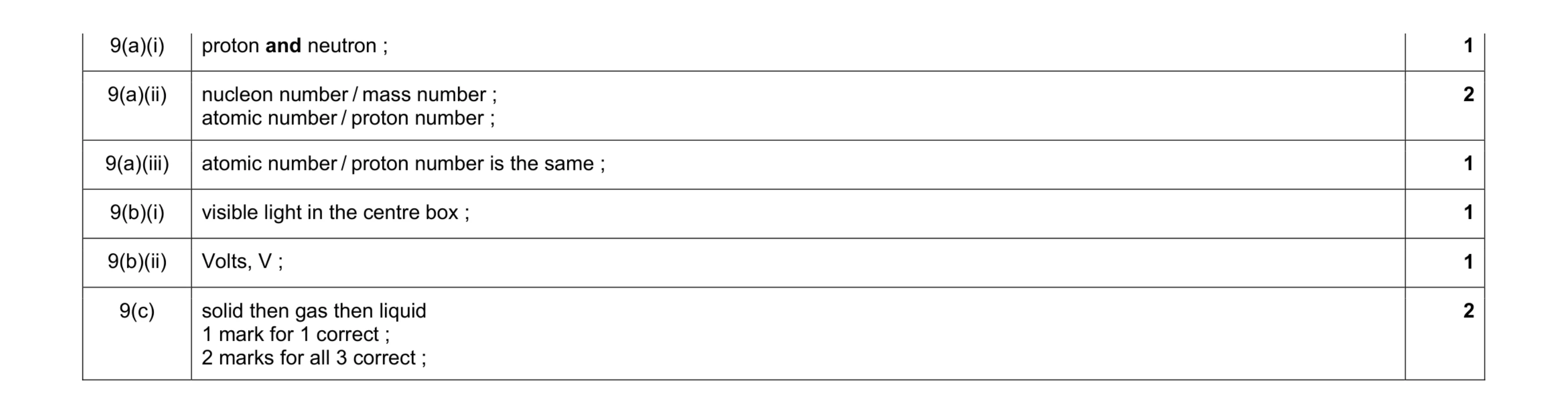 8
8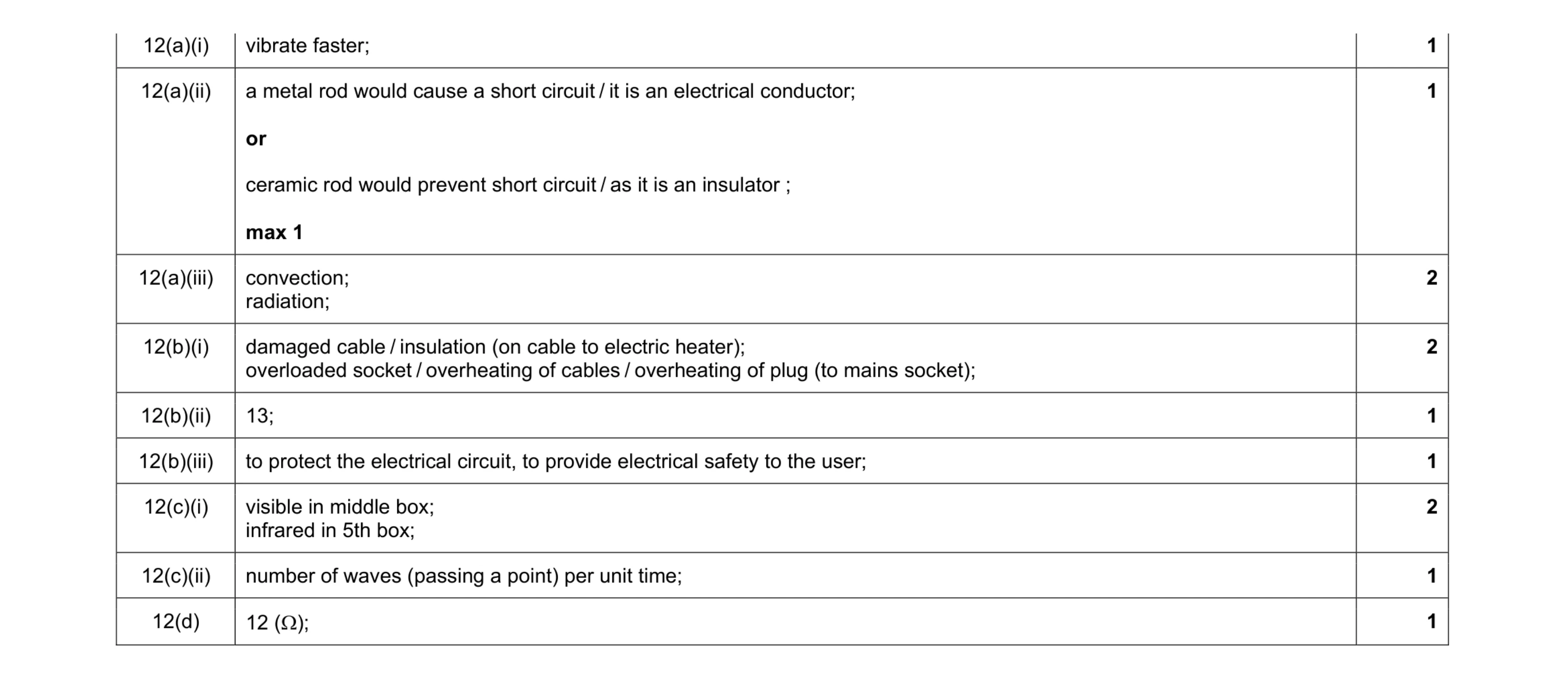 12
12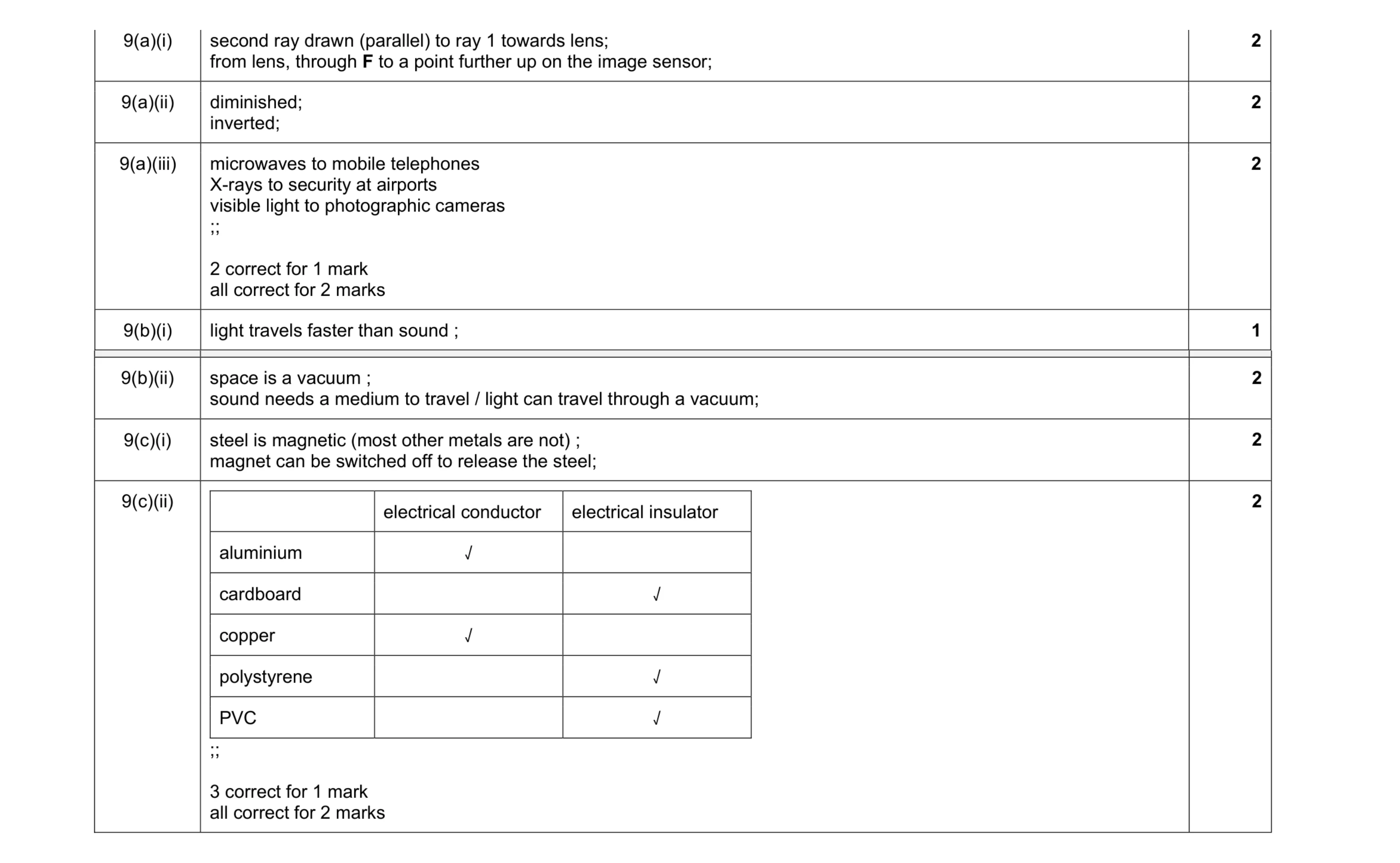 13
13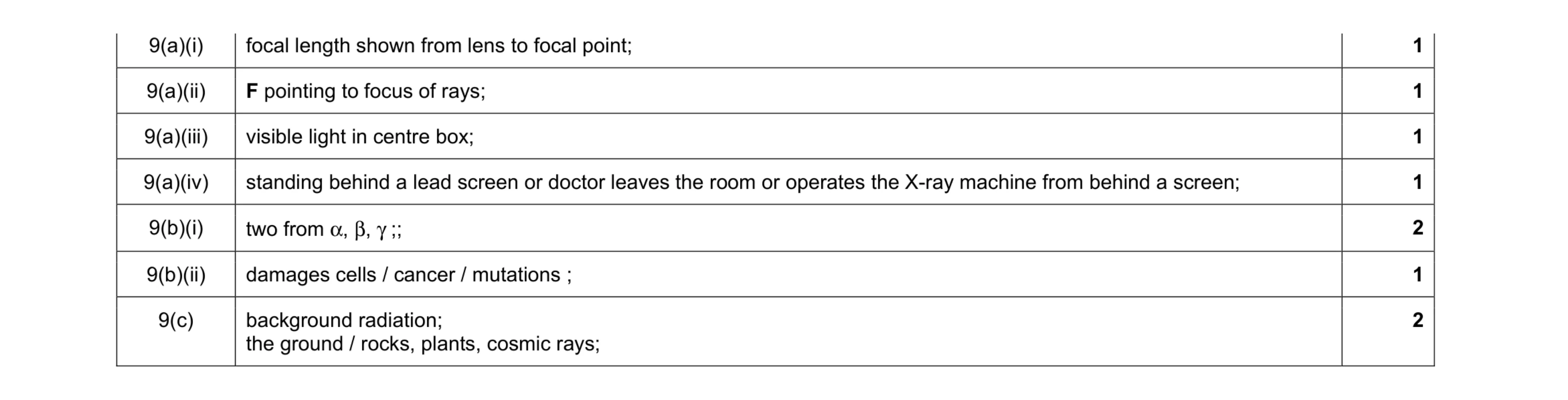 9
9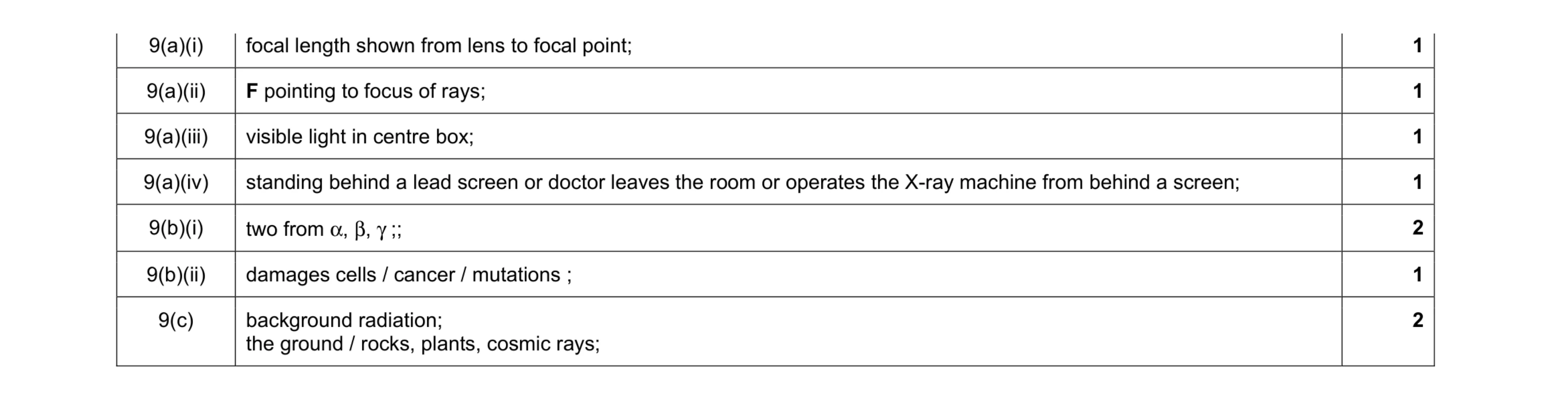 9
9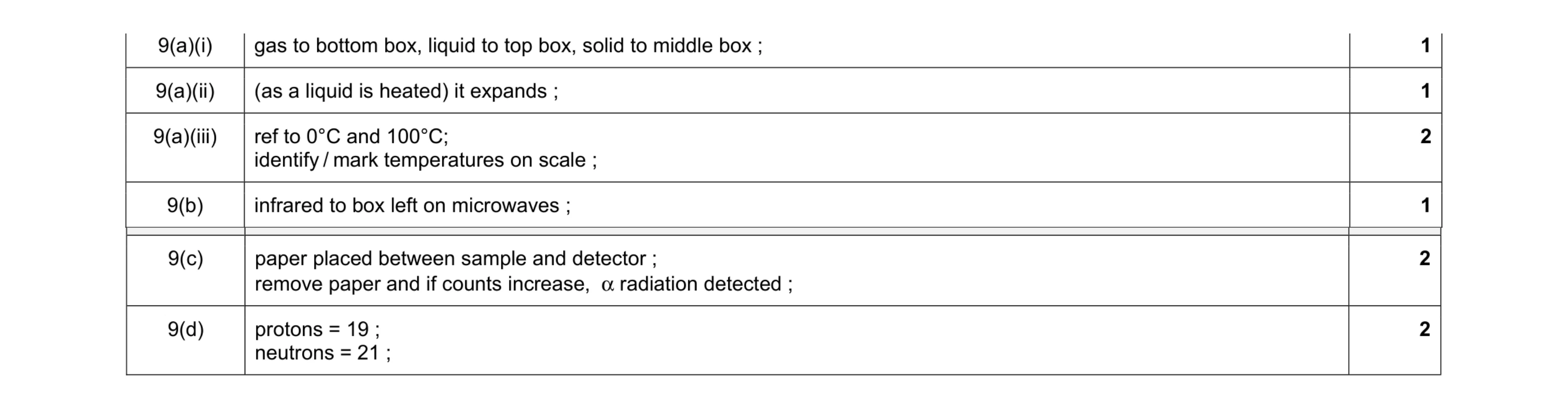 9
9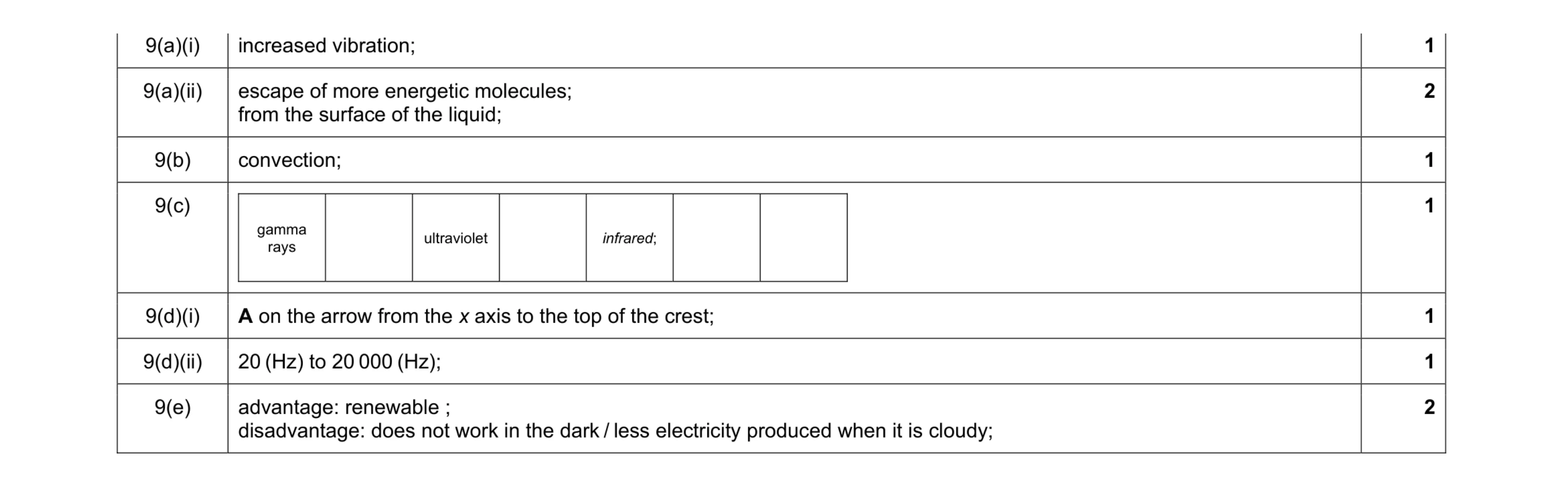 9
9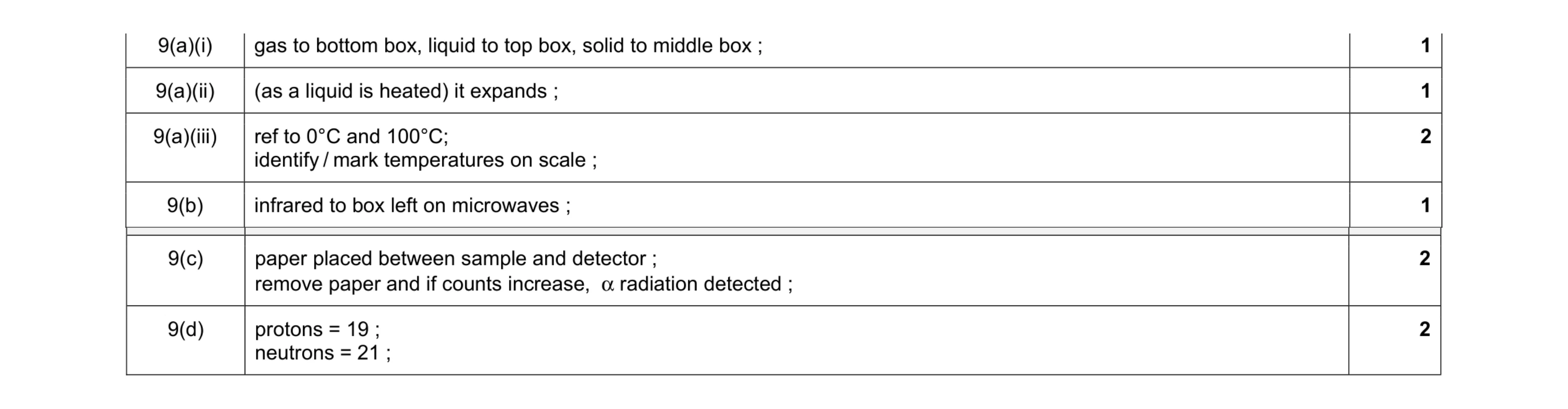 9
9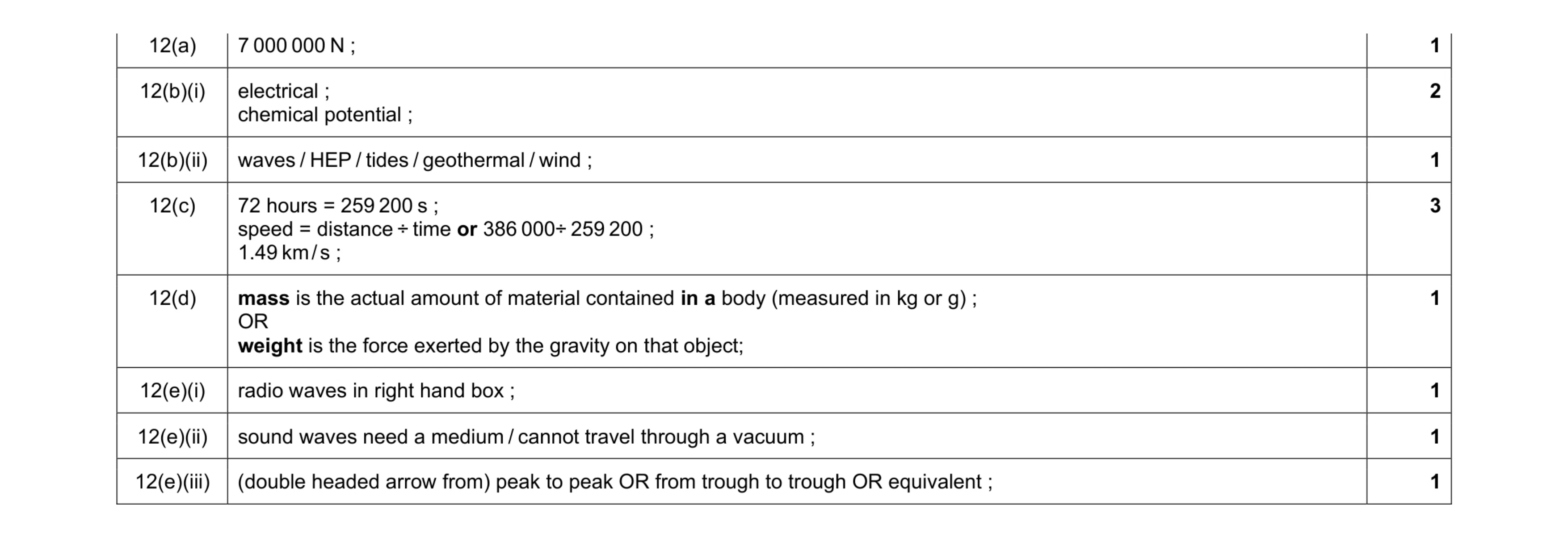 11
11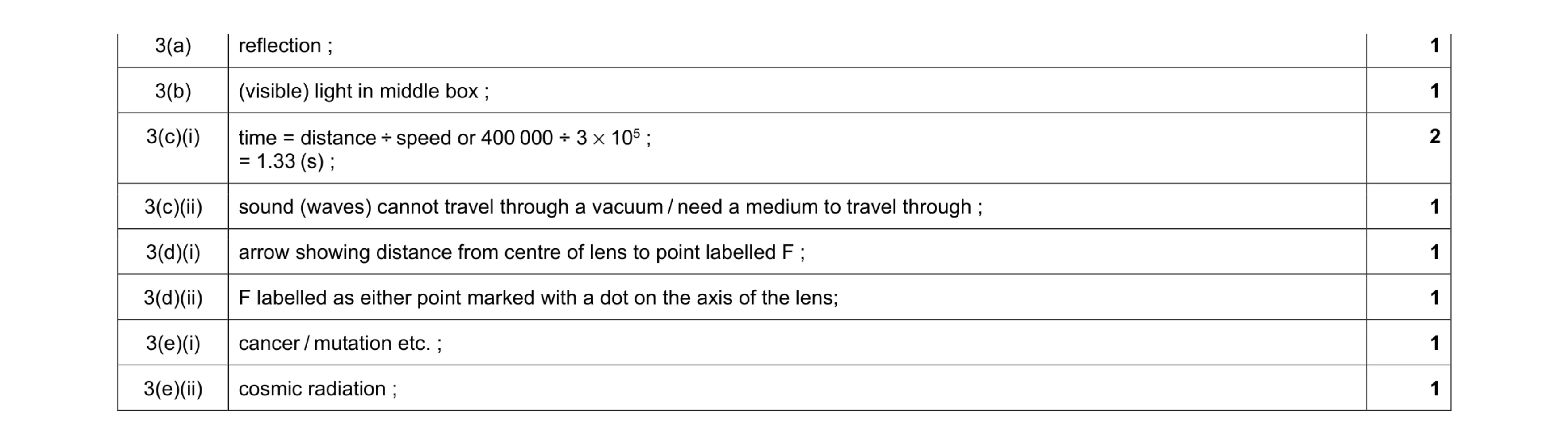 9
9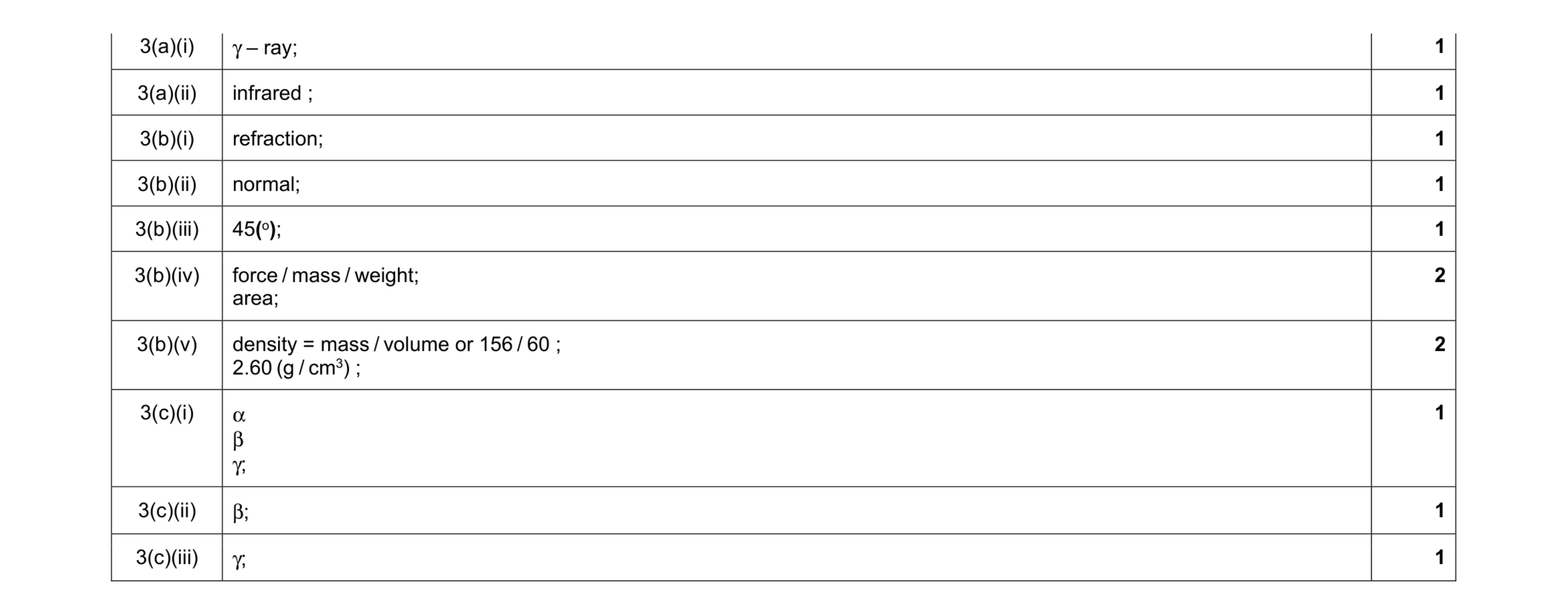 12
12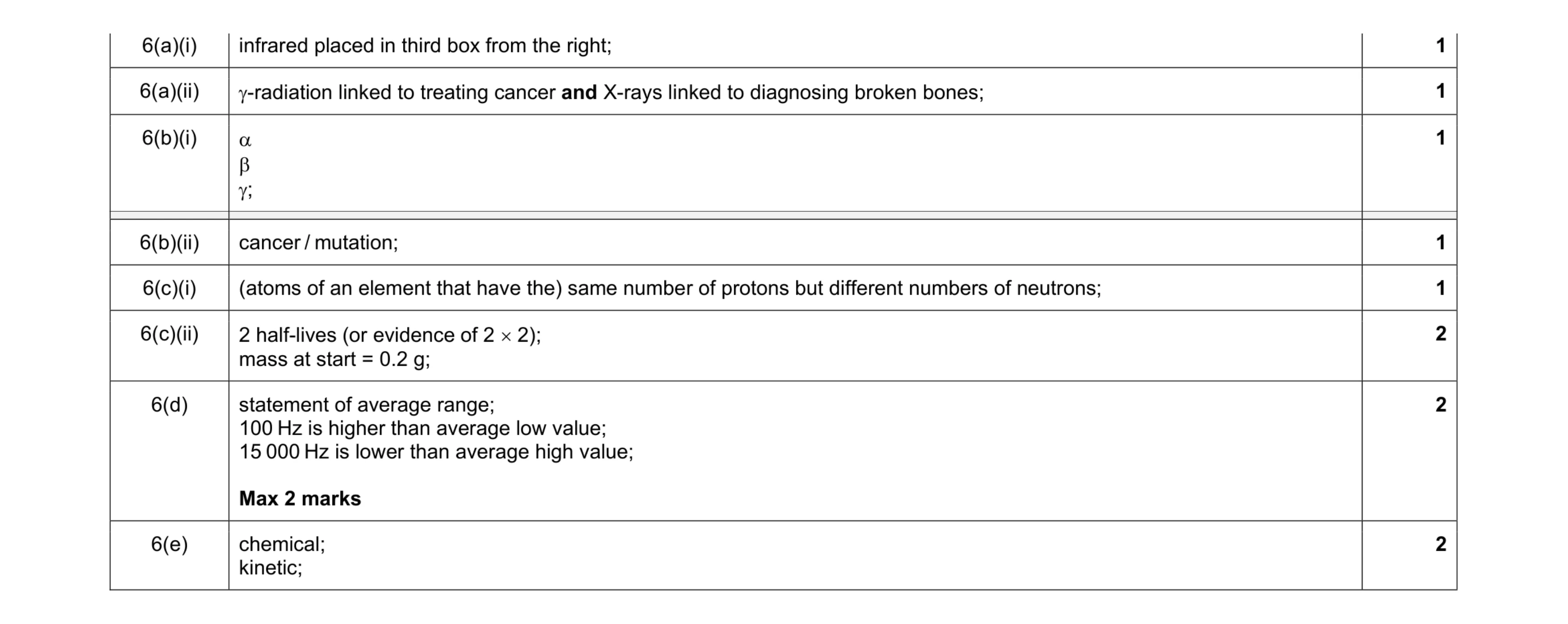 11
11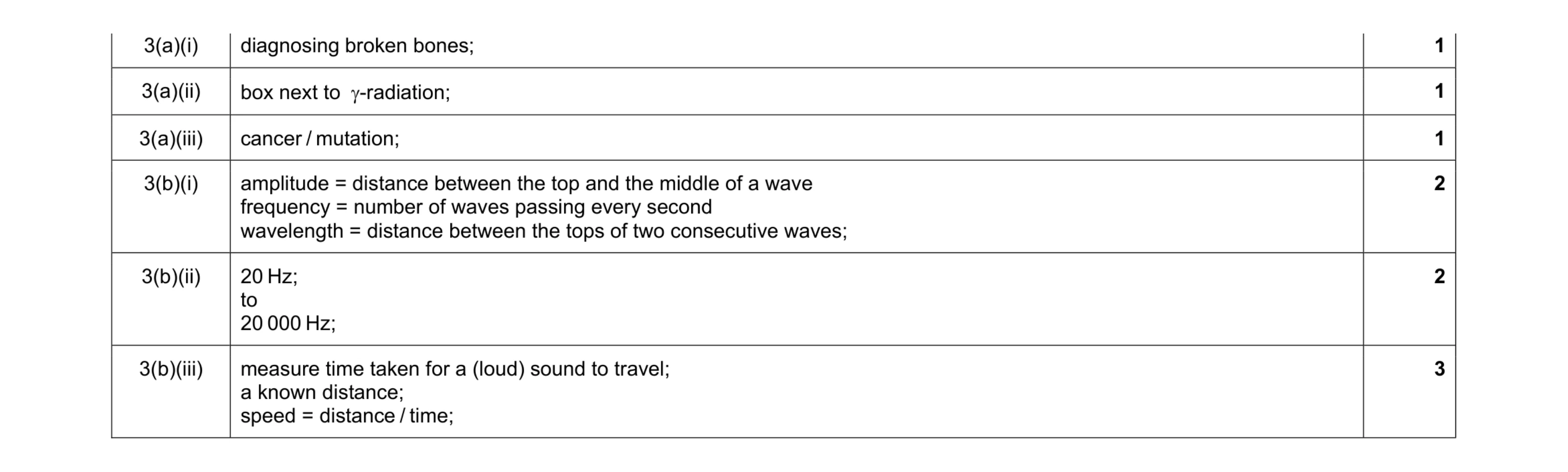 10
10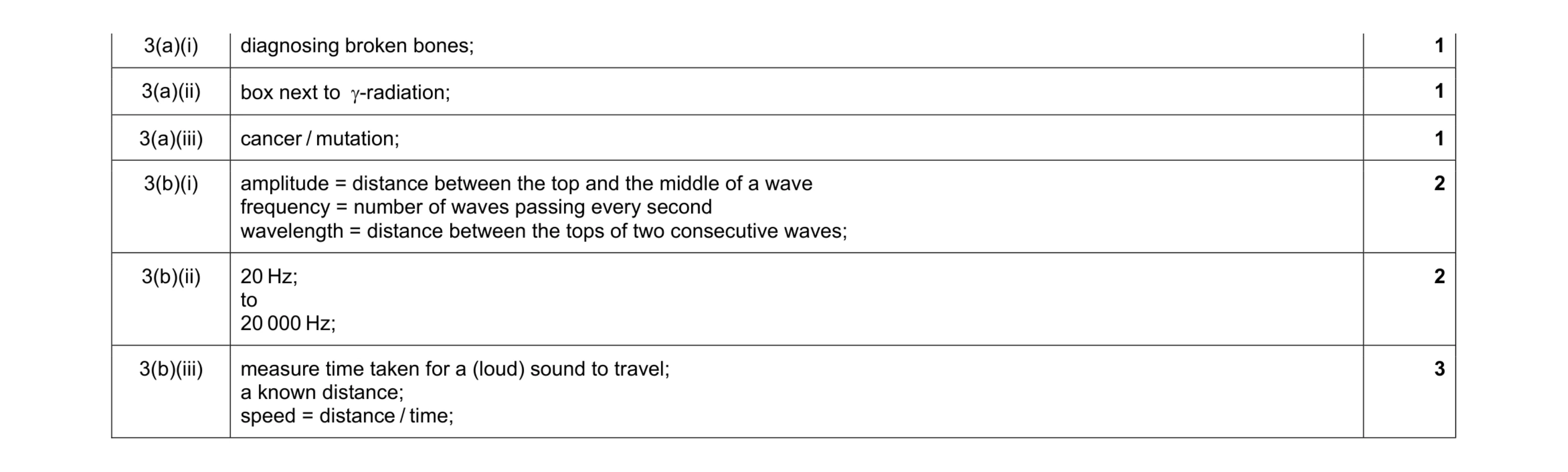 10
10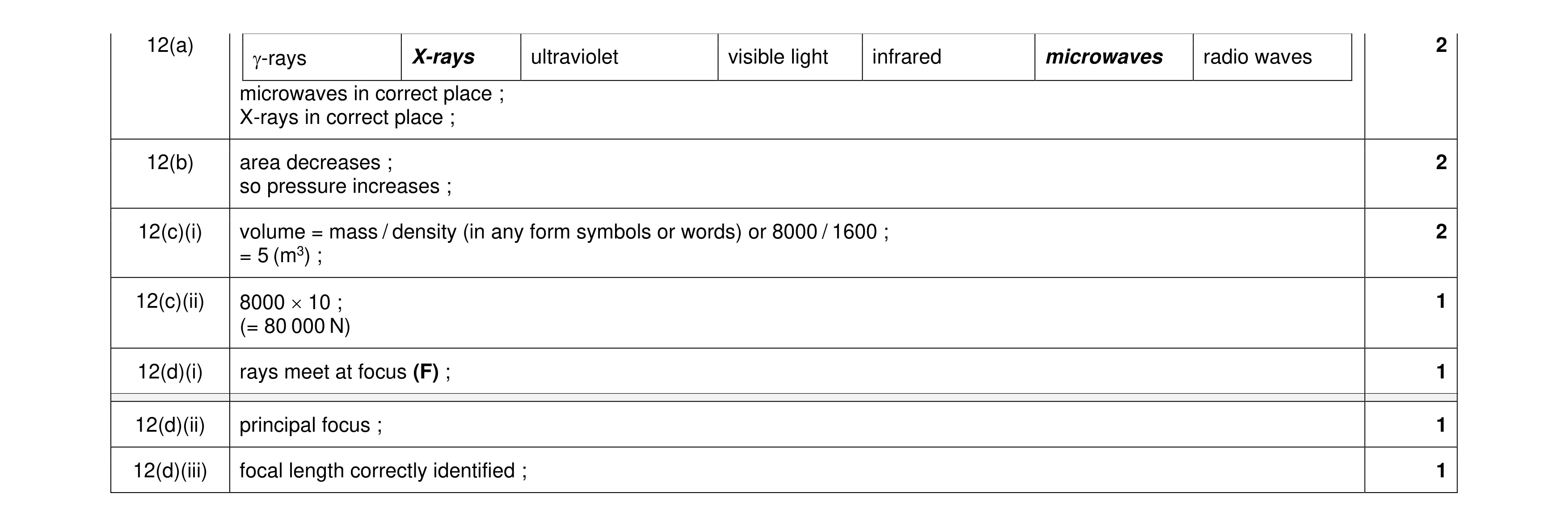 10
10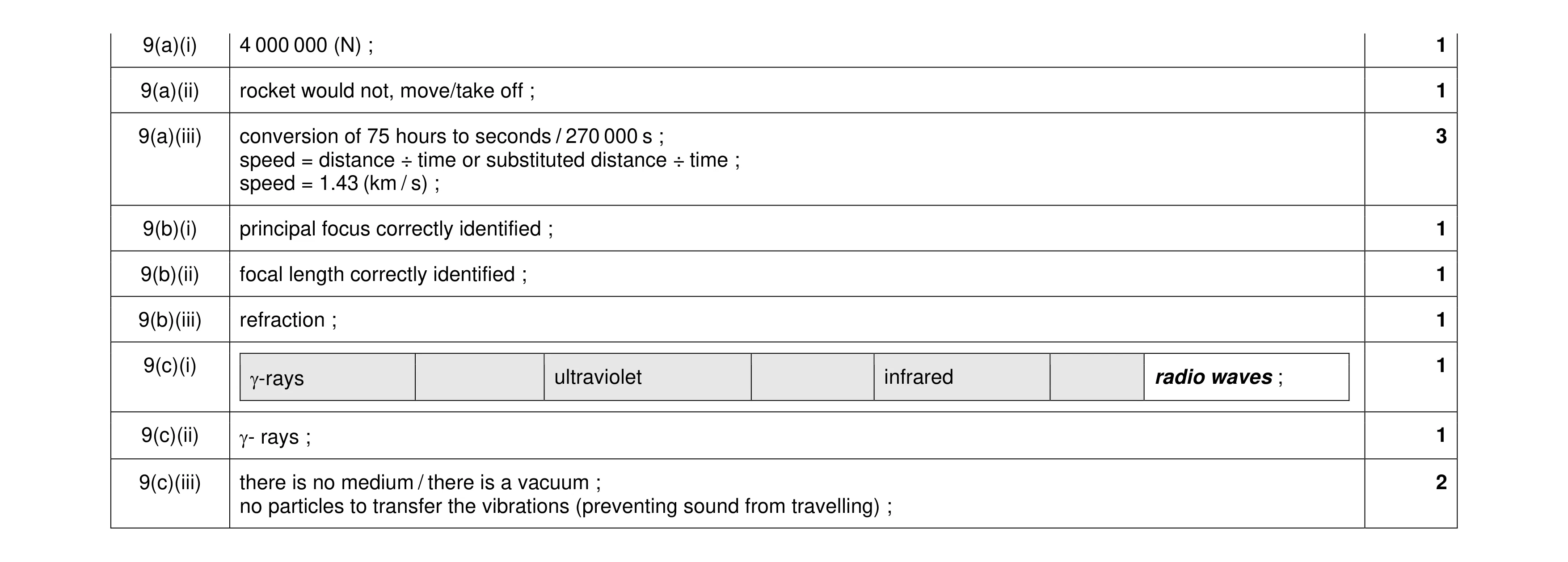 12
12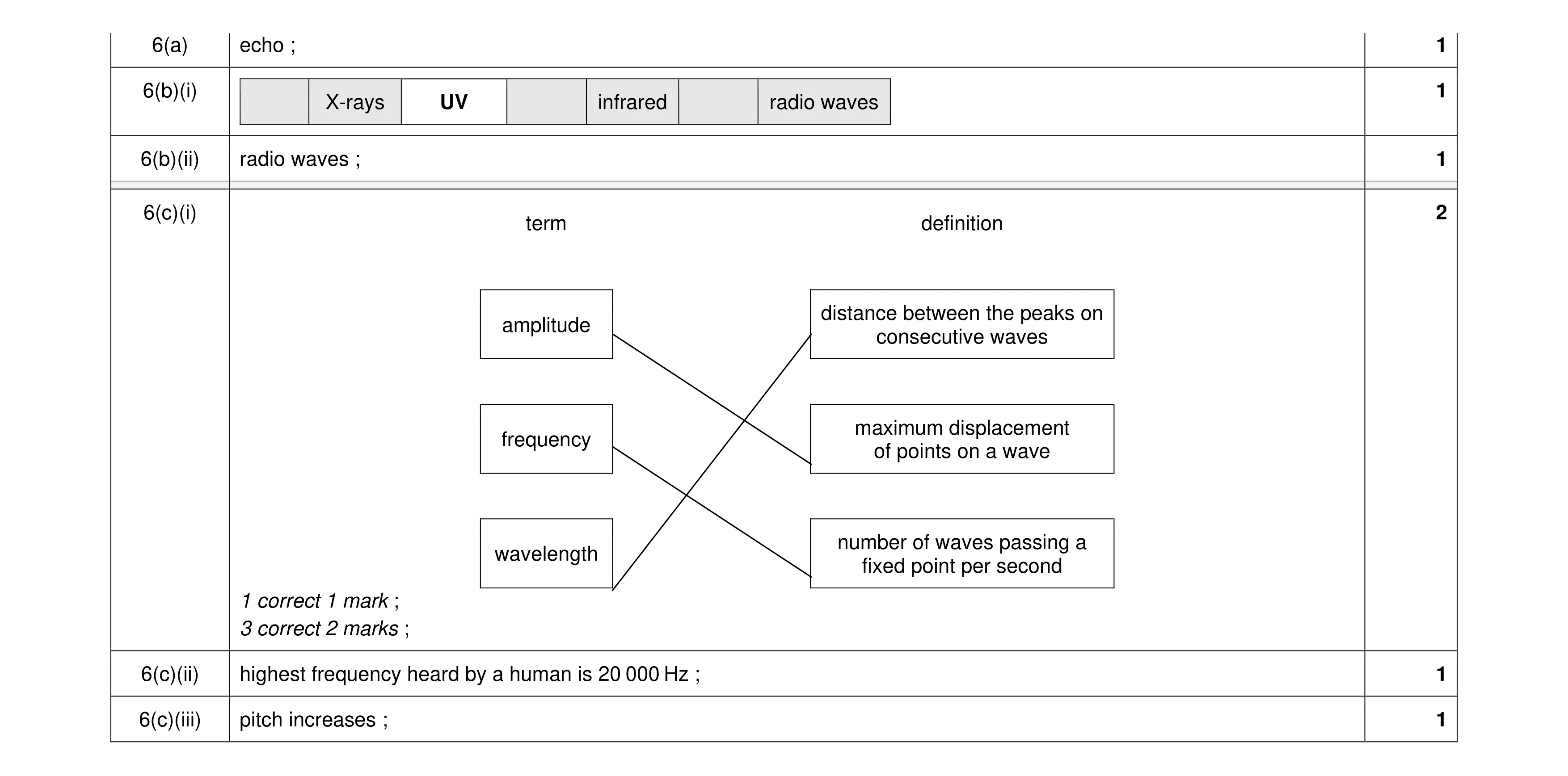 7
7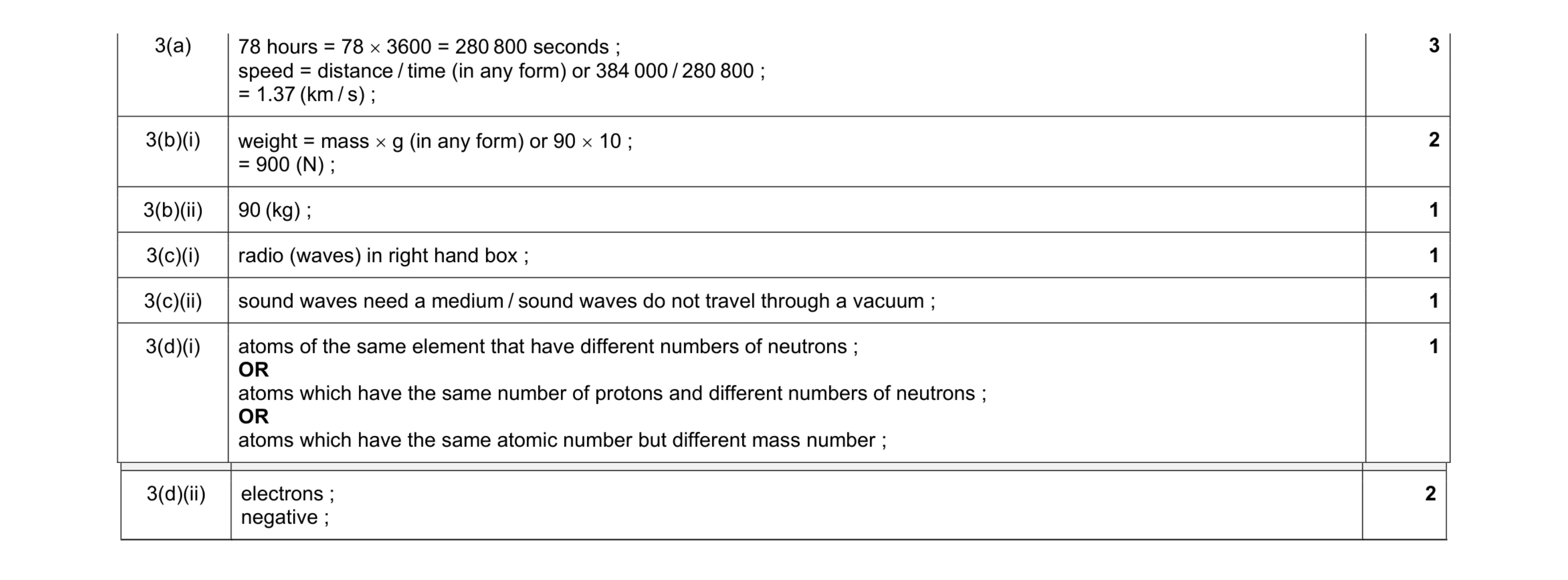 11
11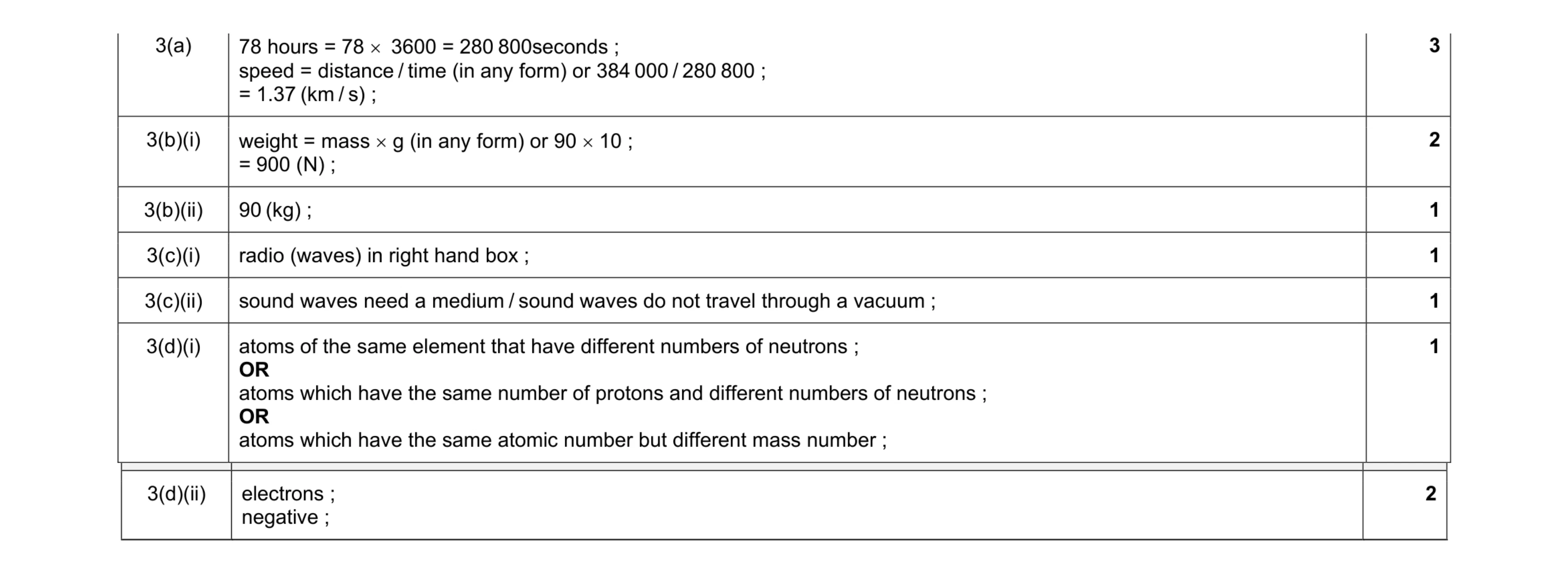 11
11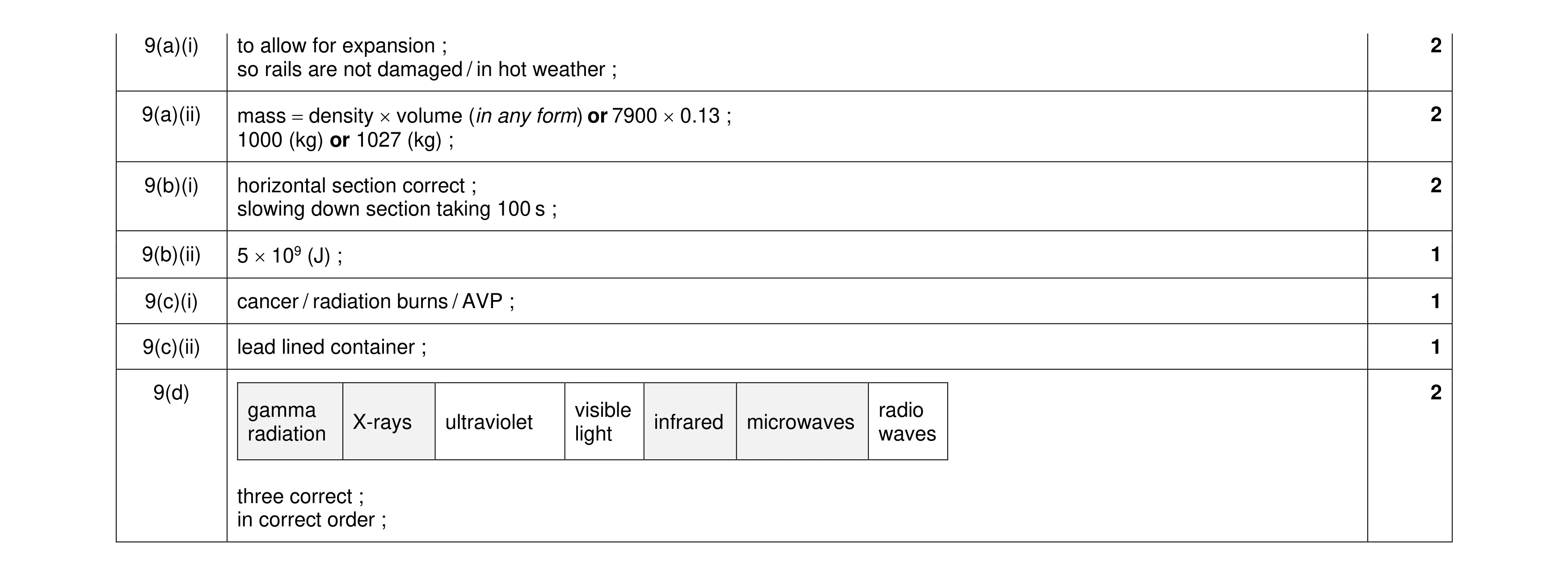 11
11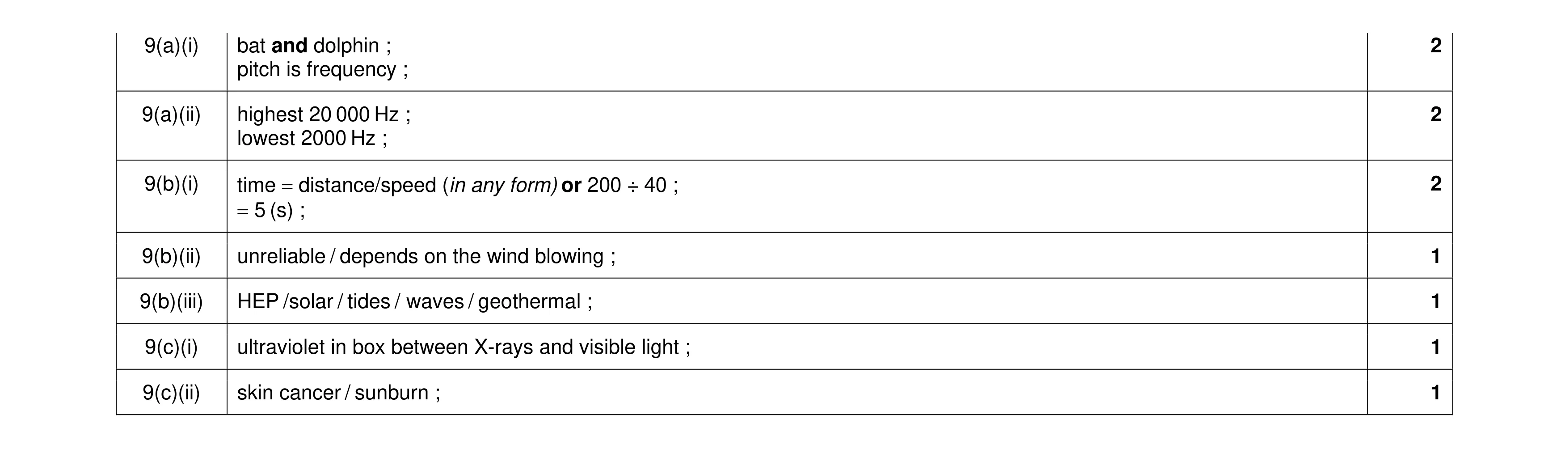 10
10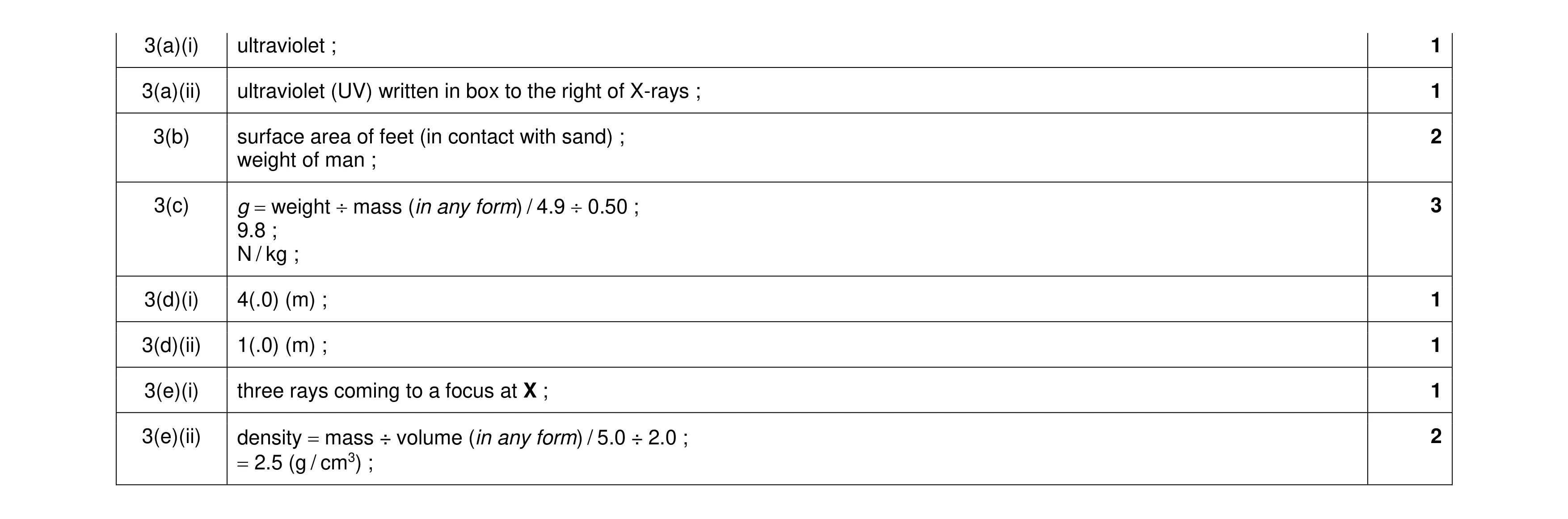 12
12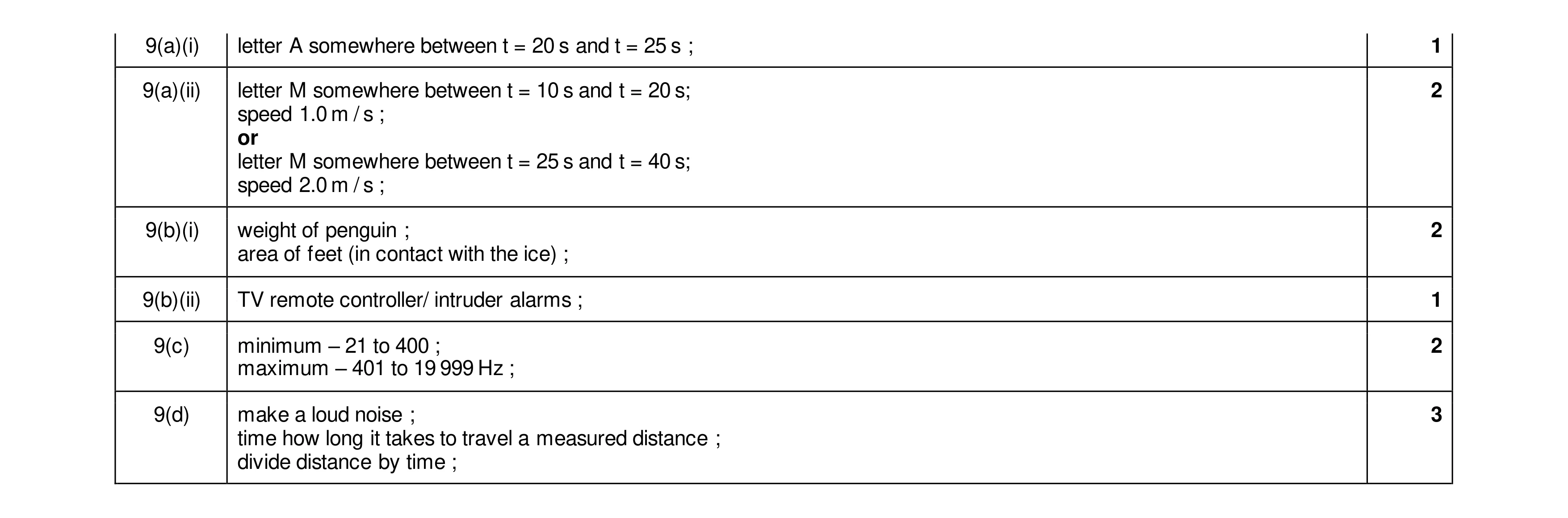 11
11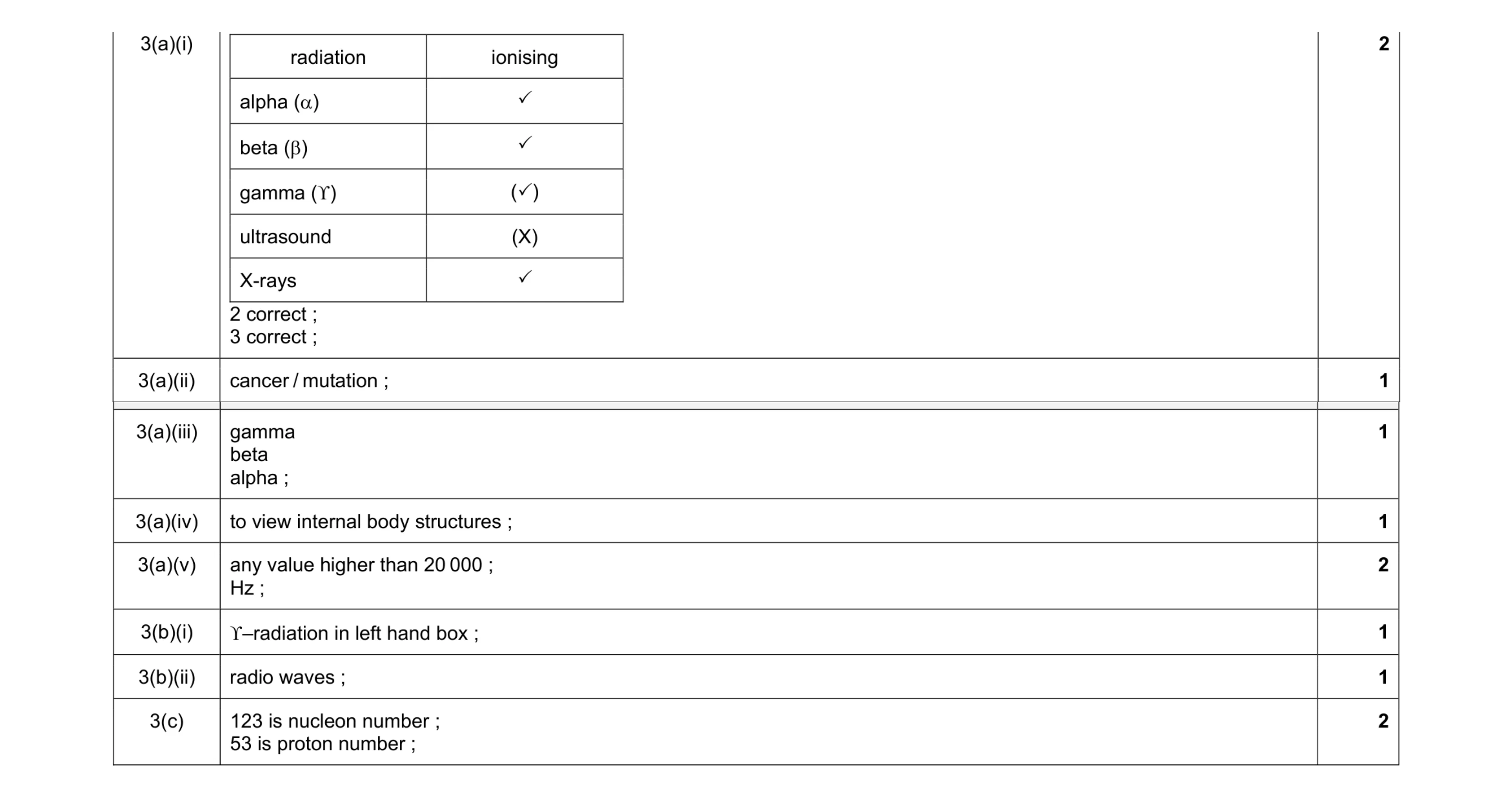 11
11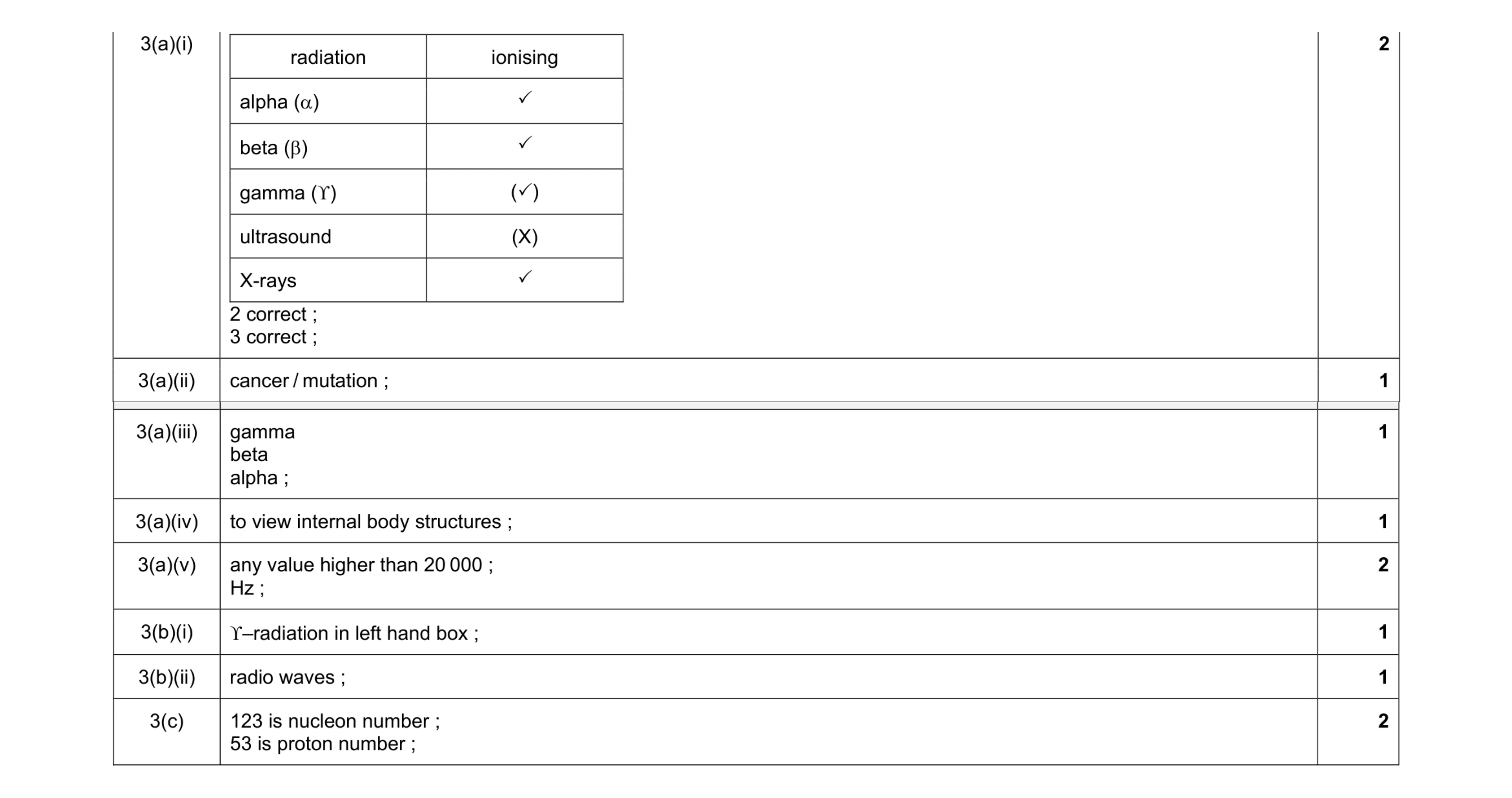 11
11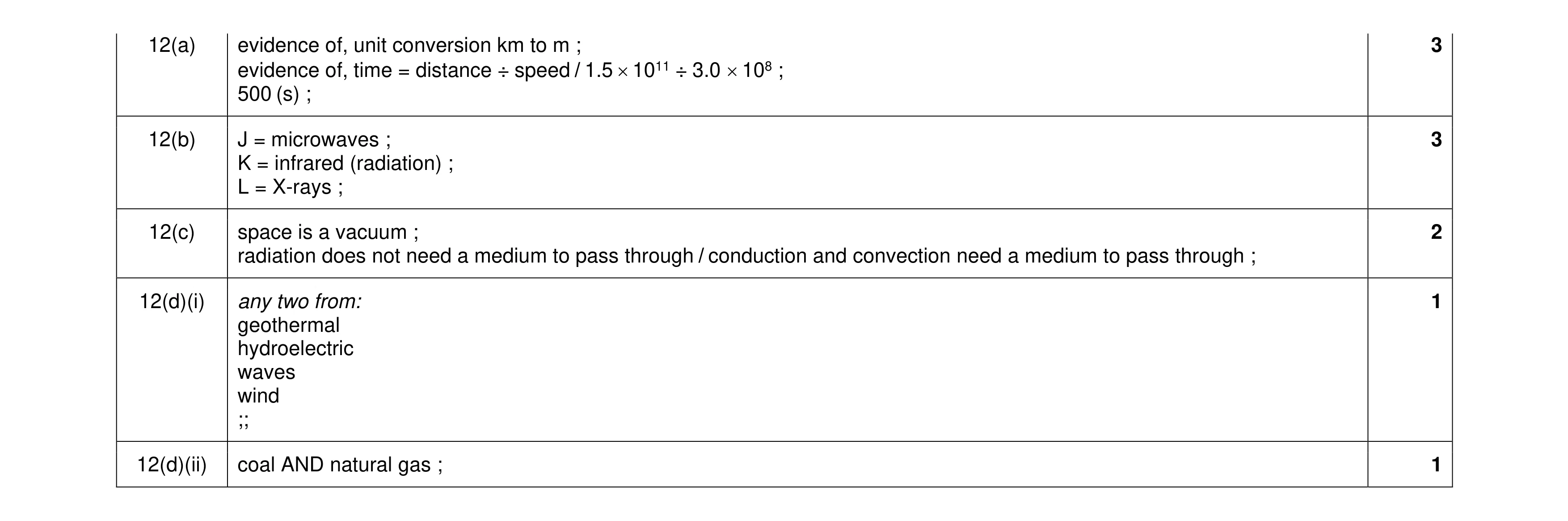 10
10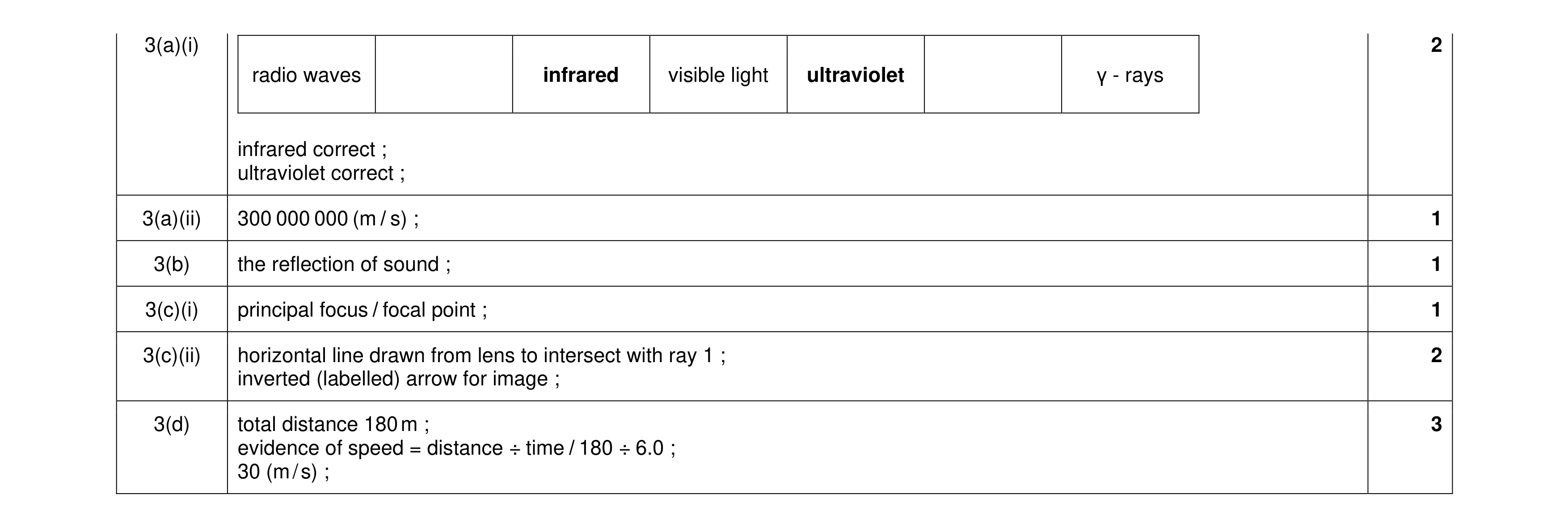 10
10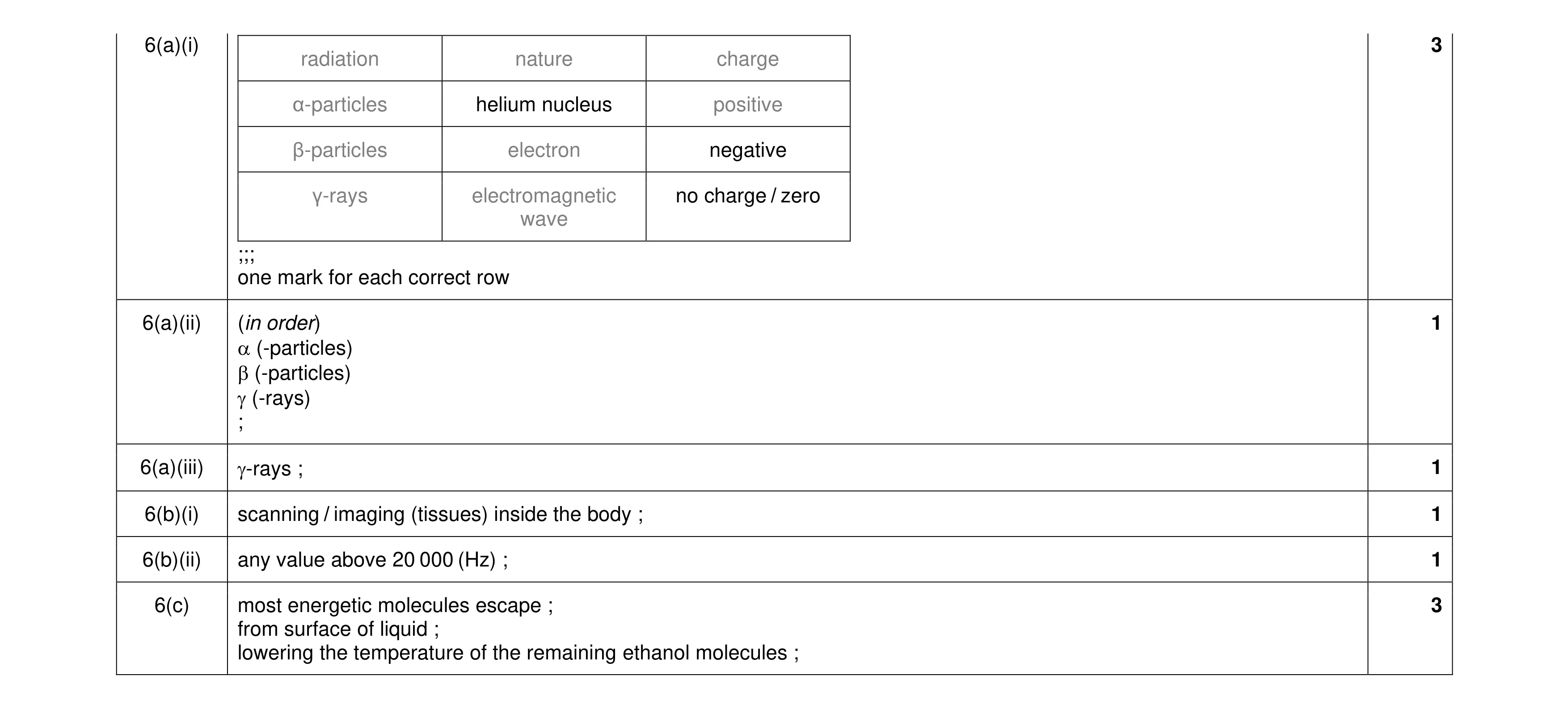 10
10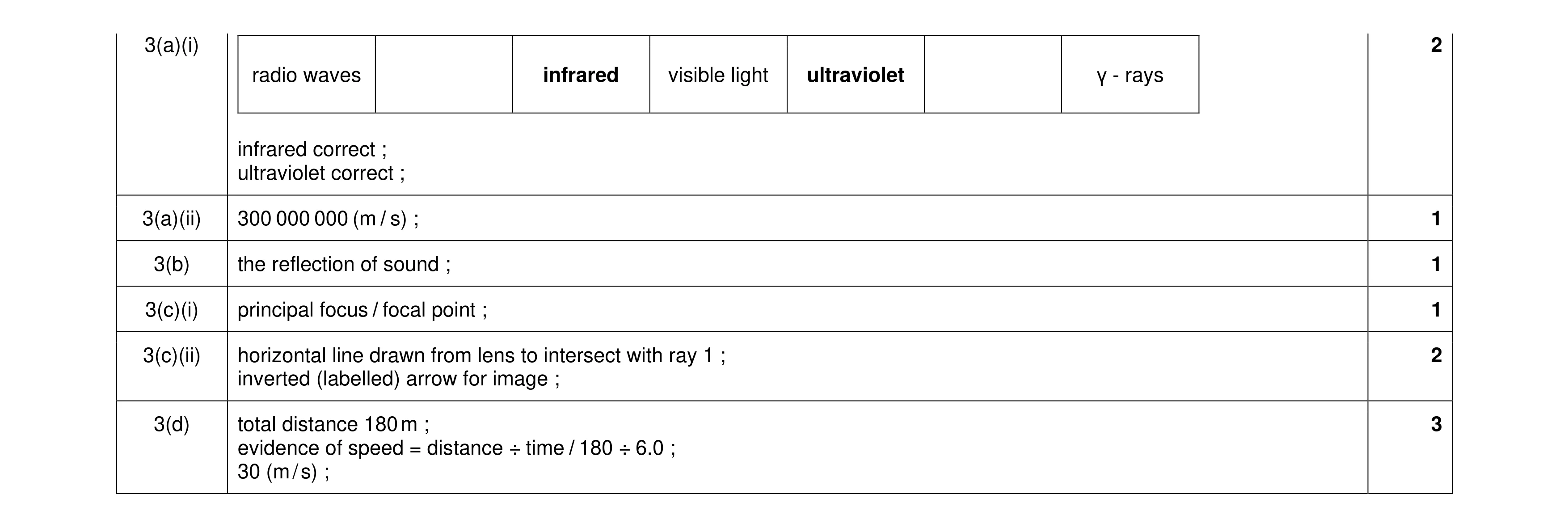 10
10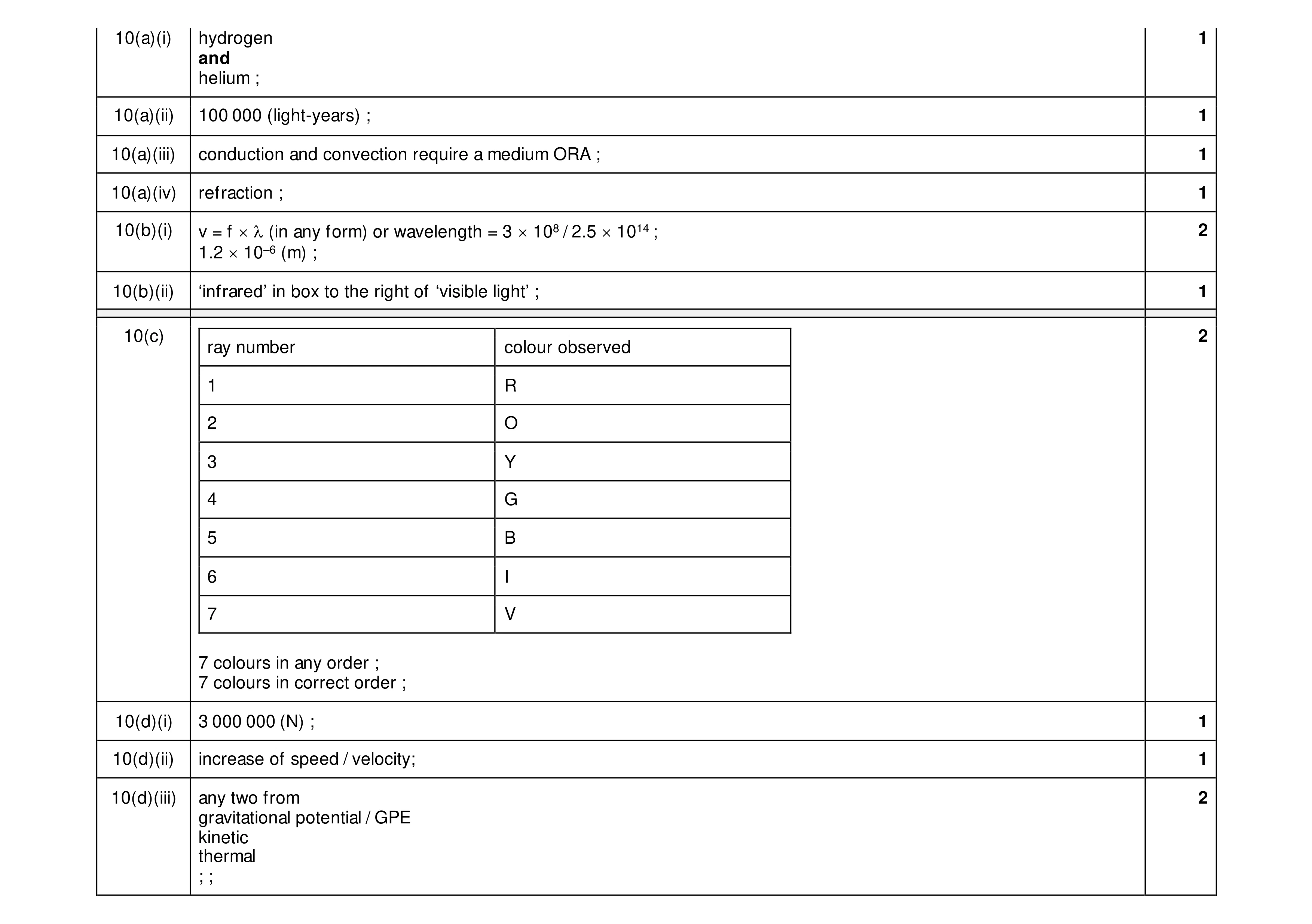 13
13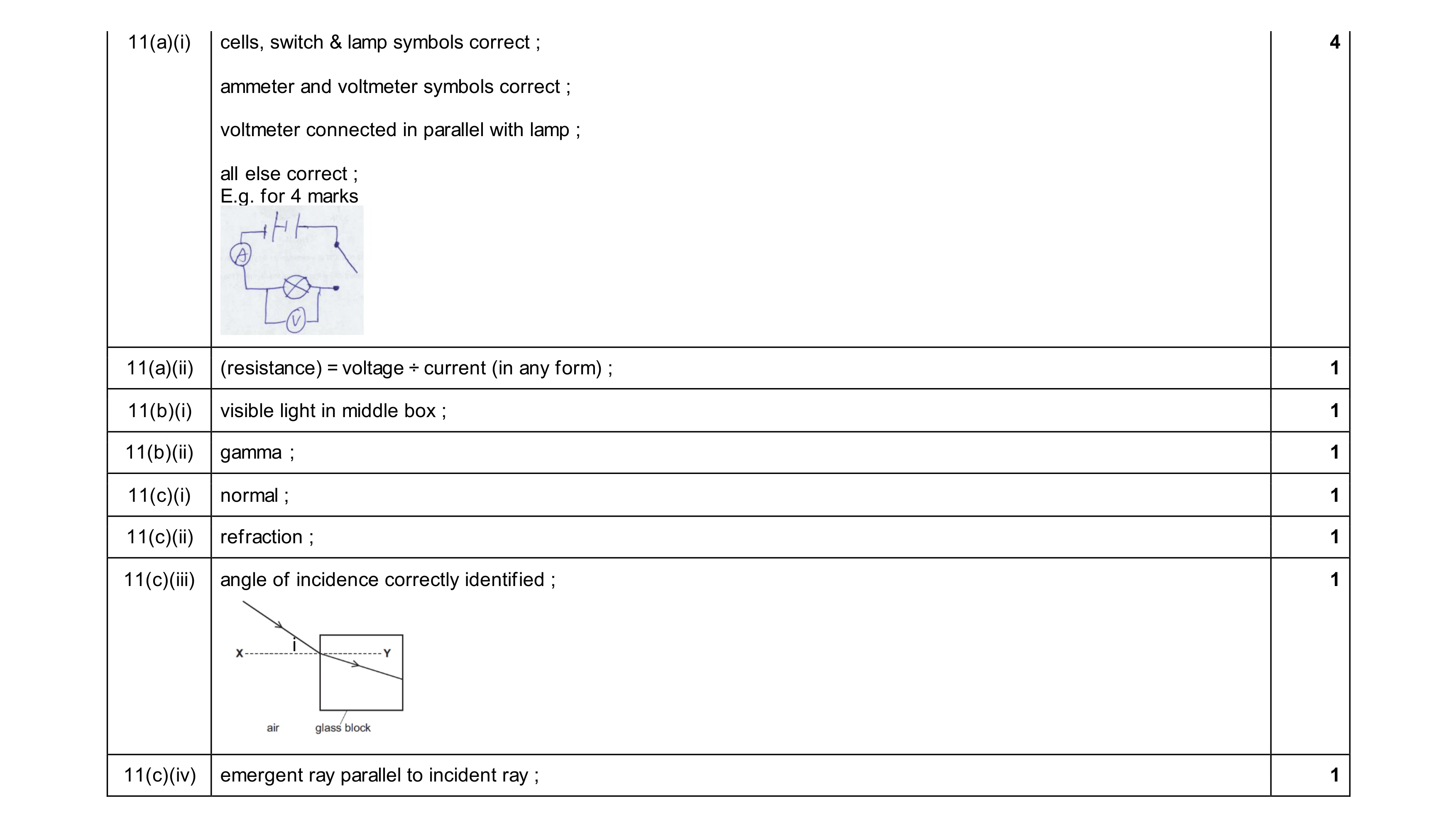 11
11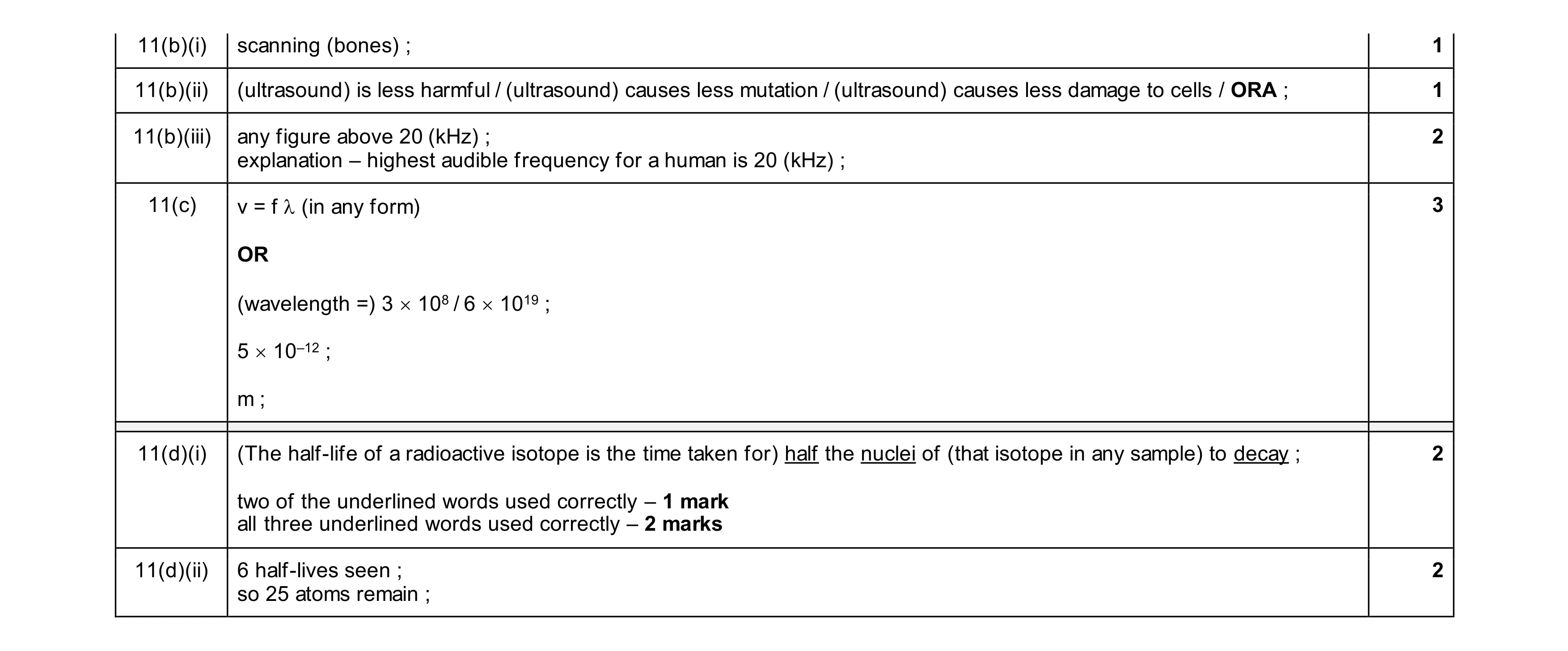 12
12