Cambridge IGCSE Sciences - Co-ordinated (Double) 0654 — 2022 May/June Paper 3 · Variant 1
0654/31/M/J/22 · 12 questions · 120 marks · ≈135 min
The question paper and its mark scheme, free to read here and free to download. This is Cambridge’s own paper, exactly as it was sat.
Question paper28 pages

Mark scheme14 pages
Answers below. Sit the paper first if you are practising.
Questions as text
Q1 · An athlete monitors her pulse rate during different types of activity
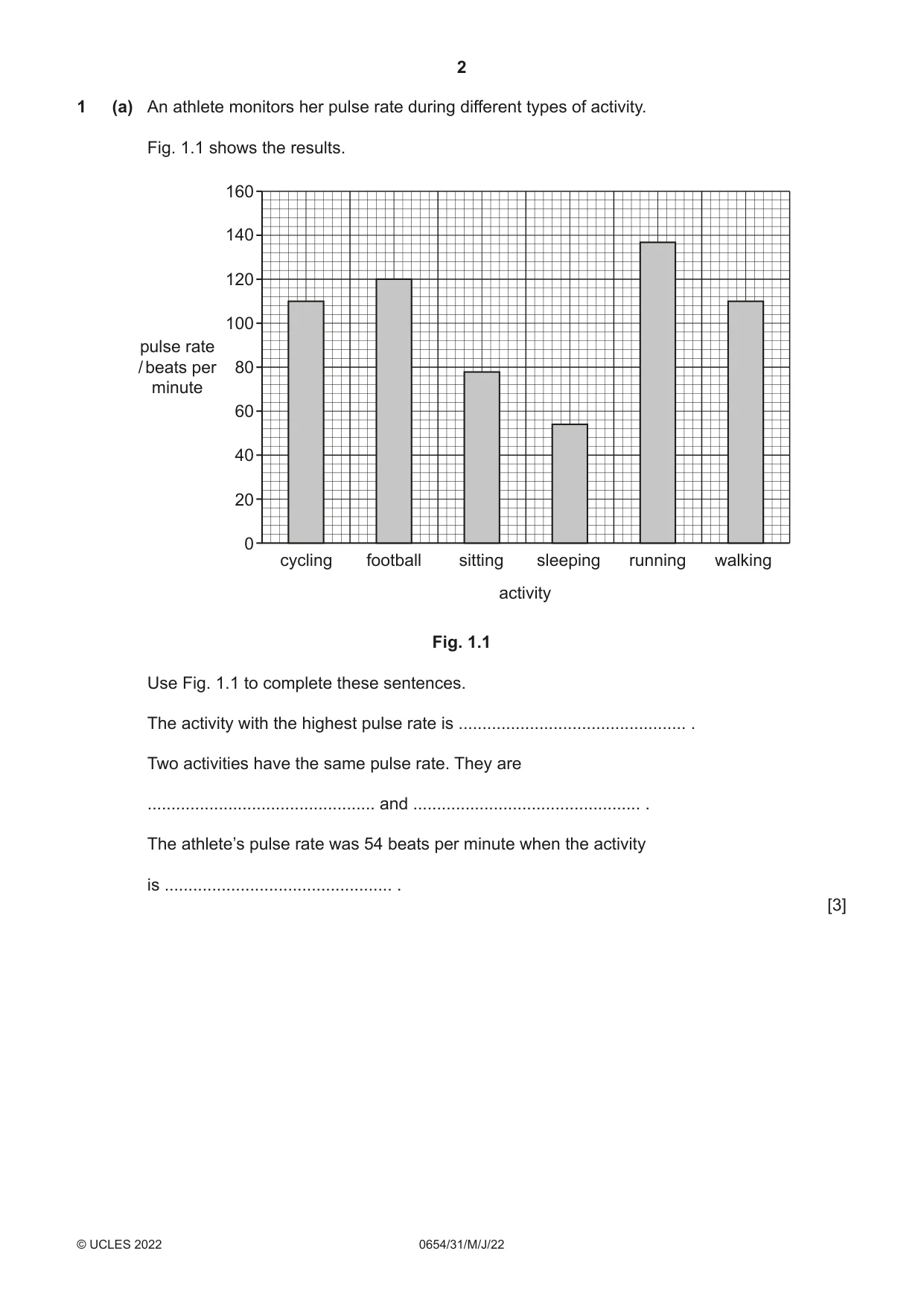
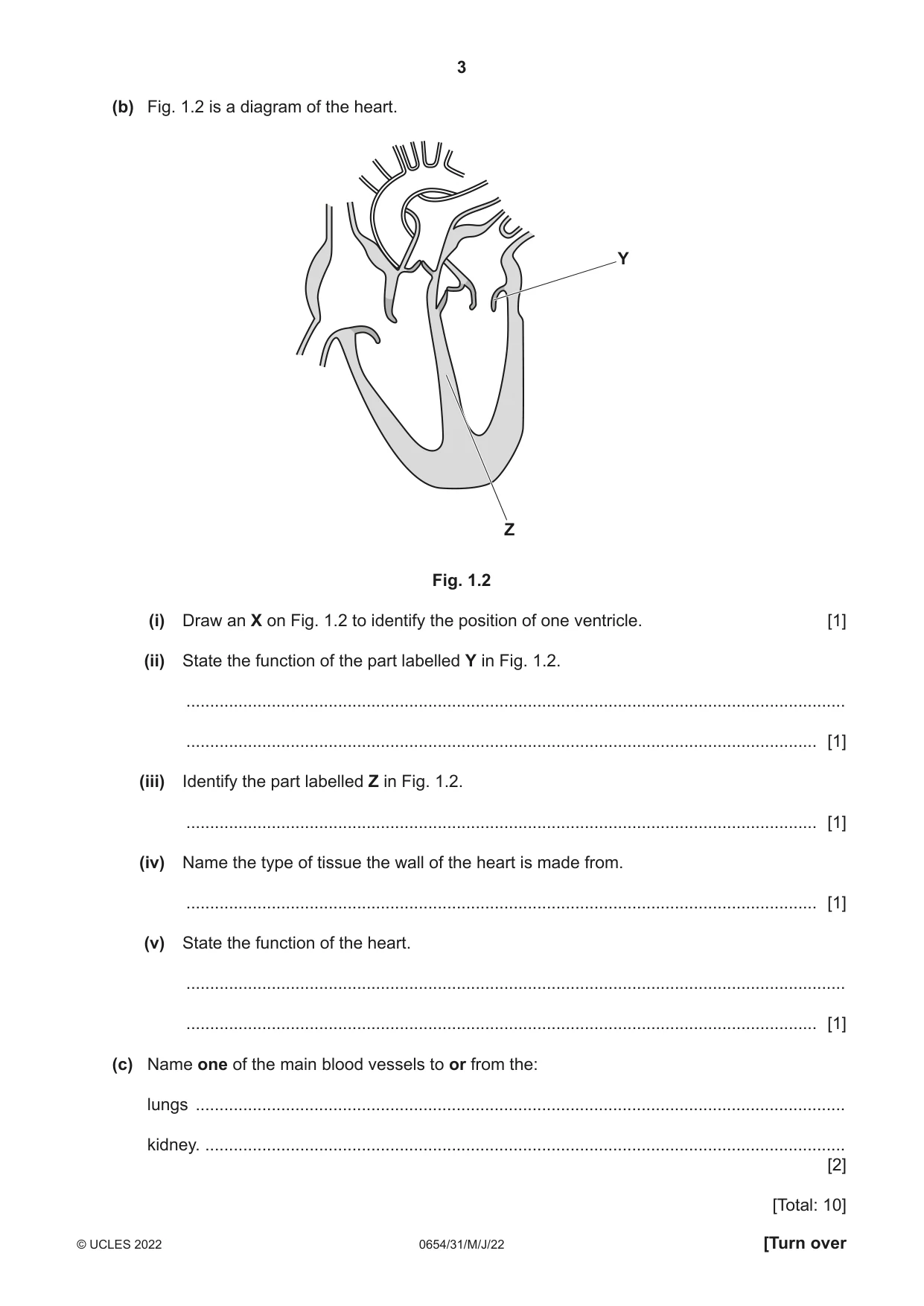
1 (a) An athlete monitors her pulse rate during different types of activity. Fig. 1.1 shows the results. 160 140 120 100 pulse rate / beats per 80 minute 60 40 20 0 cycling football sitting sleeping running walking activity Fig. 1.1 Use Fig. 1.1 to complete these sentences. The activity with the highest pulse rate is ................................................ . Two activities have the same pulse rate. They are ................................................ and ................................................ . The athlete’s pulse rate was 54 beats per minute when the activity is ................................................ . [3] (b) Fig. 1.2 is a diagram of the heart. Y Z Fig. 1.2 (i) Draw an X on Fig. 1.2 to identify the position of one ventricle. [1] (ii) State the function of the part labelled Y in Fig. 1.2. ........................................................................................................................................... ..................................................................................................................................... [1] (iii) Identify the part labelled Z in Fig. 1.2. ..................................................................................................................................... [1] (iv) Name the type of tissue the wall of the heart is made from. ..................................................................................................................................... [1] (v) State the function of the heart. ........................................................................................................................................... ..................................................................................................................................... [1] (c) Name one of the main blood vessels to or from the: lungs ......................................................................................................................................... kidney. ....................................................................................................................................... [2] [Total: 10]
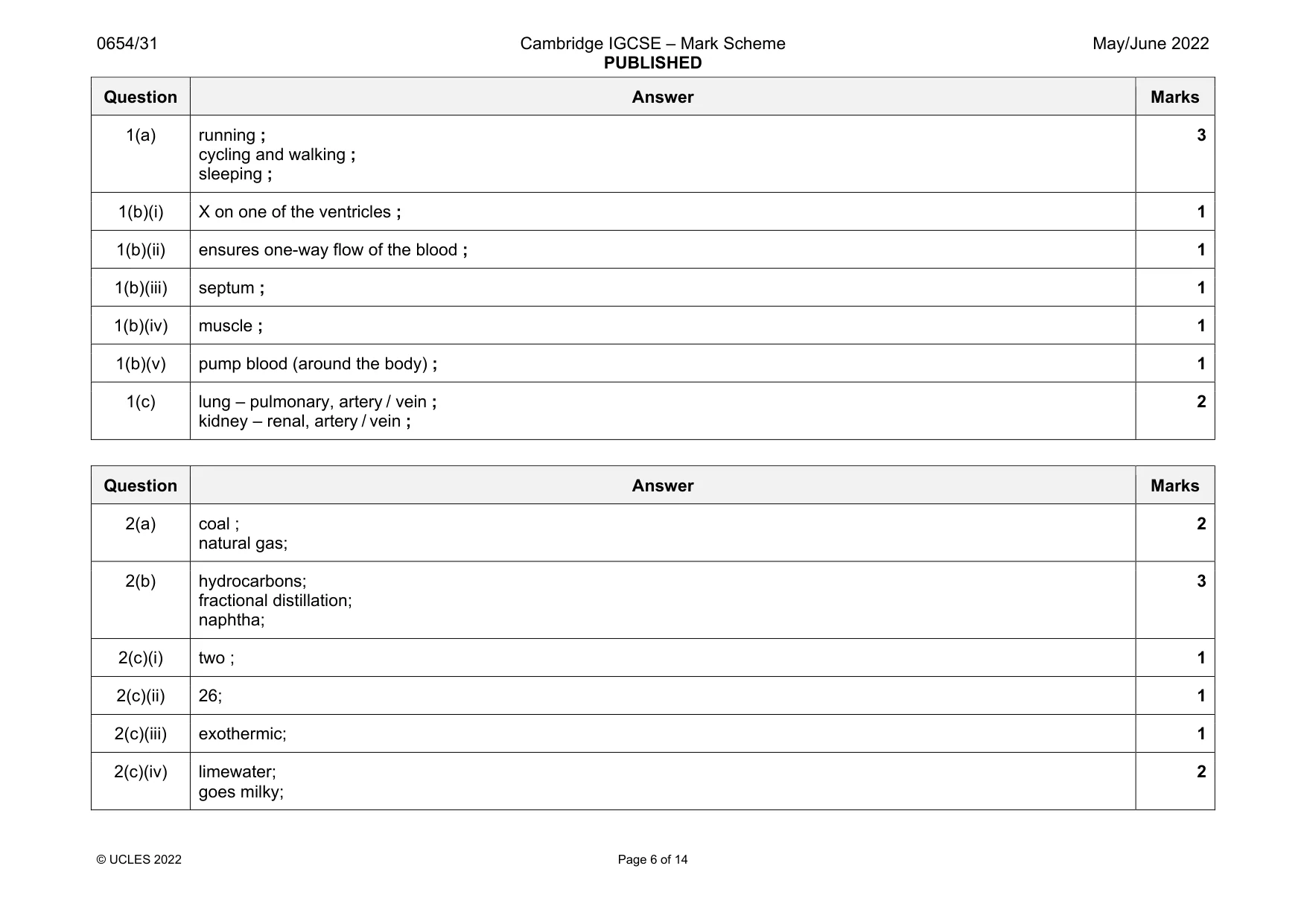
Mark scheme: 1(a) running ; cycling and walking ; sleeping ; 3 1(b)(i) X on one of the ventricles ; 1 1(b)(ii) ensures one-way flow of the blood ; 1 1(b)(iii) septum ; 1 1(b)(iv) muscle ; 1 1(b)(v) pump blood (around the body) ; 1 1(c) lung – pulmonary, artery / vein ; kidney – renal, artery / vein ; 2
Q2 · Petroleum is a fossil fuel
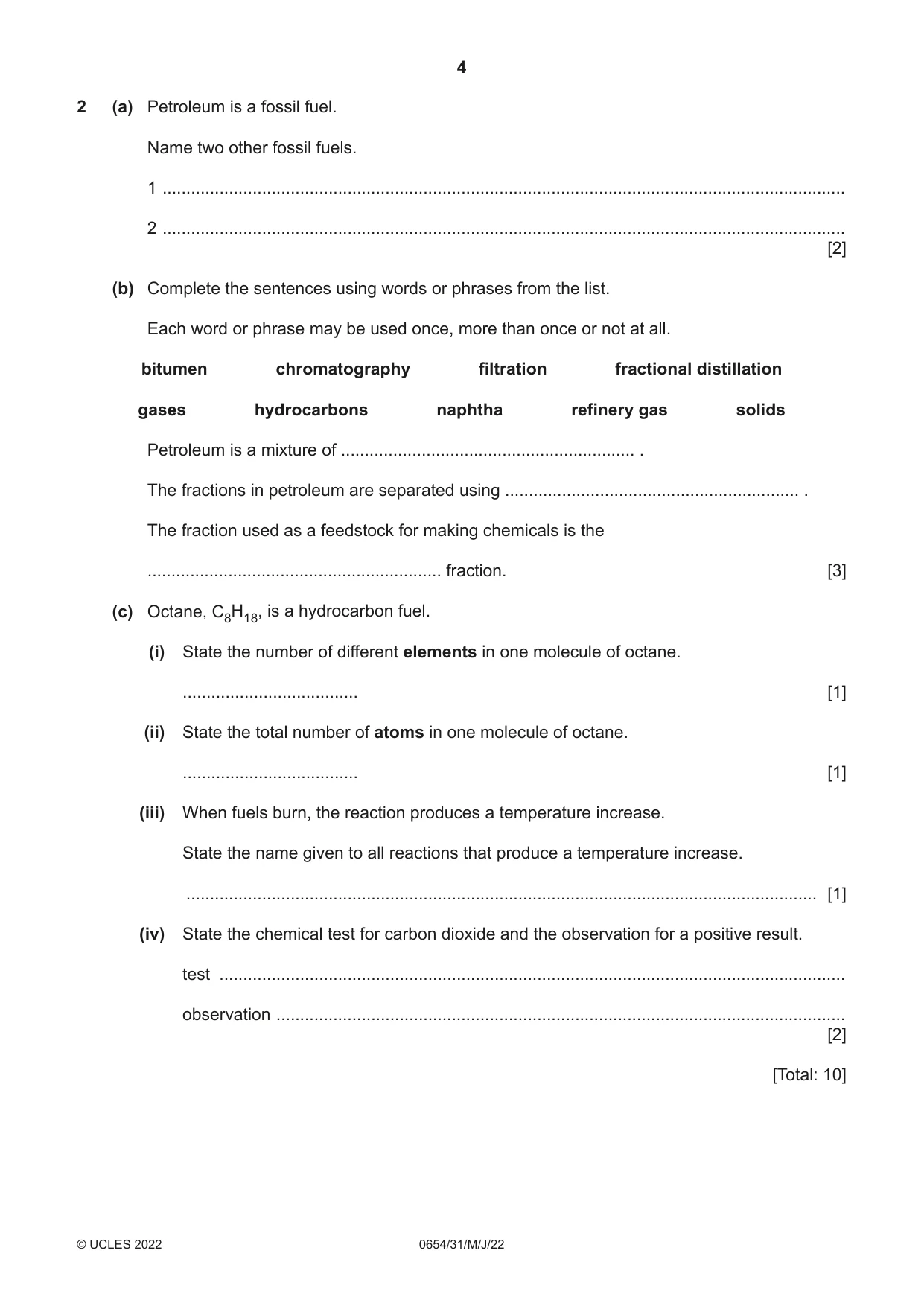
2 (a) Petroleum is a fossil fuel. Name two other fossil fuels. 1 ................................................................................................................................................ 2 ................................................................................................................................................ [2] (b) Complete the sentences using words or phrases from the list. Each word or phrase may be used once, more than once or not at all. bitumen chromatography filtration fractional distillation gases hydrocarbons naphtha refinery gas solids Petroleum is a mixture of .............................................................. . The fractions in petroleum are separated using .............................................................. . The fraction used as a feedstock for making chemicals is the .............................................................. fraction. [3] (c) Octane, C8H18, is a hydrocarbon fuel. (i) State the number of different elements in one molecule of octane. ..................................... [1] (ii) State the total number of atoms in one molecule of octane. ..................................... [1] (iii) When fuels burn, the reaction produces a temperature increase. State the name given to all reactions that produce a temperature increase. ..................................................................................................................................... [1] (iv) State the chemical test for carbon dioxide and the observation for a positive result. test .................................................................................................................................... observation ........................................................................................................................ [2] [Total: 10]
Mark scheme: 2(a) coal ; natural gas; 2 2(b) hydrocarbons; fractional distillation; naphtha; 3 2(c)(i) two ; 1 2(c)(ii) 26; 1 2(c)(iii) exothermic; 1 2(c)(iv) limewater; goes milky; 2
Q3 · A student uses her laptop computer
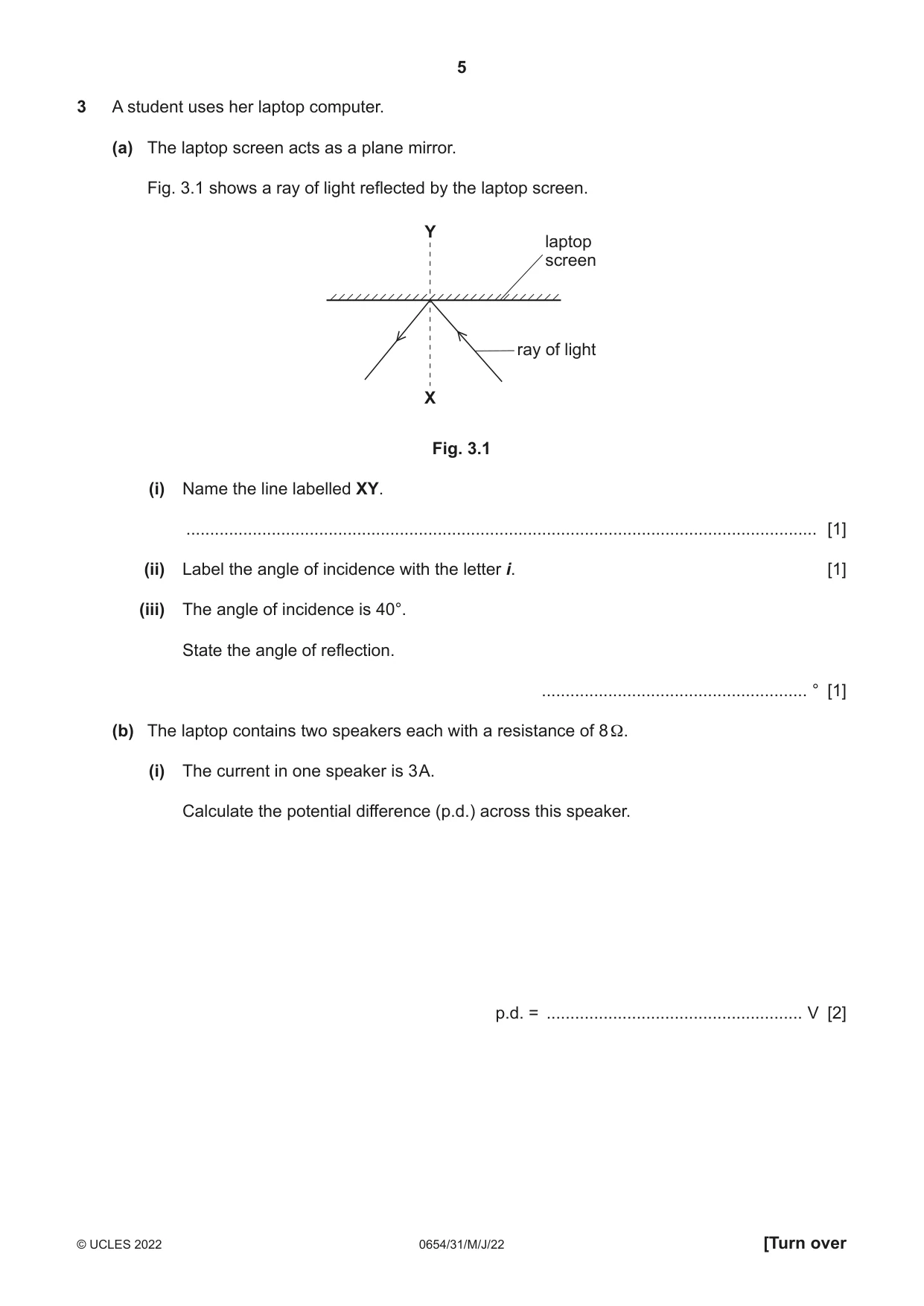
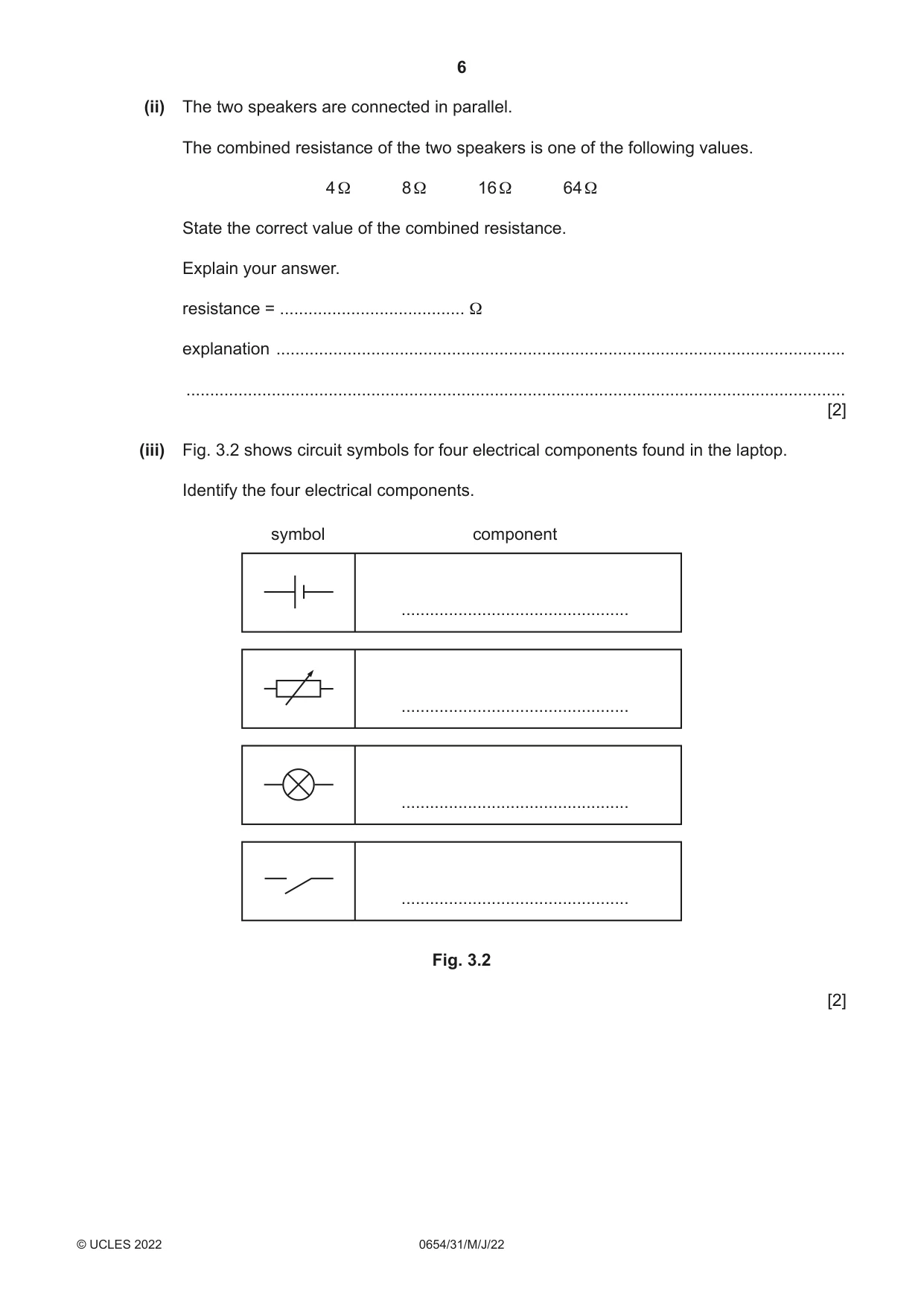
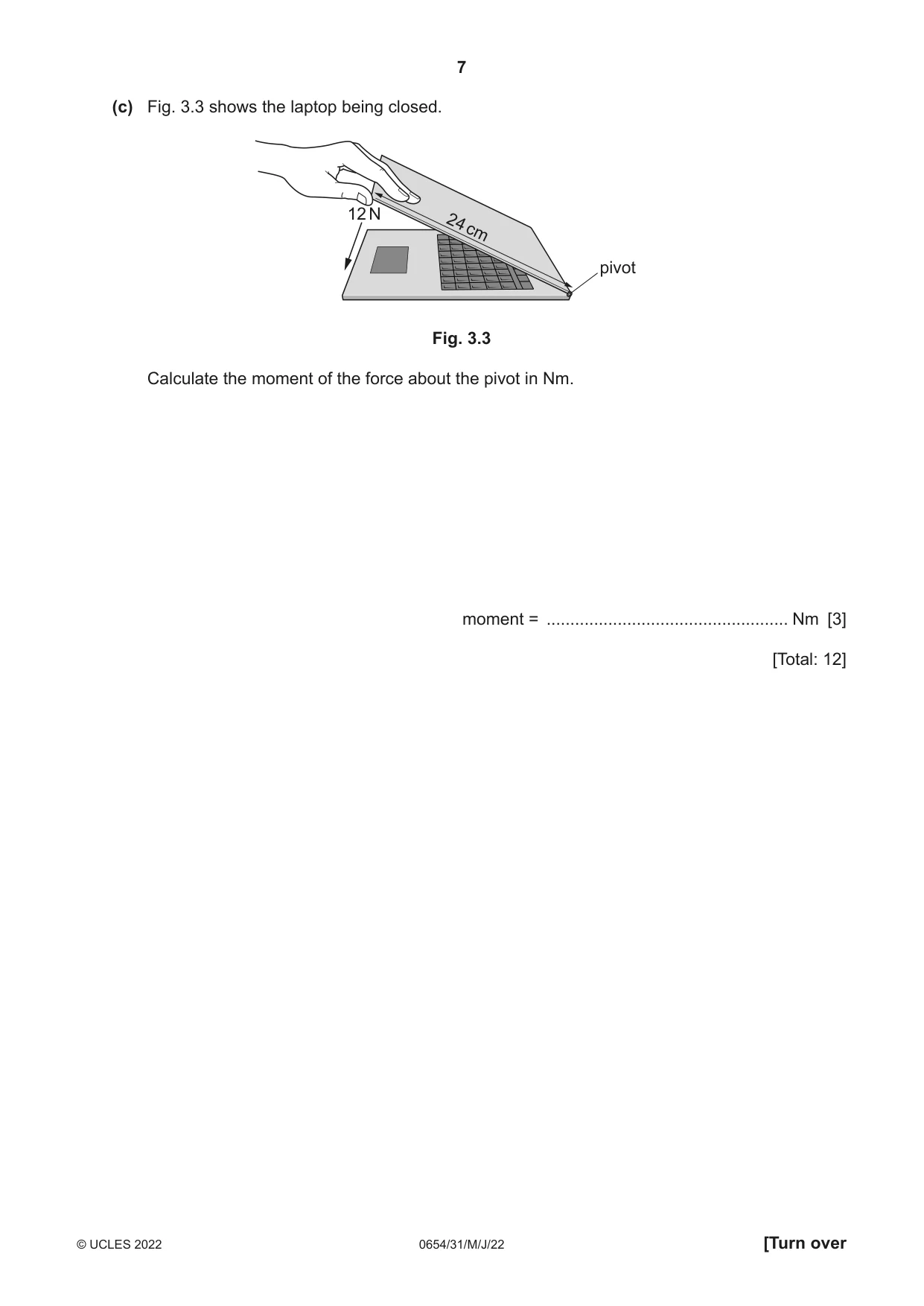
3 A student uses her laptop computer. (a) The laptop screen acts as a plane mirror. Fig. 3.1 shows a ray of light reflected by the laptop screen. Y laptop screen ray of light X Fig. 3.1 (i) Name the line labelled XY. ..................................................................................................................................... [1] (ii) Label the angle of incidence with the letter i. [1] (iii) The angle of incidence is 40°. State the angle of reflection. ........................................................ ° [1] (b) The laptop contains two speakers each with a resistance of 8 Ω. (i) The current in one speaker is 3 A. Calculate the potential difference (p.d.) across this speaker. p.d. = ...................................................... V [2] (ii) The two speakers are connected in parallel. The combined resistance of the two speakers is one of the following values. 4 Ω 8 Ω 16 Ω 64 Ω State the correct value of the combined resistance. Explain your answer. resistance = ....................................... Ω explanation ........................................................................................................................ ........................................................................................................................................... [2] (iii) Fig. 3.2 shows circuit symbols for four electrical components found in the laptop. Identify the four electrical components. symbol component ................................................ ................................................ ................................................ ................................................ Fig. 3.2 [2] (c) Fig. 3.3 shows the laptop being closed. 12 N 24 cm pivot Fig. 3.3 Calculate the moment of the force about the pivot in Nm. moment = ................................................... Nm [3] [Total: 12]
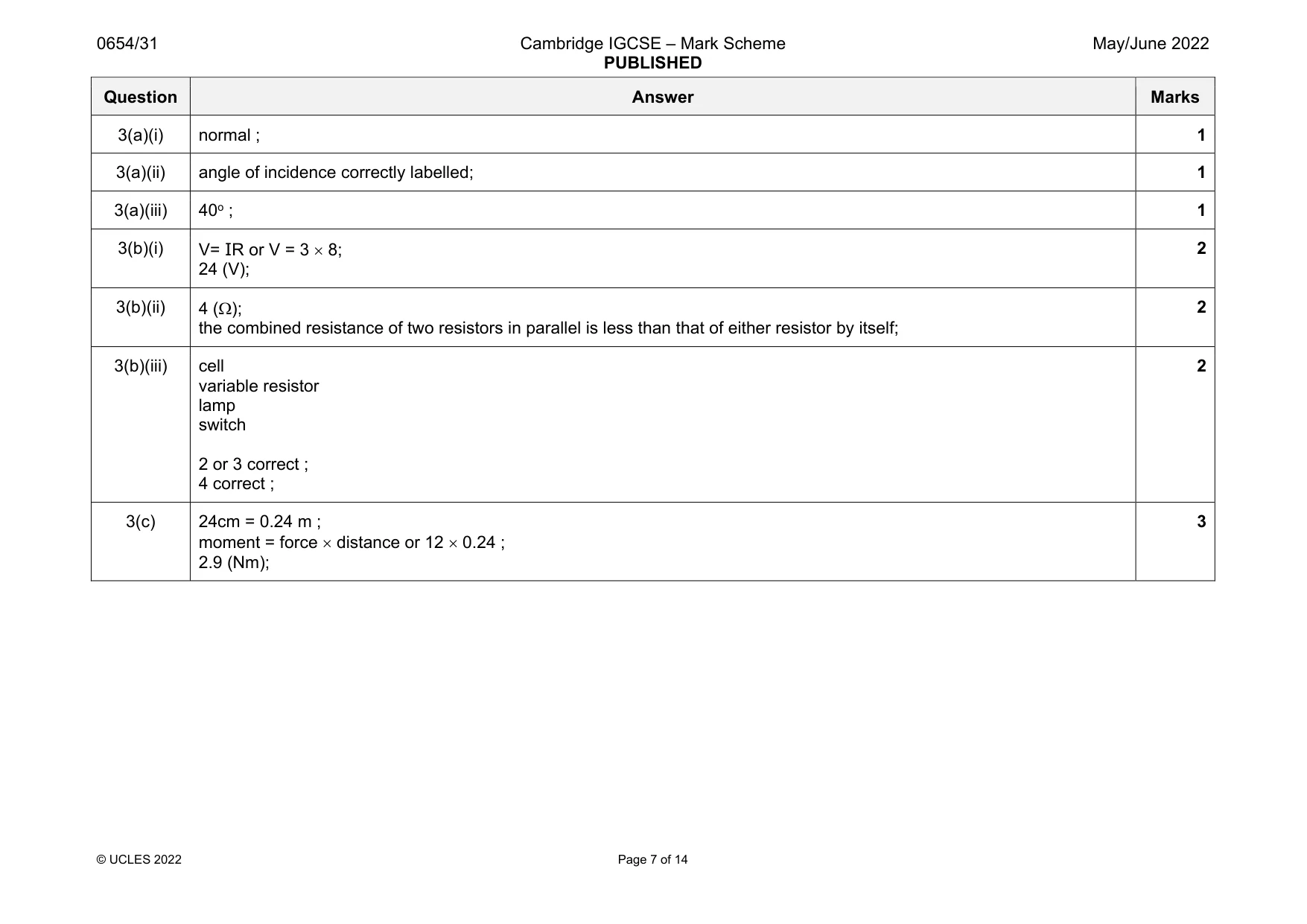
Mark scheme: 3(a)(i) normal ; 1 3(a)(ii) angle of incidence correctly labelled; 1 3(a)(iii) 40o ; 1 3(b)(i) V= IR or V = 3 8; 24 (V); 2 3(b)(ii) 4 (); the combined resistance of two resistors in parallel is less than that of either resistor by itself; 2 3(b)(iii) cell variable resistor lamp switch 2 or 3 correct ; 4 correct ; 2 3(c) 24cm = 0.24 m ; moment = force distance or 12 0.24 ; 2.9 (Nm); 3
Q4 · The inheritance of smooth or wrinkled skin in pea plants is controlled by a single gene
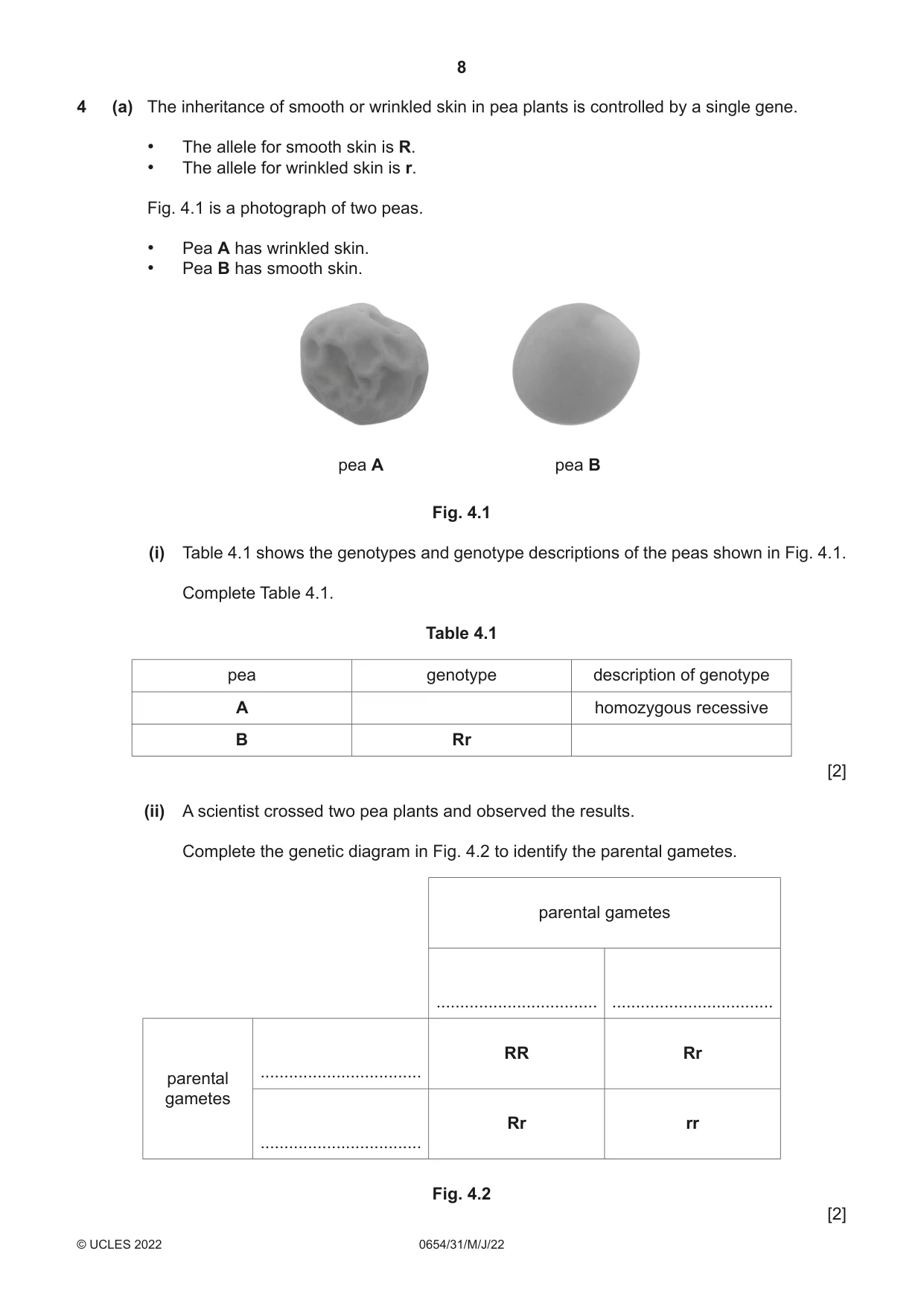
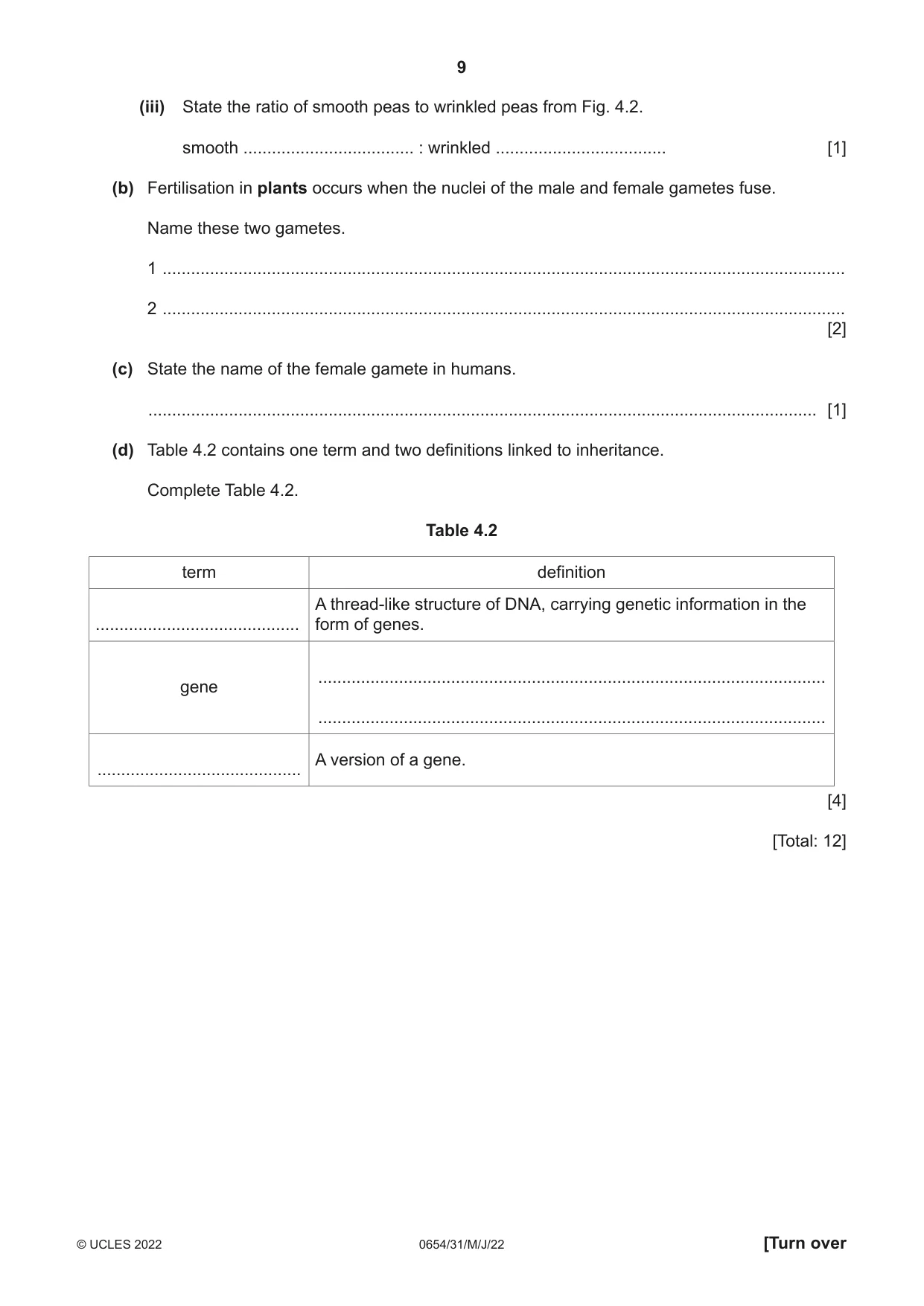
4 (a) The inheritance of smooth or wrinkled skin in pea plants is controlled by a single gene. • The allele for smooth skin is R. • The allele for wrinkled skin is r. Fig. 4.1 is a photograph of two peas. • Pea A has wrinkled skin. • Pea B has smooth skin. pea A pea B Fig. 4.1 (i) Table 4.1 shows the genotypes and genotype descriptions of the peas shown in Fig. 4.1. Complete Table 4.1. Table 4.1 pea genotype description of genotype A homozygous recessive B Rr [2] (ii) A scientist crossed two pea plants and observed the results. Complete the genetic diagram in Fig. 4.2 to identify the parental gametes. parental gametes .................................. .................................. RR Rr .................................. parental gametes Rr rr .................................. Fig. 4.2 [2] (iii) State the ratio of smooth peas to wrinkled peas from Fig. 4.2. smooth .................................... : wrinkled .................................... [1] (b) Fertilisation in plants occurs when the nuclei of the male and female gametes fuse. Name these two gametes. 1 ................................................................................................................................................ 2 ................................................................................................................................................ [2] (c) State the name of the female gamete in humans. ............................................................................................................................................. [1] (d) Table 4.2 contains one term and two definitions linked to inheritance. Complete Table 4.2. Table 4.2 term definition A thread-like structure of DNA, carrying genetic information in the ........................................... form of genes. ........................................................................................................... gene ........................................................................................................... A version of a gene............................................ [4] [Total: 12]
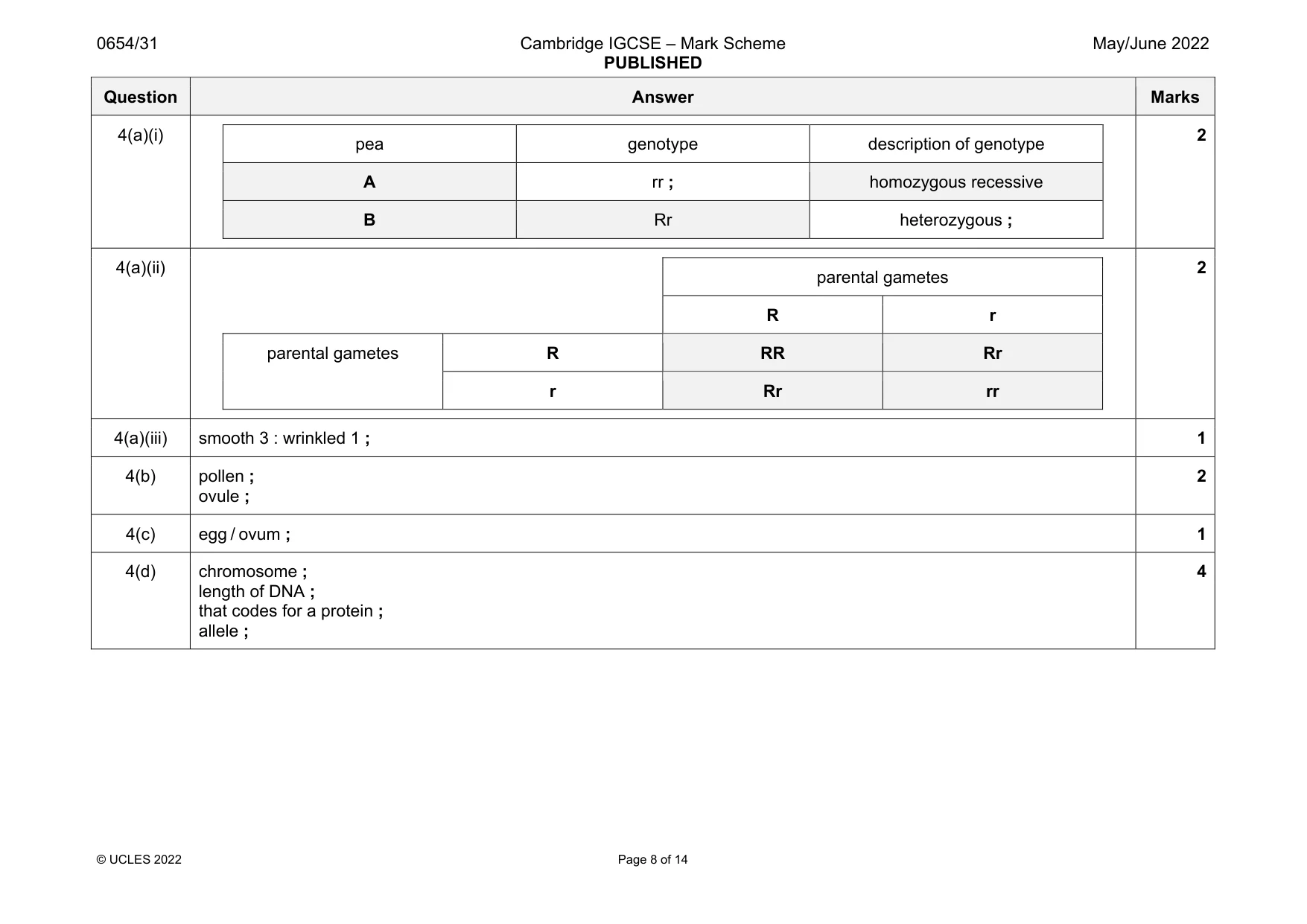
Mark scheme: 4(a)(i) pea genotype description of genotype A rr ; homozygous recessive B Rr heterozygous ; 2 4(a)(ii) parental gametes R r parental gametes R RR Rr r Rr rr 2 4(a)(iii) smooth 3 : wrinkled 1 ; 1 4(b) pollen ; ovule ; 2 4(c) egg / ovum ; 1 4(d) chromosome ; length of DNA ; that codes for a protein ; allele ; 4
Q5 · Aluminium is a metal
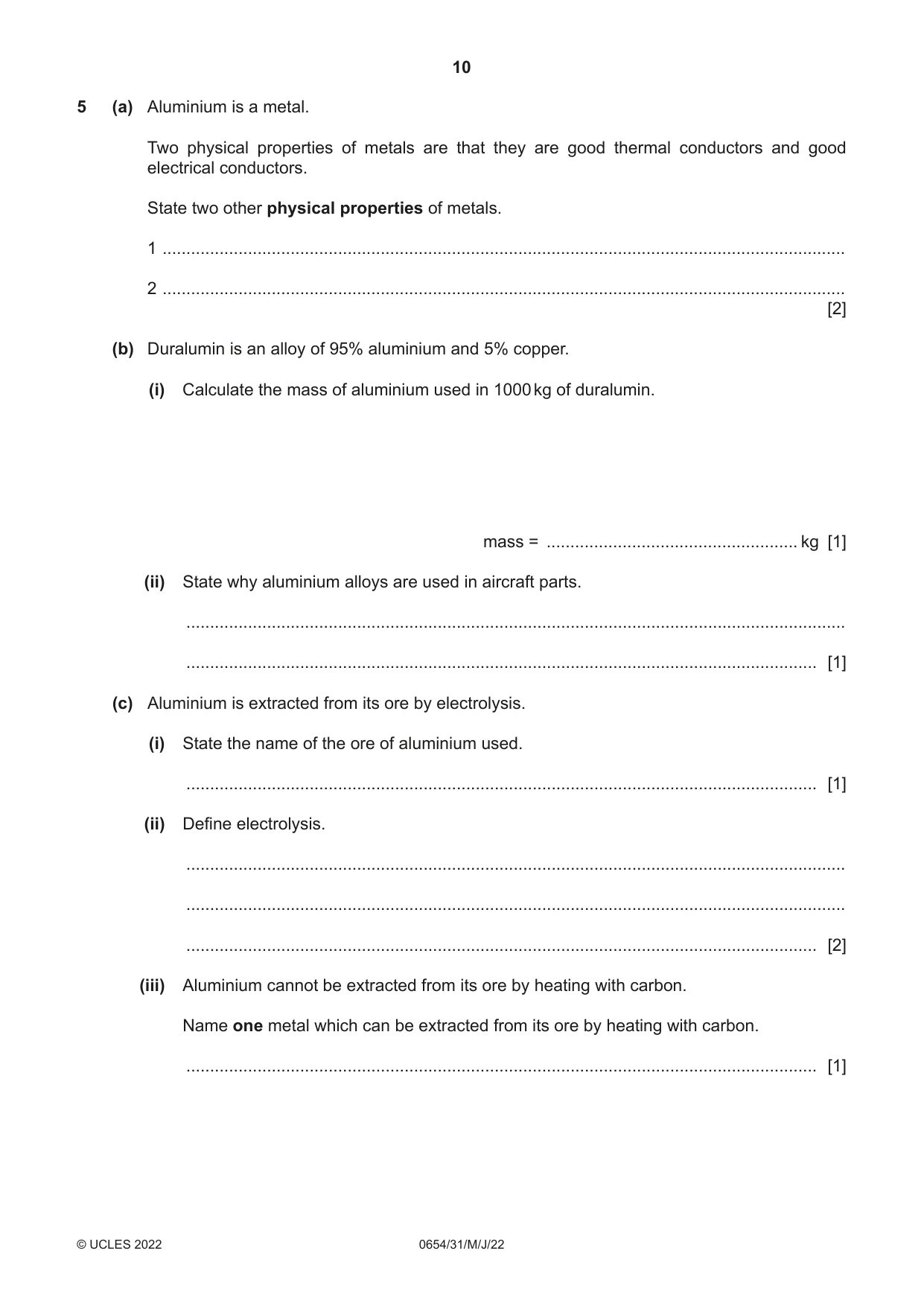
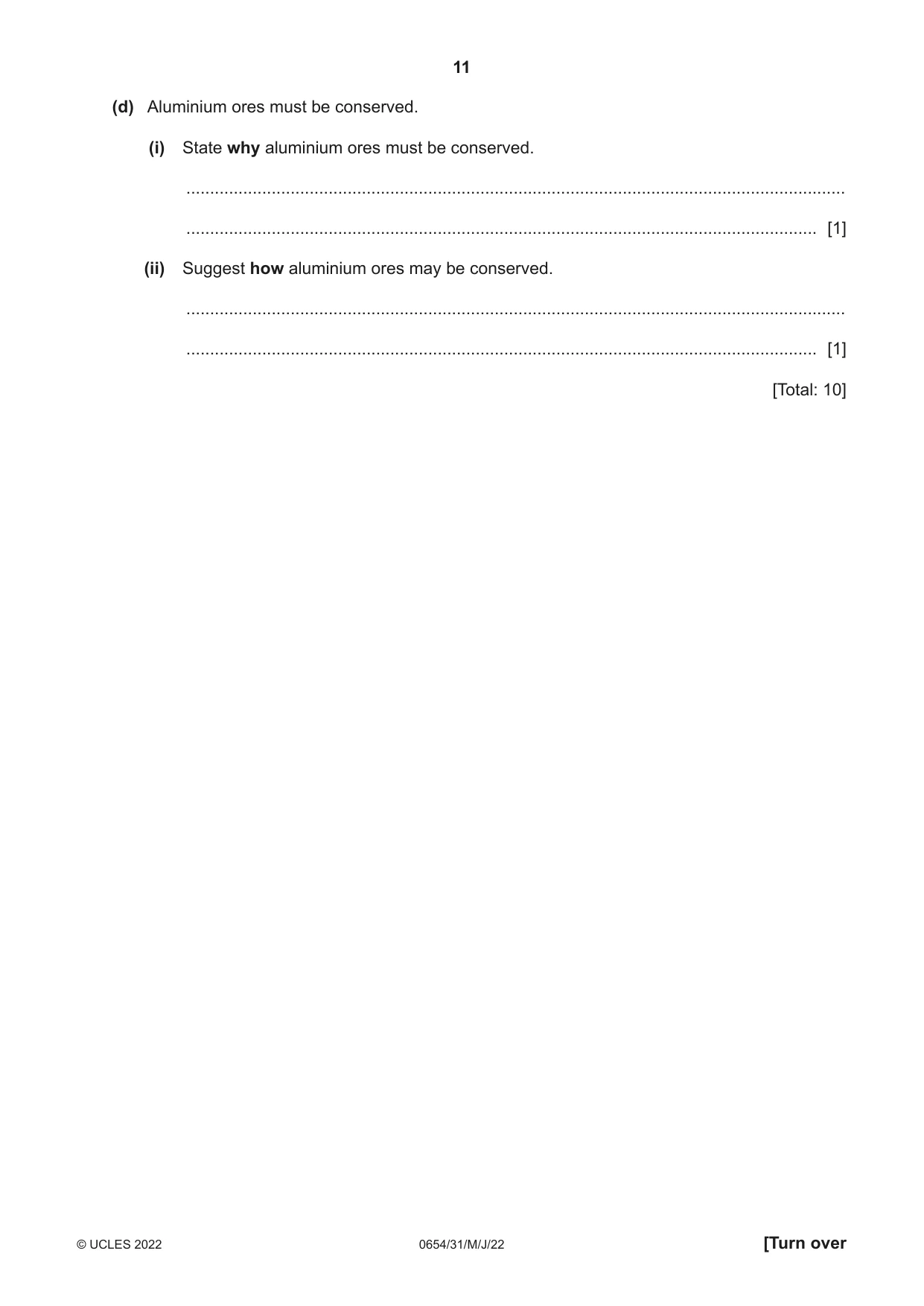
5 (a) Aluminium is a metal. Two physical properties of metals are that they are good thermal conductors and good electrical conductors. State two other physical properties of metals. 1 ................................................................................................................................................ 2 ................................................................................................................................................ [2] (b) Duralumin is an alloy of 95% aluminium and 5% copper. (i) Calculate the mass of aluminium used in 1000 kg of duralumin. mass = ..................................................... kg [1] (ii) State why aluminium alloys are used in aircraft parts. ........................................................................................................................................... ..................................................................................................................................... [1] (c) Aluminium is extracted from its ore by electrolysis. (i) State the name of the ore of aluminium used. ..................................................................................................................................... [1] (ii) Define electrolysis. ........................................................................................................................................... ........................................................................................................................................... ..................................................................................................................................... [2] (iii) Aluminium cannot be extracted from its ore by heating with carbon. Name one metal which can be extracted from its ore by heating with carbon. ..................................................................................................................................... [1] (d) Aluminium ores must be conserved. (i) State why aluminium ores must be conserved. ........................................................................................................................................... ..................................................................................................................................... [1] (ii) Suggest how aluminium ores may be conserved. ........................................................................................................................................... ..................................................................................................................................... [1] [Total: 10]
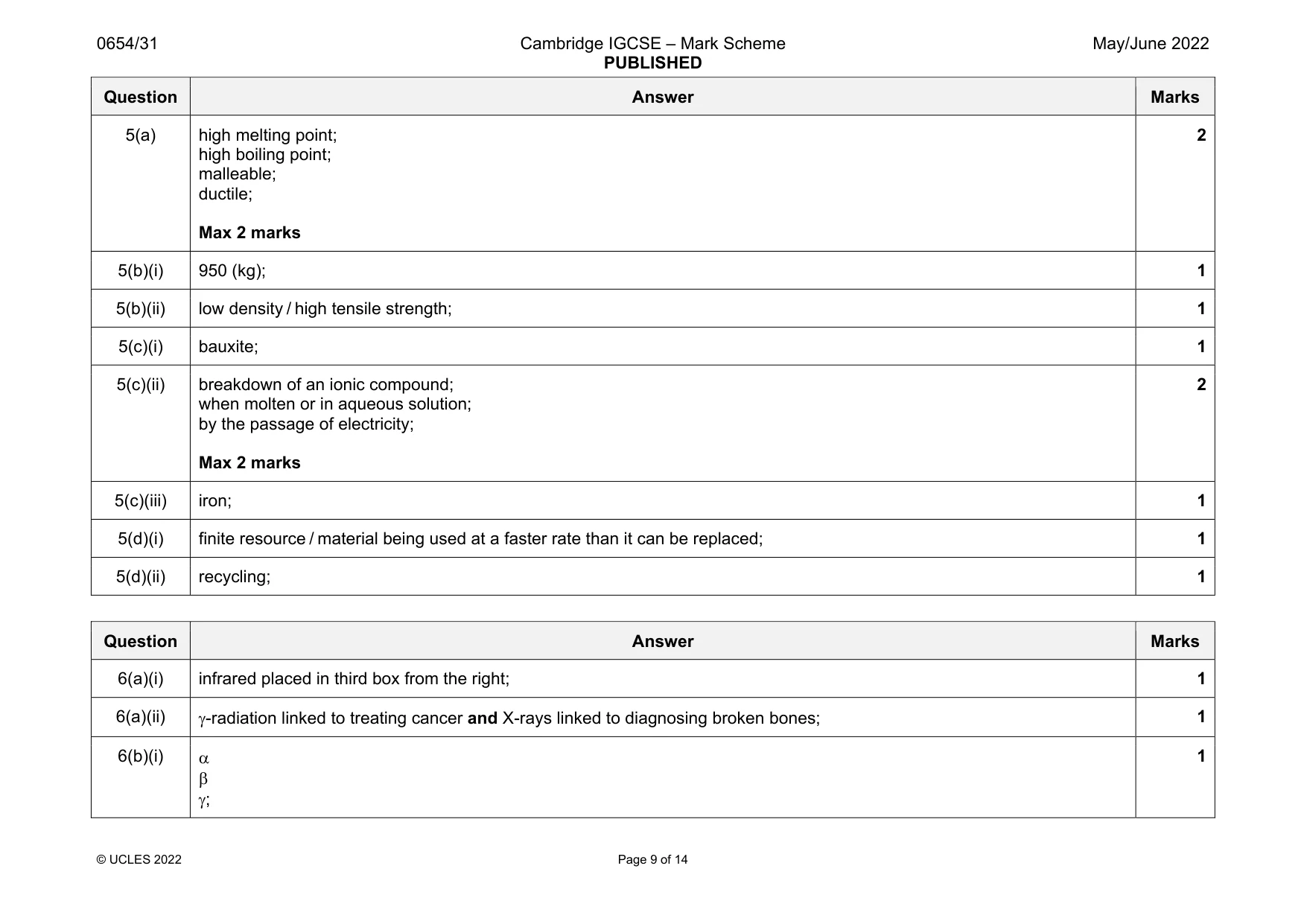
Mark scheme: 5(a) high melting point; high boiling point; malleable; ductile; Max 2 marks 2 5(b)(i) 950 (kg); 1 5(b)(ii) low density / high tensile strength; 1 5(c)(i) bauxite; 1 5(c)(ii) breakdown of an ionic compound; when molten or in aqueous solution; by the passage of electricity; Max 2 marks 2 5(c)(iii) iron; 1 5(d)(i) finite resource / material being used at a faster rate than it can be replaced; 1 5(d)(ii) recycling; 1
Q6 · Many types of radiation are used in hospitals
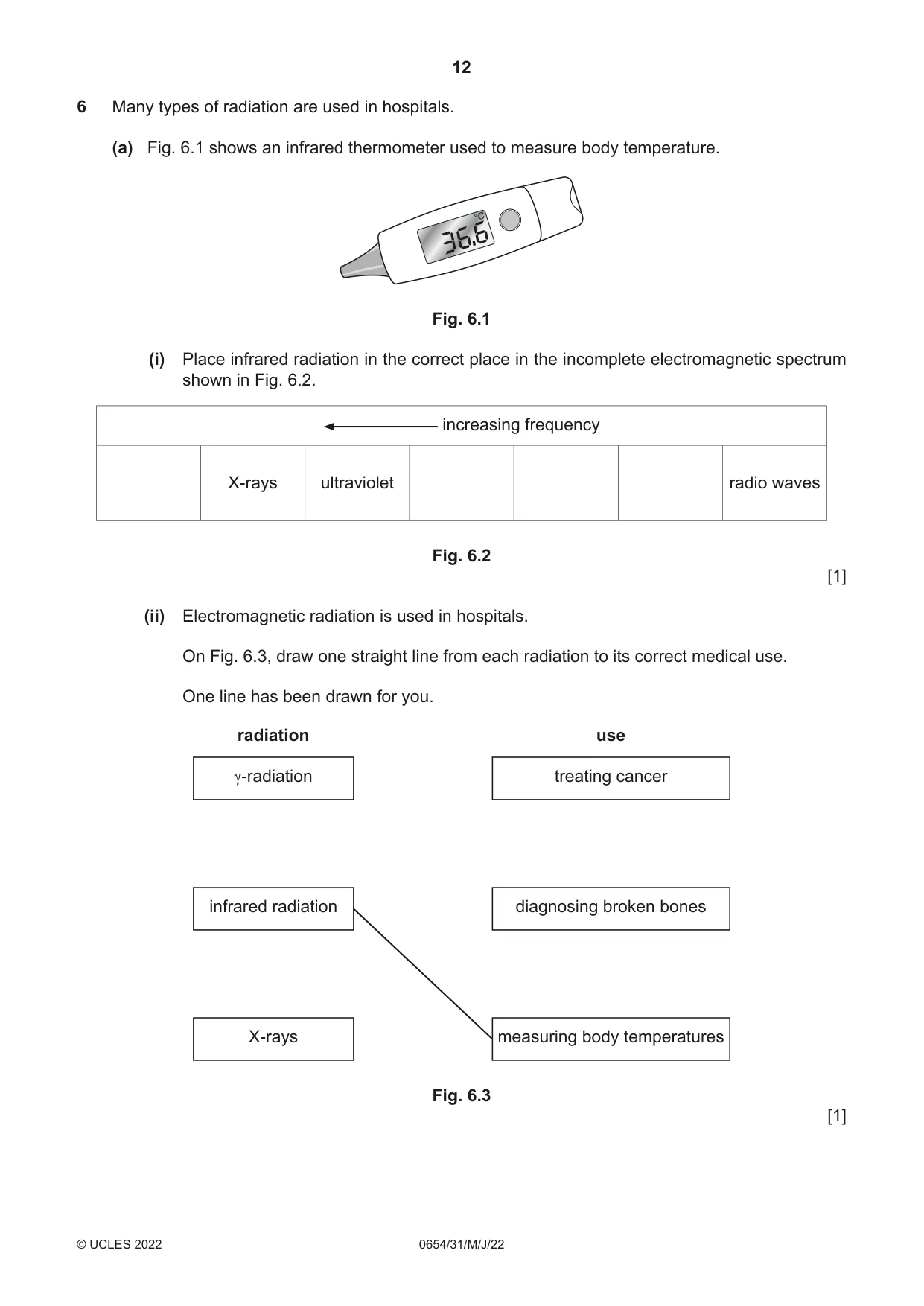
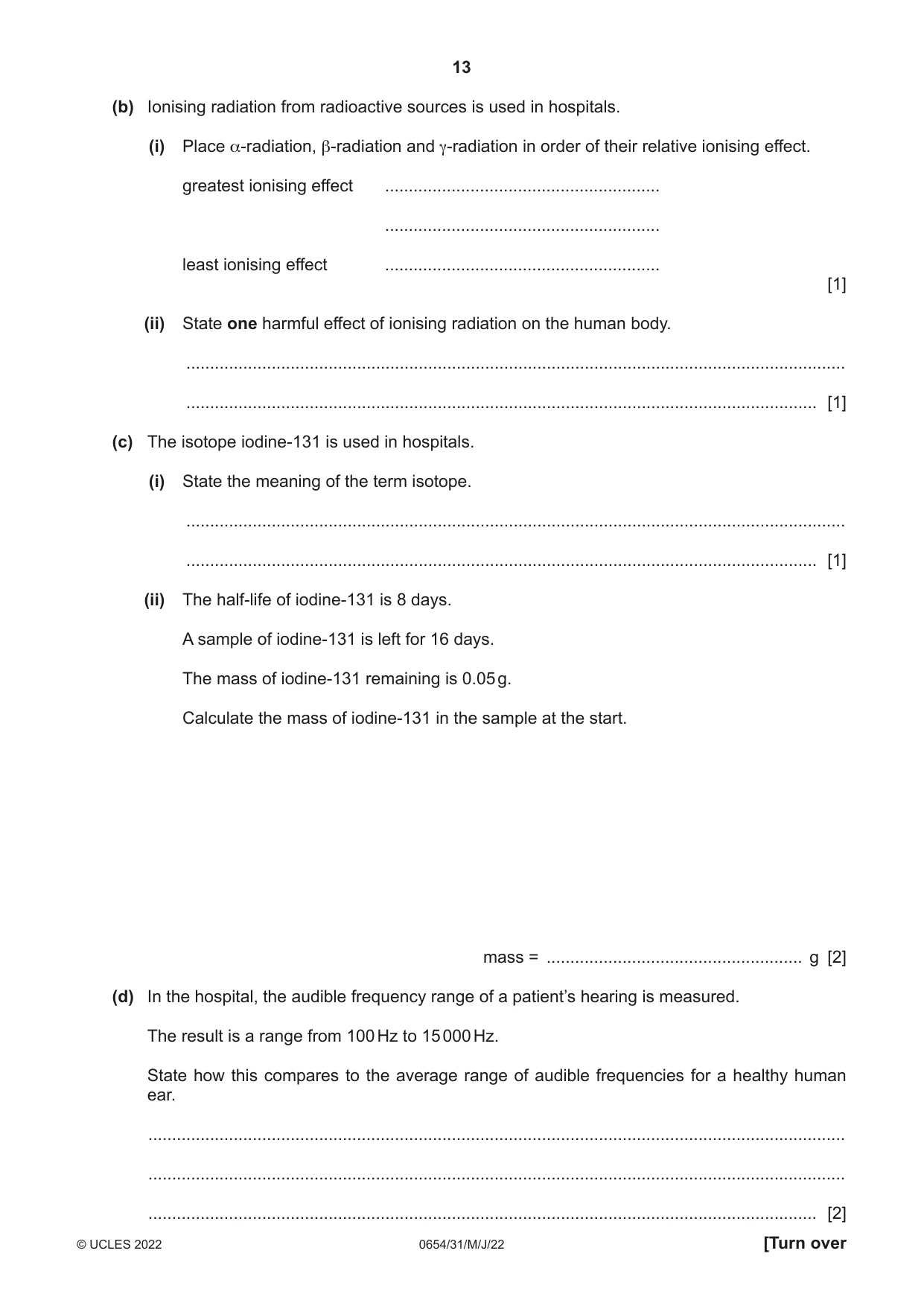
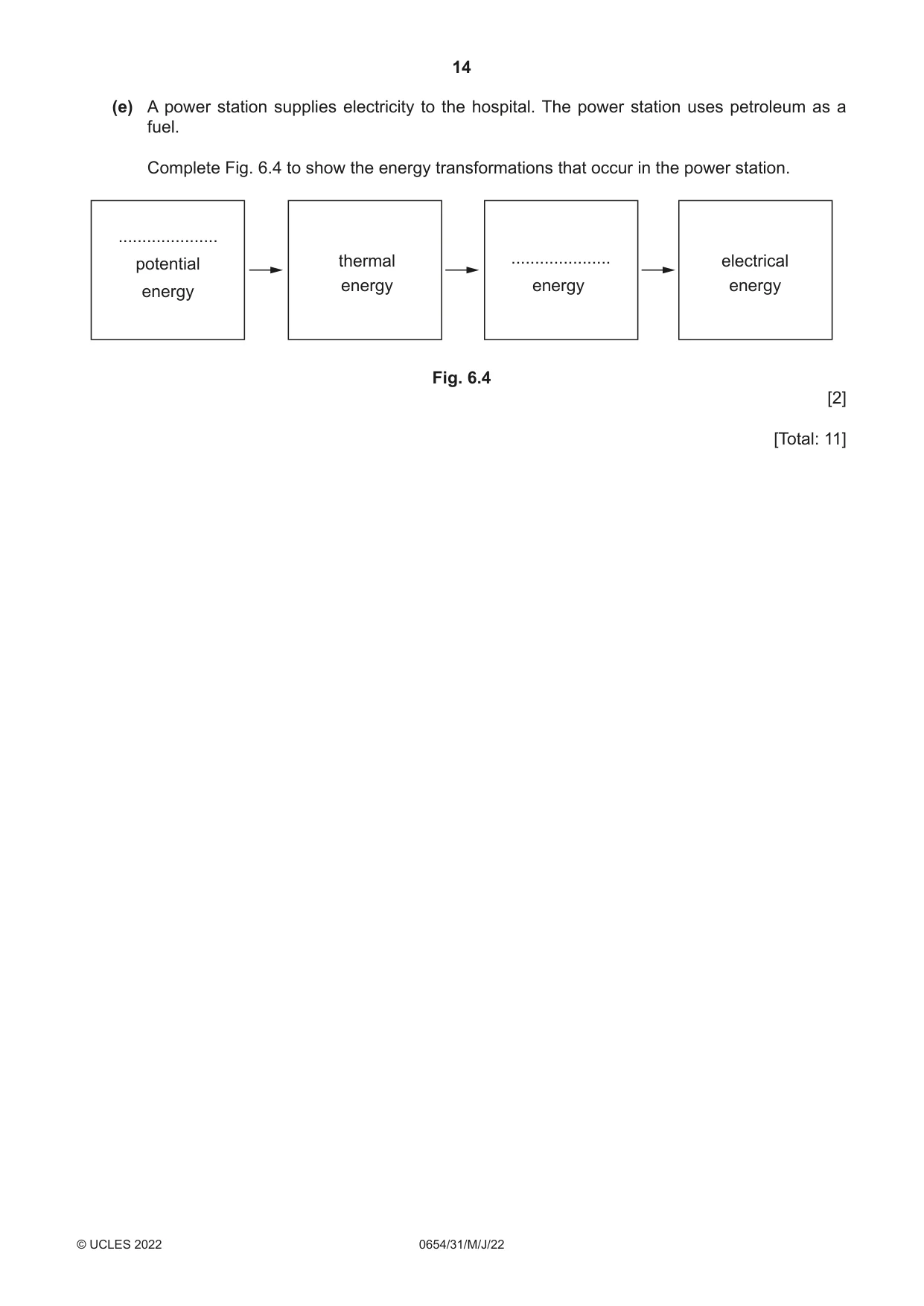
6 Many types of radiation are used in hospitals. (a) Fig. 6.1 shows an infrared thermometer used to measure body temperature. 36.6 Fig. 6.1 (i) Place infrared radiation in the correct place in the incomplete electromagnetic spectrum shown in Fig. 6.2. increasing frequency X-rays ultraviolet radio waves Fig. 6.2 [1] (ii) Electromagnetic radiation is used in hospitals. On Fig. 6.3, draw one straight line from each radiation to its correct medical use. One line has been drawn for you. radiation use γ-radiation treating cancer infrared radiation diagnosing broken bones X-rays measuring body temperatures Fig. 6.3 [1] (b) Ionising radiation from radioactive sources is used in hospitals. (i) Place α-radiation, β-radiation and γ-radiation in order of their relative ionising effect. greatest ionising effect .......................................................... .......................................................... least ionising effect .......................................................... [1] (ii) State one harmful effect of ionising radiation on the human body. ........................................................................................................................................... ..................................................................................................................................... [1] (c) The isotope iodine-131 is used in hospitals. (i) State the meaning of the term isotope. ........................................................................................................................................... ..................................................................................................................................... [1] (ii) The half-life of iodine-131 is 8 days. A sample of iodine-131 is left for 16 days. The mass of iodine-131 remaining is 0.05 g. Calculate the mass of iodine-131 in the sample at the start. mass = ...................................................... g [2] (d) In the hospital, the audible frequency range of a patient’s hearing is measured. The result is a range from 100 Hz to 15 000 Hz. State how this compares to the average range of audible frequencies for a healthy human ear. ................................................................................................................................................... ................................................................................................................................................... ............................................................................................................................................. [2] (e) A power station supplies electricity to the hospital. The power station uses petroleum as a fuel. Complete Fig. 6.4 to show the energy transformations that occur in the power station. ..................... potential thermal ..................... electrical energy energy energy energy Fig. 6.4 [2] [Total: 11]
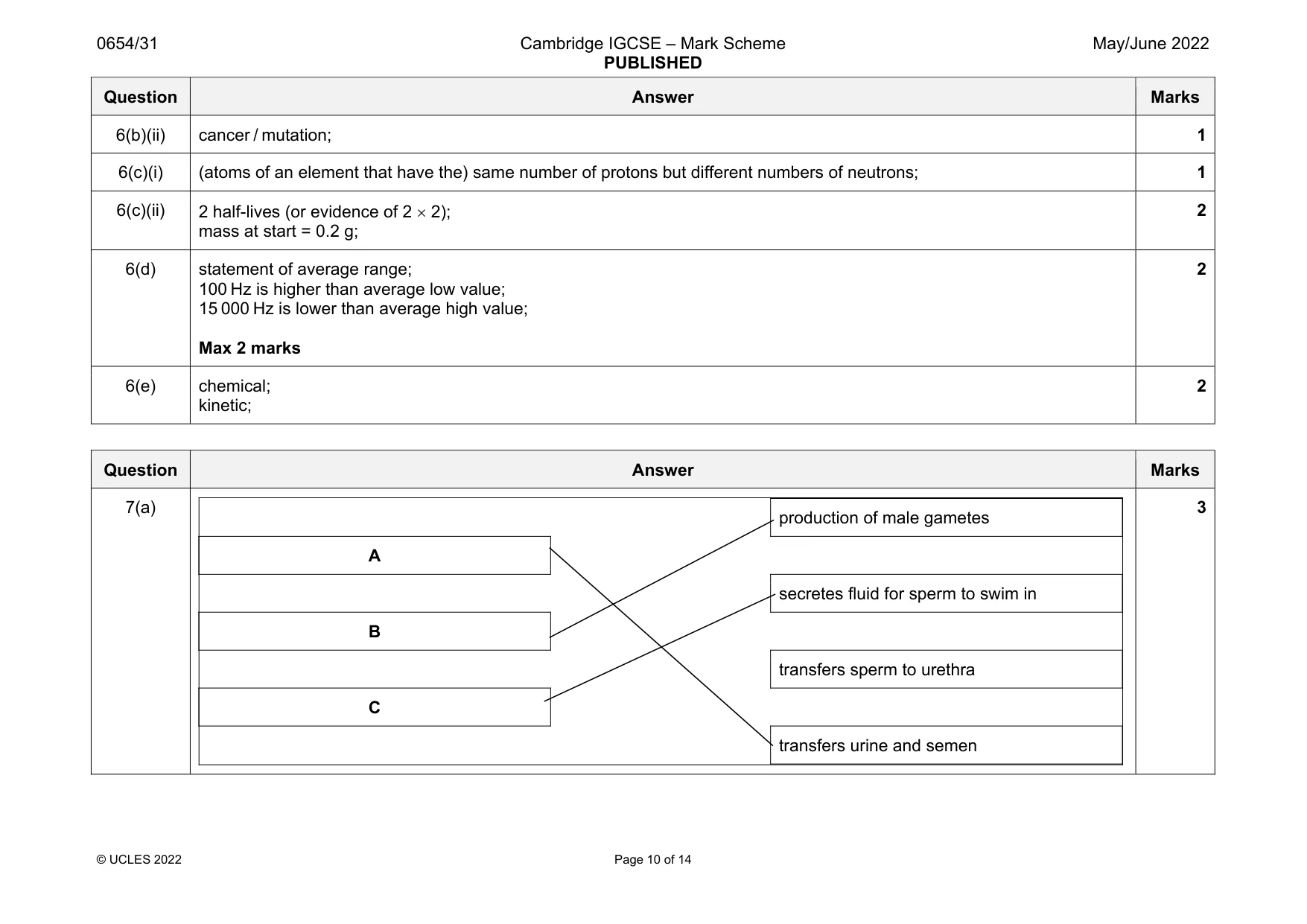
Mark scheme: 6(a)(i) infrared placed in third box from the right; 1 6(a)(ii) -radiation linked to treating cancer and X-rays linked to diagnosing broken bones; 1 6(b)(i) ; 1 Question Answer Marks 6(b)(ii) cancer / mutation; 1 6(c)(i) (atoms of an element that have the) same number of protons but different numbers of neutrons; 1 6(c)(ii) 2 half-lives (or evidence of 2 2); mass at start = 0.2 g; 2 6(d) statement of average range; 100 Hz is higher than average low value; 15 000 Hz is lower than average high value; Max 2 marks 2 6(e) chemical; kinetic; 2
Q7 · A diagram of the male reproductive system
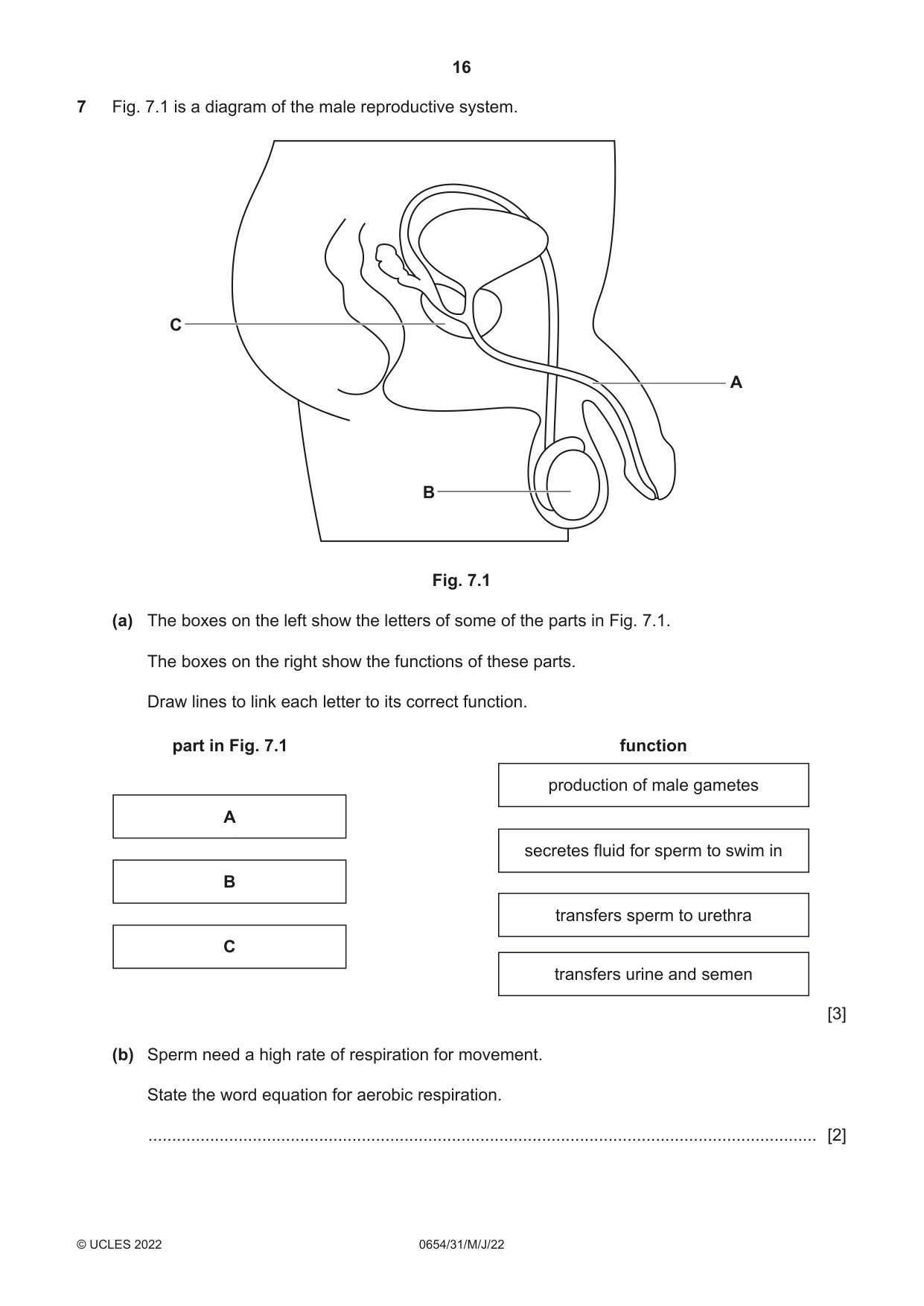
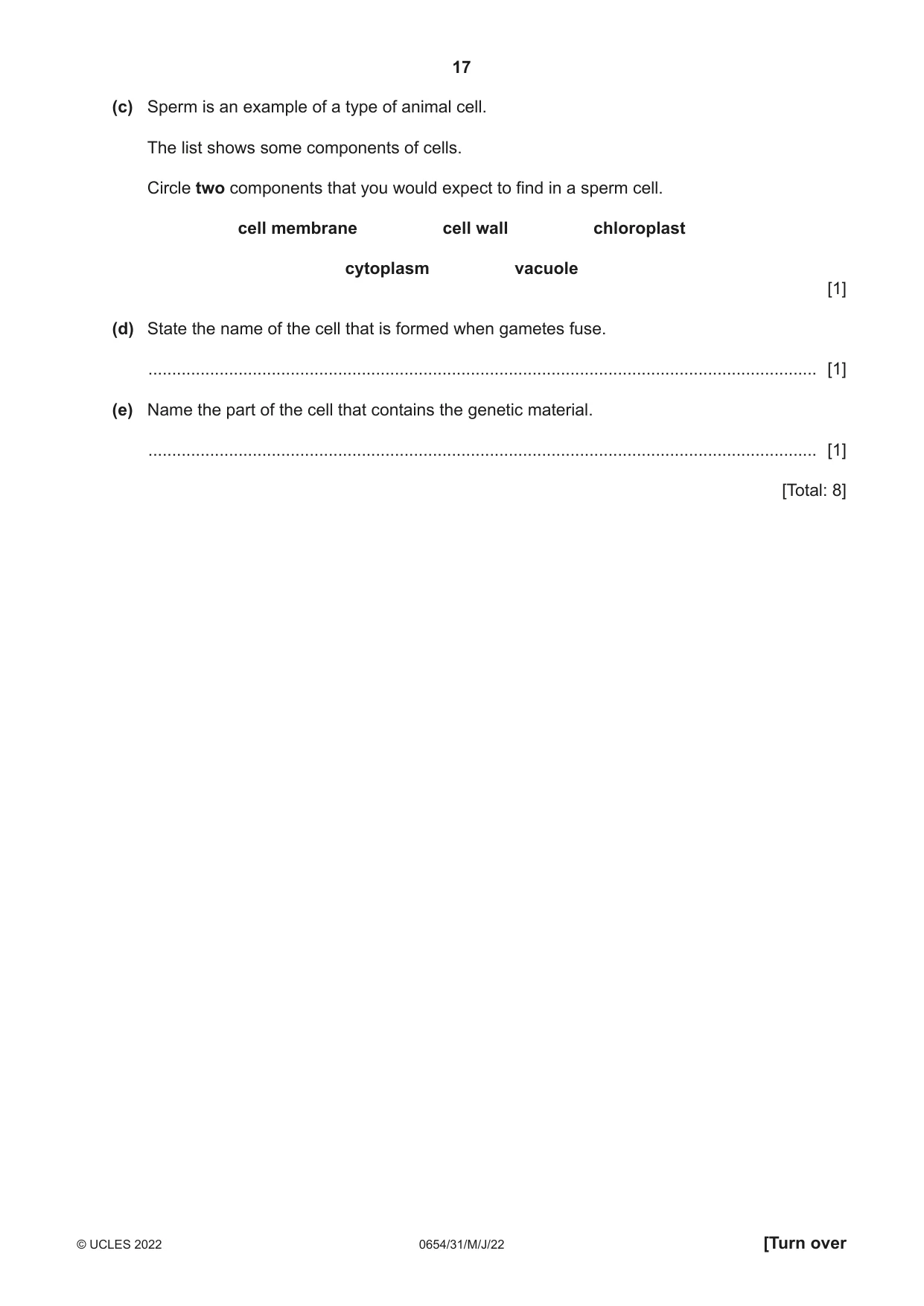
7 Fig. 7.1 is a diagram of the male reproductive system. C A B Fig. 7.1 (a) The boxes on the left show the letters of some of the parts in Fig. 7.1. The boxes on the right show the functions of these parts. Draw lines to link each letter to its correct function. part in Fig. 7.1 function production of male gametes A secretes fluid for sperm to swim in B transfers sperm to urethra C transfers urine and semen [3] (b) Sperm need a high rate of respiration for movement. State the word equation for aerobic respiration. ............................................................................................................................................. [2] (c) Sperm is an example of a type of animal cell. The list shows some components of cells. Circle two components that you would expect to find in a sperm cell. cell membrane cell wall chloroplast cytoplasm vacuole [1] (d) State the name of the cell that is formed when gametes fuse. ............................................................................................................................................. [1] (e) Name the part of the cell that contains the genetic material. ............................................................................................................................................. [1] [Total: 8]
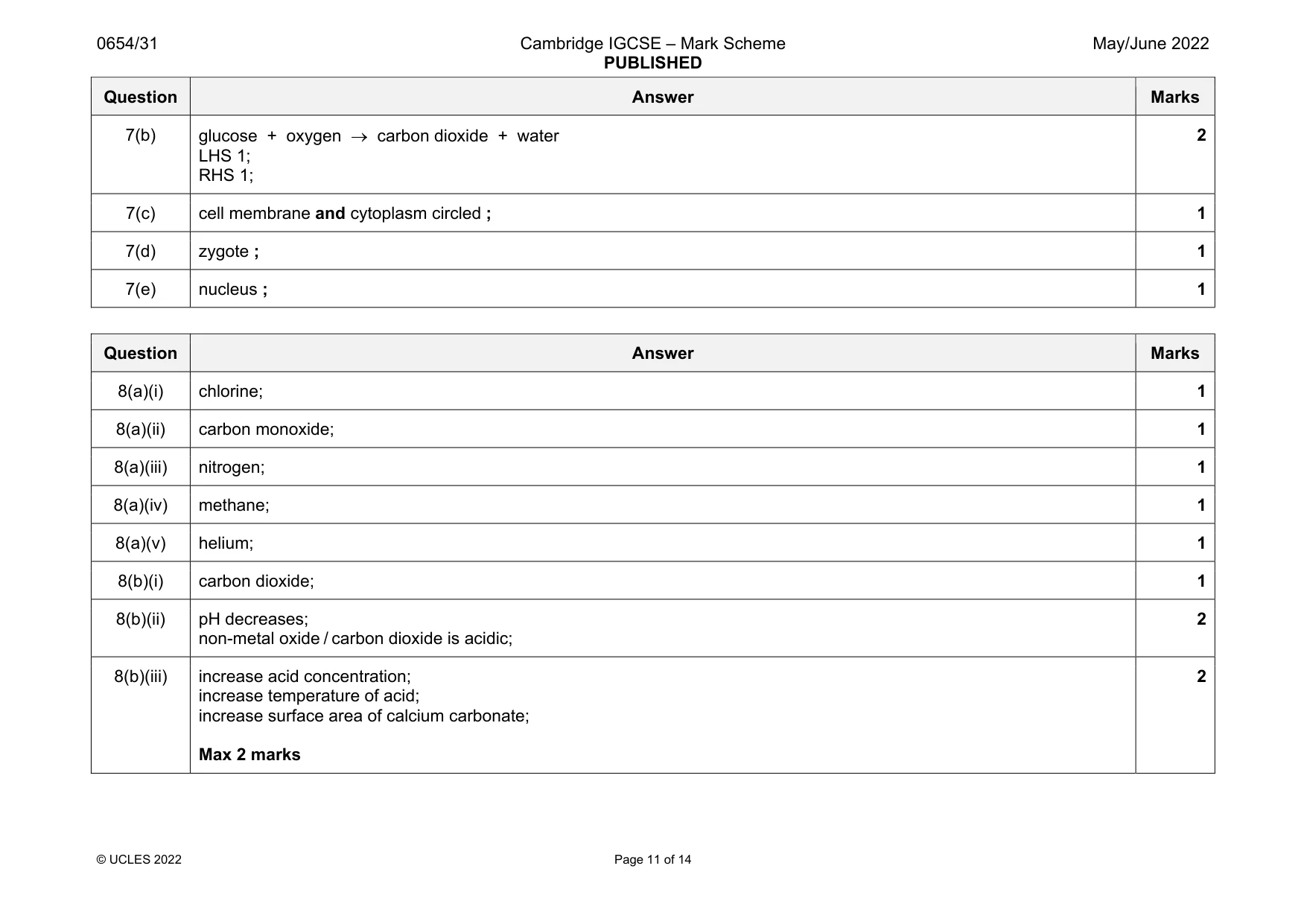
Mark scheme: 7(a) production of male gametes A secretes fluid for sperm to swim in B transfers sperm to urethra C transfers urine and semen 3 Question Answer Marks 7(b) glucose + oxygen carbon dioxide + water LHS 1; RHS 1; 2 7(c) cell membrane and cytoplasm circled ; 1 7(d) zygote ; 1 7(e) nucleus ; 1
Q8 · The names of eight gases
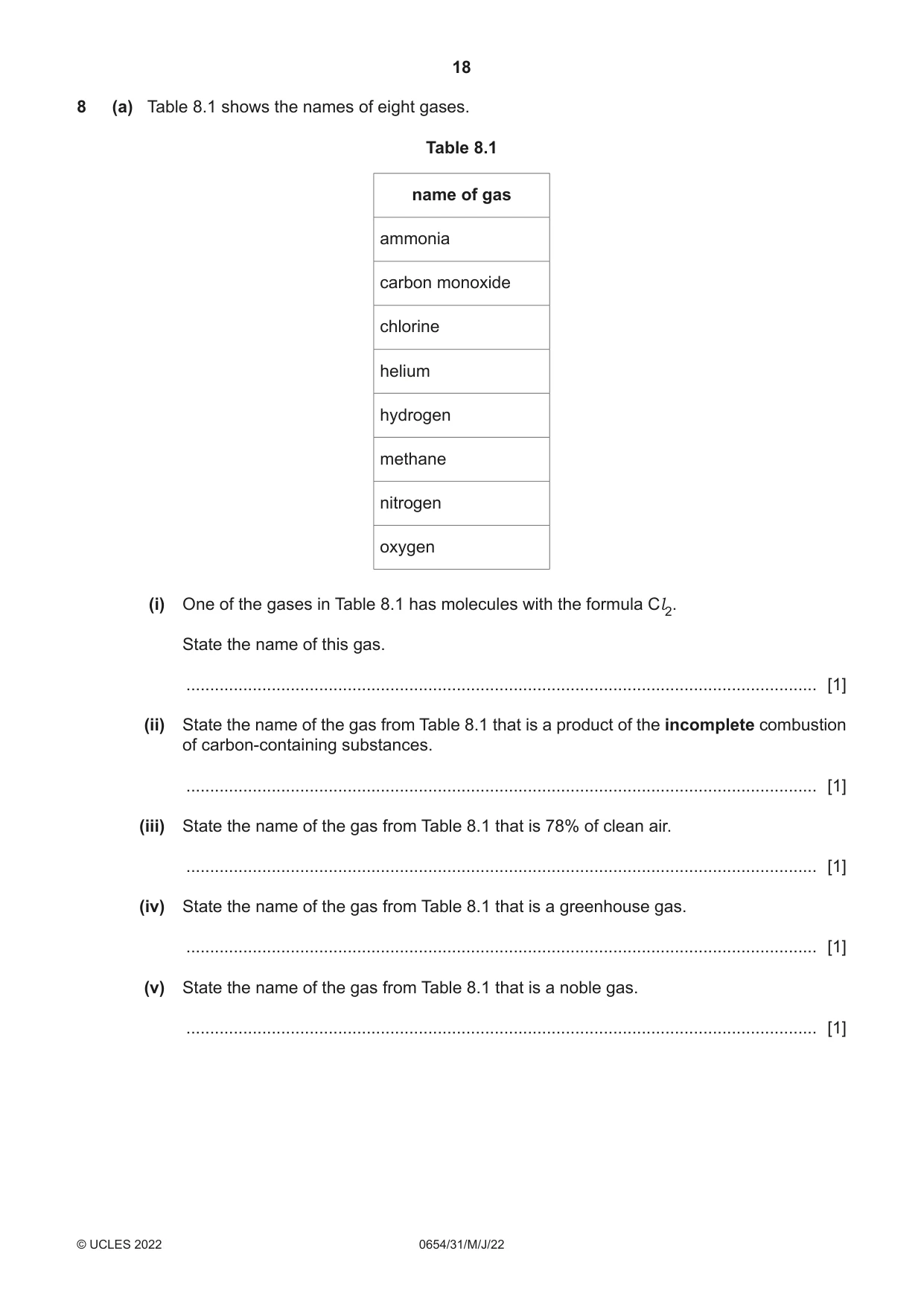
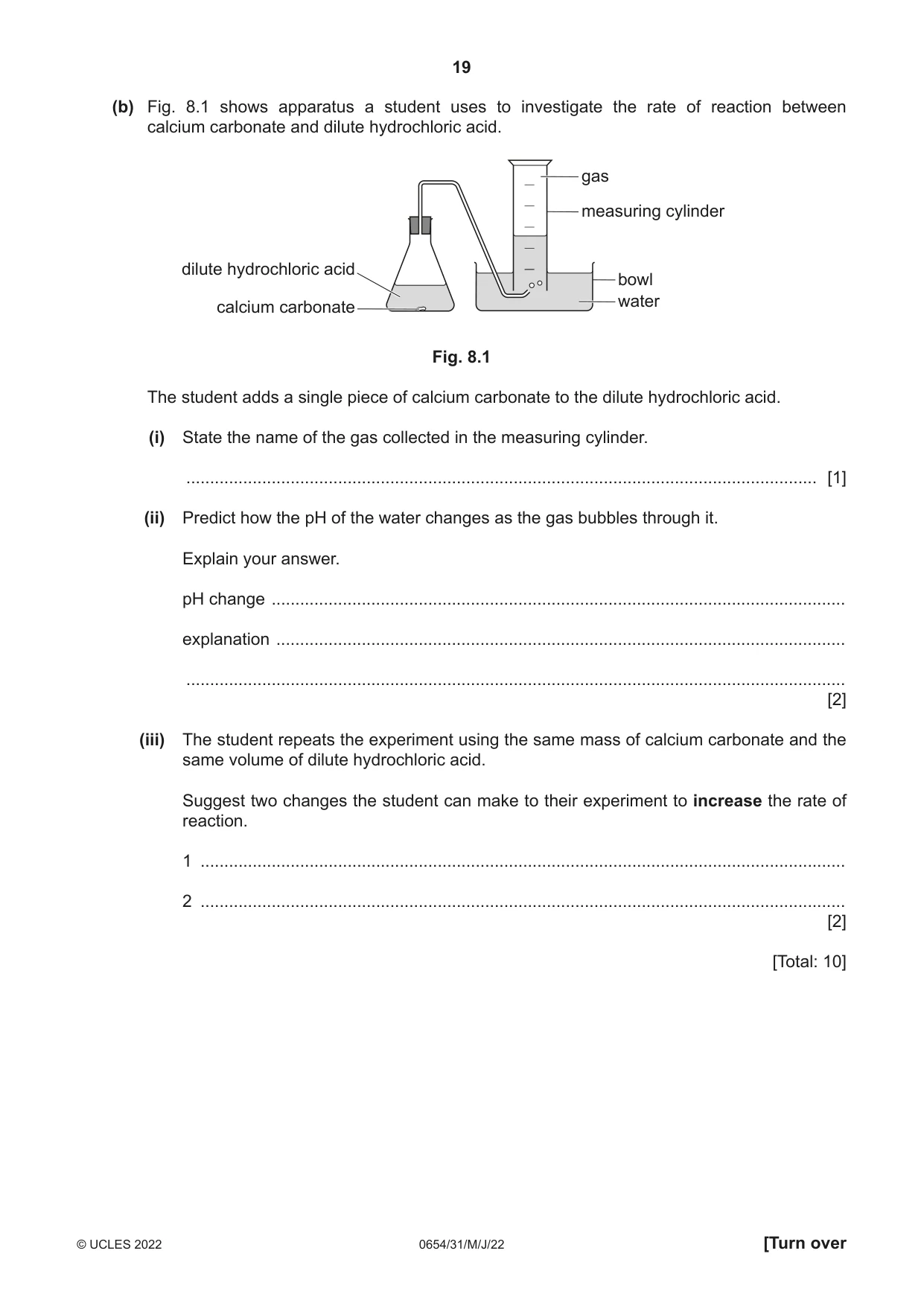
8 (a) Table 8.1 shows the names of eight gases. Table 8.1 name of gas ammonia carbon monoxide chlorine helium hydrogen methane nitrogen oxygen (i) One of the gases in Table 8.1 has molecules with the formula Cl2. State the name of this gas. ..................................................................................................................................... [1] (ii) State the name of the gas from Table 8.1 that is a product of the incomplete combustion of carbon-containing substances. ..................................................................................................................................... [1] (iii) State the name of the gas from Table 8.1 that is 78% of clean air. ..................................................................................................................................... [1] (iv) State the name of the gas from Table 8.1 that is a greenhouse gas. ..................................................................................................................................... [1] (v) State the name of the gas from Table 8.1 that is a noble gas. ..................................................................................................................................... [1] (b) Fig. 8.1 shows apparatus a student uses to investigate the rate of reaction between calcium carbonate and dilute hydrochloric acid. gas measuring cylinder dilute hydrochloric acid bowl water calcium carbonate Fig. 8.1 The student adds a single piece of calcium carbonate to the dilute hydrochloric acid. (i) State the name of the gas collected in the measuring cylinder. ..................................................................................................................................... [1] (ii) Predict how the pH of the water changes as the gas bubbles through it. Explain your answer. pH change ......................................................................................................................... explanation ........................................................................................................................ ........................................................................................................................................... [2] (iii) The student repeats the experiment using the same mass of calcium carbonate and the same volume of dilute hydrochloric acid. Suggest two changes the student can make to their experiment to increase the rate of reaction. 1 ........................................................................................................................................ 2 ........................................................................................................................................ [2] [Total: 10]
Mark scheme: 8(a)(i) chlorine; 1 8(a)(ii) carbon monoxide; 1 8(a)(iii) nitrogen; 1 8(a)(iv) methane; 1 8(a)(v) helium; 1 8(b)(i) carbon dioxide; 1 8(b)(ii) pH decreases; non-metal oxide / carbon dioxide is acidic; 2 8(b)(iii) increase acid concentration; increase temperature of acid; increase surface area of calcium carbonate; Max 2 marks 2
Q9 · A wind surfer on a surfboard, driven by the wind, sailing at a constant speed across the…
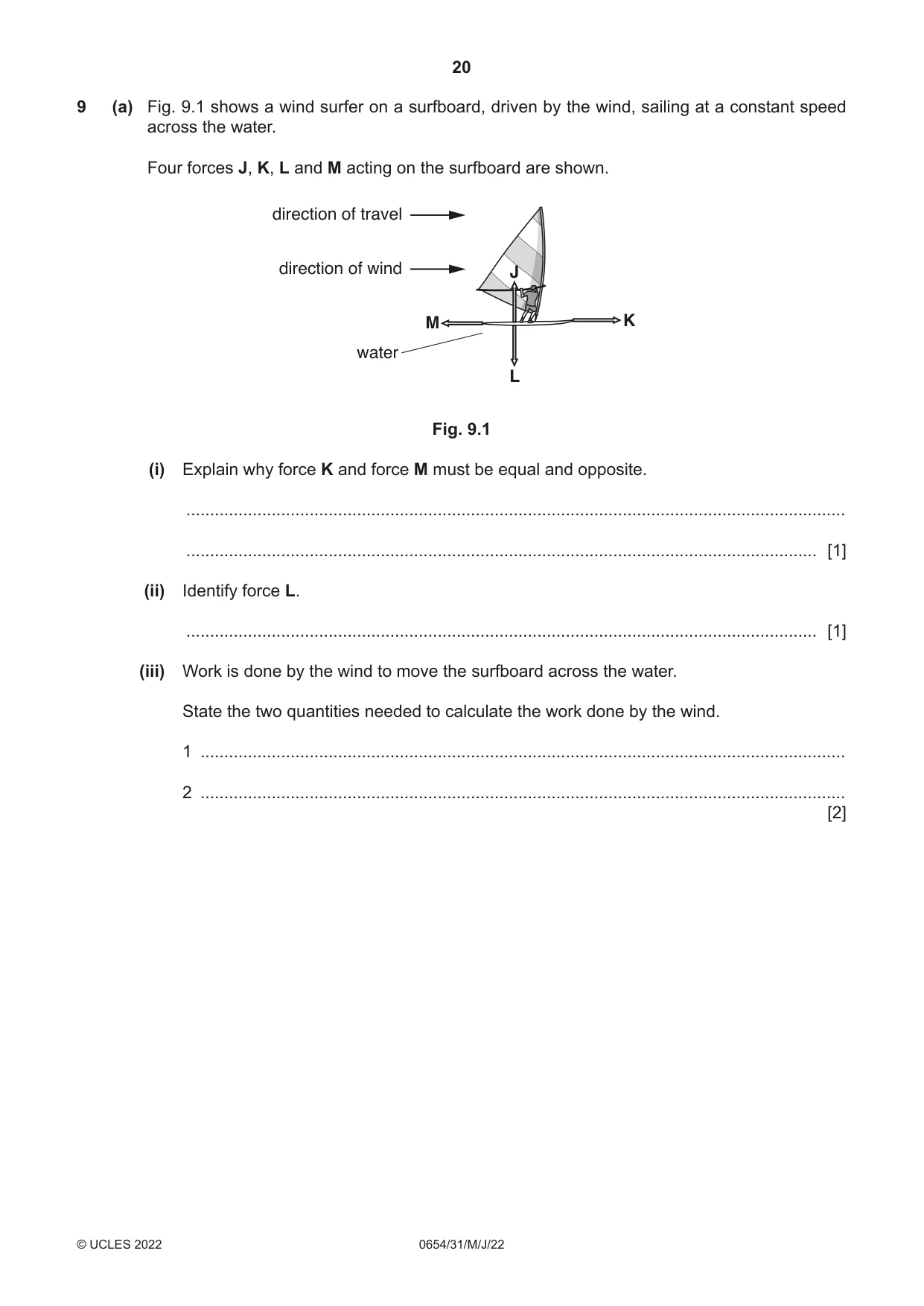
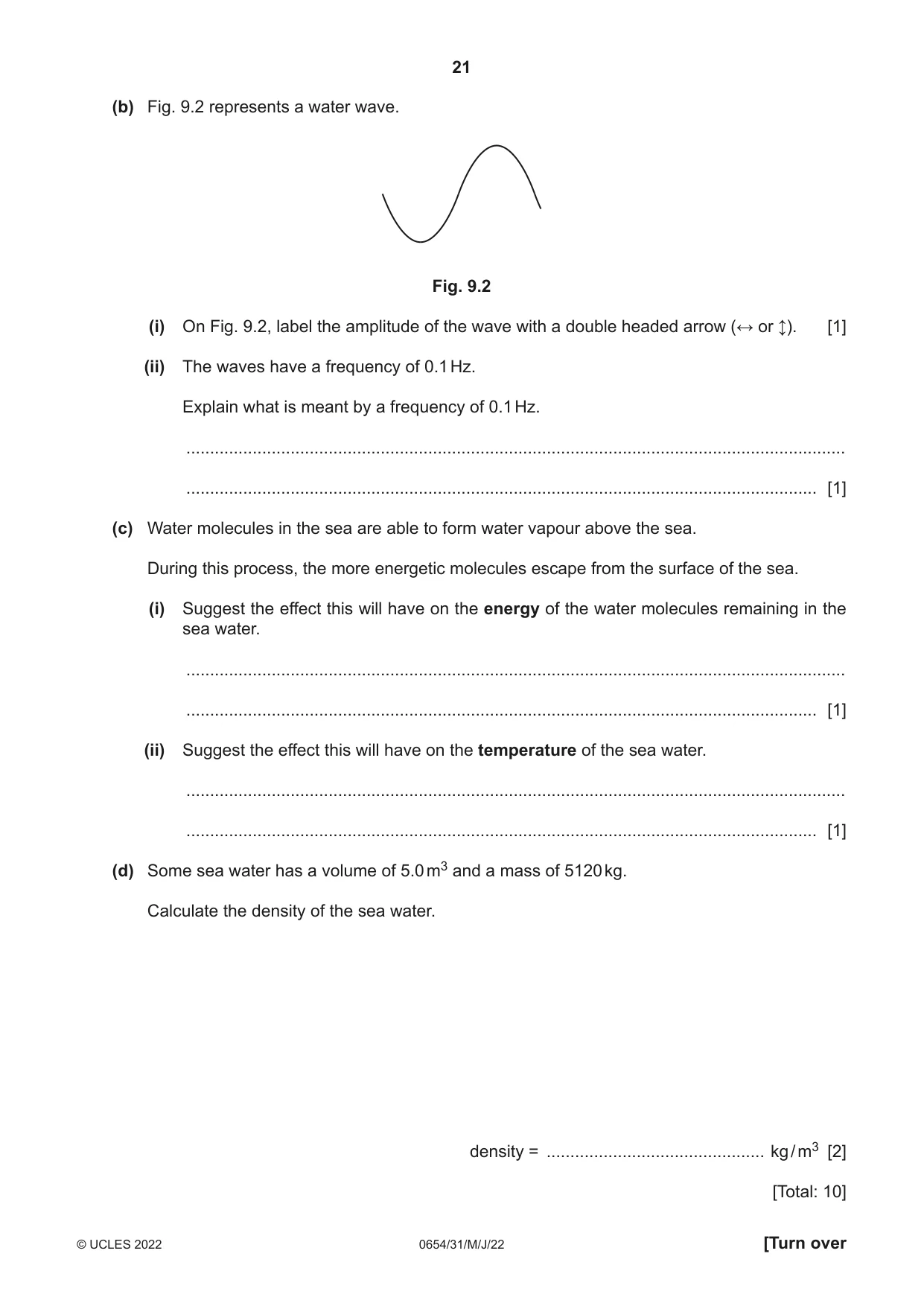
9 (a) Fig. 9.1 shows a wind surfer on a surfboard, driven by the wind, sailing at a constant speed across the water. Four forces J, K, L and M acting on the surfboard are shown. direction of travel direction of wind J M K water L Fig. 9.1 (i) Explain why force K and force M must be equal and opposite. ........................................................................................................................................... ..................................................................................................................................... [1] (ii) Identify force L. ..................................................................................................................................... [1] (iii) Work is done by the wind to move the surfboard across the water. State the two quantities needed to calculate the work done by the wind. 1 ........................................................................................................................................ 2 ........................................................................................................................................ [2] (b) Fig. 9.2 represents a water wave. Fig. 9.2 (i) On Fig. 9.2, label the amplitude of the wave with a double headed arrow (↔ or ↕). [1] (ii) The waves have a frequency of 0.1 Hz. Explain what is meant by a frequency of 0.1 Hz. ........................................................................................................................................... ..................................................................................................................................... [1] (c) Water molecules in the sea are able to form water vapour above the sea. During this process, the more energetic molecules escape from the surface of the sea. (i) Suggest the effect this will have on the energy of the water molecules remaining in the sea water. ........................................................................................................................................... ..................................................................................................................................... [1] (ii) Suggest the effect this will have on the temperature of the sea water. ........................................................................................................................................... ..................................................................................................................................... [1] (d) Some sea water has a volume of 5.0 m3 and a mass of 5120 kg. Calculate the density of the sea water. density = .............................................. kg / m3 [2] [Total: 10]
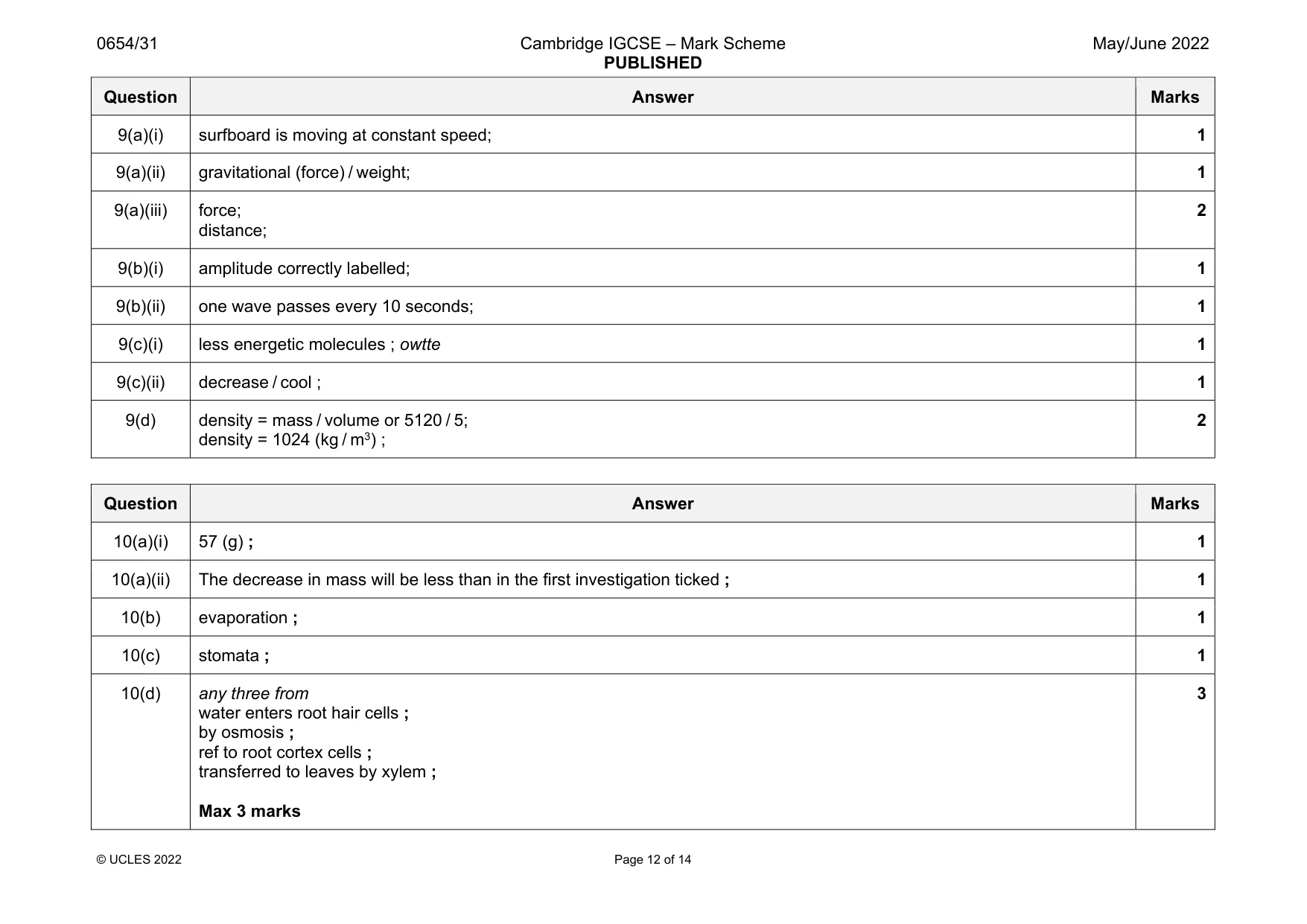
Mark scheme: 9(a)(i) surfboard is moving at constant speed; 1 9(a)(ii) gravitational (force) / weight; 1 9(a)(iii) force; distance; 2 9(b)(i) amplitude correctly labelled; 1 9(b)(ii) one wave passes every 10 seconds; 1 9(c)(i) less energetic molecules ; owtte 1 9(c)(ii) decrease / cool ; 1 9(d) density = mass / volume or 5120 / 5; density = 1024 (kg / m3) ; 2
Q10 · Water is lost from leaves by transpiration
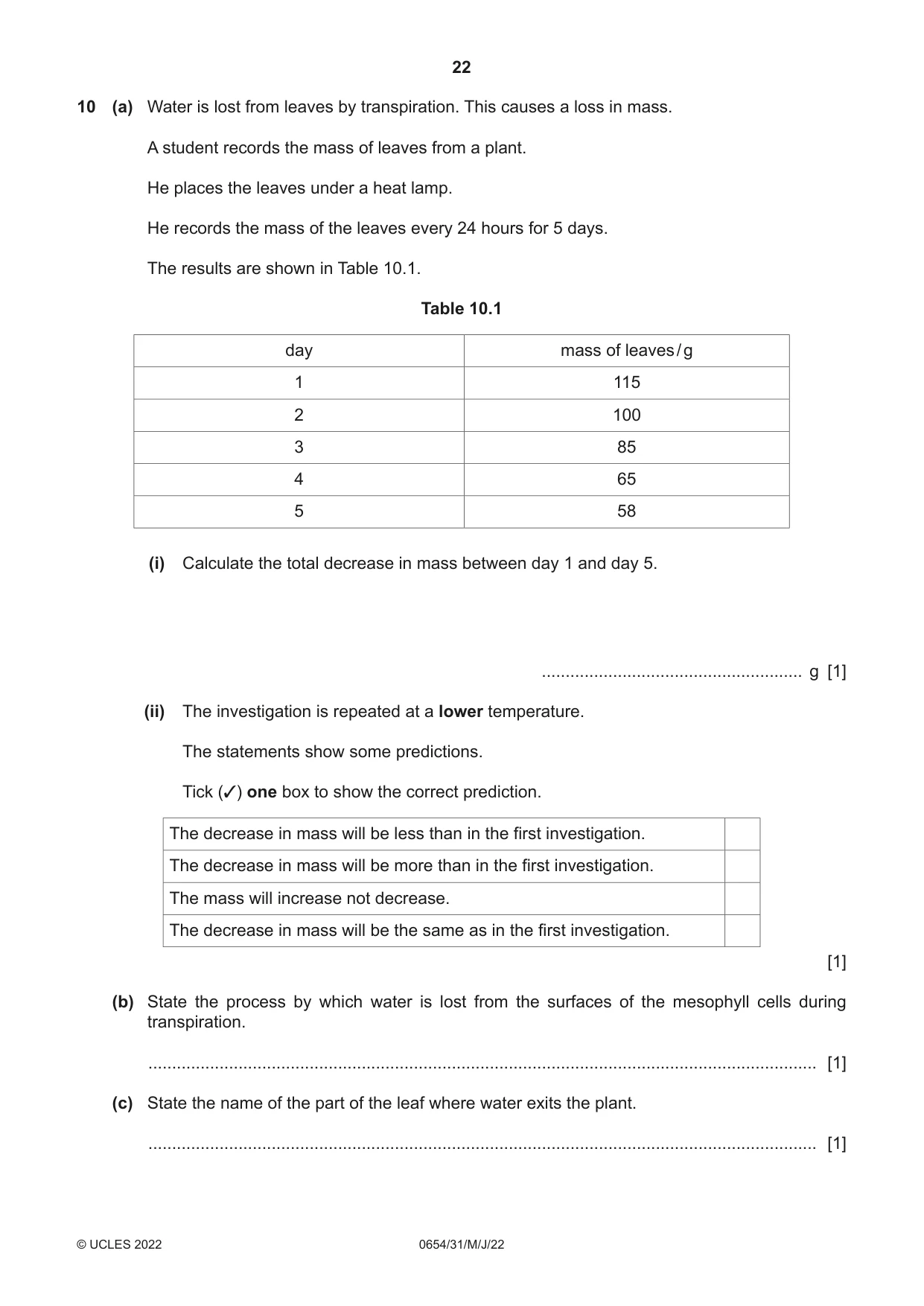
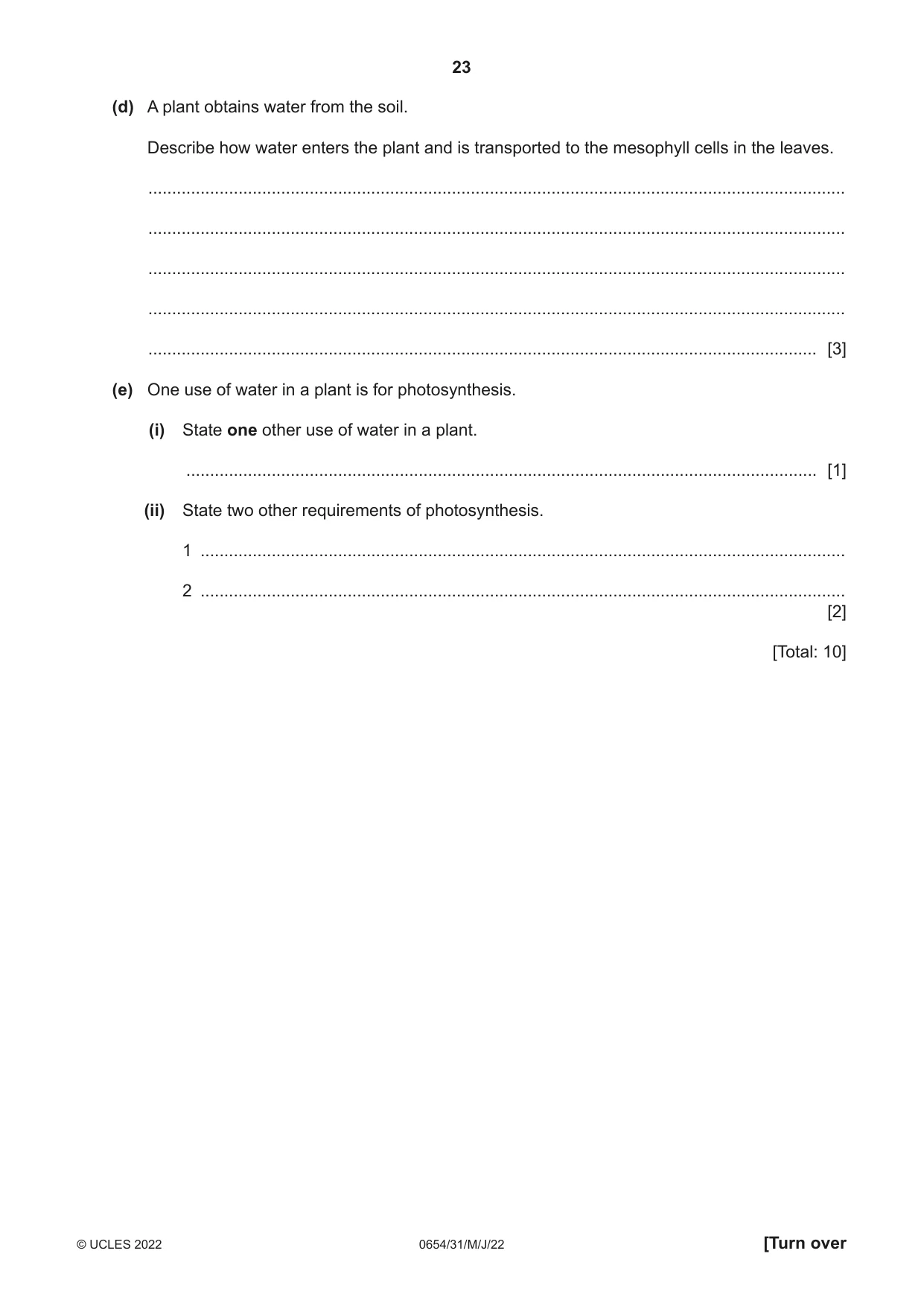
10 (a) Water is lost from leaves by transpiration. This causes a loss in mass. A student records the mass of leaves from a plant. He places the leaves under a heat lamp. He records the mass of the leaves every 24 hours for 5 days. The results are shown in Table 10.1. Table 10.1 day mass of leaves / g 1 115 2 100 3 85 4 65 5 58 (i) Calculate the total decrease in mass between day 1 and day 5. ....................................................... g [1] (ii) The investigation is repeated at a lower temperature. The statements show some predictions. Tick (3) one box to show the correct prediction. The decrease in mass will be less than in the first investigation. The decrease in mass will be more than in the first investigation. The mass will increase not decrease. The decrease in mass will be the same as in the first investigation. [1] (b) State the process by which water is lost from the surfaces of the mesophyll cells during transpiration. ............................................................................................................................................. [1] (c) State the name of the part of the leaf where water exits the plant. ............................................................................................................................................. [1] (d) A plant obtains water from the soil. Describe how water enters the plant and is transported to the mesophyll cells in the leaves. ................................................................................................................................................... ................................................................................................................................................... ................................................................................................................................................... ................................................................................................................................................... ............................................................................................................................................. [3] (e) One use of water in a plant is for photosynthesis. (i) State one other use of water in a plant. ..................................................................................................................................... [1] (ii) State two other requirements of photosynthesis. 1 ........................................................................................................................................ 2 ........................................................................................................................................ [2] [Total: 10]
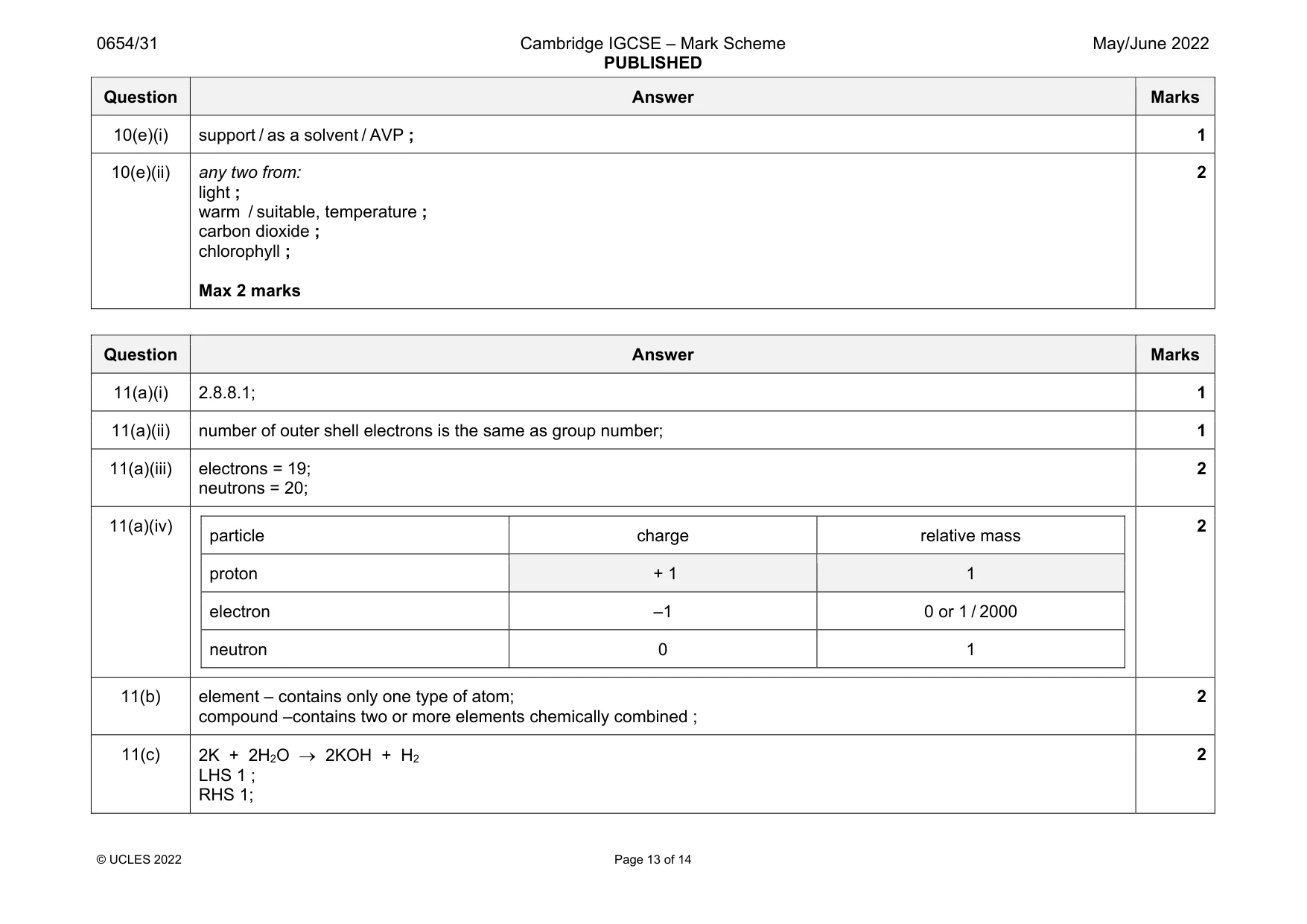
Mark scheme: 10(a)(i) 57 (g) ; 1 10(a)(ii) The decrease in mass will be less than in the first investigation ticked ; 1 10(b) evaporation ; 1 10(c) stomata ; 1 10(d) any three from water enters root hair cells ; by osmosis ; ref to root cortex cells ; transferred to leaves by xylem ; Max 3 marks 3 Question Answer Marks 10(e)(i) support / as a solvent / AVP ; 1 10(e)(ii) any two from: light ; warm / suitable, temperature ; carbon dioxide ; chlorophyll ; Max 2 marks 2
Q11 · Part of Group I of the Periodic Table
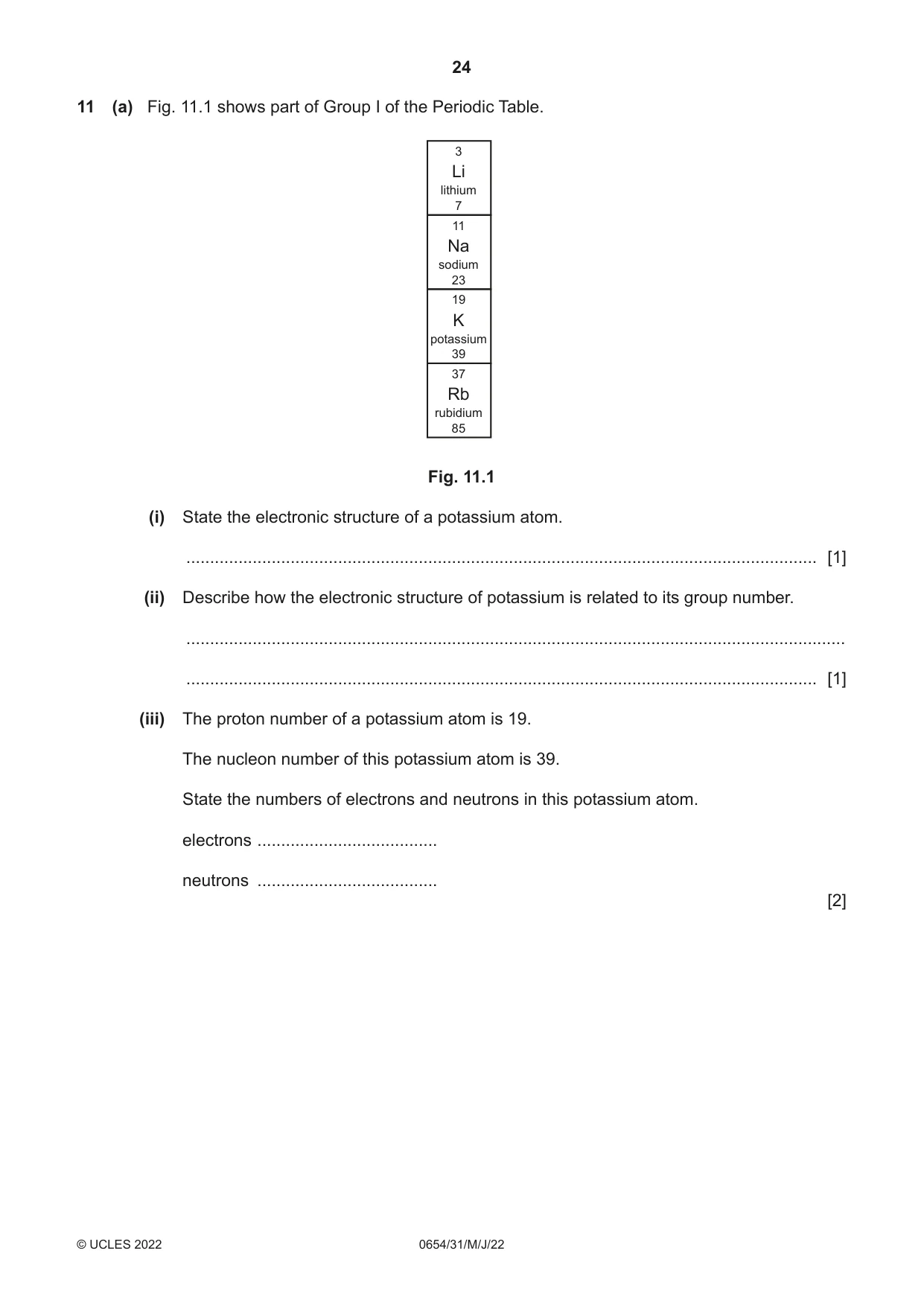
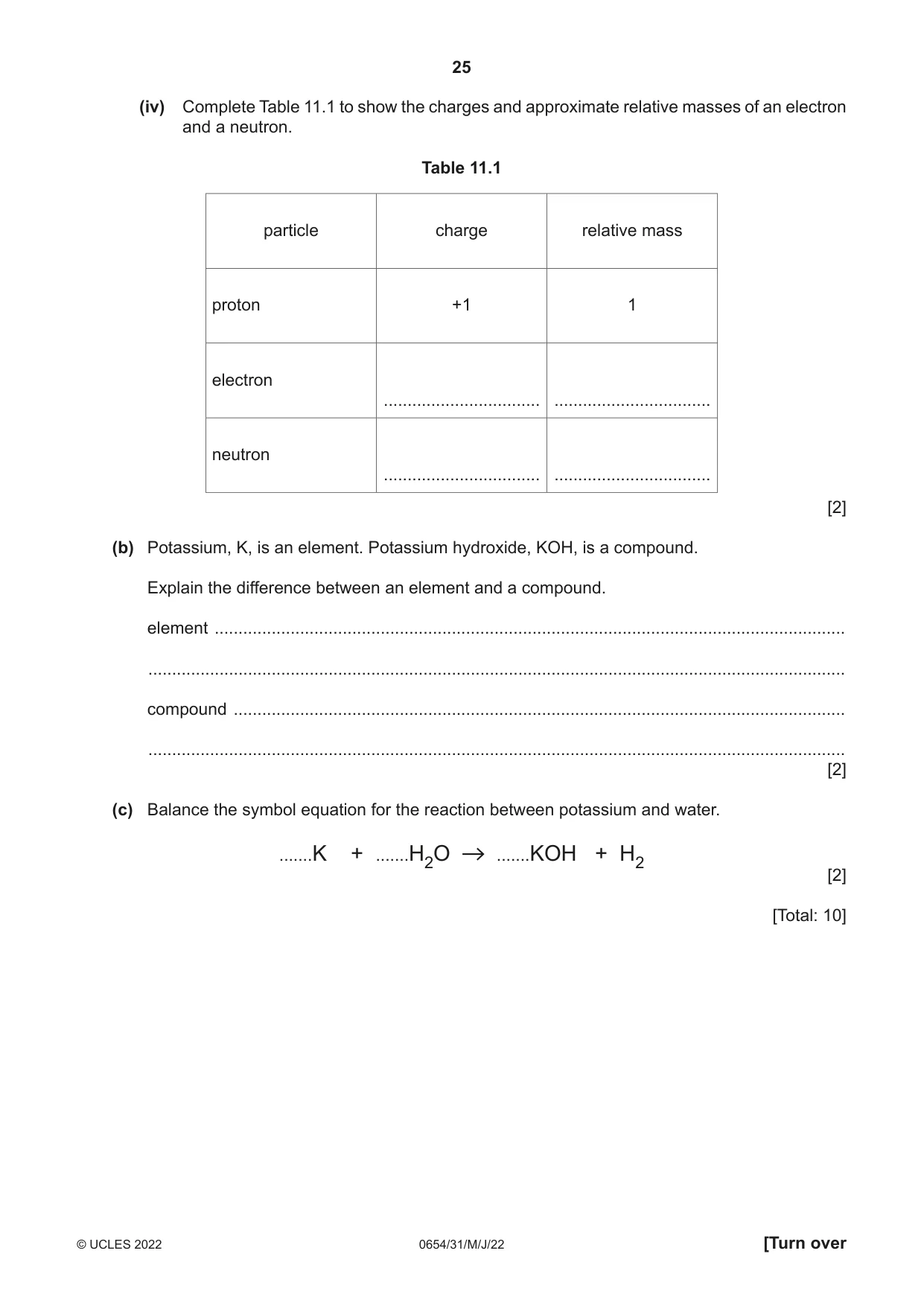
11 (a) Fig. 11.1 shows part of Group I of the Periodic Table. 3 Li lithium 7 11 Na sodium 23 19 K potassium 39 37 Rb rubidium 85 Fig. 11.1 (i) State the electronic structure of a potassium atom. ..................................................................................................................................... [1] (ii) Describe how the electronic structure of potassium is related to its group number. ........................................................................................................................................... ..................................................................................................................................... [1] (iii) The proton number of a potassium atom is 19. The nucleon number of this potassium atom is 39. State the numbers of electrons and neutrons in this potassium atom. electrons ...................................... neutrons ...................................... [2] (iv) Complete Table 11.1 to show the charges and approximate relative masses of an electron and a neutron. Table 11.1 particle charge relative mass proton +1 1 electron ................................. ................................. neutron ................................. ................................. [2] (b) Potassium, K, is an element. Potassium hydroxide, KOH, is a compound. Explain the difference between an element and a compound. element ..................................................................................................................................... ................................................................................................................................................... compound ................................................................................................................................. ................................................................................................................................................... [2] (c) Balance the symbol equation for the reaction between potassium and water. .......K + .......H2O .......KOH + H2 [2] [Total: 10]
Mark scheme: 11(a)(i) 2.8.8.1; 1 11(a)(ii) number of outer shell electrons is the same as group number; 1 11(a)(iii) electrons = 19; neutrons = 20; 2 11(a)(iv) particle charge relative mass proton + 1 1 electron –1 0 or 1 / 2000 neutron 0 1 2 11(b) element – contains only one type of atom; compound –contains two or more elements chemically combined ; 2 11(c) 2K + 2H2O 2KOH + H2 LHS 1 ; RHS 1; 2
Q12 · A large snow tractor used in Antarctica
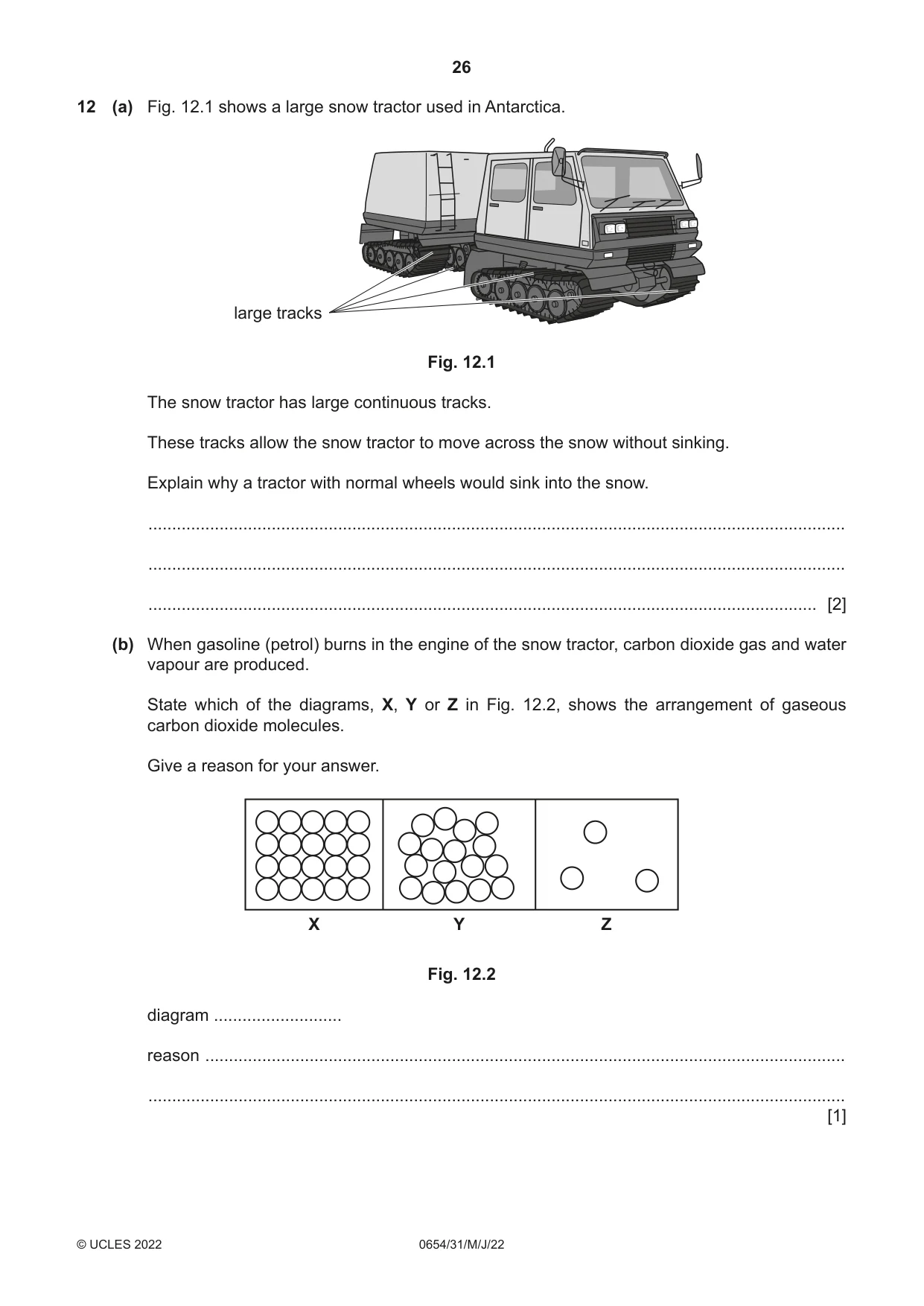
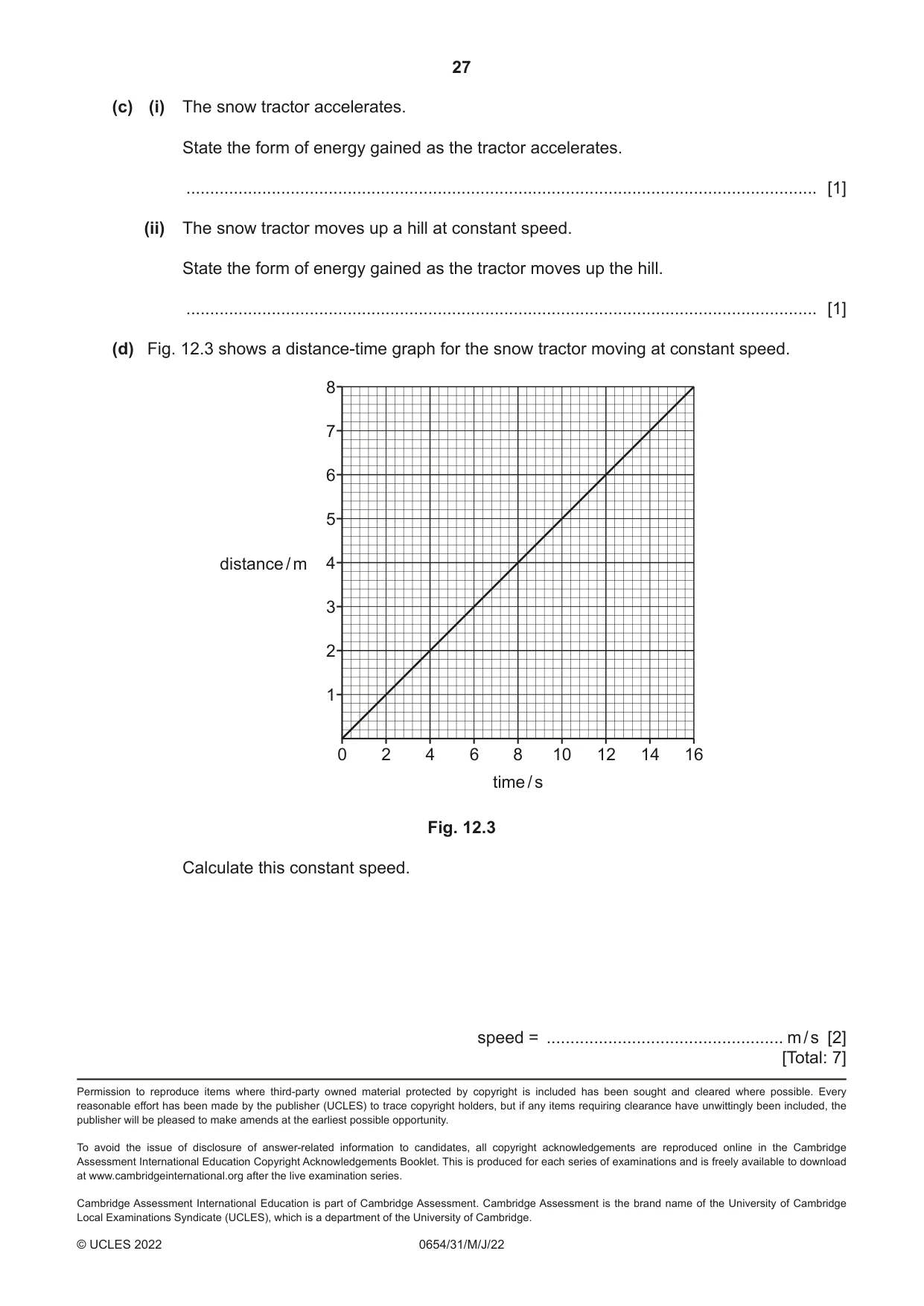
12 (a) Fig. 12.1 shows a large snow tractor used in Antarctica. large tracks Fig. 12.1 The snow tractor has large continuous tracks. These tracks allow the snow tractor to move across the snow without sinking. Explain why a tractor with normal wheels would sink into the snow. ................................................................................................................................................... ................................................................................................................................................... ............................................................................................................................................. [2] (b) When gasoline (petrol) burns in the engine of the snow tractor, carbon dioxide gas and water vapour are produced. State which of the diagrams, X, Y or Z in Fig. 12.2, shows the arrangement of gaseous carbon dioxide molecules. Give a reason for your answer. X Y Z Fig. 12.2 diagram ........................... reason ....................................................................................................................................... ................................................................................................................................................... [1] (c) (i) The snow tractor accelerates. State the form of energy gained as the tractor accelerates. ..................................................................................................................................... [1] (ii) The snow tractor moves up a hill at constant speed. State the form of energy gained as the tractor moves up the hill. ..................................................................................................................................... [1] (d) Fig. 12.3 shows a distance-time graph for the snow tractor moving at constant speed. 8 7 6 5 distance / m 4 3 2 1 0 2 4 6 8 10 12 14 16 time / s Fig. 12.3 Calculate this constant speed. speed = .................................................. m / s [2] [Total: 7]
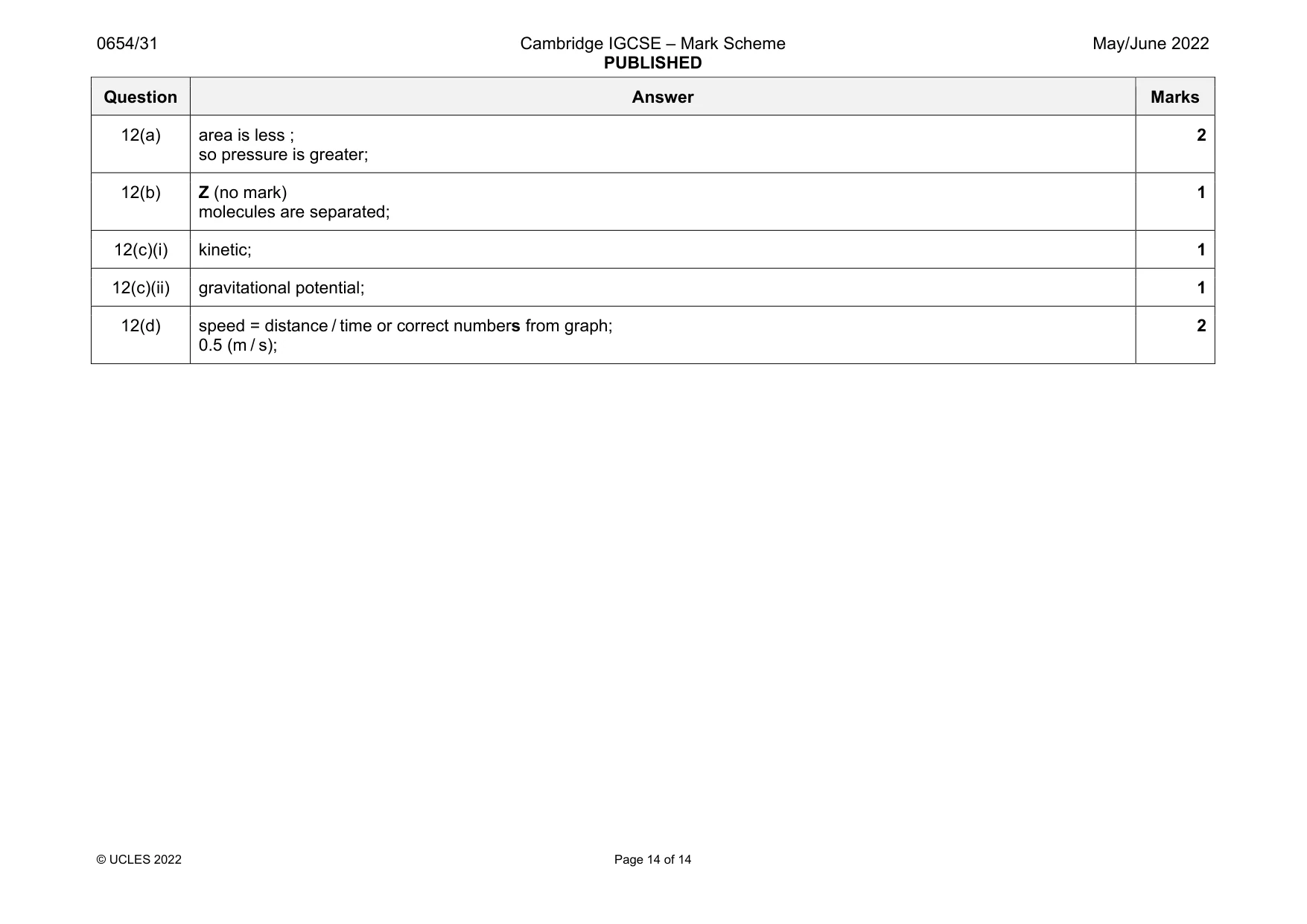
Mark scheme: 12(a) area is less ; so pressure is greater; 2 12(b) Z (no mark) molecules are separated; 1 12(c)(i) kinetic; 1 12(c)(ii) gravitational potential; 1 12(d) speed = distance / time or correct numbers from graph; 0.5 (m / s); 2
What was in this paper
The subtopics covered by these 12 questions, and how many questions each got. Open one in a new tab to see every Cambridge question on it.
What you needed in this session
Cambridge’s own grade thresholds for 2022 May/June, Paper 3 · Variant 1. A higher threshold means an easier paper — the bar moves with how the cohort did.