Cambridge IGCSE Sciences - Co-ordinated (Double) 0654 — 2019 Oct/Nov Paper 3 · Variant 3
0654/33/O/N/19 · 12 questions · 120 marks · ≈135 min
The question paper and its mark scheme, free to read here and free to download. This is Cambridge’s own paper, exactly as it was sat.
Question paper32 pages



Mark scheme16 pages
Answers below. Sit the paper first if you are practising.
Questions as text
Q1 · A diagram of a section through the heart and associated blood vessels
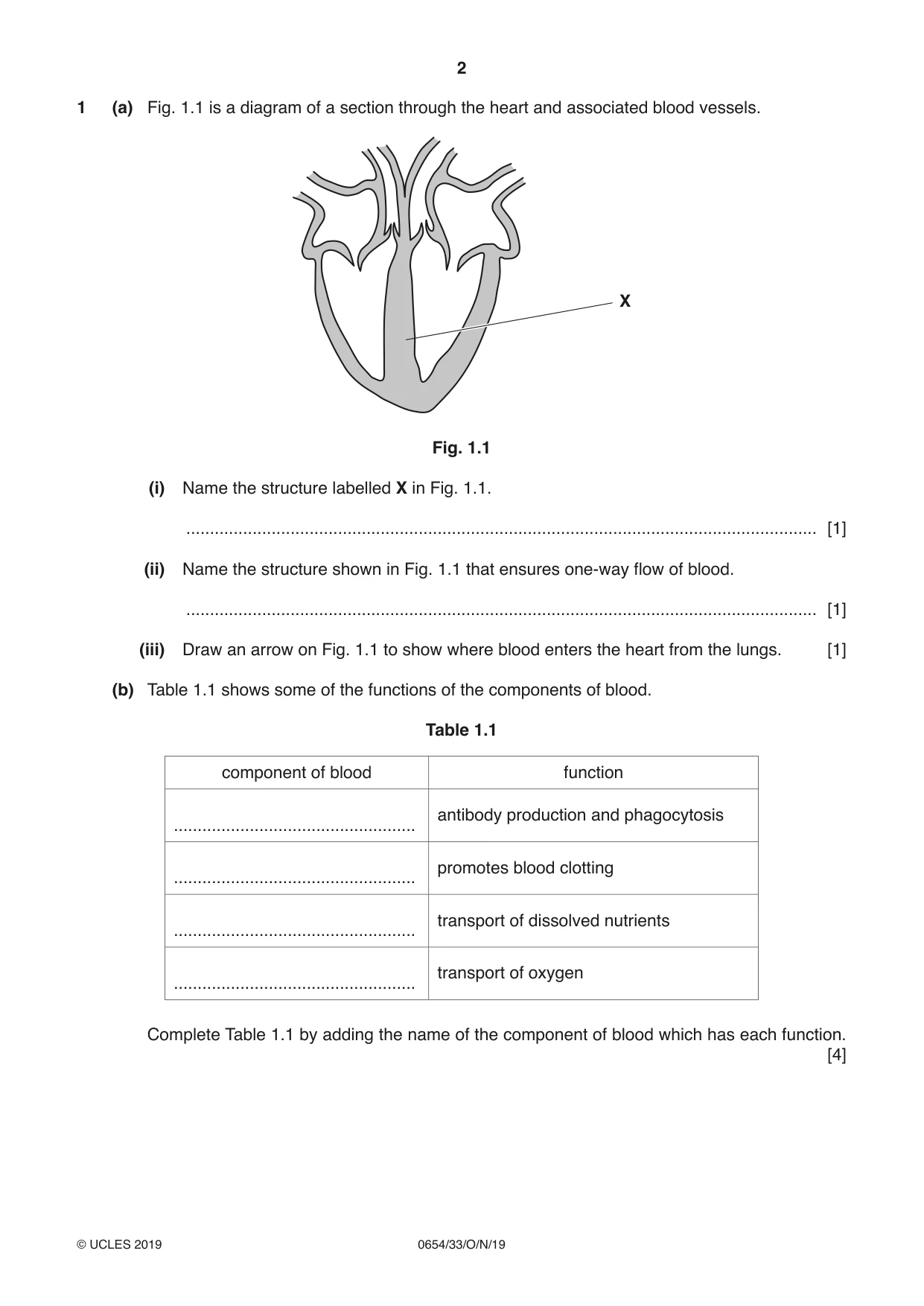
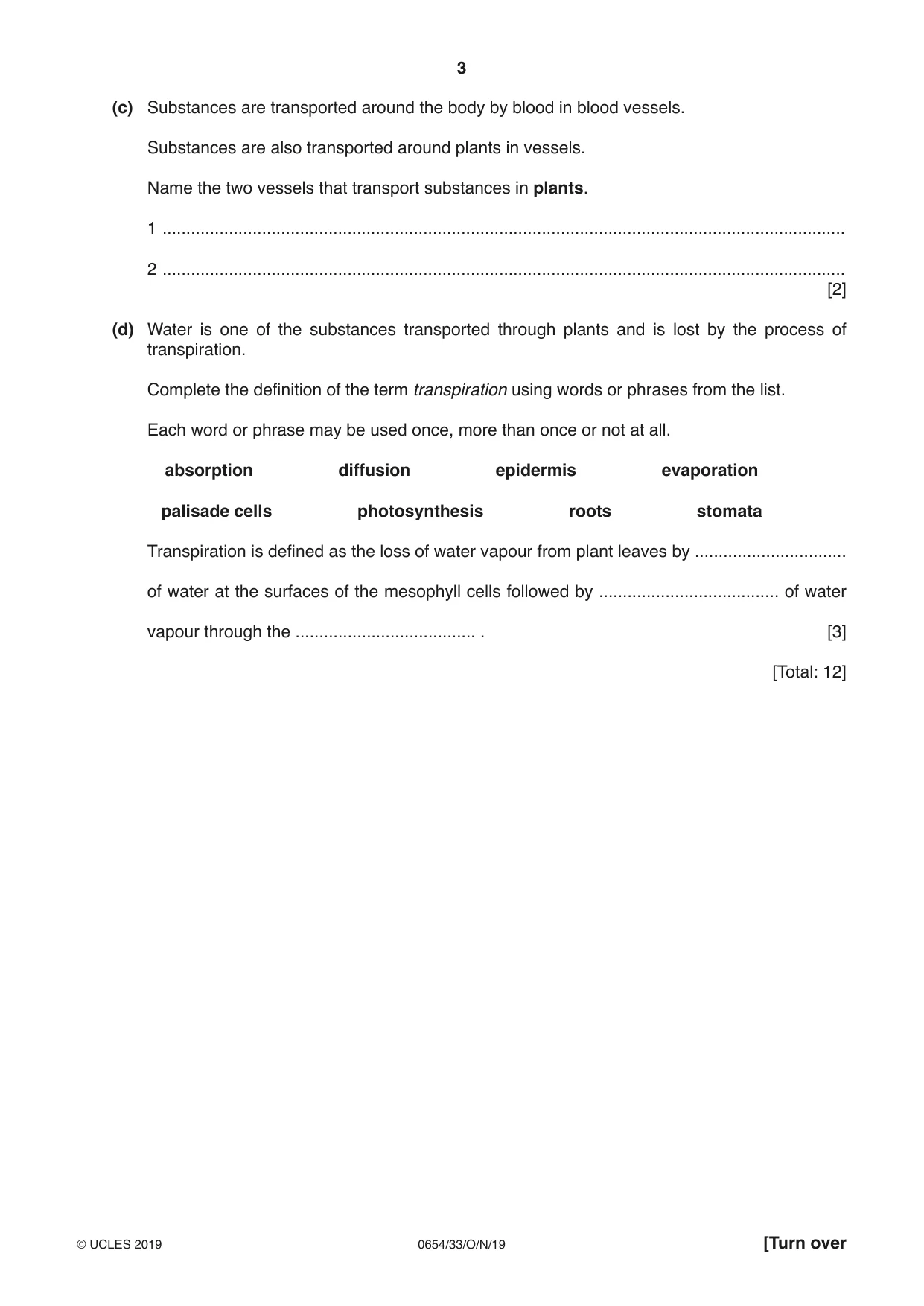
1 (a) Fig. 1.1 is a diagram of a section through the heart and associated blood vessels. X Fig. 1.1 (i) Name the structure labelled X in Fig. 1.1. ..................................................................................................................................... [1] (ii) Name the structure shown in Fig. 1.1 that ensures one-way flow of blood. ..................................................................................................................................... [1] (iii) Draw an arrow on Fig. 1.1 to show where blood enters the heart from the lungs. [1] (b) Table 1.1 shows some of the functions of the components of blood. Table 1.1 component of blood function antibody production and phagocytosis ................................................... promotes blood clotting ................................................... transport of dissolved nutrients ................................................... transport of oxygen ................................................... Complete Table 1.1 by adding the name of the component of blood which has each function. [4] (c) Substances are transported around the body by blood in blood vessels. Substances are also transported around plants in vessels. Name the two vessels that transport substances in plants. 1 ................................................................................................................................................ 2 ................................................................................................................................................ [2] (d) Water is one of the substances transported through plants and is lost by the process of transpiration. Complete the definition of the term transpiration using words or phrases from the list. Each word or phrase may be used once, more than once or not at all. absorption diffusion epidermis evaporation palisade cells photosynthesis roots stomata Transpiration is defined as the loss of water vapour from plant leaves by ................................ of water at the surfaces of the mesophyll cells followed by ...................................... of water vapour through the ...................................... . [3] [Total: 12]
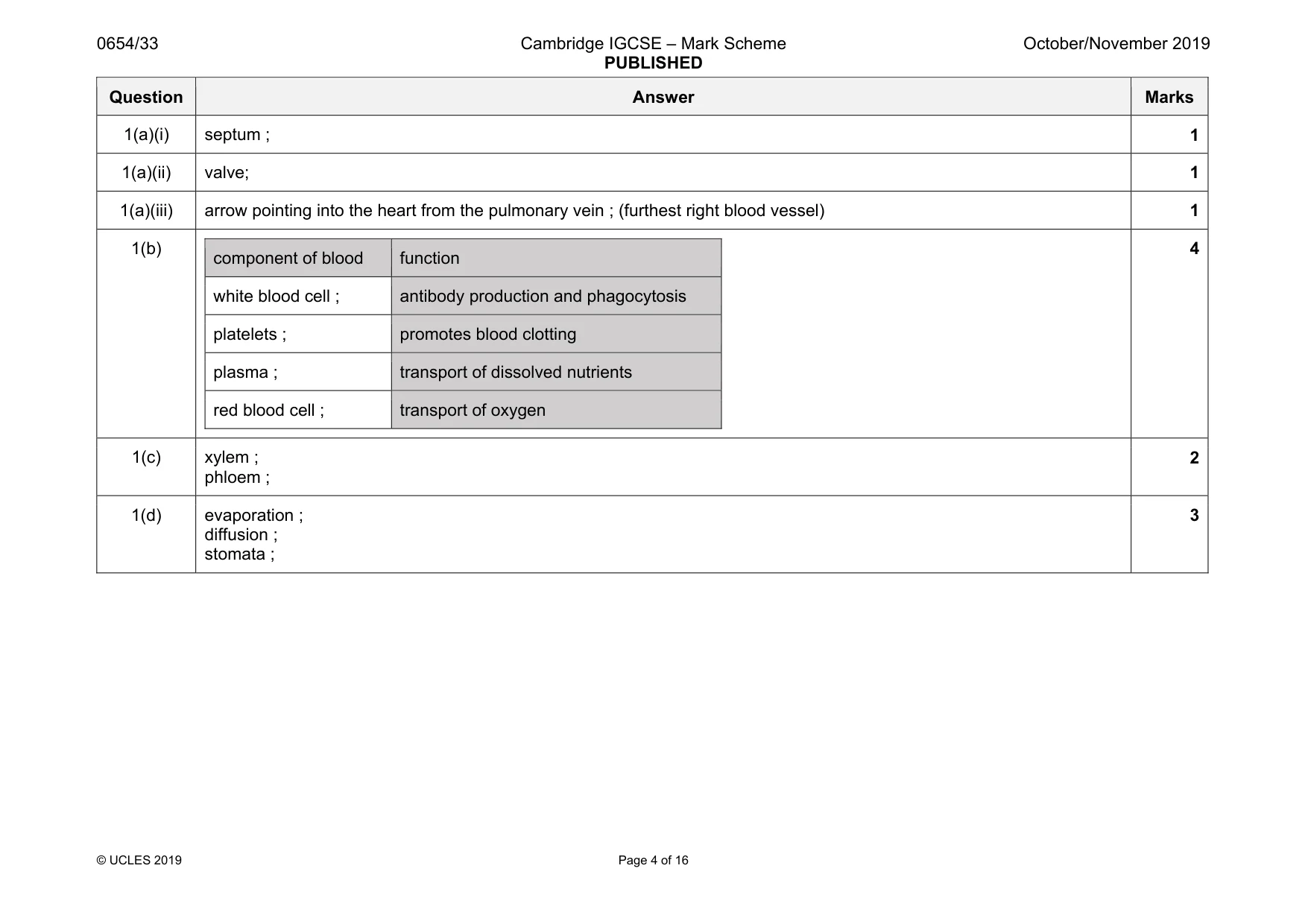
Mark scheme: 1(a)(i) septum ; 1 1(a)(ii) valve; 1 1(a)(iii) arrow pointing into the heart from the pulmonary vein ; (furthest right blood vessel) 1 1(b) component of blood function white blood cell ; antibody production and phagocytosis platelets ; promotes blood clotting plasma ; transport of dissolved nutrients red blood cell ; transport of oxygen 4 1(c) xylem ; phloem ; 2 1(d) evaporation ; diffusion ; stomata ; 3
Q2 · The symbols of six elements and six statements about these elements
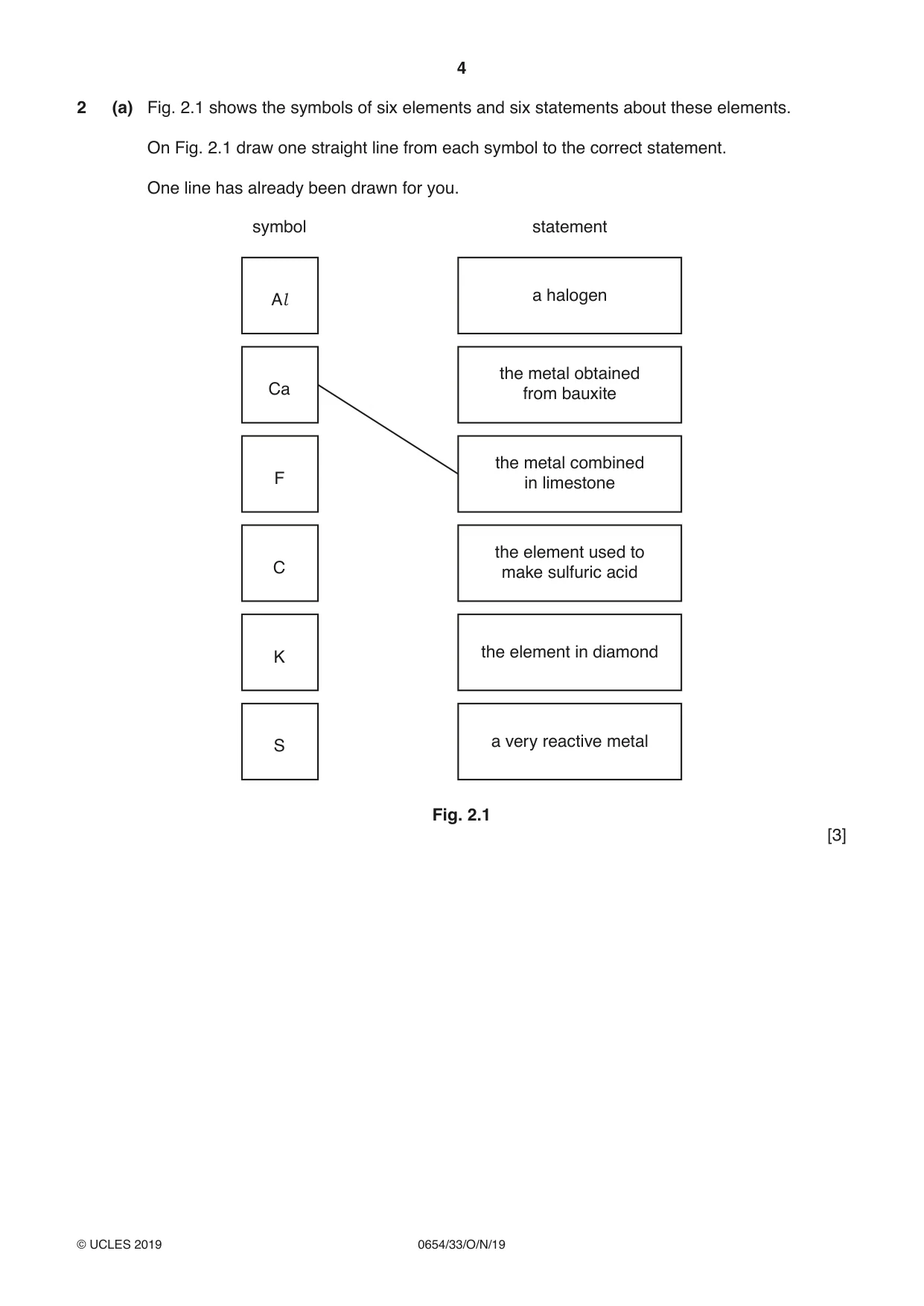
2 (a) Fig. 2.1 shows the symbols of six elements and six statements about these elements. On Fig. 2.1 draw one straight line from each symbol to the correct statement. One line has already been drawn for you. symbol statement a halogen Al the metal obtained Ca from bauxite the metal combined F in limestone the element used to C make sulfuric acid the element in diamond K a very reactive metal S Fig. 2.1 [3] (b) The chemical symbols of an atom of beryllium and an atom of boron are shown in Fig. 2.2. nucleon number 9 11 Be B proton number 4 5 Fig. 2.2 Complete Table 2.1 to show the numbers of neutrons and electrons in these atoms. Table 2.1 neutrons electrons Be B [2] (c) Sodium and chlorine combine to form sodium chloride. Fig. 2.3 shows the electronic structure of an atom of sodium and of an atom of chlorine. sodium atom chlorine atom Fig. 2.3 Complete Fig. 2.4 to show the electronic structures of the ions that form from these atoms. sodium ion chloride ion Fig. 2.4 [2] (d) Fig. 2.5 shows apparatus a student uses to produce a neutral solution of sodium chloride. Apparatus F contains a dilute acid which is added slowly to an alkaline solution contained in the beaker. pH meter apparatus F pH dilute acid tap to allow acid to run out beaker alkaline solution Fig. 2.5 (i) Name apparatus F. ..................................................................................................................................... [1] (ii) State the alkaline solution and the dilute acid that react to produce sodium chloride. alkaline solution ................................................................................................................. dilute acid .......................................................................................................................... [2] (iii) Suggest a value of the pH of the solution in the beaker before any acid is added. pH = ......................................................... [1] [Total: 11]
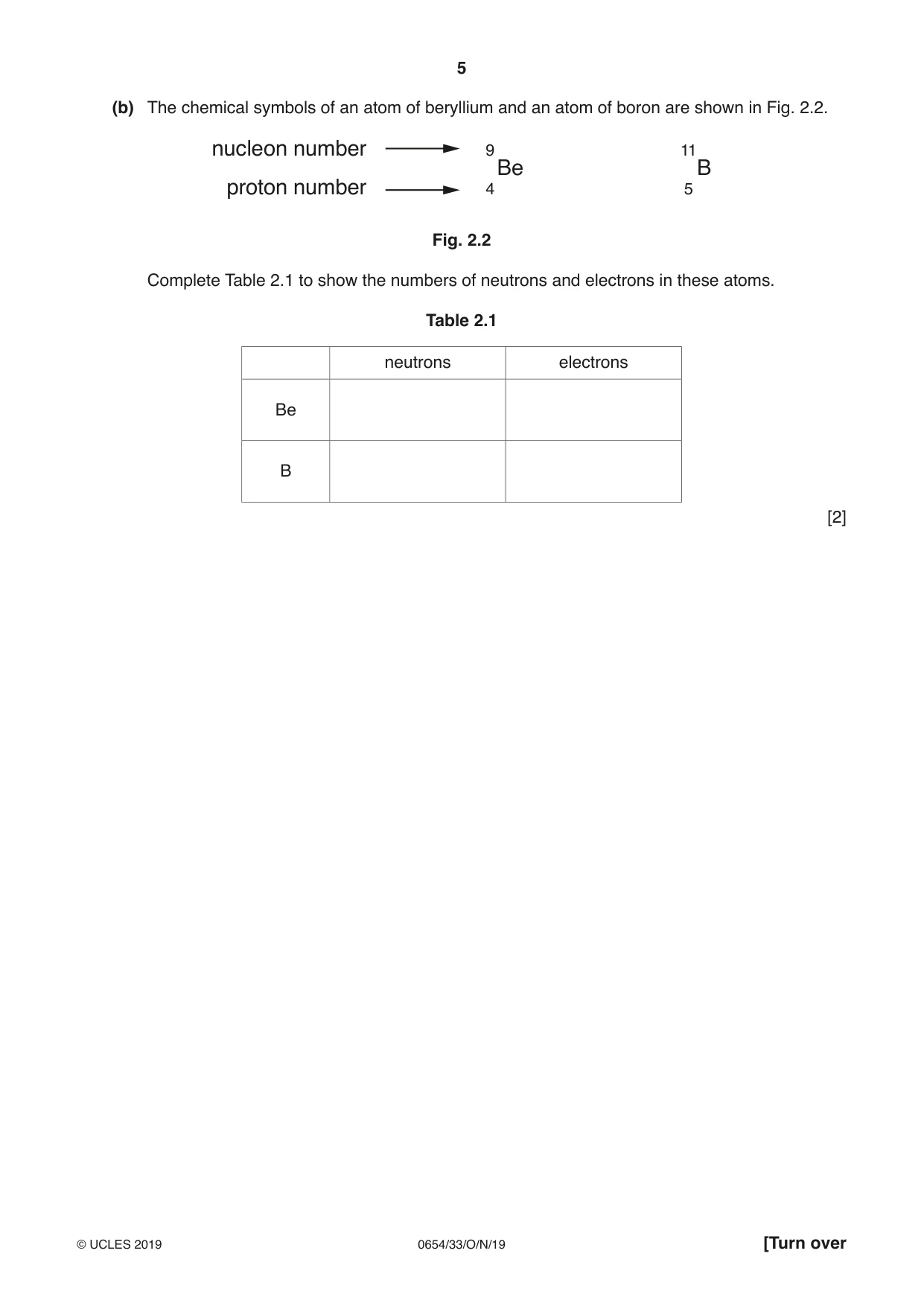
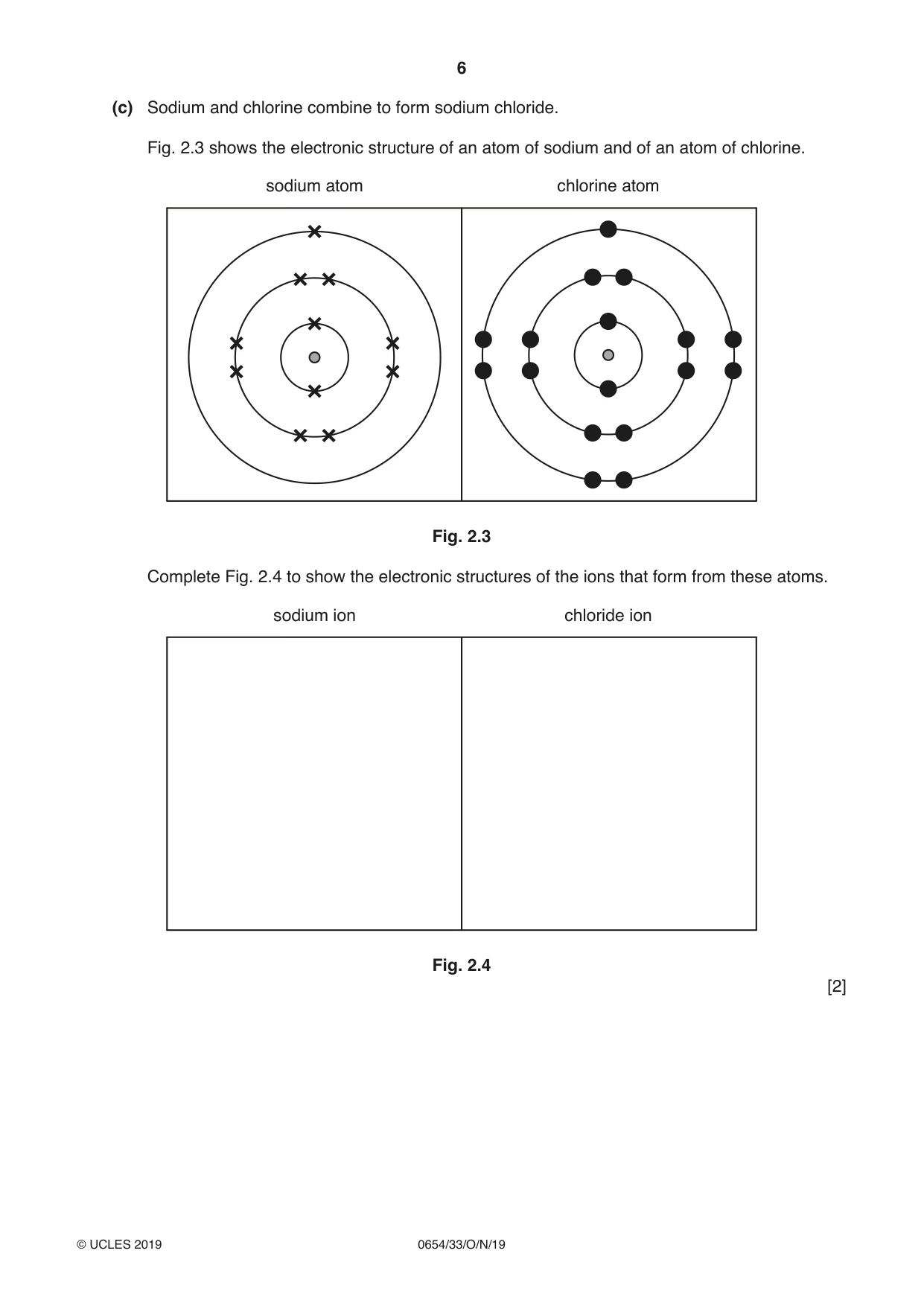
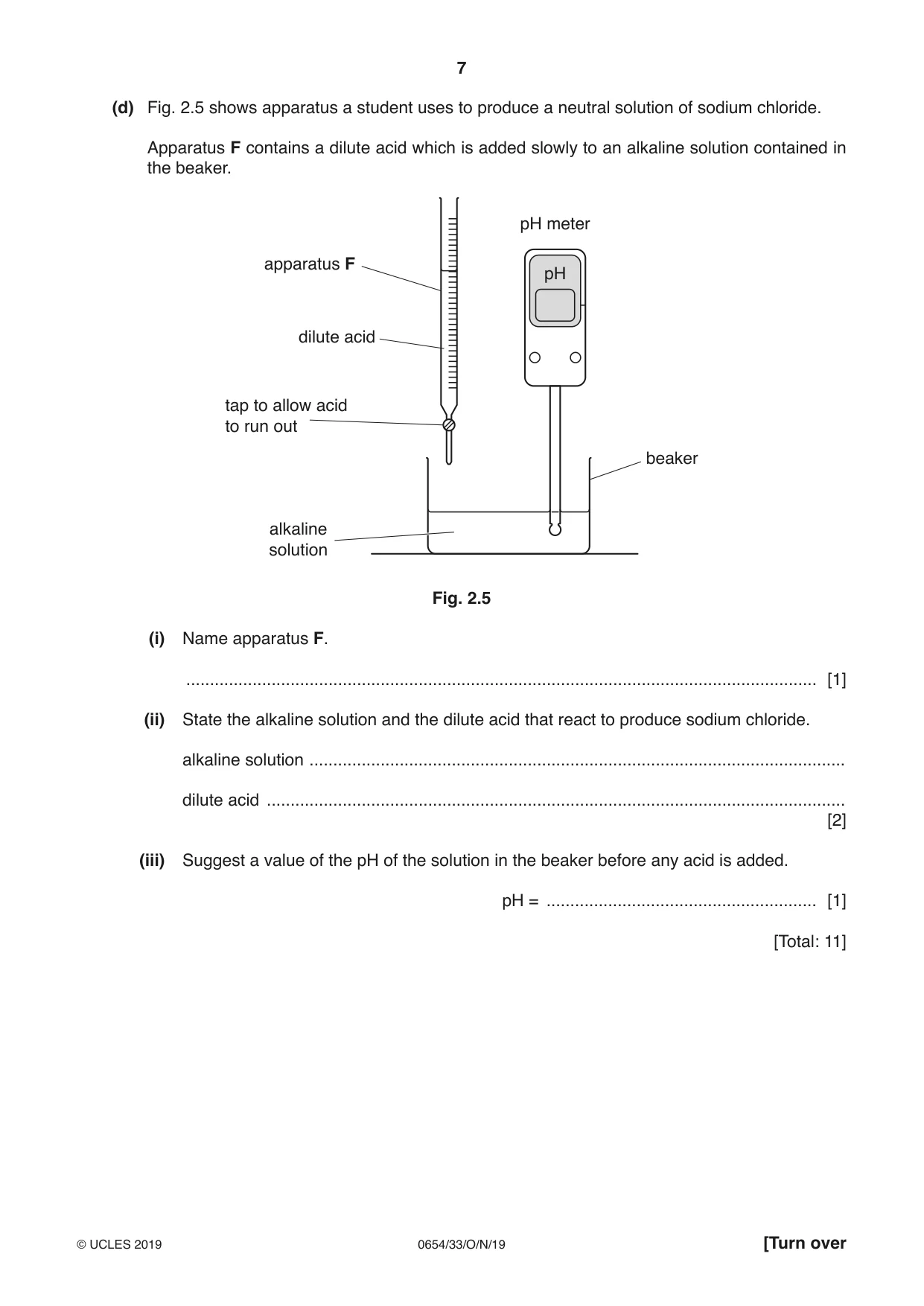
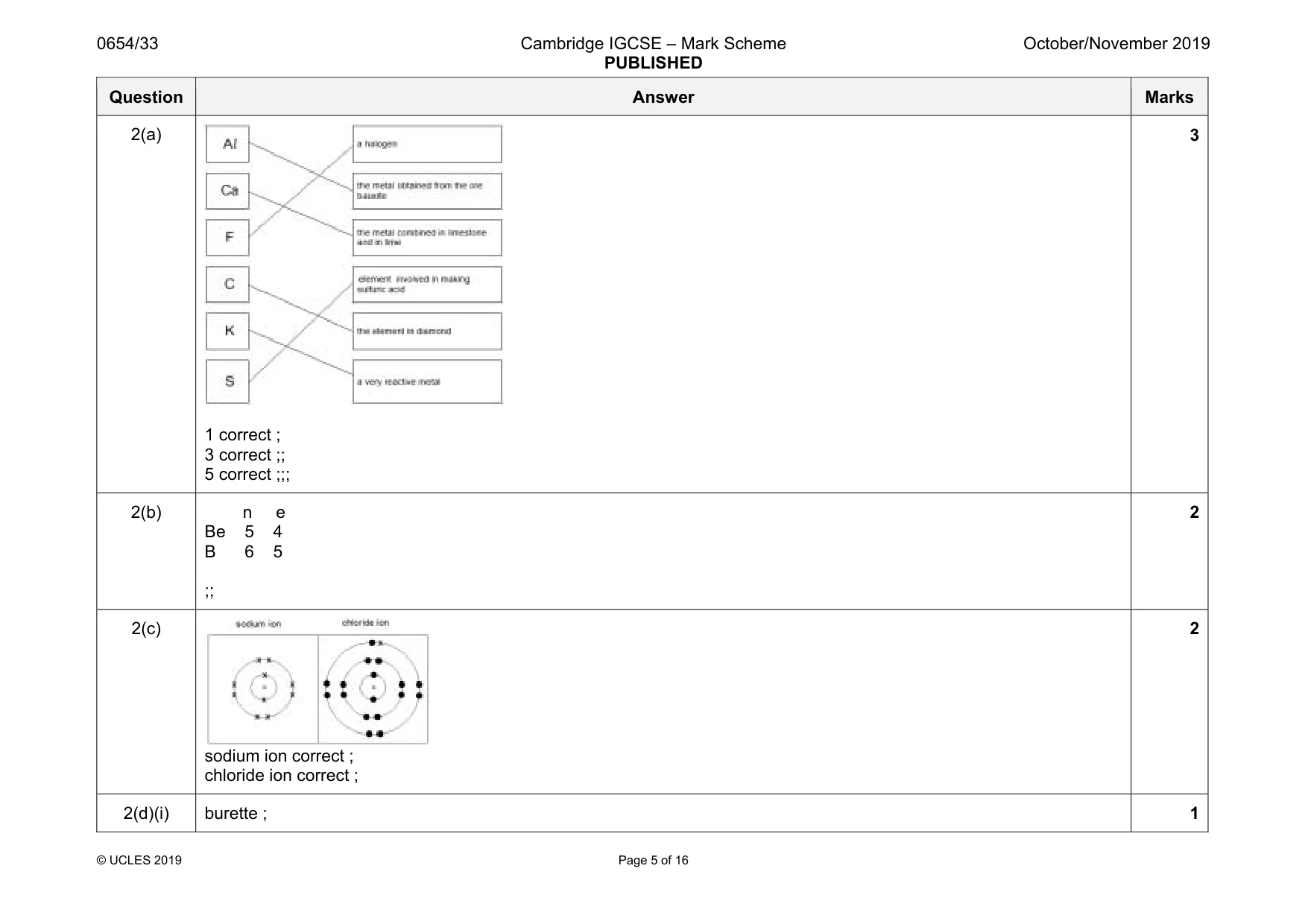
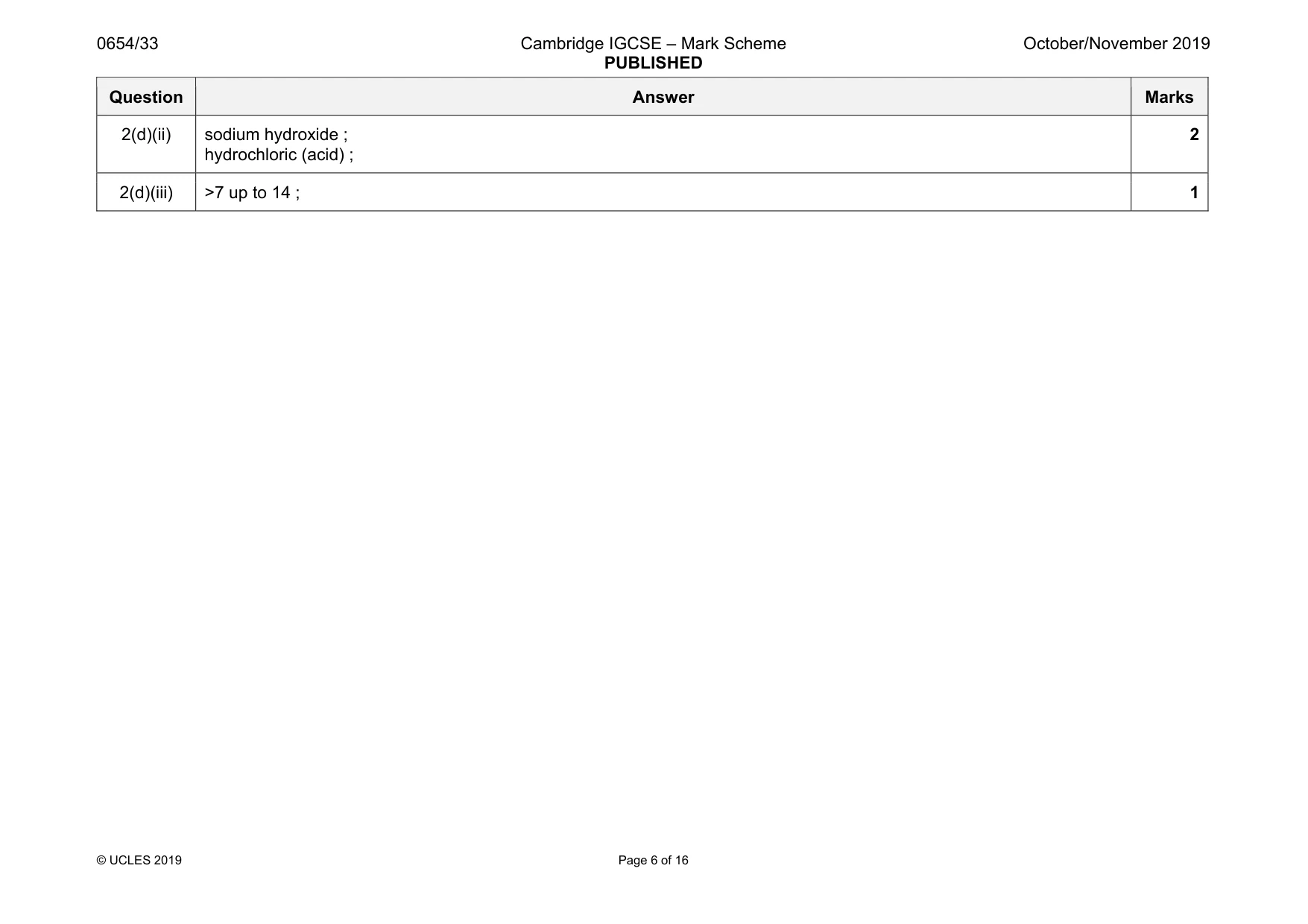
Mark scheme: 2(a) 1 correct ; 3 correct ;; 5 correct ;;; 3 2(b) n e Be 5 4 B 6 5 ;; 2 2(c) sodium ion correct ; chloride ion correct ; 2 2(d)(i) burette ; 1 Question Answer Marks 2(d)(ii) sodium hydroxide ; hydrochloric (acid) ; 2 2(d)(iii) >7 up to 14 ; 1
Q3 · A girl is on a bridge over a river
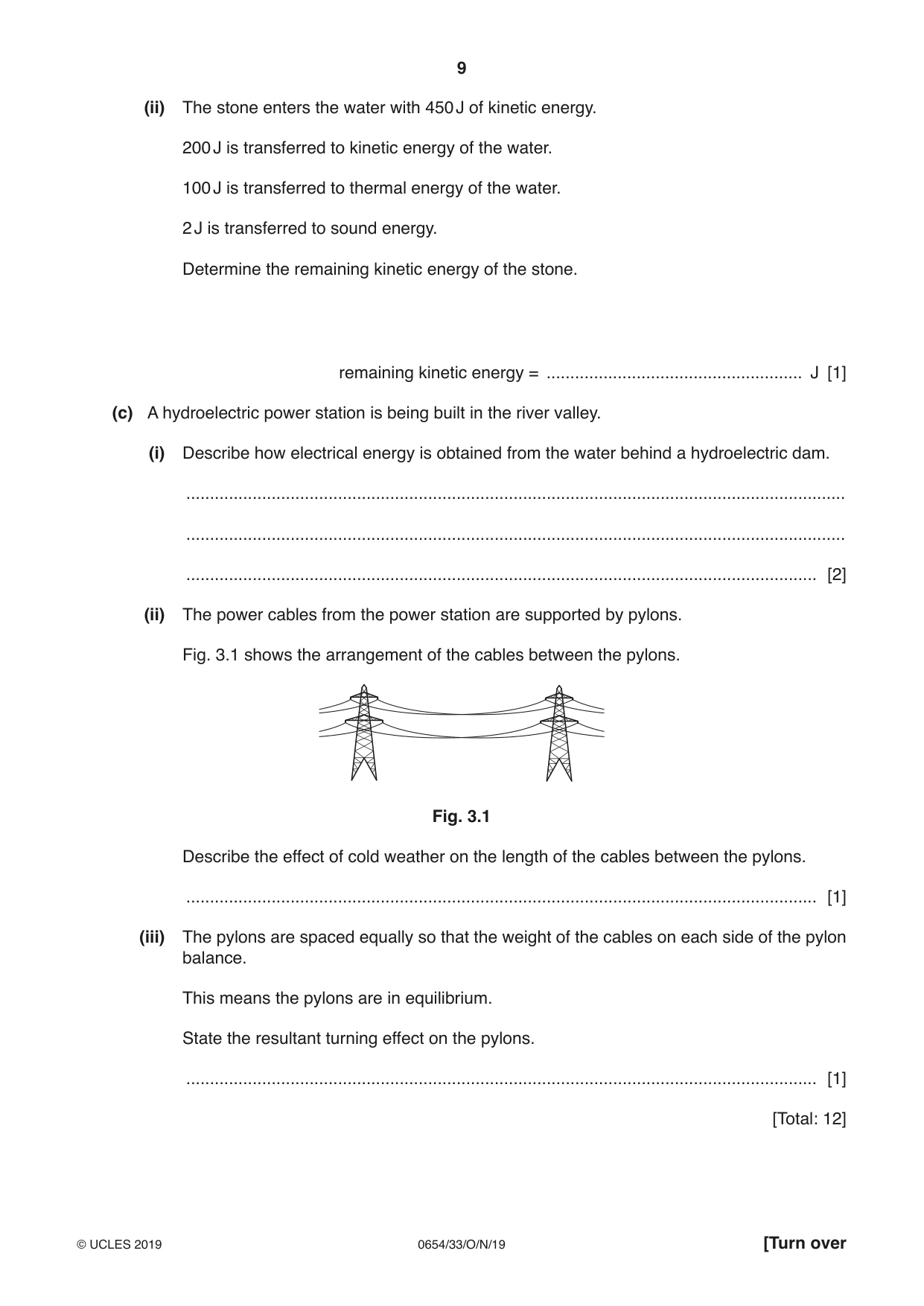
3 (a) A girl is on a bridge over a river. (i) Complete the sentences by choosing the correct words or phrases from the list. Each word or phrase may be used once, more than once or not at all. chemical constant decreasing friction gravitational potential increasing joules kinetic newtons weight The girl picks up a stone and drops it over the side of the bridge. The stone loses ............................................................ energy and gains ............................................................ energy. The stone falls with ............................................................ acceleration due to gravity. The vertical force acting upwards on the stone as it falls is called ............................................................ and is due to air resistance. [3] (ii) The river is 30 m below the bridge. After 1.7 s the stone hits the surface of the water. Calculate the average speed of the falling stone. speed = ................................................. m / s [2] (iii) State the source of the gravitational field that is accelerating the stone vertically downwards. ..................................................................................................................................... [1] (b) The stone enters the water. (i) Describe how the force of water acting on the stone affects the downwards motion of the stone. ..................................................................................................................................... [1] (ii) The stone enters the water with 450 J of kinetic energy. 200 J is transferred to kinetic energy of the water. 100 J is transferred to thermal energy of the water. 2 J is transferred to sound energy. Determine the remaining kinetic energy of the stone. remaining kinetic energy = ...................................................... J [1] (c) A hydroelectric power station is being built in the river valley. (i) Describe how electrical energy is obtained from the water behind a hydroelectric dam. ........................................................................................................................................... ........................................................................................................................................... ..................................................................................................................................... [2] (ii) The power cables from the power station are supported by pylons. Fig. 3.1 shows the arrangement of the cables between the pylons. Fig. 3.1 Describe the effect of cold weather on the length of the cables between the pylons. ..................................................................................................................................... [1] (iii) The pylons are spaced equally so that the weight of the cables on each side of the pylon balance. This means the pylons are in equilibrium. State the resultant turning effect on the pylons. ..................................................................................................................................... [1] [Total: 12]
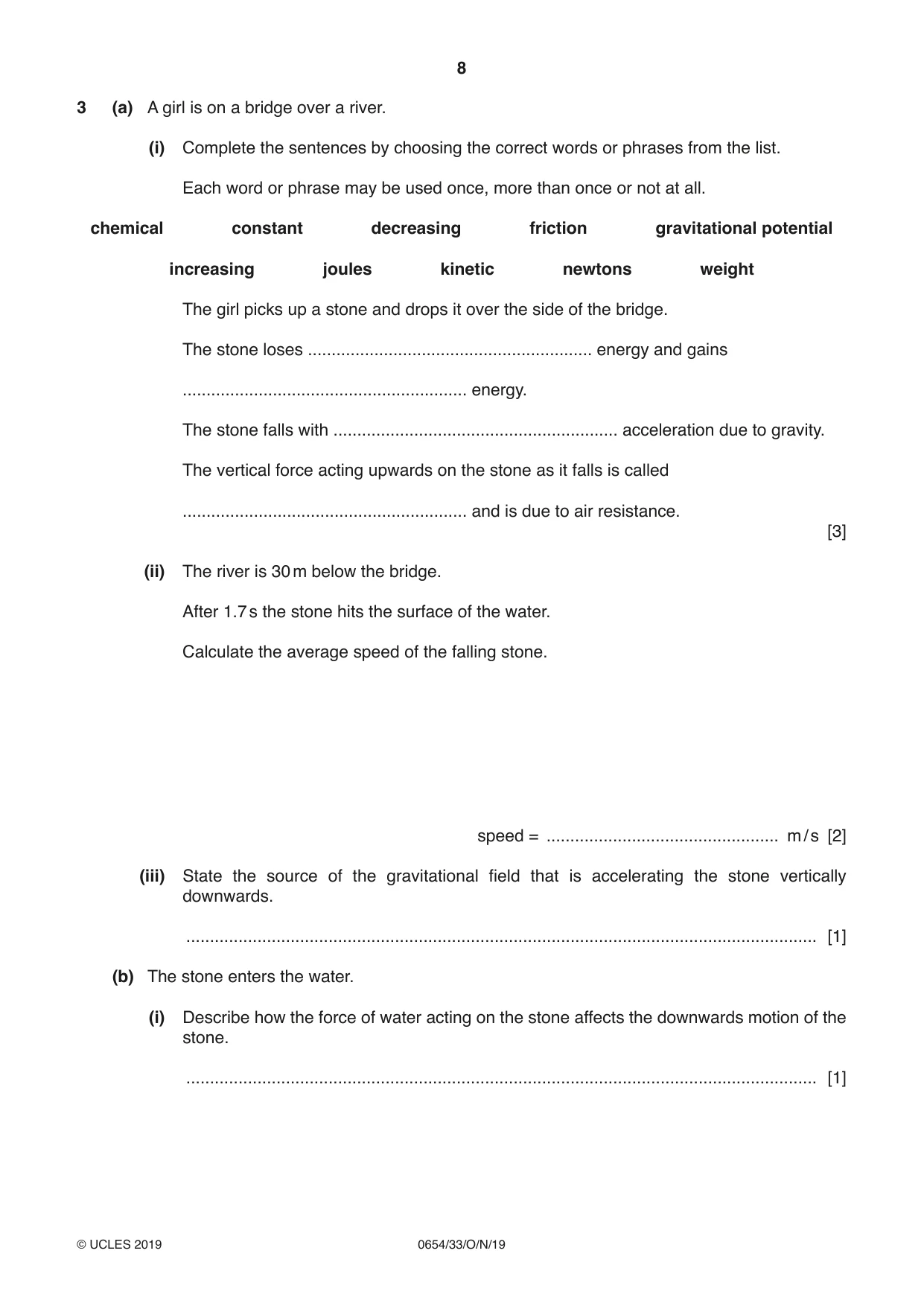
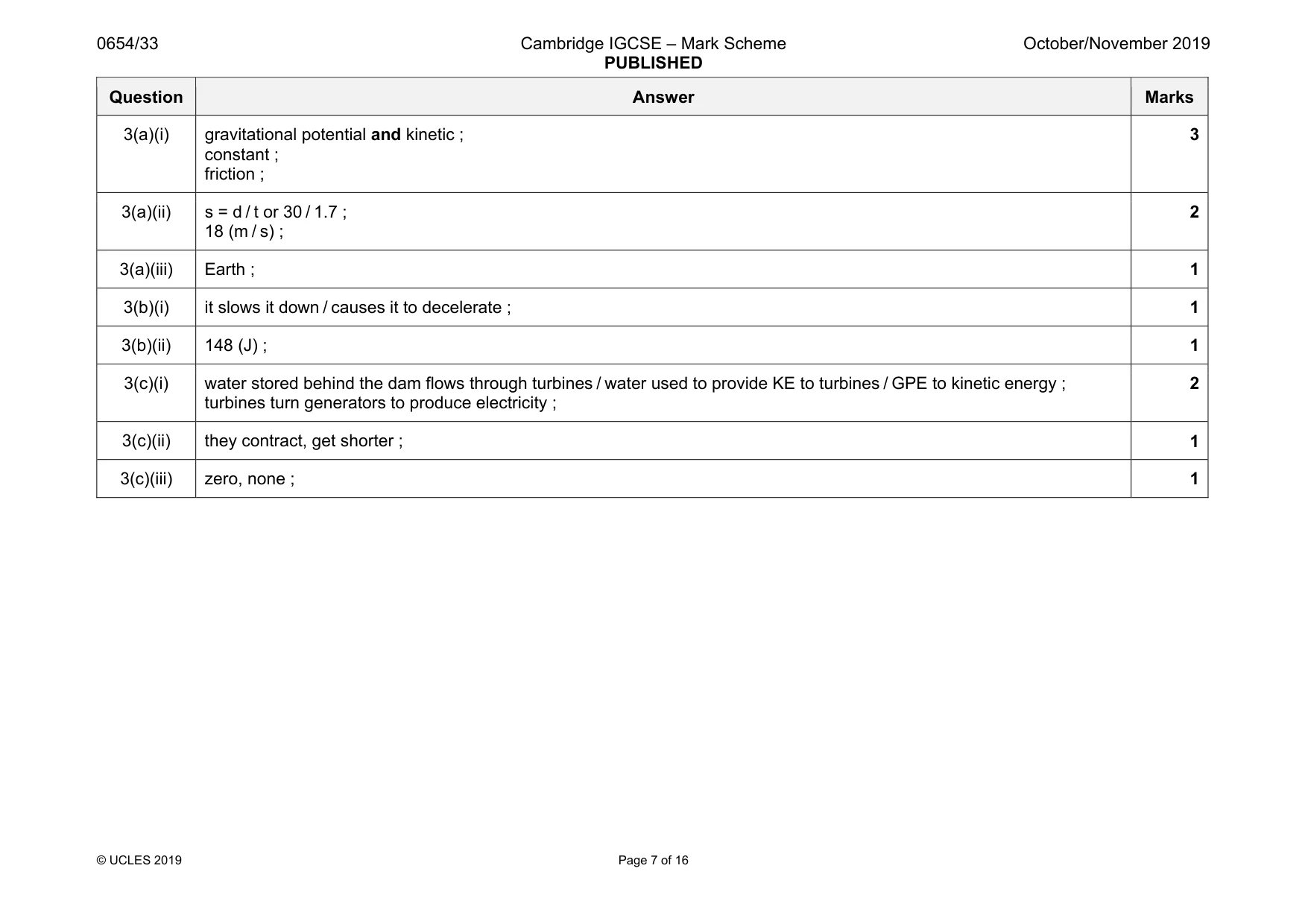
Mark scheme: 3(a)(i) gravitational potential and kinetic ; constant ; friction ; 3 3(a)(ii) s = d / t or 30 / 1.7 ; 18 (m / s) ; 2 3(a)(iii) Earth ; 1 3(b)(i) it slows it down / causes it to decelerate ; 1 3(b)(ii) 148 (J) ; 1 3(c)(i) water stored behind the dam flows through turbines / water used to provide KE to turbines / GPE to kinetic energy ; turbines turn generators to produce electricity ; 2 3(c)(ii) they contract, get shorter ; 1 3(c)(iii) zero, none ; 1
Q4 · A student investigates the conditions needed for germination of cress seeds
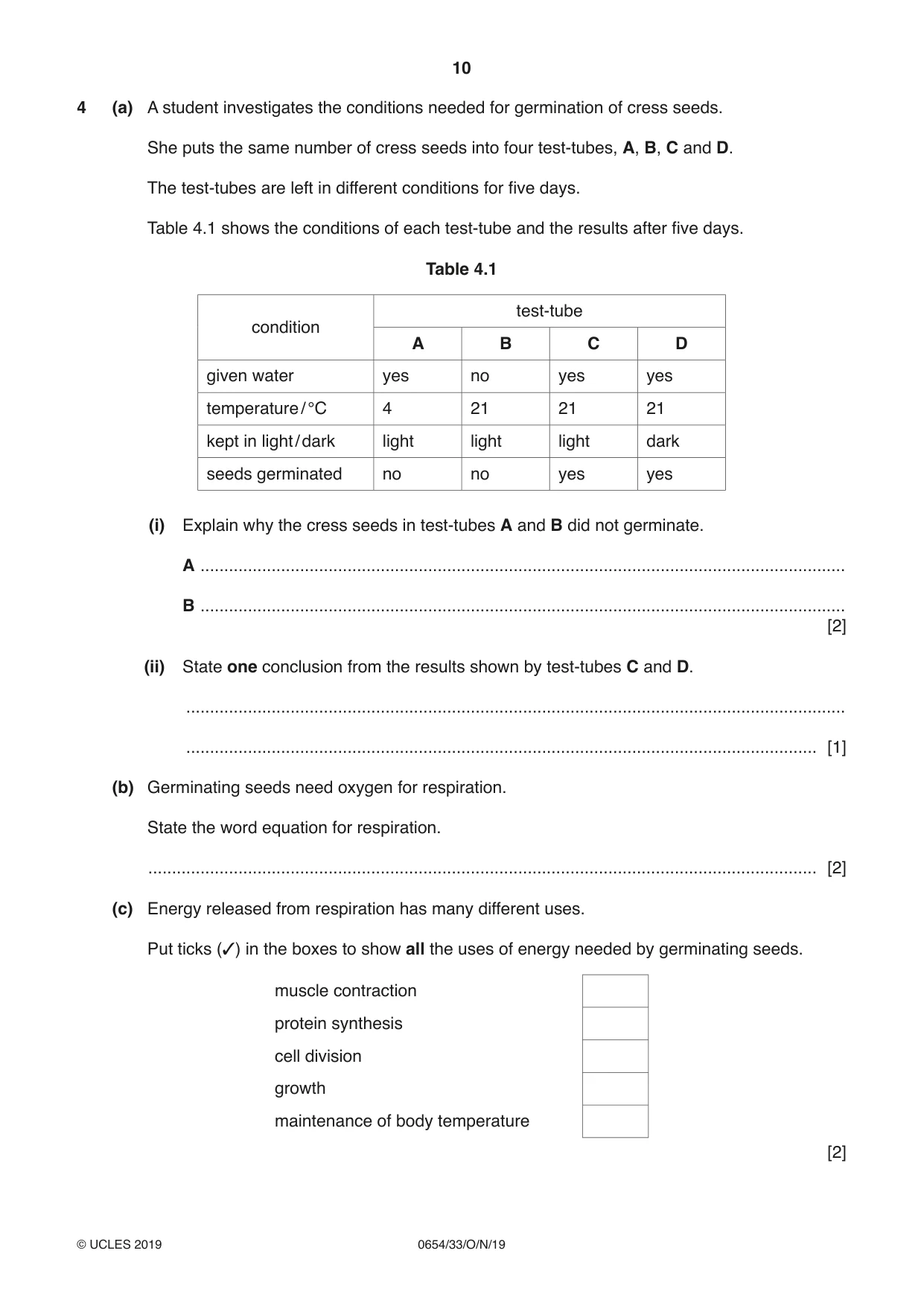
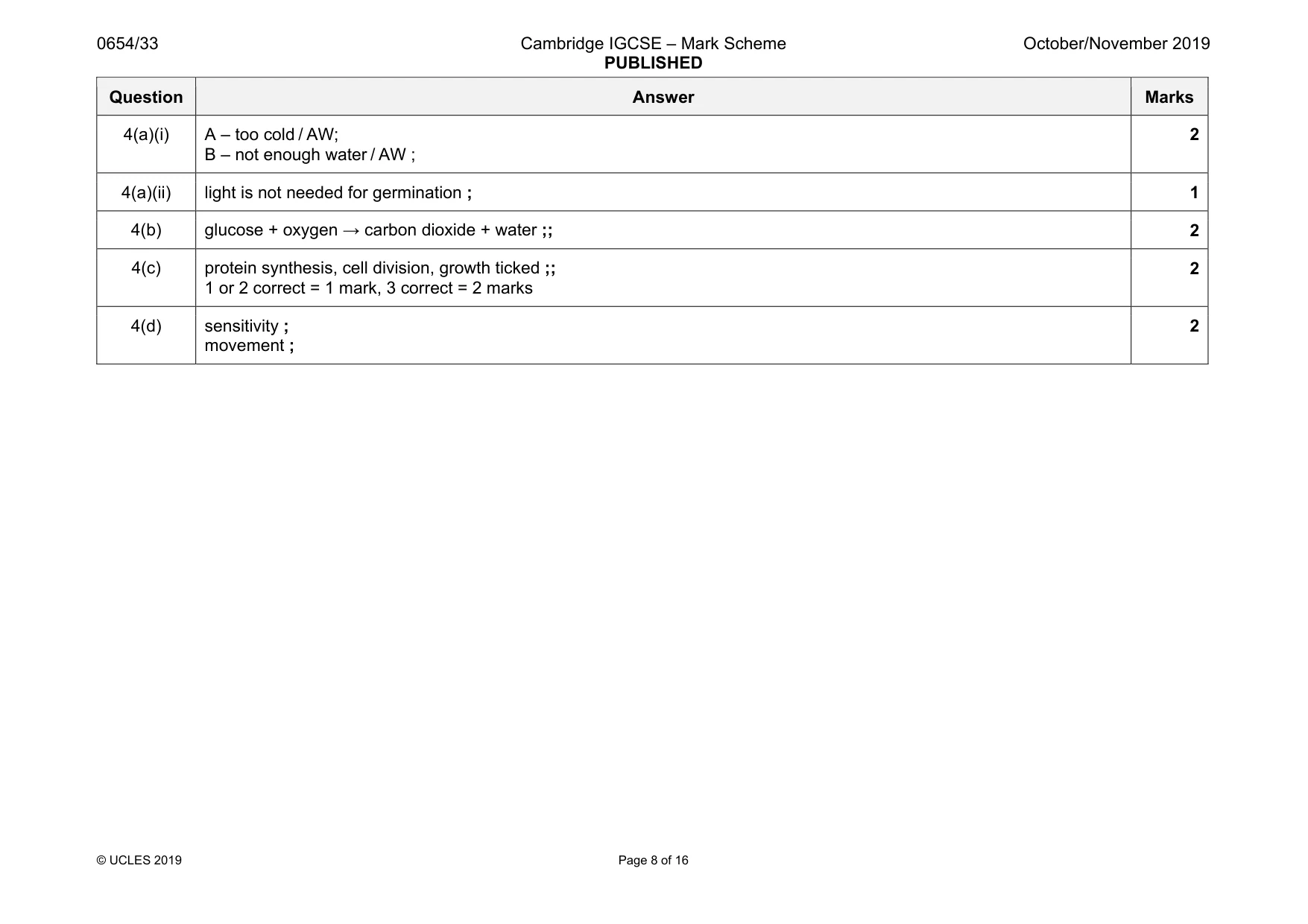
4 (a) A student investigates the conditions needed for germination of cress seeds. She puts the same number of cress seeds into four test-tubes, A, B, C and D. The test-tubes are left in different conditions for five days. Table 4.1 shows the conditions of each test-tube and the results after five days. Table 4.1 test-tube condition A B C D given water yes no yes yes temperature / °C 4 21 21 21 kept in light / dark light light light dark seeds germinated no no yes yes (i) Explain why the cress seeds in test-tubes A and B did not germinate. A ........................................................................................................................................ B ........................................................................................................................................ [2] (ii) State one conclusion from the results shown by test-tubes C and D. ........................................................................................................................................... ..................................................................................................................................... [1] (b) Germinating seeds need oxygen for respiration. State the word equation for respiration. ............................................................................................................................................. [2] (c) Energy released from respiration has many different uses. Put ticks (3) in the boxes to show all the uses of energy needed by germinating seeds. muscle contraction protein synthesis cell division growth maintenance of body temperature [2] (d) Respiration is one of the characteristics of living things. Name the characteristic of living things that is defined by: the ability to detect and respond to changes in the environment ................................................................................................................................................... an action by an organism causing a change of position or place. ................................................................................................................................................... [2] [Total: 9]
Mark scheme: 4(a)(i) A – too cold / AW; B – not enough water / AW ; 2 4(a)(ii) light is not needed for germination ; 1 4(b) glucose + oxygen → carbon dioxide + water ;; 2 4(c) protein synthesis, cell division, growth ticked ;; 1 or 2 correct = 1 mark, 3 correct = 2 marks 2 4(d) sensitivity ; movement ; 2
Q5 · Meteorites fall to Earth from space
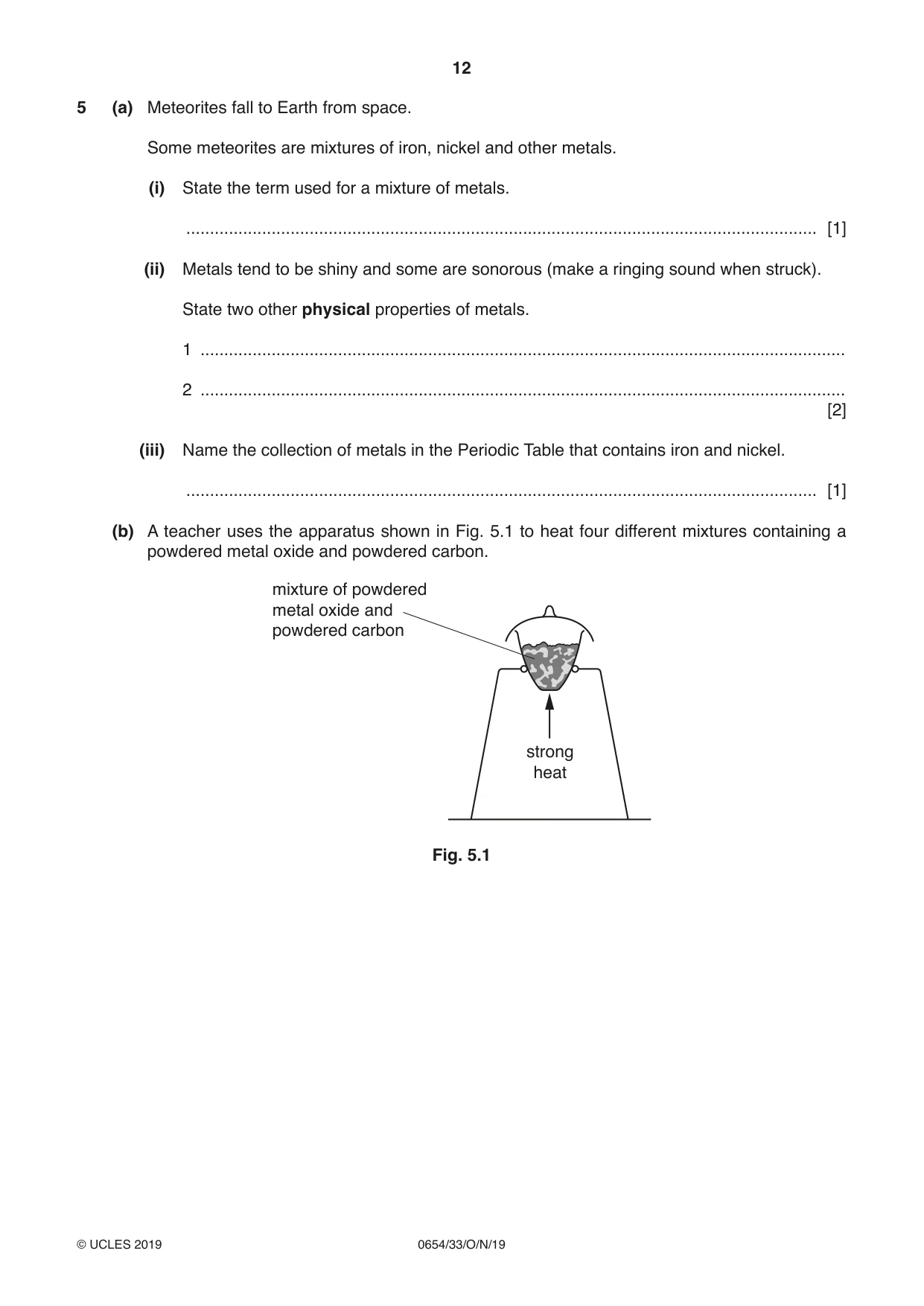
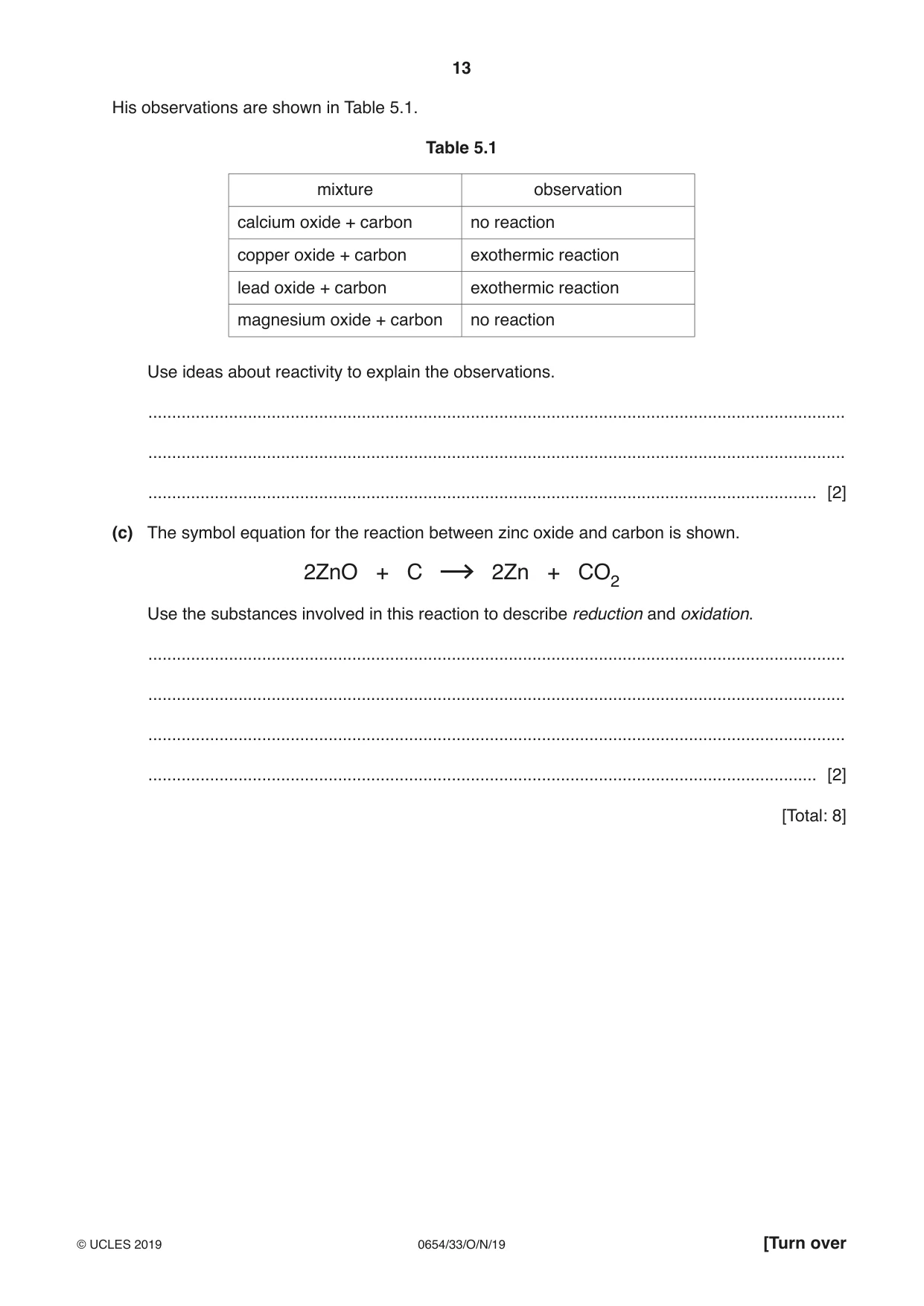
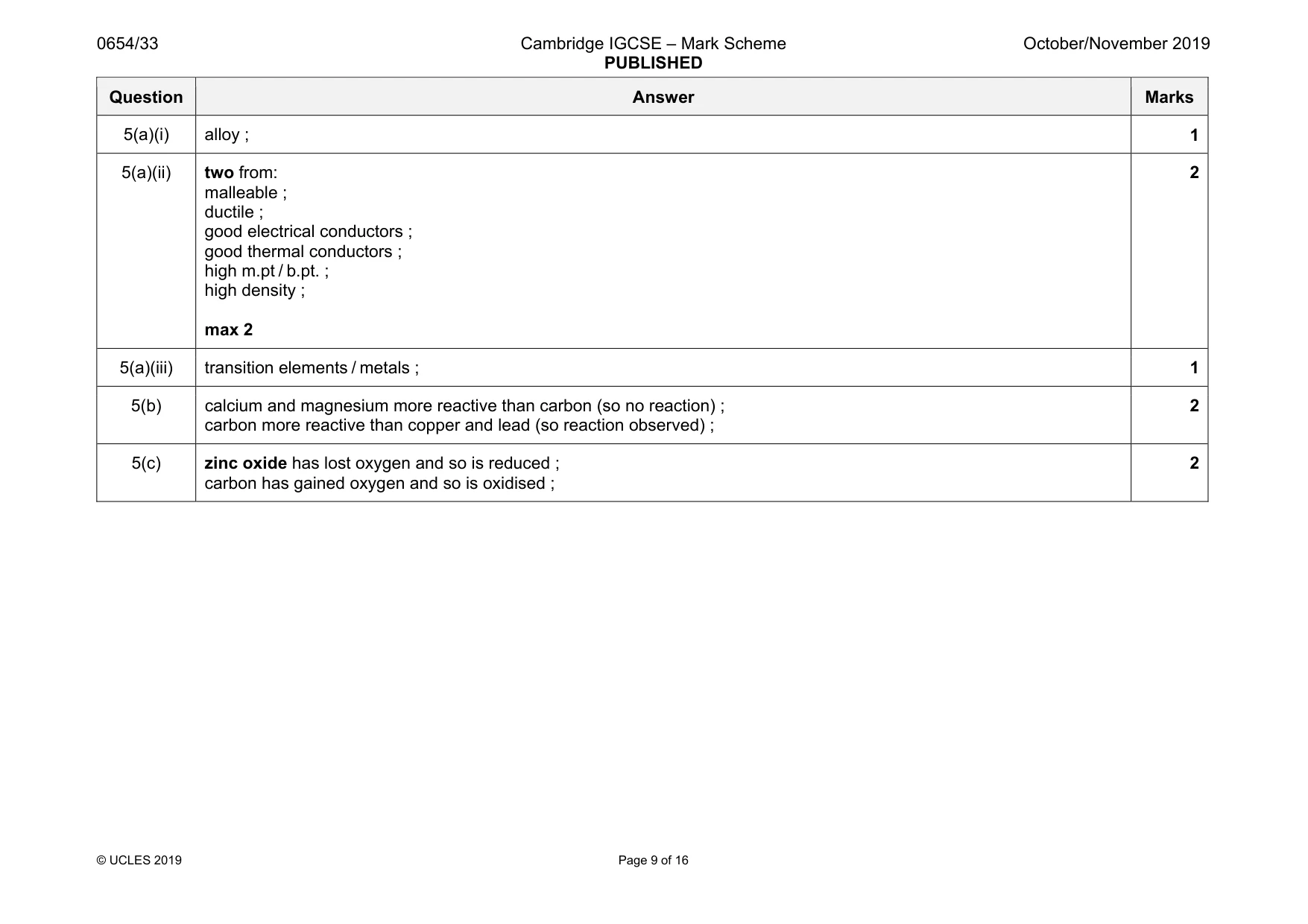
5 (a) Meteorites fall to Earth from space. Some meteorites are mixtures of iron, nickel and other metals. (i) State the term used for a mixture of metals. ..................................................................................................................................... [1] (ii) Metals tend to be shiny and some are sonorous (make a ringing sound when struck). State two other physical properties of metals. 1 ........................................................................................................................................ 2 ........................................................................................................................................ [2] (iii) Name the collection of metals in the Periodic Table that contains iron and nickel. ..................................................................................................................................... [1] (b) A teacher uses the apparatus shown in Fig. 5.1 to heat four different mixtures containing a powdered metal oxide and powdered carbon. mixture of powdered metal oxide and powdered carbon strong heat Fig. 5.1 His observations are shown in Table 5.1. Table 5.1 mixture observation calcium oxide + carbon no reaction copper oxide + carbon exothermic reaction lead oxide + carbon exothermic reaction magnesium oxide + carbon no reaction Use ideas about reactivity to explain the observations. ................................................................................................................................................... ................................................................................................................................................... ............................................................................................................................................. [2] (c) The symbol equation for the reaction between zinc oxide and carbon is shown. 2ZnO + C 2Zn + CO2 Use the substances involved in this reaction to describe reduction and oxidation. ................................................................................................................................................... ................................................................................................................................................... ................................................................................................................................................... ............................................................................................................................................. [2] [Total: 8]
Mark scheme: 5(a)(i) alloy ; 1 5(a)(ii) two from: malleable ; ductile ; good electrical conductors ; good thermal conductors ; high m.pt / b.pt. ; high density ; max 2 2 5(a)(iii) transition elements / metals ; 1 5(b) calcium and magnesium more reactive than carbon (so no reaction) ; carbon more reactive than copper and lead (so reaction observed) ; 2 5(c) zinc oxide has lost oxygen and so is reduced ; carbon has gained oxygen and so is oxidised ; 2
Question 6
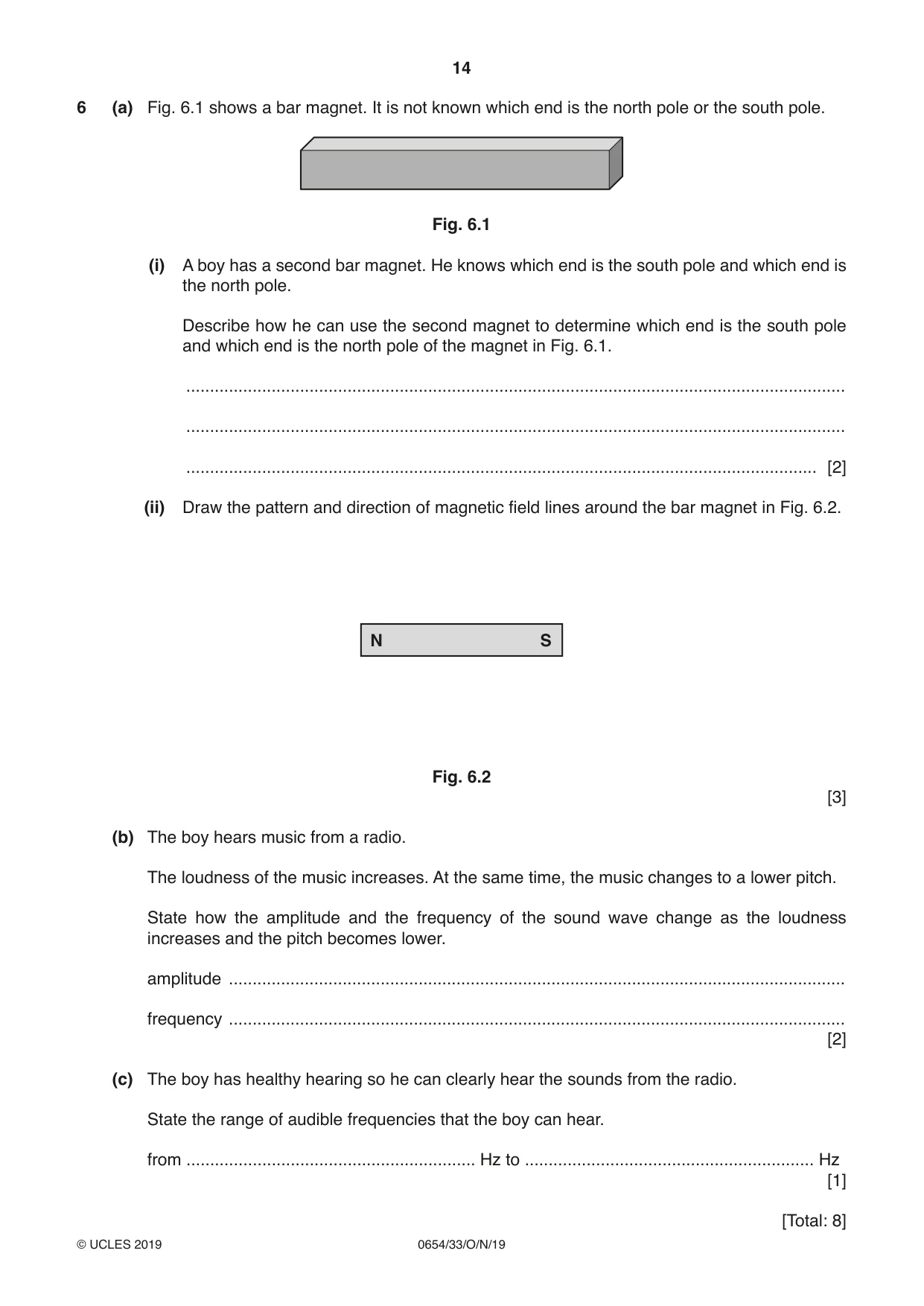
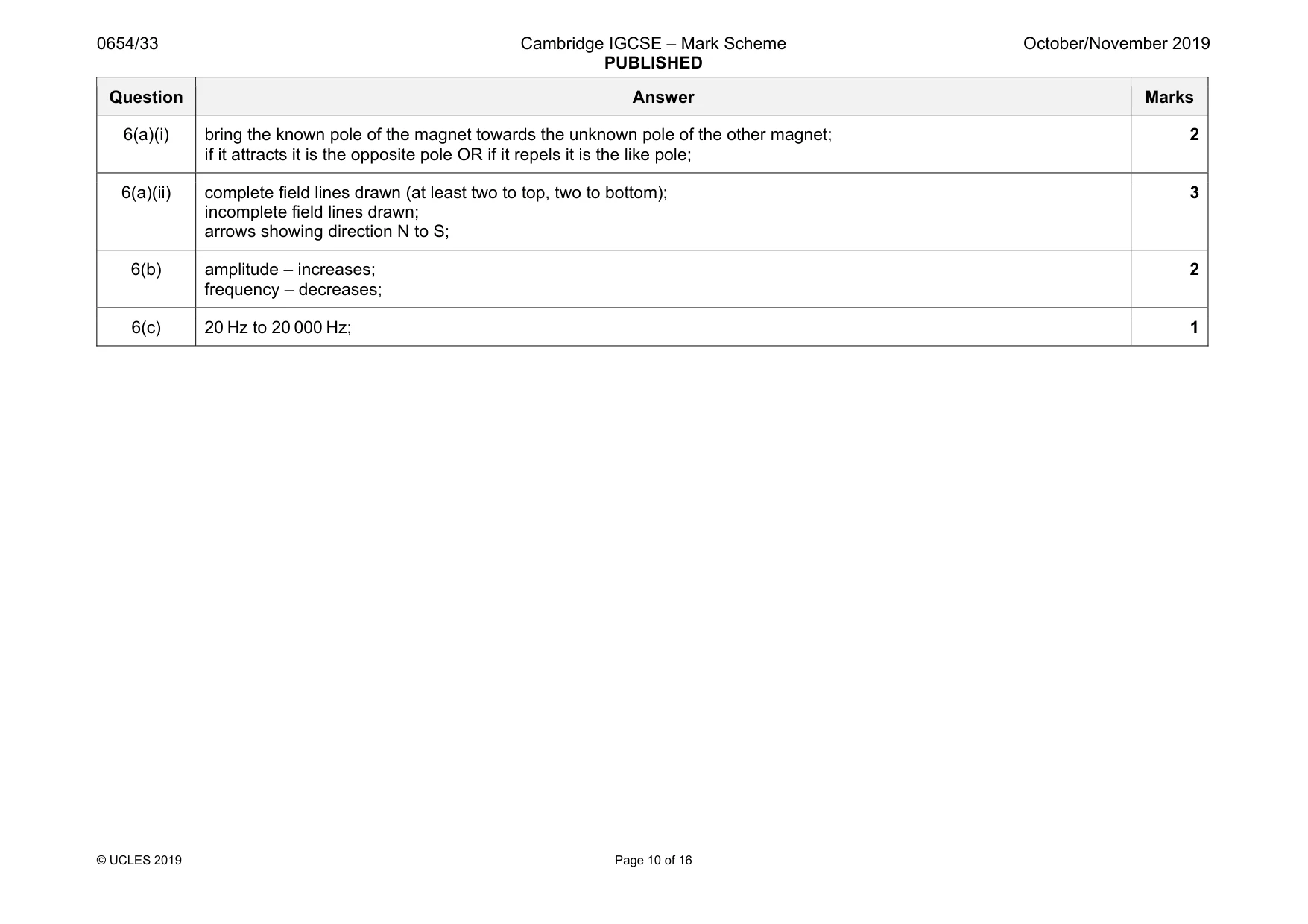
6 (a) Fig. 6.1 shows a bar magnet. It is not known which end is the north pole or the south pole. Fig. 6.1 (i) A boy has a second bar magnet. He knows which end is the south pole and which end is the north pole. Describe how he can use the second magnet to determine which end is the south pole and which end is the north pole of the magnet in Fig. 6.1. ........................................................................................................................................... ........................................................................................................................................... ..................................................................................................................................... [2] (ii) Draw the pattern and direction of magnetic field lines around the bar magnet in Fig. 6.2. N S Fig. 6.2 [3] (b) The boy hears music from a radio. The loudness of the music increases. At the same time, the music changes to a lower pitch. State how the amplitude and the frequency of the sound wave change as the loudness increases and the pitch becomes lower. amplitude .................................................................................................................................. frequency .................................................................................................................................. [2] (c) The boy has healthy hearing so he can clearly hear the sounds from the radio. State the range of audible frequencies that the boy can hear. from ............................................................. Hz to ............................................................. Hz [1] [Total: 8]
Mark scheme: 6(a)(i) bring the known pole of the magnet towards the unknown pole of the other magnet; if it attracts it is the opposite pole OR if it repels it is the like pole; 2 6(a)(ii) complete field lines drawn (at least two to top, two to bottom); incomplete field lines drawn; arrows showing direction N to S; 3 6(b) amplitude – increases; frequency – decreases; 2 6(c) 20 Hz to 20 000 Hz; 1
Q7 · A student investigates the conditions needed for photosynthesis
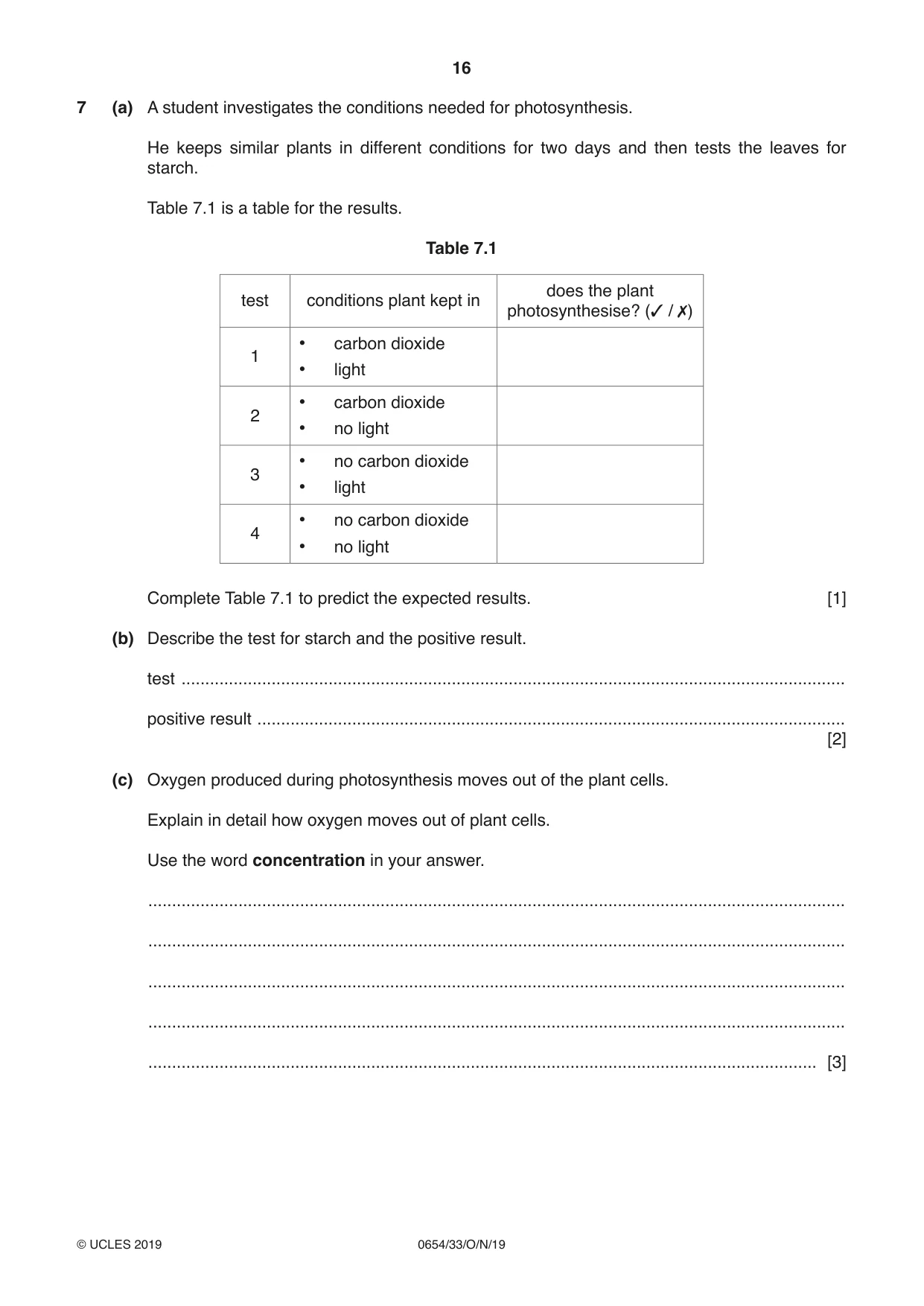
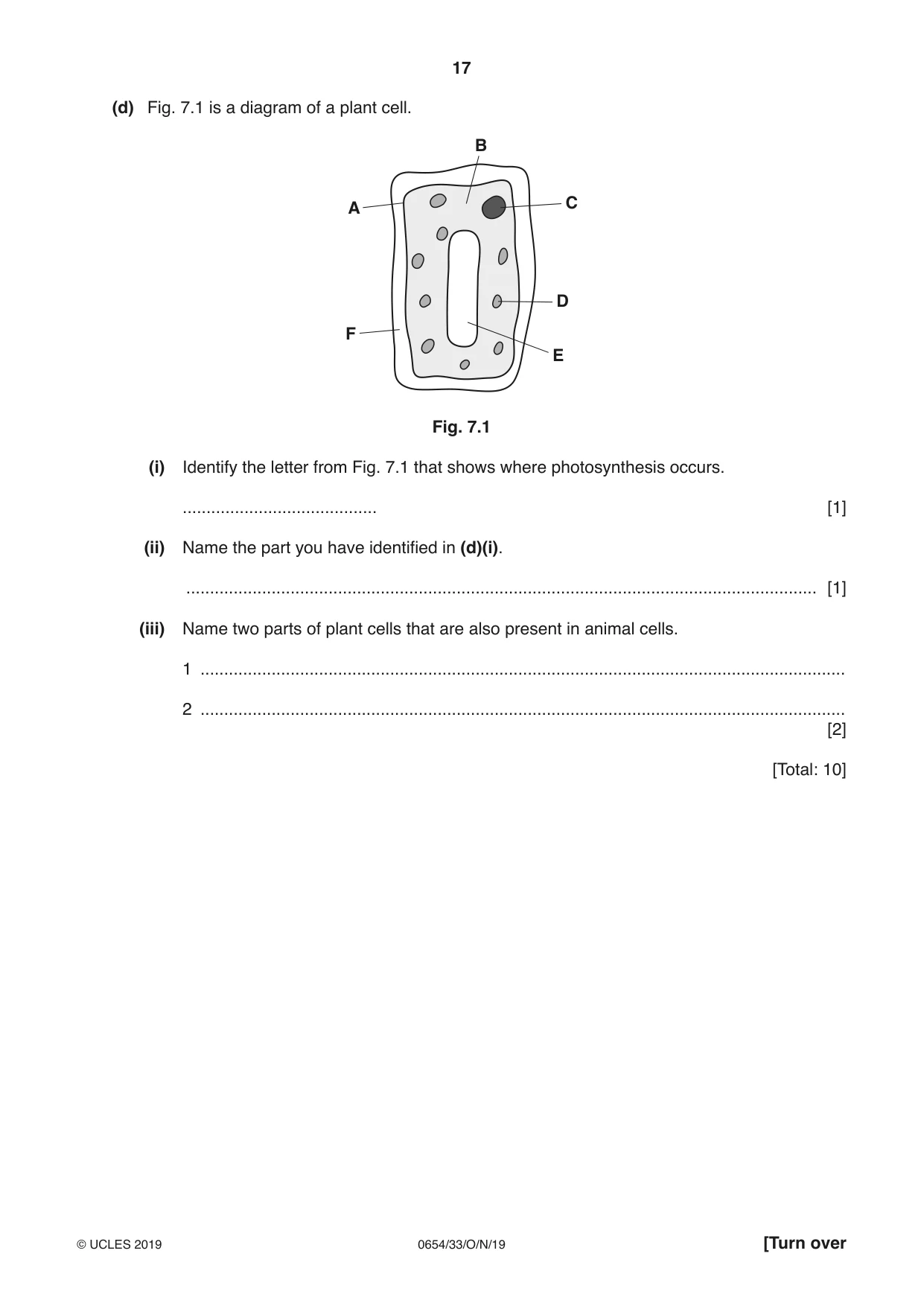
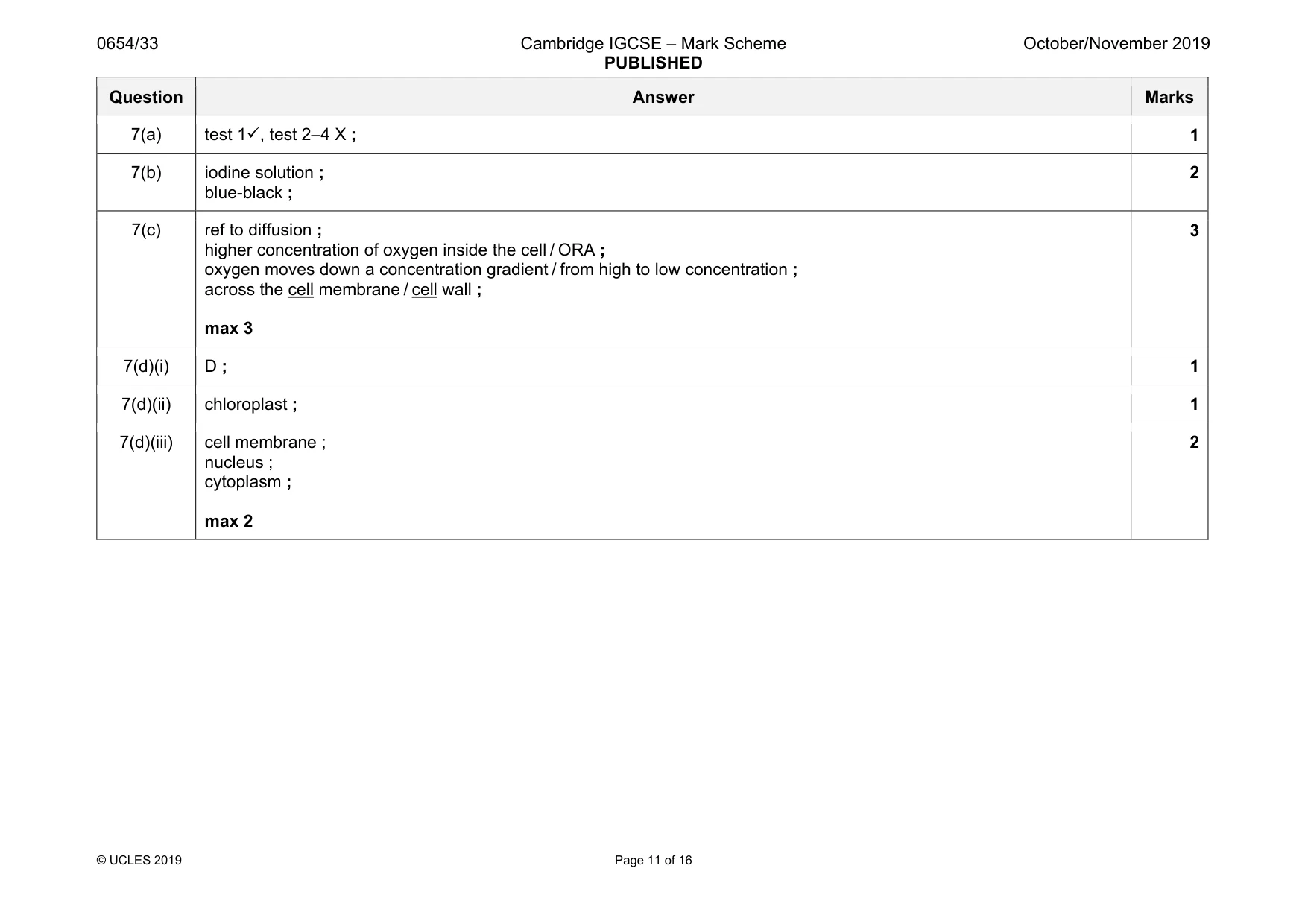
7 (a) A student investigates the conditions needed for photosynthesis. He keeps similar plants in different conditions for two days and then tests the leaves for starch. Table 7.1 is a table for the results. Table 7.1 does the plant test conditions plant kept in photosynthesise? (3 / ✗) • carbon dioxide 1 • light • carbon dioxide 2 • no light • no carbon dioxide 3 • light • no carbon dioxide 4 • no light Complete Table 7.1 to predict the expected results. [1] (b) Describe the test for starch and the positive result. test ............................................................................................................................................ positive result ............................................................................................................................ [2] (c) Oxygen produced during photosynthesis moves out of the plant cells. Explain in detail how oxygen moves out of plant cells. Use the word concentration in your answer. ................................................................................................................................................... ................................................................................................................................................... ................................................................................................................................................... ................................................................................................................................................... ............................................................................................................................................. [3] (d) Fig. 7.1 is a diagram of a plant cell. B C A D F E Fig. 7.1 (i) Identify the letter from Fig. 7.1 that shows where photosynthesis occurs. ......................................... [1] (ii) Name the part you have identified in (d)(i). ..................................................................................................................................... [1] (iii) Name two parts of plant cells that are also present in animal cells. 1 ........................................................................................................................................ 2 ........................................................................................................................................ [2] [Total: 10]
Mark scheme: 7(a) test 19, test 2–4 X ; 1 7(b) iodine solution ; blue-black ; 2 7(c) ref to diffusion ; higher concentration of oxygen inside the cell / ORA ; oxygen moves down a concentration gradient / from high to low concentration ; across the cell membrane / cell wall ; max 3 3 7(d)(i) D ; 1 7(d)(ii) chloroplast ; 1 7(d)(iii) cell membrane ; nucleus ; cytoplasm ; max 2 2
Q8 · A chart showing the composition of clean air
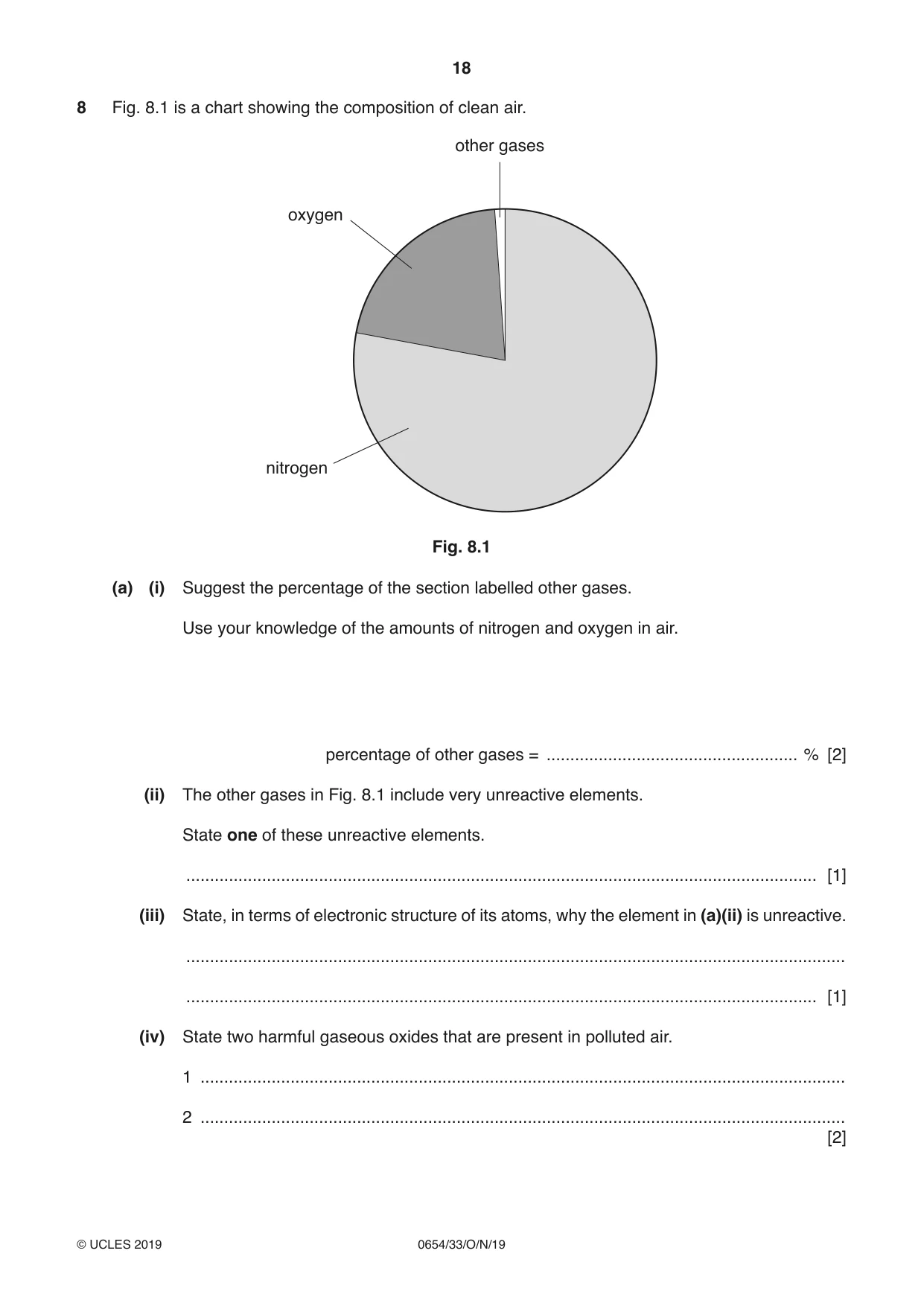
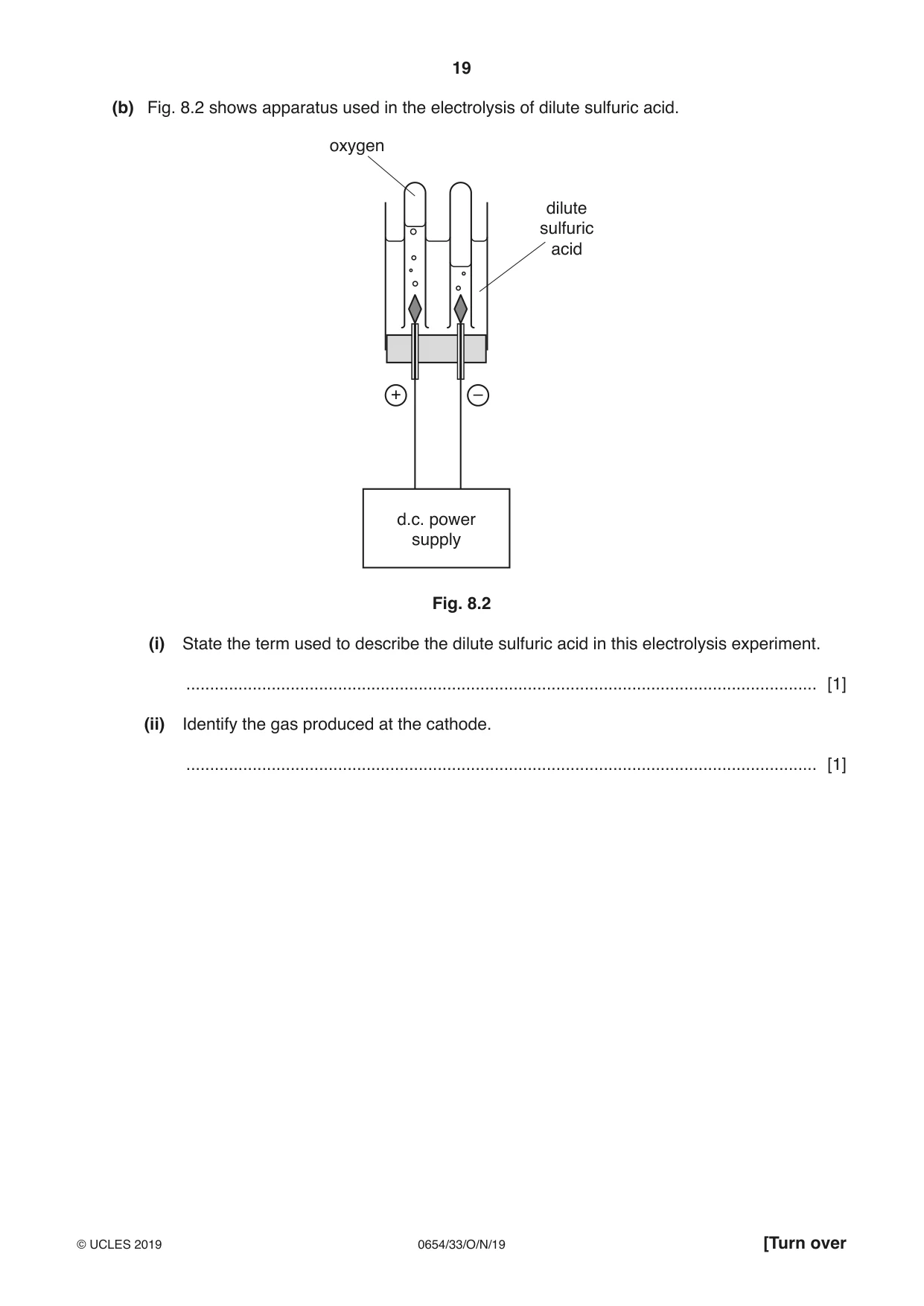
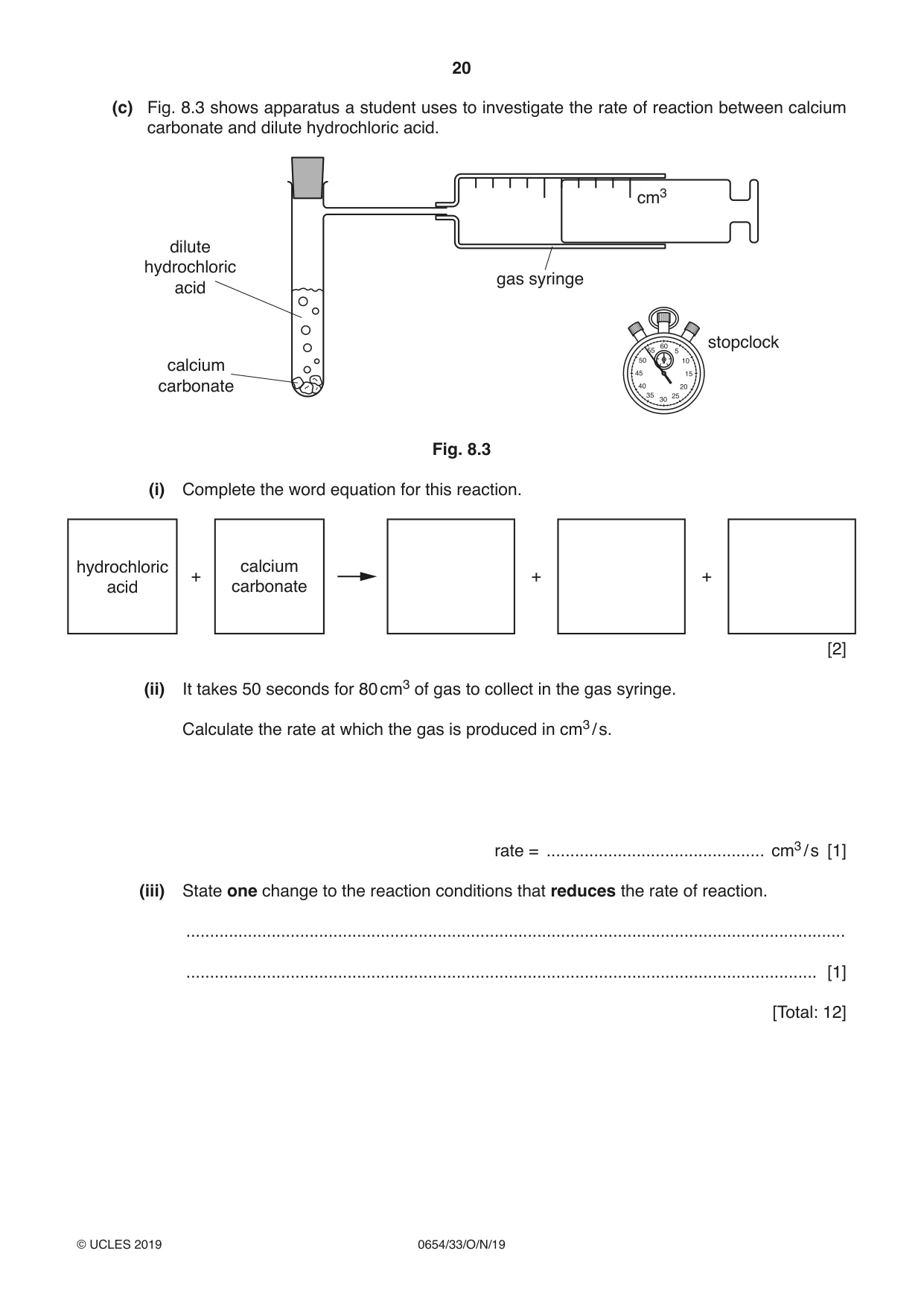
8 Fig. 8.1 is a chart showing the composition of clean air. other gases oxygen nitrogen Fig. 8.1 (a) (i) Suggest the percentage of the section labelled other gases. Use your knowledge of the amounts of nitrogen and oxygen in air. percentage of other gases = ..................................................... % [2] (ii) The other gases in Fig. 8.1 include very unreactive elements. State one of these unreactive elements. ..................................................................................................................................... [1] (iii) State, in terms of electronic structure of its atoms, why the element in (a)(ii) is unreactive. ........................................................................................................................................... ..................................................................................................................................... [1] (iv) State two harmful gaseous oxides that are present in polluted air. 1 ........................................................................................................................................ 2 ........................................................................................................................................ [2] (b) Fig. 8.2 shows apparatus used in the electrolysis of dilute sulfuric acid. oxygen dilute sulfuric acid + – d.c. power supply Fig. 8.2 (i) State the term used to describe the dilute sulfuric acid in this electrolysis experiment. ..................................................................................................................................... [1] (ii) Identify the gas produced at the cathode. ..................................................................................................................................... [1] (c) Fig. 8.3 shows apparatus a student uses to investigate the rate of reaction between calcium carbonate and dilute hydrochloric acid. cm3 dilute hydrochloric gas syringe acid stopclock calcium carbonate Fig. 8.3 (i) Complete the word equation for this reaction. hydrochloric calcium + + + acid carbonate [2] (ii) It takes 50 seconds for 80 cm3 of gas to collect in the gas syringe. Calculate the rate at which the gas is produced in cm3 / s. rate = .............................................. cm3 / s [1] (iii) State one change to the reaction conditions that reduces the rate of reaction. ........................................................................................................................................... ..................................................................................................................................... [1] [Total: 12]
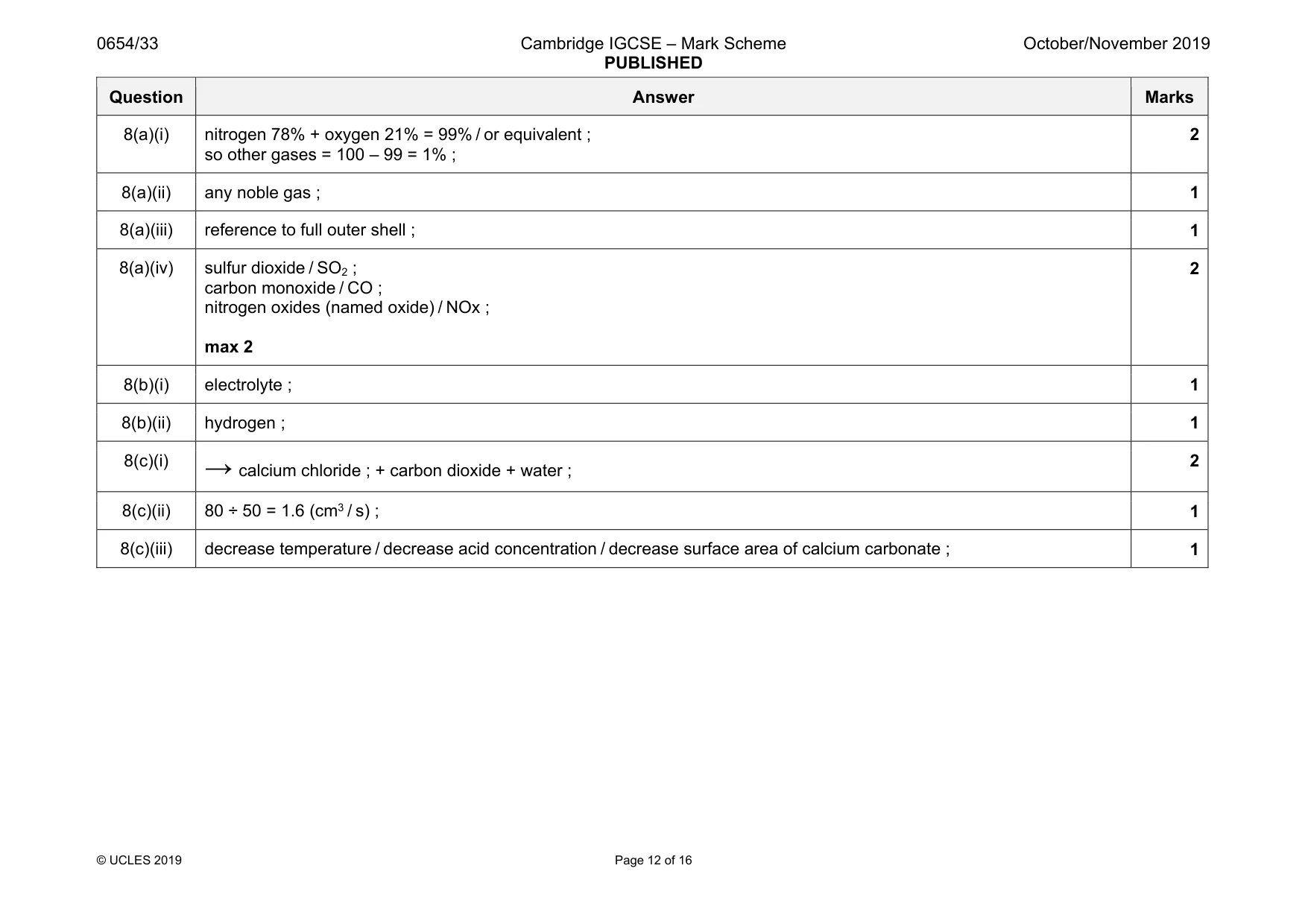
Mark scheme: 8(a)(i) nitrogen 78% + oxygen 21% = 99% / or equivalent ; so other gases = 100 – 99 = 1% ; 2 8(a)(ii) any noble gas ; 1 8(a)(iii) reference to full outer shell ; 1 8(a)(iv) sulfur dioxide / SO2 ; carbon monoxide / CO ; nitrogen oxides (named oxide) / NOx ; max 2 2 8(b)(i) electrolyte ; 1 8(b)(ii) hydrogen ; 1 8(c)(i) → calcium chloride ; + carbon dioxide + water ; 2 8(c)(ii) 80 ÷ 50 = 1.6 (cm3 / s) ; 1 8(c)(iii) decrease temperature / decrease acid concentration / decrease surface area of calcium carbonate ; 1
Q9 · A technician is checking for sources of radioactive emissions around a building
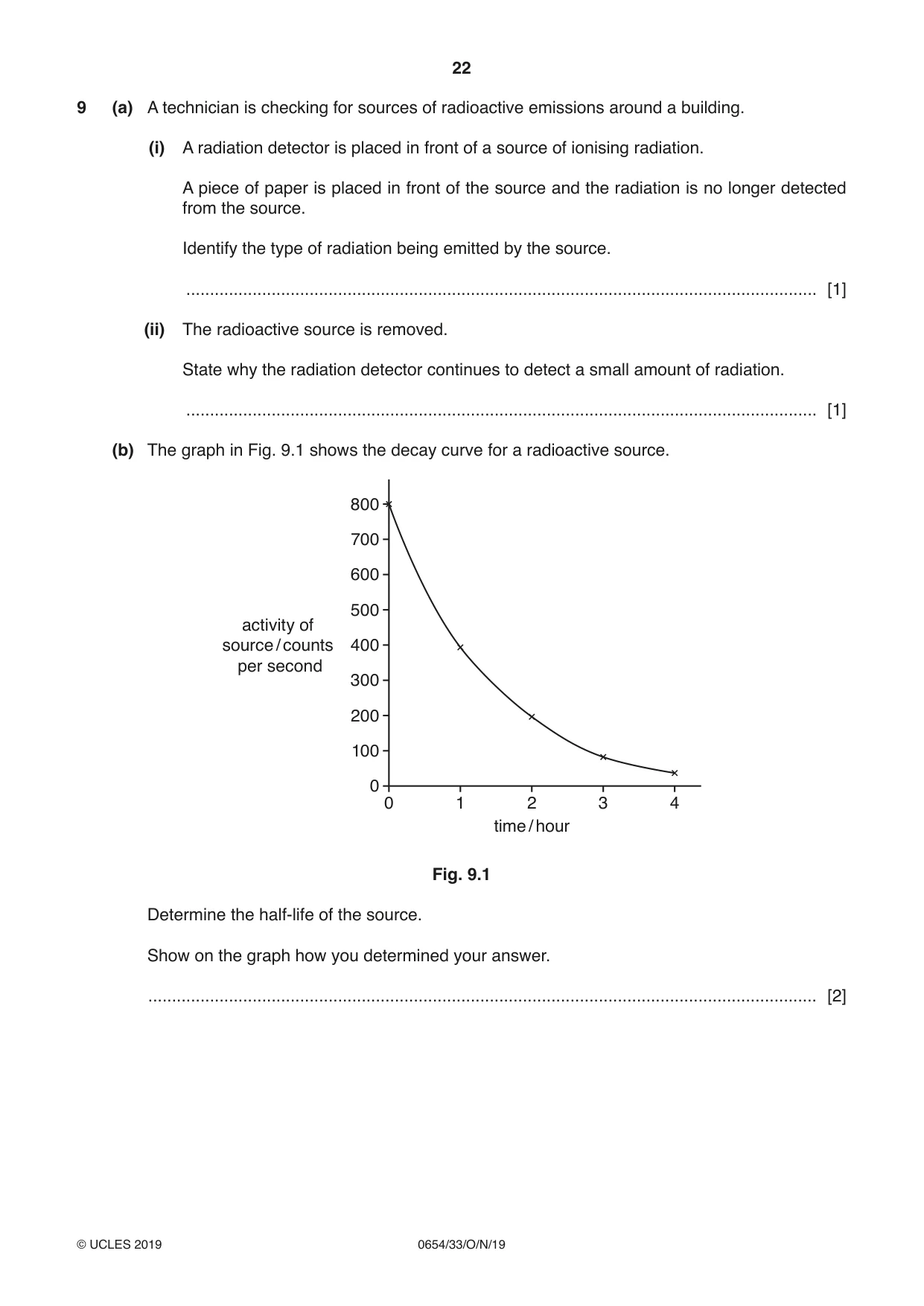
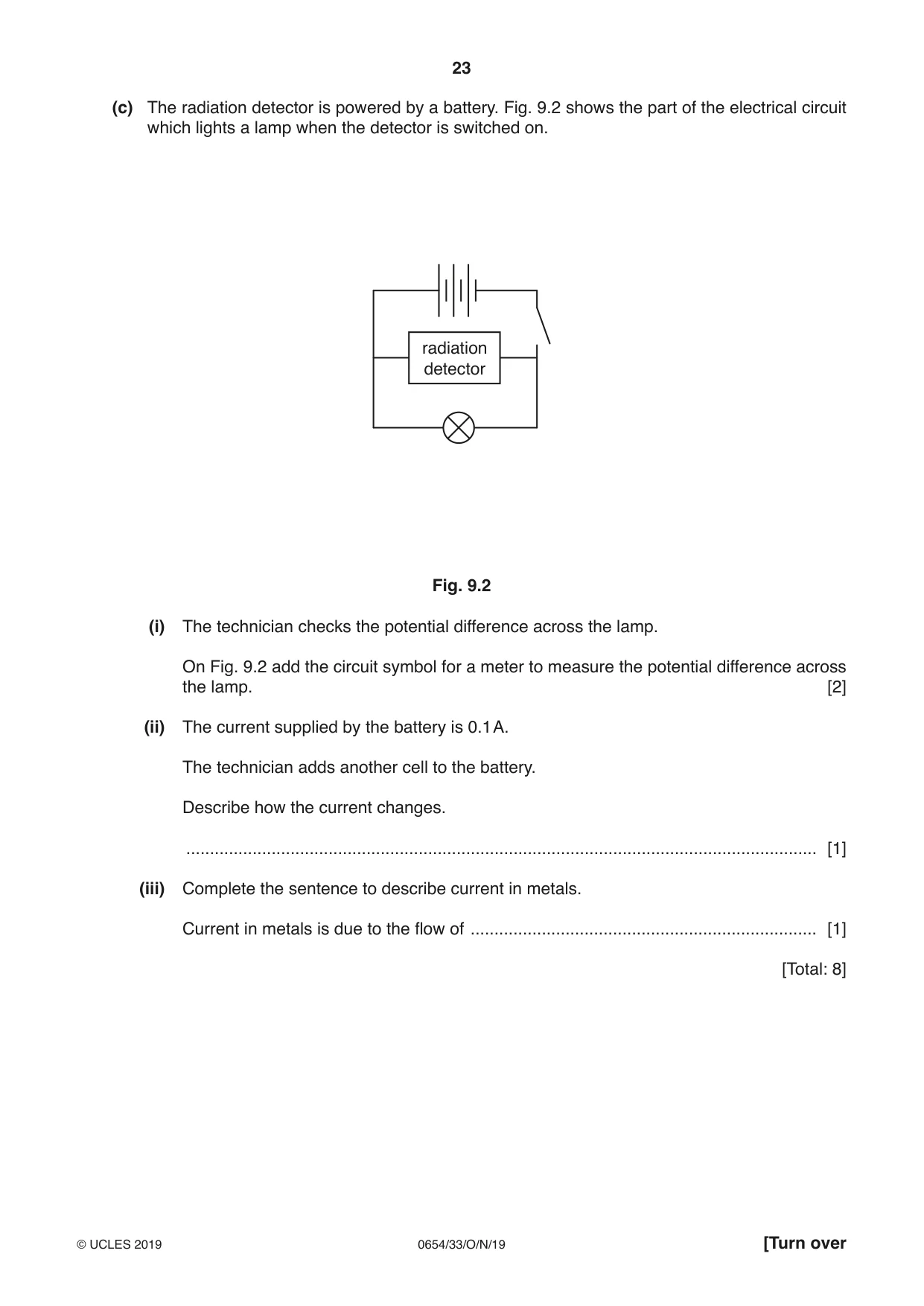
9 (a) A technician is checking for sources of radioactive emissions around a building. (i) A radiation detector is placed in front of a source of ionising radiation. A piece of paper is placed in front of the source and the radiation is no longer detected from the source. Identify the type of radiation being emitted by the source. ..................................................................................................................................... [1] (ii) The radioactive source is removed. State why the radiation detector continues to detect a small amount of radiation. ..................................................................................................................................... [1] (b) The graph in Fig. 9.1 shows the decay curve for a radioactive source. 800 700 600 500 activity of source / counts 400 per second 300 200 100 0 0 1 2 3 4 time / hour Fig. 9.1 Determine the half-life of the source. Show on the graph how you determined your answer. ............................................................................................................................................. [2] (c) The radiation detector is powered by a battery. Fig. 9.2 shows the part of the electrical circuit which lights a lamp when the detector is switched on. radiation detector Fig. 9.2 (i) The technician checks the potential difference across the lamp. On Fig. 9.2 add the circuit symbol for a meter to measure the potential difference across the lamp. [2] (ii) The current supplied by the battery is 0.1 A. The technician adds another cell to the battery. Describe how the current changes. ..................................................................................................................................... [1] (iii) Complete the sentence to describe current in metals. Current in metals is due to the flow of ......................................................................... [1] [Total: 8]
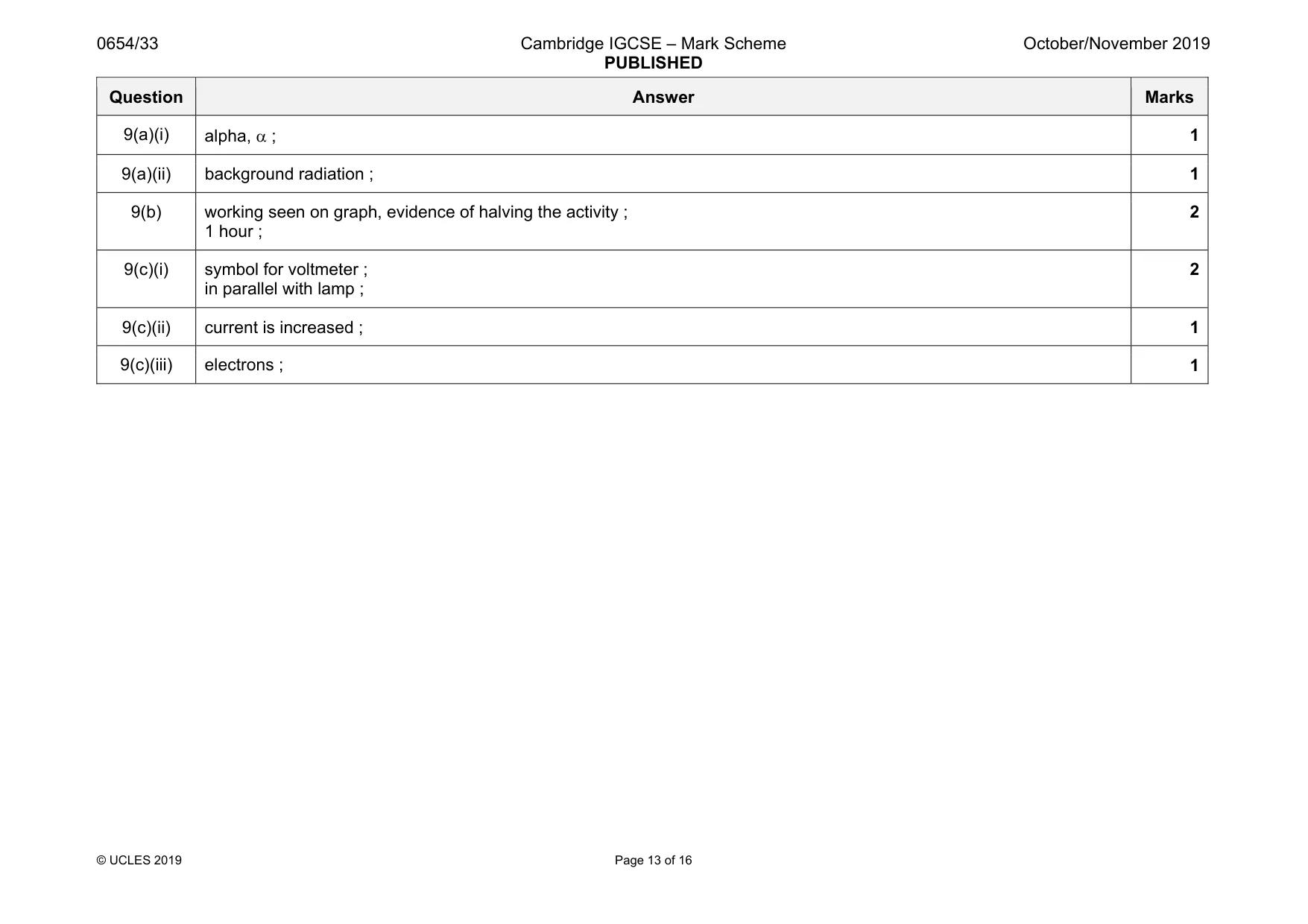
Mark scheme: 9(a)(i) 1 9(a)(ii) background radiation ; 1 9(b) working seen on graph, evidence of halving the activity ; 1 hour ; 2 9(c)(i) symbol for voltmeter ; in parallel with lamp ; 2 9(c)(ii) current is increased ; 1 9(c)(iii) electrons ; 1
Q10 · The graph in Fig
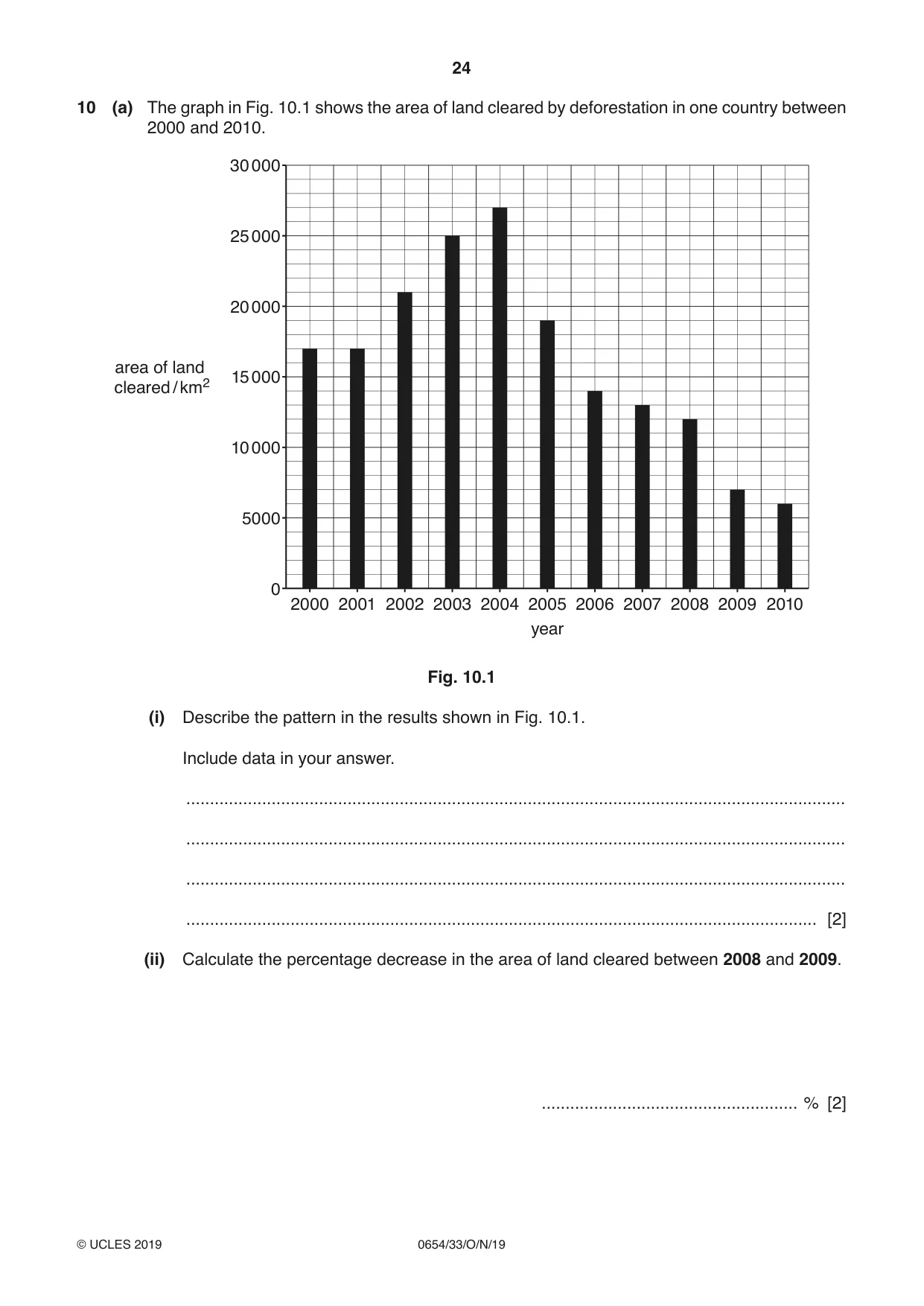
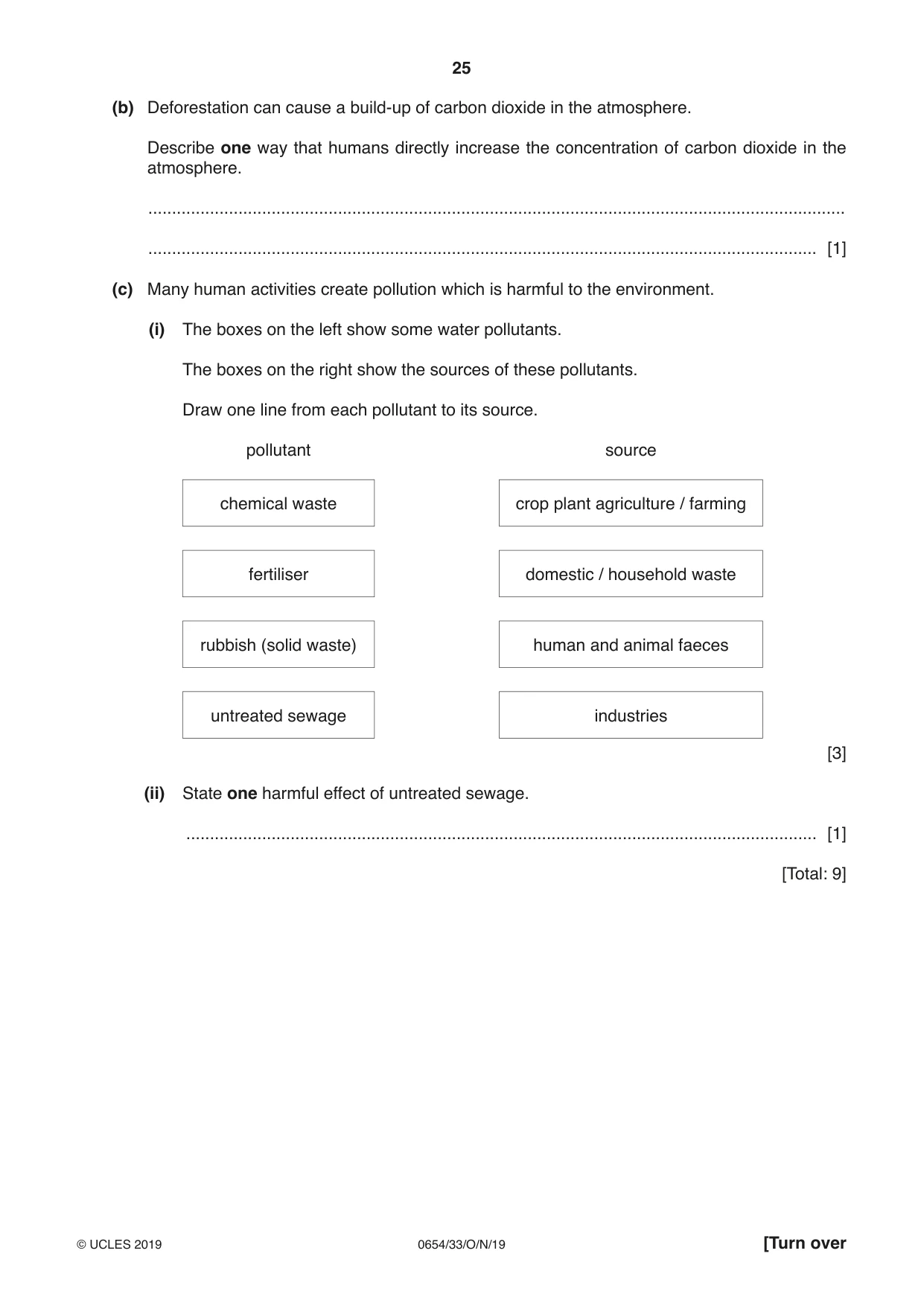
10 (a) The graph in Fig. 10.1 shows the area of land cleared by deforestation in one country between 2000 and 2010. 30 000 25 000 20 000 area of land 15 000 cleared / km2 10 000 5000 0 2000 2001 2002 2003 2004 2005 2006 2007 2008 2009 2010 year Fig. 10.1 (i) Describe the pattern in the results shown in Fig. 10.1. Include data in your answer. ........................................................................................................................................... ........................................................................................................................................... ........................................................................................................................................... ..................................................................................................................................... [2] (ii) Calculate the percentage decrease in the area of land cleared between 2008 and 2009. ...................................................... % [2] (b) Deforestation can cause a build-up of carbon dioxide in the atmosphere. Describe one way that humans directly increase the concentration of carbon dioxide in the atmosphere. ................................................................................................................................................... ............................................................................................................................................. [1] (c) Many human activities create pollution which is harmful to the environment. (i) The boxes on the left show some water pollutants. The boxes on the right show the sources of these pollutants. Draw one line from each pollutant to its source. pollutant source chemical waste crop plant agriculture / farming fertiliser domestic / household waste rubbish (solid waste) human and animal faeces untreated sewage industries [3] (ii) State one harmful effect of untreated sewage. ..................................................................................................................................... [1] [Total: 9]
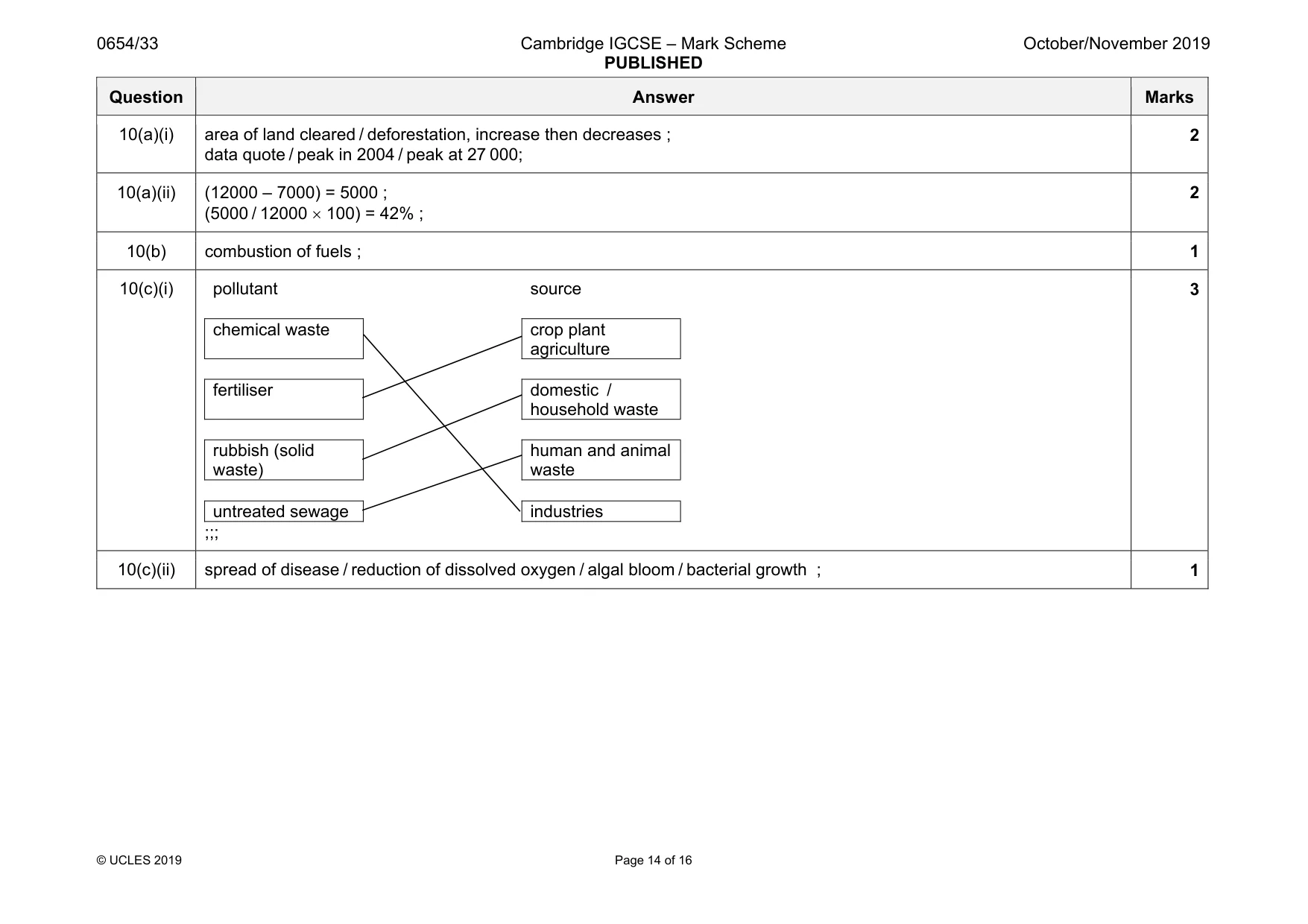
Mark scheme: 10(a)(i) area of land cleared / deforestation, increase then decreases ; data quote / peak in 2004 / peak at 27 000; 2 10(a)(ii) (12000 – 7000) = 5000 ; (5000 / 12000 × 100) = 42% ; 2 10(b) combustion of fuels ; 1 10(c)(i) pollutant source chemical waste crop plant agriculture fertiliser domestic / household waste rubbish (solid waste) human and animal waste untreated sewage industries ;;; 3 10(c)(ii) spread of disease / reduction of dissolved oxygen / algal bloom / bacterial growth ; 1
Q11 · The structure of three molecules, ethene, ethanol and methane
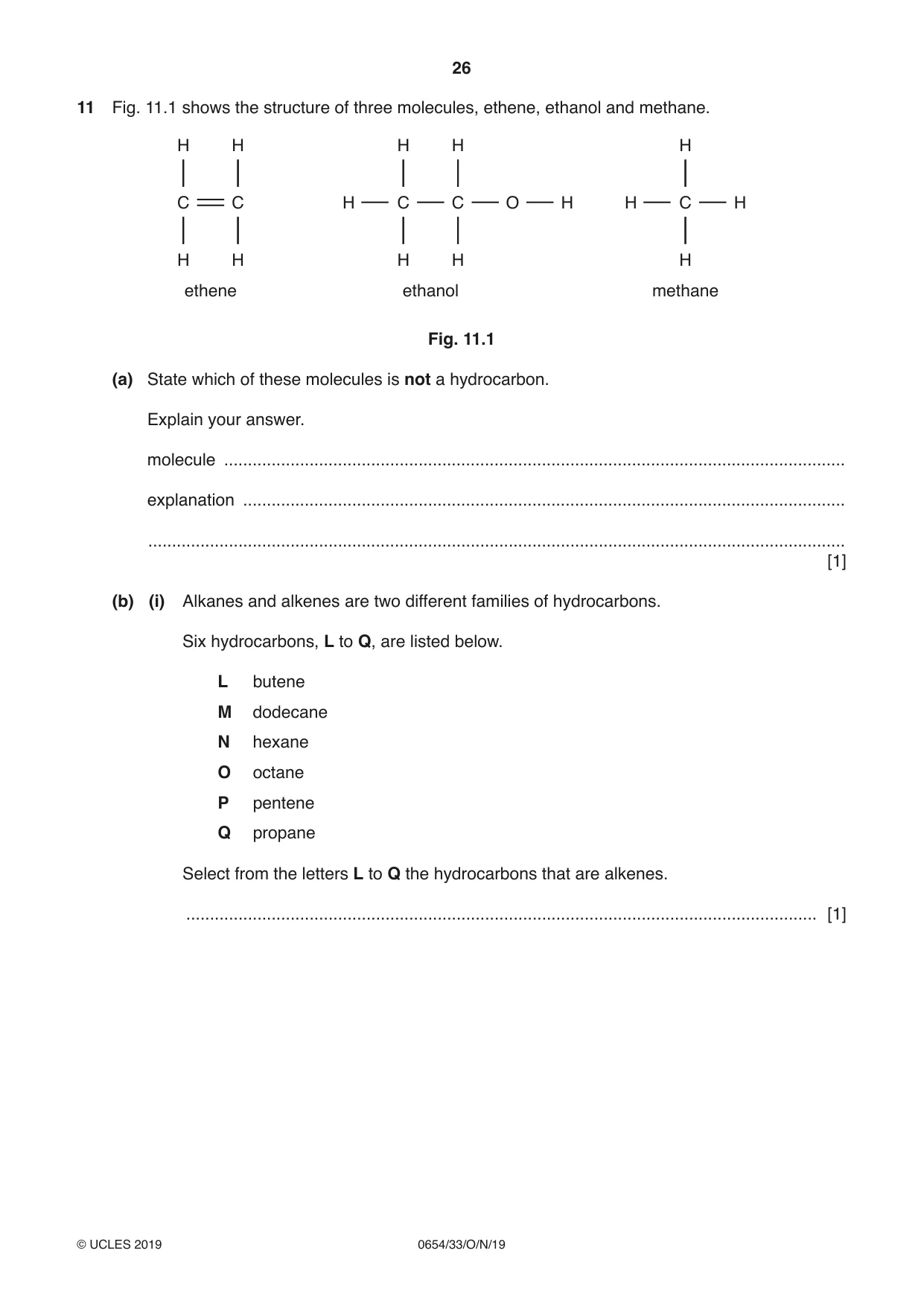
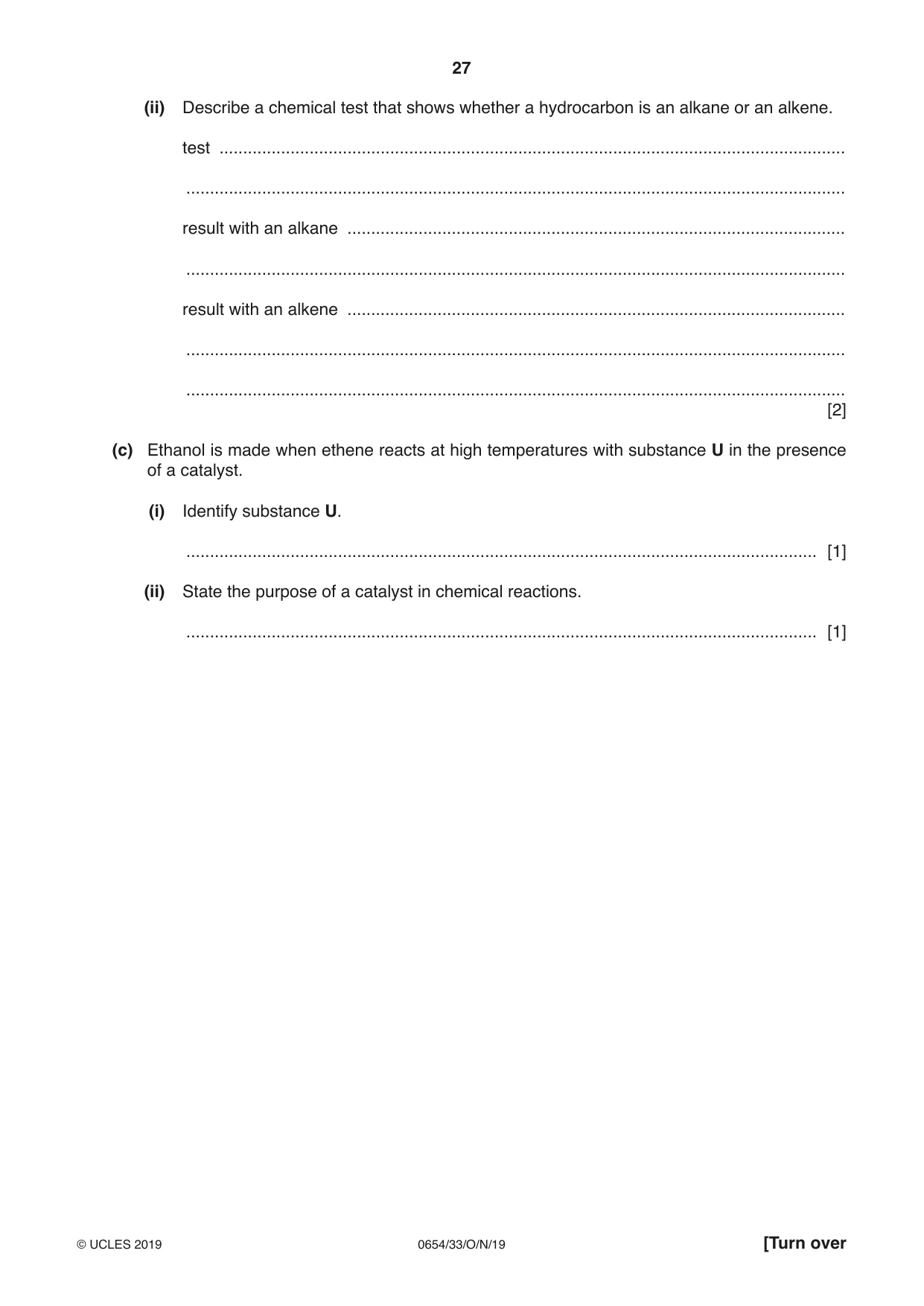
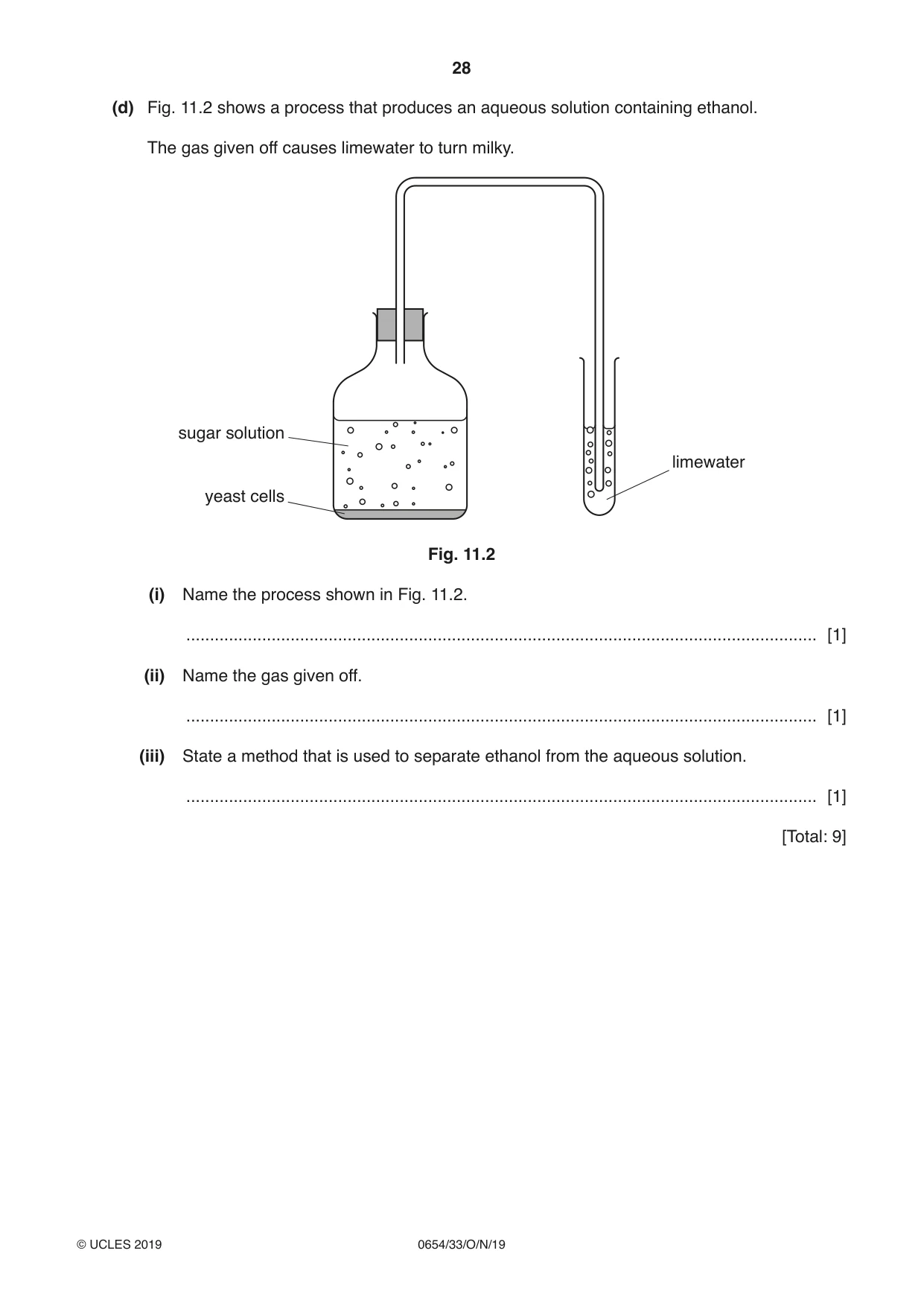
11 Fig. 11.1 shows the structure of three molecules, ethene, ethanol and methane. H H H H H C C H C C O H H C H H H H H H ethene ethanol methane Fig. 11.1 (a) State which of these molecules is not a hydrocarbon. Explain your answer. molecule ................................................................................................................................... explanation ............................................................................................................................... ................................................................................................................................................... [1] (b) (i) Alkanes and alkenes are two different families of hydrocarbons. Six hydrocarbons, L to Q, are listed below. L butene M dodecane N hexane O octane P pentene Q propane Select from the letters L to Q the hydrocarbons that are alkenes. ..................................................................................................................................... [1] (ii) Describe a chemical test that shows whether a hydrocarbon is an alkane or an alkene. test .................................................................................................................................... ........................................................................................................................................... result with an alkane ......................................................................................................... ........................................................................................................................................... result with an alkene ......................................................................................................... ........................................................................................................................................... ........................................................................................................................................... [2] (c) Ethanol is made when ethene reacts at high temperatures with substance U in the presence of a catalyst. (i) Identify substance U. ..................................................................................................................................... [1] (ii) State the purpose of a catalyst in chemical reactions. ..................................................................................................................................... [1] (d) Fig. 11.2 shows a process that produces an aqueous solution containing ethanol. The gas given off causes limewater to turn milky. sugar solution limewater yeast cells Fig. 11.2 (i) Name the process shown in Fig. 11.2. ..................................................................................................................................... [1] (ii) Name the gas given off. ..................................................................................................................................... [1] (iii) State a method that is used to separate ethanol from the aqueous solution. ..................................................................................................................................... [1] [Total: 9]
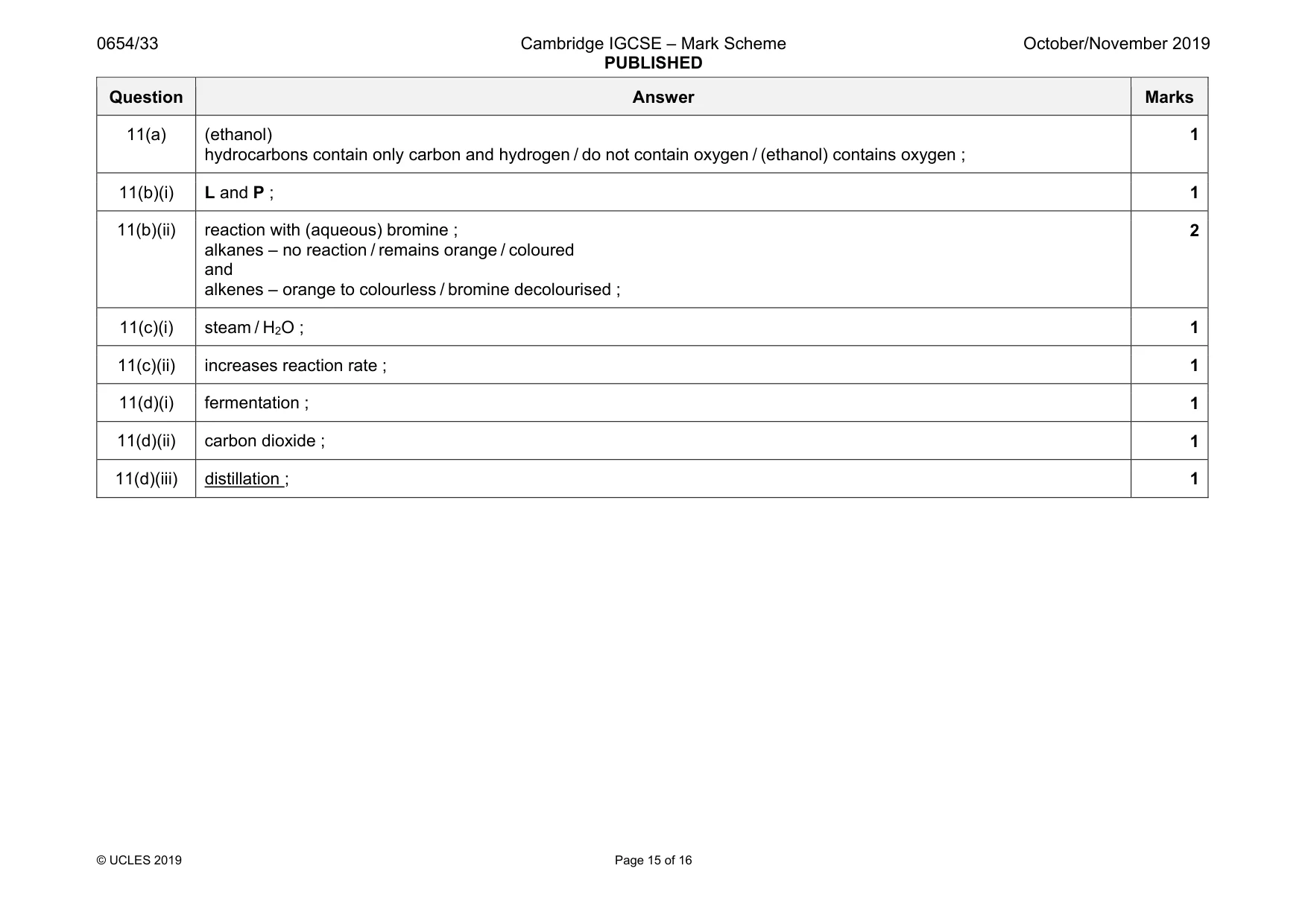
Mark scheme: 11(a) (ethanol) hydrocarbons contain only carbon and hydrogen / do not contain oxygen / (ethanol) contains oxygen ; 1 11(b)(i) L and P ; 1 11(b)(ii) reaction with (aqueous) bromine ; alkanes – no reaction / remains orange / coloured and alkenes – orange to colourless / bromine decolourised ; 2 11(c)(i) steam / H2O ; 1 11(c)(ii) increases reaction rate ; 1 11(d)(i) fermentation ; 1 11(d)(ii) carbon dioxide ; 1 11(d)(iii) distillation ; 1
Q12 · An electric heater containing three heating elements
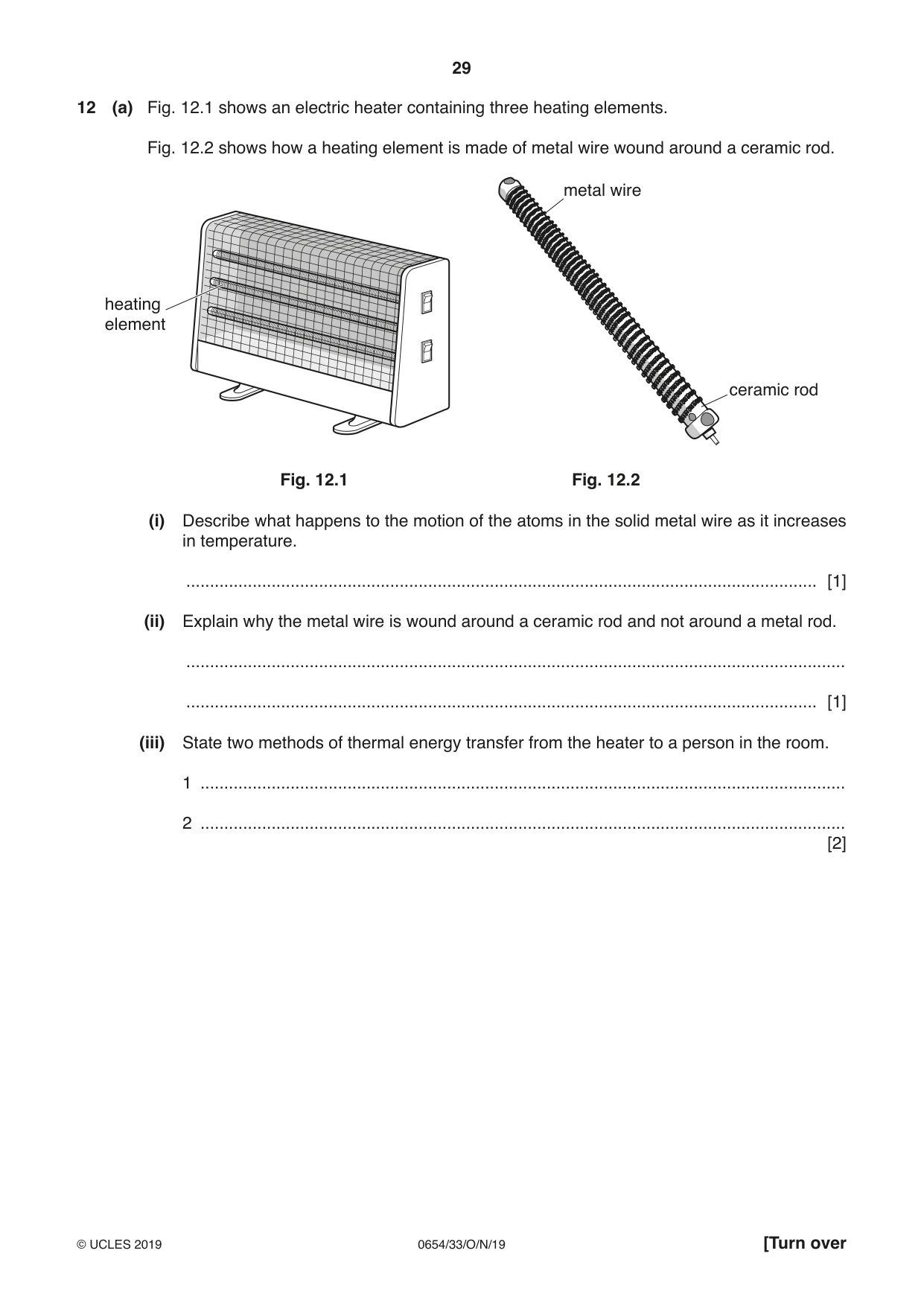
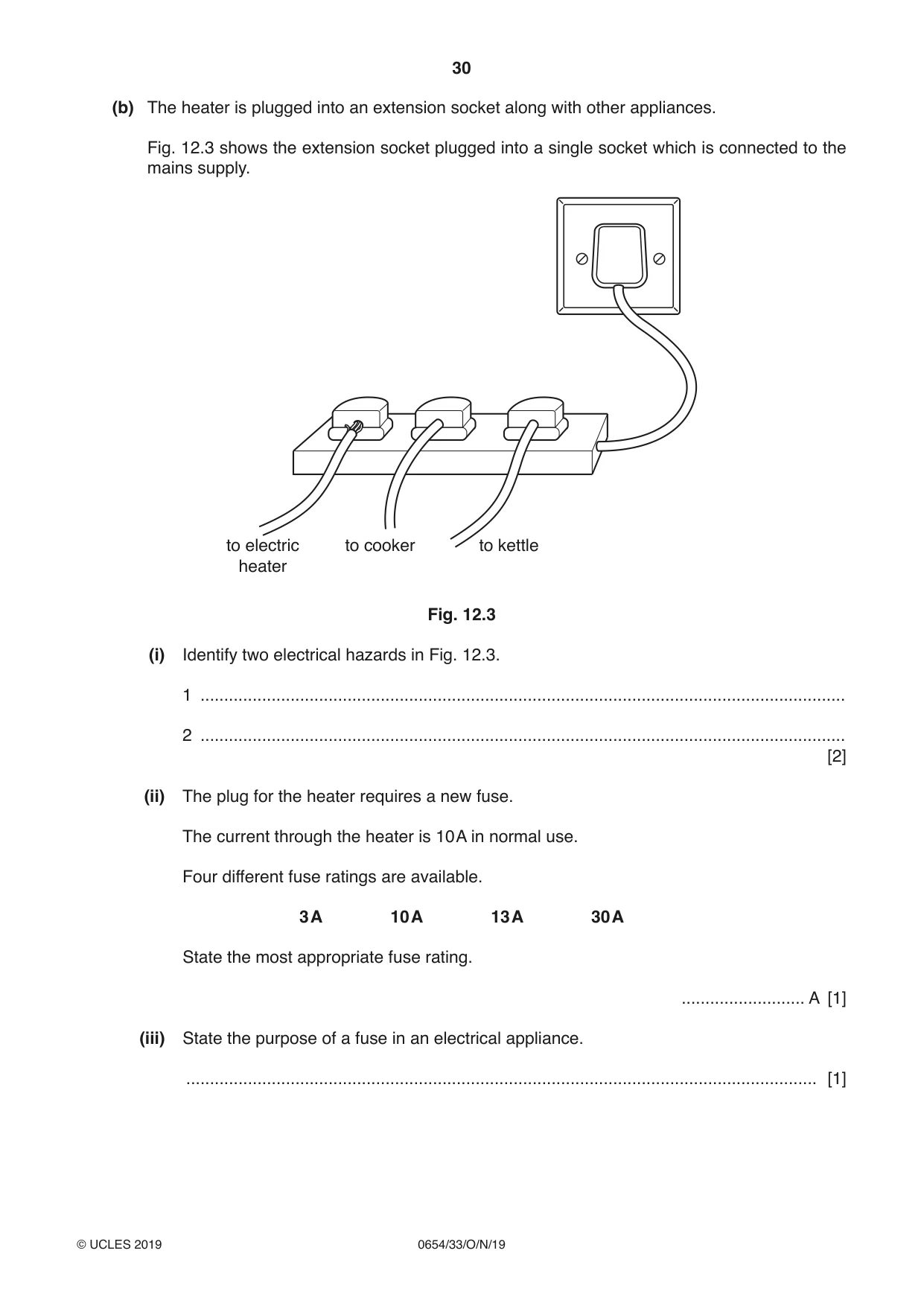
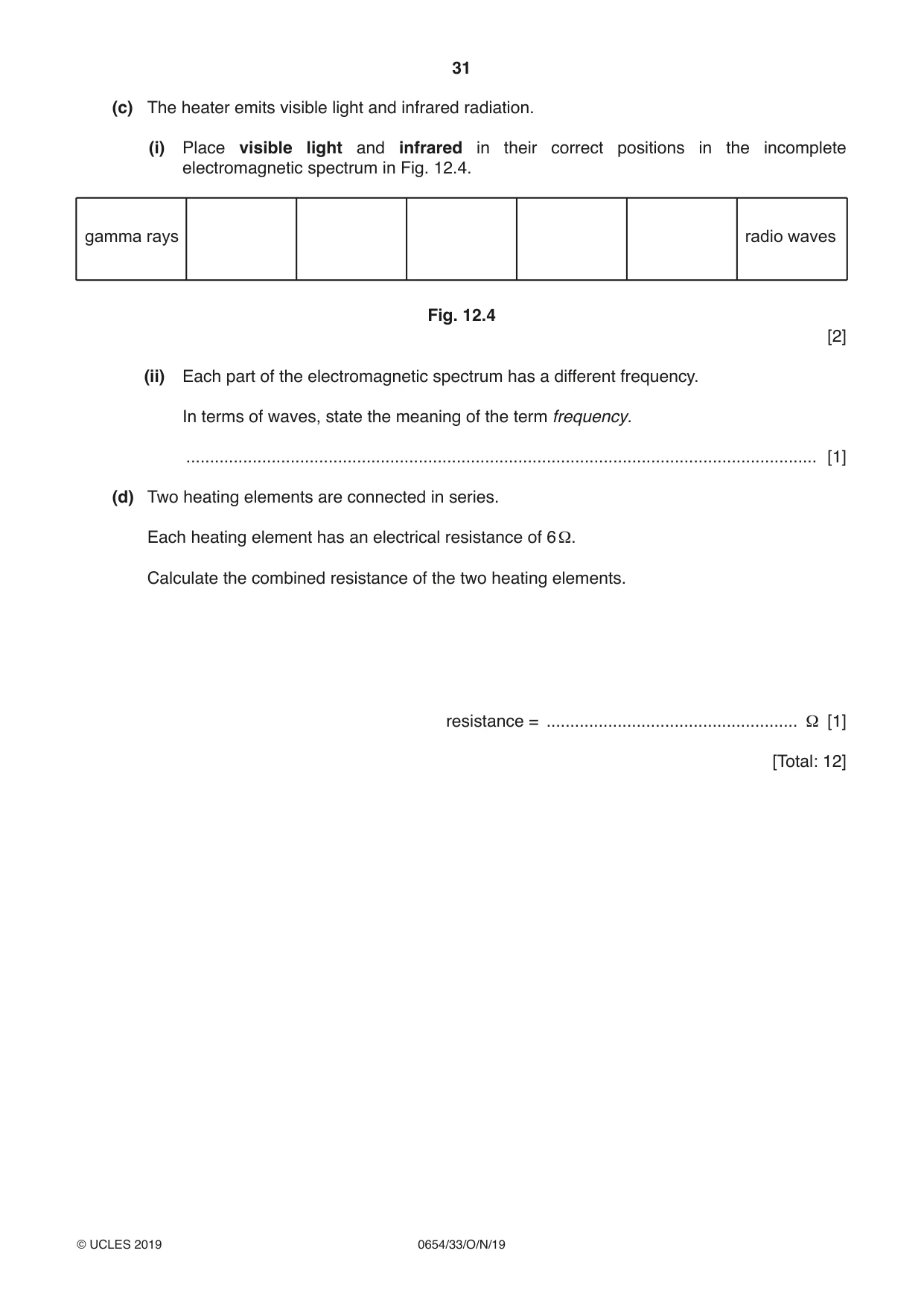
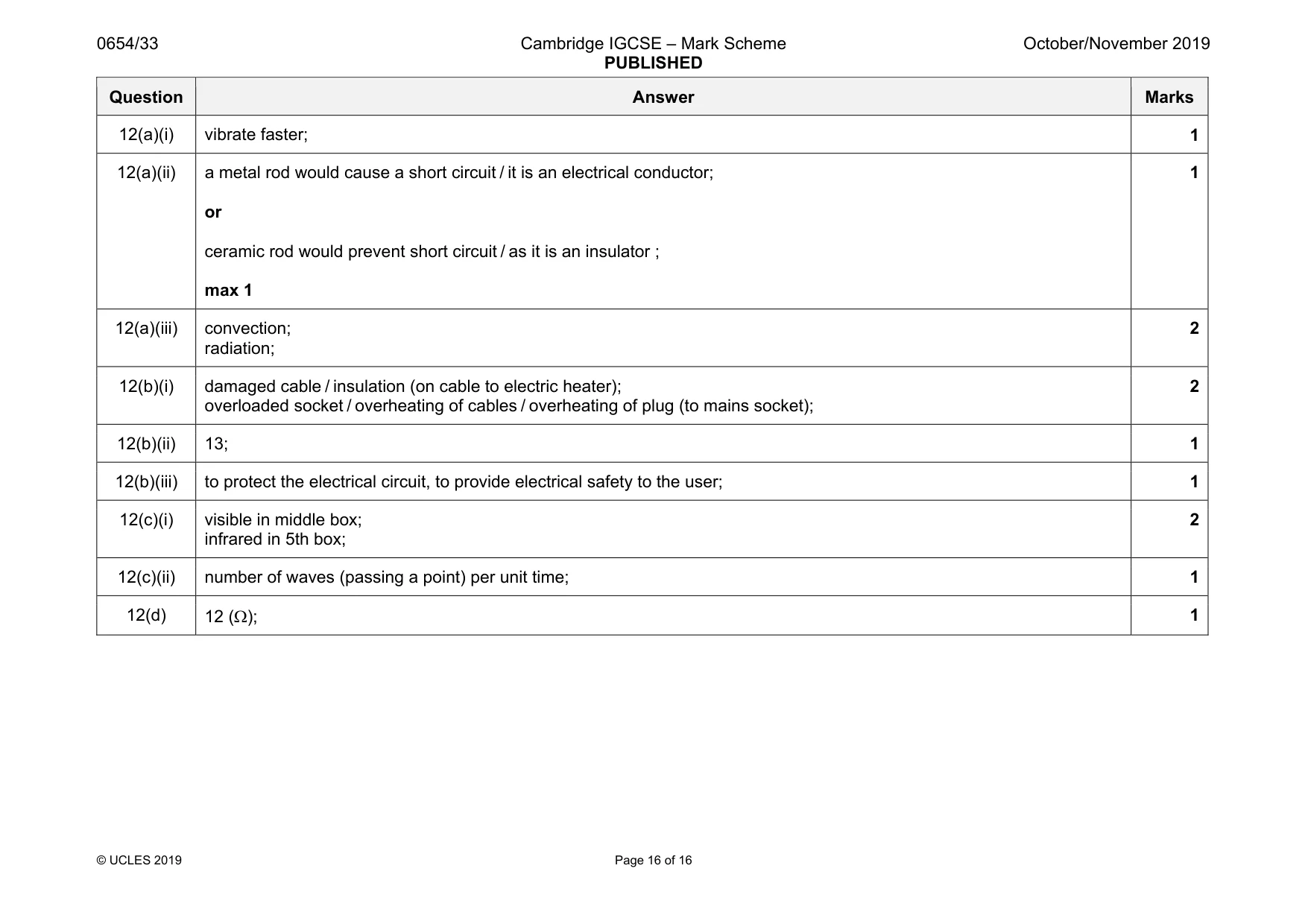
12 (a) Fig. 12.1 shows an electric heater containing three heating elements. Fig. 12.2 shows how a heating element is made of metal wire wound around a ceramic rod. metal wire heating element ceramic rod Fig. 12.1 Fig. 12.2 (i) Describe what happens to the motion of the atoms in the solid metal wire as it increases in temperature. ..................................................................................................................................... [1] (ii) Explain why the metal wire is wound around a ceramic rod and not around a metal rod. ........................................................................................................................................... ..................................................................................................................................... [1] (iii) State two methods of thermal energy transfer from the heater to a person in the room. 1 ........................................................................................................................................ 2 ........................................................................................................................................ [2] (b) The heater is plugged into an extension socket along with other appliances. Fig. 12.3 shows the extension socket plugged into a single socket which is connected to the mains supply. to electric to cooker to kettle heater Fig. 12.3 (i) Identify two electrical hazards in Fig. 12.3. 1 ........................................................................................................................................ 2 ........................................................................................................................................ [2] (ii) The plug for the heater requires a new fuse. The current through the heater is 10 A in normal use. Four different fuse ratings are available. 3 A 10 A 13 A 30 A State the most appropriate fuse rating. .......................... A [1] (iii) State the purpose of a fuse in an electrical appliance. ..................................................................................................................................... [1] (c) The heater emits visible light and infrared radiation. (i) Place visible light and infrared in their correct positions in the incomplete electromagnetic spectrum in Fig. 12.4. gamma rays radio waves Fig. 12.4 [2] (ii) Each part of the electromagnetic spectrum has a different frequency. In terms of waves, state the meaning of the term frequency. ..................................................................................................................................... [1] (d) Two heating elements are connected in series. Each heating element has an electrical resistance of 6 Ω. Calculate the combined resistance of the two heating elements. resistance = ..................................................... Ω [1] [Total: 12]
Mark scheme: 12(a)(i) vibrate faster; 1 12(a)(ii) a metal rod would cause a short circuit / it is an electrical conductor; or ceramic rod would prevent short circuit / as it is an insulator ; max 1 1 12(a)(iii) convection; radiation; 2 12(b)(i) damaged cable / insulation (on cable to electric heater); overloaded socket / overheating of cables / overheating of plug (to mains socket); 2 12(b)(ii) 13; 1 12(b)(iii) to protect the electrical circuit, to provide electrical safety to the user; 1 12(c)(i) visible in middle box; infrared in 5th box; 2 12(c)(ii) number of waves (passing a point) per unit time; 1 12(d) 12 (Ω); 1
What was in this paper
The subtopics covered by these 12 questions, and how many questions each got. Open one in a new tab to see every Cambridge question on it.
What you needed in this session
Cambridge’s own grade thresholds for 2019 Oct/Nov, Paper 3 · Variant 3. A higher threshold means an easier paper — the bar moves with how the cohort did.