Cambridge IGCSE Sciences - Co-ordinated (Double) 0654 — 2020 Oct/Nov Paper 3 · Variant 2
0654/32/O/N/20 · 12 questions · 120 marks · ≈135 min
The question paper and its mark scheme, free to read here and free to download. This is Cambridge’s own paper, exactly as it was sat.
Question paper32 pages


Mark scheme15 pages
Answers below. Sit the paper first if you are practising.
Questions as text
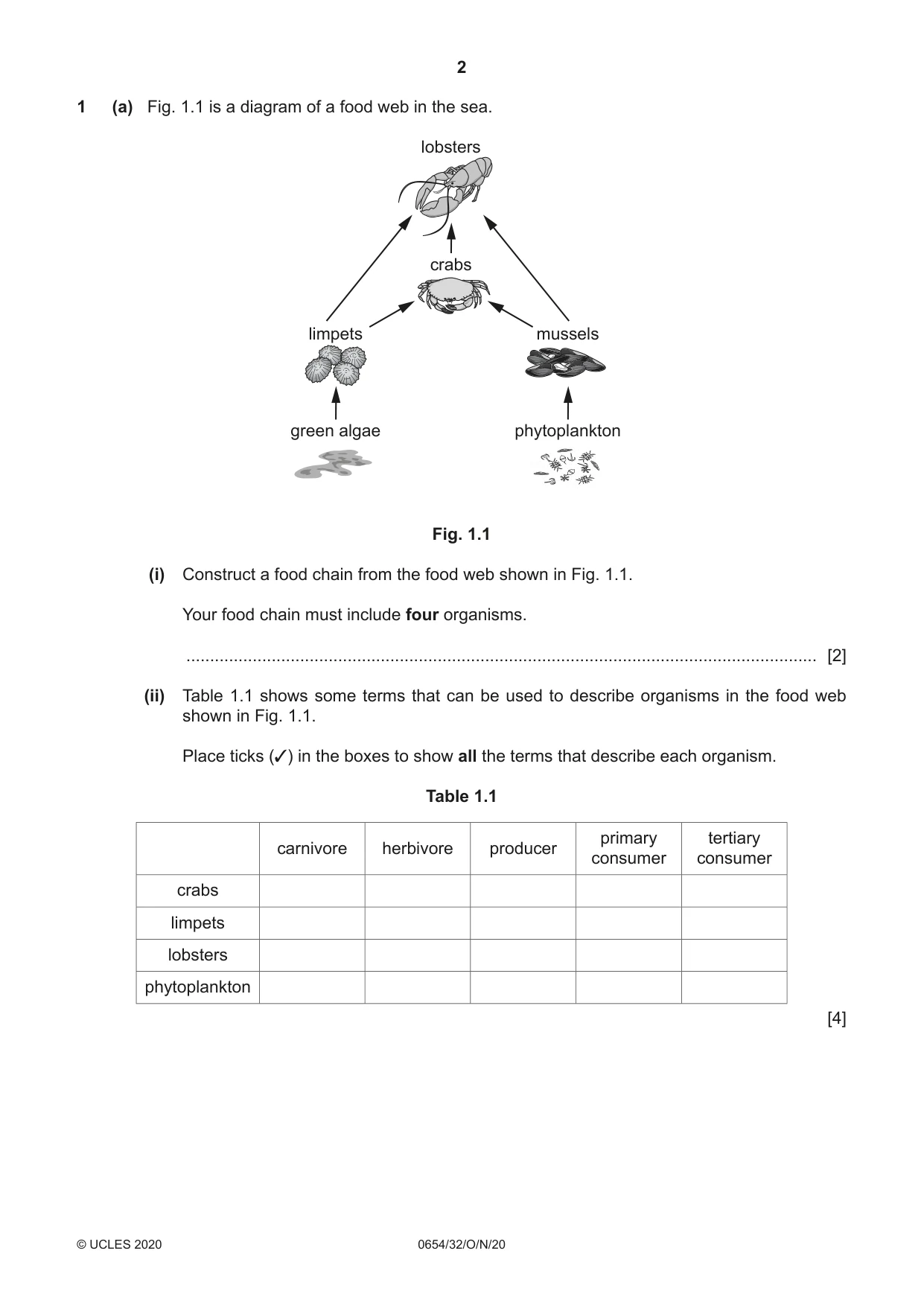
Q1 · A diagram of a food web in the sea
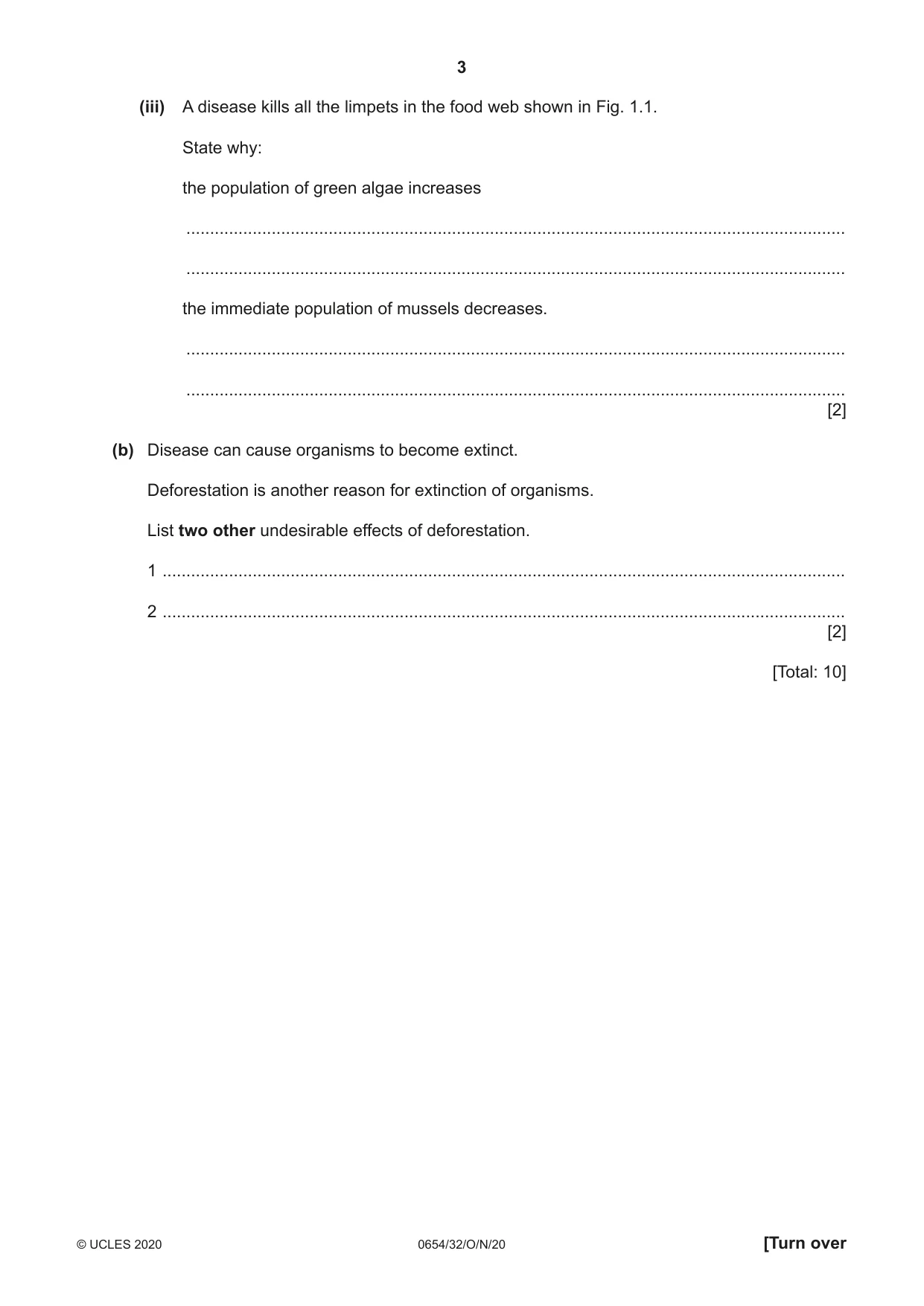
1 (a) Fig. 1.1 is a diagram of a food web in the sea. lobsters crabs limpets mussels green algae phytoplankton Fig. 1.1 (i) Construct a food chain from the food web shown in Fig. 1.1. Your food chain must include four organisms. ..................................................................................................................................... [2] (ii) Table 1.1 shows some terms that can be used to describe organisms in the food web shown in Fig. 1.1. Place ticks (3) in the boxes to show all the terms that describe each organism. Table 1.1 primary tertiary carnivore herbivore producer consumer consumer crabs limpets lobsters phytoplankton [4] (iii) A disease kills all the limpets in the food web shown in Fig. 1.1. State why: the population of green algae increases ........................................................................................................................................... ........................................................................................................................................... the immediate population of mussels decreases. ........................................................................................................................................... ........................................................................................................................................... [2] (b) Disease can cause organisms to become extinct. Deforestation is another reason for extinction of organisms. List two other undesirable effects of deforestation. 1 ................................................................................................................................................ 2 ................................................................................................................................................ [2] [Total: 10]
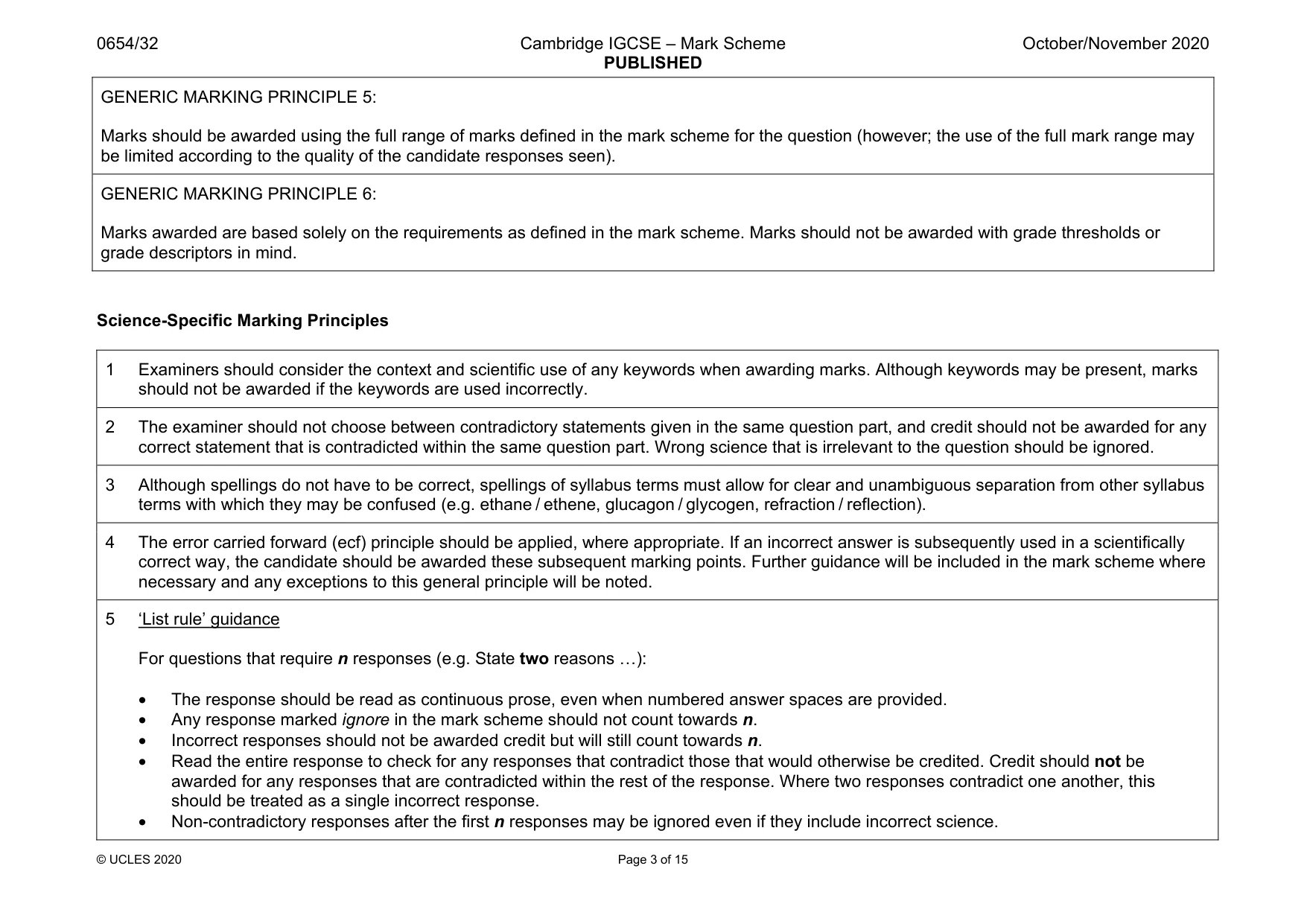
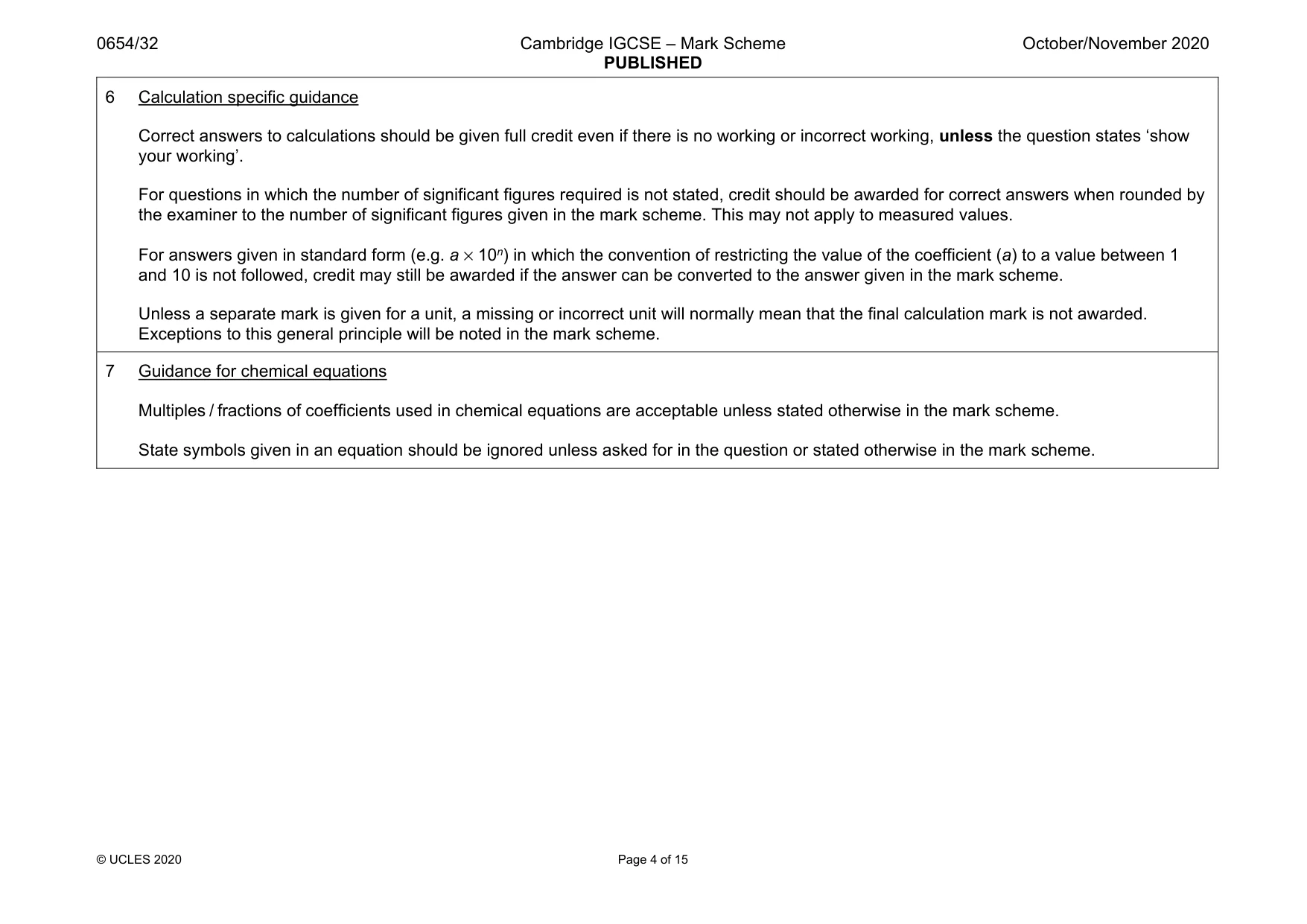
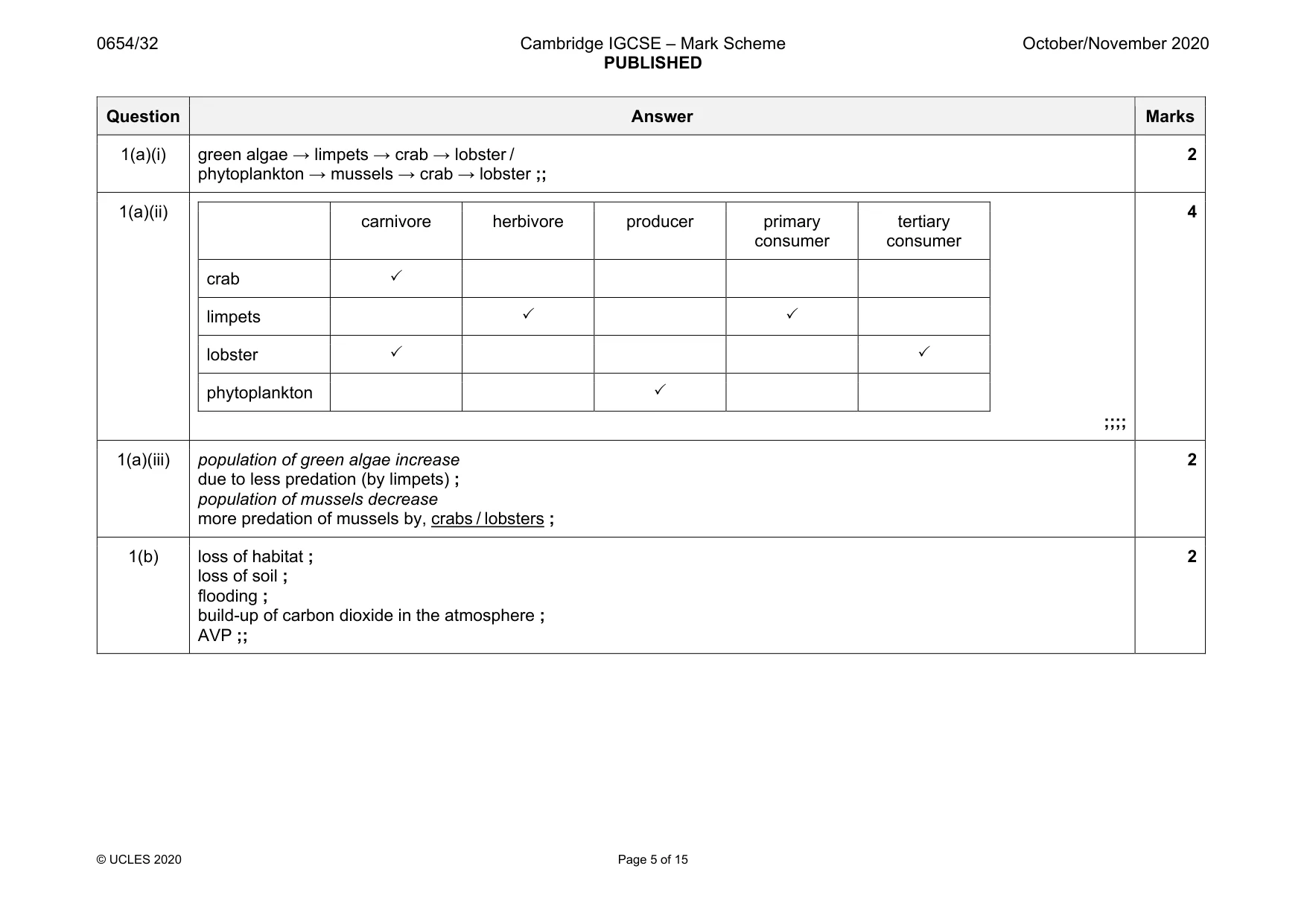
Mark scheme: 1(a)(i) green algae → limpets → crab → lobster / phytoplankton → mussels → crab → lobster ;; 2 1(a)(ii) carnivore herbivore producer primary consumer tertiary consumer crab limpets lobster phytoplankton ;;;; 4 1(a)(iii) population of green algae increase due to less predation (by limpets) ; population of mussels decrease more predation of mussels by, crabs / lobsters ; 2 1(b) loss of habitat ; loss of soil ; flooding ; build-up of carbon dioxide in the atmosphere ; AVP ;; 2
Q2 · The halogens chlorine, bromine and iodine are in Group VII of the Periodic Table
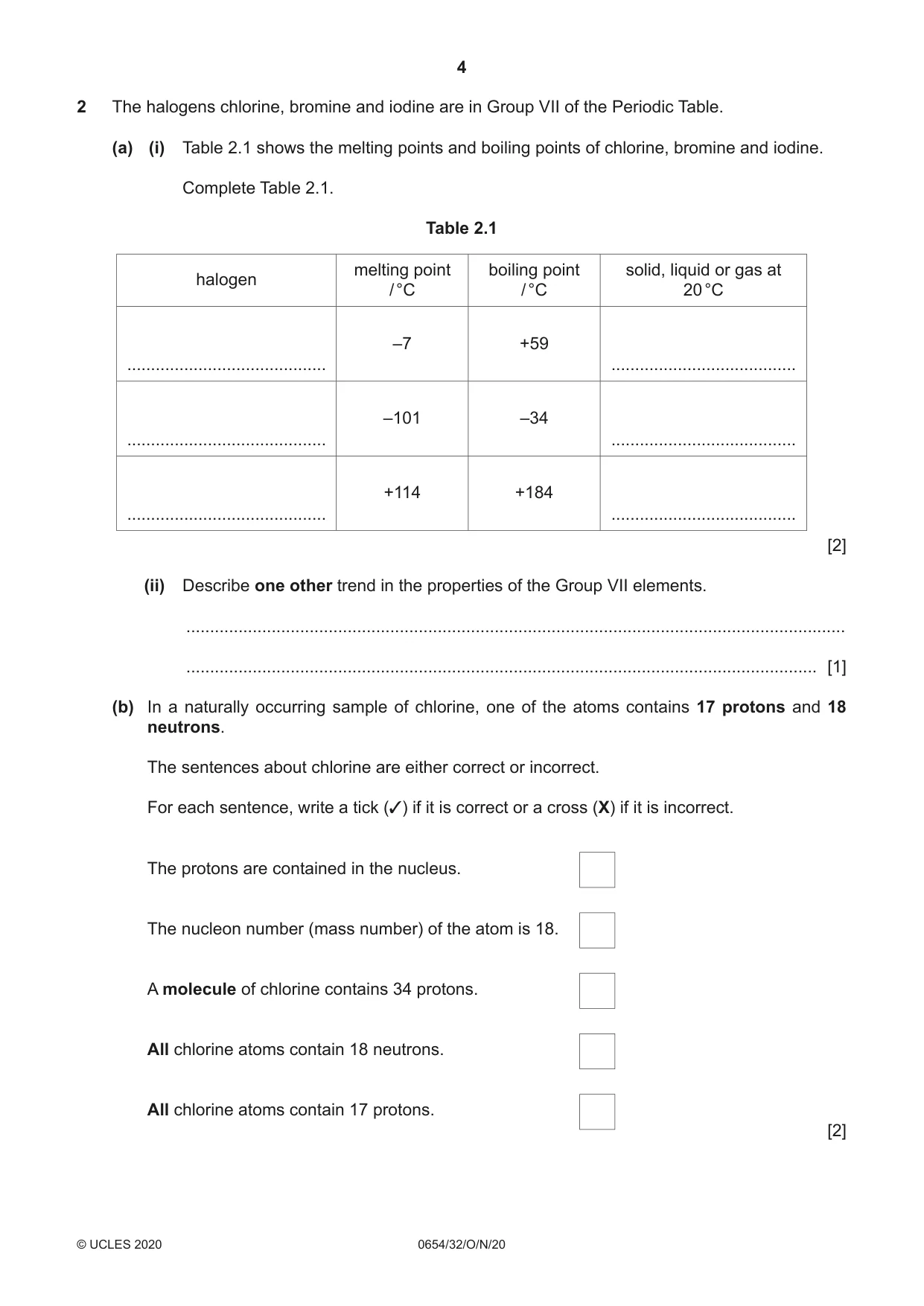
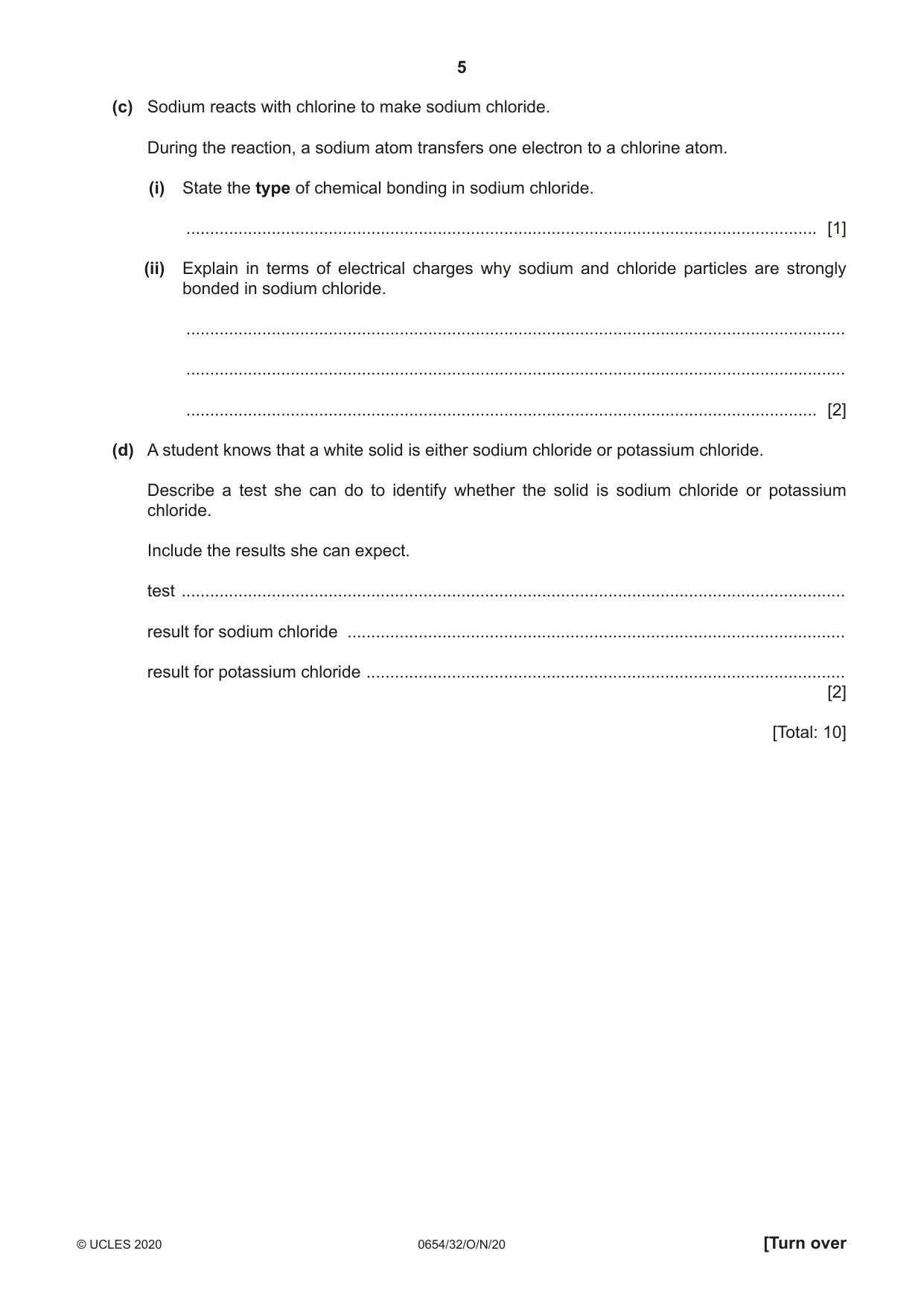
2 The halogens chlorine, bromine and iodine are in Group VII of the Periodic Table. (a) (i) Table 2.1 shows the melting points and boiling points of chlorine, bromine and iodine. Complete Table 2.1. Table 2.1 melting point boiling point solid, liquid or gas at halogen / °C / °C 20 °C –7 +59 .......................................... ....................................... –101 –34 .......................................... ....................................... +114 +184 .......................................... ....................................... [2] (ii) Describe one other trend in the properties of the Group VII elements. ........................................................................................................................................... ..................................................................................................................................... [1] (b) In a naturally occurring sample of chlorine, one of the atoms contains 17 protons and 18 neutrons. The sentences about chlorine are either correct or incorrect. For each sentence, write a tick (3) if it is correct or a cross (X) if it is incorrect. The protons are contained in the nucleus. The nucleon number (mass number) of the atom is 18. A molecule of chlorine contains 34 protons. All chlorine atoms contain 18 neutrons. All chlorine atoms contain 17 protons. [2] (c) Sodium reacts with chlorine to make sodium chloride. During the reaction, a sodium atom transfers one electron to a chlorine atom. (i) State the type of chemical bonding in sodium chloride. ..................................................................................................................................... [1] (ii) Explain in terms of electrical charges why sodium and chloride particles are strongly bonded in sodium chloride. ........................................................................................................................................... ........................................................................................................................................... ..................................................................................................................................... [2] (d) A student knows that a white solid is either sodium chloride or potassium chloride. Describe a test she can do to identify whether the solid is sodium chloride or potassium chloride. Include the results she can expect. test ............................................................................................................................................ result for sodium chloride ......................................................................................................... result for potassium chloride ..................................................................................................... [2] [Total: 10]
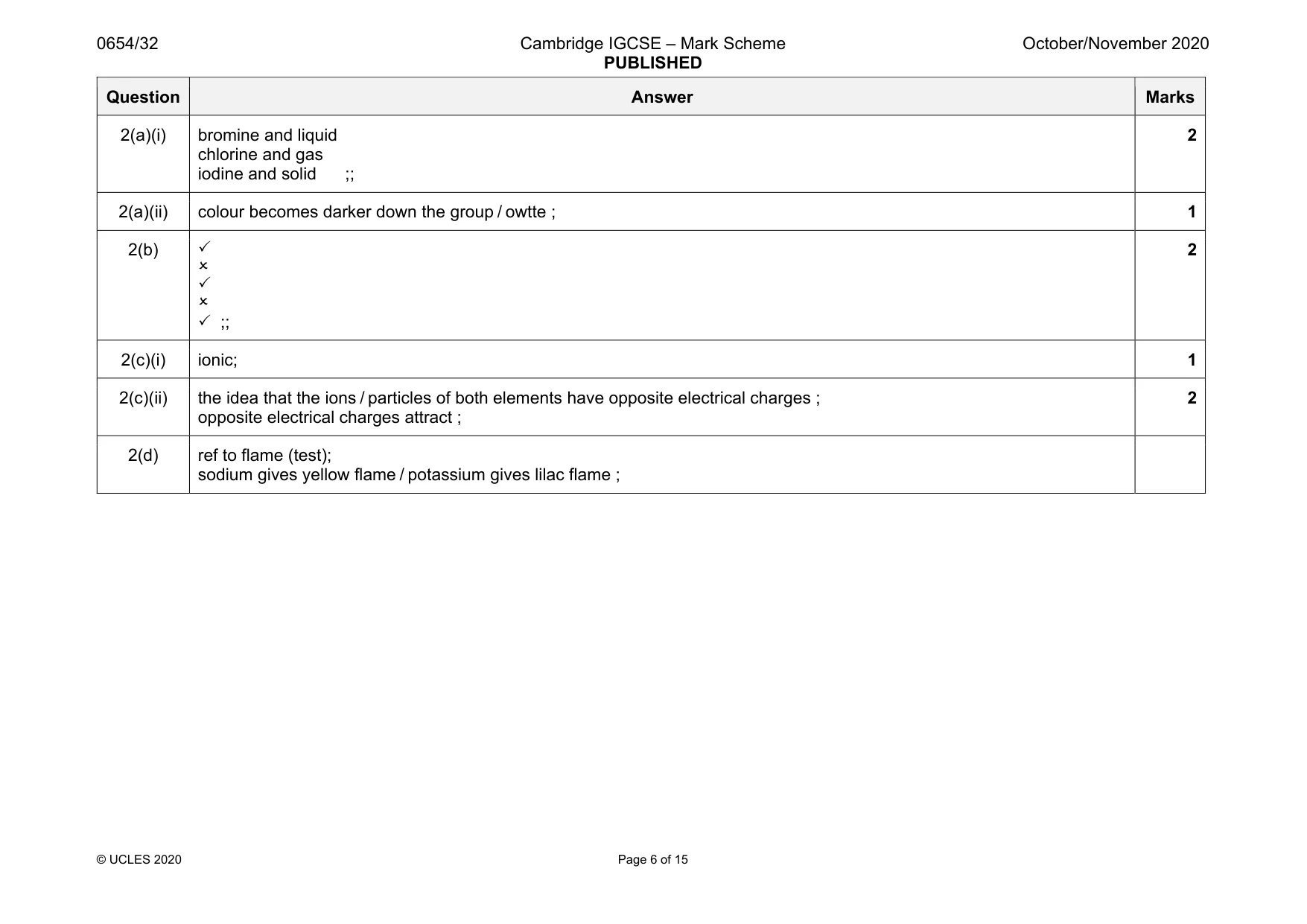
Mark scheme: 2(a)(i) bromine and liquid chlorine and gas iodine and solid ;; 2 2(a)(ii) colour becomes darker down the group / owtte ; 1 2(b) ;; 2 2(c)(i) ionic; 1 2(c)(ii) the idea that the ions / particles of both elements have opposite electrical charges ; opposite electrical charges attract ; 2 2(d) ref to flame (test); sodium gives yellow flame / potassium gives lilac flame ;
Q3 · A skydiver jumps from an aircraft high above the ground
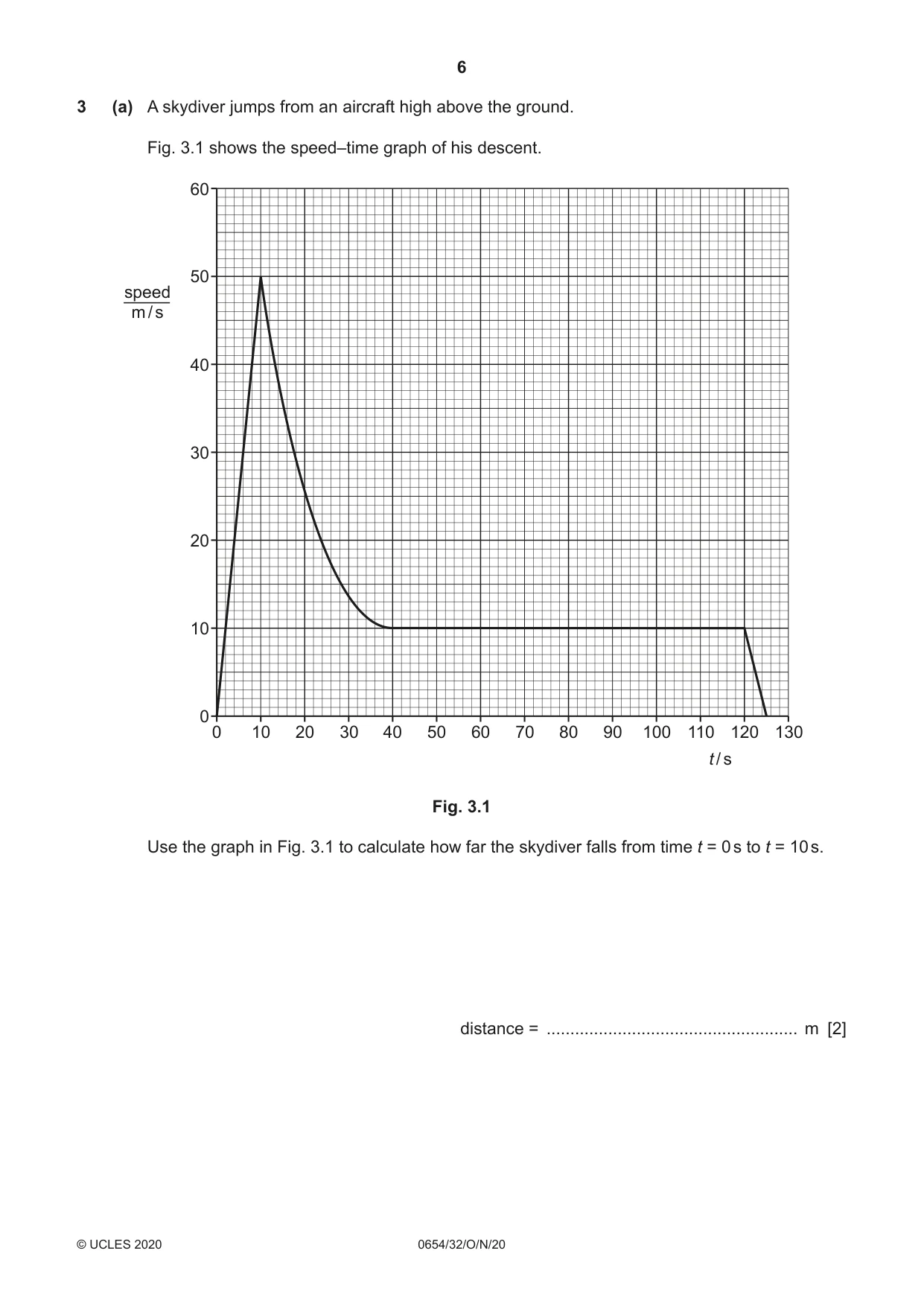
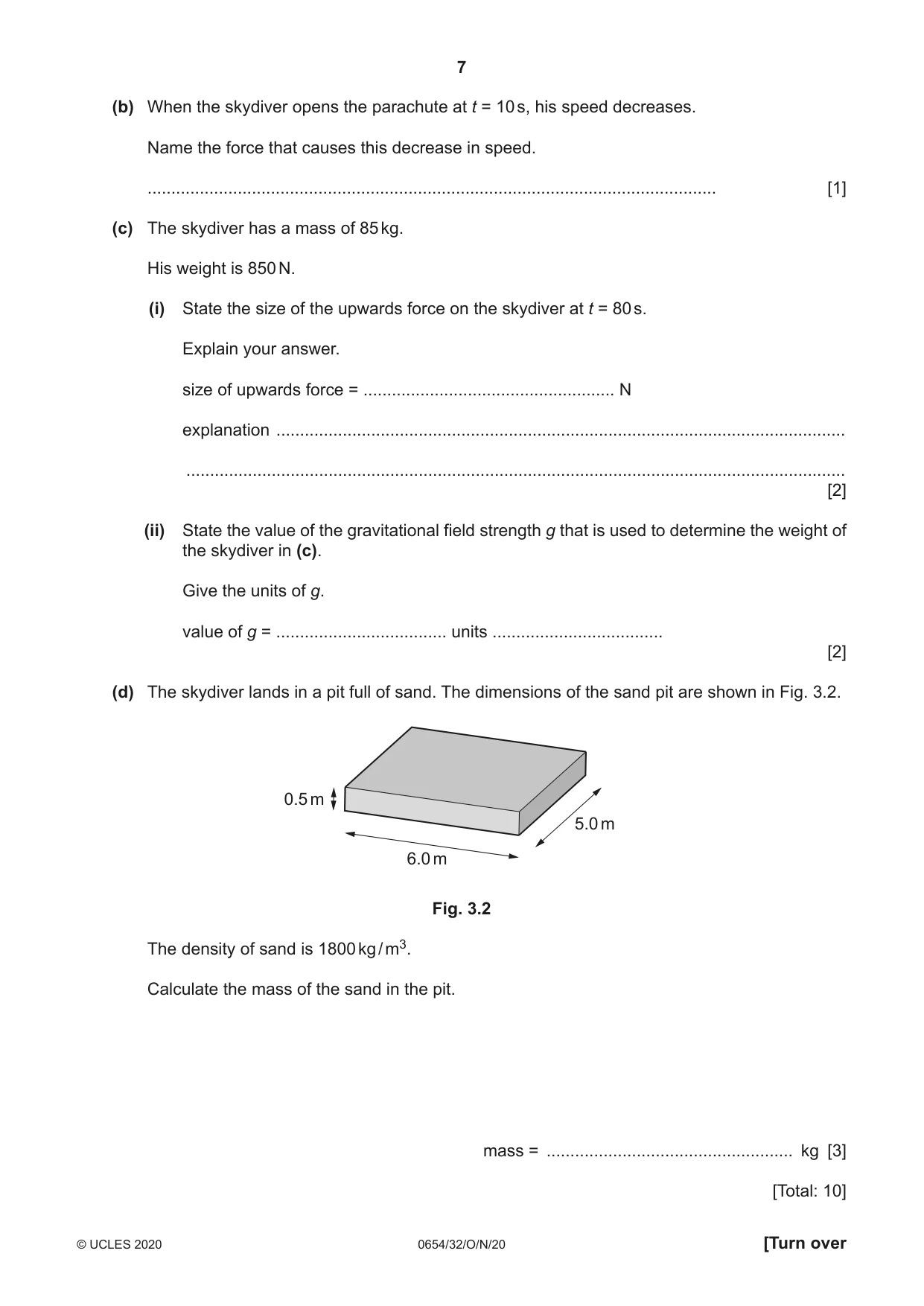
3 (a) A skydiver jumps from an aircraft high above the ground. Fig. 3.1 shows the speed–time graph of his descent. 60 50 speed m / s 40 30 20 10 0 0 10 20 30 40 50 60 70 80 90 100 110 120 130 t / s Fig. 3.1 Use the graph in Fig. 3.1 to calculate how far the skydiver falls from time t = 0 s to t = 10 s. distance = ..................................................... m [2] (b) When the skydiver opens the parachute at t = 10 s, his speed decreases. Name the force that causes this decrease in speed. ........................................................................................................................ [1] (c) The skydiver has a mass of 85 kg. His weight is 850 N. (i) State the size of the upwards force on the skydiver at t = 80 s. Explain your answer. size of upwards force = ..................................................... N explanation ........................................................................................................................ ........................................................................................................................................... [2] (ii) State the value of the gravitational field strength g that is used to determine the weight of the skydiver in (c). Give the units of g. value of g = .................................... units .................................... [2] (d) The skydiver lands in a pit full of sand. The dimensions of the sand pit are shown in Fig. 3.2. 0.5 m 5.0 m 6.0 m Fig. 3.2 The density of sand is 1800 kg / m3. Calculate the mass of the sand in the pit. mass = .................................................... kg [3] [Total: 10]
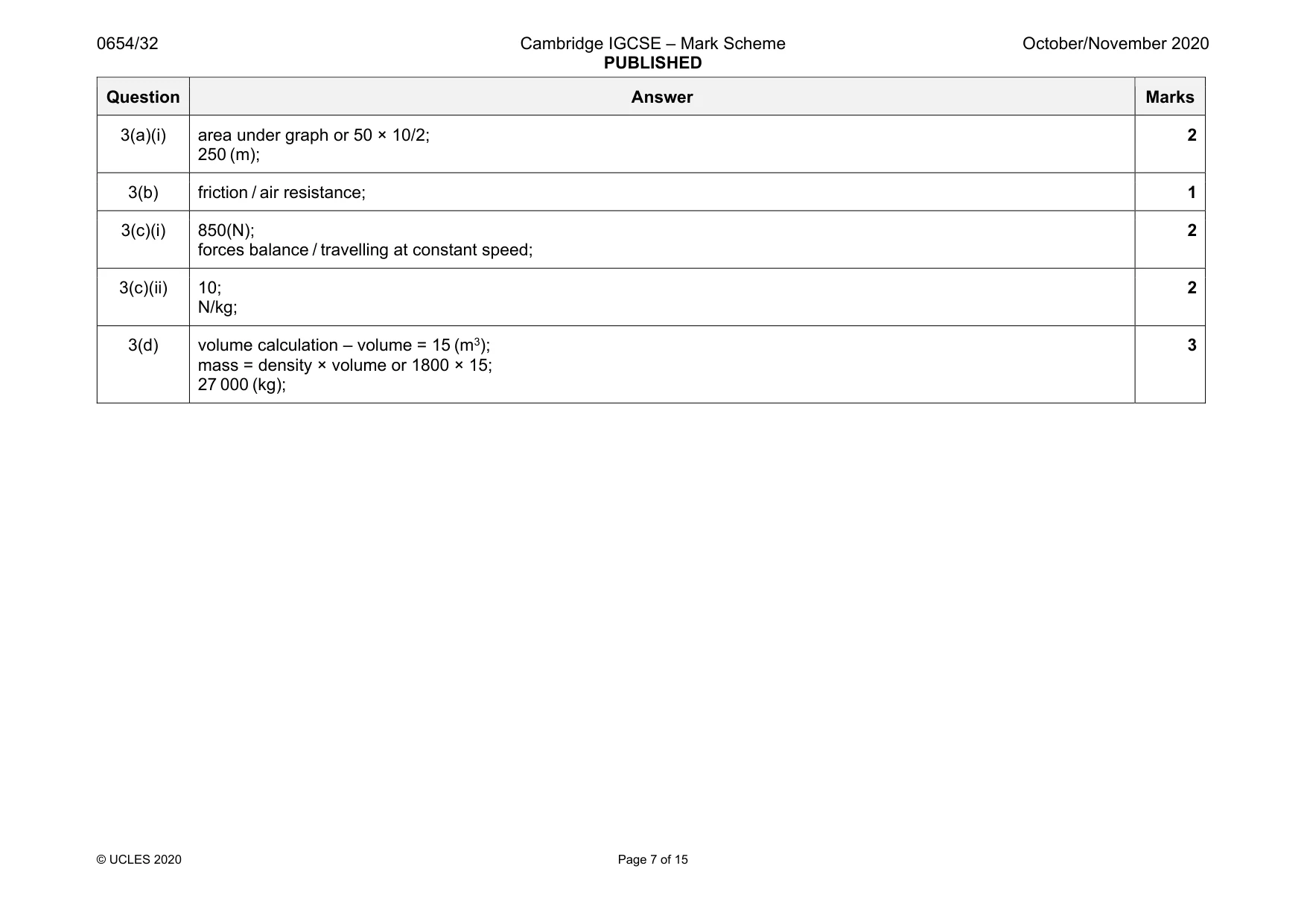
Mark scheme: 3(a)(i) area under graph or 50 × 10/2; 250 (m); 2 3(b) friction / air resistance; 1 3(c)(i) 850(N); forces balance / travelling at constant speed; 2 3(c)(ii) 10; N/kg; 2 3(d) volume calculation – volume = 15 (m3); mass = density × volume or 1800 × 15; 27 000 (kg); 3
Question 4
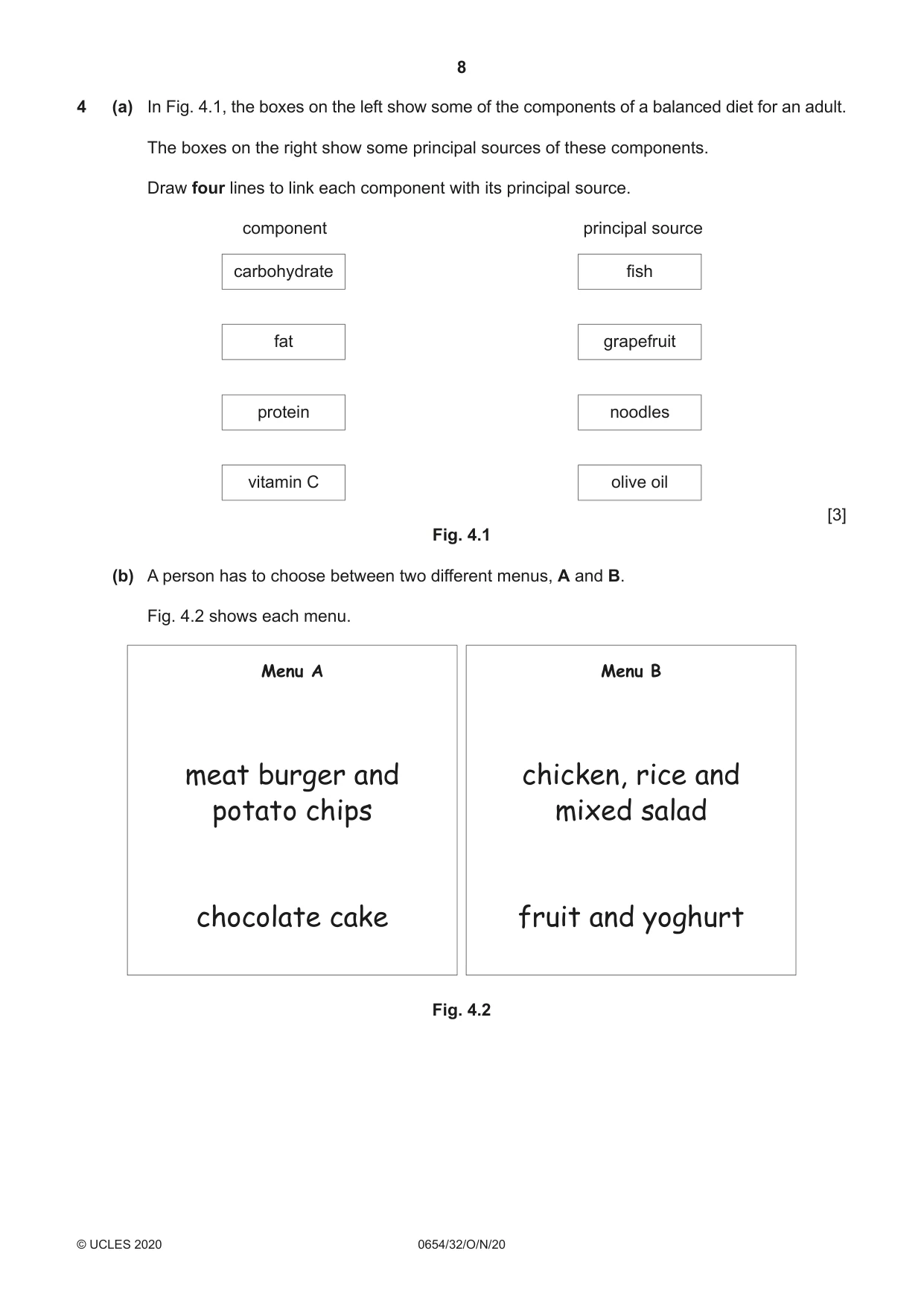
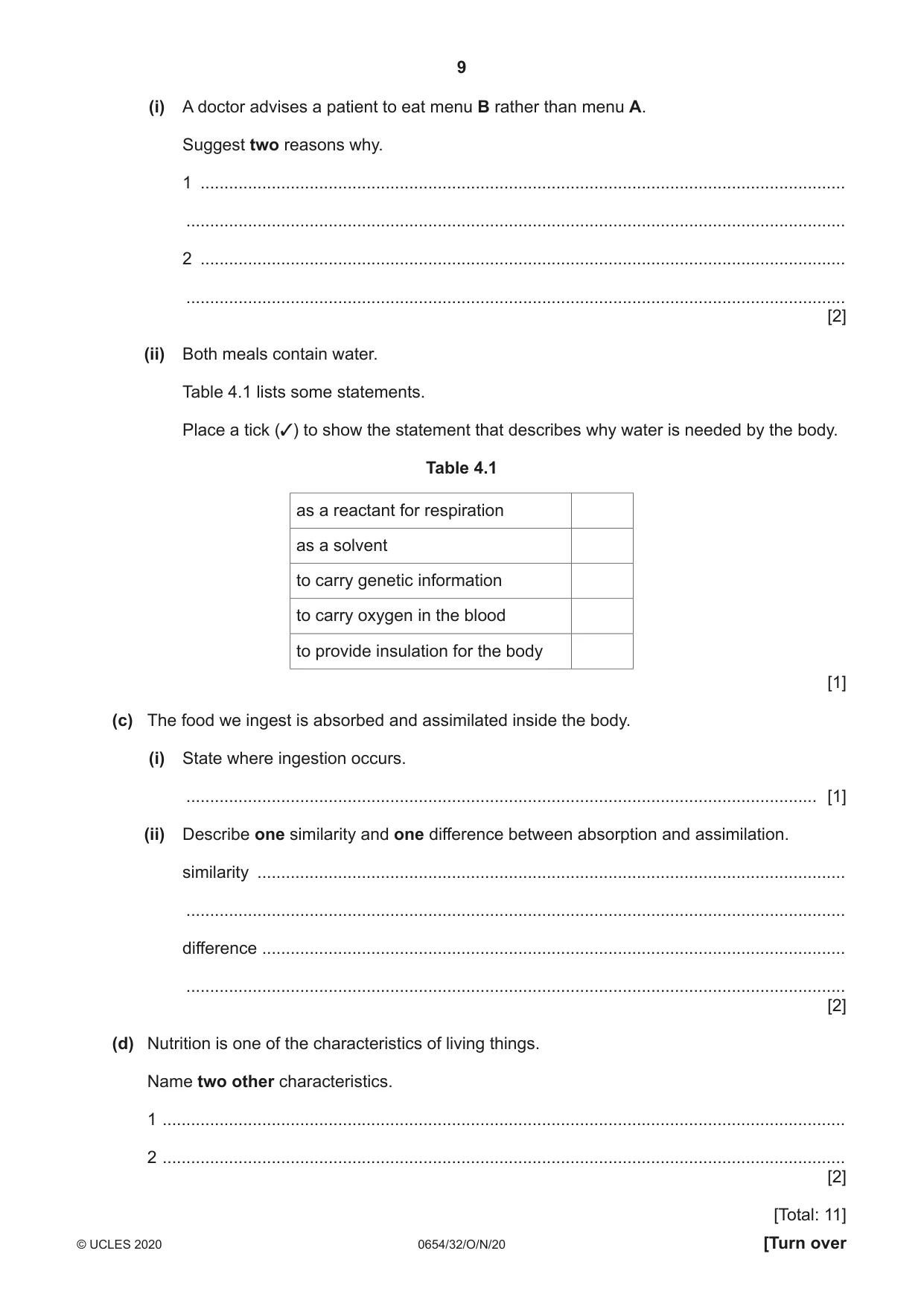
4 (a) In Fig. 4.1, the boxes on the left show some of the components of a balanced diet for an adult. The boxes on the right show some principal sources of these components. Draw four lines to link each component with its principal source. component principal source carbohydrate fish fat grapefruit protein noodles vitamin C olive oil [3] Fig. 4.1 (b) A person has to choose between two different menus, A and B. Fig. 4.2 shows each menu. Menu A Menu B meat burger and chicken, rice and potato chips mixed salad chocolate cake fruit and yoghurt Fig. 4.2 (i) A doctor advises a patient to eat menu B rather than menu A. Suggest two reasons why. 1 ........................................................................................................................................ ........................................................................................................................................... 2 ........................................................................................................................................ ........................................................................................................................................... [2] (ii) Both meals contain water. Table 4.1 lists some statements. Place a tick (3) to show the statement that describes why water is needed by the body. Table 4.1 as a reactant for respiration as a solvent to carry genetic information to carry oxygen in the blood to provide insulation for the body [1] (c) The food we ingest is absorbed and assimilated inside the body. (i) State where ingestion occurs. ..................................................................................................................................... [1] (ii) Describe one similarity and one difference between absorption and assimilation. similarity ............................................................................................................................ ........................................................................................................................................... difference ........................................................................................................................... ........................................................................................................................................... [2] (d) Nutrition is one of the characteristics of living things. Name two other characteristics. 1 ................................................................................................................................................ 2 ................................................................................................................................................ [2] [Total: 11]
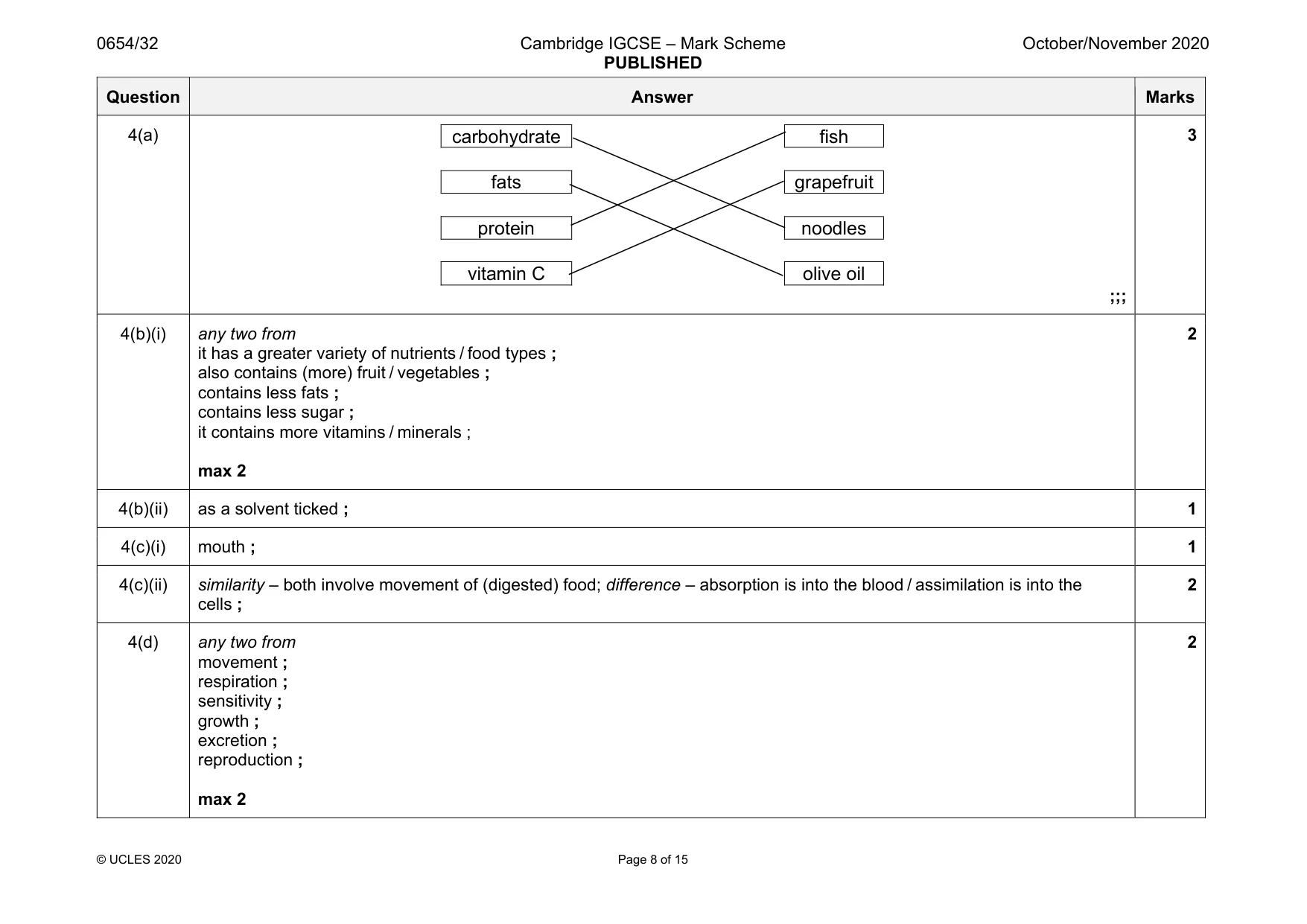
Mark scheme: 4(a) carbohydrate fish fats grapefruit protein noodles vitamin C olive oil ;;; 3 4(b)(i) any two from it has a greater variety of nutrients / food types ; also contains (more) fruit / vegetables ; contains less fats ; contains less sugar ; it contains more vitamins / minerals ; max 2 2 4(b)(ii) as a solvent ticked ; 1 4(c)(i) mouth ; 1 4(c)(ii) similarity – both involve movement of (digested) food; difference – absorption is into the blood / assimilation is into the cells ; 2 4(d) any two from movement ; respiration ; sensitivity ; growth ; excretion ; reproduction ; max 2 2
Q5 · Aluminium is used in industry to make many different products
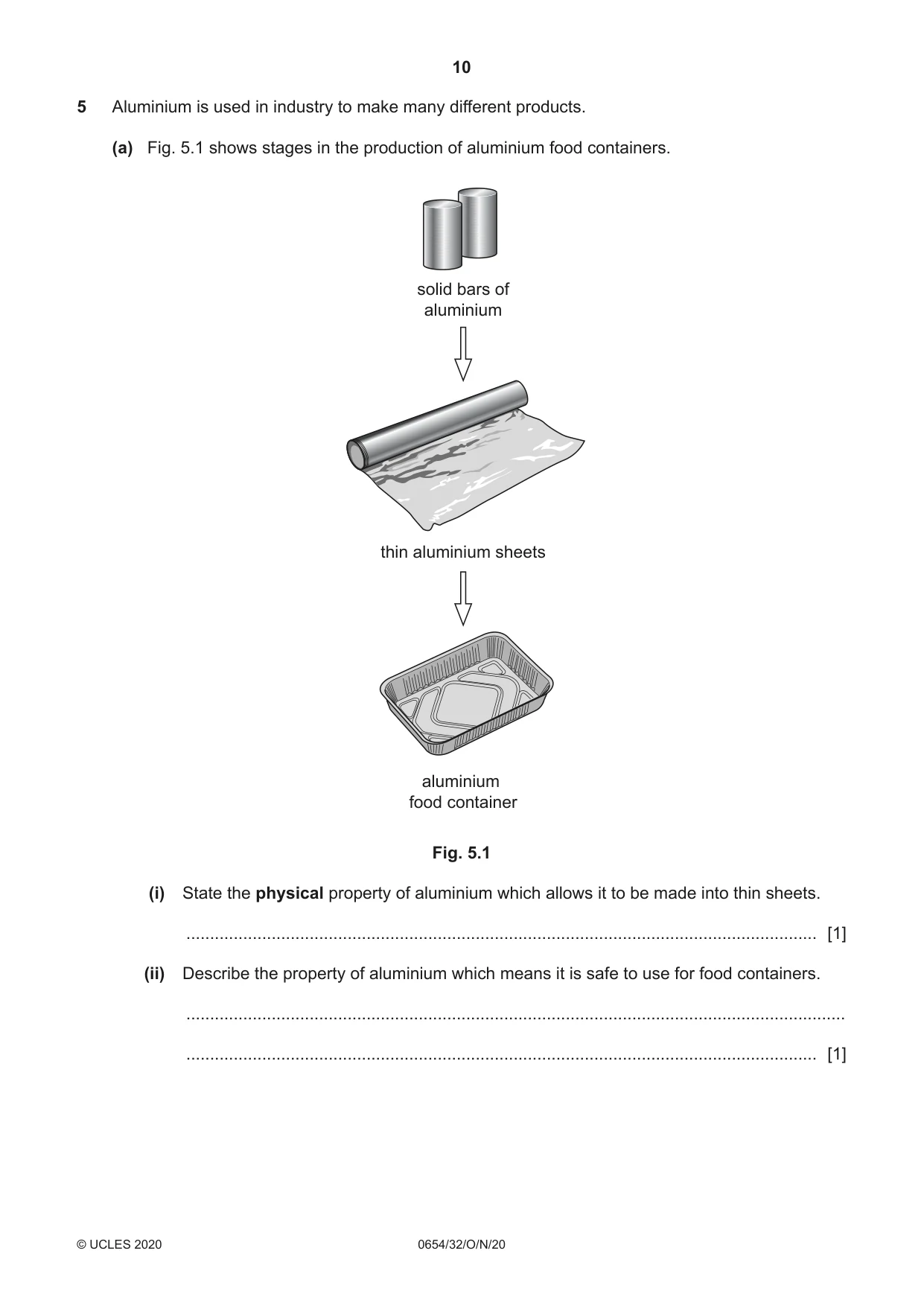
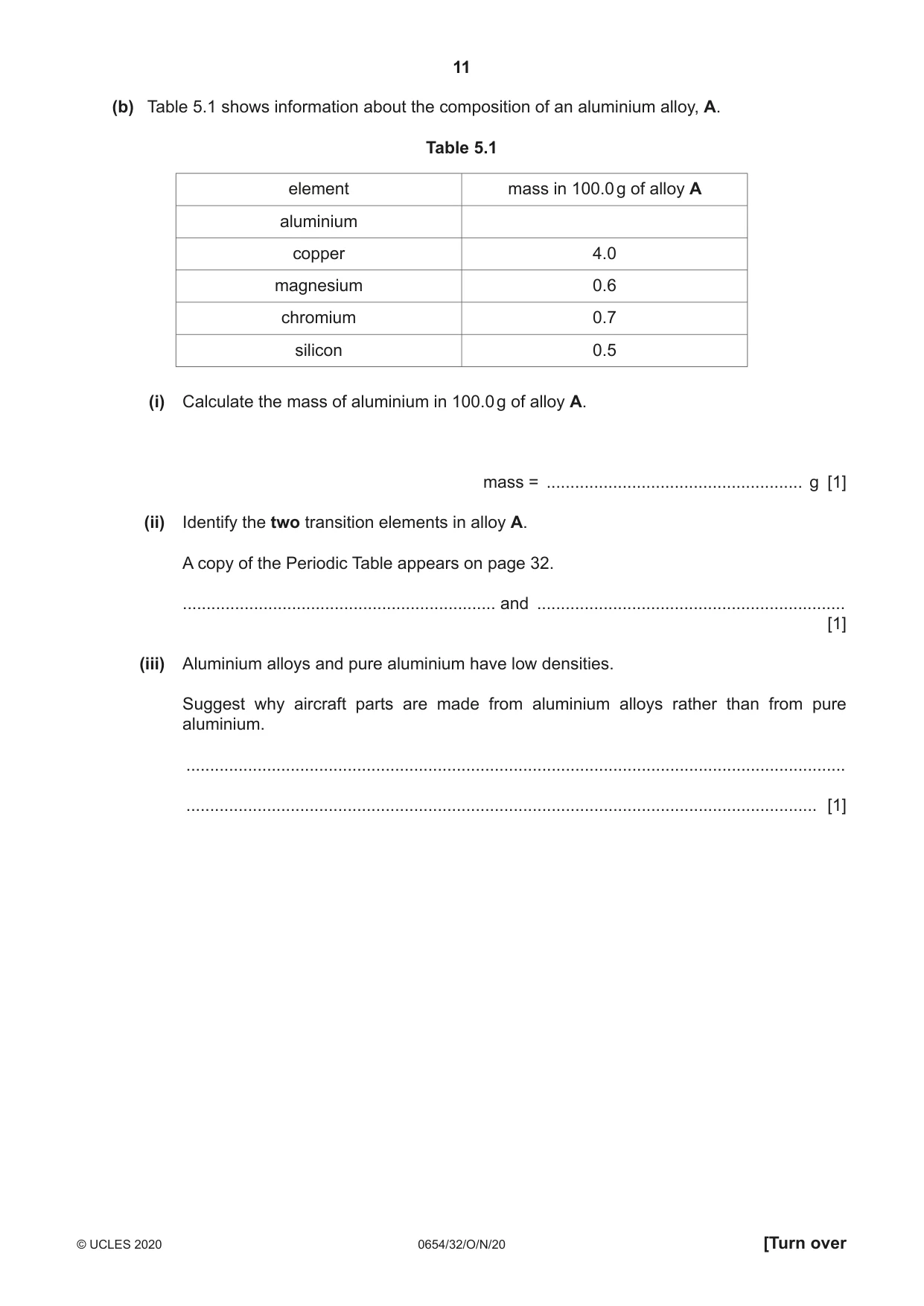
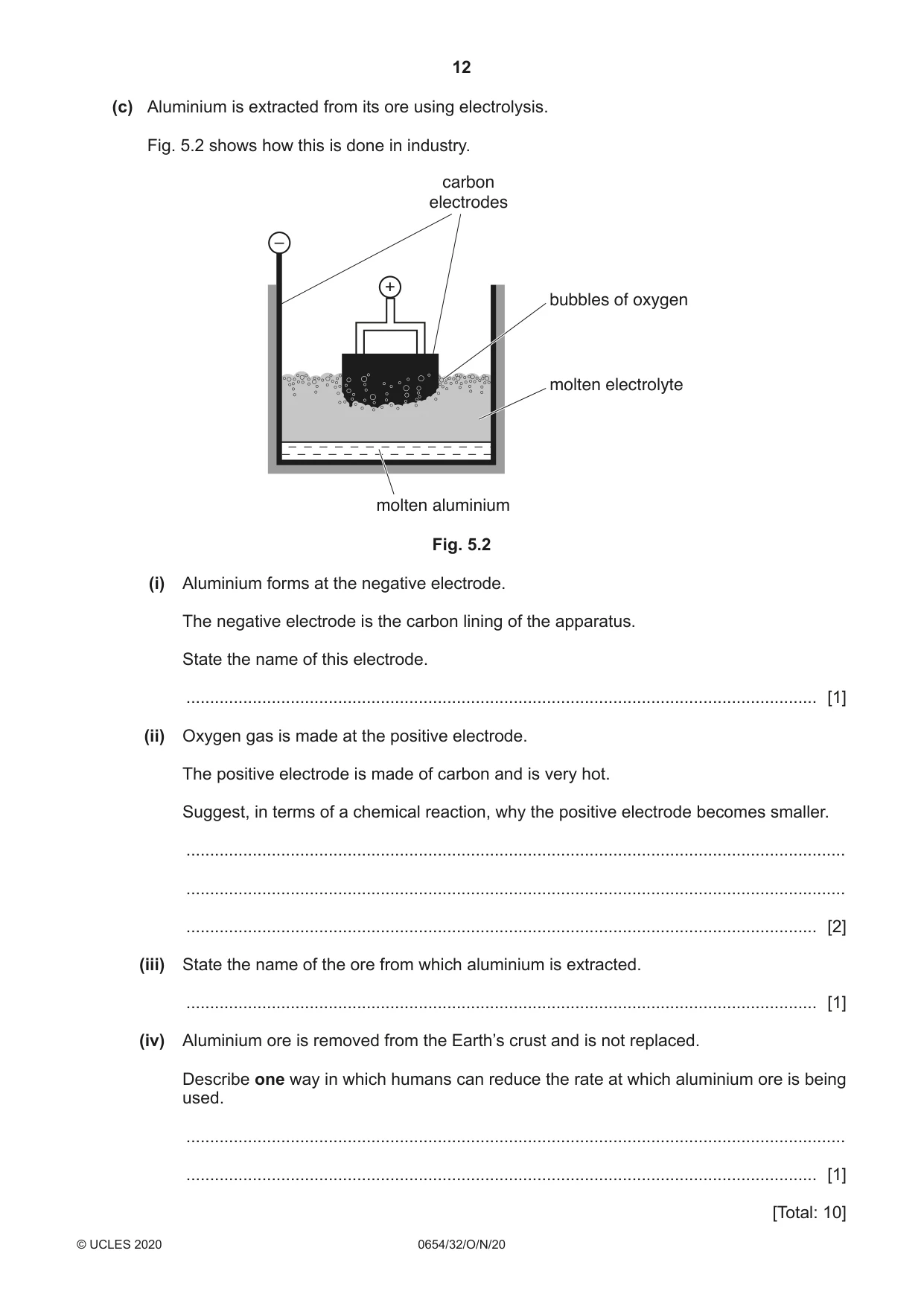
5 Aluminium is used in industry to make many different products. (a) Fig. 5.1 shows stages in the production of aluminium food containers. solid bars of aluminium thin aluminium sheets aluminium food container Fig. 5.1 (i) State the physical property of aluminium which allows it to be made into thin sheets. ..................................................................................................................................... [1] (ii) Describe the property of aluminium which means it is safe to use for food containers. ........................................................................................................................................... ..................................................................................................................................... [1] (b) Table 5.1 shows information about the composition of an aluminium alloy, A. Table 5.1 element mass in 100.0 g of alloy A aluminium copper 4.0 magnesium 0.6 chromium 0.7 silicon 0.5 (i) Calculate the mass of aluminium in 100.0 g of alloy A. mass = ...................................................... g [1] (ii) Identify the two transition elements in alloy A. A copy of the Periodic Table appears on page 32. .................................................................. and ................................................................. [1] (iii) Aluminium alloys and pure aluminium have low densities. Suggest why aircraft parts are made from aluminium alloys rather than from pure aluminium. ........................................................................................................................................... ..................................................................................................................................... [1] (c) Aluminium is extracted from its ore using electrolysis. Fig. 5.2 shows how this is done in industry. carbon electrodes – + bubbles of oxygen molten electrolyte molten aluminium Fig. 5.2 (i) Aluminium forms at the negative electrode. The negative electrode is the carbon lining of the apparatus. State the name of this electrode. ..................................................................................................................................... [1] (ii) Oxygen gas is made at the positive electrode. The positive electrode is made of carbon and is very hot. Suggest, in terms of a chemical reaction, why the positive electrode becomes smaller. ........................................................................................................................................... ........................................................................................................................................... ..................................................................................................................................... [2] (iii) State the name of the ore from which aluminium is extracted. ..................................................................................................................................... [1] (iv) Aluminium ore is removed from the Earth’s crust and is not replaced. Describe one way in which humans can reduce the rate at which aluminium ore is being used. ........................................................................................................................................... ..................................................................................................................................... [1] [Total: 10]
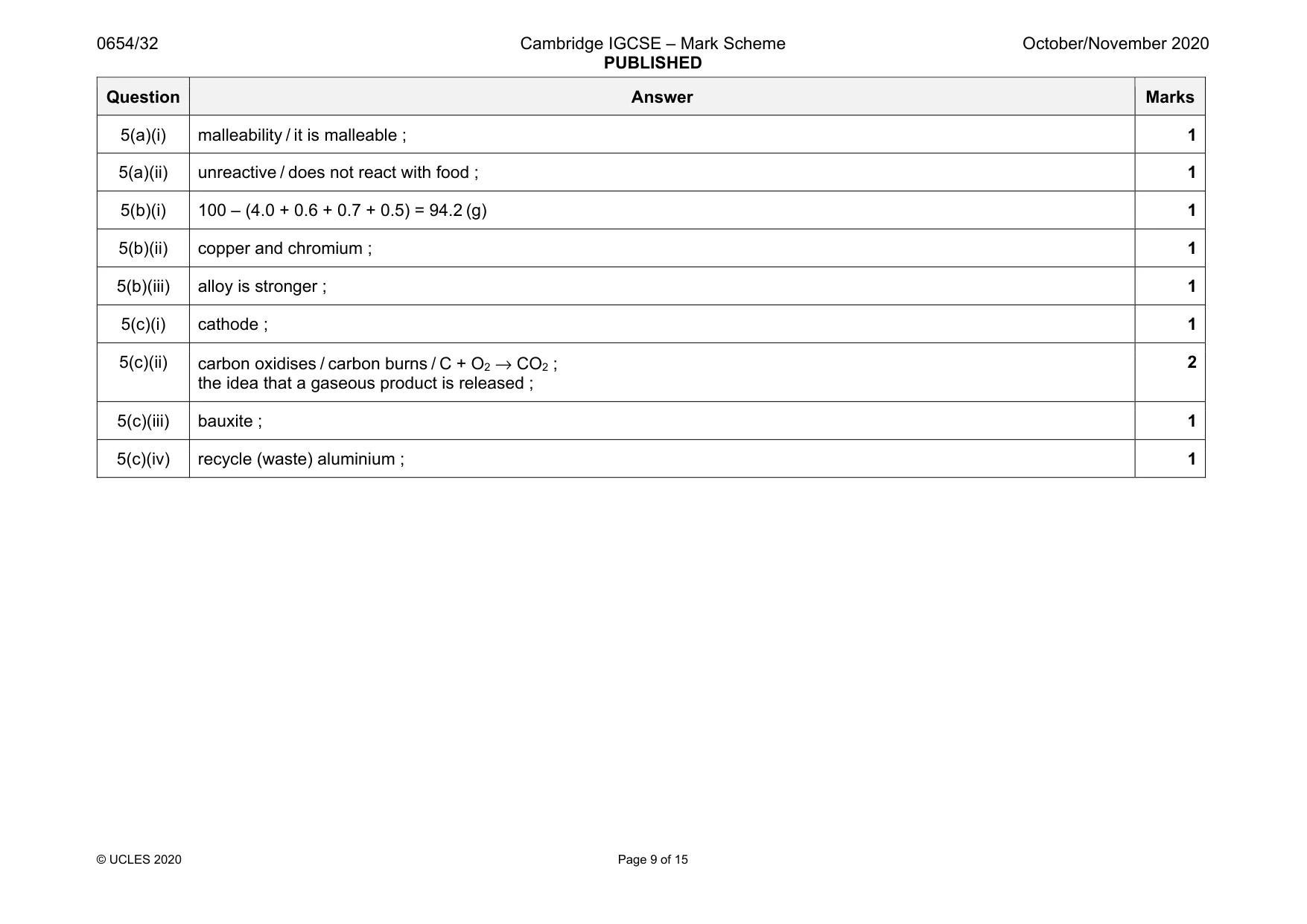
Mark scheme: 5(a)(i) malleability / it is malleable ; 1 5(a)(ii) unreactive / does not react with food ; 1 5(b)(i) 100 – (4.0 + 0.6 + 0.7 + 0.5) = 94.2 (g) 1 5(b)(ii) copper and chromium ; 1 5(b)(iii) alloy is stronger ; 1 5(c)(i) cathode ; 1 5(c)(ii) carbon oxidises / carbon burns / C + O2 → CO2 ; the idea that a gaseous product is released ; 2 5(c)(iii) bauxite ; 1 5(c)(iv) recycle (waste) aluminium ; 1
Q6 · A torch (flash light) contains a cell, a switch and a lamp connected in series
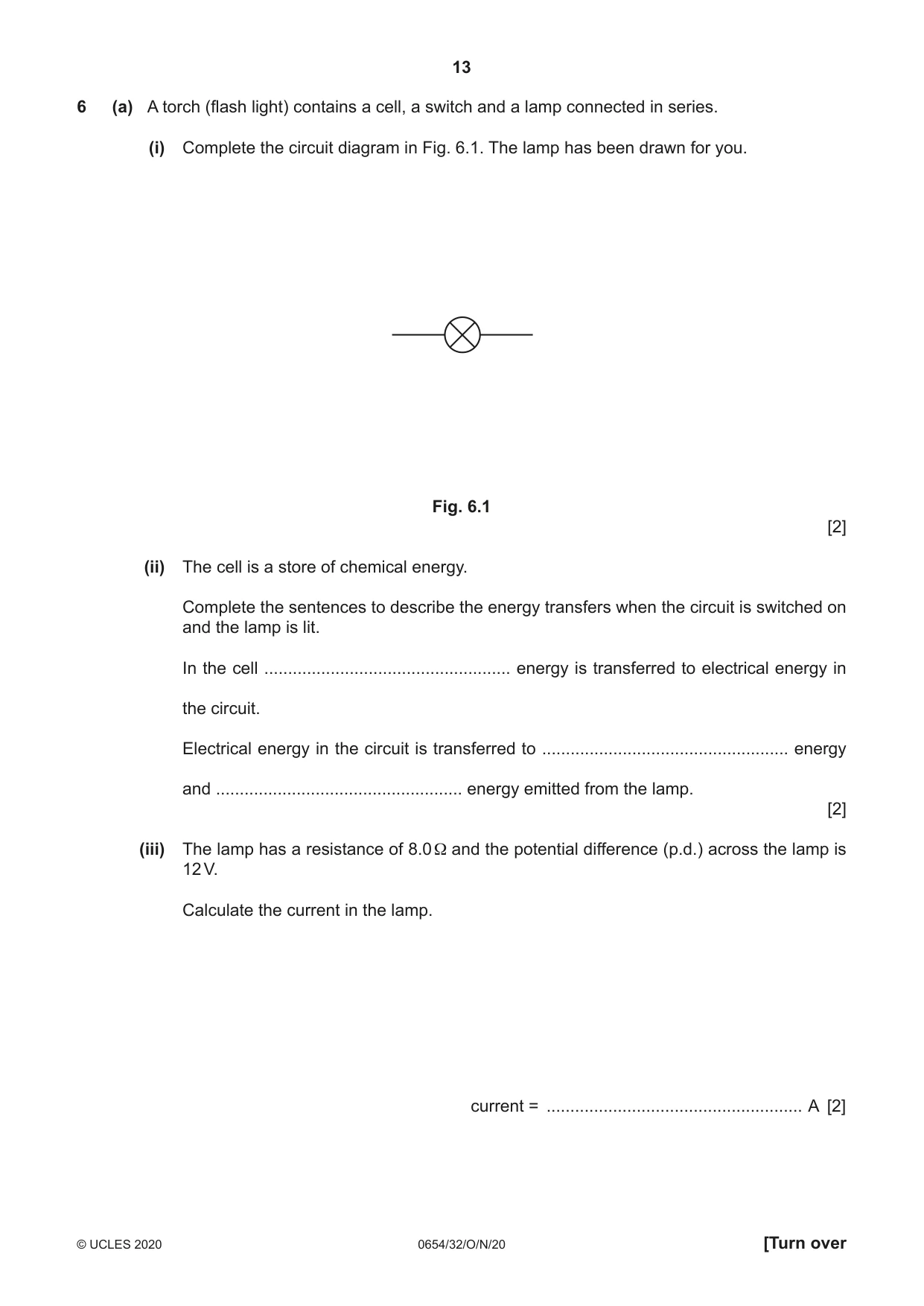
6 (a) A torch (flash light) contains a cell, a switch and a lamp connected in series. (i) Complete the circuit diagram in Fig. 6.1. The lamp has been drawn for you. Fig. 6.1 [2] (ii) The cell is a store of chemical energy. Complete the sentences to describe the energy transfers when the circuit is switched on and the lamp is lit. In the cell .................................................... energy is transferred to electrical energy in the circuit. Electrical energy in the circuit is transferred to .................................................... energy and .................................................... energy emitted from the lamp. [2] (iii) The lamp has a resistance of 8.0 Ω and the potential difference (p.d.) across the lamp is 12 V. Calculate the current in the lamp. current = ...................................................... A [2] (b) (i) Name the instrument used to measure current in a circuit. ..................................................................................................... [1] (ii) The wires in the circuit are made of copper. State the name of the particles that flow when there is a current in the wires. ..................................................................................................... [1] (c) A student connects a 3 Ω and a 4 Ω resistor in series. Calculate the combined resistance of these two resistors in series. resistance = ..................................................... Ω [1] [Total: 9]
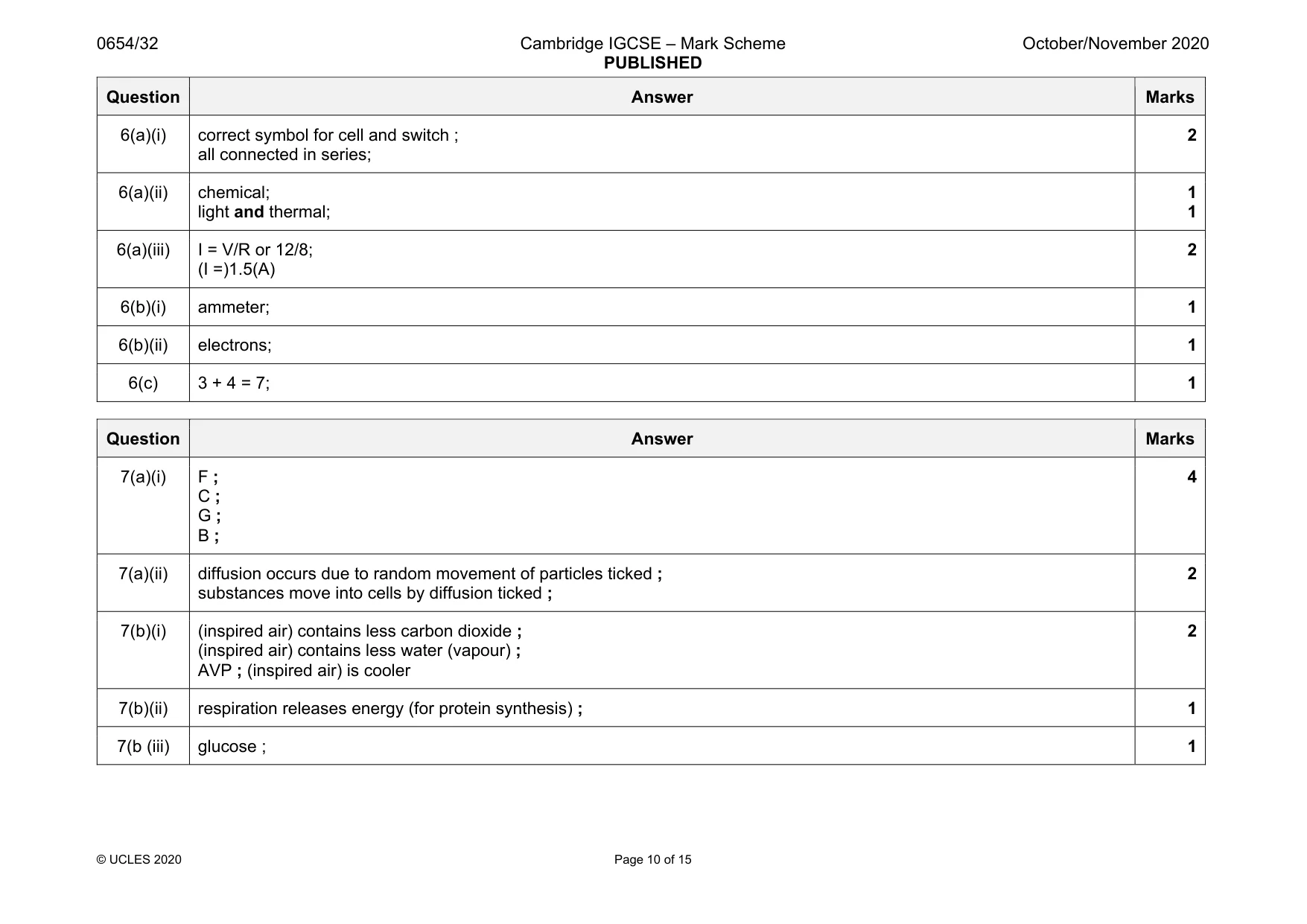
Mark scheme: 6(a)(i) correct symbol for cell and switch ; all connected in series; 2 6(a)(ii) chemical; light and thermal; 1 1 6(a)(iii) I = V/R or 12/8; (I =)1.5(A) 2 6(b)(i) ammeter; 1 6(b)(ii) electrons; 1 6(c) 3 + 4 = 7; 1
Q7 · A diagram of the human gas exchange system
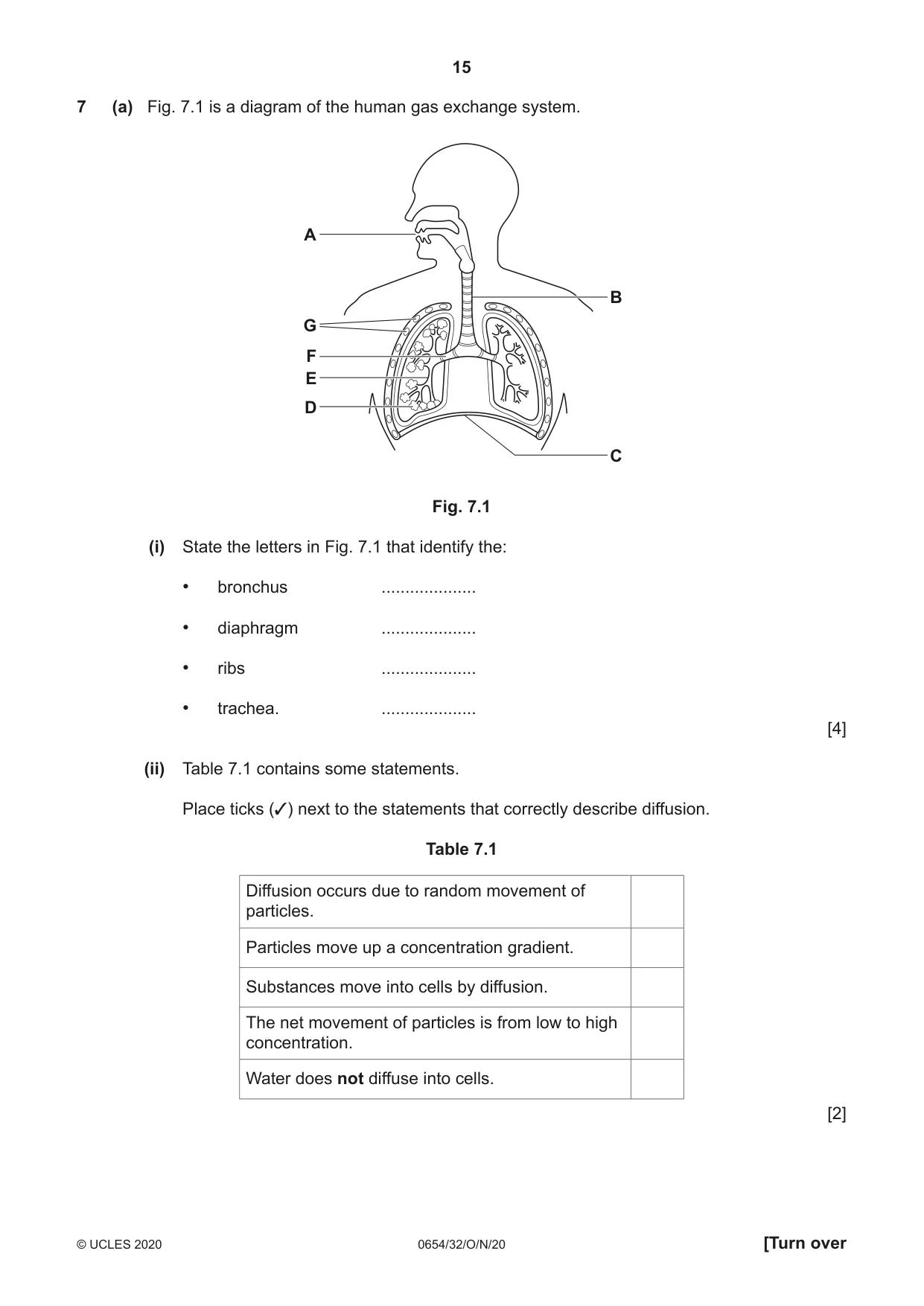
7 (a) Fig. 7.1 is a diagram of the human gas exchange system. A B G F E D C Fig. 7.1 (i) State the letters in Fig. 7.1 that identify the: • bronchus .................... • diaphragm .................... • ribs .................... • trachea. .................... [4] (ii) Table 7.1 contains some statements. Place ticks (3) next to the statements that correctly describe diffusion. Table 7.1 Diffusion occurs due to random movement of particles. Particles move up a concentration gradient. Substances move into cells by diffusion. The net movement of particles is from low to high concentration. Water does not diffuse into cells. [2] (b) Inspired air contains more oxygen than expired air. Oxygen is used in the process of respiration. (i) State two other ways that inspired air is different from expired air. 1 ........................................................................................................................................ 2 ........................................................................................................................................ [2] (ii) State why respiration enables protein synthesis to take place. ........................................................................................................................................... ..................................................................................................................................... [1] (iii) State the substance that reacts with oxygen in aerobic respiration. ........................................................................................................................................... [1] [Total: 10]
Mark scheme: 7(a)(i) F ; C ; G ; B ; 4 7(a)(ii) diffusion occurs due to random movement of particles ticked ; substances move into cells by diffusion ticked ; 2 7(b)(i) (inspired air) contains less carbon dioxide ; (inspired air) contains less water (vapour) ; AVP ; (inspired air) is cooler 2 7(b)(ii) respiration releases energy (for protein synthesis) ; 1 7(b (iii) glucose ; 1
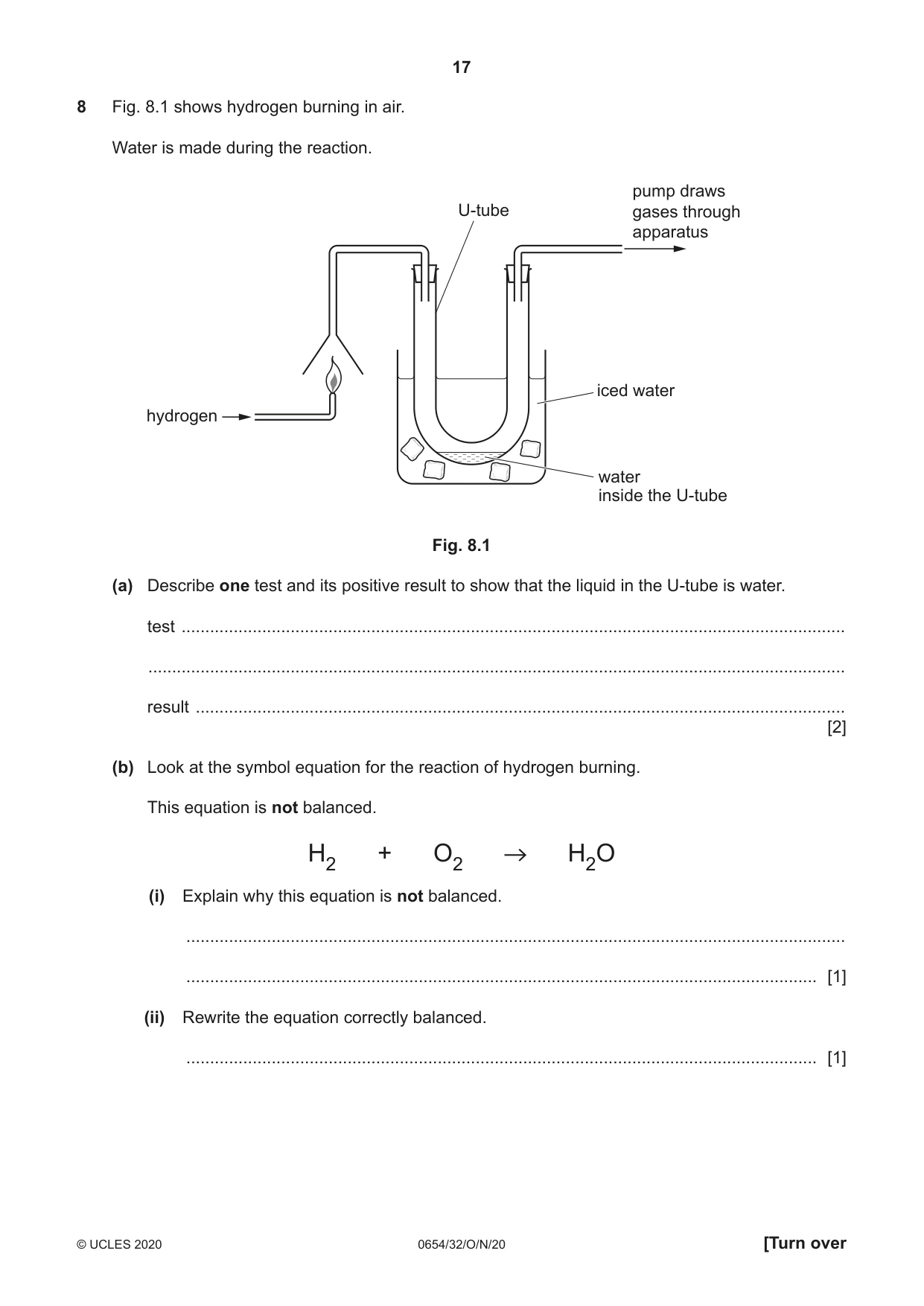
Q8 · Hydrogen burning in air
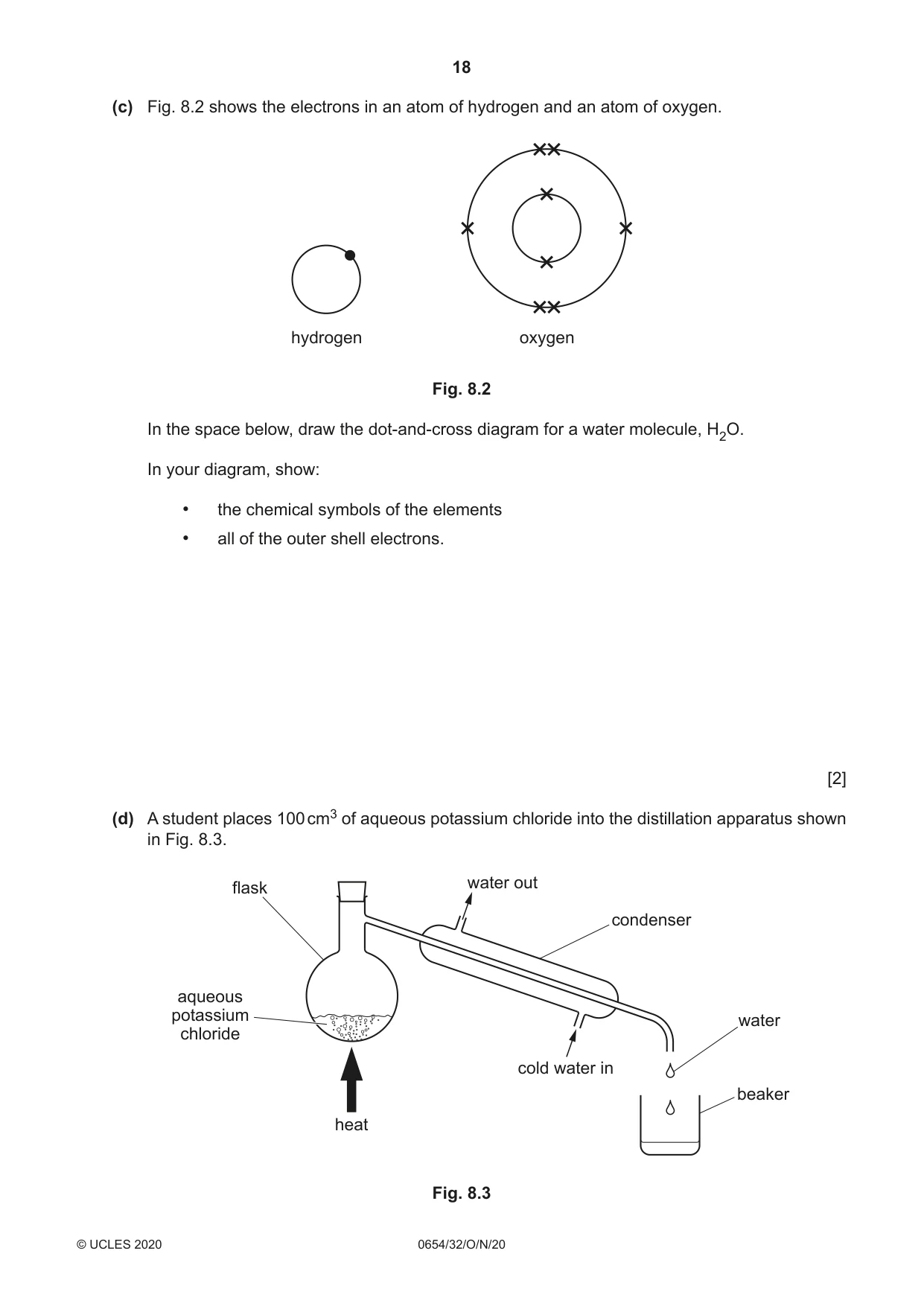
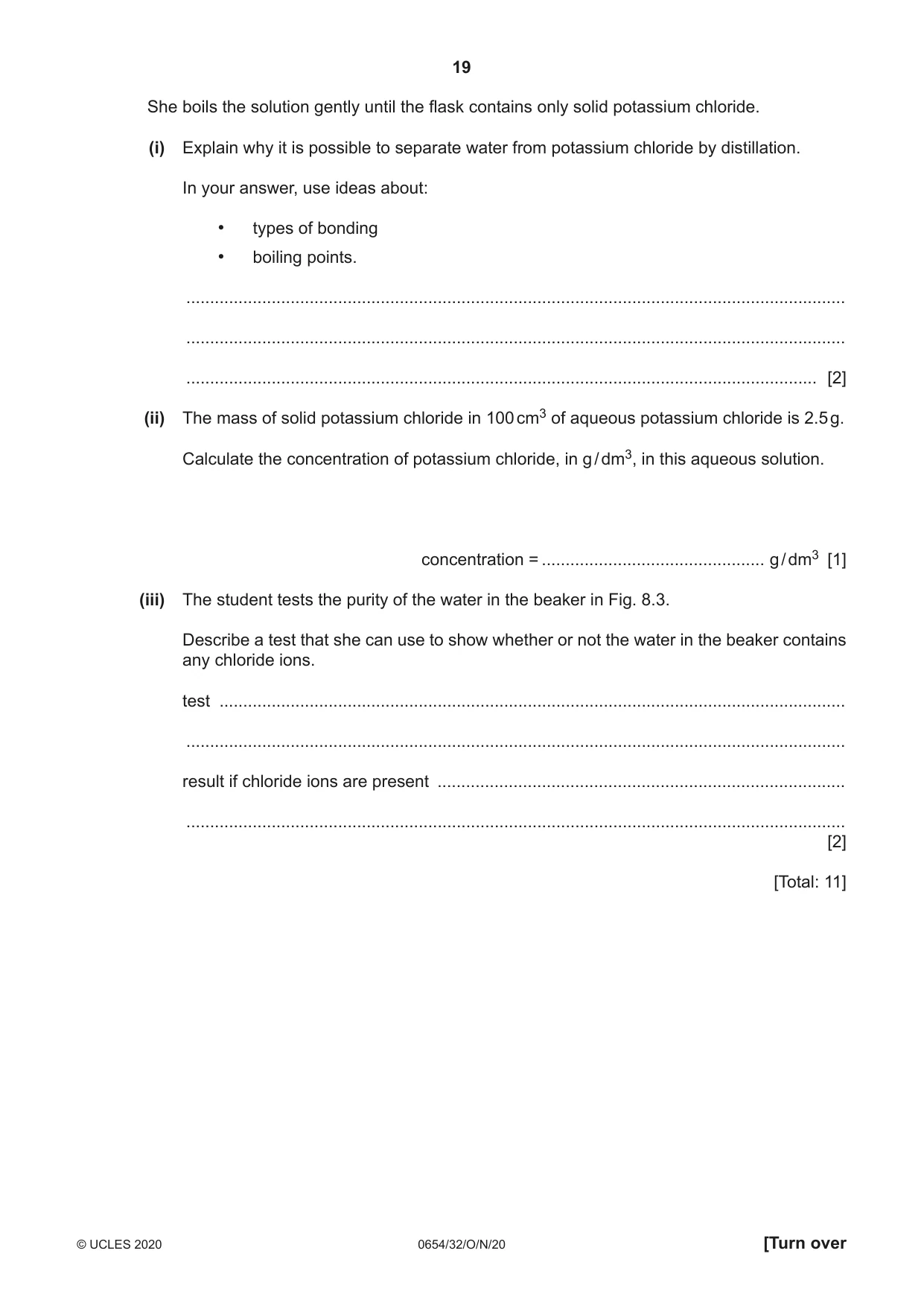
8 Fig. 8.1 shows hydrogen burning in air. Water is made during the reaction. pump draws U-tube gases through apparatus iced water hydrogen water inside the U-tube Fig. 8.1 (a) Describe one test and its positive result to show that the liquid in the U-tube is water. test ............................................................................................................................................ ................................................................................................................................................... result ......................................................................................................................................... [2] (b) Look at the symbol equation for the reaction of hydrogen burning. This equation is not balanced. H2 + O2 H2O (i) Explain why this equation is not balanced. ........................................................................................................................................... ..................................................................................................................................... [1] (ii) Rewrite the equation correctly balanced. ..................................................................................................................................... [1] (c) Fig. 8.2 shows the electrons in an atom of hydrogen and an atom of oxygen. hydrogen oxygen Fig. 8.2 In the space below, draw the dot-and-cross diagram for a water molecule, H2O. In your diagram, show: • the chemical symbols of the elements • all of the outer shell electrons. [2] (d) A student places 100 cm3 of aqueous potassium chloride into the distillation apparatus shown in Fig. 8.3. water out flask condenser aqueous potassium water chloride cold water in beaker heat Fig. 8.3 She boils the solution gently until the flask contains only solid potassium chloride. (i) Explain why it is possible to separate water from potassium chloride by distillation. In your answer, use ideas about: • types of bonding • boiling points. ........................................................................................................................................... ........................................................................................................................................... ..................................................................................................................................... [2] (ii) The mass of solid potassium chloride in 100 cm3 of aqueous potassium chloride is 2.5 g. Calculate the concentration of potassium chloride, in g / dm3, in this aqueous solution. concentration = ............................................... g / dm3 [1] (iii) The student tests the purity of the water in the beaker in Fig. 8.3. Describe a test that she can use to show whether or not the water in the beaker contains any chloride ions. test .................................................................................................................................... ........................................................................................................................................... result if chloride ions are present ...................................................................................... ........................................................................................................................................... [2] [Total: 11]
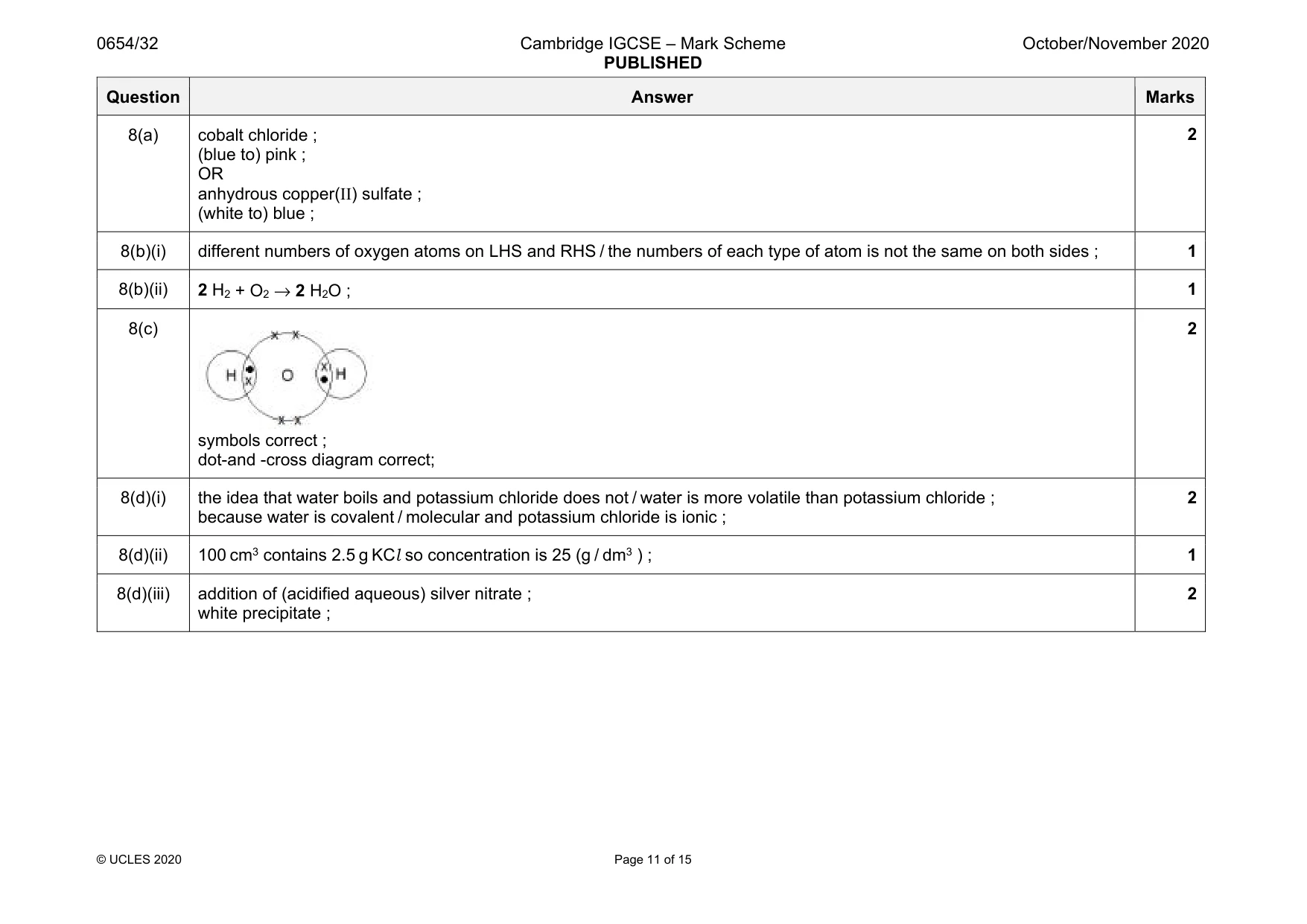
Mark scheme: 8(a) cobalt chloride ; (blue to) pink ; OR anhydrous copper(II) sulfate ; (white to) blue ; 8(b)(i) different numbers of oxygen atoms on LHS and RHS / the numbers of each type of atom is not the same on both sides ; 1 8(b)(ii) 2 H2 + O2 → 2 H2O ; 1 8(c) symbols correct ; dot-and -cross diagram correct; 2 8(d)(i) the idea that water boils and potassium chloride does not / water is more volatile than potassium chloride ; because water is covalent / molecular and potassium chloride is ionic ; 2 8(d)(ii) 100 cm3 contains 2.5 g KCl so concentration is 25 (g / dm3 ) ; 1 8(d)(iii) addition of (acidified aqueous) silver nitrate ; white precipitate ; 2
Q9 · A building is kept warm by heating its solid concrete floor
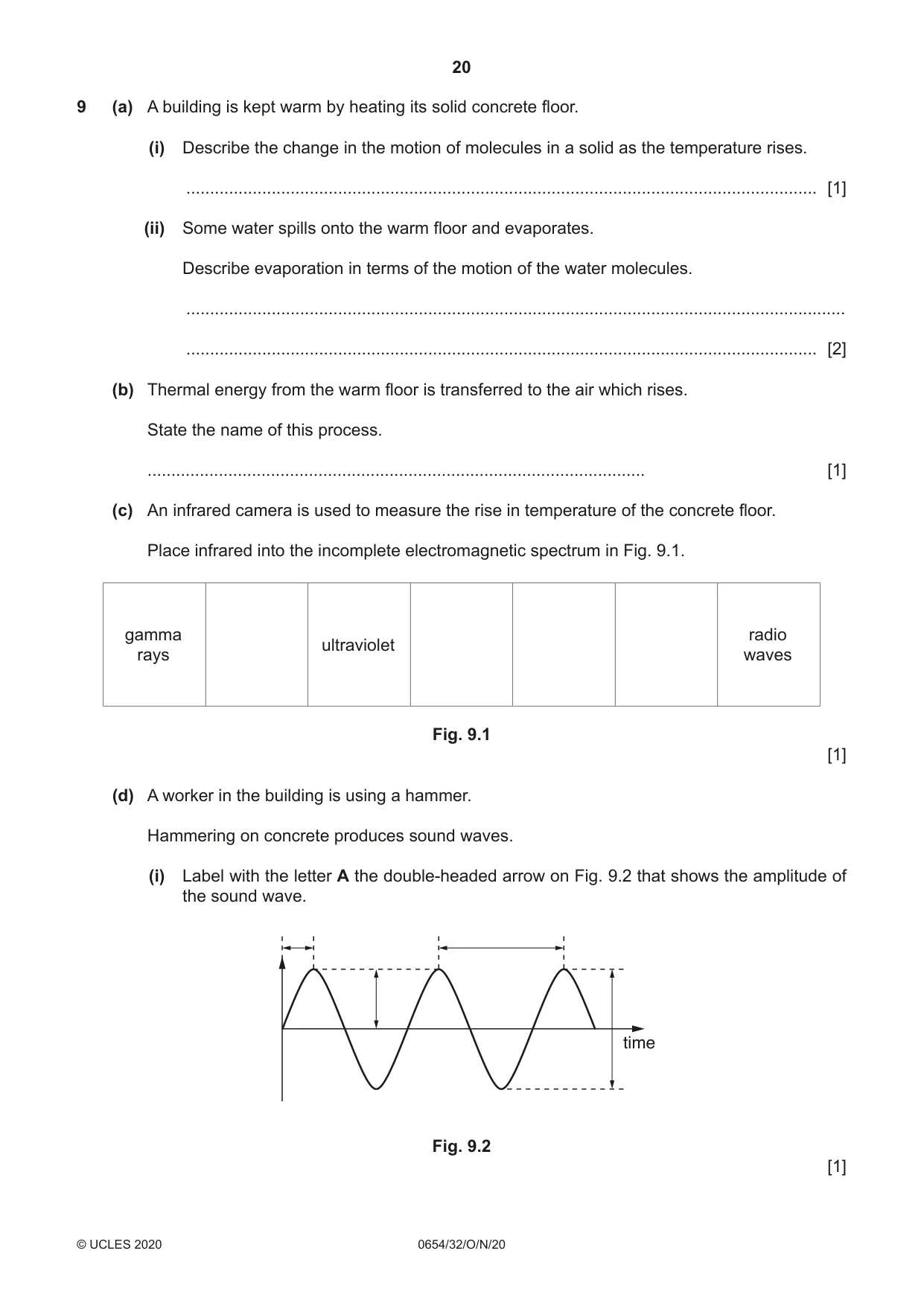
9 (a) A building is kept warm by heating its solid concrete floor. (i) Describe the change in the motion of molecules in a solid as the temperature rises. ..................................................................................................................................... [1] (ii) Some water spills onto the warm floor and evaporates. Describe evaporation in terms of the motion of the water molecules. ........................................................................................................................................... ..................................................................................................................................... [2] (b) Thermal energy from the warm floor is transferred to the air which rises. State the name of this process. ......................................................................................................... [1] (c) An infrared camera is used to measure the rise in temperature of the concrete floor. Place infrared into the incomplete electromagnetic spectrum in Fig. 9.1. gamma radio ultraviolet rays waves Fig. 9.1 [1] (d) A worker in the building is using a hammer. Hammering on concrete produces sound waves. (i) Label with the letter A the double-headed arrow on Fig. 9.2 that shows the amplitude of the sound wave. time Fig. 9.2 [1] (ii) State the approximate range of audible frequencies for a healthy human ear. from ................................................. Hz to .......................................................... Hz [1] (e) The roof of the building is fitted with solar cells. State one advantage and one disadvantage of generating electricity using solar cells apart from cost. advantage ................................................................................................................................. disadvantage ............................................................................................................................ [2] [Total: 9]
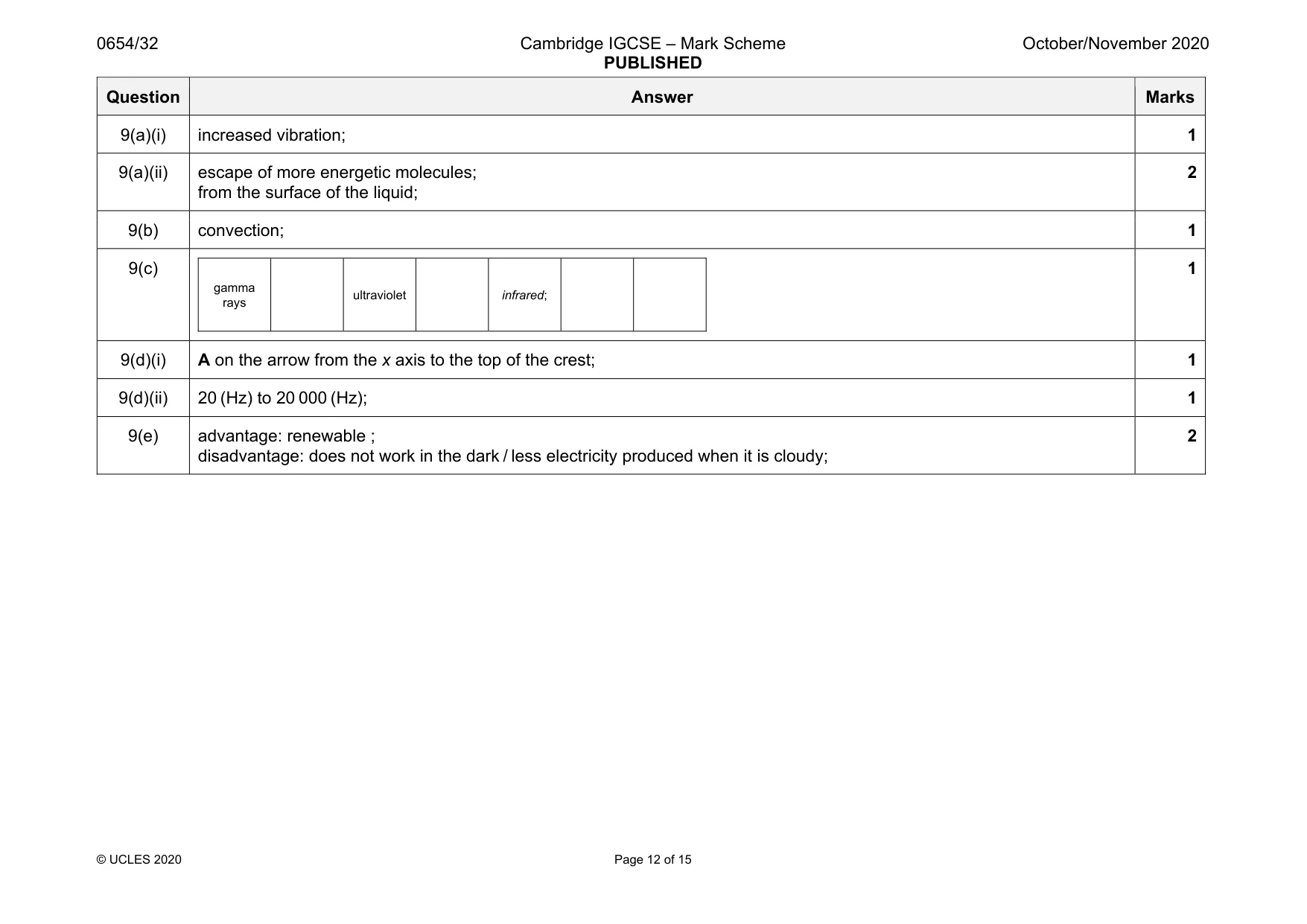
Mark scheme: 9(a)(i) increased vibration; 1 9(a)(ii) escape of more energetic molecules; from the surface of the liquid; 2 9(b) convection; 1 9(c) gamma rays ultraviolet infrared; 1 9(d)(i) A on the arrow from the x axis to the top of the crest; 1 9(d)(ii) 20 (Hz) to 20 000 (Hz); 1 9(e) advantage: renewable ; disadvantage: does not work in the dark / less electricity produced when it is cloudy; 2
Q10 · Adrenaline is released in ‘flight or fight’ situations
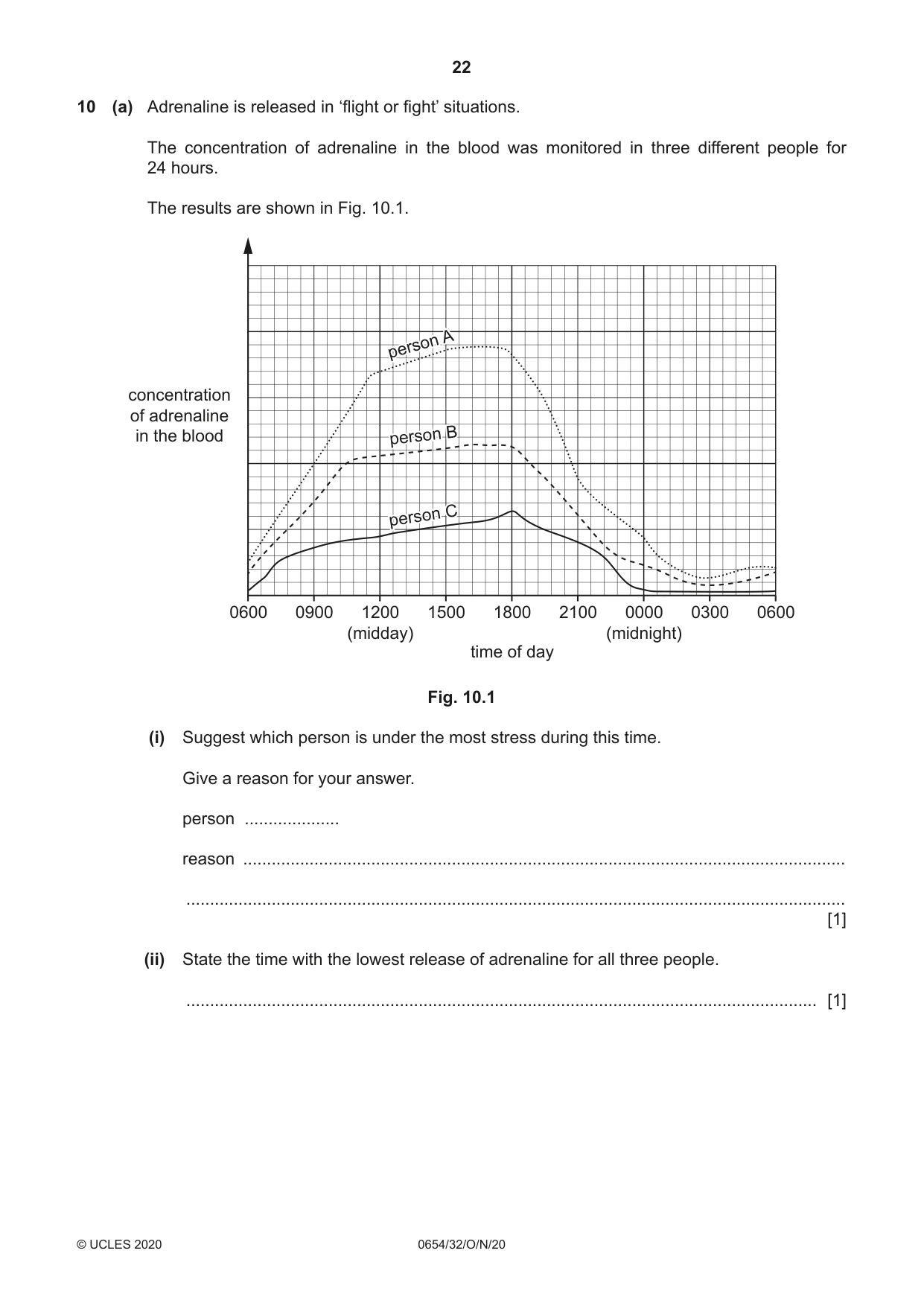
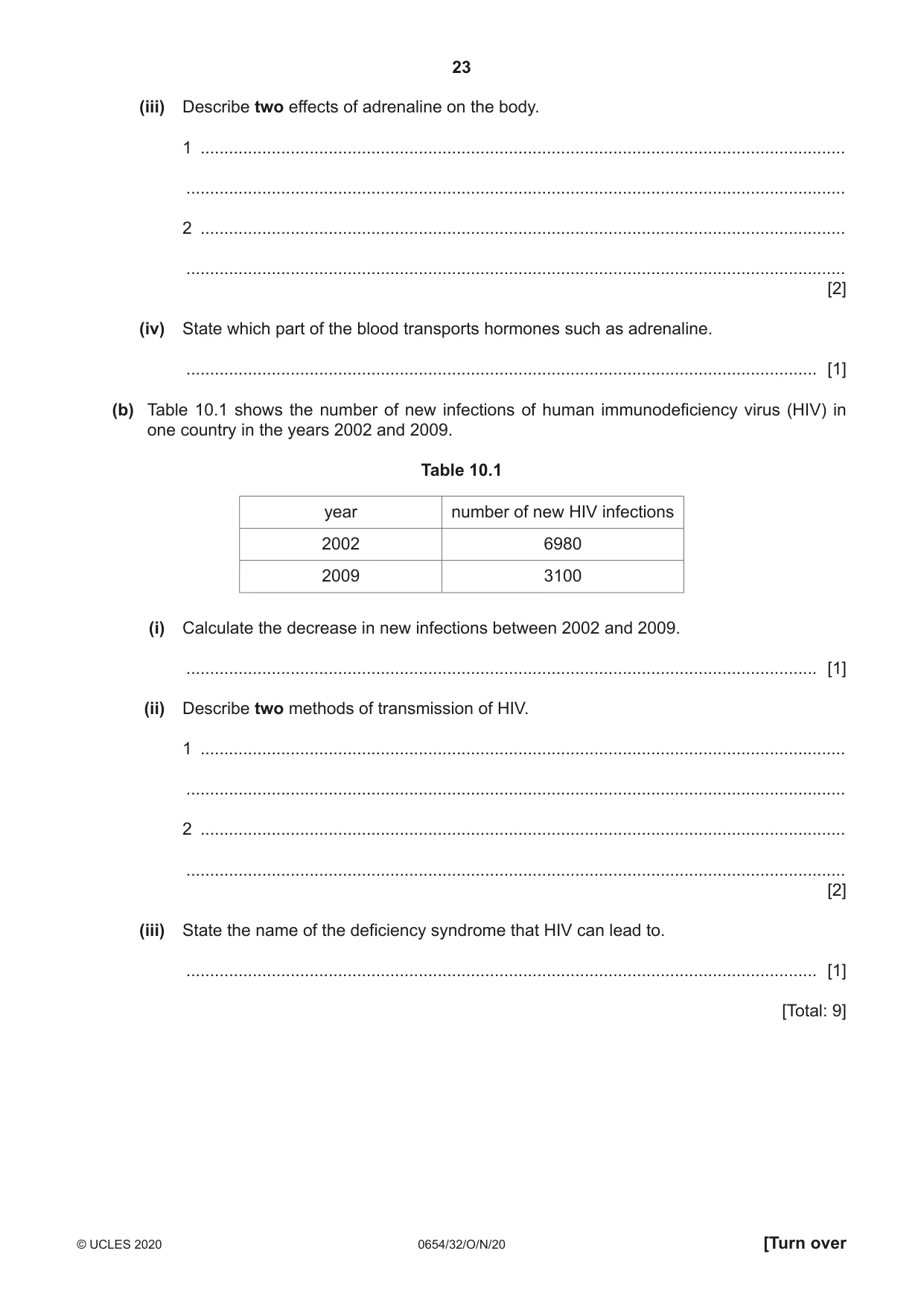
10 (a) Adrenaline is released in ‘flight or fight’ situations. The concentration of adrenaline in the blood was monitored in three different people for 24 hours. The results are shown in Fig. 10.1. personpersonAA concentration of adrenaline in the blood personperson BB personperson CC 0600 0900 1200 1500 1800 2100 0000 0300 0600 (midday) (midnight) time of day Fig. 10.1 (i) Suggest which person is under the most stress during this time. Give a reason for your answer. person .................... reason ............................................................................................................................... ........................................................................................................................................... [1] (ii) State the time with the lowest release of adrenaline for all three people. ..................................................................................................................................... [1] (iii) Describe two effects of adrenaline on the body. 1 ........................................................................................................................................ ........................................................................................................................................... 2 ........................................................................................................................................ ........................................................................................................................................... [2] (iv) State which part of the blood transports hormones such as adrenaline. ..................................................................................................................................... [1] (b) Table 10.1 shows the number of new infections of human immunodeficiency virus (HIV) in one country in the years 2002 and 2009. Table 10.1 year number of new HIV infections 2002 6980 2009 3100 (i) Calculate the decrease in new infections between 2002 and 2009. ..................................................................................................................................... [1] (ii) Describe two methods of transmission of HIV. 1 ........................................................................................................................................ ........................................................................................................................................... 2 ........................................................................................................................................ ........................................................................................................................................... [2] (iii) State the name of the deficiency syndrome that HIV can lead to. ..................................................................................................................................... [1] [Total: 9]
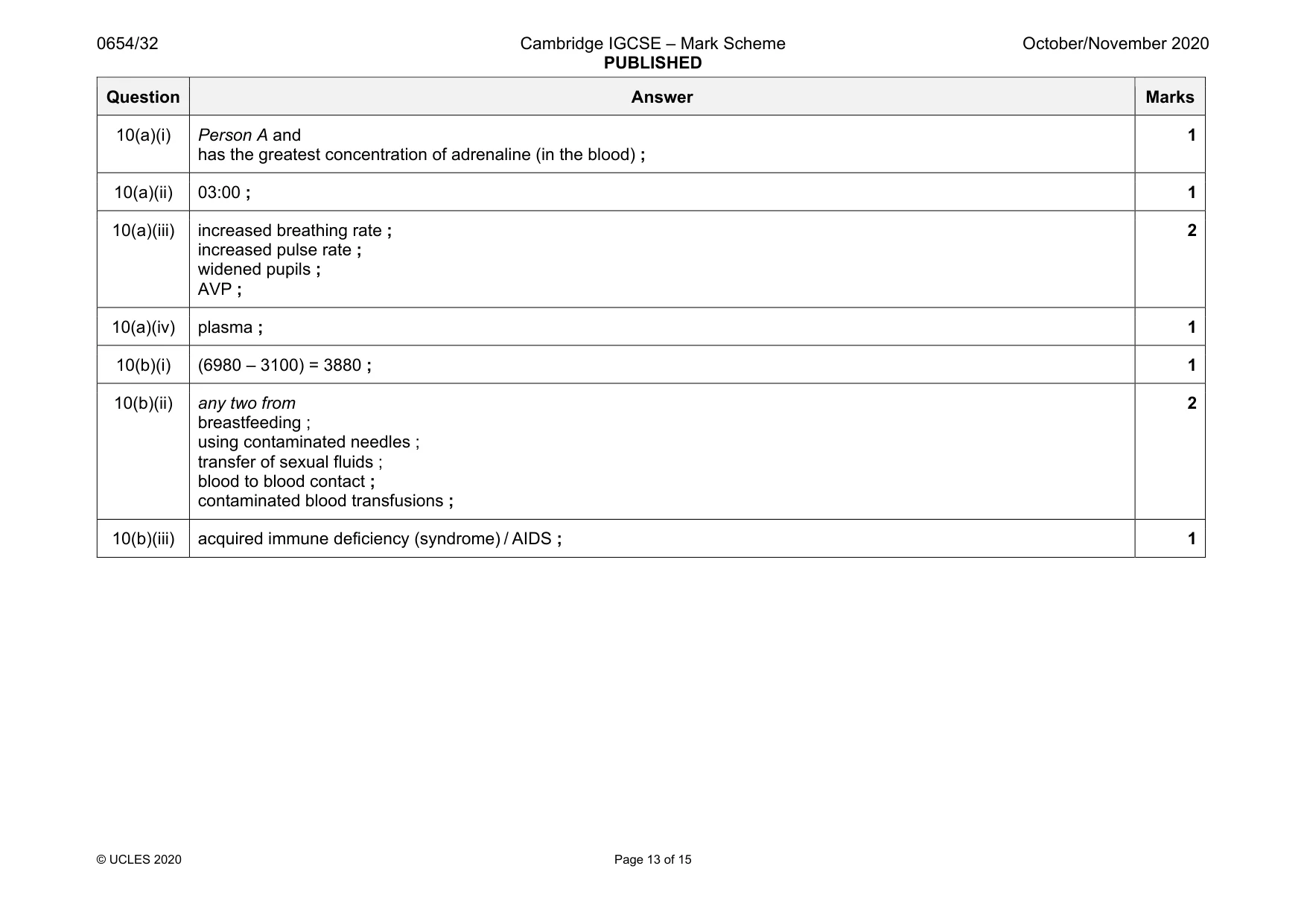
Mark scheme: 10(a)(i) Person A and has the greatest concentration of adrenaline (in the blood) ; 1 10(a)(ii) 03:00 ; 1 10(a)(iii) increased breathing rate ; increased pulse rate ; widened pupils ; AVP ; 2 10(a)(iv) plasma ; 1 10(b)(i) (6980 – 3100) = 3880 ; 1 10(b)(ii) any two from breastfeeding ; using contaminated needles ; transfer of sexual fluids ; blood to blood contact ; contaminated blood transfusions ; 2 10(b)(iii) acquired immune deficiency (syndrome) / AIDS ; 1
Q11 · The molecular structures of four carbon compounds, A, B, C and D
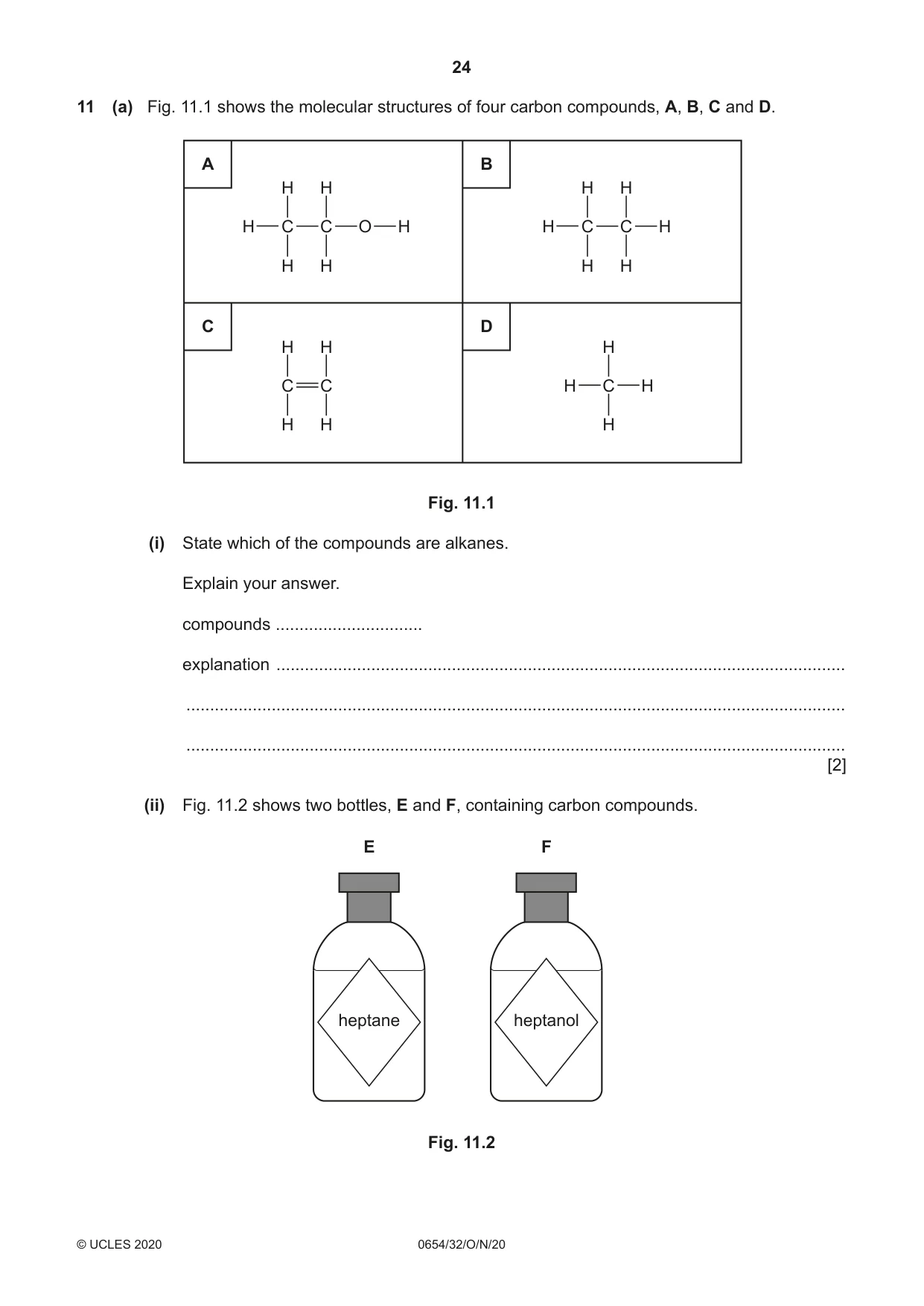
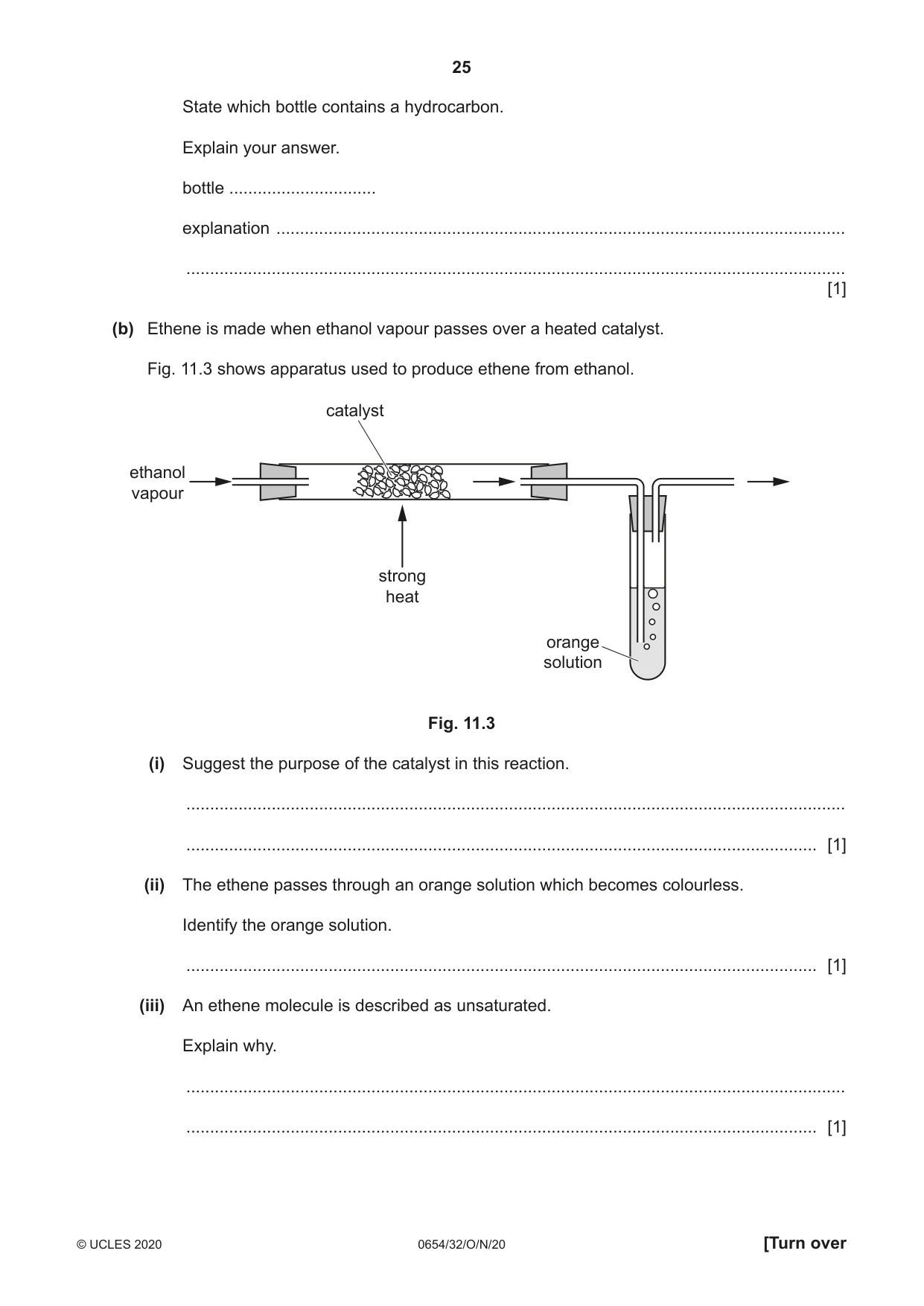
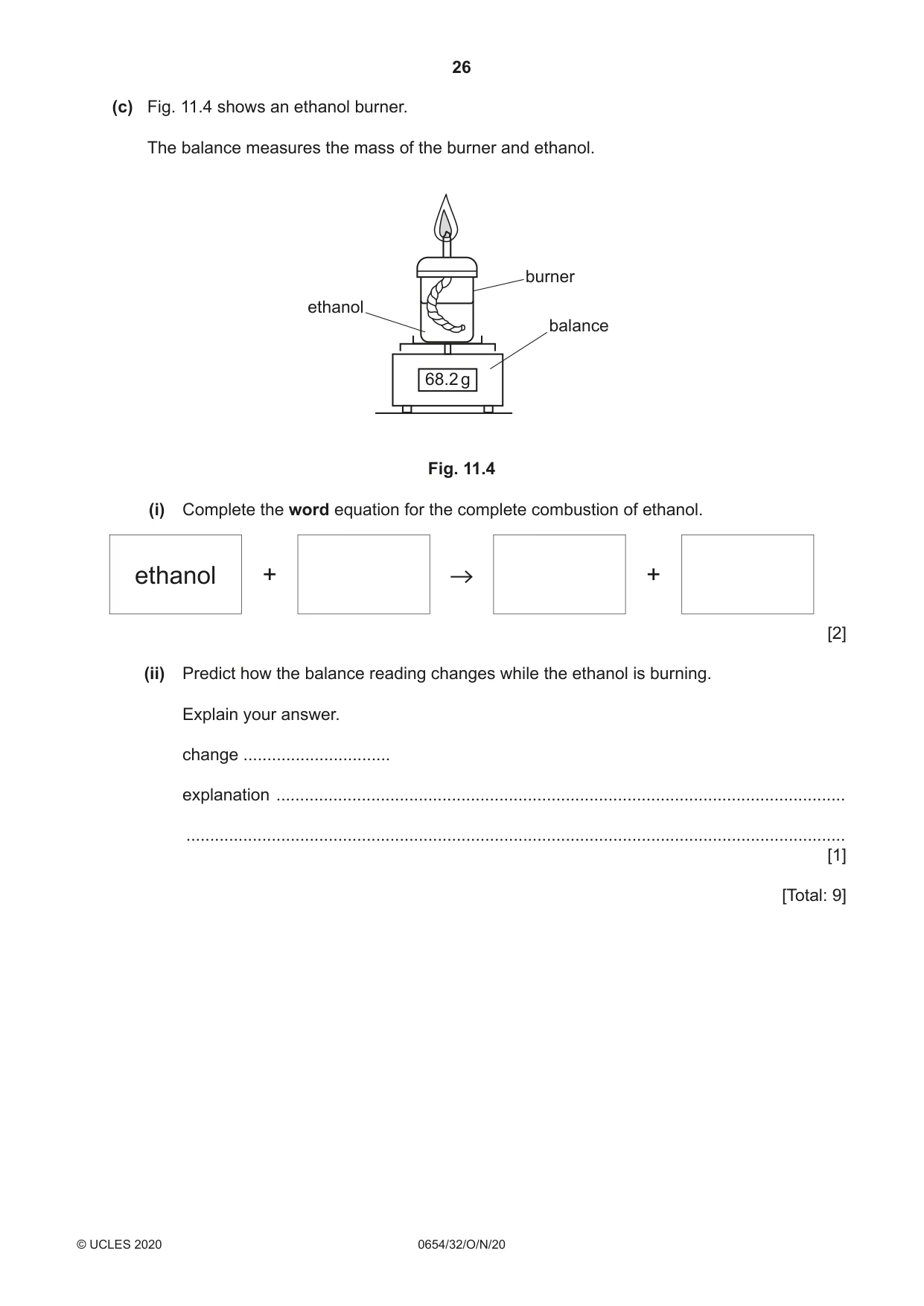
11 (a) Fig. 11.1 shows the molecular structures of four carbon compounds, A, B, C and D. A B H H H H H C C O H H C C H H H H H C D H H H C C H C H H H H Fig. 11.1 (i) State which of the compounds are alkanes. Explain your answer. compounds ............................... explanation ........................................................................................................................ ........................................................................................................................................... ........................................................................................................................................... [2] (ii) Fig. 11.2 shows two bottles, E and F, containing carbon compounds. E F heptane heptanol Fig. 11.2 State which bottle contains a hydrocarbon. Explain your answer. bottle ............................... explanation ........................................................................................................................ ........................................................................................................................................... [1] (b) Ethene is made when ethanol vapour passes over a heated catalyst. Fig. 11.3 shows apparatus used to produce ethene from ethanol. catalyst ethanol vapour strong heat orange solution Fig. 11.3 (i) Suggest the purpose of the catalyst in this reaction. ........................................................................................................................................... ..................................................................................................................................... [1] (ii) The ethene passes through an orange solution which becomes colourless. Identify the orange solution. ..................................................................................................................................... [1] (iii) An ethene molecule is described as unsaturated. Explain why. ........................................................................................................................................... ..................................................................................................................................... [1] (c) Fig. 11.4 shows an ethanol burner. The balance measures the mass of the burner and ethanol. burner ethanol balance 68.2 g Fig. 11.4 (i) Complete the word equation for the complete combustion of ethanol. ethanol + + [2] (ii) Predict how the balance reading changes while the ethanol is burning. Explain your answer. change ............................... explanation ........................................................................................................................ ........................................................................................................................................... [1] [Total: 9]
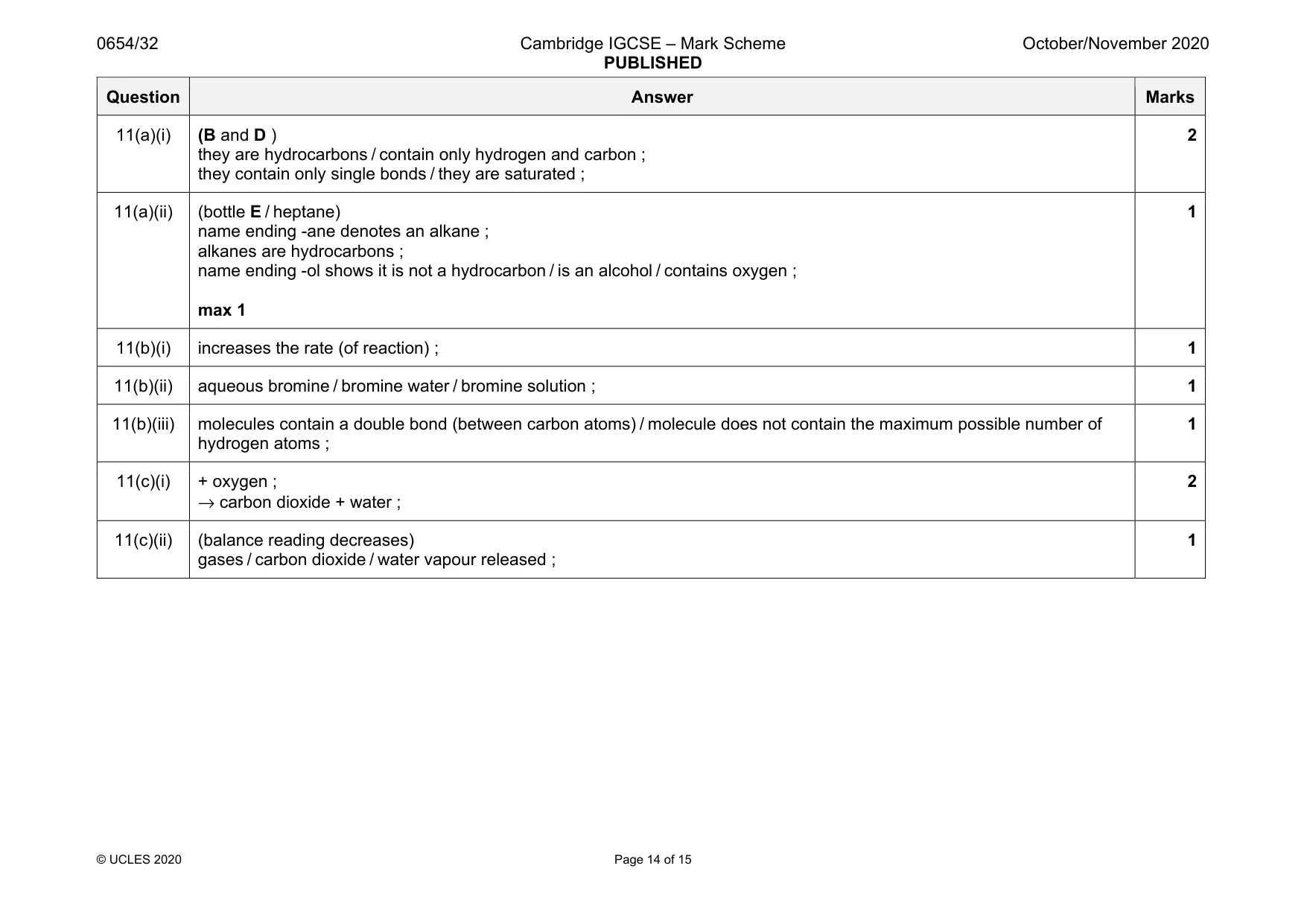
Mark scheme: 11(a)(i) (B and D ) they are hydrocarbons / contain only hydrogen and carbon ; they contain only single bonds / they are saturated ; 2 11(a)(ii) (bottle E / heptane) name ending -ane denotes an alkane ; alkanes are hydrocarbons ; name ending -ol shows it is not a hydrocarbon / is an alcohol / contains oxygen ; max 1 1 11(b)(i) increases the rate (of reaction) ; 1 11(b)(ii) aqueous bromine / bromine water / bromine solution ; 1 11(b)(iii) molecules contain a double bond (between carbon atoms) / molecule does not contain the maximum possible number of hydrogen atoms ; 1 11(c)(i) + oxygen ; → carbon dioxide + water ; 2 11(c)(ii) (balance reading decreases) gases / carbon dioxide / water vapour released ; 1
Q12 · A block of glass with a ray of light passing through it
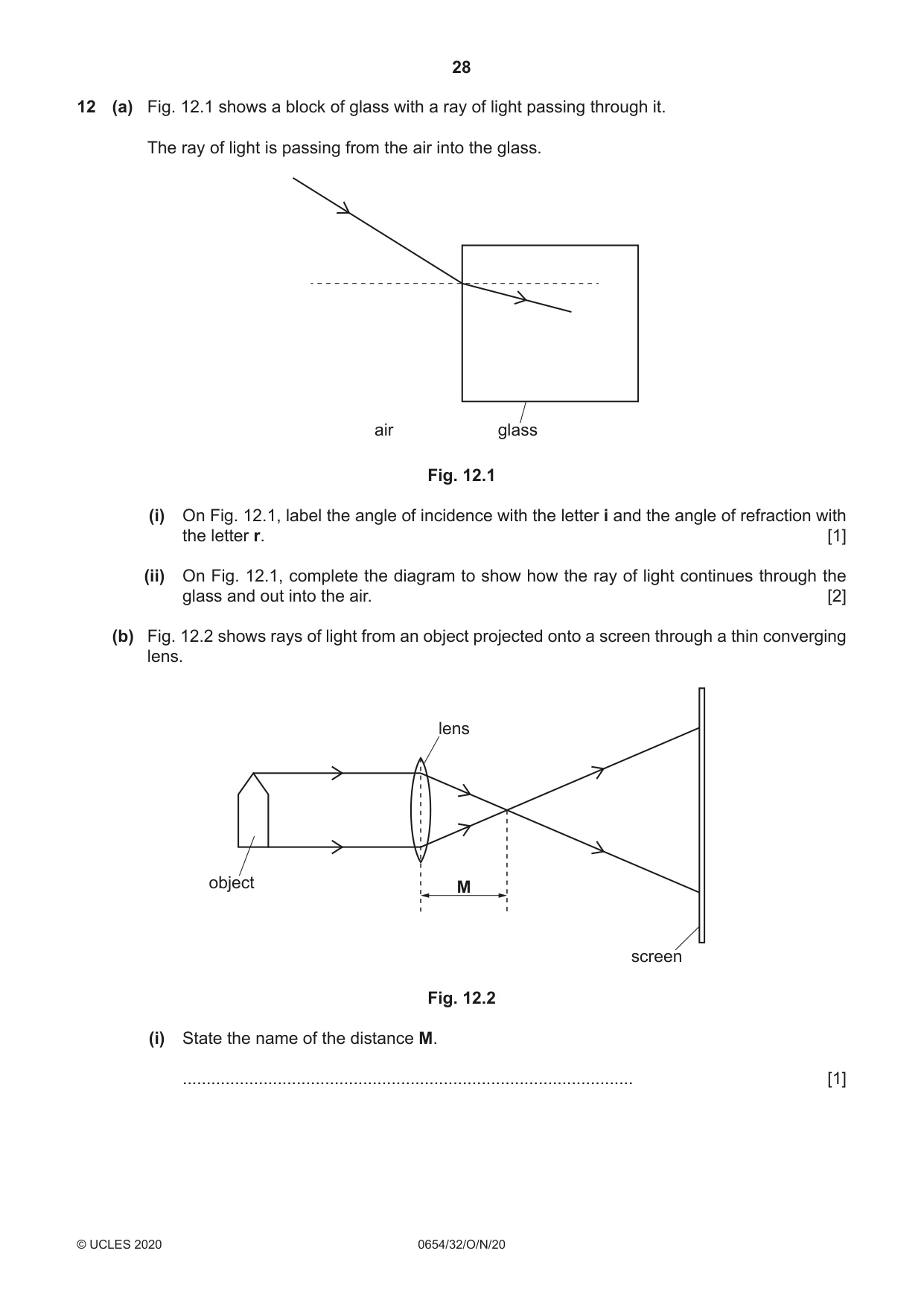
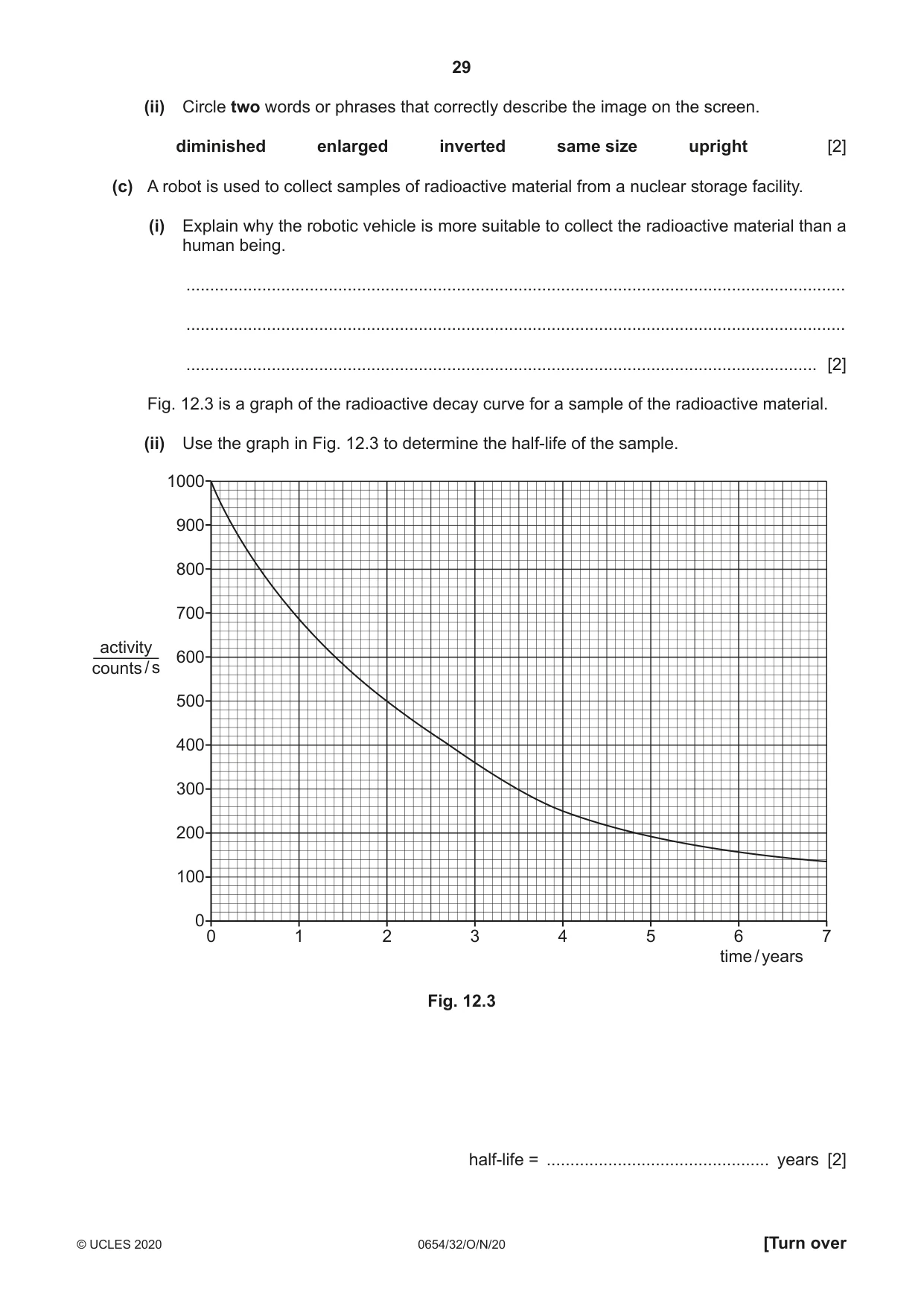
12 (a) Fig. 12.1 shows a block of glass with a ray of light passing through it. The ray of light is passing from the air into the glass. air glass Fig. 12.1 (i) On Fig. 12.1, label the angle of incidence with the letter i and the angle of refraction with the letter r. [1] (ii) On Fig. 12.1, complete the diagram to show how the ray of light continues through the glass and out into the air. [2] (b) Fig. 12.2 shows rays of light from an object projected onto a screen through a thin converging lens. lens object M screen Fig. 12.2 (i) State the name of the distance M. ............................................................................................... [1] (ii) Circle two words or phrases that correctly describe the image on the screen. diminished enlarged inverted same size upright [2] (c) A robot is used to collect samples of radioactive material from a nuclear storage facility. (i) Explain why the robotic vehicle is more suitable to collect the radioactive material than a human being. ........................................................................................................................................... ........................................................................................................................................... ..................................................................................................................................... [2] Fig. 12.3 is a graph of the radioactive decay curve for a sample of the radioactive material. (ii) Use the graph in Fig. 12.3 to determine the half-life of the sample. 1000 900 800 700 activity 600counts / s 500 400 300 200 100 0 0 1 2 3 4 5 6 7 time / years Fig. 12.3 half-life = ............................................... years [2] (d) The robot has a d.c. motor. State two ways in which the turning effect of the current-carrying coil in the magnetic field of a d.c. motor can be increased. 1 ................................................................................................................................................ 2 ................................................................................................................................................ [2] [Total: 12]
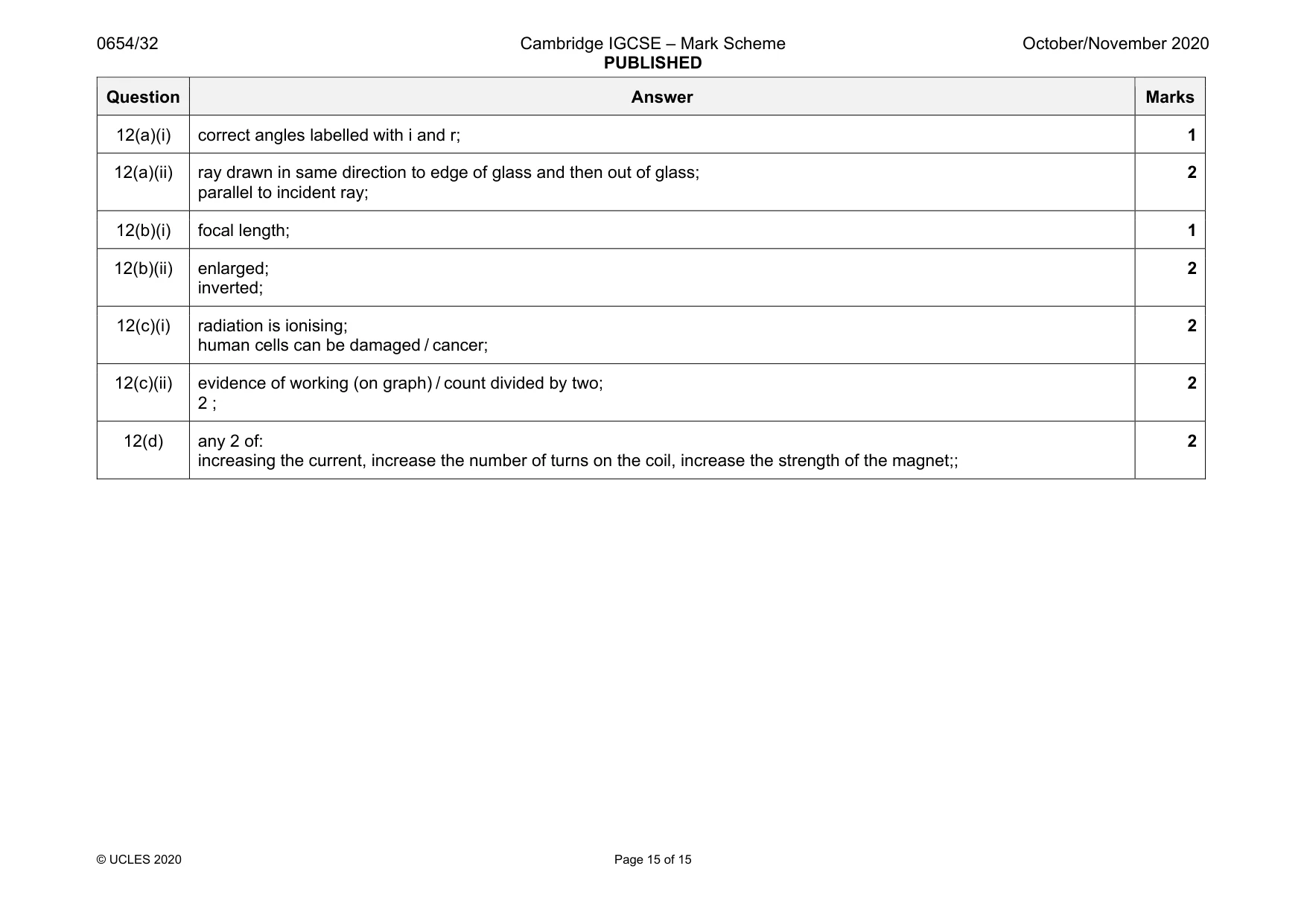
Mark scheme: 12(a)(i) correct angles labelled with i and r; 1 12(a)(ii) ray drawn in same direction to edge of glass and then out of glass; parallel to incident ray; 2 12(b)(i) focal length; 1 12(b)(ii) enlarged; inverted; 2 12(c)(i) radiation is ionising; human cells can be damaged / cancer; 2 12(c)(ii) evidence of working (on graph) / count divided by two; 2 ; 2 12(d) any 2 of: increasing the current, increase the number of turns on the coil, increase the strength of the magnet;; 2
What was in this paper
The subtopics covered by these 12 questions, and how many questions each got. Open one in a new tab to see every Cambridge question on it.
What you needed in this session
Cambridge’s own grade thresholds for 2020 Oct/Nov, Paper 3 · Variant 2. A higher threshold means an easier paper — the bar moves with how the cohort did.