Cambridge IGCSE Sciences - Co-ordinated (Double) 0654 — 2020 Oct/Nov Paper 3 · Variant 3
0654/33/O/N/20 · 12 questions · 120 marks · ≈135 min
The question paper and its mark scheme, free to read here and free to download. This is Cambridge’s own paper, exactly as it was sat.
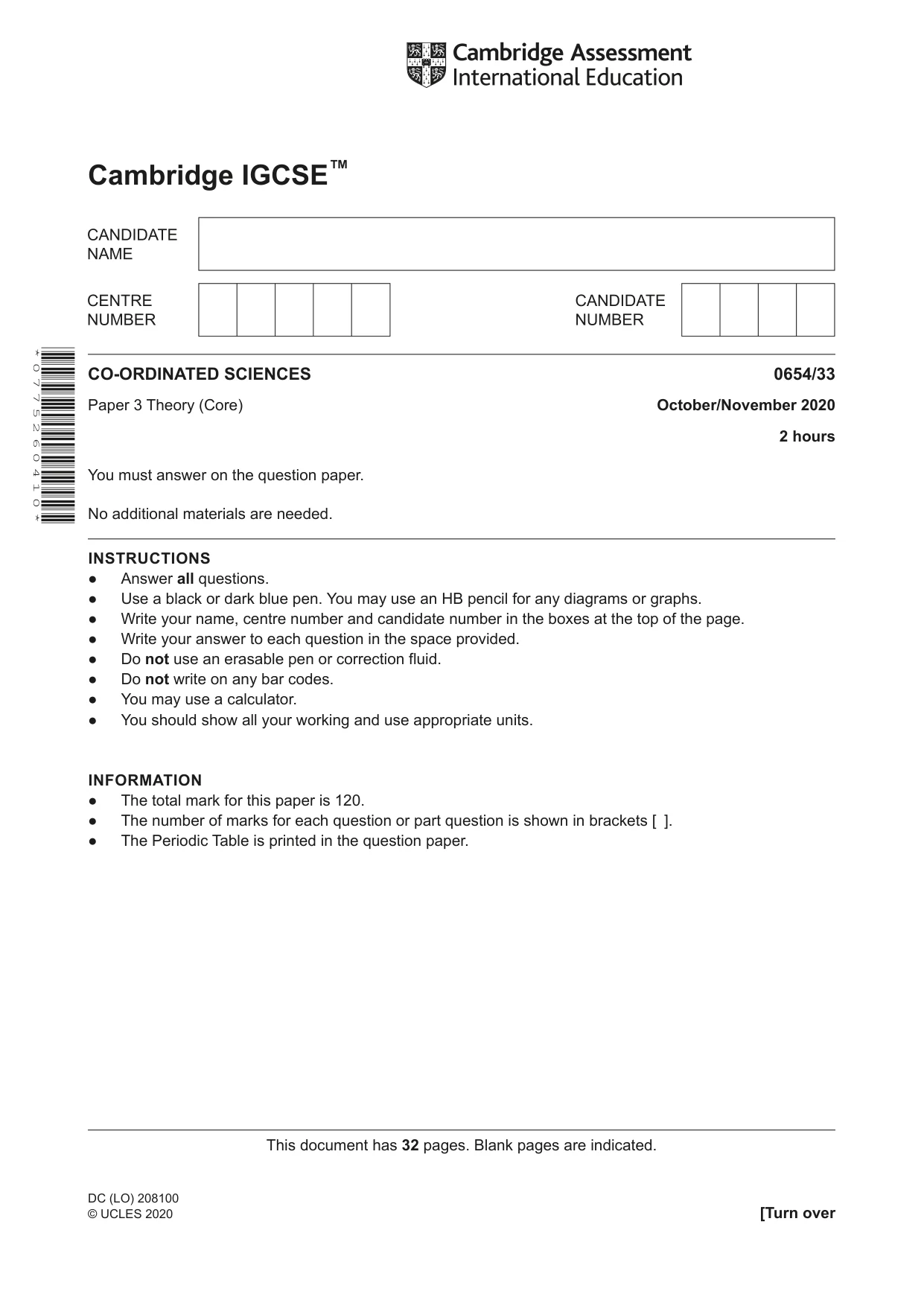
Question paper32 pages



Mark scheme11 pages
Answers below. Sit the paper first if you are practising.
Questions as text
Q1 · A diagram of the alimentary canal and associated organs
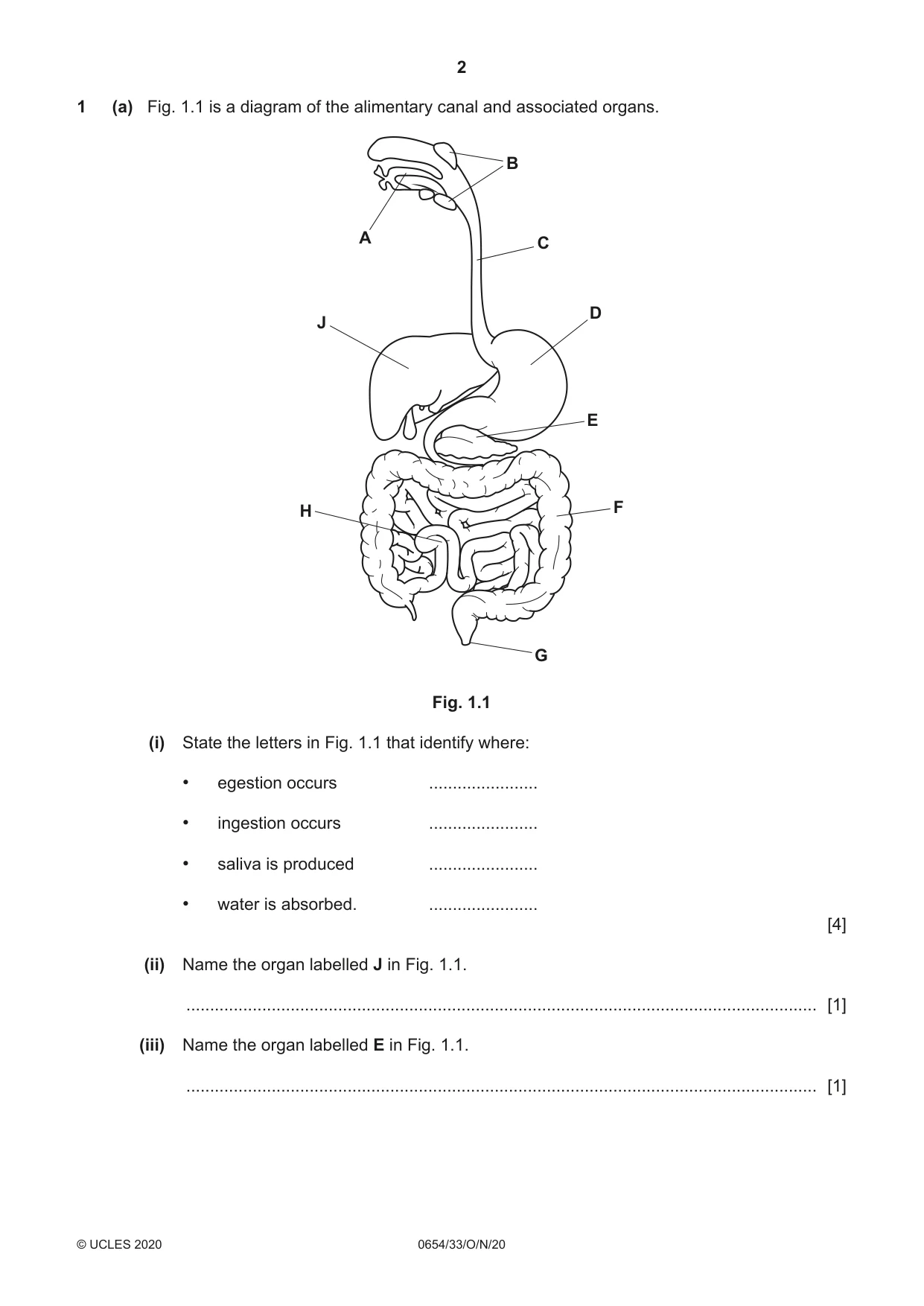
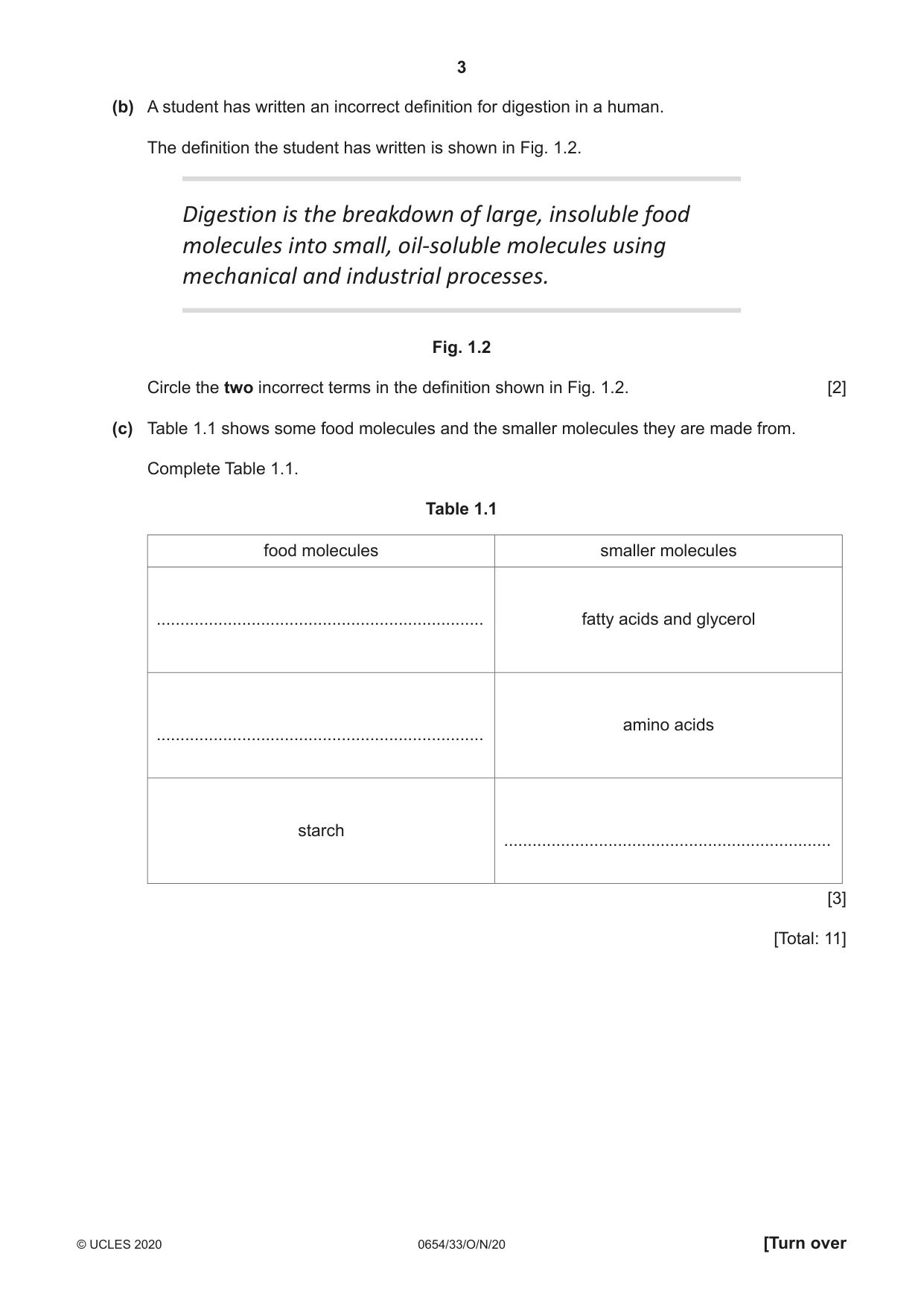
1 (a) Fig. 1.1 is a diagram of the alimentary canal and associated organs. B A C D J E H F G Fig. 1.1 (i) State the letters in Fig. 1.1 that identify where: • egestion occurs ....................... • ingestion occurs ....................... • saliva is produced ....................... • water is absorbed. ....................... [4] (ii) Name the organ labelled J in Fig. 1.1. ..................................................................................................................................... [1] (iii) Name the organ labelled E in Fig. 1.1. ..................................................................................................................................... [1] (b) A student has written an incorrect definition for digestion in a human. The definition the student has written is shown in Fig. 1.2. Digestion is the breakdown of large, insoluble food molecules into small, oil‑soluble molecules using mechanical and industrial processes. Fig. 1.2 Circle the two incorrect terms in the definition shown in Fig. 1.2. [2] (c) Table 1.1 shows some food molecules and the smaller molecules they are made from. Complete Table 1.1. Table 1.1 food molecules smaller molecules ..................................................................... fatty acids and glycerol amino acids ..................................................................... starch ..................................................................... [3] [Total: 11]
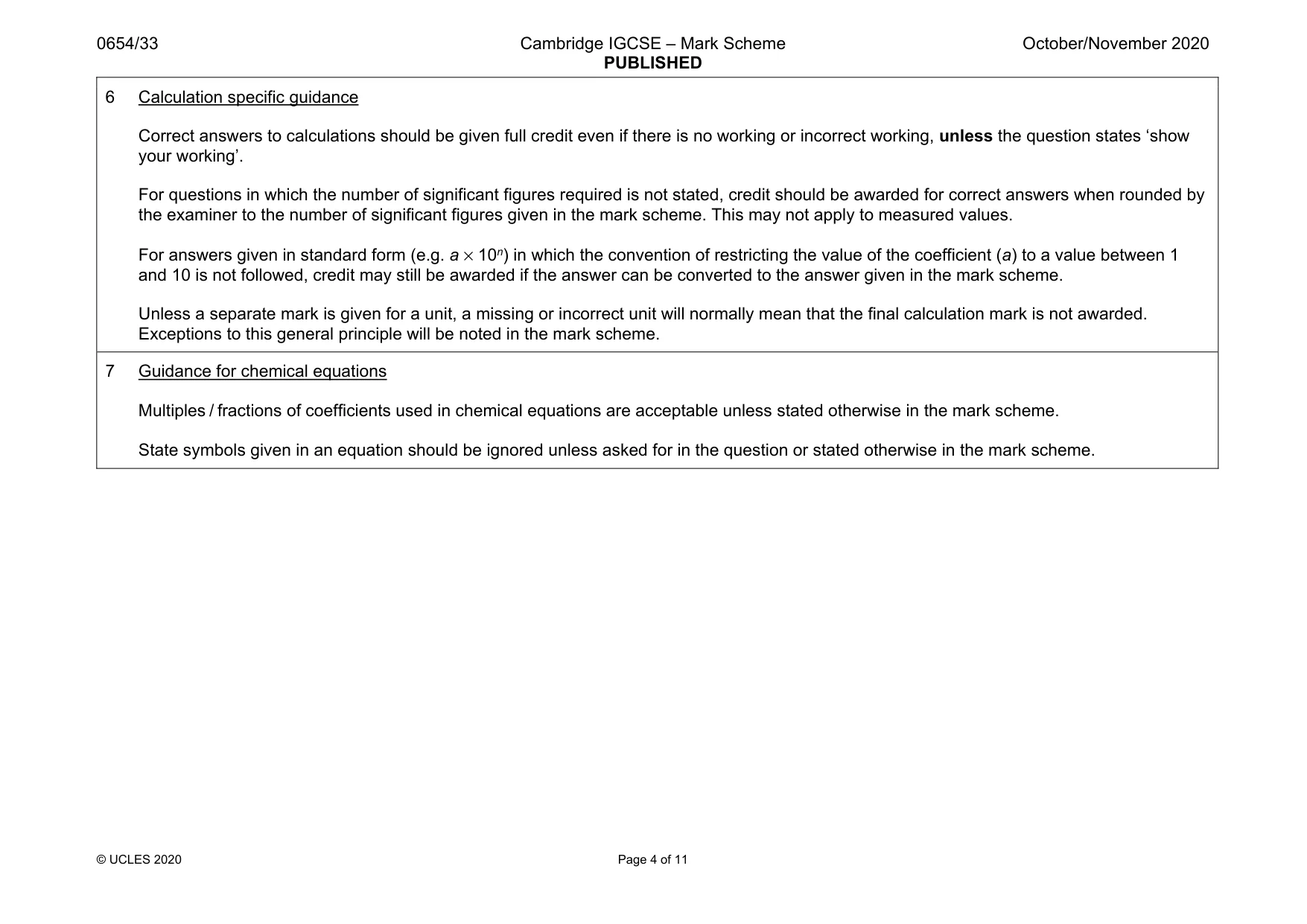
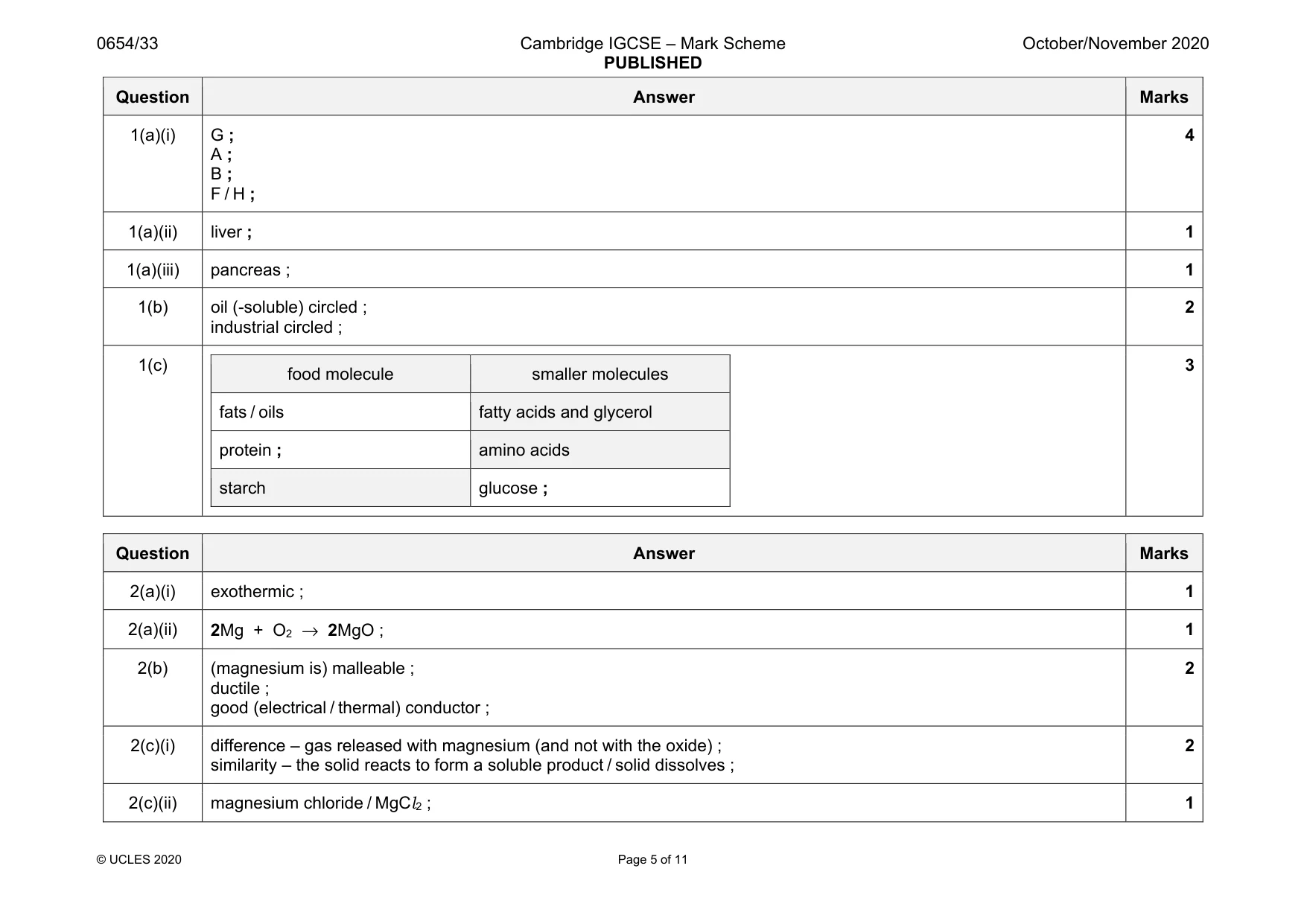
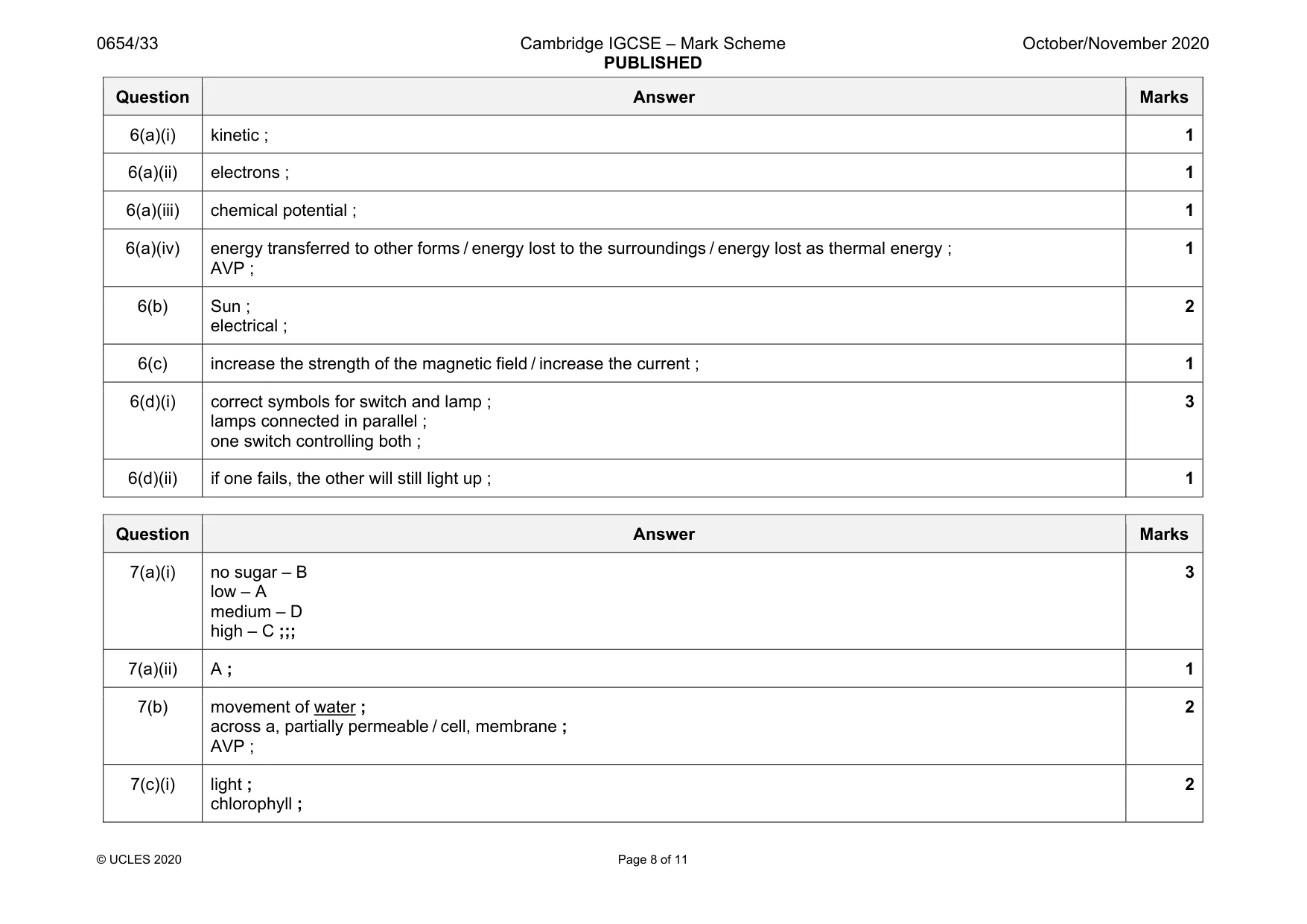
Mark scheme: 1(a)(i) G ; A ; B ; F / H ; 4 1(a)(ii) liver ; 1 1(a)(iii) pancreas ; 1 1(b) oil (-soluble) circled ; industrial circled ; 2 1(c) food molecule smaller molecules fats / oils fatty acids and glycerol protein ; amino acids starch glucose ; 3
Q2 · Metal oxides are formed when metals and oxygen react
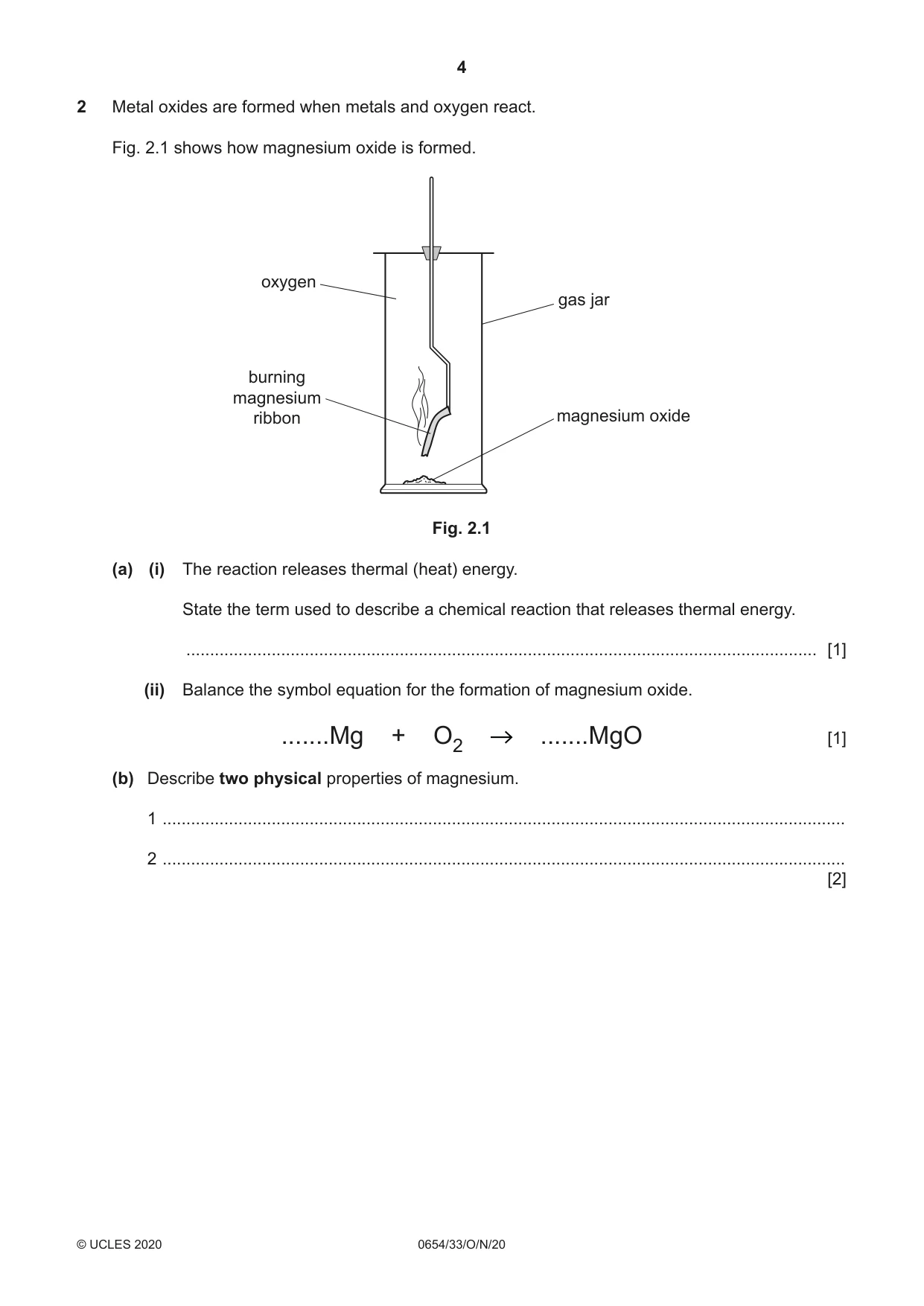
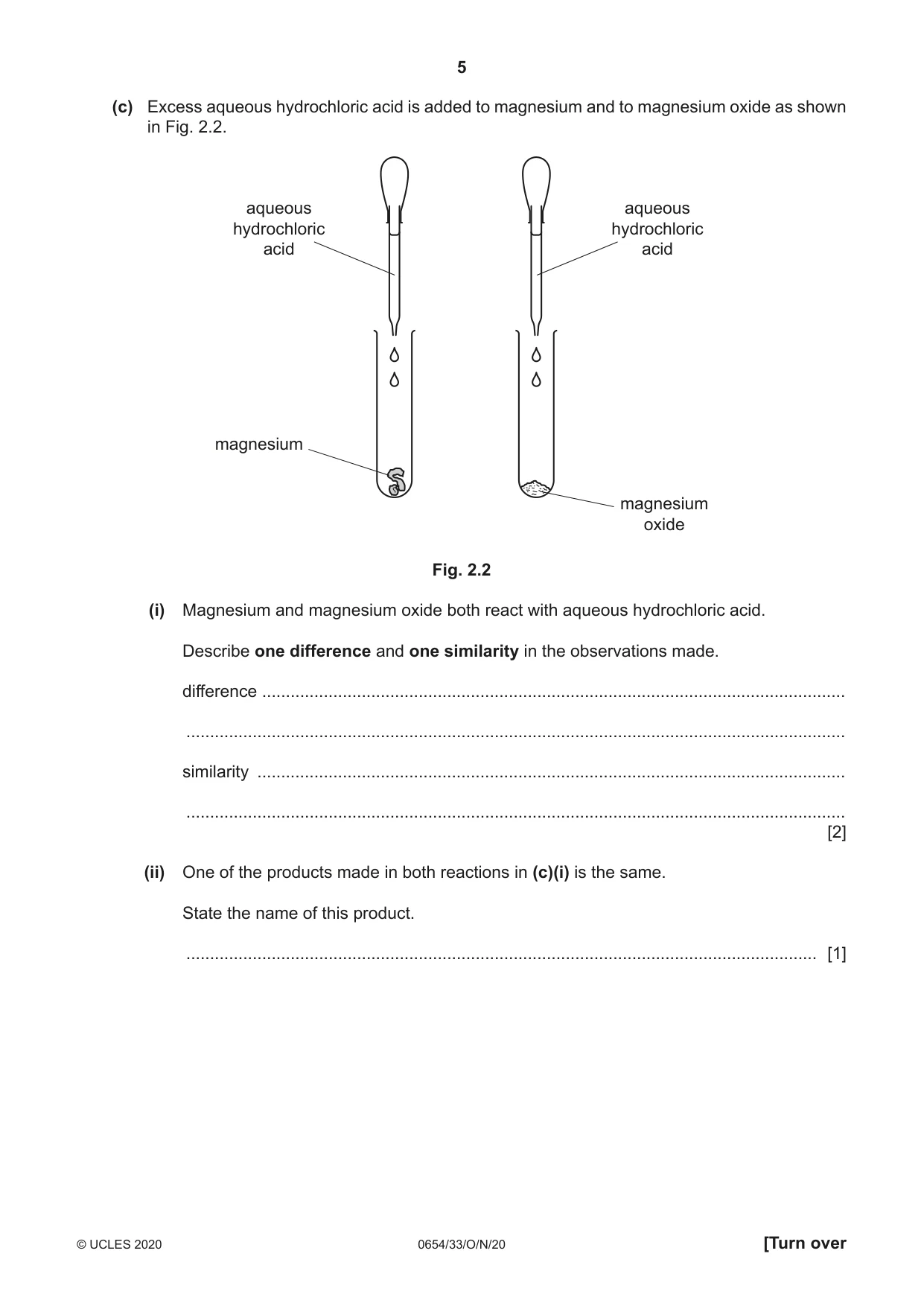
2 Metal oxides are formed when metals and oxygen react. Fig. 2.1 shows how magnesium oxide is formed. oxygen gas jar burning magnesium ribbon magnesium oxide Fig. 2.1 (a) (i) The reaction releases thermal (heat) energy. State the term used to describe a chemical reaction that releases thermal energy. ..................................................................................................................................... [1] (ii) Balance the symbol equation for the formation of magnesium oxide. [1] .......Mg + O2 .......MgO (b) Describe two physical properties of magnesium. 1 ................................................................................................................................................ 2 ................................................................................................................................................ [2] (c) Excess aqueous hydrochloric acid is added to magnesium and to magnesium oxide as shown in Fig. 2.2. aqueous aqueous hydrochloric hydrochloric acid acid magnesium magnesium oxide Fig. 2.2 (i) Magnesium and magnesium oxide both react with aqueous hydrochloric acid. Describe one difference and one similarity in the observations made. difference ........................................................................................................................... ........................................................................................................................................... similarity ............................................................................................................................ ........................................................................................................................................... [2] (ii) One of the products made in both reactions in (c)(i) is the same. State the name of this product. ..................................................................................................................................... [1] (d) Aqueous hydrochloric acid is added to copper and to copper(II) oxide. There is no reaction between the hydrochloric acid and copper. Copper(II) oxide reacts and dissolves in the acid. (i) Explain why there is no reaction between copper and dilute acid. Use ideas about the relative positions of elements in the reactivity series. ........................................................................................................................................... ..................................................................................................................................... [1] (ii) Predict whether the solution formed when copper(II) oxide reacts with the acid is coloured or is colourless. Explain your answer. ........................................................................................................................................... ..................................................................................................................................... [1] (e) Rust is formed when iron reacts with oxygen and another substance. (i) State the name of the other substance that must be present for iron to rust. ..................................................................................................................................... [1] (ii) Barrier methods are used to prevent rusting. Name one substance used in the barrier method of rust prevention. ..................................................................................................................................... [1] (iii) State one way, other than forming a barrier, that prevents iron from rusting. ........................................................................................................................................... ..................................................................................................................................... [1] [Total: 12]
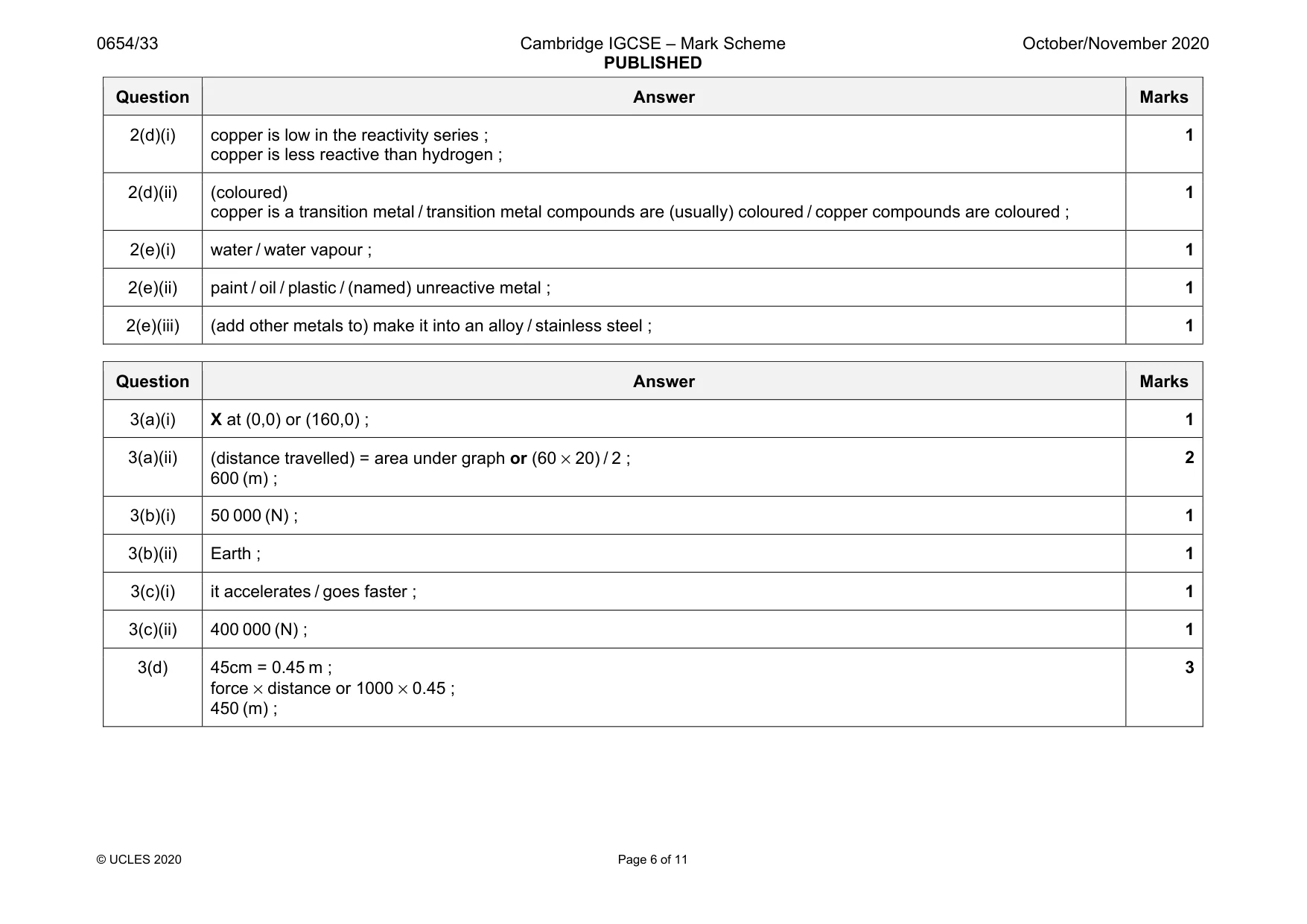
Mark scheme: 2(a)(i) exothermic ; 1 2(a)(ii) 2Mg + O2 → 2MgO ; 1 2(b) (magnesium is) malleable ; ductile ; good (electrical / thermal) conductor ; 2 2(c)(i) difference – gas released with magnesium (and not with the oxide) ; similarity – the solid reacts to form a soluble product / solid dissolves ; 2 2(c)(ii) magnesium chloride / MgCl2 ; 1 Question Answer Marks 2(d)(i) copper is low in the reactivity series ; copper is less reactive than hydrogen ; 1 2(d)(ii) (coloured) copper is a transition metal / transition metal compounds are (usually) coloured / copper compounds are coloured ; 1 2(e)(i) water / water vapour ; 1 2(e)(ii) paint / oil / plastic / (named) unreactive metal ; 1 2(e)(iii) (add other metals to) make it into an alloy / stainless steel ; 1
Q3 · A speed–time graph for a bus journey
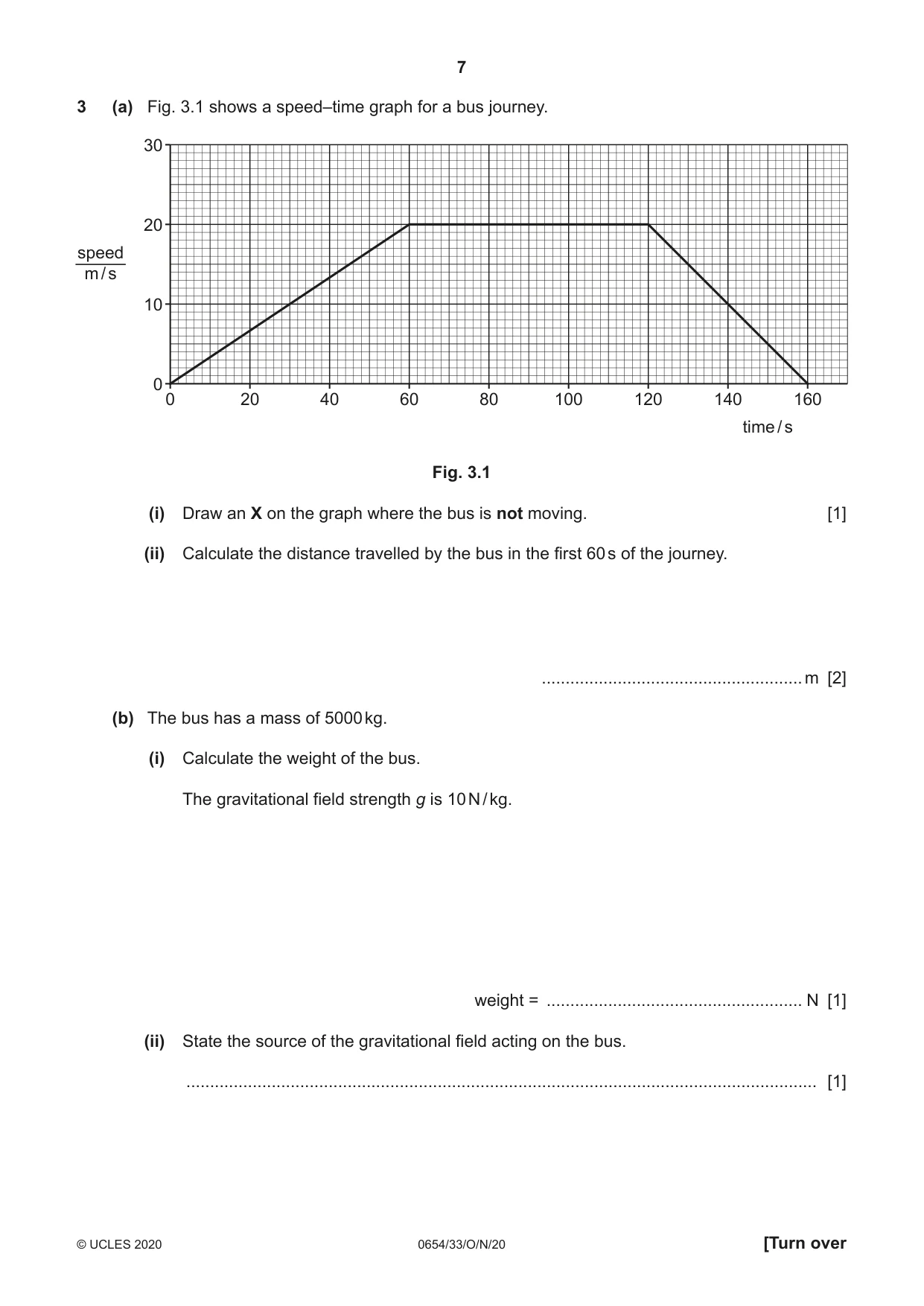
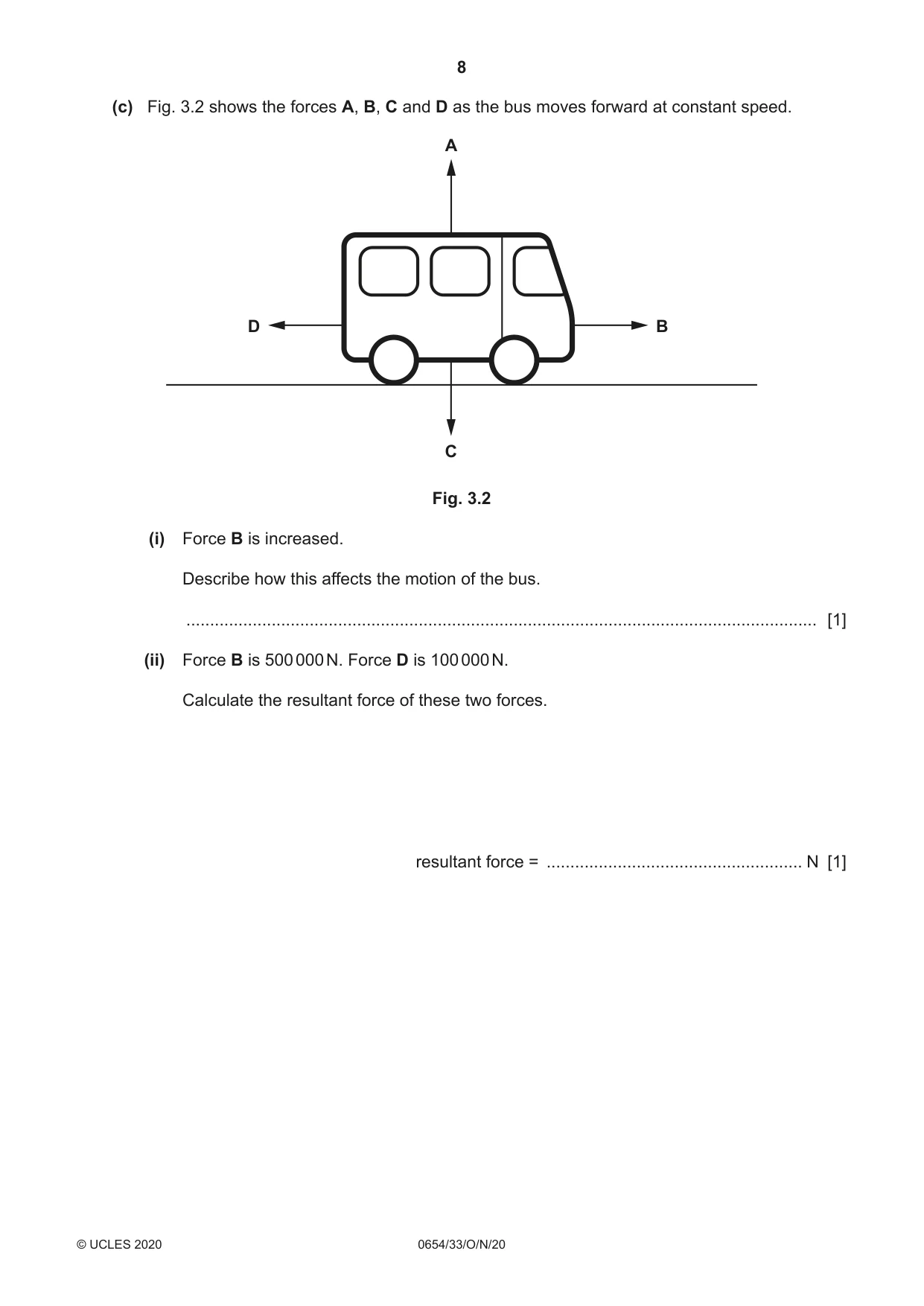
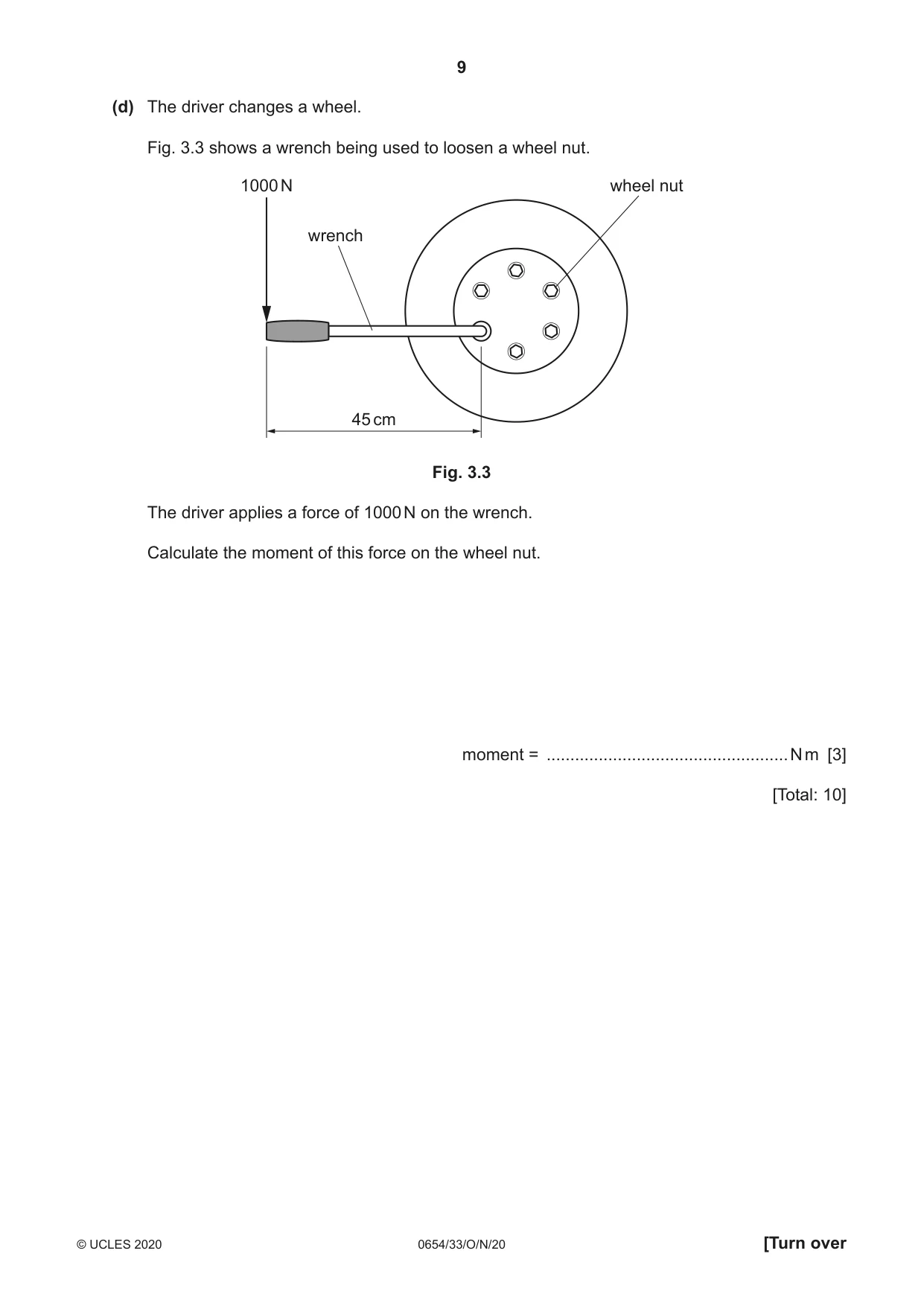
3 (a) Fig. 3.1 shows a speed–time graph for a bus journey. 30 20 speed m / s 10 0 0 20 40 60 80 100 120 140 160 time / s Fig. 3.1 (i) Draw an X on the graph where the bus is not moving. [1] (ii) Calculate the distance travelled by the bus in the first 60 s of the journey. ....................................................... m [2] (b) The bus has a mass of 5000 kg. (i) Calculate the weight of the bus. The gravitational field strength g is 10 N / kg. weight = ...................................................... N [1] (ii) State the source of the gravitational field acting on the bus. ..................................................................................................................................... [1] (c) Fig. 3.2 shows the forces A, B, C and D as the bus moves forward at constant speed. A D B C Fig. 3.2 (i) Force B is increased. Describe how this affects the motion of the bus. ..................................................................................................................................... [1] (ii) Force B is 500 000 N. Force D is 100 000 N. Calculate the resultant force of these two forces. resultant force = ...................................................... N [1] (d) The driver changes a wheel. Fig. 3.3 shows a wrench being used to loosen a wheel nut. 1000 N wheel nut wrench 45 cm Fig. 3.3 The driver applies a force of 1000 N on the wrench. Calculate the moment of this force on the wheel nut. moment = ................................................... N m [3] [Total: 10]
Mark scheme: 3(a)(i) X at (0,0) or (160,0) ; 1 3(a)(ii) (distance travelled) = area under graph or (60 × 20) / 2 ; 600 (m) ; 2 3(b)(i) 50 000 (N) ; 1 3(b)(ii) Earth ; 1 3(c)(i) it accelerates / goes faster ; 1 3(c)(ii) 400 000 (N) ; 1 3(d) 45cm = 0.45 m ; force × distance or 1000 × 0.45 ; 450 (m) ; 3
Q4 · A scientist investigates the recovery time of an athlete and a non‑athlete after exercise
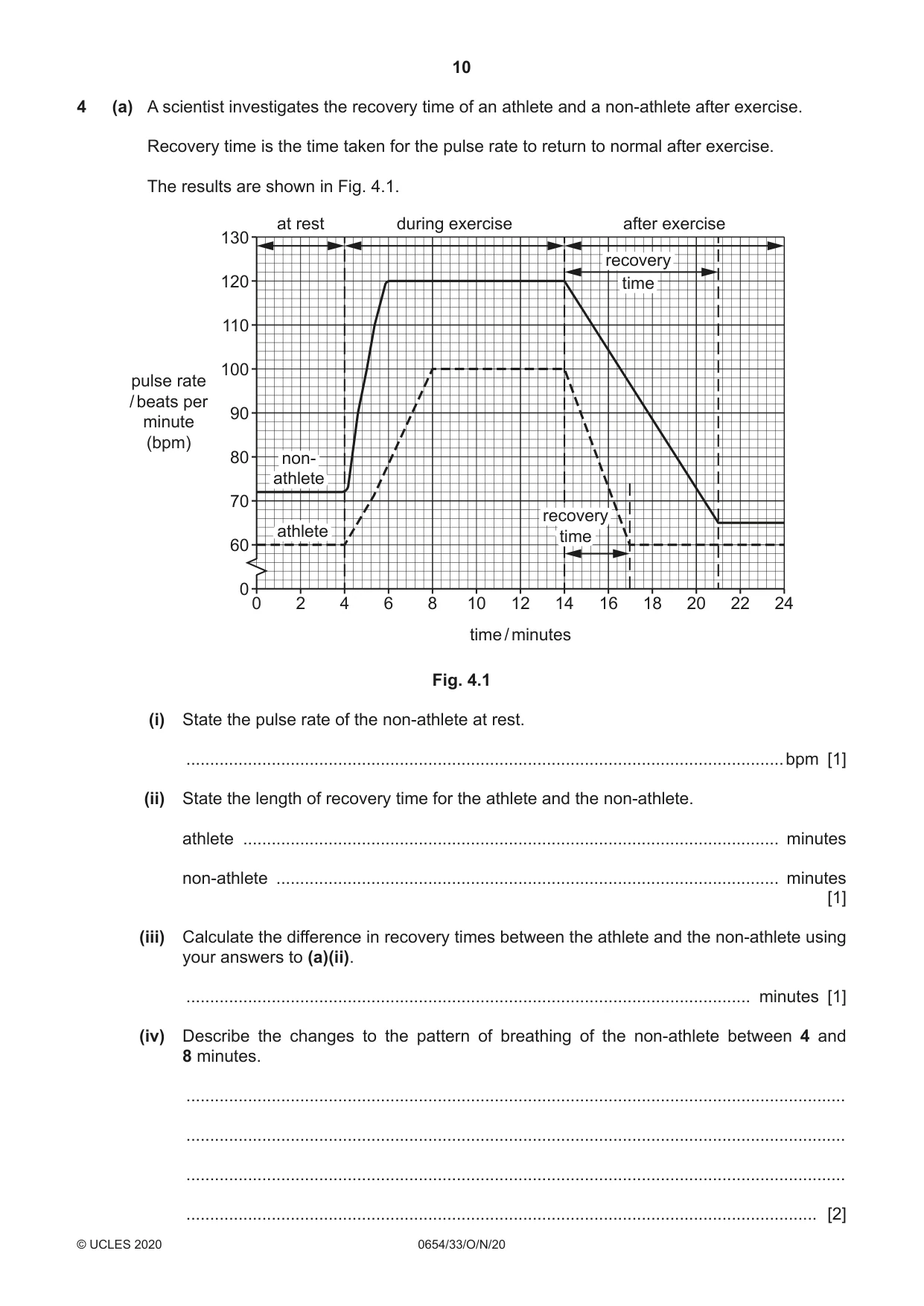
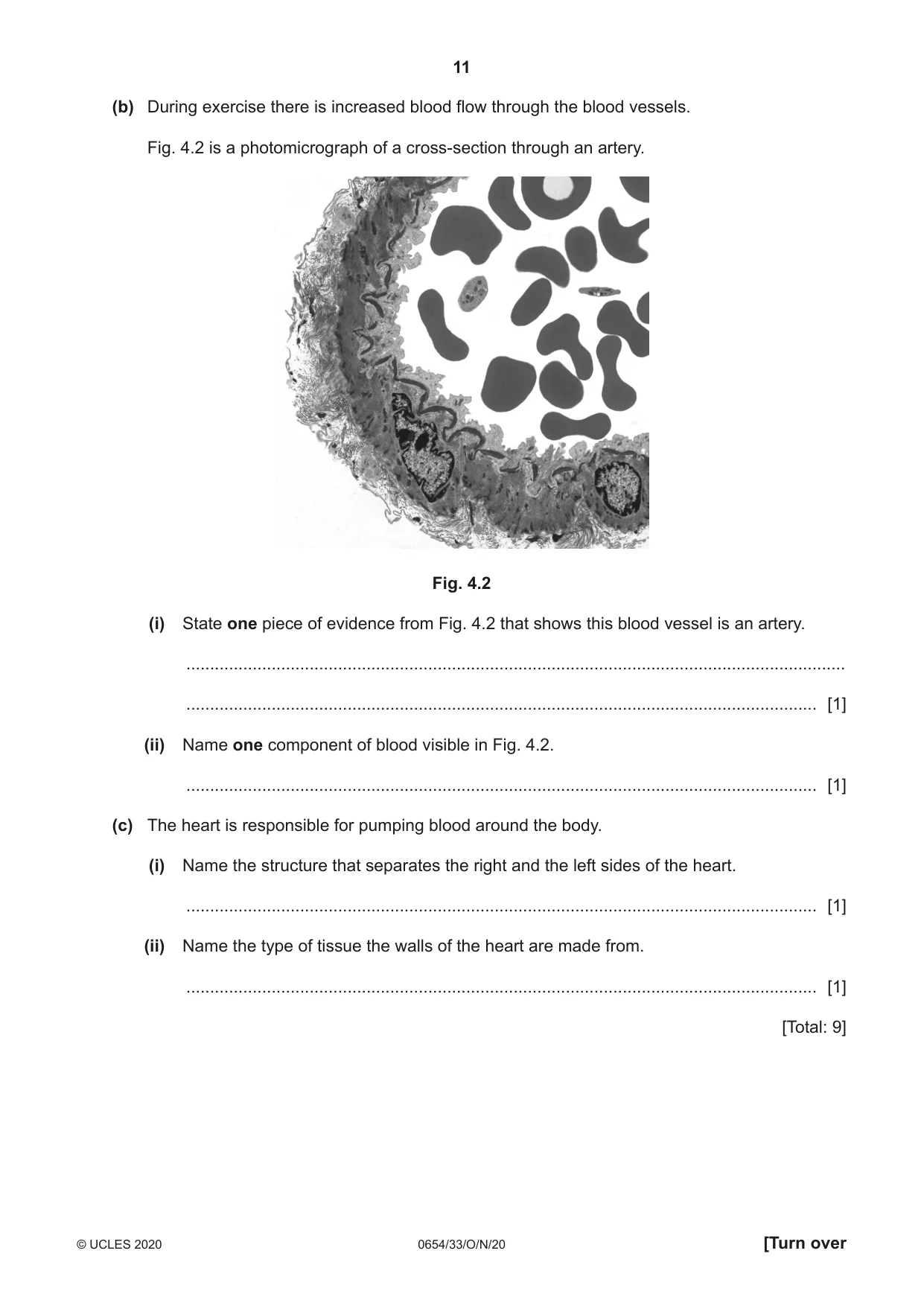
4 (a) A scientist investigates the recovery time of an athlete and a non‑athlete after exercise. Recovery time is the time taken for the pulse rate to return to normal after exercise. The results are shown in Fig. 4.1. at rest during exercise after exercise 130 recovery 120 time 110 100 pulse rate / beats per 90 minute (bpm) 80 non- athlete 70 recovery athlete time 60 0 0 2 4 6 8 10 12 14 16 18 20 22 24 time / minutes Fig. 4.1 (i) State the pulse rate of the non‑athlete at rest. .............................................................................................................................. bpm [1] (ii) State the length of recovery time for the athlete and the non‑athlete. athlete ................................................................................................................. minutes non‑athlete .......................................................................................................... minutes [1] (iii) Calculate the difference in recovery times between the athlete and the non‑athlete using your answers to (a)(ii). ....................................................................................................................... minutes [1] (iv) Describe the changes to the pattern of breathing of the non‑athlete between 4 and 8 minutes. ........................................................................................................................................... ........................................................................................................................................... ........................................................................................................................................... ..................................................................................................................................... [2] (b) During exercise there is increased blood flow through the blood vessels. Fig. 4.2 is a photomicrograph of a cross‑section through an artery. Fig. 4.2 (i) State one piece of evidence from Fig. 4.2 that shows this blood vessel is an artery. ........................................................................................................................................... ..................................................................................................................................... [1] (ii) Name one component of blood visible in Fig. 4.2. ..................................................................................................................................... [1] (c) The heart is responsible for pumping blood around the body. (i) Name the structure that separates the right and the left sides of the heart. ..................................................................................................................................... [1] (ii) Name the type of tissue the walls of the heart are made from. ..................................................................................................................................... [1] [Total: 9]
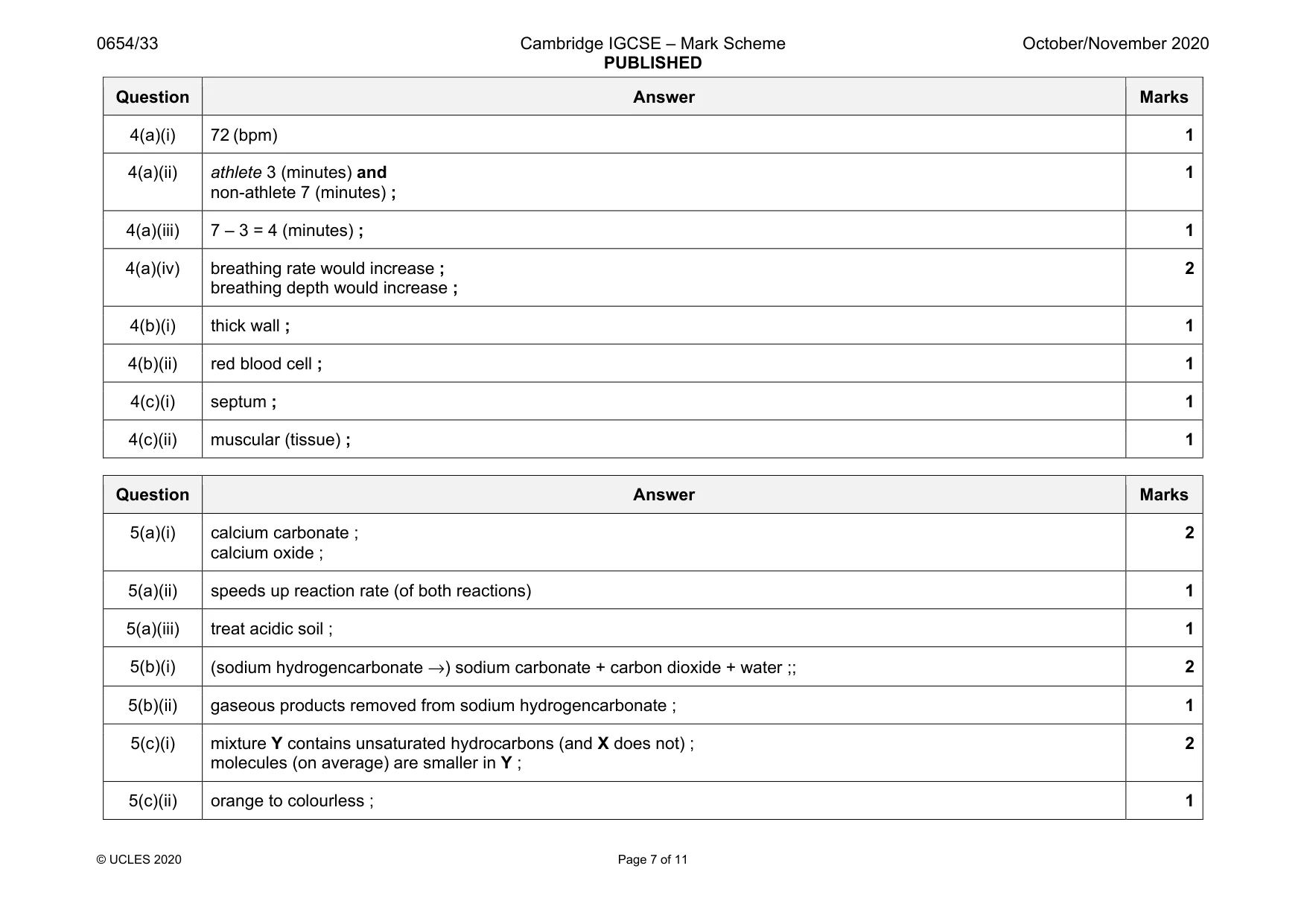
Mark scheme: 4(a)(i) 72 (bpm) 1 4(a)(ii) athlete 3 (minutes) and non-athlete 7 (minutes) ; 1 4(a)(iii) 7 – 3 = 4 (minutes) ; 1 4(a)(iv) breathing rate would increase ; breathing depth would increase ; 2 4(b)(i) thick wall ; 1 4(b)(ii) red blood cell ; 1 4(c)(i) septum ; 1 4(c)(ii) muscular (tissue) ; 1
Q5 · Thermal decomposition happens when compounds are heated and break down into simpler…
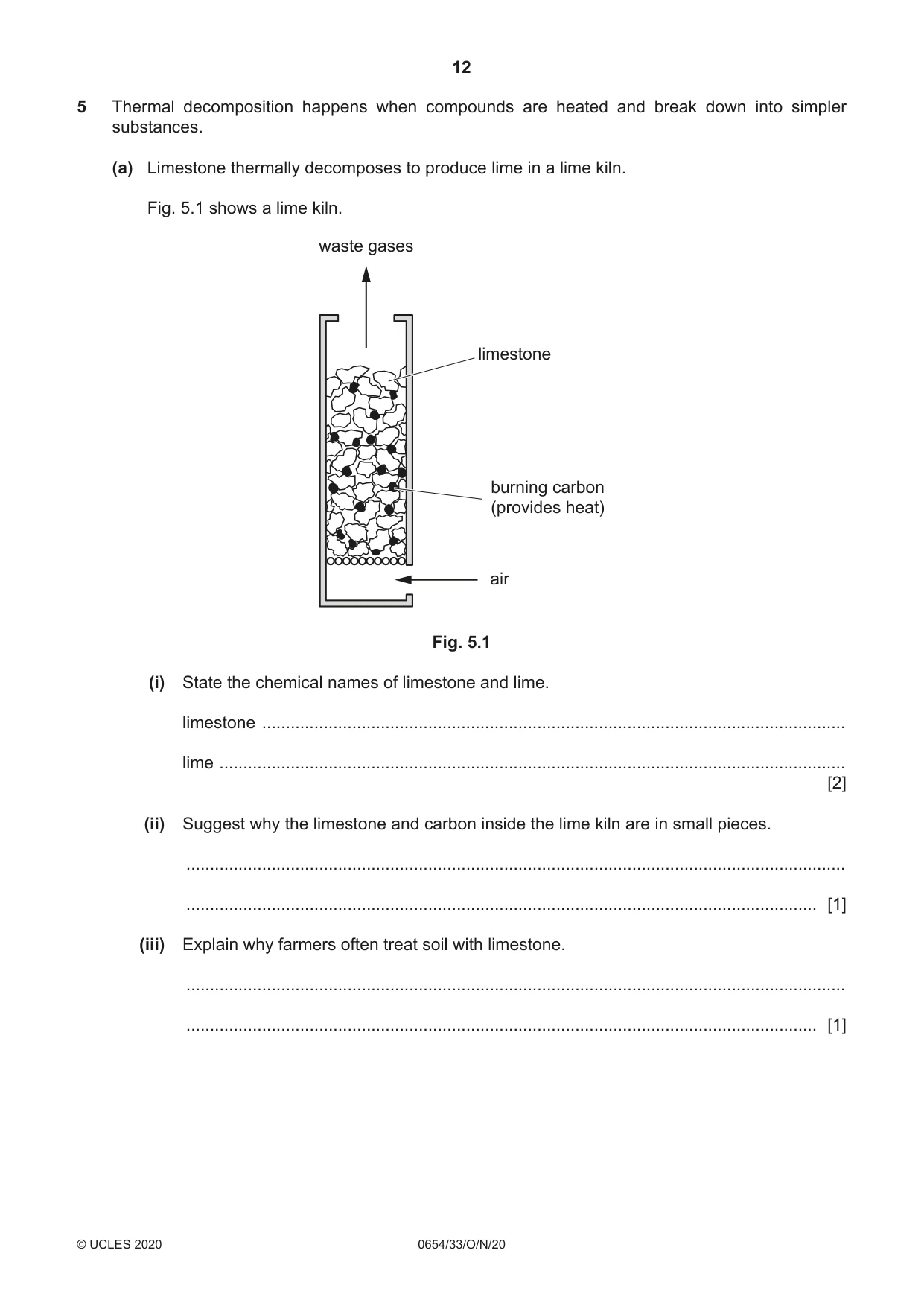
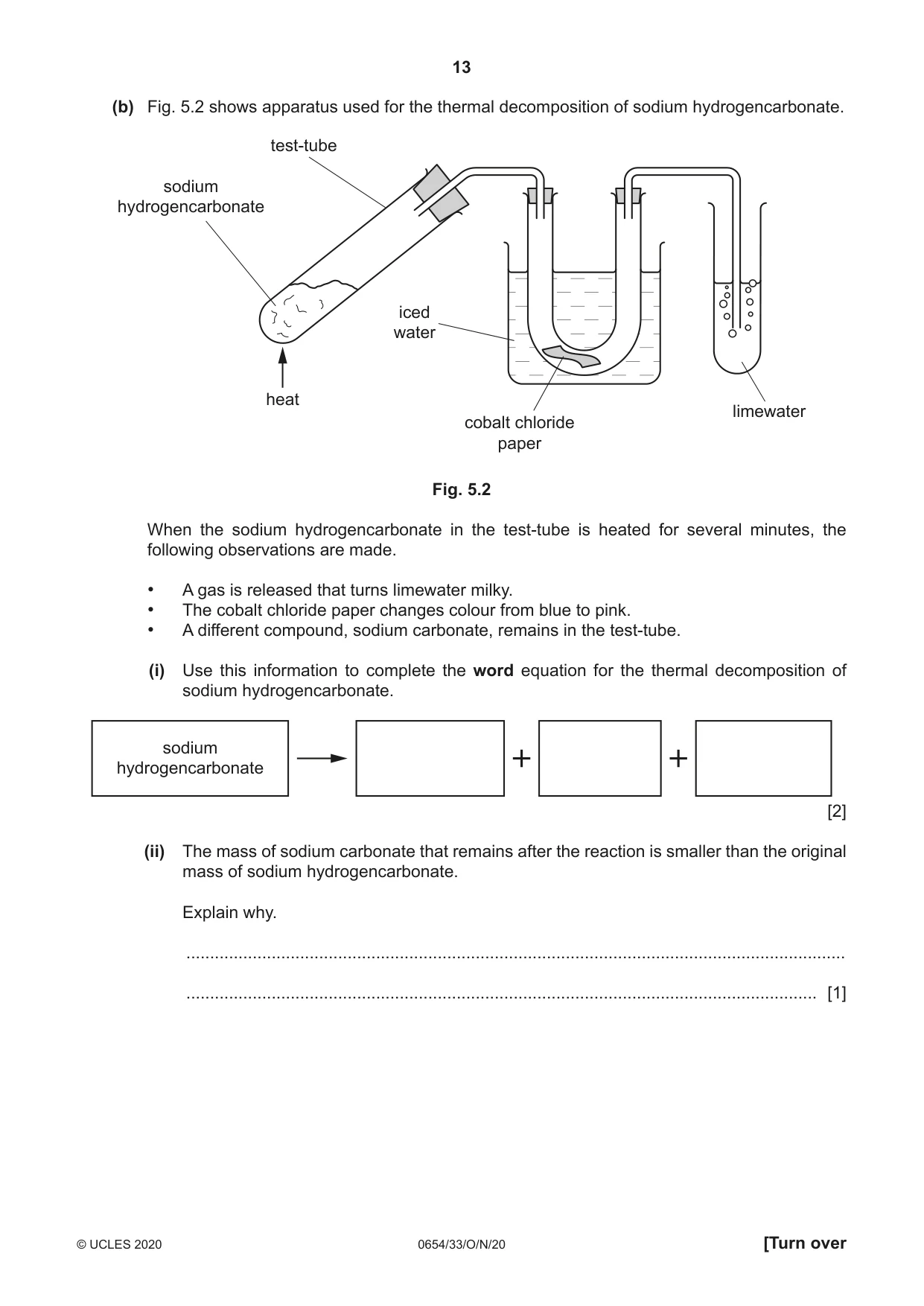
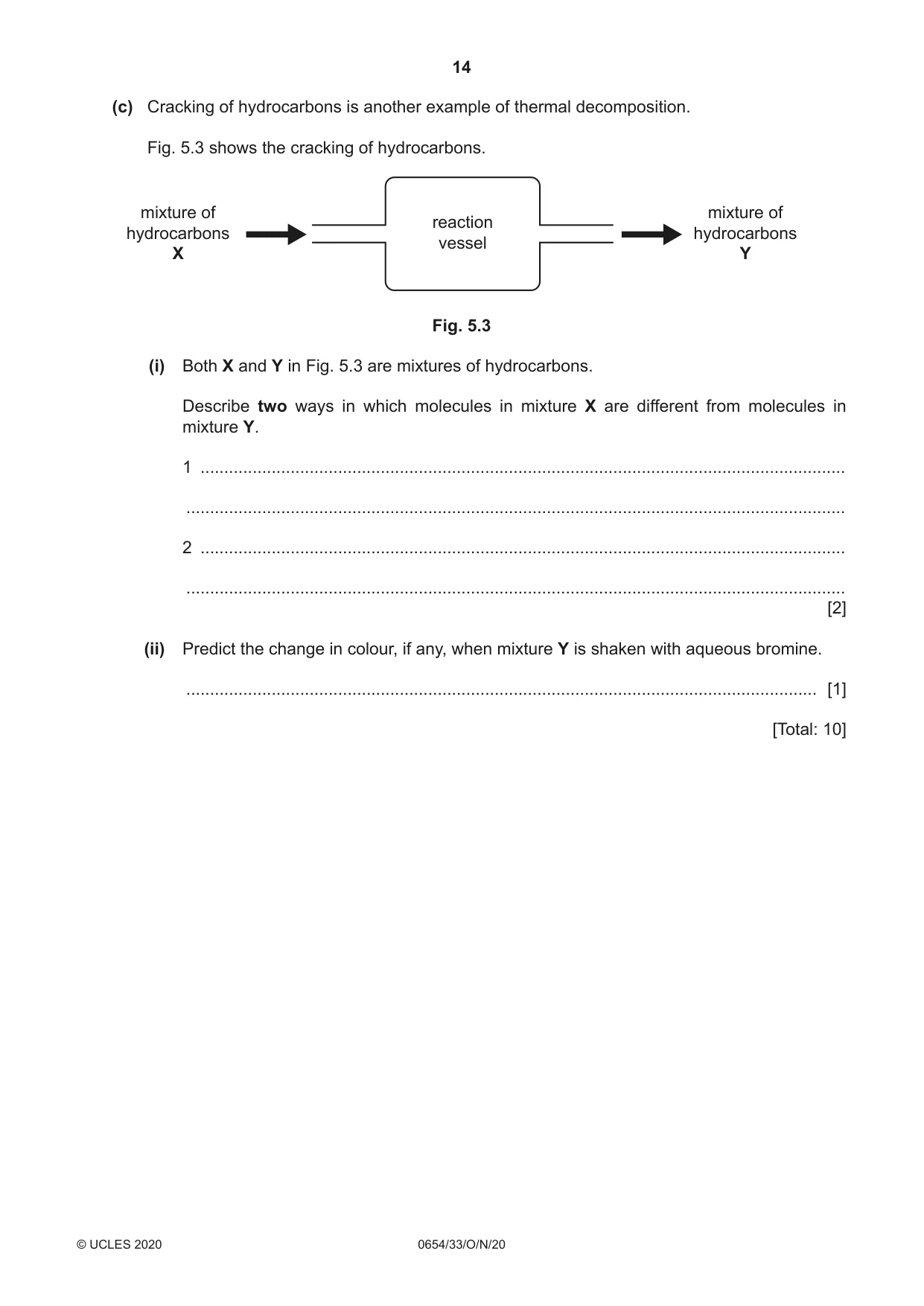
5 Thermal decomposition happens when compounds are heated and break down into simpler substances. (a) Limestone thermally decomposes to produce lime in a lime kiln. Fig. 5.1 shows a lime kiln. waste gases limestone burning carbon (provides heat) air Fig. 5.1 (i) State the chemical names of limestone and lime. limestone ........................................................................................................................... lime .................................................................................................................................... [2] (ii) Suggest why the limestone and carbon inside the lime kiln are in small pieces. ........................................................................................................................................... ..................................................................................................................................... [1] (iii) Explain why farmers often treat soil with limestone. ........................................................................................................................................... ..................................................................................................................................... [1] (b) Fig. 5.2 shows apparatus used for the thermal decomposition of sodium hydrogencarbonate. test-tube sodium hydrogencarbonate iced water heat limewater cobalt chloride paper Fig. 5.2 When the sodium hydrogencarbonate in the test‑tube is heated for several minutes, the following observations are made. • A gas is released that turns limewater milky. • The cobalt chloride paper changes colour from blue to pink. • A different compound, sodium carbonate, remains in the test‑tube. (i) Use this information to complete the word equation for the thermal decomposition of sodium hydrogencarbonate. sodium hydrogencarbonate [2] (ii) The mass of sodium carbonate that remains after the reaction is smaller than the original mass of sodium hydrogencarbonate. Explain why. ........................................................................................................................................... ..................................................................................................................................... [1] (c) Cracking of hydrocarbons is another example of thermal decomposition. Fig. 5.3 shows the cracking of hydrocarbons. mixture of mixture of reaction hydrocarbons hydrocarbons vessel X Y Fig. 5.3 (i) Both X and Y in Fig. 5.3 are mixtures of hydrocarbons. Describe two ways in which molecules in mixture X are different from molecules in mixture Y. 1 ........................................................................................................................................ ........................................................................................................................................... 2 ........................................................................................................................................ ........................................................................................................................................... [2] (ii) Predict the change in colour, if any, when mixture Y is shaken with aqueous bromine. ..................................................................................................................................... [1] [Total: 10]
Mark scheme: 5(a)(i) calcium carbonate ; calcium oxide ; 2 5(a)(ii) speeds up reaction rate (of both reactions) 1 5(a)(iii) treat acidic soil ; 1 5(b)(i) (sodium hydrogencarbonate →) sodium carbonate + carbon dioxide + water ;; 2 5(b)(ii) gaseous products removed from sodium hydrogencarbonate ; 1 5(c)(i) mixture Y contains unsaturated hydrocarbons (and X does not) ; molecules (on average) are smaller in Y ; 2 5(c)(ii) orange to colourless ; 1
More questions on The characteristic properties of acids and bases
Q6 · A car is driven along a road
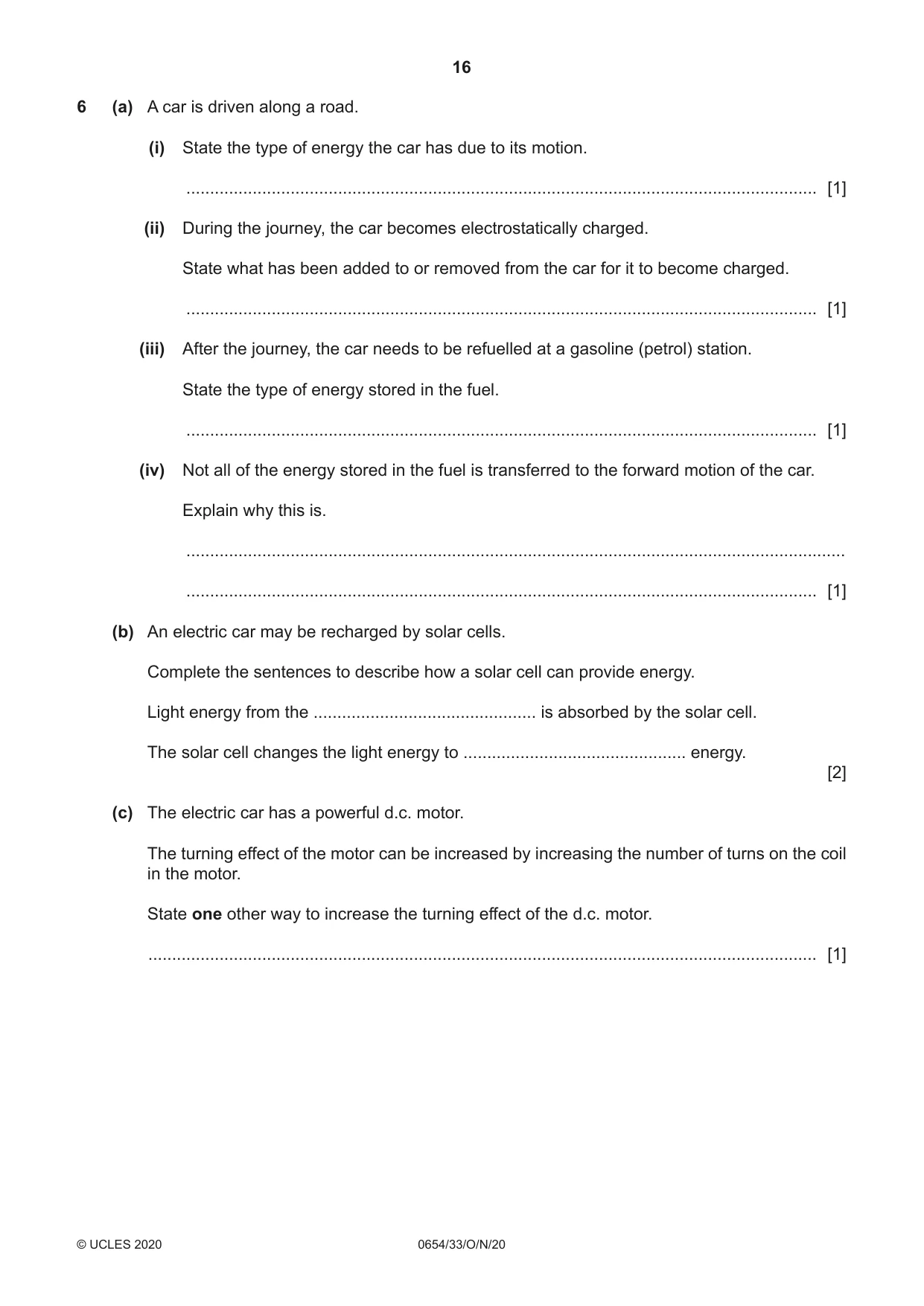
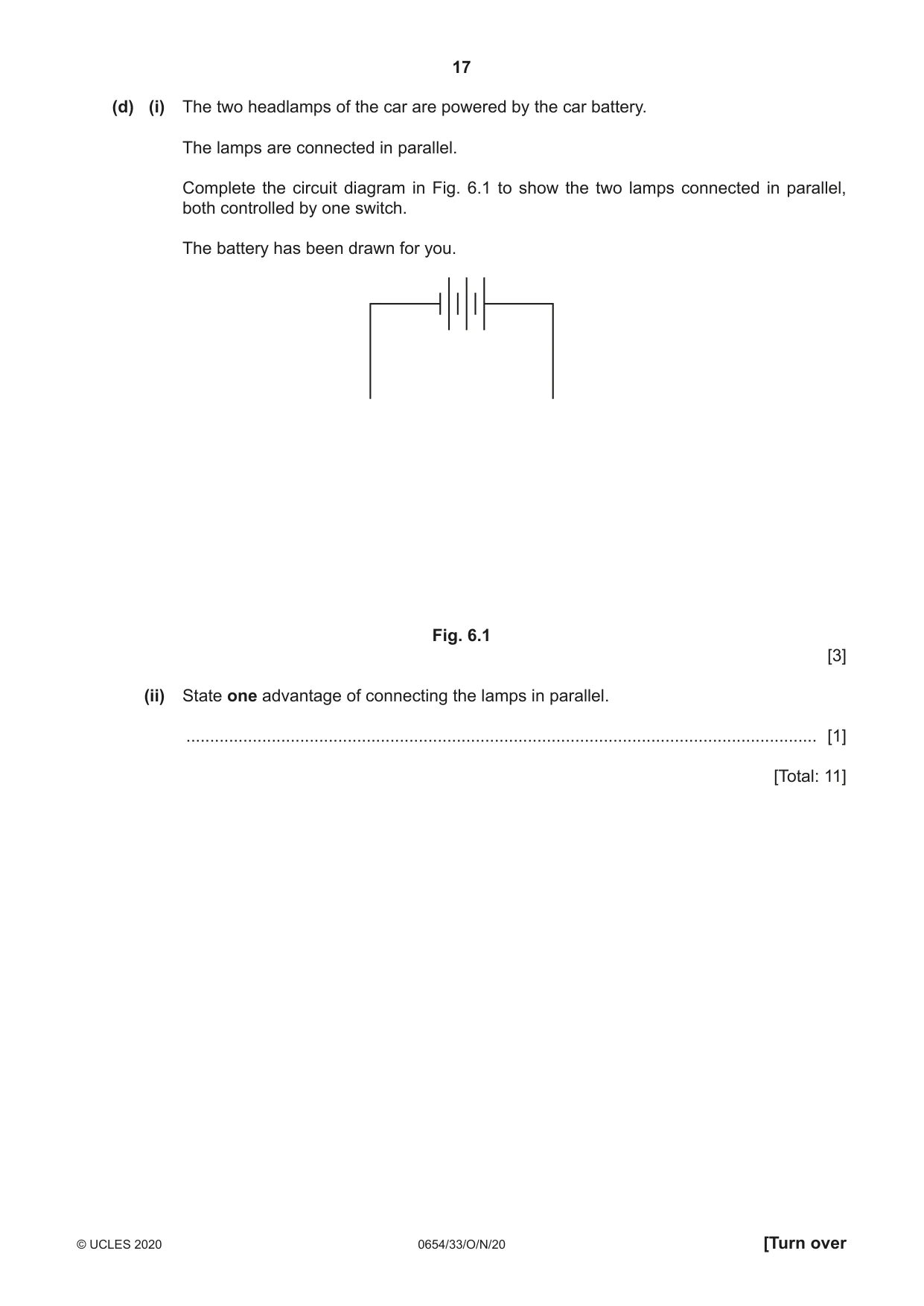
6 (a) A car is driven along a road. (i) State the type of energy the car has due to its motion. ..................................................................................................................................... [1] (ii) During the journey, the car becomes electrostatically charged. State what has been added to or removed from the car for it to become charged. ..................................................................................................................................... [1] (iii) After the journey, the car needs to be refuelled at a gasoline (petrol) station. State the type of energy stored in the fuel. ..................................................................................................................................... [1] (iv) Not all of the energy stored in the fuel is transferred to the forward motion of the car. Explain why this is. ........................................................................................................................................... ..................................................................................................................................... [1] (b) An electric car may be recharged by solar cells. Complete the sentences to describe how a solar cell can provide energy. Light energy from the ............................................... is absorbed by the solar cell. The solar cell changes the light energy to ............................................... energy. [2] (c) The electric car has a powerful d.c. motor. The turning effect of the motor can be increased by increasing the number of turns on the coil in the motor. State one other way to increase the turning effect of the d.c. motor. ............................................................................................................................................. [1] (d) (i) The two headlamps of the car are powered by the car battery. The lamps are connected in parallel. Complete the circuit diagram in Fig. 6.1 to show the two lamps connected in parallel, both controlled by one switch. The battery has been drawn for you. Fig. 6.1 [3] (ii) State one advantage of connecting the lamps in parallel. ..................................................................................................................................... [1] [Total: 11]
Mark scheme: 6(a)(i) kinetic ; 1 6(a)(ii) electrons ; 1 6(a)(iii) chemical potential ; 1 6(a)(iv) energy transferred to other forms / energy lost to the surroundings / energy lost as thermal energy ; AVP ; 1 6(b) Sun ; electrical ; 2 6(c) increase the strength of the magnetic field / increase the current ; 1 6(d)(i) correct symbols for switch and lamp ; lamps connected in parallel ; one switch controlling both ; 3 6(d)(ii) if one fails, the other will still light up ; 1
Q7 · A student investigates the changes to plant cells when they are immersed in different…
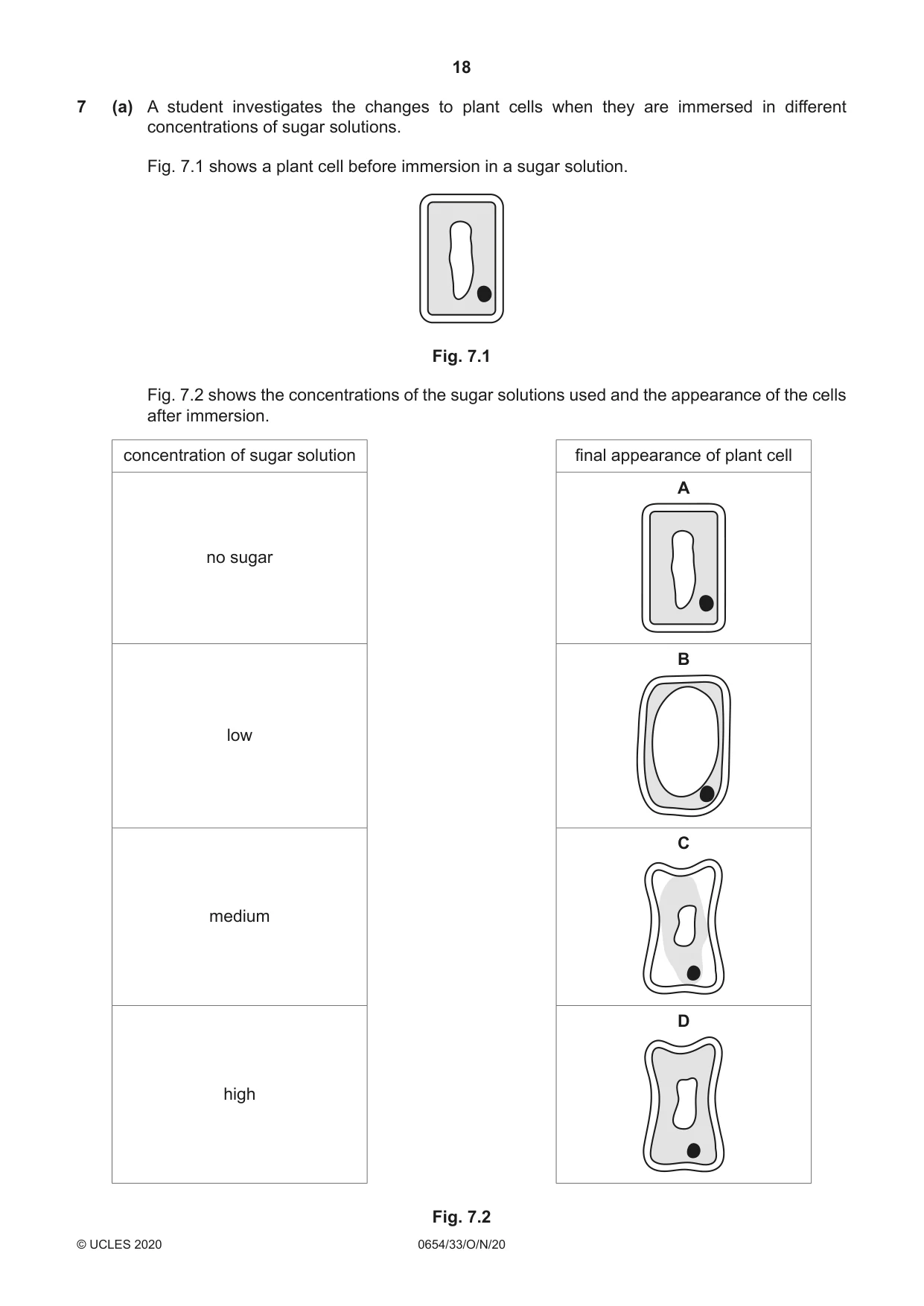
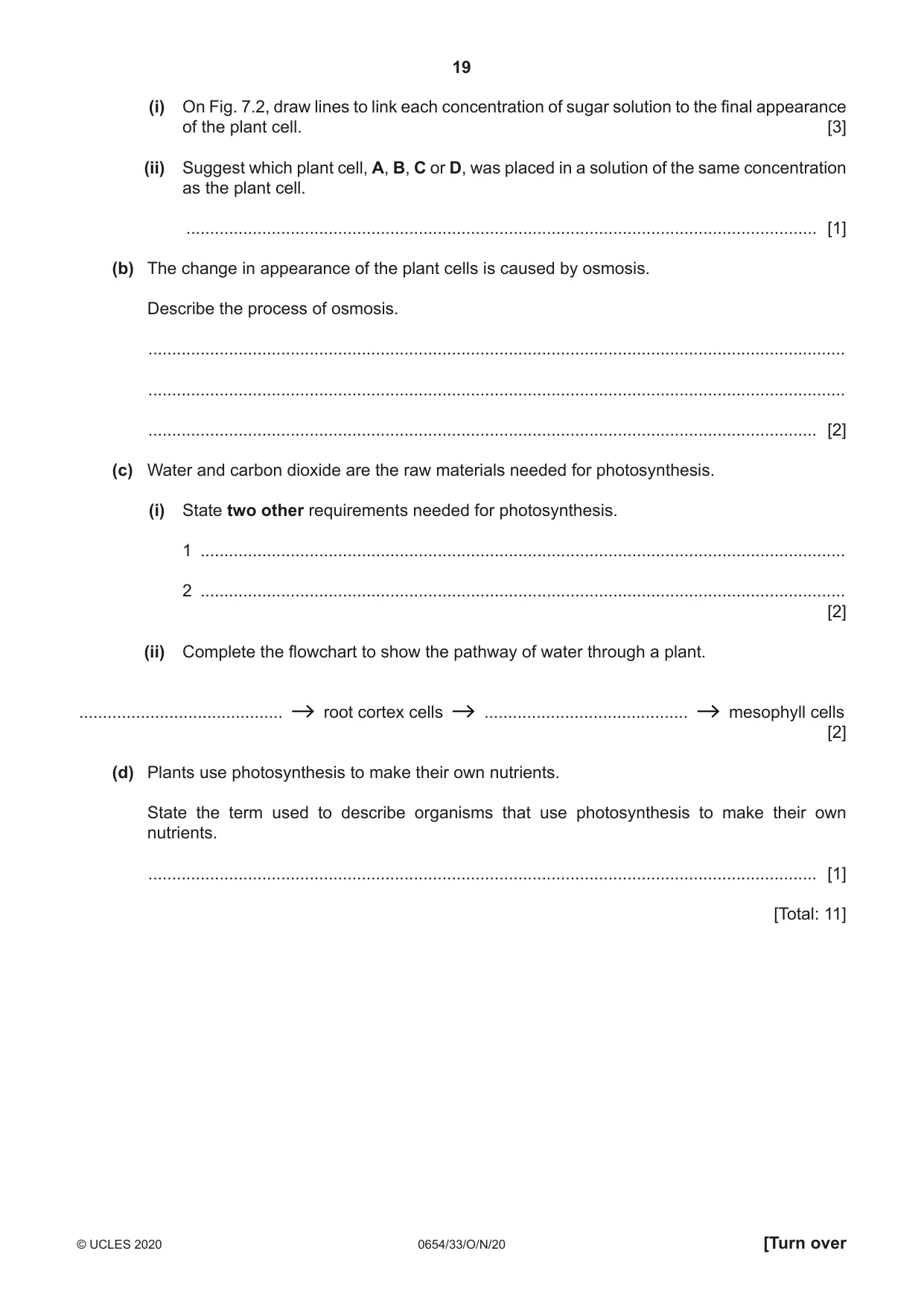
7 (a) A student investigates the changes to plant cells when they are immersed in different concentrations of sugar solutions. Fig. 7.1 shows a plant cell before immersion in a sugar solution. Fig. 7.1 Fig. 7.2 shows the concentrations of the sugar solutions used and the appearance of the cells after immersion. concentration of sugar solution final appearance of plant cell A no sugar B low C medium D high Fig. 7.2 (i) On Fig. 7.2, draw lines to link each concentration of sugar solution to the final appearance of the plant cell. [3] (ii) Suggest which plant cell, A, B, C or D, was placed in a solution of the same concentration as the plant cell. ..................................................................................................................................... [1] (b) The change in appearance of the plant cells is caused by osmosis. Describe the process of osmosis. ................................................................................................................................................... ................................................................................................................................................... ............................................................................................................................................. [2] (c) Water and carbon dioxide are the raw materials needed for photosynthesis. (i) State two other requirements needed for photosynthesis. 1 ........................................................................................................................................ 2 ........................................................................................................................................ [2] (ii) Complete the flowchart to show the pathway of water through a plant. ........................................... root cortex cells ........................................... mesophyll cells [2] (d) Plants use photosynthesis to make their own nutrients. State the term used to describe organisms that use photosynthesis to make their own nutrients. ............................................................................................................................................. [1] [Total: 11]
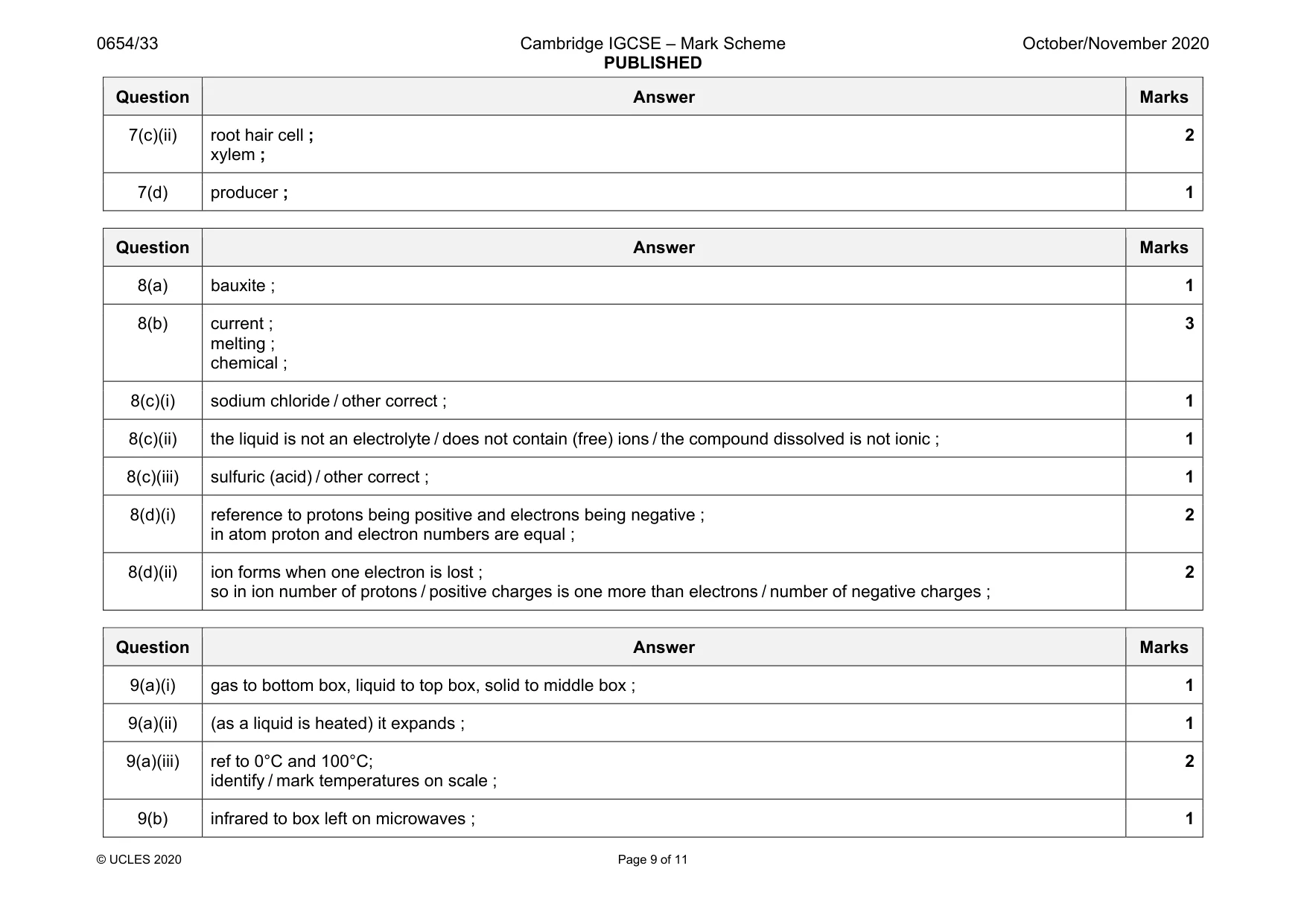
Mark scheme: 7(a)(i) no sugar – B low – A medium – D high – C ;;; 3 7(a)(ii) A ; 1 7(b) movement of water ; across a, partially permeable / cell, membrane ; AVP ; 2 7(c)(i) light ; chlorophyll ; 2 Question Answer Marks 7(c)(ii) root hair cell ; xylem ; 2 7(d) producer ; 1
Q8 · Electrolysis is used to extract some elements from their ores
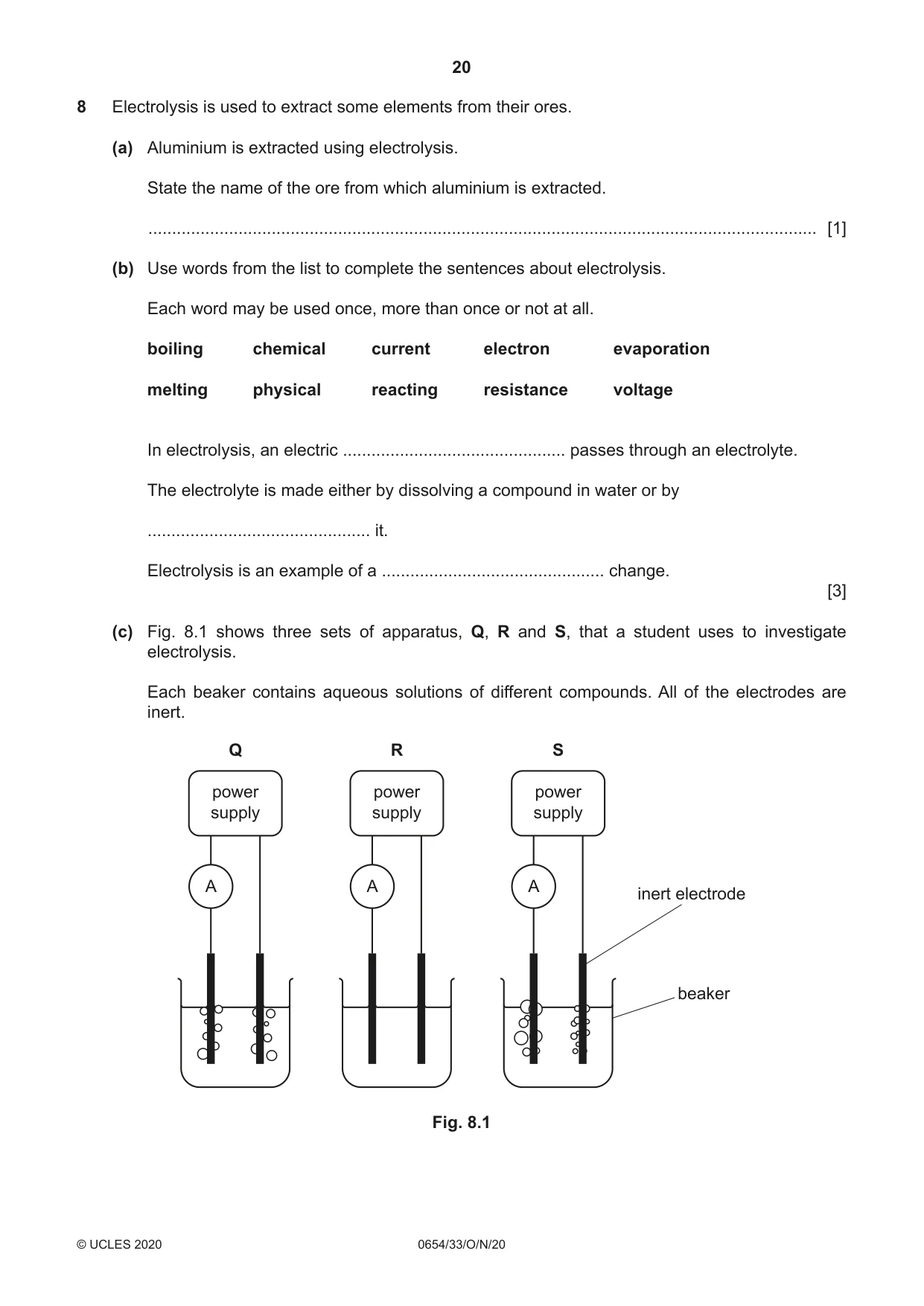
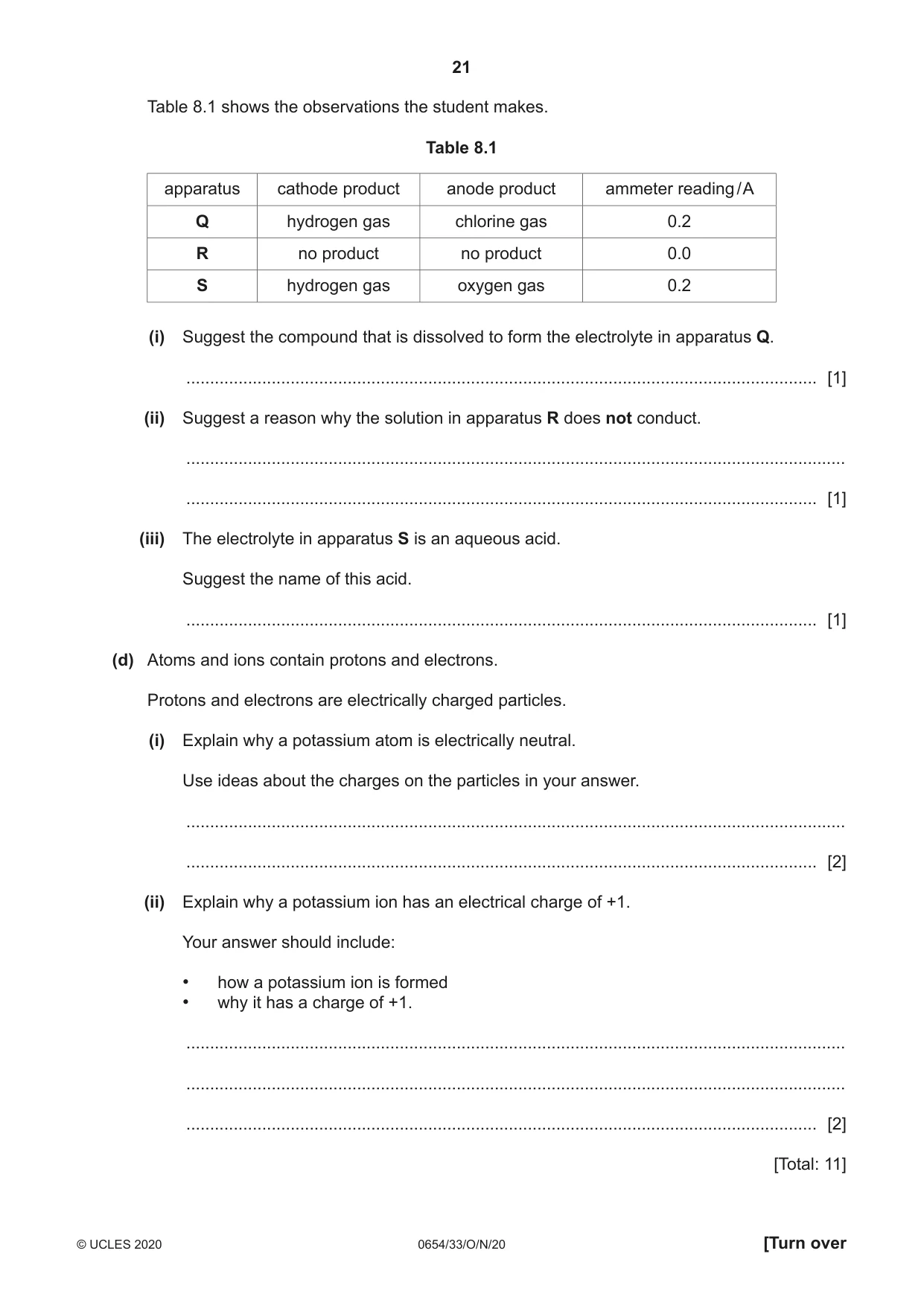
8 Electrolysis is used to extract some elements from their ores. (a) Aluminium is extracted using electrolysis. State the name of the ore from which aluminium is extracted. ............................................................................................................................................. [1] (b) Use words from the list to complete the sentences about electrolysis. Each word may be used once, more than once or not at all. boiling chemical current electron evaporation melting physical reacting resistance voltage In electrolysis, an electric ............................................... passes through an electrolyte. The electrolyte is made either by dissolving a compound in water or by ............................................... it. Electrolysis is an example of a ............................................... change. [3] (c) Fig. 8.1 shows three sets of apparatus, Q, R and S, that a student uses to investigate electrolysis. Each beaker contains aqueous solutions of different compounds. All of the electrodes are inert. Q R S power power power supply supply supply A A A inert electrode beaker Fig. 8.1 Table 8.1 shows the observations the student makes. Table 8.1 apparatus cathode product anode product ammeter reading / A Q hydrogen gas chlorine gas 0.2 R no product no product 0.0 S hydrogen gas oxygen gas 0.2 (i) Suggest the compound that is dissolved to form the electrolyte in apparatus Q. ..................................................................................................................................... [1] (ii) Suggest a reason why the solution in apparatus R does not conduct. ........................................................................................................................................... ..................................................................................................................................... [1] (iii) The electrolyte in apparatus S is an aqueous acid. Suggest the name of this acid. ..................................................................................................................................... [1] (d) Atoms and ions contain protons and electrons. Protons and electrons are electrically charged particles. (i) Explain why a potassium atom is electrically neutral. Use ideas about the charges on the particles in your answer. ........................................................................................................................................... ..................................................................................................................................... [2] (ii) Explain why a potassium ion has an electrical charge of +1. Your answer should include: • how a potassium ion is formed • why it has a charge of +1. ........................................................................................................................................... ........................................................................................................................................... ..................................................................................................................................... [2] [Total: 11]
Mark scheme: 8(a) bauxite ; 1 8(b) current ; melting ; chemical ; 3 8(c)(i) sodium chloride / other correct ; 1 8(c)(ii) the liquid is not an electrolyte / does not contain (free) ions / the compound dissolved is not ionic ; 1 8(c)(iii) sulfuric (acid) / other correct ; 1 8(d)(i) reference to protons being positive and electrons being negative ; in atom proton and electron numbers are equal ; 2 8(d)(ii) ion forms when one electron is lost ; so in ion number of protons / positive charges is one more than electrons / number of negative charges ; 2
Q9 · Beneath the surface of the Earth, solid rocks are heated and form liquid rock (magma) and…
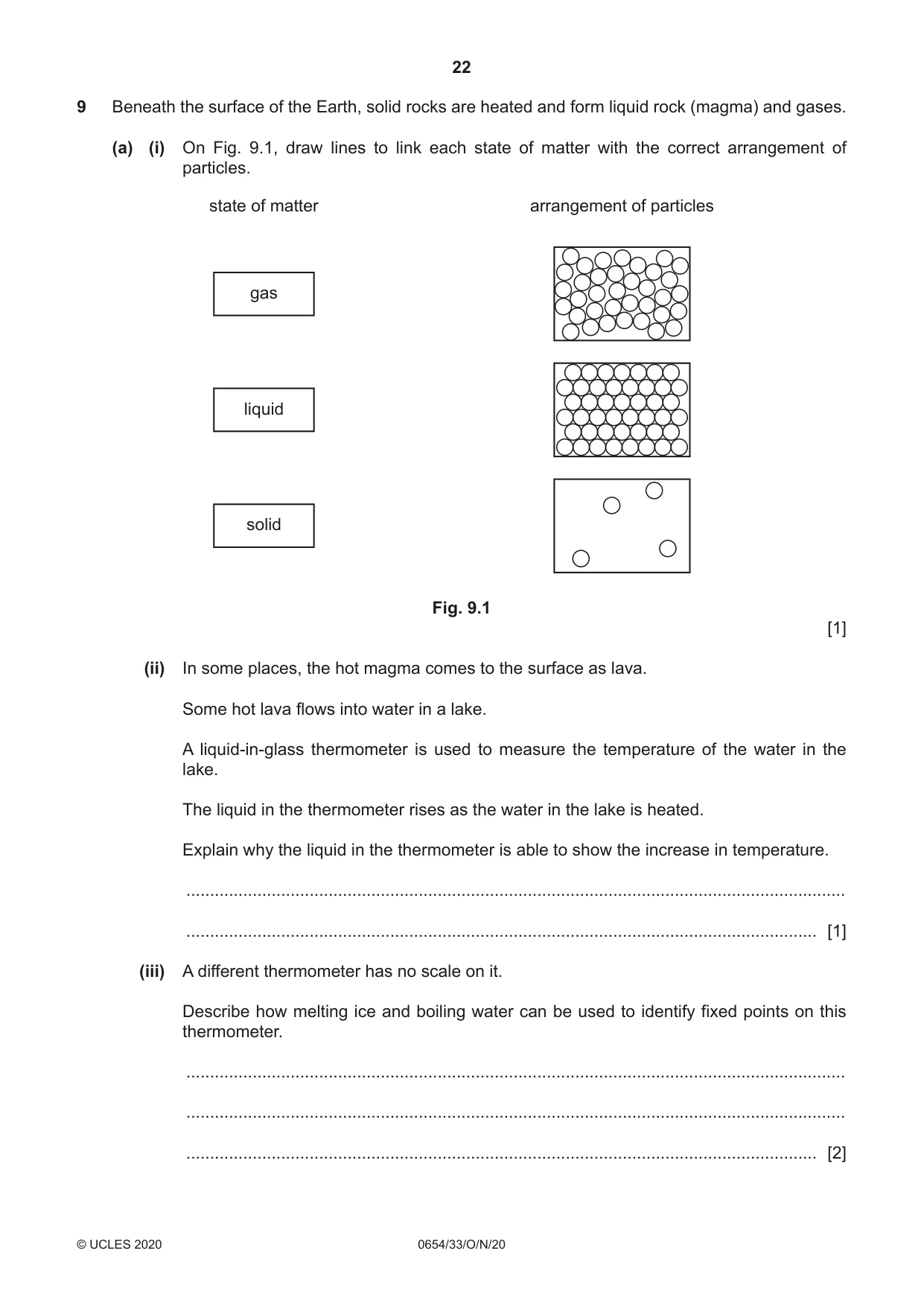
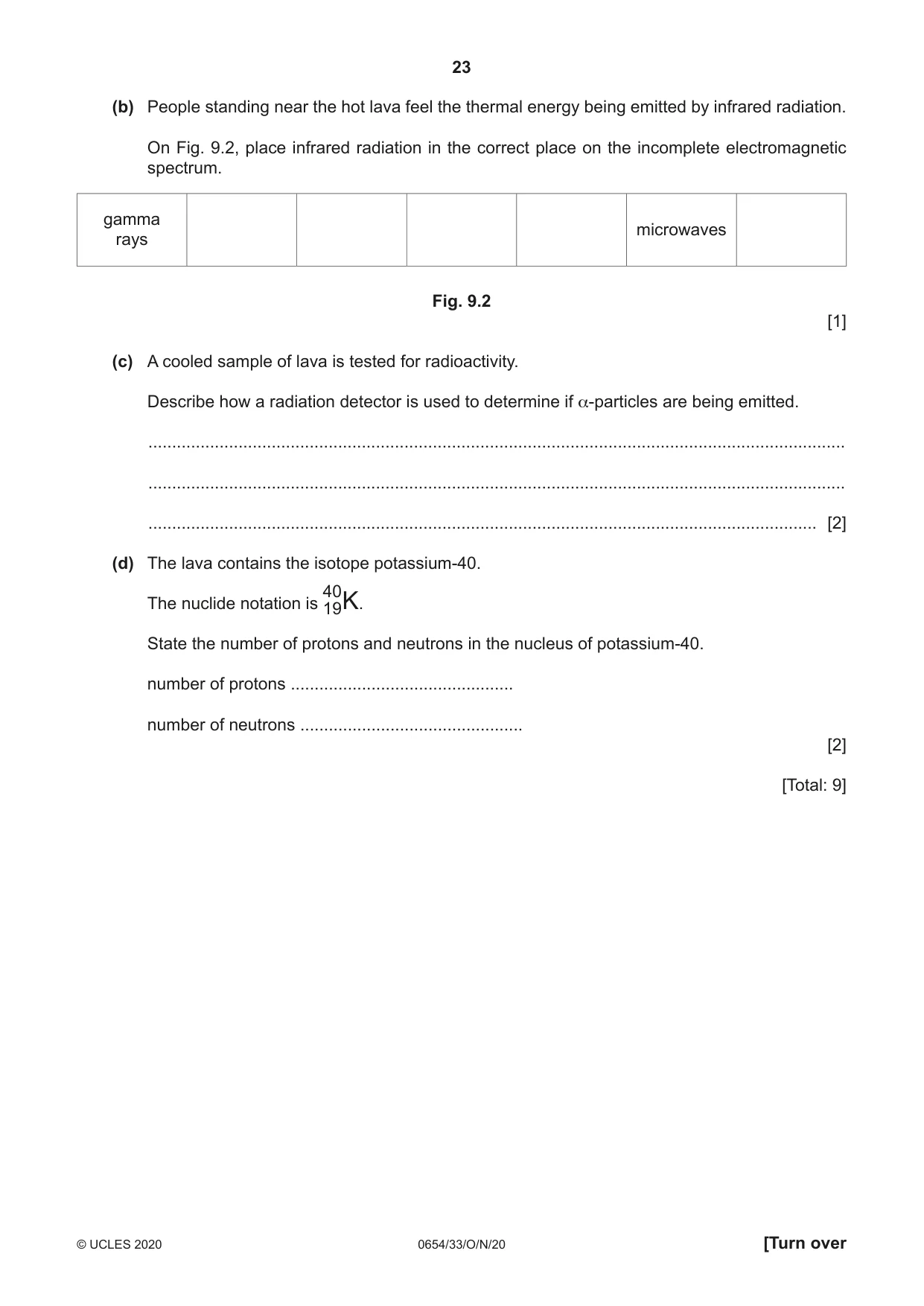
9 Beneath the surface of the Earth, solid rocks are heated and form liquid rock (magma) and gases. (a) (i) On Fig. 9.1, draw lines to link each state of matter with the correct arrangement of particles. state of matter arrangement of particles gas liquid solid Fig. 9.1 [1] (ii) In some places, the hot magma comes to the surface as lava. Some hot lava flows into water in a lake. A liquid‑in‑glass thermometer is used to measure the temperature of the water in the lake. The liquid in the thermometer rises as the water in the lake is heated. Explain why the liquid in the thermometer is able to show the increase in temperature. ........................................................................................................................................... ..................................................................................................................................... [1] (iii) A different thermometer has no scale on it. Describe how melting ice and boiling water can be used to identify fixed points on this thermometer. ........................................................................................................................................... ........................................................................................................................................... ..................................................................................................................................... [2] (b) People standing near the hot lava feel the thermal energy being emitted by infrared radiation. On Fig. 9.2, place infrared radiation in the correct place on the incomplete electromagnetic spectrum. gamma microwaves rays Fig. 9.2 [1] (c) A cooled sample of lava is tested for radioactivity. Describe how a radiation detector is used to determine if α‑particles are being emitted. ................................................................................................................................................... ................................................................................................................................................... ............................................................................................................................................. [2] (d) The lava contains the isotope potassium‑40. 40 The nuclide notation is 19K. State the number of protons and neutrons in the nucleus of potassium‑40. number of protons ............................................... number of neutrons ............................................... [2] [Total: 9]
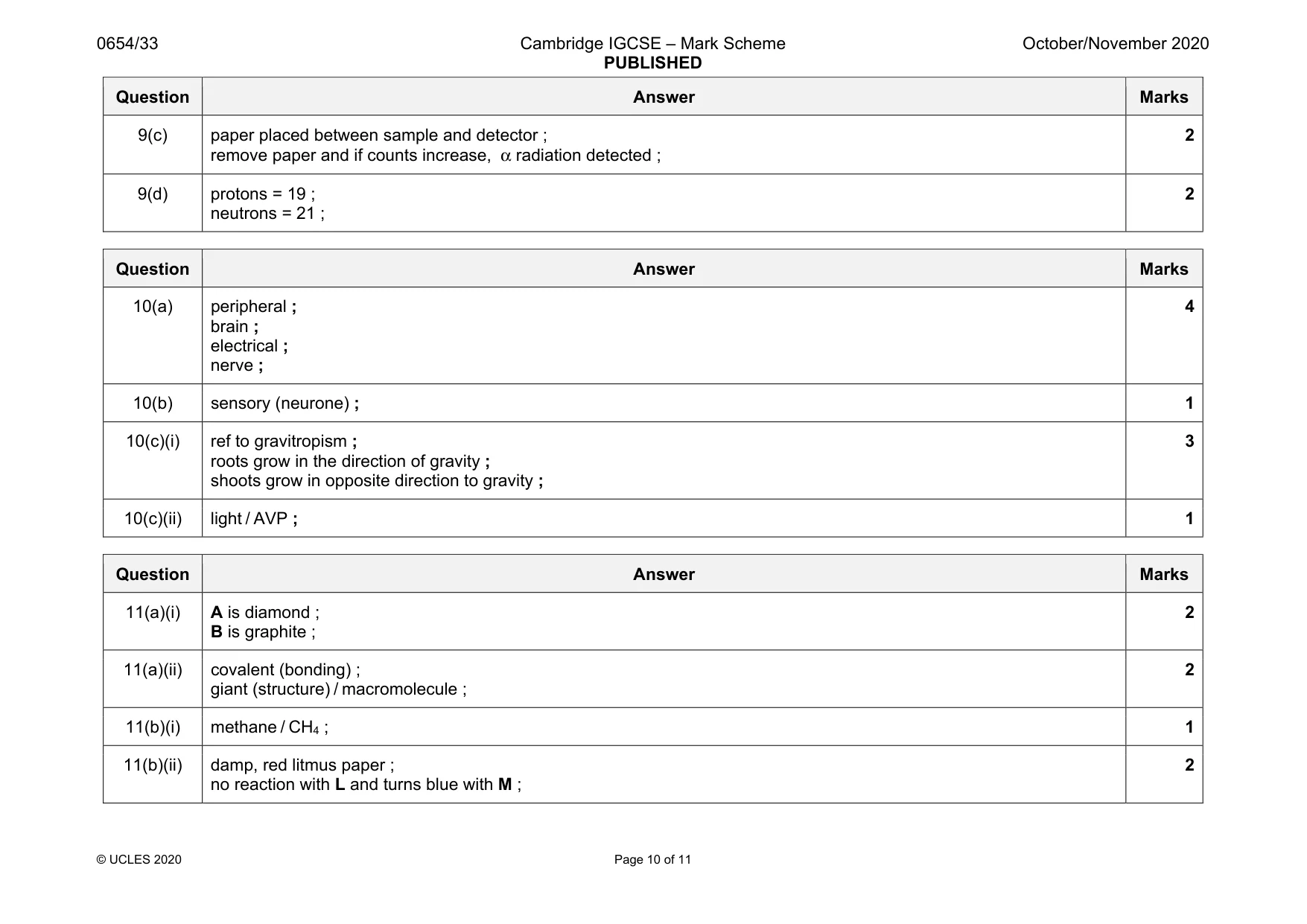
Mark scheme: 9(a)(i) gas to bottom box, liquid to top box, solid to middle box ; 1 9(a)(ii) (as a liquid is heated) it expands ; 1 9(a)(iii) ref to 0°C and 100°C; identify / mark temperatures on scale ; 2 9(b) infrared to box left on microwaves ; 1 Question Answer Marks 9(c) paper placed between sample and detector ; remove paper and if counts increase, α radiation detected ; 2 9(d) protons = 19 ; neutrons = 21 ; 2
Q10 · Complete the sentences about the nervous system using words from the list
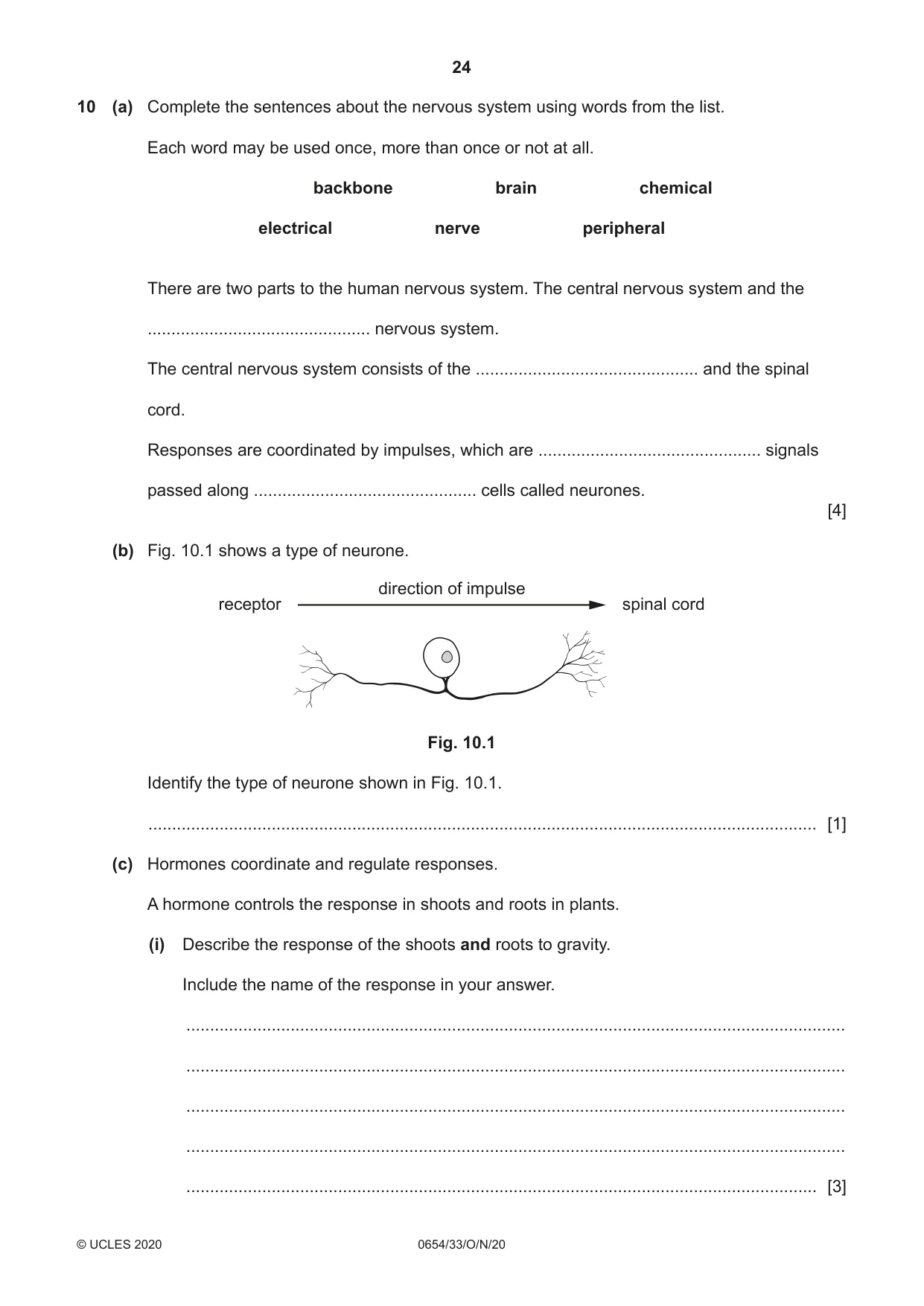
10 (a) Complete the sentences about the nervous system using words from the list. Each word may be used once, more than once or not at all. backbone brain chemical electrical nerve peripheral There are two parts to the human nervous system. The central nervous system and the ............................................... nervous system. The central nervous system consists of the ............................................... and the spinal cord. Responses are coordinated by impulses, which are ............................................... signals passed along ............................................... cells called neurones. [4] (b) Fig. 10.1 shows a type of neurone. direction of impulse receptor spinal cord Fig. 10.1 Identify the type of neurone shown in Fig. 10.1. ............................................................................................................................................. [1] (c) Hormones coordinate and regulate responses. A hormone controls the response in shoots and roots in plants. (i) Describe the response of the shoots and roots to gravity. Include the name of the response in your answer. ........................................................................................................................................... ........................................................................................................................................... ........................................................................................................................................... ........................................................................................................................................... ..................................................................................................................................... [3] (ii) Name one other stimulus that shoots and roots respond to. ..................................................................................................................................... [1] [Total: 9]
Mark scheme: 10(a) peripheral ; brain ; electrical ; nerve ; 4 10(b) sensory (neurone) ; 1 10(c)(i) ref to gravitropism ; roots grow in the direction of gravity ; shoots grow in opposite direction to gravity ; 3 10(c)(ii) light / AVP ; 1
Q11 · Carbon occurs as a free element in the Earth’s crust
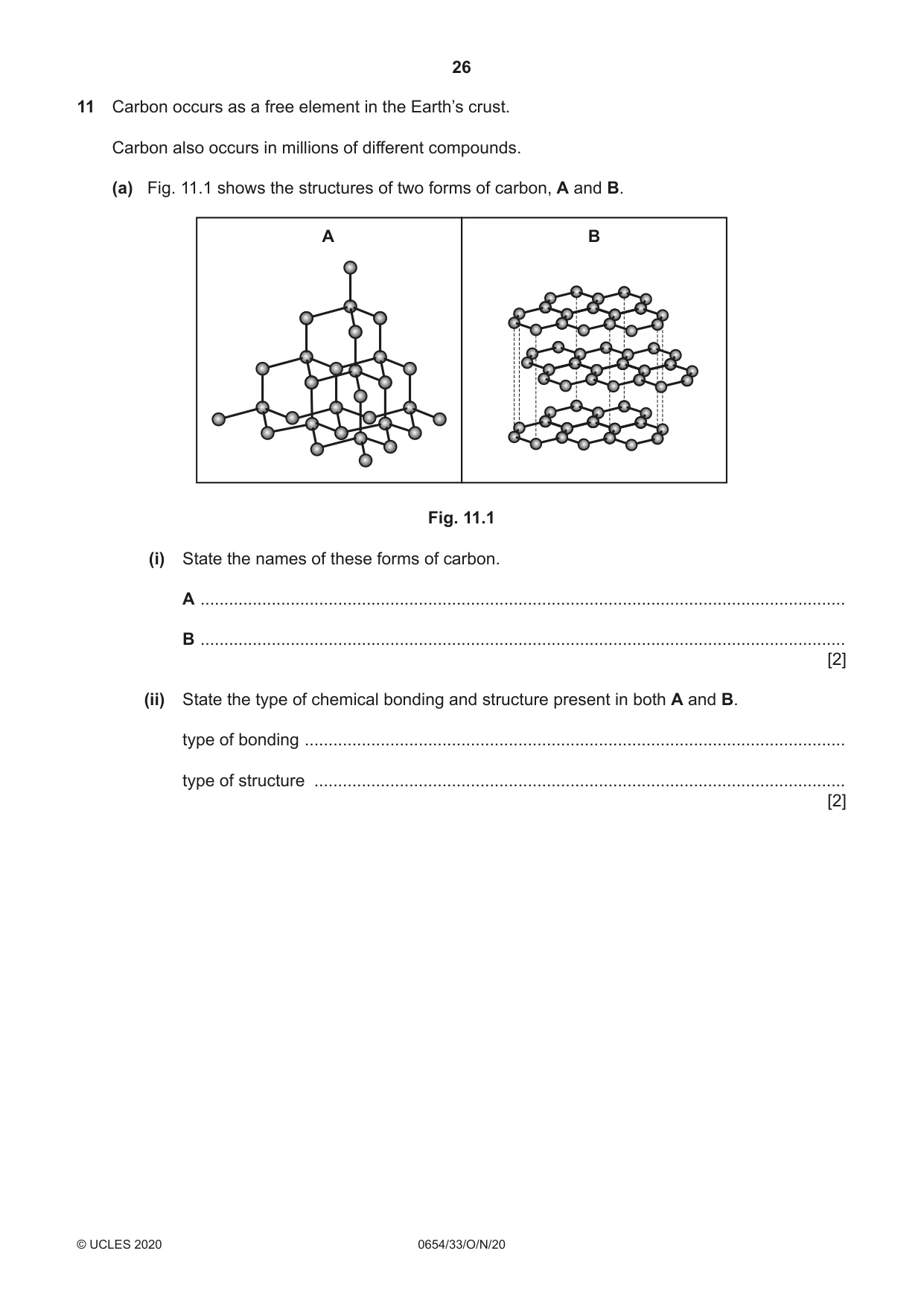
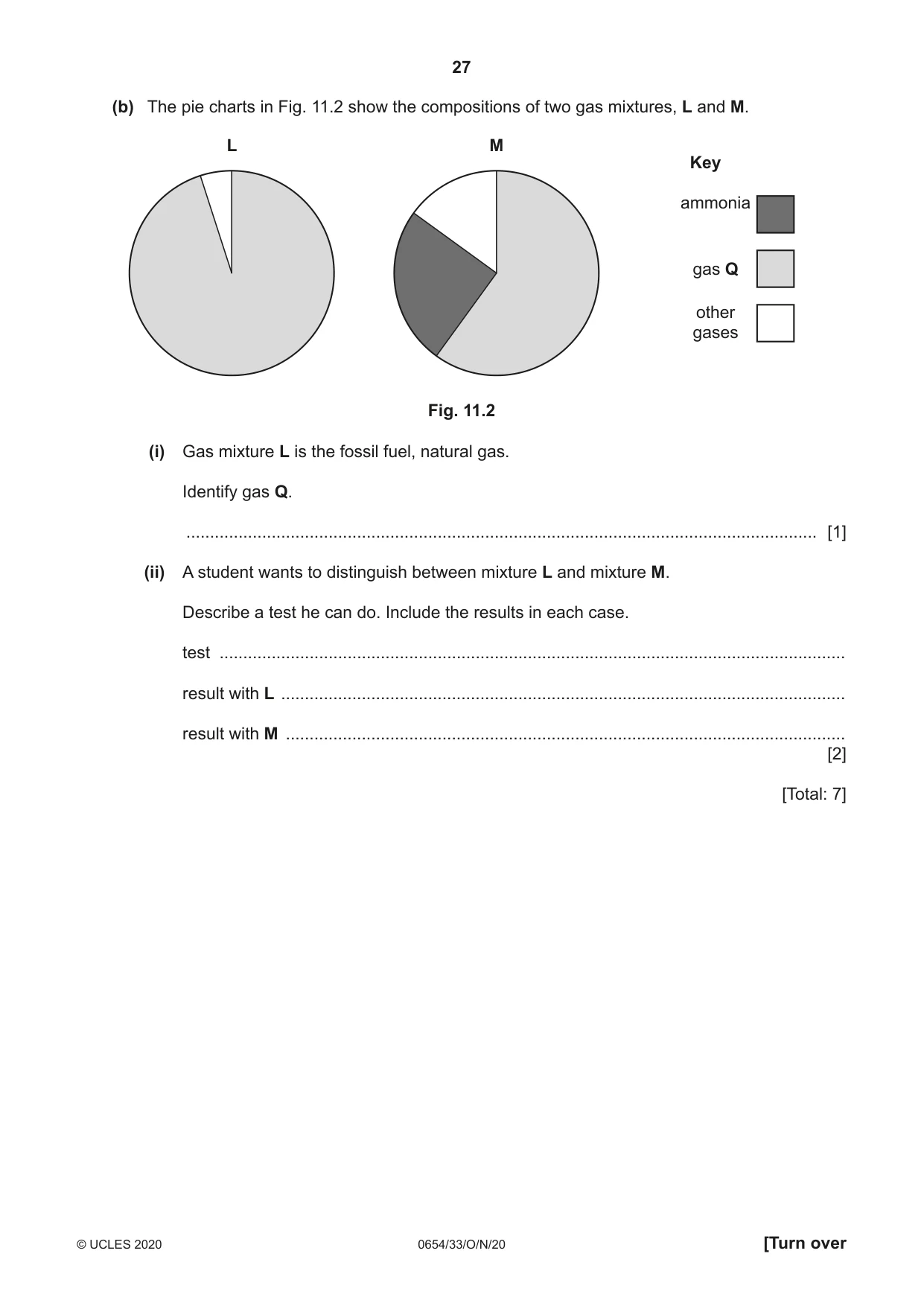
11 Carbon occurs as a free element in the Earth’s crust. Carbon also occurs in millions of different compounds. (a) Fig. 11.1 shows the structures of two forms of carbon, A and B. A B Fig. 11.1 (i) State the names of these forms of carbon. A ........................................................................................................................................ B ........................................................................................................................................ [2] (ii) State the type of chemical bonding and structure present in both A and B. type of bonding .................................................................................................................. type of structure ................................................................................................................ [2] (b) The pie charts in Fig. 11.2 show the compositions of two gas mixtures, L and M. L M Key ammonia gas Q other gases Fig. 11.2 (i) Gas mixture L is the fossil fuel, natural gas. Identify gas Q. ..................................................................................................................................... [1] (ii) A student wants to distinguish between mixture L and mixture M. Describe a test he can do. Include the results in each case. test .................................................................................................................................... result with L ....................................................................................................................... result with M ...................................................................................................................... [2] [Total: 7]
Mark scheme: 11(a)(i) A is diamond ; B is graphite ; 2 11(a)(ii) covalent (bonding) ; giant (structure) / macromolecule ; 2 11(b)(i) methane / CH4 ; 1 11(b)(ii) damp, red litmus paper ; no reaction with L and turns blue with M ; 2
Q12 · A boy looking into a plane mirror
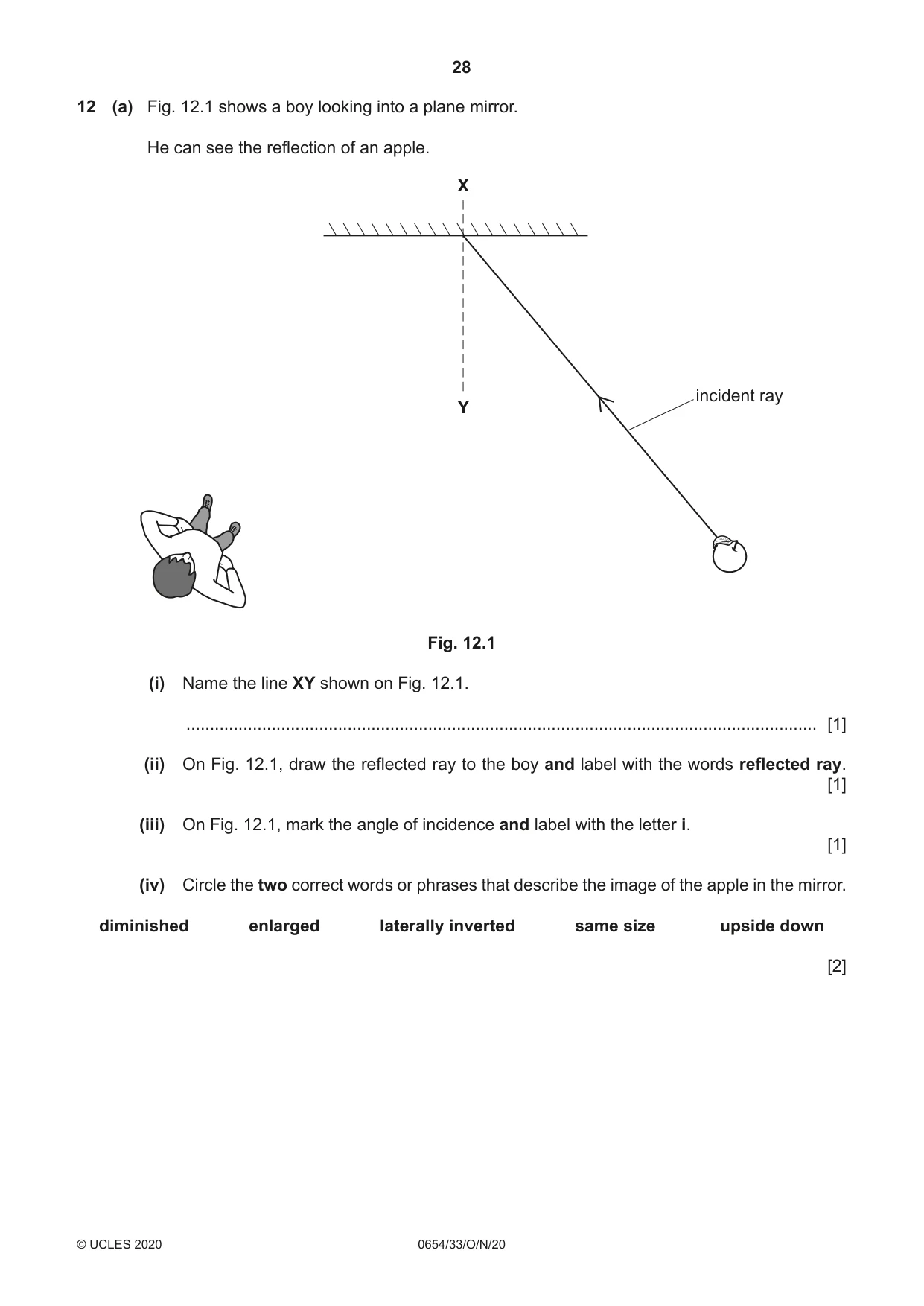
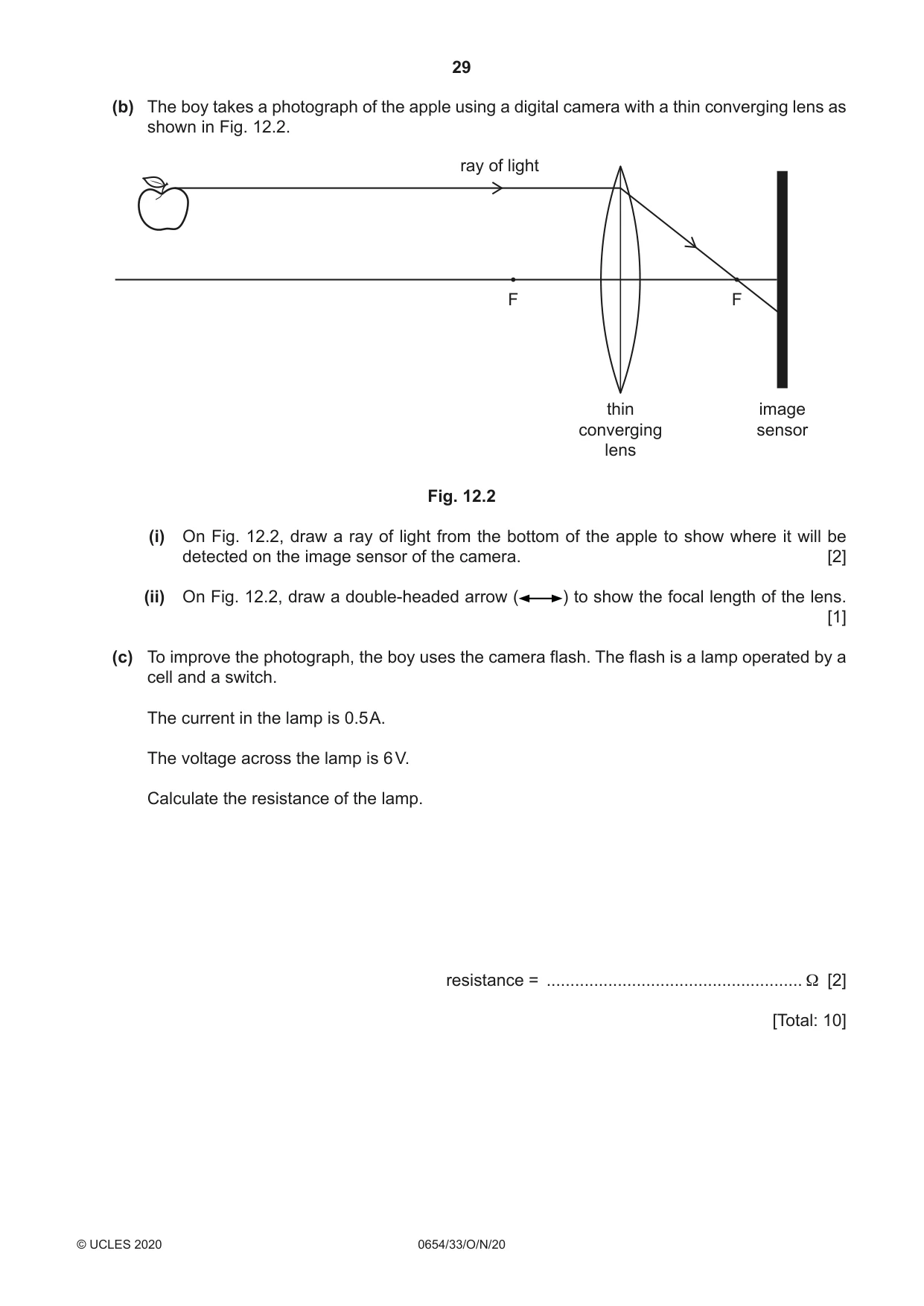
12 (a) Fig. 12.1 shows a boy looking into a plane mirror. He can see the reflection of an apple. X incident ray Y Fig. 12.1 (i) Name the line XY shown on Fig. 12.1. ..................................................................................................................................... [1] (ii) On Fig. 12.1, draw the reflected ray to the boy and label with the words reflected ray. [1] (iii) On Fig. 12.1, mark the angle of incidence and label with the letter i. [1] (iv) Circle the two correct words or phrases that describe the image of the apple in the mirror. diminished enlarged laterally inverted same size upside down [2] (b) The boy takes a photograph of the apple using a digital camera with a thin converging lens as shown in Fig. 12.2. ray of light F F thin image converging sensor lens Fig. 12.2 (i) On Fig. 12.2, draw a ray of light from the bottom of the apple to show where it will be detected on the image sensor of the camera. [2] (ii) On Fig. 12.2, draw a double‑headed arrow ( ) to show the focal length of the lens. [1] (c) To improve the photograph, the boy uses the camera flash. The flash is a lamp operated by a cell and a switch. The current in the lamp is 0.5 A. The voltage across the lamp is 6 V. Calculate the resistance of the lamp. resistance = ...................................................... Ω [2] [Total: 10]
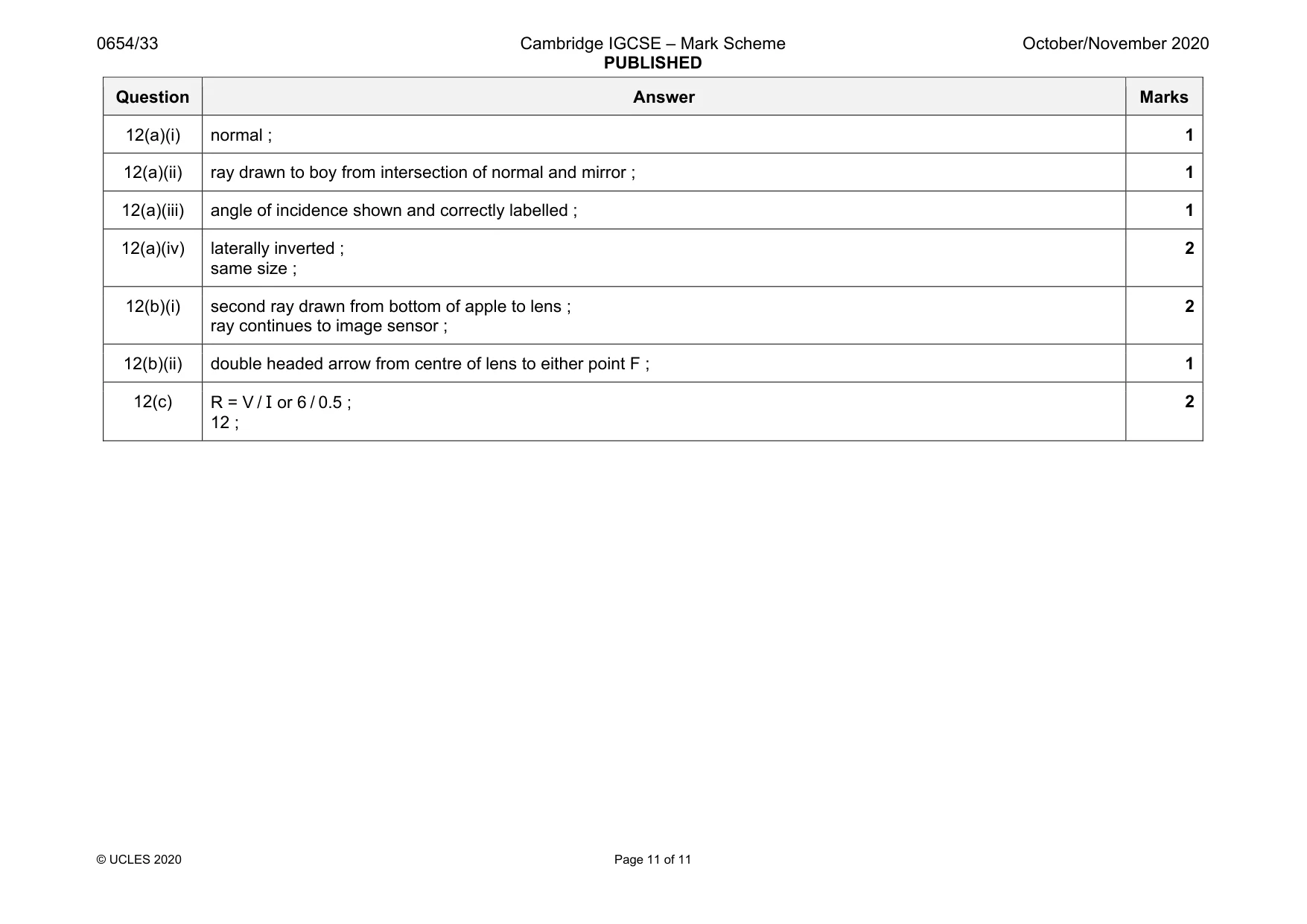
Mark scheme: 12(a)(i) normal ; 1 12(a)(ii) ray drawn to boy from intersection of normal and mirror ; 1 12(a)(iii) angle of incidence shown and correctly labelled ; 1 12(a)(iv) laterally inverted ; same size ; 2 12(b)(i) second ray drawn from bottom of apple to lens ; ray continues to image sensor ; 2 12(b)(ii) double headed arrow from centre of lens to either point F ; 1 12(c) R = V / I or 6 / 0.5 ; 12 ; 2
What was in this paper
The subtopics covered by these 12 questions, and how many questions each got. Open one in a new tab to see every Cambridge question on it.
What you needed in this session
Cambridge’s own grade thresholds for 2020 Oct/Nov, Paper 3 · Variant 3. A higher threshold means an easier paper — the bar moves with how the cohort did.