Cambridge IGCSE Sciences - Co-ordinated (Double) 0654 — 2022 Oct/Nov Paper 3 · Variant 1
0654/31/O/N/22 · 12 questions · 120 marks · ≈135 min
The question paper and its mark scheme, free to read here and free to download. This is Cambridge’s own paper, exactly as it was sat.
Question paper28 pages


Mark scheme13 pages
Answers below. Sit the paper first if you are practising.
Questions as text
Q1 · A person keeps a food diary for one day
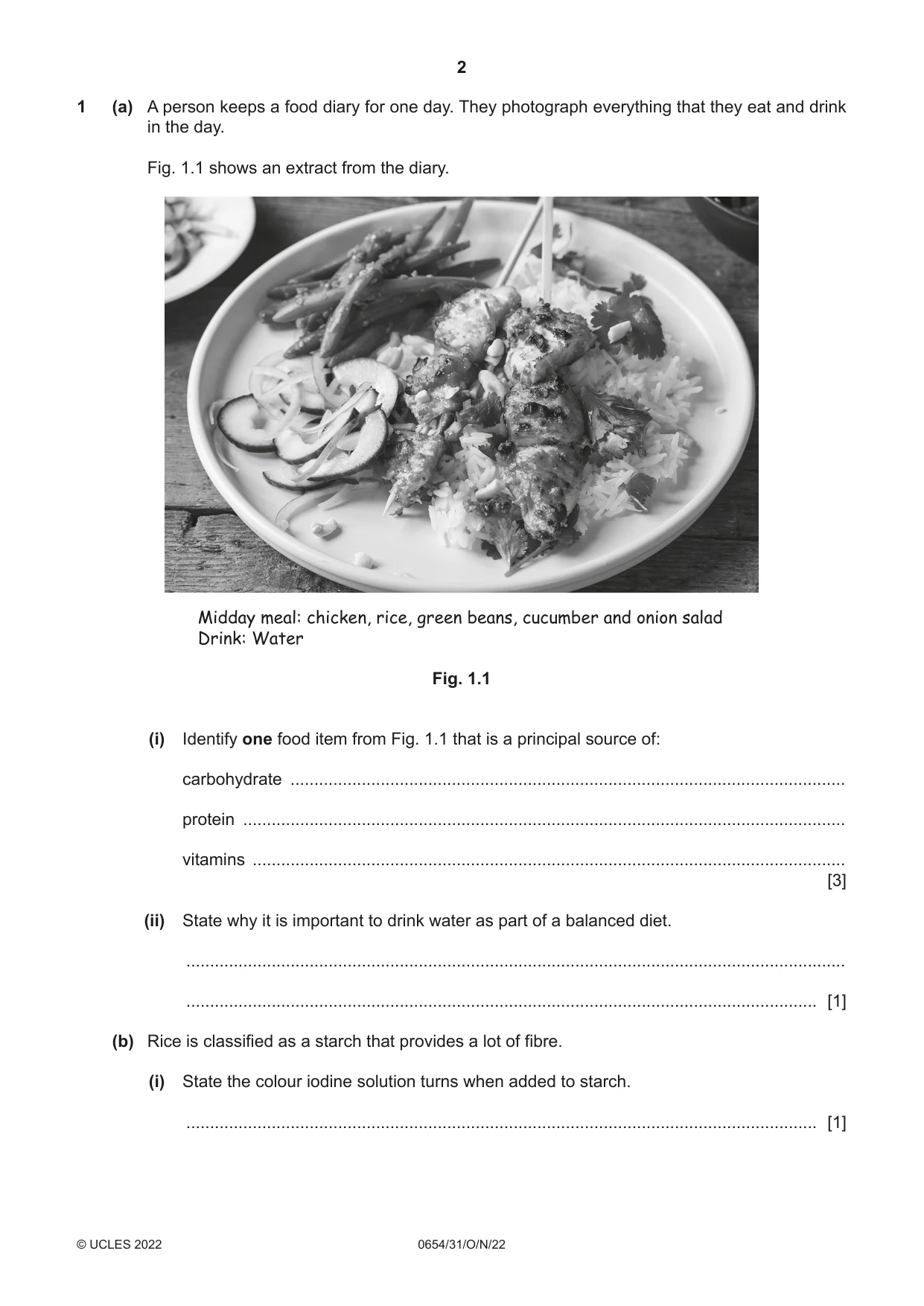
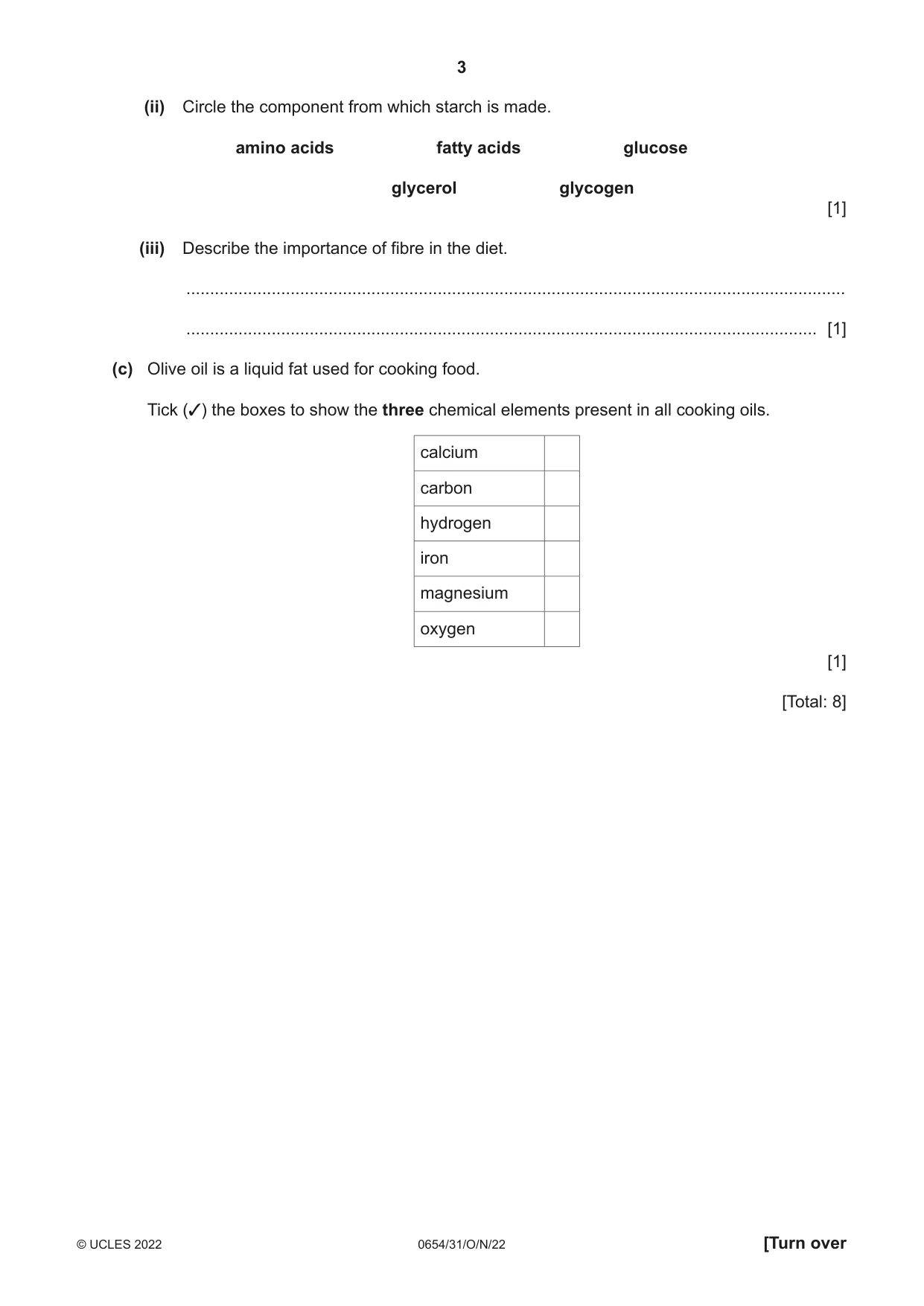
1 (a) A person keeps a food diary for one day. They photograph everything that they eat and drink in the day. Fig. 1.1 shows an extract from the diary. Midday meal: chicken, rice, green beans, cucumber and onion salad Drink: Water Fig. 1.1 (i) Identify one food item from Fig. 1.1 that is a principal source of: carbohydrate ..................................................................................................................... protein ............................................................................................................................... vitamins ............................................................................................................................. [3] (ii) State why it is important to drink water as part of a balanced diet. ........................................................................................................................................... ..................................................................................................................................... [1] (b) Rice is classified as a starch that provides a lot of fibre. (i) State the colour iodine solution turns when added to starch. ..................................................................................................................................... [1] (ii) Circle the component from which starch is made. amino acids fatty acids glucose glycerol glycogen [1] (iii) Describe the importance of fibre in the diet. ........................................................................................................................................... ..................................................................................................................................... [1] (c) Olive oil is a liquid fat used for cooking food. Tick (3) the boxes to show the three chemical elements present in all cooking oils. calcium carbon hydrogen iron magnesium oxygen [1] [Total: 8]
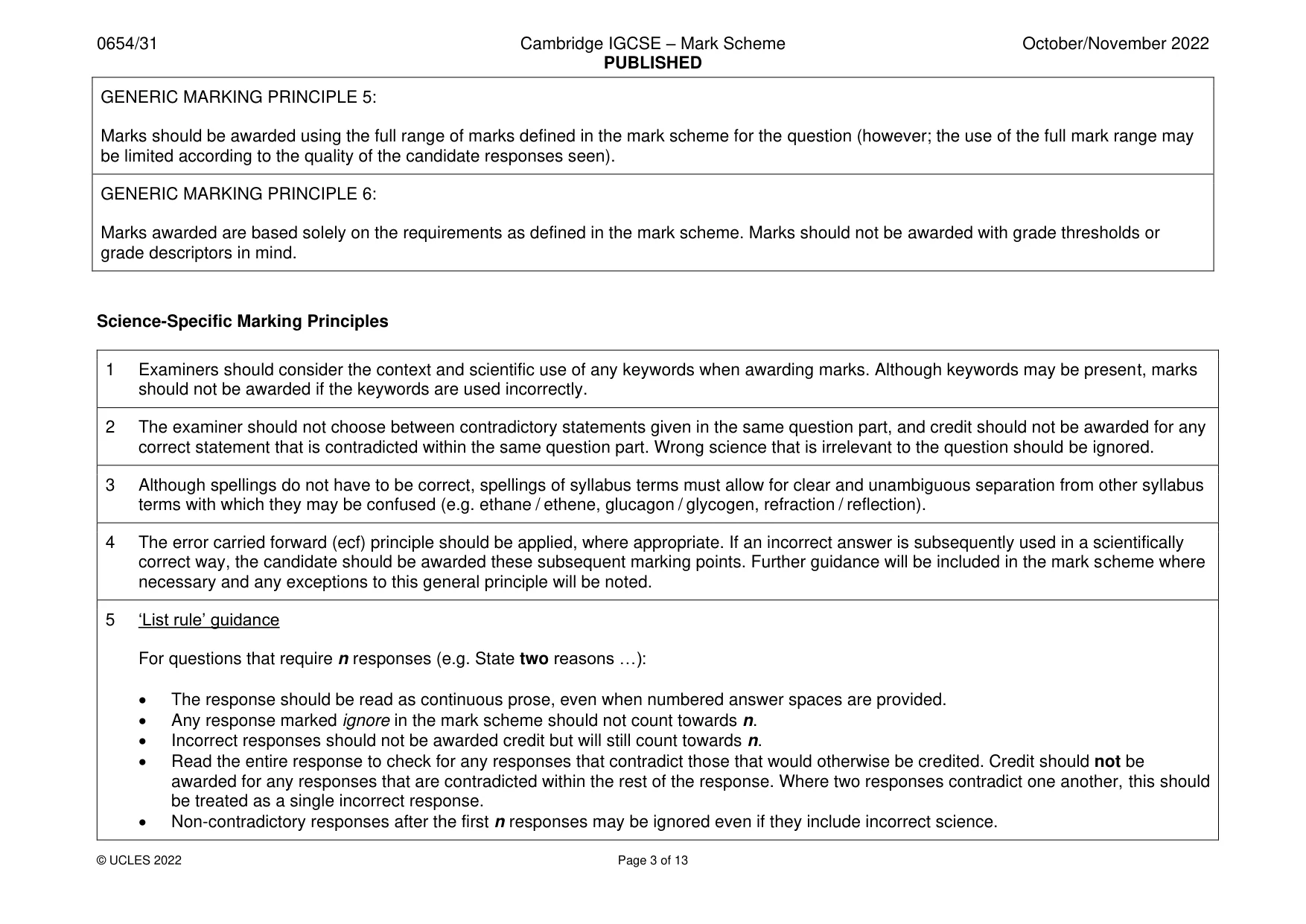
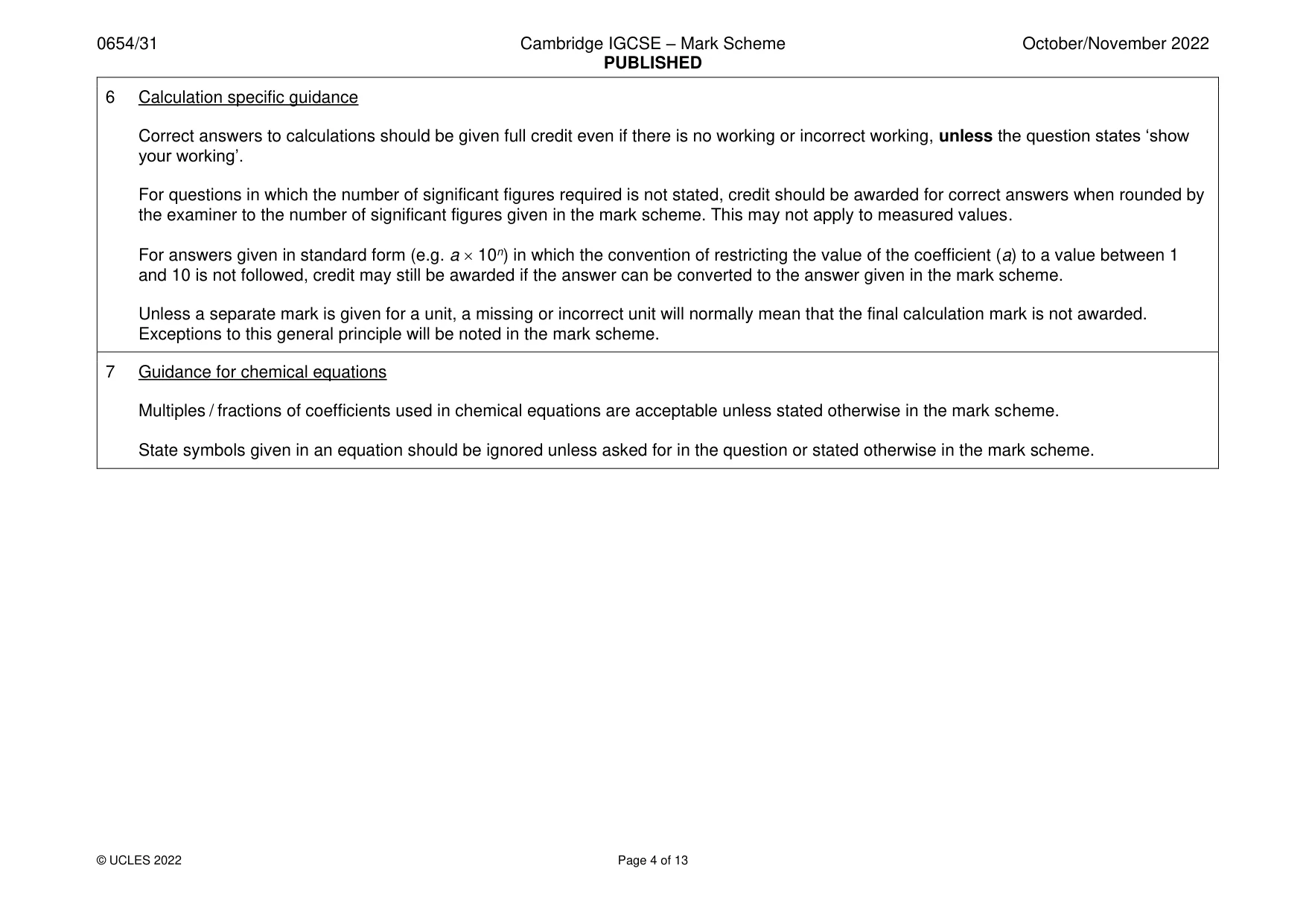
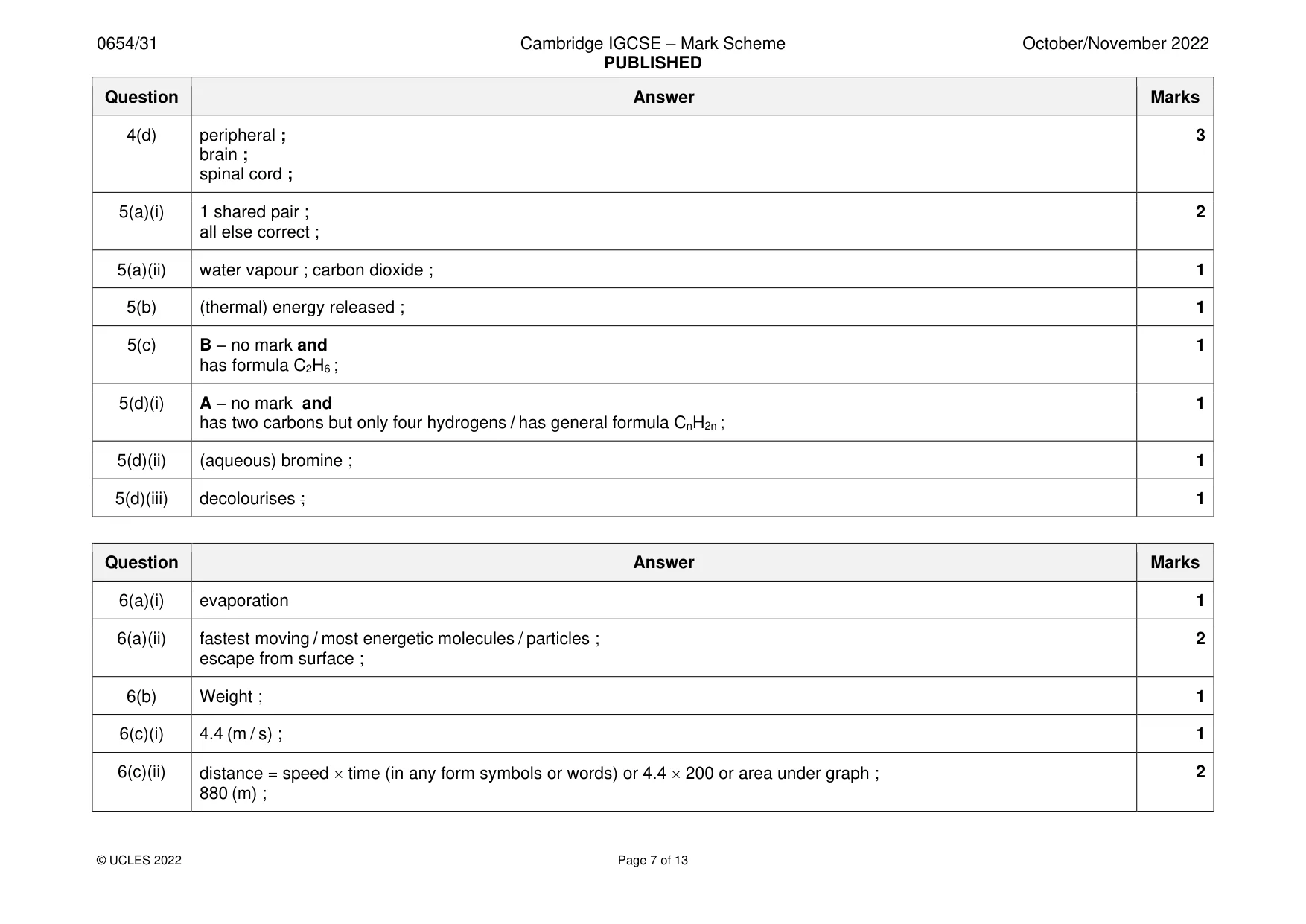
Mark scheme: Question Answer Marks 1(a)(i) rice ; 3 chicken ; (green) beans / cucumber / onions / salad ; 1(a)(ii) as a solvent / any valid point ; 1 1(b)(i) blue-black ; 1 1(b)(ii) glucose circled ; 1 1(b)(iii) prevents constipation / keeps food moving through the gut ; 1 1(c) carbon, hydrogen and oxygen ticked ; 1
Q2 · The list below shows some chemical processes
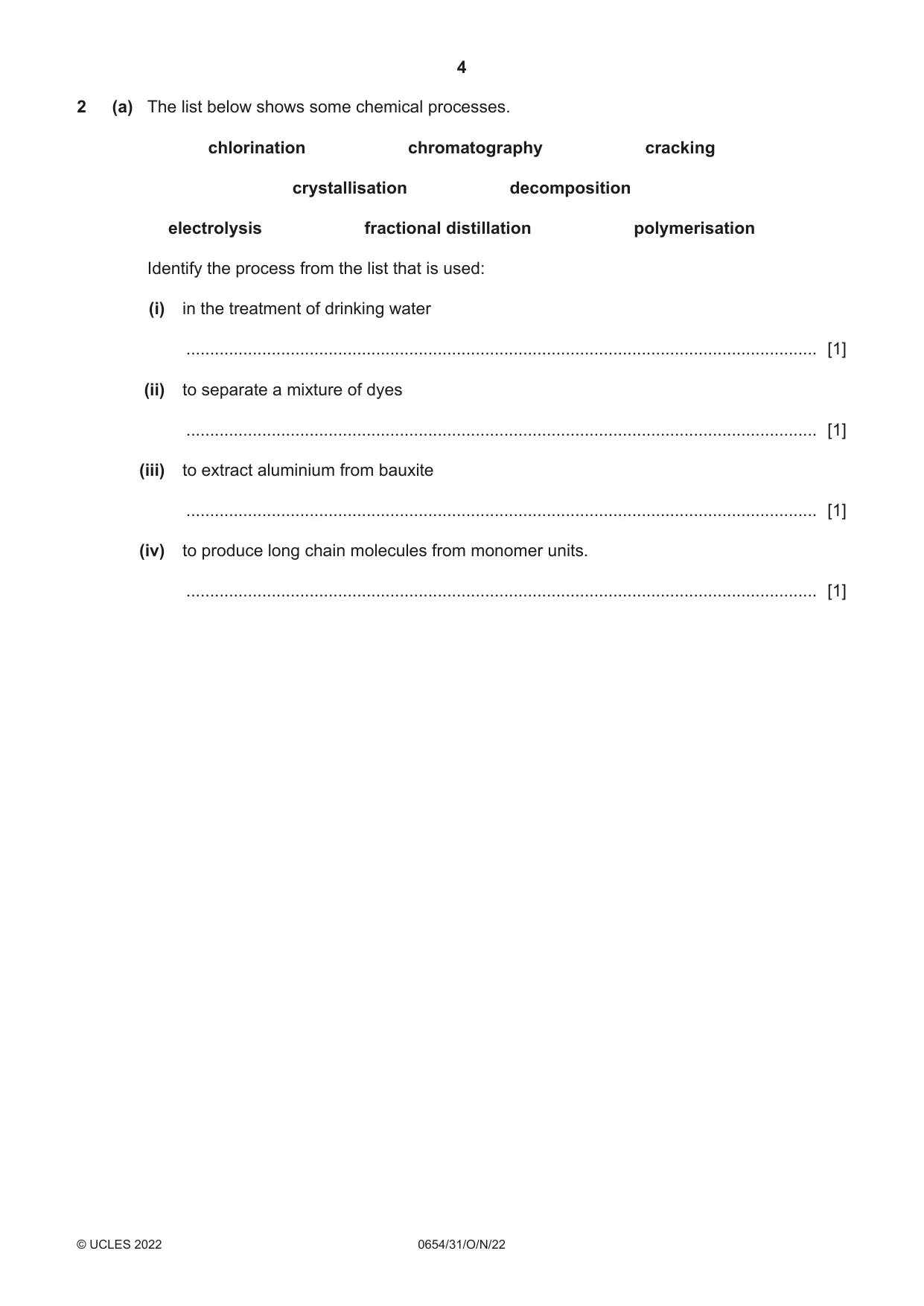
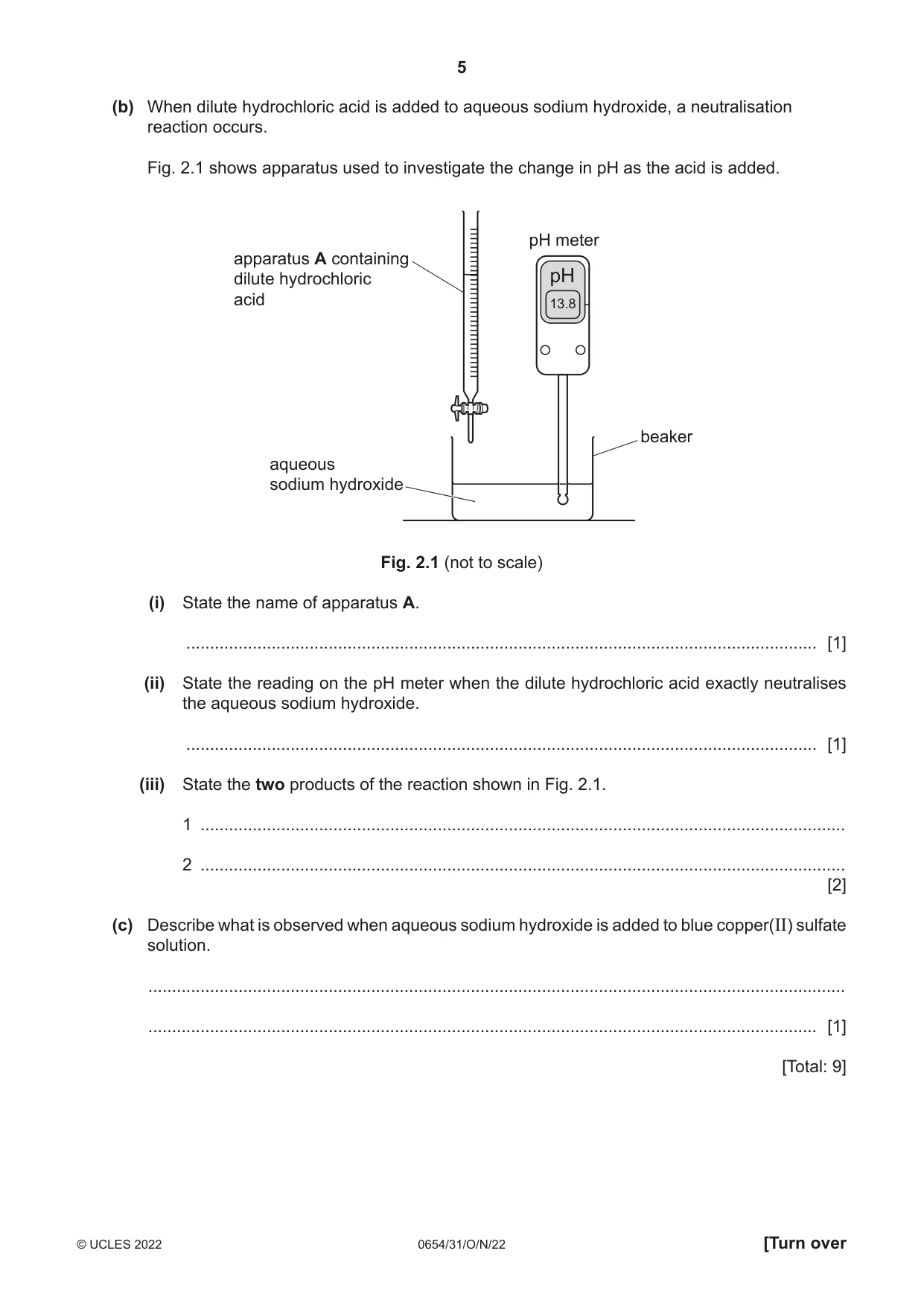
2 (a) The list below shows some chemical processes. chlorination chromatography cracking crystallisation decomposition electrolysis fractional distillation polymerisation Identify the process from the list that is used: (i) in the treatment of drinking water ..................................................................................................................................... [1] (ii) to separate a mixture of dyes ..................................................................................................................................... [1] (iii) to extract aluminium from bauxite ..................................................................................................................................... [1] (iv) to produce long chain molecules from monomer units. ..................................................................................................................................... [1] (b) When dilute hydrochloric acid is added to aqueous sodium hydroxide, a neutralisation reaction occurs. Fig. 2.1 shows apparatus used to investigate the change in pH as the acid is added. pH meter apparatus A containing dilute hydrochloric pH acid 13.8 beaker aqueous sodium hydroxide Fig. 2.1 (not to scale) (i) State the name of apparatus A. ..................................................................................................................................... [1] (ii) State the reading on the pH meter when the dilute hydrochloric acid exactly neutralises the aqueous sodium hydroxide. ..................................................................................................................................... [1] (iii) State the two products of the reaction shown in Fig. 2.1. 1 ........................................................................................................................................ 2 ........................................................................................................................................ [2] (c) Describe what is observed when aqueous sodium hydroxide is added to blue copper(II) sulfate solution. ................................................................................................................................................... ............................................................................................................................................. [1] [Total: 9]
Mark scheme: 2(a)(i) chlorination ; 1 2(a)(ii) chromatography ; 1 2(a)(iii) electrolysis ; 1 2(a)(iv) polymerisation ; 1 2(b)(i) burette ; 1 2(b)(ii) 7 ; 1 2(b)(iii) sodium chloride ; 2 water ; 2(c) pale blue precipitate ; 1
Q3 · The list below shows energy sources used by power stations, to generate electricity
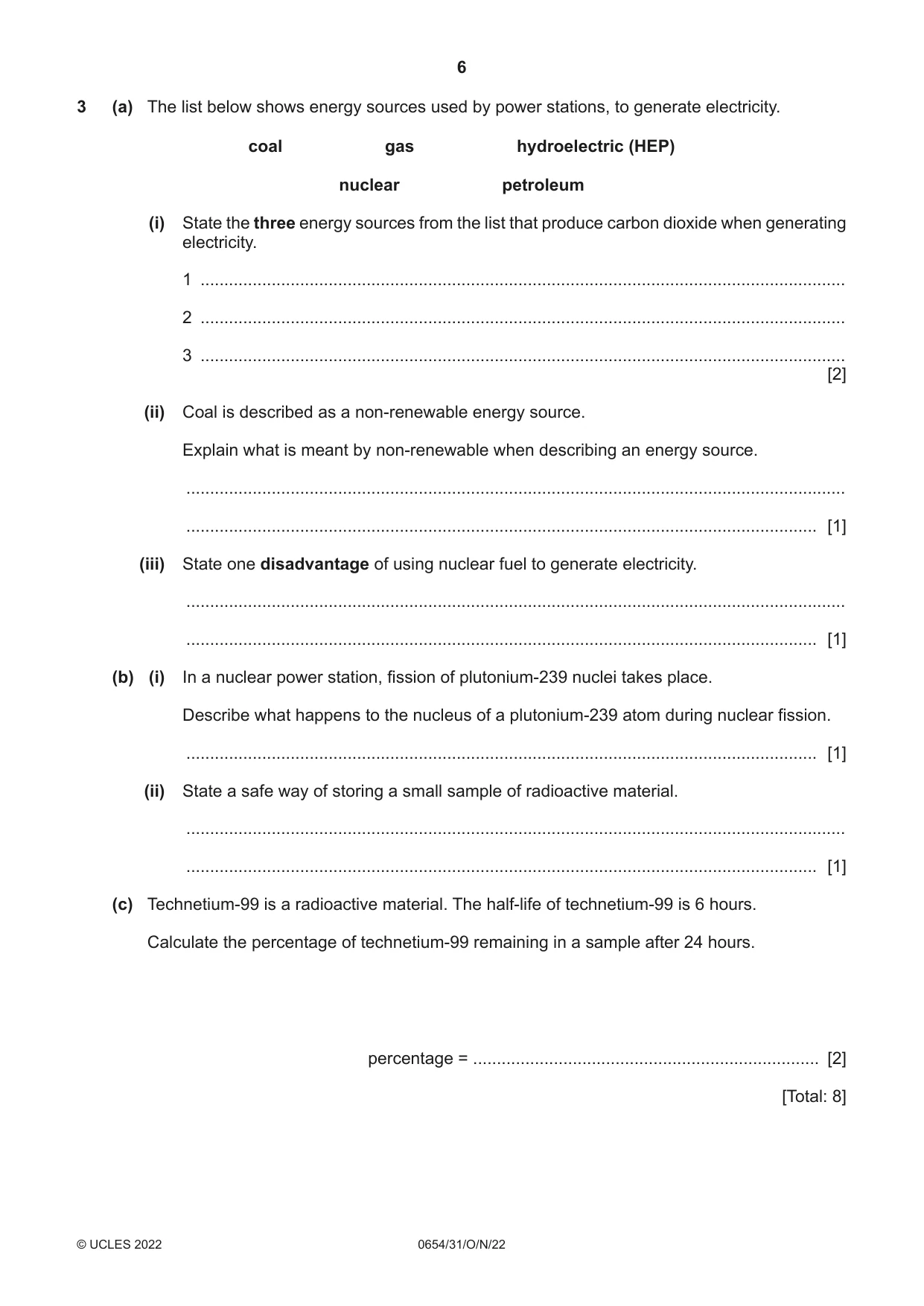
3 (a) The list below shows energy sources used by power stations, to generate electricity. coal gas hydroelectric (HEP) nuclear petroleum (i) State the three energy sources from the list that produce carbon dioxide when generating electricity. 1 ........................................................................................................................................ 2 ........................................................................................................................................ 3 ........................................................................................................................................ [2] (ii) Coal is described as a non-renewable energy source. Explain what is meant by non-renewable when describing an energy source. ........................................................................................................................................... ..................................................................................................................................... [1] (iii) State one disadvantage of using nuclear fuel to generate electricity. ........................................................................................................................................... ..................................................................................................................................... [1] (b) (i) In a nuclear power station, fission of plutonium-239 nuclei takes place. Describe what happens to the nucleus of a plutonium-239 atom during nuclear fission. ..................................................................................................................................... [1] (ii) State a safe way of storing a small sample of radioactive material. ........................................................................................................................................... ..................................................................................................................................... [1] (c) Technetium-99 is a radioactive material. The half-life of technetium-99 is 6 hours. Calculate the percentage of technetium-99 remaining in a sample after 24 hours. percentage = ......................................................................... [2] [Total: 8]
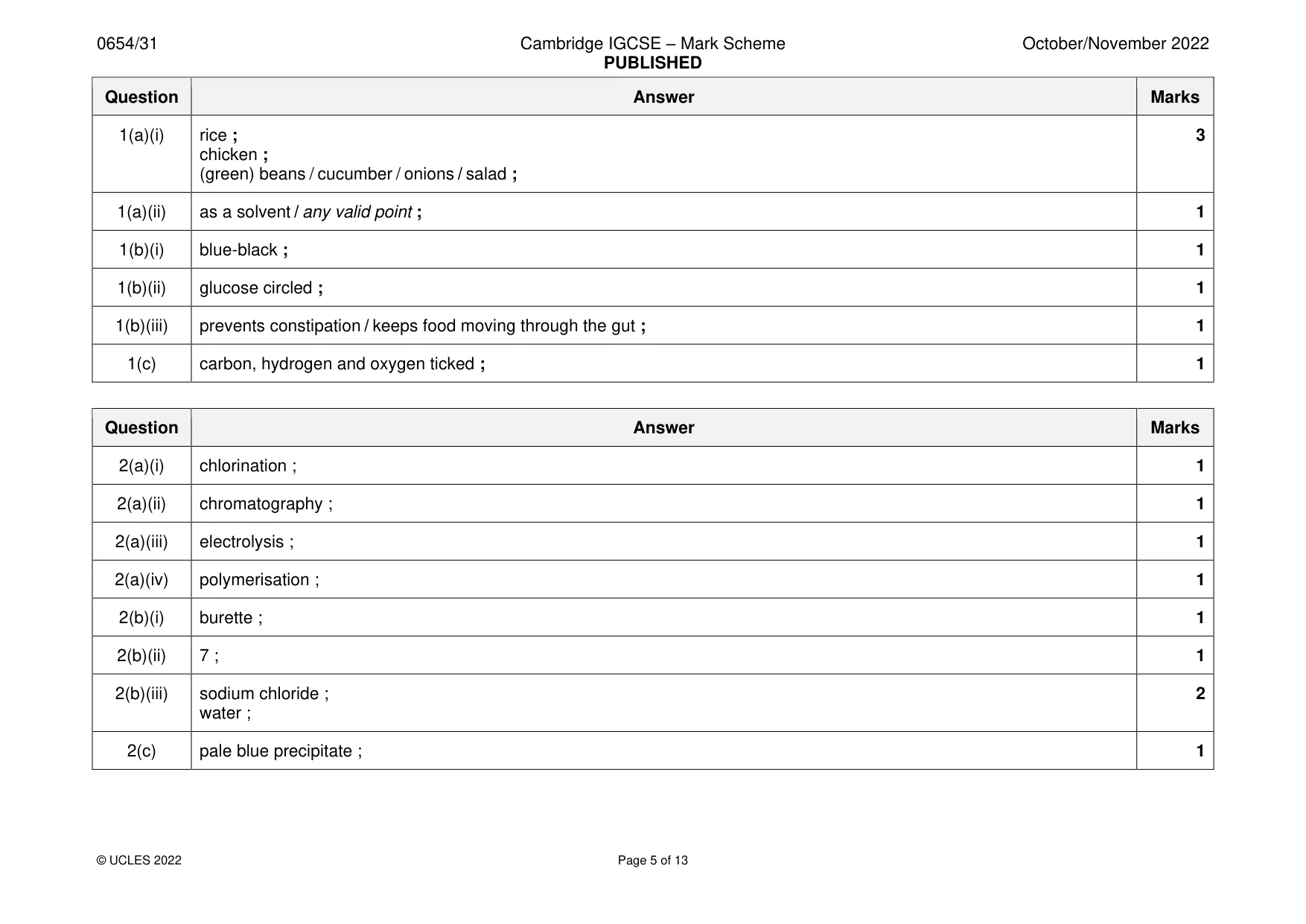
Mark scheme: 3(a)(i) any two from: 2 coal gas petroleum ;; 3(a)(ii) only existing as a finite quantity / being used up at a faster rate than it can be replaced ; 1 3(a)(iii) nuclear accidents / nuclear / dangerous / harmful waste produced ; 1 3(b)(i) (nucleus) splits ; 1 3(b)(ii) in a lead lined container ; 1 3(c) 4 half-lives / division by 16 ; 2 6.25% ;
Q4 · Complete the definition of the term hormone
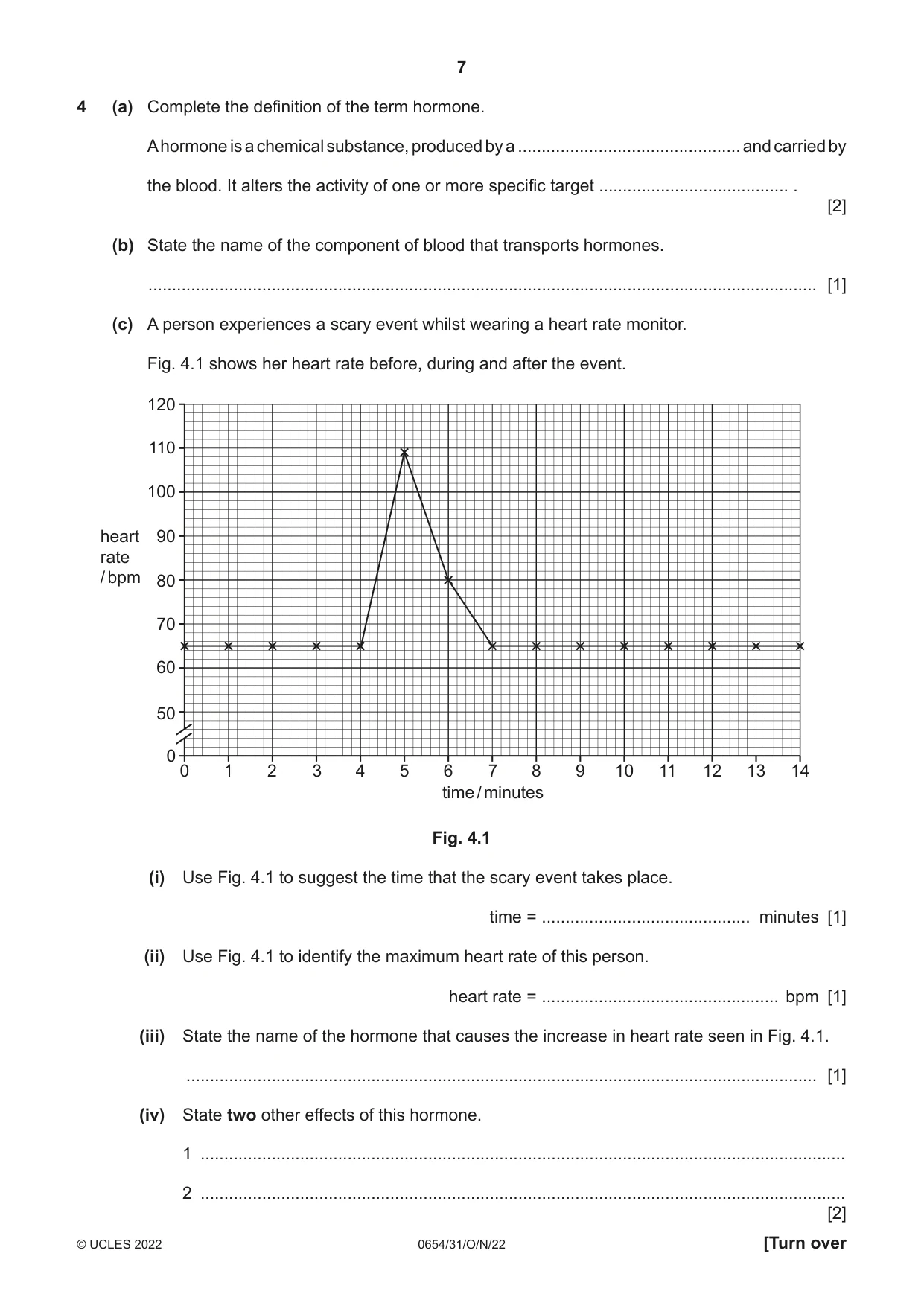
4 (a) Complete the definition of the term hormone. A hormone is a chemical substance, produced by a ............................................... and carried by the blood. It alters the activity of one or more specific target ........................................ . [2] (b) State the name of the component of blood that transports hormones. ............................................................................................................................................. [1] (c) A person experiences a scary event whilst wearing a heart rate monitor. Fig. 4.1 shows her heart rate before, during and after the event. 120 110 100 heart 90 rate / bpm 80 70 60 50 0 0 1 2 3 4 5 6 7 8 9 10 11 12 13 14 time / minutes Fig. 4.1 (i) Use Fig. 4.1 to suggest the time that the scary event takes place. time = ............................................ minutes [1] (ii) Use Fig. 4.1 to identify the maximum heart rate of this person. heart rate = .................................................. bpm [1] (iii) State the name of the hormone that causes the increase in heart rate seen in Fig. 4.1. ..................................................................................................................................... [1] (iv) State two other effects of this hormone. 1 ........................................................................................................................................ 2 ........................................................................................................................................ [2] (d) Complete these sentences about the human nervous system. The nervous system consists of the central nervous system and the ............................................... nervous system. The central nervous system has two parts: the ............................................... and the ............................................... . [3] [Total: 11]
Mark scheme: 4(a) gland ; 2 organs ; 4(b) plasma ; 1 4(c)(i) 4 (minutes) ; 1 4(c)(ii) 109 (bpm) ; 1 4(c)(iii) adrenaline ; 1 4(c)(iv) widened pupils ; 2 increased breathing rate ; any valid point ;; 4(d) peripheral ; 3 brain ; spinal cord ;
Q5 · Three hydrocarbon molecules, A, B and C
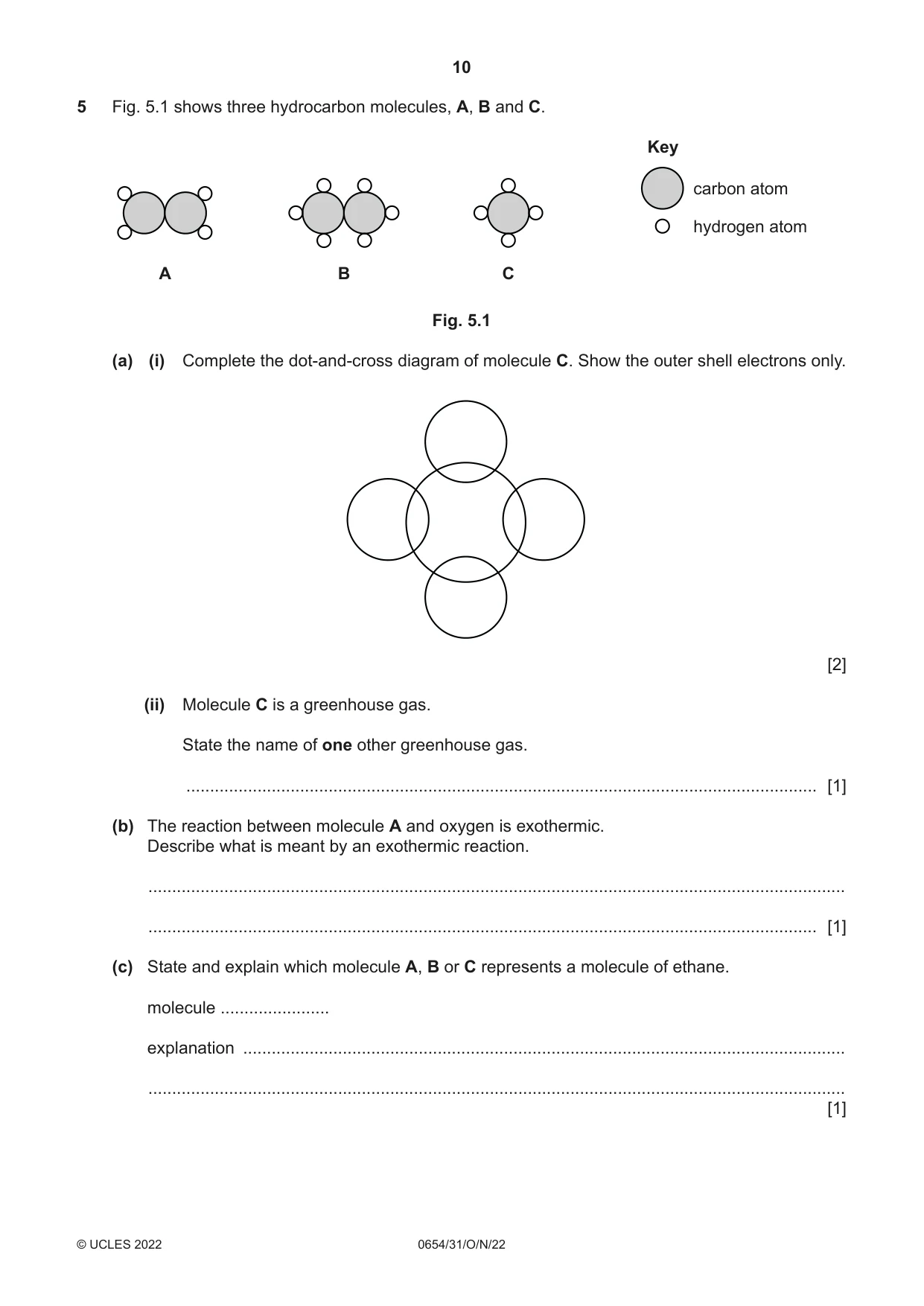
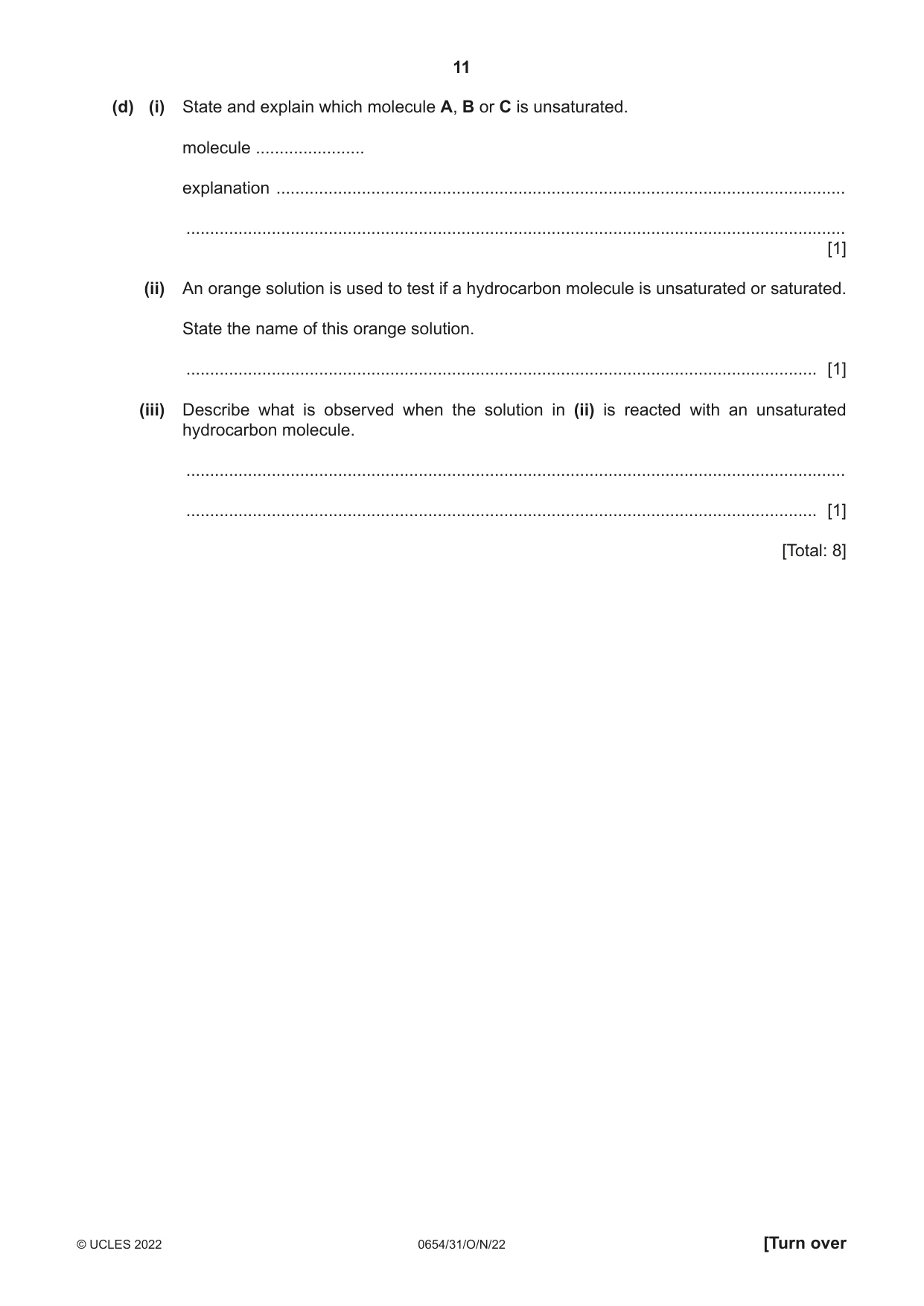
5 Fig. 5.1 shows three hydrocarbon molecules, A, B and C. Key carbon atom hydrogen atom A B C Fig. 5.1 (a) (i) Complete the dot-and-cross diagram of molecule C. Show the outer shell electrons only. [2] (ii) Molecule C is a greenhouse gas. State the name of one other greenhouse gas. ..................................................................................................................................... [1] (b) The reaction between molecule A and oxygen is exothermic. Describe what is meant by an exothermic reaction. ................................................................................................................................................... ............................................................................................................................................. [1] (c) State and explain which molecule A, B or C represents a molecule of ethane. molecule ....................... explanation ............................................................................................................................... ................................................................................................................................................... [1] (d) (i) State and explain which molecule A, B or C is unsaturated. molecule ....................... explanation ........................................................................................................................ ........................................................................................................................................... [1] (ii) An orange solution is used to test if a hydrocarbon molecule is unsaturated or saturated. State the name of this orange solution. ..................................................................................................................................... [1] (iii) Describe what is observed when the solution in (ii) is reacted with an unsaturated hydrocarbon molecule. ........................................................................................................................................... ..................................................................................................................................... [1] [Total: 8]
Mark scheme: 5(a)(i) 1 shared pair ; 2 all else correct ; 5(a)(ii) water vapour ; carbon dioxide ; 1 5(b) (thermal) energy released ; 1 5(c) B – no mark and 1 has formula C2H6 ; 5(d)(i) A – no mark and 1 has two carbons but only four hydrogens / has general formula CnH2n ; 5(d)(ii) (aqueous) bromine ; 1 5(d)(iii) decolourises ; 1
Q6 · Water vapour in the air over the sea comes from liquid water in the sea
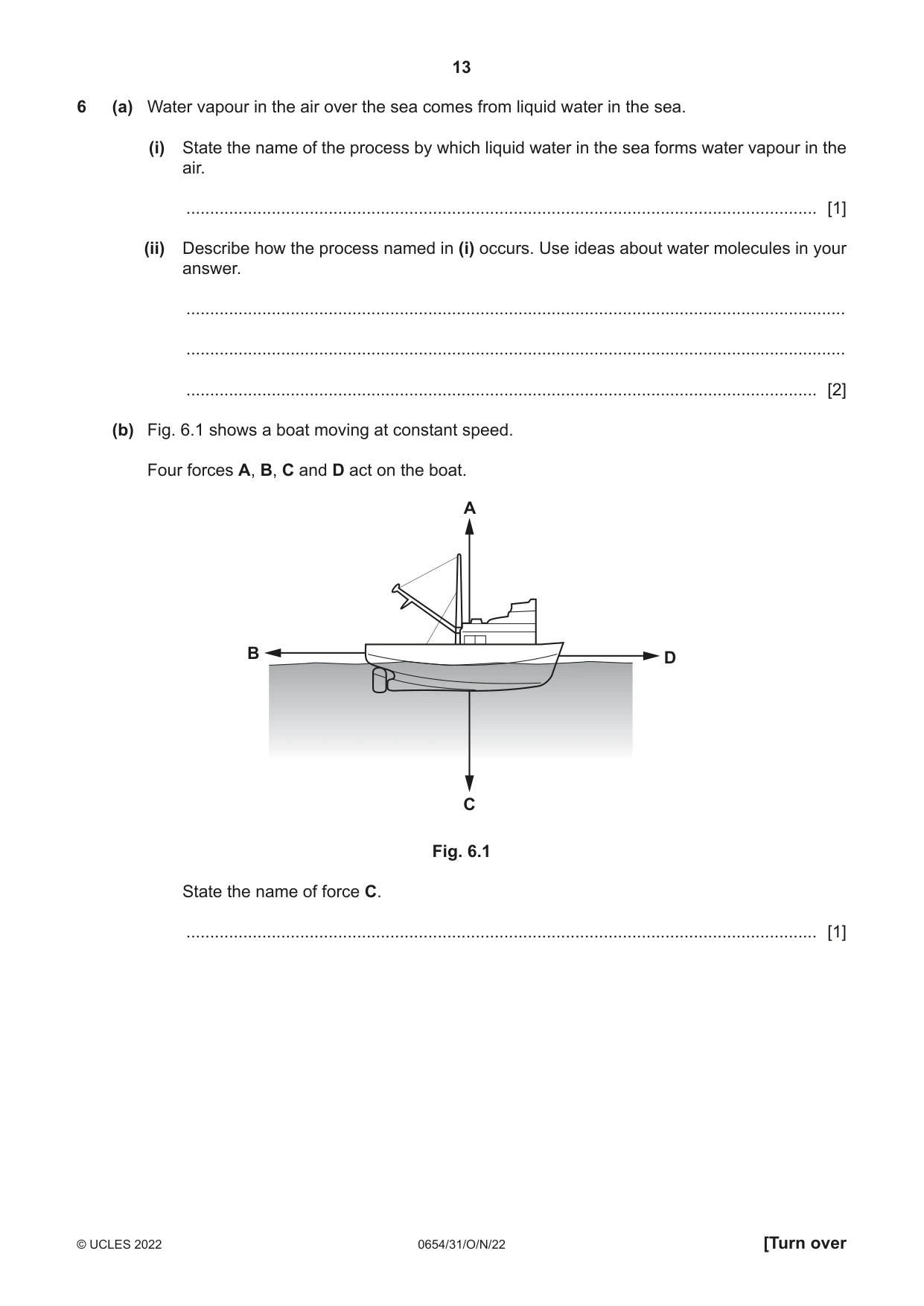
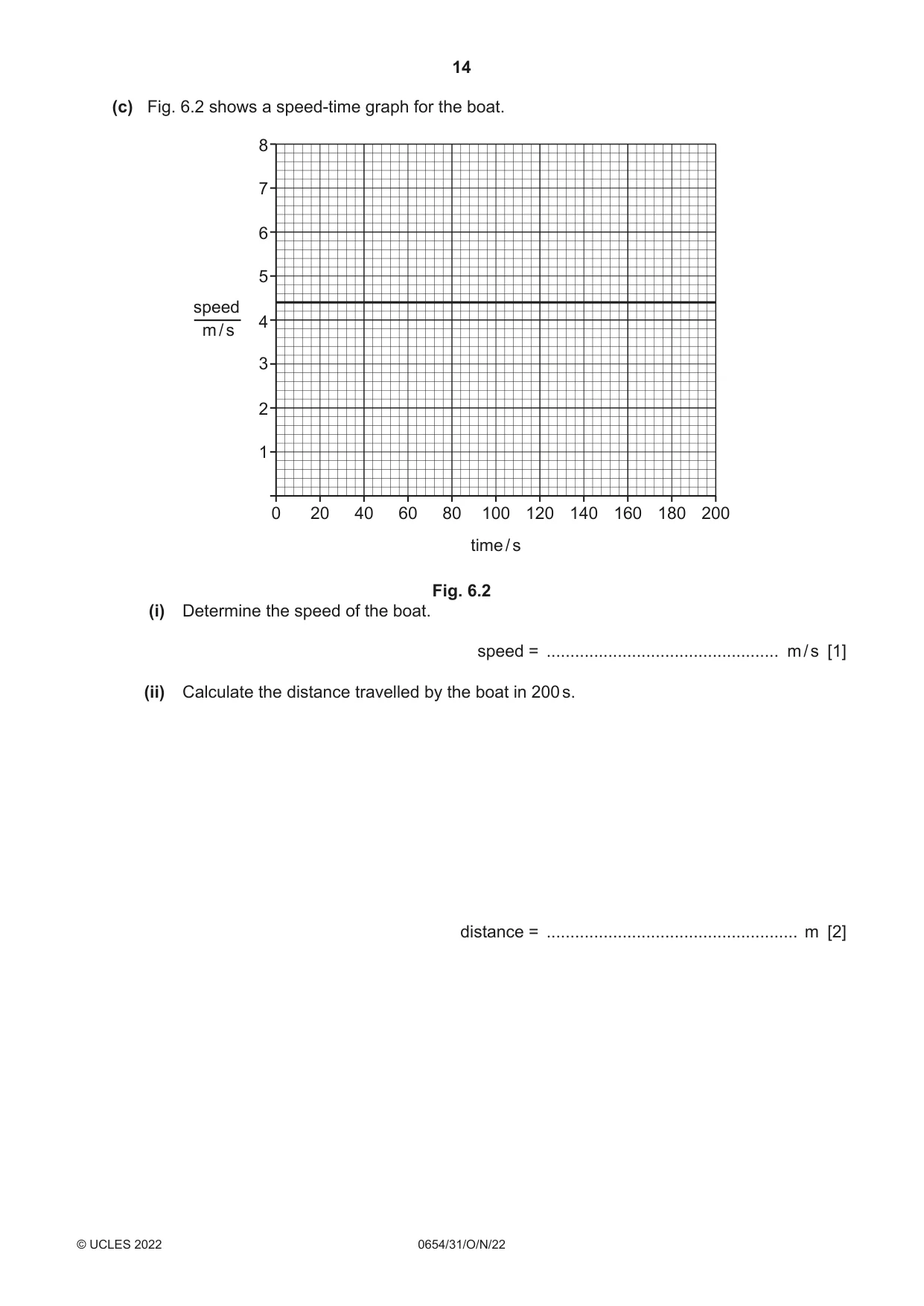
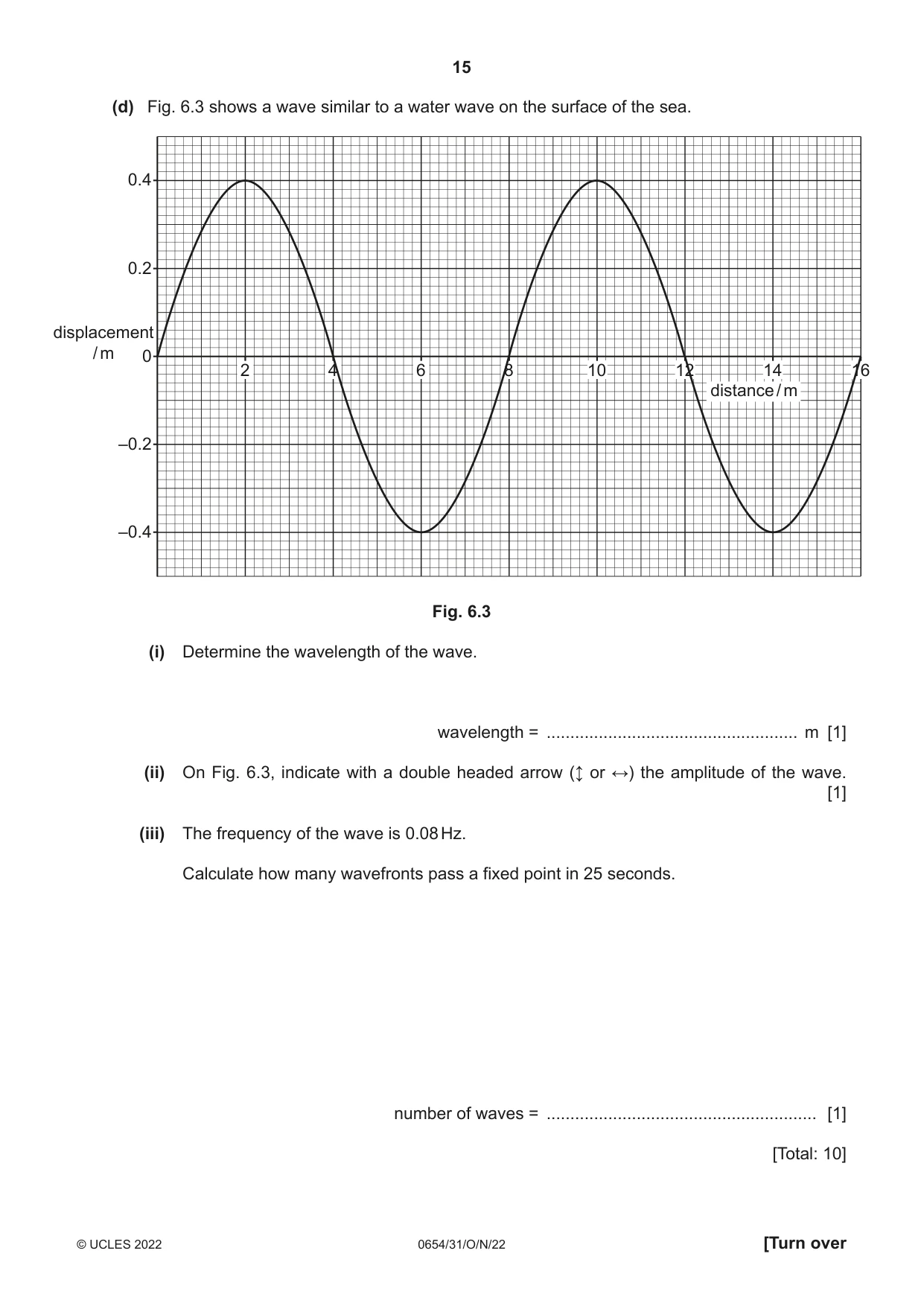
6 (a) Water vapour in the air over the sea comes from liquid water in the sea. (i) State the name of the process by which liquid water in the sea forms water vapour in the air. ..................................................................................................................................... [1] (ii) Describe how the process named in (i) occurs. Use ideas about water molecules in your answer. ........................................................................................................................................... ........................................................................................................................................... ..................................................................................................................................... [2] (b) Fig. 6.1 shows a boat moving at constant speed. Four forces A, B, C and D act on the boat. A B D C Fig. 6.1 State the name of force C. ..................................................................................................................................... [1] (c) Fig. 6.2 shows a speed-time graph for the boat. 8 7 6 5 speed 4 m / s 3 2 1 0 20 40 60 80 100 120 140 160 180 200 time / s Fig. 6.2 (i) Determine the speed of the boat. speed = ................................................. m / s [1] (ii) Calculate the distance travelled by the boat in 200 s. distance = ..................................................... m [2] (d) Fig. 6.3 shows a wave similar to a water wave on the surface of the sea. 0.4 0.2 displacement / m 0 2 4 6 8 10 12 14 16 distance / m –0.2 –0.4 Fig. 6.3 (i) Determine the wavelength of the wave. wavelength = ..................................................... m [1] (ii) On Fig. 6.3, indicate with a double headed arrow (↕ or ↔) the amplitude of the wave. [1] (iii) The frequency of the wave is 0.08 Hz. Calculate how many wavefronts pass a fixed point in 25 seconds. number of waves = ......................................................... [1] [Total: 10]
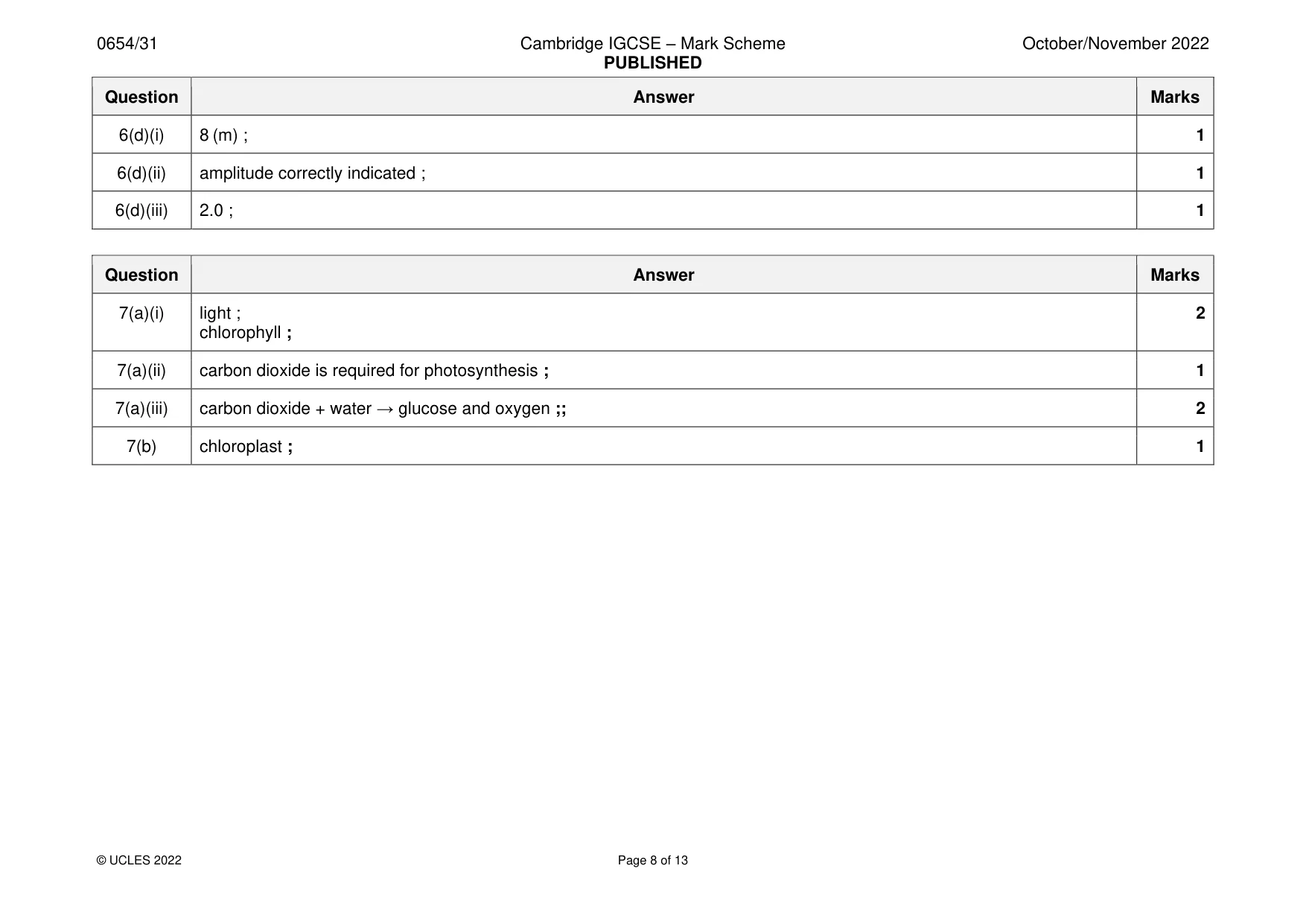
Mark scheme: 6(a)(i) evaporation 1 6(a)(ii) fastest moving / most energetic molecules / particles ; 2 escape from surface ; 6(b) Weight ; 1 6(c)(i) 4.4 (m / s) ; 1 6(c)(ii) distance = speed time (in any form symbols or words) or 4.4 200 or area under graph ; 2 880 (m) ; 6(d)(i) 8 (m) ; 1 6(d)(ii) amplitude correctly indicated ; 1 6(d)(iii) 2.0 ; 1
Q7 · A student investigates photosynthesis
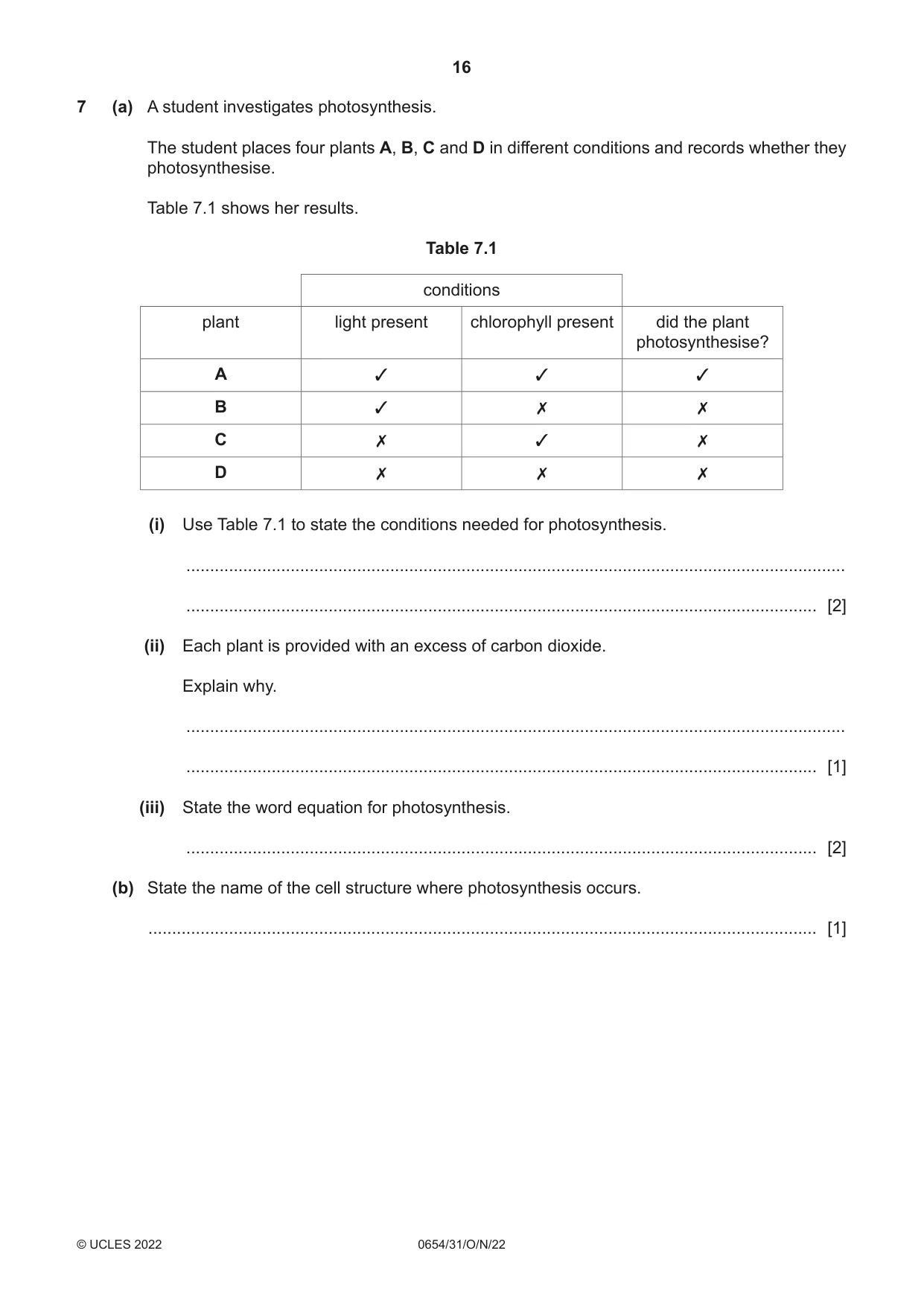
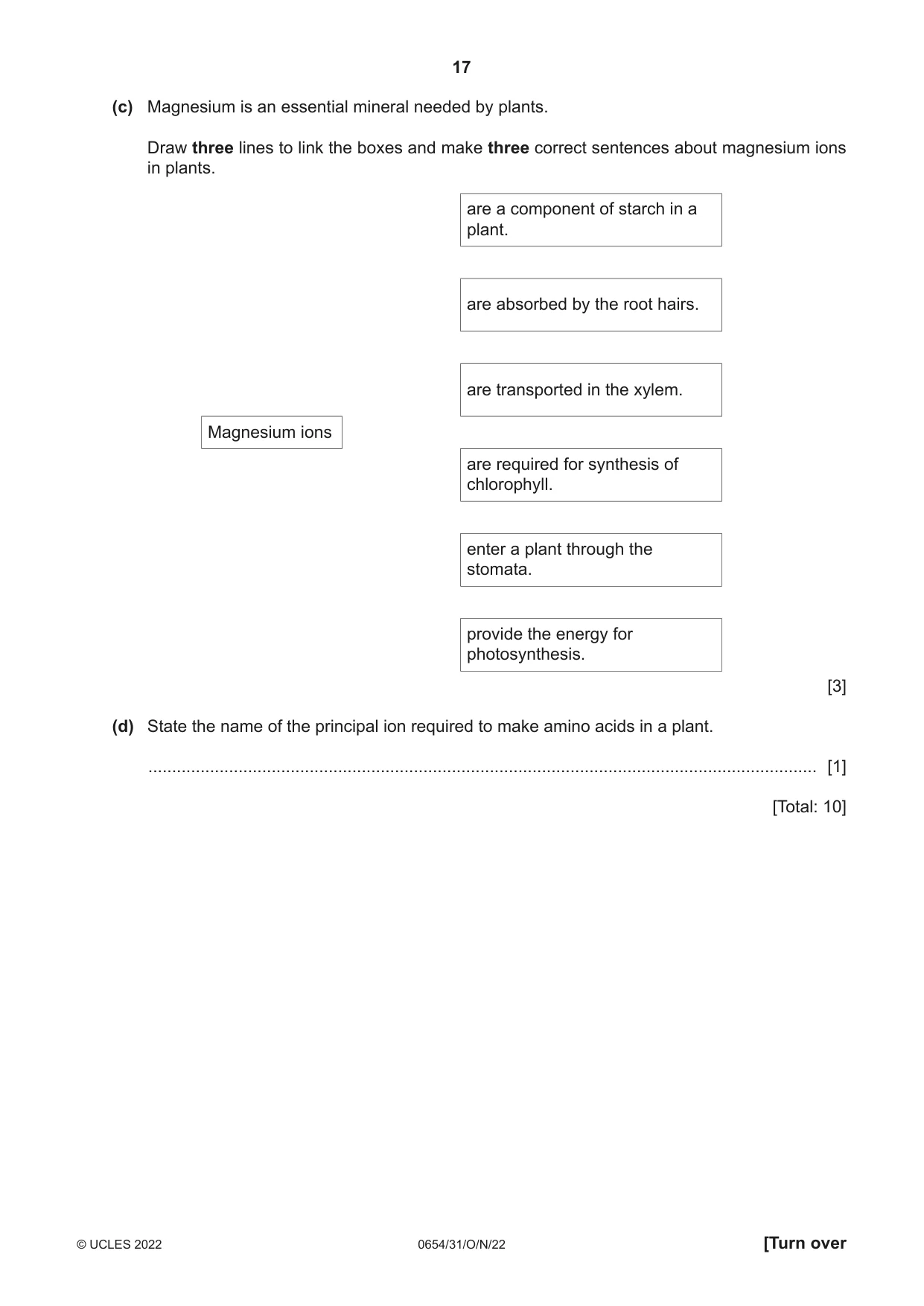
7 (a) A student investigates photosynthesis. The student places four plants A, B, C and D in different conditions and records whether they photosynthesise. Table 7.1 shows her results. Table 7.1 conditions plant light present chlorophyll present did the plant photosynthesise? A 3 3 3 B 3 ✗ ✗ C ✗ 3 ✗ D ✗ ✗ ✗ (i) Use Table 7.1 to state the conditions needed for photosynthesis. ........................................................................................................................................... ..................................................................................................................................... [2] (ii) Each plant is provided with an excess of carbon dioxide. Explain why. ........................................................................................................................................... ..................................................................................................................................... [1] (iii) State the word equation for photosynthesis. ..................................................................................................................................... [2] (b) State the name of the cell structure where photosynthesis occurs. ............................................................................................................................................. [1] (c) Magnesium is an essential mineral needed by plants. Draw three lines to link the boxes and make three correct sentences about magnesium ions in plants. are a component of starch in a plant. are absorbed by the root hairs. are transported in the xylem. Magnesium ions are required for synthesis of chlorophyll. enter a plant through the stomata. provide the energy for photosynthesis. [3] (d) State the name of the principal ion required to make amino acids in a plant. ............................................................................................................................................. [1] [Total: 10]
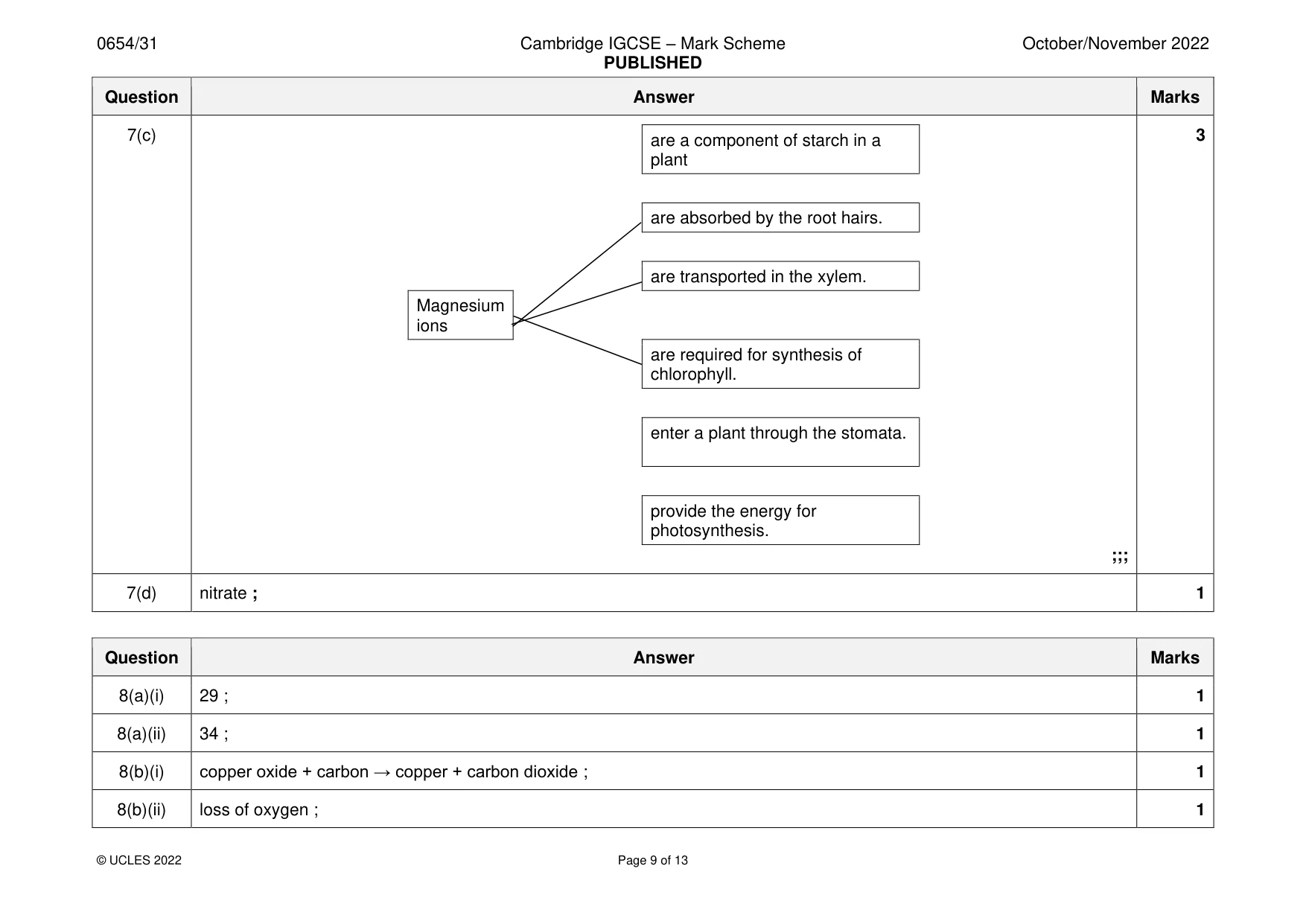
Mark scheme: 7(a)(i) light ; 2 chlorophyll ; 7(a)(ii) carbon dioxide is required for photosynthesis ; 1 7(a)(iii) carbon dioxide + water → glucose and oxygen ;; 2 7(b) chloroplast ; 1 7(c) 3 are a component of starch in a plant are absorbed by the root hairs. are transported in the xylem. Magnesium ions are required for synthesis of chlorophyll. enter a plant through the stomata. provide the energy for photosynthesis. ;;; 7(d) nitrate ; 1
Q8 · An atom of copper has a proton number of 29 and a nucleon number of 63
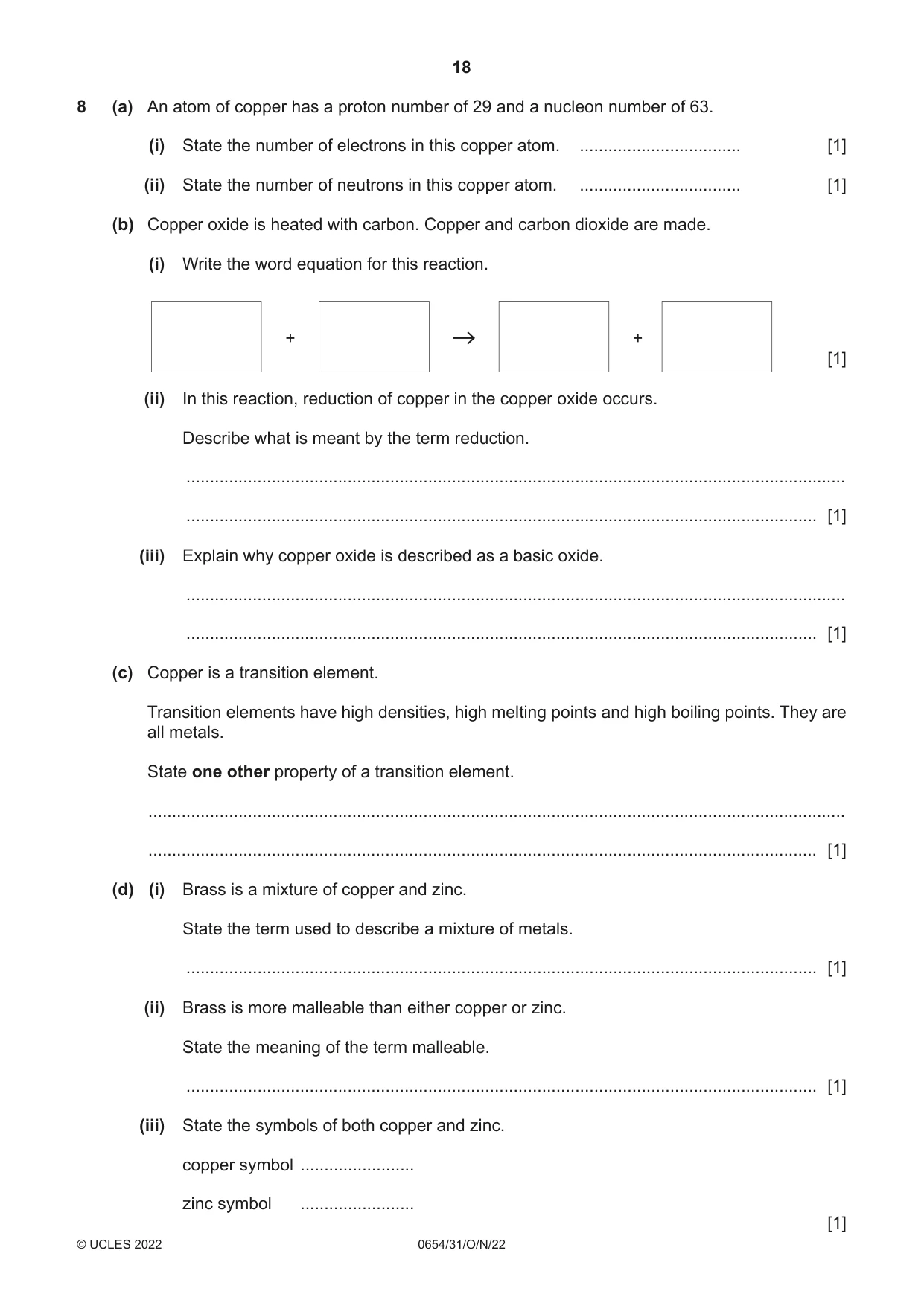
8 (a) An atom of copper has a proton number of 29 and a nucleon number of 63. (i) State the number of electrons in this copper atom. .................................. [1] (ii) State the number of neutrons in this copper atom. .................................. [1] (b) Copper oxide is heated with carbon. Copper and carbon dioxide are made. (i) Write the word equation for this reaction. + + [1] (ii) In this reaction, reduction of copper in the copper oxide occurs. Describe what is meant by the term reduction. ........................................................................................................................................... ..................................................................................................................................... [1] (iii) Explain why copper oxide is described as a basic oxide. ........................................................................................................................................... ..................................................................................................................................... [1] (c) Copper is a transition element. Transition elements have high densities, high melting points and high boiling points. They are all metals. State one other property of a transition element. ................................................................................................................................................... ............................................................................................................................................. [1] (d) (i) Brass is a mixture of copper and zinc. State the term used to describe a mixture of metals. ..................................................................................................................................... [1] (ii) Brass is more malleable than either copper or zinc. State the meaning of the term malleable. ..................................................................................................................................... [1] (iii) State the symbols of both copper and zinc. copper symbol ........................ zinc symbol ........................ [1] (e) A metal key is covered with a layer of copper by electroplating. (i) The key is an electrode. State which electrode is the key. ..................................................................................................................................... [1] (ii) Suggest a suitable electrolyte for electroplating the key. ..................................................................................................................................... [1] [Total: 11]
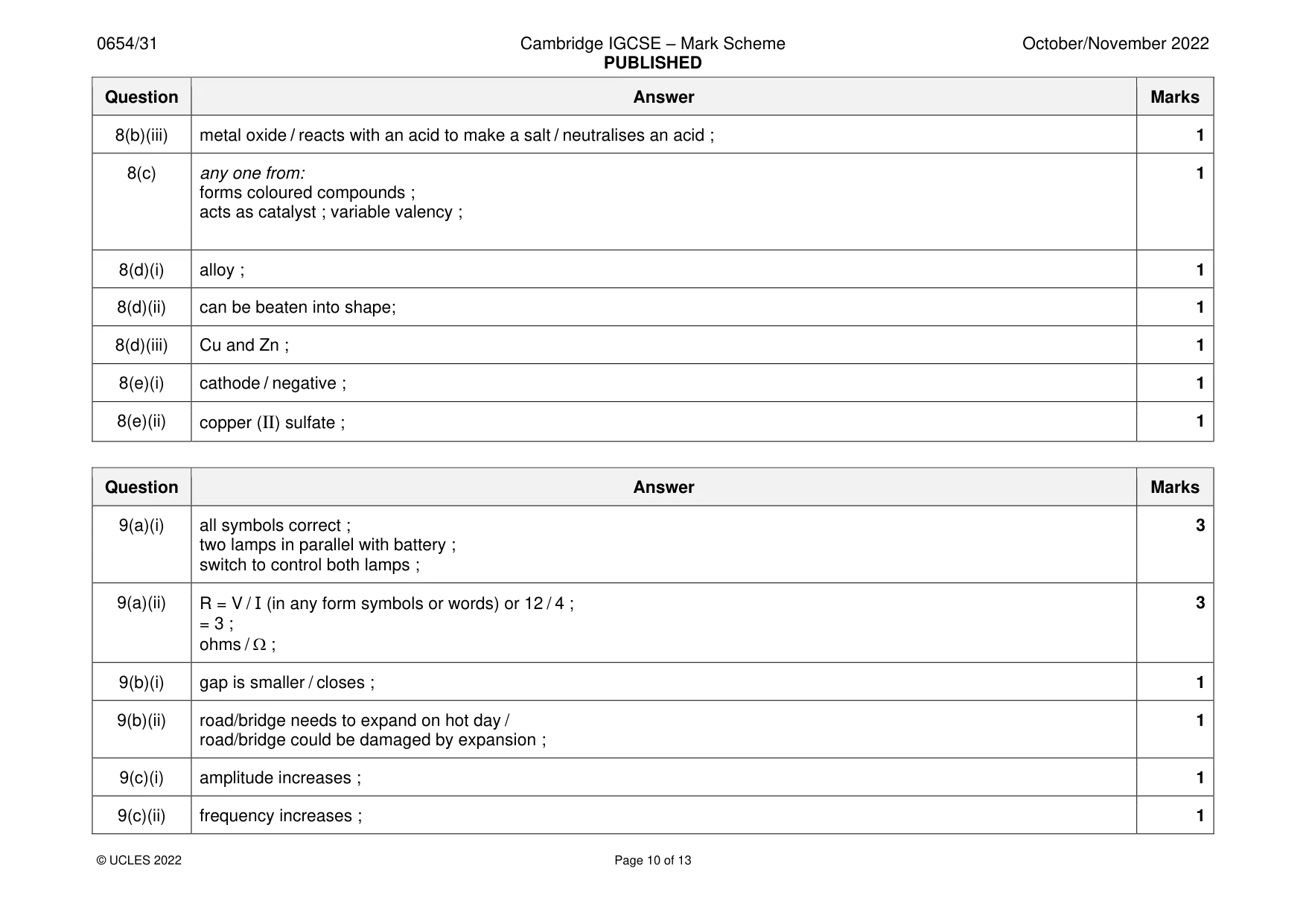
Mark scheme: 8(a)(i) 29 ; 1 8(a)(ii) 34 ; 1 8(b)(i) copper oxide + carbon → copper + carbon dioxide ; 1 8(b)(ii) loss of oxygen ; 1 8(b)(iii) metal oxide / reacts with an acid to make a salt / neutralises an acid ; 1 8(c) any one from: 1 forms coloured compounds ; acts as catalyst ; variable valency ; 8(d)(i) alloy ; 1 8(d)(ii) can be beaten into shape; 1 8(d)(iii) Cu and Zn ; 1 8(e)(i) cathode / negative ; 1 8(e)(ii) copper (II) sulfate ; 1
Q9 · A car has two headlamps, connected in parallel, across a 12 V battery
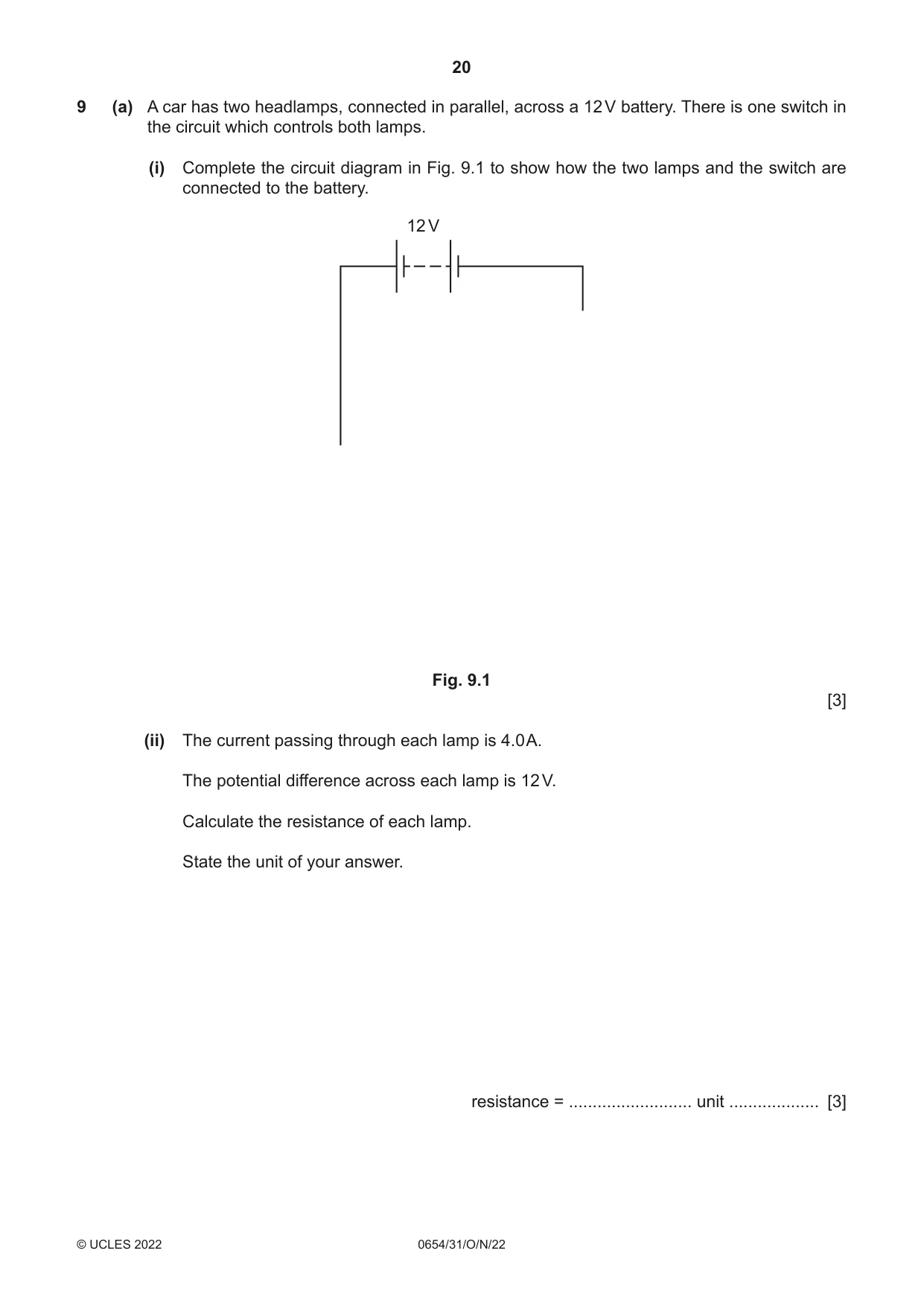
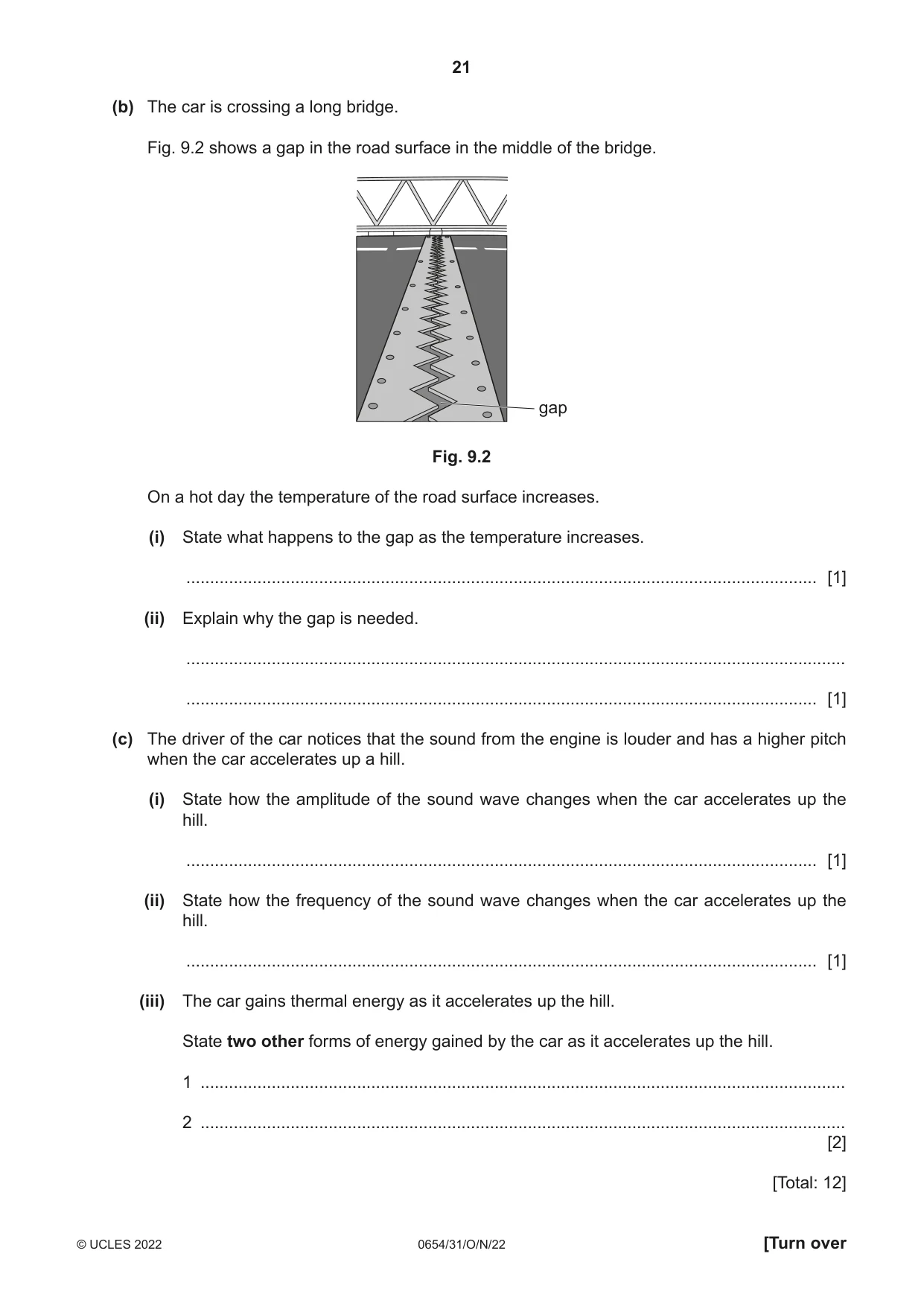
9 (a) A car has two headlamps, connected in parallel, across a 12 V battery. There is one switch in the circuit which controls both lamps. (i) Complete the circuit diagram in Fig. 9.1 to show how the two lamps and the switch are connected to the battery. 12 V Fig. 9.1 [3] (ii) The current passing through each lamp is 4.0 A. The potential difference across each lamp is 12 V. Calculate the resistance of each lamp. State the unit of your answer. resistance = .......................... unit ................... [3] (b) The car is crossing a long bridge. Fig. 9.2 shows a gap in the road surface in the middle of the bridge. gap Fig. 9.2 On a hot day the temperature of the road surface increases. (i) State what happens to the gap as the temperature increases. ..................................................................................................................................... [1] (ii) Explain why the gap is needed. ........................................................................................................................................... ..................................................................................................................................... [1] (c) The driver of the car notices that the sound from the engine is louder and has a higher pitch when the car accelerates up a hill. (i) State how the amplitude of the sound wave changes when the car accelerates up the hill. ..................................................................................................................................... [1] (ii) State how the frequency of the sound wave changes when the car accelerates up the hill. ..................................................................................................................................... [1] (iii) The car gains thermal energy as it accelerates up the hill. State two other forms of energy gained by the car as it accelerates up the hill. 1 ........................................................................................................................................ 2 ........................................................................................................................................ [2] [Total: 12]
Mark scheme: 9(a)(i) all symbols correct ; 3 two lamps in parallel with battery ; switch to control both lamps ; 9(a)(ii) R = V / I (in any form symbols or words) or 12 / 4 ; 3 = 3 ; ohms / ; 9(b)(i) gap is smaller / closes ; 1 9(b)(ii) road/bridge needs to expand on hot day / 1 road/bridge could be damaged by expansion ; 9(c)(i) amplitude increases ; 1 9(c)(ii) frequency increases ; 1 9(c)(iii) kinetic (energy); 2 gravitational potential (energy) ;
Q10 · A researcher collects some information about organisms that live in a desert environment
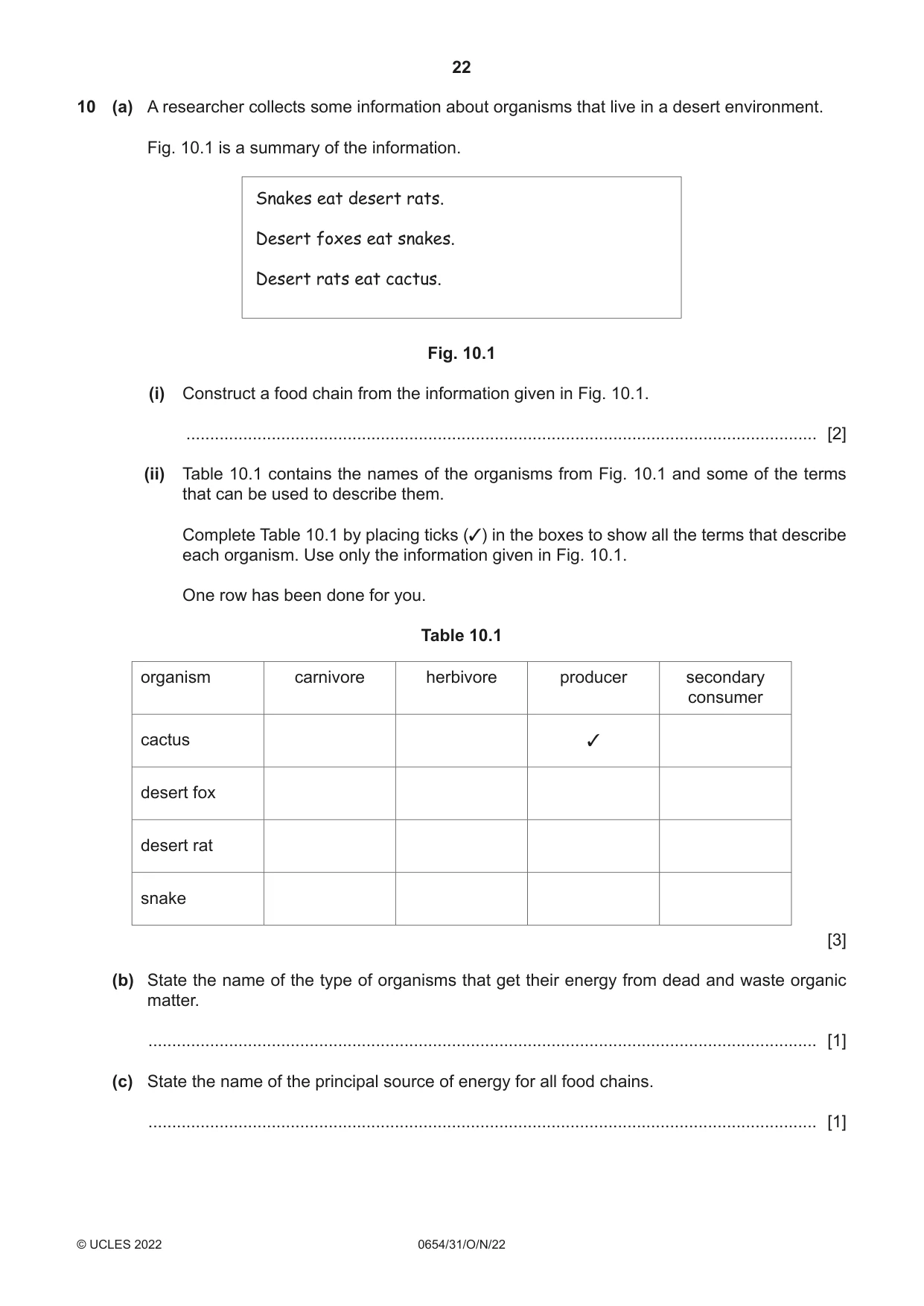
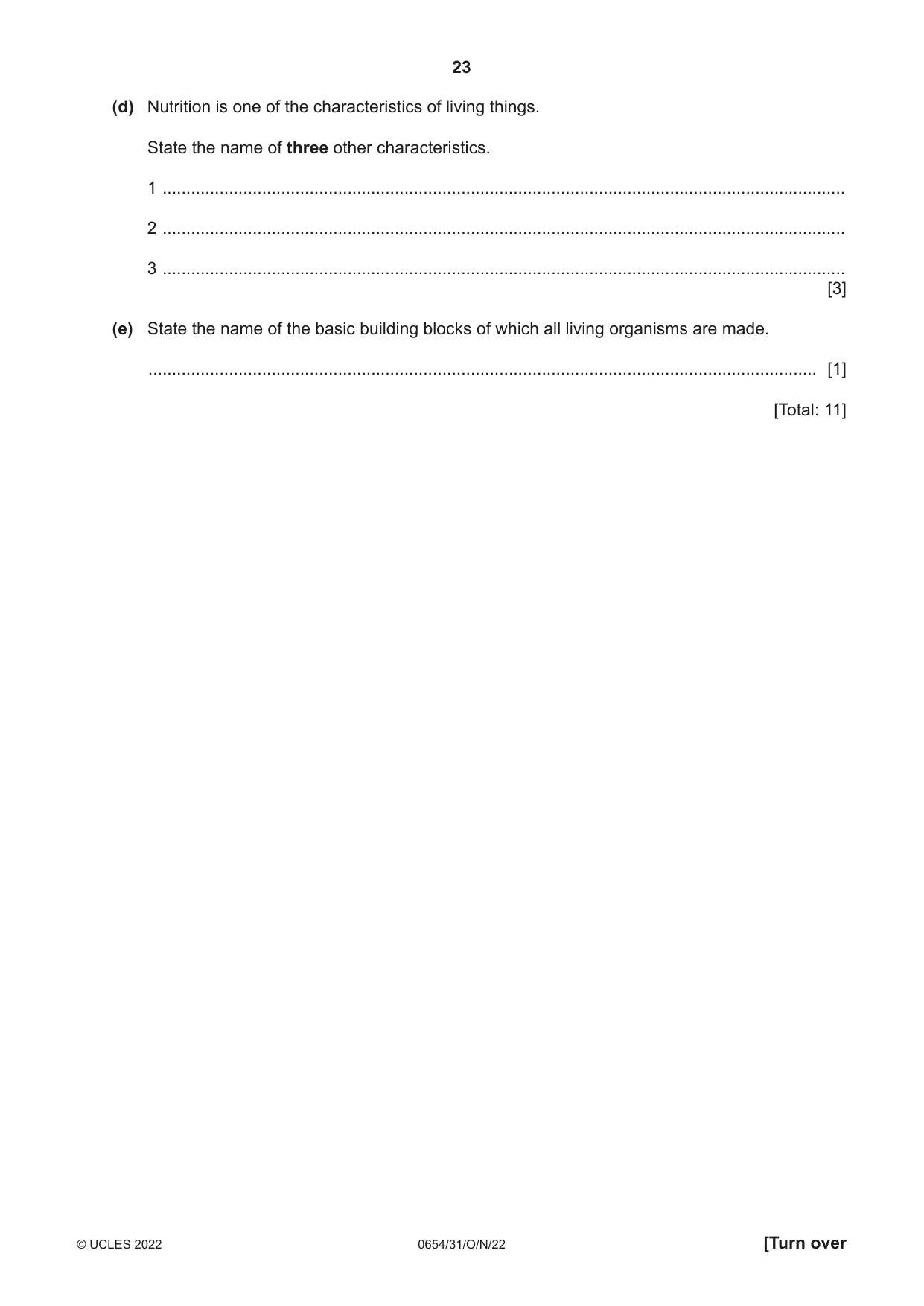
10 (a) A researcher collects some information about organisms that live in a desert environment. Fig. 10.1 is a summary of the information. Snakes eat desert rats. Desert foxes eat snakes. Desert rats eat cactus. Fig. 10.1 (i) Construct a food chain from the information given in Fig. 10.1. ..................................................................................................................................... [2] (ii) Table 10.1 contains the names of the organisms from Fig. 10.1 and some of the terms that can be used to describe them. Complete Table 10.1 by placing ticks (3) in the boxes to show all the terms that describe each organism. Use only the information given in Fig. 10.1. One row has been done for you. Table 10.1 organism carnivore herbivore producer secondary consumer cactus 3 desert fox desert rat snake [3] (b) State the name of the type of organisms that get their energy from dead and waste organic matter. ............................................................................................................................................. [1] (c) State the name of the principal source of energy for all food chains. ............................................................................................................................................. [1] (d) Nutrition is one of the characteristics of living things. State the name of three other characteristics. 1 ................................................................................................................................................ 2 ................................................................................................................................................ 3 ................................................................................................................................................ [3] (e) State the name of the basic building blocks of which all living organisms are made. ............................................................................................................................................. [1] [Total: 11]
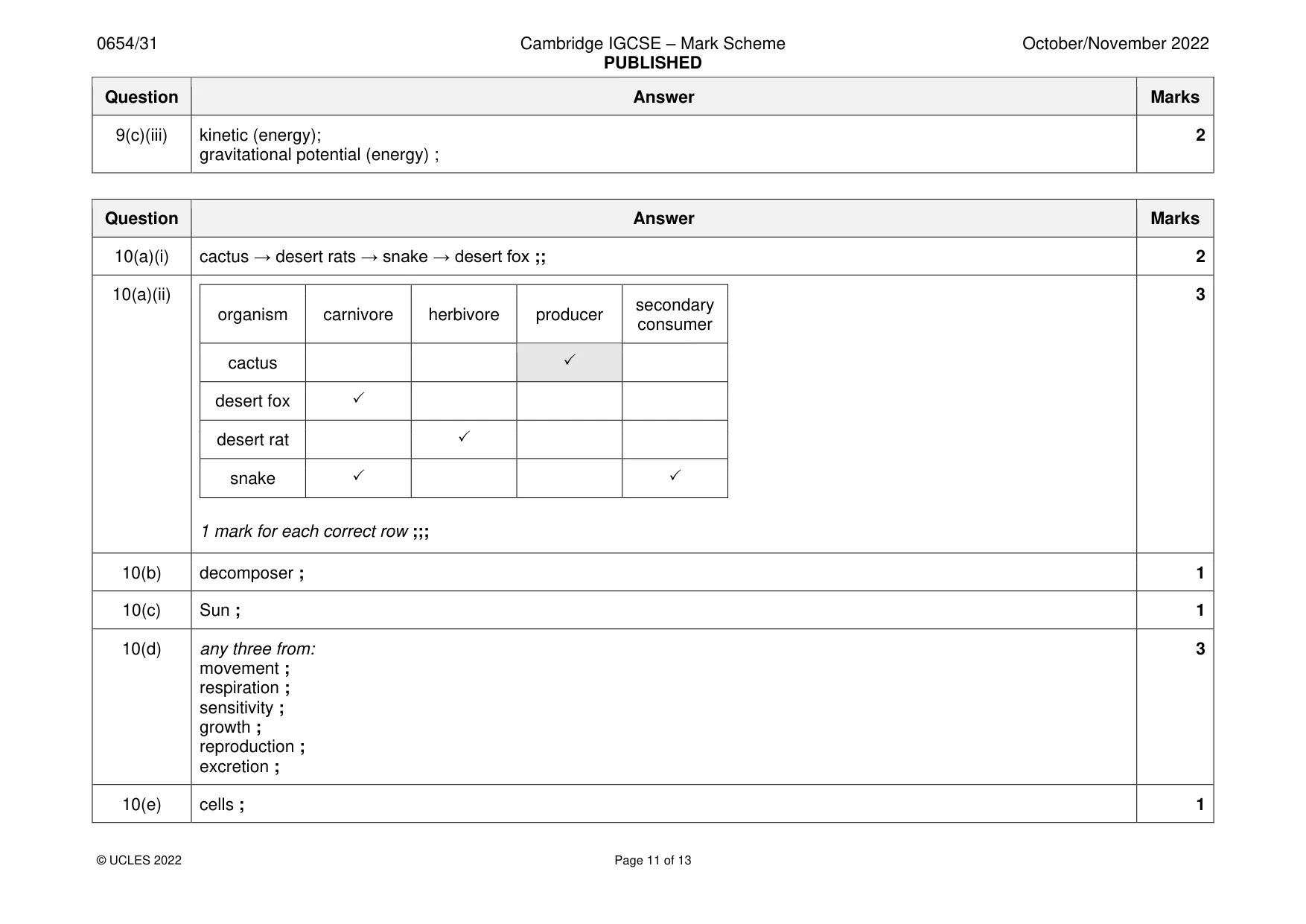
Mark scheme: 10(a)(i) cactus → desert rats → snake → desert fox ;; 2 10(a)(ii) 3 secondary organism carnivore herbivore producer consumer cactus desert fox desert rat snake 1 mark for each correct row ;;; 10(b) decomposer ; 1 10(c) Sun ; 1 10(d) any three from: 3 movement ; respiration ; sensitivity ; growth ; reproduction ; excretion ; 10(e) cells ; 1
Q11 · Sodium and chlorine are elements
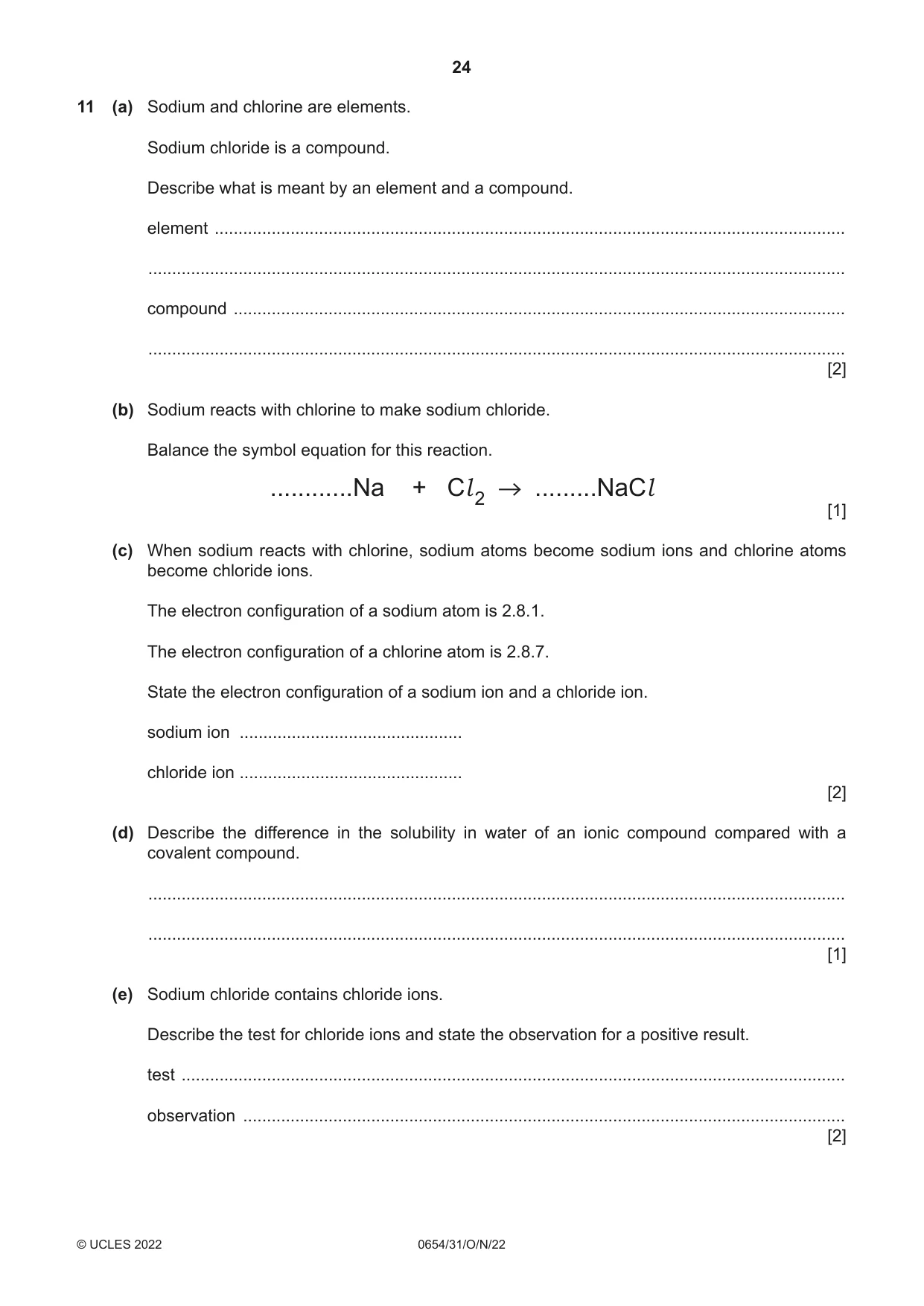
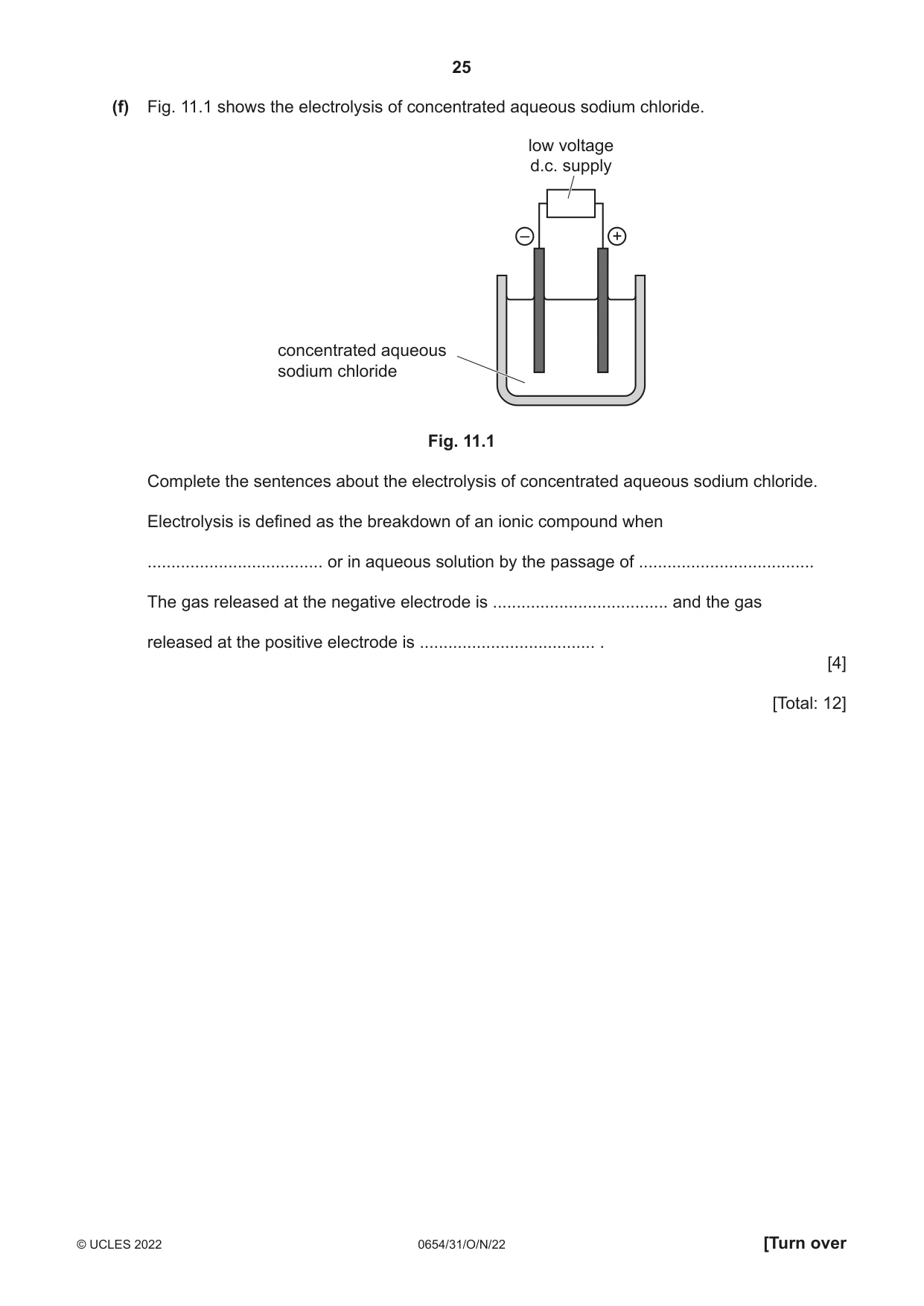
11 (a) Sodium and chlorine are elements. Sodium chloride is a compound. Describe what is meant by an element and a compound. element ..................................................................................................................................... ................................................................................................................................................... compound ................................................................................................................................. ................................................................................................................................................... [2] (b) Sodium reacts with chlorine to make sodium chloride. Balance the symbol equation for this reaction. ............Na + Cl2 .........NaCl [1] (c) When sodium reacts with chlorine, sodium atoms become sodium ions and chlorine atoms become chloride ions. The electron configuration of a sodium atom is 2.8.1. The electron configuration of a chlorine atom is 2.8.7. State the electron configuration of a sodium ion and a chloride ion. sodium ion ............................................... chloride ion ............................................... [2] (d) Describe the difference in the solubility in water of an ionic compound compared with a covalent compound. ................................................................................................................................................... ................................................................................................................................................... [1] (e) Sodium chloride contains chloride ions. Describe the test for chloride ions and state the observation for a positive result. test ............................................................................................................................................ observation ............................................................................................................................... [2] (f) Fig. 11.1 shows the electrolysis of concentrated aqueous sodium chloride. low voltage d.c. supply – + concentrated aqueous sodium chloride Fig. 11.1 Complete the sentences about the electrolysis of concentrated aqueous sodium chloride. Electrolysis is defined as the breakdown of an ionic compound when ..................................... or in aqueous solution by the passage of ..................................... The gas released at the negative electrode is ..................................... and the gas released at the positive electrode is ..................................... . [4] [Total: 12]
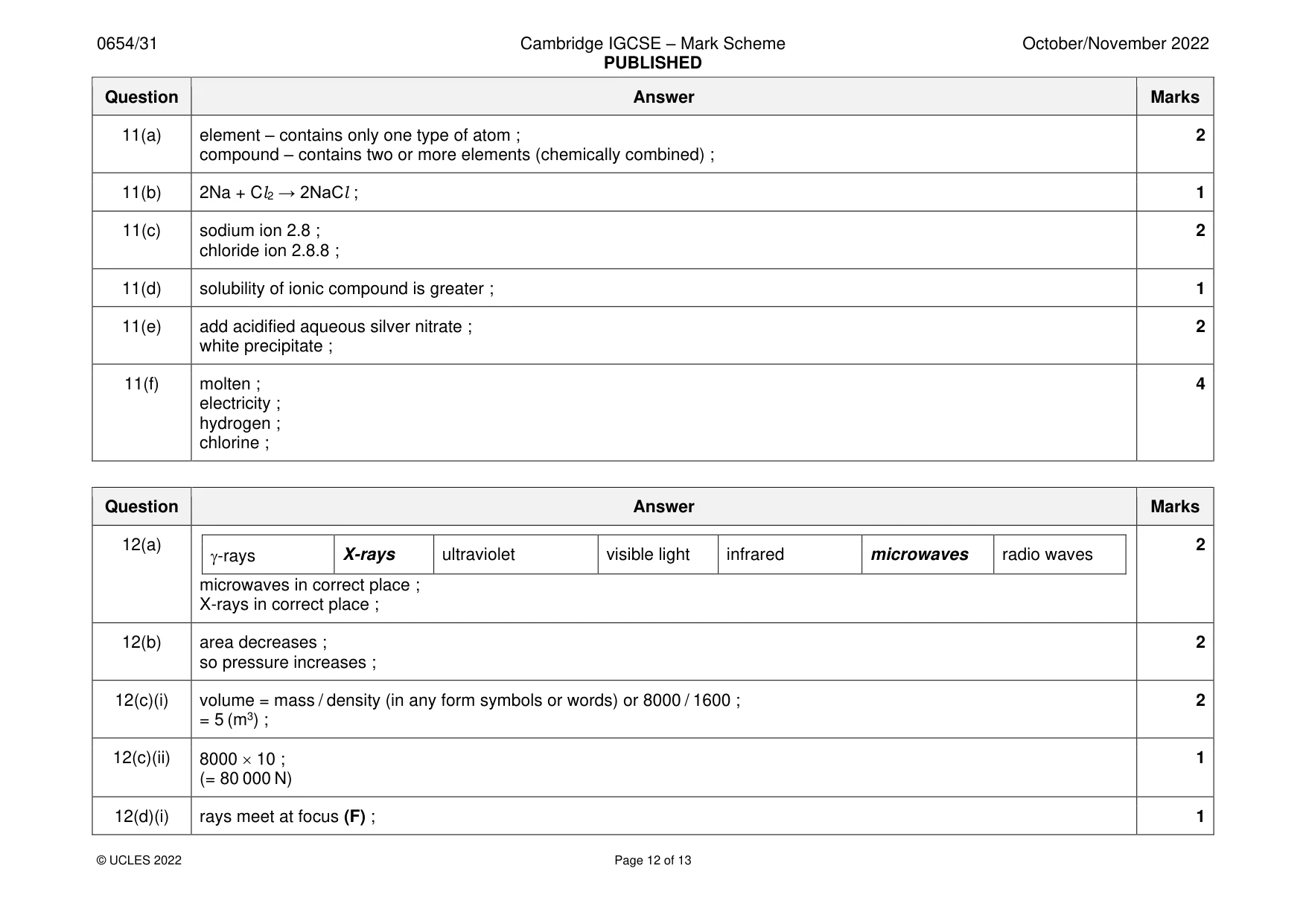
Mark scheme: 11(a) element – contains only one type of atom ; 2 compound – contains two or more elements (chemically combined) ; 11(b) 2Na + Cl2 → 2NaCl ; 1 11(c) sodium ion 2.8 ; 2 chloride ion 2.8.8 ; 11(d) solubility of ionic compound is greater ; 1 11(e) add acidified aqueous silver nitrate ; 2 white precipitate ; 11(f) molten ; 4 electricity ; hydrogen ; chlorine ;
Q12 · A person standing on a warm, sunny beach is exposed to several forms of electromagnetic…
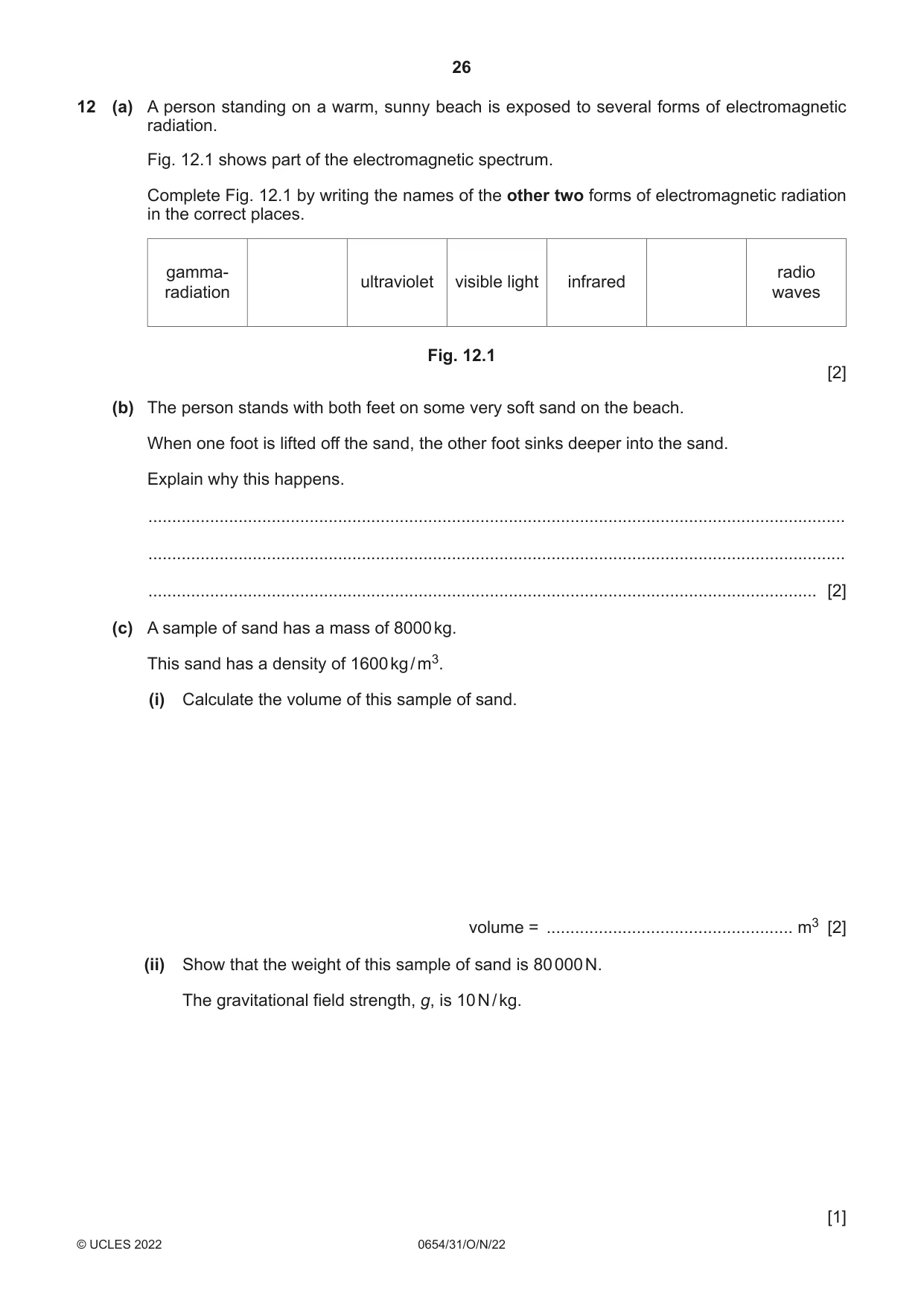
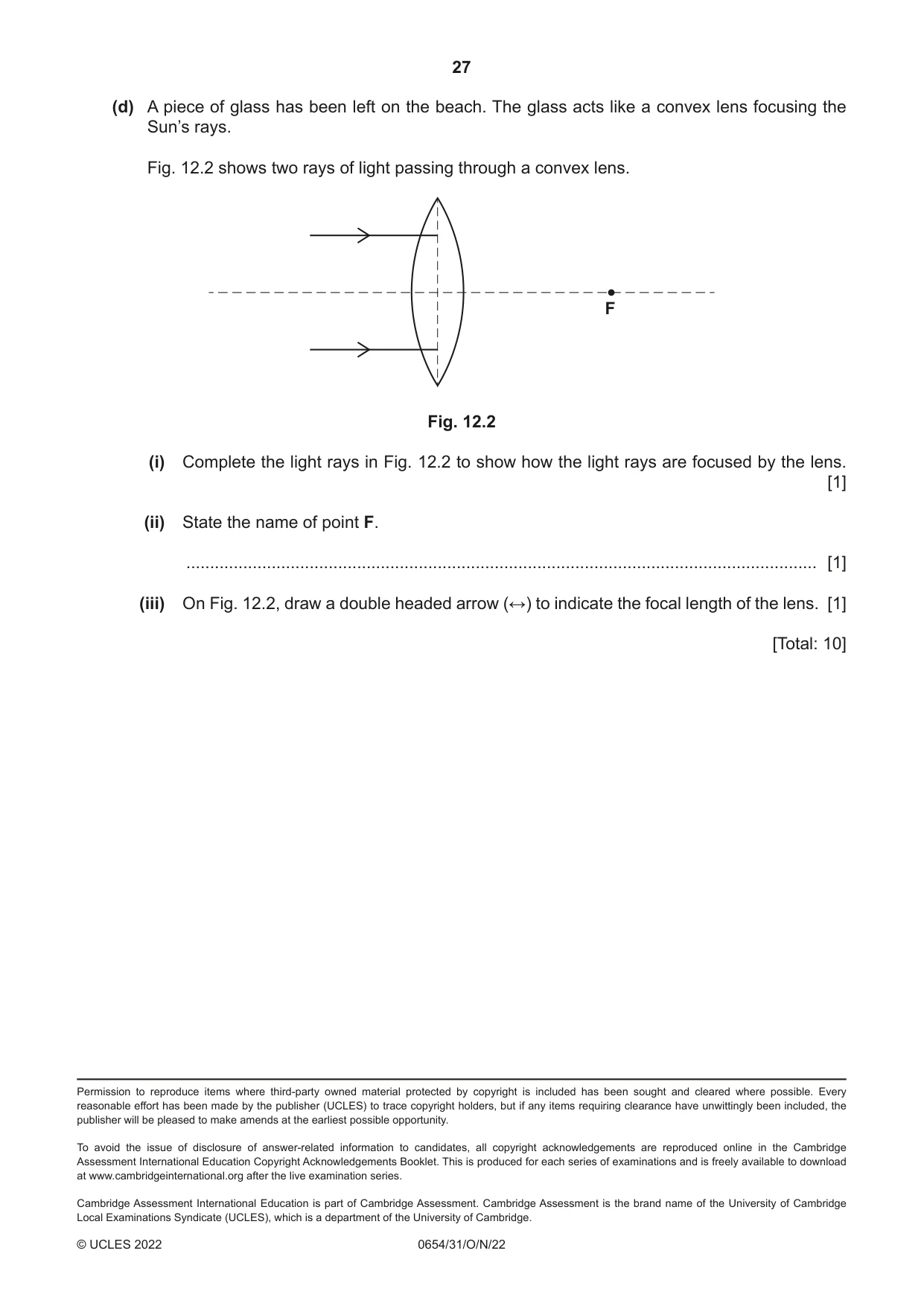
12 (a) A person standing on a warm, sunny beach is exposed to several forms of electromagnetic radiation. Fig. 12.1 shows part of the electromagnetic spectrum. Complete Fig. 12.1 by writing the names of the other two forms of electromagnetic radiation in the correct places. gamma- radio ultraviolet visible light infrared radiation waves Fig. 12.1 [2] (b) The person stands with both feet on some very soft sand on the beach. When one foot is lifted off the sand, the other foot sinks deeper into the sand. Explain why this happens. ................................................................................................................................................... ................................................................................................................................................... ............................................................................................................................................. [2] (c) A sample of sand has a mass of 8000 kg. This sand has a density of 1600 kg / m3. (i) Calculate the volume of this sample of sand. volume = .................................................... m3 [2] (ii) Show that the weight of this sample of sand is 80 000 N. The gravitational field strength, g, is 10 N / kg. [1] (d) A piece of glass has been left on the beach. The glass acts like a convex lens focusing the Sun’s rays. Fig. 12.2 shows two rays of light passing through a convex lens. F Fig. 12.2 (i) Complete the light rays in Fig. 12.2 to show how the light rays are focused by the lens. [1] (ii) State the name of point F. ..................................................................................................................................... [1] (iii) On Fig. 12.2, draw a double headed arrow (↔) to indicate the focal length of the lens. [1] [Total: 10]
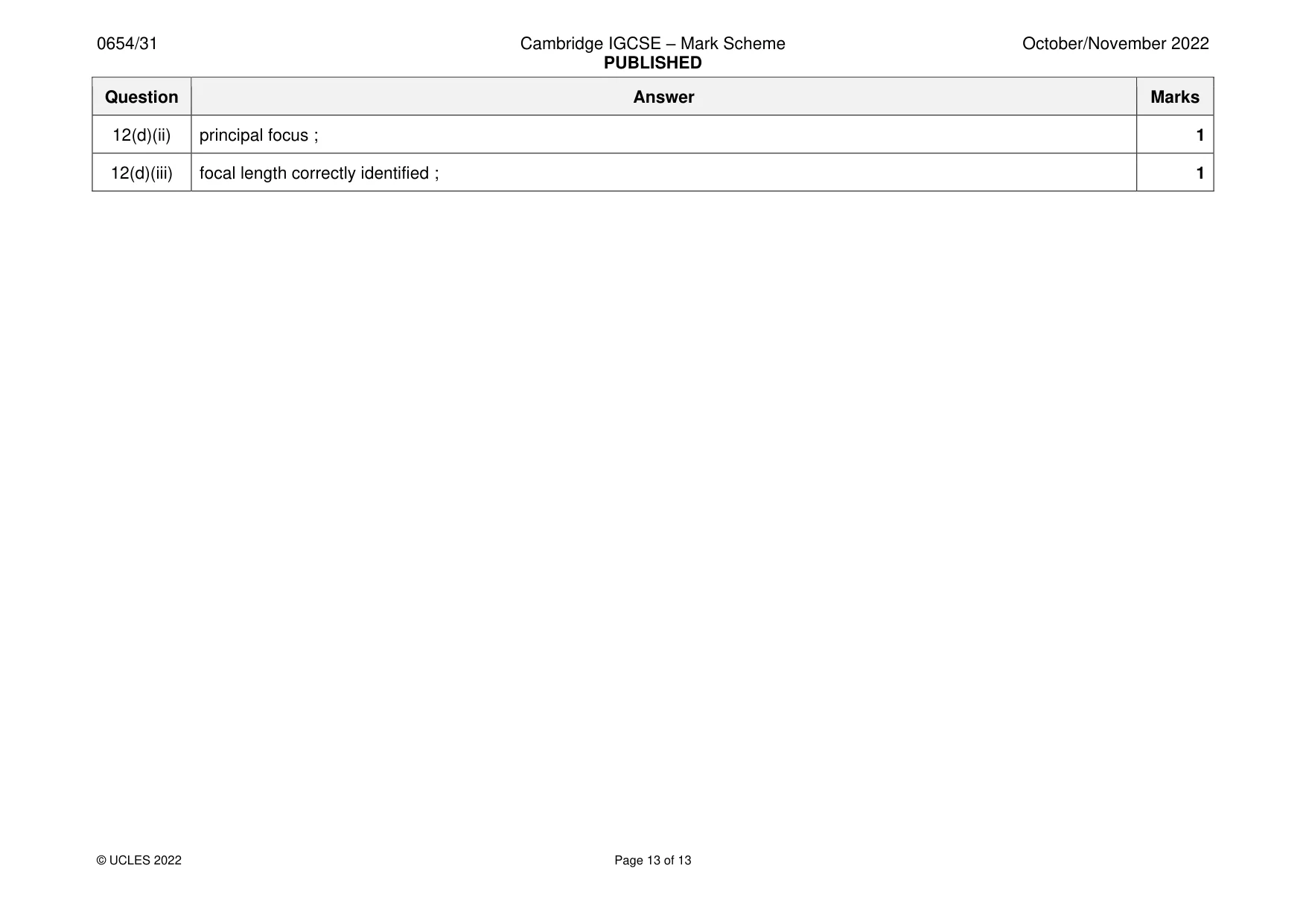
Mark scheme: 12(a) 2 -rays X-rays ultraviolet visible light infrared microwaves radio waves microwaves in correct place ; X-rays in correct place ; 12(b) area decreases ; 2 so pressure increases ; 12(c)(i) volume = mass / density (in any form symbols or words) or 8000 / 1600 ; 2 = 5 (m3) ; 12(c)(ii) 8000 10 ; 1 (= 80 000 N) 12(d)(i) rays meet at focus (F) ; 1 12(d)(ii) principal focus ; 1 12(d)(iii) focal length correctly identified ; 1
What was in this paper
The subtopics covered by these 12 questions, and how many questions each got. Open one in a new tab to see every Cambridge question on it.
What you needed in this session
Cambridge’s own grade thresholds for 2022 Oct/Nov, Paper 3 · Variant 1. A higher threshold means an easier paper — the bar moves with how the cohort did.