Cambridge IGCSE Sciences - Co-ordinated (Double) 0654 — 2022 Oct/Nov Paper 3 · Variant 3
0654/33/O/N/22 · 12 questions · 120 marks · ≈135 min
The question paper and its mark scheme, free to read here and free to download. This is Cambridge’s own paper, exactly as it was sat.
Question paper28 pages
Mark scheme15 pages
Answers below. Sit the paper first if you are practising.
Questions as text
Q1 · A student investigates the germination of pea seeds
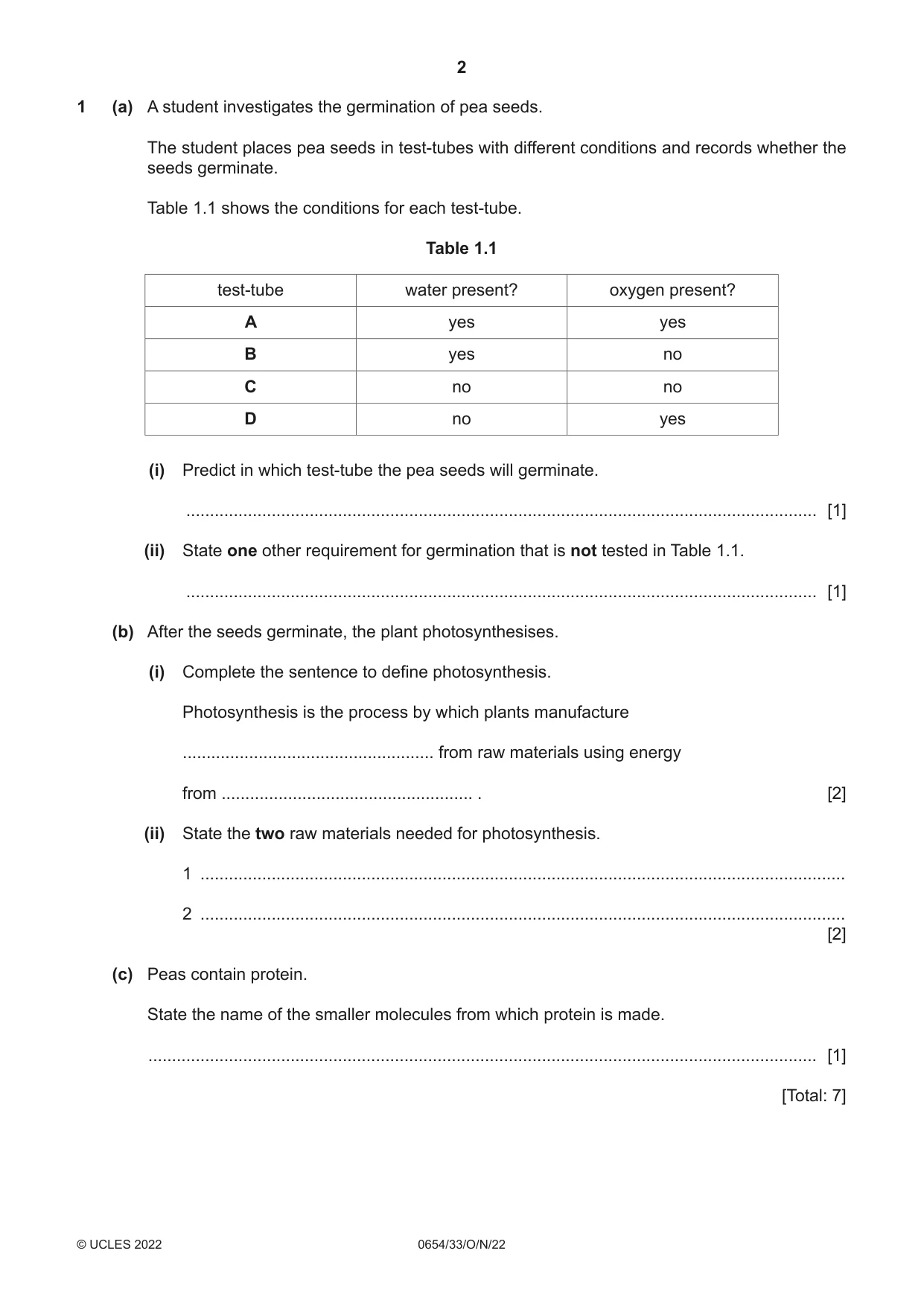
1 (a) A student investigates the germination of pea seeds. The student places pea seeds in test-tubes with different conditions and records whether the seeds germinate. Table 1.1 shows the conditions for each test-tube. Table 1.1 test-tube water present? oxygen present? A yes yes B yes no C no no D no yes (i) Predict in which test-tube the pea seeds will germinate. ..................................................................................................................................... [1] (ii) State one other requirement for germination that is not tested in Table 1.1. ..................................................................................................................................... [1] (b) After the seeds germinate, the plant photosynthesises. (i) Complete the sentence to define photosynthesis. Photosynthesis is the process by which plants manufacture ..................................................... from raw materials using energy from ..................................................... . [2] (ii) State the two raw materials needed for photosynthesis. 1 ........................................................................................................................................ 2 ........................................................................................................................................ [2] (c) Peas contain protein. State the name of the smaller molecules from which protein is made. ............................................................................................................................................. [1] [Total: 7]
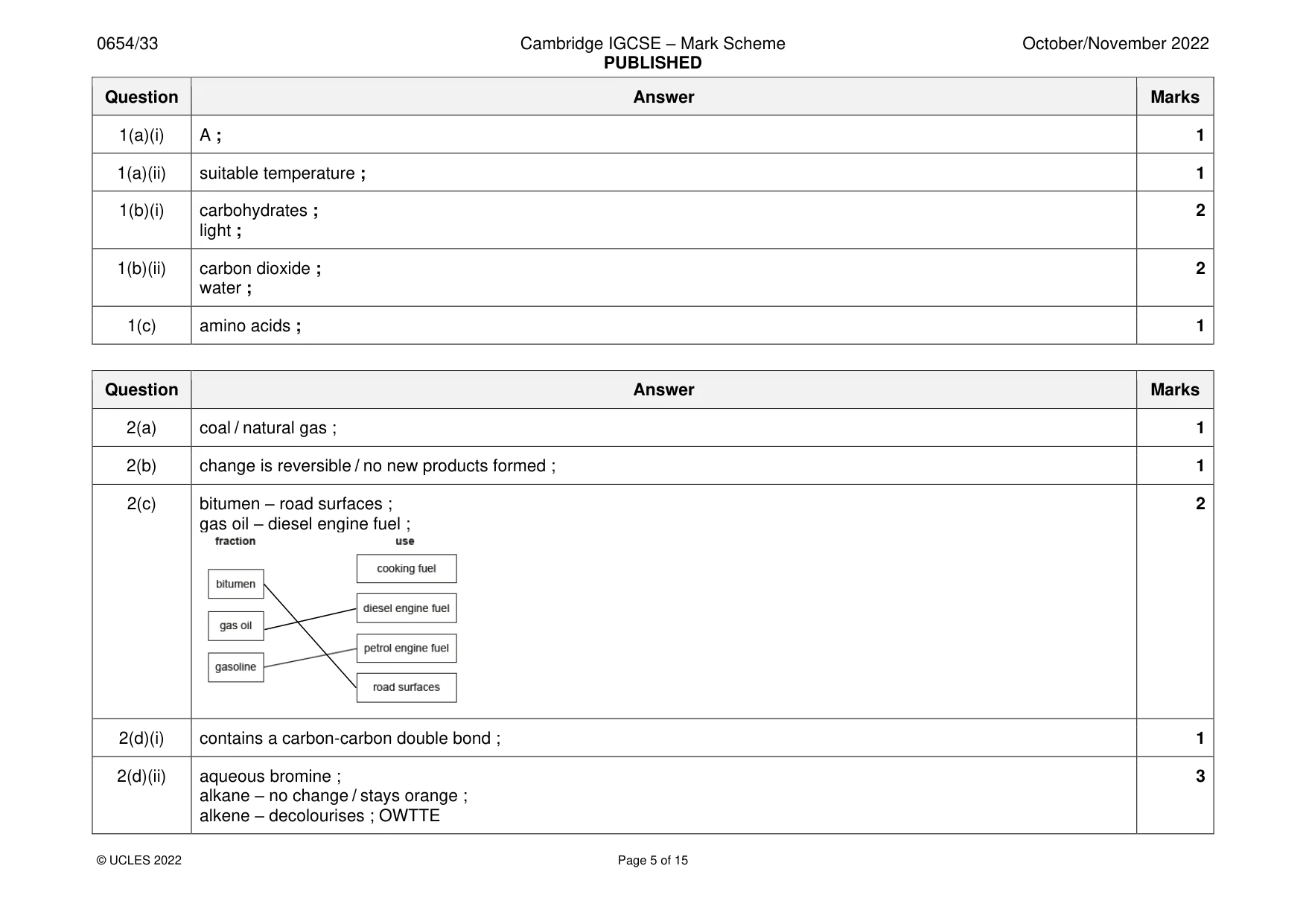
Mark scheme: Question Answer Marks 1(a)(i) A ; 1 1(a)(ii) suitable temperature ; 1 1(b)(i) carbohydrates ; 2 light ; 1(b)(ii) carbon dioxide ; 2 water ; 1(c) amino acids ; 1
Q2 · Petroleum is a fossil fuel
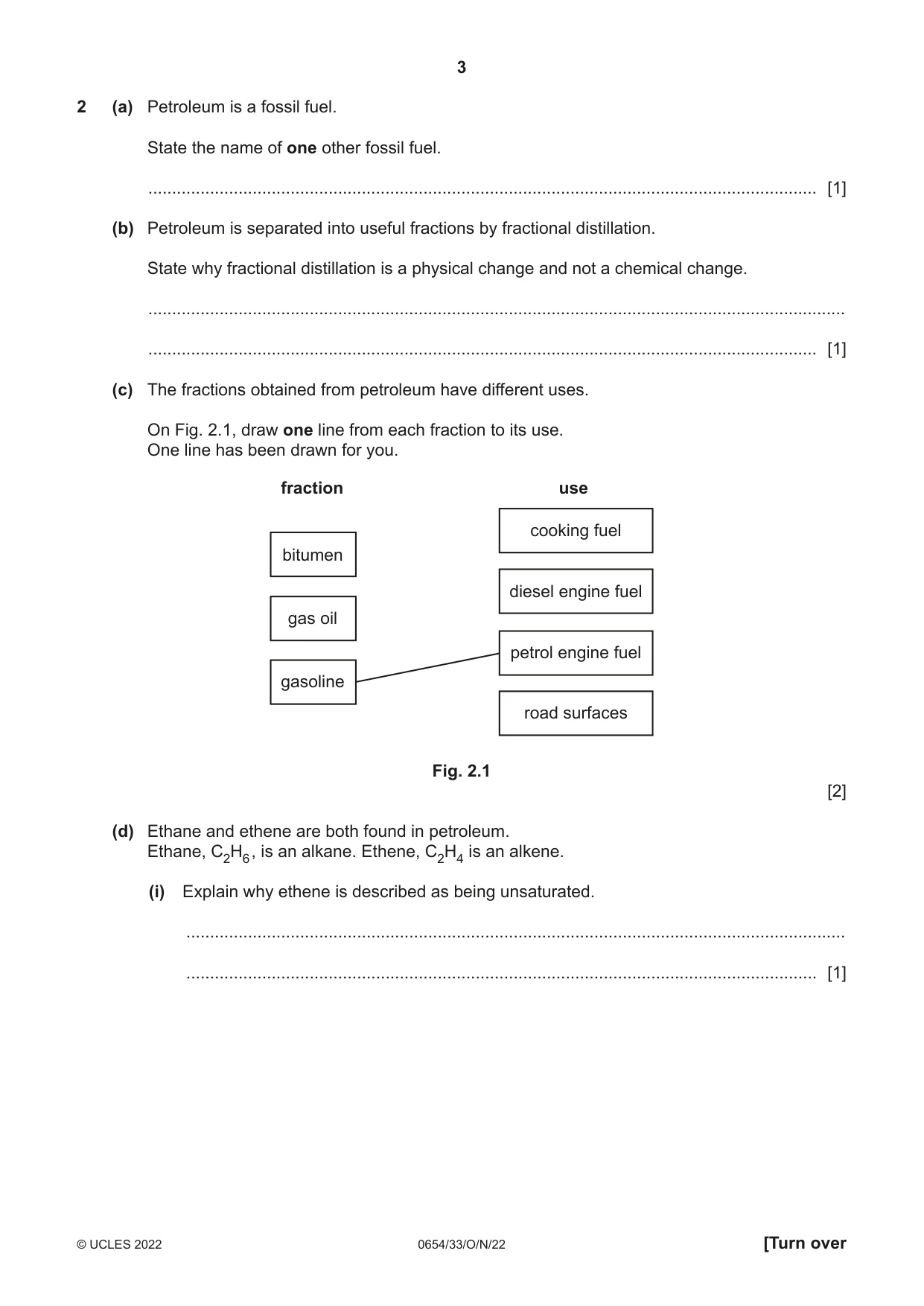
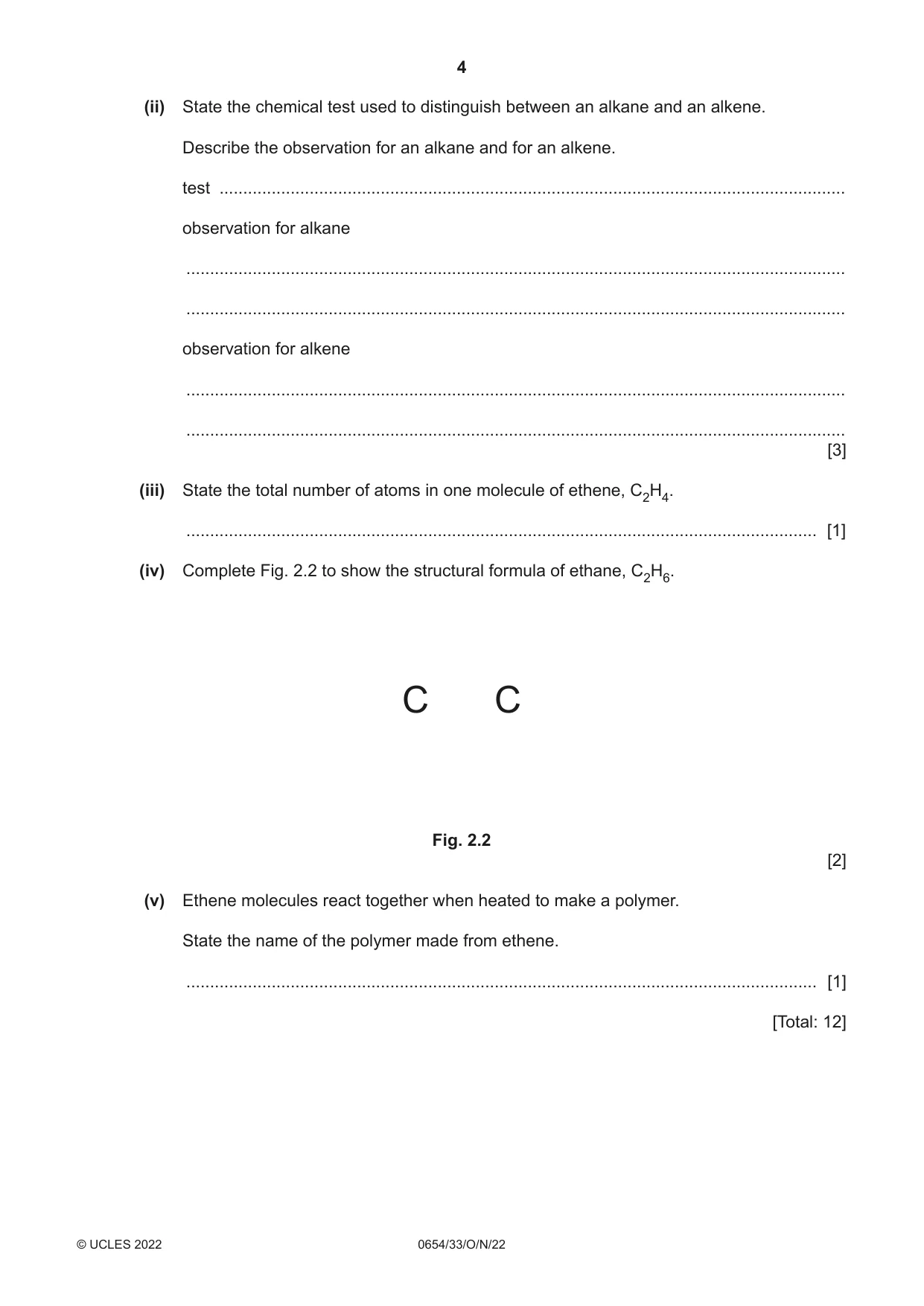
2 (a) Petroleum is a fossil fuel. State the name of one other fossil fuel. ............................................................................................................................................. [1] (b) Petroleum is separated into useful fractions by fractional distillation. State why fractional distillation is a physical change and not a chemical change. ................................................................................................................................................... ............................................................................................................................................. [1] (c) The fractions obtained from petroleum have different uses. On Fig. 2.1, draw one line from each fraction to its use. One line has been drawn for you. fraction use cooking fuel bitumen diesel engine fuel gas oil petrol engine fuel gasoline road surfaces Fig. 2.1 [2] (d) Ethane and ethene are both found in petroleum. Ethane, C2H6 , is an alkane. Ethene, C2H4 is an alkene. (i) Explain why ethene is described as being unsaturated. ........................................................................................................................................... ..................................................................................................................................... [1] (ii) State the chemical test used to distinguish between an alkane and an alkene. Describe the observation for an alkane and for an alkene. test .................................................................................................................................... observation for alkane ........................................................................................................................................... ........................................................................................................................................... observation for alkene ........................................................................................................................................... ........................................................................................................................................... [3] (iii) State the total number of atoms in one molecule of ethene, C2H4. ..................................................................................................................................... [1] (iv) Complete Fig. 2.2 to show the structural formula of ethane, C2H6. C C Fig. 2.2 [2] (v) Ethene molecules react together when heated to make a polymer. State the name of the polymer made from ethene. ..................................................................................................................................... [1] [Total: 12]
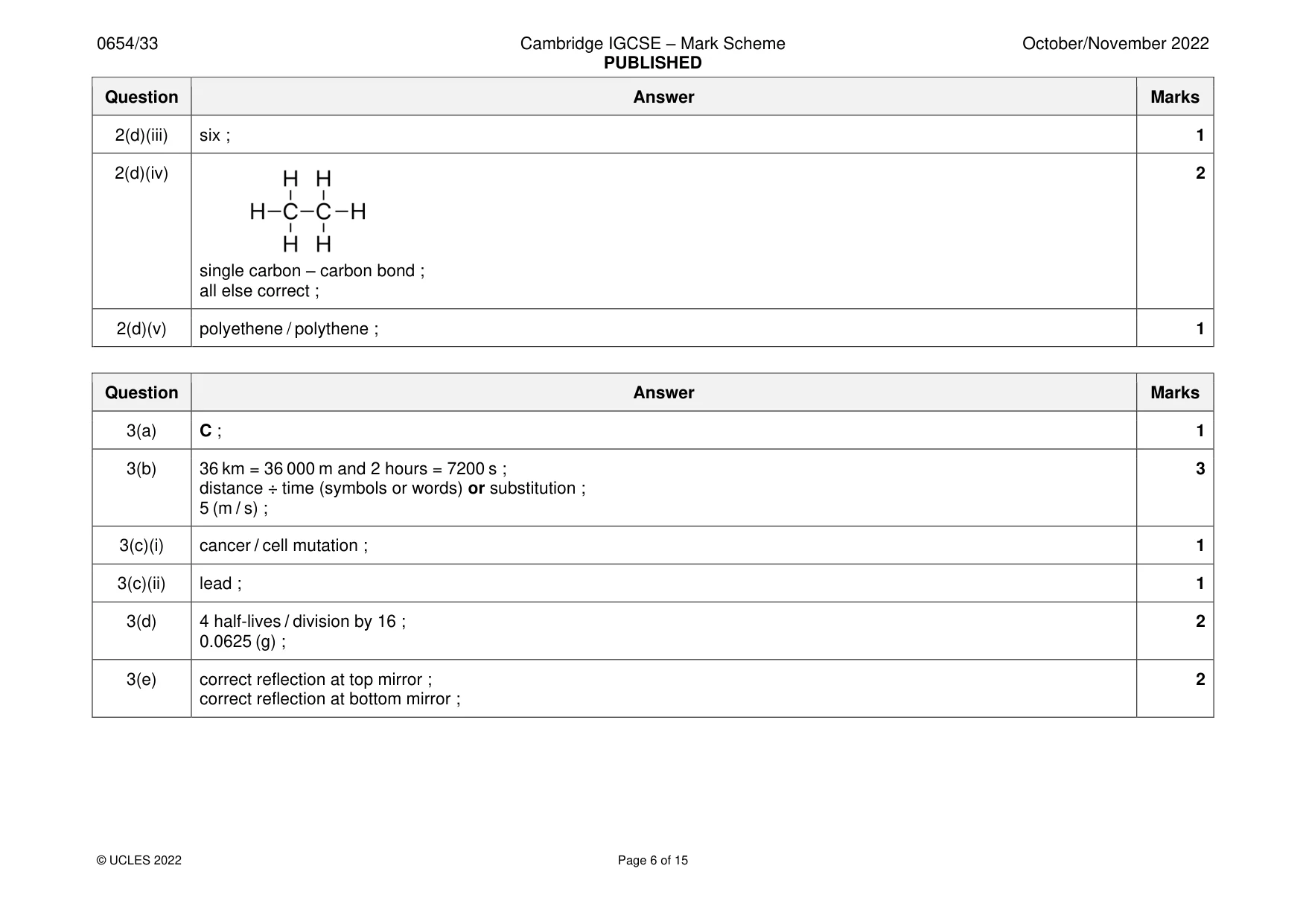
Mark scheme: 2(a) coal / natural gas ; 1 2(b) change is reversible / no new products formed ; 1 2(c) bitumen – road surfaces ; 2 gas oil – diesel engine fuel ; 2(d)(i) contains a carbon-carbon double bond ; 1 2(d)(ii) aqueous bromine ; 3 alkane – no change / stays orange ; alkene – decolourises ; OWTTE 2(d)(iii) six ; 1 2(d)(iv) 2 single carbon – carbon bond ; all else correct ; 2(d)(v) polyethene / polythene ; 1
Q3 · Four forces acting on a submarine
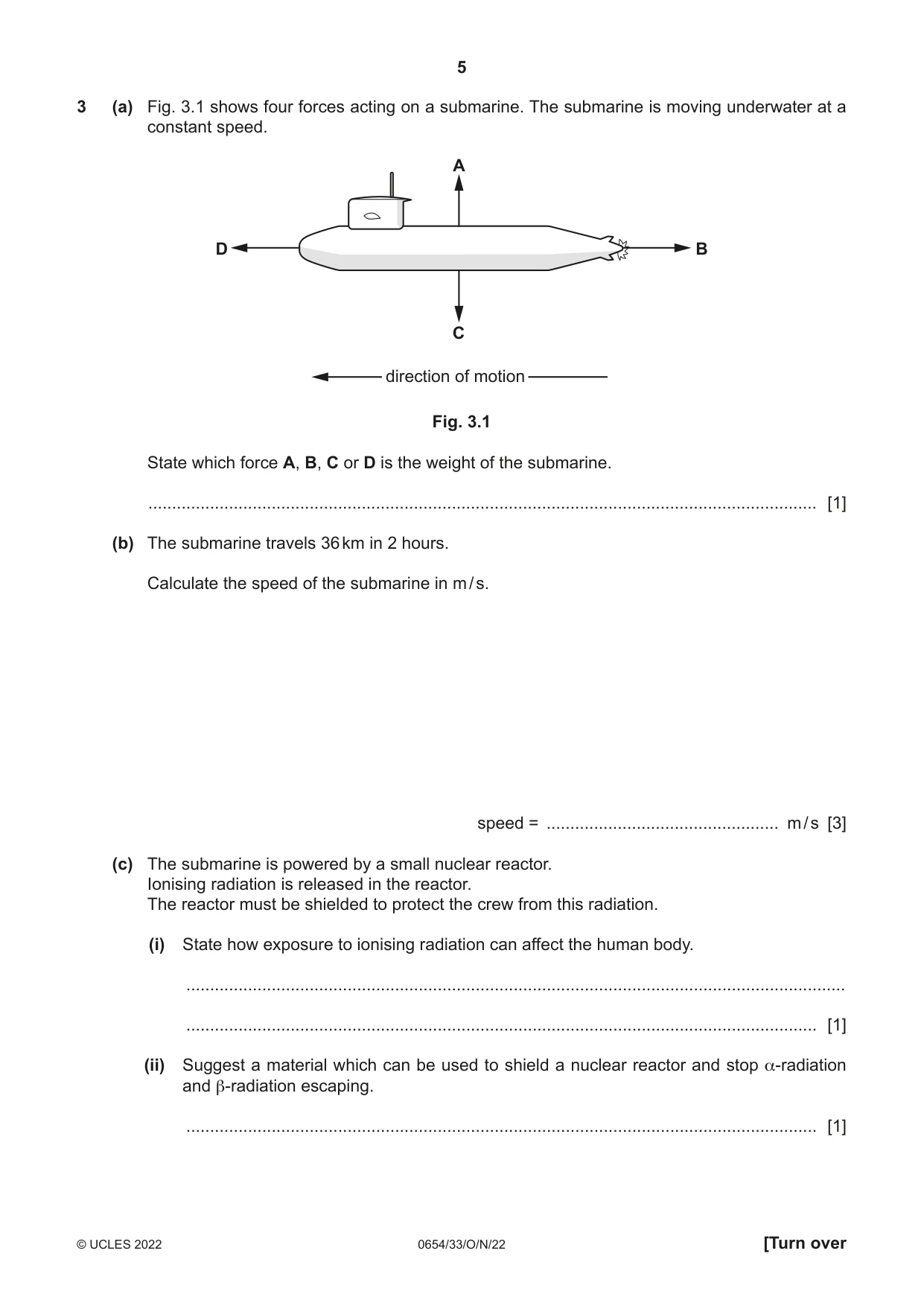
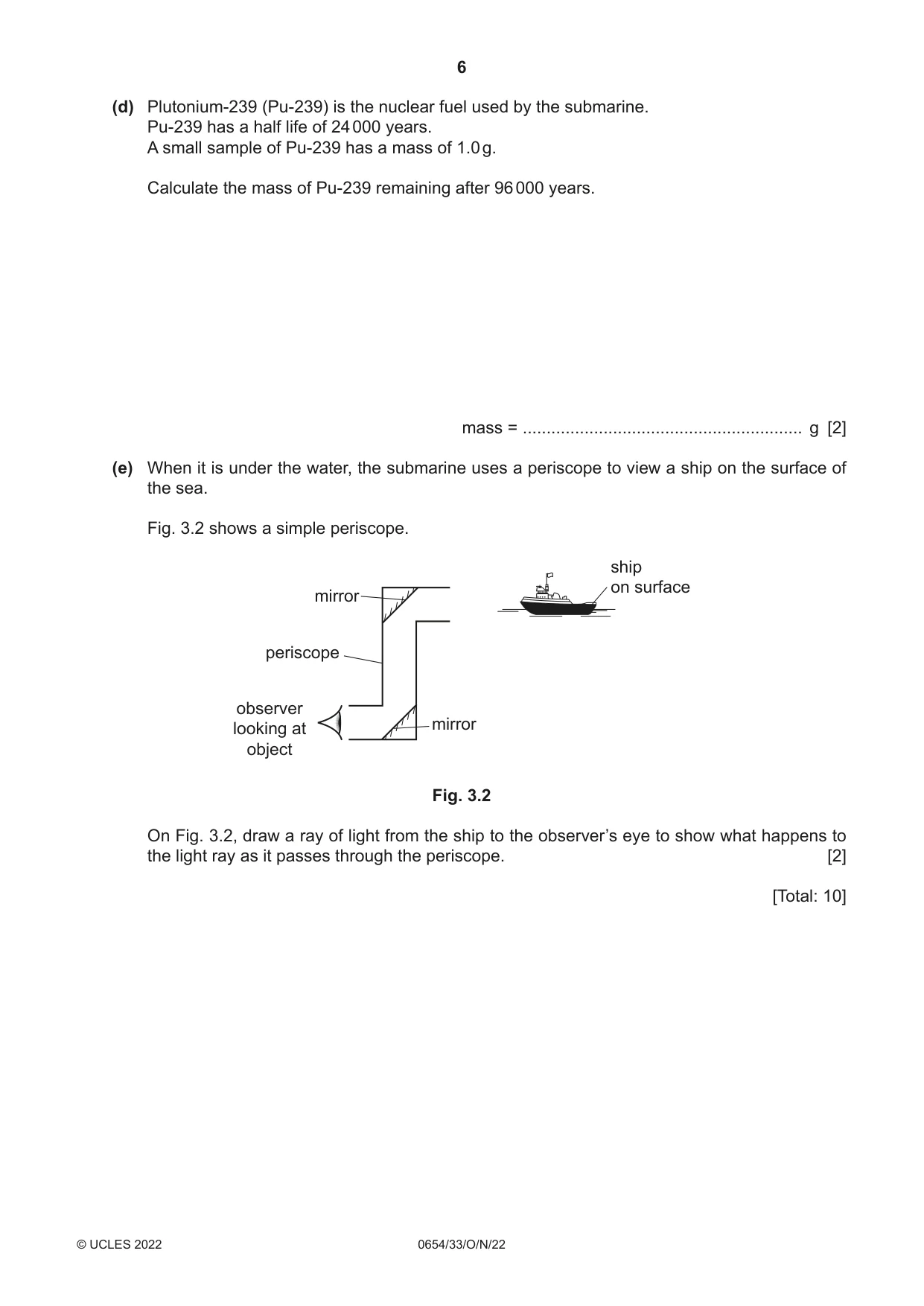
3 (a) Fig. 3.1 shows four forces acting on a submarine. The submarine is moving underwater at a constant speed. A D B C direction of motion Fig. 3.1 State which force A, B, C or D is the weight of the submarine. ............................................................................................................................................. [1] (b) The submarine travels 36 km in 2 hours. Calculate the speed of the submarine in m / s. speed = ................................................. m / s [3] (c) The submarine is powered by a small nuclear reactor. Ionising radiation is released in the reactor. The reactor must be shielded to protect the crew from this radiation. (i) State how exposure to ionising radiation can affect the human body. ........................................................................................................................................... ..................................................................................................................................... [1] (ii) Suggest a material which can be used to shield a nuclear reactor and stop α-radiation and β-radiation escaping. ..................................................................................................................................... [1] (d) Plutonium-239 (Pu-239) is the nuclear fuel used by the submarine. Pu-239 has a half life of 24 000 years. A small sample of Pu-239 has a mass of 1.0 g. Calculate the mass of Pu-239 remaining after 96 000 years. mass = ........................................................... g [2] (e) When it is under the water, the submarine uses a periscope to view a ship on the surface of the sea. Fig. 3.2 shows a simple periscope. ship on surface mirror periscope observer looking at mirror object Fig. 3.2 On Fig. 3.2, draw a ray of light from the ship to the observer’s eye to show what happens to the light ray as it passes through the periscope. [2] [Total: 10]
Mark scheme: 3(a) C ; 1 3(b) 36 km = 36 000 m and 2 hours = 7200 s ; 3 distance ÷ time (symbols or words) or substitution ; 5 (m / s) ; 3(c)(i) cancer / cell mutation ; 1 3(c)(ii) lead ; 1 3(d) 4 half-lives / division by 16 ; 2 0.0625 (g) ; 3(e) correct reflection at top mirror ; 2 correct reflection at bottom mirror ;
Q4 · Scientists investigate diffusion by measuring the distance travelled by two different…
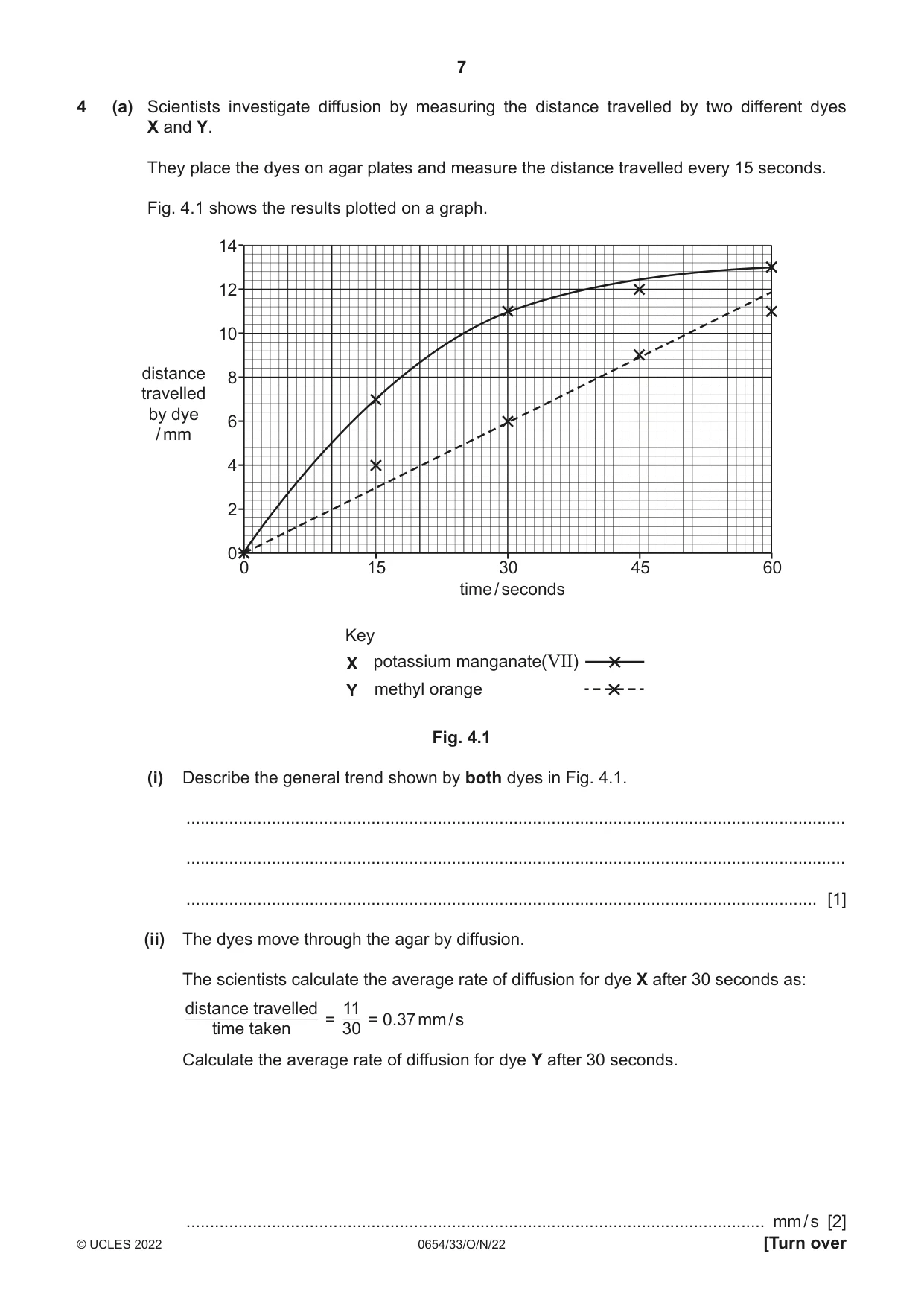
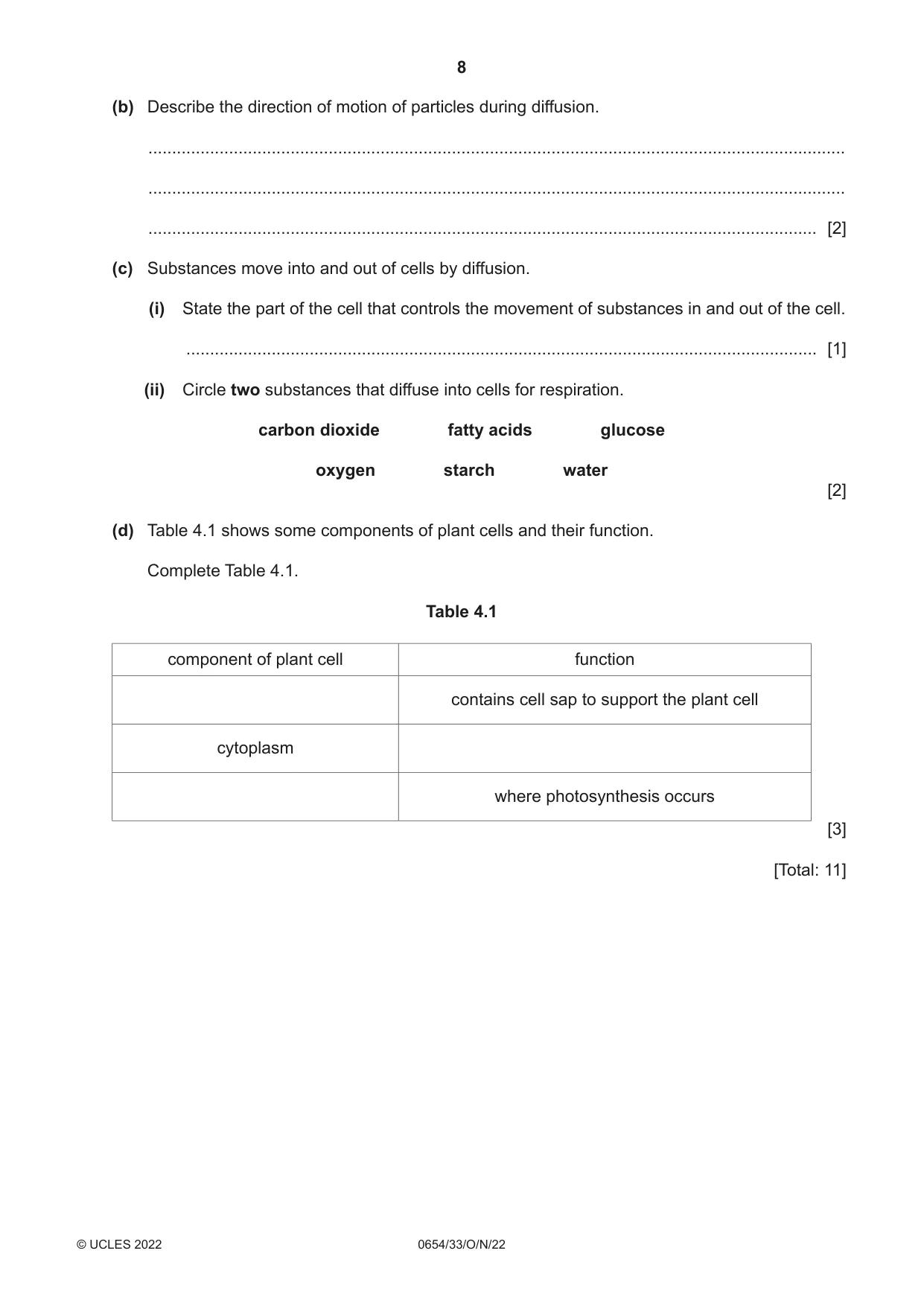
4 (a) Scientists investigate diffusion by measuring the distance travelled by two different dyes X and Y. They place the dyes on agar plates and measure the distance travelled every 15 seconds. Fig. 4.1 shows the results plotted on a graph. 14 12 10 distance 8 travelled by dye 6 / mm 4 2 0 0 15 30 45 60 time / seconds Key X potassium manganate(VII) Y methyl orange Fig. 4.1 (i) Describe the general trend shown by both dyes in Fig. 4.1. ........................................................................................................................................... ........................................................................................................................................... ..................................................................................................................................... [1] (ii) The dyes move through the agar by diffusion. The scientists calculate the average rate of diffusion for dye X after 30 seconds as: distance travelled 11 = = 0.37 mm / s time taken 30 Calculate the average rate of diffusion for dye Y after 30 seconds. .......................................................................................................................... mm / s [2] (b) Describe the direction of motion of particles during diffusion. ................................................................................................................................................... ................................................................................................................................................... ............................................................................................................................................. [2] (c) Substances move into and out of cells by diffusion. (i) State the part of the cell that controls the movement of substances in and out of the cell. ..................................................................................................................................... [1] (ii) Circle two substances that diffuse into cells for respiration. carbon dioxide fatty acids glucose oxygen starch water [2] (d) Table 4.1 shows some components of plant cells and their function. Complete Table 4.1. Table 4.1 component of plant cell function contains cell sap to support the plant cell cytoplasm where photosynthesis occurs [3] [Total: 11]
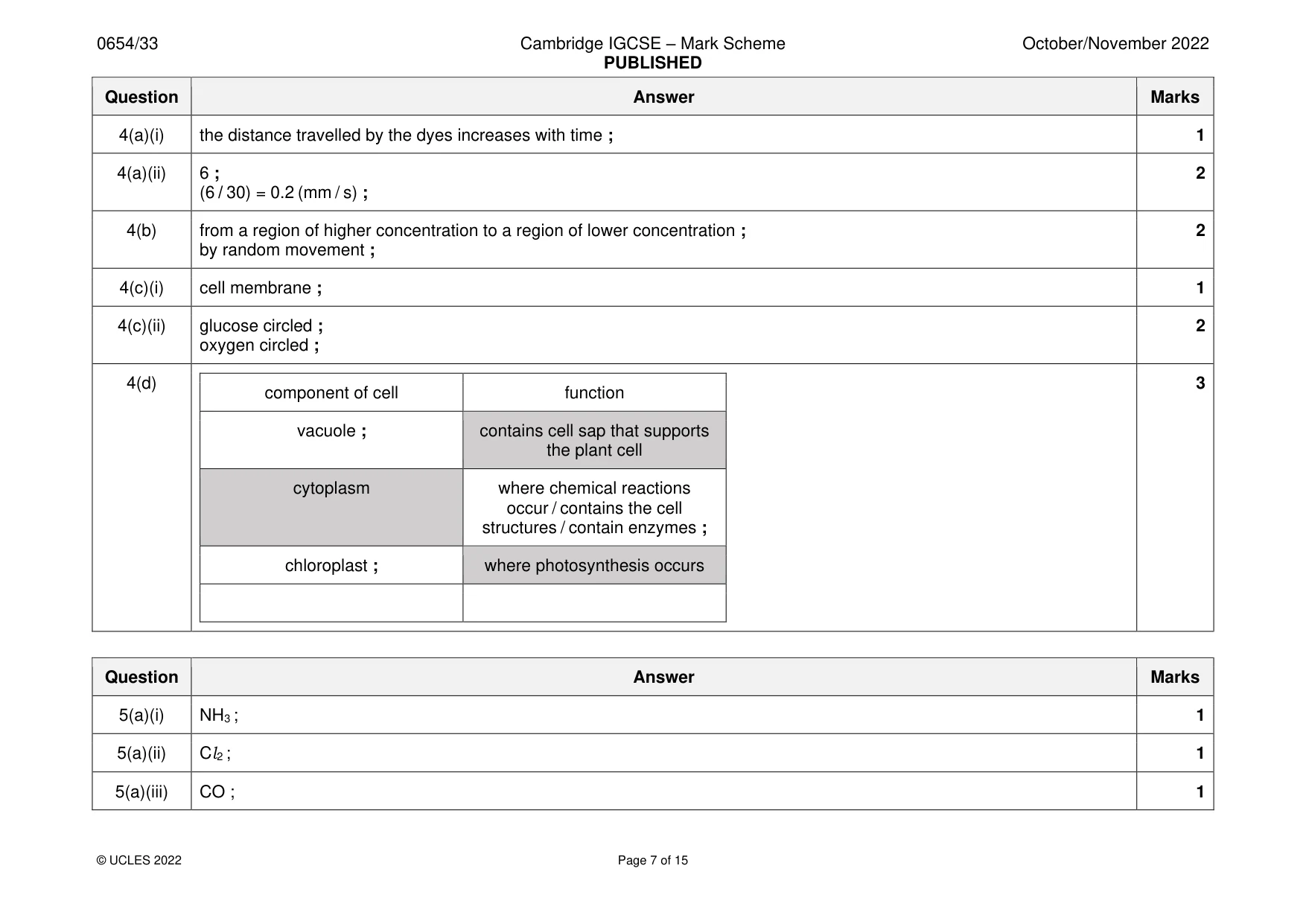
Mark scheme: 4(a)(i) the distance travelled by the dyes increases with time ; 1 4(a)(ii) 6 ; 2 (6 / 30) = 0.2 (mm / s) ; 4(b) from a region of higher concentration to a region of lower concentration ; 2 by random movement ; 4(c)(i) cell membrane ; 1 4(c)(ii) glucose circled ; 2 oxygen circled ; 4(d) 3 component of cell function vacuole ; contains cell sap that supports the plant cell cytoplasm where chemical reactions occur / contains the cell structures / contain enzymes ; chloroplast ; where photosynthesis occurs
Q5 · The list below shows the formulae of six molecules
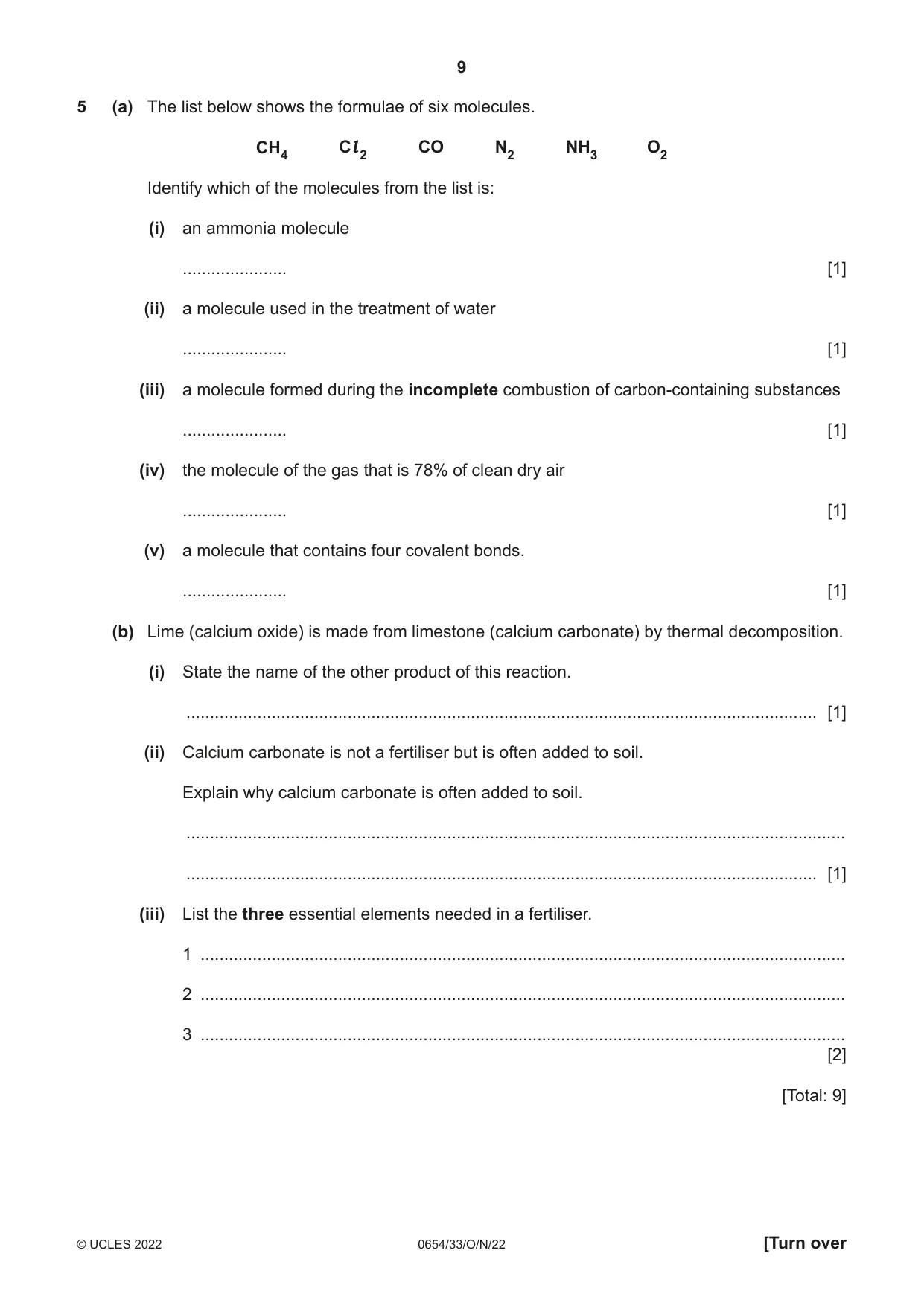
5 (a) The list below shows the formulae of six molecules. CH4 Cl 2 CO N2 NH3 O2 Identify which of the molecules from the list is: (i) an ammonia molecule ...................... [1] (ii) a molecule used in the treatment of water ...................... [1] (iii) a molecule formed during the incomplete combustion of carbon-containing substances ...................... [1] (iv) the molecule of the gas that is 78% of clean dry air ...................... [1] (v) a molecule that contains four covalent bonds. ...................... [1] (b) Lime (calcium oxide) is made from limestone (calcium carbonate) by thermal decomposition. (i) State the name of the other product of this reaction. ..................................................................................................................................... [1] (ii) Calcium carbonate is not a fertiliser but is often added to soil. Explain why calcium carbonate is often added to soil. ........................................................................................................................................... ..................................................................................................................................... [1] (iii) List the three essential elements needed in a fertiliser. 1 ........................................................................................................................................ 2 ........................................................................................................................................ 3 ........................................................................................................................................ [2] [Total: 9]
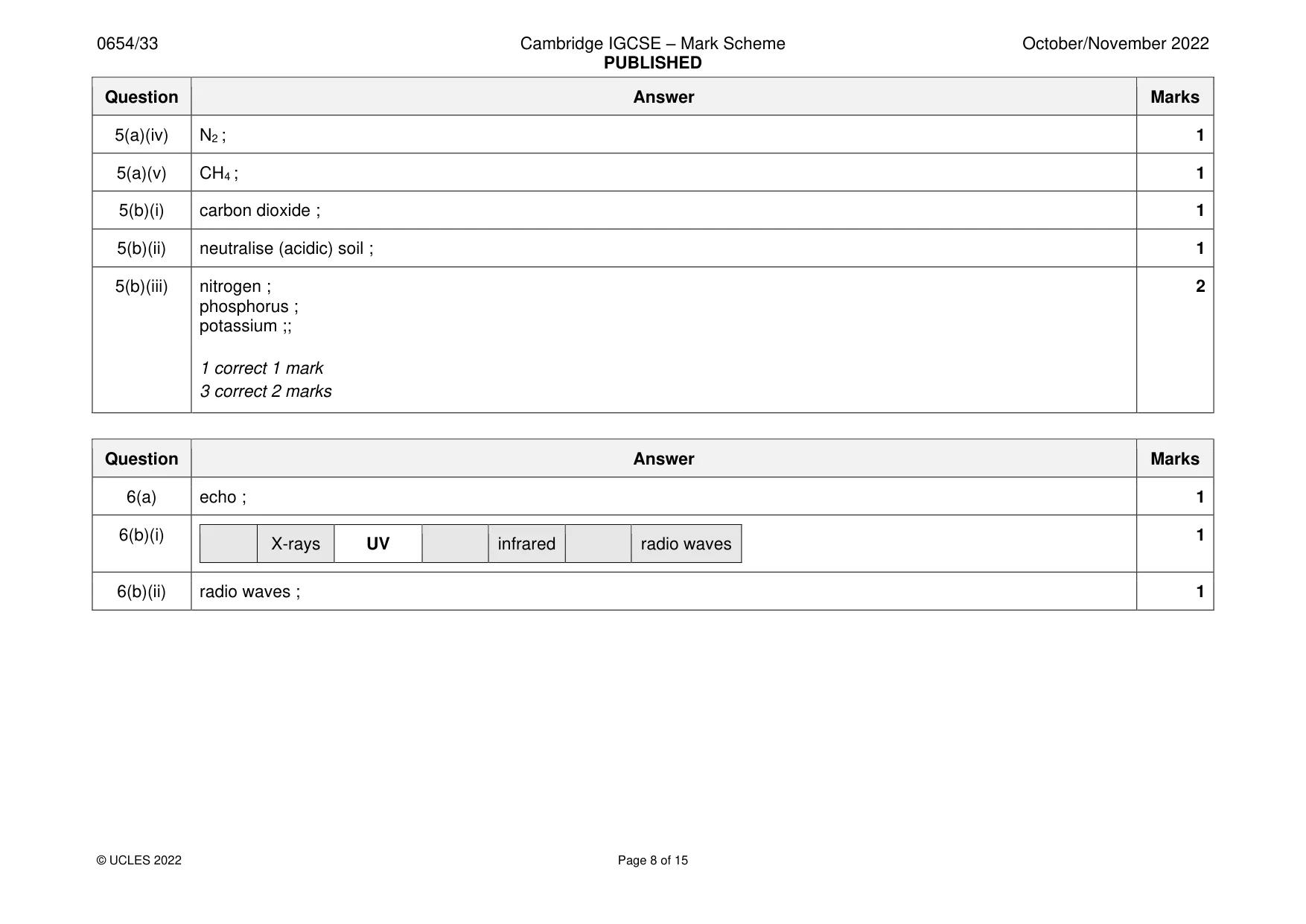
Mark scheme: 5(a)(i) NH3 ; 1 5(a)(ii) Cl2 ; 1 5(a)(iii) CO ; 1 5(a)(iv) N2 ; 1 5(a)(v) CH4 ; 1 5(b)(i) carbon dioxide ; 1 5(b)(ii) neutralise (acidic) soil ; 1 5(b)(iii) nitrogen ; 2 phosphorus ; potassium ;; 1 correct 1 mark 3 correct 2 marks
Q6 · Bats use the reflection of sound waves to determine the position of objects
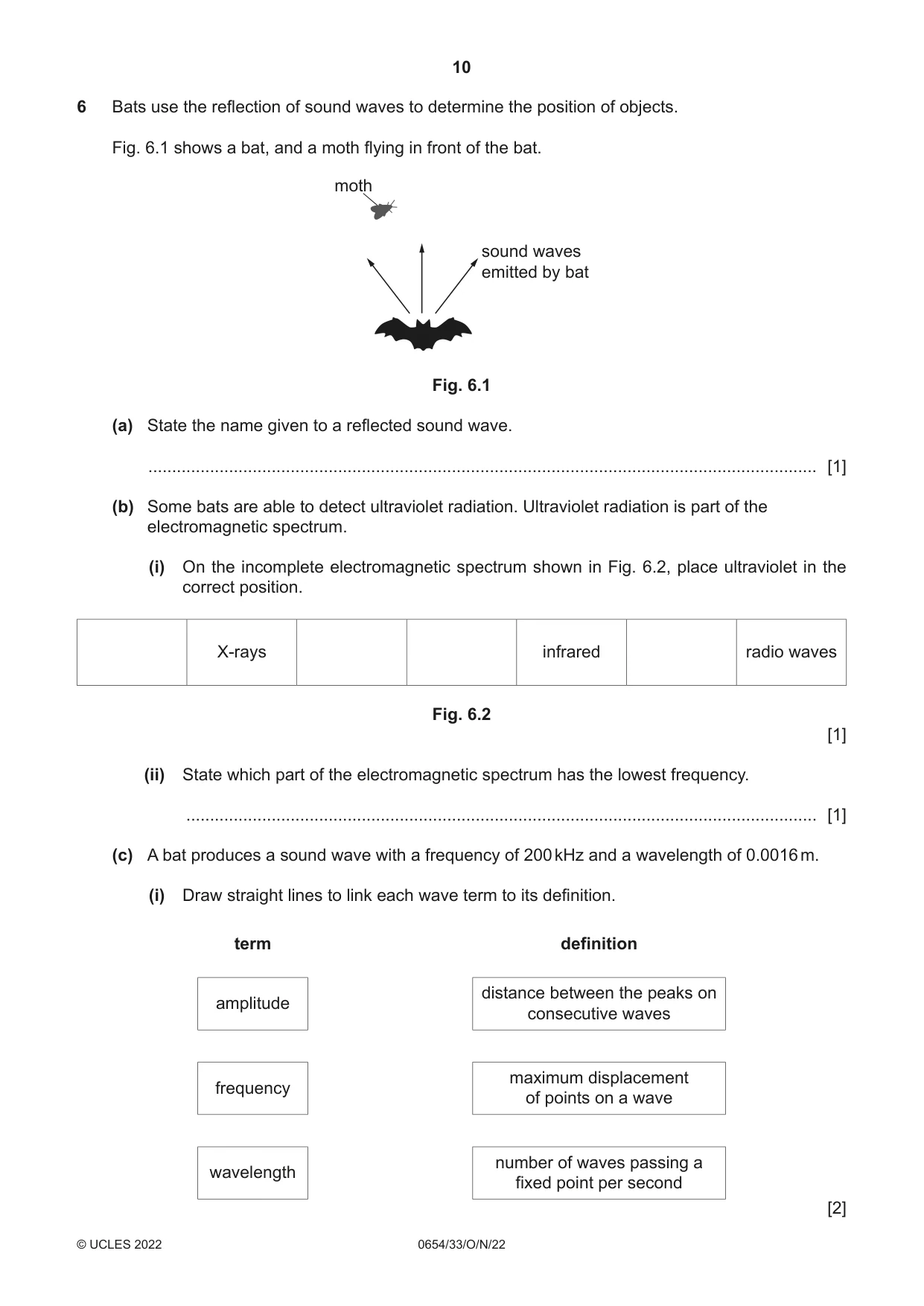
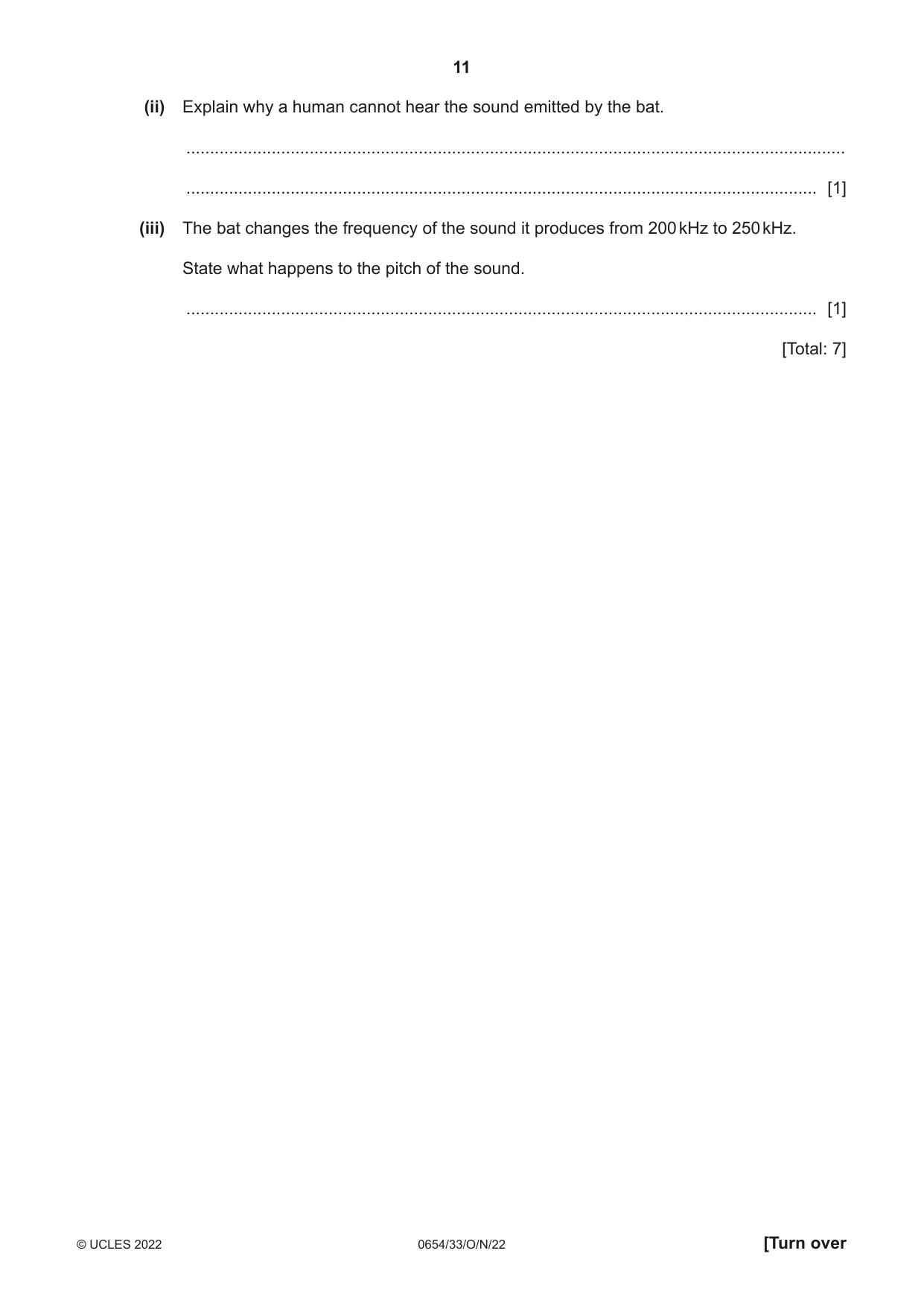
6 Bats use the reflection of sound waves to determine the position of objects. Fig. 6.1 shows a bat, and a moth flying in front of the bat. moth sound waves emitted by bat Fig. 6.1 (a) State the name given to a reflected sound wave. ............................................................................................................................................. [1] (b) Some bats are able to detect ultraviolet radiation. Ultraviolet radiation is part of the electromagnetic spectrum. (i) On the incomplete electromagnetic spectrum shown in Fig. 6.2, place ultraviolet in the correct position. X-rays infrared radio waves Fig. 6.2 [1] (ii) State which part of the electromagnetic spectrum has the lowest frequency. ..................................................................................................................................... [1] (c) A bat produces a sound wave with a frequency of 200 kHz and a wavelength of 0.0016 m. (i) Draw straight lines to link each wave term to its definition. term definition distance between the peaks on amplitude consecutive waves maximum displacement frequency of points on a wave number of waves passing a wavelength fixed point per second [2] (ii) Explain why a human cannot hear the sound emitted by the bat. ........................................................................................................................................... ..................................................................................................................................... [1] (iii) The bat changes the frequency of the sound it produces from 200 kHz to 250 kHz. State what happens to the pitch of the sound. ..................................................................................................................................... [1] [Total: 7]
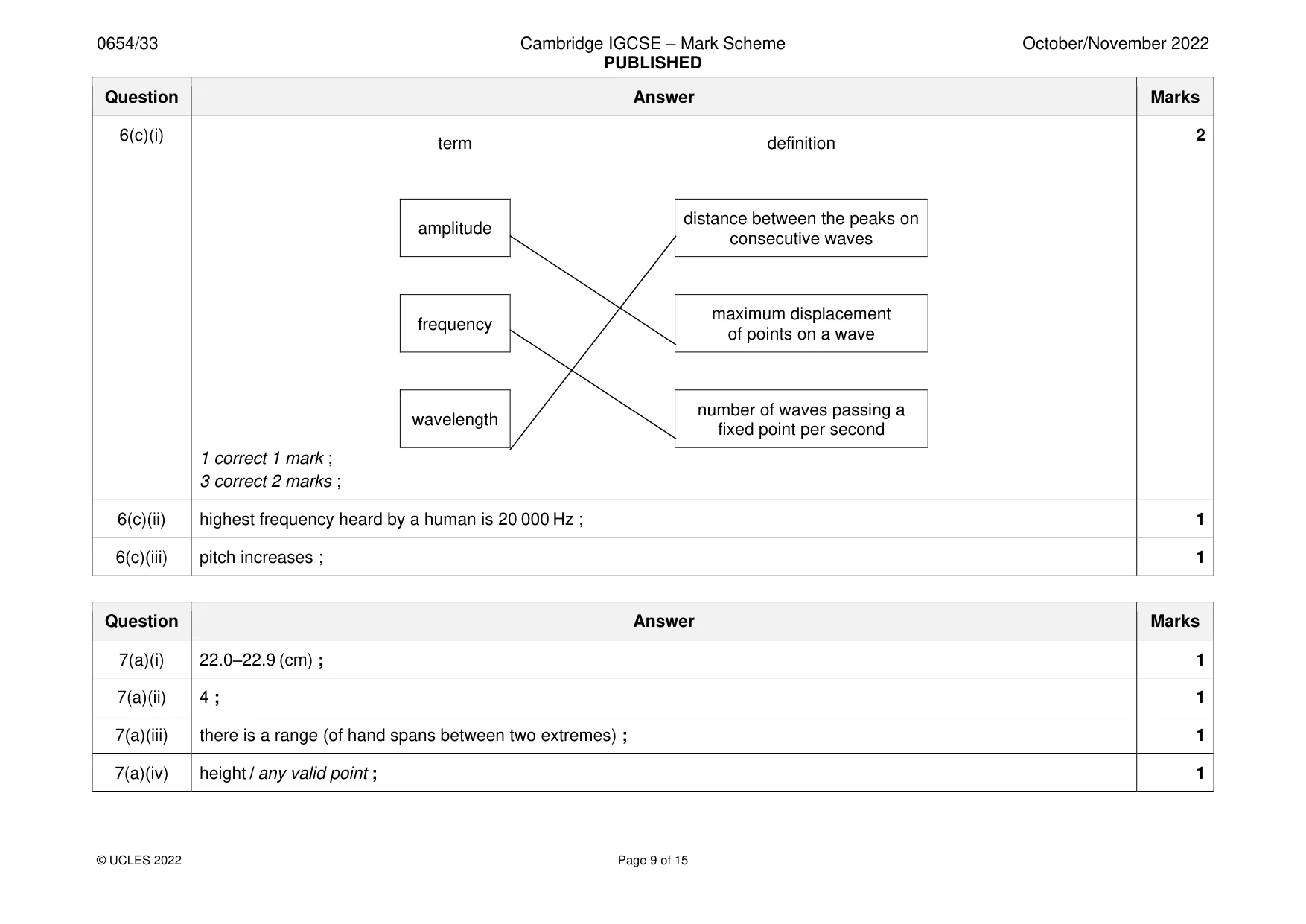
Mark scheme: 6(a) echo ; 1 6(b)(i) 1 X-rays UV infrared radio waves 6(b)(ii) radio waves ; 1 6(c)(i) 2 term definition distance between the peaks on amplitude consecutive waves maximum displacement frequency of points on a wave number of waves passing a wavelength fixed point per second 1 correct 1 mark ; 3 correct 2 marks ; 6(c)(ii) highest frequency heard by a human is 20 000 Hz ; 1 6(c)(iii) pitch increases ; 1
Q7 · Students in a school measure their hand-span
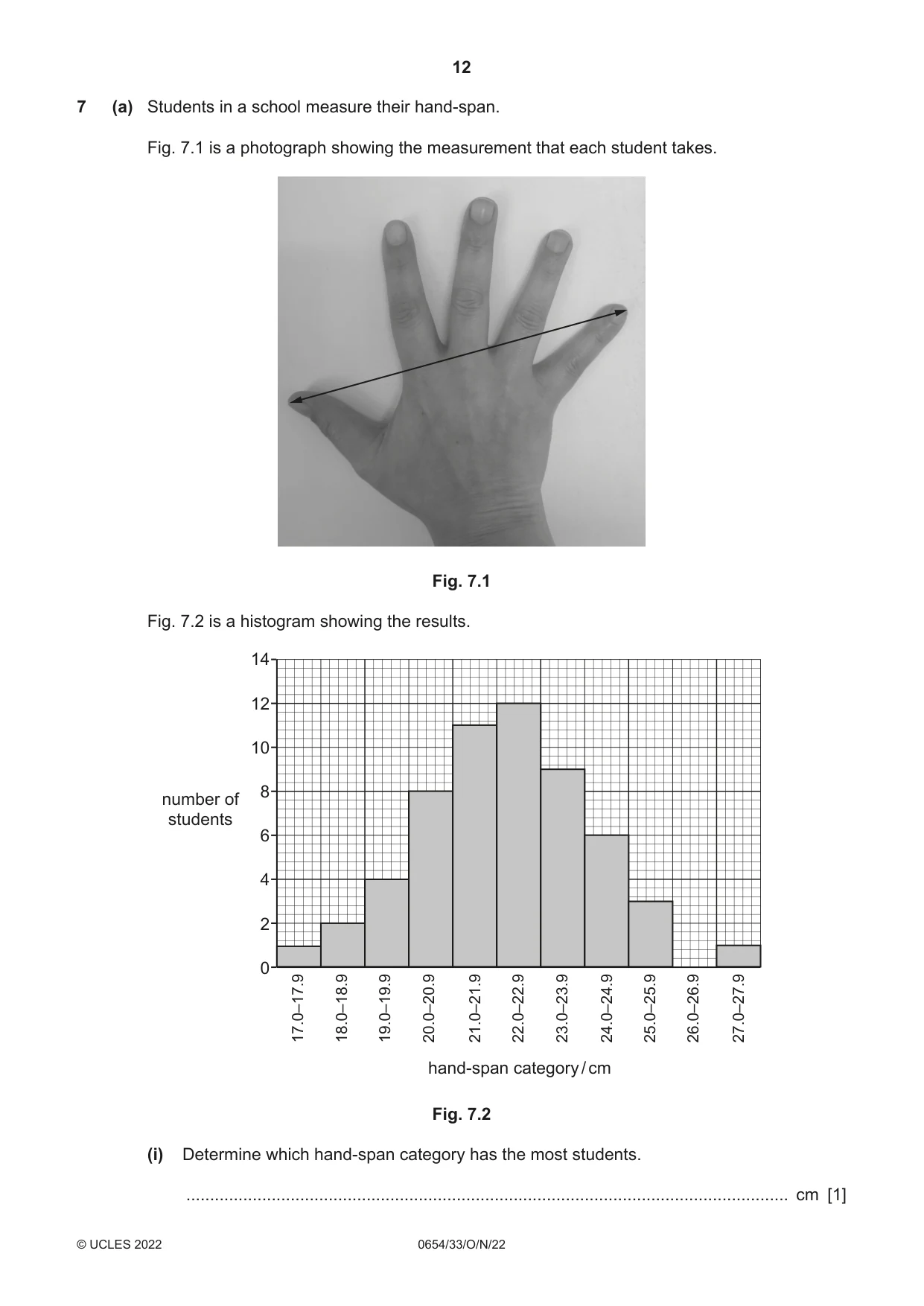
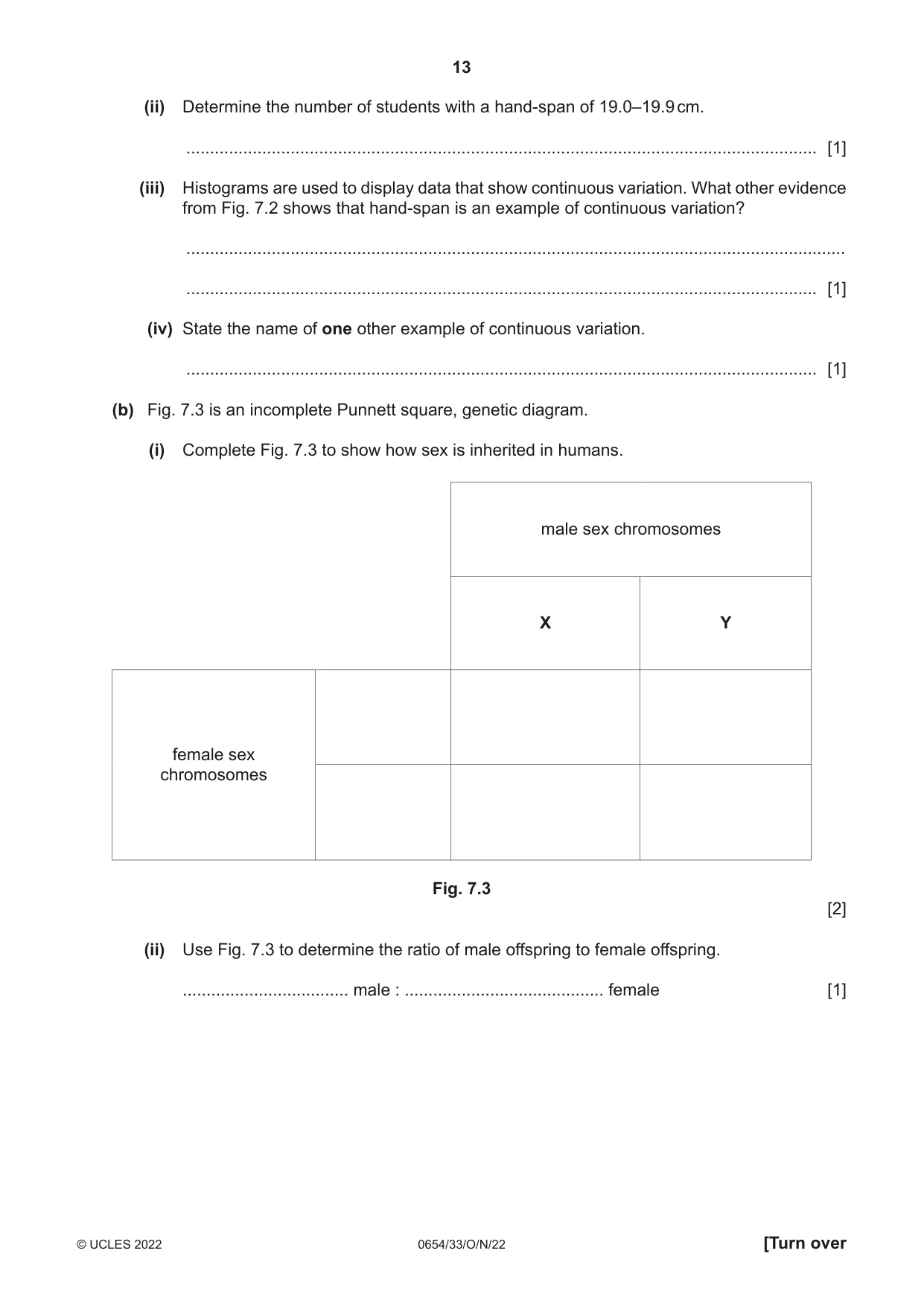
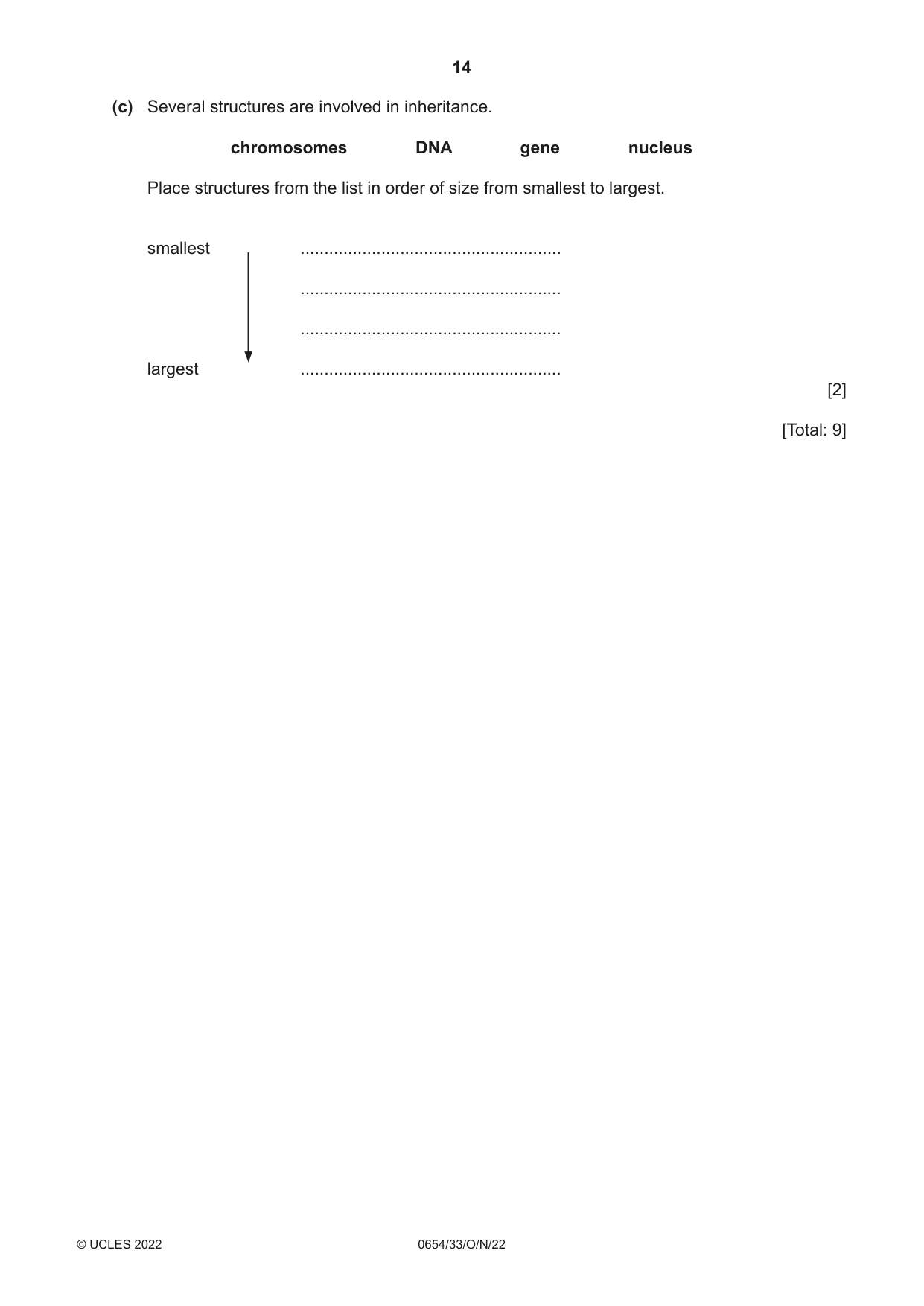
7 (a) Students in a school measure their hand-span. Fig. 7.1 is a photograph showing the measurement that each student takes. Fig. 7.1 Fig. 7.2 is a histogram showing the results. 14 12 10 8 number of students 6 4 2 0 17.0–17.9 18.0–18.9 19.0–19.9 20.0–20.9 21.0–21.9 22.0–22.9 23.0–23.9 24.0–24.9 25.0–25.9 26.0–26.9 27.0–27.9 hand-span category / cm Fig. 7.2 (i) Determine which hand-span category has the most students. ............................................................................................................................... cm [1] (ii) Determine the number of students with a hand-span of 19.0–19.9 cm. ..................................................................................................................................... [1] (iii) Histograms are used to display data that show continuous variation. What other evidence from Fig. 7.2 shows that hand-span is an example of continuous variation? ........................................................................................................................................... ..................................................................................................................................... [1] (iv) State the name of one other example of continuous variation. ..................................................................................................................................... [1] (b) Fig. 7.3 is an incomplete Punnett square, genetic diagram. (i) Complete Fig. 7.3 to show how sex is inherited in humans. male sex chromosomes X Y female sex chromosomes Fig. 7.3 [2] (ii) Use Fig. 7.3 to determine the ratio of male offspring to female offspring. ................................... male : .......................................... female [1] (c) Several structures are involved in inheritance. chromosomes DNA gene nucleus Place structures from the list in order of size from smallest to largest. smallest ....................................................... ....................................................... ....................................................... largest ....................................................... [2] [Total: 9]
Mark scheme: 7(a)(i) 22.0–22.9 (cm) ; 1 7(a)(ii) 4 ; 1 7(a)(iii) there is a range (of hand spans between two extremes) ; 1 7(a)(iv) height / any valid point ; 1 7(b)(i) correct female sex chromosomes ; 2 correct offspring chromosomes ; 7(b)(ii) 1:1 ; 1 7(c) DNA 2 gene chromosome nucleus ;; 1 mark for DNA and nucleus in correct place 1 mark for gene smaller than chromosome (in any position)
Q8 · Potassium is an element in the Periodic Table
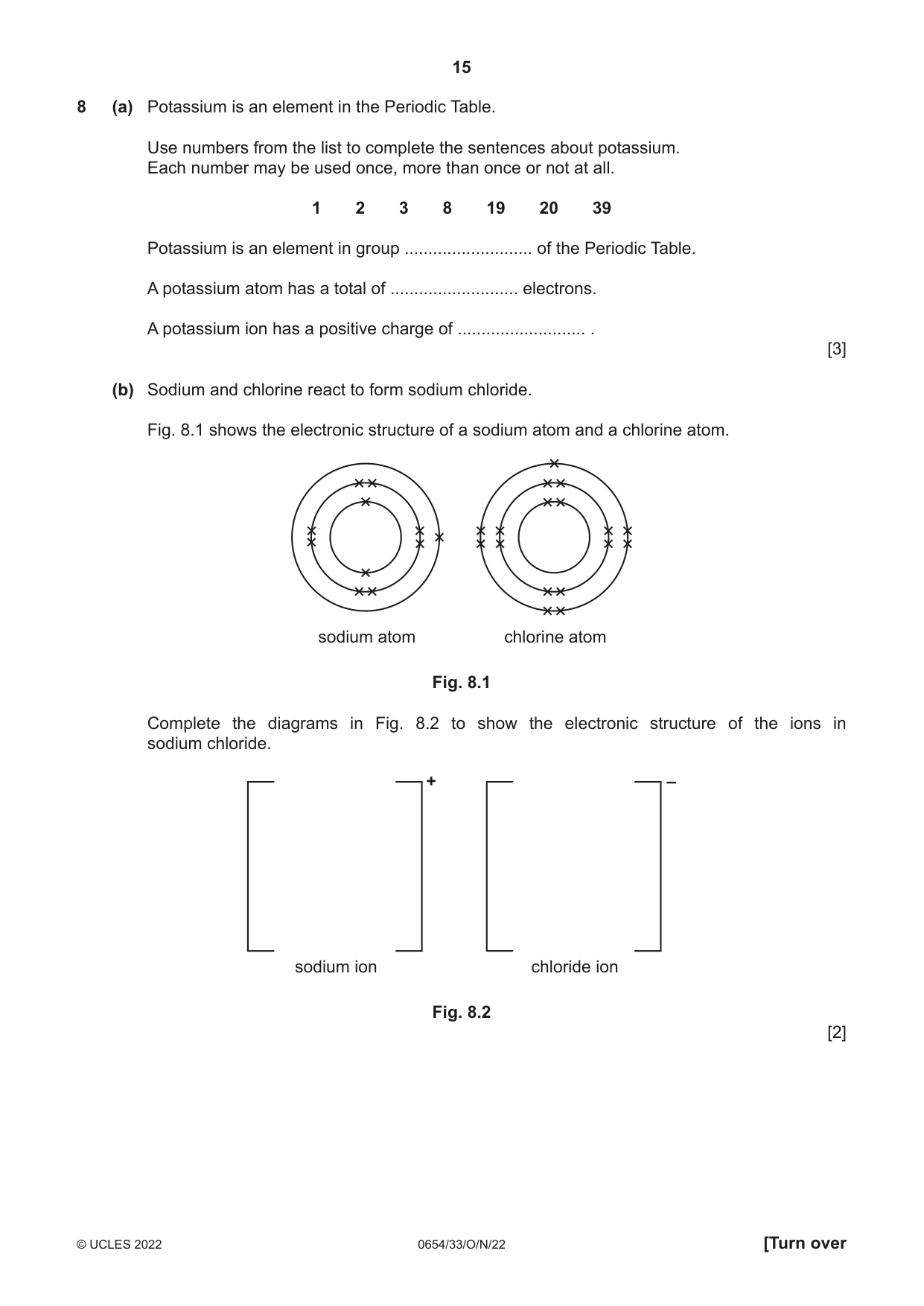
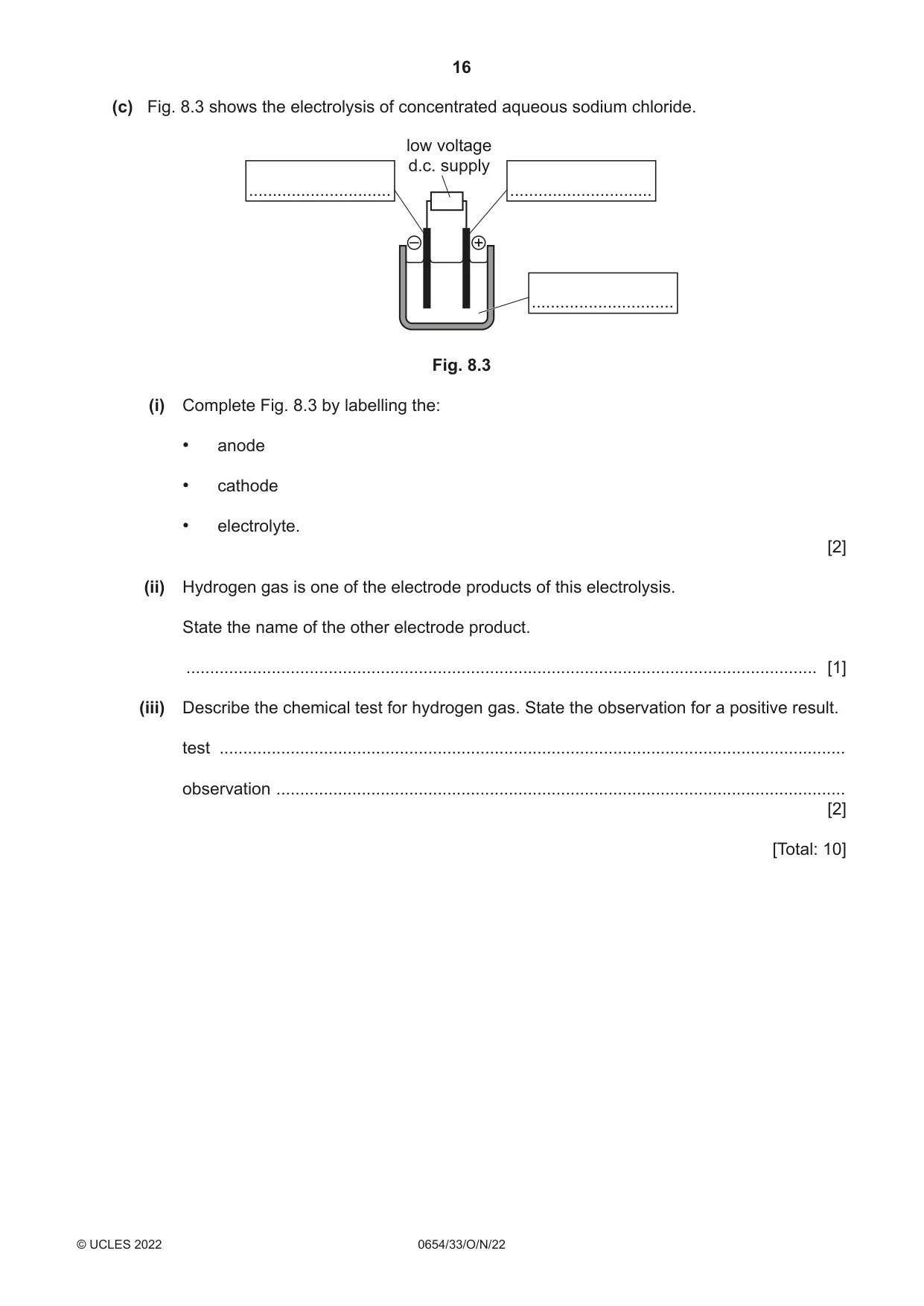
8 (a) Potassium is an element in the Periodic Table. Use numbers from the list to complete the sentences about potassium. Each number may be used once, more than once or not at all. 1 2 3 8 19 20 39 Potassium is an element in group ........................... of the Periodic Table. A potassium atom has a total of ........................... electrons. A potassium ion has a positive charge of ........................... . [3] (b) Sodium and chlorine react to form sodium chloride. Fig. 8.1 shows the electronic structure of a sodium atom and a chlorine atom. sodium atom chlorine atom Fig. 8.1 Complete the diagrams in Fig. 8.2 to show the electronic structure of the ions in sodium chloride. + – sodium ion chloride ion Fig. 8.2 [2] (c) Fig. 8.3 shows the electrolysis of concentrated aqueous sodium chloride. low voltage d.c. supply .............................. .............................. – + .............................. Fig. 8.3 (i) Complete Fig. 8.3 by labelling the: • anode • cathode • electrolyte. [2] (ii) Hydrogen gas is one of the electrode products of this electrolysis. State the name of the other electrode product. ..................................................................................................................................... [1] (iii) Describe the chemical test for hydrogen gas. State the observation for a positive result. test .................................................................................................................................... observation ........................................................................................................................ [2] [Total: 10]
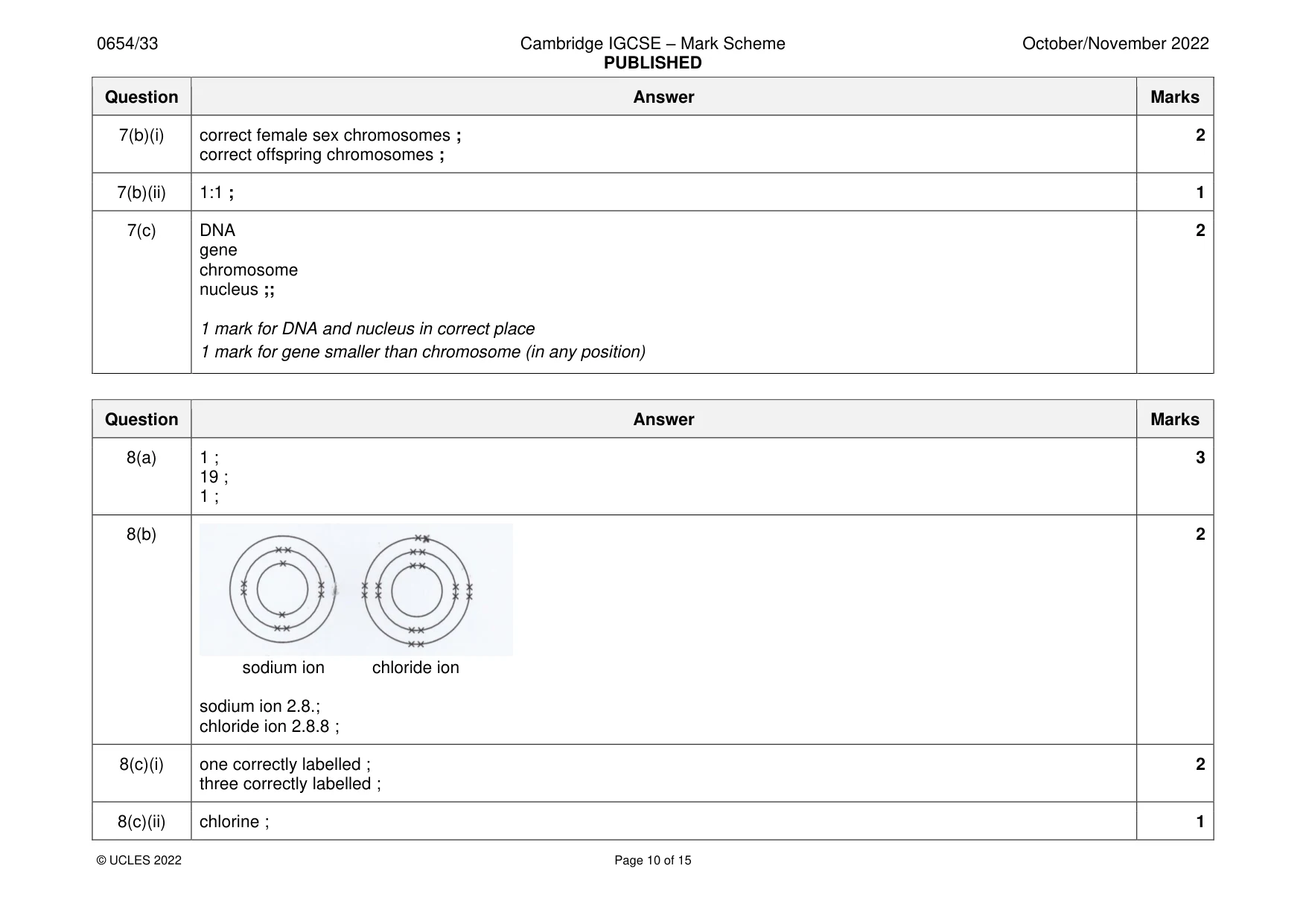
Mark scheme: 8(a) 1 ; 3 19 ; 1 ; 8(b) 2 sodium ion chloride ion sodium ion 2.8.; chloride ion 2.8.8 ; 8(c)(i) one correctly labelled ; 2 three correctly labelled ; 8(c)(ii) chlorine ; 1 8(c)(iii) lighted splint ; 2 goes pop ;
Q9 · An aircraft at rest on a runway
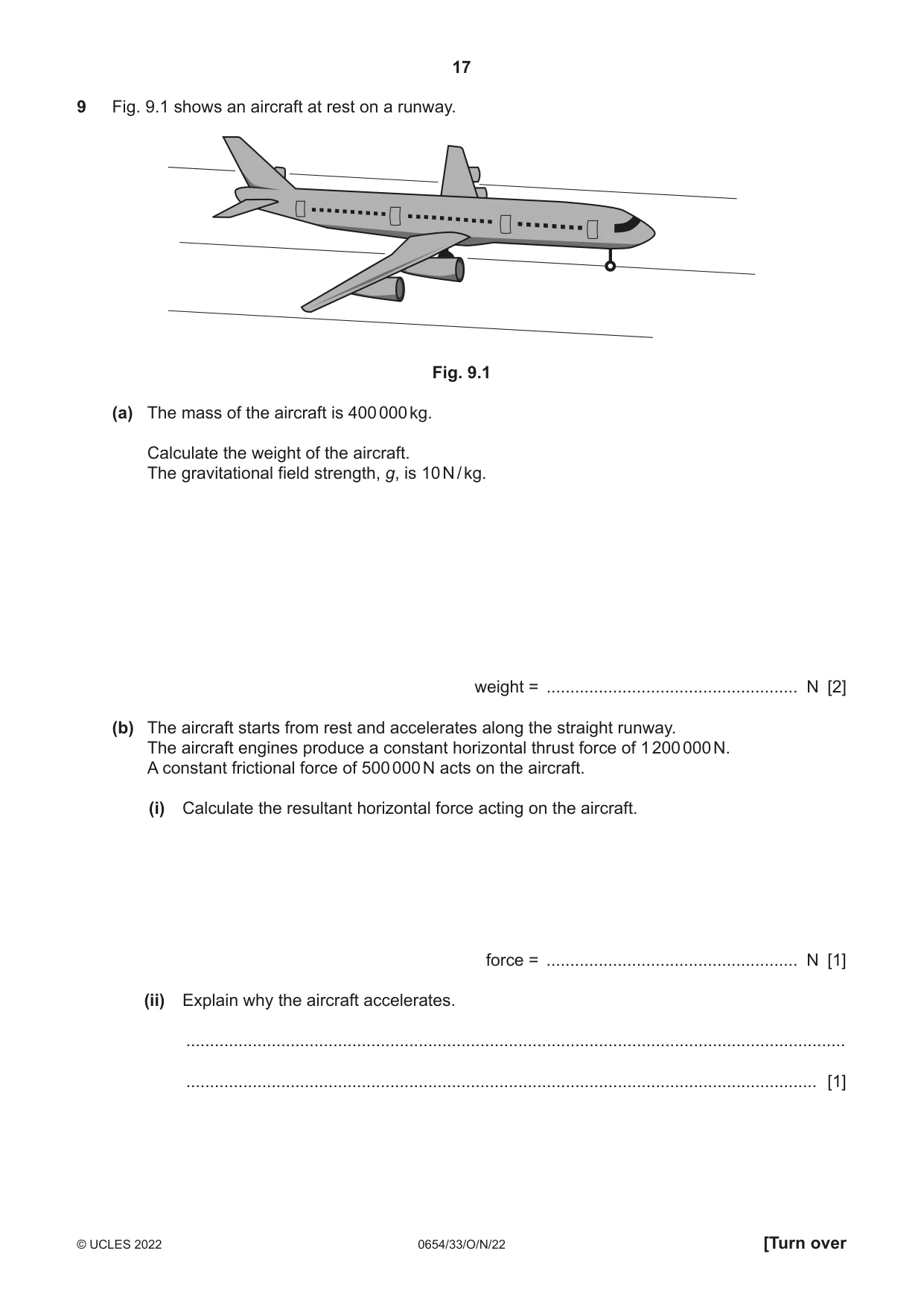
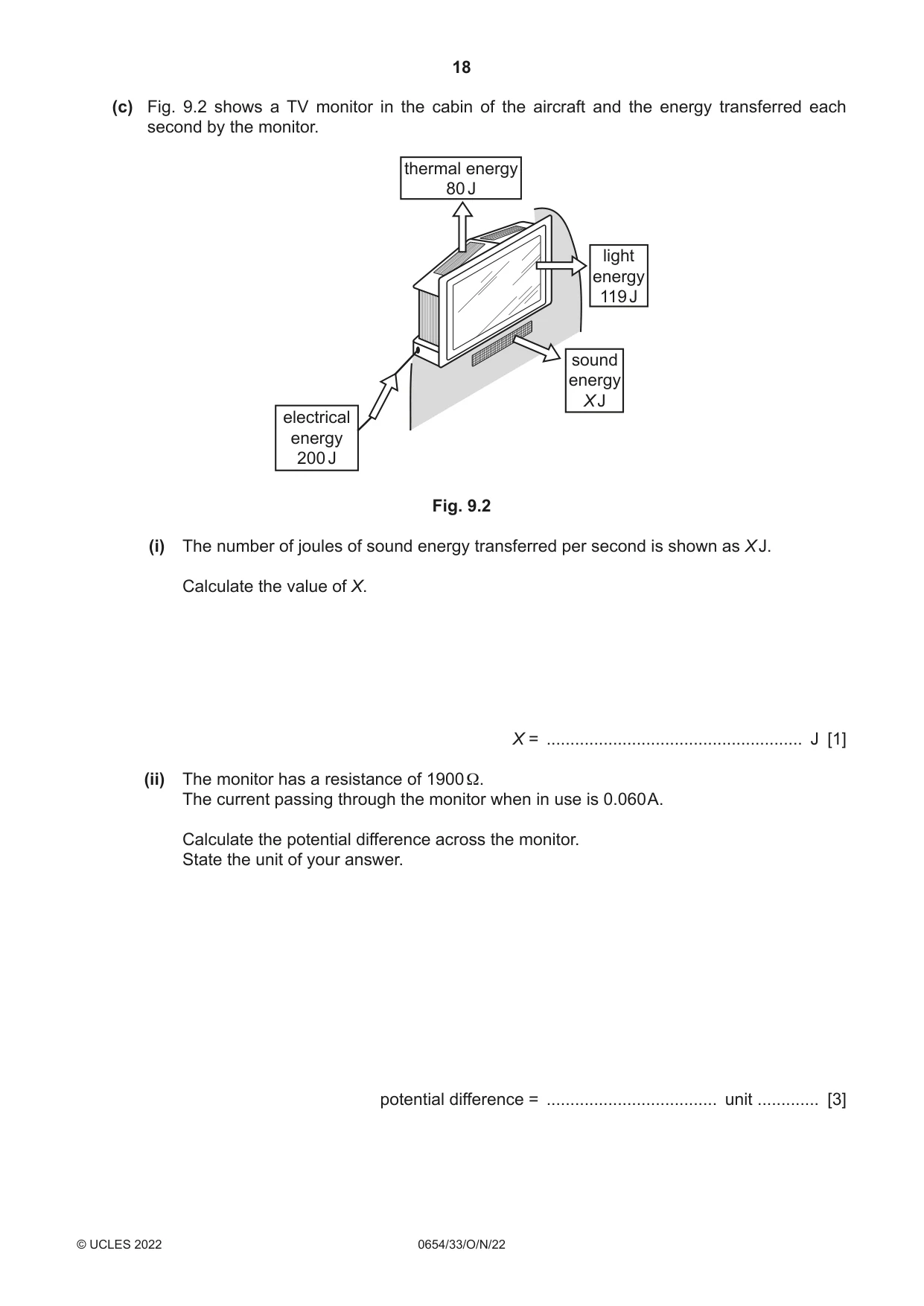
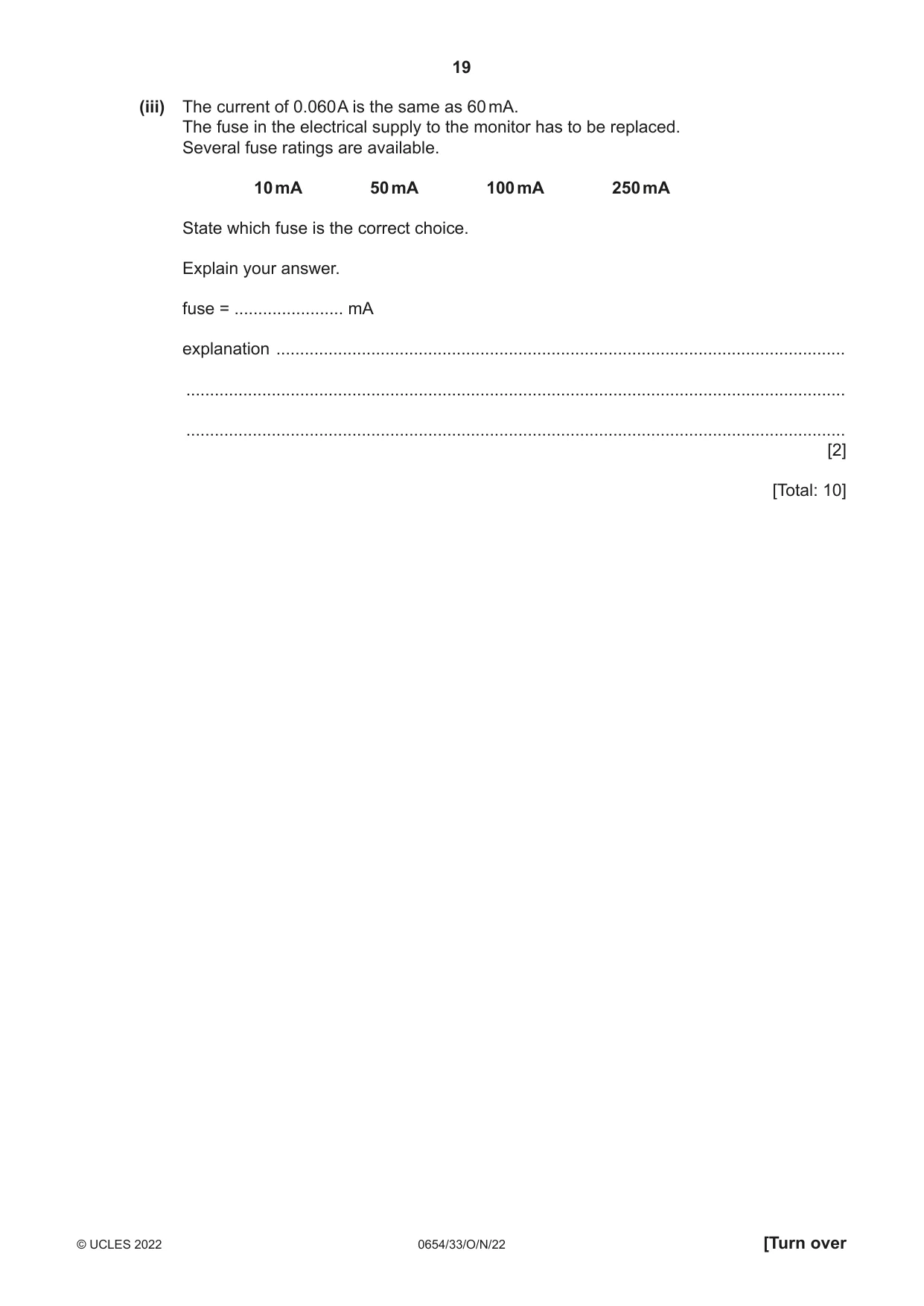
9 Fig. 9.1 shows an aircraft at rest on a runway. Fig. 9.1 (a) The mass of the aircraft is 400 000 kg. Calculate the weight of the aircraft. The gravitational field strength, g, is 10 N / kg. weight = ..................................................... N [2] (b) The aircraft starts from rest and accelerates along the straight runway. The aircraft engines produce a constant horizontal thrust force of 1 200 000 N. A constant frictional force of 500 000 N acts on the aircraft. (i) Calculate the resultant horizontal force acting on the aircraft. force = ..................................................... N [1] (ii) Explain why the aircraft accelerates. ........................................................................................................................................... ..................................................................................................................................... [1] (c) Fig. 9.2 shows a TV monitor in the cabin of the aircraft and the energy transferred each second by the monitor. thermal energy 80 J light energy 119 J sound energy X J electrical energy 200 J Fig. 9.2 (i) The number of joules of sound energy transferred per second is shown as X J. Calculate the value of X. X = ...................................................... J [1] (ii) The monitor has a resistance of 1900 Ω. The current passing through the monitor when in use is 0.060 A. Calculate the potential difference across the monitor. State the unit of your answer. potential difference = .................................... unit ............. [3] (iii) The current of 0.060 A is the same as 60 mA. The fuse in the electrical supply to the monitor has to be replaced. Several fuse ratings are available. 10 mA 50 mA 100 mA 250 mA State which fuse is the correct choice. Explain your answer. fuse = ....................... mA explanation ........................................................................................................................ ........................................................................................................................................... ........................................................................................................................................... [2] [Total: 10]
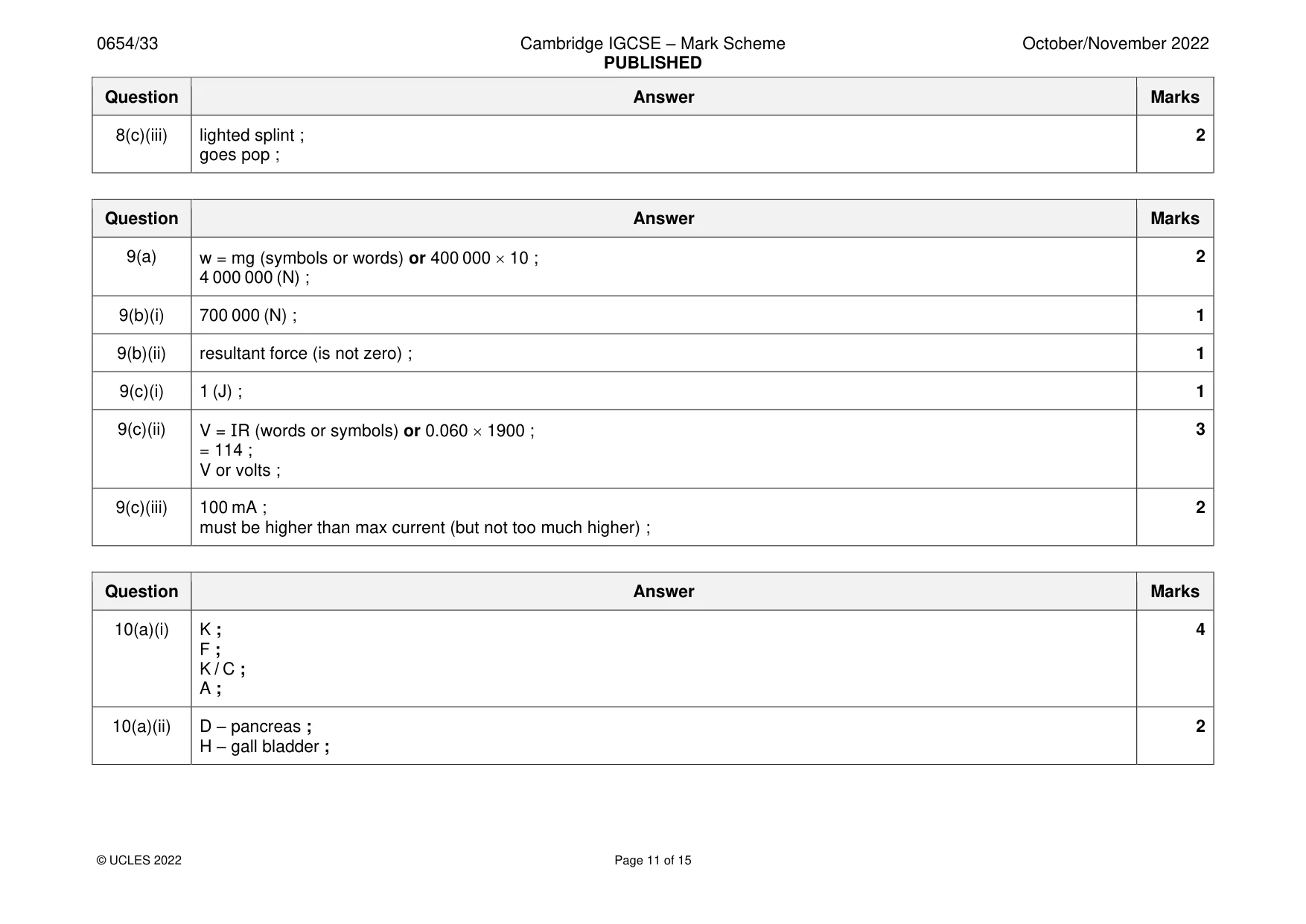
Mark scheme: 9(a) w = mg (symbols or words) or 400 000 10 ; 2 4 000 000 (N) ; 9(b)(i) 700 000 (N) ; 1 9(b)(ii) resultant force (is not zero) ; 1 9(c)(i) 1 (J) ; 1 9(c)(ii) V = IR (words or symbols) or 0.060 1900 ; 3 = 114 ; V or volts ; 9(c)(iii) 100 mA ; 2 must be higher than max current (but not too much higher) ;
Q10 · A diagram of the alimentary canal and associated organs in a human
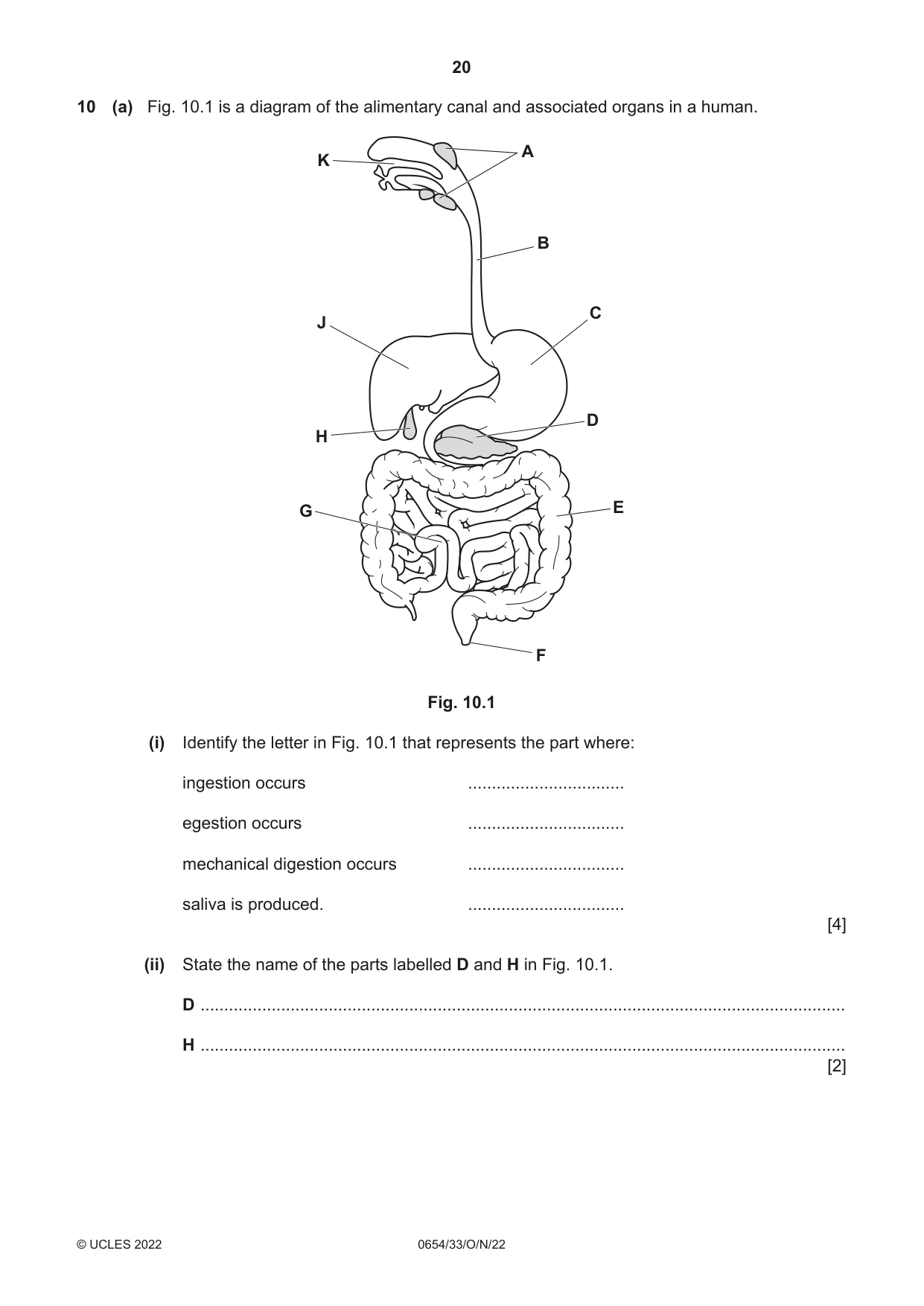
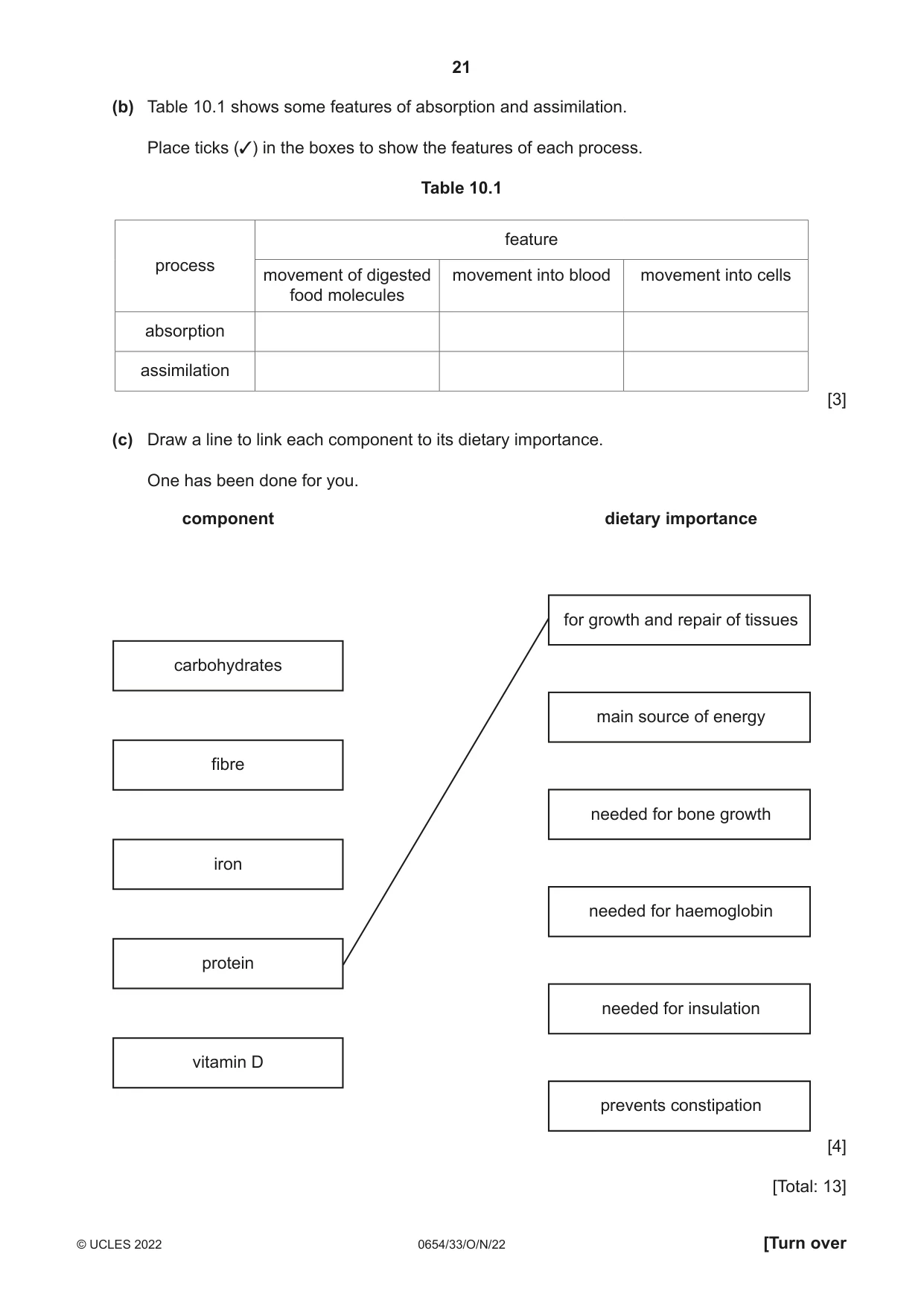
10 (a) Fig. 10.1 is a diagram of the alimentary canal and associated organs in a human. A K B C J D H G E F Fig. 10.1 (i) Identify the letter in Fig. 10.1 that represents the part where: ingestion occurs ................................. egestion occurs ................................. mechanical digestion occurs ................................. saliva is produced. ................................. [4] (ii) State the name of the parts labelled D and H in Fig. 10.1. D ........................................................................................................................................ H ........................................................................................................................................ [2] (b) Table 10.1 shows some features of absorption and assimilation. Place ticks (3) in the boxes to show the features of each process. Table 10.1 feature process movement of digested movement into blood movement into cells food molecules absorption assimilation [3] (c) Draw a line to link each component to its dietary importance. One has been done for you. component dietary importance for growth and repair of tissues carbohydrates main source of energy fibre needed for bone growth iron needed for haemoglobin protein needed for insulation vitamin D prevents constipation [4] [Total: 13]
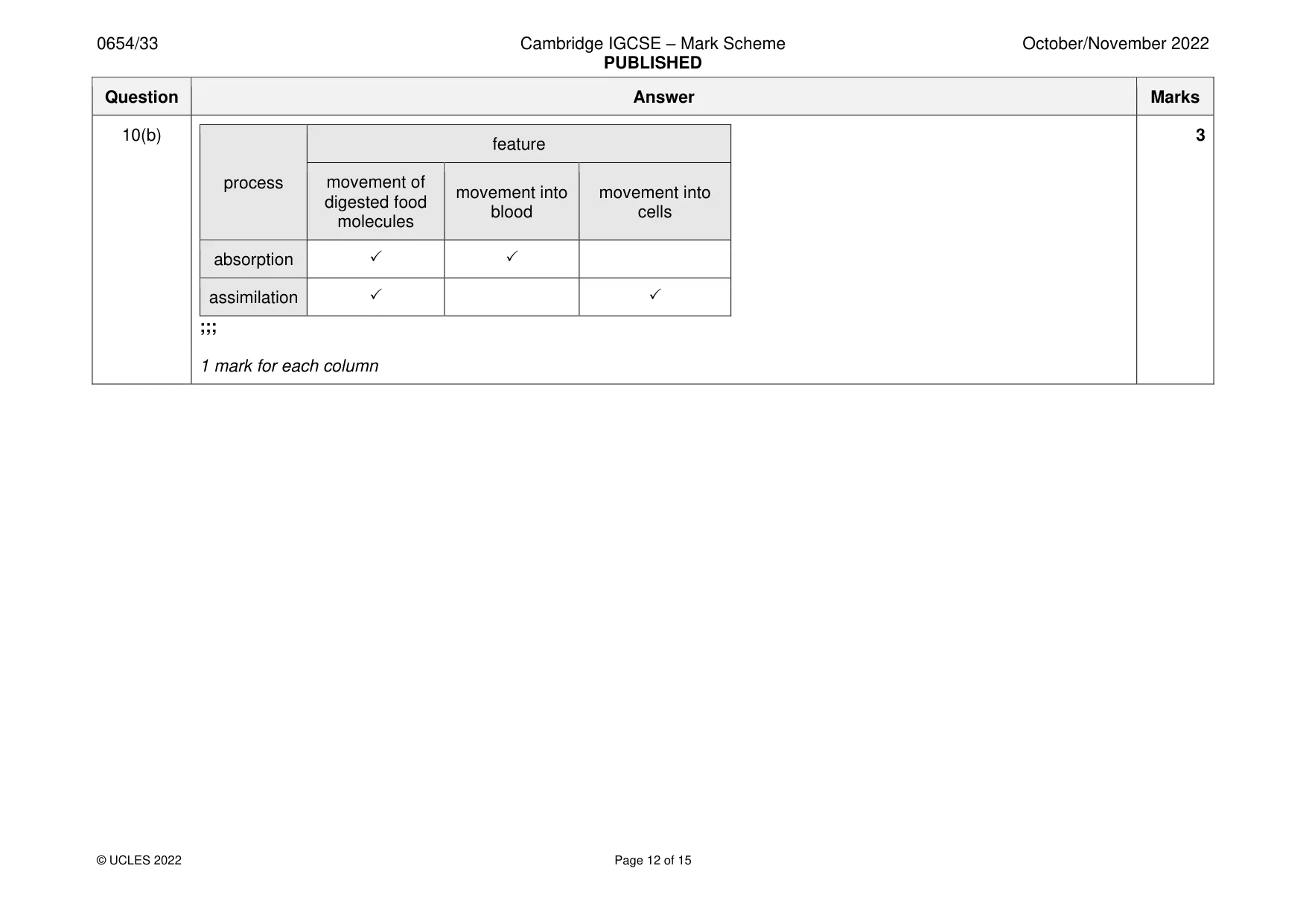
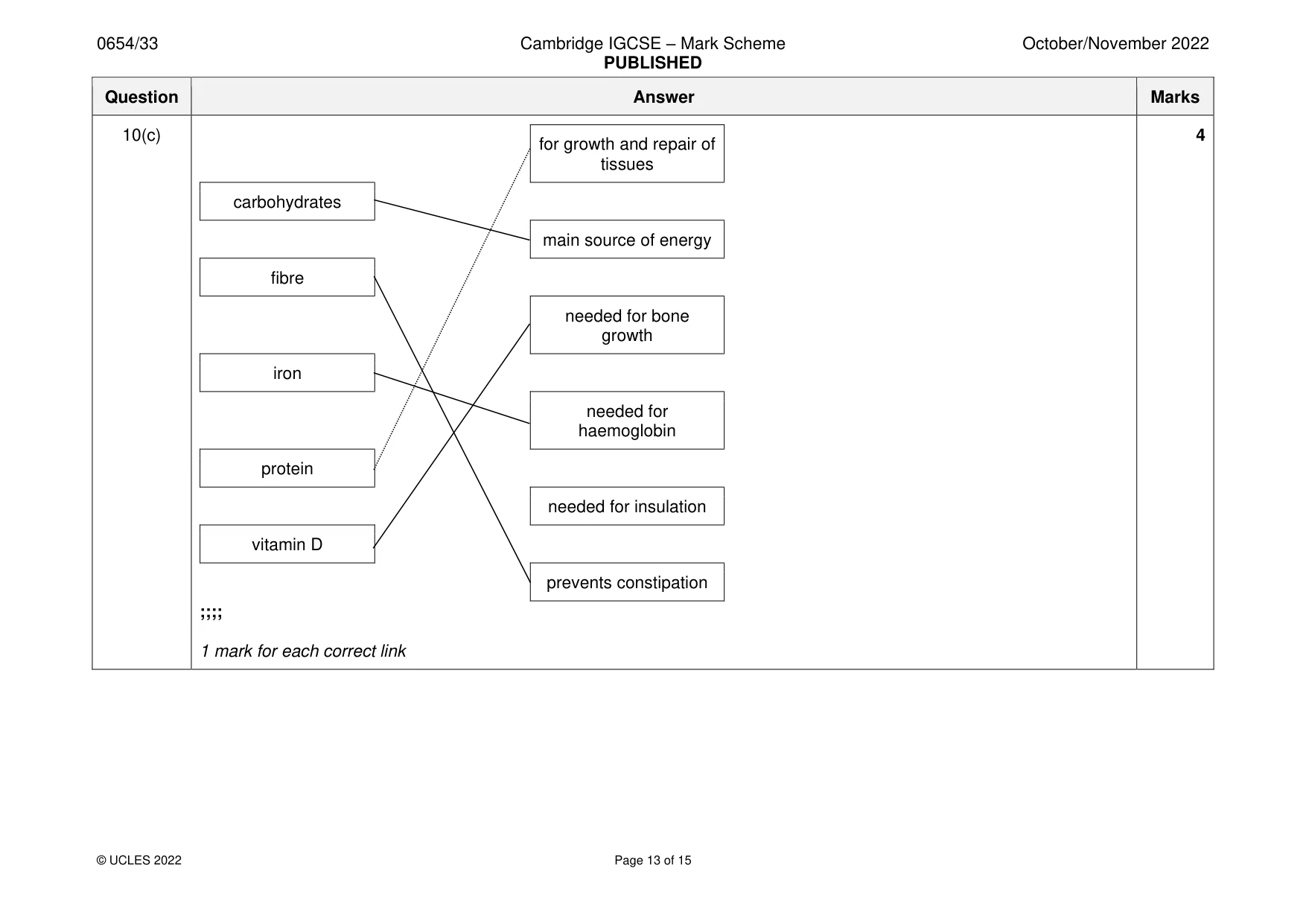
Mark scheme: 10(a)(i) K ; 4 F ; K / C ; A ; 10(a)(ii) D – pancreas ; 2 H – gall bladder ; 10(b) 3 feature process movement of movement into movement into digested food blood cells molecules absorption assimilation ;;; 1 mark for each column 10(c) 4 for growth and repair of tissues carbohydrates main source of energy fibre needed for bone growth iron needed for haemoglobin protein needed for insulation vitamin D prevents constipation ;;;; 1 mark for each correct link
Q11 · The apparatus and reagents used to make a salt
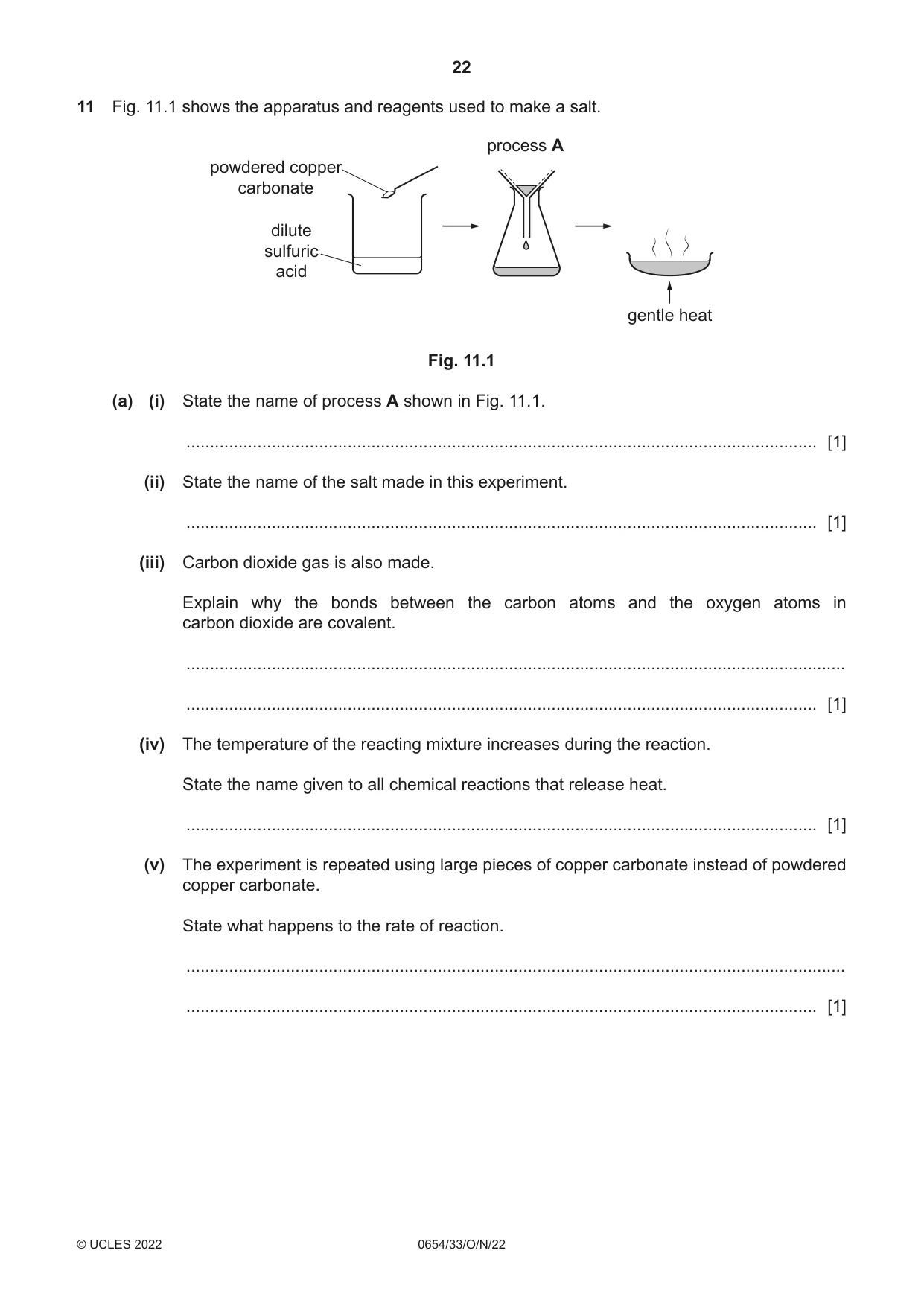
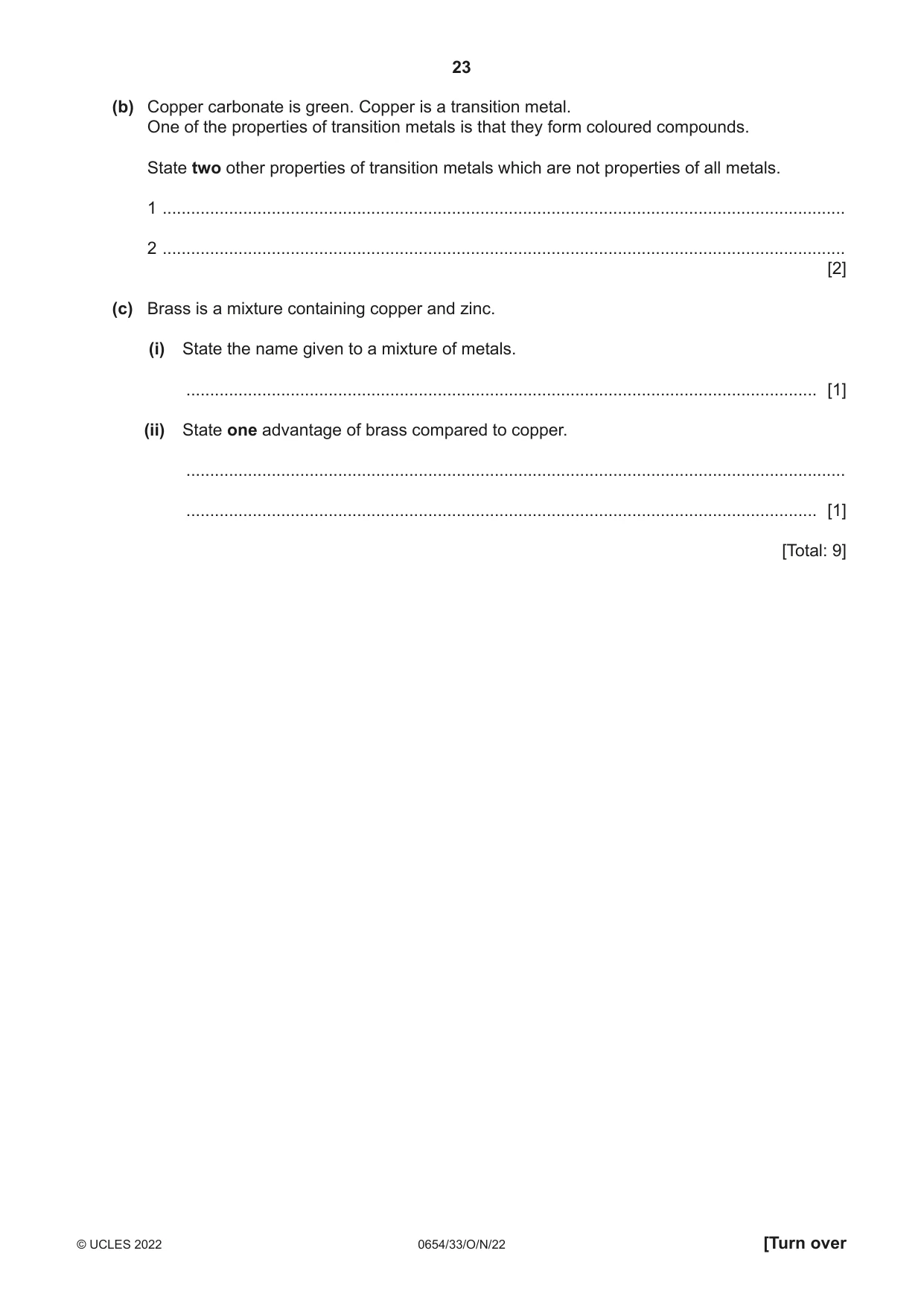
11 Fig. 11.1 shows the apparatus and reagents used to make a salt. process A powdered copper carbonate dilute sulfuric acid gentle heat Fig. 11.1 (a) (i) State the name of process A shown in Fig. 11.1. ..................................................................................................................................... [1] (ii) State the name of the salt made in this experiment. ..................................................................................................................................... [1] (iii) Carbon dioxide gas is also made. Explain why the bonds between the carbon atoms and the oxygen atoms in carbon dioxide are covalent. ........................................................................................................................................... ..................................................................................................................................... [1] (iv) The temperature of the reacting mixture increases during the reaction. State the name given to all chemical reactions that release heat. ..................................................................................................................................... [1] (v) The experiment is repeated using large pieces of copper carbonate instead of powdered copper carbonate. State what happens to the rate of reaction. ........................................................................................................................................... ..................................................................................................................................... [1] (b) Copper carbonate is green. Copper is a transition metal. One of the properties of transition metals is that they form coloured compounds. State two other properties of transition metals which are not properties of all metals. 1 ................................................................................................................................................ 2 ................................................................................................................................................ [2] (c) Brass is a mixture containing copper and zinc. (i) State the name given to a mixture of metals. ..................................................................................................................................... [1] (ii) State one advantage of brass compared to copper. ........................................................................................................................................... ..................................................................................................................................... [1] [Total: 9]
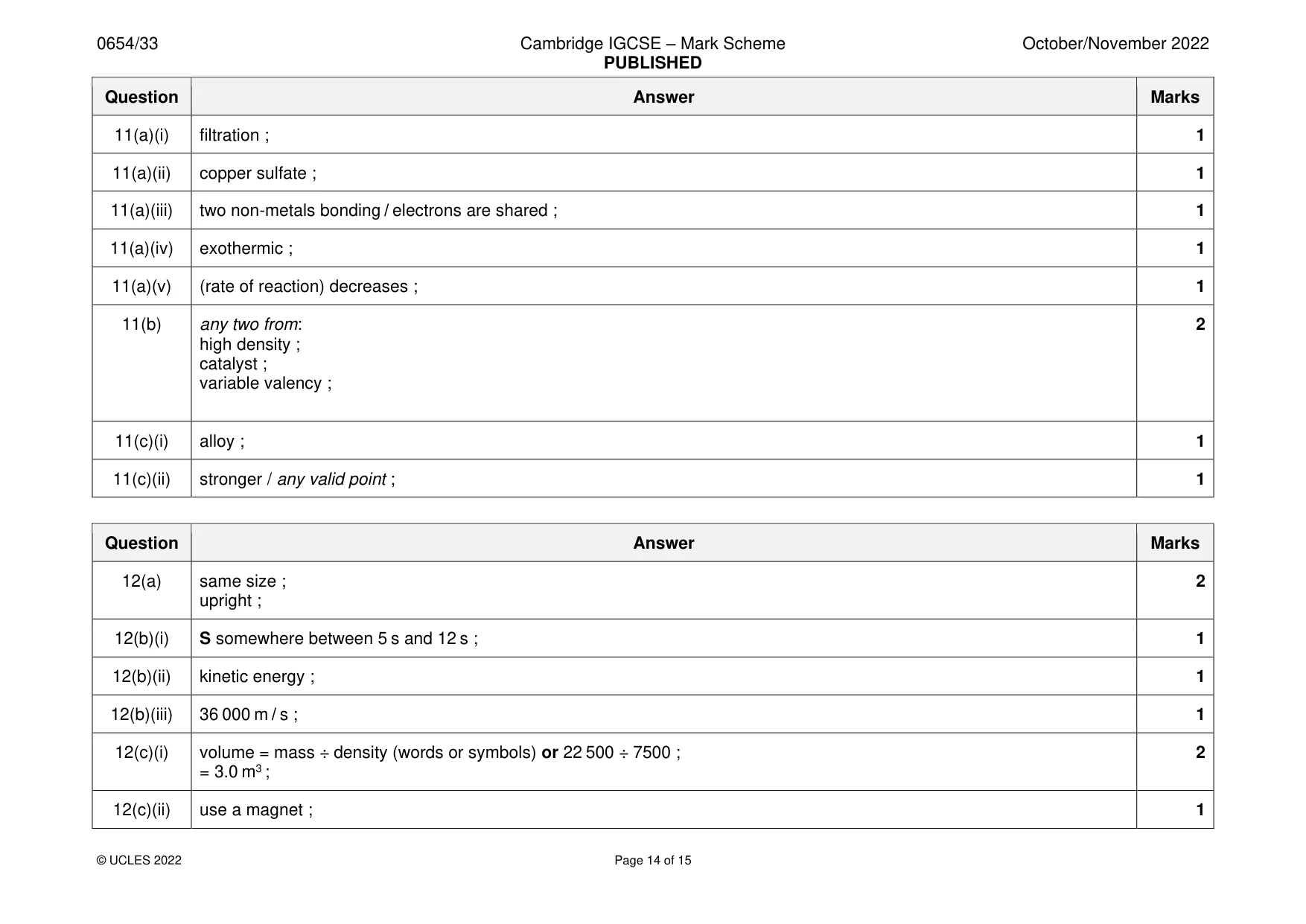
Mark scheme: 11(a)(i) filtration ; 1 11(a)(ii) copper sulfate ; 1 11(a)(iii) two non-metals bonding / electrons are shared ; 1 11(a)(iv) exothermic ; 1 11(a)(v) (rate of reaction) decreases ; 1 11(b) any two from: 2 high density ; catalyst ; variable valency ; 11(c)(i) alloy ; 1 11(c)(ii) stronger / any valid point ; 1
Q12 · An astronomer observes a large meteorite, a rock from outer space
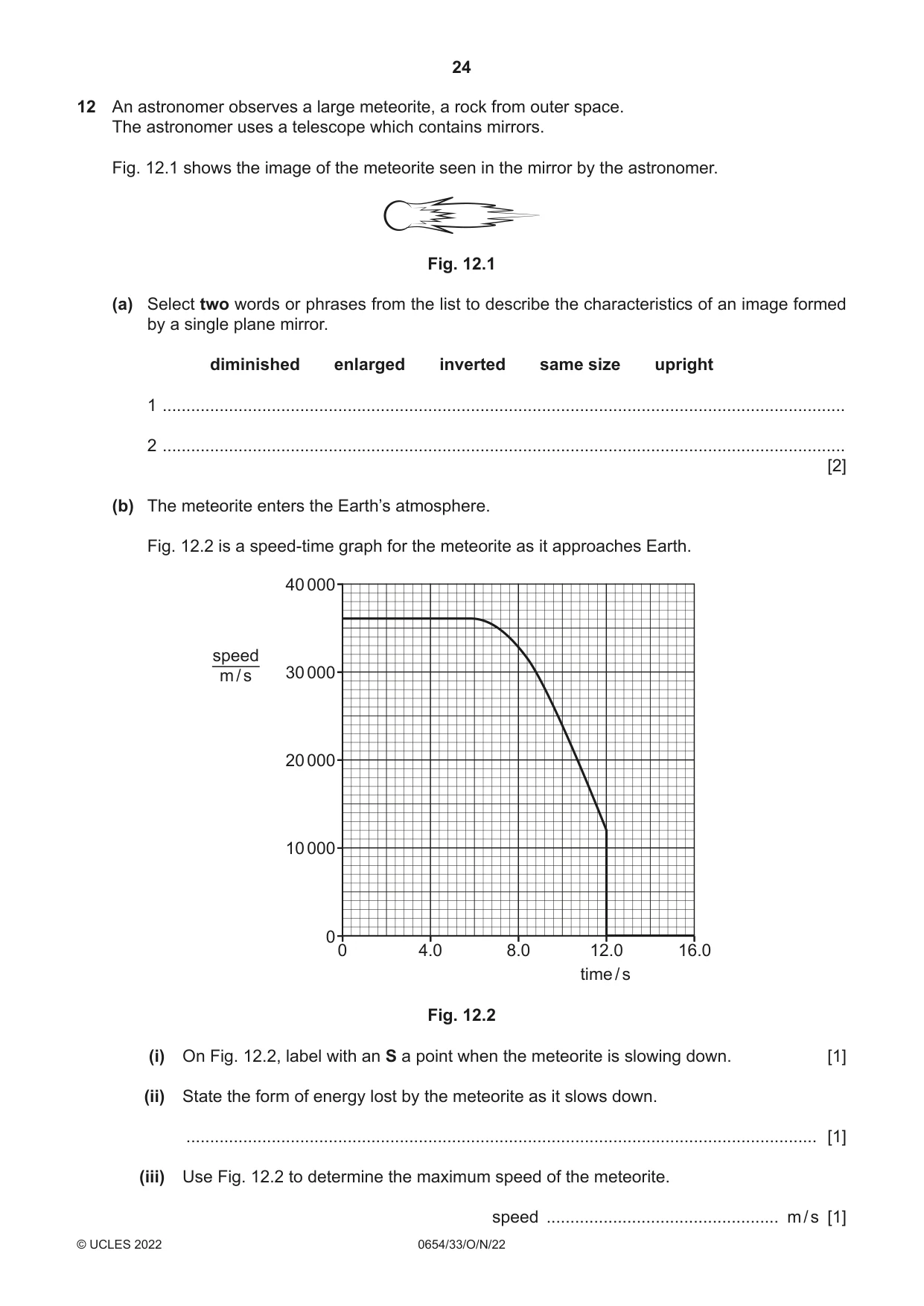
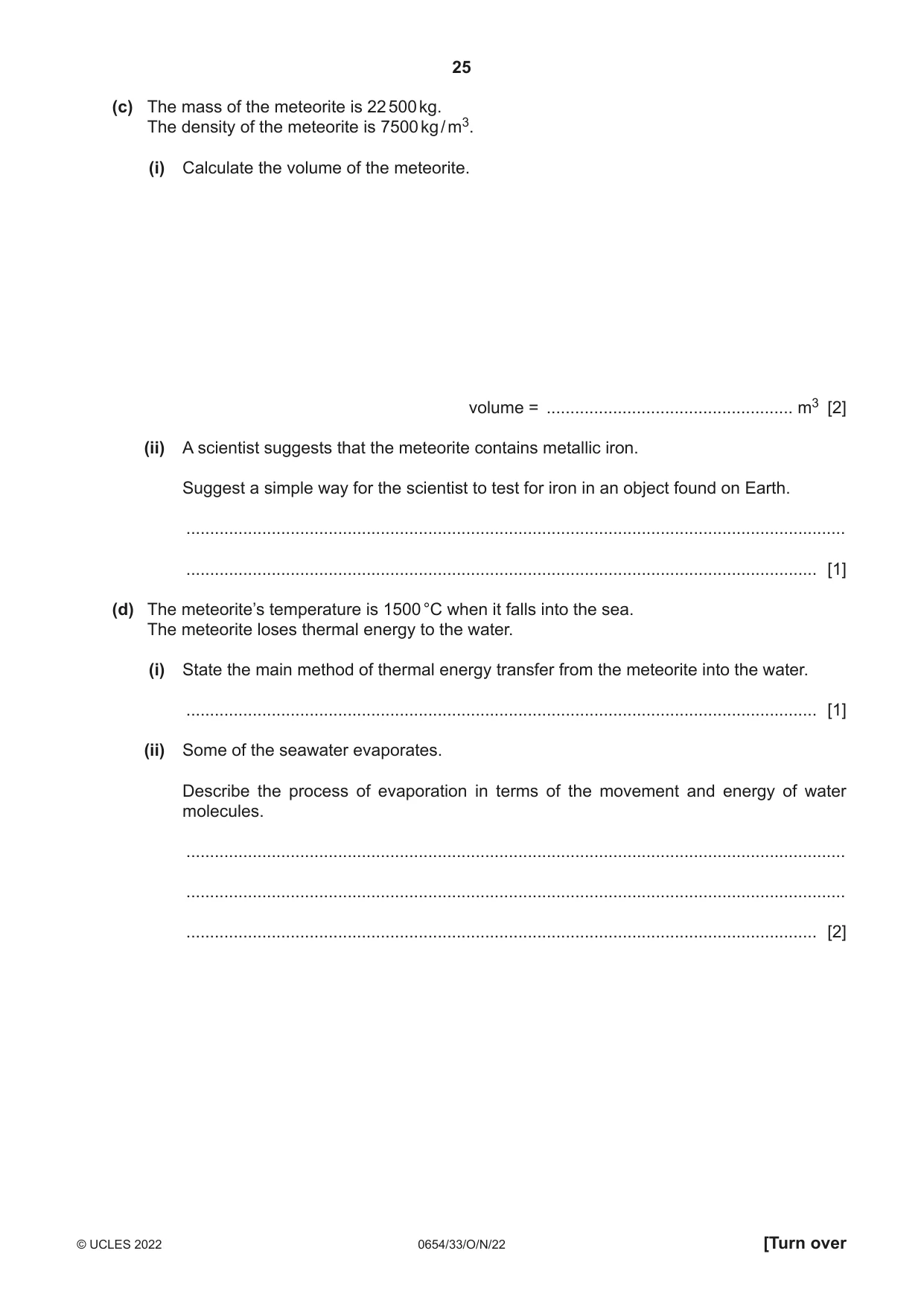
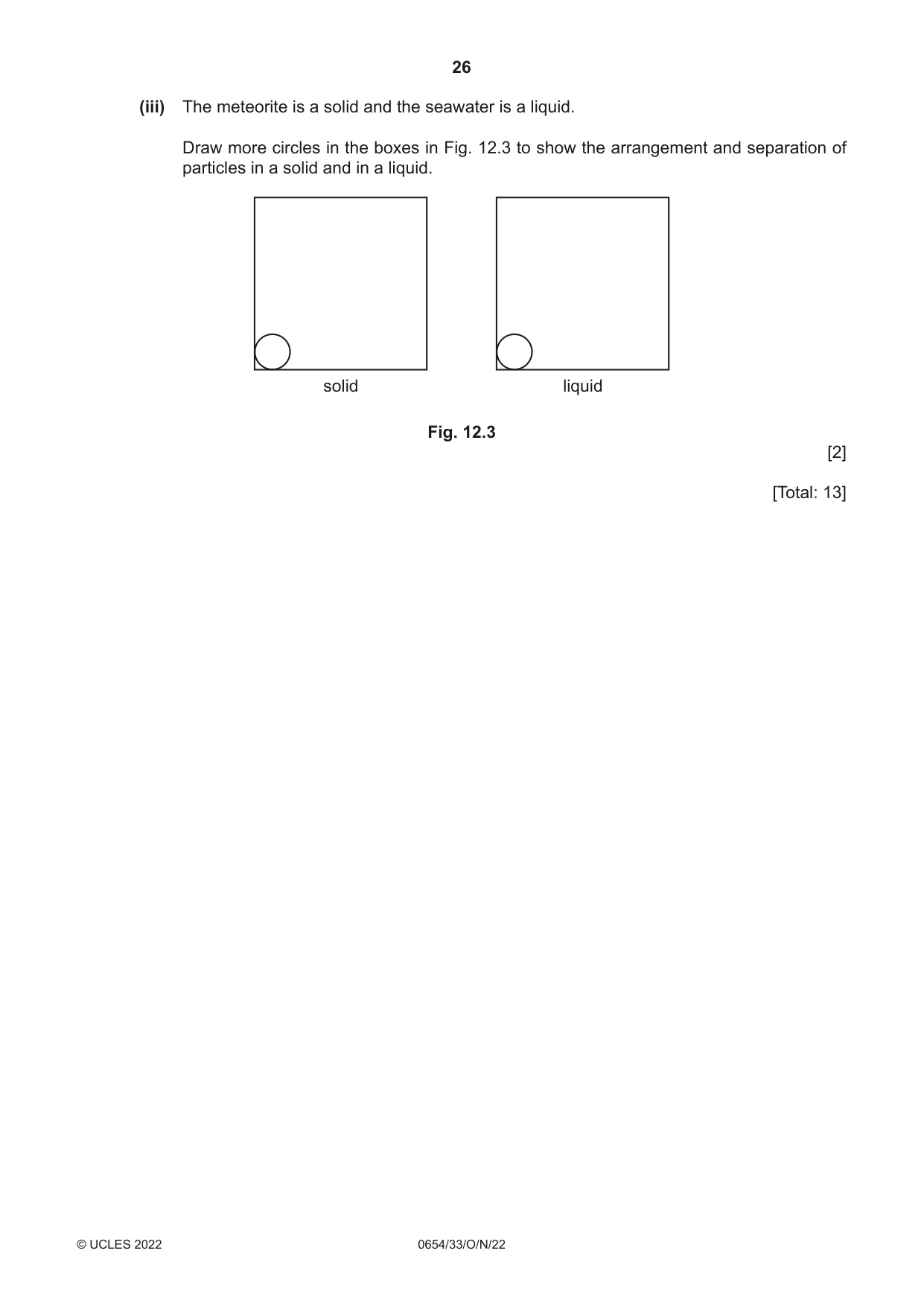
12 An astronomer observes a large meteorite, a rock from outer space. The astronomer uses a telescope which contains mirrors. Fig. 12.1 shows the image of the meteorite seen in the mirror by the astronomer. Fig. 12.1 (a) Select two words or phrases from the list to describe the characteristics of an image formed by a single plane mirror. diminished enlarged inverted same size upright 1 ................................................................................................................................................ 2 ................................................................................................................................................ [2] (b) The meteorite enters the Earth’s atmosphere. Fig. 12.2 is a speed-time graph for the meteorite as it approaches Earth. 40 000 speed m / s 30 000 20 000 10 000 0 0 4.0 8.0 12.0 16.0 time / s Fig. 12.2 (i) On Fig. 12.2, label with an S a point when the meteorite is slowing down. [1] (ii) State the form of energy lost by the meteorite as it slows down. ..................................................................................................................................... [1] (iii) Use Fig. 12.2 to determine the maximum speed of the meteorite. speed ................................................. m / s [1] (c) The mass of the meteorite is 22 500 kg. The density of the meteorite is 7500 kg / m3. (i) Calculate the volume of the meteorite. volume = .................................................... m3 [2] (ii) A scientist suggests that the meteorite contains metallic iron. Suggest a simple way for the scientist to test for iron in an object found on Earth. ........................................................................................................................................... ..................................................................................................................................... [1] (d) The meteorite’s temperature is 1500 °C when it falls into the sea. The meteorite loses thermal energy to the water. (i) State the main method of thermal energy transfer from the meteorite into the water. ..................................................................................................................................... [1] (ii) Some of the seawater evaporates. Describe the process of evaporation in terms of the movement and energy of water molecules. ........................................................................................................................................... ........................................................................................................................................... ..................................................................................................................................... [2] (iii) The meteorite is a solid and the seawater is a liquid. Draw more circles in the boxes in Fig. 12.3 to show the arrangement and separation of particles in a solid and in a liquid. solid liquid Fig. 12.3 [2] [Total: 13]
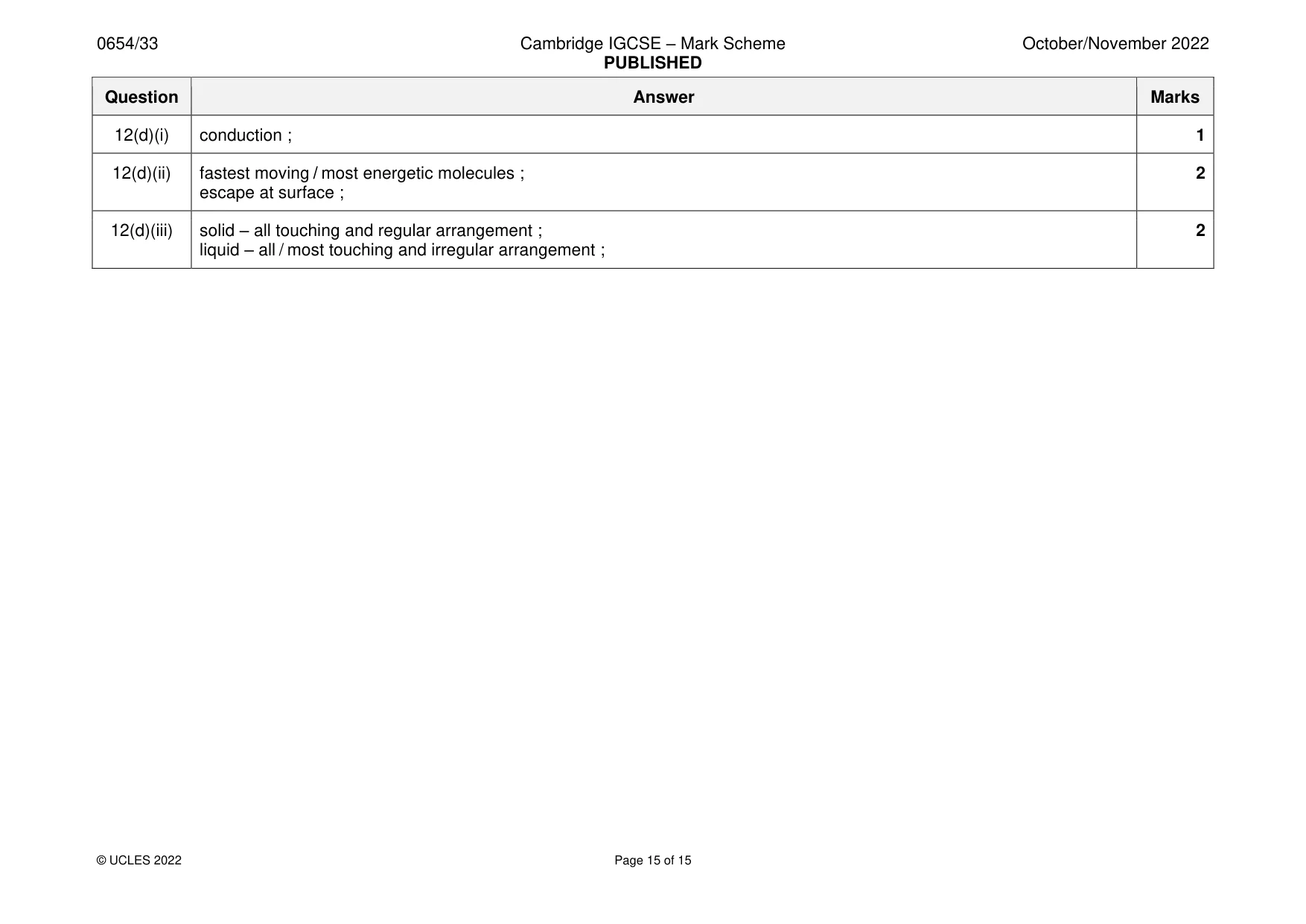
Mark scheme: 12(a) same size ; 2 upright ; 12(b)(i) S somewhere between 5 s and 12 s ; 1 12(b)(ii) kinetic energy ; 1 12(b)(iii) 36 000 m / s ; 1 12(c)(i) volume = mass ÷ density (words or symbols) or 22 500 ÷ 7500 ; 2 = 3.0 m3 ; 12(c)(ii) use a magnet ; 1 12(d)(i) conduction ; 1 12(d)(ii) fastest moving / most energetic molecules ; 2 escape at surface ; 12(d)(iii) solid – all touching and regular arrangement ; 2 liquid – all / most touching and irregular arrangement ;
What was in this paper
The subtopics covered by these 12 questions, and how many questions each got. Open one in a new tab to see every Cambridge question on it.
What you needed in this session
Cambridge’s own grade thresholds for 2022 Oct/Nov, Paper 3 · Variant 3. A higher threshold means an easier paper — the bar moves with how the cohort did.