Cambridge IGCSE Sciences - Co-ordinated (Double) 0654 — 2019 Oct/Nov Paper 3 · Variant 1
0654/31/O/N/19 · 13 questions · 120 marks · ≈135 min
The question paper and its mark scheme, free to read here and free to download. This is Cambridge’s own paper, exactly as it was sat.
Question paper32 pages

Mark scheme16 pages
Answers below. Sit the paper first if you are practising.
Questions as text
Q1 · A diagram of a cross-section through a vein
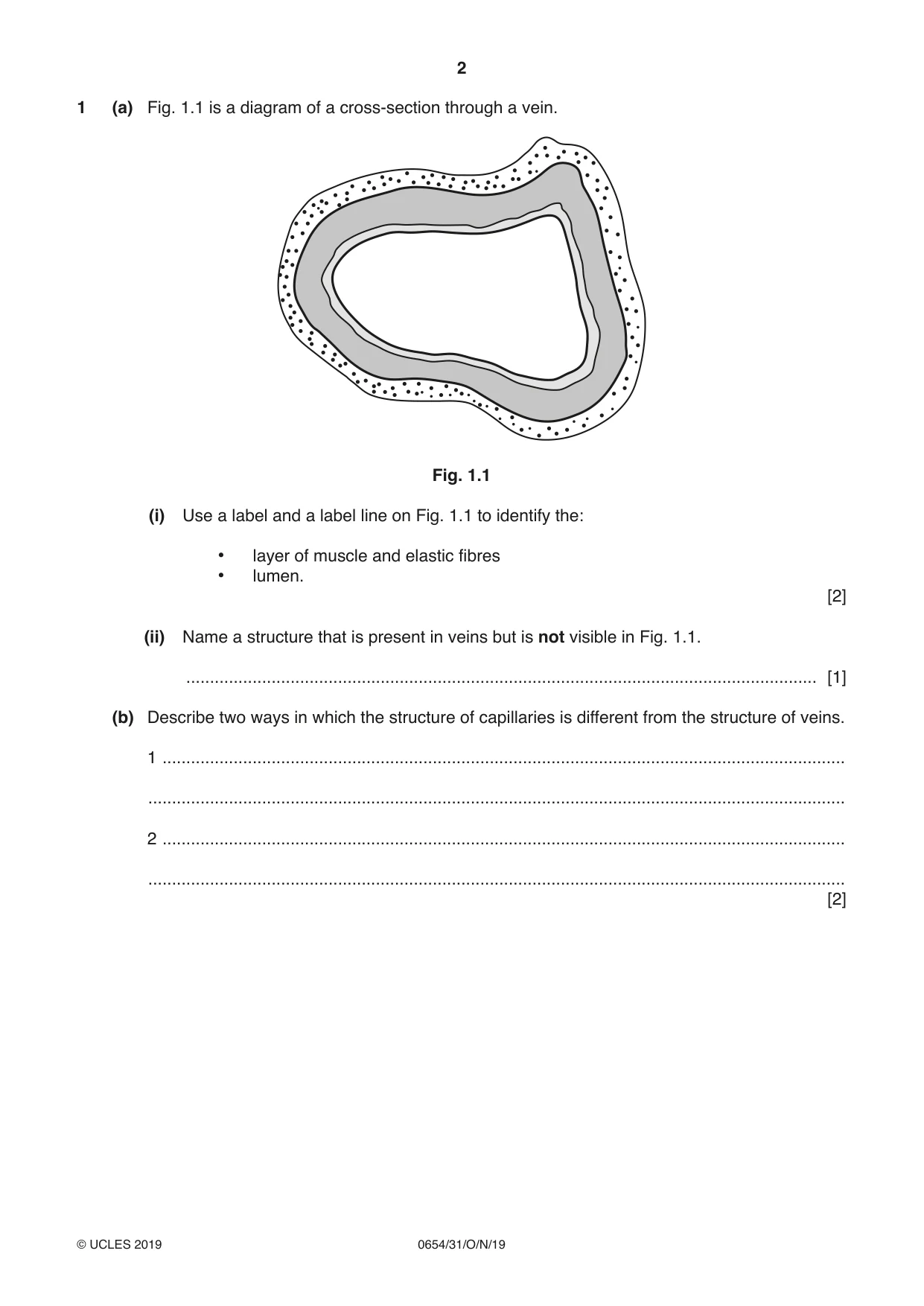
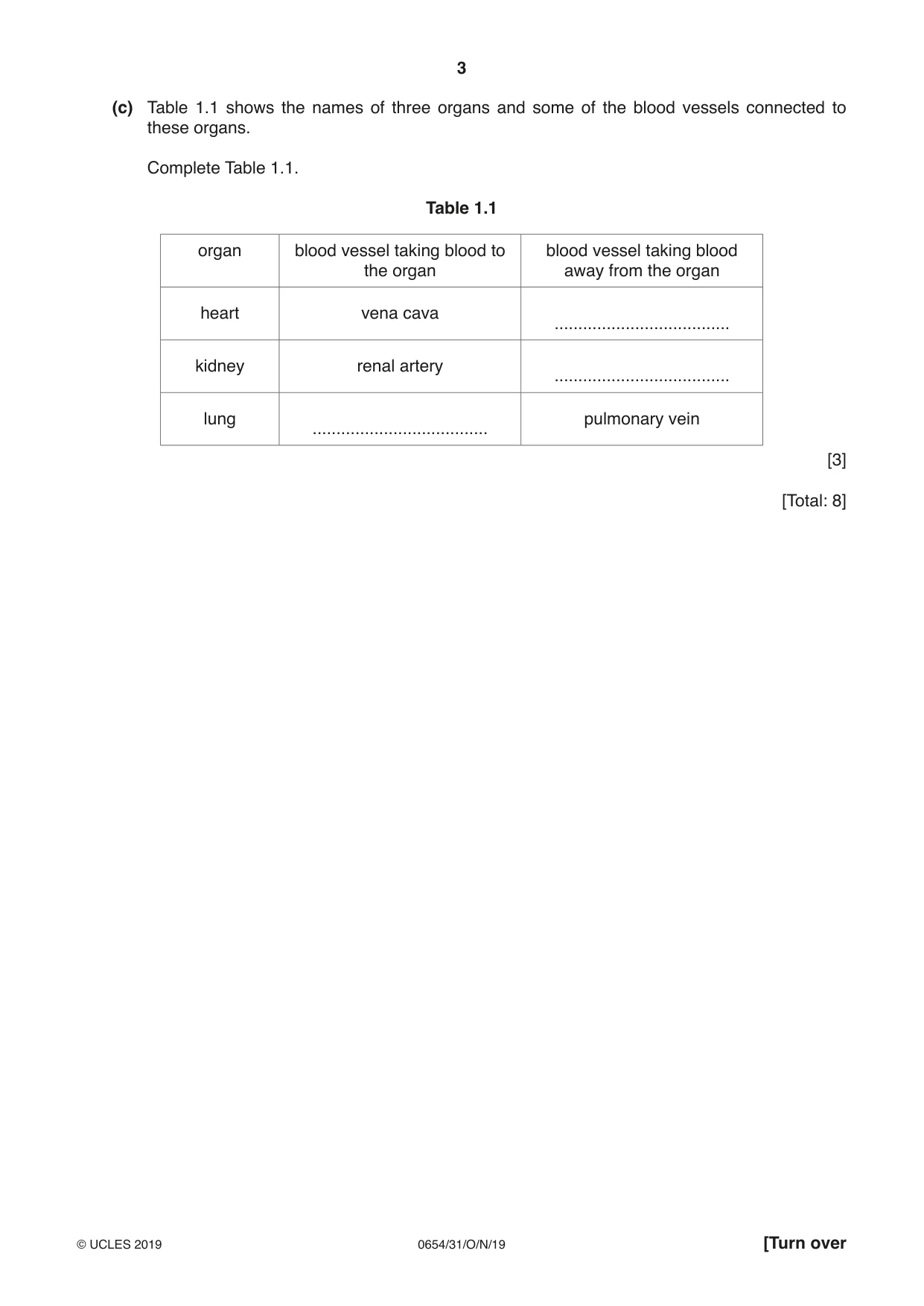
1 (a) Fig. 1.1 is a diagram of a cross-section through a vein. Fig. 1.1 (i) Use a label and a label line on Fig. 1.1 to identify the: • layer of muscle and elastic fibres • lumen. [2] (ii) Name a structure that is present in veins but is not visible in Fig. 1.1. ..................................................................................................................................... [1] (b) Describe two ways in which the structure of capillaries is different from the structure of veins. 1 ................................................................................................................................................ ................................................................................................................................................... 2 ................................................................................................................................................ ................................................................................................................................................... [2] (c) Table 1.1 shows the names of three organs and some of the blood vessels connected to these organs. Complete Table 1.1. Table 1.1 organ blood vessel taking blood to blood vessel taking blood the organ away from the organ heart vena cava ..................................... kidney renal artery ..................................... lung pulmonary vein ..................................... [3] [Total: 8]
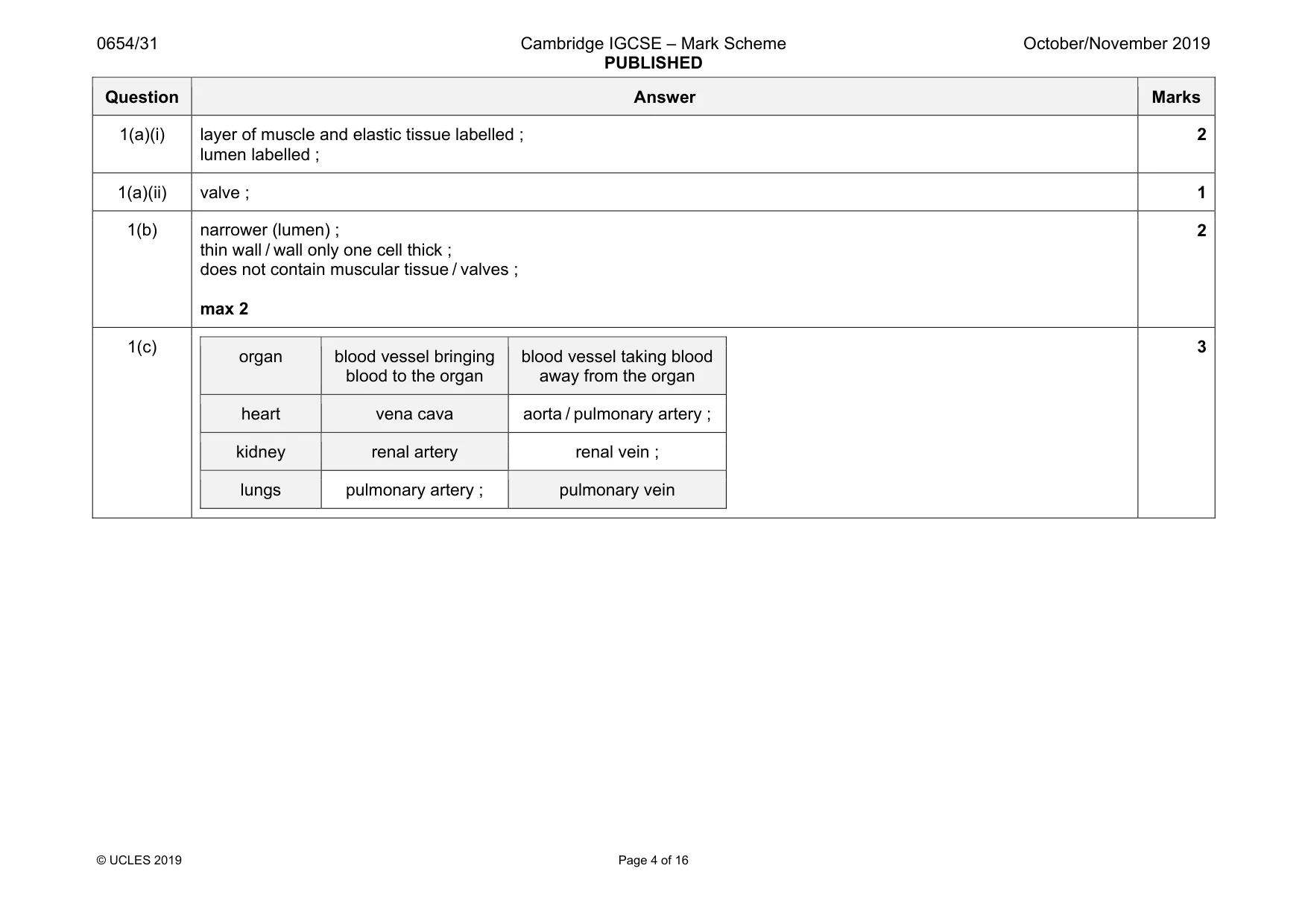
Mark scheme: 1(a)(i) layer of muscle and elastic tissue labelled ; lumen labelled ; 2 1(a)(ii) valve ; 1 1(b) narrower (lumen) ; thin wall / wall only one cell thick ; does not contain muscular tissue / valves ; max 2 2 1(c) organ blood vessel bringing blood to the organ blood vessel taking blood away from the organ heart vena cava aorta / pulmonary artery ; kidney renal artery renal vein ; lungs pulmonary artery ; pulmonary vein 3
Q2 · The Periodic Table shows the elements arranged in order of proton number
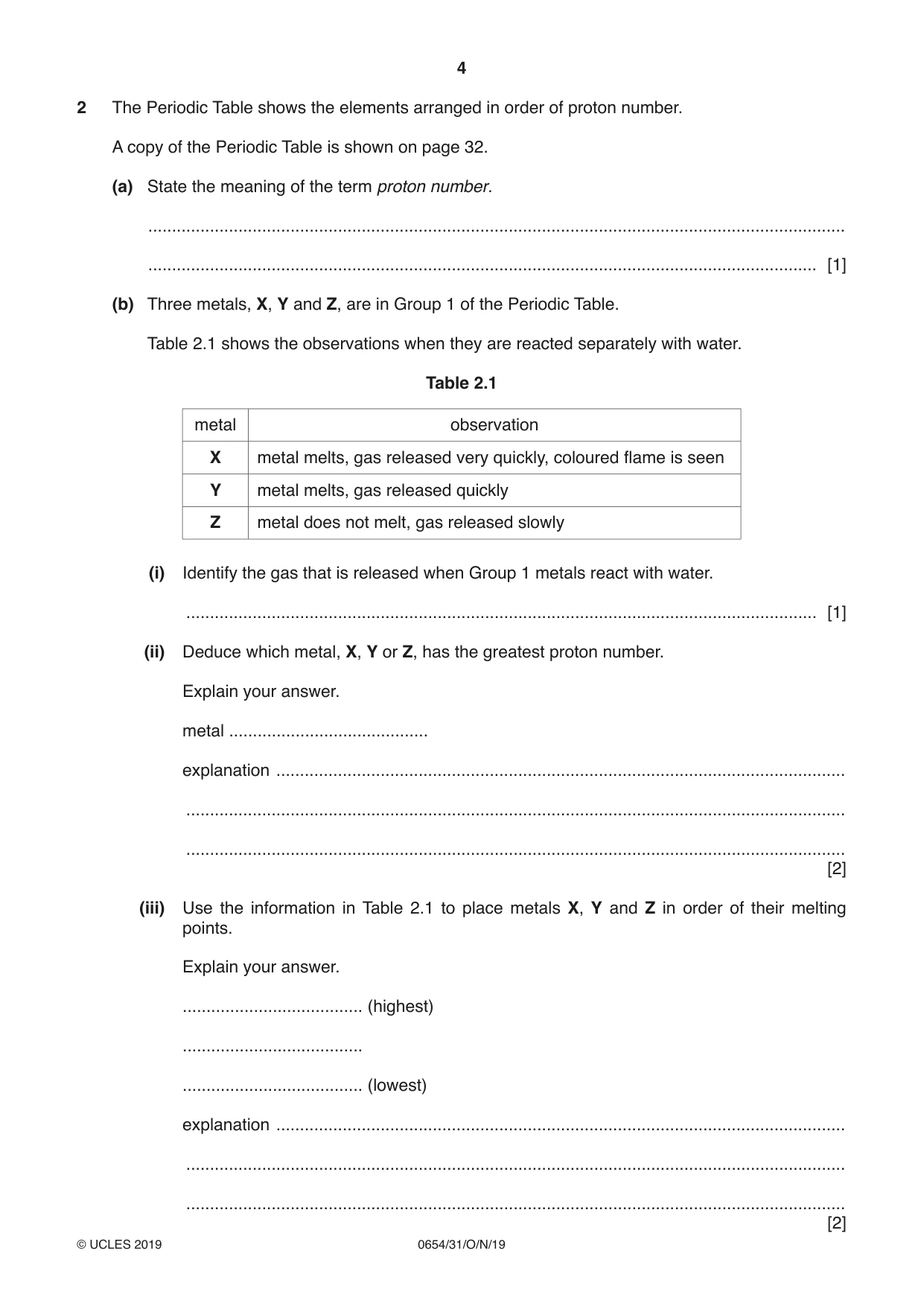
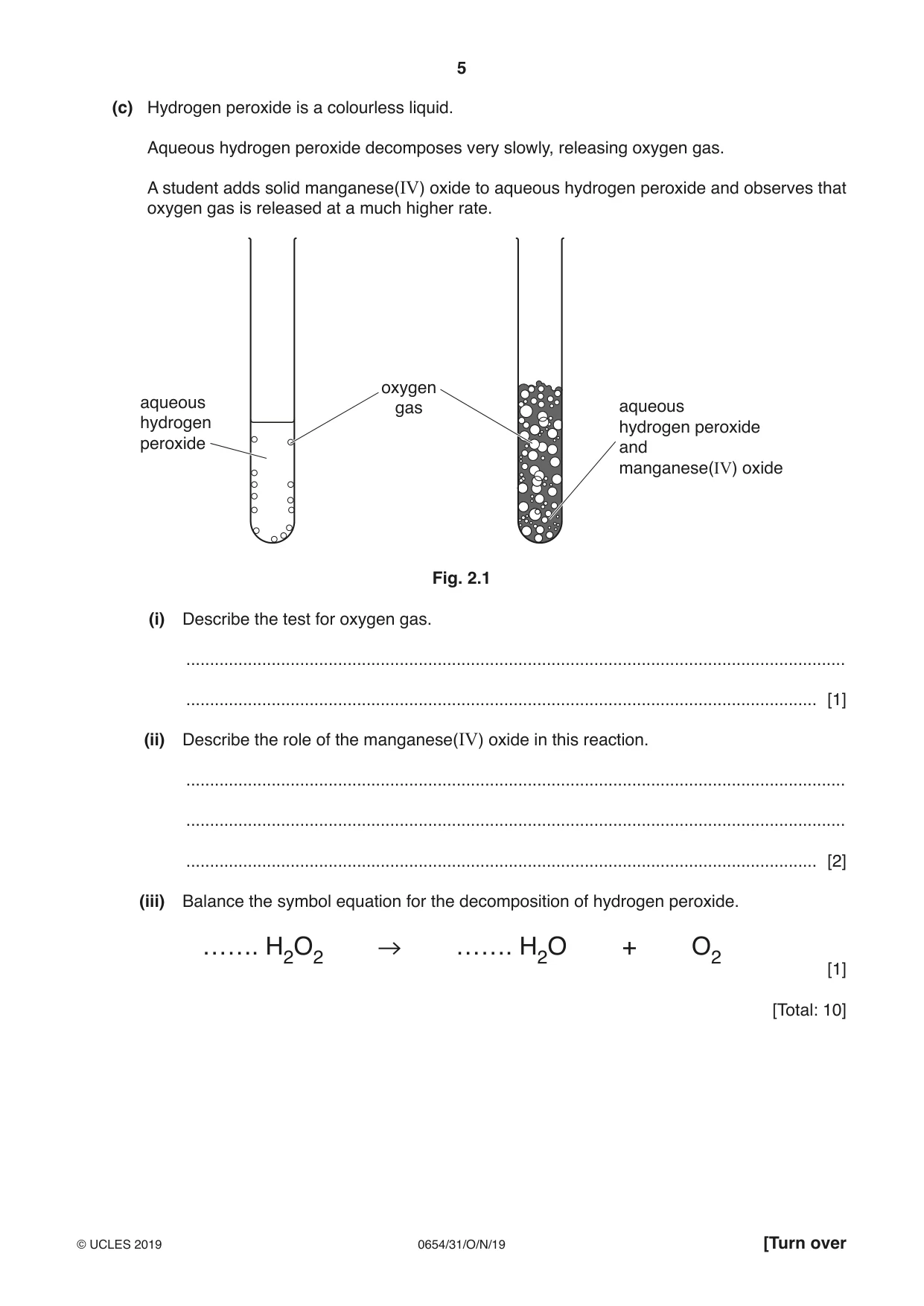
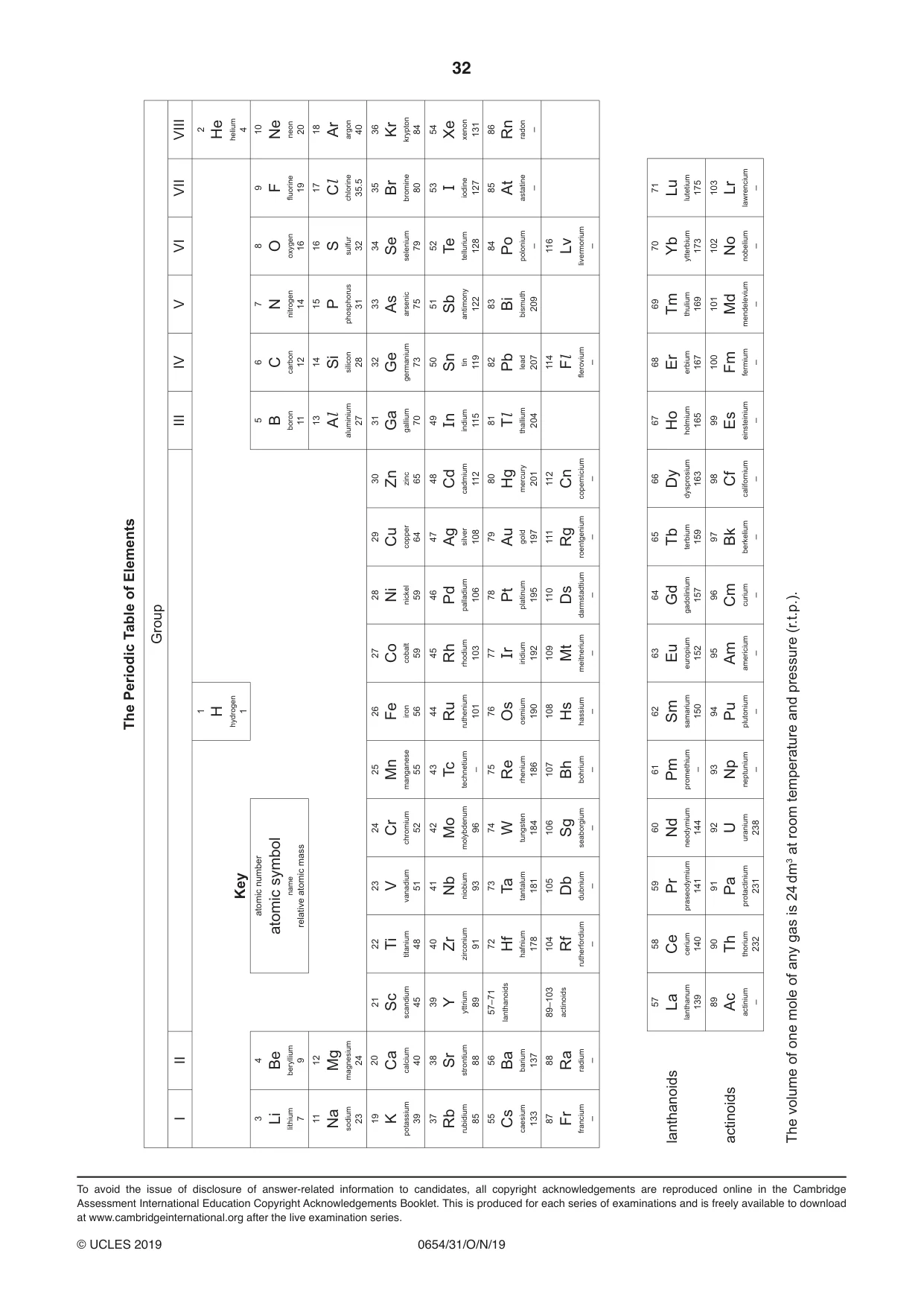
2 The Periodic Table shows the elements arranged in order of proton number. A copy of the Periodic Table is shown on page 32. (a) State the meaning of the term proton number. ................................................................................................................................................... ............................................................................................................................................. [1] (b) Three metals, X, Y and Z, are in Group 1 of the Periodic Table. Table 2.1 shows the observations when they are reacted separately with water. Table 2.1 metal observation X metal melts, gas released very quickly, coloured flame is seen Y metal melts, gas released quickly Z metal does not melt, gas released slowly (i) Identify the gas that is released when Group 1 metals react with water. ..................................................................................................................................... [1] (ii) Deduce which metal, X, Y or Z, has the greatest proton number. Explain your answer. metal .......................................... explanation ........................................................................................................................ ........................................................................................................................................... ........................................................................................................................................... [2] (iii) Use the information in Table 2.1 to place metals X, Y and Z in order of their melting points. Explain your answer. ...................................... (highest) ...................................... ...................................... (lowest) explanation ........................................................................................................................ ........................................................................................................................................... ........................................................................................................................................... [2] (c) Hydrogen peroxide is a colourless liquid. Aqueous hydrogen peroxide decomposes very slowly, releasing oxygen gas. A student adds solid manganese(IV) oxide to aqueous hydrogen peroxide and observes that oxygen gas is released at a much higher rate. oxygen aqueous gas aqueous hydrogen hydrogen peroxide peroxide and manganese(IV) oxide Fig. 2.1 (i) Describe the test for oxygen gas. ........................................................................................................................................... ..................................................................................................................................... [1] (ii) Describe the role of the manganese(IV) oxide in this reaction. ........................................................................................................................................... ........................................................................................................................................... ..................................................................................................................................... [2] (iii) Balance the symbol equation for the decomposition of hydrogen peroxide. ……. H2O2 ……. H2O + O2 [1] [Total: 10]
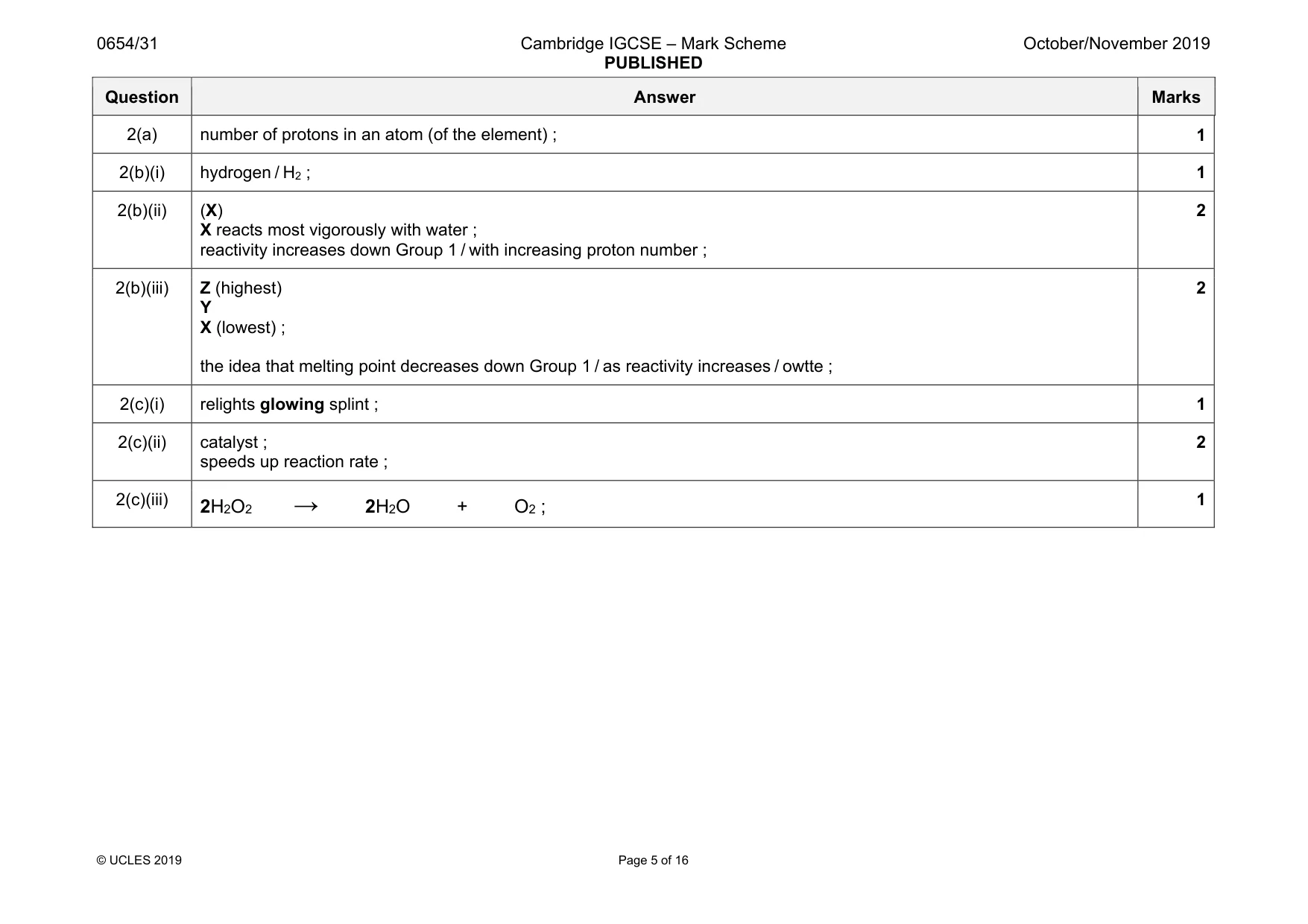
Mark scheme: 2(a) number of protons in an atom (of the element) ; 1 2(b)(i) hydrogen / H2 ; 1 2(b)(ii) (X) X reacts most vigorously with water ; reactivity increases down Group 1 / with increasing proton number ; 2 2(b)(iii) Z (highest) Y X (lowest) ; the idea that melting point decreases down Group 1 / as reactivity increases / owtte ; 2 2(c)(i) relights glowing splint ; 1 2(c)(ii) catalyst ; speeds up reaction rate ; 2 2(c)(iii) 2H2O2 → 2H2O + O2 ; 1
Q3 · A worker changing a lamp on a lamp post
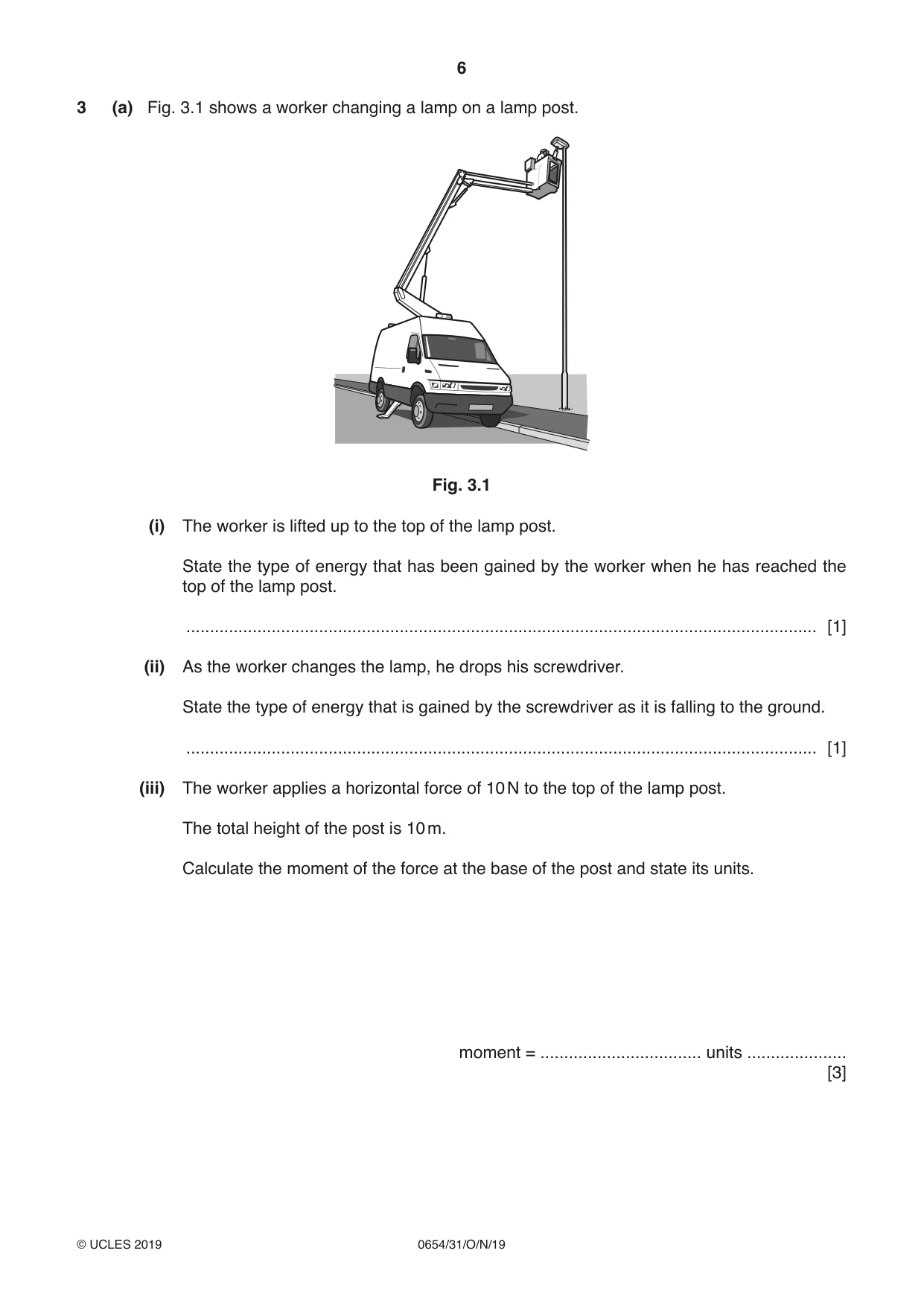
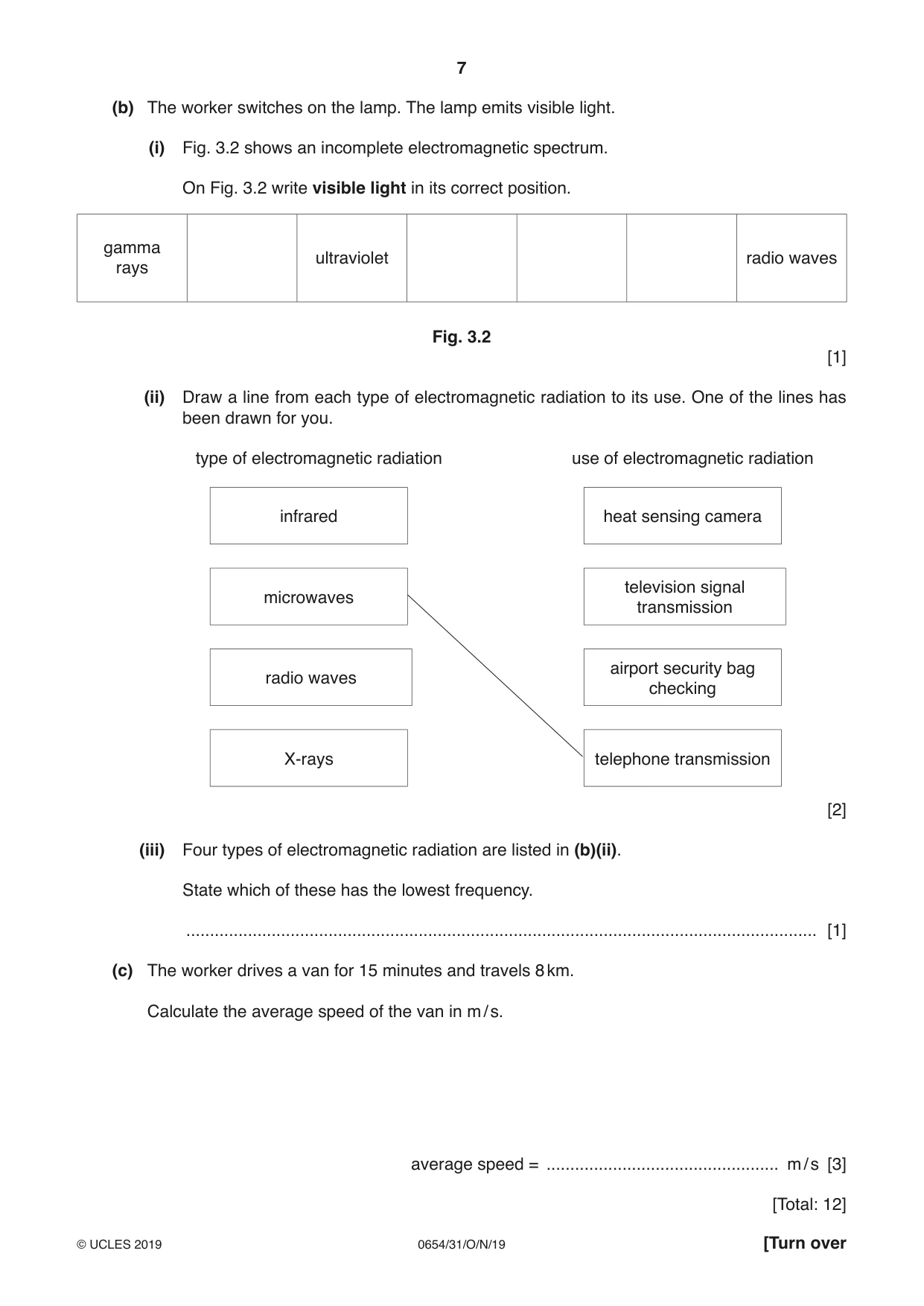
3 (a) Fig. 3.1 shows a worker changing a lamp on a lamp post. Fig. 3.1 (i) The worker is lifted up to the top of the lamp post. State the type of energy that has been gained by the worker when he has reached the top of the lamp post. ..................................................................................................................................... [1] (ii) As the worker changes the lamp, he drops his screwdriver. State the type of energy that is gained by the screwdriver as it is falling to the ground. ..................................................................................................................................... [1] (iii) The worker applies a horizontal force of 10 N to the top of the lamp post. The total height of the post is 10 m. Calculate the moment of the force at the base of the post and state its units. moment = .................................. units ..................... [3] (b) The worker switches on the lamp. The lamp emits visible light. (i) Fig. 3.2 shows an incomplete electromagnetic spectrum. On Fig. 3.2 write visible light in its correct position. gamma ultraviolet radio waves rays Fig. 3.2 [1] (ii) Draw a line from each type of electromagnetic radiation to its use. One of the lines has been drawn for you. type of electromagnetic radiation use of electromagnetic radiation infrared heat sensing camera television signal microwaves transmission airport security bag radio waves checking X-rays telephone transmission [2] (iii) Four types of electromagnetic radiation are listed in (b)(ii). State which of these has the lowest frequency. ..................................................................................................................................... [1] (c) The worker drives a van for 15 minutes and travels 8 km. Calculate the average speed of the van in m / s. average speed = ................................................. m / s [3] [Total: 12]
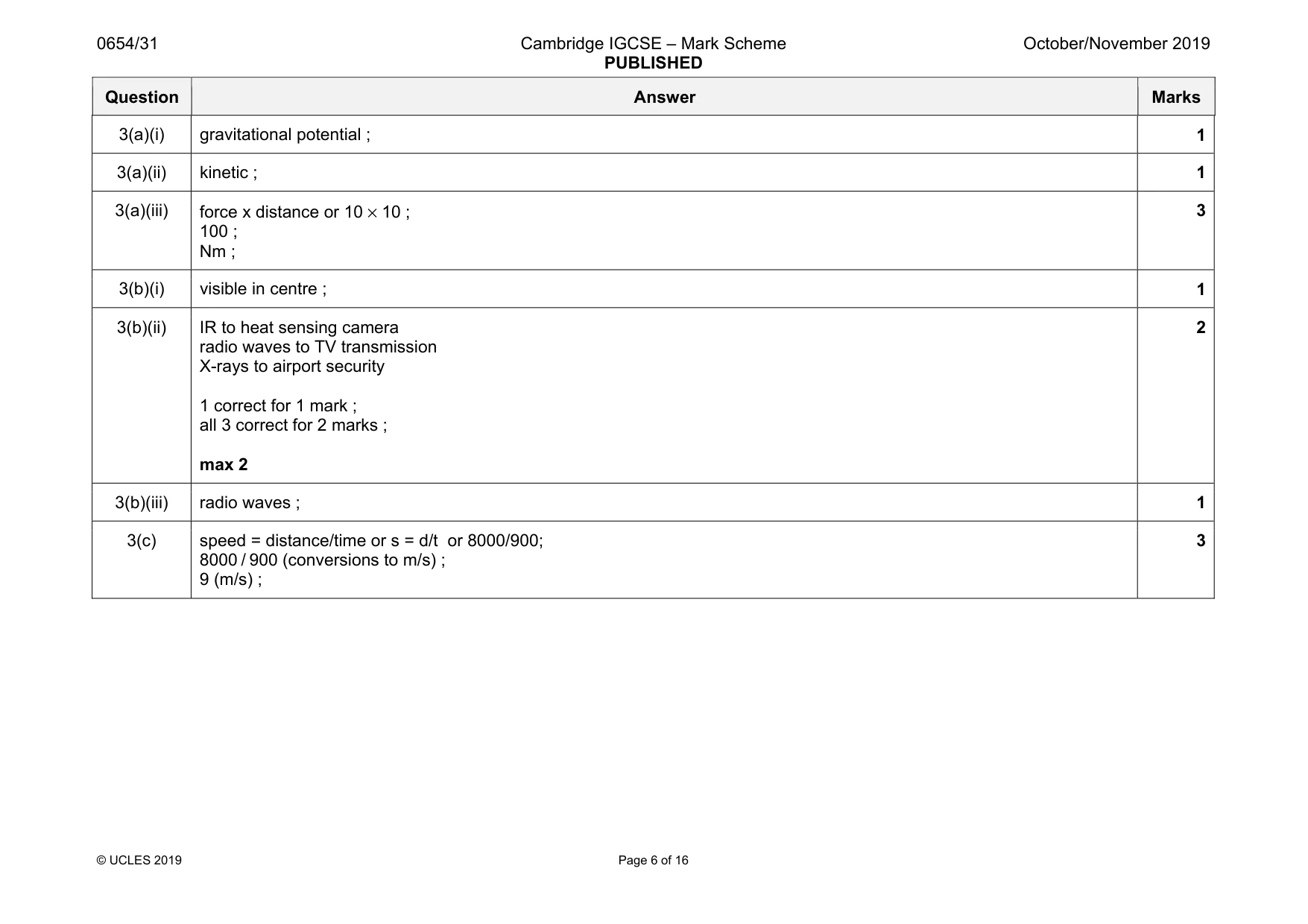
Mark scheme: 3(a)(i) gravitational potential ; 1 3(a)(ii) kinetic ; 1 3(a)(iii) force x distance or 10 × 10 ; 100 ; Nm ; 3 3(b)(i) visible in centre ; 1 3(b)(ii) IR to heat sensing camera radio waves to TV transmission X-rays to airport security 1 correct for 1 mark ; all 3 correct for 2 marks ; max 2 2 3(b)(iii) radio waves ; 1 3(c) speed = distance/time or s = d/t or 8000/900; 8000 / 900 (conversions to m/s) ; 9 (m/s) ; 3
Question 4
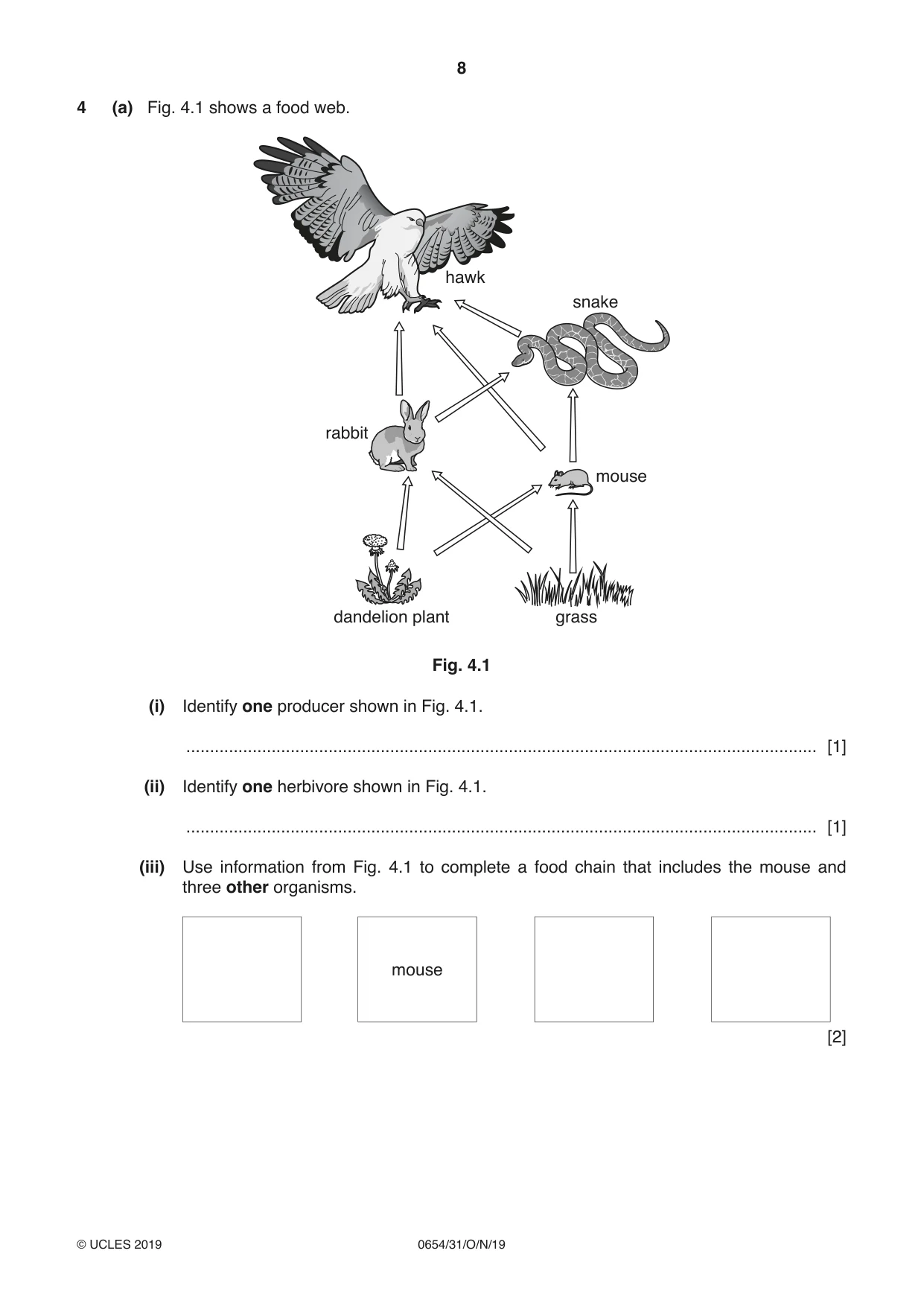
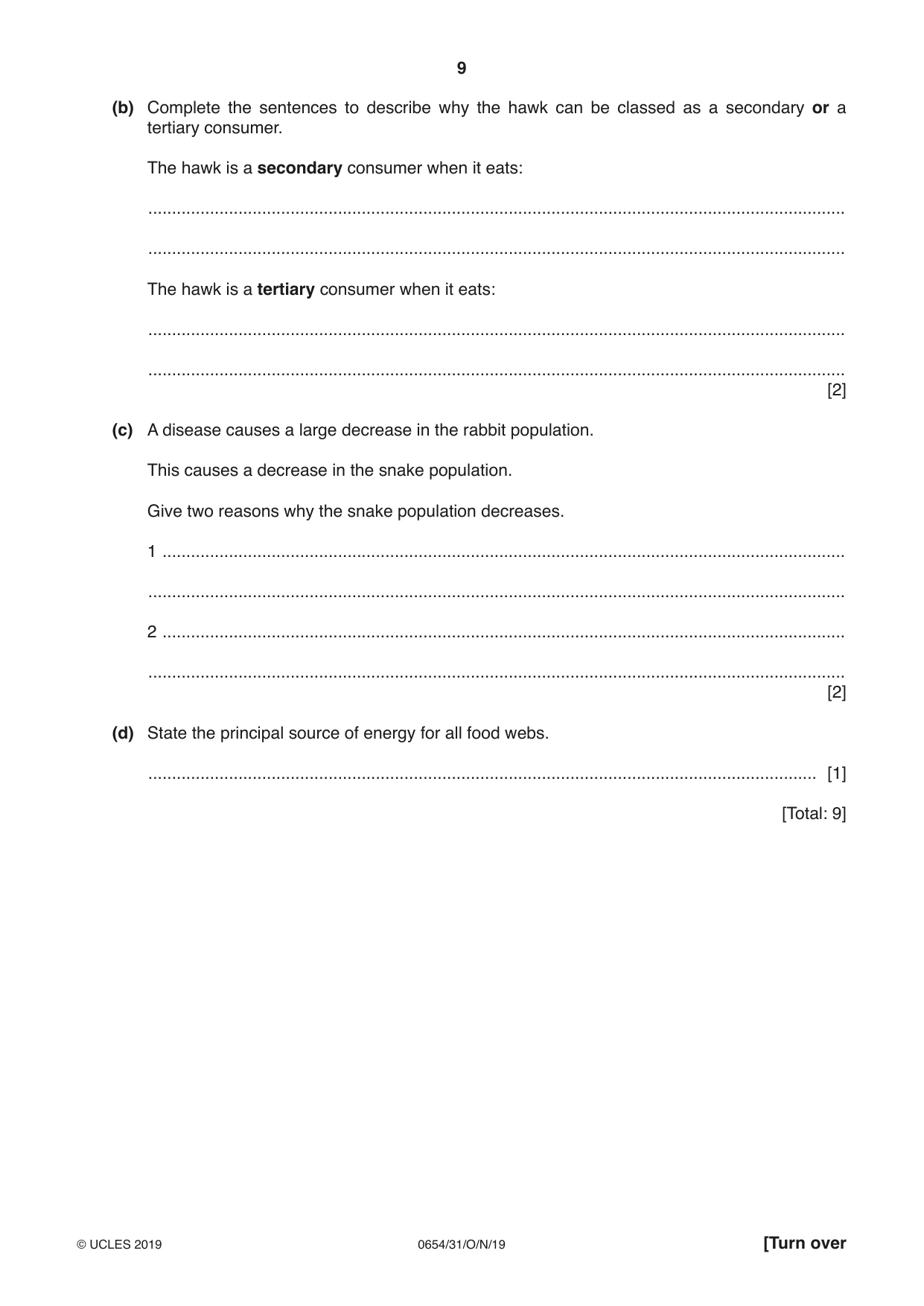
4 (a) Fig. 4.1 shows a food web. hawk snake rabbit mouse dandelion plant grass Fig. 4.1 (i) Identify one producer shown in Fig. 4.1. ..................................................................................................................................... [1] (ii) Identify one herbivore shown in Fig. 4.1. ..................................................................................................................................... [1] (iii) Use information from Fig. 4.1 to complete a food chain that includes the mouse and three other organisms. mouse [2] (b) Complete the sentences to describe why the hawk can be classed as a secondary or a tertiary consumer. The hawk is a secondary consumer when it eats: ................................................................................................................................................... ................................................................................................................................................... The hawk is a tertiary consumer when it eats: ................................................................................................................................................... ................................................................................................................................................... [2] (c) A disease causes a large decrease in the rabbit population. This causes a decrease in the snake population. Give two reasons why the snake population decreases. 1 ................................................................................................................................................ ................................................................................................................................................... 2 ................................................................................................................................................ ................................................................................................................................................... [2] (d) State the principal source of energy for all food webs. ............................................................................................................................................. [1] [Total: 9]
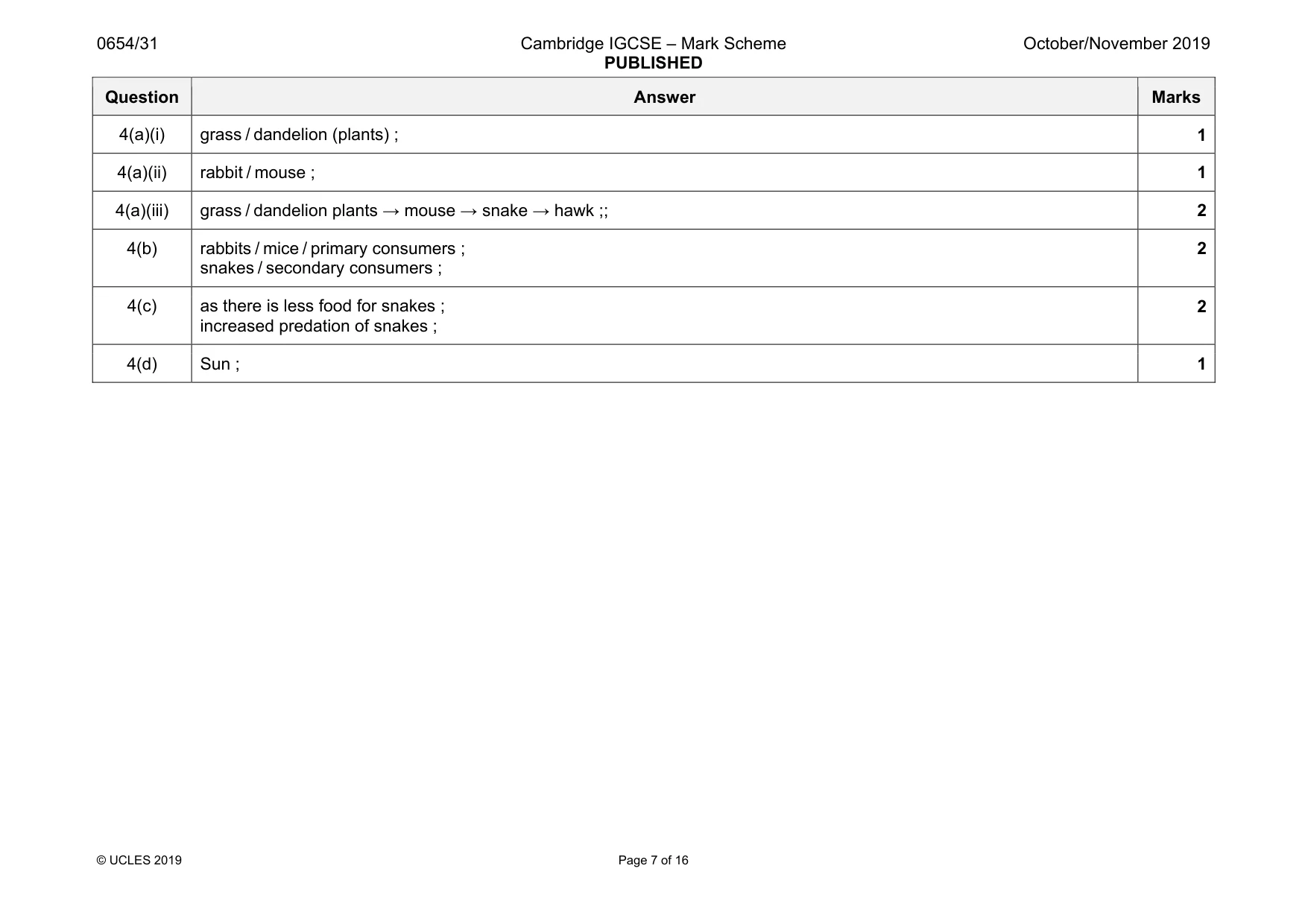
Mark scheme: 4(a)(i) grass / dandelion (plants) ; 1 4(a)(ii) rabbit / mouse ; 1 4(a)(iii) grass / dandelion plants → mouse → snake → hawk ;; 2 4(b) rabbits / mice / primary consumers ; snakes / secondary consumers ; 2 4(c) as there is less food for snakes ; increased predation of snakes ; 2 4(d) Sun ; 1
Q5 · Name the type of chemical bond between: a metallic element and a non-metallic element…
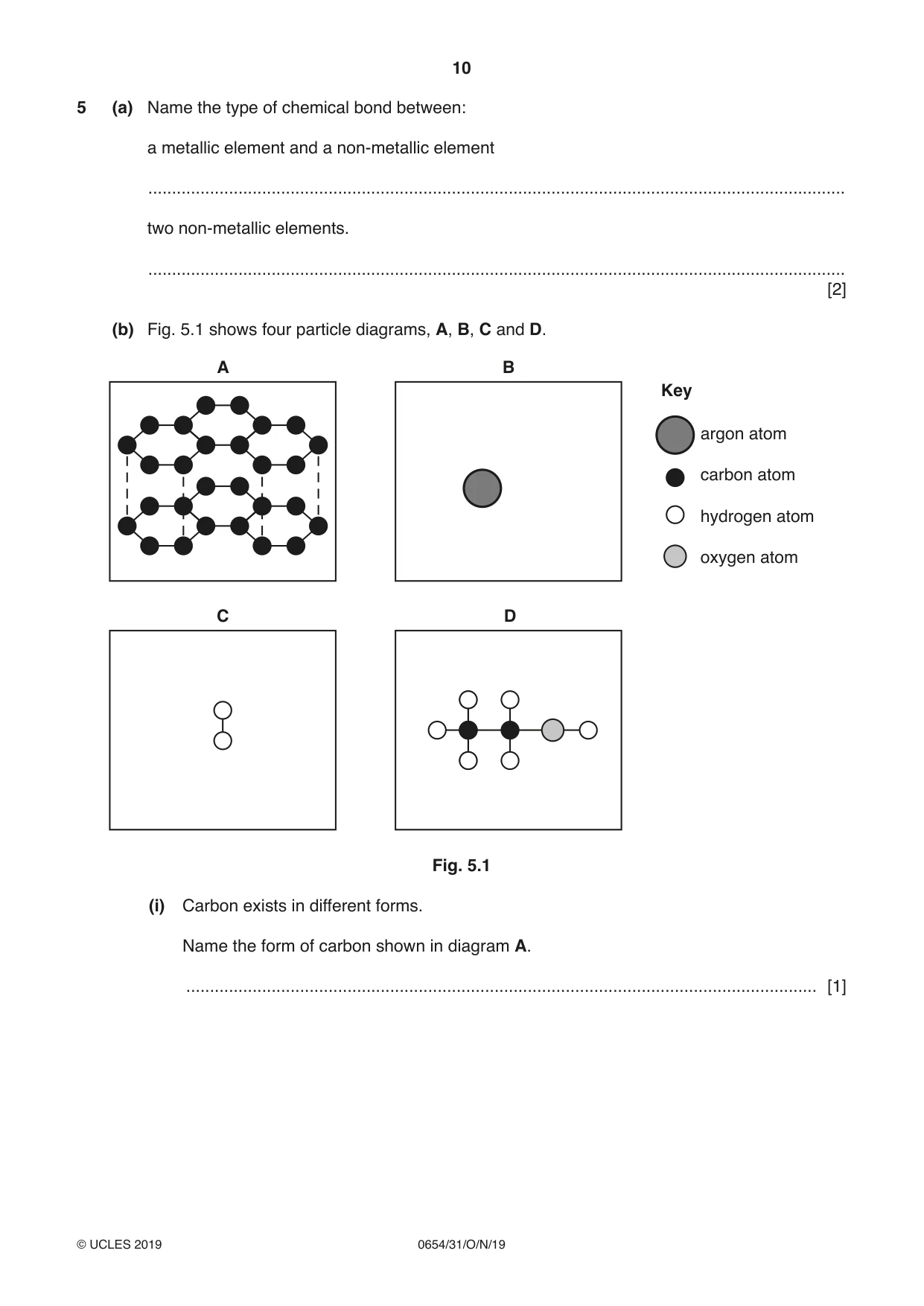
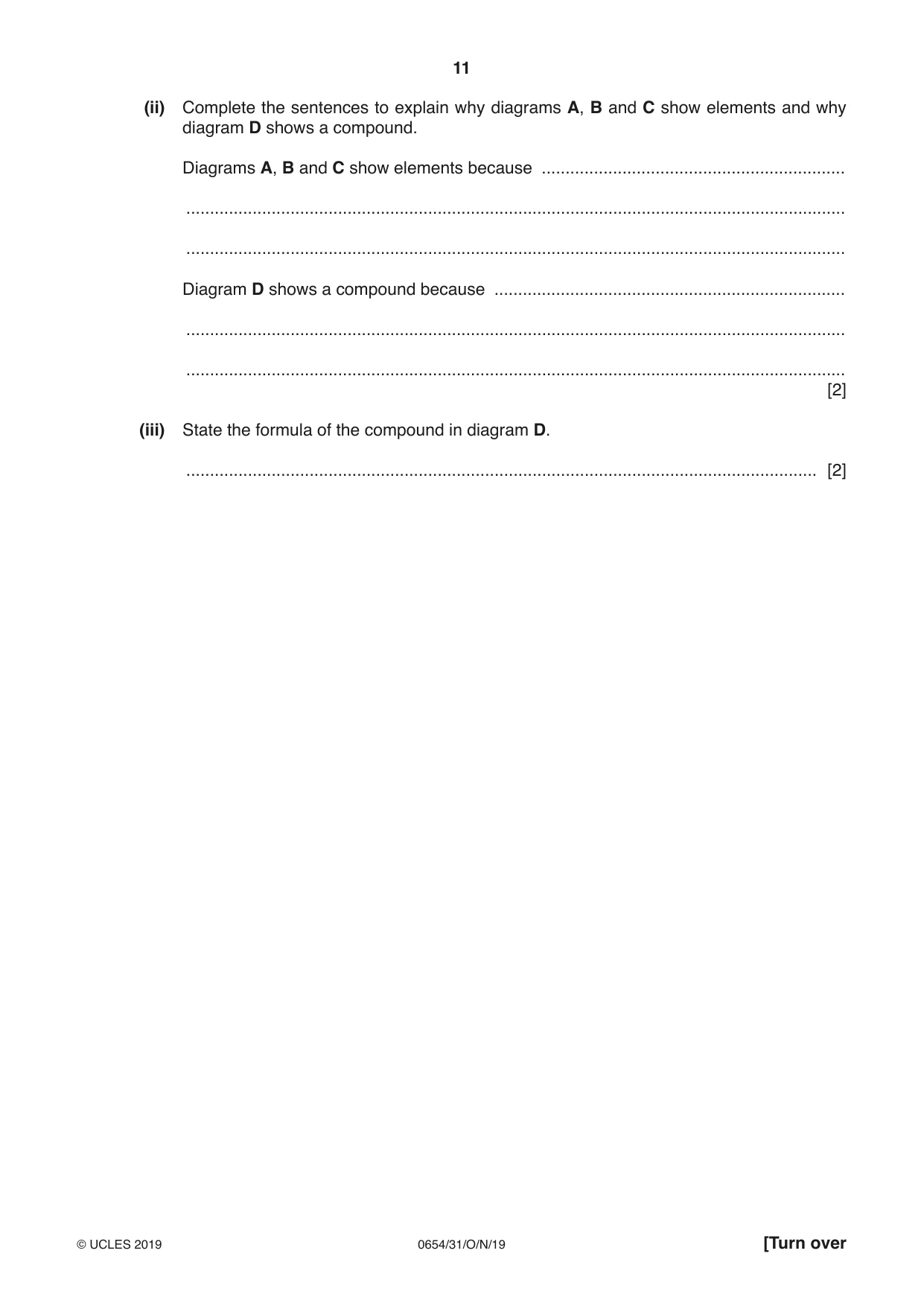
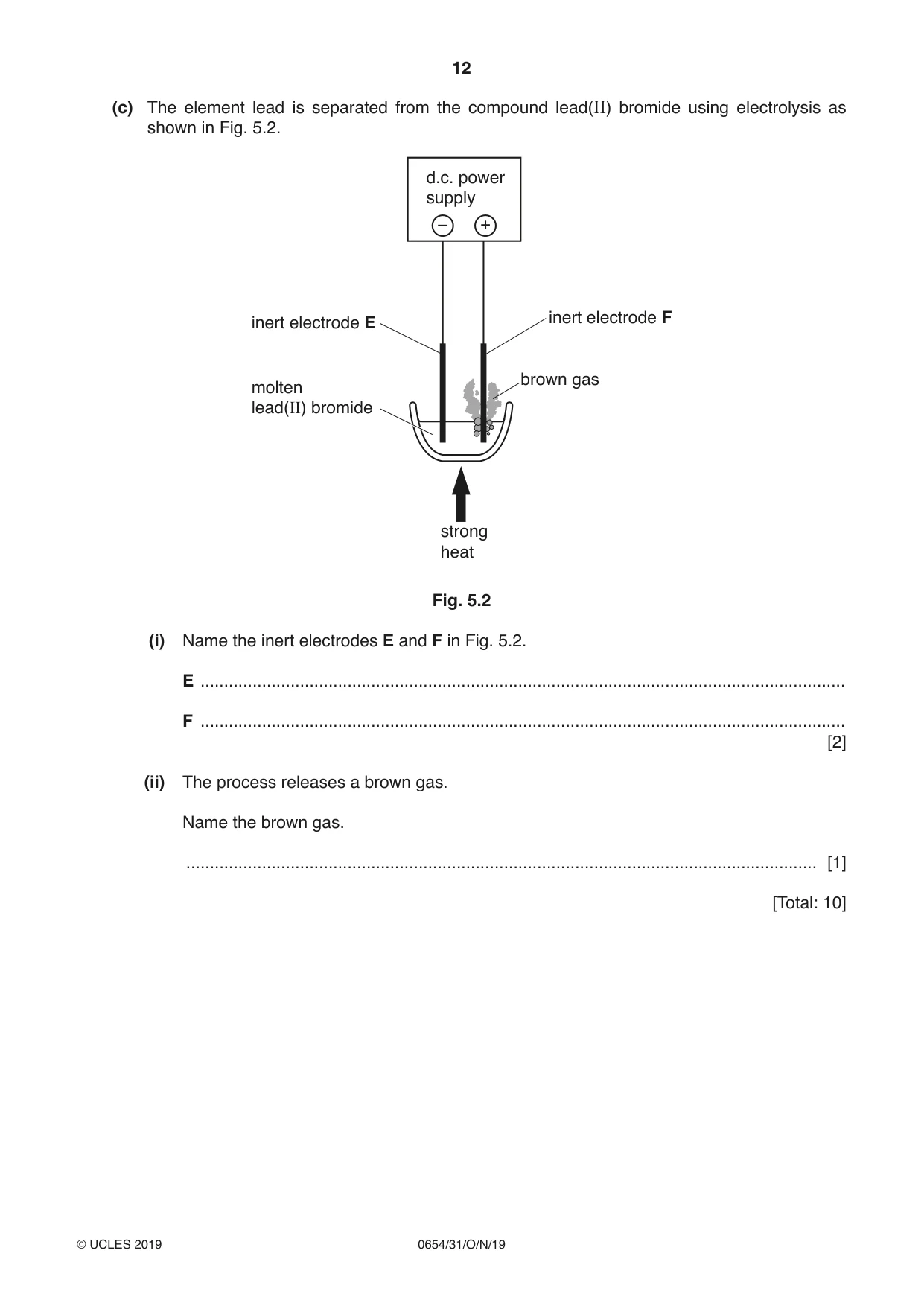
5 (a) Name the type of chemical bond between: a metallic element and a non-metallic element ................................................................................................................................................... two non-metallic elements. ................................................................................................................................................... [2] (b) Fig. 5.1 shows four particle diagrams, A, B, C and D. A B Key argon atom carbon atom hydrogen atom oxygen atom C D Fig. 5.1 (i) Carbon exists in different forms. Name the form of carbon shown in diagram A. ..................................................................................................................................... [1] (ii) Complete the sentences to explain why diagrams A, B and C show elements and why diagram D shows a compound. Diagrams A, B and C show elements because ................................................................ ........................................................................................................................................... ........................................................................................................................................... Diagram D shows a compound because .......................................................................... ........................................................................................................................................... ........................................................................................................................................... [2] (iii) State the formula of the compound in diagram D. ..................................................................................................................................... [2] (c) The element lead is separated from the compound lead(II) bromide using electrolysis as shown in Fig. 5.2. d.c. power supply – + inert electrode F inert electrode E brown gas molten lead(II) bromide strong heat Fig. 5.2 (i) Name the inert electrodes E and F in Fig. 5.2. E ........................................................................................................................................ F ........................................................................................................................................ [2] (ii) The process releases a brown gas. Name the brown gas. ..................................................................................................................................... [1] [Total: 10]
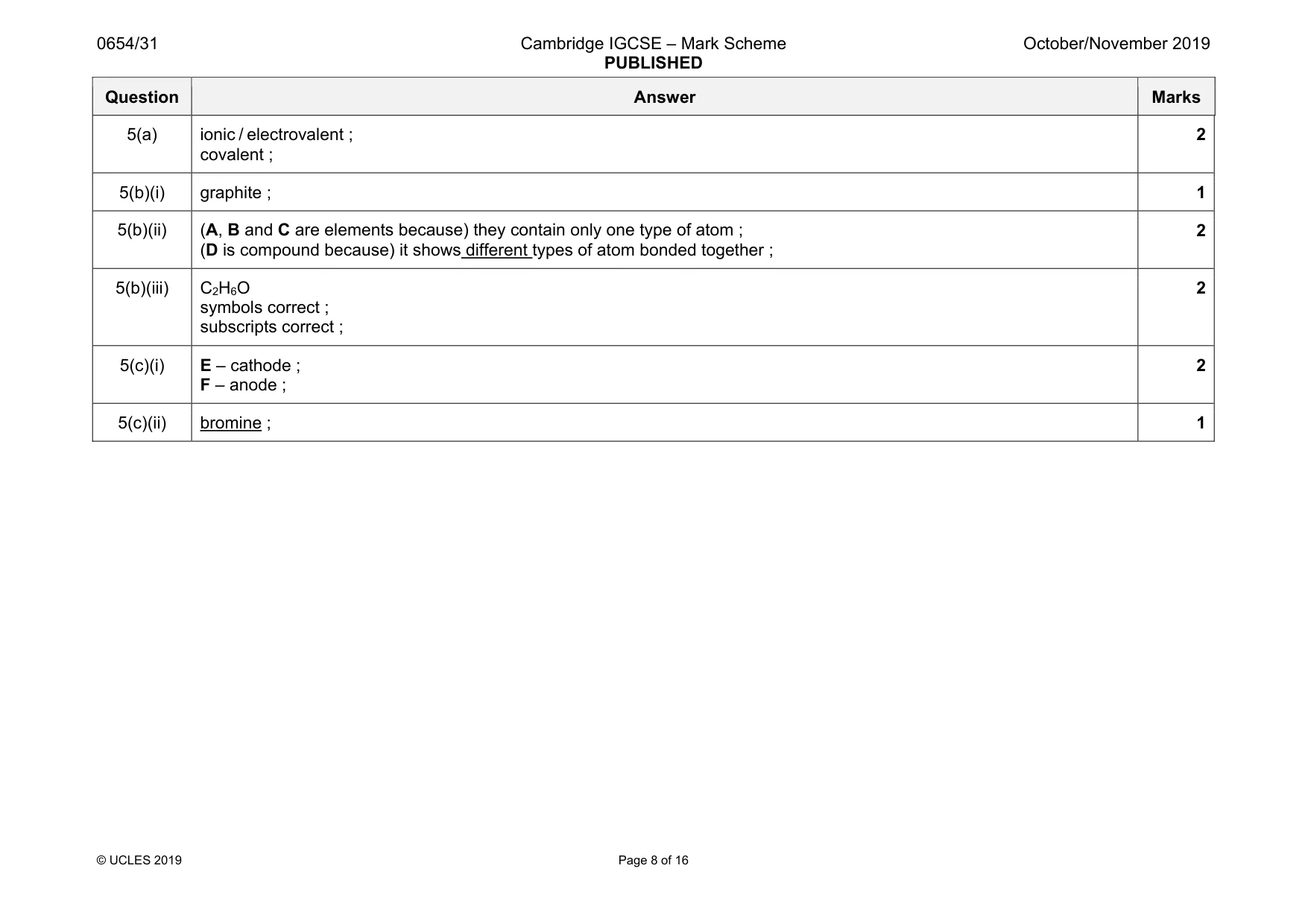
Mark scheme: 5(a) ionic / electrovalent ; covalent ; 2 5(b)(i) graphite ; 1 5(b)(ii) (A, B and C are elements because) they contain only one type of atom ; (D is compound because) it shows different types of atom bonded together ; 2 5(b)(iii) C2H6O symbols correct ; subscripts correct ; 2 5(c)(i) E – cathode ; F – anode ; 2 5(c)(ii) bromine ; 1
Q6 · Solar cells fitted to the roof of a house
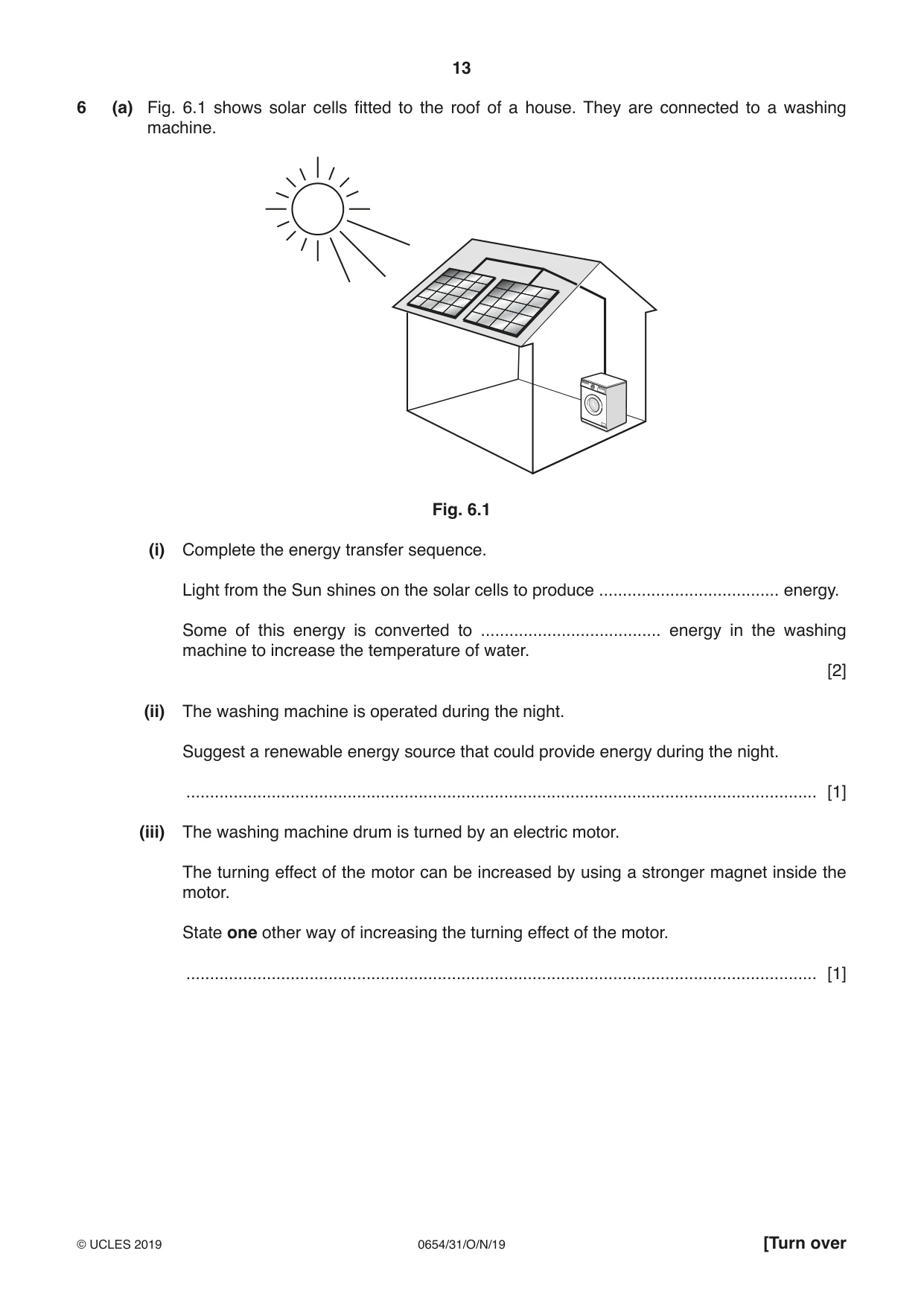
6 (a) Fig. 6.1 shows solar cells fitted to the roof of a house. They are connected to a washing machine. Fig. 6.1 (i) Complete the energy transfer sequence. Light from the Sun shines on the solar cells to produce ...................................... energy. Some of this energy is converted to ...................................... energy in the washing machine to increase the temperature of water. [2] (ii) The washing machine is operated during the night. Suggest a renewable energy source that could provide energy during the night. ..................................................................................................................................... [1] (iii) The washing machine drum is turned by an electric motor. The turning effect of the motor can be increased by using a stronger magnet inside the motor. State one other way of increasing the turning effect of the motor. ..................................................................................................................................... [1] (b) The maximum current in the washing machine circuit is 10 A. (i) State why a fuse should be fitted in the circuit of the washing machine. ........................................................................................................................................... ..................................................................................................................................... [1] (ii) The washing machine’s fuse needs to be replaced. Four different fuse ratings are available. 3 A 10 A 13 A 30 A State the most appropriate fuse rating, and give a reason for your choice. fuse ............................. A reason ............................................................................................................................... ........................................................................................................................................... [2] [Total: 7]
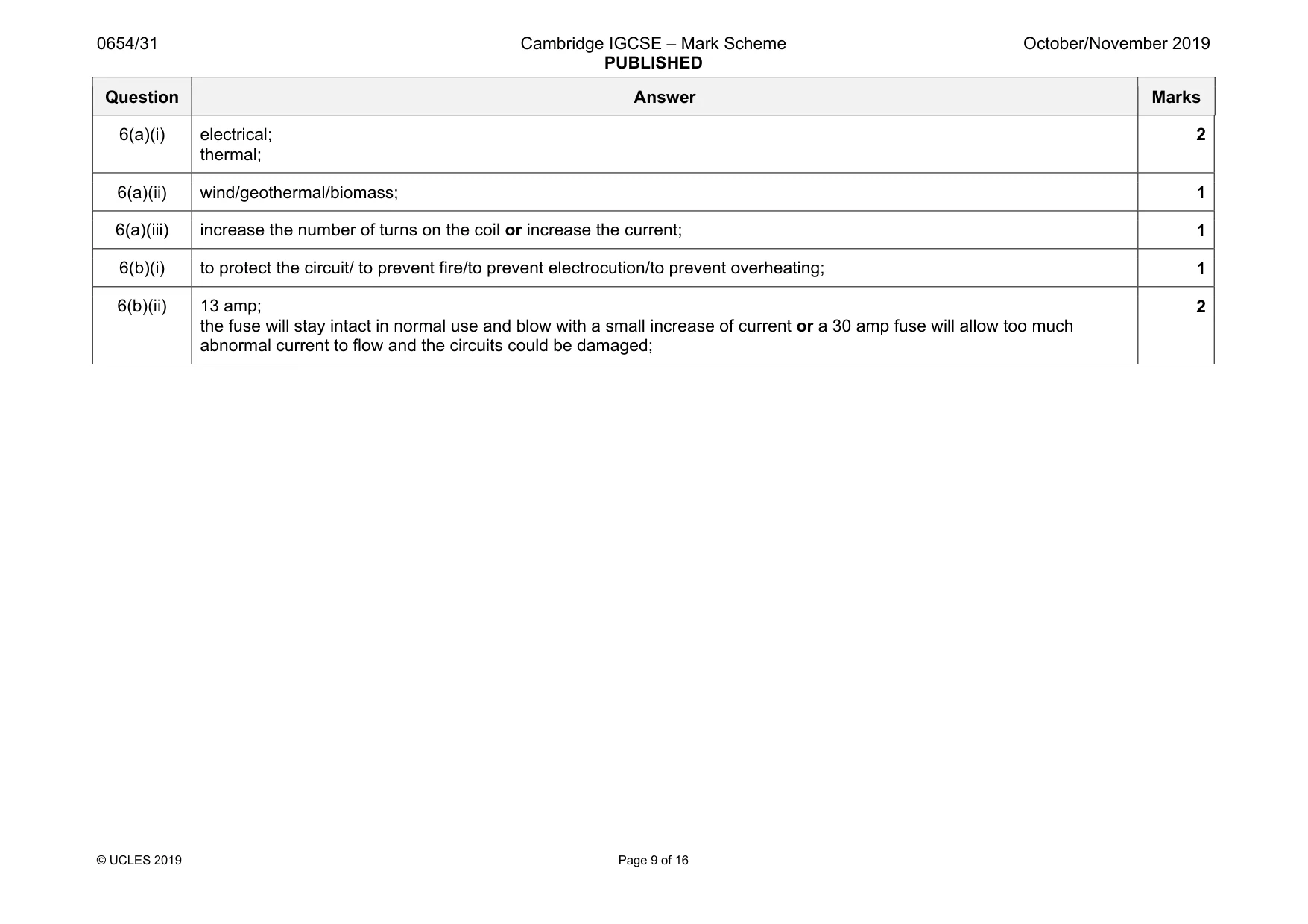
Mark scheme: 6(a)(i) electrical; thermal; 2 6(a)(ii) wind/geothermal/biomass; 1 6(a)(iii) increase the number of turns on the coil or increase the current; 1 6(b)(i) to protect the circuit/ to prevent fire/to prevent electrocution/to prevent overheating; 1 6(b)(ii) 13 amp; the fuse will stay intact in normal use and blow with a small increase of current or a 30 amp fuse will allow too much abnormal current to flow and the circuits could be damaged; 2
Q7 · Glucose is produced by photosynthesis and is stored in the leaves as starch
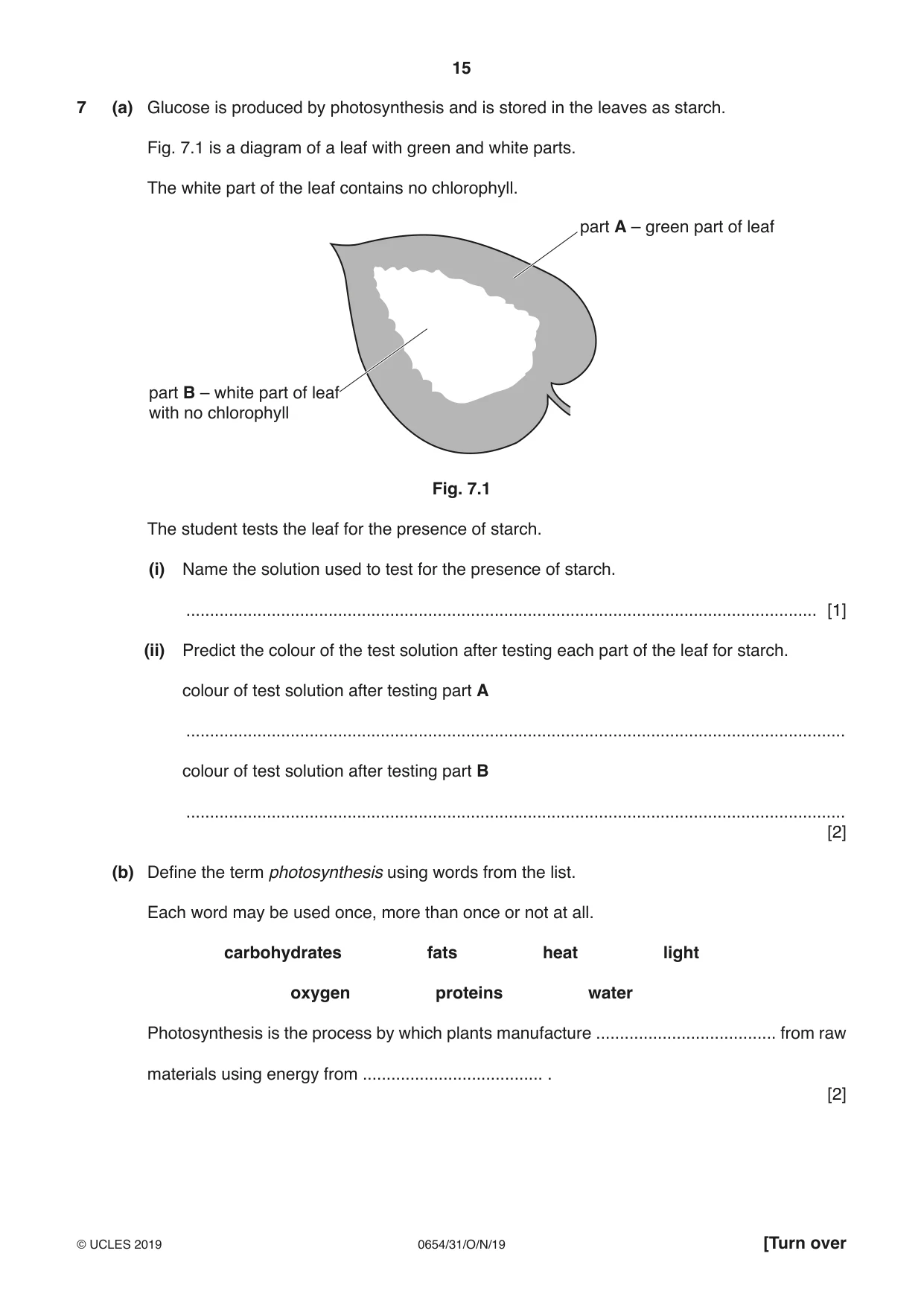
7 (a) Glucose is produced by photosynthesis and is stored in the leaves as starch. Fig. 7.1 is a diagram of a leaf with green and white parts. The white part of the leaf contains no chlorophyll. part A – green part of leaf part B – white part of leaf with no chlorophyll Fig. 7.1 The student tests the leaf for the presence of starch. (i) Name the solution used to test for the presence of starch. ..................................................................................................................................... [1] (ii) Predict the colour of the test solution after testing each part of the leaf for starch. colour of test solution after testing part A ........................................................................................................................................... colour of test solution after testing part B ........................................................................................................................................... [2] (b) Define the term photosynthesis using words from the list. Each word may be used once, more than once or not at all. carbohydrates fats heat light oxygen proteins water Photosynthesis is the process by which plants manufacture ...................................... from raw materials using energy from ...................................... . [2] (c) Carbon dioxide is needed for photosynthesis. Carbon dioxide enters the leaf by diffusion. Define diffusion. Use the word concentration in your answer. ................................................................................................................................................... ................................................................................................................................................... ................................................................................................................................................... ................................................................................................................................................... ............................................................................................................................................. [3] [Total: 8]
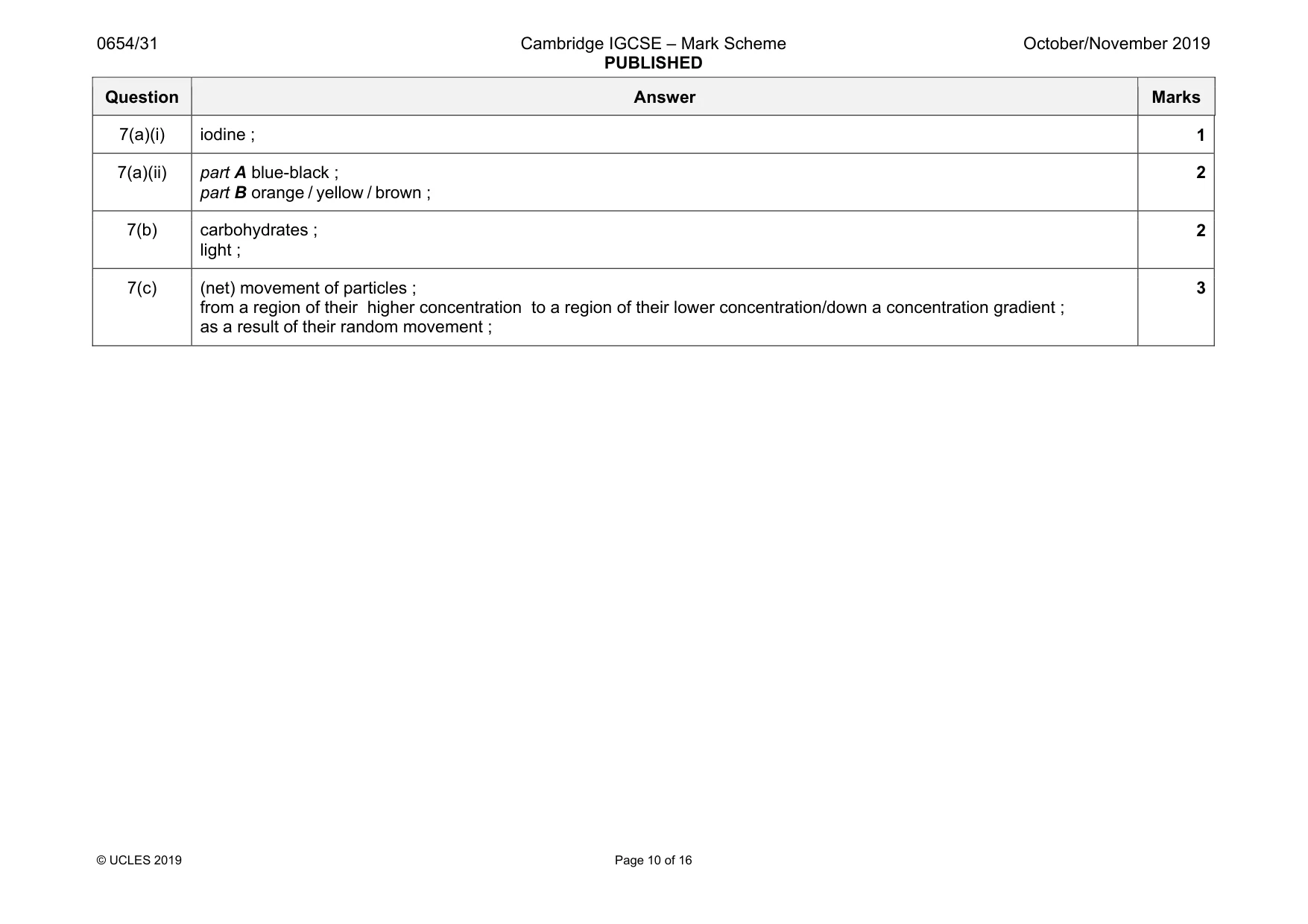
Mark scheme: 7(a)(i) iodine ; 1 7(a)(ii) part A blue-black ; part B orange / yellow / brown ; 2 7(b) carbohydrates ; light ; 2 7(c) (net) movement of particles ; from a region of their higher concentration to a region of their lower concentration/down a concentration gradient ; as a result of their random movement ; 3
Q8 · A student adds dilute sulfuric acid to four different solids in test-tubes H, I, J and K…
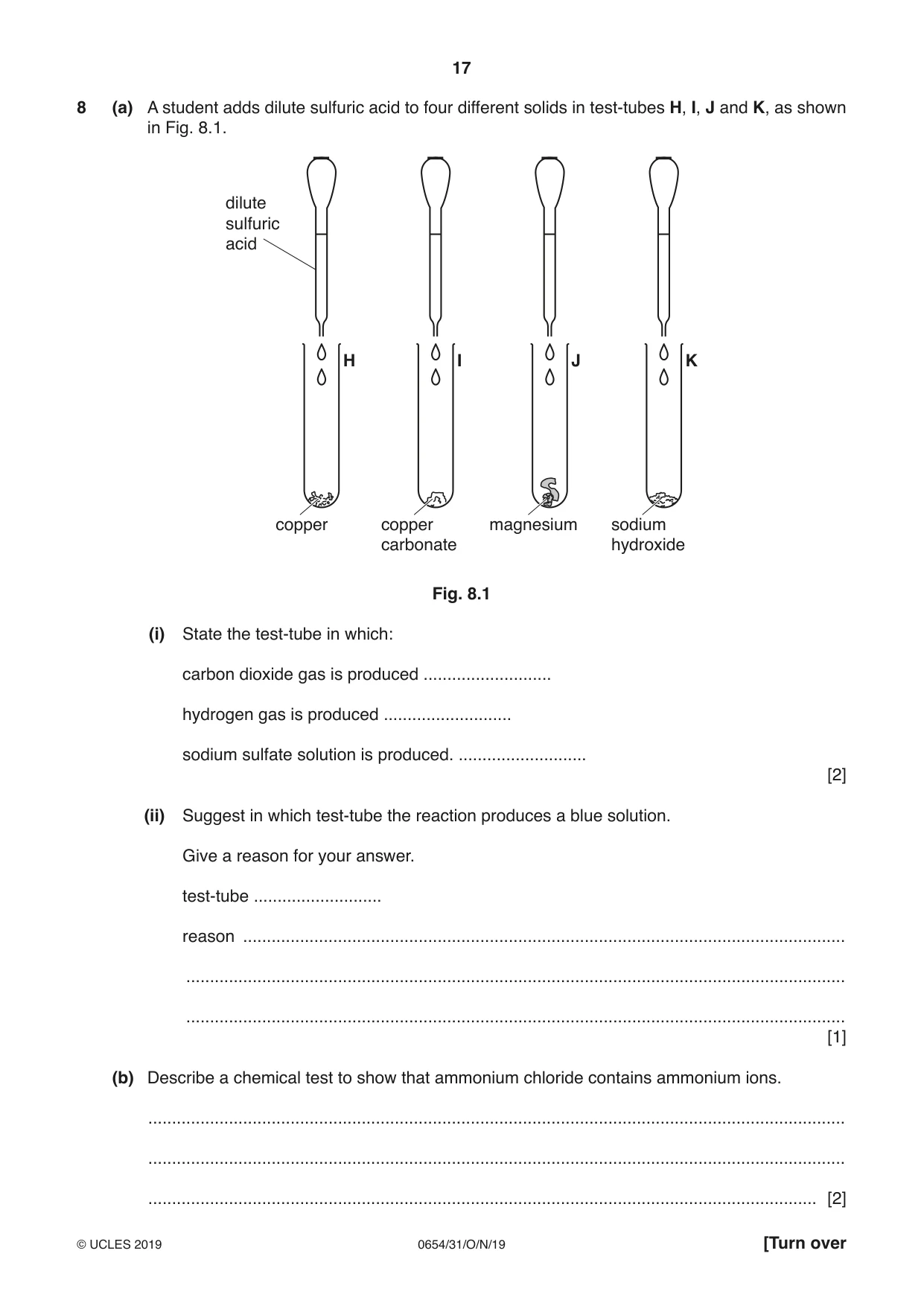
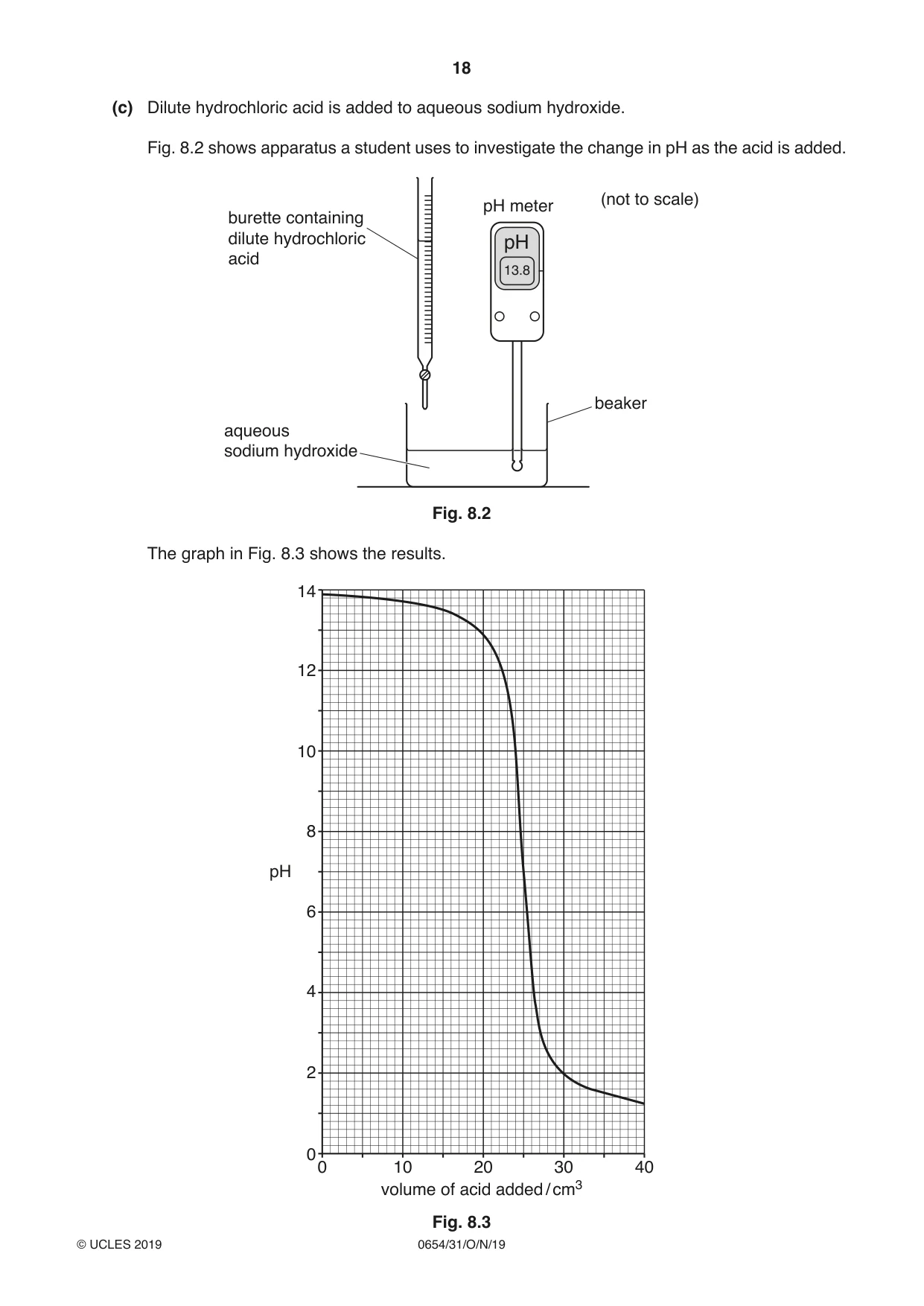
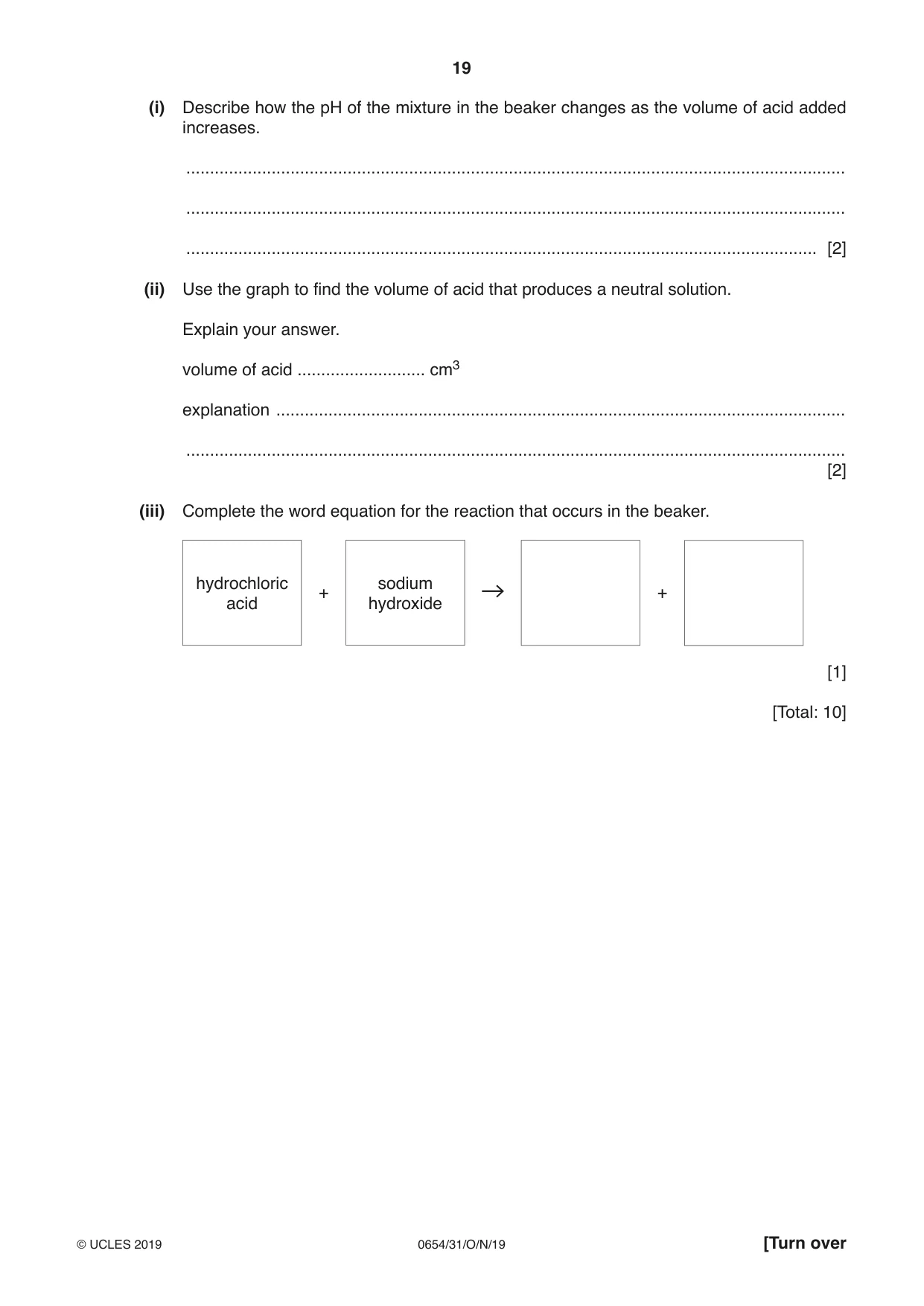
8 (a) A student adds dilute sulfuric acid to four different solids in test-tubes H, I, J and K, as shown in Fig. 8.1. dilute sulfuric acid H I J K copper copper magnesium sodium carbonate hydroxide Fig. 8.1 (i) State the test-tube in which: carbon dioxide gas is produced ........................... hydrogen gas is produced ........................... sodium sulfate solution is produced. ........................... [2] (ii) Suggest in which test-tube the reaction produces a blue solution. Give a reason for your answer. test-tube ........................... reason ............................................................................................................................... ........................................................................................................................................... ........................................................................................................................................... [1] (b) Describe a chemical test to show that ammonium chloride contains ammonium ions. ................................................................................................................................................... ................................................................................................................................................... ............................................................................................................................................. [2] (c) Dilute hydrochloric acid is added to aqueous sodium hydroxide. Fig. 8.2 shows apparatus a student uses to investigate the change in pH as the acid is added. (not to scale) pH meter burette containing dilute hydrochloric pH acid 13.8 beaker aqueous sodium hydroxide Fig. 8.2 The graph in Fig. 8.3 shows the results. 14 12 10 8 pH 6 4 2 00 10 20 30 40 volume of acid added / cm3 Fig. 8.3 (i) Describe how the pH of the mixture in the beaker changes as the volume of acid added increases. ........................................................................................................................................... ........................................................................................................................................... ..................................................................................................................................... [2] (ii) Use the graph to find the volume of acid that produces a neutral solution. Explain your answer. volume of acid ........................... cm3 explanation ........................................................................................................................ ........................................................................................................................................... [2] (iii) Complete the word equation for the reaction that occurs in the beaker. hydrochloric sodium + + acid hydroxide [1] [Total: 10]
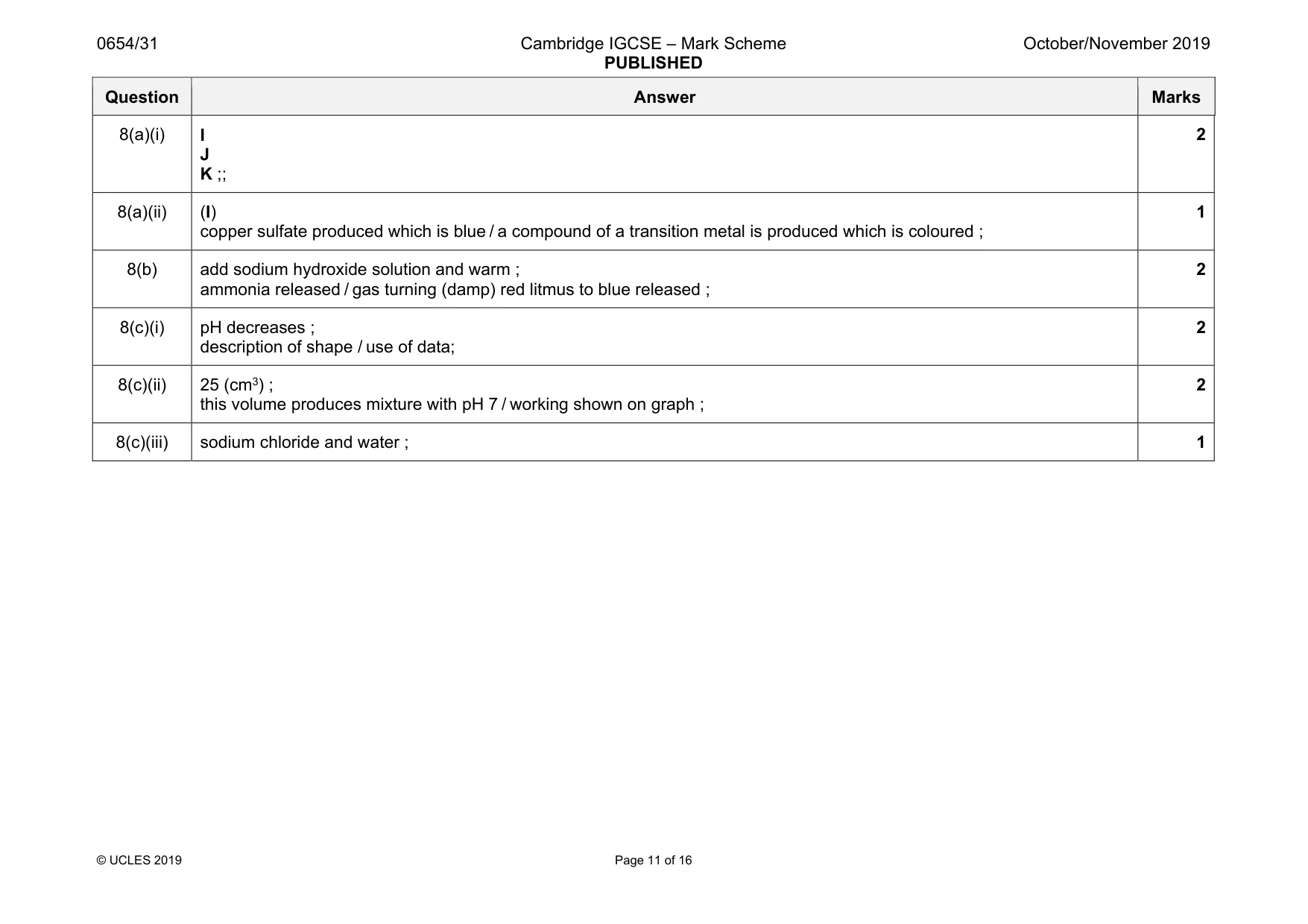
Mark scheme: 8(a)(i) I J K ;; 2 8(a)(ii) (I) copper sulfate produced which is blue / a compound of a transition metal is produced which is coloured ; 1 8(b) add sodium hydroxide solution and warm ; ammonia released / gas turning (damp) red litmus to blue released ; 2 8(c)(i) pH decreases ; description of shape / use of data; 2 8(c)(ii) 25 (cm3) ; this volume produces mixture with pH 7 / working shown on graph ; 2 8(c)(iii) sodium chloride and water ; 1
Q9 · A ray of light from a lamp striking the surface of an ice rink
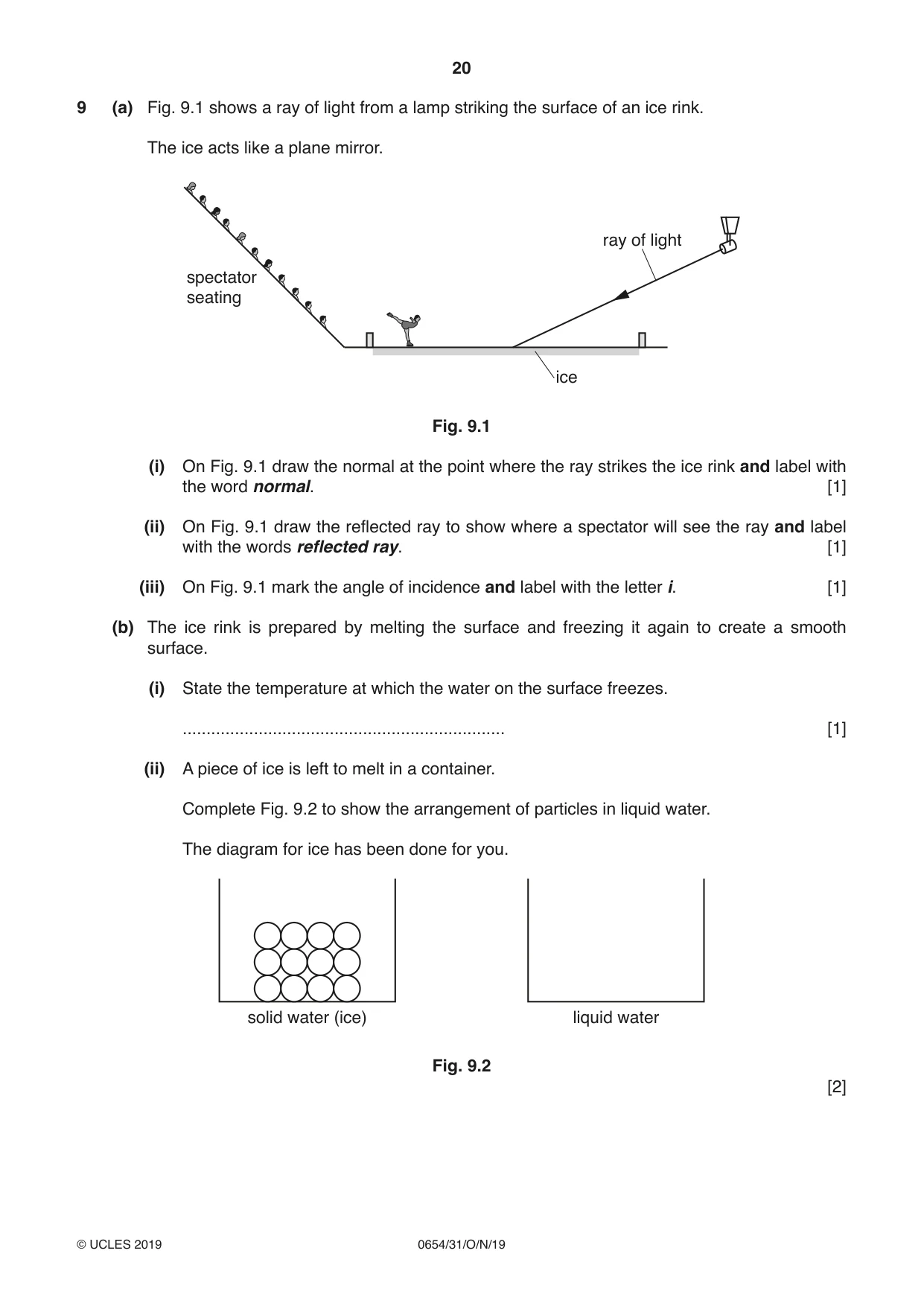
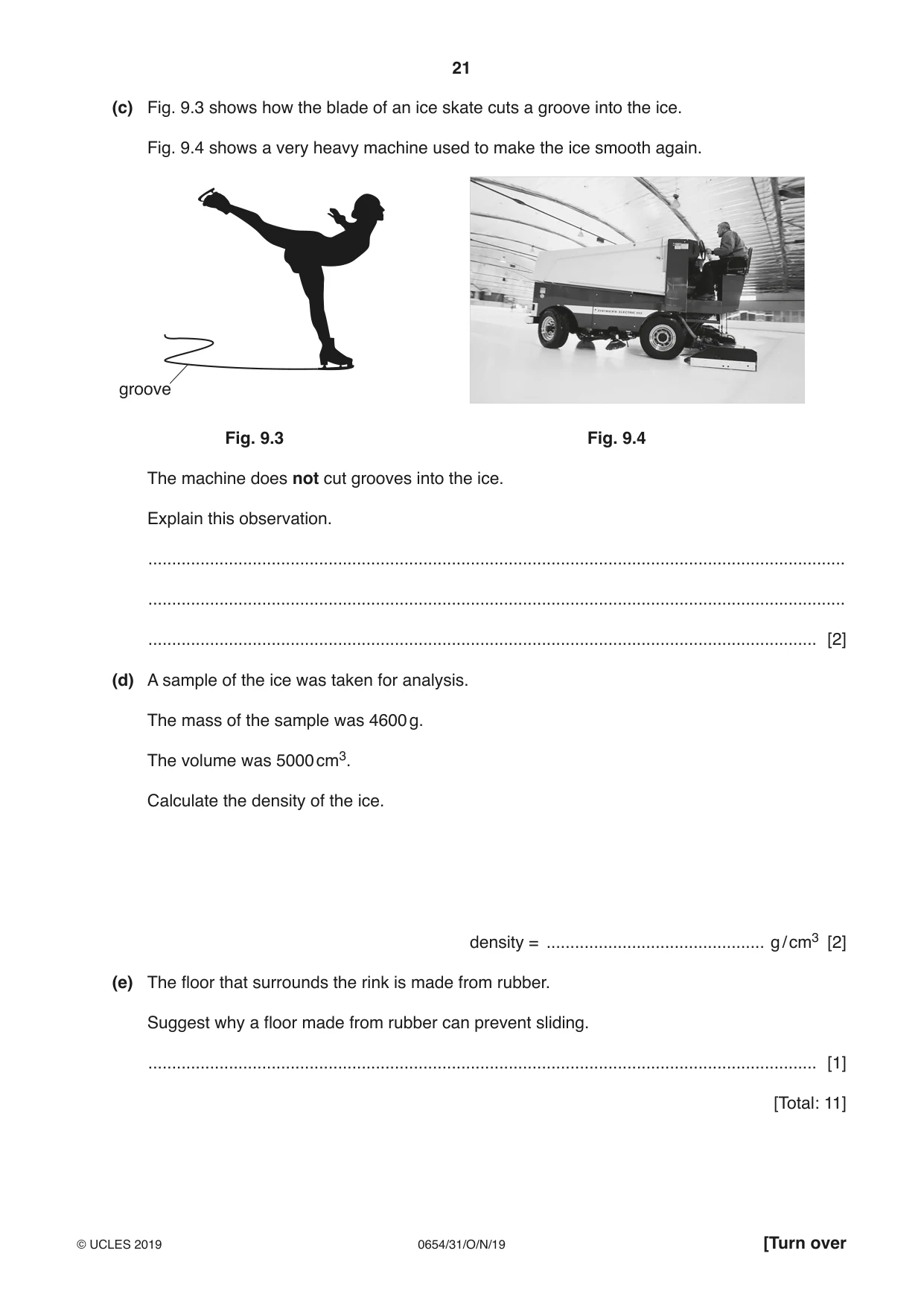
9 (a) Fig. 9.1 shows a ray of light from a lamp striking the surface of an ice rink. The ice acts like a plane mirror. ray of light spectator seating ice Fig. 9.1 (i) On Fig. 9.1 draw the normal at the point where the ray strikes the ice rink and label with the word normal. [1] (ii) On Fig. 9.1 draw the reflected ray to show where a spectator will see the ray and label with the words reflected ray. [1] (iii) On Fig. 9.1 mark the angle of incidence and label with the letter i. [1] (b) The ice rink is prepared by melting the surface and freezing it again to create a smooth surface. (i) State the temperature at which the water on the surface freezes. .................................................................... [1] (ii) A piece of ice is left to melt in a container. Complete Fig. 9.2 to show the arrangement of particles in liquid water. The diagram for ice has been done for you. solid water (ice) liquid water Fig. 9.2 [2] (c) Fig. 9.3 shows how the blade of an ice skate cuts a groove into the ice. Fig. 9.4 shows a very heavy machine used to make the ice smooth again. groove Fig. 9.3 Fig. 9.4 The machine does not cut grooves into the ice. Explain this observation. ................................................................................................................................................... ................................................................................................................................................... ............................................................................................................................................. [2] (d) A sample of the ice was taken for analysis. The mass of the sample was 4600 g. The volume was 5000 cm3. Calculate the density of the ice. density = .............................................. g / cm3 [2] (e) The floor that surrounds the rink is made from rubber. Suggest why a floor made from rubber can prevent sliding. ............................................................................................................................................. [1] [Total: 11]
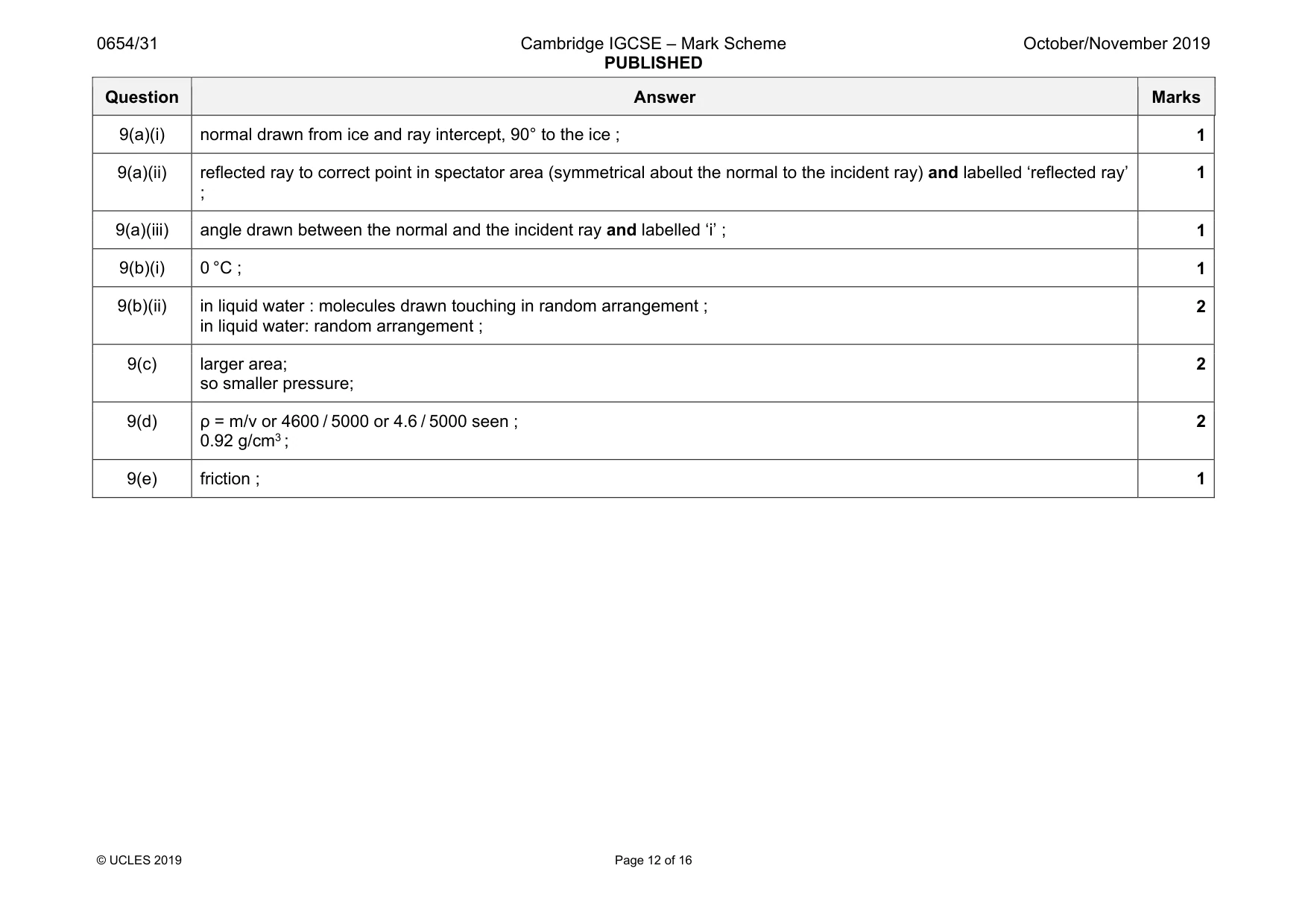
Mark scheme: 9(a)(i) normal drawn from ice and ray intercept, 90° to the ice ; 1 9(a)(ii) reflected ray to correct point in spectator area (symmetrical about the normal to the incident ray) and labelled ‘reflected ray’ ; 1 9(a)(iii) angle drawn between the normal and the incident ray and labelled ‘i’ ; 1 9(b)(i) 0 °C ; 1 9(b)(ii) in liquid water : molecules drawn touching in random arrangement ; in liquid water: random arrangement ; 2 9(c) larger area; so smaller pressure; 2 9(d) ρ = m/v or 4600 / 5000 or 4.6 / 5000 seen ; 0.92 g/cm3 ; 2 9(e) friction ; 1
Q10 · The skin has an important role in the maintenance of body temperature
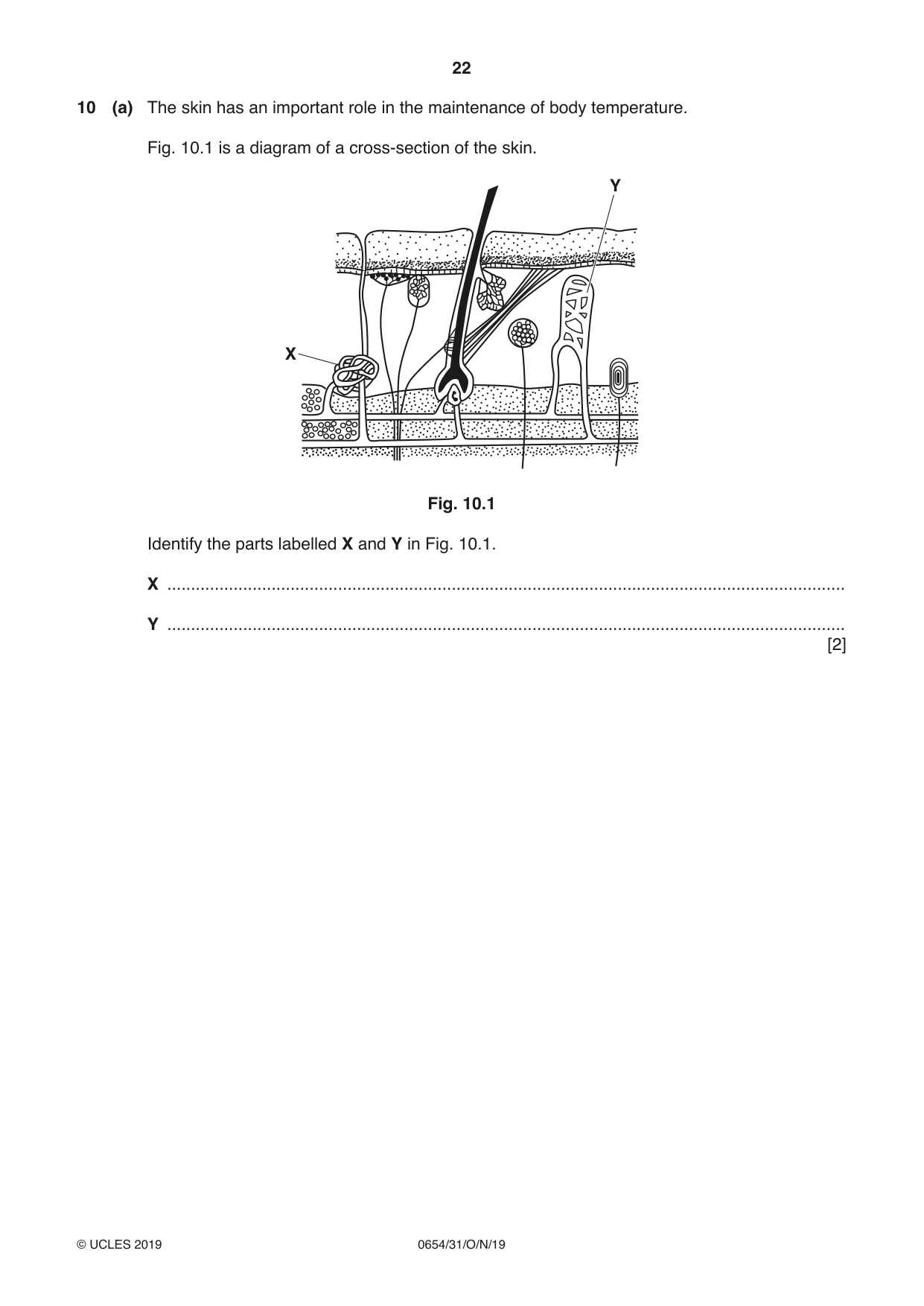
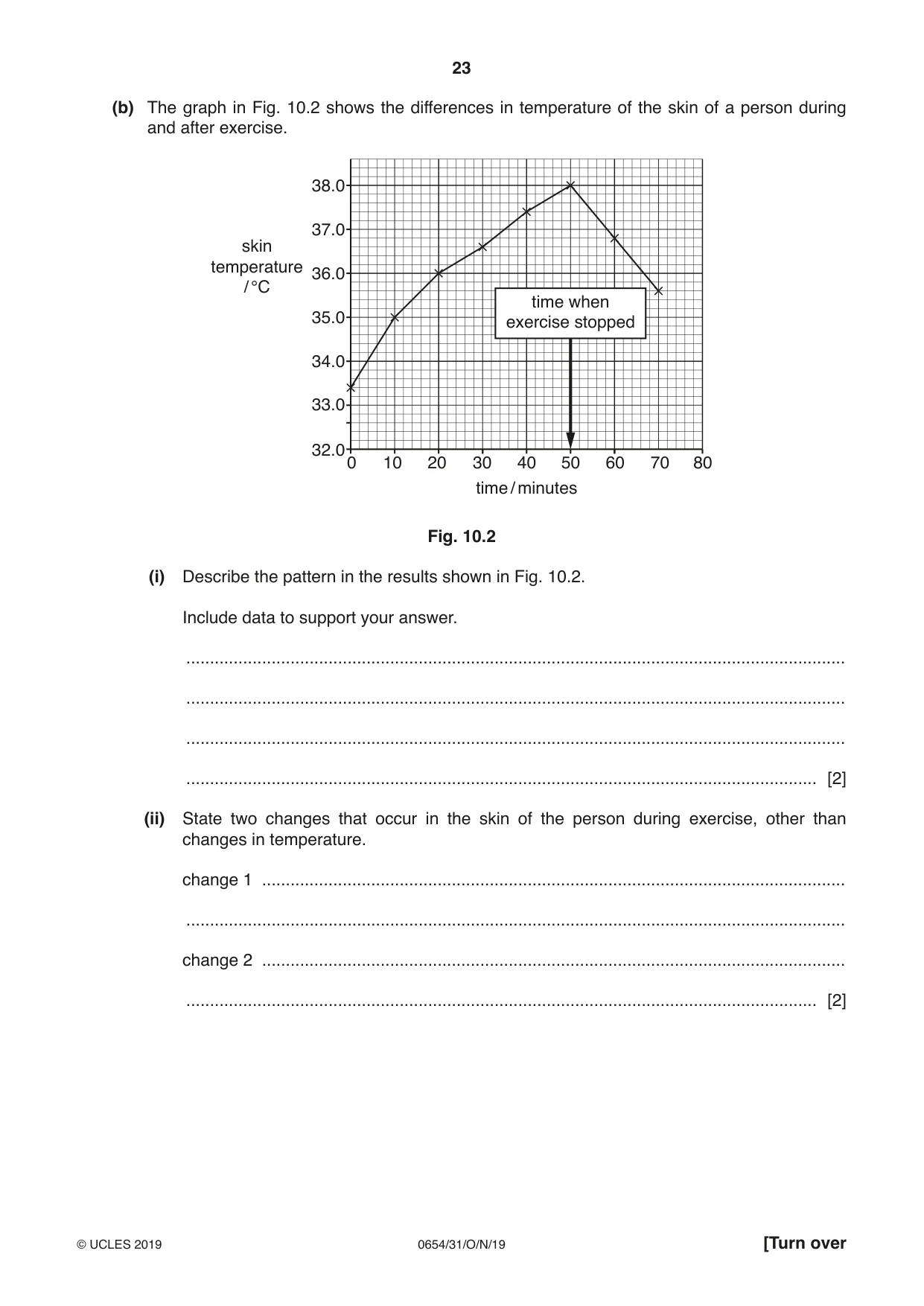
10 (a) The skin has an important role in the maintenance of body temperature. Fig. 10.1 is a diagram of a cross-section of the skin. Y X Fig. 10.1 Identify the parts labelled X and Y in Fig. 10.1. X ............................................................................................................................................... Y ............................................................................................................................................... [2] (b) The graph in Fig. 10.2 shows the differences in temperature of the skin of a person during and after exercise. 38.0 37.0 skin temperature 36.0 / °C time when 35.0 exercise stopped 34.0 33.0 32.0 0 10 20 30 40 50 60 70 80 time / minutes Fig. 10.2 (i) Describe the pattern in the results shown in Fig. 10.2. Include data to support your answer. ........................................................................................................................................... ........................................................................................................................................... ........................................................................................................................................... ..................................................................................................................................... [2] (ii) State two changes that occur in the skin of the person during exercise, other than changes in temperature. change 1 ........................................................................................................................... ........................................................................................................................................... change 2 ........................................................................................................................... ..................................................................................................................................... [2] (c) The body tries to maintain a constant internal temperature. (i) Name the organ in the body that coordinates the maintenance of a constant internal temperature. ..................................................................................................................................... [1] (ii) Name the term used to describe the maintenance of a constant internal environment. ..................................................................................................................................... [1] [Total: 8]
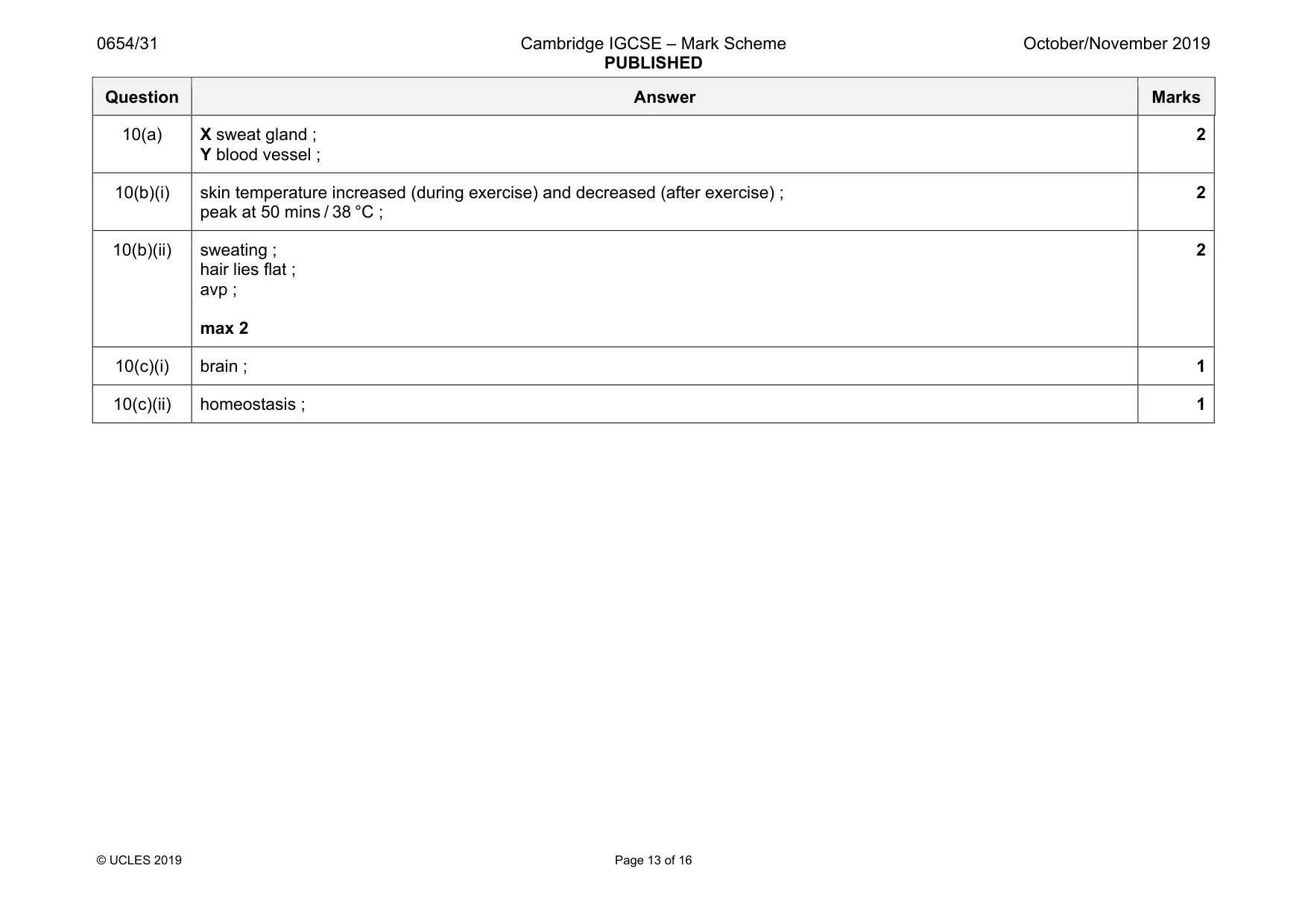
Mark scheme: 10(a) X sweat gland ; Y blood vessel ; 2 10(b)(i) skin temperature increased (during exercise) and decreased (after exercise) ; peak at 50 mins / 38 °C ; 2 10(b)(ii) sweating ; hair lies flat ; avp ; max 2 2 10(c)(i) brain ; 1 10(c)(ii) homeostasis ; 1
Q11 · State the names and percentages of the two main gases in air
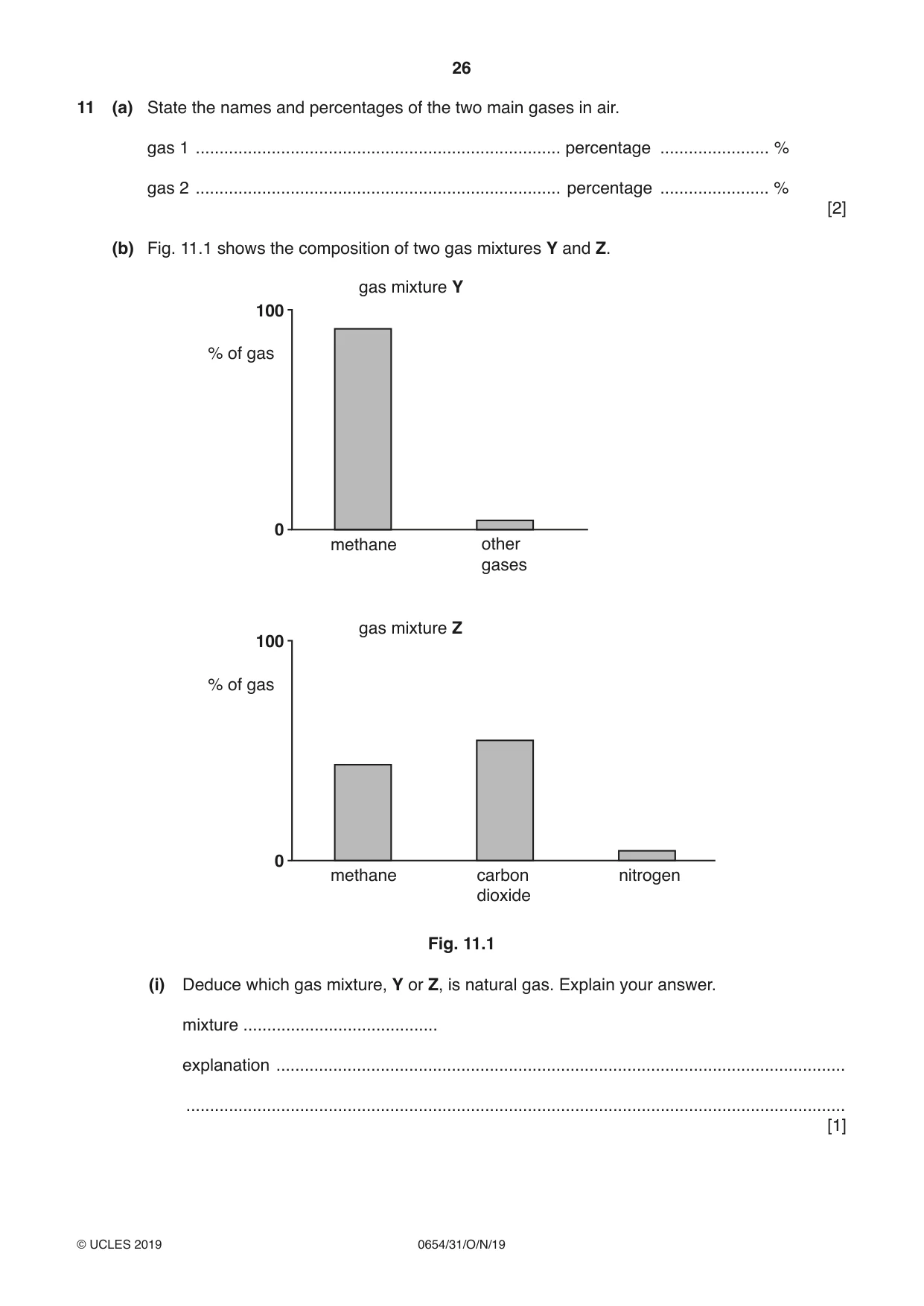
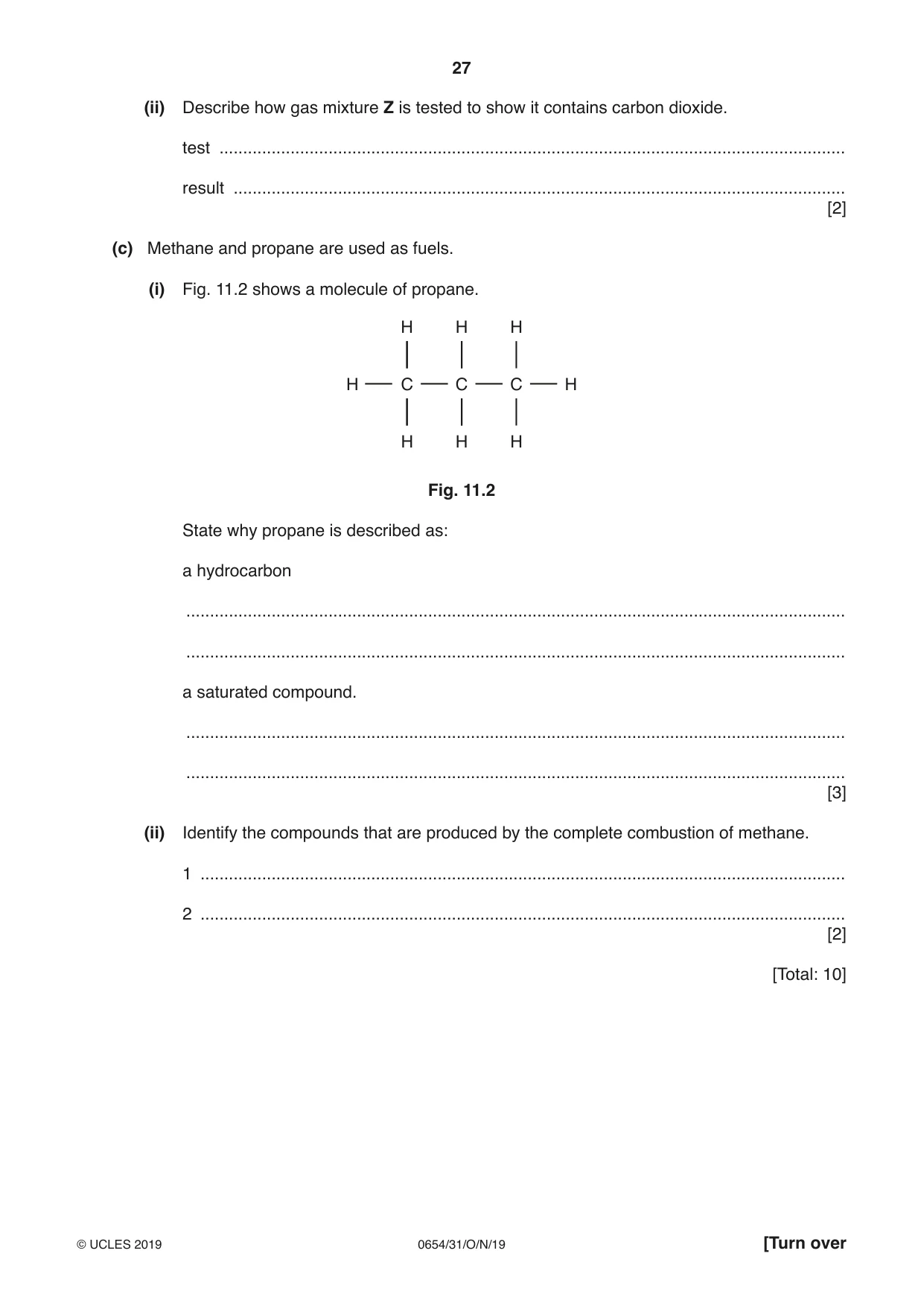
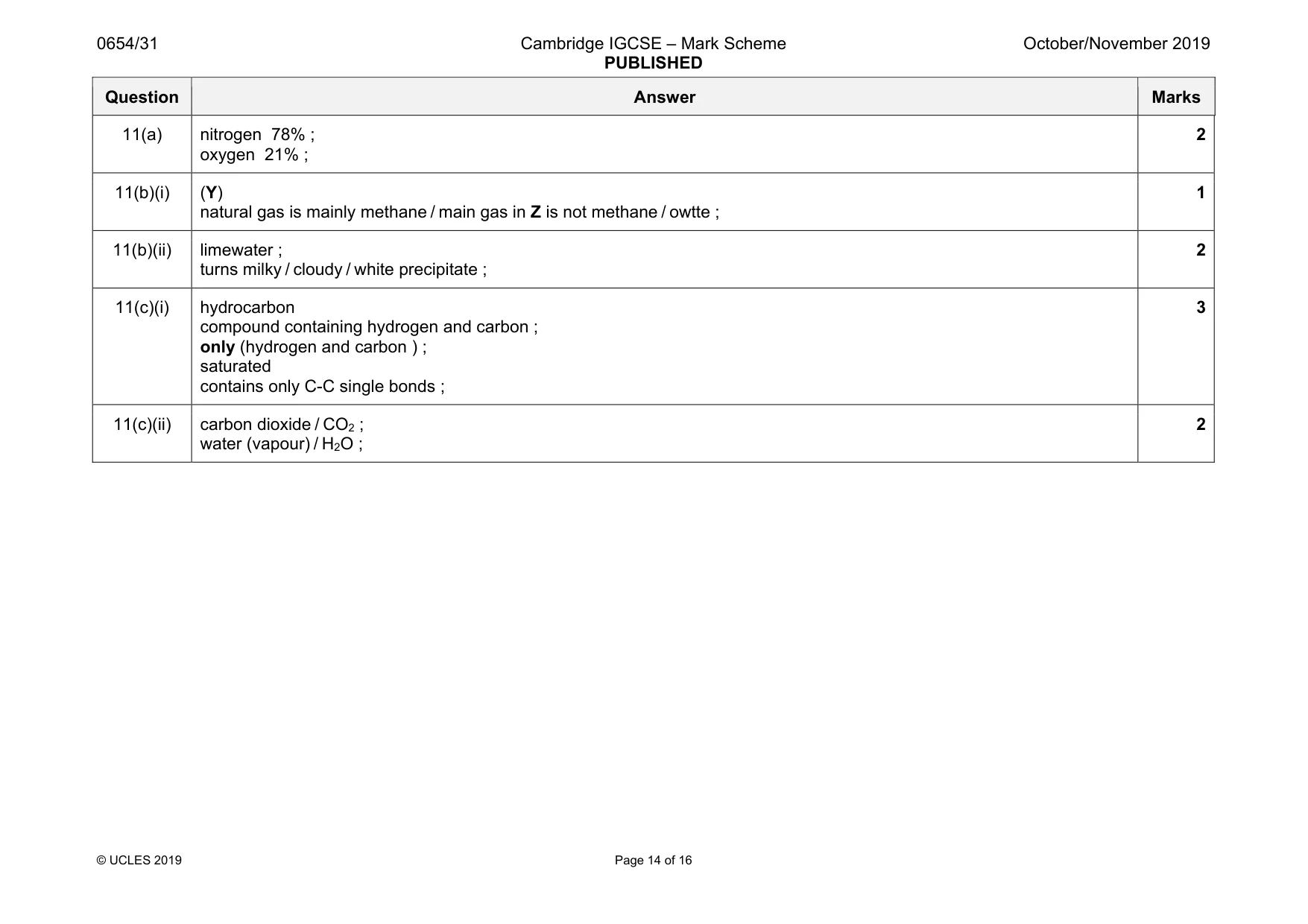
11 (a) State the names and percentages of the two main gases in air. gas 1 ............................................................................. percentage ....................... % gas 2 ............................................................................. percentage ....................... % [2] (b) Fig. 11.1 shows the composition of two gas mixtures Y and Z. gas mixture Y 100 % of gas 0 methane other gases gas mixture Z 100 % of gas 0 methane carbon nitrogen dioxide Fig. 11.1 (i) Deduce which gas mixture, Y or Z, is natural gas. Explain your answer. mixture ......................................... explanation ........................................................................................................................ ........................................................................................................................................... [1] (ii) Describe how gas mixture Z is tested to show it contains carbon dioxide. test .................................................................................................................................... result ................................................................................................................................. [2] (c) Methane and propane are used as fuels. (i) Fig. 11.2 shows a molecule of propane. H H H H C C C H H H H Fig. 11.2 State why propane is described as: a hydrocarbon ........................................................................................................................................... ........................................................................................................................................... a saturated compound. ........................................................................................................................................... ........................................................................................................................................... [3] (ii) Identify the compounds that are produced by the complete combustion of methane. 1 ........................................................................................................................................ 2 ........................................................................................................................................ [2] [Total: 10]
Mark scheme: 11(a) nitrogen 78% ; oxygen 21% ; 2 11(b)(i) (Y) natural gas is mainly methane / main gas in Z is not methane / owtte ; 1 11(b)(ii) limewater ; turns milky / cloudy / white precipitate ; 2 11(c)(i) hydrocarbon compound containing hydrogen and carbon ; only (hydrogen and carbon ) ; saturated contains only C-C single bonds ; 3 11(c)(ii) carbon dioxide / CO2 ; water (vapour) / H2O ; 2
Q12 · Between the Sun and the Earth there is the vacuum of space
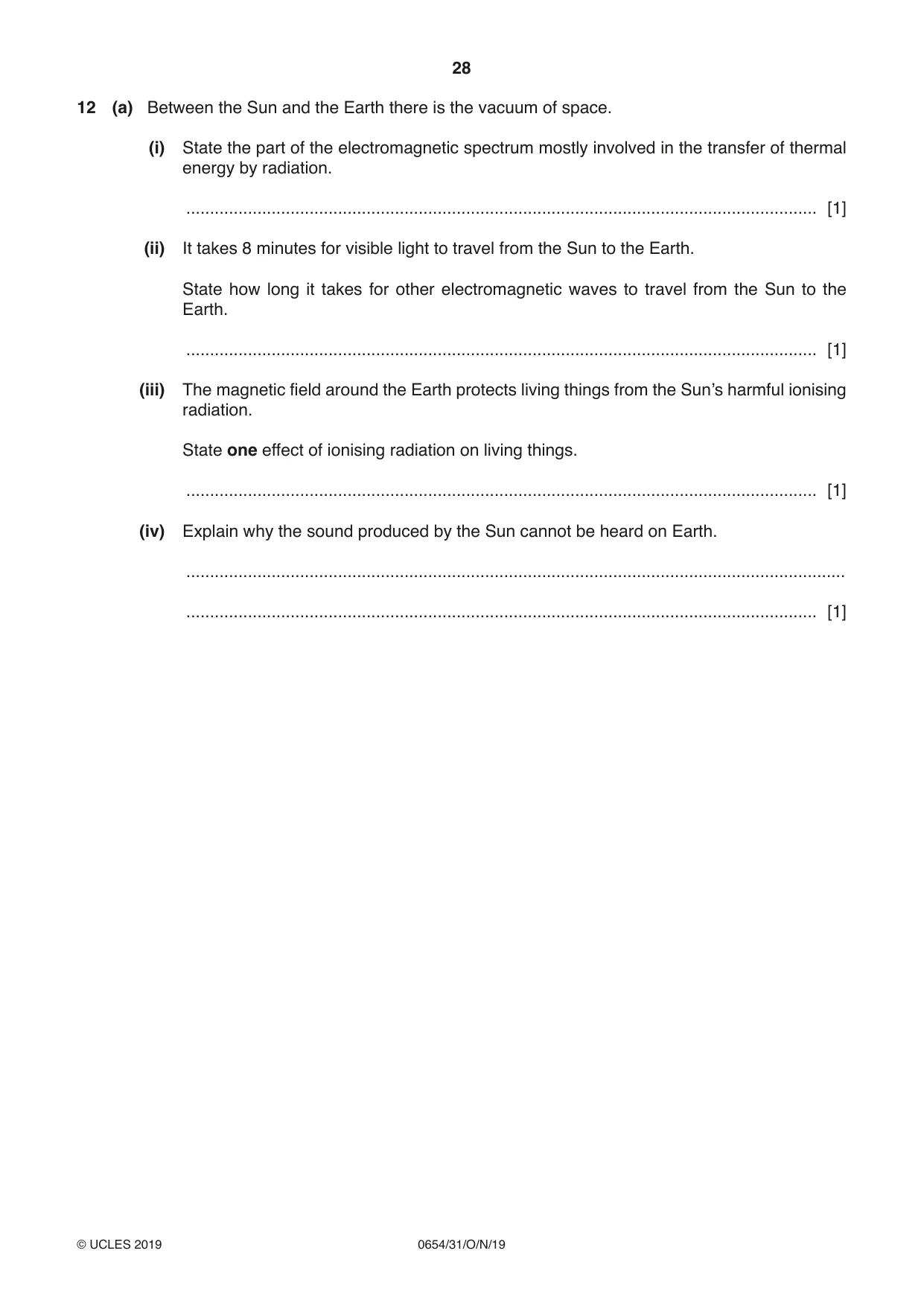
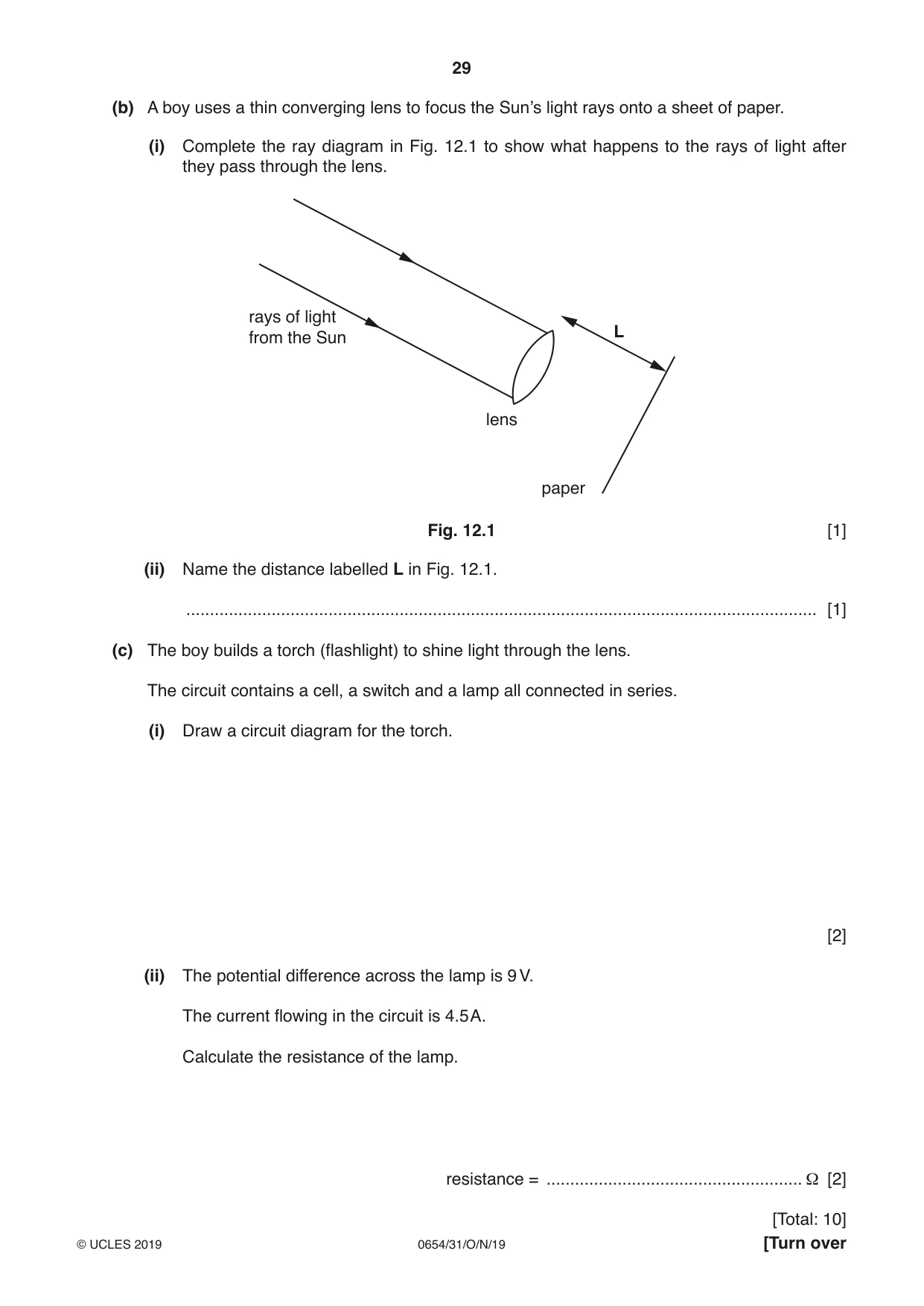
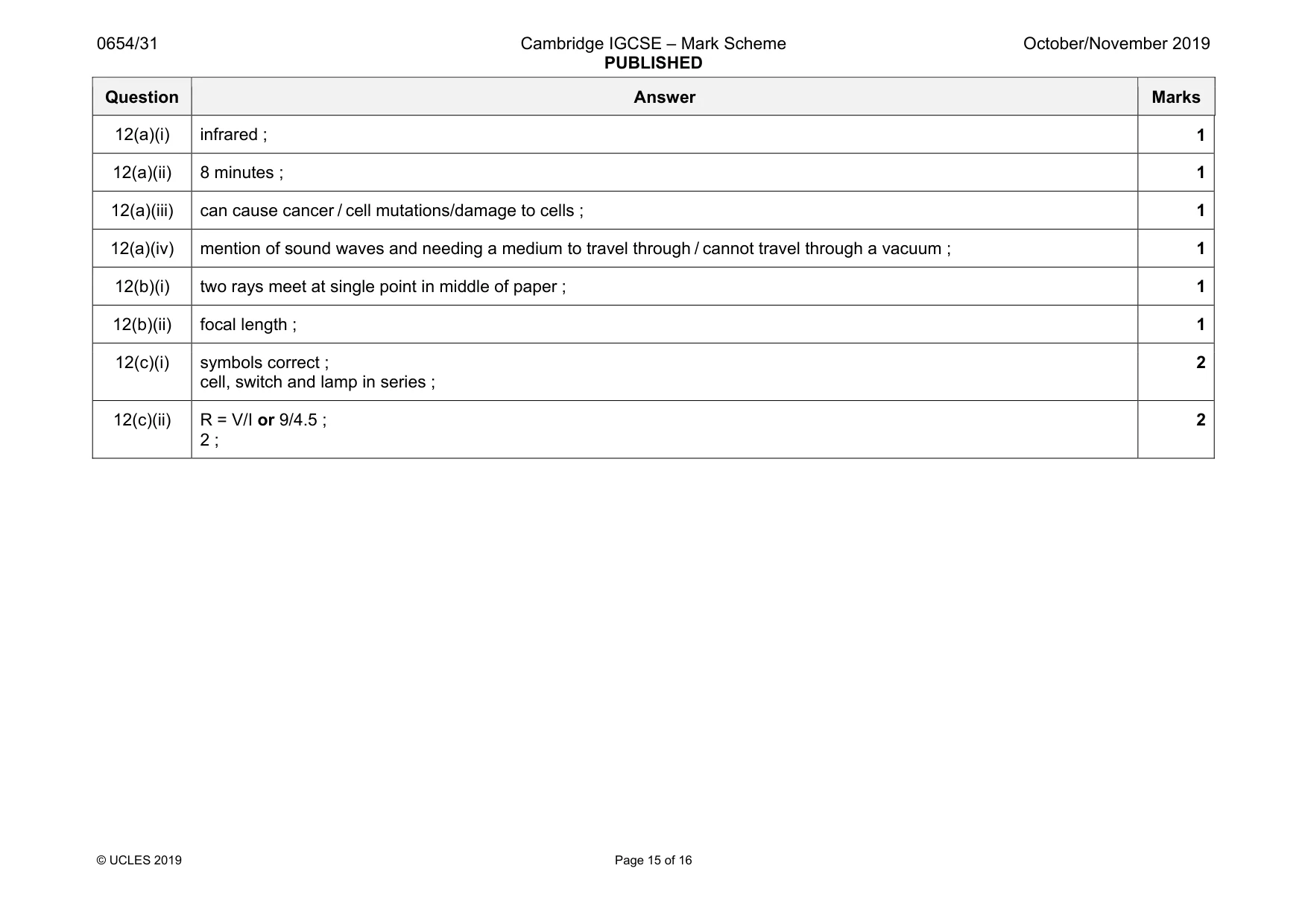
12 (a) Between the Sun and the Earth there is the vacuum of space. (i) State the part of the electromagnetic spectrum mostly involved in the transfer of thermal energy by radiation. ..................................................................................................................................... [1] (ii) It takes 8 minutes for visible light to travel from the Sun to the Earth. State how long it takes for other electromagnetic waves to travel from the Sun to the Earth. ..................................................................................................................................... [1] (iii) The magnetic field around the Earth protects living things from the Sun’s harmful ionising radiation. State one effect of ionising radiation on living things. ..................................................................................................................................... [1] (iv) Explain why the sound produced by the Sun cannot be heard on Earth. ........................................................................................................................................... ..................................................................................................................................... [1] (b) A boy uses a thin converging lens to focus the Sun’s light rays onto a sheet of paper. (i) Complete the ray diagram in Fig. 12.1 to show what happens to the rays of light after they pass through the lens. rays of light L from the Sun lens paper Fig. 12.1 [1] (ii) Name the distance labelled L in Fig. 12.1. ..................................................................................................................................... [1] (c) The boy builds a torch (flashlight) to shine light through the lens. The circuit contains a cell, a switch and a lamp all connected in series. (i) Draw a circuit diagram for the torch. [2] (ii) The potential difference across the lamp is 9 V. The current flowing in the circuit is 4.5 A. Calculate the resistance of the lamp. resistance = ...................................................... Ω [2]
Mark scheme: 12(a)(i) infrared ; 1 12(a)(ii) 8 minutes ; 1 12(a)(iii) can cause cancer / cell mutations/damage to cells ; 1 12(a)(iv) mention of sound waves and needing a medium to travel through / cannot travel through a vacuum ; 1 12(b)(i) two rays meet at single point in middle of paper ; 1 12(b)(ii) focal length ; 1 12(c)(i) symbols correct ; cell, switch and lamp in series ; 2 12(c)(ii) R = V/I or 9/4.5 ; 2 ; 2
Q13 · A diagram of a flower
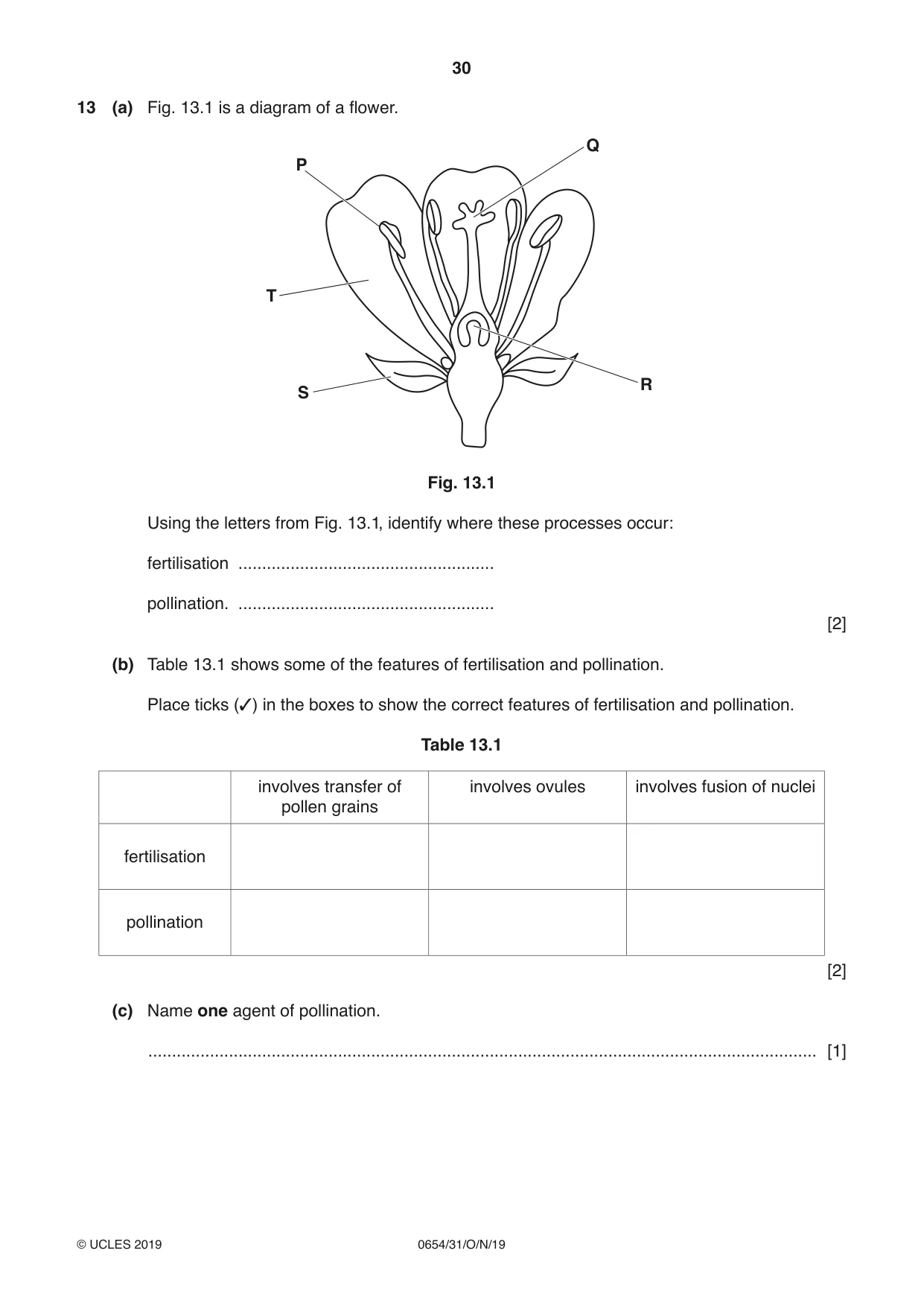
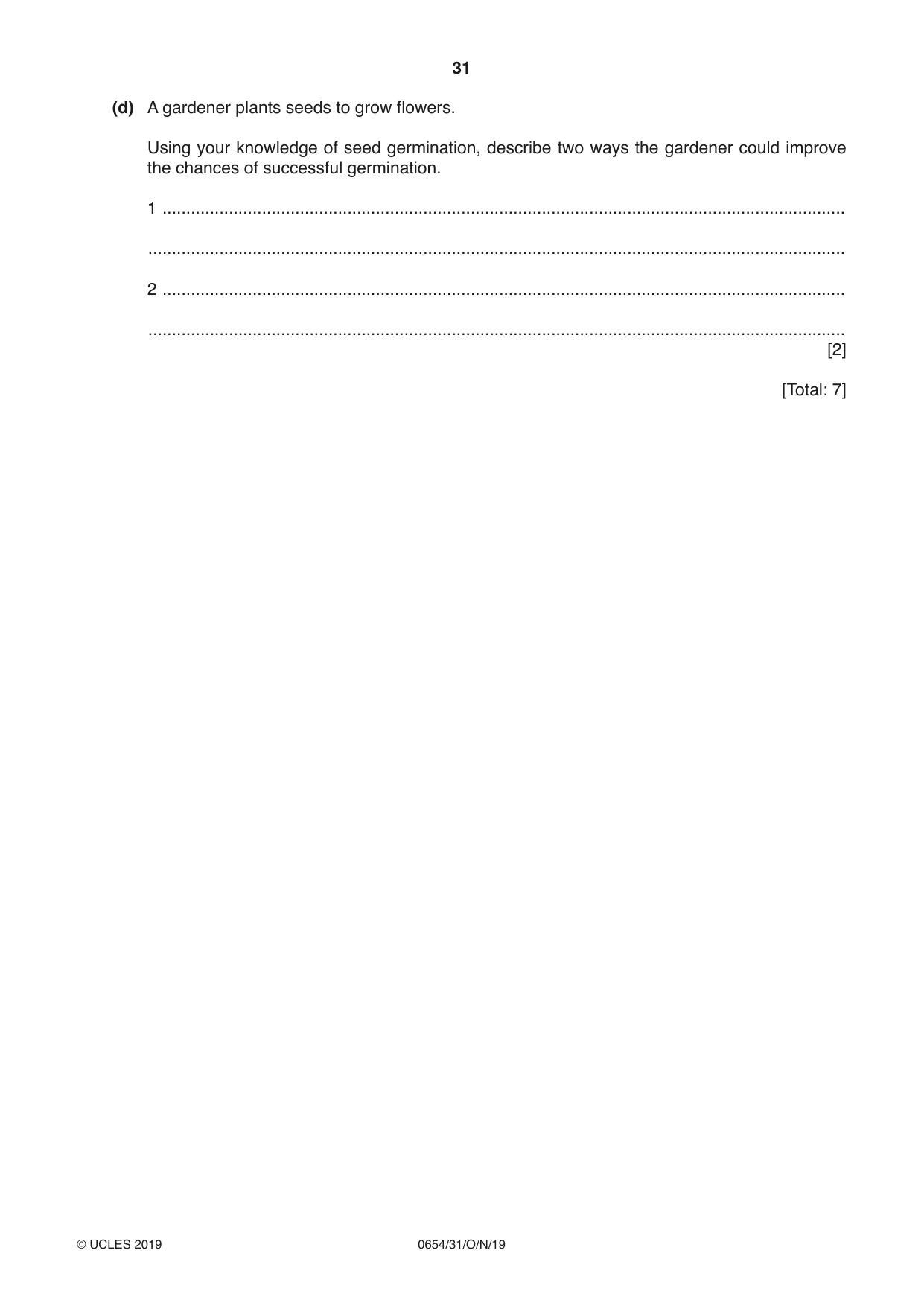
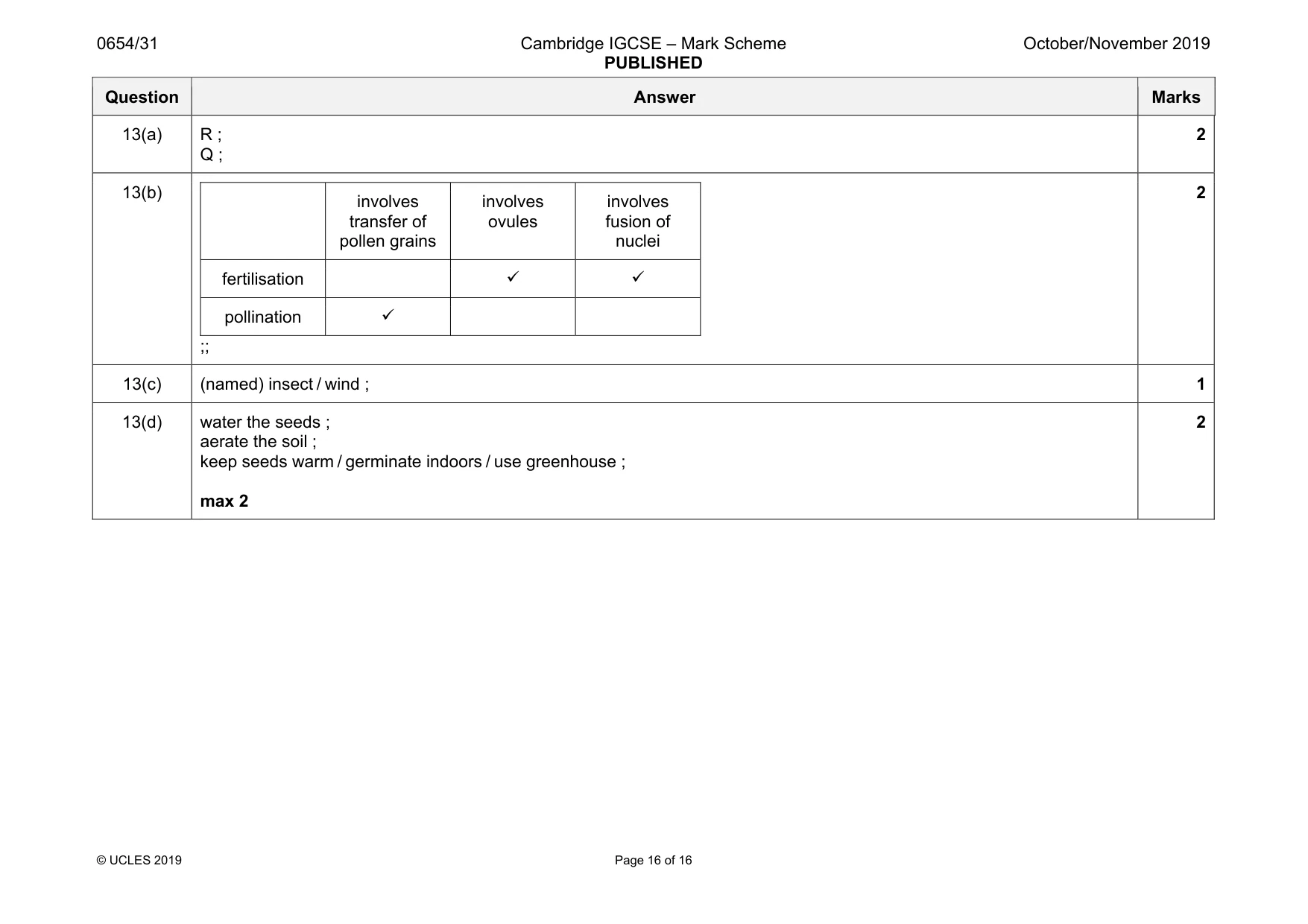
13 (a) Fig. 13.1 is a diagram of a flower. Q P T R S Fig. 13.1 Using the letters from Fig. 13.1, identify where these processes occur: fertilisation ...................................................... pollination. ...................................................... [2] (b) Table 13.1 shows some of the features of fertilisation and pollination. Place ticks (3) in the boxes to show the correct features of fertilisation and pollination. Table 13.1 involves transfer of involves ovules involves fusion of nuclei pollen grains fertilisation pollination [2] (c) Name one agent of pollination. ............................................................................................................................................. [1] (d) A gardener plants seeds to grow flowers. Using your knowledge of seed germination, describe two ways the gardener could improve the chances of successful germination. 1 ................................................................................................................................................ ................................................................................................................................................... 2 ................................................................................................................................................ ................................................................................................................................................... [2] [Total: 7]
Mark scheme: 13(a) R ; Q ; 2 13(b) involves transfer of pollen grains involves ovules involves fusion of nuclei fertilisation 9 9 pollination 9 ;; 2 13(c) (named) insect / wind ; 1 13(d) water the seeds ; aerate the soil ; keep seeds warm / germinate indoors / use greenhouse ; max 2 2
What was in this paper
The subtopics covered by these 13 questions, and how many questions each got. Open one in a new tab to see every Cambridge question on it.
What you needed in this session
Cambridge’s own grade thresholds for 2019 Oct/Nov, Paper 3 · Variant 1. A higher threshold means an easier paper — the bar moves with how the cohort did.