Cambridge IGCSE Sciences - Co-ordinated (Double) 0654 — 2017 Oct/Nov Paper 3 · Variant 2
0654/32/O/N/17 · 13 questions · 120 marks · ≈135 min
The question paper and its mark scheme, free to read here and free to download. This is Cambridge’s own paper, exactly as it was sat.
Question paper32 pages
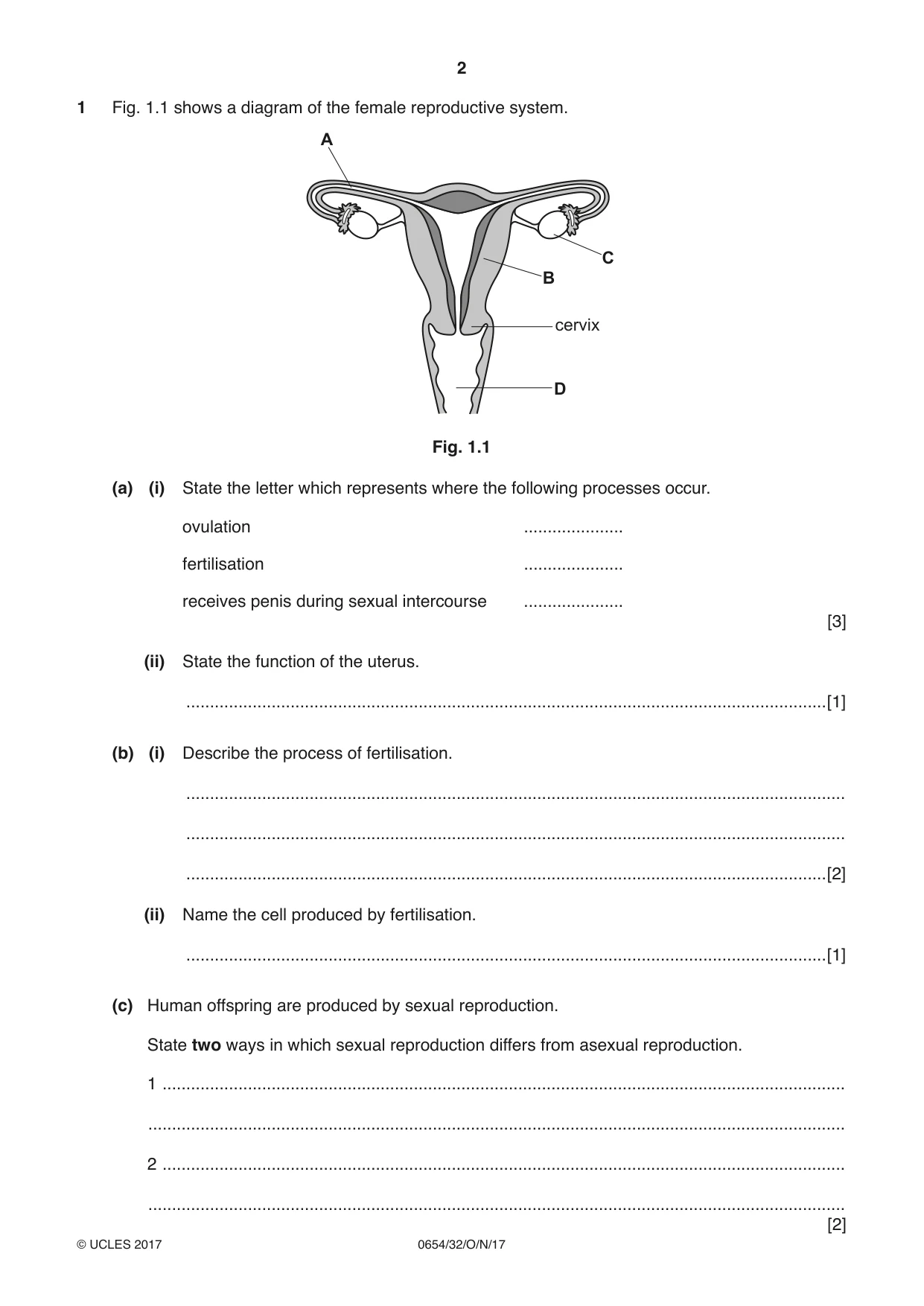
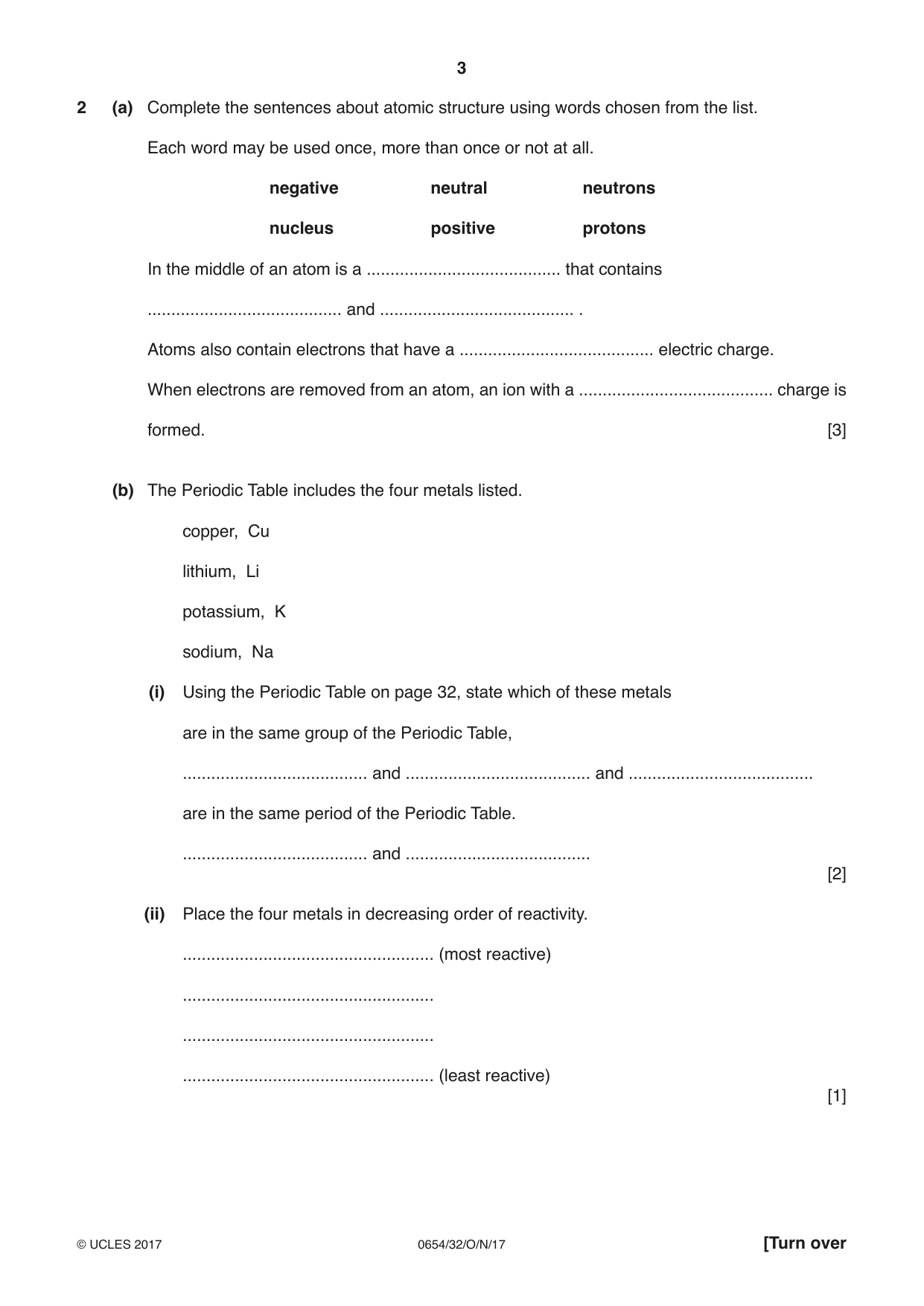
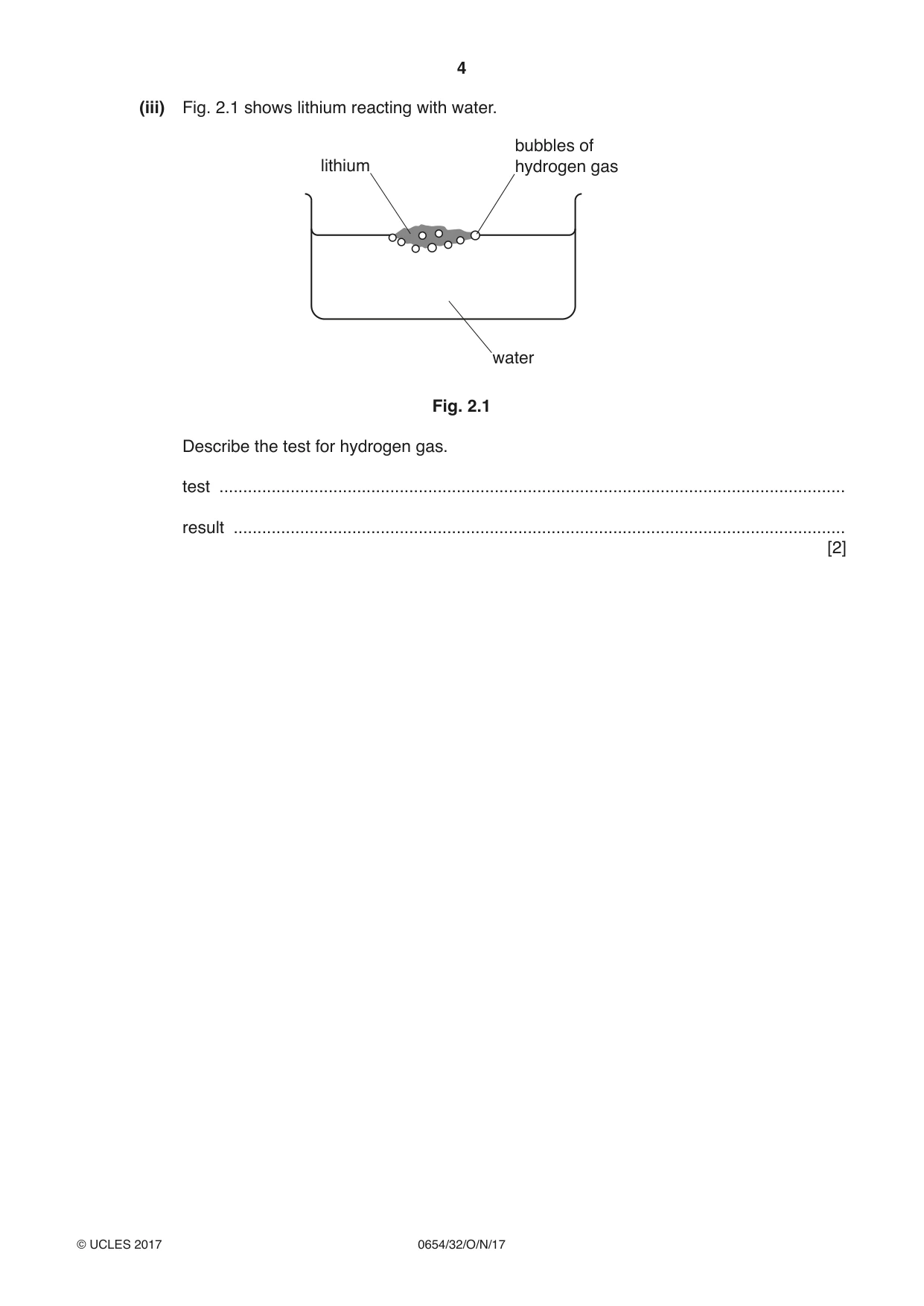


Mark scheme10 pages
Answers below. Sit the paper first if you are practising.
Questions as text
Q1 · A diagram of the female reproductive system
1 Fig. 1.1 shows a diagram of the female reproductive system. A C B cervix D Fig. 1.1 (a) (i) State the letter which represents where the following processes occur. ovulation ..................... fertilisation ..................... receives penis during sexual intercourse ..................... [3] (ii) State the function of the uterus. .......................................................................................................................................[1] (b) (i) Describe the process of fertilisation. ........................................................................................................................................... ........................................................................................................................................... .......................................................................................................................................[2] (ii) Name the cell produced by fertilisation. .......................................................................................................................................[1] (c) Human offspring are produced by sexual reproduction. State two ways in which sexual reproduction differs from asexual reproduction. 1 ................................................................................................................................................ ................................................................................................................................................... 2 ................................................................................................................................................ ...................................................................................................................................................
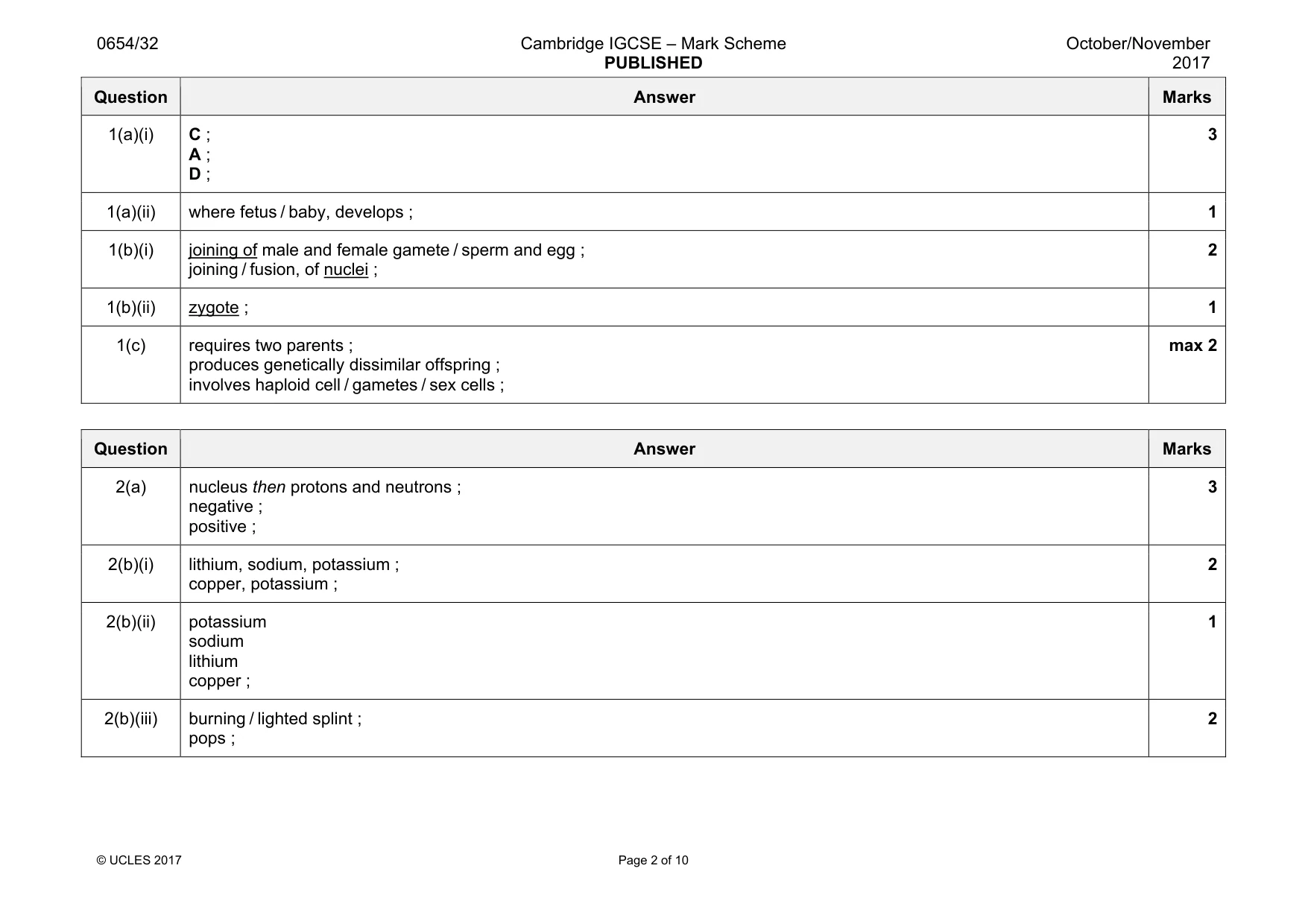
Mark scheme: 1(a)(i) C ; A ; D ; 3 1(a)(ii) where fetus / baby, develops ; 1 1(b)(i) joining of male and female gamete / sperm and egg ; joining / fusion, of nuclei ; 2 1(b)(ii) zygote ; 1 1(c) requires two parents ; produces genetically dissimilar offspring ; involves haploid cell / gametes / sex cells ; max 2
Q2 · Complete the sentences about atomic structure using words chosen from the list
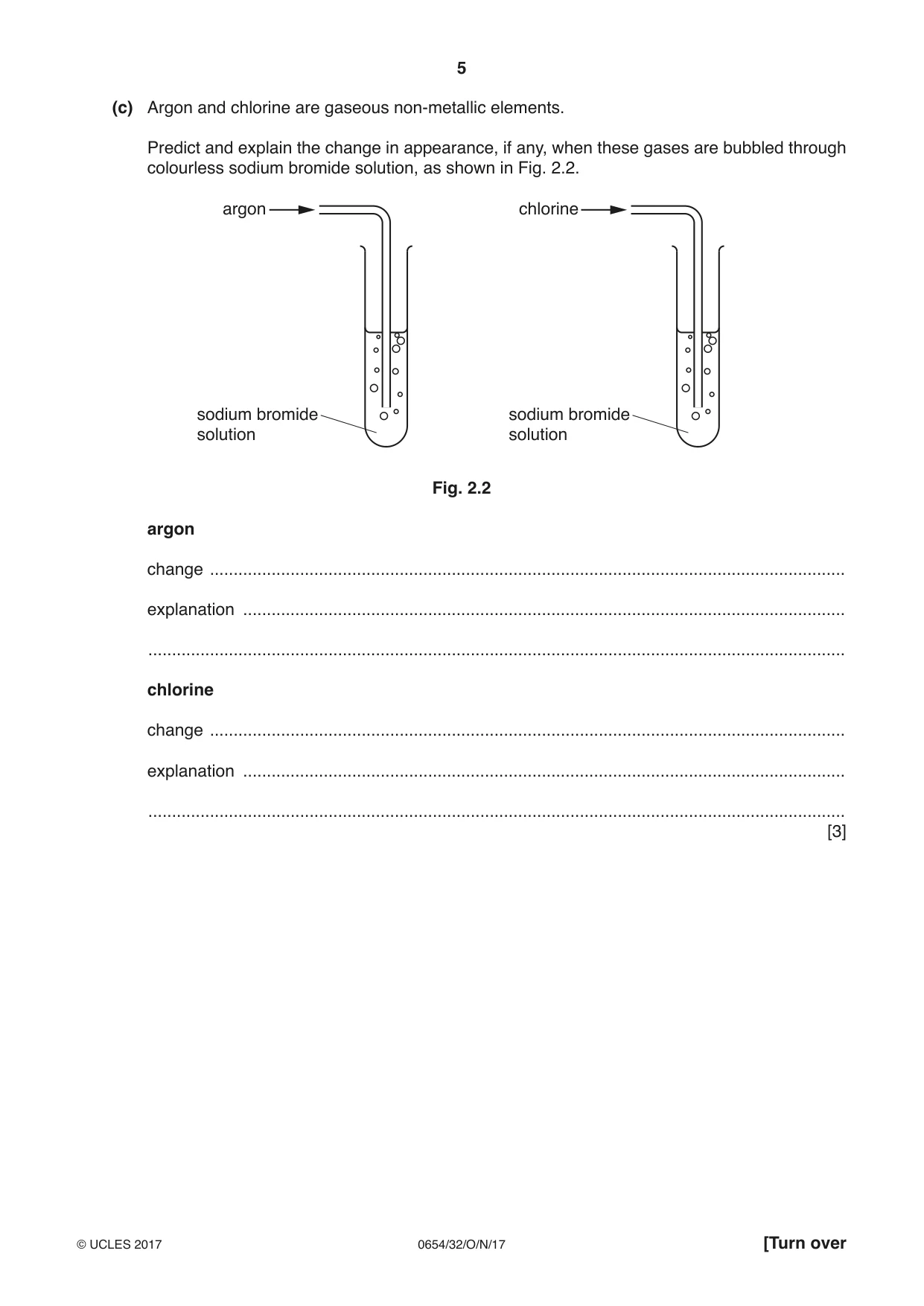
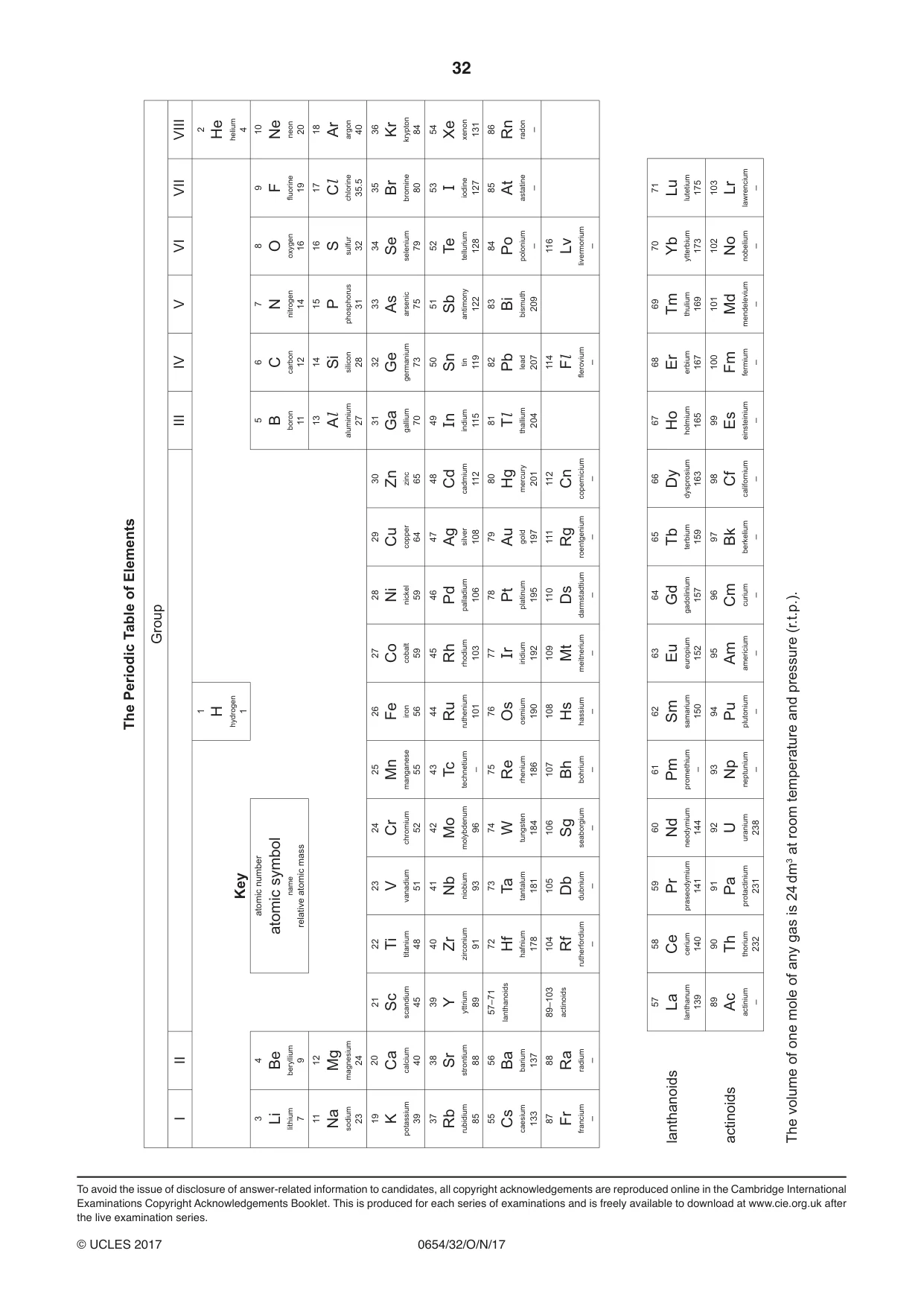
2 (a) Complete the sentences about atomic structure using words chosen from the list. Each word may be used once, more than once or not at all. negative neutral neutrons nucleus positive protons In the middle of an atom is a ......................................... that contains ......................................... and ......................................... . Atoms also contain electrons that have a ......................................... electric charge. When electrons are removed from an atom, an ion with a ......................................... charge is formed. [3] (b) The Periodic Table includes the four metals listed. copper, Cu lithium, Li potassium, K sodium, Na (i) Using the Periodic Table on page 32, state which of these metals are in the same group of the Periodic Table, ....................................... and ....................................... and ....................................... are in the same period of the Periodic Table. ....................................... and ....................................... [2] (ii) Place the four metals in decreasing order of reactivity. ..................................................... (most reactive) ..................................................... ..................................................... ..................................................... (least reactive) [1] (iii) Fig. 2.1 shows lithium reacting with water. bubbles of lithium hydrogen gas water Fig. 2.1 Describe the test for hydrogen gas. test .................................................................................................................................... result ................................................................................................................................. [2] (c) Argon and chlorine are gaseous non-metallic elements. Predict and explain the change in appearance, if any, when these gases are bubbled through colourless sodium bromide solution, as shown in Fig. 2.2. argon chlorine sodium bromide sodium bromide solution solution Fig. 2.2 argon change ...................................................................................................................................... explanation ............................................................................................................................... ................................................................................................................................................... chlorine change ...................................................................................................................................... explanation ............................................................................................................................... ................................................................................................................................................... [3]
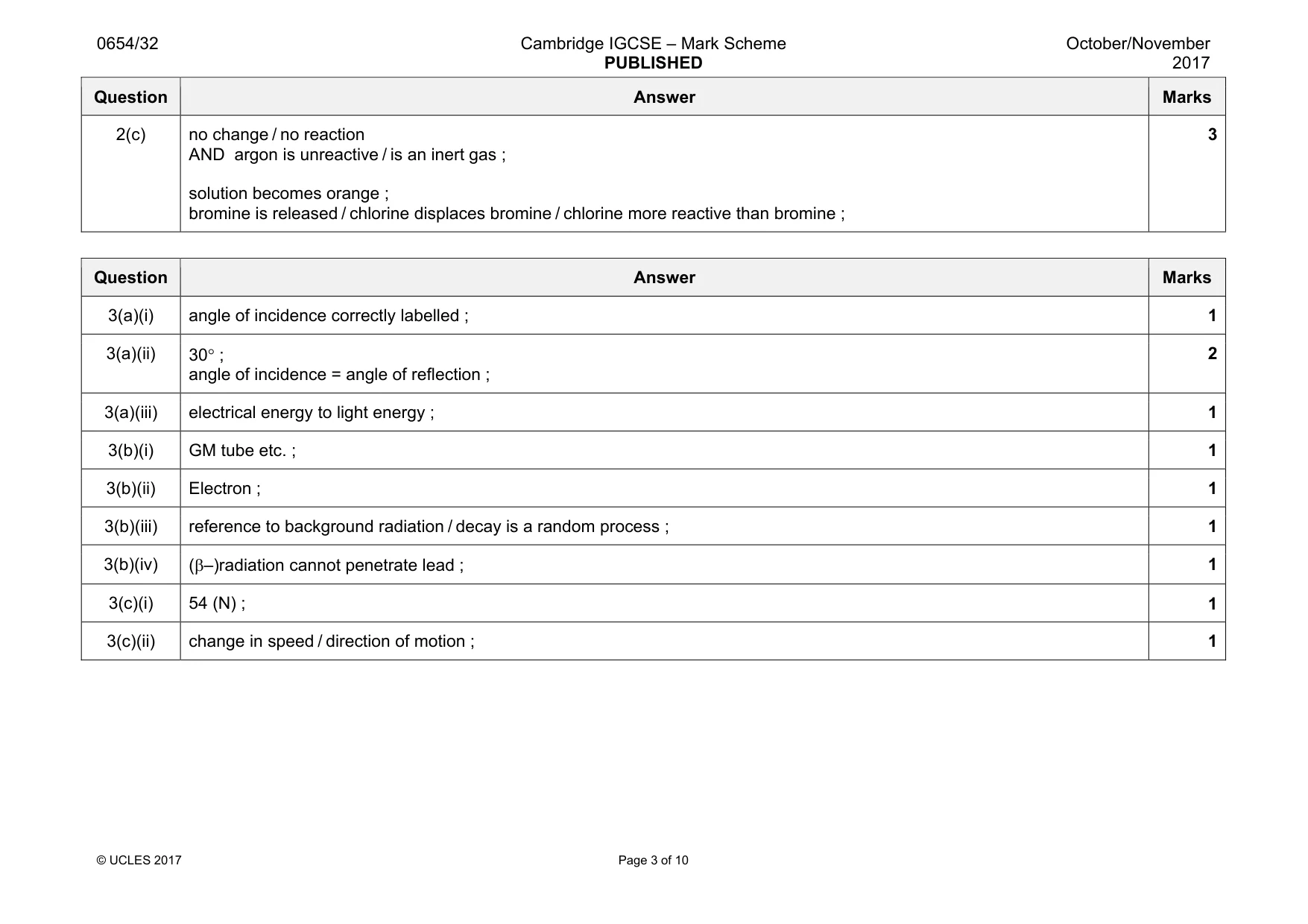
Mark scheme: 2(a) nucleus then protons and neutrons ; negative ; positive ; 3 2(b)(i) lithium, sodium, potassium ; copper, potassium ; 2 2(b)(ii) potassium sodium lithium copper ; 1 2(b)(iii) burning / lighted splint ; pops ; 2 Question Answer Marks 2(c) no change / no reaction AND argon is unreactive / is an inert gas ; solution becomes orange ; bromine is released / chlorine displaces bromine / chlorine more reactive than bromine ; 3
Q3 · A student reading a book
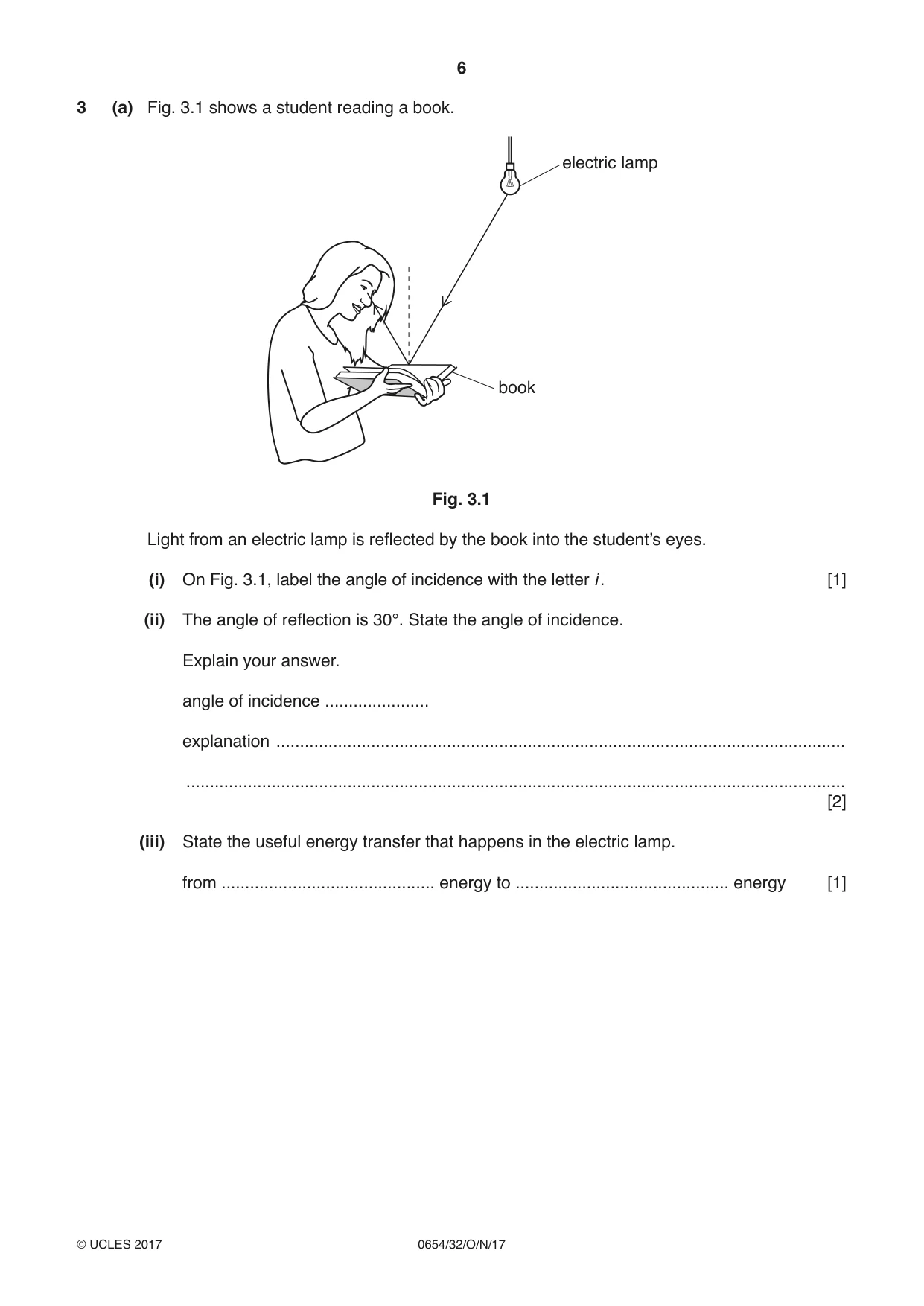
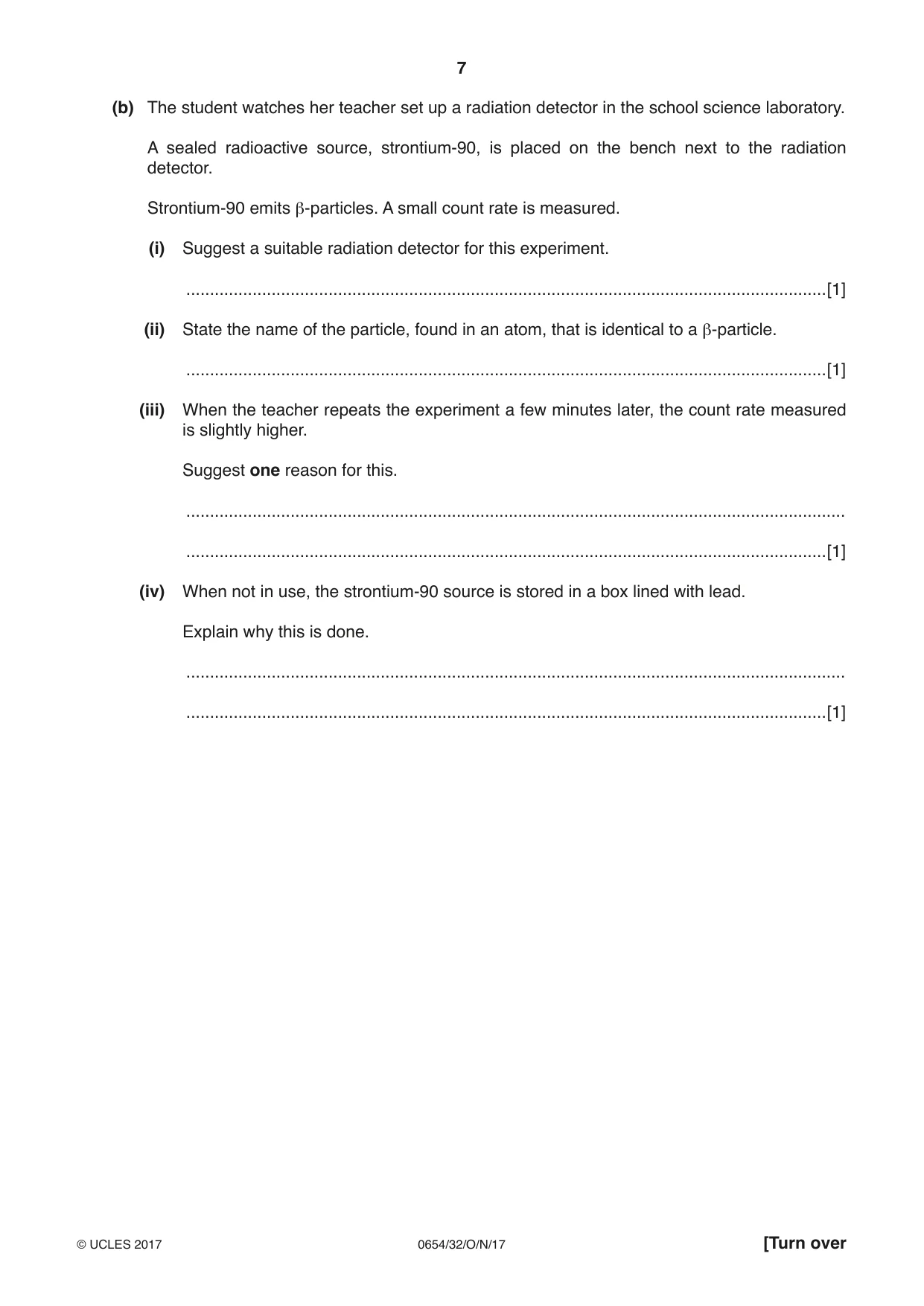
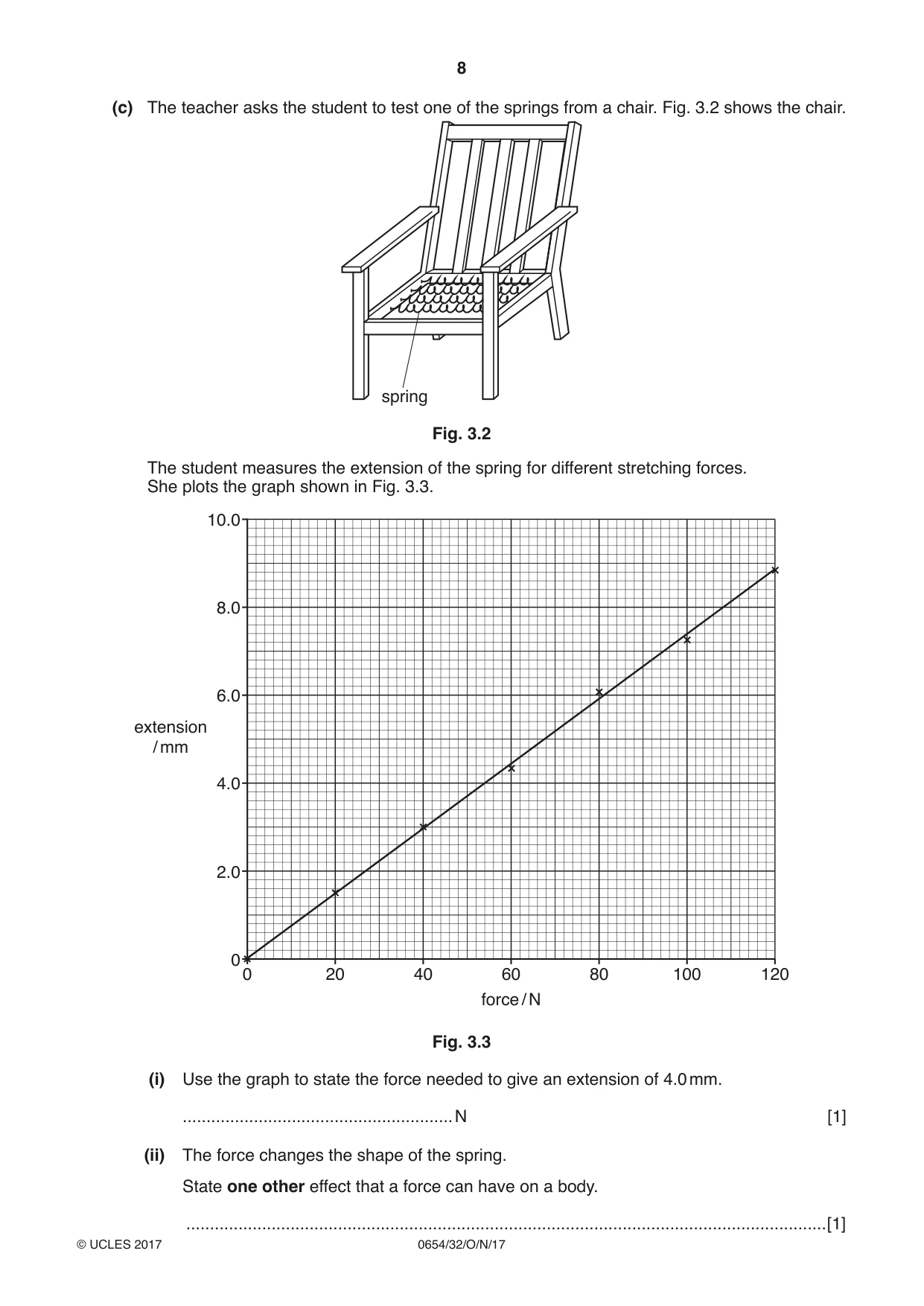
3 (a) Fig. 3.1 shows a student reading a book. electric lamp book Fig. 3.1 Light from an electric lamp is reflected by the book into the student’s eyes. (i) On Fig. 3.1, label the angle of incidence with the letter i . [1] (ii) The angle of reflection is 30°. State the angle of incidence. Explain your answer. angle of incidence ...................... explanation ........................................................................................................................ ........................................................................................................................................... [2] (iii) State the useful energy transfer that happens in the electric lamp. from ............................................. energy to ............................................. energy [1] (b) The student watches her teacher set up a radiation detector in the school science laboratory. A sealed radioactive source, strontium-90, is placed on the bench next to the radiation detector. Strontium-90 emits β-particles. A small count rate is measured. (i) Suggest a suitable radiation detector for this experiment. .......................................................................................................................................[1] (ii) State the name of the particle, found in an atom, that is identical to a β-particle. .......................................................................................................................................[1] (iii) When the teacher repeats the experiment a few minutes later, the count rate measured is slightly higher. Suggest one reason for this. ........................................................................................................................................... .......................................................................................................................................[1] (iv) When not in use, the strontium-90 source is stored in a box lined with lead. Explain why this is done. ........................................................................................................................................... .......................................................................................................................................[1] (c) The teacher asks the student to test one of the springs from a chair. Fig. 3.2 shows the chair. spring Fig. 3.2 The student measures the extension of the spring for different stretching forces. She plots the graph shown in Fig. 3.3. 10.0 8.0 6.0 extension / mm 4.0 2.0 0 0 20 40 60 80 100 120 force / N Fig. 3.3 (i) Use the graph to state the force needed to give an extension of 4.0 mm. ......................................................... N [1] (ii) The force changes the shape of the spring. State one other effect that a force can have on a body. .......................................................................................................................................[1]
Mark scheme: 3(a)(i) angle of incidence correctly labelled ; 1 3(a)(ii) 30° ; angle of incidence = angle of reflection ; 2 3(a)(iii) electrical energy to light energy ; 1 3(b)(i) GM tube etc. ; 1 3(b)(ii) Electron ; 1 3(b)(iii) reference to background radiation / decay is a random process ; 1 3(b)(iv) (β–)radiation cannot penetrate lead ; 1 3(c)(i) 54 (N) ; 1 3(c)(ii) change in speed / direction of motion ; 1
Q4 · Food chains show the flow of energy from one organism to another
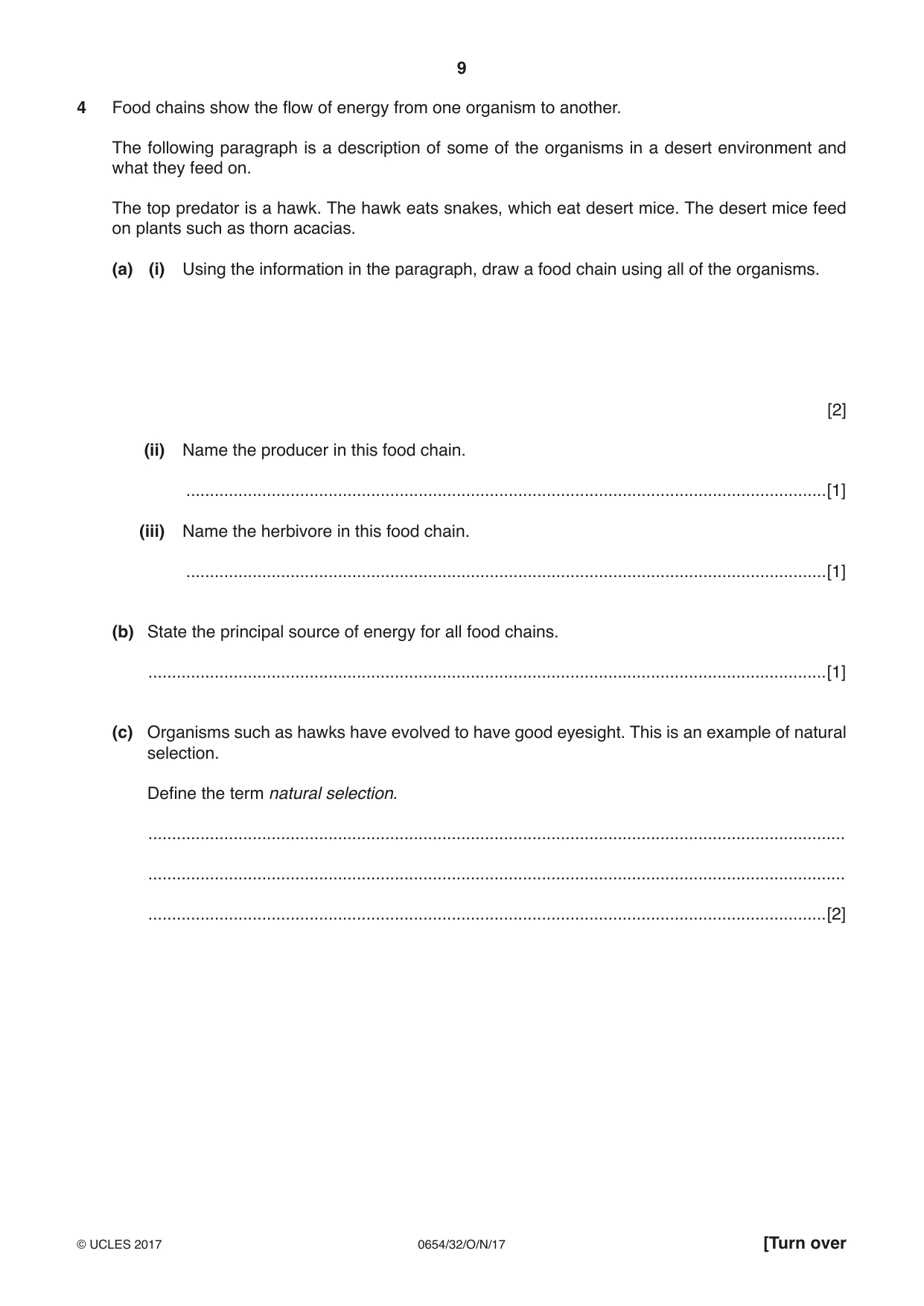
4 Food chains show the flow of energy from one organism to another. The following paragraph is a description of some of the organisms in a desert environment and what they feed on. The top predator is a hawk. The hawk eats snakes, which eat desert mice. The desert mice feed on plants such as thorn acacias. (a) (i) Using the information in the paragraph, draw a food chain using all of the organisms. [2] (ii) Name the producer in this food chain. .......................................................................................................................................[1] (iii) Name the herbivore in this food chain. .......................................................................................................................................[1] (b) State the principal source of energy for all food chains. ...............................................................................................................................................[1] (c) Organisms such as hawks have evolved to have good eyesight. This is an example of natural selection. Define the term natural selection. ................................................................................................................................................... ................................................................................................................................................... ...............................................................................................................................................[2]
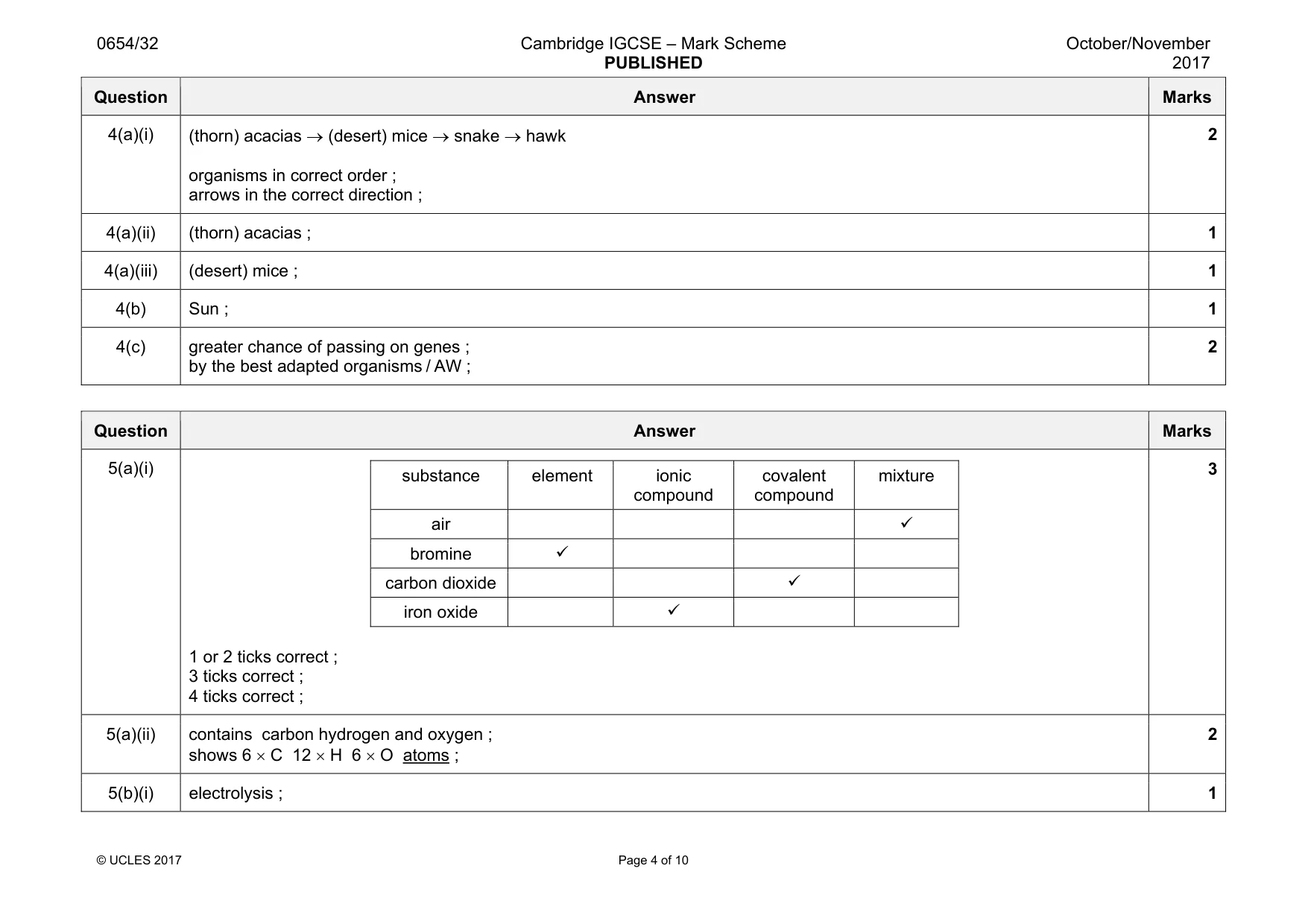
Mark scheme: 4(a)(i) organisms in correct order ; arrows in the correct direction ; 2 4(a)(ii) (thorn) acacias ; 1 4(a)(iii) (desert) mice ; 1 4(b) Sun ; 1 4(c) greater chance of passing on genes ; by the best adapted organisms / AW ; 2
Q5 · Ionic compounds contain ions
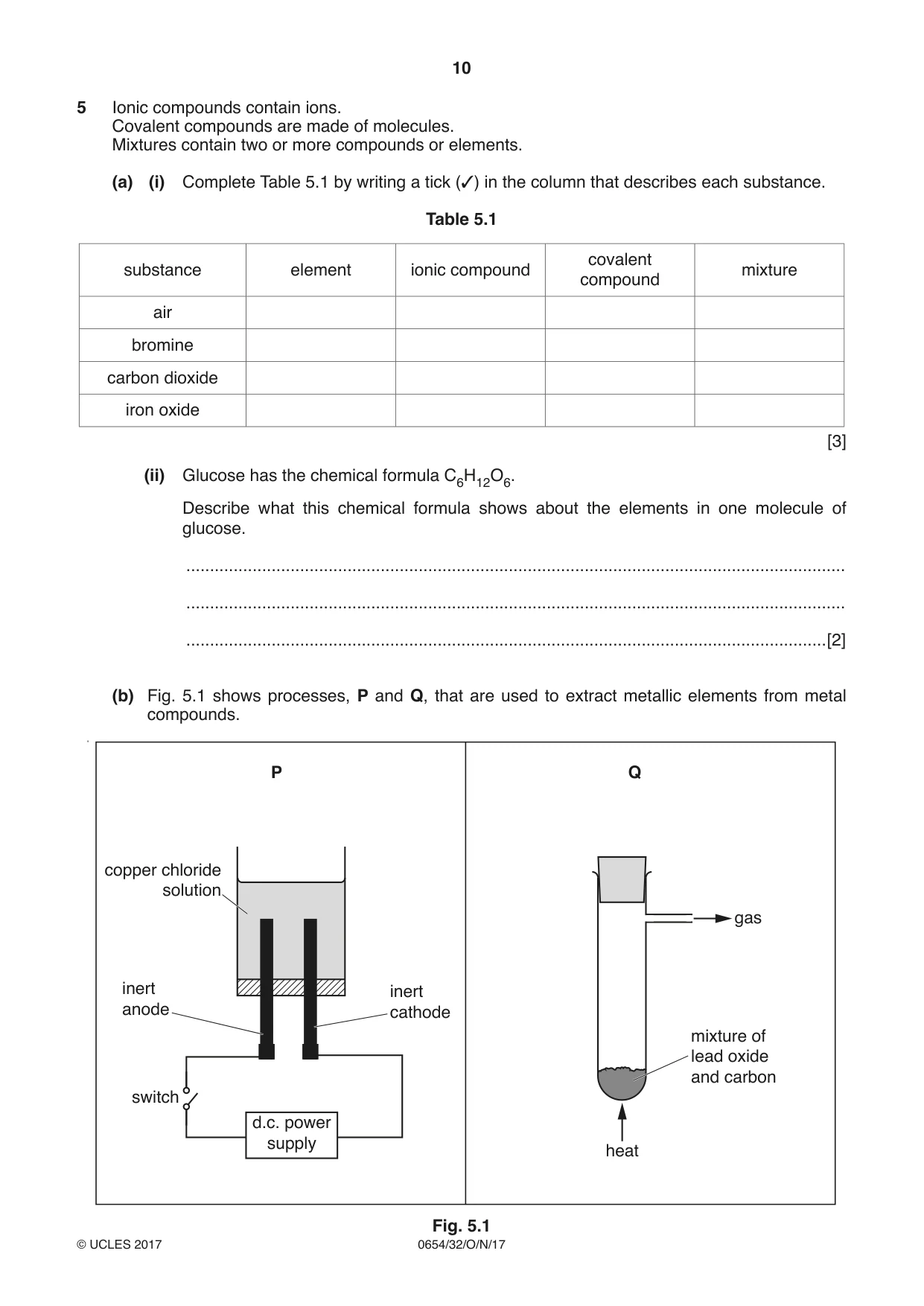
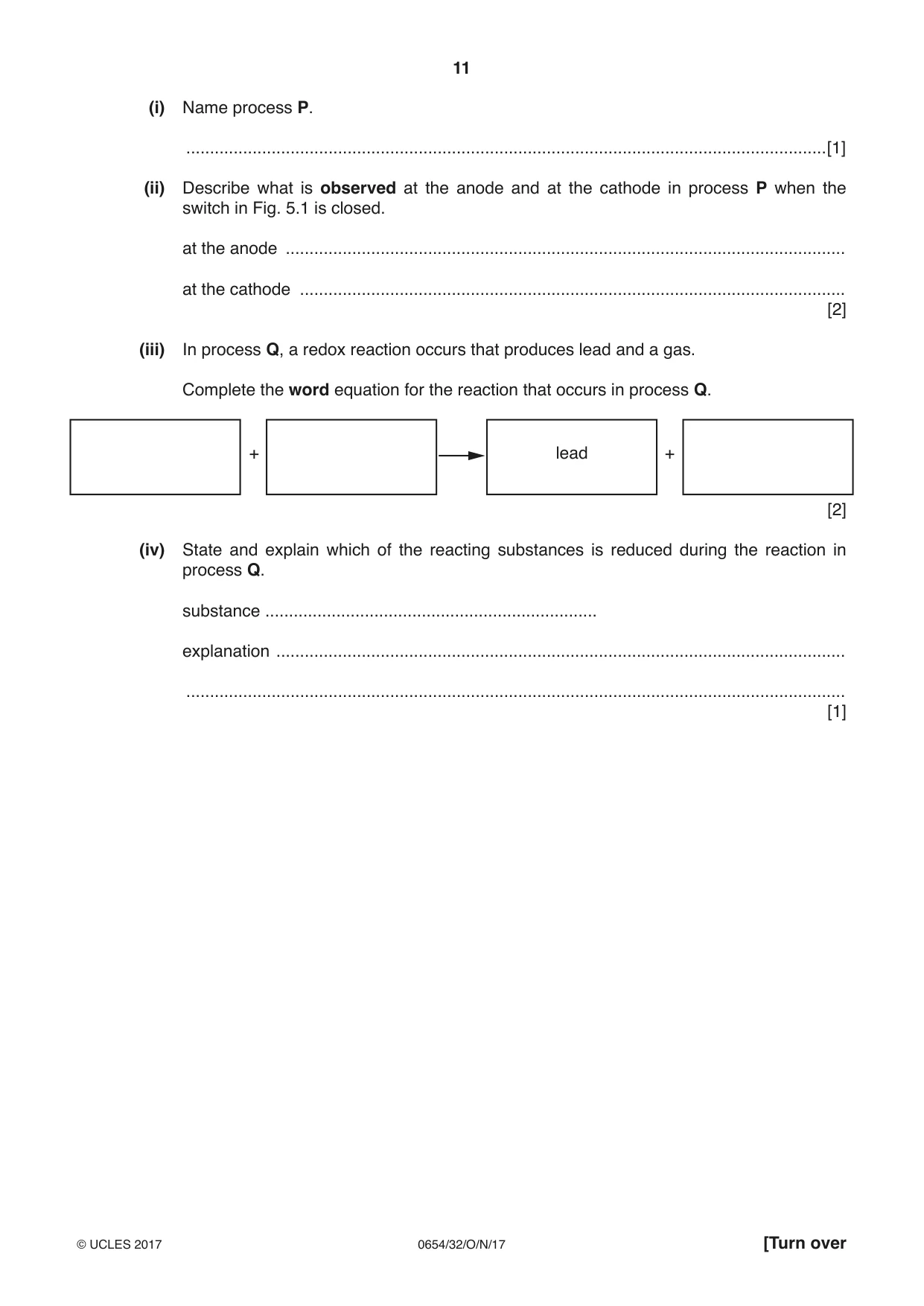
5 Ionic compounds contain ions. Covalent compounds are made of molecules. Mixtures contain two or more compounds or elements. (a) (i) Complete Table 5.1 by writing a tick (3) in the column that describes each substance. Table 5.1 covalent substance element ionic compound mixture compound air bromine carbon dioxide iron oxide [3] (ii) Glucose has the chemical formula C6H12O6. Describe what this chemical formula shows about the elements in one molecule of glucose. ........................................................................................................................................... ........................................................................................................................................... .......................................................................................................................................[2] (b) Fig. 5.1 shows processes, P and Q, that are used to extract metallic elements from metal compounds. P Q copper chloride solution gas inert inert anode cathode mixture of lead oxide and carbon switch d.c. power supply heat (i) Name process P. .......................................................................................................................................[1] (ii) Describe what is observed at the anode and at the cathode in process P when the switch in Fig. 5.1 is closed. at the anode ...................................................................................................................... at the cathode ................................................................................................................... [2] (iii) In process Q, a redox reaction occurs that produces lead and a gas. Complete the word equation for the reaction that occurs in process Q. + lead + [2] (iv) State and explain which of the reacting substances is reduced during the reaction in process Q. substance ...................................................................... explanation ........................................................................................................................ ........................................................................................................................................... [1]
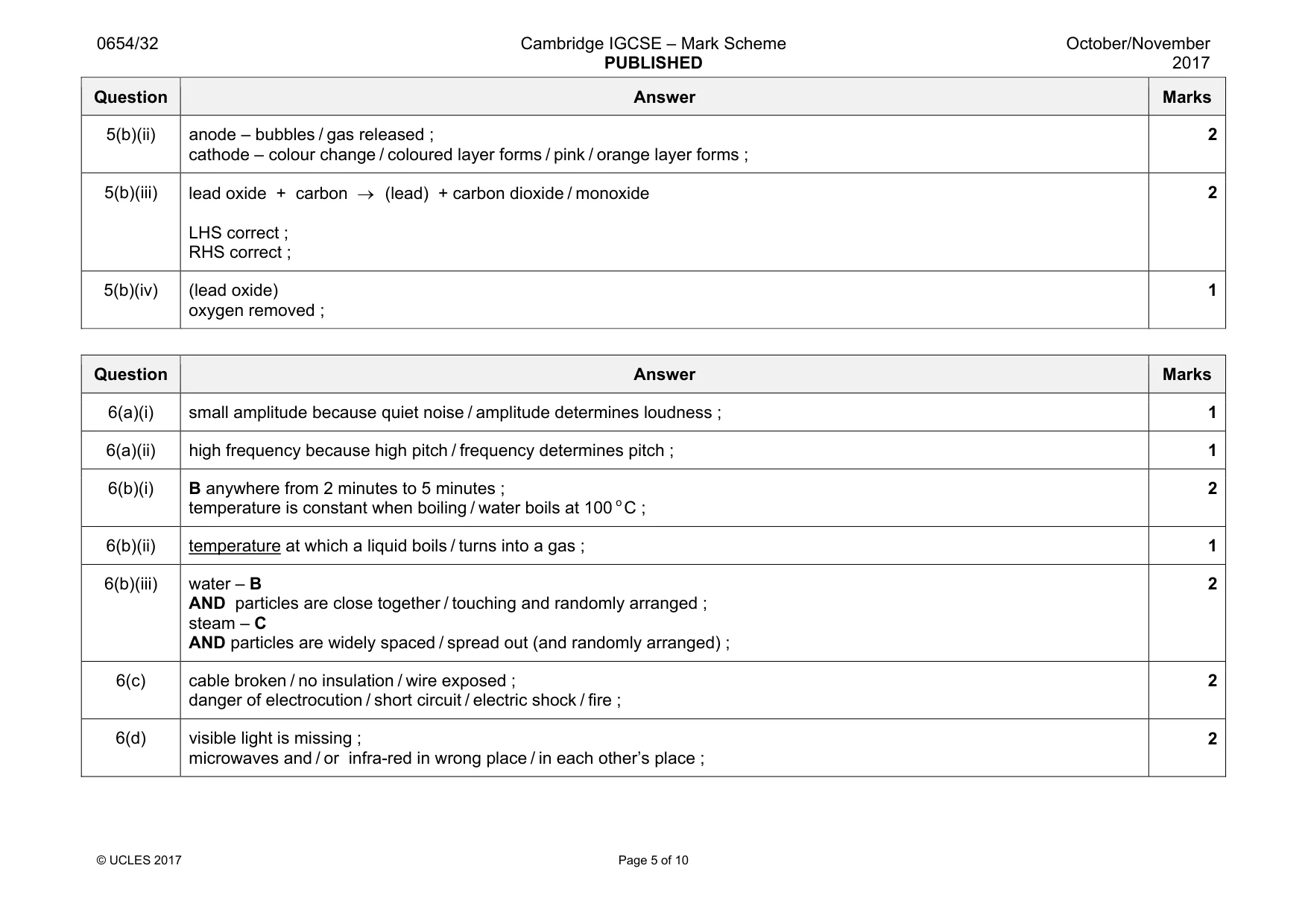
Mark scheme: 5(a)(i) substance element ionic compound covalent compound mixture air 9 bromine 9 carbon dioxide 9 iron oxide 9 1 or 2 ticks correct ; 3 ticks correct ; 4 ticks correct ; 3 5(a)(ii) contains carbon hydrogen and oxygen ; shows 6 × C 12 × H 6 × O atoms ; 2 5(b)(i) electrolysis ; 1 Question Answer Marks 5(b)(ii) anode – bubbles / gas released ; cathode – colour change / coloured layer forms / pink / orange layer forms ; 2 5(b)(iii) lead oxide + carbon → (lead) + carbon dioxide / monoxide LHS correct ; RHS correct ; 2 5(b)(iv) (lead oxide) oxygen removed ; 1
Q6 · A microwave oven contains a motor which produces a quiet sound with a high pitch
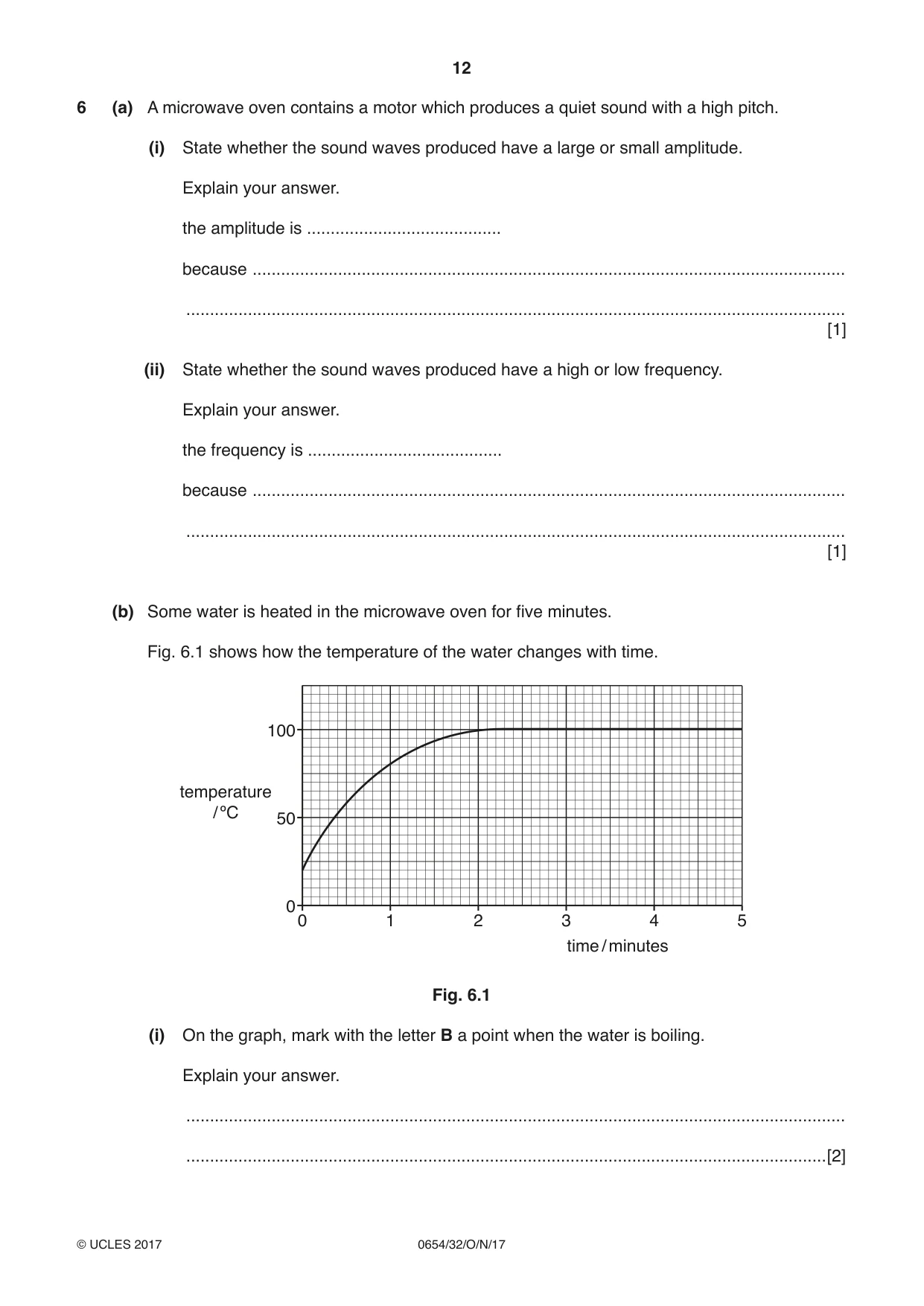
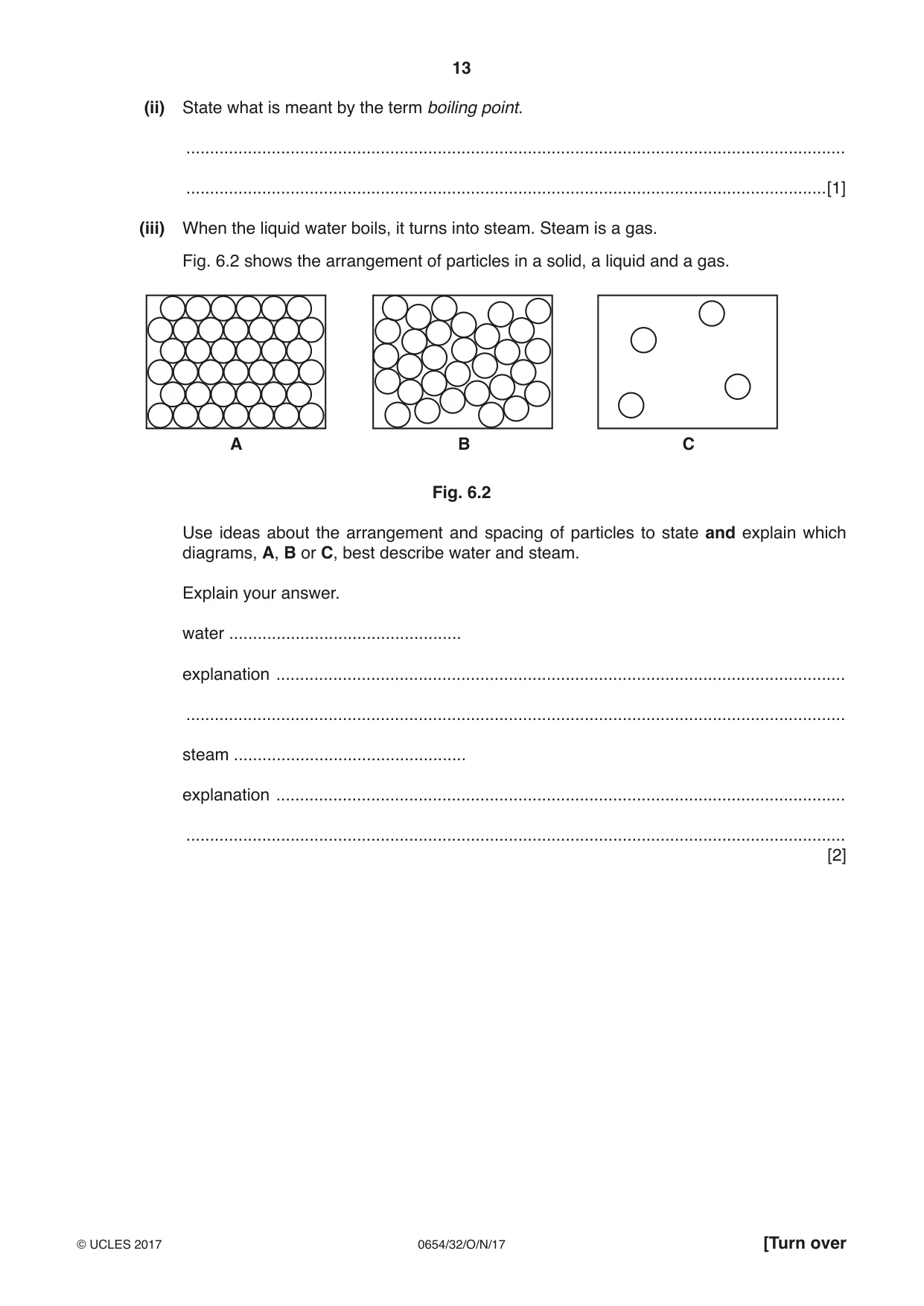
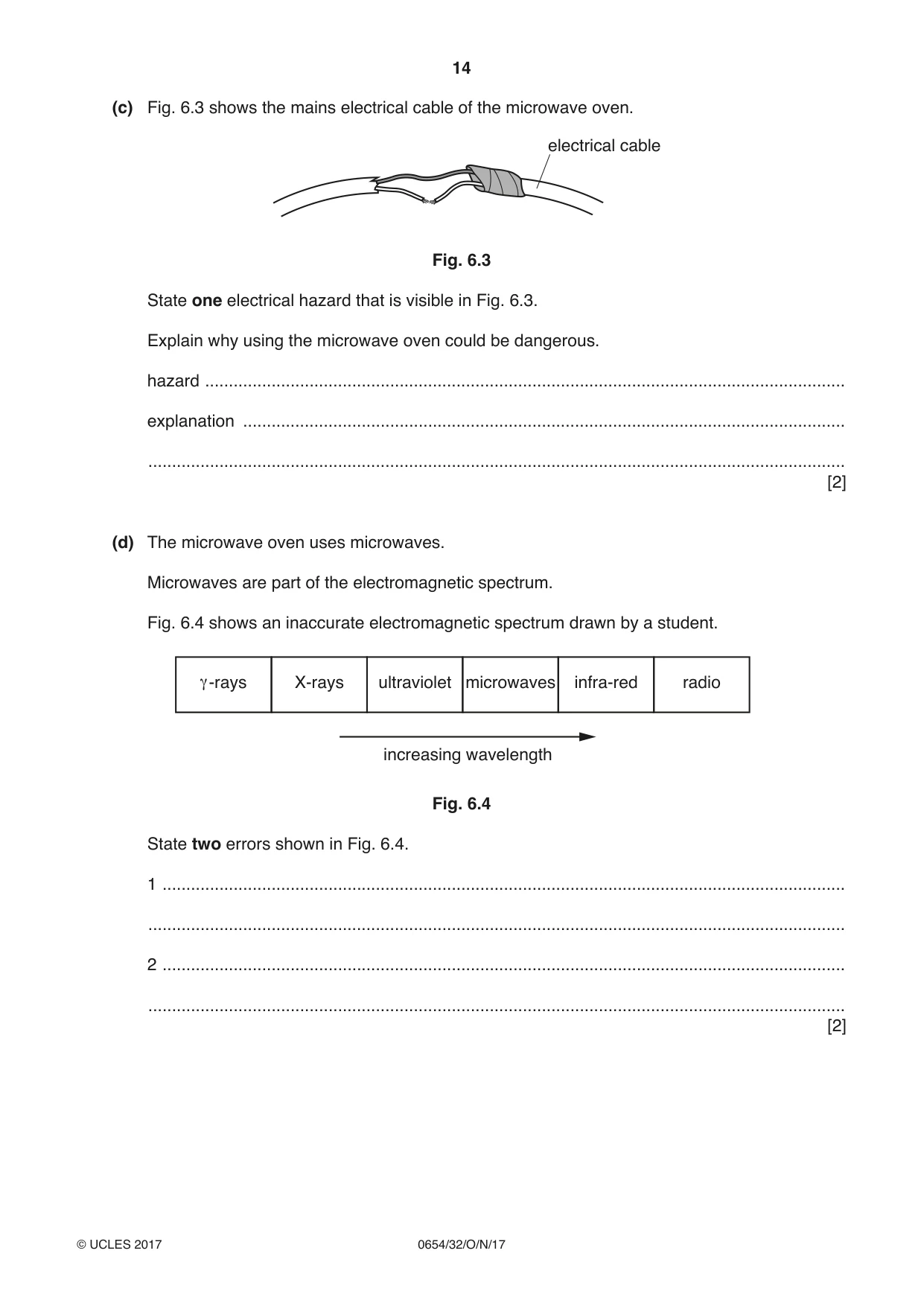
6 (a) A microwave oven contains a motor which produces a quiet sound with a high pitch. (i) State whether the sound waves produced have a large or small amplitude. Explain your answer. the amplitude is ......................................... because ............................................................................................................................. ........................................................................................................................................... [1] (ii) State whether the sound waves produced have a high or low frequency. Explain your answer. the frequency is ......................................... because ............................................................................................................................. ........................................................................................................................................... [1] (b) Some water is heated in the microwave oven for five minutes. Fig. 6.1 shows how the temperature of the water changes with time. 100 temperature / ºC 50 0 0 1 2 3 4 5 time / minutes Fig. 6.1 (i) On the graph, mark with the letter B a point when the water is boiling. Explain your answer. ........................................................................................................................................... .......................................................................................................................................[2] (ii) State what is meant by the term boiling point. ........................................................................................................................................... .......................................................................................................................................[1] (iii) When the liquid water boils, it turns into steam. Steam is a gas. Fig. 6.2 shows the arrangement of particles in a solid, a liquid and a gas. A B C Fig. 6.2 Use ideas about the arrangement and spacing of particles to state and explain which diagrams, A, B or C, best describe water and steam. Explain your answer. water ................................................. explanation ........................................................................................................................ ........................................................................................................................................... steam ................................................. explanation ........................................................................................................................ ........................................................................................................................................... [2] (c) Fig. 6.3 shows the mains electrical cable of the microwave oven. electrical cable Fig. 6.3 State one electrical hazard that is visible in Fig. 6.3. Explain why using the microwave oven could be dangerous. hazard ....................................................................................................................................... explanation ............................................................................................................................... ................................................................................................................................................... [2] (d) The microwave oven uses microwaves. Microwaves are part of the electromagnetic spectrum. Fig. 6.4 shows an inaccurate electromagnetic spectrum drawn by a student. γ -rays X-rays ultraviolet microwaves infra-red radio increasing wavelength Fig. 6.4 State two errors shown in Fig. 6.4. 1 ................................................................................................................................................ ................................................................................................................................................... 2 ................................................................................................................................................ ................................................................................................................................................... [2] Please turn over for Question 7.
Mark scheme: 6(a)(i) small amplitude because quiet noise / amplitude determines loudness ; 1 6(a)(ii) high frequency because high pitch / frequency determines pitch ; 1 6(b)(i) B anywhere from 2 minutes to 5 minutes ; temperature is constant when boiling / water boils at 100 o C ; 2 6(b)(ii) temperature at which a liquid boils / turns into a gas ; 1 6(b)(iii) water – B AND particles are close together / touching and randomly arranged ; steam – C AND particles are widely spaced / spread out (and randomly arranged) ; 2 6(c) cable broken / no insulation / wire exposed ; danger of electrocution / short circuit / electric shock / fire ; 2 6(d) visible light is missing ; microwaves and / or infra-red in wrong place / in each other’s place ; 2
Q7 · A diagram of the different types of teeth in a human
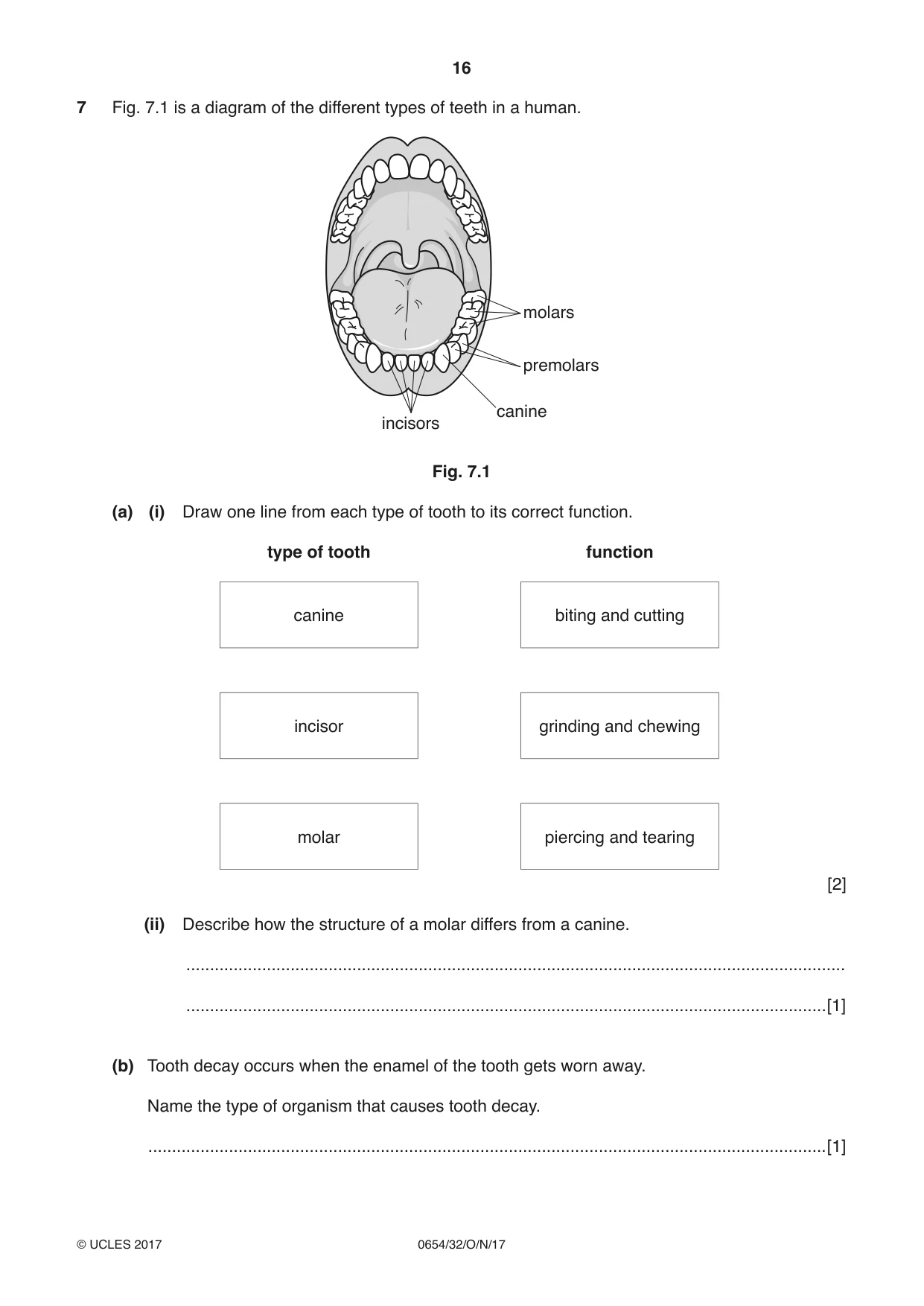
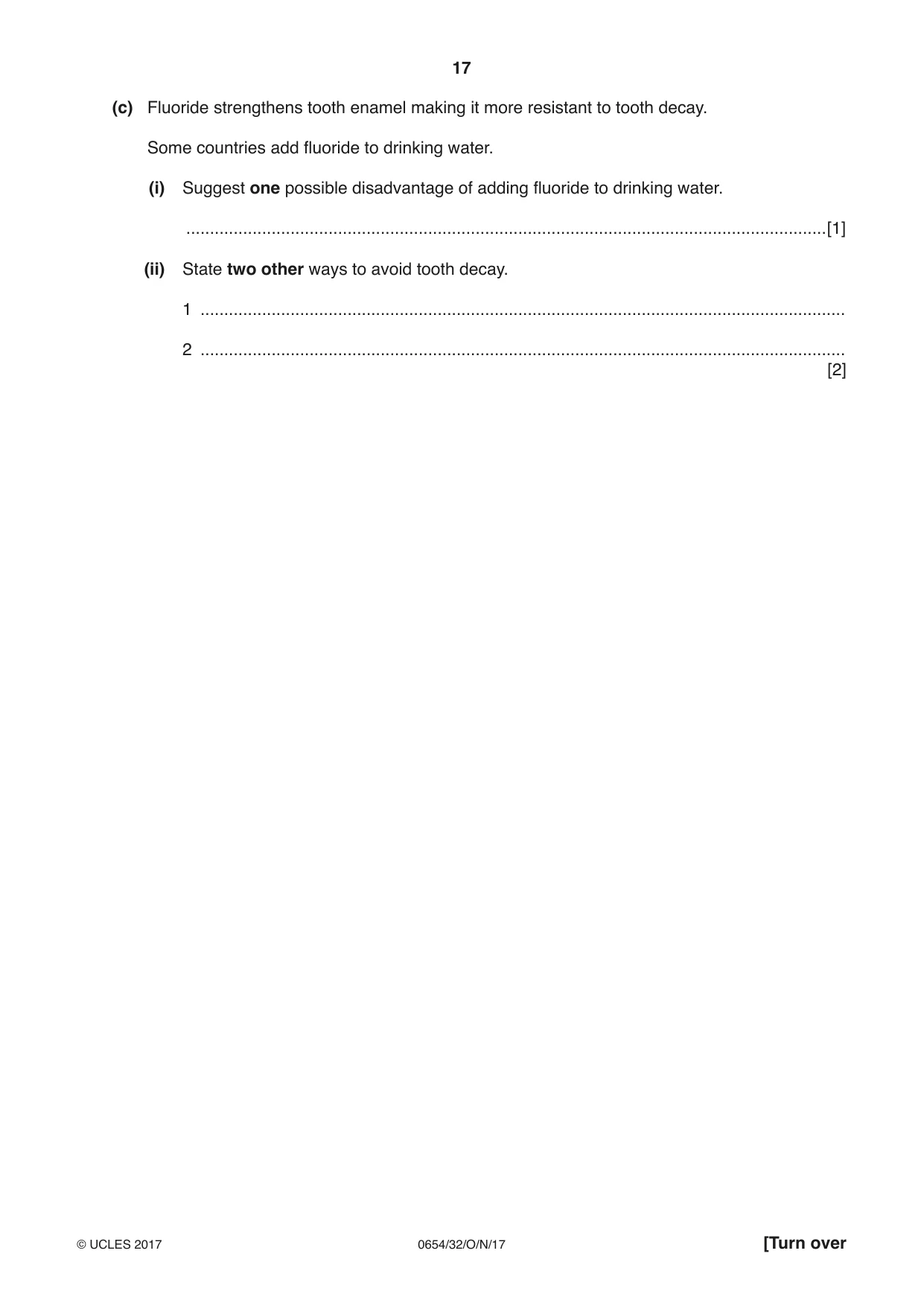
7 Fig. 7.1 is a diagram of the different types of teeth in a human. molars premolars canine incisors Fig. 7.1 (a) (i) Draw one line from each type of tooth to its correct function. type of tooth function canine biting and cutting incisor grinding and chewing molar piercing and tearing [2] (ii) Describe how the structure of a molar differs from a canine. ........................................................................................................................................... .......................................................................................................................................[1] (b) Tooth decay occurs when the enamel of the tooth gets worn away. Name the type of organism that causes tooth decay. ...............................................................................................................................................[1] (c) Fluoride strengthens tooth enamel making it more resistant to tooth decay. Some countries add fluoride to drinking water. (i) Suggest one possible disadvantage of adding fluoride to drinking water. .......................................................................................................................................[1] (ii) State two other ways to avoid tooth decay. 1 ........................................................................................................................................ 2 ........................................................................................................................................ [2]
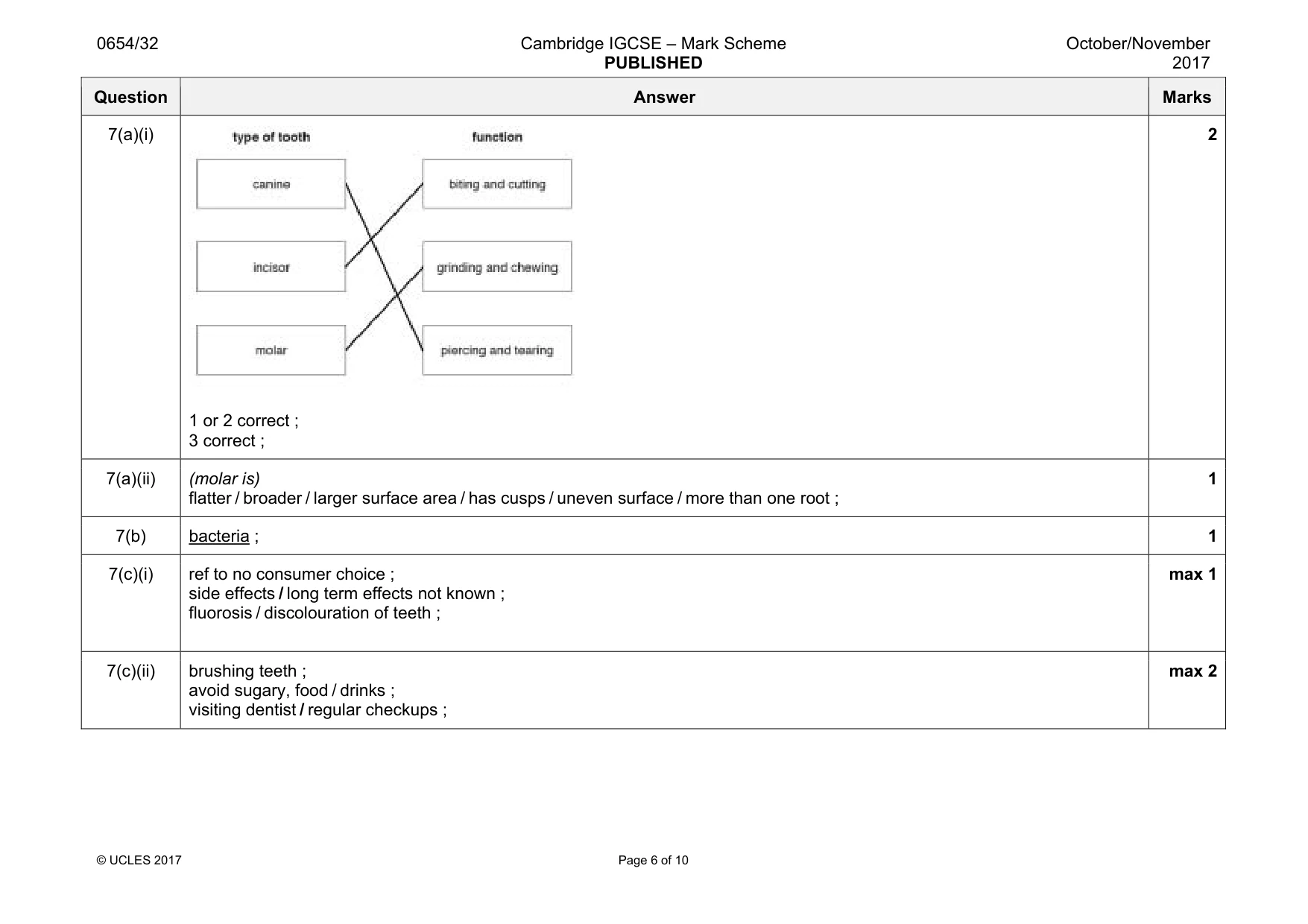
Mark scheme: 7(a)(i) 1 or 2 correct ; 3 correct ; 2 7(a)(ii) (molar is) flatter / broader / larger surface area / has cusps / uneven surface / more than one root ; 1 7(b) bacteria ; 1 7(c)(i) ref to no consumer choice ; side effects / long term effects not known ; fluorosis / discolouration of teeth ; max 1 7(c)(ii) brushing teeth ; avoid sugary, food / drinks ; visiting dentist / regular checkups ; max 2
Q8 · Water is a neutral liquid
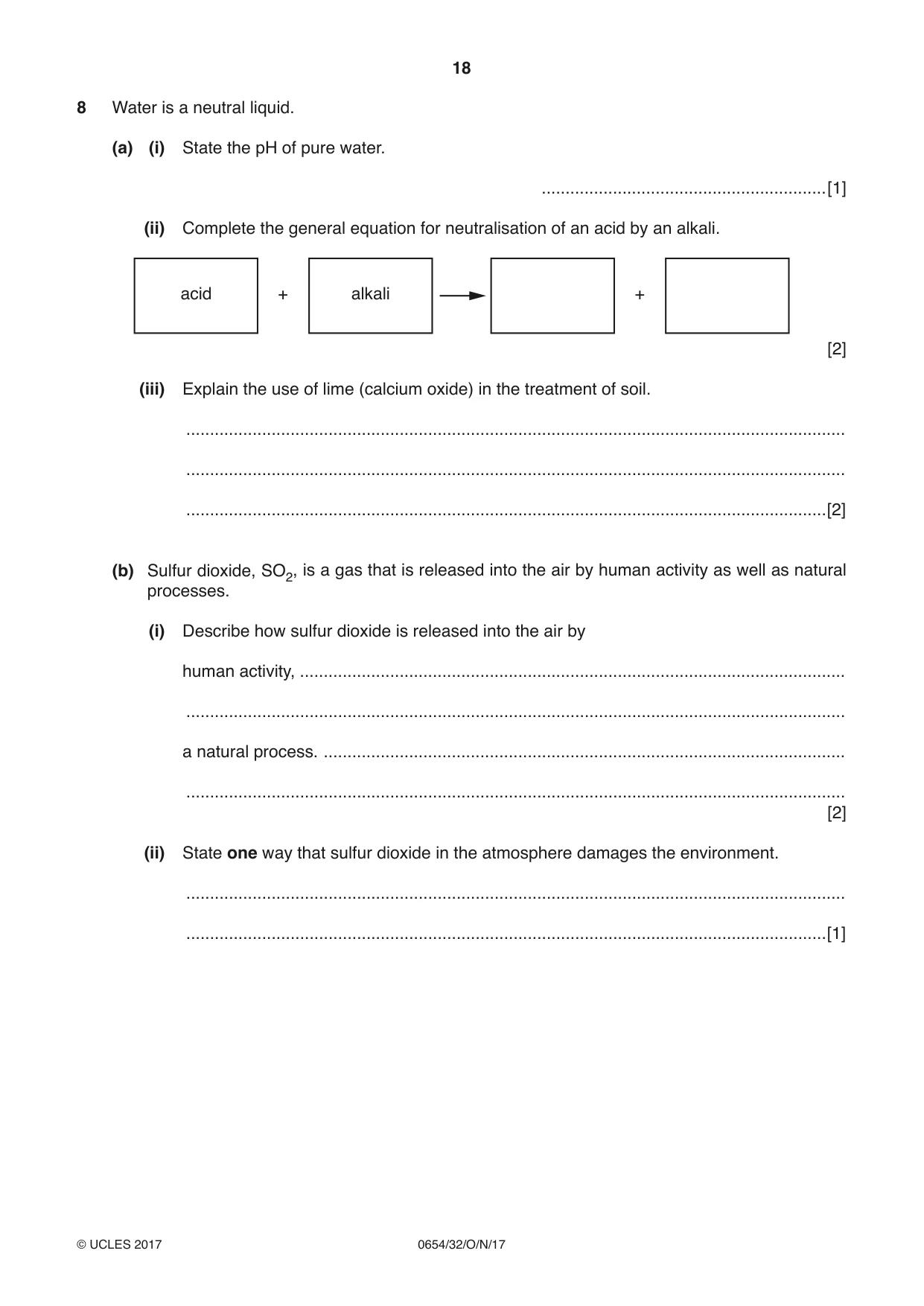
8 Water is a neutral liquid. (a) (i) State the pH of pure water. ............................................................[1] (ii) Complete the general equation for neutralisation of an acid by an alkali. acid + alkali + [2] (iii) Explain the use of lime (calcium oxide) in the treatment of soil. ........................................................................................................................................... ........................................................................................................................................... .......................................................................................................................................[2] (b) Sulfur dioxide, SO2, is a gas that is released into the air by human activity as well as natural processes. (i) Describe how sulfur dioxide is released into the air by human activity, ................................................................................................................... ........................................................................................................................................... a natural process. .............................................................................................................. ........................................................................................................................................... [2] (ii) State one way that sulfur dioxide in the atmosphere damages the environment. ........................................................................................................................................... .......................................................................................................................................[1]
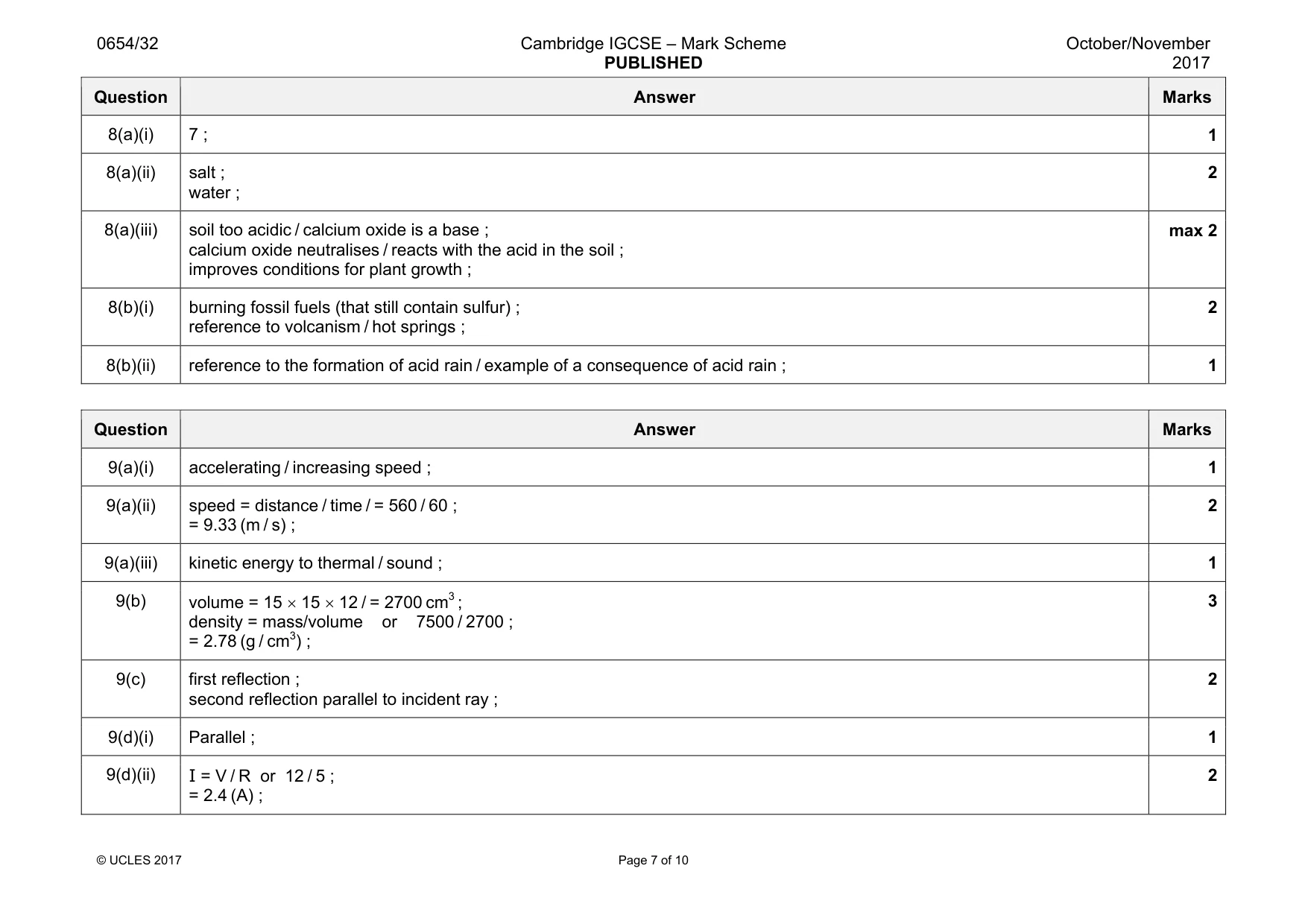
Mark scheme: 8(a)(i) 7 ; 1 8(a)(ii) salt ; water ; 2 8(a)(iii) soil too acidic / calcium oxide is a base ; calcium oxide neutralises / reacts with the acid in the soil ; improves conditions for plant growth ; max 2 8(b)(i) burning fossil fuels (that still contain sulfur) ; reference to volcanism / hot springs ; 2 8(b)(ii) reference to the formation of acid rain / example of a consequence of acid rain ; 1
More questions on The characteristic properties of acids and bases
Q9 · A boy rides his bicycle along a straight level road
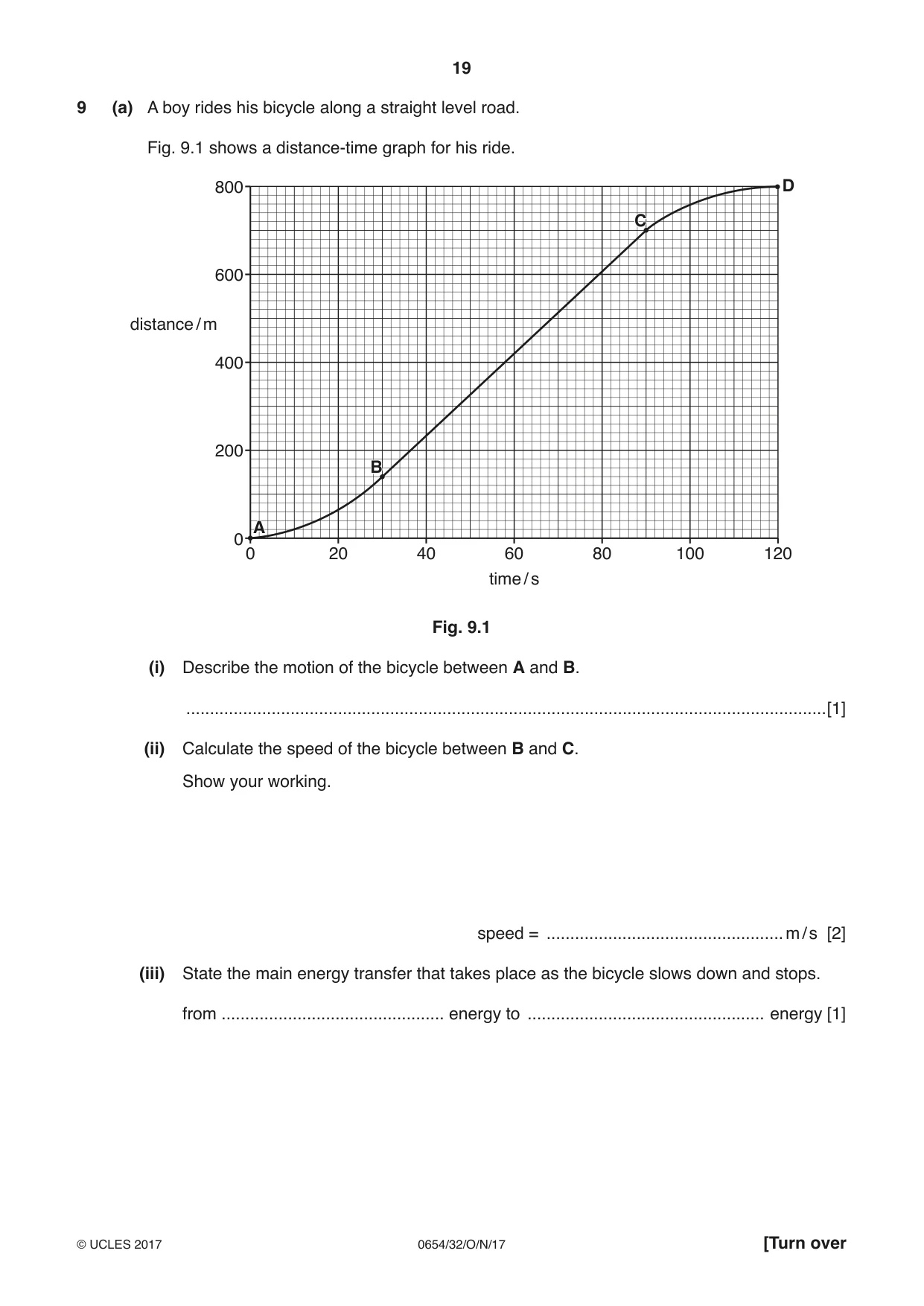
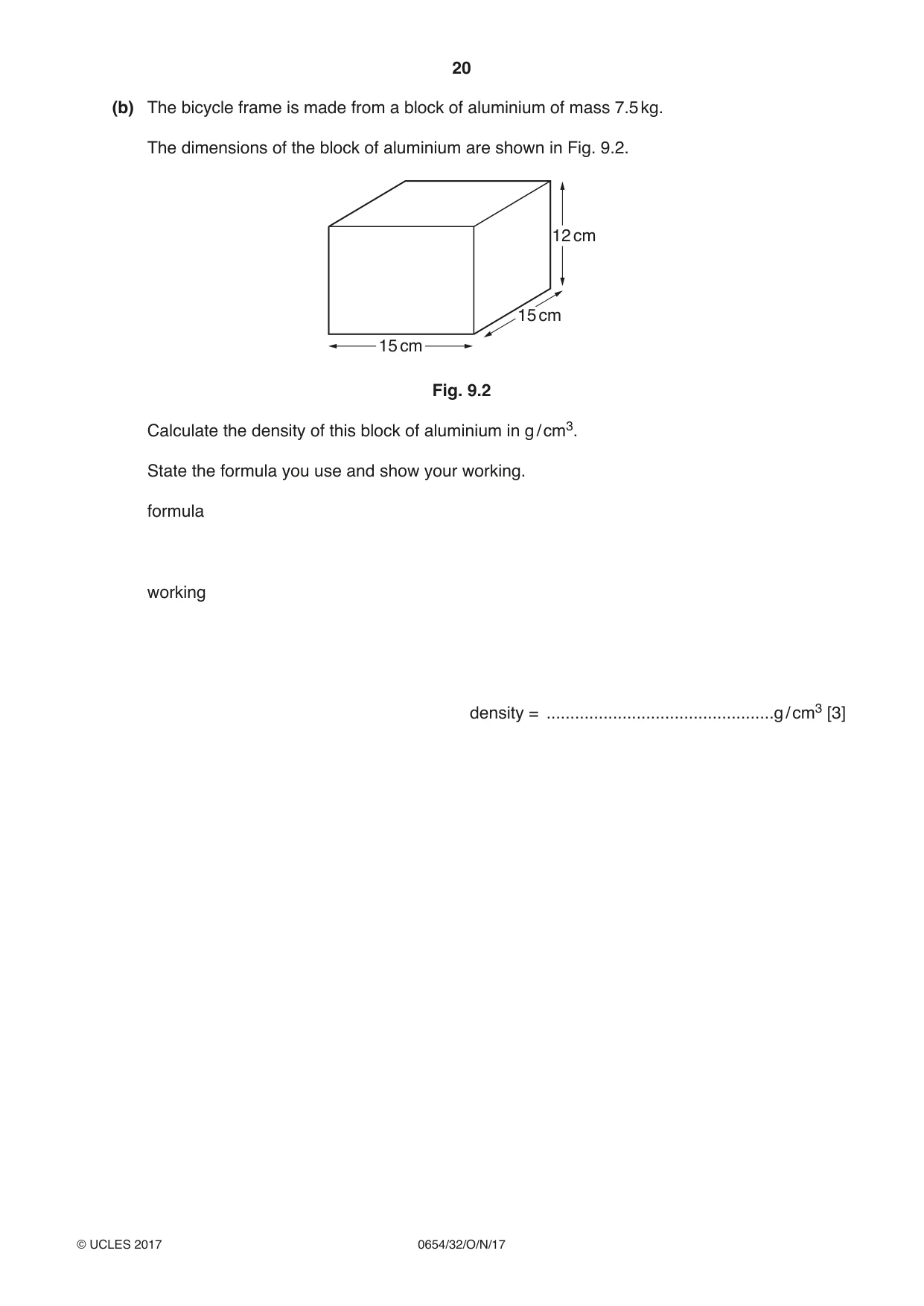
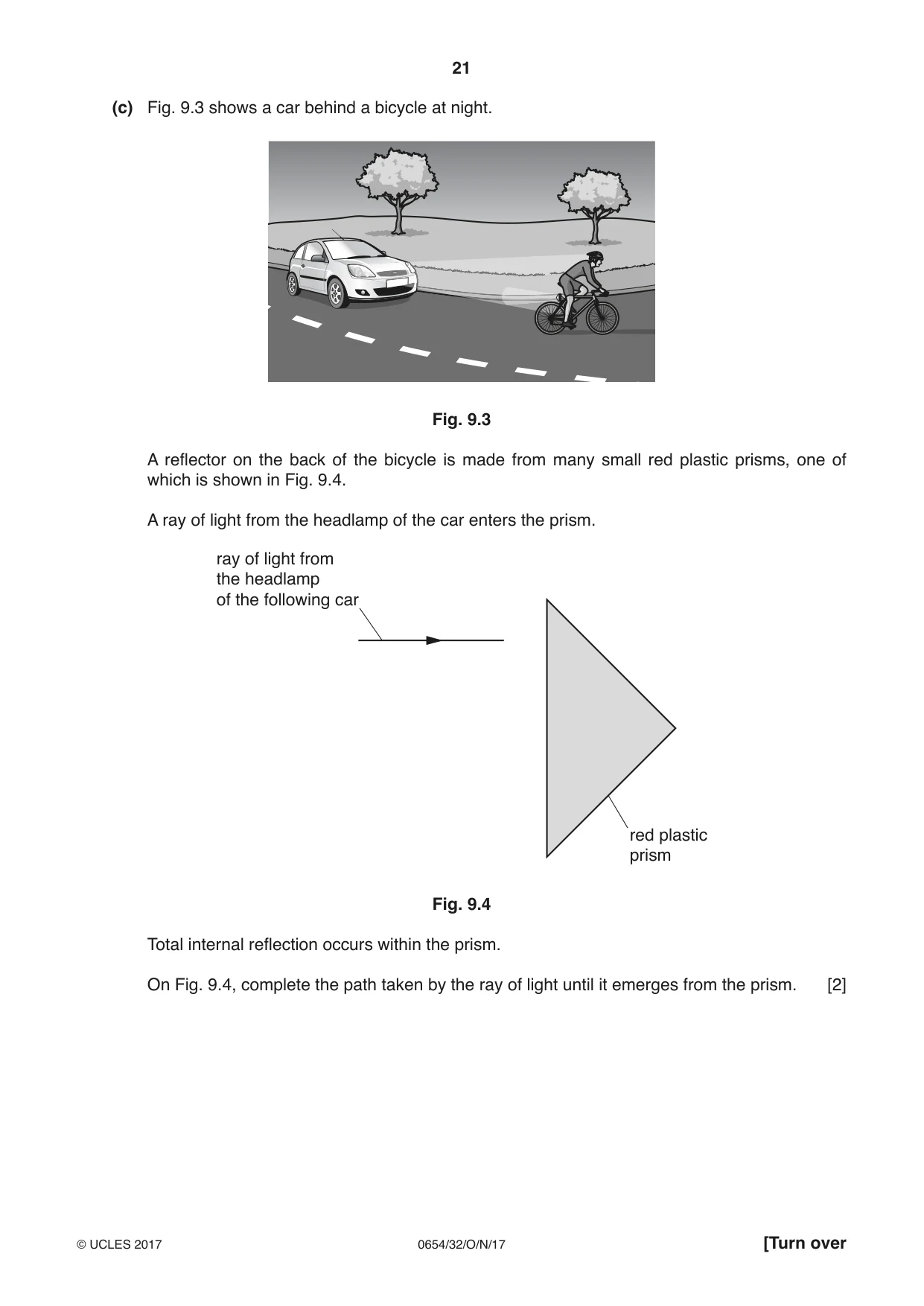
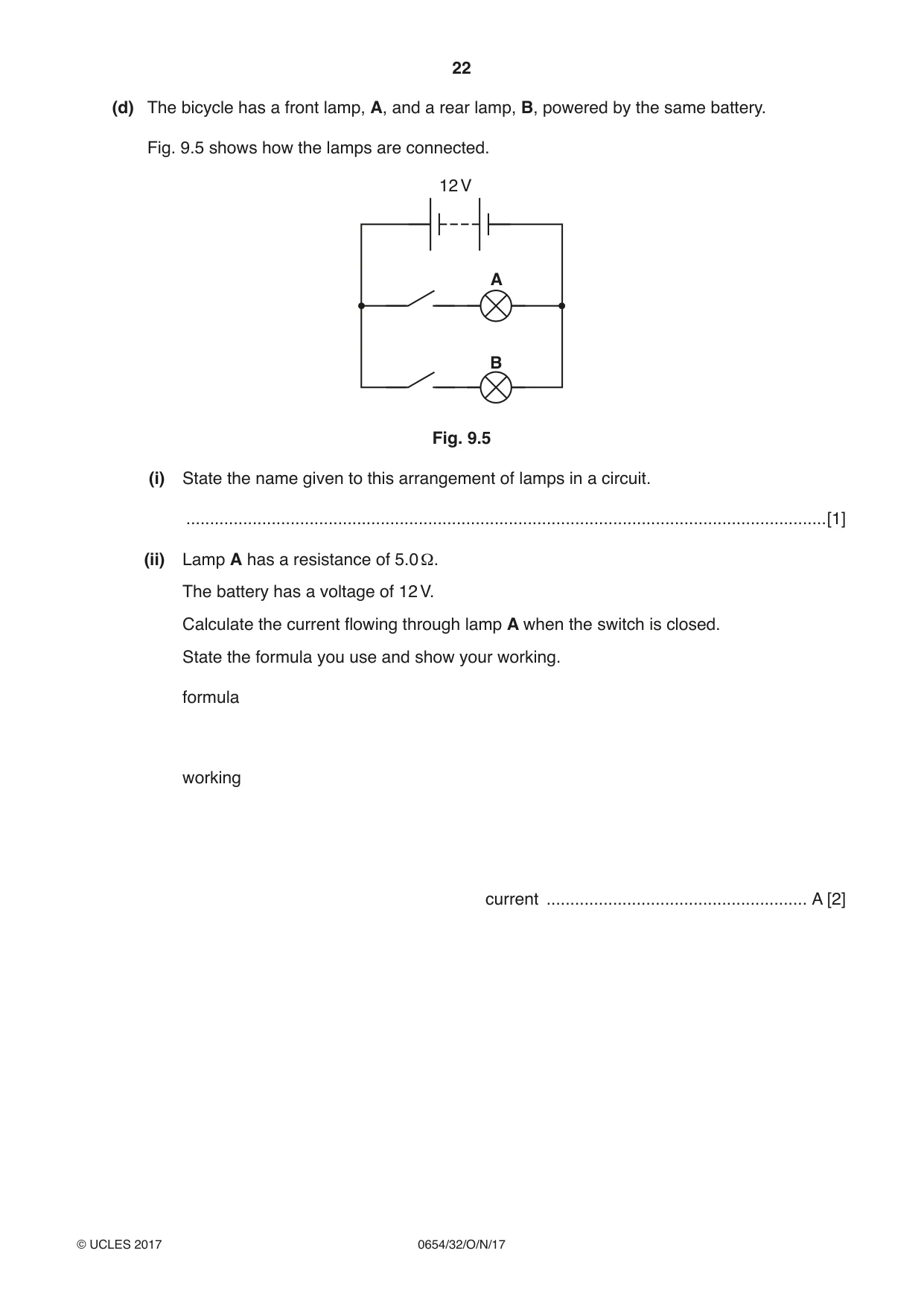
9 (a) A boy rides his bicycle along a straight level road. Fig. 9.1 shows a distance-time graph for his ride. 800 D CC 600 distance / m 400 200 B A 0 0 20 40 60 80 100 120 time / s Fig. 9.1 (i) Describe the motion of the bicycle between A and B. .......................................................................................................................................[1] (ii) Calculate the speed of the bicycle between B and C. Show your working. speed = ..................................................m / s [2] (iii) State the main energy transfer that takes place as the bicycle slows down and stops. from ............................................... energy to .................................................. energy [1] (b) The bicycle frame is made from a block of aluminium of mass 7.5 kg. The dimensions of the block of aluminium are shown in Fig. 9.2. 12 cm 15 cm 15 cm Fig. 9.2 Calculate the density of this block of aluminium in g / cm3. State the formula you use and show your working. formula working density = ................................................g / cm3 [3] (c) Fig. 9.3 shows a car behind a bicycle at night. Fig. 9.3 A reflector on the back of the bicycle is made from many small red plastic prisms, one of which is shown in Fig. 9.4. A ray of light from the headlamp of the car enters the prism. ray of light from the headlamp of the following car red plastic prism Fig. 9.4 Total internal reflection occurs within the prism. On Fig. 9.4, complete the path taken by the ray of light until it emerges from the prism. [2] (d) The bicycle has a front lamp, A, and a rear lamp, B, powered by the same battery. Fig. 9.5 shows how the lamps are connected. 12 V A B Fig. 9.5 (i) State the name given to this arrangement of lamps in a circuit. .......................................................................................................................................[1] (ii) Lamp A has a resistance of 5.0 Ω. The battery has a voltage of 12 V. Calculate the current flowing through lamp A when the switch is closed. State the formula you use and show your working. formula working current ....................................................... A [2]
Mark scheme: 9(a)(i) accelerating / increasing speed ; 1 9(a)(ii) speed = distance / time / = 560 / 60 ; = 9.33 (m / s) ; 2 9(a)(iii) kinetic energy to thermal / sound ; 1 9(b) volume = 15 × 15 × 12 / = 2700 cm3 ; density = mass/volume or 7500 / 2700 ; = 2.78 (g / cm3) ; 3 9(c) first reflection ; second reflection parallel to incident ray ; 2 9(d)(i) Parallel ; 1 9(d)(ii) I = V / R or 12 / 5 ; = 2.4 (A) ; 2
Q10 · A photograph of a germinating pea seed
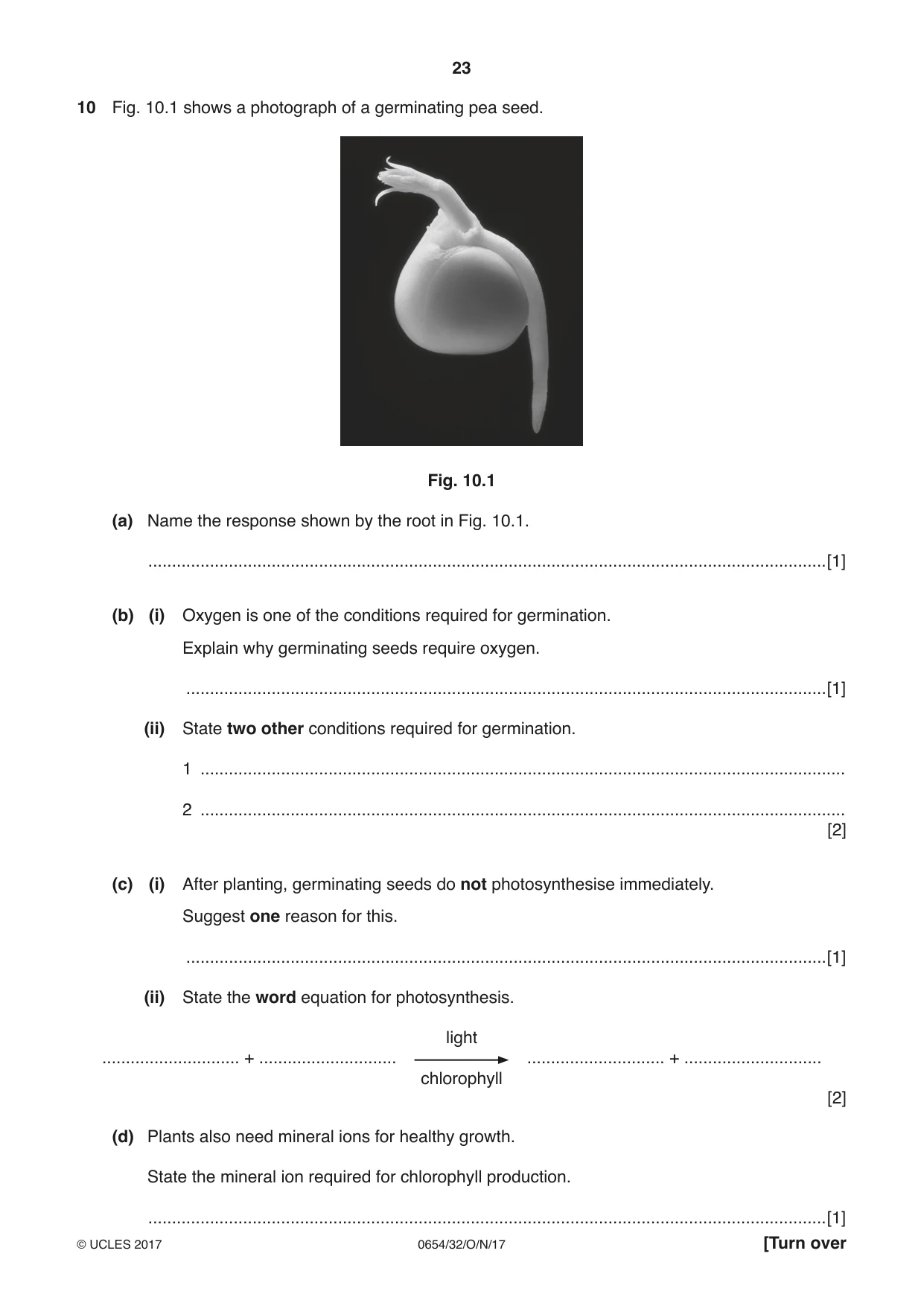
10 Fig. 10.1 shows a photograph of a germinating pea seed. Fig. 10.1 (a) Name the response shown by the root in Fig. 10.1. ...............................................................................................................................................[1] (b) (i) Oxygen is one of the conditions required for germination. Explain why germinating seeds require oxygen. .......................................................................................................................................[1] (ii) State two other conditions required for germination. 1 ........................................................................................................................................ 2 ........................................................................................................................................ [2] (c) (i) After planting, germinating seeds do not photosynthesise immediately. Suggest one reason for this. .......................................................................................................................................[1] (ii) State the word equation for photosynthesis. light ............................. + ............................. ............................. + ............................. chlorophyll [2] (d) Plants also need mineral ions for healthy growth. State the mineral ion required for chlorophyll production. ...............................................................................................................................................[1]
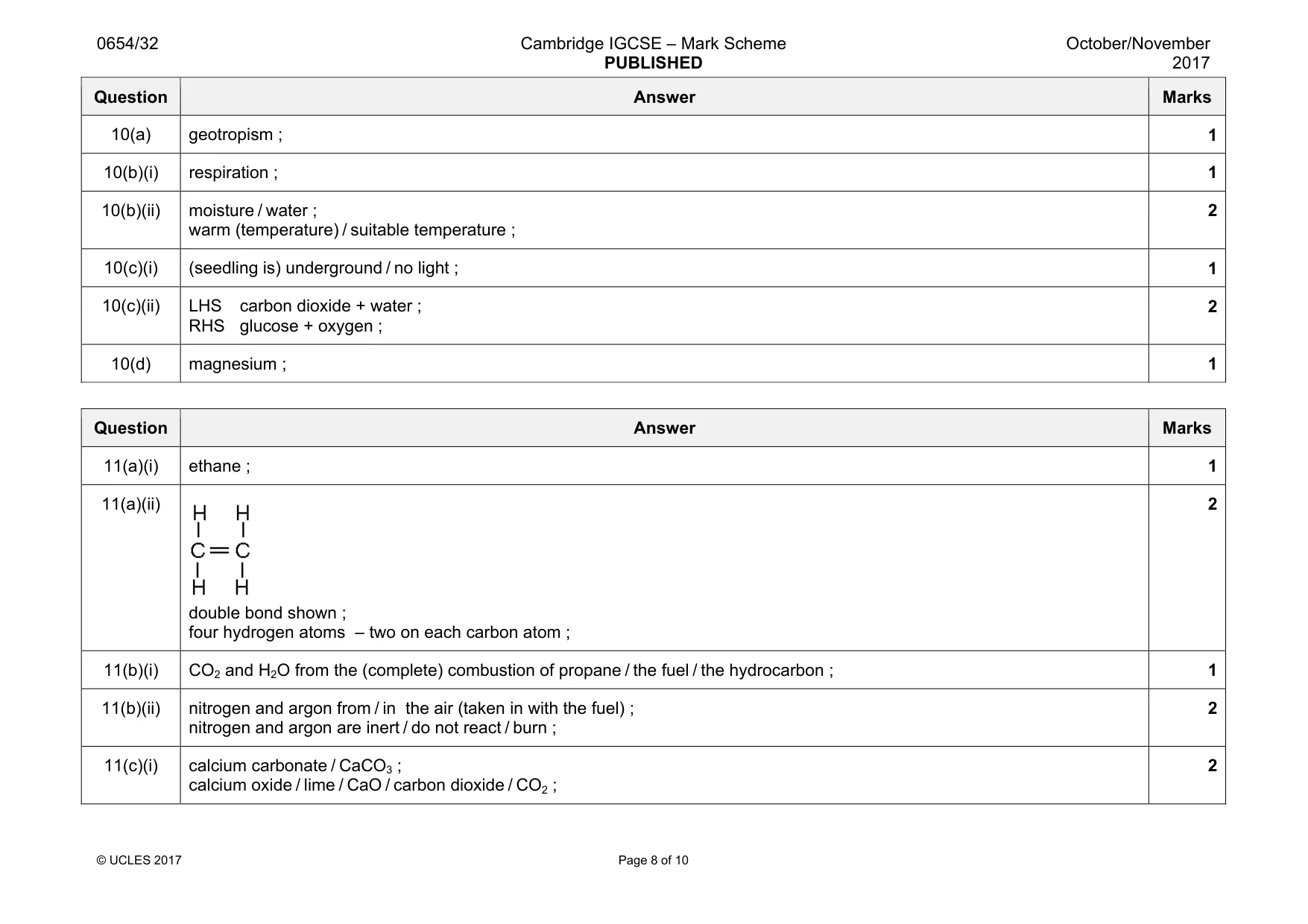
Mark scheme: 10(a) geotropism ; 1 10(b)(i) respiration ; 1 10(b)(ii) moisture / water ; warm (temperature) / suitable temperature ; 2 10(c)(i) (seedling is) underground / no light ; 1 10(c)(ii) LHS carbon dioxide + water ; RHS glucose + oxygen ; 2 10(d) magnesium ; 1
Q11 · The structure of a molecule of an alkane
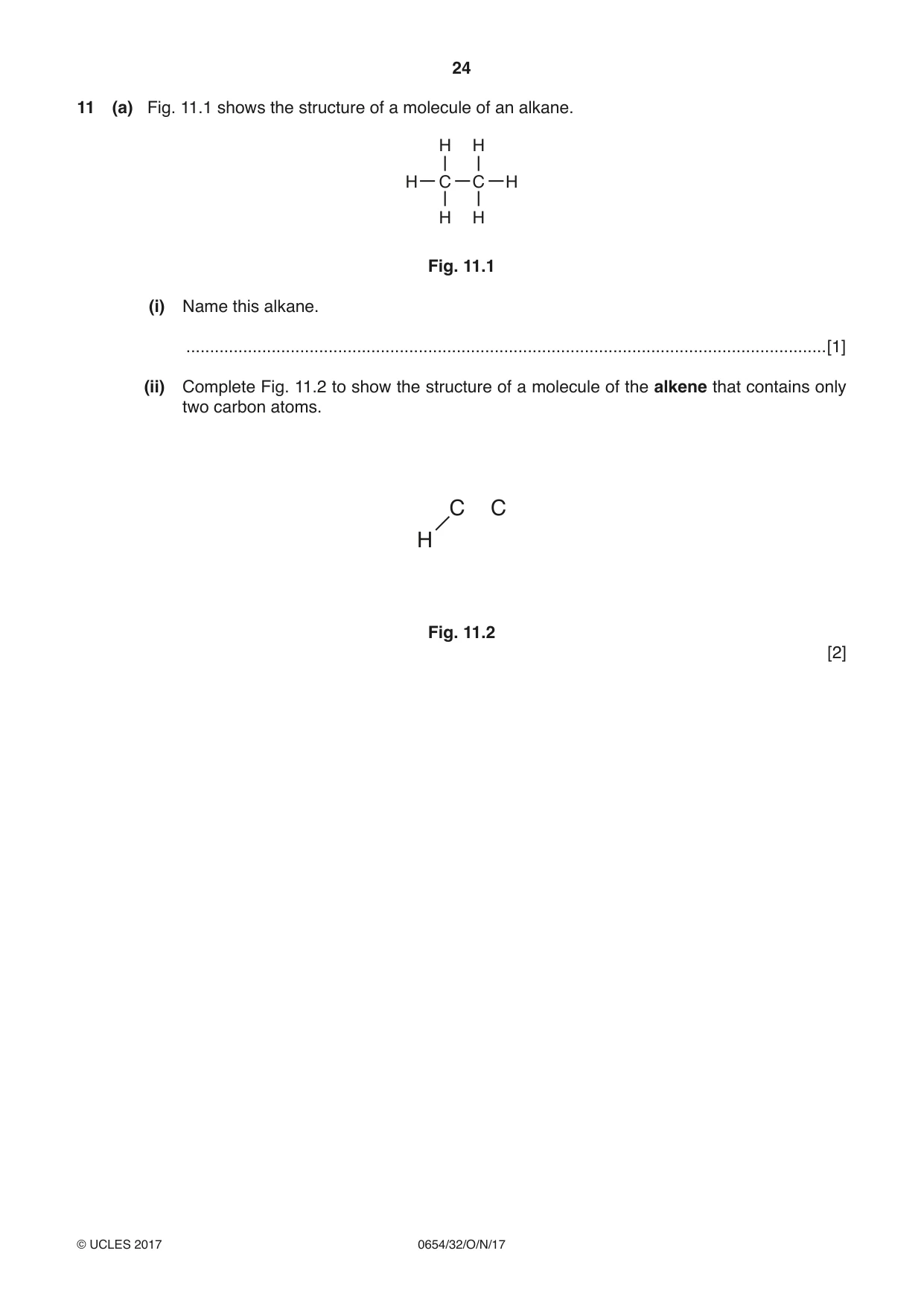
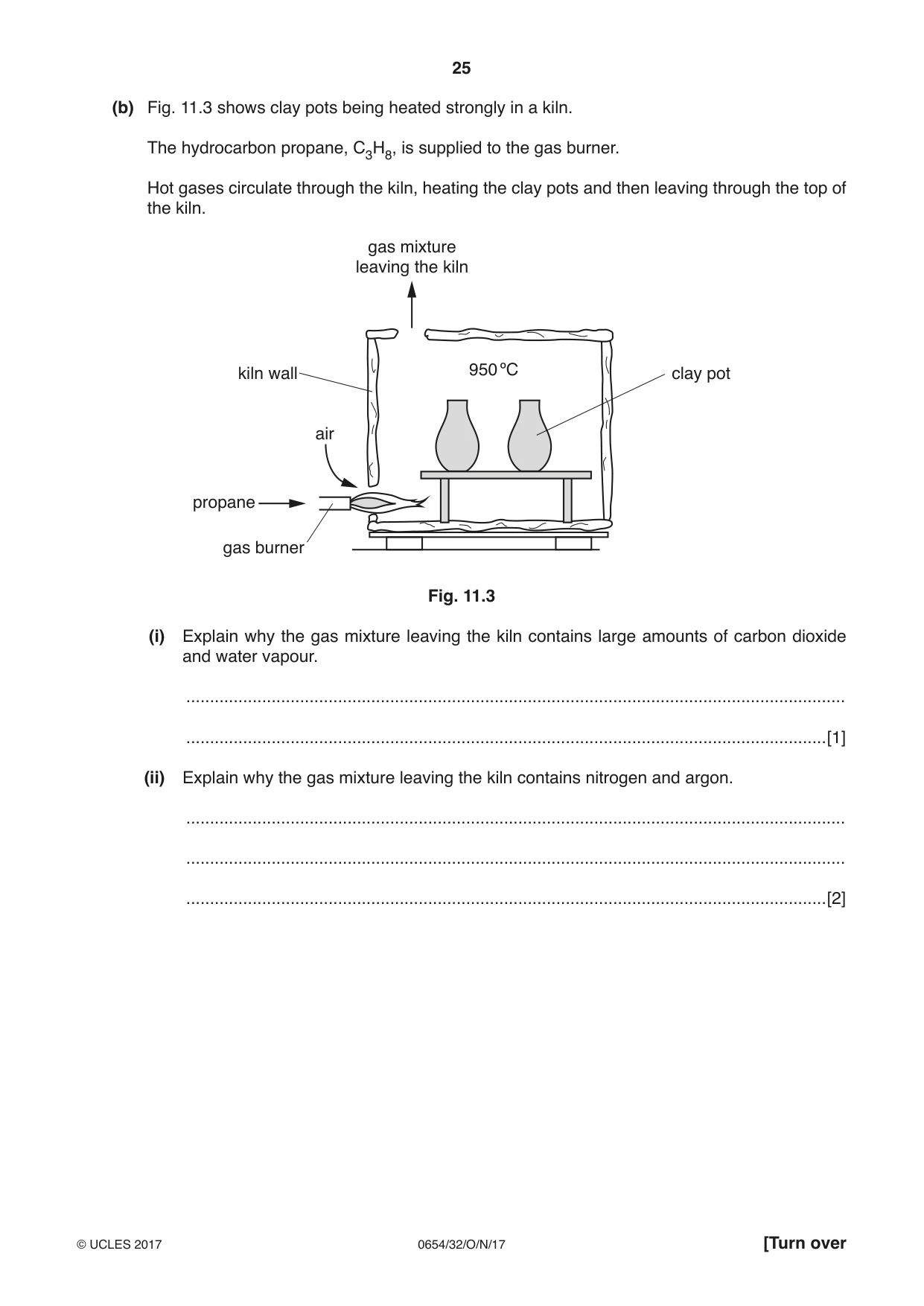
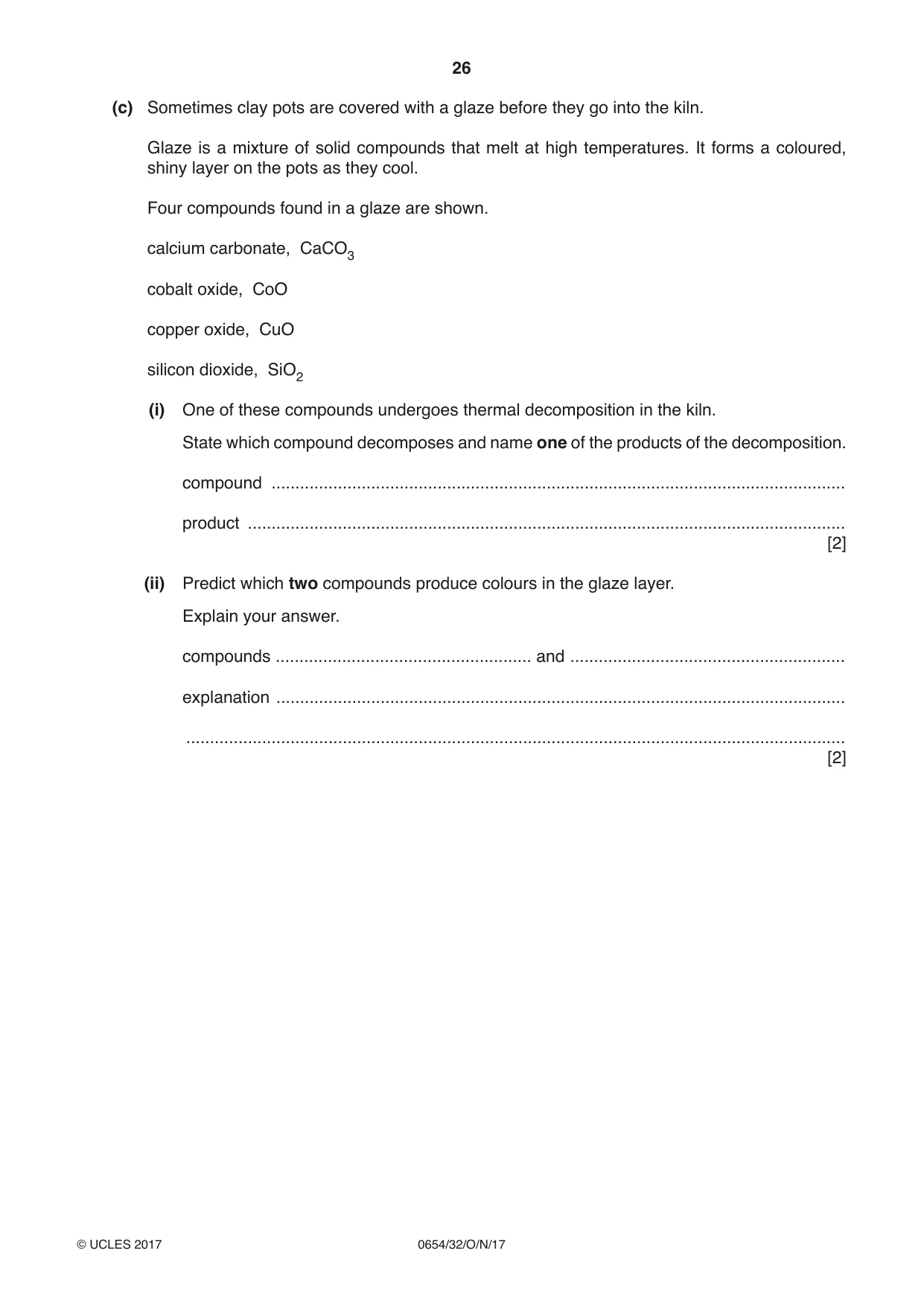
11 (a) Fig. 11.1 shows the structure of a molecule of an alkane. H H H C C H H H Fig. 11.1 (i) Name this alkane. .......................................................................................................................................[1] (ii) Complete Fig. 11.2 to show the structure of a molecule of the alkene that contains only two carbon atoms. C C H Fig. 11.2 [2] (b) Fig. 11.3 shows clay pots being heated strongly in a kiln. The hydrocarbon propane, C3H8, is supplied to the gas burner. Hot gases circulate through the kiln, heating the clay pots and then leaving through the top of the kiln. gas mixture leaving the kiln kiln wall 950 ºC clay pot air propane gas burner Fig. 11.3 (i) Explain why the gas mixture leaving the kiln contains large amounts of carbon dioxide and water vapour. ........................................................................................................................................... .......................................................................................................................................[1] (ii) Explain why the gas mixture leaving the kiln contains nitrogen and argon. ........................................................................................................................................... ........................................................................................................................................... .......................................................................................................................................[2] (c) Sometimes clay pots are covered with a glaze before they go into the kiln. Glaze is a mixture of solid compounds that melt at high temperatures. It forms a coloured, shiny layer on the pots as they cool. Four compounds found in a glaze are shown. calcium carbonate, CaCO3 cobalt oxide, CoO copper oxide, CuO silicon dioxide, SiO2 (i) One of these compounds undergoes thermal decomposition in the kiln. State which compound decomposes and name one of the products of the decomposition. compound ......................................................................................................................... product .............................................................................................................................. [2] (ii) Predict which two compounds produce colours in the glaze layer. Explain your answer. compounds ...................................................... and .......................................................... explanation ........................................................................................................................ ........................................................................................................................................... [2] Please turn over for Question 12.
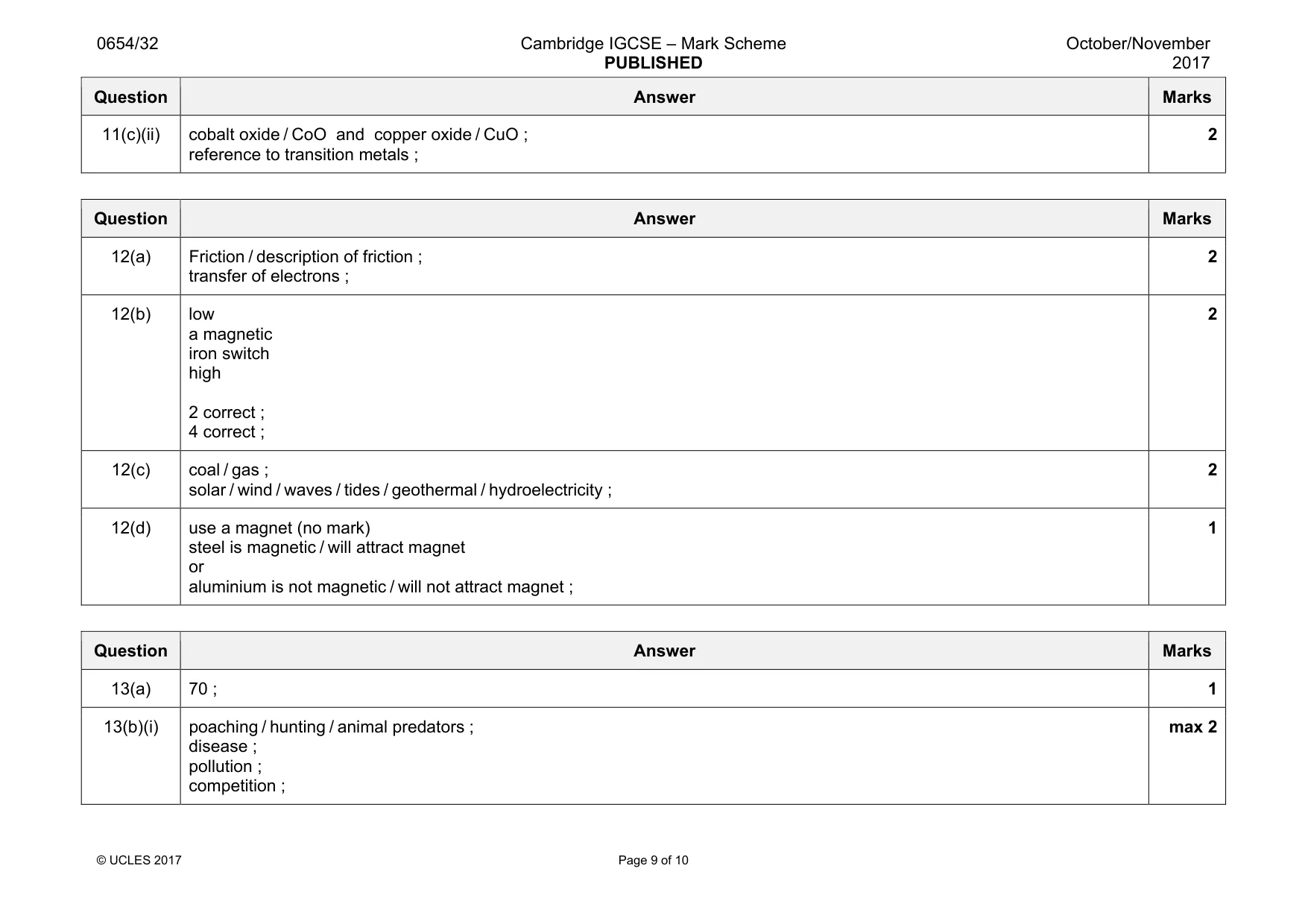
Mark scheme: 11(a)(i) ethane ; 1 11(a)(ii) double bond shown ; four hydrogen atoms – two on each carbon atom ; 2 11(b)(i) CO2 and H2O from the (complete) combustion of propane / the fuel / the hydrocarbon ; 1 11(b)(ii) nitrogen and argon from / in the air (taken in with the fuel) ; nitrogen and argon are inert / do not react / burn ; 2 11(c)(i) calcium carbonate / CaCO3 ; calcium oxide / lime / CaO / carbon dioxide / CO2 ; 2 Question Answer Marks 11(c)(ii) cobalt oxide / CoO and copper oxide / CuO ; reference to transition metals ; 2
Q12 · A man drives a car
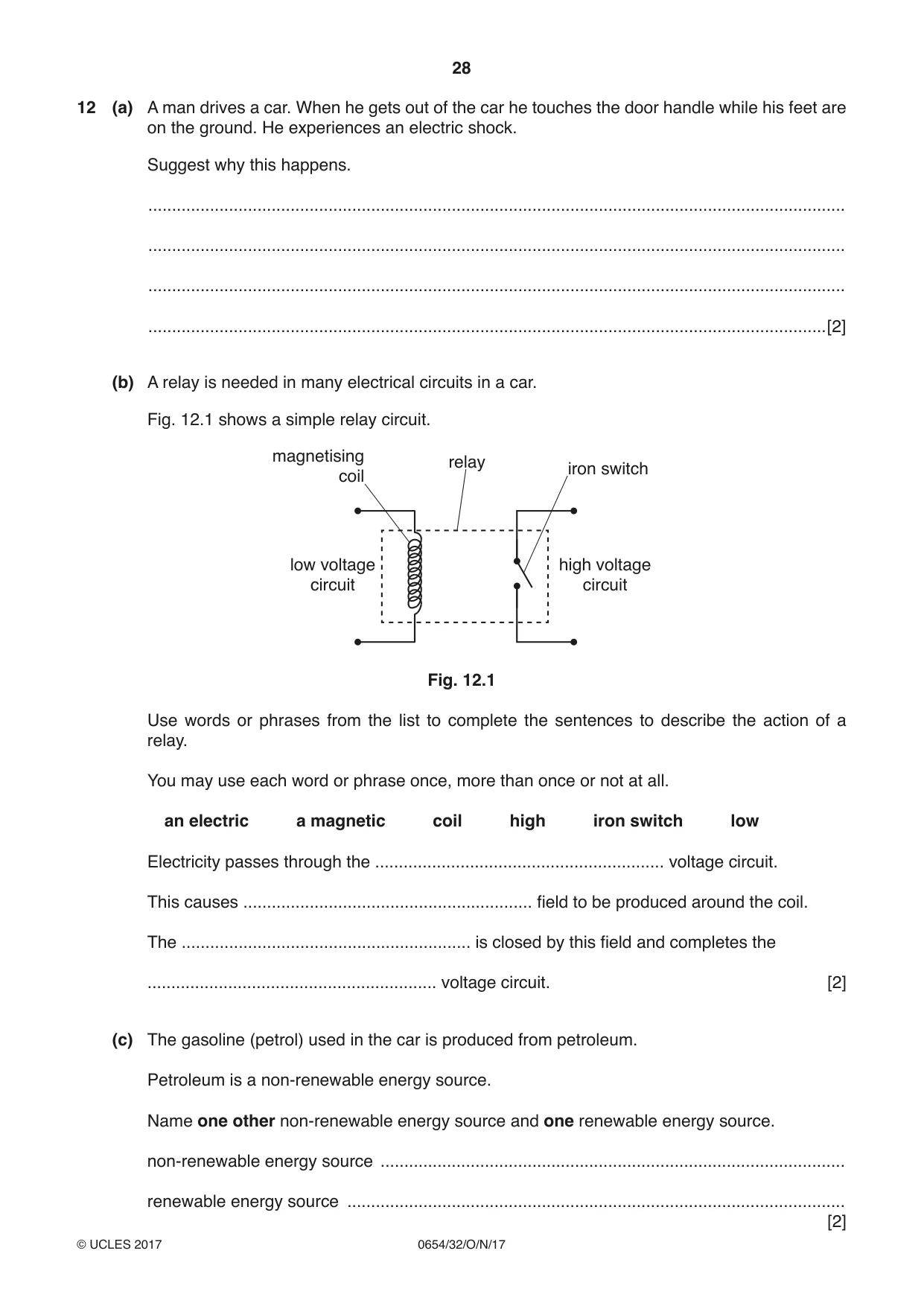
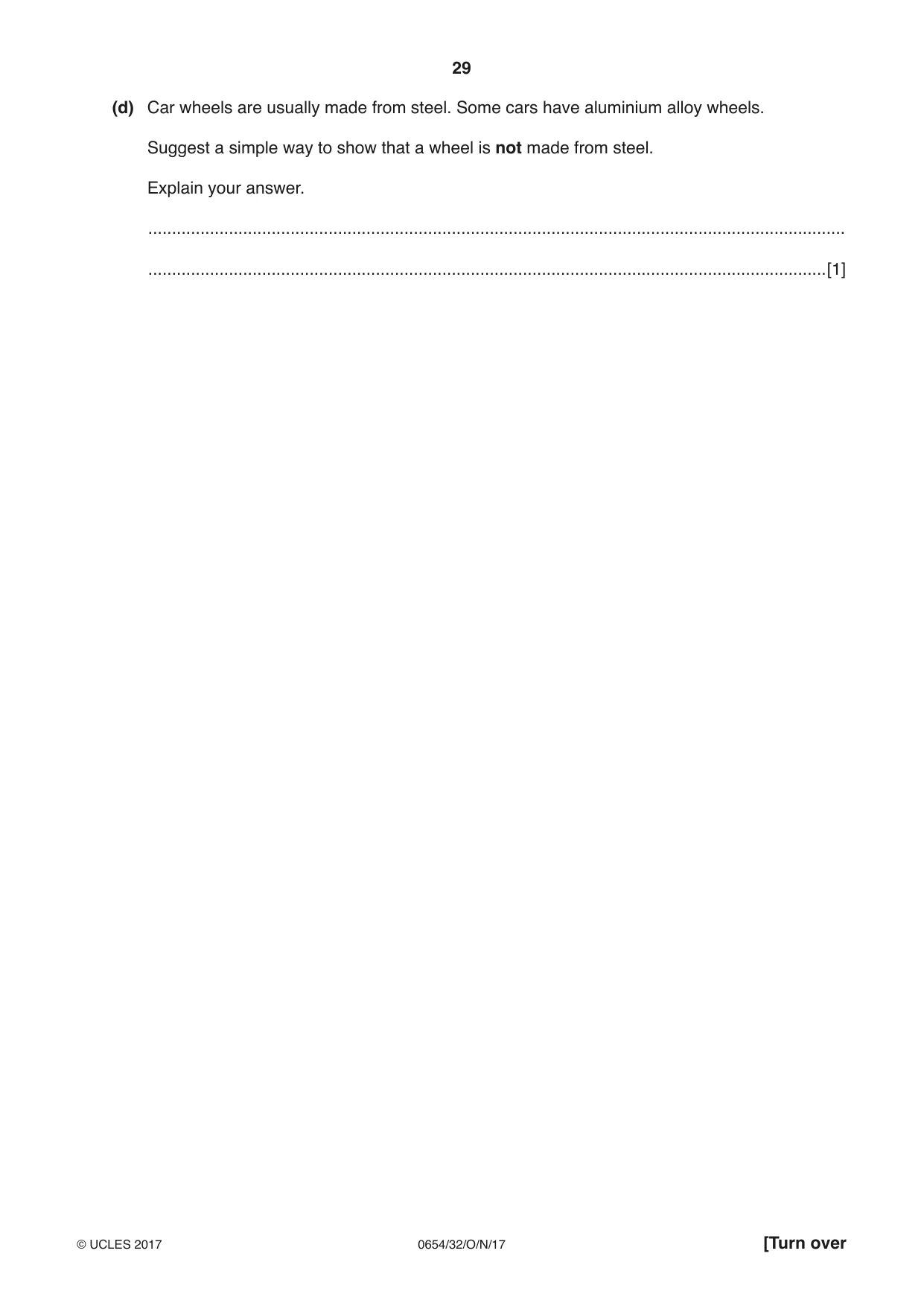
12 (a) A man drives a car. When he gets out of the car he touches the door handle while his feet are on the ground. He experiences an electric shock. Suggest why this happens. ................................................................................................................................................... ................................................................................................................................................... ................................................................................................................................................... ...............................................................................................................................................[2] (b) A relay is needed in many electrical circuits in a car. Fig. 12.1 shows a simple relay circuit. magnetising relay iron switch coil low voltage high voltage circuit circuit Fig. 12.1 Use words or phrases from the list to complete the sentences to describe the action of a relay. You may use each word or phrase once, more than once or not at all. an electric a magnetic coil high iron switch low Electricity passes through the ............................................................. voltage circuit. This causes ............................................................. field to be produced around the coil. The ............................................................. is closed by this field and completes the ............................................................. voltage circuit. [2] (c) The gasoline (petrol) used in the car is produced from petroleum. Petroleum is a non-renewable energy source. Name one other non-renewable energy source and one renewable energy source. non-renewable energy source .................................................................................................. renewable energy source ......................................................................................................... [2] (d) Car wheels are usually made from steel. Some cars have aluminium alloy wheels. Suggest a simple way to show that a wheel is not made from steel. Explain your answer. ................................................................................................................................................... ...............................................................................................................................................[1]
Mark scheme: 12(a) Friction / description of friction ; transfer of electrons ; 2 12(b) low a magnetic iron switch high 2 correct ; 4 correct ; 2 12(c) coal / gas ; solar / wind / waves / tides / geothermal / hydroelectricity ; 2 12(d) use a magnet (no mark) steel is magnetic / will attract magnet or aluminium is not magnetic / will not attract magnet ; 1
Q13 · The population of mountain gorillas in the Democratic Republic of Congo between 1960 and…
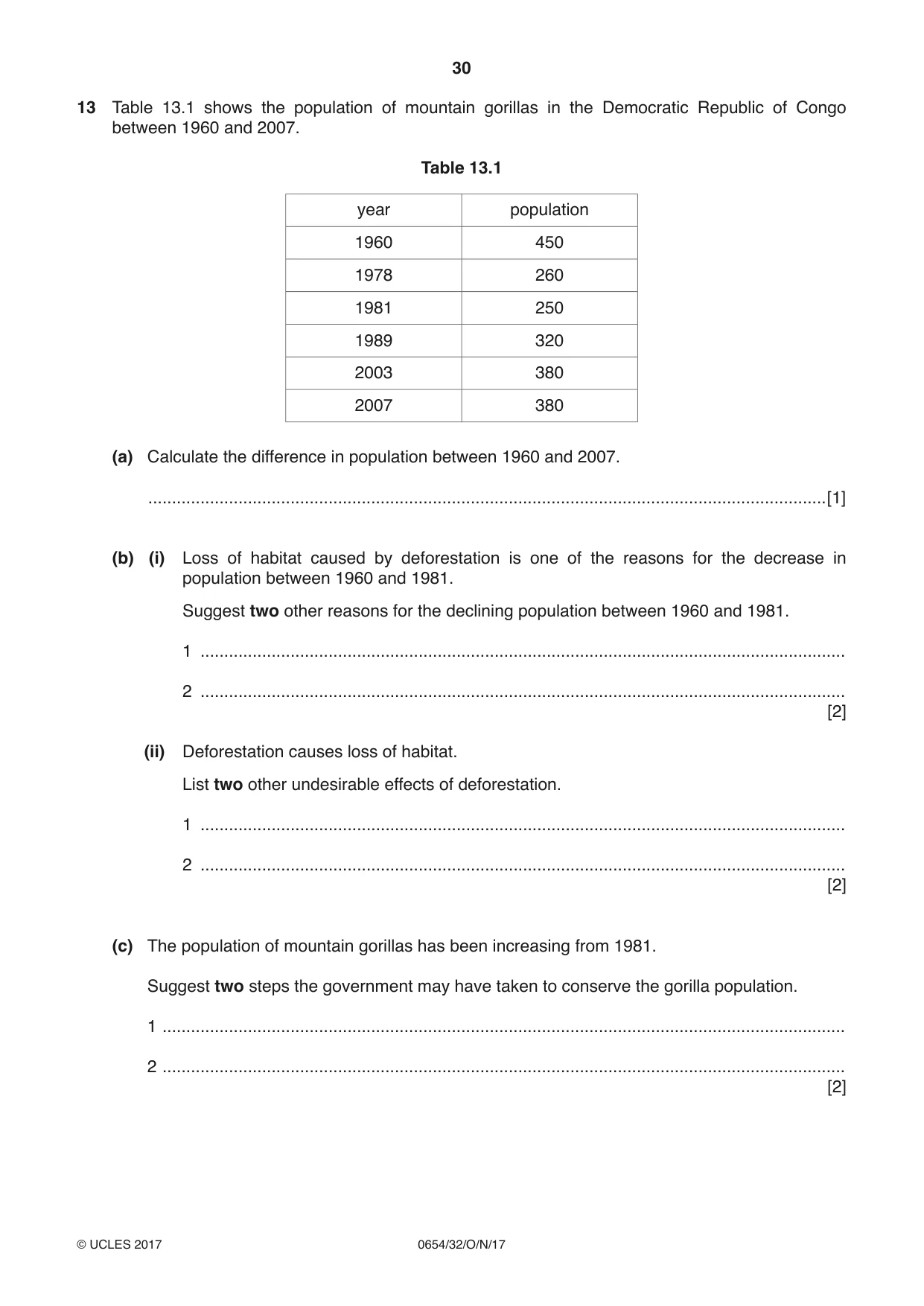
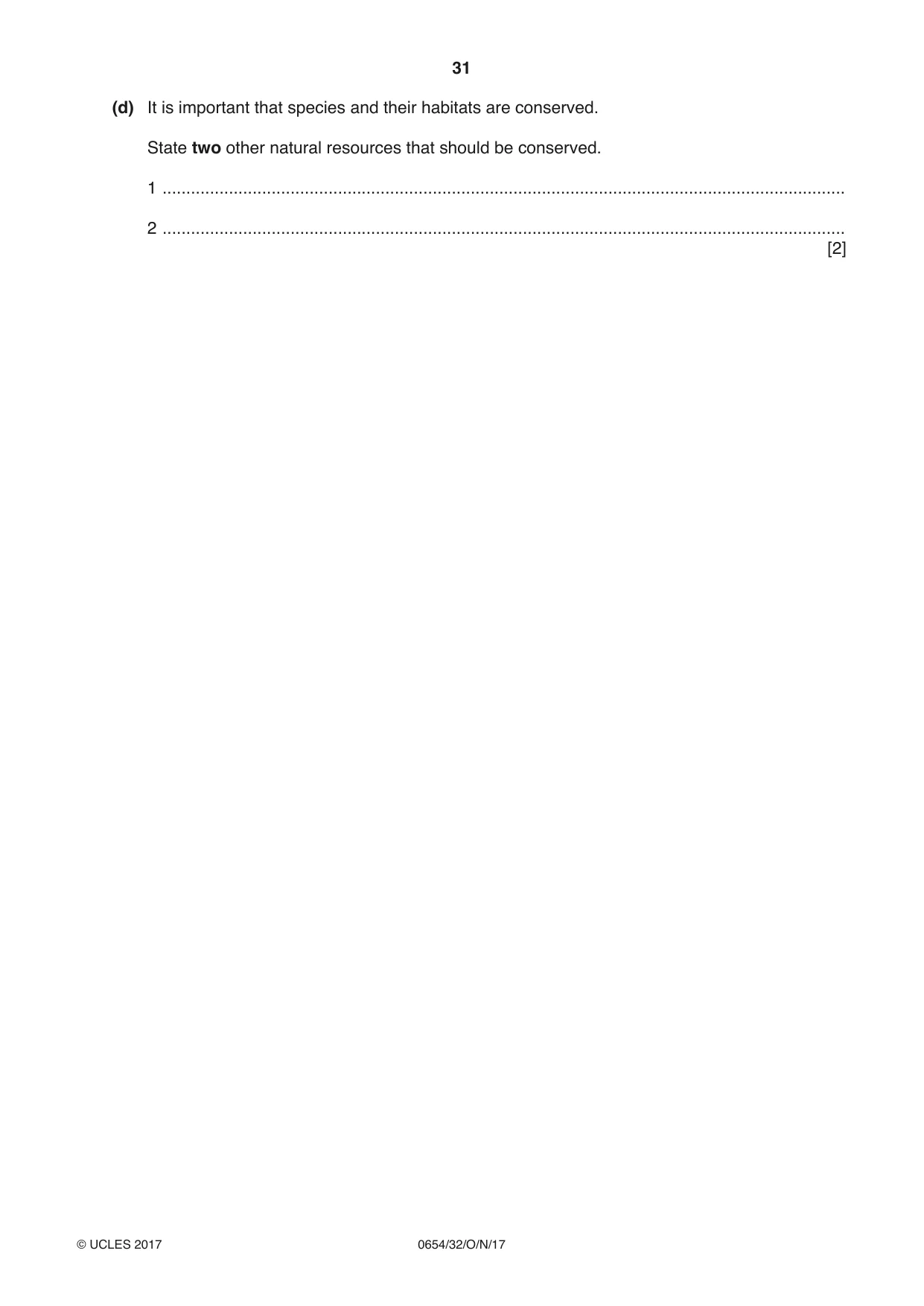
13 Table 13.1 shows the population of mountain gorillas in the Democratic Republic of Congo between 1960 and 2007. Table 13.1 year population 1960 450 1978 260 1981 250 1989 320 2003 380 2007 380 (a) Calculate the difference in population between 1960 and 2007. ...............................................................................................................................................[1] (b) (i) Loss of habitat caused by deforestation is one of the reasons for the decrease in population between 1960 and 1981. Suggest two other reasons for the declining population between 1960 and 1981. 1 ........................................................................................................................................ 2 ........................................................................................................................................ [2] (ii) Deforestation causes loss of habitat. List two other undesirable effects of deforestation. 1 ........................................................................................................................................ 2 ........................................................................................................................................ [2] (c) The population of mountain gorillas has been increasing from 1981. Suggest two steps the government may have taken to conserve the gorilla population. 1 ................................................................................................................................................ 2 ................................................................................................................................................ [2] (d) It is important that species and their habitats are conserved. State two other natural resources that should be conserved. 1 ................................................................................................................................................ 2 ................................................................................................................................................ [2]
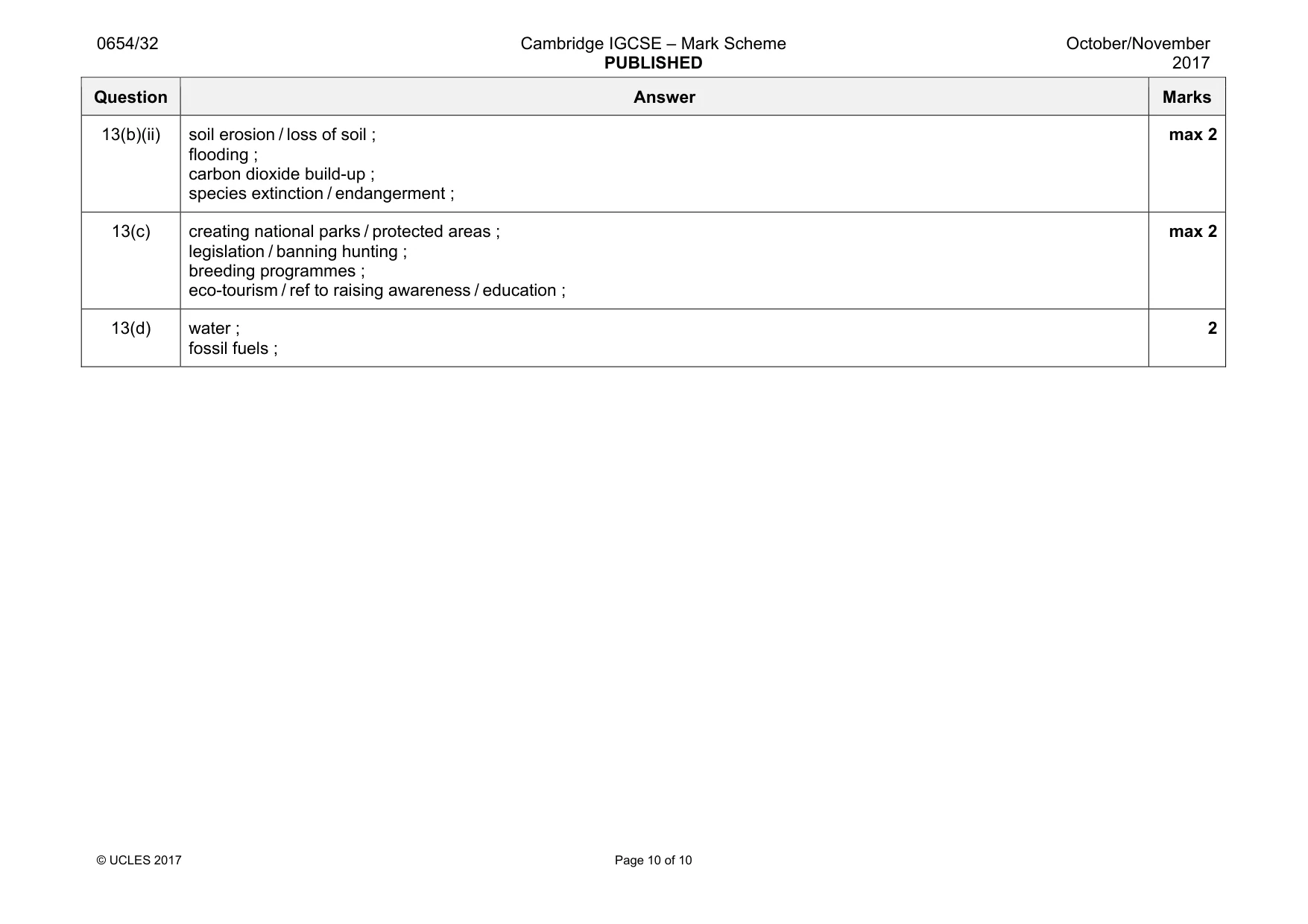
Mark scheme: 13(a) 70 ; 1 13(b)(i) poaching / hunting / animal predators ; disease ; pollution ; competition ; max 2 Question Answer Marks 13(b)(ii) soil erosion / loss of soil ; flooding ; carbon dioxide build-up ; species extinction / endangerment ; max 2 13(c) creating national parks / protected areas ; legislation / banning hunting ; breeding programmes ; eco-tourism / ref to raising awareness / education ; max 2 13(d) water ; fossil fuels ; 2
What was in this paper
The subtopics covered by these 13 questions, and how many questions each got. Open one in a new tab to see every Cambridge question on it.
What you needed in this session
Cambridge’s own grade thresholds for 2017 Oct/Nov, Paper 3 · Variant 2. A higher threshold means an easier paper — the bar moves with how the cohort did.