Cambridge IGCSE Sciences - Co-ordinated (Double) 0654 — 2019 May/June Paper 3 · Variant 2
0654/32/M/J/19 · 13 questions · 120 marks · ≈135 min
The question paper and its mark scheme, free to read here and free to download. This is Cambridge’s own paper, exactly as it was sat.
Question paper36 pages






Mark scheme16 pages
Answers below. Sit the paper first if you are practising.
Questions as text
Q1 · A diagram of an animal cell
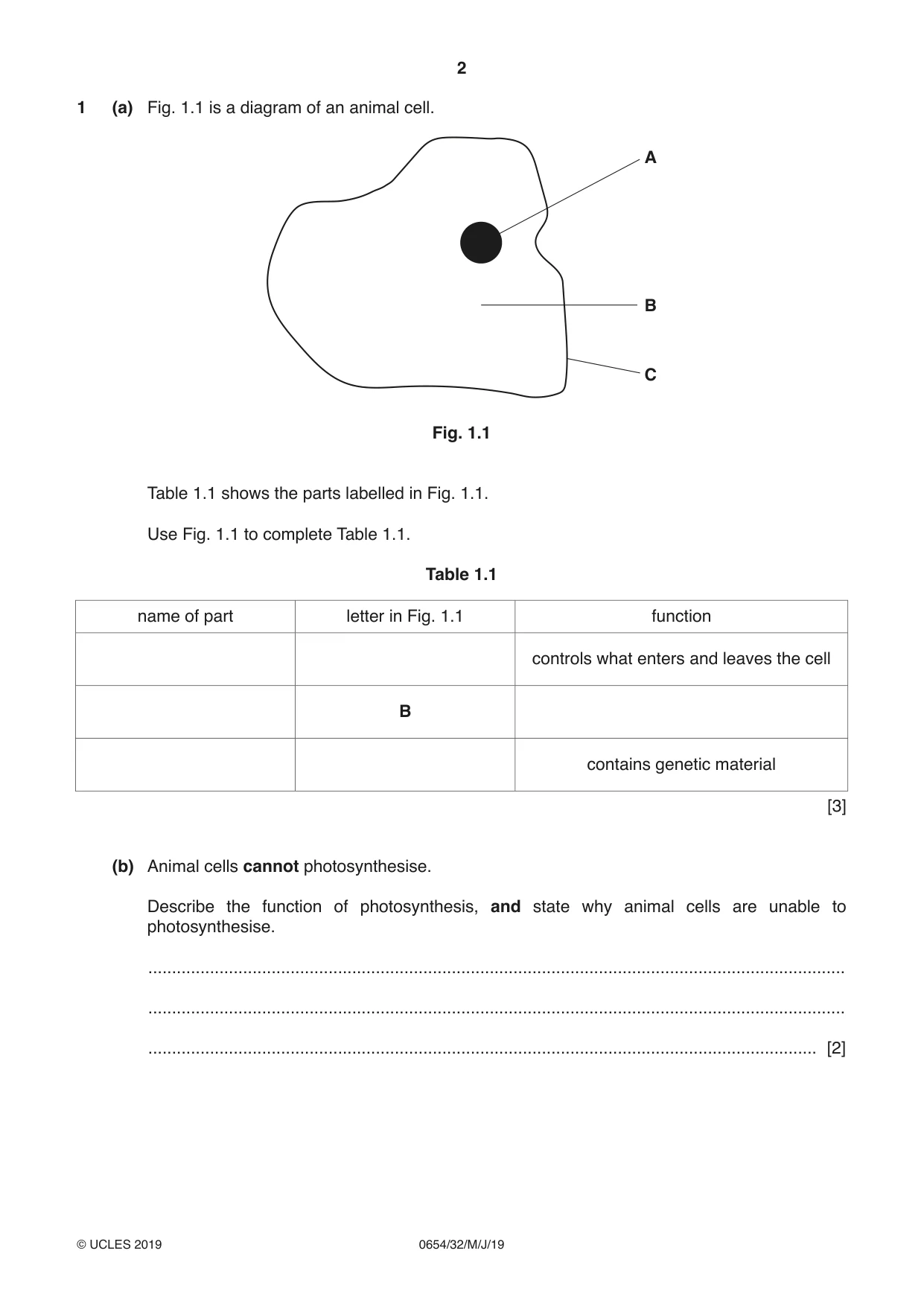
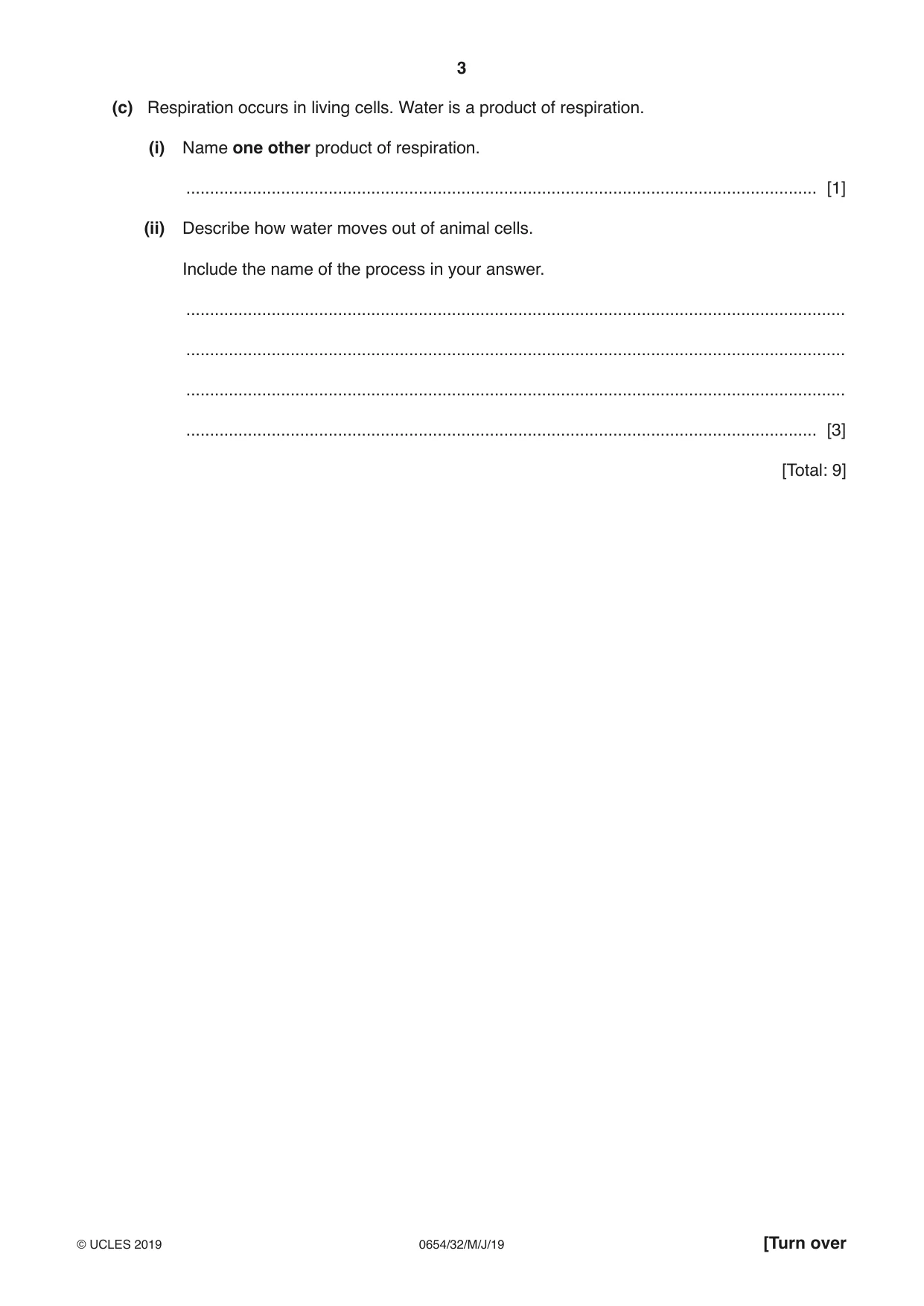
1 (a) Fig. 1.1 is a diagram of an animal cell. A B C Fig. 1.1 Table 1.1 shows the parts labelled in Fig. 1.1. Use Fig. 1.1 to complete Table 1.1. Table 1.1 name of part letter in Fig. 1.1 function controls what enters and leaves the cell B contains genetic material [3] (b) Animal cells cannot photosynthesise. Describe the function of photosynthesis, and state why animal cells are unable to photosynthesise. ................................................................................................................................................... ................................................................................................................................................... ............................................................................................................................................. [2] (c) Respiration occurs in living cells. Water is a product of respiration. (i) Name one other product of respiration. ..................................................................................................................................... [1] (ii) Describe how water moves out of animal cells. Include the name of the process in your answer. ........................................................................................................................................... ........................................................................................................................................... ........................................................................................................................................... ..................................................................................................................................... [3] [Total: 9]
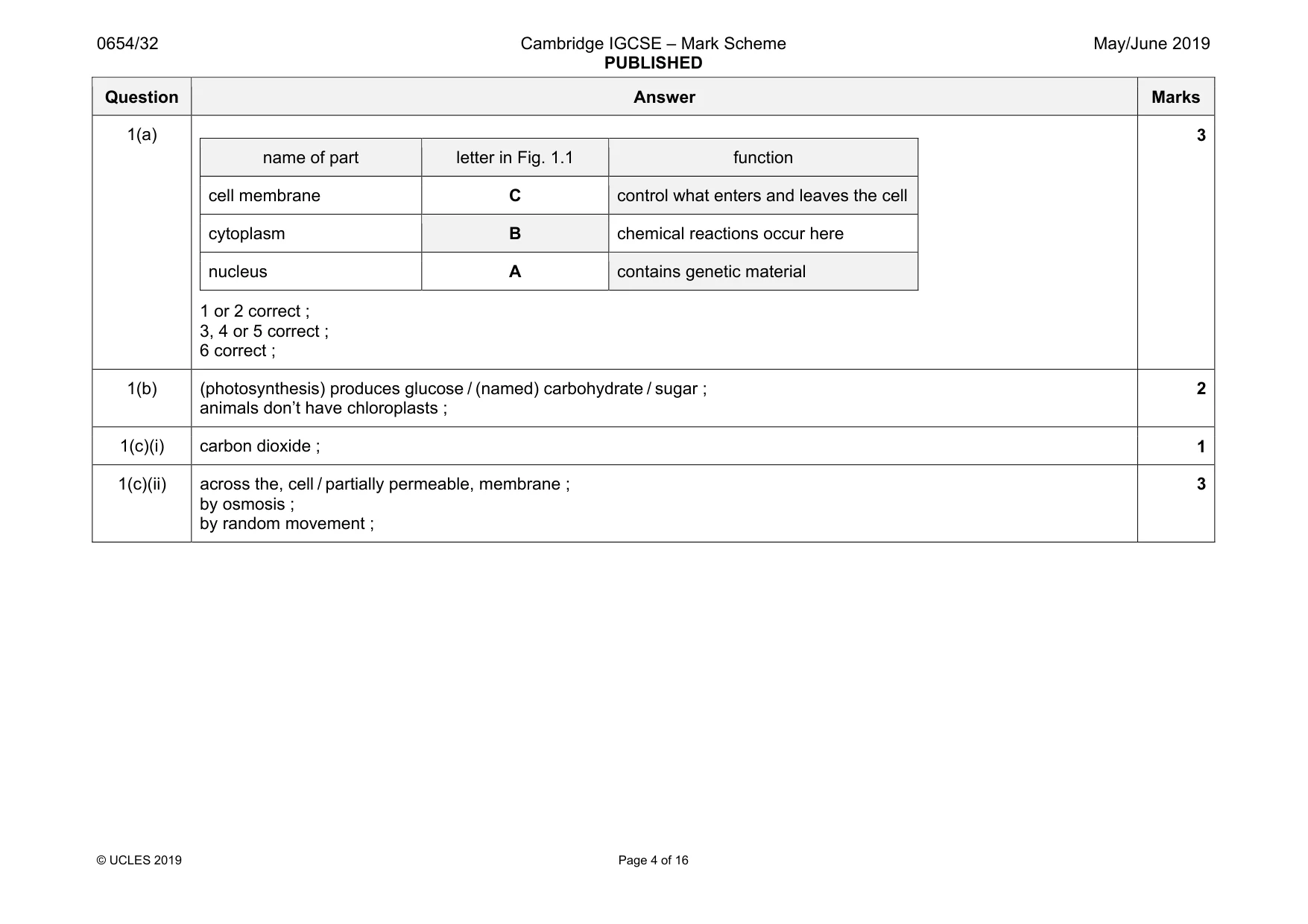
Mark scheme: 1(a) 1 or 2 correct ; 3, 4 or 5 correct ; 6 correct ; name of part letter in Fig. 1.1 function cell membrane C control what enters and leaves the cell cytoplasm B chemical reactions occur here nucleus A contains genetic material 3 1(b) (photosynthesis) produces glucose / (named) carbohydrate / sugar ; animals don’t have chloroplasts ; 2 1(c)(i) carbon dioxide ; 1 1(c)(ii) across the, cell / partially permeable, membrane ; by osmosis ; by random movement ; 3
Q2 · The chemical symbols of five elements in Period 4 of the Periodic Table
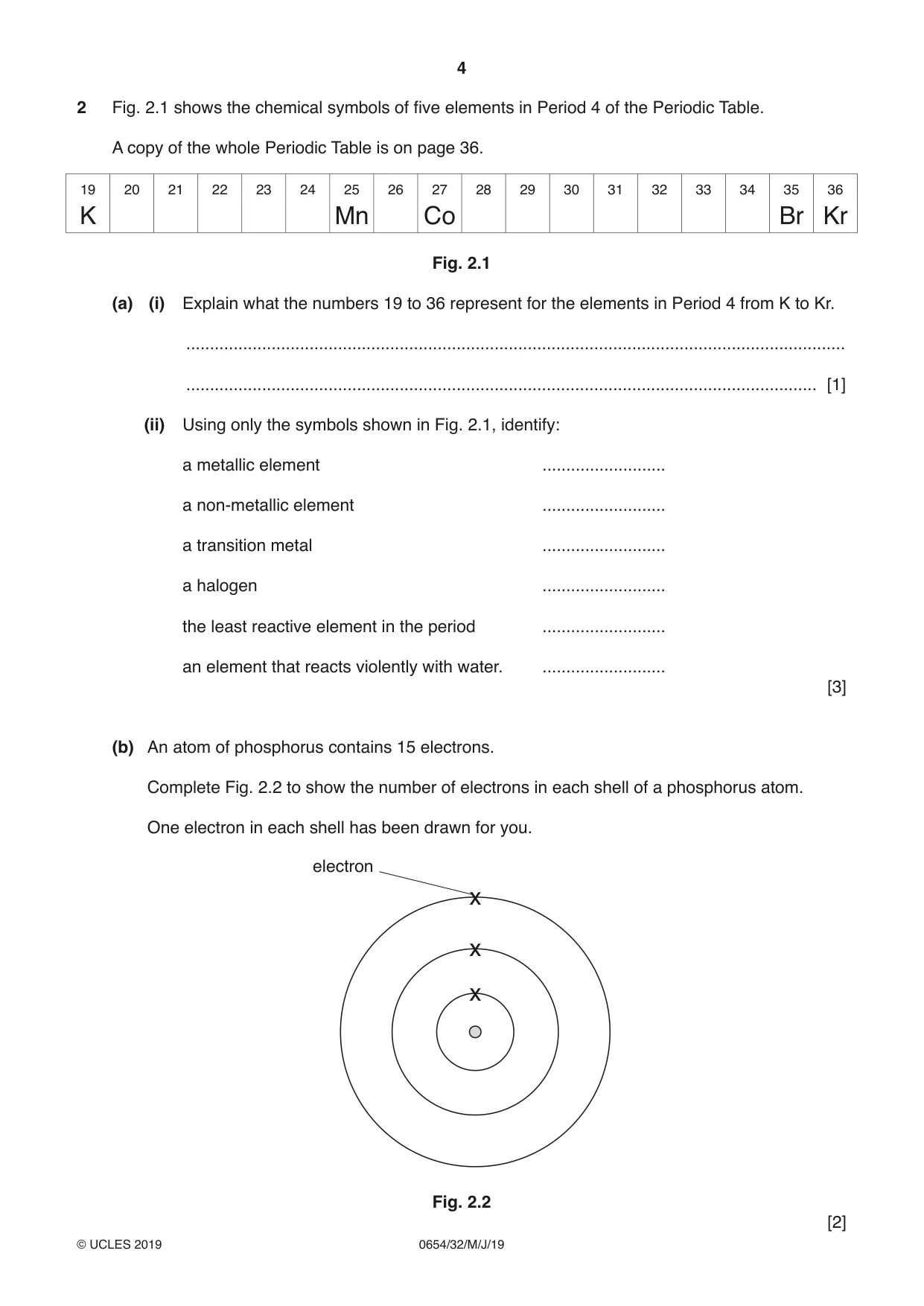
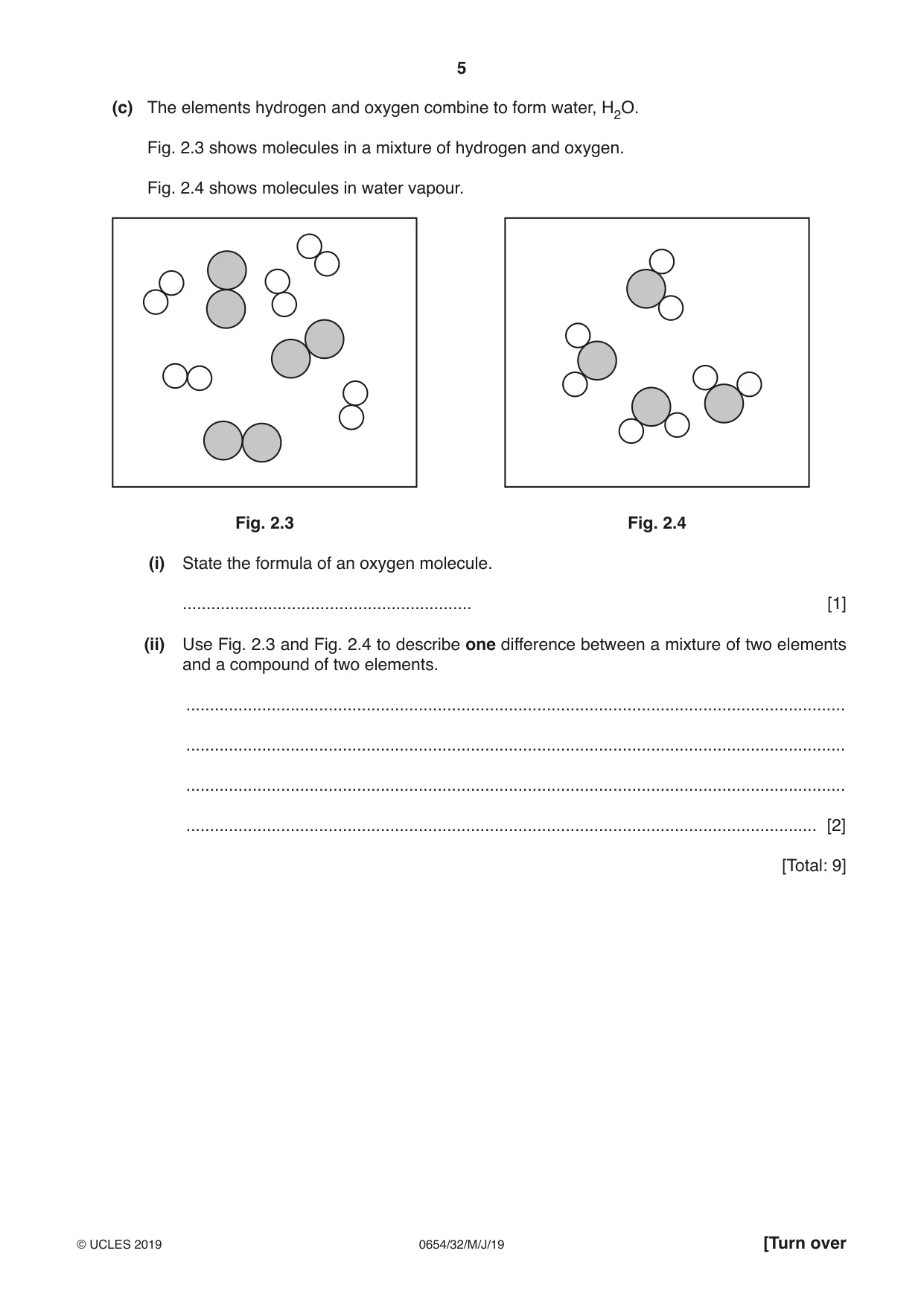
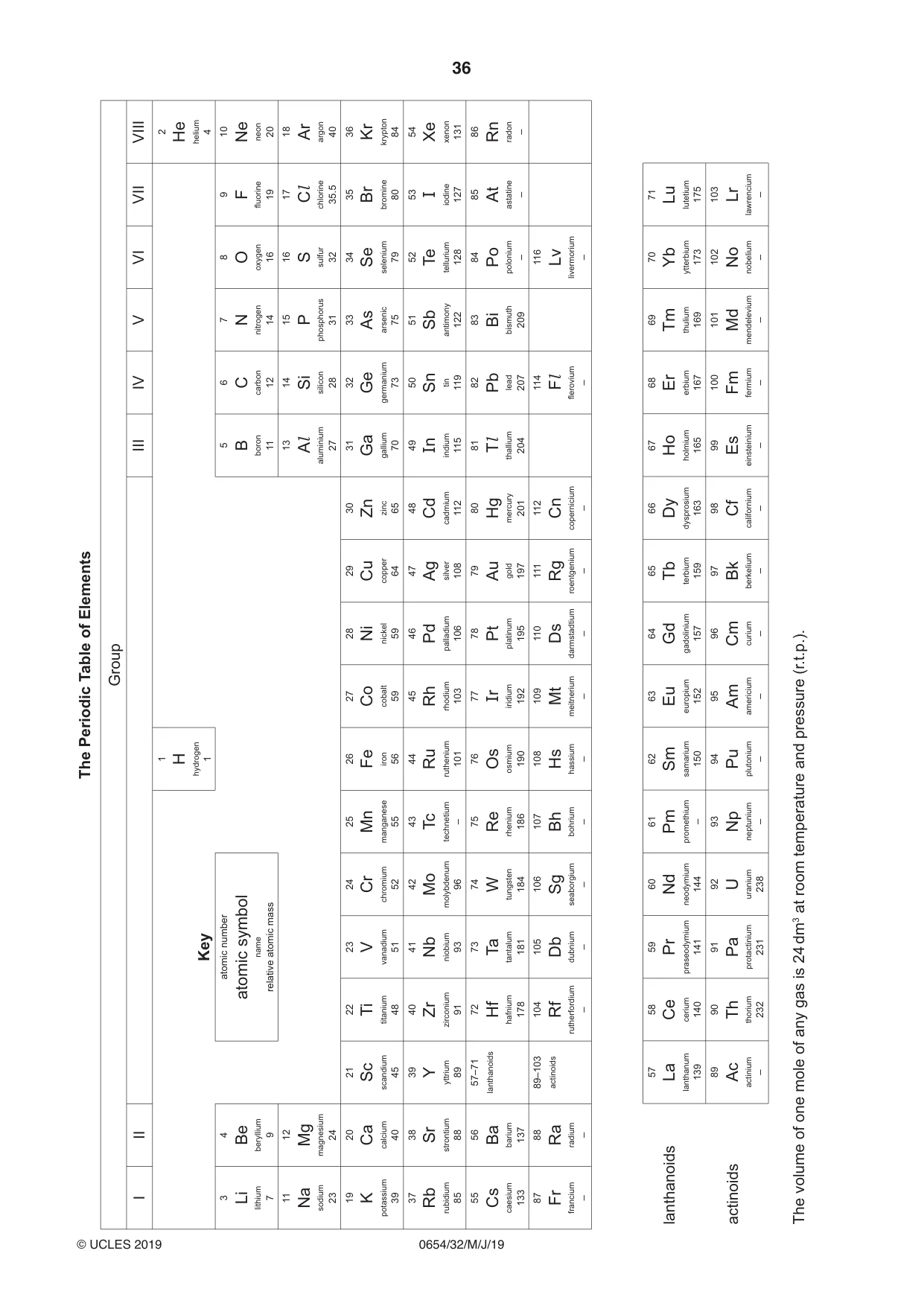
2 Fig. 2.1 shows the chemical symbols of five elements in Period 4 of the Periodic Table. A copy of the whole Periodic Table is on page 36. 19 20 21 22 23 24 25 26 27 28 29 30 31 32 33 34 35 36 K Mn Co Br Kr Fig. 2.1 (a) (i) Explain what the numbers 19 to 36 represent for the elements in Period 4 from K to Kr. ........................................................................................................................................... ..................................................................................................................................... [1] (ii) Using only the symbols shown in Fig. 2.1, identify: a metallic element .......................... a non-metallic element .......................... a transition metal .......................... a halogen .......................... the least reactive element in the period .......................... an element that reacts violently with water. .......................... [3] (b) An atom of phosphorus contains 15 electrons. Complete Fig. 2.2 to show the number of electrons in each shell of a phosphorus atom. One electron in each shell has been drawn for you. electron x x x Fig. 2.2 [2] (c) The elements hydrogen and oxygen combine to form water, H2O. Fig. 2.3 shows molecules in a mixture of hydrogen and oxygen. Fig. 2.4 shows molecules in water vapour. Fig. 2.3 Fig. 2.4 (i) State the formula of an oxygen molecule. ............................................................. [1] (ii) Use Fig. 2.3 and Fig. 2.4 to describe one difference between a mixture of two elements and a compound of two elements. ........................................................................................................................................... ........................................................................................................................................... ........................................................................................................................................... ..................................................................................................................................... [2] [Total: 9]
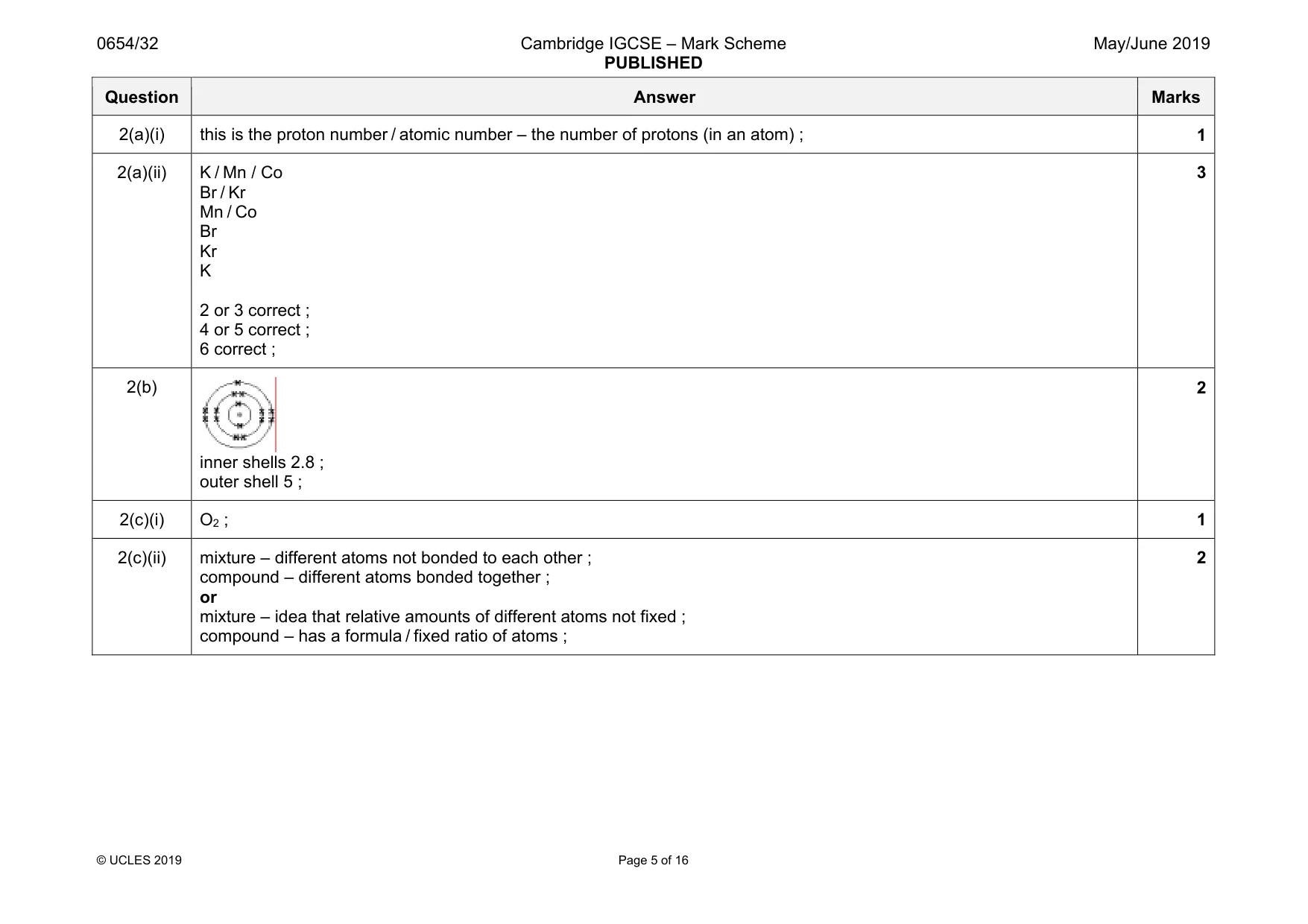
Mark scheme: 2(a)(i) this is the proton number / atomic number – the number of protons (in an atom) ; 1 2(a)(ii) K / Mn / Co Br / Kr Mn / Co Br Kr K 2 or 3 correct ; 4 or 5 correct ; 6 correct ; 3 2(b) inner shells 2.8 ; outer shell 5 ; 2 2(c)(i) O2 ; 1 2(c)(ii) mixture – different atoms not bonded to each other ; compound – different atoms bonded together ; or mixture – idea that relative amounts of different atoms not fixed ; compound – has a formula / fixed ratio of atoms ; 2
Q3 · Four different parts of a cyclist’s journey
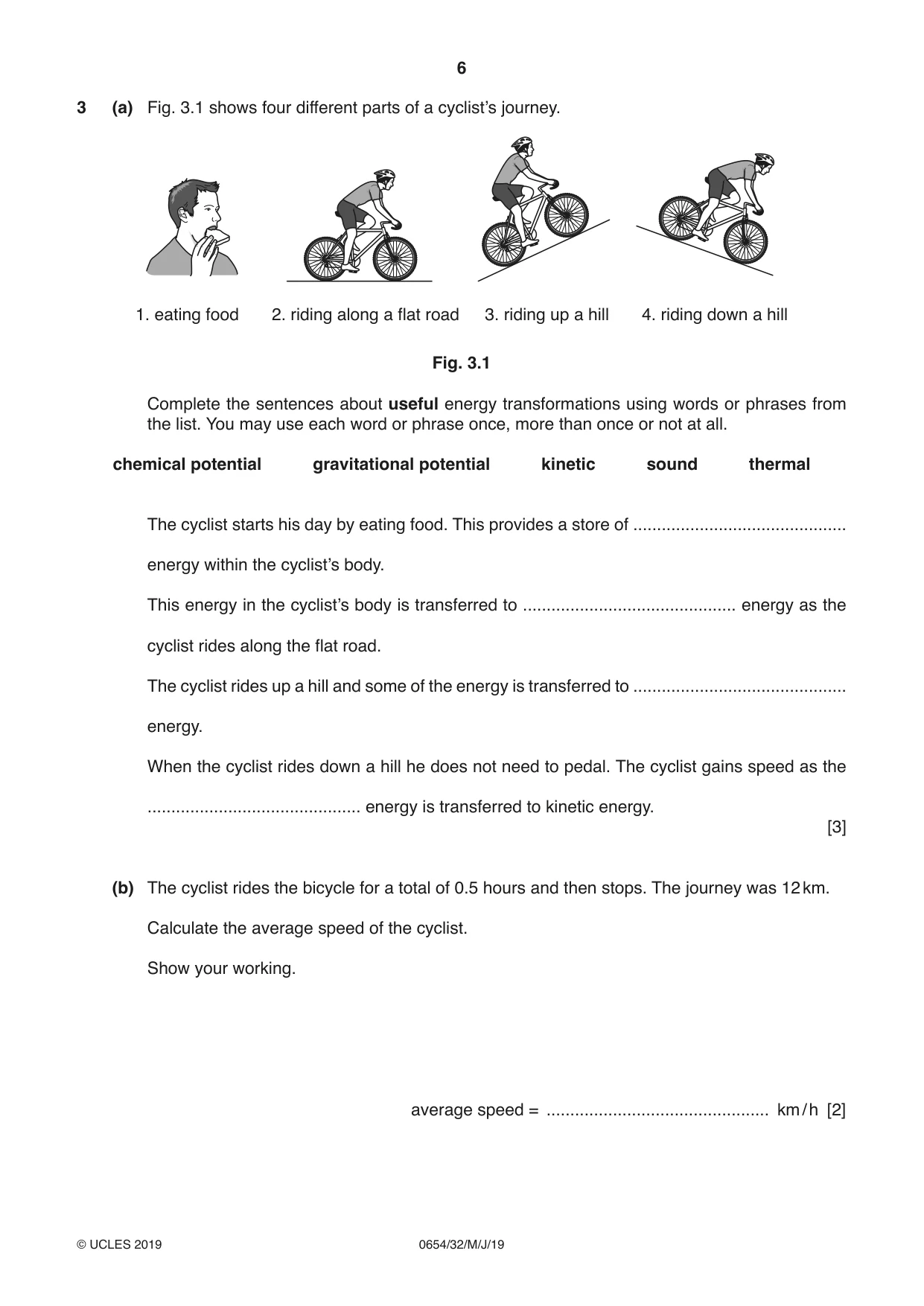
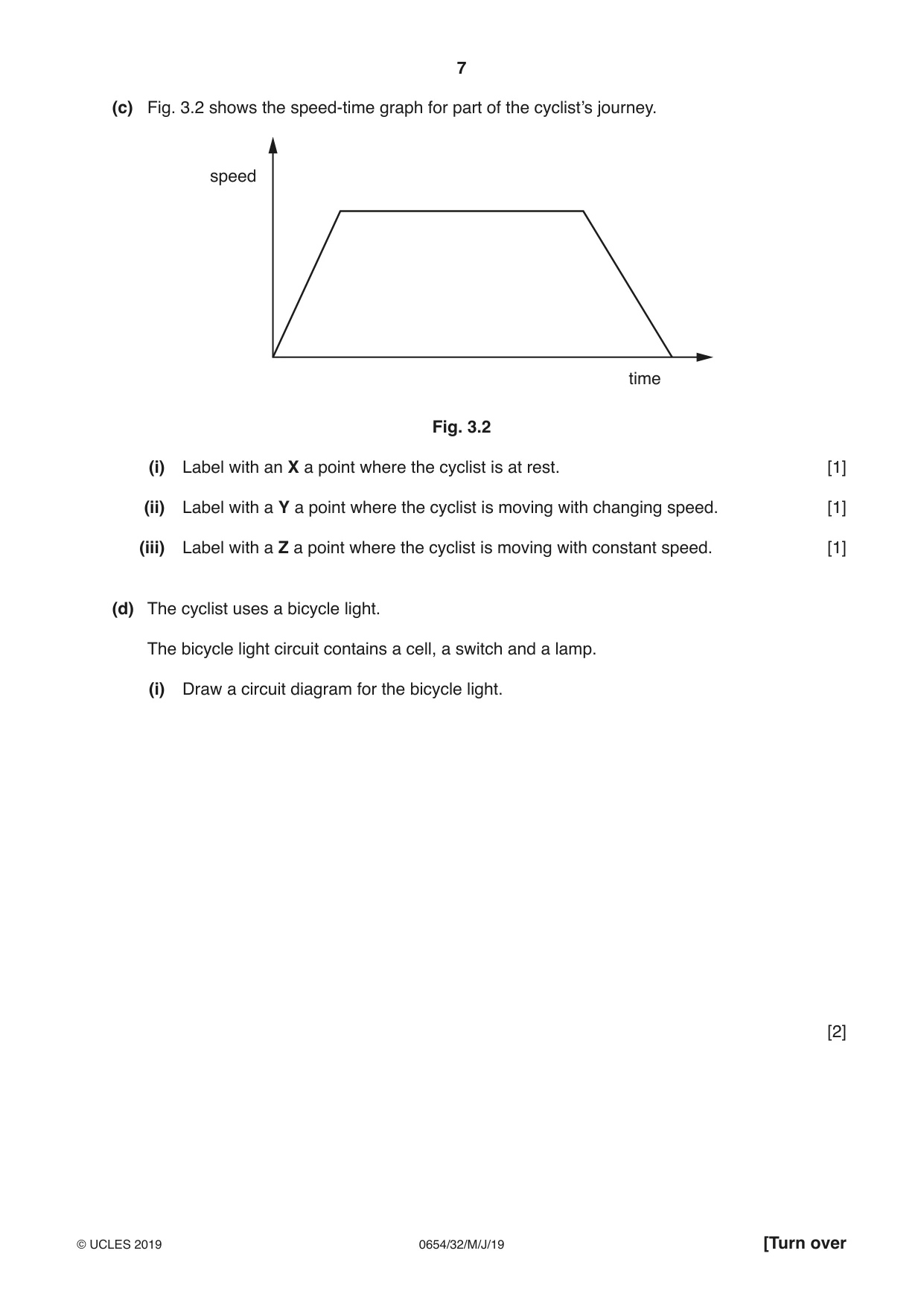
3 (a) Fig. 3.1 shows four different parts of a cyclist’s journey. 1. eating food 2. riding along a flat road 3. riding up a hill 4. riding down a hill Fig. 3.1 Complete the sentences about useful energy transformations using words or phrases from the list. You may use each word or phrase once, more than once or not at all. chemical potential gravitational potential kinetic sound thermal The cyclist starts his day by eating food. This provides a store of ............................................. energy within the cyclist’s body. This energy in the cyclist’s body is transferred to ............................................. energy as the cyclist rides along the flat road. The cyclist rides up a hill and some of the energy is transferred to ............................................. energy. When the cyclist rides down a hill he does not need to pedal. The cyclist gains speed as the ............................................. energy is transferred to kinetic energy. [3] (b) The cyclist rides the bicycle for a total of 0.5 hours and then stops. The journey was 12 km. Calculate the average speed of the cyclist. Show your working. average speed = ............................................... km / h [2] (c) Fig. 3.2 shows the speed-time graph for part of the cyclist’s journey. speed time Fig. 3.2 (i) Label with an X a point where the cyclist is at rest. [1] (ii) Label with a Y a point where the cyclist is moving with changing speed. [1] (iii) Label with a Z a point where the cyclist is moving with constant speed. [1] (d) The cyclist uses a bicycle light. The bicycle light circuit contains a cell, a switch and a lamp. (i) Draw a circuit diagram for the bicycle light. [2] (ii) The potential difference across the lamp is 1.5 V. The current flowing in the circuit is 0.75 A. Calculate the resistance of the lamp. Show your working. resistance = ..................................................... Ω [2] [Total: 12]
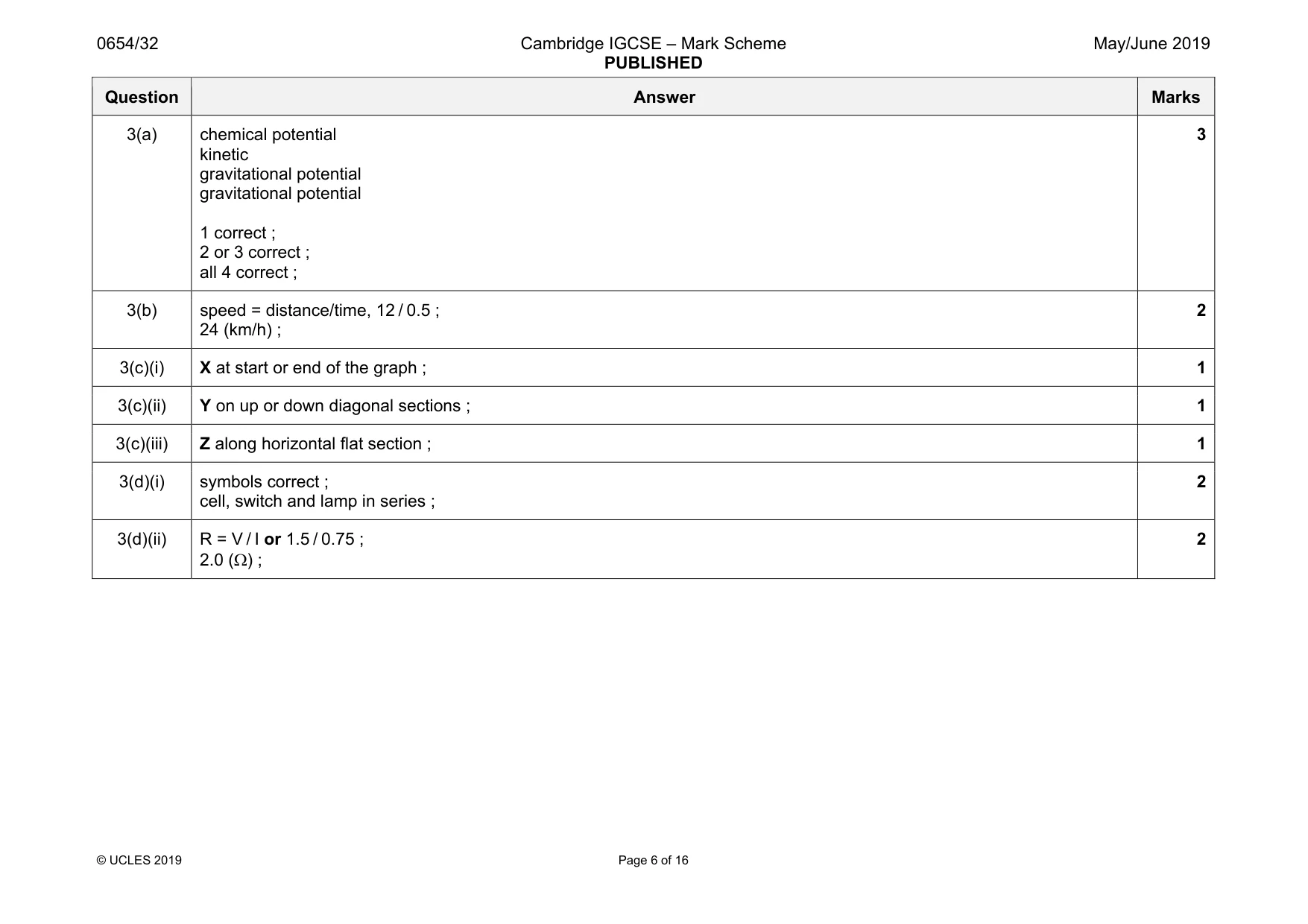
Mark scheme: 3(a) chemical potential kinetic gravitational potential gravitational potential 1 correct ; 2 or 3 correct ; all 4 correct ; 3 3(b) speed = distance/time, 12 / 0.5 ; 24 (km/h) ; 2 3(c)(i) X at start or end of the graph ; 1 3(c)(ii) Y on up or down diagonal sections ; 1 3(c)(iii) Z along horizontal flat section ; 1 3(d)(i) symbols correct ; cell, switch and lamp in series ; 2 3(d)(ii) R = V / I or 1.5 / 0.75 ; 2.0 (Ω) ; 2
Q4 · The types and number of teeth in an adult human
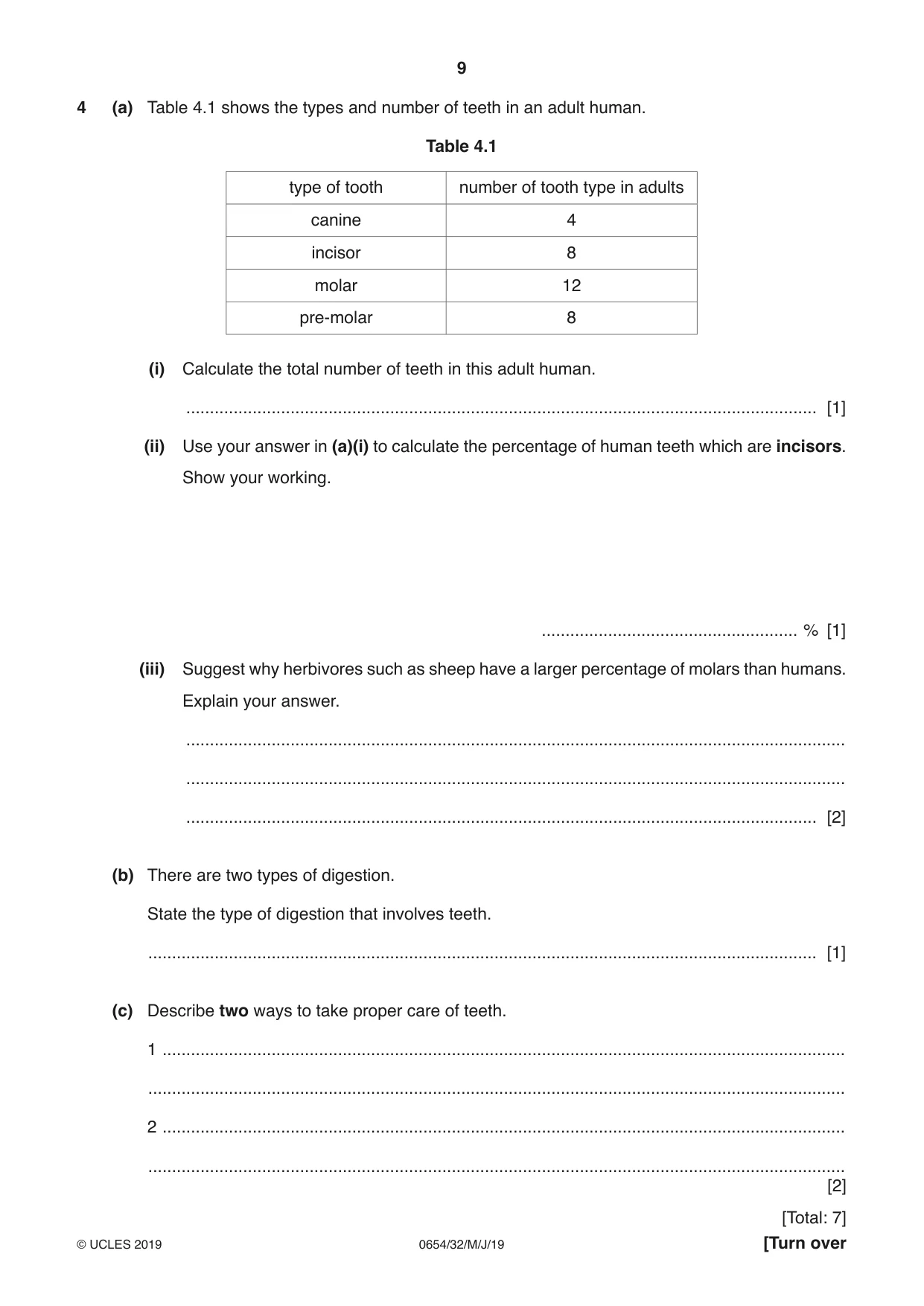
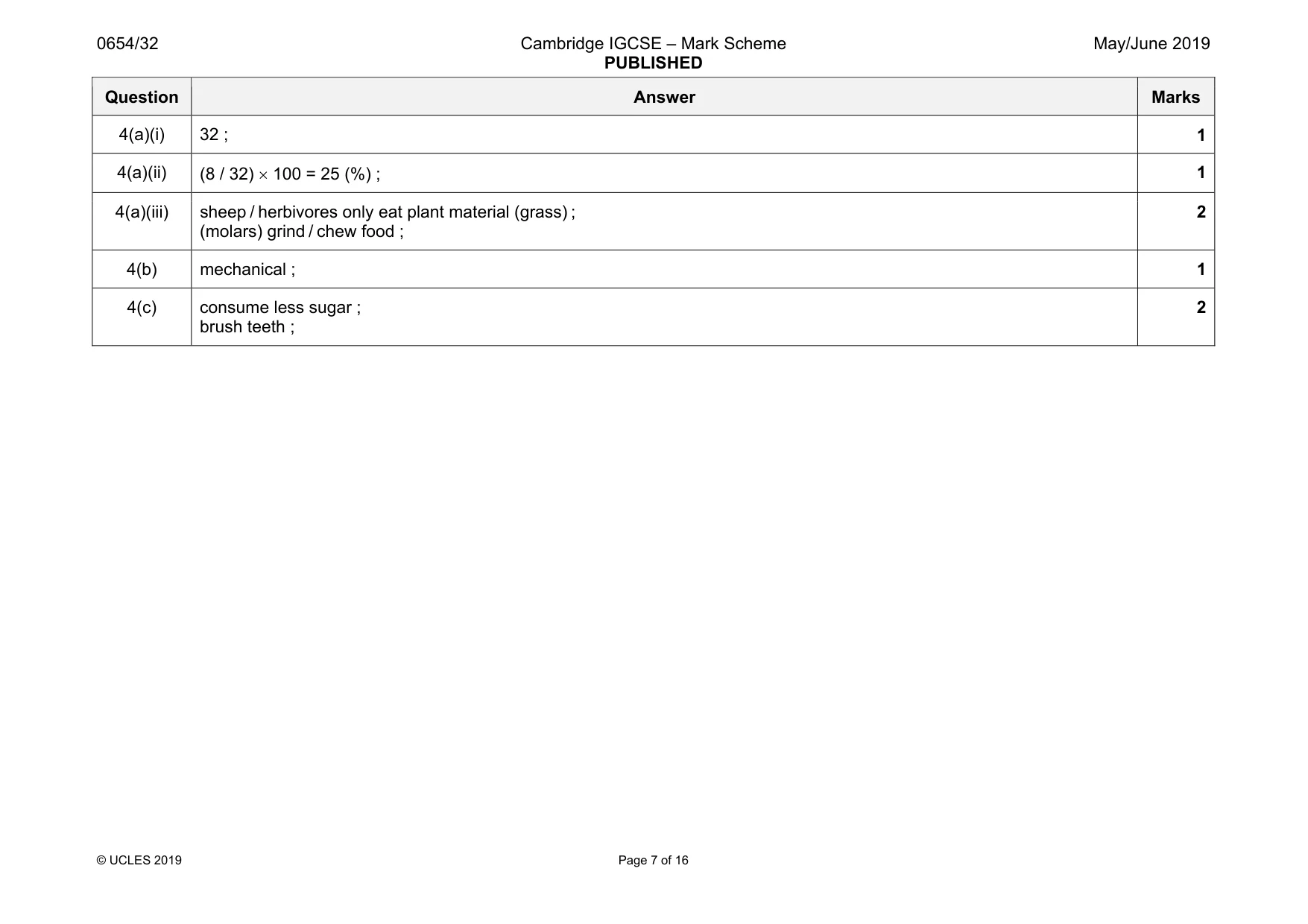
4 (a) Table 4.1 shows the types and number of teeth in an adult human. Table 4.1 type of tooth number of tooth type in adults canine 4 incisor 8 molar 12 pre-molar 8 (i) Calculate the total number of teeth in this adult human. ..................................................................................................................................... [1] (ii) Use your answer in (a)(i) to calculate the percentage of human teeth which are incisors. Show your working. ...................................................... % [1] (iii) Suggest why herbivores such as sheep have a larger percentage of molars than humans. Explain your answer. ........................................................................................................................................... ........................................................................................................................................... ..................................................................................................................................... [2] (b) There are two types of digestion. State the type of digestion that involves teeth. ............................................................................................................................................. [1] (c) Describe two ways to take proper care of teeth. 1 ................................................................................................................................................ ................................................................................................................................................... 2 ................................................................................................................................................ ................................................................................................................................................... [2] [Total: 7]
Mark scheme: 4(a)(i) 32 ; 1 4(a)(ii) (8 / 32) × 100 = 25 (%) ; 1 4(a)(iii) sheep / herbivores only eat plant material (grass) ; (molars) grind / chew food ; 2 4(b) mechanical ; 1 4(c) consume less sugar ; brush teeth ; 2
Q5 · The substances calcium, calcium carbonate and calcium oxide react separately with dilute…
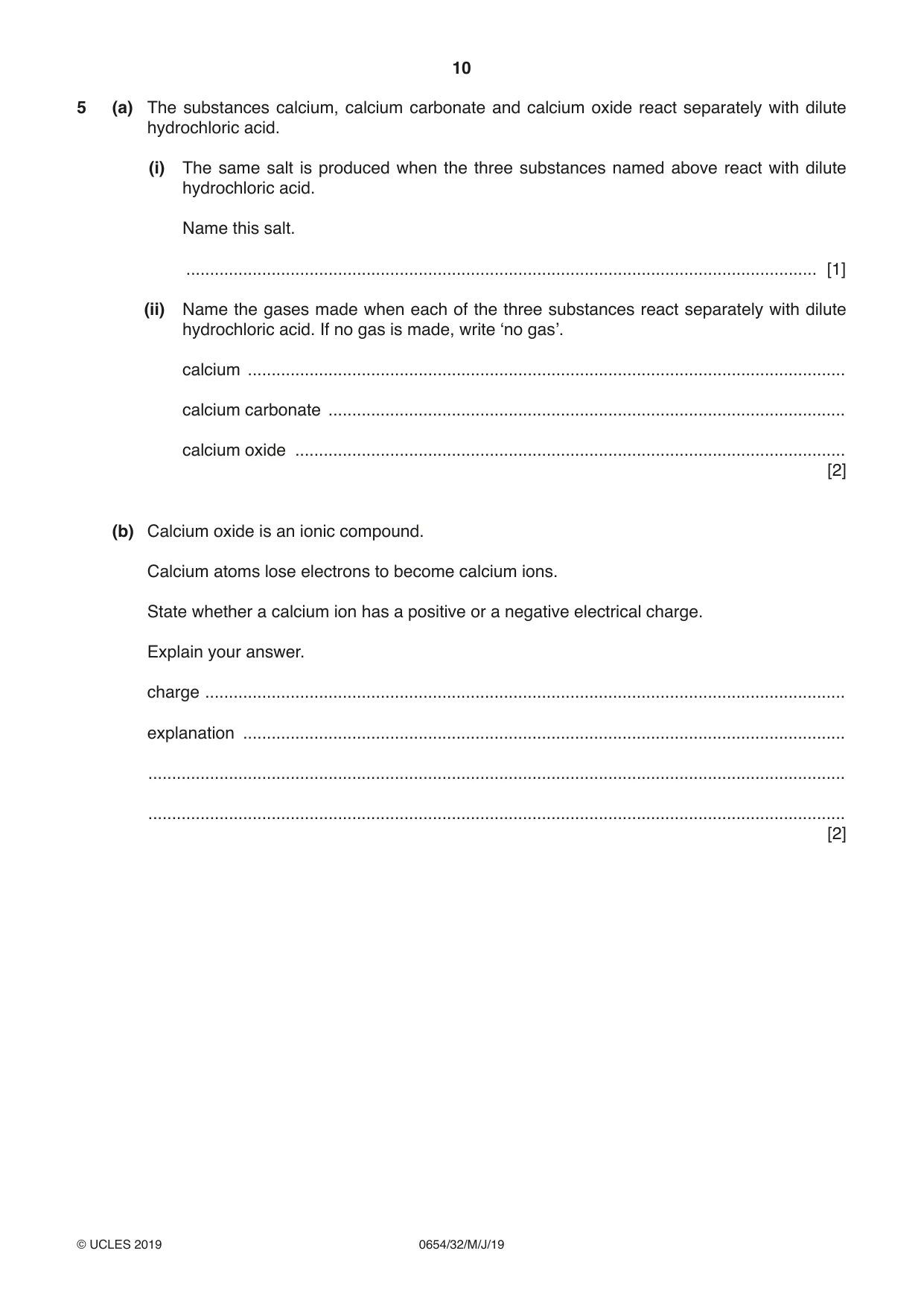
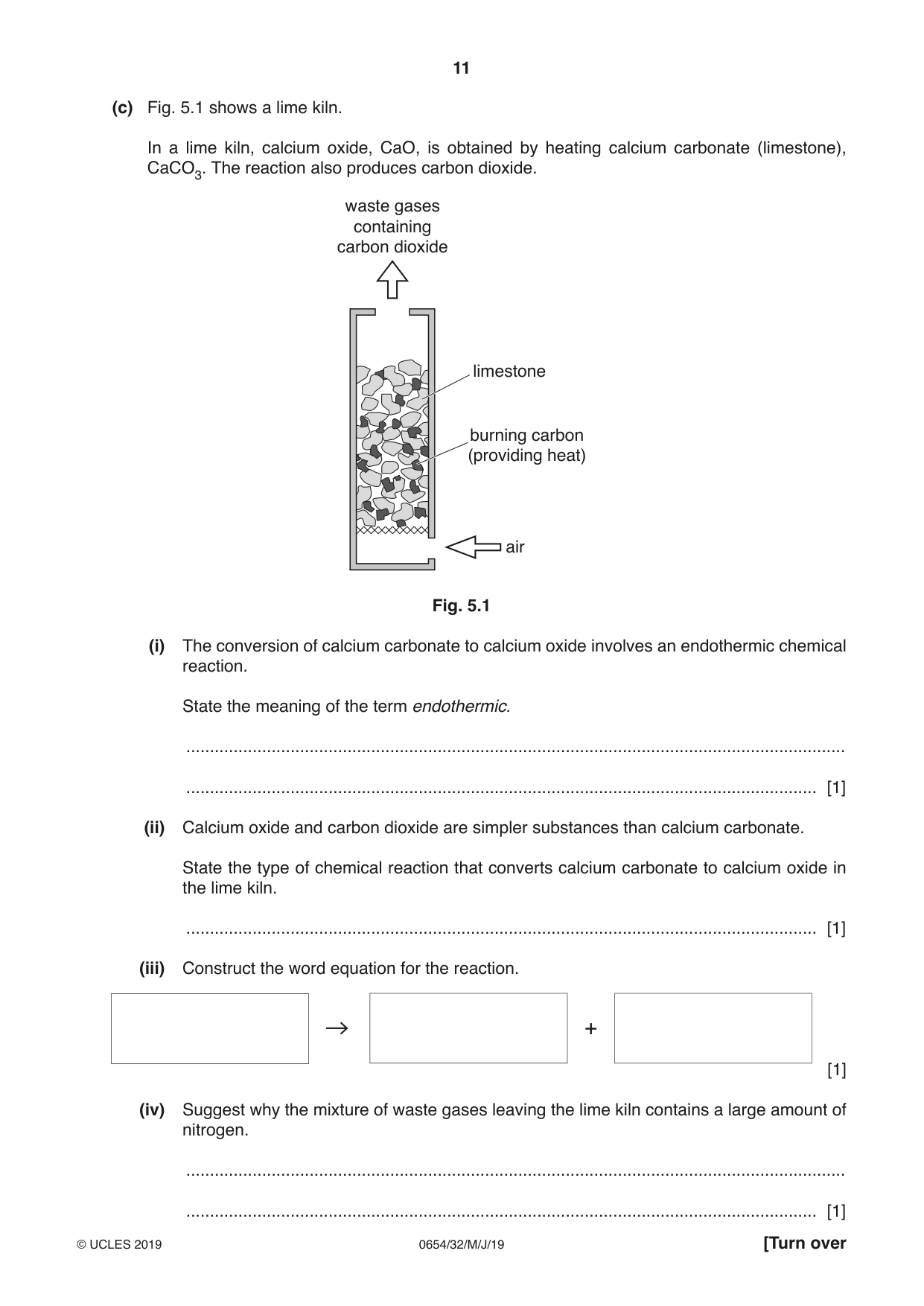
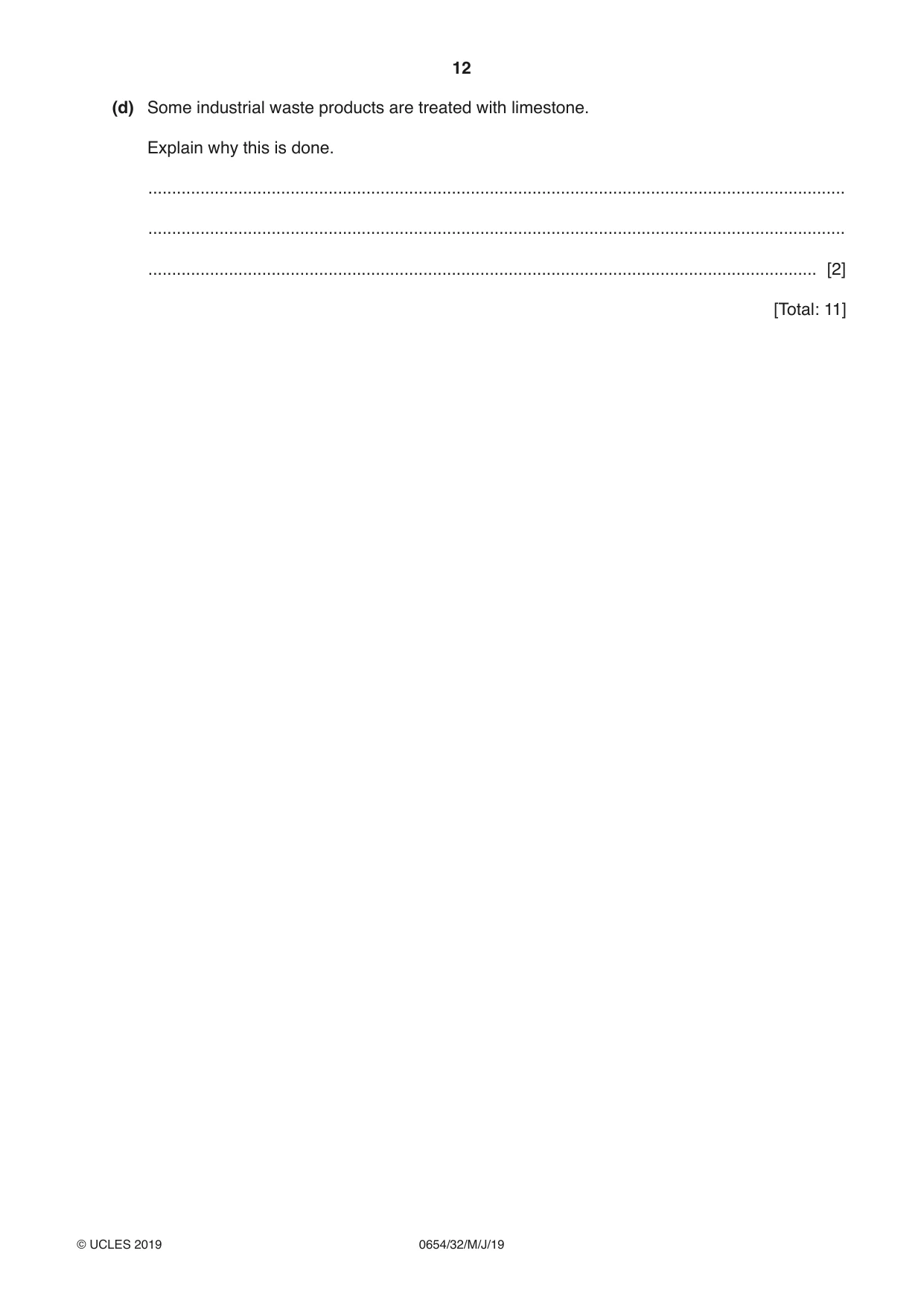
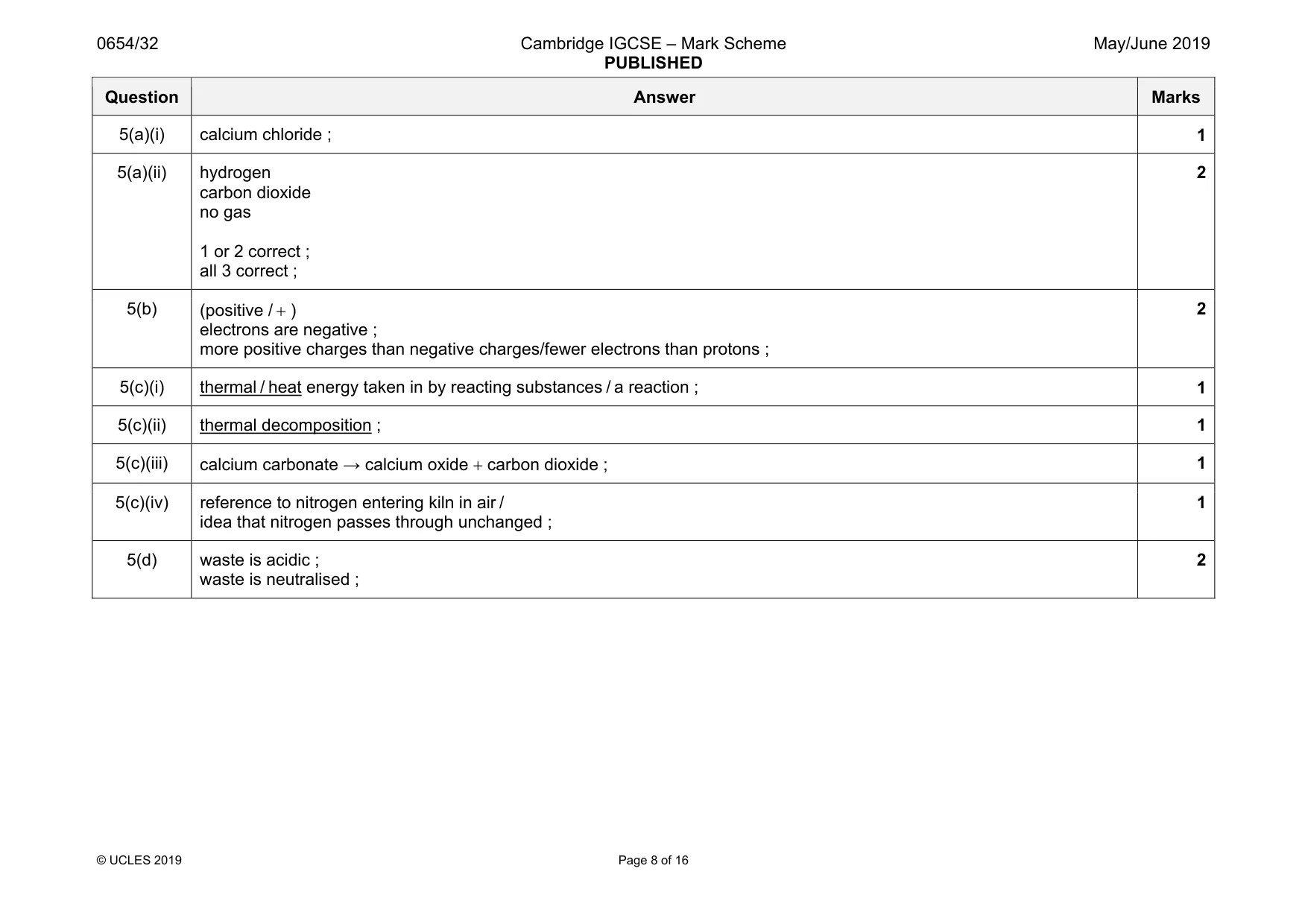
5 (a) The substances calcium, calcium carbonate and calcium oxide react separately with dilute hydrochloric acid. (i) The same salt is produced when the three substances named above react with dilute hydrochloric acid. Name this salt. ..................................................................................................................................... [1] (ii) Name the gases made when each of the three substances react separately with dilute hydrochloric acid. If no gas is made, write ‘no gas’. calcium .............................................................................................................................. calcium carbonate ............................................................................................................. calcium oxide .................................................................................................................... [2] (b) Calcium oxide is an ionic compound. Calcium atoms lose electrons to become calcium ions. State whether a calcium ion has a positive or a negative electrical charge. Explain your answer. charge ....................................................................................................................................... explanation ............................................................................................................................... ................................................................................................................................................... ................................................................................................................................................... [2] (c) Fig. 5.1 shows a lime kiln. In a lime kiln, calcium oxide, CaO, is obtained by heating calcium carbonate (limestone), CaCO3. The reaction also produces carbon dioxide. waste gases containing carbon dioxide limestone burning carbon (providing heat) air Fig. 5.1 (i) The conversion of calcium carbonate to calcium oxide involves an endothermic chemical reaction. State the meaning of the term endothermic. ........................................................................................................................................... ..................................................................................................................................... [1] (ii) Calcium oxide and carbon dioxide are simpler substances than calcium carbonate. State the type of chemical reaction that converts calcium carbonate to calcium oxide in the lime kiln. ..................................................................................................................................... [1] (iii) Construct the word equation for the reaction. + [1] (iv) Suggest why the mixture of waste gases leaving the lime kiln contains a large amount of nitrogen. ........................................................................................................................................... ..................................................................................................................................... [1] (d) Some industrial waste products are treated with limestone. Explain why this is done. ................................................................................................................................................... ................................................................................................................................................... ............................................................................................................................................. [2] [Total: 11]
Mark scheme: 5(a)(i) calcium chloride ; 1 5(a)(ii) hydrogen carbon dioxide no gas 1 or 2 correct ; all 3 correct ; 2 5(b) (positive / + ) electrons are negative ; more positive charges than negative charges/fewer electrons than protons ; 2 5(c)(i) thermal / heat energy taken in by reacting substances / a reaction ; 1 5(c)(ii) thermal decomposition ; 1 5(c)(iii) calcium carbonate → calcium oxide + carbon dioxide ; 1 5(c)(iv) reference to nitrogen entering kiln in air / idea that nitrogen passes through unchanged ; 1 5(d) waste is acidic ; waste is neutralised ; 2
More questions on The characteristic properties of acids and bases
Q6 · A presenter talking into a microphone at a radio station, and a man listening to the…
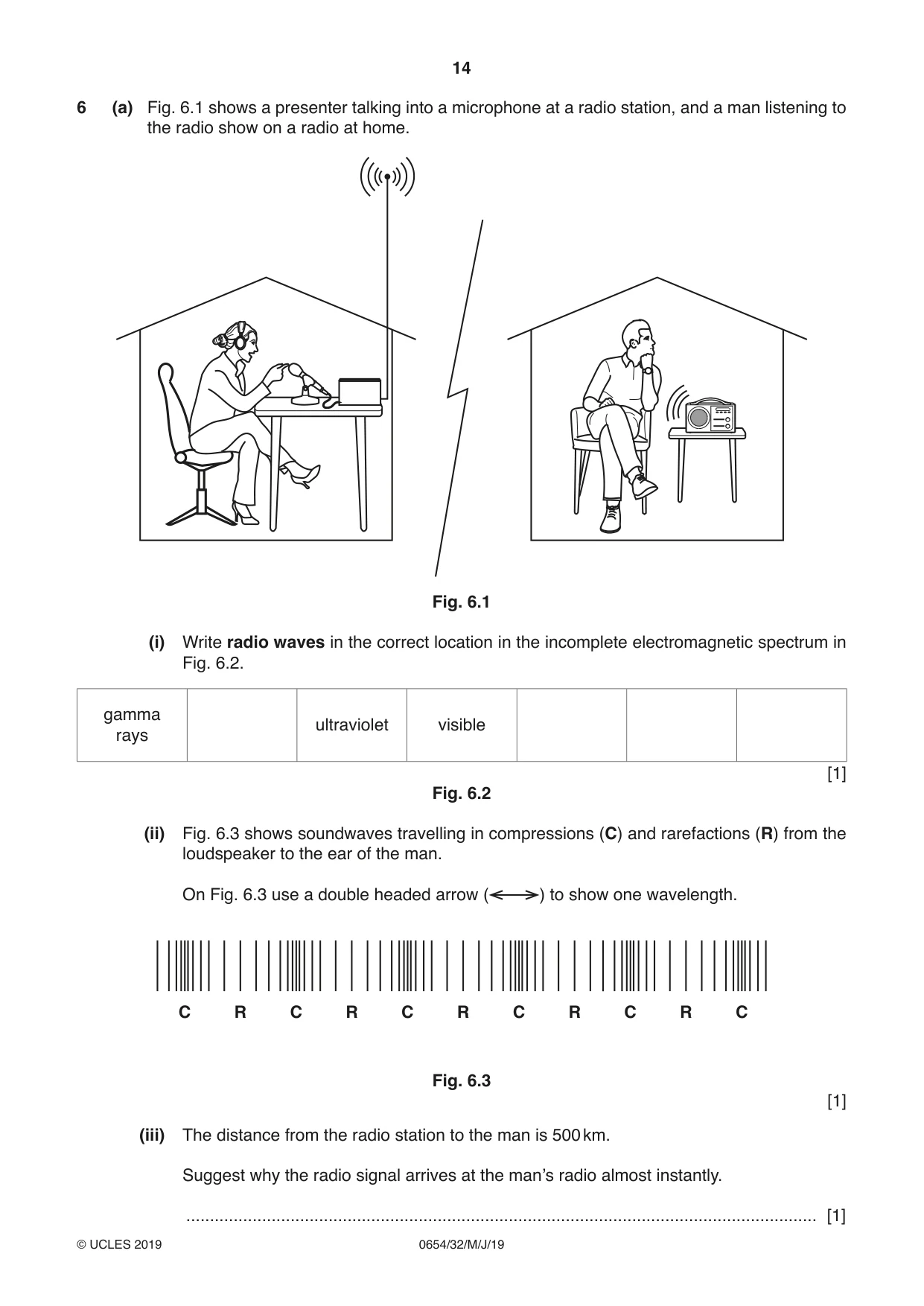
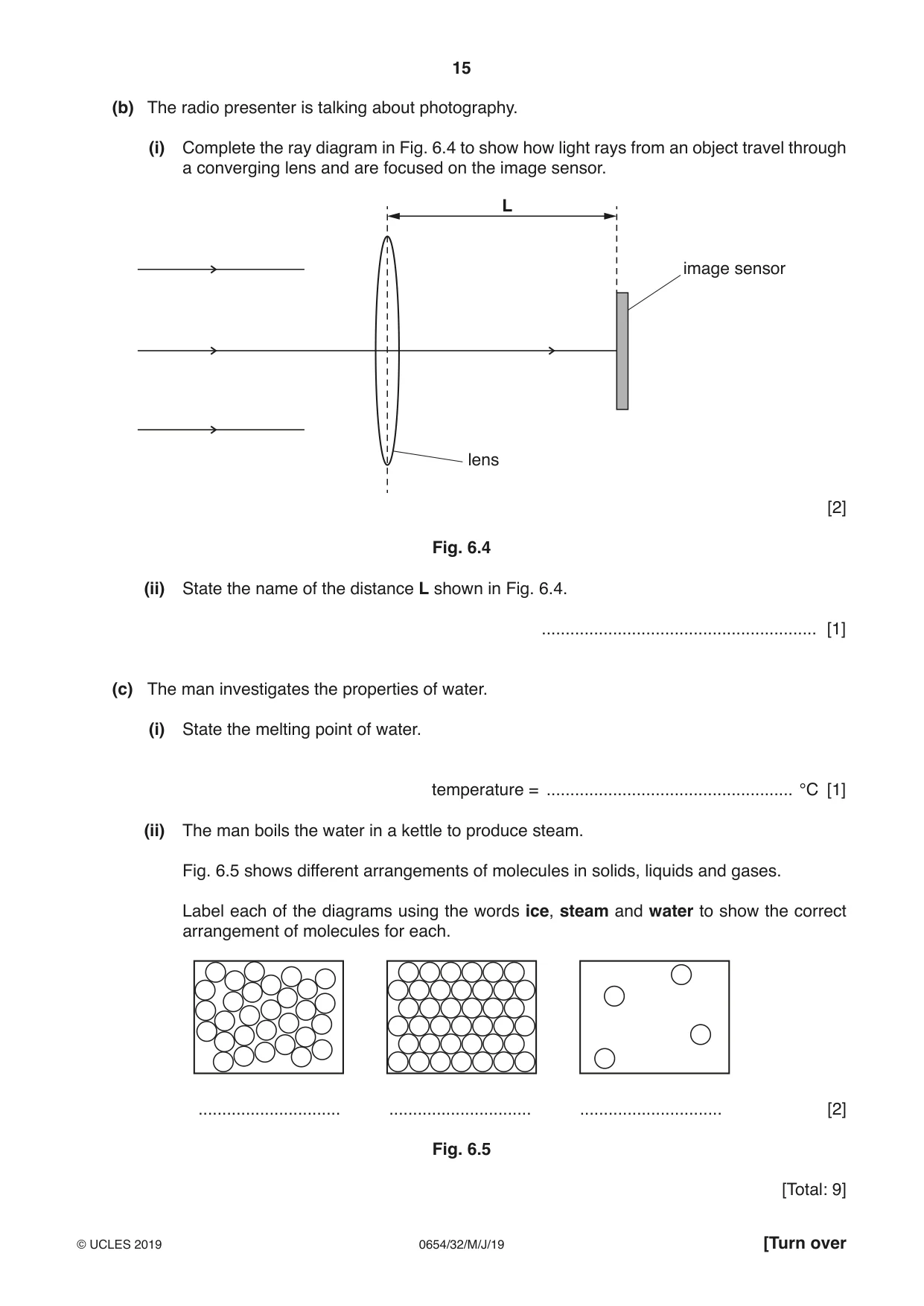
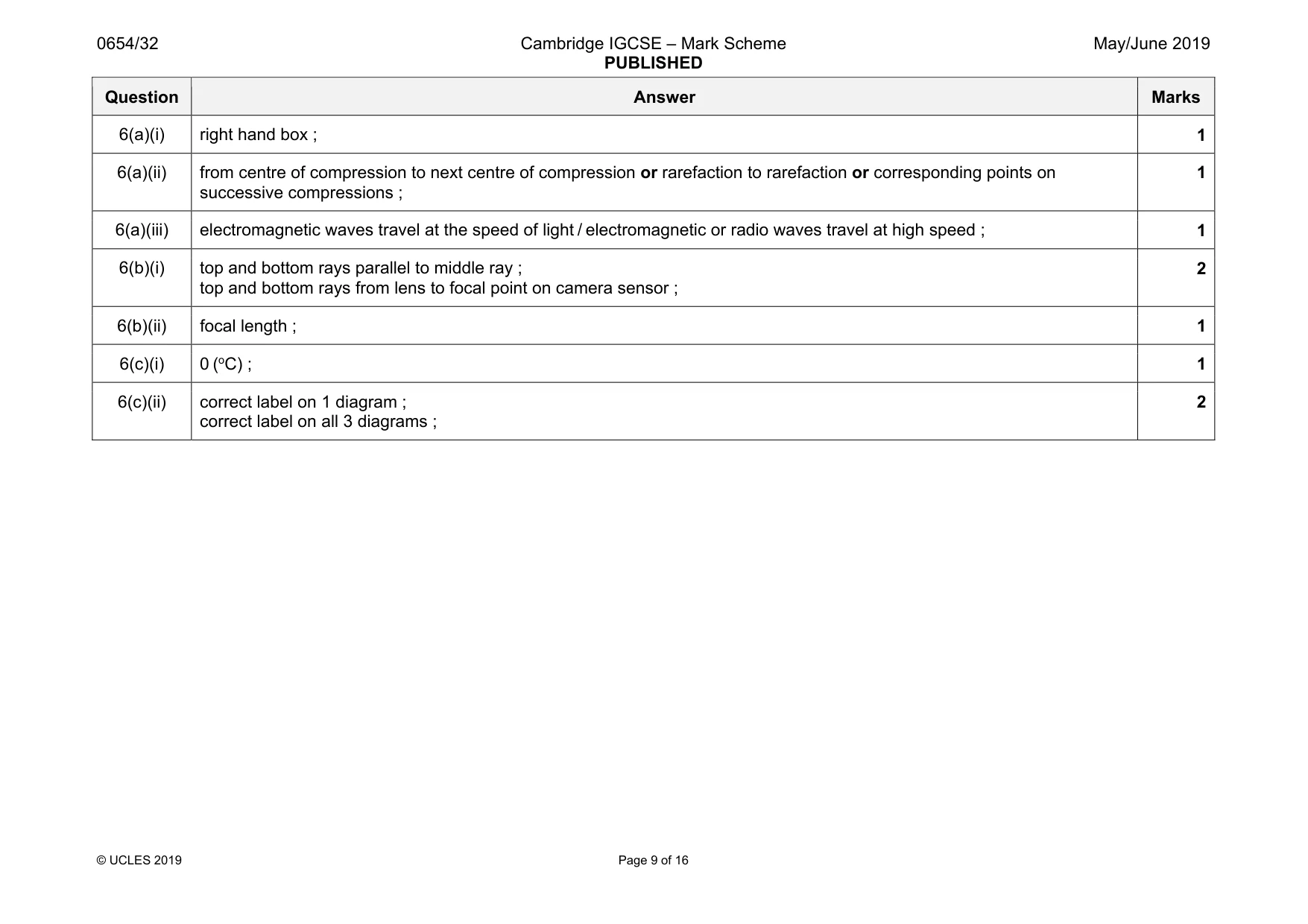
6 (a) Fig. 6.1 shows a presenter talking into a microphone at a radio station, and a man listening to the radio show on a radio at home. Fig. 6.1 (i) Write radio waves in the correct location in the incomplete electromagnetic spectrum in Fig. 6.2. gamma ultraviolet visible rays [1] Fig. 6.2 (ii) Fig. 6.3 shows soundwaves travelling in compressions (C) and rarefactions (R) from the loudspeaker to the ear of the man. On Fig. 6.3 use a double headed arrow ( ) to show one wavelength. C R C R C R C R C R C Fig. 6.3 [1] (iii) The distance from the radio station to the man is 500 km. Suggest why the radio signal arrives at the man’s radio almost instantly. ..................................................................................................................................... [1] (b) The radio presenter is talking about photography. (i) Complete the ray diagram in Fig. 6.4 to show how light rays from an object travel through a converging lens and are focused on the image sensor. L image sensor lens [2] Fig. 6.4 (ii) State the name of the distance L shown in Fig. 6.4. .......................................................... [1] (c) The man investigates the properties of water. (i) State the melting point of water. temperature = .................................................... °C [1] (ii) The man boils the water in a kettle to produce steam. Fig. 6.5 shows different arrangements of molecules in solids, liquids and gases. Label each of the diagrams using the words ice, steam and water to show the correct arrangement of molecules for each. .............................. .............................. .............................. [2] Fig. 6.5 [Total: 9]
Mark scheme: 6(a)(i) right hand box ; 1 6(a)(ii) from centre of compression to next centre of compression or rarefaction to rarefaction or corresponding points on successive compressions ; 1 6(a)(iii) electromagnetic waves travel at the speed of light / electromagnetic or radio waves travel at high speed ; 1 6(b)(i) top and bottom rays parallel to middle ray ; top and bottom rays from lens to focal point on camera sensor ; 2 6(b)(ii) focal length ; 1 6(c)(i) 0 (oC) ; 1 6(c)(ii) correct label on 1 diagram ; correct label on all 3 diagrams ; 2
Q7 · Complete the definition of the term transpiration using words or phrases from the list
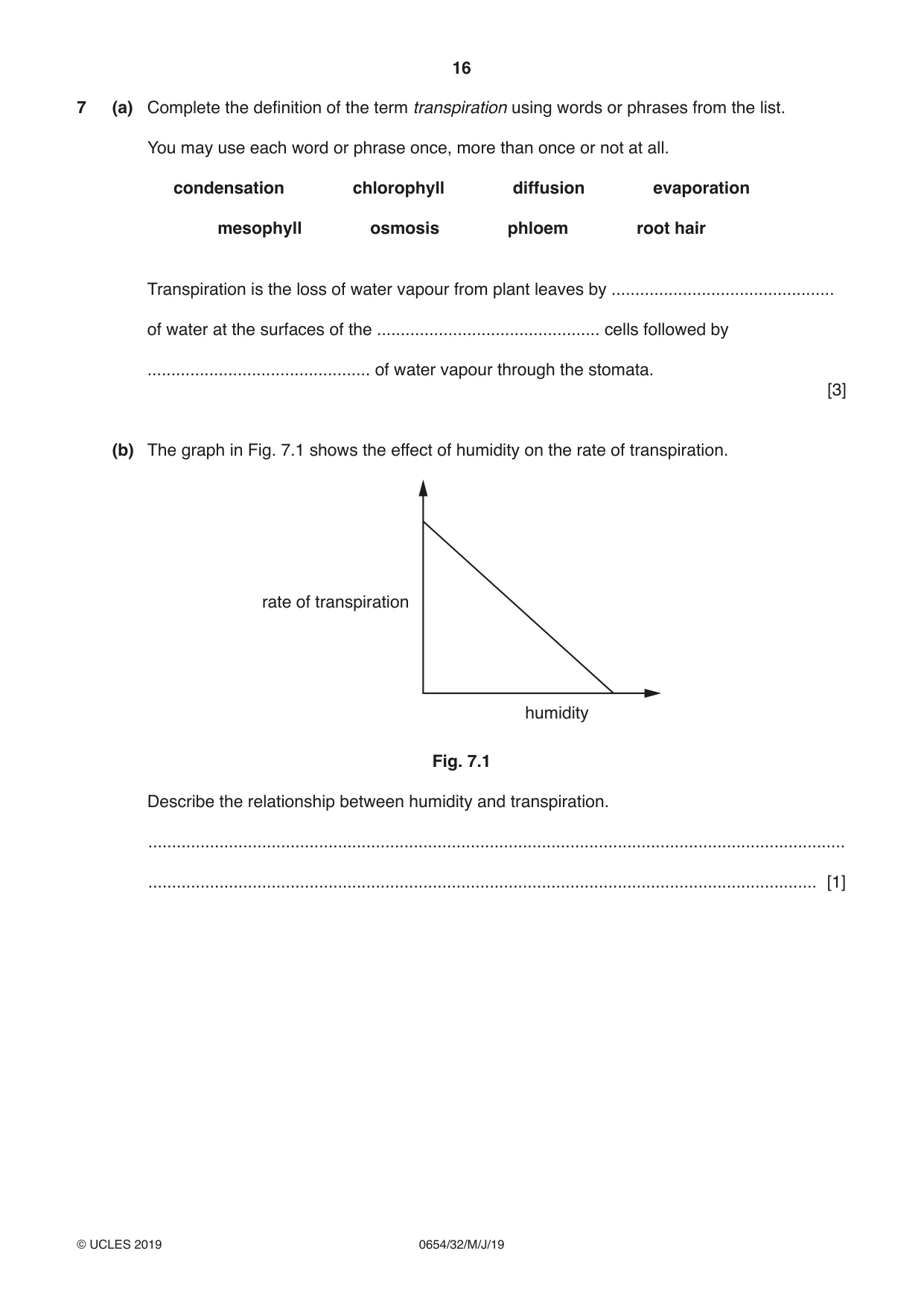
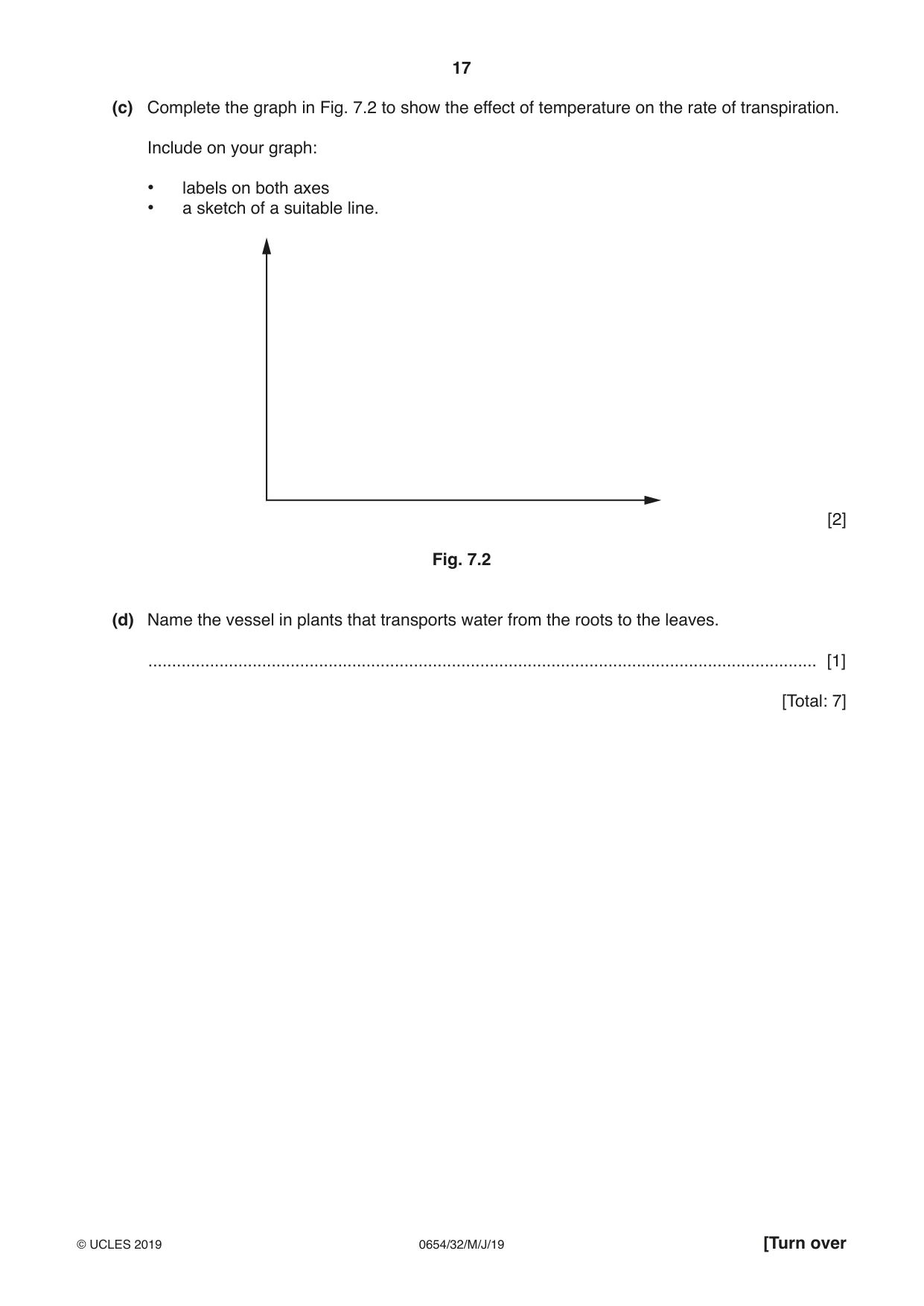
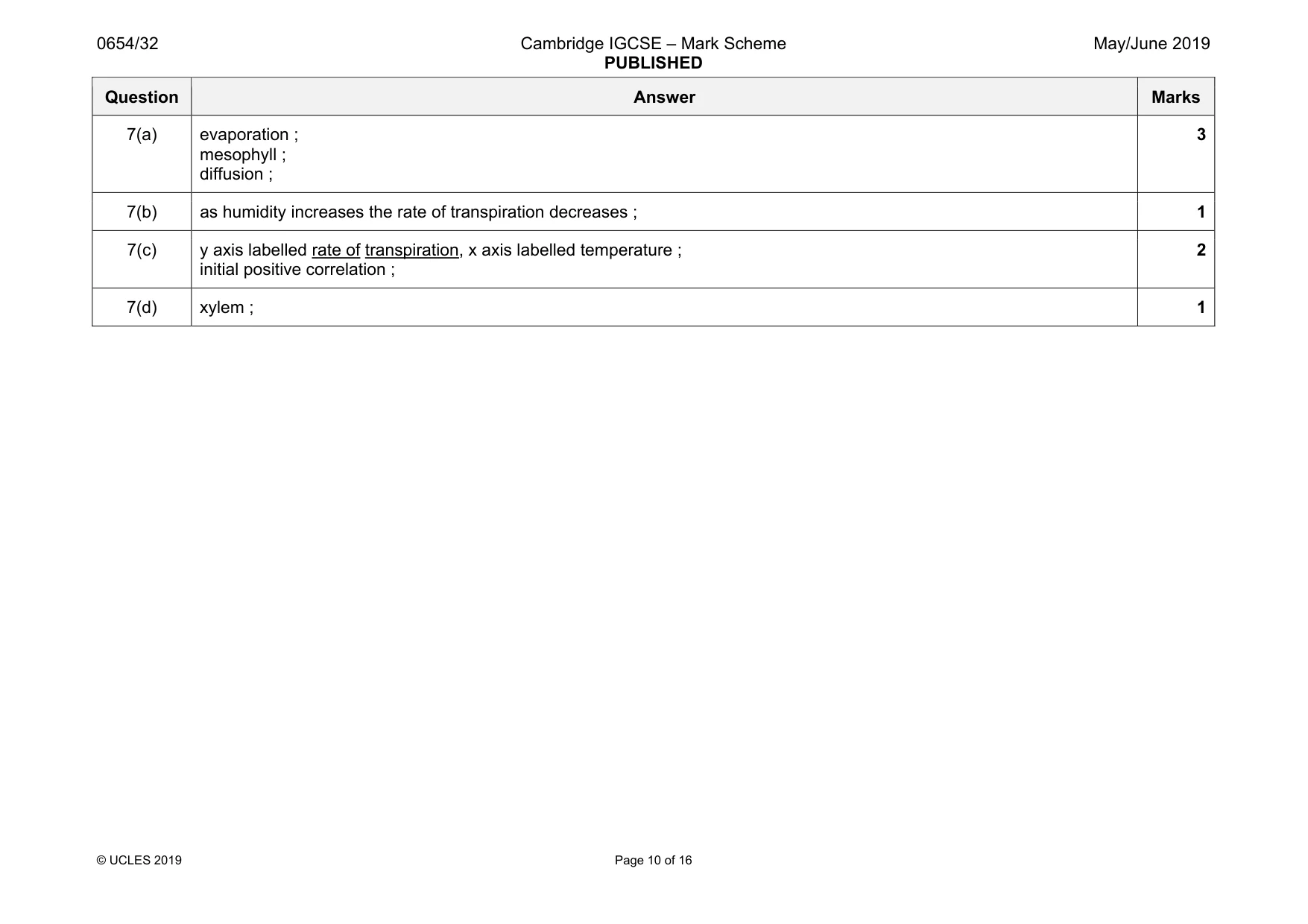
7 (a) Complete the definition of the term transpiration using words or phrases from the list. You may use each word or phrase once, more than once or not at all. condensation chlorophyll diffusion evaporation mesophyll osmosis phloem root hair Transpiration is the loss of water vapour from plant leaves by ............................................... of water at the surfaces of the ............................................... cells followed by ............................................... of water vapour through the stomata. [3] (b) The graph in Fig. 7.1 shows the effect of humidity on the rate of transpiration. rate of transpiration humidity Fig. 7.1 Describe the relationship between humidity and transpiration. ................................................................................................................................................... ............................................................................................................................................. [1] (c) Complete the graph in Fig. 7.2 to show the effect of temperature on the rate of transpiration. Include on your graph: • labels on both axes • a sketch of a suitable line. [2] Fig. 7.2 (d) Name the vessel in plants that transports water from the roots to the leaves. ............................................................................................................................................. [1] [Total: 7]
Mark scheme: 7(a) evaporation ; mesophyll ; diffusion ; 3 7(b) as humidity increases the rate of transpiration decreases ; 1 7(c) y axis labelled rate of transpiration, x axis labelled temperature ; initial positive correlation ; 2 7(d) xylem ; 1
Q8 · Electrolysis is a process which uses electricity to break down a compound
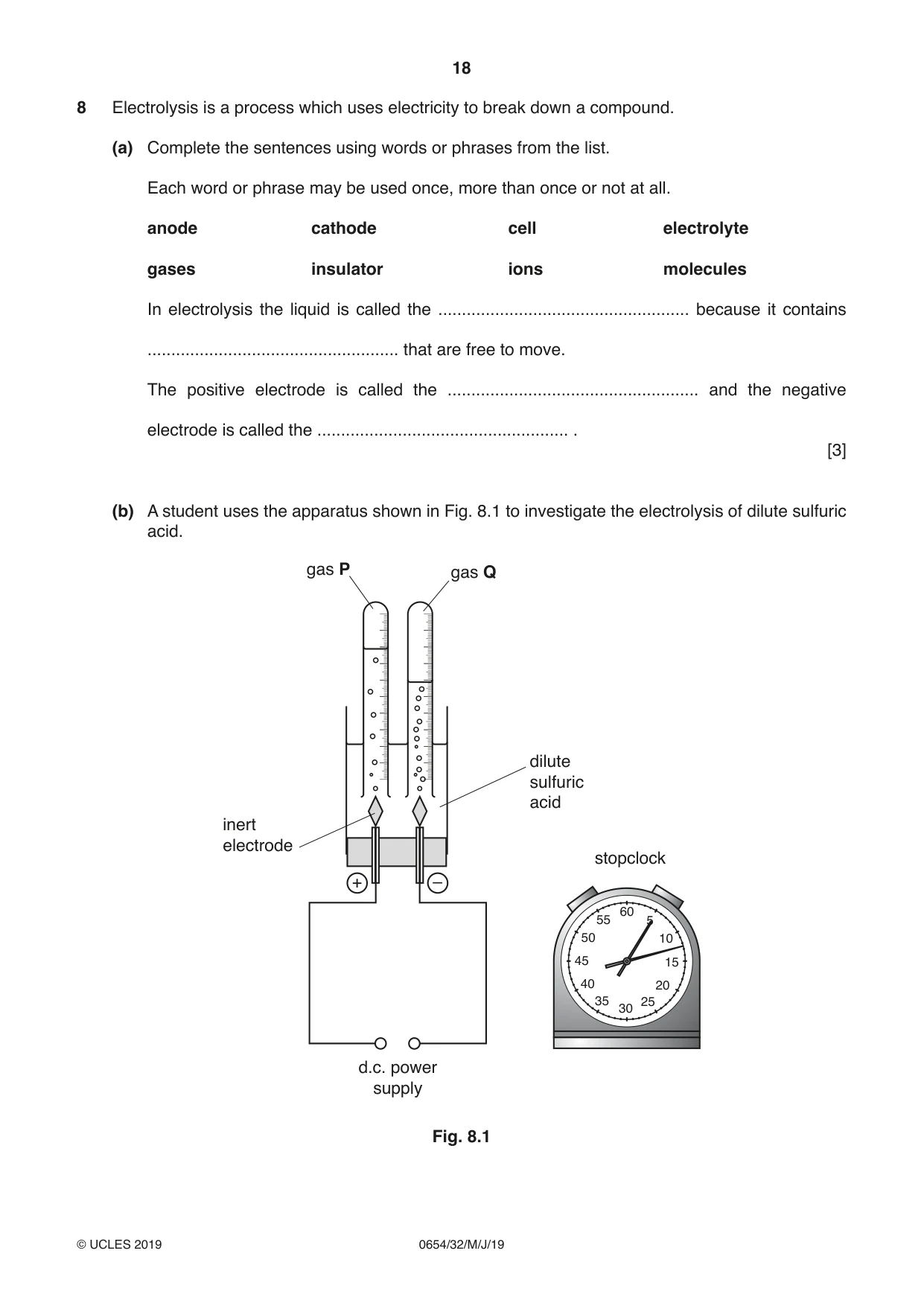
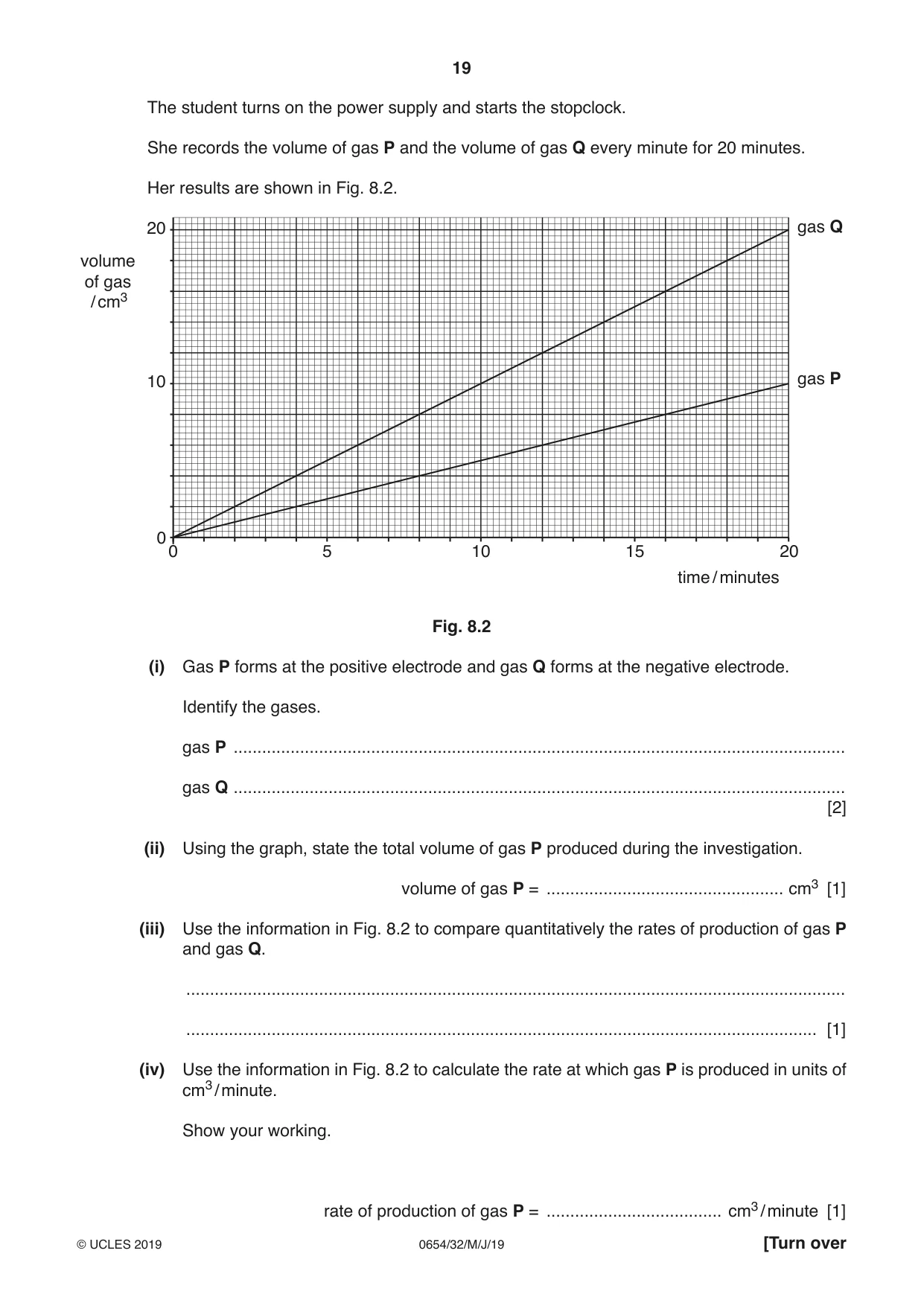
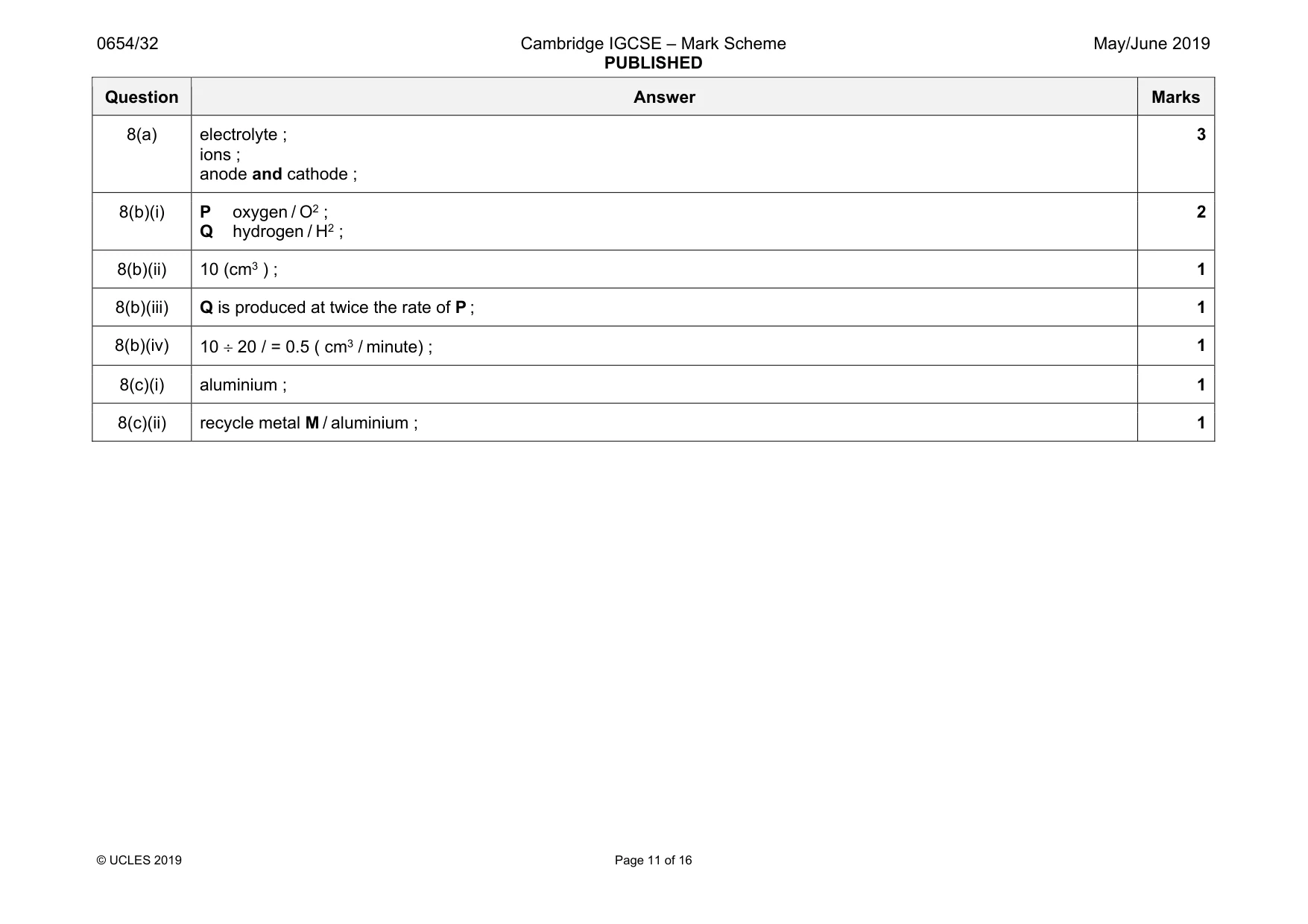
8 Electrolysis is a process which uses electricity to break down a compound. (a) Complete the sentences using words or phrases from the list. Each word or phrase may be used once, more than once or not at all. anode cathode cell electrolyte gases insulator ions molecules In electrolysis the liquid is called the ..................................................... because it contains ..................................................... that are free to move. The positive electrode is called the ..................................................... and the negative electrode is called the ..................................................... . [3] (b) A student uses the apparatus shown in Fig. 8.1 to investigate the electrolysis of dilute sulfuric acid. gas P gas Q dilute sulfuric acid inert electrode stopclock + – 60 55 5 50 10 45 15 40 20 35 25 30 d.c. power supply Fig. 8.1 The student turns on the power supply and starts the stopclock. She records the volume of gas P and the volume of gas Q every minute for 20 minutes. Her results are shown in Fig. 8.2. 20 gas Q volume of gas / cm3 10 gas P 0 0 5 10 15 20 time / minutes Fig. 8.2 (i) Gas P forms at the positive electrode and gas Q forms at the negative electrode. Identify the gases. gas P ................................................................................................................................. gas Q ................................................................................................................................. [2] (ii) Using the graph, state the total volume of gas P produced during the investigation. volume of gas P = .................................................. cm3 [1] (iii) Use the information in Fig. 8.2 to compare quantitatively the rates of production of gas P and gas Q. ........................................................................................................................................... ..................................................................................................................................... [1] (iv) Use the information in Fig. 8.2 to calculate the rate at which gas P is produced in units of cm3 / minute. Show your working. rate of production of gas P = ..................................... cm3 / minute [1] (c) Metal M is extracted from the ore bauxite by electrolysis. Metal M is used to make many useful products. (i) Name metal M. ..................................................................................................................................... [1] (ii) Bauxite is a finite resource. State one way that the need for bauxite can be reduced. ........................................................................................................................................... ..................................................................................................................................... [1] [Total: 10]
Mark scheme: 8(a) electrolyte ; ions ; anode and cathode ; 3 8(b)(i) P oxygen / O2 ; Q hydrogen / H2 ; 2 8(b)(ii) 10 (cm3 ) ; 1 8(b)(iii) Q is produced at twice the rate of P ; 1 8(b)(iv) 10 ÷ 20 / = 0.5 ( cm3 / minute) ; 1 8(c)(i) aluminium ; 1 8(c)(ii) recycle metal M / aluminium ; 1
Q9 · Petroleum is a non-renewable energy resource used to produce electricity
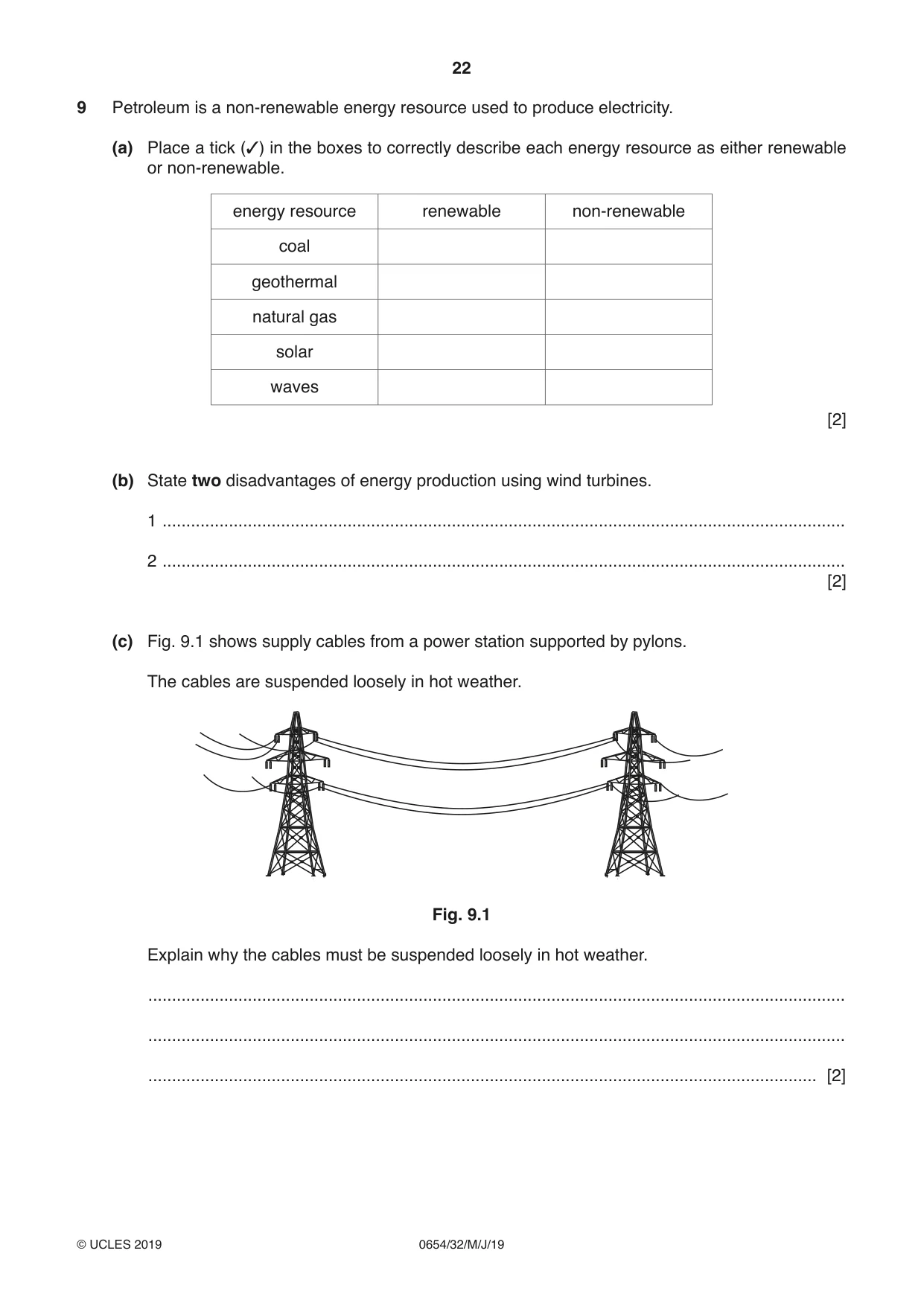
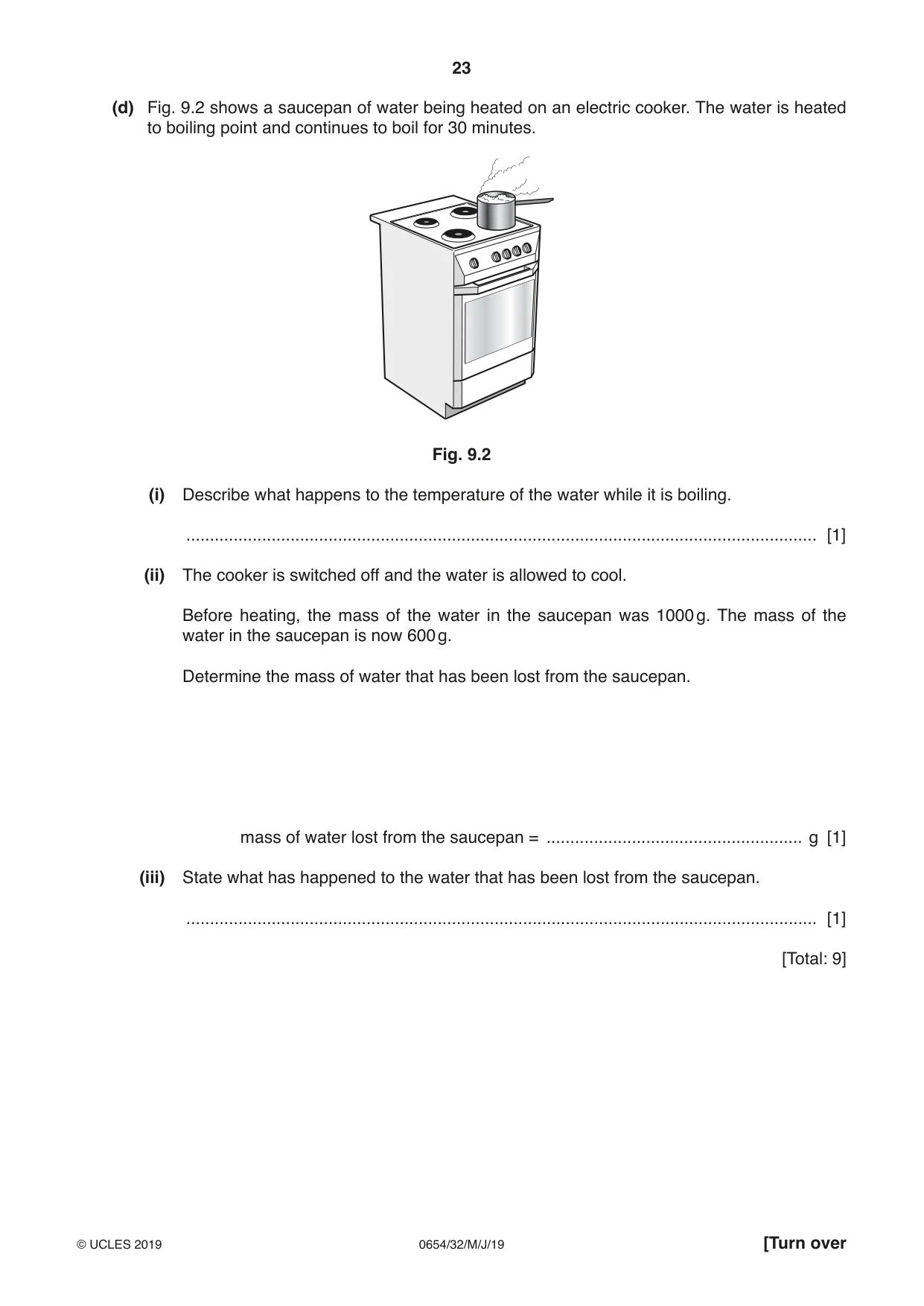
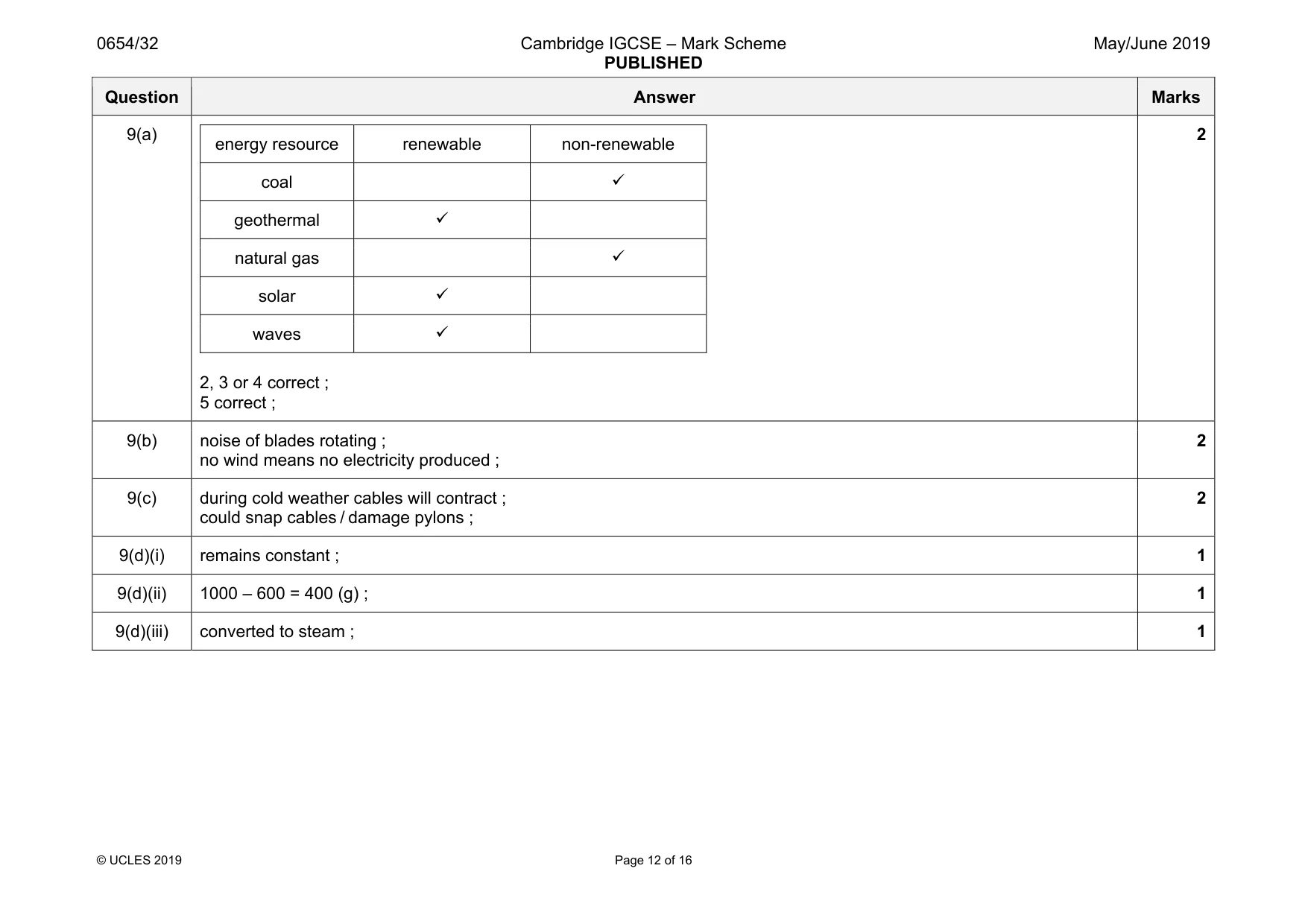
9 Petroleum is a non-renewable energy resource used to produce electricity. (a) Place a tick (3) in the boxes to correctly describe each energy resource as either renewable or non-renewable. energy resource renewable non-renewable coal geothermal natural gas solar waves [2] (b) State two disadvantages of energy production using wind turbines. 1 ................................................................................................................................................ 2 ................................................................................................................................................ [2] (c) Fig. 9.1 shows supply cables from a power station supported by pylons. The cables are suspended loosely in hot weather. Fig. 9.1 Explain why the cables must be suspended loosely in hot weather. ................................................................................................................................................... ................................................................................................................................................... ............................................................................................................................................. [2] (d) Fig. 9.2 shows a saucepan of water being heated on an electric cooker. The water is heated to boiling point and continues to boil for 30 minutes. Fig. 9.2 (i) Describe what happens to the temperature of the water while it is boiling. ..................................................................................................................................... [1] (ii) The cooker is switched off and the water is allowed to cool. Before heating, the mass of the water in the saucepan was 1000 g. The mass of the water in the saucepan is now 600 g. Determine the mass of water that has been lost from the saucepan. mass of water lost from the saucepan = ...................................................... g [1] (iii) State what has happened to the water that has been lost from the saucepan. ..................................................................................................................................... [1] [Total: 9]
Mark scheme: 9(a) energy resource renewable non-renewable coal 9 geothermal 9 natural gas 9 solar 9 waves 9 2, 3 or 4 correct ; 5 correct ; 2 9(b) noise of blades rotating ; no wind means no electricity produced ; 2 9(c) during cold weather cables will contract ; could snap cables / damage pylons ; 2 9(d)(i) remains constant ; 1 9(d)(ii) 1000 – 600 = 400 (g) ; 1 9(d)(iii) converted to steam ; 1
Q10 · Describe the difference between phenotypic variation and genetic variation
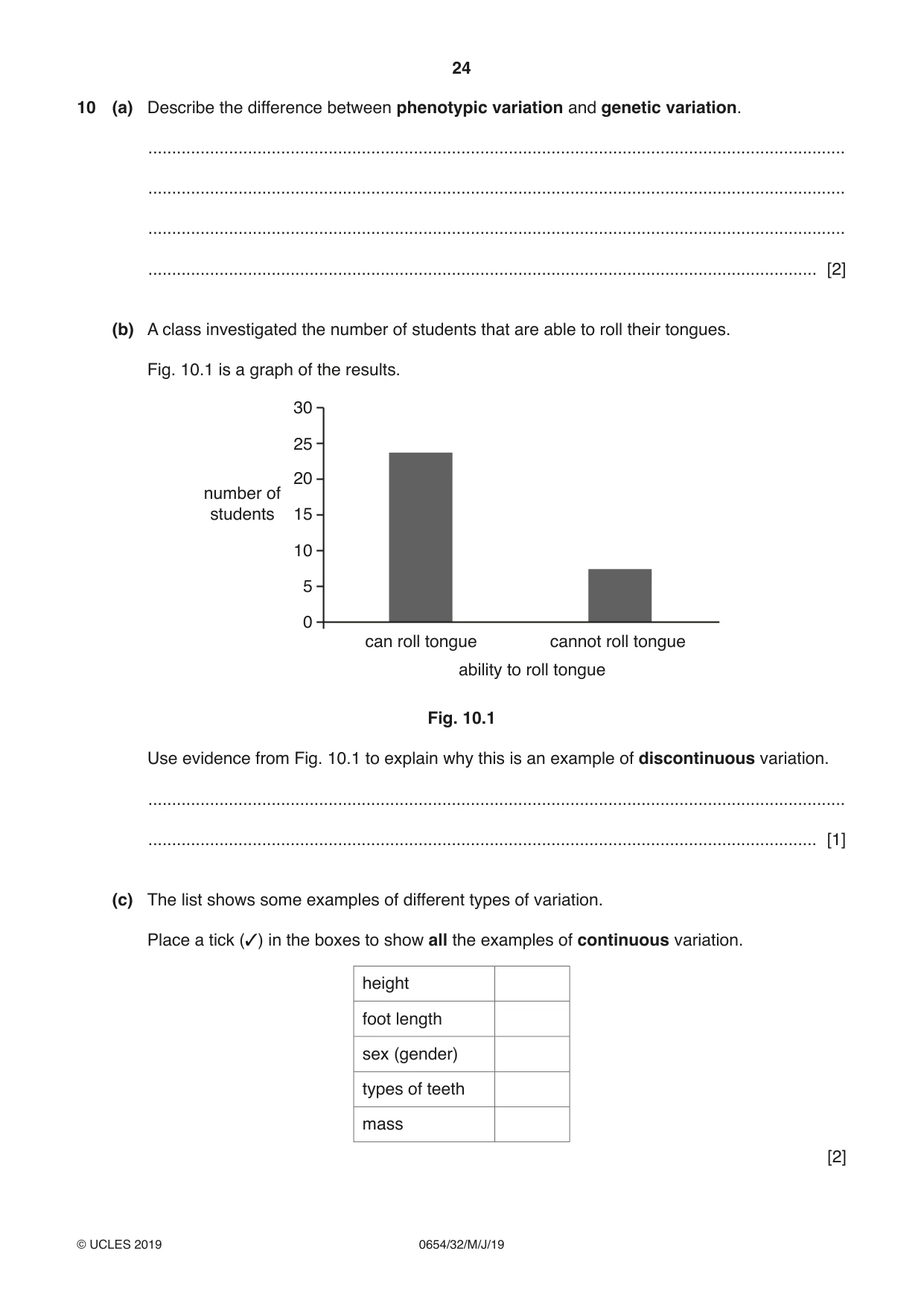
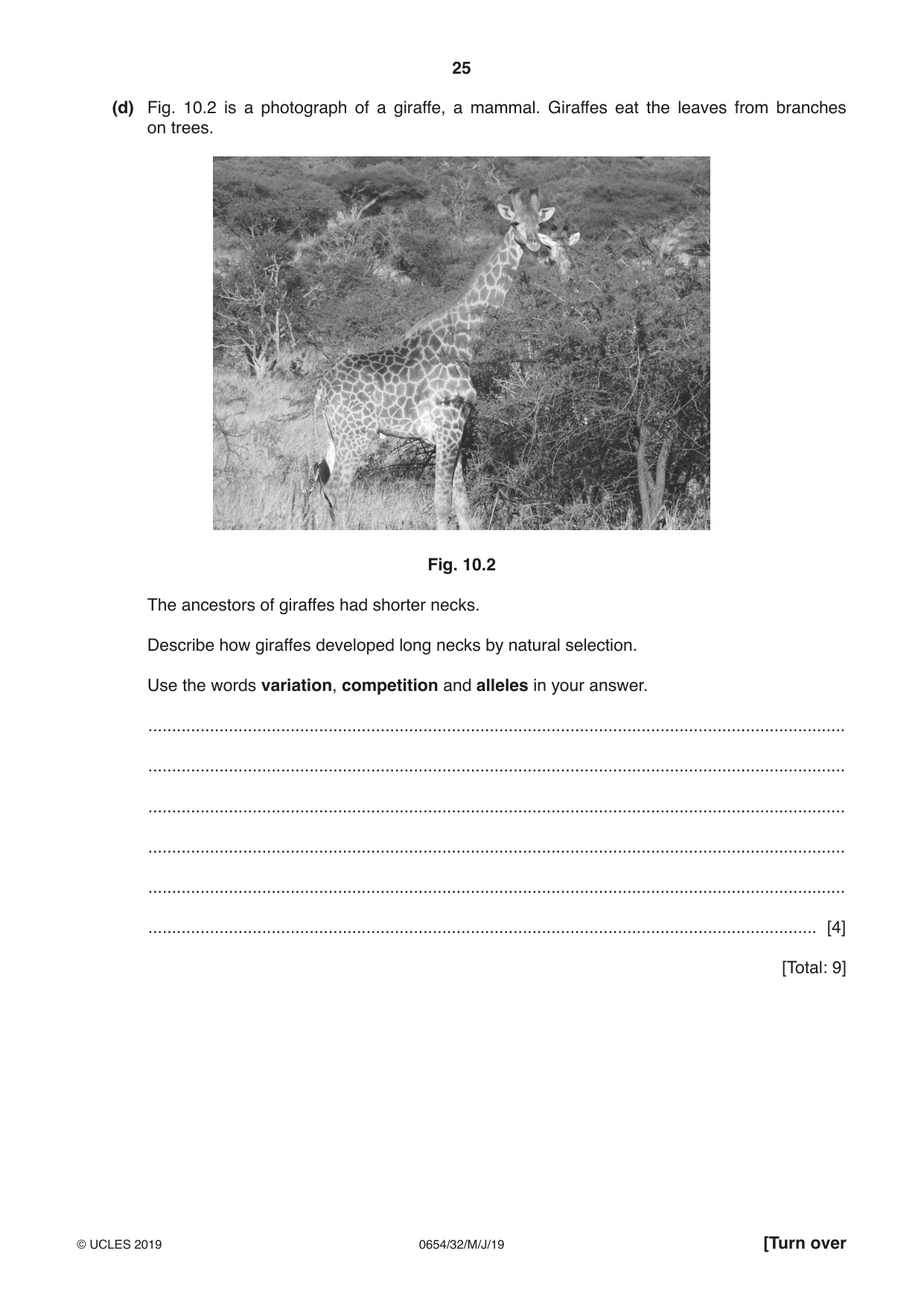
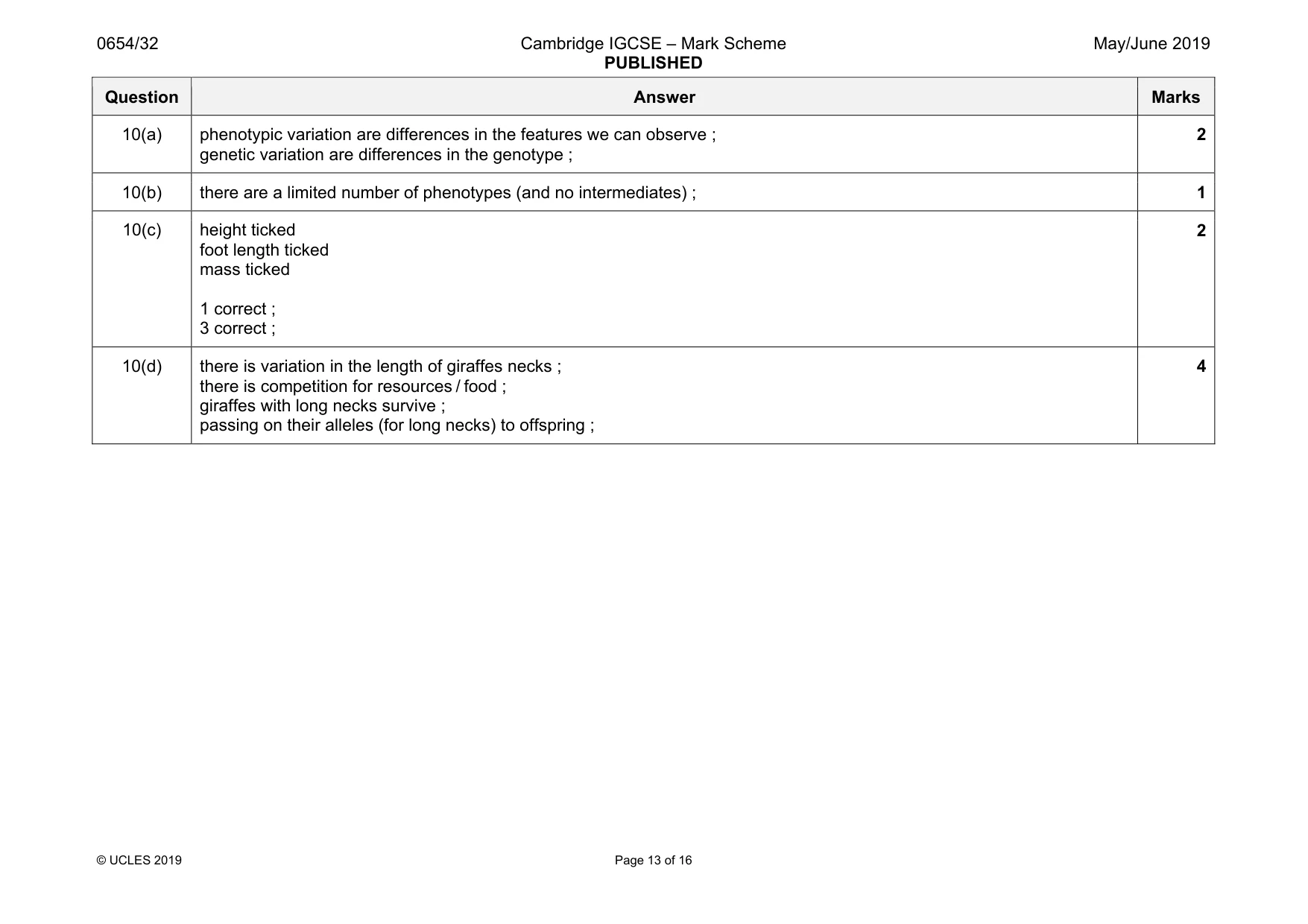
10 (a) Describe the difference between phenotypic variation and genetic variation. ................................................................................................................................................... ................................................................................................................................................... ................................................................................................................................................... ............................................................................................................................................. [2] (b) A class investigated the number of students that are able to roll their tongues. Fig. 10.1 is a graph of the results. 30 25 20 number of students 15 10 5 0 can roll tongue cannot roll tongue ability to roll tongue Fig. 10.1 Use evidence from Fig. 10.1 to explain why this is an example of discontinuous variation. ................................................................................................................................................... ............................................................................................................................................. [1] (c) The list shows some examples of different types of variation. Place a tick (3) in the boxes to show all the examples of continuous variation. height foot length sex (gender) types of teeth mass [2] (d) Fig. 10.2 is a photograph of a giraffe, a mammal. Giraffes eat the leaves from branches on trees. Fig. 10.2 The ancestors of giraffes had shorter necks. Describe how giraffes developed long necks by natural selection. Use the words variation, competition and alleles in your answer. ................................................................................................................................................... ................................................................................................................................................... ................................................................................................................................................... ................................................................................................................................................... ................................................................................................................................................... ............................................................................................................................................. [4] [Total: 9]
Mark scheme: 10(a) phenotypic variation are differences in the features we can observe ; genetic variation are differences in the genotype ; 2 10(b) there are a limited number of phenotypes (and no intermediates) ; 1 10(c) height ticked foot length ticked mass ticked 1 correct ; 3 correct ; 2 10(d) there is variation in the length of giraffes necks ; there is competition for resources / food ; giraffes with long necks survive ; passing on their alleles (for long necks) to offspring ; 4
Q11 · A beaker containing sand and aqueous sodium chloride
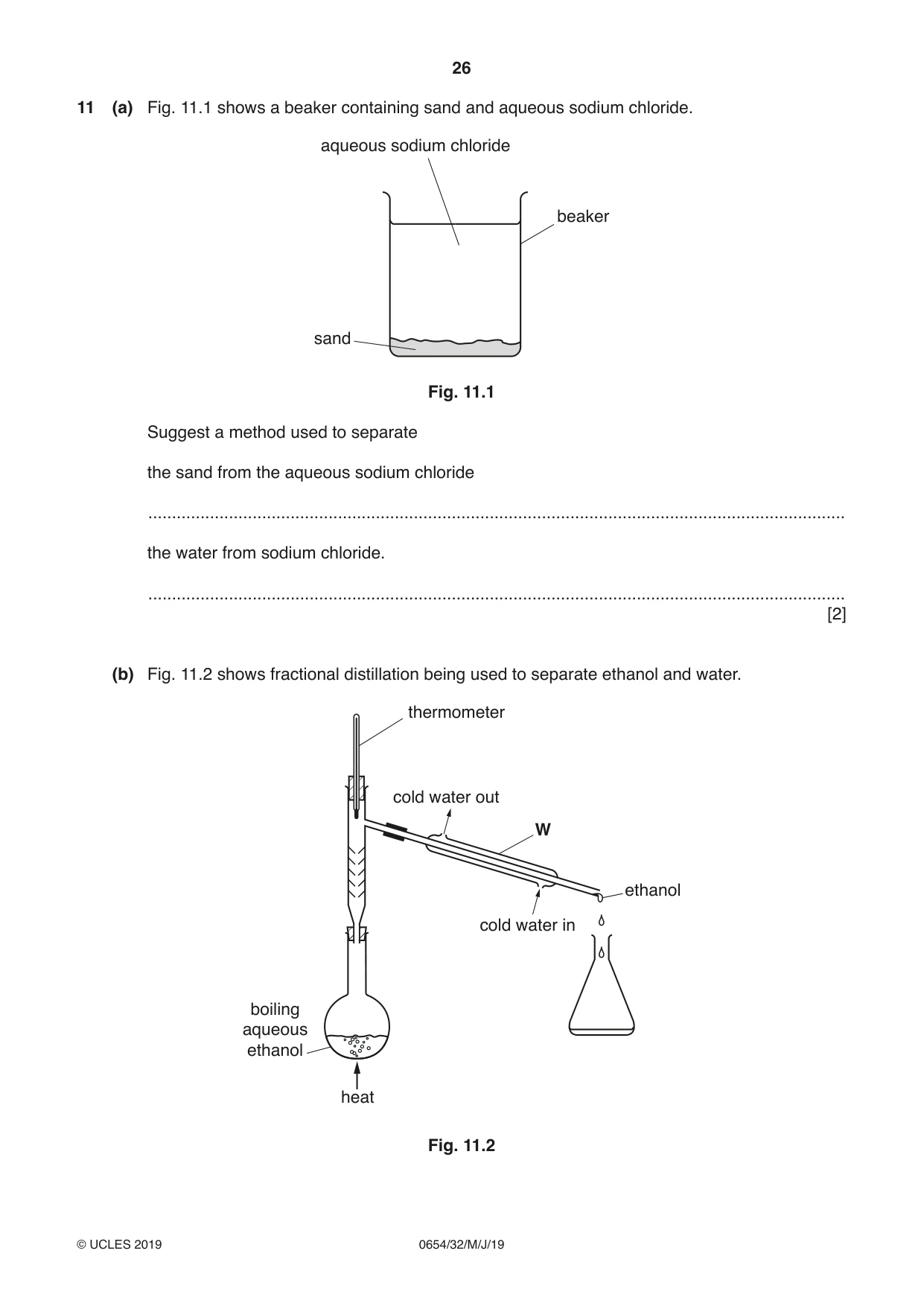
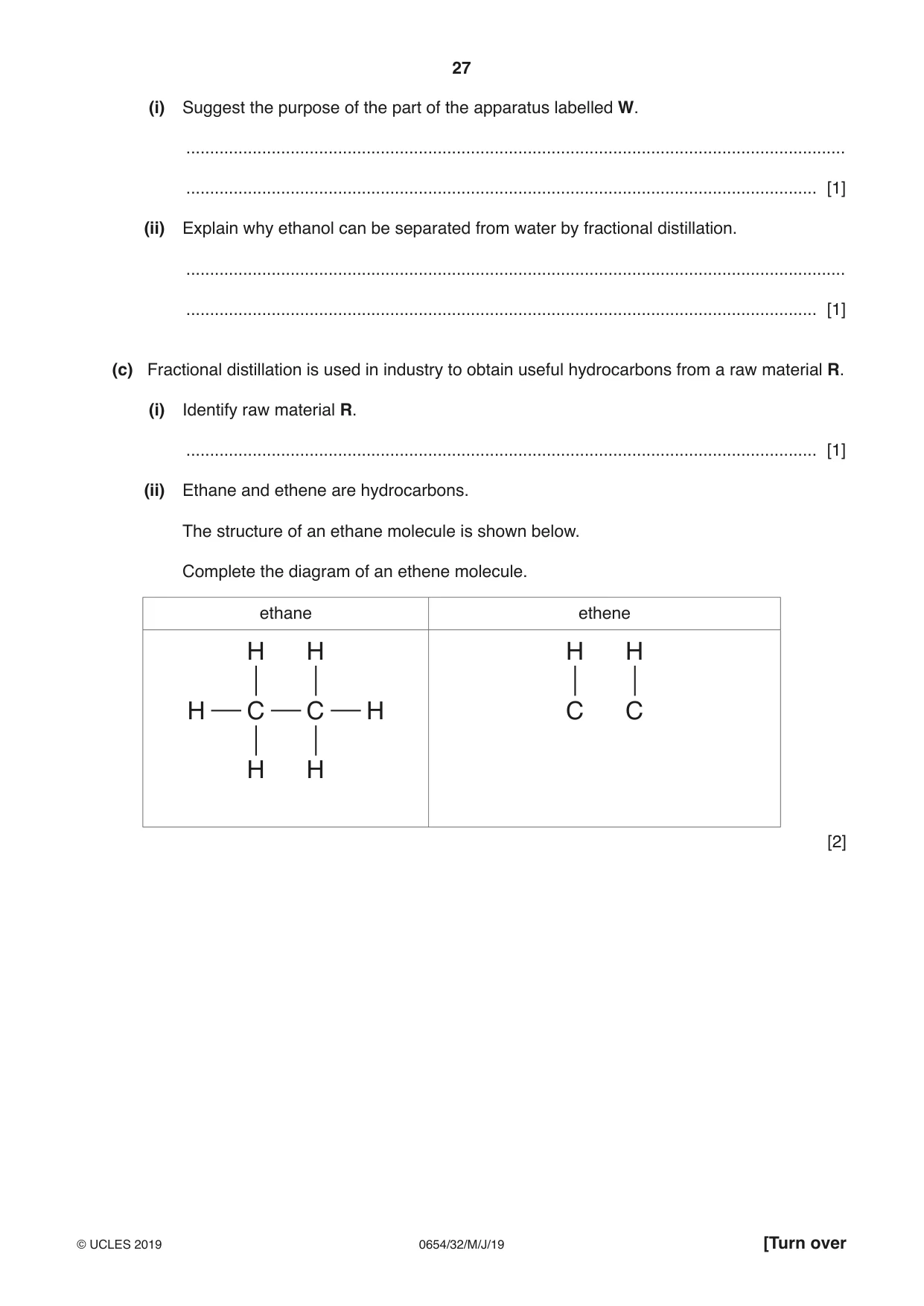
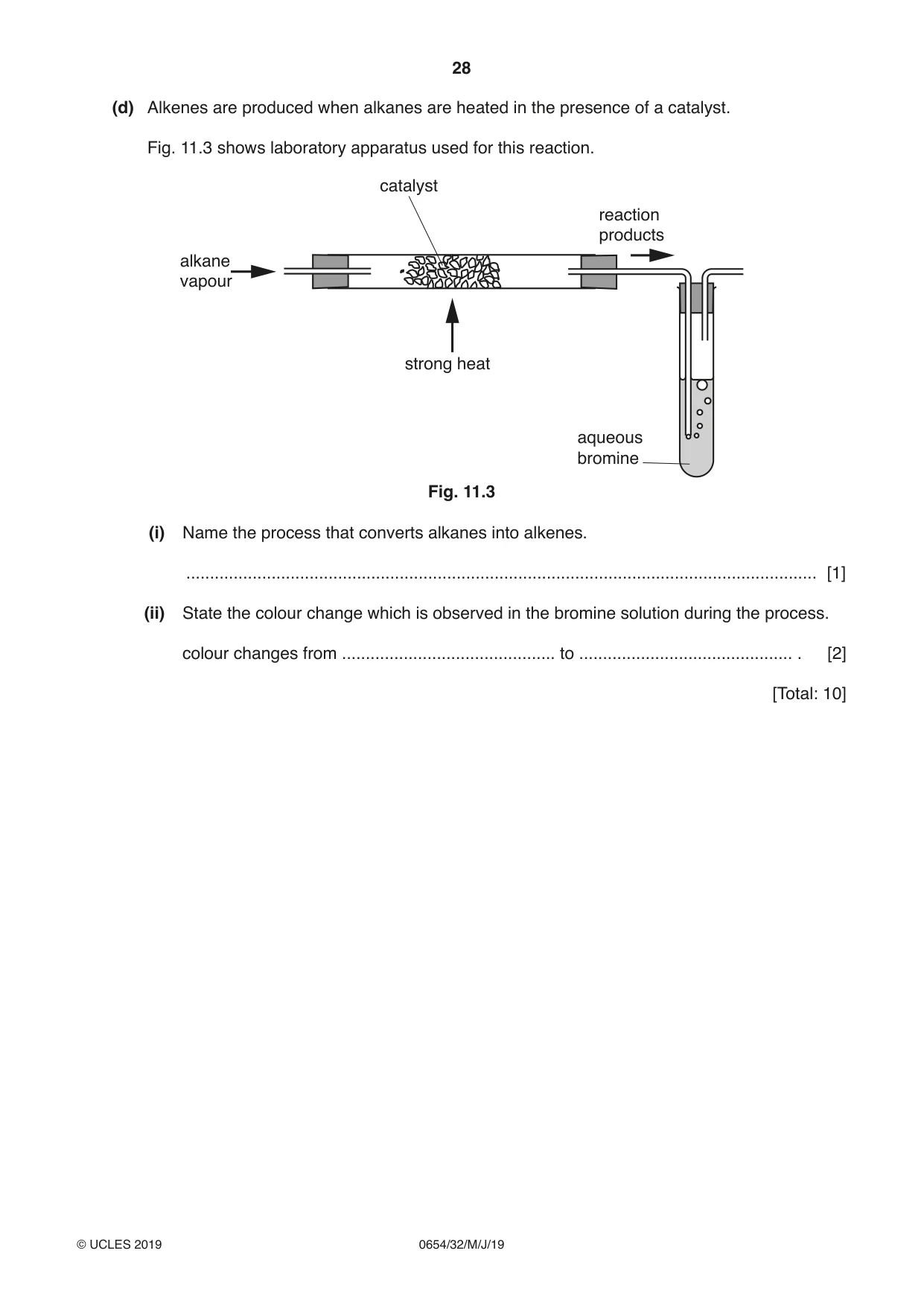
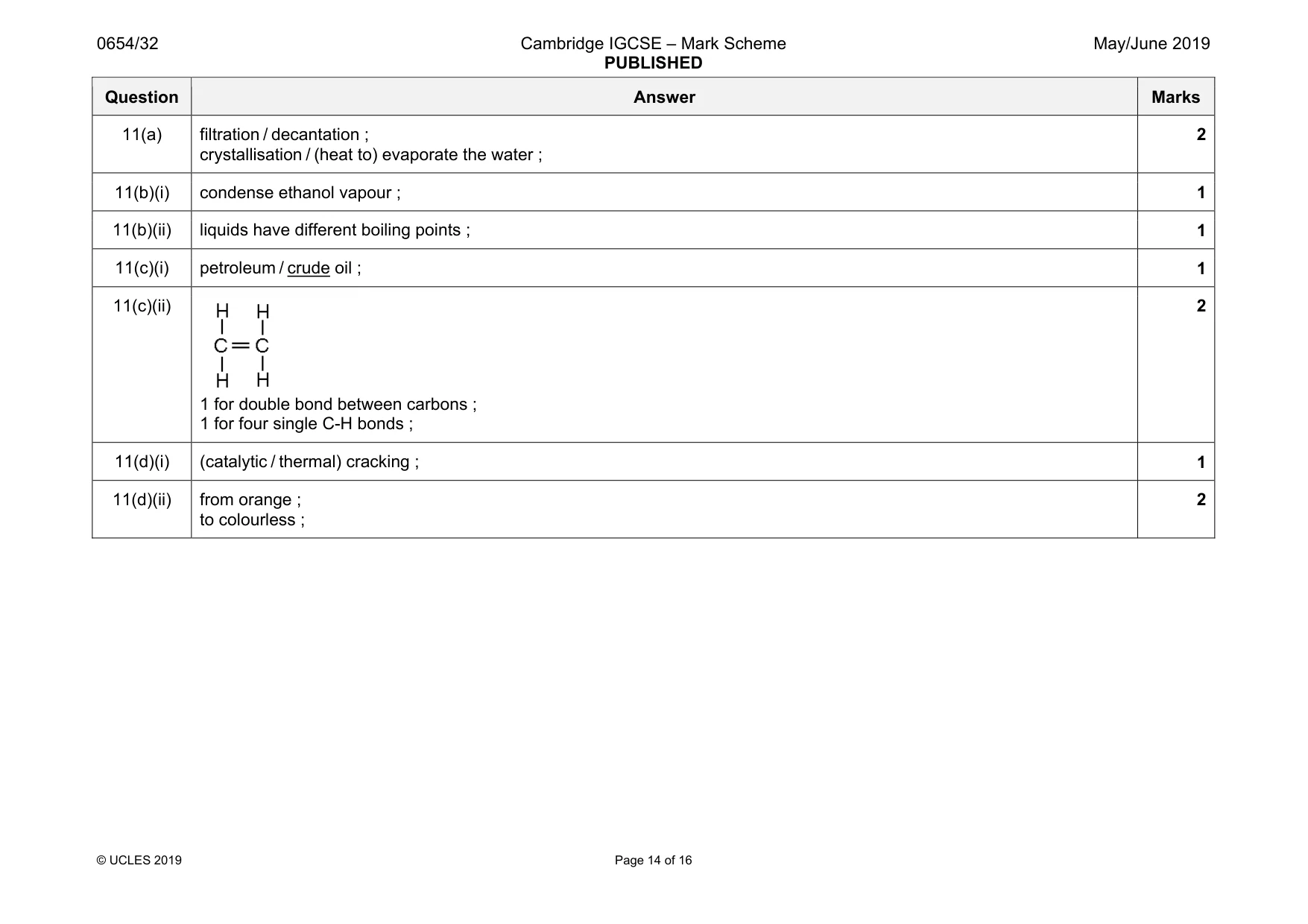
11 (a) Fig. 11.1 shows a beaker containing sand and aqueous sodium chloride. aqueous sodium chloride beaker sand Fig. 11.1 Suggest a method used to separate the sand from the aqueous sodium chloride ................................................................................................................................................... the water from sodium chloride. ................................................................................................................................................... [2] (b) Fig. 11.2 shows fractional distillation being used to separate ethanol and water. thermometer cold water out W ethanol cold water in boiling aqueous ethanol heat Fig. 11.2 (i) Suggest the purpose of the part of the apparatus labelled W. ........................................................................................................................................... ..................................................................................................................................... [1] (ii) Explain why ethanol can be separated from water by fractional distillation. ........................................................................................................................................... ..................................................................................................................................... [1] (c) Fractional distillation is used in industry to obtain useful hydrocarbons from a raw material R. (i) Identify raw material R. ..................................................................................................................................... [1] (ii) Ethane and ethene are hydrocarbons. The structure of an ethane molecule is shown below. Complete the diagram of an ethene molecule. ethane ethene H H H H H C C H C C H H [2] (d) Alkenes are produced when alkanes are heated in the presence of a catalyst. Fig. 11.3 shows laboratory apparatus used for this reaction. catalyst reaction products alkane vapour strong heat aqueous bromine Fig. 11.3 (i) Name the process that converts alkanes into alkenes. ..................................................................................................................................... [1] (ii) State the colour change which is observed in the bromine solution during the process. colour changes from ............................................. to ............................................. . [2] [Total: 10]
Mark scheme: 11(a) filtration / decantation ; crystallisation / (heat to) evaporate the water ; 2 11(b)(i) condense ethanol vapour ; 1 11(b)(ii) liquids have different boiling points ; 1 11(c)(i) petroleum / crude oil ; 1 11(c)(ii) 1 for double bond between carbons ; 1 for four single C-H bonds ; 2 11(d)(i) (catalytic / thermal) cracking ; 1 11(d)(ii) from orange ; to colourless ; 2
Q12 · A bridge between two supports
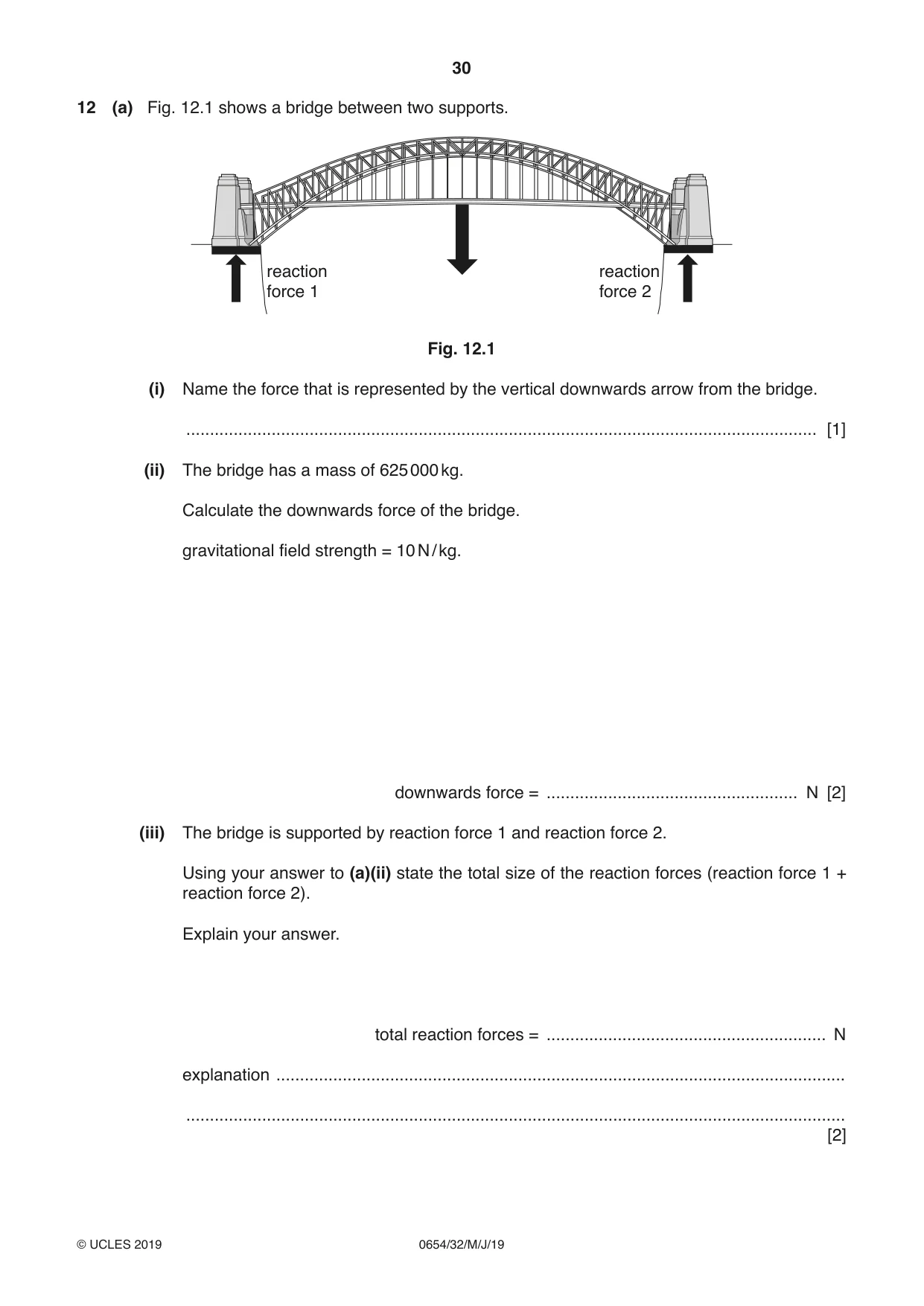
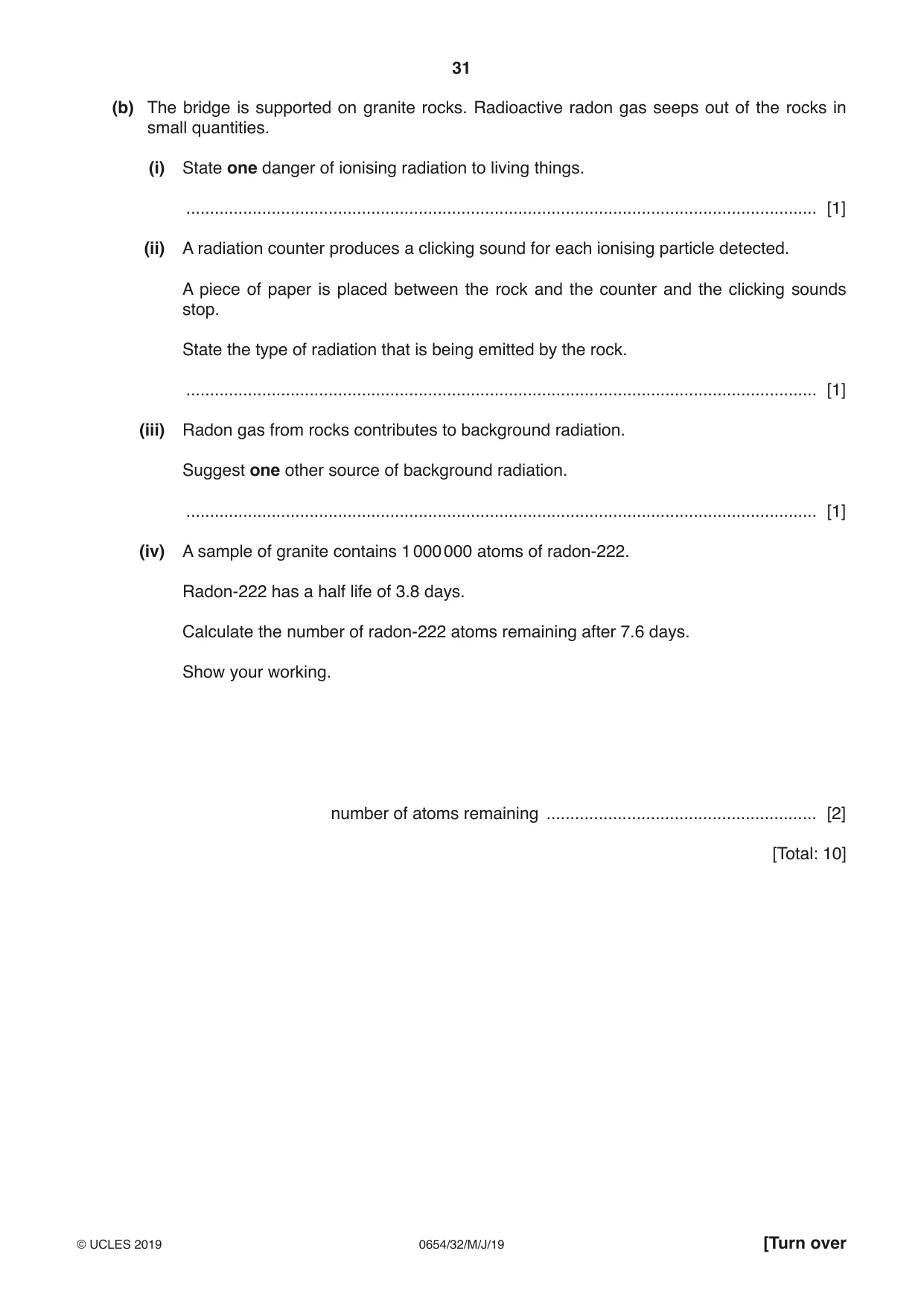
12 (a) Fig. 12.1 shows a bridge between two supports. reaction reaction force 1 force 2 Fig. 12.1 (i) Name the force that is represented by the vertical downwards arrow from the bridge. ..................................................................................................................................... [1] (ii) The bridge has a mass of 625 000 kg. Calculate the downwards force of the bridge. gravitational field strength = 10 N / kg. downwards force = ..................................................... N [2] (iii) The bridge is supported by reaction force 1 and reaction force 2. Using your answer to (a)(ii) state the total size of the reaction forces (reaction force 1 + reaction force 2). Explain your answer. total reaction forces = ........................................................... N explanation ........................................................................................................................ ........................................................................................................................................... [2] (b) The bridge is supported on granite rocks. Radioactive radon gas seeps out of the rocks in small quantities. (i) State one danger of ionising radiation to living things. ..................................................................................................................................... [1] (ii) A radiation counter produces a clicking sound for each ionising particle detected. A piece of paper is placed between the rock and the counter and the clicking sounds stop. State the type of radiation that is being emitted by the rock. ..................................................................................................................................... [1] (iii) Radon gas from rocks contributes to background radiation. Suggest one other source of background radiation. ..................................................................................................................................... [1] (iv) A sample of granite contains 1 000 000 atoms of radon-222. Radon-222 has a half life of 3.8 days. Calculate the number of radon-222 atoms remaining after 7.6 days. Show your working. number of atoms remaining ......................................................... [2] [Total: 10]
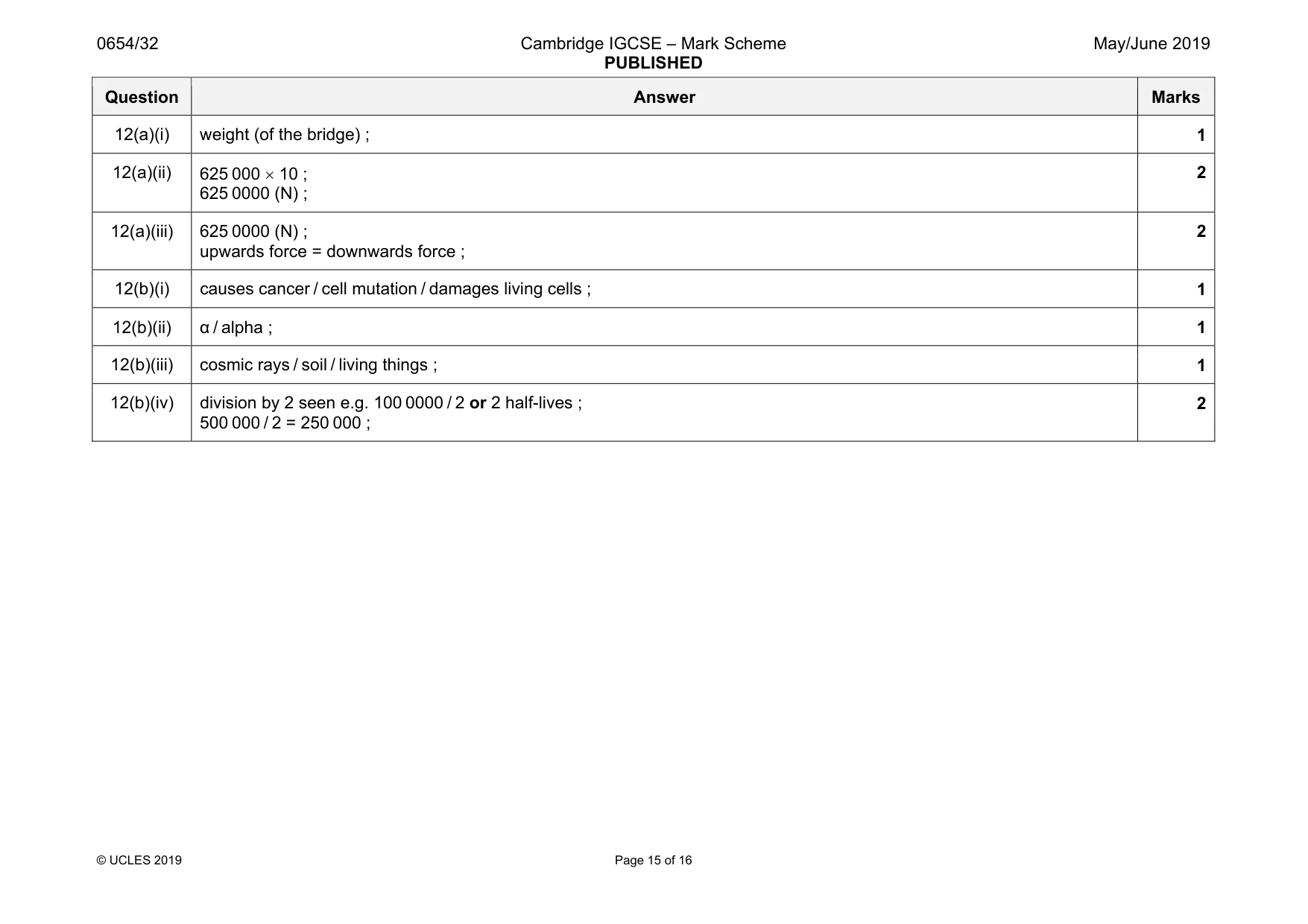
Mark scheme: 12(a)(i) weight (of the bridge) ; 1 12(a)(ii) 625 000 × 10 ; 625 0000 (N) ; 2 12(a)(iii) 625 0000 (N) ; upwards force = downwards force ; 2 12(b)(i) causes cancer / cell mutation / damages living cells ; 1 12(b)(ii) α / alpha ; 1 12(b)(iii) cosmic rays / soil / living things ; 1 12(b)(iv) division by 2 seen e.g. 100 0000 / 2 or 2 half-lives ; 500 000 / 2 = 250 000 ; 2
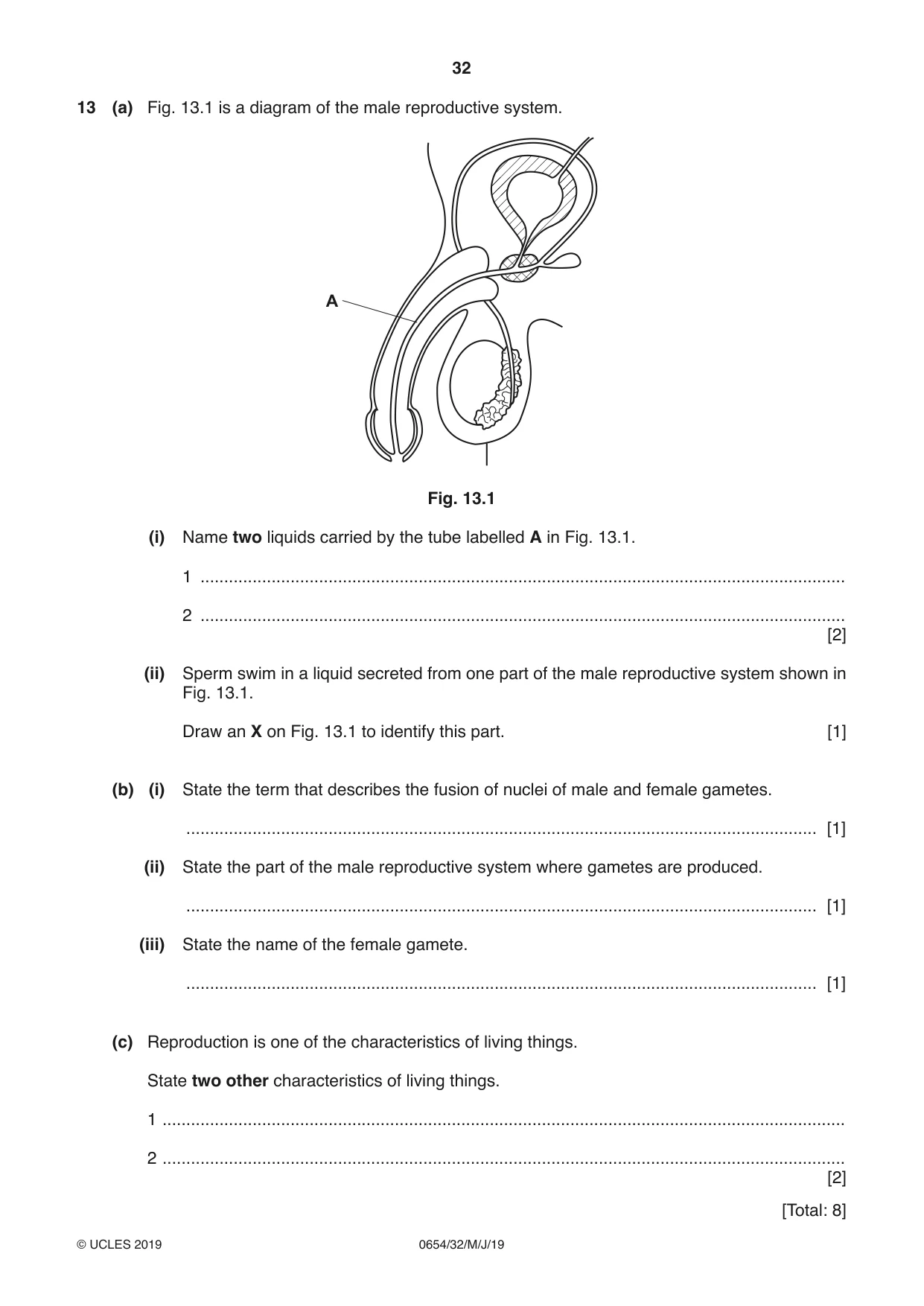
Q13 · A diagram of the male reproductive system
13 (a) Fig. 13.1 is a diagram of the male reproductive system. A Fig. 13.1 (i) Name two liquids carried by the tube labelled A in Fig. 13.1. 1 ........................................................................................................................................ 2 ........................................................................................................................................ [2] (ii) Sperm swim in a liquid secreted from one part of the male reproductive system shown in Fig. 13.1. Draw an X on Fig. 13.1 to identify this part. [1] (b) (i) State the term that describes the fusion of nuclei of male and female gametes. ..................................................................................................................................... [1] (ii) State the part of the male reproductive system where gametes are produced. ..................................................................................................................................... [1] (iii) State the name of the female gamete. ..................................................................................................................................... [1] (c) Reproduction is one of the characteristics of living things. State two other characteristics of living things. 1 ................................................................................................................................................ 2 ................................................................................................................................................ [2] [Total: 8]
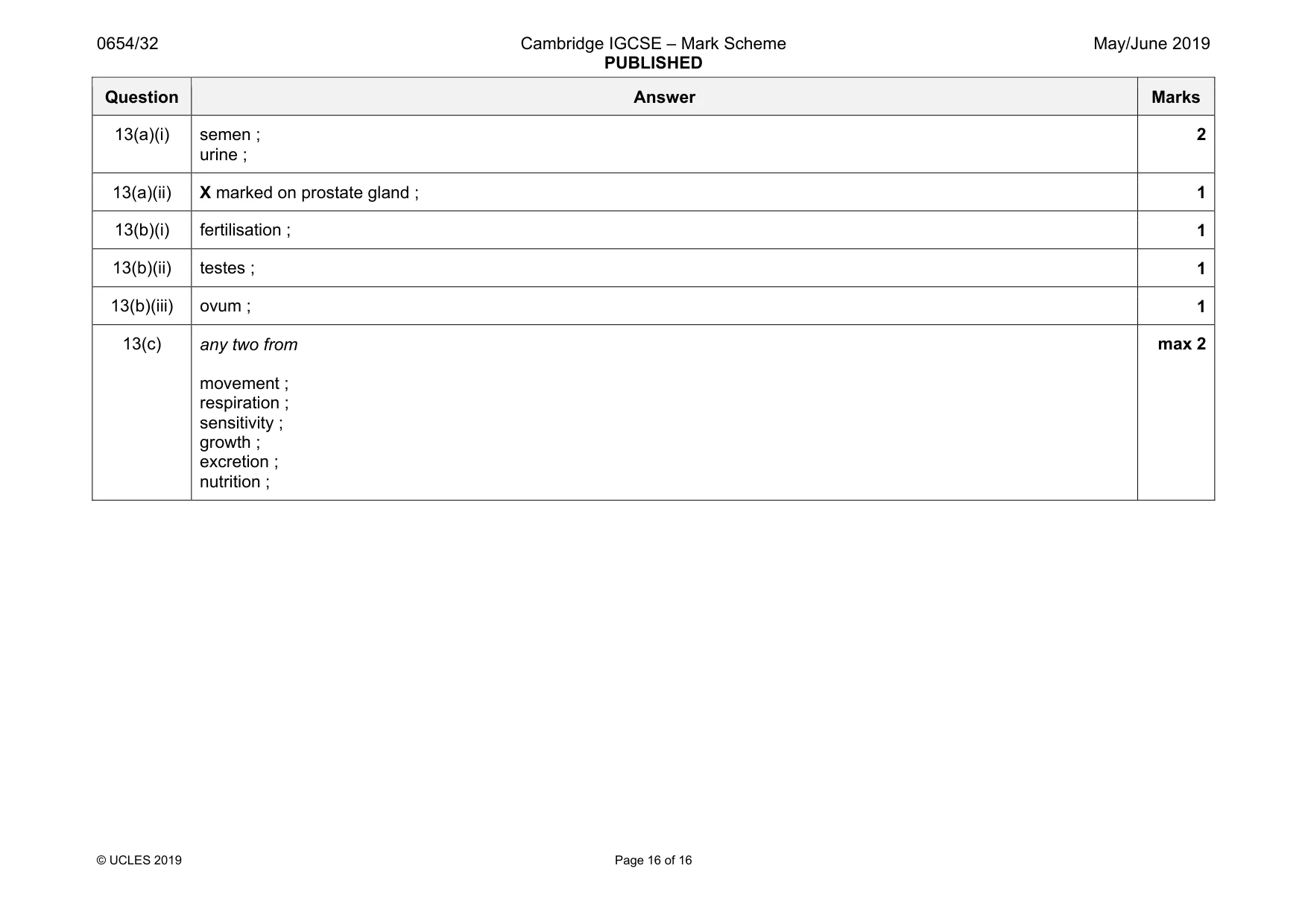
Mark scheme: 13(a)(i) semen ; urine ; 2 13(a)(ii) X marked on prostate gland ; 1 13(b)(i) fertilisation ; 1 13(b)(ii) testes ; 1 13(b)(iii) ovum ; 1 13(c) any two from movement ; respiration ; sensitivity ; growth ; excretion ; nutrition ; max 2
What was in this paper
The subtopics covered by these 13 questions, and how many questions each got. Open one in a new tab to see every Cambridge question on it.
What you needed in this session
Cambridge’s own grade thresholds for 2019 May/June, Paper 3 · Variant 2. A higher threshold means an easier paper — the bar moves with how the cohort did.