Cambridge IGCSE Sciences - Co-ordinated (Double) 0654 — 2017 May/June Paper 3 · Variant 3
0654/33/M/J/17 · 13 questions · 120 marks · ≈135 min
The question paper and its mark scheme, free to read here and free to download. This is Cambridge’s own paper, exactly as it was sat.
Question paper32 pages


Mark scheme9 pages
Answers below. Sit the paper first if you are practising.
Questions as text
Q1 · The human gas exchange system
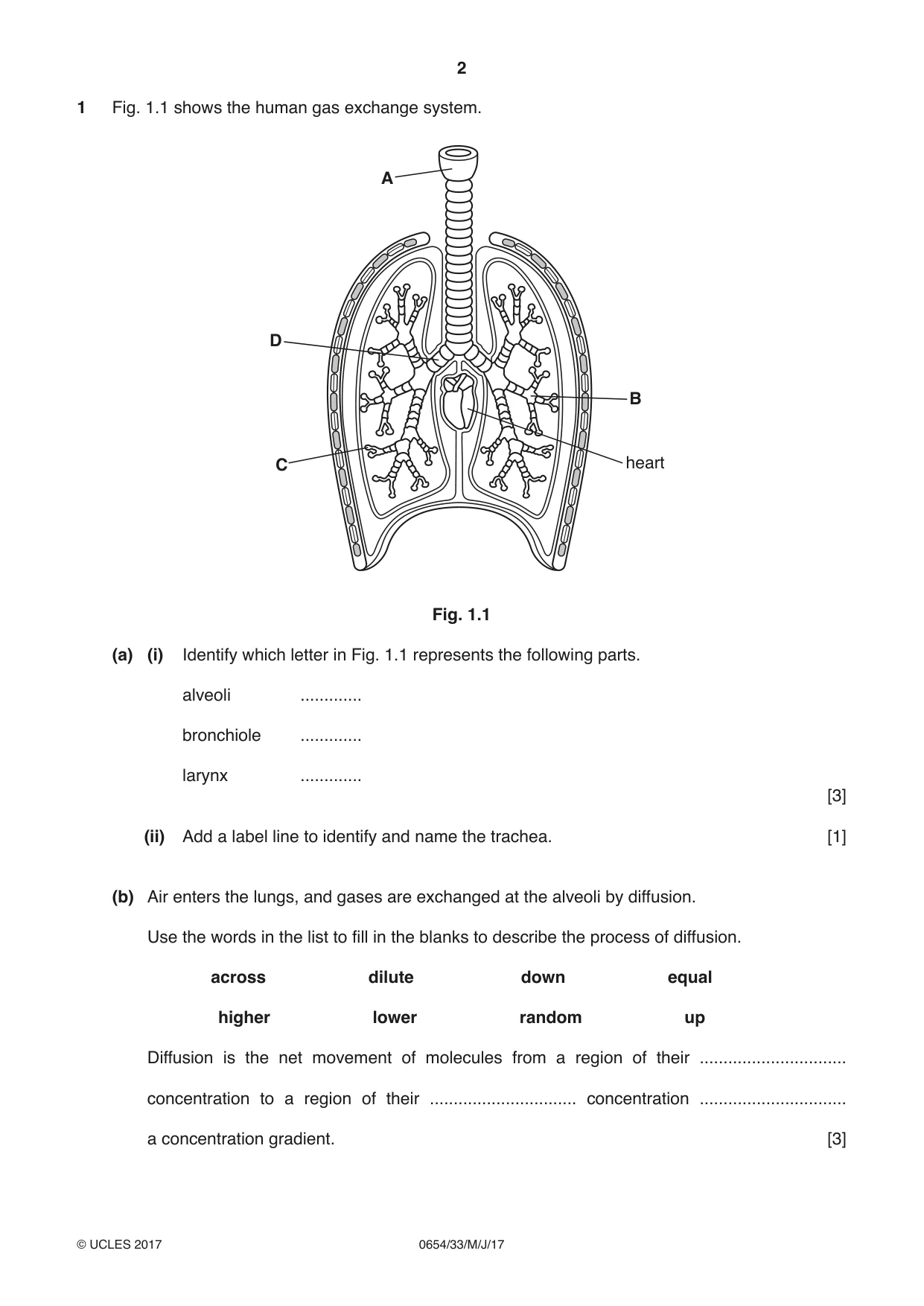
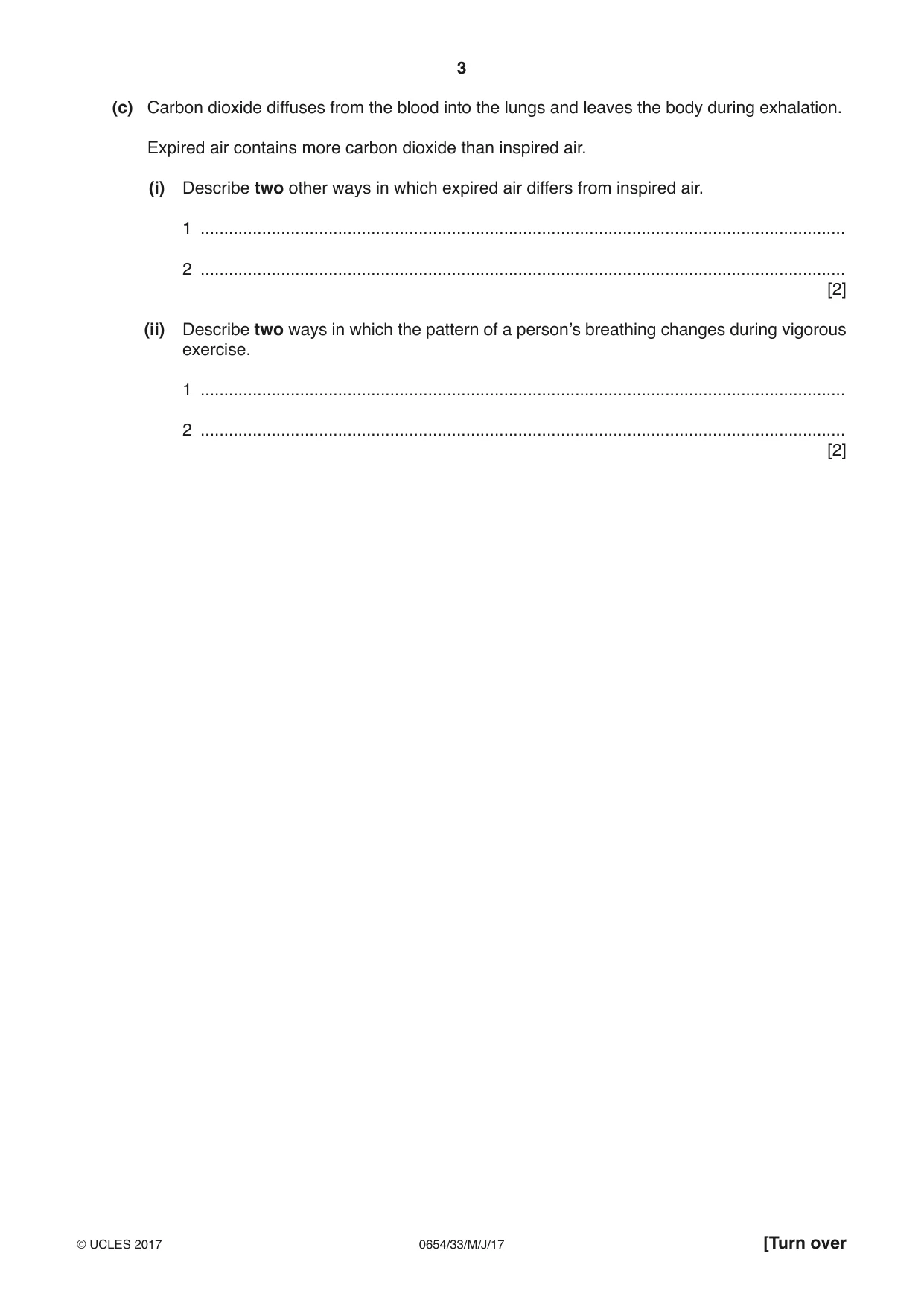
1 Fig. 1.1 shows the human gas exchange system. A D B C heart Fig. 1.1 (a) (i) Identify which letter in Fig. 1.1 represents the following parts. alveoli ............. bronchiole ............. larynx ............. [3] (ii) Add a label line to identify and name the trachea. [1] (b) Air enters the lungs, and gases are exchanged at the alveoli by diffusion. Use the words in the list to fill in the blanks to describe the process of diffusion. across dilute down equal higher lower random up Diffusion is the net movement of molecules from a region of their ............................... concentration to a region of their ............................... concentration ............................... a concentration gradient. [3] (c) Carbon dioxide diffuses from the blood into the lungs and leaves the body during exhalation. Expired air contains more carbon dioxide than inspired air. (i) Describe two other ways in which expired air differs from inspired air. 1 ........................................................................................................................................ 2 ........................................................................................................................................ [2] (ii) Describe two ways in which the pattern of a person’s breathing changes during vigorous exercise. 1 ........................................................................................................................................ 2 ........................................................................................................................................ [2]
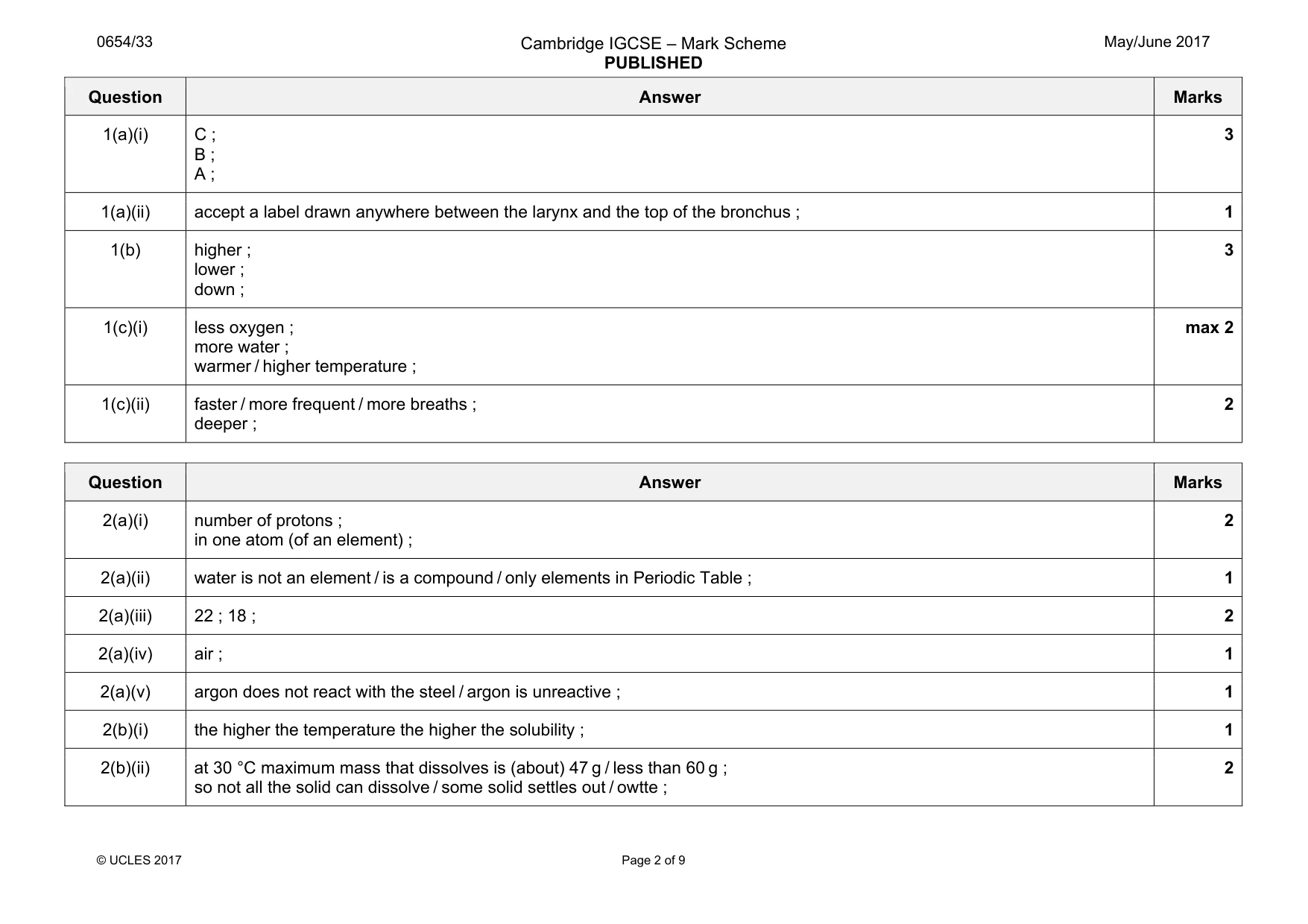
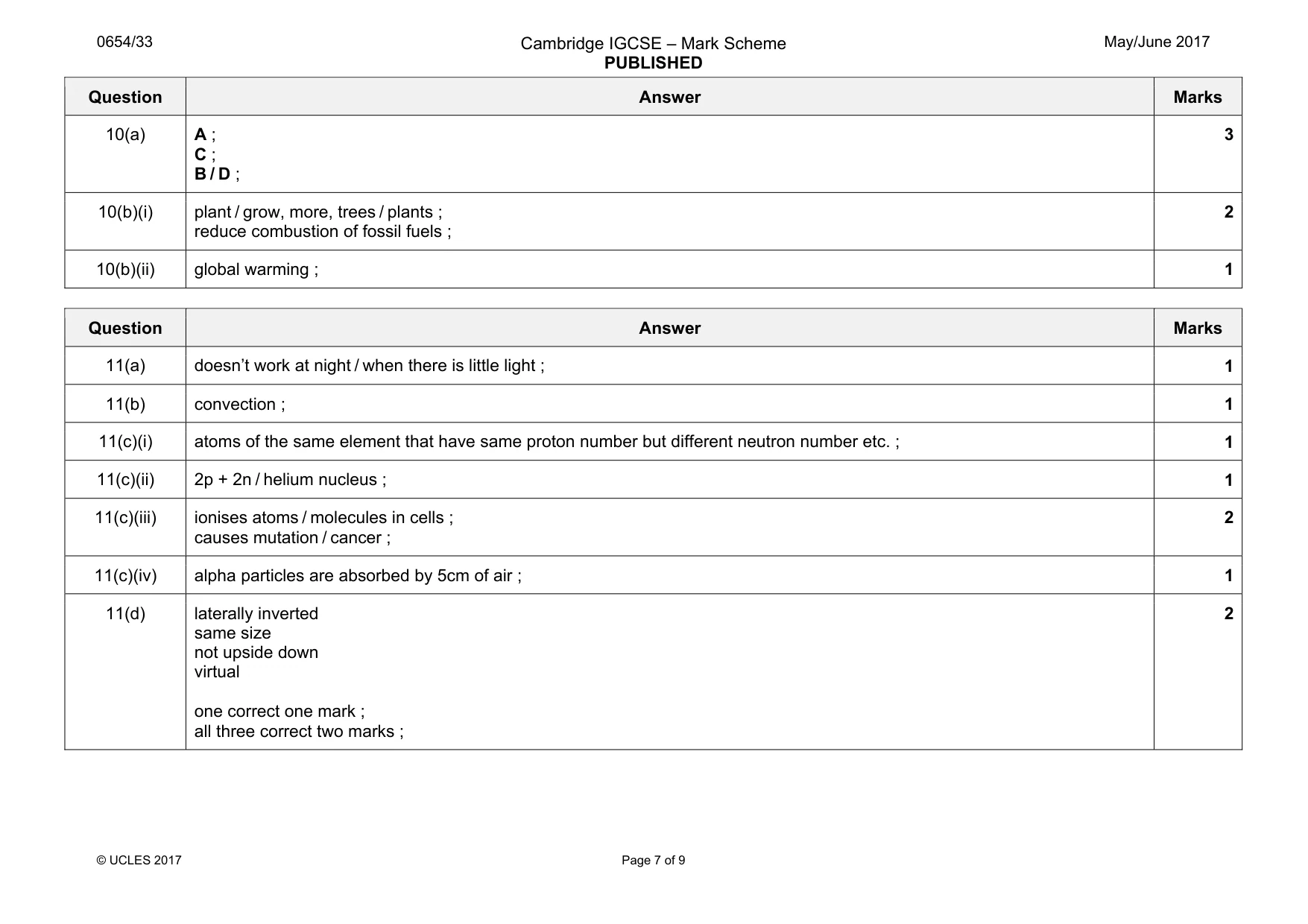
Mark scheme: 1(a)(i) C ; B ; A ; 3 1(a)(ii) accept a label drawn anywhere between the larynx and the top of the bronchus ; 1 1(b) higher ; lower ; down ; 3 1(c)(i) less oxygen ; more water ; warmer / higher temperature ; max 2 1(c)(ii) faster / more frequent / more breaths ; deeper ; 2
Q2 · The Periodic Table shows the elements arranged in order of atomic number
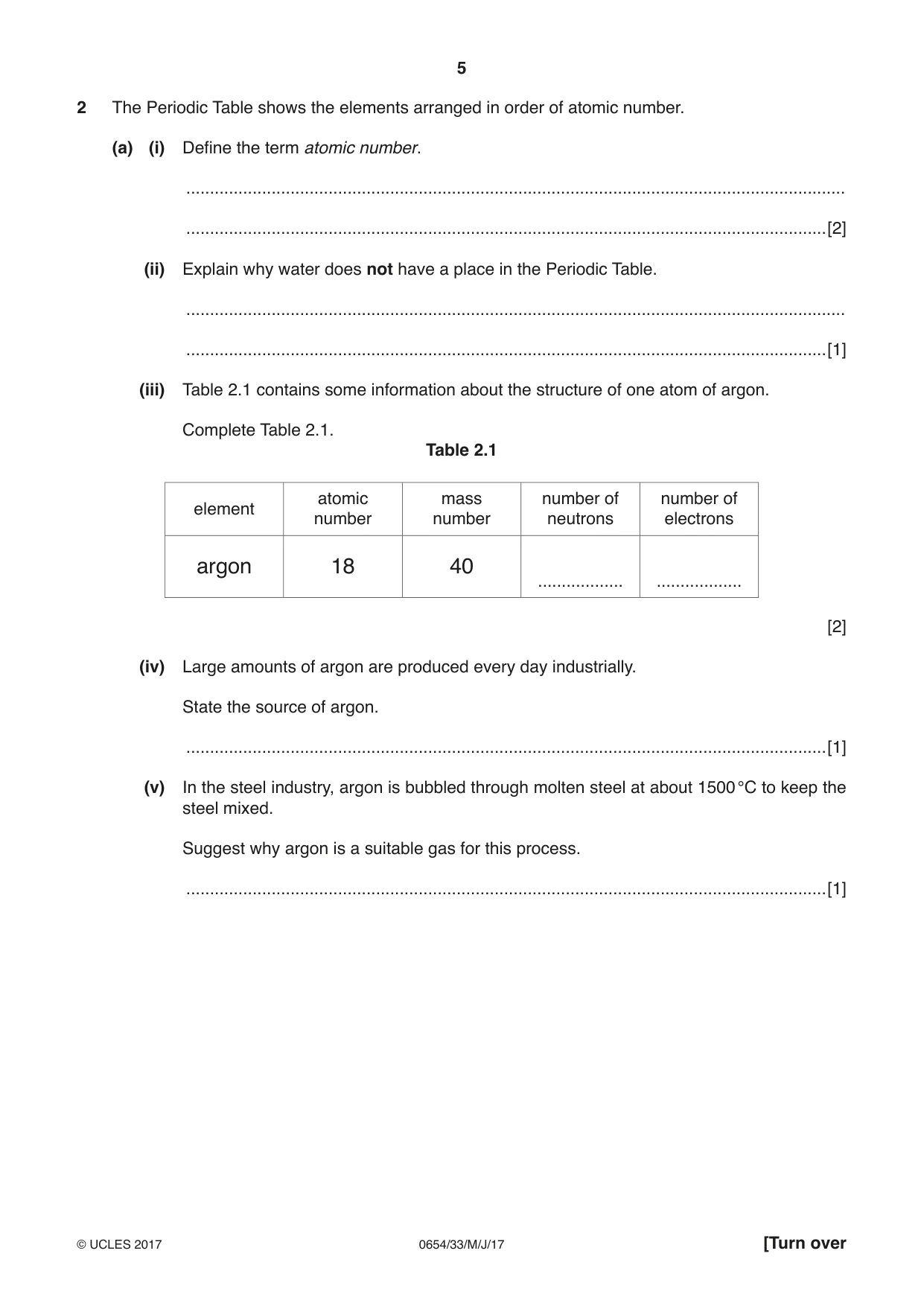
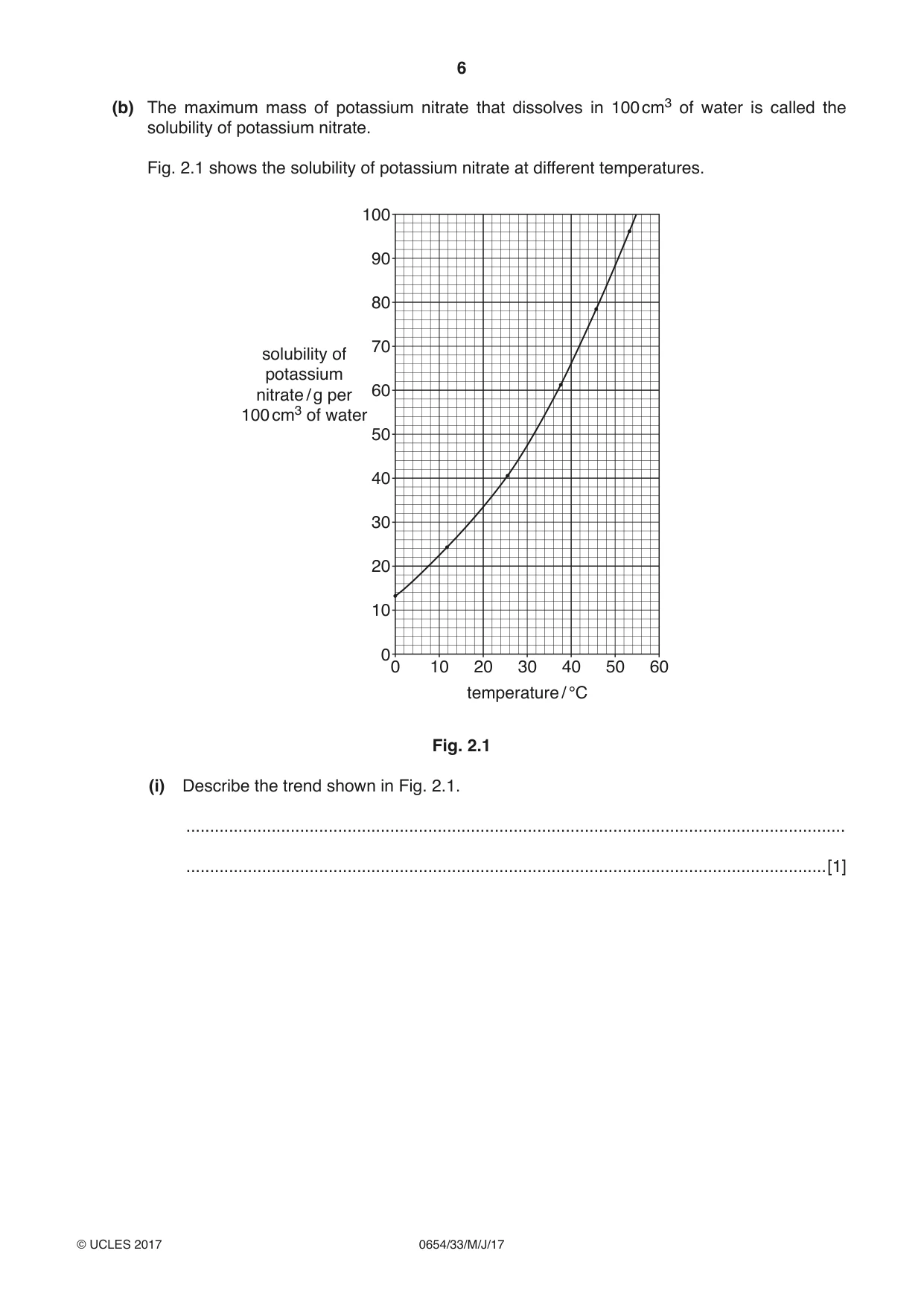
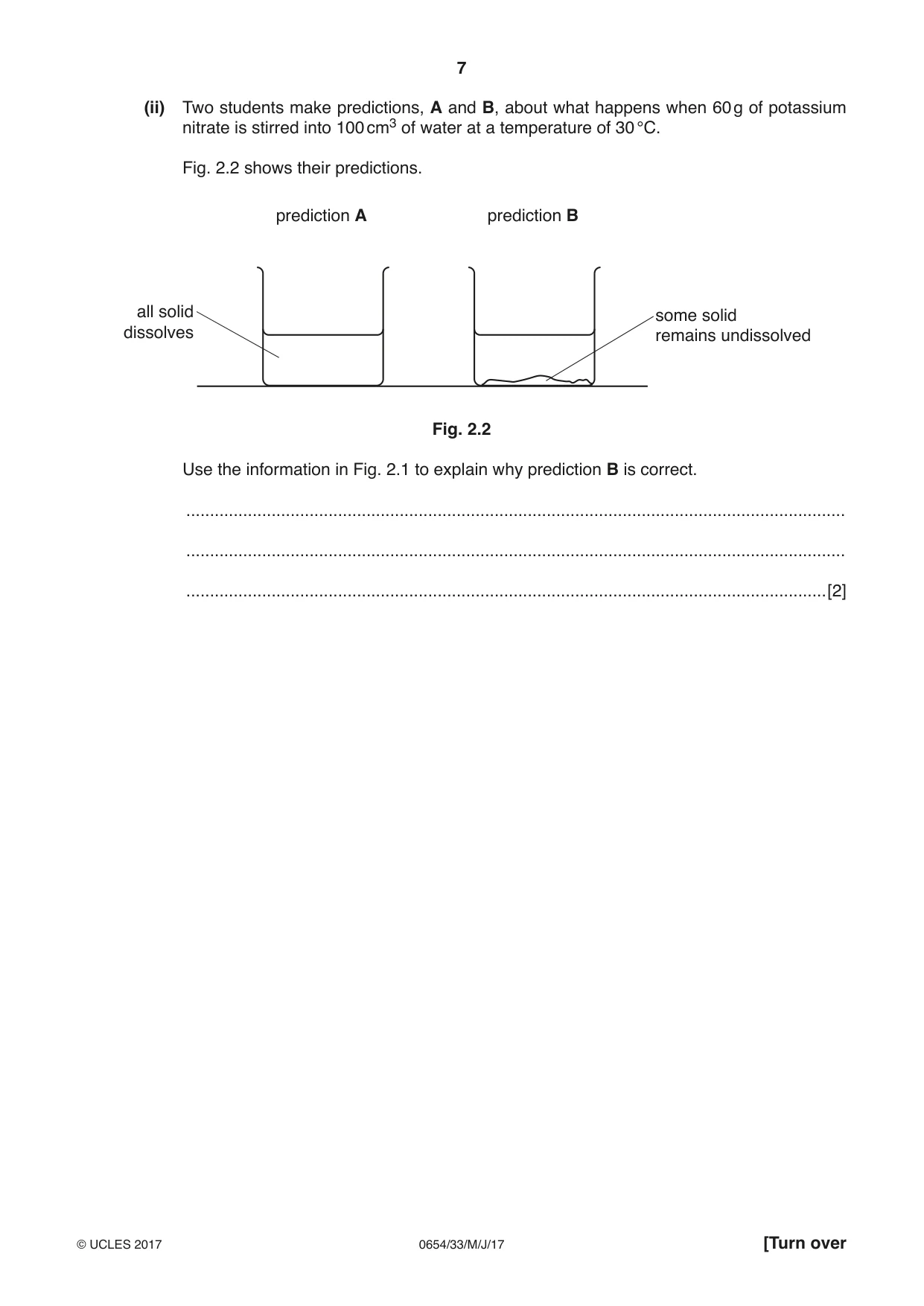
2 The Periodic Table shows the elements arranged in order of atomic number. (a) (i) Define the term atomic number. ........................................................................................................................................... .......................................................................................................................................[2] (ii) Explain why water does not have a place in the Periodic Table. ........................................................................................................................................... .......................................................................................................................................[1] (iii) Table 2.1 contains some information about the structure of one atom of argon. Complete Table 2.1. Table 2.1 atomic mass number of number of element number number neutrons electrons argon 18 40 .................. .................. [2] (iv) Large amounts of argon are produced every day industrially. State the source of argon. .......................................................................................................................................[1] (v) In the steel industry, argon is bubbled through molten steel at about 1500 °C to keep the steel mixed. Suggest why argon is a suitable gas for this process. .......................................................................................................................................[1] (b) The maximum mass of potassium nitrate that dissolves in 100 cm3 of water is called the solubility of potassium nitrate. Fig. 2.1 shows the solubility of potassium nitrate at different temperatures. 100 90 80 70 solubility of potassium nitrate / g per 60 100 cm3 of water 50 40 30 20 10 0 0 10 20 30 40 50 60 temperature / °C Fig. 2.1 (i) Describe the trend shown in Fig. 2.1. ........................................................................................................................................... .......................................................................................................................................[1] (ii) Two students make predictions, A and B, about what happens when 60 g of potassium nitrate is stirred into 100 cm3 of water at a temperature of 30 °C. Fig. 2.2 shows their predictions. prediction A prediction B all solid some solid dissolves remains undissolved Fig. 2.2 Use the information in Fig. 2.1 to explain why prediction B is correct. ........................................................................................................................................... ........................................................................................................................................... .......................................................................................................................................[2]
Mark scheme: 2(a)(i) number of protons ; in one atom (of an element) ; 2 2(a)(ii) water is not an element / is a compound / only elements in Periodic Table ; 1 2(a)(iii) 22 ; 18 ; 2 2(a)(iv) air ; 1 2(a)(v) argon does not react with the steel / argon is unreactive ; 1 2(b)(i) the higher the temperature the higher the solubility ; 1 2(b)(ii) at 30 °C maximum mass that dissolves is (about) 47 g / less than 60 g ; so not all the solid can dissolve / some solid settles out / owtte ; 2
Q3 · A diagram of the male reproductive system
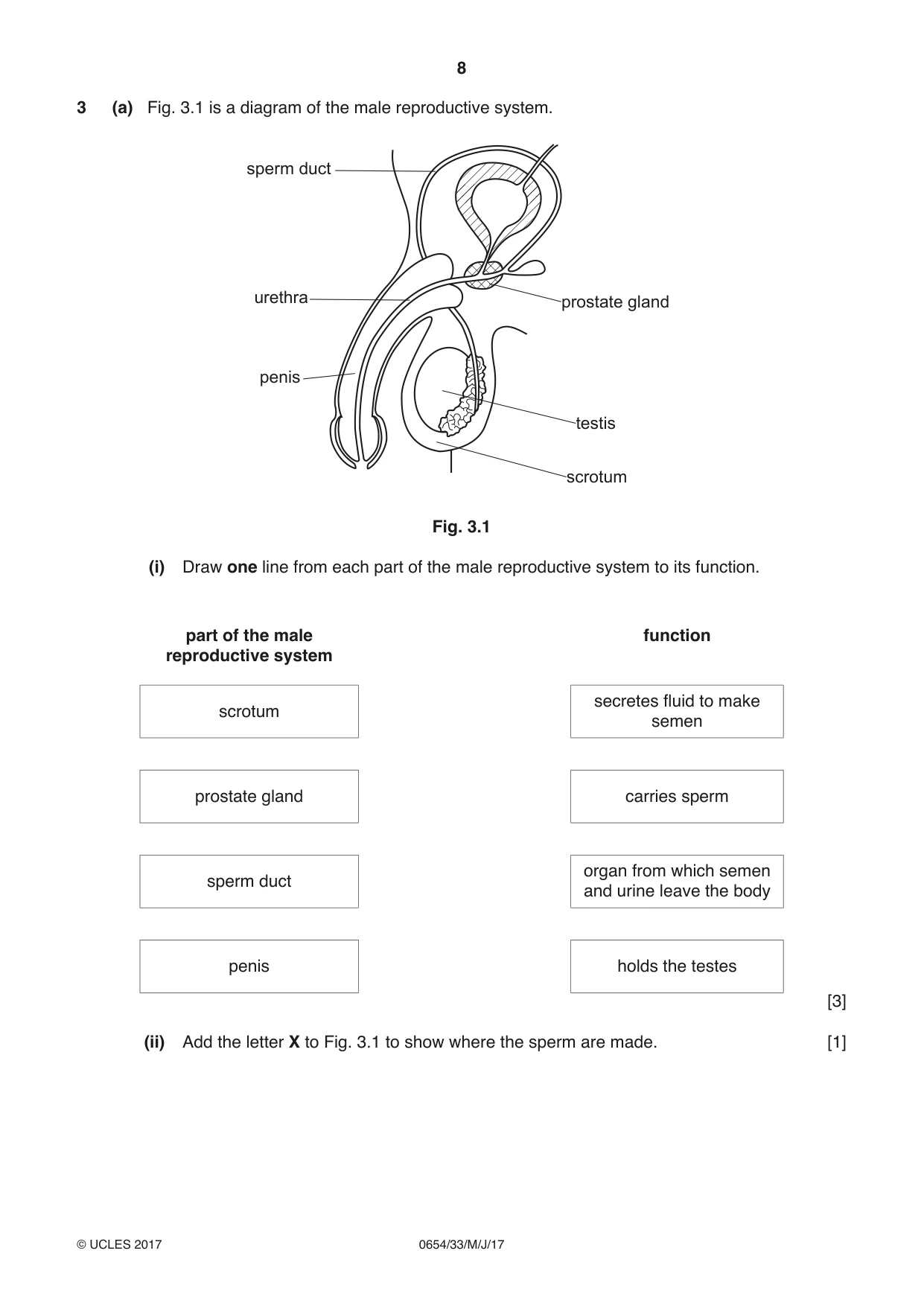
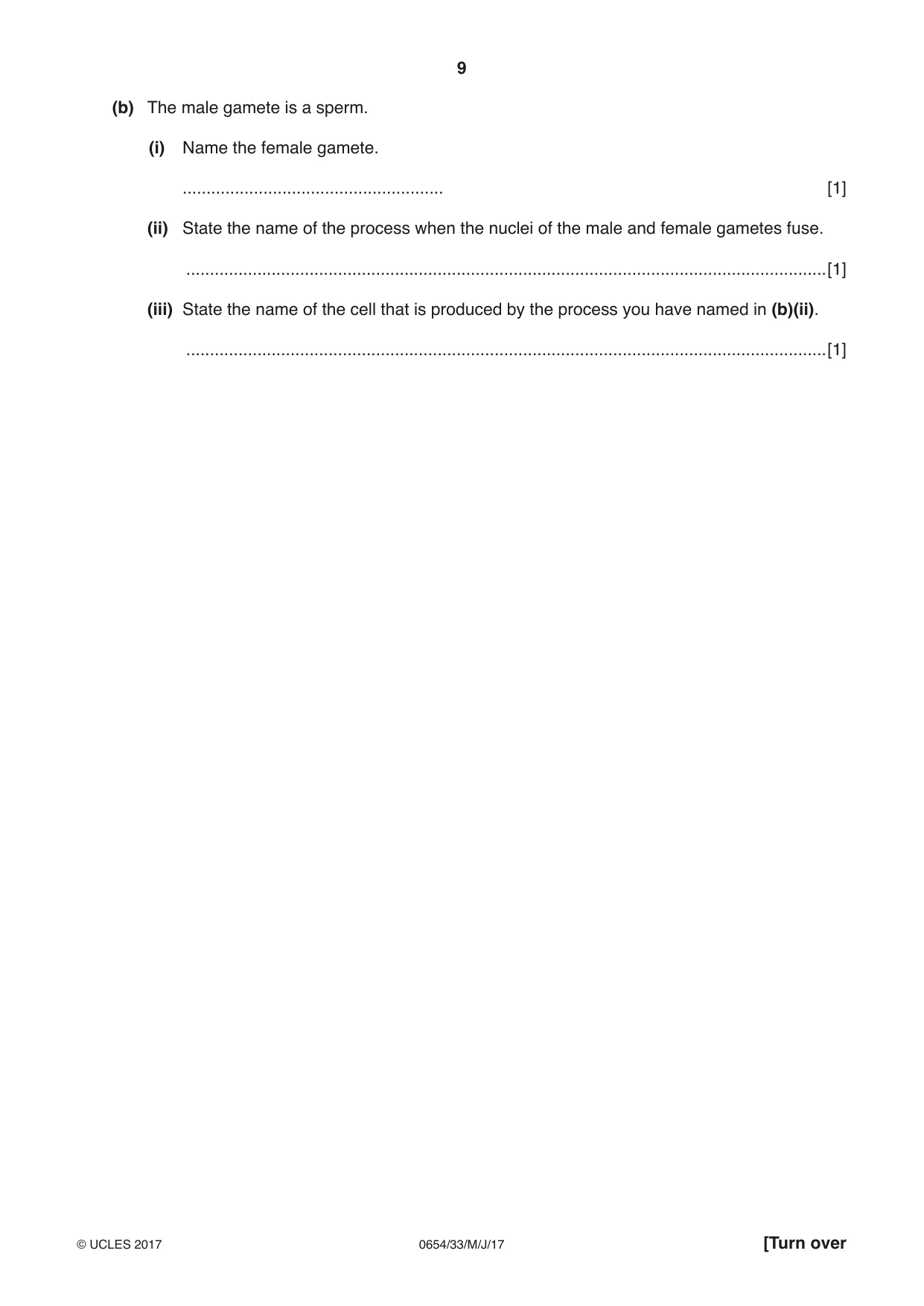
3 (a) Fig. 3.1 is a diagram of the male reproductive system. sperm duct urethra prostate gland penis testis scrotum Fig. 3.1 (i) Draw one line from each part of the male reproductive system to its function. part of the male function reproductive system secretes fluid to make scrotum semen prostate gland carries sperm organ from which semen sperm duct and urine leave the body penis holds the testes [3] (ii) Add the letter X to Fig. 3.1 to show where the sperm are made. [1] (b) The male gamete is a sperm. (i) Name the female gamete. ....................................................... [1] (ii) State the name of the process when the nuclei of the male and female gametes fuse. .......................................................................................................................................[1] (iii) State the name of the cell that is produced by the process you have named in (b)(ii). .......................................................................................................................................[1]
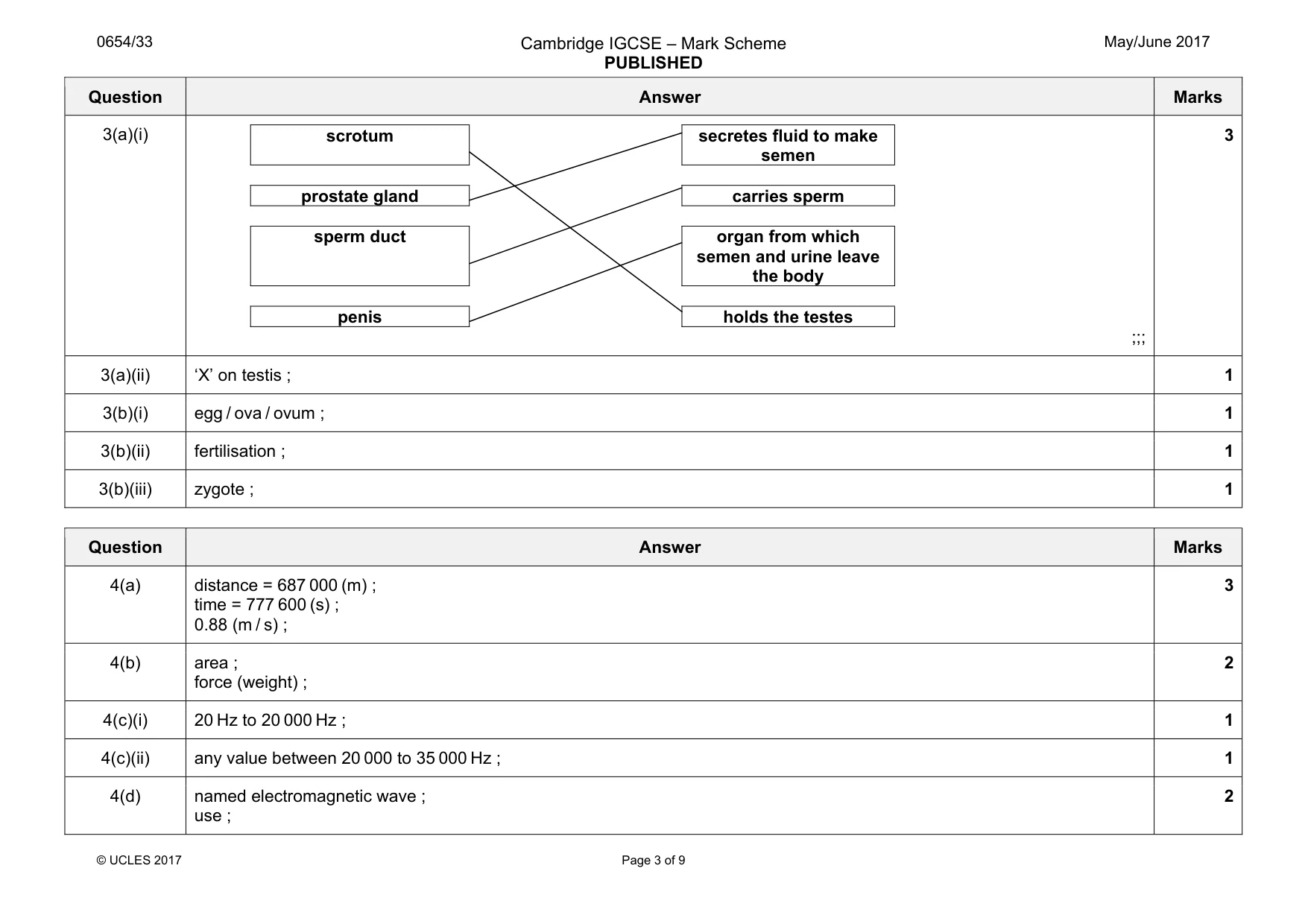
Mark scheme: 3(a)(i) scrotum secretes fluid to make semen prostate gland carries sperm sperm duct organ from which semen and urine leave the body penis holds the testes ;;; 3 3(a)(ii) ‘X’ on testis ; 1 3(b)(i) egg / ova / ovum ; 1 3(b)(ii) fertilisation ; 1 3(b)(iii) zygote ; 1
Q4 · A polar bear swims 687 km in 9 days without stopping
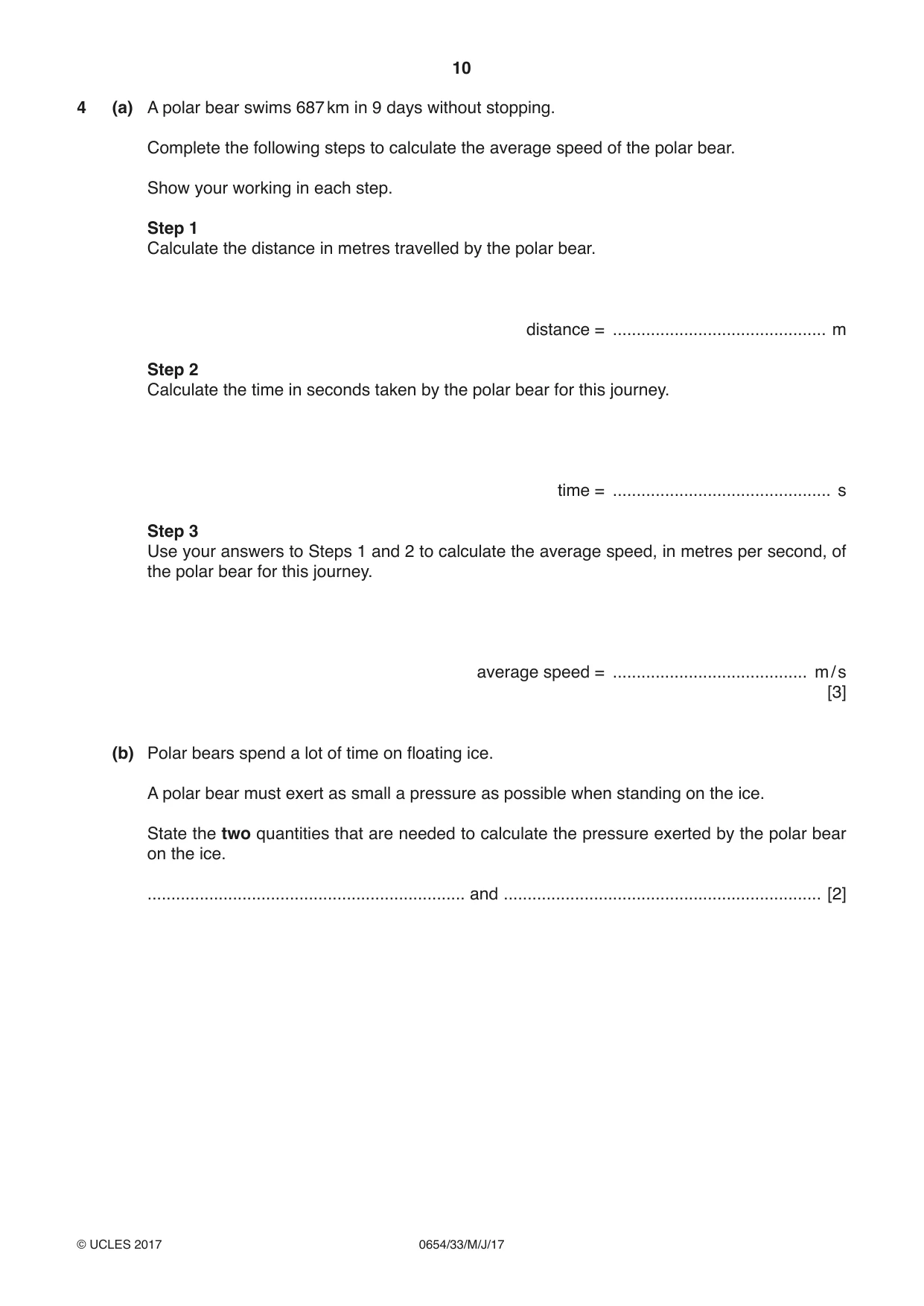
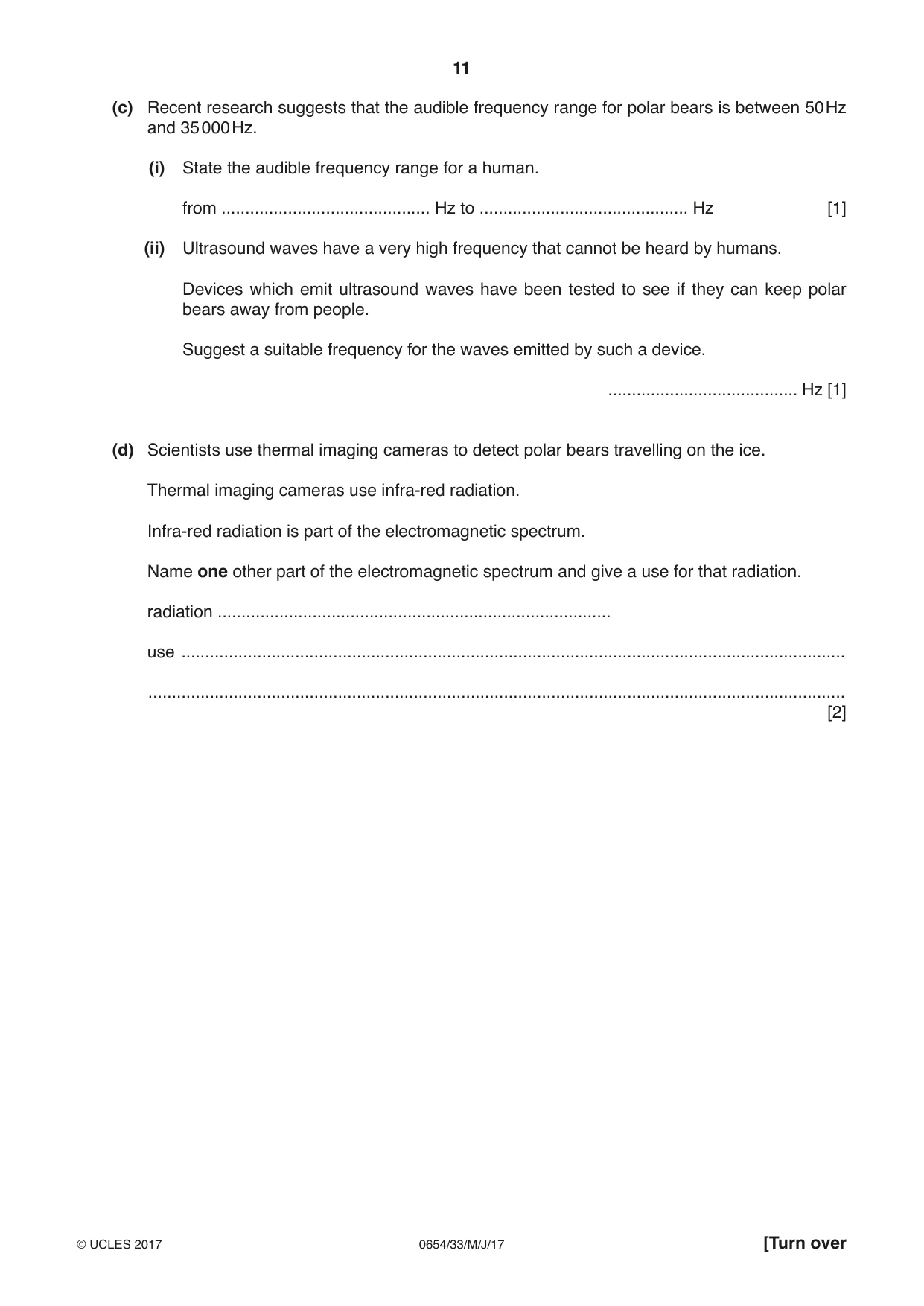
4 (a) A polar bear swims 687 km in 9 days without stopping. Complete the following steps to calculate the average speed of the polar bear. Show your working in each step. Step 1 Calculate the distance in metres travelled by the polar bear. distance = ............................................. m Step 2 Calculate the time in seconds taken by the polar bear for this journey. time = .............................................. s Step 3 Use your answers to Steps 1 and 2 to calculate the average speed, in metres per second, of the polar bear for this journey. average speed = ......................................... m / s [3] (b) Polar bears spend a lot of time on floating ice. A polar bear must exert as small a pressure as possible when standing on the ice. State the two quantities that are needed to calculate the pressure exerted by the polar bear on the ice. ................................................................... and ................................................................... [2] (c) Recent research suggests that the audible frequency range for polar bears is between 50 Hz and 35 000 Hz. (i) State the audible frequency range for a human. from ............................................ Hz to ............................................ Hz [1] (ii) Ultrasound waves have a very high frequency that cannot be heard by humans. Devices which emit ultrasound waves have been tested to see if they can keep polar bears away from people. Suggest a suitable frequency for the waves emitted by such a device. ........................................ Hz [1] (d) Scientists use thermal imaging cameras to detect polar bears travelling on the ice. Thermal imaging cameras use infra-red radiation. Infra-red radiation is part of the electromagnetic spectrum. Name one other part of the electromagnetic spectrum and give a use for that radiation. radiation ................................................................................... use ............................................................................................................................................ ................................................................................................................................................... [2]
Mark scheme: 4(a) distance = 687 000 (m) ; time = 777 600 (s) ; 0.88 (m / s) ; 3 4(b) area ; force (weight) ; 2 4(c)(i) 20 Hz to 20 000 Hz ; 1 4(c)(ii) any value between 20 000 to 35 000 Hz ; 1 4(d) named electromagnetic wave ; use ; 2
Q5 · Human activities and natural events cause air pollution
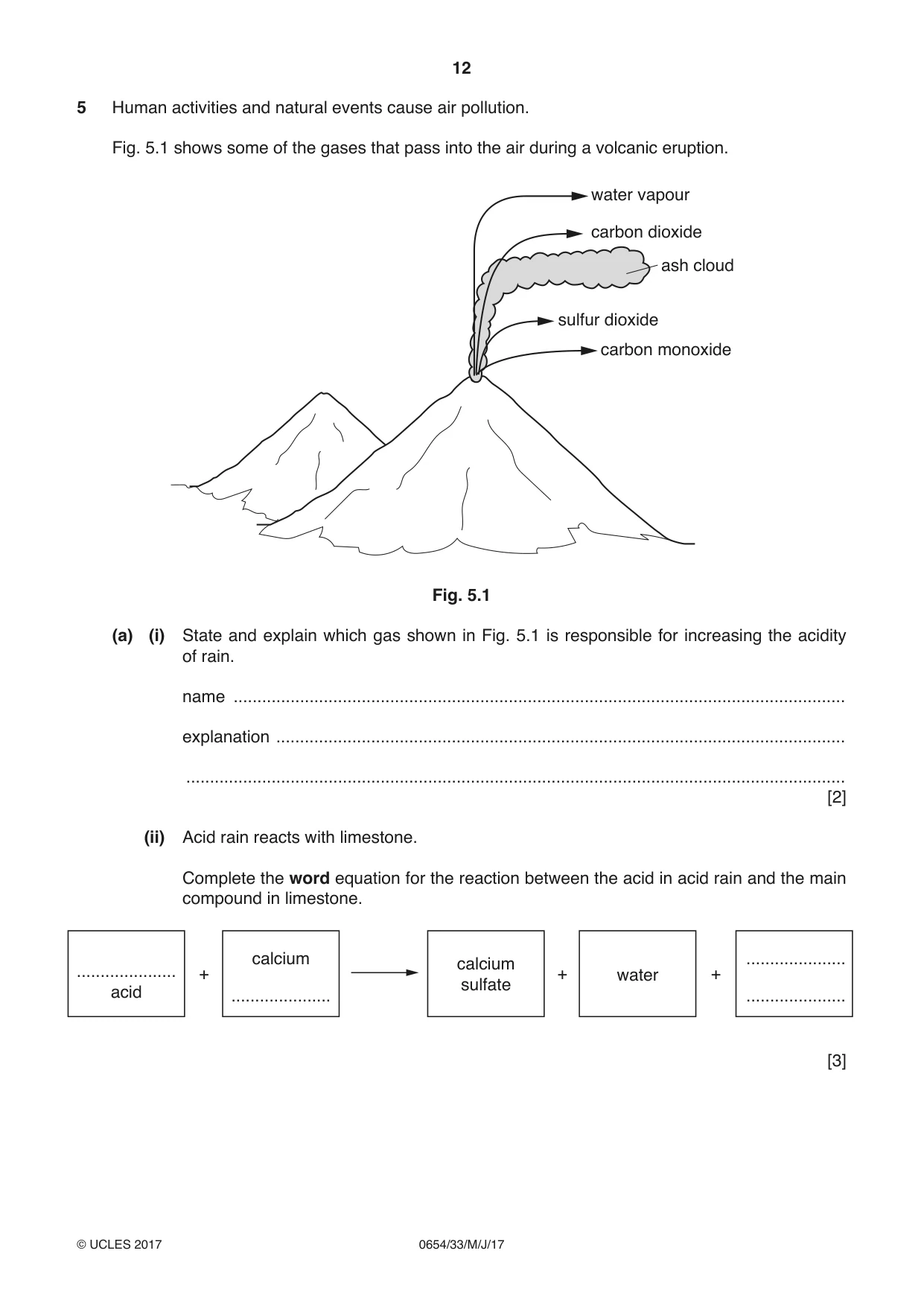
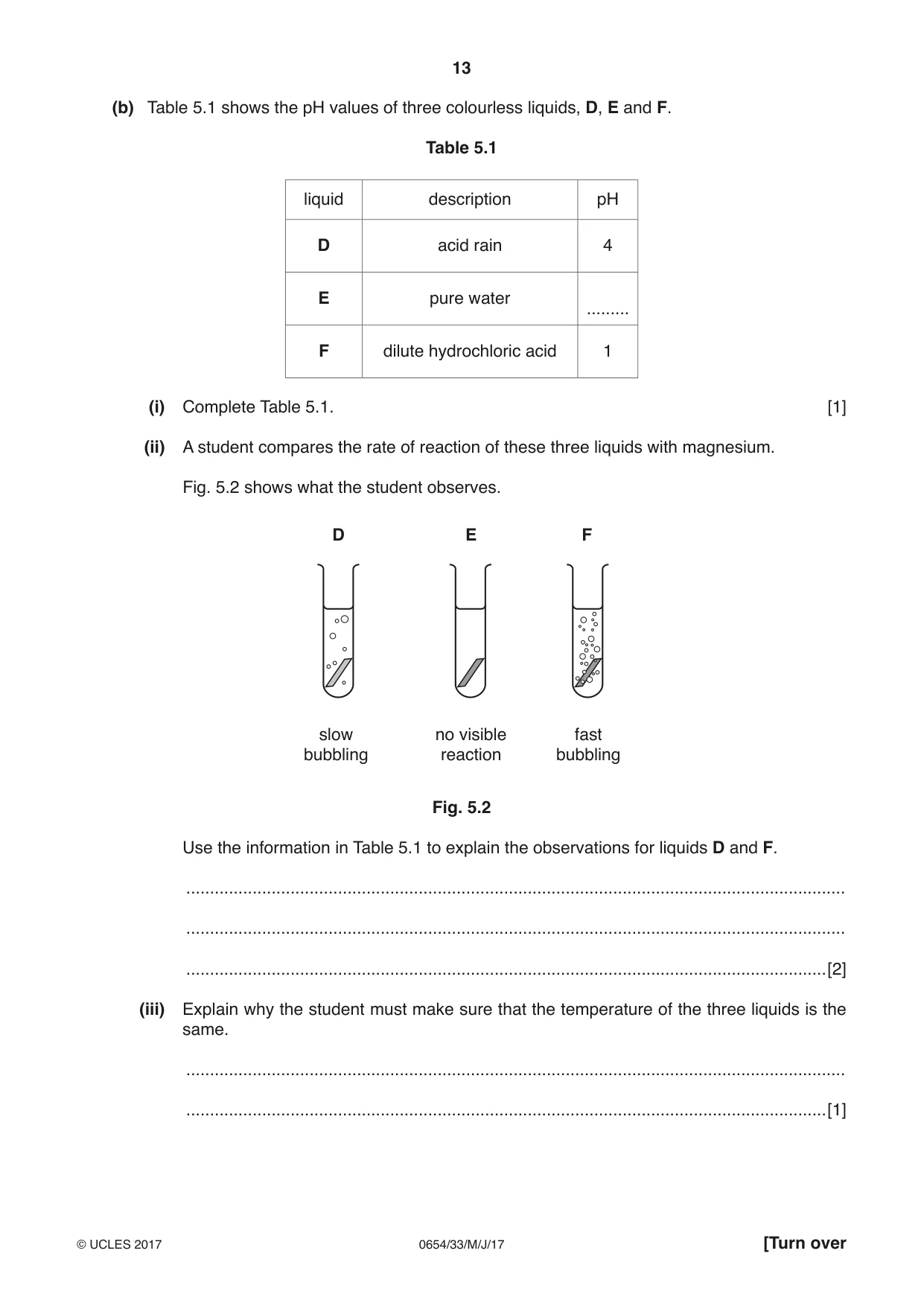
5 Human activities and natural events cause air pollution. Fig. 5.1 shows some of the gases that pass into the air during a volcanic eruption. water vapour carbon dioxide ash cloud sulfur dioxide carbon monoxide Fig. 5.1 (a) (i) State and explain which gas shown in Fig. 5.1 is responsible for increasing the acidity of rain. name ................................................................................................................................. explanation ........................................................................................................................ ........................................................................................................................................... [2] (ii) Acid rain reacts with limestone. Complete the word equation for the reaction between the acid in acid rain and the main compound in limestone. calcium ..................... calcium..................... + + water + sulfate acid ..................... ..................... [3] (b) Table 5.1 shows the pH values of three colourless liquids, D, E and F. Table 5.1 liquid description pH D acid rain 4 E pure water ......... F dilute hydrochloric acid 1 (i) Complete Table 5.1. [1] (ii) A student compares the rate of reaction of these three liquids with magnesium. Fig. 5.2 shows what the student observes. D E F slow no visible fast bubbling reaction bubbling Fig. 5.2 Use the information in Table 5.1 to explain the observations for liquids D and F. ........................................................................................................................................... ........................................................................................................................................... .......................................................................................................................................[2] (iii) Explain why the student must make sure that the temperature of the three liquids is the same. ........................................................................................................................................... .......................................................................................................................................[1]
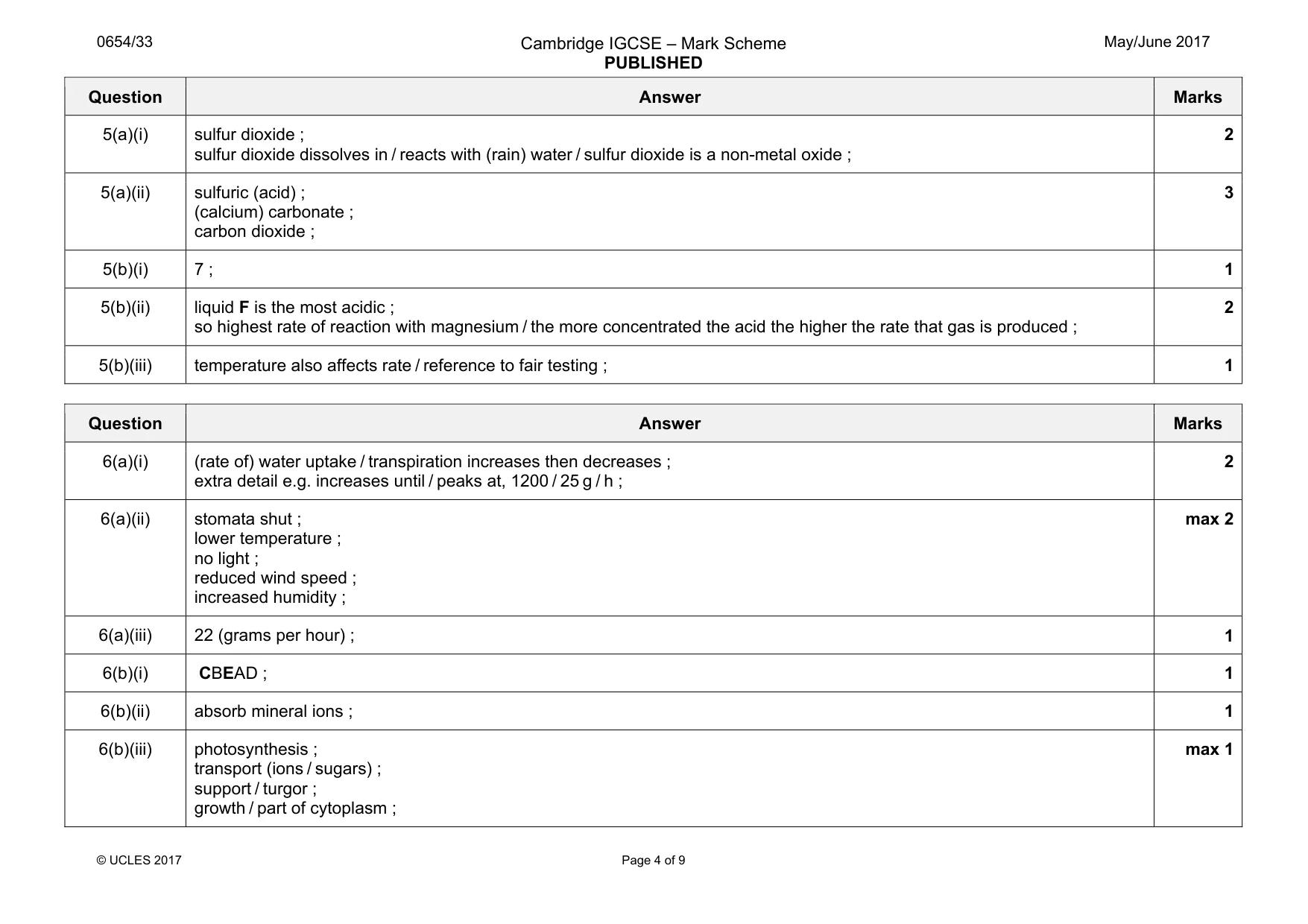
Mark scheme: 5(a)(i) sulfur dioxide ; sulfur dioxide dissolves in / reacts with (rain) water / sulfur dioxide is a non-metal oxide ; 2 5(a)(ii) sulfuric (acid) ; (calcium) carbonate ; carbon dioxide ; 3 5(b)(i) 7 ; 1 5(b)(ii) liquid F is the most acidic ; so highest rate of reaction with magnesium / the more concentrated the acid the higher the rate that gas is produced ; 2 5(b)(iii) temperature also affects rate / reference to fair testing ; 1
Q6 · A graph that shows the rate of water loss from a plant during a 24-hour period
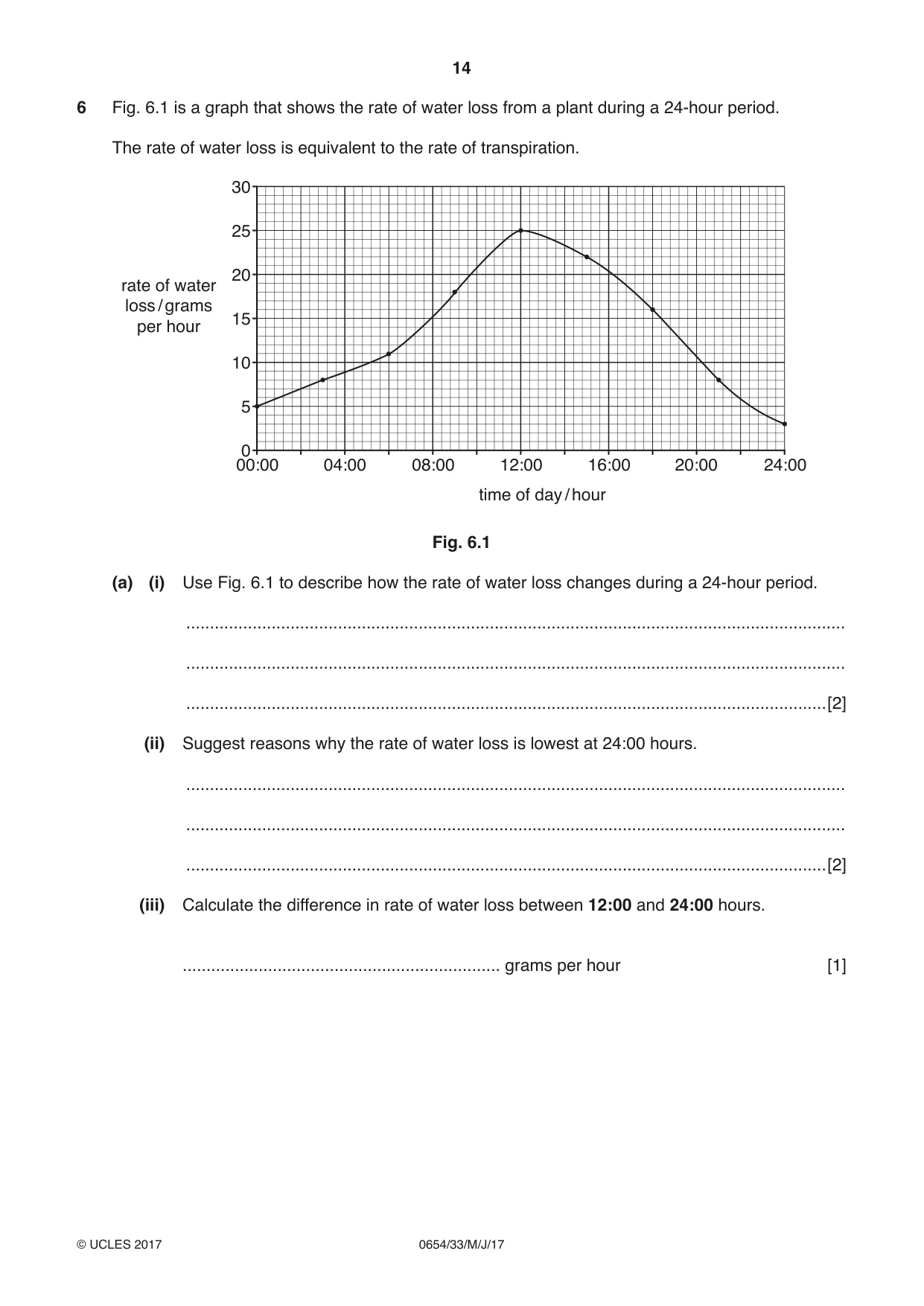
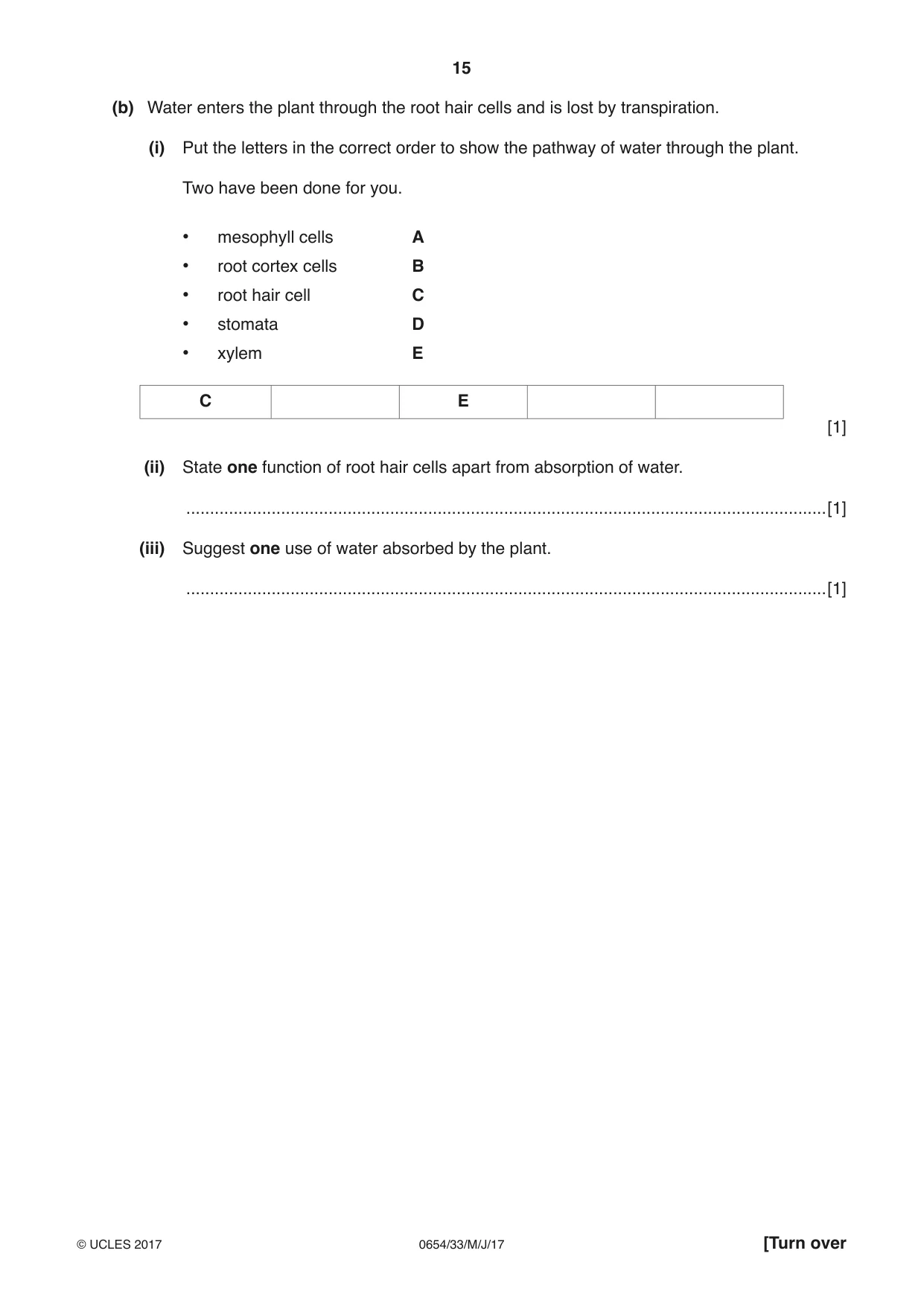
6 Fig. 6.1 is a graph that shows the rate of water loss from a plant during a 24-hour period. The rate of water loss is equivalent to the rate of transpiration. 30 25 20 rate of water loss / grams 15 per hour 10 5 0 00:00 04:00 08:00 12:00 16:00 20:00 24:00 time of day / hour Fig. 6.1 (a) (i) Use Fig. 6.1 to describe how the rate of water loss changes during a 24-hour period. ........................................................................................................................................... ........................................................................................................................................... .......................................................................................................................................[2] (ii) Suggest reasons why the rate of water loss is lowest at 24:00 hours. ........................................................................................................................................... ........................................................................................................................................... .......................................................................................................................................[2] (iii) Calculate the difference in rate of water loss between 12:00 and 24:00 hours. ................................................................... grams per hour [1] (b) Water enters the plant through the root hair cells and is lost by transpiration. (i) Put the letters in the correct order to show the pathway of water through the plant. Two have been done for you. • mesophyll cells A • root cortex cells B • root hair cell C • stomata D • xylem E C E [1] (ii) State one function of root hair cells apart from absorption of water. .......................................................................................................................................[1] (iii) Suggest one use of water absorbed by the plant. .......................................................................................................................................[1]
Mark scheme: 6(a)(i) (rate of) water uptake / transpiration increases then decreases ; extra detail e.g. increases until / peaks at, 1200 / 25 g / h ; 2 6(a)(ii) stomata shut ; lower temperature ; no light ; reduced wind speed ; increased humidity ; max 2 6(a)(iii) 22 (grams per hour) ; 1 6(b)(i) CBEAD ; 1 6(b)(ii) absorb mineral ions ; 1 6(b)(iii) photosynthesis ; transport (ions / sugars) ; support / turgor ; growth / part of cytoplasm ; max 1
Q7 · The speed-time graph for a truck
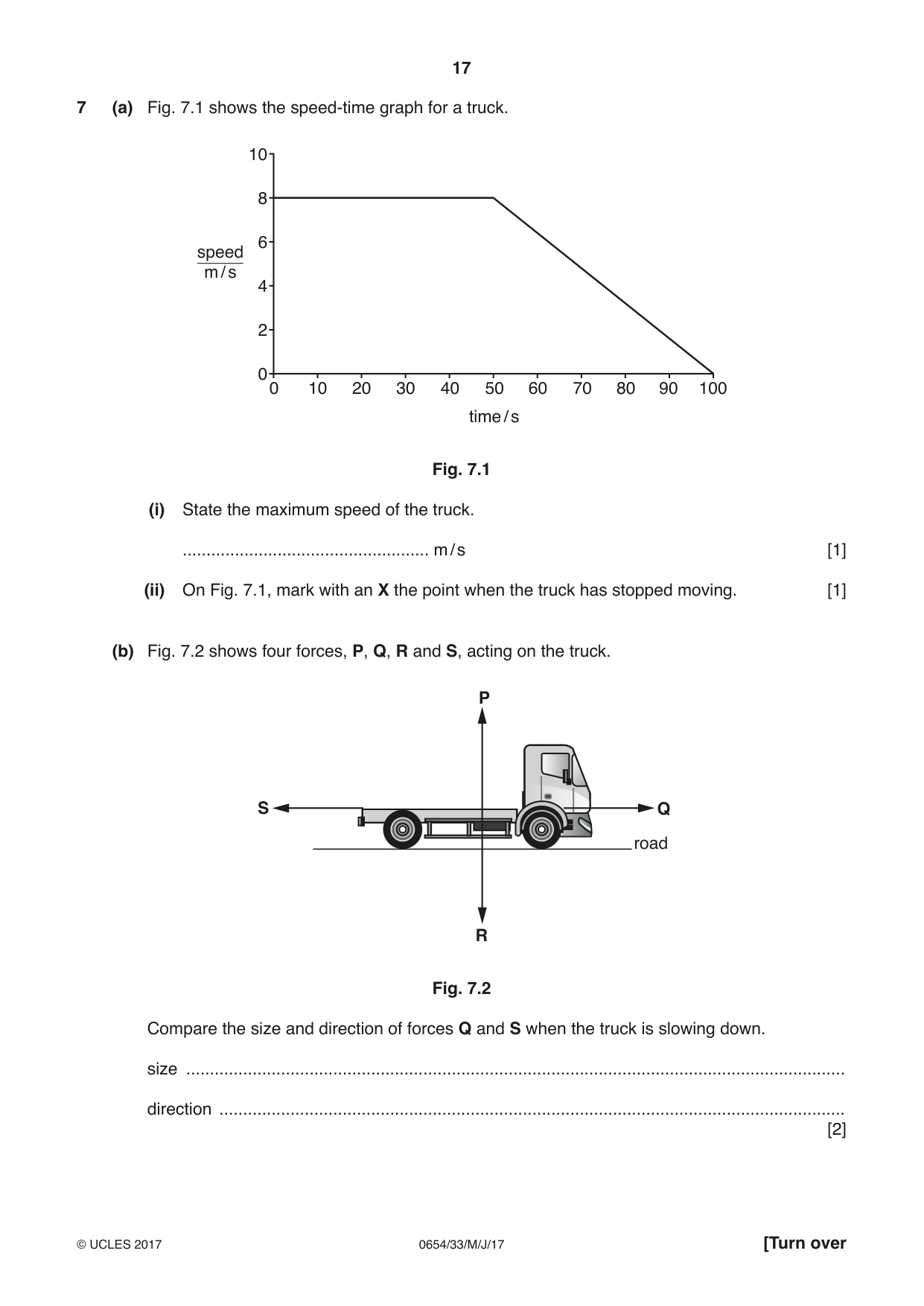
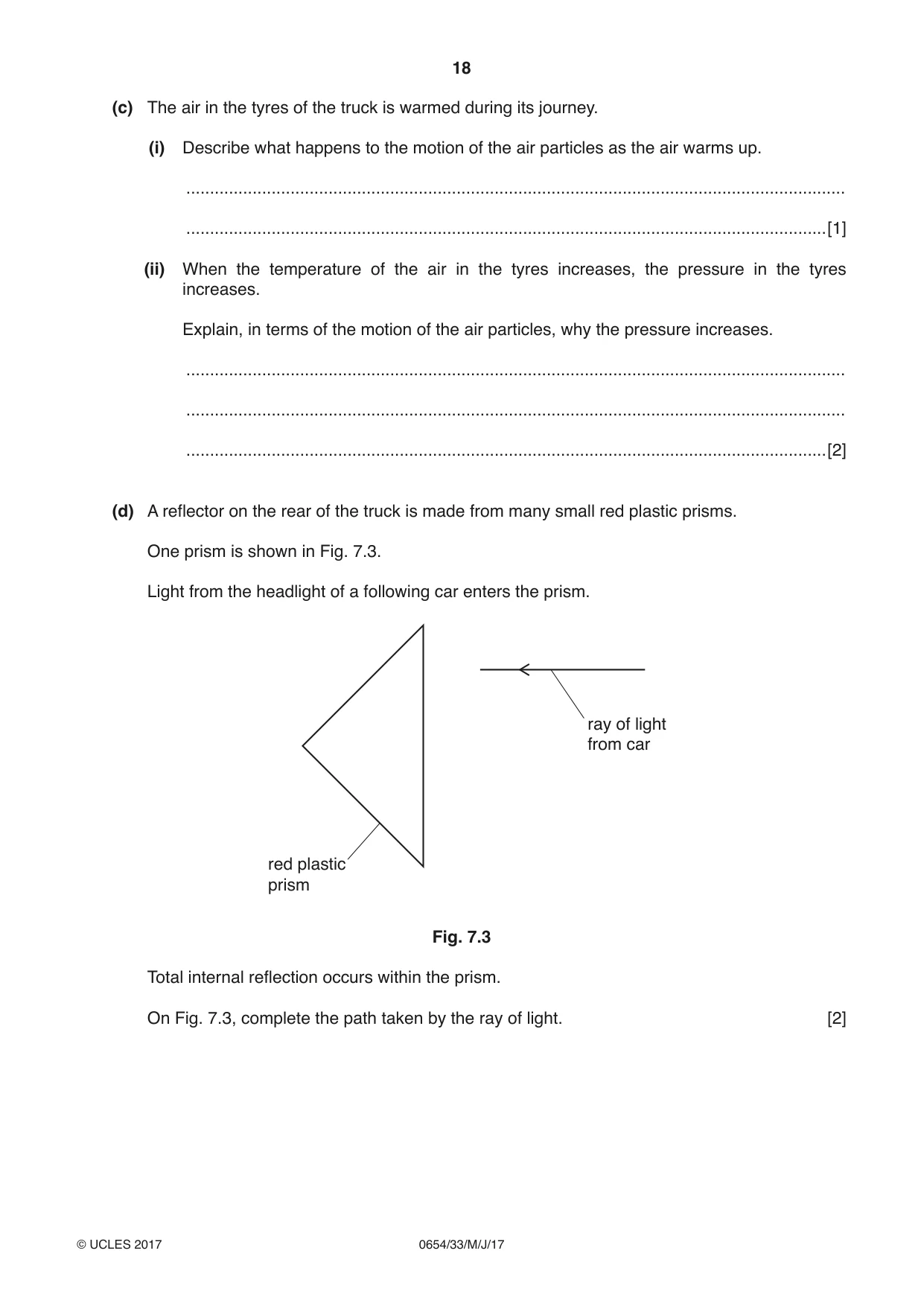
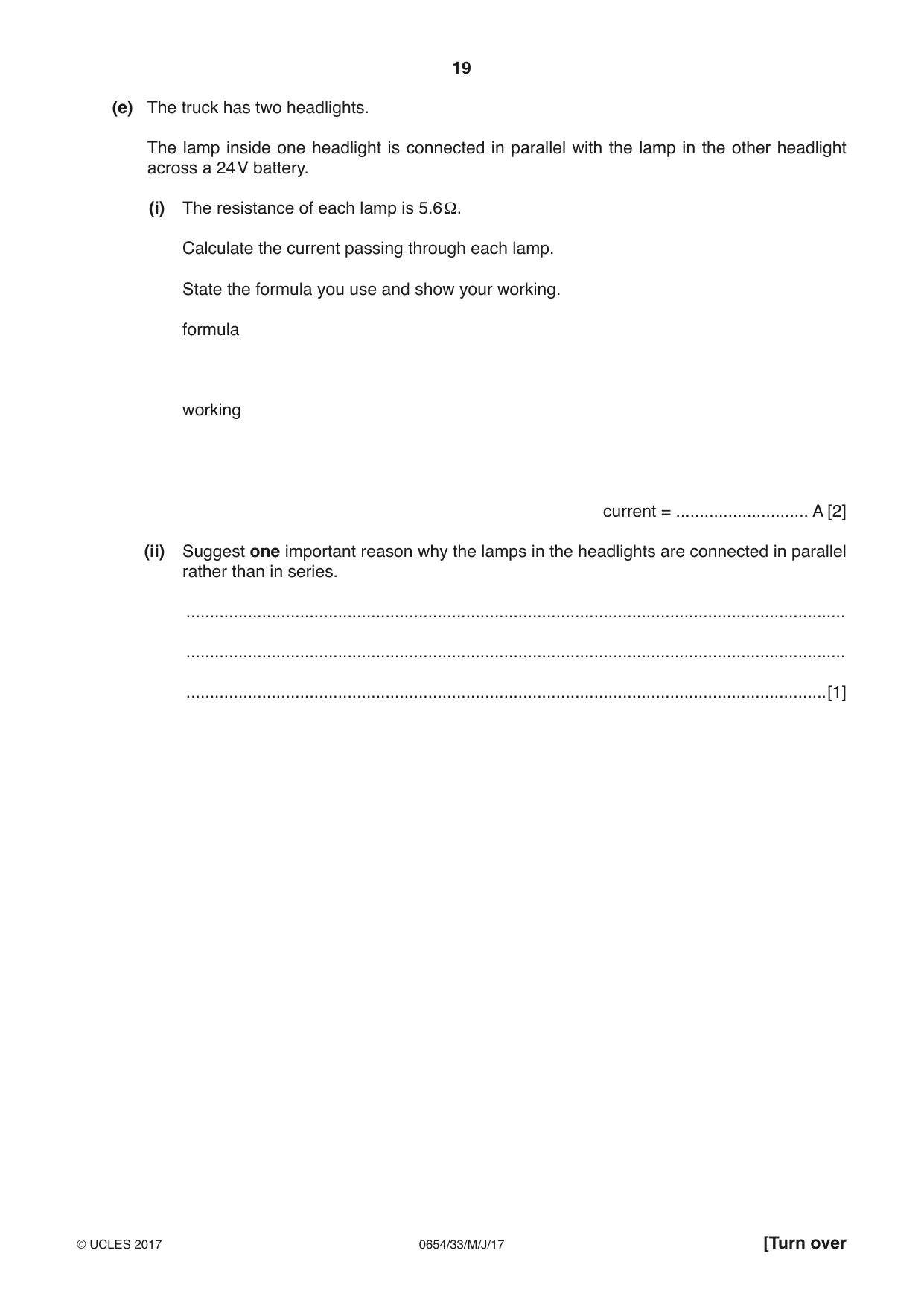
7 (a) Fig. 7.1 shows the speed-time graph for a truck. 10 8 6 speed m / s 4 2 0 0 10 20 30 40 50 60 70 80 90 100 time / s Fig. 7.1 (i) State the maximum speed of the truck. .................................................... m / s [1] (ii) On Fig. 7.1, mark with an X the point when the truck has stopped moving. [1] (b) Fig. 7.2 shows four forces, P, Q, R and S, acting on the truck. P S Q road R Fig. 7.2 Compare the size and direction of forces Q and S when the truck is slowing down. size ........................................................................................................................................... direction .................................................................................................................................... [2] (c) The air in the tyres of the truck is warmed during its journey. (i) Describe what happens to the motion of the air particles as the air warms up. ........................................................................................................................................... .......................................................................................................................................[1] (ii) When the temperature of the air in the tyres increases, the pressure in the tyres increases. Explain, in terms of the motion of the air particles, why the pressure increases. ........................................................................................................................................... ........................................................................................................................................... .......................................................................................................................................[2] (d) A reflector on the rear of the truck is made from many small red plastic prisms. One prism is shown in Fig. 7.3. Light from the headlight of a following car enters the prism. ray of light from car red plastic prism Fig. 7.3 Total internal reflection occurs within the prism. On Fig. 7.3, complete the path taken by the ray of light. [2] (e) The truck has two headlights. The lamp inside one headlight is connected in parallel with the lamp in the other headlight across a 24 V battery. (i) The resistance of each lamp is 5.6 Ω. Calculate the current passing through each lamp. State the formula you use and show your working. formula working current = ............................ A [2] (ii) Suggest one important reason why the lamps in the headlights are connected in parallel rather than in series. ........................................................................................................................................... ........................................................................................................................................... .......................................................................................................................................[1]
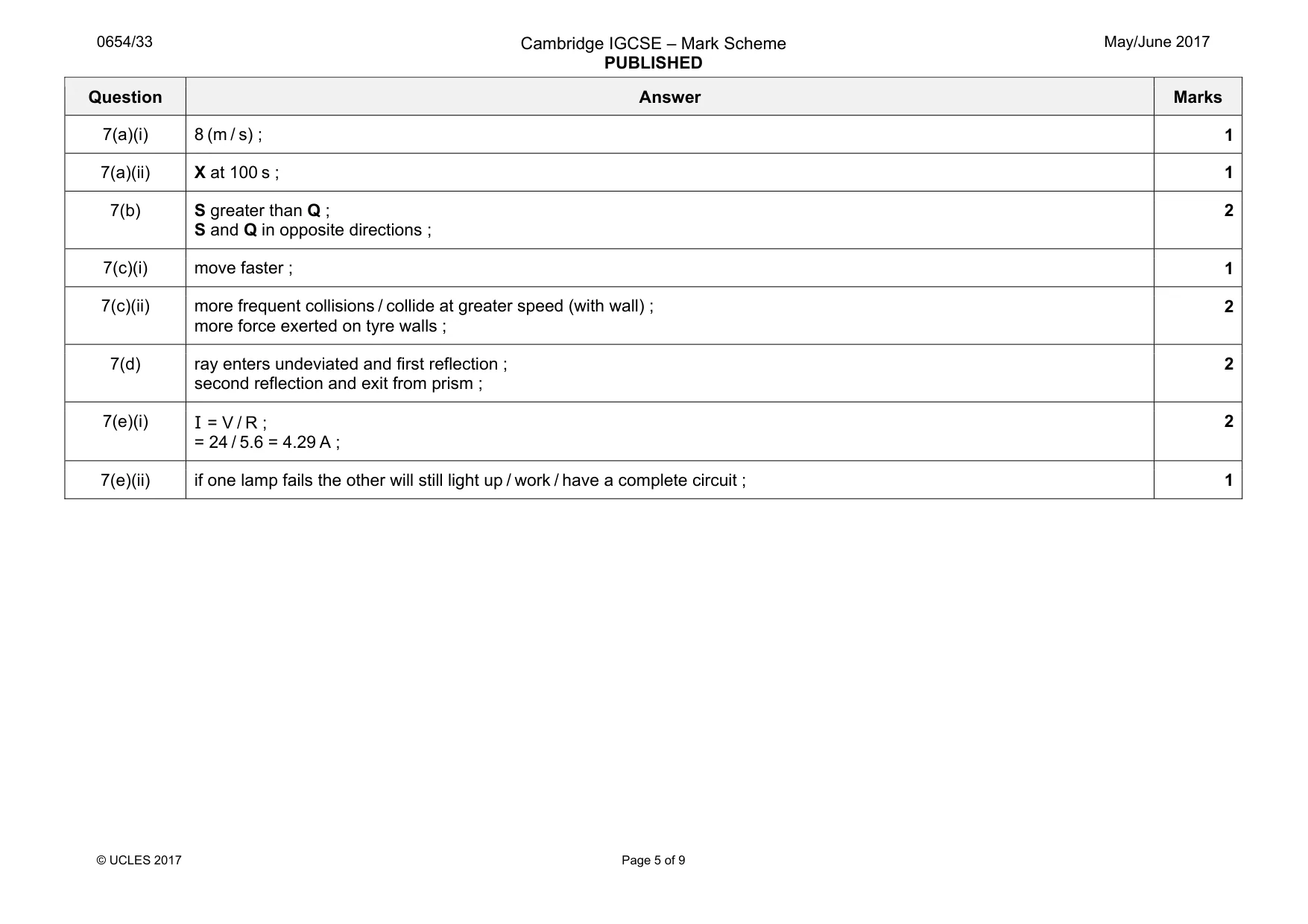
Mark scheme: 7(a)(i) 8 (m / s) ; 1 7(a)(ii) X at 100 s ; 1 7(b) S greater than Q ; S and Q in opposite directions ; 2 7(c)(i) move faster ; 1 7(c)(ii) more frequent collisions / collide at greater speed (with wall) ; more force exerted on tyre walls ; 2 7(d) ray enters undeviated and first reflection ; second reflection and exit from prism ; 2 7(e)(i) I = V / R ; = 24 / 5.6 = 4.29 A ; 2 7(e)(ii) if one lamp fails the other will still light up / work / have a complete circuit ; 1
Q8 · Black ink in marker pens is a mixture of several dyes (coloured compounds)
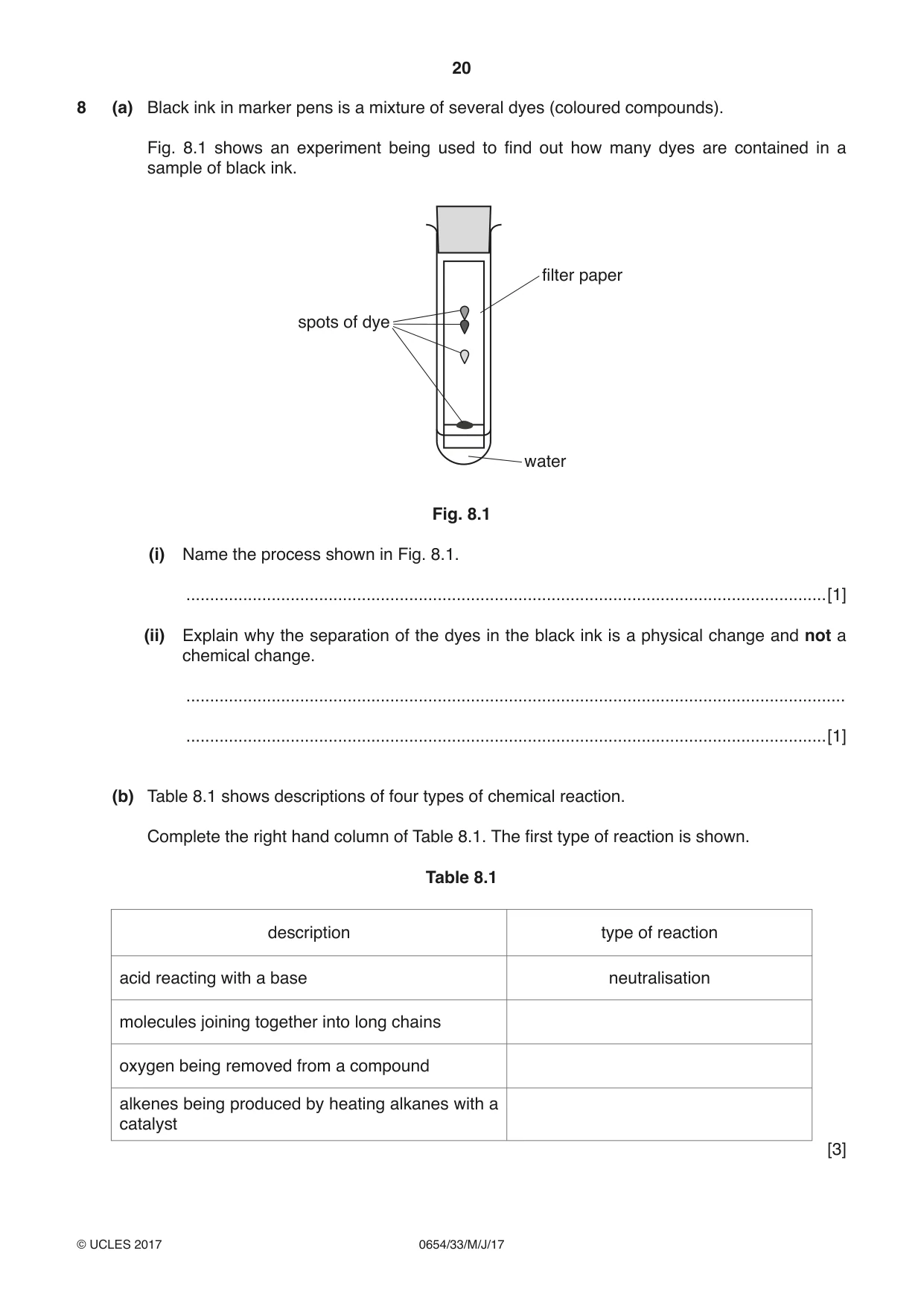
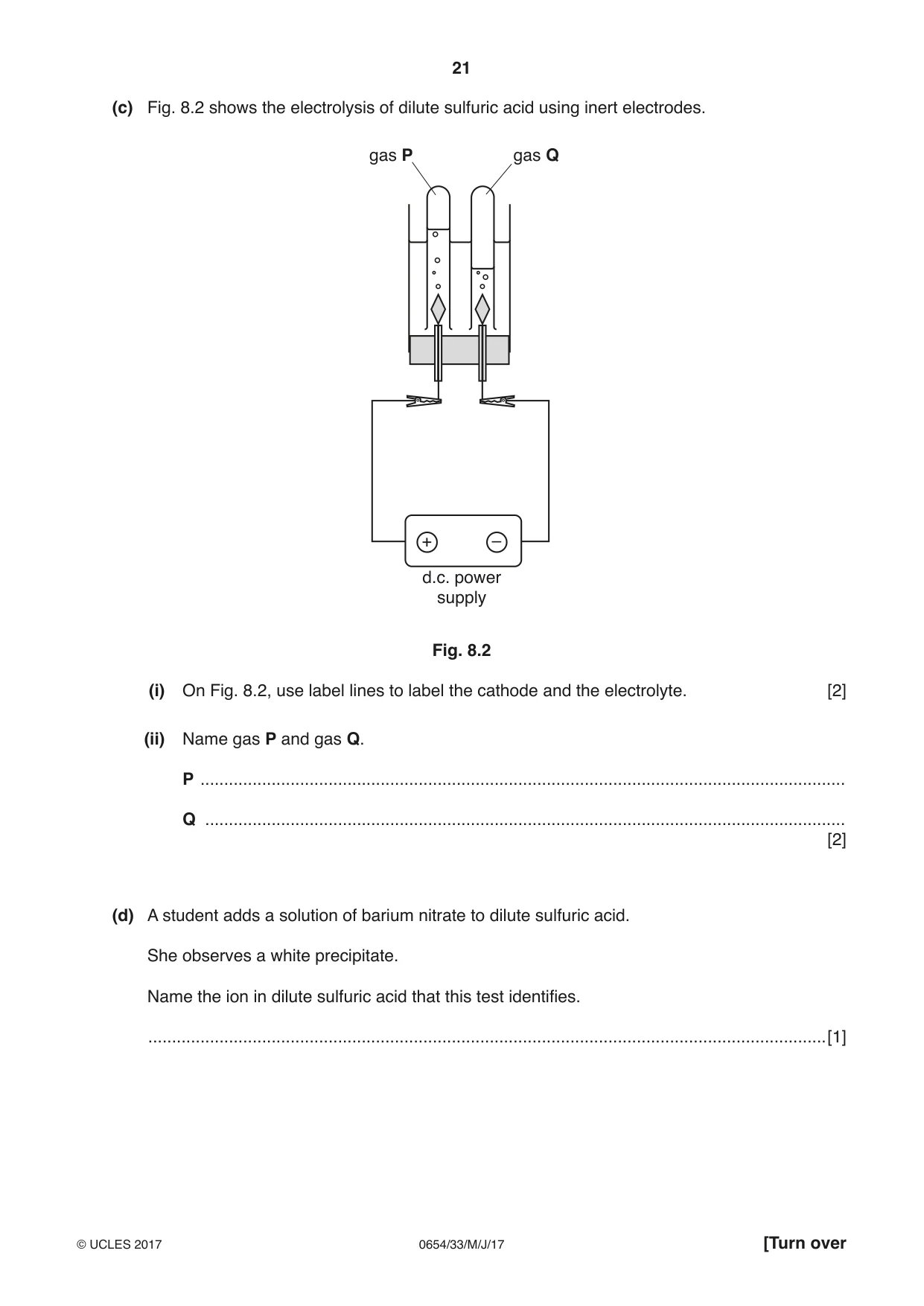
8 (a) Black ink in marker pens is a mixture of several dyes (coloured compounds). Fig. 8.1 shows an experiment being used to find out how many dyes are contained in a sample of black ink. filter paper spots of dye water Fig. 8.1 (i) Name the process shown in Fig. 8.1. .......................................................................................................................................[1] (ii) Explain why the separation of the dyes in the black ink is a physical change and not a chemical change. ........................................................................................................................................... .......................................................................................................................................[1] (b) Table 8.1 shows descriptions of four types of chemical reaction. Complete the right hand column of Table 8.1. The first type of reaction is shown. Table 8.1 description type of reaction acid reacting with a base neutralisation molecules joining together into long chains oxygen being removed from a compound alkenes being produced by heating alkanes with a catalyst [3] (c) Fig. 8.2 shows the electrolysis of dilute sulfuric acid using inert electrodes. gas P gas Q + – d.c. power supply Fig. 8.2 (i) On Fig. 8.2, use label lines to label the cathode and the electrolyte. [2] (ii) Name gas P and gas Q. P ........................................................................................................................................ Q ....................................................................................................................................... [2] (d) A student adds a solution of barium nitrate to dilute sulfuric acid. She observes a white precipitate. Name the ion in dilute sulfuric acid that this test identifies. ...............................................................................................................................................[1]
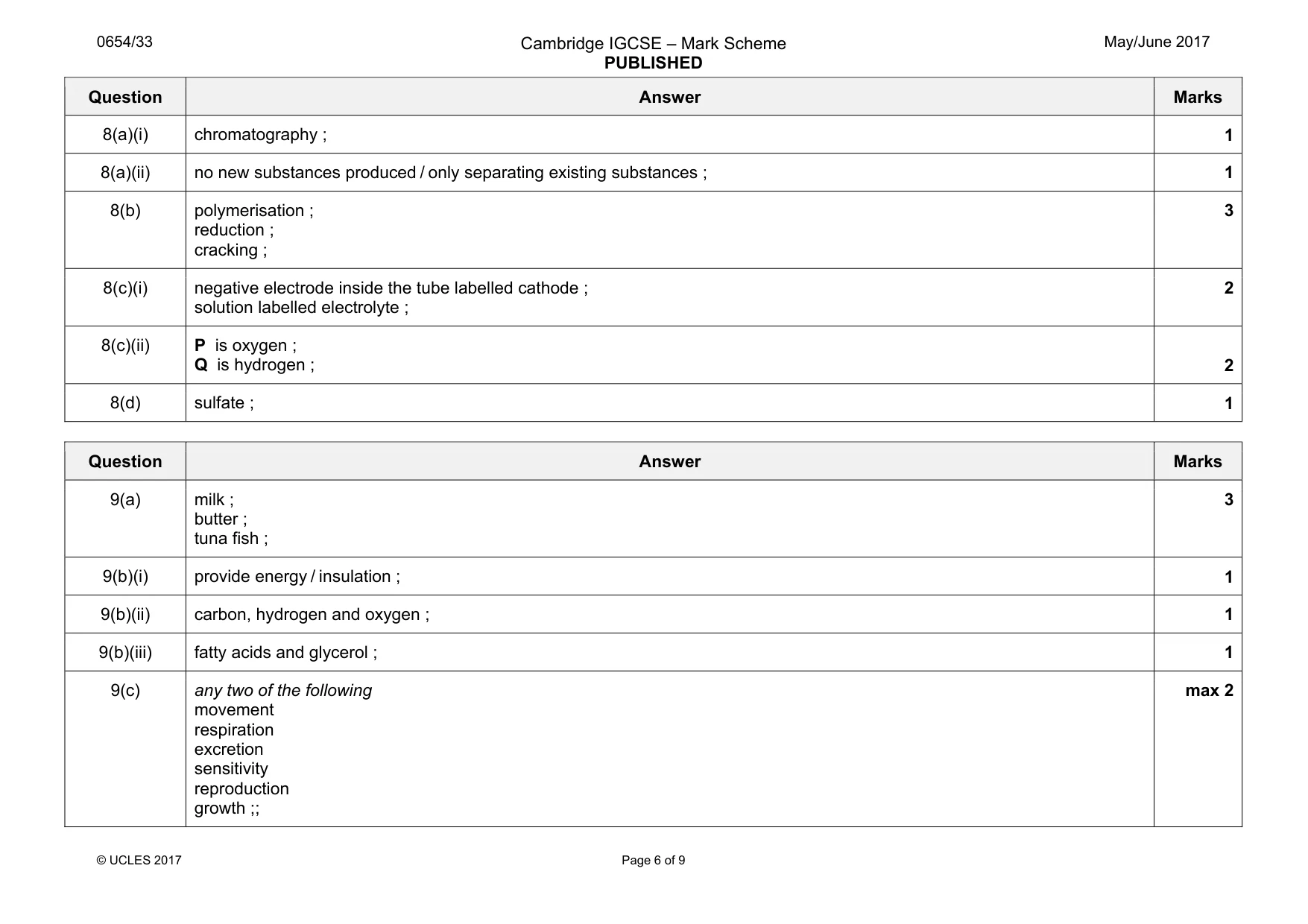
Mark scheme: 8(a)(i) chromatography ; 1 8(a)(ii) no new substances produced / only separating existing substances ; 1 8(b) polymerisation ; reduction ; cracking ; 3 8(c)(i) negative electrode inside the tube labelled cathode ; solution labelled electrolyte ; 2 8(c)(ii) P is oxygen ; Q is hydrogen ; 2 8(d) sulfate ; 1
Q9 · A list of items bought from a food shop
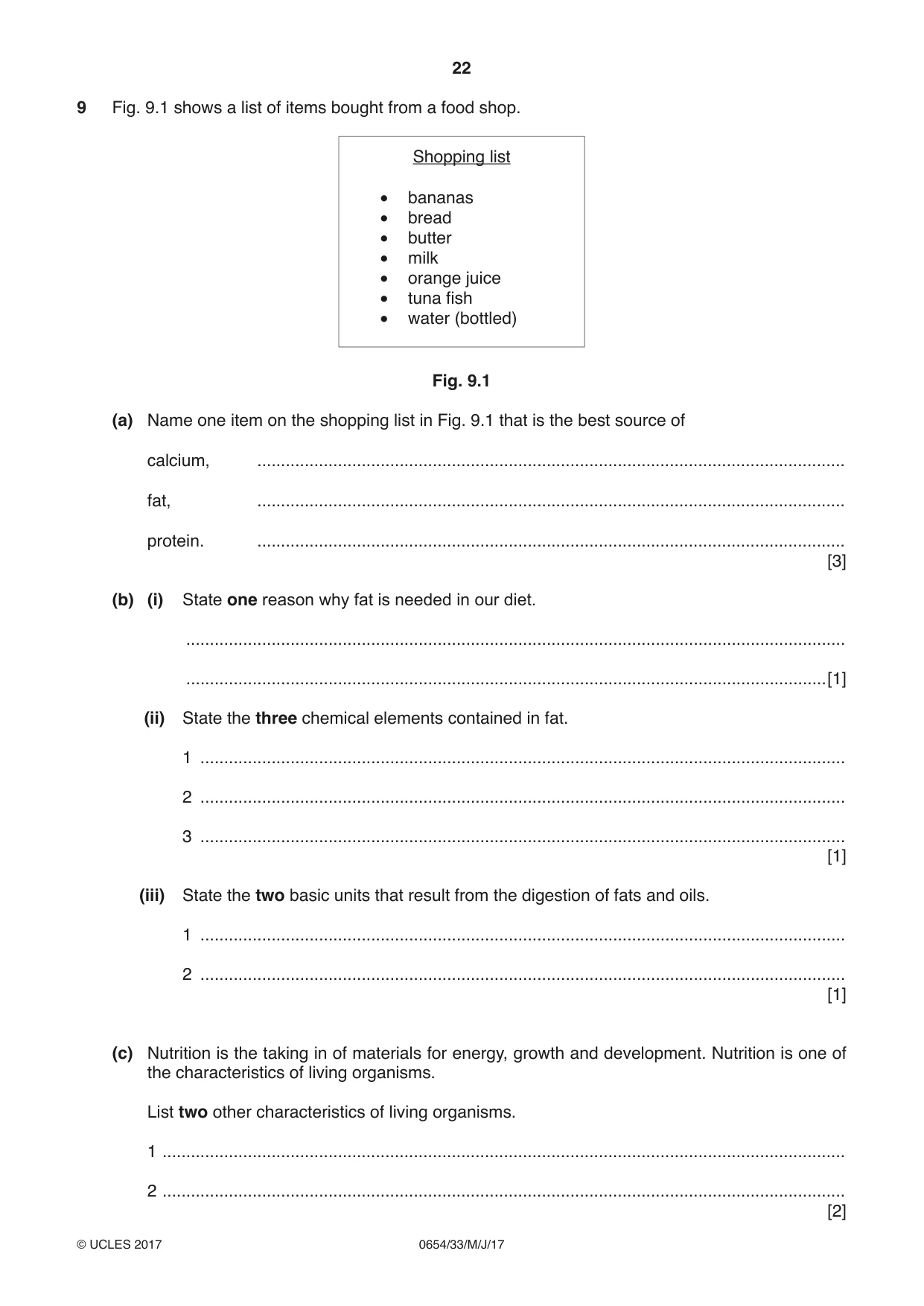
9 Fig. 9.1 shows a list of items bought from a food shop. Shopping list • bananas • bread • butter • milk • orange juice • tuna fish • water (bottled) Fig. 9.1 (a) Name one item on the shopping list in Fig. 9.1 that is the best source of calcium, ............................................................................................................................ fat, ............................................................................................................................ protein. ............................................................................................................................ [3] (b) (i) State one reason why fat is needed in our diet. ........................................................................................................................................... .......................................................................................................................................[1] (ii) State the three chemical elements contained in fat. 1 ........................................................................................................................................ 2 ........................................................................................................................................ 3 ........................................................................................................................................ [1] (iii) State the two basic units that result from the digestion of fats and oils. 1 ........................................................................................................................................ 2 ........................................................................................................................................ [1] (c) Nutrition is the taking in of materials for energy, growth and development. Nutrition is one of the characteristics of living organisms. List two other characteristics of living organisms. 1 ................................................................................................................................................ 2 ................................................................................................................................................ [2]
Mark scheme: 9(a) milk ; butter ; tuna fish ; 3 9(b)(i) provide energy / insulation ; 1 9(b)(ii) carbon, hydrogen and oxygen ; 1 9(b)(iii) fatty acids and glycerol ; 1 9(c) any two of the following movement respiration excretion sensitivity reproduction growth ;; max 2
Q10 · A diagram of the carbon cycle
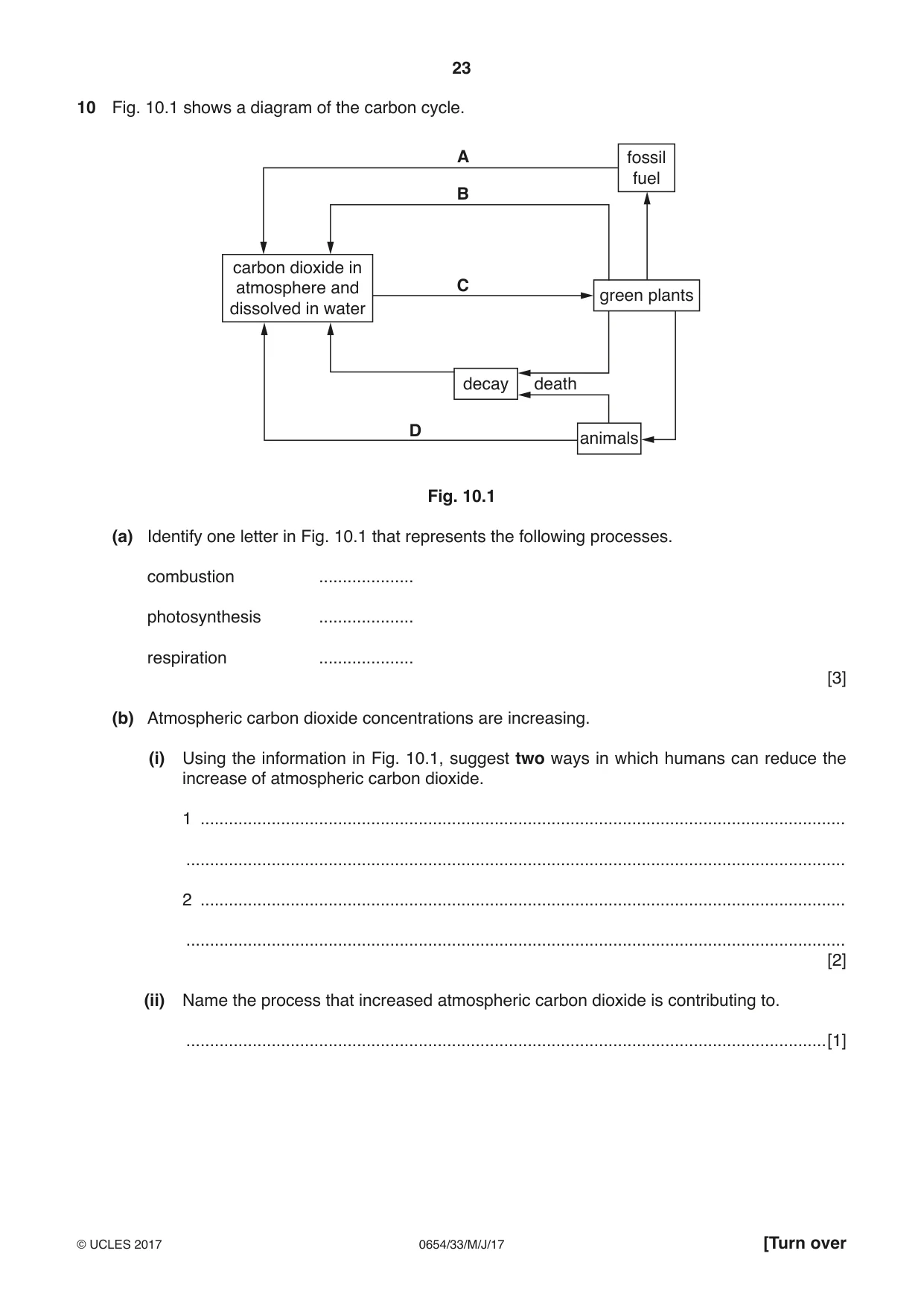
10 Fig. 10.1 shows a diagram of the carbon cycle. A fossil fuel B carbon dioxide in atmosphere and C green plants dissolved in water decay death D animals Fig. 10.1 (a) Identify one letter in Fig. 10.1 that represents the following processes. combustion .................... photosynthesis .................... respiration .................... [3] (b) Atmospheric carbon dioxide concentrations are increasing. (i) Using the information in Fig. 10.1, suggest two ways in which humans can reduce the increase of atmospheric carbon dioxide. 1 ........................................................................................................................................ ........................................................................................................................................... 2 ........................................................................................................................................ ........................................................................................................................................... [2] (ii) Name the process that increased atmospheric carbon dioxide is contributing to. .......................................................................................................................................[1]
Mark scheme: 10(a) A ; C ; B / D ; 3 10(b)(i) plant / grow, more, trees / plants ; reduce combustion of fossil fuels ; 2 10(b)(ii) global warming ; 1
Q11 · A house has solar panels fitted on the roof
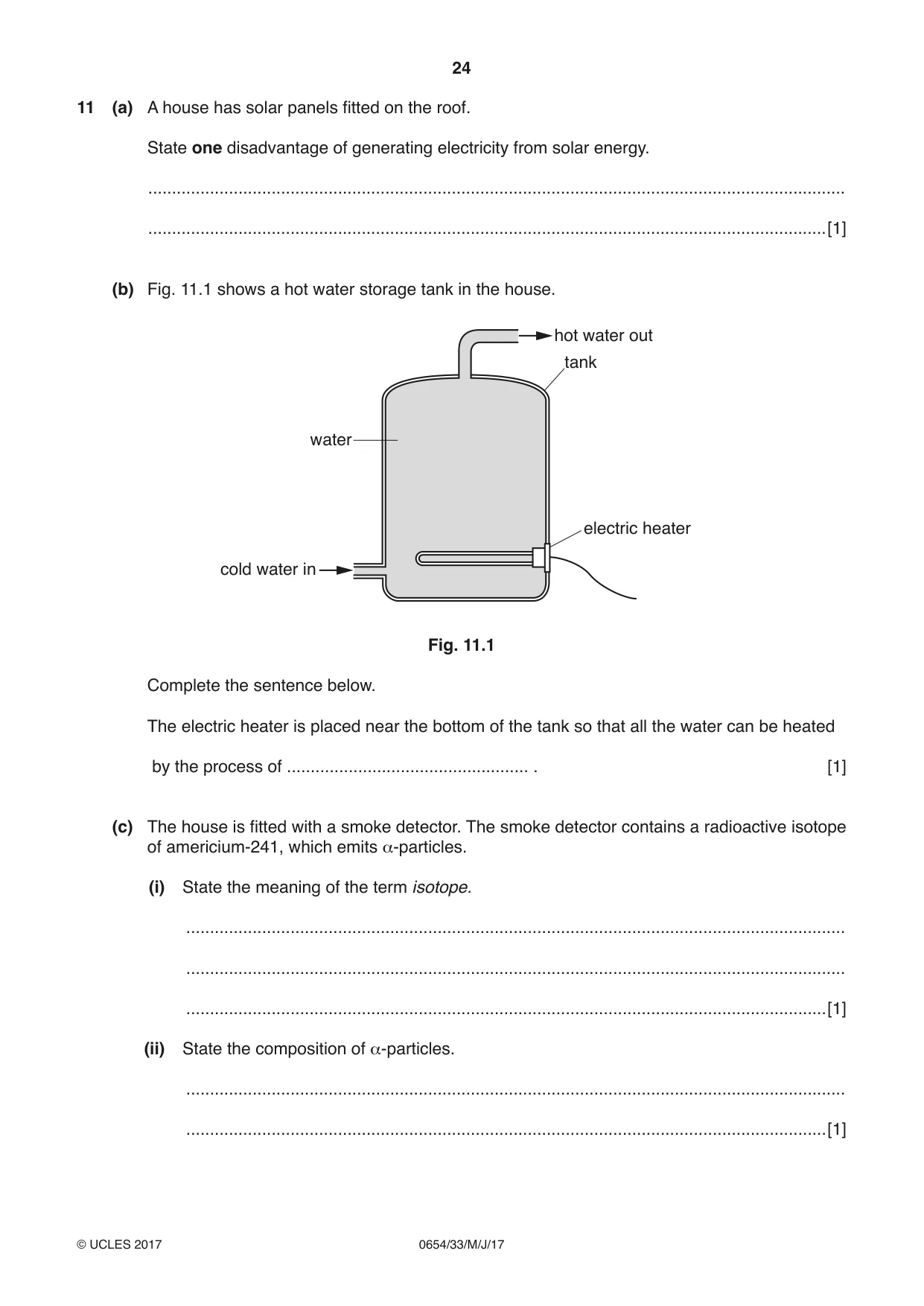
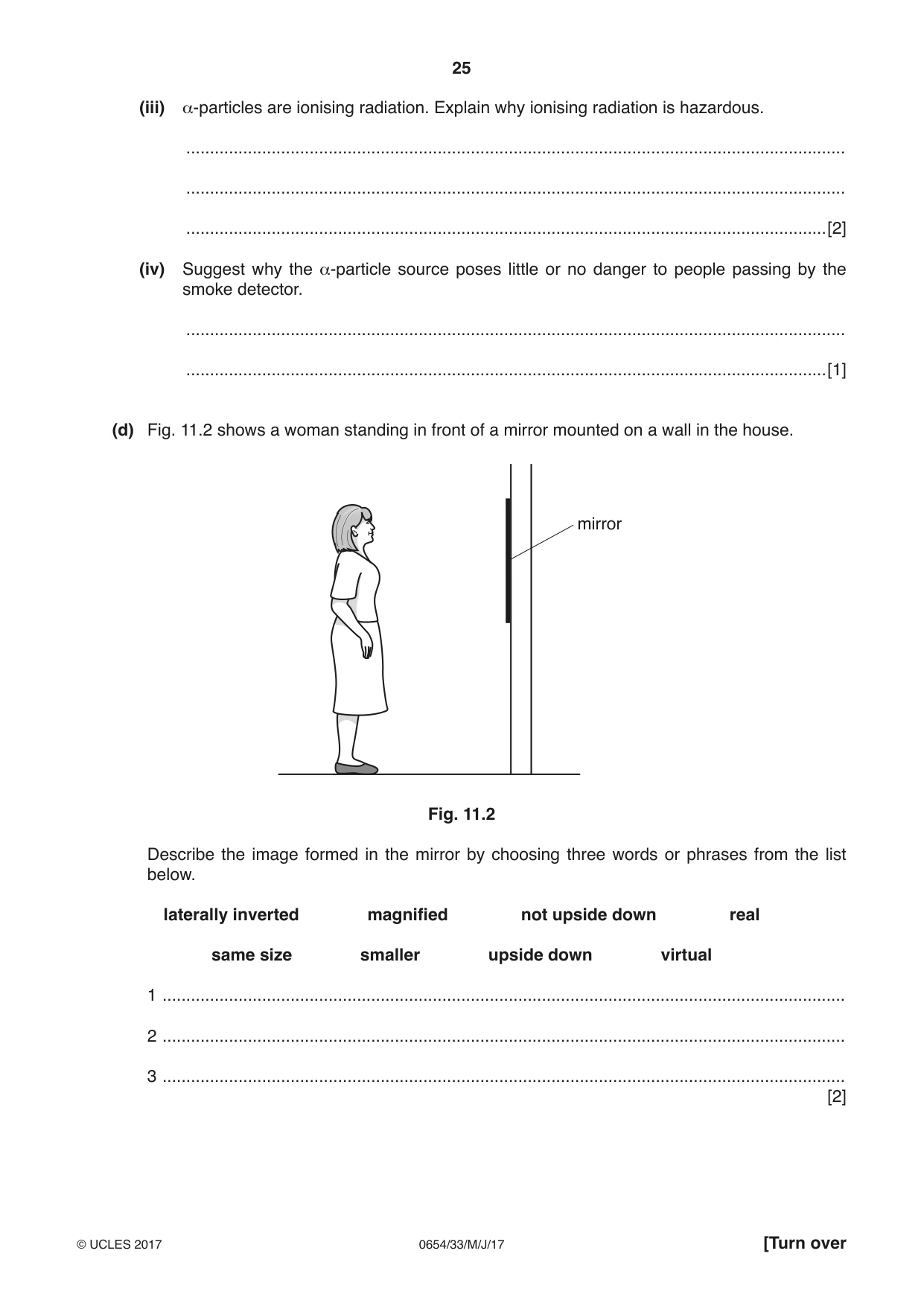
11 (a) A house has solar panels fitted on the roof. State one disadvantage of generating electricity from solar energy. ................................................................................................................................................... ...............................................................................................................................................[1] (b) Fig. 11.1 shows a hot water storage tank in the house. hot water out tank water electric heater cold water in Fig. 11.1 Complete the sentence below. The electric heater is placed near the bottom of the tank so that all the water can be heated by the process of ................................................... . [1] (c) The house is fitted with a smoke detector. The smoke detector contains a radioactive isotope of americium-241, which emits α-particles. (i) State the meaning of the term isotope. ........................................................................................................................................... ........................................................................................................................................... .......................................................................................................................................[1] (ii) State the composition of α-particles. ........................................................................................................................................... .......................................................................................................................................[1] (iii) α-particles are ionising radiation. Explain why ionising radiation is hazardous. ........................................................................................................................................... ........................................................................................................................................... .......................................................................................................................................[2] (iv) Suggest why the α-particle source poses little or no danger to people passing by the smoke detector. ........................................................................................................................................... .......................................................................................................................................[1] (d) Fig. 11.2 shows a woman standing in front of a mirror mounted on a wall in the house. mirror Fig. 11.2 Describe the image formed in the mirror by choosing three words or phrases from the list below. laterally inverted magnified not upside down real same size smaller upside down virtual 1 ................................................................................................................................................ 2 ................................................................................................................................................ 3 ................................................................................................................................................ [2]
Mark scheme: 11(a) doesn’t work at night / when there is little light ; 1 11(b) convection ; 1 11(c)(i) atoms of the same element that have same proton number but different neutron number etc. ; 1 11(c)(ii) 2p + 2n / helium nucleus ; 1 11(c)(iii) ionises atoms / molecules in cells ; causes mutation / cancer ; 2 11(c)(iv) alpha particles are absorbed by 5cm of air ; 1 11(d) laterally inverted same size not upside down virtual one correct one mark ; all three correct two marks ; 2
Q12 · Part of a wave-powered electrical generator
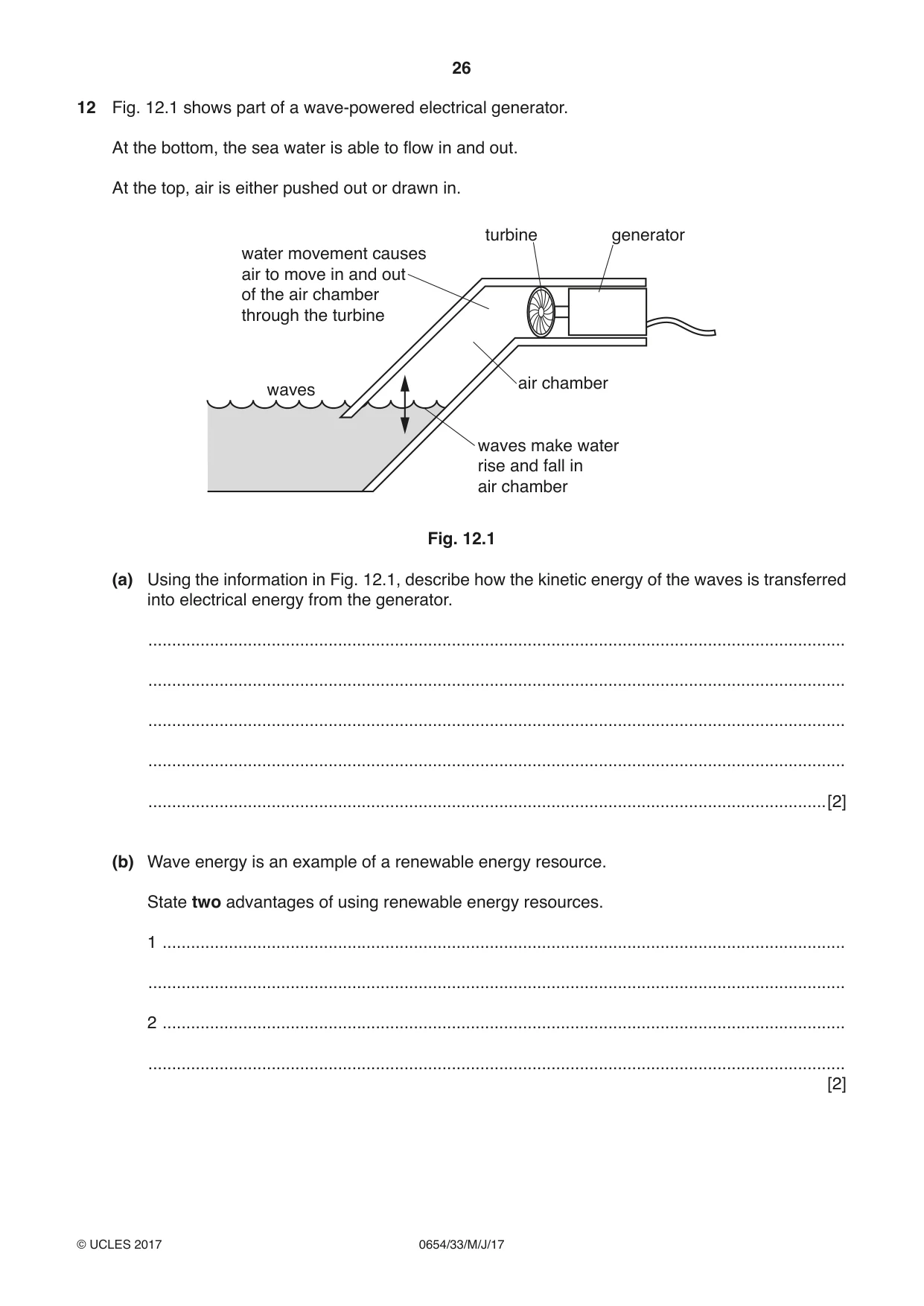
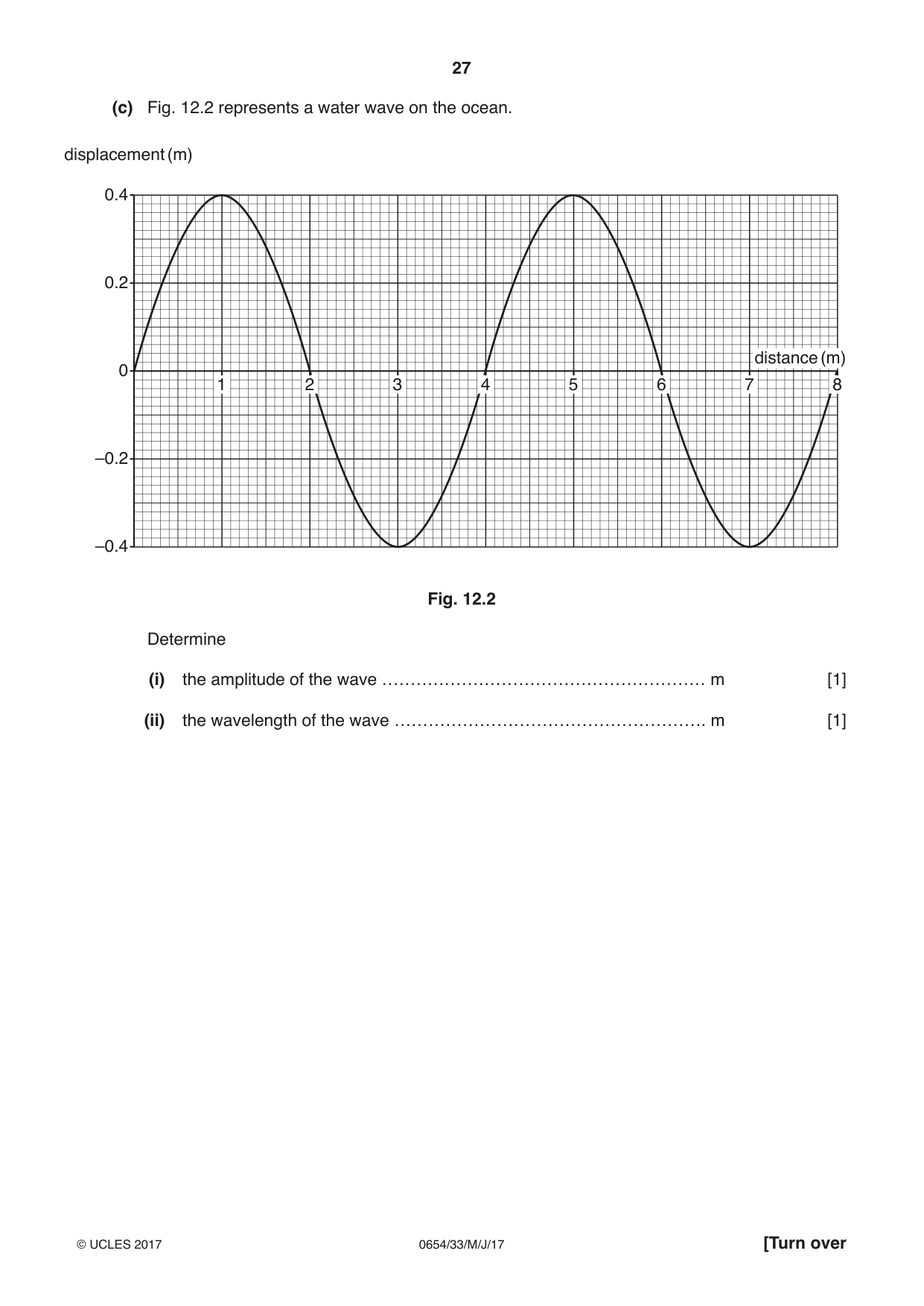
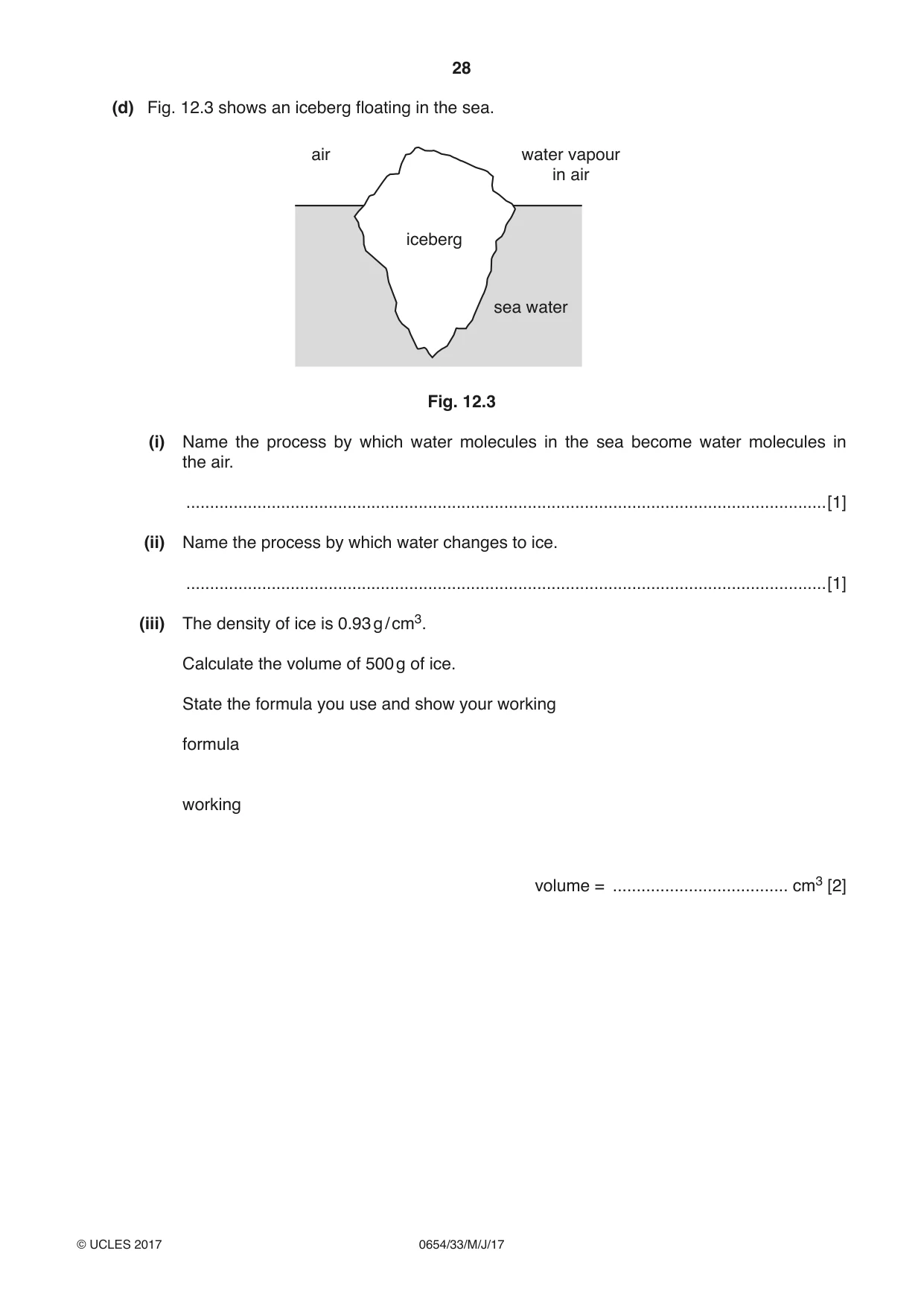
12 Fig. 12.1 shows part of a wave-powered electrical generator. At the bottom, the sea water is able to flow in and out. At the top, air is either pushed out or drawn in. turbine generator water movement causes air to move in and out of the air chamber through the turbine air chamber waves waves make water rise and fall in air chamber Fig. 12.1 (a) Using the information in Fig. 12.1, describe how the kinetic energy of the waves is transferred into electrical energy from the generator. ................................................................................................................................................... ................................................................................................................................................... ................................................................................................................................................... ................................................................................................................................................... ...............................................................................................................................................[2] (b) Wave energy is an example of a renewable energy resource. State two advantages of using renewable energy resources. 1 ................................................................................................................................................ ................................................................................................................................................... 2 ................................................................................................................................................ ................................................................................................................................................... [2] (c) Fig. 12.2 represents a water wave on the ocean. displacement (m) 0.4 0.2 distance (m) 0 1 2 3 4 5 6 7 8 –0.2 –0.4 Fig. 12.2 Determine (i) the amplitude of the wave ………………………………………………… m [1] (ii) the wavelength of the wave ………………………………………………. m [1] (d) Fig. 12.3 shows an iceberg floating in the sea. air water vapour in air iceberg sea water Fig. 12.3 (i) Name the process by which water molecules in the sea become water molecules in the air. .......................................................................................................................................[1] (ii) Name the process by which water changes to ice. .......................................................................................................................................[1] (iii) The density of ice is 0.93 g / cm3. Calculate the volume of 500 g of ice. State the formula you use and show your working formula working volume = ..................................... cm3 [2]
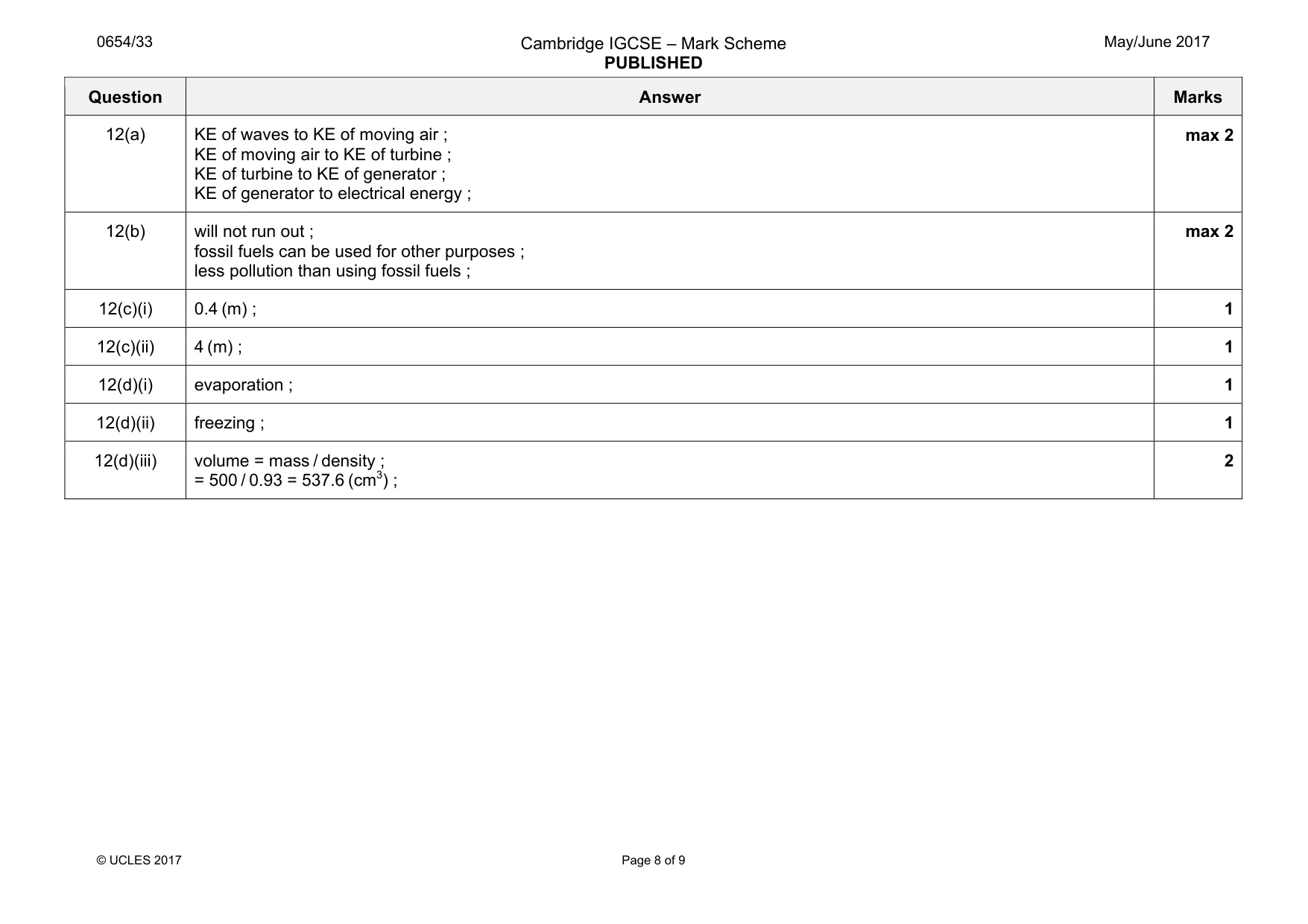
Mark scheme: 12(a) KE of waves to KE of moving air ; KE of moving air to KE of turbine ; KE of turbine to KE of generator ; KE of generator to electrical energy ; max 2 12(b) will not run out ; fossil fuels can be used for other purposes ; less pollution than using fossil fuels ; max 2 12(c)(i) 0.4 (m) ; 1 12(c)(ii) 4 (m) ; 1 12(d)(i) evaporation ; 1 12(d)(ii) freezing ; 1 12(d)(iii) volume = mass / density ; = 500 / 0.93 = 537.6 (cm3) ; 2
Q13 · Ethanol is a colourless liquid compound that contains the elements carbon, hydrogen and…
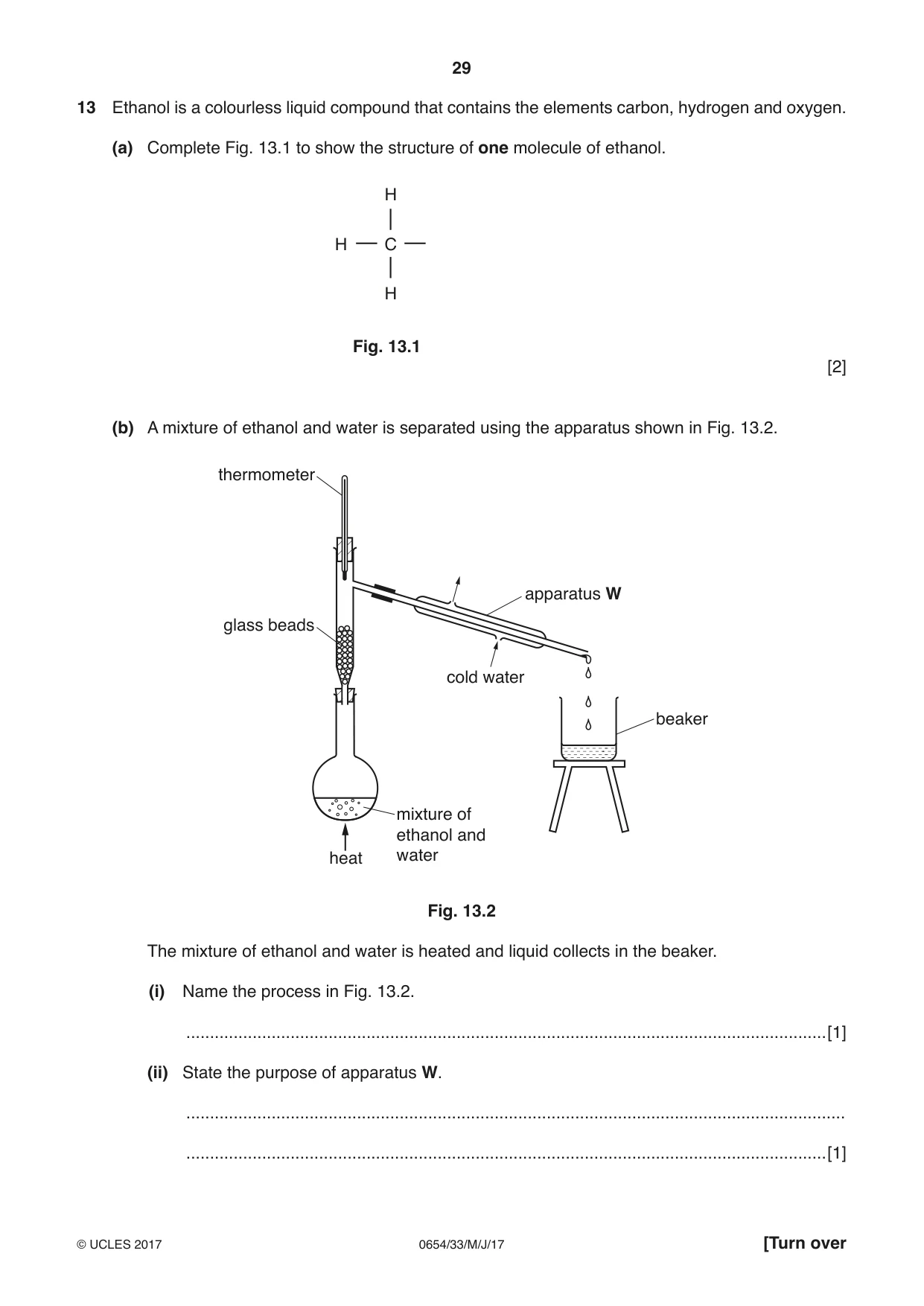
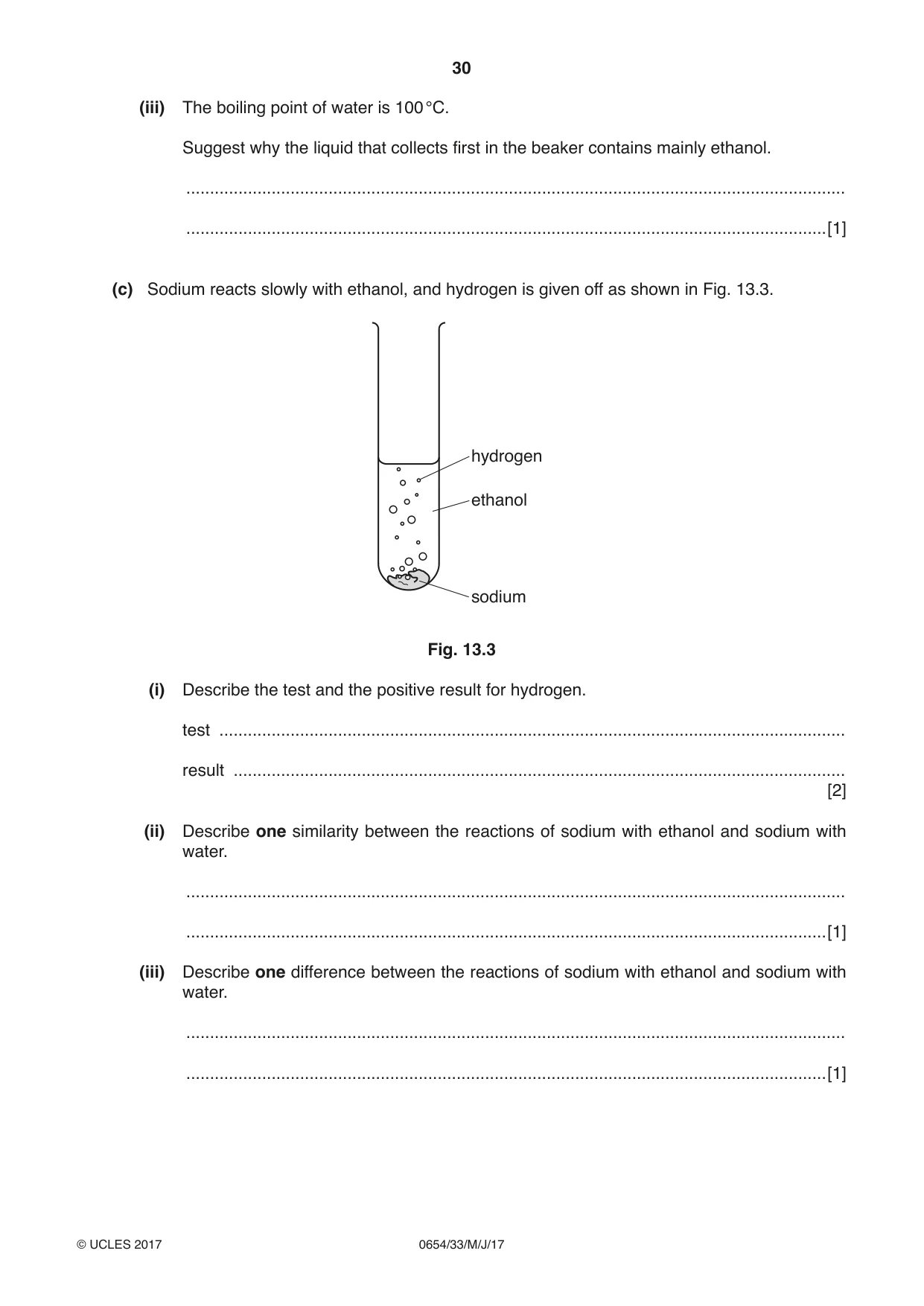
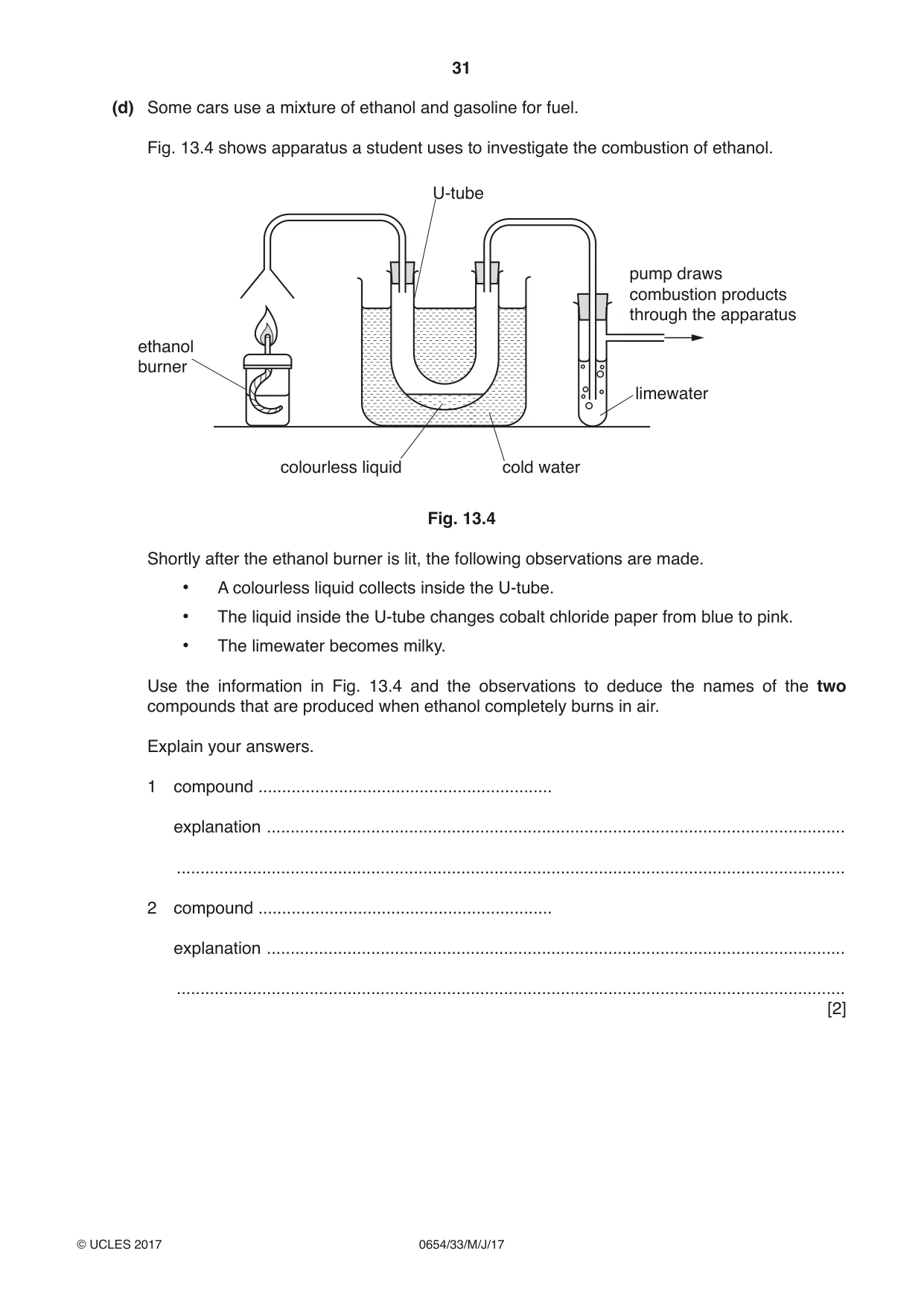
13 Ethanol is a colourless liquid compound that contains the elements carbon, hydrogen and oxygen. (a) Complete Fig. 13.1 to show the structure of one molecule of ethanol. H H C H Fig. 13.1 [2] (b) A mixture of ethanol and water is separated using the apparatus shown in Fig. 13.2. thermometer apparatus W glass beads cold water beaker mixture of ethanol and heat water Fig. 13.2 The mixture of ethanol and water is heated and liquid collects in the beaker. (i) Name the process in Fig. 13.2. .......................................................................................................................................[1] (ii) State the purpose of apparatus W. ........................................................................................................................................... .......................................................................................................................................[1] (iii) The boiling point of water is 100 °C. Suggest why the liquid that collects first in the beaker contains mainly ethanol. ........................................................................................................................................... .......................................................................................................................................[1] (c) Sodium reacts slowly with ethanol, and hydrogen is given off as shown in Fig. 13.3. hydrogen ethanol sodium Fig. 13.3 (i) Describe the test and the positive result for hydrogen. test .................................................................................................................................... result ................................................................................................................................. [2] (ii) Describe one similarity between the reactions of sodium with ethanol and sodium with water. ........................................................................................................................................... .......................................................................................................................................[1] (iii) Describe one difference between the reactions of sodium with ethanol and sodium with water. ........................................................................................................................................... .......................................................................................................................................[1] (d) Some cars use a mixture of ethanol and gasoline for fuel. Fig. 13.4 shows apparatus a student uses to investigate the combustion of ethanol. U-tube pump draws combustion products through the apparatus ethanol burner limewater colourless liquid cold water Fig. 13.4 Shortly after the ethanol burner is lit, the following observations are made. • A colourless liquid collects inside the U-tube. • The liquid inside the U-tube changes cobalt chloride paper from blue to pink. • The limewater becomes milky. Use the information in Fig. 13.4 and the observations to deduce the names of the two compounds that are produced when ethanol completely burns in air. Explain your answers. 1 compound .............................................................. explanation .......................................................................................................................... ............................................................................................................................................. 2 compound .............................................................. explanation .......................................................................................................................... ............................................................................................................................................. [2]
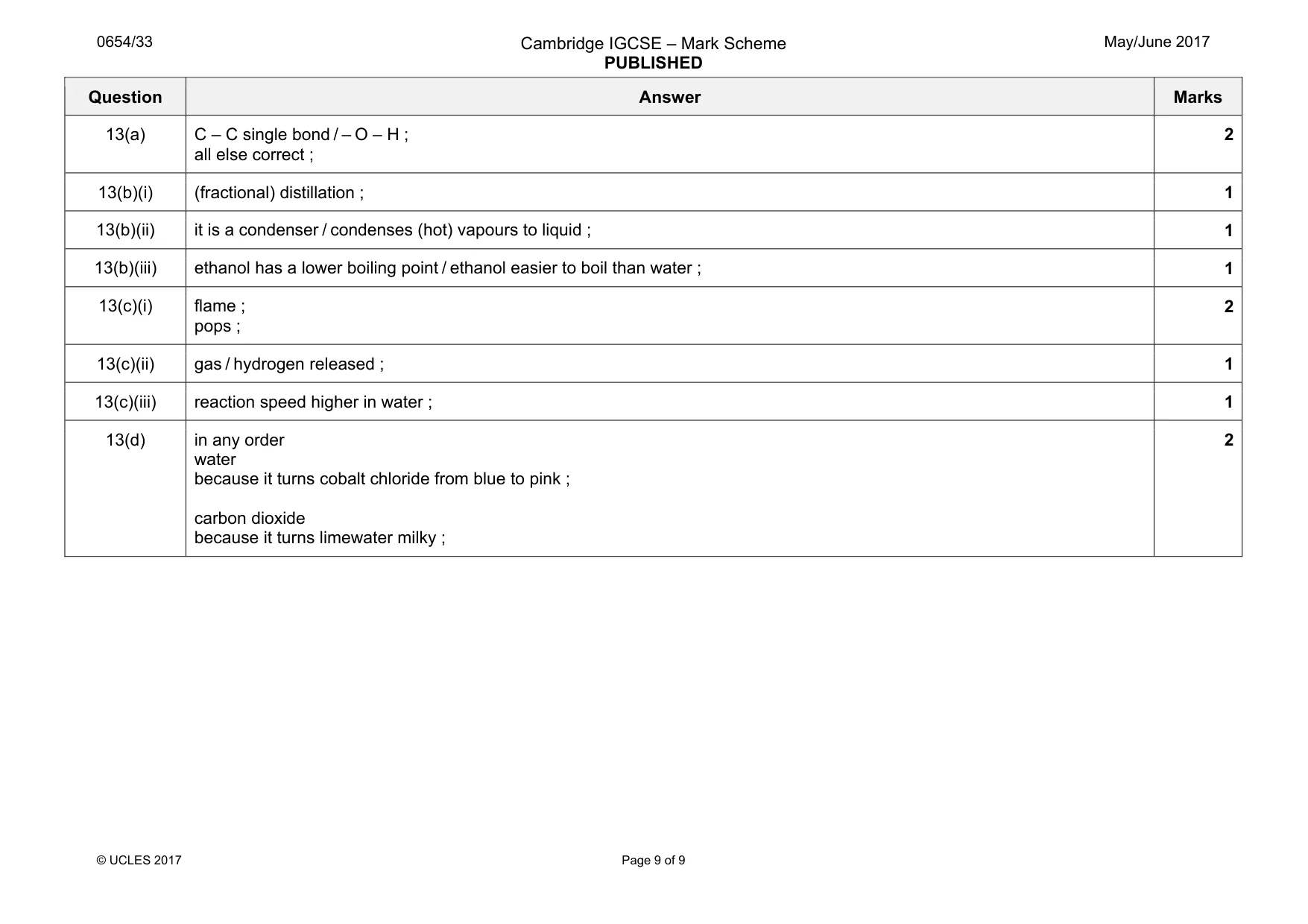
Mark scheme: 13(a) C – C single bond / – O – H ; all else correct ; 2 13(b)(i) (fractional) distillation ; 1 13(b)(ii) it is a condenser / condenses (hot) vapours to liquid ; 1 13(b)(iii) ethanol has a lower boiling point / ethanol easier to boil than water ; 1 13(c)(i) flame ; pops ; 2 13(c)(ii) gas / hydrogen released ; 1 13(c)(iii) reaction speed higher in water ; 1 13(d) in any order water because it turns cobalt chloride from blue to pink ; carbon dioxide because it turns limewater milky ; 2
What was in this paper
The subtopics covered by these 13 questions, and how many questions each got. Open one in a new tab to see every Cambridge question on it.
What you needed in this session
Cambridge’s own grade thresholds for 2017 May/June, Paper 3 · Variant 3. A higher threshold means an easier paper — the bar moves with how the cohort did.