Cambridge IGCSE Sciences - Co-ordinated (Double) 0654 — 2017 May/June Paper 3 · Variant 1
0654/31/M/J/17 · 12 questions · 120 marks · ≈135 min
The question paper and its mark scheme, free to read here and free to download. This is Cambridge’s own paper, exactly as it was sat.
Question paper28 pages
Mark scheme10 pages
Answers below. Sit the paper first if you are practising.
Questions as text
Q1 · A drawing of an animal cell
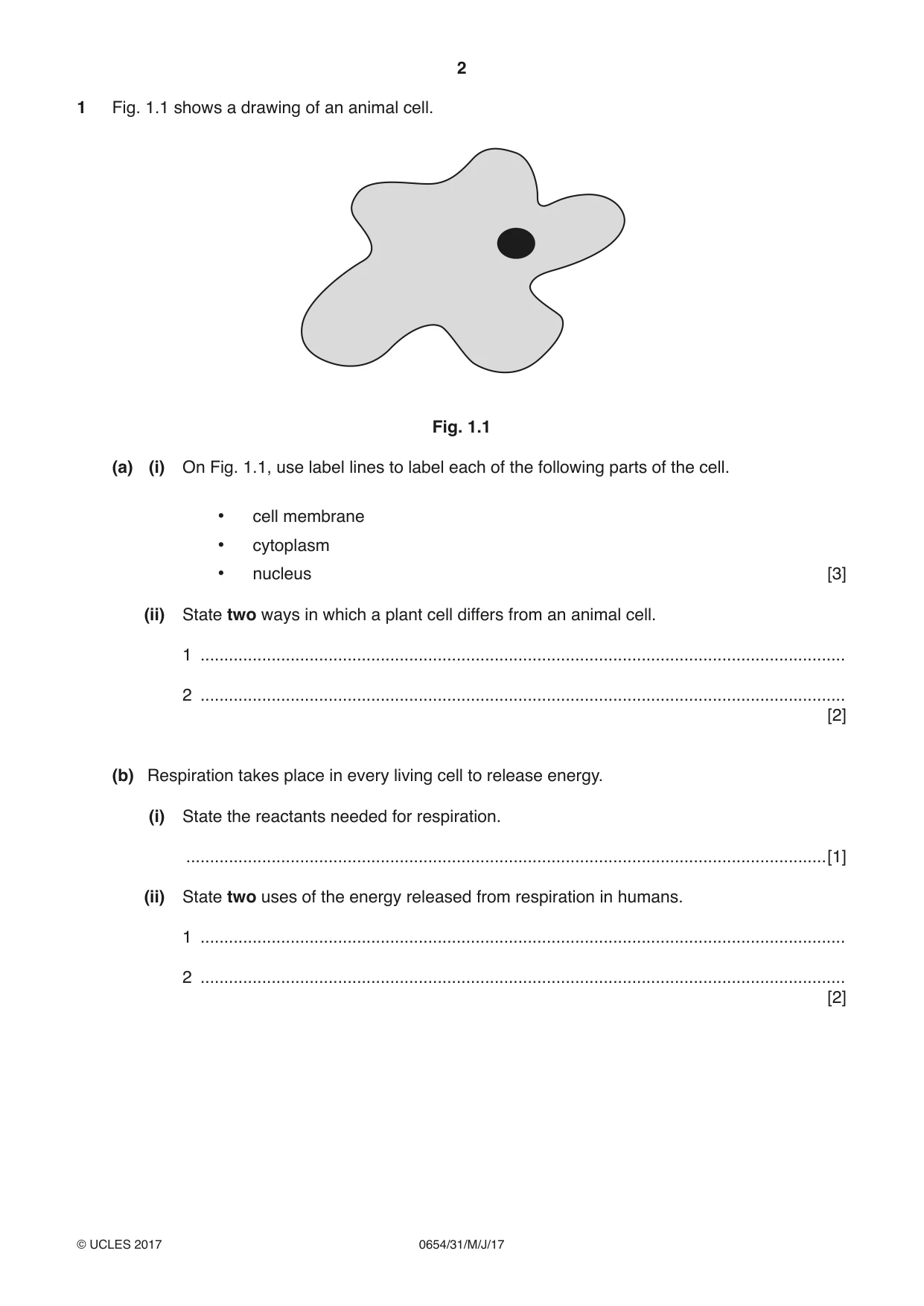
1 Fig. 1.1 shows a drawing of an animal cell. Fig. 1.1 (a) (i) On Fig. 1.1, use label lines to label each of the following parts of the cell. • cell membrane • cytoplasm • nucleus [3] (ii) State two ways in which a plant cell differs from an animal cell. 1 ........................................................................................................................................ 2 ........................................................................................................................................ [2] (b) Respiration takes place in every living cell to release energy. (i) State the reactants needed for respiration. .......................................................................................................................................[1] (ii) State two uses of the energy released from respiration in humans. 1 ........................................................................................................................................ 2 ........................................................................................................................................ [2]
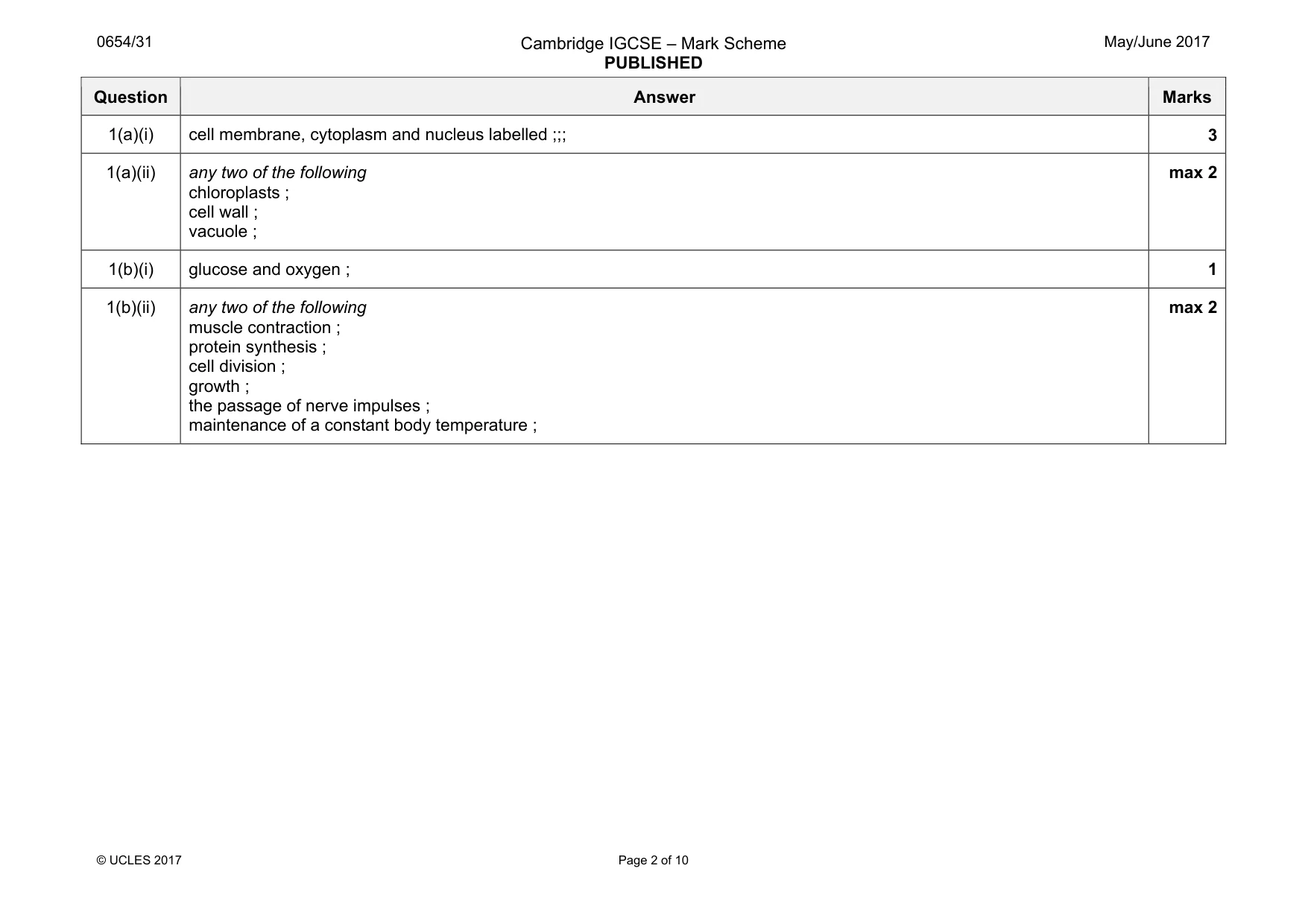
Mark scheme: 1(a)(i) cell membrane, cytoplasm and nucleus labelled ;;; 3 1(a)(ii) any two of the following chloroplasts ; cell wall ; vacuole ; max 2 1(b)(i) glucose and oxygen ; 1 1(b)(ii) any two of the following muscle contraction ; protein synthesis ; cell division ; growth ; the passage of nerve impulses ; maintenance of a constant body temperature ; max 2
Question 2
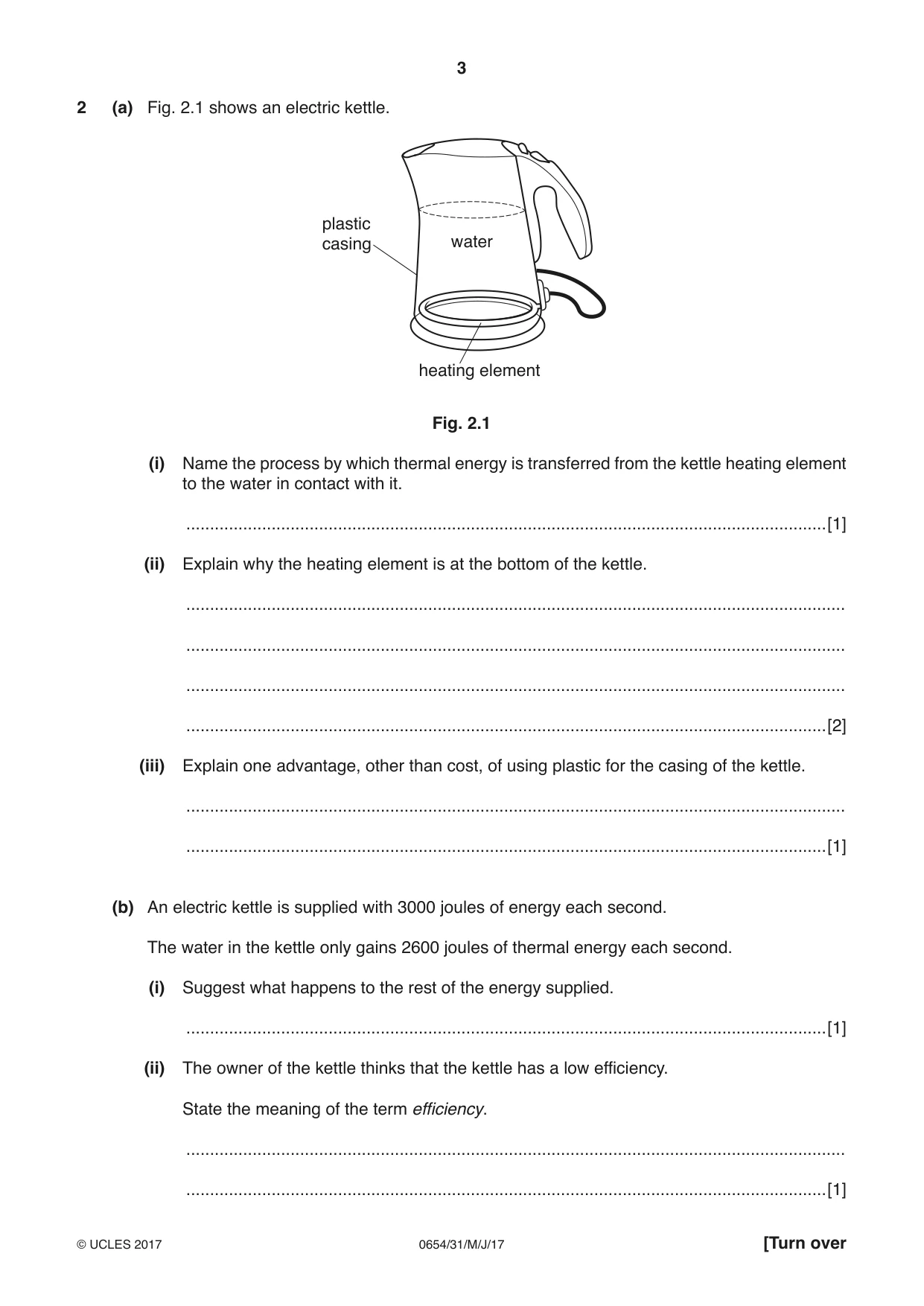
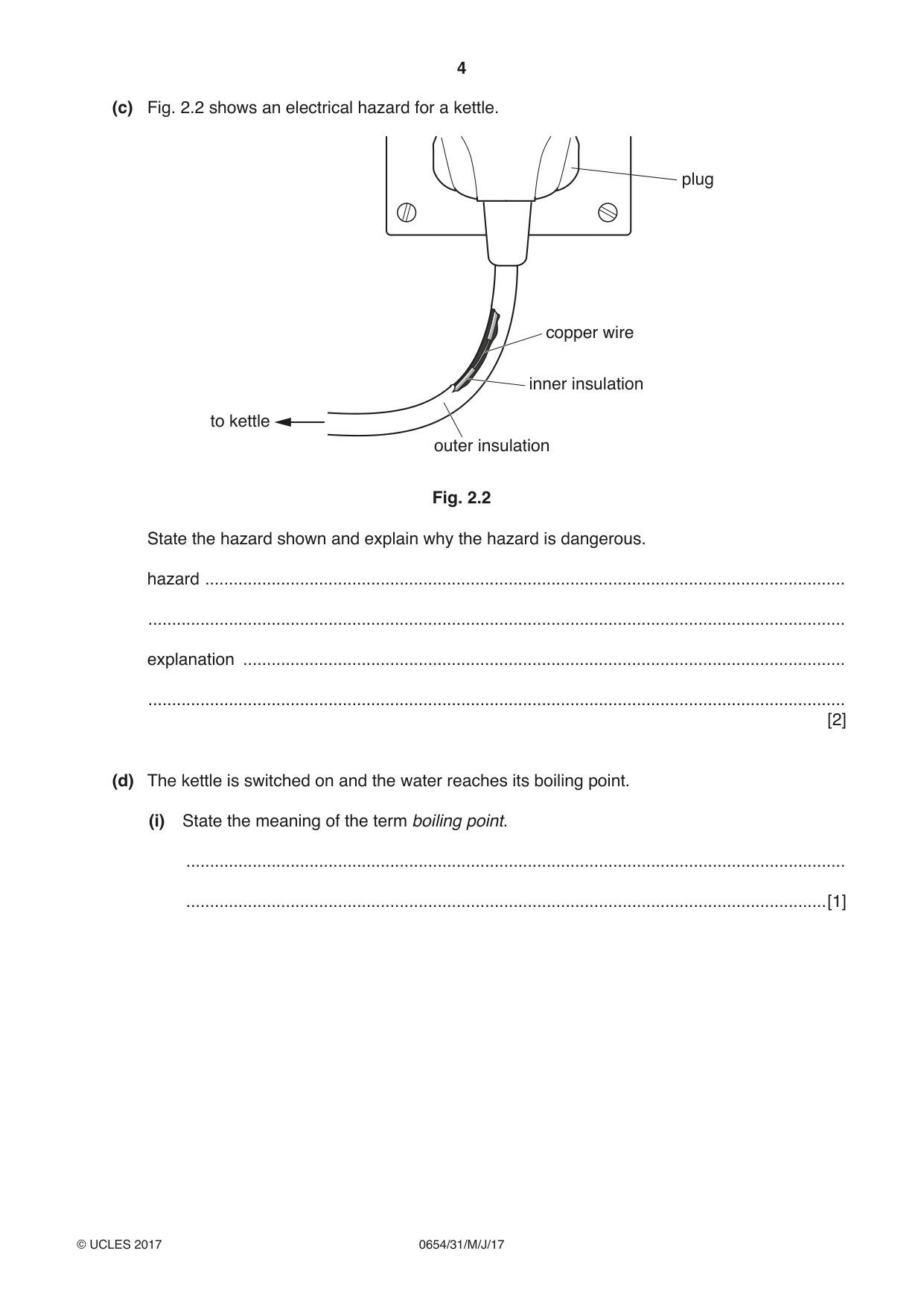
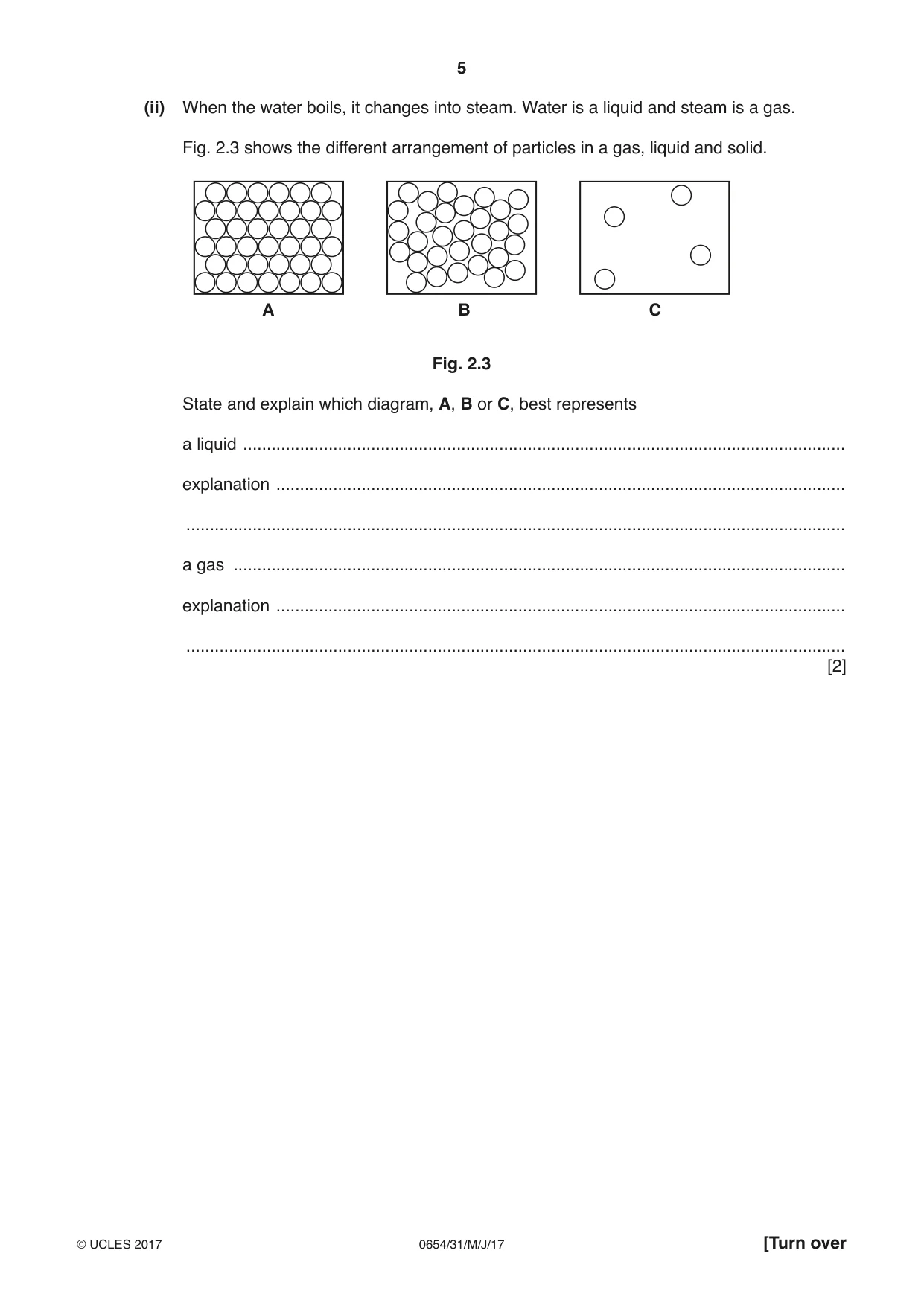
2 (a) Fig. 2.1 shows an electric kettle. plastic casing water heating element Fig. 2.1 (i) Name the process by which thermal energy is transferred from the kettle heating element to the water in contact with it. .......................................................................................................................................[1] (ii) Explain why the heating element is at the bottom of the kettle. ........................................................................................................................................... ........................................................................................................................................... ........................................................................................................................................... .......................................................................................................................................[2] (iii) Explain one advantage, other than cost, of using plastic for the casing of the kettle. ........................................................................................................................................... .......................................................................................................................................[1] (b) An electric kettle is supplied with 3000 joules of energy each second. The water in the kettle only gains 2600 joules of thermal energy each second. (i) Suggest what happens to the rest of the energy supplied. .......................................................................................................................................[1] (ii) The owner of the kettle thinks that the kettle has a low efficiency. State the meaning of the term efficiency. ........................................................................................................................................... .......................................................................................................................................[1] (c) Fig. 2.2 shows an electrical hazard for a kettle. plug copper wire inner insulation to kettle outer insulation Fig. 2.2 State the hazard shown and explain why the hazard is dangerous. hazard ....................................................................................................................................... ................................................................................................................................................... explanation ............................................................................................................................... ................................................................................................................................................... [2] (d) The kettle is switched on and the water reaches its boiling point. (i) State the meaning of the term boiling point. ........................................................................................................................................... .......................................................................................................................................[1] (ii) When the water boils, it changes into steam. Water is a liquid and steam is a gas. Fig. 2.3 shows the different arrangement of particles in a gas, liquid and solid. A B C Fig. 2.3 State and explain which diagram, A, B or C, best represents a liquid ............................................................................................................................... explanation ........................................................................................................................ ........................................................................................................................................... a gas ................................................................................................................................. explanation ........................................................................................................................ ........................................................................................................................................... [2]
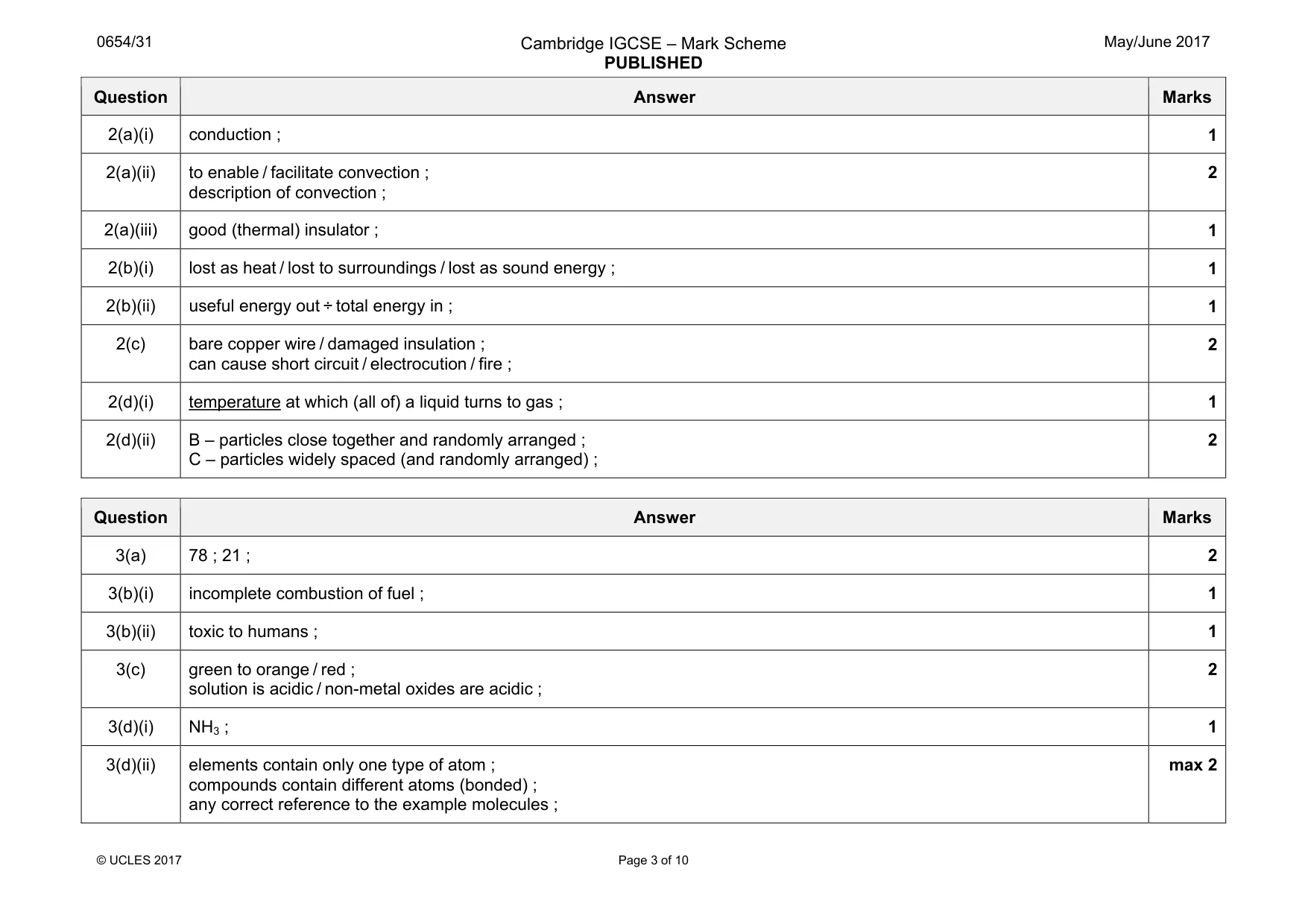
Mark scheme: 2(a)(i) conduction ; 1 2(a)(ii) to enable / facilitate convection ; description of convection ; 2 2(a)(iii) good (thermal) insulator ; 1 2(b)(i) lost as heat / lost to surroundings / lost as sound energy ; 1 2(b)(ii) useful energy out ÷ total energy in ; 1 2(c) bare copper wire / damaged insulation ; can cause short circuit / electrocution / fire ; 2 2(d)(i) temperature at which (all of) a liquid turns to gas ; 1 2(d)(ii) B – particles close together and randomly arranged ; C – particles widely spaced (and randomly arranged) ; 2
Q3 · State the percentages of nitrogen and oxygen in clean air
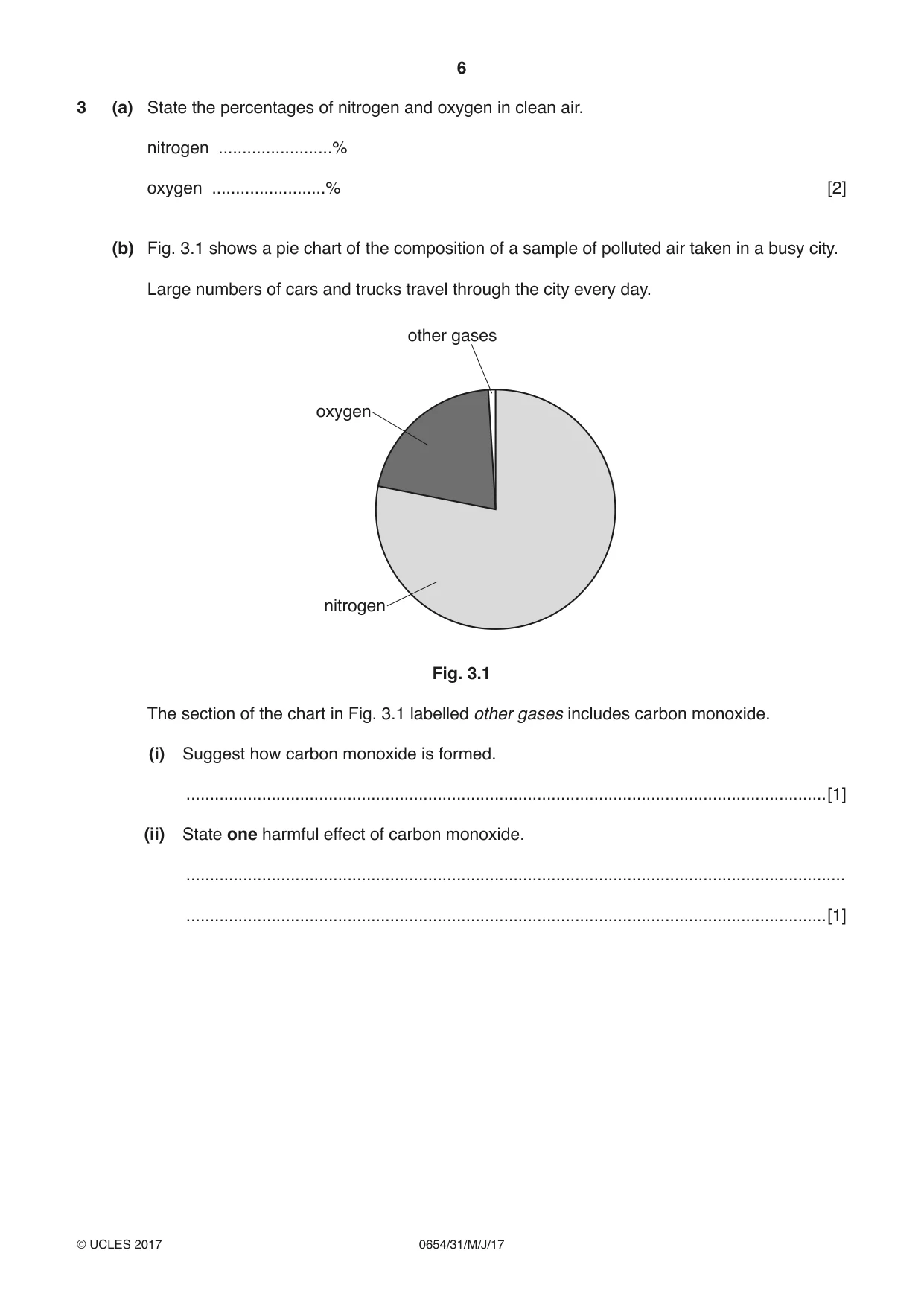
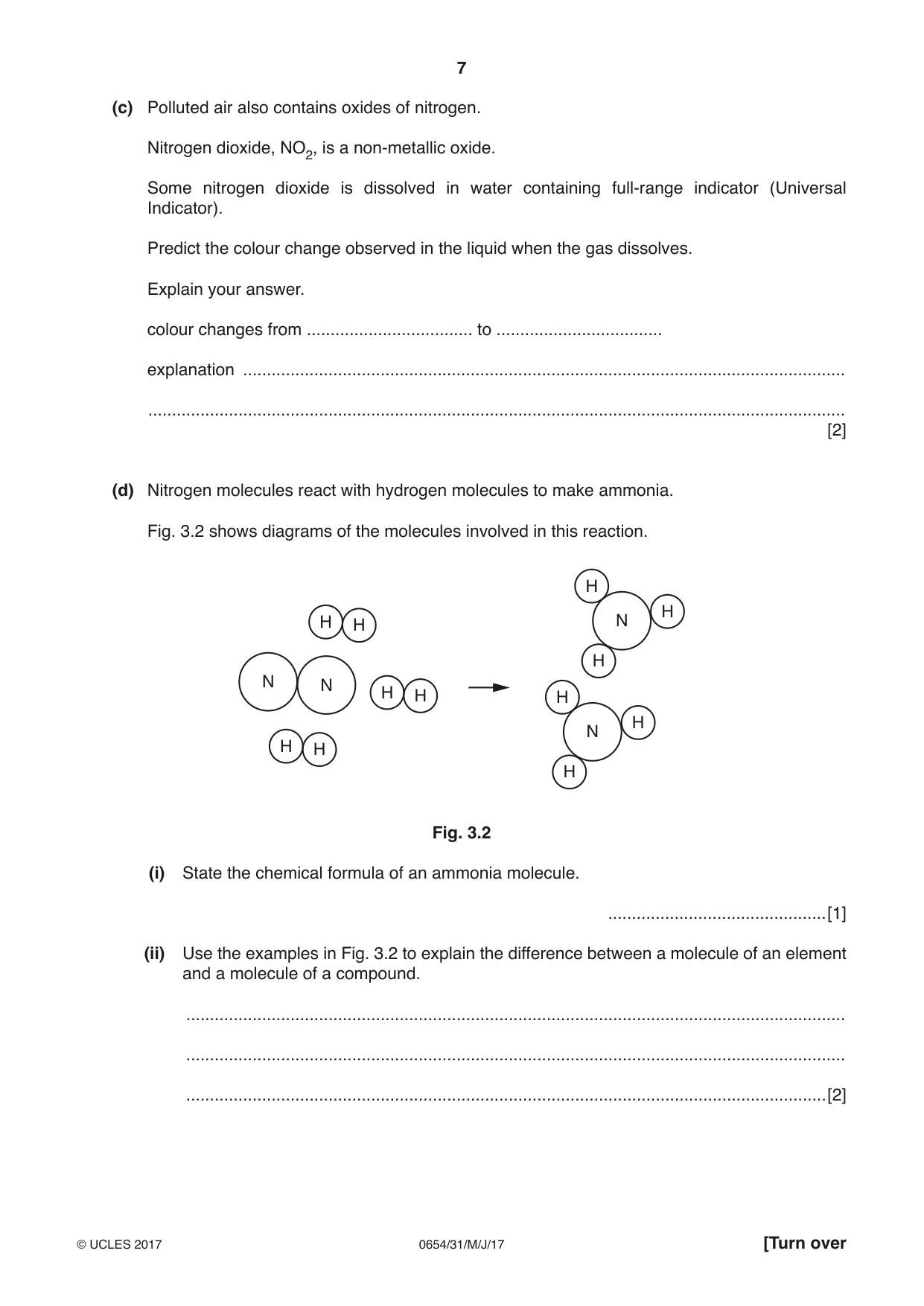
3 (a) State the percentages of nitrogen and oxygen in clean air. nitrogen ........................% oxygen ........................% [2] (b) Fig. 3.1 shows a pie chart of the composition of a sample of polluted air taken in a busy city. Large numbers of cars and trucks travel through the city every day. other gases oxygen nitrogen Fig. 3.1 The section of the chart in Fig. 3.1 labelled other gases includes carbon monoxide. (i) Suggest how carbon monoxide is formed. .......................................................................................................................................[1] (ii) State one harmful effect of carbon monoxide. ........................................................................................................................................... .......................................................................................................................................[1] (c) Polluted air also contains oxides of nitrogen. Nitrogen dioxide, NO2, is a non-metallic oxide. Some nitrogen dioxide is dissolved in water containing full-range indicator (Universal Indicator). Predict the colour change observed in the liquid when the gas dissolves. Explain your answer. colour changes from ................................... to ................................... explanation ............................................................................................................................... ................................................................................................................................................... [2] (d) Nitrogen molecules react with hydrogen molecules to make ammonia. Fig. 3.2 shows diagrams of the molecules involved in this reaction. H H H H N H N N H H H H N H H H Fig. 3.2 (i) State the chemical formula of an ammonia molecule. ..............................................[1] (ii) Use the examples in Fig. 3.2 to explain the difference between a molecule of an element and a molecule of a compound. ........................................................................................................................................... ........................................................................................................................................... .......................................................................................................................................[2]
Mark scheme: 3(a) 78 ; 21 ; 2 3(b)(i) incomplete combustion of fuel ; 1 3(b)(ii) toxic to humans ; 1 3(c) green to orange / red ; solution is acidic / non-metal oxides are acidic ; 2 3(d)(i) NH3 ; 1 3(d)(ii) elements contain only one type of atom ; compounds contain different atoms (bonded) ; any correct reference to the example molecules ; max 2
Q4 · A diagram of the female reproductive system
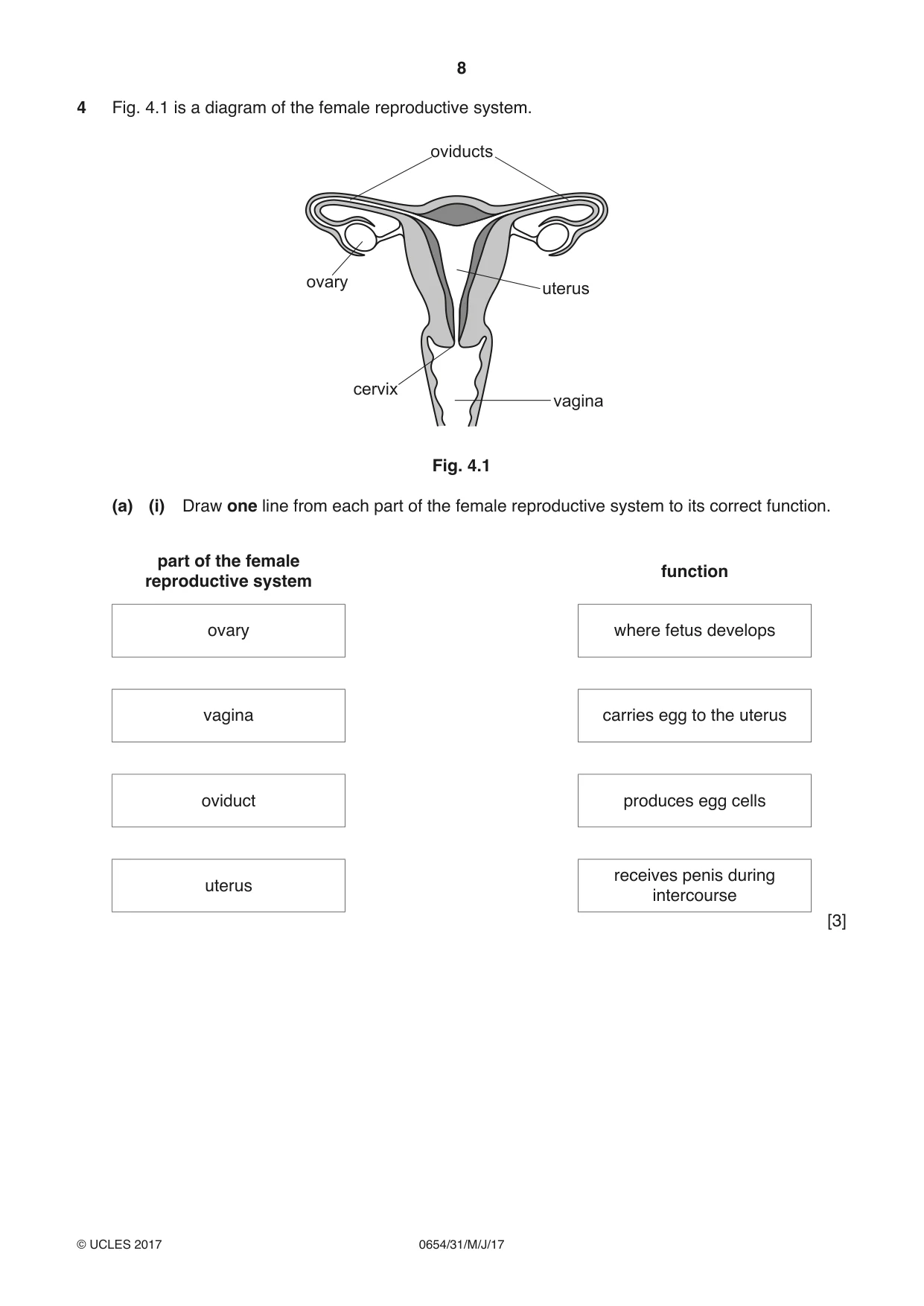
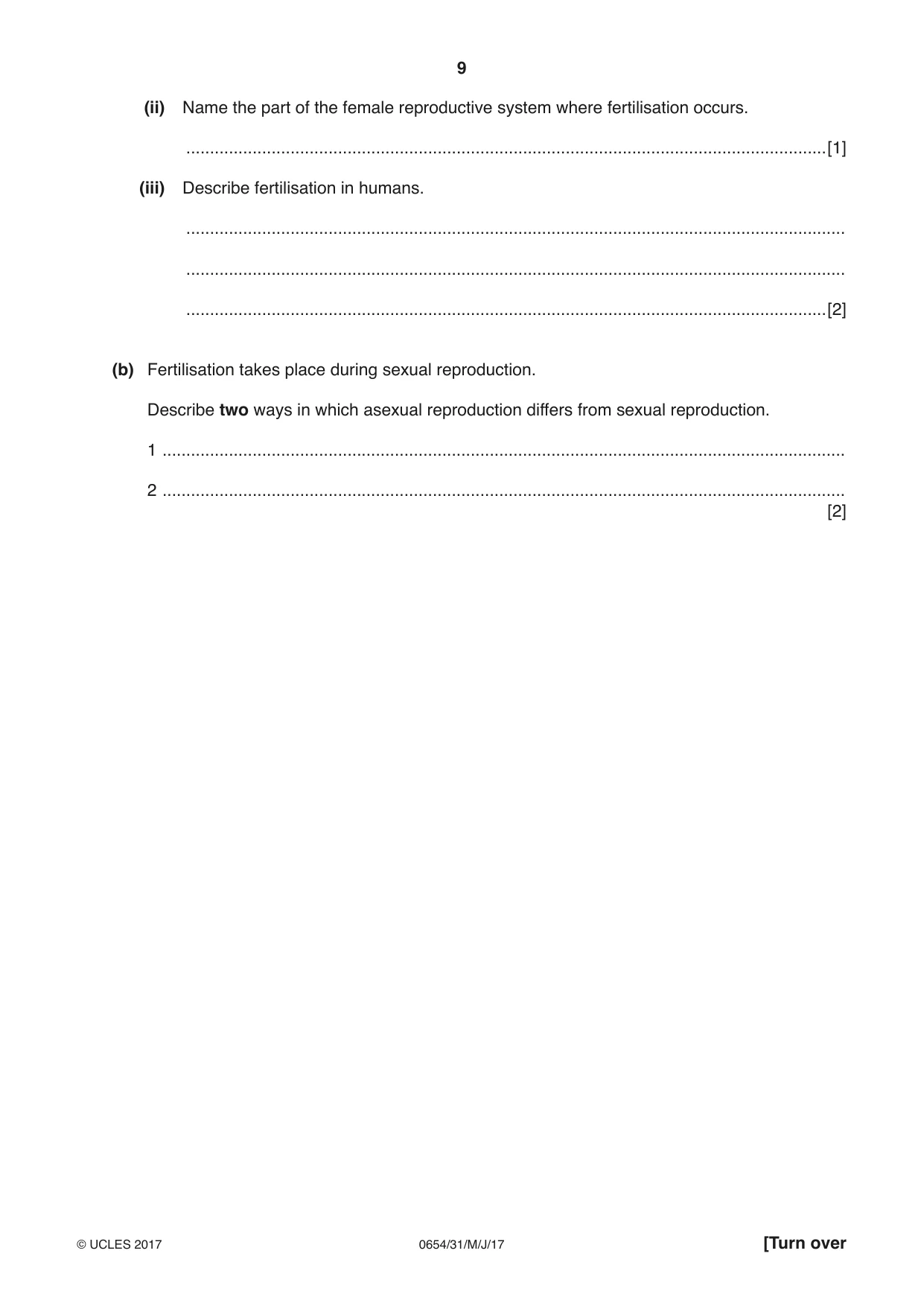
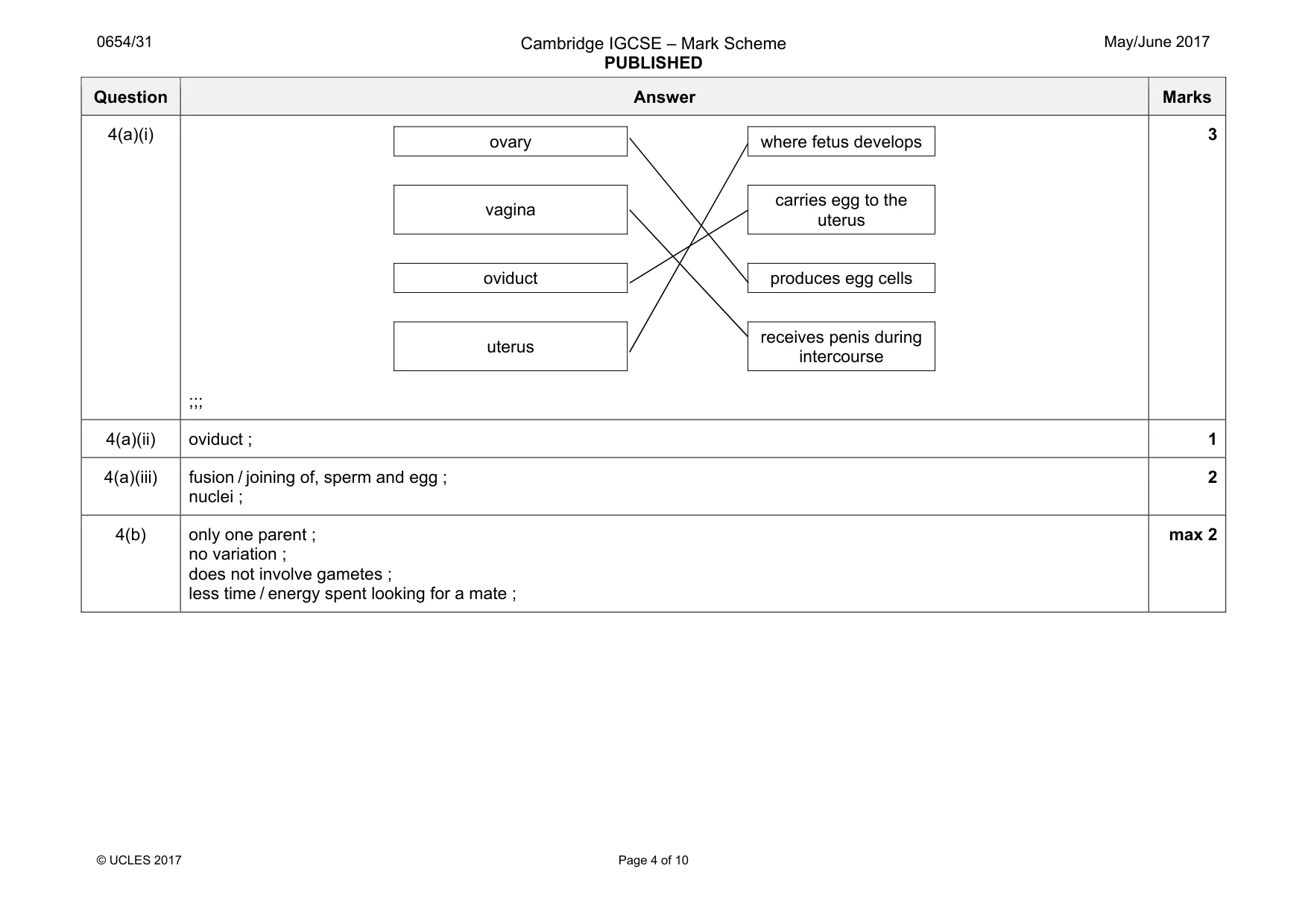
4 Fig. 4.1 is a diagram of the female reproductive system. oviducts ovary uterus cervix vagina Fig. 4.1 (a) (i) Draw one line from each part of the female reproductive system to its correct function. part of the female function reproductive system ovary where fetus develops vagina carries egg to the uterus oviduct produces egg cells receives penis during uterus intercourse [3] (ii) Name the part of the female reproductive system where fertilisation occurs. .......................................................................................................................................[1] (iii) Describe fertilisation in humans. ........................................................................................................................................... ........................................................................................................................................... .......................................................................................................................................[2] (b) Fertilisation takes place during sexual reproduction. Describe two ways in which asexual reproduction differs from sexual reproduction. 1 ................................................................................................................................................ 2 ................................................................................................................................................ [2]
Mark scheme: 4(a)(i) ovary where fetus develops vagina carries egg to the uterus oviduct produces egg cells uterus receives penis during intercourse ;;; 3 4(a)(ii) oviduct ; 1 4(a)(iii) fusion / joining of, sperm and egg ; nuclei ; 2 4(b) only one parent ; no variation ; does not involve gametes ; less time / energy spent looking for a mate ; max 2
Q5 · A list of items that have been bought from a food shop
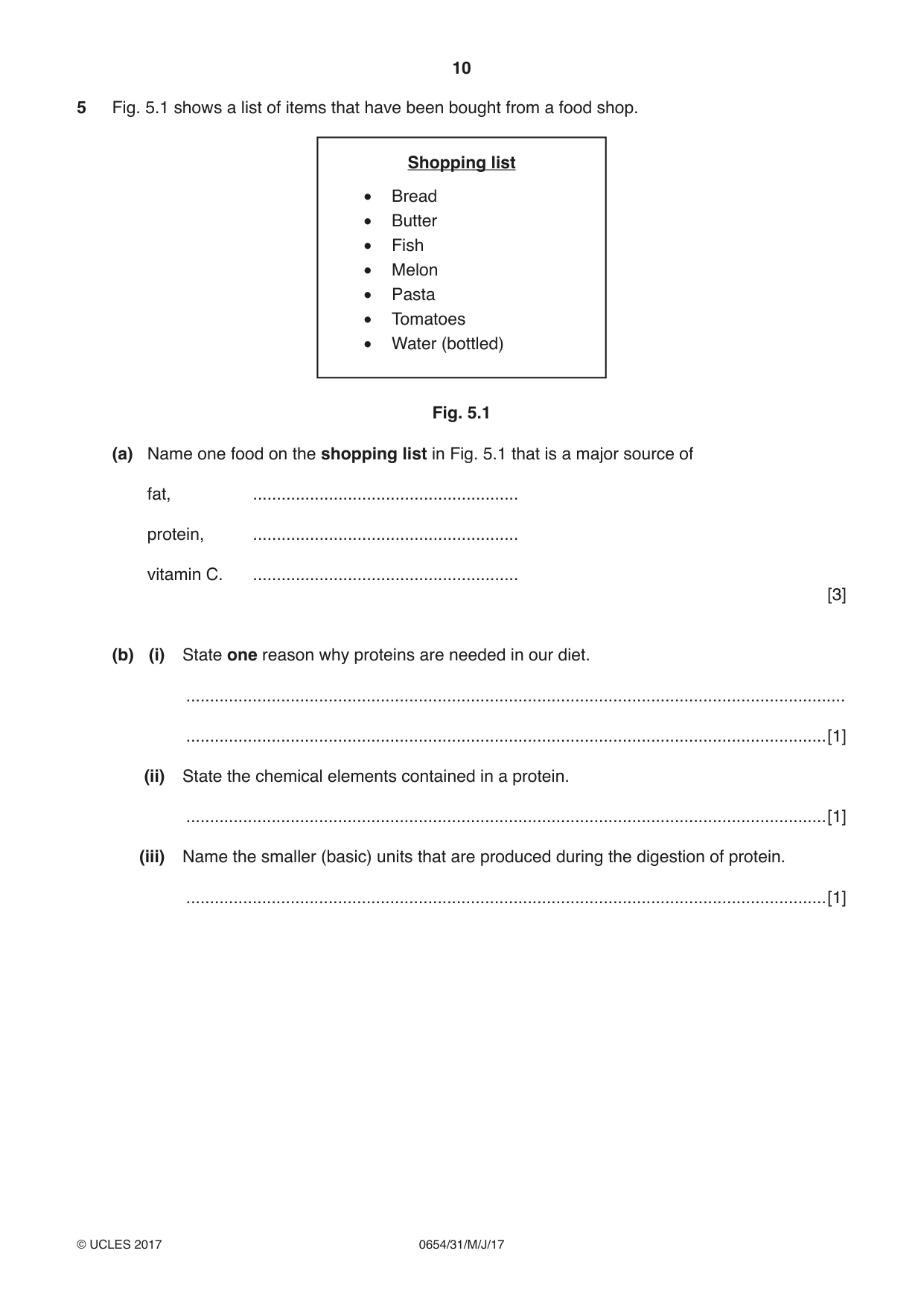
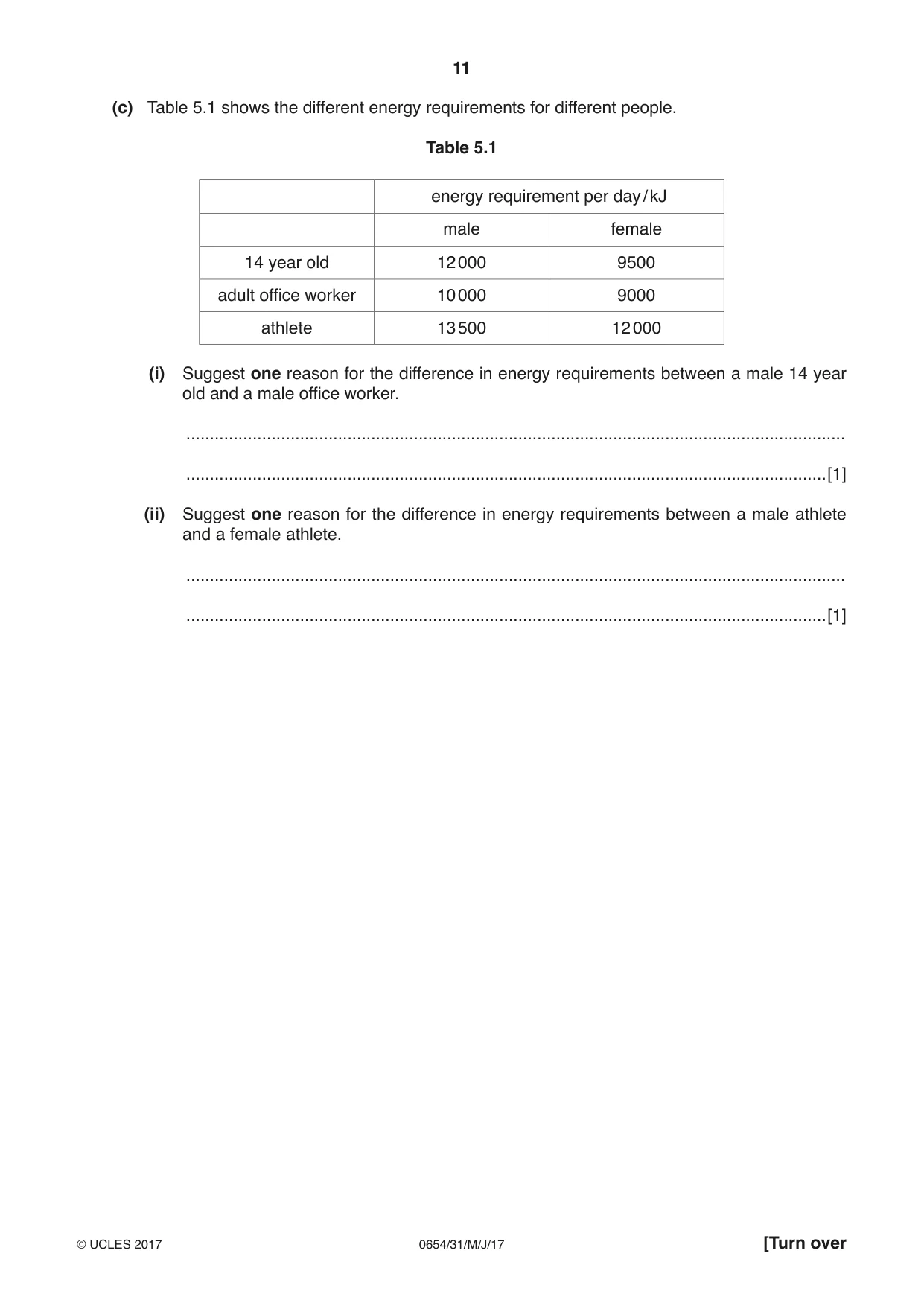
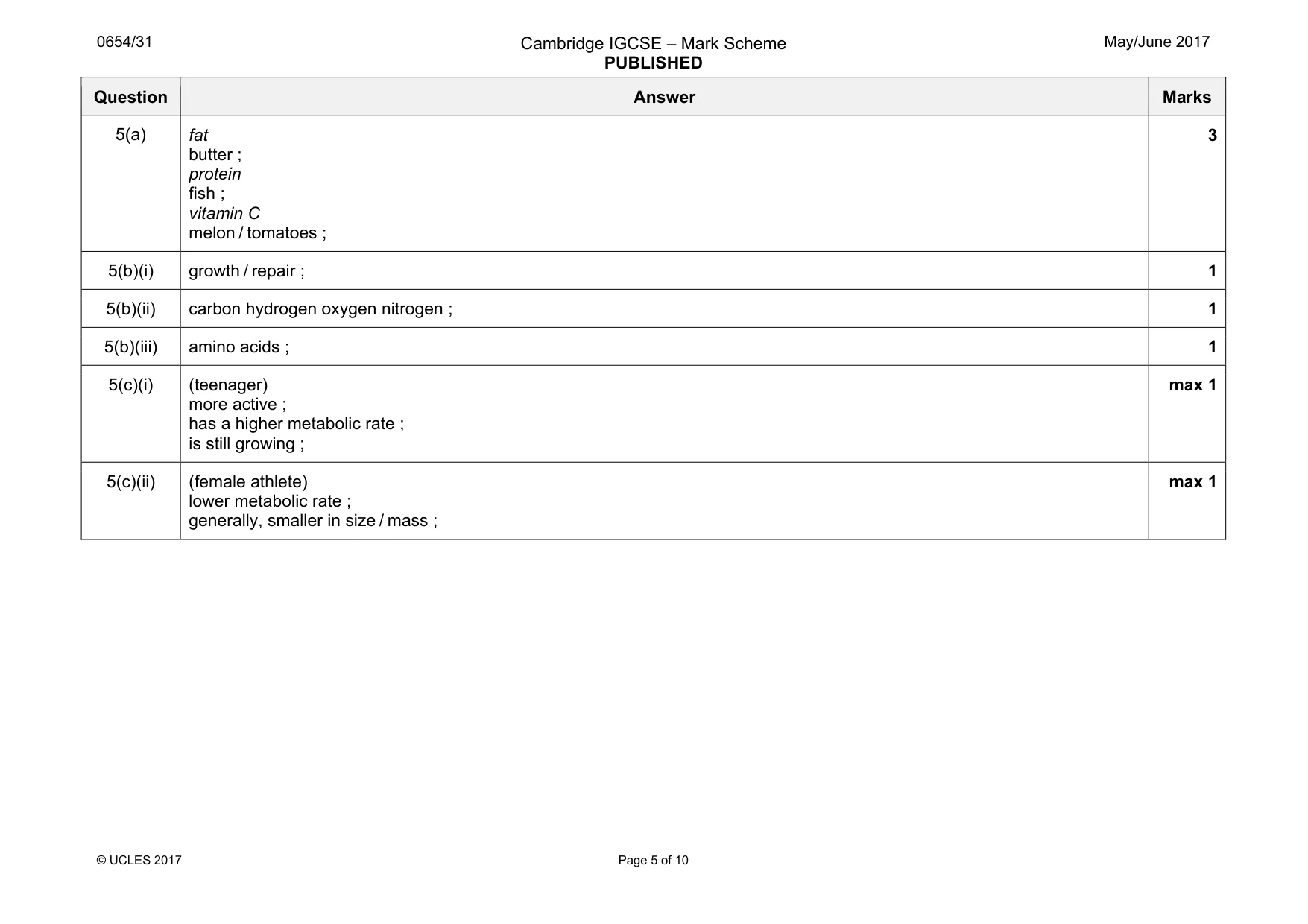
5 Fig. 5.1 shows a list of items that have been bought from a food shop. Shopping list • Bread • Butter • Fish • Melon • Pasta • Tomatoes • Water (bottled) Fig. 5.1 (a) Name one food on the shopping list in Fig. 5.1 that is a major source of fat, ........................................................ protein, ........................................................ vitamin C. ........................................................ [3] (b) (i) State one reason why proteins are needed in our diet. ........................................................................................................................................... .......................................................................................................................................[1] (ii) State the chemical elements contained in a protein. .......................................................................................................................................[1] (iii) Name the smaller (basic) units that are produced during the digestion of protein. .......................................................................................................................................[1] (c) Table 5.1 shows the different energy requirements for different people. Table 5.1 energy requirement per day / kJ male female 14 year old 12 000 9500 adult office worker 10 000 9000 athlete 13 500 12 000 (i) Suggest one reason for the difference in energy requirements between a male 14 year old and a male office worker. ........................................................................................................................................... .......................................................................................................................................[1] (ii) Suggest one reason for the difference in energy requirements between a male athlete and a female athlete. ........................................................................................................................................... .......................................................................................................................................[1]
Mark scheme: 5(a) fat butter ; protein fish ; vitamin C melon / tomatoes ; 3 5(b)(i) growth / repair ; 1 5(b)(ii) carbon hydrogen oxygen nitrogen ; 1 5(b)(iii) amino acids ; 1 5(c)(i) (teenager) more active ; has a higher metabolic rate ; is still growing ; max 1 5(c)(ii) (female athlete) lower metabolic rate ; generally, smaller in size / mass ; max 1
Q6 · Natural gas and petroleum are fossil fuels
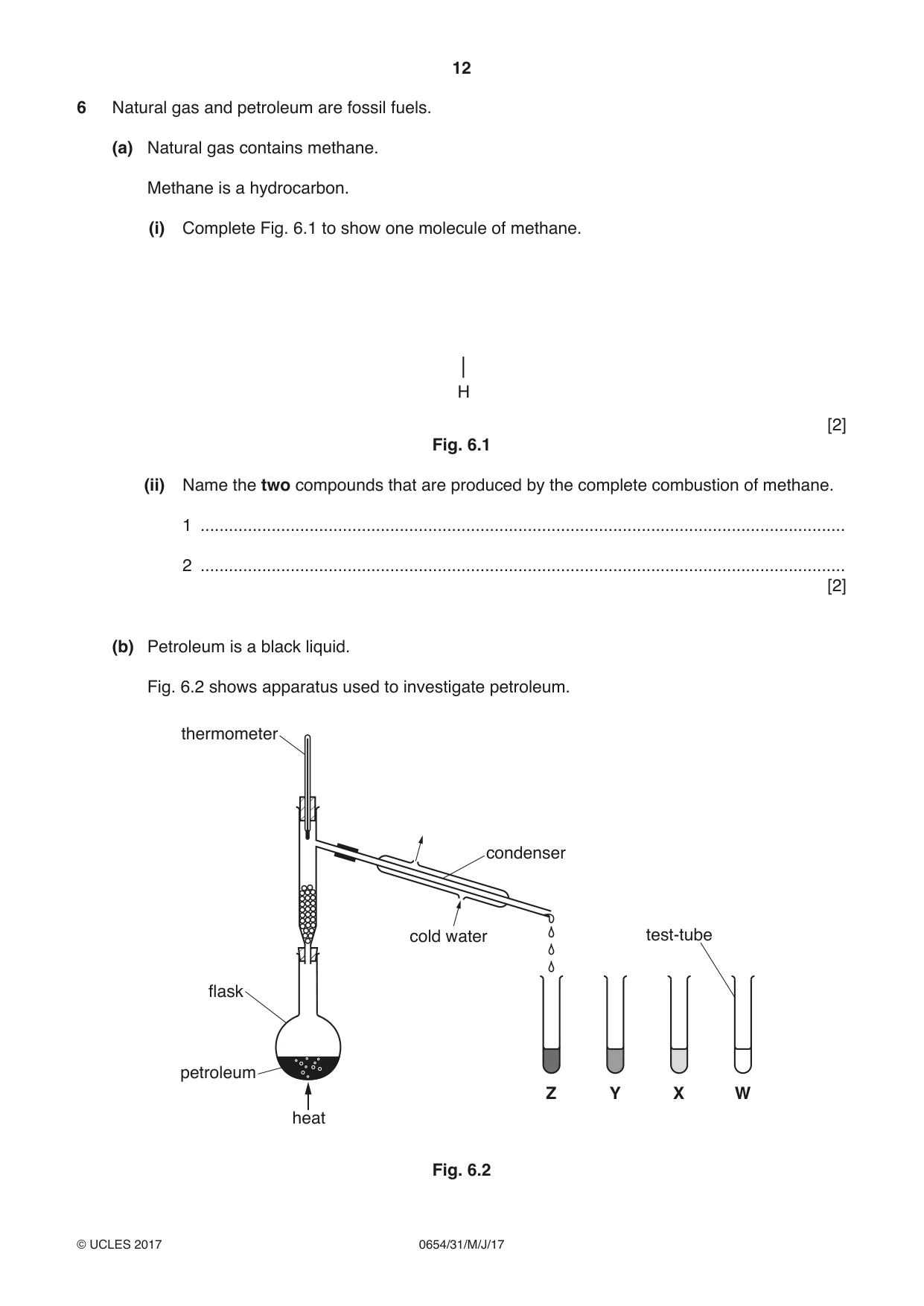
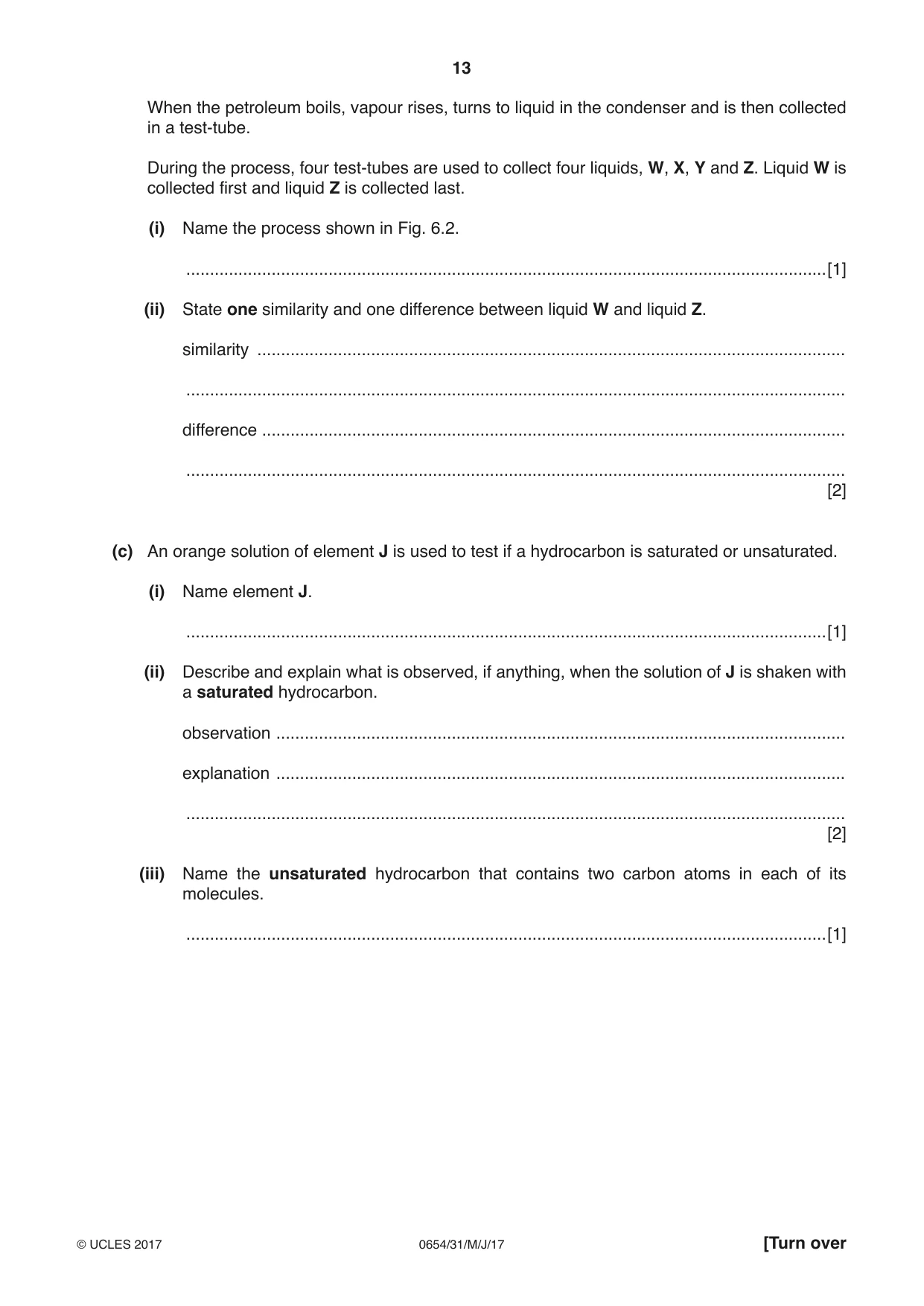
6 Natural gas and petroleum are fossil fuels. (a) Natural gas contains methane. Methane is a hydrocarbon. (i) Complete Fig. 6.1 to show one molecule of methane. H [2] Fig. 6.1 (ii) Name the two compounds that are produced by the complete combustion of methane. 1 ........................................................................................................................................ 2 ........................................................................................................................................ [2] (b) Petroleum is a black liquid. Fig. 6.2 shows apparatus used to investigate petroleum. thermometer condenser cold water test-tube flask petroleum Z Y X W heat Fig. 6.2 When the petroleum boils, vapour rises, turns to liquid in the condenser and is then collected in a test-tube. During the process, four test-tubes are used to collect four liquids, W, X, Y and Z. Liquid W is collected first and liquid Z is collected last. (i) Name the process shown in Fig. 6.2. .......................................................................................................................................[1] (ii) State one similarity and one difference between liquid W and liquid Z. similarity ............................................................................................................................ ........................................................................................................................................... difference ........................................................................................................................... ........................................................................................................................................... [2] (c) An orange solution of element J is used to test if a hydrocarbon is saturated or unsaturated. (i) Name element J. .......................................................................................................................................[1] (ii) Describe and explain what is observed, if anything, when the solution of J is shaken with a saturated hydrocarbon. observation ........................................................................................................................ explanation ........................................................................................................................ ........................................................................................................................................... [2] (iii) Name the unsaturated hydrocarbon that contains two carbon atoms in each of its molecules. .......................................................................................................................................[1]
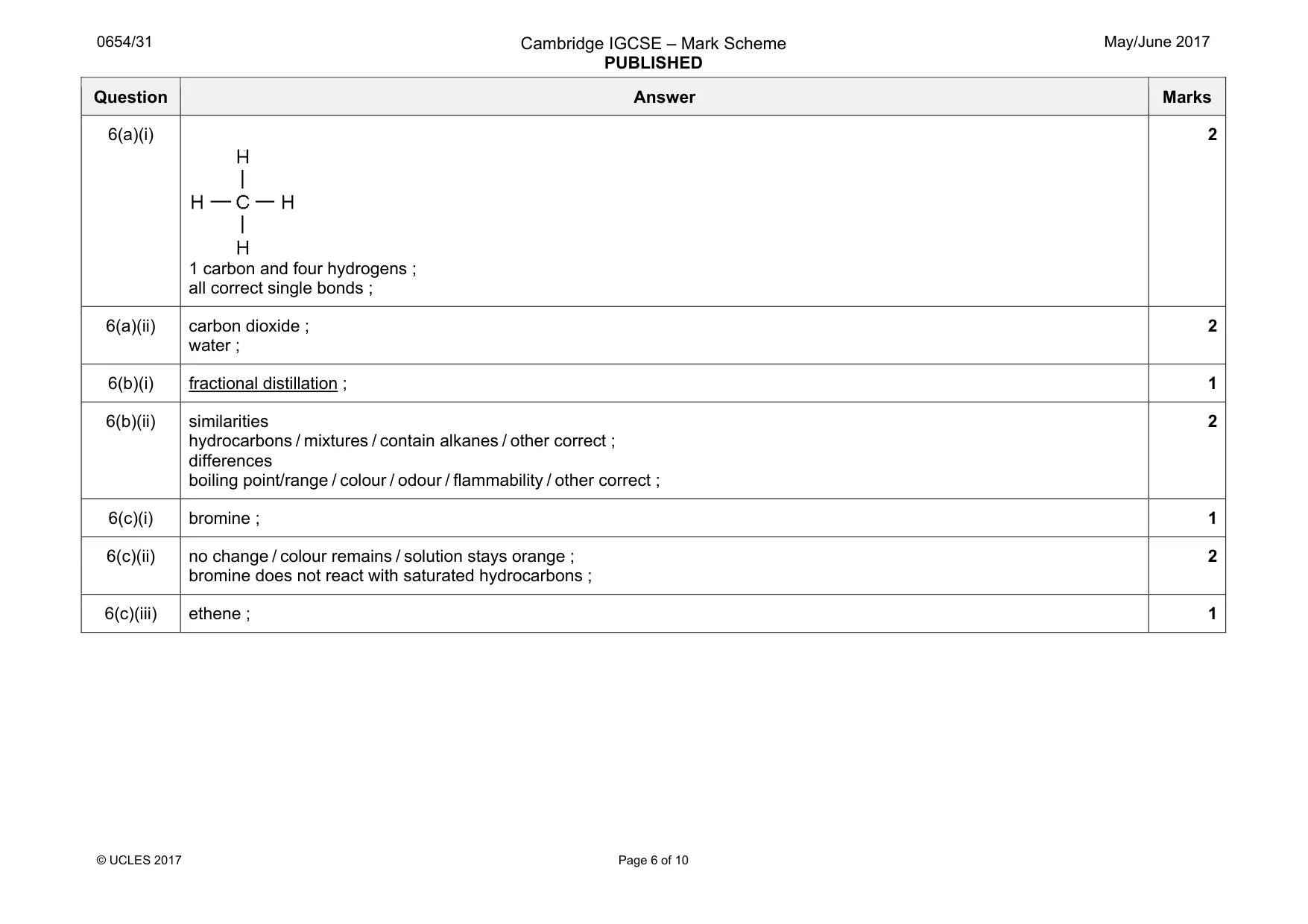
Mark scheme: 6(a)(i) 1 carbon and four hydrogens ; all correct single bonds ; 2 6(a)(ii) carbon dioxide ; water ; 2 6(b)(i) fractional distillation ; 1 6(b)(ii) similarities hydrocarbons / mixtures / contain alkanes / other correct ; differences boiling point/range / colour / odour / flammability / other correct ; 2 6(c)(i) bromine ; 1 6(c)(ii) no change / colour remains / solution stays orange ; bromine does not react with saturated hydrocarbons ; 2 6(c)(iii) ethene ; 1
Q7 · A speed-time graph for a car over a period of 50 seconds
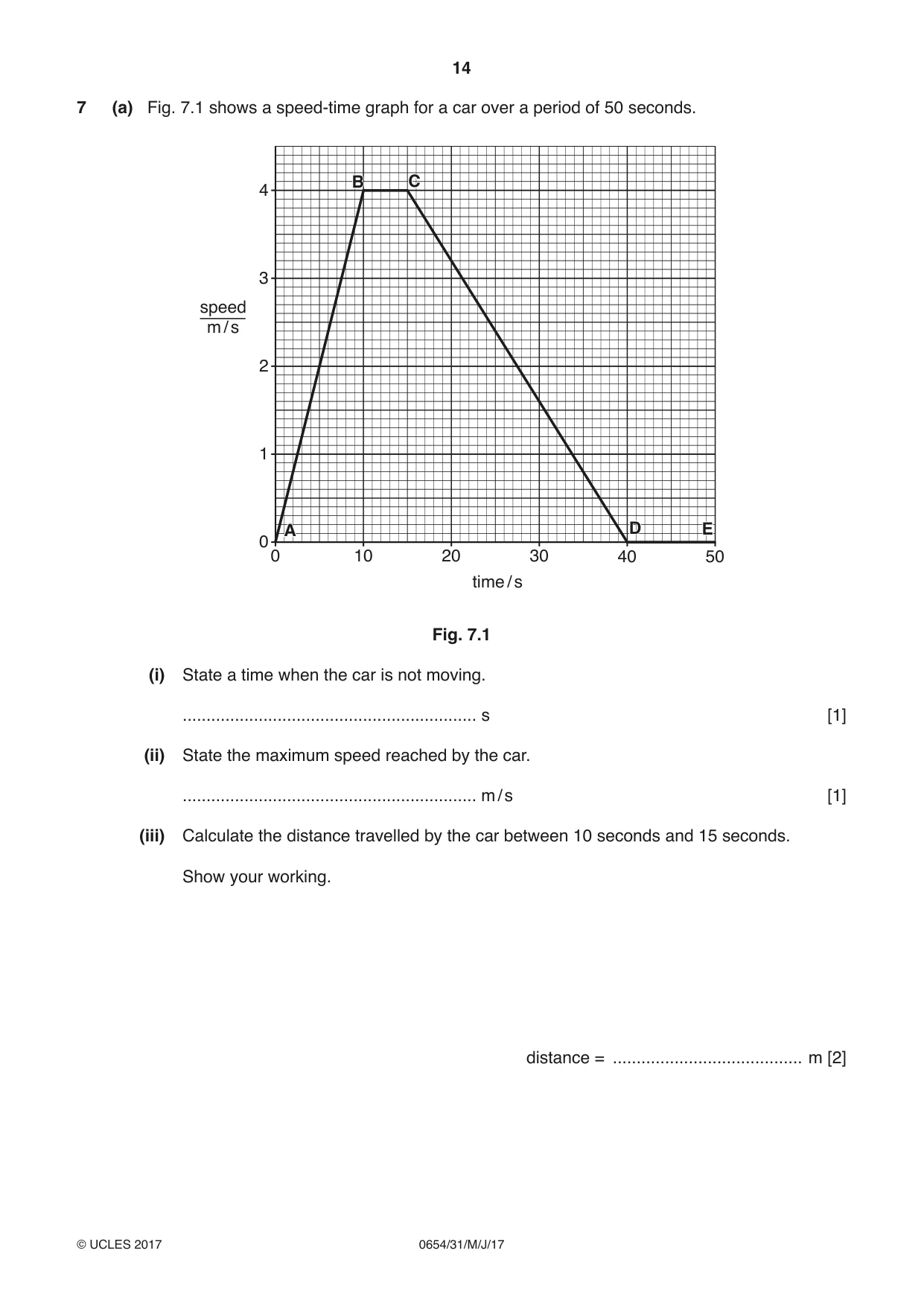
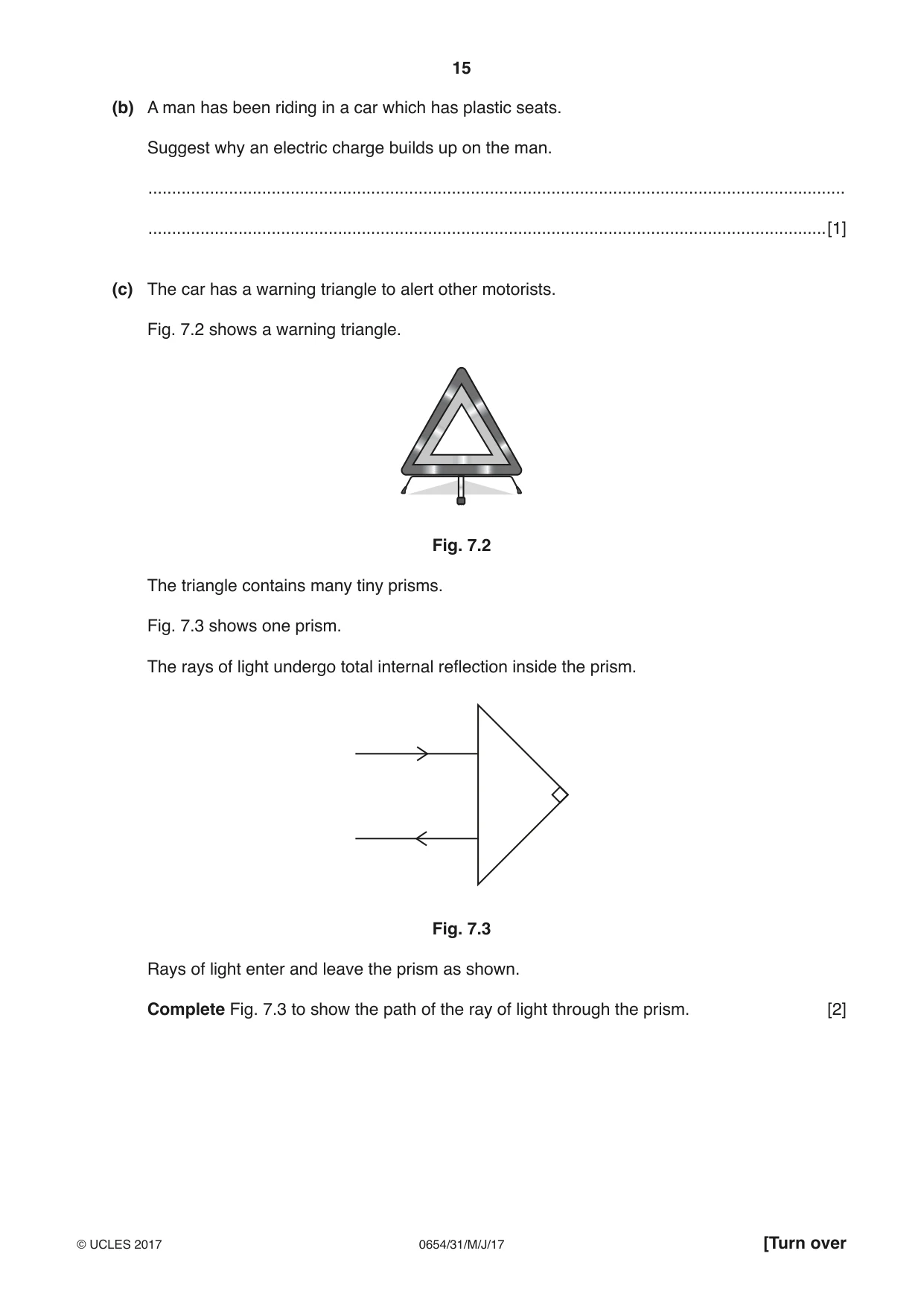
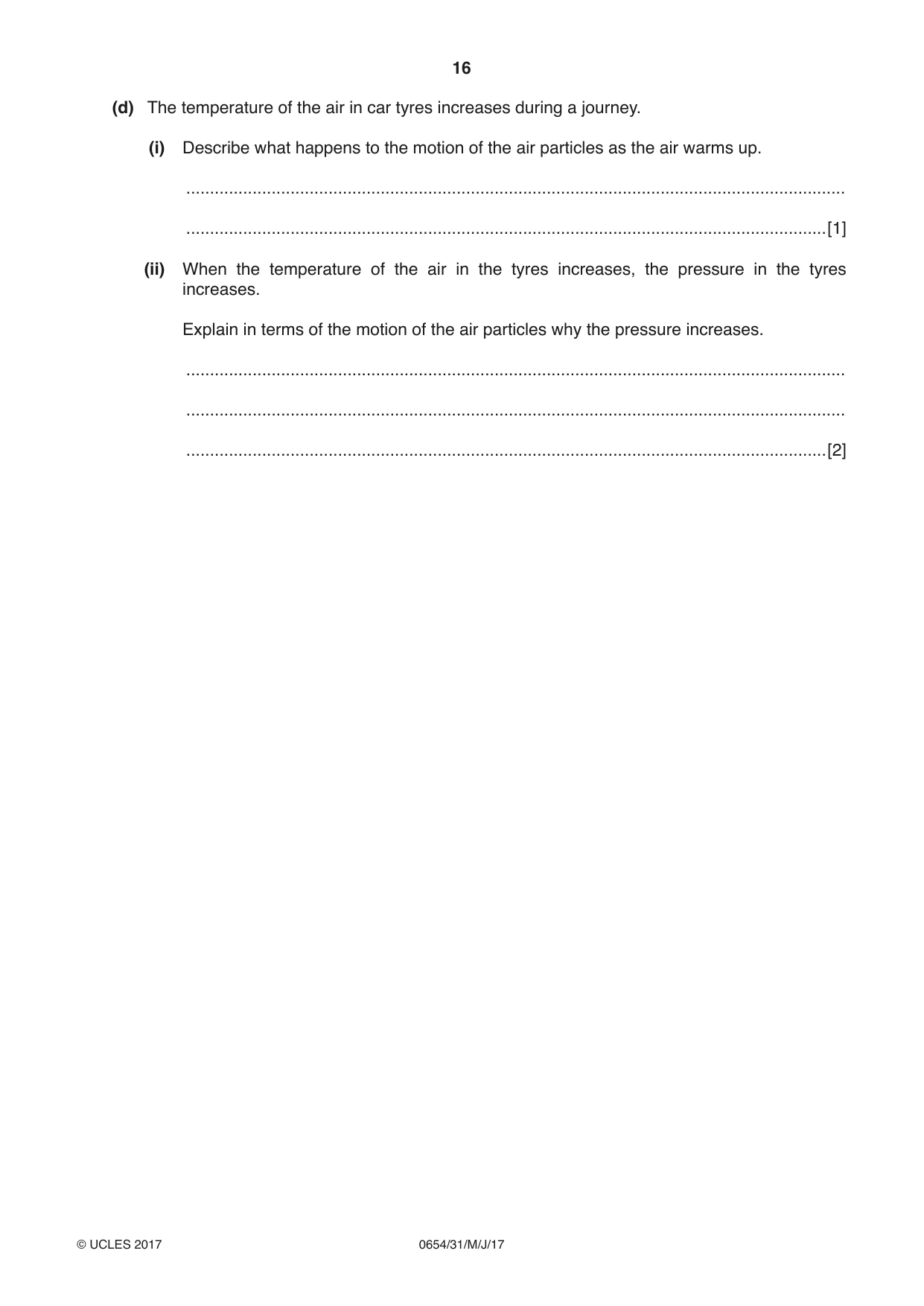
7 (a) Fig. 7.1 shows a speed-time graph for a car over a period of 50 seconds. BB CC 4 3 speed m / s 2 1 A DD EE 0 0 10 20 30 40 50 time / s Fig. 7.1 (i) State a time when the car is not moving. .............................................................. s [1] (ii) State the maximum speed reached by the car. .............................................................. m / s [1] (iii) Calculate the distance travelled by the car between 10 seconds and 15 seconds. Show your working. distance = ........................................ m [2] (b) A man has been riding in a car which has plastic seats. Suggest why an electric charge builds up on the man. ................................................................................................................................................... ...............................................................................................................................................[1] (c) The car has a warning triangle to alert other motorists. Fig. 7.2 shows a warning triangle. Fig. 7.2 The triangle contains many tiny prisms. Fig. 7.3 shows one prism. The rays of light undergo total internal reflection inside the prism. Fig. 7.3 Rays of light enter and leave the prism as shown. Complete Fig. 7.3 to show the path of the ray of light through the prism. [2] (d) The temperature of the air in car tyres increases during a journey. (i) Describe what happens to the motion of the air particles as the air warms up. ........................................................................................................................................... .......................................................................................................................................[1] (ii) When the temperature of the air in the tyres increases, the pressure in the tyres increases. Explain in terms of the motion of the air particles why the pressure increases. ........................................................................................................................................... ........................................................................................................................................... .......................................................................................................................................[2]
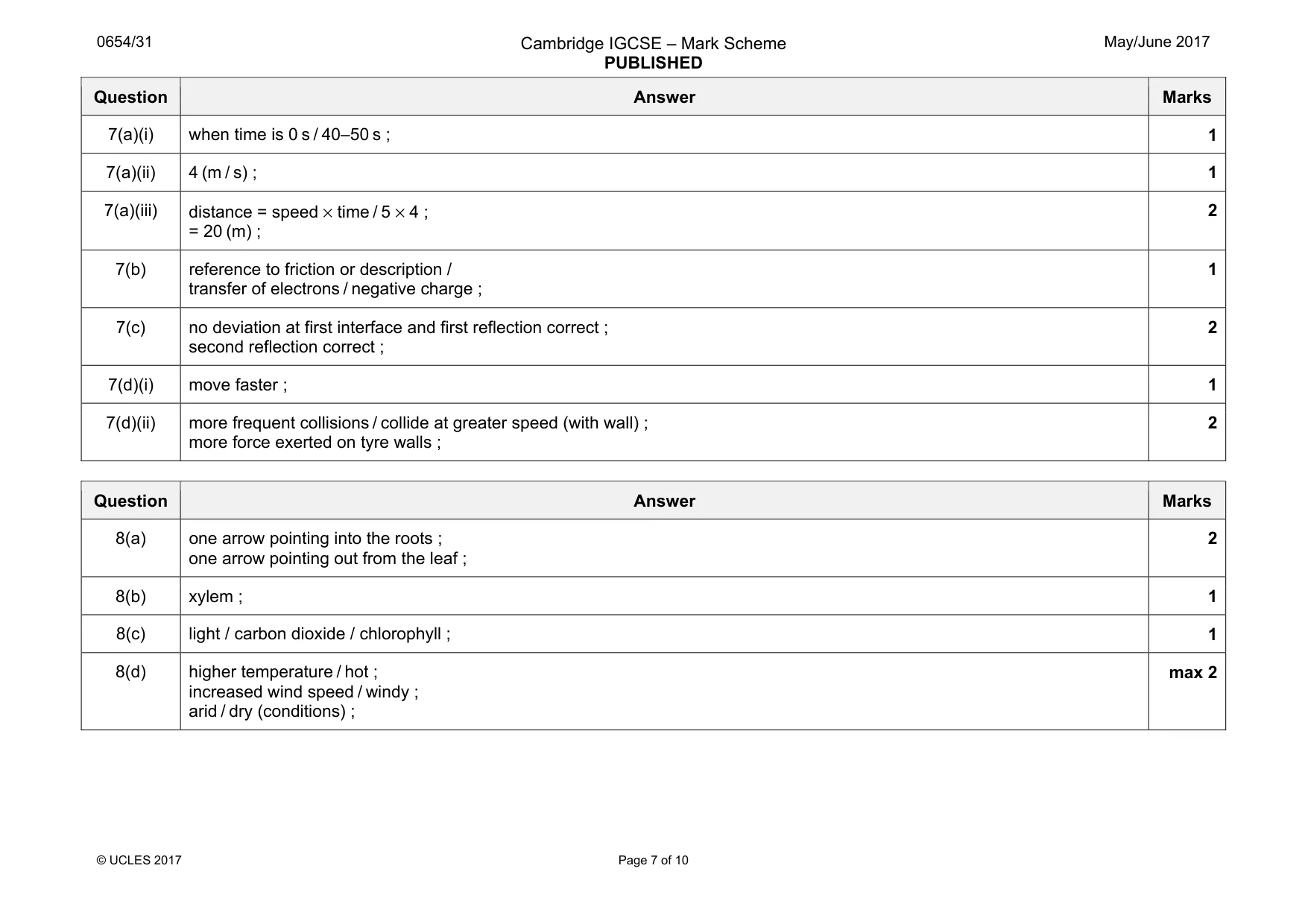
Mark scheme: 7(a)(i) when time is 0 s / 40–50 s ; 1 7(a)(ii) 4 (m / s) ; 1 7(a)(iii) distance = speed × time / 5 × 4 ; = 20 (m) ; 2 7(b) reference to friction or description / transfer of electrons / negative charge ; 1 7(c) no deviation at first interface and first reflection correct ; second reflection correct ; 2 7(d)(i) move faster ; 1 7(d)(ii) more frequent collisions / collide at greater speed (with wall) ; more force exerted on tyre walls ; 2
Q8 · A drawing of a green plant
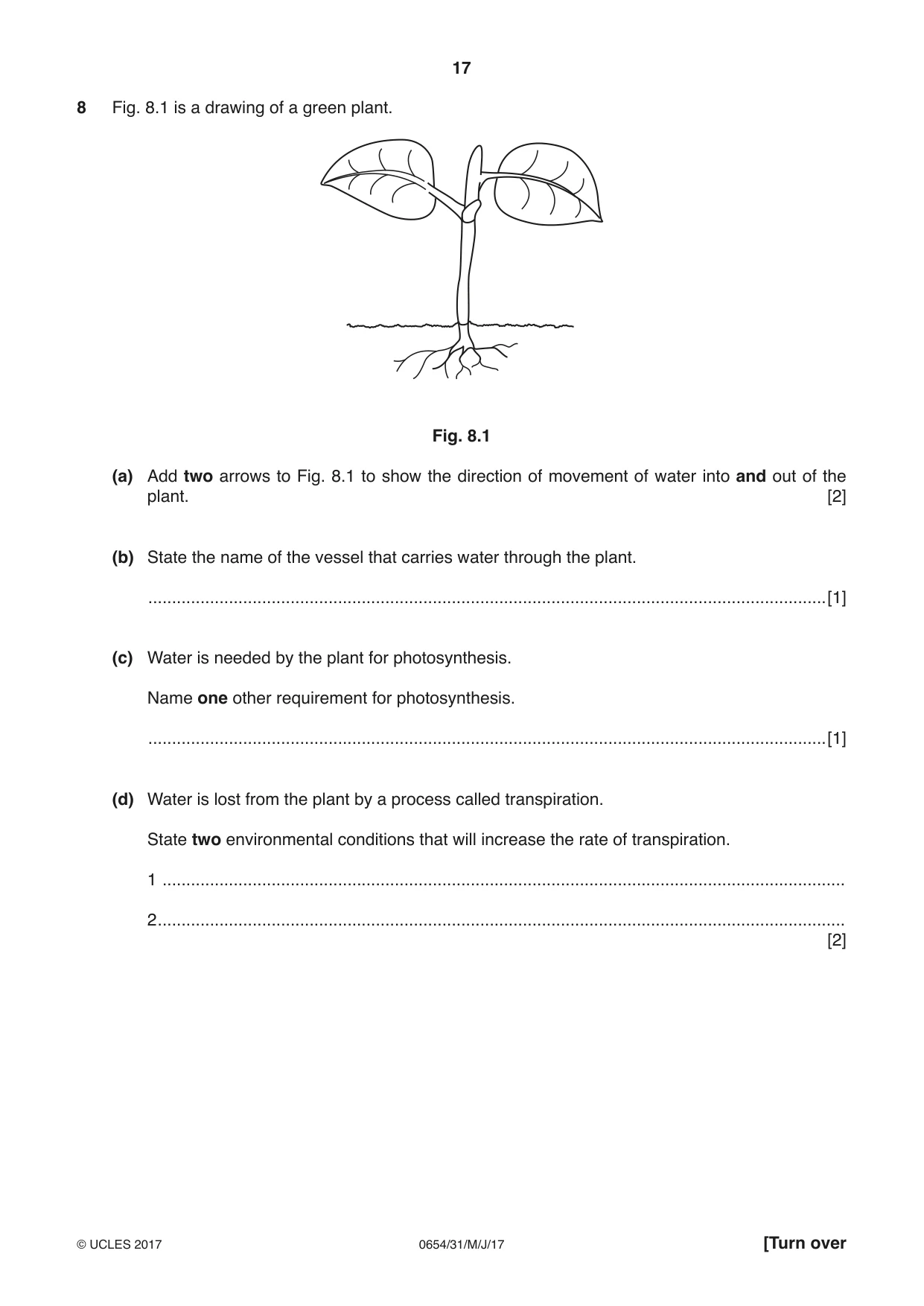
8 Fig. 8.1 is a drawing of a green plant. Fig. 8.1 (a) Add two arrows to Fig. 8.1 to show the direction of movement of water into and out of the plant. [2] (b) State the name of the vessel that carries water through the plant. ...............................................................................................................................................[1] (c) Water is needed by the plant for photosynthesis. Name one other requirement for photosynthesis. ...............................................................................................................................................[1] (d) Water is lost from the plant by a process called transpiration. State two environmental conditions that will increase the rate of transpiration. 1 ................................................................................................................................................ 2 ................................................................................................................................................. [2]
Mark scheme: 8(a) one arrow pointing into the roots ; one arrow pointing out from the leaf ; 2 8(b) xylem ; 1 8(c) light / carbon dioxide / chlorophyll ; 1 8(d) higher temperature / hot ; increased wind speed / windy ; arid / dry (conditions) ; max 2
Q9 · Magnesium is an element in Group II of the Periodic Table
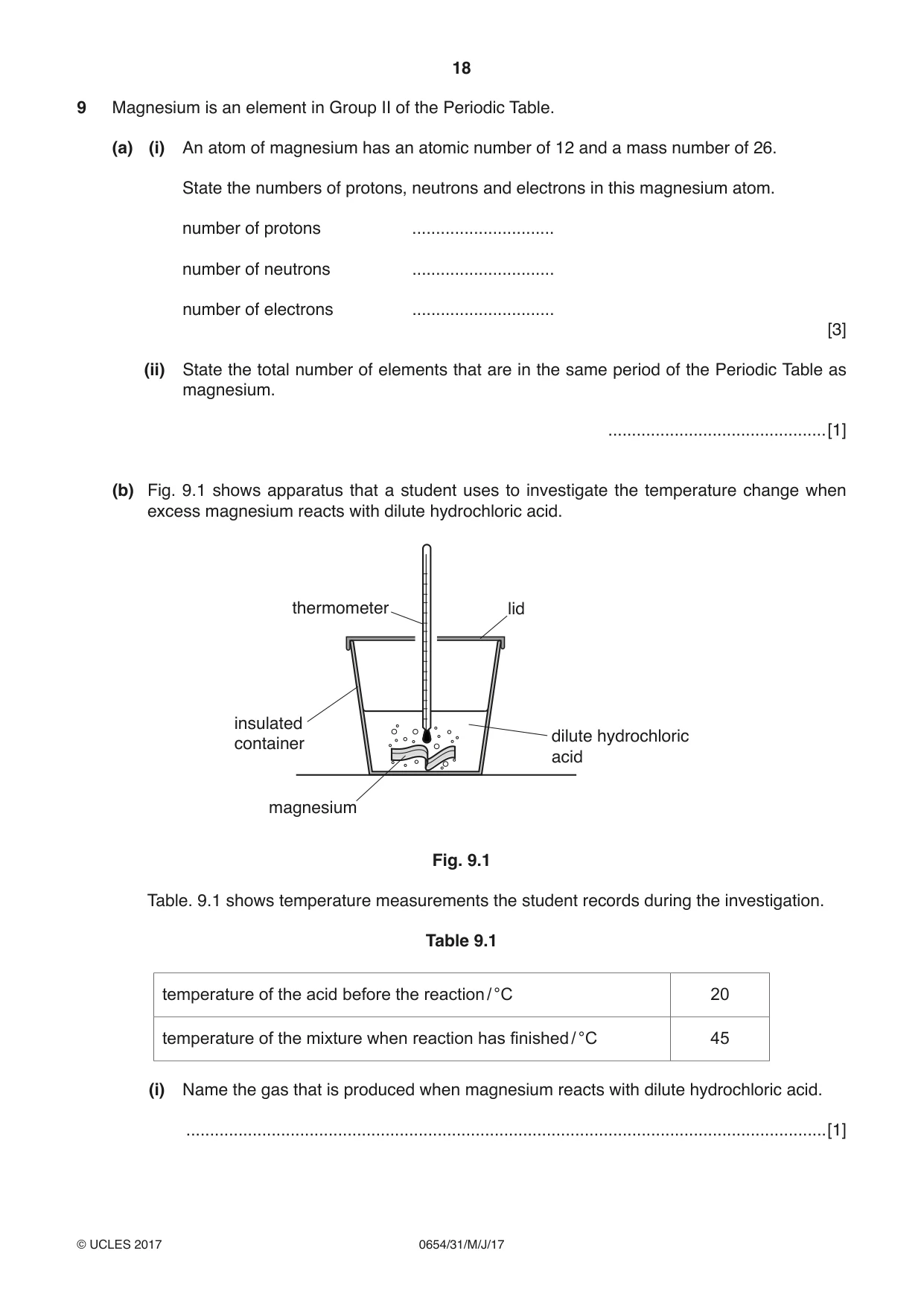
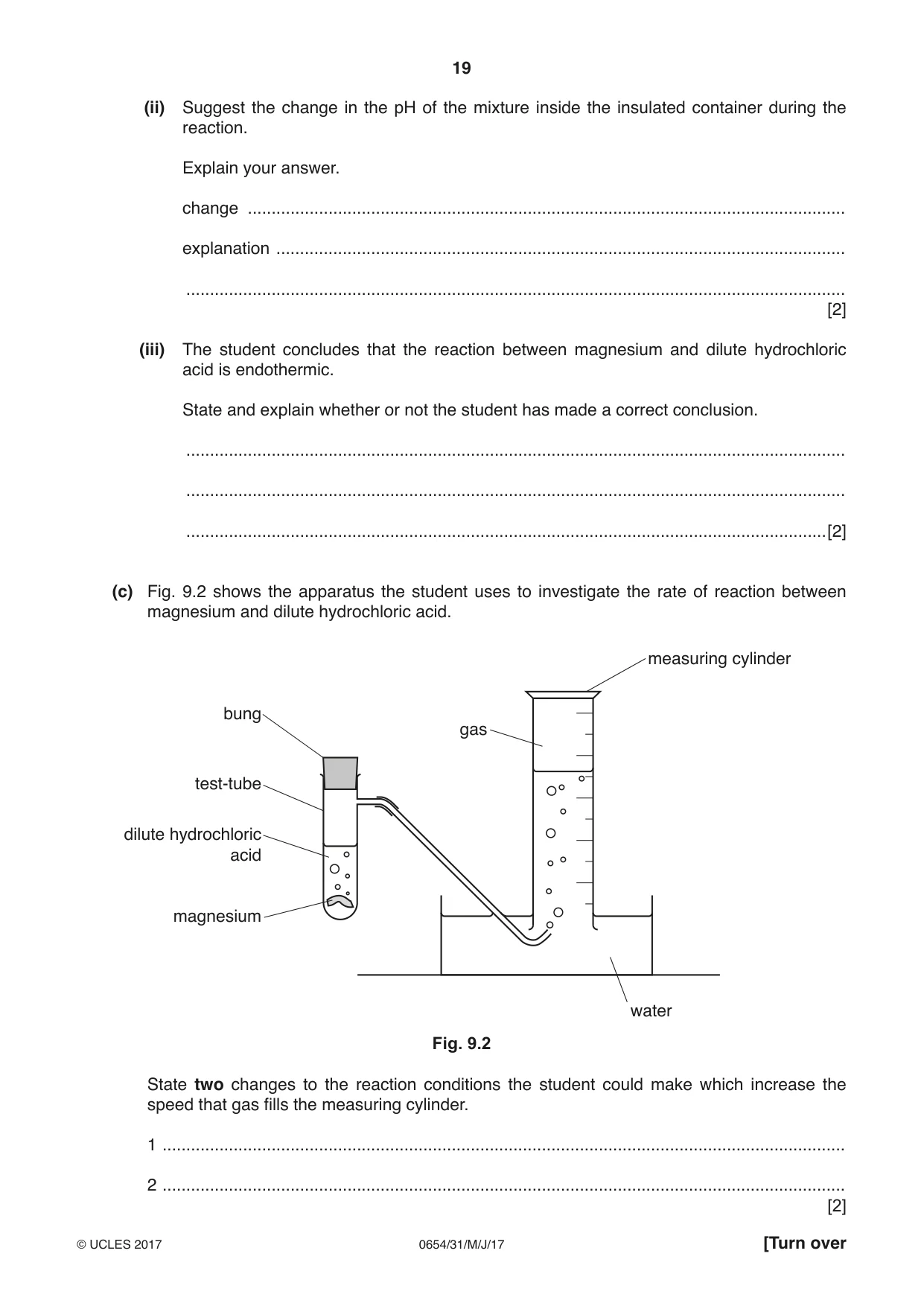
9 Magnesium is an element in Group II of the Periodic Table. (a) (i) An atom of magnesium has an atomic number of 12 and a mass number of 26. State the numbers of protons, neutrons and electrons in this magnesium atom. number of protons .............................. number of neutrons .............................. number of electrons .............................. [3] (ii) State the total number of elements that are in the same period of the Periodic Table as magnesium. ..............................................[1] (b) Fig. 9.1 shows apparatus that a student uses to investigate the temperature change when excess magnesium reacts with dilute hydrochloric acid. thermometer lid insulated dilute hydrochloric container acid magnesium Fig. 9.1 Table. 9.1 shows temperature measurements the student records during the investigation. Table 9.1 temperature of the acid before the reaction / °C 20 temperature of the mixture when reaction has finished / °C 45 (i) Name the gas that is produced when magnesium reacts with dilute hydrochloric acid. .......................................................................................................................................[1] (ii) Suggest the change in the pH of the mixture inside the insulated container during the reaction. Explain your answer. change .............................................................................................................................. explanation ........................................................................................................................ ........................................................................................................................................... [2] (iii) The student concludes that the reaction between magnesium and dilute hydrochloric acid is endothermic. State and explain whether or not the student has made a correct conclusion. ........................................................................................................................................... ........................................................................................................................................... .......................................................................................................................................[2] (c) Fig. 9.2 shows the apparatus the student uses to investigate the rate of reaction between magnesium and dilute hydrochloric acid. measuring cylinder bung gas test-tube dilute hydrochloric acid magnesium water Fig. 9.2 State two changes to the reaction conditions the student could make which increase the speed that gas fills the measuring cylinder. 1 ................................................................................................................................................ 2 ................................................................................................................................................ [2]
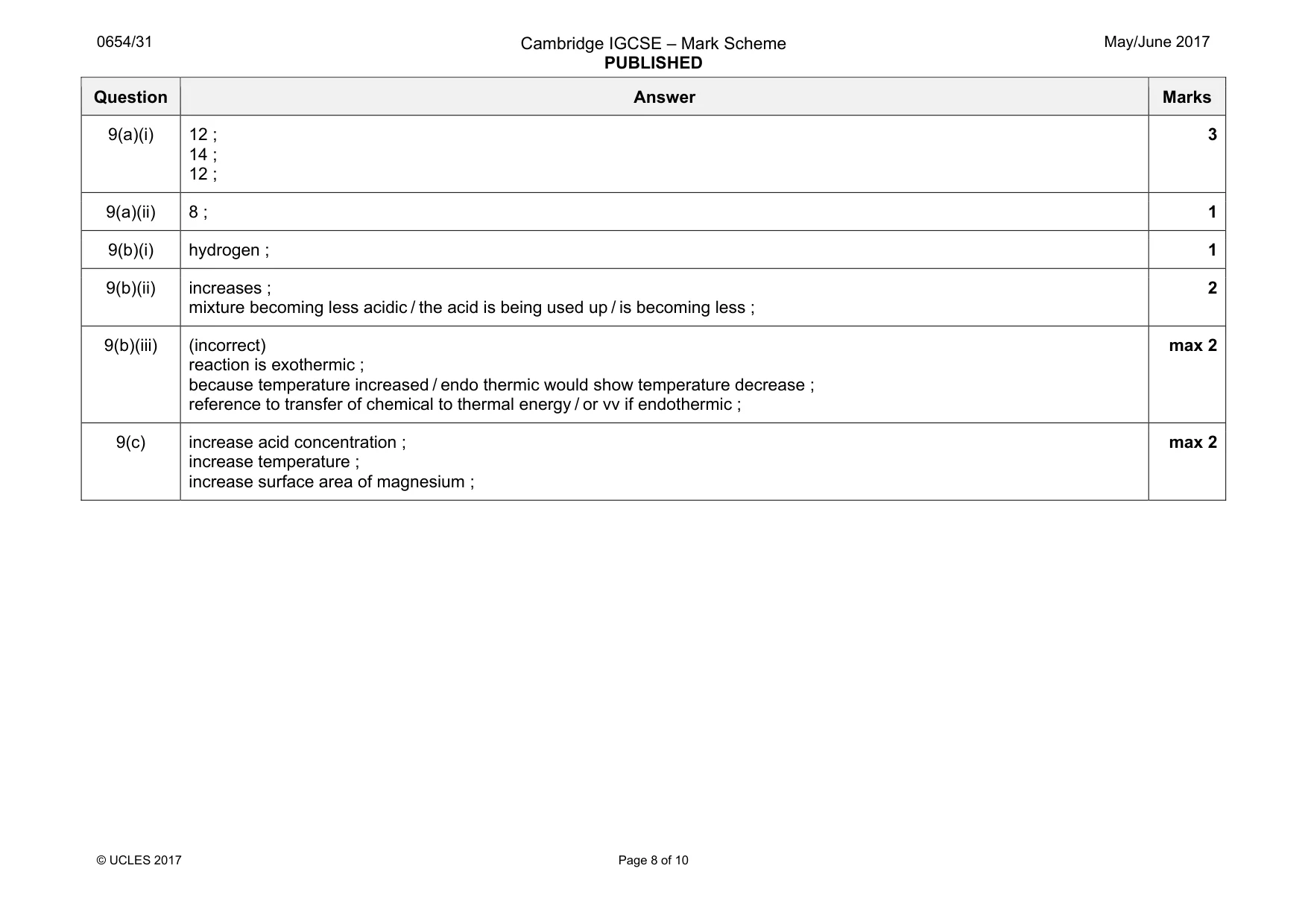
Mark scheme: 9(a)(i) 12 ; 14 ; 12 ; 3 9(a)(ii) 8 ; 1 9(b)(i) hydrogen ; 1 9(b)(ii) increases ; mixture becoming less acidic / the acid is being used up / is becoming less ; 2 9(b)(iii) (incorrect) reaction is exothermic ; because temperature increased / endo thermic would show temperature decrease ; reference to transfer of chemical to thermal energy / or vv if endothermic ; max 2 9(c) increase acid concentration ; increase temperature ; increase surface area of magnesium ; max 2
More questions on The characteristic properties of acids and bases
Q10 · A diagram of a woodland food web
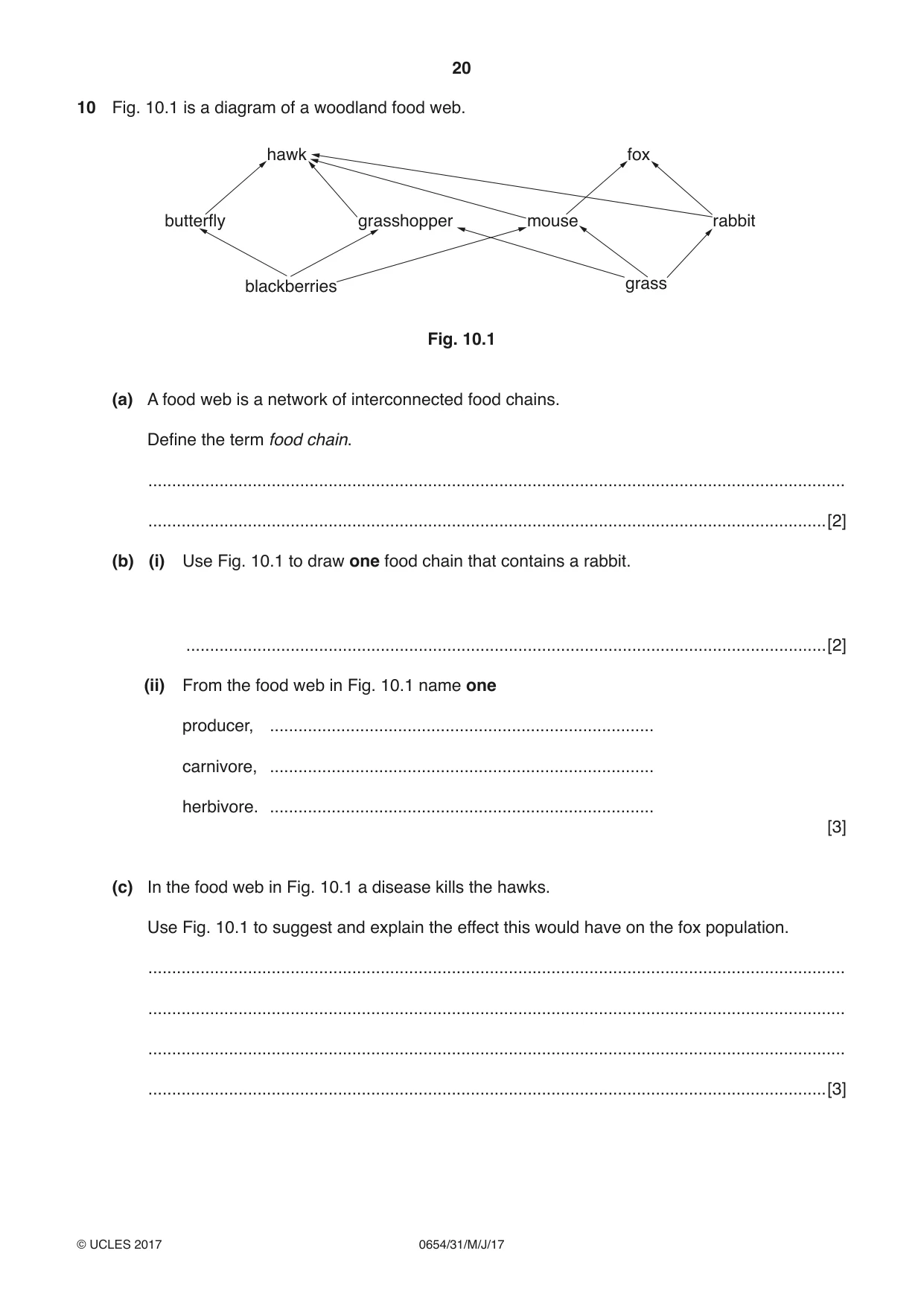
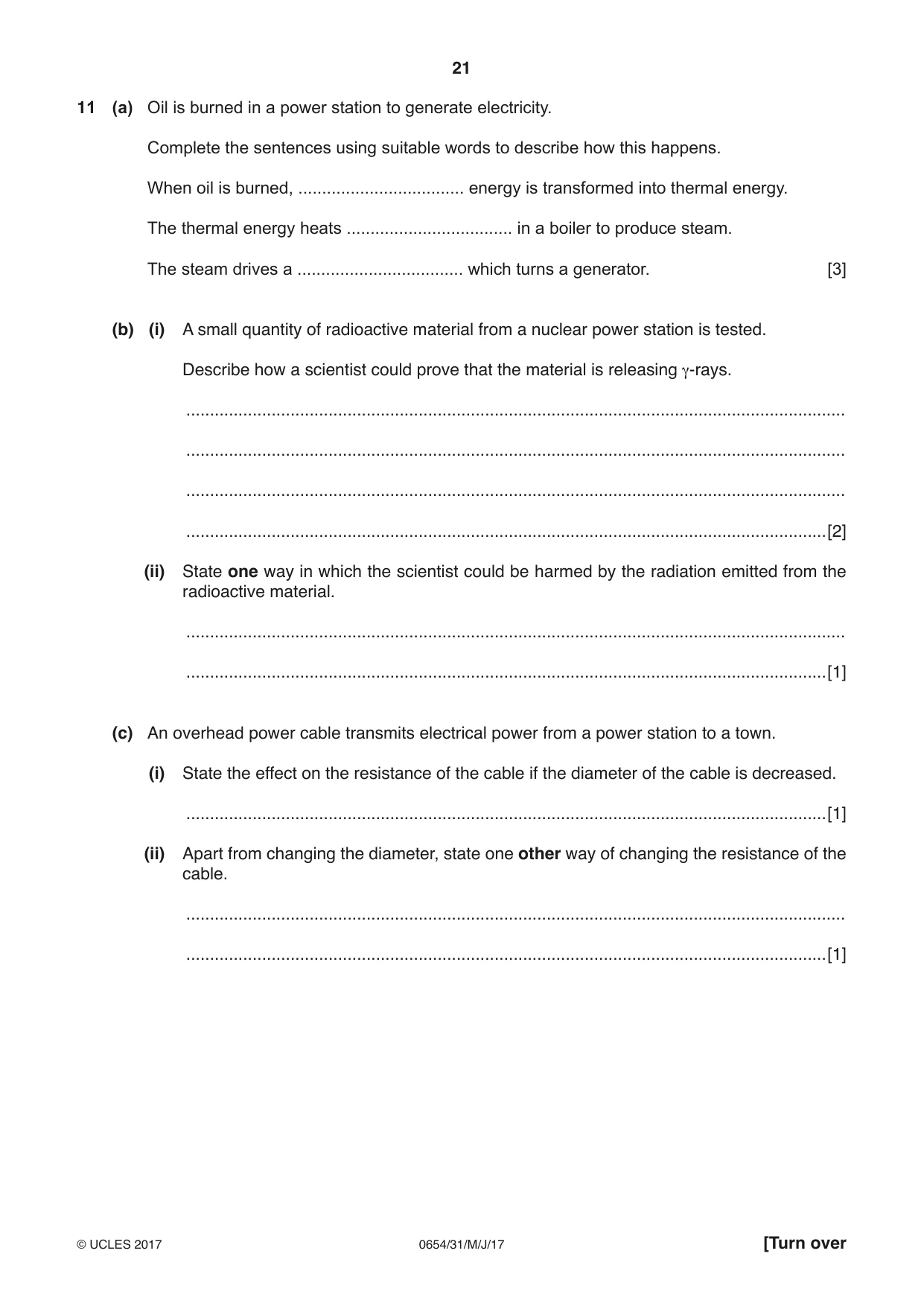
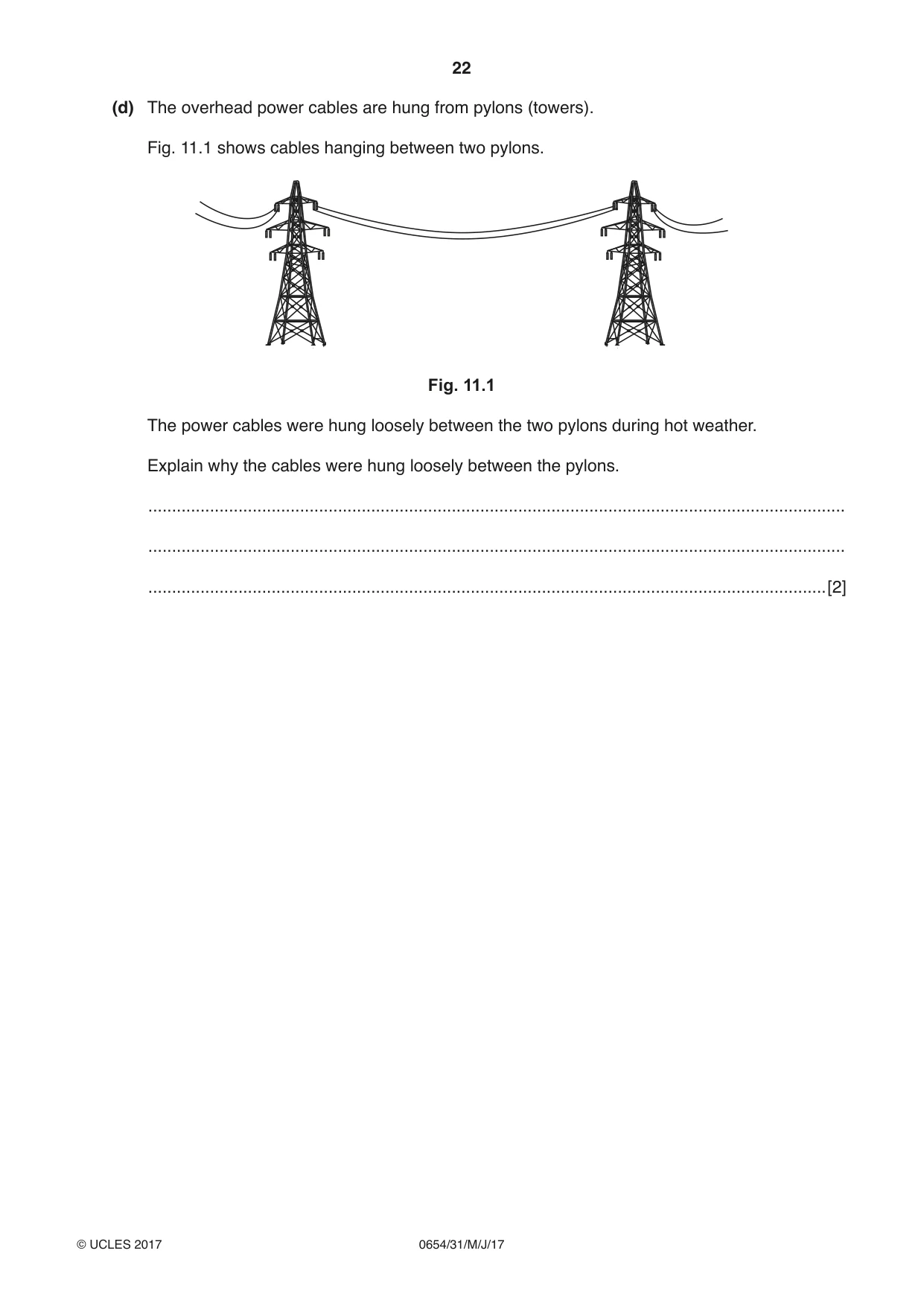
10 Fig. 10.1 is a diagram of a woodland food web. hawk fox butterfly grasshopper mouse rabbit blackberries grass Fig. 10.1 (a) A food web is a network of interconnected food chains. Define the term food chain. ................................................................................................................................................... ...............................................................................................................................................[2] (b) (i) Use Fig. 10.1 to draw one food chain that contains a rabbit. .......................................................................................................................................[2] (ii) From the food web in Fig. 10.1 name one producer, ................................................................................. carnivore, ................................................................................. herbivore. ................................................................................. [3] (c) In the food web in Fig. 10.1 a disease kills the hawks. Use Fig. 10.1 to suggest and explain the effect this would have on the fox population. ................................................................................................................................................... ................................................................................................................................................... ................................................................................................................................................... ...............................................................................................................................................[3] 11 (a) Oil is burned in a power station to generate electricity. Complete the sentences using suitable words to describe how this happens. When oil is burned, ................................... energy is transformed into thermal energy. The thermal energy heats ................................... in a boiler to produce steam. The steam drives a ................................... which turns a generator. [3] (b) (i) A small quantity of radioactive material from a nuclear power station is tested. Describe how a scientist could prove that the material is releasing γ-rays. ........................................................................................................................................... ........................................................................................................................................... ........................................................................................................................................... .......................................................................................................................................[2] (ii) State one way in which the scientist could be harmed by the radiation emitted from the radioactive material. ........................................................................................................................................... .......................................................................................................................................[1] (c) An overhead power cable transmits electrical power from a power station to a town. (i) State the effect on the resistance of the cable if the diameter of the cable is decreased. .......................................................................................................................................[1] (ii) Apart from changing the diameter, state one other way of changing the resistance of the cable. ........................................................................................................................................... .......................................................................................................................................[1] (d) The overhead power cables are hung from pylons (towers). Fig. 11.1 shows cables hanging between two pylons. Fig. 11.1 The power cables were hung loosely between the two pylons during hot weather. Explain why the cables were hung loosely between the pylons. ................................................................................................................................................... ................................................................................................................................................... ...............................................................................................................................................[2]
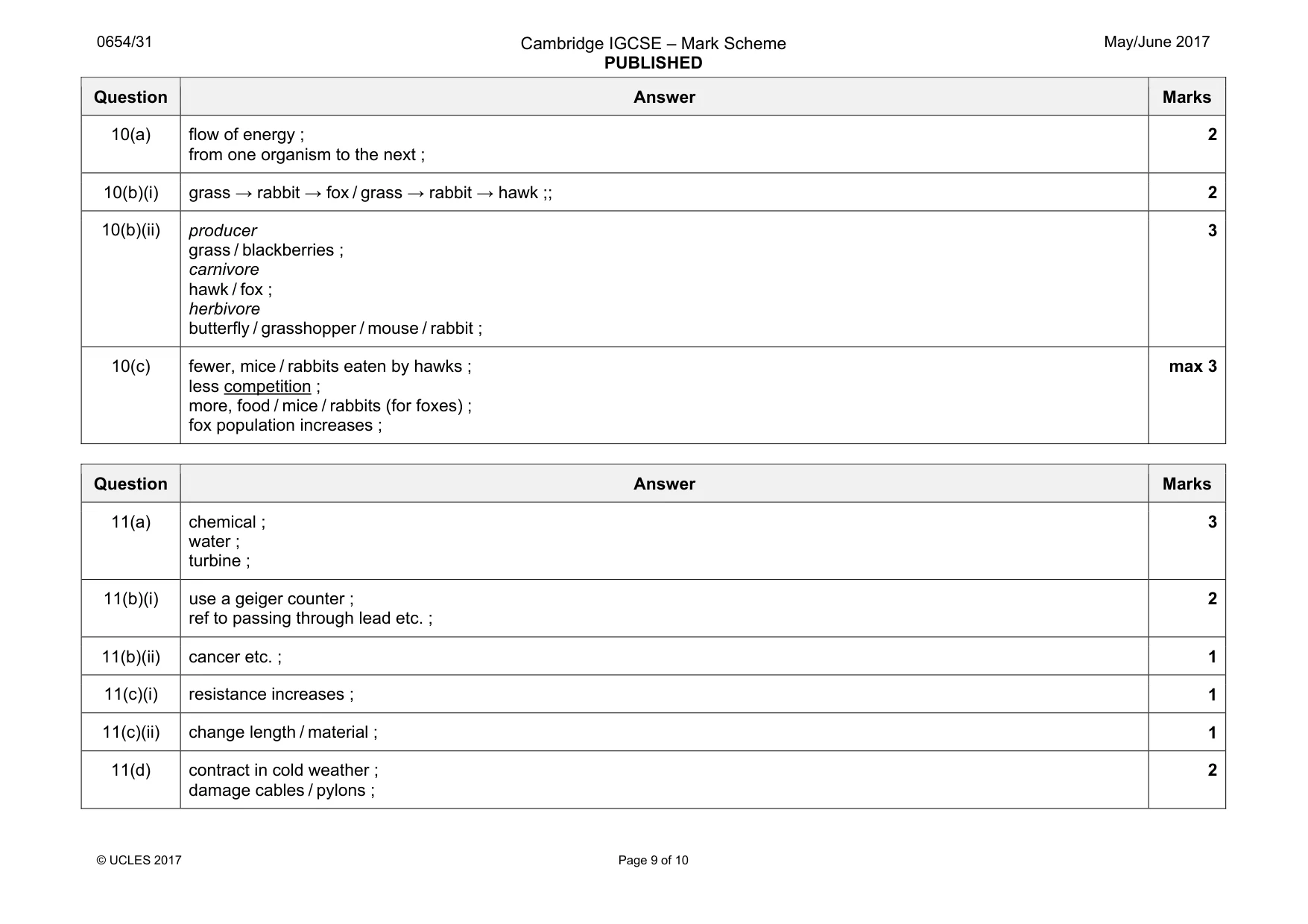
Mark scheme: 10(a) flow of energy ; from one organism to the next ; 2 10(b)(i) grass → rabbit → fox / grass → rabbit → hawk ;; 2 10(b)(ii) producer grass / blackberries ; carnivore hawk / fox ; herbivore butterfly / grasshopper / mouse / rabbit ; 3 10(c) fewer, mice / rabbits eaten by hawks ; less competition ; more, food / mice / rabbits (for foxes) ; fox population increases ; max 3
Q12 · Some physical properties of five elements, P to T
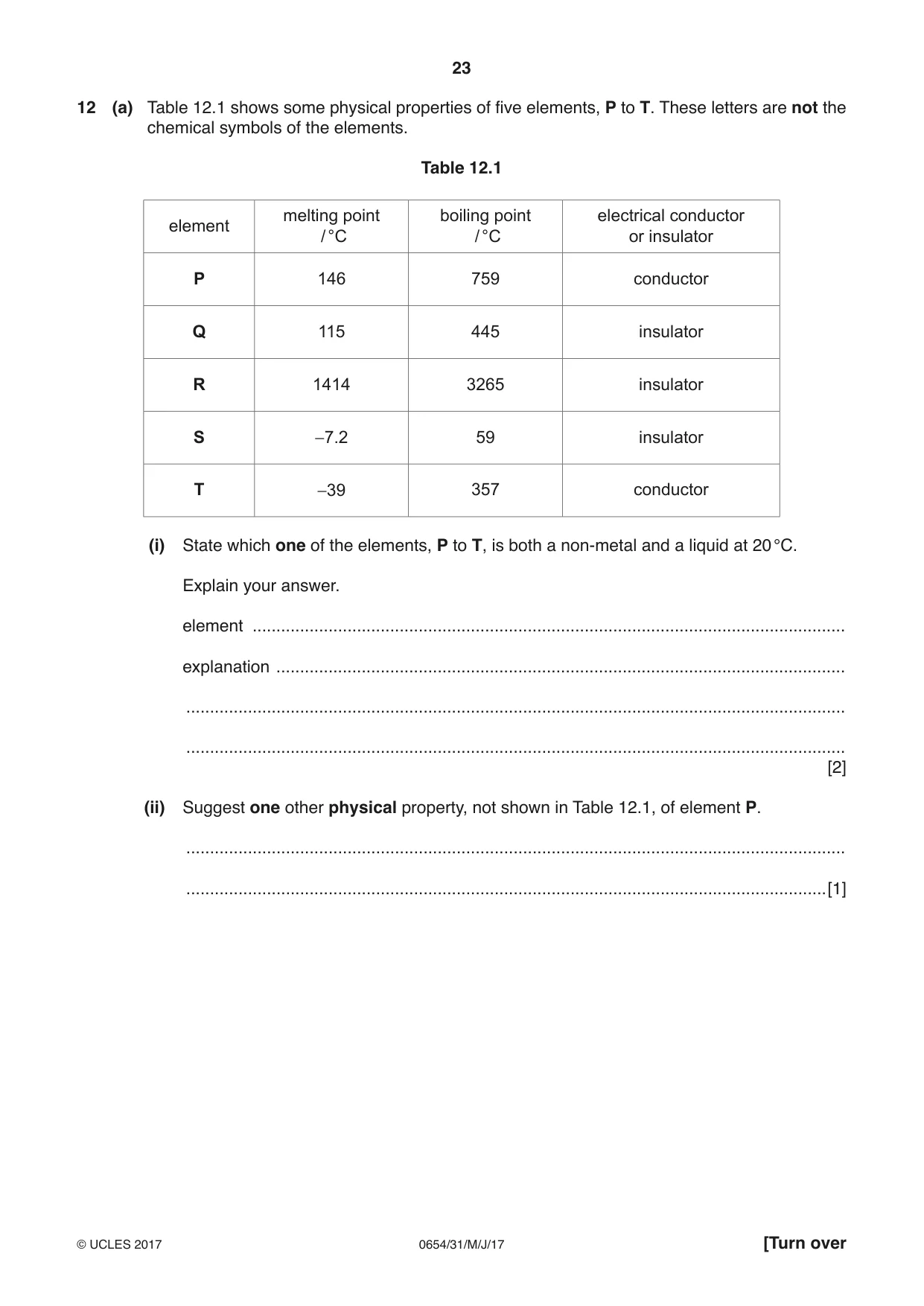
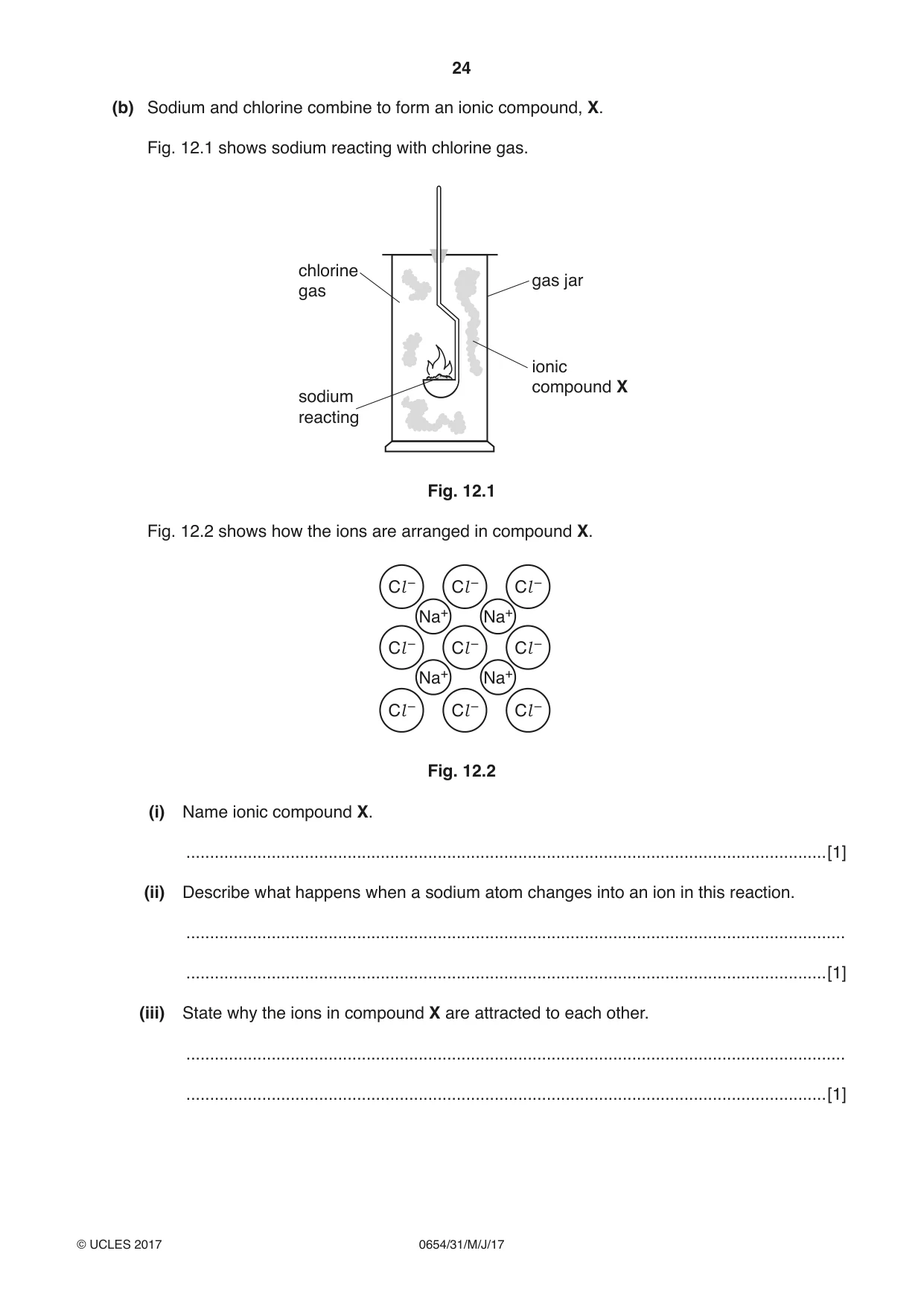
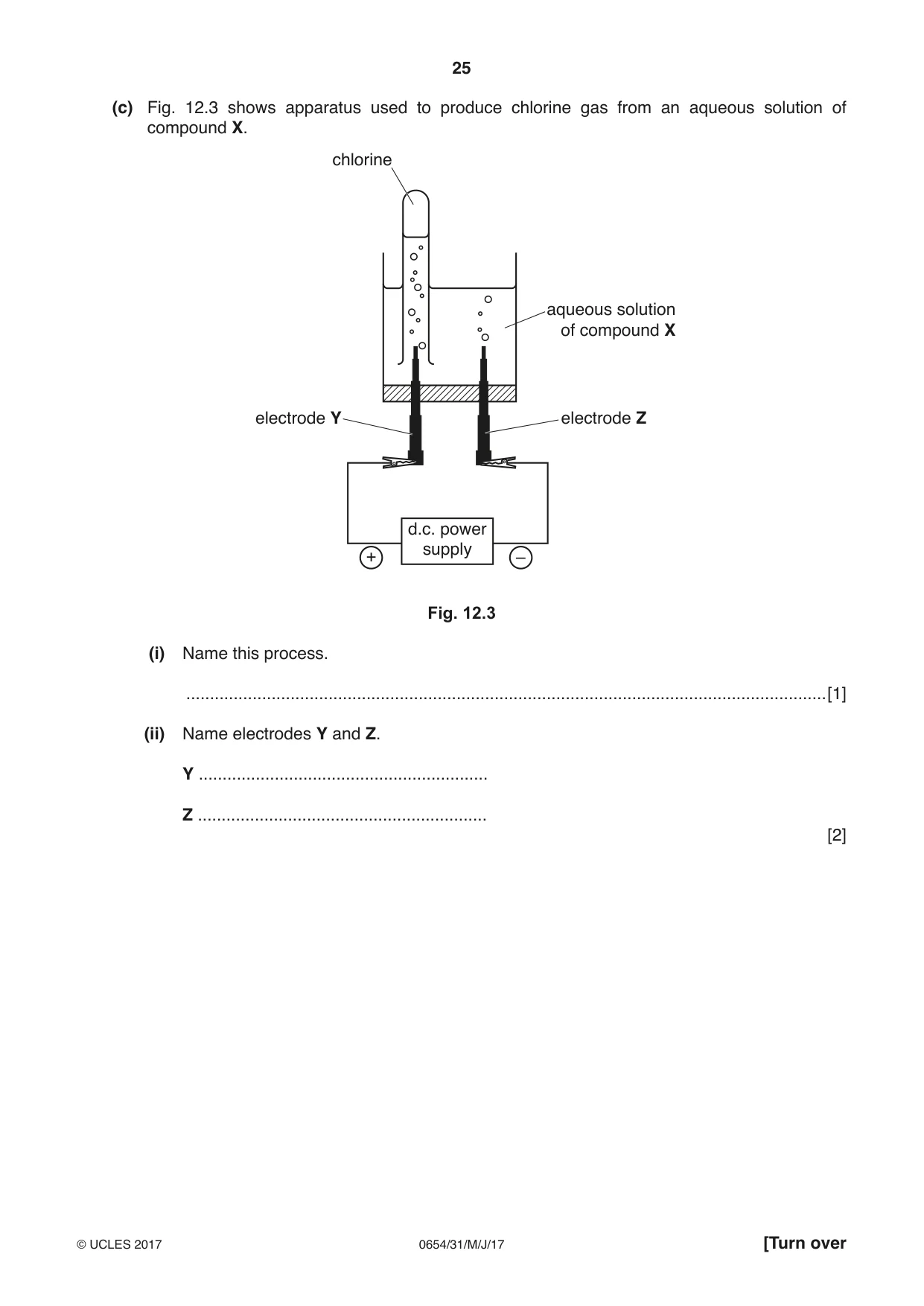
12 (a) Table 12.1 shows some physical properties of five elements, P to T. These letters are not the chemical symbols of the elements. Table 12.1 melting point boiling point electrical conductor element / °C / °C or insulator P 146 759 conductor Q 115 445 insulator R 1414 3265 insulator S −7.2 59 insulator T −39 357 conductor (i) State which one of the elements, P to T, is both a non-metal and a liquid at 20 °C. Explain your answer. element ............................................................................................................................. explanation ........................................................................................................................ ........................................................................................................................................... ........................................................................................................................................... [2] (ii) Suggest one other physical property, not shown in Table 12.1, of element P. ........................................................................................................................................... .......................................................................................................................................[1] (b) Sodium and chlorine combine to form an ionic compound, X. Fig. 12.1 shows sodium reacting with chlorine gas. chlorine gas jar gas ionic compound X sodium reacting Fig. 12.1 Fig. 12.2 shows how the ions are arranged in compound X. Cl – Cl – Cl – Na+ Na+ Cl – Cl – Cl – Na+ Na+ Cl – Cl – Cl – Fig. 12.2 (i) Name ionic compound X. .......................................................................................................................................[1] (ii) Describe what happens when a sodium atom changes into an ion in this reaction. ........................................................................................................................................... .......................................................................................................................................[1] (iii) State why the ions in compound X are attracted to each other. ........................................................................................................................................... .......................................................................................................................................[1] (c) Fig. 12.3 shows apparatus used to produce chlorine gas from an aqueous solution of compound X. chlorine aqueous solution of compound X electrode Y electrode Z d.c. power supply + – Fig. 12.3 (i) Name this process. .......................................................................................................................................[1] (ii) Name electrodes Y and Z. Y ............................................................. Z ............................................................. [2]
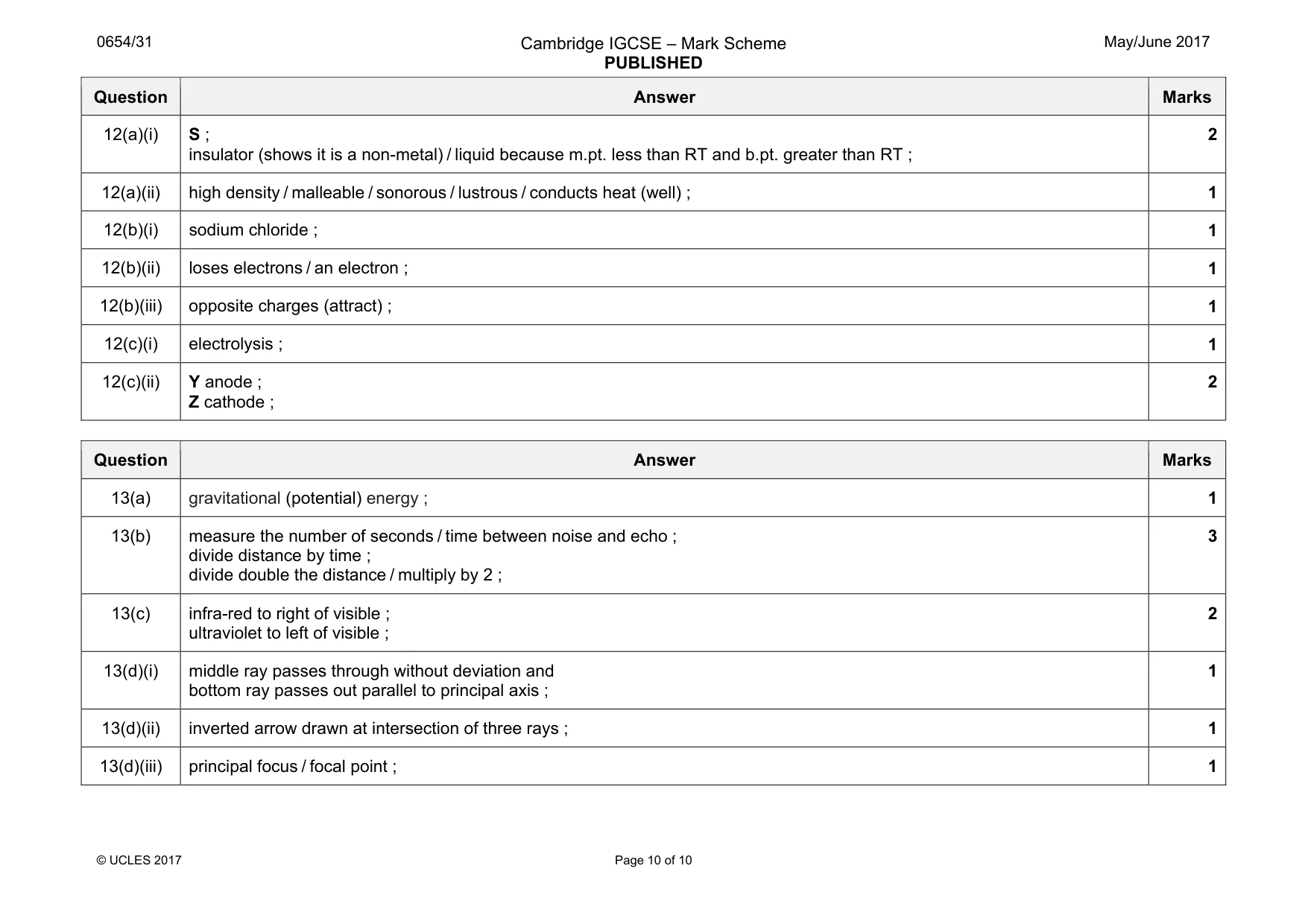
Mark scheme: 12(a)(i) S ; insulator (shows it is a non-metal) / liquid because m.pt. less than RT and b.pt. greater than RT ; 2 12(a)(ii) high density / malleable / sonorous / lustrous / conducts heat (well) ; 1 12(b)(i) sodium chloride ; 1 12(b)(ii) loses electrons / an electron ; 1 12(b)(iii) opposite charges (attract) ; 1 12(c)(i) electrolysis ; 1 12(c)(ii) Y anode ; Z cathode ; 2
Q13 · A student is climbing a mountain
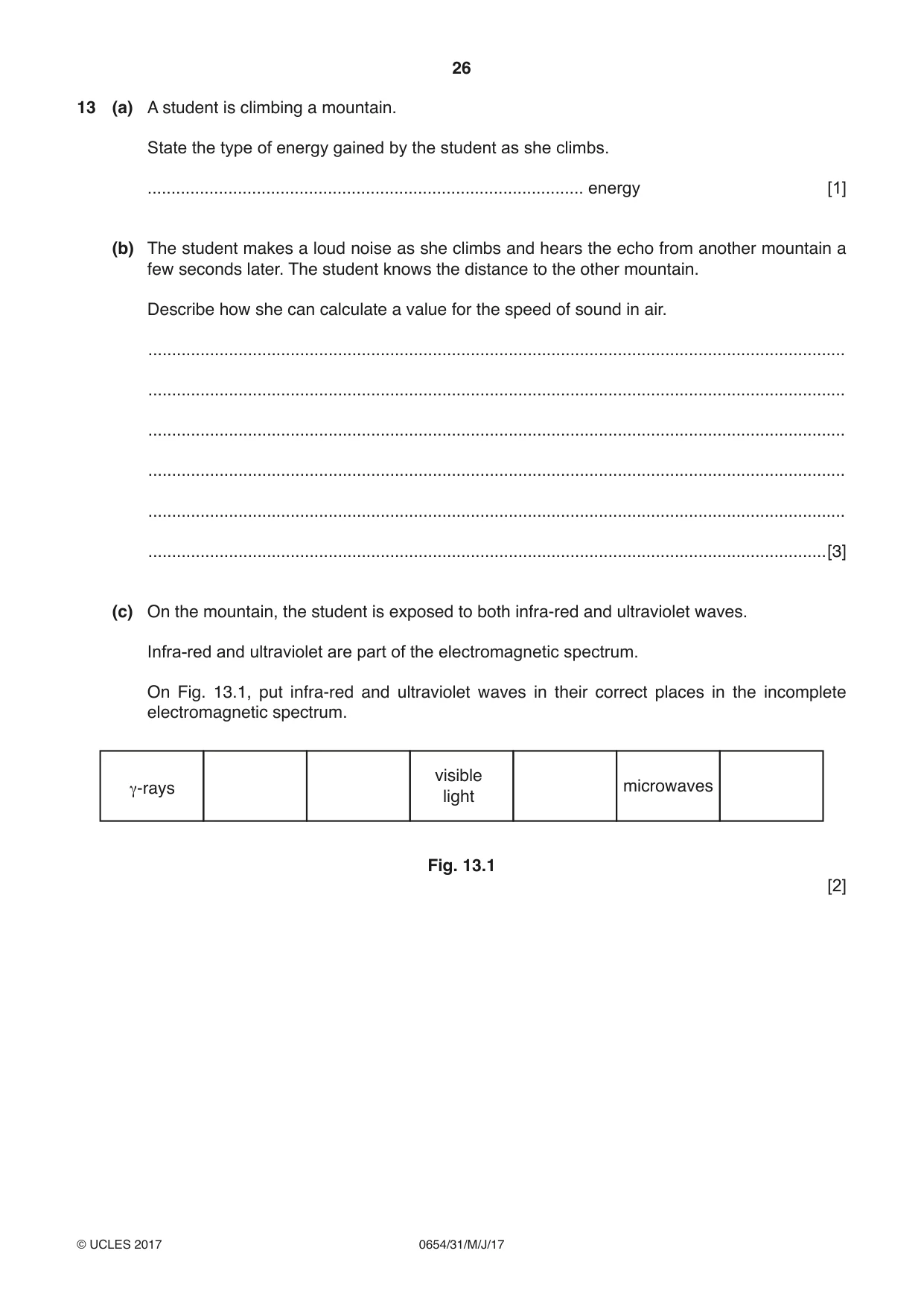
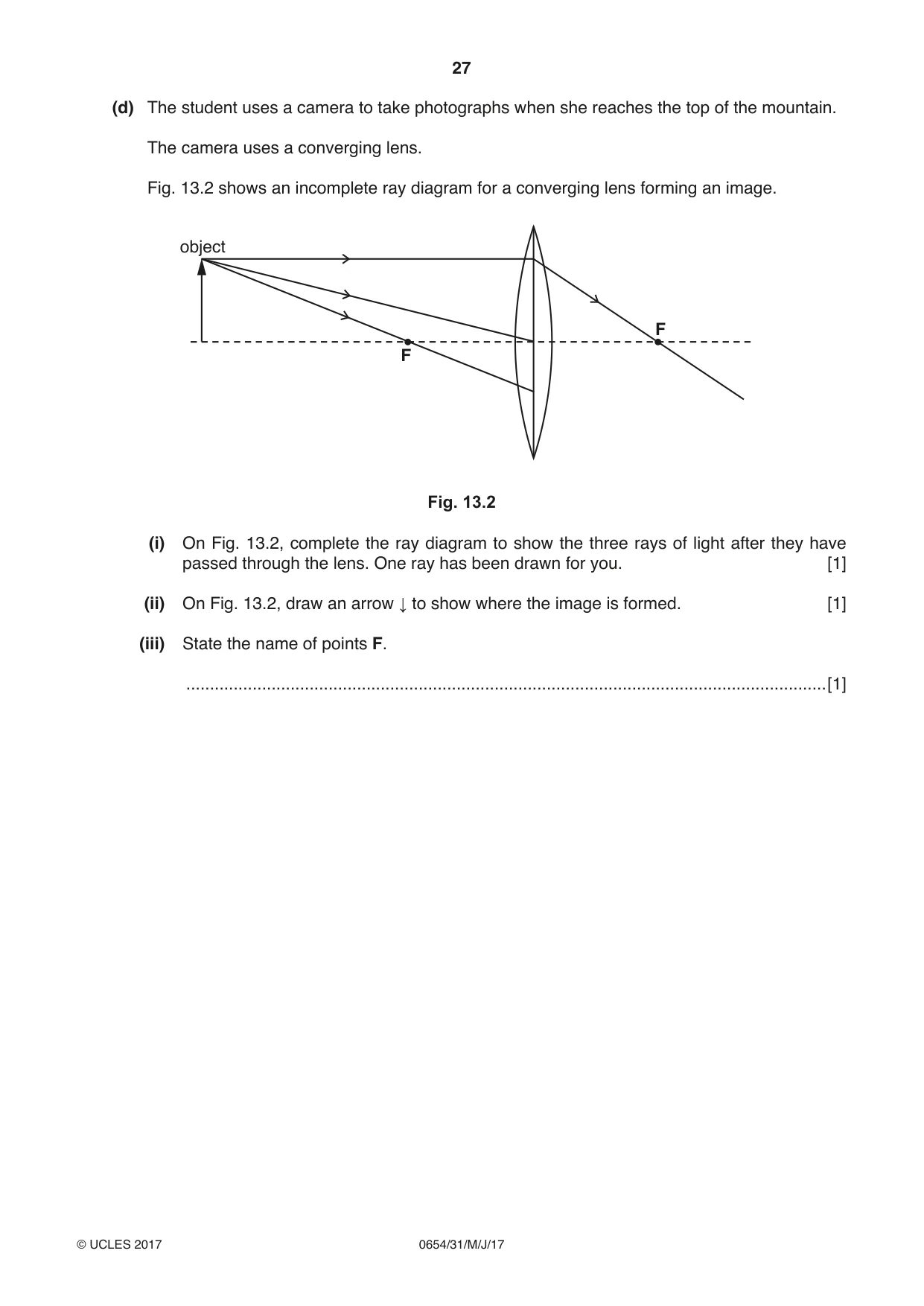
13 (a) A student is climbing a mountain. State the type of energy gained by the student as she climbs. ............................................................................................ energy [1] (b) The student makes a loud noise as she climbs and hears the echo from another mountain a few seconds later. The student knows the distance to the other mountain. Describe how she can calculate a value for the speed of sound in air. ................................................................................................................................................... ................................................................................................................................................... ................................................................................................................................................... ................................................................................................................................................... ................................................................................................................................................... ...............................................................................................................................................[3] (c) On the mountain, the student is exposed to both infra-red and ultraviolet waves. Infra-red and ultraviolet are part of the electromagnetic spectrum. On Fig. 13.1, put infra-red and ultraviolet waves in their correct places in the incomplete electromagnetic spectrum. visible γ-rays microwaves light Fig. 13.1 [2] (d) The student uses a camera to take photographs when she reaches the top of the mountain. The camera uses a converging lens. Fig. 13.2 shows an incomplete ray diagram for a converging lens forming an image. object F F Fig. 13.2 (i) On Fig. 13.2, complete the ray diagram to show the three rays of light after they have passed through the lens. One ray has been drawn for you. [1] (ii) On Fig. 13.2, draw an arrow ↓ to show where the image is formed. [1] (iii) State the name of points F. .......................................................................................................................................[1]
Mark scheme: 13(a) gravitational (potential) energy ; 1 13(b) measure the number of seconds / time between noise and echo ; divide distance by time ; divide double the distance / multiply by 2 ; 3 13(c) infra-red to right of visible ; ultraviolet to left of visible ; 2 13(d)(i) middle ray passes through without deviation and bottom ray passes out parallel to principal axis ; 1 13(d)(ii) inverted arrow drawn at intersection of three rays ; 1 13(d)(iii) principal focus / focal point ; 1
What was in this paper
The subtopics covered by these 12 questions, and how many questions each got. Open one in a new tab to see every Cambridge question on it.
What you needed in this session
Cambridge’s own grade thresholds for 2017 May/June, Paper 3 · Variant 1. A higher threshold means an easier paper — the bar moves with how the cohort did.