Cambridge IGCSE Sciences - Co-ordinated (Double) 0654 — 2021 Oct/Nov Paper 3 · Variant 1
0654/31/O/N/21 · 12 questions · 120 marks · ≈135 min
The question paper and its mark scheme, free to read here and free to download. This is Cambridge’s own paper, exactly as it was sat.
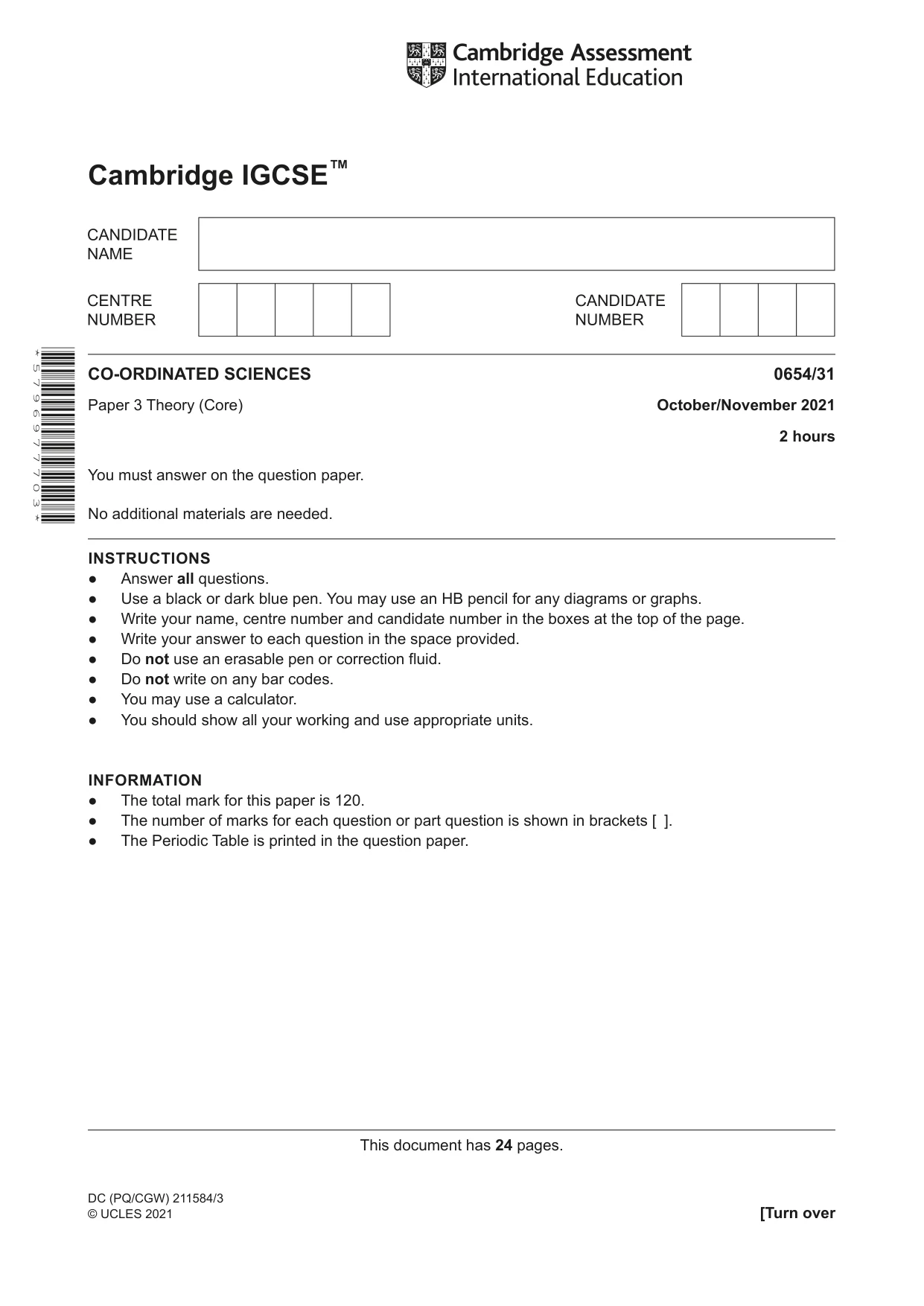
Question paper24 pages
Mark scheme12 pages
Answers below. Sit the paper first if you are practising.
Questions as text
Q1 · Scientists measure the length of sperm cells from different animals
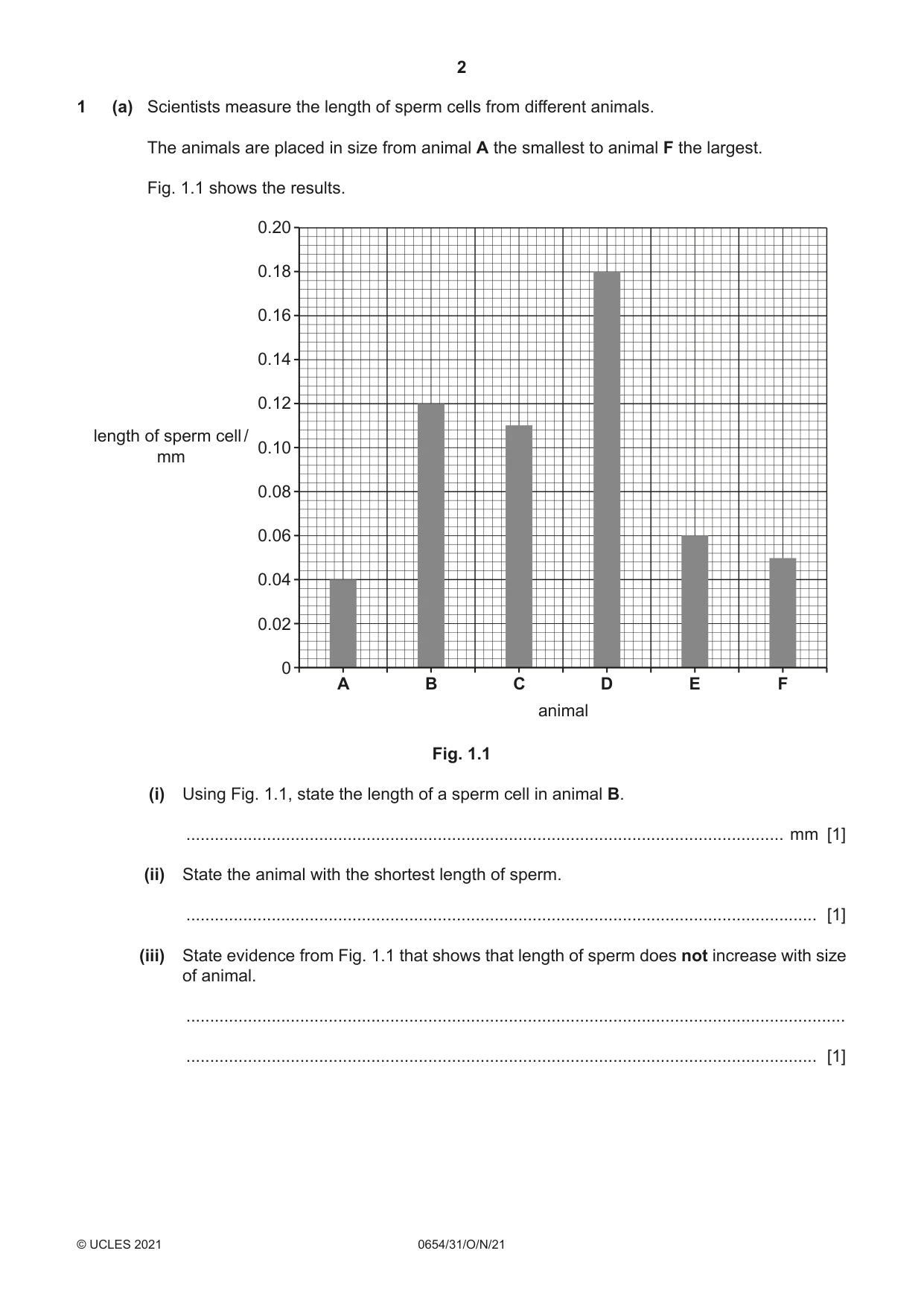
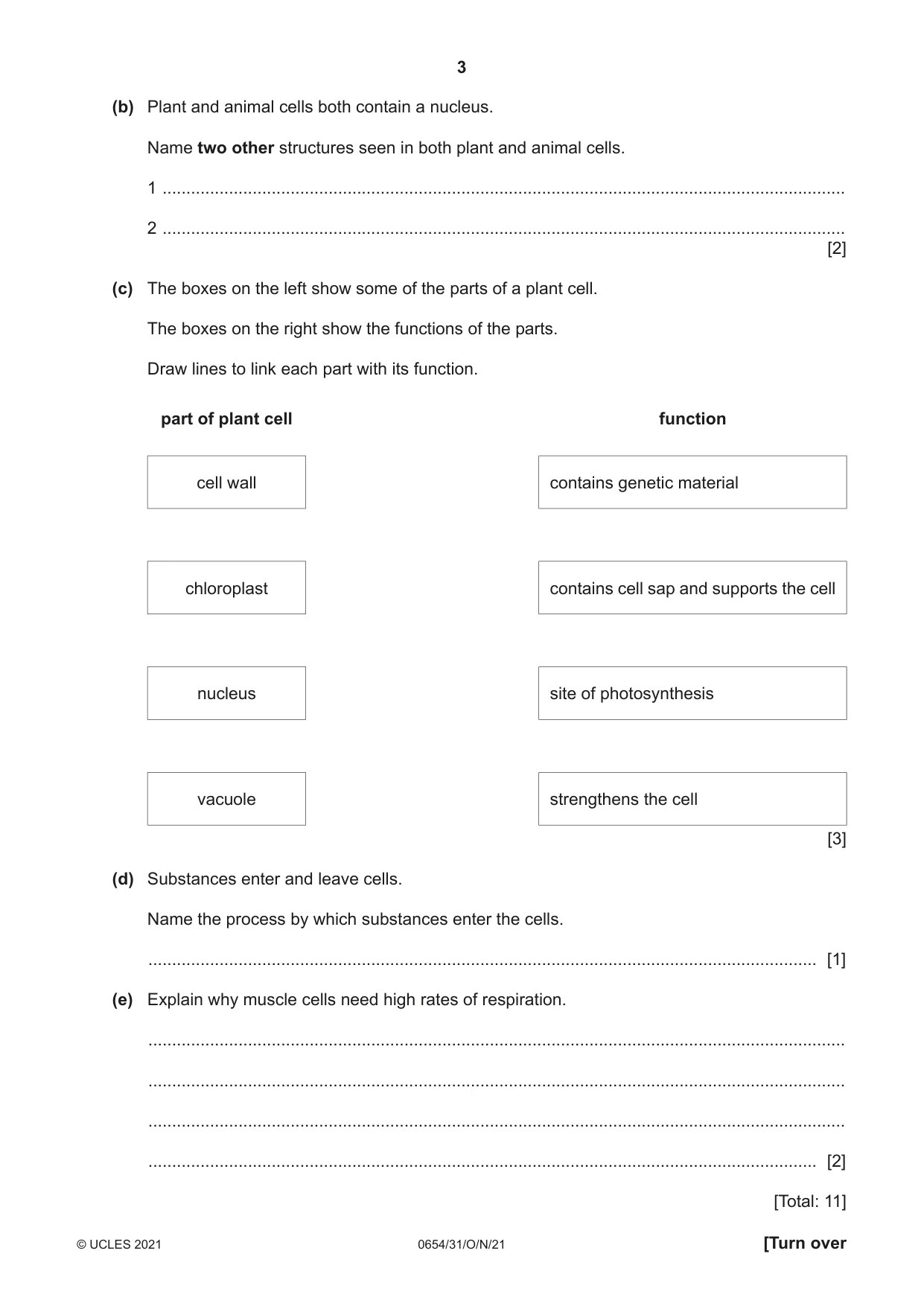
1 (a) Scientists measure the length of sperm cells from different animals. The animals are placed in size from animal A the smallest to animal F the largest. Fig. 1.1 shows the results. 0.20 0.18 0.16 0.14 0.12 length of sperm cell / 0.10 mm 0.08 0.06 0.04 0.02 0 A B C D E F animal Fig. 1.1 (i) Using Fig. 1.1, state the length of a sperm cell in animal B. .............................................................................................................................. mm [1] (ii) State the animal with the shortest length of sperm. ..................................................................................................................................... [1] (iii) State evidence from Fig. 1.1 that shows that length of sperm does not increase with size of animal. ........................................................................................................................................... ..................................................................................................................................... [1] (b) Plant and animal cells both contain a nucleus. Name two other structures seen in both plant and animal cells. 1 ................................................................................................................................................ 2 ................................................................................................................................................ [2] (c) The boxes on the left show some of the parts of a plant cell. The boxes on the right show the functions of the parts. Draw lines to link each part with its function. part of plant cell function cell wall contains genetic material chloroplast contains cell sap and supports the cell nucleus site of photosynthesis vacuole strengthens the cell [3] (d) Substances enter and leave cells. Name the process by which substances enter the cells. ............................................................................................................................................. [1] (e) Explain why muscle cells need high rates of respiration. ................................................................................................................................................... ................................................................................................................................................... ................................................................................................................................................... ............................................................................................................................................. [2] [Total: 11]
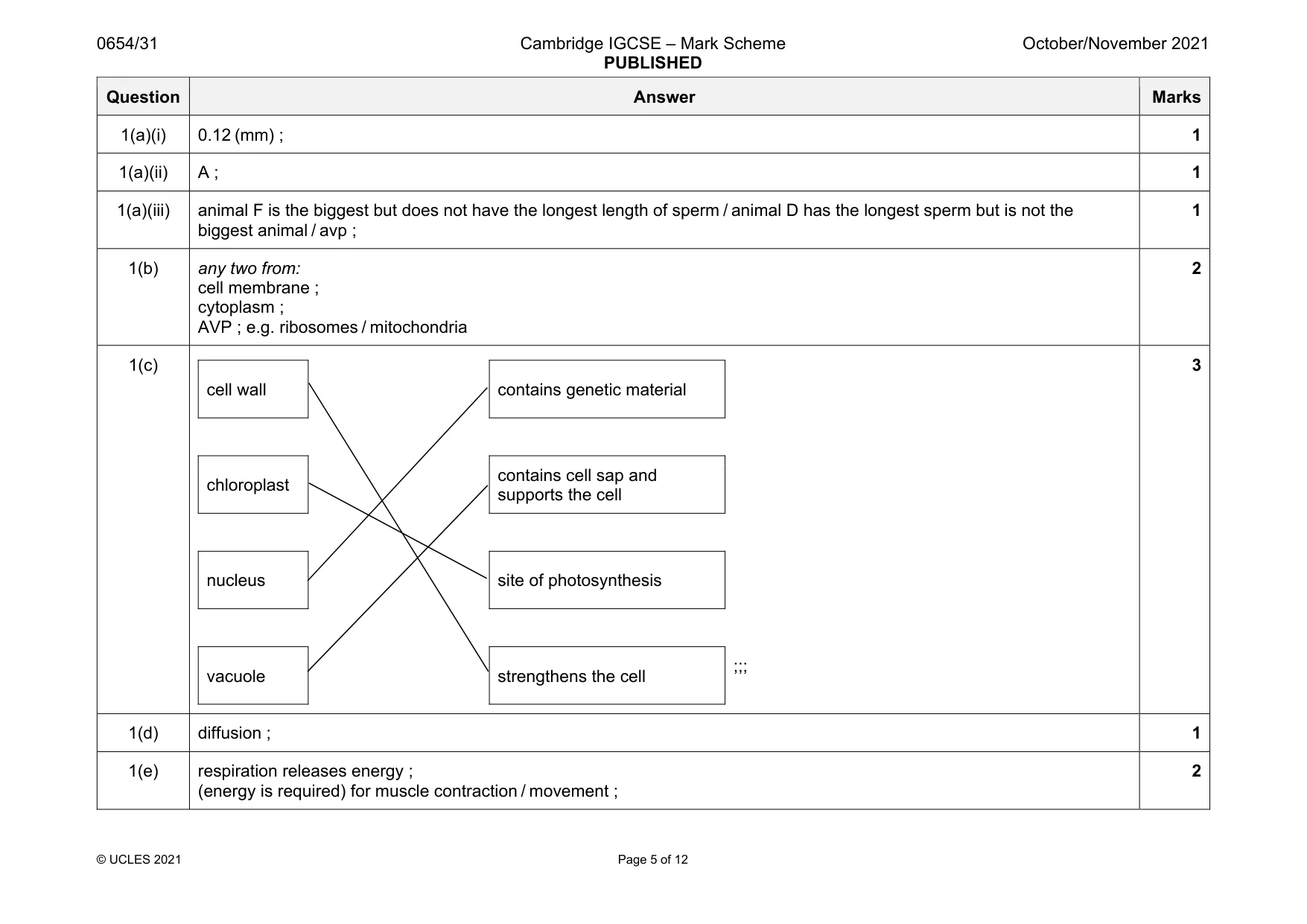
Mark scheme: 1(a)(i) 0.12 (mm) ; 1 1(a)(ii) A ; 1 1(a)(iii) animal F is the biggest but does not have the longest length of sperm / animal D has the longest sperm but is not the biggest animal / avp ; 1 1(b) any two from: cell membrane ; cytoplasm ; AVP ; e.g. ribosomes / mitochondria 2 1(c) cell wall contains genetic material chloroplast contains cell sap and supports the cell nucleus site of photosynthesis vacuole strengthens the cell ;;; 3 1(d) diffusion ; 1 1(e) respiration releases energy ; (energy is required) for muscle contraction / movement ; 2
Q2 · The thermal decomposition of calcium carbonate makes calcium oxide and carbon dioxide
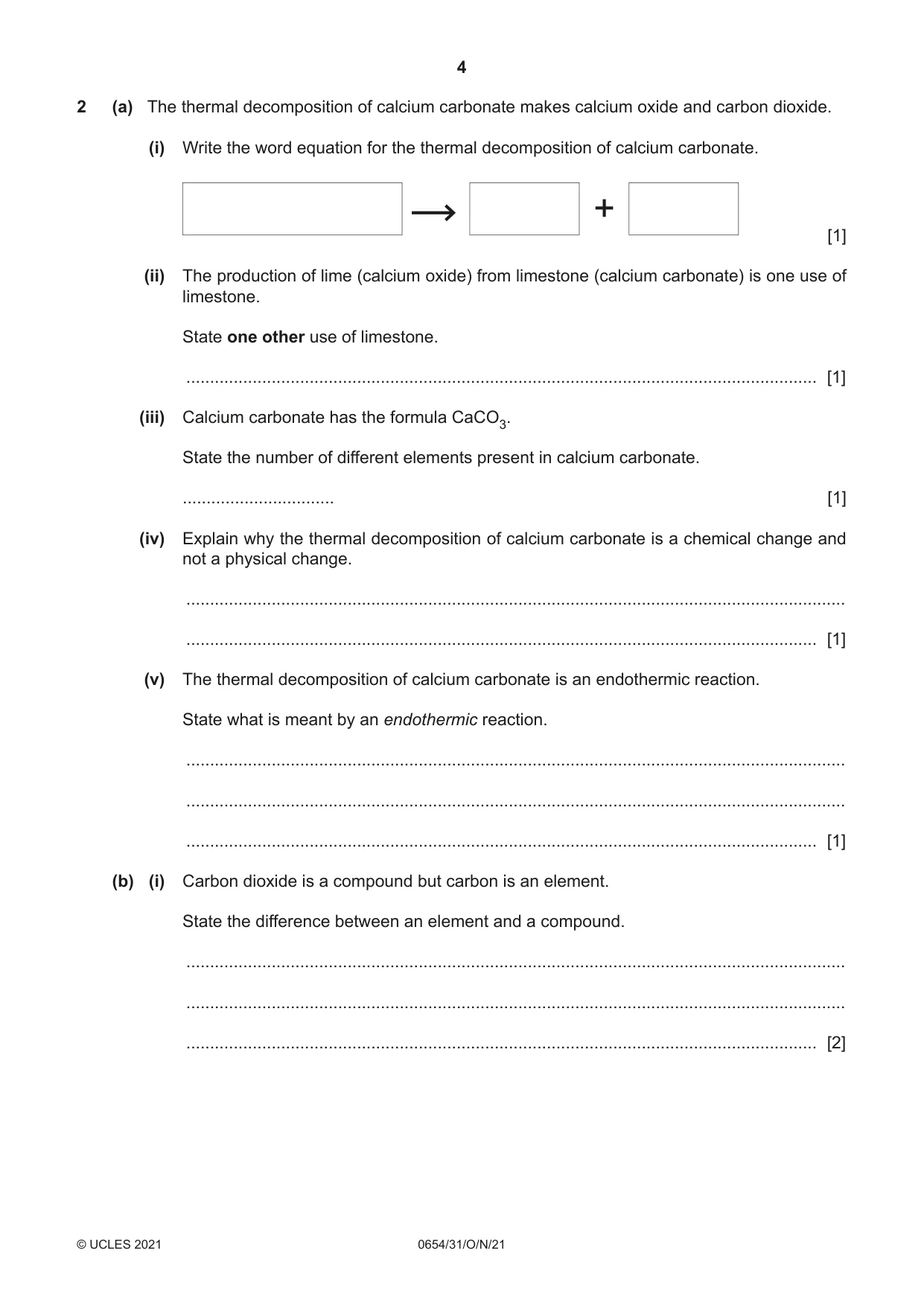
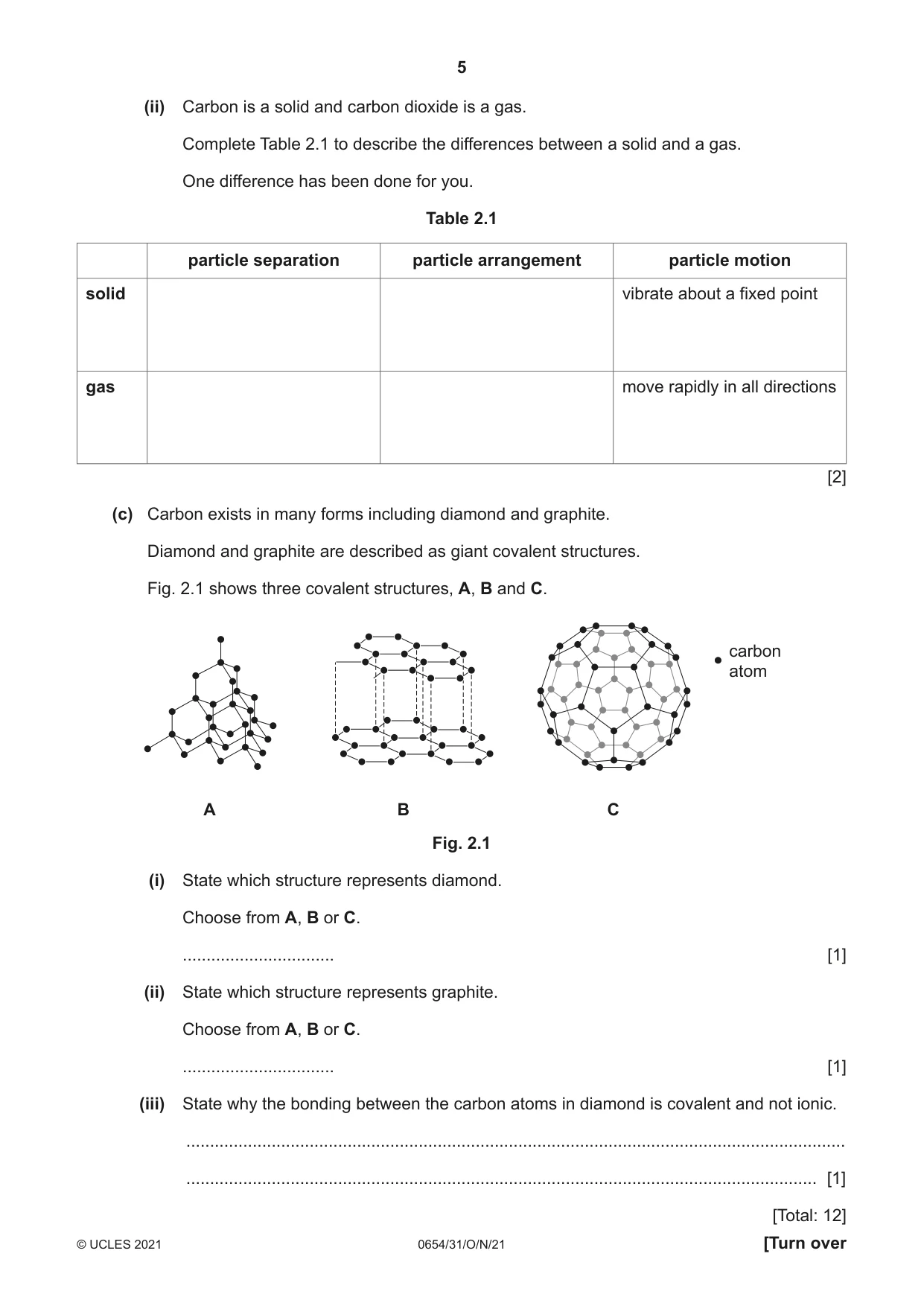
2 (a) The thermal decomposition of calcium carbonate makes calcium oxide and carbon dioxide. (i) Write the word equation for the thermal decomposition of calcium carbonate. + [1] (ii) The production of lime (calcium oxide) from limestone (calcium carbonate) is one use of limestone. State one other use of limestone. ..................................................................................................................................... [1] (iii) Calcium carbonate has the formula CaCO3. State the number of different elements present in calcium carbonate. ................................ [1] (iv) Explain why the thermal decomposition of calcium carbonate is a chemical change and not a physical change. ........................................................................................................................................... ..................................................................................................................................... [1] (v) The thermal decomposition of calcium carbonate is an endothermic reaction. State what is meant by an endothermic reaction. ........................................................................................................................................... ........................................................................................................................................... ..................................................................................................................................... [1] (b) (i) Carbon dioxide is a compound but carbon is an element. State the difference between an element and a compound. ........................................................................................................................................... ........................................................................................................................................... ..................................................................................................................................... [2] (ii) Carbon is a solid and carbon dioxide is a gas. Complete Table 2.1 to describe the differences between a solid and a gas. One difference has been done for you. Table 2.1 particle separation particle arrangement particle motion solid vibrate about a fixed point gas move rapidly in all directions [2] (c) Carbon exists in many forms including diamond and graphite. Diamond and graphite are described as giant covalent structures. Fig. 2.1 shows three covalent structures, A, B and C. carbon atom A B C Fig. 2.1 (i) State which structure represents diamond. Choose from A, B or C. ................................ [1] (ii) State which structure represents graphite. Choose from A, B or C. ................................ [1] (iii) State why the bonding between the carbon atoms in diamond is covalent and not ionic. ........................................................................................................................................... ..................................................................................................................................... [1] [Total: 12]
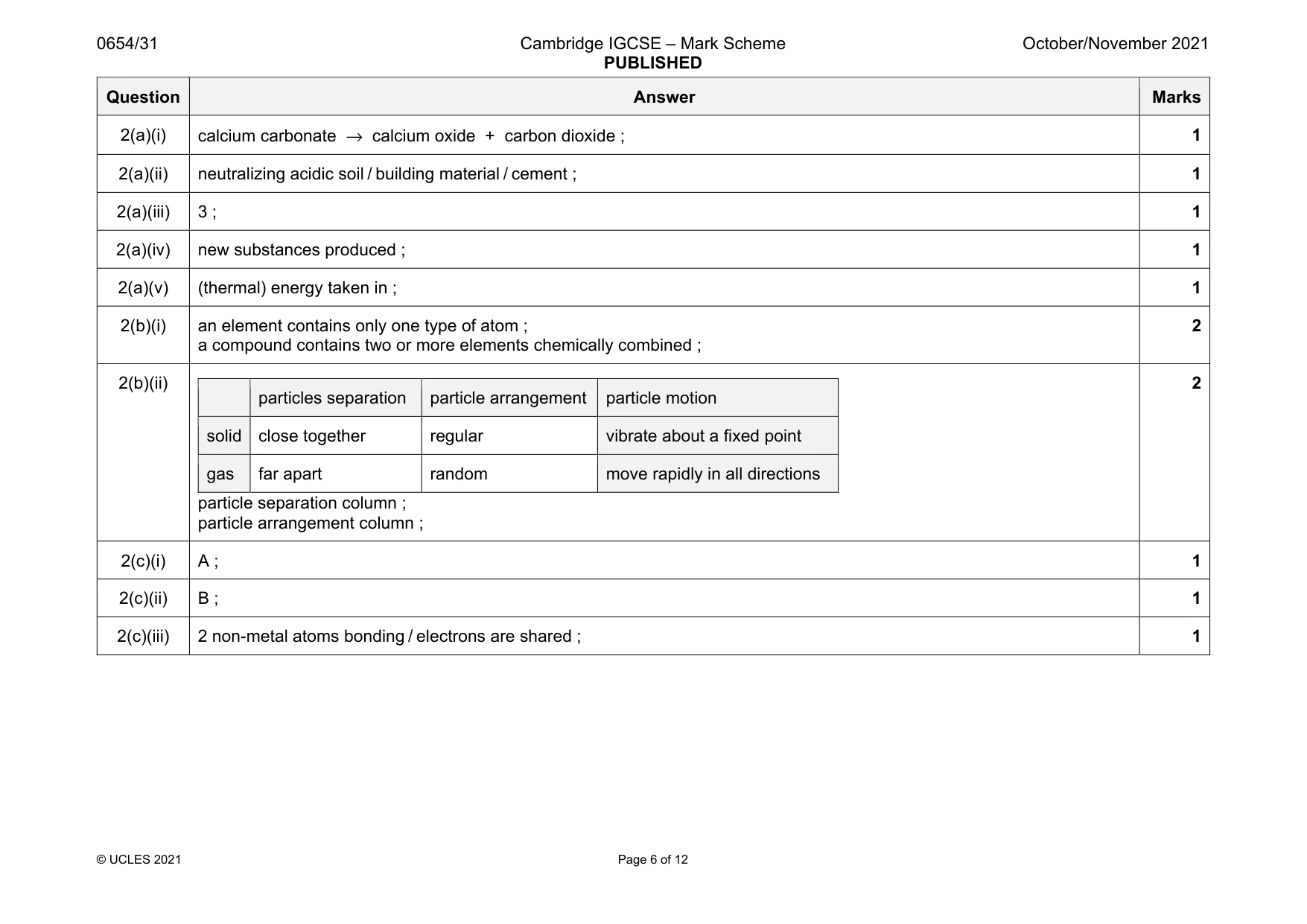
Mark scheme: 2(a)(i) calcium carbonate → calcium oxide + carbon dioxide ; 1 2(a)(ii) neutralizing acidic soil / building material / cement ; 1 2(a)(iii) 3 ; 1 2(a)(iv) new substances produced ; 1 2(a)(v) (thermal) energy taken in ; 1 2(b)(i) an element contains only one type of atom ; a compound contains two or more elements chemically combined ; 2 2(b)(ii) particles separation particle arrangement particle motion solid close together regular vibrate about a fixed point gas far apart random move rapidly in all directions particle separation column ; particle arrangement column ; 2 2(c)(i) A ; 1 2(c)(ii) B ; 1 2(c)(iii) 2 non-metal atoms bonding / electrons are shared ; 1
Q3 · A student constructs a circuit containing two lamps in parallel connected across two…
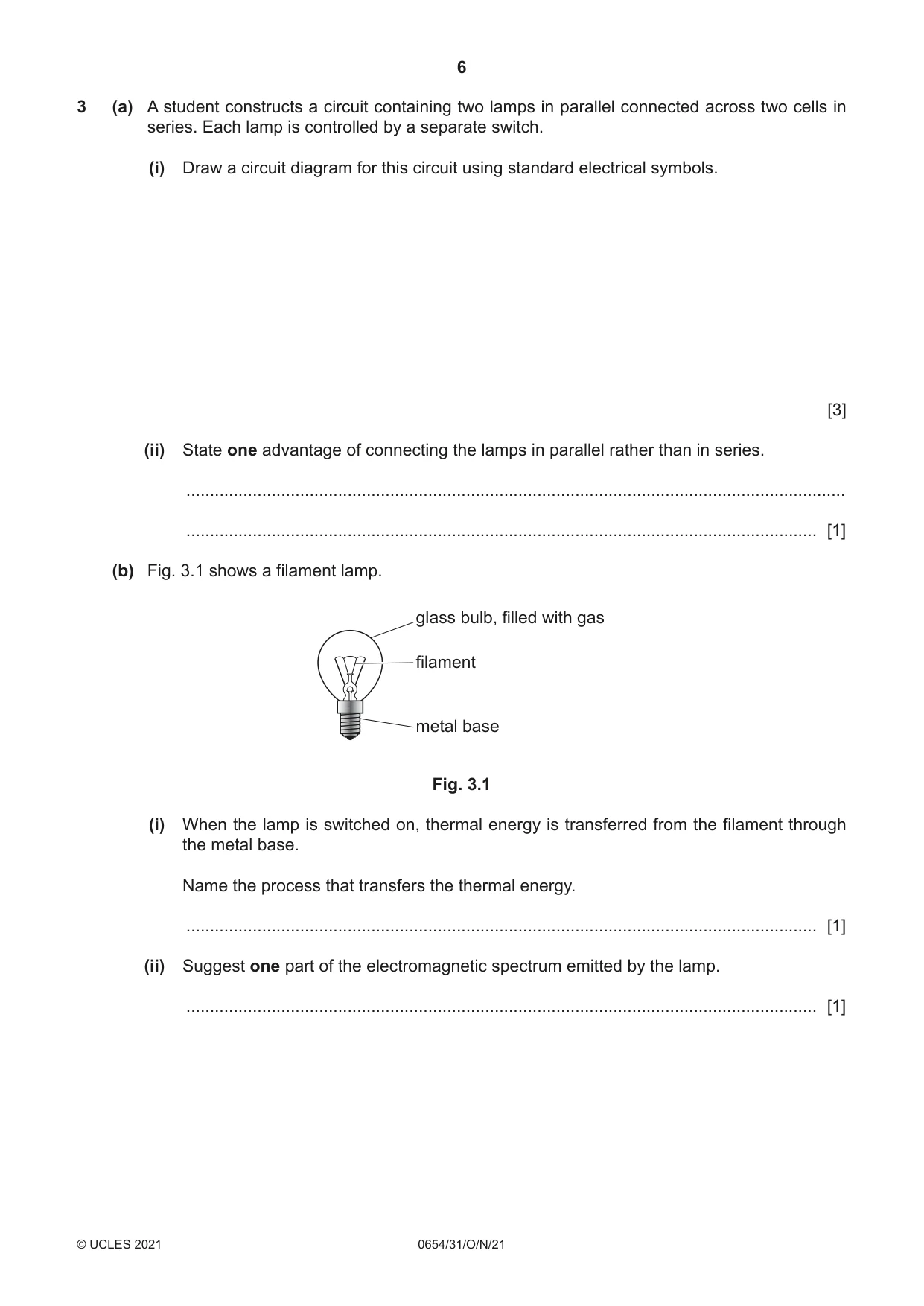
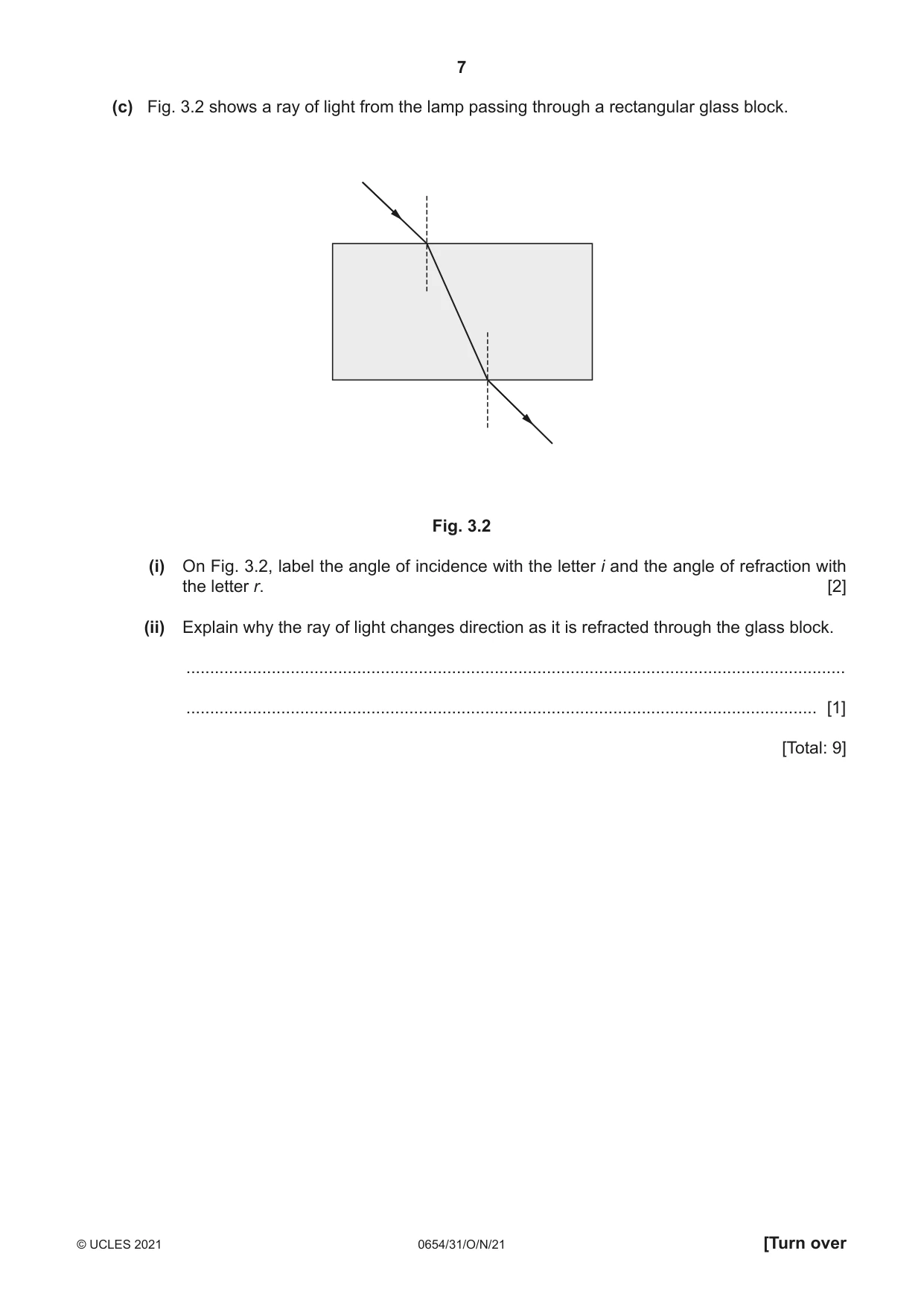
3 (a) A student constructs a circuit containing two lamps in parallel connected across two cells in series. Each lamp is controlled by a separate switch. (i) Draw a circuit diagram for this circuit using standard electrical symbols. [3] (ii) State one advantage of connecting the lamps in parallel rather than in series. ........................................................................................................................................... ..................................................................................................................................... [1] (b) Fig. 3.1 shows a filament lamp. glass bulb, filled with gas filament metal base Fig. 3.1 (i) When the lamp is switched on, thermal energy is transferred from the filament through the metal base. Name the process that transfers the thermal energy. ..................................................................................................................................... [1] (ii) Suggest one part of the electromagnetic spectrum emitted by the lamp. ..................................................................................................................................... [1] (c) Fig. 3.2 shows a ray of light from the lamp passing through a rectangular glass block. Fig. 3.2 (i) On Fig. 3.2, label the angle of incidence with the letter i and the angle of refraction with the letter r. [2] (ii) Explain why the ray of light changes direction as it is refracted through the glass block. ........................................................................................................................................... ..................................................................................................................................... [1] [Total: 9]
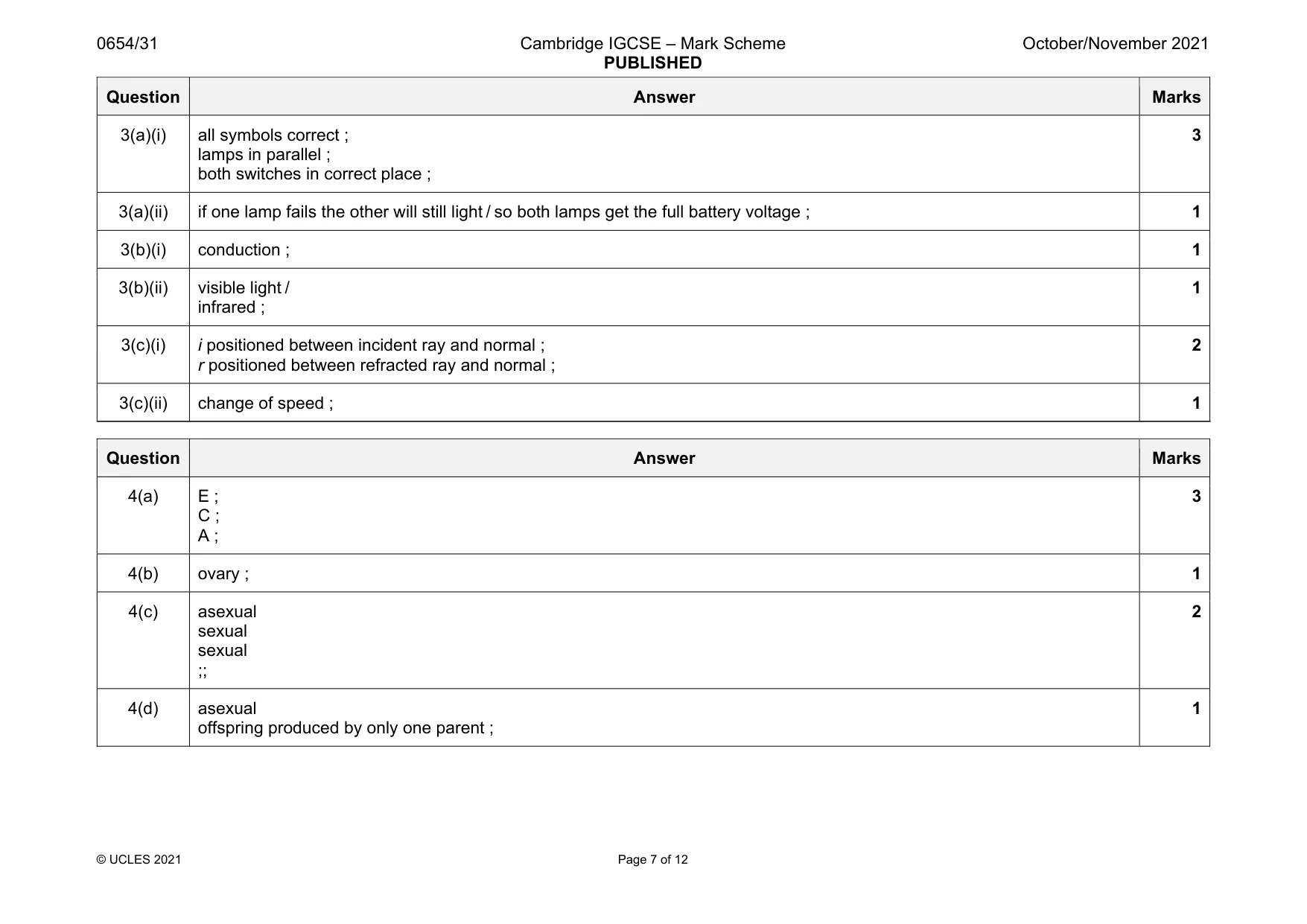
Mark scheme: 3(a)(i) all symbols correct ; lamps in parallel ; both switches in correct place ; 3 3(a)(ii) if one lamp fails the other will still light / so both lamps get the full battery voltage ; 1 3(b)(i) conduction ; 1 3(b)(ii) visible light / infrared ; 1 3(c)(i) i positioned between incident ray and normal ; r positioned between refracted ray and normal ; 2 3(c)(ii) change of speed ; 1
Q4 · A diagram of the male reproductive system in humans
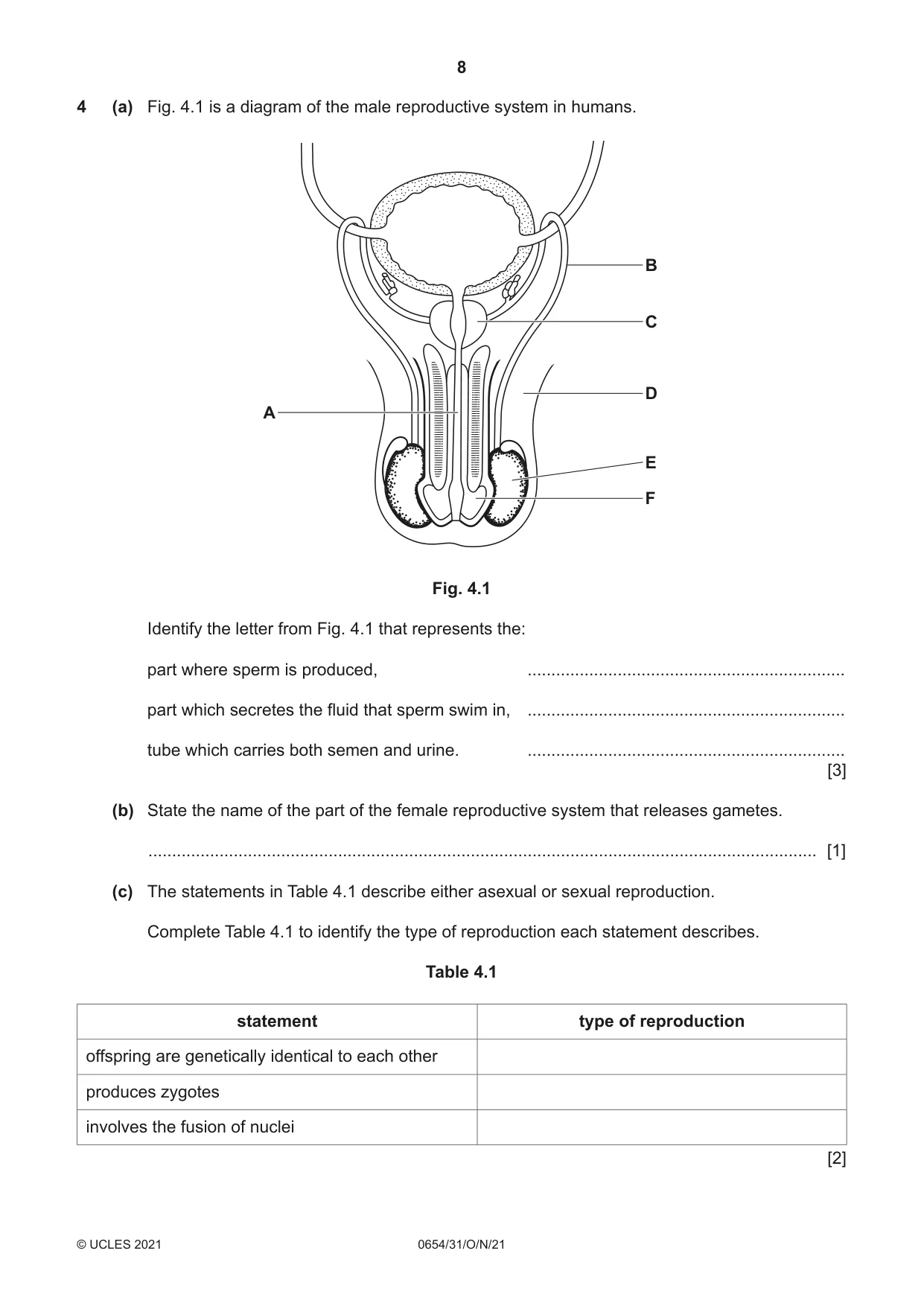
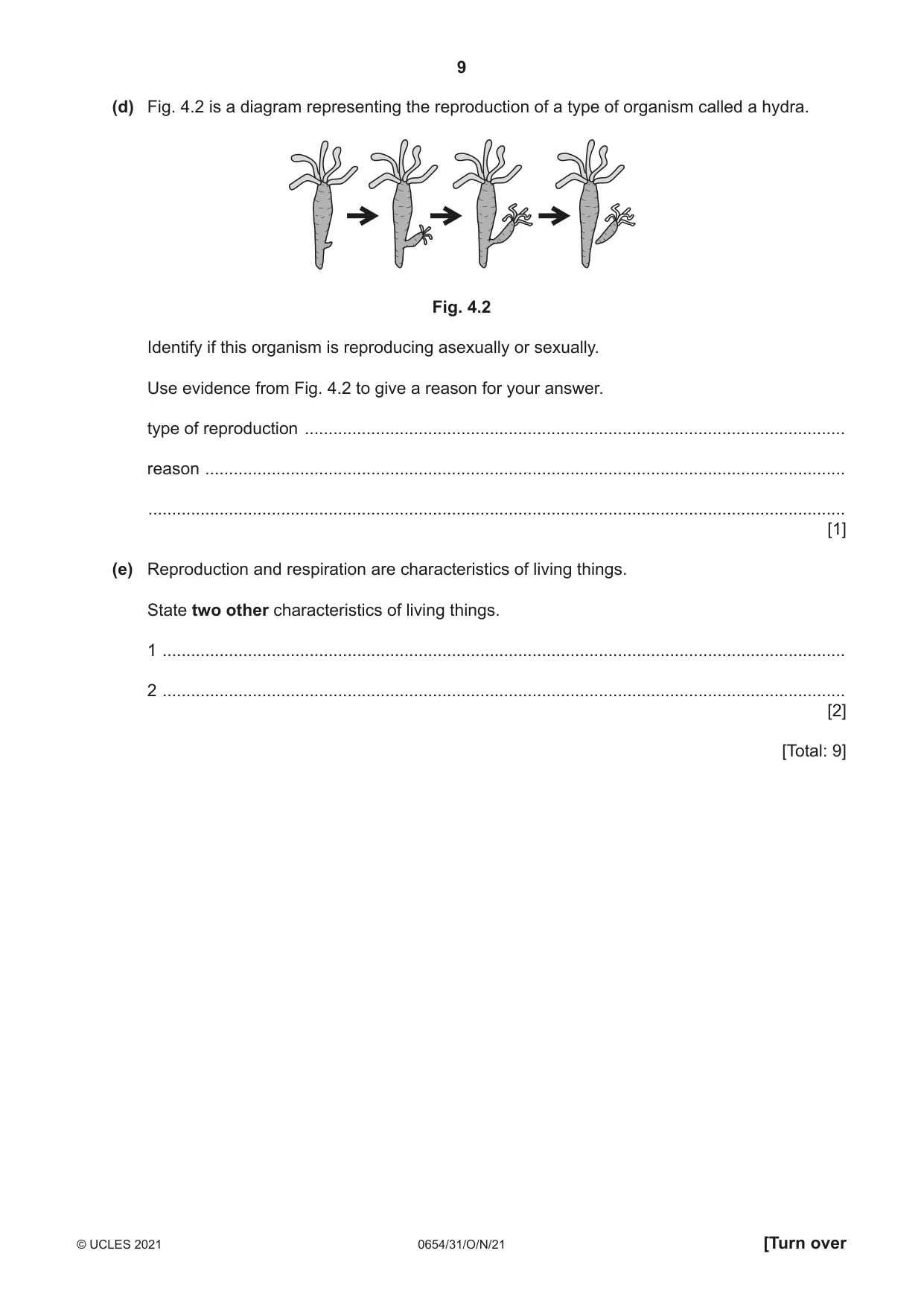
4 (a) Fig. 4.1 is a diagram of the male reproductive system in humans. B C D A E F Fig. 4.1 Identify the letter from Fig. 4.1 that represents the: part where sperm is produced, ................................................................... part which secretes the fluid that sperm swim in, ................................................................... tube which carries both semen and urine. ................................................................... [3] (b) State the name of the part of the female reproductive system that releases gametes. ............................................................................................................................................. [1] (c) The statements in Table 4.1 describe either asexual or sexual reproduction. Complete Table 4.1 to identify the type of reproduction each statement describes. Table 4.1 statement type of reproduction offspring are genetically identical to each other produces zygotes involves the fusion of nuclei [2] (d) Fig. 4.2 is a diagram representing the reproduction of a type of organism called a hydra. Fig. 4.2 Identify if this organism is reproducing asexually or sexually. Use evidence from Fig. 4.2 to give a reason for your answer. type of reproduction .................................................................................................................. reason ....................................................................................................................................... ................................................................................................................................................... [1] (e) Reproduction and respiration are characteristics of living things. State two other characteristics of living things. 1 ................................................................................................................................................ 2 ................................................................................................................................................ [2] [Total: 9]
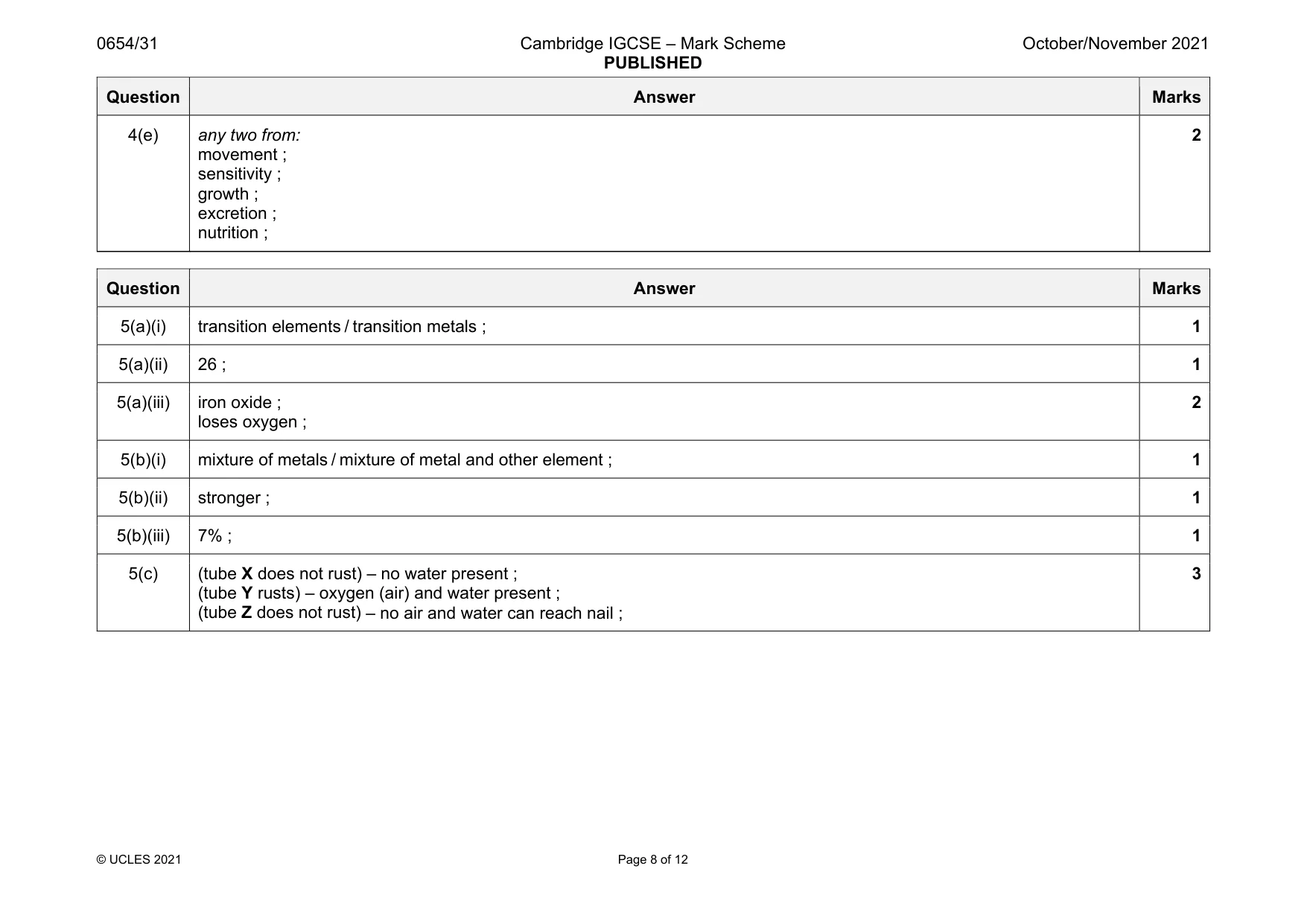
Mark scheme: 4(a) E ; C ; A ; 3 4(b) ovary ; 1 4(c) asexual sexual sexual ;; 2 4(d) asexual offspring produced by only one parent ; 1 Question Answer Marks 4(e) any two from: movement ; sensitivity ; growth ; excretion ; nutrition ; 2
Q5 · Iron is an element in Period 4 of the Periodic Table
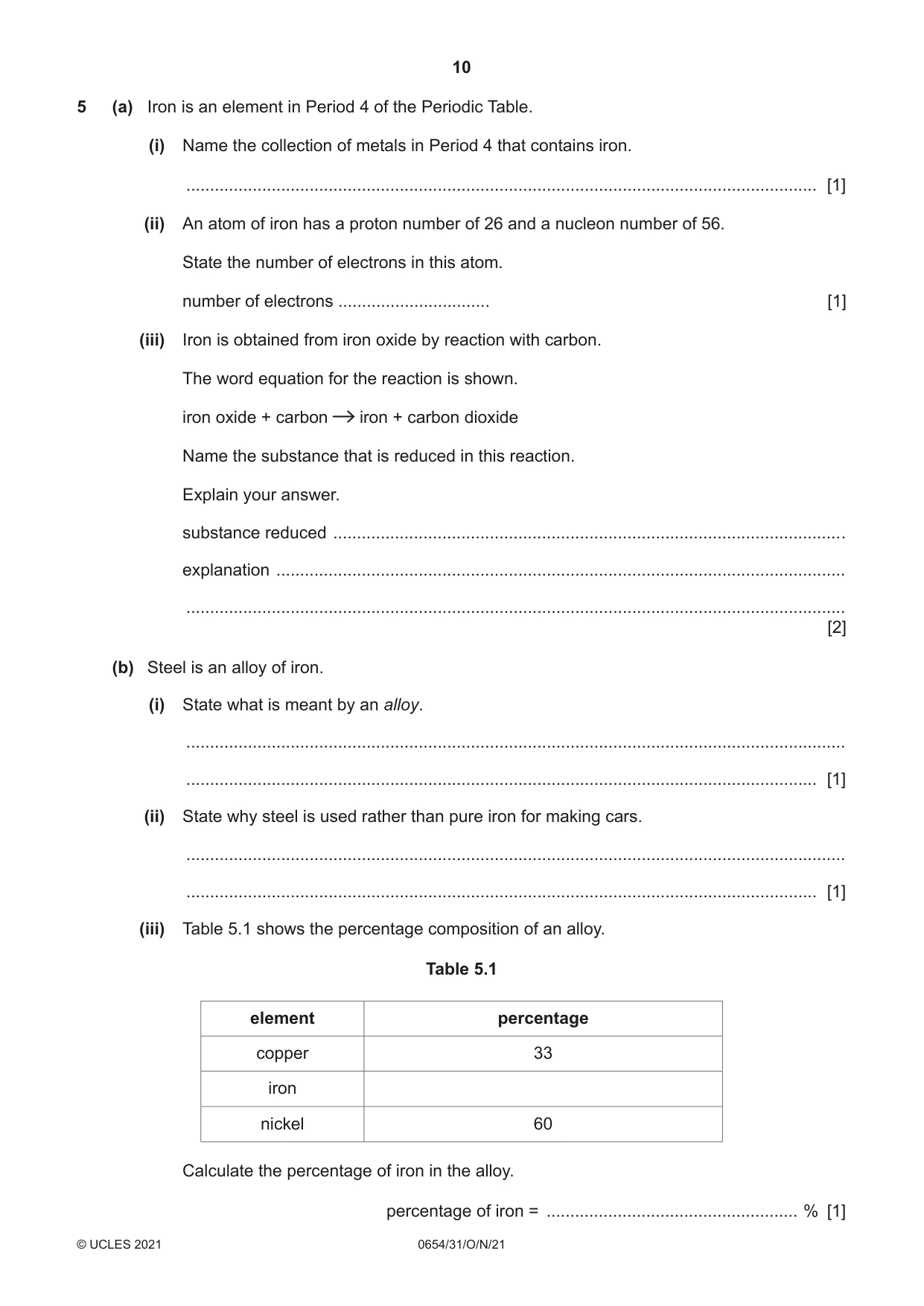
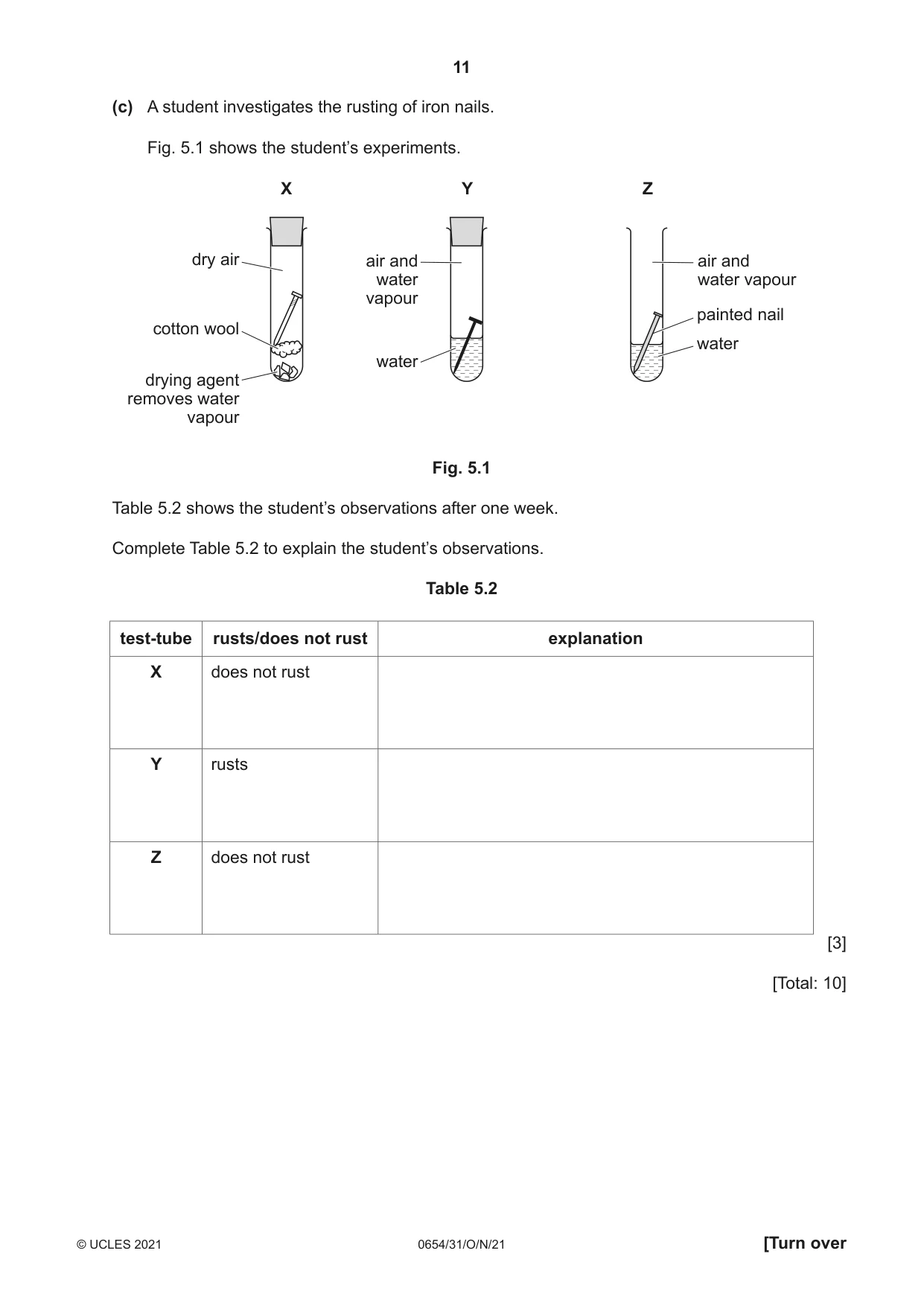
5 (a) Iron is an element in Period 4 of the Periodic Table. (i) Name the collection of metals in Period 4 that contains iron. ..................................................................................................................................... [1] (ii) An atom of iron has a proton number of 26 and a nucleon number of 56. State the number of electrons in this atom. number of electrons ................................ [1] (iii) Iron is obtained from iron oxide by reaction with carbon. The word equation for the reaction is shown. iron oxide + carbon iron + carbon dioxide Name the substance that is reduced in this reaction. Explain your answer. substance reduced ............................................................................................................ explanation ........................................................................................................................ ........................................................................................................................................... [2] (b) Steel is an alloy of iron. (i) State what is meant by an alloy. ........................................................................................................................................... ..................................................................................................................................... [1] (ii) State why steel is used rather than pure iron for making cars. ........................................................................................................................................... ..................................................................................................................................... [1] (iii) Table 5.1 shows the percentage composition of an alloy. Table 5.1 element percentage copper 33 iron nickel 60 Calculate the percentage of iron in the alloy. percentage of iron = ..................................................... % [1] (c) A student investigates the rusting of iron nails. Fig. 5.1 shows the student’s experiments. X Y Z dry air air and air and water water vapour vapour painted nail cotton wool water water drying agent removes water vapour Fig. 5.1 Table 5.2 shows the student’s observations after one week. Complete Table 5.2 to explain the student’s observations. Table 5.2 test-tube rusts/does not rust explanation X does not rust Y rusts Z does not rust [3] [Total: 10]
Mark scheme: 5(a)(i) transition elements / transition metals ; 1 5(a)(ii) 26 ; 1 5(a)(iii) iron oxide ; loses oxygen ; 2 5(b)(i) mixture of metals / mixture of metal and other element ; 1 5(b)(ii) stronger ; 1 5(b)(iii) 7% ; 1 5(c) (tube X does not rust) – no water present ; (tube Y rusts) – oxygen (air) and water present ; (tube Z does not rust) – no air and water can reach nail ; 3
Q6 · A copper wire connected to a battery and placed between the poles of a strong magnet
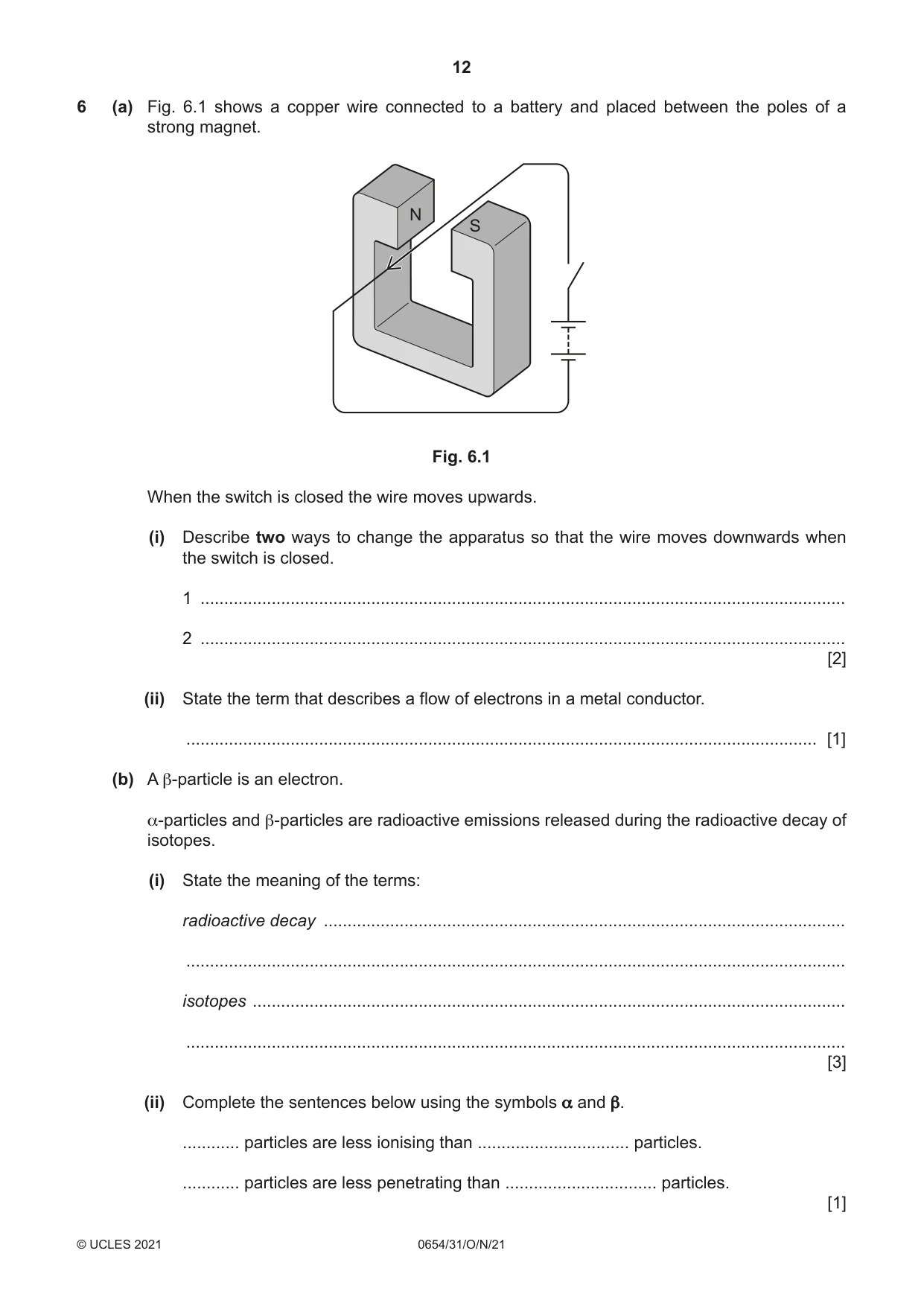
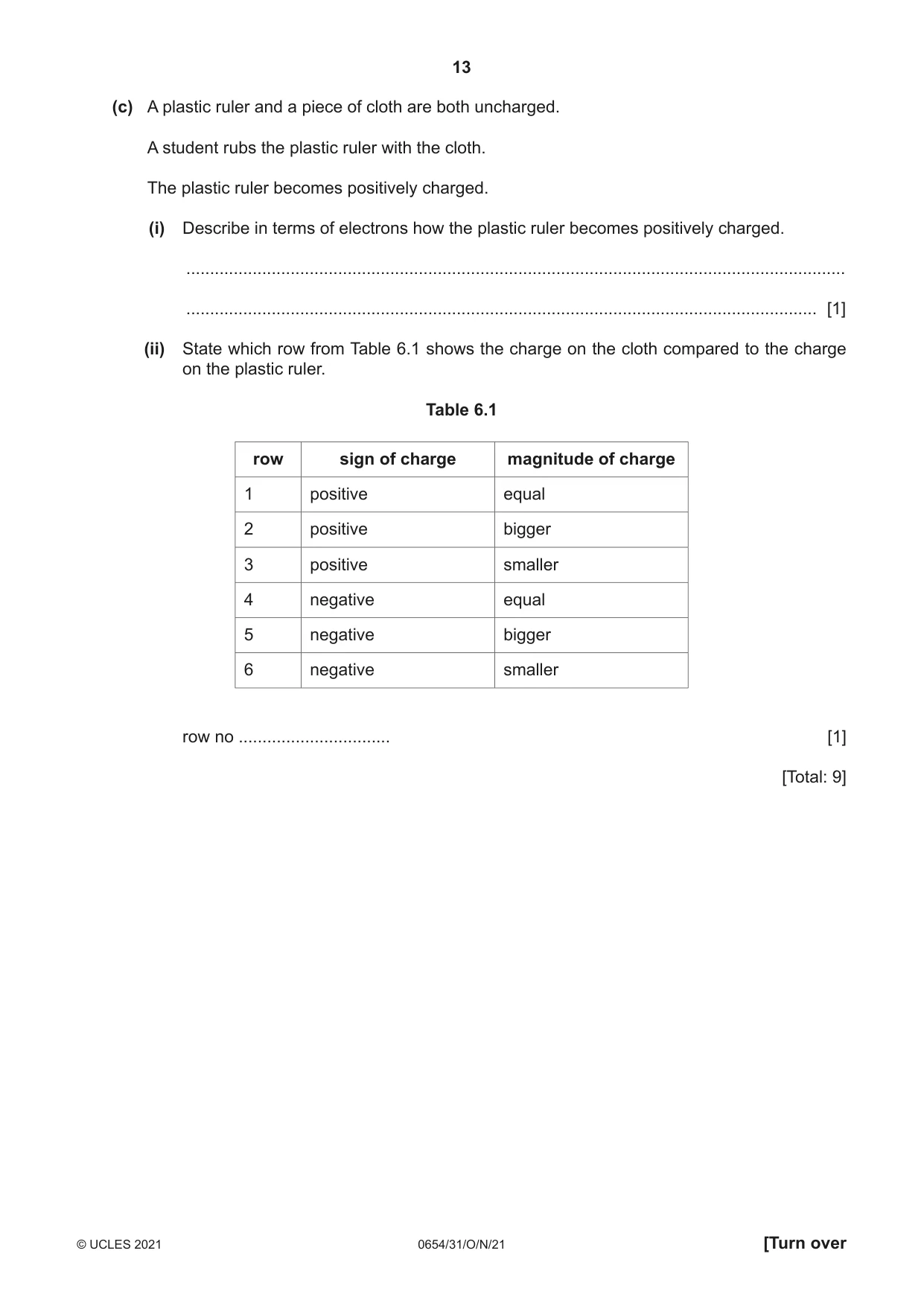
6 (a) Fig. 6.1 shows a copper wire connected to a battery and placed between the poles of a strong magnet. N S Fig. 6.1 When the switch is closed the wire moves upwards. (i) Describe two ways to change the apparatus so that the wire moves downwards when the switch is closed. 1 ........................................................................................................................................ 2 ........................................................................................................................................ [2] (ii) State the term that describes a flow of electrons in a metal conductor. ..................................................................................................................................... [1] (b) A β-particle is an electron. α-particles and β-particles are radioactive emissions released during the radioactive decay of isotopes. (i) State the meaning of the terms: radioactive decay .............................................................................................................. ........................................................................................................................................... isotopes ............................................................................................................................. ........................................................................................................................................... [3] (ii) Complete the sentences below using the symbols α and β. ............ particles are less ionising than ................................ particles. ............ particles are less penetrating than ................................ particles. [1] (c) A plastic ruler and a piece of cloth are both uncharged. A student rubs the plastic ruler with the cloth. The plastic ruler becomes positively charged. (i) Describe in terms of electrons how the plastic ruler becomes positively charged. ........................................................................................................................................... ..................................................................................................................................... [1] (ii) State which row from Table 6.1 shows the charge on the cloth compared to the charge on the plastic ruler. Table 6.1 row sign of charge magnitude of charge 1 positive equal 2 positive bigger 3 positive smaller 4 negative equal 5 negative bigger 6 negative smaller row no ................................ [1] [Total: 9]
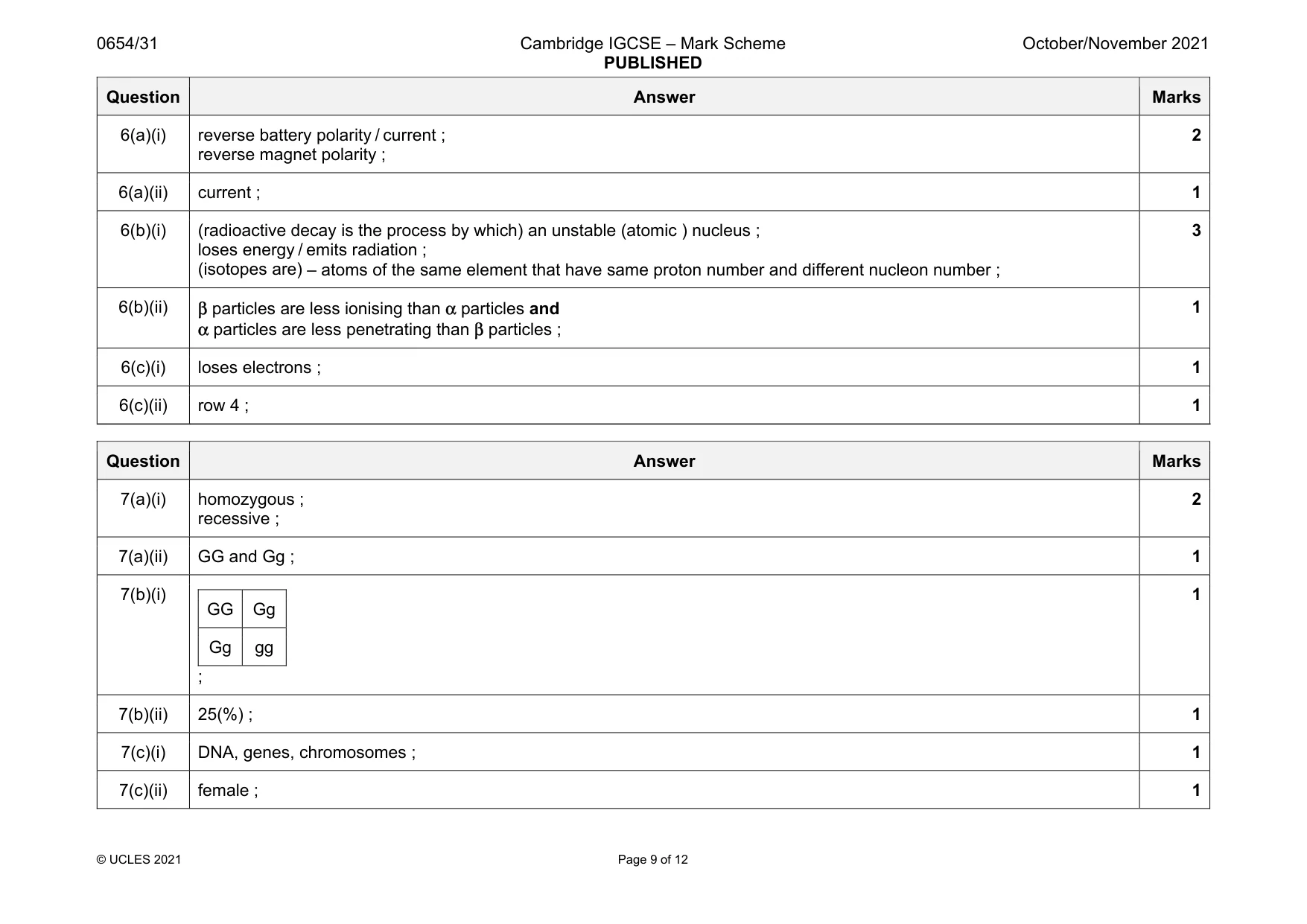
Mark scheme: 6(a)(i) reverse battery polarity / current ; reverse magnet polarity ; 2 6(a)(ii) current ; 1 6(b)(i) (radioactive decay is the process by which) an unstable (atomic ) nucleus ; loses energy / emits radiation ; (isotopes are) – atoms of the same element that have same proton number and different nucleon number ; 3 6(b)(ii) β particles are less ionising than α particles and α particles are less penetrating than β particles ; 1 6(c)(i) loses electrons ; 1 6(c)(ii) row 4 ; 1
Q7 · A student has two peas
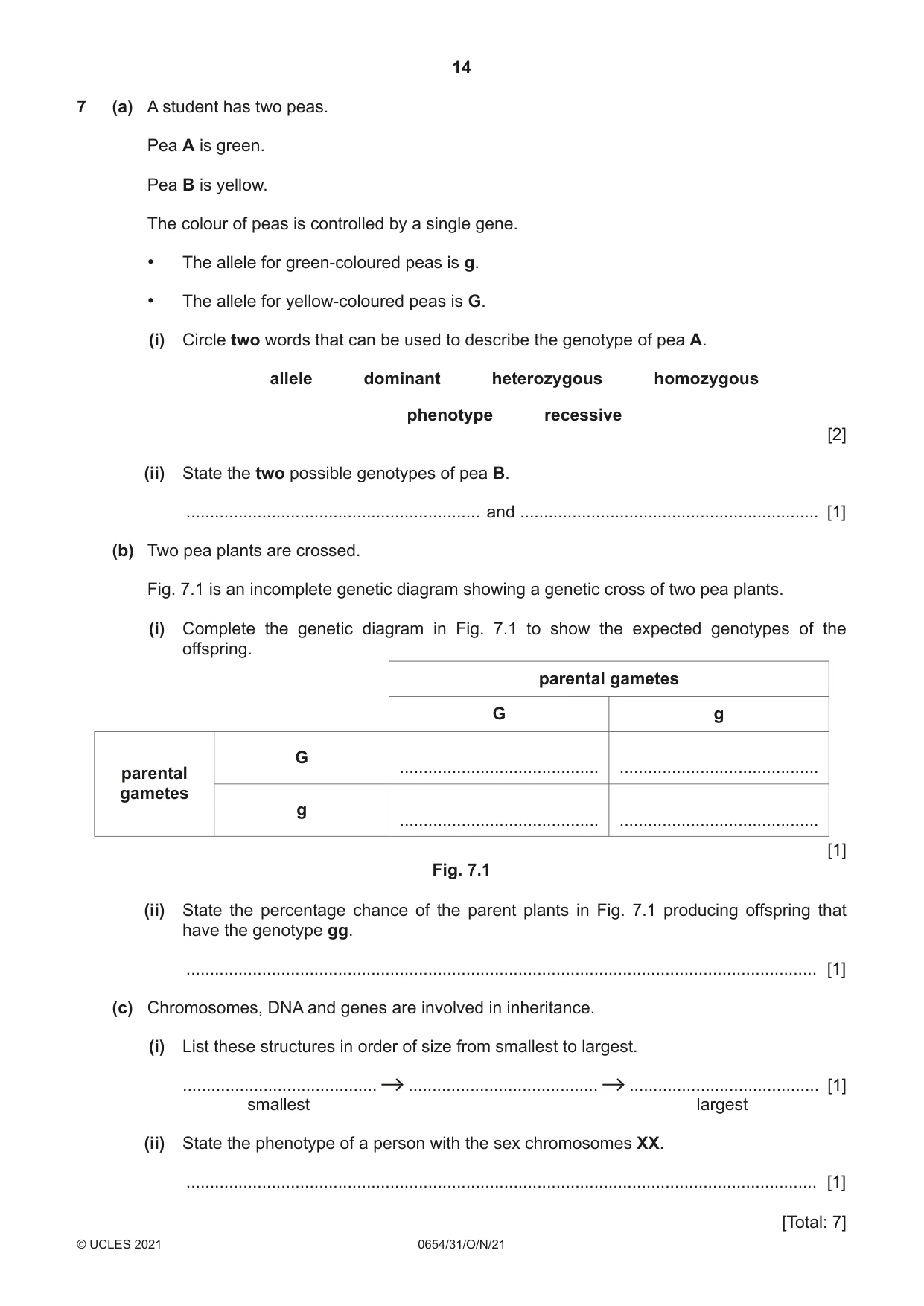
7 (a) A student has two peas. Pea A is green. Pea B is yellow. The colour of peas is controlled by a single gene. • The allele for green-coloured peas is g. • The allele for yellow-coloured peas is G. (i) Circle two words that can be used to describe the genotype of pea A. allele dominant heterozygous homozygous phenotype recessive [2] (ii) State the two possible genotypes of pea B. .............................................................. and ............................................................... [1] (b) Two pea plants are crossed. Fig. 7.1 is an incomplete genetic diagram showing a genetic cross of two pea plants. (i) Complete the genetic diagram in Fig. 7.1 to show the expected genotypes of the offspring. parental gametes G g G .......................................... .......................................... parental gametes g .......................................... .......................................... [1] Fig. 7.1 (ii) State the percentage chance of the parent plants in Fig. 7.1 producing offspring that have the genotype gg. ..................................................................................................................................... [1] (c) Chromosomes, DNA and genes are involved in inheritance. (i) List these structures in order of size from smallest to largest. ......................................... ........................................ ........................................ [1] smallest largest (ii) State the phenotype of a person with the sex chromosomes XX. ..................................................................................................................................... [1] [Total: 7]
Mark scheme: 7(a)(i) homozygous ; recessive ; 2 7(a)(ii) GG and Gg ; 1 7(b)(i) GG Gg Gg gg ; 1 7(b)(ii) 25(%) ; 1 7(c)(i) DNA, genes, chromosomes ; 1 7(c)(ii) female ; 1
Q8 · Petroleum is a fossil fuel
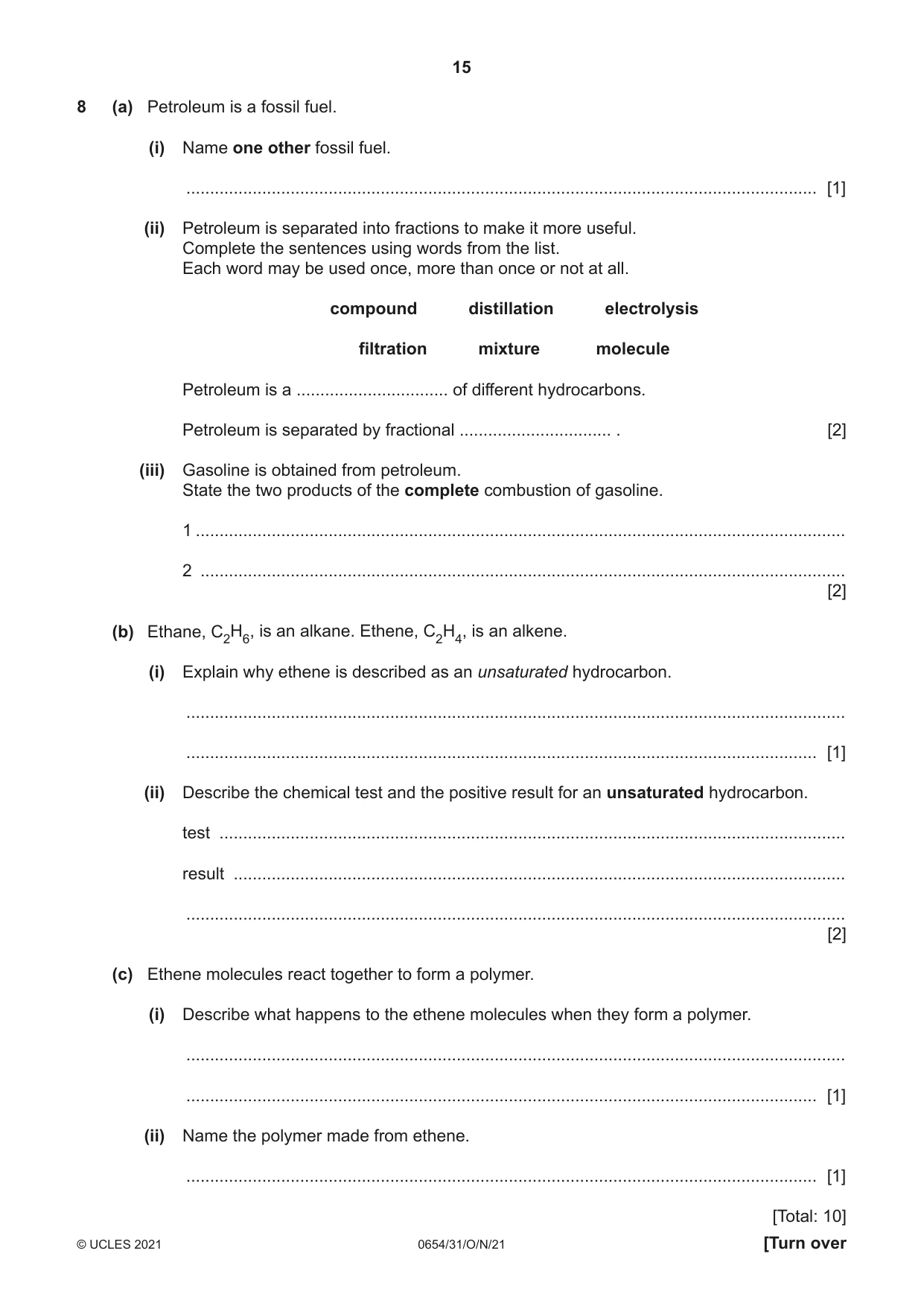
8 (a) Petroleum is a fossil fuel. (i) Name one other fossil fuel. ..................................................................................................................................... [1] (ii) Petroleum is separated into fractions to make it more useful. Complete the sentences using words from the list. Each word may be used once, more than once or not at all. compound distillation electrolysis filtration mixture molecule Petroleum is a ................................ of different hydrocarbons. Petroleum is separated by fractional ................................ . [2] (iii) Gasoline is obtained from petroleum. State the two products of the complete combustion of gasoline. 1 ......................................................................................................................................... 2 ........................................................................................................................................ [2] (b) Ethane, C2H6, is an alkane. Ethene, C2H4, is an alkene. (i) Explain why ethene is described as an unsaturated hydrocarbon. ........................................................................................................................................... ..................................................................................................................................... [1] (ii) Describe the chemical test and the positive result for an unsaturated hydrocarbon. test .................................................................................................................................... result ................................................................................................................................. ........................................................................................................................................... [2] (c) Ethene molecules react together to form a polymer. (i) Describe what happens to the ethene molecules when they form a polymer. ........................................................................................................................................... ..................................................................................................................................... [1] (ii) Name the polymer made from ethene. ..................................................................................................................................... [1] [Total: 10]
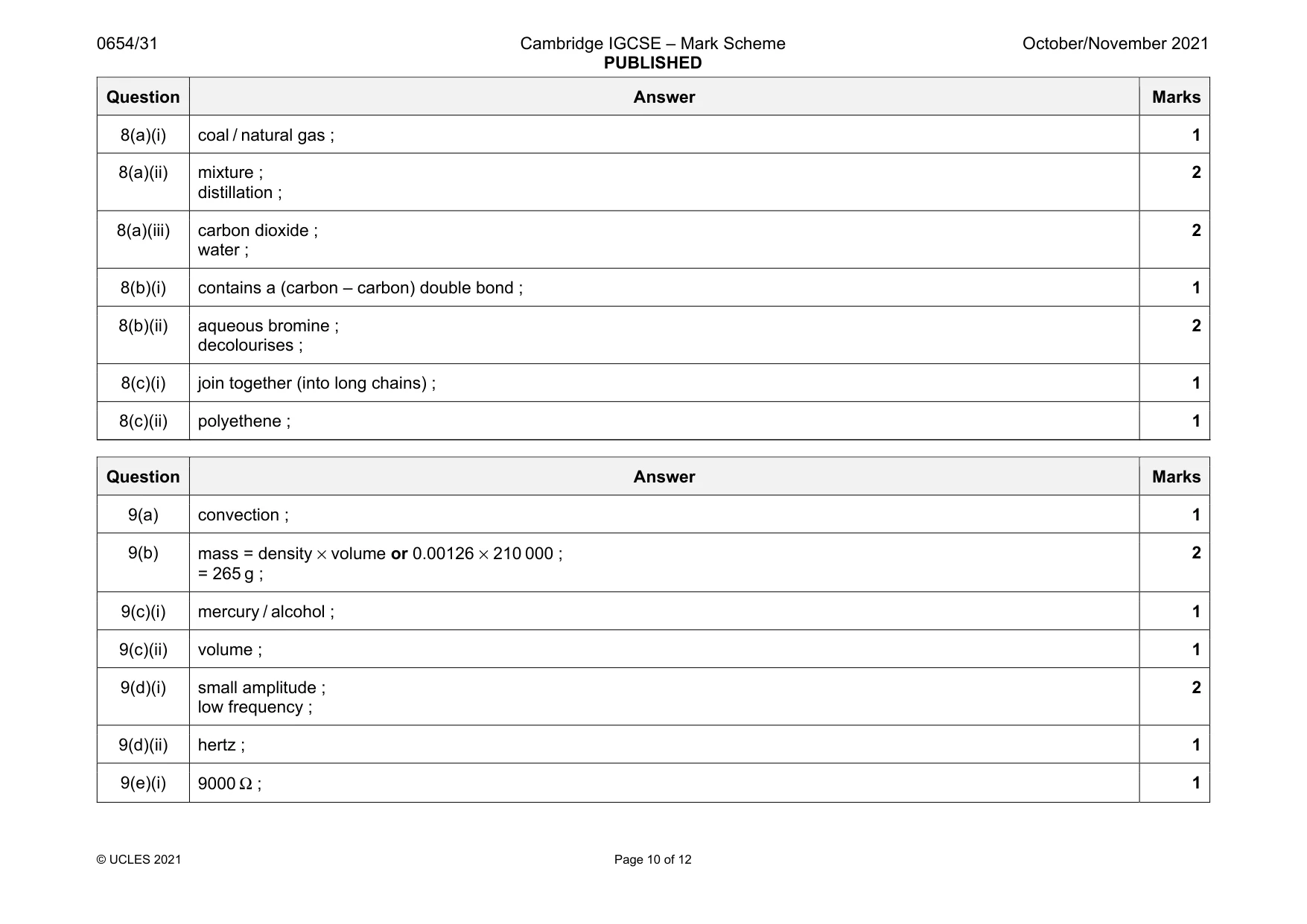
Mark scheme: 8(a)(i) coal / natural gas ; 1 8(a)(ii) mixture ; distillation ; 2 8(a)(iii) carbon dioxide ; water ; 2 8(b)(i) contains a (carbon – carbon) double bond ; 1 8(b)(ii) aqueous bromine ; decolourises ; 2 8(c)(i) join together (into long chains) ; 1 8(c)(ii) polyethene ; 1
Question 9
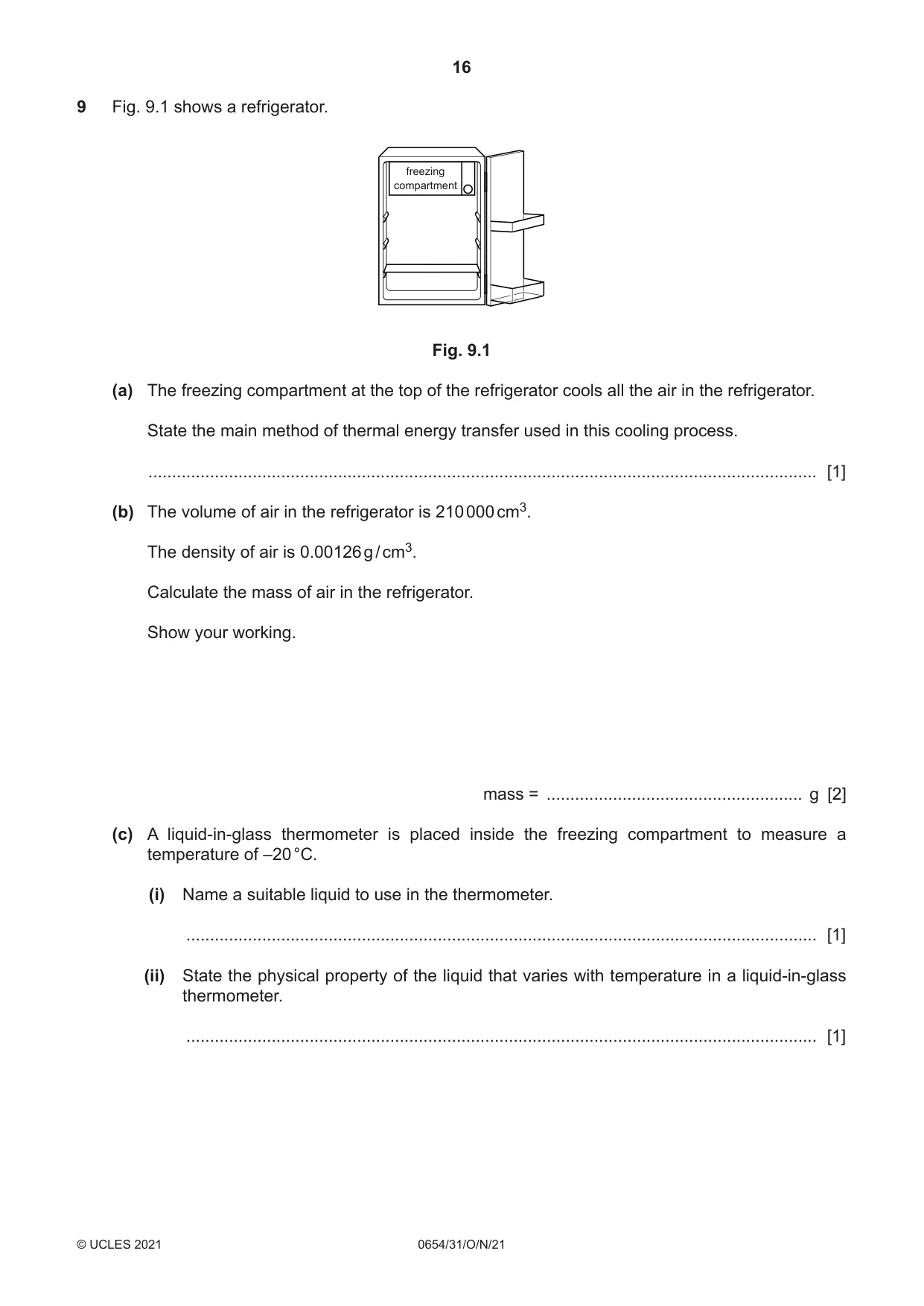
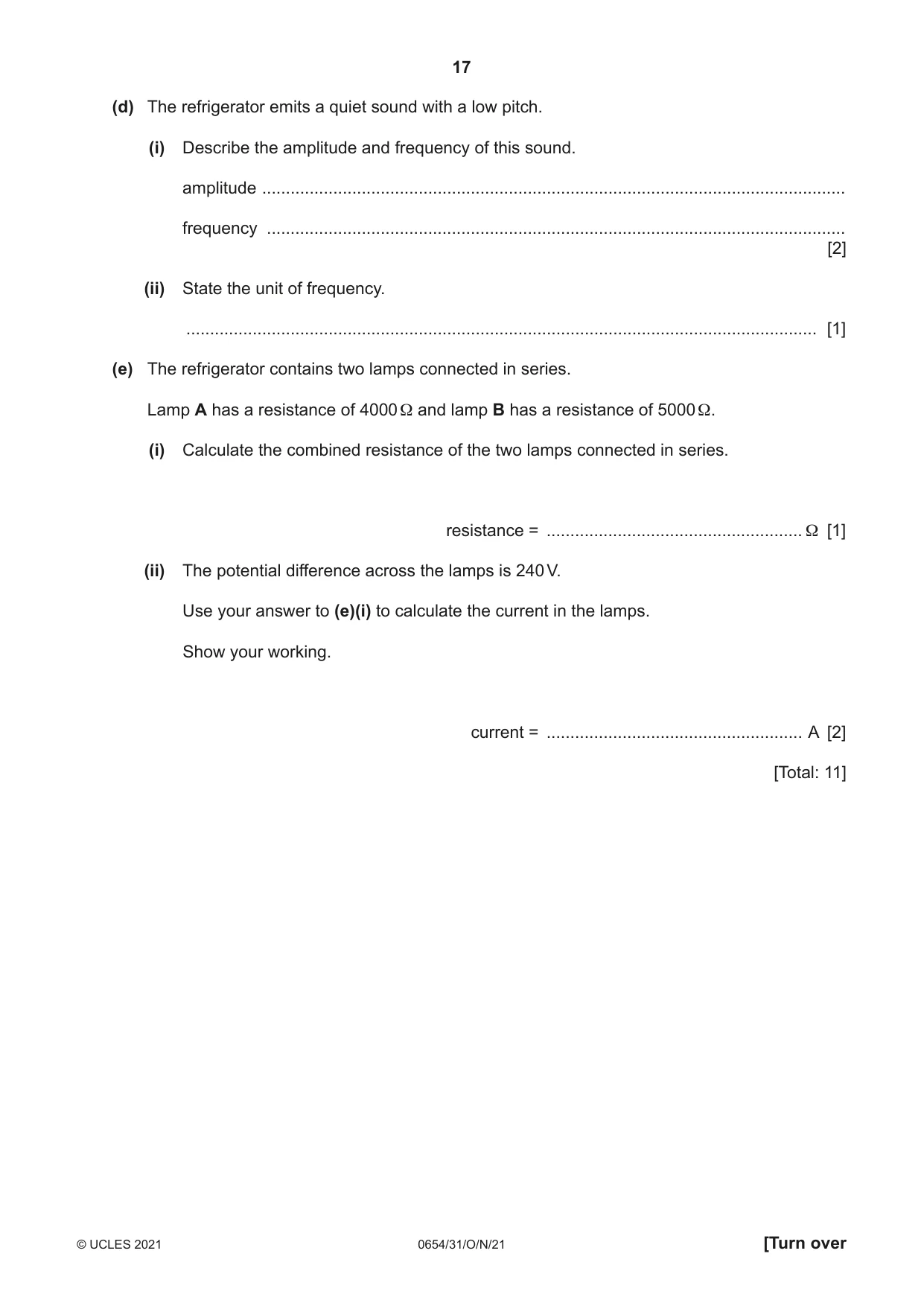
9 Fig. 9.1 shows a refrigerator. freezing compartment Fig. 9.1 (a) The freezing compartment at the top of the refrigerator cools all the air in the refrigerator. State the main method of thermal energy transfer used in this cooling process. ............................................................................................................................................. [1] (b) The volume of air in the refrigerator is 210 000 cm3. The density of air is 0.00126 g / cm3. Calculate the mass of air in the refrigerator. Show your working. mass = ...................................................... g [2] (c) A liquid-in-glass thermometer is placed inside the freezing compartment to measure a temperature of –20 °C. (i) Name a suitable liquid to use in the thermometer. ..................................................................................................................................... [1] (ii) State the physical property of the liquid that varies with temperature in a liquid-in-glass thermometer. ..................................................................................................................................... [1] (d) The refrigerator emits a quiet sound with a low pitch. (i) Describe the amplitude and frequency of this sound. amplitude ........................................................................................................................... frequency .......................................................................................................................... [2] (ii) State the unit of frequency. ..................................................................................................................................... [1] (e) The refrigerator contains two lamps connected in series. Lamp A has a resistance of 4000 Ω and lamp B has a resistance of 5000 Ω. (i) Calculate the combined resistance of the two lamps connected in series. resistance = ...................................................... Ω [1] (ii) The potential difference across the lamps is 240 V. Use your answer to (e)(i) to calculate the current in the lamps. Show your working. current = ...................................................... A [2] [Total: 11]
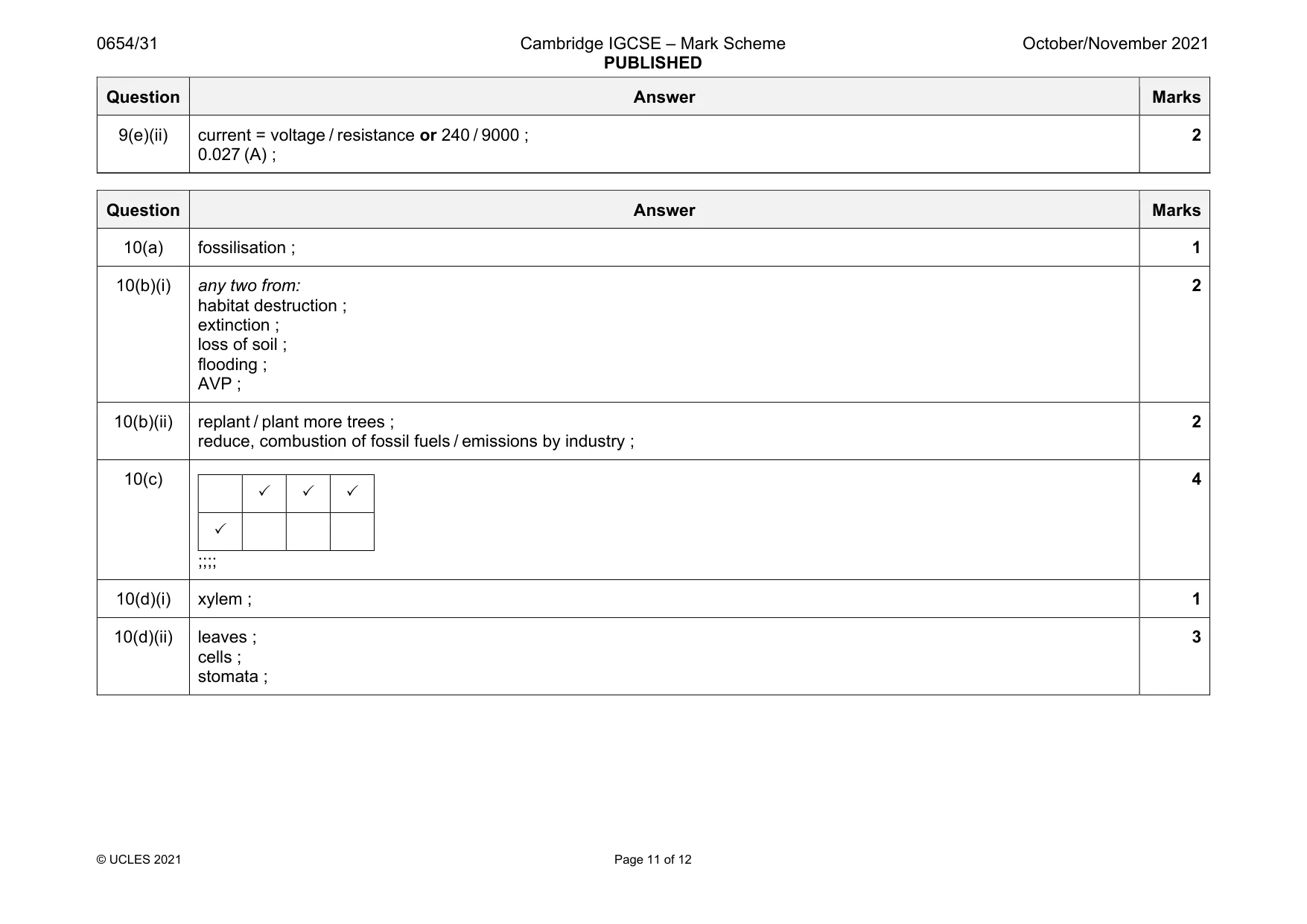
Mark scheme: 9(a) convection ; 1 9(b) mass = density × volume or 0.00126 × 210 000 ; = 265 g ; 2 9(c)(i) mercury / alcohol ; 1 9(c)(ii) volume ; 1 9(d)(i) small amplitude ; low frequency ; 2 9(d)(ii) hertz ; 1 9(e)(i) 9000 Ω ; 1 Question Answer Marks 9(e)(ii) current = voltage / resistance or 240 / 9000 ; 0.027 (A) ; 2
Q10 · A diagram showing part of the carbon cycle
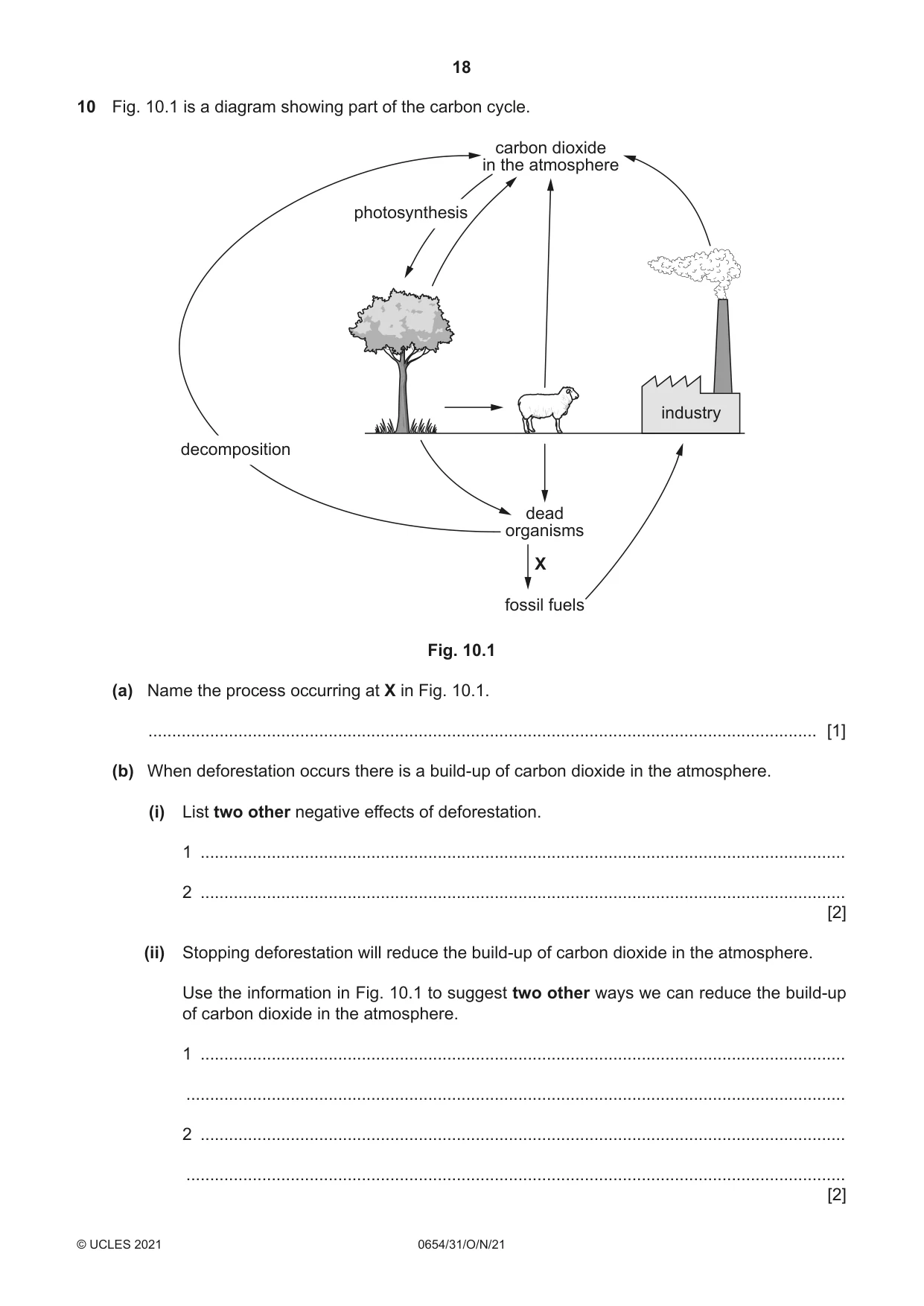
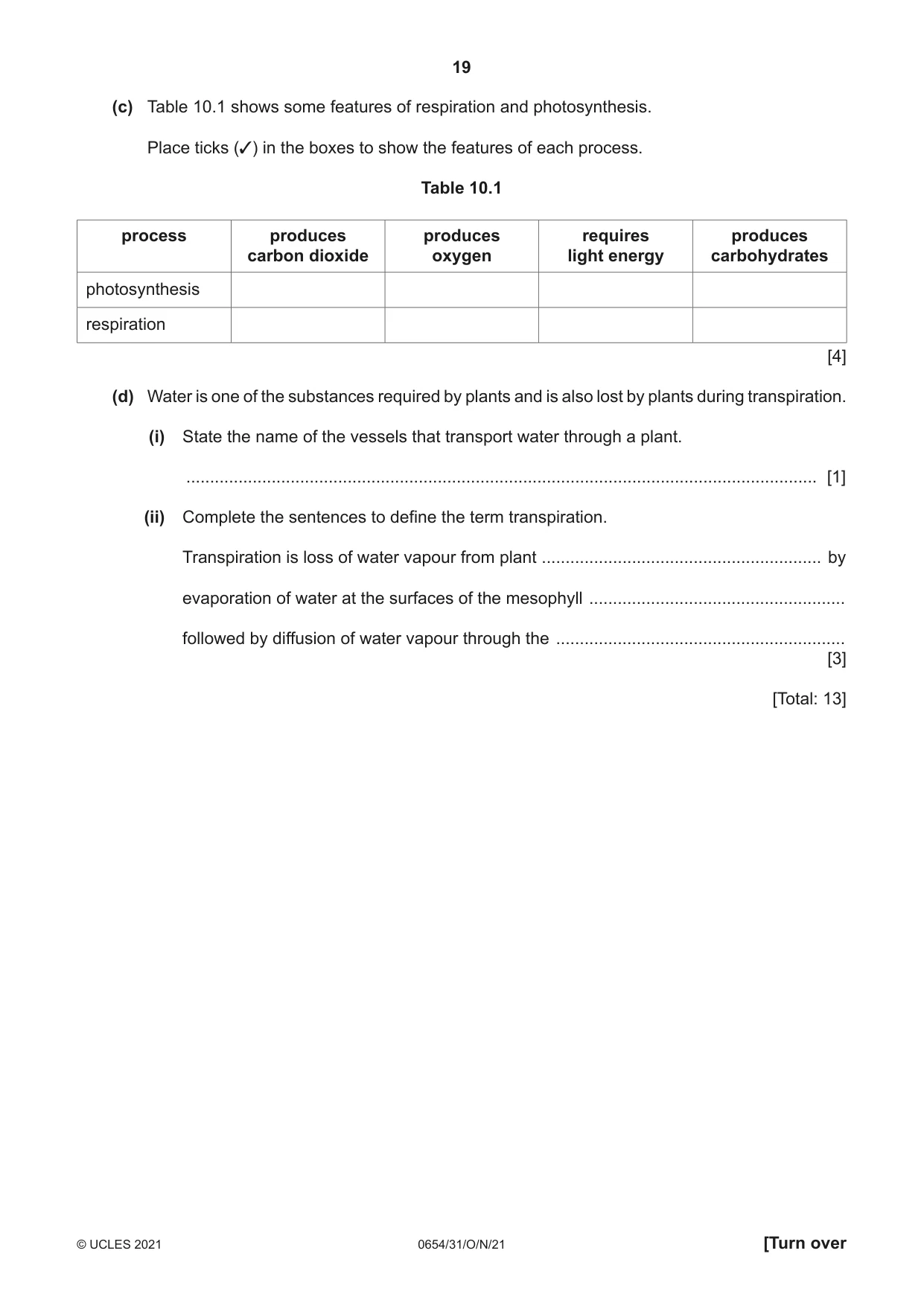
10 Fig. 10.1 is a diagram showing part of the carbon cycle. carbon dioxide in the atmosphere photosynthesis industry decomposition dead organisms X fossil fuels Fig. 10.1 (a) Name the process occurring at X in Fig. 10.1. ............................................................................................................................................. [1] (b) When deforestation occurs there is a build-up of carbon dioxide in the atmosphere. (i) List two other negative effects of deforestation. 1 ........................................................................................................................................ 2 ........................................................................................................................................ [2] (ii) Stopping deforestation will reduce the build-up of carbon dioxide in the atmosphere. Use the information in Fig. 10.1 to suggest two other ways we can reduce the build-up of carbon dioxide in the atmosphere. 1 ........................................................................................................................................ ........................................................................................................................................... 2 ........................................................................................................................................ ........................................................................................................................................... [2] (c) Table 10.1 shows some features of respiration and photosynthesis. Place ticks (3) in the boxes to show the features of each process. Table 10.1 process produces produces requires produces carbon dioxide oxygen light energy carbohydrates photosynthesis respiration [4] (d) Water is one of the substances required by plants and is also lost by plants during transpiration. (i) State the name of the vessels that transport water through a plant. ..................................................................................................................................... [1] (ii) Complete the sentences to define the term transpiration. Transpiration is loss of water vapour from plant ........................................................... by evaporation of water at the surfaces of the mesophyll ...................................................... followed by diffusion of water vapour through the ............................................................. [3] [Total: 13]
Mark scheme: 10(a) fossilisation ; 1 10(b)(i) any two from: habitat destruction ; extinction ; loss of soil ; flooding ; AVP ; 2 10(b)(ii) replant / plant more trees ; reduce, combustion of fossil fuels / emissions by industry ; 2 10(c) ;;;; 4 10(d)(i) xylem ; 1 10(d)(ii) leaves ; cells ; stomata ; 3
Q11 · The melting points of some Group I elements
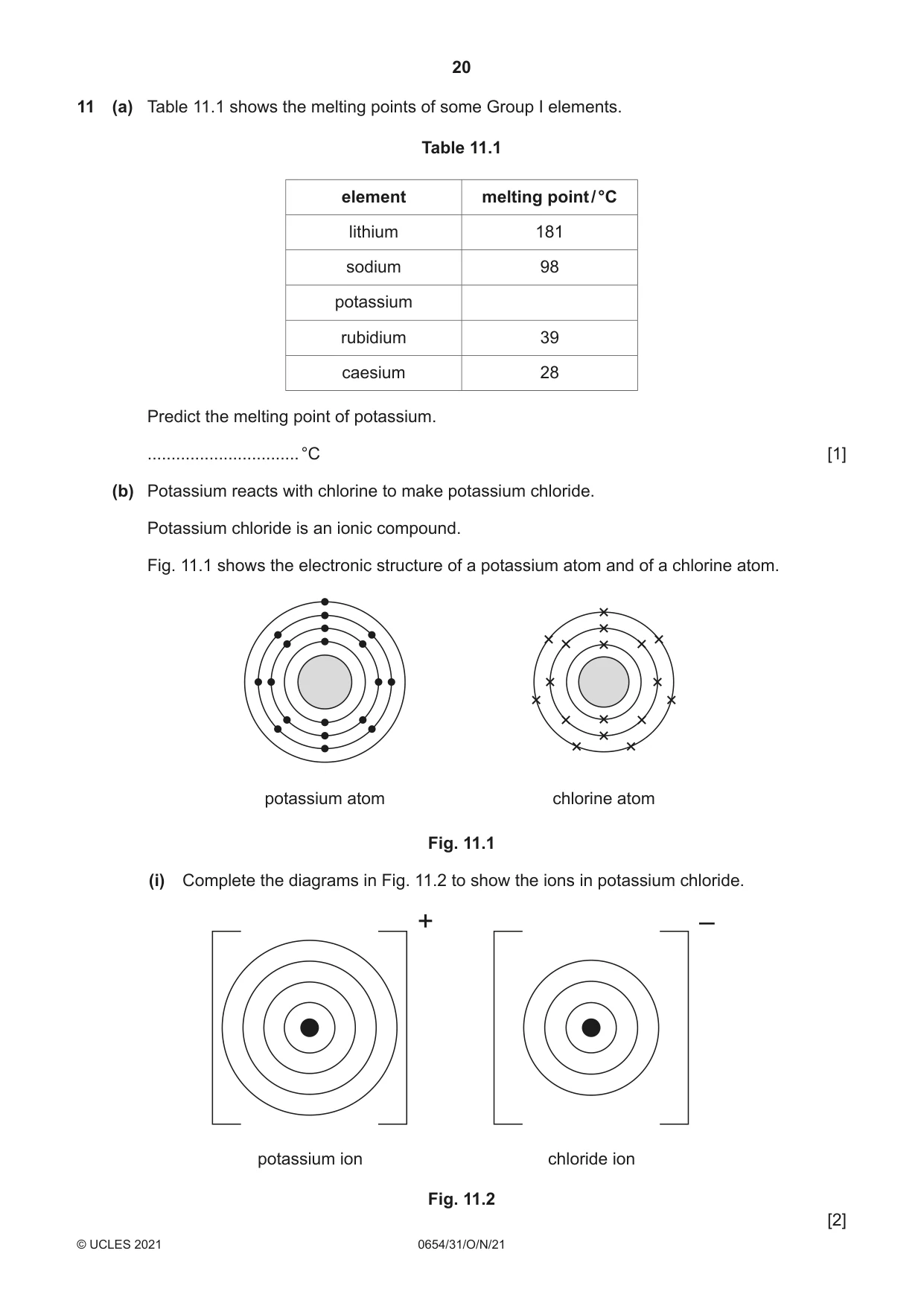
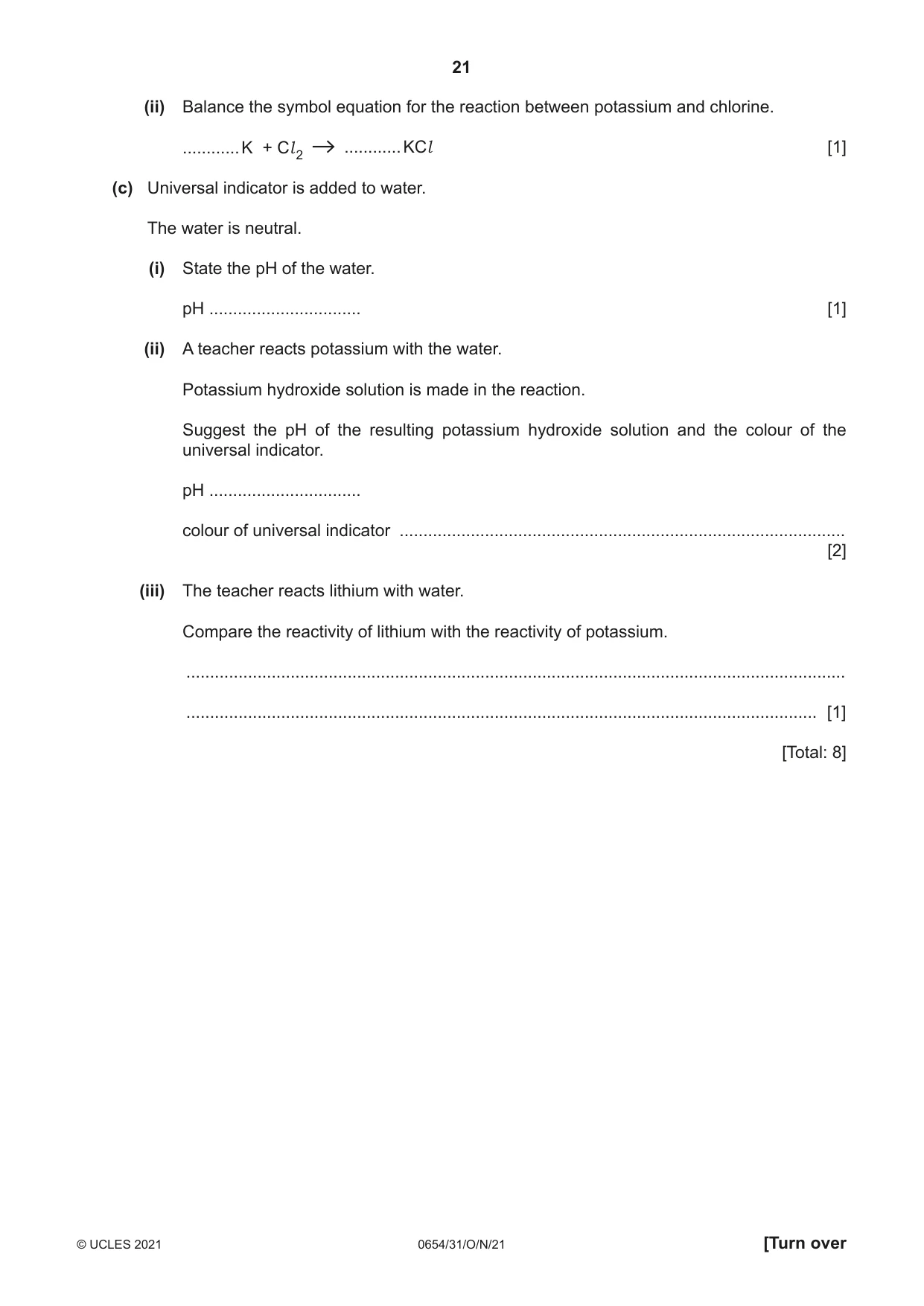
11 (a) Table 11.1 shows the melting points of some Group I elements. Table 11.1 element melting point / °C lithium 181 sodium 98 potassium rubidium 39 caesium 28 Predict the melting point of potassium. ................................ °C [1] (b) Potassium reacts with chlorine to make potassium chloride. Potassium chloride is an ionic compound. Fig. 11.1 shows the electronic structure of a potassium atom and of a chlorine atom. potassium atom chlorine atom Fig. 11.1 (i) Complete the diagrams in Fig. 11.2 to show the ions in potassium chloride. + – potassium ion chloride ion Fig. 11.2 [2] (ii) Balance the symbol equation for the reaction between potassium and chlorine. ............ K + Cl2 ............ KCl [1] (c) Universal indicator is added to water. The water is neutral. (i) State the pH of the water. pH ................................ [1] (ii) A teacher reacts potassium with the water. Potassium hydroxide solution is made in the reaction. Suggest the pH of the resulting potassium hydroxide solution and the colour of the universal indicator. pH ................................ colour of universal indicator .............................................................................................. [2] (iii) The teacher reacts lithium with water. Compare the reactivity of lithium with the reactivity of potassium. ........................................................................................................................................... ..................................................................................................................................... [1] [Total: 8]
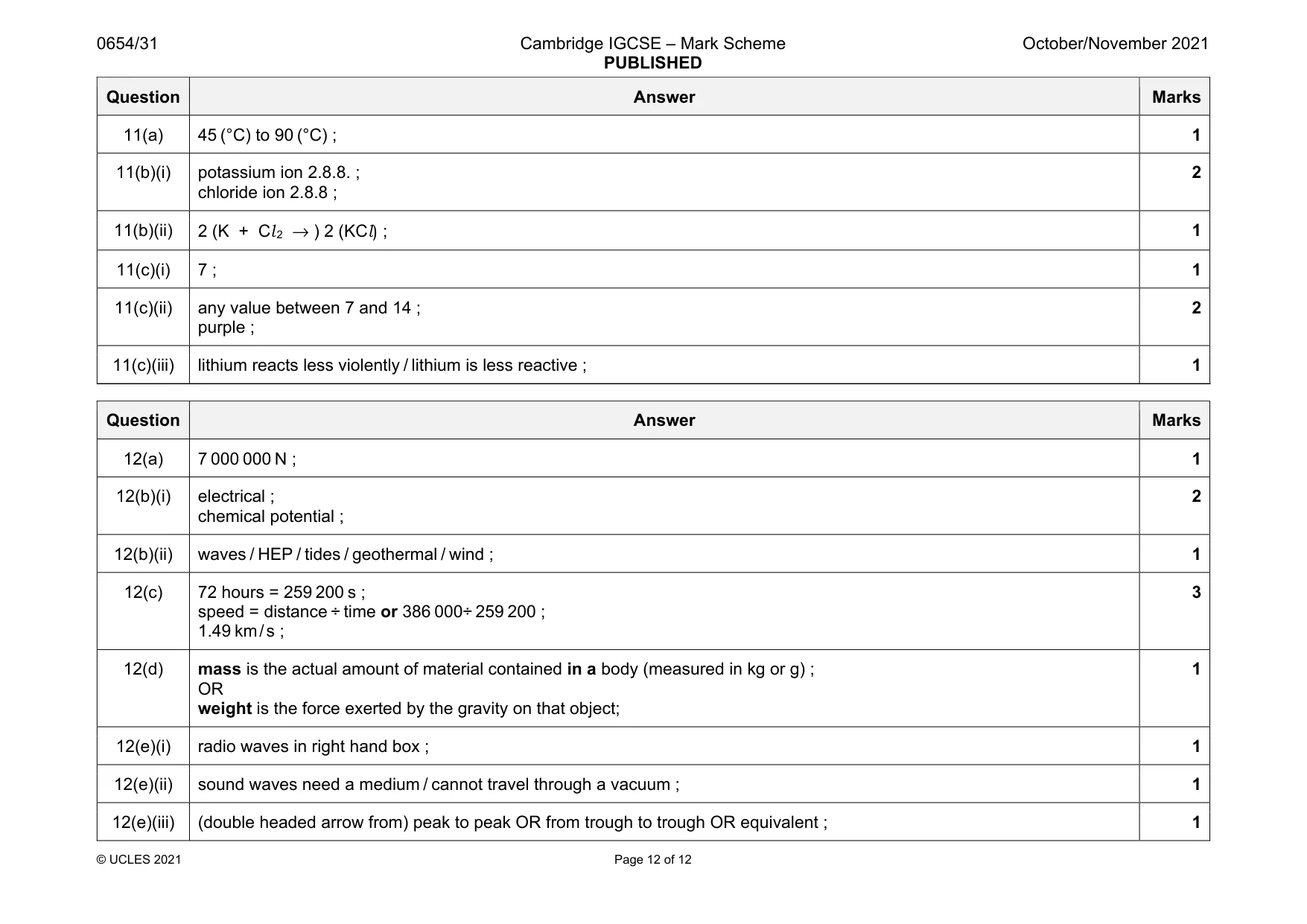
Mark scheme: 11(a) 45 (°C) to 90 (°C) ; 1 11(b)(i) potassium ion 2.8.8. ; chloride ion 2.8.8 ; 2 11(b)(ii) 2 (K + Cl 2 → ) 2 (KCl) ; 1 11(c)(i) 7 ; 1 11(c)(ii) any value between 7 and 14 ; purple ; 2 11(c)(iii) lithium reacts less violently / lithium is less reactive ; 1
Q12 · An astronaut travels to the Moon in a spacecraft
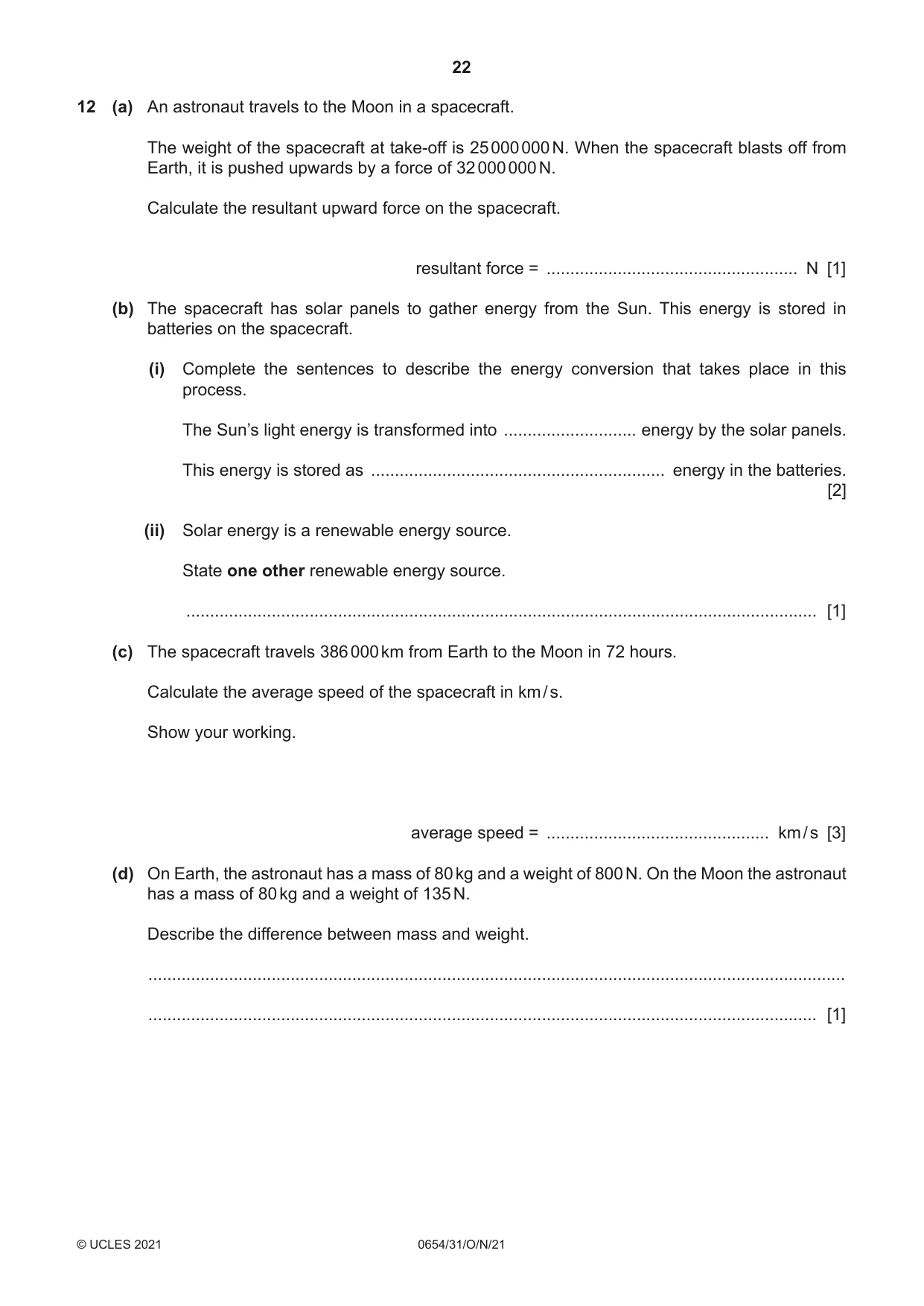
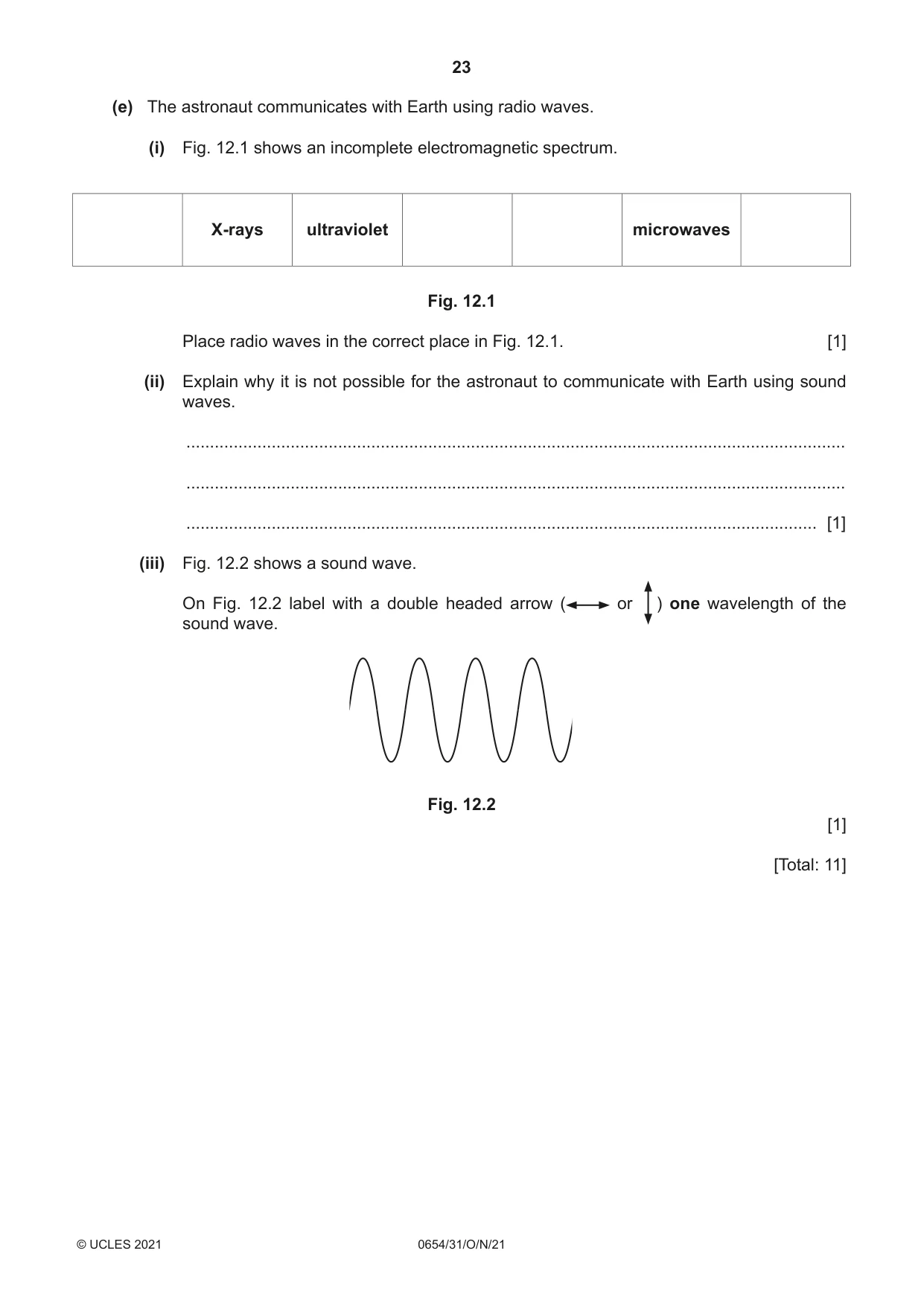
12 (a) An astronaut travels to the Moon in a spacecraft. The weight of the spacecraft at take-off is 25 000 000 N. When the spacecraft blasts off from Earth, it is pushed upwards by a force of 32 000 000 N. Calculate the resultant upward force on the spacecraft. resultant force = ..................................................... N [1] (b) The spacecraft has solar panels to gather energy from the Sun. This energy is stored in batteries on the spacecraft. (i) Complete the sentences to describe the energy conversion that takes place in this process. The Sun’s light energy is transformed into ............................ energy by the solar panels. This energy is stored as .............................................................. energy in the batteries. [2] (ii) Solar energy is a renewable energy source. State one other renewable energy source. ..................................................................................................................................... [1] (c) The spacecraft travels 386 000 km from Earth to the Moon in 72 hours. Calculate the average speed of the spacecraft in km / s. Show your working. average speed = ............................................... km / s [3] (d) On Earth, the astronaut has a mass of 80 kg and a weight of 800 N. On the Moon the astronaut has a mass of 80 kg and a weight of 135 N. Describe the difference between mass and weight. ................................................................................................................................................... ............................................................................................................................................. [1] (e) The astronaut communicates with Earth using radio waves. (i) Fig. 12.1 shows an incomplete electromagnetic spectrum. X-rays ultraviolet microwaves Fig. 12.1 Place radio waves in the correct place in Fig. 12.1. [1] (ii) Explain why it is not possible for the astronaut to communicate with Earth using sound waves. ........................................................................................................................................... ........................................................................................................................................... ..................................................................................................................................... [1] (iii) Fig. 12.2 shows a sound wave. On Fig. 12.2 label with a double headed arrow ( or ) one wavelength of the sound wave. Fig. 12.2 [1] [Total: 11]
Mark scheme: 12(a) 7 000 000 N ; 1 12(b)(i) electrical ; chemical potential ; 2 12(b)(ii) waves / HEP / tides / geothermal / wind ; 1 12(c) 72 hours = 259 200 s ; speed = distance ÷ time or 386 000÷ 259 200 ; 1.49 km / s ; 3 12(d) mass is the actual amount of material contained in a body (measured in kg or g) ; OR weight is the force exerted by the gravity on that object; 1 12(e)(i) radio waves in right hand box ; 1 12(e)(ii) sound waves need a medium / cannot travel through a vacuum ; 1 12(e)(iii) (double headed arrow from) peak to peak OR from trough to trough OR equivalent ; 1
What was in this paper
The subtopics covered by these 12 questions, and how many questions each got. Open one in a new tab to see every Cambridge question on it.
What you needed in this session
Cambridge’s own grade thresholds for 2021 Oct/Nov, Paper 3 · Variant 1. A higher threshold means an easier paper — the bar moves with how the cohort did.