Cambridge IGCSE Sciences - Co-ordinated (Double) 0654 — 2023 Oct/Nov Paper 3 · Variant 3
0654/33/O/N/23 · 12 questions · 120 marks · ≈135 min
The question paper and its mark scheme, free to read here and free to download. This is Cambridge’s own paper, exactly as it was sat.
Question paper28 pages
Mark scheme17 pages
Answers below. Sit the paper first if you are practising.
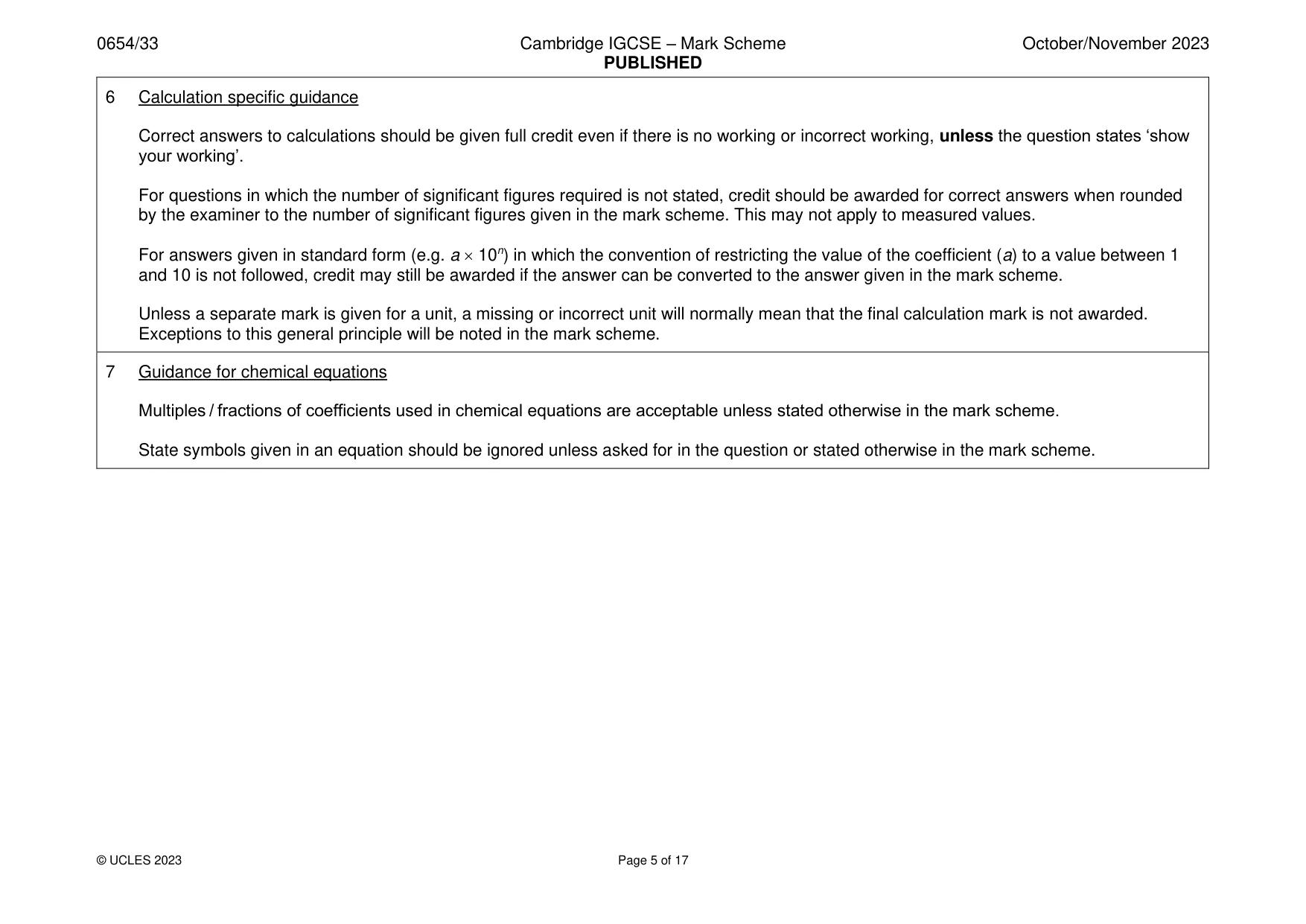
Questions as text
Q1 · Reproduction is one of the characteristics of living things
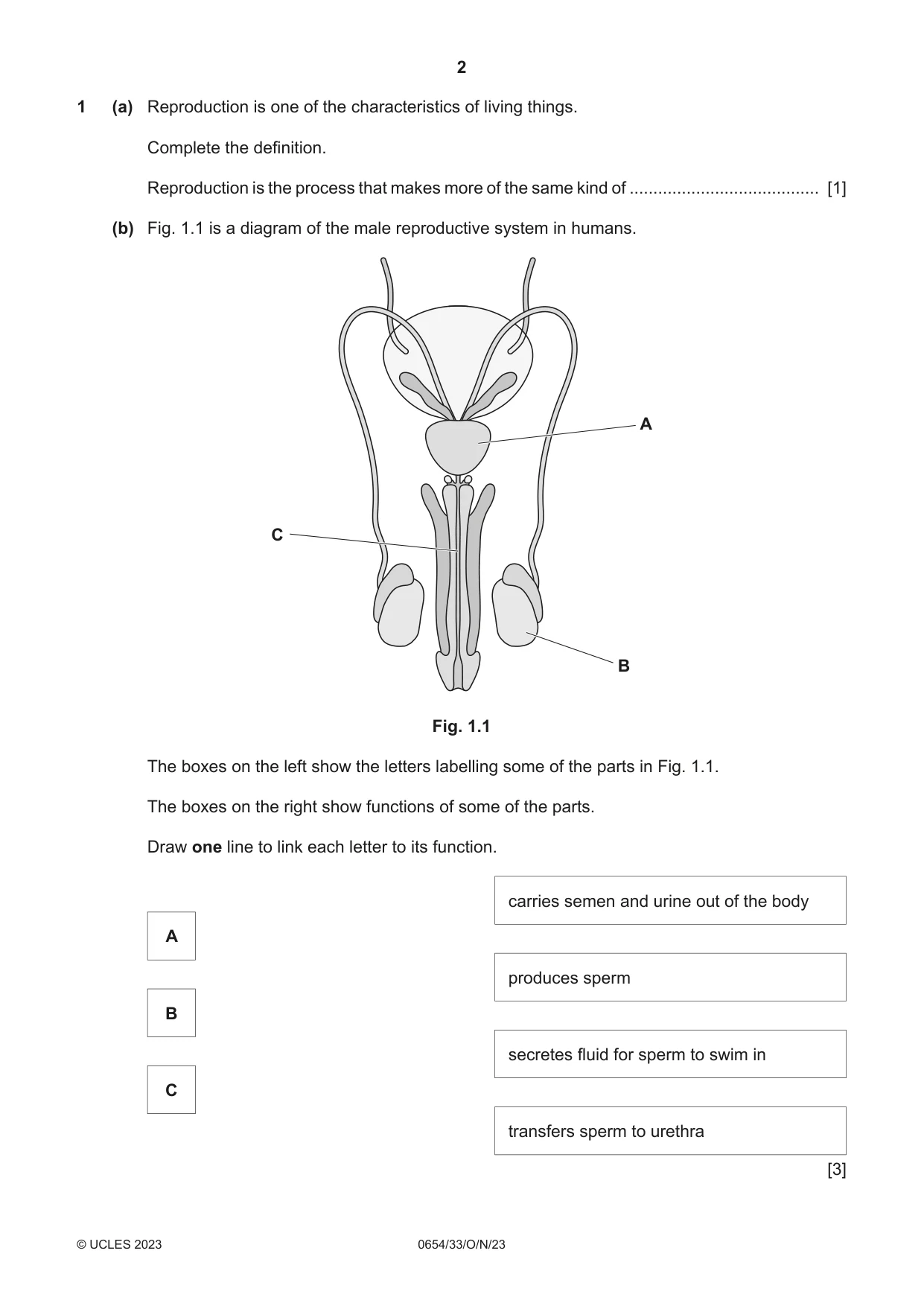
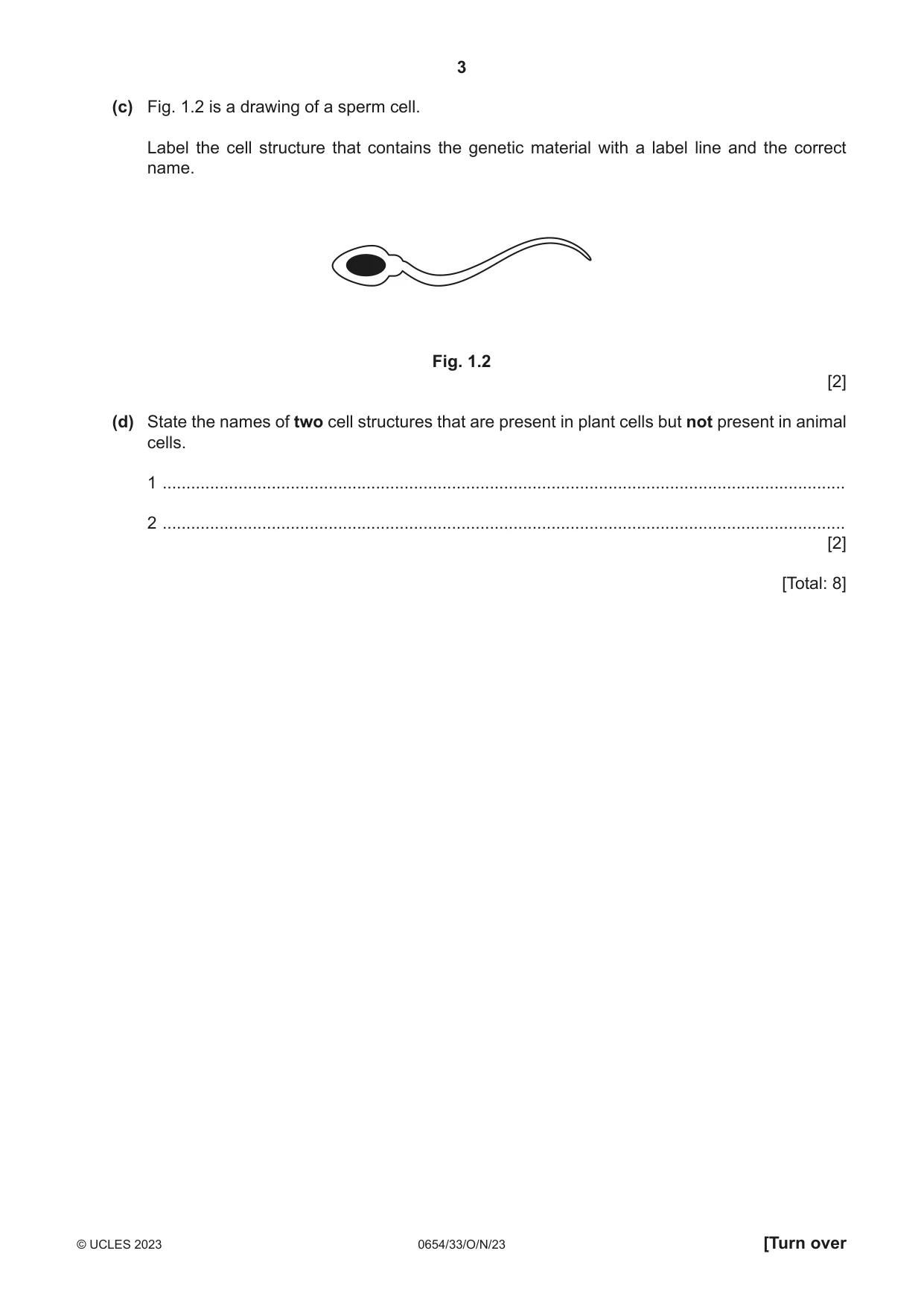
1 (a) Reproduction is one of the characteristics of living things. Complete the definition. Reproduction is the process that makes more of the same kind of ........................................ [1] (b) Fig. 1.1 is a diagram of the male reproductive system in humans. A C B Fig. 1.1 The boxes on the left show the letters labelling some of the parts in Fig. 1.1. The boxes on the right show functions of some of the parts. Draw one line to link each letter to its function. carries semen and urine out of the body A produces sperm B secretes fluid for sperm to swim in C transfers sperm to urethra [3] (c) Fig. 1.2 is a drawing of a sperm cell. Label the cell structure that contains the genetic material with a label line and the correct name. Fig. 1.2 [2] (d) State the names of two cell structures that are present in plant cells but not present in animal cells. 1 ................................................................................................................................................ 2 ................................................................................................................................................ [2] [Total: 8]
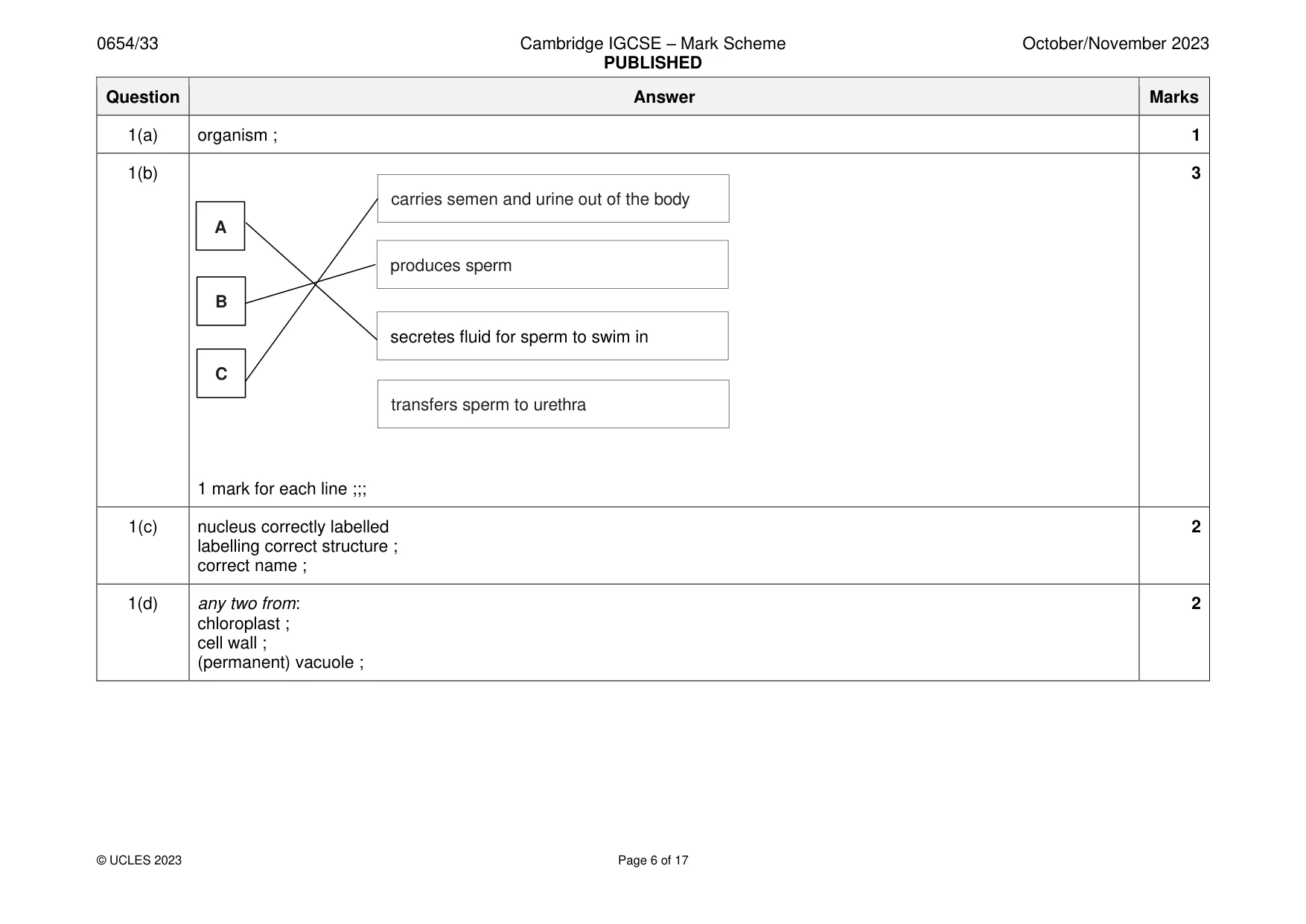
Mark scheme: Question Answer Marks 1(a) organism ; 1 1(b) 3 carries semen and urine out of the body A produces sperm B secretes fluid for sperm to swim in C transfers sperm to urethra 1 mark for each line ;;; 1(c) nucleus correctly labelled 2 labelling correct structure ; correct name ; 1(d) any two from: 2 chloroplast ; cell wall ; (permanent) vacuole ;
Q2 · There are different methods of separating mixtures
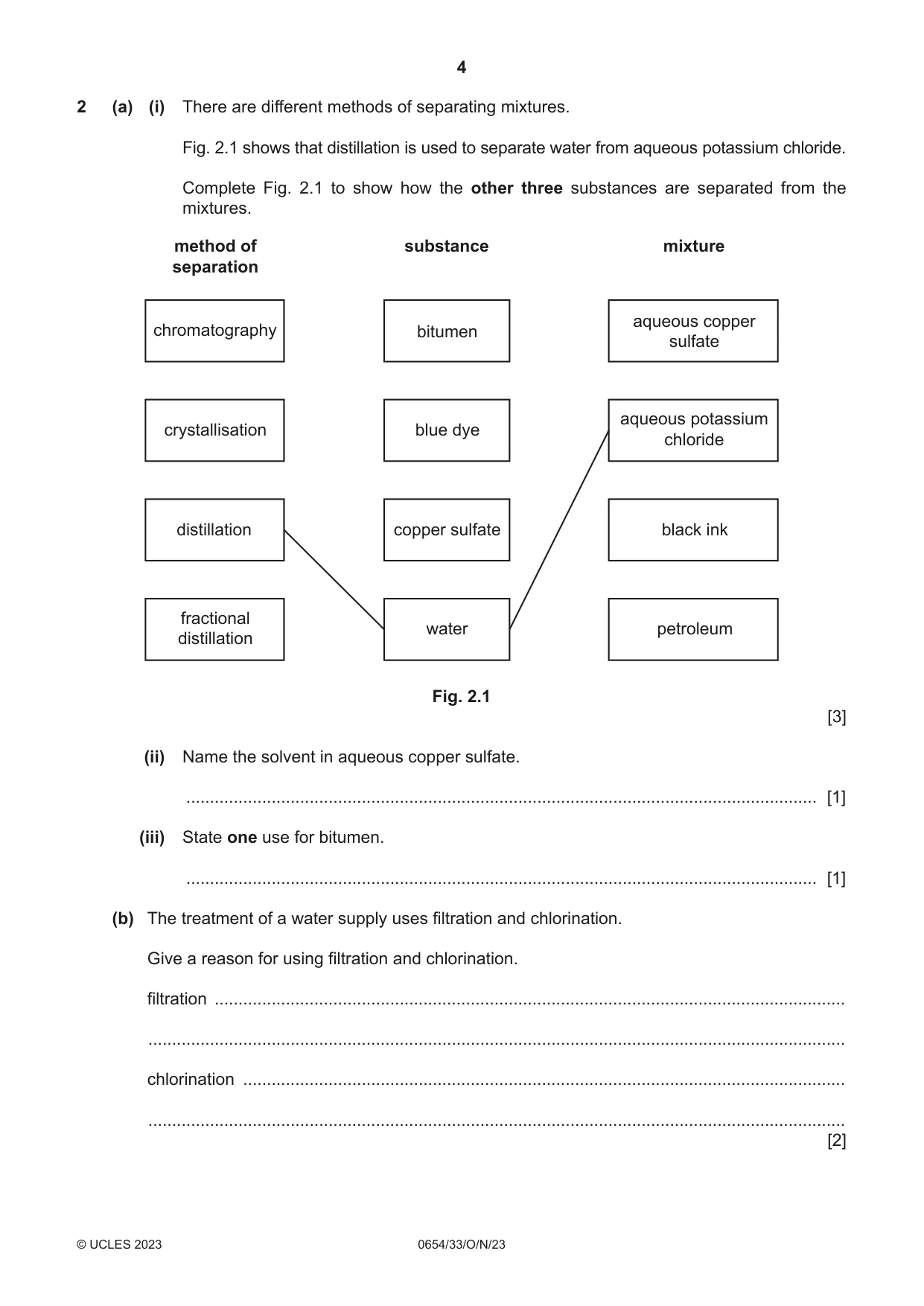
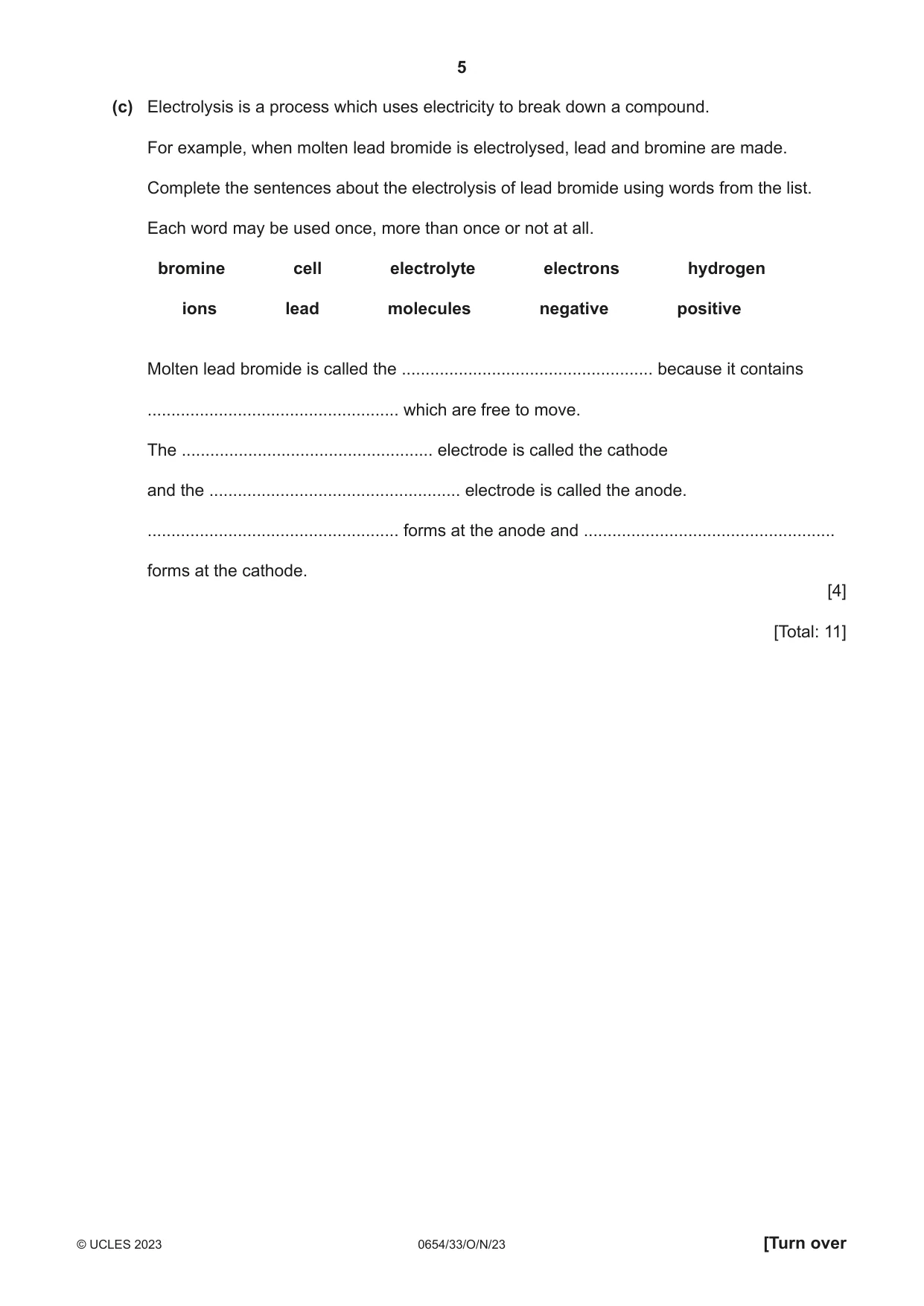
2 (a) (i) There are different methods of separating mixtures. Fig. 2.1 shows that distillation is used to separate water from aqueous potassium chloride. Complete Fig. 2.1 to show how the other three substances are separated from the mixtures. method of substance mixture separation aqueous copper chromatography bitumen sulfate aqueous potassium crystallisation blue dye chloride distillation copper sulfate black ink fractional water petroleum distillation Fig. 2.1 [3] (ii) Name the solvent in aqueous copper sulfate. ..................................................................................................................................... [1] (iii) State one use for bitumen. ..................................................................................................................................... [1] (b) The treatment of a water supply uses filtration and chlorination. Give a reason for using filtration and chlorination. filtration ..................................................................................................................................... ................................................................................................................................................... chlorination ............................................................................................................................... ................................................................................................................................................... [2] (c) Electrolysis is a process which uses electricity to break down a compound. For example, when molten lead bromide is electrolysed, lead and bromine are made. Complete the sentences about the electrolysis of lead bromide using words from the list. Each word may be used once, more than once or not at all. bromine cell electrolyte electrons hydrogen ions lead molecules negative positive Molten lead bromide is called the ..................................................... because it contains ..................................................... which are free to move. The ..................................................... electrode is called the cathode and the ..................................................... electrode is called the anode. ..................................................... forms at the anode and ..................................................... forms at the cathode. [4] [Total: 11]
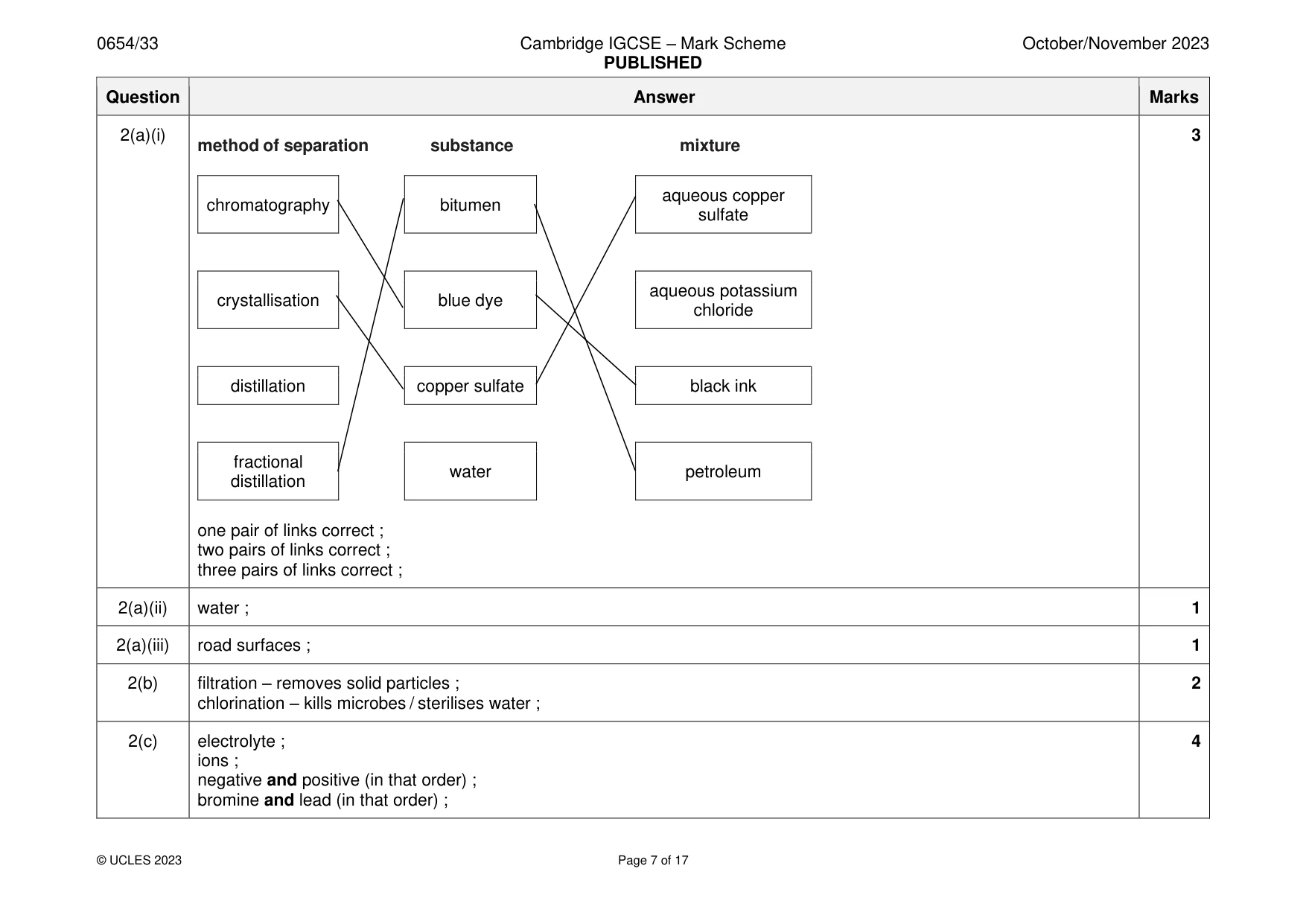
Mark scheme: 2(a)(i) 3 method of separation substance mixture aqueous copper chromatography bitumen sulfate aqueous potassium crystallisation blue dye chloride distillation copper sulfate black ink fractional water petroleum distillation one pair of links correct ; two pairs of links correct ; three pairs of links correct ; 2(a)(ii) water ; 1 2(a)(iii) road surfaces ; 1 2(b) filtration – removes solid particles ; 2 chlorination – kills microbes / sterilises water ; 2(c) electrolyte ; 4 ions ; negative and positive (in that order) ; bromine and lead (in that order) ;
Q3 · A man is sitting on a beach on a sunny day
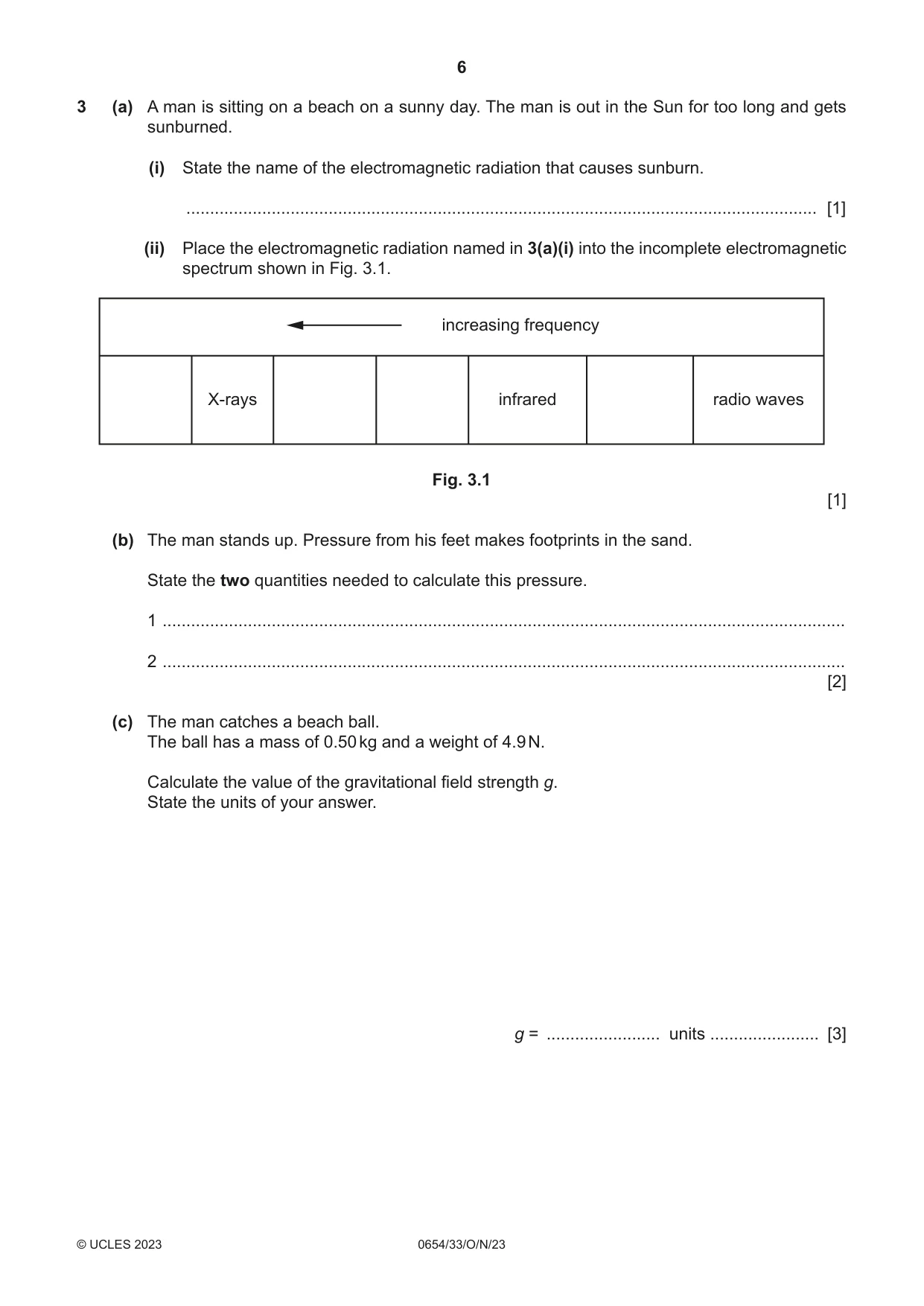
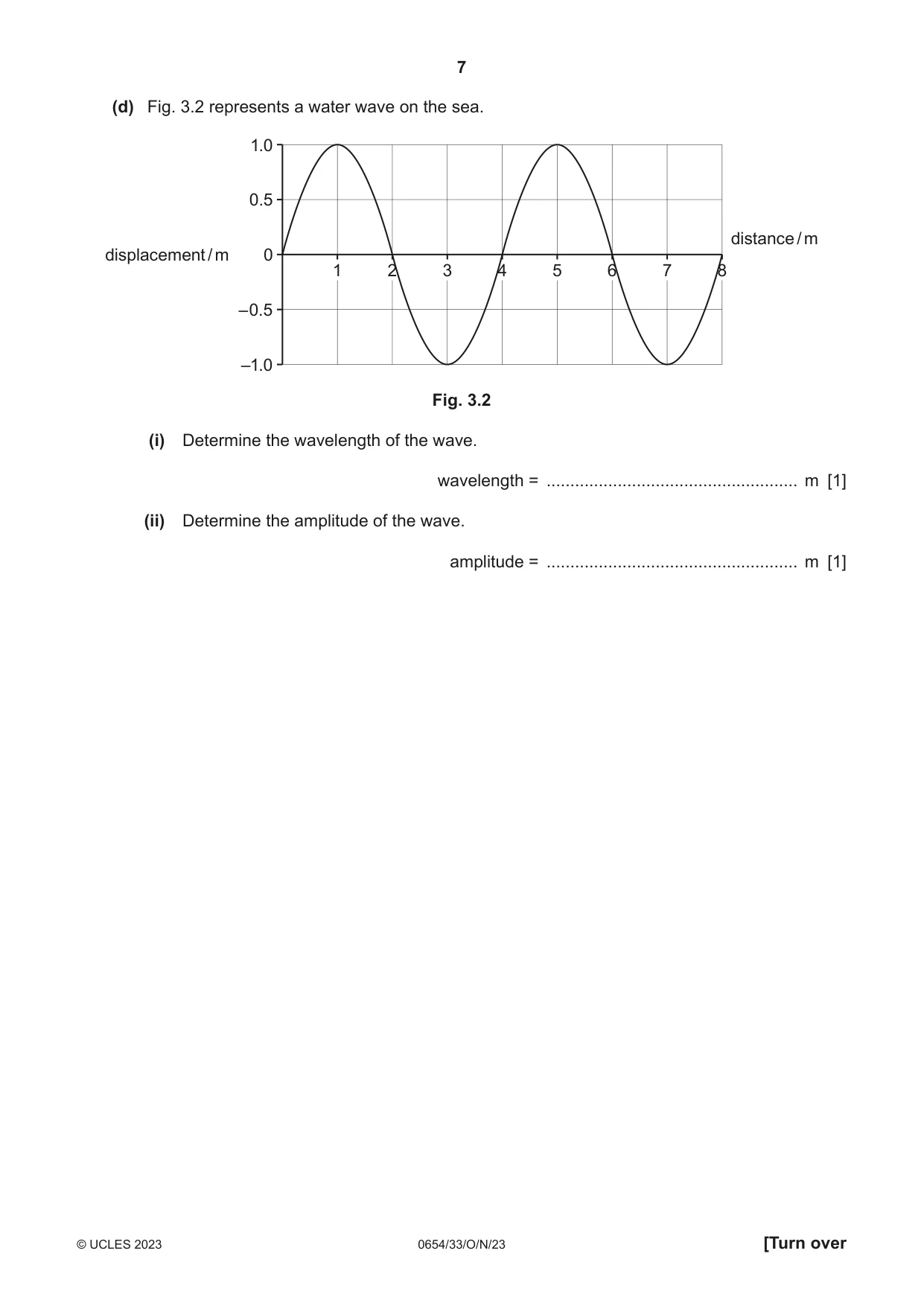
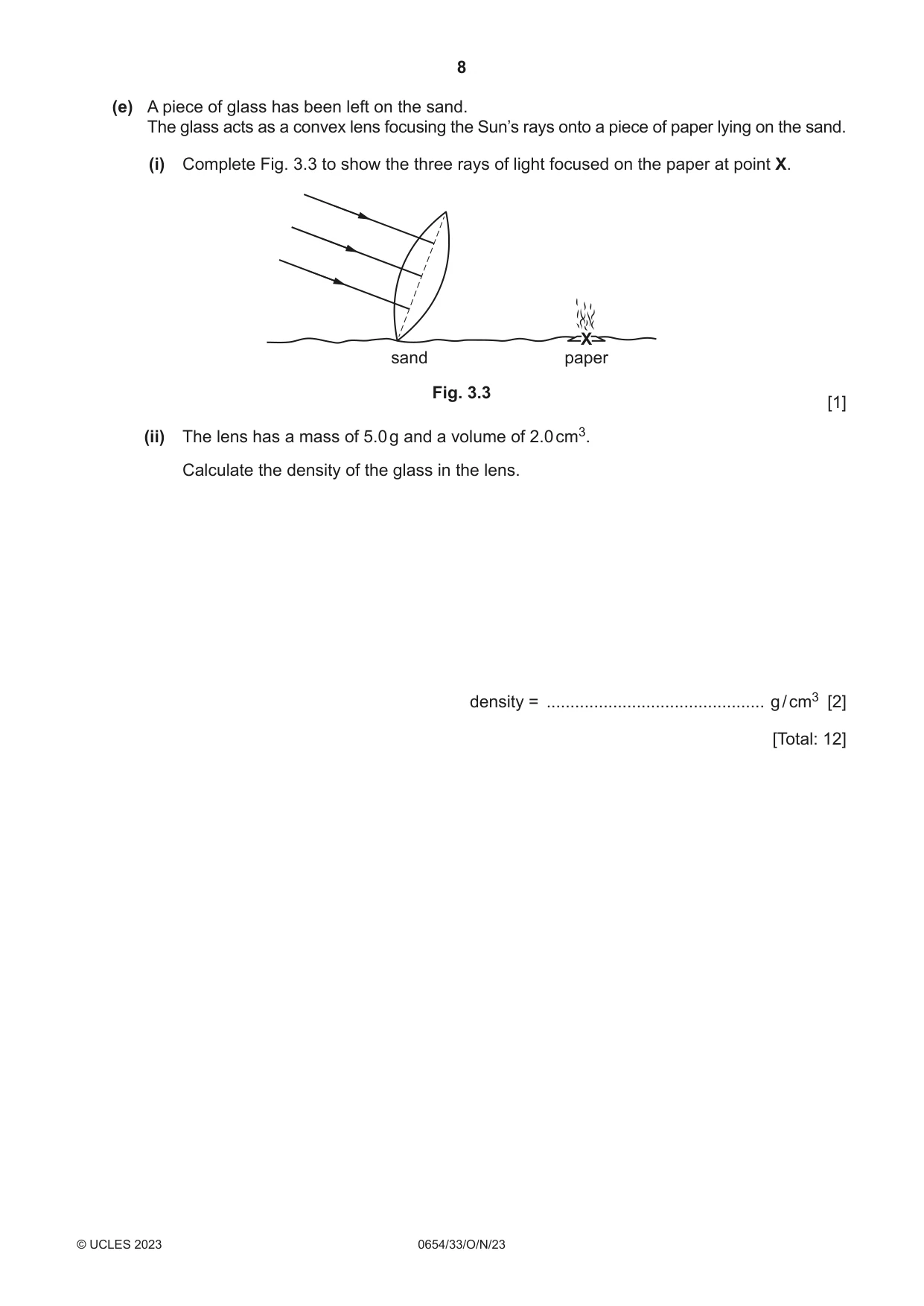
3 (a) A man is sitting on a beach on a sunny day. The man is out in the Sun for too long and gets sunburned. (i) State the name of the electromagnetic radiation that causes sunburn. ..................................................................................................................................... [1] (ii) Place the electromagnetic radiation named in 3(a)(i) into the incomplete electromagnetic spectrum shown in Fig. 3.1. increasing frequency X-rays infrared radio waves Fig. 3.1 [1] (b) The man stands up. Pressure from his feet makes footprints in the sand. State the two quantities needed to calculate this pressure. 1 ................................................................................................................................................ 2 ................................................................................................................................................ [2] (c) The man catches a beach ball. The ball has a mass of 0.50 kg and a weight of 4.9 N. Calculate the value of the gravitational field strength g. State the units of your answer. g = ........................ units ....................... [3] (d) Fig. 3.2 represents a water wave on the sea. 1.0 0.5 distance / m displacement / m 0 1 2 3 4 5 6 7 8 –0.5 –1.0 Fig. 3.2 (i) Determine the wavelength of the wave. wavelength = ..................................................... m [1] (ii) Determine the amplitude of the wave. amplitude = ..................................................... m [1] (e) A piece of glass has been left on the sand. The glass acts as a convex lens focusing the Sun’s rays onto a piece of paper lying on the sand. (i) Complete Fig. 3.3 to show the three rays of light focused on the paper at point X. X sand paper Fig. 3.3 [1] (ii) The lens has a mass of 5.0 g and a volume of 2.0 cm3. Calculate the density of the glass in the lens. density = .............................................. g / cm3 [2] [Total: 12]
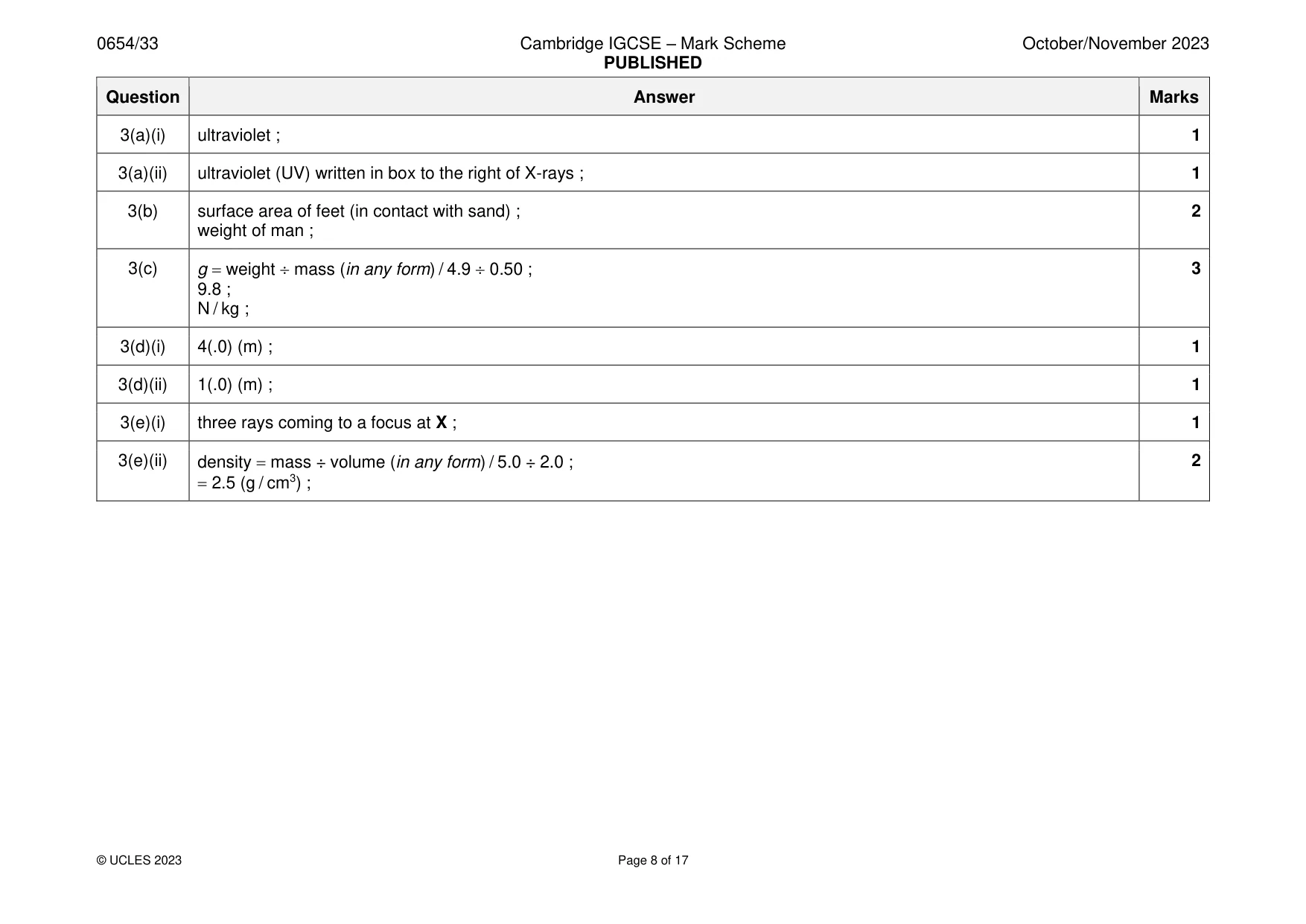
Mark scheme: 3(a)(i) ultraviolet ; 1 3(a)(ii) ultraviolet (UV) written in box to the right of X-rays ; 1 3(b) surface area of feet (in contact with sand) ; 2 weight of man ; 3(c) g = weight mass (in any form) / 4.9 0.50 ; 3 9.8 ; N / kg ; 3(d)(i) 4(.0) (m) ; 1 3(d)(ii) 1(.0) (m) ; 1 3(e)(i) three rays coming to a focus at X ; 1 3(e)(ii) density = mass ÷ volume (in any form) / 5.0 ÷ 2.0 ; 2 = 2.5 (g / cm3) ;
Q4 · Scientists record the area of land that is cleared by deforestation every year
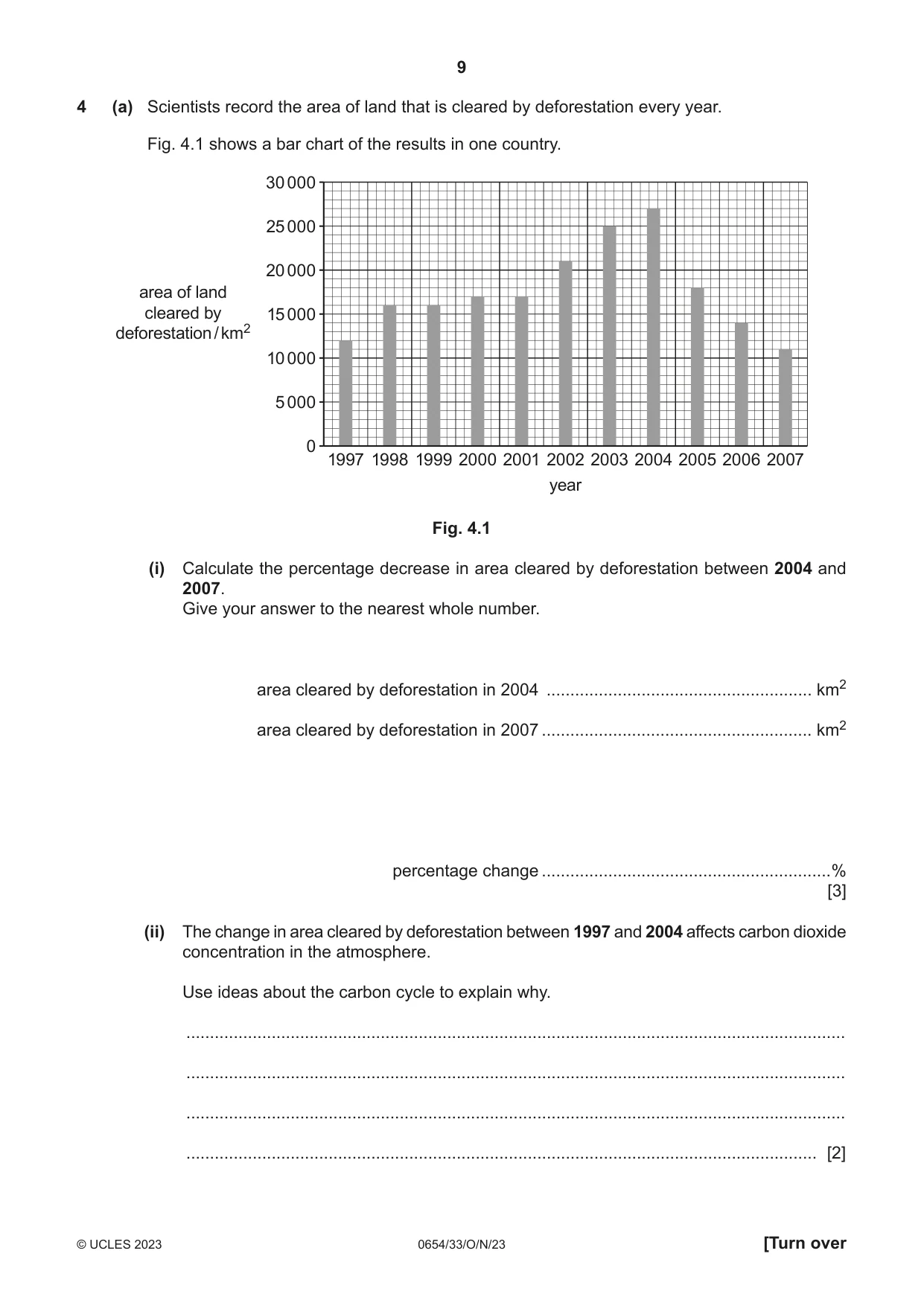
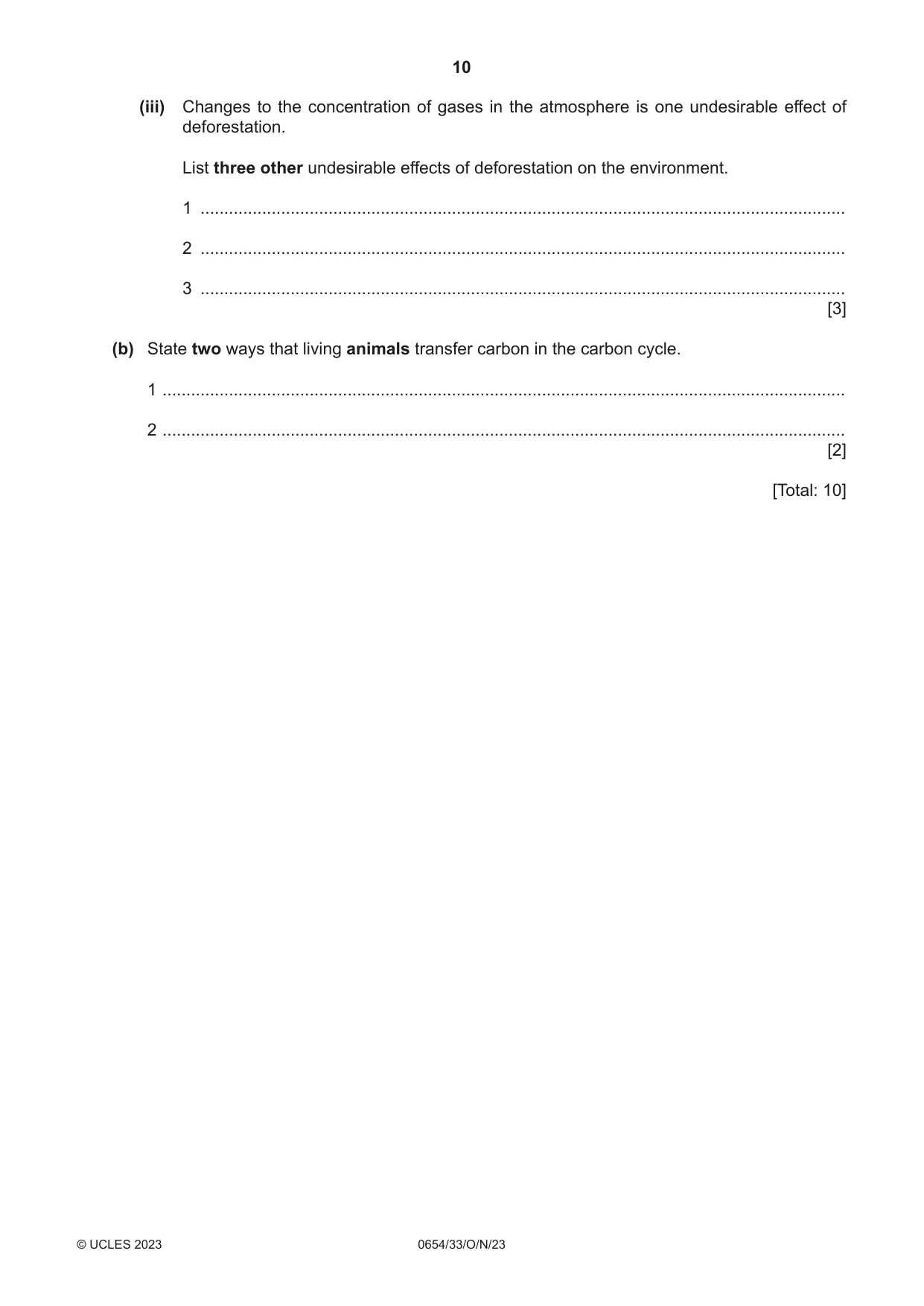
4 (a) Scientists record the area of land that is cleared by deforestation every year. Fig. 4.1 shows a bar chart of the results in one country. 30 000 25 000 20 000 area of land cleared by 15 000 deforestation / km2 10 000 5 000 0 1997 1998 1999 2000 2001 2002 2003 2004 2005 2006 2007 year Fig. 4.1 (i) Calculate the percentage decrease in area cleared by deforestation between 2004 and 2007. Give your answer to the nearest whole number. area cleared by deforestation in 2004 ........................................................ km2 area cleared by deforestation in 2007 ......................................................... km2 percentage change .............................................................% [3] (ii) The change in area cleared by deforestation between 1997 and 2004 affects carbon dioxide concentration in the atmosphere. Use ideas about the carbon cycle to explain why. ........................................................................................................................................... ........................................................................................................................................... ........................................................................................................................................... ..................................................................................................................................... [2] (iii) Changes to the concentration of gases in the atmosphere is one undesirable effect of deforestation. List three other undesirable effects of deforestation on the environment. 1 ........................................................................................................................................ 2 ........................................................................................................................................ 3 ........................................................................................................................................ [3] (b) State two ways that living animals transfer carbon in the carbon cycle. 1 ................................................................................................................................................ 2 ................................................................................................................................................ [2] [Total: 10]
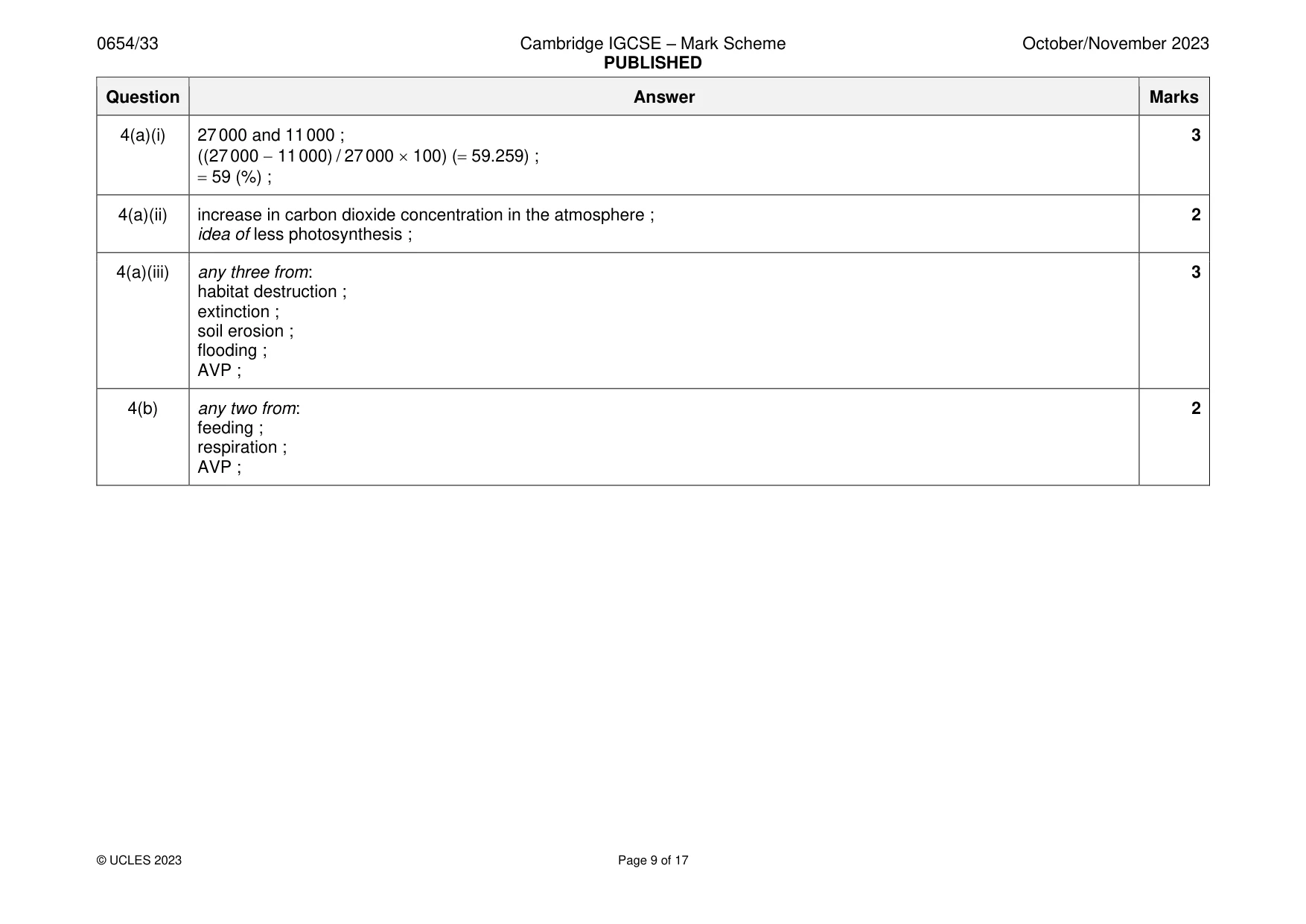
Mark scheme: 4(a)(i) 27 000 and 11 000 ; 3 ((27 000 − 11 000) / 27 000 100) (= 59.259) ; = 59 (%) ; 4(a)(ii) increase in carbon dioxide concentration in the atmosphere ; 2 idea of less photosynthesis ; 4(a)(iii) any three from: 3 habitat destruction ; extinction ; soil erosion ; flooding ; AVP ; 4(b) any two from: 2 feeding ; respiration ; AVP ;
Q5 · Some information about three Group VII elements
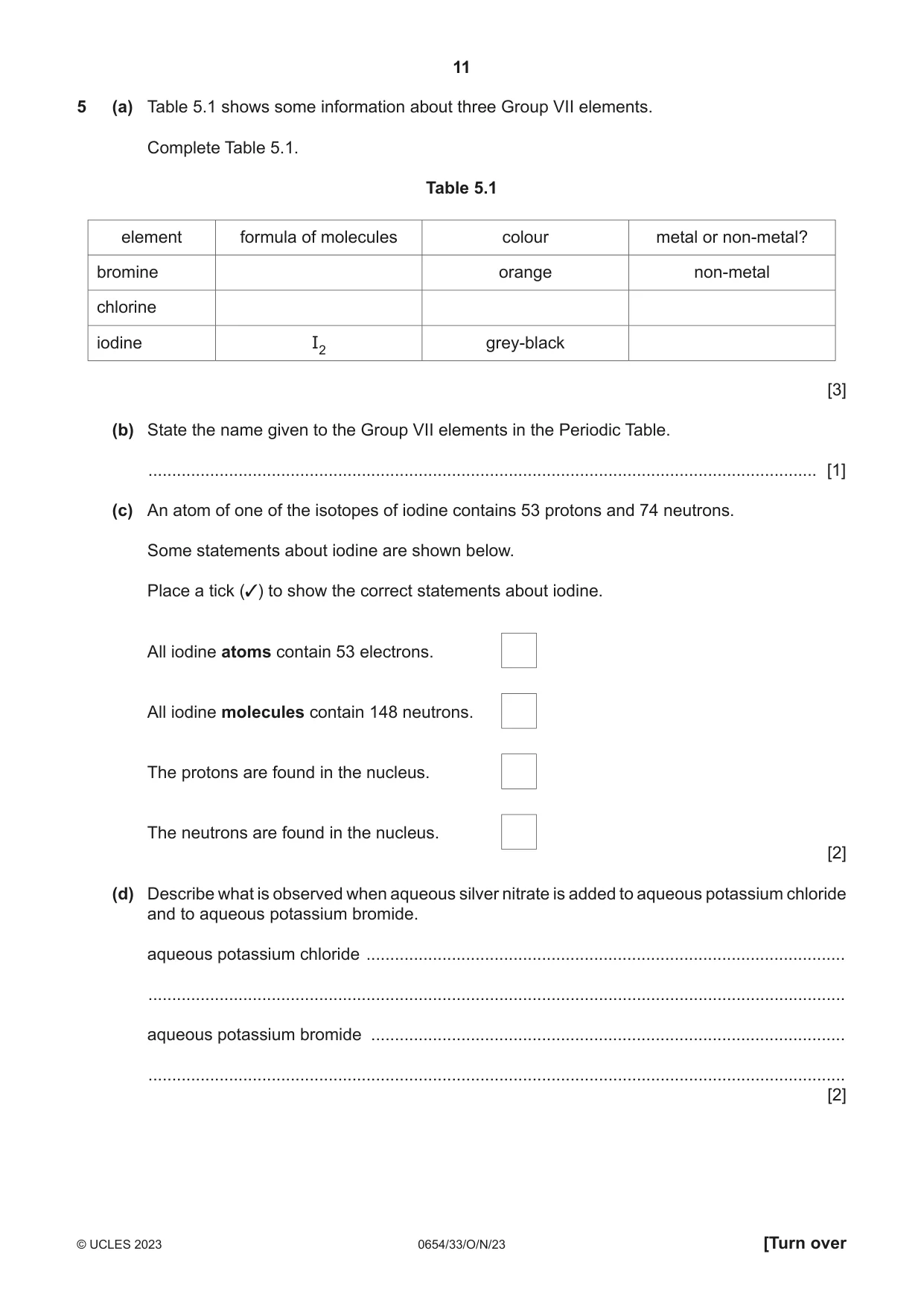
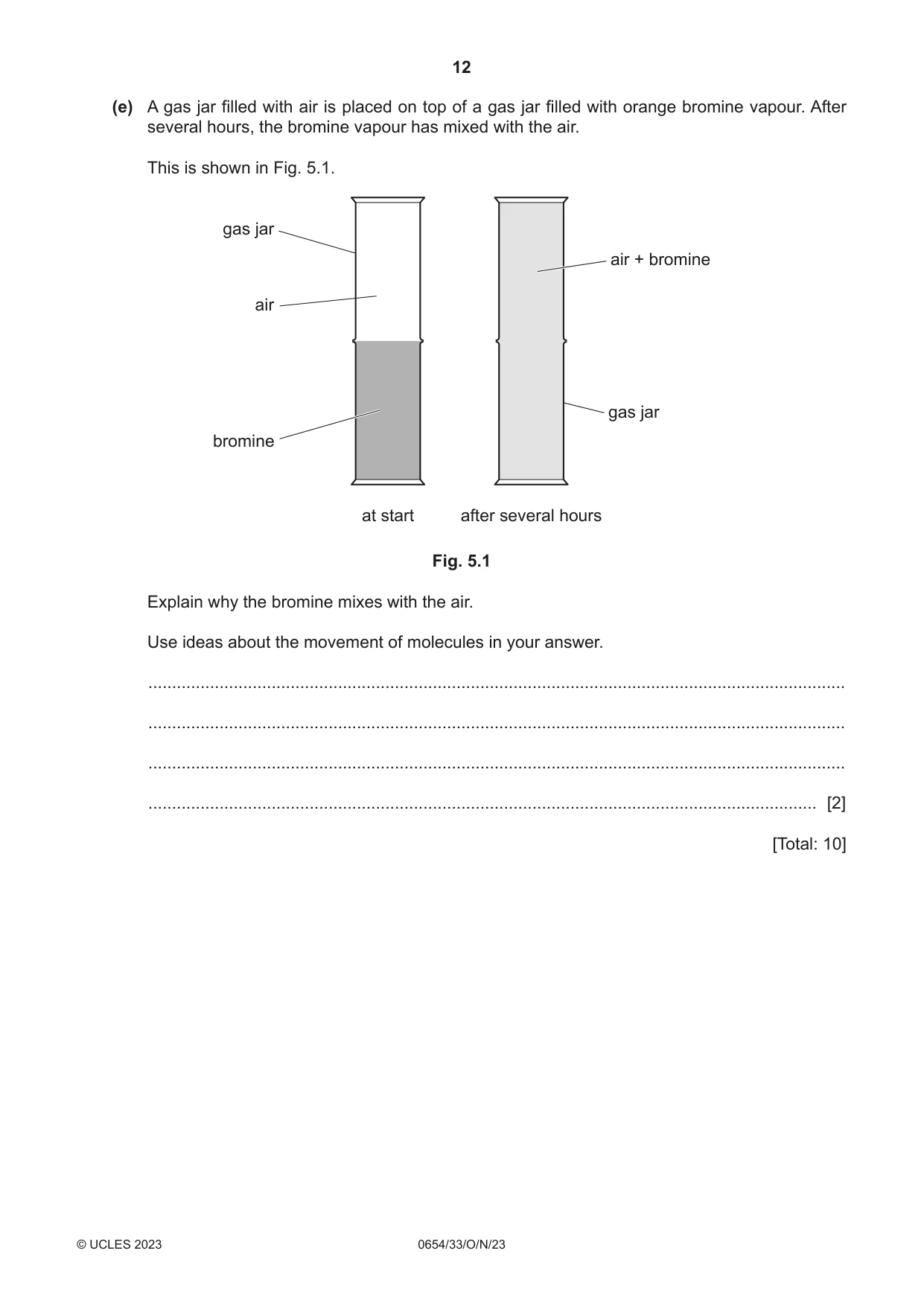
5 (a) Table 5.1 shows some information about three Group VII elements. Complete Table 5.1. Table 5.1 element formula of molecules colour metal or non-metal? bromine orange non-metal chlorine iodine I2 grey-black [3] (b) State the name given to the Group VII elements in the Periodic Table. ............................................................................................................................................. [1] (c) An atom of one of the isotopes of iodine contains 53 protons and 74 neutrons. Some statements about iodine are shown below. Place a tick (3) to show the correct statements about iodine. All iodine atoms contain 53 electrons. All iodine molecules contain 148 neutrons. The protons are found in the nucleus. The neutrons are found in the nucleus. [2] (d) Describe what is observed when aqueous silver nitrate is added to aqueous potassium chloride and to aqueous potassium bromide. aqueous potassium chloride ..................................................................................................... ................................................................................................................................................... aqueous potassium bromide .................................................................................................... ................................................................................................................................................... [2] (e) A gas jar filled with air is placed on top of a gas jar filled with orange bromine vapour. After several hours, the bromine vapour has mixed with the air. This is shown in Fig. 5.1. gas jar air + bromine air gas jar bromine at start after several hours Fig. 5.1 Explain why the bromine mixes with the air. Use ideas about the movement of molecules in your answer. ................................................................................................................................................... ................................................................................................................................................... ................................................................................................................................................... ............................................................................................................................................. [2] [Total: 10]
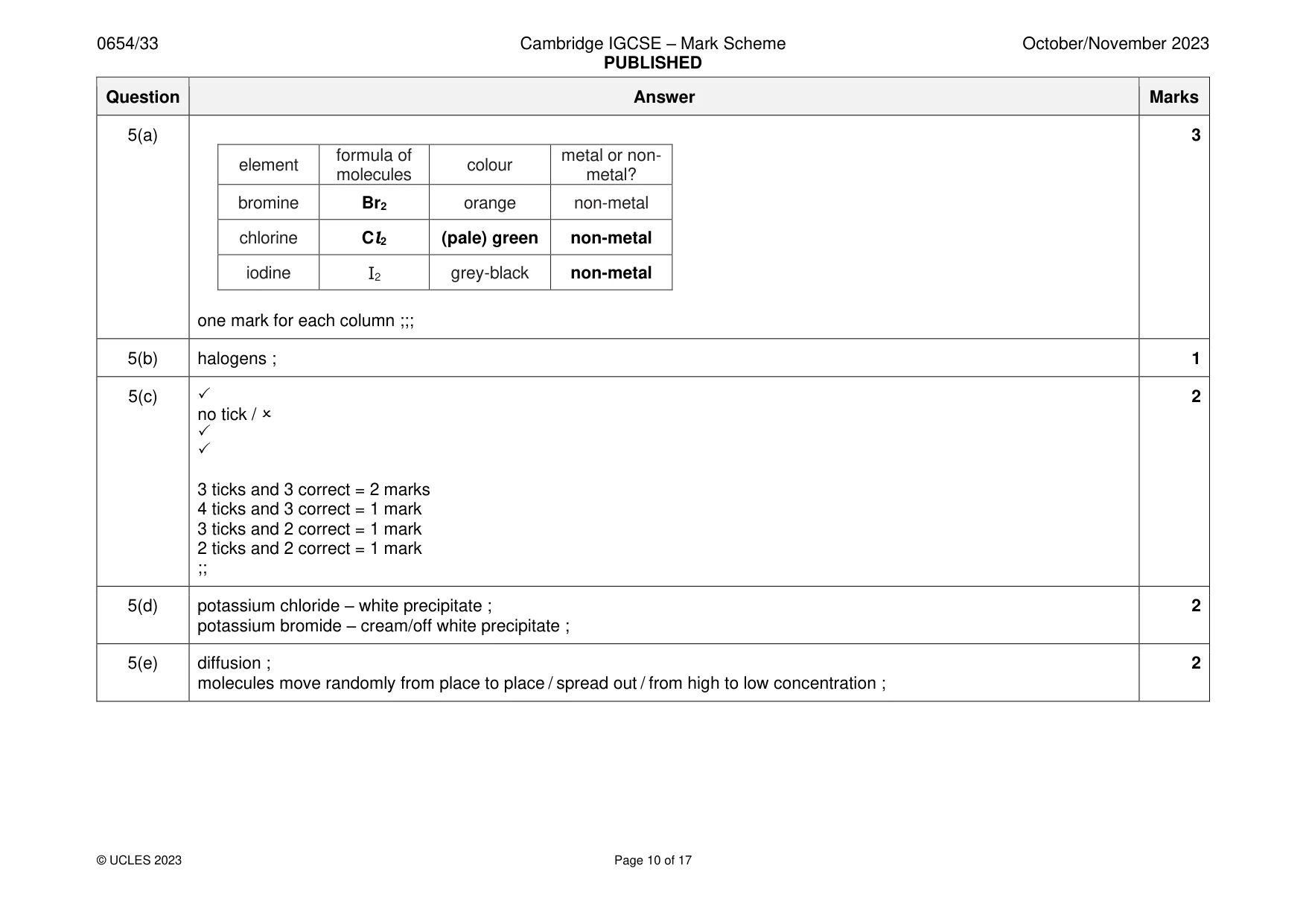
Mark scheme: 5(a) 3 formula of metal or non- element colour molecules metal? bromine Br2 orange non-metal chlorine Cl2 (pale) green non-metal iodine I2 grey-black non-metal one mark for each column ;;; 5(b) halogens ; 1 5(c) 2 no tick / 3 ticks and 3 correct = 2 marks 4 ticks and 3 correct = 1 mark 3 ticks and 2 correct = 1 mark 2 ticks and 2 correct = 1 mark ;; 5(d) potassium chloride – white precipitate ; 2 potassium bromide – cream/off white precipitate ; 5(e) diffusion ; 2 molecules move randomly from place to place / spread out / from high to low concentration ;
Q6 · A double electric hotplate used to heat food
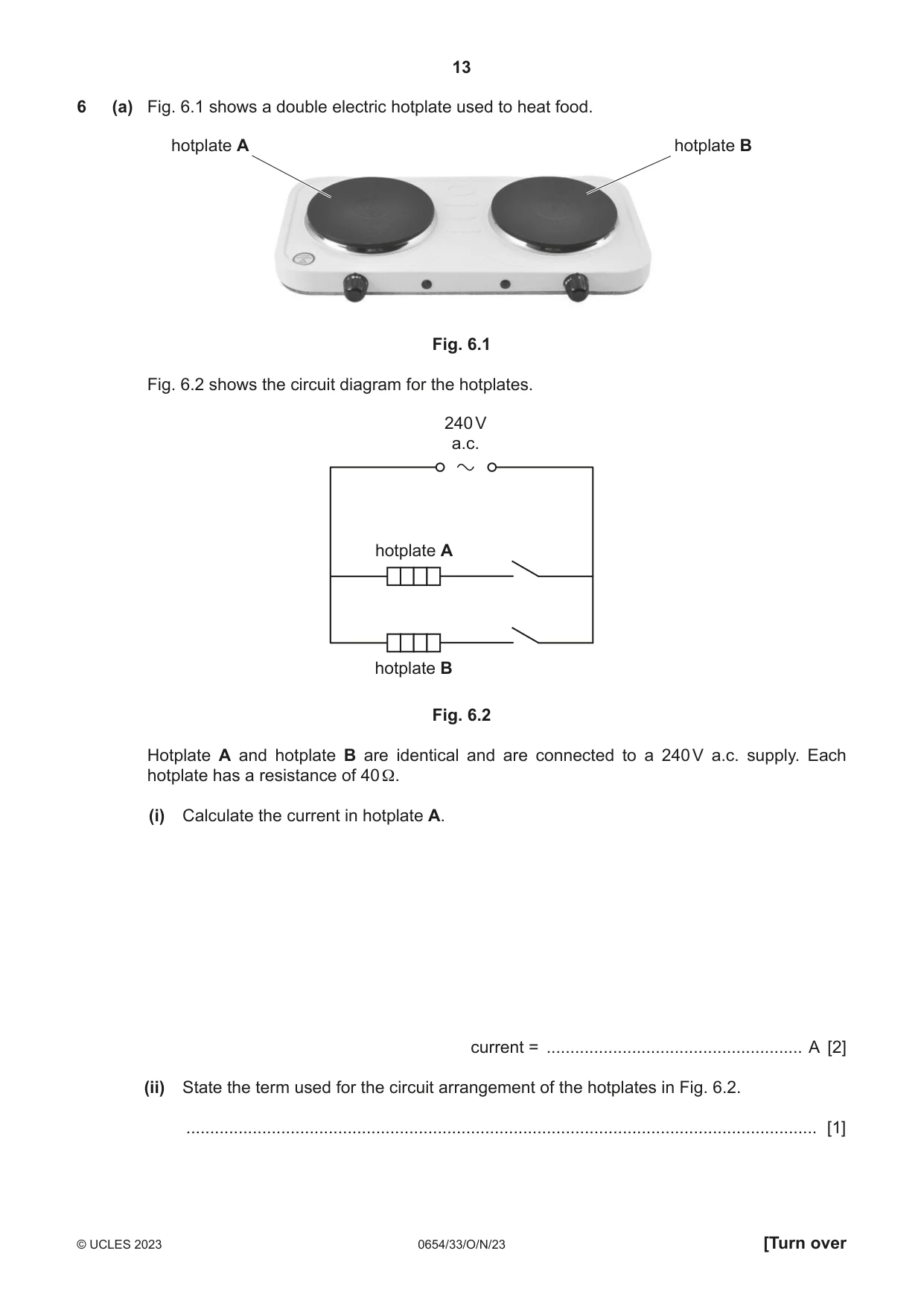
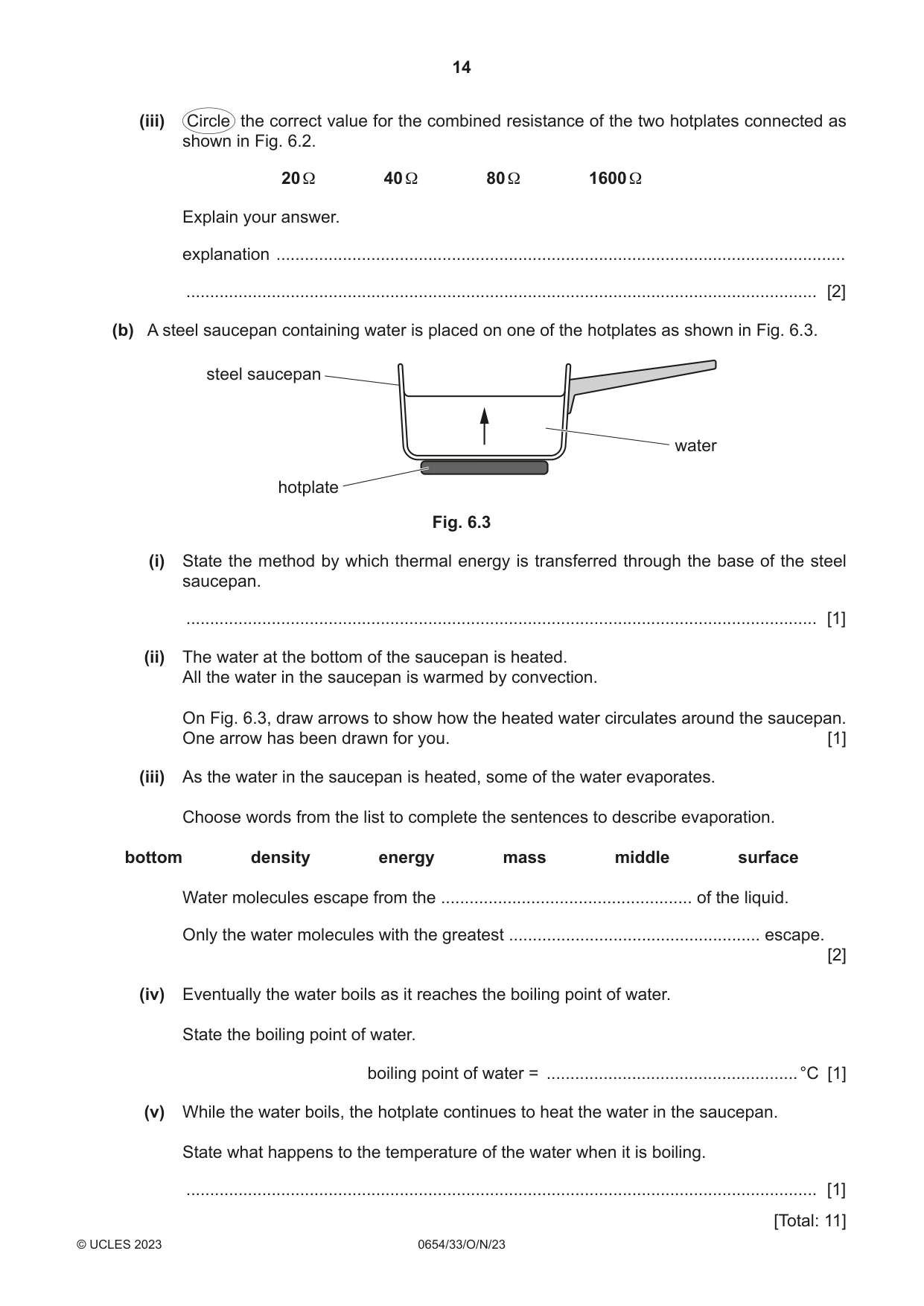
6 (a) Fig. 6.1 shows a double electric hotplate used to heat food. hotplate A hotplate B Fig. 6.1 Fig. 6.2 shows the circuit diagram for the hotplates. 240 V a.c. hotplate A hotplate B Fig. 6.2 Hotplate A and hotplate B are identical and are connected to a 240 V a.c. supply. Each hotplate has a resistance of 40 Ω. (i) Calculate the current in hotplate A. current = ...................................................... A [2] (ii) State the term used for the circuit arrangement of the hotplates in Fig. 6.2. ..................................................................................................................................... [1] (iii) Circle the correct value for the combined resistance of the two hotplates connected as shown in Fig. 6.2. 20 Ω 40 Ω 80 Ω 1600 Ω Explain your answer. explanation ........................................................................................................................ ..................................................................................................................................... [2] (b) A steel saucepan containing water is placed on one of the hotplates as shown in Fig. 6.3. steel saucepan water hotplate Fig. 6.3 (i) State the method by which thermal energy is transferred through the base of the steel saucepan. ..................................................................................................................................... [1] (ii) The water at the bottom of the saucepan is heated. All the water in the saucepan is warmed by convection. On Fig. 6.3, draw arrows to show how the heated water circulates around the saucepan. One arrow has been drawn for you. [1] (iii) As the water in the saucepan is heated, some of the water evaporates. Choose words from the list to complete the sentences to describe evaporation. bottom density energy mass middle surface Water molecules escape from the ..................................................... of the liquid. Only the water molecules with the greatest ..................................................... escape. [2] (iv) Eventually the water boils as it reaches the boiling point of water. State the boiling point of water. boiling point of water = .....................................................°C [1] (v) While the water boils, the hotplate continues to heat the water in the saucepan. State what happens to the temperature of the water when it is boiling. ..................................................................................................................................... [1] [Total: 11]
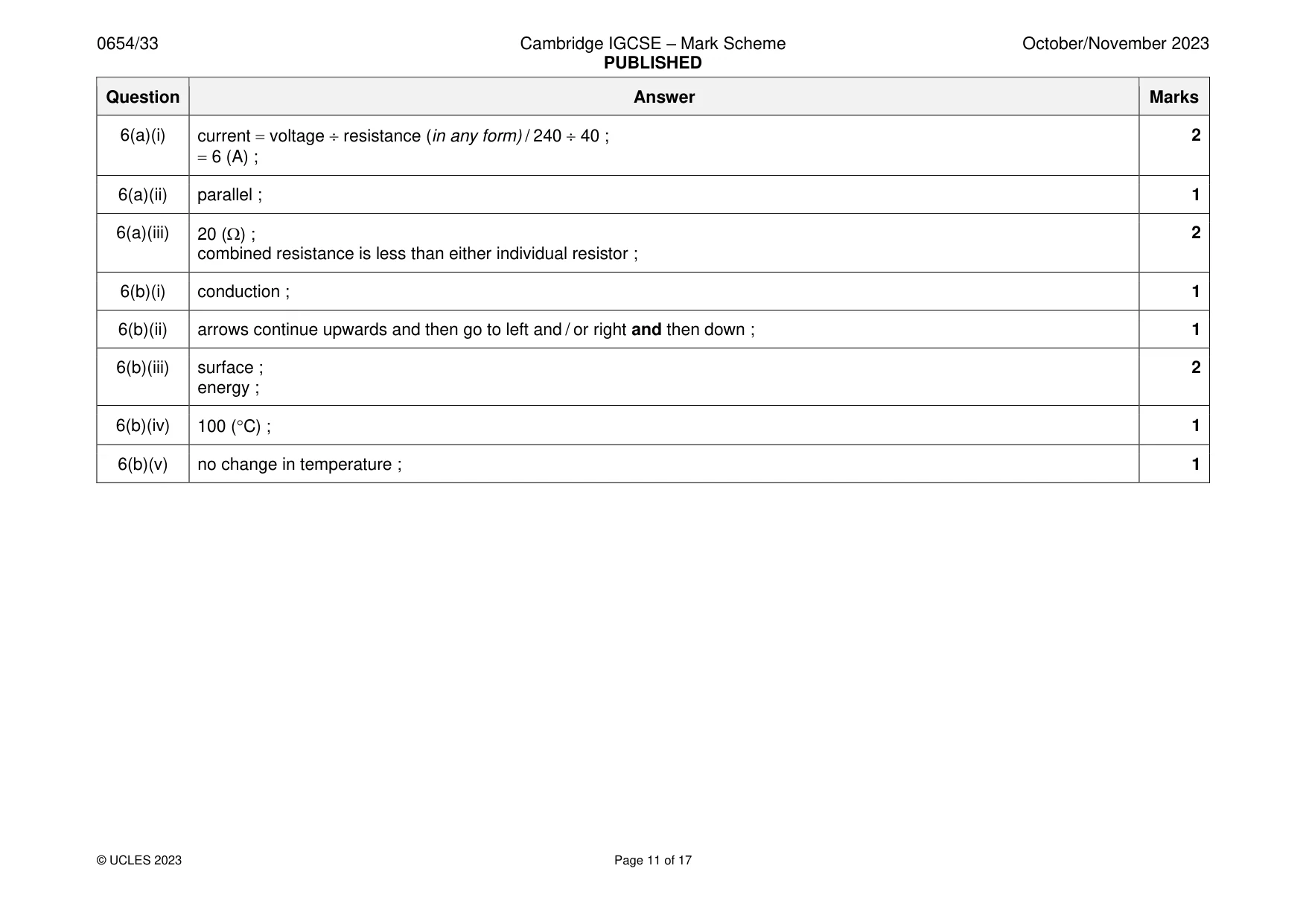
Mark scheme: 6(a)(i) current = voltage resistance (in any form) / 240 40 ; 2 = 6 (A) ; 6(a)(ii) parallel ; 1 6(a)(iii) 20 () ; 2 combined resistance is less than either individual resistor ; 6(b)(i) conduction ; 1 6(b)(ii) arrows continue upwards and then go to left and / or right and then down ; 1 6(b)(iii) surface ; 2 energy ; 6(b)(iv) 100 (C) ; 1 6(b)(v) no change in temperature ; 1
Q7 · Enzymes are only active within a specific pH range
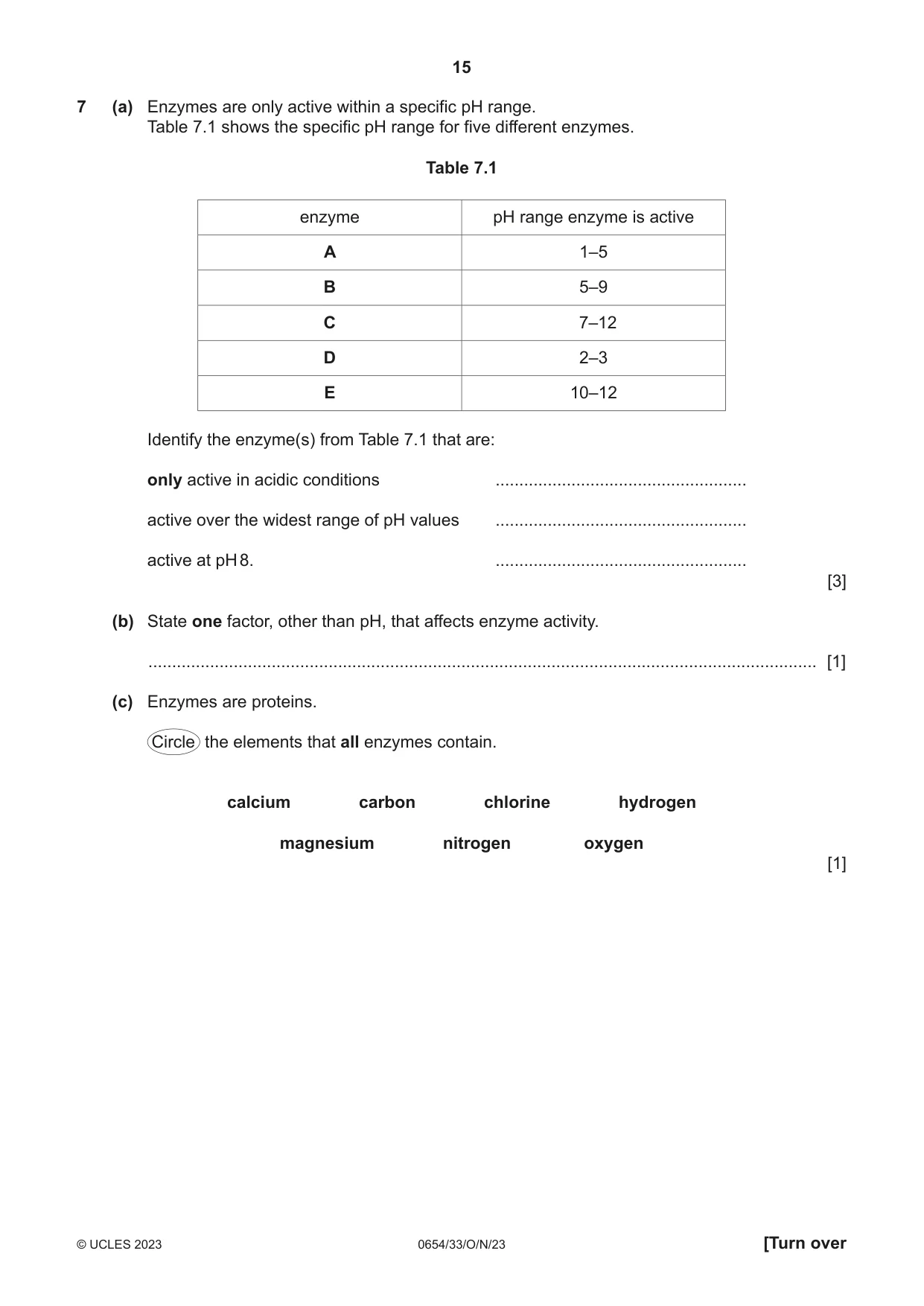
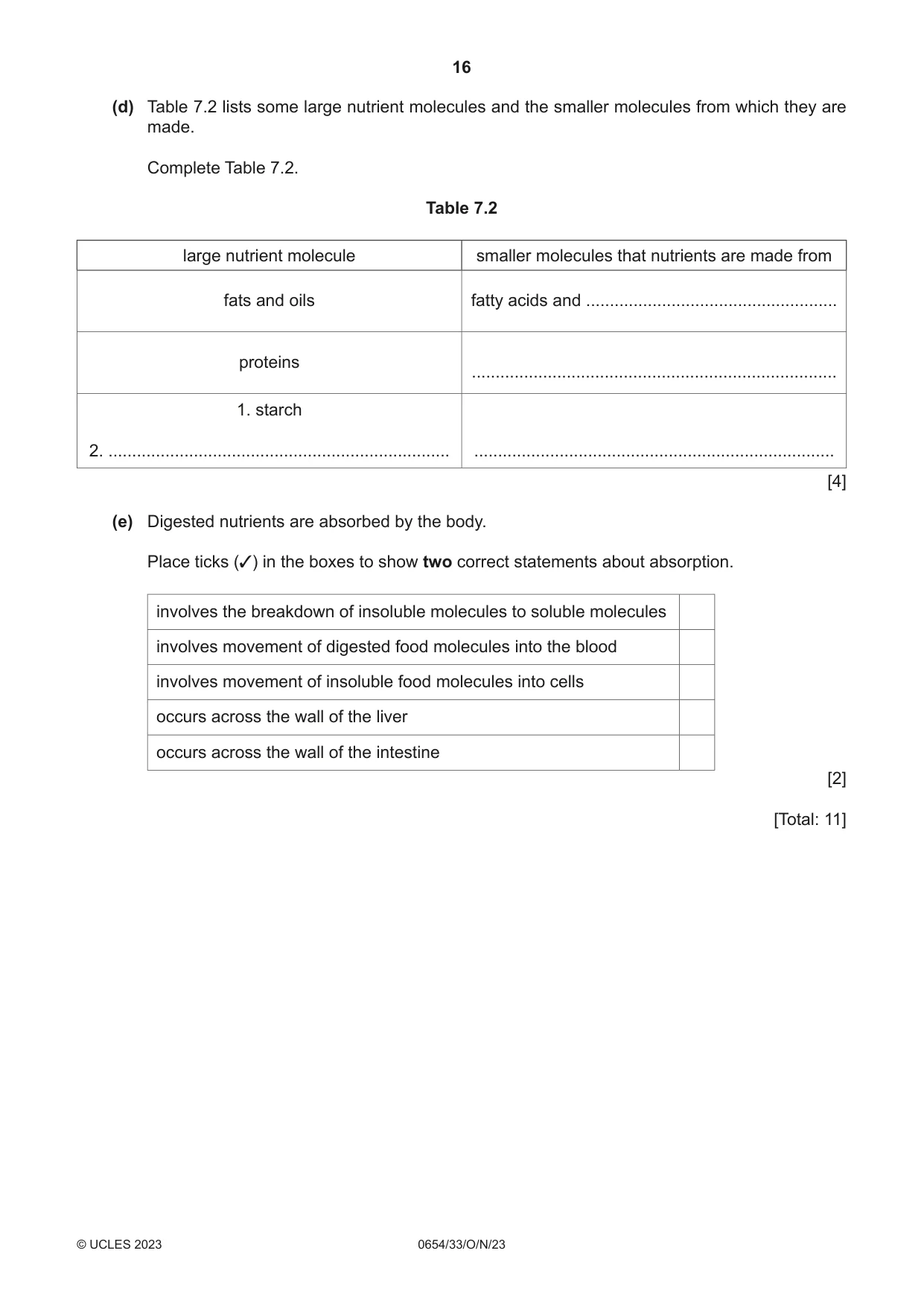
7 (a) Enzymes are only active within a specific pH range. Table 7.1 shows the specific pH range for five different enzymes. Table 7.1 enzyme pH range enzyme is active A 1–5 B 5–9 C 7–12 D 2–3 E 10–12 Identify the enzyme(s) from Table 7.1 that are: only active in acidic conditions ..................................................... active over the widest range of pH values ..................................................... active at pH 8. ..................................................... [3] (b) State one factor, other than pH, that affects enzyme activity. ............................................................................................................................................. [1] (c) Enzymes are proteins. Circle the elements that all enzymes contain. calcium carbon chlorine hydrogen magnesium nitrogen oxygen [1] (d) Table 7.2 lists some large nutrient molecules and the smaller molecules from which they are made. Complete Table 7.2. Table 7.2 large nutrient molecule smaller molecules that nutrients are made from fats and oils fatty acids and ..................................................... proteins ............................................................................. 1. starch 2. ........................................................................ ............................................................................ [4] (e) Digested nutrients are absorbed by the body. Place ticks (3) in the boxes to show two correct statements about absorption. involves the breakdown of insoluble molecules to soluble molecules involves movement of digested food molecules into the blood involves movement of insoluble food molecules into cells occurs across the wall of the liver occurs across the wall of the intestine [2] [Total: 11]
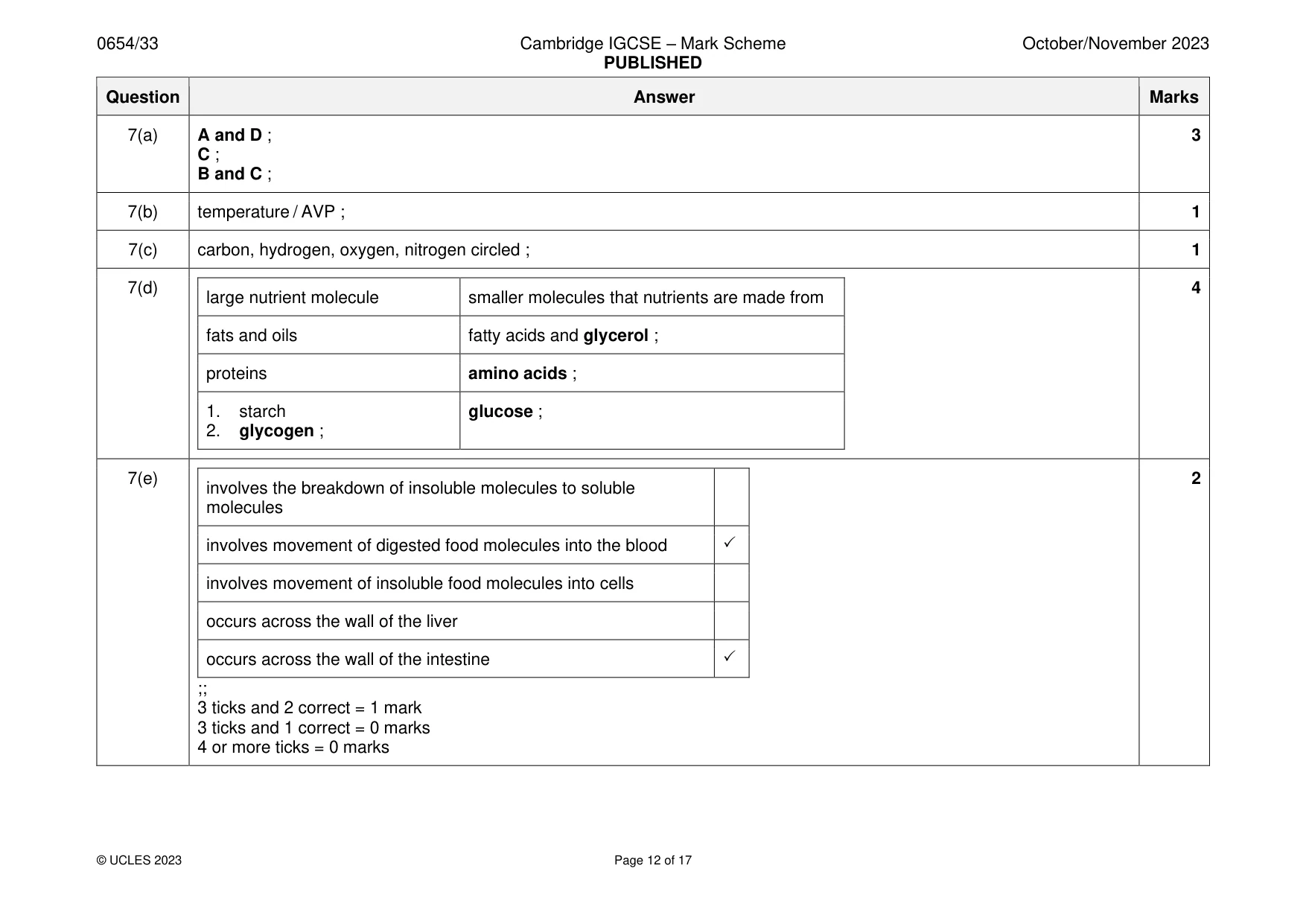
Mark scheme: 7(a) A and D ; 3 C ; B and C ; 7(b) temperature / AVP ; 1 7(c) carbon, hydrogen, oxygen, nitrogen circled ; 1 7(d) 4 large nutrient molecule smaller molecules that nutrients are made from fats and oils fatty acids and glycerol ; proteins amino acids ; 1. starch glucose ; 2. glycogen ; 7(e) 2 involves the breakdown of insoluble molecules to soluble molecules involves movement of digested food molecules into the blood involves movement of insoluble food molecules into cells occurs across the wall of the liver occurs across the wall of the intestine ;; 3 ticks and 2 correct = 1 mark 3 ticks and 1 correct = 0 marks 4 or more ticks = 0 marks
Q8 · The apparatus a student uses to investigate the rate of reaction between magnesium and…
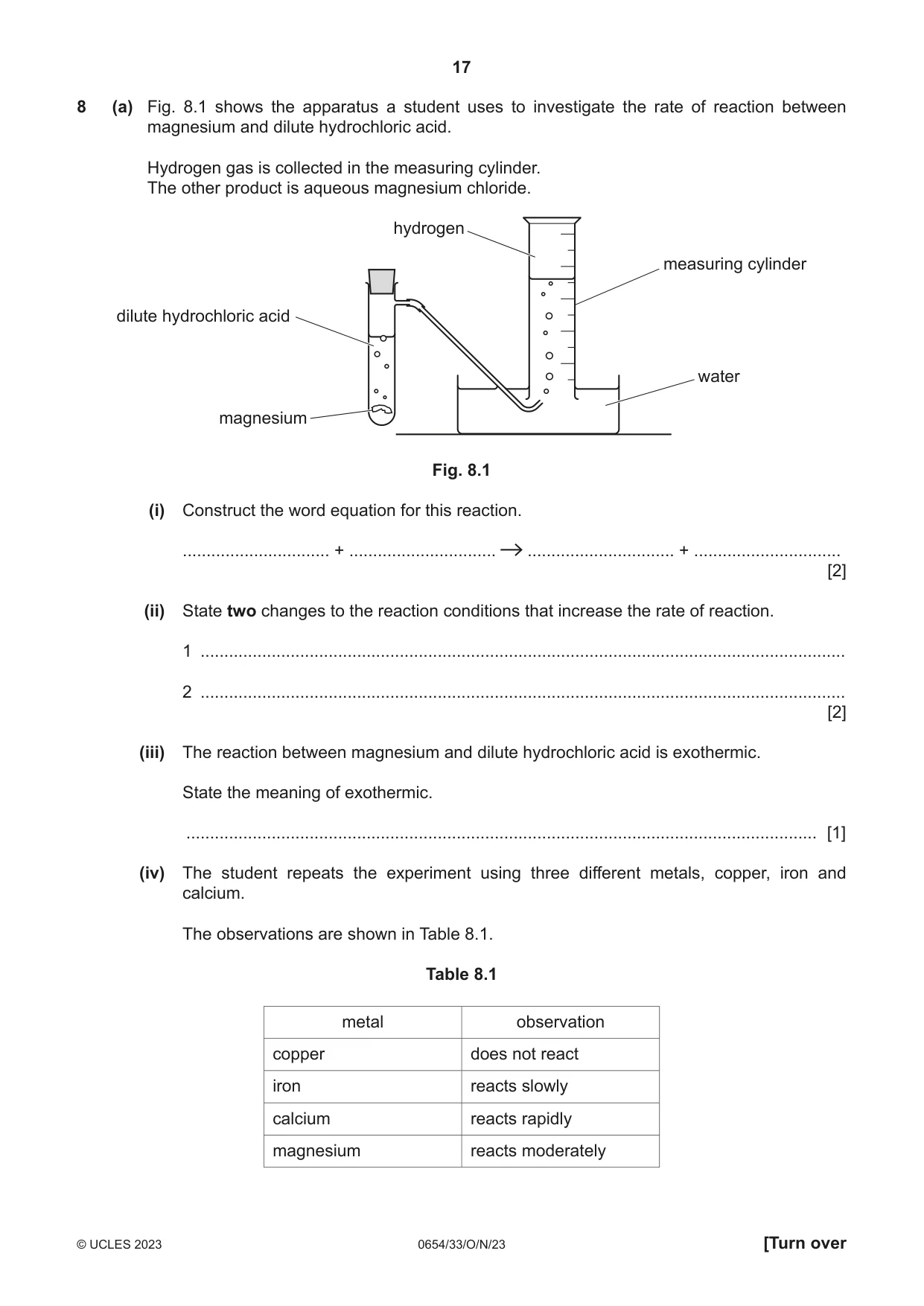
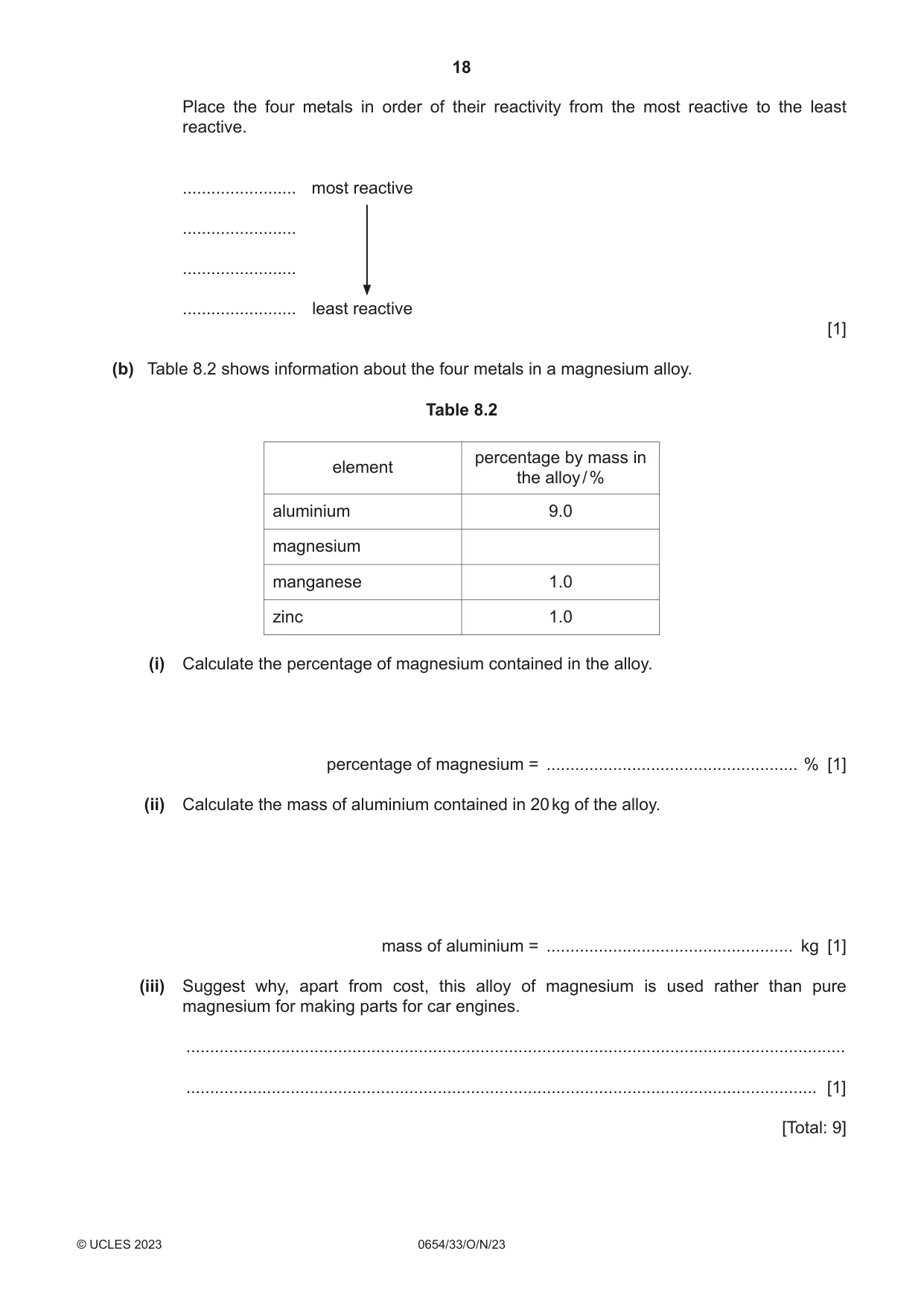
8 (a) Fig. 8.1 shows the apparatus a student uses to investigate the rate of reaction between magnesium and dilute hydrochloric acid. Hydrogen gas is collected in the measuring cylinder. The other product is aqueous magnesium chloride. hydrogen measuring cylinder dilute hydrochloric acid water magnesium Fig. 8.1 (i) Construct the word equation for this reaction. ............................... + ............................... ............................... + ............................... [2] (ii) State two changes to the reaction conditions that increase the rate of reaction. 1 ........................................................................................................................................ 2 ........................................................................................................................................ [2] (iii) The reaction between magnesium and dilute hydrochloric acid is exothermic. State the meaning of exothermic. ..................................................................................................................................... [1] (iv) The student repeats the experiment using three different metals, copper, iron and calcium. The observations are shown in Table 8.1. Table 8.1 metal observation copper does not react iron reacts slowly calcium reacts rapidly magnesium reacts moderately Place the four metals in order of their reactivity from the most reactive to the least reactive. ........................ most reactive ........................ ........................ ........................ least reactive [1] (b) Table 8.2 shows information about the four metals in a magnesium alloy. Table 8.2 percentage by mass in element the alloy / % aluminium 9.0 magnesium manganese 1.0 zinc 1.0 (i) Calculate the percentage of magnesium contained in the alloy. percentage of magnesium = ..................................................... % [1] (ii) Calculate the mass of aluminium contained in 20 kg of the alloy. mass of aluminium = .................................................... kg [1] (iii) Suggest why, apart from cost, this alloy of magnesium is used rather than pure magnesium for making parts for car engines. ........................................................................................................................................... ..................................................................................................................................... [1] [Total: 9]
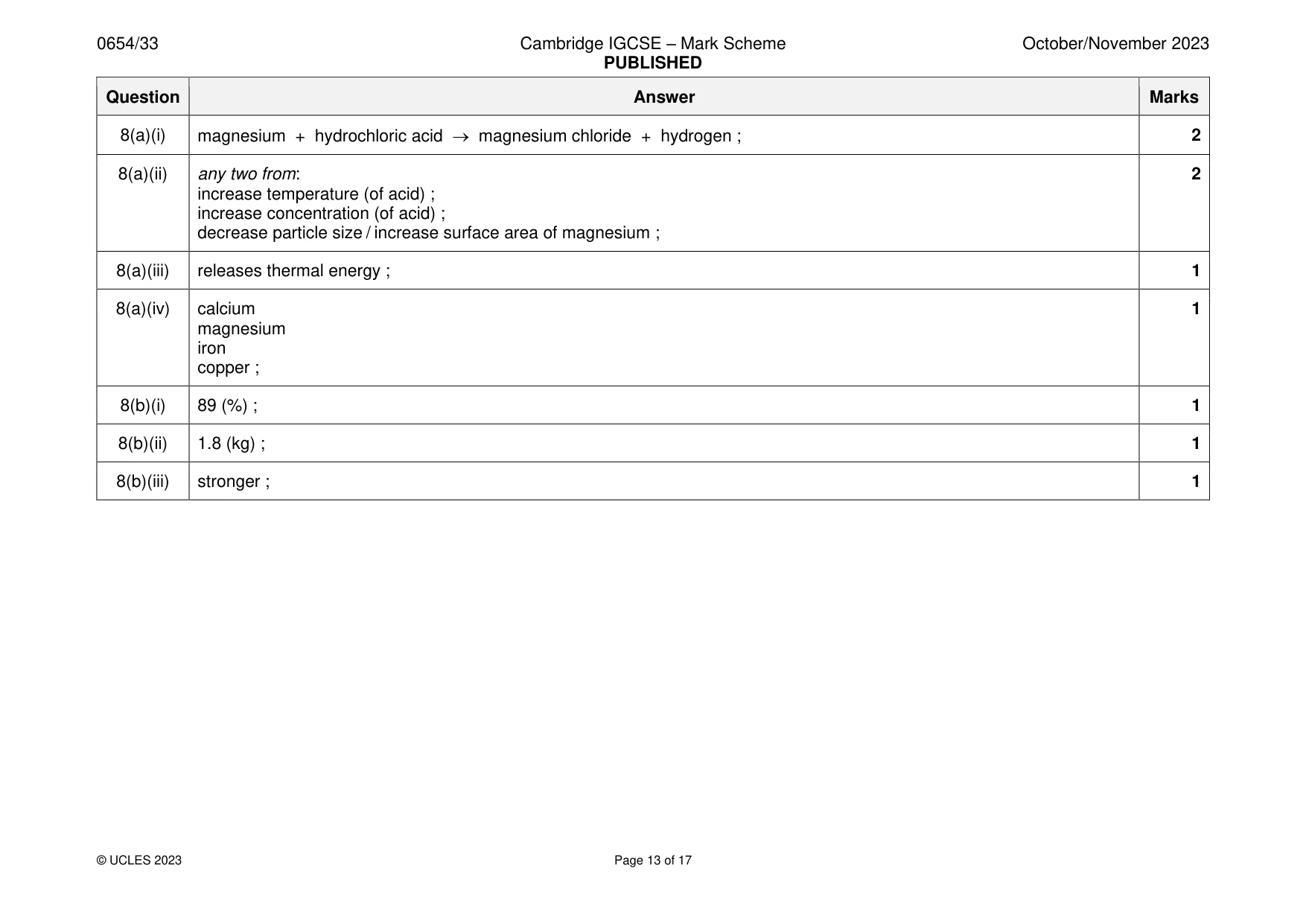
Mark scheme: 8(a)(i) magnesium + hydrochloric acid → magnesium chloride + hydrogen ; 2 8(a)(ii) any two from: 2 increase temperature (of acid) ; increase concentration (of acid) ; decrease particle size / increase surface area of magnesium ; 8(a)(iii) releases thermal energy ; 1 8(a)(iv) calcium 1 magnesium iron copper ; 8(b)(i) 89 (%) ; 1 8(b)(ii) 1.8 (kg) ; 1 8(b)(iii) stronger ; 1
Q9 · Four energy sources and four descriptions of energy sources
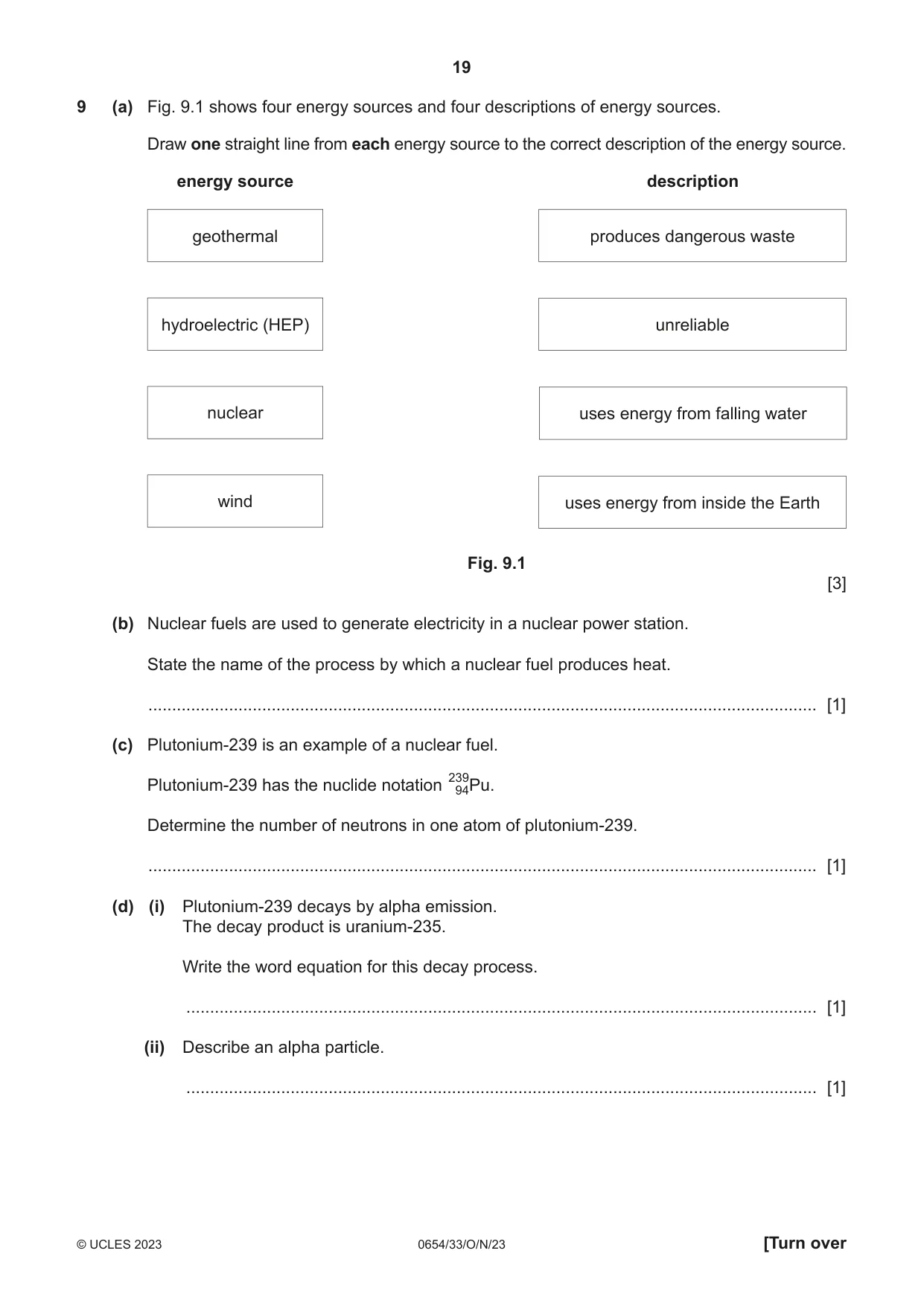
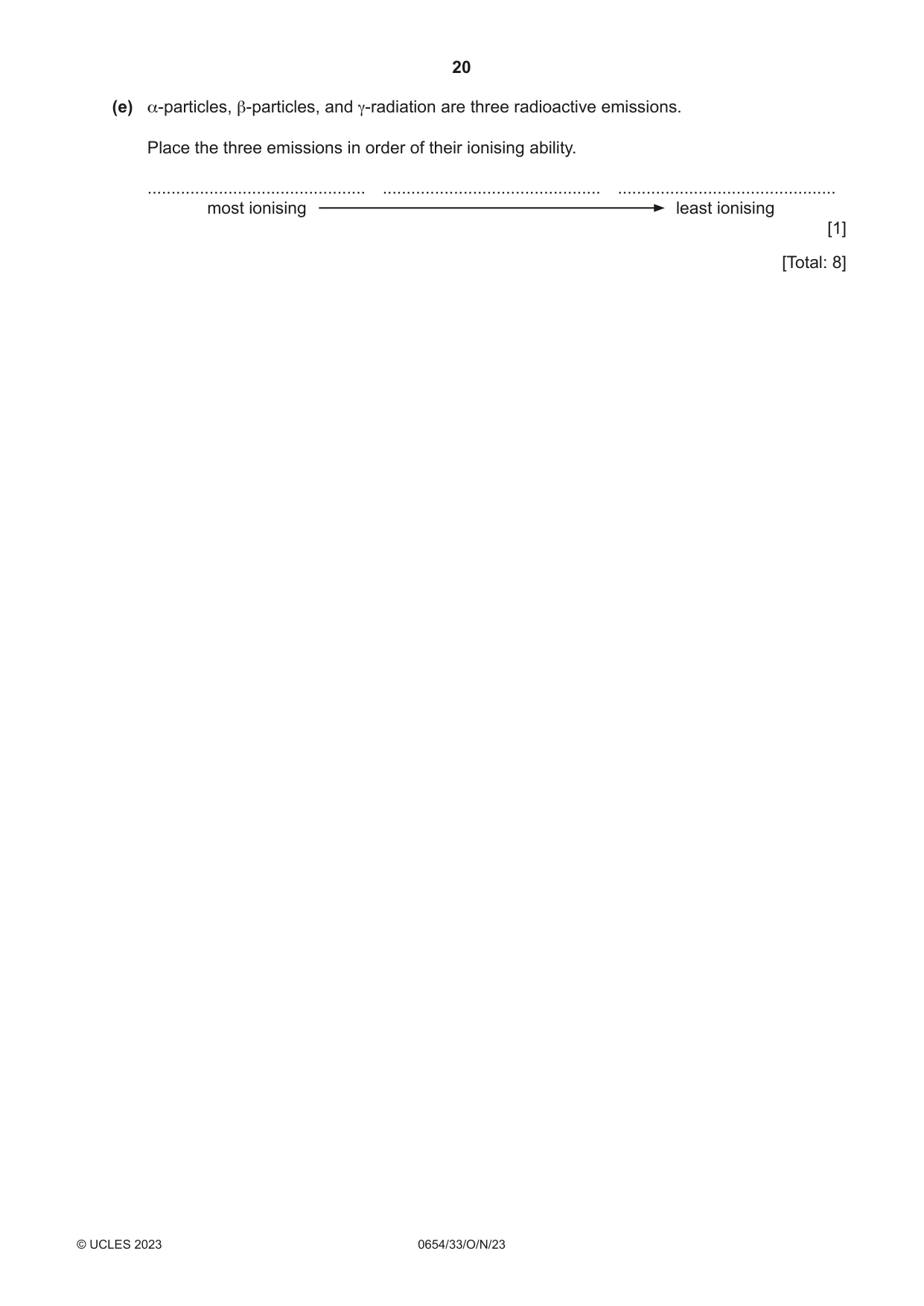
9 (a) Fig. 9.1 shows four energy sources and four descriptions of energy sources. Draw one straight line from each energy source to the correct description of the energy source. energy source description geothermal produces dangerous waste hydroelectric (HEP) unreliable nuclear uses energy from falling water wind uses energy from inside the Earth Fig. 9.1 [3] (b) Nuclear fuels are used to generate electricity in a nuclear power station. State the name of the process by which a nuclear fuel produces heat. ............................................................................................................................................. [1] (c) Plutonium-239 is an example of a nuclear fuel. Plutonium-239 has the nuclide notation 23994Pu. Determine the number of neutrons in one atom of plutonium-239. ............................................................................................................................................. [1] (d) (i) Plutonium-239 decays by alpha emission. The decay product is uranium-235. Write the word equation for this decay process. ..................................................................................................................................... [1] (ii) Describe an alpha particle. ..................................................................................................................................... [1] (e) α-particles, β-particles, and γ-radiation are three radioactive emissions. Place the three emissions in order of their ionising ability. .............................................. .............................................. .............................................. most ionising least ionising [1] [Total: 8]
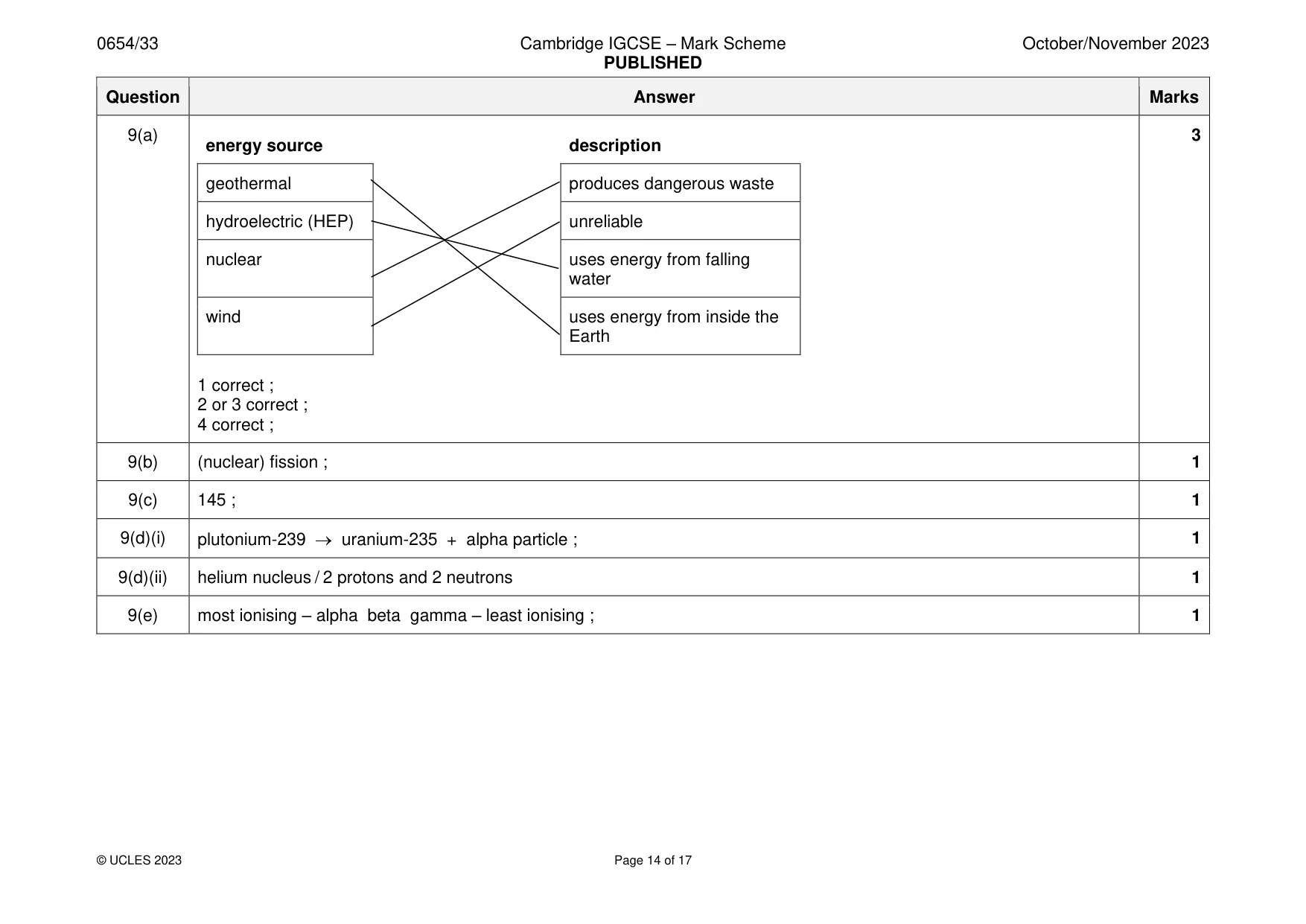
Mark scheme: 9(a) 3 energy source description geothermal produces dangerous waste hydroelectric (HEP) unreliable nuclear uses energy from falling water wind uses energy from inside the Earth 1 correct ; 2 or 3 correct ; 4 correct ; 9(b) (nuclear) fission ; 1 9(c) 145 ; 1 9(d)(i) plutonium-239 → uranium-235 + alpha particle ; 1 9(d)(ii) helium nucleus / 2 protons and 2 neutrons 1 9(e) most ionising – alpha beta gamma – least ionising ; 1
Q10 · A diagram of a cross-section through a leaf
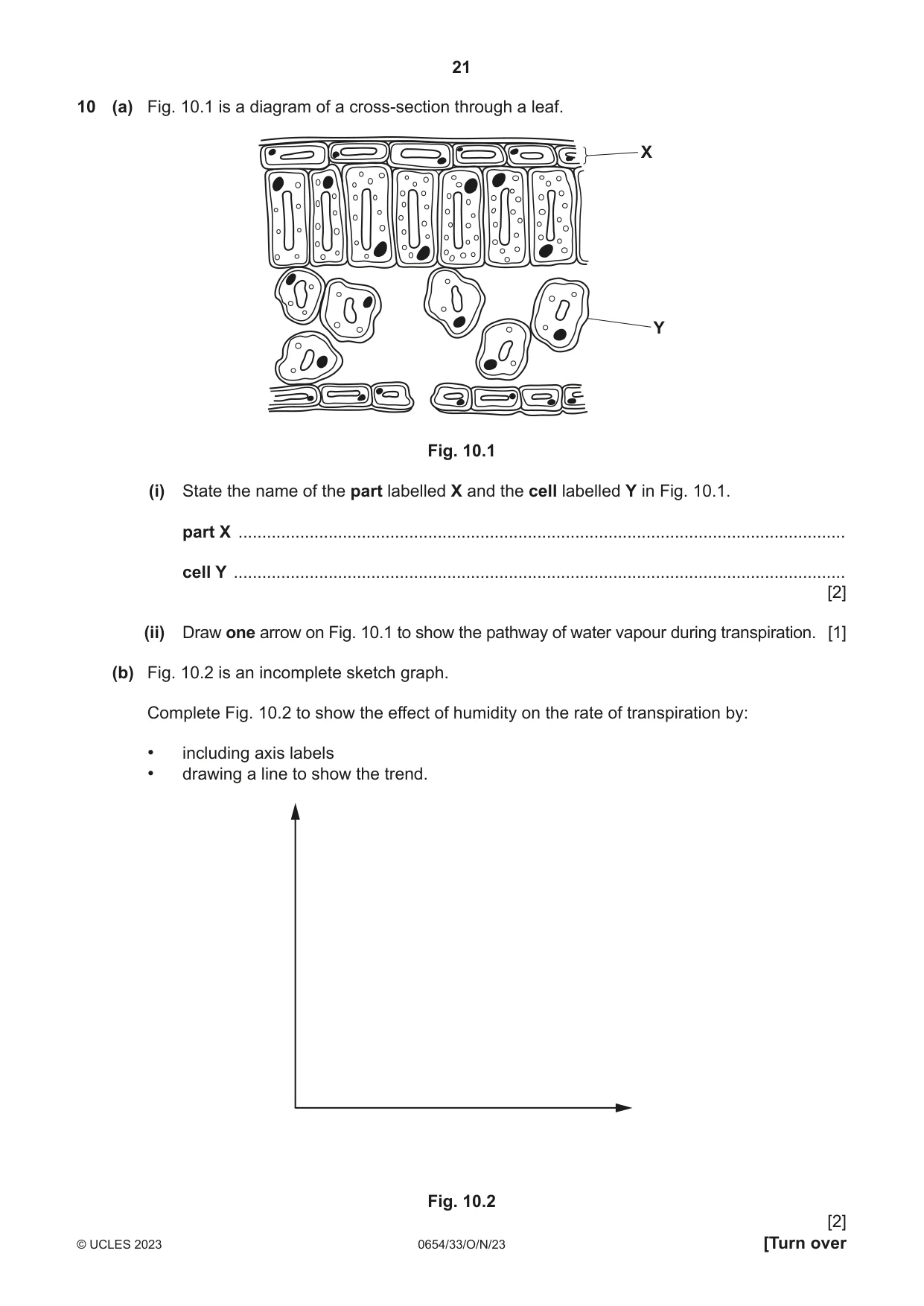
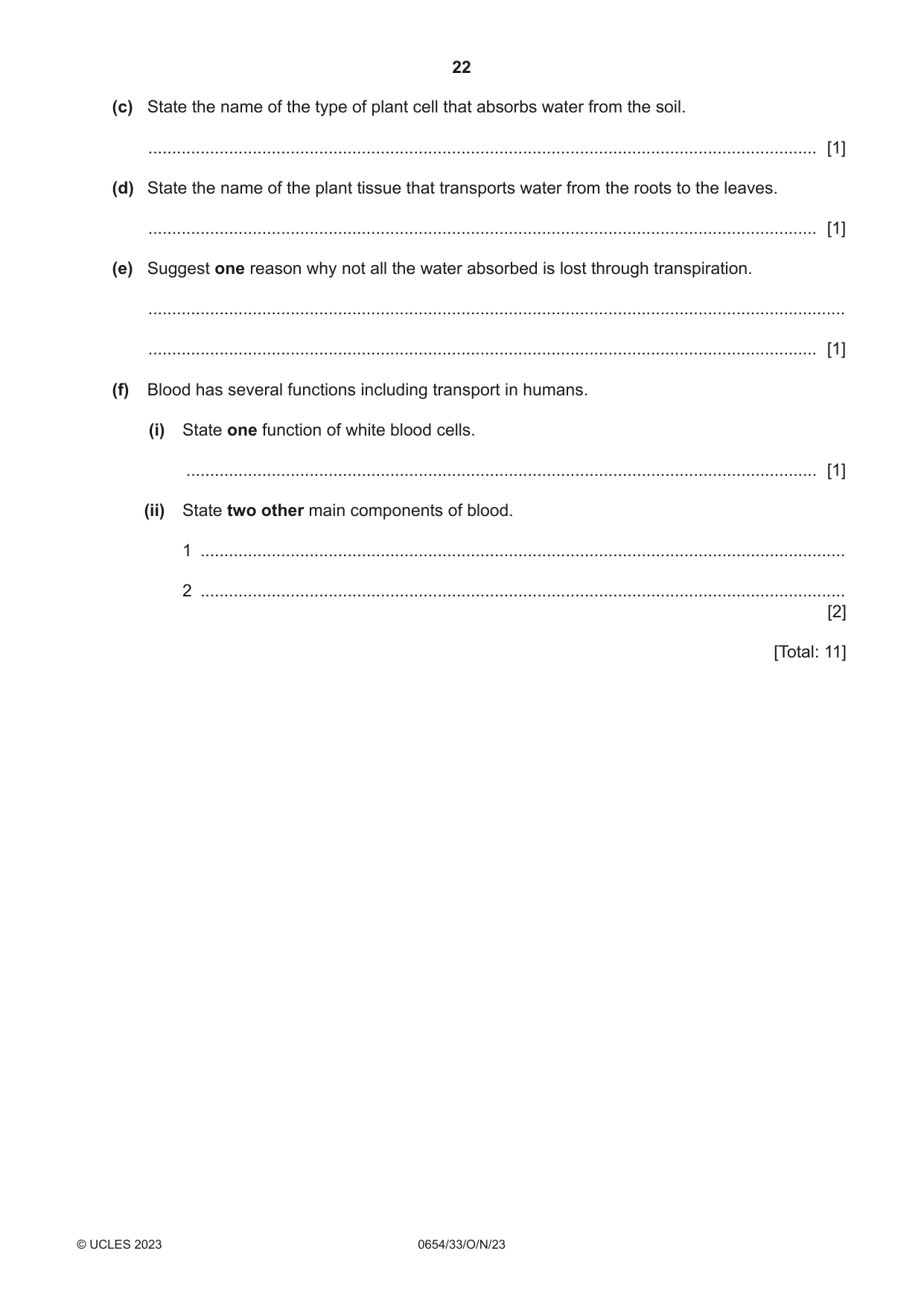
10 (a) Fig. 10.1 is a diagram of a cross-section through a leaf. X Y Fig. 10.1 (i) State the name of the part labelled X and the cell labelled Y in Fig. 10.1. part X ................................................................................................................................ cell Y ................................................................................................................................. [2] (ii) Draw one arrow on Fig. 10.1 to show the pathway of water vapour during transpiration. [1] (b) Fig. 10.2 is an incomplete sketch graph. Complete Fig. 10.2 to show the effect of humidity on the rate of transpiration by: • including axis labels • drawing a line to show the trend. Fig. 10.2 [2] (c) State the name of the type of plant cell that absorbs water from the soil. ............................................................................................................................................. [1] (d) State the name of the plant tissue that transports water from the roots to the leaves. ............................................................................................................................................. [1] (e) Suggest one reason why not all the water absorbed is lost through transpiration. ................................................................................................................................................... ............................................................................................................................................. [1] (f) Blood has several functions including transport in humans. (i) State one function of white blood cells. ..................................................................................................................................... [1] (ii) State two other main components of blood. 1 ........................................................................................................................................ 2 ........................................................................................................................................ [2] [Total: 11]
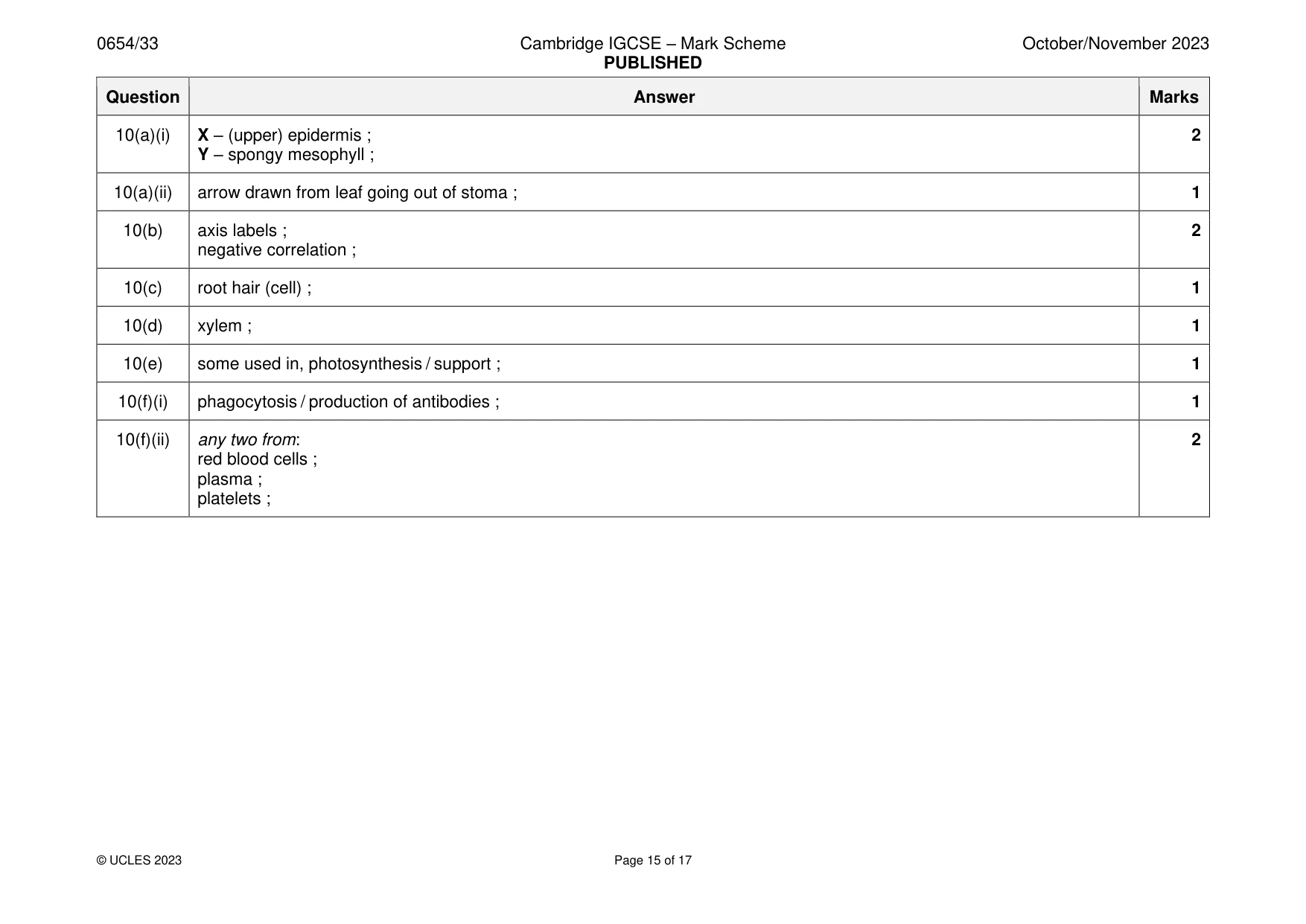
Mark scheme: 10(a)(i) X – (upper) epidermis ; 2 Y – spongy mesophyll ; 10(a)(ii) arrow drawn from leaf going out of stoma ; 1 10(b) axis labels ; 2 negative correlation ; 10(c) root hair (cell) ; 1 10(d) xylem ; 1 10(e) some used in, photosynthesis / support ; 1 10(f)(i) phagocytosis / production of antibodies ; 1 10(f)(ii) any two from: 2 red blood cells ; plasma ; platelets ;
Q11 · Sodium forms a basic oxide
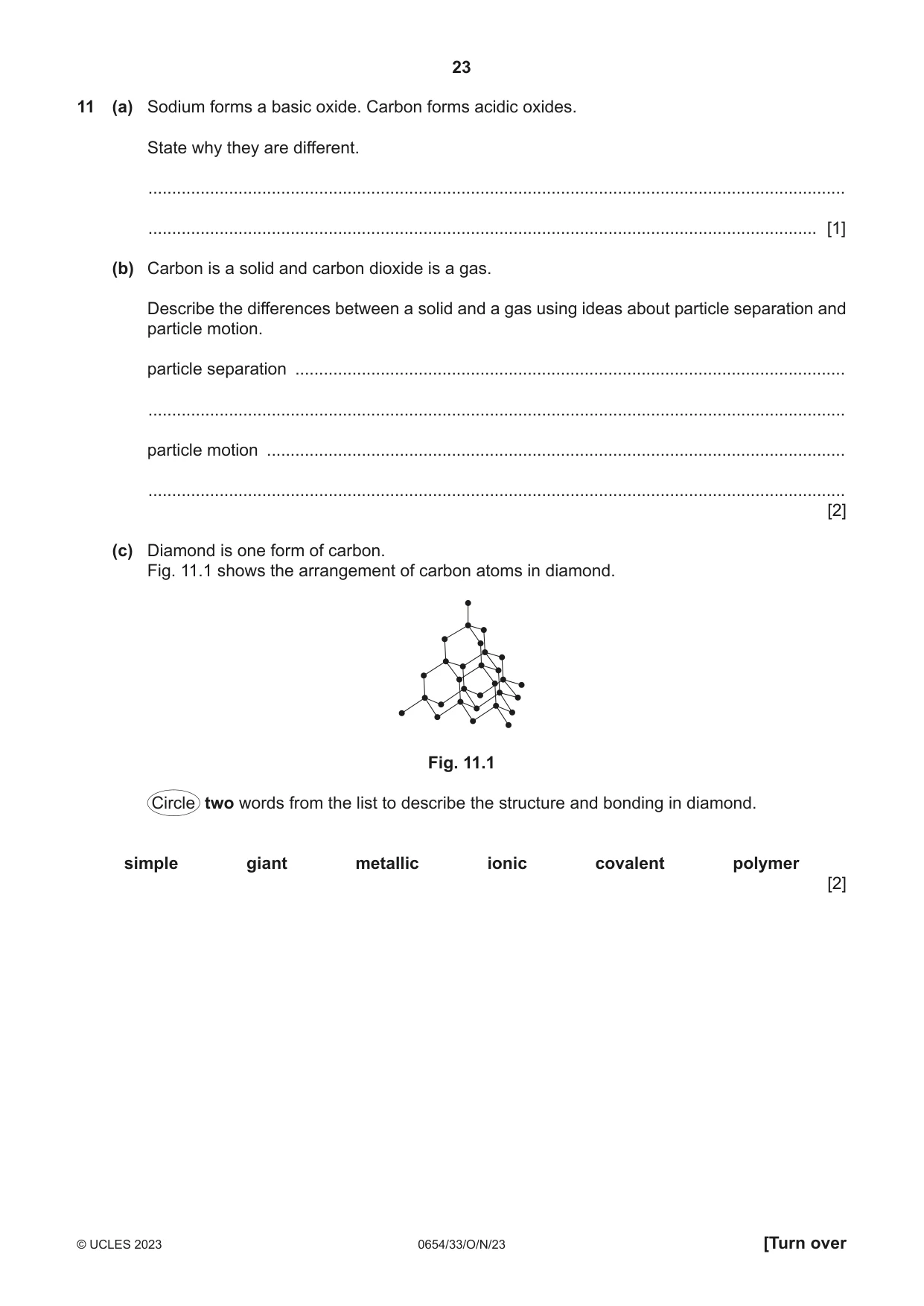
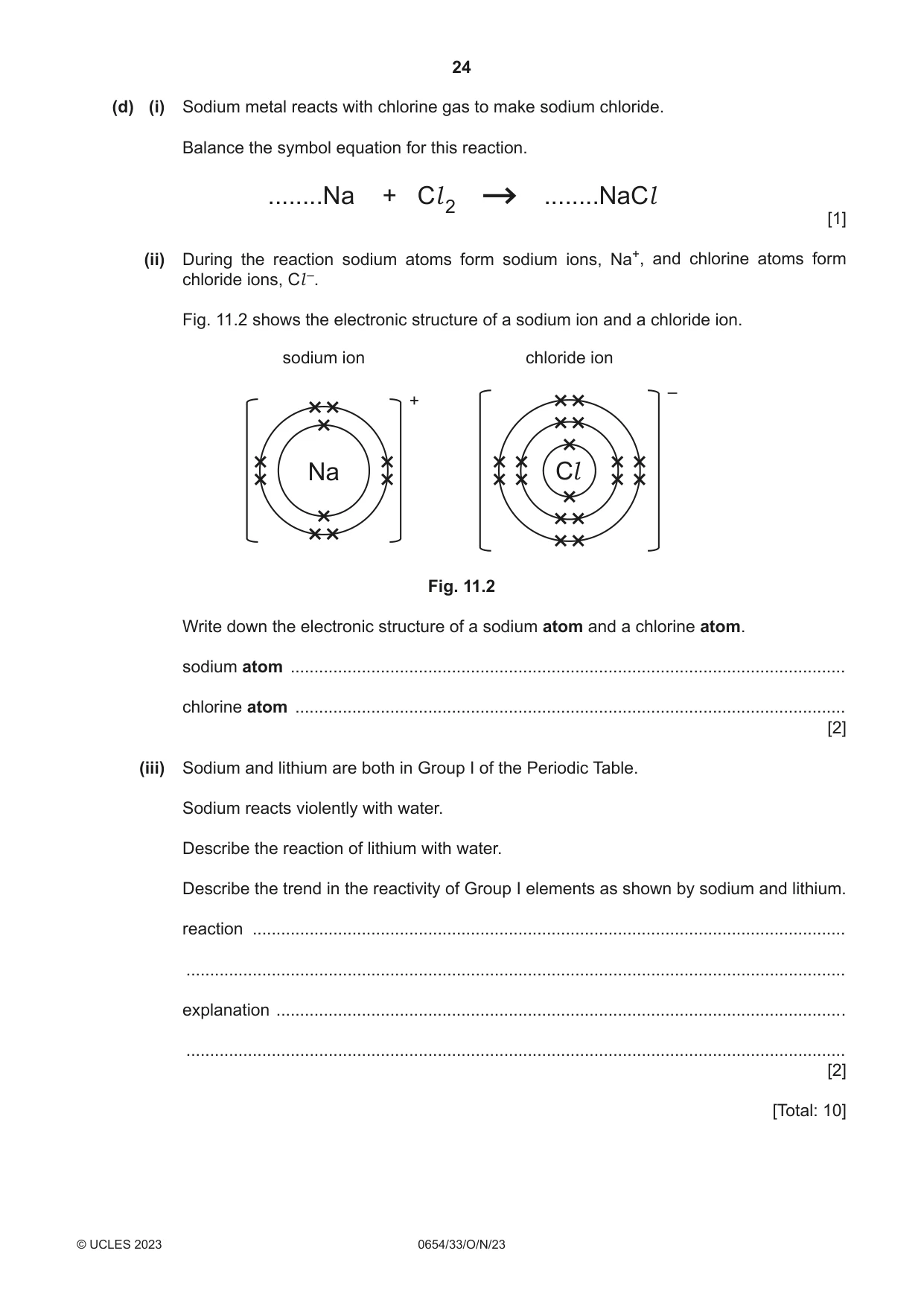
11 (a) Sodium forms a basic oxide. Carbon forms acidic oxides. State why they are different. ................................................................................................................................................... ............................................................................................................................................. [1] (b) Carbon is a solid and carbon dioxide is a gas. Describe the differences between a solid and a gas using ideas about particle separation and particle motion. particle separation .................................................................................................................... ................................................................................................................................................... particle motion .......................................................................................................................... ................................................................................................................................................... [2] (c) Diamond is one form of carbon. Fig. 11.1 shows the arrangement of carbon atoms in diamond. Fig. 11.1 Circle two words from the list to describe the structure and bonding in diamond. simple giant metallic ionic covalent polymer [2] (d) (i) Sodium metal reacts with chlorine gas to make sodium chloride. Balance the symbol equation for this reaction. ........Na + Cl ........NaCl 2 [1] (ii) During the reaction sodium atoms form sodium ions, Na+, and chlorine atoms form chloride ions, Cl –. Fig. 11.2 shows the electronic structure of a sodium ion and a chloride ion. sodium ion chloride ion – + Na Cl Fig. 11.2 Write down the electronic structure of a sodium atom and a chlorine atom. sodium atom ..................................................................................................................... chlorine atom .................................................................................................................... [2] (iii) Sodium and lithium are both in Group I of the Periodic Table. Sodium reacts violently with water. Describe the reaction of lithium with water. Describe the trend in the reactivity of Group I elements as shown by sodium and lithium. reaction ............................................................................................................................. ........................................................................................................................................... explanation ........................................................................................................................ ........................................................................................................................................... [2] [Total: 10]
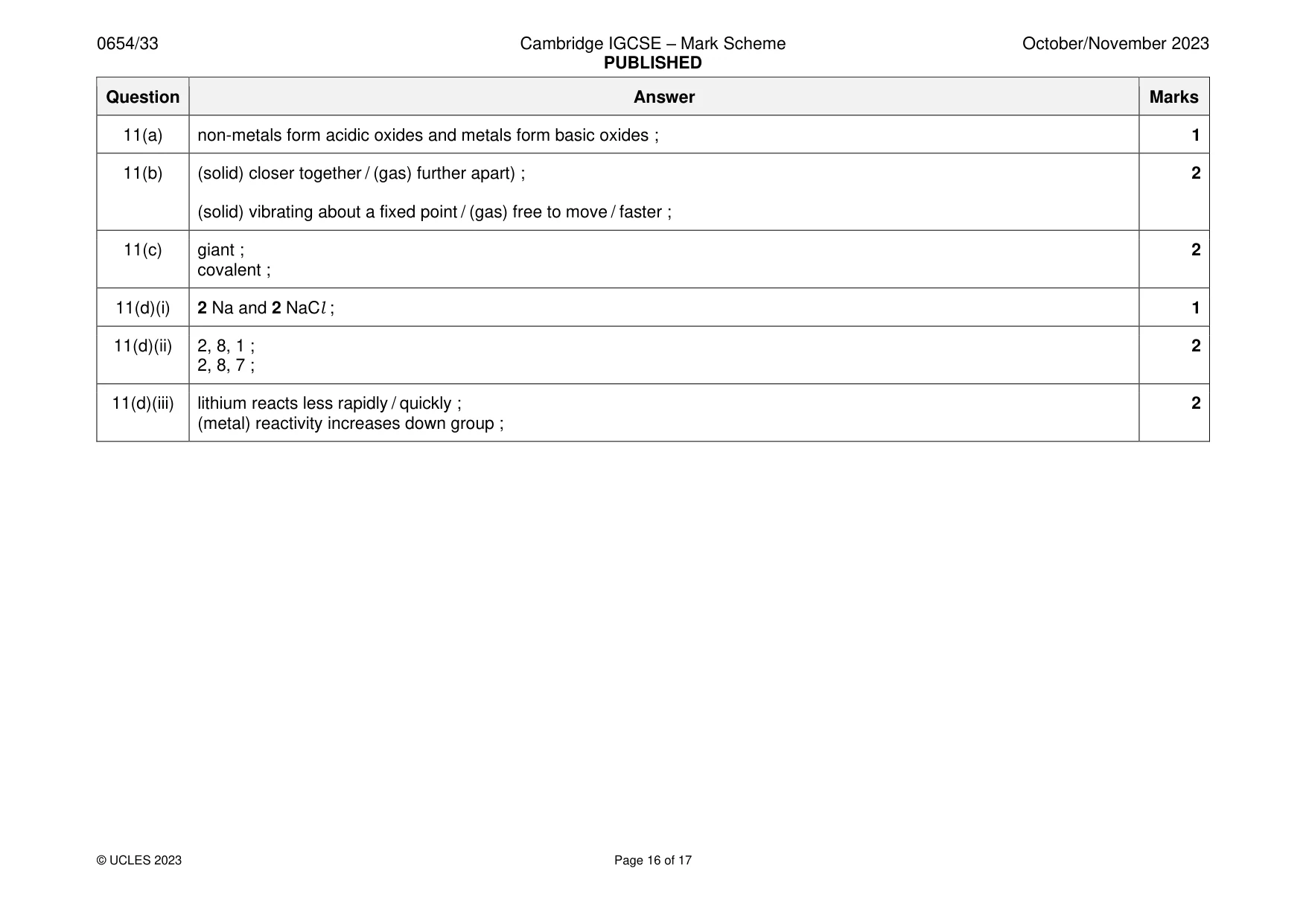
Mark scheme: 11(a) non-metals form acidic oxides and metals form basic oxides ; 1 11(b) (solid) closer together / (gas) further apart) ; 2 (solid) vibrating about a fixed point / (gas) free to move / faster ; 11(c) giant ; 2 covalent ; 11(d)(i) 2 Na and 2 NaCl ; 1 11(d)(ii) 2, 8, 1 ; 2 2, 8, 7 ; 11(d)(iii) lithium reacts less rapidly / quickly ; 2 (metal) reactivity increases down group ;
Q12 · A distance–time graph for two cyclists A and B who are racing for a distance of 1000 m
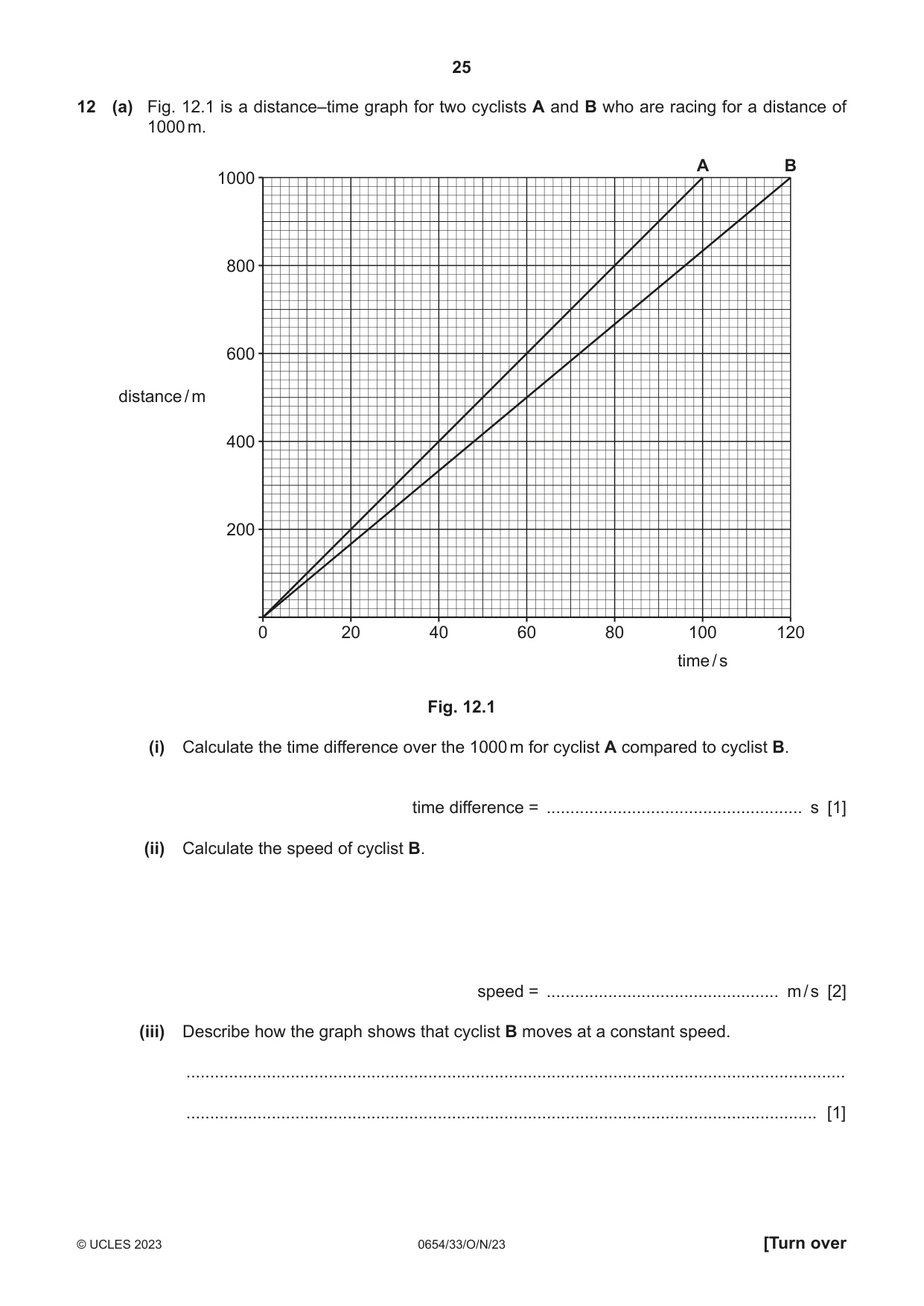
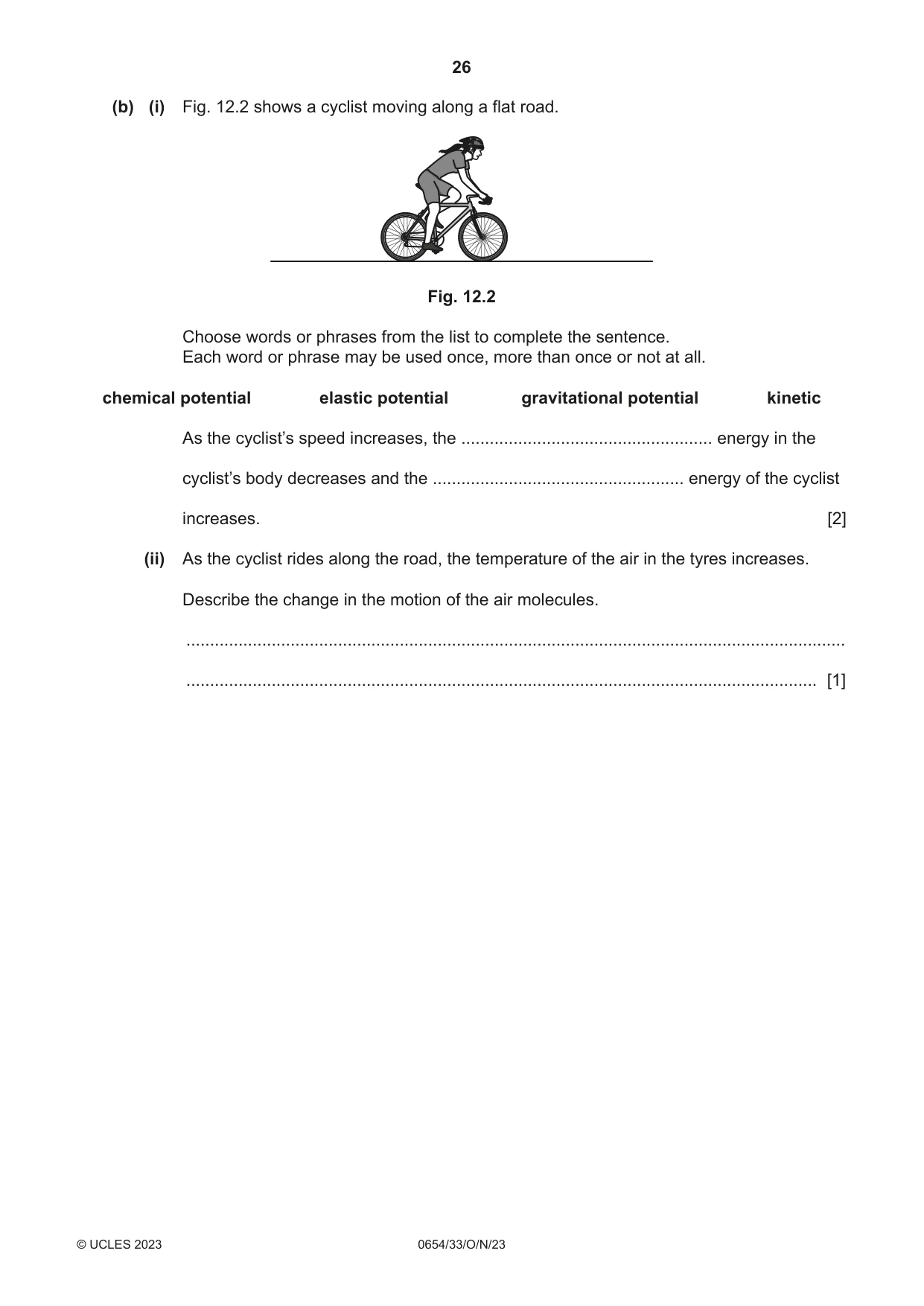
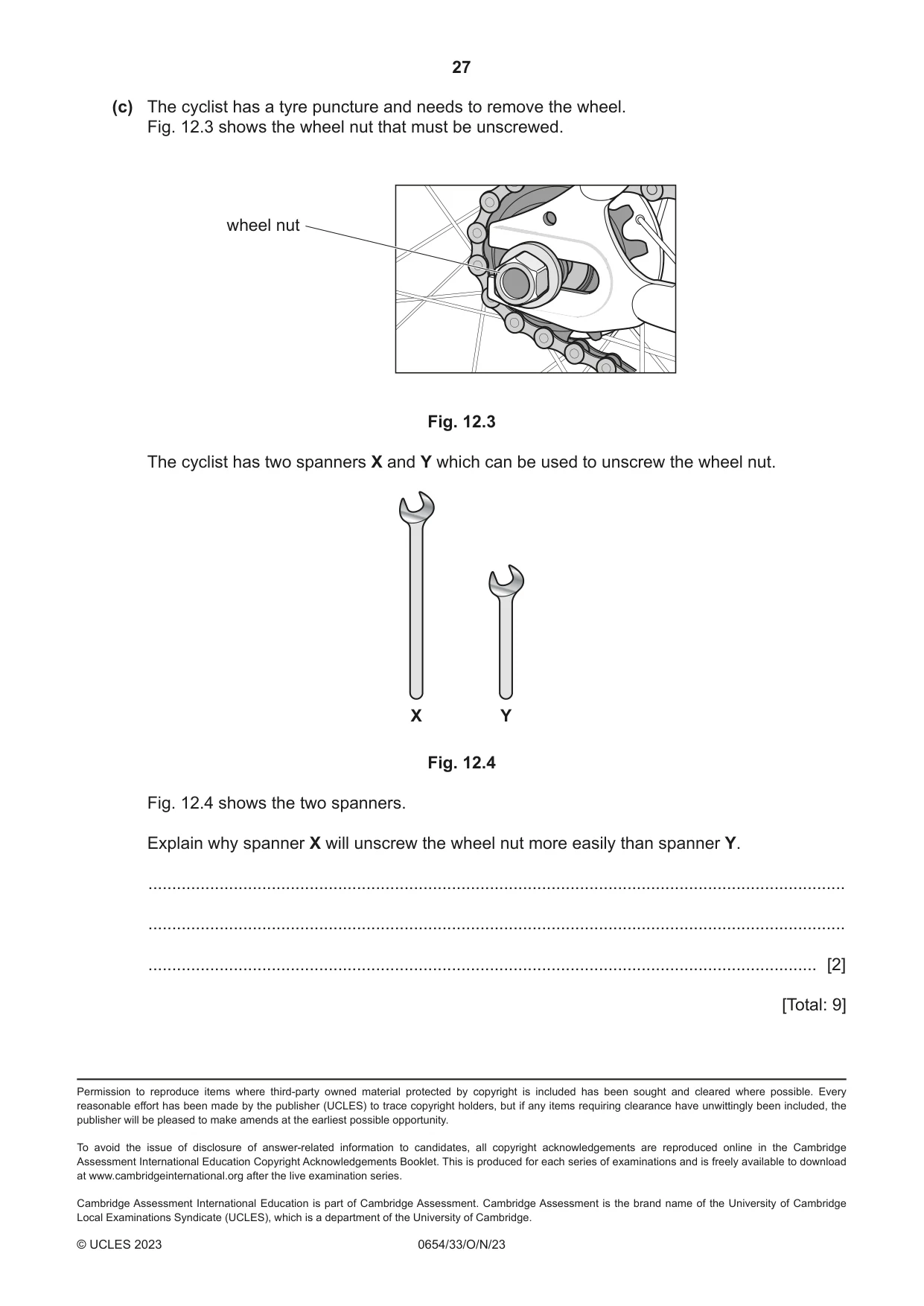
12 (a) Fig. 12.1 is a distance–time graph for two cyclists A and B who are racing for a distance of 1000 m. A B 1000 800 600 distance / m 400 200 0 20 40 60 80 100 120 time / s Fig. 12.1 (i) Calculate the time difference over the 1000 m for cyclist A compared to cyclist B. time difference = ...................................................... s [1] (ii) Calculate the speed of cyclist B. speed = ................................................. m / s [2] (iii) Describe how the graph shows that cyclist B moves at a constant speed. ........................................................................................................................................... ..................................................................................................................................... [1] (b) (i) Fig. 12.2 shows a cyclist moving along a flat road. Fig. 12.2 Choose words or phrases from the list to complete the sentence. Each word or phrase may be used once, more than once or not at all. chemical potential elastic potential gravitational potential kinetic As the cyclist’s speed increases, the ..................................................... energy in the cyclist’s body decreases and the ..................................................... energy of the cyclist increases. [2] (ii) As the cyclist rides along the road, the temperature of the air in the tyres increases. Describe the change in the motion of the air molecules. ........................................................................................................................................... ..................................................................................................................................... [1] (c) The cyclist has a tyre puncture and needs to remove the wheel. Fig. 12.3 shows the wheel nut that must be unscrewed. wheel nut Fig. 12.3 The cyclist has two spanners X and Y which can be used to unscrew the wheel nut. X Y Fig. 12.4 Fig. 12.4 shows the two spanners. Explain why spanner X will unscrew the wheel nut more easily than spanner Y. ................................................................................................................................................... ................................................................................................................................................... ............................................................................................................................................. [2] [Total: 9]
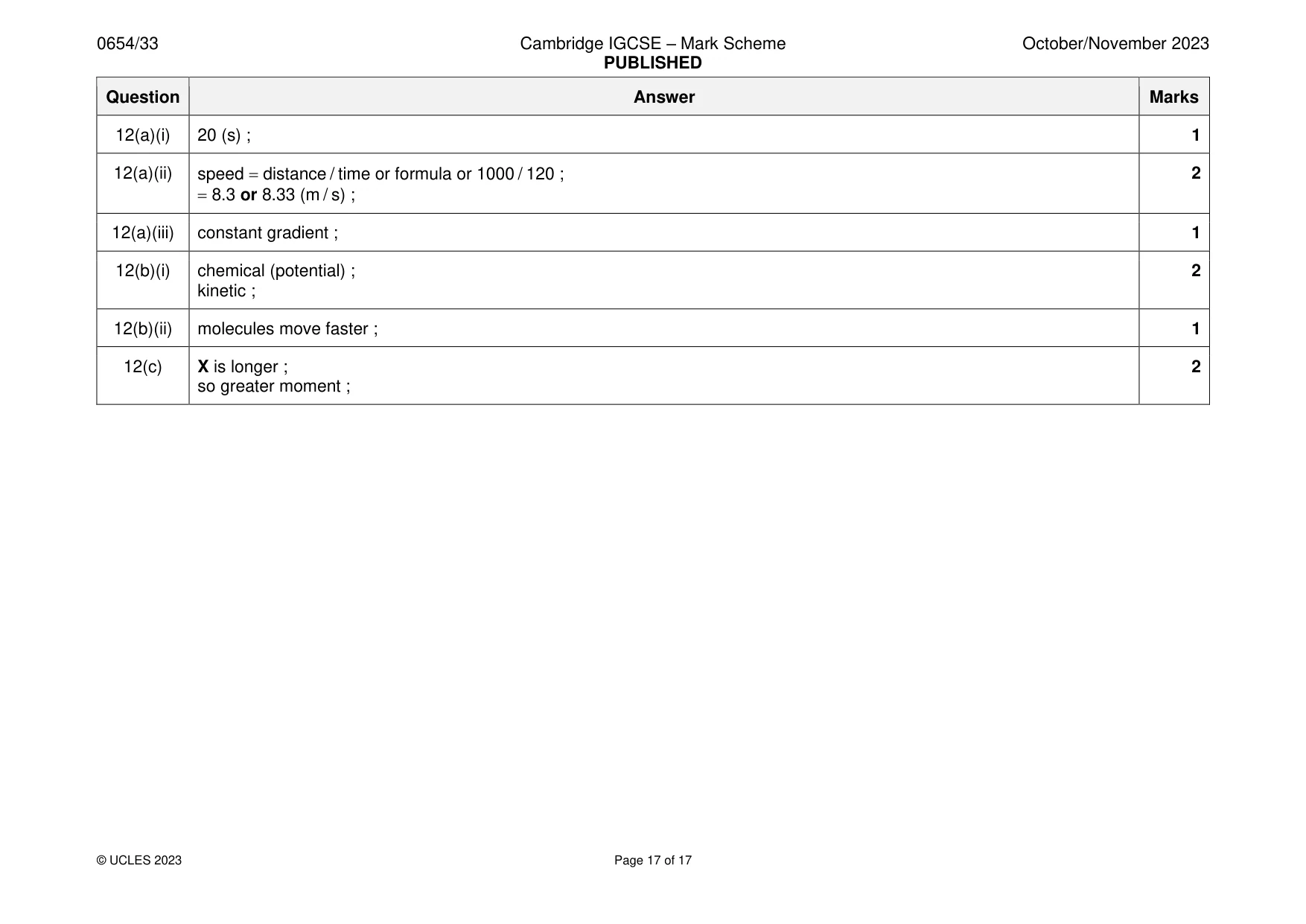
Mark scheme: 12(a)(i) 20 (s) ; 1 12(a)(ii) speed = distance / time or formula or 1000 / 120 ; 2 = 8.3 or 8.33 (m / s) ; 12(a)(iii) constant gradient ; 1 12(b)(i) chemical (potential) ; 2 kinetic ; 12(b)(ii) molecules move faster ; 1 12(c) X is longer ; 2 so greater moment ;
What was in this paper
The subtopics covered by these 12 questions, and how many questions each got. Open one in a new tab to see every Cambridge question on it.
What you needed in this session
Cambridge’s own grade thresholds for 2023 Oct/Nov, Paper 3 · Variant 3. A higher threshold means an easier paper — the bar moves with how the cohort did.