Cambridge IGCSE Sciences - Co-ordinated (Double) 0654 — 2019 Oct/Nov Paper 3 · Variant 2
0654/32/O/N/19 · 13 questions · 120 marks · ≈135 min
The question paper and its mark scheme, free to read here and free to download. This is Cambridge’s own paper, exactly as it was sat.
Question paper32 pages
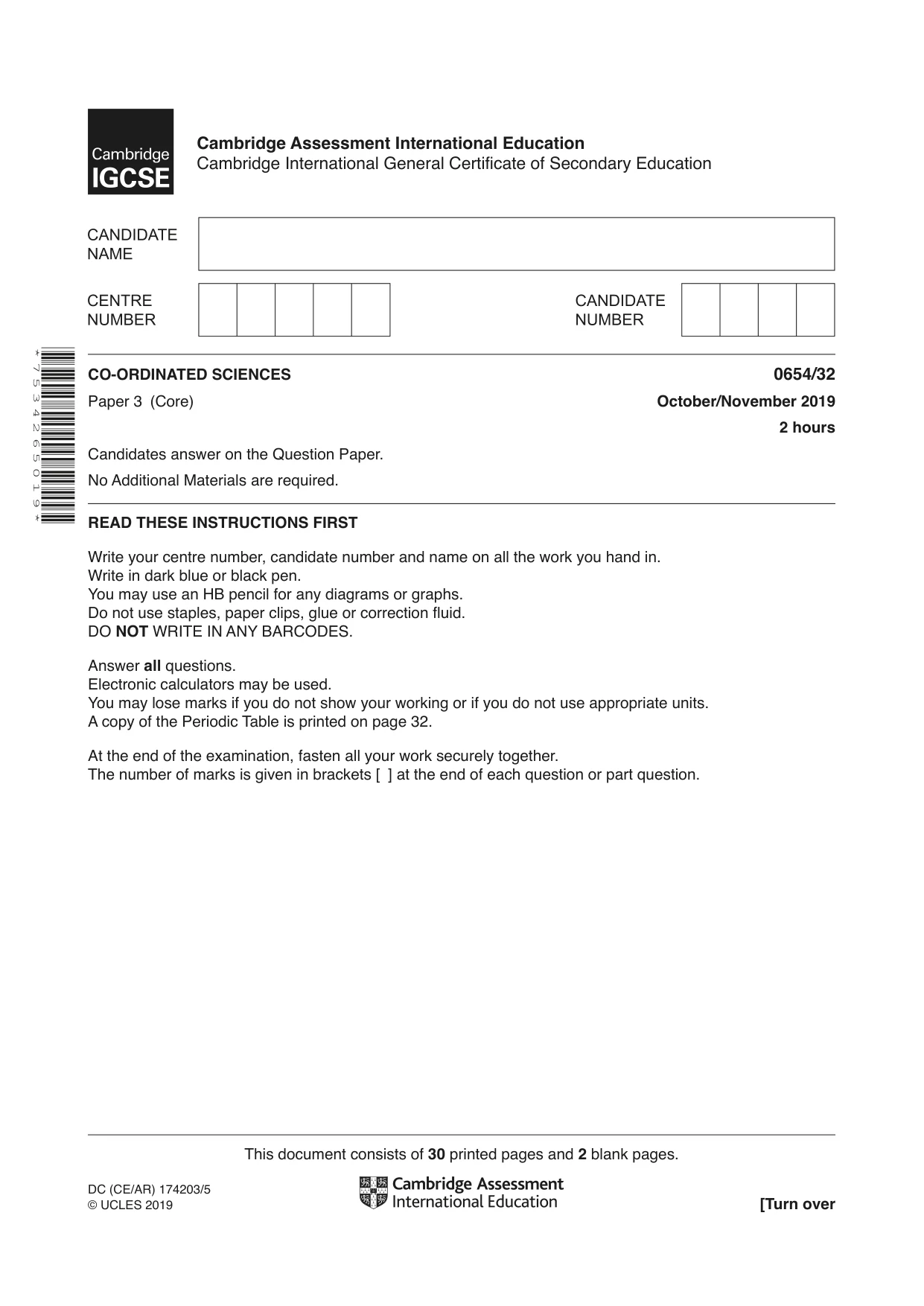



Mark scheme16 pages
Answers below. Sit the paper first if you are practising.
Questions as text
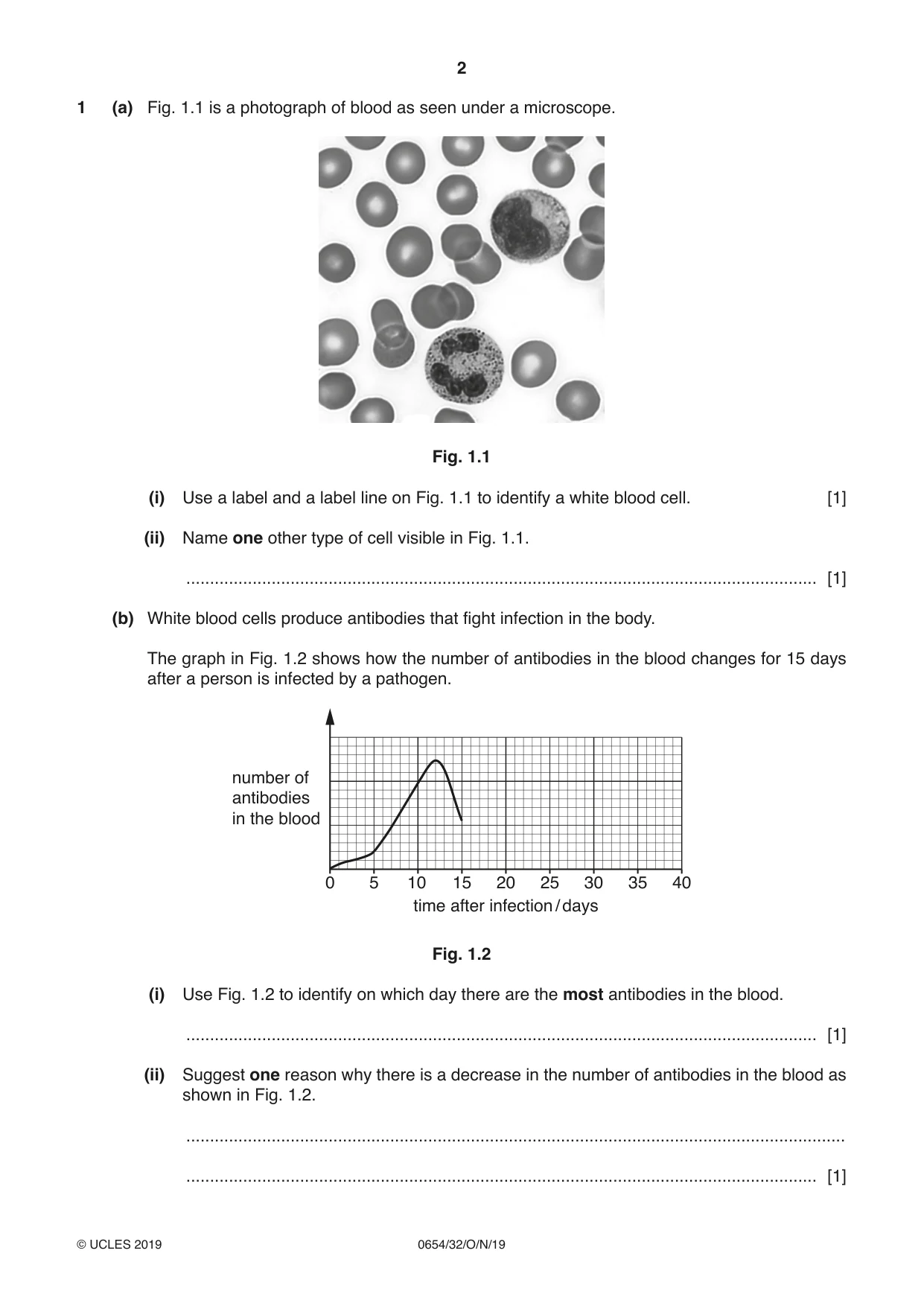
Q1 · A photograph of blood as seen under a microscope
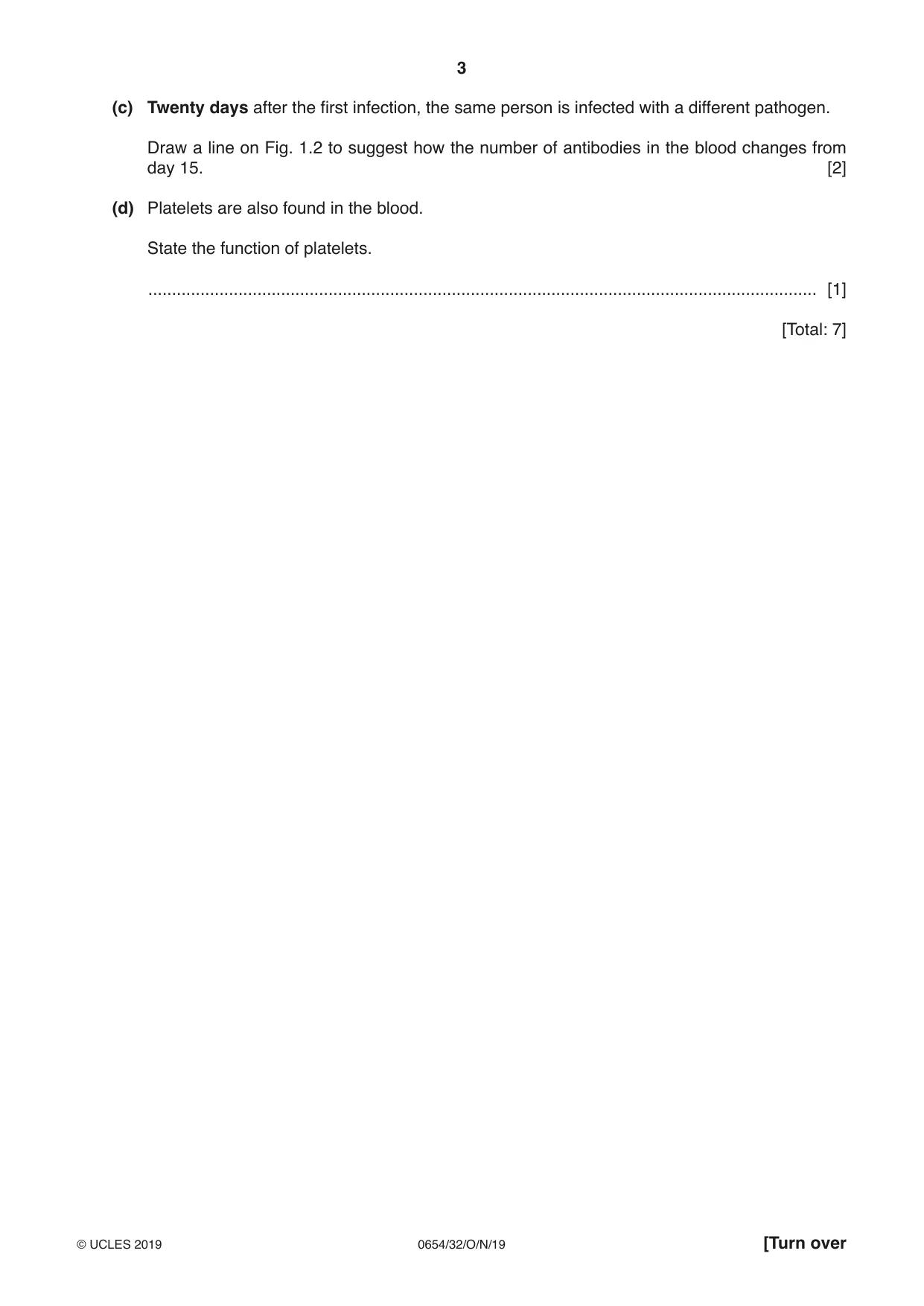
1 (a) Fig. 1.1 is a photograph of blood as seen under a microscope. Fig. 1.1 (i) Use a label and a label line on Fig. 1.1 to identify a white blood cell. [1] (ii) Name one other type of cell visible in Fig. 1.1. ..................................................................................................................................... [1] (b) White blood cells produce antibodies that fight infection in the body. The graph in Fig. 1.2 shows how the number of antibodies in the blood changes for 15 days after a person is infected by a pathogen. number of antibodies in the blood 0 5 10 15 20 25 30 35 40 time after infection / days Fig. 1.2 (i) Use Fig. 1.2 to identify on which day there are the most antibodies in the blood. ..................................................................................................................................... [1] (ii) Suggest one reason why there is a decrease in the number of antibodies in the blood as shown in Fig. 1.2. ........................................................................................................................................... ..................................................................................................................................... [1] (c) Twenty days after the first infection, the same person is infected with a different pathogen. Draw a line on Fig. 1.2 to suggest how the number of antibodies in the blood changes from day 15. [2] (d) Platelets are also found in the blood. State the function of platelets. ............................................................................................................................................. [1] [Total: 7]
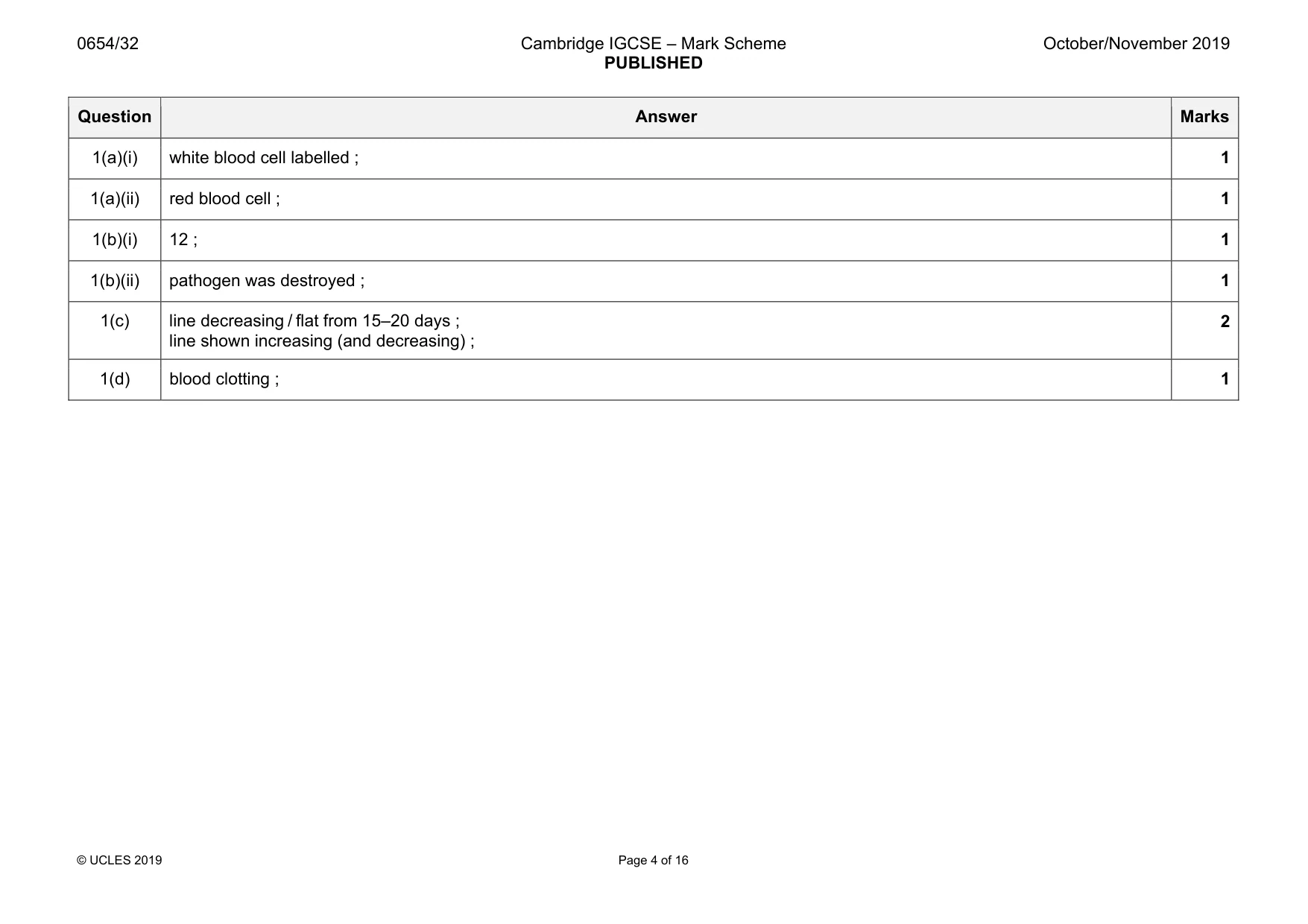
Mark scheme: 1(a)(i) white blood cell labelled ; 1 1(a)(ii) red blood cell ; 1 1(b)(i) 12 ; 1 1(b)(ii) pathogen was destroyed ; 1 1(c) line decreasing / flat from 15–20 days ; line shown increasing (and decreasing) ; 2 1(d) blood clotting ; 1
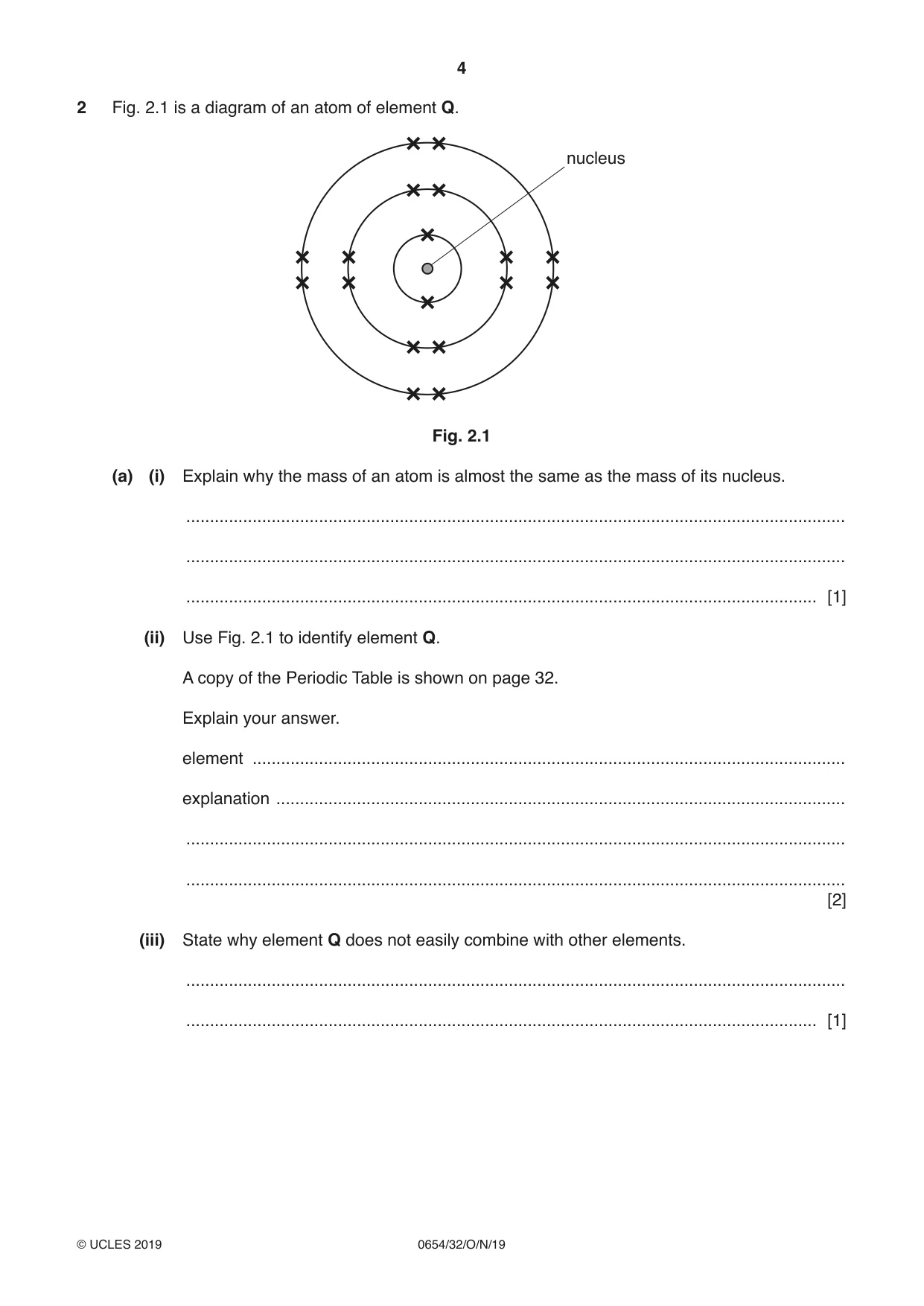
Q2 · A diagram of an atom of element Q
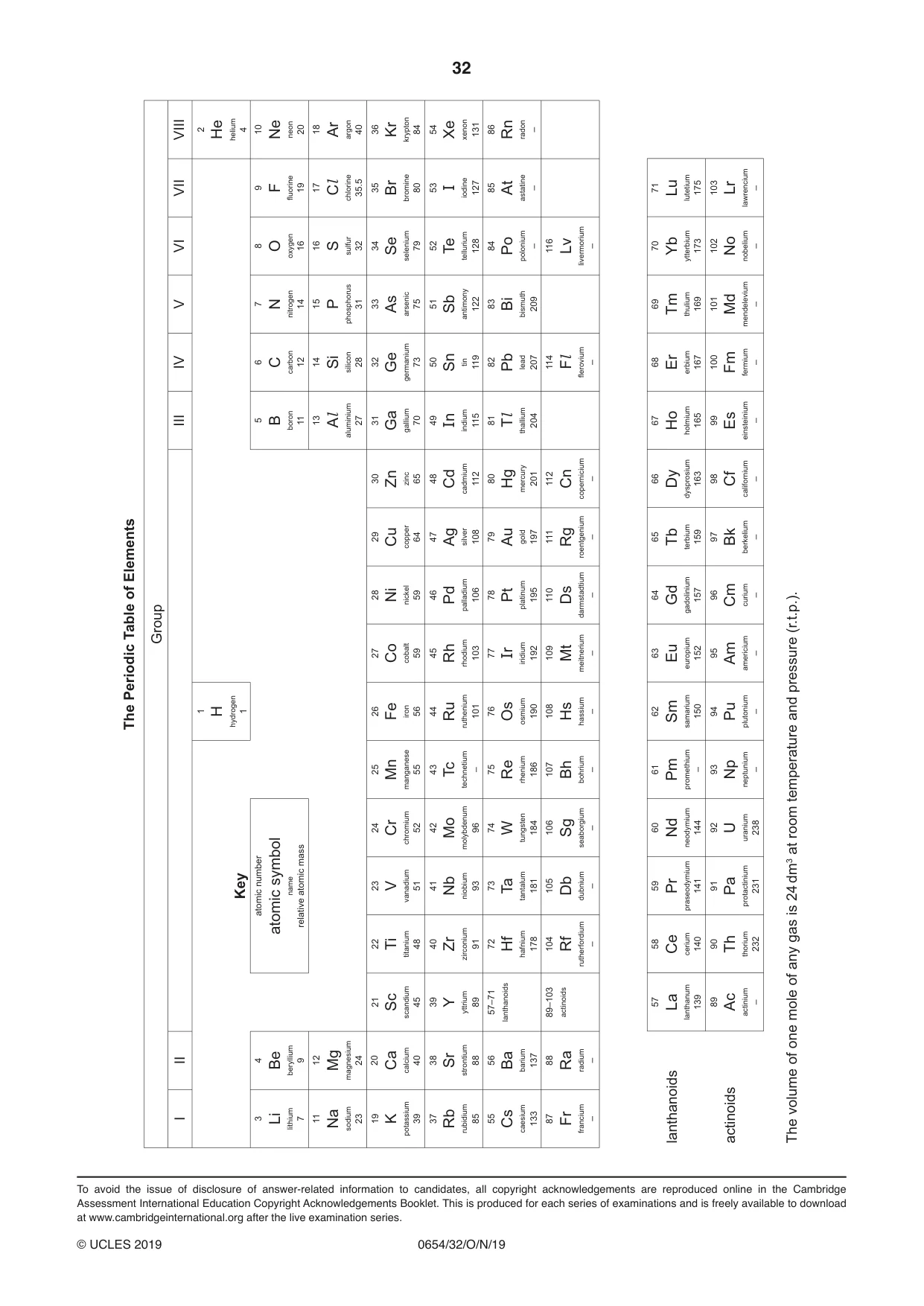
2 Fig. 2.1 is a diagram of an atom of element Q. nucleus Fig. 2.1 (a) (i) Explain why the mass of an atom is almost the same as the mass of its nucleus. ........................................................................................................................................... ........................................................................................................................................... ..................................................................................................................................... [1] (ii) Use Fig. 2.1 to identify element Q. A copy of the Periodic Table is shown on page 32. Explain your answer. element ............................................................................................................................. explanation ........................................................................................................................ ........................................................................................................................................... ........................................................................................................................................... [2] (iii) State why element Q does not easily combine with other elements. ........................................................................................................................................... ..................................................................................................................................... [1] (b) A teacher investigates the change in mass when calcium burns in air to form calcium oxide. (i) The mass of calcium oxide produced is greater than the mass of calcium the teacher used. Explain this result. ........................................................................................................................................... ..................................................................................................................................... [1] (ii) The teacher mixes calcium oxide with water to form a solution. Predict the pH of the solution. Explain your answer. prediction ........................................................................................................................... ........................................................................................................................................... explanation ........................................................................................................................ ........................................................................................................................................... ........................................................................................................................................... [2] [Total: 7]
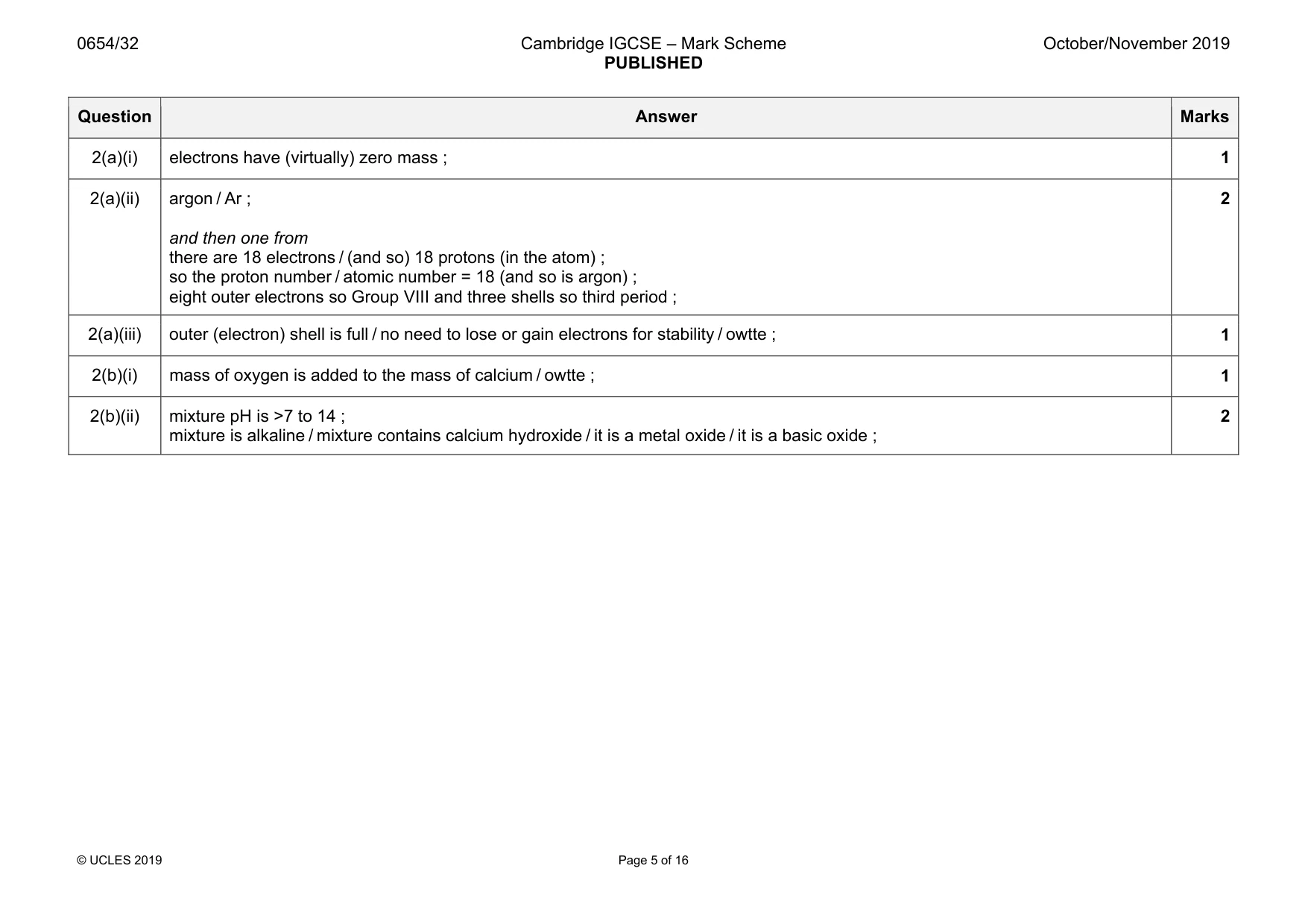
Mark scheme: 2(a)(i) electrons have (virtually) zero mass ; 1 2(a)(ii) argon / Ar ; and then one from there are 18 electrons / (and so) 18 protons (in the atom) ; so the proton number / atomic number = 18 (and so is argon) ; eight outer electrons so Group VIII and three shells so third period ; 2 2(a)(iii) outer (electron) shell is full / no need to lose or gain electrons for stability / owtte ; 1 2(b)(i) mass of oxygen is added to the mass of calcium / owtte ; 1 2(b)(ii) mixture pH is >7 to 14 ; mixture is alkaline / mixture contains calcium hydroxide / it is a metal oxide / it is a basic oxide ; 2
Q3 · A girl runs around a 400 m athletics track
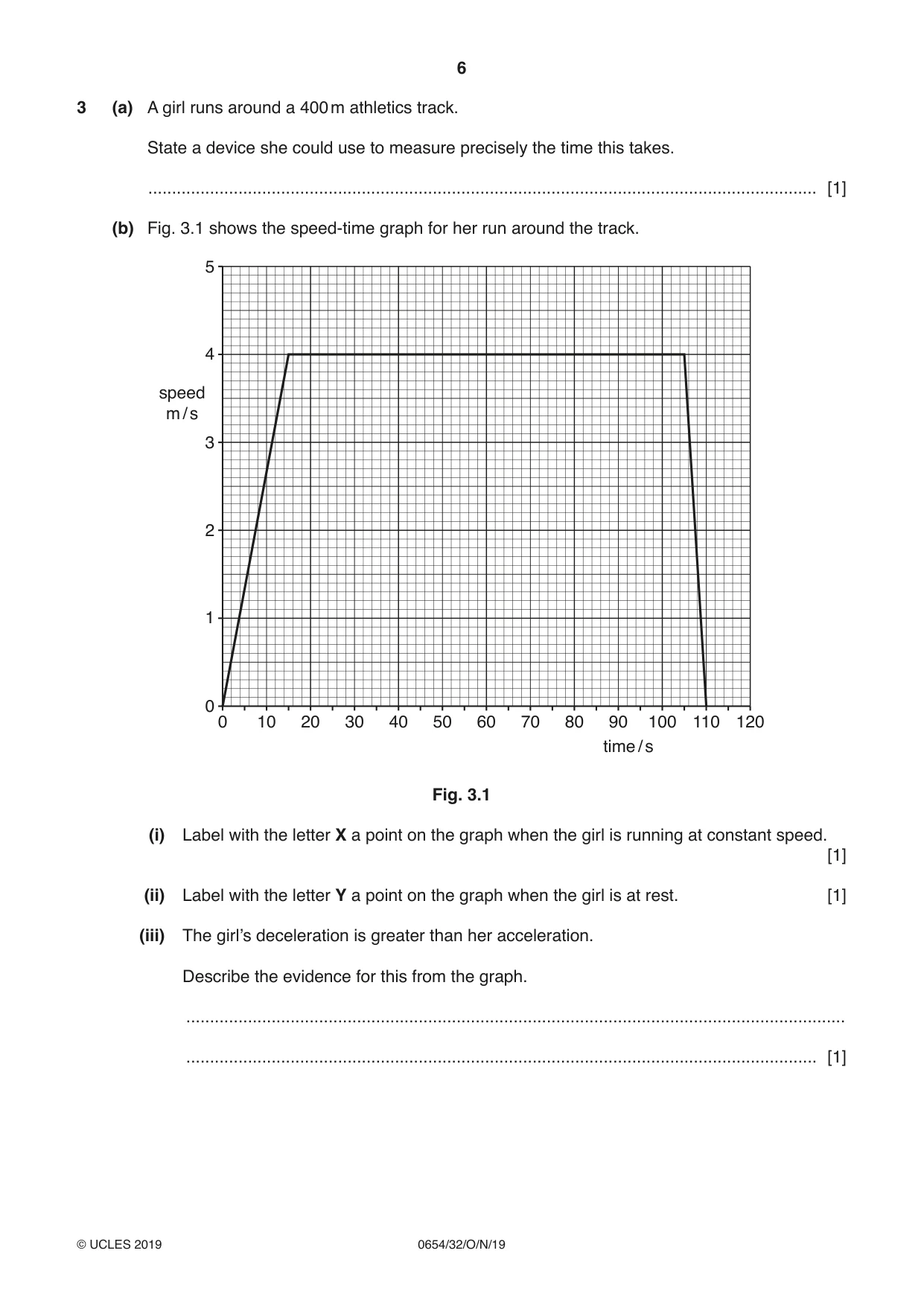
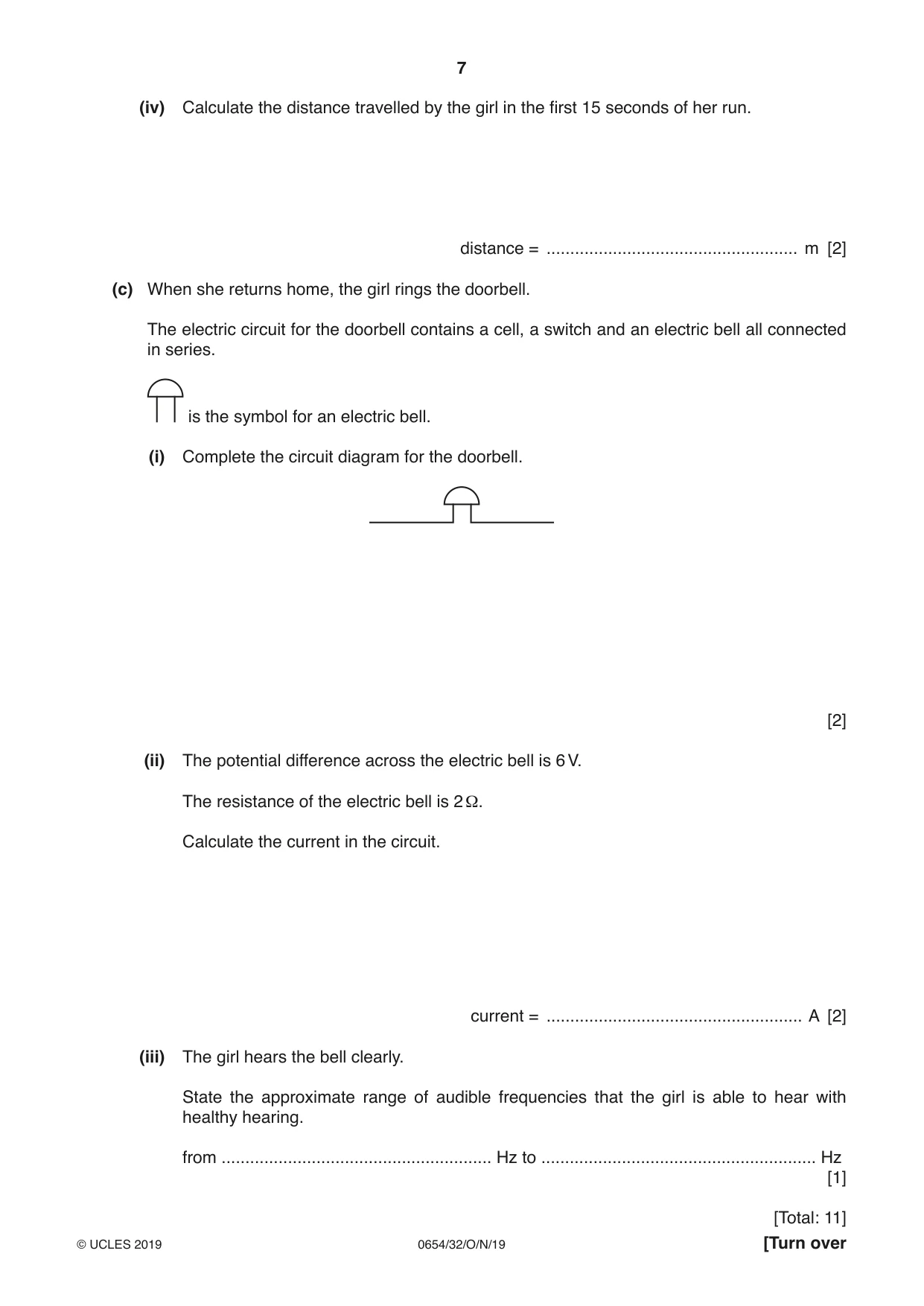
3 (a) A girl runs around a 400 m athletics track. State a device she could use to measure precisely the time this takes. ............................................................................................................................................. [1] (b) Fig. 3.1 shows the speed-time graph for her run around the track. 5 4 speed m / s 3 2 1 0 0 10 20 30 40 50 60 70 80 90 100 110 120 time / s Fig. 3.1 (i) Label with the letter X a point on the graph when the girl is running at constant speed. [1] (ii) Label with the letter Y a point on the graph when the girl is at rest. [1] (iii) The girl’s deceleration is greater than her acceleration. Describe the evidence for this from the graph. ........................................................................................................................................... ..................................................................................................................................... [1] (iv) Calculate the distance travelled by the girl in the first 15 seconds of her run. distance = ..................................................... m [2] (c) When she returns home, the girl rings the doorbell. The electric circuit for the doorbell contains a cell, a switch and an electric bell all connected in series. is the symbol for an electric bell. (i) Complete the circuit diagram for the doorbell. [2] (ii) The potential difference across the electric bell is 6 V. The resistance of the electric bell is 2 Ω. Calculate the current in the circuit. current = ...................................................... A [2] (iii) The girl hears the bell clearly. State the approximate range of audible frequencies that the girl is able to hear with healthy hearing. from ......................................................... Hz to .......................................................... Hz [1] [Total: 11]
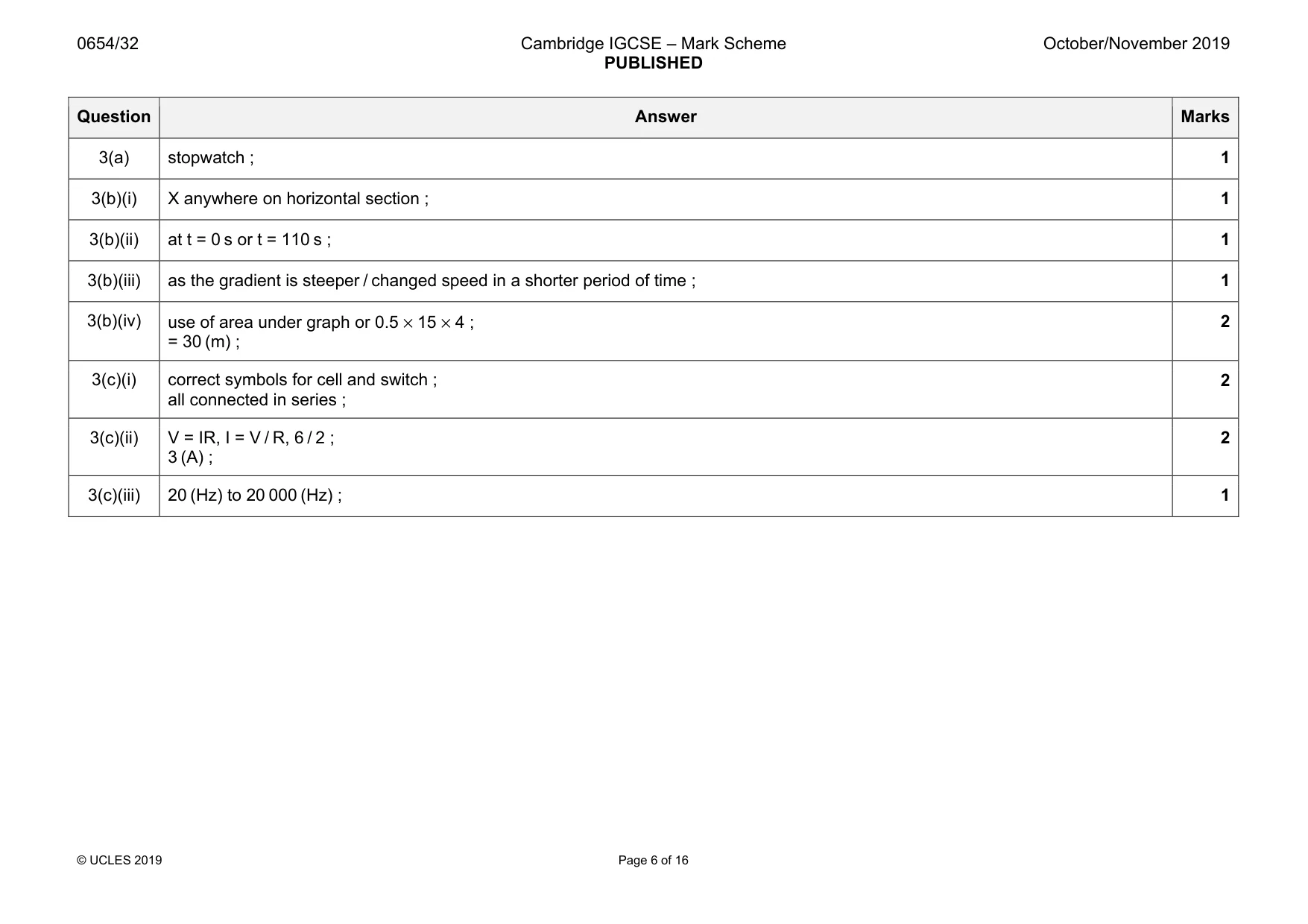
Mark scheme: 3(a) stopwatch ; 1 3(b)(i) X anywhere on horizontal section ; 1 3(b)(ii) at t = 0 s or t = 110 s ; 1 3(b)(iii) as the gradient is steeper / changed speed in a shorter period of time ; 1 3(b)(iv) use of area under graph or 0.5 × 15 × 4 ; = 30 (m) ; 2 3(c)(i) correct symbols for cell and switch ; all connected in series ; 2 3(c)(ii) V = IR, I = V / R, 6 / 2 ; 3 (A) ; 2 3(c)(iii) 20 (Hz) to 20 000 (Hz) ; 1
Q4 · Respiration is a process that is part of the carbon cycle
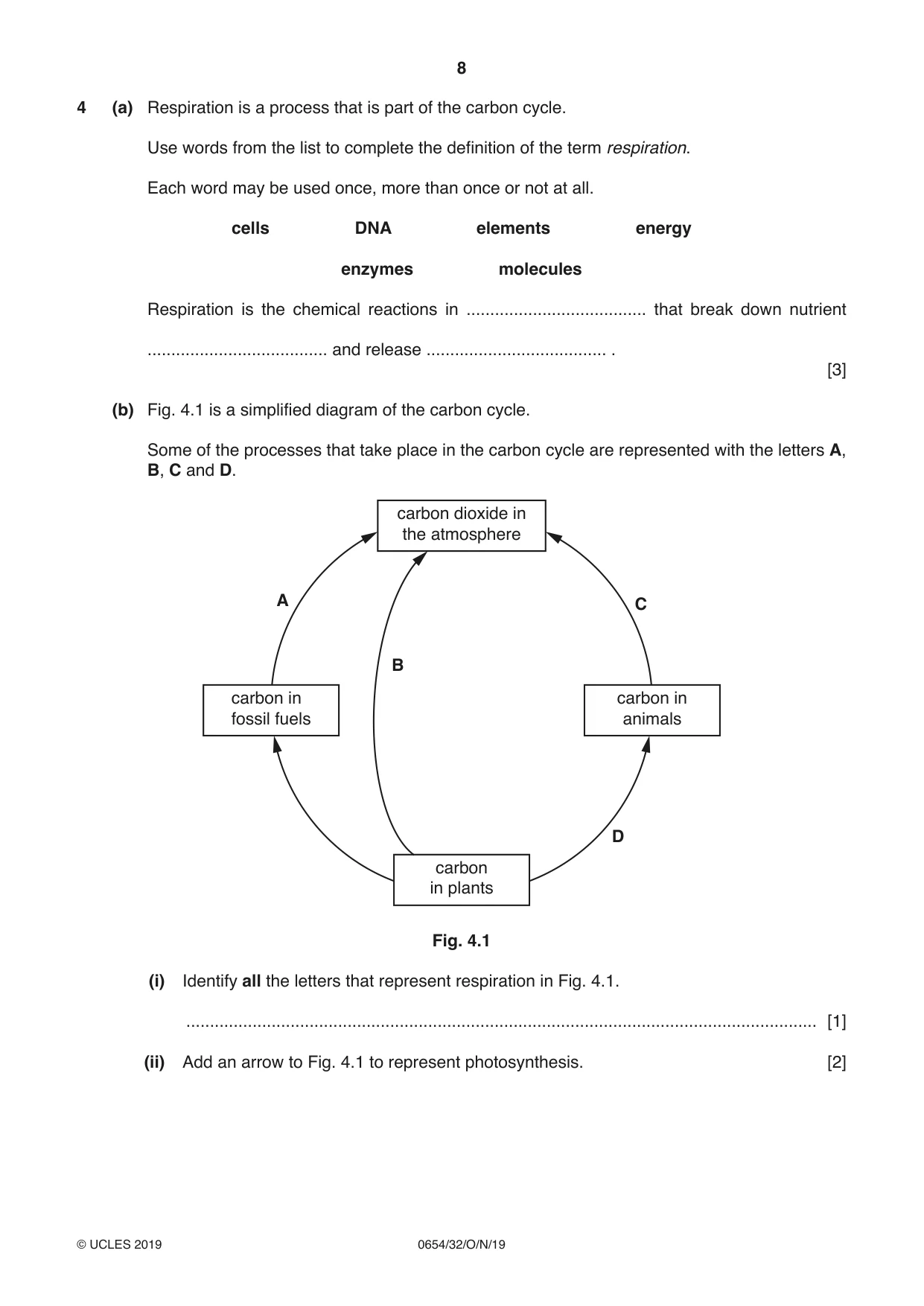
4 (a) Respiration is a process that is part of the carbon cycle. Use words from the list to complete the definition of the term respiration. Each word may be used once, more than once or not at all. cells DNA elements energy enzymes molecules Respiration is the chemical reactions in ...................................... that break down nutrient ...................................... and release ...................................... . [3] (b) Fig. 4.1 is a simplified diagram of the carbon cycle. Some of the processes that take place in the carbon cycle are represented with the letters A, B, C and D. carbon dioxide in the atmosphere A C B carbon in carbon in fossil fuels animals D carbon in plants Fig. 4.1 (i) Identify all the letters that represent respiration in Fig. 4.1. ..................................................................................................................................... [1] (ii) Add an arrow to Fig. 4.1 to represent photosynthesis. [2] (c) Deforestation can cause an increase of carbon dioxide in the atmosphere. Animal species living in areas where deforestation occurs are also affected. Describe two effects of deforestation on animal species. 1 ................................................................................................................................................ ................................................................................................................................................... 2 ................................................................................................................................................ ................................................................................................................................................... [2] [Total: 8]
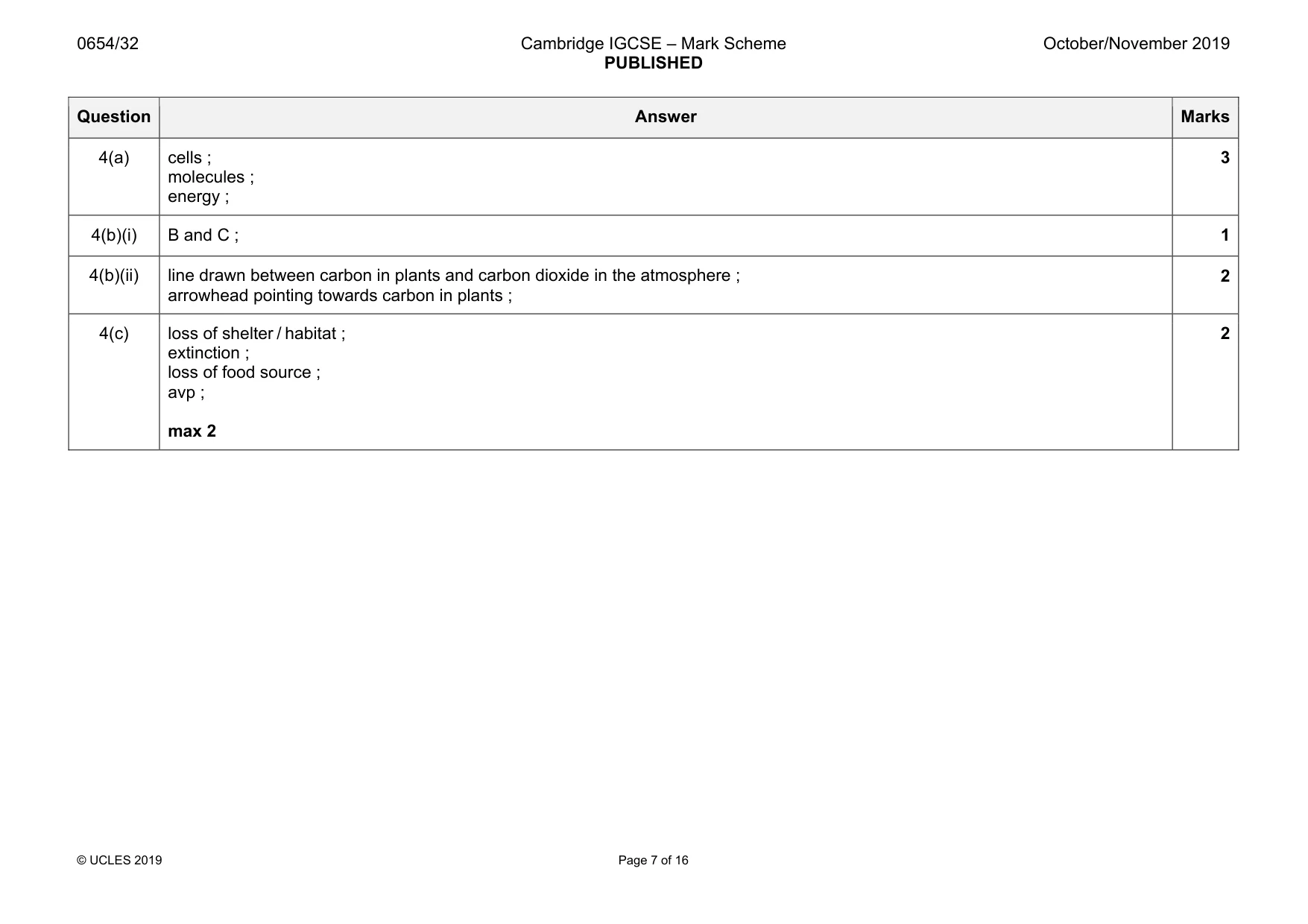
Mark scheme: 4(a) cells ; molecules ; energy ; 3 4(b)(i) B and C ; 1 4(b)(ii) line drawn between carbon in plants and carbon dioxide in the atmosphere ; arrowhead pointing towards carbon in plants ; 2 4(c) loss of shelter / habitat ; extinction ; loss of food source ; avp ; max 2 2 Question Answer Marks
Q5 · Impurities are unwanted substances in mixtures
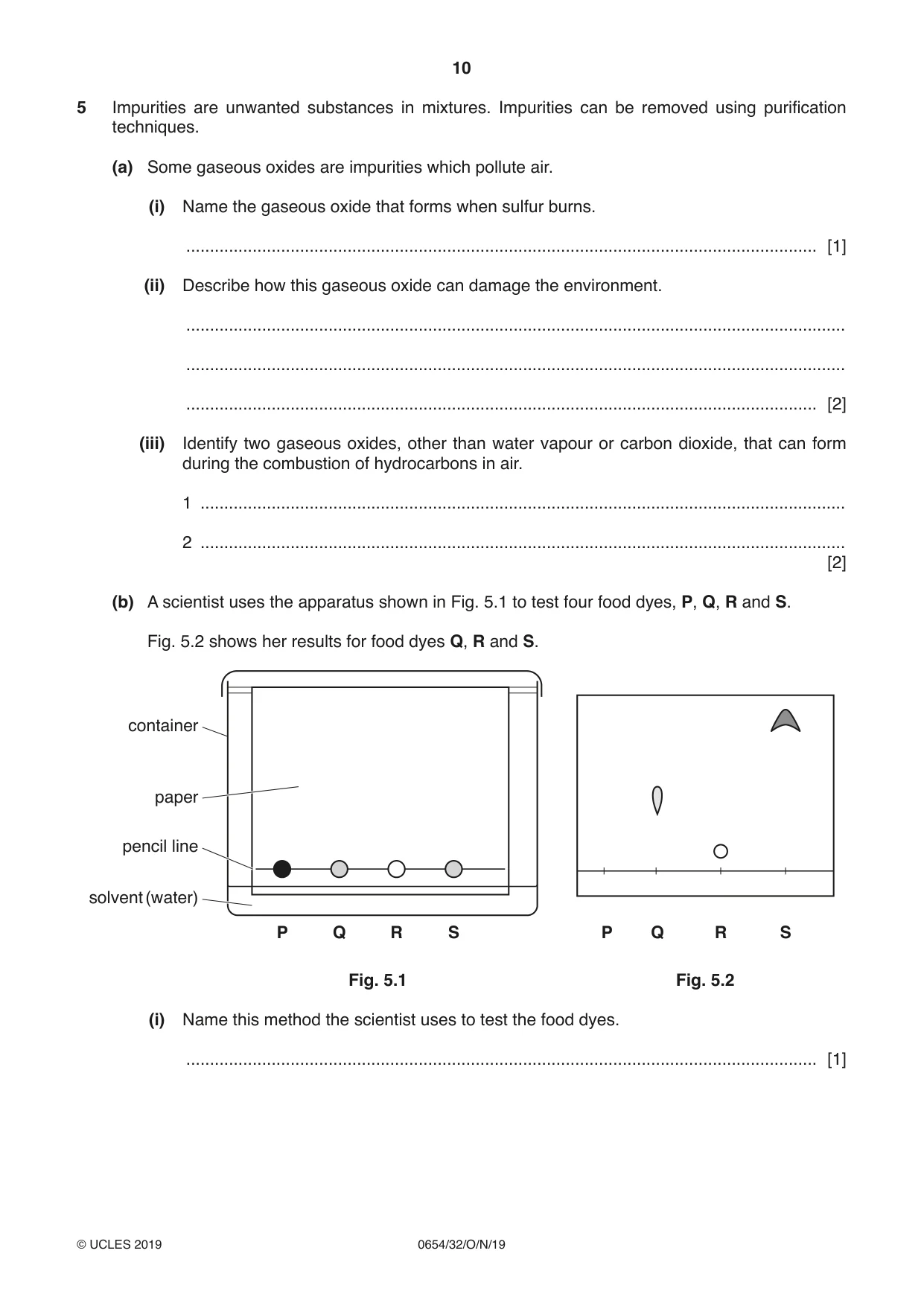
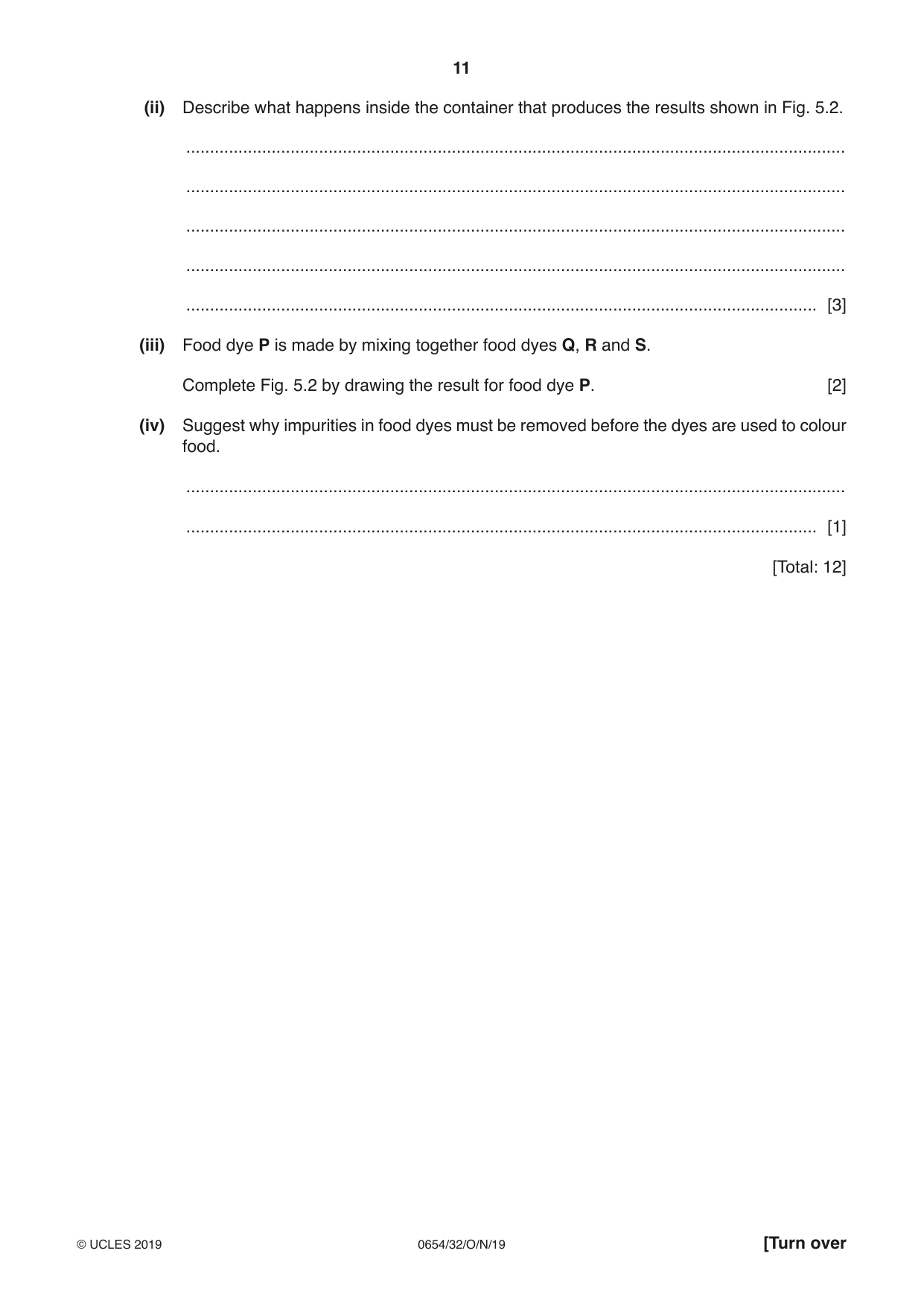
5 Impurities are unwanted substances in mixtures. Impurities can be removed using purification techniques. (a) Some gaseous oxides are impurities which pollute air. (i) Name the gaseous oxide that forms when sulfur burns. ..................................................................................................................................... [1] (ii) Describe how this gaseous oxide can damage the environment. ........................................................................................................................................... ........................................................................................................................................... ..................................................................................................................................... [2] (iii) Identify two gaseous oxides, other than water vapour or carbon dioxide, that can form during the combustion of hydrocarbons in air. 1 ........................................................................................................................................ 2 ........................................................................................................................................ [2] (b) A scientist uses the apparatus shown in Fig. 5.1 to test four food dyes, P, Q, R and S. Fig. 5.2 shows her results for food dyes Q, R and S. container paper pencil line solvent (water) P Q R S P Q R S Fig. 5.1 Fig. 5.2 (i) Name this method the scientist uses to test the food dyes. ..................................................................................................................................... [1] (ii) Describe what happens inside the container that produces the results shown in Fig. 5.2. ........................................................................................................................................... ........................................................................................................................................... ........................................................................................................................................... ........................................................................................................................................... ..................................................................................................................................... [3] (iii) Food dye P is made by mixing together food dyes Q, R and S. Complete Fig. 5.2 by drawing the result for food dye P. [2] (iv) Suggest why impurities in food dyes must be removed before the dyes are used to colour food. ........................................................................................................................................... ..................................................................................................................................... [1] [Total: 12]
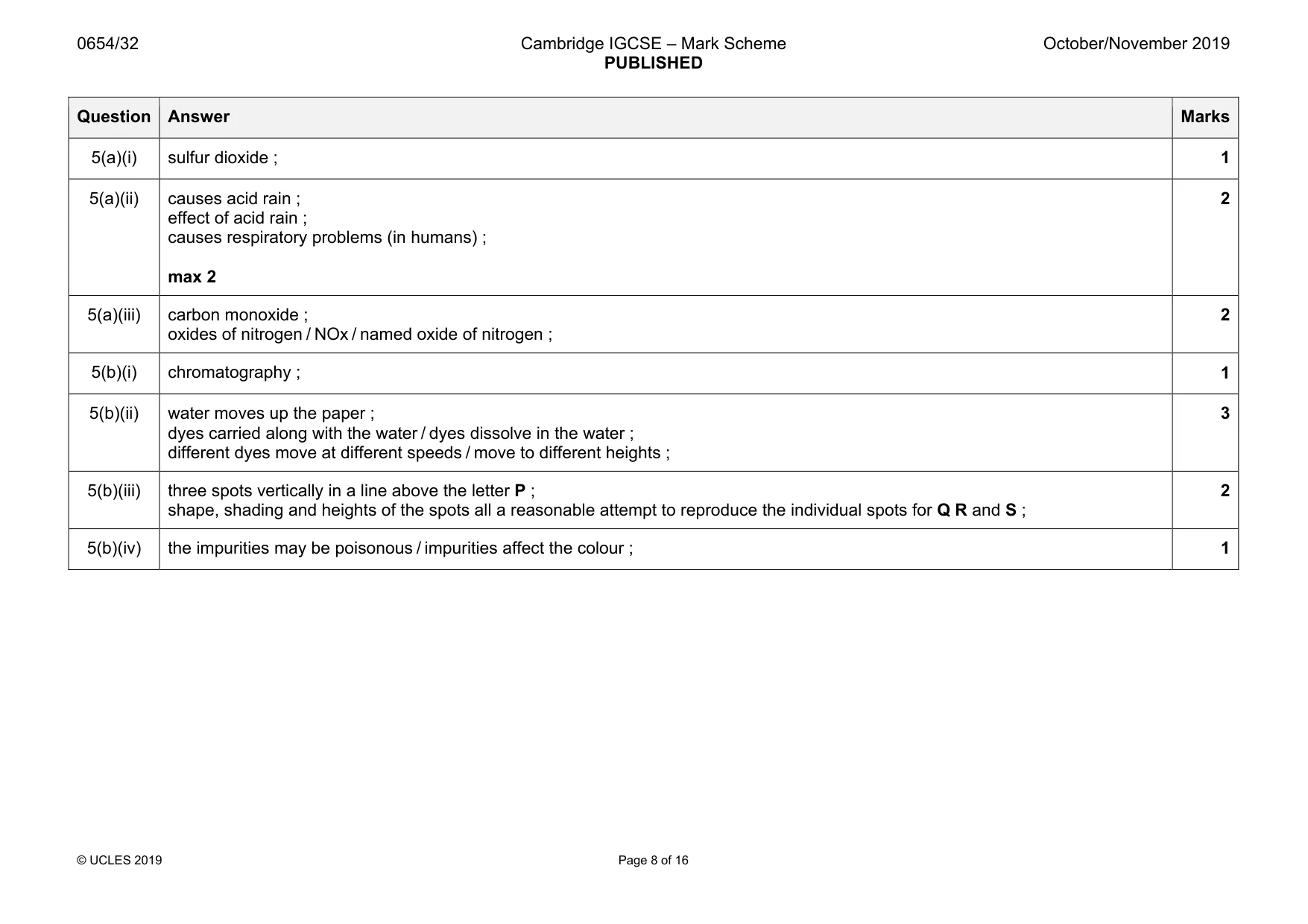
Mark scheme: 5(a)(i) sulfur dioxide ; 1 5(a)(ii) causes acid rain ; effect of acid rain ; causes respiratory problems (in humans) ; max 2 2 5(a)(iii) carbon monoxide ; oxides of nitrogen / NOx / named oxide of nitrogen ; 2 5(b)(i) chromatography ; 1 5(b)(ii) water moves up the paper ; dyes carried along with the water / dyes dissolve in the water ; different dyes move at different speeds / move to different heights ; 3 5(b)(iii) three spots vertically in a line above the letter P ; shape, shading and heights of the spots all a reasonable attempt to reproduce the individual spots for Q R and S ; 2 5(b)(iv) the impurities may be poisonous / impurities affect the colour ; 1
Q6 · A team of students enter a competition to see who can build the highest tower from…
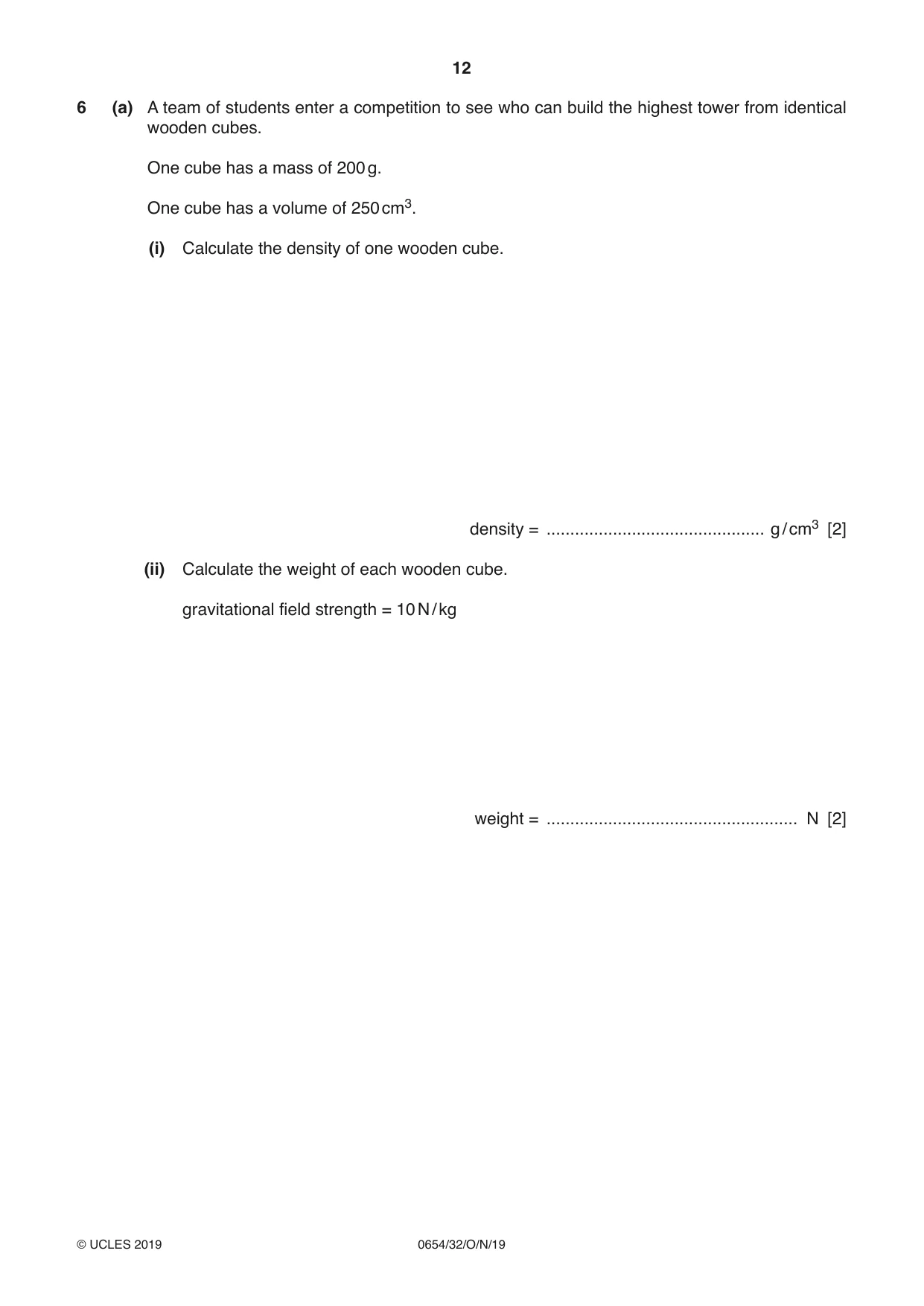
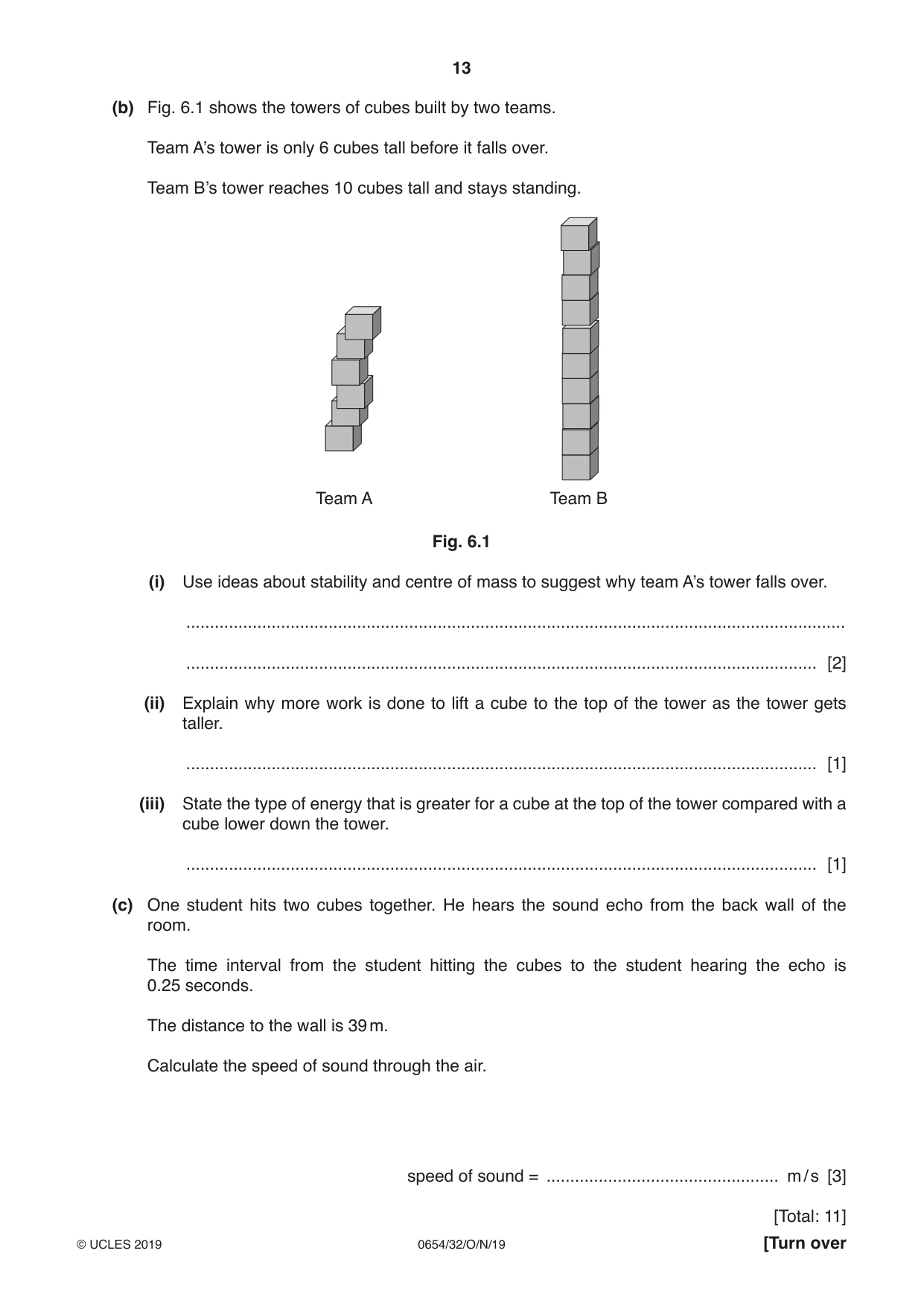
6 (a) A team of students enter a competition to see who can build the highest tower from identical wooden cubes. One cube has a mass of 200 g. One cube has a volume of 250 cm3. (i) Calculate the density of one wooden cube. density = .............................................. g / cm3 [2] (ii) Calculate the weight of each wooden cube. gravitational field strength = 10 N / kg weight = ..................................................... N [2] (b) Fig. 6.1 shows the towers of cubes built by two teams. Team A’s tower is only 6 cubes tall before it falls over. Team B’s tower reaches 10 cubes tall and stays standing. Team A Team B Fig. 6.1 (i) Use ideas about stability and centre of mass to suggest why team A’s tower falls over. ........................................................................................................................................... ..................................................................................................................................... [2] (ii) Explain why more work is done to lift a cube to the top of the tower as the tower gets taller. ..................................................................................................................................... [1] (iii) State the type of energy that is greater for a cube at the top of the tower compared with a cube lower down the tower. ..................................................................................................................................... [1] (c) One student hits two cubes together. He hears the sound echo from the back wall of the room. The time interval from the student hitting the cubes to the student hearing the echo is 0.25 seconds. The distance to the wall is 39 m. Calculate the speed of sound through the air. speed of sound = ................................................. m / s [3] [Total: 11]
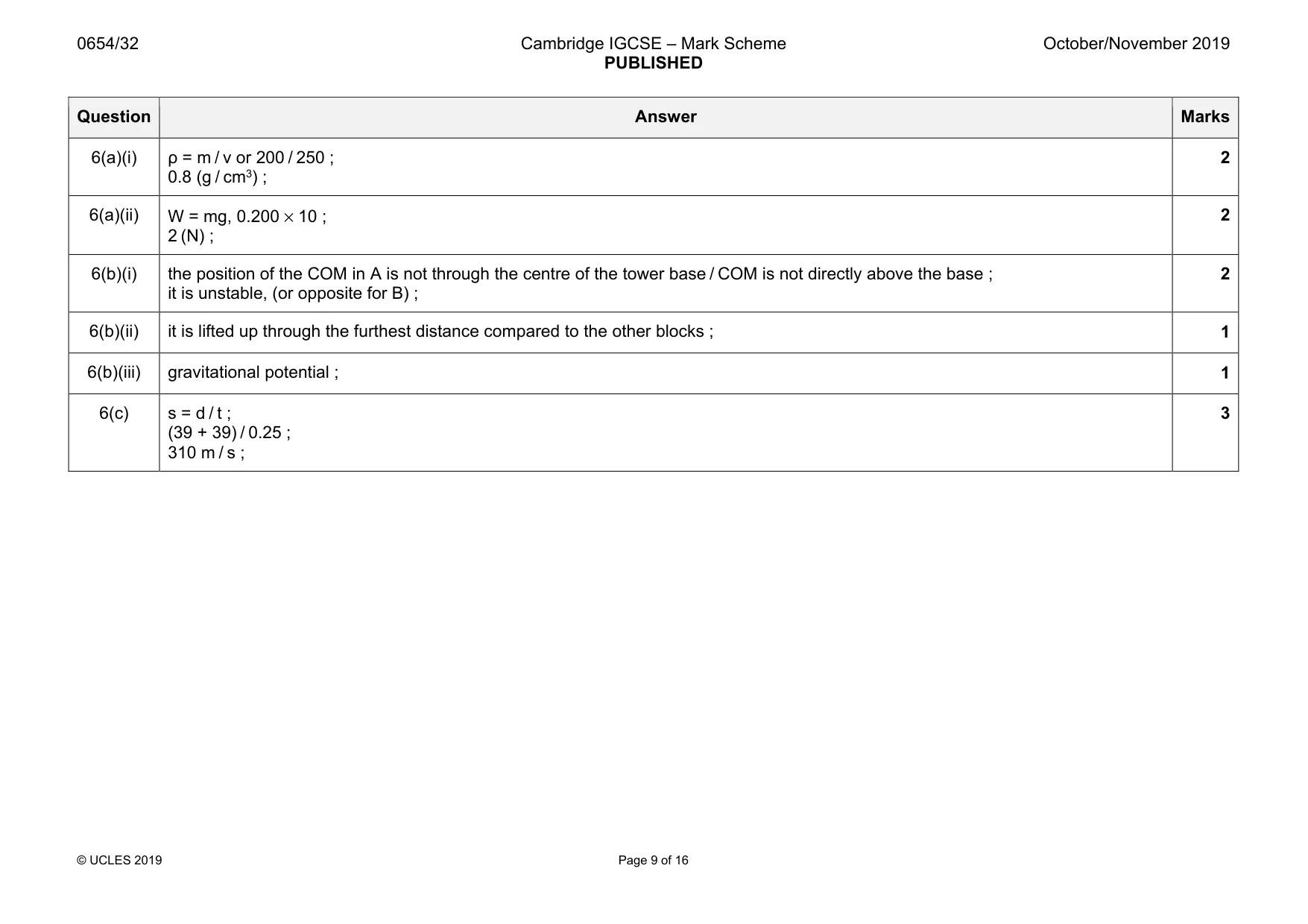
Mark scheme: 6(a)(i) ρ = m / v or 200 / 250 ; 0.8 (g / cm3) ; 2 6(a)(ii) W = mg, 0.200 × 10 ; 2 (N) ; 2 6(b)(i) the position of the COM in A is not through the centre of the tower base / COM is not directly above the base ; it is unstable, (or opposite for B) ; 2 6(b)(ii) it is lifted up through the furthest distance compared to the other blocks ; 1 6(b)(iii) gravitational potential ; 1 6(c) s = d / t ; (39 + 39) / 0.25 ; 310 m / s ; 3
Q7 · In plants, glucose produced by photosynthesis is stored in leaves as starch
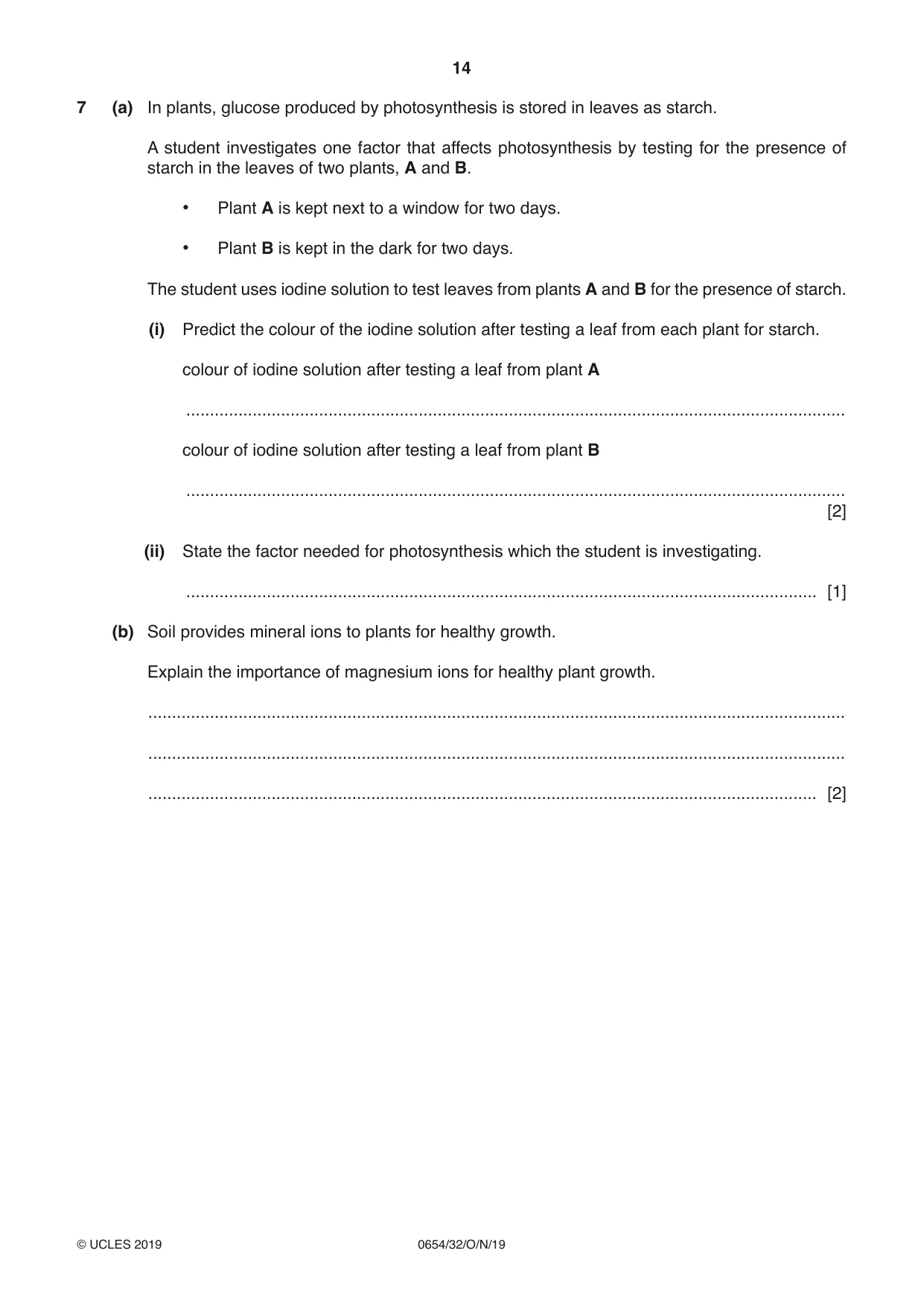
7 (a) In plants, glucose produced by photosynthesis is stored in leaves as starch. A student investigates one factor that affects photosynthesis by testing for the presence of starch in the leaves of two plants, A and B. • Plant A is kept next to a window for two days. • Plant B is kept in the dark for two days. The student uses iodine solution to test leaves from plants A and B for the presence of starch. (i) Predict the colour of the iodine solution after testing a leaf from each plant for starch. colour of iodine solution after testing a leaf from plant A ........................................................................................................................................... colour of iodine solution after testing a leaf from plant B ........................................................................................................................................... [2] (ii) State the factor needed for photosynthesis which the student is investigating. ..................................................................................................................................... [1] (b) Soil provides mineral ions to plants for healthy growth. Explain the importance of magnesium ions for healthy plant growth. ................................................................................................................................................... ................................................................................................................................................... ............................................................................................................................................. [2] (c) Water is another substance needed by plants. (i) Describe how water enters a plant. ........................................................................................................................................... ........................................................................................................................................... ..................................................................................................................................... [2] (ii) Describe how water is lost from a plant. ........................................................................................................................................... ........................................................................................................................................... ........................................................................................................................................... ..................................................................................................................................... [3] [Total: 10]
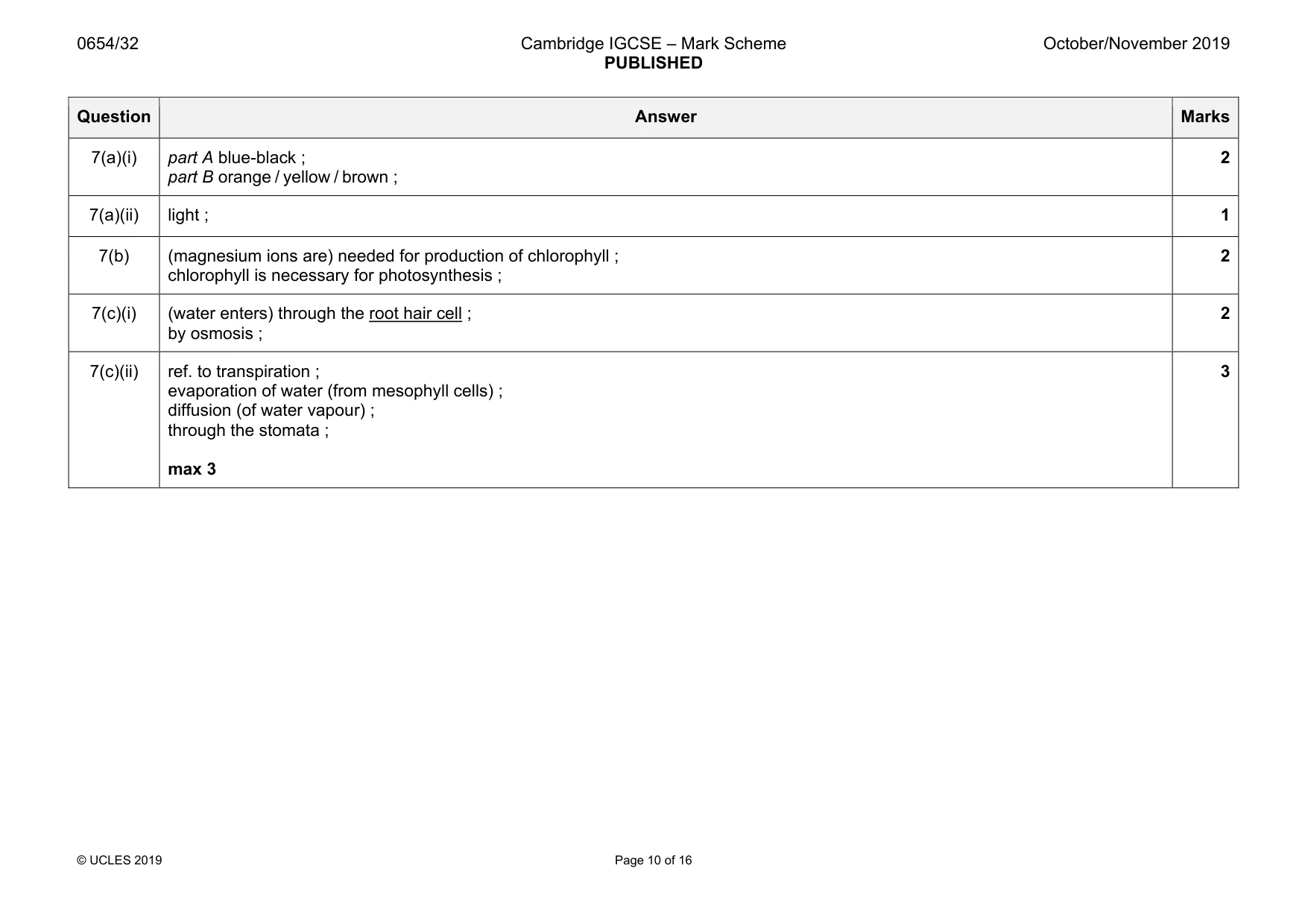
Mark scheme: 7(a)(i) part A blue-black ; part B orange / yellow / brown ; 2 7(a)(ii) light ; 1 7(b) (magnesium ions are) needed for production of chlorophyll ; chlorophyll is necessary for photosynthesis ; 2 7(c)(i) (water enters) through the root hair cell ; by osmosis ; 2 7(c)(ii) ref. to transpiration ; evaporation of water (from mesophyll cells) ; diffusion (of water vapour) ; through the stomata ; max 3 3
Q8 · Sodium is a very reactive metallic element
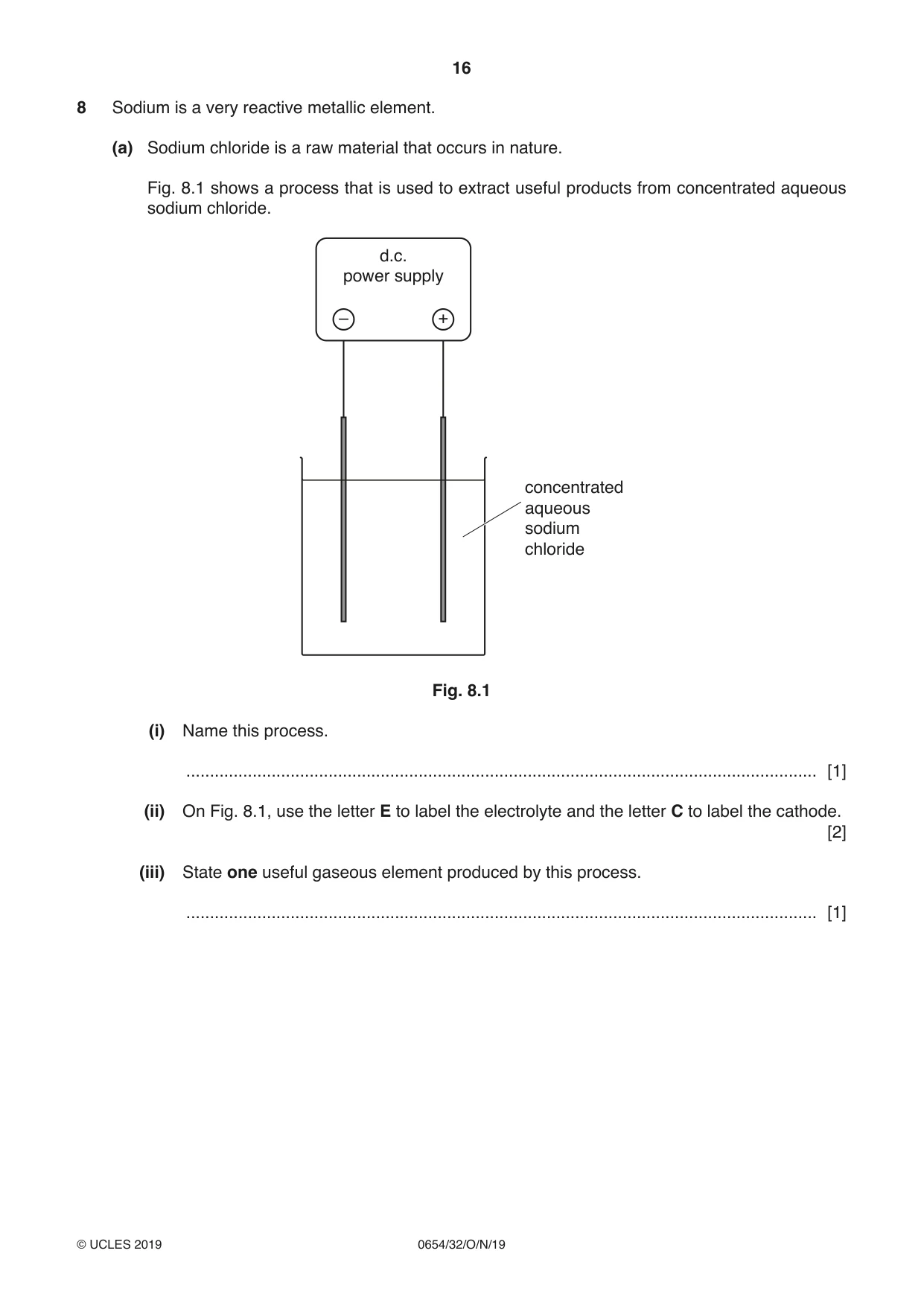
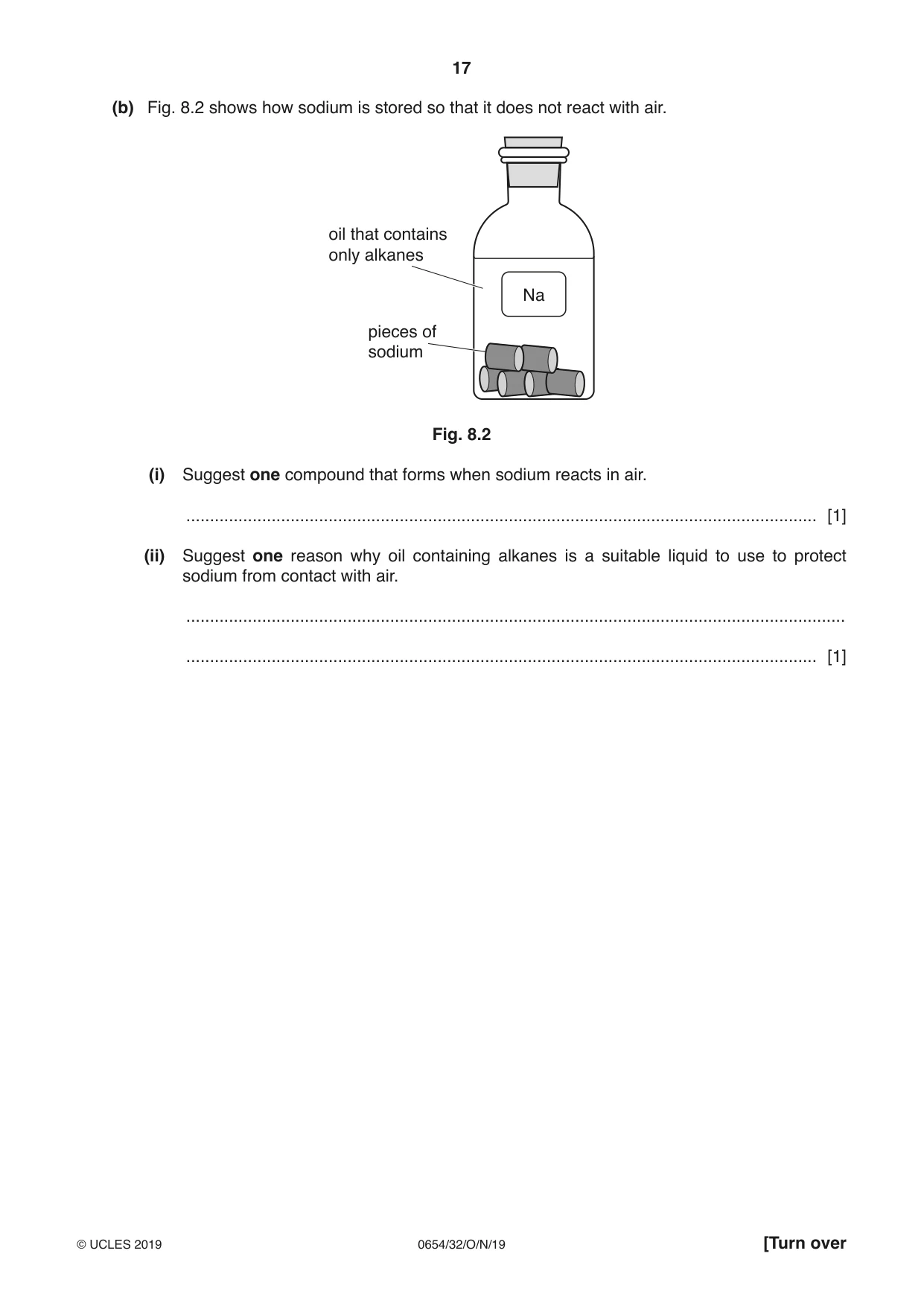
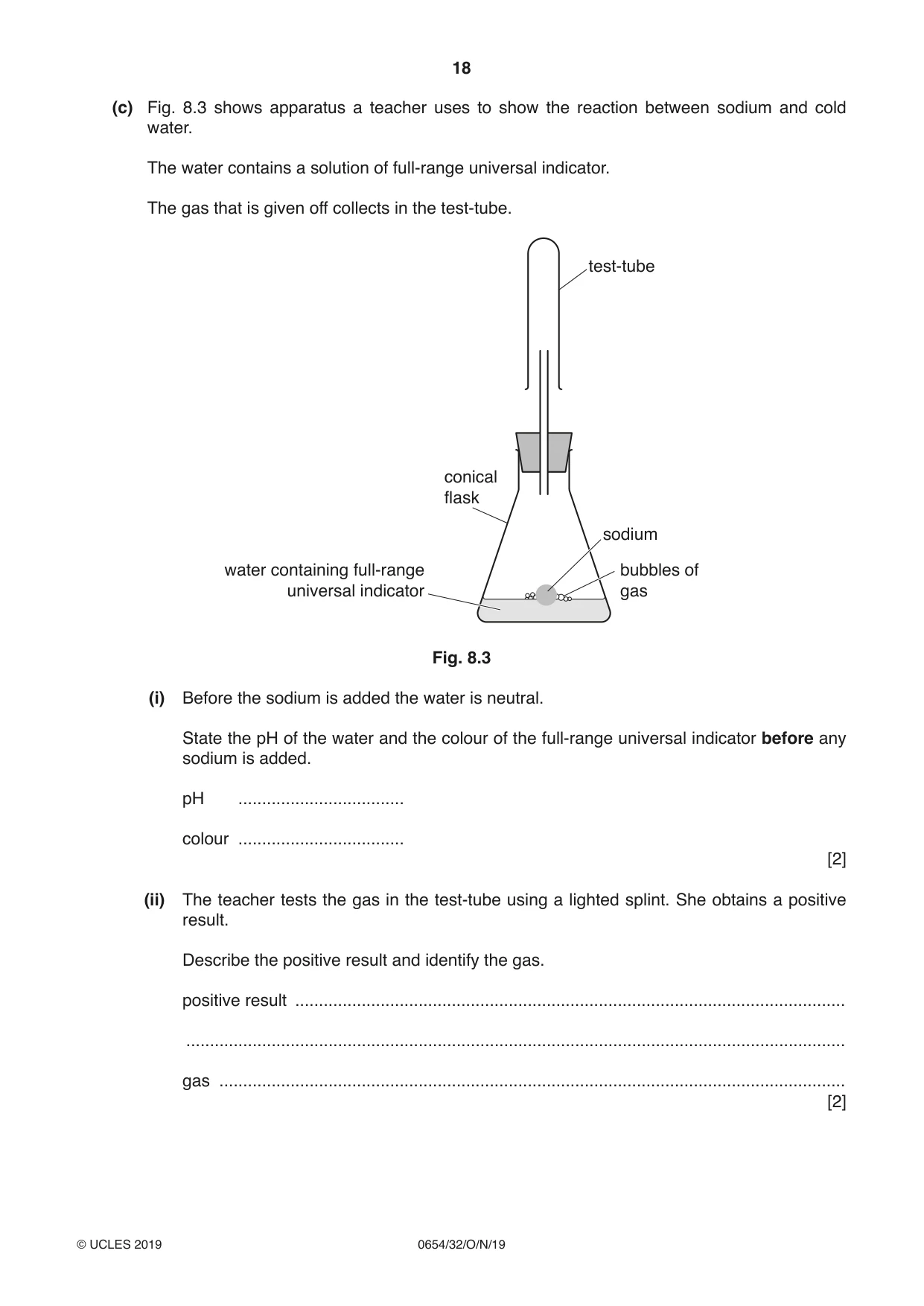
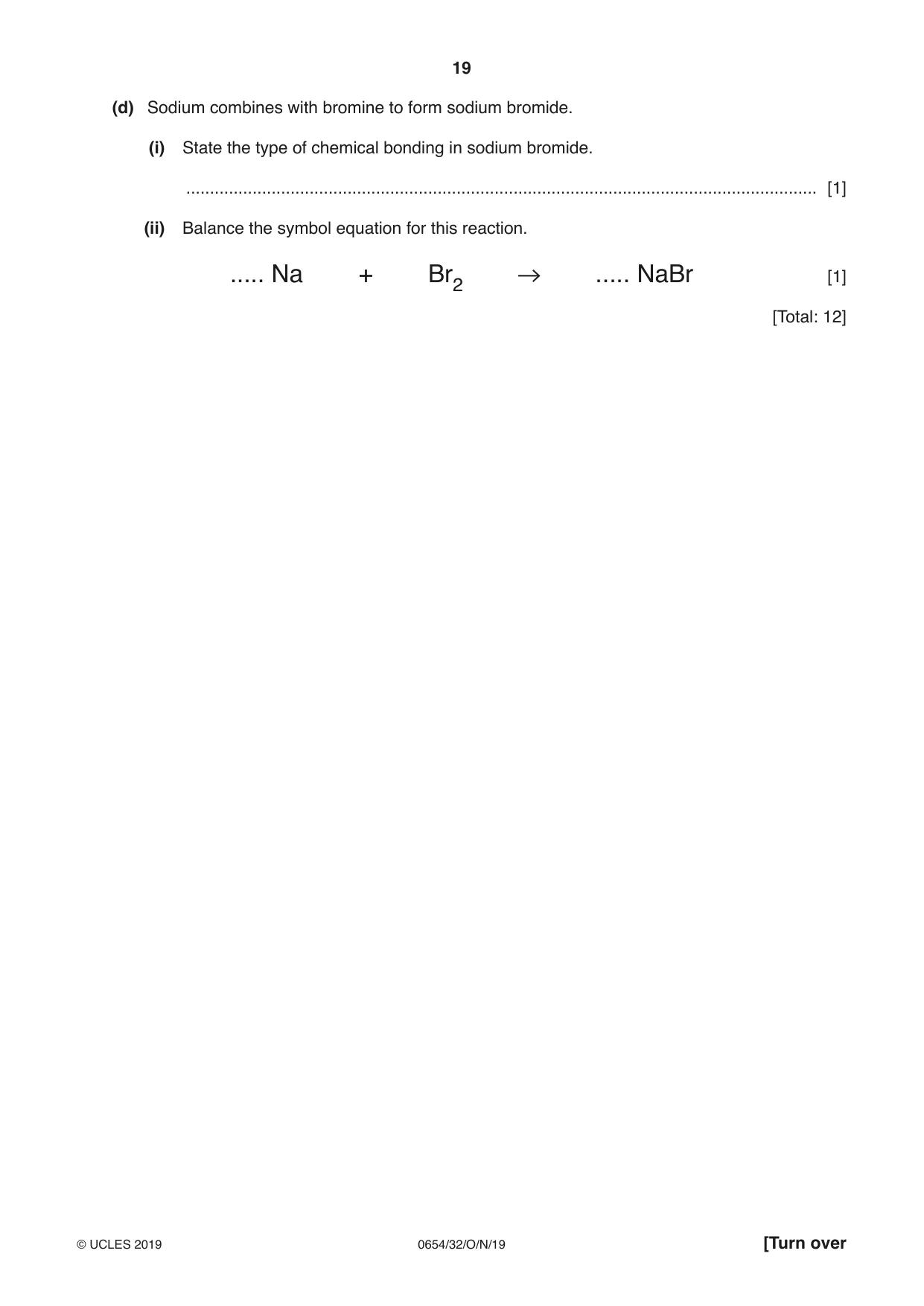
8 Sodium is a very reactive metallic element. (a) Sodium chloride is a raw material that occurs in nature. Fig. 8.1 shows a process that is used to extract useful products from concentrated aqueous sodium chloride. d.c. power supply – + concentrated aqueous sodium chloride Fig. 8.1 (i) Name this process. ..................................................................................................................................... [1] (ii) On Fig. 8.1, use the letter E to label the electrolyte and the letter C to label the cathode. [2] (iii) State one useful gaseous element produced by this process. ..................................................................................................................................... [1] (b) Fig. 8.2 shows how sodium is stored so that it does not react with air. oil that contains only alkanes Na pieces of sodium Fig. 8.2 (i) Suggest one compound that forms when sodium reacts in air. ..................................................................................................................................... [1] (ii) Suggest one reason why oil containing alkanes is a suitable liquid to use to protect sodium from contact with air. ........................................................................................................................................... ..................................................................................................................................... [1] (c) Fig. 8.3 shows apparatus a teacher uses to show the reaction between sodium and cold water. The water contains a solution of full-range universal indicator. The gas that is given off collects in the test-tube. test-tube conical flask sodium water containing full-range bubbles of universal indicator gas Fig. 8.3 (i) Before the sodium is added the water is neutral. State the pH of the water and the colour of the full-range universal indicator before any sodium is added. pH ................................... colour ................................... [2] (ii) The teacher tests the gas in the test-tube using a lighted splint. She obtains a positive result. Describe the positive result and identify the gas. positive result .................................................................................................................... ........................................................................................................................................... gas .................................................................................................................................... [2] (d) Sodium combines with bromine to form sodium bromide. (i) State the type of chemical bonding in sodium bromide. ..................................................................................................................................... [1] (ii) Balance the symbol equation for this reaction. [1] ..... Na + Br2 ..... NaBr [Total: 12]
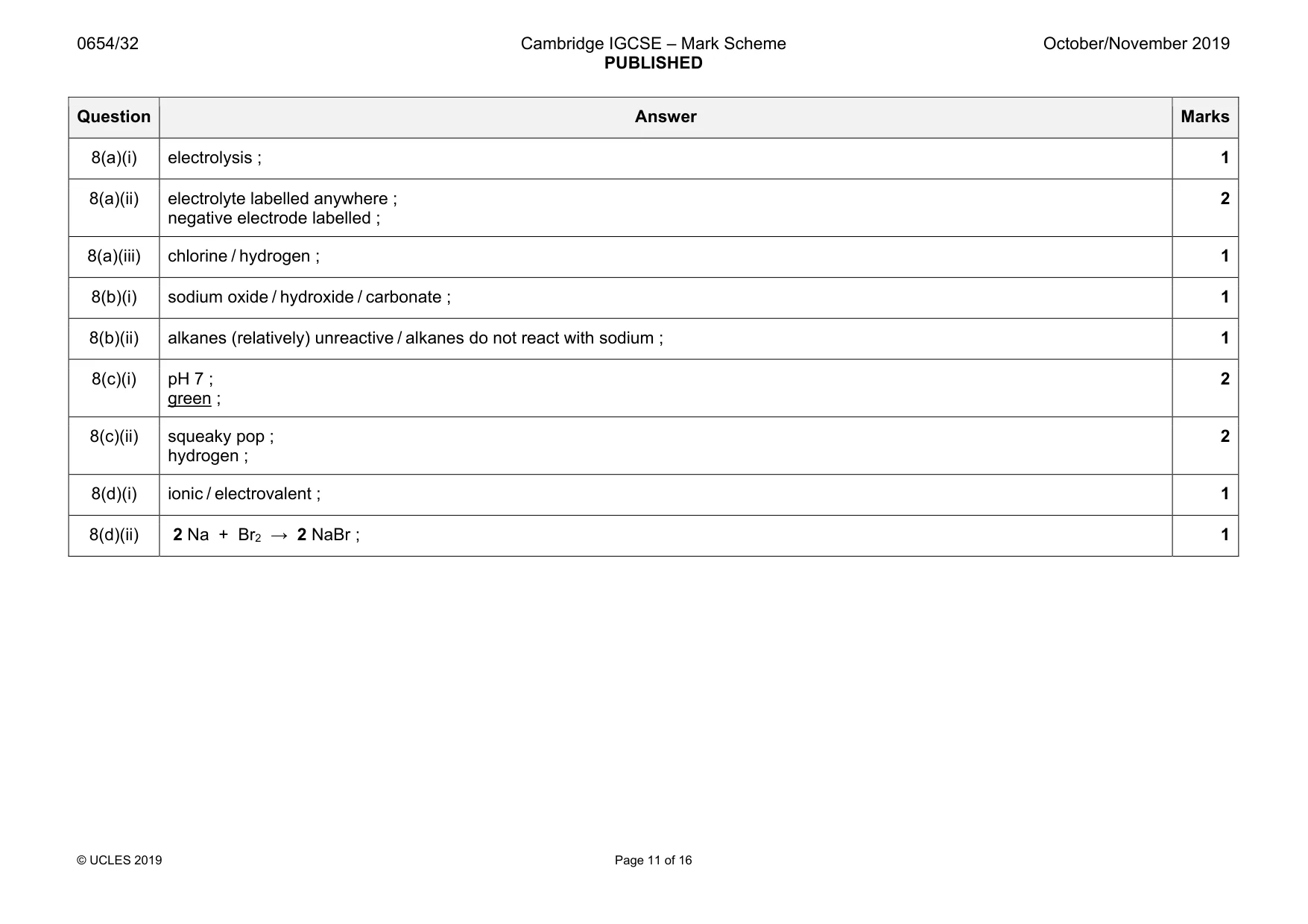
Mark scheme: 8(a)(i) electrolysis ; 1 8(a)(ii) electrolyte labelled anywhere ; negative electrode labelled ; 2 8(a)(iii) chlorine / hydrogen ; 1 8(b)(i) sodium oxide / hydroxide / carbonate ; 1 8(b)(ii) alkanes (relatively) unreactive / alkanes do not react with sodium ; 1 8(c)(i) pH 7 ; green ; 2 8(c)(ii) squeaky pop ; hydrogen ; 2 8(d)(i) ionic / electrovalent ; 1 8(d)(ii) 2 Na + Br2 → 2 NaBr ; 1
Q9 · A battery from a mobile phone (cell phone) is analysed to see what it contains
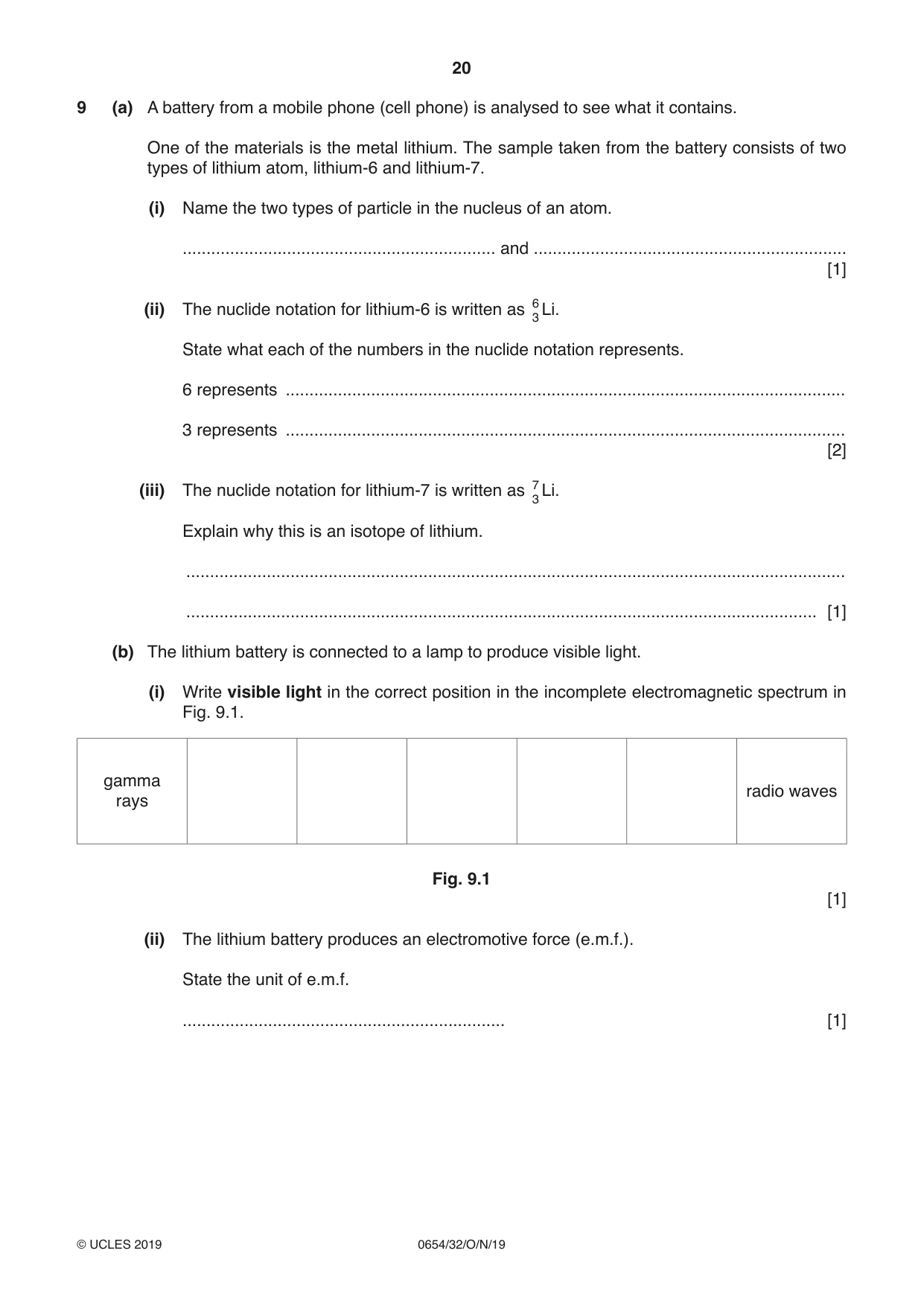
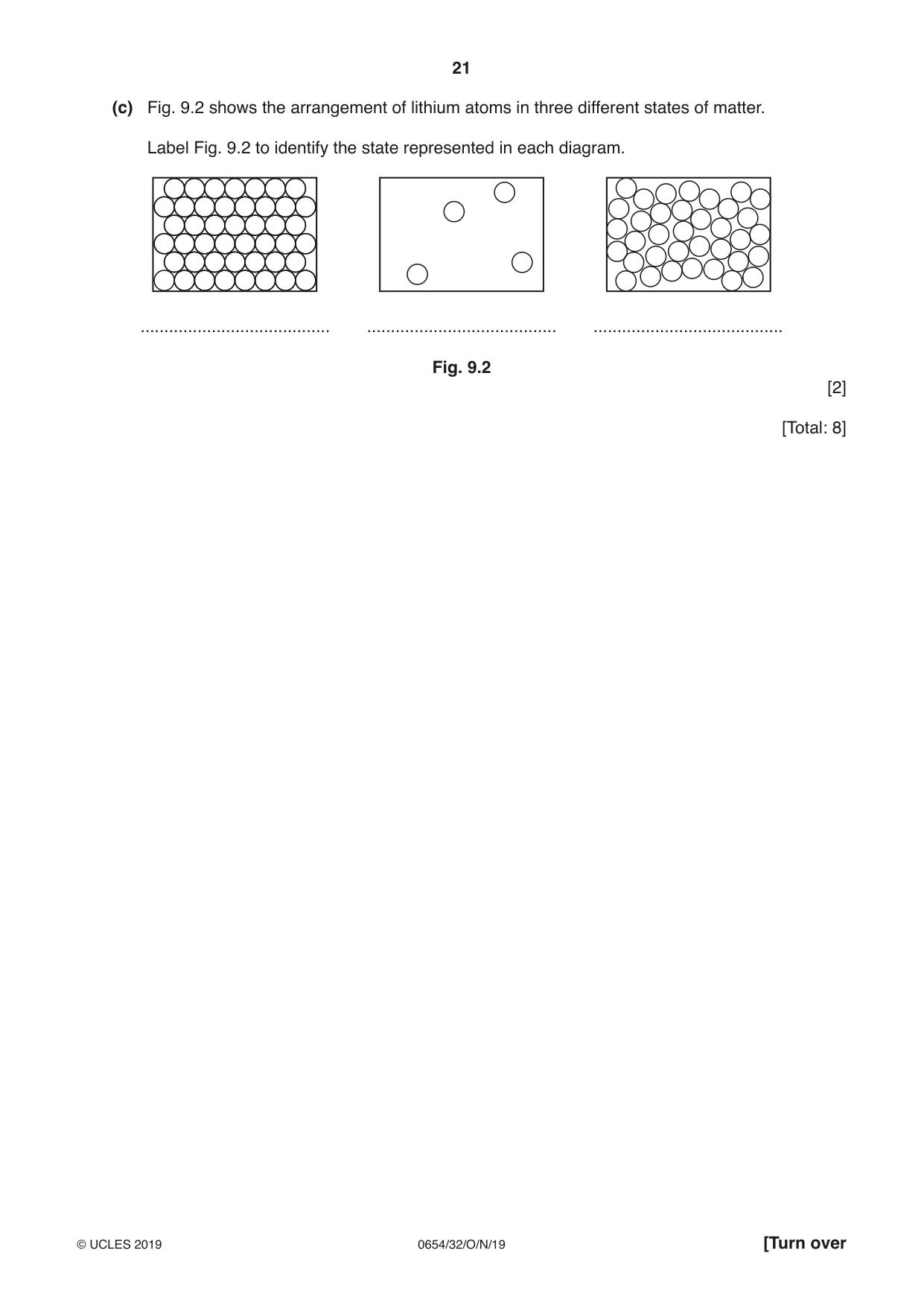
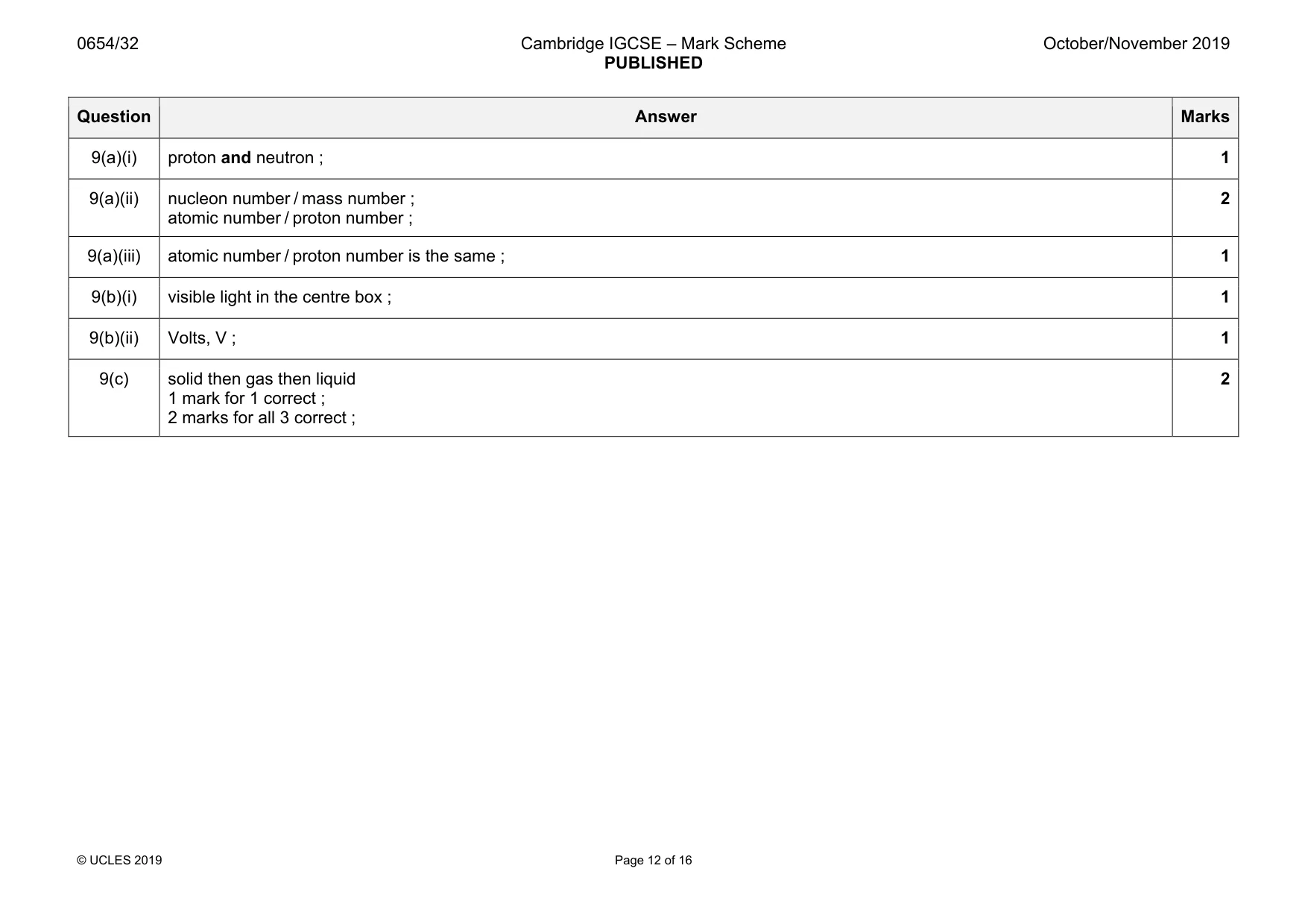
9 (a) A battery from a mobile phone (cell phone) is analysed to see what it contains. One of the materials is the metal lithium. The sample taken from the battery consists of two types of lithium atom, lithium-6 and lithium-7. (i) Name the two types of particle in the nucleus of an atom. .................................................................. and .................................................................. [1] (ii) The nuclide notation for lithium-6 is written as 63 Li. State what each of the numbers in the nuclide notation represents. 6 represents ...................................................................................................................... 3 represents ...................................................................................................................... [2] (iii) The nuclide notation for lithium-7 is written as 73 Li. Explain why this is an isotope of lithium. ........................................................................................................................................... ..................................................................................................................................... [1] (b) The lithium battery is connected to a lamp to produce visible light. (i) Write visible light in the correct position in the incomplete electromagnetic spectrum in Fig. 9.1. gamma radio waves rays Fig. 9.1 [1] (ii) The lithium battery produces an electromotive force (e.m.f.). State the unit of e.m.f. .................................................................... [1] (c) Fig. 9.2 shows the arrangement of lithium atoms in three different states of matter. Label Fig. 9.2 to identify the state represented in each diagram. ........................................ ........................................ ........................................ Fig. 9.2 [2] [Total: 8]
Mark scheme: 9(a)(i) proton and neutron ; 1 9(a)(ii) nucleon number / mass number ; atomic number / proton number ; 2 9(a)(iii) atomic number / proton number is the same ; 1 9(b)(i) visible light in the centre box ; 1 9(b)(ii) Volts, V ; 1 9(c) solid then gas then liquid 1 mark for 1 correct ; 2 marks for all 3 correct ; 2
Q10 · A diagram showing a simple reflex arc
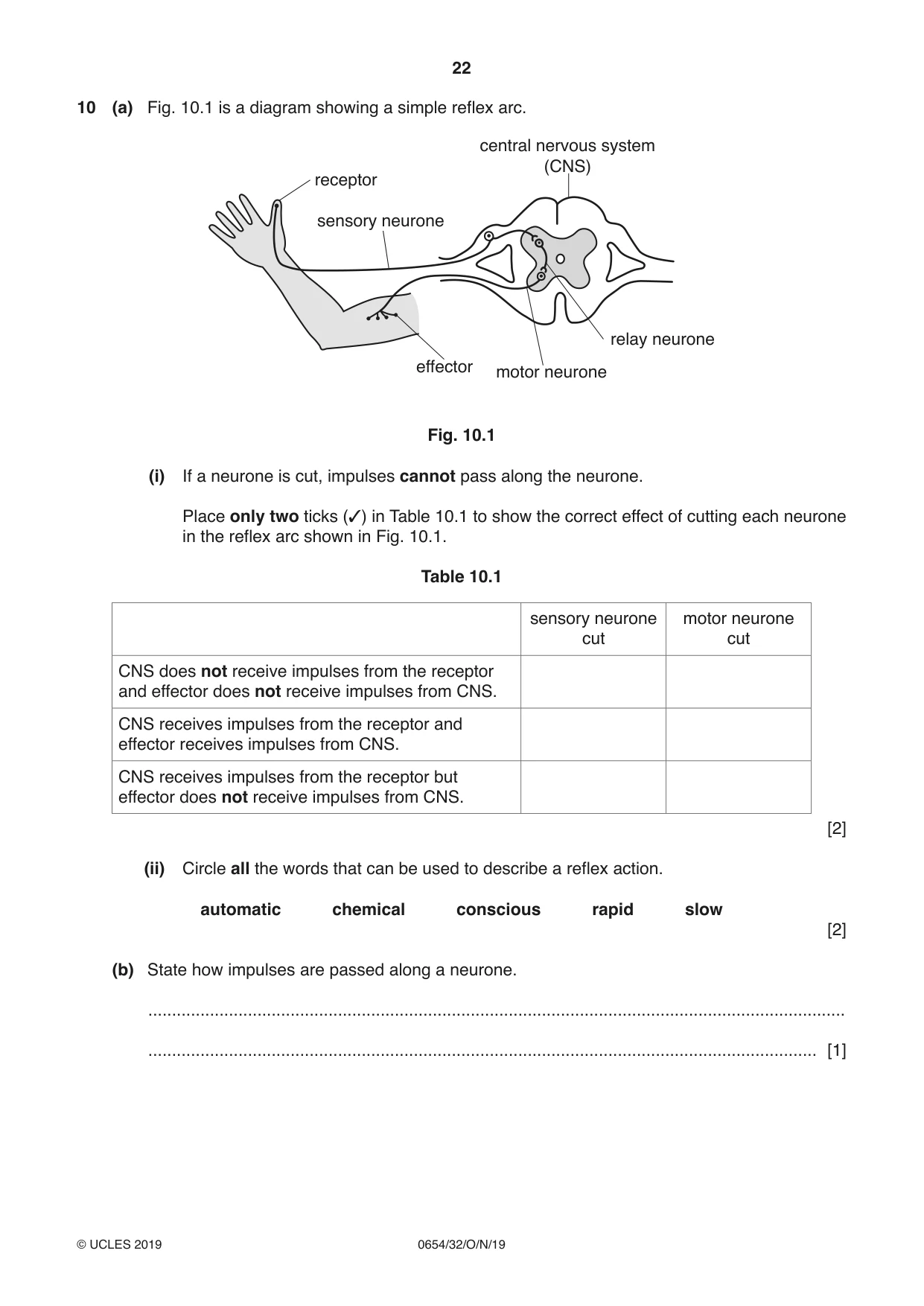
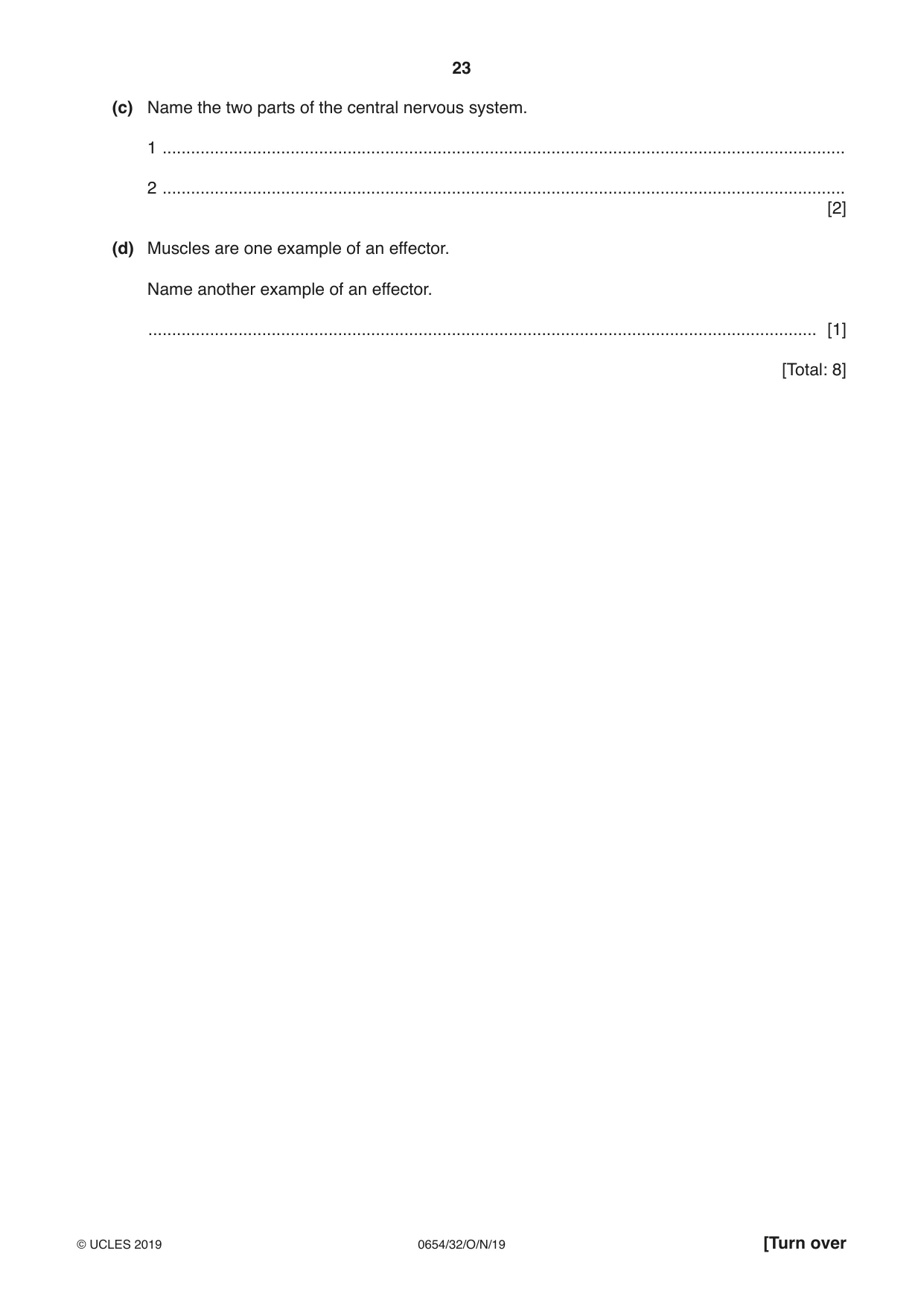
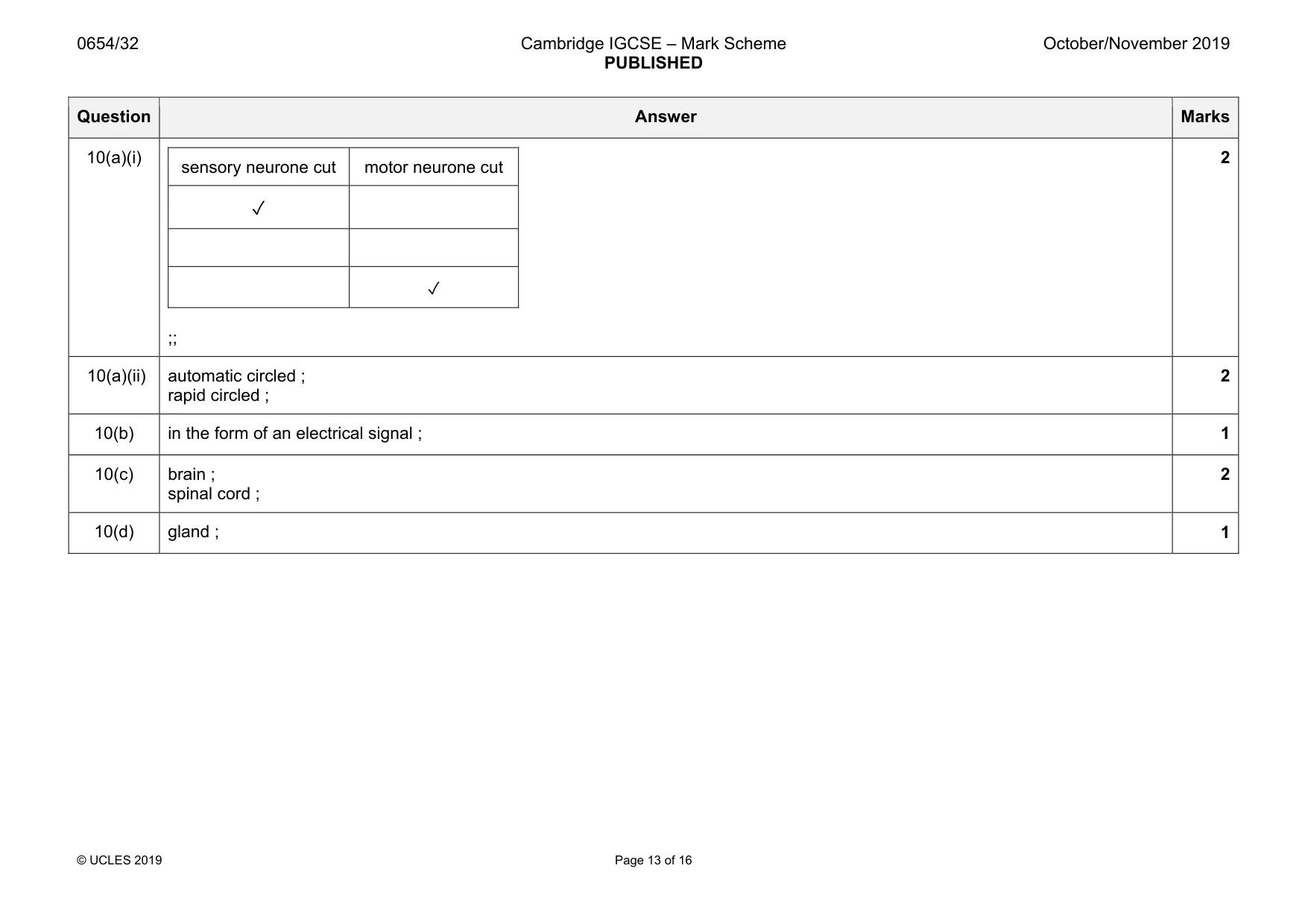
10 (a) Fig. 10.1 is a diagram showing a simple reflex arc. central nervous system (CNS) receptor sensory neurone relay neurone effector motor neurone Fig. 10.1 (i) If a neurone is cut, impulses cannot pass along the neurone. Place only two ticks (3) in Table 10.1 to show the correct effect of cutting each neurone in the reflex arc shown in Fig. 10.1. Table 10.1 sensory neurone motor neurone cut cut CNS does not receive impulses from the receptor and effector does not receive impulses from CNS. CNS receives impulses from the receptor and effector receives impulses from CNS. CNS receives impulses from the receptor but effector does not receive impulses from CNS. [2] (ii) Circle all the words that can be used to describe a reflex action. automatic chemical conscious rapid slow [2] (b) State how impulses are passed along a neurone. ................................................................................................................................................... ............................................................................................................................................. [1] (c) Name the two parts of the central nervous system. 1 ................................................................................................................................................ 2 ................................................................................................................................................ [2] (d) Muscles are one example of an effector. Name another example of an effector. ............................................................................................................................................. [1] [Total: 8]
Mark scheme: 10(a)(i) sensory neurone cut motor neurone cut ✓ ✓ ;; 2 10(a)(ii) automatic circled ; rapid circled ; 2 10(b) in the form of an electrical signal ; 1 10(c) brain ; spinal cord ; 2 10(d) gland ; 1
Q11 · Useful hydrocarbons are obtained from petroleum
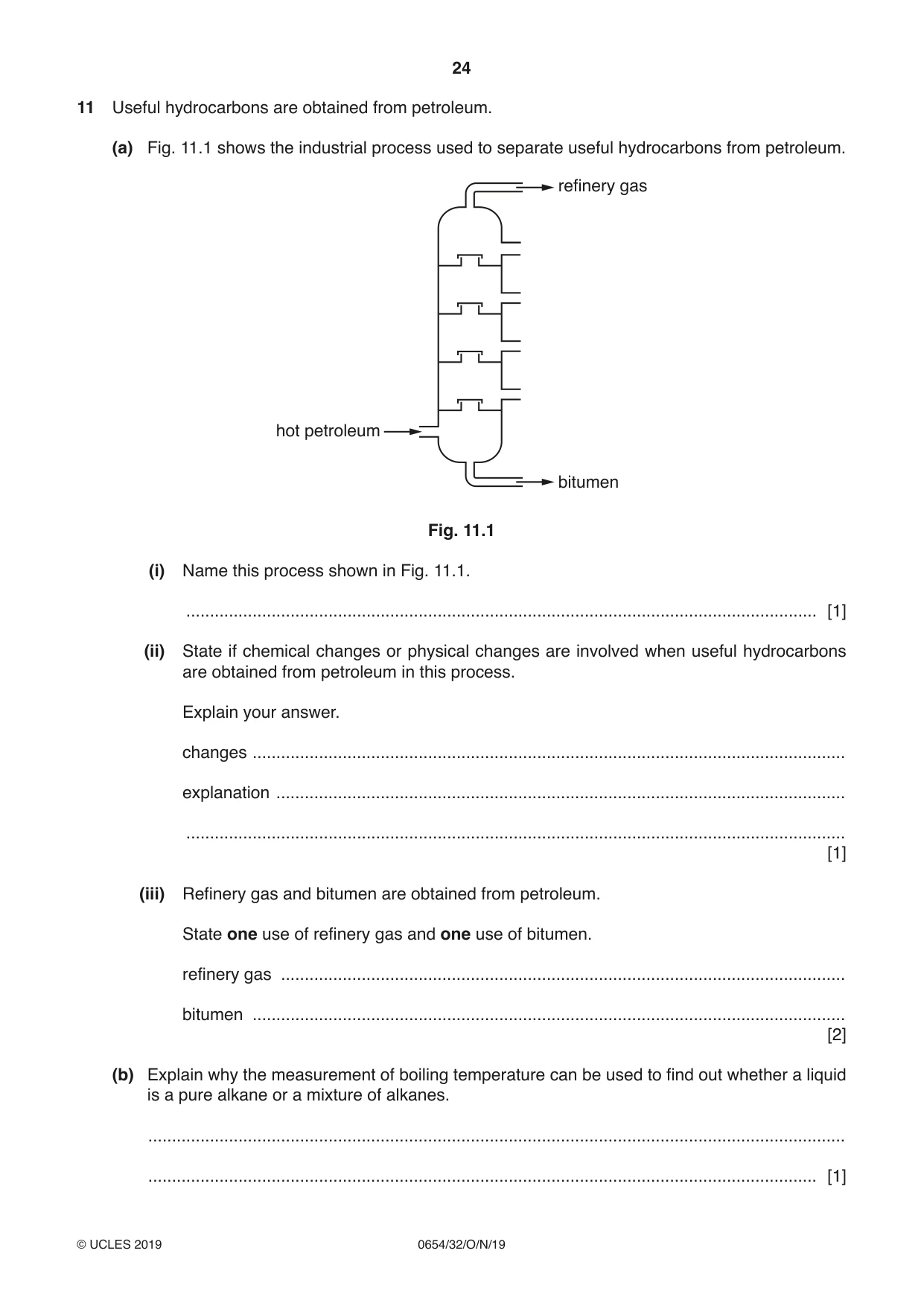
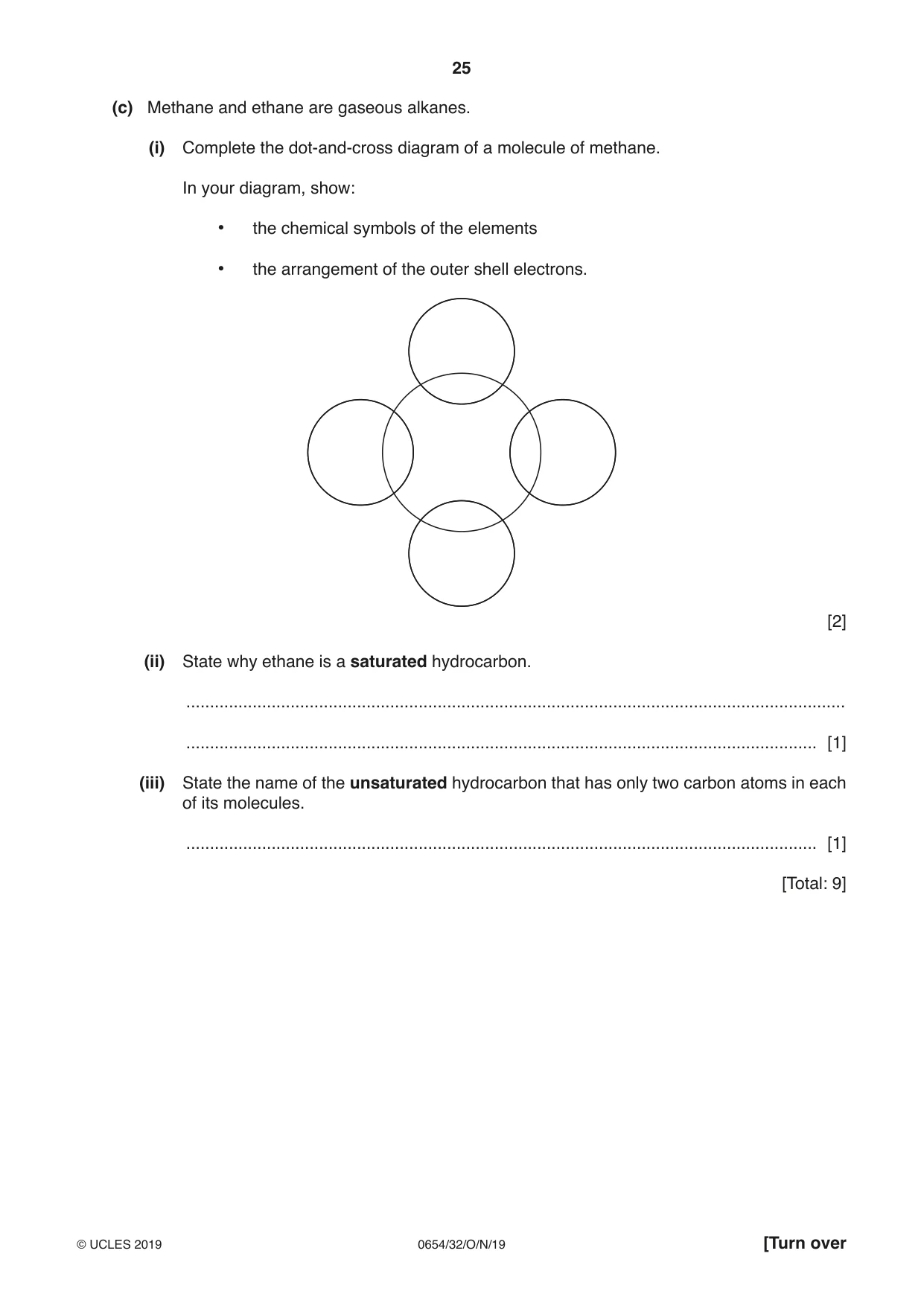
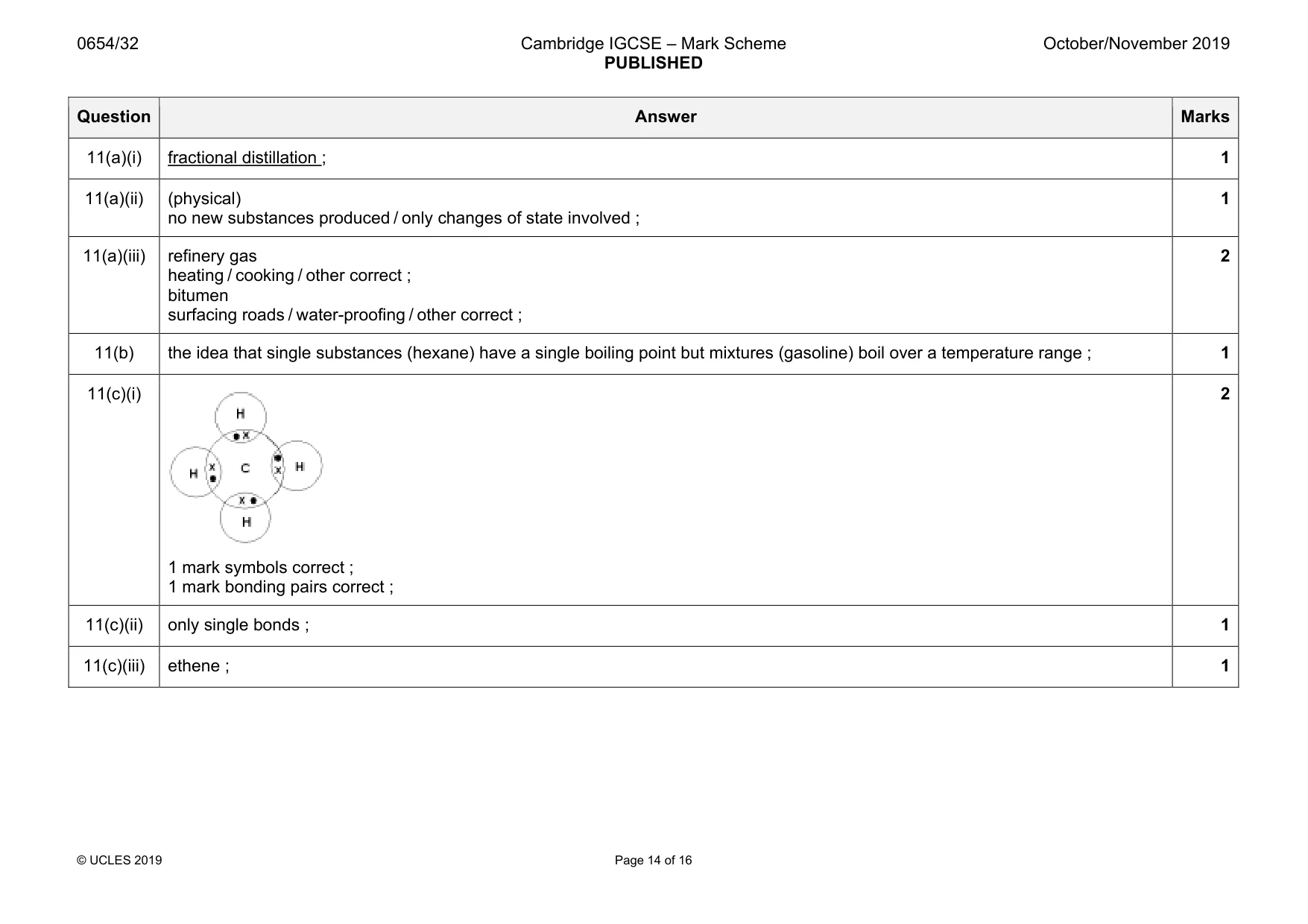
11 Useful hydrocarbons are obtained from petroleum. (a) Fig. 11.1 shows the industrial process used to separate useful hydrocarbons from petroleum. refinery gas hot petroleum bitumen Fig. 11.1 (i) Name this process shown in Fig. 11.1. ..................................................................................................................................... [1] (ii) State if chemical changes or physical changes are involved when useful hydrocarbons are obtained from petroleum in this process. Explain your answer. changes ............................................................................................................................. explanation ........................................................................................................................ ........................................................................................................................................... [1] (iii) Refinery gas and bitumen are obtained from petroleum. State one use of refinery gas and one use of bitumen. refinery gas ....................................................................................................................... bitumen ............................................................................................................................. [2] (b) Explain why the measurement of boiling temperature can be used to find out whether a liquid is a pure alkane or a mixture of alkanes. ................................................................................................................................................... ............................................................................................................................................. [1] (c) Methane and ethane are gaseous alkanes. (i) Complete the dot-and-cross diagram of a molecule of methane. In your diagram, show: • the chemical symbols of the elements • the arrangement of the outer shell electrons. [2] (ii) State why ethane is a saturated hydrocarbon. ........................................................................................................................................... ..................................................................................................................................... [1] (iii) State the name of the unsaturated hydrocarbon that has only two carbon atoms in each of its molecules. ..................................................................................................................................... [1] [Total: 9]
Mark scheme: 11(a)(i) fractional distillation ; 1 11(a)(ii) (physical) no new substances produced / only changes of state involved ; 1 11(a)(iii) refinery gas heating / cooking / other correct ; bitumen surfacing roads / water-proofing / other correct ; 2 11(b) the idea that single substances (hexane) have a single boiling point but mixtures (gasoline) boil over a temperature range ; 1 11(c)(i) 1 mark symbols correct ; 1 mark bonding pairs correct ; 2 11(c)(ii) only single bonds ; 1 11(c)(iii) ethene ; 1
Q12 · A boy swims in a heated swimming pool
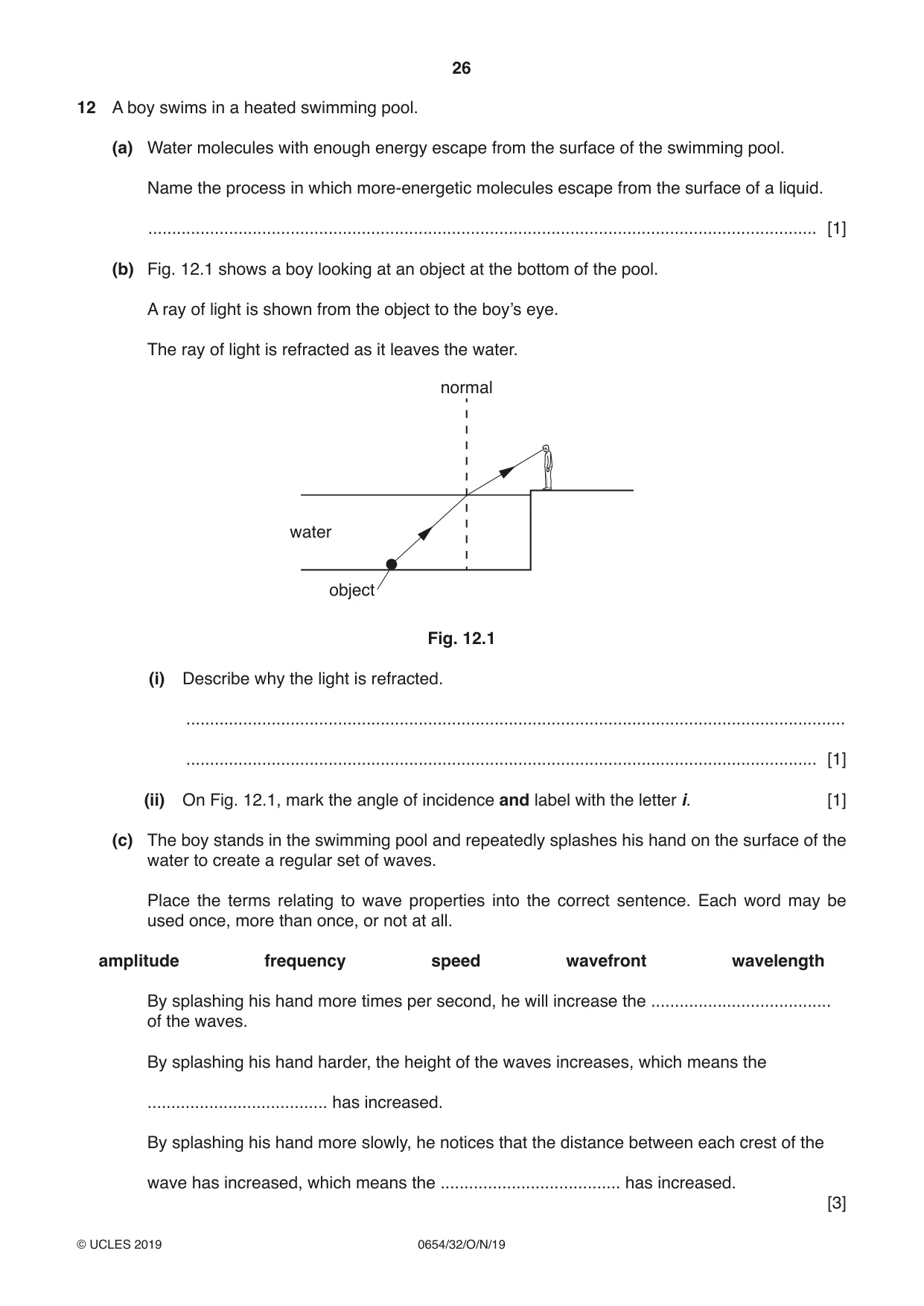
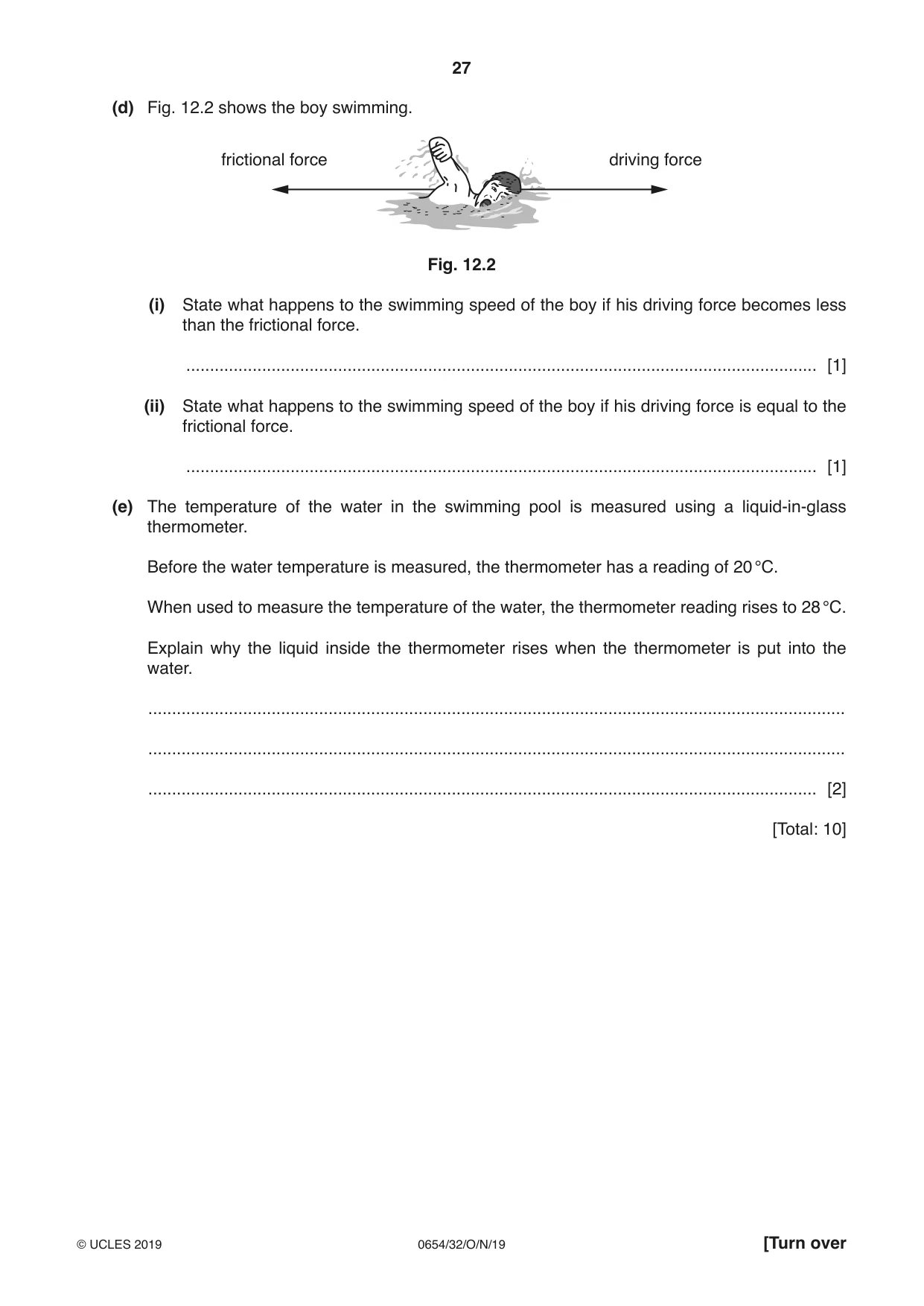
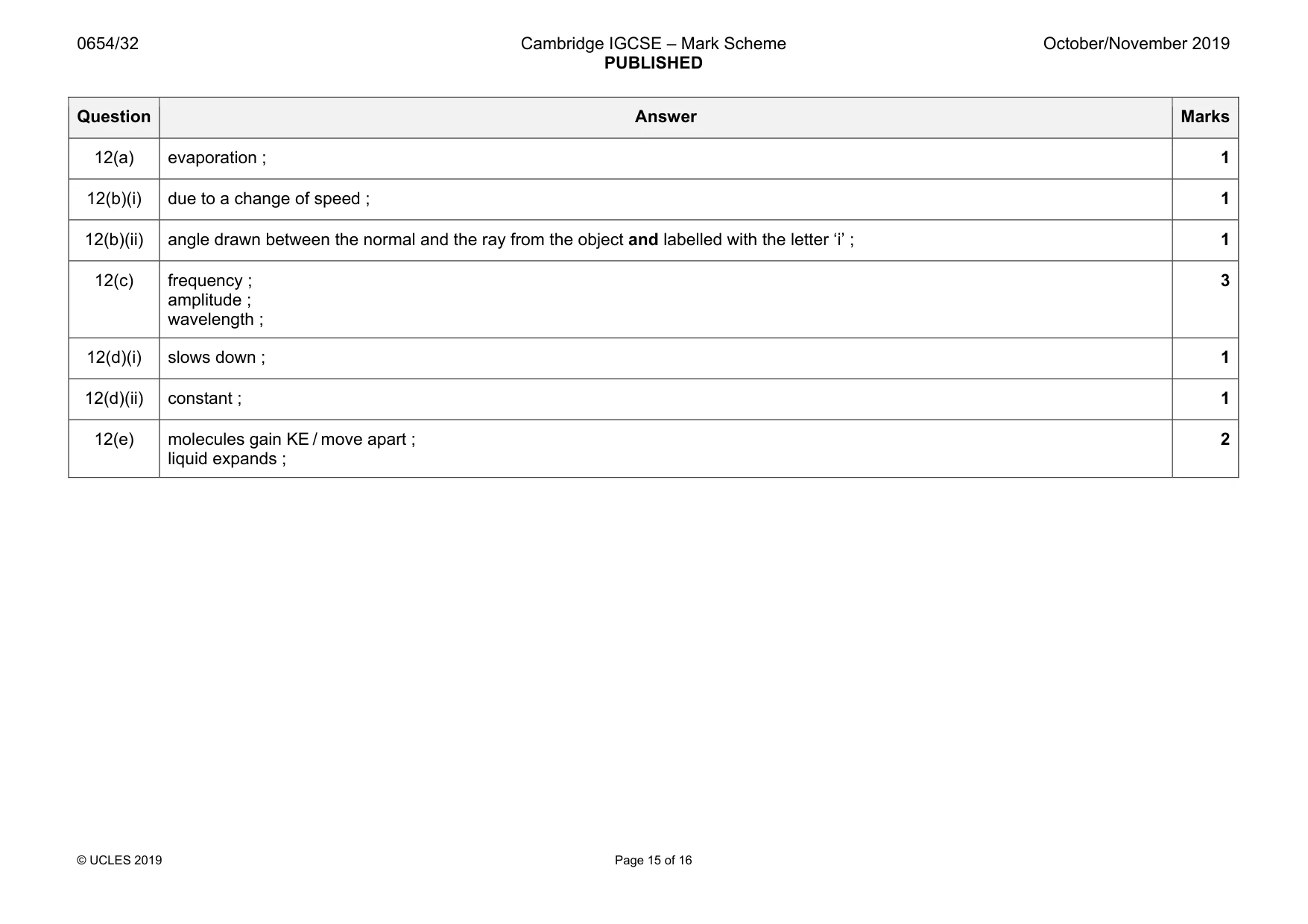
12 A boy swims in a heated swimming pool. (a) Water molecules with enough energy escape from the surface of the swimming pool. Name the process in which more-energetic molecules escape from the surface of a liquid. ............................................................................................................................................. [1] (b) Fig. 12.1 shows a boy looking at an object at the bottom of the pool. A ray of light is shown from the object to the boy’s eye. The ray of light is refracted as it leaves the water. normal water object Fig. 12.1 (i) Describe why the light is refracted. ........................................................................................................................................... ..................................................................................................................................... [1] (ii) On Fig. 12.1, mark the angle of incidence and label with the letter i. [1] (c) The boy stands in the swimming pool and repeatedly splashes his hand on the surface of the water to create a regular set of waves. Place the terms relating to wave properties into the correct sentence. Each word may be used once, more than once, or not at all. amplitude frequency speed wavefront wavelength By splashing his hand more times per second, he will increase the ...................................... of the waves. By splashing his hand harder, the height of the waves increases, which means the ...................................... has increased. By splashing his hand more slowly, he notices that the distance between each crest of the wave has increased, which means the ...................................... has increased. [3] (d) Fig. 12.2 shows the boy swimming. frictional force driving force Fig. 12.2 (i) State what happens to the swimming speed of the boy if his driving force becomes less than the frictional force. ..................................................................................................................................... [1] (ii) State what happens to the swimming speed of the boy if his driving force is equal to the frictional force. ..................................................................................................................................... [1] (e) The temperature of the water in the swimming pool is measured using a liquid-in-glass thermometer. Before the water temperature is measured, the thermometer has a reading of 20 °C. When used to measure the temperature of the water, the thermometer reading rises to 28 °C. Explain why the liquid inside the thermometer rises when the thermometer is put into the water. ................................................................................................................................................... ................................................................................................................................................... ............................................................................................................................................. [2] [Total: 10]
Mark scheme: 12(a) evaporation ; 1 12(b)(i) due to a change of speed ; 1 12(b)(ii) angle drawn between the normal and the ray from the object and labelled with the letter ‘i’ ; 1 12(c) frequency ; amplitude ; wavelength ; 3 12(d)(i) slows down ; 1 12(d)(ii) constant ; 1 12(e) molecules gain KE / move apart ; liquid expands ; 2
Q13 · A diagram of a flower
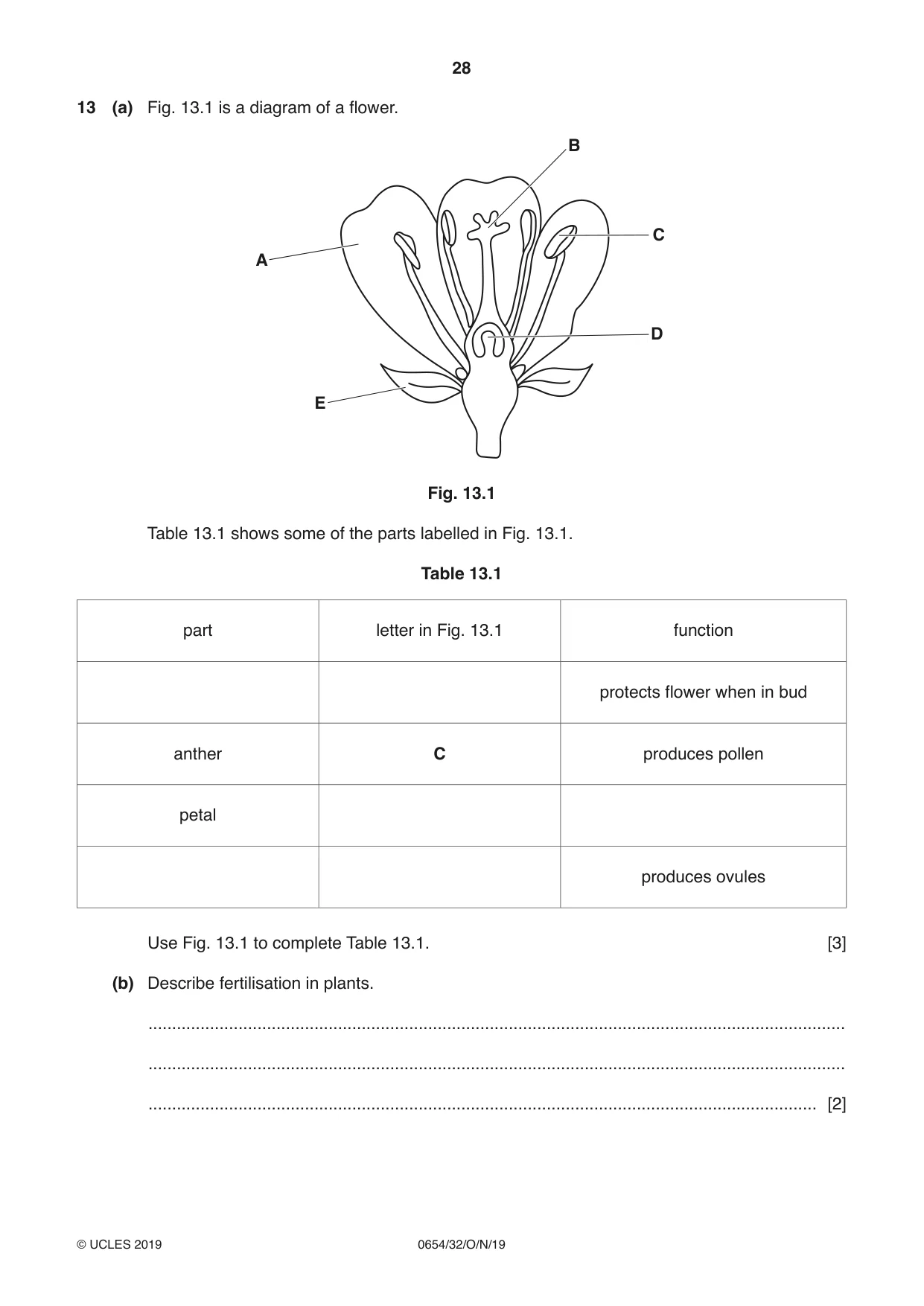
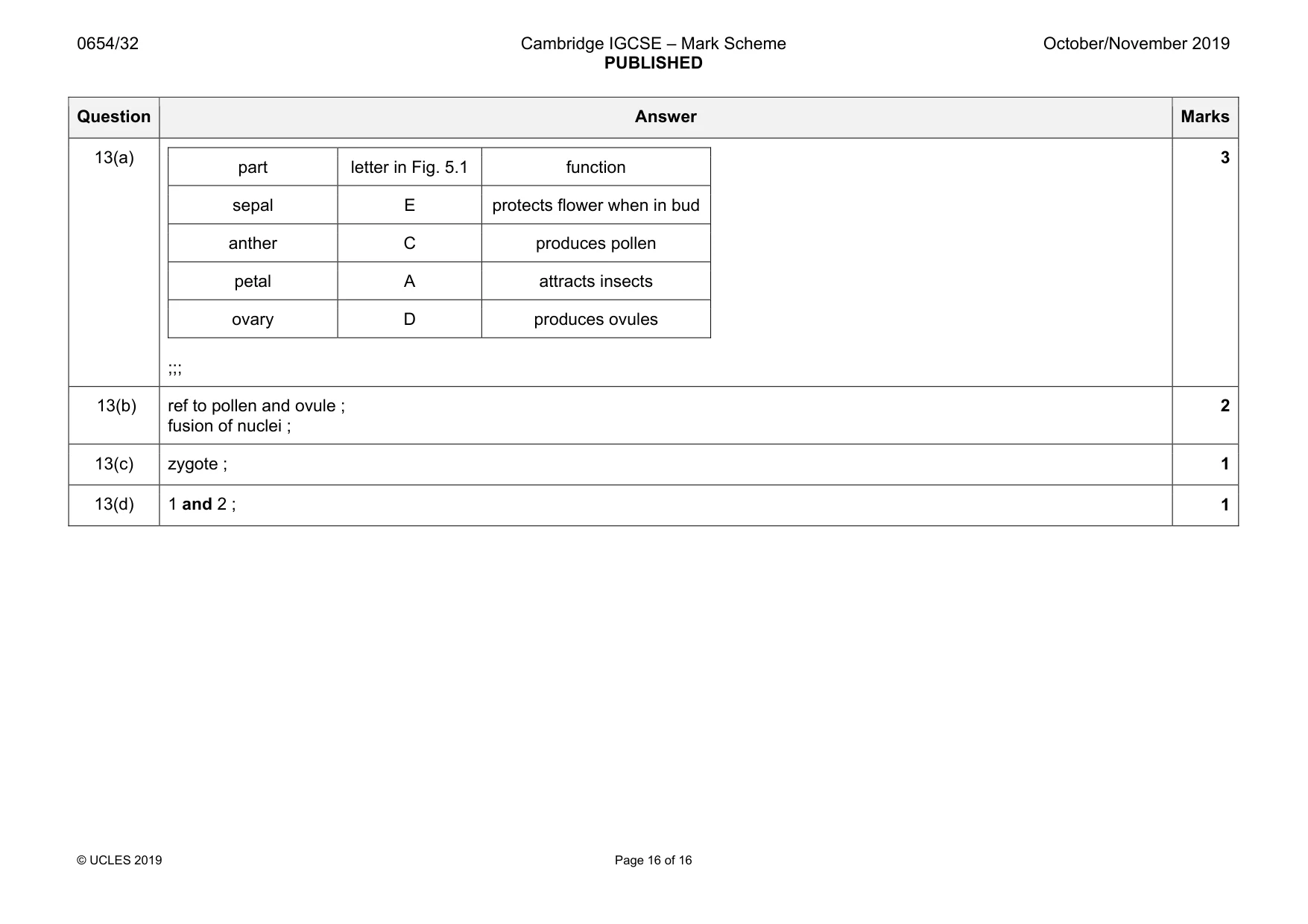
13 (a) Fig. 13.1 is a diagram of a flower. B C A D E Fig. 13.1 Table 13.1 shows some of the parts labelled in Fig. 13.1. Table 13.1 part letter in Fig. 13.1 function protects flower when in bud anther C produces pollen petal produces ovules Use Fig. 13.1 to complete Table 13.1. [3] (b) Describe fertilisation in plants. ................................................................................................................................................... ................................................................................................................................................... ............................................................................................................................................. [2] (c) Name the cell formed by the fusion of the nuclei of gametes. ............................................................................................................................................. [1] (d) State the number of parents needed for: asexual reproduction ................................................................................................................ sexual reproduction. ................................................................................................................. [1] [Total: 7]
Mark scheme: 13(a) part letter in Fig. 5.1 function sepal E protects flower when in bud anther C produces pollen petal A attracts insects ovary D produces ovules ;;; 3 13(b) ref to pollen and ovule ; fusion of nuclei ; 2 13(c) zygote ; 1 13(d) 1 and 2 ; 1
What was in this paper
The subtopics covered by these 13 questions, and how many questions each got. Open one in a new tab to see every Cambridge question on it.
What you needed in this session
Cambridge’s own grade thresholds for 2019 Oct/Nov, Paper 3 · Variant 2. A higher threshold means an easier paper — the bar moves with how the cohort did.